[go: up one dir, main page]

WO2018095888A1 - Bisbenzofuran-fused 2,8-diaminoindeno[1,2-b]fluorene derivatives and related compounds as materials for organic electroluminescent devices (oled) - Google Patents

Bisbenzofuran-fused 2,8-diaminoindeno[1,2-b]fluorene derivatives and related compounds as materials for organic electroluminescent devices (oled) Download PDF

Info

Publication number
WO2018095888A1
WO2018095888A1 PCT/EP2017/079864 EP2017079864W WO2018095888A1 WO 2018095888 A1 WO2018095888 A1 WO 2018095888A1 EP 2017079864 W EP2017079864 W EP 2017079864W WO 2018095888 A1 WO2018095888 A1 WO 2018095888A1
Authority
WO
WIPO (PCT)
Prior art keywords
formula
atoms
groups
substituted
radicals
Prior art date
Legal status (The legal status is an assumption and is not a legal conclusion. Google has not performed a legal analysis and makes no representation as to the accuracy of the status listed.)
Ceased
Application number
PCT/EP2017/079864
Other languages
French (fr)
Inventor
Rouven LINGE
Lara-Isabel RODRIGUEZ
Sebastian Meyer
Holger Heil
Current Assignee (The listed assignees may be inaccurate. Google has not performed a legal analysis and makes no representation or warranty as to the accuracy of the list.)
Merck Patent GmbH
Original Assignee
Merck Patent GmbH
Priority date (The priority date is an assumption and is not a legal conclusion. Google has not performed a legal analysis and makes no representation as to the accuracy of the date listed.)
Filing date
Publication date
Application filed by Merck Patent GmbH filed Critical Merck Patent GmbH
Priority to CN201780071098.1A priority Critical patent/CN109963857A/en
Priority to KR1020197017770A priority patent/KR102540425B1/en
Priority to EP17798256.8A priority patent/EP3544984B1/en
Priority to US16/463,448 priority patent/US11584753B2/en
Priority to JP2019528142A priority patent/JP7101670B2/en
Publication of WO2018095888A1 publication Critical patent/WO2018095888A1/en
Anticipated expiration legal-status Critical
Ceased legal-status Critical Current

Links

Classifications

    • CCHEMISTRY; METALLURGY
    • C07ORGANIC CHEMISTRY
    • C07DHETEROCYCLIC COMPOUNDS
    • C07D493/00Heterocyclic compounds containing oxygen atoms as the only ring hetero atoms in the condensed system
    • C07D493/02Heterocyclic compounds containing oxygen atoms as the only ring hetero atoms in the condensed system in which the condensed system contains two hetero rings
    • C07D493/04Ortho-condensed systems
    • CCHEMISTRY; METALLURGY
    • C07ORGANIC CHEMISTRY
    • C07CACYCLIC OR CARBOCYCLIC COMPOUNDS
    • C07C15/00Cyclic hydrocarbons containing only six-membered aromatic rings as cyclic parts
    • C07C15/20Polycyclic condensed hydrocarbons
    • CCHEMISTRY; METALLURGY
    • C07ORGANIC CHEMISTRY
    • C07CACYCLIC OR CARBOCYCLIC COMPOUNDS
    • C07C211/00Compounds containing amino groups bound to a carbon skeleton
    • C07C211/43Compounds containing amino groups bound to a carbon skeleton having amino groups bound to carbon atoms of six-membered aromatic rings of the carbon skeleton
    • C07C211/54Compounds containing amino groups bound to a carbon skeleton having amino groups bound to carbon atoms of six-membered aromatic rings of the carbon skeleton having amino groups bound to two or three six-membered aromatic rings
    • CCHEMISTRY; METALLURGY
    • C07ORGANIC CHEMISTRY
    • C07DHETEROCYCLIC COMPOUNDS
    • C07D307/00Heterocyclic compounds containing five-membered rings having one oxygen atom as the only ring hetero atom
    • C07D307/77Heterocyclic compounds containing five-membered rings having one oxygen atom as the only ring hetero atom ortho- or peri-condensed with carbocyclic rings or ring systems
    • C07D307/91Dibenzofurans; Hydrogenated dibenzofurans
    • CCHEMISTRY; METALLURGY
    • C07ORGANIC CHEMISTRY
    • C07DHETEROCYCLIC COMPOUNDS
    • C07D493/00Heterocyclic compounds containing oxygen atoms as the only ring hetero atoms in the condensed system
    • C07D493/22Heterocyclic compounds containing oxygen atoms as the only ring hetero atoms in the condensed system in which the condensed system contains four or more hetero rings
    • CCHEMISTRY; METALLURGY
    • C07ORGANIC CHEMISTRY
    • C07FACYCLIC, CARBOCYCLIC OR HETEROCYCLIC COMPOUNDS CONTAINING ELEMENTS OTHER THAN CARBON, HYDROGEN, HALOGEN, OXYGEN, NITROGEN, SULFUR, SELENIUM OR TELLURIUM
    • C07F7/00Compounds containing elements of Groups 4 or 14 of the Periodic Table
    • C07F7/02Silicon compounds
    • C07F7/08Compounds having one or more C—Si linkages
    • C07F7/0803Compounds with Si-C or Si-Si linkages
    • C07F7/081Compounds with Si-C or Si-Si linkages comprising at least one atom selected from the elements N, O, halogen, S, Se or Te
    • C07F7/0812Compounds with Si-C or Si-Si linkages comprising at least one atom selected from the elements N, O, halogen, S, Se or Te comprising a heterocyclic ring
    • C07F7/0816Compounds with Si-C or Si-Si linkages comprising at least one atom selected from the elements N, O, halogen, S, Se or Te comprising a heterocyclic ring said ring comprising Si as a ring atom
    • CCHEMISTRY; METALLURGY
    • C09DYES; PAINTS; POLISHES; NATURAL RESINS; ADHESIVES; COMPOSITIONS NOT OTHERWISE PROVIDED FOR; APPLICATIONS OF MATERIALS NOT OTHERWISE PROVIDED FOR
    • C09KMATERIALS FOR MISCELLANEOUS APPLICATIONS, NOT PROVIDED FOR ELSEWHERE
    • C09K11/00Luminescent, e.g. electroluminescent, chemiluminescent materials
    • C09K11/06Luminescent, e.g. electroluminescent, chemiluminescent materials containing organic luminescent materials
    • HELECTRICITY
    • H10SEMICONDUCTOR DEVICES; ELECTRIC SOLID-STATE DEVICES NOT OTHERWISE PROVIDED FOR
    • H10KORGANIC ELECTRIC SOLID-STATE DEVICES
    • H10K50/00Organic light-emitting devices
    • H10K50/10OLEDs or polymer light-emitting diodes [PLED]
    • H10K50/11OLEDs or polymer light-emitting diodes [PLED] characterised by the electroluminescent [EL] layers
    • HELECTRICITY
    • H10SEMICONDUCTOR DEVICES; ELECTRIC SOLID-STATE DEVICES NOT OTHERWISE PROVIDED FOR
    • H10KORGANIC ELECTRIC SOLID-STATE DEVICES
    • H10K85/00Organic materials used in the body or electrodes of devices covered by this subclass
    • H10K85/40Organosilicon compounds, e.g. TIPS pentacene
    • HELECTRICITY
    • H10SEMICONDUCTOR DEVICES; ELECTRIC SOLID-STATE DEVICES NOT OTHERWISE PROVIDED FOR
    • H10KORGANIC ELECTRIC SOLID-STATE DEVICES
    • H10K85/00Organic materials used in the body or electrodes of devices covered by this subclass
    • H10K85/60Organic compounds having low molecular weight
    • H10K85/615Polycyclic condensed aromatic hydrocarbons, e.g. anthracene
    • HELECTRICITY
    • H10SEMICONDUCTOR DEVICES; ELECTRIC SOLID-STATE DEVICES NOT OTHERWISE PROVIDED FOR
    • H10KORGANIC ELECTRIC SOLID-STATE DEVICES
    • H10K85/00Organic materials used in the body or electrodes of devices covered by this subclass
    • H10K85/60Organic compounds having low molecular weight
    • H10K85/615Polycyclic condensed aromatic hydrocarbons, e.g. anthracene
    • H10K85/622Polycyclic condensed aromatic hydrocarbons, e.g. anthracene containing four rings, e.g. pyrene
    • HELECTRICITY
    • H10SEMICONDUCTOR DEVICES; ELECTRIC SOLID-STATE DEVICES NOT OTHERWISE PROVIDED FOR
    • H10KORGANIC ELECTRIC SOLID-STATE DEVICES
    • H10K85/00Organic materials used in the body or electrodes of devices covered by this subclass
    • H10K85/60Organic compounds having low molecular weight
    • H10K85/615Polycyclic condensed aromatic hydrocarbons, e.g. anthracene
    • H10K85/626Polycyclic condensed aromatic hydrocarbons, e.g. anthracene containing more than one polycyclic condensed aromatic rings, e.g. bis-anthracene
    • HELECTRICITY
    • H10SEMICONDUCTOR DEVICES; ELECTRIC SOLID-STATE DEVICES NOT OTHERWISE PROVIDED FOR
    • H10KORGANIC ELECTRIC SOLID-STATE DEVICES
    • H10K85/00Organic materials used in the body or electrodes of devices covered by this subclass
    • H10K85/60Organic compounds having low molecular weight
    • H10K85/631Amine compounds having at least two aryl rest on at least one amine-nitrogen atom, e.g. triphenylamine
    • H10K85/636Amine compounds having at least two aryl rest on at least one amine-nitrogen atom, e.g. triphenylamine comprising heteroaromatic hydrocarbons as substituents on the nitrogen atom
    • HELECTRICITY
    • H10SEMICONDUCTOR DEVICES; ELECTRIC SOLID-STATE DEVICES NOT OTHERWISE PROVIDED FOR
    • H10KORGANIC ELECTRIC SOLID-STATE DEVICES
    • H10K85/00Organic materials used in the body or electrodes of devices covered by this subclass
    • H10K85/60Organic compounds having low molecular weight
    • H10K85/649Aromatic compounds comprising a hetero atom
    • H10K85/657Polycyclic condensed heteroaromatic hydrocarbons
    • HELECTRICITY
    • H10SEMICONDUCTOR DEVICES; ELECTRIC SOLID-STATE DEVICES NOT OTHERWISE PROVIDED FOR
    • H10KORGANIC ELECTRIC SOLID-STATE DEVICES
    • H10K85/00Organic materials used in the body or electrodes of devices covered by this subclass
    • H10K85/60Organic compounds having low molecular weight
    • H10K85/649Aromatic compounds comprising a hetero atom
    • H10K85/657Polycyclic condensed heteroaromatic hydrocarbons
    • H10K85/6574Polycyclic condensed heteroaromatic hydrocarbons comprising only oxygen in the heteroaromatic polycondensed ring system, e.g. cumarine dyes
    • CCHEMISTRY; METALLURGY
    • C07ORGANIC CHEMISTRY
    • C07CACYCLIC OR CARBOCYCLIC COMPOUNDS
    • C07C2603/00Systems containing at least three condensed rings
    • C07C2603/02Ortho- or ortho- and peri-condensed systems
    • C07C2603/40Ortho- or ortho- and peri-condensed systems containing four condensed rings
    • C07C2603/42Ortho- or ortho- and peri-condensed systems containing four condensed rings containing only six-membered rings
    • C07C2603/44Naphthacenes; Hydrogenated naphthacenes
    • CCHEMISTRY; METALLURGY
    • C07ORGANIC CHEMISTRY
    • C07CACYCLIC OR CARBOCYCLIC COMPOUNDS
    • C07C2603/00Systems containing at least three condensed rings
    • C07C2603/02Ortho- or ortho- and peri-condensed systems
    • C07C2603/54Ortho- or ortho- and peri-condensed systems containing more than five condensed rings
    • YGENERAL TAGGING OF NEW TECHNOLOGICAL DEVELOPMENTS; GENERAL TAGGING OF CROSS-SECTIONAL TECHNOLOGIES SPANNING OVER SEVERAL SECTIONS OF THE IPC; TECHNICAL SUBJECTS COVERED BY FORMER USPC CROSS-REFERENCE ART COLLECTIONS [XRACs] AND DIGESTS
    • Y02TECHNOLOGIES OR APPLICATIONS FOR MITIGATION OR ADAPTATION AGAINST CLIMATE CHANGE
    • Y02EREDUCTION OF GREENHOUSE GAS [GHG] EMISSIONS, RELATED TO ENERGY GENERATION, TRANSMISSION OR DISTRIBUTION
    • Y02E10/00Energy generation through renewable energy sources
    • Y02E10/50Photovoltaic [PV] energy
    • Y02E10/549Organic PV cells

Definitions

  • the present invention relates to a compound of the formula (1 ), to the use of the compound in an electronic device, and to an electronic device comprising a compound of the formula (1 ).
  • the present invention furthermore relates to a process for the preparation of a compound of the formula (1 ) and to a formulation comprising one or more compounds of the formula (1 ).
  • the development of functional compounds for use in electronic devices is currently the subject of intensive research.
  • the aim is, in particular, the development of compounds with which improved properties of electronic devices in one or more relevant points can be achieved, such as, for example, power efficiency and lifetime of the device as well as colour coordinates of the emitted light.
  • the term electronic device is taken to mean, inter alia, organic integrated circuits (OICs), organic field-effect transistors (OFETs), organic thin-film transistors (OTFTs), organic light- emitting transistors (OLETs), organic solar cells (OSCs), organic optical detectors, organic photoreceptors, organic field-quench devices (OFQDs), organic light-emitting electrochemical cells (OLECs), organic laser diodes (O-lasers) and organic electroluminescent devices (OLEDs).
  • OICs organic integrated circuits
  • OFETs organic field-effect transistors
  • OLETs organic thin-film transistors
  • OLETs organic light- emitting transistors
  • OSCs organic solar cells
  • OFQDs organic field-quench devices
  • OLEDs organic light-emitting electrochemical cells
  • O-lasers organic laser diodes
  • OEDs organic electroluminescent devices
  • OLEDs Of particular interest is the provision of compounds for use in the last- mentioned electronic devices called OLEDs.
  • the general structure and the functional principle of OLEDs are known to the person skilled in the art and are described, for example, in US 4539507.
  • Blue-fluorescent emitters known from the prior art are a multiplicity of com- pounds, in particuiar arylamines containing one or more condensed a* groups and/or indenofluorene groups. Examples thereof are benzoindeno- fluorenamines, for example in accordance with WO 2008/006449, and dibenzoindenofluorenamines, for example in accordance with
  • the present invention is thus based on the technical object of providing compounds which are suitable for use in electronic devices, such as
  • OLEDs which can be employed as blue emitters, as matrix materials and/or as hole-transport materials and which are suitable for vacuum processing and/or for solution processing.
  • compounds of formula (1 ) as defined below are eminently suitable for use in electronic devices.
  • they achieve one or more, preferably all, of the above-mentioned technical objects of provision of OLEDs having deep-blue colour coordinates of the emitted light, provision of OLEDs having a long lifetime and provision of compounds having good solubility in organic solvents.
  • the invention thus relates to compounds of formula (1 ),
  • Z is CR, N, or Z is C when Z is bonded to a group V or to a group E;
  • V is CR 1 , N, or V is C when V is bonded to a group Z or to a group E or when V is bonded to a group -NAr 1 Ar 2 ; and where two adjacent groups V, in each 6-membered ring comprising some groups V in formula (1 ), stand for a group of the formula (V-1 ),
  • W is CR or N;
  • H atoms may be replaced by D, F, CI, Br, I, CN or NO 2 , an aromatic or heteroaromatic ring systems having 5 to 60 aromatic ring atoms, which may in each case be substituted by one or more radicals R 2 , or an aryloxy groups having 5 to 60 aromatic ring atoms, which may be substituted by one or more radicals R 2 , where two adjacent substituents R and/or two adjacent substituents R° and/or two adjacent substituents R 1 may form a mono- or polycyclic, aliphatic ring system or aromatic ring system, which may be substituted by one or more radicals R 2 ; , Ar 2 are on each occurrence, identically or differently, selected from the group consisting of an aromatic or heteroaromatic ring system having 5 to 60 aromatic ring atoms, which may in each case also be substituted by one or more radicals R 2 ; Ar 1 and Ar 2 here may also be connected to one another by a group E° and form
  • R 3 stands on each occurrence, identically or differently, for H, D, F, CI, Br, I, CN, a straight-chain alkyl, alkoxy or thioalkyl groups having 1 to 20 C atoms or branched or cyclic alkyl, alkoxy or thioalkyl groups having 3 to 20 C atoms, where in each case one or more non-adjacent Ch groups may be replaced by SO, SO2, O, S and where one or more H atoms ⁇ may be replaced by D, F, CI, Br or I, or an aromatic or heteroaromatic ring system having 5 to 24 C atoms;
  • Ar is on each occurrence, identically or differently, selected from the group 5 consisting of an aromatic or heteroaromatic ring system having 5 to 60 aromatic ring atoms, which may in each case also be substituted by one or more radicals R 3 .
  • Adjacent substituents in the sense of the present invention are substituents which are bonded to atoms which are linked directly to one another or which are bonded to the same atom.
  • An aryl group in the sense of this invention contains 6 to 60 aromatic ring o
  • a heteroaryl group in the sense of this invention contains 5 to 60 aromatic ring atoms, preferably 5 to 40 aromatic ring atoms, more preferably 5 to 20 aromatic ring atoms, at least one of which is a heteroatom.
  • the heteroatoms are preferably selected from N, O and S. This represents the basic definition. If other preferences are indicated in the description of the present invention, for example with respect to the number of aromatic ring atoms or the heteroatoms present, these apply.
  • An aryl group or heteroaryl group here is taken to mean either a simple aromatic ring, i.e. benzene, or a simpie heteroaromatic ring, for exampie pyridine, pyrimidine or thiophene, or a condensed (annellated) aromatic or heteroaromatic polycycle, for example naphthalene, phenanthrene, quino- line or carbazole.
  • a condensed (annellated) aromatic or heteroaromatic polycycle in the sense of the present application consists of two or more simple aromatic or heteroaromatic rings condensed with one another.
  • An aryl or heteroaryl group which may in each case be substituted by the above-mentioned radicals and which may be linked to the aromatic or heteroaromatic ring system via any desired positions, is taken to mean, in particular, groups derived from benzene, naphthalene, anthracene, phenanthrene, pyrene, dihydropyrene, chrysene, perylene, fluoranthene, benz- anthracene, benzophenanthrene, tetracene, pentacene, benzopyrene, furan benzofuran, isobenzofuran, dibenzofuran, thiophene, benzothiophene, isobenzothiophene, dibenzothiophene, pyrrole, indole, isoindole, carbazole, pyridine, quinoline, isoquinoline, acridine, phenanthridine, benzo-5,6- quinoline
  • aryloxy group in accordance with the definition of the present invention is taken to mean an aryl group, as defined above, which is bonded via an oxygen atom.
  • An analogous definition applies to heteroaryloxy groups.
  • An aromatic ring system in the sense of this invention contains 6 to 60 C atoms in the ring system, preferably 6 to 40 C atoms, more preferably 6 to 20 C atoms.
  • a heteroaromatic ring system in the sense of this invention contains 5 to 60 aromatic ring atoms, preferably 5 to 40 aromatic ring atoms, more preferably 5 to 20 aromatic ring atoms, at least one of which is a heteroatom.
  • the heteroatoms are preferably selected from N, O and/or S.
  • aromatic or heteroaromatic ring system in the sense of this invention is intended to be taken to mean a system which does not necessarily contain only aryl or heteroaryl groups, but instead in which, in addition, a plurality of aryl or heteroaryl groups may be connected by a non-aromatic unit
  • sp 3 -hybridised C, Si, N or O atom preferably less than 10% of the atoms other than H
  • sp 2 -hybridised C or N atom preferably less than 10% of the atoms other than H
  • sp-hybridised C atom preferably less than 10% of the atoms other than H
  • systems such as 9,9'-spirobifluo- rene, 9,9'-diarylfluorene, triarylamine, diaryl ether, stilbene, etc., are also intended to be taken to be aromatic ring systems in the sense of this invention, as are systems in which two or more aryl groups are connected, for example, by a linear or cyclic alkyl, alkenyl or alkynyl group or by a silyl group.
  • systems in which two or more aryl or heteroaryl groups are linked to one another via single bonds are also taken to be aromatic or heteroaromatic ring systems in the sense of this invention, such as, for example, systems such as biphenyl, terphenyl or diphenyltriazine.
  • An aromatic or heteroaromatic ring system having 5 - 60 aromatic ring atoms, which may in each case also be substituted by radicals as defined above and which may be linked to the aromatic or heteroaromatic group via any desired positions, is taken to mean, in particular, groups derived from benzene, naphthalene, anthracene, benzanthracene, phenanthrene, benzophenanthrene, pyrene, chrysene, perylene, fluoranthene, naphtha- cene, pentacene, benzopyrene, biphenyl, biphenylene, terphenyl, terphenyl- ene, quaterphenyl, fluorene, spirobifluorene, dihydrophenanthrene, dihydro- pyrene, tetrahydropyrene, cis- or trans-indenofluorene, truxene, isotruxene, s
  • a straight-chain alkyl group having 1 to 40 C atoms or a branched or cyclic alkyl group having 3 to 40 C atoms or an alkenyl or alkynyl group having 2 to 40 C atoms in which, in addition, individual H atoms or Ch groups may be substituted by the groups mentioned above under the definition of the radicals, is preferably taken to mean the radicals methyl, ethyl, n-propyl, i-propyl, n-butyl, i-butyl, s-butyl, t-butyl, 2-methyl butyl, n-pentyl, s-pentyl, cyclopentyl, neopentyl, n-hexyl, cyclohexyl, neohexyl, n-heptyl, cycloheptyl, n-octyl, cyclooctyl, cycloocty
  • An alkoxy or thioalkyl group having 1 to 40 C atoms is preferably taken to mean methoxy, trifluoromethoxy, ethoxy, n-propoxy, i-propoxy, n-butoxy, i-butoxy, s-butoxy, t-butoxy, n-pentoxy, s-pentoxy, 2-methylbutoxy, n-hexoxy, cyclohexyloxy, n-heptoxy, cycloheptyloxy, n-octyloxy, cyclooctyl- oxy, 2-ethylhexyloxy, pentafluoroethoxy, 2,2,2-trifluoroethoxy, methylthio, ethylthio, n-propylthio, i-propylthio, n-butylthio, i-butylthio, s-butylthio, t-butylthio, n-p
  • the above-mentioned formulation is also intended to be taken to mean that, in the case where one of the two radicals represents hydrogen, the second radical is bonded at the position to which the hydrogen atom was bonded, with formation of a ring.
  • This is illustrated by the following scheme:
  • the bonds between the 6- membered rings comprising V and the 6-membered ring comprising Z in formula (1 ) are in para positions.
  • compounds of formula (1 ) are selected from compounds of formulae (1 -1 ) to (1 -6),
  • compounds of formula (1- 1 to (1-6) are selected from compounds of formulae 1-1 a) to (1 -6b),
  • compounds of formula (1 ) are selected from compounds of formulae (1 -1 c) to (1 -6d),
  • formulae (1 -1 c) to (1-6d) formulae (1-1 c) to (1-3c) and (1-1d) to (1- 3d) are preferred.
  • the group X is on each occurrence, identically or differently, selected from O and S. More preferably, X stands on each occurrence for O.
  • stands on each occurrence, identically or differently, for H, D, F, CN, a straight-chain alkyl groups having 1 to 10 C atoms or a branched or cyclic alkyl groups having 3 to 10 C atoms, each of which may be
  • stands on each occurrence, identically or differently, for H, D, F, CN, a straight-chain alkyl groups having 1 to 10 C atoms or a branched or cyclic alkyl groups having 3 to 10 C atoms, each of which may be substituted by one or more radicals R 2 , where in each case one or more H atoms may be replaced by F.
  • the compounds of formula (1 ), (1 -1 ) to (1 -6), (1 -1 a) to (1 -6a) and (1 -1 b) to (1 -6b) contain at least one group R, R°, R 1 or R 2 , which stands for a straight-chain alkyl group having 2 to 10 C atoms or a branched or cyclic alkyl group having 3 to 10 C atoms.
  • the groups Ar 1 and Ar 2 are selected, identically or differently, on each occurrence from the group consisting of benzene, naphthalene, anthracene, phenanthrene, biphenyl, terphenyl, fluorene, benzofluorene, spirobifluorene, cis- or trans-indenofluo- rene, cis-or trans-benzindenofluorene, furan, benzofuran, dibenzofuran, thiophene, benzothiophene, dibenzothiophene, pyrrole, indole, carbazole, indolocarbazole and indenocarbazole, which may in each case be
  • Ar 1 and Ar 2 may also be connected to one another by a group E°.
  • the groups Ar 1 and Ar 2 are selected, identically or differently, on each occurrence from the group consisting of benzene, naphthalene, biphenyl, fluorene, dibenzofuran, dibenzothiophene and carbazole, which may in each case be substituted by one or more radicals R 2 ; where Ar 1 and Ar 2 may also be connected to one another by a group E°.
  • Ar 1 and Ar 2 may also be connected to one another by a group E° so that the group -NAr 1 Ar 2 corresponds to a group of formula (E°-1 ) as depicted above.
  • the groups of formula (E°-1 ) are preferably selected from the groups of the following formulae (E°-2) to (E°- 13),
  • is on each occurrence, identically or differently, a single bond, N(R°), O, S, C(R°) 2 or C(R 0 ) 2 -C(R°)2, more preferably, a single bond, O, S or C(R°)z
  • Example of suitable groups -NAr 1 Ar 2 are, for examples, the groups of the following formulae (N-1 ) to (N-130),
  • Ar is an aromatic or
  • heteroaromatic ring system having 6 to 18 aromatic ring atoms, which may in each case also be substituted by one or more radicals R 3 .
  • a double coupling reaction for example a Suzuki coupling reaction
  • Compound I contains functional group E * , which are able to carry out a ring closure with formation of bridging groups E so that Compound II is obtained.
  • reactive groups Y * are introduced into Compound II, for example by bromination, or by bromination and subsequent boronation.
  • a double amination reaction more preferably selected from Buchwald-Hartwig amination reactions, is subsequently carried out, by means of which two arylamino groups are introduced to the compound.
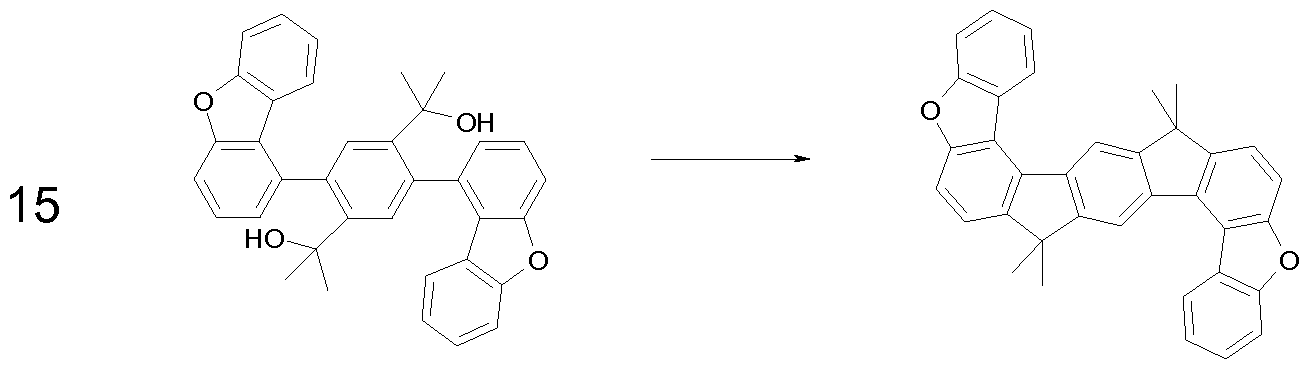
  • the present application thus relates to a process for the preparation of a compound of the formula (1 ), characterised in that it comprises at least one metal-catalysed coupling reaction and at least one ring-closure reaction.
  • the metal-catalysed coupling reaction here is preferably a transition-metal- catalysed coupling reaction, particularly preferably a Suzuki reaction.
  • Suitable reactive leaving groups are, for example, bromine, iodine, chlorine, boronic acids, boronic acid esters, amines, alkenyl or alkynyl groups containing a terminal C-C double or triple bond respectively, oxiranes, oxetanes, groups which undergo a cydoaddition, for example a 1 ,3-dipolar cydoaddition, such, as, for example, dienes or azides, carboxylic acid derivatives, alcohols and silanes.
  • the invention therefore furthermore relates to oligomers, polymers or dendrimers comprising one or more compounds of the formula (1 ), where the bond(s) to the polymer, oligomer or dendrimer may be localised at any desired positions in formula (1 ) which are substituted by R, R 1 or R 2 .
  • the compound is part of a side chain of the oligomer or polymer or part of the main chain.
  • An oligomer in the sense of this invention is taken to mean a compound which is built up from at least three monomer units.
  • a polymer in the sense of the invention is taken to mean a compound which is built up from at least ten monomer units.
  • the polymers, oligomers or dendrimers according to the invention may be conjugated, partially conjugated or non-conjugated.
  • the oligomers or polymers according to the invention may be linear, branched or dendritic.
  • the units of the formula (1 ) may be linked directly to one another or linked to one another via a divalent group, for example via a substituted or unsubstituted alkylene group, via a heteroatom or via a divalent aromatic or heteroaromatic group.
  • three or more units of the formula (1 ) may, for example, be linked via a trivalent or polyvalent group, for example via a trivalent or polyvalent aromatic or heteroaromatic group, to give a branched or dendritic oligomer or polymer.
  • the monomers accordingQ to the invention are homopolymerised or copolymerised with further monomers.
  • Suitable and preferred comonomers are selected from fluorenes (for example in accordance with EP 842208 or WO 00/22026), spirobifluorenes (for example in accordance with EP 707020, EP 894107 or WO 06/061 181 ), para-phenylenes (for example in accordance with WO 1992/18552),
  • ketones for example in accordance with WO 2005/040302
  • phenanthrenes for example in accordance with WO 2005/104264 or WO 2007/017066
  • the polymers, oligomers and dendrimers ⁇ usually also contain further units, for example emitting (fluorescent or phosphorescent) units, such as, for example, vinyltriarylamines (for example in accordance with WO 2007/068325) or phosphorescent metal complexes (for example in accordance with WO 2006/003000), and/or charge-transport units, in particular those based on triarylamines.
  • emitting fluorescent or phosphorescent
  • the polymers, oligomers and dendrimers according to the invention have advantageous properties, in particular long lifetimes, high efficiencies and good colour coordinates.
  • the polymers and oligomers according to the invention are generally pre- ⁇ pared by polymerisation of one or more types of monomer, at least one
  • reaction medium and purified is known to the person skilled in the art and is described in detail in the literature, for example in WO 2003/048225,
  • formulations of the compounds according to the invention are necessary. These formulations can be, for example, solutions, dispersions or emulsions. It may be preferred to use mixtures of two or more solvents for this purpose.
  • Suitable and preferred solvents are, for example, toluene, anisole, o-, m- or p-xylene, methyl benzoate, mesitylene, tetralin, veratrol, THF, methyl-THF, THP, dichlorobenzene, chlorobenzene, dioxane, phenoxytoluene, in particular 3-phenoxytoluene, (-)-fenchone, 1 ,2,3,5-tetramethylbenzene, 1 ,2,4,5-tetramethylbenzene, 1 -methylnaphthalene, 2-methylbenzothiazole, 2-phenoxyethanol, 2-pyrrolidinone, 3-methylanisole, 4-methylanisole, 3,4- dimethylanisole, 3,5-dimethylanisole, acetophenone, a-terpineol,
  • benzothiazole butyl benzoate, cumene, cyclohexanol, cyclohexanone, cyclohexylbenzene, decalin, dodecylbenzene, ethyl benzoate, indane, methyl benzoate, NMP, p-cymene, phenetol, 1 ,4-diisopropylbenzene, dibenzyl ether, diethylene glycol butyl methyl ether, triethylene glycol butyl methyl ether, diethylene glycol dibutyl ether, triethylene glycol dimethyl ether, diethylene glycol monobutyl ether, tripropylene glycol dimethyl ether, tetraethylene glycol dimethyl ether, 2-isopropylnaphthalene, pentylbenzene, hexylbenzene, heptylbenzene, octylbenzene, 1 ,1 -bis(3,4- di
  • the invention therefore furthermore relates to a formulation, in particular a solution, dispersion or emulsion, comprising at least one compound of the formula (1 ) or at least one polymer, oligomer or dendrimer containing at least one unit of the formula (1 ), and at least one solvent, preferably an organic solvent.
  • a formulation in particular a solution, dispersion or emulsion, comprising at least one compound of the formula (1 ) or at least one polymer, oligomer or dendrimer containing at least one unit of the formula (1 ), and at least one solvent, preferably an organic solvent.
  • the compounds of the formula (1 ) are suitable for use in electronic devices, in particular in organic electroluminescent devices (OLEDs). Depending on the substitution, the compounds are employed in various functions and layers.
  • the compound of the formula (1 ) can be employed in any function in the organic electroluminescent device, for example as hole-transporting material, as matrix material, as emitting material, or as electron-transporting material.
  • the invention therefore furthermore relates to the use of a compound of the formula (1 ) in an electronic device.
  • the electronic device here is preferably selected from the group consisting of organic integrated circuits (OICs), organic field-effect transistors (OFETs), organic thin-film transistors
  • OFTs organic light-emitting transistors
  • OLETs organic solar cells
  • OSCs organic solar cells
  • OFQDs organic field- quench devices
  • OLEDs organic electroluminescent devices
  • the invention furthermore relates to an electronic device comprising at least one compound of the formula (1 ).
  • the electronic device is preferably selected from the devices indicated above.
  • Particular preference is given to an organic electroluminescent device comprising anode, cathode and at least one emitting layer, characterised in that at least one organic layer comprises at least one compound of the formula (1 ).
  • the organic electroluminescent device may also comprise further layers. These are selected, for example, from in each case one or more hole-injection layers, hole-transport layers, hole-blocking layers, electron-transport layers, electron-injection layers, electron-blocking layers, exciton-blocking layers, interlayers, charge- generation layers (IDMC 2003, Taiwan; Session 21 OLED (5), T. Matsu- moto, T. Nakada, J. Endo, K. Mori, N. Kawamura, A. Yokoi, J. Kido,
  • the sequence of the layers of the organic electroluminescent device is preferably as follows: anode - hole-injection layer - hole-transport layer - emitting layer - electron-transport layer - electron-injection layer - cathode. It is not necessary for all of the said layers to be present, and further layers may additionally be present, for example an electron-blocking layer adjacent to the emitting layer on the anode side, or a hole-blocking layer adjacent to the emitting layer on the cathode side
  • the organic electroluminescent device according to the invention may0
  • these emission layers particularly preferably have in total a plurality of emission maxima between 380 nm and 750 nm, resulting overall in white emission, i.e. various emitting compounds which are able to fluoresce or phosphoresce and which emit5 blue, green, yellow, orange or red light are used in the emitting layers.
  • three-layer systems i.e. systems having three emitting layers, where at least one of these layers preferably comprises at least one compound of the formula (1 ) and where the three layersQ exhibit blue, green, yellow, orange or red emission (for the basic structure see, for example, WO 2005/01 1013).
  • an emitter compound used individually which emits in a broad wavelength range may also be suitable instead of a plurality of emitter compounds emitting in colour.
  • the emitter compound used individually which emits in a broad wavelength range may also be suitable instead of a plurality of emitter compounds emitting in colour.
  • the emitter compound used individually which emits in a broad wavelength range may also be suitable instead of a plurality of emitter compounds emitting in colour.
  • the emitter compound used individually which emits in a broad wavelength range may also be suitable instead of a plurality of emitter compounds emitting in colour.
  • the emitter compound used individually which emits in a broad wavelength range may also be suitable instead of a plurality of emitter compounds emitting in colour.
  • compounds according to the invention may also be present in the hole- transport layer or in another layer in an organic electroluminescent device of this type.
  • the various emitting layers may be directly adjacent to one another, or they may be separated from one another by non-emitting layers.0 According to a preferred embodiment of the invention, a white-emitting
  • OLED is a so-called tandem OLED, i.e. two or more complete OLED layer sequences are present in the OLED, where the OLED layer sequences in each case comprise hole-transport layer, emitting layer and electron- ⁇ transport layer, which are each separated from one another by a charge- generation layer. It is preferred for the compound of the formula (1 ) to be employed in an emitting layer.
  • the compound of the formula (1 ) is particularly suitable for use as emitting compound or as matrix material in an emitting layer.
  • the compound according to the invention is particularly suitable for use as blue-emitting emitter compound or as matrix compound for a blue-emitting emitter compound.
  • the compound according to the invention is employed as emitting compound in an emitting layer, it is preferably employed in combination with one or more matrix materials.
  • a matrix material here is taken to mean a material which is present in the emitting layer, preferably as the principal component, and which does not emit light on operation of the device.
  • the proportion of the emitting compound in the mixture of the emitting layer is between 0.1 and 50.0%, preferably between 0.5 and 20.0%, particularly preferably between 1 .0 and 10.0%.
  • the proportion of the matrix material or matrix materials is between 50.0 and 99.9%, preferably between 80.0 and 99.5%, particularly preferably between 90.0 and 99.0%.
  • the specifications of the proportions in % are, for the purposes of the present application, taken to mean % by vol. if the compounds are applied from the gas phase and % by weight if the compounds are applied from solution.
  • the compound according to the invention can be employed in combination with all known emitting compounds. It is preferably employed in combination with the preferred emitting compounds indicated below, particularly the preferred fluorescent compounds indicated below. If the compound of the formula (1 ) is employed as matrix material in combination with a phosphorescent emitter in an emitting layer, the phosphorescent emitter is preferably selected from the embodiments of phosphorescent emitters indicated below. In this case, one or more further matrix materials are furthermore preferably present in the emitting layer.
  • So-called mixed-matrix systems of this type preferably comprise two or three different matrix materials, particularly preferably two different matrix materials.
  • One of the two materials here is preferably a material having hole- transporting properties and the other material is a material having electron- transporting properties.
  • the compound of the formula (1 ) preferably represents the material having hole-transporting properties.
  • the desired electron-transporting and hole-transporting properties of the mixed-matrix components may also be combined principally or completely in a single mixed-matrix components, where the further mixed-matrix component(s) fulfil other functions.
  • the two different matrix materials here may be present in a ratio of 1 :50 to 1 :1 , preferably 1 :20 to 1 :1 , particularly preferably 1 : 10 to 1 :1 and very particularly preferably 1 :4 to 1 :1 .
  • Mixed- matrix systems are preferably employed in phosphorescent organic electroluminescent devices. More precise information on mixed-matrix systems is given, inter alia, in the application WO 2010/108579.
  • Particularly suitable matrix materials which can be used in combination with the compounds according to the invention as matrix components of a mixed- matrix system are selected from the preferred matrix materials indicated below for phosphorescent emitting compounds or the preferred matrix materials for fluorescent emitting compounds, depending on what type of emitting compound is employed in the mixed-matrix system.
  • the compounds according to the invention can also be employed in layers other than the emitting layer, for example as hole-transport materials in a hole-injection or hole-transport layer or electron-blocking layer.
  • the compound of the formula (1 ) is employed as hole-transport material, for example in a hole-transport layer, a hole-injection layer or an electron- blocking layer, the compound can be employed as pure material, i.e. in a proportion of 100%, in the hole-transport layer, or it can be employed in combination with one or more further compounds.
  • the organic layer comprising the compound of the formula (1 ) then additionally comprises one or more p-dopants.
  • Preferred p-dopants employed in accordance with the present invention are organic electron- acceptor compounds which are able to oxidise one or more of the other compounds in the mixture.
  • p-dopants are the compounds disclosed in WO 201 1/073149, EP 1968131 , EP 2276085, EP 2213662, EP 1722602, EP 2045848, DE 102007031220, US 8044390, US 8057712, WO 2009/003455, WO 2010/094378, WO 201 1/120709, US 2010/0096600 and WO 2012/095143.
  • the electronic device prefferably has a plurality of hole-transporting layers between the anode and the emitting layer.
  • the case may occur that all these layers comprise a compound of the formula (1 ), or that only individual layers thereof comprise a compound of the formula (1 ).
  • the compound of the formula (1 ) is employed as hole-transport material, it is preferred for it to have a large separation between the HOMO and LUMO energy levels. It is furthermore preferred for it to contain no amino groups as substituents. It is furthermore preferred for it to contain absolutely no substituents on the aromatic rings, i.e. for R 1 and R 2 to be equal to H or D, particularly preferably equal to H.
  • the compound of the formula (1 ) can furthermore be employed as electronic transporting compound in an electron-transport layer, a hole-blocking layer or an electron-injection layer. It is preferred for this purpose for the compound of the formula (1 ) to contain one or more substituents selected from electron-deficient heteroaryl groups, such as, for example, triazine, pyrimidine or benzimidazole.
  • Suitable phosphorescent emitting compounds are, in particular, compounds which emit light, preferably in the visible region, on suitable excitation and in addition contain at least one atom having an atomic number greater than 20, 2Q preferably greater than 38 and less than 84, particularly preferably greater than 56 and less than 80.
  • the phosphorescent emitting compounds used are preferably compounds which contain copper, molybdenum, tungsten, rhenium, ruthenium, osmium, rhodium, iridium, palladium, platinum, silver, gold or europium, in particular compounds which contain iridium, platinum or
  • phosphorescent complexes as are used in accordance with the prior art for phosphorescent OLEDs and as are known to the person skilled in the art in the area of organic electroluminescent devices are suitable for use in the devices according to the invention.
  • the person skilled in the art will also be able, without inventive step, to employ further phosphorescent complexes in combination with the compounds according to the invention in OLEDs.
  • Preferred fluorescent emitters are selected from the class of the arylamines.
  • An arylamine in the sense of this invention is taken to mean a compound which contains three substituted or unsubstituted aromatic or heteroaromatic ring systems bonded directly to the nitrogen. At least one of these aromatic or heteroaromatic ring systems is preferably a condensed ring system, particularly preferably having at least 14 aromatic ring atoms.
  • Preferred examples thereof are aromatic anthracenamines, aromatic anthracenediamines, aromatic pyrenamines, aromatic pyrenediamines, aromatic chrysenamines or aromatic chrysenediamines.
  • An aromatic anthracenamine is taken to mean a compound in which one diarylamino group is bonded directly to an anthracene group, preferably in the 9-position.
  • An aromatic anthracene- diamine is taken to mean a compound in which two diarylamino groups are bonded directly to an anthracene group, preferably in the 9,10-position.
  • Aromatic pyrenamines, pyrenediamines, chrysenamines and chrysenediamines are defined analogously thereto, where the diarylamino groups are preferably bonded to the pyrene in the 1 -position or in the 1 ,6-position.
  • indenofluorenamines or indenofluorene- diamines for example in accordance with WO 2006/108497 or WO 2006/ 122630
  • benzoindenofluorenamines or benzoindenofluorenediamines for example in accordance with WO 2008/006449
  • dibenzoindenofluoren- amines or dibenzoindenofluorenediamines for example in accordance with WO 2007/140847
  • indenofluorene derivatives containing condensed aryl groups which are disclosed in WO 2010/012328.
  • Preference is likewise given to the pyrenarylamines disclosed in WO 2012/048780 and WO
  • Preferred fluorescent emitting compounds besides the compounds according to the invention, are depicted in the following table:
  • Preferred matrix materials for use in combination with fluorescent emitting compounds are selected from the classes of the oligoarylenes (for example 2,2',7,7'-tetraphenylspirobifluorene in accordance with EP 676461 or dinaphthylanthracene), in particular the oligoarylenes containing condensed aromatic groups, the oligoarylenevinylenes (for example DPVBi or spiro- DPVBi in accordance with EP 676461 ), the polypodal metal complexes (for example in accordance with WO 2004/081017), the hole-conducting compounds (for example in accordance with WO 2004/05891 1 ), the electron-conducting compounds, in particular ketones, phosphine oxides, sulfoxides, etc.
  • the oligoarylenes for example 2,2',7,7'-tetraphenylspirobifluorene in accordance with EP 676461 or dinaphthylan
  • Particularly preferred matrix materials are selected from the classes of the oligoarylenes, comprising naphthalene, anthracene, benz- anthracene and/or pyrene or atropisomers of these compounds, the oligo- arylenevinylenes, the ketones, the phosphine oxides and the sulfoxides.
  • Very particularly preferred matrix materials are selected from the classes of the oligoarylenes, comprising anthracene, benzanthracene, benzophenan- threne and/or pyrene or atropisomers of these compounds.
  • An oligoarylene in the sense of this invention is intended to be taken to mean a compound in which at least three aryl or arylene groups are bonded to one another.
  • Suitable charge-transport materials are, for example, the compounds disclosed in Y. Shirota et al., Chem. Rev. 2007, 107(4), 953-1010, or other materials as are employed in these layers in accordance with the prior art.
  • the compounds of the formula (1 ) in a hole-transport, hole-injection or electron-blocking layer in the electroluminescent device according to the invention are indenofluorenamine derivatives (for example in accordance with WO 06/122630 or WO 06/100896), the amine derivatives disclosed in5 EP 1661888, hexaazatriphenylene derivatives (for example in accordance with WO 01/049806), amine derivatives containing condensed aromatic rings (for example in accordance with US 5,061 ,569), the amine derivatives disclosed in WO 95/09147, monobenzoindenofluorenamines (for example inQ accordance with WO 08/006449), dibenzoindenofluorenamines (for example in accordance with WO 07/140847), spirobifluorenamines (for example in accordance with WO 2012/034627 or WO 2013/120577), fluorenamines (for example in accordance with the as yet unpublished applications
  • the cathode of the organic electroluminescent device preferably comprises metals having a low work function, metal alloys or multilayered structures comprising various metals, such as, for example, alkaline-earth metals, alkali metals, main-group metals or lanthanoids (for example Ca, Ba, Mg, Al, ⁇ In, Mg, Yb, Sm, etc.). Also suitable are alloys comprising an alkali metal or alkaline-earth metal and silver, for example an alloy comprising magnesium and silver.
  • further metals which have a relatively high work function such as, for example, Ag or Al
  • lithium quinolinate (LiQ) can be used for this purpose.
  • the layer thickness of this layer is preferably between 0.5 and 5 nm.
  • the anode preferably comprises materials having a high work function.
  • the anode preferably has a work function of greater than 4.5 eV vs. vacuum. Suitable for this purpose are on the one hand metals having a high redox potential, such as, for example, Ag, Pt or Au.
  • metal/metal oxide electrodes for example AI/Ni/NiO x , AI/PtO x
  • at least one of the electrodes must be transparent or partially transparent in order to facilitate either irradiation of the organic material (organic solar cells) or the coupling-out of light (OLEDs, O-lasers).
  • Preferred anode materials here are conductive mixed metal oxides.
  • ITO indium tin oxide
  • IZO indium zinc oxide
  • conductive, doped organic materials in particular conductive, doped polymers.
  • the device is appropriately (depending on the application) structured, provided with contacts and finally sealed, since the lifetime of the devices according to the invention is shortened in the presence of water and/or air.
  • the organic electroluminescent device according to the invention is characterised in that one or more layers are coated by means of a sublimation process, in which the materials are applied by vapour deposition in vacuum sublimation units at an initial pressure of less than 10 "5 mbar, preferably less than 10 "6 mbar.
  • the initial pressure it is also possible here for the initial pressure to be even lower, for example less than
  • an organic electroluminescent device characterised in that one or more layers are coated by means of the OVPD (organic vapour phase deposition) process or with the aid of carrier-gas sublimation, in which the materials are applied at a pressure of between 10 "5 mbar and 1 bar.
  • OVPD organic vapour phase deposition
  • carrier-gas sublimation in which the materials are applied at a pressure of between 10 "5 mbar and 1 bar.
  • OVJP organic vapour jet printing
  • an organic electroluminescent device characterised in that one or more layers are produced from solution, such as, for example, by spin coating, or by means of any desired printing process, such as, for example, screen printing, flexographic printing, nozzle printing or offset printing, but particularly preferably LITI (light induced thermal imaging, thermal transfer printing) or ink-jet printing.
  • Soluble compounds of the formula (1 ) are necessary for this purpose. High solubility can be achieved through suitable substitution of the compounds.
  • an organic electroluminescent device For the production of an organic electroluminescent device according to the invention, it is furthermore preferred to apply one or more layers from solution and one or more layers by a sublimation process.
  • the electronic devices comprising one or more compounds according to the invention can be employed in displays, as light sources in lighting applications and as light sources in medical and/or cosmetic applications (for example light therapy).
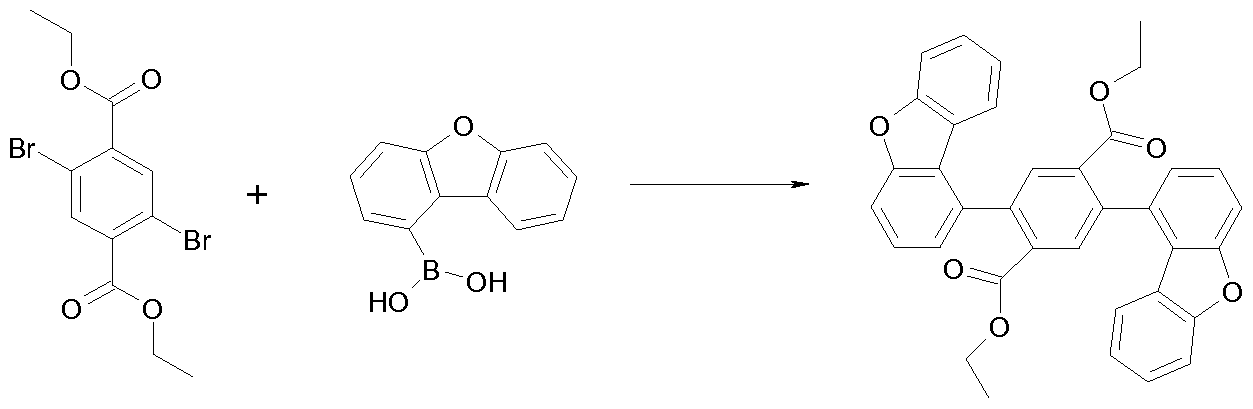
  • 2,5-Dibromo-terephthalic acid diethyl ester (20 g, 53 mmol), dibenzofuran- 1 -boronic acid (29 g, 137 mmol) and tripotassiumphosphate monohydrate (48.5 g, 160 mmol) were added to water/toluene/dioxane (1 :1 :1 , 0.5 L). The solution was saturated with argon. Palladium(ll)-acetate (1 18 mg, 0.5 mmol) and tri-o-tolyl-phosphine (480 mg, 1 .6 mmol) were added and the reaction mixture was refluxed for 16 hours.
  • the manufacturing of the OLED devices can be performed accordingly to WO 04/05891 with adapted film thicknesses and layer sequences.
  • Glass plates with structured ITO 50 nm, indium tin oxide
  • PEDOTPSS Poly(3,4-ethylenedioxythiophene) poly(styrene- sulfonate, CLEVIOSTM P VP Al 4083 from Heraeus Precious Metals GmbH Germany, spin-coated from a water-based solution
  • the OLED devices have in principle the following layer structure:
  • HTL1 95%, HIL 5% 20 nm
  • HTL Hole transporting layer
  • Emissive layer comprising at least one matrix material (H) and at least one fluorescent emitting compound (D) corresponding to a compound of formula (1 ) (see table 1 ),
  • Electron transporting layer (ETL) (20 nm)
  • Electron injection layer (EIL) (3 nm)
  • the cathode is generally formed by an aluminium layer with a thickness of 100 nm.
  • An example of a possible stack sequence is shown in Table 1 . Examples of suitable materials used for the OLED fabrication are presented in Table 2.
  • H:D 97%:3%
  • the electron-transport layer may also consist of a mixture of two or more materials.
  • HTL hole-transport layer
  • EML emission layer
  • HBL hole-blocking layer
  • ETL electron-transport layer
  • Glass plates coated with structured ITO (indium tin oxide) in a thickness of 50 nm serve as substrate.
  • the hole-injection layer is applied via spin coating in an inert atmosphere.
  • a hole-transporting, crosslinkable polymer and a p-dopant salt are dissolved in toluene.
  • Corresponding materials are for example described in WO 2016/107668, WO 2013/081052 and EP 2325190.
  • the solids content of such solutions is about 6 mg/ml if, as here, the layer thicknesses of 20 nm is to be achieved by means of spin coating.
  • the layers are applied by spin coating in an inert-gas atmosphere, and dried by heating at 200°C for 30 minutes on a heating plate.
  • the hole-transport and the emission layer are applied to these coated glass plates.
  • the hole-transport layer is the polymer of the structure shown in Table 3, which was synthesised in accordance with WO2013156130.
  • the polymer is dissolved in toluene, so that the solution typically has a solid content of approx. 5 g/l if, as here, the layer thickness of 20 nm which is typical for a device is to be achieved by means of spin coating.
  • the layers are applied by spin coating in an inert-gas atmosphere, in the present case argon, and dried by heating at 220°C for 30 min.
  • the emission layer is composed of the matrix material (host material) 1 and the emitting dopant (emitter) D1 . Both material are present in the emission layer in a proportion of 92 % by weight H1 and 8 % by weight D1 .
  • the mixture for the emission layer is dissolved in toluene.
  • the solids content of such solutions is about 9 mg/ml if, as here, the layer thickness of 40 nm which is typical for a device is to be achieved by means of spin coating.
  • the layers are applied by spin coating in an inert-gas atmosphere, and dried by heating at 170°C for 10 minutes.
  • the materials for the hole-blocking layer and electron-transport layer are likewise applied by thermal vapour deposition in a vacuum chamber and are shown in Table 4.
  • the hole-blocking layer consists of ETM1 .
  • the electron- transport layer consists of the two materials ETM1 and ETM2, which are mixed with one another in a proportion by volume of 50% each by co- evaporation.
  • the cathode is formed by the thermal evaporation of an aluminium layer with a thickness of 100 nm.
  • the OLEDs are characterised by standard methods. For this purpose, the electroluminescence spectra are recorded, the current efficiency (measured in cd/A) and the external quantum efficiency (EQE, measured in percent) as a function of the luminous density assuming Lambert emission
  • IUL characteristic lines current/voltage/luminous density characteristic lines
  • the electroluminescence spectra are recorded at a luminous density of 1000 cd/m 2 , and the CIE 1931 x and y colour coordinates are calculated from this data.
  • 1000 cd/m 2 denotes the external quantum efficiency at an operating luminous density of 1000 cd/m 2 .
  • the properties of the various OLEDs are sunnnnarised in Table 5.
  • Example V01 is the comparative example, whereas E1 to E4 show properties of OLEDs containing materials of the present invention.
  • Table 5 shows, that use of materials according to the present invention gives rise to improvements over the prior art when used as fluorescent blu emitters, in particular with respect to efficiency.

Landscapes

  • Chemical & Material Sciences (AREA)
  • Organic Chemistry (AREA)
  • Engineering & Computer Science (AREA)
  • Materials Engineering (AREA)
  • Physics & Mathematics (AREA)
  • Spectroscopy & Molecular Physics (AREA)
  • Optics & Photonics (AREA)
  • Electroluminescent Light Sources (AREA)
  • Heterocyclic Carbon Compounds Containing A Hetero Ring Having Oxygen Or Sulfur (AREA)
  • Plural Heterocyclic Compounds (AREA)
  • Furan Compounds (AREA)
  • Indole Compounds (AREA)

Abstract

The present invention relates to bisbenzofuran-fused 2,8-diaminoindeno[1,2-b]fluorene derivatives and related compounds of formula (1) as materials for organic electroluminescent devices (OLEDs).

Description

BISBENZOFURAN-FUSED 2,8-DIAMINOINDENO[1 ,2-B]FLUORENE DERIVATIVES AND RELATED COMPOUNDS AS MATERIALS FOR ORGANIC ELECTROLUMINESCENT DEVICES
(OLED)
The present invention relates to a compound of the formula (1 ), to the use of the compound in an electronic device, and to an electronic device comprising a compound of the formula (1 ). The present invention furthermore relates to a process for the preparation of a compound of the formula (1 ) and to a formulation comprising one or more compounds of the formula (1 ).
The development of functional compounds for use in electronic devices is currently the subject of intensive research. The aim is, in particular, the development of compounds with which improved properties of electronic devices in one or more relevant points can be achieved, such as, for example, power efficiency and lifetime of the device as well as colour coordinates of the emitted light.
In accordance with the present invention, the term electronic device is taken to mean, inter alia, organic integrated circuits (OICs), organic field-effect transistors (OFETs), organic thin-film transistors (OTFTs), organic light- emitting transistors (OLETs), organic solar cells (OSCs), organic optical detectors, organic photoreceptors, organic field-quench devices (OFQDs), organic light-emitting electrochemical cells (OLECs), organic laser diodes (O-lasers) and organic electroluminescent devices (OLEDs).
Of particular interest is the provision of compounds for use in the last- mentioned electronic devices called OLEDs. The general structure and the functional principle of OLEDs are known to the person skilled in the art and are described, for example, in US 4539507.
Further improvements are still necessary with respect to the performance data of OLEDs, in particular with a view to broad commercial use, for example in display devices or as light sources. Of particular importance in this connection are the lifetime, the efficiency and the operating voltage of the OLEDs and as well as the colour values achieved. In particular, in case of blue-emitting OLEDs, there is potential for improvement with respect to the lifetime and the efficiency of the devices. An important starting point for achieving the said improvements is the choice of the emitter compound and of the host compound employed in the electronic device.
Blue-fluorescent emitters known from the prior art are a multiplicity of com- pounds, in particuiar arylamines containing one or more condensed a* groups and/or indenofluorene groups. Examples thereof are benzoindeno- fluorenamines, for example in accordance with WO 2008/006449, and dibenzoindenofluorenamines, for example in accordance with
WO 2007/140847. More recently, arylamines containing condensed dibenzofuran groups have been employed as materials in OLEDs, for example in US 2016/0204355. However, further improvements with regard to this type of compounds are still necessary with respect to the lifetime, the efficiency and the colour values achieved in the case of blue-emitting OLEDs. More particularly, there is a need for deep-blue fluorescent emitters for OLEDs, which exhibit very good colour properties in terms of colour-depth and narrow emission band and at the same time still exhibit good properties in terms of lifetime, efficiency and operating voltage of the OLEDs.
The present invention is thus based on the technical object of providing compounds which are suitable for use in electronic devices, such as
OLEDs, which can be employed as blue emitters, as matrix materials and/or as hole-transport materials and which are suitable for vacuum processing and/or for solution processing. In investigations on novel compounds for use in electronic devices, it has now been found, unexpectedly, that compounds of formula (1 ) as defined below are eminently suitable for use in electronic devices. In particular, they achieve one or more, preferably all, of the above-mentioned technical objects of provision of OLEDs having deep-blue colour coordinates of the emitted light, provision of OLEDs having a long lifetime and provision of compounds having good solubility in organic solvents.
The invention thus relates to compounds of formula (1 ),
Figure imgf000004_0001
formula (1 ) where the following applies to the symbols and indices used:
Z is CR, N, or Z is C when Z is bonded to a group V or to a group E;
V is CR1, N, or V is C when V is bonded to a group Z or to a group E or when V is bonded to a group -NAr1Ar2; and where two adjacent groups V, in each 6-membered ring comprising some groups V in formula (1 ), stand for a group of the formula (V-1 ),
Figure imgf000004_0002
formula (V-1 )
where the dashed bond indicate the bonding to the structure of formula
(1 ); E is identically or differently on each occurrence, selected from -BR0-, -C(R°)2-, -C(R0)2-C(R°)2-, -C(R°)2-O-, -C(R°)2-S-, -R°C=CR0-, -R°C=N-, -Si(R°)2-> -Si(R°)2-Si(R°)2-> Ge(R°)2, -C(=O)-, -C(=NR0)-, -C(=C(R°)2)-, -O-, -S-, -Se-, -S(=O)-, -SO2-, -N(R0)-, -P(R0)- and -P((=O)R0)-, preferably
-C(R°)2-, -C(R°)2-C(R°)2-, -R°C=CR0-, -Si(R°)2- and -Si(R°)2-Si(R°)2-, more preferably -C(R°)2- and -Si(R°)2-; and two groups E may be in a cis- or trans-position relative to each other;
X is identically or differently on each occurrence, selected from -O-, -S-, -S(=O)-, -SO2-, -N(R0)-, -BR0-, Si(R°)2, -P(R0)- and -P((=O)R0)-; W is CR or N;
R, R°, R1 stand on each occurrence, identically or differently, for H, D, F, CI, Br, I, CHO, CN, N(Ar)2, C(=O)Ar, P(=O)(Ar)2, S(=O)Ar, S(=O)2Ar, NO2, Si(R2)3, B(OR2)2, OSO2R2, a straight-chain alkyl, alkoxy or thioalkyl groups having 1 to 40 C atoms or branched or a cyclic alkyl, alkoxy or thioalkyl groups having 3 to 40 C atoms, each of which may be substituted by one or more radicals R2, where in each case one or more non-adjacent CH2 groups may be replaced by R2C=CR2, C≡C, Si(R2)2, Ge(R2)2, Sn(R2)2, C=O, C=S, C=Se, P(=O)(R2), SO, SO2, O, S or
CONR2 and where one or more H atoms may be replaced by D, F, CI, Br, I, CN or NO2, an aromatic or heteroaromatic ring systems having 5 to 60 aromatic ring atoms, which may in each case be substituted by one or more radicals R2, or an aryloxy groups having 5 to 60 aromatic ring atoms, which may be substituted by one or more radicals R2, where two adjacent substituents R and/or two adjacent substituents R° and/or two adjacent substituents R1 may form a mono- or polycyclic, aliphatic ring system or aromatic ring system, which may be substituted by one or more radicals R2; , Ar2 are on each occurrence, identically or differently, selected from the group consisting of an aromatic or heteroaromatic ring system having 5 to 60 aromatic ring atoms, which may in each case also be substituted by one or more radicals R2; Ar1 and Ar2 here may also be connected to one another by a group E° and form a group of formula (E°-1 ),
Figure imgf000006_0001
formula (E°-1 ) where the dashed bond indicates the bonding to the structure of formula
(1 ); is on each occurrence, identically or differently, a single bond, N(R°),
O, S, C(R°)2, C(R°)2-C(R°) i;2, C(R°)=C(R°), Si(R°)2 or B(R°); stands on each occurrence, identically or differently, for H, D, F, CI, Br, I, CHO, CN, N(Ar)2, C(=O)Ar, P(=O)(Ar)2, S(=O)Ar, S(=O)2Ar, NO2, Si(R3)3, B(OR3)2, OSO2R3, a straight-chain alkyl, alkoxy or thioalkyl groups having 1 to 40 C atoms or branched or cyclic alkyl, alkoxy or thioalkyl groups having 3 to 40 C atoms, each of which may be substituted by one or more radicals R3, where in each case one or more non-adjacent CH2 groups may be replaced by R3C=CR3, C≡C, Si(R3)2, Ge(R3)2, Sn(R3)2, C=O, C=S, C=Se, P(=O)(R3), SO, SO2, O, S or CONR3 and where one or more H atoms may be replaced by D, F, CI, Br, I, CN or NO2, an aromatic or heteroaromatic ring systems having 5 to 60 aromatic ring atoms, which may in each case be substituted by one or more radicals R3, or an aryloxy group having 5 to 60 aromatic ring atoms, which may be substituted by one or more radicals R3, where two adjacent substituents R2 may form a mono- or polycyclic, aliphatic ring system or aromatic ring system, which may be substituted by one or more radicals R3;
R3 stands on each occurrence, identically or differently, for H, D, F, CI, Br, I, CN, a straight-chain alkyl, alkoxy or thioalkyl groups having 1 to 20 C atoms or branched or cyclic alkyl, alkoxy or thioalkyl groups having 3 to 20 C atoms, where in each case one or more non-adjacent Ch groups may be replaced by SO, SO2, O, S and where one or more H atoms ^ may be replaced by D, F, CI, Br or I, or an aromatic or heteroaromatic ring system having 5 to 24 C atoms;
Ar is on each occurrence, identically or differently, selected from the group 5 consisting of an aromatic or heteroaromatic ring system having 5 to 60 aromatic ring atoms, which may in each case also be substituted by one or more radicals R3.
Q Concerning formula (1 ), the bonding between a group E and the adjacent 6- membered rings comprising V or Z can occur at each free position of these 6-membered-rings. Thus, it is to be understood that the groups E can be in cis- or in trans-position relative to each other, as mentioned in the definition of the group E above.
5
Adjacent substituents in the sense of the present invention are substituents which are bonded to atoms which are linked directly to one another or which are bonded to the same atom.
0
Furthermore, the following definitions of chemical groups apply for the purposes of the present application:
An aryl group in the sense of this invention contains 6 to 60 aromatic ring o
atoms, preferably 6 to 40 aromatic ring atoms, more preferably 6 to 20 aromatic ring atoms; a heteroaryl group in the sense of this invention contains 5 to 60 aromatic ring atoms, preferably 5 to 40 aromatic ring atoms, more preferably 5 to 20 aromatic ring atoms, at least one of which is a heteroatom. The heteroatoms are preferably selected from N, O and S. This represents the basic definition. If other preferences are indicated in the description of the present invention, for example with respect to the number of aromatic ring atoms or the heteroatoms present, these apply.
An aryl group or heteroaryl group here is taken to mean either a simple aromatic ring, i.e. benzene, or a simpie heteroaromatic ring, for exampie pyridine, pyrimidine or thiophene, or a condensed (annellated) aromatic or heteroaromatic polycycle, for example naphthalene, phenanthrene, quino- line or carbazole. A condensed (annellated) aromatic or heteroaromatic polycycle in the sense of the present application consists of two or more simple aromatic or heteroaromatic rings condensed with one another.
An aryl or heteroaryl group, which may in each case be substituted by the above-mentioned radicals and which may be linked to the aromatic or heteroaromatic ring system via any desired positions, is taken to mean, in particular, groups derived from benzene, naphthalene, anthracene, phenanthrene, pyrene, dihydropyrene, chrysene, perylene, fluoranthene, benz- anthracene, benzophenanthrene, tetracene, pentacene, benzopyrene, furan benzofuran, isobenzofuran, dibenzofuran, thiophene, benzothiophene, isobenzothiophene, dibenzothiophene, pyrrole, indole, isoindole, carbazole, pyridine, quinoline, isoquinoline, acridine, phenanthridine, benzo-5,6- quinoline, benzo-6,7-quinoline, benzo-7,8-quinoline, phenothiazine, phenoxazine, pyrazole, indazole, imidazole, benzimidazole, naphthimi- dazole, phenanthrimidazole, pyridimidazole, pyrazinimidazole, quinoxalinimi dazole, oxazole, benzoxazole, naphthoxazole, anthroxazole, phenan- throxazole, isoxazole, 1 ,2-thiazole, 1 ,3-thiazole, benzothiazole, pyridazine, benzopyridazine, pyrimidine, benzopyrimidine, quinoxaline, pyrazine, phenazine, naphthyridine, azacarbazole, benzocarboline, phenanthroline, 1 ,2,3-triazole, 1 ,2,4-triazole, benzotriazole, 1 ,2,3-oxadiazole, 1 ,2,4-oxa- diazole, 1 ,2,5-oxadiazole, 1 ,3,4-oxadiazole, 1 ,2,3-thiadiazole, 1 ,2,4- thiadiazole, 1 ,2,5-thiadiazole, 1 ,3,4-thiadiazole, 1 ,3,5-triazine, 1 ,2,4-triazine, 1 ,2,3-triazine, tetrazole, 1 ,2,4,5-tetrazine, 1 ,2,3,4-tetrazine, 1 ,2,3,5-tetrazine, purine, pteridine, indolizine and benzothiadiazole.
An aryloxy group in accordance with the definition of the present invention is taken to mean an aryl group, as defined above, which is bonded via an oxygen atom. An analogous definition applies to heteroaryloxy groups.
An aromatic ring system in the sense of this invention contains 6 to 60 C atoms in the ring system, preferably 6 to 40 C atoms, more preferably 6 to 20 C atoms. A heteroaromatic ring system in the sense of this invention contains 5 to 60 aromatic ring atoms, preferably 5 to 40 aromatic ring atoms, more preferably 5 to 20 aromatic ring atoms, at least one of which is a heteroatom. The heteroatoms are preferably selected from N, O and/or S. An aromatic or heteroaromatic ring system in the sense of this invention is intended to be taken to mean a system which does not necessarily contain only aryl or heteroaryl groups, but instead in which, in addition, a plurality of aryl or heteroaryl groups may be connected by a non-aromatic unit
(preferably less than 10% of the atoms other than H), such as, for example, an sp3-hybridised C, Si, N or O atom, an sp2-hybridised C or N atom or an sp-hybridised C atom. Thus, for example, systems such as 9,9'-spirobifluo- rene, 9,9'-diarylfluorene, triarylamine, diaryl ether, stilbene, etc., are also intended to be taken to be aromatic ring systems in the sense of this invention, as are systems in which two or more aryl groups are connected, for example, by a linear or cyclic alkyl, alkenyl or alkynyl group or by a silyl group. Furthermore, systems in which two or more aryl or heteroaryl groups are linked to one another via single bonds are also taken to be aromatic or heteroaromatic ring systems in the sense of this invention, such as, for example, systems such as biphenyl, terphenyl or diphenyltriazine. An aromatic or heteroaromatic ring system having 5 - 60 aromatic ring atoms, which may in each case also be substituted by radicals as defined above and which may be linked to the aromatic or heteroaromatic group via any desired positions, is taken to mean, in particular, groups derived from benzene, naphthalene, anthracene, benzanthracene, phenanthrene, benzophenanthrene, pyrene, chrysene, perylene, fluoranthene, naphtha- cene, pentacene, benzopyrene, biphenyl, biphenylene, terphenyl, terphenyl- ene, quaterphenyl, fluorene, spirobifluorene, dihydrophenanthrene, dihydro- pyrene, tetrahydropyrene, cis- or trans-indenofluorene, truxene, isotruxene, spirotruxene, spiroisotruxene, furan, benzofuran, isobenzofuran, dibenzo- furan, thiophene, benzothiophene, isobenzothiophene, dibenzothiophene, pyrrole, indole, isoindole, carbazole, indolocarbazole, indenocarbazole, pyridine, quinoline, isoquinoline, acridine, phenanthridine, benzo-5,6-quinoline, benzo-6,7-quinoline, benzo-7,8-quinoline, phenothiazine, phenoxazine, pyrazole, indazole, imidazole, benzimidazole, naphthimidazole, phenanthri- midazole, pyridimidazole, pyrazinimidazole, quinoxalinimidazole, oxazole, benzoxazole, naphthoxazole, anthroxazole, phenanthroxazole, isoxazole, 1 ,2-thiazole, 1 ,3-thiazole, benzothiazole, pyridazine, benzopyridazine, pyrimidine, benzopyrimidine, quinoxaline, 1 ,5-diazaanthracene, 2,7-diaza- pyrene, 2,3-diazapyrene, 1 ,6-diazapyrene, 1 ,8-diazapyrene, 4,5-diaza- pyrene, 4,5,9,10-tetraazaperylene, pyrazine, phenazine, phenoxazine, phenothiazine, fluorubin, naphthyridine, azacarbazole, benzocarboline, phenanthroline, 1 ,2,3-triazole, 1 ,2,4-triazole, benzotriazole, 1 ,2,3-oxadia- zole, 1 ,2,4-oxadiazole, 1 ,2,5-oxadiazole, 1 ,3,4-oxadiazole, 1 ,2,3-thiadiazole, 1 ,2,4-thiadiazole, 1 ,2,5-thiadiazole, 1 ,3,4-thiadiazole, 1 ,3,5-triazine, 1 ,2,4- triazine, 1 ,2,3-triazine, tetrazole, 1 ,2,4,5-tetrazine, 1 ,2,3,4-tetrazine, 1 ,2,3,5- tetrazine, purine, pteridine, indolizine and benzothiadiazole, or combinations of these groups.
For the purposes of the present invention, a straight-chain alkyl group having 1 to 40 C atoms or a branched or cyclic alkyl group having 3 to 40 C atoms or an alkenyl or alkynyl group having 2 to 40 C atoms, in which, in addition, individual H atoms or Ch groups may be substituted by the groups mentioned above under the definition of the radicals, is preferably taken to mean the radicals methyl, ethyl, n-propyl, i-propyl, n-butyl, i-butyl, s-butyl, t-butyl, 2-methyl butyl, n-pentyl, s-pentyl, cyclopentyl, neopentyl, n-hexyl, cyclohexyl, neohexyl, n-heptyl, cycloheptyl, n-octyl, cyclooctyl, 2-ethylhexyl, trifluoromethyl, pentafluoroethyl, 2,2,2-trifluoroethyl, ethenyl, propenyl, butenyl, pentenyl, cyclopentenyl, hexenyl, cyclohexenyl, heptenyl, cyclo- heptenyl, octenyl, cyclooctenyl, ethynyl, propynyl, butynyl, pentynyl, hexynyl or octynyl. An alkoxy or thioalkyl group having 1 to 40 C atoms is preferably taken to mean methoxy, trifluoromethoxy, ethoxy, n-propoxy, i-propoxy, n-butoxy, i-butoxy, s-butoxy, t-butoxy, n-pentoxy, s-pentoxy, 2-methylbutoxy, n-hexoxy, cyclohexyloxy, n-heptoxy, cycloheptyloxy, n-octyloxy, cyclooctyl- oxy, 2-ethylhexyloxy, pentafluoroethoxy, 2,2,2-trifluoroethoxy, methylthio, ethylthio, n-propylthio, i-propylthio, n-butylthio, i-butylthio, s-butylthio, t-butylthio, n-pentylthio, s-pentylthio, n-hexylthio, cyclohexylthio, n-heptyl- thio, cycloheptylthio, n-octylthio, cyclooctylthio, 2-ethylhexylthio, trifluoro- methylthio, pentafluoroethylthio, 2,2,2-trifluoroethylthio, ethenylthio, propenylthio, butenylthio, pentenylthio, cyclopentenylthio, hexenylthio, cyclohexenylthio, heptenylthio, cycloheptenylthio, octenylthio, cyclooctenyl- thio, ethynylthio, propynylthio, butynylthio, pentynylthio, hexynylthio, heptynylthio or octynylthio.
The formulation that two or more radicals may form a ring with one another is, for the purposes of the present application, intended to be taken to mean, inter alia, that the two radicals are linked to one another by a chemical bond. This is illustrated by the following schemes:
Figure imgf000011_0001
Figure imgf000012_0001
Furthermore, however, the above-mentioned formulation is also intended to be taken to mean that, in the case where one of the two radicals represents hydrogen, the second radical is bonded at the position to which the hydrogen atom was bonded, with formation of a ring. This is illustrated by the following scheme:
Figure imgf000012_0002
In accordance with a preferred embodiment, the bonds between the 6- membered rings comprising V and the 6-membered ring comprising Z in formula (1 ) are in para positions.
In accordance with a preferred embodiment, compounds of formula (1 ) are selected from compounds of formulae (1 -1 ) to (1 -6),
Figure imgf000012_0003
formula (1 -1 ) formula (1 -2)
Figure imgf000013_0001
formula (1-3) formula (1-4)
Figure imgf000013_0002
where the symbols E, X, V, W, Z, Ar1 and Ar2 have the same meaning as above.
In accordance with a very preferred embodiment, compounds of formula (1- 1 to (1-6) are selected from compounds of formulae 1-1 a) to (1 -6b),
Figure imgf000013_0003
formula (1-1 a) formula (1-2a)
Figure imgf000014_0001
formula (1-3a) formula (1-4a)
Figure imgf000014_0002
formula 1-5a) formula 1-6a)
Figure imgf000014_0003
formula (1 -1 b) formula (1 -2b)
Figure imgf000015_0001
formula (1 -3b) formula (1 -4b)
Figure imgf000015_0002
formula (1 -5b) formula (1 -6b) where the symbols X, Z, W, R°, Ar1 and Ar2 have the same meaning as above
Among formulae (1 -1 a) to (1 -6b), formulae (1 -1 a) to (1 -3a) and (1 -1 b) to (1 - 3b) are preferred.
In accordance with a very particularly preferred embodiment, compounds of formula (1 ) are selected from compounds of formulae (1 -1 c) to (1 -6d),
Figure imgf000016_0001
formula (1-1 c) formula (1-2c)
Figure imgf000016_0002
formula (1-3c) formula (1-4c)
Figure imgf000016_0003
formula (1-5c) formula (1-6c)
Figure imgf000017_0001
formula (1 -1 d) formula (1 -2d)
Figure imgf000017_0002
formula (1-3d) formula (1-4d)
Figure imgf000017_0003
formula (1-5d) formula (1-6d) where the symbols X, R°, Ar1 and Ar2 have the same meaning as above.
Among formulae (1 -1 c) to (1-6d), formulae (1-1 c) to (1-3c) and (1-1d) to (1- 3d) are preferred. Preferably, the group X is on each occurrence, identically or differently, selected from O and S. More preferably, X stands on each occurrence for O.
Preferably, R° stands on each occurrence, identically or differently, for H, D, F, CN, a straight-chain alkyl groups having 1 to 10 C atoms or a branched or cyclic alkyl groups having 3 to 10 C atoms, each of which may be
substituted by one or more radicals R2, where in each case one or more H atoms may be replaced by F, or an aryl or heteroaryl groups having 5 to 25 aromatic ring atoms, which may in each case be substituted by one or more radicals R2, where two adjacent substituents R° may form a mono- or polycyclic, aliphatic ring system or aromatic ring system, which may be substituted by one or more radicals R2. When two adjacent substituents R° form a mono- or polycyclic, aliphatic ring system or aromatic ring system, following rings are preferably formed:
Figure imgf000018_0001
where the dashed bond indicate the 6-membered rings adjacent to the bridging group E, where E is -C(R°)2-. In accordance with another preferred embodiment, R° stands on each occurrence, identically or differently, for H, D, F, CN, a straight-chain alkyl groups having 1 to 10 C atoms or a branched or cyclic alkyl groups having 3 to 10 C atoms, each of which may be substituted by one or more radicals R2, where in each case one or more H atoms may be replaced by F.
In accordance with a preferred embodiment, the compounds of formula (1 ), (1 -1 ) to (1 -6), (1 -1 a) to (1 -6a) and (1 -1 b) to (1 -6b) contain at least one group R, R°, R1 or R2, which stands for a straight-chain alkyl group having 2 to 10 C atoms or a branched or cyclic alkyl group having 3 to 10 C atoms.
In accordance with a preferred embodiment, the groups Ar1 and Ar2 are selected, identically or differently, on each occurrence from the group consisting of benzene, naphthalene, anthracene, phenanthrene, biphenyl, terphenyl, fluorene, benzofluorene, spirobifluorene, cis- or trans-indenofluo- rene, cis-or trans-benzindenofluorene, furan, benzofuran, dibenzofuran, thiophene, benzothiophene, dibenzothiophene, pyrrole, indole, carbazole, indolocarbazole and indenocarbazole, which may in each case be
substituted by one or more radicals R2; where Ar1 and Ar2 may also be connected to one another by a group E°.
More preferably, the groups Ar1 and Ar2 are selected, identically or differently, on each occurrence from the group consisting of benzene, naphthalene, biphenyl, fluorene, dibenzofuran, dibenzothiophene and carbazole, which may in each case be substituted by one or more radicals R2; where Ar1 and Ar2 may also be connected to one another by a group E°.
As mentioned above, Ar1 and Ar2 may also be connected to one another by a group E° so that the group -NAr1Ar2 corresponds to a group of formula (E°-1 ) as depicted above. In this case, the groups of formula (E°-1 ) are preferably selected from the groups of the following formulae (E°-2) to (E°- 13),
Figure imgf000020_0001
Figure imgf000021_0001
(E°-1 1 ) (E°-12) (E°-13) where the dashed bond indicates the bonding to the structure of formula (1 ); where the groups E° and R° have the same meaning as above; and where the groups of formulae (E°-2) to (E°-13) may be substituted at each free position by a substituent R2.
Preferably, E° is on each occurrence, identically or differently, a single bond, N(R°), O, S, C(R°)2 or C(R0)2-C(R°)2, more preferably, a single bond, O, S or C(R°)z
Example of suitable groups -NAr1Ar2 are, for examples, the groups of the following formulae (N-1 ) to (N-130),
Figure imgf000021_0002
Figure imgf000022_0001
Figure imgf000023_0001
Figure imgf000024_0001
Figure imgf000025_0001
(N-52) (N-53) (N-54)
Figure imgf000026_0001
(N-55) (N-56) (N-57)
Figure imgf000026_0002
(N-58) (N-59) (N-60)
Figure imgf000026_0003
(N-61 ) (N-62) (N-63)
Figure imgf000027_0001
Figure imgf000028_0001
(N-76) (N-77) (N-78)
Figure imgf000028_0002
(N-79) (N-80) (N-81 )
Figure imgf000028_0003
N-82) (N-83) (N-84)
Figure imgf000028_0004
(N-85) (N-86) (N-87)
Figure imgf000029_0001
(N-100) (N-101) (N-102)
Figure imgf000030_0001
N-103) (N-104) (N-105)
Figure imgf000030_0002
(N-106) (N-107) (N-108)
Figure imgf000030_0003
(N-109) (N-110) (N-111)
Figure imgf000031_0001
Figure imgf000032_0001
where the groups of formulae (N-1 ) to (N-130) may further be substituted at each free position by a substituent R2.
In accordance with a preferred embodiment, the groups R and R1 stand on each occurrence, identically or differently, for H, D, F, CI, Br, I, CN, a straight-chain alkyl or alkoxy groups having 1 to 20, preferably 1 to 10 C atoms, or branched or a cyclic alkyl or alkoxy groups having 3 to 20, preferably 3 to 10 C atoms, each of which may be substituted by one or more radicals R2, where in each case one or more non-adjacent Ch groups may be replaced by R2C=CR2, O or S and where one or more H atoms may be replaced by D or F, an aromatic or heteroaromatic ring systems having 5 to 25, preferably 6 to 18 aromatic ring atoms, which may in each case be substituted by one or more radicals R2, where two adjacent substituents R and/or two adjacent substituents R1 may form a mono- or polycyclic, aliphatic ring system or aromatic ring system, which may be substituted by one or more radicals R2;
In accordance with a preferred embodiment, R2 stands on each occurrence, identically or differently, for H, D, F, CI, Br, I, CN, a straight-chain alkyl or alkoxy groups having 1 to 20, preferably 1 to 10 C atoms, or branched or a cyclic alkyl or alkoxy groups having 3 to 20, preferably 3 to 10 C atoms, each of which may be substituted by one or more radicals R3, where in each case one or more non-adjacent Ch groups may be replaced by R2C=CR2, O or S and where one or more H atoms may be replaced by D or F, an aromatic or heteroaromatic ring systems having 5 to 25, preferably 6 to 18 aromatic ring atoms, which may in each case be substituted by one or more radicals R3, where two adjacent substituents R2 may form a mono- or polycyclic, aliphatic ring system or aromatic ring system, which may be substituted by one or more radicals R3;
In accordance with a preferred embodiment, Ar is an aromatic or
heteroaromatic ring system having 6 to 18 aromatic ring atoms, which may in each case also be substituted by one or more radicals R3.
The following compounds are examples of compounds of the formula (1 ):
Figure imgf000034_0001

Figure imgf000035_0001
Figure imgf000036_0001
Figure imgf000037_0001
Figure imgf000038_0001
Figure imgf000039_0001

Figure imgf000040_0001
Figure imgf000041_0001
Figure imgf000042_0001

Figure imgf000043_0001

Figure imgf000044_0001
Figure imgf000045_0001

Figure imgf000046_0001

Figure imgf000047_0001
Figure imgf000048_0001
Figure imgf000049_0001
Figure imgf000050_0001
Figure imgf000051_0001
Figure imgf000052_0001
Figure imgf000053_0001

Figure imgf000054_0001
Figure imgf000055_0001
Figure imgf000056_0001
Figure imgf000057_0001
35
Figure imgf000058_0001
Figure imgf000059_0001
Figure imgf000060_0001
A preferred process for the preparation of compounds of the formula (1 ) is shown below with Scheme 1 to Scheme 3:
Scheme 1
Figure imgf000061_0001
Ar: Aromatic or heteroaromatic group
To this end, a double coupling reaction, for example a Suzuki coupling reaction, is carried out using starting materials, which are in many cases commercially available, by means of which Compound I (see above) is obtained. Compound I contains functional group E*, which are able to carry out a ring closure with formation of bridging groups E so that Compound II is obtained. Subsequently, reactive groups Y* are introduced into Compound II, for example by bromination, or by bromination and subsequent boronation. A double amination reaction, more preferably selected from Buchwald-Hartwig amination reactions, is subsequently carried out, by means of which two arylamino groups are introduced to the compound.
A similar process is used in Scheme 2. Scheme 2
Figure imgf000062_0001
In Scheme 3, the compound I is obtained in two steps as follows:
Scheme 3
Figure imgf000062_0002
Details on the processes indicated schematically above can be obtained from the working examples. The person skilled in the art will be able to deviate from the processes indicated schematically above or modify them in order to obtain compounds of the formula (1 ), if this is necessary. This is carried out within the scope of the usual abilities of the person skilled in the art.
The present application thus relates to a process for the preparation of a compound of the formula (1 ), characterised in that it comprises at least one metal-catalysed coupling reaction and at least one ring-closure reaction.
The metal-catalysed coupling reaction here is preferably a transition-metal- catalysed coupling reaction, particularly preferably a Suzuki reaction.
The compounds according to the invention described above, in particular compounds which are substituted by reactive leaving groups, such as bromine, iodine, chlorine, boronic acid or boronic acid ester, can be used as monomers for the preparation of corresponding oligomers, dendrimers or polymers. Suitable reactive leaving groups are, for example, bromine, iodine, chlorine, boronic acids, boronic acid esters, amines, alkenyl or alkynyl groups containing a terminal C-C double or triple bond respectively, oxiranes, oxetanes, groups which undergo a cydoaddition, for example a 1 ,3-dipolar cydoaddition, such, as, for example, dienes or azides, carboxylic acid derivatives, alcohols and silanes.
The invention therefore furthermore relates to oligomers, polymers or dendrimers comprising one or more compounds of the formula (1 ), where the bond(s) to the polymer, oligomer or dendrimer may be localised at any desired positions in formula (1 ) which are substituted by R, R1 or R2.
Depending on the linking of the compound of the formula (1 ), the compound is part of a side chain of the oligomer or polymer or part of the main chain. An oligomer in the sense of this invention is taken to mean a compound which is built up from at least three monomer units. A polymer in the sense of the invention is taken to mean a compound which is built up from at least ten monomer units. The polymers, oligomers or dendrimers according to the invention may be conjugated, partially conjugated or non-conjugated. The oligomers or polymers according to the invention may be linear, branched or dendritic. In the structures linked in a linear manner, the units of the formula (1 ) may be linked directly to one another or linked to one another via a divalent group, for example via a substituted or unsubstituted alkylene group, via a heteroatom or via a divalent aromatic or heteroaromatic group. In branched and dendritic structures, three or more units of the formula (1 ) may, for example, be linked via a trivalent or polyvalent group, for example via a trivalent or polyvalent aromatic or heteroaromatic group, to give a branched or dendritic oligomer or polymer.
The same preferences as described above for compounds of the formula (1 ) 5 apply to the recurring units of the formula (1 ) in oligomers, dendrimers and polymers.
For the preparation of the oligomers or polymers, the monomers accordingQ to the invention are homopolymerised or copolymerised with further monomers. Suitable and preferred comonomers are selected from fluorenes (for example in accordance with EP 842208 or WO 00/22026), spirobifluorenes (for example in accordance with EP 707020, EP 894107 or WO 06/061 181 ), para-phenylenes (for example in accordance with WO 1992/18552),
5
carbazoles (for example in accordance with WO 04/070772 or
WO 2004/1 13468), thiophenes (for example in accordance with
EP 1028136), dihydrophenanthrenes (for example in accordance with
WO 2005/014689 or WO 2007/006383), cis- and trans-indenofluorenes (for0 example in accordance with WO 2004/041901 or WO 2004/1 13412),
ketones (for example in accordance with WO 2005/040302), phenanthrenes (for example in accordance with WO 2005/104264 or WO 2007/017066) or also a plurality of these units. The polymers, oligomers and dendrimers^ usually also contain further units, for example emitting (fluorescent or phosphorescent) units, such as, for example, vinyltriarylamines (for example in accordance with WO 2007/068325) or phosphorescent metal complexes (for example in accordance with WO 2006/003000), and/or charge-transport units, in particular those based on triarylamines.
The polymers, oligomers and dendrimers according to the invention have advantageous properties, in particular long lifetimes, high efficiencies and good colour coordinates.
The polymers and oligomers according to the invention are generally pre- ^ pared by polymerisation of one or more types of monomer, at least one
monomer of which results in recurring units of the formula (1 ) in the polymer.
Suitable polymerisation reactions are known to the person skilled in the art and are described in the literature. Particularly suitable and preferred
5 polymerisation reactions which result in C-C or C-N links are the following:
(A) SUZUKI polymerisation;
(B) YAMAMOTO polymerisation;
Q (C) STILLE polymerisation; and
(D) HARTWIG-BUCHWALD polymerisation.
The way in which the polymerisation can be carried out by these methods and the way in which the polymers can then be separated off from the
5
reaction medium and purified is known to the person skilled in the art and is described in detail in the literature, for example in WO 2003/048225,
WO 2004/037887 and WO 2004/037887.
0 For the processing of the compounds according to the invention from the liquid phase, for example by spin coating or by printing processes, formulations of the compounds according to the invention are necessary. These formulations can be, for example, solutions, dispersions or emulsions. It may be preferred to use mixtures of two or more solvents for this purpose.
Suitable and preferred solvents are, for example, toluene, anisole, o-, m- or p-xylene, methyl benzoate, mesitylene, tetralin, veratrol, THF, methyl-THF, THP, dichlorobenzene, chlorobenzene, dioxane, phenoxytoluene, in particular 3-phenoxytoluene, (-)-fenchone, 1 ,2,3,5-tetramethylbenzene, 1 ,2,4,5-tetramethylbenzene, 1 -methylnaphthalene, 2-methylbenzothiazole, 2-phenoxyethanol, 2-pyrrolidinone, 3-methylanisole, 4-methylanisole, 3,4- dimethylanisole, 3,5-dimethylanisole, acetophenone, a-terpineol,
benzothiazole, butyl benzoate, cumene, cyclohexanol, cyclohexanone, cyclohexylbenzene, decalin, dodecylbenzene, ethyl benzoate, indane, methyl benzoate, NMP, p-cymene, phenetol, 1 ,4-diisopropylbenzene, dibenzyl ether, diethylene glycol butyl methyl ether, triethylene glycol butyl methyl ether, diethylene glycol dibutyl ether, triethylene glycol dimethyl ether, diethylene glycol monobutyl ether, tripropylene glycol dimethyl ether, tetraethylene glycol dimethyl ether, 2-isopropylnaphthalene, pentylbenzene, hexylbenzene, heptylbenzene, octylbenzene, 1 ,1 -bis(3,4- dimethylphenyl)ethane or mixtures of these solvents.
The invention therefore furthermore relates to a formulation, in particular a solution, dispersion or emulsion, comprising at least one compound of the formula (1 ) or at least one polymer, oligomer or dendrimer containing at least one unit of the formula (1 ), and at least one solvent, preferably an organic solvent. The way in which solutions of this type can be prepared is known to the person skilled in the art and is described, for example, in WO 2002/072714, WO 2003/019694 and the literature cited therein.
The compounds of the formula (1 ) are suitable for use in electronic devices, in particular in organic electroluminescent devices (OLEDs). Depending on the substitution, the compounds are employed in various functions and layers. The compound of the formula (1 ) can be employed in any function in the organic electroluminescent device, for example as hole-transporting material, as matrix material, as emitting material, or as electron-transporting material.
The invention therefore furthermore relates to the use of a compound of the formula (1 ) in an electronic device. The electronic device here is preferably selected from the group consisting of organic integrated circuits (OICs), organic field-effect transistors (OFETs), organic thin-film transistors
(OTFTs), organic light-emitting transistors (OLETs), organic solar cells (OSCs), organic optical detectors, organic photoreceptors, organic field- quench devices (OFQDs), organic light-emitting electrochemical cells (OLECs), organic laser diodes (O-lasers) and particularly preferably organic electroluminescent devices (OLEDs).
The invention furthermore relates to an electronic device comprising at least one compound of the formula (1 ). The electronic device is preferably selected from the devices indicated above. Particular preference is given to an organic electroluminescent device comprising anode, cathode and at least one emitting layer, characterised in that at least one organic layer comprises at least one compound of the formula (1 ).
Apart from cathode, anode and the emitting layer, the organic electroluminescent device may also comprise further layers. These are selected, for example, from in each case one or more hole-injection layers, hole-transport layers, hole-blocking layers, electron-transport layers, electron-injection layers, electron-blocking layers, exciton-blocking layers, interlayers, charge- generation layers (IDMC 2003, Taiwan; Session 21 OLED (5), T. Matsu- moto, T. Nakada, J. Endo, K. Mori, N. Kawamura, A. Yokoi, J. Kido,
Multiphoton Organic EL Device Having Charge Generation Layer) and/or organic or inorganic p/n junctions. The sequence of the layers of the organic electroluminescent device is preferably as follows: anode - hole-injection layer - hole-transport layer - emitting layer - electron-transport layer - electron-injection layer - cathode. It is not necessary for all of the said layers to be present, and further layers may additionally be present, for example an electron-blocking layer adjacent to the emitting layer on the anode side, or a hole-blocking layer adjacent to the emitting layer on the cathode side
The organic electroluminescent device according to the invention may0
comprise a plurality of emitting layers. In this case, these emission layers particularly preferably have in total a plurality of emission maxima between 380 nm and 750 nm, resulting overall in white emission, i.e. various emitting compounds which are able to fluoresce or phosphoresce and which emit5 blue, green, yellow, orange or red light are used in the emitting layers.
Particular preference is given to three-layer systems, i.e. systems having three emitting layers, where at least one of these layers preferably comprises at least one compound of the formula (1 ) and where the three layersQ exhibit blue, green, yellow, orange or red emission (for the basic structure see, for example, WO 2005/01 1013). It should be noted that, for the generation of white light, an emitter compound used individually which emits in a broad wavelength range may also be suitable instead of a plurality of emitter compounds emitting in colour. Alternatively and/or additionally, the
5
compounds according to the invention may also be present in the hole- transport layer or in another layer in an organic electroluminescent device of this type. The various emitting layers may be directly adjacent to one another, or they may be separated from one another by non-emitting layers.0 According to a preferred embodiment of the invention, a white-emitting
OLED is a so-called tandem OLED, i.e. two or more complete OLED layer sequences are present in the OLED, where the OLED layer sequences in each case comprise hole-transport layer, emitting layer and electron-^ transport layer, which are each separated from one another by a charge- generation layer. It is preferred for the compound of the formula (1 ) to be employed in an emitting layer. The compound of the formula (1 ) is particularly suitable for use as emitting compound or as matrix material in an emitting layer.
The compound according to the invention is particularly suitable for use as blue-emitting emitter compound or as matrix compound for a blue-emitting emitter compound.
If the compound according to the invention is employed as emitting compound in an emitting layer, it is preferably employed in combination with one or more matrix materials. A matrix material here is taken to mean a material which is present in the emitting layer, preferably as the principal component, and which does not emit light on operation of the device.
The proportion of the emitting compound in the mixture of the emitting layer is between 0.1 and 50.0%, preferably between 0.5 and 20.0%, particularly preferably between 1 .0 and 10.0%. Correspondingly, the proportion of the matrix material or matrix materials is between 50.0 and 99.9%, preferably between 80.0 and 99.5%, particularly preferably between 90.0 and 99.0%.
The specifications of the proportions in % are, for the purposes of the present application, taken to mean % by vol. if the compounds are applied from the gas phase and % by weight if the compounds are applied from solution.
If the compound according to the invention is employed as matrix material, it can be employed in combination with all known emitting compounds. It is preferably employed in combination with the preferred emitting compounds indicated below, particularly the preferred fluorescent compounds indicated below. If the compound of the formula (1 ) is employed as matrix material in combination with a phosphorescent emitter in an emitting layer, the phosphorescent emitter is preferably selected from the embodiments of phosphorescent emitters indicated below. In this case, one or more further matrix materials are furthermore preferably present in the emitting layer.
So-called mixed-matrix systems of this type preferably comprise two or three different matrix materials, particularly preferably two different matrix materials. One of the two materials here is preferably a material having hole- transporting properties and the other material is a material having electron- transporting properties. The compound of the formula (1 ) preferably represents the material having hole-transporting properties. However, the desired electron-transporting and hole-transporting properties of the mixed-matrix components may also be combined principally or completely in a single mixed-matrix components, where the further mixed-matrix component(s) fulfil other functions. The two different matrix materials here may be present in a ratio of 1 :50 to 1 :1 , preferably 1 :20 to 1 :1 , particularly preferably 1 : 10 to 1 :1 and very particularly preferably 1 :4 to 1 :1 . Mixed- matrix systems are preferably employed in phosphorescent organic electroluminescent devices. More precise information on mixed-matrix systems is given, inter alia, in the application WO 2010/108579.
Particularly suitable matrix materials which can be used in combination with the compounds according to the invention as matrix components of a mixed- matrix system are selected from the preferred matrix materials indicated below for phosphorescent emitting compounds or the preferred matrix materials for fluorescent emitting compounds, depending on what type of emitting compound is employed in the mixed-matrix system. The compounds according to the invention can also be employed in layers other than the emitting layer, for example as hole-transport materials in a hole-injection or hole-transport layer or electron-blocking layer.
If the compound of the formula (1 ) is employed as hole-transport material, for example in a hole-transport layer, a hole-injection layer or an electron- blocking layer, the compound can be employed as pure material, i.e. in a proportion of 100%, in the hole-transport layer, or it can be employed in combination with one or more further compounds. According to a preferred embodiment, the organic layer comprising the compound of the formula (1 ) then additionally comprises one or more p-dopants. Preferred p-dopants employed in accordance with the present invention are organic electron- acceptor compounds which are able to oxidise one or more of the other compounds in the mixture.
Particularly preferred embodiments of p-dopants are the compounds disclosed in WO 201 1/073149, EP 1968131 , EP 2276085, EP 2213662, EP 1722602, EP 2045848, DE 102007031220, US 8044390, US 8057712, WO 2009/003455, WO 2010/094378, WO 201 1/120709, US 2010/0096600 and WO 2012/095143.
It is furthermore preferred in this case for the electronic device to have a plurality of hole-transporting layers between the anode and the emitting layer. The case may occur that all these layers comprise a compound of the formula (1 ), or that only individual layers thereof comprise a compound of the formula (1 ).
If the compound of the formula (1 ) is employed as hole-transport material, it is preferred for it to have a large separation between the HOMO and LUMO energy levels. It is furthermore preferred for it to contain no amino groups as substituents. It is furthermore preferred for it to contain absolutely no substituents on the aromatic rings, i.e. for R1 and R2 to be equal to H or D, particularly preferably equal to H.
The compound of the formula (1 ) can furthermore be employed as electronic transporting compound in an electron-transport layer, a hole-blocking layer or an electron-injection layer. It is preferred for this purpose for the compound of the formula (1 ) to contain one or more substituents selected from electron-deficient heteroaryl groups, such as, for example, triazine, pyrimidine or benzimidazole.
10
Generally preferred classes of material for use as corresponding functional materials in the organic electroluminescent devices according to the invention are indicated below.
15
Suitable phosphorescent emitting compounds are, in particular, compounds which emit light, preferably in the visible region, on suitable excitation and in addition contain at least one atom having an atomic number greater than 20, 2Q preferably greater than 38 and less than 84, particularly preferably greater than 56 and less than 80. The phosphorescent emitting compounds used are preferably compounds which contain copper, molybdenum, tungsten, rhenium, ruthenium, osmium, rhodium, iridium, palladium, platinum, silver, gold or europium, in particular compounds which contain iridium, platinum or
25
copper.
All luminescent iridium, platinum or copper complexes are regarded as phosphorescent compounds in the sense of the present invention.
30
Examples of the phosphorescent emitting compounds described above are revealed by the applications WO 2000/70655, WO 2001/41512, WO 2002/ 02714, WO 2002/15645, EP 1 191613, EP 1 191612, EP 1 191614, WO 2005/ 35 033244, WO 2005/019373 and US 2005/0258742. In general, all
phosphorescent complexes as are used in accordance with the prior art for phosphorescent OLEDs and as are known to the person skilled in the art in the area of organic electroluminescent devices are suitable for use in the devices according to the invention. The person skilled in the art will also be able, without inventive step, to employ further phosphorescent complexes in combination with the compounds according to the invention in OLEDs.
Preferred fluorescent emitters, besides the compounds according to the invention, are selected from the class of the arylamines. An arylamine in the sense of this invention is taken to mean a compound which contains three substituted or unsubstituted aromatic or heteroaromatic ring systems bonded directly to the nitrogen. At least one of these aromatic or heteroaromatic ring systems is preferably a condensed ring system, particularly preferably having at least 14 aromatic ring atoms. Preferred examples thereof are aromatic anthracenamines, aromatic anthracenediamines, aromatic pyrenamines, aromatic pyrenediamines, aromatic chrysenamines or aromatic chrysenediamines. An aromatic anthracenamine is taken to mean a compound in which one diarylamino group is bonded directly to an anthracene group, preferably in the 9-position. An aromatic anthracene- diamine is taken to mean a compound in which two diarylamino groups are bonded directly to an anthracene group, preferably in the 9,10-position. Aromatic pyrenamines, pyrenediamines, chrysenamines and chrysenediamines are defined analogously thereto, where the diarylamino groups are preferably bonded to the pyrene in the 1 -position or in the 1 ,6-position. Further preferred emitters are indenofluorenamines or indenofluorene- diamines, for example in accordance with WO 2006/108497 or WO 2006/ 122630, benzoindenofluorenamines or benzoindenofluorenediamines, for example in accordance with WO 2008/006449, and dibenzoindenofluoren- amines or dibenzoindenofluorenediamines, for example in accordance with WO 2007/140847, and the indenofluorene derivatives containing condensed aryl groups which are disclosed in WO 2010/012328. Preference is likewise given to the pyrenarylamines disclosed in WO 2012/048780 and WO
2013/185871 . Preference is likewise given to the benzoindenofluorenamines disclosed in WO 2014/037077, the benzofluorenamines disclosed in the as yet unpublished EP 13000012.8 and the indenofluorenes disclosed in the as yet unpublished EP13004921 .6.
Preferred fluorescent emitting compounds, besides the compounds according to the invention, are depicted in the following table:
Figure imgf000074_0001
Figure imgf000075_0001

Figure imgf000076_0001

Figure imgf000077_0001
Figure imgf000078_0001
Figure imgf000079_0001
Preferred matrix materials for use in combination with fluorescent emitting compounds are selected from the classes of the oligoarylenes (for example 2,2',7,7'-tetraphenylspirobifluorene in accordance with EP 676461 or dinaphthylanthracene), in particular the oligoarylenes containing condensed aromatic groups, the oligoarylenevinylenes (for example DPVBi or spiro- DPVBi in accordance with EP 676461 ), the polypodal metal complexes (for example in accordance with WO 2004/081017), the hole-conducting compounds (for example in accordance with WO 2004/05891 1 ), the electron-conducting compounds, in particular ketones, phosphine oxides, sulfoxides, etc. (for example in accordance with WO 2005/084081 and WO 2005/084082), the atropisomers (for example in accordance with WO 2006/048268), the boronic acid derivatives (for example in accordance with WO 2006/1 17052) or the benzanthracenes (for example in accordance with WO 2008/145239). Particularly preferred matrix materials are selected from the classes of the oligoarylenes, comprising naphthalene, anthracene, benz- anthracene and/or pyrene or atropisomers of these compounds, the oligo- arylenevinylenes, the ketones, the phosphine oxides and the sulfoxides. Very particularly preferred matrix materials are selected from the classes of the oligoarylenes, comprising anthracene, benzanthracene, benzophenan- threne and/or pyrene or atropisomers of these compounds. An oligoarylene in the sense of this invention is intended to be taken to mean a compound in which at least three aryl or arylene groups are bonded to one another.
Particularly preferred matrix materials for use in combination with the compounds of the formula (1 ) in the emitting layer are depicted in the following table.
Figure imgf000080_0001
Figure imgf000081_0001

Figure imgf000082_0001
Figure imgf000083_0001
Suitable charge-transport materials, as can be used in the hole-injection or hole-transport layer or electron-blocking layer or in the electron-transport layer of the organic electroluminescent device according to the invention, are, for example, the compounds disclosed in Y. Shirota et al., Chem. Rev. 2007, 107(4), 953-1010, or other materials as are employed in these layers in accordance with the prior art.
Examples of preferred hole-transport materials which can be used besides0
the compounds of the formula (1 ) in a hole-transport, hole-injection or electron-blocking layer in the electroluminescent device according to the invention are indenofluorenamine derivatives (for example in accordance with WO 06/122630 or WO 06/100896), the amine derivatives disclosed in5 EP 1661888, hexaazatriphenylene derivatives (for example in accordance with WO 01/049806), amine derivatives containing condensed aromatic rings (for example in accordance with US 5,061 ,569), the amine derivatives disclosed in WO 95/09147, monobenzoindenofluorenamines (for example inQ accordance with WO 08/006449), dibenzoindenofluorenamines (for example in accordance with WO 07/140847), spirobifluorenamines (for example in accordance with WO 2012/034627 or WO 2013/120577), fluorenamines (for example in accordance with the as yet unpublished applications
EP 12005369.9, EP 12005370.7 and EP 12005371 .5), spiro-5
dibenzopyranamines (for example in accordance with WO 2013/083216) and dihydroacridine derivatives (for example in accordance with WO 2012/ 150001 ). 0 The cathode of the organic electroluminescent device preferably comprises metals having a low work function, metal alloys or multilayered structures comprising various metals, such as, for example, alkaline-earth metals, alkali metals, main-group metals or lanthanoids (for example Ca, Ba, Mg, Al,^ In, Mg, Yb, Sm, etc.). Also suitable are alloys comprising an alkali metal or alkaline-earth metal and silver, for example an alloy comprising magnesium and silver. In the case of multilayered structures, further metals which have a relatively high work function, such as, for example, Ag or Al, can also be used in addition to the said metals, in which case combinations of the metals, such as, for example, Ca/Ag, Mg/Ag or Ag/Ag, are generally used. It may also be preferred to introduce a thin interlayer of a material having a high dielectric constant between a metallic cathode and the organic semiconductor. Suitable for this purpose are, for example, alkali metal fluorides or alkaline-earth metal fluorides, but also the corresponding oxides or carbonates (for example LiF, L12O, BaF2, MgO, NaF, CsF, CS2CO3, etc.). Furthermore, lithium quinolinate (LiQ) can be used for this purpose. The layer thickness of this layer is preferably between 0.5 and 5 nm.
The anode preferably comprises materials having a high work function. The anode preferably has a work function of greater than 4.5 eV vs. vacuum. Suitable for this purpose are on the one hand metals having a high redox potential, such as, for example, Ag, Pt or Au. On the other hand, metal/metal oxide electrodes (for example AI/Ni/NiOx, AI/PtOx) may also be preferred. For some applications, at least one of the electrodes must be transparent or partially transparent in order to facilitate either irradiation of the organic material (organic solar cells) or the coupling-out of light (OLEDs, O-lasers). Preferred anode materials here are conductive mixed metal oxides.
Particular preference is given to indium tin oxide (ITO) or indium zinc oxide (IZO). Preference is furthermore given to conductive, doped organic materials, in particular conductive, doped polymers.
The device is appropriately (depending on the application) structured, provided with contacts and finally sealed, since the lifetime of the devices according to the invention is shortened in the presence of water and/or air.
In a preferred embodiment, the organic electroluminescent device according to the invention is characterised in that one or more layers are coated by means of a sublimation process, in which the materials are applied by vapour deposition in vacuum sublimation units at an initial pressure of less than 10"5 mbar, preferably less than 10"6 mbar. However, it is also possible here for the initial pressure to be even lower, for example less than
10"7 mbar.
Preference is likewise given to an organic electroluminescent device, characterised in that one or more layers are coated by means of the OVPD (organic vapour phase deposition) process or with the aid of carrier-gas sublimation, in which the materials are applied at a pressure of between 10"5 mbar and 1 bar. A special case of this process is the OVJP (organic vapour jet printing) process, in which the materials are applied directly through a nozzle and are thus structured (for example M. S. Arnold et ai, Appl. Phys. Lett. 2008, 92, 053301 ).
Preference is furthermore given to an organic electroluminescent device, characterised in that one or more layers are produced from solution, such as, for example, by spin coating, or by means of any desired printing process, such as, for example, screen printing, flexographic printing, nozzle printing or offset printing, but particularly preferably LITI (light induced thermal imaging, thermal transfer printing) or ink-jet printing. Soluble compounds of the formula (1 ) are necessary for this purpose. High solubility can be achieved through suitable substitution of the compounds.
For the production of an organic electroluminescent device according to the invention, it is furthermore preferred to apply one or more layers from solution and one or more layers by a sublimation process.
In accordance with the invention, the electronic devices comprising one or more compounds according to the invention can be employed in displays, as light sources in lighting applications and as light sources in medical and/or cosmetic applications (for example light therapy).
Figure imgf000087_0001
Com ound la
Figure imgf000087_0002
2,5-Dibromo-terephthalic acid diethyl ester (20 g, 53 mmol), dibenzofuran- 1 -boronic acid (29 g, 137 mmol) and tripotassiumphosphate monohydrate (48.5 g, 160 mmol) were added to water/toluene/dioxane (1 :1 :1 , 0.5 L). The solution was saturated with argon. Palladium(ll)-acetate (1 18 mg, 0.5 mmol) and tri-o-tolyl-phosphine (480 mg, 1 .6 mmol) were added and the reaction mixture was refluxed for 16 hours. After cooling down to room temperature, toluene (500 mL) was added and the organic phase was washed with water (3 x 500 mL) and then concentrated under reduced pressure. The residue was purified by recrystallization from toluene/ethanol. Yield: 22.2 g (40 mol; 76 %).
In an analogous manner, the following compounds can be obtained:
Figure imgf000088_0001
Figure imgf000088_0002
CAS:340148-60-9), dibenzofuran-1 -pinacolatoboronic ester (78.5 g, 0.27 mol) and tripotassiumphosphate monohydrate (223,4 g, 0.97 mol) were added to water/toluene/dioxane (1 :1 :1 , 1 L). The solution was saturated with argon. Palladium(ll)-acetate (547 mg, 2.4 mmol) and tri-o-tolyl-phosphine (2.2 g, 7.3 mmol) were added and the reaction mixture was refluxed for 16 hours. After cooling down to room temperature, toluene (500 ml_) was added and the organic phase was washed with water (3 x 500 ml_) and then concentrated under reduced pressure. The residue was purified by recrystallization from toluene/ethanol. Yield: 65.5 g (0.19 mol; 72 %).
Compound Ma
Figure imgf000089_0001
21 g (38 mmol) of the la diluted in 0.5 L THF were added to 37.5 g (40 mmol) cerium(lll) chloride and 200 ml THF and the mixture was stirred for 30 minutes and cooled to 0 °C. 101 ml (304 mol) methylmagnesiumchloride (3 M in THF) was added dropwise to the reaction mixture at 0 °C. The reaction mixture was allowed to warm to room temperature. After 16 hours, 800 ml of an aqueous saturated solution of ammonium chloride were added at 0 °C. Ethyl acetate (2 x 300 ml_) was added, the combined organic phases were washed with water (2 x 300 ml_) and concentrated under reduced pressure. The residue was purified by stirring in ethanol. Yield: 18.6 g (35.3 mmol, 93%).
In an analogous manner, the following compounds can be obtained:
Starting Material Product Yield
Figure imgf000090_0001
Compound Ilia
Figure imgf000090_0002
18.4 g (34 mmol) of Ma were solved in 750 ml_ toluene and 5 g amberlyst 15 were added. The reaction mixture was refluxed for 16 hours using a Dean- Stark apparatus. After cooling down to room temperature, amberlyst was removed by filtration and the organic phase was concentrated under reduced pressure. The residue was purified by several recrystallizations from ethanol and heptane/toluene.
Yield: 12.2 g (25 mmol; 73 %).
In an analogous manner, the following compounds can be obtained:
Figure imgf000090_0003
Figure imgf000091_0001
Compound IV
Figure imgf000091_0002
Ilia (12.5 g, 25 mmol) was suspended in 0.5 L chloroform. Bromine (9 g, 56 mmol) in 350 ml chloroform was added dropwise. The reaction mixture was stirred at room temperature. After 16 hours, 20 ml of an aqueous saturated solution of ammonium chloride were added and the mixture was stirred for 15 minutes. Water (1 L) was added, the organic phase was washed with water (3 x 500 mL) and the combined organic phases were concentrated under reduced pressure. The residue was purified by several recrystallizations from chloroform and toluene.
Yield: 12.0 g (19 mmol; 73%)
In analogous manner, the following compounds can be obtained:
Figure imgf000091_0003
Figure imgf000092_0001
Compound Va
IVa (10 g, 15 mmol), diphenylamine (5.5 g, 32 mmol) and sodium-terf- butylate (4.4 g, 46 mmol) were mixed in 500 ml_ toluene. Palladium(ll)- acetate (0.37 g, 0.45 mmol) and tri-teff-butylphosphonium tetrafluoroborate (0.26 g, 0.9 mmol) were added and the reaction mixture was refluxed for 16 hours. After cooling down to room temperature, 200 ml_ water was added and the organic phase was washed with water (3 x 200 ml_). The combined organic phases were concentrated under reduced pressure. The residue was purified by several recrystallizations from toluene and finally by sublimation. Yield: 8.3 g (10 mmol, 67%).
In an analogous manner, the following compounds can be obtained:
Starting Material Starting Product Yield A Material B
Vb 58 %
C5¾
Figure imgf000093_0001
Fabrication of OLED devices
The manufacturing of the OLED devices can be performed accordingly to WO 04/05891 with adapted film thicknesses and layer sequences.
Substrate pre-treatment:
Glass plates with structured ITO (50 nm, indium tin oxide) can be coated with 20 nm PEDOTPSS (Poly(3,4-ethylenedioxythiophene) poly(styrene- sulfonate, CLEVIOS™ P VP Al 4083 from Heraeus Precious Metals GmbH Germany, spin-coated from a water-based solution) to form the substrates on which the OLED devices are fabricated. The OLED devices have in principle the following layer structure:
- Substrate,
- ITO (50 nm),
- Buffer (20 nm),
- Hole injection layer (HTL1 95%, HIL 5%) (20 nm),
- Hole transporting layer (HTL) (see table 1 ),
- Emissive layer (EML) comprising at least one matrix material (H) and at least one fluorescent emitting compound (D) corresponding to a compound of formula (1 ) (see table 1 ),
- Electron transporting layer (ETL) (20 nm),
- Electron injection layer (EIL) (3 nm),
- Cathode.
Figure imgf000094_0001
The cathode is generally formed by an aluminium layer with a thickness of 100 nm. An example of a possible stack sequence is shown in Table 1 . Examples of suitable materials used for the OLED fabrication are presented in Table 2.
All materials can be applied by thermal vapour deposition in a vacuum chamber. The emission layer typically consists of at least one matrix material (host material=H) and an emitting dopant (emitter=D), which is mixed with the matrix material or matrix materials in a certain proportion by volume by co-evaporation. An expression such as H:D (97%:3%) here means that material H is present in the layer in a proportion by volume of 97%, whereas D is present in the layer in a proportion of 3%. Analogously, the electron-transport layer may also consist of a mixture of two or more materials.
Figure imgf000095_0001
Device examples processed from solution: production of OLEDs
The production of solution-based OLEDs has already been described many times in the literature, for example in WO 2004/037887 and WO
2010/097155. The process is adapted to the circumstances described below (layer-thickness variation, materials). The inventive material combinations are used in the following layer sequence:
- substrate,
- ITO (50 nm),
- hole-injection layer HIL (20 nm),
- hole-transport layer (HTL) (20 nm),
- emission layer (EML) (30 nm),
- hole-blocking layer (HBL) (10 nm)
- electron-transport layer (ETL) (40 nm),
- cathode (Al) (100 nm).
Glass plates coated with structured ITO (indium tin oxide) in a thickness of 50 nm serve as substrate. The hole-injection layer is applied via spin coating in an inert atmosphere. For this, a hole-transporting, crosslinkable polymer and a p-dopant salt are dissolved in toluene. Corresponding materials are for example described in WO 2016/107668, WO 2013/081052 and EP 2325190. The solids content of such solutions is about 6 mg/ml if, as here, the layer thicknesses of 20 nm is to be achieved by means of spin coating. The layers are applied by spin coating in an inert-gas atmosphere, and dried by heating at 200°C for 30 minutes on a heating plate. The hole-transport and the emission layer are applied to these coated glass plates.
The hole-transport layer is the polymer of the structure shown in Table 3, which was synthesised in accordance with WO2013156130. The polymer is dissolved in toluene, so that the solution typically has a solid content of approx. 5 g/l if, as here, the layer thickness of 20 nm which is typical for a device is to be achieved by means of spin coating. The layers are applied by spin coating in an inert-gas atmosphere, in the present case argon, and dried by heating at 220°C for 30 min.
The emission layer is composed of the matrix material (host material) 1 and the emitting dopant (emitter) D1 . Both material are present in the emission layer in a proportion of 92 % by weight H1 and 8 % by weight D1 . The mixture for the emission layer is dissolved in toluene. The solids content of such solutions is about 9 mg/ml if, as here, the layer thickness of 40 nm which is typical for a device is to be achieved by means of spin coating. The layers are applied by spin coating in an inert-gas atmosphere, and dried by heating at 170°C for 10 minutes.
The materials used in the present case are shown in Table 3.
Figure imgf000097_0001
The materials for the hole-blocking layer and electron-transport layer are likewise applied by thermal vapour deposition in a vacuum chamber and are shown in Table 4. The hole-blocking layer consists of ETM1 . The electron- transport layer consists of the two materials ETM1 and ETM2, which are mixed with one another in a proportion by volume of 50% each by co- evaporation.
Figure imgf000098_0001
The cathode is formed by the thermal evaporation of an aluminium layer with a thickness of 100 nm.
The OLEDs are characterised by standard methods. For this purpose, the electroluminescence spectra are recorded, the current efficiency (measured in cd/A) and the external quantum efficiency (EQE, measured in percent) as a function of the luminous density assuming Lambert emission
characteristics are calculated from current/voltage/luminous density characteristic lines (IUL characteristic lines). The electroluminescence spectra are recorded at a luminous density of 1000 cd/m2, and the CIE 1931 x and y colour coordinates are calculated from this data. The term EQE @
1000 cd/m2 denotes the external quantum efficiency at an operating luminous density of 1000 cd/m2. The properties of the various OLEDs are sunnnnarised in Table 5. Example V01 is the comparative example, whereas E1 to E4 show properties of OLEDs containing materials of the present invention.
Figure imgf000099_0001
Table 5 shows, that use of materials according to the present invention gives rise to improvements over the prior art when used as fluorescent blu emitters, in particular with respect to efficiency.

Claims

Patent Claims Compound of the formula (1 ), formula (1 ) where the following applies to the symbols and indices used: Z is on each occurrence, identically or differently, CR or N; or Z is C when it is bonded to a group V or to a group E; V is on each occurrence, identically or differently, CR1 or N; or V is C when it is bonded to a group Z, to a group E or to a group -NAr1Ar2; and two adjacent groups V, in each 6-membered ring comprising groups V in formula (1 ), stand for a group of the formula (V-1 ), formula (V-1 ) where the dashed bond indicate the bonding to the structure of formula
(1 );
E is on each occurrence, identically or differently, selected from -BR0-, -C(R°)2-, -C(R0)2-C(R°)2-, -C(R°)2-O-, -C(R°)2-S-, -R°C=CR0-, -R°C=N-, -Si(R°)2-> -Si(R°)2-Si(R°)2-> Ge(R°)2, -C(=O)-, -C(=NR0)-, -C(=C(R°)2)-, -O-, -S-, -Se-, -S(=O)-, -SO2-, -N(R0)-, -P(R0)- and -P((=O)R0)-; and two groups E may be in a cis- or trans-position relative to each other; X is on each occurrence, identically or differently, selected from -O-, -S-, -S(=O)-, -SO2-, -N(R0)-, -BR0-, Si(R°)2, -P(R0)- and -P((=O)R0)-;
^ W is on each occurrence, identically or differently, CR or N;
R, R°, R1 stand on each occurrence, identically or differently, for H, D, F, CI, Br, I, CHO, CN, N(Ar)2, C(=O)Ar, P(=O)(Ar)2, S(=O)Ar, S(=O)2Ar, NO2, Si(R2)3, B(OR2)2, OSO2R2, a straight-chain alkyl, alkoxy or thioalkyl
10
groups having 1 to 40 C atoms or branched or a cyclic alkyl, alkoxy or thioalkyl groups having 3 to 40 C atoms, each of which may be substituted by one or more radicals R2, where in each case one or more non-adjacent CH2 groups may be replaced by R2C=CR2, C≡C, Si(R2)2,
15 Ge(R2)2, Sn(R2)2, C=O, C=S, C=Se, P(=O)(R2), SO, SO2, O, S or
CONR2 and where one or more H atoms may be replaced by D, F, CI, Br, I, CN or NO2, an aromatic or heteroaromatic ring systems having 5 to 60 aromatic ring atoms, which may in each case be substituted by one
2Q or more radicals R2, or an aryloxy groups having 5 to 60 aromatic ring atoms, which may be substituted by one or more radicals R2, where two adjacent substituents R and/or two adjacent substituents R° and/or two adjacent substituents R1 may form a mono- or polycyclic, aliphatic ring system or aromatic ring system, which may be substituted by one or
^ more radicals R2;
Ar1, Ar2 are on each occurrence, identically or differently, selected from the group consisting of an aromatic or heteroaromatic ring system 30 having 5 to 60 aromatic ring atoms, which may in each case also be substituted by one or more radicals R2; Ar1 and Ar2 here may also be connected to one another by a group E° and form a group of formula (E°-1 ),
35
Figure imgf000102_0001
formula (E°-1 ) where the dashed bond indicates the bonding to the structure of formula
is on each occurrence, identically or differently, a single bond
N(R°), O, S, C(R°)2, C(R°)2-C(R°)2, C(R°)=C(R°), Si(R°)2 or B(R°); R2 stands on each occurrence, identically or differently, for H, D, F, CI,
Br, I, CHO, CN, N(Ar)2, C(=O)Ar, P(=O)(Ar)2, S(=O)Ar, S(=O)2Ar, NO2, Si(R3)3, B(OR3)2, OSO2R3, a straight-chain alkyl, alkoxy or thioalkyi groups having 1 to 40 C atoms or branched or cyclic alkyl, alkoxy or thioalkyi groups having 3 to 40 C atoms, each of which may be substituted by one or more radicals R3, where in each case one or more non-adjacent CH2 groups may be replaced by R3C=CR3, C≡C, Si(R3)2, Ge(R3)2, Sn(R3)2, C=O, C=S, C=Se, P(=O)(R3), SO, SO2, O, S or CONR3 and where one or more H atoms may be replaced by D, F, CI, Br, I, CN or NO2, an aromatic or heteroaromatic ring systems having 5 to
60 aromatic ring atoms, which may in each case be substituted by one or more radicals R3, or an aryloxy group having 5 to 60 aromatic ring atoms, which may be substituted by one or more radicals R3, where two adjacent substituents R2 may form a mono- or polycyclic, aliphatic ring system or aromatic ring system, which may be substituted by one or more radicals R3; stands on each occurrence, identically or differently, for H, D, F, CI, I, CN, a straight-chain alkyl, alkoxy or thioalkyi groups having 1 to 20 C atoms or branched or cyclic alkyl, alkoxy or thioalkyi groups having 3 to 20 C atoms, where in each case one or more non-adjacent Ch groups may be replaced by SO, SO2, O, S and where one or more H atoms may be replaced by D, F, CI, Br or I, or an aromatic or heteroaromatic ring system having 5 to 24 C atoms;
Ar is on each occurrence, identically or differently, an aromatic or heteroaromatic ring system having 5 to 60 aromatic ring atoms, which may in each case also be substituted by one or more radicals R3.
2. Compound according to claim 1 , characterized in that it is selected from compounds of formulae (1 -1 ) to (1 -6),
Figure imgf000103_0001
formula (1 -1 ) formula (1 -2)
Figure imgf000103_0002
formula (1 -3) formula (1 -4)
Figure imgf000104_0001
formula (1 -5) formula (1 -6) where the symbols E, X, V, W, Z, Ar1 and Ar2 have the same meaning as in claim 1 .
3. Compound according to claim 1 or 2, characterized in that X is selected from O or S.
4. Compound according to one or more of the preceding claims,
characterized in that E is selected from -C(R°)2- or -Si(R°)2-.
5. Compound according to one or more of the preceding claims,
characterized in that the compound of formula (1 ) is selected from compounds of formulae (1 -1 a) to (1 -6b),
Figure imgf000104_0002
formula (1 -1 a) formula (1 -2a)
Figure imgf000105_0001
formula (1-3a) formula (1-4a)
Figure imgf000105_0002
formula 1-5a) formula 1-6a)
Figure imgf000105_0003
formula (1 -1 b) formula (1 -2b)
Figure imgf000106_0001
formula (1-3b) formula (1-4b)
Figure imgf000106_0002
formula (1-5b) formula (1-6b) where the symbols X, Z, W, R°, Ar1 and Ar2 have the same meaning as in claim 1.
6. Compound according to one or more of the preceding claims,
characterized in that it is selected from compounds of formulae (1-1 c) to (1- 6d),
Figure imgf000106_0003
formula (1 -1 c) formula (1-2c)
Figure imgf000107_0001
Figure imgf000107_0002
Figure imgf000107_0003
formula (1 -1 d) formula (1-2d)
Figure imgf000108_0001
Figure imgf000108_0002
formula (1 -5d) formula (1 -6d) where the symbols X, R°, Ar1 and Ar2 have the same meaning as in claim 1
7. Compound according to one or more of the preceding claims,
characterized in that the groups Ar1 and Ar2 are selected, identically or differently, on each occurrence from the group consisting of benzene, naphthalene, anthracene, phenanthrene, biphenyl, terphenyl, fluorene, benzofluorene, spirobifluorene, cis- or trans-indenofluorene, cis-or trans- benzindenofluorene, furan, benzofuran, dibenzofuran, thiophene, benzothio- phene, dibenzothiophene, pyrrole, indole, carbazole, indolocarbazole and indenocarbazole, which may in each case be substituted by one or more radicals R2; where Ar1 and Ar2 may also be connected to one another by a group E°, where E° has the same meaning as in claim 1 .
8. Compound according to one or more of the preceding claims,
characterized in that the groups Ar1 and Ar2 are selected, identically or differently, on each occurrence from the group consisting of benzene, naphthalene, biphenyl, fluorene, dibenzofuran, dibenzothiophene and carba- zole, which may in each case be substituted by one or more radicals R2; where Ar1 and Ar2 may also be connected to one another by a group E°, where E° has the same meaning as in claim 1 .
9. Compound according to one or more of the preceding claims,
characterized in that R° stands on each occurrence, identically or differently, for H, D, F, CN, a straight-chain alkyl groups having 1 to 10 C atoms or a branched or cyclic alkyl groups having 3 to 10 C atoms, each of which may be substituted by one or more radicals R2, where in each case one or more H atoms may be replaced by F, or an aryl or heteroaryl groups having 5 to 25 aromatic ring atoms, which may in each case be substituted by one or more radicals R2, where two adjacent substituents R° may form a mono- or polycyclic, aliphatic ring system or aromatic ring system, which may be substituted by one or more radicals R2.
10. Compound according to one or more of the preceding claims,
characterized in that R° stands on each occurrence, identically or differently, for H, D, F, CN, a straight-chain alkyl groups having 1 to 10 C atoms or a branched or cyclic alkyl groups having 3 to 10 C atoms, each of which may be substituted by one or more radicals R2, where in each case one or more H atoms may be replaced by F.
1 1 . Oligomer, polymer or dendrimer containing one or more compounds according to one or more of the preceding claims, where the bond(s) to the polymer, oligomer or dendrimer may be localised at any desired positions in formula (1 ) which are substituted by R or R1.
12. Formulation comprising at least one compound according to one or more of the claims 1 to 10 or at least one oligomer, polymer or dendrimer according to claim 1 1 and at least one solvent.
13. Electronic device comprising at least one compound according to one or more of claims 1 to 10 or at least one oligomer, polymer or dendrimer according to claim 1 1 , selected from the group consisting of organic electroluminescent devices, organic integrated circuits, organic field-effect transistors, organic thin-film transistors, organic light-emitting transistors, organic solar cells, dye-sensitised organic solar cells, organic optical detectors, organic photoreceptors, organic field-quench devices, light- emitting electrochemical cells, organic laser diodes and organic plasmon emitting devices.
14. Electronic device according to claim 13, which is an organic electroluminescent device, characterised in that the compound according to one or more of claims 1 to 10 or the oligomer, polymer or dendrimer according to claim 1 1 is employed as a fluorescent emitter or as a matrix material for fluorescent emitters or as a hole-transport material.
PCT/EP2017/079864 2016-11-25 2017-11-21 Bisbenzofuran-fused 2,8-diaminoindeno[1,2-b]fluorene derivatives and related compounds as materials for organic electroluminescent devices (oled) Ceased WO2018095888A1 (en)

Priority Applications (5)

Application Number Priority Date Filing Date Title
CN201780071098.1A CN109963857A (en) 2016-11-25 2017-11-21 Bisbenzofuran-fused 2,8-diaminoindeno[1,2-B]fluorene derivatives and related compounds as materials for organic electroluminescent devices (OLEDs)
KR1020197017770A KR102540425B1 (en) 2016-11-25 2017-11-21 Bisbenzofuran-fused 2,8-diaminoindeno[1,2-B]fluorene derivatives and related compounds as materials for organic electroluminescent devices (OLED)
EP17798256.8A EP3544984B1 (en) 2016-11-25 2017-11-21 Bisbenzofuran-fused 2,8-diaminoindeno[1,2-b]fluorene derivatives and related compounds as materials for organic electroluminescent devices (oled)
US16/463,448 US11584753B2 (en) 2016-11-25 2017-11-21 Bisbenzofuran-fused 2,8-diaminoindeno[1,2-b]fluorene derivatives and related compounds as materials for organic electroluminescent devices (OLED)
JP2019528142A JP7101670B2 (en) 2016-11-25 2017-11-21 Bisbenzofuran Condensation 2,8-diaminoindeno [1,2-B] Fluorene Derivatives and Related Compounds as Materials for Organic Electroluminescence Devices (OLEDs)

Applications Claiming Priority (2)

Application Number Priority Date Filing Date Title
EP16200699 2016-11-25
EP16200699.3 2016-11-25

Publications (1)

Publication Number Publication Date
WO2018095888A1 true WO2018095888A1 (en) 2018-05-31

Family

ID=57421671

Family Applications (1)

Application Number Title Priority Date Filing Date
PCT/EP2017/079864 Ceased WO2018095888A1 (en) 2016-11-25 2017-11-21 Bisbenzofuran-fused 2,8-diaminoindeno[1,2-b]fluorene derivatives and related compounds as materials for organic electroluminescent devices (oled)

Country Status (6)

Country Link
US (1) US11584753B2 (en)
EP (1) EP3544984B1 (en)
JP (1) JP7101670B2 (en)
KR (1) KR102540425B1 (en)
CN (1) CN109963857A (en)
WO (1) WO2018095888A1 (en)

Cited By (20)

* Cited by examiner, † Cited by third party
Publication number Priority date Publication date Assignee Title
CN107573357A (en) * 2016-07-05 2018-01-12 上海和辉光电有限公司 A kind of organic electroluminescent compounds
WO2021180950A1 (en) 2020-03-13 2021-09-16 Merck Patent Gmbh Materials for organic electroluminescent devices
WO2022017998A1 (en) 2020-07-22 2022-01-27 Merck Patent Gmbh Materials for organic electroluminescent devices
WO2022017997A1 (en) 2020-07-22 2022-01-27 Merck Patent Gmbh Materials for organic electroluminescent devices
WO2022112541A1 (en) 2020-11-30 2022-06-02 Merck Patent Gmbh Materials for organic electroluminescent devices
WO2022200638A1 (en) 2021-07-06 2022-09-29 Merck Patent Gmbh Materials for organic electroluminescent devices
WO2022214506A1 (en) 2021-04-09 2022-10-13 Merck Patent Gmbh Materials for organic electroluminescent devices
WO2022214566A1 (en) 2021-04-09 2022-10-13 Merck Patent Gmbh Materials for organic electroluminescent devices
WO2022214507A1 (en) 2021-04-09 2022-10-13 Merck Patent Gmbh Materials for organic electroluminescent devices
EP4079742A1 (en) 2021-04-14 2022-10-26 Merck Patent GmbH Metal complexes
WO2023036976A1 (en) 2021-09-13 2023-03-16 Merck Patent Gmbh Materials for organic electroluminescent devices
TWI820192B (en) * 2018-08-28 2023-11-01 德商馬克專利公司 Materials for organic electroluminescent devices
WO2023208899A1 (en) 2022-04-28 2023-11-02 Merck Patent Gmbh Materials for organic electroluminescent devices
WO2024033282A1 (en) 2022-08-09 2024-02-15 Merck Patent Gmbh Materials for organic electroluminescent devices
WO2024133048A1 (en) 2022-12-20 2024-06-27 Merck Patent Gmbh Method for preparing deuterated aromatic compounds
WO2024132892A1 (en) 2022-12-19 2024-06-27 Merck Patent Gmbh Materials for organic electroluminescent devices
WO2025083015A1 (en) 2023-10-19 2025-04-24 Merck Patent Gmbh Materials for organic electroluminescent devices
WO2025119813A1 (en) 2023-12-06 2025-06-12 Merck Patent Gmbh Materials for organic electroluminescent devices
WO2025119821A1 (en) 2023-12-05 2025-06-12 Merck Patent Gmbh Material composition for organic electroluminescent devices
WO2025132547A1 (en) 2023-12-21 2025-06-26 Merck Patent Gmbh Mechanochemical method for deuterating organic compounds

Families Citing this family (3)

* Cited by examiner, † Cited by third party
Publication number Priority date Publication date Assignee Title
US11453680B2 (en) 2016-11-25 2022-09-27 Merck Patent Gmbh Bisbenzofuran-fused indeno[1,2-B]fluorene derivatives and related compounds as materials for organic electroluminescent devices (OLED)
JP7604240B2 (en) * 2021-01-15 2024-12-23 株式会社ジャパンディスプレイ Display device and method for manufacturing the same
US20250386664A1 (en) * 2022-06-28 2025-12-18 Merck Patent Gmbh Compounds for electronic devices

Citations (79)

* Cited by examiner, † Cited by third party
Publication number Priority date Publication date Assignee Title
US4539507A (en) 1983-03-25 1985-09-03 Eastman Kodak Company Organic electroluminescent devices having improved power conversion efficiencies
US5061569A (en) 1990-07-26 1991-10-29 Eastman Kodak Company Electroluminescent device with organic electroluminescent medium
WO1992018552A1 (en) 1991-04-11 1992-10-29 Wacker-Chemie Gmbh Conductive polymers with conjugated double bonds
WO1995009147A1 (en) 1993-09-29 1995-04-06 Idemitsu Kosan Co., Ltd. Organic electroluminescent element and arylenediamine derivative
EP0676461A2 (en) 1994-04-07 1995-10-11 Hoechst Aktiengesellschaft Spiro compounds and their application as electroluminescence materials
EP0707020A2 (en) 1994-10-14 1996-04-17 Hoechst Aktiengesellschaft Conjugated polymers with a spiro atom and their use as electroluminescent materials
EP0842208A1 (en) 1995-07-28 1998-05-20 The Dow Chemical Company 2,7-aryl-9-substituted fluorenes and 9-substituted fluorene oligomers and polymers
EP0894107A1 (en) 1996-04-17 1999-02-03 Hoechst Research & Technology Deutschland GmbH & Co. KG Polymers with spiro atoms and their use as electroluminescent materials
WO2000022026A1 (en) 1998-10-10 2000-04-20 Celanese Ventures Gmbh Conjugated polymers containing special fluorene structural elements with improved properties
EP1028136A2 (en) 1999-02-10 2000-08-16 Carnegie-Mellon University A method of forming poly-(3-substituted) thiophenes
WO2000070655A2 (en) 1999-05-13 2000-11-23 The Trustees Of Princeton University Very high efficiency organic light emitting devices based on electrophosphorescence
WO2001041512A1 (en) 1999-12-01 2001-06-07 The Trustees Of Princeton University Complexes of form l2mx as phosphorescent dopants for organic leds
WO2001049806A1 (en) 1999-12-31 2001-07-12 Lg Chemical Co., Ltd Electronic device comprising organic compound having p-type semiconducting characteristics
WO2002002714A2 (en) 2000-06-30 2002-01-10 E.I. Du Pont De Nemours And Company Electroluminescent iridium compounds with fluorinated phenylpyridines, phenylpyrimidines, and phenylquinolines and devices made with such compounds
WO2002015645A1 (en) 2000-08-11 2002-02-21 The Trustees Of Princeton University Organometallic compounds and emission-shifting organic electrophosphorescence
EP1191612A2 (en) 2000-09-26 2002-03-27 Canon Kabushiki Kaisha Luminescence device, display apparatus and metal coordination compound
EP1191614A2 (en) 2000-09-26 2002-03-27 Canon Kabushiki Kaisha Luminescence device and metal coordination compound therefor
EP1191613A2 (en) 2000-09-26 2002-03-27 Canon Kabushiki Kaisha Luminescence device, display apparatus and metal coordination compound
WO2002072714A1 (en) 2001-03-10 2002-09-19 Covion Organic Semiconductors Gmbh Solutions and dispersions of organic semiconductors
WO2003019694A2 (en) 2001-08-24 2003-03-06 Covion Organic Semiconductors Gmbh Solutions of polymer semiconductors
WO2003048225A2 (en) 2001-12-06 2003-06-12 Covion Organic Semiconductors Gmbh Process for producing aryl-aryl coupled compounds
WO2004005891A2 (en) 2002-07-10 2004-01-15 The Regents Of The University Of Michigan Expression profile of lung cancer
WO2004037887A2 (en) 2002-10-25 2004-05-06 Covion Organic Semiconductors Gmbh Conjugated polymers containing arylamine units, the representation thereof and the use of the same
WO2004041901A1 (en) 2002-11-08 2004-05-21 Covion Organic Semiconductors Gmbh Aryl-substituted polyindenofluorenes for use in organic electroluminiscent devices
WO2004058911A2 (en) 2002-12-23 2004-07-15 Covion Organic Semiconductors Gmbh Organic electroluminescent element
WO2004070772A2 (en) 2003-02-06 2004-08-19 Covion Organic Semiconductors Gmbh Conjugated polymers and blends containing carbazole, representation and use thereof
WO2004081017A1 (en) 2003-03-11 2004-09-23 Covion Organic Semiconductors Gmbh Metal complexes
WO2004113412A2 (en) 2003-06-23 2004-12-29 Covion Organic Semiconductors Gmbh Polymer
WO2004113468A1 (en) 2003-06-26 2004-12-29 Covion Organic Semiconductors Gmbh Novel materials for electroluminescence
WO2005011013A1 (en) 2003-07-21 2005-02-03 Covion Organic Semiconductors Gmbh Organic electroluminescent element
WO2005014689A2 (en) 2003-08-12 2005-02-17 Covion Organic Semiconductors Gmbh Conjugated polymers containing dihydrophenanthrene units and use thereof
WO2005019373A2 (en) 2003-08-19 2005-03-03 Basf Aktiengesellschaft Transition metal complexes comprising carbene ligands serving as emitters for organic light-emitting diodes (oled's)
WO2005033244A1 (en) 2003-09-29 2005-04-14 Covion Organic Semiconductors Gmbh Metal complexes
WO2005040302A1 (en) 2003-10-22 2005-05-06 Merck Patent Gmbh New materials for electroluminescence and the utilization thereof
WO2005084082A1 (en) 2004-02-20 2005-09-09 Merck Patent Gmbh Organic electronic devices
WO2005104264A1 (en) 2004-04-26 2005-11-03 Merck Patent Gmbh Electroluminescent polymers and use therof
US20050258742A1 (en) 2004-05-18 2005-11-24 Yui-Yi Tsai Carbene containing metal complexes as OLEDs
WO2006003000A1 (en) 2004-07-06 2006-01-12 Merck Patent Gmbh Electroluminescent polymers
WO2006048268A1 (en) 2004-11-06 2006-05-11 Merck Patent Gmbh Organic electroluminescent device
EP1661888A1 (en) 2004-11-29 2006-05-31 Samsung SDI Co., Ltd. Phenylcarbazole-based compound and organic electroluminescent device employing the same
WO2006061181A1 (en) 2004-12-06 2006-06-15 Merck Patent Gmbh Partially conjugated polymers, their representation and their use
WO2006100896A1 (en) 2005-03-18 2006-09-28 Idemitsu Kosan Co., Ltd. Aromatic amine derivative and organic electroluminescence device utilizing the same
WO2006108497A1 (en) 2005-04-14 2006-10-19 Merck Patent Gmbh Compounds for organic electronic devices
WO2006117052A1 (en) 2005-05-03 2006-11-09 Merck Patent Gmbh Organic electroluminescent device and boric acid and borinic acid derivatives used therein
EP1722602A1 (en) 2004-03-05 2006-11-15 Idemitsu Kosan Co., Ltd. Organic electroluminescent device and organic electroluminescent display
WO2006122630A1 (en) 2005-05-20 2006-11-23 Merck Patent Gmbh Compounds for organic electronic devices
WO2007006383A2 (en) 2005-07-08 2007-01-18 Unilever N.V. Food product and process for preparing it
WO2007017066A1 (en) 2005-08-10 2007-02-15 Merck Patent Gmbh Electroluminescent polymers and use thereof
WO2007068325A1 (en) 2005-12-17 2007-06-21 Merck Patent Gmbh Triarylamine-arylvinylene moiety-containing conjugated polymers, their production and use
WO2007140847A1 (en) 2006-06-02 2007-12-13 Merck Patent Gmbh Materials for organic electroluminescent devices
WO2008006449A1 (en) 2006-07-11 2008-01-17 Merck Patent Gmbh Novel materials for organic electroluminescent devices
EP1968131A1 (en) 2005-12-27 2008-09-10 Idemitsu Kosan Co., Ltd. Material for organic electroluminescent device and organic electroluminescent device
WO2008145239A2 (en) 2007-05-29 2008-12-04 Merck Patent Gmbh Benzanthracene derivatives for organic electroluminescent devices
DE102007031220A1 (en) 2007-07-04 2009-01-08 Novaled Ag Chinoid compounds and their use in semiconducting matrix materials, electronic and optoelectronic devices
EP2045848A1 (en) 2007-07-18 2009-04-08 Idemitsu Kosan Co., Ltd. Organic electroluminescent device material and organic electroluminescent device
WO2010012328A1 (en) 2008-07-29 2010-02-04 Merck Patent Gmbh Compounds for electronic devices
US20100096600A1 (en) 2008-10-16 2010-04-22 Novaled Ag Square Planar Transition Metal Complexes and Organic Semiconductive Materials Using Them as Well as Electronic or Optoelectric Components
EP2213662A1 (en) 2007-11-30 2010-08-04 Idemitsu Kosan Co., Ltd. Azaindenofluorenedione derivative, organic electroluminescent device material, and organic electroluminescent device
WO2010094378A1 (en) 2009-02-17 2010-08-26 Merck Patent Gmbh Organic electronic device
WO2010097155A1 (en) 2009-02-27 2010-09-02 Merck Patent Gmbh Polymer having aldehyde groups, converting and cross-linking of said polymer, cross-linked polymer, and electroluminescent device comprising said polymer
WO2010108579A1 (en) 2009-03-23 2010-09-30 Merck Patent Gmbh Organic electroluminescent device
EP2276085A1 (en) 2008-03-27 2011-01-19 Nippon Steel Chemical Co., Ltd. Organic electroluminescent device
EP2325190A1 (en) 2004-03-11 2011-05-25 Mitsubishi Chemical Corporation Composition for charge-transporting film and ion compound, charge-transporting film and organic electroluminescent device using same
WO2011073149A1 (en) 2009-12-14 2011-06-23 Basf Se Metal complexes comprising diazabenzimidazol carbene-ligands and the use thereof in oleds
WO2011120709A1 (en) 2010-03-31 2011-10-06 Osram Opto Semiconductors Gmbh Dopant for a hole conductor layer for organic semiconductor components, and use thereof
US8044390B2 (en) 2007-05-25 2011-10-25 Idemitsu Kosan Co., Ltd. Material for organic electroluminescent device, organic electroluminescent device, and organic electroluminescent display
US8057712B2 (en) 2008-04-29 2011-11-15 Novaled Ag Radialene compounds and their use
WO2012034627A1 (en) 2010-09-15 2012-03-22 Merck Patent Gmbh Materials for organic electroluminescent devices
WO2012048780A1 (en) 2010-10-15 2012-04-19 Merck Patent Gmbh Compounds for electronic devices
WO2012095143A1 (en) 2011-01-13 2012-07-19 Merck Patent Gmbh Compounds for organic electroluminescent devices
WO2012150001A1 (en) 2011-05-05 2012-11-08 Merck Patent Gmbh Compounds for electronic devices
WO2013081052A1 (en) 2011-11-30 2013-06-06 日立化成株式会社 Organic electronic material, ink composition, and organic electronic element
WO2013083216A1 (en) 2011-11-17 2013-06-13 Merck Patent Gmbh Spiro dihydroacridine derivatives and the use thereof as materials for organic electroluminescence devices
WO2013120577A1 (en) 2012-02-14 2013-08-22 Merck Patent Gmbh Spirobifluorene compounds for organic electroluminescent devices
WO2013156130A1 (en) 2012-04-17 2013-10-24 Merck Patent Gmbh Polymers containing substituted triarylamine units and electroluminescent devices containing said polymers
WO2013185871A1 (en) 2012-06-12 2013-12-19 Merck Patent Gmbh Compounds for electronic devices
WO2014037077A1 (en) 2012-09-04 2014-03-13 Merck Patent Gmbh Connections for electronic devices
WO2016107668A1 (en) 2014-12-30 2016-07-07 Merck Patent Gmbh Compositions comprising at least one polymer and at least one salt, and electroluminescent devices containing said compositions
US20160204355A1 (en) 2015-01-13 2016-07-14 Sfc Co., Ltd. Organic Light-Emitting Diode With High Efficiency And Long Lifetime

Family Cites Families (20)

* Cited by examiner, † Cited by third party
Publication number Priority date Publication date Assignee Title
JP2007119454A (en) 2005-09-30 2007-05-17 Chisso Corp Phenalene compound
WO2009136595A1 (en) * 2008-05-08 2009-11-12 新日鐵化学株式会社 Compound for organic electric field light-emitting element and organic electric field light-emitting element
EP2301926B1 (en) * 2008-06-05 2018-11-21 Idemitsu Kosan Co., Ltd. Halogen compound, polycyclic compound, and organic electroluminescence element comprising the polycyclic compound
EP2145936A3 (en) * 2008-07-14 2010-03-17 Gracel Display Inc. Fluorene and pyrene derivatives and organic electroluminescent device using the same
KR20120081539A (en) 2011-01-11 2012-07-19 (주)씨에스엘쏠라 Organic light compound and organic light device using the same
KR101937257B1 (en) * 2011-08-22 2019-01-11 삼성디스플레이 주식회사 Novel heterocyclic compound and organic light emitting device containing same
US9842996B2 (en) * 2013-03-22 2017-12-12 Idemitsu Kosan Co., Ltd. Amine compound having hetero-fused ring and organic electroluminescent element using amine compound
WO2014199943A1 (en) * 2013-06-14 2014-12-18 保土谷化学工業株式会社 Dicarbazole derivative and organic electroluminescent element
EP3057947B1 (en) 2013-10-14 2018-10-17 Merck Patent GmbH Materials for electronic devices
JP2015177137A (en) 2014-03-17 2015-10-05 出光興産株式会社 Organic electroluminescent element and electronic apparatus
WO2015174682A1 (en) 2014-05-13 2015-11-19 에스에프씨 주식회사 Heterocyclic compound containing aromatic amine group, and organic light-emitting device comprising same
KR102030377B1 (en) 2014-07-28 2019-10-10 에스에프씨주식회사 Condensed fluorene derivative comprising heterocyclic ring
WO2016079944A1 (en) 2014-11-18 2016-05-26 保土谷化学工業株式会社 Organic electroluminescent element
JP6675321B2 (en) * 2014-12-05 2020-04-01 保土谷化学工業株式会社 Organic electroluminescence device
KR102602818B1 (en) * 2015-08-28 2023-11-15 메르크 파텐트 게엠베하 6,9,15,18-tetrahydro-S-indaceno[1,2-B:5,6-B']difluorene derivatives and their uses in electronic devices
CN107573357B (en) 2016-07-05 2019-10-25 上海和辉光电有限公司 A kind of organic electroluminescent compounds
KR101958321B1 (en) * 2016-10-31 2019-03-15 주식회사 엘지화학 Compound and electroluminescence device comprising the same
CN108017606B (en) 2016-10-31 2021-07-20 株式会社Lg化学 A compound and an organic electroluminescent element comprising the same
US11453680B2 (en) 2016-11-25 2022-09-27 Merck Patent Gmbh Bisbenzofuran-fused indeno[1,2-B]fluorene derivatives and related compounds as materials for organic electroluminescent devices (OLED)
KR20180106234A (en) * 2017-03-17 2018-10-01 주식회사 엘지화학 Hetero-cyclic compound and organic light emitting device comprising the same

Patent Citations (81)

* Cited by examiner, † Cited by third party
Publication number Priority date Publication date Assignee Title
US4539507A (en) 1983-03-25 1985-09-03 Eastman Kodak Company Organic electroluminescent devices having improved power conversion efficiencies
US5061569A (en) 1990-07-26 1991-10-29 Eastman Kodak Company Electroluminescent device with organic electroluminescent medium
WO1992018552A1 (en) 1991-04-11 1992-10-29 Wacker-Chemie Gmbh Conductive polymers with conjugated double bonds
WO1995009147A1 (en) 1993-09-29 1995-04-06 Idemitsu Kosan Co., Ltd. Organic electroluminescent element and arylenediamine derivative
EP0676461A2 (en) 1994-04-07 1995-10-11 Hoechst Aktiengesellschaft Spiro compounds and their application as electroluminescence materials
EP0707020A2 (en) 1994-10-14 1996-04-17 Hoechst Aktiengesellschaft Conjugated polymers with a spiro atom and their use as electroluminescent materials
EP0842208A1 (en) 1995-07-28 1998-05-20 The Dow Chemical Company 2,7-aryl-9-substituted fluorenes and 9-substituted fluorene oligomers and polymers
EP0894107A1 (en) 1996-04-17 1999-02-03 Hoechst Research & Technology Deutschland GmbH & Co. KG Polymers with spiro atoms and their use as electroluminescent materials
WO2000022026A1 (en) 1998-10-10 2000-04-20 Celanese Ventures Gmbh Conjugated polymers containing special fluorene structural elements with improved properties
EP1028136A2 (en) 1999-02-10 2000-08-16 Carnegie-Mellon University A method of forming poly-(3-substituted) thiophenes
WO2000070655A2 (en) 1999-05-13 2000-11-23 The Trustees Of Princeton University Very high efficiency organic light emitting devices based on electrophosphorescence
WO2001041512A1 (en) 1999-12-01 2001-06-07 The Trustees Of Princeton University Complexes of form l2mx as phosphorescent dopants for organic leds
WO2001049806A1 (en) 1999-12-31 2001-07-12 Lg Chemical Co., Ltd Electronic device comprising organic compound having p-type semiconducting characteristics
WO2002002714A2 (en) 2000-06-30 2002-01-10 E.I. Du Pont De Nemours And Company Electroluminescent iridium compounds with fluorinated phenylpyridines, phenylpyrimidines, and phenylquinolines and devices made with such compounds
WO2002015645A1 (en) 2000-08-11 2002-02-21 The Trustees Of Princeton University Organometallic compounds and emission-shifting organic electrophosphorescence
EP1191612A2 (en) 2000-09-26 2002-03-27 Canon Kabushiki Kaisha Luminescence device, display apparatus and metal coordination compound
EP1191614A2 (en) 2000-09-26 2002-03-27 Canon Kabushiki Kaisha Luminescence device and metal coordination compound therefor
EP1191613A2 (en) 2000-09-26 2002-03-27 Canon Kabushiki Kaisha Luminescence device, display apparatus and metal coordination compound
WO2002072714A1 (en) 2001-03-10 2002-09-19 Covion Organic Semiconductors Gmbh Solutions and dispersions of organic semiconductors
WO2003019694A2 (en) 2001-08-24 2003-03-06 Covion Organic Semiconductors Gmbh Solutions of polymer semiconductors
WO2003048225A2 (en) 2001-12-06 2003-06-12 Covion Organic Semiconductors Gmbh Process for producing aryl-aryl coupled compounds
WO2004005891A2 (en) 2002-07-10 2004-01-15 The Regents Of The University Of Michigan Expression profile of lung cancer
WO2004037887A2 (en) 2002-10-25 2004-05-06 Covion Organic Semiconductors Gmbh Conjugated polymers containing arylamine units, the representation thereof and the use of the same
WO2004041901A1 (en) 2002-11-08 2004-05-21 Covion Organic Semiconductors Gmbh Aryl-substituted polyindenofluorenes for use in organic electroluminiscent devices
WO2004058911A2 (en) 2002-12-23 2004-07-15 Covion Organic Semiconductors Gmbh Organic electroluminescent element
WO2004070772A2 (en) 2003-02-06 2004-08-19 Covion Organic Semiconductors Gmbh Conjugated polymers and blends containing carbazole, representation and use thereof
WO2004081017A1 (en) 2003-03-11 2004-09-23 Covion Organic Semiconductors Gmbh Metal complexes
WO2004113412A2 (en) 2003-06-23 2004-12-29 Covion Organic Semiconductors Gmbh Polymer
WO2004113468A1 (en) 2003-06-26 2004-12-29 Covion Organic Semiconductors Gmbh Novel materials for electroluminescence
WO2005011013A1 (en) 2003-07-21 2005-02-03 Covion Organic Semiconductors Gmbh Organic electroluminescent element
WO2005014689A2 (en) 2003-08-12 2005-02-17 Covion Organic Semiconductors Gmbh Conjugated polymers containing dihydrophenanthrene units and use thereof
WO2005019373A2 (en) 2003-08-19 2005-03-03 Basf Aktiengesellschaft Transition metal complexes comprising carbene ligands serving as emitters for organic light-emitting diodes (oled's)
WO2005033244A1 (en) 2003-09-29 2005-04-14 Covion Organic Semiconductors Gmbh Metal complexes
WO2005040302A1 (en) 2003-10-22 2005-05-06 Merck Patent Gmbh New materials for electroluminescence and the utilization thereof
WO2005084082A1 (en) 2004-02-20 2005-09-09 Merck Patent Gmbh Organic electronic devices
WO2005084081A1 (en) 2004-02-20 2005-09-09 Merck Patent Gmbh Organic electronic devices
EP1722602A1 (en) 2004-03-05 2006-11-15 Idemitsu Kosan Co., Ltd. Organic electroluminescent device and organic electroluminescent display
EP2325190A1 (en) 2004-03-11 2011-05-25 Mitsubishi Chemical Corporation Composition for charge-transporting film and ion compound, charge-transporting film and organic electroluminescent device using same
WO2005104264A1 (en) 2004-04-26 2005-11-03 Merck Patent Gmbh Electroluminescent polymers and use therof
US20050258742A1 (en) 2004-05-18 2005-11-24 Yui-Yi Tsai Carbene containing metal complexes as OLEDs
WO2006003000A1 (en) 2004-07-06 2006-01-12 Merck Patent Gmbh Electroluminescent polymers
WO2006048268A1 (en) 2004-11-06 2006-05-11 Merck Patent Gmbh Organic electroluminescent device
EP1661888A1 (en) 2004-11-29 2006-05-31 Samsung SDI Co., Ltd. Phenylcarbazole-based compound and organic electroluminescent device employing the same
WO2006061181A1 (en) 2004-12-06 2006-06-15 Merck Patent Gmbh Partially conjugated polymers, their representation and their use
WO2006100896A1 (en) 2005-03-18 2006-09-28 Idemitsu Kosan Co., Ltd. Aromatic amine derivative and organic electroluminescence device utilizing the same
WO2006108497A1 (en) 2005-04-14 2006-10-19 Merck Patent Gmbh Compounds for organic electronic devices
WO2006117052A1 (en) 2005-05-03 2006-11-09 Merck Patent Gmbh Organic electroluminescent device and boric acid and borinic acid derivatives used therein
WO2006122630A1 (en) 2005-05-20 2006-11-23 Merck Patent Gmbh Compounds for organic electronic devices
WO2007006383A2 (en) 2005-07-08 2007-01-18 Unilever N.V. Food product and process for preparing it
WO2007017066A1 (en) 2005-08-10 2007-02-15 Merck Patent Gmbh Electroluminescent polymers and use thereof
WO2007068325A1 (en) 2005-12-17 2007-06-21 Merck Patent Gmbh Triarylamine-arylvinylene moiety-containing conjugated polymers, their production and use
EP1968131A1 (en) 2005-12-27 2008-09-10 Idemitsu Kosan Co., Ltd. Material for organic electroluminescent device and organic electroluminescent device
WO2007140847A1 (en) 2006-06-02 2007-12-13 Merck Patent Gmbh Materials for organic electroluminescent devices
WO2008006449A1 (en) 2006-07-11 2008-01-17 Merck Patent Gmbh Novel materials for organic electroluminescent devices
US8044390B2 (en) 2007-05-25 2011-10-25 Idemitsu Kosan Co., Ltd. Material for organic electroluminescent device, organic electroluminescent device, and organic electroluminescent display
WO2008145239A2 (en) 2007-05-29 2008-12-04 Merck Patent Gmbh Benzanthracene derivatives for organic electroluminescent devices
DE102007031220A1 (en) 2007-07-04 2009-01-08 Novaled Ag Chinoid compounds and their use in semiconducting matrix materials, electronic and optoelectronic devices
WO2009003455A1 (en) 2007-07-04 2009-01-08 Novaled Ag Quinoid compounds and the use thereof in semiconducting matrix materials, electronic and optoelectronic components
EP2045848A1 (en) 2007-07-18 2009-04-08 Idemitsu Kosan Co., Ltd. Organic electroluminescent device material and organic electroluminescent device
EP2213662A1 (en) 2007-11-30 2010-08-04 Idemitsu Kosan Co., Ltd. Azaindenofluorenedione derivative, organic electroluminescent device material, and organic electroluminescent device
EP2276085A1 (en) 2008-03-27 2011-01-19 Nippon Steel Chemical Co., Ltd. Organic electroluminescent device
US8057712B2 (en) 2008-04-29 2011-11-15 Novaled Ag Radialene compounds and their use
WO2010012328A1 (en) 2008-07-29 2010-02-04 Merck Patent Gmbh Compounds for electronic devices
US20100096600A1 (en) 2008-10-16 2010-04-22 Novaled Ag Square Planar Transition Metal Complexes and Organic Semiconductive Materials Using Them as Well as Electronic or Optoelectric Components
WO2010094378A1 (en) 2009-02-17 2010-08-26 Merck Patent Gmbh Organic electronic device
WO2010097155A1 (en) 2009-02-27 2010-09-02 Merck Patent Gmbh Polymer having aldehyde groups, converting and cross-linking of said polymer, cross-linked polymer, and electroluminescent device comprising said polymer
WO2010108579A1 (en) 2009-03-23 2010-09-30 Merck Patent Gmbh Organic electroluminescent device
WO2011073149A1 (en) 2009-12-14 2011-06-23 Basf Se Metal complexes comprising diazabenzimidazol carbene-ligands and the use thereof in oleds
WO2011120709A1 (en) 2010-03-31 2011-10-06 Osram Opto Semiconductors Gmbh Dopant for a hole conductor layer for organic semiconductor components, and use thereof
WO2012034627A1 (en) 2010-09-15 2012-03-22 Merck Patent Gmbh Materials for organic electroluminescent devices
WO2012048780A1 (en) 2010-10-15 2012-04-19 Merck Patent Gmbh Compounds for electronic devices
WO2012095143A1 (en) 2011-01-13 2012-07-19 Merck Patent Gmbh Compounds for organic electroluminescent devices
WO2012150001A1 (en) 2011-05-05 2012-11-08 Merck Patent Gmbh Compounds for electronic devices
WO2013083216A1 (en) 2011-11-17 2013-06-13 Merck Patent Gmbh Spiro dihydroacridine derivatives and the use thereof as materials for organic electroluminescence devices
WO2013081052A1 (en) 2011-11-30 2013-06-06 日立化成株式会社 Organic electronic material, ink composition, and organic electronic element
WO2013120577A1 (en) 2012-02-14 2013-08-22 Merck Patent Gmbh Spirobifluorene compounds for organic electroluminescent devices
WO2013156130A1 (en) 2012-04-17 2013-10-24 Merck Patent Gmbh Polymers containing substituted triarylamine units and electroluminescent devices containing said polymers
WO2013185871A1 (en) 2012-06-12 2013-12-19 Merck Patent Gmbh Compounds for electronic devices
WO2014037077A1 (en) 2012-09-04 2014-03-13 Merck Patent Gmbh Connections for electronic devices
WO2016107668A1 (en) 2014-12-30 2016-07-07 Merck Patent Gmbh Compositions comprising at least one polymer and at least one salt, and electroluminescent devices containing said compositions
US20160204355A1 (en) 2015-01-13 2016-07-14 Sfc Co., Ltd. Organic Light-Emitting Diode With High Efficiency And Long Lifetime

Non-Patent Citations (3)

* Cited by examiner, † Cited by third party
Title
M. S. ARNOLD ET AL., APPL. PHYS. LETT., vol. 92, 2008, pages 053301
T. MATSU-MOTO; T. NAKADA; J. ENDO; K. MORI; N. KAWAMURA; A. YOKOI; J. KIDO, MULTIPHOTON ORGANIC EL DEVICE HAVING CHARGE GENERATION LAYER, 2003
Y. SHIROTA ET AL., CHEM. REV., vol. 107, no. 4, 2007, pages 953 - 1010

Cited By (20)

* Cited by examiner, † Cited by third party
Publication number Priority date Publication date Assignee Title
CN107573357A (en) * 2016-07-05 2018-01-12 上海和辉光电有限公司 A kind of organic electroluminescent compounds
TWI820192B (en) * 2018-08-28 2023-11-01 德商馬克專利公司 Materials for organic electroluminescent devices
WO2021180950A1 (en) 2020-03-13 2021-09-16 Merck Patent Gmbh Materials for organic electroluminescent devices
WO2022017998A1 (en) 2020-07-22 2022-01-27 Merck Patent Gmbh Materials for organic electroluminescent devices
WO2022017997A1 (en) 2020-07-22 2022-01-27 Merck Patent Gmbh Materials for organic electroluminescent devices
WO2022112541A1 (en) 2020-11-30 2022-06-02 Merck Patent Gmbh Materials for organic electroluminescent devices
WO2022214506A1 (en) 2021-04-09 2022-10-13 Merck Patent Gmbh Materials for organic electroluminescent devices
WO2022214566A1 (en) 2021-04-09 2022-10-13 Merck Patent Gmbh Materials for organic electroluminescent devices
WO2022214507A1 (en) 2021-04-09 2022-10-13 Merck Patent Gmbh Materials for organic electroluminescent devices
EP4079742A1 (en) 2021-04-14 2022-10-26 Merck Patent GmbH Metal complexes
WO2022200638A1 (en) 2021-07-06 2022-09-29 Merck Patent Gmbh Materials for organic electroluminescent devices
WO2023036976A1 (en) 2021-09-13 2023-03-16 Merck Patent Gmbh Materials for organic electroluminescent devices
WO2023208899A1 (en) 2022-04-28 2023-11-02 Merck Patent Gmbh Materials for organic electroluminescent devices
WO2024033282A1 (en) 2022-08-09 2024-02-15 Merck Patent Gmbh Materials for organic electroluminescent devices
WO2024132892A1 (en) 2022-12-19 2024-06-27 Merck Patent Gmbh Materials for organic electroluminescent devices
WO2024133048A1 (en) 2022-12-20 2024-06-27 Merck Patent Gmbh Method for preparing deuterated aromatic compounds
WO2025083015A1 (en) 2023-10-19 2025-04-24 Merck Patent Gmbh Materials for organic electroluminescent devices
WO2025119821A1 (en) 2023-12-05 2025-06-12 Merck Patent Gmbh Material composition for organic electroluminescent devices
WO2025119813A1 (en) 2023-12-06 2025-06-12 Merck Patent Gmbh Materials for organic electroluminescent devices
WO2025132547A1 (en) 2023-12-21 2025-06-26 Merck Patent Gmbh Mechanochemical method for deuterating organic compounds

Also Published As

Publication number Publication date
EP3544984A1 (en) 2019-10-02
JP7101670B2 (en) 2022-07-15
JP2020510615A (en) 2020-04-09
KR102540425B1 (en) 2023-06-07
CN109963857A (en) 2019-07-02
KR20190085088A (en) 2019-07-17
EP3544984B1 (en) 2020-12-23
US11584753B2 (en) 2023-02-21
US20190315764A1 (en) 2019-10-17

Similar Documents

Publication Publication Date Title
EP3544984B1 (en) Bisbenzofuran-fused 2,8-diaminoindeno[1,2-b]fluorene derivatives and related compounds as materials for organic electroluminescent devices (oled)
KR102528638B1 (en) Bisbenzofuran-fused indeno[1,2-B]fluorene derivatives and related compounds as materials for organic electroluminescent devices (OLEDs)
EP3334732B1 (en) Phenoxazine derivatives for organic electroluminescent devices
KR102711569B1 (en) Electronic Device
EP3481796B1 (en) Materials for organic electroluminescent devices
EP3274419B1 (en) Materials for organic electroluminescent devices
EP3334731B1 (en) Phenoxazine derivatives for organic electroluminescent devices
EP3762382A1 (en) Materials for organic electroluminescent devices
KR20220107000A (en) Compounds for Electronic Devices
WO2020043640A1 (en) Materials for organic electroluminescent devices
KR20200090177A (en) Materials for organic electroluminescent devices
EP4045483B1 (en) Materials for organic electroluminescent devices
EP4320648A1 (en) Materials for organic electroluminescent devices
EP3765444B1 (en) Materials for organic electroluminescent devices
WO2025083008A1 (en) Materials for electronic devices
KR20250121402A (en) Materials for electronic devices
EP4185574A1 (en) Materials for organic electroluminescent devices

Legal Events

Date Code Title Description
121 Ep: the epo has been informed by wipo that ep was designated in this application

Ref document number: 17798256

Country of ref document: EP

Kind code of ref document: A1

ENP Entry into the national phase

Ref document number: 2019528142

Country of ref document: JP

Kind code of ref document: A

NENP Non-entry into the national phase

Ref country code: DE

ENP Entry into the national phase

Ref document number: 20197017770

Country of ref document: KR

Kind code of ref document: A

ENP Entry into the national phase

Ref document number: 2017798256

Country of ref document: EP

Effective date: 20190625