WO2005104264A1 - Electroluminescent polymers and use therof - Google Patents
Electroluminescent polymers and use therof Download PDFInfo
- Publication number
- WO2005104264A1 WO2005104264A1 PCT/EP2005/004448 EP2005004448W WO2005104264A1 WO 2005104264 A1 WO2005104264 A1 WO 2005104264A1 EP 2005004448 W EP2005004448 W EP 2005004448W WO 2005104264 A1 WO2005104264 A1 WO 2005104264A1
- Authority
- WO
- WIPO (PCT)
- Prior art keywords
- polymers
- units
- occurrence
- different
- atoms
- Prior art date
- Legal status (The legal status is an assumption and is not a legal conclusion. Google has not performed a legal analysis and makes no representation as to the accuracy of the status listed.)
- Ceased
Links
Classifications
-
- C—CHEMISTRY; METALLURGY
- C08—ORGANIC MACROMOLECULAR COMPOUNDS; THEIR PREPARATION OR CHEMICAL WORKING-UP; COMPOSITIONS BASED THEREON
- C08G—MACROMOLECULAR COMPOUNDS OBTAINED OTHERWISE THAN BY REACTIONS ONLY INVOLVING UNSATURATED CARBON-TO-CARBON BONDS
- C08G61/00—Macromolecular compounds obtained by reactions forming a carbon-to-carbon link in the main chain of the macromolecule
- C08G61/02—Macromolecular compounds containing only carbon atoms in the main chain of the macromolecule, e.g. polyxylylenes
-
- H—ELECTRICITY
- H05—ELECTRIC TECHNIQUES NOT OTHERWISE PROVIDED FOR
- H05B—ELECTRIC HEATING; ELECTRIC LIGHT SOURCES NOT OTHERWISE PROVIDED FOR; CIRCUIT ARRANGEMENTS FOR ELECTRIC LIGHT SOURCES, IN GENERAL
- H05B33/00—Electroluminescent light sources
- H05B33/12—Light sources with substantially two-dimensional radiating surfaces
- H05B33/14—Light sources with substantially two-dimensional radiating surfaces characterised by the chemical or physical composition or the arrangement of the electroluminescent material, or by the simultaneous addition of the electroluminescent material in or onto the light source
-
- C—CHEMISTRY; METALLURGY
- C07—ORGANIC CHEMISTRY
- C07C—ACYCLIC OR CARBOCYCLIC COMPOUNDS
- C07C211/00—Compounds containing amino groups bound to a carbon skeleton
- C07C211/43—Compounds containing amino groups bound to a carbon skeleton having amino groups bound to carbon atoms of six-membered aromatic rings of the carbon skeleton
- C07C211/57—Compounds containing amino groups bound to a carbon skeleton having amino groups bound to carbon atoms of six-membered aromatic rings of the carbon skeleton having amino groups bound to carbon atoms of six-membered aromatic rings being part of condensed ring systems of the carbon skeleton
- C07C211/61—Compounds containing amino groups bound to a carbon skeleton having amino groups bound to carbon atoms of six-membered aromatic rings of the carbon skeleton having amino groups bound to carbon atoms of six-membered aromatic rings being part of condensed ring systems of the carbon skeleton with at least one of the condensed ring systems formed by three or more rings
-
- C—CHEMISTRY; METALLURGY
- C07—ORGANIC CHEMISTRY
- C07C—ACYCLIC OR CARBOCYCLIC COMPOUNDS
- C07C25/00—Compounds containing at least one halogen atom bound to a six-membered aromatic ring
- C07C25/18—Polycyclic aromatic halogenated hydrocarbons
- C07C25/22—Polycyclic aromatic halogenated hydrocarbons with condensed rings
-
- C—CHEMISTRY; METALLURGY
- C07—ORGANIC CHEMISTRY
- C07C—ACYCLIC OR CARBOCYCLIC COMPOUNDS
- C07C25/00—Compounds containing at least one halogen atom bound to a six-membered aromatic ring
- C07C25/24—Halogenated aromatic hydrocarbons with unsaturated side chains
-
- C—CHEMISTRY; METALLURGY
- C08—ORGANIC MACROMOLECULAR COMPOUNDS; THEIR PREPARATION OR CHEMICAL WORKING-UP; COMPOSITIONS BASED THEREON
- C08G—MACROMOLECULAR COMPOUNDS OBTAINED OTHERWISE THAN BY REACTIONS ONLY INVOLVING UNSATURATED CARBON-TO-CARBON BONDS
- C08G61/00—Macromolecular compounds obtained by reactions forming a carbon-to-carbon link in the main chain of the macromolecule
- C08G61/12—Macromolecular compounds containing atoms other than carbon in the main chain of the macromolecule
-
- C—CHEMISTRY; METALLURGY
- C08—ORGANIC MACROMOLECULAR COMPOUNDS; THEIR PREPARATION OR CHEMICAL WORKING-UP; COMPOSITIONS BASED THEREON
- C08G—MACROMOLECULAR COMPOUNDS OBTAINED OTHERWISE THAN BY REACTIONS ONLY INVOLVING UNSATURATED CARBON-TO-CARBON BONDS
- C08G61/00—Macromolecular compounds obtained by reactions forming a carbon-to-carbon link in the main chain of the macromolecule
- C08G61/12—Macromolecular compounds containing atoms other than carbon in the main chain of the macromolecule
- C08G61/121—Macromolecular compounds containing atoms other than carbon in the main chain of the macromolecule derived from organic halides
-
- C—CHEMISTRY; METALLURGY
- C08—ORGANIC MACROMOLECULAR COMPOUNDS; THEIR PREPARATION OR CHEMICAL WORKING-UP; COMPOSITIONS BASED THEREON
- C08G—MACROMOLECULAR COMPOUNDS OBTAINED OTHERWISE THAN BY REACTIONS ONLY INVOLVING UNSATURATED CARBON-TO-CARBON BONDS
- C08G73/00—Macromolecular compounds obtained by reactions forming a linkage containing nitrogen with or without oxygen or carbon in the main chain of the macromolecule, not provided for in groups C08G12/00 - C08G71/00
- C08G73/02—Polyamines
-
- C—CHEMISTRY; METALLURGY
- C09—DYES; PAINTS; POLISHES; NATURAL RESINS; ADHESIVES; COMPOSITIONS NOT OTHERWISE PROVIDED FOR; APPLICATIONS OF MATERIALS NOT OTHERWISE PROVIDED FOR
- C09B—ORGANIC DYES OR CLOSELY-RELATED COMPOUNDS FOR PRODUCING DYES, e.g. PIGMENTS; MORDANTS; LAKES
- C09B69/00—Dyes not provided for by a single group of this subclass
- C09B69/10—Polymeric dyes; Reaction products of dyes with monomers or with macromolecular compounds
- C09B69/101—Polymeric dyes; Reaction products of dyes with monomers or with macromolecular compounds containing an anthracene dye
-
- C—CHEMISTRY; METALLURGY
- C09—DYES; PAINTS; POLISHES; NATURAL RESINS; ADHESIVES; COMPOSITIONS NOT OTHERWISE PROVIDED FOR; APPLICATIONS OF MATERIALS NOT OTHERWISE PROVIDED FOR
- C09B—ORGANIC DYES OR CLOSELY-RELATED COMPOUNDS FOR PRODUCING DYES, e.g. PIGMENTS; MORDANTS; LAKES
- C09B69/00—Dyes not provided for by a single group of this subclass
- C09B69/10—Polymeric dyes; Reaction products of dyes with monomers or with macromolecular compounds
- C09B69/105—Polymeric dyes; Reaction products of dyes with monomers or with macromolecular compounds containing a methine or polymethine dye
-
- C—CHEMISTRY; METALLURGY
- C09—DYES; PAINTS; POLISHES; NATURAL RESINS; ADHESIVES; COMPOSITIONS NOT OTHERWISE PROVIDED FOR; APPLICATIONS OF MATERIALS NOT OTHERWISE PROVIDED FOR
- C09B—ORGANIC DYES OR CLOSELY-RELATED COMPOUNDS FOR PRODUCING DYES, e.g. PIGMENTS; MORDANTS; LAKES
- C09B69/00—Dyes not provided for by a single group of this subclass
- C09B69/10—Polymeric dyes; Reaction products of dyes with monomers or with macromolecular compounds
- C09B69/109—Polymeric dyes; Reaction products of dyes with monomers or with macromolecular compounds containing other specific dyes
-
- C—CHEMISTRY; METALLURGY
- C09—DYES; PAINTS; POLISHES; NATURAL RESINS; ADHESIVES; COMPOSITIONS NOT OTHERWISE PROVIDED FOR; APPLICATIONS OF MATERIALS NOT OTHERWISE PROVIDED FOR
- C09K—MATERIALS FOR MISCELLANEOUS APPLICATIONS, NOT PROVIDED FOR ELSEWHERE
- C09K11/00—Luminescent, e.g. electroluminescent, chemiluminescent materials
- C09K11/06—Luminescent, e.g. electroluminescent, chemiluminescent materials containing organic luminescent materials
-
- H—ELECTRICITY
- H10—SEMICONDUCTOR DEVICES; ELECTRIC SOLID-STATE DEVICES NOT OTHERWISE PROVIDED FOR
- H10K—ORGANIC ELECTRIC SOLID-STATE DEVICES
- H10K10/00—Organic devices specially adapted for rectifying, amplifying, oscillating or switching; Organic capacitors or resistors having potential barriers
-
- H—ELECTRICITY
- H10—SEMICONDUCTOR DEVICES; ELECTRIC SOLID-STATE DEVICES NOT OTHERWISE PROVIDED FOR
- H10K—ORGANIC ELECTRIC SOLID-STATE DEVICES
- H10K85/00—Organic materials used in the body or electrodes of devices covered by this subclass
- H10K85/10—Organic polymers or oligomers
- H10K85/151—Copolymers
-
- C—CHEMISTRY; METALLURGY
- C07—ORGANIC CHEMISTRY
- C07C—ACYCLIC OR CARBOCYCLIC COMPOUNDS
- C07C2603/00—Systems containing at least three condensed rings
- C07C2603/02—Ortho- or ortho- and peri-condensed systems
- C07C2603/04—Ortho- or ortho- and peri-condensed systems containing three rings
- C07C2603/22—Ortho- or ortho- and peri-condensed systems containing three rings containing only six-membered rings
- C07C2603/26—Phenanthrenes; Hydrogenated phenanthrenes
-
- C—CHEMISTRY; METALLURGY
- C09—DYES; PAINTS; POLISHES; NATURAL RESINS; ADHESIVES; COMPOSITIONS NOT OTHERWISE PROVIDED FOR; APPLICATIONS OF MATERIALS NOT OTHERWISE PROVIDED FOR
- C09K—MATERIALS FOR MISCELLANEOUS APPLICATIONS, NOT PROVIDED FOR ELSEWHERE
- C09K2211/00—Chemical nature of organic luminescent or tenebrescent compounds
- C09K2211/14—Macromolecular compounds
- C09K2211/1408—Carbocyclic compounds
- C09K2211/1416—Condensed systems
-
- C—CHEMISTRY; METALLURGY
- C09—DYES; PAINTS; POLISHES; NATURAL RESINS; ADHESIVES; COMPOSITIONS NOT OTHERWISE PROVIDED FOR; APPLICATIONS OF MATERIALS NOT OTHERWISE PROVIDED FOR
- C09K—MATERIALS FOR MISCELLANEOUS APPLICATIONS, NOT PROVIDED FOR ELSEWHERE
- C09K2211/00—Chemical nature of organic luminescent or tenebrescent compounds
- C09K2211/14—Macromolecular compounds
- C09K2211/1441—Heterocyclic
- C09K2211/1458—Heterocyclic containing sulfur as the only heteroatom
-
- C—CHEMISTRY; METALLURGY
- C09—DYES; PAINTS; POLISHES; NATURAL RESINS; ADHESIVES; COMPOSITIONS NOT OTHERWISE PROVIDED FOR; APPLICATIONS OF MATERIALS NOT OTHERWISE PROVIDED FOR
- C09K—MATERIALS FOR MISCELLANEOUS APPLICATIONS, NOT PROVIDED FOR ELSEWHERE
- C09K2211/00—Chemical nature of organic luminescent or tenebrescent compounds
- C09K2211/14—Macromolecular compounds
- C09K2211/1441—Heterocyclic
- C09K2211/1466—Heterocyclic containing nitrogen as the only heteroatom
-
- H—ELECTRICITY
- H10—SEMICONDUCTOR DEVICES; ELECTRIC SOLID-STATE DEVICES NOT OTHERWISE PROVIDED FOR
- H10K—ORGANIC ELECTRIC SOLID-STATE DEVICES
- H10K50/00—Organic light-emitting devices
- H10K50/10—OLEDs or polymer light-emitting diodes [PLED]
- H10K50/11—OLEDs or polymer light-emitting diodes [PLED] characterised by the electroluminescent [EL] layers
-
- H—ELECTRICITY
- H10—SEMICONDUCTOR DEVICES; ELECTRIC SOLID-STATE DEVICES NOT OTHERWISE PROVIDED FOR
- H10K—ORGANIC ELECTRIC SOLID-STATE DEVICES
- H10K85/00—Organic materials used in the body or electrodes of devices covered by this subclass
- H10K85/10—Organic polymers or oligomers
- H10K85/111—Organic polymers or oligomers comprising aromatic, heteroaromatic, or aryl chains, e.g. polyaniline, polyphenylene or polyphenylene vinylene
-
- H—ELECTRICITY
- H10—SEMICONDUCTOR DEVICES; ELECTRIC SOLID-STATE DEVICES NOT OTHERWISE PROVIDED FOR
- H10K—ORGANIC ELECTRIC SOLID-STATE DEVICES
- H10K85/00—Organic materials used in the body or electrodes of devices covered by this subclass
- H10K85/60—Organic compounds having low molecular weight
- H10K85/615—Polycyclic condensed aromatic hydrocarbons, e.g. anthracene
-
- H—ELECTRICITY
- H10—SEMICONDUCTOR DEVICES; ELECTRIC SOLID-STATE DEVICES NOT OTHERWISE PROVIDED FOR
- H10K—ORGANIC ELECTRIC SOLID-STATE DEVICES
- H10K85/00—Organic materials used in the body or electrodes of devices covered by this subclass
- H10K85/60—Organic compounds having low molecular weight
- H10K85/631—Amine compounds having at least two aryl rest on at least one amine-nitrogen atom, e.g. triphenylamine
-
- Y—GENERAL TAGGING OF NEW TECHNOLOGICAL DEVELOPMENTS; GENERAL TAGGING OF CROSS-SECTIONAL TECHNOLOGIES SPANNING OVER SEVERAL SECTIONS OF THE IPC; TECHNICAL SUBJECTS COVERED BY FORMER USPC CROSS-REFERENCE ART COLLECTIONS [XRACs] AND DIGESTS
- Y02—TECHNOLOGIES OR APPLICATIONS FOR MITIGATION OR ADAPTATION AGAINST CLIMATE CHANGE
- Y02E—REDUCTION OF GREENHOUSE GAS [GHG] EMISSIONS, RELATED TO ENERGY GENERATION, TRANSMISSION OR DISTRIBUTION
- Y02E10/00—Energy generation through renewable energy sources
- Y02E10/50—Photovoltaic [PV] energy
- Y02E10/549—Organic PV cells
-
- Y—GENERAL TAGGING OF NEW TECHNOLOGICAL DEVELOPMENTS; GENERAL TAGGING OF CROSS-SECTIONAL TECHNOLOGIES SPANNING OVER SEVERAL SECTIONS OF THE IPC; TECHNICAL SUBJECTS COVERED BY FORMER USPC CROSS-REFERENCE ART COLLECTIONS [XRACs] AND DIGESTS
- Y10—TECHNICAL SUBJECTS COVERED BY FORMER USPC
- Y10T—TECHNICAL SUBJECTS COVERED BY FORMER US CLASSIFICATION
- Y10T428/00—Stock material or miscellaneous articles
- Y10T428/12—All metal or with adjacent metals
- Y10T428/12493—Composite; i.e., plural, adjacent, spatially distinct metal components [e.g., layers, joint, etc.]
- Y10T428/12535—Composite; i.e., plural, adjacent, spatially distinct metal components [e.g., layers, joint, etc.] with additional, spatially distinct nonmetal component
- Y10T428/12556—Organic component
Definitions
- Preferred polymers according to the invention are those in which at least one structural element has charge transport properties, ie. H. contain the units from groups 1 and / or 2.
- the preferred proportion can be different again, for example up to 100 mol%, if the units are hole-conducting or electron-conducting.
- polymers according to the invention in which the index m, the same or different with each occurrence, is 0 or 1.
- Examples of preferred units according to formula (1) are structures according to the examples 1 to 36 shown, the linkage in the polymer taking place in each case through the 2,7 positions of the phenanthrene units, as indicated by the dashed bonds. Possible substituents on the R groups are generally not listed for better clarity.
- Alkyl here generally stands for an aliphatic alkyl group, aryl for an aromatic or heteroaromatic system, as described for R.
- Examples 1 to 21 are examples of backbone units, examples 22 to 33 examples of emitting units and examples 34 to 36 examples of hole-conducting units.
- the polymers according to the invention can be used in PLEDs. These contain
- PLEDs can be produced is described in detail as a general method in WO 04/037887, which must be adapted accordingly for the individual case.
- the invention thus also relates to a PLED with one or more active layers, at least one of these active layers containing one or more polymers according to the invention.
- the active layer can be, for example, a light-emitting layer and / or a transport layer and / or a charge injection layer and / or an intermediate layer.
- Table 1 EL data of some polymers according to the invention and a comparison polymer (the efficiency stands for the maximum efficiency, the voltage is the voltage for a brightness of 100 cd / m 2 is required and the color is specified in CIE x / y coordinates).
Landscapes
- Chemical & Material Sciences (AREA)
- Organic Chemistry (AREA)
- Health & Medical Sciences (AREA)
- Chemical Kinetics & Catalysis (AREA)
- Medicinal Chemistry (AREA)
- Polymers & Plastics (AREA)
- Engineering & Computer Science (AREA)
- Materials Engineering (AREA)
- Polyoxymethylene Polymers And Polymers With Carbon-To-Carbon Bonds (AREA)
- Electroluminescent Light Sources (AREA)
- Addition Polymer Or Copolymer, Post-Treatments, Or Chemical Modifications (AREA)
- Compositions Of Macromolecular Compounds (AREA)
Abstract
Description
Elektrolumineszierende Polymere und deren VerwendungElectroluminescent polymers and their use
Seit ca. 13 Jahren läuft eine breit angelegte Forschung zur Kommerzialisierung vonA large-scale research on the commercialization of
Anzeige- und Beleuchtungselementen auf Basis polymerer (organischer) Leuchtdioden (PLEDs). Ausgelöst wurde diese Entwicklung durch die Grundlagenentwicklungen, welche in WO 90/13148 offenbart sind. Seit kurzem ist ein erstes, wenn auch einfaches, Produkt (eine kleine Anzeige in einem Rasierapparat der Fa. PHILIPS NN.) auf dem Markt erhältlich. Allerdings sind immer noch deutliche Verbesserungen der verwendetenDisplay and lighting elements based on polymer (organic) light emitting diodes (PLEDs). This development was triggered by the basic developments which are disclosed in WO 90/13148. Recently, a first, albeit simple, product (a small display in a shaver from PHILIPS NN.) Has become available on the market. However, significant improvements are still being used
Materialien nötig, um diese Displays zu einer echten Konkurrenz zu den derzeit marktbeherrschenden Flüssigkristallanzeigen (LCD) zu machen.Materials necessary to make these displays a real competitor to the currently dominant liquid crystal displays (LCD).
Es ist für die Erzeugung aller drei Emissionsfarben nötig, bestimmte Comonomere in die entsprechenden Polymere einzupolymerisieren (vgl. z. B. WO 00/46321 , WO 03/020790 und WO 02/077060). So ist dann in der Regel, ausgehend von einem blau emittierenden Grundpolymer ("backbone"), die Erzeugung der beiden anderen Primärfarben Rot und Grün möglich.To generate all three emission colors, it is necessary to polymerize certain comonomers into the corresponding polymers (cf., for example, WO 00/46321, WO 03/020790 and WO 02/077060). As a rule, it is then possible, starting from a blue-emitting base polymer ("backbone"), to produce the two other primary colors, red and green.
Als Polymere für vollfarbige Anzeigeelemente (Full-Colour-Displays) wurden bereits verschiedene Materialklassen vorgeschlagen bzw. entwickelt. So kommen Poly-Fluoren- Derivate in Betracht; des Weiteren sind auch Poly-Spirobifluoren-, Poly- Dihydrophenanthren- und Poly-lndenofluoren-Derivate eine Möglichkeit. Auch Polymere, die eine Kombination der beiden erstgenannten Strukturelemente enthalten, wurden bereits vorgeschlagen. Im Allgemeinen sind für derartigen Einsatz Polymere, welche Poly-para- phenylen (PPP) als Strukturelement enthalten, möglich.Various material classes have already been proposed or developed as polymers for full-color display elements (full-color displays). So poly-fluorene derivatives come into consideration; Furthermore, poly-spirobifluorene, poly-dihydrophenanthrene and poly-indofluorene derivatives are also possible. Polymers containing a combination of the first two structural elements have also been proposed. In general, polymers which contain poly-para-phenylene (PPP) as the structural element are possible for such use.
Die Polymere gemäß dem Stand der Technik zeigen zum Teil schon gute Eigenschaften in der Anwendung in PLEDs. Trotz der bereits erzielten Fortschritte entsprechen diese Polymere allerdings noch nicht den Anforderungen, die an sie für hochwertigeSome of the polymers according to the prior art already show good properties when used in PLEDs. Despite the progress already made, these polymers do not yet meet the requirements placed on them for high quality
Anwendungen gestellt werden. Insbesondere ist die Lebensdauer der grün und vor allem der blau emittierenden Polymere für viele Anwendungen noch nicht ausreichend, ebenso wie die Effizienz der rot emittierenden Polymeren. Weiterhin ist bei vielen Polymeren blau emittierenden gemäß dem Stand der Technik die Emissionsfarbe noch nicht ausreichend tiefblau.Applications. In particular, the lifespan of the green and especially the blue-emitting polymers is not yet sufficient for many applications, just like the efficiency of the red-emitting polymers. Furthermore, according to the prior art, in many polymers which emit blue, the emission color is not yet sufficiently deep blue.
Es wurde nun überraschend gefunden, dass eine neue Klasse von Polymeren sehr gute und den o. g. Stand der Technik übertreffende Eigenschaften aufweist. Diese Polymere und deren Verwendung in PLEDs sind daher Gegenstand der vorliegenden Erfindung. Die neuen Struktureinheiten eignen sich insbesondere als Polymer-Grundgerüst, aber je nachIt has now surprisingly been found that a new class of polymers is very good and meets the abovementioned. Has state-of-the-art properties. These polymers and their use in PLEDs are therefore the subject of the present invention. The new structural units are particularly suitable as a polymer backbone, but depending on
Substitutionsmuster auch als Lochleiter, Elektronenleiter oder Emitter.Substitution patterns also as hole conductors, electron conductors or emitters.
BESTÄTIGUΝGSKOPIE Die Verwendung von Phenanthrenen in elektrolumineszierenden Polymeren wurde schon gelegentlich allgemein erwähnt, z. B. in WO 02/077060, WO 03/020790 und WO 05/014689. Allerdings ist dort nur allgemein aufgezählt, dass diese Strukturelemente, ebenso wie eine große Vielzahl weiterer Monomere, als mögliche weitere. Elemente, neben dem eigentlichen Polymer-Grundgerüst, vorhanden sein können. Besondere Vorteile dieserBESTÄTIGUΝGSKOPIE The use of phenanthrenes in electroluminescent polymers has occasionally been mentioned in general, e.g. B. in WO 02/077060, WO 03/020790 and WO 05/014689. However, there is only a general enumeration that these structural elements, as well as a large number of other monomers, are possible further. Elements, in addition to the actual polymer backbone, can be present. Particular advantages of this
Einheiten sind nicht beschrieben. Außerdem ist nur ganz allgemein beschrieben, dass diese mit nicht-aromatischen Substituenten substituiert oder unsubstituiert sein können. Die Verwendung unsubstituierter Phenanthren-Einheiten führt jedoch zu unlöslichen Polymeren, so dass diese Einheiten höchstens in sehr geringem Anteil verwendet werden können. Welche Substituenten allerdings besonders geeignet sind und an welchen Positionen derUnits are not described. In addition, it is only very generally described that these can be substituted or unsubstituted with non-aromatic substituents. However, the use of unsubstituted phenanthrene units leads to insoluble polymers, so that these units can be used at most in a very small proportion. Which substituents are particularly suitable and at which positions the
Phenanthren-Einheit diese Substituenten bevorzugt gebunden sein sollten, geht aus diesen Beschreibungen nicht hervor. Ebenso wenig geht daraus hervor, dass sich die neuen Struktureinheiten besonders eignen, zu höherem Anteil im Polymer eingesetzt zu werden, da sie im Stand der Technik nur als Comonomere in vergleichsweise geringen Anteilen erwähnt sind. Es ist also auch für den Fachmann nicht ersichtlich, wie diese Einheiten nutzbringend in elektrolumineszierenden Polymeren verwendet werden könnten. Daher ist die allgemeine Aufführung von unsubstituierten oder beliebig substituierten Phenanthren- Einheiten als zufällige Offenbarung zu bewerten.Phenanthrene unit, these substituents should preferably be bound, is not apparent from these descriptions. Likewise, it does not appear that the new structural units are particularly suitable for being used in a higher proportion in the polymer, since they are only mentioned in the prior art as componomers in comparatively small proportions. It is therefore also not clear to the person skilled in the art how these units could be used to advantage in electroluminescent polymers. The general performance of unsubstituted or optionally substituted phenanthrene units should therefore be regarded as an accidental disclosure.
Die Substitution der Phenanthren-Einheiten in 9- bzw. 9,10-Position und die Verknüpfung imThe substitution of the phenanthrene units in the 9- or 9,10-position and the linkage in the
Polymer in der 2,7-Position hat sich überraschend als besonders geeignet im Vergleich zur Substitution in anderen Positionen der Phenanthren-Einheit erwiesen. Diese Bevorzugung lässt sich durch die besonders gute synthetische Zugänglichkeit der in diesen Positionen substituierten Einheiten begründen, aber auch durch die besseren optischen und elektronischen Eigenschaften.Polymer in the 2,7 position has surprisingly been found to be particularly suitable compared to substitution in other positions of the phenanthrene unit. This preference can be justified by the particularly good synthetic accessibility of the units substituted in these positions, but also by the better optical and electronic properties.
Gegenstand der Erfindung sind Polymere, enthaltend mindestens 5 mol%, bevorzugt mindestens 10 mol%, besonders bevorzugt mindestens 30 mol%, ganz besonders bevorzugt mindestens 50 mol% Einheiten gemäß Formel (1),The invention relates to polymers containing at least 5 mol%, preferably at least 10 mol%, particularly preferably at least 30 mol%, very particularly preferably at least 50 mol% of units of the formula (1),
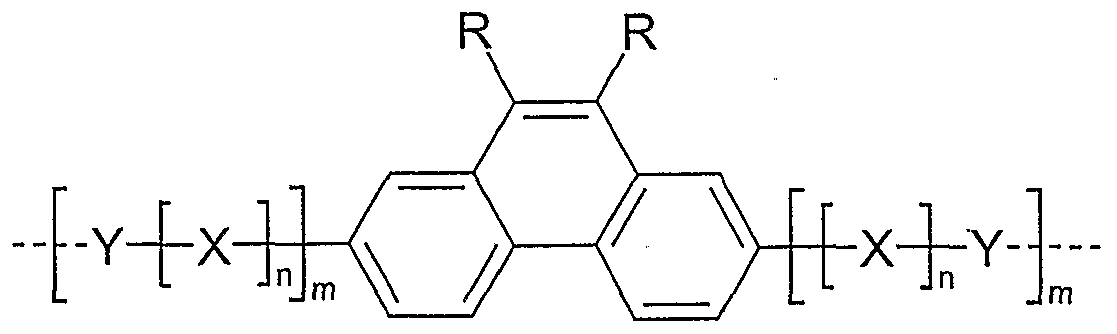
Formel (1 ) wobei die verwendeten Symbole und Indizes folgende Bedeutung besitzen: R ist bei jedem Auftreten gleich oder verschieden H, eine geradkettige, verzweigte oder cyclische Alkylkette mit 1 bis 40 C-Atomen, die durch R1 substituiert sein kann, und in der auch ein oder mehrere nicht benachbarte C-Atome durch N-R1, O, S, O-CO-O, CO-O, -CR1=CR1- oder -C≡C- ersetzt sein können, mit der Maßgabe, dass die Heteroatome nicht direkt an die Phenanthren-Einheit gebunden sind, und in der auch ein oder mehrere H-Atome durch F, Cl, Br, I oder CN ersetzt sein können, oder ein aromatisches oder heteroaromatisches Ringsystem mit 2 bis 40 C-Atomen, welches durch einen oder mehrere Reste R1 substituiert sein kann, oder eine Kombination mehrerer dieser Systeme; dabei können die beiden Reste R miteinander auch ein weiteres mono- oder polycyclisches, aliphatisches Ringsystem bilden; mit der Maßgabe, dass mindestens einer der beiden Reste R ungleich H ist;Formula (1) where the symbols and indices used have the following meaning: R is the same or different H on each occurrence, a straight-chain, branched or cyclic alkyl chain having 1 to 40 C atoms, which can be substituted by R 1 , and in one or more non-adjacent carbon atoms can also be replaced by NR 1 , O, S, O-CO-O, CO-O, -CR 1 = CR 1 - or -C≡C-, with the proviso that the Heteroatoms are not directly attached to the phenanthrene unit, and in that too one or more H atoms can be replaced by F, Cl, Br, I or CN, or an aromatic or heteroaromatic ring system with 2 to 40 C atoms, which can be substituted by one or more radicals R 1 , or a combination of several of these systems; the two radicals R here can also form a further mono- or polycyclic, aliphatic ring system with one another; with the proviso that at least one of the two radicals R is not equal to H;
X ist bei jedem Auftreten gleich oder verschieden -CR1=CR1-, -C≡C- oder N-Ar;X is the same or different on each occurrence -CR 1 = CR 1 -, -C≡C- or N-Ar;
Y ist bei jedem Auftreten gleich oder verschieden ein bivalentes aromatisches oder heteroaromatisches Ringsystem mit 2 bis 40 C-Atomen, welches durch einen oder mehrere Reste R1 substituiert oder unsubstituiert sein kann;Y is the same or different in each occurrence, a bivalent aromatic or heteroaromatic ring system with 2 to 40 C atoms, which can be substituted or unsubstituted by one or more radicals R 1 ;
R1 ist bei jedem Auftreten gleich oder verschieden H, eine geradkettige, verzweigte oder cyclische Alkyl- oder Alkoxykette mit 1 bis 22 C-Atomen, in der auch ein oder mehrere nicht benachbarte C-Atome durch N-R2, O, S, O-CO-O, CO-O, -CR2=CR2-, -C≡C- ersetzt sein können und in der auch ein oder mehrere H-Atome durch F, Cl, Br, I oder CN ersetzt sein können, oder eine Aryl-, Heteroaryl-, Aryloxy- oder Heteroaryloxygruppe mit 5 bis 40 C-Atomen, welche auch durch einen oder mehrere nicht-aromatische Reste R1 substituierfsein kann; dabei können auch zwei oder mehrere der Reste R1 miteinander und/oder mit R ein Ringsystem bilden; oder F, Cl, Br, I, CN, N(R2)2, Si(R2)3 oder B(R2)2; R2 ist bei jedem Auftreten gleich oder verschieden H oder ein aliphatischer oder aromatischer Kohlenwasserstoffrest mit 1 bis 20 C-Atomen;Each time R 1 is the same or different, H is a straight-chain, branched or cyclic alkyl or alkoxy chain with 1 to 22 C atoms, in which one or more non-adjacent C atoms is also represented by NR 2 , O, S, O- CO-O, CO-O, -CR 2 = CR 2 -, -C≡C- can be replaced and in which one or more H atoms can be replaced by F, Cl, Br, I or CN, or one Aryl, heteroaryl, aryloxy or heteroaryloxy group with 5 to 40 C atoms, which can also be substituted by one or more non-aromatic radicals R 1 ; two or more of the radicals R 1 can also form a ring system with one another and / or with R; or F, Cl, Br, I, CN, N (R 2 ) 2 , Si (R 2 ) 3 or B (R 2 ) 2 ; Each occurrence of R 2 is the same or different H or an aliphatic or aromatic hydrocarbon radical having 1 to 20 C atoms;
Ar ist bei jedem Auftreten gleich oder verschieden ein monovalentes aromatisches oder heteroaromatisches Ringsystem mit 2 bis 40 C-Atomen, welches mit R1 substituiert oder unsubstituiert sein kann; n ist bei jedem Auftreten gleich oder verschieden 0 oder 1 ; m ist bei jedem Auftreten gleich oder verschieden 0, 1 oder 2; die gestrichelte Bindung bedeutet dabei in Formel (1) ebenso wie in allen weiteren Formeln die Verknüpfung im Polymer; sie soll hier keine Methylgruppe darstellen.Ar is the same or different in each occurrence, a monovalent aromatic or heteroaromatic ring system with 2 to 40 C atoms, which can be substituted with R 1 or unsubstituted; n is the same or different at each occurrence 0 or 1; m is the same or different at each occurrence 0, 1 or 2; the dashed bond in formula (1) as in all other formulas means the linkage in the polymer; it should not represent a methyl group here.
Auch wenn dies aus der Beschreibung hervorgeht, sei hier nochmals explizit darauf verwiesen, dass die Struktureinheiten gemäß Formel (1) unsymmetrisch substituiert sein können, d. h. dass an einer Einheit unterschiedliche Substituenten R bzw. R1 vorhanden sein können, bzw. dass die Substituenten X und Y, soweit vorhanden, unterschiedlich sind oder auch nur einseitig auftreten.Even if this emerges from the description, it should again be explicitly pointed out here that the structural units of the formula (1) can be unsymmetrically substituted, ie that different substituents R or R 1 can be present on a unit, or that the substituents X and Y, if available, are different or only occur on one side.
Unter einem aromatischen bzw. heteroaromatischen Ringsystem im Sinne dieser Erfindung soll ein System verstanden werden, das nicht notwendigerweise nur aromatische bzw. heteroaromatische Gruppen enthält, sondern in dem auch mehrere aromatische bzw. heteroaromatische Gruppen durch eine kurze nicht-aromatische Einheit (< 10 % der von H verschiedenen Atome, bevorzugt < 5 % der von H verschiedenen Atome), wie beispielsweise sp3-hybridisierter C, O, N, etc., unterbrochen sein können. So sollen also beispielsweise auch Systeme wie 9,9'-Spirobifluoren, 9,9-Diarylfluoren, Triarylamin, etc. als aromatische Ringsysteme verstanden werden. Dabei enthält ein aromatisches Ringsystem mindestens 6 C-Atome und ein heteroaromatisches Ringsystem mindestens 2 C-Atome und mindestens ein Heteroatom, bevorzugt ausgewählt aus N, O und/oder S, mit der Maßgabe, dass die Summe aus C-Atomen und Heteroatomen mindestens 5 ergibt.An aromatic or heteroaromatic ring system in the sense of this invention is to be understood as meaning a system which does not necessarily only contain aromatic or heteroaromatic groups, but also in which several aromatic or heteroaromatic groups by a short non-aromatic unit (<10% of the atoms different from H, preferably <5% of the atoms different from H), such as sp 3 -hybridized C, O, N, etc., can be interrupted. For example, systems such as 9,9'-spirobifluorene, 9,9-diarylfluorene, triarylamine, etc. should also be used as aromatic ring systems can be understood. An aromatic ring system contains at least 6 C atoms and a heteroaromatic ring system contains at least 2 C atoms and at least one heteroatom, preferably selected from N, O and / or S, with the proviso that the sum of C atoms and heteroatoms is at least 5 results.
Im Rahmen der vorliegenden Erfindung werden unter einer C bis C40-Alkylgruppe, in der auch einzelne H-Atome oder CH2-Gruppen durch die oben genannten Gruppen substituiert sein können, besonders bevorzugt die Reste Methyl, Ethyl, n-Propyl, i-Propyl, n-Butyl, i- Butyl, s-Butyl, t-Butyl, 2-Methylbutyl, n-Pentyl, s-Pentyl, Cyclopentyl, n-Hexyl, Cyclohexyl, n- Heptyl, Cycloheptyl, n-Octyl, Cyclooctyl, 2-Ethylhexyl, Trifluormethyl, Pentafluorethyl,In the context of the present invention, the radicals methyl, ethyl, n-propyl, i- are particularly preferably under a C to C 40 alkyl group in which individual H atoms or CH 2 groups can be substituted by the above-mentioned groups. Propyl, n-butyl, i-butyl, s-butyl, t-butyl, 2-methylbutyl, n-pentyl, s-pentyl, cyclopentyl, n-hexyl, cyclohexyl, n-heptyl, cycloheptyl, n-octyl, cyclooctyl, 2-ethylhexyl, trifluoromethyl, pentafluoroethyl,
2,2,2-Trifluorethyl, Ethenyl, Propenyl, Butenyl, Pentenyl, Cyclopentenyl, Hexenyl, Cyclohexenyl, Heptenyl, Cycloheptenyl, Octenyl, Cyclooctenyl, Ethinyl, Propinyl, Butinyl, Pentinyl, Hexinyl oder Octinyl verstanden. Unter einer C bis C40-Alkoxygruppe werden besonders bevorzugt Methoxy, Ethoxy, n-Propoxy, i-Propoxy, n-Butoxy, i-Butoxy, s-Butoxy, t-Butoxy oder 2-Methylbutoxy verstanden. Unter einer C2-C2 Aryl- oder Heteroarylgruppe, die je nach Verwendung monovalent oder bivalent sein kann, die noch jeweils mit den oben genannten Resten R1 substituiert sein kann und die über beliebige Positionen am Aromaten bzw. Heteroaromaten verknüpft sein kann, werden insbesondere Gruppen verstanden, welche abgeleitet sind von Benzol, Naphthalin, Anthracen, Phenanthren, Pyren, Chrysen, Perylen, Fluoranthen, Tetracen, Pentacen, Benzpyren, Furan, Benzofuran, Isobenzofuran,2,2,2-trifluoroethyl, ethenyl, propenyl, butenyl, pentenyl, cyclopentenyl, hexenyl, cyclohexenyl, heptenyl, cycloheptenyl, octenyl, cyclooctenyl, ethynyl, propynyl, butynyl, pentynyl, hexynyl or octynyl. A C to C 40 alkoxy group particularly preferably means methoxy, ethoxy, n-propoxy, i-propoxy, n-butoxy, i-butoxy, s-butoxy, t-butoxy or 2-methylbutoxy. Under a C 2 -C 2 aryl or heteroaryl group which, depending on the use, can be monovalent or bivalent, which can also be substituted in each case with the radicals R 1 mentioned above and which can be linked via any positions on the aromatic or heteroaromatic understood in particular groups which are derived from benzene, naphthalene, anthracene, phenanthrene, pyrene, chrysene, perylene, fluoranthene, tetracene, pentacene, benzpyrene, furan, benzofuran, isobenzofuran,
Dibenzofuran, Thiophen, Benzothiophen, Isobenzothiophen, Dibenzothiophen, Pyrrol, Indol, lsoindol, Carbazol, Pyridin, Chinolin, Isochinolin, Acridin, Phenanthridin, Benzo-5,6-chinolin, Benzo-6,7-chinolin, Benzo-7,8-chinolin, Phenothiazin, Phenoxazin, Pyrazol, Indazol, Imidazol, Benzimidazol, Naphthimidazol, Phenanthrimidazol, Pyridimidazol, Pyrazinimidazol, Chinoxalinimidazol, Oxazol, Benzoxazol, Naphthoxazol, Anthroxazol, Phenanthroxazol, lsoxazol, 1,2-Thiazol, 1 ,3-Thiazol, Benzothiazol, Pyridazin, Benzopyridazin, Pyrimidin, Benzpyrimidin, Chinoxalin, Pyrazin, Phenazin, Naphthyridin, Azacarbazol, Benzocarbolin, Phenanthrolin, 1 ,2,3-Triazol, 1 ,2,4-Triazol, Benzotriazol, 1 ,2,3-Oxadiazol, 1 ,2,4-Oxadiazol, 1 ,2,5-Oxadiazol, 1 ,3,4-Oxadiazol, 1 ,2,3-ThiadiazoI, 1 ,2,4-Thiadiazol, 1 ,2,5-Thiadiazol, 1 ,3,4- Thiadiazol, 1,3,5-Triazin, 1,2,4-Triazin, 1 ,2,3-Triazin, Tetrazol, 1 ,2,4,5-Tetrazin, 1 ,2,3,4-Dibenzofuran, thiophene, benzothiophene, isobenzothiophene, dibenzothiophene, pyrrole, indole, isoindole, carbazole, pyridine, quinoline, isoquinoline, acridine, phenanthridine, benzo-5,6-quinoline, benzo-6,7-quinoline, benzo-7,8- quinoline, phenothiazine, phenoxazine, pyrazole, indazole, imidazole, benzimidazole, naphthimidazole, phenanthrimidazole, pyridimidazole, pyrazinimidazole, quinoxaline imidazole, oxazole, benzoxazole, naphthoxazole, anthroxazole, phenanthroxiazol, 1, phenanthroxiazole, 1 Pyridazine, benzopyridazine, pyrimidine, benzpyrimidine, quinoxaline, pyrazine, phenazine, naphthyridine, azacarbazole, benzocarboline, phenanthroline, 1, 2,3-triazole, 1, 2,4-triazole, benzotriazole, 1, 2,3-oxadiazole, 1, 2,4-oxadiazole, 1, 2,5-oxadiazole, 1, 3,4-oxadiazole, 1, 2,3-thiadiazoI, 1, 2,4-thiadiazole, 1, 2,5-thiadiazole, 1, 3, 4- thiadiazole, 1,3,5-triazine, 1,2,4-triazine, 1, 2,3-triazine, tetrazole, 1, 2,4,5-tetrazine, 1, 2,3,4-
Tetrazin, 1 ,2,3,5-Tetrazin, Purin, Pteridin, Indolizin und Benzothiadiazol. Unter aromatischen Ringsystemen werden weiterhin insbesondere Biphenylen, Terphenylen, Fluoren, Spirobifluoren, Dihydrophenanthren, Dihydropyren, Tetrahydropyren oder eis- oder trans- Indenofluoren verstanden.Tetrazine, 1, 2,3,5-tetrazine, purine, pteridine, indolizine and benzothiadiazole. Aromatic ring systems are further understood in particular to mean biphenylene, terphenylene, fluorene, spirobifluorene, dihydrophenanthrene, dihydropyrene, tetrahydropyrene or ice or trans indenofluorene.
In einem Aspekt der Erfindung handelt es sich um konjugierte Polymere. In einem weiteren Aspekt der Erfindung handelt es sich um nicht-konjugierte Polymere. In nochmals einem weiteren Aspekt der Erfindung handelt es sich um teilkonjugierte Polymere. Bevorzugt sind konjugierte oder teilkonjugierte Polymere.In one aspect of the invention, these are conjugated polymers. Another aspect of the invention is non-conjugated polymers. In yet another aspect of the invention, there are partially conjugated polymers. Conjugated or partially conjugated polymers are preferred.
Konjugierte Polymere im Sinne dieser Erfindung sind Polymere, die in der Hauptkette hauptsächlich sp2-hybridisierte Kohlenstoffatome, die auch durch entsprechende Heteroatome ersetzt sein können, enthalten. Dies bedeutet im einfachsten Fall abwechselndes Vorliegen von Doppel- und Einfachbindungen in der Hauptkette. Hauptsächlich meint, dass natürlich auftretende Defekte, die zuFor the purposes of this invention, conjugated polymers are polymers which in the main chain are mainly sp 2 -hybridized carbon atoms and which are also characterized by corresponding Heteroatoms can be replaced. In the simplest case, this means alternating double and single bonds in the main chain. Mainly means that naturally occurring defects, too
Konjugationsunterbrechungen führen, den Begriff "konjugiertes Polymer" nicht entwerten. Des Weiteren wird in diesem Anmeldetext ebenfalls als konjugiert bezeichnet, wenn sich in der Hauptkette beispielsweise Arylamineinheiten und/oder bestimmte Heterocyclen (d. h. Konjugation über N-, O- oder S-Atome) und/oder metallorganische Komplexe (d. h. Konjugation über das Metallatom) befinden. Hingegen würden Einheiten wie beispielsweise einfache Alkylbrücken, (Thio)Ether-, Ester-, Amid- oder Imidverknüpfungen eindeutig als nicht-konjugierte Segmente definiert. Unter einem teilkonjugierten Polymer soll ein Polymer verstanden werden, in dem längere konjugierte Abschnitte in der Hauptkette durch nicht- konjugierte Abschnitte unterbrochen sind, bzw. das längere konjugierte Abschnitte in den Seitenketten eines in der Hauptkette nicht-konjugierten Polymers enthält.Conjugation interruptions lead, do not invalidate the term "conjugated polymer". Furthermore, in this application text is also referred to as conjugated if, for example, arylamine units and / or certain heterocycles (ie conjugation via N, O or S atoms) and / or organometallic complexes (ie conjugation via the metal atom) are present in the main chain , In contrast, units such as simple alkyl bridges, (thio) ether, ester, amide or imide linkages would be clearly defined as non-conjugated segments. A partially conjugated polymer is understood to mean a polymer in which longer conjugated sections in the main chain are interrupted by non-conjugated sections, or in which longer conjugated sections in the side chains of a polymer which is not conjugated in the main chain.
Die erfindungsgemäßen Polymere können neben Einheiten gemäß Formel (1) noch weitereIn addition to units of the formula (1), the polymers according to the invention can also contain others
Strukturelemente enthalten. Dies sind u. a. solche, wie sie in WO 02/077060 und WO 05/014689 offenbart und umfangreich aufgelistet sind. Die weiteren Struktureinheiten können beispielsweise aus den im Folgenden beschriebenen Klassen stammen: Gruppe 1 : Einheiten, welche die Lochinjektions- und/oder -transporteigenschaften der Polymere erhöhen;Structure elements included. These are u. a. those as disclosed in WO 02/077060 and WO 05/014689 and listed extensively. The further structural units can, for example, come from the classes described below: Group 1: units which increase the hole injection and / or transport properties of the polymers;
Gruppe 2: Einheiten, welche die Elektroneninjektions- und/oder -transporteigenschaften der Polymere erhöhen; Gruppe 3: Einheiten, die Kombinationen von Einzeleinheiten der Gruppe 1 und Gruppe 2 aufweisen; Gruppe 4: Einheiten, welche die Emissionscharakteristik insoweit verändern, dass Elektrophosphoreszenz statt Elektrofluoreszenz erhalten werden kann; Gruppe 5: Einheiten, welche den Übergang vom Singulett- zum Triplettzustand verbessern; Gruppe 6: Einheiten, welche die Morphologie öder auch die Emissionsfarbe der resultierenden Polymere beeinflussen;Group 2: units which increase the electron injection and / or transport properties of the polymers; Group 3: units which have combinations of individual units of group 1 and group 2; Group 4: units which change the emission characteristics to the extent that electrophosphorescence instead of electrofluorescence can be obtained; Group 5: units which improve the transition from singlet to triplet state; Group 6: units which influence the morphology or the emission color of the resulting polymers;
Gruppe 7: Einheiten, welche typischerweise als Backbone verwendet werden.Group 7: units that are typically used as a backbone.
Bevorzugte erfindungsgemäße Polymere sind solche, bei denen mindestens ein Strukturelement Ladungstransporteigenschaften aufweist, d. h. die Einheiten aus den Gruppen 1 und/oder 2 enthalten.Preferred polymers according to the invention are those in which at least one structural element has charge transport properties, ie. H. contain the units from groups 1 and / or 2.
Strukturelemente aus der Gruppe 1 , die Lochtransporteigenschaften aufweisen, sind beispielsweise Triarylamin-, Benzidin-, Tetraaryl-para-phenylendiamin-, Triarylphosphin-, Phenothiazin-, Phenoxazin-, Dihydrophenazin-, Thianthren-, Dibenzo-p-dioxin-, Phenoxathiin-, Carbazol-, Azulen-, Thiophen-, Pyrrol- und Furanderivate und weitere O-, S- oder N-haltige Heterocyclen mit hoch liegendem HOMO (HOMO = höchstes besetztes Molekülorbital); bevorzugt führen diese Arylamine und Heterocyclen zu einem HOMO im Polymer von mehr als -5.8 eV (gegen Vakuumlevel), besonders bevorzugt von mehr als -5.5 eV.Structural elements from group 1 which have hole transport properties are, for example, triarylamine, benzidine, tetraaryl-para-phenylenediamine, triarylphosphine, phenothiazine, phenoxazine, dihydrophenazine, thianthrene, dibenzo-p-dioxin, phenoxathiine, Carbazole, azulene, thiophene, pyrrole and furan derivatives and other O, S or N-containing heterocycles with high-lying HOMO (HOMO = highest occupied molecular orbital); these arylamines and heterocycles preferably lead to a HOMO im Polymer of more than -5.8 eV (against vacuum level), particularly preferably of more than -5.5 eV.
Strukturelemente aus Gruppe 2, die Elektronentransporteigenschaften aufweisen, sind beispielsweise Pyridin-, Pyrimidin-, Pyridazin-, Pyrazin-, Oxadiazol-, Chinolin-, Chinoxalin-, Benzothiadiazol- und Phenazinderivate, aber auch Triarylborane und weitere O-, S- oder N- haltige Heterocyclen mit niedrig liegendem LUMO (LUMO = niedrigstes unbesetztes Molekülorbital); bevorzugt führen diese Einheiten im Polymer zu einem LUMO von weniger als -2.7 eV (gegen Vakuumlevel), besonders bevorzugt von weniger als -3.0 eV.Structural elements from group 2 which have electron transport properties are, for example, pyridine, pyrimidine, pyridazine, pyrazine, oxadiazole, quinoline, quinoxaline, benzothiadiazole and phenazine derivatives, but also triarylboranes and other O-, S- or N- containing heterocycles with low lying LUMO (LUMO = lowest unoccupied molecular orbital); these units in the polymer preferably lead to a LUMO of less than -2.7 eV (against vacuum level), particularly preferably of less than -3.0 eV.
Es kann bevorzugt sein, wenn in den erfindungsgemäßen Polymeren Einheiten aus GruppeIt can be preferred if in the polymers according to the invention units from group
3 enthalten sind, in denen Strukturen, welche die Lochmobilität und welche die Elektronenmobilität erhöhen (also Einheiten aus Gruppe 1 und 2), direkt aneinander gebunden sind. Einige dieser Einheiten können als Emitter dienen und verschieben die Emissionsfarbe ins Grüne, Gelbe oder Rote; ihre Verwendung eignet sich also beispielsweise für die Erzeugung anderer Emissionsfarben aus ursprünglich blau emittierenden Polymeren.3 are contained in which structures which increase the hole mobility and which increase the electron mobility (that is, units from groups 1 and 2) are bonded directly to one another. Some of these units can serve as emitters and shift the emission color to green, yellow or red; their use is therefore suitable, for example, for the production of other emission colors from originally blue-emitting polymers.
Struktureinheiten gemäß Gruppe 4 sind solche, welche auch bei Raumtemperatur mit hoher Effizienz aus dem Triplettzustand Licht emittieren können, also Elektrophosphoreszenz stattStructural units according to group 4 are those which can emit light from the triplet state with high efficiency even at room temperature, that is to say electrophosphorescence instead
Elektrofluoreszenz zeigen, was häufig eine Steigerung der Energieeffizienz bewirkt. Hierfür eignen sich zunächst Verbindungen, welche Schweratome mit einer Ordnungszahl von mehr als 36 enthalten. Besonders geeignet sind Verbindungen, welche d- oder f-Übergangsmetalle beinhalten, die die o. g. Bedingung erfüllen. Ganz besonders bevorzugt sind hier entsprechende Struktureinheiten, welche Elemente der Gruppe 8 bis 10 (Ru, Os,Electrofluorescence shows what often leads to an increase in energy efficiency. Compounds which contain heavy atoms with an atomic number of more than 36 are initially suitable for this. Compounds are particularly suitable which contain d- or f-transition metals which contain the abovementioned. Meet condition. Corresponding structural units which elements of group 8 to 10 (Ru, Os,
Rh, Ir, Pd, Pt) enthalten. Als Struktureinheiten für die erfindungsgemäßen Polymeren kommen hier z. B. verschiedene Komplexe in Frage, welche beispielsweise in den Anmeldeschriften WO 02/068435, WO 02/081488, EP 1239526 und WO 04/026886 beschrieben sind. Entsprechende Monomere sind in WO 02/068435 und in der nicht offen gelegten Anmeldung DE 10350606.3 beschrieben.Rh, Ir, Pd, Pt) included. As structural units for the polymers according to the invention come here, for. B. various complexes in question, which are described for example in the application documents WO 02/068435, WO 02/081488, EP 1239526 and WO 04/026886. Corresponding monomers are described in WO 02/068435 and in the unpublished application DE 10350606.3.
Strukturelemente der Gruppe 5 sind solche, welche den Übergang vom Singulett- zum Triplettzustand verbessern und welche, unterstützend zu den Strukturelementen der GruppeStructural elements of group 5 are those which improve the transition from the singlet to the triplet state and which support the structural elements of the group
4 eingesetzt, die Phosphoreszenzeigenschafte.n dieser Strukturelemente verbessern. Hierfür kommen insbesondere Carbazol- und überbrückte Carbazoldimereinheiten in Frage, wie in WO 04/070772 und WO 04/113468 beschrieben. Weiterhin kommen hierfür Ketone, Phosphinoxide, Sulfoxide und ähnliche Verbindungen in Frage, wie in der nicht offen gelegten Anmeldung DE 10349033.7 beschrieben.4 used to improve the phosphor features of these structural elements. Carbazole and bridged carbazole dimer units are particularly suitable for this, as described in WO 04/070772 and WO 04/113468. Furthermore, ketones, phosphine oxides, sulfoxides and similar compounds can be used, as described in the unpublished application DE 10349033.7.
Strukturelemente der Gruppe 6, die die Morphologie oder auch die Emissionsfarbe derStructural elements of group 6, which the morphology or the emission color of the
Polymere beeinflussen, sind neben den oben genannten solche, die mindestens noch eine weitere aromatische oder eine andere konjugierte Struktur aufweisen, welche nicht unter die o. g. Gruppen fällt, d. h. die die Ladungsträgermobilität nur wenig beeinflusst, die keine metallorganischen Komplexe sind oder die keinen Einfluss auf den Singulett-Triplett- Übergang haben. Derartige Strukturelemente können die Morphologie, aber auch die Emissionsfarbe der resultierenden Polymere beeinflussen. Je nach Einheit können sie daher auch als Emitter eingesetzt werden. Bevorzugt sind dabei aromatische Strukturen mitIn addition to the abovementioned, polymers influence those which have at least one further aromatic or another conjugated structure which does not fall under the The above-mentioned groups fall, that is to say that they influence the charge carrier mobility only slightly, that are not organometallic complexes or that have no influence on the singlet-triplet transition. Structural elements of this type can influence the morphology, but also the emission color of the resulting polymers. Depending on the unit, they can therefore also be used as emitters. Aromatic structures are preferred
6 bis 40 C-Atomen oder auch Tolan-, Stilben- oder Bisstyrylarylenderivate, die jeweils mit einem oder mehreren Resten R1 substituiert sein können. Besonders bevorzugt ist dabei der Einbau von 1 ,4-Phenylen-, 1 ,4-Naphthylen-, 1 ,4- oder 9,10-Anthrylen-, 1 ,6- oder 2,7- oder 4,9-Pyrenylen-, 3,9- oder 3,10- Perylenylen-, 4,4'-Biphenylylen-, 4,4"-TerphenyIylen-, 4,4'-Bi- 1 ,1 '-naphthylylen-, 4,4'-Tolanylen-, 4,4'-Stilbenylen- oder 4,4"-BisstyrylaryIenderivaten.6 to 40 carbon atoms or tolane, stilbene or bisstyrylarylene derivatives, each of which can be substituted with one or more radicals R 1 . The incorporation of 1, 4-phenylene, 1, 4-naphthylene, 1, 4- or 9,10-anthrylene, 1, 6- or 2,7- or 4,9-pyrenylene, 3,9- or 3,10-perylenylene, 4,4'-biphenylylene, 4,4 "-terphenylene, 4,4'-bi- 1, 1 '-naphthylylene-, 4,4'-tolanylene- , 4,4'-stilbenylene or 4,4 "-bistyrylarylene derivatives.
Strukturelemente der Gruppe 7 sind Einheiten, die aromatische Strukturen mit 6 bis 40 C-Atomen beinhalten, welche typischerweise als Polymergrundgerüst (Backbone) verwendet werden. Dies sind beispielsweise 4,5-Dihydropyrenderivate, 4,5,9,10-Tetrahydro- pyrenderivate, Fluorenderivate, 9,9'-Spirobifluorenderivate, 9,10-Group 7 structural elements are units which contain aromatic structures with 6 to 40 carbon atoms, which are typically used as a polymer backbone. These are, for example, 4,5-dihydropyrene derivatives, 4,5,9,10-tetrahydropyrene derivatives, fluorene derivatives, 9,9'-spirobifluorene derivatives, 9,10-
Dihydrophenanthrenderivate, 5,7-Dihydrodibenzo-oxepinderivate und eis- und trans- Indenofluorenderivate. Da jedoch der Anteil an Einheiten gemäß Formel (1) ganz besonders bevorzugt mindestens 50 mol% beträgt, werden diese Strukturelemente hier nicht bevorzugt als das hauptsächliche Polymergrundgerüst verwendet.Dihydrophenanthrene derivatives, 5,7-dihydrodibenzo-oxepine derivatives and ice and trans indenofluorene derivatives. However, since the proportion of units according to formula (1) is very particularly preferably at least 50 mol%, these structural elements are not preferably used here as the main polymer backbone.
Bevorzugt sind erfindungsgemäße Polymere, die gleichzeitig neben Struktureinheiten gemäß Formel (1 ) zusätzlich noch eine oder mehrere Einheiten ausgewählt aus den Gruppen 1 bis 7 enthalten. Es kann ebenfalls bevorzugt sein, wenn gleichzeitig mehr als eine Struktureinheit aus einer Gruppe vorliegt. Bevorzugt beträgt der Anteil der Einheiten gemäß Formel (1 ) mindestens 10 mol%, besonders bevorzugt mindestens 30 mol%, ganz besonders bevorzugt mindestens 50 mol%. Diese Bevorzugung gilt vor allem, wenn es sich bei den Einheiten gemäß Formel (1 ) um das Polymer-Grundgerüst handelt. Bei anderen Funktionen können andere Anteile bevorzugt sein, beispielsweise ein Anteil in der Größenordnung von 5 bis 20 mol%, wenn es sich um den Lochleiter bzw. den Emitter in einem elektrolumineszierenden Polymer handelt.Polymers according to the invention which, in addition to structural units of the formula (1), additionally contain one or more units selected from groups 1 to 7 are preferred. It may also be preferred if more than one structural unit from a group is present at the same time. The proportion of the units of the formula (1) is preferably at least 10 mol%, particularly preferably at least 30 mol%, very particularly preferably at least 50 mol%. This preference applies above all when the units of the formula (1) are the polymer backbone. For other functions, other proportions may be preferred, for example a proportion on the order of 5 to 20 mol% if it is the hole conductor or the emitter in an electroluminescent polymer.
Für andere Anwendungen, beispielsweise für organische Transistoren, kann der bevorzugte Anteil nochmals unterschiedlich sein, beispielsweise bis zu 100 mol%, wenn es sich um loch- oder elektronenleitende Einheiten handelt.For other applications, for example for organic transistors, the preferred proportion can be different again, for example up to 100 mol%, if the units are hole-conducting or electron-conducting.
Bevorzugt sind erfindungsgemäße Polymere, die außer Struktureinheiten gemäß Formel (1 ) noch mindestens eine Struktureinheit aus den oben genannten Gruppen enthalten. Besonders bevorzugt sind mindestens zwei Struktureinheiten aus unterschiedlichen der oben genannten Klassen. Ganz besonders bevorzugt ist eine dieser Struktureinheiten aus der Gruppe der lochleitenden Einheiten ausgewählt, und die andere Gruppe ist eine emittierende Einheit, wobei diese beiden Funktionen (Lochleitung und Emission) auch von derselben Einheit übernommen werden können. Einheiten gemäß Formel (1) sind auch insbesondere geeignet zur Synthese weiß emittierenden Copolymere. Diese enthalten bevorzugt einen ausreichend kleinen Anteil grün und rot emittierender Einheiten, so dass insgesamt weiße Emission resultiert. Wie weiß emittierende Copolymere synthetisiert werden können, ist im Detail in der nicht offen gelegten Anmeldung DE 10343606.5 beschrieben.Polymers according to the invention which, in addition to structural units of the formula (1), also contain at least one structural unit from the groups mentioned above are preferred. At least two structural units from different classes mentioned above are particularly preferred. One of these structural units is very particularly preferably selected from the group of hole-conducting units, and the other group is an emitting unit, wherein these two functions (hole line and emission) can also be performed by the same unit. Units of the formula (1) are also particularly suitable for the synthesis of white-emitting copolymers. These preferably contain a sufficiently small proportion of green and red emitting units, so that overall white emission results. How white-emitting copolymers can be synthesized is described in detail in the unpublished application DE 10343606.5.
Die erfindungsgemäßen Polymere weisen bevorzugt 10 bis 10000, besonders bevorzugt 50 bis 5000, ganz besonders bevorzugt 50 bis 2000 Wiederholeinheiten auf.The polymers according to the invention preferably have 10 to 10,000, particularly preferably 50 to 5000, very particularly preferably 50 to 2000 repeating units.
Die nötige Löslichkeit der Polymere wird v. a. durch die Substituenten R bzw. R1 an denThe necessary solubility of the polymers is mainly due to the substituents R and R 1
Einheiten gemäß Formel (1) sowie gegebenenfalls an weiteren anwesenden Einheiten gewährleistet. Falls weitere Substituenten vorhanden sind, tragen auch diese zur Löslichkeit bei. Um ausreichende Löslichkeit zu gewährleisten, ist es bevorzugt, dass im Durchschnitt pro Wiederholeinheit mindestens 2 nicht-aromatische C-Atome in den Substituenten vorhanden sind. Bevorzugt sind dabei mindestens 4, besonders bevorzugt mindestens 6 C-Atome. Einzelne dieser C-Atome können auch durch O oder S ersetzt sein. Dies kann aber durchaus bedeuten, dass ein gewisser Anteil von Wiederholeinheiten keine weiteren nichtaromatischen Substituenten trägt. Um die Morphologie des Films nicht zu verschlechtern, ist es bevorzugt, keine langkettigenUnits according to formula (1) and optionally on other units present. If other substituents are present, these also contribute to solubility. In order to ensure sufficient solubility, it is preferred that an average of at least 2 non-aromatic C atoms are present in the substituents per repeating unit. At least 4, particularly preferably at least 6, carbon atoms are preferred. Some of these C atoms can also be replaced by O or S. However, this can mean that a certain proportion of repeat units does not have any further non-aromatic substituents. In order not to deteriorate the morphology of the film, it is preferred not to use long-chain ones
Substituenten mit mehr als 12 C-Atomen in einer linearen Kette zu haben, bevorzugt keine mit mehr als 8 C-Atomen, besonders bevorzugt keine mit mehr als 6 C-Atomen. Nicht-aromatische C-Atome sind, wie beispielsweise in der Beschreibung für R und R1 in Formel (1), in entsprechenden geradkettigen, verzweigten oder cyclischen Alkyl- oder Alkoxyketten enthalten.To have substituents with more than 12 carbon atoms in a linear chain, preferably none with more than 8 carbon atoms, particularly preferably none with more than 6 carbon atoms. As in the description of R and R 1 in formula (1), for example, non-aromatic C atoms are contained in corresponding straight-chain, branched or cyclic alkyl or alkoxy chains.
Bevorzugt sind erfindungsgemäße Polymere, bei denen das Symbol R, gleich oder verschieden bei jedem Auftreten, für eine geradkettige, verzweigte oder cyclische Alkylkette mit 2 bis 15 C-Atomen, in der auch ein oder mehrere nicht benachbarte C-Atome durch N-R1, O, S, O-CO-O, CO-O, -CH=CH- oder -C≡C- ersetzt sein können, mit der Maßgabe, dass die Heteroatome nicht direkt an die Phenanthren-Einheit gebunden sind, und in der auch ein oder mehrere H-Atome durch F oder CN ersetzt sein können, oder eine aromatische oder heteroaromatische Gruppe mit 4 bis 20 C-Atomen, welche auch durch einen oder mehrere nicht-aromatische Reste R1 substituiert sein kann, oder eine Kombination mehrerer dieser Systeme steht. Dabei können die beiden Reste R zusammen auch ein weiteres mono- oder polycyclisches, aliphatisches Ringsystem bilden. Besonders bevorzugt steht R, gleich oder verschieden bei jedem Auftreten, für eine geradkettige, verzweigte oder cyclische Alkylkette mit 4 bis 8 C-Atomen, besonders bevorzugt eine verzweigte Alkylkette, in der auch ein oder mehrere nicht benachbarte C-Atome durch N-R1, O, S, -CR1=CR1- oder -CsC- ersetzt sein können, mit der Maßgabe, dass diese nicht direkt an die Phenanthren-Einheit angrenzen, und in der auch ein oder mehrere H-Atome durch F ersetzt sein können, oder eine Aryl- oder Heteroarylgruppe mit 5 bis 10 C-Atomen, die durch R1 substituiert oder unsubstituiert sein kann; dabei können die beiden Reste R zusammen auch ein weiteres mono- oder polycyclisches Ringsystem bilden.Polymers according to the invention in which the symbol R, the same or different at each occurrence, are preferred for a straight-chain, branched or cyclic alkyl chain having 2 to 15 C atoms, in which one or more non-adjacent C atoms are represented by NR 1 , O , S, O-CO-O, CO-O, -CH = CH- or -C≡C- can be replaced, with the proviso that the heteroatoms are not bonded directly to the phenanthrene unit, and also in the or more H atoms can be replaced by F or CN, or an aromatic or heteroaromatic group with 4 to 20 C atoms, which can also be substituted by one or more non-aromatic radicals R 1 , or a combination of several of these systems , The two radicals R together can also form a further mono- or polycyclic, aliphatic ring system. R, with the same or different occurrence, particularly preferably represents a straight-chain, branched or cyclic alkyl chain having 4 to 8 C atoms, particularly preferably a branched alkyl chain in which one or more non-adjacent C atoms are represented by NR 1 , O , S, -CR 1 = CR 1 - or -CsC-, with the proviso that they do not directly adjoin the phenanthrene unit, and in which one or more H atoms can also be replaced by F, or an aryl or heteroaryl group with 5 to 10 carbon atoms, through R 1 can be substituted or unsubstituted; the two radicals R together can also form a further mono- or polycyclic ring system.
Bevorzugt sind weiterhin erfindungsgemäße Polymere, bei denen das Symbol X, gleich oder verschieden bei jedem Auftreten, für -CH=CH-, -C≡C- oder N-Ar steht.Also preferred are polymers according to the invention in which the symbol X, identical or different in each occurrence, stands for -CH = CH-, -C≡C- or N-Ar.
Bevorzugt sind weiterhin erfindungsgemäße Polymere, bei denen das Symbol Y, gleich oder verschieden bei jedem Auftreten, für ein bivalentes aromatisches oder heteroaromatisches Ringsystem mit 4 bis 25 C-Atomen, welches durch einen oder mehrere Reste R1 substituiert sein kann, steht; Besonders bevorzugt steht Y, gleich oder verschieden bei jedem Auftreten, für ein bivalentes aromatisches oder heteroaromatisches Ringsystem mit 6 bis 16 C-Atomen oder Spirobifluoren, welches jeweils durch einen oder mehrere nicht-aromatische Reste R1 substituiert sein kann.Also preferred are polymers according to the invention in which the symbol Y, the same or different on each occurrence, stands for a bivalent aromatic or heteroaromatic ring system with 4 to 25 C atoms, which can be substituted by one or more radicals R 1 ; Y, particularly the same or different at each occurrence, stands for a bivalent aromatic or heteroaromatic ring system with 6 to 16 carbon atoms or spirobifluorene, which can in each case be substituted by one or more non-aromatic radicals R 1 .
Bevorzugt sind weiterhin erfindungsgemäße Polymere, bei denen das Symbol Ar, gleich oder verschieden bei jedem Auftreten, für ein monovalentes aromatisches oder heteroaromatisches Ringsystem mit 4 bis 25 C-Atomen, welches mit R1 substituiert oder unsubstituiert sein kann, steht. Besonders bevorzugt steht Ar, gleich oder verschieden bei jedem Auftreten, für eine monovalente Aryl- oder Heteroarylgruppe mit 4 bis 16 C-Atomen, welche mit nicht-aromatischen Resten R1 substituiert sein kann.Also preferred are polymers according to the invention in which the symbol Ar, identical or different on each occurrence, stands for a monovalent aromatic or heteroaromatic ring system with 4 to 25 C atoms, which can be substituted or unsubstituted with R 1 . Ar, with the same or different occurrence, particularly preferably represents a monovalent aryl or heteroaryl group having 4 to 16 carbon atoms, which can be substituted by non-aromatic radicals R 1 .
Bevorzugt sind weiterhin erfindungsgemäße Polymere, bei denen der Index m, gleich oder verschieden bei jedem Auftreten, 0 oder 1 ist.Also preferred are polymers according to the invention in which the index m, the same or different with each occurrence, is 0 or 1.
Je nach Substitutionsmuster eignen sich die Einheiten gemäß Formel (1 ) für verschiedeneDepending on the substitution pattern, the units according to formula (1) are suitable for different ones
Funktionen im Polymer. So können sie bevorzugt als (elektronenleitendes) Polymer- Grundgerüst, als Lochleiter oder als Emitter eingesetzt werden. Welche Verbindungen sich insbesondere für welche Funktion eignen, ist vor allem durch die Substituenten X und Y beschrieben. Auch die Substituenten R haben einen Einfluss auf die elektronischen Eigenschaften der Einheiten gemäß Formel (1).Functions in the polymer. For example, they can preferably be used as an (electron-conducting) polymer backbone, as a hole conductor or as an emitter. Which compounds are particularly suitable for which function is primarily described by the substituents X and Y. The substituents R also have an influence on the electronic properties of the units of the formula (1).
So gilt für die Verwendung als Polymer-Grundgerüst bevorzugt: n ist bei jedem Auftreten gleich 0, d. h. es handelt sich um eine rein aromatische Struktureinheit.For use as a polymer backbone, the following preferably applies: n is 0 on each occurrence, i. H. it is a purely aromatic structural unit.
Für die Verwendung von Einheiten gemäß Formel (1) als lochtransportierende Einheiten gilt bevorzugt: n ist bei jedem Auftreten gleich oder verschieden 0 oder 1 , wobei mindestens ein n = 1 ist; m ist bei jedem Aufteten gleich oder verschieden 0, 1 oder 2, wobei m ungleich 0 ist, wenn das entsprechende n = 1 ist;The following preferably applies to the use of units of the formula (1) as hole-transporting units: n is the same or different 0 or 1 with each occurrence, with at least one n = 1; m is the same or different for each occurrence 0, 1 or 2, where m is not 0 if the corresponding n = 1;
X ist bei jedem Auftreten N-Ar; d. h. es handelt sich um Triarylaminderivate des Phenanthrens. Weiterhin können Einheiten gemäß Formel (1) auch als lochtransportierende Einheiten verwendet werden, wenn der Index n = 0 ist, falls mindestens einer der Reste R (bzw. an R gebundene Reste R1) mindestens eine Diarylamin-Gruppe enthalten.X is N-Ar every time it occurs; ie they are triarylamine derivatives of phenanthrene. Furthermore, units of the formula (1) can also be used as hole-transporting units if the index n = 0, if at least one of the radicals R (or radicals R 1 bonded to R) contains at least one diarylamine group.
Für die Verwendung von Einheiten gemäß Formel (1) als Emitter gilt bevorzugt: n ist bei jedern Auftreten gleich oder verschieden 0 oder 1 , wobei mindestens ein n = 1 ist; m ist bei jedem Auftreten gleich oder verschieden 0, 1 oder 2, wobei m ungleich 0 ist, wenn das entsprechende n = 1 ist;For the use of units of the formula (1) as emitter, the following preferably applies: n is the same or different in each occurrence 0 or 1, at least one n = 1; m is the same or different at each occurrence 0, 1 or 2, where m is not 0 if the corresponding n = 1;
X ist bei jedem Auftreten gleich oder verschieden -CR1=CR1-, -C≡C- oder N-Ar, wobei mindestens ein X gleich -CR1=CR1- oder -C≡C- ist, d. h. es handelt sich um Diarylvinylen- oder Diarylacetylenderivate im weitesten Sinne, die auch noch zusätzlich Triarylamineinheiten enthalten können.X is the same or different with each occurrence -CR 1 = CR 1 -, -C≡C- or N-Ar, where at least one X is -CR 1 = CR 1 - or -C≡C-, ie it is diarylvinylene or diarylacetylene derivatives in the broadest sense, which may also contain triarylamine units.
Weiterhin können Einheiten gemäß Formel (1 ) auch als emittierend Einheiten verwendet werden, wenn der Index n = 0 ist, falls mindestens einer der Reste R (bzw. an R gebundene Reste R1) mindestens eine Diarylvinylen- oder Diarylacetylen-Gruppe enthalten.Furthermore, units of the formula (1) can also be used as emitting units if the index n = 0, if at least one of the radicals R (or radicals R 1 bonded to R) contains at least one diarylvinylene or diarylacetylene group.
Weiterhin bevorzugt sind Einheiten gemäß Formel (1), die in den 9,10-Positionen der Phenanthren-Einheiten symmetrisch substituiert sind. Diese Bevorzugung ist durch die bessere synthetische Zugänglichkeit der Monomere zu begründen. Bevorzugt gilt also, dass in einer Einheit gemäß Formel (1 ) alle R gleich und besonders bevorzugt auch gleich substituiert sind. Diese Bevorzugung schließt nicht aus, dass die Substituenten X und Y nur einseitig auftreten bzw. auch unterschiedlich sein können.Also preferred are units of the formula (1) which are symmetrically substituted in the 9,10-positions of the phenanthrene units. This preference is due to the better synthetic accessibility of the monomers. It is therefore preferred that all of the R in a unit of the formula (1) are identical and particularly preferably also substituted in the same way. This preference does not rule out that the substituents X and Y occur only on one side or can also be different.
Beispiele für bevorzugte Einheiten gemäß Formel (1 ) sind Strukturen gemäß den abgebildeten Beispielen 1 bis 36,wobei die Verknüpfung im Polymer jeweils durch die 2,7-Positionen der Phenanthreneinheiten erfolgt, wie über die gestrichelten Bindungen angedeutet. Mögliche Substituenten an den Gruppen R sind für die bessere Übersichtlichkeit im Allgemeinen nicht aufgeführt. Alkyl steht hier allgemein für eine aliphatische Alkylgruppe, Aryl für ein aromatisches oder heteroaromatisches System, wie für R beschrieben. Dabei sind die Beispiele 1 bis 21 Beispiele für Grundgerüst-Einheiten, die Beispiele 22 bis 33 Beispiele für emittierende Einheiten und die Beispiele 34 bis 36 Beispiele für lochleitende Einheiten.Examples of preferred units according to formula (1) are structures according to the examples 1 to 36 shown, the linkage in the polymer taking place in each case through the 2,7 positions of the phenanthrene units, as indicated by the dashed bonds. Possible substituents on the R groups are generally not listed for better clarity. Alkyl here generally stands for an aliphatic alkyl group, aryl for an aromatic or heteroaromatic system, as described for R. Examples 1 to 21 are examples of backbone units, examples 22 to 33 examples of emitting units and examples 34 to 36 examples of hole-conducting units.


Beispiel 25 Beispiel 26 Beispiel 27

Beispiel 28 Beispiel 29 Beispiel 30Example 28 Example 29 Example 30


Beispiel 34 Beispiel 35 Beispiel 36 Die erfindungsgemäßen Polymere sind Homopolymere oder Copolymere. Erfindungsgemäße Copolymere können dabei neben einer oder mehreren Strukturen gemäß Formel (1) potenziell eine oder mehrere weitere Strukturen, bevorzugt aus den oben genannten Gruppen 1 bis 7, besitzen. Die erfindungsgemäßen Copolymere können statistische, alternierende oder blockartigeExample 34 Example 35 Example 36 The polymers according to the invention are homopolymers or copolymers. In addition to one or more structures of the formula (1), copolymers according to the invention can potentially have one or more further structures, preferably from groups 1 to 7 mentioned above. The copolymers according to the invention can be random, alternating or block-like
Strukturen aufweisen oder auch mehrere dieser Strukturen abwechselnd besitzen. Wie Copolymere mit blockartigen Strukturen erhalten werden können, ist beispielsweise ausführlich in WO 05/014688 beschrieben.Have structures or alternately have several of these structures. How copolymers with block-like structures can be obtained is described in detail in WO 05/014688, for example.
Durch das Verwenden mehrerer verschiedener Strukturelemente können Eigenschaften wie Löslichkeit, Festphasenmorphologie, Farbe, Ladungsinjektions- undBy using several different structural elements, properties such as solubility, solid phase morphology, color, charge injection and
-transporteigenschaften, Temperaturstabilität, elektrooptische Charakteristik, etc. eingestellt werden.-transport properties, temperature stability, electro-optical characteristics, etc. can be set.
Die erfindungsgemäßen Polymere werden durch Polymerisation von einer oder mehreren Monomersorten hergestellt, von denen mindestens ein Monomer im Polymer zu Einheiten gemäß Formel (1) führt. Entsprechende Polymerisationsreaktionen gibt es prinzipiell viele.The polymers according to the invention are produced by polymerizing one or more types of monomer, of which at least one monomer in the polymer leads to units of the formula (1). There are in principle many corresponding polymerization reactions.
Es haben sich hier jedoch einige Typen besonders bewährt, die zu C-C- bzw. zu C-N-However, some types have proven particularly useful here, which are C-C or C-N
Verknüpfungen führen:Create links:
(A) Polymerisation gemäß SUZUKI; (B) Polymerisation gemäß YAMAMOTO;(A) polymerization according to SUZUKI; (B) YAMAMOTO polymerization;
(C) Polymerisation gemäß STILLE;(C) STILLE polymerization;
(D) Polymerisation gemäß HARTWIG-BUCHWALD.(D) Polymerization according to HARTWIG-BUCHWALD.
Wie die Polymerisation nach. diesen Methoden durchgeführt werden kann und wie die Polymere vom Reaktionsmedium abgetrennt und aufgereinigt werden können, ist im Detail in WO 04/037887 beschrieben.Like the polymerization after. These methods can be carried out and how the polymers can be separated from the reaction medium and purified is described in detail in WO 04/037887.
Monomere, die in erfindungsgemäßen Polymeren zu Struktureinheiten gemäß Formel (1) führen, sind Phenanthren-Derivate, die in der 9- und/oder 10-Position geeignet substituiert sind und an der 2,7-Position (bzw. in einer geeigneten Position an Y, falls vorhanden) geeignete Funktionalitäten aufweisen, die es erlauben, diese Monomereinheit in dasMonomers which lead to structural units of the formula (1) in polymers according to the invention are phenanthrene derivatives which are appropriately substituted in the 9- and / or 10-position and at the 2,7-position (or in a suitable position) Y, if present) have suitable functionalities which allow this monomer unit to be incorporated into the
Polymer einzubauen. Diese Monomere sind neu und daher ebenfalls Gegenstand der vorliegenden Erfindung.Install polymer. These monomers are new and therefore also the subject of the present invention.
Gegenstand der Erfindung sind weiterhin bifunktionelle monomere Verbindungen gemäß Formel (2),The invention furthermore relates to bifunctional monomeric compounds of the formula (2),

Formel (2) dadurch gekennzeichnet, dass die beiden funktionellen Gruppen A, gleich oder verschieden, unter Bedingungen der C-C- bzw. C-N-Verknüpfungen copolymerisieren; die weiteren Symbole und Indizes haben dieselbe Bedeutung wie in Formel (1).Formula (2) characterized in that the two functional groups A, identical or different, copolymerize under conditions of CC or CN linkages; the other symbols and indices have the same meaning as in formula (1).
Bevorzugt ist A ausgesucht aus Cl, Br, I, O-Tosylat, O-Triflat, O-SO2R2, B(OR2)2 undA is preferably selected from Cl, Br, I, O-tosylate, O-triflate, O-SO 2 R 2 , B (OR 2 ) 2 and
Sn(R2)3, besonders bevorzugt aus Br, I und B(OR2)2, wobei R2 dieselbe Bedeutung hat, wie oben beschrieben, und wobei zwei oder mehr Reste R2 auch miteinander ein Ringsystem bilden können.Sn (R 2 ) 3 , particularly preferably from Br, I and B (OR 2 ) 2 , where R 2 has the same meaning as described above, and wherein two or more radicals R 2 can also form a ring system with one another.
Die C-C-Verknüpfungen sind bevorzugt ausgewählt aus den Gruppen der SUZUKl-The C-C linkages are preferably selected from the groups of the SUZUKl
Kupplung, der YAMAMOTO-Kupplung und der STILLE-Kupplung; die C-N-Verknüpfung ist bevorzugt eine Kupplung gemäß HARTWIG-BUCHWALD.Clutch, the YAMAMOTO clutch and the STILLE clutch; the C-N link is preferably a coupling according to HARTWIG-BUCHWALD.
Dabei gilt für bifunktionelle monomere Verbindungen gemäß Formel (2) dieselbe Bevorzugung, wie für Struktureinheiten gemäß Formel (1) oben beschrieben.The same preference applies to bifunctional monomeric compounds according to formula (2) as described for structural units according to formula (1) above.
Es kann bevorzugt sein, das erfindungsgemäße Polymer nicht als Reinsubstanz, sondern als Mischung (Blend) zusammen mit weiteren beliebigen polymeren, oligomeren, dendritischen oder niedermolekularen Substanzen zu verwenden. Diese können beispielsweise die elektronischen Eigenschaften verbessern, den Transfer vom Singulett- zum Triplettzustand beeinflussen oder selber aus dem Singulett- oder aus dem Triplettzustand Licht emittieren. Aber auch elektronisch inerte Substanzen können sinnvoll sein, um beispielsweise die Morphologie des gebildeten Polymerfilms oder die Viskosität von Polymerlösungen zu beeinflussen. Solche Blends sind daher auch Gegenstand der vorliegenden Erfindung.It may be preferred not to use the polymer according to the invention as a pure substance, but as a mixture (blend) together with any other polymeric, oligomeric, dendritic or low-molecular substances. These can, for example, improve the electronic properties, influence the transfer from the singlet state to the triplet state or emit light themselves from the singlet or from the triplet state. However, electronically inert substances can also be useful, for example to influence the morphology of the polymer film formed or the viscosity of polymer solutions. Such blends are therefore also the subject of the present invention.
Gegenstand der Erfindung sind weiterhin Lösungen und Formulierungen aus einem oder mehreren erfindungsgemäßen Polymeren oder Blends in einem oder mehreren Lösungsmitteln. Wie Polymerlösungen hergestellt werden können, ist beispielsweise in WO 02/072714, in WO 03/019694 und in der darin zitierten Literatur beschrieben. DieseThe invention further relates to solutions and formulations of one or more polymers or blends according to the invention in one or more solvents. How polymer solutions can be prepared is described, for example, in WO 02/072714, in WO 03/019694 and in the literature cited therein. This
Lösungen können verwendet werden, um dünne Polymerschichten herzustellen, zum Beispiel durch Flächenbeschichtungsverfahren (z. B. Spin-coating) oder Druckverfahren (z. B. InkJet Printing).Solutions can be used to produce thin polymer layers, for example by surface coating processes (e.g. spin coating) or printing processes (e.g. inkjet printing).
Die erfindungsgemäßen Polymere können in PLEDs verwendet werden. Diese enthaltenThe polymers according to the invention can be used in PLEDs. These contain
Kathode, Anode, Emissionsschicht und gegebenenfalls weitere Schichten, wie z. B. bevorzugt eine Lochinjektionsschicht und gegebenenfalls eine Zwischenschicht zwischen der Lochinjektions- und der Emissionsschicht. Wie PLEDs hergestellt werden können, wird als allgemeines Verfahren ausführlich in WO 04/037887 beschrieben, das entsprechend für den Einzelfall anzupassen ist.Cathode, anode, emission layer and optionally further layers, such as. B. preferably a hole injection layer and optionally an intermediate layer between the hole injection and the emission layer. How PLEDs can be produced is described in detail as a general method in WO 04/037887, which must be adapted accordingly for the individual case.
Wie oben beschrieben, eignen sich die erfindungsgemäßen Polymere ganz besonders als Elektrolumineszenzmaterialien in den derart hergestellten PLEDs oder Displays. Als Elektrolumineszenzmaterialien im Sinne der Erfindung gelten Materialien, die als aktive Schicht in einer PLED Verwendung finden können. Aktive Schicht bedeutet, dass die Schicht befähigt ist, bei Anlegen eines elektrischen Feldes Licht abzustrahlen (lichtemittierende Schicht) und/oder dass sie die Injektion und/oder den Transport der positiven und/oder negativen Ladungen verbessert (Ladungsinjektions- oder Ladungstransportschicht). Es kann sich auch um eine Zwischenschicht zwischen einer Lochinjektionsschicht und einer Emissionsschicht handeln.As described above, the polymers according to the invention are particularly suitable as electroluminescent materials in the PLEDs or displays produced in this way. For the purposes of the invention, electroluminescent materials are materials which can be used as an active layer in a PLED. Active layer means that the layer is capable of emitting light when an electric field is applied (light-emitting layer) and / or that it improves the injection and / or the transport of the positive and / or negative charges (charge injection or charge transport layer). It can also be an intermediate layer between a hole injection layer and an emission layer.
Gegenstand der Erfindung ist daher auch die Verwendung eines erfindungsgemäßenThe invention therefore also relates to the use of an inventive
Polymers in einer PLED, insbesondere als Elektrolumineszenzmaterial.Polymers in a PLED, especially as an electroluminescent material.
Gegenstand der Erfindung ist somit ebenfalls eine PLED mit einer oder mehreren aktiven Schichten, wobei mindestens eine dieser aktiven Schichten ein oder mehrere erfindungsgemäße Polymere enthält. Die aktive Schicht kann beispielsweise eine lichtemittierende Schicht und/oder eine Transportschicht und/oder eine Ladungsinjektionsschicht und/oder eine Zwischenschicht sein.The invention thus also relates to a PLED with one or more active layers, at least one of these active layers containing one or more polymers according to the invention. The active layer can be, for example, a light-emitting layer and / or a transport layer and / or a charge injection layer and / or an intermediate layer.
Die erfindungsgemäßen Polymere weisen gegenüber den in WO 03/020790 beschriebenen Poly-Spirobifluorenen und Polyfluorenen, beschrieben in WO 02/077060, die hiermit als nächstliegender Stand der Technik genannt werden, folgende überraschenden Vorteile auf: (1) Es wurde gefunden, dass die erfindungsgemäßen Polymere (bei ansonsten gleicher oder ähnlicher Zusammensetzung) höhere Leuchteffizienzen in der Anwendung aufweisen. Dies gilt besonders für die Copolymere, die blaue Emission zeigen. Dies ist von enormer Bedeutung, da somit entweder gleiche Helligkeit bei geringerem Energieverbrauch erzielt werden kann, was vor allem bei mobilen Applikationen (Displays für Handys, Pager, PDA, etc.), die auf Batterien und Akkus angewiesen sind, sehr wichtig ist. Umgekehrt erhält man bei gleichem Energieverbrauch höhere Helligkeiten, was beispielsweise für Beleuchtungsanwendungen interessant sein kann. (2) Des Weiteren hat sich überraschend gezeigt, dass wiederum im direkten Vergleich die erfindungsgemäßen Polymere höhere operative Lebensdauern aufweisen, insbesondere im Fall von grün und blau emittierenden PLEDs.The polymers according to the invention have the following surprising advantages over the poly-spirobifluorenes and polyfluorenes described in WO 03/020790, described in WO 02/077060, which are hereby cited as the closest prior art: (1) It has been found that the inventive Polymers (with otherwise the same or similar composition) have higher luminous efficiencies in use. This is especially true for the copolymers that show blue emission. This is of enormous importance, since either the same brightness can be achieved with lower energy consumption, which is particularly important for mobile applications (displays for cell phones, pagers, PDAs, etc.) that rely on batteries. Conversely, higher brightness levels are obtained with the same energy consumption, which can be interesting for lighting applications, for example. (2) Furthermore, it has surprisingly been found that, in direct comparison again, the polymers according to the invention have longer operational lifetimes, in particular in the case of green and blue emitting PLEDs.
(3) Die Zugänglichkeit und die Erzielbarkeit von Farben ist bei den erfindungsgemäßen Polymeren gleichwertig oder besser im Vergleich zum Stand der Technik. Insbesondere bei blau emittierenden Polymeren wird ein verbesserter Farbort und eine gesättigtere • blaue Emission beobachtet.(3) The accessibility and the attainability of colors in the polymers according to the invention are equivalent or better than in the prior art. In the case of blue-emitting polymers in particular, an improved color locus and a more saturated • blue emission are observed.
(4) Die erfindungsgemäßen Polymere sind, auch ohne den Einsatz von elektronenleitenden Comonomeren, gute Elektronenleiter. Elektronenleitende Eigenschaften in Polymeren sind bislang schwierig zu verwirklichen gewesen, da viele Elektronenleiter gemäß dem Stand der Technik für hochwertige Anwendungen nicht ausreichend stabil sind.(4) The polymers according to the invention are good electron conductors, even without the use of electron-conducting comonomers. Electron-conducting properties in polymers have hitherto been difficult to achieve, since many prior art electron conductors are not sufficiently stable for high-quality applications.
(5) Da das neue Polymergrundgerüst gemäß Formel (1) selber zu tiefblauer Emission führt, ist es leicht möglich, emittierende Einheiten einzuführen, die im Polymer immer noch zu blauer Emission führen. Dadurch ist es leicht möglich, Ladungstransport- und Emissionseigenschaften im Polymer zu trennen. Ohne an eine bestimmte Theorie gebunden sein zu wollen, glauben wir, dass dies nötig ist, um stabile Polymere zu erhalten. Dies war jedoch bislang nur schwierig möglich, da das Polymergrundgerüst selber immer gleichzeitig auch emittiert hat.(5) Since the new polymer backbone according to formula (1) itself leads to deep blue emission, it is easily possible to introduce emitting units that are still in the polymer blue emission. This makes it easy to separate charge transport and emission properties in the polymer. Without wishing to be bound by any particular theory, we believe that this is necessary in order to obtain stable polymers. However, this was previously only possible with difficulty because the polymer backbone itself always emitted at the same time.
Im vorliegenden Anmeldetext und auch in den im Weiteren folgenden Beispielen wird auf die Verwendung erfindungsgemäßer Polymere oder Blends in Bezug auf PLEDs und die entsprechenden Displays abgezielt. Trotz dieser Beschränkung der Beschreibung ist es für den Fachmann ohne weiteres erfinderisches Zutun möglich, die erfindungsgemäßenIn the present application text and also in the examples which follow, the aim is to use polymers or blends according to the invention in relation to PLEDs and the corresponding displays. Despite this limitation of the description, it is possible for a person skilled in the art without further inventive step, the inventive
Polymere auch für weitere Verwendungen in anderen elektronischen Devices (Vorrichtungen) zu benutzen, z. B. für organische integrierte Schaltungen (O-ICs), organische Feld-Effekt-Transistoren (O-FETs), organische Dünnfilmtransistoren (O-TFTs), organische Solarzellen (O-SCs), organische Feld-Quench-Devices (O-FQDs) oder auch organische Laserdioden (O-Laser), um nur einige Anwendungen zu nennen.To use polymers for other uses in other electronic devices, e.g. B. for organic integrated circuits (O-ICs), organic field-effect transistors (O-FETs), organic thin-film transistors (O-TFTs), organic solar cells (O-SCs), organic field quench devices (O-FQDs) ) or organic laser diodes (O-lasers), to name just a few applications.
Die Verwendung erfindungsgemäßer Polymere in den entsprechenden Vorrichtungen ebenso wie diese Vorrichtungen selbst sind ebenfalls ein Gegenstand der vorliegenden Erfindung.The use of polymers according to the invention in the corresponding devices as well as these devices themselves are also an object of the present invention.
Weiterhin können die gemachten Ausführungen ebenso auf entsprechende Oligomere oderFurthermore, the statements made can also apply to corresponding oligomers or
Dendrimere übertragen werden. Diese sind ebenfalls ein Gegenstand der vorliegenden Erfindung.Dendrimers are transmitted. These are also an object of the present invention.
Die Erfindung wird durch die nachfolgenden Beispiele näher erläutert, ohne sie darauf einschränken zu wollen.The invention is illustrated by the following examples, without wishing to restrict it thereto.
Beispiele:Examples:
Beispiel 1 : Synthese von 2,7-Dibrom-9,10-dimethylphenanthren (erfindungsgemäßes Monomer EM1) a) Synthese von 2,7-Dibrom-9,10-dihydroxy-9,10-dimethyl-9,10-dihydrophenanthrenExample 1: Synthesis of 2,7-dibromo-9,10-dimethylphenanthrene (monomer EM1 according to the invention) a) Synthesis of 2,7-dibromo-9,10-dihydroxy-9,10-dimethyl-9,10-dihydrophenanthrene

34.3 g (94 mmol) 2,7-Dibromphenanthren-9,10-chinon wurden unter Argon bei -10 °C in 600 mL trockenem THF suspendiert, und es wurden 141 mL (282 mmol) Methylmagnesiumchlorid (2 molare Lösung in THF) so zugetropft, dass die Innentemperatur 0 °C nicht überstieg. Anschließend wurde über Nacht bei Raumtemperatur gerührt. Dem34.3 g (94 mmol) of 2,7-dibromophenanthrene-9,10-quinone were suspended under argon at -10 ° C in 600 mL dry THF, and there were 141 mL (282 mmol) methyl magnesium chloride (2 molar solution in THF) added dropwise that the internal temperature did not exceed 0 ° C. The mixture was then stirred at room temperature overnight. the
Ansatz wurden unter Eiskühlung 50 mL Eisessig zugegeben, und es wurde mit Ethylacetat verdünnt. Nach zweimaligem Waschen mit gesättigter Kochsalzlösung wurde über Natriumsulfat getrocknet und die Lösemittel wurden entfernt. Man .erhielt 43.4 g des Produkts, das ohne weitere Aufreinigung für die nächste Stufe eingesetzt wurde. 1H-NMR (CDCI3): [ppm] 7.84 (d, 4JHH = 2.0 Hz, 2H), 7.52 (d, 3JHH = 8.0 Hz, 2H), 7.46 (dd, 4JHH = 2.0 Hz, 3JHH = 8.4 Hz, 2H), 2.10 (s, mit D2O austauschbar, 2H, OH), 1.30 (s, 6H).Batch 50 ml of glacial acetic acid were added with ice cooling, and the mixture was diluted with ethyl acetate. After washing twice with saturated saline, it was dried over sodium sulfate and the solvents were removed. 43.4 g of the product were obtained, which was used for the next stage without further purification. 1 H-NMR (CDCI 3 ): [ppm] 7.84 (d, 4 J HH = 2.0 Hz, 2H), 7.52 (d, 3 J HH = 8.0 Hz, 2H), 7.46 (dd, 4 J HH = 2.0 Hz , 3 J HH = 8.4 Hz, 2H), 2.10 (s, interchangeable with D 2 O, 2H, OH), 1.30 (s, 6H).
b) Synthese von 2,7-Dibrom-9-keto-10,10-dimethyl-9,10-dihydrophenanthrenb) Synthesis of 2,7-dibromo-9-keto-10,10-dimethyl-9,10-dihydrophenanthrene

132.8 g (294. mmol) 2,7-Dibrom-9,10-dihydroxy-9,10-dimethyl-9,10-dihydrophenanthren wurden unter Argon in 420 mL Essigsäure und 210 mL Trifluoressigsäure suspendiert und 3 h unter Rückfluss gerührt. Nach Rühren über Nacht bei Raumtemperatur wurde abgesaugt, der Rückstand mit Wasser und Methanol gewaschen, in Toluol gelöst, über Kieselgel filtriert und das Lösemittel entfernt. Man erhielt 89.9 g (80.4 % d. Th.) des Produkts, das ohne weitere Aufreinigung verwendet wurde.132.8 g (294 mmol) of 2,7-dibromo-9,10-dihydroxy-9,10-dimethyl-9,10-dihydrophenanthrene were suspended under argon in 420 mL acetic acid and 210 mL trifluoroacetic acid and stirred under reflux for 3 h. After stirring overnight at room temperature, the mixture was filtered off with suction, the residue was washed with water and methanol, dissolved in toluene, filtered through silica gel and the solvent was removed. 89.9 g (80.4% of theory) of the product were obtained, which was used without further purification.
1H-NMR (CDCI3): [ppm] 8.17 (d, 4JHH = 2.4 Hz, 1 H), 7.77 (m, 3H), 7.63 (d, 4JHH = 2.0 Hz, 1H), 7.48 (dd, 3JHH = 8.4 Hz, 4JHH = 2.0 Hz, 1H), 1.53 (s, 6H). 1 H-NMR (CDCI 3 ): [ppm] 8.17 (d, 4 J HH = 2.4 Hz, 1 H), 7.77 (m, 3H), 7.63 (d, 4 J HH = 2.0 Hz, 1H), 7.48 ( dd, 3 J HH = 8.4 Hz, 4 J HH = 2.0 Hz, 1H), 1.53 (s, 6H).
c) Synthese von 2,7-Dibrom-9-hydroxy-10,10-dimethyl-9,10-dihydrophenanthrenc) Synthesis of 2,7-dibromo-9-hydroxy-10,10-dimethyl-9,10-dihydrophenanthrene

Im ausgeheizten Kolben wurden 2.16 g (57 mmol) Lithiumaluminiumhydrid vorgelegt. Unter Eiskühlung wurden 100 mL THF zugegeben. Danach wurden 43.4 g (114 mmol) 2,7- Dibrom-9-keto-10,10-dimethyl-9,10-dihydrophenanthren in 150 mL THF zugetropft und anschließend unter Rückfluss erhitzt. Über Nacht ließ man auf Raumtemperatur abkühlen, dann wurden vorsichtig 2 mL H2O zugegeben. Nach 15 min Rühren wurden 2 mL 15 %ige NaOH zugegeben, 15 min gerührt, 6 mL H2O zugetropft und 15 min gerührt. Der entstandene Feststoff wurde abgesaugt, mit THF gewaschen und das Lösemittel vom Filtrat entfernt. Man erhielt 43.4 g des Produkts, das ohne weitere Aufreinigung eingesetzt wurde.2.16 g (57 mmol) of lithium aluminum hydride were placed in the heated flask. 100 ml of THF were added with ice cooling. Then 43.4 g (114 mmol) of 2,7-dibromo-9-keto-10,10-dimethyl-9,10-dihydrophenanthrene in 150 mL THF were added dropwise and the mixture was then heated under reflux. The mixture was allowed to cool to room temperature overnight, then 2 mL of H 2 O were carefully added. After stirring for 15 min, 2 ml of 15% NaOH were added, the mixture was stirred for 15 min, 6 ml of H 2 O were added dropwise and the mixture was stirred for 15 min. The resulting solid was suction filtered, washed with THF and the solvent was removed from the filtrate. 43.4 g of the product were obtained, which was used without further purification.
1H-NMR (DMSO-de): [ppm] 7.77 (m, 2H), 7.64 (d, 4JHH = 1.7 Hz, 1 H), 7.56 (d, 4JHH = 2.0 Hz, 1H), 7.50 (m, 2H), 5.62 (d, 3JHH = 5.0 Hz, 1 H), 4.35 (d, mit D2O austauschbar, 3JHH = 5.0 Hz, 1H), 1.23 (s, 3H), 1.03 (s, 3H). 1 H-NMR (DMSO-de): [ppm] 7.77 (m, 2H), 7.64 (d, 4 J HH = 1.7 Hz, 1 H), 7.56 (d, 4 J HH = 2.0 Hz, 1H), 7.50 (m, 2H), 5.62 (d, 3 J HH = 5.0 Hz, 1 H), 4.35 (d, interchangeable with D 2 O, 3 J HH = 5.0 Hz, 1H), 1.23 (s, 3H), 1.03 ( s, 3H).
d) Synthese von 2,7-Dibrom-9,10-dimethylphenanthren (EM1)d) Synthesis of 2,7-dibromo-9,10-dimethylphenanthrene (EM1)

1H-NMR (CDCIa): [ppm] 8.46 (d, 3JHH = 8.7 Hz, 2H), 8.21 (d, 4JHH = 1.7 Hz, 2H), 7.68 (dd, 3JHH = 8.7 Hz, 4JHH = 1.7 Hz, 2H), 2.67 (s, 6H). 1 H-NMR (CDCIa): [ppm] 8.46 (d, 3 J HH = 8.7 Hz, 2H), 8.21 (d, 4 J HH = 1.7 Hz, 2H), 7.68 (dd, 3 J HH = 8.7 Hz, 4 J HH = 1.7 Hz, 2H), 2.67 (s, 6H).
Beispiel 2: Synthese von 2,7-Dibrom-9,10-bis(2-ethylhexyl)phenanthren (erfindungsgemäßes Monomer EM2)Example 2: Synthesis of 2,7-dibromo-9,10-bis (2-ethylhexyl) phenanthrene (monomer EM2 according to the invention)

Die Synthese erfolgte in Analogie zu Beispiel 1 unter Verwendung von 2-Ethylhexylmagnesiumchlorid statt Methylmagnesiumchlorid.The synthesis was carried out in analogy to Example 1 using 2-ethylhexylmagnesium chloride instead of methylmagnesium chloride.
1H-NMR (CDCI3): [ppm] 8.48 (d, 3JHH = 8.7 Hz, 2H), 8.25 (d, 4JHH = 1.3 Hz, 2H), 7.67 (dd, 3JHH = 9.0 Hz, 4JHH = 1.7 Hz, 2H), 3.11 (m, 4H), 1.68 (m, 2H), 1.26 (m, 16H), 0.88 (m, 12H). 1 H-NMR (CDCI3): [ppm] 8.48 (d, 3 J HH = 8.7 Hz, 2H), 8.25 (d, 4 J HH = 1.3 Hz, 2H), 7.67 (dd, 3 J HH = 9.0 Hz, 4 J HH = 1.7 Hz, 2H), 3.11 (m, 4H), 1.68 (m, 2H), 1.26 (m, 16H), 0.88 (m, 12H).
Beispiel 3: Synthese von 2,7-Dibrom-9,10-bis(4-tert-butylphenyl)-phenanthren (erfindungsgemäßes Monomer EM3)Example 3: Synthesis of 2,7-dibromo-9,10-bis (4-tert-butylphenyl) phenanthrene (monomer EM3 according to the invention)

Butylphenylmagnesiumchlorid statt Methylmagnesiumchlorid. Das Produkt wurde durch mehrfache Umkristallisation aus Toluol und aus Chlorbenzol gereinigt. 1H-NMR (CDCI3): [ppm] 8.57 (d, 3JHH = 9.0 Hz, 2H), 7.84 (d, 4JHH = 2.0 Hz, 2H), 7.73 (dd, 3JHH = 9-0 Hz, 4JHH = 2.0 Hz, 2H), 7.18 (d, 3JHH = 8.4 Hz, 4H), 7.18 (d, 3JHH = 8.7 Hz, 4H), 1.27 (s, 18H). Beispiel 4: Synthese von 2,7-Dibrom-9,10-bis(/.-octyl)-phenanthren (erfindungsgemäßes Monomer EM4)Butylphenylmagnesium chloride instead of methylmagnesium chloride. The product was purified by multiple recrystallizations from toluene and from chlorobenzene. 1 H-NMR (CDCI3): [ppm] 8.57 (d, 3 J HH = 9.0 Hz, 2H), 7.84 (d, 4 J HH = 2.0 Hz, 2H), 7.73 (dd, 3 J HH = 9-0 Hz, 4 J HH = 2.0 Hz, 2H), 7.18 (d, 3 J HH = 8.4 Hz, 4H), 7.18 (d, 3 J HH = 8.7 Hz, 4H), 1.27 (s, 18H). Example 4: Synthesis of 2,7-dibromo-9,10-bis (/.-octyl) -phenanthrene (monomer EM4 according to the invention)

Die Synthese erfolgte in Analogie zu Beispiel 1 unter Verwendung eines Grignard- Reagenzes aus 1-Octylbromid statt Methylmagnesiumchlorid. Das Produkt wurde durch mehrfache Umkristallisation aus MeOH/Aceton gereinigt.The synthesis was carried out in analogy to Example 1 using a Grignard reagent made of 1-octyl bromide instead of methyl magnesium chloride. The product was purified by multiple recrystallizations from MeOH / acetone.
1H-NMR (CDCI3): [ppm] 8.48 (d, 3JHH = 9.0 Hz, 2H), 8.18 (d, 4JHH = 2.0 Hz, 2H), 7.67 (dd, 3JHH = 9.0 Hz, 4JHH = 2.0 Hz, 2H), 3.01 (m, 4H), 1.66 (m, 4H), 1.54 (m, 4H), 1.43 (m, 4H), 1.32 (m, 12H), 0.91 (t, 3JHH = 7.0 Hz, 6H). 1 H-NMR (CDCI 3 ): [ppm] 8.48 (d, 3 J HH = 9.0 Hz, 2H), 8.18 (d, 4 J HH = 2.0 Hz, 2H), 7.67 (dd, 3 J HH = 9.0 Hz , 4 J HH = 2.0 Hz, 2H), 3.01 (m, 4H), 1.66 (m, 4H), 1.54 (m, 4H), 1.43 (m, 4H), 1.32 (m, 12H), 0.91 (t, 3 J HH = 7.0 Hz, 6H).
Beispiel 5: Synthese von 2,7-Bis(boronsäure-ethylenglycolester)-9,10-bis(π-octyI)- phenanthren (erfindungsgemäßes Monomer EM5)Example 5: Synthesis of 2,7-bis (boronic acid ethylene glycol ester) -9,10-bis (π-octyI) phenanthrene (monomer EM5 according to the invention)

Die Lösung des Grignardreagenzes hergestellt aus 34.4 g (61.4 mmol) EM4 und'3.14 g (129.1 mmol) in 200 mL trockenem THF wurde bei -75 °C zu einer Lösung aus 20.6 mL (184.2 mmol) Trimethylborat in 70 mL trockenem THF getropft, 3 h bei -75 °C gerührt und dann auf Raumtemperatur gebracht. Die Suspension wurde mit Essigsäureethylester, 10 mL Eisessig und Wasser verdünnt, die organische Phase abgetrennt, zweimal mit Wasser gewaschen, über Natriumsulfat getrocknet und das Lösungsmittel entfernt. Der verbliebene Feststoff wurde in Toluol suspendiert, 6.8 mL (368.4 mmol) wasserfreies Ethylenglycol zugeben und die Suspension am Wasserabscheider 2 h zum starken Sieden erhitzt. Das Lösungsmittel wurde erneut entfernt und der Rückstand aus Ethylacetat bis zu einer Reinheit von 99.9% umkristallisiert.The solution of the Grignard reagent prepared from 34.4 g (61.4 mmol) of EM4 and ' 3.14 g (129.1 mmol) in 200 mL dry THF was added dropwise at -75 ° C to a solution of 20.6 mL (184.2 mmol) trimethyl borate in 70 mL dry THF, Stirred at -75 ° C for 3 h and then brought to room temperature. The suspension was diluted with ethyl acetate, 10 ml of glacial acetic acid and water, the organic phase was separated off, washed twice with water, dried over sodium sulfate and the solvent was removed. The remaining solid was suspended in toluene, 6.8 mL (368.4 mmol) of anhydrous ethylene glycol were added and the suspension was heated to boiling vigorously for 2 hours on a water separator. The solvent was removed again and the residue was recrystallized from ethyl acetate to a purity of 99.9%.
1H-NMR (CDCI3): [ppm] 8.74 (d, 3JHH = 9.0 Hz, 2H), 8.62 (d, 4JHH = 2.0 Hz, 2H), 7.97 (dd, 3JHH = 9.0 Hz, JHH = 2.0 Hz, 2H), 4.46 (s, 8H), 3.20 (m, 4H), 1.72 (m, 4H), 1.59 (m, 4H), 1.44 (m, 4H), 1.32 (m, 12H), 0.91 (t, 3JHH = 7.0 Hz, 6H). Beispiel 6: Synthese von N,N'-Bis(4-bromphenyl)-N,N'-bis(4-tert-butylphenyl)-9,10- dimethylphenanthren-2,7-diamin (erfindungsgemäßes Monomer EM6) 1 H-NMR (CDCI3): [ppm] 8.74 (d, 3 J HH = 9.0 Hz, 2H), 8.62 (d, 4 J HH = 2.0 Hz, 2H), 7.97 (dd, 3 J HH = 9.0 Hz, J HH = 2.0 Hz, 2H), 4.46 (s, 8H), 3.20 (m, 4H), 1.72 (m, 4H), 1.59 (m, 4H), 1.44 (m, 4H), 1.32 (m, 12H) , 0.91 (t, 3 J HH = 7.0 Hz, 6H). Example 6: Synthesis of N, N'-bis (4-bromophenyl) -N, N'-bis (4-tert-butylphenyl) -9,10-dimethylphenanthrene-2,7-diamine (monomer EM6 according to the invention)

36.0 g (162 mmol) 4-terf-Butylphenyi-phenylamin (synthetisiert gemäß J. Org. Chem. 2003, 68, 452) in 250 ml Toluol wurde 1 h mit N2 gesättigt. Danach wurde die Lösung zuerst mit 313 mg (1.55 mmol) P('Bu)3, dann mit 173 mg (0.76 mmol) Pd(OAc)2 versetzt; anschließend wurden 9.7 g (101 mmol) NaOlBu im festen Zustand zugegeben. Die Reaktionsmischung wurde 5 h unter Rückfluss erhitzt. Nach Abkühlen auf Raumtemperatur wurden vorsichtig36.0 g (162 mmol) of 4-tert-butylphenylphenylamine (synthesized according to J. Org. Chem. 2003, 68, 452) in 250 ml of toluene was saturated with N 2 for 1 h. Thereafter, the solution was first mixed with 313 mg (1.55 mmol) P ('Bu) 3 , then with 173 mg (0.76 mmol) Pd (OAc) 2 ; then 9.7 g (101 mmol) NaO 1 Bu in the solid state were added. The reaction mixture was heated under reflux for 5 h. After cooling to room temperature, be careful
1.4 g NaCN und 70 mL Wasser zugesetzt. Die organische Phase wurde mit 4 x 100 mL H2O gewaschen, über MgSO4 getrocknet und die Lösemittel im Vakuum entfernt. Nach chromatographischer Reinigung über Kieselgel erhielt man ein gelbes Öl. Die Ausbeute - bei einer Reinheit von 99.2 % nach HPLC - betrug 59 g (99 % d. Th.). 1H-NMR (DMSO-d6, 500 MHz): 1.33 (s, 18H), 2.34 (s, 6H), 6.97-7.89 (m, 10H), 7.95 (d, J = 8.36 Hz,1.4 g NaCN and 70 mL water added. The organic phase was washed with 4 × 100 mL H 2 O, dried over MgSO 4 and the solvents were removed in vacuo. After chromatographic purification on silica gel, a yellow oil was obtained. The yield - with a purity of 99.2% according to HPLC - was 59 g (99% of theory). 1 H-NMR (DMSO-d 6 , 500 MHz): 1.33 (s, 18H), 2.34 (s, 6H), 6.97-7.89 (m, 10H), 7.95 (d, J = 8.36 Hz,
2H), 7.25 (d, J = 8.7 Hz, 2H), 7.30 (t, J = 7.7 Hz, 4H), 7.36 (d, J = 8.7 Hz,4H), 7.59 (d, J = 2.3 Hz, 2H).2H), 7.25 (d, J = 8.7 Hz, 2H), 7.30 (t, J = 7.7 Hz, 4H), 7.36 (d, J = 8.7 Hz, 4H), 7.59 (d, J = 2.3 Hz, 2H) ,
b) N,N'-Bis(4-bromphenyl)-N,N'-bis(4-.ert-butylphenyl)-9,10-dimethylphenanthren-2,7- diamin (EM6)b) N, N'-bis (4-bromophenyl) -N, N'-bis (4-.ert-butylphenyl) -9,10-dimethylphenanthrene-2,7-diamine (EM6)
30 g (54.9 mmol) N,N'-Diphenyl-N,N'-bis(4-.er.-butyiphenyl)-9,10-dimethylphenanthren-2,7- diamin wurden in 600 mL THF vorgelegt. Anschließend tropfte man unter Lichtausschiuss bei 0 °C eine Lösung aus 19.03 g (106.0 mmol) NBS, gelöst in 400 mL THF zu, ließ auf Raumtemperatur kommen und rührte weitere 4 h. Anschließend wurde die Mischung mit 600 mL Wasser versetzt und mit CH2CI2 extrahiert. Die organische Phase wurde über30 g (54.9 mmol) of N, N'-diphenyl-N, N'-bis (4-.er.-butyiphenyl) -9,10-dimethylphenanthrene-2,7-diamine were placed in 600 mL THF. A solution of 19.03 g (106.0 mmol) of NBS, dissolved in 400 ml of THF, was then added dropwise at 0 ° C. with exclusion of light, the mixture was allowed to come to room temperature and stirred for a further 4 h. The mixture was then mixed with 600 ml of water and extracted with CH 2 CI 2 . The organic phase was over
MgSO4 getrocknet und die Lösemittel im Vakuum entfernt. Das Produkt wurde mit Hexan heiß ausgerührt Und abgesaugt. Man erhielt 35.1g (94.3 % d. Th.) eines farblosen Feststoffes, welcher nach mehrmaliger Umkristallisation aus Ethylacetat eine HPLC- Reinheit von 99.9 % aufwies. 1H-NMR (DMSO-d6, 500 MHz): 1.30 (s, 18H), 2.51 (s, 6H), 6.85 (d, J = 8.7 Hz, 2H), 6.96 (d,MgSO 4 dried and the solvents removed in vacuo. The product was stirred hot with hexane and suction filtered. 35.1 g (94.3% of theory) of a colorless solid were obtained, which after repeated recrystallization from ethyl acetate had an HPLC purity of 99.9%. 1 H-NMR (DMSO-d 6 , 500 MHz): 1.30 (s, 18H), 2.51 (s, 6H), 6.85 (d, J = 8.7 Hz, 2H), 6.96 (d,
J = 8.7 Hz, 3H), 7.09 (d, J = 8.7 Hz, 3H), 7.25 (d, J = 8.76 Hz, 2H), 7.39 (d, J = 8.7 Hz, 4H), 7.45 (d, J = 8.7 Hz, 4H), 7.68 (m, 2H), 8.61 (d, J = 8.8 Hz, 2H). Beispiel 7: Synthese von N,N'-Bis(4-bromphenyI)-N,N'-bis(4-ferf-butyIphenyI)-9,10- bis(n-octyl)phenanthren-2,7-diamin (erfindungsgemäßes Monomer EM7)J = 8.7 Hz, 3H), 7.09 (d, J = 8.7 Hz, 3H), 7.25 (d, J = 8.76 Hz, 2H), 7.39 (d, J = 8.7 Hz, 4H), 7.45 (d, J = 8.7 Hz, 4H), 7.68 (m, 2H), 8.61 (d, J = 8.8 Hz, 2H). Example 7: Synthesis of N, N'-bis (4-bromophenyI) -N, N'-bis (4-ferf-butyIphenyI) -9,10- bis (n-octyl) phenanthrene-2,7-diamine (inventive Monomer EM7)

a) N,N'-Diphenyi-N,N'-bis(4-.er.-butylphenyl)-9,10-bis(t7-octyl)phenanthren-2,7-diamin Die Synthese erfolgte in Analogie zu Beispiel 6a), wobei als Edukt 47.3 g (84.5 mmol) 2,7-Dibrom-9,10-bis(n-octyl)phenanthren eingesetzt wurden. Nach chromatographischer Reinigung über Kieselgel erhielt man ein gelbes Öl. Die Ausbeute - bei einer Reinheit von 99.2 % nach HPLC - betrug 50 g (91 % d. Th.).a) N, N'-Diphenyi-N, N'-bis (4-.er.-butylphenyl) -9.10-bis (t7-octyl) phenanthrene-2,7-diamine The synthesis was carried out in analogy to Example 6a ), 47.3 g (84.5 mmol) of 2,7-dibromo-9,10-bis (n-octyl) phenanthrene were used as starting material. After chromatographic purification on silica gel, a yellow oil was obtained. The yield - with a purity of 99.2% according to HPLC - was 50 g (91% of theory).
1H-NMR (DMSO-d6, 500 MHz): 0.91 (t, J = 6.7 Hz, 6H),1.34 (s, 18H), 1.36-1.45 (m, 12H), 1.47 (m, 4H), 1.58 (m, 4H), 1.69 (m, 4H), 3.09 (t, J = 8.3 Hz, 4H), 6.96-7.88 (m, 10H), 7.96 (d, J = 8.35 Hz, 2H), 7.23 (d, J = 8.7 Hz, 2H), 7.30 (t, J = 7.7 Hz, 4H), 7.36 (d, J = 8.7 Hz, 4H), 7.59 (d, J = 2.3 Hz, 2H). 1 H-NMR (DMSO-d 6 , 500 MHz): 0.91 (t, J = 6.7 Hz, 6H), 1.34 (s, 18H), 1.36-1.45 (m, 12H), 1.47 (m, 4H), 1.58 (m, 4H), 1.69 (m, 4H), 3.09 (t, J = 8.3 Hz, 4H), 6.96-7.88 (m, 10H), 7.96 (d, J = 8.35 Hz, 2H), 7.23 (d, J = 8.7 Hz, 2H), 7.30 (t, J = 7.7 Hz, 4H), 7.36 (d, J = 8.7 Hz, 4H), 7.59 (d, J = 2.3 Hz, 2H).
b) N,N'-Bis(4-bromphenyl)-N,N'-bis(4-.ert-butylphenyl)-9,10-bis(n-octyl)phenanthren-2,7- diamin (EM7)b) N, N'-bis (4-bromophenyl) -N, N'-bis (4-.ert-butylphenyl) -9.10-bis (n-octyl) phenanthrene-2,7-diamine (EM7)
Die Synthese erfolgte in Analogie zu Beispiel 6b), wobei als Edukt 55.3 g (54.9 mmol) N,N'' Diphenyl-N,N'-bis(4-ifer.-butylphenyl)-9,10-bis(n-octyl)phenanthren-2,7-diamin eingesetzt wurden. Man erhielt 76.1g (90.3 % d. Th.) eines farblosen Feststoffes, welcher nach mehrmaliger Umkristallisation aus Ethylacetat eine HPLC-Reinheit von 99.9 % aufwies. 1H-NMR (DMSO-de, 500 MHz): 0.92 (t, J = 6.7 Hz, 6H),1.33 (s, 18H), 1.36-1.45 (m, 12H), 1.48 (m, 4H), 1.58 (m, 4H), 1.70 (m, 4H), 3.10 (t, J = 8.3 Hz, 4H), 6.85 (d, J = 8.7 Hz, 2H), 6.96 (d, J = 8.7 Hz, 3H), 7.09 (d, J = 8.7 Hz, 3H), 7.25 (d, J = 8.76 Hz, 2H), 7.39 (d, J = 8.7 Hz, 4H), 7.45 (d, J = 8.7 Hz, 4H), 7.68 (m, 2H), 8.61 (d, J = 8.8 Hz, 2H).The synthesis was carried out in analogy to Example 6b), with 55.3 g (54.9 mmol) of N, N '' diphenyl-N, N'-bis (4-ifer.-butylphenyl) -9.10-bis (n-octyl) as the starting material ) phenanthrene-2,7-diamine were used. This gave 76.1 g (90.3% of theory) of a colorless solid which, after repeated recrystallization from ethyl acetate, had an HPLC purity of 99.9%. 1 H-NMR (DMSO-de, 500 MHz): 0.92 (t, J = 6.7 Hz, 6H), 1.33 (s, 18H), 1.36-1.45 (m, 12H), 1.48 (m, 4H), 1.58 ( m, 4H), 1.70 (m, 4H), 3.10 (t, J = 8.3 Hz, 4H), 6.85 (d, J = 8.7 Hz, 2H), 6.96 (d, J = 8.7 Hz, 3H), 7.09 ( d, J = 8.7 Hz, 3H), 7.25 (d, J = 8.76 Hz, 2H), 7.39 (d, J = 8.7 Hz, 4H), 7.45 (d, J = 8.7 Hz, 4H), 7.68 (m, 2H), 8.61 (d, J = 8.8 Hz, 2H).
Beispiel 8: 2,7-Bis-[2-(4-bromo-phenyl)-vinyl]- 9,10-dioctyl-phenanthren (erfindungsgemäßes Monomer EM8)Example 8: 2,7-bis- [2- (4-bromo-phenyl) vinyl] - 9,10-dioctyl-phenanthrene (monomer EM8 according to the invention)

Die Herstellung erfolgte ausgehend von EM4 durch Herstellung eines Grignardreagenzes analog der Herstellung von EM5 und anschließender Umsetzung mit 10 Equivalenten DMF. Nach saurer Aufarbeitung, Extraktion und Entfernen des Lösungsmittels wurde der erhaltene Aldehyd nach Charakterisierung durch 1H-NMR ohne weitere Aufreinigung zum Distilben umgesetzt: 10.7 g (35 mmol) (4-Brombenzyl)-phosphonsäurediethylester wurden in 100 mL trockenem DMF gelöst, unter Schutzgas bei ca. 5 °C mit 6.7 g (70 mmol) NaO(Bu versetzt, nach 30 min Rührzeit bei 5 °C der Phenanthrenbisaldehyd (7.3 g, 159 mmol) bei max. 5 °C zugegeben und anschließend 1 h bei 5 °C gerührt. Zur Aufarbeitung wurden 20 mL 4 M HCI sowie 50 mL MeOH zugetropft, der entstandene Niederschlag abgesaugt und bis zu einer Reinheit von 99.8 % aus Toluol umkristallisiert. 1H-NMR (CDCI3): [ppm] 8.64 (d, 3JHH = 9.0 Hz, 2H), 8.29 (d, 4JHH = 1.0 Hz, 2H), 7.77 (dd, 3JHH = 9.0 Hz, 4JHH = 1.0 Hz, 2H), 7.33 (d, 3JHH = 8.4 Hz, 4Hj, 7.25 (d, 3JHH = 16 Hz, 2H), 7.11 (d, 3JHH = 16 HZ, 2H), 7.03 (d, 3JHH = 8.4 Hz, 4H), 3.25 (m, 4H), 1.75 (m, 4H), 1.62 (m, 4H), 1.45 (m, 4H), 1.32 (m, 12H), 0.91 (t, 3JHH = 7.0 Hz, 6H). Beispiel 9: Polymere P1 bis P3 und Vergleichspolymer V1 Die Polymere wurden gemäß WO 03/048225 synthetisiert. Die weiteren verwendeten Monomere (außer den oben bereits erwähnten) sind im Folgenden abgebildet:The preparation was carried out starting from EM4 by producing a Grignard reagent analogous to the production of EM5 and subsequent reaction with 10 equivalents of DMF. After acidic work-up, extraction and removal of the solvent, the aldehyde obtained, after characterization by 1 H-NMR, was converted to distilbene without further purification: 10.7 g (35 mmol) of (4-bromobenzyl) -phosphonic acid diethyl ester were dissolved in 100 ml of dry DMF, under protective gas at about 5 ° C with 6.7 g (70 mmol) NaO ( Bu added, after 30 min stirring at 5 ° C the phenanthrene bisaldehyde (7.3 g, 159 mmol) added at max. 5 ° C and then for 1 h at 5 ° C For working up, 20 ml of 4 M HCl and 50 ml of MeOH were added dropwise, the resulting precipitate was filtered off with suction and recrystallized from toluene to a purity of 99.8%. 1 H-NMR (CDCI 3 ): [ppm] 8.64 (d, 3 J HH = 9.0 Hz, 2H), 8.29 (d, 4 J HH = 1.0 Hz, 2H), 7.77 (dd, 3 JHH = 9.0 Hz, 4 J HH = 1.0 Hz, 2H), 7.33 (d, 3 J HH = 8.4 Hz, 4Hj, 7.25 (d, 3 J HH = 16 Hz, 2H), 7.11 (d, 3 J HH = 16 HZ, 2H), 7.03 (d, 3 J HH = 8.4 Hz, 4H), 3.25 (m , 4H), 1.75 (m, 4H), 1.62 (m, 4H), 1.45 (m, 4H), 1.32 (m, 12H), 0. 91 (t, 3 J HH = 7.0 Hz, 6H). Example 9: Polymers P1 to P3 and Comparative Polymer V1 The polymers were synthesized in accordance with WO 03/048225. The other monomers used (apart from those already mentioned above) are shown below:


Alle Polymere zeigten blaue Lumineszenz mit einer vergleichbaren Effizienz. Dabei war die Spannung der erfindungsgemäßen Polymere niedriger als für das Vergleichspolymer gemäß dem Stand der Technik. Außerdem zeigten die erfindungsgemäßen Polymere eine tiefer blaue Emission als das Vergleichspolymer gemäß dem Stand der Technik und sind somit für die Anwendung besser geeignet. Die Lebensdauer war bei P1 bis P3 ca. 5-10 % höher als bei V1.All polymers showed blue luminescence with a comparable efficiency. The tension of the polymers according to the invention was lower than for the comparative polymer according to the prior art. In addition, the polymers according to the invention showed a deeper blue emission than the comparative polymer according to the prior art and are therefore more suitable for use. The service life of P1 to P3 was approx. 5-10% higher than that of V1.
Beispiel 10: Polymer P4 und Vergleichspolymer V1Example 10: Polymer P4 and Comparative Polymer V1
Das erfindungsgemäße Polymer P4 enthält 50 mol% EM5, 30 mol% M2, 10 mol% M3 und 10 mol% M4. Das Vergleichspolymer V1 enthält statt des erfindungsgemäßen Monomeres das Monomer M1. Mit beiden Polymeren wurden PLEDs gebaut (nach der allgemeinen Vorschrift gemäß WO 04/037887). Das erfindungsgemäße Polymer P4 zeigte blaueThe polymer P4 according to the invention contains 50 mol% EM5, 30 mol% M2, 10 mol% M3 and 10 mol% M4. The comparative polymer V1 contains the monomer M1 instead of the monomer according to the invention. PLEDs were built with both polymers (according to the general specification according to WO 04/037887). The polymer P4 according to the invention showed blue
Lumineszenz mit einer Effizienz von 4.3 cd/A, das Vergieichspolymer mit einer Effizienz von 4.1 cd/A. Das erfindungsgemäße Polymer P4 benötigte eine Spannung von 4.3 V für 100 cd/m2, während mit dem Vergleichspolymer V1 für die gleiche Helligkeit eine Spannung von 4.4 V benötigt wurde. Außerdem zeigte P4 (CIE x/y 0.18 / 0.30) eine tiefer blaue Emission als V1 (CIE x/y 0.19 / 0.33) und ist somit für die Anwendung besser geeignet als das Vergleichspolymer gemäß dem Stand der Technik. Die Lebensdauer war bei P4 ca. 30 % höher als bei V1. Luminescence with an efficiency of 4.3 cd / A, the comparative polymer with an efficiency of 4.1 cd / A. The polymer P4 according to the invention required a voltage of 4.3 V for 100 cd / m 2 , while with the comparative polymer V1 a voltage of 4.4 V was required for the same brightness. In addition, P4 (CIE x / y 0.18 / 0.30) showed a deeper blue emission than V1 (CIE x / y 0.19 / 0.33) and is therefore more suitable for use than the comparative polymer according to the prior art. The service life of P4 was approx. 30% higher than that of V1.
Claims


Priority Applications (6)
| Application Number | Priority Date | Filing Date | Title |
|---|---|---|---|
| JP2007509955A JP5500565B2 (en) | 2004-04-26 | 2005-04-26 | Electroluminescent polymers and uses thereof |
| CN2005800132067A CN1947275B (en) | 2004-04-26 | 2005-04-26 | Electroluminescent polymers and use therof |
| EP05744529A EP1741149B1 (en) | 2004-04-26 | 2005-04-26 | Electroluminescent polymers and use therof |
| DE502005006329T DE502005006329D1 (en) | 2004-04-26 | 2005-04-26 | ELECTROLUMINESCENT POLYMERS AND THEIR USE |
| US11/578,540 US7947382B2 (en) | 2004-04-26 | 2005-04-26 | Electroluminescent polymers and the use thereof |
| KR1020067022228A KR101188157B1 (en) | 2004-04-26 | 2005-04-26 | Electroluminescent polymers and the use thereof |
Applications Claiming Priority (2)
| Application Number | Priority Date | Filing Date | Title |
|---|---|---|---|
| DE102004020298.2 | 2004-04-26 | ||
| DE102004020298A DE102004020298A1 (en) | 2004-04-26 | 2004-04-26 | Electroluminescent polymers and their use |
Publications (1)
| Publication Number | Publication Date |
|---|---|
| WO2005104264A1 true WO2005104264A1 (en) | 2005-11-03 |
Family
ID=34968099
Family Applications (1)
| Application Number | Title | Priority Date | Filing Date |
|---|---|---|---|
| PCT/EP2005/004448 Ceased WO2005104264A1 (en) | 2004-04-26 | 2005-04-26 | Electroluminescent polymers and use therof |
Country Status (8)
| Country | Link |
|---|---|
| US (1) | US7947382B2 (en) |
| EP (1) | EP1741149B1 (en) |
| JP (1) | JP5500565B2 (en) |
| KR (1) | KR101188157B1 (en) |
| CN (1) | CN1947275B (en) |
| AT (1) | ATE418798T1 (en) |
| DE (2) | DE102004020298A1 (en) |
| WO (1) | WO2005104264A1 (en) |
Cited By (251)
| Publication number | Priority date | Publication date | Assignee | Title |
|---|---|---|---|---|
| WO2007022845A1 (en) | 2005-08-26 | 2007-03-01 | Merck Patent Gmbh | Novel materials for organic electroluminescent devices |
| WO2007090773A1 (en) * | 2006-02-10 | 2007-08-16 | Ciba Holding Inc. | Novel polymers |
| WO2008006743A1 (en) * | 2006-07-14 | 2008-01-17 | Ciba Holding Inc | Novel electroluminescent polymers for electronic applications |
| WO2008019744A1 (en) * | 2006-08-17 | 2008-02-21 | Merck Patent Gmbh | Conjugated polymers, process for their preparation and their use |
| WO2008143272A1 (en) * | 2007-05-17 | 2008-11-27 | Sumitomo Chemical Company, Limited | Anthracene polymer compound and light-emitting device using the same |
| DE102007024850A1 (en) | 2007-05-29 | 2008-12-04 | Merck Patent Gmbh | New materials for organic electroluminescent devices |
| DE102008015526A1 (en) | 2008-03-25 | 2009-10-01 | Merck Patent Gmbh | metal complexes |
| DE102008017591A1 (en) | 2008-04-07 | 2009-10-08 | Merck Patent Gmbh | New materials for organic electroluminescent devices |
| DE102008018670A1 (en) | 2008-04-14 | 2009-10-15 | Merck Patent Gmbh | New materials for organic electroluminescent devices |
| JP2009536981A (en) * | 2006-05-12 | 2009-10-22 | メルク パテント ゲーエムベーハー | Indenofluorene polymer organic semiconductor materials |
| DE102008027005A1 (en) | 2008-06-05 | 2009-12-10 | Merck Patent Gmbh | Organic electronic device containing metal complexes |
| DE102008033943A1 (en) | 2008-07-18 | 2010-01-21 | Merck Patent Gmbh | New materials for organic electroluminescent devices |
| DE102008044868A1 (en) * | 2008-08-29 | 2010-03-04 | Merck Patent Gmbh | Electroluminescent polymers, process for their preparation and their use |
| DE102008050841A1 (en) | 2008-10-08 | 2010-04-15 | Merck Patent Gmbh | New materials for organic electroluminescent devices |
| DE102008054141A1 (en) | 2008-10-31 | 2010-05-06 | Merck Patent Gmbh | New materials for organic electroluminescent devices |
| DE102008056688A1 (en) | 2008-11-11 | 2010-05-12 | Merck Patent Gmbh | Materials for organic electroluminescent devices |
| DE102008057051A1 (en) | 2008-11-13 | 2010-05-20 | Merck Patent Gmbh | Materials for organic electroluminescent devices |
| DE102008057050A1 (en) | 2008-11-13 | 2010-05-20 | Merck Patent Gmbh | Materials for organic electroluminescent devices |
| DE102009005289A1 (en) | 2009-01-20 | 2010-07-22 | Merck Patent Gmbh | Materials for organic electroluminescent devices |
| DE102009005288A1 (en) | 2009-01-20 | 2010-07-22 | Merck Patent Gmbh | Materials for organic electroluminescent devices |
| WO2010083869A2 (en) | 2009-01-23 | 2010-07-29 | Merck Patent Gmbh | Materials for organic electroluminescence devices |
| DE102009007038A1 (en) | 2009-02-02 | 2010-08-05 | Merck Patent Gmbh | metal complexes |
| DE102009009277A1 (en) | 2009-02-17 | 2010-08-19 | Merck Patent Gmbh | Organic electronic device |
| WO2010097156A1 (en) | 2009-02-27 | 2010-09-02 | Merck Patent Gmbh | Cross-linkable and cross-linked polymers, method for the production thereof, and use thereof |
| WO2010099852A1 (en) | 2009-03-02 | 2010-09-10 | Merck Patent Gmbh | Metal complexes having azaborol ligands and electronic device having the same |
| DE102009013041A1 (en) | 2009-03-13 | 2010-09-16 | Merck Patent Gmbh | Materials for organic electroluminescent devices |
| EP2248869A2 (en) | 2005-09-12 | 2010-11-10 | Merck Patent GmbH | Compounds for organic electronic devices |
| US20100288974A1 (en) * | 2005-08-10 | 2010-11-18 | Merck Patent Gmbh | Electroluminescent polymers and use thereof |
| WO2010136112A1 (en) * | 2009-05-29 | 2010-12-02 | Merck Patent Gmbh | Conjugated polymers and their use as organic semiconductors |
| WO2010145726A1 (en) * | 2009-06-15 | 2010-12-23 | MAX-PLANCK-Gesellschaft zur Förderung der Wissenschaften e.V. | Pyrene-based polymers for organic light emitting diodes (oleds ) |
| DE102009031021A1 (en) | 2009-06-30 | 2011-01-05 | Merck Patent Gmbh | Materials for organic electroluminescent devices |
| DE102009034625A1 (en) | 2009-07-27 | 2011-02-03 | Merck Patent Gmbh | New materials for organic electroluminescent devices |
| WO2011015265A2 (en) | 2009-08-04 | 2011-02-10 | Merck Patent Gmbh | Electronic devices comprising multi cyclic hydrocarbons |
| DE102009042693A1 (en) | 2009-09-23 | 2011-03-24 | Merck Patent Gmbh | Materials for electronic devices |
| DE102009048791A1 (en) | 2009-10-08 | 2011-04-14 | Merck Patent Gmbh | Materials for organic electroluminescent devices |
| WO2011044988A1 (en) | 2009-10-16 | 2011-04-21 | Merck Patent Gmbh | Metal complexes |
| DE102009053191A1 (en) | 2009-11-06 | 2011-05-12 | Merck Patent Gmbh | Materials for electronic devices |
| DE102009052428A1 (en) | 2009-11-10 | 2011-05-12 | Merck Patent Gmbh | Connection for electronic devices |
| DE102009033371A1 (en) | 2009-07-16 | 2011-05-12 | Merck Patent Gmbh | Materials for electronic devices |
| DE102009053644A1 (en) | 2009-11-17 | 2011-05-19 | Merck Patent Gmbh | Materials for organic electroluminescent devices |
| DE102009053382A1 (en) | 2009-11-14 | 2011-05-19 | Merck Patent Gmbh | Materials for electronic devices |
| DE102009053836A1 (en) | 2009-11-18 | 2011-05-26 | Merck Patent Gmbh | Materials for organic electroluminescent devices |
| WO2011076326A1 (en) | 2009-12-22 | 2011-06-30 | Merck Patent Gmbh | Electroluminescent functional surfactants |
| WO2011076314A1 (en) | 2009-12-22 | 2011-06-30 | Merck Patent Gmbh | Electroluminescent formulations |
| WO2011076323A1 (en) | 2009-12-22 | 2011-06-30 | Merck Patent Gmbh | Formulations comprising phase-separated functional materials |
| DE102010004803A1 (en) | 2010-01-16 | 2011-07-21 | Merck Patent GmbH, 64293 | Materials for organic electroluminescent devices |
| DE102010005697A1 (en) | 2010-01-25 | 2011-07-28 | Merck Patent GmbH, 64293 | Connections for electronic devices |
| DE102010009193A1 (en) | 2010-02-24 | 2011-08-25 | Merck Patent GmbH, 64293 | Fluorine-fluorine associates |
| DE102010009903A1 (en) | 2010-03-02 | 2011-09-08 | Merck Patent Gmbh | Connections for electronic devices |
| WO2011110277A1 (en) | 2010-03-11 | 2011-09-15 | Merck Patent Gmbh | Fibers in therapy and cosmetics |
| WO2011110275A2 (en) | 2010-03-11 | 2011-09-15 | Merck Patent Gmbh | Radiative fibers |
| DE102010012738A1 (en) | 2010-03-25 | 2011-09-29 | Merck Patent Gmbh | Materials for organic electroluminescent devices |
| WO2011116857A1 (en) | 2010-03-23 | 2011-09-29 | Merck Patent Gmbh | Materials for organic electroluminescent devices |
| WO2011128017A1 (en) | 2010-04-14 | 2011-10-20 | Merck Patent Gmbh | Bridged triarylamines and -phosphines as materials for electronic devices |
| DE102010019306A1 (en) | 2010-05-04 | 2011-11-10 | Merck Patent Gmbh | Organic electroluminescent devices |
| WO2011147521A1 (en) | 2010-05-27 | 2011-12-01 | Merck Patent Gmbh | Down conversion |
| WO2011147522A1 (en) | 2010-05-27 | 2011-12-01 | Merck Patent Gmbh | Compositions comprising quantum dots |
| DE102009022858A1 (en) | 2009-05-27 | 2011-12-15 | Merck Patent Gmbh | Organic electroluminescent devices |
| WO2011157346A1 (en) | 2010-06-18 | 2011-12-22 | Merck Patent Gmbh | Compounds for electronic devices |
| DE102010024542A1 (en) | 2010-06-22 | 2011-12-22 | Merck Patent Gmbh | Materials for electronic devices |
| DE102010024897A1 (en) | 2010-06-24 | 2011-12-29 | Merck Patent Gmbh | Materials for organic electroluminescent devices |
| WO2012016630A1 (en) | 2010-08-05 | 2012-02-09 | Merck Patent Gmbh | Materials for electronic devices |
| DE102010048607A1 (en) | 2010-10-15 | 2012-04-19 | Merck Patent Gmbh | Connections for electronic devices |
| DE102010048608A1 (en) | 2010-10-15 | 2012-04-19 | Merck Patent Gmbh | Materials for organic electroluminescent devices |
| WO2012095143A1 (en) | 2011-01-13 | 2012-07-19 | Merck Patent Gmbh | Compounds for organic electroluminescent devices |
| DE102012000064A1 (en) | 2011-01-21 | 2012-07-26 | Merck Patent Gmbh | New heterocyclic compound excluding 9,10-dioxa-4b-aza-9a-phospha-indeno(1,2-a)indene and 9,10-dioxa-4b-aza-indeno(1,2-a)indene, useful e.g. as matrix material for fluorescent or phosphorescent emitters of electronic devices |
| EP2482159A2 (en) | 2011-01-28 | 2012-08-01 | Honeywell International, Inc. | Methods and reconfigurable systems to optimize the performance of a condition based health maintenance system |
| DE102011010841A1 (en) | 2011-02-10 | 2012-08-16 | Merck Patent Gmbh | (1,3) -dioxane-5-one compounds |
| DE102011011539A1 (en) | 2011-02-17 | 2012-08-23 | Merck Patent Gmbh | Connections for electronic devices |
| WO2012139693A1 (en) | 2011-04-13 | 2012-10-18 | Merck Patent Gmbh | Compounds for electronic devices |
| WO2012139692A1 (en) | 2011-04-13 | 2012-10-18 | Merck Patent Gmbh | Materials for electronic devices |
| EP2514736A1 (en) | 2006-07-28 | 2012-10-24 | Basf Se | Intermediates for Polymers |
| WO2012143079A1 (en) | 2011-04-18 | 2012-10-26 | Merck Patent Gmbh | Compounds for electronic devices |
| WO2012149999A1 (en) | 2011-05-05 | 2012-11-08 | Merck Patent Gmbh | Compounds for electronic devices |
| WO2012150001A1 (en) | 2011-05-05 | 2012-11-08 | Merck Patent Gmbh | Compounds for electronic devices |
| WO2012163464A1 (en) | 2011-06-01 | 2012-12-06 | Merck Patent Gmbh | Hybrid ambipolar tfts |
| WO2013013754A1 (en) | 2011-07-25 | 2013-01-31 | Merck Patent Gmbh | Copolymers with functionalized side chains |
| WO2013013753A2 (en) | 2011-07-25 | 2013-01-31 | Merck Patent Gmbh | Polymers and oligomers with functionalized side groups |
| WO2013017192A1 (en) | 2011-08-03 | 2013-02-07 | Merck Patent Gmbh | Materials for electronic devices |
| WO2013017189A1 (en) | 2011-07-29 | 2013-02-07 | Merck Patent Gmbh | Compounds for electronic devices |
| DE102011116165A1 (en) | 2011-10-14 | 2013-04-18 | Merck Patent Gmbh | Benzodioxepin-3-one compounds |
| WO2013060418A1 (en) | 2011-10-27 | 2013-05-02 | Merck Patent Gmbh | Materials for electronic devices |
| US8445630B2 (en) | 2005-03-14 | 2013-05-21 | Basf Se | Polymers |
| DE102011121022A1 (en) | 2011-12-13 | 2013-06-13 | Merck Patent Gmbh | Organic sensitizers for up-conversion |
| WO2013083216A1 (en) | 2011-11-17 | 2013-06-13 | Merck Patent Gmbh | Spiro dihydroacridine derivatives and the use thereof as materials for organic electroluminescence devices |
| WO2013087142A1 (en) | 2011-12-12 | 2013-06-20 | Merck Patent Gmbh | Compounds for electronic devices |
| DE102012022880A1 (en) | 2011-12-22 | 2013-06-27 | Merck Patent Gmbh | Electronic device e.g. organic integrated circuits, organic field-effect transistors, organic thin-film transistors, organic light emitting transistors, comprises an organic layer comprising substituted heteroaryl compounds |
| WO2013120577A1 (en) | 2012-02-14 | 2013-08-22 | Merck Patent Gmbh | Spirobifluorene compounds for organic electroluminescent devices |
| WO2013139431A1 (en) | 2012-03-23 | 2013-09-26 | Merck Patent Gmbh | 9,9'-spirobixanthene derivatives for electroluminescent devices |
| WO2013182263A1 (en) | 2012-06-06 | 2013-12-12 | Merck Patent Gmbh | Phenanthrene compounds for organic electronic devices |
| WO2013190705A1 (en) | 2012-06-21 | 2013-12-27 | L'oreal | Cosmetic composition comprising a supramolecular polymer, a non volatile silicone oil and a non volatile hydrocarbonated oil |
| WO2014008982A1 (en) | 2012-07-13 | 2014-01-16 | Merck Patent Gmbh | Metal complexes |
| WO2014015935A2 (en) | 2012-07-23 | 2014-01-30 | Merck Patent Gmbh | Compounds and organic electronic devices |
| WO2014015938A1 (en) | 2012-07-23 | 2014-01-30 | Merck Patent Gmbh | Derivatives of 2-diarylaminofluorene and organic electronic compounds containing them |
| WO2014015937A1 (en) | 2012-07-23 | 2014-01-30 | Merck Patent Gmbh | Compounds and organic electroluminescent devices |
| WO2014023377A2 (en) | 2012-08-07 | 2014-02-13 | Merck Patent Gmbh | Metal complexes |
| WO2014044347A1 (en) | 2012-09-20 | 2014-03-27 | Merck Patent Gmbh | Metal complexes |
| WO2014082705A1 (en) | 2012-11-30 | 2014-06-05 | Merck Patent Gmbh | Electronic device |
| WO2014106522A1 (en) | 2013-01-03 | 2014-07-10 | Merck Patent Gmbh | Materials for electronic devices |
| WO2014106524A2 (en) | 2013-01-03 | 2014-07-10 | Merck Patent Gmbh | Materials for electronic devices |
| WO2014102543A3 (en) * | 2012-12-24 | 2014-10-02 | Cambridge Display Technology Limited | Polymer and device |
| US8865321B2 (en) | 2008-11-11 | 2014-10-21 | Merck Patent Gmbh | Organic electroluminescent devices |
| WO2015014427A1 (en) | 2013-07-29 | 2015-02-05 | Merck Patent Gmbh | Electro-optical device and the use thereof |
| WO2015015183A1 (en) * | 2013-07-31 | 2015-02-05 | Cambridge Display Technology Limited | Polymer and organic electronic device |
| WO2015014429A1 (en) | 2013-07-29 | 2015-02-05 | Merck Patent Gmbh | Electroluminescence device |
| WO2015082879A1 (en) * | 2013-12-03 | 2015-06-11 | Cambridge Display Technology Limited | 4,7-phenanthroline containing polymer and organic electronic device |
| WO2015086108A1 (en) | 2013-12-12 | 2015-06-18 | Merck Patent Gmbh | Materials for electronic devices |
| WO2015090504A2 (en) | 2013-12-19 | 2015-06-25 | Merck Patent Gmbh | Heterocyclic spiro compounds |
| WO2015131976A1 (en) * | 2014-03-07 | 2015-09-11 | Merck Patent Gmbh | Materials for electronic devices |
| WO2016034262A1 (en) | 2014-09-05 | 2016-03-10 | Merck Patent Gmbh | Formulations and electronic devices |
| WO2016074755A1 (en) | 2014-11-11 | 2016-05-19 | Merck Patent Gmbh | Materials for organic electroluminescent devices |
| WO2016107663A1 (en) | 2014-12-30 | 2016-07-07 | Merck Patent Gmbh | Formulations and electronic devices |
| WO2016119992A1 (en) | 2015-01-30 | 2016-08-04 | Merck Patent Gmbh | Materials for electronic devices |
| WO2016124304A1 (en) | 2015-02-03 | 2016-08-11 | Merck Patent Gmbh | Metal complexes |
| WO2016155866A1 (en) | 2015-03-30 | 2016-10-06 | Merck Patent Gmbh | Formulation of an organic functional material comprising a siloxane solvent |
| WO2016198144A1 (en) | 2015-06-10 | 2016-12-15 | Merck Patent Gmbh | Materials for organic electroluminescent devices |
| WO2016198141A1 (en) | 2015-06-12 | 2016-12-15 | Merck Patent Gmbh | Esters containing non-aromatic cycles as solvents for oled formulations |
| WO2017012687A1 (en) | 2015-07-22 | 2017-01-26 | Merck Patent Gmbh | Materials for organic electroluminescent devices |
| WO2017012694A1 (en) | 2015-07-23 | 2017-01-26 | Merck Patent Gmbh | Phenyl derivatives substituted with at least two electron acceptors and at least two electron donors for use in organic electronic devices |
| WO2017016630A1 (en) | 2015-07-30 | 2017-02-02 | Merck Patent Gmbh | Materials for organic electroluminescent devices |
| WO2017028940A1 (en) | 2015-08-14 | 2017-02-23 | Merck Patent Gmbh | Phenoxazine derivatives for organic electroluminescent devices |
| WO2017036572A1 (en) | 2015-08-28 | 2017-03-09 | Merck Patent Gmbh | Formulation of an organic functional material comprising an epoxy group containing solvent |
| WO2017036573A1 (en) | 2015-08-28 | 2017-03-09 | Merck Patent Gmbh | Compounds for electronic devices |
| WO2017097391A1 (en) | 2015-12-10 | 2017-06-15 | Merck Patent Gmbh | Formulations containing ketones comprising non-aromatic cycles |
| WO2017102048A1 (en) | 2015-12-15 | 2017-06-22 | Merck Patent Gmbh | Esters containing aromatic groups as solvents for organic electronic formulations |
| WO2017102052A1 (en) | 2015-12-16 | 2017-06-22 | Merck Patent Gmbh | Formulations containing a solid solvent |
| WO2017102049A1 (en) | 2015-12-16 | 2017-06-22 | Merck Patent Gmbh | Formulations containing a mixture of at least two different solvents |
| WO2017133829A1 (en) | 2016-02-05 | 2017-08-10 | Merck Patent Gmbh | Materials for electronic devices |
| WO2017140404A1 (en) | 2016-02-17 | 2017-08-24 | Merck Patent Gmbh | Formulation of an organic functional material |
| DE102016003104A1 (en) | 2016-03-15 | 2017-09-21 | Merck Patent Gmbh | Container comprising a formulation containing at least one organic semiconductor |
| WO2017157983A1 (en) | 2016-03-17 | 2017-09-21 | Merck Patent Gmbh | Compounds with spirobifluorene-structures |
| WO2017178311A1 (en) | 2016-04-11 | 2017-10-19 | Merck Patent Gmbh | Heterocyclic compounds comprising dibenzofuran and/or dibenzothiophene structures |
| WO2017207596A1 (en) | 2016-06-03 | 2017-12-07 | Merck Patent Gmbh | Materials for organic electroluminescent devices |
| WO2017216128A1 (en) | 2016-06-17 | 2017-12-21 | Merck Patent Gmbh | Formulation of an organic functional material |
| WO2017216129A1 (en) | 2016-06-16 | 2017-12-21 | Merck Patent Gmbh | Formulation of an organic functional material |
| WO2018001990A1 (en) | 2016-06-30 | 2018-01-04 | Merck Patent Gmbh | Method for the separation of enantiomeric mixtures from metal complexes |
| WO2018001928A1 (en) | 2016-06-28 | 2018-01-04 | Merck Patent Gmbh | Formulation of an organic functional material |
| WO2018007421A1 (en) | 2016-07-08 | 2018-01-11 | Merck Patent Gmbh | Materials for organic electroluminescent devices |
| WO2018011186A1 (en) | 2016-07-14 | 2018-01-18 | Merck Patent Gmbh | Metal complexes |
| WO2018024719A1 (en) | 2016-08-04 | 2018-02-08 | Merck Patent Gmbh | Formulation of an organic functional material |
| WO2018050584A1 (en) | 2016-09-14 | 2018-03-22 | Merck Patent Gmbh | Compounds with spirobifluorene-structures |
| WO2018050583A1 (en) | 2016-09-14 | 2018-03-22 | Merck Patent Gmbh | Compounds with carbazole structures |
| WO2018060218A1 (en) | 2016-09-30 | 2018-04-05 | Merck Patent Gmbh | Carbazoles with diazadibenzofurane or diazadibenzothiophene structures |
| WO2018060307A1 (en) | 2016-09-30 | 2018-04-05 | Merck Patent Gmbh | Compounds with diazadibenzofurane or diazadibenzothiophene structures |
| WO2018069167A1 (en) | 2016-10-10 | 2018-04-19 | Merck Patent Gmbh | Electronic device |
| WO2018077660A1 (en) | 2016-10-31 | 2018-05-03 | Merck Patent Gmbh | Formulation of an organic functional material |
| WO2018077662A1 (en) | 2016-10-31 | 2018-05-03 | Merck Patent Gmbh | Formulation of an organic functional material |
| WO2018083053A1 (en) | 2016-11-02 | 2018-05-11 | Merck Patent Gmbh | Materials for electronic devices |
| WO2018087020A1 (en) | 2016-11-08 | 2018-05-17 | Merck Patent Gmbh | Compounds for electronic devices |
| WO2018087346A1 (en) | 2016-11-14 | 2018-05-17 | Merck Patent Gmbh | Compounds with an acceptor and a donor group |
| WO2018095381A1 (en) | 2016-11-23 | 2018-05-31 | 广州华睿光电材料有限公司 | Printing ink composition, preparation method therefor, and uses thereof |
| WO2018095940A1 (en) | 2016-11-25 | 2018-05-31 | Merck Patent Gmbh | Bisbenzofuran-fused indeno[1,2-b]fluorene derivatives and related compounds as materials for organic electroluminescent devices (oled) |
| WO2018095888A1 (en) | 2016-11-25 | 2018-05-31 | Merck Patent Gmbh | Bisbenzofuran-fused 2,8-diaminoindeno[1,2-b]fluorene derivatives and related compounds as materials for organic electroluminescent devices (oled) |
| WO2018095839A1 (en) | 2016-11-22 | 2018-05-31 | Merck Patent Gmbh | Bridged triarylamines for electronic devices |
| WO2018099846A1 (en) | 2016-11-30 | 2018-06-07 | Merck Patent Gmbh | Compounds having valerolactam structures |
| WO2018104202A1 (en) | 2016-12-06 | 2018-06-14 | Merck Patent Gmbh | Preparation process for an electronic device |
| WO2018104195A1 (en) | 2016-12-05 | 2018-06-14 | Merck Patent Gmbh | Nitrogen-containing heterocycles for use in oleds |
| WO2018108760A1 (en) | 2016-12-13 | 2018-06-21 | Merck Patent Gmbh | Formulation of an organic functional material |
| WO2018114883A1 (en) | 2016-12-22 | 2018-06-28 | Merck Patent Gmbh | Mixtures comprising at least two organofunctional compounds |
| EP3345984A1 (en) | 2013-12-06 | 2018-07-11 | Merck Patent GmbH | Connections and organic electronic devices |
| WO2018134392A1 (en) | 2017-01-23 | 2018-07-26 | Merck Patent Gmbh | Materials for organic electroluminescent devices |
| WO2018138318A1 (en) | 2017-01-30 | 2018-08-02 | Merck Patent Gmbh | Method for forming an organic element of an electronic device |
| WO2018138319A1 (en) | 2017-01-30 | 2018-08-02 | Merck Patent Gmbh | Method for forming an organic electroluminescence (el) element |
| WO2018138039A1 (en) | 2017-01-25 | 2018-08-02 | Merck Patent Gmbh | Carbazole derivatives |
| WO2018141706A1 (en) | 2017-02-02 | 2018-08-09 | Merck Patent Gmbh | Materials for electronic devices |
| WO2018157981A1 (en) | 2017-03-02 | 2018-09-07 | Merck Patent Gmbh | Materials for organic electronic devices |
| WO2018166932A1 (en) | 2017-03-13 | 2018-09-20 | Merck Patent Gmbh | Compounds with arylamine structures |
| EP3378857A1 (en) | 2012-11-12 | 2018-09-26 | Merck Patent GmbH | Materials for electronic devices |
| WO2018178136A1 (en) | 2017-03-31 | 2018-10-04 | Merck Patent Gmbh | Printing method for an organic light emitting diode (oled) |
| WO2018189050A1 (en) | 2017-04-10 | 2018-10-18 | Merck Patent Gmbh | Formulation of an organic functional material |
| WO2018197447A1 (en) | 2017-04-25 | 2018-11-01 | Merck Patent Gmbh | Compounds for electronic devices |
| WO2018202603A1 (en) | 2017-05-03 | 2018-11-08 | Merck Patent Gmbh | Formulation of an organic functional material |
| WO2018215318A1 (en) | 2017-05-22 | 2018-11-29 | Merck Patent Gmbh | Hexacyclic heteroaromatic compounds for electronic devices |
| WO2018234346A1 (en) | 2017-06-23 | 2018-12-27 | Merck Patent Gmbh | MATERIALS FOR ORGANIC ELECTROLUMINESCENT DEVICES |
| WO2019002190A1 (en) | 2017-06-28 | 2019-01-03 | Merck Patent Gmbh | Materials for electronic devices |
| WO2019016184A1 (en) | 2017-07-18 | 2019-01-24 | Merck Patent Gmbh | Formulation of an organic functional material |
| WO2019020654A1 (en) | 2017-07-28 | 2019-01-31 | Merck Patent Gmbh | Spirobifluorene derivatives for use in electronic devices |
| WO2019048443A1 (en) | 2017-09-08 | 2019-03-14 | Merck Patent Gmbh | Materials for electronic devices |
| WO2019101719A1 (en) | 2017-11-23 | 2019-05-31 | Merck Patent Gmbh | Materials for electronic devices |
| US10323180B2 (en) | 2014-12-04 | 2019-06-18 | Guangzhou Chinaray Optoelectronic Materials Ltd. | Deuterated organic compound, mixture and composition containing said compound, and organic electronic device |
| WO2019115573A1 (en) | 2017-12-15 | 2019-06-20 | Merck Patent Gmbh | Formulation of an organic functional material |
| WO2019115577A1 (en) | 2017-12-15 | 2019-06-20 | Merck Patent Gmbh | Substituted aromatic amines for use in organic electroluminescent devices |
| WO2019121483A1 (en) | 2017-12-20 | 2019-06-27 | Merck Patent Gmbh | Heteroaromatic compounds |
| WO2019121458A1 (en) | 2017-12-19 | 2019-06-27 | Merck Patent Gmbh | Heterocyclic compound for use in electronic devices |
| US10364316B2 (en) | 2015-01-13 | 2019-07-30 | Guangzhou Chinaray Optoelectronics Materials Ltd. | Conjugated polymer containing ethynyl crosslinking group, mixture, formulation, organic electronic device containing the same and application therof |
| WO2019162483A1 (en) | 2018-02-26 | 2019-08-29 | Merck Patent Gmbh | Formulation of an organic functional material |
| WO2019168366A1 (en) | 2018-02-28 | 2019-09-06 | 주식회사 엘지화학 | Polymer, coating composition comprising same, and organic light emitting element using same |
| WO2019175149A1 (en) | 2018-03-16 | 2019-09-19 | Merck Patent Gmbh | Materials for organic electroluminescent devices |
| WO2019212183A1 (en) * | 2018-05-03 | 2019-11-07 | 주식회사 엘지화학 | Polymerizable liquid crystal compound, liquid crystal composition for optical element, polymer, optically anisotropic body, and optical element for display device |
| WO2019238782A1 (en) | 2018-06-15 | 2019-12-19 | Merck Patent Gmbh | Formulation of an organic functional material |
| US10573827B2 (en) | 2014-12-11 | 2020-02-25 | Guangzhou Chinaray Optoelectronics Materials Ltd. | Organic metal complex, and polymer, mixture, composition and organic electronic device containing same and use thereof |
| WO2020064662A2 (en) | 2018-09-27 | 2020-04-02 | Merck Patent Gmbh | Method for producing sterically hindered, nitrogen-containing heteroaromatic compounds |
| WO2020064666A1 (en) | 2018-09-27 | 2020-04-02 | Merck Patent Gmbh | Compounds that can be used in an organic electronic device as active compounds |
| WO2020094539A1 (en) | 2018-11-05 | 2020-05-14 | Merck Patent Gmbh | Compounds that can be used in an organic electronic device |
| WO2020094538A1 (en) | 2018-11-06 | 2020-05-14 | Merck Patent Gmbh | Method for forming an organic element of an electronic device |
| WO2020099349A1 (en) | 2018-11-14 | 2020-05-22 | Merck Patent Gmbh | Compounds that can be used for producing an organic electronic device |
| WO2021078710A1 (en) | 2019-10-22 | 2021-04-29 | Merck Patent Gmbh | Materials for organic electroluminescent devices |
| WO2021078831A1 (en) | 2019-10-25 | 2021-04-29 | Merck Patent Gmbh | Compounds that can be used in an organic electronic device |
| WO2021122740A1 (en) | 2019-12-19 | 2021-06-24 | Merck Patent Gmbh | Polycyclic compounds for organic electroluminescent devices |
| WO2021122538A1 (en) | 2019-12-18 | 2021-06-24 | Merck Patent Gmbh | Aromatic compounds for organic electroluminescent devices |
| WO2021151922A1 (en) | 2020-01-29 | 2021-08-05 | Merck Patent Gmbh | Benzimidazole derivatives |
| WO2021170522A1 (en) | 2020-02-25 | 2021-09-02 | Merck Patent Gmbh | Use of heterocyclic compounds in an organic electronic device |
| WO2021175706A1 (en) | 2020-03-02 | 2021-09-10 | Merck Patent Gmbh | Use of sulfone compounds in an organic electronic device |
| WO2021185712A1 (en) | 2020-03-17 | 2021-09-23 | Merck Patent Gmbh | Heteroaromatic compounds for organic electroluminescent devices |
| WO2021185829A1 (en) | 2020-03-17 | 2021-09-23 | Merck Patent Gmbh | Heterocyclic compounds for organic electroluminescent devices |
| WO2021191183A1 (en) | 2020-03-26 | 2021-09-30 | Merck Patent Gmbh | Cyclic compounds for organic electroluminescent devices |
| WO2021204646A1 (en) | 2020-04-06 | 2021-10-14 | Merck Patent Gmbh | Polycyclic compounds for organic electroluminescent devices |
| WO2021213918A1 (en) | 2020-04-21 | 2021-10-28 | Merck Patent Gmbh | Formulation of an organic functional material |
| WO2021213917A1 (en) | 2020-04-21 | 2021-10-28 | Merck Patent Gmbh | Emulsions comprising organic functional materials |
| EP3904361A2 (en) | 2013-10-02 | 2021-11-03 | Merck Patent GmbH | Boron containing compounds |
| WO2021254984A1 (en) | 2020-06-18 | 2021-12-23 | Merck Patent Gmbh | Indenoazanaphthalenes |
| WO2022002772A1 (en) | 2020-06-29 | 2022-01-06 | Merck Patent Gmbh | Heteroaromatic compounds for organic electroluminescent devices |
| WO2022002771A1 (en) | 2020-06-29 | 2022-01-06 | Merck Patent Gmbh | Heterocyclic compounds for organic electroluminescent devices |
| WO2022069421A1 (en) | 2020-09-30 | 2022-04-07 | Merck Patent Gmbh | Compounds that can be used for structuring functional layers of organic electroluminescent devices |
| WO2022069422A1 (en) | 2020-09-30 | 2022-04-07 | Merck Patent Gmbh | Compounds for structuring functional layers of organic electroluminescent devices |
| WO2022079067A1 (en) | 2020-10-16 | 2022-04-21 | Merck Patent Gmbh | Compounds comprising heteroatoms for organic electroluminescent devices |
| WO2022079068A1 (en) | 2020-10-16 | 2022-04-21 | Merck Patent Gmbh | Heterocyclic compounds for organic electroluminescent devices |
| WO2022122607A1 (en) | 2020-12-08 | 2022-06-16 | Merck Patent Gmbh | An ink system and a method for inkjet printing |
| WO2022129113A1 (en) | 2020-12-18 | 2022-06-23 | Merck Patent Gmbh | Nitrogenous heteroaromatic compounds for organic electroluminescent devices |
| WO2022129116A1 (en) | 2020-12-18 | 2022-06-23 | Merck Patent Gmbh | Indolo[3.2.1-jk]carbazole-6-carbonitrile derivatives as blue fluorescent emitters for use in oleds |
| WO2022129114A1 (en) | 2020-12-18 | 2022-06-23 | Merck Patent Gmbh | Nitrogenous compounds for organic electroluminescent devices |
| WO2022223675A1 (en) | 2021-04-23 | 2022-10-27 | Merck Patent Gmbh | Formulation of an organic functional material |
| WO2022229234A1 (en) | 2021-04-30 | 2022-11-03 | Merck Patent Gmbh | Nitrogenous heterocyclic compounds for organic electroluminescent devices |
| US11555128B2 (en) | 2015-11-12 | 2023-01-17 | Guangzhou Chinaray Optoelectronic Materials Ltd. | Printing composition, electronic device comprising same and preparation method for functional material thin film |
| WO2023012084A1 (en) | 2021-08-02 | 2023-02-09 | Merck Patent Gmbh | A printing method by combining inks |
| WO2023041454A1 (en) | 2021-09-14 | 2023-03-23 | Merck Patent Gmbh | Boronic heterocyclic compounds for organic electroluminescent devices |
| WO2023057327A1 (en) | 2021-10-05 | 2023-04-13 | Merck Patent Gmbh | Method for forming an organic element of an electronic device |
| WO2023072799A1 (en) | 2021-10-27 | 2023-05-04 | Merck Patent Gmbh | Boronic and nitrogenous heterocyclic compounds for organic electroluminescent devices |
| WO2023099543A1 (en) | 2021-11-30 | 2023-06-08 | Merck Patent Gmbh | Compounds having fluorene structures |
| EP4236652A2 (en) | 2015-07-29 | 2023-08-30 | Merck Patent GmbH | Materials for organic electroluminescent devices |
| WO2023161167A1 (en) | 2022-02-23 | 2023-08-31 | Merck Patent Gmbh | Nitrogenous heterocycles for organic electroluminescent devices |
| WO2023161168A1 (en) | 2022-02-23 | 2023-08-31 | Merck Patent Gmbh | Aromatic hetreocycles for organic electroluminescent devices |
| WO2023213837A1 (en) | 2022-05-06 | 2023-11-09 | Merck Patent Gmbh | Cyclic compounds for organic electroluminescent devices |
| WO2023237458A1 (en) | 2022-06-07 | 2023-12-14 | Merck Patent Gmbh | Method of printing a functional layer of an electronic device by combining inks |
| WO2023247345A1 (en) | 2022-06-20 | 2023-12-28 | Merck Patent Gmbh | Heterocycles for photoelectric devices |
| WO2023247338A1 (en) | 2022-06-20 | 2023-12-28 | Merck Patent Gmbh | Organic heterocycles for photoelectric devices |
| WO2024061942A1 (en) | 2022-09-22 | 2024-03-28 | Merck Patent Gmbh | Nitrogen-containing compounds for organic electroluminescent devices |
| WO2024061948A1 (en) | 2022-09-22 | 2024-03-28 | Merck Patent Gmbh | Nitrogen-containing hetreocycles for organic electroluminescent devices |
| WO2024094592A2 (en) | 2022-11-01 | 2024-05-10 | Merck Patent Gmbh | Nitrogenous heterocycles for organic electroluminescent devices |
| WO2024126635A1 (en) | 2022-12-16 | 2024-06-20 | Merck Patent Gmbh | Formulation of an organic functional material |
| WO2024149694A1 (en) | 2023-01-10 | 2024-07-18 | Merck Patent Gmbh | Nitrogenous heterocycles for organic electroluminescent devices |
| WO2024153568A1 (en) | 2023-01-17 | 2024-07-25 | Merck Patent Gmbh | Heterocycles for organic electroluminescent devices |
| WO2024184050A1 (en) | 2023-03-07 | 2024-09-12 | Merck Patent Gmbh | Cyclic nitrogen compounds for organic electroluminescent devices |
| WO2025003084A1 (en) | 2023-06-28 | 2025-01-02 | Merck Patent Gmbh | Dicyanoaryl compounds for organic electroluminescent devices |
| WO2025032039A1 (en) | 2023-08-07 | 2025-02-13 | Merck Patent Gmbh | Process for the preparation of an electronic device |
| WO2025045935A1 (en) | 2023-08-31 | 2025-03-06 | Merck Patent Gmbh | Cyano group-containing aromatic compounds for organic electroluminescent devices |
| WO2025109056A1 (en) | 2023-11-24 | 2025-05-30 | Merck Patent Gmbh | Oxygen-containing heterocycles for organic electroluminescent devices |
| WO2025181044A1 (en) | 2024-02-29 | 2025-09-04 | Merck Patent Gmbh | Nitrogen-containing compounds for organic electroluminescent devices |
| WO2025181124A1 (en) | 2024-03-01 | 2025-09-04 | Merck Patent Gmbh | Materials for organic electroluminescent devices |
| WO2025181097A1 (en) | 2024-02-29 | 2025-09-04 | Merck Patent Gmbh | Nitrogen-containing hetreocycles for organic electroluminescent devices |
| WO2026008710A1 (en) | 2024-07-05 | 2026-01-08 | Merck Patent Gmbh | Cyclic silicon compounds for organic electroluminescent devices |
Families Citing this family (26)
| Publication number | Priority date | Publication date | Assignee | Title |
|---|---|---|---|---|
| EP2325225B2 (en) * | 2002-10-30 | 2019-12-11 | Sumitomo Chemical Company, Limited | Complex aryl copolymer compounds and polymer light emitting devices made by using the same |
| US7825249B2 (en) | 2004-05-19 | 2010-11-02 | Merck Patent Gmbh | Metal complexes |
| EP1645610A1 (en) | 2004-10-11 | 2006-04-12 | Covion Organic Semiconductors GmbH | Phenanthrene derivatives |
| US20070191583A1 (en) * | 2005-12-19 | 2007-08-16 | Josemon Jacob | Polymers based on 3,6-and 2,7-conjugated poly(phenanthrene) and pled devices |
| US20070152209A1 (en) * | 2005-12-19 | 2007-07-05 | Uckert Frank P | Devices using polymers based on 3,6- and 2,7-conjugated poly(phenanthrene) |
| DE102006006412A1 (en) * | 2006-02-13 | 2007-08-16 | Merck Patent Gmbh | Electronic component, process for its production and its use |
| US8022401B2 (en) * | 2006-11-14 | 2011-09-20 | Idemitsu Kosan, Co., Ltd. | Organic thin film transistor and organic thin film light-emitting transistor |
| WO2009155595A2 (en) * | 2008-06-20 | 2009-12-23 | Tempur-Pedic Management, Inc. | Inflatable mattress and method of operating same |
| JP5691177B2 (en) * | 2009-01-29 | 2015-04-01 | 住友化学株式会社 | Polymer compound and light emitting device using the same |
| EP2445976A2 (en) | 2009-06-22 | 2012-05-02 | Merck Patent GmbH | Conducting formulation |
| KR20170093267A (en) | 2009-12-23 | 2017-08-14 | 메르크 파텐트 게엠베하 | Compositions comprising organic semiconducting compounds |
| US20130026421A1 (en) | 2010-04-12 | 2013-01-31 | Merck Patent Gmbh | Composition and method for preparation of organic electronic devices |
| KR101943110B1 (en) | 2010-05-27 | 2019-01-28 | 메르크 파텐트 게엠베하 | Formulation and method for preparation of organic electronic devices |
| CN102391479B (en) * | 2011-09-19 | 2013-05-22 | 南昌大学 | Functional group-terminated conjugated polymer based on N-substituted carbazole and fluorobenzothiadiazole and its preparation and application |
| KR102020083B1 (en) | 2012-01-31 | 2019-09-09 | 캠브리지 디스플레이 테크놀로지 리미티드 | Polymer |
| JP6090316B2 (en) * | 2012-06-19 | 2017-03-08 | 住友化学株式会社 | Polymer compound and light emitting device using the same |
| EP2873300B1 (en) * | 2012-07-13 | 2019-05-01 | Merck Patent GmbH | Organic electronic device comprising an organic semiconductor formulation |
| DE112013004753A5 (en) * | 2012-09-27 | 2015-08-27 | Merck Patent Gmbh | Materials for organic electroluminescent devices |
| US10020450B2 (en) * | 2012-11-23 | 2018-07-10 | Merck Patent Gmbh | Materials for electronic devices |
| EP2985802B1 (en) * | 2013-04-11 | 2017-08-30 | Nippon Steel & Sumikin Chemical Co., Ltd. | Adamantane compound for organic electroluminescent elements, and organic electroluminescent element |
| CN103254044B (en) * | 2013-05-22 | 2015-08-26 | 河南省科学院化学研究所有限公司 | 2,7-bis-bromo-9,10 replacements-phenanthrene derivative |
| KR102105891B1 (en) * | 2013-07-09 | 2020-05-04 | 에스케이이노베이션 주식회사 | novel complex and preparation of poly(alkylene carbonate) using the same |
| WO2016065136A1 (en) * | 2014-10-22 | 2016-04-28 | He Yan | Conjugated polymers based on terthiophene and their applications |
| GB2538499B (en) * | 2015-05-15 | 2017-11-29 | Cambridge Display Tech Ltd | Polymer and organic light-emitting device |
| CN113801296B (en) | 2016-04-15 | 2024-08-23 | 拜克门寇尔特公司 | Photosensitive macromolecules and uses thereof |
| KR102561772B1 (en) * | 2018-09-11 | 2023-07-28 | 주식회사 엘지화학 | Novel polymer and organic light emitting device comprising the same |
Citations (2)
| Publication number | Priority date | Publication date | Assignee | Title |
|---|---|---|---|---|
| EP1329474A1 (en) * | 2002-01-11 | 2003-07-23 | Xerox Corporation | Polythiophenes and devices thereof |
| WO2004037887A2 (en) * | 2002-10-25 | 2004-05-06 | Covion Organic Semiconductors Gmbh | Conjugated polymers containing arylamine units, the representation thereof and the use of the same |
Family Cites Families (30)
| Publication number | Priority date | Publication date | Assignee | Title |
|---|---|---|---|---|
| FR2597977B1 (en) * | 1986-04-24 | 1990-09-21 | Commissariat Energie Atomique | COIL SYSTEM FOR THE PRODUCTION OF VERY UNIFORM POLARIZATION MAGNETIC FIELD GRADIENTS IN AN NMR IMAGING OR SPECTROSCOPY FACILITY |
| JP2526585B2 (en) * | 1986-07-29 | 1996-08-21 | 三菱瓦斯化学株式会社 | Manufacturing method of raw material pitch for carbon material |
| GB8909011D0 (en) | 1989-04-20 | 1989-06-07 | Friend Richard H | Electroluminescent devices |
| US5609970A (en) * | 1995-01-12 | 1997-03-11 | Polaroid Corporation | Electroluminescent device with polymeric charge injection layer |
| US5792568A (en) * | 1995-04-25 | 1998-08-11 | Sharp Kabushiki Kaisha | Organic electroluminescent element |
| JP3697347B2 (en) * | 1998-02-25 | 2005-09-21 | 株式会社東芝 | Shielded coil unit and active shield type gradient magnetic field coil unit for MRI |
| KR100280707B1 (en) * | 1998-11-12 | 2001-02-01 | 김순택 | Light-Emitting Compound and Display Device Adopting It as Coloring Material |
| KR100280709B1 (en) * | 1998-11-12 | 2001-02-01 | 김순택 | Light-Emitting Compound and Display Device Adopting It as Coloring Material |
| JP4505146B2 (en) | 1999-02-04 | 2010-07-21 | ダウ グローバル テクノロジーズ インコーポレイティド | Fluorene copolymers and devices made therefrom |
| US6493572B1 (en) * | 1999-09-30 | 2002-12-10 | Toshiba America Mri, Inc. | Inherently de-coupled sandwiched solenoidal array coil |
| JP4421079B2 (en) * | 2000-05-23 | 2010-02-24 | 株式会社東芝 | MRI gradient coil |
| DE10109027A1 (en) | 2001-02-24 | 2002-09-05 | Covion Organic Semiconductors | Rhodium and iridium complexes |
| JP4438042B2 (en) | 2001-03-08 | 2010-03-24 | キヤノン株式会社 | Metal coordination compound, electroluminescent element and display device |
| EP1370619B1 (en) | 2001-03-10 | 2006-06-21 | MERCK PATENT GmbH | Solutions and dispersions of organic semiconductors |
| KR100888910B1 (en) * | 2001-03-24 | 2009-03-16 | 메르크 파텐트 게엠베하 | Conjugated polymers containing spirobifluorene units and fluorene units and uses thereof |
| DE10116962A1 (en) | 2001-04-05 | 2002-10-10 | Covion Organic Semiconductors | Rhodium and iridium complexes |
| JP2003055276A (en) * | 2001-08-10 | 2003-02-26 | Sony Corp | Phenanthrene derivative and its production method, its synthetic intermediate and its production method, and organic electroluminescent device using the phenanthrene derivative |
| DE10141624A1 (en) | 2001-08-24 | 2003-03-06 | Covion Organic Semiconductors | Solutions of polymeric semiconductors |
| DE10143353A1 (en) | 2001-09-04 | 2003-03-20 | Covion Organic Semiconductors | Conjugated polymers containing spirobifluorene units and their use |
| CN1139617C (en) * | 2001-11-30 | 2004-02-25 | 中国科学院化学研究所 | Conjugated polymer containing quinoxaline and its application |
| DE10159946A1 (en) * | 2001-12-06 | 2003-06-18 | Covion Organic Semiconductors | Process for the production of aryl-aryl coupled compounds |
| DE10238903A1 (en) * | 2002-08-24 | 2004-03-04 | Covion Organic Semiconductors Gmbh | New heteroaromatic rhodium and iridium complexes, useful in electroluminescent and/or phosphorescent devices as the emission layer and for use in solar cells, photovoltaic devices and organic photodetectors |
| DE10304819A1 (en) * | 2003-02-06 | 2004-08-19 | Covion Organic Semiconductors Gmbh | Carbazole-containing conjugated polymers and blends, their preparation and use |
| JP4090389B2 (en) * | 2003-06-10 | 2008-05-28 | 株式会社日立製作所 | Nuclear magnetic resonance apparatus |
| DE10328627A1 (en) | 2003-06-26 | 2005-02-17 | Covion Organic Semiconductors Gmbh | New materials for electroluminescence |
| DE10337346A1 (en) | 2003-08-12 | 2005-03-31 | Covion Organic Semiconductors Gmbh | Conjugated polymers containing dihydrophenanthrene units and their use |
| DE10337077A1 (en) | 2003-08-12 | 2005-03-10 | Covion Organic Semiconductors | Conjugated copolymers, their preparation and use |
| DE10343606A1 (en) | 2003-09-20 | 2005-04-14 | Covion Organic Semiconductors Gmbh | White-emitting copolymers, their preparation and use |
| DE10349033A1 (en) | 2003-10-22 | 2005-05-25 | Covion Organic Semiconductors Gmbh | Organic semiconductor, for use in organic LEDs and solar cells and laser diodes, contains a polymer and structural units which emit light from the triplet state and a triplet emitter |
| DE10350606A1 (en) | 2003-10-30 | 2005-06-09 | Covion Organic Semiconductors Gmbh | Process for the preparation of heteroleptic, ortho-metallated organometallic compounds |
-
2004
- 2004-04-26 DE DE102004020298A patent/DE102004020298A1/en not_active Withdrawn
-
2005
- 2005-04-26 CN CN2005800132067A patent/CN1947275B/en not_active Expired - Lifetime
- 2005-04-26 KR KR1020067022228A patent/KR101188157B1/en not_active Expired - Lifetime
- 2005-04-26 DE DE502005006329T patent/DE502005006329D1/en not_active Expired - Lifetime
- 2005-04-26 US US11/578,540 patent/US7947382B2/en active Active
- 2005-04-26 WO PCT/EP2005/004448 patent/WO2005104264A1/en not_active Ceased
- 2005-04-26 AT AT05744529T patent/ATE418798T1/en not_active IP Right Cessation
- 2005-04-26 EP EP05744529A patent/EP1741149B1/en not_active Expired - Lifetime
- 2005-04-26 JP JP2007509955A patent/JP5500565B2/en not_active Expired - Fee Related
Patent Citations (2)
| Publication number | Priority date | Publication date | Assignee | Title |
|---|---|---|---|---|
| EP1329474A1 (en) * | 2002-01-11 | 2003-07-23 | Xerox Corporation | Polythiophenes and devices thereof |
| WO2004037887A2 (en) * | 2002-10-25 | 2004-05-06 | Covion Organic Semiconductors Gmbh | Conjugated polymers containing arylamine units, the representation thereof and the use of the same |
Non-Patent Citations (4)
| Title |
|---|
| CHARLES K. BRADSHER, LEO E. BEAVERS, N. TOKURA: "Aromatic Cyclodehydration. XXXIII. 2,7-Disubstituted Phenanthrenes", JOURNAL OF THE AMERICAN CHEMICAL SOCIETY, vol. 78, 1956, pages 3196 - 3198, XP002339238 * |
| LEE C. WASHBURN, D.E. PEARSON: "Potential Antimalarials. 8. Some 10-Substituted 9-Phenanthrenemethanols", JOURNAL OF MEDICINAL CHEMISTRY, vol. 17, no. 7, 1974, pages 676 - 682, XP002339239 * |
| V. N. BOCHENKOV: "Synthesis of some 2,7- and 2,5-Disubstituted Phenanthrenes", JOURNAL OF ORGANIC CHEMISTRY OF THE USSR, vol. 12, 1976, pages 2355 - 2357, XP009051835 * |
| WELDON G. BROWN, BEN A. BLUESTEIN: "Conversion of 2,7-Dibromofluorene to 2,7-Dibromophenanthrene", JOURNAL OF THE AMERICAN CHEMICAL SOCIETY, vol. 65, 1943, pages 1235 - 1236, XP002339237 * |
Cited By (347)
| Publication number | Priority date | Publication date | Assignee | Title |
|---|---|---|---|---|
| US8445630B2 (en) | 2005-03-14 | 2013-05-21 | Basf Se | Polymers |
| US20100288974A1 (en) * | 2005-08-10 | 2010-11-18 | Merck Patent Gmbh | Electroluminescent polymers and use thereof |
| EP3211058A1 (en) | 2005-08-26 | 2017-08-30 | Merck Patent GmbH | New materials for organic electroluminescent devices |
| WO2007022845A1 (en) | 2005-08-26 | 2007-03-01 | Merck Patent Gmbh | Novel materials for organic electroluminescent devices |
| EP2248869A2 (en) | 2005-09-12 | 2010-11-10 | Merck Patent GmbH | Compounds for organic electronic devices |
| KR101368183B1 (en) | 2006-02-10 | 2014-02-27 | 시바 홀딩 인크 | Novel polymers |
| JP2009526111A (en) * | 2006-02-10 | 2009-07-16 | チバ ホールディング インコーポレーテッド | New polymer |
| US8138303B2 (en) | 2006-02-10 | 2012-03-20 | Basf Se | Polymers |
| WO2007090773A1 (en) * | 2006-02-10 | 2007-08-16 | Ciba Holding Inc. | Novel polymers |
| JP2009536981A (en) * | 2006-05-12 | 2009-10-22 | メルク パテント ゲーエムベーハー | Indenofluorene polymer organic semiconductor materials |
| CN101490125B (en) * | 2006-07-14 | 2012-11-14 | 西巴控股有限公司 | Novel electroluminescent polymers for electronic applications |
| WO2008006743A1 (en) * | 2006-07-14 | 2008-01-17 | Ciba Holding Inc | Novel electroluminescent polymers for electronic applications |
| US8221906B2 (en) | 2006-07-14 | 2012-07-17 | Basf Se | Electroluminescent polymers for electronic applications |
| EP2514736A1 (en) | 2006-07-28 | 2012-10-24 | Basf Se | Intermediates for Polymers |
| WO2008019744A1 (en) * | 2006-08-17 | 2008-02-21 | Merck Patent Gmbh | Conjugated polymers, process for their preparation and their use |
| WO2008143272A1 (en) * | 2007-05-17 | 2008-11-27 | Sumitomo Chemical Company, Limited | Anthracene polymer compound and light-emitting device using the same |
| US8513877B2 (en) | 2007-05-17 | 2013-08-20 | Sumitomo Chemical Company, Limited | Anthracene polymer compound and light emitting device using the same |
| DE102007024850A1 (en) | 2007-05-29 | 2008-12-04 | Merck Patent Gmbh | New materials for organic electroluminescent devices |
| DE102008015526A1 (en) | 2008-03-25 | 2009-10-01 | Merck Patent Gmbh | metal complexes |
| DE102008017591A1 (en) | 2008-04-07 | 2009-10-08 | Merck Patent Gmbh | New materials for organic electroluminescent devices |
| DE102008018670A1 (en) | 2008-04-14 | 2009-10-15 | Merck Patent Gmbh | New materials for organic electroluminescent devices |
| DE102008027005A1 (en) | 2008-06-05 | 2009-12-10 | Merck Patent Gmbh | Organic electronic device containing metal complexes |
| US9481826B2 (en) | 2008-06-05 | 2016-11-01 | Merck Patent Gmbh | Electronic device comprising metal complexes |
| US10538698B2 (en) | 2008-06-05 | 2020-01-21 | Merck Patent Gmbh | Electronic device comprising metal complexes |
| DE102008033943A1 (en) | 2008-07-18 | 2010-01-21 | Merck Patent Gmbh | New materials for organic electroluminescent devices |
| US8580395B2 (en) | 2008-08-29 | 2013-11-12 | Merck Patent Gmbh | Electroluminescent polymers, method for the production thereof, and use thereof |
| DE102008044868A1 (en) * | 2008-08-29 | 2010-03-04 | Merck Patent Gmbh | Electroluminescent polymers, process for their preparation and their use |
| DE102008050841B4 (en) | 2008-10-08 | 2019-08-01 | Merck Patent Gmbh | New materials for organic electroluminescent devices |
| US8637168B2 (en) | 2008-10-08 | 2014-01-28 | Merck Patent Gmbh | Materials for organic electroluminescence devices |
| DE102008050841A1 (en) | 2008-10-08 | 2010-04-15 | Merck Patent Gmbh | New materials for organic electroluminescent devices |
| DE102008054141A1 (en) | 2008-10-31 | 2010-05-06 | Merck Patent Gmbh | New materials for organic electroluminescent devices |
| DE102008056688A1 (en) | 2008-11-11 | 2010-05-12 | Merck Patent Gmbh | Materials for organic electroluminescent devices |
| US8865321B2 (en) | 2008-11-11 | 2014-10-21 | Merck Patent Gmbh | Organic electroluminescent devices |
| US8597798B2 (en) | 2008-11-13 | 2013-12-03 | Merck Patent Gmbh | Materials for organic electroluminescent devices |
| DE102008057050A1 (en) | 2008-11-13 | 2010-05-20 | Merck Patent Gmbh | Materials for organic electroluminescent devices |
| DE102008057051A1 (en) | 2008-11-13 | 2010-05-20 | Merck Patent Gmbh | Materials for organic electroluminescent devices |
| WO2010083872A2 (en) | 2009-01-20 | 2010-07-29 | Merck Patent Gmbh | Materials for organic electroluminescence devices |
| US9475792B2 (en) | 2009-01-20 | 2016-10-25 | Merck Patent Gmbh | Materials for organic electroluminescence devices |
| DE102009005289B4 (en) | 2009-01-20 | 2023-06-22 | Merck Patent Gmbh | Materials for organic electroluminescent devices, methods for their production and electronic devices containing them |
| WO2010083873A1 (en) | 2009-01-20 | 2010-07-29 | Merck Patent Gmbh | Materials for organic electroluminescence devices |
| DE102009005288A1 (en) | 2009-01-20 | 2010-07-22 | Merck Patent Gmbh | Materials for organic electroluminescent devices |
| DE102009005289A1 (en) | 2009-01-20 | 2010-07-22 | Merck Patent Gmbh | Materials for organic electroluminescent devices |
| WO2010083869A2 (en) | 2009-01-23 | 2010-07-29 | Merck Patent Gmbh | Materials for organic electroluminescence devices |
| DE102009005746A1 (en) | 2009-01-23 | 2010-07-29 | Merck Patent Gmbh | Materials for organic electroluminescent devices |
| US8710284B2 (en) | 2009-01-23 | 2014-04-29 | Merck Patent Gmbh | Materials for organic electroluminescent devices containing substituted 10-benzo[c]phenanthrenes |
| US9006503B2 (en) | 2009-01-23 | 2015-04-14 | Merck Patent Gmbh | Organic electroluminescence devices containing substituted benzo[C]phenanthrenes |
| US9169282B2 (en) | 2009-02-02 | 2015-10-27 | Merck Patent Gmbh | Metal complexes |
| DE102009007038A1 (en) | 2009-02-02 | 2010-08-05 | Merck Patent Gmbh | metal complexes |
| WO2010086089A1 (en) | 2009-02-02 | 2010-08-05 | Merck Patent Gmbh | Metal complexes |
| DE102009009277A1 (en) | 2009-02-17 | 2010-08-19 | Merck Patent Gmbh | Organic electronic device |
| DE102009009277B4 (en) | 2009-02-17 | 2023-12-07 | Merck Patent Gmbh | Organic electronic device, process for its production and use of compounds |
| WO2010094378A1 (en) | 2009-02-17 | 2010-08-26 | Merck Patent Gmbh | Organic electronic device |
| US9066410B2 (en) | 2009-02-17 | 2015-06-23 | Merck Patent Gmbh | Organic electronic device |
| WO2010097156A1 (en) | 2009-02-27 | 2010-09-02 | Merck Patent Gmbh | Cross-linkable and cross-linked polymers, method for the production thereof, and use thereof |
| DE102009010714A1 (en) | 2009-02-27 | 2010-09-02 | Merck Patent Gmbh | Crosslinkable and crosslinked polymers, process for their preparation and their use |
| US9315617B2 (en) | 2009-02-27 | 2016-04-19 | Merck Patent Gmbh | Crosslinkable and crosslinked polymers, method for the production thereof, and use thereof |
| DE102009011223A1 (en) | 2009-03-02 | 2010-09-23 | Merck Patent Gmbh | metal complexes |
| WO2010099852A1 (en) | 2009-03-02 | 2010-09-10 | Merck Patent Gmbh | Metal complexes having azaborol ligands and electronic device having the same |
| US9074128B2 (en) | 2009-03-02 | 2015-07-07 | Merck Patent Gmbh | Metal complexes having azaborol ligands and electronic device having the same |
| DE102009013041A1 (en) | 2009-03-13 | 2010-09-16 | Merck Patent Gmbh | Materials for organic electroluminescent devices |
| WO2010102709A1 (en) | 2009-03-13 | 2010-09-16 | Merck Patent Gmbh | Materials for organic electroluminescence devices |
| US9085579B2 (en) | 2009-03-13 | 2015-07-21 | Merck Patent Gmbh | Materials for organic electroluminescent devices |
| DE102009022858A1 (en) | 2009-05-27 | 2011-12-15 | Merck Patent Gmbh | Organic electroluminescent devices |
| US8398895B2 (en) | 2009-05-29 | 2013-03-19 | Merck Patent Gesellschaft Mit Beschrankter Haftung | Conjugated polymers and their use as organic semiconductors |
| WO2010136112A1 (en) * | 2009-05-29 | 2010-12-02 | Merck Patent Gmbh | Conjugated polymers and their use as organic semiconductors |
| KR101854920B1 (en) | 2009-05-29 | 2018-05-04 | 메르크 파텐트 게엠베하 | Conjugated polymers and their use as organic semiconductors |
| WO2010145726A1 (en) * | 2009-06-15 | 2010-12-23 | MAX-PLANCK-Gesellschaft zur Förderung der Wissenschaften e.V. | Pyrene-based polymers for organic light emitting diodes (oleds ) |
| DE102009031021A1 (en) | 2009-06-30 | 2011-01-05 | Merck Patent Gmbh | Materials for organic electroluminescent devices |
| WO2011000455A1 (en) | 2009-06-30 | 2011-01-06 | Merck Patent Gmbh | Materials for organic electroluminescence devices |
| DE102009033371A1 (en) | 2009-07-16 | 2011-05-12 | Merck Patent Gmbh | Materials for electronic devices |
| DE102009034625A1 (en) | 2009-07-27 | 2011-02-03 | Merck Patent Gmbh | New materials for organic electroluminescent devices |
| WO2011012212A1 (en) | 2009-07-27 | 2011-02-03 | Merck Patent Gmbh | Novel materials for organic electroluminescent devices |
| WO2011015265A2 (en) | 2009-08-04 | 2011-02-10 | Merck Patent Gmbh | Electronic devices comprising multi cyclic hydrocarbons |
| WO2011035836A1 (en) | 2009-09-23 | 2011-03-31 | Merck Patent Gmbh | Materials for electronic devices |
| DE102009042693A1 (en) | 2009-09-23 | 2011-03-24 | Merck Patent Gmbh | Materials for electronic devices |
| DE102009048791A1 (en) | 2009-10-08 | 2011-04-14 | Merck Patent Gmbh | Materials for organic electroluminescent devices |
| WO2011042107A2 (en) | 2009-10-08 | 2011-04-14 | Merck Patent Gmbh | Materials for organic electroluminescent devices |
| WO2011044988A1 (en) | 2009-10-16 | 2011-04-21 | Merck Patent Gmbh | Metal complexes |
| DE102009049587A1 (en) | 2009-10-16 | 2011-04-21 | Merck Patent Gmbh | metal complexes |
| DE102009053191A1 (en) | 2009-11-06 | 2011-05-12 | Merck Patent Gmbh | Materials for electronic devices |
| WO2011054442A2 (en) | 2009-11-06 | 2011-05-12 | Merck Patent Gmbh | Materials for electronic devices |
| WO2011057701A1 (en) | 2009-11-10 | 2011-05-19 | Merck Patent Gmbh | Organic compounds for electroluminescent devices |
| DE102009052428A1 (en) | 2009-11-10 | 2011-05-12 | Merck Patent Gmbh | Connection for electronic devices |
| DE102009053382A1 (en) | 2009-11-14 | 2011-05-19 | Merck Patent Gmbh | Materials for electronic devices |
| WO2011057706A2 (en) | 2009-11-14 | 2011-05-19 | Merck Patent Gmbh | Materials for electronic devices |
| DE102009053644A1 (en) | 2009-11-17 | 2011-05-19 | Merck Patent Gmbh | Materials for organic electroluminescent devices |
| WO2011060859A1 (en) | 2009-11-17 | 2011-05-26 | Merck Patent Gmbh | Materials for organic electroluminescent devices |
| DE102009053644B4 (en) | 2009-11-17 | 2019-07-04 | Merck Patent Gmbh | Materials for organic electroluminescent devices |
| DE102009053836A1 (en) | 2009-11-18 | 2011-05-26 | Merck Patent Gmbh | Materials for organic electroluminescent devices |
| WO2011060867A1 (en) | 2009-11-18 | 2011-05-26 | Merck Patent Gmbh | Nitrogen-containing condensed heterocyclic compounds for oleds |
| WO2011076314A1 (en) | 2009-12-22 | 2011-06-30 | Merck Patent Gmbh | Electroluminescent formulations |
| WO2011076326A1 (en) | 2009-12-22 | 2011-06-30 | Merck Patent Gmbh | Electroluminescent functional surfactants |
| WO2011076323A1 (en) | 2009-12-22 | 2011-06-30 | Merck Patent Gmbh | Formulations comprising phase-separated functional materials |
| DE102010004803A1 (en) | 2010-01-16 | 2011-07-21 | Merck Patent GmbH, 64293 | Materials for organic electroluminescent devices |
| WO2011085781A1 (en) | 2010-01-16 | 2011-07-21 | Merck Patent Gmbh | Materials for organic electroluminescent devices |
| WO2011088877A1 (en) | 2010-01-25 | 2011-07-28 | Merck Patent Gmbh | Compounds for electronic devices |
| DE102010005697A1 (en) | 2010-01-25 | 2011-07-28 | Merck Patent GmbH, 64293 | Connections for electronic devices |
| WO2011103953A1 (en) | 2010-02-24 | 2011-09-01 | Merck Patent Gmbh | Fluorine-fluorine associates |
| DE102010009193A1 (en) | 2010-02-24 | 2011-08-25 | Merck Patent GmbH, 64293 | Fluorine-fluorine associates |
| DE102010009903A1 (en) | 2010-03-02 | 2011-09-08 | Merck Patent Gmbh | Connections for electronic devices |
| WO2011107186A2 (en) | 2010-03-02 | 2011-09-09 | Merck Patent Gmbh | Compounds for electronic devices |
| WO2011110277A1 (en) | 2010-03-11 | 2011-09-15 | Merck Patent Gmbh | Fibers in therapy and cosmetics |
| WO2011110275A2 (en) | 2010-03-11 | 2011-09-15 | Merck Patent Gmbh | Radiative fibers |
| WO2011116857A1 (en) | 2010-03-23 | 2011-09-29 | Merck Patent Gmbh | Materials for organic electroluminescent devices |
| DE102010012738A1 (en) | 2010-03-25 | 2011-09-29 | Merck Patent Gmbh | Materials for organic electroluminescent devices |
| WO2011116865A1 (en) | 2010-03-25 | 2011-09-29 | Merck Patent Gmbh | Materials for organic electroluminescence devices |
| DE102010014933A1 (en) | 2010-04-14 | 2011-10-20 | Merck Patent Gmbh | Materials for electronic devices |
| WO2011128017A1 (en) | 2010-04-14 | 2011-10-20 | Merck Patent Gmbh | Bridged triarylamines and -phosphines as materials for electronic devices |
| DE102010019306A1 (en) | 2010-05-04 | 2011-11-10 | Merck Patent Gmbh | Organic electroluminescent devices |
| WO2011137951A1 (en) | 2010-05-04 | 2011-11-10 | Merck Patent Gmbh | Organic electroluminescence devices |
| WO2011147521A1 (en) | 2010-05-27 | 2011-12-01 | Merck Patent Gmbh | Down conversion |
| WO2011147522A1 (en) | 2010-05-27 | 2011-12-01 | Merck Patent Gmbh | Compositions comprising quantum dots |
| EP3309236A1 (en) | 2010-05-27 | 2018-04-18 | Merck Patent GmbH | Compositions comprising quantum dots |
| DE102010024335A1 (en) | 2010-06-18 | 2011-12-22 | Merck Patent Gmbh | Connections for electronic devices |
| WO2011157346A1 (en) | 2010-06-18 | 2011-12-22 | Merck Patent Gmbh | Compounds for electronic devices |
| WO2011160757A1 (en) | 2010-06-22 | 2011-12-29 | Merck Patent Gmbh | Materials for electronic devices |
| DE102010024542A1 (en) | 2010-06-22 | 2011-12-22 | Merck Patent Gmbh | Materials for electronic devices |
| DE102010024897A1 (en) | 2010-06-24 | 2011-12-29 | Merck Patent Gmbh | Materials for organic electroluminescent devices |
| WO2011160758A1 (en) | 2010-06-24 | 2011-12-29 | Merck Patent Gmbh | Materials for organic electroluminescent devices |
| DE102010033548A1 (en) | 2010-08-05 | 2012-02-09 | Merck Patent Gmbh | Materials for electronic devices |
| WO2012016630A1 (en) | 2010-08-05 | 2012-02-09 | Merck Patent Gmbh | Materials for electronic devices |
| WO2012048781A1 (en) | 2010-10-15 | 2012-04-19 | Merck Patent Gmbh | Triphenylene-based materials for organic electroluminescent devices |
| WO2012048780A1 (en) | 2010-10-15 | 2012-04-19 | Merck Patent Gmbh | Compounds for electronic devices |
| DE102010048608A1 (en) | 2010-10-15 | 2012-04-19 | Merck Patent Gmbh | Materials for organic electroluminescent devices |
| DE102010048607A1 (en) | 2010-10-15 | 2012-04-19 | Merck Patent Gmbh | Connections for electronic devices |
| WO2012095143A1 (en) | 2011-01-13 | 2012-07-19 | Merck Patent Gmbh | Compounds for organic electroluminescent devices |
| DE102012000064A1 (en) | 2011-01-21 | 2012-07-26 | Merck Patent Gmbh | New heterocyclic compound excluding 9,10-dioxa-4b-aza-9a-phospha-indeno(1,2-a)indene and 9,10-dioxa-4b-aza-indeno(1,2-a)indene, useful e.g. as matrix material for fluorescent or phosphorescent emitters of electronic devices |
| EP2482159A2 (en) | 2011-01-28 | 2012-08-01 | Honeywell International, Inc. | Methods and reconfigurable systems to optimize the performance of a condition based health maintenance system |
| DE102011010841A1 (en) | 2011-02-10 | 2012-08-16 | Merck Patent Gmbh | (1,3) -dioxane-5-one compounds |
| WO2012107158A1 (en) | 2011-02-10 | 2012-08-16 | Merck Patent Gmbh | 1,3-dioxan-5-one compounds |
| WO2012110182A1 (en) | 2011-02-17 | 2012-08-23 | Merck Patent Gmbh | Compounds for electronic devices |
| DE102011011539A1 (en) | 2011-02-17 | 2012-08-23 | Merck Patent Gmbh | Connections for electronic devices |
| WO2012139693A1 (en) | 2011-04-13 | 2012-10-18 | Merck Patent Gmbh | Compounds for electronic devices |
| WO2012139692A1 (en) | 2011-04-13 | 2012-10-18 | Merck Patent Gmbh | Materials for electronic devices |
| WO2012143079A1 (en) | 2011-04-18 | 2012-10-26 | Merck Patent Gmbh | Compounds for electronic devices |
| WO2012150001A1 (en) | 2011-05-05 | 2012-11-08 | Merck Patent Gmbh | Compounds for electronic devices |
| WO2012149999A1 (en) | 2011-05-05 | 2012-11-08 | Merck Patent Gmbh | Compounds for electronic devices |
| WO2012163464A1 (en) | 2011-06-01 | 2012-12-06 | Merck Patent Gmbh | Hybrid ambipolar tfts |
| WO2013013754A1 (en) | 2011-07-25 | 2013-01-31 | Merck Patent Gmbh | Copolymers with functionalized side chains |
| WO2013013753A2 (en) | 2011-07-25 | 2013-01-31 | Merck Patent Gmbh | Polymers and oligomers with functionalized side groups |
| WO2013017189A1 (en) | 2011-07-29 | 2013-02-07 | Merck Patent Gmbh | Compounds for electronic devices |
| EP3439065A1 (en) | 2011-08-03 | 2019-02-06 | Merck Patent GmbH | Materials for electronic devices |
| WO2013017192A1 (en) | 2011-08-03 | 2013-02-07 | Merck Patent Gmbh | Materials for electronic devices |
| DE102011116165A1 (en) | 2011-10-14 | 2013-04-18 | Merck Patent Gmbh | Benzodioxepin-3-one compounds |
| WO2013060418A1 (en) | 2011-10-27 | 2013-05-02 | Merck Patent Gmbh | Materials for electronic devices |
| WO2013083216A1 (en) | 2011-11-17 | 2013-06-13 | Merck Patent Gmbh | Spiro dihydroacridine derivatives and the use thereof as materials for organic electroluminescence devices |
| WO2013087142A1 (en) | 2011-12-12 | 2013-06-20 | Merck Patent Gmbh | Compounds for electronic devices |
| DE102011121022A1 (en) | 2011-12-13 | 2013-06-13 | Merck Patent Gmbh | Organic sensitizers for up-conversion |
| WO2013087162A1 (en) | 2011-12-13 | 2013-06-20 | Merck Patent Gmbh | Organic sensitizers for up-conversion |
| DE102012022880A1 (en) | 2011-12-22 | 2013-06-27 | Merck Patent Gmbh | Electronic device e.g. organic integrated circuits, organic field-effect transistors, organic thin-film transistors, organic light emitting transistors, comprises an organic layer comprising substituted heteroaryl compounds |
| WO2013120577A1 (en) | 2012-02-14 | 2013-08-22 | Merck Patent Gmbh | Spirobifluorene compounds for organic electroluminescent devices |
| EP3101088A1 (en) | 2012-02-14 | 2016-12-07 | Merck Patent GmbH | Materials for organic electroluminescent devices |
| EP3235892A1 (en) | 2012-02-14 | 2017-10-25 | Merck Patent GmbH | Materials for organic electroluminescent devices |
| WO2013139431A1 (en) | 2012-03-23 | 2013-09-26 | Merck Patent Gmbh | 9,9'-spirobixanthene derivatives for electroluminescent devices |
| US10446759B2 (en) | 2012-06-06 | 2019-10-15 | Merck Patent Gmbh | Phenanthrene compounds for organic electronic devices |
| US11424411B2 (en) | 2012-06-06 | 2022-08-23 | Merck Patent Gmbh | Phenanthrene compounds for organic electronic devices |
| WO2013182263A1 (en) | 2012-06-06 | 2013-12-12 | Merck Patent Gmbh | Phenanthrene compounds for organic electronic devices |
| DE102012011335A1 (en) | 2012-06-06 | 2013-12-12 | Merck Patent Gmbh | Connections for Organic Electronic Devices |
| US9799833B2 (en) | 2012-06-06 | 2017-10-24 | Merck Patent Gmbh | Phenanthrene compounds for organic electronic devices |
| WO2013190705A1 (en) | 2012-06-21 | 2013-12-27 | L'oreal | Cosmetic composition comprising a supramolecular polymer, a non volatile silicone oil and a non volatile hydrocarbonated oil |
| WO2014008982A1 (en) | 2012-07-13 | 2014-01-16 | Merck Patent Gmbh | Metal complexes |
| WO2014015938A1 (en) | 2012-07-23 | 2014-01-30 | Merck Patent Gmbh | Derivatives of 2-diarylaminofluorene and organic electronic compounds containing them |
| EP3424907A2 (en) | 2012-07-23 | 2019-01-09 | Merck Patent GmbH | Connections and organic electronic devices |
| DE202013012401U1 (en) | 2012-07-23 | 2016-10-12 | Merck Patent Gmbh | Connections and Organic Electronic Devices |
| WO2014015935A2 (en) | 2012-07-23 | 2014-01-30 | Merck Patent Gmbh | Compounds and organic electronic devices |
| WO2014015937A1 (en) | 2012-07-23 | 2014-01-30 | Merck Patent Gmbh | Compounds and organic electroluminescent devices |
| WO2014023377A2 (en) | 2012-08-07 | 2014-02-13 | Merck Patent Gmbh | Metal complexes |
| EP3424936A1 (en) | 2012-08-07 | 2019-01-09 | Merck Patent GmbH | Metal complexes |
| WO2014044347A1 (en) | 2012-09-20 | 2014-03-27 | Merck Patent Gmbh | Metal complexes |
| EP3378857A1 (en) | 2012-11-12 | 2018-09-26 | Merck Patent GmbH | Materials for electronic devices |
| WO2014082705A1 (en) | 2012-11-30 | 2014-06-05 | Merck Patent Gmbh | Electronic device |
| US9966534B2 (en) | 2012-12-24 | 2018-05-08 | Cambridge Display Technology Limited | Polymer and device |
| WO2014102543A3 (en) * | 2012-12-24 | 2014-10-02 | Cambridge Display Technology Limited | Polymer and device |
| WO2014106522A1 (en) | 2013-01-03 | 2014-07-10 | Merck Patent Gmbh | Materials for electronic devices |
| WO2014106524A2 (en) | 2013-01-03 | 2014-07-10 | Merck Patent Gmbh | Materials for electronic devices |
| WO2015014427A1 (en) | 2013-07-29 | 2015-02-05 | Merck Patent Gmbh | Electro-optical device and the use thereof |
| WO2015014429A1 (en) | 2013-07-29 | 2015-02-05 | Merck Patent Gmbh | Electroluminescence device |
| WO2015015183A1 (en) * | 2013-07-31 | 2015-02-05 | Cambridge Display Technology Limited | Polymer and organic electronic device |
| US10290810B2 (en) | 2013-07-31 | 2019-05-14 | Cambridge Display Technology Limited | Polymer and organic electronic device |
| EP3904361A2 (en) | 2013-10-02 | 2021-11-03 | Merck Patent GmbH | Boron containing compounds |
| WO2015082879A1 (en) * | 2013-12-03 | 2015-06-11 | Cambridge Display Technology Limited | 4,7-phenanthroline containing polymer and organic electronic device |
| EP3693437A1 (en) | 2013-12-06 | 2020-08-12 | Merck Patent GmbH | Compounds and organic electronic devices |
| EP3345984A1 (en) | 2013-12-06 | 2018-07-11 | Merck Patent GmbH | Connections and organic electronic devices |
| WO2015086108A1 (en) | 2013-12-12 | 2015-06-18 | Merck Patent Gmbh | Materials for electronic devices |
| WO2015090504A2 (en) | 2013-12-19 | 2015-06-25 | Merck Patent Gmbh | Heterocyclic spiro compounds |
| EP3708634A1 (en) | 2013-12-19 | 2020-09-16 | Merck Patent GmbH | Heterocyclic spiro compounds |
| EP4438693A2 (en) | 2013-12-19 | 2024-10-02 | Merck Patent GmbH | Heterocyclic spiro compounds |
| US10727413B2 (en) | 2014-03-07 | 2020-07-28 | Merck Patent Gmbh | Materials for electronic devices |
| WO2015131976A1 (en) * | 2014-03-07 | 2015-09-11 | Merck Patent Gmbh | Materials for electronic devices |
| WO2016034262A1 (en) | 2014-09-05 | 2016-03-10 | Merck Patent Gmbh | Formulations and electronic devices |
| WO2016074755A1 (en) | 2014-11-11 | 2016-05-19 | Merck Patent Gmbh | Materials for organic electroluminescent devices |
| US10323180B2 (en) | 2014-12-04 | 2019-06-18 | Guangzhou Chinaray Optoelectronic Materials Ltd. | Deuterated organic compound, mixture and composition containing said compound, and organic electronic device |
| US10573827B2 (en) | 2014-12-11 | 2020-02-25 | Guangzhou Chinaray Optoelectronics Materials Ltd. | Organic metal complex, and polymer, mixture, composition and organic electronic device containing same and use thereof |
| WO2016107663A1 (en) | 2014-12-30 | 2016-07-07 | Merck Patent Gmbh | Formulations and electronic devices |
| US10364316B2 (en) | 2015-01-13 | 2019-07-30 | Guangzhou Chinaray Optoelectronics Materials Ltd. | Conjugated polymer containing ethynyl crosslinking group, mixture, formulation, organic electronic device containing the same and application therof |
| WO2016119992A1 (en) | 2015-01-30 | 2016-08-04 | Merck Patent Gmbh | Materials for electronic devices |
| WO2016124304A1 (en) | 2015-02-03 | 2016-08-11 | Merck Patent Gmbh | Metal complexes |
| WO2016155866A1 (en) | 2015-03-30 | 2016-10-06 | Merck Patent Gmbh | Formulation of an organic functional material comprising a siloxane solvent |
| WO2016198144A1 (en) | 2015-06-10 | 2016-12-15 | Merck Patent Gmbh | Materials for organic electroluminescent devices |
| WO2016198141A1 (en) | 2015-06-12 | 2016-12-15 | Merck Patent Gmbh | Esters containing non-aromatic cycles as solvents for oled formulations |
| EP3581633A1 (en) | 2015-06-12 | 2019-12-18 | Merck Patent GmbH | Esters containing non-aromatic cycles as solvents for oled formulations |
| WO2017012687A1 (en) | 2015-07-22 | 2017-01-26 | Merck Patent Gmbh | Materials for organic electroluminescent devices |
| WO2017012694A1 (en) | 2015-07-23 | 2017-01-26 | Merck Patent Gmbh | Phenyl derivatives substituted with at least two electron acceptors and at least two electron donors for use in organic electronic devices |
| EP4236652A2 (en) | 2015-07-29 | 2023-08-30 | Merck Patent GmbH | Materials for organic electroluminescent devices |
| EP4301110A2 (en) | 2015-07-30 | 2024-01-03 | Merck Patent GmbH | Materials for organic electroluminescent devices |
| WO2017016630A1 (en) | 2015-07-30 | 2017-02-02 | Merck Patent Gmbh | Materials for organic electroluminescent devices |
| WO2017028940A1 (en) | 2015-08-14 | 2017-02-23 | Merck Patent Gmbh | Phenoxazine derivatives for organic electroluminescent devices |
| WO2017036572A1 (en) | 2015-08-28 | 2017-03-09 | Merck Patent Gmbh | Formulation of an organic functional material comprising an epoxy group containing solvent |
| WO2017036573A1 (en) | 2015-08-28 | 2017-03-09 | Merck Patent Gmbh | Compounds for electronic devices |
| US11555128B2 (en) | 2015-11-12 | 2023-01-17 | Guangzhou Chinaray Optoelectronic Materials Ltd. | Printing composition, electronic device comprising same and preparation method for functional material thin film |
| WO2017097391A1 (en) | 2015-12-10 | 2017-06-15 | Merck Patent Gmbh | Formulations containing ketones comprising non-aromatic cycles |
| EP4084109A1 (en) | 2015-12-15 | 2022-11-02 | Merck Patent GmbH | Esters containing aromatic groups as solvents for organic electronic formulations |
| WO2017102048A1 (en) | 2015-12-15 | 2017-06-22 | Merck Patent Gmbh | Esters containing aromatic groups as solvents for organic electronic formulations |
| WO2017102049A1 (en) | 2015-12-16 | 2017-06-22 | Merck Patent Gmbh | Formulations containing a mixture of at least two different solvents |
| WO2017102052A1 (en) | 2015-12-16 | 2017-06-22 | Merck Patent Gmbh | Formulations containing a solid solvent |
| WO2017133829A1 (en) | 2016-02-05 | 2017-08-10 | Merck Patent Gmbh | Materials for electronic devices |
| WO2017140404A1 (en) | 2016-02-17 | 2017-08-24 | Merck Patent Gmbh | Formulation of an organic functional material |
| WO2017157783A1 (en) | 2016-03-15 | 2017-09-21 | Merck Patent Gmbh | Receptacle comprising a formulation containing at least one organic semiconductor |
| DE102016003104A1 (en) | 2016-03-15 | 2017-09-21 | Merck Patent Gmbh | Container comprising a formulation containing at least one organic semiconductor |
| WO2017157983A1 (en) | 2016-03-17 | 2017-09-21 | Merck Patent Gmbh | Compounds with spirobifluorene-structures |
| WO2017178311A1 (en) | 2016-04-11 | 2017-10-19 | Merck Patent Gmbh | Heterocyclic compounds comprising dibenzofuran and/or dibenzothiophene structures |
| WO2017207596A1 (en) | 2016-06-03 | 2017-12-07 | Merck Patent Gmbh | Materials for organic electroluminescent devices |
| EP3978477A2 (en) | 2016-06-03 | 2022-04-06 | Merck Patent GmbH | Materials for organic electroluminescent devices |
| WO2017216129A1 (en) | 2016-06-16 | 2017-12-21 | Merck Patent Gmbh | Formulation of an organic functional material |
| WO2017216128A1 (en) | 2016-06-17 | 2017-12-21 | Merck Patent Gmbh | Formulation of an organic functional material |
| WO2018001928A1 (en) | 2016-06-28 | 2018-01-04 | Merck Patent Gmbh | Formulation of an organic functional material |
| WO2018001990A1 (en) | 2016-06-30 | 2018-01-04 | Merck Patent Gmbh | Method for the separation of enantiomeric mixtures from metal complexes |
| EP3792235A1 (en) | 2016-07-08 | 2021-03-17 | Merck Patent GmbH | Materials for organic electroluminescent devices |
| WO2018007421A1 (en) | 2016-07-08 | 2018-01-11 | Merck Patent Gmbh | Materials for organic electroluminescent devices |
| WO2018011186A1 (en) | 2016-07-14 | 2018-01-18 | Merck Patent Gmbh | Metal complexes |
| WO2018024719A1 (en) | 2016-08-04 | 2018-02-08 | Merck Patent Gmbh | Formulation of an organic functional material |
| WO2018050583A1 (en) | 2016-09-14 | 2018-03-22 | Merck Patent Gmbh | Compounds with carbazole structures |
| WO2018050584A1 (en) | 2016-09-14 | 2018-03-22 | Merck Patent Gmbh | Compounds with spirobifluorene-structures |
| WO2018060307A1 (en) | 2016-09-30 | 2018-04-05 | Merck Patent Gmbh | Compounds with diazadibenzofurane or diazadibenzothiophene structures |
| WO2018060218A1 (en) | 2016-09-30 | 2018-04-05 | Merck Patent Gmbh | Carbazoles with diazadibenzofurane or diazadibenzothiophene structures |
| WO2018069167A1 (en) | 2016-10-10 | 2018-04-19 | Merck Patent Gmbh | Electronic device |
| EP4113643A1 (en) | 2016-10-10 | 2023-01-04 | Merck Patent GmbH | Electronic device |
| EP4255151A2 (en) | 2016-10-10 | 2023-10-04 | Merck Patent GmbH | Spiro[fluorene-9,9'-(thio)xanthene] compounds |
| WO2018077662A1 (en) | 2016-10-31 | 2018-05-03 | Merck Patent Gmbh | Formulation of an organic functional material |
| WO2018077660A1 (en) | 2016-10-31 | 2018-05-03 | Merck Patent Gmbh | Formulation of an organic functional material |
| WO2018083053A1 (en) | 2016-11-02 | 2018-05-11 | Merck Patent Gmbh | Materials for electronic devices |
| WO2018087020A1 (en) | 2016-11-08 | 2018-05-17 | Merck Patent Gmbh | Compounds for electronic devices |
| EP4271163A2 (en) | 2016-11-14 | 2023-11-01 | Merck Patent GmbH | Compounds with an acceptor and a donor group |
| WO2018087346A1 (en) | 2016-11-14 | 2018-05-17 | Merck Patent Gmbh | Compounds with an acceptor and a donor group |
| WO2018095839A1 (en) | 2016-11-22 | 2018-05-31 | Merck Patent Gmbh | Bridged triarylamines for electronic devices |
| WO2018095381A1 (en) | 2016-11-23 | 2018-05-31 | 广州华睿光电材料有限公司 | Printing ink composition, preparation method therefor, and uses thereof |
| US11248138B2 (en) | 2016-11-23 | 2022-02-15 | Guangzhou Chinaray Optoelectronic Materials Ltd. | Printing ink formulations, preparation methods and uses thereof |
| WO2018095888A1 (en) | 2016-11-25 | 2018-05-31 | Merck Patent Gmbh | Bisbenzofuran-fused 2,8-diaminoindeno[1,2-b]fluorene derivatives and related compounds as materials for organic electroluminescent devices (oled) |
| WO2018095940A1 (en) | 2016-11-25 | 2018-05-31 | Merck Patent Gmbh | Bisbenzofuran-fused indeno[1,2-b]fluorene derivatives and related compounds as materials for organic electroluminescent devices (oled) |
| WO2018099846A1 (en) | 2016-11-30 | 2018-06-07 | Merck Patent Gmbh | Compounds having valerolactam structures |
| EP3978491A1 (en) | 2016-12-05 | 2022-04-06 | Merck Patent GmbH | Nitrogen-containing heterocycles for use in oleds |
| WO2018104195A1 (en) | 2016-12-05 | 2018-06-14 | Merck Patent Gmbh | Nitrogen-containing heterocycles for use in oleds |
| WO2018104202A1 (en) | 2016-12-06 | 2018-06-14 | Merck Patent Gmbh | Preparation process for an electronic device |
| WO2018108760A1 (en) | 2016-12-13 | 2018-06-21 | Merck Patent Gmbh | Formulation of an organic functional material |
| WO2018114883A1 (en) | 2016-12-22 | 2018-06-28 | Merck Patent Gmbh | Mixtures comprising at least two organofunctional compounds |
| WO2018134392A1 (en) | 2017-01-23 | 2018-07-26 | Merck Patent Gmbh | Materials for organic electroluminescent devices |
| WO2018138039A1 (en) | 2017-01-25 | 2018-08-02 | Merck Patent Gmbh | Carbazole derivatives |
| WO2018138318A1 (en) | 2017-01-30 | 2018-08-02 | Merck Patent Gmbh | Method for forming an organic element of an electronic device |
| WO2018138319A1 (en) | 2017-01-30 | 2018-08-02 | Merck Patent Gmbh | Method for forming an organic electroluminescence (el) element |
| WO2018141706A1 (en) | 2017-02-02 | 2018-08-09 | Merck Patent Gmbh | Materials for electronic devices |
| WO2018157981A1 (en) | 2017-03-02 | 2018-09-07 | Merck Patent Gmbh | Materials for organic electronic devices |
| WO2018166932A1 (en) | 2017-03-13 | 2018-09-20 | Merck Patent Gmbh | Compounds with arylamine structures |
| WO2018178136A1 (en) | 2017-03-31 | 2018-10-04 | Merck Patent Gmbh | Printing method for an organic light emitting diode (oled) |
| WO2018189050A1 (en) | 2017-04-10 | 2018-10-18 | Merck Patent Gmbh | Formulation of an organic functional material |
| WO2018197447A1 (en) | 2017-04-25 | 2018-11-01 | Merck Patent Gmbh | Compounds for electronic devices |
| WO2018202603A1 (en) | 2017-05-03 | 2018-11-08 | Merck Patent Gmbh | Formulation of an organic functional material |
| WO2018215318A1 (en) | 2017-05-22 | 2018-11-29 | Merck Patent Gmbh | Hexacyclic heteroaromatic compounds for electronic devices |
| WO2018234346A1 (en) | 2017-06-23 | 2018-12-27 | Merck Patent Gmbh | MATERIALS FOR ORGANIC ELECTROLUMINESCENT DEVICES |
| WO2019002190A1 (en) | 2017-06-28 | 2019-01-03 | Merck Patent Gmbh | Materials for electronic devices |
| WO2019016184A1 (en) | 2017-07-18 | 2019-01-24 | Merck Patent Gmbh | Formulation of an organic functional material |
| EP4603562A2 (en) | 2017-07-28 | 2025-08-20 | Merck Patent GmbH | Spirobifluorene derivatives for use in electronic devices |
| WO2019020654A1 (en) | 2017-07-28 | 2019-01-31 | Merck Patent Gmbh | Spirobifluorene derivatives for use in electronic devices |
| WO2019048443A1 (en) | 2017-09-08 | 2019-03-14 | Merck Patent Gmbh | Materials for electronic devices |
| WO2019101719A1 (en) | 2017-11-23 | 2019-05-31 | Merck Patent Gmbh | Materials for electronic devices |
| EP4242286A2 (en) | 2017-11-23 | 2023-09-13 | Merck Patent GmbH | Materials for electronic devices |
| WO2019115573A1 (en) | 2017-12-15 | 2019-06-20 | Merck Patent Gmbh | Formulation of an organic functional material |
| WO2019115577A1 (en) | 2017-12-15 | 2019-06-20 | Merck Patent Gmbh | Substituted aromatic amines for use in organic electroluminescent devices |
| WO2019121458A1 (en) | 2017-12-19 | 2019-06-27 | Merck Patent Gmbh | Heterocyclic compound for use in electronic devices |
| EP4451832A2 (en) | 2017-12-20 | 2024-10-23 | Merck Patent GmbH | Heteroaromatic compounds |
| WO2019121483A1 (en) | 2017-12-20 | 2019-06-27 | Merck Patent Gmbh | Heteroaromatic compounds |
| WO2019162483A1 (en) | 2018-02-26 | 2019-08-29 | Merck Patent Gmbh | Formulation of an organic functional material |
| WO2019168366A1 (en) | 2018-02-28 | 2019-09-06 | 주식회사 엘지화학 | Polymer, coating composition comprising same, and organic light emitting element using same |
| WO2019175149A1 (en) | 2018-03-16 | 2019-09-19 | Merck Patent Gmbh | Materials for organic electroluminescent devices |
| TWI715021B (en) * | 2018-05-03 | 2021-01-01 | 南韓商Lg化學股份有限公司 | Polymerizable liquid crystal compound, liquid crystal composition for optical element, polymer, optically anisotropic body, and optical element for display device |
| US11674082B2 (en) | 2018-05-03 | 2023-06-13 | Lg Chem, Ltd. | Polymerizable liquid crystal compound, liquid crystal composition for optical element, polymer, optically anisotropic body, and optical element for display device |
| WO2019212183A1 (en) * | 2018-05-03 | 2019-11-07 | 주식회사 엘지화학 | Polymerizable liquid crystal compound, liquid crystal composition for optical element, polymer, optically anisotropic body, and optical element for display device |
| WO2019238782A1 (en) | 2018-06-15 | 2019-12-19 | Merck Patent Gmbh | Formulation of an organic functional material |
| WO2020064662A2 (en) | 2018-09-27 | 2020-04-02 | Merck Patent Gmbh | Method for producing sterically hindered, nitrogen-containing heteroaromatic compounds |
| EP4601449A2 (en) | 2018-09-27 | 2025-08-13 | Merck Patent GmbH | Compounds usable as active compounds in an organic electronic device |
| EP4190880A1 (en) | 2018-09-27 | 2023-06-07 | Merck Patent GmbH | Compounds usable as active compounds in an organic electronic device |
| WO2020064666A1 (en) | 2018-09-27 | 2020-04-02 | Merck Patent Gmbh | Compounds that can be used in an organic electronic device as active compounds |
| WO2020094539A1 (en) | 2018-11-05 | 2020-05-14 | Merck Patent Gmbh | Compounds that can be used in an organic electronic device |
| WO2020094538A1 (en) | 2018-11-06 | 2020-05-14 | Merck Patent Gmbh | Method for forming an organic element of an electronic device |
| WO2020099349A1 (en) | 2018-11-14 | 2020-05-22 | Merck Patent Gmbh | Compounds that can be used for producing an organic electronic device |
| WO2021078710A1 (en) | 2019-10-22 | 2021-04-29 | Merck Patent Gmbh | Materials for organic electroluminescent devices |
| WO2021078831A1 (en) | 2019-10-25 | 2021-04-29 | Merck Patent Gmbh | Compounds that can be used in an organic electronic device |
| WO2021122538A1 (en) | 2019-12-18 | 2021-06-24 | Merck Patent Gmbh | Aromatic compounds for organic electroluminescent devices |
| WO2021122740A1 (en) | 2019-12-19 | 2021-06-24 | Merck Patent Gmbh | Polycyclic compounds for organic electroluminescent devices |
| WO2021151922A1 (en) | 2020-01-29 | 2021-08-05 | Merck Patent Gmbh | Benzimidazole derivatives |
| WO2021170522A1 (en) | 2020-02-25 | 2021-09-02 | Merck Patent Gmbh | Use of heterocyclic compounds in an organic electronic device |
| WO2021175706A1 (en) | 2020-03-02 | 2021-09-10 | Merck Patent Gmbh | Use of sulfone compounds in an organic electronic device |
| WO2021185712A1 (en) | 2020-03-17 | 2021-09-23 | Merck Patent Gmbh | Heteroaromatic compounds for organic electroluminescent devices |
| WO2021185829A1 (en) | 2020-03-17 | 2021-09-23 | Merck Patent Gmbh | Heterocyclic compounds for organic electroluminescent devices |
| WO2021191183A1 (en) | 2020-03-26 | 2021-09-30 | Merck Patent Gmbh | Cyclic compounds for organic electroluminescent devices |
| WO2021204646A1 (en) | 2020-04-06 | 2021-10-14 | Merck Patent Gmbh | Polycyclic compounds for organic electroluminescent devices |
| WO2021213917A1 (en) | 2020-04-21 | 2021-10-28 | Merck Patent Gmbh | Emulsions comprising organic functional materials |
| WO2021213918A1 (en) | 2020-04-21 | 2021-10-28 | Merck Patent Gmbh | Formulation of an organic functional material |
| WO2021254984A1 (en) | 2020-06-18 | 2021-12-23 | Merck Patent Gmbh | Indenoazanaphthalenes |
| WO2022002772A1 (en) | 2020-06-29 | 2022-01-06 | Merck Patent Gmbh | Heteroaromatic compounds for organic electroluminescent devices |
| WO2022002771A1 (en) | 2020-06-29 | 2022-01-06 | Merck Patent Gmbh | Heterocyclic compounds for organic electroluminescent devices |
| WO2022069421A1 (en) | 2020-09-30 | 2022-04-07 | Merck Patent Gmbh | Compounds that can be used for structuring functional layers of organic electroluminescent devices |
| WO2022069422A1 (en) | 2020-09-30 | 2022-04-07 | Merck Patent Gmbh | Compounds for structuring functional layers of organic electroluminescent devices |
| WO2022079068A1 (en) | 2020-10-16 | 2022-04-21 | Merck Patent Gmbh | Heterocyclic compounds for organic electroluminescent devices |
| WO2022079067A1 (en) | 2020-10-16 | 2022-04-21 | Merck Patent Gmbh | Compounds comprising heteroatoms for organic electroluminescent devices |
| WO2022122607A1 (en) | 2020-12-08 | 2022-06-16 | Merck Patent Gmbh | An ink system and a method for inkjet printing |
| WO2022129116A1 (en) | 2020-12-18 | 2022-06-23 | Merck Patent Gmbh | Indolo[3.2.1-jk]carbazole-6-carbonitrile derivatives as blue fluorescent emitters for use in oleds |
| EP4676208A2 (en) | 2020-12-18 | 2026-01-07 | Merck Patent GmbH | Nitrogen-containing hetero-aromatics for organic electroluminescent devices |
| WO2022129113A1 (en) | 2020-12-18 | 2022-06-23 | Merck Patent Gmbh | Nitrogenous heteroaromatic compounds for organic electroluminescent devices |
| WO2022129114A1 (en) | 2020-12-18 | 2022-06-23 | Merck Patent Gmbh | Nitrogenous compounds for organic electroluminescent devices |
| WO2022223675A1 (en) | 2021-04-23 | 2022-10-27 | Merck Patent Gmbh | Formulation of an organic functional material |
| WO2022229234A1 (en) | 2021-04-30 | 2022-11-03 | Merck Patent Gmbh | Nitrogenous heterocyclic compounds for organic electroluminescent devices |
| WO2023012084A1 (en) | 2021-08-02 | 2023-02-09 | Merck Patent Gmbh | A printing method by combining inks |
| WO2023041454A1 (en) | 2021-09-14 | 2023-03-23 | Merck Patent Gmbh | Boronic heterocyclic compounds for organic electroluminescent devices |
| WO2023057327A1 (en) | 2021-10-05 | 2023-04-13 | Merck Patent Gmbh | Method for forming an organic element of an electronic device |
| WO2023072799A1 (en) | 2021-10-27 | 2023-05-04 | Merck Patent Gmbh | Boronic and nitrogenous heterocyclic compounds for organic electroluminescent devices |
| WO2023099543A1 (en) | 2021-11-30 | 2023-06-08 | Merck Patent Gmbh | Compounds having fluorene structures |
| WO2023161167A1 (en) | 2022-02-23 | 2023-08-31 | Merck Patent Gmbh | Nitrogenous heterocycles for organic electroluminescent devices |
| WO2023161168A1 (en) | 2022-02-23 | 2023-08-31 | Merck Patent Gmbh | Aromatic hetreocycles for organic electroluminescent devices |
| WO2023213837A1 (en) | 2022-05-06 | 2023-11-09 | Merck Patent Gmbh | Cyclic compounds for organic electroluminescent devices |
| WO2023237458A1 (en) | 2022-06-07 | 2023-12-14 | Merck Patent Gmbh | Method of printing a functional layer of an electronic device by combining inks |
| WO2023247345A1 (en) | 2022-06-20 | 2023-12-28 | Merck Patent Gmbh | Heterocycles for photoelectric devices |
| WO2023247338A1 (en) | 2022-06-20 | 2023-12-28 | Merck Patent Gmbh | Organic heterocycles for photoelectric devices |
| WO2024061948A1 (en) | 2022-09-22 | 2024-03-28 | Merck Patent Gmbh | Nitrogen-containing hetreocycles for organic electroluminescent devices |
| WO2024061942A1 (en) | 2022-09-22 | 2024-03-28 | Merck Patent Gmbh | Nitrogen-containing compounds for organic electroluminescent devices |
| WO2024094592A2 (en) | 2022-11-01 | 2024-05-10 | Merck Patent Gmbh | Nitrogenous heterocycles for organic electroluminescent devices |
| WO2024126635A1 (en) | 2022-12-16 | 2024-06-20 | Merck Patent Gmbh | Formulation of an organic functional material |
| WO2024149694A1 (en) | 2023-01-10 | 2024-07-18 | Merck Patent Gmbh | Nitrogenous heterocycles for organic electroluminescent devices |
| WO2024153568A1 (en) | 2023-01-17 | 2024-07-25 | Merck Patent Gmbh | Heterocycles for organic electroluminescent devices |
| WO2024184050A1 (en) | 2023-03-07 | 2024-09-12 | Merck Patent Gmbh | Cyclic nitrogen compounds for organic electroluminescent devices |
| WO2025003084A1 (en) | 2023-06-28 | 2025-01-02 | Merck Patent Gmbh | Dicyanoaryl compounds for organic electroluminescent devices |
| WO2025032039A1 (en) | 2023-08-07 | 2025-02-13 | Merck Patent Gmbh | Process for the preparation of an electronic device |
| WO2025045935A1 (en) | 2023-08-31 | 2025-03-06 | Merck Patent Gmbh | Cyano group-containing aromatic compounds for organic electroluminescent devices |
| WO2025109056A1 (en) | 2023-11-24 | 2025-05-30 | Merck Patent Gmbh | Oxygen-containing heterocycles for organic electroluminescent devices |
| WO2025181044A1 (en) | 2024-02-29 | 2025-09-04 | Merck Patent Gmbh | Nitrogen-containing compounds for organic electroluminescent devices |
| WO2025181097A1 (en) | 2024-02-29 | 2025-09-04 | Merck Patent Gmbh | Nitrogen-containing hetreocycles for organic electroluminescent devices |
| WO2025181124A1 (en) | 2024-03-01 | 2025-09-04 | Merck Patent Gmbh | Materials for organic electroluminescent devices |
| WO2026008710A1 (en) | 2024-07-05 | 2026-01-08 | Merck Patent Gmbh | Cyclic silicon compounds for organic electroluminescent devices |
Also Published As
| Publication number | Publication date |
|---|---|
| KR20070012430A (en) | 2007-01-25 |
| DE102004020298A1 (en) | 2005-11-10 |
| CN1947275A (en) | 2007-04-11 |
| US20070205714A1 (en) | 2007-09-06 |
| KR101188157B1 (en) | 2012-10-05 |
| EP1741149B1 (en) | 2008-12-24 |
| CN1947275B (en) | 2011-08-03 |
| EP1741149A1 (en) | 2007-01-10 |
| US7947382B2 (en) | 2011-05-24 |
| JP2007534815A (en) | 2007-11-29 |
| ATE418798T1 (en) | 2009-01-15 |
| DE502005006329D1 (en) | 2009-02-05 |
| JP5500565B2 (en) | 2014-05-21 |
Similar Documents
| Publication | Publication Date | Title |
|---|---|---|
| EP1741149B1 (en) | Electroluminescent polymers and use therof | |
| EP1741148B1 (en) | Electroluminescent polymers comprising planar arylamine units the preparation and use thereof | |
| DE102005037734B4 (en) | Electroluminescent polymers, their use and bifunctional monomeric compounds | |
| EP1819749B1 (en) | Partially conjugated polymers, their representation and their use | |
| EP1831326B1 (en) | Electroluminescent polymers and their use | |
| EP1656408B1 (en) | Conjugated polymers containing dihydrophenanthrene units and use thereof | |
| EP2273512B1 (en) | Conjugated polymers comprising triarylamine-arylenevinylene units, synthesis and use of the same | |
| EP1745113B1 (en) | Novel material mixtures for use in electroluminescence | |
| EP2038241B1 (en) | Electroluminescent polymers and use thereof | |
| DE102010048498A1 (en) | Materials for organic electroluminescent devices | |
| EP1977432A1 (en) | Electroluminescent materials and their use | |
| WO2010136111A1 (en) | Composition, containing at least one emitter compound and at least one polymer with conjugation-interrupting units | |
| DE102010007938A1 (en) | Electroluminescent polymers, process for their preparation and their use | |
| EP2867329A1 (en) | Polymers containing 2,7-pyrene structure units | |
| DE102006038683A1 (en) | Conjugated polymers, their preparation and use | |
| EP1745086A1 (en) | Electroluminescent polymers |
Legal Events
| Date | Code | Title | Description |
|---|---|---|---|
| AK | Designated states |
Kind code of ref document: A1 Designated state(s): AE AG AL AM AT AU AZ BA BB BG BR BW BY BZ CA CH CN CO CR CU CZ DE DK DM DZ EC EE EG ES FI GB GD GE GH GM HR HU ID IL IN IS JP KE KG KM KP KR KZ LC LK LR LS LT LU LV MA MD MG MK MN MW MX MZ NA NI NO NZ OM PG PH PL PT RO RU SC SD SE SG SK SL SM SY TJ TM TN TR TT TZ UA UG US UZ VC VN YU ZA ZM ZW |
|
| AL | Designated countries for regional patents |
Kind code of ref document: A1 Designated state(s): GM KE LS MW MZ NA SD SL SZ TZ UG ZM ZW AM AZ BY KG KZ MD RU TJ TM AT BE BG CH CY CZ DE DK EE ES FI FR GB GR HU IE IS IT LT LU MC NL PL PT RO SE SI SK TR BF BJ CF CG CI CM GA GN GQ GW ML MR NE SN TD TG |
|
| 121 | Ep: the epo has been informed by wipo that ep was designated in this application | ||
| WWE | Wipo information: entry into national phase |
Ref document number: 2005744529 Country of ref document: EP |
|
| WWE | Wipo information: entry into national phase |
Ref document number: 11578540 Country of ref document: US Ref document number: 2007205714 Country of ref document: US |
|
| WWE | Wipo information: entry into national phase |
Ref document number: 1020067022228 Country of ref document: KR |
|
| WWE | Wipo information: entry into national phase |
Ref document number: 200580013206.7 Country of ref document: CN Ref document number: 2007509955 Country of ref document: JP |
|
| NENP | Non-entry into the national phase |
Ref country code: DE |
|
| WWW | Wipo information: withdrawn in national office |
Ref document number: DE |
|
| WWP | Wipo information: published in national office |
Ref document number: 2005744529 Country of ref document: EP |
|
| WWP | Wipo information: published in national office |
Ref document number: 1020067022228 Country of ref document: KR |
|
| WWP | Wipo information: published in national office |
Ref document number: 11578540 Country of ref document: US |