WO2023099543A1 - Compounds having fluorene structures - Google Patents
Compounds having fluorene structures Download PDFInfo
- Publication number
- WO2023099543A1 WO2023099543A1 PCT/EP2022/083807 EP2022083807W WO2023099543A1 WO 2023099543 A1 WO2023099543 A1 WO 2023099543A1 EP 2022083807 W EP2022083807 W EP 2022083807W WO 2023099543 A1 WO2023099543 A1 WO 2023099543A1
- Authority
- WO
- WIPO (PCT)
- Prior art keywords
- group
- formula
- compound
- instance
- compound according
- Prior art date
- Legal status (The legal status is an assumption and is not a legal conclusion. Google has not performed a legal analysis and makes no representation as to the accuracy of the status listed.)
- Ceased
Links
Classifications
-
- H—ELECTRICITY
- H10—SEMICONDUCTOR DEVICES; ELECTRIC SOLID-STATE DEVICES NOT OTHERWISE PROVIDED FOR
- H10K—ORGANIC ELECTRIC SOLID-STATE DEVICES
- H10K85/00—Organic materials used in the body or electrodes of devices covered by this subclass
- H10K85/60—Organic compounds having low molecular weight
- H10K85/615—Polycyclic condensed aromatic hydrocarbons, e.g. anthracene
-
- C—CHEMISTRY; METALLURGY
- C07—ORGANIC CHEMISTRY
- C07D—HETEROCYCLIC COMPOUNDS
- C07D213/00—Heterocyclic compounds containing six-membered rings, not condensed with other rings, with one nitrogen atom as the only ring hetero atom and three or more double bonds between ring members or between ring members and non-ring members
- C07D213/02—Heterocyclic compounds containing six-membered rings, not condensed with other rings, with one nitrogen atom as the only ring hetero atom and three or more double bonds between ring members or between ring members and non-ring members having three double bonds between ring members or between ring members and non-ring members
- C07D213/04—Heterocyclic compounds containing six-membered rings, not condensed with other rings, with one nitrogen atom as the only ring hetero atom and three or more double bonds between ring members or between ring members and non-ring members having three double bonds between ring members or between ring members and non-ring members having no bond between the ring nitrogen atom and a non-ring member or having only hydrogen or carbon atoms directly attached to the ring nitrogen atom
- C07D213/06—Heterocyclic compounds containing six-membered rings, not condensed with other rings, with one nitrogen atom as the only ring hetero atom and three or more double bonds between ring members or between ring members and non-ring members having three double bonds between ring members or between ring members and non-ring members having no bond between the ring nitrogen atom and a non-ring member or having only hydrogen or carbon atoms directly attached to the ring nitrogen atom containing only hydrogen and carbon atoms in addition to the ring nitrogen atom
- C07D213/16—Heterocyclic compounds containing six-membered rings, not condensed with other rings, with one nitrogen atom as the only ring hetero atom and three or more double bonds between ring members or between ring members and non-ring members having three double bonds between ring members or between ring members and non-ring members having no bond between the ring nitrogen atom and a non-ring member or having only hydrogen or carbon atoms directly attached to the ring nitrogen atom containing only hydrogen and carbon atoms in addition to the ring nitrogen atom containing only one pyridine ring
-
- C—CHEMISTRY; METALLURGY
- C07—ORGANIC CHEMISTRY
- C07D—HETEROCYCLIC COMPOUNDS
- C07D239/00—Heterocyclic compounds containing 1,3-diazine or hydrogenated 1,3-diazine rings
- C07D239/02—Heterocyclic compounds containing 1,3-diazine or hydrogenated 1,3-diazine rings not condensed with other rings
- C07D239/24—Heterocyclic compounds containing 1,3-diazine or hydrogenated 1,3-diazine rings not condensed with other rings having three or more double bonds between ring members or between ring members and non-ring members
- C07D239/26—Heterocyclic compounds containing 1,3-diazine or hydrogenated 1,3-diazine rings not condensed with other rings having three or more double bonds between ring members or between ring members and non-ring members with only hydrogen atoms, hydrocarbon or substituted hydrocarbon radicals, directly attached to ring carbon atoms
-
- C—CHEMISTRY; METALLURGY
- C07—ORGANIC CHEMISTRY
- C07D—HETEROCYCLIC COMPOUNDS
- C07D251/00—Heterocyclic compounds containing 1,3,5-triazine rings
- C07D251/02—Heterocyclic compounds containing 1,3,5-triazine rings not condensed with other rings
- C07D251/12—Heterocyclic compounds containing 1,3,5-triazine rings not condensed with other rings having three double bonds between ring members or between ring members and non-ring members
- C07D251/14—Heterocyclic compounds containing 1,3,5-triazine rings not condensed with other rings having three double bonds between ring members or between ring members and non-ring members with hydrogen or carbon atoms directly attached to at least one ring carbon atom
- C07D251/24—Heterocyclic compounds containing 1,3,5-triazine rings not condensed with other rings having three double bonds between ring members or between ring members and non-ring members with hydrogen or carbon atoms directly attached to at least one ring carbon atom to three ring carbon atoms
-
- C—CHEMISTRY; METALLURGY
- C07—ORGANIC CHEMISTRY
- C07D—HETEROCYCLIC COMPOUNDS
- C07D403/00—Heterocyclic compounds containing two or more hetero rings, having nitrogen atoms as the only ring hetero atoms, not provided for by group C07D401/00
- C07D403/02—Heterocyclic compounds containing two or more hetero rings, having nitrogen atoms as the only ring hetero atoms, not provided for by group C07D401/00 containing two hetero rings
- C07D403/04—Heterocyclic compounds containing two or more hetero rings, having nitrogen atoms as the only ring hetero atoms, not provided for by group C07D401/00 containing two hetero rings directly linked by a ring-member-to-ring-member bond
-
- C—CHEMISTRY; METALLURGY
- C07—ORGANIC CHEMISTRY
- C07D—HETEROCYCLIC COMPOUNDS
- C07D405/00—Heterocyclic compounds containing both one or more hetero rings having oxygen atoms as the only ring hetero atoms, and one or more rings having nitrogen as the only ring hetero atom
- C07D405/02—Heterocyclic compounds containing both one or more hetero rings having oxygen atoms as the only ring hetero atoms, and one or more rings having nitrogen as the only ring hetero atom containing two hetero rings
- C07D405/04—Heterocyclic compounds containing both one or more hetero rings having oxygen atoms as the only ring hetero atoms, and one or more rings having nitrogen as the only ring hetero atom containing two hetero rings directly linked by a ring-member-to-ring-member bond
-
- C—CHEMISTRY; METALLURGY
- C07—ORGANIC CHEMISTRY
- C07D—HETEROCYCLIC COMPOUNDS
- C07D405/00—Heterocyclic compounds containing both one or more hetero rings having oxygen atoms as the only ring hetero atoms, and one or more rings having nitrogen as the only ring hetero atom
- C07D405/02—Heterocyclic compounds containing both one or more hetero rings having oxygen atoms as the only ring hetero atoms, and one or more rings having nitrogen as the only ring hetero atom containing two hetero rings
- C07D405/10—Heterocyclic compounds containing both one or more hetero rings having oxygen atoms as the only ring hetero atoms, and one or more rings having nitrogen as the only ring hetero atom containing two hetero rings linked by a carbon chain containing aromatic rings
-
- C—CHEMISTRY; METALLURGY
- C07—ORGANIC CHEMISTRY
- C07D—HETEROCYCLIC COMPOUNDS
- C07D409/00—Heterocyclic compounds containing two or more hetero rings, at least one ring having sulfur atoms as the only ring hetero atoms
- C07D409/02—Heterocyclic compounds containing two or more hetero rings, at least one ring having sulfur atoms as the only ring hetero atoms containing two hetero rings
- C07D409/04—Heterocyclic compounds containing two or more hetero rings, at least one ring having sulfur atoms as the only ring hetero atoms containing two hetero rings directly linked by a ring-member-to-ring-member bond
-
- H—ELECTRICITY
- H10—SEMICONDUCTOR DEVICES; ELECTRIC SOLID-STATE DEVICES NOT OTHERWISE PROVIDED FOR
- H10K—ORGANIC ELECTRIC SOLID-STATE DEVICES
- H10K50/00—Organic light-emitting devices
- H10K50/10—OLEDs or polymer light-emitting diodes [PLED]
- H10K50/14—Carrier transporting layers
- H10K50/16—Electron transporting layers
-
- H—ELECTRICITY
- H10—SEMICONDUCTOR DEVICES; ELECTRIC SOLID-STATE DEVICES NOT OTHERWISE PROVIDED FOR
- H10K—ORGANIC ELECTRIC SOLID-STATE DEVICES
- H10K50/00—Organic light-emitting devices
- H10K50/10—OLEDs or polymer light-emitting diodes [PLED]
- H10K50/17—Carrier injection layers
- H10K50/171—Electron injection layers
-
- H—ELECTRICITY
- H10—SEMICONDUCTOR DEVICES; ELECTRIC SOLID-STATE DEVICES NOT OTHERWISE PROVIDED FOR
- H10K—ORGANIC ELECTRIC SOLID-STATE DEVICES
- H10K85/00—Organic materials used in the body or electrodes of devices covered by this subclass
- H10K85/60—Organic compounds having low molecular weight
- H10K85/615—Polycyclic condensed aromatic hydrocarbons, e.g. anthracene
- H10K85/624—Polycyclic condensed aromatic hydrocarbons, e.g. anthracene containing six or more rings
-
- H—ELECTRICITY
- H10—SEMICONDUCTOR DEVICES; ELECTRIC SOLID-STATE DEVICES NOT OTHERWISE PROVIDED FOR
- H10K—ORGANIC ELECTRIC SOLID-STATE DEVICES
- H10K85/00—Organic materials used in the body or electrodes of devices covered by this subclass
- H10K85/60—Organic compounds having low molecular weight
- H10K85/615—Polycyclic condensed aromatic hydrocarbons, e.g. anthracene
- H10K85/626—Polycyclic condensed aromatic hydrocarbons, e.g. anthracene containing more than one polycyclic condensed aromatic rings, e.g. bis-anthracene
-
- H—ELECTRICITY
- H10—SEMICONDUCTOR DEVICES; ELECTRIC SOLID-STATE DEVICES NOT OTHERWISE PROVIDED FOR
- H10K—ORGANIC ELECTRIC SOLID-STATE DEVICES
- H10K85/00—Organic materials used in the body or electrodes of devices covered by this subclass
- H10K85/60—Organic compounds having low molecular weight
- H10K85/649—Aromatic compounds comprising a hetero atom
- H10K85/654—Aromatic compounds comprising a hetero atom comprising only nitrogen as heteroatom
-
- H—ELECTRICITY
- H10—SEMICONDUCTOR DEVICES; ELECTRIC SOLID-STATE DEVICES NOT OTHERWISE PROVIDED FOR
- H10K—ORGANIC ELECTRIC SOLID-STATE DEVICES
- H10K85/00—Organic materials used in the body or electrodes of devices covered by this subclass
- H10K85/60—Organic compounds having low molecular weight
- H10K85/649—Aromatic compounds comprising a hetero atom
- H10K85/657—Polycyclic condensed heteroaromatic hydrocarbons
- H10K85/6572—Polycyclic condensed heteroaromatic hydrocarbons comprising only nitrogen in the heteroaromatic polycondensed ring system, e.g. phenanthroline or carbazole
-
- H—ELECTRICITY
- H10—SEMICONDUCTOR DEVICES; ELECTRIC SOLID-STATE DEVICES NOT OTHERWISE PROVIDED FOR
- H10K—ORGANIC ELECTRIC SOLID-STATE DEVICES
- H10K85/00—Organic materials used in the body or electrodes of devices covered by this subclass
- H10K85/60—Organic compounds having low molecular weight
- H10K85/649—Aromatic compounds comprising a hetero atom
- H10K85/657—Polycyclic condensed heteroaromatic hydrocarbons
- H10K85/6574—Polycyclic condensed heteroaromatic hydrocarbons comprising only oxygen in the heteroaromatic polycondensed ring system, e.g. cumarine dyes
-
- H—ELECTRICITY
- H10—SEMICONDUCTOR DEVICES; ELECTRIC SOLID-STATE DEVICES NOT OTHERWISE PROVIDED FOR
- H10K—ORGANIC ELECTRIC SOLID-STATE DEVICES
- H10K85/00—Organic materials used in the body or electrodes of devices covered by this subclass
- H10K85/60—Organic compounds having low molecular weight
- H10K85/649—Aromatic compounds comprising a hetero atom
- H10K85/657—Polycyclic condensed heteroaromatic hydrocarbons
- H10K85/6576—Polycyclic condensed heteroaromatic hydrocarbons comprising only sulfur in the heteroaromatic polycondensed ring system, e.g. benzothiophene
-
- C—CHEMISTRY; METALLURGY
- C07—ORGANIC CHEMISTRY
- C07B—GENERAL METHODS OF ORGANIC CHEMISTRY; APPARATUS THEREFOR
- C07B2200/00—Indexing scheme relating to specific properties of organic compounds
- C07B2200/05—Isotopically modified compounds, e.g. labelled
-
- H—ELECTRICITY
- H10—SEMICONDUCTOR DEVICES; ELECTRIC SOLID-STATE DEVICES NOT OTHERWISE PROVIDED FOR
- H10K—ORGANIC ELECTRIC SOLID-STATE DEVICES
- H10K50/00—Organic light-emitting devices
- H10K50/10—OLEDs or polymer light-emitting diodes [PLED]
- H10K50/18—Carrier blocking layers
-
- Y—GENERAL TAGGING OF NEW TECHNOLOGICAL DEVELOPMENTS; GENERAL TAGGING OF CROSS-SECTIONAL TECHNOLOGIES SPANNING OVER SEVERAL SECTIONS OF THE IPC; TECHNICAL SUBJECTS COVERED BY FORMER USPC CROSS-REFERENCE ART COLLECTIONS [XRACs] AND DIGESTS
- Y02—TECHNOLOGIES OR APPLICATIONS FOR MITIGATION OR ADAPTATION AGAINST CLIMATE CHANGE
- Y02E—REDUCTION OF GREENHOUSE GAS [GHG] EMISSIONS, RELATED TO ENERGY GENERATION, TRANSMISSION OR DISTRIBUTION
- Y02E10/00—Energy generation through renewable energy sources
- Y02E10/50—Photovoltaic [PV] energy
- Y02E10/549—Organic PV cells
Definitions
- the present invention describes fluorene derivatives substituted by electron-transporting groups, especially for use in electronic devices.
- the invention further relates to a process for preparing the compounds of the invention and to electronic devices comprising these compounds.
- OLEDs organic electroluminescent devices
- OLEDs organic electroluminescent devices
- Emitting materials used are frequently organometallic complexes which exhibit phosphorescence.
- organometallic compounds for quantum-mechanical reasons, up to four times the energy efficiency and power efficiency is possible using organometallic compounds as phosphorescent emitters.
- the properties of phosphorescent OLEDs are not just determined by the triplet emitters used. More particularly, the other materials used, for example matrix materials, are also of particular significance here. Improvements to these materials can thus also lead to distinct improvements in the OLED properties.
- Suitable matrix materials for phosphorescent compounds are also carbazole derivatives.
- Known derivatives for this function are, for example, spirobifluorene derivatives substituted in the 2 position by triazine groups, as disclosed in WO 2010/015306 and WO 2010/072300.
- JP 2014183315A discloses heterocyclic compounds having fluorene structures. Similar compounds are additionally known from EP 2842954 A1 .
- the compounds should be processible in a very simple manner, and especially exhibit good solubility and film formation.
- the compounds should exhibit elevated oxidation stability and an improved glass transition temperature.
- a further object can be considered that of providing electronic devices having excellent performance very inexpensively and in constant quality.
- the performance of the electronic devices should be maintained over a broad temperature range.
- the present invention therefore provides a compound comprising structures of the Formula (A), preferably compound according to Formula (A), where the symbols used are as follows:
- Z a is Ar a or R x , wherein Ar a is an aromatic or heteroaromatic ring system which has 5 to 40 aromatic ring atoms, each of which may be substituted by one or more R x radicals, wherein the groups Z a and Z b may form a mono- or polycyclic aliphatic, heteroaliphatic, aromatic or heteroaromatic ring system with one another;
- Z b is Ar b or R w , wherein Ar b is an aromatic or heteroaromatic ring system which has 5 to 40 aromatic ring atoms, each of which may be substituted by one or more R w radicals, wherein the groups Z a and Z b may form a mono- or polycyclic aliphatic, heteroaliphatic, aromatic or heteroaromatic ring system with one another;
- Q is an electron transport group
- R 2 is the same or different at each instance and is H, D, F or an aliphatic hydrocarbyl radical having 1 to 20 carbon atoms, in which one or more hydrogen atoms may be replaced by D or F, or an aromatic or heteroaromatic ring system having 5 to 30 carbon atoms, in which one or more hydrogen atoms may be replaced by D or F; at the same time, two or more adjacent R 2 substituents together may also form a ring system, preferably a mono- or polycyclic, aliphatic or aromatic ring system;
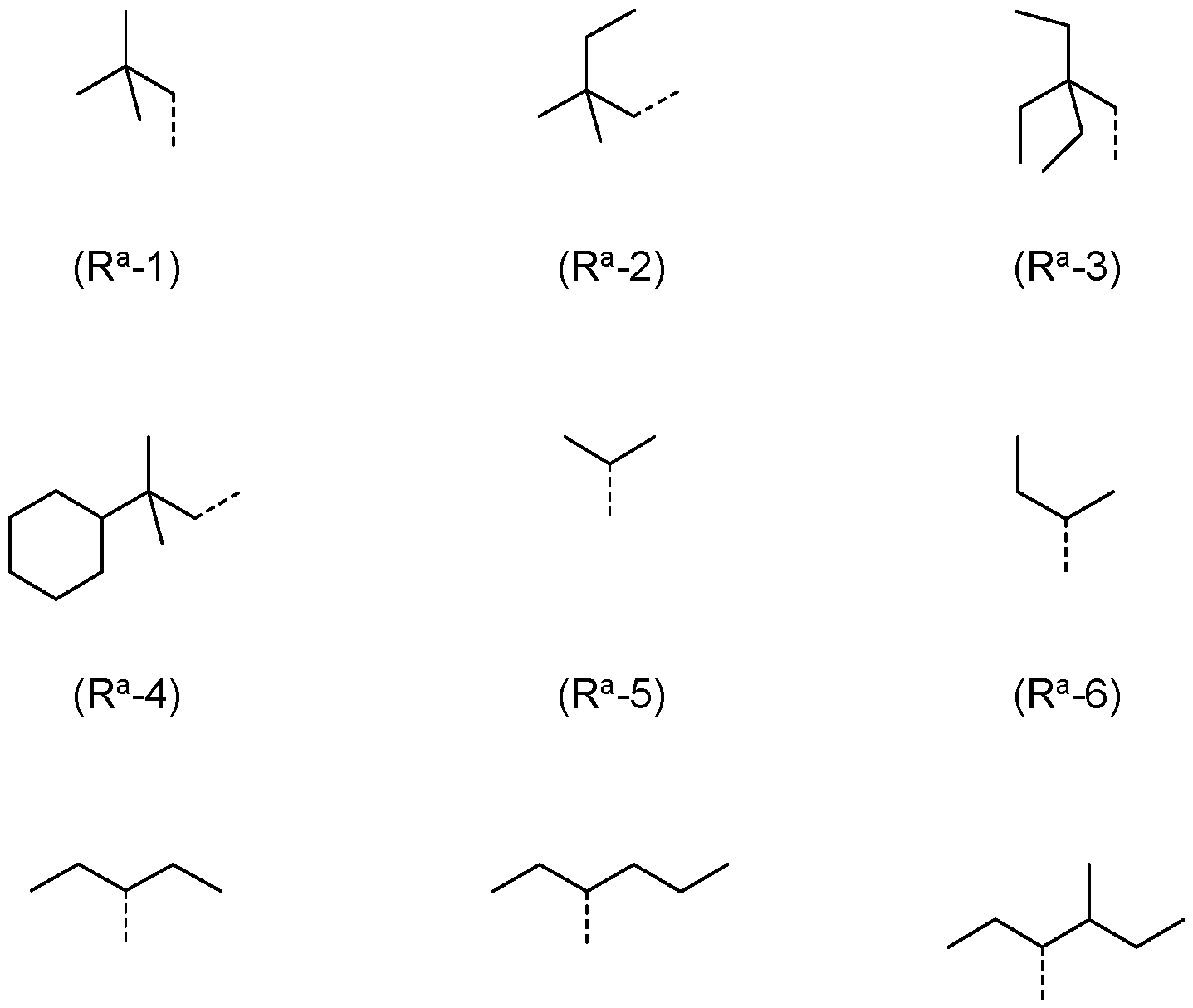
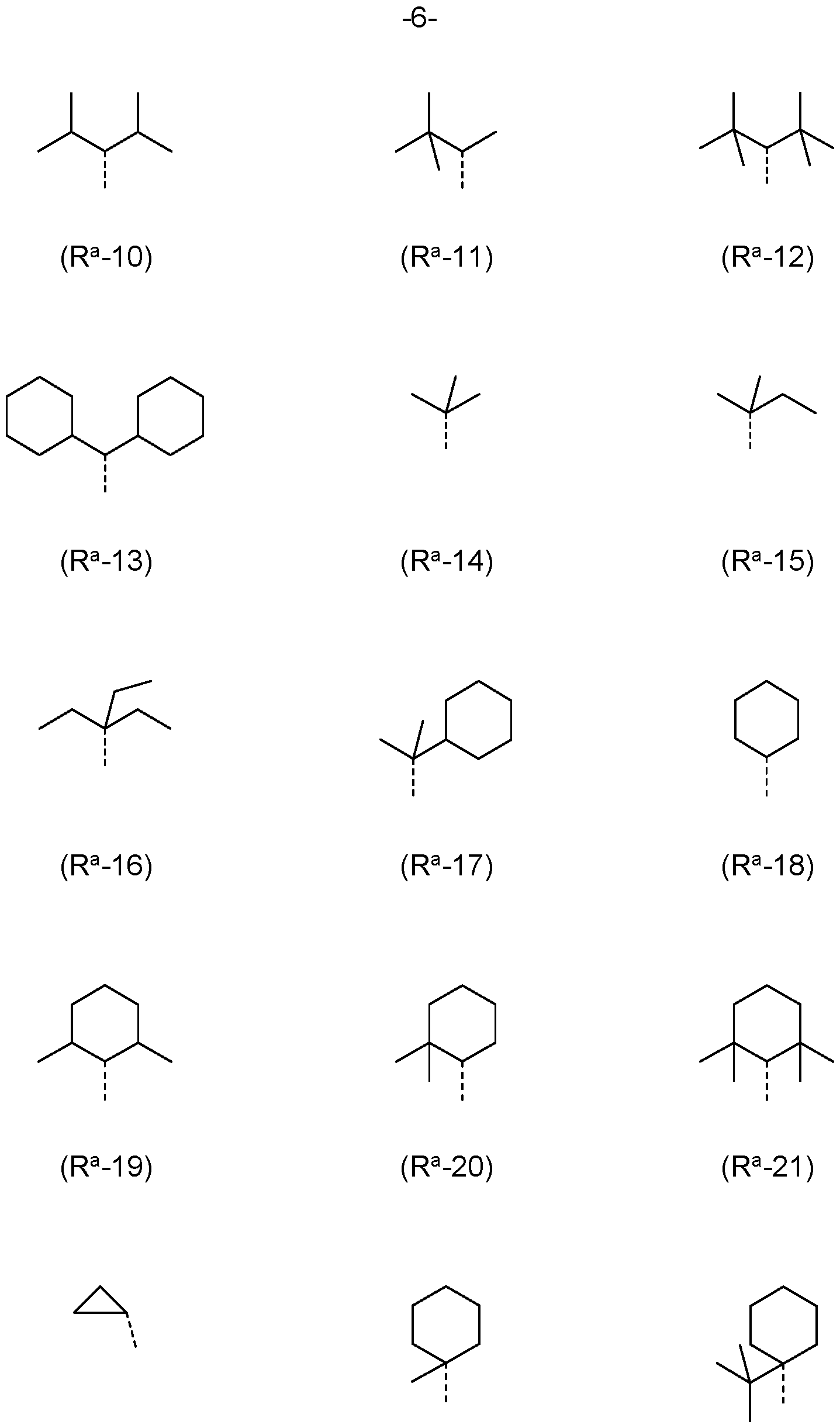
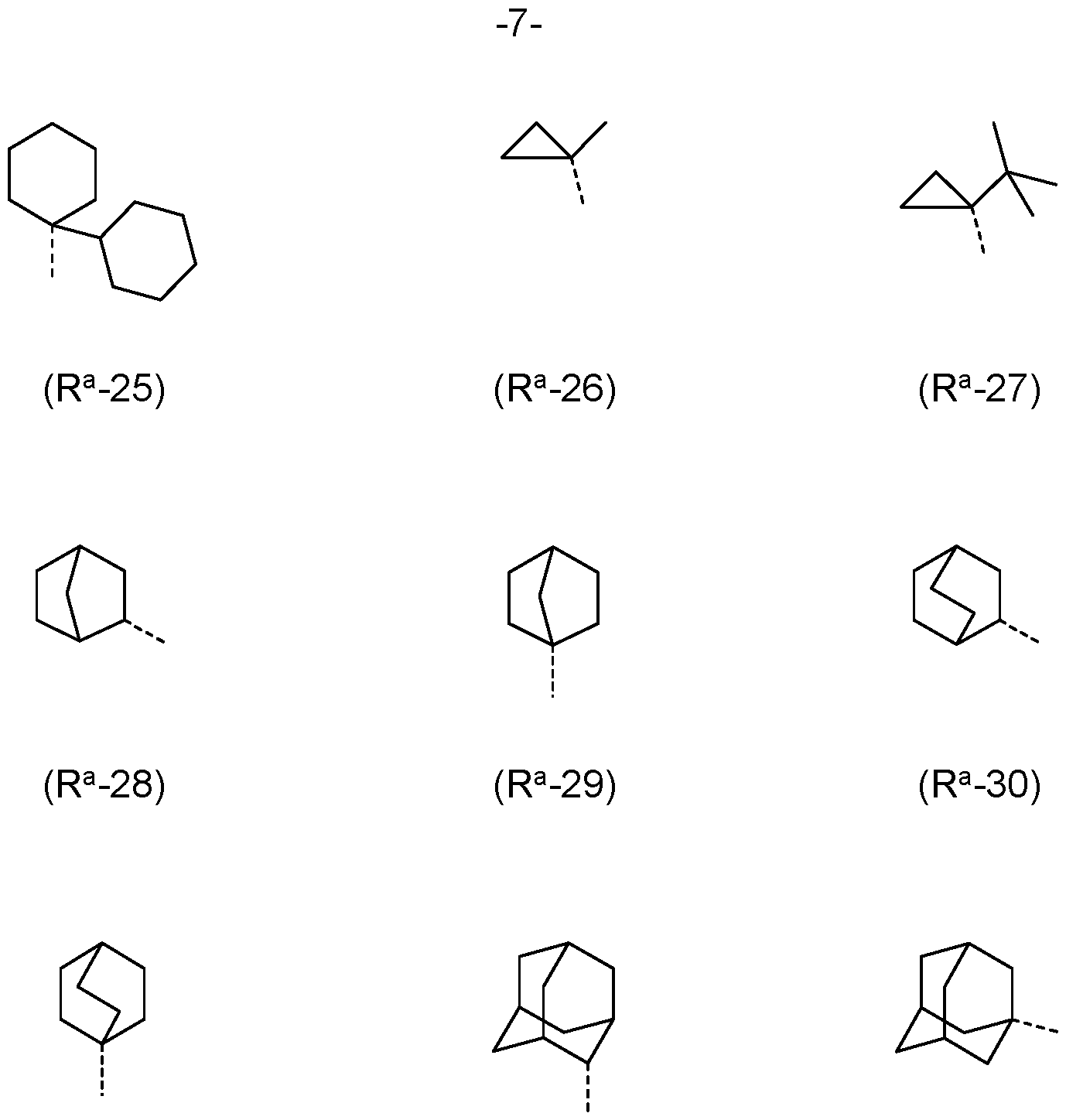
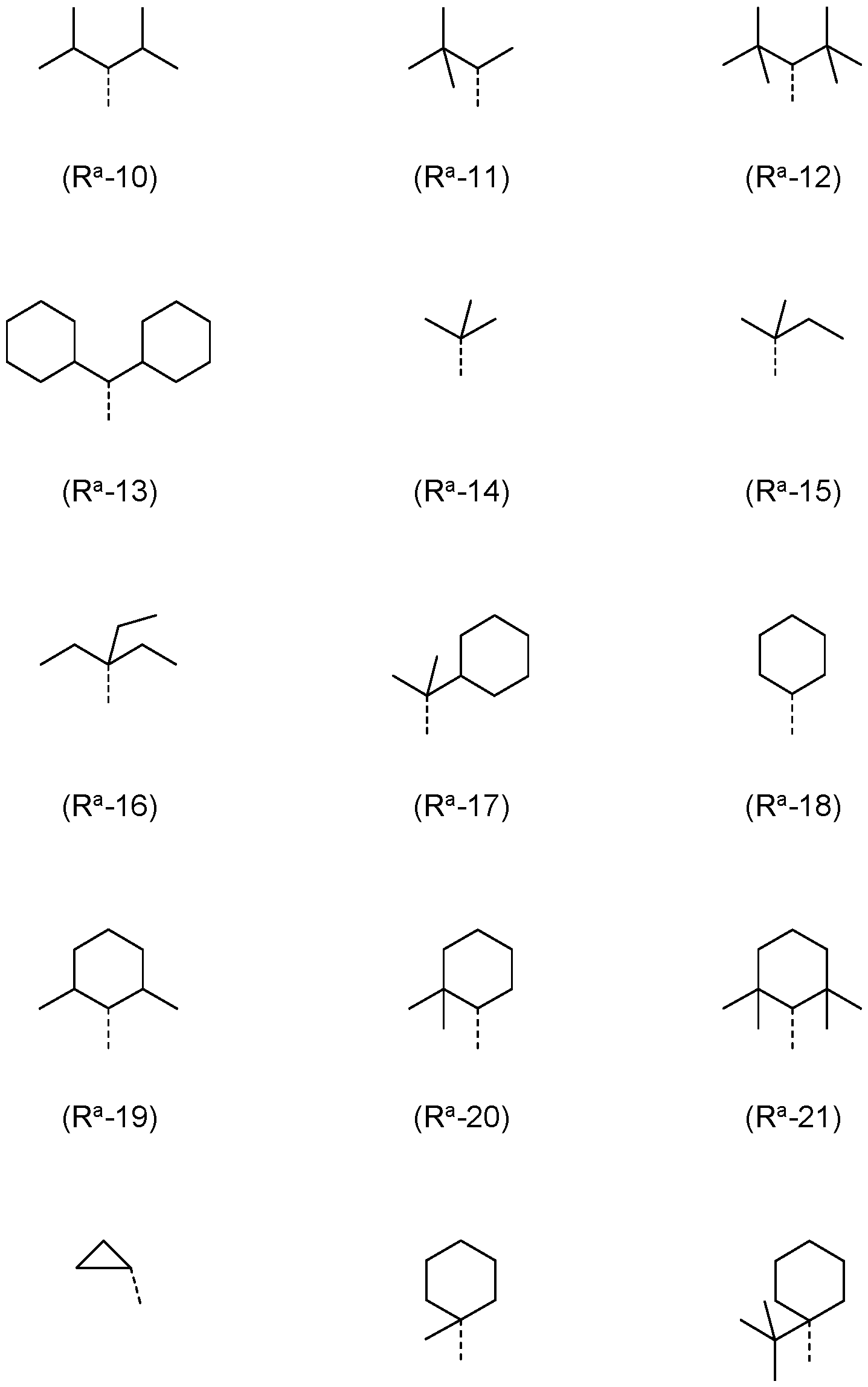
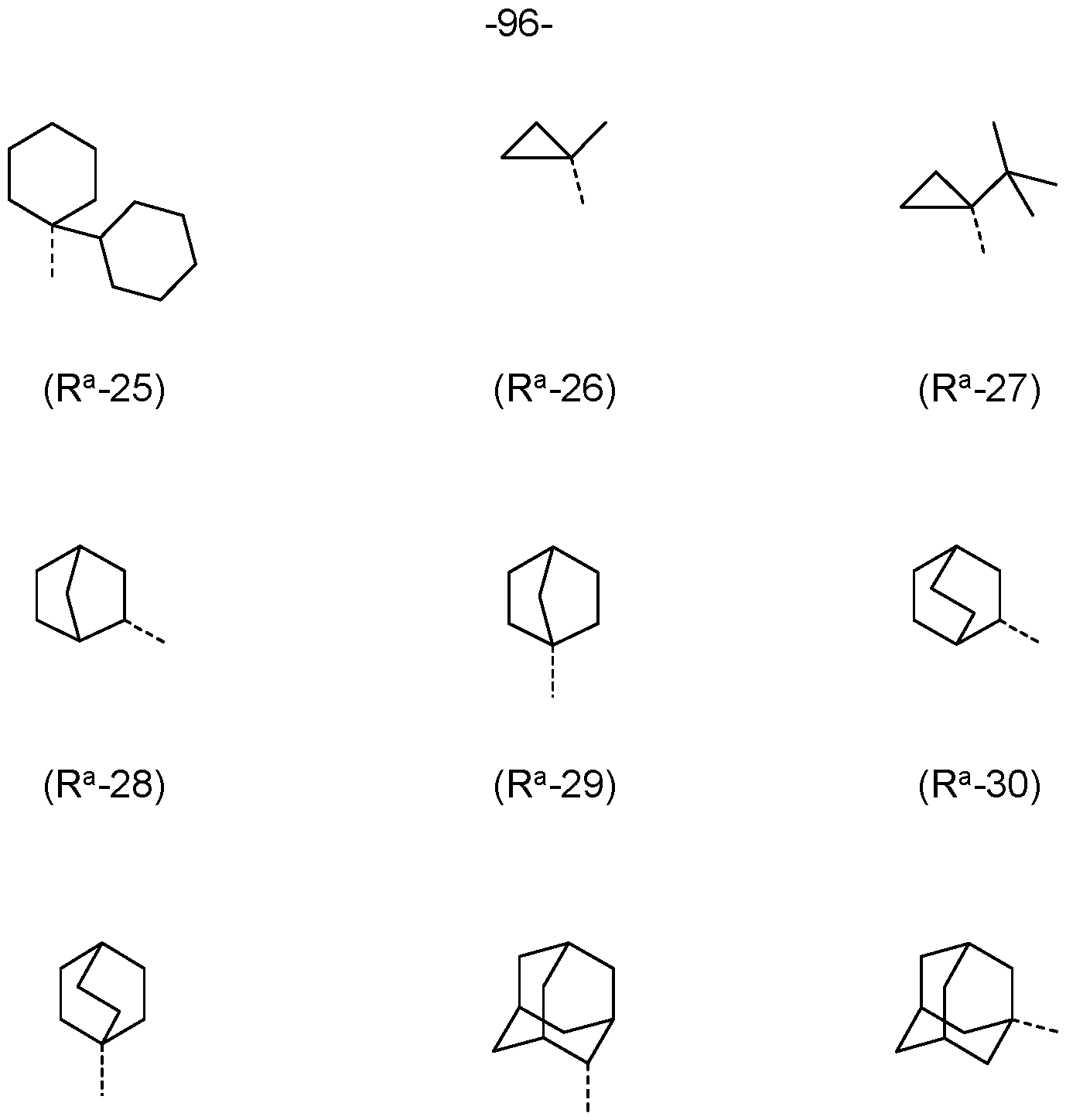
- R a , R b is the same or different at each instance and selected from (R a -1) to (R a -33):
- Ar®, Ar b is the same or different at each instance and is an aromatic or heteroaromatic ring system having 5 to 40 aromatic ring atoms, preferably 6 to 18 aromatic ring atoms, and is more preferably an aromatic ring system having 6 to 12 aromatic ring atoms or a heteroaromatic ring system having 5 to 12 aromatic ring atoms, each of which may be substituted by one or more R w , R x radicals, respectively, where R w , R x may have the definition given above, especially in Formulae (A).
- Ar a , Ar b groups are selected from the group consisting of phenyl, ortho-, meta- or para-biphenyl, terphenyl, especially branched terphenyl, quaterphenyl, especially branched quaterphenyl, 1-, 2-, 3- or 4-fluorenyl, 1-, 2-, 3- or 4-spirobifluorenyl, pyridyl, pyrimidinyl, 1-, 2-, 3- or 4- dibenzofuranyl, 1-, 2-, 3- or 4-dibenzothienyl and 1-, 2-, 3- or 4-carbazolyl, each of which may be substituted by one or more R w , R x radicals.
- the symbol Ar a , Ar b represents an aryl or heteroaryl radical, such that an aromatic or heteroaromatic group of an aromatic or heteroaromatic ring system is bonded directly, i.e. via an atom of the aromatic or heteroaromatic group, to the respective atom of the further group, for example the carbon, nitrogen or phosphorus atom of the R w , R x groups.
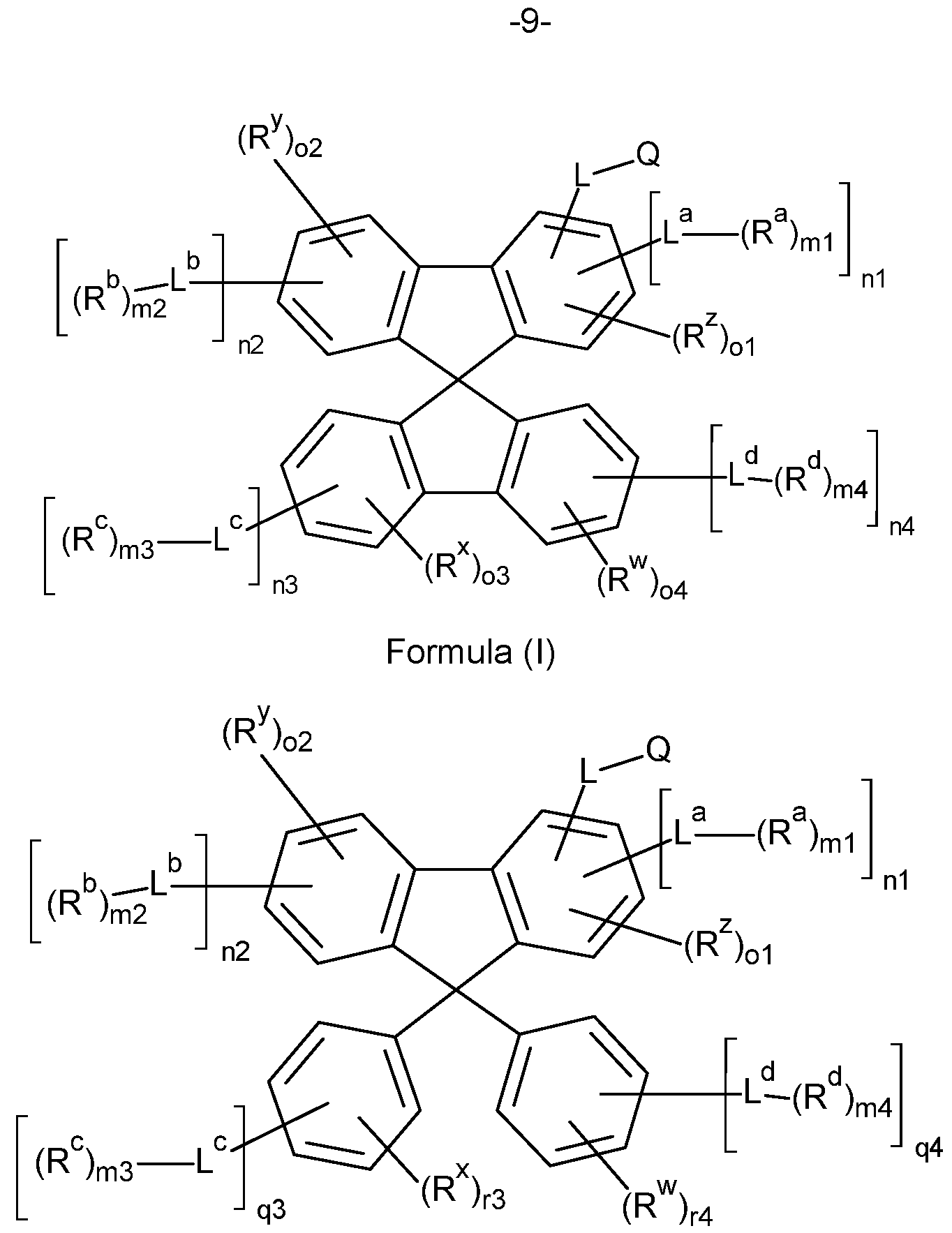
- the present invention therefore provides a compound comprising structures of the Formula (I) or Formula (II), more preferably a compound according to Formula (I) or Formula (II),
- Formula (II) in which the symbols Q, L, L a , L b , R, R w , R x , R y , R z , R a , R b , ml , m2, n1 , n2, o1 and o2 have the definition given above, especially for Formula (A) and
- R c , R d is the same or different at each instance and selected from (R a -1) to (R a -33) as given above, especially for Formula (A);
- m3, m4 is the same or different at each instance and is 0, 1 , 2, 3 or 4, preferably 1 , 2, 3 or 4, more preferably 1 or 2;
- n3, n4, o3, o4 is the same or different at each instance and is 0, 1 , 2, 3 or 4, preferably 0, 1 or 2;
- q3, q4, r3, r4 is the same or different at each instance and is 0, 1 , 2, 3, 4 or 5, preferably 0, 1 or 2;
- the sum of n3 + o3 is 0, 1 , 2, 3 or 4, preferably, 0, 1 or 2;
- the sum of n4 + o4 is 0, 1 , 2, 3 or 4, preferably, 0, 1 or 2;
- the sum of q3 + r3 is 0, 1 , 2, 3, 4 or 5, preferably, 0, 1 or 2;
- the indices ml , m2, m3, m4 may be 0.
- the corresponding residues R a , R b , R c , R d are H or D, preferably H.
- Adjacent carbon atoms in the context of the present invention are carbon atoms bonded directly to one another.
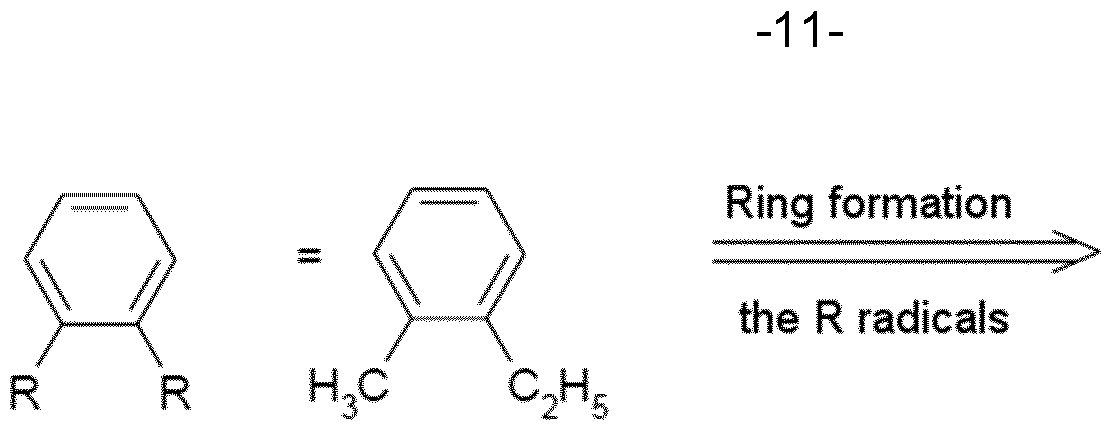
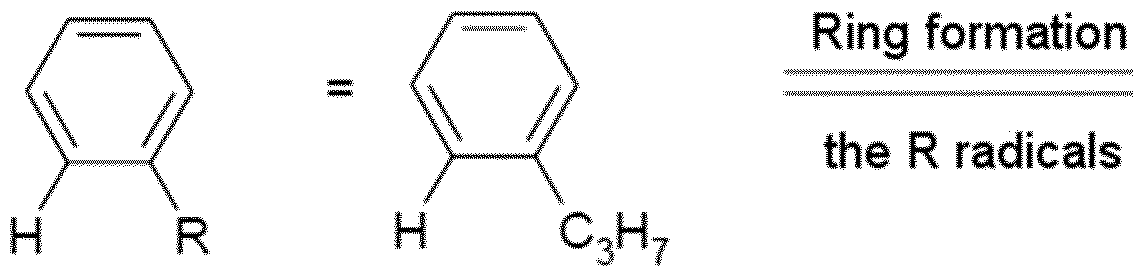
- "adjacent radicals" in the definition of the radicals means that these radicals are bonded to the same carbon atom or to adjacent carbon atoms.
- a fused aryl group in the context of the present invention is a group in which two or more aromatic groups are fused, i.e. annealed, to one another along a common edge, such that, for example, two carbon atoms belong to the at least two aromatic or heteroaromatic rings, as, for example, in naphthalene.
- fluorene is not a fused aryl group in the context of the present invention, since the two aromatic groups in fluorene do not have a common edge.
- An aryl group in the context of this invention contains 6 to 40 carbon atoms, preferably 6 to 24 C atoms; a heteroaryl group in the context of this invention contains 2 to 40 carbon atoms, preferably 2 to 24 C atoms and at least one heteroatom, with the proviso that the total sum of carbon atoms and heteroatoms is at least 5.
- the heteroatoms are preferably selected from N, O and/or S.
- An aryl group or heteroaryl group is understood here to mean either a simple aromatic cycle, i.e.
- benzene or a simple heteroaromatic cycle, for example pyridine, pyrimidine, thiophene, etc., or a fused aryl or heteroaryl group, for example naphthalene, anthracene, phenanthrene, quinoline, isoquinoline, etc.
- An aromatic ring system in the context of this invention contains 6 to 40 carbon atoms in the ring system.
- a heteroaromatic ring system in the context of this invention contains 1 to 40 carbon atoms and at least one heteroatom in the ring system, with the proviso that the total sum of carbon atoms and heteroatoms is at least 5.
- the heteroatoms are preferably selected from N, O and/or S.
- An aromatic or heteroaromatic ring system in the context of this invention shall be understood to mean a system which does not necessarily contain only aryl or heteroaryl groups, but in which it is also possible for two or more aryl or heteroaryl groups to be interrupted by a nonaromatic unit (preferably less than 10% of the atoms other than H), for example a carbon, nitrogen or oxygen atom or a carbonyl group.
- a nonaromatic unit preferably less than 10% of the atoms other than H
- systems such as 9,9’-spirobifluorene, 9,9-diarylfluorene, triarylamine, diaryl ethers, stilbene, etc.
- aryl groups shall also be regarded as aromatic ring systems in the context of this invention, and likewise systems in which two or more aryl groups are interrupted, for example, by a linear or cyclic alkyl group or by a silyl group.
- systems in which two or more aryl or heteroaryl groups are bonded directly to one another for example biphenyl, terphenyl, quaterphenyl or bipyridine, shall likewise be regarded as an aromatic or heteroaromatic ring system.
- a cyclic alkyl, alkoxy or thioalkoxy group in the context of this invention is understood to mean a monocyclic, bicyclic or polycyclic group.
- a Ci - to C2o-alkyl group in which individual hydrogen atoms or CH2 groups may also be substituted by the abovementioned groups is understood to mean, for example, the methyl, ethyl, n-propyl, i-propyl, cyclopropyl, n-butyl, i-butyl, s-butyl, t-butyl, cyclobutyl, 2-methylbutyl, n-pentyl, s-pentyl, t-pentyl, 2-pentyl, neopentyl, cyclopentyl, n-hexyl, s-hexyl, t-hexyl, 2-hexyl, 3-hexyl, neohexyl, cyclohexyl, 1 -methylcyclopentyl, 2-methylpentyl, n-heptyl, 2-heptyl,
- alkenyl group is understood to mean, for example, ethenyl, propenyl, butenyl, pentenyl, cyclopentenyl, hexenyl, cyclohexenyl, heptenyl, cycloheptenyl, octenyl, cyclooctenyl or cyclooctadienyl.
- An alkynyl group is understood to mean, for example, ethynyl, propynyl, butynyl, pentynyl, hexynyl, heptynyl or octynyl.
- Ci- to C4o-alkoxy group is understood to mean, for example, methoxy, trifluoromethoxy, ethoxy, n-propoxy, i-propoxy, n-butoxy, i- butoxy, s-butoxy, t-butoxy or 2-methylbutoxy.
- An aromatic or heteroaromatic ring system which has 5-40 aromatic ring atoms and may also be substituted in each case by the abovementioned radicals and which may be joined to the aromatic or heteroaromatic system via any desired positions is understood to mean, for example, groups derived from benzene, naphthalene, anthracene, benzanthracene, phenanthrene, benzophenanthrene, pyrene, chrysene, perylene, fluoranthene, benzofluoranthene, naphthacene, pentacene, benzopyrene, biphenyl, biphenylene, terphenyl, terphenylene, fluorene, spirobifluorene, dihydrophenanthrene, dihydropyrene, tetrahydropyrene, cis- or trans- indenofluorene, cis- or trans-monobenzoindenofluorene, cis
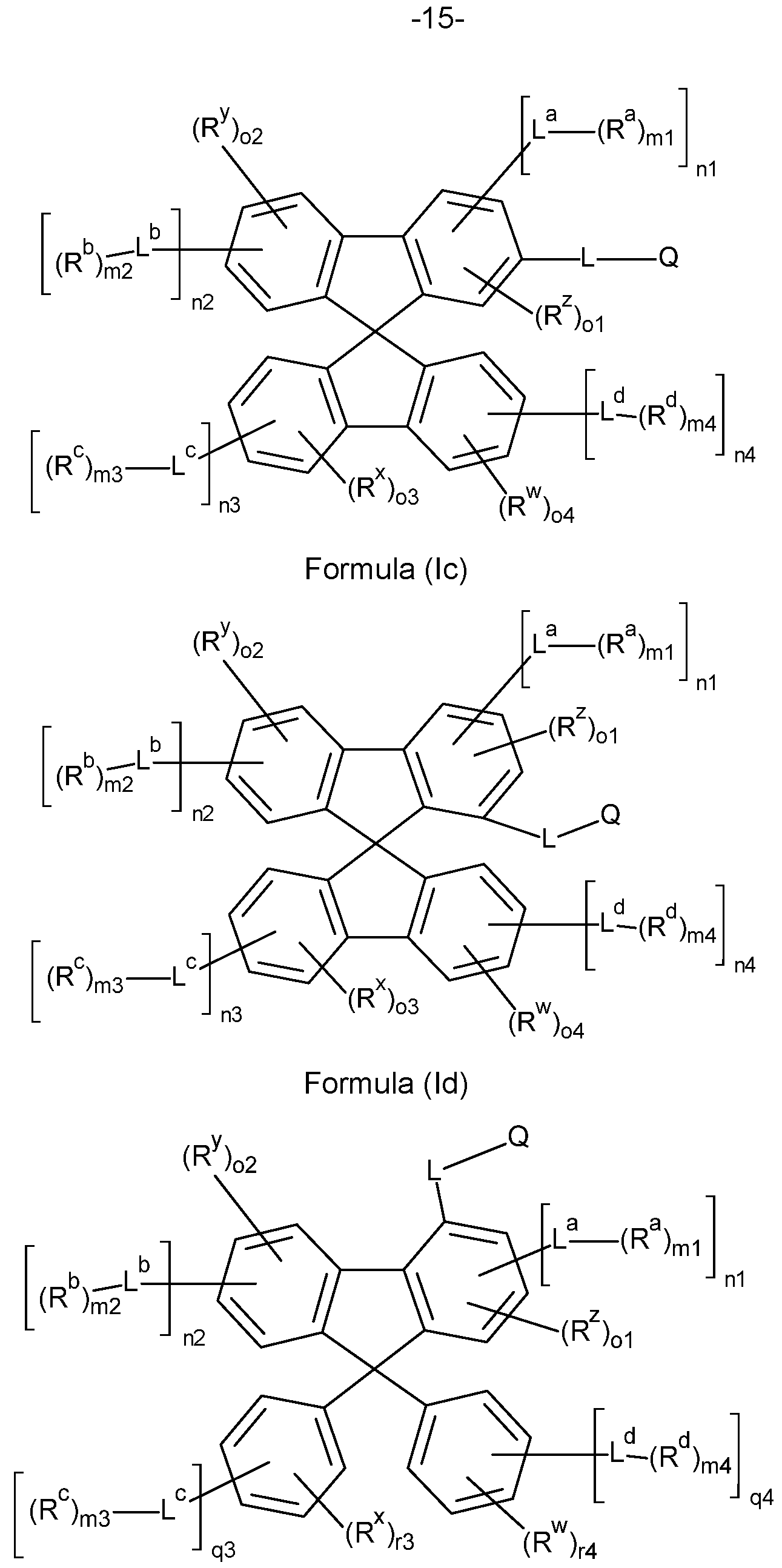
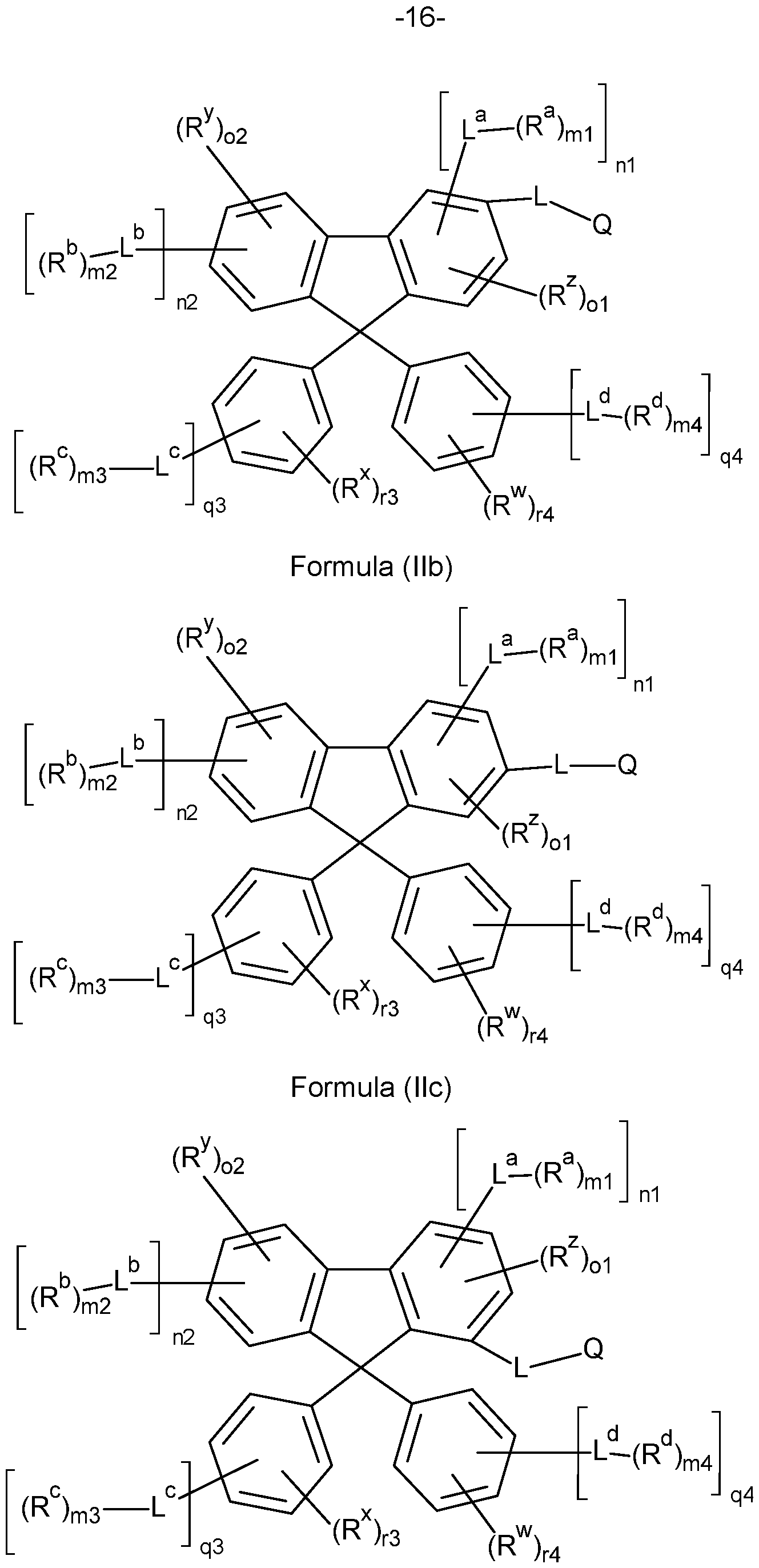
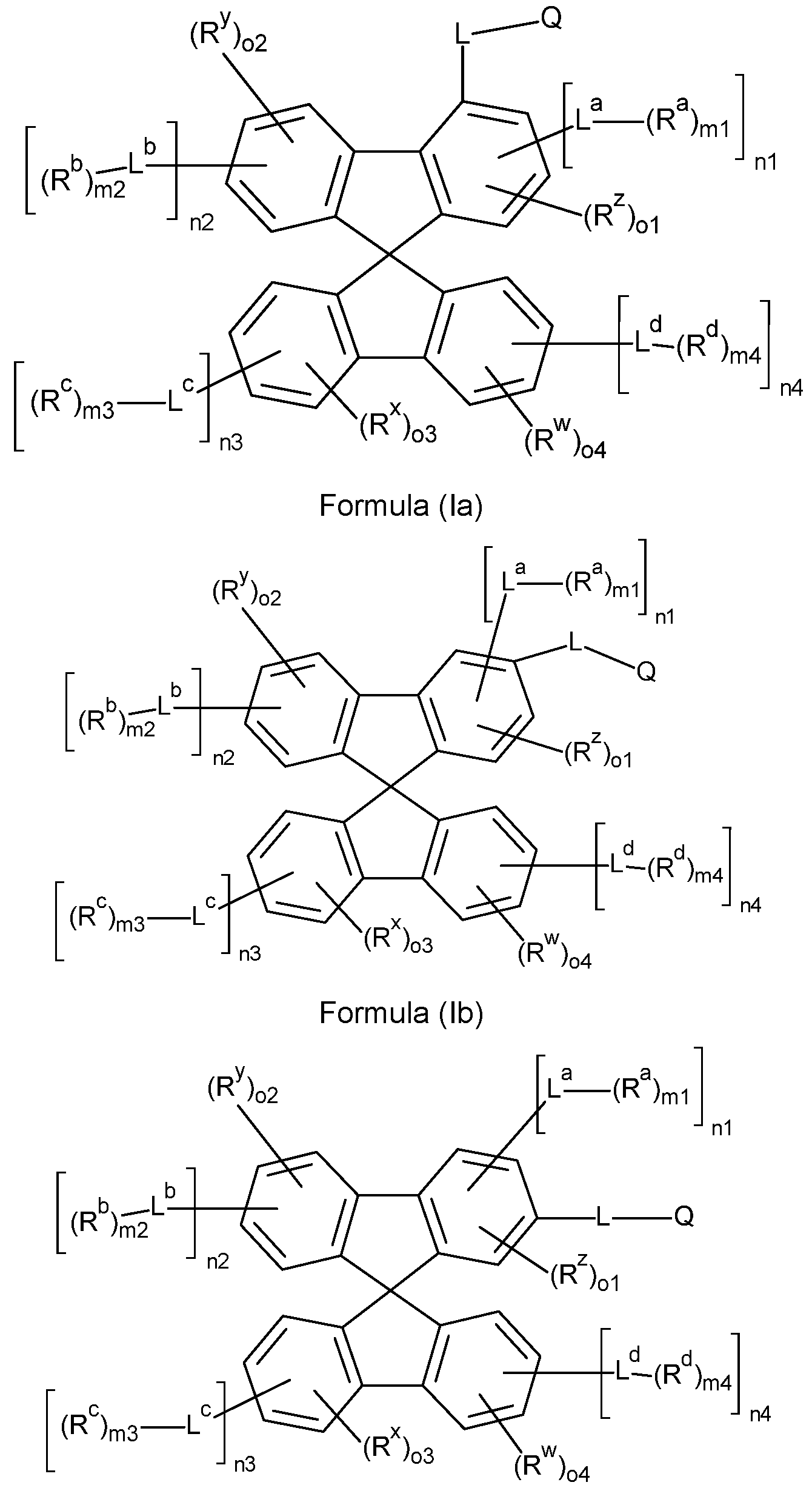
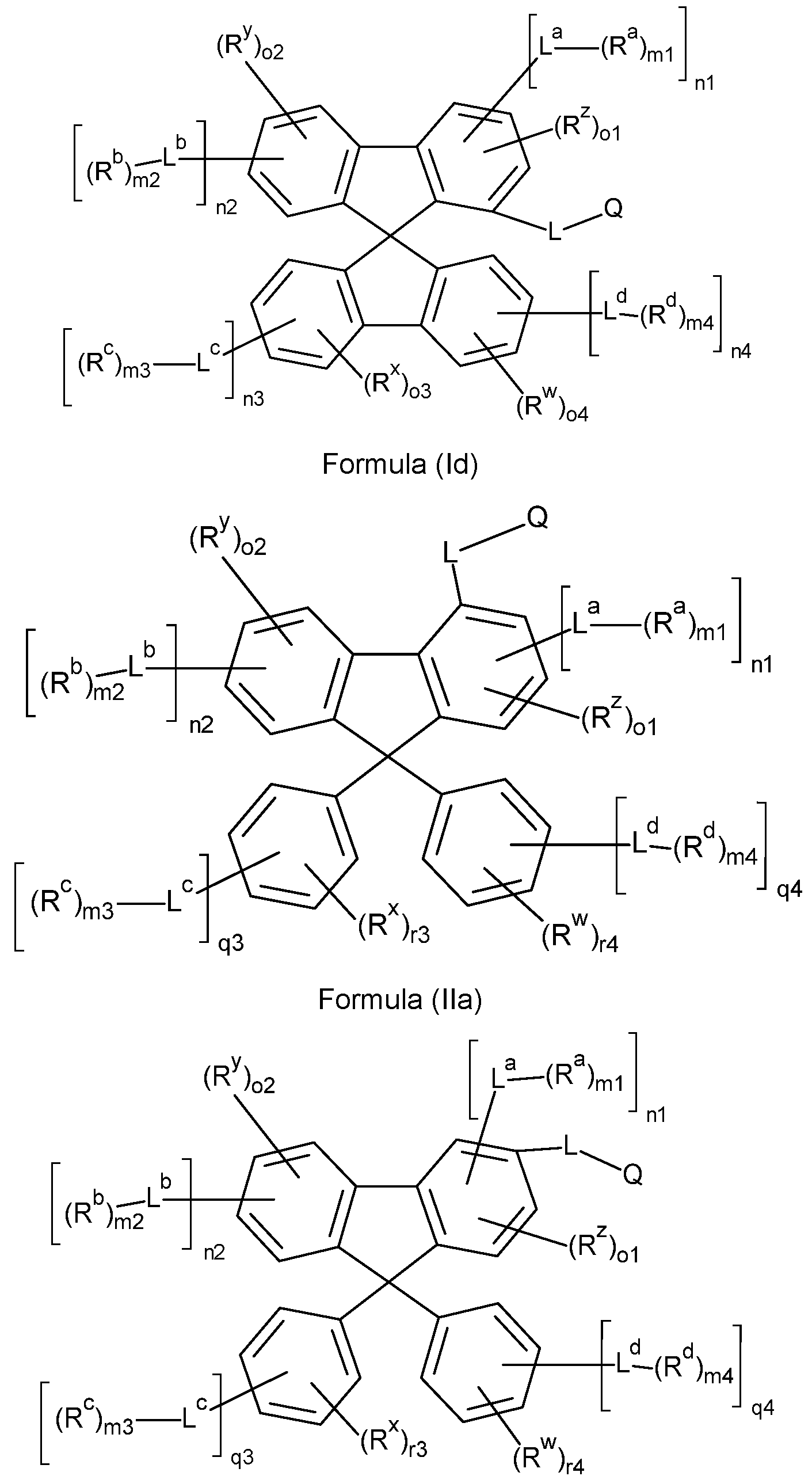
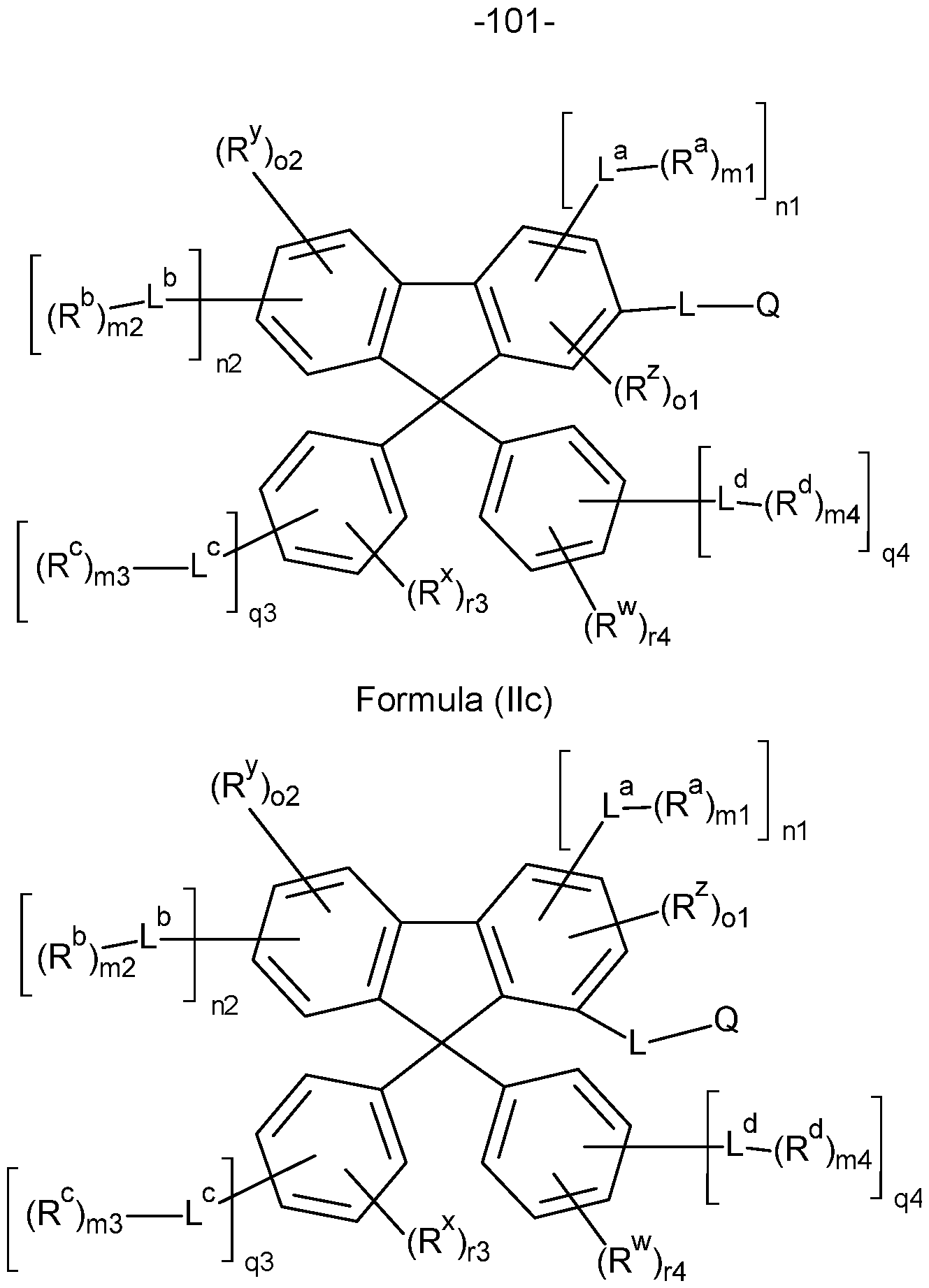
- the compounds of the invention comprise at least one of the structures of the Formulae (la), (lb), (Ic), (Id), (Ila), (lib), (He) and/or (lid), preferably the compounds of the invention are a compound according to Formulae (la), (lb), (Ic), (Id), (Ila), (lib), (He) and/or (Hd),
- the Structures (la) and (lc) are especially preferred.
- the ring system could be a mono- or polycyclic, aliphatic, heteroaliphatic, aromatic or heteroaromatic ring system, preferably a mono- or polycyclic, aliphatic or aromatic ring system.
- radicals R, R w , R x , Ry, R z do not form a fused ring system with the ring atoms of the fluorene structure.
- the radicals R, R w , R x , Ry, R z do not form a ring system with the ring atoms of the fluorene structure.
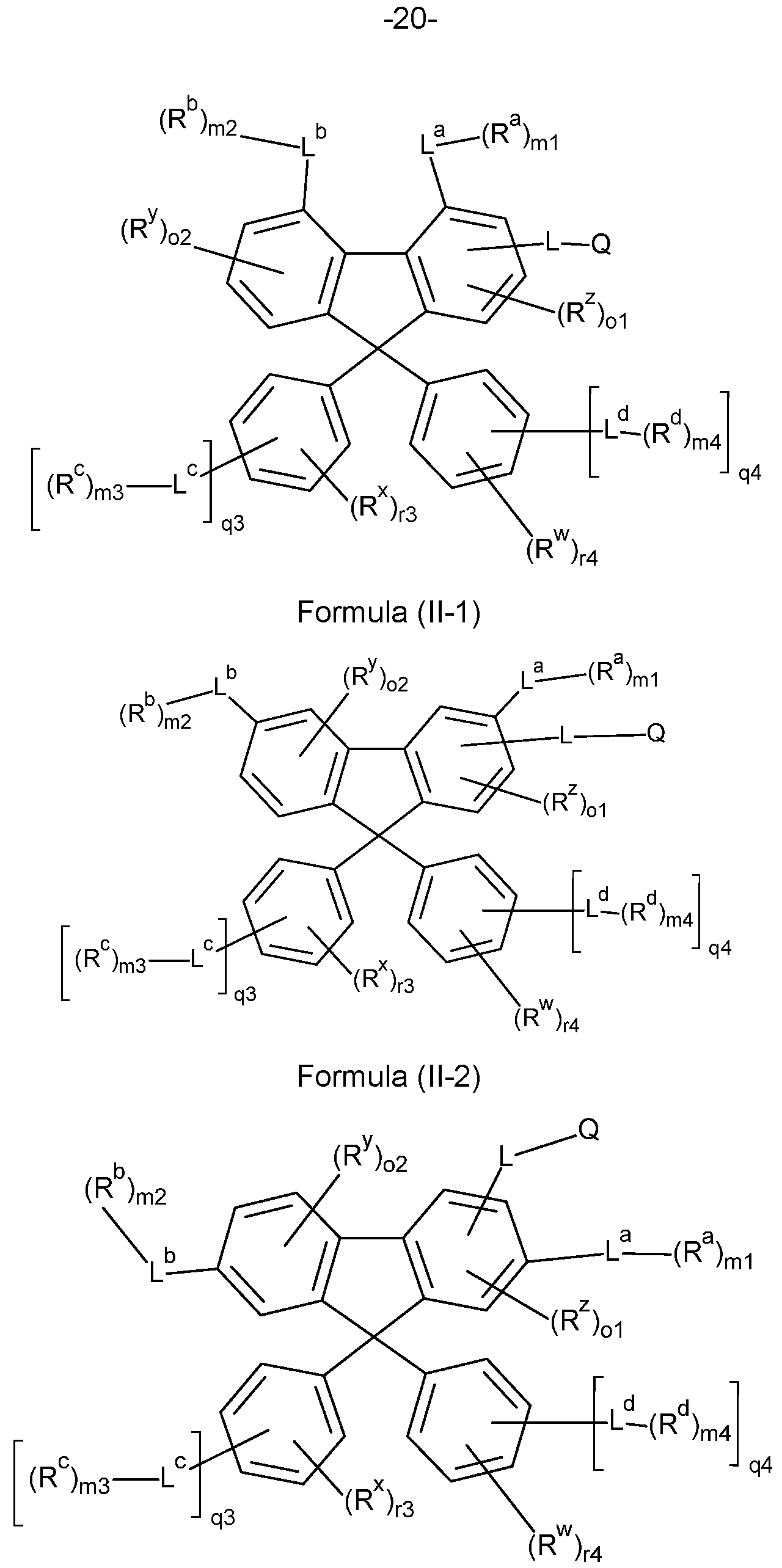
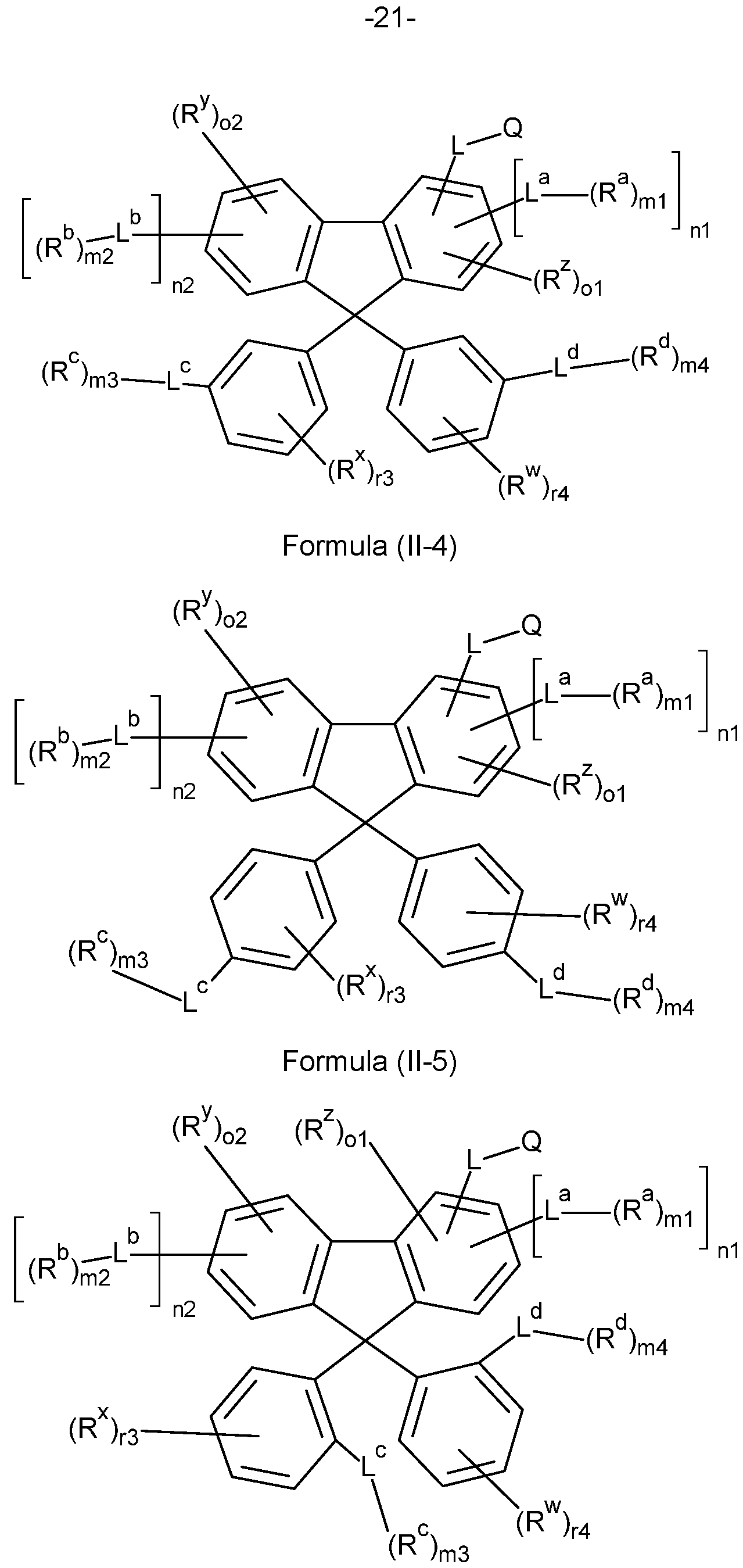
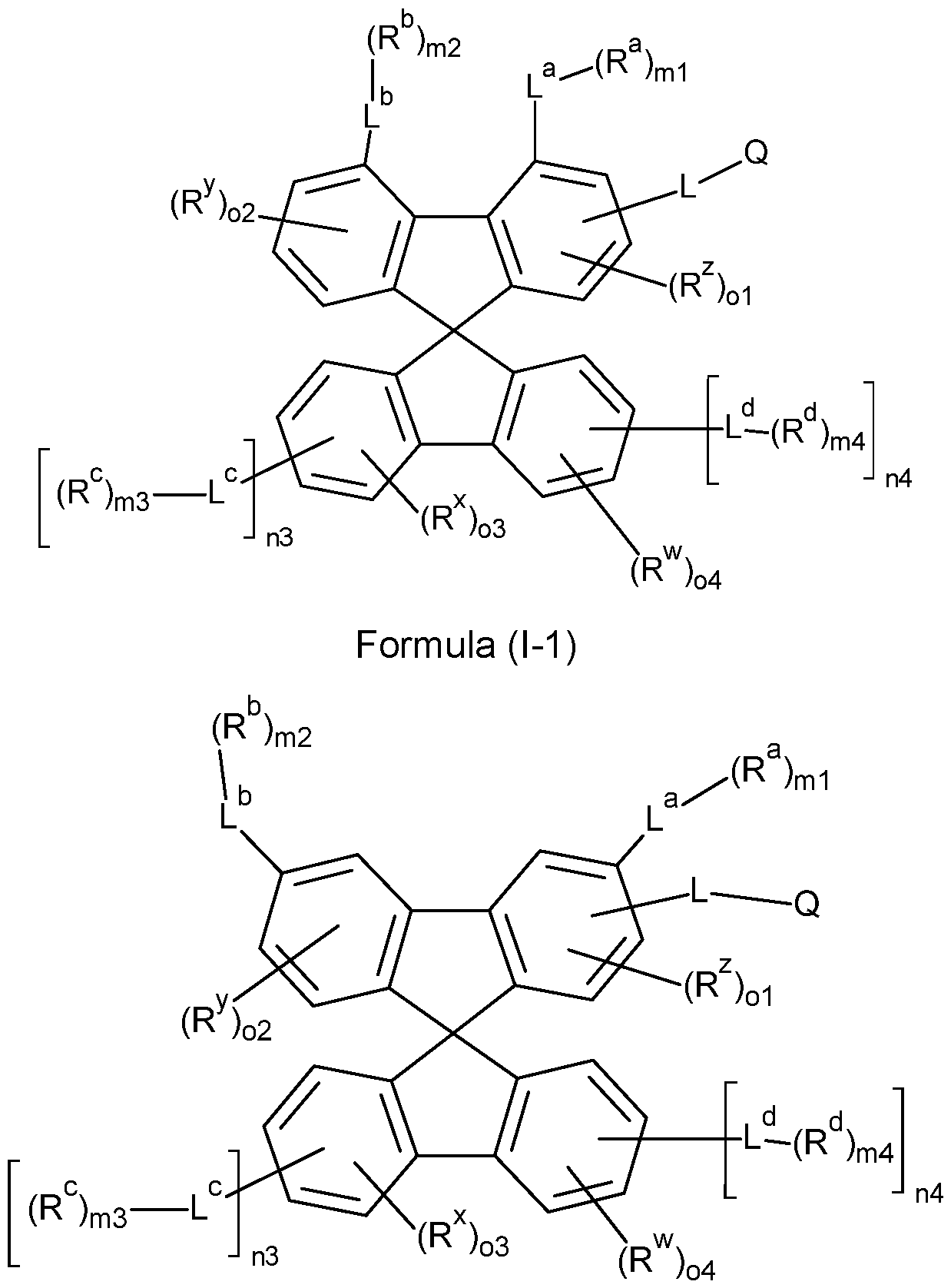
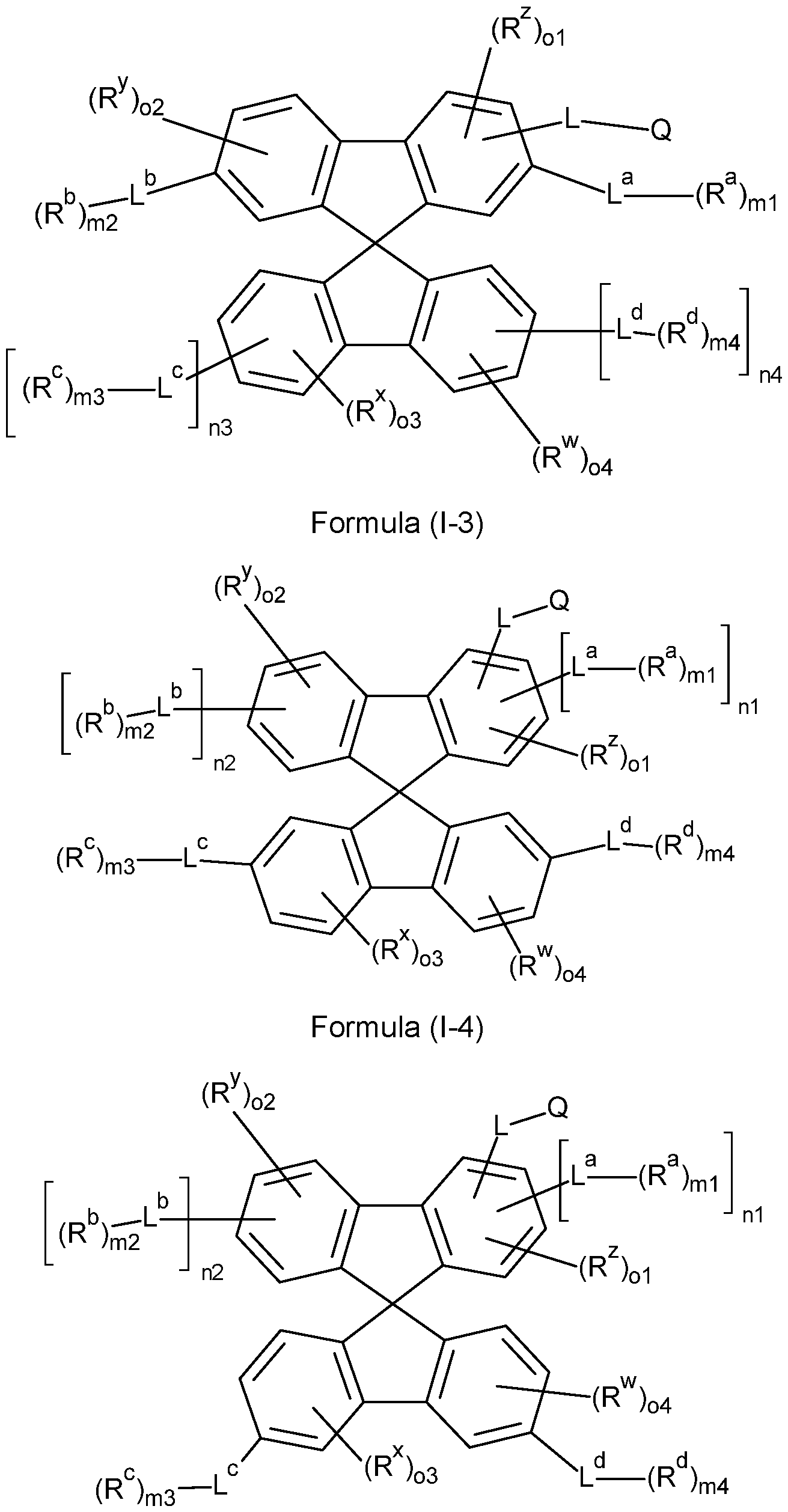
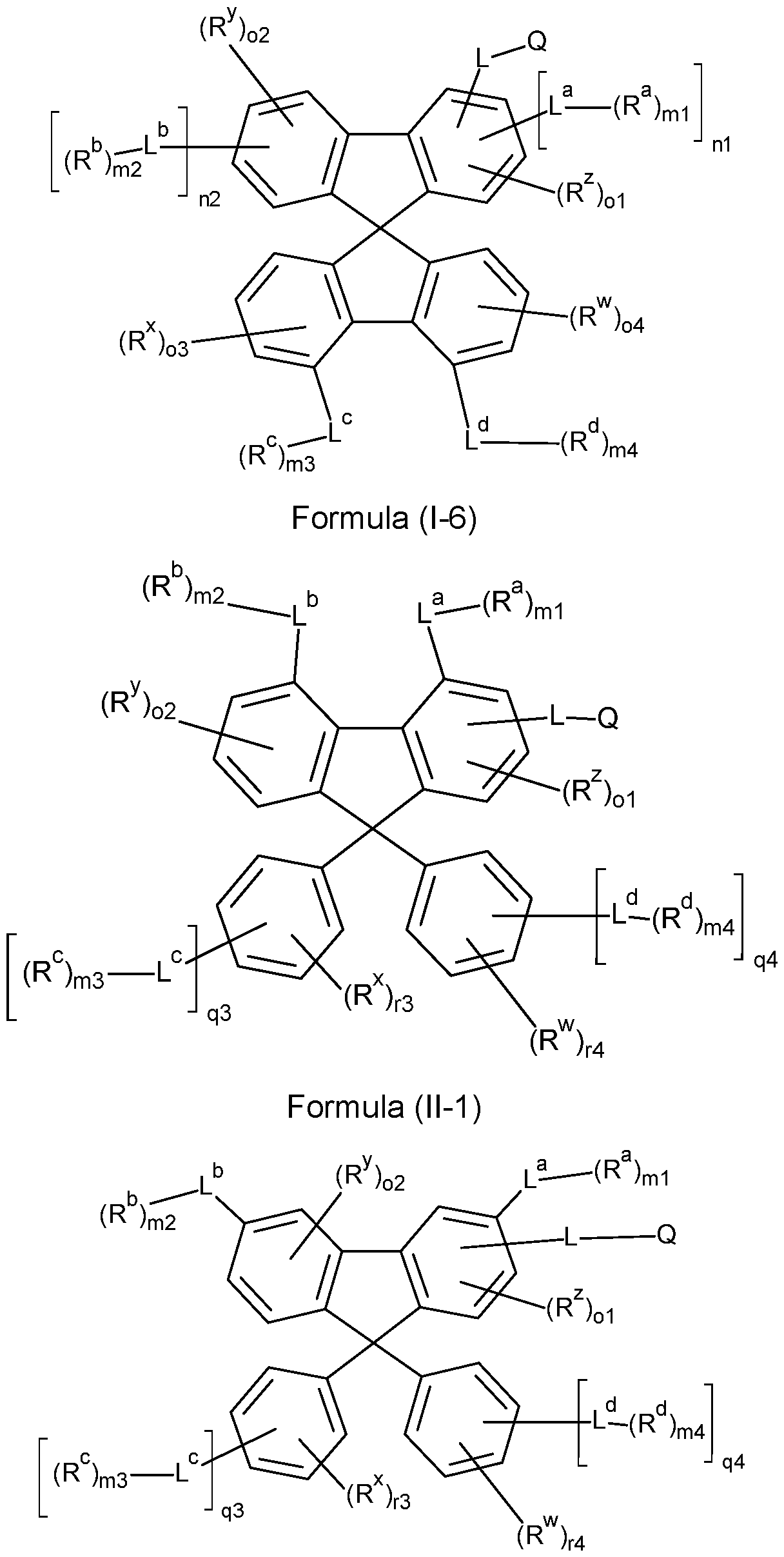
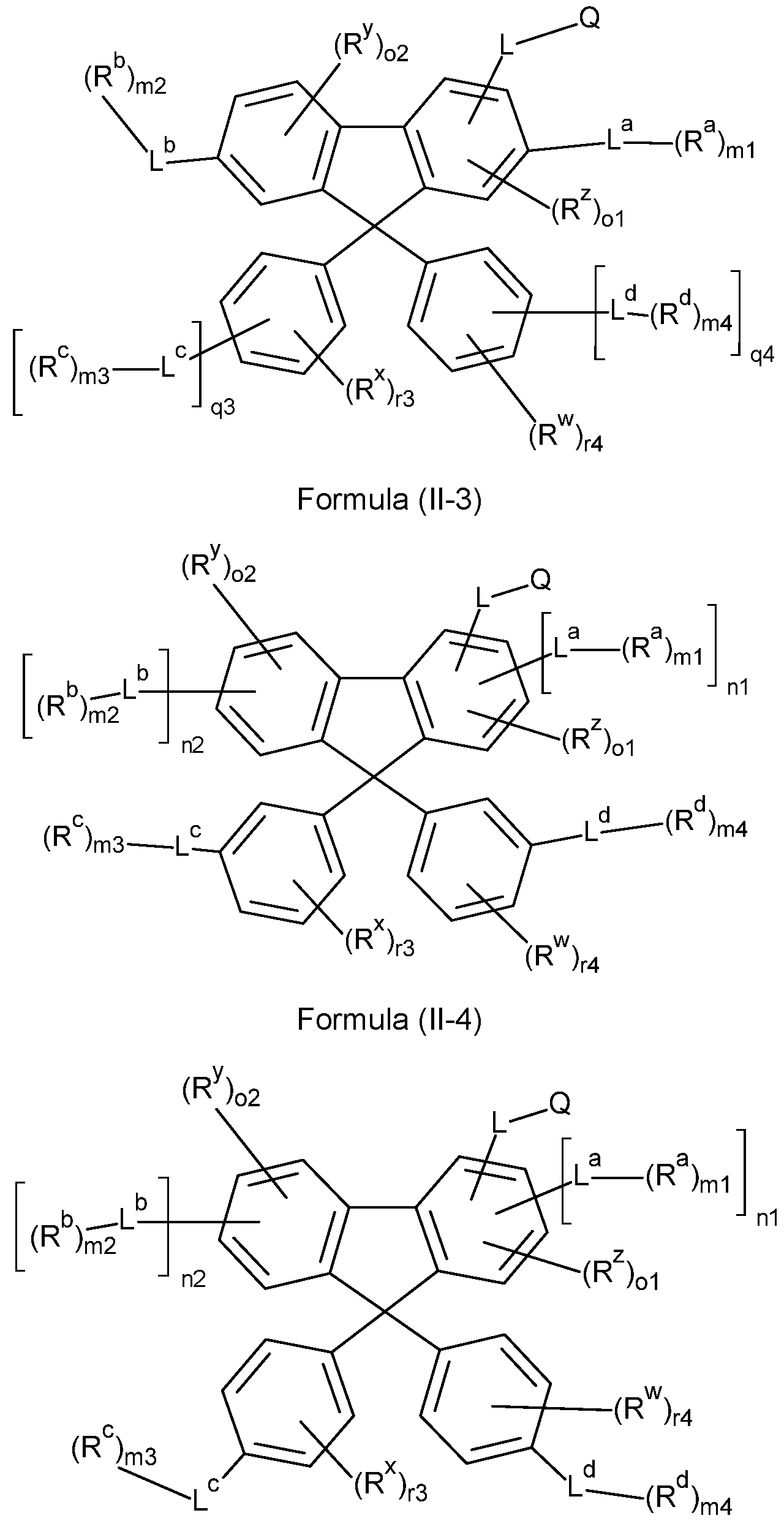
- the compounds of the invention comprise at least one of the structures of the Formulae (1-1 ), (I-2), (I-3), (I- 4), (I-5), (I-6), (11-1 ), (II-2), (II-3), (II-4), (II-5) and/or (II-6), preferably the compounds of the invention are a compound according to Formulae (1-1 ), (I-2), (I-3), (I-4), (I-5), (I-6), (11-1 ), (II-2), (II-3), (II-4), (II-5) and/or (II-6),
- the Structures (I-3) and (I-4) are especially preferred.
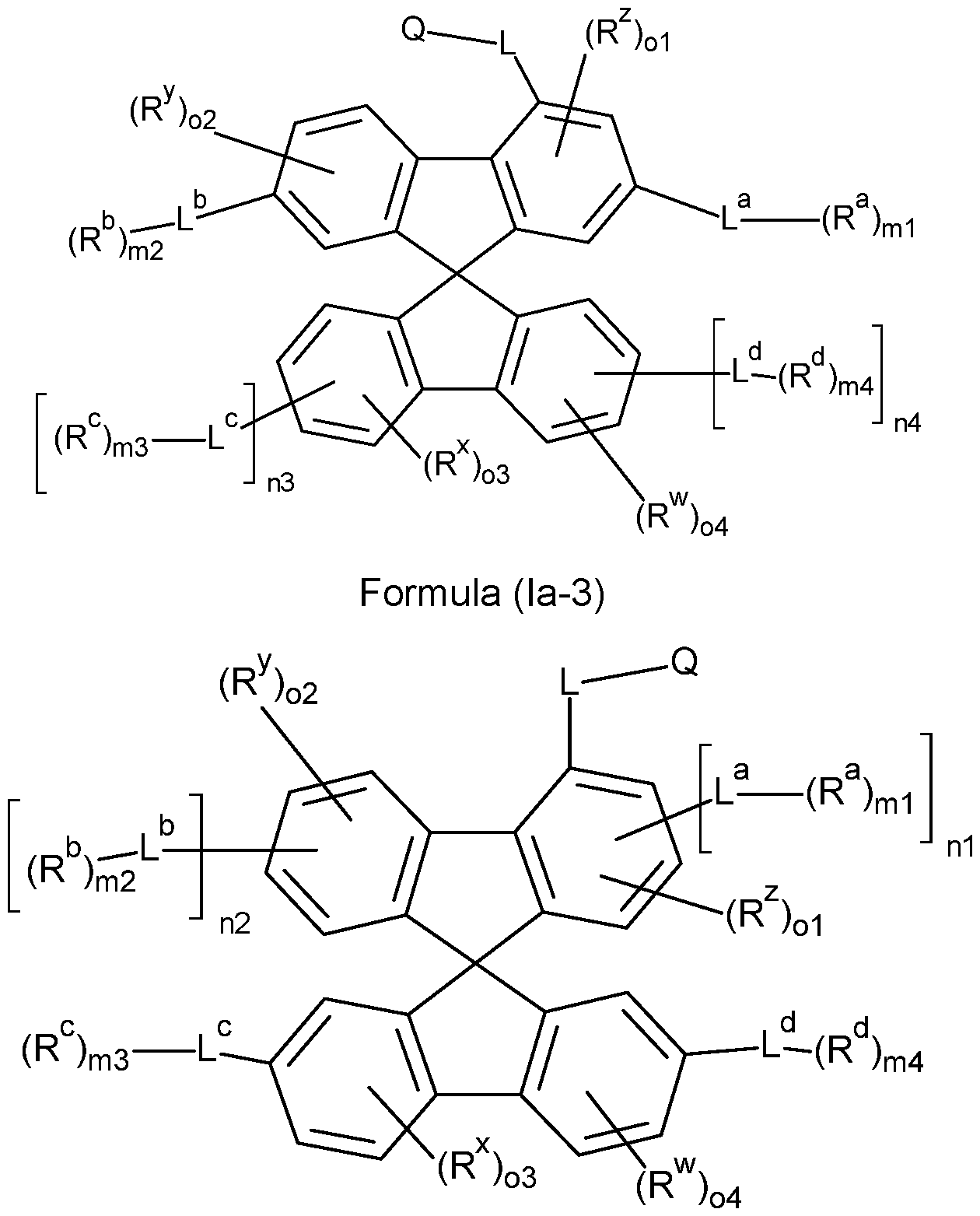
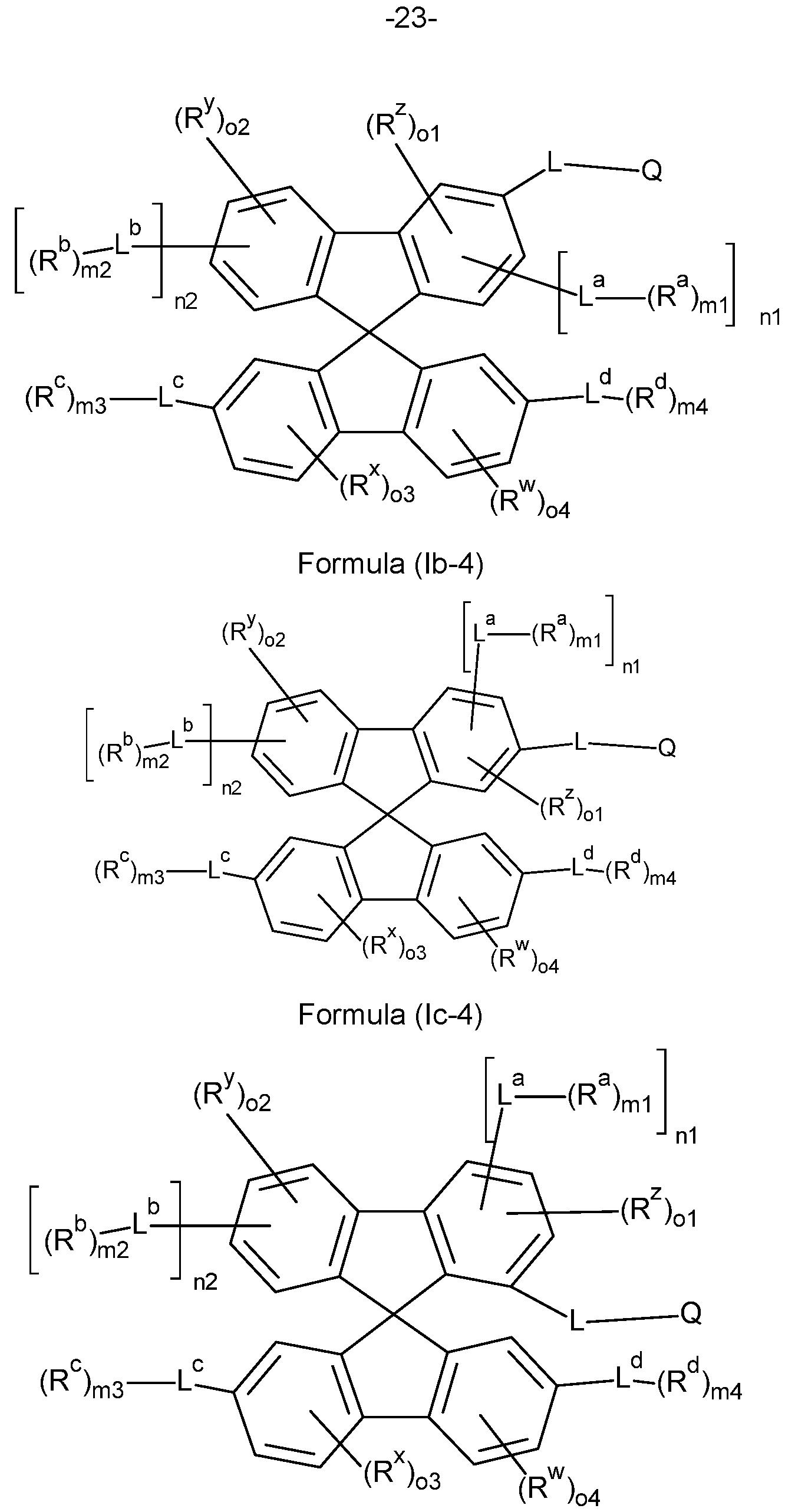
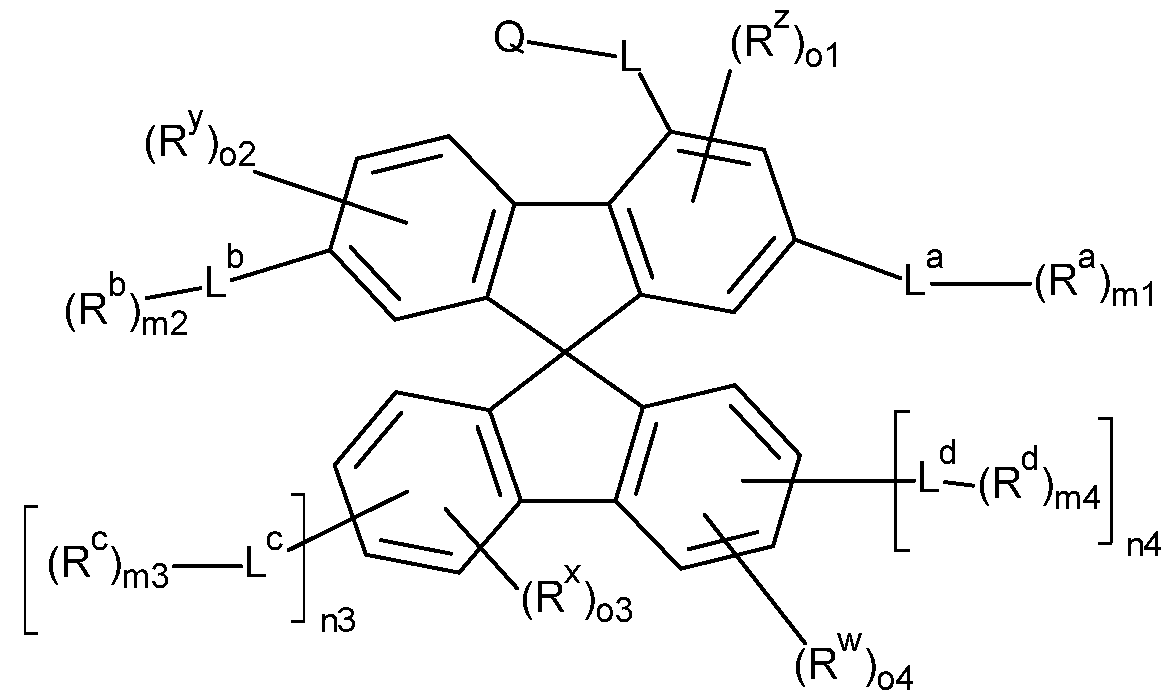
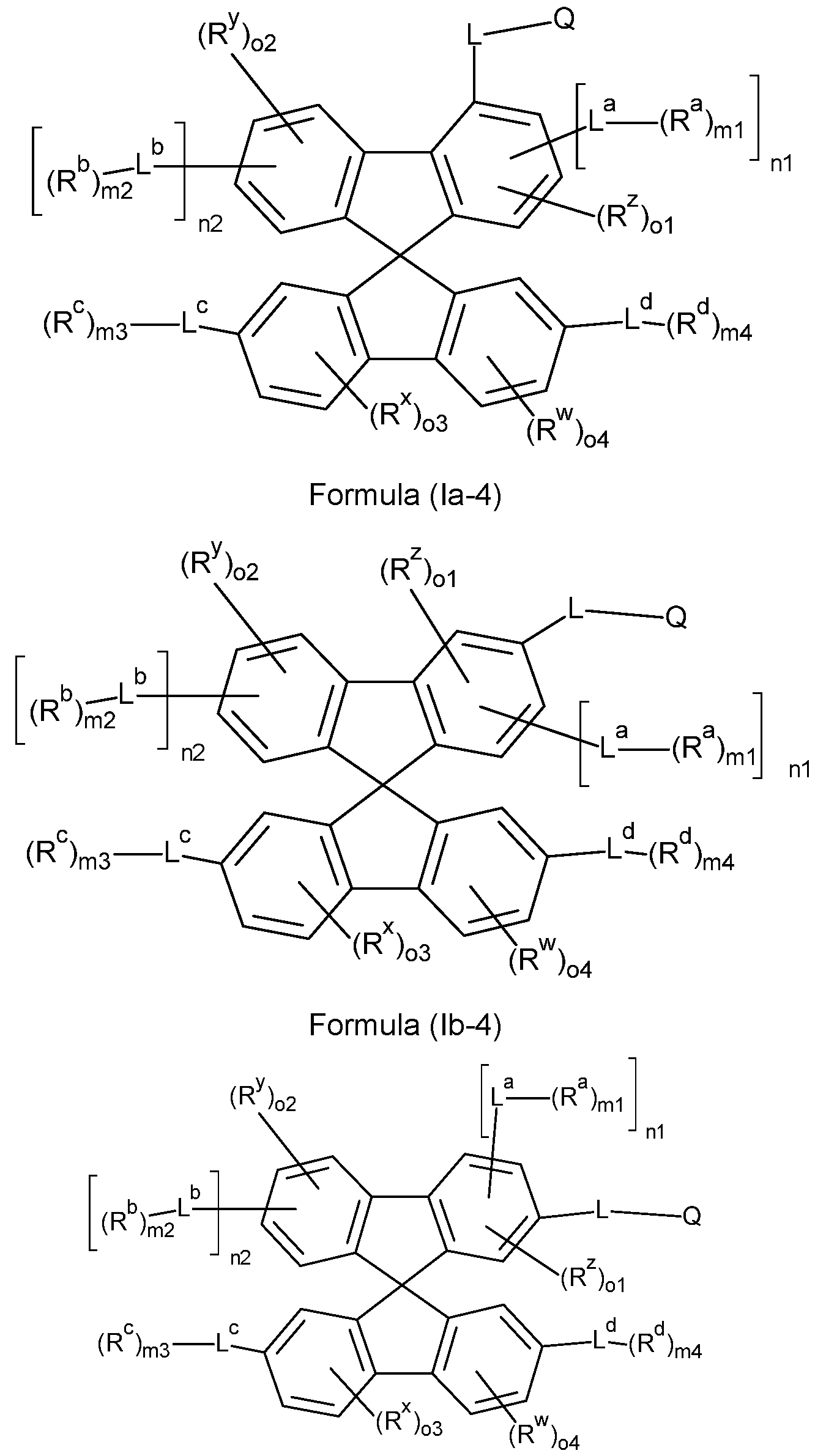
- the compounds of the invention comprise at least one of the structures of the Formulae (la-3), (la-4), (lb-4), (lc-4) and/or (Id-4), preferably the compounds of the invention are a compound according to Formulae (la-3), (la-4), (lb-4), (lc-4) and/or (Id-4),
- compounds comprising structures of Formulae (A), (I), (II), (la) to (Id), (Ila) to (lid), (1-1 ), (I-2), (I-3), (I-4), (I-5), (I-6), (11-1 ), (II-2), (II-3), (II-4), (II-5), (II-6), (la-3), (la-4), (lb-4), (lc-4) and/or (Id-4) can be represented by structures of Formulae (A), (I), (II), (la) to (Id), (Ila) to (lid), (1-1 ), (I-2), (I-3), (I-4), (I-5), (I-6), (11-1 ), (II-2), (II-3), (II-4), (II-5), (II-6), (la-3), (la-4), (lb-4), (lc-4) and/or (Id-4).
- compounds comprising structures of Formulae (A), (I), (II), (la) to (Id), (Ila) to (lid), (1-1 ), (I-2), (I-3), (I-4), (I-5), (I-6), (11-1 ), (II-2), (II-3), (II-4), (II-5), (II-6), (la-3), (la-4), (lb-4), (lc-4) and/or (Id-4) have a molecular weight of not more than 5000 g/mol, preferably not more than 4000 g/mol, particularly preferably not more than 3000 g/mol, especially preferably not more than 2000 g/mol and most preferably not more than 1200 g/mol.
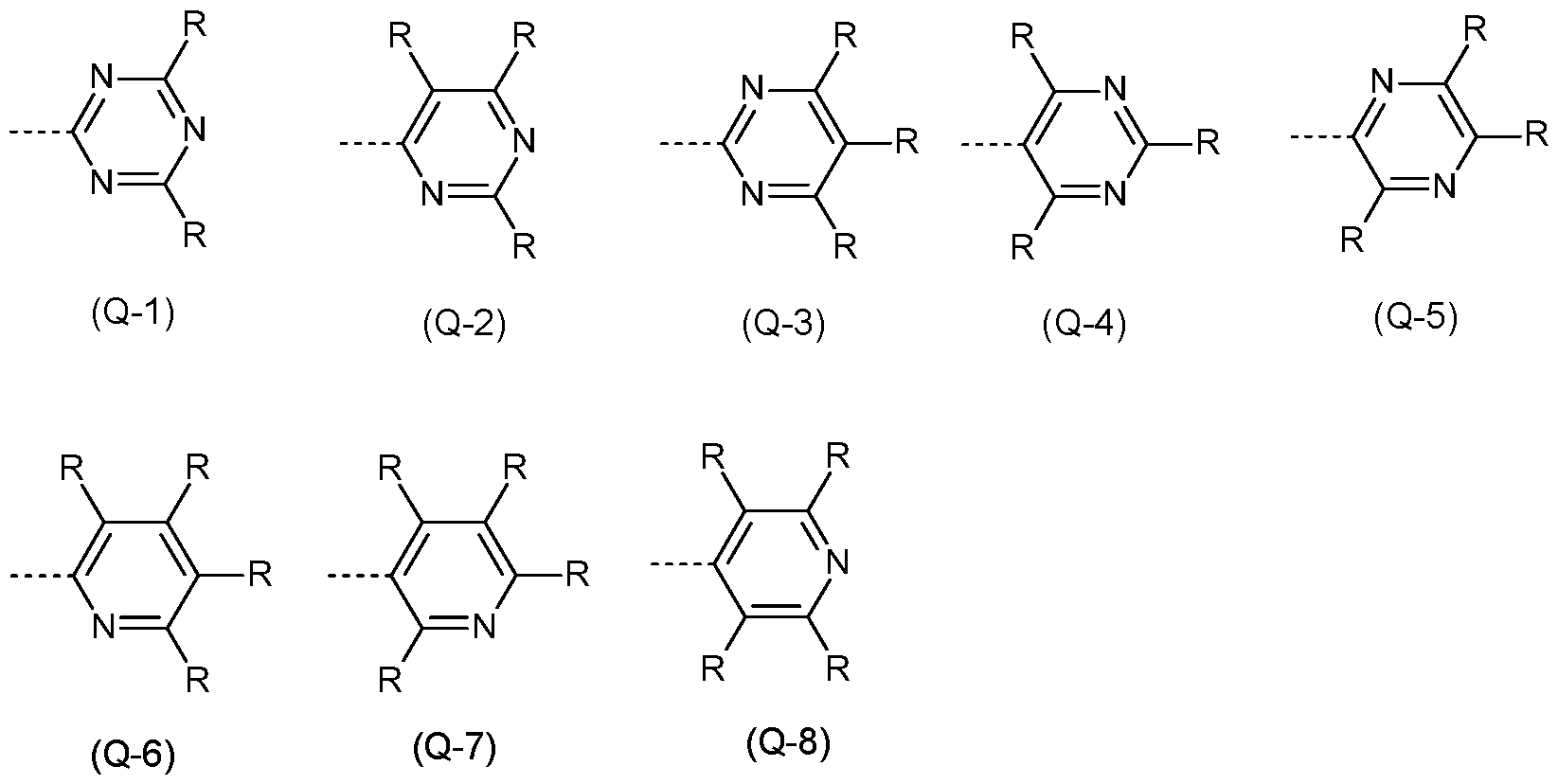
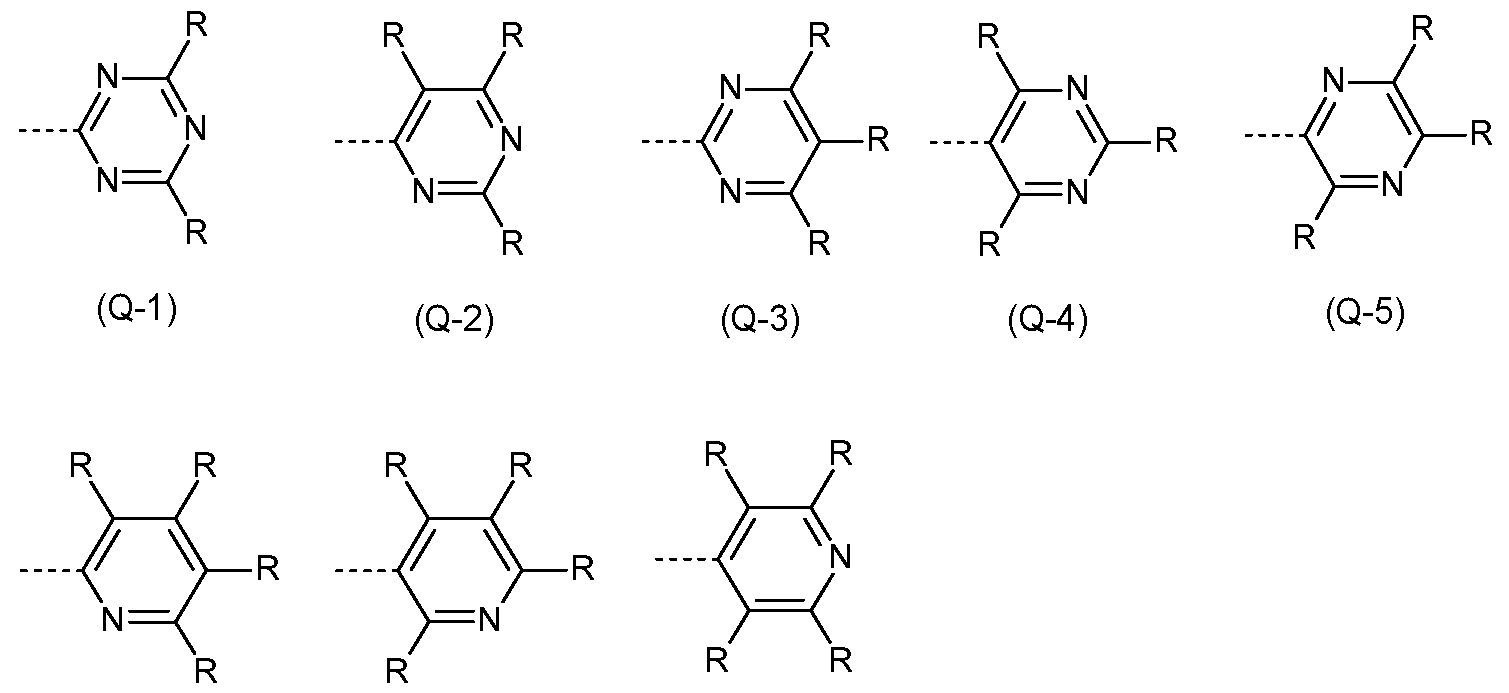
- the Q group is an electron-transporting group. Electron-transporting groups are widely known in the technical field and promote the ability of compounds to transport and/or conduct electrons. Moreover, the Q group comprises at least one structure selected from the group of pyridines, pyrimidines, pyrazines, pyridazines, triazines, quinazolines, quinoxalines, quinolines, isoquinolines, imidazoles and/or benzimidazoles. Preferably, the Q group is a pyridine group, a pyrimidine group, or a triazine group, more preferably a triazine group, which may be substituted by one or more radicals R.
- the Q group is selected from the structures of the Formulae (Q-1 ), (Q-2), (Q-3), (Q-4), (Q-5), (Q-6), (Q-7) and/or (Q-8) where the symbol R has the definition given above, especially for Formulae (A), the dotted bond marks the attachment position.
- the structures (Q-1 ) to (Q-5) are preferred and the structure (Q-1 ) is especially preferred.
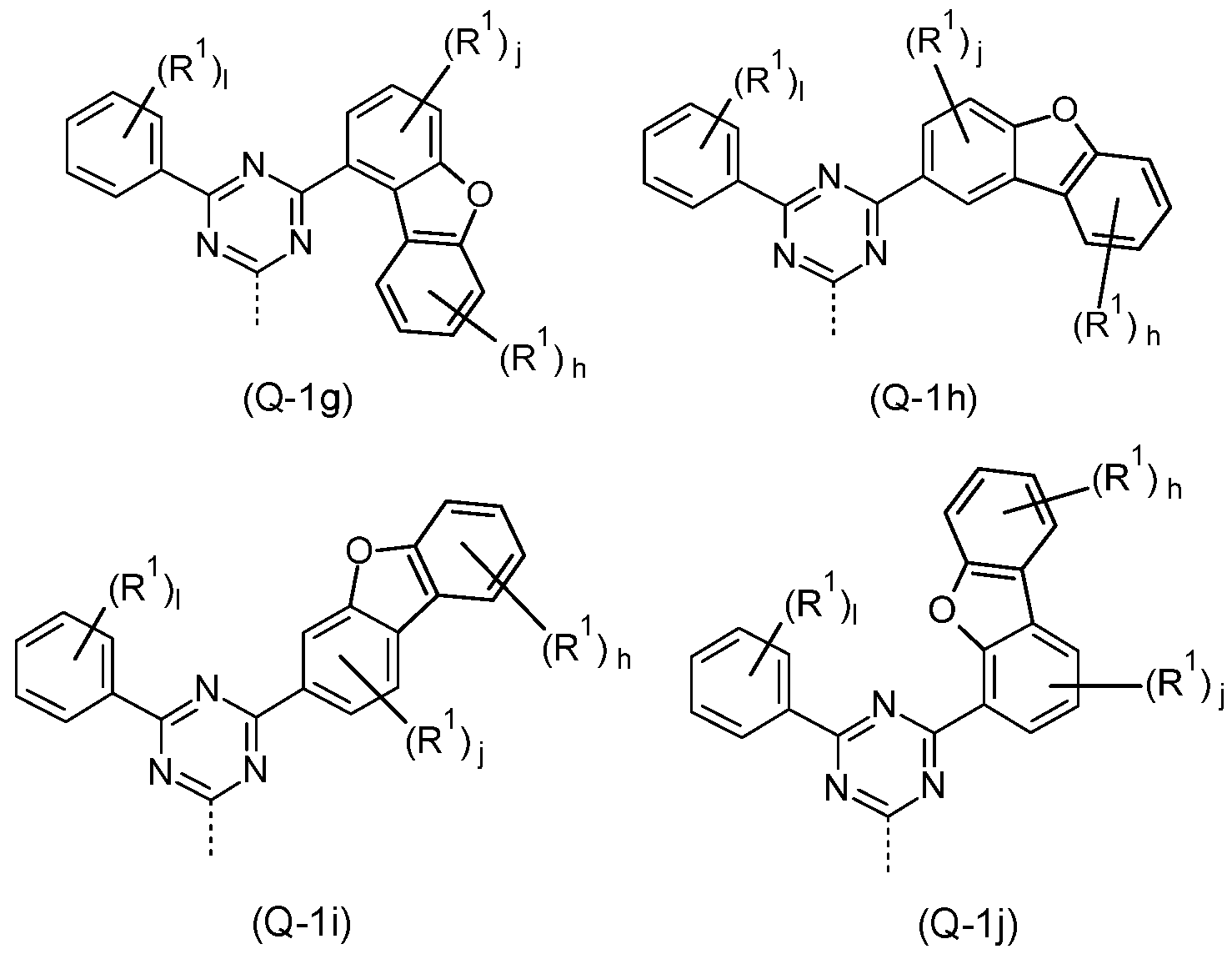
- the Q group is selected from the structures of the Formulae (Q-1 a), (Q-1 b), (Q-1 c), (Q-1 d), (Q-1 e), (Q-1f), (Q-1 g), (Q-1 h), (Q- 1 i) and/or (Q-1 j)
- the dotted bond marks the attachment position and the index I is the same or different at each instance and is 0, 1 , 2, 3, 4 or 5, preferably 0, 1 , 2 or 3, more preferably 0 or 1
- the index h is the same or different at each instance and is 0, 1 , 2, 3 or 4, preferably 0, 1 or 2
- the index j is the same or different at each instance and is 0, 1 , 2 or 3, preferably 0, 1 or 2.
- the structure (Q-1a) is preferred.
- the group L, L a , L b , L c , L d may form through-conjugation with the electron-transporting Q group and the fluorene structure of the Formulae (A), (I), (II) and/or preferred embodiments thereof.
- Through- conjugation of the aromatic or heteroaromatic systems is formed as soon as direct bonds are formed between adjacent aromatic or heteroaromatic rings.
- through-conjugation can be formed if the bond between the electron-transporting Q group and the fluorene structure of the Formulae (A), (I), (II) and/or preferred embodiments thereof is via the same phenyl group in the spirobifluorene structure or via phenyl groups in the spirobifluorene structure that are bonded directly to one another and are in one plane.
- the bond between the electron-transporting Q group and the fluorene structure of the Formulae (A), (I), (II) and/or preferred embodiments thereof is via different phenyl groups of the spirobifluorene structure which are bonded via the sp 3 -hybridized carbon atom in position 9, the conjugation is interrupted.
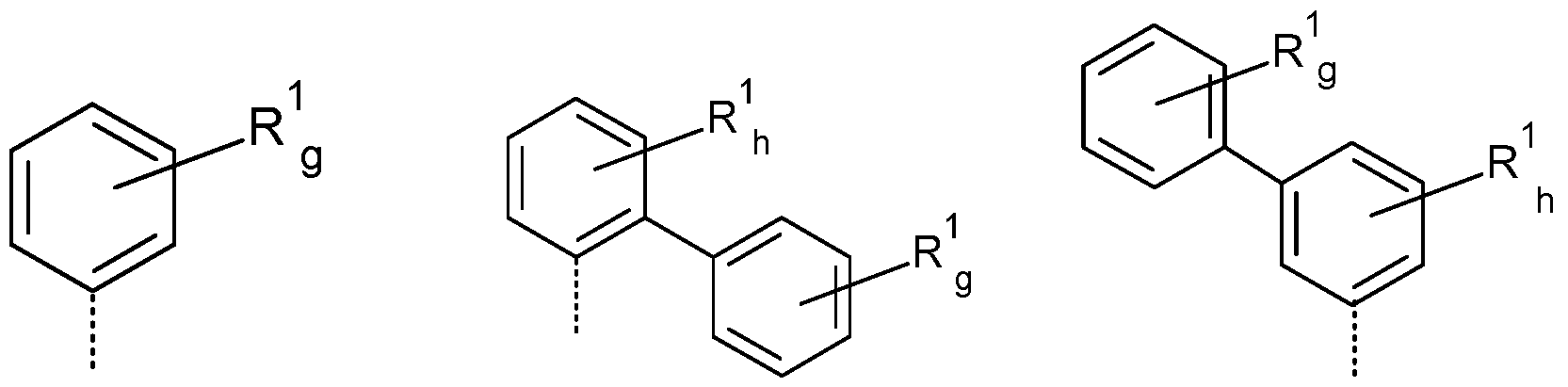
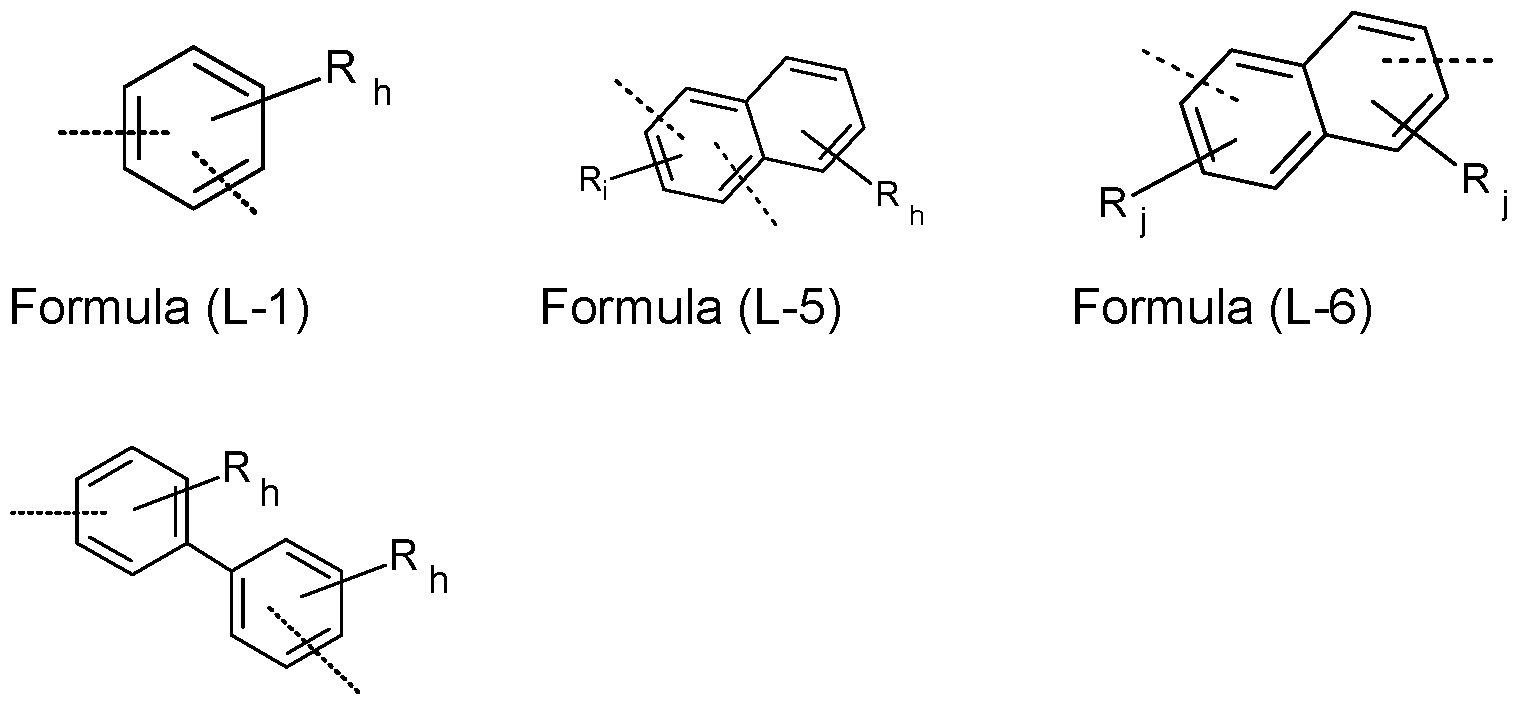
- L, L a , L b , L c , L d is the same or different at each instance and is a single bond or an aromatic or heteroaromatic ring system which has 5 to 24 aromatic ring atoms and may be substituted by one or more R radicals.
- L, L a , L b , L c , L d is the same or different at each instance and is a single bond or an aromatic ring system having 6 to 12 aromatic ring atoms or a heteroaromatic ring system having 5 to 12 aromatic ring atoms, each of which may be substituted by one or more R radicals, but is preferably unsubstituted, where R may have the definition given above, especially for Formula (A), (I) and/or (II).
- the symbol group L, L a , L b , L c , L d is the same or different at each instance and is a single bond or an aryl or heteroaryl radical, such that an aromatic or heteroaromatic group of an aromatic or heteroaromatic ring system is bonded directly, i.e. via an atom in the aromatic or heteroaromatic group, to the respective atom in the other group.
- group L, L a , L b , L c , L d is a bond or an aryl group having 6 to 12 aromatic ring atoms, which may be substituted by one or more radicals R, more preferably a phenylene group, a biphenylene group or a naphthylene group, even more preferably a phenylene group or a naphthylene group, which may be substituted by one or more radicals R. Even more preferably, group L, L a , L b , L c , L d is a single bond.
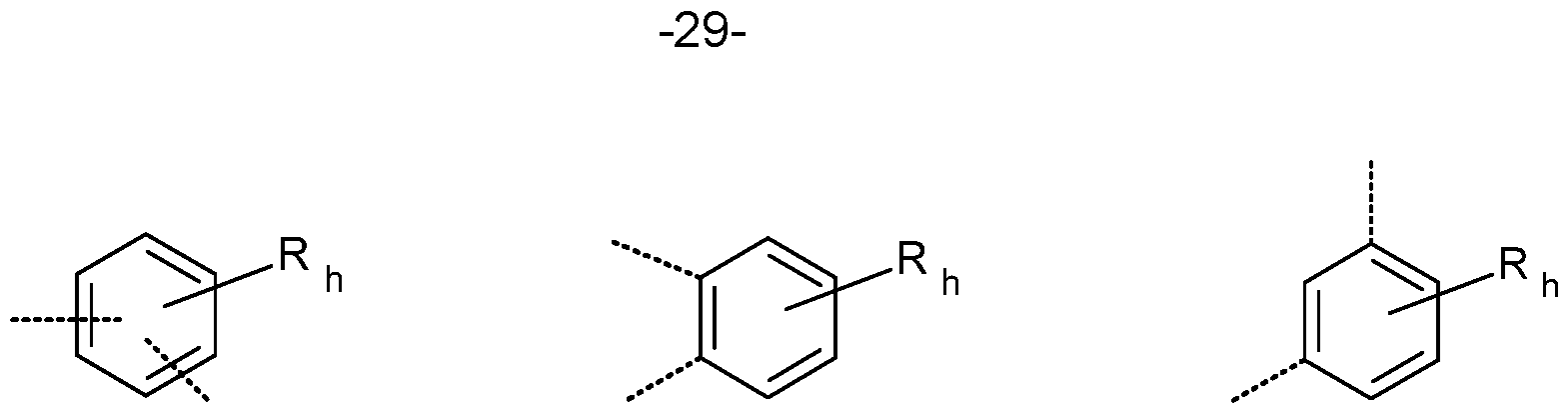
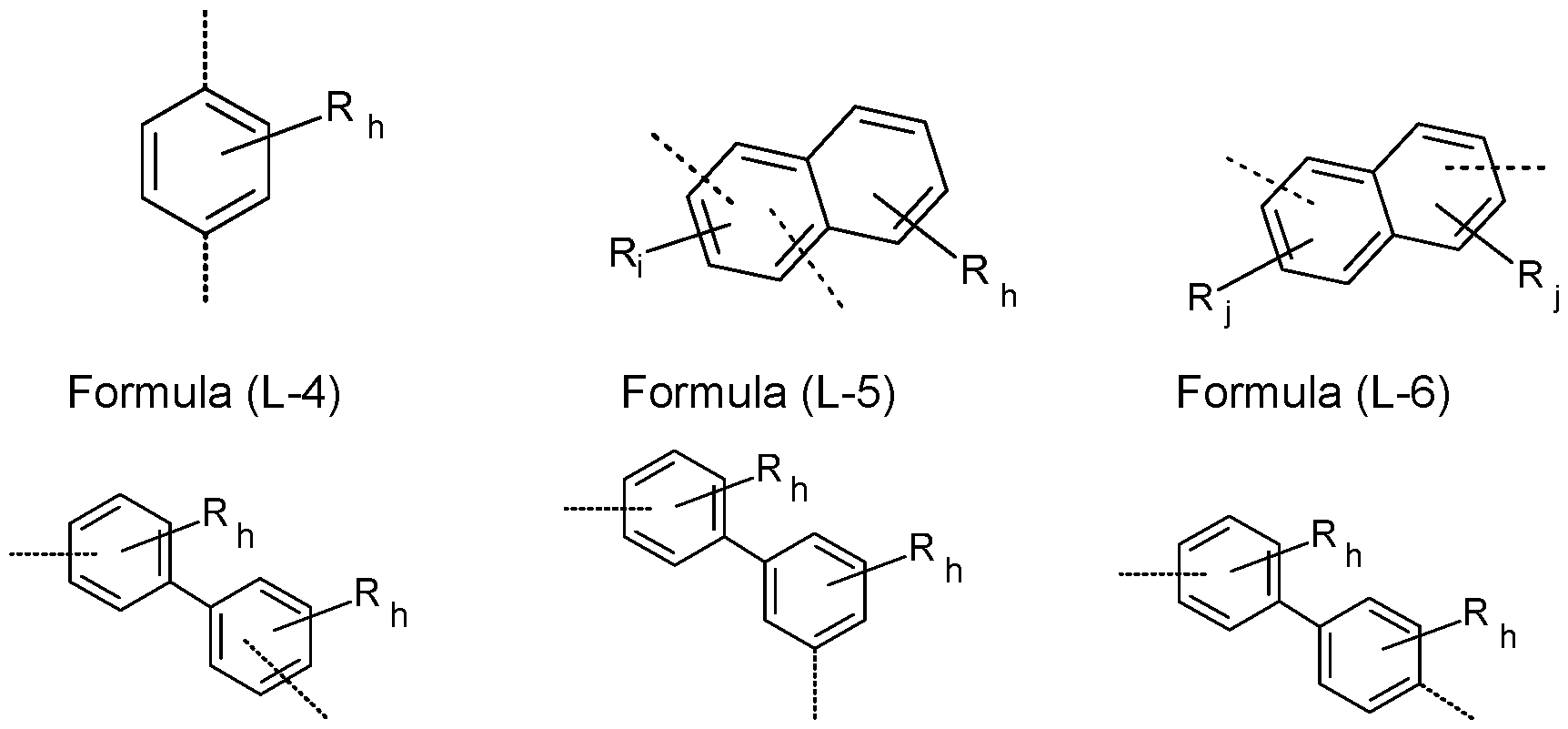
- Suitable aromatic or heteroaromatic ring systems group L, L a , L b , L c , L d are selected from the group consisting of ortho-, meta- or para-phenylene, biphenylene, fluorene, pyridine, pyrimidine, triazine, dibenzofuran and dibenzothiophene, each of which may be substituted by one or more R radicals, but are preferably unsubstituted.
- the total sum of the indices h, i and j in the structures of the formula (L-1 ) to (L-9) is at most 3 in each case, preferably at most 2 and more preferably at most 1 .
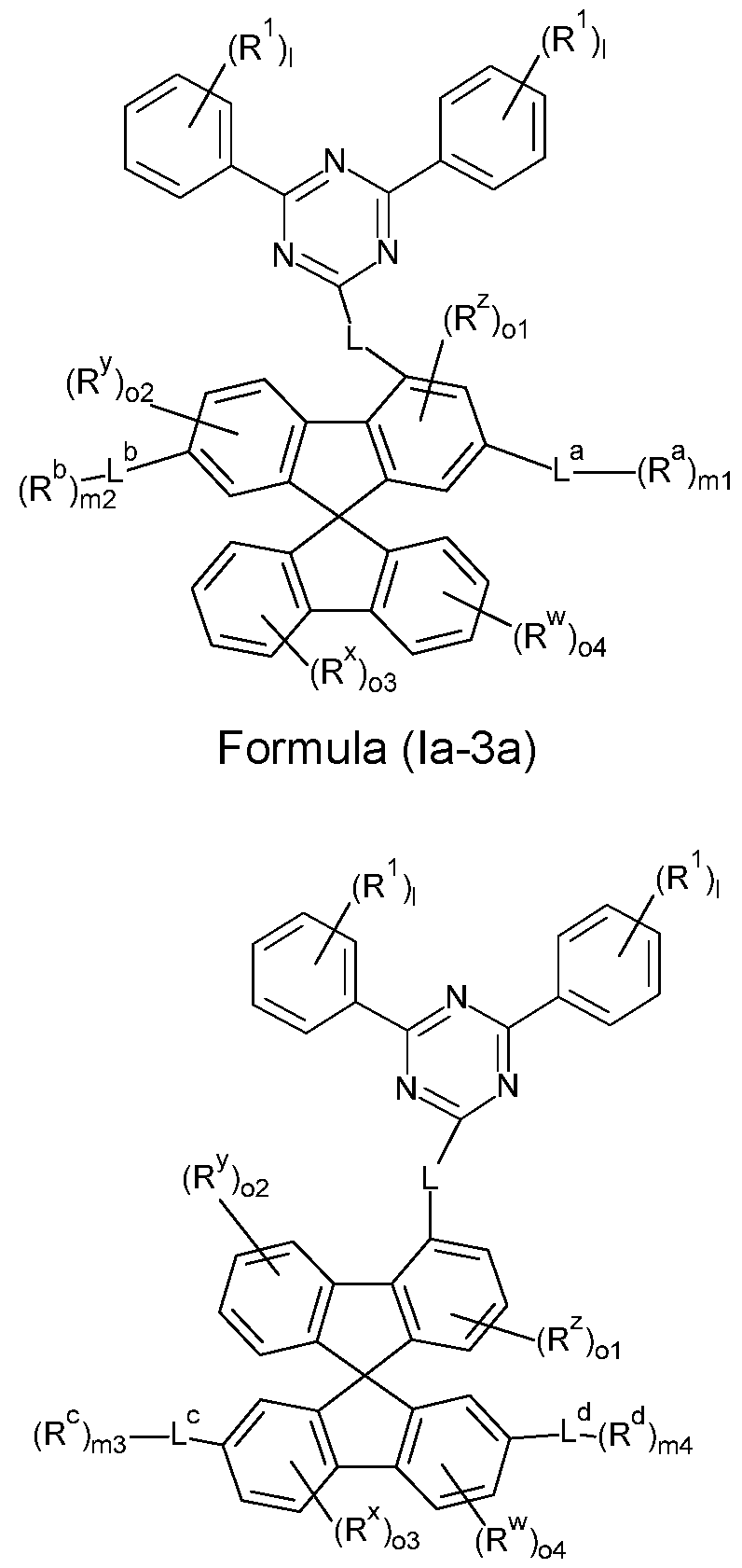
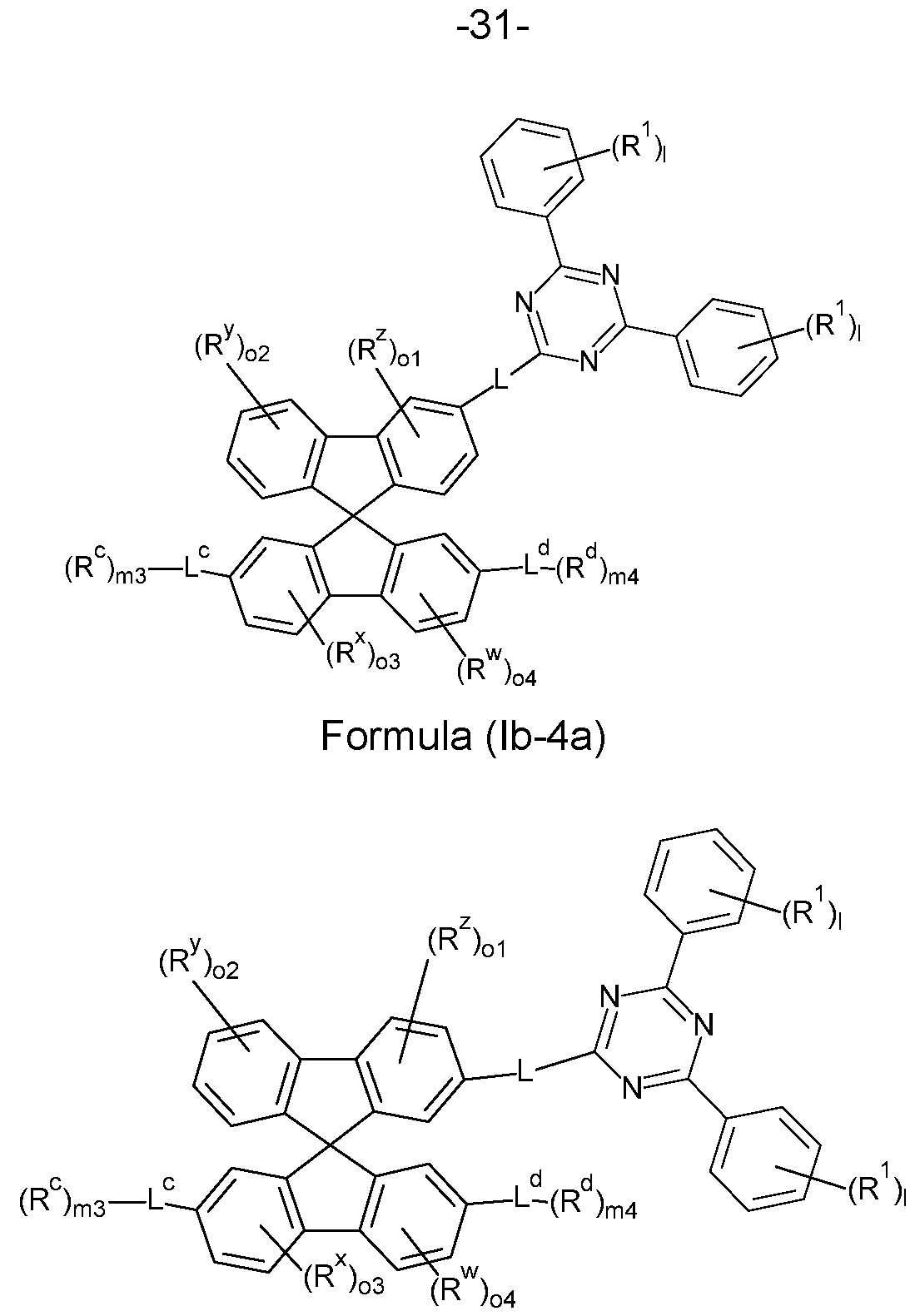
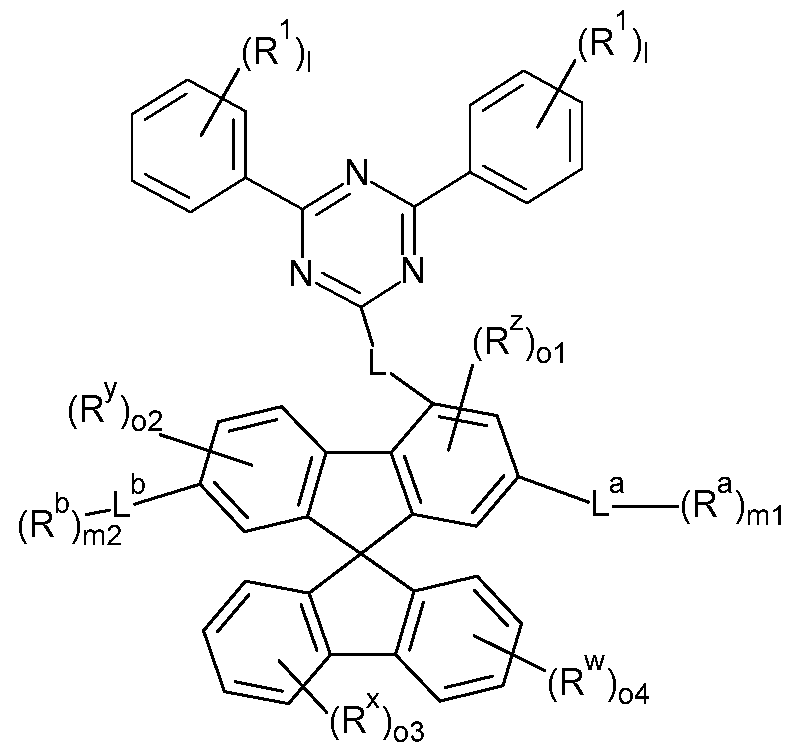
- the compounds of the invention comprise at least one of the structures of the Formulae (la-3a), (la-4a), (Ib- 4a) and/or (lc-4a), preferably the compounds of the invention are a compound according to Formulae (la-3a), (la-4a), (lb-4a) and/or (lc-4a),
- the symbol L, L a , L b , L c , L d is a bond or is selected from the structures of the formulae (L-1 ) to (L-9) as mentioned above, preferably the symbol L, L a , L b , L c , L d is a bond or is selected from the structures of the formulae (L-3) or (L-4) as mentioned above.
- R a , R b , R c , R d is a structure according to Formulae (R a -14) (t-butyl), (R a -32) or (R a -33) (adamantyl).
- R, R w , R x , Ry, R z substituents are preferably selected from the group consisting of H, D, F, CN, a straight-chain alkyl or alkoxy group having 1 to 10 carbon atoms or a branched or cyclic alkyl or alkoxy group having 3 to 10 carbon atoms or an alkenyl group having 2 to 10 carbon atoms, each of which may be substituted by one or more R 1 radicals, where one or more non-adjacent CH2 groups may be replaced by O and where one or more hydrogen atoms may be replaced by D or F, an aromatic or heteroaromatic ring system which has 5 to 24 aromatic ring atoms, each of which may be substituted by one or more R 1 radicals, but is preferably unsubstituted, or an aralkyl or heteroaralkyl group which has
- these R, R w , R x , Ry, R z substituents are selected from the group consisting of H, D, F, CN, a straight-chain alkyl group having 1 to 8 carbon atoms, preferably having 1 , 2, 3 or 4 carbon atoms, or a branched or cyclic alkyl group having 3 to 8 carbon atoms, preferably having 3 or 4 carbon atoms, or an alkenyl group having 2 to 8 carbon atoms, preferably having 2, 3 or 4 carbon atoms, each of which may be substituted by one or more R 1 radicals, but is preferably unsubstituted, or an aromatic or heteroaromatic ring system having 6 to 24 aromatic ring atoms, preferably having 6 to 18 aromatic ring atoms, more preferably having 5 to 12 aromatic ring atoms, each of which may be substituted by one or more nonaromatic R, R w , R x , Ry, R z radicals, but is preferably unsubsti
- the R, R w , R x , Ry, R z substituents are selected from the group consisting of H and an aromatic or heteroaromatic ring system having 6 to 18 aromatic ring atoms, preferably having 5 to 12 aromatic ring atoms, each of which may be substituted by one or more nonaromatic R 2 radicals, but is preferably unsubstituted.
- R, R w , R x , Ry, R z substituents are selected from the group consisting of phenyl, ortho-, meta- or para-biphenyl, terphenyl, especially branched terphenyl, quaterphenyl, especially branched quaterphenyl, 1 -, 2-, 3- or 4-fluorenyl, 1 -, 2-, 3- or 4-spirobifluorenyl, pyridyl, pyrimidinyl, 1 -, 2-, 3- or 4- dibenzofuranyl, 1 -, 2-, 3- or 4-dibenzothienyl and 1 -, 2-, 3- or 4-carbazolyl, each of which may be substituted by one or more R 1 radicals, but are preferably unsubstituted.
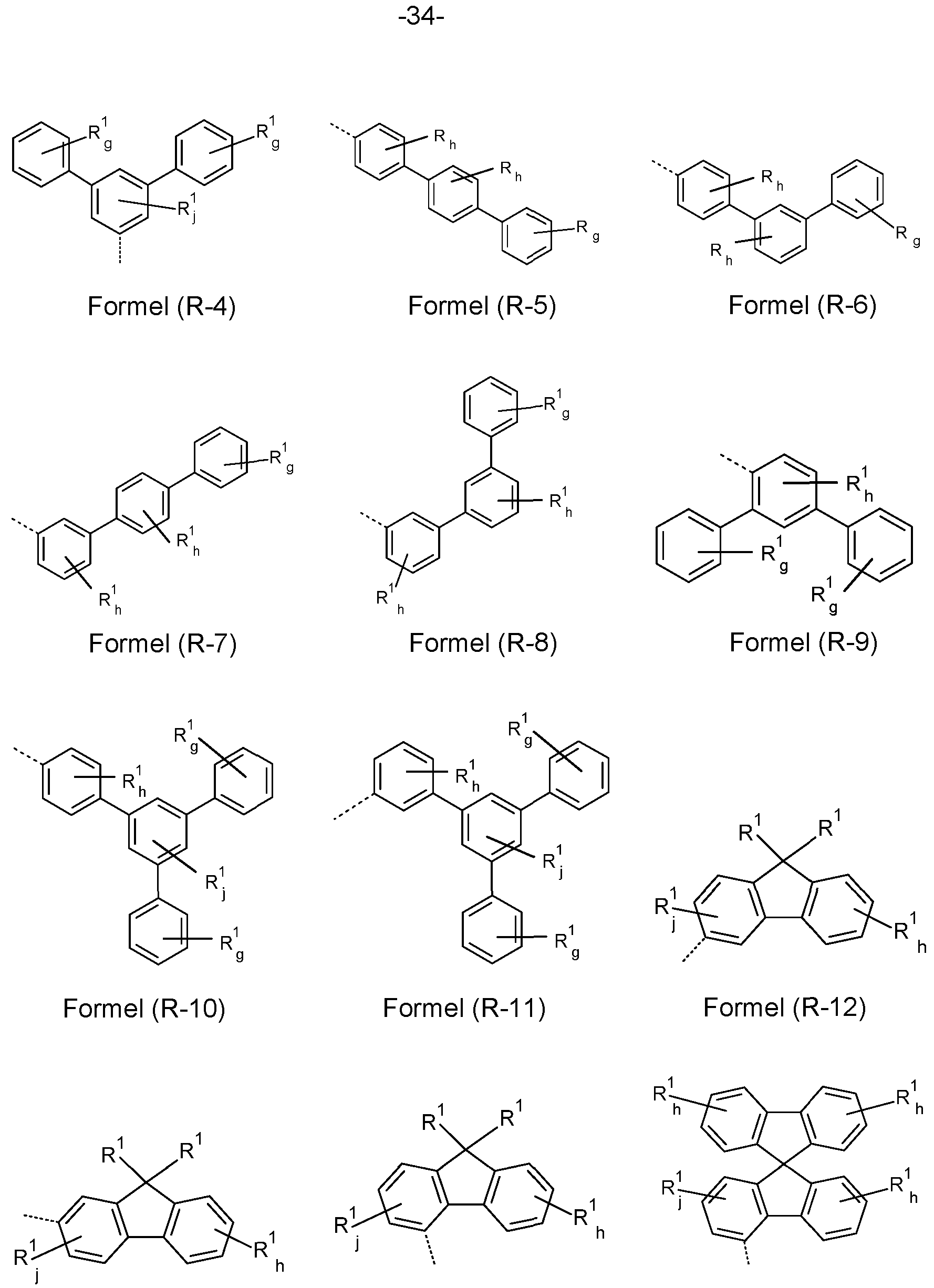
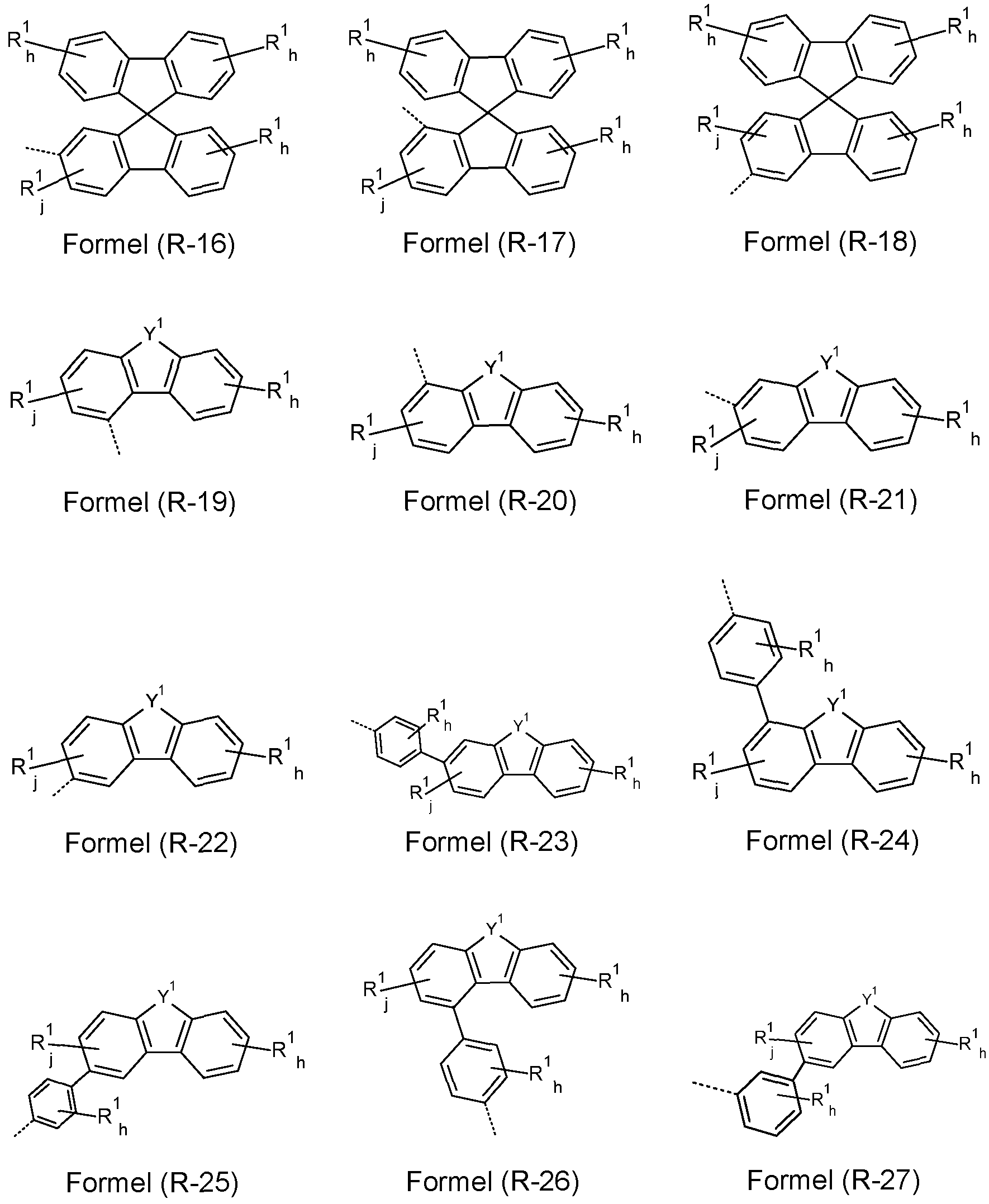
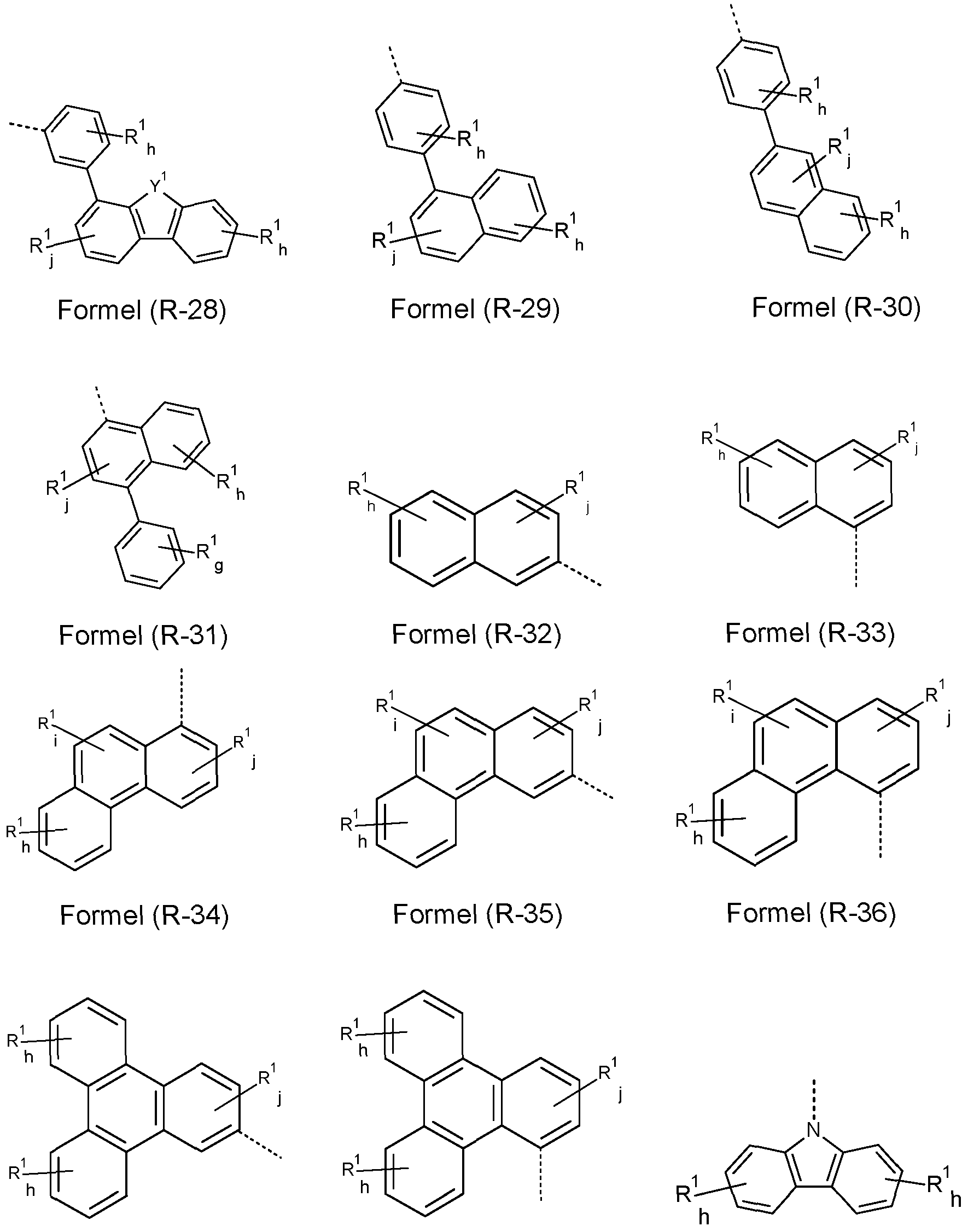
- At least one R, R w , R x , Ry and/or R z radical is a group selected from the formulae (R-1 ) to (R-43)
- Y 1 is O, S or NR 1 , preferably O or S; i at each instance is independently 0, 1 or 2; j independently at each instance is 0, 1 , 2 or 3; h independently at each instance is 0, 1 , 2, 3 or 4; g independently at each instance is 0, 1 , 2, 3, 4 or 5;
- R 1 may have the definition given above, especially for Formula (A), (I) and/or (II), and the dotted bond marks the attachment position.
- R-1 to R-28 are preferred and the groups of formulae R-1 , R-3, R-4, R-10, R-11 , R-12, R-13, R-14, R-16, R-17, R-18, R-19, R-20, R-21 and/or R-22 are especially preferred.
- the total sum of the indices i, j, h and g in the structures of the formula (R-1 ) to (R-43) is not more than 3 in each case, preferably not more than 2 and more preferably not more than 1 .
- a compound of the invention comprising at least one structure of Formulae (A), (I), (II) and/or preferred embodiments thereof comprises two or more electron transport groups.
- a compound of the invention comprising at least one structure of Formulae (A), (I), (II) and/or preferred embodiments thereof comprises exactly one triazine group, more preferably exactly one electron transport groups.
- a compound of the invention comprising at least one structure of Formulae (A), (I), (II) and/or preferred embodiments thereof does not comprise any carbazole and/or triarylamine group. More preferably, a compound of the invention does not comprise any hole-transporting group.
- Hole-transporting groups are known in the specialist field, these groups in many cases being carbazole, indenocarbazole, indolocarbazole, arylamine or diarylamine structures.
- a compound of the invention comprising at least one structure of Formulae (A), (I), (II) and/or preferred embodiments thereof comprises at least one hole-transporting group, preferably a carbazole and/or triarylamine group.
- holetransporting groups provided may also be indenocarbazole, indenocarbazole, arylamine or diarylamine group.
- R 1 for example in a structure of Formula (A), (I), (II) and/or preferred embodiments of these structures or the structures where reference is made to these formulae, is the same or different at each instance and is selected from the group consisting of H, D, an aliphatic hydrocarbyl radical having 1 to 10 carbon atoms, preferably having 1 , 2, 3 or 4 carbon atoms, or an aromatic or heteroaromatic ring system having 5 to 30 aromatic ring atoms, preferably having 5 to 24 aromatic ring atoms, more preferably having 5 to 13 aromatic ring atoms, which may be substituted by one or more alkyl groups each having 1 to 4 carbon atoms, but is preferably unsubstituted.
- R 2 for example in a structure of Formula (A), (I), (II) and/or preferred embodiments of these structures or the structures where reference is made to these formulae, is the same or different at each instance and is selected from the group consisting of H, D, F, CN, an aliphatic hydrocarbyl radical having 1 to 10 carbon atoms, preferably having 1 , 2, 3 or 4 carbon atoms, or an aromatic or heteroaromatic ring system having 5 to 30 aromatic ring atoms, preferably having 5 to 24 aromatic ring atoms, more preferably having 5 to 13 aromatic ring atoms, which may be substituted by one or more alkyl groups each having 1 to 4 carbon atoms, but is preferably unsubstituted.
- R, R w , R x , Ry, R z , R 1 or R 2 groups it is preferable when these do not have any aryl or heteroaryl groups having more than two aromatic six-membered rings fused directly to one another. More preferably, the substituents do not have any aryl or heteroaryl groups having six-membered rings fused directly to one another at all. The reason for this preference is the low triplet energy of such structures.
- Fused aryl groups which have more than two aromatic six-membered rings fused directly to one another but are nevertheless also suitable in accordance with the invention are phenanthrene and triphenylene, since these also have a high triplet level.
- the compounds of the invention are preparable in principle by various processes. However, the processes described hereinafter have been found to be particularly suitable.
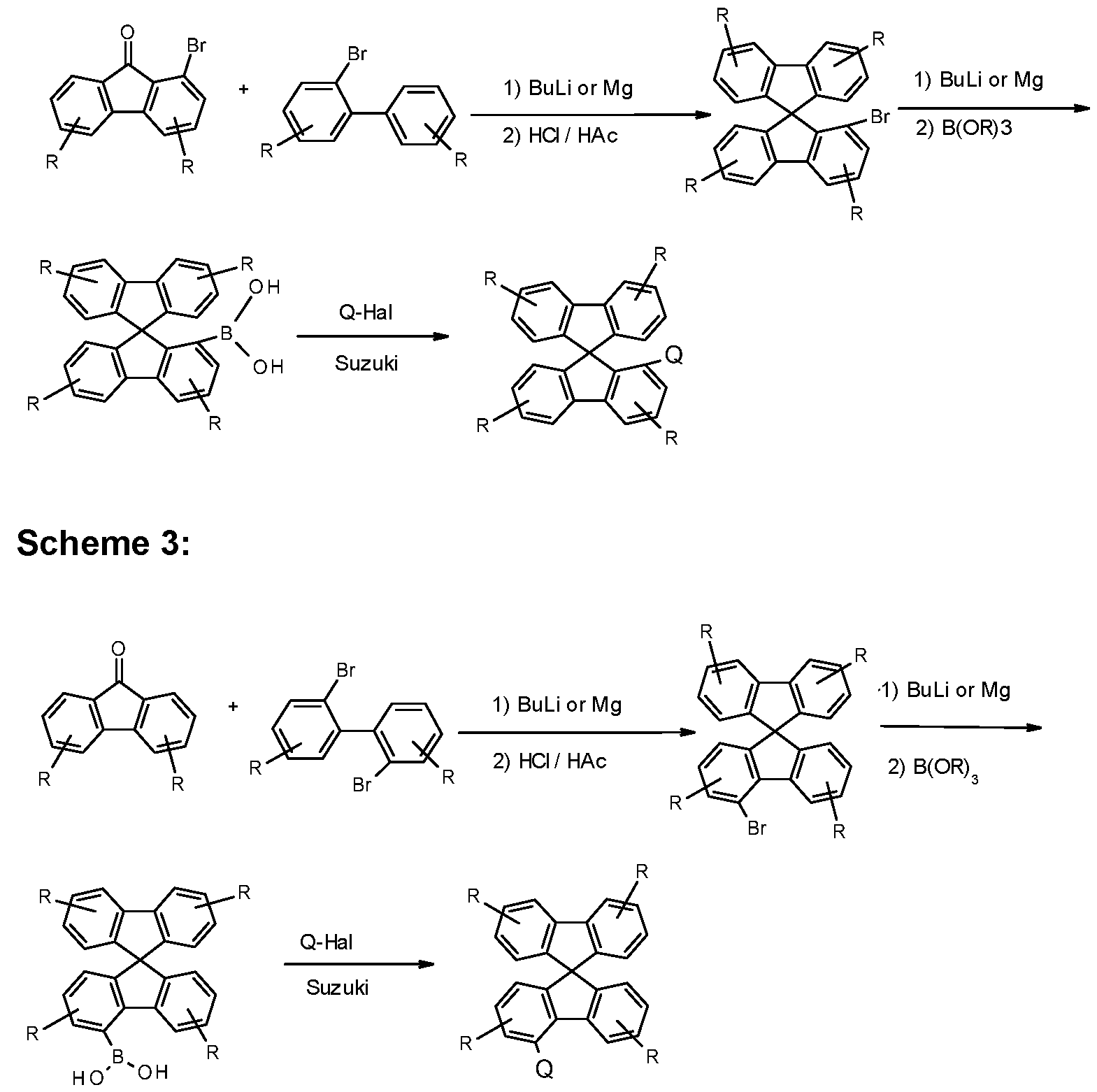
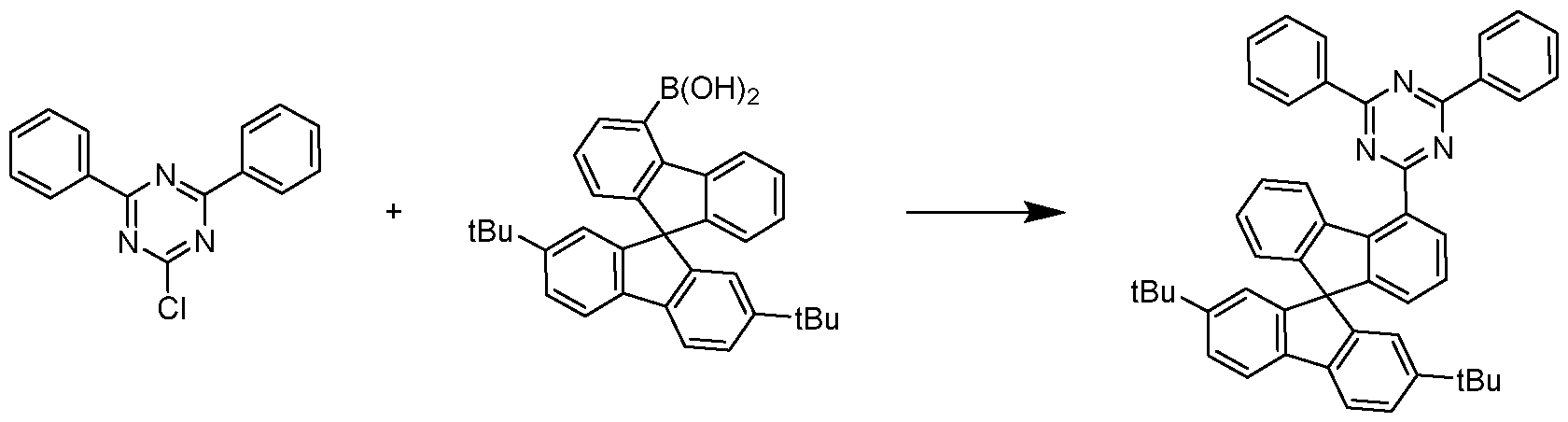
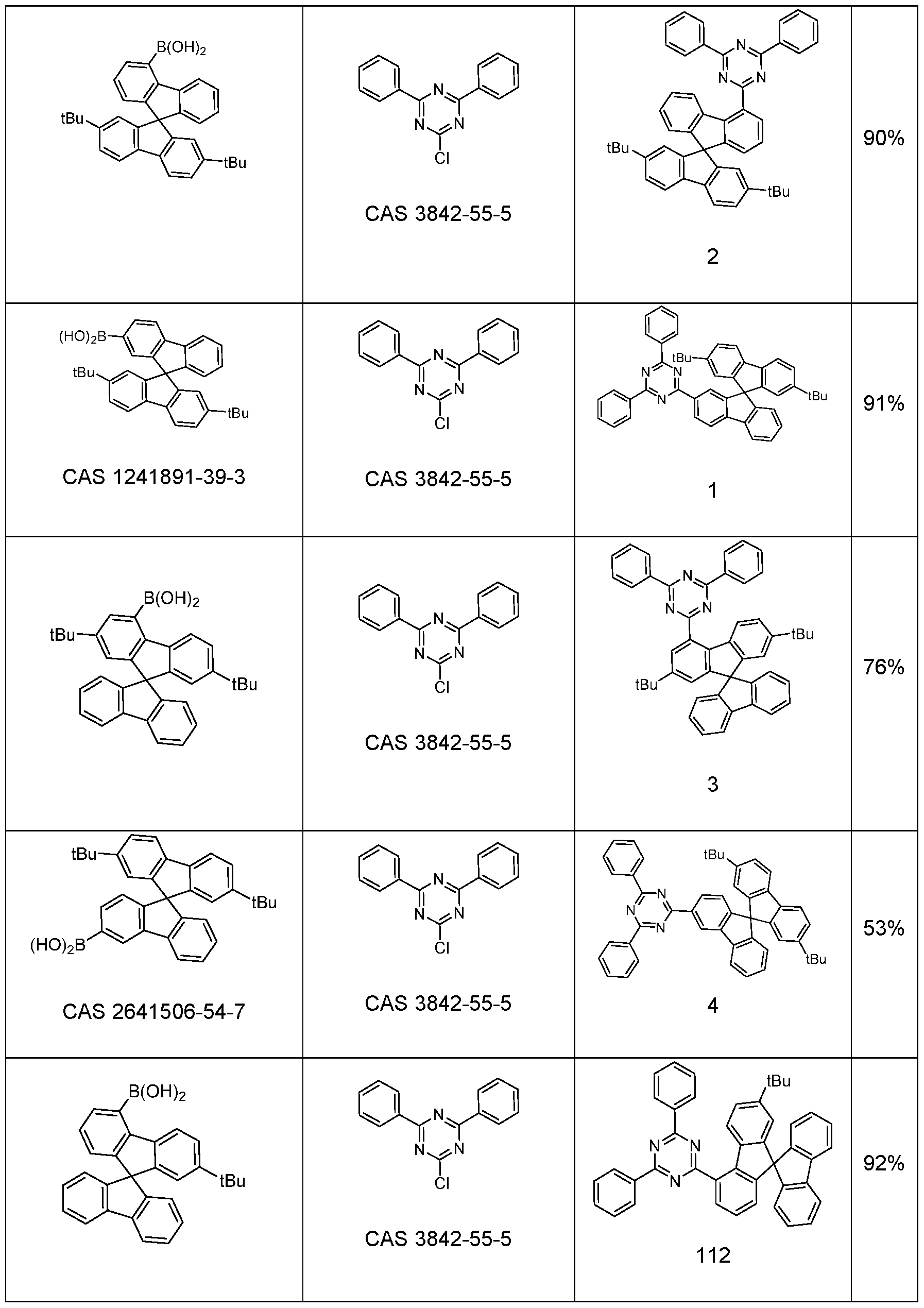
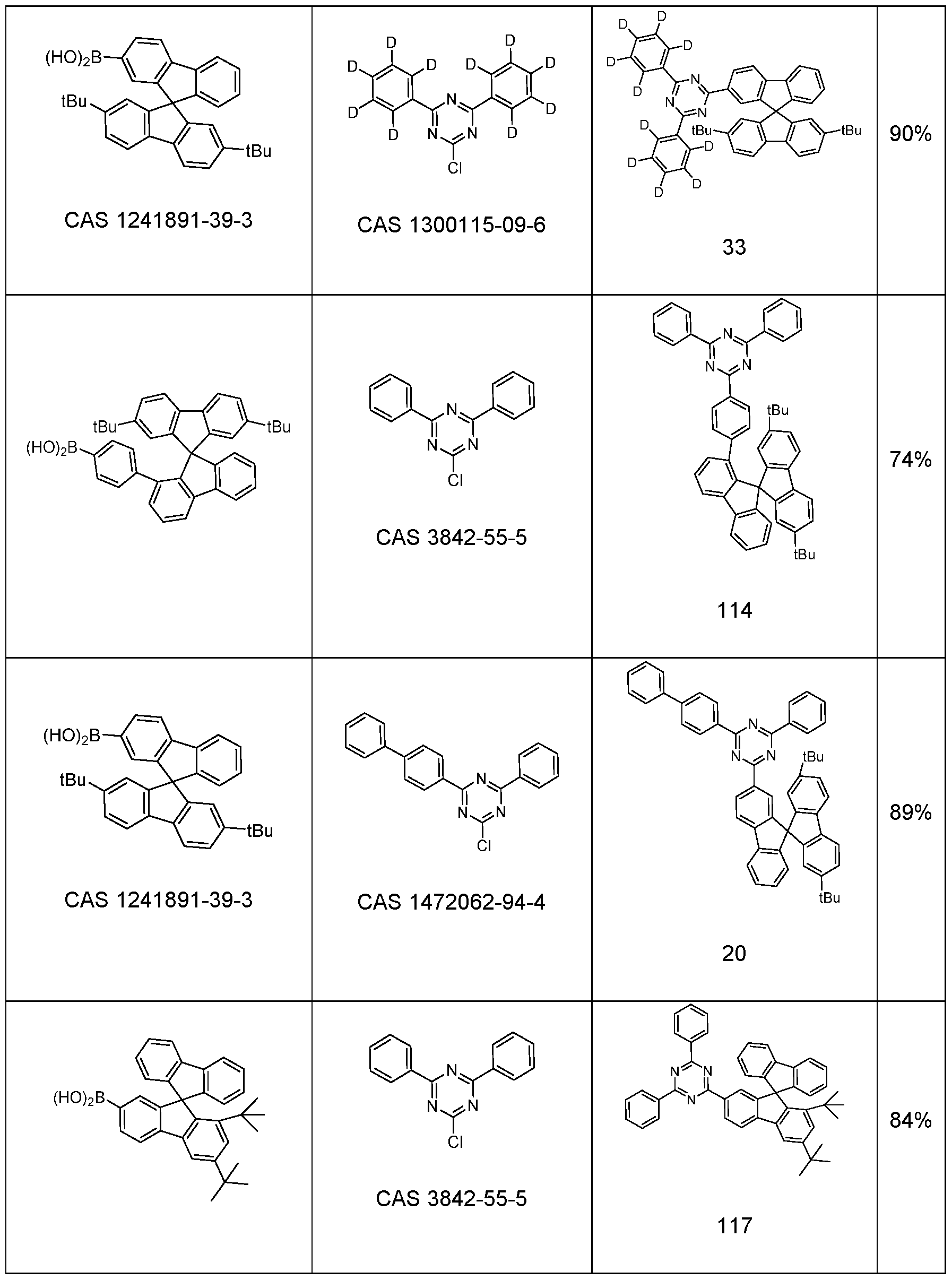
- the present invention further provides a process for preparing the compounds comprising structures of Formula (A), (I) and/or (II) in which, in a coupling reaction, a compound comprising at least one electron-transporting group is reacted with a compound comprising at least one fluorene or spirobifluorene radical.
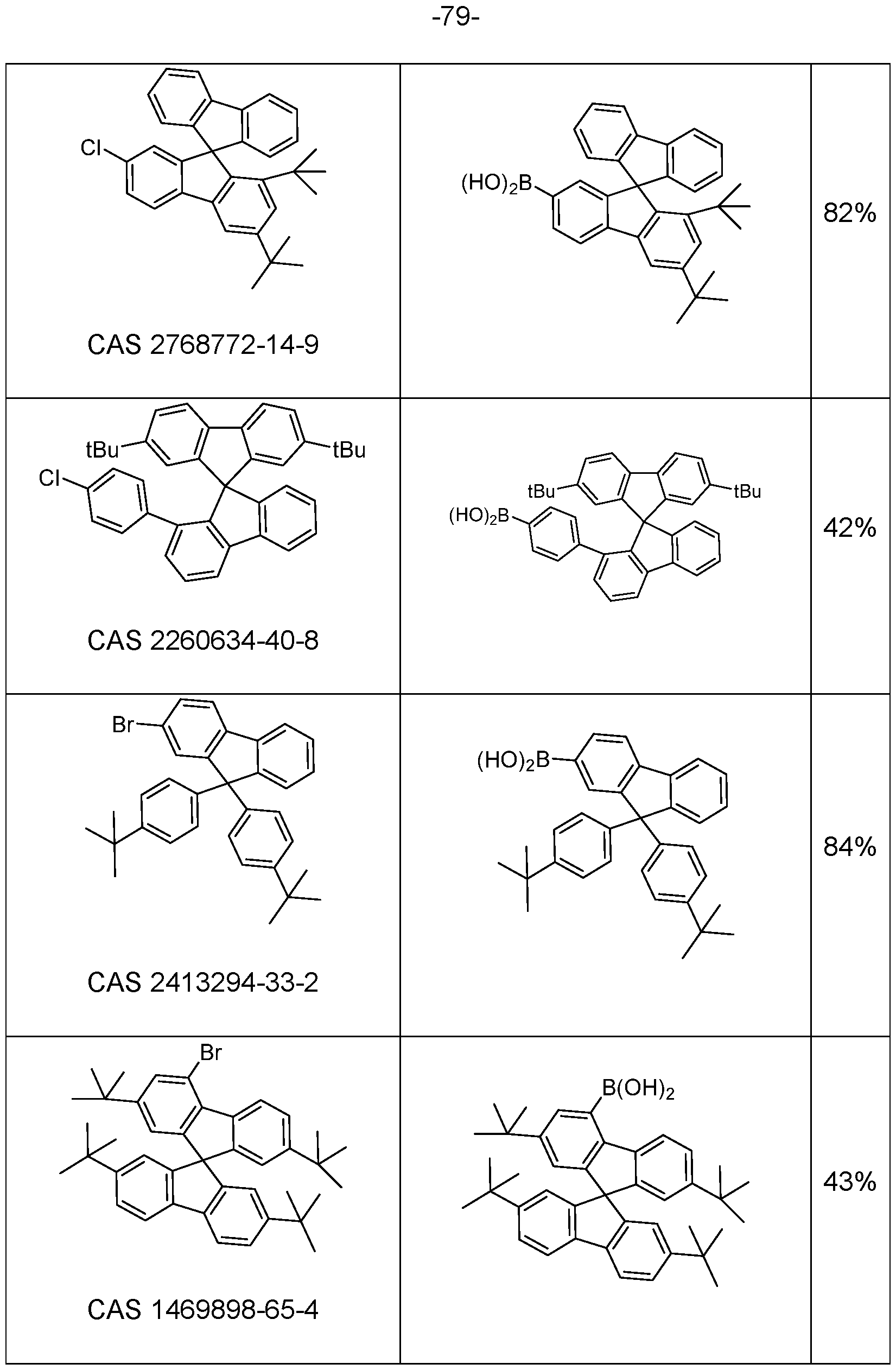
- Suitable compounds having an electron-transporting group are in many cases commercially available, and the starting compounds detailed in the examples are obtainable by known processes, and so reference is made thereto.
- Particularly suitable and preferred coupling reactions which all lead to C-C bond formation and/or C-N bond formation are those according to BUCHWALD, SUZUKI, YAMAMOTO, STILLE, HECK, NEGISHI, SONOGASHIRA and HIYAMA. These reactions are widely known, and the examples will provide the person skilled in the art with further pointers.
- the Q group is an electron transport group
- X is a leaving group, for example halogen.
- Corresponding compounds in which the group Q is not bonded directly to the spirobifluorene, but instead via a group L which does not stand for a single bond can likewise also be synthesised entirely analogously by employing a corresponding compound Q-L-Hal instead of a halogenated aromatic compound Ar-Hal.
- Hal here preferably stands for Cl, Br or I, in particular for Br.
- halogenated spirobifluorene derivatives which are coupled to a boronic acid derivative of the group -L-Ar can likewise be employed entirely analogously.
- the compounds of the invention may also have suitable substituents, for example by relatively long alkyl groups (about 4 to 20 carbon atoms), especially branched alkyl groups, or optionally substituted aryl groups, for example xylyl, mesityl or branched terphenyl or quaterphenyl groups, which bring about solubility in standard organic solvents, for example toluene or xylene, at room temperature in a sufficient concentration soluble, in order to be able to process the compounds from solution. These soluble compounds are of particularly good suitability for processing from solution, for example by printing methods.
- the compounds of the invention comprising at least one structure of the formula (I) and/or formula (II) already have enhanced solubility in these solvents.
- the compounds of the invention may also be mixed with a polymer. It is likewise possible to incorporate these compounds covalently into a polymer. This is especially possible with compounds substituted by reactive leaving groups such as bromine, iodine, chlorine, boronic acid or boronic ester, or by reactive polymerizable groups such as olefins or oxetanes. These may find use as monomers for production of corresponding oligomers, dendrimers or polymers.
- the oligomerization or polymerization is preferably effected via the halogen functionality or the boronic acid functionality or via the polymerizable group. It is additionally possible to crosslink the polymers via groups of this kind.
- the compounds of the invention and polymers may be used in the form of a crosslinked or uncrosslinked layer.
- the invention therefore further provides oligomers, polymers or dendrimers containing one or more of the above-detailed structures of the Formula (A), (I), (II) and preferred embodiments of these structures or compounds of the invention, wherein one or more bonds in the compounds of the invention or in the structures of the Formula (A), (I), (II) and preferred embodiments of these structures to the polymer, oligomer or dendrimer are present.
- these According to the linkage of the structures of the Formula (A), (I), (II) and preferred embodiments of these structures or of the compounds, these therefore form a side chain of the oligomer or polymer or are bonded within the main chain.
- the polymers, oligomers or dendrimers may be conjugated, partly conjugated or nonconjugated.
- the oligomers or polymers may be linear, branched or dendritic.
- the repeat units of the compounds of the invention in oligomers, dendrimers and polymers the same preferences apply as described above.
- the monomers of the invention are homopolymerized or copolymerized with further monomers. Preference is given to copolymers wherein the units of Formula (A), (I) and/or (II) or the preferred embodiments recited above and hereinafter are present to an extent of 0.01 to 99.9 mol%, preferably 5 to 90 mol%, more preferably 20 to 80 mol%.
- Suitable and preferred comonomers which form the polymer base skeleton are chosen from fluorenes (for example according to EP 842208 or WO 2000/022026), spirobifluorenes (for example according to EP 707020, EP 894107 or WO 2006/061181 ), paraphenylenes (for example according to WO 92/18552), carbazoles (for example according to WO 2004/070772 or WO 2004/113468), thiophenes (for example according to EP 1028136), dihydrophenanthrenes (for example according to WO 2005/014689), cis- and trans-indenofluorenes (for example according to WO 2004/041901 or WO 2004/113412), ketones (for example according to WO 2005/040302), phenanthrenes (for example according to WO 2005/104264 or WO 2007/017066) or else a plurality of these units.
- the polymers, oligomers and dendrimers
- compounds of the invention which feature a high glass transition temperature.
- formulations of the compounds of the invention are required. These formulations may, for example, be solutions, dispersions or emulsions. For this purpose, it may be preferable to use mixtures of two or more solvents.
- Suitable and preferred solvents are, for example, toluene, anisole, o-, m- or p-xylene, methyl benzoate, mesitylene, tetralin, veratrole, THF, methyl-THF, THP, chlorobenzene, dioxane, phenoxytoluene, especially 3-phenoxytoluene, (-)- fenchone, 1 ,2,3,5-tetramethylbenzene, 1 ,2,4,5-tetramethylbenzene, 1- methylnaphthalene, 2-methylbenzothiazole, 2-phenoxyethanol, 2- pyrrolidinone, 3-methylanisole, 4-methylanisole, 3,4-dimethylanisole, 3,5- dimethylanisole, acetophenone, a-terpineol, benzothiazole, butyl benzoate, cumene, cyclohexanol, cyclohexanone, cyclohexylbenzene
- the present invention therefore further provides a formulation comprising a compound of the invention and at least one further compound.
- the further compound may, for example, be a solvent, especially one of the abovementioned solvents or a mixture of these solvents.
- the further compound may alternatively be at least one further organic or inorganic compound which is likewise used in the electronic device, for example an emitting compound, especially a phosphorescent dopant, and/or a further matrix material.
- This further compound may also be polymeric.
- the present invention therefore still further provides a composition comprising a compound of the invention and at least one further organically functional material.
- Functional materials are generally the organic or inorganic materials introduced between the anode and cathode.
- the organic functional material is selected from the group consisting of fluorescent emitters, phosphorescent emitters, TADF emitters, host materials, matrix materials, electron transport materials, electron injection materials, hole conductor materials, hole injection materials, n-dopants, wide band gap materials, electron blocking materials and hole blocking materials.
- the present invention therefore also relates to a composition
- a composition comprising at least one compound comprising structures of Formula (A), (I) and/or (II) or the preferred embodiments recited above and hereinafter and at least one further matrix material.
- the further matrix material has hole-transporting properties.
- the present invention further provides a composition comprising at least one compound comprising at least one structure of Formula (A), (I) and/or (II) or the preferred embodiments recited above and hereinafter and at least one wide band gap material, a wide band gap material being understood to mean a material in the sense of the disclosure of US 7,294,849. These systems exhibit particularly advantageous performance data in electroluminescent devices.
- the additional compound may have a band gap of 2.5 eV or more, preferably 3.0 eV or more, very preferably of 3.5 eV or more.
- One way of calculating the band gap is via the energy levels of the highest occupied molecular orbital (HOMO) and the lowest unoccupied molecular orbital (LUMO).
- Molecular orbitals especially also the highest occupied molecular orbital (HOMO) and the lowest unoccupied molecular orbital (LUMO), the energy levels thereof and the energy of the lowest triplet state Ti and that of the lowest excited singlet state Si of the materials are determined via quantum-chemical calculations.
- HOMO highest occupied molecular orbital
- LUMO lowest unoccupied molecular orbital
- the geometry is optimized via the "Ground State/ Hartree-Fock/Default Spin/LanL2MB/Charge 0/Spin Singlet" method.
- the energy calculation is effected analogously to the above-described method for the organic substances, except that the "LanL2DZ” basis set is used for the metal atom and the "6-31 G(d)" basis set for the ligands.
- the HOMO energy level HEh or LIIMO energy level LEh is obtained from the energy calculation in Hartree units. This is used to determine the HOMO and LIIMO energy levels in electron volts, calibrated by cyclic voltammetry measurements, as follows:
- the lowest triplet state Ti is defined as the energy of the triplet state having the lowest energy, which is apparent from the quantum-chemical calculation described.
- the lowest excited singlet state Si is defined as the energy of the excited singlet state having the lowest energy, which is apparent from the quantum-chemical calculation described.
- the present invention also relates to a composition
- a composition comprising at least one compound comprising structures of Formula (A), (I) and/or (II) or the preferred embodiments recited above and hereinafter and at least one phosphorescent emitter, the term "phosphorescent emitter” also being understood to mean phosphorescent dopants.
- a dopant in a system comprising a matrix material and a dopant is understood to mean that component having the smaller proportion in the mixture.
- a matrix material in a system comprising a matrix material and a dopant is understood to mean that component having the greater proportion in the mixture.
- Preferred phosphorescent dopants for use in matrix systems are the preferred phosphorescent dopants specified hereinafter.
- phosphorescent dopants typically encompasses compounds where the emission of light is effected through a spin-forbidden transition, for example a transition from an excited triplet state or a state having a higher spin quantum number, for example a quintet state.
- Suitable phosphorescent compounds are especially compounds which, when suitably excited, emit light, preferably in the visible region, and also contain at least one atom of atomic number greater than 20, preferably greater than 38 and less than 84, more preferably greater than 56 and less than 80, especially a metal having this atomic number.
- Preferred phosphorescence emitters used are compounds containing copper, molybdenum, tungsten, rhenium, ruthenium, osmium, rhodium, indium, palladium, platinum, silver, gold or europium, especially compounds containing iridium or platinum.
- all luminescent compounds containing the abovementioned metals are regarded as phosphorescent compounds.
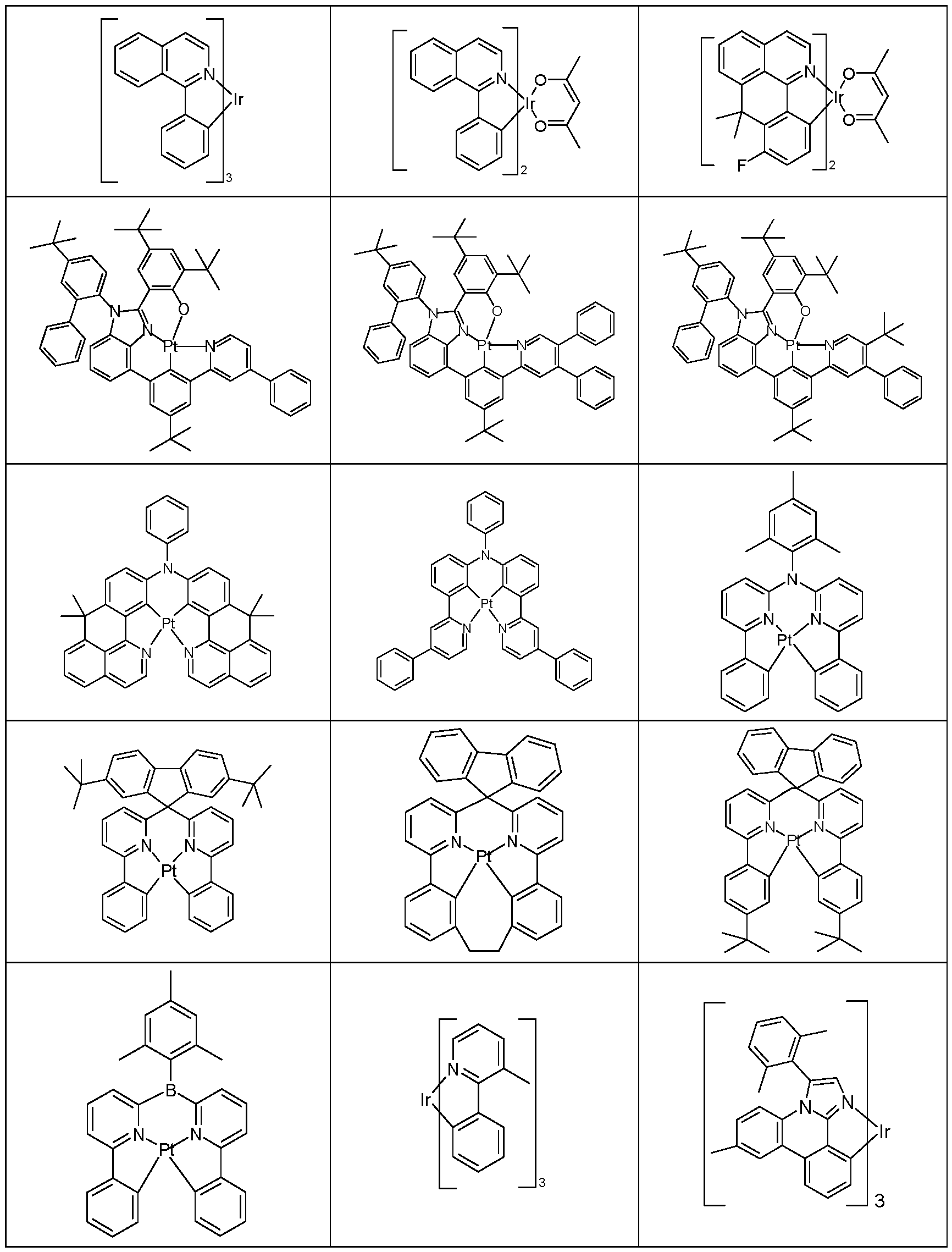
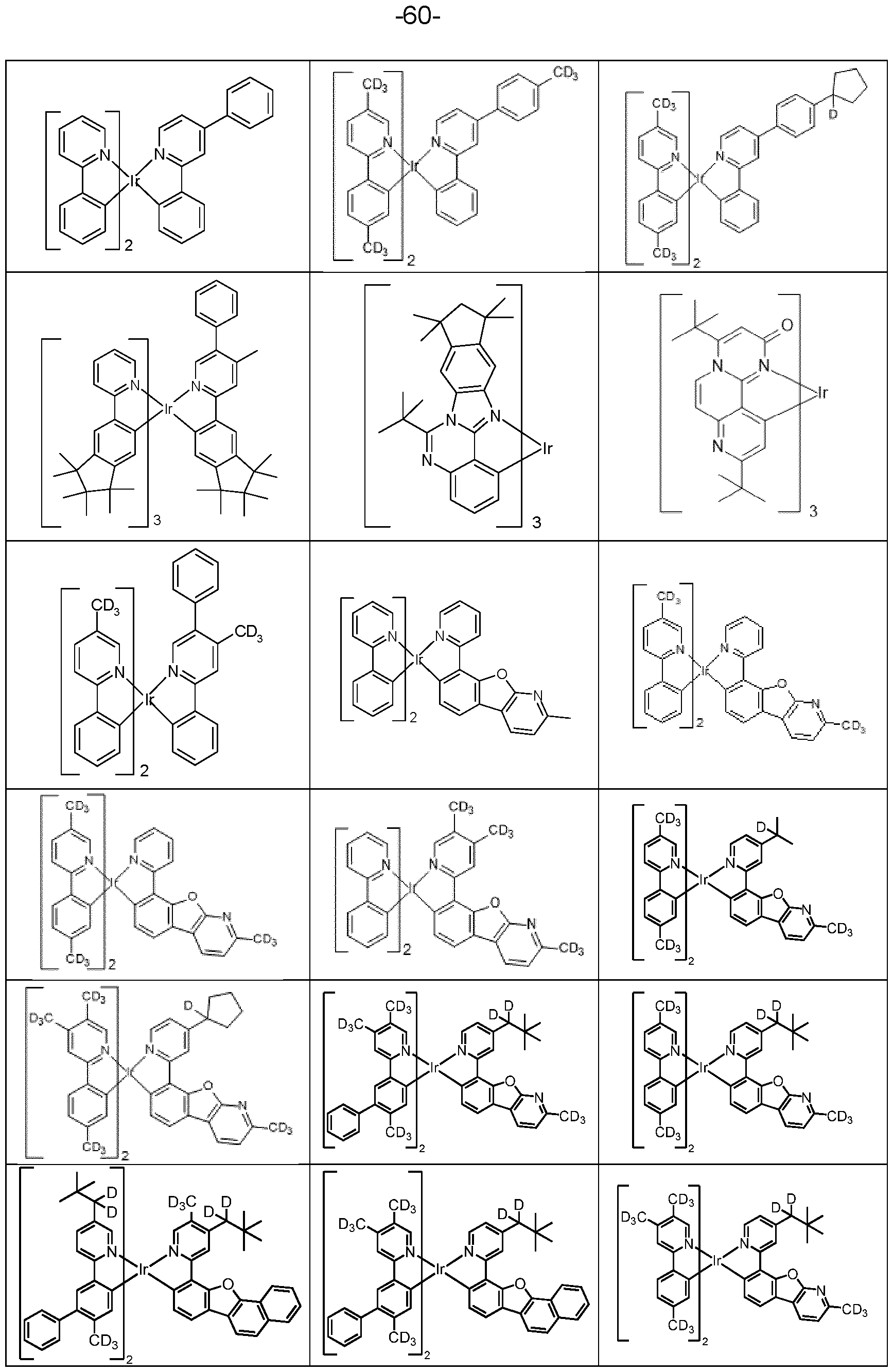
- Examples of the above-described emitters can be found in the applications WO 00/70655, WO 2001/41512, WO 2002/02714, WO 2002/15645, EP 1191613, EP 1191612, EP 1191614, WO 05/033244, WO 05/019373, US 2005/0258742, WO 2009/146770, WO 2010/015307, WO 2010/031485, WO 2010/054731 , WO 2010/054728, WO 2010/086089, WO 2010/099852, WO 2010/102709, WO 2011/032626, WO 2011/066898, WO 2011/157339, WO 2012/007086, WO 2014/008982, WO 2014/023377, WO 2014/094961 , WO 2014/094960 and the as yet unpublished applications EP 13004411.8, EP 14000345.0, EP 14000417.7 and EP 14002623.8.
- An electronic device is understood to mean any device comprising anode, cathode and at least one layer between anode and cathode, said layer comprising at least one organic or organometallic compound.
- the electronic device of the invention thus comprises anode, cathode and at least one layer in between containing at least one compound comprising structures of the Formula (A), (I) and/or (II).
- Preferred electronic devices here are selected from the group consisting of organic electroluminescent devices (OLEDs, PLEDs), organic integrated circuits (O-ICs), organic field-effect transistors (O-FETs), organic thin-film transistors (O-TFTs), organic light-emitting transistors (O- LETs), organic solar cells (O-SCs), organic optical detectors, organic photoreceptors, organic field-quench devices (O-FQDs), organic electrical sensors, light-emitting electrochemical cells (LECs), organic laser diodes (O-lasers) and organic plasmon emitting devices (D. M.
- OLEDs organic electroluminescent devices
- O-ICs organic integrated circuits
- O-FETs organic field-effect transistors
- OF-TFTs organic thin-film transistors
- O- LETs organic light-emitting transistors
- O-SCs organic solar cells
- organic optical detectors organic photoreceptors, organic field-quench devices (O-FQDs
- OLEDs organic electroluminescent devices
- PLEDs organic electroluminescent devices
- phosphorescent OLEDs containing at least one compound comprising structures of the Formula (A), (I) and/or (II) in at least one layer.
- OLEDs organic electroluminescent devices
- Active components are generally the organic or inorganic materials introduced between the anode and cathode, for example charge injection, charge transport or charge blocking materials, but especially emission materials and matrix materials.
- the present invention further provides a use of a compound of the invention in an electronic device, preferably as a matrix material, a hole blocking material, an electron injection material and/or an electron transport material, more preferably as a hole blocking material, an electron injection material and/or an electron transport material.
- a preferred embodiment of the invention is organic electroluminescent devices.
- the organic electroluminescent device comprises cathode, anode and at least one emitting layer. Apart from these layers, it may comprise still further layers, for example in each case one or more hole injection layers, hole transport layers, hole blocking layers, electron transport layers, electron injection layers, exciton blocking layers, electron blocking layers, charge generation layers and/or organic or inorganic p/n junctions.
- one or more hole transport layers are p- doped, for example with metal oxides such as MoOs or WO3 or with (per)fluorinated electron-deficient aromatic systems, and/or that one or more electron transport layers are n-doped.
- interlayers it is likewise possible for interlayers to be introduced between two emitting layers, these having, for example, an exciton-blocking function and/or controlling the charge balance in the electroluminescent device.
- interlayers it should be pointed out that not necessarily every one of these layers need be present.
- the organic electroluminescent device it is possible for the organic electroluminescent device to contain an emitting layer, or for it to contain a plurality of emitting layers. If a plurality of emission layers are present, these preferably have several emission maxima between 380 nm and 750 nm overall, such that the overall result is white emission; in other words, various emitting compounds which may fluoresce or phosphoresce are used in the emitting layers. Especially preferred are three-layer systems where the three layers exhibit blue, green and orange or red emission (for the basic construction see, for example, WO 2005/011013), or systems having more than three emitting layers. The system may also be a hybrid system wherein one or more layers fluoresce and one or more other layers phosphoresce.
- the organic electroluminescent device contains the compound of the invention comprising structures of Formula (A), (I) and/or (II) or the above-detailed preferred embodiments as matrix material, preferably as electron transport matrix material, in one or more emitting layers, preferably in combination with a further matrix material, preferably a hole transport matrix material.
- the further matrix material is an electrontransporting compound.
- the further matrix material is a compound having a large band gap which is not involved to a significant degree, if at all, in the hole and electron transport in the layer.
- An emitting layer comprises at least one emitting compound.
- Suitable matrix materials which can be used in combination with the compounds of Formula (A), (I) and/or (II) or according to the preferred embodiments are aromatic ketones, aromatic phosphine oxides or aromatic sulphoxides or sulphones, for example according to WO 2004/013080, WO 2004/093207, WO 2006/005627 or WO 2010/006680, triarylamines, especially monoamines, for example according to WO 2014/015935, carbazole derivatives, e.g.
- CBP N,N-biscarbazolylbiphenyl
- carbazole derivatives disclosed in WO 2005/039246, US 2005/0069729, JP 2004/288381 , EP 1205527 or WO 2008/086851 , indolocarbazole derivatives, for example according to WO 2007/063754 or WO 2008/056746, indenocarbazole derivatives, for example according to WO 2010/136109 and WO 2011/000455, azacarbazole derivatives, for example according to EP 1617710, EP 1617711 , EP 1731584, JP 2005/347160, bipolar matrix materials, for example according to WO 2007/137725, silanes, for example according to WO 005/111172, azaboroles or boronic esters, for example according to WO 2006/117052, triazine derivatives, for example according to WO 2010/015306, WO 2007/063754 or WO 2008/056746, zinc complexes, for example
- Preferred co-host materials are triarylamine derivatives, especially monoamines, indenocarbazole derivatives, 4-spirocarbazole derivatives, lactams and carbazole derivatives.
- a plurality of different matrix materials may also be preferable to use a plurality of different matrix materials as a mixture, especially at least one electron transport matrix material and at least one hole transport matrix material. Preference is likewise given to the use of a mixture of a charge-transporting matrix material and an electrically inert matrix material having no significant involvement, if any, in the charge transport, as described, for example, in WO 2010/108579.
- the triplet emitter having the shorter- wave emission spectrum serves as co-matrix for the triplet emitter having the longer-wave emission spectrum.
- a compound of the invention comprising structures of Formula (A), (I) and/or (II), in a preferred embodiment can be used as matrix material in an emission layer of an organic electronic device, especially in an organic electroluminescent device, for example in an OLED or OLEC.
- the matrix material containing compound comprising structures of Formula (A), (I) and/or (II) or the preferred embodiments recited above and hereinafter is present in the electronic device in combination with one or more dopants, preferably phosphorescent dopants.
- the proportion of the matrix material in the emitting layer in this case is between 50.0% and 99.9% by volume, preferably between 80.0% and 99.5% by volume, and more preferably between 92.0% and 99.5% by volume for fluorescent emitting layers and between 85.0% and 97.0% by volume for phosphorescent emitting layers.
- the proportion of the dopant is between 0.1 % and 50.0% by volume, preferably between 0.5% and 20.0% by volume, and more preferably between 0.5% and 8.0% by volume for fluorescent emitting layers and between 3.0% and 15.0% by volume for phosphorescent emitting layers.
- An emitting layer of an organic electroluminescent device may also comprise systems comprising a plurality of matrix materials (mixed matrix systems) and/or a plurality of dopants.
- the dopants are generally those materials having the smaller proportion in the system and the matrix materials are those materials having the greater proportion in the system.
- the proportion of a single matrix material in the system may be less than the proportion of a single dopant.
- the compound comprising structures of Formula (A), (I) and/or (II) or the preferred embodiments recited above and hereinafter is used as a component of mixed matrix systems.
- the mixed matrix systems preferably comprise two or three different matrix materials, more preferably two different matrix materials.
- one of the two materials is a material having hole-transporting properties and the other material is a material having electron-transporting properties.
- the desired electron-transporting and hole-transporting properties of the mixed matrix components may, however, also be combined mainly or entirely in a single mixed matrix component, in which case the further mixed matrix component(s) fulfill(s) other functions.
- the two different matrix materials may be present in a ratio of 1 :50 to 1 : 1 , preferably 1 :20 to 1 : 1 , more preferably 1 : 10 to 1 : 1 and most preferably 1 :4 to 1 : 1.
- Preference is given to using mixed matrix systems in phosphorescent organic electroluminescent devices.
- One source of more detailed information about mixed matrix systems is the application WO 2010/108579.
- the present invention further provides an electronic device, preferably an organic electroluminescent device, comprising one or more compounds of the invention and/or at least one oligomer, polymer or dendrimer of the invention in one or more electron transport layers, as electron transport compound.
- an electronic device preferably an organic electroluminescent device, comprising one or more compounds of the invention and/or at least one oligomer, polymer or dendrimer of the invention in one or more electron transport layers, as electron transport compound.
- the present invention further provides an electronic device, preferably an organic electroluminescent device, comprising one or more compounds of the invention and/or at least one oligomer, polymer or dendrimer of the invention in one or more hole-blocking layers, as hole-blocking compound.
- an electronic device preferably an organic electroluminescent device, comprising one or more compounds of the invention and/or at least one oligomer, polymer or dendrimer of the invention in one or more hole-blocking layers, as hole-blocking compound.
- the electronic device preferably comprises an electron transport region.
- the electron transport region may comprise one or more layers conducting electrons, such as hole-blocking layers, electron transport layers and/or electron injection layers. All of the layers of the electron transport region may comprise one or more compounds of the invention. In addition thereto, all of the layers of the electron transport region may consist of one or more compounds of the invention. In a further embodiment of the invention, one layer of the electron transport region may comprise one or more compounds of the invention and another layer of the electron transport region does not comprise a compound of the invention, preferably.
- an electronic device especially an organic electroluminescent device, which is characterized in that the device comprises at least one hole-blocking layer and at least one electron transport layer, wherein the hole-blocking layer is directly adjacent to an emitting layer and the at least one hole-blocking layer comprises a compound of the invention and the electron transport layer comprises at least one electron transport compound being different to a compound of the invention (a compound which does not comprise a group according to formula (R a -1 ) to (R a -33) as mentioned above and below).
- the device comprises a hole-blocking layer and at least one electron transport layer, wherein the hole-blocking layer is directly adjacent to an emitting layer and the hole-blocking consists of one or more compounds of the invention and the electron transport layer consists of one or more electron transport compounds being different to a compound of the invention (a compound which does not comprise a group according to formula (R a -1 ) to (R a -33) as mentioned above and below).
- Preferred cathodes are metals having a low work function, metal alloys or multilayer structures composed of various metals, for example alkaline earth metals, alkali metals, main group metals or lanthanoids (e.g.
- alloys composed of an alkali metal or alkaline earth metal and silver for example an alloy composed of magnesium and silver.
- further metals having a relatively high work function for example Ag, in which case combinations of the metals such as Mg/Ag, Ca/Ag or Ba/Ag, for example, are generally used.
- alkali metal or alkaline earth metal fluorides examples include alkali metal or alkaline earth metal fluorides, but also the corresponding oxides or carbonates (e.g. LiF, l_i2O, BaF2, MgO, NaF, CsF, CS2CO3, etc.).
- organic alkali metal complexes e.g. Liq (lithium quinolinate).
- the layer thickness of this layer is preferably between 0.5 and 5 nm.
- Preferred anodes are materials having a high work function.
- the anode has a work function of greater than 4.5 eV versus vacuum.
- metals having a high redox potential are suitable for this purpose, for example Ag, Pt or Au.
- metal/metal oxide electrodes e.g. AI/Ni/NiOx, Al/PtOx
- at least one of the electrodes has to be transparent or partly transparent in order to enable either the irradiation of the organic material (O-SC) or the emission of light (OLED/PLED, O-laser).
- Preferred anode materials here are conductive mixed metal oxides.
- ITO indium tin oxide
- IZO indium zinc oxide
- conductive doped organic materials especially conductive doped polymers, for example PEDOT, PANI or derivatives of these polymers.
- a p-doped hole transport material is applied to the anode as hole injection layer, in which case suitable p-dopants are metal oxides, for example MoOs or WO3, or (per)fluorinated electron-deficient aromatic systems.
- suitable p-dopants are HAT-CN (hexacyanohexaazatriphenylene) or the compound NPD9 from Novaled.
- HAT-CN hexacyanohexaazatriphenylene
- the device is correspondingly (according to the application) structured, contact-connected and finally hermetically sealed, since the lifetime of such devices is severely shortened in the presence of water and/or air.
- an electronic device especially an organic electroluminescent device, which is characterized in that one or more layers are coated by a sublimation process.
- the materials are applied by vapour deposition in vacuum sublimation systems at an initial pressure of typically less than 10’ 5 mbar, preferably less than 10’ 6 mbar. It is also possible that the initial pressure is even lower or even higher, for example less than 10’ 7 mbar.
- an electronic device especially an organic electroluminescent device, which is characterized in that one or more layers are coated by the OVPD (organic vapour phase deposition) method or with the aid of a carrier gas sublimation.
- the materials are applied at a pressure between 10’ 5 mbar and 1 bar.
- OVJP organic vapour jet printing
- the materials are applied directly by a nozzle and thus structured (for example, M. S. Arnold et al., Appl. Phys. Lett. 2008, 92, 053301 ).
- an electronic device especially an organic electroluminescent device, which is characterized in that one or more layers are produced from solution, for example by spin-coating, or by any printing method, for example screen printing, flexographic printing, offset printing or nozzle printing, but more preferably LITI (light-induced thermal imaging, thermal transfer printing) or inkjet printing.
- LITI light-induced thermal imaging, thermal transfer printing
- soluble compounds are needed, which are obtained, for example, through suitable substitution.
- the electronic device especially the organic electroluminescent device can also be produced as a hybrid system by applying one or more layers from solution and applying one or more other layers by vapour deposition.
- an emitting layer comprising a compound of the invention comprising structures of formula (I) and/or formula (II) and a matrix material from solution, and to apply a hole blocking layer and/or an electron transport layer thereto by vapour deposition under reduced pressure.
- the electronic devices of the invention are notable for one or more of the following surprising advantages over the prior art:
- the compounds according to the invention employed in organic electroluminescent devices, provide increased external quantum efficiency (EQE).
- Electronic devices especially organic electroluminescent devices, comprising compounds, oligomers, polymers or dendrimers having structures of Formula (A), (I) and/or (II) or the preferred embodiments recited above and hereinafter, as electron transport materials have excellent efficiency. More particularly, efficiency is much higher compared to analogous compounds containing no structural unit of Formula (A), (I) and/or (II).
- the compounds according to the invention employed in organic electroluminescent devices, provide low refractive index (Rl). Low refractive indices improve light outcoupling and hence improve efficiency.
- the compounds according to the invention are very highly suitable for use in a hole-blocking or electron-transport layer in an organic electroluminescent device. They are also suitable, in particular, for use in a hole-blocking layer which is directly adjacent to a phosphorescent or fluorescent emitting layer, since the compounds according to the invention do not extinguish the luminescence.
- the compounds according to the invention employed as matrix material for fluorescent or phosphorescent emitters, result in very high efficiencies and long lifetimes. This applies, in particular, if the compounds are employed as matrix material together with a further matrix material and a phosphorescent emitter.
- a high glass transition temperature enables a processing of the compounds at a high temperature and improves the lifetime of electronic devices, especially organic electroluminescent devices.
- Organic electroluminescent devices comprising compounds, oligomers, polymers or dendrimers having structures of Formula (A), (I) and/or (II) or the preferred embodiments recited above and hereinafter, especially as electron transport materials, have a very good lifetime.
- the compounds, oligomers, polymers or dendrimers of the invention having structures of Formula (A), (I) and/or (II) or the preferred embodiments detailed above and hereinafter exhibit very high stability and lead to compounds having a very long lifetime.
- compounds, oligomers, polymers or dendrimers having structures of Formula (A), (I) and/or (II) or the preferred embodiments recited above and hereinafter it is possible to avoid the formation of optical loss channels in electronic devices, especially organic electroluminescent devices. As a result, these devices feature a high PL efficiency and hence high EL efficiency of emitters, and excellent energy transmission of the matrices to dopants.
- Compounds, oligomers, polymers or dendrimers having structures of Formula (A), (I) and/or (II) or the preferred embodiments recited above and hereinafter have excellent glass film formation properties.
- Compounds, oligomers, polymers or dendrimers having structures of Formula (A), (I) and/or (II) or the preferred embodiments detailed above and hereinafter form very good films from solutions.
- the compounds, oligomers, polymers or dendrimers comprising structures of Formula (A), (I) and/or (II) or the preferred embodiments recited above and hereinafter have a surprisingly high triplet level Ti , this being particularly true of compounds which are used as electron transport materials.
- An electronic device is understood to mean a device containing at least one layer containing at least one organic compound.
- This component may also comprise inorganic materials or else layers formed entirely from inorganic materials.
- the present invention therefore further provides for the use of the inventive compounds or mixtures in an electronic device, especially in an organic electroluminescent device.
- the present invention still further provides for the use of a compound of the invention and/or an oligomer, polymer or dendrimer of the invention in an electronic device as hole blocking material, electron injection material and/or electron transport material.
- the present invention still further provides an electronic device comprising at least one of the above-detailed inventive compounds or mixtures.
- the preferences detailed above for the compound also apply to the electronic devices.
- the organic electroluminescent device of the invention does not contain any separate hole injection layer and/or hole transport layer and/or hole blocking layer and/or electron transport layer, meaning that the emitting layer directly adjoins the hole injection layer or the anode, and/or the emitting layer directly adjoins the electron transport layer or the electron injection layer or the cathode, as described, for example, in WO 2005/053051 . It is additionally possible to use a metal complex identical or similar to the metal complex in the emitting layer as hole transport or hole injection material directly adjoining the emitting layer, as described, for example, in WO 2009/030981 . In addition, it is possible to use the compounds of the invention in a hole blocking or electron transport layer. This is especially true of compounds of the invention which do not have a carbazole structure. These may preferably also be substituted by one or more further electron-transporting groups, for example benzimidazole groups.
- organic electroluminescent device of the invention it is possible to use any materials as typically used according to the prior art.
- the person skilled in the art is therefore able, without exercising inventive skill, to use any materials known for organic electroluminescent devices in combination with the inventive compounds of Formula (A), (I) and/or (II) or according to the preferred embodiments.
- the compounds of the invention generally have very good properties on use in organic electroluminescent devices. Especially in the case of use of the compounds of the invention in organic electroluminescent devices, the lifetime is significantly better compared to similar compounds according to the prior art. At the same time, the further properties of the organic electroluminescent device, especially the efficiency and voltage, are likewise better or at least comparable.
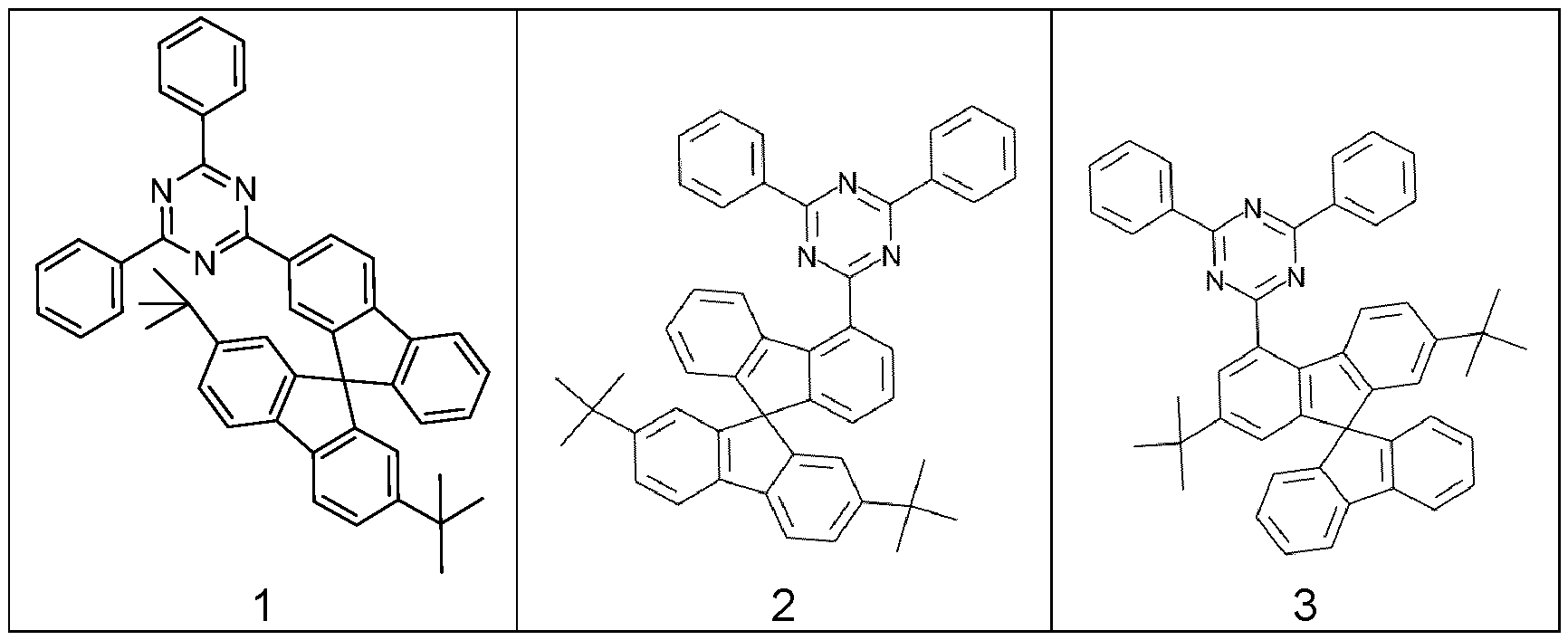
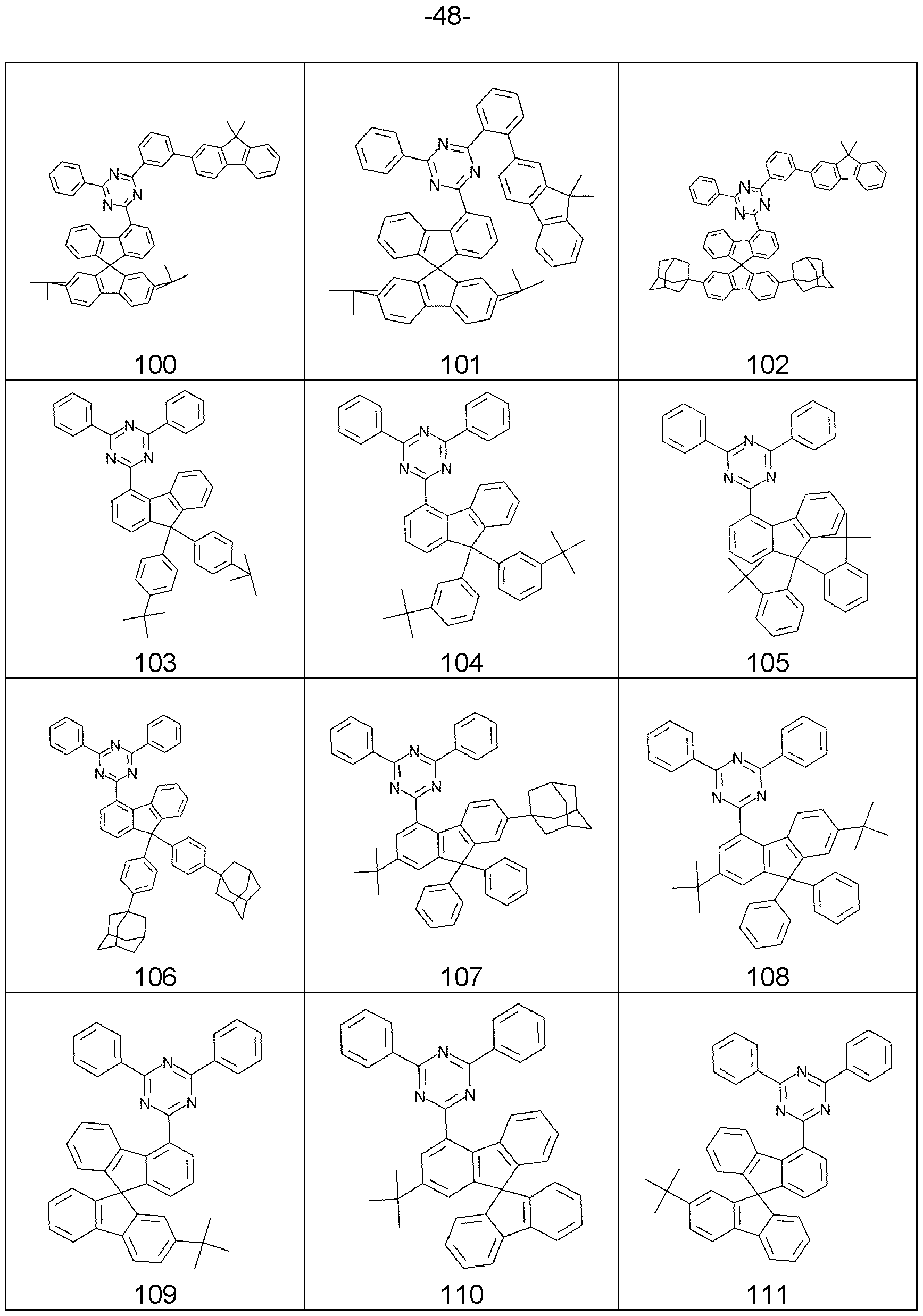
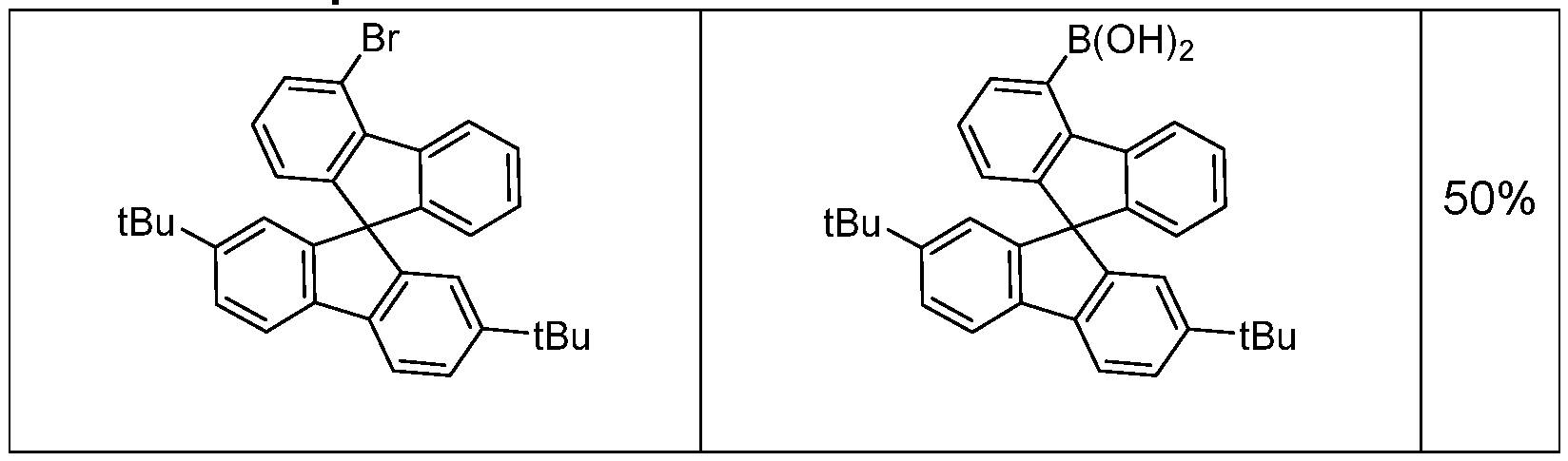
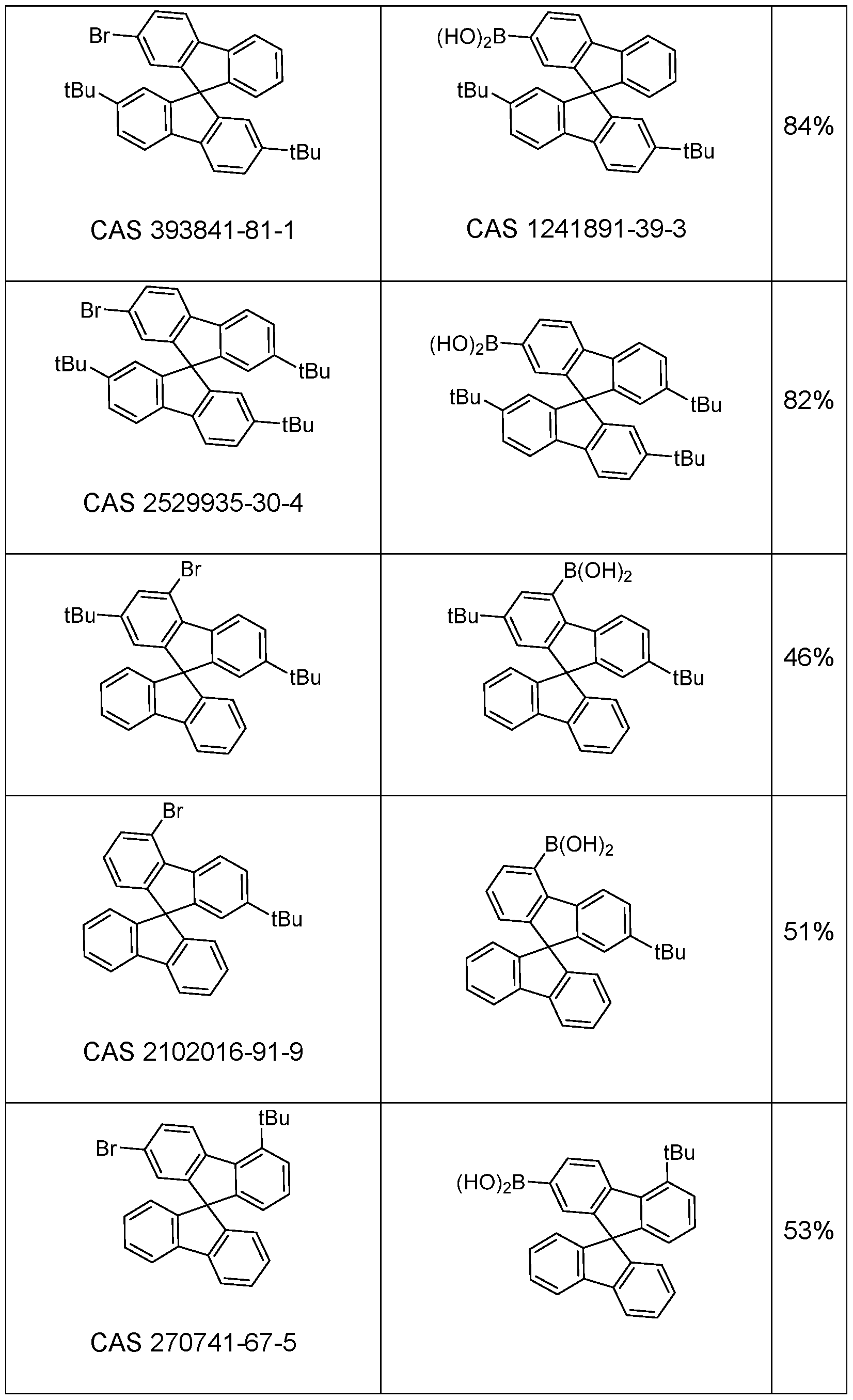
- 2-chloro-4,6-diphenyl-1 ,3,5-triazine (9.90 g, 37.0 mmol) and (2’,7’-di-tert- butyl-9,9’-spiro(fluoren)4-yl)-boronic acid (19.2 g, 40.7 mmol) are solved in 1 ,4-dioxane (119 mL) and toluene (119 mL).
- the solution is warmed up to 40 °C and tetrakis(triphenylphosphine)palladium(0) (430 mg, 0.372 mmol) were added.
- Potassium carbonate (5.62 g, 41.0 mmol) is dissolved in dest.
- the yield is 22.2 g (33.4 mmol), corresponding to 90% of theory.
- Glass plaques which have been coated with structured ITO (indium tin oxide) in a thickness of 50 nm form the substrates to which the OLEDs are applied.
- structured ITO indium tin oxide
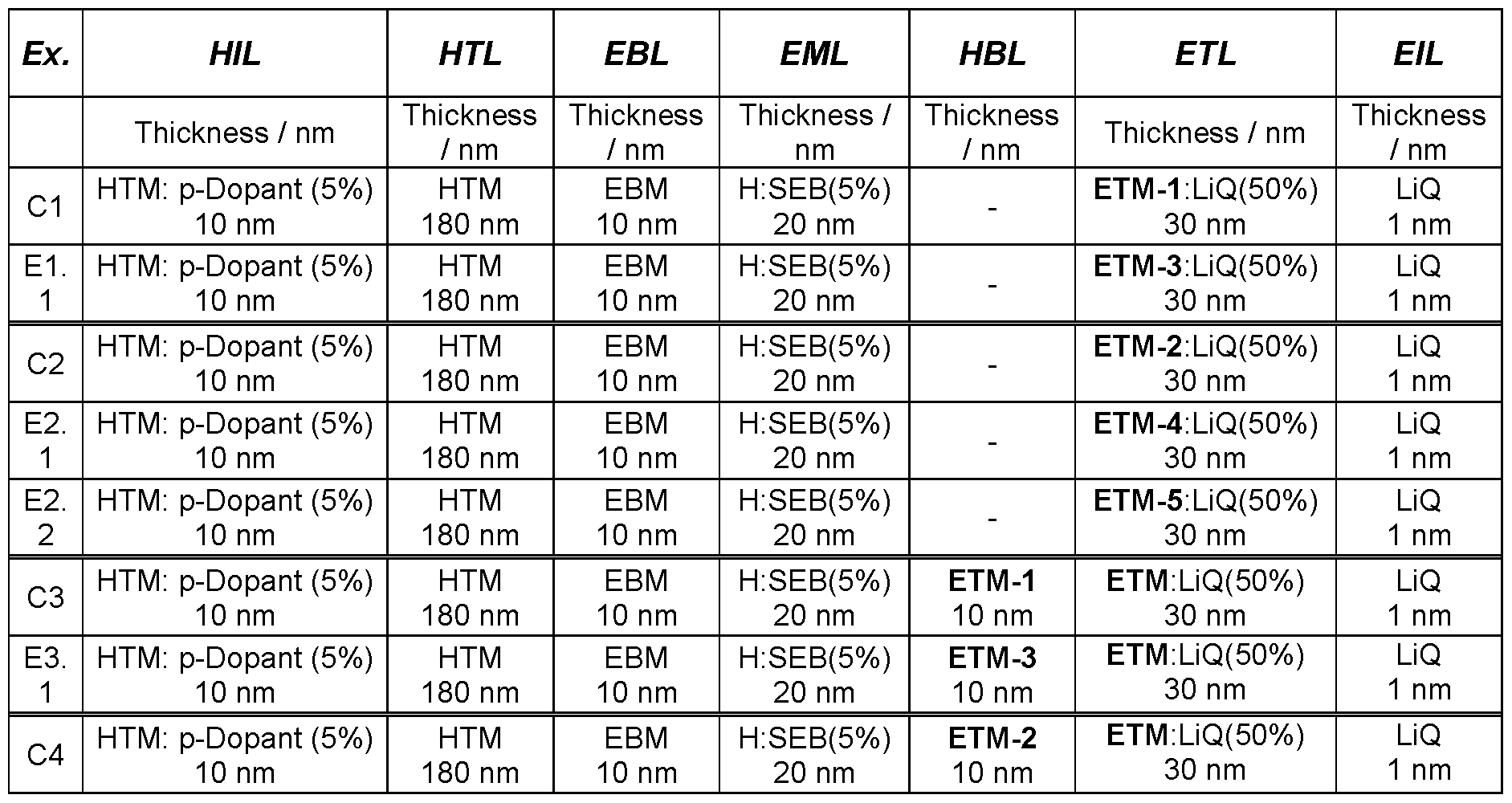
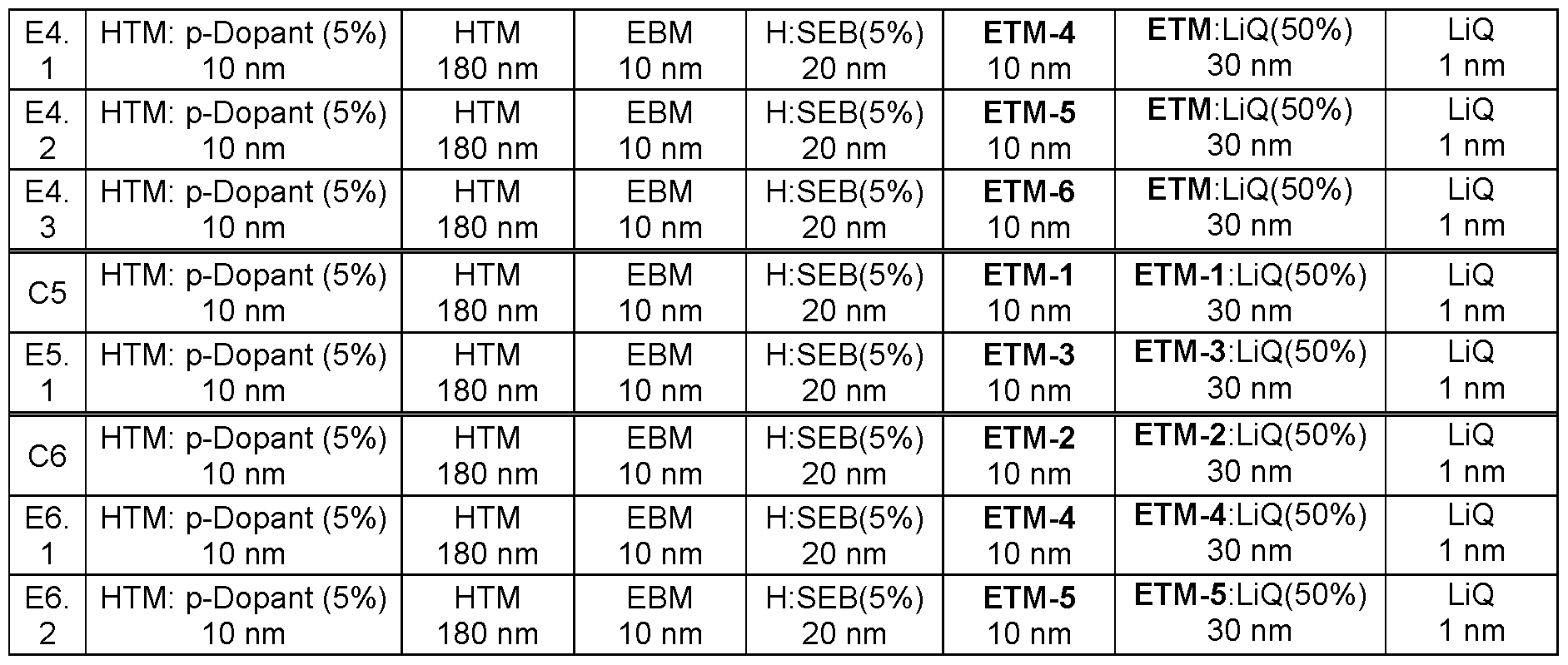
- the OLEDs basically have the following layer structure: substrate I optional interlayer (IL) I hole injection layer (HIL) I hole transport layer (HTL) I electron blocking layer (EBL) I emission layer (EML) I optional hole blocking layer (HBL) I electron transport layer (ETL) I optional electron injection layer (EIL) and finally a cathode.
- the cathode is formed by an aluminium layer of thickness 100 nm.
- the emission layer consists of at least one matrix material (host material) and an emitting dopant which is added to the matrix material(s) in a particular proportion by volume by co-evaporation.
- H:SEB 5 % mean here that the material H is present in the layer in a proportion by volume of 95 % and SEB in a proportion of 5 %.
- the electron transport layer may also consist of a mixture of two materials.
- the OLEDs are characterized in a standard manner.
- the electroluminescence spectra, the current efficiency (CE, measured in cd/A) and the external quantum efficiency (EQE, measured in %) are determined as a function of luminance, calculated from current-voltage-luminance characteristics assuming Lambertian emission characteristics, as is the lifetime.
- the electroluminescence spectra are determined at a luminance of 1000 cd/m 2 , and the CIE 1931 x and y colour coordinates are calculated therefrom.
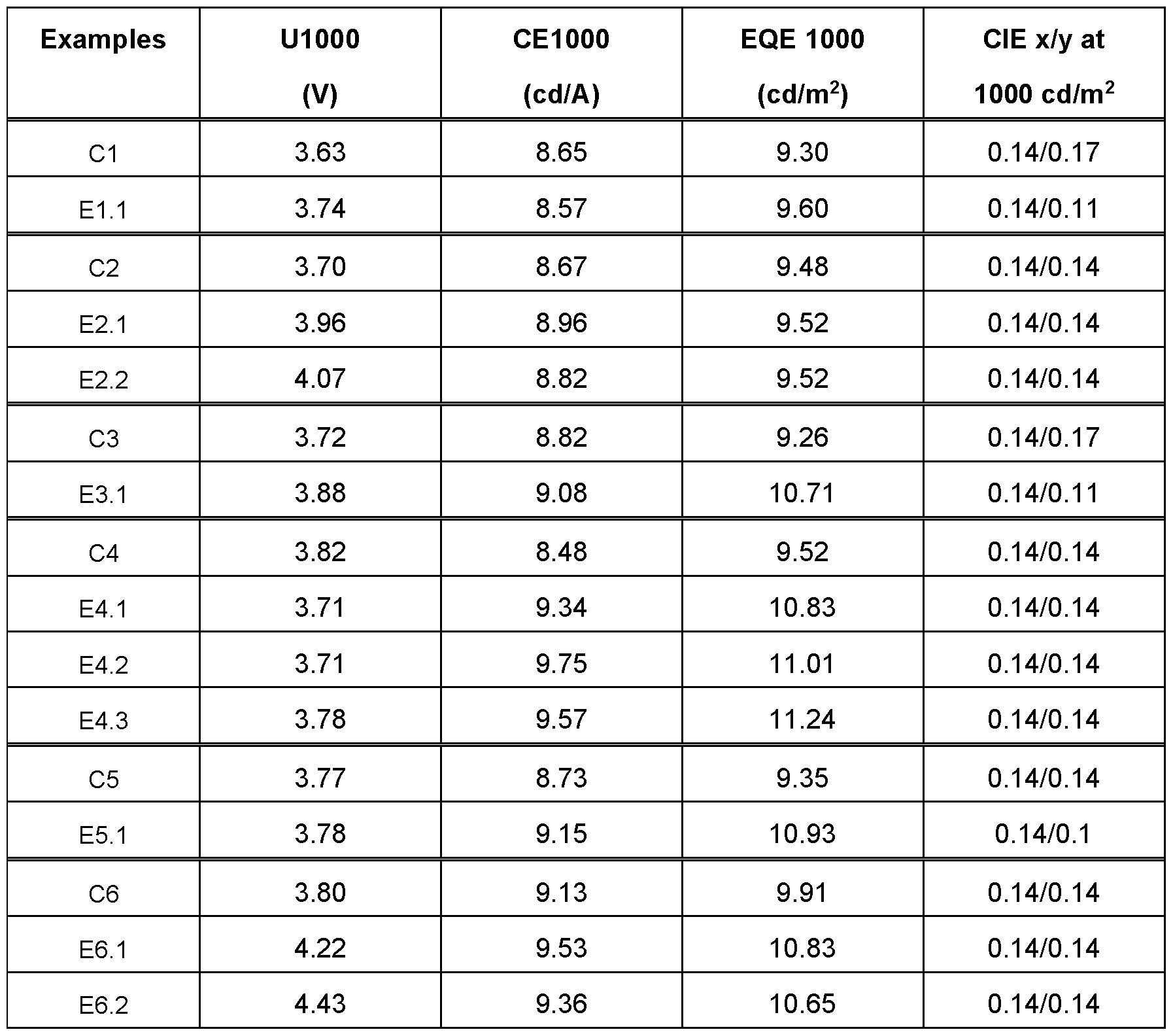
- the parameter U1000 in table 5 refers to the voltage which is required for a luminance of 1000 cd/m 2 .
- CE1000 and EQE1000 respectively denotes the current efficiency and external quantum efficiency that is attained at 1000 cd/m 2 .
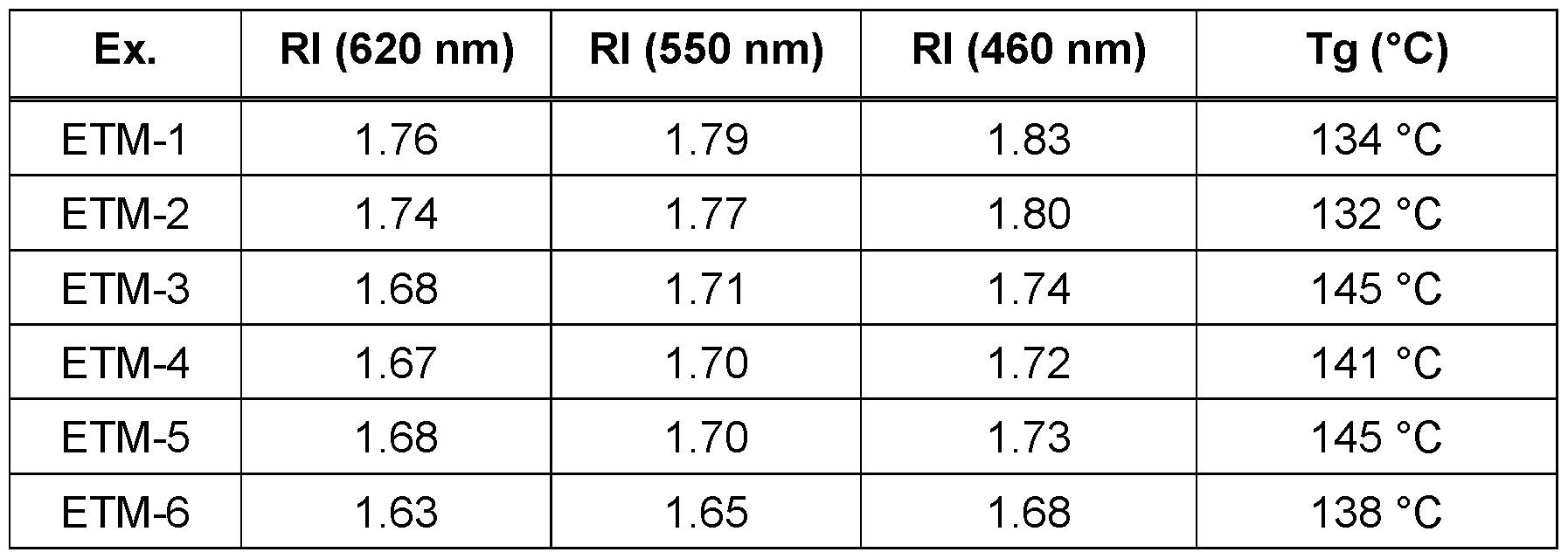
- Refractive indices are measured using a M- 2000 spectroscopic ellipsometer from J. A, Woollam Co., Inc. using a Cauchy model.
- Blue OLED typically make use of the cavity effect (especially in Top Emission devices) to more efficiently outcouple the generated light.
- Electron transport or hole blocking materials with low refractive indices can further improve light outcoupling and hence improve EQE.
- Electron transport or hole blocking materials with high glass transition temperature Tg allow an easier and more reliable processing with less formation of defect devices.
- the glass transition temperature Tg is determined in accordance with DIN EN ISO 11357-2 (2014). 2a) Use of compounds of the invention as electron transport material in the electron transport layer of OLEDs
- inventive compounds ETM-3, ETM 4 and ETM-5 are used as electron transport material, a better efficiency (examples E1.1 , E2.1 and E2.2) is achieved than with the substances ETM-1 and ETM-2 according to the prior art (examples C1 to C2).
- inventive compounds ETM-3 to ETM-6 are used as hole blocking material, significantly better efficiency and a better driving voltage are observed (examples, E4.1 , E4.2 and E4.3) compared to ETM-2 according to prior art (example C4).
- ETM-3 to ETM-6 are used as hole blocking material (examples E5 and E6) as better efficiency and better driving voltage are observed compared to ETM-1 and ETM-2 according to the prior art (examples C5 to C6).
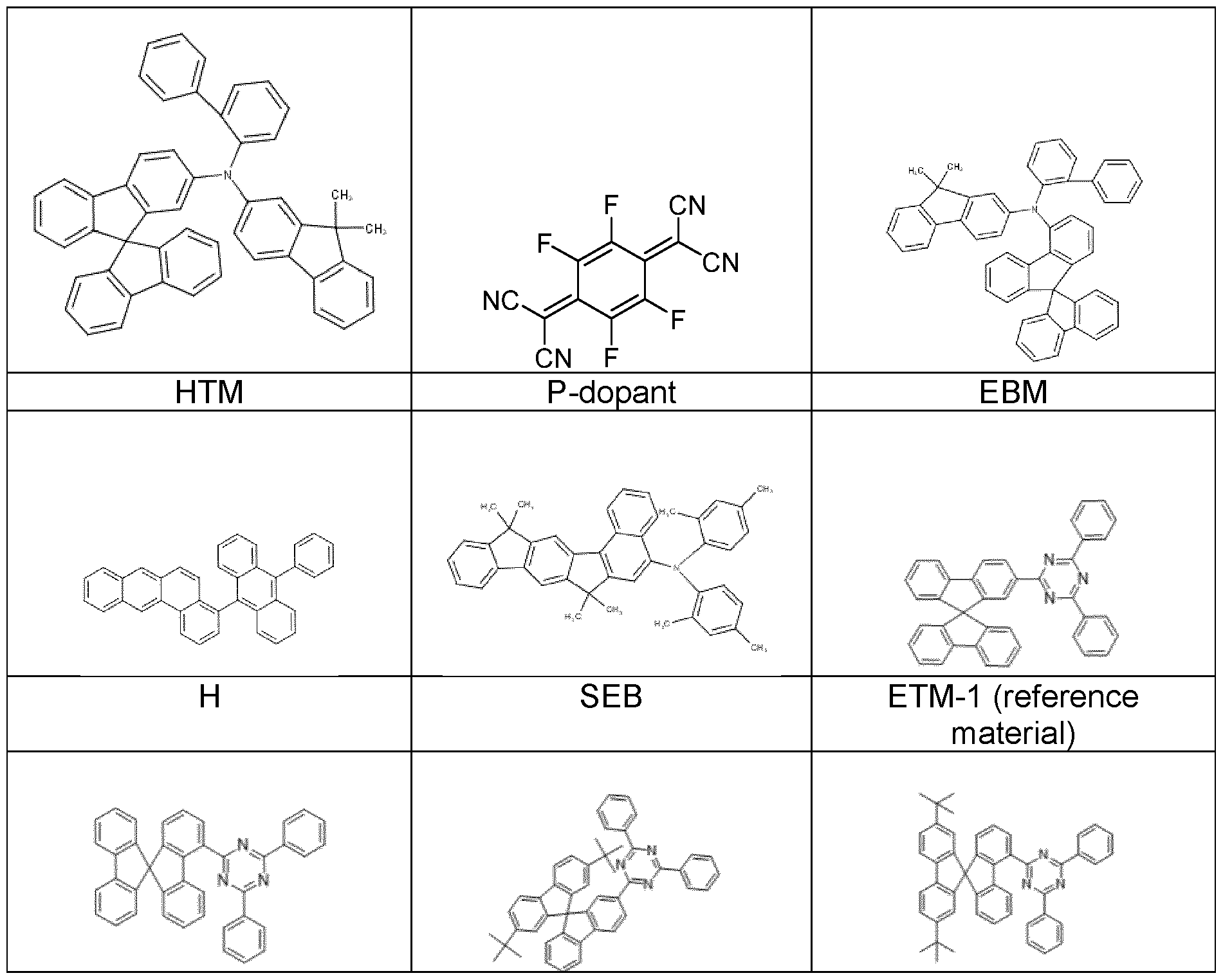
- Table 5 collates the results for the performance data of the OLEDs from examples. Additional material parameters can be found in Table 6.
- Table 6 Data of the materials The present Examples and Comparative Examples show an unexpected lowering in refractive indices (Rl) over the whole range of wavelength as shown in Table 6. In addition thereto, the efficiency and external quantum efficiency are improved. Furthermore, the Examples E4.1 , E4.2 and E4.3 show that also an improvement in operating voltage can be achieved with the compounds of the present invention.
Landscapes
- Chemical & Material Sciences (AREA)
- Organic Chemistry (AREA)
- Physics & Mathematics (AREA)
- Spectroscopy & Molecular Physics (AREA)
- Engineering & Computer Science (AREA)
- Materials Engineering (AREA)
- Optics & Photonics (AREA)
- Electroluminescent Light Sources (AREA)
- Plural Heterocyclic Compounds (AREA)
Abstract
Description




















Claims







Priority Applications (3)
| Application Number | Priority Date | Filing Date | Title |
|---|---|---|---|
| EP22823452.2A EP4442093A1 (en) | 2021-11-30 | 2022-11-30 | Compounds having fluorene structures |
| KR1020247021882A KR20240112927A (en) | 2021-11-30 | 2022-11-30 | Compounds with a fluorene structure |
| CN202280078445.4A CN118303151A (en) | 2021-11-30 | 2022-11-30 | Compounds with fluorene structure |
Applications Claiming Priority (2)
| Application Number | Priority Date | Filing Date | Title |
|---|---|---|---|
| EP21211490 | 2021-11-30 | ||
| EP21211490.4 | 2021-11-30 |
Publications (1)
| Publication Number | Publication Date |
|---|---|
| WO2023099543A1 true WO2023099543A1 (en) | 2023-06-08 |
Family
ID=79185902
Family Applications (1)
| Application Number | Title | Priority Date | Filing Date |
|---|---|---|---|
| PCT/EP2022/083807 Ceased WO2023099543A1 (en) | 2021-11-30 | 2022-11-30 | Compounds having fluorene structures |
Country Status (4)
| Country | Link |
|---|---|
| EP (1) | EP4442093A1 (en) |
| KR (1) | KR20240112927A (en) |
| CN (1) | CN118303151A (en) |
| WO (1) | WO2023099543A1 (en) |
Families Citing this family (1)
| Publication number | Priority date | Publication date | Assignee | Title |
|---|---|---|---|---|
| CN119143687B (en) * | 2024-11-12 | 2025-08-15 | 浙江华显光电科技有限公司 | Triazine compound, OLED (organic light-emitting diode) with triazine compound and organic light-emitting device |
Citations (90)
| Publication number | Priority date | Publication date | Assignee | Title |
|---|---|---|---|---|
| US4539507A (en) | 1983-03-25 | 1985-09-03 | Eastman Kodak Company | Organic electroluminescent devices having improved power conversion efficiencies |
| US5151629A (en) | 1991-08-01 | 1992-09-29 | Eastman Kodak Company | Blue emitting internal junction organic electroluminescent device (I) |
| WO1992018552A1 (en) | 1991-04-11 | 1992-10-29 | Wacker-Chemie Gmbh | Conductive polymers with conjugated double bonds |
| EP0652273A1 (en) | 1993-11-09 | 1995-05-10 | Shinko Electric Industries Co. Ltd. | Organic material for electroluminescent device and electroluminescent device |
| EP0676461A2 (en) | 1994-04-07 | 1995-10-11 | Hoechst Aktiengesellschaft | Spiro compounds and their application as electroluminescence materials |
| EP0707020A2 (en) | 1994-10-14 | 1996-04-17 | Hoechst Aktiengesellschaft | Conjugated polymers with a spiro atom and their use as electroluminescent materials |
| EP0842208A1 (en) | 1995-07-28 | 1998-05-20 | The Dow Chemical Company | 2,7-aryl-9-substituted fluorenes and 9-substituted fluorene oligomers and polymers |
| WO1998027136A1 (en) | 1996-12-16 | 1998-06-25 | Aventis Research & Technologies Gmbh & Co Kg | ARYL-SUBSTITUTED POLY(p-ARYLENE VINYLENES), METHOD FOR THE PRODUCTION AND USE THEREOF IN ELECTROLUMINESCENT COMPONENTS |
| EP0894107A1 (en) | 1996-04-17 | 1999-02-03 | Hoechst Research & Technology Deutschland GmbH & Co. KG | Polymers with spiro atoms and their use as electroluminescent materials |
| WO2000022026A1 (en) | 1998-10-10 | 2000-04-20 | Celanese Ventures Gmbh | Conjugated polymers containing special fluorene structural elements with improved properties |
| EP1028136A2 (en) | 1999-02-10 | 2000-08-16 | Carnegie-Mellon University | A method of forming poly-(3-substituted) thiophenes |
| WO2000070655A2 (en) | 1999-05-13 | 2000-11-23 | The Trustees Of Princeton University | Very high efficiency organic light emitting devices based on electrophosphorescence |
| WO2001041512A1 (en) | 1999-12-01 | 2001-06-07 | The Trustees Of Princeton University | Complexes of form l2mx as phosphorescent dopants for organic leds |
| WO2002002714A2 (en) | 2000-06-30 | 2002-01-10 | E.I. Du Pont De Nemours And Company | Electroluminescent iridium compounds with fluorinated phenylpyridines, phenylpyrimidines, and phenylquinolines and devices made with such compounds |
| WO2002015645A1 (en) | 2000-08-11 | 2002-02-21 | The Trustees Of Princeton University | Organometallic compounds and emission-shifting organic electrophosphorescence |
| EP1191613A2 (en) | 2000-09-26 | 2002-03-27 | Canon Kabushiki Kaisha | Luminescence device, display apparatus and metal coordination compound |
| EP1191614A2 (en) | 2000-09-26 | 2002-03-27 | Canon Kabushiki Kaisha | Luminescence device and metal coordination compound therefor |
| EP1191612A2 (en) | 2000-09-26 | 2002-03-27 | Canon Kabushiki Kaisha | Luminescence device, display apparatus and metal coordination compound |
| EP1205527A1 (en) | 2000-03-27 | 2002-05-15 | Idemitsu Kosan Co., Ltd. | Organic electroluminescence device |
| WO2004013080A1 (en) | 2002-08-01 | 2004-02-12 | Covion Organic Semiconductors Gmbh | Spirobifluorene derivatives, their preparation and uses thereof |
| WO2004041901A1 (en) | 2002-11-08 | 2004-05-21 | Covion Organic Semiconductors Gmbh | Aryl-substituted polyindenofluorenes for use in organic electroluminiscent devices |
| WO2004070772A2 (en) | 2003-02-06 | 2004-08-19 | Covion Organic Semiconductors Gmbh | Conjugated polymers and blends containing carbazole, representation and use thereof |
| JP2004288381A (en) | 2003-03-19 | 2004-10-14 | Konica Minolta Holdings Inc | Organic electroluminescent element |
| WO2004093207A2 (en) | 2003-04-15 | 2004-10-28 | Covion Organic Semiconductors Gmbh | Mixtures of matrix materials and organic semiconductors capable of emission, use of the same and electronic components containing said mixtures |
| WO2004113412A2 (en) | 2003-06-23 | 2004-12-29 | Covion Organic Semiconductors Gmbh | Polymer |
| WO2004113468A1 (en) | 2003-06-26 | 2004-12-29 | Covion Organic Semiconductors Gmbh | Novel materials for electroluminescence |
| WO2005011013A1 (en) | 2003-07-21 | 2005-02-03 | Covion Organic Semiconductors Gmbh | Organic electroluminescent element |
| WO2005014689A2 (en) | 2003-08-12 | 2005-02-17 | Covion Organic Semiconductors Gmbh | Conjugated polymers containing dihydrophenanthrene units and use thereof |
| WO2005019373A2 (en) | 2003-08-19 | 2005-03-03 | Basf Aktiengesellschaft | Transition metal complexes comprising carbene ligands serving as emitters for organic light-emitting diodes (oled's) |
| US20050069729A1 (en) | 2003-09-30 | 2005-03-31 | Konica Minolta Holdings, Inc. | Organic electroluminescent element, illuminator, display and compound |
| WO2005033244A1 (en) | 2003-09-29 | 2005-04-14 | Covion Organic Semiconductors Gmbh | Metal complexes |
| WO2005040302A1 (en) | 2003-10-22 | 2005-05-06 | Merck Patent Gmbh | New materials for electroluminescence and the utilization thereof |
| WO2005053051A1 (en) | 2003-11-25 | 2005-06-09 | Merck Patent Gmbh | Organic electroluminescent element |
| WO2005104264A1 (en) | 2004-04-26 | 2005-11-03 | Merck Patent Gmbh | Electroluminescent polymers and use therof |
| US20050258742A1 (en) | 2004-05-18 | 2005-11-24 | Yui-Yi Tsai | Carbene containing metal complexes as OLEDs |
| WO2005111172A2 (en) | 2004-05-11 | 2005-11-24 | Merck Patent Gmbh | Novel material mixtures for use in electroluminescence |
| JP2005347160A (en) | 2004-06-04 | 2005-12-15 | Konica Minolta Holdings Inc | Organic electroluminescence element, lighting device and display device |
| EP1617710A1 (en) | 2003-04-23 | 2006-01-18 | Konica Minolta Holdings, Inc. | Material for organic electroluminescent device, organic electroluminescent device, illuminating device and display |
| WO2006005627A1 (en) | 2004-07-15 | 2006-01-19 | Merck Patent Gmbh | Oligomeric derivatives of spirobifluorene, their preparation and use |
| WO2006061181A1 (en) | 2004-12-06 | 2006-06-15 | Merck Patent Gmbh | Partially conjugated polymers, their representation and their use |
| WO2006117052A1 (en) | 2005-05-03 | 2006-11-09 | Merck Patent Gmbh | Organic electroluminescent device and boric acid and borinic acid derivatives used therein |
| EP1731584A1 (en) | 2004-03-31 | 2006-12-13 | Konica Minolta Holdings, Inc. | Organic electroluminescent device material, organic electroluminescent device, display and illuminating device |
| WO2007017066A1 (en) | 2005-08-10 | 2007-02-15 | Merck Patent Gmbh | Electroluminescent polymers and use thereof |
| WO2007063754A1 (en) | 2005-12-01 | 2007-06-07 | Nippon Steel Chemical Co., Ltd. | Compound for organic electroluminescent element and organic electroluminescent element |
| US7294849B2 (en) | 2001-03-14 | 2007-11-13 | The Trustees Of Princeton University | Materials and devices for blue phosphorescence based organic light emitting diodes |
| WO2007137725A1 (en) | 2006-05-31 | 2007-12-06 | Merck Patent Gmbh | New materials for organic electroluminescent devices |
| WO2008056746A1 (en) | 2006-11-09 | 2008-05-15 | Nippon Steel Chemical Co., Ltd. | Compound for organic electroluminescent device and organic electroluminescent device |
| WO2008086851A1 (en) | 2007-01-18 | 2008-07-24 | Merck Patent Gmbh | Carbazole derivatives for organc electroluminescent devices |
| WO2009030981A2 (en) | 2006-12-28 | 2009-03-12 | Universal Display Corporation | Long lifetime phosphorescent organic light emitting device (oled) structures |
| WO2009062578A1 (en) | 2007-11-12 | 2009-05-22 | Merck Patent Gmbh | Organic electroluminescent devices comprising azomethine-metal complexes |
| US20090136779A1 (en) | 2007-11-26 | 2009-05-28 | Chien-Hong Cheng | Conjugated compounds containing hydroindoloacridine structural elements, and their use |
| WO2009146770A2 (en) | 2008-06-05 | 2009-12-10 | Merck Patent Gmbh | Electronic device comprising metal complexes |
| WO2010006680A1 (en) | 2008-07-18 | 2010-01-21 | Merck Patent Gmbh | Materials for organic electroluminescence devices |
| WO2010015306A1 (en) | 2008-08-08 | 2010-02-11 | Merck Patent Gmbh, | Organic electroluminescence device |
| WO2010015307A1 (en) | 2008-08-04 | 2010-02-11 | Merck Patent Gmbh | Electronic devices comprising metal complexes having isonitrile ligands |
| WO2010031485A1 (en) | 2008-09-22 | 2010-03-25 | Merck Patent Gmbh | Materials for organic electroluminescence devices |
| WO2010050778A1 (en) | 2008-10-31 | 2010-05-06 | Gracel Display Inc. | Novel compounds for organic electronic material and organic electronic device using the same |
| WO2010054728A1 (en) | 2008-11-13 | 2010-05-20 | Merck Patent Gmbh | Materials for organic electroluminescent devices |
| WO2010054730A1 (en) | 2008-11-11 | 2010-05-20 | Merck Patent Gmbh | Organic electroluminescent devices |
| WO2010054729A2 (en) | 2008-11-11 | 2010-05-20 | Merck Patent Gmbh | Materials for organic electroluminescence devices |
| WO2010054731A1 (en) | 2008-11-13 | 2010-05-20 | Merck Patent Gmbh | Materials for organic electroluminescent devices |
| WO2010072300A1 (en) | 2008-12-22 | 2010-07-01 | Merck Patent Gmbh | Organic electroluminescent device comprising triazine derivatives |
| WO2010086089A1 (en) | 2009-02-02 | 2010-08-05 | Merck Patent Gmbh | Metal complexes |
| WO2010099852A1 (en) | 2009-03-02 | 2010-09-10 | Merck Patent Gmbh | Metal complexes having azaborol ligands and electronic device having the same |
| WO2010102709A1 (en) | 2009-03-13 | 2010-09-16 | Merck Patent Gmbh | Materials for organic electroluminescence devices |
| WO2010108579A1 (en) | 2009-03-23 | 2010-09-30 | Merck Patent Gmbh | Organic electroluminescent device |
| WO2010136109A1 (en) | 2009-05-29 | 2010-12-02 | Merck Patent Gmbh | Materials for organic electroluminescent devices |
| WO2011000455A1 (en) | 2009-06-30 | 2011-01-06 | Merck Patent Gmbh | Materials for organic electroluminescence devices |
| WO2011032626A1 (en) | 2009-09-16 | 2011-03-24 | Merck Patent Gmbh | Metal complexes |
| WO2011042107A2 (en) | 2009-10-08 | 2011-04-14 | Merck Patent Gmbh | Materials for organic electroluminescent devices |
| WO2011066898A1 (en) | 2009-12-05 | 2011-06-09 | Merck Patent Gmbh | Electronic device containing metal complexes |
| WO2011088877A1 (en) | 2010-01-25 | 2011-07-28 | Merck Patent Gmbh | Compounds for electronic devices |
| WO2011116865A1 (en) | 2010-03-25 | 2011-09-29 | Merck Patent Gmbh | Materials for organic electroluminescence devices |
| WO2011137951A1 (en) | 2010-05-04 | 2011-11-10 | Merck Patent Gmbh | Organic electroluminescence devices |
| WO2011157339A1 (en) | 2010-06-15 | 2011-12-22 | Merck Patent Gmbh | Metal complexes |
| WO2012007086A1 (en) | 2010-07-16 | 2012-01-19 | Merck Patent Gmbh | Metal complexes |
| WO2012048781A1 (en) | 2010-10-15 | 2012-04-19 | Merck Patent Gmbh | Triphenylene-based materials for organic electroluminescent devices |
| WO2012143080A2 (en) | 2011-04-18 | 2012-10-26 | Merck Patent Gmbh | Materials for organic electroluminescent devices |
| WO2013064206A1 (en) | 2011-11-01 | 2013-05-10 | Merck Patent Gmbh | Organic electroluminescent device |
| WO2014008982A1 (en) | 2012-07-13 | 2014-01-16 | Merck Patent Gmbh | Metal complexes |
| WO2014015935A2 (en) | 2012-07-23 | 2014-01-30 | Merck Patent Gmbh | Compounds and organic electronic devices |
| WO2014023388A1 (en) | 2012-08-10 | 2014-02-13 | Merck Patent Gmbh | Materials for organic electroluminescence devices |
| WO2014023377A2 (en) | 2012-08-07 | 2014-02-13 | Merck Patent Gmbh | Metal complexes |
| WO2014094963A1 (en) | 2012-12-21 | 2014-06-26 | Merck Patent Gmbh | Materials for organic electroluminescent devices |
| WO2014094961A1 (en) | 2012-12-21 | 2014-06-26 | Merck Patent Gmbh | Metal complexes |
| WO2014094960A1 (en) | 2012-12-21 | 2014-06-26 | Merck Patent Gmbh | Metal complexes |
| JP2014183315A (en) | 2013-03-15 | 2014-09-29 | Dow Global Technologies Llc | Quinazoline derivative compounds for electronic film and device |
| EP2842954A1 (en) | 2012-04-24 | 2015-03-04 | Samsung SDI Co., Ltd. | Compound for organic optoelectric device, organic light emitting device containing same, and display device containing said organic light emitting device |
| EP3127988A1 (en) * | 2014-04-04 | 2017-02-08 | LG Chem, Ltd. | Organic light-emitting device |
| EP3127901A1 (en) * | 2014-04-04 | 2017-02-08 | LG Chem, Ltd. | Heterocyclic compound and organic light-emitting device comprising same |
-
2022
- 2022-11-30 WO PCT/EP2022/083807 patent/WO2023099543A1/en not_active Ceased
- 2022-11-30 KR KR1020247021882A patent/KR20240112927A/en active Pending
- 2022-11-30 CN CN202280078445.4A patent/CN118303151A/en active Pending
- 2022-11-30 EP EP22823452.2A patent/EP4442093A1/en active Pending
Patent Citations (92)
| Publication number | Priority date | Publication date | Assignee | Title |
|---|---|---|---|---|
| US4539507A (en) | 1983-03-25 | 1985-09-03 | Eastman Kodak Company | Organic electroluminescent devices having improved power conversion efficiencies |
| WO1992018552A1 (en) | 1991-04-11 | 1992-10-29 | Wacker-Chemie Gmbh | Conductive polymers with conjugated double bonds |
| US5151629A (en) | 1991-08-01 | 1992-09-29 | Eastman Kodak Company | Blue emitting internal junction organic electroluminescent device (I) |
| EP0652273A1 (en) | 1993-11-09 | 1995-05-10 | Shinko Electric Industries Co. Ltd. | Organic material for electroluminescent device and electroluminescent device |
| EP0676461A2 (en) | 1994-04-07 | 1995-10-11 | Hoechst Aktiengesellschaft | Spiro compounds and their application as electroluminescence materials |
| EP0707020A2 (en) | 1994-10-14 | 1996-04-17 | Hoechst Aktiengesellschaft | Conjugated polymers with a spiro atom and their use as electroluminescent materials |
| EP0842208A1 (en) | 1995-07-28 | 1998-05-20 | The Dow Chemical Company | 2,7-aryl-9-substituted fluorenes and 9-substituted fluorene oligomers and polymers |
| EP0894107A1 (en) | 1996-04-17 | 1999-02-03 | Hoechst Research & Technology Deutschland GmbH & Co. KG | Polymers with spiro atoms and their use as electroluminescent materials |
| WO1998027136A1 (en) | 1996-12-16 | 1998-06-25 | Aventis Research & Technologies Gmbh & Co Kg | ARYL-SUBSTITUTED POLY(p-ARYLENE VINYLENES), METHOD FOR THE PRODUCTION AND USE THEREOF IN ELECTROLUMINESCENT COMPONENTS |
| WO2000022026A1 (en) | 1998-10-10 | 2000-04-20 | Celanese Ventures Gmbh | Conjugated polymers containing special fluorene structural elements with improved properties |
| EP1028136A2 (en) | 1999-02-10 | 2000-08-16 | Carnegie-Mellon University | A method of forming poly-(3-substituted) thiophenes |
| WO2000070655A2 (en) | 1999-05-13 | 2000-11-23 | The Trustees Of Princeton University | Very high efficiency organic light emitting devices based on electrophosphorescence |
| WO2001041512A1 (en) | 1999-12-01 | 2001-06-07 | The Trustees Of Princeton University | Complexes of form l2mx as phosphorescent dopants for organic leds |
| EP1205527A1 (en) | 2000-03-27 | 2002-05-15 | Idemitsu Kosan Co., Ltd. | Organic electroluminescence device |
| WO2002002714A2 (en) | 2000-06-30 | 2002-01-10 | E.I. Du Pont De Nemours And Company | Electroluminescent iridium compounds with fluorinated phenylpyridines, phenylpyrimidines, and phenylquinolines and devices made with such compounds |
| WO2002015645A1 (en) | 2000-08-11 | 2002-02-21 | The Trustees Of Princeton University | Organometallic compounds and emission-shifting organic electrophosphorescence |
| EP1191613A2 (en) | 2000-09-26 | 2002-03-27 | Canon Kabushiki Kaisha | Luminescence device, display apparatus and metal coordination compound |
| EP1191614A2 (en) | 2000-09-26 | 2002-03-27 | Canon Kabushiki Kaisha | Luminescence device and metal coordination compound therefor |
| EP1191612A2 (en) | 2000-09-26 | 2002-03-27 | Canon Kabushiki Kaisha | Luminescence device, display apparatus and metal coordination compound |
| US7294849B2 (en) | 2001-03-14 | 2007-11-13 | The Trustees Of Princeton University | Materials and devices for blue phosphorescence based organic light emitting diodes |
| WO2004013080A1 (en) | 2002-08-01 | 2004-02-12 | Covion Organic Semiconductors Gmbh | Spirobifluorene derivatives, their preparation and uses thereof |
| WO2004041901A1 (en) | 2002-11-08 | 2004-05-21 | Covion Organic Semiconductors Gmbh | Aryl-substituted polyindenofluorenes for use in organic electroluminiscent devices |
| WO2004070772A2 (en) | 2003-02-06 | 2004-08-19 | Covion Organic Semiconductors Gmbh | Conjugated polymers and blends containing carbazole, representation and use thereof |
| JP2004288381A (en) | 2003-03-19 | 2004-10-14 | Konica Minolta Holdings Inc | Organic electroluminescent element |
| WO2004093207A2 (en) | 2003-04-15 | 2004-10-28 | Covion Organic Semiconductors Gmbh | Mixtures of matrix materials and organic semiconductors capable of emission, use of the same and electronic components containing said mixtures |
| EP1617710A1 (en) | 2003-04-23 | 2006-01-18 | Konica Minolta Holdings, Inc. | Material for organic electroluminescent device, organic electroluminescent device, illuminating device and display |
| EP1617711A1 (en) | 2003-04-23 | 2006-01-18 | Konica Minolta Holdings, Inc. | Organic electroluminescent device and display |
| WO2004113412A2 (en) | 2003-06-23 | 2004-12-29 | Covion Organic Semiconductors Gmbh | Polymer |
| WO2004113468A1 (en) | 2003-06-26 | 2004-12-29 | Covion Organic Semiconductors Gmbh | Novel materials for electroluminescence |
| WO2005011013A1 (en) | 2003-07-21 | 2005-02-03 | Covion Organic Semiconductors Gmbh | Organic electroluminescent element |
| WO2005014689A2 (en) | 2003-08-12 | 2005-02-17 | Covion Organic Semiconductors Gmbh | Conjugated polymers containing dihydrophenanthrene units and use thereof |
| WO2005019373A2 (en) | 2003-08-19 | 2005-03-03 | Basf Aktiengesellschaft | Transition metal complexes comprising carbene ligands serving as emitters for organic light-emitting diodes (oled's) |
| WO2005033244A1 (en) | 2003-09-29 | 2005-04-14 | Covion Organic Semiconductors Gmbh | Metal complexes |
| US20050069729A1 (en) | 2003-09-30 | 2005-03-31 | Konica Minolta Holdings, Inc. | Organic electroluminescent element, illuminator, display and compound |
| WO2005039246A1 (en) | 2003-09-30 | 2005-04-28 | Konica Minolta Holdings, Inc. | Organic electroluminescent device, illuminating device, and display |
| WO2005040302A1 (en) | 2003-10-22 | 2005-05-06 | Merck Patent Gmbh | New materials for electroluminescence and the utilization thereof |
| WO2005053051A1 (en) | 2003-11-25 | 2005-06-09 | Merck Patent Gmbh | Organic electroluminescent element |
| EP1731584A1 (en) | 2004-03-31 | 2006-12-13 | Konica Minolta Holdings, Inc. | Organic electroluminescent device material, organic electroluminescent device, display and illuminating device |
| WO2005104264A1 (en) | 2004-04-26 | 2005-11-03 | Merck Patent Gmbh | Electroluminescent polymers and use therof |
| WO2005111172A2 (en) | 2004-05-11 | 2005-11-24 | Merck Patent Gmbh | Novel material mixtures for use in electroluminescence |
| US20050258742A1 (en) | 2004-05-18 | 2005-11-24 | Yui-Yi Tsai | Carbene containing metal complexes as OLEDs |
| JP2005347160A (en) | 2004-06-04 | 2005-12-15 | Konica Minolta Holdings Inc | Organic electroluminescence element, lighting device and display device |
| WO2006005627A1 (en) | 2004-07-15 | 2006-01-19 | Merck Patent Gmbh | Oligomeric derivatives of spirobifluorene, their preparation and use |
| WO2006061181A1 (en) | 2004-12-06 | 2006-06-15 | Merck Patent Gmbh | Partially conjugated polymers, their representation and their use |
| WO2006117052A1 (en) | 2005-05-03 | 2006-11-09 | Merck Patent Gmbh | Organic electroluminescent device and boric acid and borinic acid derivatives used therein |
| WO2007017066A1 (en) | 2005-08-10 | 2007-02-15 | Merck Patent Gmbh | Electroluminescent polymers and use thereof |
| WO2007063754A1 (en) | 2005-12-01 | 2007-06-07 | Nippon Steel Chemical Co., Ltd. | Compound for organic electroluminescent element and organic electroluminescent element |
| WO2007137725A1 (en) | 2006-05-31 | 2007-12-06 | Merck Patent Gmbh | New materials for organic electroluminescent devices |
| WO2008056746A1 (en) | 2006-11-09 | 2008-05-15 | Nippon Steel Chemical Co., Ltd. | Compound for organic electroluminescent device and organic electroluminescent device |
| WO2009030981A2 (en) | 2006-12-28 | 2009-03-12 | Universal Display Corporation | Long lifetime phosphorescent organic light emitting device (oled) structures |
| WO2008086851A1 (en) | 2007-01-18 | 2008-07-24 | Merck Patent Gmbh | Carbazole derivatives for organc electroluminescent devices |
| WO2009062578A1 (en) | 2007-11-12 | 2009-05-22 | Merck Patent Gmbh | Organic electroluminescent devices comprising azomethine-metal complexes |
| US20090136779A1 (en) | 2007-11-26 | 2009-05-28 | Chien-Hong Cheng | Conjugated compounds containing hydroindoloacridine structural elements, and their use |
| WO2009146770A2 (en) | 2008-06-05 | 2009-12-10 | Merck Patent Gmbh | Electronic device comprising metal complexes |
| WO2010006680A1 (en) | 2008-07-18 | 2010-01-21 | Merck Patent Gmbh | Materials for organic electroluminescence devices |
| WO2010015307A1 (en) | 2008-08-04 | 2010-02-11 | Merck Patent Gmbh | Electronic devices comprising metal complexes having isonitrile ligands |
| WO2010015306A1 (en) | 2008-08-08 | 2010-02-11 | Merck Patent Gmbh, | Organic electroluminescence device |
| WO2010031485A1 (en) | 2008-09-22 | 2010-03-25 | Merck Patent Gmbh | Materials for organic electroluminescence devices |
| WO2010050778A1 (en) | 2008-10-31 | 2010-05-06 | Gracel Display Inc. | Novel compounds for organic electronic material and organic electronic device using the same |
| WO2010054730A1 (en) | 2008-11-11 | 2010-05-20 | Merck Patent Gmbh | Organic electroluminescent devices |
| WO2010054729A2 (en) | 2008-11-11 | 2010-05-20 | Merck Patent Gmbh | Materials for organic electroluminescence devices |
| WO2010054728A1 (en) | 2008-11-13 | 2010-05-20 | Merck Patent Gmbh | Materials for organic electroluminescent devices |
| WO2010054731A1 (en) | 2008-11-13 | 2010-05-20 | Merck Patent Gmbh | Materials for organic electroluminescent devices |
| WO2010072300A1 (en) | 2008-12-22 | 2010-07-01 | Merck Patent Gmbh | Organic electroluminescent device comprising triazine derivatives |
| WO2010086089A1 (en) | 2009-02-02 | 2010-08-05 | Merck Patent Gmbh | Metal complexes |
| WO2010099852A1 (en) | 2009-03-02 | 2010-09-10 | Merck Patent Gmbh | Metal complexes having azaborol ligands and electronic device having the same |
| WO2010102709A1 (en) | 2009-03-13 | 2010-09-16 | Merck Patent Gmbh | Materials for organic electroluminescence devices |
| WO2010108579A1 (en) | 2009-03-23 | 2010-09-30 | Merck Patent Gmbh | Organic electroluminescent device |
| WO2010136109A1 (en) | 2009-05-29 | 2010-12-02 | Merck Patent Gmbh | Materials for organic electroluminescent devices |
| WO2011000455A1 (en) | 2009-06-30 | 2011-01-06 | Merck Patent Gmbh | Materials for organic electroluminescence devices |
| WO2011032626A1 (en) | 2009-09-16 | 2011-03-24 | Merck Patent Gmbh | Metal complexes |
| WO2011042107A2 (en) | 2009-10-08 | 2011-04-14 | Merck Patent Gmbh | Materials for organic electroluminescent devices |
| WO2011066898A1 (en) | 2009-12-05 | 2011-06-09 | Merck Patent Gmbh | Electronic device containing metal complexes |
| WO2011088877A1 (en) | 2010-01-25 | 2011-07-28 | Merck Patent Gmbh | Compounds for electronic devices |
| WO2011116865A1 (en) | 2010-03-25 | 2011-09-29 | Merck Patent Gmbh | Materials for organic electroluminescence devices |
| WO2011137951A1 (en) | 2010-05-04 | 2011-11-10 | Merck Patent Gmbh | Organic electroluminescence devices |
| WO2011157339A1 (en) | 2010-06-15 | 2011-12-22 | Merck Patent Gmbh | Metal complexes |
| WO2012007086A1 (en) | 2010-07-16 | 2012-01-19 | Merck Patent Gmbh | Metal complexes |
| WO2012048781A1 (en) | 2010-10-15 | 2012-04-19 | Merck Patent Gmbh | Triphenylene-based materials for organic electroluminescent devices |
| WO2012143080A2 (en) | 2011-04-18 | 2012-10-26 | Merck Patent Gmbh | Materials for organic electroluminescent devices |
| WO2013064206A1 (en) | 2011-11-01 | 2013-05-10 | Merck Patent Gmbh | Organic electroluminescent device |
| EP2842954A1 (en) | 2012-04-24 | 2015-03-04 | Samsung SDI Co., Ltd. | Compound for organic optoelectric device, organic light emitting device containing same, and display device containing said organic light emitting device |
| WO2014008982A1 (en) | 2012-07-13 | 2014-01-16 | Merck Patent Gmbh | Metal complexes |
| WO2014015935A2 (en) | 2012-07-23 | 2014-01-30 | Merck Patent Gmbh | Compounds and organic electronic devices |
| WO2014023377A2 (en) | 2012-08-07 | 2014-02-13 | Merck Patent Gmbh | Metal complexes |
| WO2014023388A1 (en) | 2012-08-10 | 2014-02-13 | Merck Patent Gmbh | Materials for organic electroluminescence devices |
| WO2014094963A1 (en) | 2012-12-21 | 2014-06-26 | Merck Patent Gmbh | Materials for organic electroluminescent devices |
| WO2014094961A1 (en) | 2012-12-21 | 2014-06-26 | Merck Patent Gmbh | Metal complexes |
| WO2014094960A1 (en) | 2012-12-21 | 2014-06-26 | Merck Patent Gmbh | Metal complexes |
| JP2014183315A (en) | 2013-03-15 | 2014-09-29 | Dow Global Technologies Llc | Quinazoline derivative compounds for electronic film and device |
| EP3127988A1 (en) * | 2014-04-04 | 2017-02-08 | LG Chem, Ltd. | Organic light-emitting device |
| EP3127901A1 (en) * | 2014-04-04 | 2017-02-08 | LG Chem, Ltd. | Heterocyclic compound and organic light-emitting device comprising same |
Non-Patent Citations (2)
| Title |
|---|
| D. M. KOLLER ET AL., NATURE PHOTONICS, 2008, pages 1 - 4 |
| M. S. ARNOLD ET AL., APPL. PHYS. LETT., vol. 92, 2008, pages 053301 |
Also Published As
| Publication number | Publication date |
|---|---|
| CN118303151A (en) | 2024-07-05 |
| EP4442093A1 (en) | 2024-10-09 |
| KR20240112927A (en) | 2024-07-19 |
Similar Documents
| Publication | Publication Date | Title |
|---|---|---|
| US12030890B2 (en) | Compounds with diazadibenzofurane or diazadibenzothiophene structures | |
| JP7554785B2 (en) | Heterocyclic compounds having a dibenzofuran and/or dibenzothiophene structure | |
| JP7587540B2 (en) | Compounds having a spirobifluorene structure | |
| KR102773142B1 (en) | Carbazoles with diazadibenzofurane or diazadibenzothiophene structures | |
| TWI761977B (en) | Materials for organic electroluminescent devices | |
| US10957859B2 (en) | Heterocyclic compounds for use in electronic devices | |
| US11201296B2 (en) | Compounds having fluorene structures | |
| TWI821154B (en) | Materials for organic electroluminescent devices | |
| CN104488359A (en) | Derivatives of 2-diarylaminofluorenes and organic electronic complexes containing said 2-diarylaminofluorene derivatives | |
| CN107108589A (en) | Carbazole with two dibenzofurans or dibenzothiophenes substituent | |
| KR20160074630A (en) | Materials for electronic devices | |
| CN104813496A (en) | electronic device | |
| US12193325B2 (en) | Nitrogen-containing heterocycles for use in OLEDs | |
| US10377766B2 (en) | Heterocyclic compounds with benzo(c)coumarin-structures | |
| US11447464B2 (en) | Compounds with spirobifluorene-structures | |
| WO2023099543A1 (en) | Compounds having fluorene structures | |
| US20220006018A1 (en) | Compounds that can be used for producing an organic electronic device | |
| US11329233B2 (en) | Heterocyclic compounds for use in electronic devices |
Legal Events
| Date | Code | Title | Description |
|---|---|---|---|
| 121 | Ep: the epo has been informed by wipo that ep was designated in this application |
Ref document number: 22823452 Country of ref document: EP Kind code of ref document: A1 |
|
| WWE | Wipo information: entry into national phase |
Ref document number: 202280078445.4 Country of ref document: CN |
|
| ENP | Entry into the national phase |
Ref document number: 20247021882 Country of ref document: KR Kind code of ref document: A |
|
| NENP | Non-entry into the national phase |
Ref country code: DE |
|
| ENP | Entry into the national phase |
Ref document number: 2022823452 Country of ref document: EP Effective date: 20240701 |