WO2010072300A1 - Organic electroluminescent device comprising triazine derivatives - Google Patents
Organic electroluminescent device comprising triazine derivatives Download PDFInfo
- Publication number
- WO2010072300A1 WO2010072300A1 PCT/EP2009/008441 EP2009008441W WO2010072300A1 WO 2010072300 A1 WO2010072300 A1 WO 2010072300A1 EP 2009008441 W EP2009008441 W EP 2009008441W WO 2010072300 A1 WO2010072300 A1 WO 2010072300A1
- Authority
- WO
- WIPO (PCT)
- Prior art keywords
- formula
- substituted
- organic electroluminescent
- electroluminescent device
- radicals
- Prior art date
- Legal status (The legal status is an assumption and is not a legal conclusion. Google has not performed a legal analysis and makes no representation as to the accuracy of the status listed.)
- Ceased
Links
Classifications
-
- H—ELECTRICITY
- H10—SEMICONDUCTOR DEVICES; ELECTRIC SOLID-STATE DEVICES NOT OTHERWISE PROVIDED FOR
- H10K—ORGANIC ELECTRIC SOLID-STATE DEVICES
- H10K85/00—Organic materials used in the body or electrodes of devices covered by this subclass
- H10K85/60—Organic compounds having low molecular weight
- H10K85/649—Aromatic compounds comprising a hetero atom
- H10K85/653—Aromatic compounds comprising a hetero atom comprising only oxygen as heteroatom
-
- H—ELECTRICITY
- H10—SEMICONDUCTOR DEVICES; ELECTRIC SOLID-STATE DEVICES NOT OTHERWISE PROVIDED FOR
- H10K—ORGANIC ELECTRIC SOLID-STATE DEVICES
- H10K50/00—Organic light-emitting devices
- H10K50/10—OLEDs or polymer light-emitting diodes [PLED]
- H10K50/14—Carrier transporting layers
- H10K50/16—Electron transporting layers
-
- H—ELECTRICITY
- H10—SEMICONDUCTOR DEVICES; ELECTRIC SOLID-STATE DEVICES NOT OTHERWISE PROVIDED FOR
- H10K—ORGANIC ELECTRIC SOLID-STATE DEVICES
- H10K50/00—Organic light-emitting devices
- H10K50/10—OLEDs or polymer light-emitting diodes [PLED]
- H10K50/14—Carrier transporting layers
- H10K50/16—Electron transporting layers
- H10K50/165—Electron transporting layers comprising dopants
-
- H—ELECTRICITY
- H10—SEMICONDUCTOR DEVICES; ELECTRIC SOLID-STATE DEVICES NOT OTHERWISE PROVIDED FOR
- H10K—ORGANIC ELECTRIC SOLID-STATE DEVICES
- H10K71/00—Manufacture or treatment specially adapted for the organic devices covered by this subclass
- H10K71/30—Doping active layers, e.g. electron transporting layers
-
- H—ELECTRICITY
- H10—SEMICONDUCTOR DEVICES; ELECTRIC SOLID-STATE DEVICES NOT OTHERWISE PROVIDED FOR
- H10K—ORGANIC ELECTRIC SOLID-STATE DEVICES
- H10K85/00—Organic materials used in the body or electrodes of devices covered by this subclass
- H10K85/60—Organic compounds having low molecular weight
- H10K85/615—Polycyclic condensed aromatic hydrocarbons, e.g. anthracene
- H10K85/622—Polycyclic condensed aromatic hydrocarbons, e.g. anthracene containing four rings, e.g. pyrene
-
- H—ELECTRICITY
- H10—SEMICONDUCTOR DEVICES; ELECTRIC SOLID-STATE DEVICES NOT OTHERWISE PROVIDED FOR
- H10K—ORGANIC ELECTRIC SOLID-STATE DEVICES
- H10K85/00—Organic materials used in the body or electrodes of devices covered by this subclass
- H10K85/60—Organic compounds having low molecular weight
- H10K85/615—Polycyclic condensed aromatic hydrocarbons, e.g. anthracene
- H10K85/623—Polycyclic condensed aromatic hydrocarbons, e.g. anthracene containing five rings, e.g. pentacene
-
- H—ELECTRICITY
- H10—SEMICONDUCTOR DEVICES; ELECTRIC SOLID-STATE DEVICES NOT OTHERWISE PROVIDED FOR
- H10K—ORGANIC ELECTRIC SOLID-STATE DEVICES
- H10K85/00—Organic materials used in the body or electrodes of devices covered by this subclass
- H10K85/60—Organic compounds having low molecular weight
- H10K85/615—Polycyclic condensed aromatic hydrocarbons, e.g. anthracene
- H10K85/624—Polycyclic condensed aromatic hydrocarbons, e.g. anthracene containing six or more rings
-
- H—ELECTRICITY
- H10—SEMICONDUCTOR DEVICES; ELECTRIC SOLID-STATE DEVICES NOT OTHERWISE PROVIDED FOR
- H10K—ORGANIC ELECTRIC SOLID-STATE DEVICES
- H10K85/00—Organic materials used in the body or electrodes of devices covered by this subclass
- H10K85/60—Organic compounds having low molecular weight
- H10K85/615—Polycyclic condensed aromatic hydrocarbons, e.g. anthracene
- H10K85/626—Polycyclic condensed aromatic hydrocarbons, e.g. anthracene containing more than one polycyclic condensed aromatic rings, e.g. bis-anthracene
-
- H—ELECTRICITY
- H10—SEMICONDUCTOR DEVICES; ELECTRIC SOLID-STATE DEVICES NOT OTHERWISE PROVIDED FOR
- H10K—ORGANIC ELECTRIC SOLID-STATE DEVICES
- H10K85/00—Organic materials used in the body or electrodes of devices covered by this subclass
- H10K85/60—Organic compounds having low molecular weight
- H10K85/649—Aromatic compounds comprising a hetero atom
- H10K85/654—Aromatic compounds comprising a hetero atom comprising only nitrogen as heteroatom
-
- Y—GENERAL TAGGING OF NEW TECHNOLOGICAL DEVELOPMENTS; GENERAL TAGGING OF CROSS-SECTIONAL TECHNOLOGIES SPANNING OVER SEVERAL SECTIONS OF THE IPC; TECHNICAL SUBJECTS COVERED BY FORMER USPC CROSS-REFERENCE ART COLLECTIONS [XRACs] AND DIGESTS
- Y02—TECHNOLOGIES OR APPLICATIONS FOR MITIGATION OR ADAPTATION AGAINST CLIMATE CHANGE
- Y02E—REDUCTION OF GREENHOUSE GAS [GHG] EMISSIONS, RELATED TO ENERGY GENERATION, TRANSMISSION OR DISTRIBUTION
- Y02E10/00—Energy generation through renewable energy sources
- Y02E10/50—Photovoltaic [PV] energy
- Y02E10/549—Organic PV cells
-
- Y—GENERAL TAGGING OF NEW TECHNOLOGICAL DEVELOPMENTS; GENERAL TAGGING OF CROSS-SECTIONAL TECHNOLOGIES SPANNING OVER SEVERAL SECTIONS OF THE IPC; TECHNICAL SUBJECTS COVERED BY FORMER USPC CROSS-REFERENCE ART COLLECTIONS [XRACs] AND DIGESTS
- Y10—TECHNICAL SUBJECTS COVERED BY FORMER USPC
- Y10S—TECHNICAL SUBJECTS COVERED BY FORMER USPC CROSS-REFERENCE ART COLLECTIONS [XRACs] AND DIGESTS
- Y10S428/00—Stock material or miscellaneous articles
- Y10S428/917—Electroluminescent
Definitions
- the present invention relates to organic electroluminescent devices containing triazine derivatives as electron transport materials.
- OLEDs organic electroluminescent devices
- OLEDs organic electroluminescent devices
- further improvements are desirable. For example, there is still room for improvement with regard to the service life, the efficiency and the operating voltage of organic electroluminescent devices.
- the compounds have a high thermal stability and a high glass transition temperature and can sublime undecomposed.
- AIQ 3 has since been widely used as an electron transport material, but has several disadvantages: It can not be evaporated without leaving any residue, as it partially decomposes at the sublimation temperature, which is a major problem especially for production plants. This has the consequence that the Aufdampfarion must always be cleaned or changed. Furthermore, decomposition products of AIQ 3 enter the OLED, where they contribute to a reduced lifetime and reduced quantum and power efficiency. AIQ 3 also has low electron mobility, resulting in higher voltages and lower power efficiency.
- AIQ 3 Because of the low charge carrier mobility and the resulting increase in voltage.
- the charge carrier mobility of other electron conductors (US Pat. No. 4,539,507) is also too low to build up thicker layers, with the lifetime of the OLED being even worse than when using AlQ 3 .
- the inherent color (yellow in the solid) of AIQ 3 also proves unfavorable, which can lead to color shifts, especially with blue OLEDs, due to reabsorption and weak reemission.
- blue OLEDs can only be represented with high efficiency or color loss.
- organic electronic devices containing triazine derivatives as electron transport materials in combination with an organic alkali metal compound have marked improvements over the prior art.
- this combination of materials achieves high efficiencies and long service life and lowers operating voltages.
- WO 05/053055 discloses the use of triazine derivatives, in particular of spirobifluorene derivatives which are substituted by triazine groups, as hole-blocking material in a hole-blocking layer in phosphorescent OLEDs. However, it is not apparent from the application that these materials are also suitable as electron transport materials for fluorescent electroluminescent devices.
- the invention thus relates to an organic electroluminescent device comprising anode, cathode and at least one emitting layer which contains at least one fluorescent emitter, or at least one emitting layer which contains at least one phosphorescent emitter and which is used in combination with a following hole blocking layer, characterized in that between the emitting layer and the hole blocking layer and the cathode is provided with an electron transport layer containing at least one compound according to formula (1) or formula (2),
- Ar is a group of the following formula (3)
- Heteroaryloxy devis having 5 to 60 aromatic ring atoms, which may be substituted by one or more radicals R 3 , or a combination of these systems; two or more adjacent substituents R 1 may also together form a mono- or polycyclic, aliphatic or aromatic ring system;
- R 3 is identical or different at each occurrence H, D or an aliphatic, aromatic and / or heteroaromatic hydrocarbon radical having 1 to 20 C-atoms, in which H atoms may also be replaced by D or F; two or more adjacent substituents R 3 may also together form a mono- or polycyclic, aliphatic or aromatic ring system;
- n 0 or 1
- n 0, 1, 2 or 3;
- An organic electroluminescent device is understood to mean a device which contains the anode, cathode and at least one emitting layer, which is arranged between the anode and the cathode, wherein at least one layer between the anode and the cathode contains at least one organic or organometallic compound.
- the electron transport layer contains at least one compound of the above-mentioned formula (1) or (2).
- An organic electroluminescent device need not necessarily contain only layers composed of organic or organometallic materials. So it is also possible that one or more layers contain inorganic materials or are constructed entirely of inorganic materials.
- a fluorescent compound in the sense of this invention is a compound which exhibits luminescence from an excited singlet state at room temperature.
- all luminescent compounds which have no Heavy atoms, ie no atoms with an atomic number greater than 36, are considered to be fluorescent compounds.
- a phosphorescent compound in the context of this invention is a compound which, at room temperature, exhibits luminescence from an excited state with a higher spin multiplicity, ie one
- An aryl group in the sense of this invention contains at least 6 C atoms;
- a heteroaryl group contains at least 2 C atoms and at least 1 heteroatom, with the proviso that the sum of C atoms and heteroatoms gives at least 5.
- the heteroatoms are preferably selected from N, O and / or S.
- a simple aromatic cycle ie benzene, or a simple heteroaromatic cycle, for example pyridine, pyrimidine, thiophene, etc., or a condensed aryl or heteroaryl understood.
- a fused aryl or heteroaryl group means an aryl or heteroaryl group in which at least two aromatic or heteroaromatic rings, for example benzene rings, are "fused together", ie fused together by annealing, ie at least one common edge and
- systems such as naphthalene, anthracene, phenanthrene, benzanthracene, pyrene, etc. as condensed aryl groups and quinoline, acridine, benzothiophene, carbazole, etc., may be considered as fused heteroaryl groups within the meaning of this invention for example, fluorene,
- Spirobifluorene, etc. represent no condensed aryl groups, since these are separate aromatic electron systems.
- An aromatic ring system in the context of this invention contains at least 6 C atoms in the ring system.
- a heteroaromatic ring System in the context of this invention contains at least 2 C atoms and at least one heteroatom in the ring system, with the proviso that the sum of C atoms and heteroatoms gives at least 5.
- the heteroatoms are preferably selected from N, O and / or S.
- An aromatic or heteroaromatic ring system in the sense of this invention is to be understood as meaning a system which does not necessarily contain only aryl or heteroaryl groups but in which also several aryl or heteroaryl groups a short, non-aromatic moiety (preferably less than 10% of the atoms other than H), e.g.
- N or O atom may be interrupted.
- systems such as 9,9'-spirobifluorene, 9,9-diaryl fluorene, triarylamine, diaryl ether, stilbene, benzophenone, etc. are to be understood as aromatic ring systems in the context of this invention.
- aromatic or heteroaromatic ring system is understood as meaning systems in which a plurality of aryl or heteroaryl groups are linked together by single bonds, for example biphenyl, terphenyl or bipyridine.
- a C 1 - to C 40 -alkyl group in which individual H atoms or CH 2 groups may be substituted by the abovementioned groups particularly preferably the radicals methyl, ethyl, n-propyl, i -Propyl, n-butyl, i-butyl, s-butyl, t-butyl, 2-methylbutyl, n-pentyl, s-pentyl, tert-pentyl, 2-pentyl, cyclopentyl, n-hexyl, s-hexyl, tert -Hexyl, 2-hexyl, 3-hexyl, cyclohexyl, 2-methylpentyl, n-heptyl, 2-heptyl, 3-heptyl, 4-heptyl, cycloheptyl, 1-methylcyclohexyl, n-octyl,
- An alkenyl group is particularly preferably understood to mean the radicals ethenyl, propenyl, butenyl, pentenyl, cyclopentenyl, hexenyl, cyclohexenyl, heptenyl, cycloheptenyl, octenyl and cyclooctenyl.
- An alkynyl group is particularly preferably understood to mean the radicals ethynyl, propynyl, butynyl, pentynyl, hexynyl, heptynyl or octynyl.
- a C 1 - to C 40 -alkoxy group is particularly preferably understood to mean methoxy, trifluoromethoxy, ethoxy, n-propoxy, isopropoxy, n-butoxy, isobutoxy, s-butoxy, t-butoxy or 2-methylbutoxy.
- the compounds of the formula (1) and (2) preferably have a glass transition temperature T G of greater than 70 ° C., more preferably greater than 90 ° C., very particularly preferably greater than 110 ° C.
- the radical R 2 which is bonded to the groups of the formulas (3) or (4), is identical or different and represents a straight-chain radical in each occurrence for H, D.
- the radical R 2 is identical or different at each occurrence for an aromatic or heteroaromatic ring system having 5 to 25 aromatic ring atoms, each of which may be substituted by one or more radicals R 3 .
- the radical R 2 is identical or different at each occurrence for an aromatic or heteroaromatic ring system having 5 to 14 aromatic ring atoms, which may be substituted by one or more radicals R 3 , in particular phenyl, naphthyl or ortho, meta - or para-biphenyl, which may be substituted by one or more radicals R 3 , but is preferably unsubstituted.
- the radical R 1 which is bonded directly to the spirobifluorene, is identical or different at each occurrence for H, D, a straight-chain alkyl or alkoxy group having 1 to 10 C atoms or a branched or cyclic Alkyl or alkoxy group having 3 to 10 carbon atoms, each of which may be substituted by one or more radicals R 2 , wherein one or more H atoms may be replaced by D or F, or an aromatic or heteroaromatic ring system having 5 to 30 aromatic ring atoms, which may be substituted by one or more radicals R 3 , or a combination of these systems.
- the radical R 1 is identical or different at each occurrence for H, D, a straight-chain alkyl group having 1 to 5 C atoms or a branched or cyclic alkyl group having 3 to 6 C atoms, each with one or more radicals R 3 may be substituted, wherein one or more H atoms may be replaced by D or F, or for an aromatic or heteroaromatic ring system with 5 to 25 aromatic ring atoms, each of which may be substituted by one or more radicals R 3 .
- the group Ar is bonded in the 2-position of spirobifluorene. If more than one group Ar is present, the other groups Ar are preferably attached in the 7-position and / or in the 2'-position and / or in the 7'-position. Particularly preferred compounds according to formula (1) and (2) are therefore the compounds according to formulas (5) and (6),
- the compounds of the formula (5) particularly preferably contain one or two triazine groups.
- the compounds of the formula (5) are therefore particularly preferably selected from compounds of the formulas (7), (8) and (9)
- the compounds of the formula (6) are preferably selected from the compounds of the formula (10),
- R 2 which is bonded to the triazine unit, is identical or different at each occurrence and represents an aromatic or heteroaromatic ring system having 5 to 25 aromatic ring atoms, in particular Phenyl, 1- or 2-naphthyl, ortho-, meta- or para-biphenyl or 2-spirobifluorenyl.
- the index o is 0.
- Examples of preferred compounds according to the formulas (1), (2) and (5) to (10) are the compounds 1 to 69 depicted below.
- the organic electroluminescent device contains an electron transport layer which contains a triaryl-substituted triazine derivative which is doped with an organic alkali metal compound, or wherein a further layer is introduced between the electron transport layer containing the triaryltriazine and the cathode, which is an organic
- the triazine may be a compound of the above-represented formula (1) or (2), or it may be another aromatic triazine compound.
- Another object of the invention is therefore an organic electroluminescent device comprising anode, cathode, at least one emitting layer and at least one electron transport layer, which is arranged between the emitting layer and the cathode, wherein the electron transport layer contains at least one compound of formula (11) or (12) .
- R 1 has the abovementioned meaning and applies to the other symbols used:
- Ar 2 is identical or different at each occurrence, a monovalent aromatic or heteroaromatic ring system having 5 to 60 aromatic ring atoms, which may be substituted in each case with one or more radicals R 1 ;
- Ar 3 is a bivalent aromatic or heteroaromatic ring system having 5 to 60 aromatic ring atoms, which may be substituted by one or more R 1 ; characterized in that the electron transport layer is doped with an organic alkali metal compound or that between the electron transport layer containing the compound of formula (11) or (12) and the cathode is introduced a further layer containing an organic alkali metal compound.
- the compounds have the formula (11) and (12) a glass transition temperature T g of greater than 70 0 C, particularly preferably greater than 90 ° C, very particularly preferably greater than 110 0 C.
- n is the same or different at each occurrence 0, 1, 2 or 3;
- o is the same or different at each occurrence 0, 1, 2, 3 or 4;
- Ar 4 , Ar 6 is identical or different at each occurrence an aryl or heteroaryl group having 5 to 18 aromatic ring atoms, which may be substituted by one or more radicals R 1 ;
- Ar 5 is a fused aryl or heteroaryl group having 10 to 18 aromatic ring atoms which may be substituted by one or more R 1 ;
- p, r is the same or different at each occurrence 0, 1 or 2, preferably 0 or 1;
- q is 1 or 2, preferably 1.
- Ar 5 in formula (27) is a fused aryl group having 10 to 18 aromatic carbon atoms, which may be substituted by one or more radicals R 1 .
- Ar 5 is more preferably selected from the group consisting of naphthalene, anthracene, phenanthrene, pyrene, benzanthracene and chrysene, which may each be substituted by one or more radicals R 1 . Very particular preference is given to anthracene and benzanthracene.
- the groups Ar 4 and Ar 6 in formula (27) are identical or different at each occurrence an aryl or heteroaryl group having 6 to 14 aromatic ring atoms, which may be substituted by one or more radicals R 1
- Ar 4 and Ar 6 are more preferably identical or different at each occurrence selected from the group consisting of benzene, pyridine, pyrazine, pyridazine, pyrimidine, triazine, naphthalene, quinoline, Isoquinoline, anthracene, phenanthrene, phenanthroline, pyrene, benzanthracene and chrysene, which may each be substituted by one or more radicals R 1 .
- Ar 4 and Ar 6 are selected from the group consisting of benzene and naphthalene.
- Particularly preferred groups Ar 2 are selected from the groups of the following formulas (13a) to (26a),
- X is preferably identical or different selected from C (R 1 ) 2 , N (R 1 ), O and S, particularly preferably C (R 1 ) 2 .
- particularly preferred embodiments of the formula (27) are the groups of the following formulas (27a) to (27d),
- these groups may be substituted by one or more radicals R 1 and wherein the symbols and indices used have the abovementioned meanings and the dashed bond indicates the binding to the triazine;
- the groups according to formula (27a) to (27d) may be substituted by one or more radicals R 1 and the subscript p in formula (27a) to (27d) is 0 or 1.
- Preferred groups A -r3 i ⁇ n compounds of formula (12) are selected from the groups of the following formulas (28) to (39),
- Particularly preferred groups Ar 3 are selected from the groups of the following formulas (28a) to (39a),
- X is preferably identical or different selected from C (R 1 ) 2 , N (R 1 ), O and S, particularly preferably C (R 1 ) 2 .
- Examples of preferred compounds according to the formulas (11) and (12) are, in addition to the above-depicted structures 1 to 69, the following structures 70 to 178:
- triazine compounds can be synthesized, for example, according to the methods described in US 6,229,012, US 6,225,467, WO 05/053055 and in the unpublished application DE 102008036982.9.
- nucleophilic aromatic substitution reactions and metal-catalyzed coupling reactions in particular the Suzuki coupling, are suitable for the synthesis of the compounds as illustrated in the following Scheme 1 using the example of triazine.
- an aromatic Grignard compound can react with 1,3,5-trichlorotriazine in a nucleophilic aromatic substitution reaction, the monoaryl, diaryl or triaryltriazine being formed, depending on the stoichiometric ratio.
- an aromatic compound which is in each case substituted by a boronic acid or a boronic acid derivative, be coupled under palladium catalysis with the triazine, which for compounds of formula (1) or (11) having a reactive leaving group and compounds according to formula (2) or (12) is substituted with two reactive leaving groups.
- Suitable reactive leaving groups are, for example, halogens, in particular chlorine, bromine and iodine, triflate or tosylate.
- Another suitable method of synthesis is the trimerization of aromatic nitriles.
- triazine derivatives are used according to the invention in combination with an organic alkali metal compound in the electron transport layer of an organic electroluminescent device.
- "in combination with an organic alkali metal compound” means that the triazine derivative and the alkali metal compound are present either as a mixture in one layer or separately in two successive layers
- the triazine derivative and the organic alkali metal compound are as Mix in one layer.
- organic alkali metal compound in the context of this invention is to be understood as meaning a compound which contains at least one alkali metal, ie lithium, sodium, potassium, rubidium or cesium, and which also contains at least one organic ligand.
- Suitable organic alkali metal compounds are, for example, the compounds disclosed in WO 07/050301, WO 07/050334 and EP 1144543. These are via quote part of the present application.
- Preferred organic alkali metal compounds are the compounds of the following formula (40)
- R 1 has the same meaning as described above, the curved line represents two or three atoms and bonds required to complement with M a 5- or 6-membered ring, these atoms also by one or more radicals R 1 and M is an alkali metal selected from lithium, sodium, potassium, rubidium or cesium.
- the complex according to formula (40) is present in monomeric form, as shown above, or that it is in the form of aggregates, for example of two alkali metal ions and two ligands, four alkali metal ions and four ligands, six alkali metal ions and six ligands or other aggregates.
- Preferred compounds of the formula (40) are the compounds of the following formulas (41) and (42),
- the alkali metal is selected from lithium, sodium and potassium, more preferably lithium and sodium, most preferably lithium.
- a compound of formula (41), in particular with M lithium.
- M lithium.
- indices m 0.
- Very particular preference is therefore given to unsubstitutedo lithium quinolinate.
- suitable organic alkali metal compounds are the structures 179 to 223 listed in the following table.
- the ratio of the triazine compound of the formula (11) or (12) to the organic alkali metal compound is preferably 20:80 to 80:20, more preferably 30:70 to 70:30, all more preferably 30:70 to 50:50, especially 30:70 to 45:55.
- the organic alkali metal compound is particularly preferably present in a higher proportion than the triazine compound according to formula (11) or (12).
- the layer thickness of this electron transport layer is preferably between 3 and 150 nm, particularly preferably between 5 and 100 nm, very particularly preferably between 10 and 60 nm, in particular between 15 and 40 nm.
- the layer thickness of the layer containing the triazine compound according to formula (11) or (12) is preferably between 3 and 150 nm, more preferably between 5 and 100 nm, most preferably between 10 and 60 nm, in particular between 15 and 40 nm.
- the layer thickness of the layer containing the organic AikalimetallENS and which is arranged between the triazine layer and the cathode is preferably between 0.5 and 20 nm, more preferably between 1 and 10 nm, most preferably between 1 and 5 nm, in particular between 1.5 and 3 nm.
- the emitting layer may be a fluorescent or phosphorescent layer.
- all known emissive materials and layers are suitable in combination with the electron transport layer according to the invention, and the person skilled in the art can combine any emissive layers with the electron transport layer according to the invention without inventive step.
- the organic electroluminescent device may contain further layers. These are selected, for example, from one or more hole injection layers, hole transport layers, hole blocking layers, electron injection layers, electron blocking layers, exciton blocking layers, charge generation layers (IDMC 2003, Taiwan, Session 21 OLED (5), T. Matsumoto, T. Nakada, J. Endo, K. Mori, N. Kawamura, A. Yokoi, J. Kido, Multiphoton Organic EL Device Having Charge Generation Layer) and / or Organic or Inorganic P / N Transitions.
- interlayers may be present which control the charge balance in the device.
- the layers, in particular the charge transport layers may also be doped. The doping of the layers may be advantageous for improved charge transport. It should be noted, however, that not necessarily each of these layers must be present and the choice of layers always depends on the compounds used.
- the organic electroluminescent device contains a plurality of emitting layers. More preferably, these emission layers have a total of several emission maxima between 380 nm and 750 nm, so that overall white emission results, ie in the emitting layers different emitting compounds are used, which can fluoresce or phosphoresce and emit the blue and yellow, orange or red light , Particularly preferred Three-layer systems, ie systems with three emitting layers, the three layers showing blue, green and orange or red emission (for the basic structure, see, for example, WO 05/011013). The use of more than three emitting layers may also be preferred. Also suitable for white emission emitters, which have broadband emission bands and thereby show white emission.
- the electron transport layers according to the invention can be used with any cathode materials as used in the prior art.
- cathode materials are generally low work function metals, followed by a layer of aluminum or a layer of silver.
- examples include cesium, barium, calcium, ytterbium and samarium, each followed by a layer of aluminum or silver.
- an alloy of magnesium and silver is also suitable.
- pure aluminum is also suitable.
- Suitable materials for the electron injection layer are, for example, LiF, lithium quinolinate, CsF, CS 2 CO 3, Li 2 O, LiBO 2 , K 2 SiO 3 , Cs 2 O or Al 2 O 3 .
- an organic electroluminescent device characterized in that one or more layers are coated with a sublimation process.
- the materials are applied in vacuum sublimation at an initial pressure of usually less than 10 "5 mbar, preferably less than 10 ⁇ vapor-deposited 6 mbar. It should be noted, however, that the pressure can be even lower, for example less than 10" 7 mbar.
- an organic electroluminescent device characterized in that one or more layers are coated with the OVPD (Organic Vapor Phase Deposition) method or with the aid of a carrier gas sublimation.
- the materials are applied at a pressure between 10 "5 mbar and 1 bar
- This method is the OVJP (Organic Vapor Jet Printing) method, in which the materials are applied directly through a nozzle and thus structured (for example, BMS Arnold et al., Appl. Phys. Lett., 2008, 92, 053301).
- an organic electroluminescent device characterized in that one or more layers of solution, such. B. by spin coating, or with any printing process, such.
- any printing process such as screen printing, flexographic printing or offset printing, but more preferably LITI (Light Induced Thermal Imaging, thermal transfer printing) or inkjet printing (inkjet printing), are produced.
- LITI Light Induced Thermal Imaging, thermal transfer printing
- inkjet printing inkjet printing
- soluble compounds are needed. High solubility can be achieved by suitable substitution of the compounds.
- solutions of individual materials can be applied, but also solutions containing several compounds, for example matrix materials and dopants.
- the organic electroluminescent device may also be fabricated as a hybrid system by applying one or more layers of solution and depositing one or more other layers. For example, it is possible to apply an emitting layer of solution and then an electron transport layer containing a compound of the formula (1), (2), (11) or (12), optionally in combination with an organic alkali metal compound, in vacuo evaporate.
- Another object of the present invention are mixtures containing at least one compound of formula (11) or (12) and at least one organic alkali metal compound.
- the compounds of the formula (11) or (12) are preferably selected from the abovementioned preferred embodiments.
- the organic alkali Metal compound is preferably selected from the compounds of the above-mentioned formula (40) to (43).
- Yet another object of the present invention is the use of compounds of formula (11) or formula (12) as an electron transport material in an electron transport layer in an organic electroluminescent device in combination with an organic alkali metal compound.
- the compounds of the formula (11) or (12) are preferably selected from the abovementioned preferred embodiments.
- the organic alkali metal compound is preferably selected from the compounds of the above-mentioned formula (40) to (43).
- Electron transport layer to be doped or undoped Preferably, the layer is doped, in particular with an organic alkali metal compound.
- organic alkali metal compound e.g.
- the organic electroluminescent devices according to the invention have a very high efficiency.
- the improved efficiency may be due to improved electron injection from the electron transport layer into the emitting layer.
- the organic electroluminescent devices according to the invention have at the same time a comparable lifetime.
- the organic electroluminescent devices according to the invention simultaneously have a reduced operating voltage.
- the reduced operating voltage may be at an improved level
- the starting materials can be obtained from ALDRICH (tri-o-tolylphosphine, palladium (II) acetate).
- Spiro-9,9'-bifluorene-2-boronic acid can be prepared according to the non-disclosed application DE 102008036982.9.
- 2-chlorocarbonyl-2 ', 7'-dibromo-spiro-9,9'-bifluorene can be prepared according to J. Org. Chem. 2006, 71, 456-465.
- inventive OLEDs and OLEDs according to the prior art is carried out according to a general method according to WO 04/058911, which is adapted to the circumstances described here (layer thickness variation, materials used).
- the OLEDs consist of the following layer sequence: Substrate / PEDOT 20 nm / hole injection layer (HIL1) 5 nm / hole transport layer (HTM1) 140 nm / NPB 20 nm / emission layer (EML) 30 nm / electron transport layer (ETM) 20 nm and finally a cathode.
- HIL1 hole injection layer
- HTM1 hole transport layer
- EML emission layer
- ETM electron transport layer
- the emission layer always consists of a matrix material (host) and a dopant (dopant), which is admixed to the host by co-evaporation.
- the matrix material used is compound H1, which is doped in each case with 5% D1 or 1% D2.
- the OLEDs show blue emission.
- the cathode is formed by an optional electron injection layer (LiF or LiQ) and a 100 nm thick Al layer deposited thereon.
- the OLEDs are characterized by default; for this, the electroluminescence spectra, the current efficiency (measured in cd / A), the power efficiency (measured in Im / W) and the external quantum efficiency (EQE, measured in percent) as a function of the brightness, calculated from the current-voltage-brightness characteristics (IUL characteristic curves), as well as the service life.
- the lifetime is defined as the time after which the initial brightness of 6000 cd / m 2 has fallen to half.
- the OLEDs prepared in accordance with Examples 4 to 12 all have comparable CIE color coordinates and a comparable lifetime of approximately 150 h at the indicated starting brightness.
- the lifetime at a starting brightness of 6000 cd / m 2 is about 110 h, which corresponds to a lifetime of about 4000 h at 1000 cd / m 2 .
- the life at a starting brightness of 6000 cd / m 2 is about 500 hours (Example 15) and 540 hours (Example 16), respectively, giving a life of about 18,000 hours and 19,400 hours at 1,000 cd / m 2 corresponds.
- the lifetime at a starting brightness of 6000 cd / m 2 is about 300 h, which corresponds to a lifetime of about 11000 h at 1000 cd / m 2 .
- Table 2 summarizes the results of some OLEDs (Examples 4 to 17, lifetime values given in continuous text).
- electron transport materials according to the invention are the
- the electroluminescent devices according to the invention with ETM3, ETM4 and ETM5 are characterized above all by a significantly increased power efficiency. Comparing electron transport layers which are not mixed with LiQ (Examples 4, 5, 8, 10 and 17), the best example according to the prior art (use of ETM2, Example 5) is shown when using ETM4 (Example 10) ) 14% increased power efficiency. Using ETM5 (Example 17) is superior to the best example of the prior art
- Example 7 When using electron-transport layers according to the invention consisting of a mixture of a triazine-containing compound with LiQ, far greater improvements can be achieved. Compared to the best value according to the prior art, Example 7, can be achieved when using the compounds of the invention ETM3 and ETM4 in mixture with LiQ significantly improved power efficiency. When using an ETM3: LiQ mixture in a ratio of 40% to 60%, an improvement of 10% can be achieved (Comparison of Example 7 with Example 12). A further improvement in the power efficiency over the prior art to 23% is possible by the use of the electron transport layer according to the invention consisting of a mixture of ETM4 with LiQ in a ratio of 40 to 60% (Comparison of Example 7 with Example 11).
- the electron transport layers according to the invention also in use of dopant D2 instead of D1.
- the dopant D2 differs from D1 essentially by the absence of amine groups and thus a much lower HOMO or LUMO level.
- ETM4: UQ (40%: 60%) electron transport layer according to the invention an increase in power efficiency by 70% with virtually unchanged color coordinates can be achieved, compared with an electron transport layer consisting of ETM1 according to the prior art, which represents an extraordinarily high value ( Comparison of Example 13 with Example 14).
- Another advantage of the electron transport materials according to the invention is the significantly improved processability over the prior art ETM2.
- ETM 4 and ETM2 are deposited at the same vapor deposition conditions (vapor deposition rate of 0.1 nm / s) over 2 hours. Under these conditions, ETM4 does not show any tendency to clogging the vapor deposition source, whereas at the top of the vapor deposition source, using the Connection ETM2 a layer of material annular inward, so that after about 1.5 h no controlled layer deposition with the compound ETM2 longer possible. This is evidenced by photos in FIG. 1, FIG. 1 a) showing the vapor deposition source using ETM4 and FIG. 1 b) the vapor deposition source using ETM 2, in each case after 1.5 h of vapor deposition at a vapor deposition rate of approximately 1 nm / s.
Landscapes
- Physics & Mathematics (AREA)
- Engineering & Computer Science (AREA)
- Chemical & Material Sciences (AREA)
- Materials Engineering (AREA)
- Spectroscopy & Molecular Physics (AREA)
- Optics & Photonics (AREA)
- Manufacturing & Machinery (AREA)
- Electroluminescent Light Sources (AREA)
- Organic Chemistry (AREA)
- Nitrogen Condensed Heterocyclic Rings (AREA)
- Inorganic Chemistry (AREA)
Abstract
Description
ORGANISCHE ELEKTROLUMINESZENZVORRICHTUNG MIT TRIAZINDERIVATEN ORGANIC ELECTROLUMINESCENSE DEVICE WITH TRIAZINE DERIVATIVES
Die vorliegende Erfindung betrifft organische Elektrolumineszenz- vorrichtungen, welche Triazinderivate als Elektronentransportmaterialien enthalten.The present invention relates to organic electroluminescent devices containing triazine derivatives as electron transport materials.
Der Aufbau organischer Elektrolumineszenzvorrichtungen (OLEDs), in denen organische Halbleiter als funktionelle Materialien eingesetzt werden, ist beispielsweise in US 4539507, US 5151629, EP 0676461 und WO 98/27136 beschrieben. Allerdings sind noch weitere Verbesserungen wünschenswert. So gibt es insbesondere in Bezug auf die Lebensdauer, die Effizienz und die Betriebsspannung organischer Elektrolumineszenz- vorrichtungen noch Verbesserungsbedarf. Weiterhin ist es erforderlich, dass die Verbindungen eine hohe thermische Stabilität und eine hohe Glasübergangstemperatur aufweisen und sich unzersetzt sublimieren lassen.The construction of organic electroluminescent devices (OLEDs) in which organic semiconductors are used as functional materials is described, for example, in US Pat. No. 4,539,507, US Pat. No. 5,151,629, EP 0676461 and WO 98/27136. However, further improvements are desirable. For example, there is still room for improvement with regard to the service life, the efficiency and the operating voltage of organic electroluminescent devices. Furthermore, it is necessary that the compounds have a high thermal stability and a high glass transition temperature and can sublime undecomposed.
Insbesondere bei den Elektronentransportmaterialien sind noch Verbesserungen der Eigenschaften wünschenswert, da gerade auch die Eigenschaften des Elektronentransportmaterials einen wesentlichen Einfluss auf die oben genannten Eigenschaften der organischen Elektro- lumineszenzvorrichtung ausüben. Insbesondere besteht Verbesserungsbedarf bei Elektronentransportmaterialien, welche gleichzeitig zu guter Effizienz, hoher Lebensdauer und geringer Betriebsspannung führen. Gerade auch die Eigenschaften des Elektronentransportmaterials sind häufig limitierend für die Lebensdauer, die Effizienz und die Betriebsspannung der organischen Elektrolumineszenzvorrichtung.In particular, in the case of the electron transport materials, improvements in the properties are desirable, since it is precisely the properties of the electron transport material which exert a significant influence on the abovementioned properties of the organic electroluminescent device. In particular, there is room for improvement in electron transport materials, which at the same time lead to good efficiency, long life and low operating voltage. Especially the properties of the electron transport material are often limiting for the life, the efficiency and the operating voltage of the organic electroluminescent device.
Dabei wäre es wünschenswert, Elektronentransportmaterialien zur Verfügung zu haben, welche zu einer besseren Elektroneninjektion in die emittierende Schicht führen, da eine elektronenreichere Emissionsschicht zu einer besseren Effizienz führt. Außerdem kann durch eine bessere Injektion die Betriebsspannung gesenkt werden. Hierfür sind daher weitere Verbesserungen des Elektronentransportmaterials erforderlich. Weiterhin besteht generell noch Verbesserungsbedarf bei der Prozessier- barkeit der Materialien, da viele Materialien, die gemäß dem Stand der Technik in organischen Elektrolumineszenzvorrichtungen verwendet werden, dazu neigen, an der Aufdampfquelle im Herstellungsprozess der Elektrolumineszenzvorrichtung zu kristallisieren und somit die Aufdampf- quelle zu verstopfen. Diese Materialien können daher nur unter erhöhtem technischen Aufwand in der Massenproduktion eingesetzt werden.It would be desirable to have available electron transport materials which result in better electron injection into the emitting layer, as a more electron-rich emission layer results in better efficiency. In addition, the operating voltage can be lowered by a better injection. Therefore, further improvements of the electron transport material are required for this. Furthermore, there is generally a need for improvement in the processability of the materials, since many materials used in the prior art in organic electroluminescent devices tend to crystallize at the evaporation source in the manufacturing process of the electroluminescent device and thus clog the evaporation source. These materials can therefore be used only with increased technical effort in mass production.
Elektrolumineszenzvorrichtungen, die AIQ3 als Elektronenleiter verwenden, sind schon lange bekannt und wurden schon 1993 in US 4,539,507 beschrieben. AIQ3 wird seither häufig als Elektronentransportmaterial verwendet, hat allerdings mehrere Nachteile: Es lässt sich nicht rückstandsfrei aufdampfen, da es sich bei der Sublimationstemperatur teilweise zersetzt, was insbesondere für Produktionsanlagen ein großes Problem darstellt. Dies hat zur Folge, dass die Aufdampfquellen immer wieder gereinigt oder gewechselt werden müssen. Des Weiteren gelangen Zersetzungsprodukte von AIQ3 in die OLED, die dort zu einer verringerten Lebensdauer und reduzierten Quanten- und Leistungseffizienz beitragen. AIQ3 hat außerdem eine niedrige Elektronenbeweglichkeit, was zu höheren Spannungen und damit zu einer niedrigeren Leistungseffizienz führt. Um Kurzschlüsse im Display zu vermeiden, würde man gern die Schichtdicke erhöhen; dies ist mit AIQ3 wegen der geringen Ladungsträgerbeweglichkeit und der daraus resultierenden Spannungserhöhung nicht möglich. Die Ladungsträgerbeweglichkeit anderer Elektronenleiter (US 4,539,507) ist ebenfalls zu gering, um dickere Schichten damit aufzubauen, wobei die Lebensdauer der OLED noch schlechter ist als bei Verwendung von AIQ3. Als ungünstig erweist sich auch die Eigenfarbe (im Feststoff gelb) von AIQ3, die gerade bei blauen OLEDs durch Reabsorption und schwache Reemission zu Farbverschiebungen führen kann. Hier sind blaue OLEDs nur mit starken Effizienz- bzw. Farborteinbußen darstellbar.Electroluminescent devices that use AlQ 3 as an electron conductor have long been known and were described in 1993 in US 4,539,507. AIQ 3 has since been widely used as an electron transport material, but has several disadvantages: It can not be evaporated without leaving any residue, as it partially decomposes at the sublimation temperature, which is a major problem especially for production plants. This has the consequence that the Aufdampfquellen must always be cleaned or changed. Furthermore, decomposition products of AIQ 3 enter the OLED, where they contribute to a reduced lifetime and reduced quantum and power efficiency. AIQ 3 also has low electron mobility, resulting in higher voltages and lower power efficiency. To avoid short circuits in the display, one would like to increase the layer thickness; this is not possible with AIQ 3 because of the low charge carrier mobility and the resulting increase in voltage. The charge carrier mobility of other electron conductors (US Pat. No. 4,539,507) is also too low to build up thicker layers, with the lifetime of the OLED being even worse than when using AlQ 3 . The inherent color (yellow in the solid) of AIQ 3 also proves unfavorable, which can lead to color shifts, especially with blue OLEDs, due to reabsorption and weak reemission. Here, blue OLEDs can only be represented with high efficiency or color loss.
Es besteht also weiterhin Bedarf an Elektronentransportmaterialien, die in organischen Elektrolumineszenzvorrichtungen zu guten Effizienzen und gleichzeitig zu hohen Lebensdauern führen. Es wurde nun überraschend gefunden, dass organische Elektrolumineszenzvorrichtungen, die bestimmte - im Folgenden aufgeführte - Triazinderivate als Elektronen- transportmaterialien enthalten, deutliche Verbesserungen gegenüber dem Stand der Technik aufweisen. Mit diesen Materialien ist es möglich, gleichzeitig hohe Effizienzen und lange Lebensdauern zu erhalten, was mit Materialien gemäß dem Stand der Technik nicht möglich ist. Zudem wurde gefunden, daß zusätzlich die Betriebsspannungen deutlich gesenkt werden können, was zu höheren Leistungseffizienzen führt.There is therefore still a need for electron transport materials which lead to good efficiencies and at the same time to long lifetimes in organic electroluminescent devices. It has now surprisingly been found that organic electroluminescent devices containing certain - listed below - triazine derivatives as electron transport materials, have significant improvements over the prior art. With these materials, it is possible to simultaneously obtain high efficiencies and long lifetimes, which is not possible with prior art materials. In addition, it was found that in addition the operating voltages can be significantly reduced, resulting in higher power efficiencies.
Weiterhin wurde gefunden, dass organische elektronische Vorrichtungen, die Triazinderivate als Elektronentransportmaterialien in Kombination mit einer organischen Alkalimetallverbindung enthalten, deutliche Verbesserungen gegenüber dem Stand der Technik aufweisen. Mit dieser Materialkombination werden gleichzeitig hohe Effizienzen und lange Lebensdauern erzielt und die Betriebsspannungen gesenkt.Furthermore, it has been found that organic electronic devices containing triazine derivatives as electron transport materials in combination with an organic alkali metal compound have marked improvements over the prior art. At the same time, this combination of materials achieves high efficiencies and long service life and lowers operating voltages.
In der US 6,229,012 und US 6,225,467 ist die Verwendung von Fluoren- bzw. Biphenylderivaten, welche mit Triazingruppen substituiert sind, als Elektronentransportmaterial in OLEDs offenbart. Es ist den Patenten jedoch nicht zu entnehmen, dass gerade Materialien, welche statt der Fluorengruppe eine Spirobifluorengruppe aufweisen, wesentliche Vorteile gegenüber den in den oben genannten Patenten offenbarten Materialien bieten.US 6,229,012 and US 6,225,467 disclose the use of fluorene or biphenyl derivatives substituted with triazine groups as electron transport material in OLEDs. However, it can not be inferred from the patents that materials which have a spirobifluorene group instead of the fluorene group offer substantial advantages over the materials disclosed in the abovementioned patents.
In der WO 05/053055 wird die Verwendung von Triazinderivaten, insbesondere von Spirobifluorenderivaten, welche mit Triazingruppen substituiert sind, als Lochblockiermaterial in einer Lochblockierschicht in phosphoreszierenden OLEDs offenbart. Es ist der Anmeldung jedoch nicht zu entnehmen, dass sich diese Materialien auch als Elektronentransportmaterialien für fluoreszierende Elektrolumineszenzvorrichtungen eignen.WO 05/053055 discloses the use of triazine derivatives, in particular of spirobifluorene derivatives which are substituted by triazine groups, as hole-blocking material in a hole-blocking layer in phosphorescent OLEDs. However, it is not apparent from the application that these materials are also suitable as electron transport materials for fluorescent electroluminescent devices.
Gegenstand der Erfindung ist somit eine organische Elektrolumineszenz- Vorrichtung enthaltend Anode, Kathode und mindestens eine emittierende Schicht, welche mindestens einen fluoreszierenden Emitter enthält, oder mindestens eine emittierende Schicht, welche mindestens einen phosphoreszierenden Emitter enthält und welche in Kombination mit einer folgenden Lochblockierschicht eingesetzt wird, dadurch gekennzeichnet, dass zwischen der emittierenden Schicht bzw. der Lochblockierschicht und der Kathode eine Elektronentransportschicht eingebracht ist, welche mindestens eine Verbindung gemäß Formel (1) oder Formel (2) enthält,The invention thus relates to an organic electroluminescent device comprising anode, cathode and at least one emitting layer which contains at least one fluorescent emitter, or at least one emitting layer which contains at least one phosphorescent emitter and which is used in combination with a following hole blocking layer, characterized in that between the emitting layer and the hole blocking layer and the cathode is provided with an electron transport layer containing at least one compound according to formula (1) or formula (2),

Formel (1 )Formula 1 )

wobei für die verwendeten Symbole und Indizes gilt:where the symbols and indices used are:
Ar ist eine Gruppe der folgenden Formel (3),Ar is a group of the following formula (3)

Formel (3)Formula (3)
wobei die gestrichelte Bindung die Bindung an das Spirobifluoren andeutet; Ar' ist eine Gruppe der folgenden Formel (4),the dashed bond indicates binding to the spirobifluorene; Ar 'is a group of the following formula (4)

wobei die gestrichelten Bindungen die Bindungen an das Spirobifluoren andeutet;the dashed bonds indicate the bonds to the spirobifluorene;
R1, R2 ist bei jedem Auftreten gleich oder verschieden H, D, F, Cl, Br, I, CHO, N(R3)2, N(Ar1)2, B(Ar1)2> C(=O)Ar1, P(=O)(Ar1)2, S(=O)Ar1, S(=O)2Ar1, CR3=CR3Ar1, CN, NO2, Si(R3)3, B(OR3)2, B(R3)2,R 1 , R 2 is the same or different at each occurrence H, D, F, Cl, Br, I, CHO, N (R 3 ) 2 , N (Ar 1 ) 2 , B (Ar 1 ) 2> C (= O) Ar 1 , P (= O) (Ar 1 ) 2 , S (= O) Ar 1 , S (= O) 2 Ar 1 , CR 3 = CR 3 Ar 1 , CN, NO 2 , Si (R 3 ) 3 , B (OR 3 ) 2 , B (R 3 ) 2 ,
B(N(R3)2)2) OSO2R3, eine geradkettige Alkyl-, Alkenyl-, Alkinyl-,B (N (R 3 ) 2 ) 2) OSO 2 R 3 , a straight-chain alkyl, alkenyl, alkynyl,
Alkoxy- oder Thioalkoxygruppe mit 1 bis 40 C-Atomen oder eine verzweigte oder cyclische Alkyl-, Alkenyl-, Alkinyl-, Alkoxy- oder Thioalkoxygruppe mit 3 bis 40 C-Atomen, die jeweils mit einem oder mehreren Resten R3 substituiert sein kann, wobei eine oder mehrere nicht benachbarte CH2-Gruppen durch R3C=CR3, C≡C , Si(R3)2, Ge(R3)2, Sn(R3)2, C=O, C=S1 C=Se, C=NR3, P(=O)(R3), SO, SO2, NR3, O, S oder CONR3 ersetzt sein können und wobei ein oder mehrere H-Atome durch D, F, Cl, Br, I1 CN oder NO2 ersetzt sein können, oder ein aromatisches oder heteroaromatisches Ringsystem mit 5 bis 60 aromatischen Ringatomen, das jeweils durch einen oder o mehrere Reste R substituiert sein kann, oder eine Aryloxy- oderAlkoxy or thioalkoxy group having 1 to 40 carbon atoms or a branched or cyclic alkyl, alkenyl, alkynyl, alkoxy or thioalkoxy group having 3 to 40 carbon atoms, each of which may be substituted by one or more radicals R 3 , wherein one or more non-adjacent CH 2 groups are represented by R 3 C = CR 3 , C≡C, Si (R 3 ) 2 , Ge (R 3 ) 2 , Sn (R 3 ) 2 , C = O, C = S 1 C = Se, C = NR 3 , P (= O) (R 3 ), SO, SO 2 , NR 3 , O, S or CONR 3 may be replaced and where one or more H atoms are represented by D, F, Cl, Br, I 1 CN or NO 2 may be replaced, or an aromatic or heteroaromatic ring system having 5 to 60 aromatic ring atoms, each of which may be substituted by one or more radicals R, or an aryloxy or
Heteroaryloxygruppe mit 5 bis 60 aromatischen Ringatomen, die durch einen oder mehrere Reste R3 substituiert sein kann, oder eine Kombination dieser Systeme; dabei können zwei oder mehrere benachbarte Substituenten R1 auch miteinander ein mono- oder poly- cyclisches, aliphatisches oder aromatisches Ringsystem bilden;Heteroaryloxygruppe having 5 to 60 aromatic ring atoms, which may be substituted by one or more radicals R 3 , or a combination of these systems; two or more adjacent substituents R 1 may also together form a mono- or polycyclic, aliphatic or aromatic ring system;
Ar1 ist bei jedem Auftreten gleich oder verschieden ein aromatisches oder heteroaromatisches Ringsystem mit 5 bis 30 aromatischen Ringatomen, das mit einem oder mehreren Resten R3 substituiert sein kann; dabei können auch zwei Reste Ar1, welche an dasselbe Stickstoff-, Phosphor- oder Boratom binden, durch eine Einfachbindung oder eine Brücke, ausgewählt aus B(R3), C(R3)2, Si(R3)2, C=O, C=NR3, C=C(R3)2, O, S, S=O, SO2, N(R3), P(R3) und P(=O)R3, miteinander verknüpft sein;Ar 1 is the same or different at each instance and is an aromatic or heteroaromatic ring system having from 5 to 30 aromatic ring atoms which may be substituted by one or more R 3 radicals; it is also possible for two radicals Ar 1 , which to the same Nitrogen, phosphorus or boron atom, through a single bond or a bridge selected from B (R 3 ), C (R 3 ) 2 , Si (R 3 ) 2 , C = O, C = NR 3 , C = C (R 3 ) 2 , O, S, S = O, SO 2 , N (R 3 ), P (R 3 ) and P (= O) R 3 , may be linked together;
R3 ist bei jedem Auftreten gleich oder verschieden H, D oder ein alipha- tischer, aromatischer und/oder heteroaromatischer Kohlenwasserstoffrest mit 1 bis 20 C-Atomen, in dem auch H-Atome durch D oder F ersetzt sein können; dabei können zwei oder mehrere benachbarte Substituenten R3 auch miteinander ein mono- oder polycyclisches, aliphatisches oder aromatisches Ringsystem bilden;R 3 is identical or different at each occurrence H, D or an aliphatic, aromatic and / or heteroaromatic hydrocarbon radical having 1 to 20 C-atoms, in which H atoms may also be replaced by D or F; two or more adjacent substituents R 3 may also together form a mono- or polycyclic, aliphatic or aromatic ring system;
n ist 0 oder 1 ;n is 0 or 1;
m ist 0, 1 , 2 oder 3;m is 0, 1, 2 or 3;
o ist 0, 1 , 2, 3 oder 4, wenn im selben Ring n = 0 ist und ist 0, 1 , 2 oder 3, wenn im selben Ring n = 1 ist.o is 0, 1, 2, 3 or 4 if n = 0 in the same ring and 0, 1, 2 or 3 if n = 1 in the same ring.
Unter einer organischen Elektrolumineszenzvorrichtung wird eine Vorrichtung verstanden, welche Anode, Kathode und mindestens eine emittierende Schicht, welche zwischen der Anode und der Kathode angeordnet ist, enthält, wobei mindestens eine Schicht zwischen der Anode und der Kathode mindestens eine organische bzw. metallorganische Verbindung enthält. Dabei enthält die Elektronentransport- schicht mindestens eine Verbindung der oben aufgeführten Formel (1 ) oder (2). Eine organische Elektrolumineszenzvorrichtung muss nicht notwendigerweise nur Schichten enthalten, welche aus organischen oder metallorganischen Materialien aufgebaut sind. So ist es auch möglich, dass eine oder mehrere Schichten anorganische Materialien enthalten oder ganz aus anorganischen Materialien aufgebaut sind.An organic electroluminescent device is understood to mean a device which contains the anode, cathode and at least one emitting layer, which is arranged between the anode and the cathode, wherein at least one layer between the anode and the cathode contains at least one organic or organometallic compound. In this case, the electron transport layer contains at least one compound of the above-mentioned formula (1) or (2). An organic electroluminescent device need not necessarily contain only layers composed of organic or organometallic materials. So it is also possible that one or more layers contain inorganic materials or are constructed entirely of inorganic materials.
Eine fluoreszierende Verbindung im Sinne dieser Erfindung ist eine Verbindung, welche bei Raumtemperatur Lumineszenz aus einem angeregten Singulett-Zustand zeigt. Im Sinne dieser Erfindung sollen insbesondere alle lumineszierenden Verbindungen, welche keine Schweratome enthalten, also keine Atome mit der Ordnungszahl größer 36, als fluoreszierende Verbindungen angesehen werden.A fluorescent compound in the sense of this invention is a compound which exhibits luminescence from an excited singlet state at room temperature. For the purposes of this invention, in particular all luminescent compounds which have no Heavy atoms, ie no atoms with an atomic number greater than 36, are considered to be fluorescent compounds.
Eine phosphoreszierende Verbindung im Sinne dieser Erfindung ist eine Verbindung, welche bei Raumtemperatur Lumineszenz aus einem ange- regten Zustand mit höherer Spinmultiplizität zeigt, also einerA phosphorescent compound in the context of this invention is a compound which, at room temperature, exhibits luminescence from an excited state with a higher spin multiplicity, ie one
Spinmultiplizität > 1 , insbesondere aus einem angeregten Triplettzustand. Im Sinne dieser Erfindung sollen insbesondere alle lumineszierenden Iridium- und Platinverbindungen als phosphoreszierende Verbindungen angesehen werden.Spin multiplicity> 1, in particular from an excited triplet state. For the purposes of this invention, in particular all luminescent iridium and platinum compounds are to be regarded as phosphorescent compounds.
Eine Arylgruppe im Sinne dieser Erfindung enthält mindestens 6 C-Atome; eine Heteroarylgruppe im Sinne dieser Erfindung enthält mindestens 2 C-Atome und mindestens 1 Heteroatom, mit der Maßgabe, dass die Summe aus C-Atomen und Heteroatomen mindestens 5 ergibt. Die Heteroatome sind bevorzugt ausgewählt aus N, O und/oder S. Dabei wird unter einer Arylgruppe bzw. Heteroarylgruppe entweder ein einfacher aromatischer Cyclus, also Benzol, bzw. ein einfacher heteroaromatischer Cyclus, beispielsweise Pyridin, Pyrimidin, Thiophen, etc., oder eine kondensierte Aryl- oder Heteroarylgruppe verstanden.An aryl group in the sense of this invention contains at least 6 C atoms; For the purposes of this invention, a heteroaryl group contains at least 2 C atoms and at least 1 heteroatom, with the proviso that the sum of C atoms and heteroatoms gives at least 5. The heteroatoms are preferably selected from N, O and / or S. Here, under an aryl group or heteroaryl either a simple aromatic cycle, ie benzene, or a simple heteroaromatic cycle, for example pyridine, pyrimidine, thiophene, etc., or a condensed aryl or heteroaryl understood.
Unter einer kondensierten Aryl- oder Heteroarylgruppe im Sinne dieser Erfindung wird eine Aryl- bzw. Heteroarylgruppe verstanden, in der mindestens zwei aromatische oder heteroaromatische Ringe, beispielsweise Benzolringe, miteinander „verschmolzen", d. h. durch Anellierung einander ankondensiert sind, also mindestens eine gemeinsame Kante und dadurch auch ein gemeinsames aromatisches System aufweisen. So sind beispielsweise Systeme wie Naphthalin, Anthracen, Phenanthren, Benzanthracen, Pyren, etc. als kondensierte Arylgruppen und Chinolin, Acridin, Benzothiophen, Carbazol, etc. als kondensierte Heteroarylgruppen im Sinne dieser Erfindung zu sehen, während beispielsweise Fluoren,For the purposes of this invention, a fused aryl or heteroaryl group means an aryl or heteroaryl group in which at least two aromatic or heteroaromatic rings, for example benzene rings, are "fused together", ie fused together by annealing, ie at least one common edge and For example, systems such as naphthalene, anthracene, phenanthrene, benzanthracene, pyrene, etc. as condensed aryl groups and quinoline, acridine, benzothiophene, carbazole, etc., may be considered as fused heteroaryl groups within the meaning of this invention for example, fluorene,
Spirobifluoren, etc. keine kondensierten Arylgruppen darstellen, da es sich hierbei um separate aromatische Elektronensysteme handelt.Spirobifluorene, etc. represent no condensed aryl groups, since these are separate aromatic electron systems.
Ein aromatisches Ringsystem im Sinne dieser Erfindung enthält mindestens 6 C-Atome im Ringsystem. Ein heteroaromatisches Ring- System im Sinne dieser Erfindung enthält mindestens 2 C-Atome und mindestens ein Heteroatom im Ringsystem, mit der Maßgabe, dass die Summe aus C-Atomen und Heteroatomen mindestens 5 ergibt. Die Heteroatome sind bevorzugt ausgewählt aus N, O und/oder S. Unter einem aromatischen oder heteroaromatischen Ringsystem im Sinne dieser Erfindung soll ein System verstanden werden, das nicht notwendigerweise nur Aryl- oder Heteroarylgruppen enthält, sondern in dem auch mehrere Aryl- oder Heteroarylgruppen durch eine kurze, nicht-aromatische Einheit (bevorzugt weniger als 10 % der von H verschiedenen Atome), wie z. B. ein sp3-hybridisiertes C-, N- oder O-Atom, unterbrochen sein können. So sollen beispielsweise auch Systeme wie 9,9'-Spirobifluoren, 9,9-Diaryl- fluoren, Triarylamin, Diarylether, Stilben, Benzophenon, etc. als aromatische Ringsysteme im Sinne dieser Erfindung verstanden werden. Ebenso werden unter einem aromatischen bzw. heteroaromatischen Ringsystem Systeme verstanden, in denen mehrere Aryl- bzw. Heteroarylgruppen durch Einfachbindungen miteinander verknüpft sind, beispielsweise Biphenyl, Terphenyl oder Bipyridin.An aromatic ring system in the context of this invention contains at least 6 C atoms in the ring system. A heteroaromatic ring System in the context of this invention contains at least 2 C atoms and at least one heteroatom in the ring system, with the proviso that the sum of C atoms and heteroatoms gives at least 5. The heteroatoms are preferably selected from N, O and / or S. An aromatic or heteroaromatic ring system in the sense of this invention is to be understood as meaning a system which does not necessarily contain only aryl or heteroaryl groups but in which also several aryl or heteroaryl groups a short, non-aromatic moiety (preferably less than 10% of the atoms other than H), e.g. As an sp 3 -hybridized C, N or O atom, may be interrupted. Thus, for example, systems such as 9,9'-spirobifluorene, 9,9-diaryl fluorene, triarylamine, diaryl ether, stilbene, benzophenone, etc. are to be understood as aromatic ring systems in the context of this invention. Likewise, an aromatic or heteroaromatic ring system is understood as meaning systems in which a plurality of aryl or heteroaryl groups are linked together by single bonds, for example biphenyl, terphenyl or bipyridine.
Im Rahmen der vorliegenden Erfindung werden unter einer C1- bis C40- Alkylgruppe, in der auch einzelne H-Atome oder CH2-Gruppen durch die oben genannten Gruppen substituiert sein können, besonders bevorzugt die Reste Methyl, Ethyl, n-Propyl, i-Propyl, n-Butyl, i-Butyl, s-Butyl, t-Butyl, 2-Methylbutyl, n-Pentyl, s-Pentyl, tert-Pentyl, 2-Pentyl, Cyclopentyl, n-Hexyl, s-Hexyl, tert-Hexyl, 2-Hexyl, 3-Hexyl, Cyclohexyl, 2-Methylpentyl, n-Heptyl, 2-Heptyl, 3-Heptyl, 4-Heptyl, Cycloheptyl, 1-Methylcyclohexyl, n-Octyl, 2-Ethylhexyl, Cyclooctyl, 1-Bicyclo[2,2,2]octyl, 2-Bicyclo[2,2,2]- octyl, 2-(2,6-Dimethyl)octyl, 3-(3,7-Dimethyl)octyl, Trifluormethyl, Penta- fluorethyl und 2,2,2-Trifluorethyl verstanden. Unter einer Alkenylgruppe werden besonders bevorzugt die Reste Ethenyl, Propenyl, Butenyl, Pentenyl, Cyclopentenyl, Hexenyl, Cyclohexenyl, Heptenyl, Cycloheptenyl, Octenyl und Cyclooctenyl verstanden. Unter einer Alkinylgruppe werden besonders bevorzugt die Reste Ethinyl, Propinyl, Butinyl, Pentinyl, Hexinyl, Heptinyl oder Octinyl verstanden. Unter einer Ci- bis C40-Alkoxygruppe werden besonders bevorzugt Methoxy, Trifluormethoxy, Ethoxy, n-Propoxy, i-Propoxy, n-Butoxy, i-Butoxy, s-Butoxy, t-Butoxy oder 2- Methylbutoxy verstanden. Unter einem aromatischen oder heteroaroma- tischen Ringsystem mit 5 - 60 aromatischen Ringatomen, welches noch jeweils mit den oben genannten Resten R substituiert sein kann und welches über beliebige Positionen am Aromaten bzw. Heteroaromaten verknüpft sein kann, werden insbesondere Gruppen verstanden, die abgeleitet sind von Benzol, Naphthalin, Anthracen, Phenanthren, Benz- anthracen, Pyren, Chrysen, Perylen, Fluoranthen, Benzfluoranthen,In the context of the present invention, a C 1 - to C 40 -alkyl group in which individual H atoms or CH 2 groups may be substituted by the abovementioned groups, particularly preferably the radicals methyl, ethyl, n-propyl, i -Propyl, n-butyl, i-butyl, s-butyl, t-butyl, 2-methylbutyl, n-pentyl, s-pentyl, tert-pentyl, 2-pentyl, cyclopentyl, n-hexyl, s-hexyl, tert -Hexyl, 2-hexyl, 3-hexyl, cyclohexyl, 2-methylpentyl, n-heptyl, 2-heptyl, 3-heptyl, 4-heptyl, cycloheptyl, 1-methylcyclohexyl, n-octyl, 2-ethylhexyl, cyclooctyl, 1 Bicyclo [2,2,2] octyl, 2-bicyclo [2,2,2] octyl, 2- (2,6-dimethyl) octyl, 3- (3,7-dimethyl) octyl, trifluoromethyl, penta- understood fluoroethyl and 2,2,2-trifluoroethyl. An alkenyl group is particularly preferably understood to mean the radicals ethenyl, propenyl, butenyl, pentenyl, cyclopentenyl, hexenyl, cyclohexenyl, heptenyl, cycloheptenyl, octenyl and cyclooctenyl. An alkynyl group is particularly preferably understood to mean the radicals ethynyl, propynyl, butynyl, pentynyl, hexynyl, heptynyl or octynyl. A C 1 - to C 40 -alkoxy group is particularly preferably understood to mean methoxy, trifluoromethoxy, ethoxy, n-propoxy, isopropoxy, n-butoxy, isobutoxy, s-butoxy, t-butoxy or 2-methylbutoxy. Under an aromatic or heteroaromatic Table ring system with 5-60 aromatic ring atoms, which may be substituted in each case with the above-mentioned radicals R and which may be linked via any position on the aromatic or heteroaromatic, are understood in particular groups derived from benzene, naphthalene, anthracene, Phenanthrene, benzanthracene, pyrene, chrysene, perylene, fluoranthene, benzfluoranthene,
Naphthacen, Pentacen, Benzpyren, Biphenyl, Biphenylen, Terphenyl, Terphenylen, Fluoren, Benzofluoren, Dibenzofluoren, Spirobifluoren, Dihydrophenanthren, Dihydropyren, Tetrahydropyren, eis- oder trans- Indenofluoren, eis- oder trans-Monobenzoindenofluoren, eis- oder trans- Dibenzoindenofluoren, Truxen, Isotruxen, Spirotruxen, Spiroisotruxen, Furan, Benzofuran, Isobenzofuran, Dibenzofuran, Thiophen, Benzo- thiophen, Isobenzothiophen, Dibenzothiophen, Pyrrol, Indol, Isoindol, Carbazol, Pyridin, Chinolin, Isochinolin, Acridin, Phenanthridin, Benzo-5,6- chinolin, Benzo-6,7-chinolin, Benzo-7,8-chinolin, Phenothiazin, Phenoxazin, Pyrazol, Indazol, Imidazol, Benzimidazol, Naphthimidazol, Phenanthrimidazol, Pyridimidazol, Pyrazinimidazol, Chinoxalinimidazol, Oxazol, Benzoxazol, Naphthoxazol, Anthroxazol, Phenanthroxazol, Isoxazol, 1 ,2-Thiazol, 1 ,3-Thiazol, Benzothiazol, Pyridazin, Benzo- pyridazin, Pyrimidin, Benzpyrimidin, Chinoxalin, 1 ,5-Diazaanthracen, 2,7- Diazapyren, 2,3-Diazapyren, 1 ,6-Diazapyren, 1 ,8-Diazapyren, 4,5-Diaza- pyren, 4,5,9, 10-Tetraazaperylen, Pyrazin, Phenazin, Phenoxazin, Phenothiazin, Fluorubin, Naphthyridin, Azacarbazol, Benzocarbolin, Phenan- throlin, 1 ,2,3-Triazol, 1 ,2,4-Triazol, Benzotriazol, 1 ,2,3-Oxadiazol, 1 ,2,4- Oxadiazol, 1 ,2,5-Oxadiazol, 1 ,3,4-Oxadiazol, 1 ,2,3-Thiadiazol, 1 ,2,4-Thia- diazol, 1 ,2,5-Thiadiazol, 1 ,3,4-Thiadiazol, 1 ,3,5-Triazin, 1 ,2,4-Triazin,Naphthacene, pentacene, benzpyrene, biphenyl, biphenylene, terphenyl, terphenylene, fluorene, benzofluorene, dibenzofluorene, spirobifluorene, dihydrophenanthrene, dihydropyrene, tetrahydropyrene, cis- or trans-indenofluorene, cis- or trans-monobenzoindenofluorene, cis- or trans-dibenzoindenofluorene, Truxen , Isotruxene, spirotruxene, spiroisotruxene, furan, benzofuran, isobenzofuran, dibenzofuran, thiophene, benzothiophene, isobenzothiophene, dibenzothiophene, pyrrole, indole, isoindole, carbazole, pyridine, quinoline, isoquinoline, acridine, phenanthridine, benzo-5,6-quinoline , Benzo-6,7-quinoline, benzo-7,8-quinoline, phenothiazine, phenoxazine, pyrazole, indazole, imidazole, benzimidazole, naphthimidazole, phenanthrimidazole, pyrimididazole, pyrazine imidazole, quinoxaline imidazole, oxazole, benzoxazole, naphthoxazole, anthroxazole, phenanthroxazole, isoxazole , 1, 2-thiazole, 1, 3-thiazole, benzothiazole, pyridazine, benzopyridazine, pyrimidine, benzpyrimidine, quinoxaline, 1, 5-diazaanthracene, 2,7-diazapyrene, 2,3-diazapyrene, 1 , 6-diazapyrene, 1,8-diazapyrene, 4,5-diazapyrene, 4,5,9,10-tetraazaperylene, pyrazine, phenazine, phenoxazine, phenothiazine, fluorubin, naphthyridine, azacarbazole, benzocarboline, phenanthroline, 1 , 2,3-triazole, 1, 2,4-triazole, benzotriazole, 1, 2,3-oxadiazole, 1, 2,4-oxadiazole, 1, 2,5-oxadiazole, 1, 3,4-oxadiazole, 1 , 2,3-thiadiazole, 1, 2,4-thiadiazole, 1, 2,5-thiadiazole, 1, 3,4-thiadiazole, 1, 3,5-triazine, 1, 2,4-triazine,
1 ,2,3-Triazin, Tetrazol, 1 ,2,4,5-Tetrazin, 1 ,2,3,4-Tetrazin, 1 ,2,3,5-Tetrazin, Purin, Pteridin, Indolizin und Benzothiadiazol.1, 2,3-triazine, tetrazole, 1, 2,4,5-tetrazine, 1, 2,3,4-tetrazine, 1, 2,3,5-tetrazine, purine, pteridine, indolizine and benzothiadiazole.
Bevorzugt weisen die Verbindungen gemäß Formel (1 ) und (2) eine Glas- Übergangstemperatur TG von größer als 70 0C auf, besonders bevorzugt größer als 90 0C, ganz besonders bevorzugt größer als 110 0C.The compounds of the formula (1) and (2) preferably have a glass transition temperature T G of greater than 70 ° C., more preferably greater than 90 ° C., very particularly preferably greater than 110 ° C.
In nochmals einer bevorzugten Ausführungsform der Erfindung steht der Rest R2, welcher an die Gruppen der Formeln (3) bzw. (4) gebunden ist, gleich oder verschieden bei jedem Auftreten für H, D, eine geradkettige Aikyl- oder Alkoxygruppe mit 1 bis 10 C-Atomen oder eine verzweigte oder cyclische Alkyl- oder Alkoxygruppe mit 3 bis 10 C-Atomen, die jeweils mit einem oder mehreren Resten R3 substituiert sein kann, wobei ein oder mehrere H-Atome durch D oder F ersetzt sein können, oder ein aromatisches oder heteroaromatisches Ringsystem mit 5 bis 30 aromatischen Ringatomen, das jeweils durch einen oder mehrere Reste R3 substituiert sein kann, oder eine Kombination dieser Systeme. In einer besonders bevorzugten Ausführungsform der Erfindung steht der Rest R2 gleich oder verschieden bei jedem Auftreten für ein aromatisches oder heteroaromatisches Ringsystem mit 5 bis 25 aromatischen Ringatomen, das jeweils durch einen oder mehrere Reste R3 substituiert sein kann.In yet another preferred embodiment of the invention, the radical R 2 , which is bonded to the groups of the formulas (3) or (4), is identical or different and represents a straight-chain radical in each occurrence for H, D. Aikyl- or alkoxy group having 1 to 10 carbon atoms or a branched or cyclic alkyl or alkoxy group having 3 to 10 carbon atoms, each of which may be substituted by one or more radicals R 3 , wherein one or more H atoms by D or F can be replaced, or an aromatic or heteroaromatic ring system having 5 to 30 aromatic ring atoms, which may be substituted by one or more radicals R 3 , or a combination of these systems. In a particularly preferred embodiment of the invention, the radical R 2 is identical or different at each occurrence for an aromatic or heteroaromatic ring system having 5 to 25 aromatic ring atoms, each of which may be substituted by one or more radicals R 3 .
Ganz besonders bevorzugt steht der Rest R2 gleich oder verschieden bei jedem Auftreten für ein aromatisches oder heteroaromatisches Ringsystem mit 5 bis 14 aromatischen Ringatomen, das jeweils durch einen oder mehrere Reste R3 substituiert sein kann, insbesondere für Phenyl, Naphthyl oder Ortho-, meta- bzw. para-Biphenyl, welches jeweils durch einen oder mehrere Reste R3 substituiert sein kann, jedoch bevorzugt unsubstituiert ist.Most preferably, the radical R 2 is identical or different at each occurrence for an aromatic or heteroaromatic ring system having 5 to 14 aromatic ring atoms, which may be substituted by one or more radicals R 3 , in particular phenyl, naphthyl or ortho, meta - or para-biphenyl, which may be substituted by one or more radicals R 3 , but is preferably unsubstituted.
In nochmals einer bevorzugten Ausführungsform der Erfindung steht der Rest R1, welcher direkt an das Spirobifluoren gebunden ist, gleich oder verschieden bei jedem Auftreten für H, D, eine geradkettige Alkyl- oder Alkoxygruppe mit 1 bis 10 C-Atomen oder eine verzweigte oder cyclische Alkyl- oder Alkoxygruppe mit 3 bis 10 C-Atomen, die jeweils mit einem oder mehreren Resten R2 substituiert sein kann, wobei ein oder mehrere H-Atome durch D oder F ersetzt sein können, oder ein aromatisches oder heteroaromatisches Ringsystem mit 5 bis 30 aromatischen Ringatomen, das jeweils durch einen oder mehrere Reste R3 substituiert sein kann, oder eine Kombination dieser Systeme. In einer besonders bevorzugten Ausführungsform der Erfindung steht der Rest R1 gleich oder verschieden bei jedem Auftreten für H, D, eine geradkettige Alkylgruppe mit 1 bis 5 C-Atomen oder eine verzweigte oder cyclische Alkylgruppe mit 3 bis 6 C-Atomen, die jeweils mit einem oder mehreren Resten R3 substituiert sein kann, wobei ein oder mehrere H-Atome durch D oder F ersetzt sein können, oder für ein aromatisches oder heteroaromatisches Ringsystem mit 5 bis 25 aromatischen Ringatomen, das jeweils durch einen oder mehrere Reste R3 substituiert sein kann.In yet another preferred embodiment of the invention, the radical R 1 , which is bonded directly to the spirobifluorene, is identical or different at each occurrence for H, D, a straight-chain alkyl or alkoxy group having 1 to 10 C atoms or a branched or cyclic Alkyl or alkoxy group having 3 to 10 carbon atoms, each of which may be substituted by one or more radicals R 2 , wherein one or more H atoms may be replaced by D or F, or an aromatic or heteroaromatic ring system having 5 to 30 aromatic ring atoms, which may be substituted by one or more radicals R 3 , or a combination of these systems. In a particularly preferred embodiment of the invention, the radical R 1 is identical or different at each occurrence for H, D, a straight-chain alkyl group having 1 to 5 C atoms or a branched or cyclic alkyl group having 3 to 6 C atoms, each with one or more radicals R 3 may be substituted, wherein one or more H atoms may be replaced by D or F, or for an aromatic or heteroaromatic ring system with 5 to 25 aromatic ring atoms, each of which may be substituted by one or more radicals R 3 .
In einer weiteren bevorzugten Ausführungsform der Erfindung ist die Gruppe Ar in 2-Position des Spirobifluorens gebunden. Falls mehr als eine Gruppe Ar vorhanden ist, sind die anderen Gruppen Ar bevorzugt in 7-Position und/oder in der 2'-Position und/oder in der 7'-Position gebunden. Besonders bevorzugte Verbindungen gemäß Formel (1 ) und (2) sind daher die Verbindungen gemäß den Formeln (5) und (6),In a further preferred embodiment of the invention, the group Ar is bonded in the 2-position of spirobifluorene. If more than one group Ar is present, the other groups Ar are preferably attached in the 7-position and / or in the 2'-position and / or in the 7'-position. Particularly preferred compounds according to formula (1) and (2) are therefore the compounds according to formulas (5) and (6),

Formel (5)
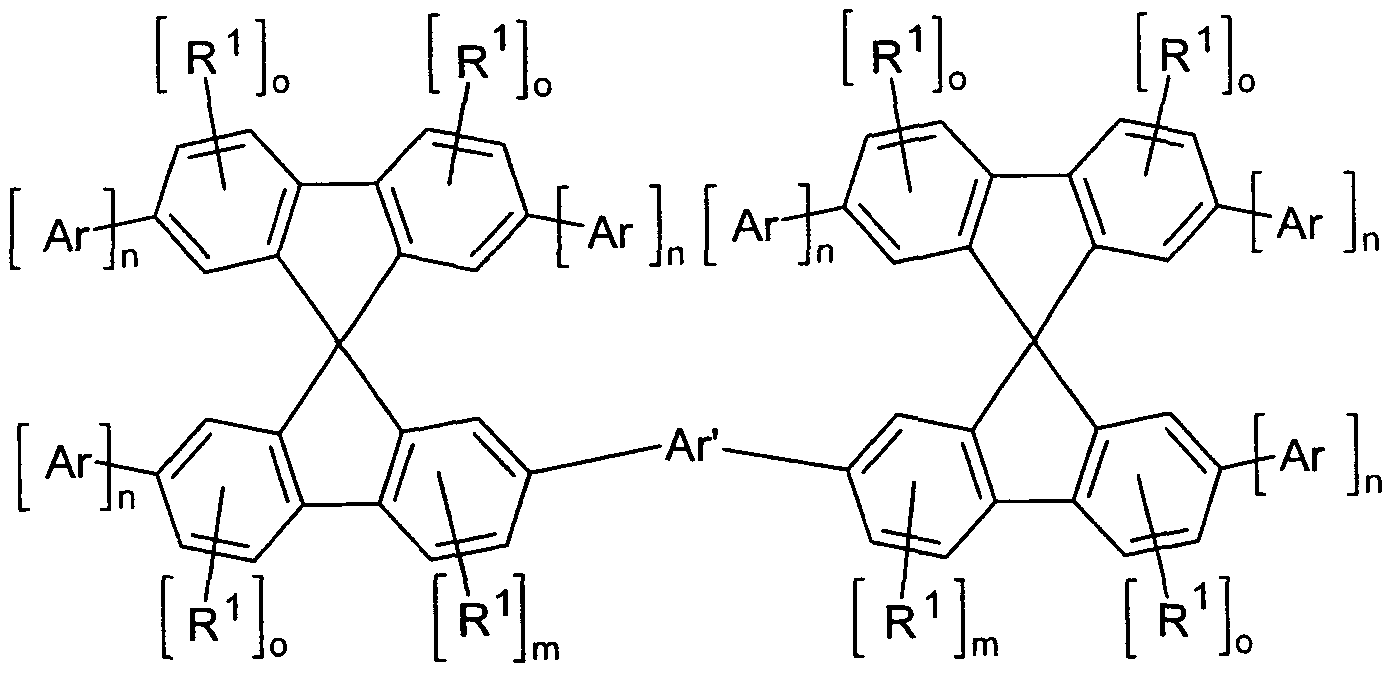
Formel (6) wobei die Symbole und Indizes dieselbe Bedeutung haben, wie oben beschrieben und wobei für n = 0 in der entsprechenden Position auch ein Substituent R1 gebunden sein kann.Formula (6) where the symbols and indices have the same meaning as described above and wherein for n = 0 in the corresponding position also a substituent R 1 can be bound.
In einer bevorzugten Ausführungsform von Verbindungen gemäß Formel (1 ), (2), (5) und (6) ist der Index m = 0, d. h. außer der Gruppe Ar ist an diesem Benzolring kein weiterer Substituent gebunden.In a preferred embodiment of compounds according to formulas (1), (2), (5) and (6), the index m = 0, d. H. except the group Ar, no further substituent is attached to this benzene ring.
In einer weiteren bevorzugten Ausführungsform von Verbindungen gemäß Formel (1 ), (2), (5) und (6) ist an jedem Benzolring die Summe der Indizes n + o = 0 oder 1 , d. h. an jeden Benzolring ist maximal eine Gruppe Ar oder maximal ein Rest R1 gebunden. Besonders bevorzugt ist o = 0.In a further preferred embodiment of compounds according to formulas (1), (2), (5) and (6), the sum of the indices n + o = 0 or 1 on each benzene ring, ie to each benzene ring is at most one group Ar or at most one radical R 1 bound. Particularly preferred is o = 0.
Besonders bevorzugt enthalten die Verbindungen gemäß Formel (5) eine oder zwei Triazingruppen. Die Verbindungen gemäß Formel (5) sind also besonders bevorzugt ausgewählt aus Verbindungen gemäß Formel (7), (8) und (9),The compounds of the formula (5) particularly preferably contain one or two triazine groups. The compounds of the formula (5) are therefore particularly preferably selected from compounds of the formulas (7), (8) and (9)

Formel (7) Formel (8)

Formel (9) wobei die verwendeten Symbole die oben genannten Bedeutungen haben und o gleich oder verschieden bei jedem Auftreten für 0 oder 1 , bevorzugt für 0, steht.Formula (9) where the symbols used have the abovementioned meanings and o is the same or different at each occurrence as 0 or 1, preferably 0.
Die Verbindungen der Formel (6) sind bevorzugt gewählt aus den Verbindungen der Formel (10),The compounds of the formula (6) are preferably selected from the compounds of the formula (10),

Formel (10)Formula (10)
wobei die verwendeten Symbole die oben genannten Bedeutungen haben und o gleich oder verschieden bei jedem Auftreten für 0 oder 1 , bevorzugt für 0, steht.where the symbols used have the abovementioned meanings and o is the same or different at each occurrence as 0 or 1, preferably 0.
Besonders bevorzugt sind die Verbindungen gemäß den Formeln (7) bis (10), in denen R2, welches an die Triazineinheit gebunden ist, gleich oder verschieden bei jedem Auftreten für ein aromatisches oder heteroaromatisches Ringsystem mit 5 bis 25 aromatischen Ringatomen steht, insbesondere für Phenyl, 1- oder 2-Naphthyl, ortho-, meta- oder para-Biphenyl oder 2-Spirobifluorenyl. Ganz besonders bevorzugt ist der Index o dabei gleich 0.Particular preference is given to the compounds of the formulas (7) to (10) in which R 2 , which is bonded to the triazine unit, is identical or different at each occurrence and represents an aromatic or heteroaromatic ring system having 5 to 25 aromatic ring atoms, in particular Phenyl, 1- or 2-naphthyl, ortho-, meta- or para-biphenyl or 2-spirobifluorenyl. Most preferably, the index o is 0.
Beispiele für bevorzugte Verbindungen gemäß den Formeln (1 ), (2) und (5) bis (10) sind die im Folgenden abgebildeten Verbindungen 1 bis 69. Examples of preferred compounds according to the formulas (1), (2) and (5) to (10) are the compounds 1 to 69 depicted below.

35 35

3030
35 35

35 35

35 35

35 Als besonders vorteilhaft hat es sich weiterhin erwiesen, wenn die organische Elektrolumineszenzvorrichtung eine Elektronentransportschicht enthält, welche ein Triaryl-substituiertes Triazinderivat enthält, welches mit einer organischen Alkalimetallverbindung dotiert ist, oder wobei zwischen der Elektronentransportschicht enthaltend das Triaryltriazin und der Kathode eine weitere Schicht eingebracht ist, welche eine organische35 It has furthermore proven to be particularly advantageous if the organic electroluminescent device contains an electron transport layer which contains a triaryl-substituted triazine derivative which is doped with an organic alkali metal compound, or wherein a further layer is introduced between the electron transport layer containing the triaryltriazine and the cathode, which is an organic
Alkalimetallverbindung enthält. Dabei kann das Triazin eine Verbindung der oben abgebildeten Formel (1) oder (2) sein, oder es kann eine andere aromatische Triazinverbindung sein.Contains alkali metal compound. Here, the triazine may be a compound of the above-represented formula (1) or (2), or it may be another aromatic triazine compound.
Weiterer Gegenstand der Erfindung ist daher eine organische Elektrolumineszenzvorrichtung enthaltend Anode, Kathode, mindestens eine emittierende Schicht und mindestens eine Elektronentransportschicht, welche zwischen der emittierenden Schicht und der Kathode angeordnet ist, wobei die Elektronentransportschicht mindestens eine Verbindung der Formel (11 ) oder (12) enthält,Another object of the invention is therefore an organic electroluminescent device comprising anode, cathode, at least one emitting layer and at least one electron transport layer, which is arranged between the emitting layer and the cathode, wherein the electron transport layer contains at least one compound of formula (11) or (12) .

Formel (1 1 ) Formel (12)Formula (1 1) Formula (12)
wobei R1 die oben genannte Bedeutung hat und für die weiteren verwendeten Symbole gilt:where R 1 has the abovementioned meaning and applies to the other symbols used:
Ar2 ist gleich oder verschieden bei jedem Auftreten ein monovalentes aromatisches oder heteroaromatisches Ringsystem mit 5 bis 60 aromatischen Ringatomen, welches jeweils mit einem oder mehreren Resten R1 substituiert sein kann;Ar 2 is identical or different at each occurrence, a monovalent aromatic or heteroaromatic ring system having 5 to 60 aromatic ring atoms, which may be substituted in each case with one or more radicals R 1 ;
Ar3 ist ein bivalentes aromatisches oder heteroaromatisches Ringsystem mit 5 bis 60 aromatischen Ringatomen, welches mit einem oder mehreren Resten R1 substituiert sein kann; dadurch gekennzeichnet, dass die Elektronentransportschicht mit einer organischen Alkalimetallverbindung dotiert ist oder dass zwischen die Elektronentransportschicht enthaltend die Verbindung gemäß Formel (11 ) bzw. (12) und die Kathode eine weitere Schicht eingebracht ist, welche eine organische Alkalimetallverbindung enthält.Ar 3 is a bivalent aromatic or heteroaromatic ring system having 5 to 60 aromatic ring atoms, which may be substituted by one or more R 1 ; characterized in that the electron transport layer is doped with an organic alkali metal compound or that between the electron transport layer containing the compound of formula (11) or (12) and the cathode is introduced a further layer containing an organic alkali metal compound.
Bevorzugt weisen die Verbindungen gemäß Formel (11 ) und (12) eine Glasübergangstemperatur TG von größer als 70 0C auf, besonders bevorzugt größer als 90 °C, ganz besonders bevorzugt größer als 110 0C.Preferably, the compounds have the formula (11) and (12) a glass transition temperature T g of greater than 70 0 C, particularly preferably greater than 90 ° C, very particularly preferably greater than 110 0 C.
Bevorzugt ist in Verbindungen der Formel (11 ) mindestens eine Gruppe Ar2 gewählt aus den Gruppen der folgenden Formeln (13) bis (27),In compounds of the formula (II), preference is given to at least one group Ar 2 selected from the groups of the following formulas (13) to (27),

Formel (13)Formula (13)
Formel (14)Formula (14)
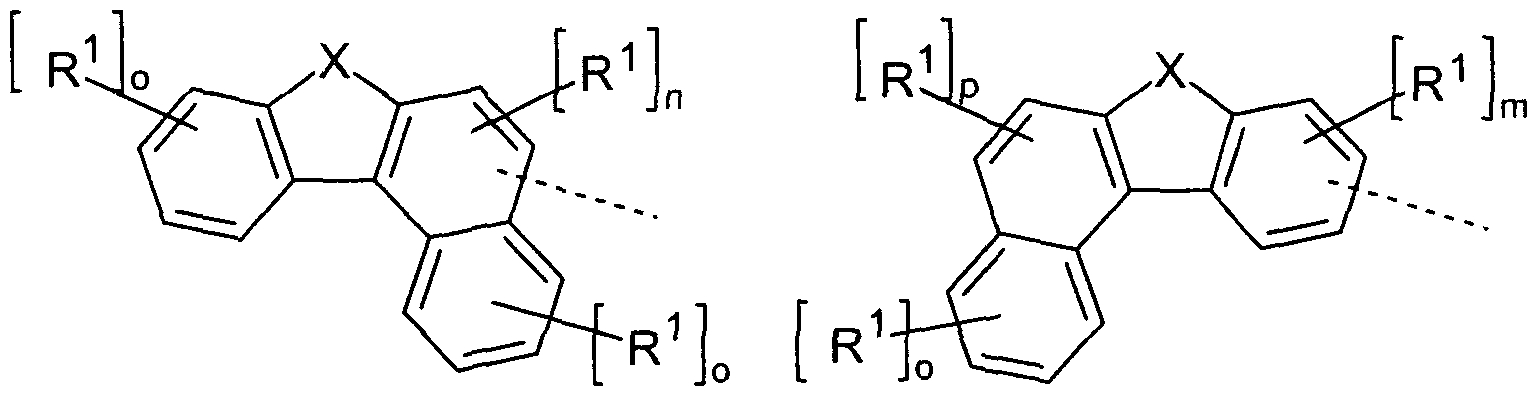
Formel (15) Formel (16) Formula (15) Formula (16)

Formel (18)Formula (18)

Formel (20)Formula (20)
3030
35


wobei R1 dieselbe Bedeutung hat, wie oben beschrieben, die gestrichelte Bindung die Verknüpfung mit der Triazineinheit darstellt und weiterhin gilt: X ist gleich oder verschieden bei jedem Auftreten eine bivalente Brücke, ausgewählt aus B(R1), C(R1)2, Si(R1)2, C=O, C=NR1, C=C(R1)2> O, S, S=O, SO2, N(R1), P(R1) und P(=O)R1;where R 1 has the same meaning as described above, the dashed bond represents the linkage with the triazine unit and furthermore: X is identical or different at each occurrence, a bivalent bridge selected from B (R 1 ), C (R 1 ) 2 , Si (R 1 ) 2 , C = O, C = NR 1 , C = C (R 1 ) 2> O, S, S = O, SO 2 , N (R 1 ), P (R 1 ) and P (= O) R 1 ;
m ist bei jedem Auftreten gleich oder verschieden 0, 1 , 2 oder 3;m is the same or different at each occurrence 0, 1, 2 or 3;
o ist bei jedem Auftreten gleich oder verschieden 0, 1 , 2, 3 oder 4;o is the same or different at each occurrence 0, 1, 2, 3 or 4;
Ar4, Ar6 ist gleich oder verschieden bei jedem Auftreten eine Aryl- oder Heteroarylgruppe mit 5 bis 18 aromatischen Ringatomen, welche durch einen oder mehrere Reste R1 substituiert sein kann;Ar 4 , Ar 6 is identical or different at each occurrence an aryl or heteroaryl group having 5 to 18 aromatic ring atoms, which may be substituted by one or more radicals R 1 ;
Ar5 ist eine kondensierte Aryl- oder Heteroarylgruppe mit 10 bis 18 aromatischen Ringatomen, welche durch einen oder mehrere Reste R1 substituiert sein kann;Ar 5 is a fused aryl or heteroaryl group having 10 to 18 aromatic ring atoms which may be substituted by one or more R 1 ;
p, r ist gleich oder verschieden bei jedem Auftreten 0, 1 oder 2, bevorzugt 0 oder 1 ;p, r is the same or different at each occurrence 0, 1 or 2, preferably 0 or 1;
q ist 1 oder 2, bevorzugt 1.q is 1 or 2, preferably 1.
In einer bevorzugten Ausführungsform der Erfindung ist Ar5 in Formel (27) eine kondensierte Arylgruppe mit 10 bis 18 aromatischen C-Atomen, welche durch einen oder mehrere Reste R1 substituiert sein kann. Besonders bevorzugt ist Ar5 gewählt aus der Gruppe bestehend aus Naphthalin, Anthracen, Phenanthren, Pyren, Benzanthracen und Chrysen, welche jeweils mit einem oder mehreren Resten R1 substituiert sein können. Ganz besonders bevorzugt sind Anthracen und Benzanthracen.In a preferred embodiment of the invention Ar 5 in formula (27) is a fused aryl group having 10 to 18 aromatic carbon atoms, which may be substituted by one or more radicals R 1 . Ar 5 is more preferably selected from the group consisting of naphthalene, anthracene, phenanthrene, pyrene, benzanthracene and chrysene, which may each be substituted by one or more radicals R 1 . Very particular preference is given to anthracene and benzanthracene.
In einer weiteren bevorzugten Ausführungsform der Erfindung sind die Gruppen Ar4 und Ar6 in Formel (27) gleich oder verschieden bei jedem Auftreten eine Aryl- oder Heteroarylgruppe mit 6 bis 14 aromatischen Ringatomen, welche jeweils durch einen oder mehrere Reste R1 substituiert sein kann. Besonders bevorzugt sind Ar4 und Ar6 gleich oder verschieden bei jedem Auftreten gewählt aus der Gruppe bestehend aus Benzol, Pyridin, Pyrazin, Pyridazin, Pyrimidin, Triazin, Naphthalin, Chinolin, Isochinolin, Anthracen, Phenanthren, Phenanthrolin, Pyren, Benz- anthracen und Chrysen, welche jeweils durch einen oder mehrere Reste R1 substituiert sein können. Ganz besonders bevorzugt sind Ar4 und Ar6 ausgewählt aus der Gruppe bestehend aus Benzol und Naphthalin.In a further preferred embodiment of the invention, the groups Ar 4 and Ar 6 in formula (27) are identical or different at each occurrence an aryl or heteroaryl group having 6 to 14 aromatic ring atoms, which may be substituted by one or more radicals R 1 , Ar 4 and Ar 6 are more preferably identical or different at each occurrence selected from the group consisting of benzene, pyridine, pyrazine, pyridazine, pyrimidine, triazine, naphthalene, quinoline, Isoquinoline, anthracene, phenanthrene, phenanthroline, pyrene, benzanthracene and chrysene, which may each be substituted by one or more radicals R 1 . Most preferably, Ar 4 and Ar 6 are selected from the group consisting of benzene and naphthalene.
Besonders bevorzugte Gruppen Ar2 sind gewählt aus den Gruppen der folgenden Formeln (13a) bis (26a),Particularly preferred groups Ar 2 are selected from the groups of the following formulas (13a) to (26a),

Formel (13a)Formula (13a)


Formel (15a) Formula (15a)

Formel (17a)

Formel (18a)Formula (18a)

Formel (20a)Formula (20a)
3030
35

wobei die verwendeten Symbole und Indizes dieselbe Bedeutung haben, wie oben beschrieben. Dabei ist X bevorzugt gleich oder verschieden gewählt aus C(R1 )2, N(R1), O und S, besonders bevorzugt C(R1 )2. Weiterhin sind besonders bevorzugte Ausführungsformen der Formel (27) die Gruppen der folgenden Formeln (27a) bis (27d),wherein the symbols and indices used have the same meaning as described above. In this case, X is preferably identical or different selected from C (R 1 ) 2 , N (R 1 ), O and S, particularly preferably C (R 1 ) 2 . Furthermore, particularly preferred embodiments of the formula (27) are the groups of the following formulas (27a) to (27d),

Formel (27a) Formel (27b)Formula (27a) Formula (27b)

Formel (27c) Formel (27d)Formula (27c) Formula (27d)
wobei diese Gruppen noch durch einen oder mehrere Reste R1 substituiert sein können und wobei die verwendeten Symbole und Indizes die oben genannten Bedeutungen aufweisen und die gestrichelte Bindung die Bindung an das Triazin andeutet; dabei können die Gruppen gemäß Formel (27a) bis (27d) durch einen oder mehrere Reste R1 substituiert sein und der Index p steht in Formel (27a) bis (27d) für 0 oder 1.these groups may be substituted by one or more radicals R 1 and wherein the symbols and indices used have the abovementioned meanings and the dashed bond indicates the binding to the triazine; In this case, the groups according to formula (27a) to (27d) may be substituted by one or more radicals R 1 and the subscript p in formula (27a) to (27d) is 0 or 1.
Bevorzugt sind auch Verbindungen der Formel (11), in der zwei oder drei Gruppen Ar2 für eine Gruppe der oben aufgeführten Formeln (13) bis (27) stehen.Preference is also given to compounds of the formula (II) in which two or three groups Ar 2 represent a group of the above-mentioned formulas (13) to (27).
Bevorzugt sind weiterhin Verbindungen der oben aufgeführten Formel (11 ), in der eine Gruppe Ar2 für eine Gruppe der oben aufgeführten Formeln (13) bis (27) steht und eine oder beide weitere Gruppen Ar2 für Phenyl, 1- oder 2-Naphthyl, ortho-, meta- oder para-Biphenyl stehen, welche durch einen oder mehrere Reste R1 substituiert sein können, jedoch bevorzugt unsubstituiert sind.Preference is furthermore given to compounds of the abovementioned formula (II) in which one group Ar 2 is a group of the above-mentioned formulas (13) to (27) and one or both further groups Ar 2 is phenyl, 1- or 2-naphthyl , ortho, meta or para biphenyl, which may be substituted by one or more radicals R 1 , but are preferably unsubstituted.
Bevorzugte Gruppen A -r3 i ■n Verbindungen der Formel (12) sind gewählt aus den Gruppen der folgenden Formeln (28) bis (39),Preferred groups A -r3 i ■ n compounds of formula (12) are selected from the groups of the following formulas (28) to (39),

Formel (28)

Formel (29)Formula (29)

Formel (30) Formel (31 )Formula (30) Formula (31)

Formel (33)
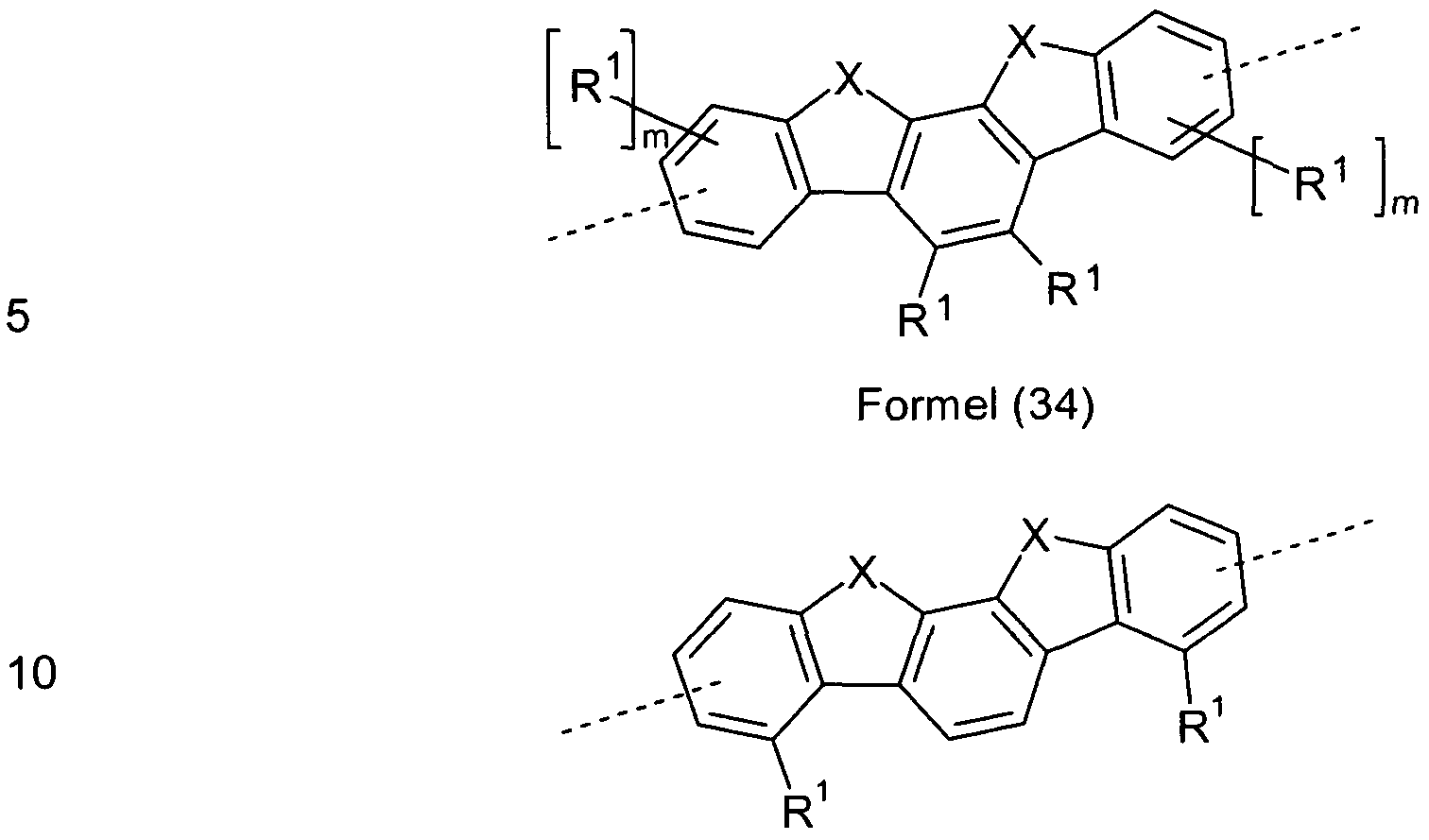
Formel (35)Formula (35)

3030
35 35

wobei die verwendeten Symbole und Indizes dieselbe Bedeutung haben, wie oben beschrieben und die gestrichelte Bindung die Verknüpfung mit den beiden Triazineinheiten darstellt.wherein the symbols and indices used have the same meaning as described above and the dashed bond represents the linkage with the two triazine units.
Besonders bevorzugte Gruppen Ar3 sind gewählt aus den Gruppen der folgenden Formeln (28a) bis (39a),Particularly preferred groups Ar 3 are selected from the groups of the following formulas (28a) to (39a),

Formel (28a)

Formel (29a) Formula (29a)

Formel (30a) Formel (31a)

Formel (33a) Formula (33a)

Formel (35a)Formula (35a)

3030
35 35

wobei die verwendeten Symbole und Indizes dieselbe Bedeutung haben, wie oben beschrieben. Dabei ist X bevorzugt gleich oder verschieden gewählt aus C(R1 )2, N(R1), O und S, besonders bevorzugt C(R1 )2.wherein the symbols and indices used have the same meaning as described above. In this case, X is preferably identical or different selected from C (R 1 ) 2 , N (R 1 ), O and S, particularly preferably C (R 1 ) 2 .
Bevorzugt sind weiterhin Verbindungen der oben aufgeführten Formel (12), in der die Gruppe Ar3 aus den oben aufgeführten Formeln (28) bis (39) ausgewählt ist und Ar2 gleich oder verschieden bei jedem Auftreten ausgewählt ist aus den oben aufgeführten Formeln (13) bis (27) oder Phenyl, 1- oder 2-Naphthyl, ortho-, meta- oder para-Biphenyl, welche durch einen oder mehrere Reste R1 substituiert sein können, jedoch bevorzugt unsubstituiert sind.Preference is furthermore given to compounds of the abovementioned formula (12) in which the group Ar 3 is selected from the above-mentioned formulas (28) to (39) and Ar 2 is the same or different at each occurrence and is selected from the abovementioned formulas (13 ) to (27) or phenyl, 1- or 2-naphthyl, ortho-, meta- or para-biphenyl, which may be substituted by one or more radicals R 1 , but are preferably unsubstituted.
Beispiele für bevorzugte Verbindungen gemäß den Formeln (11) und (12) sind außer den oben abgebildeten Strukturen 1 bis 69 die folgenden Strukturen 70 bis 178:

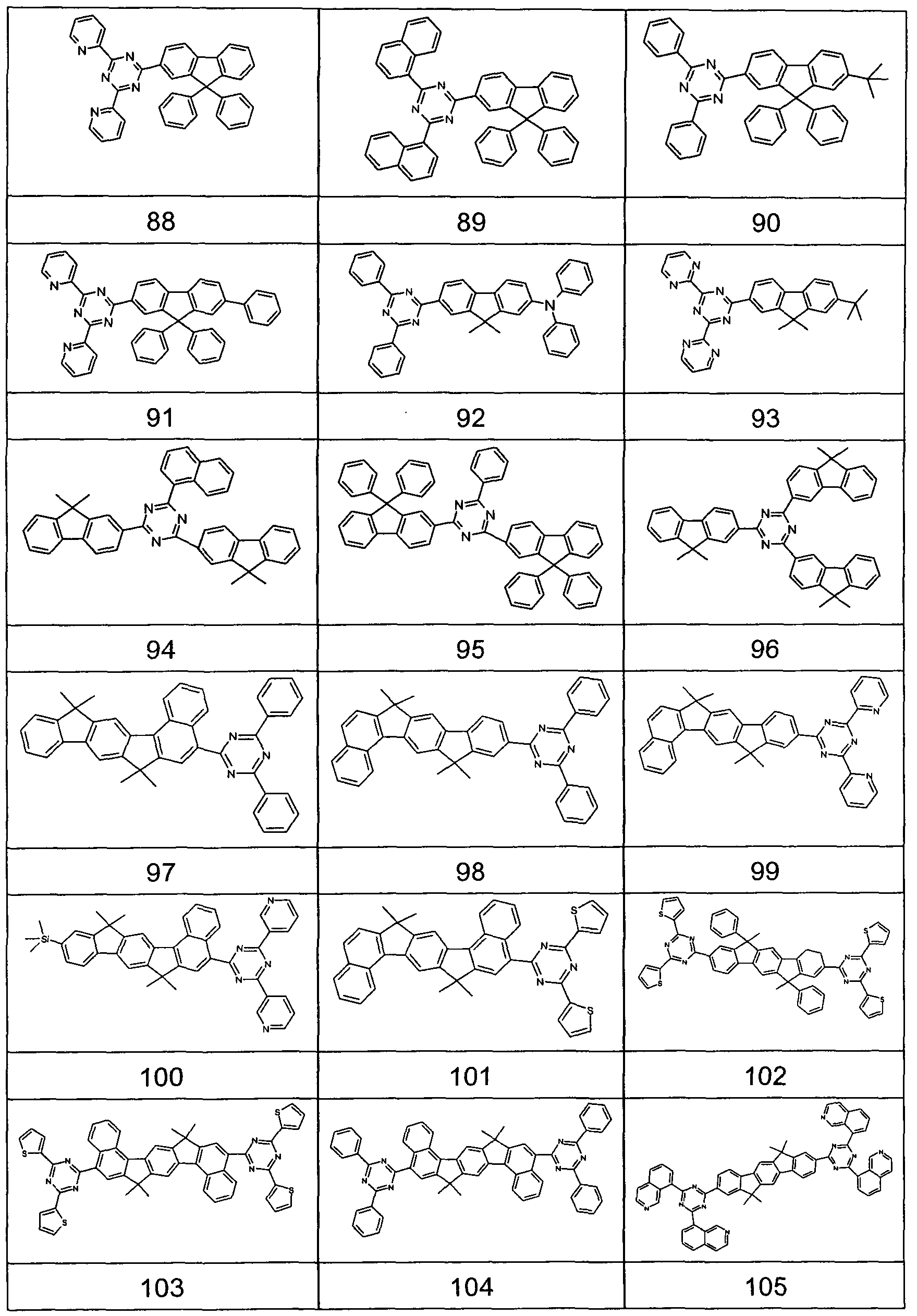


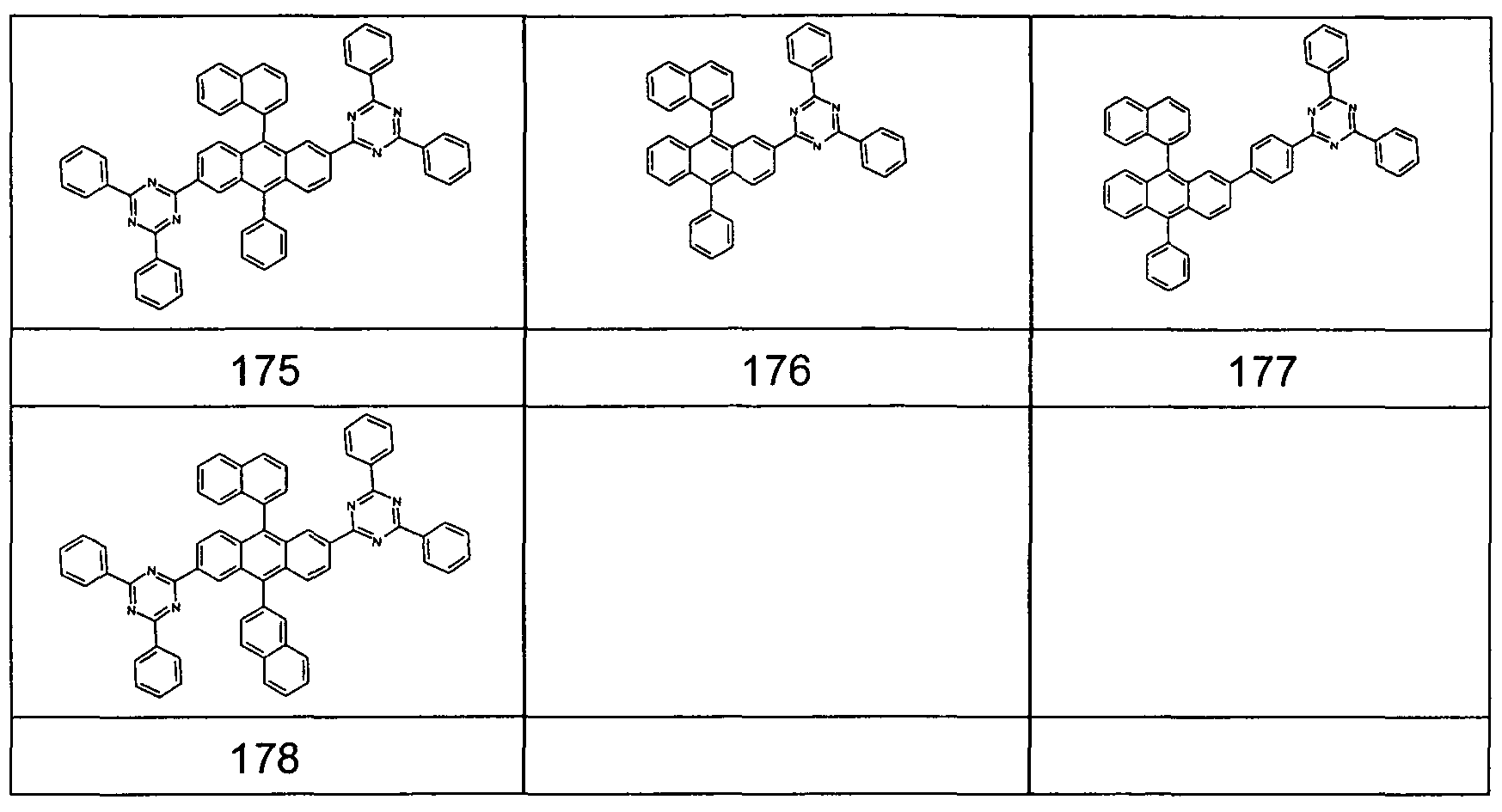
Die oben genannten Triazin-Verbindungen können beispielsweise gemäß den in US 6,229,012, US 6,225,467, WO 05/053055 und in der nicht offen gelegten Anmeldung DE 102008036982.9 beschriebenen Verfahren synthetisiert werden. Allgemein eignen sich nucleophile aromatische Substitutionsreaktionen und metallkatalysierte Kupplungsreaktionen, insbesondere die Suzuki-Kupplung, zur Synthese der Verbindungen wie im folgenden Schema 1 am Beispiel des Triazins dargestellt. So kann beispielsweise eine aromatische Grignard-Verbindung in einer nucleo- philen aromatischen Substitutionsreaktion mit 1 ,3,5-Trichlortriazin reagieren, wobei je nach stöchiometrischem Verhältnis das Monoaryl-, Diaryl- oder Triaryltriazin entsteht. Weiterhin kann beispielsweise eine aromatische Verbindung, welche jeweils mit einer Boronsäure oder einem Boronsäurederivat substituiert ist, unter Palladium-Katalyse mit dem Triazin gekuppelt werden, welche für Verbindungen gemäß Formel (1 ) bzw. (11 ) mit einer reaktiven Abgangsgruppe und für Verbindungen gemäß Formel (2) bzw. (12) mit zwei reaktiven Abgangsgruppen substituiert ist. Geeignete reaktive Abgangsgruppen sind beispielsweise Halogene, insbesondere Chlor, Brom und lod, Triflat oder Tosylat. Als weitere Synthesemethode eignet sich die Trimerisierung von aromatischen Nitrilen. Diese Synthesemethoden sind dem Fachmann der organischen Synthese generell bekannt und können von ihm ohne erfinderisches Zutun für die Triazin-Verbindungen der Formeln (11 ) und (12) angewandt werden. Schema 1 :The above-mentioned triazine compounds can be synthesized, for example, according to the methods described in US 6,229,012, US 6,225,467, WO 05/053055 and in the unpublished application DE 102008036982.9. In general, nucleophilic aromatic substitution reactions and metal-catalyzed coupling reactions, in particular the Suzuki coupling, are suitable for the synthesis of the compounds as illustrated in the following Scheme 1 using the example of triazine. Thus, for example, an aromatic Grignard compound can react with 1,3,5-trichlorotriazine in a nucleophilic aromatic substitution reaction, the monoaryl, diaryl or triaryltriazine being formed, depending on the stoichiometric ratio. Furthermore, for example, an aromatic compound, which is in each case substituted by a boronic acid or a boronic acid derivative, be coupled under palladium catalysis with the triazine, which for compounds of formula (1) or (11) having a reactive leaving group and compounds according to formula (2) or (12) is substituted with two reactive leaving groups. Suitable reactive leaving groups are, for example, halogens, in particular chlorine, bromine and iodine, triflate or tosylate. Another suitable method of synthesis is the trimerization of aromatic nitriles. These synthetic methods are generally known to those skilled in the art of organic synthesis and can be applied by him without inventive step for the triazine compounds of the formulas (11) and (12). Scheme 1:

Die oben genannten Triazin-Derivate werden erfindungsgemäß in Kombination mit einer organischen Alkalimetallverbindung in der Elektronen- transportschicht einer organischen Elektrolumineszenzvorrichtung eingesetzt. Dabei bedeutet „in Kombination mit einer organischen Alkalimetallverbindung", dass das Triazin-Derivat und die Alkalimetallverbindung entweder als Mischung in einer Schicht oder separat in zwei aufeinander folgenden Schichten vorliegen. In einer bevorzugten Ausfϋhrungsform der Erfindung liegen das Triazin-Derivat und die organische Alkalimetallverbindung als Mischung in einer Schicht vor.The abovementioned triazine derivatives are used according to the invention in combination with an organic alkali metal compound in the electron transport layer of an organic electroluminescent device. In this case, "in combination with an organic alkali metal compound" means that the triazine derivative and the alkali metal compound are present either as a mixture in one layer or separately in two successive layers In a preferred embodiment of the invention, the triazine derivative and the organic alkali metal compound are as Mix in one layer.
Unter einer organischen Alkalimetallverbindung im Sinne dieser Erfindung soll eine Verbindung verstanden werden, welche mindestens ein Alkalimetall, also Lithium, Natrium, Kalium, Rubidium oder Caesium, enthält und welche weiterhin mindestens einen organischen Liganden enthält.An organic alkali metal compound in the context of this invention is to be understood as meaning a compound which contains at least one alkali metal, ie lithium, sodium, potassium, rubidium or cesium, and which also contains at least one organic ligand.
Geeignete organische Alkalimetallverbindungen sind beispielsweise die in WO 07/050301 , WO 07/050334 und EP 1144543 offenbarten Verbindungen. Diese sind via Zitat Bestandteil der vorliegenden Anmeldung. Bevorzugte organische Alkalimetallverbindungen sind die Verbindungen der folgenden Formel (40),Suitable organic alkali metal compounds are, for example, the compounds disclosed in WO 07/050301, WO 07/050334 and EP 1144543. These are via quote part of the present application. Preferred organic alkali metal compounds are the compounds of the following formula (40)

Formel (40)Formula (40)
wobei R1 dieselbe Bedeutung hat, wie oben beschrieben, die gebogene Linie zwei oder drei Atome und Bindungen darstellt, welche erforderlich sind, um mit M einen 5- oder 6-Ring zu ergänzen, wobei diese Atome auch durch einen oder mehrere Reste R1 substituiert sein können, und M ein Alkalimetall, ausgewählt aus Lithium, Natrium, Kalium, Rubidium oder Caesium, darstellt.wherein R 1 has the same meaning as described above, the curved line represents two or three atoms and bonds required to complement with M a 5- or 6-membered ring, these atoms also by one or more radicals R 1 and M is an alkali metal selected from lithium, sodium, potassium, rubidium or cesium.
Dabei ist es möglich, dass der Komplex gemäß Formel (40) in monomerer Form vorliegt, wie oben abgebildet, oder dass er in Form von Aggregaten vorliegt, beispielsweise aus zwei Alkalimetallionen und zwei Liganden, vier Alkalimetallionen und vier Liganden, sechs Alkalimetallionen und sechs Liganden oder andere Aggregate.It is possible that the complex according to formula (40) is present in monomeric form, as shown above, or that it is in the form of aggregates, for example of two alkali metal ions and two ligands, four alkali metal ions and four ligands, six alkali metal ions and six ligands or other aggregates.
Bevorzugte Verbindungen der Formel (40) sind die Verbindungen der folgenden Formeln (41 ) und (42),Preferred compounds of the formula (40) are the compounds of the following formulas (41) and (42),

Formel (41) Formel (42)Formula (41) Formula (42)
wobei die verwendeten Symbole und Indizes die oben genannten Bedeutungen haben. Weitere bevorzugte organische Alkalimetallverbindungen sind die Verbindungen gemäß der folgenden Formel (43),wherein the symbols and indices used have the meanings given above. Further preferred organic alkali metal compounds are the compounds according to the following formula (43),

Formel (43) Q wobei die verwendeten Symbole dieselbe Bedeutung haben, wie oben beschrieben.Formula (43) Q where the symbols used have the same meaning as described above.
Bevorzugt ist das Alkalimetall gewählt aus Lithium, Natrium und Kalium, besonders bevorzugt Lithium und Natrium, ganz besonders bevorzugt5 Lithium.Preferably, the alkali metal is selected from lithium, sodium and potassium, more preferably lithium and sodium, most preferably lithium.
Besonders bevorzugt ist eine Verbindung der Formel (41 ), insbesondere mit M = Lithium. Ganz besonders bevorzugt sind weiterhin die Indizes m = 0. Ganz besonders bevorzugt handelt es sich also um unsubstituierteso Lithiumchinolinat.Particularly preferred is a compound of formula (41), in particular with M = lithium. Very particular preference is furthermore given to the indices m = 0. Very particular preference is therefore given to unsubstitutedo lithium quinolinate.
Ganz besonders bevorzugt enthält die organische Elektrolumineszenz- vorrichtung eine Mischung aus einer Triazinverbindung, gewählt aus den Verbindungen der oben genannten Formeln (7) bis (10), insbesondere mit5 o = 0 und R2 gleich Phenyl, 1- oder 2-Naphthyl, Ortho-, meta- oder paraBiphenyl oder 2-Spirobifluorenyl, und einer organischen Alkalimetallverbindung der Formel (41 ), bevorzugt mit M = Lithium, insbesondere unsubsubstituiertes Lithiumchinolinat. 0 Beispiele für geeignete organische Alkalimetallverbindungen sind die in der folgenden Tabelle aufgeführten Strukturen 179 bis 223.The organic electroluminescent device very particularly preferably contains a mixture of a triazine compound selected from the compounds of the abovementioned formulas (7) to (10), in particular with o = 0 and R 2 is phenyl, 1- or 2-naphthyl, ortho -, meta- or para-biphenyl or 2-spirobifluorenyl, and an organic alkali metal compound of the formula (41), preferably with M = lithium, in particular unsubstituted lithium quinolinate. Examples of suitable organic alkali metal compounds are the structures 179 to 223 listed in the following table.
5


200 201 202

203 204 205

206 207 208

209 210 211

212 213 214
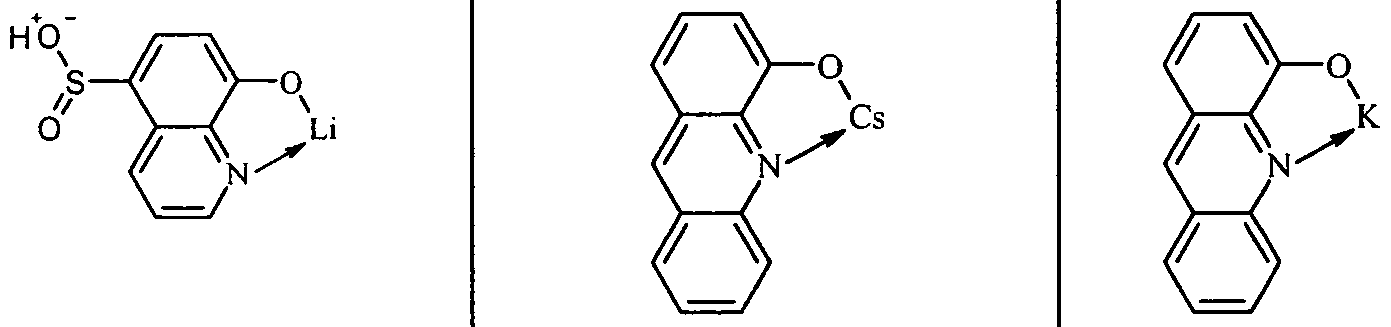
215 216 217

Wenn die Triazinverbindung und die organische Alkalimetallverbindung in einer Mischung vorliegen, beträgt das Verhältnis der Triazinverbindung gemäß Formel (11 ) bzw. (12) zur organischen Alkalimetallverbindung bevorzugt 20:80 bis 80:20, besonders bevorzugt 30:70 bis 70:30, ganz besonders bevorzugt 30:70 bis 50:50, insbesondere 30:70 bis 45:55. Besonders bevorzugt liegt also die organischen Alkalimetallverbindung in höherem Anteil vor als die Triazinverbindung gemäß Formel (11 ) oder (12).When the triazine compound and the organic alkali metal compound are in a mixture, the ratio of the triazine compound of the formula (11) or (12) to the organic alkali metal compound is preferably 20:80 to 80:20, more preferably 30:70 to 70:30, all more preferably 30:70 to 50:50, especially 30:70 to 45:55. Thus, the organic alkali metal compound is particularly preferably present in a higher proportion than the triazine compound according to formula (11) or (12).
Wenn die Triazinverbindung und die organische Aikalimetallverbindung in einer Mischung vorliegen beträgt die Schichtdicke dieser Elektronen- transportschicht bevorzugt zwischen 3 und 150 nm, besonders bevorzugt zwischen 5 und 100 nm, ganz besonders bevorzugt zwischen 10 und 60 nm, insbesondere zwischen 15 und 40 nm.If the triazine compound and the organic alkali metal compound are present in a mixture, the layer thickness of this electron transport layer is preferably between 3 and 150 nm, particularly preferably between 5 and 100 nm, very particularly preferably between 10 and 60 nm, in particular between 15 and 40 nm.
Wenn die Triazinverbindung und die organische Aikalimetallverbindung in zwei aufeinanderfolgenden Schichten vorliegen, so beträgt die Schichtdicke der Schicht, welche die Triazinverbindung gemäß Formel (11) bzw. (12) enthält, bevorzugt zwischen 3 und 150 nm, besonders bevorzugt zwischen 5 und 100 nm, ganz besonders bevorzugt zwischen 10 und 60 nm, insbesondere zwischen 15 und 40 nm. Die Schichtdicke der Schicht, welche die organische Aikalimetallverbindung enthält und welche zwischen der Triazinschicht und der Kathode angeordnet ist, beträgt bevorzugt zwischen 0.5 und 20 nm, besonders bevorzugt zwischen 1 und 10 nm, ganz besonders bevorzugt zwischen 1 und 5 nm, insbesondere zwischen 1.5 und 3 nm.When the triazine compound and the organic alkali metal compound are present in two successive layers, the layer thickness of the layer containing the triazine compound according to formula (11) or (12) is preferably between 3 and 150 nm, more preferably between 5 and 100 nm, most preferably between 10 and 60 nm, in particular between 15 and 40 nm. The layer thickness of the layer containing the organic Aikalimetallverbindung and which is arranged between the triazine layer and the cathode, is preferably between 0.5 and 20 nm, more preferably between 1 and 10 nm, most preferably between 1 and 5 nm, in particular between 1.5 and 3 nm.
Dabei kann die emittierende Schicht eine fluoreszierende oder phosphoreszierende Schicht sein. Generell eignen sich alle bekannten emittierenden Materialien und Schichten in Kombination mit der erfindungsgemäßen Elektronentransportschicht und der Fachmann kann ohne erfinderisches Zutun beliebige emittierende Schichten mit der erfindungsgemäßen Elektronentransportschicht kombinieren.In this case, the emitting layer may be a fluorescent or phosphorescent layer. In general, all known emissive materials and layers are suitable in combination with the electron transport layer according to the invention, and the person skilled in the art can combine any emissive layers with the electron transport layer according to the invention without inventive step.
Außer Kathode, Anode, einer oder mehreren emittierenden Schichten und der erfindungsgemäßen Elektronentransportschicht kann die organische Elektrolumineszenzvorrichtung noch weitere Schichten enthalten. Diese sind beispielsweise gewählt aus jeweils einer oder mehreren Lochinjektionsschichten, Lochtransportschichten, Lochblockierschichten, Elektroneninjektionsschichten, Elektronenblockierschichten, Excitonen- blockierschichten, Charge-Generation Layers (IDMC 2003, Taiwan; Session 21 OLED (5), T. Matsumoto, T. Nakada, J. Endo, K. Mori, N. Kawamura, A. Yokoi, J. Kido, Multiphoton Organic EL Device Having Charge Generation Layer) und/oder organischen oder anorganischen p/n- Übergängen. Außerdem können Interlayers vorhanden sein, welche die Ladungsbalance im Device steuern. Weiterhin können die Schichten, insbesondere die Ladungstransportschichten, auch dotiert sein. Die Dotierung der Schichten kann für einen verbesserten Ladungstransport vorteilhaft sein. Es sei aber darauf hingewiesen, dass nicht notwendiger- weise jede dieser Schichten vorhanden sein muss und die Wahl der Schichten immer von den verwendeten Verbindungen abhängt.In addition to the cathode, anode, one or more emitting layers and the electron transport layer according to the invention, the organic electroluminescent device may contain further layers. These are selected, for example, from one or more hole injection layers, hole transport layers, hole blocking layers, electron injection layers, electron blocking layers, exciton blocking layers, charge generation layers (IDMC 2003, Taiwan, Session 21 OLED (5), T. Matsumoto, T. Nakada, J. Endo, K. Mori, N. Kawamura, A. Yokoi, J. Kido, Multiphoton Organic EL Device Having Charge Generation Layer) and / or Organic or Inorganic P / N Transitions. In addition, interlayers may be present which control the charge balance in the device. Furthermore, the layers, in particular the charge transport layers, may also be doped. The doping of the layers may be advantageous for improved charge transport. It should be noted, however, that not necessarily each of these layers must be present and the choice of layers always depends on the compounds used.
In einer weiteren bevorzugten Ausführungsform der Erfindung enthält die organische Elektrolumineszenzvorrichtung mehrere emittierende Schichten. Besonders bevorzugt weisen diese Emissionsschichten insgesamt mehrere Emissionsmaxima zwischen 380 nm und 750 nm auf, so dass insgesamt weiße Emission resultiert, d. h. in den emittierenden Schichten werden verschiedene emittierende Verbindungen verwendet, die fluoreszieren oder phosphoreszieren können und die blaues und gelbes, orange oder rotes Licht emittieren. Insbesondere bevorzugt sind Dreischichtsysteme, also Systeme mit drei emittierenden Schichten, wobei die drei Schichten blaue, grüne und orange oder rote Emission zeigen (für den prinzipiellen Aufbau siehe z. B. WO 05/011013). Auch die Verwendung von mehr als drei emittierenden Schichten kann bevorzugt sein. Ebenso eignen sich für weiße Emission Emitter, welche breitbandige Emissionsbanden aufweisen und dadurch weiße Emission zeigen.In a further preferred embodiment of the invention, the organic electroluminescent device contains a plurality of emitting layers. More preferably, these emission layers have a total of several emission maxima between 380 nm and 750 nm, so that overall white emission results, ie in the emitting layers different emitting compounds are used, which can fluoresce or phosphoresce and emit the blue and yellow, orange or red light , Particularly preferred Three-layer systems, ie systems with three emitting layers, the three layers showing blue, green and orange or red emission (for the basic structure, see, for example, WO 05/011013). The use of more than three emitting layers may also be preferred. Also suitable for white emission emitters, which have broadband emission bands and thereby show white emission.
Die erfindungsgemäßen Elektronentransportschichten können mit beliebigen Kathodenmaterialien, wie sie gemäß dem Stand der Technik verwendet werden, eingesetzt werden. Beispiele für besonders geeignete Kathodenmaterialien sind allgemein Metalle mit einer niedrigen Austrittsarbeit, gefolgt von einer Schicht Aluminium oder einer Schicht Silber. Beispiele hierfür sind Caesium, Barium, Calcium, Ytterbium und Samarium, jeweils gefolgt von einer Schicht Aluminium oder Silber. Weiterhin geeignet ist eine Legierung aus Magnesium und Silber. Weiterhin geeignet ist reines Aluminium.The electron transport layers according to the invention can be used with any cathode materials as used in the prior art. Examples of particularly suitable cathode materials are generally low work function metals, followed by a layer of aluminum or a layer of silver. Examples include cesium, barium, calcium, ytterbium and samarium, each followed by a layer of aluminum or silver. Also suitable is an alloy of magnesium and silver. Also suitable is pure aluminum.
Es ist weiterhin möglich, zwischen die erfindungsgemäße Elektronen- transportschicht und die Kathode eine Elektroneninjektionsschicht einzubringen. Geeignete Materialien für die Elektroneninjektionsschicht sind beispielsweise LiF, Lithiumchinolinat, CsF, CS2CO3, Li2O, LiBO2, K2SiO3, Cs2O oder AI2O3.It is also possible to introduce an electron injection layer between the electron transport layer according to the invention and the cathode. Suitable materials for the electron injection layer are, for example, LiF, lithium quinolinate, CsF, CS 2 CO 3, Li 2 O, LiBO 2 , K 2 SiO 3 , Cs 2 O or Al 2 O 3 .
Weiterhin bevorzugt ist eine organische Elektrolumineszenzvorrichtung, dadurch gekennzeichnet, dass eine oder mehrere Schichten mit einem Sublimationsverfahren beschichtet werden. Dabei werden die Materialien in Vakuum-Sublimationsanlagen bei einem Anfangsdruck von üblicherweise kleiner 10"5 mbar, bevorzugt kleiner 10~6 mbar aufgedampft. Es sei jedoch angemerkt, dass der Druck auch noch geringer sein kann, beispielsweise kleiner 10"7 mbar.Further preferred is an organic electroluminescent device, characterized in that one or more layers are coated with a sublimation process. The materials are applied in vacuum sublimation at an initial pressure of usually less than 10 "5 mbar, preferably less than 10 ~ vapor-deposited 6 mbar. It should be noted, however, that the pressure can be even lower, for example less than 10" 7 mbar.
Bevorzugt ist ebenfalls eine organische Elektrolumineszenzvorrichtung, dadurch gekennzeichnet, dass eine oder mehrere Schichten mit dem OVPD (Organic Vapour Phase Deposition) Verfahren oder mit Hilfe einer Trägergassublimation beschichtet werden. Dabei werden die Materialien bei einem Druck zwischen 10"5 mbar und 1 bar aufgebracht. Ein Spezialfall dieses Verfahrens ist das OVJP (Organic Vapour Jet Printing) Verfahren, bei dem die Materialien direkt durch eine Düse aufgebracht und so strukturiert werden (z. B. M. S. Arnold et a/., Appl. Phys. Lett. 2008, 92, 053301 ).Also preferred is an organic electroluminescent device, characterized in that one or more layers are coated with the OVPD (Organic Vapor Phase Deposition) method or with the aid of a carrier gas sublimation. The materials are applied at a pressure between 10 "5 mbar and 1 bar This method is the OVJP (Organic Vapor Jet Printing) method, in which the materials are applied directly through a nozzle and thus structured (for example, BMS Arnold et al., Appl. Phys. Lett., 2008, 92, 053301).
Weiterhin bevorzugt ist eine organische Elektrolumineszenzvorrichtung, dadurch gekennzeichnet, dass eine oder mehrere Schichten aus Lösung, wie z. B. durch Spincoating, oder mit einem beliebigen Druckverfahren, wie z. B. Siebdruck, Flexodruck oder Offsetdruck, besonders bevorzugt aber LITI (Light Induced Thermal Imaging, Thermotransferdruck) oder Ink- Jet Druck (Tintenstrahldruck), hergestellt werden. Hierfür sind lösliche Verbindungen nötig. Hohe Löslichkeit lässt sich durch geeignete Substitution der Verbindungen erreichen. Dabei können nicht nur Lösungen aus einzelnen Materialien aufgebracht werden, sondern auch Lösungen, die mehrere Verbindungen enthalten, beispielsweise Matrix- materialien und Dotanden.Further preferred is an organic electroluminescent device, characterized in that one or more layers of solution, such. B. by spin coating, or with any printing process, such. As screen printing, flexographic printing or offset printing, but more preferably LITI (Light Induced Thermal Imaging, thermal transfer printing) or inkjet printing (inkjet printing), are produced. For this purpose, soluble compounds are needed. High solubility can be achieved by suitable substitution of the compounds. Not only solutions of individual materials can be applied, but also solutions containing several compounds, for example matrix materials and dopants.
Die organische Elektrolumineszenzvorrichtung kann auch als Hybridsystem hergestellt werden, indem eine oder mehrere Schichten aus Lösung aufgebracht werden und eine oder mehrere andere Schichten aufgedampft werden. So ist es beispielsweise möglich, eine emittierende Schicht aus Lösung aufzubringen und darauf eine Elektronentransport- schicht enthaltend eine Verbindung gemäß Formel (1 ), (2), (11 ) oder (12), ggf. in Kombination mit einer organischen Alkalimetallverbindung, im Vakuum aufzudampfen.The organic electroluminescent device may also be fabricated as a hybrid system by applying one or more layers of solution and depositing one or more other layers. For example, it is possible to apply an emitting layer of solution and then an electron transport layer containing a compound of the formula (1), (2), (11) or (12), optionally in combination with an organic alkali metal compound, in vacuo evaporate.
Diese Verfahren sind dem Fachmann generell bekannt und können von ihm ohne Probleme auf organische Elektrolumineszenzvorrichtungen enthaltend Verbindungen gemäß Formel (1), (2), (11 ) oder (12) bzw. die oben aufgeführten bevorzugten Ausführungsformen angewandt werden.These methods are generally known to the person skilled in the art and can be applied by him without problems to organic electroluminescent devices containing compounds of the formula (1), (2), (11) or (12) or the preferred embodiments listed above.
Ein weiterer Gegenstand der vorliegenden Erfindung sind Mischungen enthaltend mindestens eine Verbindung gemäß Formel (11 ) oder (12) und mindestens eine organische Alkalimetallverbindung. Dabei sind die Verbindungen gemäß Formel (11 ) bzw. (12) bevorzugt gewählt aus den oben genannten bevorzugten Ausführungsformen. Die organische Alkali- metallverbindung ist dabei bevorzugt gewählt aus den Verbindungen der oben aufgeführten Formel (40) bis (43).Another object of the present invention are mixtures containing at least one compound of formula (11) or (12) and at least one organic alkali metal compound. In this case, the compounds of the formula (11) or (12) are preferably selected from the abovementioned preferred embodiments. The organic alkali Metal compound is preferably selected from the compounds of the above-mentioned formula (40) to (43).
Nochmals ein weiterer Gegenstand der vorliegenden Erfindung ist die Verwendung von Verbindungen gemäß Formel (11 ) oder Formel (12) als Elektronentransportmaterial in einer Elektronentransportschicht in einer organischen Elektrolumineszenzvorrichtung in Kombination mit einer organischen Alkalimetallverbindung. Dabei sind die Verbindungen gemäß Formel (11 ) bzw. (12) bevorzugt gewählt aus den oben genannten bevorzugten Ausführungsformen. Die organische Alkalimetallverbindung ist dabei bevorzugt gewählt aus den Verbindungen der oben aufgeführten Formel (40) bis (43).Yet another object of the present invention is the use of compounds of formula (11) or formula (12) as an electron transport material in an electron transport layer in an organic electroluminescent device in combination with an organic alkali metal compound. In this case, the compounds of the formula (11) or (12) are preferably selected from the abovementioned preferred embodiments. The organic alkali metal compound is preferably selected from the compounds of the above-mentioned formula (40) to (43).
Die Verbindungen der oben aufgeführten Formeln (11 ) und (12), in denen Ar2 bzw. Ar3 für Gruppen der Formel (15) bis (27) bzw. (32) bis (39) stehen, sind neu und daher ebenfalls ein Gegenstand der vorliegenden Erfindung. Ein weiterer Gegenstand der Erfindung ist eine organische Elektroiumineszenzvorrichtung enthaltend eine oder mehrere der Verbindungen der oben aufgeführten Formeln (11) oder (12), in denen Ar2 bzw. Ar3 für eine Gruppe der Formel (15) bis (27) bzw. (32) bis (39) steht, insbesondere in einer Elektronentransportschicht. Dabei kann dieThe compounds of the above-mentioned formulas (11) and (12) in which Ar 2 or Ar 3 are groups of the formula (15) to (27) or (32) to (39) are new and therefore also one Subject of the present invention. Another object of the invention is an organic Elektroiumineszenzvorrichtung containing one or more of the compounds of the above formulas (11) or (12) in which Ar 2 or Ar 3 for a group of the formula (15) to (27) or ( 32) to (39), in particular in an electron transport layer. It can the
Elektronentransportschicht dotiert oder undotiert sein. Bevorzugt ist die Schicht dotiert, insbesondere mit einer organischen Alkalimetallverbindung. Dabei sind bevorzugte Ausführungsformen dieser Materialien die oben aufgeführten Ausführungsformen.Electron transport layer to be doped or undoped. Preferably, the layer is doped, in particular with an organic alkali metal compound. Here, preferred embodiments of these materials are the embodiments listed above.
Die erfindungsgemäßen organischen Elektrolumineszenzvorrichtungen weisen folgende überraschende Vorteile gegenüber dem Stand der Technik auf:The organic electroluminescent devices according to the invention have the following surprising advantages over the prior art:
1. Die erfindungsgemäßen organischen Elektrolumineszenzvorrichtungen weisen eine sehr hohe Effizienz auf. Die verbesserte Effizienz ist möglicherweise auf eine verbesserte Elektroneninjektion aus der Elektronentransportschicht in die emittierende Schicht zurückzuführen. 2. Die erfindungsgemäßen organischen Elektrolumineszenzvorrichtungen weisen gleichzeitig eine vergleichbare Lebensdauer auf.1. The organic electroluminescent devices according to the invention have a very high efficiency. The improved efficiency may be due to improved electron injection from the electron transport layer into the emitting layer. 2. The organic electroluminescent devices according to the invention have at the same time a comparable lifetime.
3. Die erfindungsgemäßen organischen Elektrolumineszenzvorrichtungen weisen gleichzeitig eine verringerte Betriebsspannung auf. Die verringerte Betriebsspannung ist möglicherweise auf eine verbesserte3. The organic electroluminescent devices according to the invention simultaneously have a reduced operating voltage. The reduced operating voltage may be at an improved level
Elektroneninjektion aus der Elektronentransportschicht in die emittierende Schicht zurückzuführen.Attributed electron injection from the electron transport layer into the emitting layer.
Die Erfindung wird durch die nachfolgenden Beispiele genauer beschrieben, ohne sie dadurch einschränken zu wollen. Der Fachmann kann, ohne erfinderisch tätig zu werden, weitere erfindungsgemäße Verbindungen herstellen und diese in organischen elektronischen Vorrichtungen verwenden. The invention will be described in more detail by the following examples without wishing to limit them thereby. The person skilled in the art, without being inventive, can produce further compounds according to the invention and use them in organic electronic devices.
BeispieleExamples
Die nachfolgenden Synthesen werden, sofern nicht anders angegeben, unter einer Schutzgasatmosphäre in getrockneten Lösungsmitteln durchgeführt. Die Edukte können von ALDRICH (Tri-o-tolylphosphin, Palladium(ll)acetat) bezogen werden.Unless stated otherwise, the following syntheses are carried out under an inert gas atmosphere in dried solvents. The starting materials can be obtained from ALDRICH (tri-o-tolylphosphine, palladium (II) acetate).
Spiro-9,9'-bifluoren-2-boronsäure kann nach der nicht offengelegten Anmeldung DE 102008036982.9 dargestellt werden. 2-Chlorocarbonyl-2',7'-dibrom-spiro-9,9'-bifluoren kann gemäß J. Org. Chem. 2006, 71, 456-465 dargestellt werden.Spiro-9,9'-bifluorene-2-boronic acid can be prepared according to the non-disclosed application DE 102008036982.9. 2-chlorocarbonyl-2 ', 7'-dibromo-spiro-9,9'-bifluorene can be prepared according to J. Org. Chem. 2006, 71, 456-465.
Beispiel 1 : Synthese von 2-(4,6-Bis-[3,1';5,1"]-terphen-1-yl)-1,3,5- triazin-2-yl)-spiro-9,9'-bifluorenExample 1: Synthesis of 2- (4,6-bis- [3,1 ', 5,1 "] -terphenyl-1-yl) -1,3,5-triazin-2-yl) -spiro-9, 9 'bifluorene

a) Synthese von 2-Chlor-(4,6-bis-[3,1';5,1"]-terphen-1-yl)-1,3,5-triazina) Synthesis of 2-chloro- (4,6-bis- [3,1 ', 5,1 "] - terphen-1-yl) -1,3,5-triazine
Zu einer auf -78 0C gekühlten Lösung von 50.30 g (163 mmol) 1-Brom- [3,1 ';5,1 "]-terphen-1-yl in 400 mL abs. Tetrahydrofuran wurden 82.6 mL einer 2.0 molaren Lösung von n-Butyllithium in Hexan langsam hinzugetropft und 15 min lang gerührt. Die Reaktionslösung wurde langsam zu einer auf -78 °C gekühlten Lösung von 10.00 g (45 mmol) Cyanurchlorid in 400 mL abs. Tetrahydrofuran getropft und die Kühlung wurde entfernt. Nach Erreichen der RT wurde das ausgefallene Produkt abfiltriert. Die Ausbeute beträgt 21.08 g (37 mmol), entsprechend 67.9 % der Theorie. b) Synthese von 2-(4,6-Bis-[3,1';5,1"]-terphen-1-yl)-1,3,5-triazin-2-yl)- spiro-9,9'-bifluorenTo a cooled to -78 0 C solution of 50.30 g (163 mmol) of 1-bromo [3,1 ', 5,1 "] -terphen-1-yl in 400 mL absolute tetrahydrofuran were 82.6 mL of a 2.0 molar solution The reaction solution was slowly added dropwise to a solution of 10.00 g (45 mmol) of cyanuric chloride in 400 ml of absolute tetrahydrofuran, cooled to -78 ° C., and the cooling was removed the precipitated product was filtered off, the yield was 21.08 g (37 mmol), corresponding to 67.9% of theory. b) Synthesis of 2- (4,6-bis- [3,1 ', 5,1 "] - terphen-1-yl) -1,3,5-triazin-2-yl) spiro-9,9 '-bifluoren
17.46 g (48 mmol) Spiro-9,9'-bifluoren-2-boronsäure, 21.06 g (37 mmol) 2- Chlor-(4,6-Bis-[3,r;5,1"]-terphen-1-yl)-1 ,3,5-triazin und 21.4 g (101 mmol) Trikaliumphosphat in 1200 ml_ Toluol, 1200 ml_ Dioxan und 480 ml_ Wasser suspendiert. Zu dieser Suspension werden 438 mg (1.4 mmol) Th- o-tolylphosphin und dann 54 mg (0.3 mmol) Palladium(ll)acetat gegeben, und die Reaktionsmischung wird 16 h unter Rückfluss erhitzt. Nach Erkalten wird die organische Phase abgetrennt, über Kieselgel filtriert, dreimal mit 500 ml_ Wasser gewaschen und anschließend zur Trockene eingeengt. Der Rückstand wird aus Toluol umkristallisiert und abschließend im Hochvakuum sublimiert. Die Ausbeute beträgt 20.21 g (24 mmol), entsprechend 64.4 % der Theorie.17.46 g (48 mmol) of spiro-9,9'-bifluorene-2-boronic acid, 21.06 g (37 mmol) of 2-chloro (4,6-bis- [3, r; 5.1]] -terpene-1 -yl) -1, 3,5-triazine and 21.4 g (101 mmol) of tripotassium phosphate are suspended in 1200 ml of toluene, 1200 ml of dioxane and 480 ml of water to this suspension are added 438 mg (1.4 mmol) of tho-o-tolylphosphine and then 54 mg (0.3 mmol) of palladium (II) acetate are added, and the reaction mixture is refluxed for 16 h After cooling, the organic phase is separated off, filtered through silica gel, washed three times with 500 ml of water and then evaporated to dryness Recrystallized from toluene and finally sublimed under high vacuum, the yield is 20.21 g (24 mmol), corresponding to 64.4% of theory.
Beispiel 2: Synthese von 2-(4,6-Bis-(3-([3,1';5,1"]-terphen-1-yl)-phen- 1-yl)-1,3,5-triazin-2-yl)-spiro-9,9'-bifluorenExample 2: Synthesis of 2- (4,6-bis (3 - ([3,1 ', 5,1 "] - terphen-1-yl) -phen-1-yl) -1,3,5- triazin-2-yl) -spiro-9,9'-bifluorene

a) Synthese von 1»Brom-3-([3,1 ';5,1"]-terphen-1-yl)-phenyla) Synthesis of 1 »bromo-3 - ([3,1 ' , 5,1"] - terphen-1-yl) -phenyl
40.0 g (146 mmol) 3-Boronsäure-[3,1 ';5,1"]-terphenyl, 18.8 g (146 mmol) 1-lod-3-bromphenyl und 109.3 g (730 mmol) Kaliumcarbonat werden in 1350 ml_ Toulol und 115O mL Wasser suspendiert. Zu dieser Suspension werden 844 mg (0.73 mmol) Palladium(0)tetrakis(triphenylphosphiπ) gegeben, und die Reaktionsmischung wird 16 h unter Rückfluss erhitzt. Nach Erkalten wird die organische Phase abgetrennt, dreimal mit 200 mL Wasser gewaschen, mit Natriumsulfat getrocknet und anschließend zur Trockene eingeengt. Der Rückstand wird mit Ethanol gewaschen und aus Ethylacetat umkristallisiert und abschließend bei vermindertem Druck getrocknet. Die Ausbeute beträgt 47.6 g (123 mmol), entsprechend 84.5 % der Theorie.40.0 g (146 mmol) of 3-boronic acid [3,1 ' , 5,1 "] -terphenyl, 18.8 g (146 mmol) of 1-iodo-3-bromophenyl and 109.3 g (730 mmol) of potassium carbonate are dissolved in 1350 ml of toluene and 115 ml of water are suspended. To this suspension 844 mg (0.73 mmol) of palladium (0) tetrakis (triphenylphosphine) are added and the reaction mixture is refluxed for 16 h. After cooling, the organic phase is separated, washed three times with 200 mL of water, dried with sodium sulfate and then concentrated to dryness. The residue is washed with ethanol and recrystallized from ethyl acetate and finally dried under reduced pressure. The yield is 47.6 g (123 mmol), corresponding to 84.5% of theory.
b) Synthese von 2-Chlor-4,6-bis-(3-([3,1';5,1"]-terphen-1-yl)-phen-1-yl)- 1,3,5-triazinb) Synthesis of 2-chloro-4,6-bis (3 - ([3,1 ', 5,1 "] - terphen-1-yl) -phen-1-yl) -1,3,5- triazine
Die Synthese wird analog Beispiel 1 durchgeführt, wobei 1-Brom- [3,1';5,1 "]-terphen-1-yl durch 43.88 g (143 mmol) 1-Brom-3-([3,1 ';5,1"]- terphen-1-yl)-phenyl ersetzt wird. Die Ausbeute beträgt 6.30 g (9.0 mmol), entsprechend 23.3 % der Theorie.The synthesis is carried out analogously to Example 1, whereby 1-bromo [3,1 ', 5,1 "] -terphen-1-yl by 43.88 g (143 mmol) of 1-bromo-3 - ([3,1 ' ; 5.1 "] - terphen-1-yl) -phenyl is replaced. The yield is 6.30 g (9.0 mmol), corresponding to 23.3% of theory.
c) Synthese von 2-(4,6-Bis-(3-([3,1';5,1"]-terphen-1-yl)-phen-1-yl)-1,3,5- triazin-2-yl)-spiro-9,9'-bifluorenc) Synthesis of 2- (4,6-bis- (3 - ([3,1 ', 5,1 "] - terphen-1-yl) -phen-1-yl) -1,3,5-triazine -2-yl) -spiro-9,9'-bifluorene
Die Synthese wird analog Beispiel 1 mit 4.07 g (11.3 mmol) Spiro-9,9'- bifluoren-2-boronsäure durchgeführt, wobei 2-Chlor-(4,6-bis-[3,1 ';5,1"]- terphen-1-yl)-1 ,3,5-triazin durch 6.30 g (9.0 mmol) 2-Chlor-4,6-bis-(3- ([3,r;5,1 "]-terphen-1-yl)-phen-1-yl)-1 ,3,5-triazin ersetzt wird. Die Ausbeute beträgt 4.9 g (4.8 mmol), entsprechend 56.3 % der Theorie. The synthesis is carried out analogously to Example 1 with 4.07 g (11.3 mmol) of spiro-9,9'-bifluorene-2-boronic acid, whereby 2-chloro- (4,6-bis- [3,1 ', 5,1 "] - terphen-1-yl) -1, 3,5-triazine by 6.30 g (9.0 mmol) of 2-chloro-4,6-bis (3- ([3, r; 5,1 "] -terphen-1) -yl) -phen-1-yl) -1, 3,5-triazine. The yield is 4.9 g (4.8 mmol), corresponding to 56.3% of theory.
Beispiel 3: Synthese von 2-(4,6-Diphenyl-1 ,3,5-tιϊazin-2-yl)-2',7'-bis ([3,1';5,1"]-terphen-1-yl)-spiro-9,9'-bifluorenExample 3: Synthesis of 2- (4,6-diphenyl-1,3,5-tazazin-2-yl) -2 ', 7'-bis ([3,1', 5,1 "] -terphenyl-1 yl) spiro-9,9'-bifluorene

a) Synthese von 2-(4,6-Diphenyl-1,3,5-triazin-2-yl)-2',7'-dibrom-spiro-5 9,9'-bifluorena) Synthesis of 2- (4,6-diphenyl-1,3,5-triazin-2-yl) -2 ', 7'-dibromo-9,9'-spiro-5 bifluoren
47.90 g (89 mmol) 2-Chlorocarbonyl-2',7'-dibrom-spiro-9,9'-bifluoren, 11.90 g (89 mmol) Aluminiumtrichlorid und 1.9 mL (27 mmol) Thionylchlorid wurden in einem Kolben mit 260 mL Dichlorbenzolo suspendiert. Dann wurden 19.3 mL (187 mmol) Benzonitril langsam hinzugefügt. Die Reaktionmischung wurde 1 h bei 1000C gerührt. 9.55 g (179 mmol) Ammoniumchlorid wurden hinzugefügt und der Ansatz wurde 16 h lang bei 1000C gerührt. Nach Abkühlen auf RT wurde die Reaktionslösung auf 3.5 L Methanol gegeben und 45 min lang gerührt. Der5 ausgefallene Feststoff wurde abfiltriert und aus Toluol umkristallisiert. Die Ausbeute beträgt 18.8 g (26.7 mmol), entsprechend 29.8 % der Theorie.47.90 g (89 mmol) of 2-chlorocarbonyl-2 ', 7'-dibromo-spiro-9,9'-bifluorene, 11.90 g (89 mmol) of aluminum trichloride and 1.9 mL (27 mmol) of thionyl chloride were dissolved in a flask with 260 mL dichlorobenzene suspended. Then, 19.3 mL (187 mmol) of benzonitrile was added slowly. The reaction mixture was stirred at 100 ° C. for 1 h. 9:55 g (179 mmol) of ammonium chloride were added and the reaction was stirred for 16 h at 100 0 C. After cooling to RT, the reaction solution was added to 3.5 L of methanol and stirred for 45 minutes. The precipitated solid was filtered off and recrystallized from toluene. The yield is 18.8 g (26.7 mmol), corresponding to 29.8% of theory.
b) Synthese von 2-(4,6-Diphenyl-1,3,5-triazin«2-yi)-2',7'-bis- ([3,1';5,1"]-terphen-1-yl)-spiro-9,9'-bifluoren 0b) Synthesis of 2- (4,6-diphenyl-1,3,5-triazine-2-yl) -2 ', 7'-bis- [3,1', 5,1 "] -terphenyl-1 -yl) -spiro-9,9'-bifluorene 0
Die Synthese wird analog Beispiel 1 durchgeführt, wobei Spiro-9,9'- bifluoren-2-boronsäure durch 10.65 g (38.9 mmol) [3,1';5,1"]-Terphen-1-yl boronsäure und 2-Chlor-(4,6-Bis-[3,1';5,1"]-terphen-1-yl)-1 ,3,5-triazin durch 11.42 g (16.2 mmol) 2-(4,6-Diphenyl-1 ,3,5-triazin-2-yl)-2',7'-dibrom-5 spiro-9,9'-bifluoren ersetzt wird. Die Ausbeute beträgt 14.62 g (14.6 mmol), entsprechend 89.7 % der Theorie.The synthesis is carried out analogously to Example 1, with spiro-9,9'-bifluorene-2-boronic acid by 10.65 g (38.9 mmol) of [3,1 ', 5,1 "] - terphen-1-yl boronic acid and 2-chloro - (4,6-bis- [3,1 ', 5,1 "] -terphenyl-1-yl) -1,3,5-triazine by 11.42 g (16.2 mmol) 2- (4,6-diphenyl- 1, 3,5-triazin-2-yl) -2 ', 7'-dibromo-5 spiro-9,9'-bifluorene is replaced. The yield is 14.62 g (14.6 mmol), corresponding to 89.7% of theory.
Beispiele 4 bis 17: Herstellung der OLEDsExamples 4 to 17: Production of the OLEDs
Die Herstellung von erfindungsgemäßen OLEDs sowie OLEDs nach dem Stand der Technik erfolgt nach einem allgemeinen Verfahren gemäß WO 04/058911 , das auf die hier beschriebenen Gegebenheiten (Schichtdickenvariation, verwendete Materialien) angepasst wird.The preparation of inventive OLEDs and OLEDs according to the prior art is carried out according to a general method according to WO 04/058911, which is adapted to the circumstances described here (layer thickness variation, materials used).
In den folgenden Beispielen 4 bis 17 (siehe Tabelle 2) werden die Ergebnisse verschiedener OLEDs vorgestellt. Glasplättchen, die mit strukturiertem ITO (Indium Zinn Oxid) der Dicke 150 nm beschichtet sind, bilden die Substrate der OLEDs. Zur verbesserten Prozessierung wird 20 nm PEDOT (aus Wasser aufgeschleudert; bezogen von H. C. Starck, Goslar, Deutschland; Poly(3,4-ethylendioxy-2,5-thiophen)) auf das Substrat aufgebracht. Die OLEDs bestehen aus folgender Schichtenfolge: Substrat / PEDOT 20 nm / Lochinjektionsschicht (HIL1 ) 5 nm / Lochtransportschicht (HTM1 ) 140 nm / NPB 20 nm / Emissionschicht (EML) 30 nm / Elektronentransportschicht (ETM) 20 nm und abschließend eine Kathode. Die zur Herstellung der OLEDs verwendeten Materialien sind in Tabelle 1 gezeigt.In the following Examples 4 to 17 (see Table 2) the results of different OLEDs are presented. Glass plates coated with structured ITO (Indium Tin Oxide) with a thickness of 150 nm form the substrates of the OLEDs. For improved processing, 20 nm PEDOT (spin-on from water, supplied by H. C. Starck, Goslar, Germany; poly (3,4-ethylenedioxy-2,5-thiophene)) is applied to the substrate. The OLEDs consist of the following layer sequence: Substrate / PEDOT 20 nm / hole injection layer (HIL1) 5 nm / hole transport layer (HTM1) 140 nm / NPB 20 nm / emission layer (EML) 30 nm / electron transport layer (ETM) 20 nm and finally a cathode. The materials used to make the OLEDs are shown in Table 1.
Alle Materialien bis auf PEDOT werden in einer Vakuumkammer thermisch aufgedampft. Dabei besteht die Emissionsschicht immer aus einem Matrixmaterial (Host) und einem Dotierstoff (Dotand), der dem Host durch Co- verdampfung beigemischt wird. In den Beispielen 4 bis 17 wird als Matrixmaterial die Verbindung H1 verwendet, welche jeweils mit 5 % D1 bzw. 1 % D2 dotiert ist. Die OLEDs zeigen blaue Emission. Die Kathode wird durch eine optionale Elektroneninjektionsschicht (LiF oder LiQ) und eine darauf abgeschiedene, 100 nm dicke AI-Schicht gebildet.All materials except PEDOT are thermally evaporated in a vacuum chamber. The emission layer always consists of a matrix material (host) and a dopant (dopant), which is admixed to the host by co-evaporation. In Examples 4 to 17, the matrix material used is compound H1, which is doped in each case with 5% D1 or 1% D2. The OLEDs show blue emission. The cathode is formed by an optional electron injection layer (LiF or LiQ) and a 100 nm thick Al layer deposited thereon.
Die OLEDs werden standardmäßig charakterisiert; hierfür werden die Elektrolumineszenzspektren, die Stromeffizienz (gemessen in cd/A), die Leistungseffizienz (gemessen in Im/W) und die externe Quanteneffizienz (EQE, gemessen in Prozent) in Abhängigkeit der Helligkeit, berechnet aus Strom-Spannungs-Helligkeits-Kennlinien (IUL-Kennlinien), sowie die Lebensdauer bestimmt. Als Lebensdauer wird die Zeit definiert, nach der die Anfangshelligkeit von 6000 cd/m2 auf die Hälfte gesunken ist. Die gemäß den gezeigten Beispiele 4 bis 12 hergestellten OLEDs haben alle vergleichbare CIE Farbkoordinaten sowie eine vergleichbare Lebensdauer von etwa 150 h bei der angegebenen Starthelligkeit. Dies entspricht ca. 5500 h bei einer Starthelligkeit von 1000 cd/m2, wenn man dem Fachmann bekannte Extrapolationsformeln zu Grunde legt. Bei den Beispielen 13 und 14 beträgt die Lebensdauer bei einer Starthelligkeit von 6000 cd/m2 etwa 110 h, was einer Lebensdauer von etwa 4000 h bei 1000 cd/m2 entspricht. In den Beispielen 15 und 16 beträgt die Lebensdauer bei einer Starthelligkeit von 6000 cd/m2 etwa 500 h (Beispiel 15) bzw. 540 h (Beispiel 16), was einer Lebensdauer von etwa 18000 h bzw. 19400 h bei 1000 cd/m2 entspricht. In Beispiel 17 beträgt die Lebensdauer bei einer Starthelligkeit von 6000 cd/m2 etwa 300 h, was einer Lebensdauer von etwa 11000 h bei 1000 cd/m2 entspricht.The OLEDs are characterized by default; for this, the electroluminescence spectra, the current efficiency (measured in cd / A), the power efficiency (measured in Im / W) and the external quantum efficiency (EQE, measured in percent) as a function of the brightness, calculated from the current-voltage-brightness characteristics (IUL characteristic curves), as well as the service life. The lifetime is defined as the time after which the initial brightness of 6000 cd / m 2 has fallen to half. The OLEDs prepared in accordance with Examples 4 to 12 all have comparable CIE color coordinates and a comparable lifetime of approximately 150 h at the indicated starting brightness. This corresponds to about 5500 h at a starting brightness of 1000 cd / m 2 , if one uses the expert known extrapolation formulas. In Examples 13 and 14, the lifetime at a starting brightness of 6000 cd / m 2 is about 110 h, which corresponds to a lifetime of about 4000 h at 1000 cd / m 2 . In Examples 15 and 16, the life at a starting brightness of 6000 cd / m 2 is about 500 hours (Example 15) and 540 hours (Example 16), respectively, giving a life of about 18,000 hours and 19,400 hours at 1,000 cd / m 2 corresponds. In Example 17, the lifetime at a starting brightness of 6000 cd / m 2 is about 300 h, which corresponds to a lifetime of about 11000 h at 1000 cd / m 2 .
In Tabelle 2 sind die Ergebnisse einiger OLEDs (Beispiele 4 bis 17, Lebensdauerwerte im Fließtext angegeben) zusammengefasst. Als erfindungsgemäße Elektronentransportmaterialien werden dieTable 2 summarizes the results of some OLEDs (Examples 4 to 17, lifetime values given in continuous text). As electron transport materials according to the invention are the
Verbindungen ETM3, ETM4 und ETM5 aus Tabelle 1 verwendet, wobei die Verbindungen in der Elektronentransportschicht teilweise als Mischung mit LiQ vorliegen. In Tabelle 2 bedeutet eine Angabe wie ETM4:LiQ (40% : 60%), dass die Verbindung ETM4 in einer Mischung mit LiQ, und zwar in einem Volumenverhältnis von 40% ETM4 und 60% LiQ aufgebracht wird. Eine solche Schicht wird analog der Emissionsschicht durch Coverdampfung der beiden Materialien hergestellt. Als Stand der Technik sind Elektronentransportschichten mit den Verbindungen AIq3, ETM1 (gemäß WO 08/145239) und ETM2 (gemäß WO 03/060956), teilweise ebenfalls gemischt mit LiQ, angegeben.Compounds ETM3, ETM4 and ETM5 used in Table 1, wherein the compounds in the electron transport layer partially present as a mixture with LiQ. In Table 2, an indication such as ETM4: LiQ (40%: 60%) means that the compound ETM4 is applied in a mixture with LiQ at a volume ratio of 40% ETM4 and 60% LiQ. Such a layer is produced analogously to the emission layer by co-evaporation of the two materials. As state of the art electron transport layers with the compounds Alq 3 , ETM1 (according to WO 08/145239) and ETM2 (according to WO 03/060956), partially also mixed with LiQ, are given.
Verglichen mit dem Stand der Technik zeichnen sich die erfindungsgemäßen Elektrolumineszenzvorrichtungen mit ETM3, ETM4 und ETM5 vor allem durch eine signifikant erhöhte Leistungseffizienz aus. Vergleicht man Elektronentransportschichten, die nicht mit LiQ gemischt sind (Beispiele 4, 5, 8, 10 und 17), so zeigt sich bei Verwendung von ETM4 (Beispiel 10) gegenüber dem besten Beispiel gemäß dem Stand der Technik (Verwendung von ETM2, Beispiel 5) eine um 14% erhöhte Leistungseffizienz. Bei Verwendung von ETM5 (Beispiel 17) zeigt sich gegenüber dem besten Beispiel gemäß dem Stand der TechnikCompared with the prior art, the electroluminescent devices according to the invention with ETM3, ETM4 and ETM5 are characterized above all by a significantly increased power efficiency. Comparing electron transport layers which are not mixed with LiQ (Examples 4, 5, 8, 10 and 17), the best example according to the prior art (use of ETM2, Example 5) is shown when using ETM4 (Example 10) ) 14% increased power efficiency. Using ETM5 (Example 17) is superior to the best example of the prior art
(Verwendung von ETM2, Beispiel 5) eine um 80% erhöhte Leistungseffizienz. Dies stellt eine signifikante Verbesserung dar.(Using ETM2, Example 5) 80% increased power efficiency. This represents a significant improvement.
Bei Verwendung von erfindungsgemäßen Elektronentransportschichten bestehend aus einer Mischung einer triazinhaltigen Verbindung mit LiQ lassen sich noch weit größere Verbesserungen erzielen. Gegenüber dem besten Wert gemäß dem Stand der Technik, Beispiel 7, lässt sich beim Einsatz der erfindungsgemäßen Verbindungen ETM3 und ETM4 in Mischung mit LiQ eine deutlich verbesserte Leistungseffizienz erzielen. Beim Einsatz einer ETM3:LiQ Mischung im Verhältnis 40 % zu 60 % lässt sich eine Verbesserung um 10% erreichen (Vergleich von Beispiel 7 mit Beispiel 12). Eine weitere Verbesserung in der Leistungseffizienz gegenüber dem Stand der Technik auf 23 % ist durch die Verwendung der erfindungsgemäßen Elektronentransportschicht bestehend aus einer Mischung von ETM4 mit LiQ im Verhältnis 40 zu 60% möglich (Vergleich von Beispiel 7 mit Beispiel 11 ).When using electron-transport layers according to the invention consisting of a mixture of a triazine-containing compound with LiQ, far greater improvements can be achieved. Compared to the best value according to the prior art, Example 7, can be achieved when using the compounds of the invention ETM3 and ETM4 in mixture with LiQ significantly improved power efficiency. When using an ETM3: LiQ mixture in a ratio of 40% to 60%, an improvement of 10% can be achieved (Comparison of Example 7 with Example 12). A further improvement in the power efficiency over the prior art to 23% is possible by the use of the electron transport layer according to the invention consisting of a mixture of ETM4 with LiQ in a ratio of 40 to 60% (Comparison of Example 7 with Example 11).
Eine weitere Verbesserung in der Leistungseffizienz um 24% gegenüber dem Stand der Technik ist durch die Verwendung der erfindungsgemäßen Elektronentransportschicht bestehend aus einer Mischung von ETM5 mit LiQ im Verhältnis 40 zu 60 % möglich (Vergleich von Beispiel 7 mit Beispiel 15).A further improvement in power efficiency by 24% over the prior art is possible by using the electron transport layer according to the invention consisting of a mixture of ETM5 with LiQ in a ratio of 40 to 60% (comparison of Example 7 with Example 15).
Mit ETM5 wurde gezeigt, dass auf Kosten einer leicht verringerten Leistungseffizienz (-12%) mit einer Mischung aus ETM5:LiQ (Beispiel 16) gegenüber ETM5 (Beispiel 17) die Lebensdauer von 300h bei 6000 cd/m2 (Beispiel 17) auf 540 h bei 6000 cd/m2 (Beispiel 16) gesteigert werden konnte (nicht in Tabelle aufgeführt). Das stellt eine erhebliche Verbesserung um etwa 80 % dar.With ETM5 it was shown that at the expense of a slightly reduced power efficiency (-12%) with a mixture of ETM5: LiQ (Example 16) over ETM5 (Example 17) the lifetime of 300h at 6000 cd / m 2 (Example 17) to 540 h at 6000 cd / m 2 (Example 16) (not shown in the table). This represents a significant improvement of about 80%.
Eine sehr große Verbesserung gegenüber dem Stand der Technik zeigen die erfindungsgemäßen Elektronentransportschichten auch beim Einsatz des Dotanden D2 anstelle von D1. Der Dotand D2 unterscheidet sich von D1 im Wesentlichen durch die Abwesenheit von Amingruppen und ein damit wesentlich tieferes HOMO- bzw. LUMO-Niveau. Im Vergleich zu einer Elektronentransportschicht bestehend aus ETM1 gemäß dem Stand der Technik lässt sich bei Verwendung der erfindungsgemäßen ETM4:UQ (40%:60%) Elektronentransportschicht eine Steigerung der Leistungseffizienz um 70% bei praktisch unveränderten Farbkoordinaten erreichen, was einen außerordentlich hohen Wert darstellt (Vergleich von Beispiel 13 mit Beispiel 14).A very great improvement over the prior art, the electron transport layers according to the invention also in use of dopant D2 instead of D1. The dopant D2 differs from D1 essentially by the absence of amine groups and thus a much lower HOMO or LUMO level. When using the ETM4: UQ (40%: 60%) electron transport layer according to the invention, an increase in power efficiency by 70% with virtually unchanged color coordinates can be achieved, compared with an electron transport layer consisting of ETM1 according to the prior art, which represents an extraordinarily high value ( Comparison of Example 13 with Example 14).
Tabelle 1Table 1


Tabelle 2Table 2

Beispiel 18: Vergleich der ProzessierbarkeitExample 18: Comparison of processability
Ein weiterer Vorteil der erfindungsgemäßen Elektronentransportmaterialien ist die wesentlich verbesserte Prozessierbarkeit gegenüber dem Stand der Technik ETM2.Another advantage of the electron transport materials according to the invention is the significantly improved processability over the prior art ETM2.
Von den Materialien ETM 4 und ETM2 werden bei gleichen Aufdampfbedingungen (Aufdampfrate von 0.1 nm/s) über 2 Stunden Schichten abgeschieden. Unter diesen Bedingungen zeigt ETM4 keinerlei Neigung zur Verstopfung der Aufdampfquelle („clogging"). Im Gegensatz dazu wächst am oberen Rand der Aufdampfquelle bei Verwendung der Verbindung ETM2 eine Schicht des Materials ringförmig nach innen, so dass bereits nach etwa 1.5 h keine kontrollierte Schichtabscheidung mit der Verbindung ETM2 mehr möglich ist. Dies wird durch Fotos in Figur 1 belegt, wobei Figur 1 a) die Aufdampfquelle unter Verwendung von ETM4 zeigt und Figur 1 b) die Aufdampfquelle unter Verwendung von ETM2, jeweils nach 1.5 h Aufdampfung mit einer Aufdampfgeschwindigkeit von jeweils ca. 1 nm/s. In Figur 1 a) ist keinerlei Verstopfung der Aufdampfquelle zu erkennen, während in Figur 1 b) bereits nach 1.5 h die Quelle so weit zugewachsen ist (in der Figur zu erkennen durch den hellen „Deckel"), dass hier keine kontrollierte weitere Abscheidung möglich ist. Damit ist die erfindungsgemäße Verbindung ETM4 wesentlich besser für einen Einsatz in der Massenproduktion geeignet als die Verbindung ETM2 gemäß dem Stand der Technik. The materials ETM 4 and ETM2 are deposited at the same vapor deposition conditions (vapor deposition rate of 0.1 nm / s) over 2 hours. Under these conditions, ETM4 does not show any tendency to clogging the vapor deposition source, whereas at the top of the vapor deposition source, using the Connection ETM2 a layer of material annular inward, so that after about 1.5 h no controlled layer deposition with the compound ETM2 longer possible. This is evidenced by photos in FIG. 1, FIG. 1 a) showing the vapor deposition source using ETM4 and FIG. 1 b) the vapor deposition source using ETM 2, in each case after 1.5 h of vapor deposition at a vapor deposition rate of approximately 1 nm / s. In Figure 1 a) no obstruction of the evaporation source can be seen, while in Figure 1 b) after 1.5 h, the source is so far overgrown (visible in the figure by the bright "cover") that here no controlled further deposition possible Thus, the compound of the invention ETM4 is much better suited for use in mass production as the compound ETM2 according to the prior art.
Claims


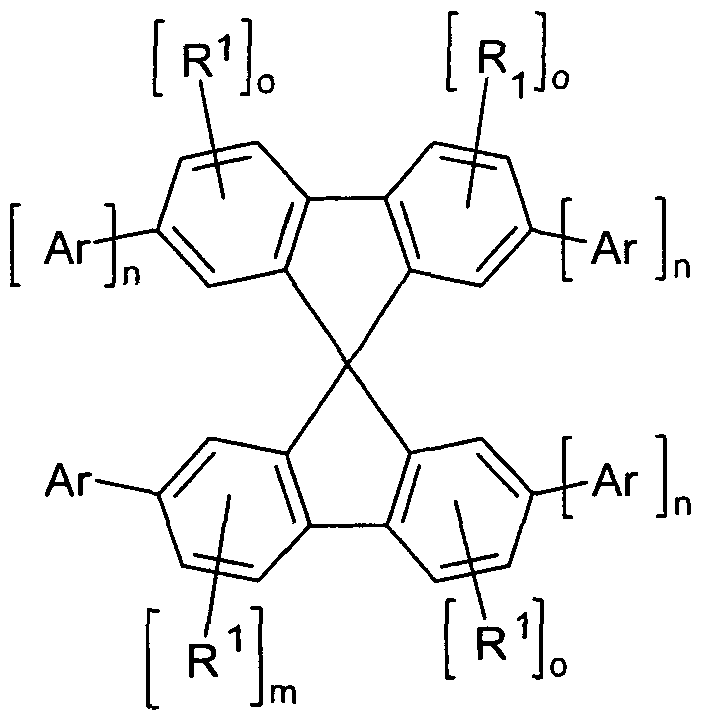


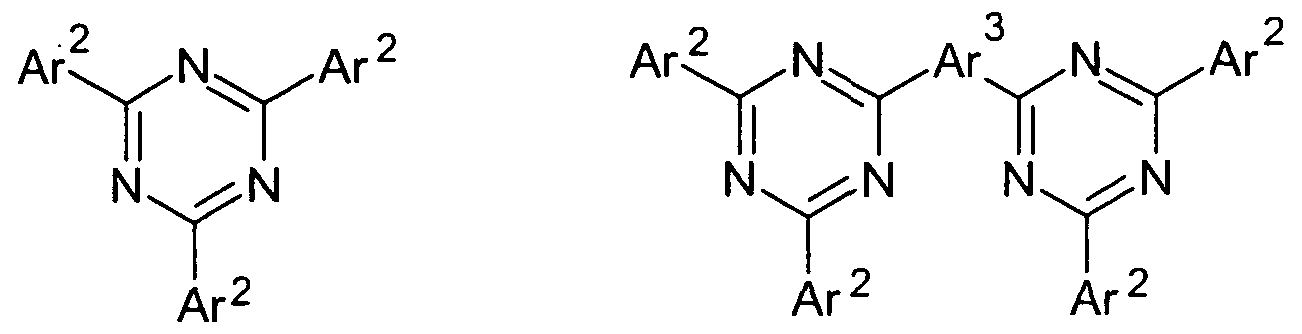


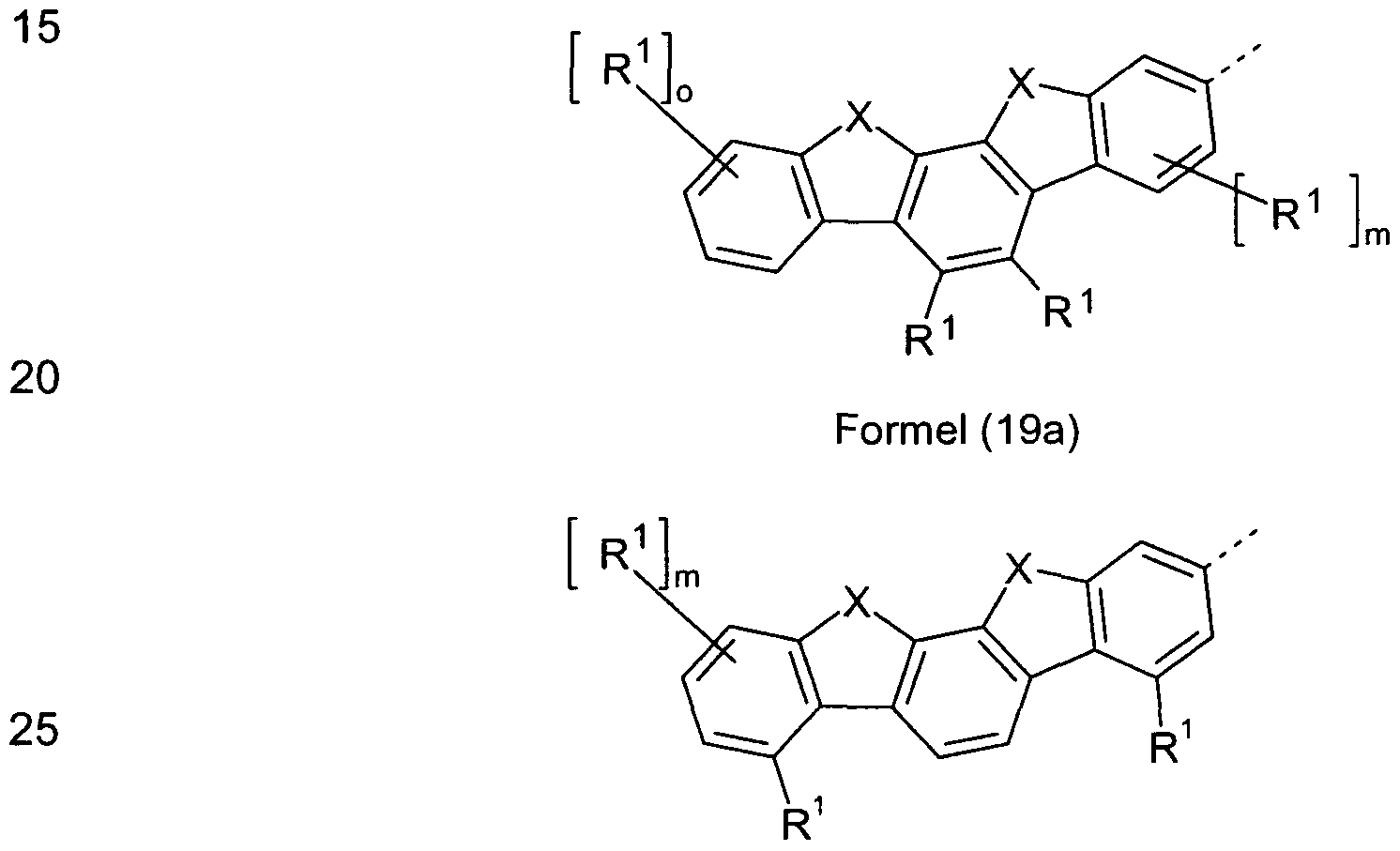


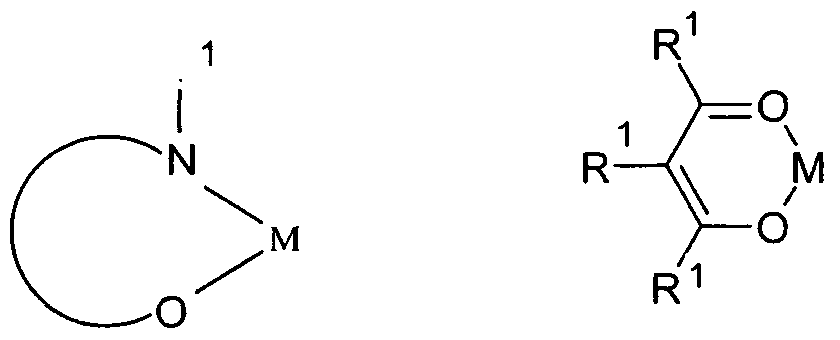
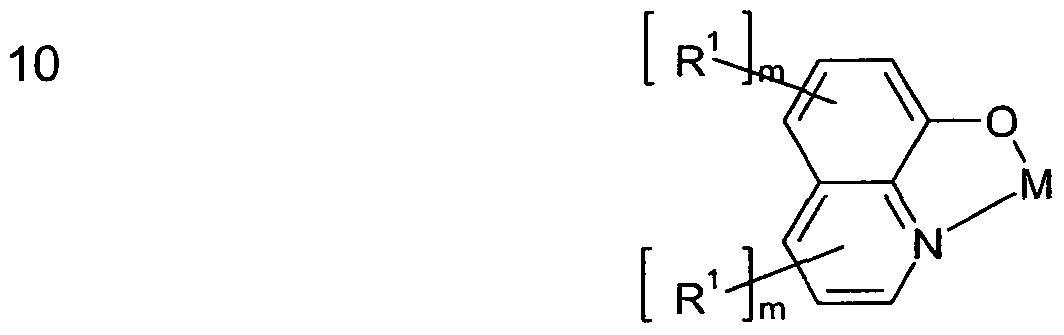

Priority Applications (11)
| Application Number | Priority Date | Filing Date | Title |
|---|---|---|---|
| US13/001,266 US8679647B2 (en) | 2008-12-22 | 2009-11-26 | Organic electroluminescent device comprising triazine derivatives |
| KR1020237032470A KR20230140609A (en) | 2008-12-22 | 2009-11-26 | Organic electroluminescent device comprising triazine derivatives |
| EP24181223.9A EP4408147A3 (en) | 2008-12-22 | 2009-11-26 | Organic electroluminescence device |
| EP18197576.4A EP3457450B1 (en) | 2008-12-22 | 2009-11-26 | Organic electroluminescent device |
| KR1020197006150A KR20190025753A (en) | 2008-12-22 | 2009-11-26 | Organic electroluminescent device comprising triazine derivatives |
| EP14004087.4A EP2849243B1 (en) | 2008-12-22 | 2009-11-26 | Organic electroluminescent device |
| CN200980125130.5A CN102077384B (en) | 2008-12-22 | 2009-11-26 | Organic electroluminescent device comprising triazine derivatives |
| KR1020187031462A KR20180122034A (en) | 2008-12-22 | 2009-11-26 | Organic electroluminescent device comprising triazine derivatives |
| KR1020207006077A KR20200024370A (en) | 2008-12-22 | 2009-11-26 | Organic electroluminescent device comprising triazine derivatives |
| JP2011541138A JP5882061B2 (en) | 2008-12-22 | 2009-11-26 | Organic electroluminescence device containing triazine derivative |
| EP09759687.8A EP2371016B1 (en) | 2008-12-22 | 2009-11-26 | Organic light emitting evices comprising triazine derivatives |
Applications Claiming Priority (2)
| Application Number | Priority Date | Filing Date | Title |
|---|---|---|---|
| DE102008064200.2 | 2008-12-22 | ||
| DE102008064200A DE102008064200A1 (en) | 2008-12-22 | 2008-12-22 | Organic electroluminescent device |
Publications (1)
| Publication Number | Publication Date |
|---|---|
| WO2010072300A1 true WO2010072300A1 (en) | 2010-07-01 |
Family
ID=41667291
Family Applications (1)
| Application Number | Title | Priority Date | Filing Date |
|---|---|---|---|
| PCT/EP2009/008441 Ceased WO2010072300A1 (en) | 2008-12-22 | 2009-11-26 | Organic electroluminescent device comprising triazine derivatives |
Country Status (8)
| Country | Link |
|---|---|
| US (1) | US8679647B2 (en) |
| EP (4) | EP2849243B1 (en) |
| JP (2) | JP5882061B2 (en) |
| KR (6) | KR101162932B1 (en) |
| CN (1) | CN102077384B (en) |
| DE (1) | DE102008064200A1 (en) |
| TW (2) | TWI549945B (en) |
| WO (1) | WO2010072300A1 (en) |
Cited By (207)
| Publication number | Priority date | Publication date | Assignee | Title |
|---|---|---|---|---|
| WO2010151389A1 (en) * | 2009-06-26 | 2010-12-29 | General Electric Company | Process for making organic compounds and the organic compounds made therefrom |
| WO2011074493A1 (en) * | 2009-12-14 | 2011-06-23 | 凸版印刷株式会社 | Anthracene derivative and light-emitting element |
| WO2011088877A1 (en) | 2010-01-25 | 2011-07-28 | Merck Patent Gmbh | Compounds for electronic devices |
| WO2011110262A1 (en) | 2010-03-06 | 2011-09-15 | Merck Patent Gmbh | Organic electroluminescent device |
| WO2011157790A1 (en) | 2010-06-18 | 2011-12-22 | Basf Se | Organic electronic devices comprising a layer of a dibenzofurane compound and a 8-hydroxyquinolinolato earth alkaline metal, or alkali metal complex |
| WO2011157779A1 (en) | 2010-06-18 | 2011-12-22 | Basf Se | Organic electronic devices comprising a layer of a pyridine compound and a 8-hydroxyquinolinolato earth alkaline metal, or alkali metal complex |
| US20120168735A1 (en) * | 2009-09-16 | 2012-07-05 | Merck Patent Gmbh | Organic electroluminescent device |
| WO2013026515A1 (en) | 2011-08-22 | 2013-02-28 | Merck Patent Gmbh | Organic electroluminescence device |
| US20130048956A1 (en) * | 2011-08-26 | 2013-02-28 | E-Ray Optoelectronics Technology Co., Ltd. | Compound for electroluminescent device and organic electroluminescent devices using the same |
| WO2013135352A1 (en) | 2012-03-15 | 2013-09-19 | Merck Patent Gmbh | Electronic devices |
| JP2013211550A (en) * | 2012-03-22 | 2013-10-10 | Dow Global Technologies Llc | Charge transport layers and films containing the same |
| WO2013174471A1 (en) | 2012-05-24 | 2013-11-28 | Merck Patent Gmbh | Metal complexes comprising condensed heteroaromatic rings |
| WO2014023388A1 (en) | 2012-08-10 | 2014-02-13 | Merck Patent Gmbh | Materials for organic electroluminescence devices |
| WO2014067614A1 (en) | 2012-10-31 | 2014-05-08 | Merck Patent Gmbh | Electronic device |
| WO2014082705A1 (en) | 2012-11-30 | 2014-06-05 | Merck Patent Gmbh | Electronic device |
| WO2014106522A1 (en) | 2013-01-03 | 2014-07-10 | Merck Patent Gmbh | Materials for electronic devices |
| WO2014106523A1 (en) | 2013-01-03 | 2014-07-10 | Merck Patent Gmbh | Electronic device |
| WO2014106524A2 (en) | 2013-01-03 | 2014-07-10 | Merck Patent Gmbh | Materials for electronic devices |
| JP2014519189A (en) * | 2011-10-05 | 2014-08-07 | エルジー・ケム・リミテッド | ORGANIC LIGHT EMITTING ELEMENT AND MANUFACTURING METHOD THEREOF |
| DE102013013876A1 (en) | 2013-08-20 | 2015-03-12 | Merck Patent Gmbh | metal complexes |
| WO2015082046A2 (en) | 2013-12-06 | 2015-06-11 | Merck Patent Gmbh | Substituted oxepines |
| WO2015152634A1 (en) * | 2014-04-04 | 2015-10-08 | 주식회사 엘지화학 | Organic light-emitting device |
| WO2015165563A1 (en) | 2014-04-30 | 2015-11-05 | Merck Patent Gmbh | Materials for electronic devices |
| US9203037B2 (en) | 2010-06-18 | 2015-12-01 | Basf Se | Organic electronic devices comprising a layer of a dibenzofurane compound and a 8-hydroxypquinolinolato earth alkaline metal, or alkali metal complex |
| WO2015192941A1 (en) | 2014-06-18 | 2015-12-23 | Merck Patent Gmbh | Compositions for electronic devices |
| WO2016119992A1 (en) | 2015-01-30 | 2016-08-04 | Merck Patent Gmbh | Materials for electronic devices |
| EP3056504A1 (en) | 2015-02-16 | 2016-08-17 | Universal Display Corporation | Organic electroluminescent materials and devices |
| EP3061763A1 (en) | 2015-02-27 | 2016-08-31 | Universal Display Corporation | Organic electroluminescent materials and devices |
| EP3098229A1 (en) | 2015-05-15 | 2016-11-30 | Universal Display Corporation | Organic electroluminescent materials and devices |
| EP3101021A1 (en) | 2015-06-01 | 2016-12-07 | Universal Display Corporation | Organic electroluminescent materials and devices |
| WO2017012694A1 (en) | 2015-07-23 | 2017-01-26 | Merck Patent Gmbh | Phenyl derivatives substituted with at least two electron acceptors and at least two electron donors for use in organic electronic devices |
| EP3124488A1 (en) | 2015-07-29 | 2017-02-01 | Universal Display Corporation | Organic electroluminescent materials and devices |
| WO2017028940A1 (en) | 2015-08-14 | 2017-02-23 | Merck Patent Gmbh | Phenoxazine derivatives for organic electroluminescent devices |
| EP3159350A1 (en) | 2015-09-03 | 2017-04-26 | Universal Display Corporation | Organic electroluminescent materials and devices |
| WO2017133829A1 (en) | 2016-02-05 | 2017-08-10 | Merck Patent Gmbh | Materials for electronic devices |
| EP3205658A1 (en) | 2016-02-09 | 2017-08-16 | Universal Display Corporation | Organic electroluminescent materials and devices |
| WO2017157983A1 (en) | 2016-03-17 | 2017-09-21 | Merck Patent Gmbh | Compounds with spirobifluorene-structures |
| EP3231809A2 (en) | 2016-04-11 | 2017-10-18 | Universal Display Corporation | Organic electroluminescent materials and devices |
| WO2017194435A1 (en) | 2016-05-11 | 2017-11-16 | Merck Patent Gmbh | Compositions for electrochemical cells |
| EP3261147A1 (en) | 2016-06-20 | 2017-12-27 | Universal Display Corporation | Organic electroluminescent materials and devices |
| EP3261146A2 (en) | 2016-06-20 | 2017-12-27 | Universal Display Corporation | Organic electroluminescent materials and devices |
| EP3270435A2 (en) | 2016-06-20 | 2018-01-17 | Universal Display Corporation | Organic electroluminescent materials and devices |
| EP3297051A1 (en) | 2016-09-14 | 2018-03-21 | Universal Display Corporation | Organic electroluminescent materials and devices |
| EP3301088A1 (en) | 2016-10-03 | 2018-04-04 | Universal Display Corporation | Condensed pyridines as organic electroluminescent materials and devices |
| EP3305796A1 (en) | 2016-10-07 | 2018-04-11 | Universal Display Corporation | Organic electroluminescent materials and devices |
| WO2018069167A1 (en) | 2016-10-10 | 2018-04-19 | Merck Patent Gmbh | Electronic device |
| DE102017008794A1 (en) | 2016-10-17 | 2018-04-19 | Merck Patent Gmbh | Materials for use in electronic devices |
| WO2018083053A1 (en) | 2016-11-02 | 2018-05-11 | Merck Patent Gmbh | Materials for electronic devices |
| EP3321258A1 (en) | 2016-11-09 | 2018-05-16 | Universal Display Corporation | 4-phenylbenzo[g]quinazoline or 4-(3,5-dimethylphenylbenzo[g]quinazoline iridium complexes for use as near-infrared or infrared emitting materials in oleds |
| WO2018087020A1 (en) | 2016-11-08 | 2018-05-17 | Merck Patent Gmbh | Compounds for electronic devices |
| EP3323822A1 (en) | 2016-09-23 | 2018-05-23 | Universal Display Corporation | Organic electroluminescent materials and devices |
| WO2018095839A1 (en) | 2016-11-22 | 2018-05-31 | Merck Patent Gmbh | Bridged triarylamines for electronic devices |
| WO2018114882A1 (en) | 2016-12-22 | 2018-06-28 | Merck Patent Gmbh | Materials for electronic devices |
| EP3345914A1 (en) | 2017-01-09 | 2018-07-11 | Universal Display Corporation | Organic electroluminescent materials and devices |
| EP3354654A2 (en) | 2016-11-11 | 2018-08-01 | Universal Display Corporation | Organic electroluminescent materials and devices |
| WO2018141706A1 (en) | 2017-02-02 | 2018-08-09 | Merck Patent Gmbh | Materials for electronic devices |
| WO2018158232A1 (en) | 2017-03-01 | 2018-09-07 | Merck Patent Gmbh | Organic electroluminescent device |
| WO2018157981A1 (en) | 2017-03-02 | 2018-09-07 | Merck Patent Gmbh | Materials for organic electronic devices |
| EP3378857A1 (en) | 2012-11-12 | 2018-09-26 | Merck Patent GmbH | Materials for electronic devices |
| EP3381927A1 (en) | 2017-03-29 | 2018-10-03 | Universal Display Corporation | Organic electroluminescent materials and devices |
| WO2018189134A1 (en) | 2017-04-13 | 2018-10-18 | Merck Patent Gmbh | Composition for organic electronic devices |
| WO2018197447A1 (en) | 2017-04-25 | 2018-11-01 | Merck Patent Gmbh | Compounds for electronic devices |
| EP3401318A1 (en) | 2017-05-11 | 2018-11-14 | Universal Display Corporation | Organic electroluminescent materials and devices |
| EP3418286A1 (en) | 2017-06-23 | 2018-12-26 | Universal Display Corporation | Organic electroluminescent materials and devices |
| WO2018234220A1 (en) | 2017-06-21 | 2018-12-27 | Merck Patent Gmbh | MATERIALS FOR ELECTRONIC DEVICES |
| WO2018234346A1 (en) | 2017-06-23 | 2018-12-27 | Merck Patent Gmbh | MATERIALS FOR ORGANIC ELECTROLUMINESCENT DEVICES |
| WO2019002198A1 (en) | 2017-06-26 | 2019-01-03 | Merck Patent Gmbh | Homogeneous mixtures |
| WO2019002183A1 (en) | 2017-06-26 | 2019-01-03 | Merck Patent Gmbh | PROCESS FOR PRODUCING SUBSTITUTED NITROGEN-CONTAINING HETEROCYCLES |
| WO2019002190A1 (en) | 2017-06-28 | 2019-01-03 | Merck Patent Gmbh | Materials for electronic devices |
| WO2019007867A1 (en) | 2017-07-05 | 2019-01-10 | Merck Patent Gmbh | COMPOSITION FOR ORGANIC ELECTRONIC DEVICES |
| WO2019007825A1 (en) | 2017-07-03 | 2019-01-10 | Merck Patent Gmbh | Organic electroluminescent device |
| WO2019007866A1 (en) | 2017-07-05 | 2019-01-10 | Merck Patent Gmbh | COMPOSITION FOR ORGANIC ELECTRONIC DEVICES |
| WO2019020654A1 (en) | 2017-07-28 | 2019-01-31 | Merck Patent Gmbh | Spirobifluorene derivatives for use in electronic devices |
| EP3444258A2 (en) | 2017-08-10 | 2019-02-20 | Universal Display Corporation | Organic electroluminescent materials and devices |
| WO2019048443A1 (en) | 2017-09-08 | 2019-03-14 | Merck Patent Gmbh | Materials for electronic devices |
| US20190097140A1 (en) * | 2017-09-26 | 2019-03-28 | Samsung Display Co., Ltd. | Organic light-emitting device |
| WO2019076789A1 (en) | 2017-10-17 | 2019-04-25 | Merck Patent Gmbh | Materials for organic electroluminescent devices |
| WO2019096717A2 (en) | 2017-11-14 | 2019-05-23 | Merck Patent Gmbh | Composition for organic electronic devices |
| EP3489243A1 (en) | 2017-11-28 | 2019-05-29 | University of Southern California | Carbene compounds and organic electroluminescent devices |
| WO2019101833A1 (en) | 2017-11-24 | 2019-05-31 | Merck Patent Gmbh | Materials for organic electroluminescent devices |
| WO2019101835A1 (en) | 2017-11-24 | 2019-05-31 | Merck Patent Gmbh | Materials for organic electroluminescent devices |
| WO2019101719A1 (en) | 2017-11-23 | 2019-05-31 | Merck Patent Gmbh | Materials for electronic devices |
| EP3492480A2 (en) | 2017-11-29 | 2019-06-05 | Universal Display Corporation | Organic electroluminescent materials and devices |
| EP3492528A1 (en) | 2017-11-30 | 2019-06-05 | Universal Display Corporation | Organic electroluminescent materials and devices |
| WO2019115577A1 (en) | 2017-12-15 | 2019-06-20 | Merck Patent Gmbh | Substituted aromatic amines for use in organic electroluminescent devices |
| WO2019121483A1 (en) | 2017-12-20 | 2019-06-27 | Merck Patent Gmbh | Heteroaromatic compounds |
| US10381572B2 (en) | 2014-04-04 | 2019-08-13 | Lg Chem, Ltd. | Heterocyclic compound and organic light-emitting element comprising same |
| WO2019170572A1 (en) | 2018-03-06 | 2019-09-12 | Merck Patent Gmbh | Materials for organic electroluminescent devices |
| WO2019170578A1 (en) | 2018-03-06 | 2019-09-12 | Merck Patent Gmbh | Materials for organic electroluminescent devices |
| WO2019175149A1 (en) | 2018-03-16 | 2019-09-19 | Merck Patent Gmbh | Materials for organic electroluminescent devices |
| WO2019229011A1 (en) | 2018-05-30 | 2019-12-05 | Merck Patent Gmbh | Composition for organic electronic devices |
| EP3613751A1 (en) | 2018-08-22 | 2020-02-26 | Universal Display Corporation | Organic electroluminescent materials and devices |
| WO2020043657A1 (en) | 2018-08-28 | 2020-03-05 | Merck Patent Gmbh | Materials for organic electroluminescent devices |
| WO2020043640A1 (en) | 2018-08-28 | 2020-03-05 | Merck Patent Gmbh | Materials for organic electroluminescent devices |
| WO2020043646A1 (en) | 2018-08-28 | 2020-03-05 | Merck Patent Gmbh | Materials for organic electroluminescent devices |
| WO2020053150A1 (en) | 2018-09-12 | 2020-03-19 | Merck Patent Gmbh | Materials for organic electroluminescent devices |
| EP3647393A1 (en) | 2013-07-30 | 2020-05-06 | Merck Patent GmbH | Materials for electronic devices |
| WO2020089138A1 (en) | 2018-10-31 | 2020-05-07 | Merck Patent Gmbh | Materials for organic electroluminescent devices |
| EP3660006A1 (en) * | 2014-12-24 | 2020-06-03 | Doosan Corporation | Organic electroluminescent element |
| EP3689889A1 (en) | 2019-02-01 | 2020-08-05 | Universal Display Corporation | Organic electroluminescent materials and devices |
| EP3690973A1 (en) | 2019-01-30 | 2020-08-05 | University Of Southern California | Organic electroluminescent materials and devices |
| WO2020169241A1 (en) | 2019-02-18 | 2020-08-27 | Merck Patent Gmbh | Composition for organic electronic devices |
| WO2020178230A1 (en) | 2019-03-04 | 2020-09-10 | Merck Patent Gmbh | Ligands for nano-sized materials |
| EP3712229A1 (en) | 2013-07-30 | 2020-09-23 | Merck Patent GmbH | Materials for electronic devices |
| EP3715353A1 (en) | 2019-03-26 | 2020-09-30 | Universal Display Corporation | Organic electroluminescent materials and devices |
| WO2020208051A1 (en) | 2019-04-11 | 2020-10-15 | Merck Patent Gmbh | Materials for organic electroluminescent devices |
| EP3750897A1 (en) | 2019-06-10 | 2020-12-16 | Universal Display Corporation | Organic electroluminescent materials and devices |
| EP3771717A1 (en) | 2019-07-30 | 2021-02-03 | Universal Display Corporation | Organic electroluminescent materials and devices |
| EP3778614A1 (en) | 2019-08-16 | 2021-02-17 | Universal Display Corporation | Organic electroluminescent materials and devices |
| WO2021043755A1 (en) | 2019-09-03 | 2021-03-11 | Merck Patent Gmbh | Materials for organic electroluminescent devices |
| US10950798B2 (en) | 2010-06-18 | 2021-03-16 | Udc Ireland Limited | Organic electronic devices comprising a layer of a pyridine compound and a 8-hydroxypquinolinolato earth alkaline metal, or alkali metal complex |
| WO2021052921A1 (en) | 2019-09-19 | 2021-03-25 | Merck Patent Gmbh | Mixture of two host materials, and organic electroluminescent device comprising same |
| US10964892B2 (en) | 2014-04-04 | 2021-03-30 | Lg Chem, Ltd. | Heterocyclic compound and organic light-emitting device comprising same |
| EP3816175A1 (en) | 2019-11-04 | 2021-05-05 | Universal Display Corporation | Organic electroluminescent materials and devices |
| WO2021089447A1 (en) | 2019-11-04 | 2021-05-14 | Merck Patent Gmbh | Organic electroluminescent apparatus |
| WO2021089450A1 (en) | 2019-11-04 | 2021-05-14 | Merck Patent Gmbh | Materials for organic electroluminescent devices |
| WO2021094269A1 (en) | 2019-11-12 | 2021-05-20 | Merck Patent Gmbh | Materials for organic electroluminescent devices |
| WO2021110741A1 (en) | 2019-12-04 | 2021-06-10 | Merck Patent Gmbh | Materials for organic electroluminescent devices |
| EP3845545A1 (en) | 2020-01-06 | 2021-07-07 | Universal Display Corporation | Organic electroluminescent materials and devices |
| EP3858945A1 (en) | 2020-01-28 | 2021-08-04 | Universal Display Corporation | Organic electroluminescent materials and devices |
| WO2021180614A1 (en) | 2020-03-11 | 2021-09-16 | Merck Patent Gmbh | Organic electroluminescent apparatus |
| WO2021180625A1 (en) | 2020-03-11 | 2021-09-16 | Merck Patent Gmbh | Organic electroluminescent apparatus |
| WO2021180950A1 (en) | 2020-03-13 | 2021-09-16 | Merck Patent Gmbh | Materials for organic electroluminescent devices |
| WO2021191058A1 (en) | 2020-03-23 | 2021-09-30 | Merck Patent Gmbh | Materials for organic electroluminescent devices |
| WO2021239772A1 (en) | 2020-05-29 | 2021-12-02 | Merck Patent Gmbh | Organic electroluminescent apparatus |
| EP3937268A1 (en) | 2020-07-10 | 2022-01-12 | Universal Display Corporation | Plasmonic oleds and vertical dipole emitters |
| WO2022017998A1 (en) | 2020-07-22 | 2022-01-27 | Merck Patent Gmbh | Materials for organic electroluminescent devices |
| WO2022017997A1 (en) | 2020-07-22 | 2022-01-27 | Merck Patent Gmbh | Materials for organic electroluminescent devices |
| EP4001287A1 (en) | 2020-11-24 | 2022-05-25 | Universal Display Corporation | Organic electroluminescent materials and devices |
| EP4001286A1 (en) | 2020-11-24 | 2022-05-25 | Universal Display Corporation | Organic electroluminescent materials and devices |
| WO2022112541A1 (en) | 2020-11-30 | 2022-06-02 | Merck Patent Gmbh | Materials for organic electroluminescent devices |
| EP4016659A1 (en) | 2020-11-16 | 2022-06-22 | Universal Display Corporation | Organic electroluminescent materials and devices |
| EP4019526A1 (en) | 2018-01-26 | 2022-06-29 | Universal Display Corporation | Organic electroluminescent materials and devices |
| EP4039692A1 (en) | 2021-02-03 | 2022-08-10 | Universal Display Corporation | Organic electroluminescent materials and devices |
| EP4053137A1 (en) | 2021-03-05 | 2022-09-07 | Universal Display Corporation | Organic electroluminescent materials and devices |
| EP4056578A1 (en) | 2021-03-12 | 2022-09-14 | Universal Display Corporation | Organic electroluminescent materials and devices |
| EP4060758A2 (en) | 2021-02-26 | 2022-09-21 | Universal Display Corporation | Organic electroluminescent materials and devices |
| EP4059941A1 (en) | 2021-03-15 | 2022-09-21 | Universal Display Corporation | Organic electroluminescent materials and devices |
| EP4059915A2 (en) | 2021-02-26 | 2022-09-21 | Universal Display Corporation | Organic electroluminescent materials and devices |
| WO2022214506A1 (en) | 2021-04-09 | 2022-10-13 | Merck Patent Gmbh | Materials for organic electroluminescent devices |
| WO2022214507A1 (en) | 2021-04-09 | 2022-10-13 | Merck Patent Gmbh | Materials for organic electroluminescent devices |
| WO2022214566A1 (en) | 2021-04-09 | 2022-10-13 | Merck Patent Gmbh | Materials for organic electroluminescent devices |
| EP4075531A1 (en) | 2021-04-13 | 2022-10-19 | Universal Display Corporation | Plasmonic oleds and vertical dipole emitters |
| EP4074723A1 (en) | 2021-04-05 | 2022-10-19 | Universal Display Corporation | Organic electroluminescent materials and devices |
| EP4075530A1 (en) | 2021-04-14 | 2022-10-19 | Universal Display Corporation | Organic electroluminescent materials and devices |
| EP4079743A1 (en) | 2021-04-23 | 2022-10-26 | Universal Display Corporation | Organic electroluminescent materials and devices |
| EP4086266A1 (en) | 2021-04-23 | 2022-11-09 | Universal Display Corporation | Organic electroluminescent materials and devices |
| WO2022243403A1 (en) | 2021-05-21 | 2022-11-24 | Merck Patent Gmbh | Method for the continuous purification of at least one functional material and device for the continuous purification of at least one functional material |
| EP4112701A2 (en) | 2021-06-08 | 2023-01-04 | University of Southern California | Molecular alignment of homoleptic iridium phosphors |
| WO2023036976A1 (en) | 2021-09-13 | 2023-03-16 | Merck Patent Gmbh | Materials for organic electroluminescent devices |
| EP4151699A1 (en) | 2021-09-17 | 2023-03-22 | Universal Display Corporation | Organic electroluminescent materials and devices |
| WO2023052272A1 (en) | 2021-09-28 | 2023-04-06 | Merck Patent Gmbh | Materials for electronic devices |
| WO2023052314A1 (en) | 2021-09-28 | 2023-04-06 | Merck Patent Gmbh | Materials for electronic devices |
| WO2023052275A1 (en) | 2021-09-28 | 2023-04-06 | Merck Patent Gmbh | Materials for electronic devices |
| WO2023052313A1 (en) | 2021-09-28 | 2023-04-06 | Merck Patent Gmbh | Materials for electronic devices |
| EP4185086A1 (en) | 2017-07-26 | 2023-05-24 | Universal Display Corporation | Organic electroluminescent materials and devices |
| WO2023094412A1 (en) | 2021-11-25 | 2023-06-01 | Merck Patent Gmbh | Materials for electronic devices |
| WO2023099543A1 (en) | 2021-11-30 | 2023-06-08 | Merck Patent Gmbh | Compounds having fluorene structures |
| WO2023117837A1 (en) | 2021-12-21 | 2023-06-29 | Merck Patent Gmbh | Process for preparing deuterated organic compounds |
| EP4212539A1 (en) | 2021-12-16 | 2023-07-19 | Universal Display Corporation | Organic electroluminescent materials and devices |
| WO2023152346A1 (en) | 2022-02-14 | 2023-08-17 | Merck Patent Gmbh | Materials for electronic devices |
| EP4231804A2 (en) | 2022-02-16 | 2023-08-23 | Universal Display Corporation | Organic electroluminescent materials and devices |
| EP4242285A1 (en) | 2022-03-09 | 2023-09-13 | Universal Display Corporation | Organic electroluminescent materials and devices |
| EP4265626A2 (en) | 2022-04-18 | 2023-10-25 | Universal Display Corporation | Organic electroluminescent materials and devices |
| WO2023208899A1 (en) | 2022-04-28 | 2023-11-02 | Merck Patent Gmbh | Materials for organic electroluminescent devices |
| WO2023222559A1 (en) | 2022-05-18 | 2023-11-23 | Merck Patent Gmbh | Process for preparing deuterated organic compounds |
| EP4282863A1 (en) | 2022-05-24 | 2023-11-29 | Universal Display Corporation | Organic electroluminescent materials and devices |
| EP4293001A1 (en) | 2022-06-08 | 2023-12-20 | Universal Display Corporation | Organic electroluminescent materials and devices |
| WO2023247662A1 (en) | 2022-06-24 | 2023-12-28 | Merck Patent Gmbh | Composition for organic electronic devices |
| WO2023247663A1 (en) | 2022-06-24 | 2023-12-28 | Merck Patent Gmbh | Composition for organic electronic devices |
| EP4299693A1 (en) | 2022-06-28 | 2024-01-03 | Universal Display Corporation | Organic electroluminescent materials and devices |
| WO2024013004A1 (en) | 2022-07-11 | 2024-01-18 | Merck Patent Gmbh | Materials for electronic devices |
| WO2024033282A1 (en) | 2022-08-09 | 2024-02-15 | Merck Patent Gmbh | Materials for organic electroluminescent devices |
| EP4326030A1 (en) | 2022-08-17 | 2024-02-21 | Universal Display Corporation | Organic electroluminescent materials and devices |
| EP4362631A2 (en) | 2022-10-27 | 2024-05-01 | Universal Display Corporation | Organic electroluminescent materials and devices |
| EP4362645A2 (en) | 2022-10-27 | 2024-05-01 | Universal Display Corporation | Organic electroluminescent materials and devices |
| EP4362630A2 (en) | 2022-10-27 | 2024-05-01 | Universal Display Corporation | Organic electroluminescent materials and devices |
| EP4369898A1 (en) | 2022-10-27 | 2024-05-15 | Universal Display Corporation | Organic electroluminescent materials and devices |
| WO2024105066A1 (en) | 2022-11-17 | 2024-05-23 | Merck Patent Gmbh | Materials for organic electroluminescent devices |
| EP4376583A2 (en) | 2022-10-27 | 2024-05-29 | Universal Display Corporation | Organic electroluminescent materials and devices |
| EP3457450B1 (en) | 2008-12-22 | 2024-06-12 | Merck Patent GmbH | Organic electroluminescent device |
| EP4386065A1 (en) | 2022-12-14 | 2024-06-19 | Universal Display Corporation | Organic electroluminescent materials and devices |
| WO2024132993A1 (en) | 2022-12-19 | 2024-06-27 | Merck Patent Gmbh | Materials for electronic devices |
| WO2024133048A1 (en) | 2022-12-20 | 2024-06-27 | Merck Patent Gmbh | Method for preparing deuterated aromatic compounds |
| WO2024132892A1 (en) | 2022-12-19 | 2024-06-27 | Merck Patent Gmbh | Materials for organic electroluminescent devices |
| WO2024170605A1 (en) | 2023-02-17 | 2024-08-22 | Merck Patent Gmbh | Materials for organic electroluminescent devices |
| WO2024218109A1 (en) | 2023-04-20 | 2024-10-24 | Merck Patent Gmbh | Materials for electronic devices |
| WO2024240725A1 (en) | 2023-05-25 | 2024-11-28 | Merck Patent Gmbh | Tris[1,2,4]triazolo[1,5-a:1',5'-c:1'',5''-e][1,3,5]triazine derivatives for use in organic electroluminescent devices |
| US12187748B2 (en) | 2020-11-02 | 2025-01-07 | Universal Display Corporation | Organic electroluminescent materials and devices |
| EP4489555A2 (en) | 2018-03-12 | 2025-01-08 | Universal Display Corporation | Organic electroluminescent materials and devices |
| WO2025012253A1 (en) | 2023-07-12 | 2025-01-16 | Merck Patent Gmbh | Materials for electronic devices |
| WO2025021855A1 (en) | 2023-07-27 | 2025-01-30 | Merck Patent Gmbh | Materials for organic light-emitting devices and organic sensors |
| WO2025045851A1 (en) | 2023-08-30 | 2025-03-06 | Merck Patent Gmbh | Materials for organic light-emitting devices |
| WO2025045842A1 (en) | 2023-08-30 | 2025-03-06 | Merck Patent Gmbh | Materials for organic light-emitting devices |
| WO2025045843A1 (en) | 2023-08-30 | 2025-03-06 | Merck Patent Gmbh | Materials for organic light-emitting devices |
| WO2025119821A1 (en) | 2023-12-05 | 2025-06-12 | Merck Patent Gmbh | Material composition for organic electroluminescent devices |
| WO2025132547A1 (en) | 2023-12-21 | 2025-06-26 | Merck Patent Gmbh | Mechanochemical method for deuterating organic compounds |
| WO2025132551A1 (en) | 2023-12-22 | 2025-06-26 | Merck Patent Gmbh | Materials for electronic devices |
| EP4580378A1 (en) | 2023-12-15 | 2025-07-02 | Universal Display Corporation | Organic electroluminescent materials and devices |
| EP4592303A1 (en) | 2023-12-15 | 2025-07-30 | Universal Display Corporation | Organic electroluminescent materials and devices |
| WO2025195961A1 (en) | 2024-03-19 | 2025-09-25 | Merck Patent Gmbh | Organic light-emitting devices |
| WO2025196145A1 (en) | 2024-03-22 | 2025-09-25 | Merck Patent Gmbh | Materials for organic light emitting devices |
| US12428599B2 (en) | 2021-03-09 | 2025-09-30 | Universal Display Corporation | Organic electroluminescent materials and devices |
| WO2025210013A1 (en) | 2024-04-04 | 2025-10-09 | Merck Patent Gmbh | Compounds for electronic devices, in particular compounds for oleds |
| US12473318B2 (en) | 2021-10-08 | 2025-11-18 | Universal Display Corporation | Organic electroluminescent materials and devices |
| US12480042B2 (en) | 2021-04-09 | 2025-11-25 | Universal Display Corporation | Organic electroluminescent materials and devices |
| US12550611B2 (en) | 2022-08-03 | 2026-02-10 | Universal Display Corporation | Organic electroluminescent materials and devices |
Families Citing this family (113)
| Publication number | Priority date | Publication date | Assignee | Title |
|---|---|---|---|---|
| JP5784608B2 (en) | 2009-09-16 | 2015-09-24 | メルク パテント ゲーエムベーハー | Formulations for electronic device manufacturing |
| DE102009053645A1 (en) * | 2009-11-17 | 2011-05-19 | Merck Patent Gmbh | Materials for organic electroluminescent device |
| DE102009042680A1 (en) | 2009-09-23 | 2011-03-24 | Merck Patent Gmbh | Organic electroluminescent device |
| KR101778825B1 (en) | 2010-05-03 | 2017-09-14 | 메르크 파텐트 게엠베하 | Formulations and electronic devices |
| US9159930B2 (en) | 2010-11-26 | 2015-10-13 | Merck Patent Gmbh | Formulations and electronic devices |
| DE102010055901A1 (en) | 2010-12-23 | 2012-06-28 | Merck Patent Gmbh | Organic electroluminescent device |
| US8795357B2 (en) | 2011-07-15 | 2014-08-05 | Edwards Lifesciences Corporation | Perivalvular sealing for transcatheter heart valve |
| DE102011117422A1 (en) | 2011-10-28 | 2013-05-02 | Merck Patent Gmbh | Hyperbranched polymers, process for their preparation and their use in electronic devices |
| TWI432418B (en) | 2011-12-19 | 2014-04-01 | Au Optronics Corp | Electron transport material and organic light emitting device |
| US20130273239A1 (en) * | 2012-03-13 | 2013-10-17 | Universal Display Corporation | Nozzle design for organic vapor jet printing |
| KR101973166B1 (en) | 2012-03-27 | 2019-04-29 | 삼성디스플레이 주식회사 | Organic light-emitting device and organic light-emitting display apparatus including the same |
| KR101540053B1 (en) * | 2012-07-05 | 2015-07-29 | 주식회사 엠비케이 | New organic electroluminescent compounds and organic electroluminescent device comprising the same |
| KR102125199B1 (en) | 2012-07-23 | 2020-06-22 | 메르크 파텐트 게엠베하 | Materials for organic electroluminescent devices |
| CN103531714B (en) * | 2012-07-30 | 2016-01-27 | 昆山维信诺科技有限公司 | Electron transfer layer, containing the organic electroluminescence device of this layer and preparation thereof |
| EP2923391A1 (en) | 2012-11-20 | 2015-09-30 | Merck Patent GmbH | Formulation in high-purity solvent for producing electronic devices |
| JP6335428B2 (en) * | 2012-12-21 | 2018-05-30 | 出光興産株式会社 | Organic electroluminescence device and electronic device |
| CN103232843B (en) * | 2013-04-18 | 2015-02-25 | 烟台万润精细化工股份有限公司 | Electroluminescent material and application thereof |
| KR102117611B1 (en) | 2013-06-12 | 2020-06-02 | 삼성디스플레이 주식회사 | Organic light emitting device |
| KR102188028B1 (en) | 2013-06-18 | 2020-12-08 | 삼성디스플레이 주식회사 | Organic light emitting device |
| JP2015005747A (en) * | 2013-06-21 | 2015-01-08 | ダウ グローバル テクノロジーズ エルエルシー | Thin film containing compound obtained from triazine, and electronic device formed from the same |
| KR102084170B1 (en) | 2013-07-25 | 2020-03-04 | 삼성디스플레이 주식회사 | An organic light emitting device, an organic light emitting display appratus having the organic light emitting device and a method of manufacturing the same |
| TW201522317A (en) | 2013-11-12 | 2015-06-16 | 陶氏全球科技有限責任公司 | Compositions containing fluorene substituted triazine derived compounds, and electronic devices containing the same |
| JP6427875B2 (en) * | 2013-12-26 | 2018-11-28 | 東ソー株式会社 | Organic electroluminescence device |
| WO2015152651A1 (en) * | 2014-04-04 | 2015-10-08 | 주식회사 엘지화학 | Heterocyclic compound and organic light-emitting element comprising same |
| CN112397664B (en) * | 2014-04-04 | 2025-12-12 | 株式会社Lg化学 | Heterocyclic compounds and organic light-emitting devices containing them |
| KR102304716B1 (en) | 2014-06-13 | 2021-09-27 | 삼성디스플레이 주식회사 | Amine-based compounds and organic light-emitting device including the same |
| US10297762B2 (en) | 2014-07-09 | 2019-05-21 | Universal Display Corporation | Organic electroluminescent materials and devices |
| KR102351957B1 (en) * | 2014-07-10 | 2022-01-17 | 삼성디스플레이 주식회사 | Organic light emitting diode and organic light emitting display device including the same |
| EP3189551B1 (en) | 2014-09-05 | 2021-01-27 | Merck Patent GmbH | Formulations and method of producing an organic electroluminescent device |
| US10749113B2 (en) | 2014-09-29 | 2020-08-18 | Universal Display Corporation | Organic electroluminescent materials and devices |
| US10361375B2 (en) | 2014-10-06 | 2019-07-23 | Universal Display Corporation | Organic electroluminescent materials and devices |
| KR101560102B1 (en) * | 2014-11-20 | 2015-10-13 | 주식회사 엘지화학 | Organic light emitting device |
| EP3032605B1 (en) | 2014-12-08 | 2019-08-21 | LG Display Co., Ltd. | Organic light emitting display device |
| KR102432080B1 (en) * | 2014-12-08 | 2022-08-16 | 엘지디스플레이 주식회사 | Organic Light Emitting Display Device |
| WO2016105050A1 (en) * | 2014-12-24 | 2016-06-30 | 주식회사 두산 | Organic electroluminescent element |
| WO2016107663A1 (en) | 2014-12-30 | 2016-07-07 | Merck Patent Gmbh | Formulations and electronic devices |
| KR102338908B1 (en) | 2015-03-03 | 2021-12-14 | 삼성디스플레이 주식회사 | An organic light emitting device |
| WO2016155866A1 (en) | 2015-03-30 | 2016-10-06 | Merck Patent Gmbh | Formulation of an organic functional material comprising a siloxane solvent |
| JPWO2016175292A1 (en) * | 2015-04-28 | 2018-02-22 | 出光興産株式会社 | COMPOUND, MATERIAL FOR ORGANIC ELECTROLUMINESCENT ELEMENT, ORGANIC ELECTROLUMINESCENT ELEMENT, AND ELECTRONIC DEVICE |
| KR102654992B1 (en) | 2015-06-12 | 2024-04-04 | 메르크 파텐트 게엠베하 | Esters containing non-aromatic cycles as solvents for oled formulations |
| US11522140B2 (en) | 2015-08-17 | 2022-12-06 | Universal Display Corporation | Organic electroluminescent materials and devices |
| EP3341981B1 (en) | 2015-08-28 | 2020-08-19 | Merck Patent GmbH | Formulation of an organic functional material comprising an epoxy group containing solvent |
| KR20250005542A (en) | 2015-10-26 | 2025-01-09 | 오티아이 루미오닉스 인크. | Method for patterning a coating on a surface and device including a patterned coating |
| KR102591635B1 (en) | 2015-10-27 | 2023-10-20 | 삼성디스플레이 주식회사 | An organic light emitting device |
| KR102399570B1 (en) | 2015-11-26 | 2022-05-19 | 삼성디스플레이 주식회사 | Organic light emitting device |
| CN108368361A (en) | 2015-12-10 | 2018-08-03 | 默克专利有限公司 | Preparation containing the ketone comprising non-aromatic ring |
| JP7051684B2 (en) | 2015-12-15 | 2022-04-11 | メルク パテント ゲーエムベーハー | Esters containing aromatic groups as solvents for organic electronic formulations |
| KR20180095028A (en) | 2015-12-16 | 2018-08-24 | 메르크 파텐트 게엠베하 | A formulation containing a mixture of two or more different solvents |
| EP3390549B1 (en) | 2015-12-16 | 2022-06-29 | Merck Patent GmbH | Formulations containing a solid solvent |
| US10461262B2 (en) | 2015-12-22 | 2019-10-29 | Samsung Display Co., Ltd. | Condensed cyclic compound and an organic light-emitting device including the same |
| US11910707B2 (en) | 2015-12-23 | 2024-02-20 | Samsung Display Co., Ltd. | Organic light-emitting device |
| US10840448B2 (en) | 2016-02-17 | 2020-11-17 | Merck Patent Gmbh | Formulation of an organic functional material |
| JPWO2017141876A1 (en) | 2016-02-18 | 2018-12-06 | 出光興産株式会社 | ORGANIC ELECTROLUMINESCENT ELEMENT AND ELECTRONIC DEVICE |
| KR20170097820A (en) * | 2016-02-18 | 2017-08-29 | 삼성디스플레이 주식회사 | Organic light emitting device |
| DE102016003104A1 (en) | 2016-03-15 | 2017-09-21 | Merck Patent Gmbh | Container comprising a formulation containing at least one organic semiconductor |
| KR20170127101A (en) | 2016-05-10 | 2017-11-21 | 삼성디스플레이 주식회사 | Organic light emitting device |
| CN109153871A (en) | 2016-06-16 | 2019-01-04 | 默克专利有限公司 | The preparation of organic functional material |
| JP2019523998A (en) | 2016-06-17 | 2019-08-29 | メルク パテント ゲーエムベーハー | Formulation of organic functional materials |
| TW201815998A (en) | 2016-06-28 | 2018-05-01 | 德商麥克專利有限公司 | Organic functional material formulation |
| KR102477259B1 (en) * | 2016-07-18 | 2022-12-14 | 삼성디스플레이 주식회사 | Organic electroluminescence display device |
| CN105968062B (en) * | 2016-07-25 | 2019-04-30 | 上海道亦化工科技有限公司 | Compound and its organic electroluminescence device containing 1,2,4- triazine group |
| WO2018024719A1 (en) | 2016-08-04 | 2018-02-08 | Merck Patent Gmbh | Formulation of an organic functional material |
| CN109863223B (en) | 2016-10-31 | 2023-06-20 | 默克专利有限公司 | Formulation of organic functional materials |
| JP7013459B2 (en) | 2016-10-31 | 2022-01-31 | メルク パテント ゲーエムベーハー | Formulation of organic functional materials |
| CN110301053B (en) | 2016-12-02 | 2024-05-10 | Oti照明公司 | Device comprising a conductive coating disposed over an emission region and method thereof |
| KR102472751B1 (en) | 2016-12-06 | 2022-11-30 | 메르크 파텐트 게엠베하 | Manufacturing method of electronic device |
| CN110168047B (en) | 2016-12-13 | 2023-08-08 | 默克专利有限公司 | Preparation of organic functional material |
| KR102504432B1 (en) | 2016-12-22 | 2023-02-27 | 메르크 파텐트 게엠베하 | A mixture comprising at least two organo-functional compounds |
| TWI763772B (en) | 2017-01-30 | 2022-05-11 | 德商麥克專利有限公司 | Method for forming an organic element of an electronic device |
| TWI791481B (en) | 2017-01-30 | 2023-02-11 | 德商麥克專利有限公司 | Method for forming an organic electroluminescence (el) element |
| CN109564974B (en) * | 2017-03-08 | 2023-03-31 | 株式会社Lg化学 | Organic light emitting device |
| JP7123967B2 (en) | 2017-03-31 | 2022-08-23 | メルク パテント ゲーエムベーハー | Printing method for organic light emitting diodes (OLEDs) |
| CN110494514A (en) | 2017-04-10 | 2019-11-22 | 默克专利有限公司 | Formulation of organic functional materials |
| JP2020518107A (en) | 2017-04-26 | 2020-06-18 | オーティーアイ ルミオニクス インコーポレーテッドOti Lumionics Inc. | Method for patterning a coating on a surface and device containing the patterned coating |
| JP7330898B2 (en) | 2017-05-03 | 2023-08-22 | メルク パテント ゲーエムベーハー | Formulation of organic functional material |
| CN116997204A (en) | 2017-05-17 | 2023-11-03 | Oti照明公司 | Method for selectively depositing a conductive coating on a patterned coating and apparatus including a conductive coating |
| CN107141191B (en) * | 2017-06-27 | 2021-03-19 | 维思普新材料(苏州)有限公司 | Spirobifluorene derivative and application thereof in organic electroluminescence field |
| CN107417676A (en) * | 2017-07-04 | 2017-12-01 | 信阳师范学院 | S-triazine loop coil aromatic hydrocarbons steric hindrance type bipolarity luminescent material and its synthetic method |
| WO2019016184A1 (en) | 2017-07-18 | 2019-01-24 | Merck Patent Gmbh | Formulation of an organic functional material |
| KR102132350B1 (en) | 2017-07-20 | 2020-07-09 | 주식회사 엘지화학 | Novel hetero-cyclic compound and organic light emitting device comprising the same |
| CN107394051B (en) | 2017-08-14 | 2019-12-27 | 上海天马有机发光显示技术有限公司 | Light emitting device and display device |
| CN111418081B (en) | 2017-12-15 | 2024-09-13 | 默克专利有限公司 | Preparation of organic functional materials |
| KR102452650B1 (en) * | 2017-12-19 | 2022-10-06 | 삼성전자주식회사 | Electroluminescent device, and display device comprising thereof |
| US11751415B2 (en) | 2018-02-02 | 2023-09-05 | Oti Lumionics Inc. | Materials for forming a nucleation-inhibiting coating and devices incorporating same |
| JP7247231B2 (en) | 2018-02-26 | 2023-03-28 | メルク パテント ゲーエムベーハー | Formulation of organic functional material |
| KR102868464B1 (en) | 2018-05-07 | 2025-10-10 | 오티아이 루미오닉스 인크. | Method for providing an auxiliary electrode and device including the auxiliary electrode |
| EP3807367B1 (en) | 2018-06-15 | 2023-07-19 | Merck Patent GmbH | Formulation of an organic functional material |
| KR20210056432A (en) | 2018-09-24 | 2021-05-18 | 메르크 파텐트 게엠베하 | Method of manufacturing granular material |
| WO2020094538A1 (en) | 2018-11-06 | 2020-05-14 | Merck Patent Gmbh | Method for forming an organic element of an electronic device |
| WO2020105015A1 (en) | 2018-11-23 | 2020-05-28 | Oti Lumionics Inc. | Optoelectronic device including a light transmissive region |
| CN111384306B (en) * | 2018-12-29 | 2021-10-29 | Tcl科技集团股份有限公司 | Preparation method of quantum dot light-emitting diode |
| CN116456753A (en) | 2019-03-07 | 2023-07-18 | Oti照明公司 | Optoelectronic device |
| CN111747936B (en) * | 2019-03-29 | 2021-10-22 | 吉林省元合电子材料有限公司 | A kind of substituted 1,3,5-triazine compound, composition and application thereof |
| WO2020212953A1 (en) | 2019-04-18 | 2020-10-22 | Oti Lumionics Inc. | Materials for forming a nucleation-inhibiting coating and devices incorporating the same |
| JP7576337B2 (en) | 2019-05-08 | 2024-11-01 | オーティーアイ ルミオニクス インコーポレーテッド | Materials for forming nucleation-inhibiting coatings and devices incorporating same - Patents.com |
| US11832473B2 (en) | 2019-06-26 | 2023-11-28 | Oti Lumionics Inc. | Optoelectronic device including light transmissive regions, with light diffraction characteristics |
| CN117500334A (en) | 2019-06-26 | 2024-02-02 | Oti照明公司 | Optoelectronic devices including light-transmissive regions having light diffraction characteristics |
| KR102818817B1 (en) | 2019-08-09 | 2025-06-11 | 오티아이 루미오닉스 인크. | Optoelectronic device including auxiliary electrode and partition |
| DE102019005700A1 (en) * | 2019-08-15 | 2021-02-18 | Merck Patent Gmbh | Electronic device |
| CN115552643B (en) | 2019-12-24 | 2025-08-19 | Oti照明公司 | Light emitting device including cover layer and method of manufacturing the same |
| WO2021194261A1 (en) * | 2020-03-26 | 2021-09-30 | 주식회사 엘지화학 | Novel compound and organic light-emitting device using same |
| WO2021259824A1 (en) | 2020-06-23 | 2021-12-30 | Merck Patent Gmbh | Method for producing a mixture |
| CN111606866A (en) * | 2020-06-30 | 2020-09-01 | 上海天马有机发光显示技术有限公司 | Organic compound and electroluminescent application thereof |
| CN112300162B (en) * | 2020-10-30 | 2022-04-05 | 武汉天马微电子有限公司 | Compound, electron transport material, display panel, and display device |
| WO2022123431A1 (en) | 2020-12-07 | 2022-06-16 | Oti Lumionics Inc. | Patterning a conductive deposited layer using a nucleation inhibiting coating and an underlying metallic coating |
| WO2022122607A1 (en) | 2020-12-08 | 2022-06-16 | Merck Patent Gmbh | An ink system and a method for inkjet printing |
| US20240334813A1 (en) * | 2021-06-18 | 2024-10-03 | Idemitsu Kosan Co., Ltd. | Compound, material for organic electroluminescence device, organic electroluminescence device, and electronic apparatus |
| TW202349760A (en) | 2021-10-05 | 2023-12-16 | 德商麥克專利有限公司 | Method for forming an organic element of an electronic device |
| US20240049593A1 (en) * | 2021-10-29 | 2024-02-08 | Samsung Display Co., Ltd. | Light emitting device and amine compound for light emitting device |
| CN116143759A (en) * | 2021-11-18 | 2023-05-23 | 吉林省元合电子材料有限公司 | Substituted 1,3, 5-triazines, compositions and uses thereof |
| TW202440819A (en) | 2022-12-16 | 2024-10-16 | 德商麥克專利有限公司 | Formulation of an organic functional material |
| WO2025032039A1 (en) | 2023-08-07 | 2025-02-13 | Merck Patent Gmbh | Process for the preparation of an electronic device |
| WO2026008710A1 (en) | 2024-07-05 | 2026-01-08 | Merck Patent Gmbh | Cyclic silicon compounds for organic electroluminescent devices |
Citations (2)
| Publication number | Priority date | Publication date | Assignee | Title |
|---|---|---|---|---|
| WO2005053055A1 (en) * | 2003-11-27 | 2005-06-09 | Merck Patent Gmbh | Organic electroluminescent element |
| WO2010015306A1 (en) * | 2008-08-08 | 2010-02-11 | Merck Patent Gmbh, | Organic electroluminescence device |
Family Cites Families (55)
| Publication number | Priority date | Publication date | Assignee | Title |
|---|---|---|---|---|
| US4539507A (en) | 1983-03-25 | 1985-09-03 | Eastman Kodak Company | Organic electroluminescent devices having improved power conversion efficiencies |
| US5151629A (en) | 1991-08-01 | 1992-09-29 | Eastman Kodak Company | Blue emitting internal junction organic electroluminescent device (I) |
| JPH06325871A (en) | 1993-05-18 | 1994-11-25 | Mitsubishi Kasei Corp | Organic electroluminescent element |
| JPH0794807A (en) * | 1993-07-27 | 1995-04-07 | Toshiba Corp | Amorphous organic thin film element, amorphous organic polymer composition and amorphous inorganic composition |
| JPH07157473A (en) | 1993-12-06 | 1995-06-20 | Chisso Corp | Triazine derivative, its production and electric field luminescent element using the same |
| EP0676461B1 (en) | 1994-04-07 | 2002-08-14 | Covion Organic Semiconductors GmbH | Spiro compounds and their application as electroluminescence materials |
| DE19652261A1 (en) | 1996-12-16 | 1998-06-18 | Hoechst Ag | Aryl-substituted poly (p-arylenevinylenes), process for their preparation and their use in electroluminescent devices |
| GB9826406D0 (en) | 1998-12-02 | 1999-01-27 | South Bank Univ Entpr Ltd | Quinolates |
| US6229012B1 (en) | 1998-10-01 | 2001-05-08 | Xerox Corporation | Triazine compositions |
| JP4505067B2 (en) | 1998-12-16 | 2010-07-14 | 淳二 城戸 | Organic electroluminescent device |
| JP4798011B2 (en) * | 1998-12-25 | 2011-10-19 | コニカミノルタホールディングス株式会社 | Electroluminescent material |
| US6656608B1 (en) | 1998-12-25 | 2003-12-02 | Konica Corporation | Electroluminescent material, electroluminescent element and color conversion filter |
| US6225467B1 (en) | 2000-01-21 | 2001-05-01 | Xerox Corporation | Electroluminescent (EL) devices |
| JP2003109763A (en) | 2001-09-28 | 2003-04-11 | Canon Inc | Organic light emitting device |
| KR100691543B1 (en) | 2002-01-18 | 2007-03-09 | 주식회사 엘지화학 | New material for electron transport and organic light emitting device using the same |
| JP4646494B2 (en) | 2002-04-11 | 2011-03-09 | 出光興産株式会社 | Novel nitrogen-containing heterocyclic derivative and organic electroluminescence device using the same |
| US6555682B1 (en) * | 2002-06-13 | 2003-04-29 | The United States Of America As Represented By The Secretary Of The Air Force | Two-photon responsive chromophores containing electron accepting cores |
| JP2004022325A (en) * | 2002-06-17 | 2004-01-22 | Sony Corp | Display element |
| JP4106974B2 (en) | 2002-06-17 | 2008-06-25 | コニカミノルタホールディングス株式会社 | Organic electroluminescence element and display device |
| JP2004200031A (en) * | 2002-12-19 | 2004-07-15 | Bridgestone Corp | Organic el element and its manufacturing method |
| JP2006511939A (en) | 2002-12-23 | 2006-04-06 | コビオン・オーガニック・セミコンダクターズ・ゲーエムベーハー | Organic electroluminescence device |
| US7867629B2 (en) | 2003-01-10 | 2011-01-11 | Idemitsu Kosan Co., Ltd. | Nitrogenous heterocyclic derivative and organic electroluminescent element employing the same |
| KR100560778B1 (en) | 2003-04-17 | 2006-03-13 | 삼성에스디아이 주식회사 | Organic electroluminescent display device |
| EP1486551B1 (en) * | 2003-06-13 | 2016-03-16 | Semiconductor Energy Laboratory Co., Ltd. | Light emitting element and light emitting device |
| DE10333232A1 (en) | 2003-07-21 | 2007-10-11 | Merck Patent Gmbh | Organic electroluminescent element |
| JP4243237B2 (en) | 2003-11-10 | 2009-03-25 | 淳二 城戸 | Organic element, organic EL element, organic solar cell, organic FET structure, and organic element manufacturing method |
| US7211948B2 (en) | 2004-01-13 | 2007-05-01 | Eastman Kodak Company | Using a crystallization-inhibitor in organic electroluminescent devices |
| CN1950479A (en) | 2004-04-29 | 2007-04-18 | 西巴特殊化学品控股有限公司 | Electroluminescent device |
| CN100383151C (en) * | 2005-01-28 | 2008-04-23 | 北京大学 | Iridium complexes of β-diketone ligands and their electrophosphorescent devices |
| JP4701818B2 (en) * | 2005-04-28 | 2011-06-15 | Jsr株式会社 | Triazine compound, composition for organic electroluminescence device, and organic electroluminescence device |
| US7777407B2 (en) | 2005-05-04 | 2010-08-17 | Lg Display Co., Ltd. | Organic light emitting devices comprising a doped triazine electron transport layer |
| US8487527B2 (en) * | 2005-05-04 | 2013-07-16 | Lg Display Co., Ltd. | Organic light emitting devices |
| CN100589263C (en) * | 2005-07-26 | 2010-02-10 | 比亚迪股份有限公司 | Positive electrode material, positive electrode and battery containing the positive electrode material, and their preparation methods |
| US7563518B2 (en) | 2005-07-28 | 2009-07-21 | Eastman Kodak Company | Low voltage organic electroluminescent element |
| US20070046189A1 (en) | 2005-08-31 | 2007-03-01 | Eastman Kodak Company | Intermediate connector for a tandem OLED device |
| CN101258622A (en) * | 2005-09-08 | 2008-09-03 | 出光兴产株式会社 | organic electroluminescent element |
| US7767317B2 (en) | 2005-10-26 | 2010-08-03 | Global Oled Technology Llc | Organic element for low voltage electroluminescent devices |
| US20070092759A1 (en) | 2005-10-26 | 2007-04-26 | Begley William J | Organic element for low voltage electroluminescent devices |
| EP1956022B1 (en) * | 2005-12-01 | 2012-07-25 | Nippon Steel Chemical Co., Ltd. | Compound for organic electroluminescent element and organic electroluminescent element |
| US20070126347A1 (en) | 2005-12-01 | 2007-06-07 | Eastman Kodak Company | OLEDS with improved efficiency |
| DE102005060438A1 (en) | 2005-12-17 | 2007-06-21 | Merck Patent Gmbh | Substitution of indenofluorenes |
| JP4907192B2 (en) * | 2006-02-22 | 2012-03-28 | 東ソー株式会社 | 1,3,5-triazine derivative having pyridyl group, process for producing the same, and organic electroluminescent device comprising the same |
| DE102006031990A1 (en) | 2006-07-11 | 2008-01-17 | Merck Patent Gmbh | New materials for organic electroluminescent devices |
| US20080032123A1 (en) | 2006-08-02 | 2008-02-07 | Spindler Jeffrey P | Dual electron-transporting layer for oled device |
| KR20080012411A (en) | 2006-08-03 | 2008-02-12 | 동우 화인켐 주식회사 | Heterocyclic compounds, organic electroluminescent device material comprising the same, and organic electroluminescent device |
| KR20080016007A (en) | 2006-08-17 | 2008-02-21 | 주식회사 엘지화학 | Novel anthracene derivatives and organic electronic devices using the same |
| US7622584B2 (en) * | 2006-11-24 | 2009-11-24 | Samsung Mobile Display Co., Ltd. | Imidazopyridine-based compound and organic light emitting diode including organic layer comprising the imidazopyridine-based compound |
| TWI373987B (en) | 2007-03-07 | 2012-10-01 | Sony Corp | Organic electroluminescent device and display device |
| JP4939284B2 (en) | 2007-04-05 | 2012-05-23 | 財団法人山形県産業技術振興機構 | Organic electroluminescent device |
| WO2008129912A1 (en) * | 2007-04-12 | 2008-10-30 | Tosoh Corporation | Phenyl-substituted 1,3,5-triazine compound, process for producing the same, and organic electroluminescent device containing the same as component |
| DE102007024850A1 (en) | 2007-05-29 | 2008-12-04 | Merck Patent Gmbh | New materials for organic electroluminescent devices |
| TWI468489B (en) * | 2007-05-29 | 2015-01-11 | Nippon Steel & Sumikin Chem Co | Organic electroluminescent element compounds and organic electroluminescent elements |
| JP4519946B2 (en) * | 2007-05-30 | 2010-08-04 | 新日鐵化学株式会社 | Compound for organic electroluminescent device and organic electroluminescent device |
| KR100958641B1 (en) * | 2008-08-18 | 2010-05-20 | 삼성모바일디스플레이주식회사 | Organic light emitting device having a light efficiency improving layer |
| DE102008064200A1 (en) | 2008-12-22 | 2010-07-01 | Merck Patent Gmbh | Organic electroluminescent device |
-
2008
- 2008-12-22 DE DE102008064200A patent/DE102008064200A1/en not_active Withdrawn
-
2009
- 2009-04-15 KR KR1020090032570A patent/KR101162932B1/en active Active
- 2009-11-26 KR KR1020237032470A patent/KR20230140609A/en not_active Ceased
- 2009-11-26 KR KR1020207006077A patent/KR20200024370A/en not_active Ceased
- 2009-11-26 US US13/001,266 patent/US8679647B2/en active Active
- 2009-11-26 KR KR1020187031462A patent/KR20180122034A/en not_active Ceased
- 2009-11-26 EP EP14004087.4A patent/EP2849243B1/en not_active Revoked
- 2009-11-26 EP EP18197576.4A patent/EP3457450B1/en active Active
- 2009-11-26 EP EP24181223.9A patent/EP4408147A3/en active Pending
- 2009-11-26 EP EP09759687.8A patent/EP2371016B1/en active Active
- 2009-11-26 KR KR1020107026533A patent/KR20110112186A/en not_active Ceased
- 2009-11-26 WO PCT/EP2009/008441 patent/WO2010072300A1/en not_active Ceased
- 2009-11-26 KR KR1020197006150A patent/KR20190025753A/en not_active Ceased
- 2009-11-26 CN CN200980125130.5A patent/CN102077384B/en not_active Ceased
- 2009-11-26 JP JP2011541138A patent/JP5882061B2/en active Active
- 2009-12-18 TW TW103144523A patent/TWI549945B/en active
- 2009-12-18 TW TW098143685A patent/TWI475010B/en active
-
2014
- 2014-12-16 JP JP2014254449A patent/JP6138751B2/en active Active
Patent Citations (2)
| Publication number | Priority date | Publication date | Assignee | Title |
|---|---|---|---|---|
| WO2005053055A1 (en) * | 2003-11-27 | 2005-06-09 | Merck Patent Gmbh | Organic electroluminescent element |
| WO2010015306A1 (en) * | 2008-08-08 | 2010-02-11 | Merck Patent Gmbh, | Organic electroluminescence device |
Cited By (262)
| Publication number | Priority date | Publication date | Assignee | Title |
|---|---|---|---|---|
| EP3457450B1 (en) | 2008-12-22 | 2024-06-12 | Merck Patent GmbH | Organic electroluminescent device |
| US8178682B2 (en) | 2009-06-26 | 2012-05-15 | General Electric Company | Process for making organic compounds and the organic compounds made therefrom |
| US8426601B2 (en) | 2009-06-26 | 2013-04-23 | General Electric Company | Process for making organic compounds and the organic compounds made therefrom |
| US8865905B2 (en) | 2009-06-26 | 2014-10-21 | General Electric Company | Organic compounds |
| WO2010151389A1 (en) * | 2009-06-26 | 2010-12-29 | General Electric Company | Process for making organic compounds and the organic compounds made therefrom |
| US20120168735A1 (en) * | 2009-09-16 | 2012-07-05 | Merck Patent Gmbh | Organic electroluminescent device |
| WO2011074493A1 (en) * | 2009-12-14 | 2011-06-23 | 凸版印刷株式会社 | Anthracene derivative and light-emitting element |
| WO2011088877A1 (en) | 2010-01-25 | 2011-07-28 | Merck Patent Gmbh | Compounds for electronic devices |
| WO2011110262A1 (en) | 2010-03-06 | 2011-09-15 | Merck Patent Gmbh | Organic electroluminescent device |
| WO2011157790A1 (en) | 2010-06-18 | 2011-12-22 | Basf Se | Organic electronic devices comprising a layer of a dibenzofurane compound and a 8-hydroxyquinolinolato earth alkaline metal, or alkali metal complex |
| US10950798B2 (en) | 2010-06-18 | 2021-03-16 | Udc Ireland Limited | Organic electronic devices comprising a layer of a pyridine compound and a 8-hydroxypquinolinolato earth alkaline metal, or alkali metal complex |
| US9203037B2 (en) | 2010-06-18 | 2015-12-01 | Basf Se | Organic electronic devices comprising a layer of a dibenzofurane compound and a 8-hydroxypquinolinolato earth alkaline metal, or alkali metal complex |
| WO2011157779A1 (en) | 2010-06-18 | 2011-12-22 | Basf Se | Organic electronic devices comprising a layer of a pyridine compound and a 8-hydroxyquinolinolato earth alkaline metal, or alkali metal complex |
| WO2013026515A1 (en) | 2011-08-22 | 2013-02-28 | Merck Patent Gmbh | Organic electroluminescence device |
| US20130048956A1 (en) * | 2011-08-26 | 2013-02-28 | E-Ray Optoelectronics Technology Co., Ltd. | Compound for electroluminescent device and organic electroluminescent devices using the same |
| US9353085B2 (en) * | 2011-08-26 | 2016-05-31 | E-Ray Optoelectronics Technology Co., Ltd. | Compound for organic electroluminescent device and organic electroluminescent devices using the same |
| JP2014519189A (en) * | 2011-10-05 | 2014-08-07 | エルジー・ケム・リミテッド | ORGANIC LIGHT EMITTING ELEMENT AND MANUFACTURING METHOD THEREOF |
| US9887368B2 (en) | 2011-10-05 | 2018-02-06 | Lg Chem, Ltd. | Organic light-emitting device and method for manufacturing same |
| WO2013135352A1 (en) | 2012-03-15 | 2013-09-19 | Merck Patent Gmbh | Electronic devices |
| EP3460864A1 (en) | 2012-03-15 | 2019-03-27 | Merck Patent GmbH | Electronic devices |
| EP4369378A2 (en) | 2012-03-15 | 2024-05-15 | Merck Patent GmbH | Electronic devices |
| JP2013211550A (en) * | 2012-03-22 | 2013-10-10 | Dow Global Technologies Llc | Charge transport layers and films containing the same |
| WO2013174471A1 (en) | 2012-05-24 | 2013-11-28 | Merck Patent Gmbh | Metal complexes comprising condensed heteroaromatic rings |
| WO2014023388A1 (en) | 2012-08-10 | 2014-02-13 | Merck Patent Gmbh | Materials for organic electroluminescence devices |
| WO2014067614A1 (en) | 2012-10-31 | 2014-05-08 | Merck Patent Gmbh | Electronic device |
| EP3806176A1 (en) | 2012-10-31 | 2021-04-14 | Merck Patent GmbH | Electronic device |
| EP3378857A1 (en) | 2012-11-12 | 2018-09-26 | Merck Patent GmbH | Materials for electronic devices |
| WO2014082705A1 (en) | 2012-11-30 | 2014-06-05 | Merck Patent Gmbh | Electronic device |
| WO2014106523A1 (en) | 2013-01-03 | 2014-07-10 | Merck Patent Gmbh | Electronic device |
| WO2014106524A2 (en) | 2013-01-03 | 2014-07-10 | Merck Patent Gmbh | Materials for electronic devices |
| WO2014106522A1 (en) | 2013-01-03 | 2014-07-10 | Merck Patent Gmbh | Materials for electronic devices |
| EP3647393A1 (en) | 2013-07-30 | 2020-05-06 | Merck Patent GmbH | Materials for electronic devices |
| EP3712229A1 (en) | 2013-07-30 | 2020-09-23 | Merck Patent GmbH | Materials for electronic devices |
| DE102013013876A1 (en) | 2013-08-20 | 2015-03-12 | Merck Patent Gmbh | metal complexes |
| WO2015082046A2 (en) | 2013-12-06 | 2015-06-11 | Merck Patent Gmbh | Substituted oxepines |
| WO2015152634A1 (en) * | 2014-04-04 | 2015-10-08 | 주식회사 엘지화학 | Organic light-emitting device |
| US11342508B2 (en) | 2014-04-04 | 2022-05-24 | Lg Chem, Ltd. | Organic light-emitting device |
| US11362280B2 (en) | 2014-04-04 | 2022-06-14 | Lg Chem, Ltd. | Organic light-emitting device |
| US10381572B2 (en) | 2014-04-04 | 2019-08-13 | Lg Chem, Ltd. | Heterocyclic compound and organic light-emitting element comprising same |
| US11271167B2 (en) | 2014-04-04 | 2022-03-08 | Lg Chem, Ltd. | Organic light-emitting device |
| US10964892B2 (en) | 2014-04-04 | 2021-03-30 | Lg Chem, Ltd. | Heterocyclic compound and organic light-emitting device comprising same |
| WO2015165563A1 (en) | 2014-04-30 | 2015-11-05 | Merck Patent Gmbh | Materials for electronic devices |
| EP3533794A2 (en) | 2014-04-30 | 2019-09-04 | Merck Patent GmbH | Materials for electronic devices |
| WO2015192941A1 (en) | 2014-06-18 | 2015-12-23 | Merck Patent Gmbh | Compositions for electronic devices |
| DE102014008722A1 (en) | 2014-06-18 | 2015-12-24 | Merck Patent Gmbh | Compositions for electronic devices |
| DE102014008722B4 (en) | 2014-06-18 | 2024-08-22 | Merck Patent Gmbh | Compositions for electronic devices, formulation containing them, use of the composition, use of the formulation and organic electronic device containing the composition |
| US11997924B2 (en) | 2014-12-24 | 2024-05-28 | Solus Advanced Materials Co., Ltd. | Organic compound and organic electroluminescent element comprising same |
| US10916709B2 (en) | 2014-12-24 | 2021-02-09 | Doosan Solus Co., Ltd. | Organic compound and organic electroluminescent element comprising same |
| US11832514B2 (en) | 2014-12-24 | 2023-11-28 | Solus Advanced Materials Co., Ltd. | Organic compound and organic electroluminescent element comprising same |
| EP3660006A1 (en) * | 2014-12-24 | 2020-06-03 | Doosan Corporation | Organic electroluminescent element |
| WO2016119992A1 (en) | 2015-01-30 | 2016-08-04 | Merck Patent Gmbh | Materials for electronic devices |
| EP3056504A1 (en) | 2015-02-16 | 2016-08-17 | Universal Display Corporation | Organic electroluminescent materials and devices |
| EP3061763A1 (en) | 2015-02-27 | 2016-08-31 | Universal Display Corporation | Organic electroluminescent materials and devices |
| EP3098229A1 (en) | 2015-05-15 | 2016-11-30 | Universal Display Corporation | Organic electroluminescent materials and devices |
| EP3101021A1 (en) | 2015-06-01 | 2016-12-07 | Universal Display Corporation | Organic electroluminescent materials and devices |
| WO2017012694A1 (en) | 2015-07-23 | 2017-01-26 | Merck Patent Gmbh | Phenyl derivatives substituted with at least two electron acceptors and at least two electron donors for use in organic electronic devices |
| EP3124488A1 (en) | 2015-07-29 | 2017-02-01 | Universal Display Corporation | Organic electroluminescent materials and devices |
| WO2017028940A1 (en) | 2015-08-14 | 2017-02-23 | Merck Patent Gmbh | Phenoxazine derivatives for organic electroluminescent devices |
| EP3760635A1 (en) | 2015-09-03 | 2021-01-06 | Universal Display Corporation | Organic electroluminescent materials and devices |
| EP3159350A1 (en) | 2015-09-03 | 2017-04-26 | Universal Display Corporation | Organic electroluminescent materials and devices |
| WO2017133829A1 (en) | 2016-02-05 | 2017-08-10 | Merck Patent Gmbh | Materials for electronic devices |
| EP3205658A1 (en) | 2016-02-09 | 2017-08-16 | Universal Display Corporation | Organic electroluminescent materials and devices |
| EP3858842A1 (en) | 2016-02-09 | 2021-08-04 | Universal Display Corporation | Organic electroluminescent materials and devices |
| WO2017157983A1 (en) | 2016-03-17 | 2017-09-21 | Merck Patent Gmbh | Compounds with spirobifluorene-structures |
| EP4122941A1 (en) | 2016-04-11 | 2023-01-25 | Universal Display Corporation | Organic electroluminescent materials and devices |
| EP3231809A2 (en) | 2016-04-11 | 2017-10-18 | Universal Display Corporation | Organic electroluminescent materials and devices |
| WO2017194435A1 (en) | 2016-05-11 | 2017-11-16 | Merck Patent Gmbh | Compositions for electrochemical cells |
| EP3920254A1 (en) | 2016-06-20 | 2021-12-08 | Universal Display Corporation | Organic electroluminescent materials and devices |
| EP3261147A1 (en) | 2016-06-20 | 2017-12-27 | Universal Display Corporation | Organic electroluminescent materials and devices |
| EP3758084A1 (en) | 2016-06-20 | 2020-12-30 | Universal Display Corporation | Organic electroluminescent materials and devices |
| EP3261146A2 (en) | 2016-06-20 | 2017-12-27 | Universal Display Corporation | Organic electroluminescent materials and devices |
| EP3270435A2 (en) | 2016-06-20 | 2018-01-17 | Universal Display Corporation | Organic electroluminescent materials and devices |
| EP3843171A1 (en) | 2016-06-20 | 2021-06-30 | Universal Display Corporation | Organic electroluminescent materials and devices |
| EP4349935A2 (en) | 2016-06-20 | 2024-04-10 | Universal Display Corporation | Organic electroluminescent materials and devices |
| EP3297051A1 (en) | 2016-09-14 | 2018-03-21 | Universal Display Corporation | Organic electroluminescent materials and devices |
| EP3323822A1 (en) | 2016-09-23 | 2018-05-23 | Universal Display Corporation | Organic electroluminescent materials and devices |
| EP4477647A1 (en) | 2016-10-03 | 2024-12-18 | Universal Display Corporation | Condensed pyridines as organic electroluminescent materials and devices |
| EP3301088A1 (en) | 2016-10-03 | 2018-04-04 | Universal Display Corporation | Condensed pyridines as organic electroluminescent materials and devices |
| EP3305796A1 (en) | 2016-10-07 | 2018-04-11 | Universal Display Corporation | Organic electroluminescent materials and devices |
| EP3858844A1 (en) | 2016-10-07 | 2021-08-04 | Universal Display Corporation | Organic electroluminescent materials and devices |
| WO2018069167A1 (en) | 2016-10-10 | 2018-04-19 | Merck Patent Gmbh | Electronic device |
| EP4113643A1 (en) | 2016-10-10 | 2023-01-04 | Merck Patent GmbH | Electronic device |
| EP4255151A2 (en) | 2016-10-10 | 2023-10-04 | Merck Patent GmbH | Spiro[fluorene-9,9'-(thio)xanthene] compounds |
| DE102017008794A1 (en) | 2016-10-17 | 2018-04-19 | Merck Patent Gmbh | Materials for use in electronic devices |
| WO2018083053A1 (en) | 2016-11-02 | 2018-05-11 | Merck Patent Gmbh | Materials for electronic devices |
| WO2018087020A1 (en) | 2016-11-08 | 2018-05-17 | Merck Patent Gmbh | Compounds for electronic devices |
| EP3321258A1 (en) | 2016-11-09 | 2018-05-16 | Universal Display Corporation | 4-phenylbenzo[g]quinazoline or 4-(3,5-dimethylphenylbenzo[g]quinazoline iridium complexes for use as near-infrared or infrared emitting materials in oleds |
| EP3789379A1 (en) | 2016-11-09 | 2021-03-10 | Universal Display Corporation | 4-phenylbenzo[g]quinazoline or 4-(3,5-dimethylphenylbenzo[g]quinazoline iridium complexes for use as near-infrared or infrared emitting materials in oleds |
| EP3354654A2 (en) | 2016-11-11 | 2018-08-01 | Universal Display Corporation | Organic electroluminescent materials and devices |
| EP4092036A1 (en) | 2016-11-11 | 2022-11-23 | Universal Display Corporation | Organic electroluminescent materials and devices |
| WO2018095839A1 (en) | 2016-11-22 | 2018-05-31 | Merck Patent Gmbh | Bridged triarylamines for electronic devices |
| WO2018114882A1 (en) | 2016-12-22 | 2018-06-28 | Merck Patent Gmbh | Materials for electronic devices |
| EP4212540A1 (en) | 2017-01-09 | 2023-07-19 | Universal Display Corporation | Organic electroluminescent materials and devices |
| EP3345914A1 (en) | 2017-01-09 | 2018-07-11 | Universal Display Corporation | Organic electroluminescent materials and devices |
| EP3689890A1 (en) | 2017-01-09 | 2020-08-05 | Universal Display Corporation | Organic electroluminescent materials and devices |
| WO2018141706A1 (en) | 2017-02-02 | 2018-08-09 | Merck Patent Gmbh | Materials for electronic devices |
| WO2018158232A1 (en) | 2017-03-01 | 2018-09-07 | Merck Patent Gmbh | Organic electroluminescent device |
| WO2018157981A1 (en) | 2017-03-02 | 2018-09-07 | Merck Patent Gmbh | Materials for organic electronic devices |
| EP3730506A1 (en) | 2017-03-29 | 2020-10-28 | Universal Display Corporation | Organic electroluminescent materials and devices |
| EP3381927A1 (en) | 2017-03-29 | 2018-10-03 | Universal Display Corporation | Organic electroluminescent materials and devices |
| EP3985012A1 (en) | 2017-03-29 | 2022-04-20 | Universal Display Corporation | Organic electroluminescent materials and devices |
| WO2018189134A1 (en) | 2017-04-13 | 2018-10-18 | Merck Patent Gmbh | Composition for organic electronic devices |
| WO2018197447A1 (en) | 2017-04-25 | 2018-11-01 | Merck Patent Gmbh | Compounds for electronic devices |
| EP3401318A1 (en) | 2017-05-11 | 2018-11-14 | Universal Display Corporation | Organic electroluminescent materials and devices |
| EP4141010A1 (en) | 2017-05-11 | 2023-03-01 | Universal Display Corporation | Organic electroluminescent materials and devices |
| WO2018234220A1 (en) | 2017-06-21 | 2018-12-27 | Merck Patent Gmbh | MATERIALS FOR ELECTRONIC DEVICES |
| WO2018234346A1 (en) | 2017-06-23 | 2018-12-27 | Merck Patent Gmbh | MATERIALS FOR ORGANIC ELECTROLUMINESCENT DEVICES |
| EP3418286A1 (en) | 2017-06-23 | 2018-12-26 | Universal Display Corporation | Organic electroluminescent materials and devices |
| WO2019002198A1 (en) | 2017-06-26 | 2019-01-03 | Merck Patent Gmbh | Homogeneous mixtures |
| WO2019002183A1 (en) | 2017-06-26 | 2019-01-03 | Merck Patent Gmbh | PROCESS FOR PRODUCING SUBSTITUTED NITROGEN-CONTAINING HETEROCYCLES |
| WO2019002190A1 (en) | 2017-06-28 | 2019-01-03 | Merck Patent Gmbh | Materials for electronic devices |
| WO2019007825A1 (en) | 2017-07-03 | 2019-01-10 | Merck Patent Gmbh | Organic electroluminescent device |
| WO2019007867A1 (en) | 2017-07-05 | 2019-01-10 | Merck Patent Gmbh | COMPOSITION FOR ORGANIC ELECTRONIC DEVICES |
| WO2019007866A1 (en) | 2017-07-05 | 2019-01-10 | Merck Patent Gmbh | COMPOSITION FOR ORGANIC ELECTRONIC DEVICES |
| EP4186898A1 (en) | 2017-07-05 | 2023-05-31 | Merck Patent GmbH | Composition for organic electronic compounds |
| EP4633344A2 (en) | 2017-07-26 | 2025-10-15 | Universal Display Corporation | Organic electroluminescent materials and devices |
| EP4185086A1 (en) | 2017-07-26 | 2023-05-24 | Universal Display Corporation | Organic electroluminescent materials and devices |
| EP4603562A2 (en) | 2017-07-28 | 2025-08-20 | Merck Patent GmbH | Spirobifluorene derivatives for use in electronic devices |
| WO2019020654A1 (en) | 2017-07-28 | 2019-01-31 | Merck Patent Gmbh | Spirobifluorene derivatives for use in electronic devices |
| EP3783006A1 (en) | 2017-08-10 | 2021-02-24 | Universal Display Corporation | Organic electroluminescent materials and devices |
| EP3444258A2 (en) | 2017-08-10 | 2019-02-20 | Universal Display Corporation | Organic electroluminescent materials and devices |
| WO2019048443A1 (en) | 2017-09-08 | 2019-03-14 | Merck Patent Gmbh | Materials for electronic devices |
| US20190097140A1 (en) * | 2017-09-26 | 2019-03-28 | Samsung Display Co., Ltd. | Organic light-emitting device |
| WO2019076789A1 (en) | 2017-10-17 | 2019-04-25 | Merck Patent Gmbh | Materials for organic electroluminescent devices |
| WO2019096717A2 (en) | 2017-11-14 | 2019-05-23 | Merck Patent Gmbh | Composition for organic electronic devices |
| EP4242286A2 (en) | 2017-11-23 | 2023-09-13 | Merck Patent GmbH | Materials for electronic devices |
| WO2019101719A1 (en) | 2017-11-23 | 2019-05-31 | Merck Patent Gmbh | Materials for electronic devices |
| WO2019101833A1 (en) | 2017-11-24 | 2019-05-31 | Merck Patent Gmbh | Materials for organic electroluminescent devices |
| WO2019101835A1 (en) | 2017-11-24 | 2019-05-31 | Merck Patent Gmbh | Materials for organic electroluminescent devices |
| EP3489243A1 (en) | 2017-11-28 | 2019-05-29 | University of Southern California | Carbene compounds and organic electroluminescent devices |
| EP3878855A1 (en) | 2017-11-28 | 2021-09-15 | University of Southern California | Carbene compounds and organic electroluminescent devices |
| EP3492480A2 (en) | 2017-11-29 | 2019-06-05 | Universal Display Corporation | Organic electroluminescent materials and devices |
| EP4550995A2 (en) | 2017-11-30 | 2025-05-07 | Universal Display Corporation | Organic electroluminescent materials and devices |
| EP3492528A1 (en) | 2017-11-30 | 2019-06-05 | Universal Display Corporation | Organic electroluminescent materials and devices |
| WO2019115577A1 (en) | 2017-12-15 | 2019-06-20 | Merck Patent Gmbh | Substituted aromatic amines for use in organic electroluminescent devices |
| WO2019121483A1 (en) | 2017-12-20 | 2019-06-27 | Merck Patent Gmbh | Heteroaromatic compounds |
| EP4451832A2 (en) | 2017-12-20 | 2024-10-23 | Merck Patent GmbH | Heteroaromatic compounds |
| EP4019526A1 (en) | 2018-01-26 | 2022-06-29 | Universal Display Corporation | Organic electroluminescent materials and devices |
| WO2019170578A1 (en) | 2018-03-06 | 2019-09-12 | Merck Patent Gmbh | Materials for organic electroluminescent devices |
| WO2019170572A1 (en) | 2018-03-06 | 2019-09-12 | Merck Patent Gmbh | Materials for organic electroluminescent devices |
| EP4489555A2 (en) | 2018-03-12 | 2025-01-08 | Universal Display Corporation | Organic electroluminescent materials and devices |
| WO2019175149A1 (en) | 2018-03-16 | 2019-09-19 | Merck Patent Gmbh | Materials for organic electroluminescent devices |
| WO2019229011A1 (en) | 2018-05-30 | 2019-12-05 | Merck Patent Gmbh | Composition for organic electronic devices |
| EP4206210A1 (en) | 2018-08-22 | 2023-07-05 | Universal Display Corporation | Organic electroluminescent materials and devices |
| EP3613751A1 (en) | 2018-08-22 | 2020-02-26 | Universal Display Corporation | Organic electroluminescent materials and devices |
| WO2020043657A1 (en) | 2018-08-28 | 2020-03-05 | Merck Patent Gmbh | Materials for organic electroluminescent devices |
| WO2020043640A1 (en) | 2018-08-28 | 2020-03-05 | Merck Patent Gmbh | Materials for organic electroluminescent devices |
| WO2020043646A1 (en) | 2018-08-28 | 2020-03-05 | Merck Patent Gmbh | Materials for organic electroluminescent devices |
| WO2020053150A1 (en) | 2018-09-12 | 2020-03-19 | Merck Patent Gmbh | Materials for organic electroluminescent devices |
| WO2020089138A1 (en) | 2018-10-31 | 2020-05-07 | Merck Patent Gmbh | Materials for organic electroluminescent devices |
| EP3690973A1 (en) | 2019-01-30 | 2020-08-05 | University Of Southern California | Organic electroluminescent materials and devices |
| EP3689889A1 (en) | 2019-02-01 | 2020-08-05 | Universal Display Corporation | Organic electroluminescent materials and devices |
| EP4301117A2 (en) | 2019-02-01 | 2024-01-03 | Universal Display Corporation | Organic electroluminescent materials and devices |
| WO2020169241A1 (en) | 2019-02-18 | 2020-08-27 | Merck Patent Gmbh | Composition for organic electronic devices |
| WO2020178230A1 (en) | 2019-03-04 | 2020-09-10 | Merck Patent Gmbh | Ligands for nano-sized materials |
| EP4134371A2 (en) | 2019-03-26 | 2023-02-15 | Universal Display Corporation | Organic electroluminescent materials and devices |
| EP3715353A1 (en) | 2019-03-26 | 2020-09-30 | Universal Display Corporation | Organic electroluminescent materials and devices |
| WO2020208051A1 (en) | 2019-04-11 | 2020-10-15 | Merck Patent Gmbh | Materials for organic electroluminescent devices |
| EP3750897A1 (en) | 2019-06-10 | 2020-12-16 | Universal Display Corporation | Organic electroluminescent materials and devices |
| EP4219515A1 (en) | 2019-07-30 | 2023-08-02 | Universal Display Corporation | Organic electroluminescent materials and devices |
| EP3771717A1 (en) | 2019-07-30 | 2021-02-03 | Universal Display Corporation | Organic electroluminescent materials and devices |
| EP3778614A1 (en) | 2019-08-16 | 2021-02-17 | Universal Display Corporation | Organic electroluminescent materials and devices |
| WO2021043755A1 (en) | 2019-09-03 | 2021-03-11 | Merck Patent Gmbh | Materials for organic electroluminescent devices |
| WO2021052921A1 (en) | 2019-09-19 | 2021-03-25 | Merck Patent Gmbh | Mixture of two host materials, and organic electroluminescent device comprising same |
| WO2021089447A1 (en) | 2019-11-04 | 2021-05-14 | Merck Patent Gmbh | Organic electroluminescent apparatus |
| EP4472386A2 (en) | 2019-11-04 | 2024-12-04 | Universal Display Corporation | Organic electroluminescent materials and devices |
| EP3816175A1 (en) | 2019-11-04 | 2021-05-05 | Universal Display Corporation | Organic electroluminescent materials and devices |
| WO2021089450A1 (en) | 2019-11-04 | 2021-05-14 | Merck Patent Gmbh | Materials for organic electroluminescent devices |
| WO2021094269A1 (en) | 2019-11-12 | 2021-05-20 | Merck Patent Gmbh | Materials for organic electroluminescent devices |
| WO2021110741A1 (en) | 2019-12-04 | 2021-06-10 | Merck Patent Gmbh | Materials for organic electroluminescent devices |
| EP4151644A1 (en) | 2020-01-06 | 2023-03-22 | Universal Display Corporation | Organic electroluminescent materials and devices |
| EP3845545A1 (en) | 2020-01-06 | 2021-07-07 | Universal Display Corporation | Organic electroluminescent materials and devices |
| EP4294157A2 (en) | 2020-01-28 | 2023-12-20 | Universal Display Corporation | Organic electroluminescent materials and devices |
| EP3858945A1 (en) | 2020-01-28 | 2021-08-04 | Universal Display Corporation | Organic electroluminescent materials and devices |
| WO2021180614A1 (en) | 2020-03-11 | 2021-09-16 | Merck Patent Gmbh | Organic electroluminescent apparatus |
| WO2021180625A1 (en) | 2020-03-11 | 2021-09-16 | Merck Patent Gmbh | Organic electroluminescent apparatus |
| WO2021180950A1 (en) | 2020-03-13 | 2021-09-16 | Merck Patent Gmbh | Materials for organic electroluminescent devices |
| WO2021191058A1 (en) | 2020-03-23 | 2021-09-30 | Merck Patent Gmbh | Materials for organic electroluminescent devices |
| WO2021239772A1 (en) | 2020-05-29 | 2021-12-02 | Merck Patent Gmbh | Organic electroluminescent apparatus |
| EP3937268A1 (en) | 2020-07-10 | 2022-01-12 | Universal Display Corporation | Plasmonic oleds and vertical dipole emitters |
| WO2022017997A1 (en) | 2020-07-22 | 2022-01-27 | Merck Patent Gmbh | Materials for organic electroluminescent devices |
| WO2022017998A1 (en) | 2020-07-22 | 2022-01-27 | Merck Patent Gmbh | Materials for organic electroluminescent devices |
| US12187748B2 (en) | 2020-11-02 | 2025-01-07 | Universal Display Corporation | Organic electroluminescent materials and devices |
| EP4016659A1 (en) | 2020-11-16 | 2022-06-22 | Universal Display Corporation | Organic electroluminescent materials and devices |
| EP4329463A2 (en) | 2020-11-24 | 2024-02-28 | Universal Display Corporation | Organic electroluminescent materials and devices |
| EP4001287A1 (en) | 2020-11-24 | 2022-05-25 | Universal Display Corporation | Organic electroluminescent materials and devices |
| EP4001286A1 (en) | 2020-11-24 | 2022-05-25 | Universal Display Corporation | Organic electroluminescent materials and devices |
| WO2022112541A1 (en) | 2020-11-30 | 2022-06-02 | Merck Patent Gmbh | Materials for organic electroluminescent devices |
| EP4039692A1 (en) | 2021-02-03 | 2022-08-10 | Universal Display Corporation | Organic electroluminescent materials and devices |
| EP4059915A2 (en) | 2021-02-26 | 2022-09-21 | Universal Display Corporation | Organic electroluminescent materials and devices |
| EP4060758A2 (en) | 2021-02-26 | 2022-09-21 | Universal Display Corporation | Organic electroluminescent materials and devices |
| EP4053137A1 (en) | 2021-03-05 | 2022-09-07 | Universal Display Corporation | Organic electroluminescent materials and devices |
| US12428599B2 (en) | 2021-03-09 | 2025-09-30 | Universal Display Corporation | Organic electroluminescent materials and devices |
| EP4056578A1 (en) | 2021-03-12 | 2022-09-14 | Universal Display Corporation | Organic electroluminescent materials and devices |
| EP4059941A1 (en) | 2021-03-15 | 2022-09-21 | Universal Display Corporation | Organic electroluminescent materials and devices |
| EP4074723A1 (en) | 2021-04-05 | 2022-10-19 | Universal Display Corporation | Organic electroluminescent materials and devices |
| WO2022214506A1 (en) | 2021-04-09 | 2022-10-13 | Merck Patent Gmbh | Materials for organic electroluminescent devices |
| WO2022214566A1 (en) | 2021-04-09 | 2022-10-13 | Merck Patent Gmbh | Materials for organic electroluminescent devices |
| WO2022214507A1 (en) | 2021-04-09 | 2022-10-13 | Merck Patent Gmbh | Materials for organic electroluminescent devices |
| US12480042B2 (en) | 2021-04-09 | 2025-11-25 | Universal Display Corporation | Organic electroluminescent materials and devices |
| EP4075531A1 (en) | 2021-04-13 | 2022-10-19 | Universal Display Corporation | Plasmonic oleds and vertical dipole emitters |
| EP4075530A1 (en) | 2021-04-14 | 2022-10-19 | Universal Display Corporation | Organic electroluminescent materials and devices |
| EP4401530A2 (en) | 2021-04-14 | 2024-07-17 | Universal Display Corporation | Organic electroluminescent materials and devices |
| EP4610330A2 (en) | 2021-04-23 | 2025-09-03 | Universal Display Corporation | Organic electroluminescent materials and devices |
| EP4079743A1 (en) | 2021-04-23 | 2022-10-26 | Universal Display Corporation | Organic electroluminescent materials and devices |
| EP4086266A1 (en) | 2021-04-23 | 2022-11-09 | Universal Display Corporation | Organic electroluminescent materials and devices |
| WO2022243403A1 (en) | 2021-05-21 | 2022-11-24 | Merck Patent Gmbh | Method for the continuous purification of at least one functional material and device for the continuous purification of at least one functional material |
| EP4112701A2 (en) | 2021-06-08 | 2023-01-04 | University of Southern California | Molecular alignment of homoleptic iridium phosphors |
| EP4471041A2 (en) | 2021-06-08 | 2024-12-04 | University of Southern California | Molecular alignment of homoleptic iridium phosphors |
| WO2023036976A1 (en) | 2021-09-13 | 2023-03-16 | Merck Patent Gmbh | Materials for organic electroluminescent devices |
| EP4151699A1 (en) | 2021-09-17 | 2023-03-22 | Universal Display Corporation | Organic electroluminescent materials and devices |
| WO2023052313A1 (en) | 2021-09-28 | 2023-04-06 | Merck Patent Gmbh | Materials for electronic devices |
| WO2023052275A1 (en) | 2021-09-28 | 2023-04-06 | Merck Patent Gmbh | Materials for electronic devices |
| WO2023052272A1 (en) | 2021-09-28 | 2023-04-06 | Merck Patent Gmbh | Materials for electronic devices |
| WO2023052314A1 (en) | 2021-09-28 | 2023-04-06 | Merck Patent Gmbh | Materials for electronic devices |
| US12473318B2 (en) | 2021-10-08 | 2025-11-18 | Universal Display Corporation | Organic electroluminescent materials and devices |
| WO2023094412A1 (en) | 2021-11-25 | 2023-06-01 | Merck Patent Gmbh | Materials for electronic devices |
| WO2023099543A1 (en) | 2021-11-30 | 2023-06-08 | Merck Patent Gmbh | Compounds having fluorene structures |
| EP4604707A2 (en) | 2021-12-16 | 2025-08-20 | Universal Display Corporation | Organic electroluminescent materials and devices |
| EP4212539A1 (en) | 2021-12-16 | 2023-07-19 | Universal Display Corporation | Organic electroluminescent materials and devices |
| WO2023117837A1 (en) | 2021-12-21 | 2023-06-29 | Merck Patent Gmbh | Process for preparing deuterated organic compounds |
| WO2023152346A1 (en) | 2022-02-14 | 2023-08-17 | Merck Patent Gmbh | Materials for electronic devices |
| EP4231804A2 (en) | 2022-02-16 | 2023-08-23 | Universal Display Corporation | Organic electroluminescent materials and devices |
| EP4242285A1 (en) | 2022-03-09 | 2023-09-13 | Universal Display Corporation | Organic electroluminescent materials and devices |
| EP4265626A2 (en) | 2022-04-18 | 2023-10-25 | Universal Display Corporation | Organic electroluminescent materials and devices |
| WO2023208899A1 (en) | 2022-04-28 | 2023-11-02 | Merck Patent Gmbh | Materials for organic electroluminescent devices |
| WO2023222559A1 (en) | 2022-05-18 | 2023-11-23 | Merck Patent Gmbh | Process for preparing deuterated organic compounds |
| EP4282863A1 (en) | 2022-05-24 | 2023-11-29 | Universal Display Corporation | Organic electroluminescent materials and devices |
| EP4293001A1 (en) | 2022-06-08 | 2023-12-20 | Universal Display Corporation | Organic electroluminescent materials and devices |
| WO2023247663A1 (en) | 2022-06-24 | 2023-12-28 | Merck Patent Gmbh | Composition for organic electronic devices |
| WO2023247662A1 (en) | 2022-06-24 | 2023-12-28 | Merck Patent Gmbh | Composition for organic electronic devices |
| EP4299693A1 (en) | 2022-06-28 | 2024-01-03 | Universal Display Corporation | Organic electroluminescent materials and devices |
| WO2024013004A1 (en) | 2022-07-11 | 2024-01-18 | Merck Patent Gmbh | Materials for electronic devices |
| US12550611B2 (en) | 2022-08-03 | 2026-02-10 | Universal Display Corporation | Organic electroluminescent materials and devices |
| WO2024033282A1 (en) | 2022-08-09 | 2024-02-15 | Merck Patent Gmbh | Materials for organic electroluminescent devices |
| EP4326030A1 (en) | 2022-08-17 | 2024-02-21 | Universal Display Corporation | Organic electroluminescent materials and devices |
| EP4362645A2 (en) | 2022-10-27 | 2024-05-01 | Universal Display Corporation | Organic electroluminescent materials and devices |
| EP4376583A2 (en) | 2022-10-27 | 2024-05-29 | Universal Display Corporation | Organic electroluminescent materials and devices |
| EP4362630A2 (en) | 2022-10-27 | 2024-05-01 | Universal Display Corporation | Organic electroluminescent materials and devices |
| EP4362631A2 (en) | 2022-10-27 | 2024-05-01 | Universal Display Corporation | Organic electroluminescent materials and devices |
| EP4369898A1 (en) | 2022-10-27 | 2024-05-15 | Universal Display Corporation | Organic electroluminescent materials and devices |
| WO2024105066A1 (en) | 2022-11-17 | 2024-05-23 | Merck Patent Gmbh | Materials for organic electroluminescent devices |
| EP4386065A1 (en) | 2022-12-14 | 2024-06-19 | Universal Display Corporation | Organic electroluminescent materials and devices |
| WO2024132993A1 (en) | 2022-12-19 | 2024-06-27 | Merck Patent Gmbh | Materials for electronic devices |
| WO2024132892A1 (en) | 2022-12-19 | 2024-06-27 | Merck Patent Gmbh | Materials for organic electroluminescent devices |
| WO2024133048A1 (en) | 2022-12-20 | 2024-06-27 | Merck Patent Gmbh | Method for preparing deuterated aromatic compounds |
| WO2024170605A1 (en) | 2023-02-17 | 2024-08-22 | Merck Patent Gmbh | Materials for organic electroluminescent devices |
| WO2024218109A1 (en) | 2023-04-20 | 2024-10-24 | Merck Patent Gmbh | Materials for electronic devices |
| WO2024240725A1 (en) | 2023-05-25 | 2024-11-28 | Merck Patent Gmbh | Tris[1,2,4]triazolo[1,5-a:1',5'-c:1'',5''-e][1,3,5]triazine derivatives for use in organic electroluminescent devices |
| WO2025012253A1 (en) | 2023-07-12 | 2025-01-16 | Merck Patent Gmbh | Materials for electronic devices |
| WO2025021855A1 (en) | 2023-07-27 | 2025-01-30 | Merck Patent Gmbh | Materials for organic light-emitting devices and organic sensors |
| WO2025045843A1 (en) | 2023-08-30 | 2025-03-06 | Merck Patent Gmbh | Materials for organic light-emitting devices |
| WO2025045842A1 (en) | 2023-08-30 | 2025-03-06 | Merck Patent Gmbh | Materials for organic light-emitting devices |
| WO2025045851A1 (en) | 2023-08-30 | 2025-03-06 | Merck Patent Gmbh | Materials for organic light-emitting devices |
| WO2025119821A1 (en) | 2023-12-05 | 2025-06-12 | Merck Patent Gmbh | Material composition for organic electroluminescent devices |
| EP4592303A1 (en) | 2023-12-15 | 2025-07-30 | Universal Display Corporation | Organic electroluminescent materials and devices |
| EP4580378A1 (en) | 2023-12-15 | 2025-07-02 | Universal Display Corporation | Organic electroluminescent materials and devices |
| WO2025132547A1 (en) | 2023-12-21 | 2025-06-26 | Merck Patent Gmbh | Mechanochemical method for deuterating organic compounds |
| WO2025132551A1 (en) | 2023-12-22 | 2025-06-26 | Merck Patent Gmbh | Materials for electronic devices |
| WO2025195961A1 (en) | 2024-03-19 | 2025-09-25 | Merck Patent Gmbh | Organic light-emitting devices |
| WO2025196145A1 (en) | 2024-03-22 | 2025-09-25 | Merck Patent Gmbh | Materials for organic light emitting devices |
| WO2025210013A1 (en) | 2024-04-04 | 2025-10-09 | Merck Patent Gmbh | Compounds for electronic devices, in particular compounds for oleds |
Also Published As
| Publication number | Publication date |
|---|---|
| CN102077384B (en) | 2014-01-08 |
| KR20200024370A (en) | 2020-03-06 |
| KR20230140609A (en) | 2023-10-06 |
| US20110095282A1 (en) | 2011-04-28 |
| EP2371016A1 (en) | 2011-10-05 |
| TWI475010B (en) | 2015-03-01 |
| EP4408147A3 (en) | 2024-10-30 |
| TWI549945B (en) | 2016-09-21 |
| KR20110112186A (en) | 2011-10-12 |
| KR20100073954A (en) | 2010-07-01 |
| KR101162932B1 (en) | 2012-07-05 |
| US8679647B2 (en) | 2014-03-25 |
| JP2015111679A (en) | 2015-06-18 |
| KR20190025753A (en) | 2019-03-11 |
| JP5882061B2 (en) | 2016-03-09 |
| TW201035061A (en) | 2010-10-01 |
| EP4408147A2 (en) | 2024-07-31 |
| EP2849243B1 (en) | 2018-10-03 |
| EP3457450B1 (en) | 2024-06-12 |
| TW201512178A (en) | 2015-04-01 |
| KR20180122034A (en) | 2018-11-09 |
| EP2849243A1 (en) | 2015-03-18 |
| JP6138751B2 (en) | 2017-05-31 |
| EP3457450A1 (en) | 2019-03-20 |
| DE102008064200A1 (en) | 2010-07-01 |
| CN102077384A (en) | 2011-05-25 |
| EP2371016B1 (en) | 2019-08-07 |
| JP2012513668A (en) | 2012-06-14 |
Similar Documents
| Publication | Publication Date | Title |
|---|---|---|
| EP2371016B1 (en) | Organic light emitting evices comprising triazine derivatives | |
| EP2311111B1 (en) | Organic electroluminescence device | |
| EP2303814B1 (en) | Compounds for electronic devices | |
| EP1761962B1 (en) | Organic electroluminescent device | |
| EP2102309B1 (en) | Carbazole derivatives for organic electroluminescent devices | |
| EP2307520B1 (en) | Materials for organic electroluminescence devices | |
| EP2883422B1 (en) | Materials for organic electroluminescence devices | |
| EP2344609B1 (en) | Materials for organic electroluminescence devices | |
| DE102010013806B4 (en) | Materials for organic electroluminescent devices | |
| WO2011060877A2 (en) | Materials for organic light emitting devices | |
| DE102009023155A1 (en) | Materials for organic electroluminescent devices | |
| EP3423543A1 (en) | Materials for organic electroluminescence devices | |
| WO2013056776A1 (en) | Materials for organic electroluminescent devices | |
| DE102009053191A1 (en) | Materials for electronic devices | |
| DE102009053382A1 (en) | Materials for electronic devices | |
| WO2010083872A2 (en) | Materials for organic electroluminescence devices | |
| DE102009022858A1 (en) | Organic electroluminescent devices | |
| DE102009005288A1 (en) | Materials for organic electroluminescent devices | |
| WO2010102706A1 (en) | Organic electroluminescence device | |
| EP3335254A1 (en) | Materials for organic electroluminescent devices | |
| EP2828266A1 (en) | 9,9'-spirobixanthene derivatives for electroluminescent devices |
Legal Events
| Date | Code | Title | Description |
|---|---|---|---|
| WWE | Wipo information: entry into national phase |
Ref document number: 200980125130.5 Country of ref document: CN |
|
| 121 | Ep: the epo has been informed by wipo that ep was designated in this application |
Ref document number: 09759687 Country of ref document: EP Kind code of ref document: A1 |
|
| WWE | Wipo information: entry into national phase |
Ref document number: 2009759687 Country of ref document: EP |
|
| ENP | Entry into the national phase |
Ref document number: 20107026533 Country of ref document: KR Kind code of ref document: A |
|
| WWE | Wipo information: entry into national phase |
Ref document number: 2011541138 Country of ref document: JP |
|
| WWE | Wipo information: entry into national phase |
Ref document number: 13001266 Country of ref document: US |
|
| NENP | Non-entry into the national phase |
Ref country code: DE |
|
| WWR | Wipo information: refused in national office |
Ref document number: 1020237032470 Country of ref document: KR |
|
| WWC | Wipo information: continuation of processing after refusal or withdrawal |
Ref document number: 1020237032470 Country of ref document: KR |