DE102010033777A1 - Polymers with carbazole structural units - Google Patents
Polymers with carbazole structural units Download PDFInfo
- Publication number
- DE102010033777A1 DE102010033777A1 DE102010033777A DE102010033777A DE102010033777A1 DE 102010033777 A1 DE102010033777 A1 DE 102010033777A1 DE 102010033777 A DE102010033777 A DE 102010033777A DE 102010033777 A DE102010033777 A DE 102010033777A DE 102010033777 A1 DE102010033777 A1 DE 102010033777A1
- Authority
- DE
- Germany
- Prior art keywords
- group
- atoms
- substituted
- polymer
- independently
- Prior art date
- Legal status (The legal status is an assumption and is not a legal conclusion. Google has not performed a legal analysis and makes no representation as to the accuracy of the status listed.)
- Withdrawn
Links
- KTWJWIIPVWHMND-UHFFFAOYSA-N Cc(cc1)ccc1-c(cc1)cc(c2cc(-c(cc3)cc(c4cc(-c5ccc(C)cc5)ccc44)c3[n]4[AlH2])ccc22)c1[n]2[AlH2] Chemical compound Cc(cc1)ccc1-c(cc1)cc(c2cc(-c(cc3)cc(c4cc(-c5ccc(C)cc5)ccc44)c3[n]4[AlH2])ccc22)c1[n]2[AlH2] KTWJWIIPVWHMND-UHFFFAOYSA-N 0.000 description 1
Images


Classifications
-
- C—CHEMISTRY; METALLURGY
- C08—ORGANIC MACROMOLECULAR COMPOUNDS; THEIR PREPARATION OR CHEMICAL WORKING-UP; COMPOSITIONS BASED THEREON
- C08G—MACROMOLECULAR COMPOUNDS OBTAINED OTHERWISE THAN BY REACTIONS ONLY INVOLVING UNSATURATED CARBON-TO-CARBON BONDS
- C08G61/00—Macromolecular compounds obtained by reactions forming a carbon-to-carbon link in the main chain of the macromolecule
- C08G61/12—Macromolecular compounds containing atoms other than carbon in the main chain of the macromolecule
-
- C—CHEMISTRY; METALLURGY
- C08—ORGANIC MACROMOLECULAR COMPOUNDS; THEIR PREPARATION OR CHEMICAL WORKING-UP; COMPOSITIONS BASED THEREON
- C08G—MACROMOLECULAR COMPOUNDS OBTAINED OTHERWISE THAN BY REACTIONS ONLY INVOLVING UNSATURATED CARBON-TO-CARBON BONDS
- C08G61/00—Macromolecular compounds obtained by reactions forming a carbon-to-carbon link in the main chain of the macromolecule
- C08G61/12—Macromolecular compounds containing atoms other than carbon in the main chain of the macromolecule
- C08G61/122—Macromolecular compounds containing atoms other than carbon in the main chain of the macromolecule derived from five- or six-membered heterocyclic compounds, other than imides
- C08G61/123—Macromolecular compounds containing atoms other than carbon in the main chain of the macromolecule derived from five- or six-membered heterocyclic compounds, other than imides derived from five-membered heterocyclic compounds
- C08G61/124—Macromolecular compounds containing atoms other than carbon in the main chain of the macromolecule derived from five- or six-membered heterocyclic compounds, other than imides derived from five-membered heterocyclic compounds with a five-membered ring containing one nitrogen atom in the ring
-
- C—CHEMISTRY; METALLURGY
- C08—ORGANIC MACROMOLECULAR COMPOUNDS; THEIR PREPARATION OR CHEMICAL WORKING-UP; COMPOSITIONS BASED THEREON
- C08G—MACROMOLECULAR COMPOUNDS OBTAINED OTHERWISE THAN BY REACTIONS ONLY INVOLVING UNSATURATED CARBON-TO-CARBON BONDS
- C08G73/00—Macromolecular compounds obtained by reactions forming a linkage containing nitrogen with or without oxygen or carbon in the main chain of the macromolecule, not provided for in groups C08G12/00 - C08G71/00
- C08G73/06—Polycondensates having nitrogen-containing heterocyclic rings in the main chain of the macromolecule
- C08G73/0666—Polycondensates containing five-membered rings, condensed with other rings, with nitrogen atoms as the only ring hetero atoms
- C08G73/0672—Polycondensates containing five-membered rings, condensed with other rings, with nitrogen atoms as the only ring hetero atoms with only one nitrogen atom in the ring
-
- C—CHEMISTRY; METALLURGY
- C08—ORGANIC MACROMOLECULAR COMPOUNDS; THEIR PREPARATION OR CHEMICAL WORKING-UP; COMPOSITIONS BASED THEREON
- C08L—COMPOSITIONS OF MACROMOLECULAR COMPOUNDS
- C08L65/00—Compositions of macromolecular compounds obtained by reactions forming a carbon-to-carbon link in the main chain; Compositions of derivatives of such polymers
-
- C—CHEMISTRY; METALLURGY
- C09—DYES; PAINTS; POLISHES; NATURAL RESINS; ADHESIVES; COMPOSITIONS NOT OTHERWISE PROVIDED FOR; APPLICATIONS OF MATERIALS NOT OTHERWISE PROVIDED FOR
- C09K—MATERIALS FOR MISCELLANEOUS APPLICATIONS, NOT PROVIDED FOR ELSEWHERE
- C09K11/00—Luminescent, e.g. electroluminescent, chemiluminescent materials
- C09K11/06—Luminescent, e.g. electroluminescent, chemiluminescent materials containing organic luminescent materials
-
- H—ELECTRICITY
- H05—ELECTRIC TECHNIQUES NOT OTHERWISE PROVIDED FOR
- H05B—ELECTRIC HEATING; ELECTRIC LIGHT SOURCES NOT OTHERWISE PROVIDED FOR; CIRCUIT ARRANGEMENTS FOR ELECTRIC LIGHT SOURCES, IN GENERAL
- H05B33/00—Electroluminescent light sources
- H05B33/12—Light sources with substantially two-dimensional radiating surfaces
- H05B33/14—Light sources with substantially two-dimensional radiating surfaces characterised by the chemical or physical composition or the arrangement of the electroluminescent material, or by the simultaneous addition of the electroluminescent material in or onto the light source
-
- H—ELECTRICITY
- H05—ELECTRIC TECHNIQUES NOT OTHERWISE PROVIDED FOR
- H05B—ELECTRIC HEATING; ELECTRIC LIGHT SOURCES NOT OTHERWISE PROVIDED FOR; CIRCUIT ARRANGEMENTS FOR ELECTRIC LIGHT SOURCES, IN GENERAL
- H05B33/00—Electroluminescent light sources
- H05B33/12—Light sources with substantially two-dimensional radiating surfaces
- H05B33/22—Light sources with substantially two-dimensional radiating surfaces characterised by the chemical or physical composition or the arrangement of auxiliary dielectric or reflective layers
-
- H—ELECTRICITY
- H10—SEMICONDUCTOR DEVICES; ELECTRIC SOLID-STATE DEVICES NOT OTHERWISE PROVIDED FOR
- H10K—ORGANIC ELECTRIC SOLID-STATE DEVICES
- H10K50/00—Organic light-emitting devices
- H10K50/10—OLEDs or polymer light-emitting diodes [PLED]
- H10K50/17—Carrier injection layers
-
- H—ELECTRICITY
- H10—SEMICONDUCTOR DEVICES; ELECTRIC SOLID-STATE DEVICES NOT OTHERWISE PROVIDED FOR
- H10K—ORGANIC ELECTRIC SOLID-STATE DEVICES
- H10K85/00—Organic materials used in the body or electrodes of devices covered by this subclass
- H10K85/10—Organic polymers or oligomers
- H10K85/111—Organic polymers or oligomers comprising aromatic, heteroaromatic, or aryl chains, e.g. polyaniline, polyphenylene or polyphenylene vinylene
-
- H—ELECTRICITY
- H10—SEMICONDUCTOR DEVICES; ELECTRIC SOLID-STATE DEVICES NOT OTHERWISE PROVIDED FOR
- H10K—ORGANIC ELECTRIC SOLID-STATE DEVICES
- H10K85/00—Organic materials used in the body or electrodes of devices covered by this subclass
- H10K85/10—Organic polymers or oligomers
- H10K85/111—Organic polymers or oligomers comprising aromatic, heteroaromatic, or aryl chains, e.g. polyaniline, polyphenylene or polyphenylene vinylene
- H10K85/113—Heteroaromatic compounds comprising sulfur or selene, e.g. polythiophene
-
- H—ELECTRICITY
- H10—SEMICONDUCTOR DEVICES; ELECTRIC SOLID-STATE DEVICES NOT OTHERWISE PROVIDED FOR
- H10K—ORGANIC ELECTRIC SOLID-STATE DEVICES
- H10K85/00—Organic materials used in the body or electrodes of devices covered by this subclass
- H10K85/10—Organic polymers or oligomers
- H10K85/111—Organic polymers or oligomers comprising aromatic, heteroaromatic, or aryl chains, e.g. polyaniline, polyphenylene or polyphenylene vinylene
- H10K85/115—Polyfluorene; Derivatives thereof
-
- H—ELECTRICITY
- H10—SEMICONDUCTOR DEVICES; ELECTRIC SOLID-STATE DEVICES NOT OTHERWISE PROVIDED FOR
- H10K—ORGANIC ELECTRIC SOLID-STATE DEVICES
- H10K85/00—Organic materials used in the body or electrodes of devices covered by this subclass
- H10K85/10—Organic polymers or oligomers
- H10K85/151—Copolymers
-
- C—CHEMISTRY; METALLURGY
- C08—ORGANIC MACROMOLECULAR COMPOUNDS; THEIR PREPARATION OR CHEMICAL WORKING-UP; COMPOSITIONS BASED THEREON
- C08G—MACROMOLECULAR COMPOUNDS OBTAINED OTHERWISE THAN BY REACTIONS ONLY INVOLVING UNSATURATED CARBON-TO-CARBON BONDS
- C08G2261/00—Macromolecular compounds obtained by reactions forming a carbon-to-carbon link in the main chain of the macromolecule
- C08G2261/10—Definition of the polymer structure
- C08G2261/12—Copolymers
-
- C—CHEMISTRY; METALLURGY
- C08—ORGANIC MACROMOLECULAR COMPOUNDS; THEIR PREPARATION OR CHEMICAL WORKING-UP; COMPOSITIONS BASED THEREON
- C08G—MACROMOLECULAR COMPOUNDS OBTAINED OTHERWISE THAN BY REACTIONS ONLY INVOLVING UNSATURATED CARBON-TO-CARBON BONDS
- C08G2261/00—Macromolecular compounds obtained by reactions forming a carbon-to-carbon link in the main chain of the macromolecule
- C08G2261/10—Definition of the polymer structure
- C08G2261/14—Side-groups
- C08G2261/141—Side-chains having aliphatic units
- C08G2261/1412—Saturated aliphatic units
-
- C—CHEMISTRY; METALLURGY
- C08—ORGANIC MACROMOLECULAR COMPOUNDS; THEIR PREPARATION OR CHEMICAL WORKING-UP; COMPOSITIONS BASED THEREON
- C08G—MACROMOLECULAR COMPOUNDS OBTAINED OTHERWISE THAN BY REACTIONS ONLY INVOLVING UNSATURATED CARBON-TO-CARBON BONDS
- C08G2261/00—Macromolecular compounds obtained by reactions forming a carbon-to-carbon link in the main chain of the macromolecule
- C08G2261/10—Definition of the polymer structure
- C08G2261/14—Side-groups
- C08G2261/143—Side-chains containing nitrogen
- C08G2261/1434—Side-chains containing nitrogen containing triarylamine moieties
-
- C—CHEMISTRY; METALLURGY
- C08—ORGANIC MACROMOLECULAR COMPOUNDS; THEIR PREPARATION OR CHEMICAL WORKING-UP; COMPOSITIONS BASED THEREON
- C08G—MACROMOLECULAR COMPOUNDS OBTAINED OTHERWISE THAN BY REACTIONS ONLY INVOLVING UNSATURATED CARBON-TO-CARBON BONDS
- C08G2261/00—Macromolecular compounds obtained by reactions forming a carbon-to-carbon link in the main chain of the macromolecule
- C08G2261/10—Definition of the polymer structure
- C08G2261/14—Side-groups
- C08G2261/149—Side-chains having heteroaromatic units
-
- C—CHEMISTRY; METALLURGY
- C08—ORGANIC MACROMOLECULAR COMPOUNDS; THEIR PREPARATION OR CHEMICAL WORKING-UP; COMPOSITIONS BASED THEREON
- C08G—MACROMOLECULAR COMPOUNDS OBTAINED OTHERWISE THAN BY REACTIONS ONLY INVOLVING UNSATURATED CARBON-TO-CARBON BONDS
- C08G2261/00—Macromolecular compounds obtained by reactions forming a carbon-to-carbon link in the main chain of the macromolecule
- C08G2261/30—Monomer units or repeat units incorporating structural elements in the main chain
- C08G2261/31—Monomer units or repeat units incorporating structural elements in the main chain incorporating aromatic structural elements in the main chain
- C08G2261/314—Condensed aromatic systems, e.g. perylene, anthracene or pyrene
- C08G2261/3142—Condensed aromatic systems, e.g. perylene, anthracene or pyrene fluorene-based, e.g. fluorene, indenofluorene, or spirobifluorene
-
- C—CHEMISTRY; METALLURGY
- C08—ORGANIC MACROMOLECULAR COMPOUNDS; THEIR PREPARATION OR CHEMICAL WORKING-UP; COMPOSITIONS BASED THEREON
- C08G—MACROMOLECULAR COMPOUNDS OBTAINED OTHERWISE THAN BY REACTIONS ONLY INVOLVING UNSATURATED CARBON-TO-CARBON BONDS
- C08G2261/00—Macromolecular compounds obtained by reactions forming a carbon-to-carbon link in the main chain of the macromolecule
- C08G2261/30—Monomer units or repeat units incorporating structural elements in the main chain
- C08G2261/31—Monomer units or repeat units incorporating structural elements in the main chain incorporating aromatic structural elements in the main chain
- C08G2261/316—Monomer units or repeat units incorporating structural elements in the main chain incorporating aromatic structural elements in the main chain bridged by heteroatoms, e.g. N, P, Si or B
- C08G2261/3162—Arylamines
-
- C—CHEMISTRY; METALLURGY
- C08—ORGANIC MACROMOLECULAR COMPOUNDS; THEIR PREPARATION OR CHEMICAL WORKING-UP; COMPOSITIONS BASED THEREON
- C08G—MACROMOLECULAR COMPOUNDS OBTAINED OTHERWISE THAN BY REACTIONS ONLY INVOLVING UNSATURATED CARBON-TO-CARBON BONDS
- C08G2261/00—Macromolecular compounds obtained by reactions forming a carbon-to-carbon link in the main chain of the macromolecule
- C08G2261/30—Monomer units or repeat units incorporating structural elements in the main chain
- C08G2261/32—Monomer units or repeat units incorporating structural elements in the main chain incorporating heteroaromatic structural elements in the main chain
- C08G2261/324—Monomer units or repeat units incorporating structural elements in the main chain incorporating heteroaromatic structural elements in the main chain condensed
- C08G2261/3241—Monomer units or repeat units incorporating structural elements in the main chain incorporating heteroaromatic structural elements in the main chain condensed containing one or more nitrogen atoms as the only heteroatom, e.g. carbazole
-
- C—CHEMISTRY; METALLURGY
- C08—ORGANIC MACROMOLECULAR COMPOUNDS; THEIR PREPARATION OR CHEMICAL WORKING-UP; COMPOSITIONS BASED THEREON
- C08G—MACROMOLECULAR COMPOUNDS OBTAINED OTHERWISE THAN BY REACTIONS ONLY INVOLVING UNSATURATED CARBON-TO-CARBON BONDS
- C08G2261/00—Macromolecular compounds obtained by reactions forming a carbon-to-carbon link in the main chain of the macromolecule
- C08G2261/50—Physical properties
- C08G2261/51—Charge transport
- C08G2261/512—Hole transport
-
- C—CHEMISTRY; METALLURGY
- C08—ORGANIC MACROMOLECULAR COMPOUNDS; THEIR PREPARATION OR CHEMICAL WORKING-UP; COMPOSITIONS BASED THEREON
- C08G—MACROMOLECULAR COMPOUNDS OBTAINED OTHERWISE THAN BY REACTIONS ONLY INVOLVING UNSATURATED CARBON-TO-CARBON BONDS
- C08G2261/00—Macromolecular compounds obtained by reactions forming a carbon-to-carbon link in the main chain of the macromolecule
- C08G2261/50—Physical properties
- C08G2261/52—Luminescence
- C08G2261/526—Luminescence used as active layer in lasers
-
- C—CHEMISTRY; METALLURGY
- C08—ORGANIC MACROMOLECULAR COMPOUNDS; THEIR PREPARATION OR CHEMICAL WORKING-UP; COMPOSITIONS BASED THEREON
- C08G—MACROMOLECULAR COMPOUNDS OBTAINED OTHERWISE THAN BY REACTIONS ONLY INVOLVING UNSATURATED CARBON-TO-CARBON BONDS
- C08G2261/00—Macromolecular compounds obtained by reactions forming a carbon-to-carbon link in the main chain of the macromolecule
- C08G2261/90—Applications
-
- C—CHEMISTRY; METALLURGY
- C08—ORGANIC MACROMOLECULAR COMPOUNDS; THEIR PREPARATION OR CHEMICAL WORKING-UP; COMPOSITIONS BASED THEREON
- C08G—MACROMOLECULAR COMPOUNDS OBTAINED OTHERWISE THAN BY REACTIONS ONLY INVOLVING UNSATURATED CARBON-TO-CARBON BONDS
- C08G2261/00—Macromolecular compounds obtained by reactions forming a carbon-to-carbon link in the main chain of the macromolecule
- C08G2261/90—Applications
- C08G2261/91—Photovoltaic applications
-
- C—CHEMISTRY; METALLURGY
- C08—ORGANIC MACROMOLECULAR COMPOUNDS; THEIR PREPARATION OR CHEMICAL WORKING-UP; COMPOSITIONS BASED THEREON
- C08G—MACROMOLECULAR COMPOUNDS OBTAINED OTHERWISE THAN BY REACTIONS ONLY INVOLVING UNSATURATED CARBON-TO-CARBON BONDS
- C08G2261/00—Macromolecular compounds obtained by reactions forming a carbon-to-carbon link in the main chain of the macromolecule
- C08G2261/90—Applications
- C08G2261/92—TFT applications
-
- C—CHEMISTRY; METALLURGY
- C08—ORGANIC MACROMOLECULAR COMPOUNDS; THEIR PREPARATION OR CHEMICAL WORKING-UP; COMPOSITIONS BASED THEREON
- C08G—MACROMOLECULAR COMPOUNDS OBTAINED OTHERWISE THAN BY REACTIONS ONLY INVOLVING UNSATURATED CARBON-TO-CARBON BONDS
- C08G2261/00—Macromolecular compounds obtained by reactions forming a carbon-to-carbon link in the main chain of the macromolecule
- C08G2261/90—Applications
- C08G2261/95—Use in organic luminescent diodes
-
- C—CHEMISTRY; METALLURGY
- C09—DYES; PAINTS; POLISHES; NATURAL RESINS; ADHESIVES; COMPOSITIONS NOT OTHERWISE PROVIDED FOR; APPLICATIONS OF MATERIALS NOT OTHERWISE PROVIDED FOR
- C09K—MATERIALS FOR MISCELLANEOUS APPLICATIONS, NOT PROVIDED FOR ELSEWHERE
- C09K2211/00—Chemical nature of organic luminescent or tenebrescent compounds
- C09K2211/10—Non-macromolecular compounds
- C09K2211/1018—Heterocyclic compounds
- C09K2211/1025—Heterocyclic compounds characterised by ligands
- C09K2211/1029—Heterocyclic compounds characterised by ligands containing one nitrogen atom as the heteroatom
-
- C—CHEMISTRY; METALLURGY
- C09—DYES; PAINTS; POLISHES; NATURAL RESINS; ADHESIVES; COMPOSITIONS NOT OTHERWISE PROVIDED FOR; APPLICATIONS OF MATERIALS NOT OTHERWISE PROVIDED FOR
- C09K—MATERIALS FOR MISCELLANEOUS APPLICATIONS, NOT PROVIDED FOR ELSEWHERE
- C09K2211/00—Chemical nature of organic luminescent or tenebrescent compounds
- C09K2211/18—Metal complexes
- C09K2211/185—Metal complexes of the platinum group, i.e. Os, Ir, Pt, Ru, Rh or Pd
-
- H—ELECTRICITY
- H10—SEMICONDUCTOR DEVICES; ELECTRIC SOLID-STATE DEVICES NOT OTHERWISE PROVIDED FOR
- H10K—ORGANIC ELECTRIC SOLID-STATE DEVICES
- H10K50/00—Organic light-emitting devices
- H10K50/10—OLEDs or polymer light-emitting diodes [PLED]
- H10K50/14—Carrier transporting layers
- H10K50/15—Hole transporting layers
-
- H—ELECTRICITY
- H10—SEMICONDUCTOR DEVICES; ELECTRIC SOLID-STATE DEVICES NOT OTHERWISE PROVIDED FOR
- H10K—ORGANIC ELECTRIC SOLID-STATE DEVICES
- H10K85/00—Organic materials used in the body or electrodes of devices covered by this subclass
- H10K85/30—Coordination compounds
- H10K85/341—Transition metal complexes, e.g. Ru(II)polypyridine complexes
- H10K85/342—Transition metal complexes, e.g. Ru(II)polypyridine complexes comprising iridium
-
- Y—GENERAL TAGGING OF NEW TECHNOLOGICAL DEVELOPMENTS; GENERAL TAGGING OF CROSS-SECTIONAL TECHNOLOGIES SPANNING OVER SEVERAL SECTIONS OF THE IPC; TECHNICAL SUBJECTS COVERED BY FORMER USPC CROSS-REFERENCE ART COLLECTIONS [XRACs] AND DIGESTS
- Y02—TECHNOLOGIES OR APPLICATIONS FOR MITIGATION OR ADAPTATION AGAINST CLIMATE CHANGE
- Y02E—REDUCTION OF GREENHOUSE GAS [GHG] EMISSIONS, RELATED TO ENERGY GENERATION, TRANSMISSION OR DISTRIBUTION
- Y02E10/00—Energy generation through renewable energy sources
- Y02E10/50—Photovoltaic [PV] energy
- Y02E10/549—Organic PV cells
Landscapes
- Chemical & Material Sciences (AREA)
- Engineering & Computer Science (AREA)
- Materials Engineering (AREA)
- Organic Chemistry (AREA)
- Health & Medical Sciences (AREA)
- Chemical Kinetics & Catalysis (AREA)
- Medicinal Chemistry (AREA)
- Polymers & Plastics (AREA)
- Physics & Mathematics (AREA)
- Optics & Photonics (AREA)
- Electroluminescent Light Sources (AREA)
- Thin Film Transistor (AREA)
- Macromolecular Compounds Obtained By Forming Nitrogen-Containing Linkages In General (AREA)
- Indole Compounds (AREA)
Abstract
Die vorliegende Erfindung betrifft Polymere, die mindestens eine Carbazol-Struktureinheit der allgemeinen Formel (I) enthaltenwobei Ar1, Ar2, Ar3 jeweils unabhängig voneinander eine Aryl- oder Heteroarylgruppe ist, welche mit einem oder mehreren beliebigen Resten R substituiert sein kann; m, o unabhängig voneinander 0 oder 1 ist, n 1, 2 oder 3 ist und die gestrichelten Linien die Verknüpfung im Polymer darstellen; und mindestens eine Arylamin-Struktureinheit der allgemeinen Formel (II) und/oder (III)wobei Ar4, Ar5, Ar7, Ar8 jeweils unabhängig voneinander eine Aryl- oder Heteroarylgruppe ist, welche mit einem oder mehreren beliebigen Resten R substituiert sein kann; Ar6 eine Aryl- oder Heteroarylgruppe ist, welche mit einem oder mehreren beliebigen Resten R substituiert sein kann oder eine Gruppe der Formel Ar9-Y-Ar9 darstellt, wobei Ar9 jeweils unabhängig eine Aryl- oder Heteroarylgruppe ist, welche mit einem oder mehreren beliebigen Resten R substituiert ist oder welche miteinander verknüpft sein können, und Y eine Abstandsgruppe oder eine direkte Bindung ist; p 1, 2 oder 3 ist; q 0 oder 1 ist und die gestrichelten Linien die Verknüpfung im Polymer darstellen. Weiterhin betrifft die vorliegende Erfindung Verfahren zur Herstellung dieser Polymere sowie Formulierungen und elektronische Vorrichtungen, die diese Polymere enthalten.The present invention relates to polymers which contain at least one carbazole structural unit of the general formula (I) where Ar1, Ar2, Ar3 are each, independently of one another, an aryl or heteroaryl group which can be substituted by one or more radicals R; m, o is independently 0 or 1, n is 1, 2 or 3 and the dashed lines represent the link in the polymer; and at least one arylamine structural unit of the general formula (II) and / or (III) where Ar4, Ar5, Ar7, Ar8 are each, independently of one another, an aryl or heteroaryl group which can be substituted by any one or more radicals R; Ar6 is an aryl or heteroaryl group which may be substituted with one or more radicals R or a group of the formula Ar9-Y-Ar9, where Ar9 is independently an aryl or heteroaryl group which is substituted with one or more radicals R is substituted or which may be linked together and Y is a spacer group or a direct bond; p is 1, 2 or 3; q is 0 or 1 and the dashed lines represent the link in the polymer. The present invention further relates to processes for producing these polymers and to formulations and electronic devices which contain these polymers.
Description
Die vorliegende Erfindung betrifft Polymere mit Carbazol-Struktureinheiten sowie Verfahren zu deren Herstellung. Weiterhin betrifft die vorliegende Erfindung Formulierungen und elektronische Vorrichtungen, die diese Polymere enthalten.The present invention relates to polymers with carbazole structural units and to processes for their preparation. Furthermore, the present invention relates to formulations and electronic devices containing these polymers.
Elektronische Vorrichtungen, welche organische, metallorganische und/oder polymere Halbleiter enthalten, gewinnen zunehmend an Bedeutung, wobei diese aus Kostengründen und aufgrund ihrer Leistungsfähigkeit in vielen kommerziellen Produkten eingesetzt werden. Als Beispiele seien hier Ladungstransportmaterialien auf organischer Basis (z. B. Lochtransporter auf Triarylamin-Basis) in Kopiergeräten, organischen oder polymeren Leuchtdioden (OLEDs oder PLEDs) und in Anzeige- und Displayvorrichtungen oder organische Photorezeptoren in Kopierern genannt. Organische Solarzellen (O-SC), organische Feldeffekt-Transistoren (O-FET), organische Dünnfilm-Transistoren (O-TFT), organische Schaltelemente (O-IC), organische optische Verstärker und organische Laserdioden (O-Laser) sind in einem fortgeschrittenen Entwicklungsstand und können in der Zukunft große Bedeutung erlangen.Electronic devices containing organic, organometallic and / or polymeric semiconductors are becoming increasingly important, and these are used for cost reasons and because of their performance in many commercial products. Examples which may be mentioned here are organic-based charge transport materials (for example triarylamine-based hole transports) in copiers, organic or polymeric light-emitting diodes (OLEDs or PLEDs) and in display and display devices or organic photoreceptors in copiers. Organic solar cells (O-SC), organic field-effect transistors (O-FET), organic thin-film transistors (O-TFT), organic switching elements (O-IC), organic optical amplifiers and organic laser diodes (O-lasers) are all in one advanced level of development and can become very important in the future.
Viele dieser elektronischen Vorrichtungen weisen unabhängig von dem jeweiligen Verwendungszweck folgenden allgemeinen Schichtaufbau auf, der für die jeweilige Anwendung angepasst werden kann:
- (1) Substrat,
- (2) Elektrode, häufig metallisch oder anorganisch, aber auch aus organischen bzw. polymeren leitfähigen Materialien,
- (3) Ladungsinjektionsschicht/en bzw. Zwischenschicht/en, beispielsweise zum Ausgleich von Unebenheiten der Elektrode („planarisation layer”), häufig aus einem leitfähigen, dotierten Polymer,
- (4) Organische Halbleiter,
- (5) evtl. weitere Ladungstransport-, Ladungsinjektions- bzw. Ladungsblockierschichten,
- (6) Gegenelektrode, Materialien wie unter (2) genannt,
- (7) Verkapselung.
- (1) substrate,
- (2) electrode, often metallic or inorganic, but also of organic or polymeric conductive materials,
- (3) charge injection layer (s), for example, to compensate for unevenness of the electrode ("planarization layer"), often of a conductive, doped polymer,
- (4) organic semiconductors,
- (5) possibly further charge transport, charge injection or charge blocking layers,
- (6) counterelectrode, materials as mentioned under (2),
- (7) Encapsulation.
Die obige Anordnung stellt den allgemeinen Aufbau einer organischen, elektronischen Vorrichtung dar, wobei verschiedene Schichten zusammengefasst werden können, so dass im einfachsten Fall eine Anordnung aus zwei Elektroden resultiert, zwischen denen sich eine organische Schicht befindet. Die organische Schicht erfüllt in diesem Fall alle Funktionen, einschließlich der Emission von Licht im Fall von OLEDs. Ein derartiges System ist beispielsweise in der
Ein Problem, das sich in einem derartigen „Dreischichtsystem” ergibt, ist jedoch die fehlende Steuerung der Ladungstrennung oder die fehlende Möglichkeit, die einzelnen Bestandteile in unterschiedlichen Schichten bezüglich ihrer Eigenschaften zu optimieren, wie es beispielsweise bei SMOLEDs („small-molecule OLEDs”) durch einen mehrschichtigen Aufbau einfach gelöst ist.A problem that arises in such a "three-layer system", however, is the lack of control of the charge separation or the lack of opportunity to optimize the individual components in different layers in terms of their properties, as for example in SMOLEDs ("small-molecule OLEDs"). is easily solved by a multi-layered structure.
Eine „small molecule OLED” umfasst vielfach eine oder mehrere organische Lochinjektionsschichten, Lochtransportschichten, Emissionsschichten, Elektronentransportschichten und/oder Elektroneninjektionsschichten sowie eine Anode und eine Kathode, wobei sich das ganze System gewöhnlich auf einem Glassubstrat befindet. Der Vorteil einer solchen Mehrlagenstruktur besteht darin, dass verschiedene Funktionen der Ladungsinjektion, des Ladungstransports und der Emission in die verschiedenen Schichten aufgeteilt und somit die Eigenschaften der jeweiligen Schichten separat modifiziert werden können. Durch diese Modifikation kann die Leistungsfähigkeit der elektronischen Vorrichtungen stark verbessert werden.A "small molecule OLED" often comprises one or more organic hole injection layers, hole transport layers, emission layers, electron transport layers and / or electron injection layers as well as an anode and a cathode, wherein the whole system is usually located on a glass substrate. The advantage of such a multilayer structure is that different functions of charge injection, charge transport and emission can be divided into the different layers and thus the properties of the respective layers can be modified separately. By this modification, the performance of the electronic devices can be greatly improved.
Bekannte elektronische Vorrichtungen weisen ein brauchbares Eigenschaftsprofil auf. Allerdings besteht die dauerhafte Notwendigkeit die Eigenschaften dieser Vorrichtungen zu verbessern. Zu diesen Eigenschaften gehört insbesondere die Lebensdauer der elektronischen Vorrichtungen. Ein weiteres Problem stellt insbesondere die Energieeffizienz dar, mit der eine elektronische Vorrichtung die vorgegebene Aufgabe löst. Bei organischen Leuchtdioden, die sowohl auf niedermolekularen Verbindungen als auch auf Polymeren basieren können, sollte insbesondere die Lichtausbeute hoch sein, so dass zum Erreichen eines bestimmten Lichtstroms möglichst wenig elektrische Leistung aufgebracht werden muss. Weiterhin sollte auch zum Erzielen einer vorgegebenen Leuchtdichte eine möglichst geringe Spannung notwendig sein.Known electronic devices have a useful property profile. However, there is a continuing need to improve the characteristics of these devices. These characteristics include, in particular, the lifetime of the electronic devices. Another problem is in particular the energy efficiency with which an electronic device solves the given task. In the case of organic light-emitting diodes, which can be based on both low-molecular-weight compounds and polymers, in particular the luminous efficacy should be high, so that as little electrical power as possible has to be applied to achieve a specific luminous flux. Furthermore, the lowest possible voltage should be necessary to achieve a given luminance.
Eine weitere Aufgabe kann darin gesehen werden, elektronische Vorrichtungen mit einer ausgezeichneten Leistungsfähigkeit möglichst kostengünstig und in konstanter Qualität bereitzustellen.Another object can be seen to provide electronic devices with excellent performance as cost effective and consistent quality.
Weiterhin sollten die elektronischen Vorrichtungen für viele Zwecke eingesetzt oder angepasst werden können. Insbesondere sollte die Leistungsfähigkeit der elektronischen Vorrichtungen über einen breiten Temperaturbereich erhalten bleiben. Furthermore, the electronic devices should be used or adapted for many purposes. In particular, the performance of the electronic devices should be maintained over a wide temperature range.
Überraschenderweise wurde gefunden, dass diese sowie weitere nicht explizit genannte Aufgaben, die jedoch aus den hierin einleitend diskutierten Zusammenhängen ohne Weiteres ableitbar oder erschließbar sind, durch Polymere mit allen Merkmalen des Patentanspruchs 1 gelöst werden. Zweckmäßige Abwandlungen der erfindungsgemäßen Polymere werden in den auf Anspruch 1 rückbezogenen abhängigen Ansprüchen unter Schutz gestellt.Surprisingly, it has been found that these and other objects which are not explicitly stated, but which can be readily deduced or deduced from the contexts discussed hereinbelow, are achieved by polymers having all the features of patent claim 1. Advantageous modifications of the polymers of the invention are set forth in the dependent claims appended to claim 1.
Gegenstand der vorliegenden Erfindung ist dementsprechend ein Polymer enthaltend mindestens eine Carbazol-Struktureinheit der allgemeinen Formel (I) 
Ar1, Ar2, Ar3 jeweils unabhängig voneinander eine Aryl- oder Heteroarylgruppe ist, welche mit einem oder mehreren beliebigen Resten R substituiert sein kann;
m, o unabhängig voneinander 0 oder 1 ist,
n 1, 2 oder 3 ist und
die gestrichelten Linien die Verknüpfung im Polymer darstellen;
und mindestens eine Arylamin-Struktureinheit der allgemeinen Formeln (II) und/oder (III) 
Ar4, Ar5, Ar7, Ar8 jeweils unabhängig voneinander eine Aryl- oder Heteroarylgruppe ist, welche mit einem oder mehreren beliebigen Resten R substituiert sein kann;
Ar6 eine Aryl- oder Heteroarylgruppe ist, welche mit einem oder mehreren beliebigen Resten R substituiert sein kann oder eine Gruppe der Formel Ar9-Y-Ar9 darstellt, wobei Ar9 jeweils unabhängig eine Aryl- oder Heteroarylgruppe ist, welche mit einem oder mehreren beliebigen Resten R substituiert oder miteinander verknüpft sein können, und Y eine Abstandsgruppe oder eine direkte Bindung ist;
p 1, 2 oder 3 ist;
q 0 oder 1 ist und
die gestrichelten Linien die Verknüpfung im Polymer darstellen.The present invention accordingly provides a polymer comprising at least one carbazole structural unit of the general formula (I)
Ar 1 , Ar 2 , Ar 3 are each independently an aryl or heteroaryl group which may be substituted with one or more of any R;
m, o is independently 0 or 1,
n is 1, 2 or 3 and
the dashed lines represent the linkage in the polymer;
and at least one arylamine structural unit of the general formulas (II) and / or (III)
Ar 4 , Ar 5 , Ar 7 , Ar 8 are each independently an aryl or heteroaryl group which may be substituted with one or more of any R;
Ar 6 is an aryl or heteroaryl group which may be substituted with one or more of any R groups or represents a group of the formula Ar 9 -Y-Ar 9 wherein Ar 9 is each independently an aryl or heteroaryl group which may be substituted with one or more a plurality of R's may be substituted or linked together, and Y is a spacer group or a direct bond;
p is 1, 2 or 3;
q is 0 or 1 and
the dashed lines represent the linkage in the polymer.
In der Carbazol-Struktureinheit der allgemeinen Formel (I) sind Ar1, Ar2 und Ar3 jeweils unabhängig voneinander eine Aryl- oder Heteroarylgruppe mit 5 bis 60, vorzugsweise 5 bis 40 und besonders bevorzugt 5 bis 20 Ringatomen, welche mit einem oder mehreren beliebigen Resten R substituiert sein kann.In the carbazole structural unit of the general formula (I), Ar 1 , Ar 2 and Ar 3 are each independently an aryl or heteroaryl group having from 5 to 60, preferably 5 to 40, and more preferably 5 to 20 ring atoms containing one or more any radicals R may be substituted.
Die Arylamin-Struktureinheiten der allgemeinen Formeln (II) und/oder (III) umfassen die Gruppen Ar4, Ar5, Ar7 und Ar8, welche jeweils unabhängig voneinander eine Aryl- oder Heteroarylgruppe mit 5 bis 60 Ringatomen darstellen, welche mit einem oder mehreren beliebigen Resten R substituiert sein kann. In den Formeln (II) und/oder (III) bedeutet die Gruppe Ar6 eine Aryl- oder Heteroarylgruppe, welche mit einem oder mehreren beliebigen Resten R substituiert sein kann oder eine Gruppe der Formel Ar9-Y-Ar9, wobei Ar9 jeweils unabhängig eine Aryl- oder Heteroarylgruppe ist, welche mit einem oder mehreren beliebigen Resten R substituiert ist oder welche miteinander verknüpft sein können, und Y eine Abstandsgruppe oder eine direkte Bindung ist. Die Aryl- oder Heteroarylgruppe gemäß Ar6 und/oder Ar9 umfasst 5 bis 60 Ringatome.The arylamine structural units of the general formulas (II) and / or (III) include the groups Ar 4 , Ar 5 , Ar 7 and Ar 8 , each of which independently represents an aryl or heteroaryl group having 5 to 60 ring atoms, which is substituted with a or more than one of R may be substituted. In formulas (II) and / or (III), the group Ar 6 represents an aryl or heteroaryl group which may be substituted with one or more of any R groups or a group of the formula Ar 9 -Y-Ar 9 wherein Ar 9 each independently is an aryl or heteroaryl group which is substituted with one or more of any R radicals or which may be linked together, and Y is a spacer group or a direct bond. The aryl or heteroaryl group according to Ar 6 and / or Ar 9 comprises 5 to 60 ring atoms.
Eine Arylgruppe im Sinne der vorliegenden Erfindung enthält 6 bis 60, vorzugsweise 6 bis 40 und besonders bevorzugt 6 bis 20 C-Atome, eine Heteroarylgruppe im Sinne der vorliegenden Erfindung enthält 2 bis 59, vorzugsweise 2 bis 39 und besonders bevorzugt 2 bis 19 C-Atome und mindestens ein Heteroatom, mit der Maßgabe, dass die Summe aus C-Atomen und Heteroatomen mindestens 5 ergibt. Die Heteroatome sind vorzugsweise ausgewählt aus Si, N, P, O, S und/oder Se, wobei N, O und/oder S besonders bevorzugt sind. Dabei wird unter einer Arylgruppe bzw. Heteroarylgruppe entweder ein einfacher aromatischer Cyclus, also Benzol, bzw. ein einfacher heteroaromatischer Cyclus, beispielsweise Pyridin, Pyrimidin und Thiophen, oder eine kondensierte Aryl- oder Heteroarylgruppe, beispielsweise Naphthalin, Anthracen, Phenanthren, Chinolin, Isochinolin, Benzothiophen, Benzofuran und Indol, verstanden.An aryl group within the meaning of the present invention contains 6 to 60, preferably 6 to 40 and particularly preferably 6 to 20 C atoms, a heteroaryl group for the purposes of the present invention contains 2 to 59, preferably 2 to 39 and particularly preferably 2 to 19 C Atoms and at least one heteroatom, with the proviso that the sum of C atoms and heteroatoms gives at least 5. The heteroatoms are preferably selected from Si, N, P, O, S and / or Se, with N, O and / or S being particularly preferred. Here, an aryl group or heteroaryl group is either a simple aromatic cycle, ie benzene, or a simple heteroaromatic cycle, for example pyridine, pyrimidine and thiophene, or a fused aryl or heteroaryl group, for example naphthalene, anthracene, phenanthrene, quinoline, isoquinoline, Benzothiophene, benzofuran and indole, understood.
Besonders bevorzugt im Sinne der vorliegenden Erfindung sind die Reste Ar1, Ar2, Ar3, Ar4, Ar5, Ar6, Ar7, Ar8 und Ar9 in den Struktureinheiten der allgemeinen Formeln (I), (II) und/oder (III) jeweils unabhängig voneinander abgeleitet von Benzol, Fluoren, Spirobifluoren, cis- und trans-Indenofluoren, Naphthalin, Pyridin, Anthracen, Phenanthren, Pyrimidin, Pyrazin, Pyridazin, Chinolin, Isochinolin, Furan, Thiophen, Pyrrol, Benzofuran, Benzothiophen und Indol, wobei Benzol, Fluoren, Spirobifluoren, cis- und trans-Indenofluoren, Naphthalin, Pyridin, Anthracen, Phenanthren, Chinolin und Isochinolin ganz besonders bevorzugt ist.Particularly preferred for the purposes of the present invention are the radicals Ar 1 , Ar 2 , Ar 3 , Ar 4 , Ar 5 , Ar 6 , Ar 7 , Ar 8 and Ar 9 in the structural units of the general formulas (I), (II) and or (III) each independently derived from benzene, fluorene, spirobifluorene, cis- and trans-indenofluorene, naphthalene, pyridine, anthracene, phenanthrene, pyrimidine, pyrazine, pyridazine, quinoline, isoquinoline, furan, thiophene, pyrrole, benzofuran, benzothiophene and indole, with benzene, fluorene, spirobifluorene, cis- and trans-indenofluorene, naphthalene, pyridine, anthracene, phenanthrene, quinoline and isoquinoline being most preferred.
In der Struktureinheiten der allgemeinen Formeln (I), (II) und/oder (III) ist es ferner bevorzugt, dass R bei jedem Auftreten unabhängig voneinander ausgewählt ist aus F, Cl, Br, I, N(Ar)2, N(R')2, ON, NO2, Si(R')3, B(OR')2, C(=O)Ar, C(=O)R', P(=O)(Ar)2, P(=O)(R')2, S(=O)Ar, S(=O)R', S(=O)2Ar, S(=O)2R', -CR'=CR'Ar, OSO2R', einer geradkettigen Alkyl-, Alkoxy- oder Thioalkoxygruppe mit 1 bis 40 C-Atomen, vorzugsweise 1 bis 20 C-Atomen, oder einer verzweigten oder cyclischen Alkyl-, Alkoxy- oder Thioalkoxygruppe mit 3 bis 40 C-Atomen, vorzugsweise 3 bis 20 C-Atomen, die jeweils mit einem oder mehreren Resten R' substituiert sein kann, wobei eine oder mehrere nicht benachbarte CH2-Gruppen durch R'C=CR', C≡C, Si(R')2, Ge(R')2, Sn(R')2, C=O, C=S, C=Se, C=NR', P(=O)(R'), SO, SO2, NR', O, S oder CONR' ersetzt sein können und wobei ein oder mehrere H-Atome durch F, Cl, Br, I, CN oder NO2 ersetzt sein können, einer vernetzbaren Gruppe oder einem aromatischen oder heteroaromatischen Ringsystem mit 5 bis 60 Ringatomen, das jeweils durch einen oder mehrere Reste R' substituiert sein kann, oder einer Aryloxy- oder Heteroaryloxygruppe mit 5 bis 60 Ringatomen, die durch einen oder mehrere Reste R' substituiert sein kann, oder einer Kombination dieser Systeme, wobei zwei oder mehrere Substituenten R auch miteinander ein mono- oder polycyclisches, aliphatisches oder aromatisches Ringsystem bilden können, wobei R jeweils unabhängig voneinander H oder ein aliphatischer oder aromatischer Kohlenwasserstoffrest mit 1 bis 20 C-Atomen und Ar eine Aryl- oder Heteroarylgruppe mit 2 bis 30 C-Atomen ist.In the structural units of the general formulas (I), (II) and / or (III) it is further preferred that R at each occurrence is independently selected from F, Cl, Br, I, N (Ar) 2 , N ( R ') 2 , ON, NO 2 , Si (R') 3 , B (OR ') 2 , C (= O) Ar, C (= O) R', P (= O) (Ar) 2 , P (= O) (R ') 2 , S (= O) Ar, S (= O) R', S (= O) 2 Ar, S (= O) 2 R ', -CR' = CR'Ar, OSO 2 R ', a straight-chain alkyl, alkoxy or thioalkoxy group having 1 to 40 C atoms, preferably 1 to 20 C atoms, or a branched or cyclic alkyl, alkoxy or thioalkoxy group having 3 to 40 C atoms, preferably 3 to 20 C atoms, each of which may be substituted by one or more R 'radicals, one or more non-adjacent CH 2 groups being replaced by R'C = CR', C≡C, Si (R ') 2 , Ge (R ') 2 , Sn (R') 2 , C = O, C = S, C = Se, C = NR ', P (= O) (R'), SO, SO 2 , NR ', O , S or CONR 'may be replaced and wherein one or more H atoms may be replaced by F, Cl, Br, I, CN or NO 2 , a crosslinkable group or an aromatic or heteroaromatic ring system having 5 to 60 ring atoms each of which may be substituted by one or more radicals R ', or an aryloxy or heteroaryloxy group having 5 to 60 ring atoms which may be substituted by one or more radicals R', or a combination thereof Systems in which two or more substituents R can also together form a mono- or polycyclic, aliphatic or aromatic ring system, wherein R is independently H or an aliphatic or aromatic hydrocarbon radical having 1 to 20 carbon atoms and Ar is an aryl or heteroaryl group 2 to 30 carbon atoms.
Die Struktureinheiten der allgemeinen Formeln (I), (II) und/oder (III) können, wie zuvor dargelegt, eine oder mehrere vernetzbare Gruppen enthalten. „Vernetzbare Gruppe” bedeutet eine funktionelle Gruppe, die in der Lage ist, irreversibel zu reagieren. Dadurch wird ein vernetztes Material gebildet, das unlöslich ist. Die Vernetzung kann gewöhnlich durch Wärme oder durch UV-, Mikrowellen-, Röntgen- oder Elektronenstrahlung unterstützt werden. Durch die hohe Stabilität des erfindungsgemäßen Polymers kommt es bei der Vernetzung zu wenig Nebenproduktbildung. Zudem vernetzen die vernetzbaren Gruppen im erfindungsgemäßen Polymer sehr leicht, so dass geringere Energiemengen für die Vernetzung erforderlich sind (z. B. < 200°C bei der thermischen Vernetzung).The structural units of the general formulas (I), (II) and / or (III) can, as stated above, contain one or more crosslinkable groups. "Crosslinkable group" means a functional group capable of irreversibly reacting. This forms a crosslinked material that is insoluble. The crosslinking can usually be assisted by heat or by UV, microwave, X-ray or electron beam radiation. Due to the high stability of the polymer according to the invention, little by-product formation occurs in the crosslinking. In addition, the crosslinkable groups crosslink very easily in the polymer according to the invention, so that smaller amounts of energy are required for the crosslinking (eg <200 ° C. in the case of thermal crosslinking).
Beispiele für vernetzbare Gruppen sind Einheiten, die eine Doppelbindung, eine Dreifachbindung, eine Vorstufe, die zu einer in situ Bildung einer Doppel- bzw. Dreifachbindung in der Lage ist, oder einen heterocyclischen additionspolymerisierbaren Rest enthalten. Vernetzbare Gruppen umfassen unter anderem Vinyl, Alkenyl, vorzugsweise Ethenyl und Propenyl, C4-20-Cycloalkenyl, Azid, Oxiran, Oxetan, Di(hydrocarbyl)amino, Cyanatester, Hydroxy, Glycidylether, C1-10-Alkylacrylat, C1-10-Alkylmethacrylat, Alkenyloxy, vorzugsweise Ethenyloxy, Perfluoralkenyloxy, vorzugsweise Perfluorethenyloxy, Alkinyl, vorzugsweise Ethinyl, Maleimid, Tri(C1-4)-alkylsiloxy und Tri(C1-4)-alkylsilyl. Besonders bevorzugt ist Vinyl und Alkenyl.Examples of crosslinkable groups are units containing a double bond, a triple bond, a precursor capable of in situ formation of a double or triple bond, or a heterocyclic addition polymerizable radical. Crosslinkable groups include, inter alia, vinyl, alkenyl, preferably ethenyl and propenyl, C 4-20 cycloalkenyl, azide, oxirane, oxetane, di (hydrocarbyl) amino, cyanate ester, hydroxy, glycidyl ether, C 1-10 alkyl acrylate, C 1-10 Alkyl methacrylate, alkenyloxy, preferably ethenyloxy, perfluoroalkenyloxy, preferably perfluoroethenyloxy, alkynyl, preferably ethynyl, maleimide, tri (C 1-4 ) alkylsiloxy and tri (C 1-4 ) alkylsilyl. Particularly preferred is vinyl and alkenyl.
Die Aryl- oder Heteroarylgruppen Ar4, Ar5, Ar6, Ar7 und Ar8 sind nicht über eine Bindung miteinander verbunden, so dass Einheiten gemäß Formel (II) oder (III) keine Carbazol-Einheit im Sinne der allgemeinen Formel (I) darstellen. Einheiten gemäß Formel (II) sind dementsprechend Triarylamin-Struktureinheiten, wobei die Struktureinheiten der Formel (III) üblich in Kombination mit weiteren Struktureinheiten bevorzugt Triarylamineinheiten bilden können.The aryl or heteroaryl groups Ar 4 , Ar 5 , Ar 6 , Ar 7 and Ar 8 are not connected to each other via a bond, so that units of the formula (II) or (III) no carbazole unit in the sense of the general formula (I. ). Units according to formula (II) are accordingly triarylamine structural units, wherein the structural units of the formula (III) customary in combination with further structural units may preferably form triarylamine units.
Ein aromatisches Ringsystem im Sinne der vorliegenden Erfindung enthält 6 bis 60, vorzugsweise 6 bis 40 und besonders bevorzugt 6 bis 20 C-Atome im Ringsystem. Das heteroaromatische Ringsystem im Sinne der vorliegenden Erfindung enthält 2 bis 59, vorzugsweise 2 bis 39 und besonders bevorzugt 2 bis 19 C-Atome und mindestens ein Heteroatom im Ringsystem, mit der Maßgabe, dass die Summe aus C-Atomen und Heteroatomen mindestens 5 ergibt. Die Heteroatome sind vorzugsweise ausgewählt aus Si, N, P, O, S und/oder Se. Unter einem aromatischen oder heteroaromatischen Ringsystem im Sinne der vorliegenden Erfindung soll darüber hinaus ein System verstanden werden, das nicht notwendigerweise nur Aryl- oder Heteroarylgruppen enthält, sondern in dem auch mehrere Aryl- oder Heteroarylgruppen durch eine nicht-aromatische Einheit (bevorzugt weniger als 10% der von H verschiedenen Atome), wie z. B. ein sp3-hybridisiertes C-Atom, ein N- oder O-Atom, unterbrochen sein können. So sollen beispielsweise auch Systeme wie 9,9'-Spirobifluoren, 9,9-Diarylfluoren, Triarylamin, Diarylether und Stilben, als aromatische Ringsysteme im Sinne der vorliegenden Erfindung verstanden werden, und ebenso Systeme, in denen zwei oder mehrere Arylgruppen beispielsweise durch eine lineare oder cyclische Alkylgruppe oder durch eine Silylgruppe unterbrochen sind. P=O- oder C=O-Gruppen sind gewöhnlich nicht konjugationsunterbrechend.An aromatic ring system in the sense of the present invention contains 6 to 60, preferably 6 to 40 and particularly preferably 6 to 20 C atoms in the ring system. The heteroaromatic ring system in the sense of the present invention contains 2 to 59, preferably 2 to 39 and particularly preferably 2 to 19 C atoms and at least one heteroatom in the ring system, with the proviso that the sum of C atoms and heteroatoms gives at least 5. The heteroatoms are preferably selected from Si, N, P, O, S and / or Se. In the context of the present invention, an aromatic or heteroaromatic ring system is furthermore to be understood as meaning a system which does not necessarily contain only aryl or heteroaryl groups, but in which several aryl or heteroaryl groups are also protected by a non-aromatic unit (preferably less than 10%). the non-H atoms), such. B. an sp 3 -hybridized carbon atom, an N or O atom, may be interrupted. For example, systems such as 9,9'-spirobifluorene, 9,9-diarylfluorene, triarylamine, diaryl ether and stilbene are to be understood as aromatic ring systems in the context of the present invention, and also systems in which two or more aryl groups, for example by a linear or cyclic alkyl group or interrupted by a silyl group. P = O or C = O groups are usually non-conjugating.
Als aromatisches oder heteroaromatisches Ringsystem mit 5 bis 60 Ringatomen, welches noch jeweils mit beliebigen Resten R substituiert sein kann und welches über beliebige Positionen am Aromaten bzw. Heteroaromaten verknüpft sein kann, werden insbesondere Gruppen verstanden, die abgeleitet sind von Benzol, Naphthalin, Anthracen, Phenanthren, Pyren, Chrysen, Perylen, Fluoranthen, Naphthacen, Pentacen, Benzpyren, Biphenyl, Biphenylen, Terphenyl, Terphenylen Fluoren, Spirobifluoren, Dihydrophenanthren, Dihydropyren, Tetrahydropyren, cis- oder trans-Indenofluoren, Truxen, Isotruxen, Spirotruxen, Spiroisotruxen, Furan, Benzofuran, Isobenzofuran, Dibenzofuran, Thiophen, Benzothiophen, Isobenzothiophen, Dibenzothiophen, Pyrrol, Indol, Isoindol, Carbazol, Pyridin, Chinolin, Isochinolin, Acridin, Phenanthridin, Benzo-5,6-chinolin, Benzo-6,7-chinolin, Benzo-7,8-chinolin, Phenothiazin, Phenoxazin, Pyrazol, Indazol, Imidazol, Benzimidazol, Naphthimidazol, Phenanthrimidazol, Pyridimidazol, Pyrazinimidazol, Chinoxalinimidazol, Oxazol, Benzoxazol, Naphthoxazol, Anthroxazol, Phenanthroxazol, Isoxazol, 1,2-Thiazol, 1,3-Thiazol, Benzothiazol, Pyridazin, Benzopyridazin, Pyrimidin, Benzpyrimidin, Chinoxalin, 1,5-Diazaanthracen, 2,7-Diazapyren, 2,3-Diazapyren, 1,6-Diazapyren, 1,8-Diazapyren, 4,5-Diazapyren, 4,5,9,10-Tetraazaperylen, Pyrazin, Phenazin, Fluorubin, Naphthyridin, Azacarbazol, Benzocarbolin, Phenanthrolin, 1,2,3-Triazol, 1,2,4-Triazol, Benzotriazol, 1,2,3-Oxadiazol, 1,2,4-Oxadiazol, 1,2,5-Oxadiazol, 1,3,4-Oxadiazol, 1,2,3-Thiadiazol, 1,2,4-Thiadiazol, 1,2,5-Thiadiazol, 1,3,4-Thiadiazol, 1,3,5-Triazin, 1,2,4-Triazin, 1,2,3-Triazin, Tetrazol, 1,2,4,5-Tetrazin, 1,2,3,4-Tetrazin, 1,2,3,5-Tetrazin, Purin, Pteridin, Indolizin, Benzothiadiazol, Benzanthren, Benzanthracen, Rubicen und Triphenylen. Besonders bevorzugt im Sinne der vorliegenden Erfindung sind Fluoren, Spirobifluoren, Indenofluoren, Anthracen, Phenanthren, Dihydrophenanthren und Carbazol.As aromatic or heteroaromatic ring system having 5 to 60 ring atoms, which may be substituted in each case with any radicals R and which may be linked via any position on the aromatic or heteroaromatic, are understood in particular groups derived from benzene, naphthalene, anthracene, Phenanthrene, pyrene, chrysene, perylene, fluoranthene, naphthacene, pentacene, benzpyrene, biphenyl, biphenylene, terphenyl, terphenylene fluorene, spirobifluorene, dihydrophenanthrene, dihydropyrene, tetrahydropyrene, cis- or trans-indenofluorene, truxene, isotruxene, spirotruxene, spiroisotruxene, furan, Benzofuran, isobenzofuran, dibenzofuran, thiophene, benzothiophene, isobenzothiophene, dibenzothiophene, pyrrole, indole, isoindole, carbazole, pyridine, quinoline, isoquinoline, acridine, phenanthridine, benzo-5,6-quinoline, benzo-6,7-quinoline, benzo- 7,8-quinoline, phenothiazine, phenoxazine, pyrazole, indazole, imidazole, benzimidazole, naphthimidazole, phenanthrimidazole, pyridimidazole, pyrazole nimidazole, quinoxalinimidazole, oxazole, benzoxazole, naphthoxazole, anthroxazole, phenanthroxazole, isoxazole, 1,2-thiazole, 1,3-thiazole, benzothiazole, pyridazine, benzopyridazine, pyrimidine, benzpyrimidine, quinoxaline, 1,5-diazaanthracene, 2,7- Diazapyrene, 2,3-diazapyrene, 1,6-diazapyrene, 1,8-diazapyrene, 4,5-diazapyrene, 4,5,9,10-tetraazaperylene, pyrazine, phenazine, fluorubin, naphthyridine, azacarbazole, benzocarboline, phenanthroline, 1,2,3-triazole, 1,2,4-triazole, benzotriazole, 1,2,3-oxadiazole, 1,2,4-oxadiazole, 1,2,5-oxadiazole, 1,3,4-oxadiazole, 1,2,3-thiadiazole, 1,2,4-thiadiazole, 1,2,5-thiadiazole, 1,3,4-thiadiazole, 1,3,5-triazine, 1,2,4-triazine, 1, 2,3-triazine, tetrazole, 1,2,4,5-tetrazine, 1,2,3,4-tetrazine, 1,2,3,5-tetrazine, purine, pteridine, indolizine, benzothiadiazole, benzanthrene, benzanthracene, Rubies and triphenylene. For the purposes of the present invention, fluorene, spirobifluorene, indenofluorene, anthracene, phenanthrene, dihydrophenanthrene and carbazole are particularly preferred.
Im Rahmen der vorliegenden Erfindung werden unter einer Alkylgruppe mit 1 bis 40 C-Atomen, in der auch einzelne H-Atome oder CH2-Gruppen durch die oben genannten Gruppen oder Reste R substituiert sein können, bevorzugt die Reste Methyl, Ethyl, n-Propyl, i-Propyl, Cyclopropyl, n-Butyl, i-Butyl, s-Butyl, t-Butyl, Cyclobutyl, 2-Methylbutyl, n-Pentyl, s-Pentyl, Cyclopentyl, n-Hexyl, Cyclohexyl, n-Heptyl, Cycloheptyl, n-Octyl, Cyclooctyl, 2-Ethylhexyl, Trifluormethyl, Pentafluorethyl, 2,2,2-Trifluorethyl, Ethenyl, Propenyl, Butenyl, Pentenyl, Cyclopentenyl, Hexenyl, Cyclohexenyl, Heptenyl, Cycloheptenyl, Octenyl, Cyclooctenyl, Ethinyl, Propinyl, Butinyl, Pentinyl, Hexinyl und Octinyl verstanden. Unter einer Alkoxygruppe mit 1 bis 40 C-Atomen werden vorzugsweise Methoxy, Trifluormethoxy, Ethoxy, n-Propoxy, i-Propoxy, n-Butoxy, i-Butoxy, s-Butoxy, t-Butoxy und 2-Methylbutoxy verstanden.In the context of the present invention, under an alkyl group having 1 to 40 C atoms, in which also individual H atoms or CH 2 groups may be substituted by the abovementioned groups or radicals R, the radicals methyl, ethyl, n Propyl, i-propyl, cyclopropyl, n-butyl, i-butyl, s-butyl, t-butyl, cyclobutyl, 2-methylbutyl, n-pentyl, s-pentyl, cyclopentyl, n-hexyl, cyclohexyl, n-heptyl, Cycloheptyl, n-octyl, cyclooctyl, 2-ethylhexyl, trifluoromethyl, pentafluoroethyl, 2,2,2-trifluoroethyl, ethenyl, propenyl, butenyl, pentenyl, cyclopentenyl, hexenyl, cyclohexenyl, heptenyl, cycloheptenyl, octenyl, cyclooctenyl, ethynyl, propynyl, Butinyl, pentynyl, hexynyl and octynyl understood. An alkoxy group having 1 to 40 carbon atoms is preferably understood as meaning methoxy, trifluoromethoxy, ethoxy, n-propoxy, i-propoxy, n-butoxy, i-butoxy, s-butoxy, t-butoxy and 2-methylbutoxy.
In Formel Ar9-Y-Ar9 stellt Y eine Abstandsgruppe, auch Spacer genannt, dar. Als Spacer Y können alle Gruppen eingesetzt werden, die dem Fachmann für diesen Zweck bekannt sind. Die beiden Gruppen Ar9 können auch direkt miteinander verbunden sein, in diesem Fall stellt Y eine Bindung dar, die von einer Abstandsgruppe unterschieden werden kann.In formula Ar 9 -Y-Ar 9 , Y represents a spacer group, also called a spacer. As spacer Y, it is possible to use all groups which are known to the person skilled in the art for this purpose. The two groups Ar 9 can also be directly linked together, in which case Y represents a bond that can be distinguished from a spacer group.
Vorteile, die für den Fachmann überraschend sind, können unter anderem durch Abstandsgruppen Y erzielt werden, die eine Unterbrechung der Konjugation der Aryl- oder Heteroarylgruppen Ar9 bzw. des Polymers bewirken.Advantages which are surprising to the person skilled in the art can be achieved inter alia by distance groups Y which bring about an interruption of the conjugation of the aryl or heteroaryl groups Ar 9 or of the polymer.
Gemäß einer besonderen Ausführungsform ist Y in Formel Ar9-Y-Ar9 vorzugsweise eine lineare oder verzweigte Alkylen-Gruppe mit 1 bis 20 C-Atomen, besonders bevorzugt mit 1 bis 12 C-Atomen, in der eine oder mehrere nicht benachbarte CH2-Gruppen durch -O-, -S-, -NH-, -N(CH3)-, N-CO-, -N-CO-O-, -N-CO-N, -CO-, -O-CO-, -S-CO-, -O-COO-, -CO-S-, -CO-O-, -CH(Halogen)-, -CH(CN)-, -CH=CH- oder -C≡C- ersetzt sein können, oder eine cyclische Alkylgruppe, bevorzugt Cyclohexan oder ein Cyclohexanderivat mit 1,4- oder 1,3-Verknüpfung. Weitere mögliche Abstandsgruppen Y sind zum Beispiel -(CH2)o-, -(CH2CH2O)p-CH2CH2-, -CH2CH2-S-CH2CH2- oder -CH2CH2-NH-CH2CH2-, mit o = 1 bis 12, vorzugsweise 2 bis 12, und p = 1 bis 3 aber auch -O-.According to a particular embodiment, Y in formula Ar 9 -Y-Ar 9 is preferably a linear or branched alkylene group having 1 to 20 C atoms, particularly preferably having 1 to 12 C atoms, in which one or more non-adjacent CH 2 Groups represented by -O-, -S-, -NH-, -N (CH 3 ) -, N-CO-, -N-CO-O-, -N-CO-N, - CO, -O-CO-, -S-CO-, -O-COO-, -CO-S-, -CO-O-, -CH (halogen) -, -CH (CN) -, -CH = CH- or -C≡C- may be replaced, or a cyclic alkyl group, preferably cyclohexane or a cyclohexane derivative with 1,4- or 1,3-linkage. Further possible spacer groups Y are, for example, - (CH 2 ) o -, - (CH 2 CH 2 O) p -CH 2 CH 2 -, -CH 2 CH 2 -S-CH 2 CH 2 - or -CH 2 CH 2 -NH-CH 2 CH 2 -, with o = 1 to 12, preferably 2 to 12, and p = 1 to 3 but also -O-.
Besonders bevorzugte Abstandsgruppen Y sind Methylen, Ethylen, Propylen, Butylen, Pentylen, Hexylen, Heptylen, Octylen, Nonylen, Decylen, Undecylen, Dodecylen, Octadecylen, Ethylenoxyethylen, Methylenoxybutylen, Ethylenthioethylen, Ethylen-N-methyl-iminoethylen, 1-Methylalkylen, Ethenylen, Propenylen und Butenylen.Particularly preferred spacer groups Y are methylene, ethylene, propylene, butylene, pentylene, hexylene, heptylene, octylene, nonylene, decylene, undecylene, dodecylene, octadecylene, ethyleneoxyethylene, methyleneoxybutylene, ethylene thioethylene, ethylene-N-methyl-iminoethylene, 1-methylalkylene, ethenylene Propenylene and butenylene.
Insbesondere bevorzugt ist, dass Y eine Alkylen- oder Alkylenoxy-Gruppe mit 2 bis 8 C-Atomen bedeutet. Hierbei sind geradkettige Gruppen besonders bevorzugt.It is particularly preferred that Y is an alkylene or alkyleneoxy group having 2 to 8 carbon atoms. Here, straight-chain groups are particularly preferred.
Gemäß einer weiteren Ausführungsform kann die Abstandsgruppe Y in Formel Ar9-Y-Ar9 aromatische oder heteroaromatische Ringsysteme enthalten. Hierbei sind insbesondere Abstandsgruppen der Formel (Ya) bevorzugt 
R1 jeweils unabhängig voneinander eine geradkettige Alkyl-, Alkoxy- oder Thioalkoxygruppe mit 1 bis 40 C-Atomen oder eine verzweigte oder cyclische Alkyl-, Alkoxy- oder Thioalkoxygruppe mit 3 bis 40 C-Atomen ist oder eine Silylgruppe oder eine substituierte Ketogruppe mit 1 bis 40 C-Atomen, eine Alkoxycarbonylgruppe mit 2 bis 40 C-Atomen, eine Aryloxycarbonyl-gruppe mit 7 bis 40 C-Atomen, eine Cyanogruppe (-CN), eine Carbamoylgruppe (-C(=O)NH2), eine Haloformylgruppe (-C(=O)-X, worin X ein Halogenatom darstellt), eine Formylgruppe (-C(=O)-H), eine Isocyanogruppe, eine Isocyanatgruppe, eine Thiocyanatgruppe oder eine Thioisocyanatgruppe, eine Aminogruppe, eine Hydroxygruppe, eine Nitrogruppe, eine CF3-Gruppe, Cl, Br, F, eine vernetzbare Gruppe oder ein substituiertes oder unsubstituiertes aromatisches oder heteroaromatisches Ringsystem mit 5 bis 60 Ringatomen, oder eine Aryloxy- oder Heteroaryloxygruppe mit 5 bis 60 Ringatomen, oder eine Kombination dieser Systeme ist, wobei eine oder mehrere der Gruppen R1 ein mono- oder polycyclisches, aliphatisches oder aromatisches Ringsystem miteinander und/oder mit dem Ring, an dem die Gruppe R1 gebunden ist, bilden können;
r 0, 1, 2, 3 oder 4 ist und
die gestrichelten Linien die Verknüpfungen mit den Aryl- oder Heteroarylgruppen Ar9 darstellen.In another embodiment, the spacer group Y in formula Ar 9 -Y-Ar 9 may contain aromatic or heteroaromatic ring systems. In particular, spacer groups of the formula (Ya) are preferred
R 1 are each independently a straight-chain alkyl, alkoxy or thioalkoxy group having 1 to 40 carbon atoms or a branched or cyclic alkyl, alkoxy or thioalkoxy group having 3 to 40 carbon atoms or a silyl group or a substituted keto group with 1 to 40 C atoms, an alkoxycarbonyl group having 2 to 40 C atoms, an aryloxycarbonyl group having 7 to 40 C atoms, a cyano group (-CN), a carbamoyl group (-C (= O) NH 2 ), a haloformyl group (-C (= O) -X, wherein X represents a halogen atom), a formyl group (-C (= O) -H), an isocyanato group, an isocyanate group, a thiocyanate group or a thioisocyanate group, an amino group, a hydroxy group, a nitro group , a CF 3 group, Cl, Br, F, a crosslinkable group or a substituted or unsubstituted aromatic or heteroaromatic ring system having 5 to 60 ring atoms, or an aryloxy or heteroaryloxy group having 5 to 60 ring atoms, or a combination of these systems, being a or more of the groups R 1 is a mono- or polycyclic, aliphatic or aromatic ring system with each other and / or with the ring to which the group R 1 is bonded, can form;
r is 0, 1, 2, 3 or 4 and
the dashed lines represent the linkages with the aryl or heteroaryl groups Ar 9 .
Weiterhin kann mit Vorteil eine in Einheiten der Formel Ar9-Y-Ar9 enthaltene Abstandsgruppe Y der Formel (Yb) eingesetzt werden 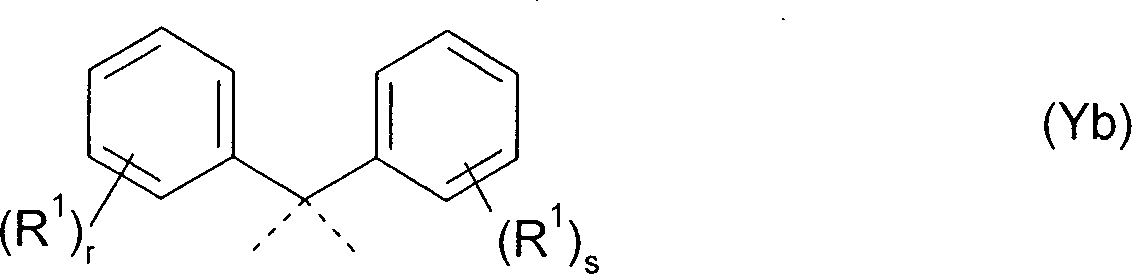
R1 jeweils unabhängig voneinander eine geradkettige Alkyl-, Alkoxy- oder Thioalkoxygruppe mit 1 bis 40 C-Atomen oder eine verzweigte oder cyclische Alkyl-, Alkoxy- oder Thioalkoxygruppe mit 3 bis 40 C-Atomen ist oder eine Silylgruppe oder eine substituierte Ketogruppe mit 1 bis 40 C-Atomen, eine Alkoxycarbonylgruppe mit 2 bis 40 C-Atomen, eine Aryloxycarbonylgruppe mit 7 bis 40 C-Atomen, eine Cyanogruppe (-CN), eine Carbamoylgruppe (-C(=O)NH2), eine Haloformylgruppe (-C(=O)-X, worin X ein Halogenatom darstellt), eine Formylgruppe (-C(=O)-H), eine Isocyanogruppe, eine Isocyanatgruppe, eine Thiocyanatgruppe oder eine Thioisocyanatgruppe, eine Aminogruppe, eine Hydroxygruppe, eine Nitrogruppe, eine CF3-Gruppe, Cl, Br, F, eine vernetzbare Gruppe oder ein substituiertes oder unsubstituiertes aromatisches oder heteroaromatisches Ringsystem mit 5 bis 60 Ringatomen, oder eine Aryloxy- oder Heteroaryloxygruppe mit 5 bis 60 Ringatomen, oder eine Kombination dieser Systeme ist, wobei eine oder mehrere der Gruppen R1 ein mono- oder polycyclisches, aliphatisches oder aromatisches Ringsystem miteinander und/oder mit dem Ring, an dem die Gruppe R1 gebunden ist, bilden können;
r, s unabhängig voneinander 0, 1, 2, 3 oder 4 ist und
die gestrichelten Linien die Verknüpfungen mit den Aryl- oder Heteroarylgruppen Ar9 darstellen.Furthermore, it is advantageous to use a spacer group Y of the formula (Yb) contained in units of the formula Ar 9 -Y-Ar 9
R 1 are each independently a straight-chain alkyl, alkoxy or thioalkoxy group having 1 to 40 carbon atoms or a branched or cyclic alkyl, alkoxy or thioalkoxy group having 3 to 40 carbon atoms or a silyl group or a substituted keto group with 1 to 40 C atoms, an alkoxycarbonyl group having 2 to 40 C atoms, an aryloxycarbonyl group having 7 to 40 C atoms, a cyano group (-CN), a carbamoyl group (-C (= O) NH 2 ), a haloformyl group (- C (= O) -X, wherein X represents a halogen atom), a formyl group (-C (= O) -H), an isocyanato group, an isocyanate group, a thiocyanate group or a thioisocyanate group, an amino group, a hydroxy group, a nitro group, a CF 3 group, Cl, Br, F, a crosslinkable group or a substituted or unsubstituted aromatic or heteroaromatic ring system having 5 to 60 ring atoms, or an aryloxy or heteroaryloxy group having 5 to 60 ring atoms, or a combination of these systems, wherein a O a plurality of groups 1 a mono- or polycyclic, aliphatic or aromatic ring system may form with each other and / or with the ring to which the group is attached R 1, R;
r, s is independently 0, 1, 2, 3 or 4 and
the dashed lines represent the linkages with the aryl or heteroaryl groups Ar 9 .
Besonders bevorzugt können Einheiten der Formel Ar9-Y-Ar9 mindestens eine Abstandsgruppe Y der Formel (Yb1) enthalten 
R2 jeweils unabhängig eine geradkettige Alkyl-, Alkoxy- oder Thioalkoxygruppe mit 1 bis 40 C-Atomen oder eine verzweigte oder cyclische Alkyl-, Alkoxy- oder Thioalkoxygruppe mit 3 bis 40 C-Atomen ist oder eine Silylgruppe oder eine substituierte Ketogruppe mit 1 bis 40 C-Atomen, eine Alkoxycarbonylgruppe mit 2 bis 40 C-Atomen, eine Aryloxycarbonylgruppe mit 7 bis 40 C-Atomen, eine Cyanogruppe (-CN), eine Carbamoylgruppe (-C(=O)NH2), eine Haloformylgruppe (-C(=O)-X, worin X ein Halogenatom darstellt), eine Formylgruppe (-C(=O)-H), eine Isocyanogruppe, eine Isocyanatgruppe, eine Thiocyanatgruppe oder eine Thioisocyanatgruppe, eine Aminogruppe, eine Hydroxygruppe, eine Nitrogruppe, eine CF3-Gruppe, Cl, Br, F, eine vernetzbare Gruppe oder ein substituiertes oder unsubstituiertes aromatisches oder heteroaromatisches Ringsystem mit 5 bis 60 Ringatomen, oder eine Aryloxy- oder Heteroaryloxygruppe mit 5 bis 60 Ringatomen, oder eine Kombination dieser Systeme ist, wobei eine oder mehrere der Gruppen R2 ein mono- oder polycyclisches, aliphatisches oder aromatisches Ringsystem miteinander und/oder mit dem Ring, an dem die Gruppe R2 gebunden ist, bilden können;
t, u unabhängig voneinander 0, 1, 2, 3 oder 4 ist und
die gestrichelten Linien die Verknüpfungen mit den Aryl- oder Heteroarylgruppen Ar9 darstellen.More preferably, units of the formula Ar 9 -Y-Ar 9 may contain at least one spacer group Y of the formula (Yb1)
Each R 2 is independently a straight-chain alkyl, alkoxy or thioalkoxy group having 1 to 40 carbon atoms or a branched or cyclic alkyl, alkoxy or thioalkoxy group having 3 to 40 carbon atoms or a silyl group or a substituted keto group having 1 to 40 C atoms, an alkoxycarbonyl group having 2 to 40 carbon atoms, an aryloxycarbonyl group having 7 to 40 carbon atoms, a cyano group (-CN), a carbamoyl group (-C (= O) NH 2 ), a haloformyl group (-C (= O) -X, wherein X represents a halogen atom), a formyl group (-C (= O) -H), an isocyanato group, an isocyanate group, a thiocyanato group or a thioisocyanate group, an amino group, a hydroxy group, a nitro group, a CF. 3 group, Cl, Br, F, a crosslinkable group or a substituted or unsubstituted aromatic or heteroaromatic ring system having 5 to 60 ring atoms, or an aryloxy or heteroaryloxy group having 5 to 60 ring atoms, or a combination of these systems, wherein one or several the groups R 2 can form a mono- or polycyclic, aliphatic or aromatic ring system with each other and / or with the ring to which the group R 2 is bonded;
t, u is independently 0, 1, 2, 3 or 4 and
the dashed lines represent the linkages with the aryl or heteroaryl groups Ar 9 .
Besonders überraschende Vorteile zeigen insbesondere Einheiten der Formel Ar9-Y-Ar9, die mindestens eine Abstandsgruppe Y der Formel (Yb2) aufweisen 
R3, R4 jeweils unabhängig voneinander ein Wasserstoffatom, eine geradkettige Alkyl-, Alkoxy- oder Thioalkoxygruppe mit 1 bis 40 C-Atomen oder eine verzweigte oder cyclische Alkyl-, Alkoxy- oder Thioalkoxygruppe mit 3 bis 40 C-Atomen ist oder eine Silylgruppe oder eine substituierte Ketogruppe mit 1 bis 40 C-Atomen, eine Alkoxycarbonylgruppe mit 2 bis 40 C-Atomen, eine Aryloxycarbonylgruppe mit 7 bis 40 C-Atomen, eine Cyanogruppe (-CN), eine Carbamoylgruppe (-C(=O)NH2), eine Haloformylgruppe (-C(=O)-X, worin X ein Halogenatom darstellt), eine Formylgruppe (-C(=O)-H), eine Isocyanogruppe, eine Isocyanatgruppe, eine Thiocyanatgruppe oder eine Thioisocyanatgruppe, eine Aminogruppe, eine Hydroxygruppe, eine Nitrogruppe, eine CF3-Gruppe, Cl, Br, F, eine vernetzbare Gruppe oder ein substituiertes oder unsubstituiertes aromatisches oder heteroaromatisches Ringsystem mit 5 bis 60 Ringatomen, oder eine Aryloxy- oder Heteroaryloxygruppe mit 5 bis 60 Ringatomen, oder eine Kombination dieser Systeme ist, wobei eine oder mehrere der Gruppen R3, R4 ein mono- oder polycyclisches, aliphatisches oder aromatisches Ringsystem miteinander und/oder mit einem anderen Ring bilden können und
die gestrichelten Linien die Verknüpfungen mit den Aryl- oder Heteroarylgruppen Ar9 darstellen.Particularly surprising advantages are shown in particular by units of the formula Ar 9 -Y-Ar 9 which have at least one spacer group Y of the formula (Yb 2)
R 3 , R 4 are each independently a hydrogen atom, a straight-chain alkyl, alkoxy or thioalkoxy group having 1 to 40 carbon atoms or a branched or cyclic alkyl, alkoxy or thioalkoxy group having 3 to 40 carbon atoms or a silyl group or a substituted keto group having 1 to 40 C atoms, an alkoxycarbonyl group having 2 to 40 C atoms, an aryloxycarbonyl group having 7 to 40 C atoms, a cyano group (-CN), a carbamoyl group (-C (= O) NH 2 ), a haloformyl group (-C (= O) -X wherein X represents a halogen atom), a formyl group (-C (= O) -H), an isocyanato group, an isocyanate group, a thiocyanato group or a thioisocyanate group, an amino group, a Hydroxy group, a nitro group, a CF 3 group, Cl, Br, F, a crosslinkable group or a substituted or unsubstituted aromatic or heteroaromatic ring system having 5 to 60 ring atoms, or an aryloxy or heteroaryloxy group having 5 to 60 ring atoms, or a combination these r is one or more of the groups R 3 , R 4 can form a mono- or polycyclic, aliphatic or aromatic ring system with each other and / or with another ring, and
the dashed lines represent the linkages with the aryl or heteroaryl groups Ar9.
Gemäß einer besonderen Ausführungsform der vorliegenden Erfindung kann ein bevorzugtes Polymer der vorliegenden Erfindung mindestens eine Carbazol-Struktureinheit der allgemeinen Formel (Ia) enthalten 
Ar1, Ar2, Ar3 jeweils unabhängig voneinander eine Aryl- oder Heteroarylgruppe ist, welche mit einem oder mehreren beliebigen Resten R substituiert sein kann;
m, o unabhängig voneinander 0 oder 1 ist und
die gestrichelten Linien die Verknüpfung im Polymer darstellen.According to a particular embodiment of the present invention, a preferred polymer of the present invention may contain at least one carbazole structural unit of the general formula (Ia)
Ar 1 , Ar 2 , Ar 3 are each independently an aryl or heteroaryl group which may be substituted with one or more of any R;
m, o is independently 0 or 1 and
the dashed lines represent the linkage in the polymer.
Die Reste Ar1, Ar2, Ar3 und die Indices m und o haben in Formel (Ia) die zuvor für Formel (I) angegebene Bedeutung.The radicals Ar 1 , Ar 2 , Ar 3 and the indices m and o have in formula (Ia) the meaning previously given for formula (I).
Besonders bevorzugte Polymere umfassen mindestens eine Carbazol-Struktureinheit der allgemeinen Formel (Ib) 
Ar2 jeweils unabhängig voneinander eine Aryl- oder Heteroarylgruppe ist, welche mit einem oder mehreren beliebigen Resten R substituiert sein kann, und
die gestrichelten Linien die Verknüpfung im Polymer darstellen.Particularly preferred polymers comprise at least one carbazole structural unit of the general formula (Ib)
Each Ar 2 is independently an aryl or heteroaryl group which may be substituted with one or more of any R groups, and
the dashed lines represent the linkage in the polymer.
Der Rest Ar2 hat in Formel (Ib) die zuvor für Formel (I) angegebene Bedeutung.The radical Ar 2 in formula (Ib) has the meaning previously given for formula (I).
Der Anteil an Carbazol-Struktureinheit der allgemeinen Formel (I), (Ia) und (Ib) im erfindungsgemäßen Polymer beträgt gemäß einer bevorzugten Ausführungsform der vorliegenden Erfindung mindestens 5 mol%, besonders bevorzugt mindestens 10 mol%, ganz besonders bevorzugt mindestens 20 mol% und insbesondere mindestens 40 mol%.The proportion of carbazole structural unit of the general formula (I), (Ia) and (Ib) in the polymer according to the invention is according to a preferred embodiment of the present invention at least 5 mol%, more preferably at least 10 mol%, most preferably at least 20 mol% and in particular at least 40 mol%.
Überraschende Vorteile lassen sich mit erfindungsgemäßen Polymeren erzielen, die bevorzugt mindestens eine Arylamin-Struktureinheit der allgemeinen Formel ((IIa) und/oder (IIIa) enthalten 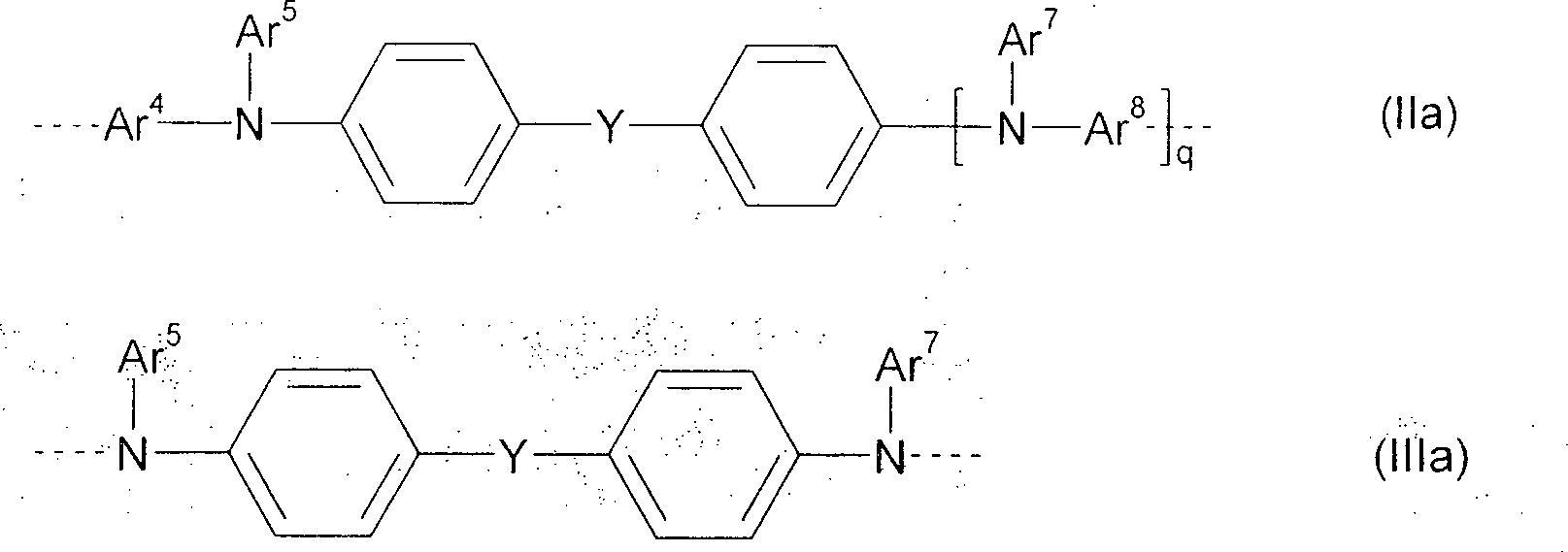
Ar4, Ar5, Ar7, Ar8 jeweils unabhängig voneinander eine Aryl- oder Heteroarylgruppe ist, welche mit einem oder mehreren beliebigen Resten R substituiert sein kann;
q 0 oder 1, bevorzugt 1 ist;
Y eine Abstandsgruppe oder eine direkte Bindung ist und
die gestrichelten Linien die Verknüpfung im Polymer darstellen.Surprising advantages can be achieved with polymers according to the invention which preferably contain at least one arylamine structural unit of the general formula (IIa) and / or (IIIa)
Ar 4 , Ar 5 , Ar 7 , Ar 8 are each independently an aryl or heteroaryl group which may be substituted with one or more of any R;
q is 0 or 1, preferably 1;
Y is a spacer group or a direct bond and
the dashed lines represent the linkage in the polymer.
In Formeln (IIa) und/oder (IIIa) haben die Reste Ar4, Ar5, Ar7, Ar8, der Index q und die Abstandsgruppe Y die zuvor für Formeln (II) und/oder (III) angegebene Bedeutung. Vorzugsweise kann die Abstandsgruppe Y eine Unterbrechung der Konjugation der Arylgruppen bzw. des Polymers bewirken, wie dies zuvor ausführlich dargelegt wurde.In formulas (IIa) and / or (IIIa), the radicals Ar 4 , Ar 5 , Ar 7 , Ar 8 , the index q and the spacer group Y have the meaning previously given for formulas (II) and / or (III). Preferably, the spacer group Y may cause an interruption in the conjugation of the aryl groups or the polymer, as previously detailed.
Weiterhin sind Polymere bevorzugt, die mindestens eine Arylamin-Struktureinheit der allgemeinen Formel (IIIb) enthalten 
Y eine Abstandsgruppe oder eine direkte Bindung ist,
R5 jeweils unabhängig ein Wasserstoffatom, eine geradkettige Alkyl-, Alkoxy- oder Thioalkoxygruppe mit 1 bis 40 C-Atomen oder eine verzweigte oder cyclische Alkyl-, Alkoxy- oder Thioalkoxygruppe mit 3 bis 40 C-Atomen ist oder eine Silylgruppe oder eine substituierte Ketogruppe mit 1 bis 40 C-Atomen, eine Alkoxycarbonylgruppe mit 2 bis 40 C-Atomen, eine Aryloxycarbonylgruppe mit 7 bis 40 C-Atomen, eine Cyanogruppe (-CN), eine Carbamoylgruppe (-C(=O)NH2), eine Haloformylgruppe (-C(=O)-X, worin X ein Halogenatom darstellt), eine Formylgruppe (-C(=O)-H), eine Isocyanogruppe, eine Isocyanatgruppe, eine Thiocyanatgruppe oder eine Thioisocyanatgruppe, eine Aminogruppe, eine Hydroxygruppe, eine Nitrogruppe, eine CF3-Gruppe, Cl, Br, F, eine vernetzbare Gruppe oder ein substituiertes oder unsubstituiertes aromatisches oder heteroaromatisches Ringsystem mit 5 bis 60 Ringatomen, oder eine Aryloxy- oder Heteroaryloxygruppe mit 5 bis 60 Ringatomen, oder eine Kombination dieser Systeme ist, wobei eine oder mehrere der Gruppen R5 ein mono- oder polycyclisches, aliphatisches oder aromatisches Ringsystem miteinander und/oder mit dem Ring, an dem die Gruppe R5 gebunden ist, bilden können,
und die gestrichelten Linien die Verknüpfung im Polymer darstellen.Furthermore, preference is given to polymers which contain at least one arylamine structural unit of the general formula (IIIb)
Y is a spacer group or a direct bond,
R 5 is independently a hydrogen atom, a straight-chain alkyl, alkoxy or thioalkoxy group having 1 to 40 carbon atoms or a branched or cyclic alkyl, alkoxy or thioalkoxy group having 3 to 40 carbon atoms, or a silyl group or a substituted keto group having 1 to 40 C atoms, an alkoxycarbonyl group having 2 to 40 C atoms, an aryloxycarbonyl group having 7 to 40 C atoms, a cyano group (-CN), a carbamoyl group (-C (= O) NH 2 ), a haloformyl group (-C (= O) -X, wherein X represents a halogen atom), a formyl group (-C (= O) -H), an isocyanato group, an isocyanate group, a thiocyanate group or a thioisocyanate group, an amino group, a hydroxy group, a nitro group , a CF 3 group, Cl, Br, F, a crosslinkable group or a substituted or unsubstituted aromatic or heteroaromatic ring system having 5 to 60 ring atoms, or an aryloxy or heteroaryloxy group having 5 to 60 ring atoms, or a combination of these systems, wove one or more of the groups R 5 can form a mono- or polycyclic, aliphatic or aromatic ring system with one another and / or with the ring to which the group R 5 is bonded,
and the dashed lines represent the linkage in the polymer.
Der Anteil an Arylamin-Struktureinheit der allgemeinen Formeln (II), (IIa), (III), (IIIa) und (IIIb) im erfindungsgemäßen Polymer beträgt gemäß einer bevorzugten Ausführungsformen der vorliegenden Erfindung mindestens 5 mol%, besonders bevorzugt mindestens 10 mol%, ganz besonders bevorzugt mindestens 20 mol% und insbesondere mindestens 40 mol%.The proportion of arylamine structural unit of the general formulas (II), (IIa), (III), (IIIa) and (IIIb) in the polymer according to the invention is, according to a preferred embodiment of the present invention, at least 5 mol%, particularly preferably at least 10 mol% , very particularly preferably at least 20 mol% and in particular at least 40 mol%.
Das molare Verhältnis von Carbazol-Struktureinheit der allgemeinen Formel (I), (Ia) und (Ib) zu Arylamin-Struktureinheit der allgemeinen Formeln (II), (IIa), (III), (IIIa) und (IIIb) liegt vorzugsweise im Bereich von 10:1 bis 1:10, besonders bevorzugt im Bereich von 5:1 bis 1:5 und ganz besonders bevorzugt im Bereich von 2:1 bis 1:2.The molar ratio of carbazole structural unit of the general formula (I), (Ia) and (Ib) to arylamine structural unit of the general formulas (II), (IIa), (III), (IIIa) and (IIIb) is preferably in the Range of 10: 1 to 1:10, more preferably in the range of 5: 1 to 1: 5 and most preferably in the range of 2: 1 to 1: 2.
Die erfindungsgemäßen Polymere können neben einer oder mehrerer Struktureinheiten der allgemeinen Formeln (I), (II) und/oder (III) noch weitere Struktureinheiten enthalten.The polymers according to the invention may contain, in addition to one or more structural units of the general formulas (I), (II) and / or (III), further structural units.
Vorteile, die für den Fachmann überraschend sind, können unter anderem durch Polymere erzielt werden, die Verbindungsstruktureinheiten umfassen. Besonders bevorzugte Verbindungsstruktureinheiten können eine Unterbrechung der Konjugation des Polymers bewirken. Advantages that are surprising to those skilled in the art can be achieved, inter alia, by polymers comprising linking moieties. Particularly preferred compound structural units can cause an interruption in the conjugation of the polymer.
Bevorzugte Verbindungsstruktureinheiten entsprechen der Formel (IV)
X eine Abstandsgruppe ist und
die gestrichelten Linien die Verknüpfung im Polymer darstellen.Preferred compound structural units correspond to the formula (IV)
X is a spacer group and
the dashed lines represent the linkage in the polymer.
Zu den bevorzugte Abstandsgruppen X gehören unter anderem lineare oder verzweigte Alkylen-Gruppen mit 1 bis 20 C-Atomen, besonders bevorzugt mit 1 bis 12 C-Atomen, in der eine oder mehrere nicht benachbarte CH2-Gruppen durch -O-, -S-, -NH-, -N(CH3)-, -N-CO-, -N-CO-O-, -N-CO-N, -CO-, -O-CO-, -S-CO-, -O-COO-, -CO-S-, -CO-O-, -CH(Halogen)-, -CH(CN)-, -CH=CH- oder -C≡C- ersetzt sein können, oder cyclische Alkylgruppen, bevorzugt Cyclohexan oder ein Cyclohexanderivat mit 1,4- oder 1,3-Verknüpfung. Weitere mögliche Abstandsgruppen X sind zum Beispiel -(CH2)o-, -(CH2CH2O)p-CH2CH2-, -CH2CH2-S-CH2CH2- oder -CH2CH2-NH-CH2CH2-, mit o = 1 bis 12, vorzugsweise 2 bis 12, und p = 1 bis 3 aber auch -O-.The preferred spacer groups X include, inter alia, linear or branched alkylene groups having 1 to 20 carbon atoms, more preferably having 1 to 12 carbon atoms, in which one or more non-adjacent CH 2 groups are represented by -O-, -S , -NH-, -N (CH 3 ) -, -N-CO-, -N-CO-O-, -N-CO-N, -CO-, -O-CO-, -S-CO- , -O-COO-, -CO-S-, -CO-O-, -CH (halogen) -, -CH (CN) -, -CH = CH- or -C≡C- may be replaced, or cyclic Alkyl groups, preferably cyclohexane or a cyclohexane derivative with 1,4- or 1,3-linkage. Further possible spacer groups X are, for example, - (CH 2 ) o -, - (CH 2 CH 2 O) p -CH 2 CH 2 -, -CH 2 CH 2 -S-CH 2 CH 2 - or -CH 2 CH 2 -NH-CH 2 CH 2 -, with o = 1 to 12, preferably 2 to 12, and p = 1 to 3 but also -O-.
Besonders bevorzugte Abstandsgruppen X sind Methylen, Ethylen, Propylen, Butylen, Pentylen, Hexylen, Heptylen, Octylen, Nonylen, Decylen, Undecylen, Dodecylen, Octadecylen, Ethylenoxyethylen, Methylenoxybutylen, Ethylenthioethylen, Ethylen-N-methyl-iminoethylen, 1-Methylalkylen, Ethenylen, Propenylen und Butenylen.Particularly preferred spacer groups X are methylene, ethylene, propylene, butylene, pentylene, hexylene, heptylene, octylene, nonylene, decylene, undecylene, dodecylene, octadecylene, ethyleneoxyethylene, methyleneoxybutylene, ethylene thioethylene, ethylene-N-methyl-iminoethylene, 1-methylalkylene, ethenylene Propenylene and butenylene.
Insbesondere bedeutet X eine Alkylen- oder Alkylenoxy-Gruppe mit 2 bis 8 C-Atomen. Hierbei sind geradkettige Gruppen besonders bevorzugt.In particular, X is an alkylene or alkyleneoxy group having 2 to 8 carbon atoms. Here, straight-chain groups are particularly preferred.
Gemäß einer weiteren Ausführungsform kann die Verbindungsstruktureinheit aromatische oder heteroaromatische Ringsysteme enthalten. Hierbei sind insbesondere Verbindungsstruktureinheiten der Formel (Va) bevorzugt 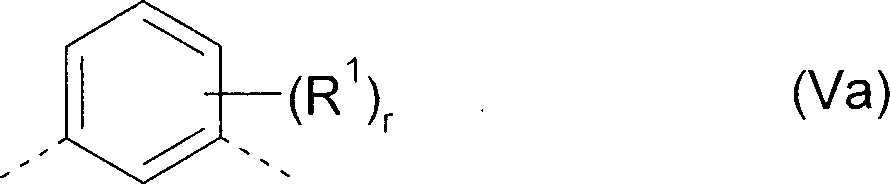
R1 jeweils unabhängig voneinander eine geradkettige Alkyl-, Alkoxy- oder Thioalkoxygruppe mit 1 bis 40 C-Atomen oder eine verzweigte oder cyclische Alkyl-, Alkoxy- oder Thioalkoxygruppe mit 3 bis 40 C-Atomen ist oder eine Silylgruppe oder eine substituierte Ketogruppe mit 1 bis 40 C-Atomen, eine Alkoxycarbonylgruppe mit 2 bis 40 C-Atomen, eine Aryloxycarbonylgruppe mit 7 bis 40 C-Atomen, eine Cyanogruppe (-CN), eine Carbamoylgruppe (-C(=O)NH2), eine Haloformylgruppe (-C(=O)-X, worin X ein Halogenatom darstellt), eine Formylgruppe (-C(=O)-H), eine Isocyanogruppe, eine Isocyanatgruppe, eine Thiocyanatgruppe oder eine Thioisocyanatgruppe, eine Aminogruppe, eine Hydroxygruppe, eine Nitrogruppe, eine CF3-Gruppe, Cl, Br, F, eine vernetzbare Gruppe oder ein substituiertes oder unsubstituiertes aromatisches oder heteroaromatisches Ringsystem mit 5 bis 60 Ringatomen, oder eine Aryloxy- oder Heteroaryloxygruppe mit 5 bis 60 Ringatomen, oder eine Kombination dieser Systeme ist, wobei eine oder mehrere der Gruppen R1 ein mono- oder polycyclisches, aliphatisches oder aromatisches Ringsystem miteinander und/oder mit dem Ring, an dem die Gruppe R1 gebunden ist, bilden können;
r 0, 1, 2, 3 oder 4 ist und
die gestrichelten Linien die Verknüpfung im Polymer darstellen.According to a further embodiment, the compound structural unit may contain aromatic or heteroaromatic ring systems. In this case, compound structural units of the formula (Va) are particularly preferred
R 1 are each independently a straight-chain alkyl, alkoxy or thioalkoxy group having 1 to 40 carbon atoms or a branched or cyclic alkyl, alkoxy or thioalkoxy group having 3 to 40 carbon atoms or a silyl group or a substituted keto group with 1 to 40 C atoms, an alkoxycarbonyl group having 2 to 40 C atoms, an aryloxycarbonyl group having 7 to 40 C atoms, a cyano group (-CN), a carbamoyl group (-C (= O) NH 2 ), a haloformyl group (- C (= O) -X, wherein X represents a halogen atom), a formyl group (-C (= O) -H), an isocyanato group, an isocyanate group, a thiocyanate group or a thioisocyanate group, an amino group, a hydroxy group, a nitro group, a CF 3 group, Cl, Br, F, a crosslinkable group or a substituted or unsubstituted aromatic or heteroaromatic ring system having 5 to 60 ring atoms, or an aryloxy or heteroaryloxy group having 5 to 60 ring atoms, or a combination of these systems, wherein a O the plurality of groups R 1 can form a mono- or polycyclic, aliphatic or aromatic ring system with each other and / or with the ring to which the group R 1 is bonded;
r is 0, 1, 2, 3 or 4 and
the dashed lines represent the linkage in the polymer.
Weiterhin können mit Vorteil Verbindungsstruktureinheiten der Formel (Vb) eingesetzt werden 
R1, R2 jeweils unabhängig voneinander eine geradkettige Alkyl-, Alkoxy- oder Thioalkoxygruppe mit 1 bis 40 C-Atomen oder eine verzweigte oder cyclische Alkyl-, Alkoxy- oder Thioalkoxygruppe mit 3 bis 40 C-Atomen ist oder eine Silylgruppe oder eine substituierte Ketogruppe mit 1 bis 40 C-Atomen, eine Alkoxycarbonylgruppe mit 2 bis 40 C-Atomen, eine Aryloxycarbonylgruppe mit 7 bis 40 C-Atomen, eine Cyanogruppe (-CN), eine Carbamoylgruppe (-C(=O)NH2), eine Haloformylgruppe (-C(=O)-X, worin X ein Halogenatom darstellt), eine Formylgruppe (-C(=O)-H), eine Isocyanogruppe, eine Isocyanatgruppe, eine Thiocyanatgruppe oder eine Thioisocyanatgruppe, eine Aminogruppe, eine Hydroxygruppe, eine Nitrogruppe, eine CF3-Gruppe, Cl, Br, F, eine vernetzbare Gruppe oder ein substituiertes oder uns unsubstituiertes aromatisches oder heteroaromatisches Ringsystem mit 5 bis 60 Ringatomen, oder eine Aryloxy- oder Heteroaryloxygruppe mit 5 bis 60 Ringatomen, oder eine Kombination dieser Systeme ist, wobei eine oder mehrere der Gruppen R1 und/oder R2 ein mono- oder polycyclisches, aliphatisches oder aromatisches Ringsystem miteinander und/oder mit dem Ring, an dem die Gruppe R1 gebunden ist, bilden können;
r, s unabhängig voneinander 0, 1, 2, 3 oder 4 ist und
die gestrichelten Linien die Verknüpfung im Polymer darstellen.Furthermore, it is advantageous to use compound structural units of the formula (Vb)
R 1 , R 2 are each independently a straight-chain alkyl, alkoxy or thioalkoxy group having 1 to 40 carbon atoms or a branched or cyclic alkyl, alkoxy or thioalkoxy group having 3 to 40 carbon atoms, or a silyl group or a substituted one Keto group having 1 to 40 C atoms, an alkoxycarbonyl group having 2 to 40 C atoms, an aryloxycarbonyl group having 7 to 40 C atoms, a cyano group (-CN), a carbamoyl group (-C (= O) NH 2 ), a Haloformyl group (-C (= O) -X, wherein X represents a halogen atom), a formyl group (-C (= O) -H), an isocyanato group, an isocyanate group, a thiocyanate group or a thioisocyanate group, an amino group, a hydroxy group, a Nitro group, a CF 3 group, Cl, Br, F, a crosslinkable group or a substituted or unsubstituted aromatic or heteroaromatic ring system having 5 to 60 ring atoms, or an aryloxy or heteroaryloxy group having 5 to 60 ring atoms, or a combination of these systems is where in one or more of the groups R 1 and / or R 2, a mono- or polycyclic, aliphatic or aromatic ring system can form with each other and / or with the ring to which the group R 1 is bonded;
r, s is independently 0, 1, 2, 3 or 4 and
the dashed lines represent the linkage in the polymer.
Besonders bevorzugte Polymere können mindestens eine Verbindungsstruktureinheit der Formel (Vb1) enthalten 
R3 jeweils unabhängig voneinander eine geradkettige Alkyl-, Alkoxy- oder Thioalkoxygruppe mit 1 bis 40 C-Atomen oder eine verzweigte oder cyclische Alkyl-, Alkoxy- oder Thioalkoxygruppe mit 3 bis 40 C-Atomen ist oder eine Silylgruppe oder eine substituierte Ketogruppe mit 1 bis 40 C-Atomen, eine Alkoxycarbonylgruppe mit 2 bis 40 C-Atomen, eine Aryloxycarbonylgruppe mit 7 bis 40 C-Atomen, eine Cyanogruppe (-CN), eine Carbamoylgruppe (-C(=O)NH2), eine Haloformylgruppe (-C(=O)-X, worin X ein Halogenatom darstellt), eine Formylgruppe (-C(=O)-H), eine Isocyanogruppe, eine Isocyanatgruppe, eine Thiocyanatgruppe oder eine Thioisocyanatgruppe, eine Aminogruppe, eine Hydroxygruppe, eine Nitrogruppe, eine CF3-Gruppe, Cl, Br, F, eine vernetzbare Gruppe oder ein substituiertes oder unsubstituiertes aromatisches oder heteroaromatisches Ringsystem mit 5 bis 60 Ringatomen, oder eine Aryloxy- oder Heteroaryloxygruppe mit 5 bis 60 Ringatomen, oder eine Kombination dieser Systeme ist, wobei eine oder mehrere der Gruppen R3 ein mono- oder polycyclisches, aliphatisches oder aromatisches Ringsystem miteinander und/oder mit dem Ring, an dem die Gruppe R3 gebunden ist, bilden können;
t, u unabhängig voneinander 0, 1, 2, 3 oder 4 ist und
die gestrichelten Linien die Verknüpfung im Polymer darstellen.Particularly preferred polymers may contain at least one compound structural unit of formula (Vb1)
R 3 each independently represent a straight-chain alkyl, alkoxy or thioalkoxy group having 1 to 40 carbon atoms or a branched or cyclic alkyl, alkoxy or thioalkoxy group having 3 to 40 C atoms or a silyl group or a substituted keto group having 1 to 40 C atoms, an alkoxycarbonyl group having 2 to 40 C atoms, an aryloxycarbonyl group having 7 to 40 C atoms, a cyano group (-CN), a carbamoyl group (-C (= O) NH 2 ), a haloformyl group (-C (= O) -X in which X represents a halogen atom), a formyl group (-C (= O) -H), an isocyanato group, an isocyanate group , a thiocyanato group or a thioisocyanate group, an amino group, a hydroxy group, a nitro group, a CF 3 group, Cl, Br, F, a crosslinkable group or a substituted or unsubstituted aromatic or heteroaromatic ring system having 5 to 60 ring atoms, or an aryloxy or heteroaryloxy group having 5 to 60 ring atoms, or a combination of these systems, wherein one or more of the groups R 3 is a mono- or polycyclic, aliphatic or aromatic ring system with each other and / or with the ring to which the group R 3 is bonded, can form;
t, u is independently 0, 1, 2, 3 or 4 and
the dashed lines represent the linkage in the polymer.
Besonders überraschende Vorteile zeigen insbesondere Polymere, die mindestens eine Verbindungsstruktureinheit der Formel (Vb2) aufweisen 
R4, R5 jeweils unabhängig voneinander ein Wasserstoffatom, eine geradkettige Alkyl-, Alkoxy- oder Thioalkoxygruppe mit 1 bis 40 C-Atomen oder eine verzweigte oder cyclische Alkyl-, Alkoxy- oder Thioalkoxygruppe mit 3 bis 40 C-Atomen ist oder eine Silylgruppe oder eine substituierte Ketogruppe mit 1 bis 40 C-Atomen, eine Alkoxycarbonylgruppe mit 2 bis 40 C-Atomen, eine Aryloxycarbonylgruppe mit 7 bis 40 C-Atomen, eine Cyanogruppe (-CN), eine Carbamoylgruppe (-C(=O)NH2), eine Haloformylgruppe (-C(=O)-X, worin X ein Halogenatom darstellt), eine Formylgruppe (-C(=O)-H), eine Isocyanogruppe, eine Isocyanatgruppe, eine Thiocyanatgruppe oder eine Thioisocyanatgruppe, eine Aminogruppe, eine Hydroxygruppe eine Nitrogruppe, eine CF3-Gruppe, Cl, Br, F, eine vernetzbare Gruppe oder ein substituiertes oder unsubstituiertes aromatisches oder heteroaromatisches Ringsystem mit 5 bis 60 Ringatomen, oder eine Aryloxy- oder Heteroaryloxygruppe mit 5 bis 60 Ringatomen, oder eine Kombination dieser Systeme ist, wobei eine oder mehrere der Gruppen R4, R5 ein mono- oder polycyclisches, aliphatisches oder aromatisches Ringsystem miteinander und/oder mit einem anderen Ring bilden können und
die gestrichelten Linien die Verknüpfung im Polymer darstellen.Particularly surprising advantages are particularly exhibited by polymers which have at least one compound structural unit of the formula (Vb2)
R 4 , R 5 are each independently a hydrogen atom, a straight-chain alkyl, alkoxy or thioalkoxy group having 1 to 40 carbon atoms or a branched or cyclic alkyl, alkoxy or thioalkoxy group having 3 to 40 carbon atoms or a silyl group or a substituted keto group having 1 to 40 C atoms, an alkoxycarbonyl group having 2 to 40 C atoms, an aryloxycarbonyl group having 7 to 40 C atoms, a cyano group (-CN), a carbamoyl group (-C (= O) NH 2 ), a haloformyl group (-C (= O) -X wherein X represents a halogen atom), a formyl group (-C (= O) -H), an isocyanato group, an isocyanate group, a thiocyanato group or a thioisocyanate group, an amino group, a Hydroxy group, a nitro group, a CF 3 group, Cl, Br, F, a crosslinkable group or a substituted or unsubstituted aromatic or heteroaromatic ring system having 5 to 60 ring atoms, or an aryloxy or heteroaryloxy group having 5 to 60 ring atoms, or a combination thereof Is systems wherein one or more of the groups R 4 , R 5 can form a mono- or polycyclic, aliphatic or aromatic ring system with each other and / or with another ring, and
the dashed lines represent the linkage in the polymer.
Der Anteil an Verbindungsstruktureinheiten, insbesondere denen gemäß den obigen Formeln (IV), (Va), (Vb), (Vb1) und (Vb2), im erfindungsgemäßen Polymer liegt gemäß einer bevorzugten Ausführungsformen der vorliegenden Erfindung im Bereich von 0 bis 90 mol%, besonders bevorzugt im Bereich von 1 bis 50 mol% und ganz besonders bevorzugt im Bereich von 5 bis 30 mol%.The proportion of compound structural units, in particular those according to the above formulas (IV), (Va), (Vb), (Vb1) and (Vb2), in the polymer according to the invention is in the range from 0 to 90 mol% according to a preferred embodiment of the present invention. , more preferably in the range of 1 to 50 mol% and most preferably in the range of 5 to 30 mol%.
Das molare Verhältnis von Carbazol-Struktureinheit der allgemeinen Formel (I), (Ia) und (Ib) zu Verbindungsstruktureinheiten, insbesondere denen gemäß den obigen Formeln (IV), (Va), (Vb), (Vb1) und (Vb2), liegt vorzugsweise im Bereich von 100:1 bis 1:10, besonders bevorzugt im Bereich von 50:1 bis 1:5 und ganz besonders bevorzugt im Bereich von 20:1 bis 1:2, falls Verbindungsstruktureinheiten im Polymer enthalten sind.The molar ratio of carbazole structural unit of the general formula (I), (Ia) and (Ib) to compound structural units, in particular those according to the above formulas (IV), (Va), (Vb), (Vb1) and (Vb2), is preferably in the range from 100: 1 to 1:10, more preferably in the range from 50: 1 to 1: 5 and most preferably in the range from 20: 1 to 1: 2, if compound structural units are present in the polymer.
Gemäß einer weiteren bevorzugten Ausführungsform kann das molare Verhältnis von Arylamin-Struktureinheit der allgemeinen Formeln (II), (IIa), (III), (IIIa) und (IIb) zu Verbindungsstruktureinheiten, insbesondere denen gemäß obigen Formeln (IV), (Va), (Vb), (Vb1) und (Vb2), liegt vorzugsweise im Bereich von 100:1 bis 1:10, insbesondere 50:1 bis 1:5 und besonders bevorzugt 20:1 bis 1:2, falls Verbindungsstruktureinheiten im Polymer enthalten sind.According to a further preferred embodiment, the molar ratio of arylamine structural unit of the general formulas (II), (IIa), (III), (IIIa) and (IIb) to compound structural units, in particular those according to the above formulas (IV), (Va) , (Vb), (Vb1) and (Vb2), is preferably in the range of 100: 1 to 1:10, in particular 50: 1 to 1: 5 and particularly preferably 20: 1 to 1: 2, if compound structural units in the polymer are.
Unter einem Polymer im Sinne der vorliegenden Erfindung soll auch ein Oligomer und ein Dendrimer verstanden werden.A polymer in the context of the present invention should also be understood as meaning an oligomer and a dendrimer.
Als Oligomer wird im Sinne der vorliegenden Erfindung eine Verbindung bezeichnet, welche drei bis neun Wiederholungseinheiten aufweist. Als Polymer im Sinne der vorliegenden Erfindung wird eine Verbindung verstanden, welche zehn oder mehr Wiederholungseinheiten aufweist. Der Verzweigungs-Faktor der Polymeren liegt dabei zwischen 0 (lineares Polymer, ohne Verzweigungsstellen) und 1 (vollständig verzweigtes Dendrimer).For the purposes of the present invention, an oligomer is a compound which has three to nine repeat units. For the purposes of the present invention, a polymer is understood as meaning a compound which has ten or more repeat units. The branching factor of the polymers is between 0 (linear polymer, without branching points) and 1 (fully branched dendrimer).
Die Polymere, Oligomere oder Dendrimere können konjugiert, teilkonjugiert oder nicht-konjugiert sein. Die Polymere oder Oligomere können linear, verzweigt oder dendritisch sein. In den linear verknüpften Strukturen können die Einheiten der allgemeinen Formeln (I), (II) und/oder (III) sowohl direkt miteinander verknüpft sein oder sie können über eine bivalente Gruppe, beispielsweise über eine substituierte oder unsubstituierte Alkylengruppe, über ein Heteroatom oder über eine bivalente aromatische oder heteroaromatische Gruppe, miteinander verknüpft sein. In verzweigten Strukturen können beispielsweise drei oder mehrere Einheiten der allgemeinen Formeln (I), (II) und/oder (III) über eine trivalente oder höhervalente Gruppe, beispielsweise über eine trivalente oder höhervalente aromatische oder heteroaromatische Gruppe, zu einem verzweigten Polymer oder Oligomer verknüpft sein.The polymers, oligomers or dendrimers may be conjugated, partially conjugated or non-conjugated. The polymers or oligomers may be linear, branched or dendritic. In the linearly linked structures, the units of the general formulas (I), (II) and / or (III) can both be directly linked to one another or they can have a divalent group, for example via a substituted or unsubstituted alkylene group, via a heteroatom or via a bivalent aromatic or heteroaromatic group, linked together. In branched structures, for example, three or more units of the general formulas (I), (II) and / or (III) can be linked via a trivalent or highervalent group, for example via a trivalent or higher valent aromatic or heteroaromatic group, to form a branched polymer or oligomer be.
Vorzugsweise weisen die Polymere der vorliegenden Erfindung ein Gewichtsmittel des Molekulargewichts Mw im Bereich von 10000 bis 2000000 g/mol, besonders bevorzugt im Bereich von 20000 bis 1000000 g/mol und ganz besonders bevorzugt im Bereich von 50000 bis 500000 g/mol auf. Das Gewichtsmittel des Molekulargewichts Mw kann durch übliche Methoden, insbesondere durch Gelpermeationschromatographie (GPC) bestimmt werden.The polymers of the present invention preferably have a weight-average molecular weight M w in the range from 10,000 to 2,000,000 g / mol, particularly preferably in the range from 20,000 to 1,000,000 g / mol and very particularly preferably in the range from 50,000 to 500,000 g / mol. The weight average molecular weight M w can be determined by customary methods, in particular by gel permeation chromatography (GPC).
Die Herstellung der erfindungsgemäßen Polymere kann unter Verwendung von bekannten Methoden erfolgen, wobei funktionalisierte Verbindungen copolymerisiert werden. Diese funktionalisierten Verbindungen enthalten die zuvor dargelegten Struktureinheiten der obigen Formeln sowie mindestens zwei Abgangsgruppen, wie Brom, Iod, Boronsäure oder Boronsäureester.The preparation of the polymers according to the invention can be carried out using known methods, whereby functionalized compounds are copolymerized. These functionalized compounds contain the above-described structural units of the above formulas and at least two leaving groups, such as bromine, iodine, boronic acid or boronic acid esters.
Geeignete Polymerisationsreaktionen sind dem Fachmann bekannt und in der Literatur beschrieben. Besonders geeignete und bevorzugte Polymerisations- und Kupplungsreaktionen, die alle zu C-C-Verknüpfungen führen, sind solche gemäß SUZUKI, YAMAMOTO, STILLE, HECK, NEGISHI, SONOGASHIRA oder HIYAMA. Die C-C-Verknüpfungen werden besonders bevorzugt über eine SUZUKI-Kupplung durchgeführt.Suitable polymerization reactions are known in the art and described in the literature. Particularly suitable and preferred polymerization and coupling reactions, all to CC- Links are SUZUKI, YAMAMOTO, SILENCE, HECK, NEGISHI, SONOGASHIRA or HIYAMA. The CC linkages are particularly preferably carried out via a SUZUKI coupling.
Überraschende Vorteile können insbesondere durch Polymere erzielt werden, die durch eine BUCHWALD-Reaktion erhalten werden. Hierbei wird ein aromatisches Diamin mit einem Arylhalogenid umgesetzt. Bevorzugte funktionale Monomere, die unter Verwendung der BUCHWALD-Reaktion umgesetzt werden können sind insbesondere Halogenide, die Carbazol-Struktureinheiten der Formel (I), (Ia) oder (Ib) enthalten, und Diamine mit zwei sekundären Stickstoffatomen, die Struktureinheiten der Formel (III), (IIIa) oder (IIIb) enthalten.Surprising advantages can be achieved in particular by polymers obtained by a BUCHWALD reaction. Here, an aromatic diamine is reacted with an aryl halide. Preferred functional monomers that can be reacted using the BUCHWALD reaction are, in particular, halides containing carbazole structural units of the formula (I), (Ia) or (Ib) and diamines having two secondary nitrogen atoms, the structural units of the formula (III ), (IIIa) or (IIIb).
Demzufolge entsprechen bevorzugte Carbazol-Monomere zur Herstellung der erfindungsgemäßen Polymere den Formeln (M I), (M Ia) und (M Ib) 
Ar1, Ar2, Ar3 jeweils unabhängig voneinander eine Aryl- oder Heteroarylgruppe ist, welche mit einem oder mehreren beliebigen Resten R substituiert sein kann;
m, o unabhängig voneinander 0 oder 1 ist
n 1, 2 oder 3 ist und
Z jeweils unabhängig eine Abgangsgruppe ist.Accordingly, preferred carbazole monomers for the preparation of the polymers according to the invention correspond to the formulas (MI), (M Ia) and (M Ib)
Ar 1 , Ar 2 , Ar 3 are each independently an aryl or heteroaryl group which may be substituted with one or more of any R;
m, o is independently 0 or 1
n is 1, 2 or 3 and
Each Z is independently a leaving group.
Bevorzugte Arylamin-Monomere zur Herstellung der vorliegenden Polymere ergeben sich aus den Formeln (M II) und (M IIa) 

Ar4, Ar5, Ar7, Ar8 jeweils unabhängig voneinander eine Aryl- oder Heteroarylgruppe ist, welche mit einem oder mehreren beliebigen Resten R substituiert sein kann;
Ar6 eine Aryl- oder Heteroarylgruppe ist, welche mit einem oder mehreren beliebigen Resten R substituiert sein kann oder eine Gruppe der Formel Ar9-Y-Ar9 darstellt, wobei Ar9 jeweils unabhängig eine Aryl- oder Heteroarylgruppe ist, welche mit einem oder mehreren beliebigen Resten R substituiert oder miteinander verknüpft sein können,
Y eine Abstandsgruppe oder eine direkte Bindung ist;
p 1, 2 oder 3 ist;
q 0 oder 1 ist und
Z jeweils unabhängig eine Abgangsgruppe ist.Preferred arylamine monomers for the preparation of the present polymers are given by the formulas (M II) and (M IIa)
Ar 4 , Ar 5 , Ar 7 , Ar 8 are each independently an aryl or heteroaryl group which may be substituted with one or more of any R;
Ar 6 is an aryl or heteroaryl group which may be substituted with one or more of any R groups or represents a group of the formula Ar 9 -Y-Ar 9 wherein Ar 9 is each independently an aryl or heteroaryl group which may be substituted with one or more can be substituted or linked to one another with any desired radicals R,
Y is a spacer group or a direct bond;
p is 1, 2 or 3;
q is 0 or 1 and
Each Z is independently a leaving group.
Die Arylamin-Monomere gemäß den Formeln (M II) und (M IIa) können insbesondere gemäß der zuvor dargelegten SUZUKI-Reaktion mit den zuvor dargelegten Carbazol-Monomeren polymerisiert werden.The arylamine monomers according to the formulas (M II) and (M IIa) can be polymerized in particular according to the above-mentioned SUZUKI reaction with the carbazole monomers set forth above.
Besonders bevorzugt können weiterhin Arylamin-Monomere gemäß den Formel (M III), (M IIIa) und (M IIIb) eingesetzt werden 

Ar5, Ar7 jeweils unabhängig voneinander eine Aryl- oder Heteroarylgruppe ist, welche mit einem oder mehreren beliebigen Resten R substituiert sein kann;
Ar6 eine Aryl- oder Heteroarylgruppe ist, welche mit einem oder mehreren beliebigen Resten R substituiert sein kann oder eine Gruppe der Formel Ar9-Y-Ar9 darstellt, wobei Ar9 jeweils unabhängig voneinander eine Aryl- oder Heteroarylgruppe ist, welche mit einem oder mehreren beliebigen Resten R substituiert ist oder welche miteinander verknüpft sein können, und Y eine Abstandsgruppe oder eine direkte Bindung ist,
R5 jeweils unabhängig voneinander ein Wasserstoffatom, eine geradkettige Alkyl-, Alkoxy- oder Thioalkoxygruppe mit 1 bis 40 C-Atomen oder eine verzweigte oder cyclische Alkyl-, Alkoxy- oder Thioalkoxygruppe mit 3 bis 40 C-Atomen ist oder eine Silylgruppe oder eine substituierte Ketogruppe mit 1 bis 40 C-Atomen, eine Alkoxycarbonylgruppe mit 2 bis 40 C-Atomen, eine Aryloxycarbonylgruppe mit 7 bis 40 C-Atomen, eine Cyanogruppe (-CN), eine Carbamoylgruppe (-C(=O)NH2), eine Haloformylgruppe (-C(=O)-X, worin X ein Halogenatom darstellt), eine Formylgruppe (-C(=O)-H), eine Isocyanogruppe, eine Isocyanatgruppe, eine Thiocyanatgruppe oder eine Thioisocyanatgruppe, eine Aminogruppe, eine Hydroxygruppe, eine Nitrogruppe, eine CF3-Gruppe, Cl, Br, F, eine vernetzbare Gruppe oder ein substituiertes oder unsubstituiertes aromatisches oder heteroaromatisches Ringsystem mit 5 bis 60 Ringatomen, oder eine Aryloxy- oder Heteroaryloxygruppe mit 5 bis 60 Ringatomen, oder eine Kombination dieser Systeme ist, wobei eine oder mehrere der Gruppen R5 ein mono- oder polycyclisches, aliphatisches oder aromatisches Ringsystem miteinander und/oder mit einem anderen Ring bilden können, und
p 1, 2 oder 3 ist.Particular preference may furthermore be given to using arylamine monomers of the formula (III), (IIIa) and (IIIb)
Ar 5 , Ar 7 are each independently an aryl or heteroaryl group which may be substituted with one or more of any R;
Ar 6 is an aryl or heteroaryl group which may be substituted with one or more of any R groups or represents a group of the formula Ar 9 -Y-Ar 9 wherein each Ar 9 is independently an aryl or heteroaryl group which is substituted with a or more than one of the radicals R is substituted or which may be linked together, and Y is a spacer group or a direct bond,
R 5 is independently a hydrogen atom, a straight-chain alkyl, alkoxy or thioalkoxy group having 1 to 40 carbon atoms or a branched or cyclic alkyl, alkoxy or thioalkoxy group having 3 to 40 carbon atoms, or a silyl group or a substituted one Keto group having 1 to 40 C atoms, an alkoxycarbonyl group having 2 to 40 C atoms, an aryloxycarbonyl group having 7 to 40 C atoms, a cyano group (-CN), a carbamoyl group (-C (= O) NH 2 ), a Haloformyl group (-C (= O) -X, wherein X represents a halogen atom), a formyl group (-C (= O) -H), an isocyanato group, an isocyanate group, a thiocyanate group or a thioisocyanate group, an amino group, a hydroxy group, a Nitro group, a CF 3 group, Cl, Br, F, a crosslinkable group or a substituted or unsubstituted aromatic or heteroaromatic ring system having 5 to 60 ring atoms, or an aryloxy or heteroaryloxy group having 5 to 60 ring atoms, or a combination of these syst eme, wherein one or more of the groups R 5 can form a mono- or polycyclic, aliphatic or aromatic ring system with each other and / or with another ring, and
p is 1, 2 or 3.
Die Arylamin-Monomere gemäß den Formeln (M III), (M IIIa) und (M IIIb) können insbesondere gemäß zuvor dargelegter BUCHWALD-Reaktion mit den Carbazol-Monomeren umgesetzt werden.The arylamine monomers according to the formulas (M III), (M IIIa) and (M IIIb) can be reacted with the carbazole monomers in particular according to BUCHWALD reaction set forth above.
Zu den besonders bevorzugten Comonomeren, die zur Einfügung von Verbindungsstruktureinheiten, insbesondere gemäß den Formeln (IV), (Va) und (Vb), eingesetzt werden können, gehören unter anderem Verbindungen mit zwei Abgangsgruppen, wie Brom, Iod, Boronsäure oder Boronsäureestern, die die genannten Struktureinheiten enthalten.Particularly preferred comonomers which can be used for incorporation of compound structural units, in particular according to the formulas (IV), (Va) and (Vb), include inter alia compounds having two leaving groups, such as bromine, iodine, boronic acid or boronic esters, which contain the said structural units.
Darüber hinaus kann ein erfindungsgemäßes Polymer weitere Wiederholungseinheiten enthalten, die von funktionalen Comonomeren abgeleitet sind.In addition, a polymer of the invention may contain other repeating units derived from functional comonomers.
Ferner kann die Zusammensetzung zur Herstellung der erfindungsgemäßen Polymere weitere reaktive Verbindungen, insbesondere monofunktionale Verbindungen enthalten, mit denen eine Steuerung des Molekulargewichts möglich ist. Diese Verbindungen entsprechen den zuvor dargelegten Monomeren, weisen jedoch anstatt zwei oder mehr lediglich eine Abgangsgruppe, vorzugsweise Brom, Iod, eine Boronsäure- oder eine Boronsäureester-Gruppe auf. Im Falle der Buchwaldreaktion können auch monofunktionale Amine verwendet werden.Furthermore, the composition for preparing the polymers according to the invention may comprise further reactive compounds, in particular monofunctional compounds, with which a control of the molecular weight is possible. These compounds correspond to the monomers set forth above, but have instead of two or more only one leaving group, preferably bromine, iodine, a boronic acid or a boronic acid ester group. In the case of the Buchwald reaction, monofunctional amines can also be used.
Wie die Polymerisation nach diesen Methoden durchgeführt werden kann und wie die Polymere dann vom Reaktionsmedium abgetrennt und gereinigt werden können, ist dem Fachmann bekannt und in der Literatur, beispielsweise in der
Polymere, Oligomere oder Dendrimere, welche die erfindungsgemäßen Struktureinheiten enthalten, finden beispielsweise zur Herstellung von OLEDs bzw. PLEDs Verwendung, vorzugsweise als Emitterschicht, insbesondere als Hostmaterial, Lochinjektionsschicht und/oder Lochtransportschicht.Polymers, oligomers or dendrimers which contain the structural units according to the invention are used, for example, for the production of OLEDs or PLEDs, preferably as emitter layer, in particular as host material, hole injection layer and / or hole transport layer.
Die Erzeugung der Polymerschicht kann beispielsweise durch Beschichtung aus Lösung, vorzugsweise Spin-Coating, erfolgen.The generation of the polymer layer can be effected, for example, by coating from solution, preferably spin coating.
Gegenstand der vorliegenden Erfindung ist auch die Verwendung der erfindungsgemäßen Polymere, Oligomere oder Dendrimere in einer organischen, elektronischen Vorrichtung.The present invention also relates to the use of the polymers, oligomers or dendrimers according to the invention in an organic, electronic device.
Die organische, elektronische Vorrichtung ist vorzugsweise eine organische elektrolumineszierende Vorrichtung (OLED), eine polymere elektrolumineszierende Vorrichtung (PLED), eine organische integrierte Schaltung (O-IC), ein organischer Feld-Effekt-Transistor (O-FET), ein organischer Dünnfilmtransistor (O-TFT), ein organischer, lichtemittierender Transistor (O-LET), eine organische Solarzelle (O-SC), ein organischer, optischer Detektor, ein organischer Fotorezeptor, ein organisches Feld-Quench-Device (O-FQD), eine lichtemittierende elektrochemische Zelle (LEC) oder eine organische Laserdiode (O-Laser).The organic electronic device is preferably an organic electroluminescent device (OLED), a polymer electroluminescent device (PLED), an organic integrated circuit (O-IC), an organic field effect transistor (O-FET), an organic thin film transistor ( O-TFT), an organic light-emitting transistor (O-LET), an organic solar cell (O-SC), an organic optical detector, an organic photoreceptor, an organic field quench device (O-FQD), a light-emitting electrochemical cell (LEC) or an organic laser diode (O-laser).
Im Sinne der vorliegenden Erfindung ist es bevorzugt, dass das erfindungsgemäße Polymer, Oligomer oder Dendrimer als Schicht (oder in einer Schicht) in der elektronischen Vorrichtung vorliegt.For the purposes of the present invention, it is preferred that the polymer, oligomer or dendrimer according to the invention is present as a layer (or in a layer) in the electronic device.
Gegenstand der vorliegenden Erfindung ist somit auch eine Schicht, insbesondere eine organische Schicht, enthaltend ein oder mehrere Polymere, Oligomere oder Dendrimere, wie oben definiert.The present invention thus also provides a layer, in particular an organic layer, containing one or more polymers, oligomers or dendrimers, as defined above.
Die Polymere und Copolymere können feiner linear oder verzweigt sein. Die erfindungsgemäßen Copolymere können statistische, alternierende oder blockartige Strukturen aufweisen oder auch mehrere dieser Strukturen abwechselnd besitzen. Wie Copolymere mit blockartigen Strukturen erhalten werden können und welche weiteren Strukturelemente dafür besonders bevorzugt sind, ist beispielsweise ausführlich in der
In einer weiteren Ausführungsform der vorliegenden Erfindung umfasst die Vorrichtung mehrere Schichten. Das erfindungsgemäße Polymer, Oligomer oder Dendrimer kann dabei vorzugsweise in einer Lochtransport-, Lochinjektions- und/oder Emitterschicht enthalten sein.In a further embodiment of the present invention, the device comprises a plurality of layers. The polymer, oligomer or dendrimer according to the invention may preferably be contained in a hole transport, hole injection and / or emitter layer.
Gegenstand der vorliegenden Erfindung ist dementsprechend auch eine elektronische Vorrichtung, die mindestens eine Lochtransport- und/oder Lochinjektionsschicht mit einem erfindungsgemäßen Polymer umfasst. Die Dicke der Lochtransport- und/oder Lochinjektionsschicht liegt vorzugsweise im Bereich von 1 bis 500 nm, besonders bevorzugt im Bereich von 2 bis 200 nm. Accordingly, the present invention also relates to an electronic device comprising at least one hole transport and / or hole injection layer with a polymer according to the invention. The thickness of the hole transport and / or hole injection layer is preferably in the range from 1 to 500 nm, particularly preferably in the range from 2 to 200 nm.
Die Vorrichtung kann ferner Schichten enthalten, welche aus niedermolekularen Verbindungen (sog. Small Molecules; SMOLED) aufgebaut sind. Diese können durch Verdampfen der niedermolekularen Verbindungen im Hochvakuum erzeugt werden.The device may further comprise layers which are composed of low molecular weight compounds (so-called small molecules, SMOLED). These can be generated by evaporation of the low molecular weight compounds in a high vacuum.
Es kann außerdem bevorzugt sein, das Polymer nicht als Reinsubstanz, sondern als Mischung (Elend) zusammen mit weiteren beliebigen polymeren, oligomeren, dendritischen oder niedermolekularen Substanzen zu verwenden. Diese können beispielsweise die elektronischen Eigenschaften verbessern oder selber emittieren. Solche Elends sind daher ebenfalls Gegenstand der vorliegenden Erfindung.It may also be preferred not to use the polymer as a pure substance but as a mixture (blend) together with further any desired polymeric, oligomeric, dendritic or low molecular weight substances. These can for example improve the electronic properties or emit themselves. Such misery are therefore also the subject of the present invention.
In einer bevorzugten Ausführungsform der vorliegenden Erfindung werden die erfindungsgemäßen Polymere, Oligomere oder Dendrimere als Hostmaterialien oder Matrixmaterial in einer emittierenden Schicht eingesetzt. Dabei kann die organische Elektrolumineszenzvorrichtung eine emittierende Schicht enthalten oder sie kann mehrere emittierehde Schichten enthalten, wobei mindestens eine emittierende Schicht mindestens ein erfindungsgemäßes Polymer, Oligomer oder Dendrimer, wie oben definiert, enthält. Wenn mehrere Emissionsschichten vorhanden sind, weisen diese vorzugsweise insgesamt mehrere Emissionsmaxima zwischen 380 nm und 750 nm auf, so dass insgesamt weiße Emission resultiert, d. h. in den emittierenden Schichten werden verschiedene emittierende Verbindungen verwendet, die fluoreszieren oder phosphoreszieren können. Ganz besonders bevorzugt sind Dreischichtsysteme, wobei die drei Schichten blaue, grüne und orange oder rote Emission zeigen (für den prinzipiellen Aufbau siehe z. B.
Außer diesen Schichten kann die organische Elektrolumineszenzvorrichtung noch weitere Schichten enthalten, beispielsweise jeweils eine oder mehrere Lochinjektionsschichten, Lochtransportschichten, Lochblockierschichten, Elektronentransportschichten, Elektroneninjektionsschichten, Excitonenblockierschichten und/oder Ladungserzeugungsschichten (
Weiterhin bevorzugt ist eine organische Elektrolumineszenzvorrichtung, wobei eine oder mehrere Schichten mit einem Sublimationsverfahren beschichtet werden. Dabei werden die Materialien in Vakuum-Sublimationsanlagen bei einem Druck kleiner 10–5 mbar, vorzugsweise kleiner 10–6 mbar, besonders bevorzugt kleiner 10–7 mbar aufgedampft.Further preferred is an organic electroluminescent device wherein one or more layers are coated by a sublimation method. The materials are vacuum deposited in vacuum sublimation at a pressure less than 10 -5 mbar, preferably less than 10 -6 mbar, more preferably less than 10 -7 mbar.
Bevorzugt ist ebenfalls eine organische Elektrolumineszenzvorrichtung, die dadurch gekennzeichnet ist, dass eine oder mehrere Schichten mit dem OVPD (Organic Vapour Phase Deposition) Verfahren oder mit Hilfe einer Trägergassublimation beschichtet werden. Dabei werden die Materialien bei einem Druck zwischen 10–5 mbar und 1 bar aufgebracht.Also preferred is an organic electroluminescent device, which is characterized in that one or more layers are coated with the OVPD (Organic Vapor Phase Deposition) method or with the aid of a carrier gas sublimation. The materials are applied at a pressure between 10 -5 mbar and 1 bar.
Weiterhin bevorzugt ist eine organische Elektrolumineszenzvorrichtung, die dadurch gekennzeichnet ist, dass eine oder mehrere Schichten aus Lösung, wie z. B. durch Spin-Coating, oder mit einem beliebigen Druckverfahren, wie z. B. Siebdruck, Flexodruck oder Offsetdruck, besonders bevorzugt aber LITI (Light Induced Thermal Imaging, Thermotransferdruck) oder Ink-Jet Druck (Tintenstrahldruck), hergestellt werden. Hierfür sind lösliche Verbindungen nötig, welche gegebenenfalls durch geeignete Substitution erhalten werden.Further preferred is an organic electroluminescent device, which is characterized in that one or more layers of solution, such. B. by spin coating, or with any printing process, such. B. screen printing, flexographic printing or offset printing, but particularly preferably LITI (Light Induced Thermal Imaging, thermal transfer printing) or ink-jet printing (ink jet printing) can be produced. For this purpose, soluble compounds are necessary, which are optionally obtained by suitable substitution.
Entsprechend ist ein weiterer Gegenstand der vorliegenden Erfindung eine Formulierung, enthaltend ein Polymer, Oligomer oder Dendrimer, wie oben definiert, das Struktureinheiten der allgemeinen Formeln (I), (II) und/oder (III) aufweist, in einem oder mehreren Lösungsmitteln. Wie solche Formulierungen hergestellt werden können, ist dem Fachmann bekannt und z. B. in der
Geeignete und bevorzugte Lösungsmittel sind beispielsweise Toluol, Anisol, Xylole, Methylbenzoat, Dimethylanisole, Mesitylene, Tetralin, Veratrol, Tetrahydrofuran und Chlorbenzol sowie Gemische derselben.Suitable and preferred solvents are, for example, toluene, anisole, xylenes, methyl benzoate, dimethylanisoles, mesitylenes, tetralin, veratrole, tetrahydrofuran and chlorobenzene, and mixtures thereof.
Die Vorrichtung enthält gewöhnlich eine Kathode und eine Anode (Elektroden). Die Elektroden (Kathode, Anode) werden im Sinne der vorliegenden Erfindung so gewählt, dass ihr Potential möglichst gut mit dem Potential der angrenzenden, organischen Schicht übereinstimmt, um eine möglichst effiziente Elektronen- bzw. Lochinjektion zu gewährleisten.The device usually includes a cathode and an anode (electrodes). For the purposes of the present invention, the electrodes (cathode, anode) are selected so that their potential coincides as well as possible with the potential of the adjacent, organic layer, in order to ensure the most efficient electron or hole injection possible.
Als Kathode sind Metallkomplexe, Metalle mit geringer Austrittsarbeit, Metalllegierungen oder mehrlagige Strukturen aus verschiedenen Metallen bevorzugt, wie beispielsweise Erdalkalimetalle, Alkalimetalle, Hauptgruppenmetalle oder Lathanoide (z. B. Ca, Ba, Mg, Al, In, Mg, Yb und Sm). Bei mehrlagigen Strukturen können auch zusätzlich zu den genannten Metallen weitere Metalle verwendet werden, die eine relativ hohe Austrittsarbeit aufweisen, wie z. B. Ag, wobei dann in der Regel Kombinationen der Metalle, wie beispielsweise Ca/Ag oder Ba/Ag verwendet werden. Es kann auch bevorzugt sein, zwischen einer metallischen Kathode und dem organischen Halbleiter eine dünne Zwischenschicht eines Materials mit einer hohen Dielektrizitätskonstante einzubringen. Hierfür kommen beispielsweise Alkalimetall- oder Erdalkalimetallfluoride, aber auch die entsprechenden Oxide in Frage (z. B. LiF, Li2O, BaF2, MgO und NaF). Die Schichtdicke dieser Schicht liegt vorzugsweise zwischen 1 und 10 nm, besonders bevorzugt zwischen 2 und 8 nm.As the cathode, metal complexes, low work function metals, metal alloys or multilayer structures of various metals are preferable, such as alkaline earth metals, alkali metals, main group metals or lathanoids (eg, Ca, Ba, Mg, Al, In, Mg, Yb and Sm). In multilayer structures, it is also possible, in addition to the metals mentioned, to use further metals which have a relatively high work function, such as, for example, B. Ag, which then usually combinations of metals, such as Ca / Ag or Ba / Ag are used. It may also be preferred to introduce between a metallic cathode and the organic semiconductor a thin intermediate layer of a material with a high dielectric constant. For example, alkali metal or alkaline earth metal fluorides, but also the corresponding oxides are suitable (for example LiF, Li 2 O, BaF 2 , MgO and NaF). The layer thickness of this layer is preferably between 1 and 10 nm, more preferably between 2 and 8 nm.
Als Anode sind Materialien mit hoher Austrittsarbeit bevorzugt. Vorzugsweise weist die Anode ein Potential größer 4,5 eV vs. Vakuum auf. Hierfür sind einerseits Metalle mit hohem Redoxpotential geeignet, wie beispielsweise Ag, Pt oder Au. Es können andererseits auch Metall/Metalloxid-Elektroden (z. B. Al/Ni/NiOx, Al/PtOx) bevorzugt sein. Für einige Anwendungen muss mindestens eine der Elektroden transparent sein, um entweder die Bestrahlung des organischen Materials (O-SC) oder die Auskopplung von Licht (OLED/PLED, O-LASER) zu ermöglichen. Ein bevorzugter Aufbau verwendet eine transparente Anode. Bevorzugte Anodenmaterialien sind hier leitfähige, gemischte Metalloxide. Besonders bevorzugt sind Indium-Zinn-Oxid (ITO) oder Indium-Zink Oxid (IZO). Bevorzugt sind weiterhin leitfähige, dotierte organische Materialien, insbesondere leitfähige dotierte Polymere, wie z. B Poly(ethylendioxythiophen) (PEDOT) und Polyanilin (PANI).As the anode, high workfunction materials are preferred. Preferably, the anode has a potential greater than 4.5 eV. Vacuum up. On the one hand, metals with a high redox potential, such as Ag, Pt or Au, are suitable for this purpose. On the other hand, metal / metal oxide electrodes (for example Al / Ni / NiO x , Al / PtO x ) may also be preferred. For some applications, at least one of the electrodes must be transparent to allow either the irradiation of the organic material (O-SC) or the outcoupling of light (OLED / PLED, O-LASER). A preferred construction uses a transparent anode. Preferred anode materials here are conductive, mixed metal oxides. Particularly preferred are indium tin oxide (ITO) or indium zinc oxide (IZO). Also preferred are conductive, doped organic materials, in particular conductive doped polymers such. B poly (ethylenedioxythiophene) (PEDOT) and polyaniline (PANI).
Die Vorrichtung wird in an sich bekannter Weise je nach Anwendung entsprechend strukturiert, kontaktiert und schließlich hermetisch versiegelt, da sich die Lebensdauer derartiger Vorrichtungen bei Anwesenheit von Wasser und/oder Luft drastisch verkürzt.Depending on the application, the device is structured, contacted and finally hermetically sealed in a manner known per se, since the service life of such devices is drastically shortened in the presence of water and / or air.
Die Erfindung wird im Folgenden anhand von Ausführungsbeispielen näher erläutert, ohne dadurch jedoch beschränkt zu werden.The invention will be explained in more detail below with reference to exemplary embodiments, without, however, being limited thereby.
Ausführungsbeispieleembodiments
A) Herstellung der MonomereA) Preparation of the monomers
Beispiel 1 (Herstellung von Verbindung 3)Example 1 (Preparation of compound 3)
Die Verbindung 3 wird wie folgt hergestellt: 
Verbindung 2 
104,3 g (2 molare Äquivalente, 0,442 mol) 1,4-Dibrombenzol werden in 300 ml THF vorgelegt und im Aceton/Trockeneisbad auf –75°C abgekühlt. 117 ml (2 molare Äquivalente, 0,442 mol) n-Butyllithium (2,5 M in Hexan) werden so zugetropft, dass die Innentemperatur –69°C nicht übersteigt, anschließend wird 1 Stunde bei –72°C weiter gerührt. Danach werden 116 g (1 molares Äquivalent, 0,221 mol) Verbindung 1 in 220 ml THF gelöst und bei –72°C langsam zugetropft, dass die Innentemperatur –69°C nicht übersteigt. Die Reaktionslösung wird für eine weitere Stunde bei –70°C und über Nacht bei Raumtemperatur gerührt. Der Ansatz wird mit 120 ml Essigsäure 50%ig versetzt. Die Phasen werden getrennt. Die wässrige Phase wird mit Heptan extrahiert. Die vereinigten organischen Phasen werden mit Wasser extrahiert, über Na2SO4 getrocknet, filtriert und unter vermindertem Druck eingeengt.
1H NMR (CDCl2, δ (ppm), J (Hz)): 0.51 (s breit, 4H), 0.81 (t, 6H, J = 7,25), 0.94-1.25 (m, 20H), 1.55-1.85 (m, 4H), 6.73 (d, 1H, J = 8.0), 6.87-6.90 (m, 2H), 6.95-7.05 (m breit, 4H), 7.21 (d, 1H, J = 7.55), 7.24 (d, 1H, J = 7.75), 7.28-7.36 (m, 4H), 7.42 (d, 4H, J = 8.6), 7.56 (d, 1H, 7.75), 7.66-7.68 (m, 1H)104.3 g (2 molar equivalents, 0.442 mol) of 1,4-dibromobenzene are introduced into 300 ml of THF and cooled to -75 ° C. in an acetone / dry-ice bath. 117 ml (2 molar equivalents, 0.442 mol) of n-butyllithium (2.5 M in hexane) are added dropwise so that the internal temperature does not exceed -69 ° C, followed by further stirring at -72 ° C for 1 hour. Thereafter, 116 g (1 molar equivalent, 0.221 mol) of compound 1 are dissolved in 220 ml of THF and slowly added dropwise at -72 ° C, that the internal temperature does not exceed -69 ° C. The reaction solution is stirred for a further hour at -70 ° C and overnight at room temperature. The batch is mixed with 120 ml of 50% acetic acid. The phases are separated. The aqueous phase is extracted with heptane. The combined organic phases are extracted with water, dried over Na 2 SO 4 , filtered and concentrated under reduced pressure.
1 H NMR (CDCl 2 , δ (ppm), J (Hz)): 0.51 (s broad, 4H), 0.81 (t, 6H, J = 7.25), 0.94-1.25 (m, 20H), 1.55- 1.85 (m, 4H), 6.73 (d, 1H, J = 8.0), 6.87-6.90 (m, 2H), 6.95-7.05 (m wide, 4H), 7.21 (d, 1H, J = 7.55), 7.24 ( d, 1H, J = 7.75), 7.28-7.36 (m, 4H), 7.42 (d, 4H, J = 8.6), 7.56 (d, 1H, 7.75), 7.66-7.68 (m, 1H)
Verbindung 3a 
177,4 g (1 molares Äquivalent, 0,22 mol) Verbindung 2 werden in 353,2 ml (2,8 molare Äquivalente, 6,1 mol) Essigsäure gelöst und auf Rückfluss erwärmt. Unter Rückfluss werden 19,6 ml (1,1 molare Äquivalente, 0,24 mol) konzentrierte Salzsäure zugegeben und 1,5 Stunden unter Rückfluss erhitzt. Nach DC-Kontrolle (Heptan/Essigester) erfolgt eine Nachdosierung von 2 × 2 ml konzentrierter Salzsäure, Reaktionszeit 3 Stunden. Nach beendeter Reaktion wird vorsichtig 25 ml Wasser zugegeben. Anschließend wird zur Phasentrennung nochmals 50 ml Wasser zugegeben. Es wird mit Dichlormethan extrahiert, danach werden die vereinigten organischen Phasen mit Wasser und NaHCO3 extrahiert, über Natriumsulfat getrocknet, filtriert und unter vermindertem Druck eingeengt.177.4 g (1 molar equivalent, 0.22 mol) of compound 2 are dissolved in 353.2 ml (2.8 molar equivalents, 6.1 mol) of acetic acid and heated to reflux. Under reflux, 19.6 ml (1.1 molar equivalents, 0.24 mol) of concentrated hydrochloric acid are added and heated to reflux for 1.5 hours. After TLC checking (heptane / ethyl acetate), a further addition of 2 × 2 ml concentrated hydrochloric acid,
Die Reinigung erfolgt durch Umkristallisation (Acetonitril/Toluol) und liefert einen weißen Feststoff (99%).
1H NMR (CDCl2, δ (ppm), J (Hz)): 0.6-0.75 (m, 4H), 0.79 (t, 6H, J = 7,25), 0.99-1.25 (m, 20H), 1.98-2.01 (m, 4H), 7,10 (d, 4H, J = 8,75), 7.26-7.29 (m, 3H), 7.33-7.41 (m, 7H), 7.57 (s, 1H), 7.60-7.62 (m, 1H), 7.71 (s, 1H), 7.84 (d, 1H, 7.55)The purification is carried out by recrystallization (acetonitrile / toluene) and gives a white solid (99%).
1 H NMR (CDCl 2 , δ (ppm), J (Hz)): 0.6-0.75 (m, 4H), 0.79 (t, 6H, J = 7.25), 0.99-1.25 (m, 20H), 1.98 -2.01 (m, 4H), 7.10 (d, 4H, J = 8.75), 7.26-7.29 (m, 3H), 7.33-7.41 (m, 7H), 7.57 (s, 1H), 7.60- 7.62 (m, 1H), 7.71 (s, 1H), 7.84 (d, 1H, 7.55)
Verbindung 3b 
Verbindung 3b wird analog zu Verbindung 3a hergestellt unter Verwendung von 1,3-Dibrombenzol als käuflichem Edukt.
1H NMR (CDCl2, δ (ppm), J (Hz)): 0.65-0.75 (m, 4H), 0.79 (t, 6H, J = 7,25), 0.99-1.25 (m, 20H), 1.98-2.01 (m, 4H), 7,10 (d, 4H, J = 8,75), 7.26-7.29 (m, 3H), 7.33-7.41 (m, 7H), 7.57 (s, 1H), 7.60-7.62 (m, 1H), 7.71 (s, 1H), 7.84 (d, 1H, 7.55)Compound 3b is prepared analogously to compound 3a using 1,3-dibromobenzene as commercial educt.
1 H NMR (CDCl 2 , δ (ppm), J (Hz)): 0.65-0.75 (m, 4H), 0.79 (t, 6H, J = 7.25), 0.99-1.25 (m, 20H), 1.98 -2.01 (m, 4H), 7.10 (d, 4H, J = 8.75), 7.26-7.29 (m, 3H), 7.33-7.41 (m, 7H), 7.57 (s, 1H), 7.60- 7.62 (m, 1H), 7.71 (s, 1H), 7.84 (d, 1H, 7.55)
Beispiel 2 (Herstellung von Verbindung 6)Example 2 (Preparation of compound 6)

Die Verbindung 6 wird wie folgt hergestellt: 
25 g 4-Aminobiphenyl 4 (148 mmol), 22,6 g (72 mmol) 4,4'-Dibrombiphenyl 5 und 21,4 g Natrium-tert-Butylat (222 mmol) werden in Toluol gelöst und die Reaktionslösung sorgfältig entgast. Die Reaktionslösung wird auf 80°C erwärmt und die Reaktion durch Zugabe des Katalysators 325 mg (0,36 mmol) Pd2dba3 und 451 mg (0,73 mmol) BINAP gestartet und auf Rückflusstemperatur erhitzt. Der Fortschritt der Reaktion wird durch Dünnschichtchromatographie verfolgt. Nach Beendigung der Reaktion wird auf Raumtemperatur abgekühlt und mit 50 ml Wasser versetzt. Es werden die Phasen getrennt, die wässrige zweimal mit 50 ml Toluol extrahiert. Die vereinigten organischen Phasen werden dreimal mit 50 ml Wasser gewaschen, über MgSO4 getrocknet, und das Lösungsmittel im Vakuum abgezogen. Das Rohprodukt wird aus Toluol umkristallisiert.25 g of 4-aminobiphenyl 4 (148 mmol), 22.6 g (72 mmol) of 4,4'-dibromobiphenyl 5 and 21.4 g of sodium tert-butylate (222 mmol) are dissolved in toluene and the reaction solution is carefully degassed. The reaction solution is heated to 80 ° C and the reaction started by addition of the catalyst 325 mg (0.36 mmol) Pd 2 dba 3 and 451 mg (0.73 mmol) BINAP and heated to reflux temperature. The progress of the reaction is monitored by thin layer chromatography. After the reaction is cooled to room temperature and treated with 50 ml of water. The phases are separated, the aqueous extracted twice with 50 ml of toluene. The combined organic phases are washed three times with 50 ml of water, dried over MgSO 4 , and the solvent removed in vacuo. The crude product is recrystallized from toluene.
Beispiele 3 bis 5 (Herstellung der Verbindungen 11 bis 13)Examples 3 to 5 (preparation of compounds 11 to 13)

Die Verbindungen 11 bis 13 werden wie folgt hergestellt: 
Die N,N'-Dialkyldifluorenbenzidine 11 bis 13 werden analog der Synthese des Dibiphenylbenzidins erhalten (siehe Beispiel 2).
N,N'-Bis-(dimethylfluoren)-benzidin 11
N,N'-Bis-(dibutylfluoren)-benzidin 12
N,N'-Bis-(dioctylfluoren)-benzidin 13 The N, N'-dialkyldifluorobenzidines 11 to 13 are obtained analogously to the synthesis of dibiphenylbenzidine (see Example 2).
N, N'-bis (dimethylfluorene) -benzidine 11
N, N'-bis (dibutylfluorene) benzidine 12
N, N'-bis- (dioctylfluorene) -benzidine 13
Beispiele 6 bis 8 (Herstellung der Verbindungen 15 bis 17)Examples 6 to 8 (Preparation of Compounds 15 to 17)

Die Verbindungen 15 bis 17 werden wie folgt hergestellt: 
13,9 g 4-Aminodimethylfluoren 7 (66 mmol), 11 g (32 mmol) 4,4'-Dibrombibenzyl 14 und 9,4 g Natrium-tert-Butylat (97 mmol) werden in Toluol gelöst und die Reaktionslösung sorgfällig entgast. Die Reaktionslösung wird auf 80°C erwärmt und die Reaktion durch Zugabe des Katalysators 148 mg (0,16 mmol) Pd2dba3 und 201 mg (0,32 mmol) BINAP gestartet und auf Rückflusstemperatur erhitzt. Der Fortschritt der Reaktion wird durch Dünnschichtchromatographie verfolgt. Nach Beendigung der Reaktion wird auf Raumtemperatur abgekühlt und mit 30 ml Wasser versetzt. Es werden die Phasen getrennt, die wässrige zweimal mit 30 ml Toluol extrahiert. Die vereinigten organischen Phasen werden dreimal mit 30 ml Wasser gewaschen, über MgSO4 getrocknet, und das Lösungsmittel im Vakuum abgezogen. Das Rohprodukt wird aus Toluol umkristallisiert.13.9 g of 4-aminodimethylfluorene 7 (66 mmol), 11 g (32 mmol) of 4,4'-dibromobibenzyl 14 and 9.4 g of sodium tert-butylate (97 mmol) are dissolved in toluene and the reaction solution is carefully degassed. The reaction solution is heated to 80 ° C and the reaction started by adding the catalyst 148 mg (0.16 mmol) Pd 2 dba 3 and 201 mg (0.32 mmol) BINAP and heated to reflux temperature. The progress of the reaction is monitored by thin layer chromatography. After the reaction is cooled to room temperature and mixed with 30 ml of water. The phases are separated, the aqueous extracted twice with 30 ml of toluene. The combined organic phases are washed three times with 30 ml of water, dried over MgSO 4 , and the solvent removed in vacuo. The crude product is recrystallized from toluene.
Die N,N'-Bis-(dialkylfluoren)-diaminobibenzyle 15 bis 17 werden analog der Synthese des Dibiphenylbenzidins erhalten (siehe Beispiel 2).
N,N'-Bis-(dimethylfluoren)-diaminobibenzyl 15
N,N'-Bis-(dibutylfluoren)-diaminobibenzyl 16
N,N'-Bis-(dioctylfluoren)-diaminobibenzyl 17The N, N'-bis (dialkylfluorene) -diaminobibenzyls 15 to 17 are obtained analogously to the synthesis of dibiphenylbenzidine (see Example 2).
N, N'-bis (dimethylfluorene) -diaminobibenzyl 15
N, N'-bis- (dibutylfluorene) -diaminobibenzyl 16
N, N'-bis- (dioctylfluorene) -diaminobibenzyl 17
Beispiel 9 (Herstellung von Verbindung 23)Example 9 (Preparation of compound 23)

Die Verbindung 23 wird nach folgender Synthesesequenz erhalten: 

Phenylcarbazolboronester 19:Phenylcarbazolboronic ester 19:
150 g (406 mmol) 3-Iodphenylcarbazol 18 werden in 800 ml Dioxan gelöst und mit 123,8 g (488 mol) Bis(pinacolato)diboran und 131,6 g (1,34 mol) Kaliumacetat versetzt. Anschließend werden 3,2 g (4,1 mmol) 1,1-Bis(diphenylphosphino)-ferrocen-palladium(II)chlorid (Komplex mit Dichlormethan (1:1), Pd 13%) zugegeben. Die Reaktion wird auf 110°C erhitzt. Der Fortschritt der Reaktion wird mit Dünnschichtchromatographie verfolgt. Nach beendeter Reaktion wird der Ansatz auf Raumtemperatur abgekühlt und mit 200 ml Wasser versetzt. Es werden die Phasen getrennt. Die organische Phase zweimal mit 100 ml Wasser extrahiert. Die vereinigten organischen Phasen werden dreimal mit 100 ml Wasser gewaschen, über Magnesiumsulfat getrocknet, filtriert und das Lösungsmittel im Vakuum abgezogen. Das Rohprodukt wird aus Heptan umkristallisiert, man erhält einen beigen Feststoff.150 g (406 mmol) of 3-iodophenylcarbazole 18 are dissolved in 800 ml of dioxane and admixed with 123.8 g (488 mol) of bis (pinacolato) diborane and 131.6 g (1.34 mol) of potassium acetate. Subsequently, 3.2 g (4.1 mmol) 1,1-bis (diphenylphosphino) ferrocene palladium (II) chloride (complex with dichloromethane (1: 1), Pd 13%) was added. The reaction is heated to 110 ° C. The progress of the reaction is monitored by thin layer chromatography. After completion of the reaction, the batch is cooled to room temperature and treated with 200 ml of water. The phases are separated. The organic phase is extracted twice with 100 ml of water. The combined organic phases are washed three times with 100 ml of water, dried over magnesium sulfate, filtered and the solvent removed in vacuo. The crude product is recrystallized from heptane to give a beige solid.
Bisphenylcarbazol 20:Bisphenylcarbazole 20:
91 g (242 mmol) 3-Iodphenylcarbazol 18 und 91 g (246 mmol) Phenylcarbazolboronester 19 werden in Aceton suspendiert und mit einer 350 ml 20%igen Tetraethylammoniumhydroxidlösung (493 mmol) versetzt, die Mischung sorgfältig mit Argon entgast. Anschließend werden 4,6 g (4 mmol) Tetrakistriphenyl-phosphinpalladium zugegeben. Die Reaktion wird auf 70°C erhitzt. Der Fortschritt der Reaktion wird mit Dünnschichtchromatographie verfolgt. Nach beendeter Reaktion wird der Ansatz auf Raumtemperatur abgekühlt und das ausgefallene Produkt abgesaugt. Das Rohprodukt wird aus Acetonitril umkristallisiert, man erhält einen beigen Feststoff.91 g (242 mmol) of 3-iodophenylcarbazole 18 and 91 g (246 mmol) of phenylcarbazolboronic ester 19 are suspended in acetone and treated with a 350 ml of 20% tetraethylammonium hydroxide solution (493 mmol), the mixture is carefully degassed with argon. Subsequently, 4.6 g (4 mmol) of tetrakistriphenyl phosphine palladium are added. The reaction is heated to 70.degree. The progress of the reaction is monitored by thin layer chromatography. After the reaction has ended, the batch is cooled to room temperature and the precipitated product is filtered off with suction. The crude product is recrystallized from acetonitrile to give a beige solid.
Diiodbisphenylcarbazol 21:Diiodobisphenylcarbazole 21:
68 g (139 mmol) Bisphenylcarbazol 20 und 68 g (306 mmol) N-Iodsuccinimid werden in Eisessig suspendiert und über Nacht bei Raumtemperatur und unter Lichtausschluss gerührt. Der Niederschlag wird abgesaugt und mit Wasser und Heptan gewaschen. Das Rohprodukt wird aus Acetonitril umkristallisiert, man erhält einen weißen Feststoff.68 g (139 mmol) of
Bisphenylcarbazolbisboronester 22:Bisphenylcarbazol bisboron ester 22:
100 g (136 mmol) Diiodbisphenylcarbazol 21 werden in 500 ml Dioxan gelöst und mit 83 g (326 mol) Bis(pinacolato)diboran und 88 g (896 mmol) Kaliumacetat versetzt. Anschließend werden 2,2 g (2,7 mmol) 1,1-Bis(diphenylphosphino)ferrocen-palladium(II)chlorid (Komplex mit Dichlormethan (1:1), Pd 13%) zugegeben. Die Reaktion wird auf 110°C erhitzt. Der Fortschritt der Reaktion wird mit Dünnschichtchromatographie verfolgt. Nach beendeter Reaktion wird der Ansatz auf Raumtemperatur abgekühlt und mit 200 ml Wasser versetzt. Es werden die Phasen getrennt. Die organische Phase zweimal mit 100 ml Wasser extrahiert. Die vereinigten organischen Phasen werden dreimal mit 100 ml Wasser gewaschen, über Magnesiumsulfat getrocknet, filtriert und das Lösungsmittel im Vakuum abgezogen. Das Rohprodukt wird aus Heptan umkristallisiert, man erhält einen beigen Feststoff.100 g (136 mmol) of diiodobisphenylcarbazole 21 are dissolved in 500 ml of dioxane and admixed with 83 g (326 mol) of bis (pinacolato) diborane and 88 g (896 mmol) of potassium acetate. Subsequently, 2.2 g (2.7 mmol) of 1,1-bis (diphenylphosphino) ferrocene-palladium (II) chloride (complex with dichloromethane (1: 1), Pd 13%) was added. The reaction is heated to 110 ° C. The progress of the reaction is monitored by thin layer chromatography. After completion of the reaction, the batch is cooled to room temperature and treated with 200 ml of water. The phases are separated. The organic phase is extracted twice with 100 ml of water. The combined organic phases are washed three times with 100 ml of water, dried over magnesium sulfate, filtered and the solvent removed in vacuo. The crude product is recrystallized from heptane to give a beige solid.
Bis-3-(4-Bromphenyl)bisphenylcarbazolbisboronester 23:Bis-3- (4-bromophenyl) bisphenylcarbazole bisboron ester 23:
30 g (41 mmol) Bisphenylcarbazolbisboronester 22 und 28,8 g (102 mmol) 1-Brom-4-iodbenzol werden in Toluol gelöst und mit einer 82 ml 2 M Natriumcarbonatlösung (163 mmol) versetzt, die Mischung sorgfällig mit Argon entgast. Anschließend werden 0,94 g (0,8 mmol) Tetrakistriphenylphosphinpalladium zugegeben. Die Reaktion wird auf 110°C erhitzt. Der Fortschritt der Reaktion wird mit Dünnschichtchromatographie verfolgt. Nach beendeter Reaktion wird der Ansatz auf Raumtemperatur abgekühlt und das ausgefallene Produkt abgesaugt. Das Rohprodukt wird aus Dimethylformamid umkristallisiert, man erhält einen beigen Feststoff.30 g (41 mmol) of bis-phenylcarbazole bisboron ester 22 and 28.8 g (102 mmol) of 1-bromo-4-iodobenzene are dissolved in toluene and treated with a 82 ml 2 M sodium carbonate solution (163 mmol), the mixture is carefully degassed with argon. Subsequently, 0.94 g (0.8 mmol) Tetrakistriphenylphosphinpalladium be added. The reaction is heated to 110 ° C. The progress of the reaction is monitored by thin layer chromatography. After the reaction has ended, the batch is cooled to room temperature and the precipitated product is filtered off with suction. The crude product is recrystallized from dimethylformamide to give a beige solid.
Beispiele 10 (Herstellung von Verbindung 24)Examples 10 (Preparation of compound 24)

Die Verbindung 24 wird wie folgt hergestellt: 
13,9 g 4-Aminodimethylfluoren 7 (66 mmol), 25,2 g (32 mmol) Dibrom 3a und 9,4 g Natrium-tert-Butylat (97 mmol) werden in Toluol gelöst und die Reaktionslösung sorgfällig entgast. Die Reaktionslösung wird auf 80°C erwärmt und die Reaktion durch Zugabe des Katalysators 148 mg (0,16 mmol) Pd2dba3 und 201 mg (0,32 mmol) BINAP gestartet und auf Rückflusstemperatur erhitzt. Der Fortschritt der Reaktion wird durch Dünnschichtchromatographie verfolgt. Nach Beendigung der Reaktion wird auf Raumtemperatur abgekühlt und mit 30 ml Wasser versetzt. Es werden die Phasen getrennt, die wässrige wird zweimal mit 30 ml Toluol extrahiert. Die vereinigten organischen Phasen werden dreimal mit 30 ml Wasser gewaschen, über MgSO4 getrocknet, und das Lösungsmittel im Vakuum abgezogen. Das Rohprodukt wird aus Ethanol umkristallisiert.13.9 g of 4-aminodimethylfluorene 7 (66 mmol), 25.2 g (32 mmol) of dibromo 3a and 9.4 g of sodium tert-butylate (97 mmol) are dissolved in toluene and the reaction solution is carefully degassed. The reaction solution is heated to 80 ° C and the reaction started by adding the catalyst 148 mg (0.16 mmol) Pd 2 dba 3 and 201 mg (0.32 mmol) BINAP and heated to reflux temperature. The progress of the reaction is monitored by thin layer chromatography. After the reaction is cooled to room temperature and mixed with 30 ml of water. The phases are separated, the aqueous is extracted twice with 30 ml of toluene. The combined organic phases are washed three times with 30 ml of water, dried over MgSO 4 , and the solvent removed in vacuo. The crude product is recrystallized from ethanol.
B) Herstellung der PolymereB) Preparation of the polymers
Beispiele 11 bis 16: Herstellung der Polymere (P1 bis P5) sowie des Vergleichspolymeren (V1)Examples 11 to 16: Preparation of the Polymers (P1 to P5) and of the Comparative Polymer (V1)
Standard Prozedur:Standard procedure:
2 mmol eines halogenierten Monomers und 2 mmol eines Diaminmonomers, sowie 0,577 g (6 mmol) Natrium-tert.-butanolat werden in 20 ml Toluol gelöst. Die erhaltene Reaktionslösung wird unter Argon sorgfällig entgast. Die Lösung wird unter Schutzgasatmosphäre auf ca. 80°C erwärmt und die Reaktion durch Zugabe von 3,6 mg (16 μmol) Palladiumacetat und 69 mg (96 μmol) Tri-tert.butylphosphin gelöst in 1 ml Toluol gestartet. Die Reaktionsmischung wird für ca. 1 Stunde zum Sieden erhitzt bis die Lösung viskos wird. Die Polymerisation wird durch die Zugabe von 3 mg Brombiphenyl gestoppt, und die Reaktionslösung für eine weitere Stunde zum Sieden erhitzt um die Endgruppen zu terminieren. Die Lösung wird auf 65°C abgekühlt und mit 80 ml Toluol verdünnt und mit 80 ml einer 10%igen Thiocarbamidlösung versetzt und für 3 Stunden bei 65°C gerührt. Die Mischung wird auf Raumtemperatur abgekühlt und dreimal mit 50 ml Wasser extrahiert und anschließend in der doppelten Menge Methanol gefällt. Zur Reinigung wird das Polymer in Toluol gelöst und anschließend in der doppelten Menge Methanol gefällt. Diese Prozedur wird ein weiteres Mal wiederholt.2 mmol of a halogenated monomer and 2 mmol of a diamine monomer, and 0.577 g (6 mmol) of sodium tert-butoxide are dissolved in 20 ml of toluene. The resulting reaction solution is carefully degassed under argon. The solution is heated under protective gas atmosphere to about 80 ° C and the reaction by addition of 3.6 mg (16 .mu.mol) palladium acetate and 69 mg (96 .mu.mol) tri-tert-butylphosphine dissolved in 1 ml of toluene started. The reaction mixture is heated to boiling for about 1 hour until the solution becomes viscous. The polymerization is stopped by the addition of 3 mg bromobiphenyl, and the reaction solution for another hour to Boil boiling to terminate the end groups. The solution is cooled to 65 ° C and diluted with 80 ml of toluene and treated with 80 ml of a 10% thiocarbamide solution and stirred for 3 hours at 65 ° C. The mixture is cooled to room temperature and extracted three times with 50 ml of water and then precipitated in twice the amount of methanol. For purification, the polymer is dissolved in toluene and then precipitated in twice the amount of methanol. This procedure is repeated once more.
Beispiel 11 (Polymer P1)Example 11 (Polymer P1)

Beispiel 12 (Polymer P2)Example 12 (Polymer P2)

Beispiel 13 (Polymer P3)Example 13 (Polymer P3)

Beispiel 14 (Polymer P4)Example 14 (Polymer P4)

Beispiel 15 (Polymer P5)Example 15 (Polymer P5)

Vergleichsbeispiel 16 (Vergleichspolymer V1)Comparative Example 16 (Comparative Polymer V1)
Die Herstellung von Vergleichspolymer V1 durch SUZUKI-Kupplung erfolgt gemäß dem in der

C) Herstellung von PLEDs C) Production of PLEDs
Beispiele 17 bis 28:Examples 17 to 28:
Die Herstellung einer polymeren organischen Leuchtdiode (PLED) ist in der Literatur bereits vielfach beschrieben (z. B. in der
Eine typische Device hat den in
Die Substrate werden im Reinraum mit DI Wasser und einem Detergens (Deconex 15 PF) gereinigt und dann durch eine UV/Ozon-Plasmabehandlung aktiviert. Danach wird ebenfalls im Reinraum eine 80 nm Schicht PEDOT (PEDOT ist ein Polythiophen-Derivat (Baytron P VAI 4083sp.) von H. C. Starck, Goslar, das als wässrige Dispersion geliefert wird) durch Spin-Coating aufgebracht, Die benötigte Spinrate hängt vom Verdünnungsgrad und der spezifischen Spincoater-Geometrie ab (typisch für 80 nm: 4500 rpm). Um Restwasser aus der Schicht zu entfernen, werden die Substrate für 10 Minuten bei 180°C auf einer Heizplatte ausgeheizt.The substrates are cleaned in the clean room with DI water and a detergent (Deconex 15 PF) and then activated by a UV / ozone plasma treatment. Thereafter, an 80 nm layer of PEDOT (PEDOT is a polythiophene derivative (Baytron P VAI 4083sp.) From HC Starck, Goslar, which is supplied as an aqueous dispersion) is also applied in the clean room by spin coating. The spin rate required depends on the degree of dilution and of the specific spincoater geometry (typically 80 nm: 4500 rpm). To remove residual water from the layer, the substrates are baked for 10 minutes at 180 ° C on a hot plate.
Danach werden unter Inertgasatmosphäre (Stickstoff bzw. Argon) zunächst 20 nm einer Interlayer oder HTL-Schicht aufgebracht. Die erfindungsgemäßen Polymere werden in dieser Schicht aus einer toluolischen Lösung mit einer Konzentration zwischen 5 und 8 g/l verarbeitet. Anschließend werden dann 65 nm der emittierenden Schicht aus Toluollösungen aufgebracht. Beide Schichten werden bei 180°C mindestens 10 Minuten ausgeheizt.Thereafter, 20 nm of an interlayer or HTL layer are initially applied under an inert gas atmosphere (nitrogen or argon). The polymers according to the invention are processed in this layer from a toluene solution having a concentration of between 5 and 8 g / l. Subsequently, 65 nm of the emitting layer of toluene solutions are then applied. Both layers are baked at 180 ° C for at least 10 minutes.
Abschließend wird die Ba/Al-Kathode im angegebenen Muster durch eine Aufdampfmaske aufgedampft (hochreine Metalle von Aldrich, besonders Barium 99,99% (Best-Nr. 474711); Aufdampfanlagen von Lesker o. a., typischer Vakuumlevel 5 × 10⁻⁶ mbar; Schichtdicke Ba/Al 3 nm/100 nm). Um vor allem die Kathode vor Luft und Luftfeuchtigkeit zu schützen, wird die Device abschließend verkapselt und dann charakterisiert.Finally, the Ba / Al cathode is evaporated in the specified pattern by means of a vapor deposition mask (high-purity metals from Aldrich, especially barium 99.99% (Order No. 474711); Lesker deposition units, typical vacuum level 5 × 10 -6 mbar; Ba /
Dazu werden die Devices in für die Substratgröße eigens angefertigte Halter eingespannt und mittels Federkontakten kontaktiert. Eine Photodiode mit Augenverlaufsfilter kann direkt auf den Messhalter aufgesetzt werden, um Einflüsse von Fremdlicht auszuschließen. Der typische Messaufbau ist in
Typischerweise werden die Spannungen von 0 bis max. 20 V in 0,2 V-Schritten erhöht und wieder erniedrigt. Für jeden Messpunkt wird der Strom durch die Device sowie der erhaltene Photostrom von der Photodiode gemessen. Auf diese Art und Weise erhält man die IVL-Daten der Testdevices. Wichtige Kenngrößen sind die gemessene maximale Effizienz („Max. Eff.” in cd/A) und die für 100 cd/m2 benötigte Spannung.Typically, the voltages are from 0 to max. 20 V in 0.2 V increments and lowered again. For each measurement point, the current through the device and the photocurrent obtained by the photodiode is measured. In this way one obtains the IVL data of the test devices. Important parameters are the measured maximum efficiency ("Max. Eff." In cd / A) and the voltage required for 100 cd / m 2 .
Um außerdem die Farbe und das genaue Elektrolumineszenzspektrum der Testdevices zu kennen, wird nach der ersten Messung nochmals die für 100 cd/m2 benötigte Spannung angelegt und die Photodiode durch einen Spektrum-Messkopf ersetzt. Dieser ist durch eine Lichtleitfaser mit einem Spektrometer (Ocean Optics) verbunden. Aus dem gemessenen Spektrum können die Farbkoordinaten (CIE: Commission International de l'éclairage, Normalbetrachter von 1931) abgeleitet werden.In addition, in order to know the color and the exact electroluminescence spectrum of the test devices, the voltage required for 100 cd / m 2 is again applied after the first measurement and the photodiode is replaced by a spectrum measuring head. This is connected by an optical fiber with a spectrometer (Ocean Optics). From the measured spectrum, the color coordinates (CIE: Commission International de l'éclairage, normal viewer of 1931) can be derived.
Die Ergebnisse, die bei Verwendung der Polymeren P1 bis P5 sowie V1 als Interlayer in PLEDs erhalten werden, sind in Tabelle 1 zusammengefasst. Als emittierende Schichten EML1 (M1 und E1) und EML2 (M2 und E1) werden die im Folgenden dargestellten Kombinationen aus löslich Matrices und Emitter verwendet. Der Emitter E1 wird der Matrix M1 bzw. M2 in einer Konzentration von 20 Gew.-% beigemischt.The results obtained when using the polymers P1 to P5 and V1 as interlayer in PLEDs are summarized in Table 1. As the emitting layers EML1 (M1 and E1) and EML2 (M2 and E1), the following combinations of soluble matrices and emitters are used. The emitter E1 is admixed to the matrix M1 or M2 in a concentration of 20% by weight.


Tabelle 1Table 1
Device Beispiele für die erfindungsgemäßen Polymere P1 bis P5 (Beispiele 17 bis 21 sowie 23 bis 27) sowie das Vergleichspolymer V1 (Beispiele 22 und 28).
Die erfindungsgemäßen Polymere zeigen gegenüber dem Vergleichspolymer V1, wie aus den Ergebnissen in Tabelle 1 ersichtlich, einen enormen Vorteil in Bezug auf die zum Betrieb der Device benötigten Spannung und der Lichteffizienz. Der Gewinn an Betriebsspannung für eine Helligkeit von 1000 cd/m2 kann bis zu 1,5 V betragen. Die Vorteile der erfindungsgemäßen Polymere werden weiterhin bei Betrachtung der Leistungseffizienz deutlich. Die Effizienz kann durch Verwendung eines erfindungsgemäßen Polymers annähernd verdoppelt werden.As can be seen from the results in Table 1, the polymers according to the invention show a tremendous advantage over the comparative polymer V1 in terms of the voltage required for operation of the device and the light efficiency. The gain in operating voltage for a brightness of 1000 cd / m 2 can be up to 1.5V. The advantages of the polymers according to the invention continue to be evident when considering the power efficiency. The efficiency can be approximately doubled by using a polymer of the invention.
ZITATE ENTHALTEN IN DER BESCHREIBUNG QUOTES INCLUDE IN THE DESCRIPTION
Diese Liste der vom Anmelder aufgeführten Dokumente wurde automatisiert erzeugt und ist ausschließlich zur besseren Information des Lesers aufgenommen. Die Liste ist nicht Bestandteil der deutschen Patent- bzw. Gebrauchsmusteranmeldung. Das DPMA übernimmt keinerlei Haftung für etwaige Fehler oder Auslassungen.This list of the documents listed by the applicant has been generated automatically and is included solely for the better information of the reader. The list is not part of the German patent or utility model application. The DPMA assumes no liability for any errors or omissions.
Zitierte PatentliteraturCited patent literature
- WO 90/13148 A1 [0004] WO 90/13148 A1 [0004]
- WO 03/048225 [0070, 0115] WO 03/048225 [0070, 0115]
- WO 04/037887 [0070] WO 04/037887 [0070]
- WO 05/014688 [0077] WO 05/014688 [0077]
- WO 05/011013 [0082] WO 05/011013 [0082]
- WO 02/072714 [0087] WO 02/072714 [0087]
- WO 03/019694 [0087] WO 03/019694 [0087]
- WO 2004/037887 A2 [0116] WO 2004/037887 A2 [0116]
Zitierte Nicht-PatentliteraturCited non-patent literature
- Charge-Generation Layers, IDMC 2003, Taiwan; Session 21 OLED (5), T. Matsumoto, T. Nakada, J. Endo, K. Mori, N. Kawamura, A. Yokoi, J. Kido, Multiphoton Organic EL Device Having Charge Generation Layer [0083] Charge Generation Layers, IDMC 2003, Taiwan; Session 21 OLED (5), T. Matsumoto, T. Nakada, J. Endo, K. Mori, N. Kawamura, A. Yokoi, J. Kido, Multiphoton Organic EL Device Having Charge Generation Layer [0083]
Claims (18)


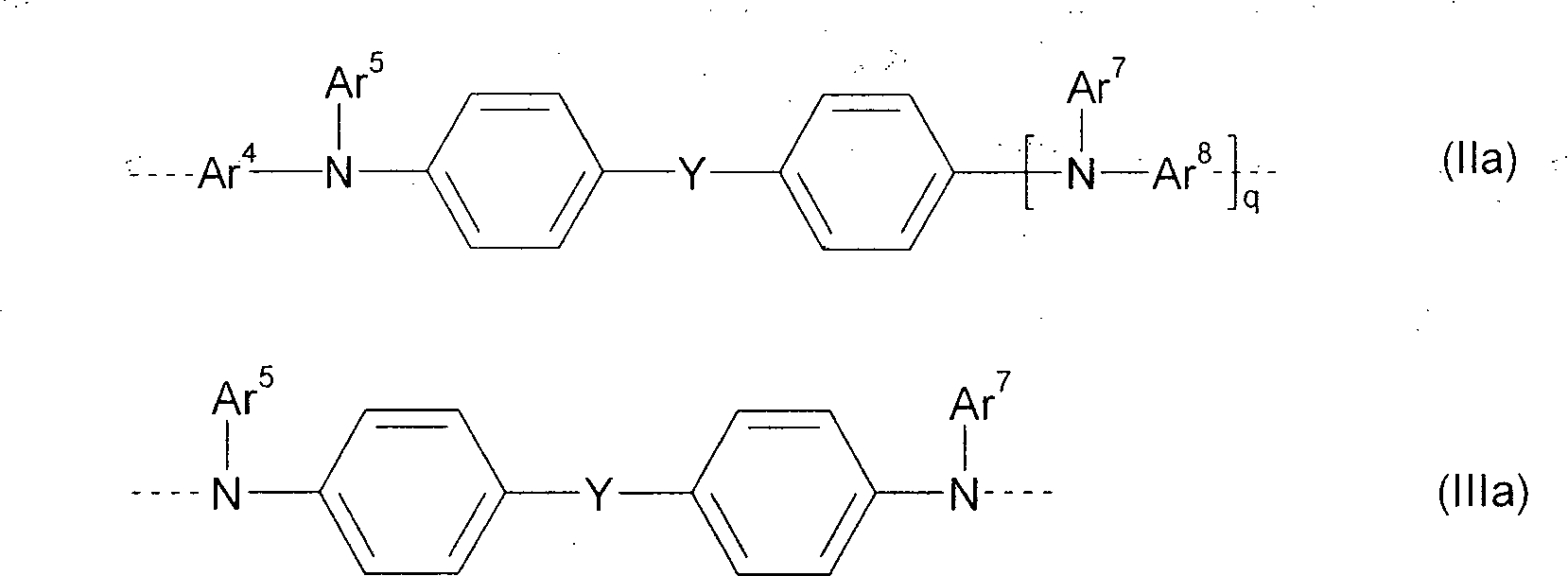

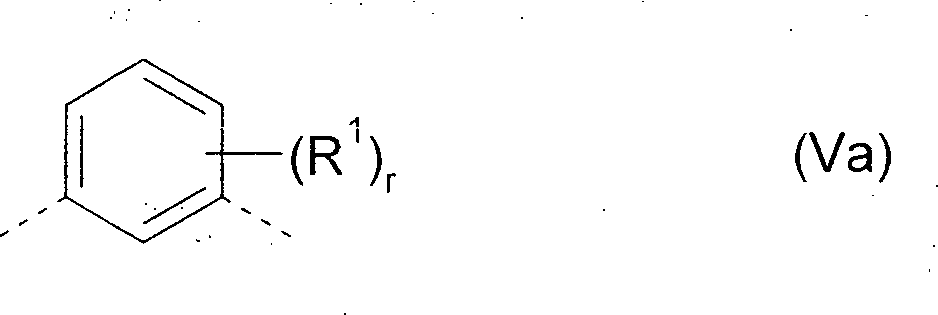
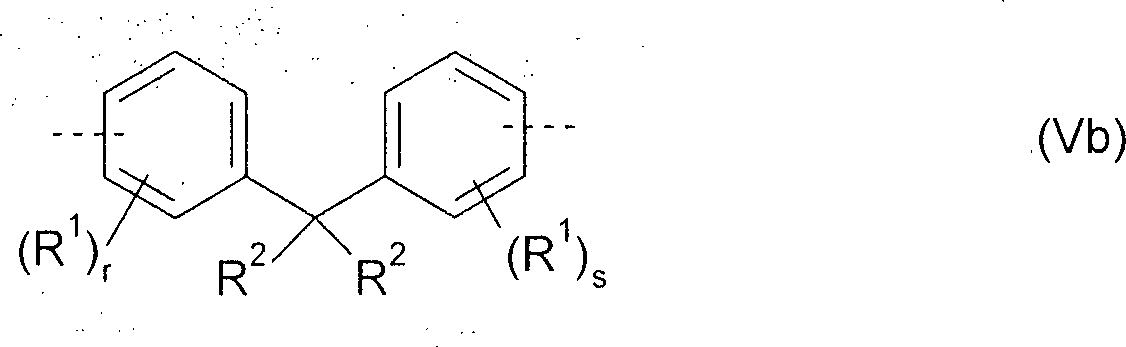


Priority Applications (7)
| Application Number | Priority Date | Filing Date | Title |
|---|---|---|---|
| DE102010033777A DE102010033777A1 (en) | 2010-08-09 | 2010-08-09 | Polymers with carbazole structural units |
| PCT/EP2011/003843 WO2012019724A1 (en) | 2010-08-09 | 2011-08-01 | Polymers with carbazole structural units |
| US13/813,709 US8969512B2 (en) | 2010-08-09 | 2011-08-01 | Polymers having carbazole structural units |
| CN201180039112.2A CN103068878B (en) | 2010-08-09 | 2011-08-01 | There is the polymer of carbazole structure unit |
| EP11743444.9A EP2603540B1 (en) | 2010-08-09 | 2011-08-01 | Polymers with carbazole structural units |
| JP2013523519A JP5882323B2 (en) | 2010-08-09 | 2011-08-01 | Polymer having carbazole structural unit |
| KR1020137006101A KR101820550B1 (en) | 2010-08-09 | 2011-08-01 | Polymers with carbazole structural units |
Applications Claiming Priority (1)
| Application Number | Priority Date | Filing Date | Title |
|---|---|---|---|
| DE102010033777A DE102010033777A1 (en) | 2010-08-09 | 2010-08-09 | Polymers with carbazole structural units |
Publications (1)
| Publication Number | Publication Date |
|---|---|
| DE102010033777A1 true DE102010033777A1 (en) | 2012-02-09 |
Family
ID=44630224
Family Applications (1)
| Application Number | Title | Priority Date | Filing Date |
|---|---|---|---|
| DE102010033777A Withdrawn DE102010033777A1 (en) | 2010-08-09 | 2010-08-09 | Polymers with carbazole structural units |
Country Status (7)
| Country | Link |
|---|---|
| US (1) | US8969512B2 (en) |
| EP (1) | EP2603540B1 (en) |
| JP (1) | JP5882323B2 (en) |
| KR (1) | KR101820550B1 (en) |
| CN (1) | CN103068878B (en) |
| DE (1) | DE102010033777A1 (en) |
| WO (1) | WO2012019724A1 (en) |
Families Citing this family (10)
| Publication number | Priority date | Publication date | Assignee | Title |
|---|---|---|---|---|
| DE102010033778A1 (en) * | 2010-08-09 | 2012-02-09 | Merck Patent Gmbh | Polymers with carbazole structural units |
| JP6306460B2 (en) * | 2014-07-18 | 2018-04-04 | 富士フイルム株式会社 | Composition for forming organic semiconductor film, organic semiconductor material for non-luminescent organic semiconductor device, organic film transistor material, coating solution for non-luminescent organic semiconductor device, ink for non-luminescent organic semiconductor device, non-luminescent organic semiconductor Organic semiconductor films, organic film transistors and oligomers for devices |
| GB201418876D0 (en) * | 2014-10-23 | 2014-12-03 | Cambridge Display Tech Ltd | Organic light emitting device |
| KR102469690B1 (en) * | 2014-12-05 | 2022-11-23 | 엘지디스플레이 주식회사 | Space-through charge transfer compound, and Organic light emitting diode device and Display device using the same |
| WO2016196885A1 (en) * | 2015-06-05 | 2016-12-08 | Massachusetts Institute Of Technology | [2-2]paracyclophane-derived donor/acceptor-type molecules for oled applications |
| KR102141281B1 (en) | 2017-09-26 | 2020-08-05 | 주식회사 엘지화학 | Compound, coating composition comprising the same, organic light emitting device using the same and method of manufacturing the same |
| JP6953059B2 (en) | 2018-02-28 | 2021-10-27 | エルジー・ケム・リミテッド | Polymers, coating compositions containing them, and organic light emitting devices using them. |
| WO2019177175A1 (en) | 2018-03-16 | 2019-09-19 | 三菱ケミカル株式会社 | Polymer, composition for organic electroluminescent element, organic electroluminescent element, organic el display device, organic el lighting, and manufacturing method for organic electroluminescent element |
| KR102641814B1 (en) * | 2018-12-26 | 2024-02-29 | 삼성디스플레이 주식회사 | Composition, organic layer prepared from the composition and device comprising the organic layer |
| CN116655907A (en) * | 2022-02-16 | 2023-08-29 | Tcl科技集团股份有限公司 | Conductive polymer, preparation method thereof, light-emitting diode and display device |
Citations (7)
| Publication number | Priority date | Publication date | Assignee | Title |
|---|---|---|---|---|
| WO1990013148A1 (en) | 1989-04-20 | 1990-11-01 | Cambridge Research And Innovation Limited | Electroluminescent devices |
| WO2002072714A1 (en) | 2001-03-10 | 2002-09-19 | Covion Organic Semiconductors Gmbh | Solutions and dispersions of organic semiconductors |
| WO2003019694A2 (en) | 2001-08-24 | 2003-03-06 | Covion Organic Semiconductors Gmbh | Solutions of polymer semiconductors |
| WO2003048225A2 (en) | 2001-12-06 | 2003-06-12 | Covion Organic Semiconductors Gmbh | Process for producing aryl-aryl coupled compounds |
| WO2004037887A2 (en) | 2002-10-25 | 2004-05-06 | Covion Organic Semiconductors Gmbh | Conjugated polymers containing arylamine units, the representation thereof and the use of the same |
| WO2005011013A1 (en) | 2003-07-21 | 2005-02-03 | Covion Organic Semiconductors Gmbh | Organic electroluminescent element |
| WO2005014688A2 (en) | 2003-08-12 | 2005-02-17 | Covion Organic Semiconductors Gmbh | Conjugated copolymers, representation and use thereof |
Family Cites Families (15)
| Publication number | Priority date | Publication date | Assignee | Title |
|---|---|---|---|---|
| KR100480769B1 (en) | 2001-06-13 | 2005-04-06 | 삼성에스디아이 주식회사 | White Electroluminescent Polymer And Organic Electroluminescent Device Using Thereof |
| US20040004433A1 (en) * | 2002-06-26 | 2004-01-08 | 3M Innovative Properties Company | Buffer layers for organic electroluminescent devices and methods of manufacture and use |
| JP3913147B2 (en) * | 2002-08-30 | 2007-05-09 | キヤノン株式会社 | Electrophotographic photosensitive member, process cartridge, and electrophotographic apparatus |
| US20060051611A1 (en) | 2002-12-13 | 2006-03-09 | Koninklijke Philips Electronics N.V. | Electroluminescent device |
| DE10304819A1 (en) * | 2003-02-06 | 2004-08-19 | Covion Organic Semiconductors Gmbh | Carbazole-containing conjugated polymers and blends, their preparation and use |
| KR20050100673A (en) * | 2003-02-12 | 2005-10-19 | 코닌클리케 필립스 일렉트로닉스 엔.브이. | Carbazole compounds and use of such compounds in organic electroluminescent devices |
| US7329722B2 (en) * | 2004-08-30 | 2008-02-12 | Samsung Electronics Co., Ltd | Polymeric charge transport materials having carbazolyl repeating units |
| CN101346408A (en) * | 2005-12-20 | 2009-01-14 | 皇家飞利浦电子股份有限公司 | polymeric carbazole compound |
| JP4819655B2 (en) * | 2006-04-27 | 2011-11-24 | キヤノン株式会社 | 4-Arylfluorene compound and organic light-emitting device using the same |
| EP2074635A2 (en) * | 2006-08-24 | 2009-07-01 | E.I. Du Pont De Nemours And Company | Crosslinkable hole transport polymers |
| KR100885519B1 (en) * | 2007-09-21 | 2009-02-26 | 제일모직주식회사 | Polymer polymer, and organic photoelectric device comprising the same |
| JPWO2009041635A1 (en) | 2007-09-28 | 2011-01-27 | 出光興産株式会社 | Organic EL device |
| CN101220137B (en) | 2007-12-07 | 2011-04-27 | 华南理工大学 | Hyperbranched polyaromatic hydrocarbon containing pyridine rings and method for producing the same |
| JP5505123B2 (en) * | 2010-06-22 | 2014-05-28 | 東ソー株式会社 | Novel triarylamine polymer, production method thereof and use thereof |
| DE102010033778A1 (en) * | 2010-08-09 | 2012-02-09 | Merck Patent Gmbh | Polymers with carbazole structural units |
-
2010
- 2010-08-09 DE DE102010033777A patent/DE102010033777A1/en not_active Withdrawn
-
2011
- 2011-08-01 JP JP2013523519A patent/JP5882323B2/en not_active Expired - Fee Related
- 2011-08-01 KR KR1020137006101A patent/KR101820550B1/en active Active
- 2011-08-01 US US13/813,709 patent/US8969512B2/en not_active Expired - Fee Related
- 2011-08-01 EP EP11743444.9A patent/EP2603540B1/en active Active
- 2011-08-01 CN CN201180039112.2A patent/CN103068878B/en active Active
- 2011-08-01 WO PCT/EP2011/003843 patent/WO2012019724A1/en not_active Ceased
Patent Citations (7)
| Publication number | Priority date | Publication date | Assignee | Title |
|---|---|---|---|---|
| WO1990013148A1 (en) | 1989-04-20 | 1990-11-01 | Cambridge Research And Innovation Limited | Electroluminescent devices |
| WO2002072714A1 (en) | 2001-03-10 | 2002-09-19 | Covion Organic Semiconductors Gmbh | Solutions and dispersions of organic semiconductors |
| WO2003019694A2 (en) | 2001-08-24 | 2003-03-06 | Covion Organic Semiconductors Gmbh | Solutions of polymer semiconductors |
| WO2003048225A2 (en) | 2001-12-06 | 2003-06-12 | Covion Organic Semiconductors Gmbh | Process for producing aryl-aryl coupled compounds |
| WO2004037887A2 (en) | 2002-10-25 | 2004-05-06 | Covion Organic Semiconductors Gmbh | Conjugated polymers containing arylamine units, the representation thereof and the use of the same |
| WO2005011013A1 (en) | 2003-07-21 | 2005-02-03 | Covion Organic Semiconductors Gmbh | Organic electroluminescent element |
| WO2005014688A2 (en) | 2003-08-12 | 2005-02-17 | Covion Organic Semiconductors Gmbh | Conjugated copolymers, representation and use thereof |
Non-Patent Citations (1)
| Title |
|---|
| Charge-Generation Layers, IDMC 2003, Taiwan; Session 21 OLED (5), T. Matsumoto, T. Nakada, J. Endo, K. Mori, N. Kawamura, A. Yokoi, J. Kido, Multiphoton Organic EL Device Having Charge Generation Layer |
Also Published As
| Publication number | Publication date |
|---|---|
| CN103068878A (en) | 2013-04-24 |
| CN103068878B (en) | 2016-07-20 |
| KR20140005862A (en) | 2014-01-15 |
| US20130137818A1 (en) | 2013-05-30 |
| EP2603540A1 (en) | 2013-06-19 |
| US8969512B2 (en) | 2015-03-03 |
| EP2603540B1 (en) | 2021-04-21 |
| KR101820550B1 (en) | 2018-01-19 |
| WO2012019724A1 (en) | 2012-02-16 |
| JP5882323B2 (en) | 2016-03-09 |
| JP2013540834A (en) | 2013-11-07 |
Similar Documents
| Publication | Publication Date | Title |
|---|---|---|
| EP2732479B1 (en) | Compounds for organic electroluminescent devices | |
| EP1819749B1 (en) | Partially conjugated polymers, their representation and their use | |
| EP2603540B1 (en) | Polymers with carbazole structural units | |
| EP1741148B1 (en) | Electroluminescent polymers comprising planar arylamine units the preparation and use thereof | |
| EP2603541B1 (en) | Polymers with carbazole structural units | |
| DE102009005289B4 (en) | Materials for organic electroluminescent devices, methods for their production and electronic devices containing them | |
| DE102009023154A1 (en) | A composition comprising at least one emitter compound and at least one polymer having conjugation-interrupting units | |
| DE102010048498A1 (en) | Materials for organic electroluminescent devices | |
| DE102010056151A1 (en) | Materials for organic electroluminescent devices | |
| DE102009030847A1 (en) | Polymers containing substituted Anthracenyleinheiten, blends containing these polymers and devices containing these polymers or blends | |
| EP2401315B1 (en) | Cross-linkable and cross-linked polymers, method for the production thereof, and use thereof | |
| DE102009023156A1 (en) | Polymers containing substituted indenofluorene derivatives as a structural unit, process for their preparation and their use | |
| DE102010007938A1 (en) | Electroluminescent polymers, process for their preparation and their use | |
| DE102009030848A1 (en) | Polymers comprising structural units which have alkylalkoxy groups, blends containing these polymers and optoelectronic devices containing these polymers and blends | |
| DE102008044868A1 (en) | Electroluminescent polymers, process for their preparation and their use | |
| DE102010032737A1 (en) | Polymers containing substituted benzodithiophene units, blends containing these polymers and devices containing these polymers or blends | |
| DE102010006377A1 (en) | Styrene-based copolymers, in particular for use in optoelectronic components | |
| EP2889320A2 (en) | Polymers with structure units having electron transport properties | |
| DE102010027320A1 (en) | Polymeric materials for organic electroluminescent devices | |
| WO2011009522A2 (en) | Materials for electronic devices | |
| DE102012016192A1 (en) | New compounds capable of forming hydrogen bonds are useful in electronic device, e.g. organic electroluminescent device, organic light-emitting transistor and organic light-emitting electrochemical cell |
Legal Events
| Date | Code | Title | Description |
|---|---|---|---|
| R005 | Application deemed withdrawn due to failure to request examination |