CN114401945A - Peri-condensed heterocyclic compounds as materials for electronic devices - Google Patents
Peri-condensed heterocyclic compounds as materials for electronic devices Download PDFInfo
- Publication number
- CN114401945A CN114401945A CN202080064421.4A CN202080064421A CN114401945A CN 114401945 A CN114401945 A CN 114401945A CN 202080064421 A CN202080064421 A CN 202080064421A CN 114401945 A CN114401945 A CN 114401945A
- Authority
- CN
- China
- Prior art keywords
- group
- aromatic ring
- substituted
- ring system
- alkoxy
- Prior art date
- Legal status (The legal status is an assumption and is not a legal conclusion. Google has not performed a legal analysis and makes no representation as to the accuracy of the status listed.)
- Pending
Links
Classifications
-
- C—CHEMISTRY; METALLURGY
- C07—ORGANIC CHEMISTRY
- C07D—HETEROCYCLIC COMPOUNDS
- C07D209/00—Heterocyclic compounds containing five-membered rings, condensed with other rings, with one nitrogen atom as the only ring hetero atom
- C07D209/56—Ring systems containing three or more rings
- C07D209/80—[b, c]- or [b, d]-condensed
- C07D209/82—Carbazoles; Hydrogenated carbazoles
- C07D209/86—Carbazoles; Hydrogenated carbazoles with only hydrogen atoms, hydrocarbon or substituted hydrocarbon radicals, directly attached to carbon atoms of the ring system
-
- C—CHEMISTRY; METALLURGY
- C07—ORGANIC CHEMISTRY
- C07C—ACYCLIC OR CARBOCYCLIC COMPOUNDS
- C07C211/00—Compounds containing amino groups bound to a carbon skeleton
- C07C211/43—Compounds containing amino groups bound to a carbon skeleton having amino groups bound to carbon atoms of six-membered aromatic rings of the carbon skeleton
- C07C211/57—Compounds containing amino groups bound to a carbon skeleton having amino groups bound to carbon atoms of six-membered aromatic rings of the carbon skeleton having amino groups bound to carbon atoms of six-membered aromatic rings being part of condensed ring systems of the carbon skeleton
- C07C211/61—Compounds containing amino groups bound to a carbon skeleton having amino groups bound to carbon atoms of six-membered aromatic rings of the carbon skeleton having amino groups bound to carbon atoms of six-membered aromatic rings being part of condensed ring systems of the carbon skeleton with at least one of the condensed ring systems formed by three or more rings
-
- C—CHEMISTRY; METALLURGY
- C07—ORGANIC CHEMISTRY
- C07D—HETEROCYCLIC COMPOUNDS
- C07D307/00—Heterocyclic compounds containing five-membered rings having one oxygen atom as the only ring hetero atom
- C07D307/77—Heterocyclic compounds containing five-membered rings having one oxygen atom as the only ring hetero atom ortho- or peri-condensed with carbocyclic rings or ring systems
- C07D307/91—Dibenzofurans; Hydrogenated dibenzofurans
-
- C—CHEMISTRY; METALLURGY
- C07—ORGANIC CHEMISTRY
- C07D—HETEROCYCLIC COMPOUNDS
- C07D471/00—Heterocyclic compounds containing nitrogen atoms as the only ring hetero atoms in the condensed system, at least one ring being a six-membered ring with one nitrogen atom, not provided for by groups C07D451/00 - C07D463/00
- C07D471/02—Heterocyclic compounds containing nitrogen atoms as the only ring hetero atoms in the condensed system, at least one ring being a six-membered ring with one nitrogen atom, not provided for by groups C07D451/00 - C07D463/00 in which the condensed system contains two hetero rings
- C07D471/06—Peri-condensed systems
-
- C—CHEMISTRY; METALLURGY
- C07—ORGANIC CHEMISTRY
- C07D—HETEROCYCLIC COMPOUNDS
- C07D471/00—Heterocyclic compounds containing nitrogen atoms as the only ring hetero atoms in the condensed system, at least one ring being a six-membered ring with one nitrogen atom, not provided for by groups C07D451/00 - C07D463/00
- C07D471/12—Heterocyclic compounds containing nitrogen atoms as the only ring hetero atoms in the condensed system, at least one ring being a six-membered ring with one nitrogen atom, not provided for by groups C07D451/00 - C07D463/00 in which the condensed system contains three hetero rings
- C07D471/16—Peri-condensed systems
-
- C—CHEMISTRY; METALLURGY
- C07—ORGANIC CHEMISTRY
- C07D—HETEROCYCLIC COMPOUNDS
- C07D471/00—Heterocyclic compounds containing nitrogen atoms as the only ring hetero atoms in the condensed system, at least one ring being a six-membered ring with one nitrogen atom, not provided for by groups C07D451/00 - C07D463/00
- C07D471/22—Heterocyclic compounds containing nitrogen atoms as the only ring hetero atoms in the condensed system, at least one ring being a six-membered ring with one nitrogen atom, not provided for by groups C07D451/00 - C07D463/00 in which the condensed systems contains four or more hetero rings
-
- C—CHEMISTRY; METALLURGY
- C07—ORGANIC CHEMISTRY
- C07D—HETEROCYCLIC COMPOUNDS
- C07D491/00—Heterocyclic compounds containing in the condensed ring system both one or more rings having oxygen atoms as the only ring hetero atoms and one or more rings having nitrogen atoms as the only ring hetero atoms, not provided for by groups C07D451/00 - C07D459/00, C07D463/00, C07D477/00 or C07D489/00
- C07D491/12—Heterocyclic compounds containing in the condensed ring system both one or more rings having oxygen atoms as the only ring hetero atoms and one or more rings having nitrogen atoms as the only ring hetero atoms, not provided for by groups C07D451/00 - C07D459/00, C07D463/00, C07D477/00 or C07D489/00 in which the condensed system contains three hetero rings
- C07D491/16—Peri-condensed systems
-
- C—CHEMISTRY; METALLURGY
- C07—ORGANIC CHEMISTRY
- C07D—HETEROCYCLIC COMPOUNDS
- C07D495/00—Heterocyclic compounds containing in the condensed system at least one hetero ring having sulfur atoms as the only ring hetero atoms
- C07D495/12—Heterocyclic compounds containing in the condensed system at least one hetero ring having sulfur atoms as the only ring hetero atoms in which the condensed system contains three hetero rings
- C07D495/16—Peri-condensed systems
-
- C—CHEMISTRY; METALLURGY
- C07—ORGANIC CHEMISTRY
- C07D—HETEROCYCLIC COMPOUNDS
- C07D519/00—Heterocyclic compounds containing more than one system of two or more relevant hetero rings condensed among themselves or condensed with a common carbocyclic ring system not provided for in groups C07D453/00 or C07D455/00
-
- C—CHEMISTRY; METALLURGY
- C07—ORGANIC CHEMISTRY
- C07F—ACYCLIC, CARBOCYCLIC OR HETEROCYCLIC COMPOUNDS CONTAINING ELEMENTS OTHER THAN CARBON, HYDROGEN, HALOGEN, OXYGEN, NITROGEN, SULFUR, SELENIUM OR TELLURIUM
- C07F7/00—Compounds containing elements of Groups 4 or 14 of the Periodic Table
- C07F7/02—Silicon compounds
- C07F7/08—Compounds having one or more C—Si linkages
- C07F7/0803—Compounds with Si-C or Si-Si linkages
- C07F7/081—Compounds with Si-C or Si-Si linkages comprising at least one atom selected from the elements N, O, halogen, S, Se or Te
- C07F7/0812—Compounds with Si-C or Si-Si linkages comprising at least one atom selected from the elements N, O, halogen, S, Se or Te comprising a heterocyclic ring
-
- C—CHEMISTRY; METALLURGY
- C09—DYES; PAINTS; POLISHES; NATURAL RESINS; ADHESIVES; COMPOSITIONS NOT OTHERWISE PROVIDED FOR; APPLICATIONS OF MATERIALS NOT OTHERWISE PROVIDED FOR
- C09K—MATERIALS FOR MISCELLANEOUS APPLICATIONS, NOT PROVIDED FOR ELSEWHERE
- C09K11/00—Luminescent, e.g. electroluminescent, chemiluminescent materials
- C09K11/06—Luminescent, e.g. electroluminescent, chemiluminescent materials containing organic luminescent materials
-
- H—ELECTRICITY
- H10—SEMICONDUCTOR DEVICES; ELECTRIC SOLID-STATE DEVICES NOT OTHERWISE PROVIDED FOR
- H10K—ORGANIC ELECTRIC SOLID-STATE DEVICES
- H10K50/00—Organic light-emitting devices
- H10K50/10—OLEDs or polymer light-emitting diodes [PLED]
- H10K50/11—OLEDs or polymer light-emitting diodes [PLED] characterised by the electroluminescent [EL] layers
- H10K50/12—OLEDs or polymer light-emitting diodes [PLED] characterised by the electroluminescent [EL] layers comprising dopants
-
- H—ELECTRICITY
- H10—SEMICONDUCTOR DEVICES; ELECTRIC SOLID-STATE DEVICES NOT OTHERWISE PROVIDED FOR
- H10K—ORGANIC ELECTRIC SOLID-STATE DEVICES
- H10K50/00—Organic light-emitting devices
- H10K50/10—OLEDs or polymer light-emitting diodes [PLED]
- H10K50/14—Carrier transporting layers
- H10K50/15—Hole transporting layers
-
- H—ELECTRICITY
- H10—SEMICONDUCTOR DEVICES; ELECTRIC SOLID-STATE DEVICES NOT OTHERWISE PROVIDED FOR
- H10K—ORGANIC ELECTRIC SOLID-STATE DEVICES
- H10K50/00—Organic light-emitting devices
- H10K50/10—OLEDs or polymer light-emitting diodes [PLED]
- H10K50/14—Carrier transporting layers
- H10K50/16—Electron transporting layers
-
- H—ELECTRICITY
- H10—SEMICONDUCTOR DEVICES; ELECTRIC SOLID-STATE DEVICES NOT OTHERWISE PROVIDED FOR
- H10K—ORGANIC ELECTRIC SOLID-STATE DEVICES
- H10K50/00—Organic light-emitting devices
- H10K50/10—OLEDs or polymer light-emitting diodes [PLED]
- H10K50/18—Carrier blocking layers
-
- H—ELECTRICITY
- H10—SEMICONDUCTOR DEVICES; ELECTRIC SOLID-STATE DEVICES NOT OTHERWISE PROVIDED FOR
- H10K—ORGANIC ELECTRIC SOLID-STATE DEVICES
- H10K85/00—Organic materials used in the body or electrodes of devices covered by this subclass
- H10K85/40—Organosilicon compounds, e.g. TIPS pentacene
-
- H—ELECTRICITY
- H10—SEMICONDUCTOR DEVICES; ELECTRIC SOLID-STATE DEVICES NOT OTHERWISE PROVIDED FOR
- H10K—ORGANIC ELECTRIC SOLID-STATE DEVICES
- H10K85/00—Organic materials used in the body or electrodes of devices covered by this subclass
- H10K85/60—Organic compounds having low molecular weight
- H10K85/615—Polycyclic condensed aromatic hydrocarbons, e.g. anthracene
-
- H—ELECTRICITY
- H10—SEMICONDUCTOR DEVICES; ELECTRIC SOLID-STATE DEVICES NOT OTHERWISE PROVIDED FOR
- H10K—ORGANIC ELECTRIC SOLID-STATE DEVICES
- H10K85/00—Organic materials used in the body or electrodes of devices covered by this subclass
- H10K85/60—Organic compounds having low molecular weight
- H10K85/615—Polycyclic condensed aromatic hydrocarbons, e.g. anthracene
- H10K85/622—Polycyclic condensed aromatic hydrocarbons, e.g. anthracene containing four rings, e.g. pyrene
-
- H—ELECTRICITY
- H10—SEMICONDUCTOR DEVICES; ELECTRIC SOLID-STATE DEVICES NOT OTHERWISE PROVIDED FOR
- H10K—ORGANIC ELECTRIC SOLID-STATE DEVICES
- H10K85/00—Organic materials used in the body or electrodes of devices covered by this subclass
- H10K85/60—Organic compounds having low molecular weight
- H10K85/615—Polycyclic condensed aromatic hydrocarbons, e.g. anthracene
- H10K85/624—Polycyclic condensed aromatic hydrocarbons, e.g. anthracene containing six or more rings
-
- H—ELECTRICITY
- H10—SEMICONDUCTOR DEVICES; ELECTRIC SOLID-STATE DEVICES NOT OTHERWISE PROVIDED FOR
- H10K—ORGANIC ELECTRIC SOLID-STATE DEVICES
- H10K85/00—Organic materials used in the body or electrodes of devices covered by this subclass
- H10K85/60—Organic compounds having low molecular weight
- H10K85/649—Aromatic compounds comprising a hetero atom
- H10K85/654—Aromatic compounds comprising a hetero atom comprising only nitrogen as heteroatom
-
- H—ELECTRICITY
- H10—SEMICONDUCTOR DEVICES; ELECTRIC SOLID-STATE DEVICES NOT OTHERWISE PROVIDED FOR
- H10K—ORGANIC ELECTRIC SOLID-STATE DEVICES
- H10K85/00—Organic materials used in the body or electrodes of devices covered by this subclass
- H10K85/60—Organic compounds having low molecular weight
- H10K85/649—Aromatic compounds comprising a hetero atom
- H10K85/657—Polycyclic condensed heteroaromatic hydrocarbons
-
- H—ELECTRICITY
- H10—SEMICONDUCTOR DEVICES; ELECTRIC SOLID-STATE DEVICES NOT OTHERWISE PROVIDED FOR
- H10K—ORGANIC ELECTRIC SOLID-STATE DEVICES
- H10K85/00—Organic materials used in the body or electrodes of devices covered by this subclass
- H10K85/60—Organic compounds having low molecular weight
- H10K85/649—Aromatic compounds comprising a hetero atom
- H10K85/657—Polycyclic condensed heteroaromatic hydrocarbons
- H10K85/6572—Polycyclic condensed heteroaromatic hydrocarbons comprising only nitrogen in the heteroaromatic polycondensed ring system, e.g. phenanthroline or carbazole
-
- H—ELECTRICITY
- H10—SEMICONDUCTOR DEVICES; ELECTRIC SOLID-STATE DEVICES NOT OTHERWISE PROVIDED FOR
- H10K—ORGANIC ELECTRIC SOLID-STATE DEVICES
- H10K85/00—Organic materials used in the body or electrodes of devices covered by this subclass
- H10K85/60—Organic compounds having low molecular weight
- H10K85/649—Aromatic compounds comprising a hetero atom
- H10K85/657—Polycyclic condensed heteroaromatic hydrocarbons
- H10K85/6574—Polycyclic condensed heteroaromatic hydrocarbons comprising only oxygen in the heteroaromatic polycondensed ring system, e.g. cumarine dyes
-
- C—CHEMISTRY; METALLURGY
- C07—ORGANIC CHEMISTRY
- C07C—ACYCLIC OR CARBOCYCLIC COMPOUNDS
- C07C2603/00—Systems containing at least three condensed rings
- C07C2603/93—Spiro compounds
- C07C2603/94—Spiro compounds containing "free" spiro atoms
-
- C—CHEMISTRY; METALLURGY
- C09—DYES; PAINTS; POLISHES; NATURAL RESINS; ADHESIVES; COMPOSITIONS NOT OTHERWISE PROVIDED FOR; APPLICATIONS OF MATERIALS NOT OTHERWISE PROVIDED FOR
- C09K—MATERIALS FOR MISCELLANEOUS APPLICATIONS, NOT PROVIDED FOR ELSEWHERE
- C09K2211/00—Chemical nature of organic luminescent or tenebrescent compounds
- C09K2211/10—Non-macromolecular compounds
- C09K2211/1003—Carbocyclic compounds
- C09K2211/1011—Condensed systems
-
- C—CHEMISTRY; METALLURGY
- C09—DYES; PAINTS; POLISHES; NATURAL RESINS; ADHESIVES; COMPOSITIONS NOT OTHERWISE PROVIDED FOR; APPLICATIONS OF MATERIALS NOT OTHERWISE PROVIDED FOR
- C09K—MATERIALS FOR MISCELLANEOUS APPLICATIONS, NOT PROVIDED FOR ELSEWHERE
- C09K2211/00—Chemical nature of organic luminescent or tenebrescent compounds
- C09K2211/10—Non-macromolecular compounds
- C09K2211/1003—Carbocyclic compounds
- C09K2211/1014—Carbocyclic compounds bridged by heteroatoms, e.g. N, P, Si or B
-
- C—CHEMISTRY; METALLURGY
- C09—DYES; PAINTS; POLISHES; NATURAL RESINS; ADHESIVES; COMPOSITIONS NOT OTHERWISE PROVIDED FOR; APPLICATIONS OF MATERIALS NOT OTHERWISE PROVIDED FOR
- C09K—MATERIALS FOR MISCELLANEOUS APPLICATIONS, NOT PROVIDED FOR ELSEWHERE
- C09K2211/00—Chemical nature of organic luminescent or tenebrescent compounds
- C09K2211/10—Non-macromolecular compounds
- C09K2211/1018—Heterocyclic compounds
-
- C—CHEMISTRY; METALLURGY
- C09—DYES; PAINTS; POLISHES; NATURAL RESINS; ADHESIVES; COMPOSITIONS NOT OTHERWISE PROVIDED FOR; APPLICATIONS OF MATERIALS NOT OTHERWISE PROVIDED FOR
- C09K—MATERIALS FOR MISCELLANEOUS APPLICATIONS, NOT PROVIDED FOR ELSEWHERE
- C09K2211/00—Chemical nature of organic luminescent or tenebrescent compounds
- C09K2211/10—Non-macromolecular compounds
- C09K2211/1018—Heterocyclic compounds
- C09K2211/1025—Heterocyclic compounds characterised by ligands
- C09K2211/1029—Heterocyclic compounds characterised by ligands containing one nitrogen atom as the heteroatom
-
- C—CHEMISTRY; METALLURGY
- C09—DYES; PAINTS; POLISHES; NATURAL RESINS; ADHESIVES; COMPOSITIONS NOT OTHERWISE PROVIDED FOR; APPLICATIONS OF MATERIALS NOT OTHERWISE PROVIDED FOR
- C09K—MATERIALS FOR MISCELLANEOUS APPLICATIONS, NOT PROVIDED FOR ELSEWHERE
- C09K2211/00—Chemical nature of organic luminescent or tenebrescent compounds
- C09K2211/10—Non-macromolecular compounds
- C09K2211/1018—Heterocyclic compounds
- C09K2211/1025—Heterocyclic compounds characterised by ligands
- C09K2211/1088—Heterocyclic compounds characterised by ligands containing oxygen as the only heteroatom
-
- H—ELECTRICITY
- H10—SEMICONDUCTOR DEVICES; ELECTRIC SOLID-STATE DEVICES NOT OTHERWISE PROVIDED FOR
- H10K—ORGANIC ELECTRIC SOLID-STATE DEVICES
- H10K50/00—Organic light-emitting devices
- H10K50/10—OLEDs or polymer light-emitting diodes [PLED]
- H10K50/14—Carrier transporting layers
- H10K50/16—Electron transporting layers
- H10K50/165—Electron transporting layers comprising dopants
Landscapes
- Chemical & Material Sciences (AREA)
- Organic Chemistry (AREA)
- Physics & Mathematics (AREA)
- Engineering & Computer Science (AREA)
- Materials Engineering (AREA)
- Spectroscopy & Molecular Physics (AREA)
- Optics & Photonics (AREA)
- Nitrogen Condensed Heterocyclic Rings (AREA)
- Plural Heterocyclic Compounds (AREA)
- Electroluminescent Light Sources (AREA)
Abstract
本申请涉及式(I)的化合物、所述化合物的制备方法、以及包含一种或多种所述化合物的电子器件。 The present application relates to compounds of formula (I), methods of preparing said compounds, and electronic devices comprising one or more of said compounds. 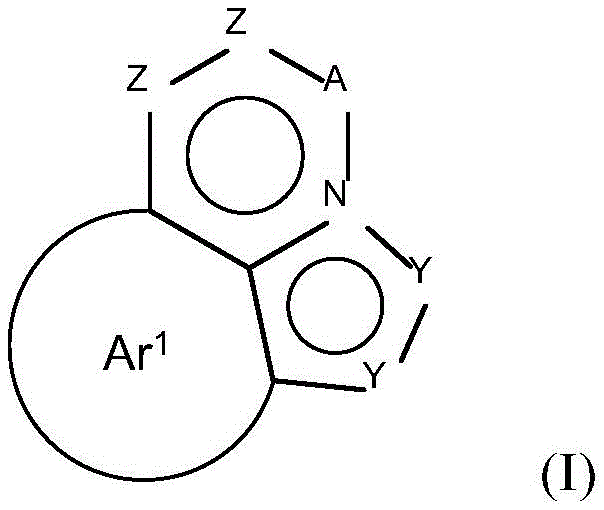
Description
The present invention relates to materials for electronic devices and electronic devices comprising these materials.
Electronic devices in the context of the present application are understood to mean so-called organic electronic devices which comprise an organic semiconductor material as functional material. More particularly, these are understood to mean OLEDs (organic electroluminescent devices). The term OLED is understood to mean an electronic device having one or more layers comprising organic compounds and emitting light upon application of a voltage. The construction and general functional principles of OLEDs are known to those skilled in the art.
The light emitting materials used in OLEDs are often phosphorescent organometallic complexes. In general, OLEDs, in particular also OLEDs which exhibit triplet emission (phosphorescence), are still in need of improvement, for example in terms of efficiency, operating voltage and lifetime. The properties of phosphorescent OLEDs are not only determined by the triplet emitters used. More particularly, other materials used, such as matrix materials, are also of particular interest here. Improving these materials can also lead to an improvement in the properties of the OLED. One example of a known class of materials for use as matrix materials for triplet emitters in OLEDs is aromatic lactams.
It is an object of the present invention to provide compounds which are suitable for use in OLEDs, in particular as matrix materials for phosphorescent emitters or as electron-transporting materials, and lead to improved properties therein.
It has surprisingly been found that this object is achieved by specific compounds which are well suited for use in OLEDs, as described in detail below. These OLEDs have in particular a long lifetime, a high efficiency and a low operating voltage. The present invention therefore provides these compounds and electronic devices, in particular organic electroluminescent devices, comprising these compounds.
Accordingly, the present application provides a compound of formula (I)

The variables appearing therein are as follows:
a is C-O, C-S, C-NR0、P(=O)R0SO or SO2;
Y is identical or different on each occurrence and is selected from N and CR1;
Ar1Is a compound having 6 to 40 aromatic ring atoms and substituted by R2An aromatic ring system substituted with a group and fused to the remainder of formula (I) via three carbon atoms as shown in formula (I), or having 5 to 40 aromatic ring atoms and being substituted by R2A group-substituted heteroaromatic ring system fused to the remainder of formula (I) via three carbon atoms shown in formula (I);
z is identical or different on each occurrence and is selected from the group consisting of CR4And N, or Z-Z unit is represented by formula (Ar)2) Unit (2) of

Wherein Ar is2Selected from the group consisting of those having 6 to 40 aromatic ring atoms and substituted by R3An aromatic ring system substituted with a group, said aromatic ring system comprising C-C units, and having 5 to 40 aromatic ring atoms and being substituted by R3A group-substituted heteroaromatic ring system comprising C-C units and wherein the dotted line is the bond connecting said Z-Z unit to the remainder of the formula;
R0in each case identical or different and selected from: a linear alkyl or alkoxy group having from 1 to 20 carbon atoms, a branched or cyclic alkyl or alkoxy group having from 3 to 20 carbon atoms, an alkenyl or alkynyl group having from 2 to 20 carbon atoms, an aromatic ring system having from 6 to 40 aromatic ring atoms, and a cyclic alkyl or alkoxy group having from 5 to 40 carbon atomsA heteroaromatic ring system of aromatic ring atoms; wherein the alkyl, alkoxy, alkenyl and alkynyl groups mentioned and the aromatic and heteroaromatic ring systems mentioned are each R5Substituted by groups; and wherein one or more CH of the alkyl, alkoxy, alkenyl and alkynyl groups mentioned2The group may be represented by-R5C=CR5-、-C≡C-、Si(R5)2、C=O、C=NR5、-C(=O)O-、-C(=O)NR5-、NR5、P(=O)(R5) -O-, -S-, SO or SO2Replacing;
R1in each case identical or different and selected from: h, D, F, Cl, Br, I, C (═ O) R5,CN,Si(R5)3,N(R5)2,P(=O)(R5)2,OR5,S(=O)R5,S(=O)2R5A linear alkyl or alkoxy group having 1 to 20 carbon atoms, a branched or cyclic alkyl or alkoxy group having 3 to 20 carbon atoms, an alkenyl or alkynyl group having 2 to 20 carbon atoms, an aromatic ring system having 6 to 40 aromatic ring atoms, and a heteroaromatic ring system having 5 to 40 aromatic ring atoms; wherein the alkyl, alkoxy, alkenyl and alkynyl groups mentioned and the aromatic and heteroaromatic ring systems mentioned are each R5Substituted by groups; and wherein one or more CH of the alkyl, alkoxy, alkenyl and alkynyl groups mentioned2The group may be represented by-R5C=CR5-、-C≡C-、Si(R5)2、C=O、C=NR5、-C(=O)O-、-C(=O)NR5-、NR5、P(=O)(R5) -O-, -S-, SO or SO2Replacing;
R2in each case identical or different and selected from: h, D, F, Cl, Br, I, C (═ O) R5,CN,Si(R5)3,N(R5)2,P(=O)(R5)2,OR5,S(=O)R5,S(=O)2R5Straight-chain alkyl or alkoxy radicals having 1 to 20 carbon atoms, branched-chain radicals having 3 to 20 carbon atoms orCyclic alkyl or alkoxy groups, alkenyl or alkynyl groups having 2 to 20 carbon atoms, aromatic ring systems having 6 to 40 aromatic ring atoms, and heteroaromatic ring systems having 5 to 40 aromatic ring atoms; wherein two or more are selected from R2、R3And R4The groups of (a) may be linked to each other and may form a ring; wherein the alkyl, alkoxy, alkenyl and alkynyl groups mentioned and the aromatic and heteroaromatic ring systems mentioned are each R5Substituted by groups; and wherein one or more CH of the alkyl, alkoxy, alkenyl and alkynyl groups mentioned2The group may be represented by-R5C=CR5-、-C≡C-、Si(R5)2、C=O、C=NR5、-C(=O)O-、-C(=O)NR5-、NR5、P(=O)(R5) -O-, -S-, SO or SO2Replacing;
R3in each case identical or different and selected from: h, D, F, Cl, Br, I, C (═ O) R5,CN,Si(R5)3,N(R5)2,P(=O)(R5)2,OR5,S(=O)R5,S(=O)2R5A linear alkyl or alkoxy group having 1 to 20 carbon atoms, a branched or cyclic alkyl or alkoxy group having 3 to 20 carbon atoms, an alkenyl or alkynyl group having 2 to 20 carbon atoms, an aromatic ring system having 6 to 40 aromatic ring atoms, and a heteroaromatic ring system having 5 to 40 aromatic ring atoms; wherein two or more are selected from R2、R3And R4The groups of (a) may be linked to each other and may form a ring; wherein the alkyl, alkoxy, alkenyl and alkynyl groups mentioned and the aromatic and heteroaromatic ring systems mentioned are each R5Substituted by groups; and wherein one or more CH of the alkyl, alkoxy, alkenyl and alkynyl groups mentioned2The group may be represented by-R5C=CR5-、-C≡C-、Si(R5)2、C=O、C=NR5、-C(=O)O-、-C(=O)NR5-、NR5、P(=O)(R5) -O-, -S-, SO or SO2Replacing;
R4in each case identical or different and selected from: h, D, F, Cl, Br, I, C (═ O) R5,CN,Si(R5)3,N(R5)2,P(=O)(R5)2,OR5,S(=O)R5,S(=O)2R5A linear alkyl or alkoxy group having 1 to 20 carbon atoms, a branched or cyclic alkyl or alkoxy group having 3 to 20 carbon atoms, an alkenyl or alkynyl group having 2 to 20 carbon atoms, an aromatic ring system having 6 to 40 aromatic ring atoms, and a heteroaromatic ring system having 5 to 40 aromatic ring atoms; wherein two or more R2、R3And R4The groups may be linked to each other and may form a ring; wherein the alkyl, alkoxy, alkenyl and alkynyl groups mentioned and the aromatic and heteroaromatic ring systems mentioned are each R5Substituted by groups; and wherein one or more CH of the alkyl, alkoxy, alkenyl and alkynyl groups mentioned2The group may be represented by-R5C=CR5-、-C≡C-、Si(R5)2、C=O、C=NR5、-C(=O)O-、-C(=O)NR5-、NR5、P(=O)(R5) -O-, -S-, SO or SO2Replacing;
R5in each case identical or different and selected from: h, D, F, Cl, Br, I, C (═ O) R6,CN,Si(R6)3,N(R6)2,P(=O)(R6)2,OR6,S(=O)R6,S(=O)2R6A linear alkyl or alkoxy group having 1 to 20 carbon atoms, a branched or cyclic alkyl or alkoxy group having 3 to 20 carbon atoms, an alkenyl or alkynyl group having 2 to 20 carbon atoms, an aromatic ring system having 6 to 40 aromatic ring atoms, and a heteroaromatic ring system having 5 to 40 aromatic ring atoms; wherein two or more R5The groups may be linked to each other and may form a ring; wherein the alkyl, alkoxy, alkenyl and alkynyl groups mentioned and the aromatic and heteroaromatic ring systems mentioned are each R6Substituted by groups; and wherein it is mentionedAnd one or more CH of alkyl, alkoxy, alkenyl and alkynyl groups of2The group may be represented by-R6C=CR6-、-C≡C-、Si(R6)2、C=O、C=NR6、-C(=O)O-、-C(=O)NR6-、NR6、P(=O)(R6) -O-, -S-, SO or SO2Replacing;
R6in each case identical or different and selected from: h, D, F, Cl, Br, I, CN, alkyl or alkoxy groups having 1 to 20 carbon atoms, alkenyl or alkynyl groups having 2 to 20 carbon atoms, aromatic ring systems having 6 to 40 aromatic ring atoms, and heteroaromatic ring systems having 5 to 40 aromatic ring atoms; wherein two or more R6The groups may be linked to each other and may form a ring; and wherein the alkyl, alkoxy, alkenyl and alkynyl groups, aromatic ring systems and heteroaromatic ring systems mentioned may be substituted by one or more groups selected from F and CN;
wherein, when two Y groups in formula (I) are CR1Then, the following two aspects are taken together
a) At least one is selected from R1、R2、R3And R4The radicals in the radical being selected from the group consisting of those having 7 to 40 aromatic ring atoms and each being substituted by R5A group-substituted aromatic ring system; and having 5 to 40 aromatic ring atoms and each being substituted by R5A group-substituted heteroaromatic ring system; or
b) At least two are selected from R1、R2、R3And R4The radicals in the radical being selected from those having 6 to 40 aromatic ring atoms and each being substituted by R5A group-substituted aromatic ring system; and having 5 to 40 aromatic ring atoms and each being substituted by R5A group-substituted heteroaromatic ring system.
Formula (Ar)2) The C-C unit in (A) is understood to mean two carbon atoms which are bonded directly to one another and are part of the aromatic or heteroaromatic ring.
The presence of circles within the rings in formula (I) and in other general formulae means that the rings in question are aromatic and in particular cases heteroaromatic. In a preferred embodiment, this includes targeting only specific onesThe meso structure of (a) has aromaticity, for example, as shown for embodiments of formula (I) below, wherein a is C ═ O, Z is CR4One Y is CR1And the other Y is N:

the following definitions may apply to the chemical groups used in this application. They are applicable unless any more specific definition is given.
An aryl group in the context of the present invention is understood to mean a monoaromatic ring, i.e. benzene, or a fused aromatic polycyclic ring, for example naphthalene, phenanthrene or anthracene. Fused aromatic polycyclic rings in the context of the present application consist of two or more monoaromatic rings fused to one another. The fusion between the rings is understood here to mean that the rings share at least one side with one another. An aryl group in the context of the present invention comprises 6 to 40 aromatic ring atoms. In addition, the aryl group does not contain any heteroatoms as aromatic ring atoms, but only carbon atoms.
Heteroaryl groups in the context of the present invention are understood as meaning either a monoheteroaromatic ring, for example pyridine, pyrimidine or thiophene, or a fused heteroaromatic polycyclic ring, for example quinoline or carbazole. A fused heteroaromatic polycyclic in the context of the present application consists of two or more monoaromatic or heteroaromatic rings which are fused to one another, wherein at least one of the aromatic and heteroaromatic rings is a heteroaromatic ring. The fusion between the rings is understood here to mean that the rings share at least one side with one another. Heteroaryl groups in the context of the present invention comprise 5 to 40 aromatic ring atoms, at least one of which is a heteroatom. The heteroatom of the heteroaryl group is preferably selected from N, O and S.
Aryl or heteroaryl groups in which each may be substituted by the abovementioned groups are understood in particular to mean groups derived from: benzene, naphthalene, anthracene, phenanthrene, pyrene, dihydropyrene, chicory, perylene, triphenylene, fluoranthene, benzanthracene, triphenylene, tetracene, pentacene, benzopyrene, furan, benzofuran, isobenzofuran, dibenzofuran, thiophene, benzothiophene, isobenzofuranBithiophene, dibenzothiophene, pyrrole, indole, isoindole, carbazole, pyridine, quinoline, isoquinoline, acridine, phenanthridine, benzo-5, 6-quinoline, benzo-6, 7-quinoline, benzo-7, 8-quinoline, phenothiazine, thiophene Oxazines, pyrazoles, indazoles, imidazoles, benzimidazoles [1,2-a ]]Benzimidazole, naphthoimidazole, phenanthroimidazole, pyridoimidazole, pyrazinoimidazole, quinoxaloimidazole, benzimidazole, and benzimidazole derivatives,
 Azole, benzo
 Azoles, naphtho
 Azoles, anthracenes
 Azole, phenanthro
 Oxazole, iso
 Oxazole, 1, 2-thiazole, 1, 3-thiazole, benzothiazole, pyridazine, benzopyridazine, pyrimidine, benzopyrimidine, quinoxaline, pyrazine, phenazine, naphthyridine, azacarbazole, benzocarbazine, phenanthroline, 1,2, 3-triazole, 1,2, 4-triazole, benzotriazole, 1,2,3-
 Oxadiazole, 1,2,4-
 Oxadiazole, 1,2,5-
 Oxadiazole, 1,3,4-
 Oxadiazoles, 1,2, 3-thiadiazoles, 1,2, 4-thiadiazoles, 1,2, 5-thiadiazoles, 1,3, 4-thiadiazoles, 1,3, 5-triazines, 1,2, 4-triazines, 1,2, 3-triazines, tetrazoles, 1,2,4, 5-tetrazines, 1,2,3, 4-tetrazines, 1,2,3, 5-tetrazines, purines, pteridines, indolizines and benzothiadiazoles.
An aromatic ring system in the context of the present invention is a system which does not necessarily comprise only aryl groups but may additionally comprise one or more non-aromatic rings fused to at least one aryl group. These non-aromatic rings contain only carbon atoms as ring atoms. Examples of groups encompassed by this definition are tetrahydronaphthalene, fluorene and spirobifluorene. In addition, the term "aromatic ring system" includes systems consisting of two or more aromatic ring systems connected to each other via single bonds, such as biphenyl, terphenyl, 7-phenyl-2-fluorenyl, quaterphenyl, and 3, 5-diphenyl-1-phenyl. The aromatic ring system in the context of the present invention comprises 6 to 40 carbon atoms in the ring system and no heteroatoms. The definition of "aromatic ring system" does not include heteroaryl groups.
A heteroaromatic ring system corresponds to the definition of an aromatic ring system as described above, with the difference that it must contain at least one heteroatom as a ring atom. As in the case of aromatic ring systems, heteroaromatic ring systems need not contain only aryl and heteroaryl groups, but may additionally contain one or more non-aromatic rings fused to at least one aryl or heteroaryl group. The non-aromatic rings may contain only carbon atoms as ring atoms or they may additionally contain one or more heteroatoms, wherein the heteroatoms are preferably selected from N, O and S. An example of such a heteroaromatic ring system is benzopyranyl. In addition, the term "heteroaromatic ring system" is understood to mean a system consisting of two or more aromatic or heteroaromatic ring systems bonded to one another via single bonds, for example 4, 6-diphenyl-2-triazinyl. Heteroaromatic ring systems in the context of the present invention contain 5 to 40 ring atoms selected from carbon and heteroatoms, of which at least one ring atom is a heteroatom. The heteroatoms of the heteroaromatic ring system are preferably selected from N, O and S.
The terms "heteroaromatic ring system" and "aromatic ring system" as defined in the present application therefore differ from each other in that an aromatic ring system cannot have a heteroatom as a ring atom, whereas a heteroaromatic ring system must have at least one heteroatom as a ring atom. The heteroatom may be present as a ring atom of a non-aromatic heterocycle or as a ring atom of an aromatic heterocycle.
According to the above definitions, any aryl group is encompassed by the term "aromatic ring system" and any heteroaryl group is encompassed by the term "heteroaromatic ring system".
Aromatic ring systems having 6 to 40 aromatic ring atoms or heteroaromatic ring systems having 5 to 40 aromatic ring atoms are to be understood in particular as meaning radicals which are derived from the abovementioned radicals mentioned under aryl and heteroaryl groups, and also radicals which are derived from biphenyl, terphenyl, quaterphenyl, fluorene, spirobifluorene, dihydrophenanthrene, dihydropyrene, tetrahydropyrene, indenofluorene, triindene, isotridenaphthene, spirotriconaphthene, spiroisotridenaphthene, indenocarbazole, or from combinations of these radicals.
In the context of the present invention, wherein the individual hydrogen atom or CH2Straight-chain alkyl radicals having from 1 to 20 carbon atoms and branched or cyclic alkyl radicals having from 3 to 20 carbon atoms and alkenyl or alkynyl radicals having from 2 to 40 carbon atoms, which radicals may also be substituted by the abovementioned radicals mentioned under the definition of the radicals, are preferably understood as meaning methyl, ethyl, n-propyl, isopropyl, n-butyl, isobutyl, sec-butyl, tert-butyl, 2-methylbutyl, n-pentyl, sec-pentyl, cyclopentyl, neopentyl, n-hexyl, cyclohexyl, neohexyl, n-heptyl, cycloheptyl, n-octyl, cyclooctyl, 2-ethylhexyl, trifluoromethyl, pentafluoroethyl, 2,2, 2-trifluoroethyl, vinyl, propenyl, butenyl, pentenyl, cyclopentenyl, hexenyl, cyclohexenyl, heptenyl, cycloheptenyl, octenyl, cyclooctenyl, ethynyl, propynyl, heptenyl, vinyl, propenyl, cyclopentenyl, isopentenyl, pentenyl, and heptenyl radicals, A butynyl, pentynyl, hexynyl or octynyl group.
Wherein the individual hydrogen atom or CH2Alkoxy or thioalkyl radicals having 1 to 20 carbon atoms which may also be replaced by the abovementioned radicals mentioned under the definition of the radicals mentioned are preferably to be understood as meaningOxy, trifluoromethoxy, ethoxy, n-propoxy, isopropoxy, n-butoxy, isobutoxy, sec-butoxy, tert-butoxy, n-pentyloxy, sec-pentyloxy, 2-methylbutyloxy, n-hexyloxy, cyclohexyloxy, n-heptyloxy, cycloheptyloxy, n-octyloxy, cyclooctyloxy, 2-ethylhexyloxy, pentafluoroethoxy, 2,2, 2-trifluoroethoxy, methylthio, ethylthio, n-propylthio, isopropylthio, n-butylthio, isobutylthio, sec-butylthio, tert-butylthio, n-pentylthio, sec-pentylthio, n-hexylthio, cyclohexylthio, n-heptylthio, cycloheptylthio, n-octylthio, cyclooctylthio, 2-ethylhexylthio, trifluoromethylthio, pentafluoroethylthio, 2,2, 2-trifluoroethylthio, vinylthio, propenylthio, butenylthio, pentenylthio, Cyclopentenylthio, hexenylthio, cyclohexenylthio, heptenylthio, cycloheptenylthio, octenylthio, cyclooctenylthio, ethynylthio, propynylthio, butynylthio, pentynylthio, hexynylthio, heptynylthio or octynylthio.
In the context of the present invention, the expression that two or more groups together may form a ring is understood to mean in particular that the two groups are linked to one another by a chemical bond. However, in addition, the above wording is also understood to mean that if one of the two groups is hydrogen, the second group is bonded to the position to which the hydrogen atom is bonded, thereby forming a ring.
Preferably, a is C ═ O or C ═ S, more preferably C ═ O.
Preferably, Ar1Is a compound having 6 to 18 aromatic ring atoms and substituted by R2An aromatic ring system substituted with a group and fused to the remainder of formula (I) via three carbon atoms as shown in formula (I), or having 5 to 18 aromatic ring atoms and being substituted by R2A group-substituted heteroaromatic ring system fused to the remainder of formula (I) via the three carbon atoms shown in formula (I). More preferably, Ar1Selected from the group consisting of benzene, pyridine, pyrimidine, pyridazine, naphthalene, quinoline, quinazoline, phenanthrene, anthracene, terphenyl, fluorene, carbazole, dibenzofuran and dibenzothiophene, more preferably benzene, pyridine, pyrimidine, carbazole, dibenzofuran and dibenzothiopheneThiophenes, most preferably benzene, in each case substituted by R2The group is substituted and fused to the remainder of formula (I) via the three carbon atoms shown in formula (I).
Preferably, the Z-Z unit is of the formula (Ar)2) Unit (2) of
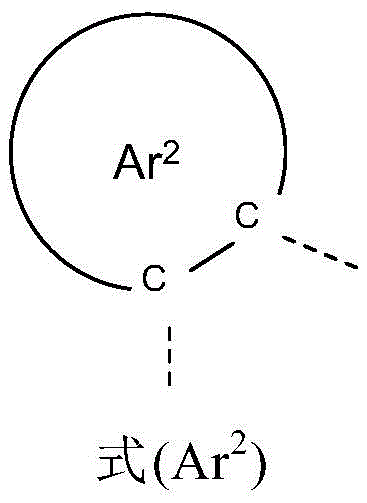
Wherein Ar is2Selected from the group consisting of those having 6 to 40 aromatic ring atoms and substituted by R3An aromatic ring system substituted with a group, said aromatic ring system comprising C-C units, and having 5 to 40 aromatic ring atoms and being substituted by R3A group-substituted heteroaromatic ring system comprising C-C units, wherein the dotted line is the bond connecting the Z-Z unit to the remainder of the formula.
Ar2Preferably selected from the group consisting of benzene, pyridine, pyrimidine, pyridazine, pyrazine, naphthalene, thiophene, furan, pyrrole, imidazole, thiazole, and, Oxazole, benzothiophene, benzofuran, indole, and indane, each of which is substituted with R3Is substituted and includes the formula (Ar)2) C-C units of (1). More preferably, Ar2Selected from the group consisting of benzene, thiophene, furan, benzothiophene and benzofuran, more preferably benzene, which is in each case substituted by R3Is substituted and includes the formula (Ar)2) C-C units of (1).
Preferably, Y adjacent to the nitrogen atom in formula (I) is CR1And the other Y is N. In another equally preferred embodiment, both Y groups are CR1。
R1Preferably identical or different in each case and selected from: h, D, F, CN, Si (R)5)3,N(R5)2A linear alkyl or alkoxy radical having from 1 to 20 carbon atoms, a branched or cyclic alkyl or alkoxy radical having from 3 to 20 carbon atoms, an aromatic ring system having from 6 to 40 aromatic ring atoms, and a hetero ring having from 5 to 40 aromatic ring atomsAn aromatic ring system; wherein the alkyl and alkoxy radicals mentioned, the aromatic ring systems mentioned and the heteroaromatic ring systems mentioned are each substituted by R5Substituted by groups; and wherein one or more CH of the alkyl or alkoxy groups mentioned2The radicals being optionally substituted by-C.ident.C-, -R5C=CR5-、Si(R5)2、C=O、C=NR5、-NR5-, -O-, -S-, -C (═ O) O-or-C (═ O) NR5-substitution. More preferably, R1In each case identical or different and selected from: h, D, F, CN, a linear alkyl group having 1 to 20 carbon atoms, a branched or cyclic alkyl group having 3 to 20 carbon atoms, an aromatic ring system having 6 to 40 aromatic ring atoms, and a heteroaromatic ring system having 5 to 40 aromatic ring atoms; wherein said alkyl group, said aromatic ring system and said heteroaromatic ring system are each independently substituted with R5And (4) substituting the group. Very preferably, R1In each case identical or different and selected from: h, N (R)5)2An aromatic ring system having 6 to 40 aromatic ring atoms, and a heteroaromatic ring system having 5 to 40 aromatic ring atoms; wherein the aromatic ring system mentioned and the heteroaromatic ring system mentioned are each independently of the other R5And (4) substituting the group.
Is preferred as R1Aromatic and heteroaromatic ring systems of radicals and N (R)5)2The group is selected from the following groups:

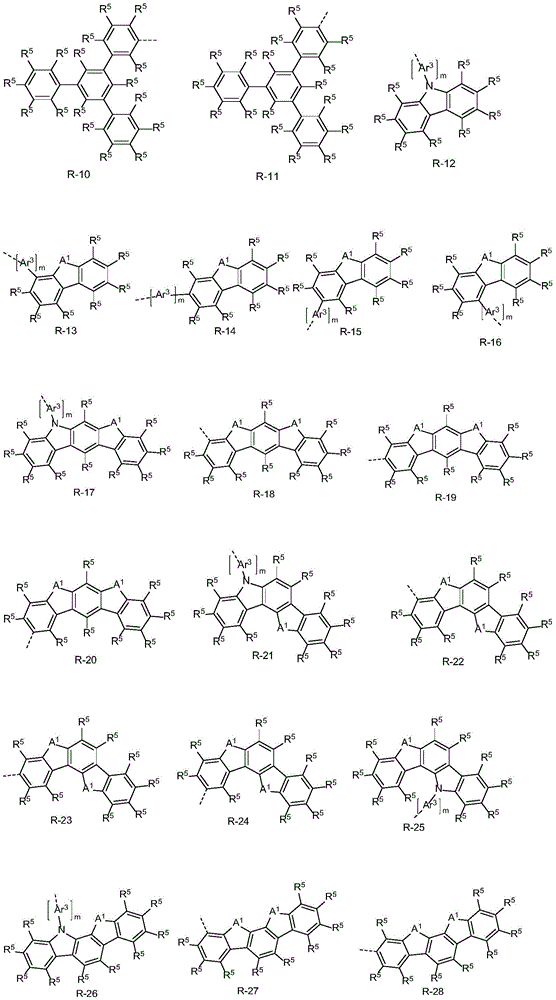

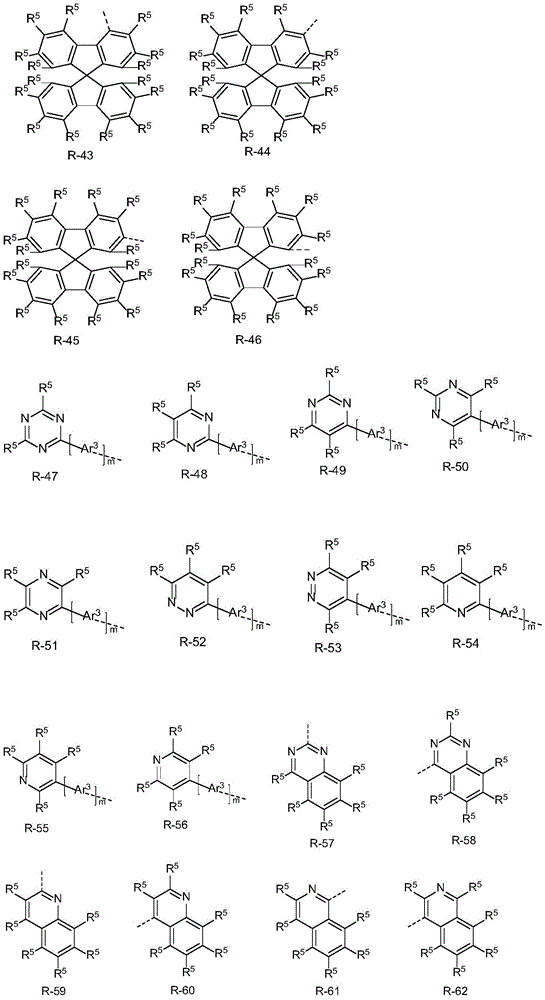

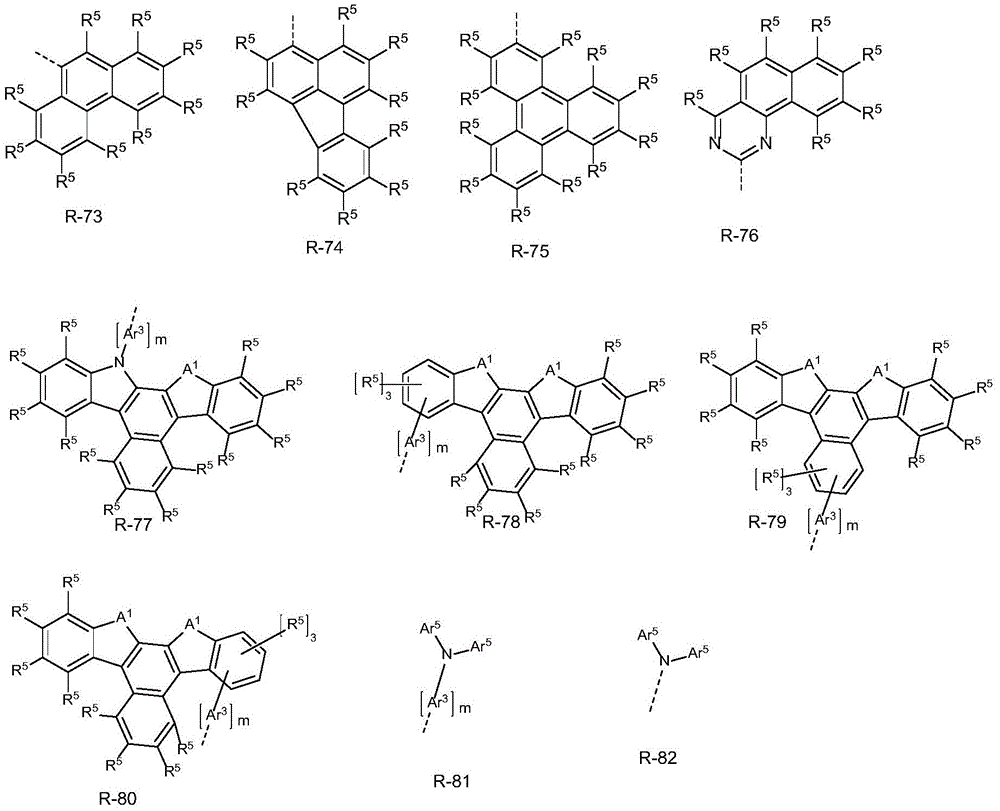
wherein R is5With the definitions given above, the dashed bonds represent the bonds connected to the basic skeleton of formula (I), in addition:
Ar3preferably identical or different on each occurrence and having from 6 to 12 aromatic ring atoms and in each case represented by R5A divalent aromatic or heteroaromatic ring system substituted with a group;
Ar5preferably identical or different on each occurrence and having from 6 to 40 aromatic ring atoms and are substituted by R6An aromatic ring system substituted by a group, or an aromatic ring system having 6 to 40 aromatic ring atoms and substituted by R6A group-substituted heteroaromatic ring system;
A1preferably identical or different in each case and is C (R)5)2、NR5O or S; of these, in the formulae (R-78) to (R-80), preference is given to one A in each case1Is NR5And the other A1Is S;
k is 0 or 1, wherein k-0 means that there is no A at this position1Radical bonding, alternatively, R5The groups are bonded to the corresponding carbon atoms;
m is 0 or 1, wherein m ═ 0 means Ar3The radicals are absent and the corresponding aromatic or heteroaromatic radicals are bonded directly to the basic skeleton of the formula (I).
Formula (I) preferably includes at least one element selected from N (R)5)2Having 6 to 40 aromatic ring atoms and substituted by R5An aromatic ring system substituted by a radical and having 5 to 40 aromatic ring atoms and being substituted by R5R of a group-substituted heteroaromatic ring system1A group. More preferably, formula (I) comprises at least one group selected from the above-mentioned R-1 to R-82 groupsR1A group.
R2Preferably identical or different in each case and selected from: h, D, F, CN, Si (R)5)3,N(R5)2A linear alkyl or alkoxy group having 1 to 20 carbon atoms, a branched or cyclic alkyl or alkoxy group having 3 to 20 carbon atoms, an aromatic ring system having 6 to 40 aromatic ring atoms, and a heteroaromatic ring system having 5 to 40 aromatic ring atoms; wherein the alkyl and alkoxy radicals mentioned, the aromatic ring systems mentioned and the heteroaromatic ring systems mentioned are each substituted by R5Substituted by groups; and wherein one or more CH of the alkyl or alkoxy groups mentioned2The radicals being optionally substituted by-C.ident.C-, -R5C=CR5-、Si(R5)2、C=O、C=NR5、-NR5-, -O-, -S-, -C (═ O) O-or-C (═ O) NR5-substitution. More preferably, R2In each case identical or different and selected from: h, F, CN, a linear alkyl group having 1 to 20 carbon atoms, a branched or cyclic alkyl group having 3 to 20 carbon atoms, an aromatic ring system having 6 to 40 aromatic ring atoms, and a heteroaromatic ring system having 5 to 40 aromatic ring atoms; wherein said alkyl group, said aromatic ring system and said heteroaromatic ring system are each independently substituted with R5And (4) substituting the group. Very preferably, R2In each case identical or different and selected from: h, N (R)5)2An aromatic ring system having 6 to 40 aromatic ring atoms, and a heteroaromatic ring system having 5 to 40 aromatic ring atoms; wherein the aromatic ring system mentioned and the heteroaromatic ring system mentioned are each independently of the other R5And (4) substituting the group. Is preferred as R2Aromatic and heteroaromatic ring systems of radicals and N (R)5)2Selected from the above R-1 to R-82 groups.
Formula (I) preferably includes at least one element selected from N (R)5)2Having 6 to 40 aromatic ring atoms and substituted by R5An aromatic ring system substituted by a radical and having 5 to 40 aromatic ring atoms and being substituted by R5R of a group-substituted heteroaromatic ring system2A group. More preferably, formula (I) comprises at least one member selected fromR of the above-mentioned R-1 to R-82 groups2A group.
R3Preferably identical or different in each case and selected from: h, D, F, CN, Si (R)5)3,N(R5)2A linear alkyl or alkoxy group having 1 to 20 carbon atoms, a branched or cyclic alkyl or alkoxy group having 3 to 20 carbon atoms, an aromatic ring system having 6 to 40 aromatic ring atoms, and a heteroaromatic ring system having 5 to 40 aromatic ring atoms; wherein the alkyl and alkoxy radicals mentioned, the aromatic ring systems mentioned and the heteroaromatic ring systems mentioned are each substituted by R5Substituted by groups; and wherein one or more CH of the alkyl or alkoxy groups mentioned2The radicals being optionally substituted by-C.ident.C-, -R5C=CR5-、Si(R5)2、C=O、C=NR5、-NR5-, -O-, -S-, -C (═ O) O-or-C (═ O) NR5-substitution. More preferably, R3In each case identical or different and selected from: h, F, CN, a linear alkyl group having 1 to 20 carbon atoms, a branched or cyclic alkyl group having 3 to 20 carbon atoms, an aromatic ring system having 6 to 40 aromatic ring atoms, and a heteroaromatic ring system having 5 to 40 aromatic ring atoms; wherein said alkyl group, said aromatic ring system and said heteroaromatic ring system are each independently substituted with R5And (4) substituting the group. Very preferably, R3In each case identical or different and selected from: h, N (R)5)2An aromatic ring system having 6 to 40 aromatic ring atoms, and a heteroaromatic ring system having 5 to 40 aromatic ring atoms; wherein the aromatic ring system mentioned and the heteroaromatic ring system mentioned are each independently of the other R5And (4) substituting the group. Is preferred as R3Aromatic and heteroaromatic ring systems of radicals and N (R)5)2Selected from the above R-1 to R-82 groups.
Formula (I) preferably includes at least one element selected from N (R)5)2Having 6 to 40 aromatic ring atoms and substituted by R5An aromatic ring system substituted by a radical and having 5 to 40 aromatic ring atoms and being substituted by R5R of a group-substituted heteroaromatic ring system3A group. More preferably, formula (A)I) Including at least one R selected from the group consisting of the above-mentioned R-1 to R-82 groups3A group.
R4Preferably identical or different in each case and selected from: h, D, F, CN, Si (R)5)3,N(R5)2A linear alkyl or alkoxy group having 1 to 20 carbon atoms, a branched or cyclic alkyl or alkoxy group having 3 to 20 carbon atoms, an aromatic ring system having 6 to 40 aromatic ring atoms, and a heteroaromatic ring system having 5 to 40 aromatic ring atoms; wherein the alkyl and alkoxy radicals mentioned, the aromatic ring systems mentioned and the heteroaromatic ring systems mentioned are each substituted by R5Substituted by groups; and wherein one or more CH of the alkyl or alkoxy groups mentioned2The radicals being optionally substituted by-C.ident.C-, -R5C=CR5-、Si(R5)2、C=O、C=NR5、-NR5-, -O-, -S-, -C (═ O) O-or-C (═ O) NR5-substitution. More preferably, R4Preferably identical or different in each case and selected from: h, F, CN, a linear alkyl group having 1 to 20 carbon atoms, a branched or cyclic alkyl group having 3 to 20 carbon atoms, an aromatic ring system having 6 to 40 aromatic ring atoms, and a heteroaromatic ring system having 5 to 40 aromatic ring atoms; wherein said alkyl group, said aromatic ring system and said heteroaromatic ring system are each independently substituted with R5And (4) substituting the group. Very preferably, R4In each case identical or different and selected from: h, N (R)5)2An aromatic ring system having 6 to 40 aromatic ring atoms, and a heteroaromatic ring system having 5 to 40 aromatic ring atoms; wherein the aromatic ring system mentioned and the heteroaromatic ring system mentioned are each independently of the other R5And (4) substituting the group. Is preferred as R4Aromatic and heteroaromatic ring systems of radicals and N (R)5)2Selected from the above R-1 to R-82 groups.
Preferably, in formula (I),
a) at least one is selected from R1、R2、R3And R4The radicals in the radical being selected from the group consisting of those having 7 to 40 aromatic ring atoms and each being substituted by R5Aryl radicals substituted by radicalsA group ring system; and having 5 to 40 aromatic ring atoms and each being substituted by R5A group-substituted heteroaromatic ring system; alternatively, in the formula (I),
b) at least two are selected from R1、R2、R3And R4The radicals in the radical being selected from those having 6 to 40 aromatic ring atoms and each being substituted by R5A group-substituted aromatic ring system; and having 5 to 40 aromatic ring atoms and each being substituted by R5A group-substituted heteroaromatic ring system.
Preferably, in formula (I), at least one is selected from R1、R2、R3And R4The radicals in the radical being selected from the group consisting of those having 7 to 40 aromatic ring atoms and each being substituted by R5A group-substituted aromatic ring system; and having 5 to 40 aromatic ring atoms and each being substituted by R5A group-substituted heteroaromatic ring system. More preferably, in formula (I), at least one is selected from R1、R2And R3The radicals in the radical being selected from the group consisting of those having 7 to 40 aromatic ring atoms and each being substituted by R5A group-substituted aromatic ring system; and having 5 to 40 aromatic ring atoms and each being substituted by R5A group-substituted heteroaromatic ring system. More preferably, at least one of formula (I) is selected from R1、R2And R3The radicals in the group are selected from the groups R-1 to R-81 as defined above. Most preferably, at least one of formula (I) is selected from R1And R2The radicals in the group are selected from the groups R-1 to R-81 as defined above.
Preferably, R5In each case identical or different and selected from: h, D, F, CN, Si (R)6)3,N(R6)2A linear alkyl or alkoxy group having 1 to 20 carbon atoms, a branched or cyclic alkyl or alkoxy group having 3 to 20 carbon atoms, an aromatic ring system having 6 to 40 aromatic ring atoms, and a heteroaromatic ring system having 5 to 40 aromatic ring atoms; wherein the alkyl and alkoxy radicals mentioned, the aromatic ring systems mentioned and the heteroaromatic ring systems mentioned are each substituted by R6Substituted by groups; and wherein one or more CH of the alkyl or alkoxy groups mentioned2The radicals canby-C.ident.C-, -R6C=CR6-、Si(R6)2、C=O、C=NR6、-NR6-, -O-, -S-, -C (═ O) O-or-C (═ O) NR6-substitution.
The compound of the formula (I) preferably corresponds to the formula (I-A)

Wherein T is O or S;
wherein Ar is2Selected from the group consisting of those having 6 to 40 aromatic ring atoms and substituted by R3An aromatic ring system substituted with a group, said aromatic ring system comprising C-C units, and having 5 to 40 aromatic ring atoms and being substituted by R3A group-substituted heteroaromatic ring system comprising C-C units and wherein the other variables are as defined above for formula (I),
wherein, when Y is CR1Then, the following two aspects are taken together
a) At least one is selected from R1、R2、R3And R4The radicals in the radical being selected from the group consisting of those having 7 to 40 aromatic ring atoms and each being substituted by R5A group-substituted aromatic ring system; and having 5 to 40 aromatic ring atoms and each being substituted by R5A group-substituted heteroaromatic ring system; or
b) At least two are selected from R1、R2、R3And R4The radicals in the radical being selected from those having 6 to 40 aromatic ring atoms and each being substituted by R5A group-substituted aromatic ring system; and having 5 to 40 aromatic ring atoms and each being substituted by R5A group-substituted heteroaromatic ring system.
Preferably, in formula (I-A), Y is N. It is also preferred that T is O. In addition, the preferred embodiments described above with respect to the variables specified for formula (I) also apply to formula (I-A).
Preferably, the compound of formula (I-A) corresponds to one of formulae (I-A-1) to (I-A-3)

Wherein R is1-1、R2-1And R3-1Selected from the group consisting of those having 7 to 40 aromatic ring atoms and each of which is R5A group-substituted aromatic ring system; and having 5 to 40 aromatic ring atoms and each being substituted by R5A group-substituted heteroaromatic ring system and is preferably selected from one of the groups R-1 to R-81.
The compound of formula (I) preferably corresponds to one of the formulae (I-1) to (I-8)

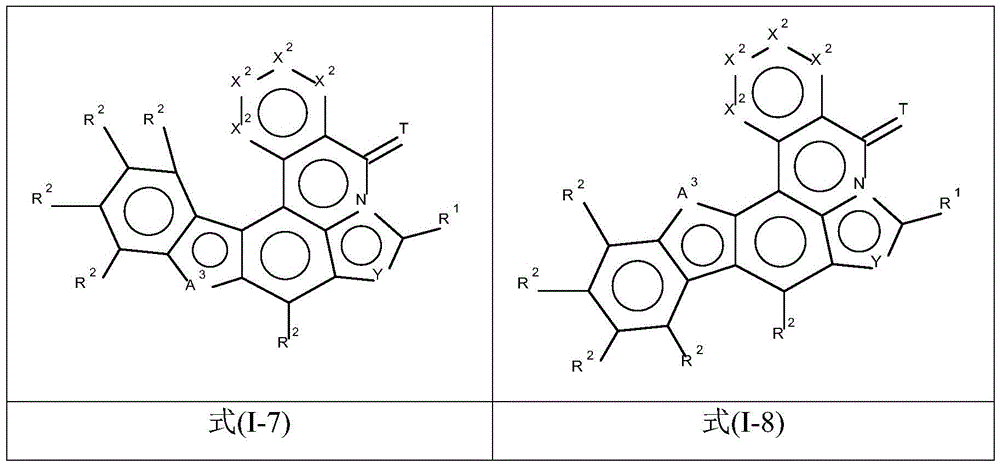
Wherein A is2Is C (R)3)2、NR3O or S; and wherein A3Is C (R)2)2,NR2O or S, and wherein X1In each case identical or different and selected from N and CR2And is preferably CR2And wherein X2In each case identical or different and selected from N and CR3And is preferably CR3And wherein the other variables are as defined above; and wherein when Y is CR1The two factors are one
a) At least one is selected from R1、R2、R3And R4The radicals in the radical being selected from the group consisting of those having 7 to 40 aromatic ring atoms and each being substituted by R5A group-substituted aromatic ring system; and having 5 to 40 aromatic ring atoms and each being substituted by R5A group-substituted heteroaromatic ring system; or
b) At least two are selected from R1、R2、R3And R4The radicals in the radical being selected from those having 6 to 40 aromatic ring atoms and each being substituted by R5A group-substituted aromatic ring system; and having 5 to 40 aromatic ring atoms and each being substituted by R5A group-substituted heteroaromatic ring system.
It is also preferred for the above formula that T is O and Y is N.
Among the above-mentioned formulae, preferred are the formulae (I-1), (I-7) and (I-8), wherein X is preferred among these formulae1Is CR2、X2Is CR3Y is N and T is O. Most preferred is formula (I-1), wherein X is preferred in this formula1Is CR2、X2Is CR3Y is N and T is O.
Preferably, in the formulae (I-1) to (I-8), at least one is selected from R1、R2And R3The radicals in the radical being selected from the group consisting of those having 7 to 40 aromatic ring atoms and each being substituted by R5An aromatic ring system substituted by radicals and having 5 to 40 aromatic ring atoms each of which is substituted by R5A group-substituted heteroaromatic ring system. More preferably, in the formulae (I-1) to (I-8), at least one is selected from R1、R2And R3The radicals in the group are selected from the groups R-1 to R-81 as defined above. More preferably, in the formulae (I-1) to (I-8), at least one is selected from R1And R2The radicals in the group are selected from the groups R-1 to R-81 as defined above.
Preferred variants of formulae (I-1), (I-7) and (I-8) are of the formula:
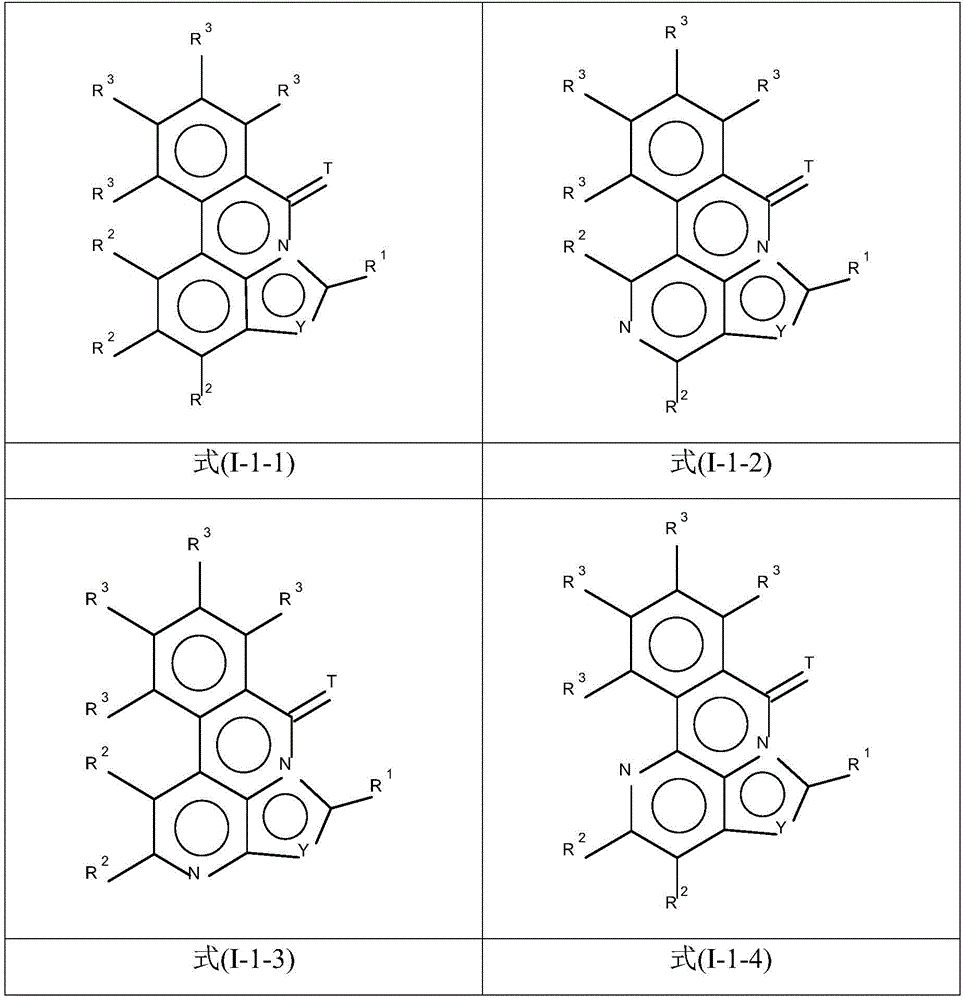

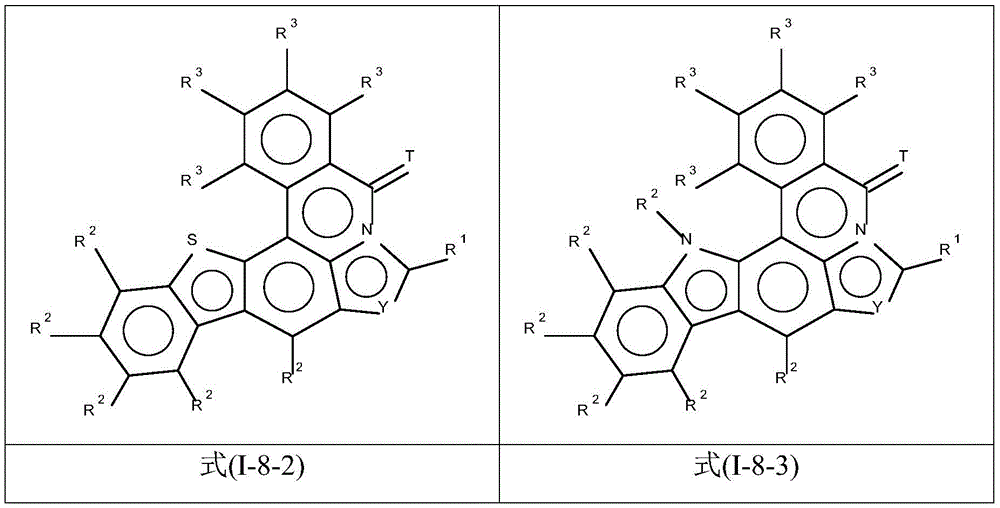
wherein the variables are as defined above, and wherein T is preferably O and Y is preferably N, and wherein when Y is CR1Then, the following two aspects are taken together
a) At least one is selected from R1、R2、R3And R4The radicals in the radical being selected from having 7 to 40 aromatic radicalsGroup ring atoms and each is R5A group-substituted aromatic ring system; and having 5 to 40 aromatic ring atoms and each being substituted by R5A group-substituted heteroaromatic ring system; or
b) At least two are selected from R1、R2、R3And R4The radicals in the radical being selected from those having 6 to 40 aromatic ring atoms and each being substituted by R5A group-substituted aromatic ring system; and having 5 to 40 aromatic ring atoms and each being substituted by R5A group-substituted heteroaromatic ring system.
Preferably, in the abovementioned formulae, in each case at least one is selected from R1、R2And R3The radicals in the radical being selected from the group consisting of those having 7 to 40 aromatic ring atoms and each being substituted by R5A group-substituted aromatic ring system; and having 5 to 40 aromatic ring atoms and each being substituted by R5A group-substituted heteroaromatic ring system. More preferably, in the above formula, at least one is selected from R1、R2And R3The radicals in the group are selected from the groups R-1 to R-81 as defined above. More preferably, in the above formula, at least one is selected from R1And R2The radicals in the group are selected from the groups R-1 to R-81 as defined above.
Among the above-mentioned formulae, the most preferred is formula (I-1-1).
Preferably, the variant of formula (I-1-1) corresponds to the following formula:
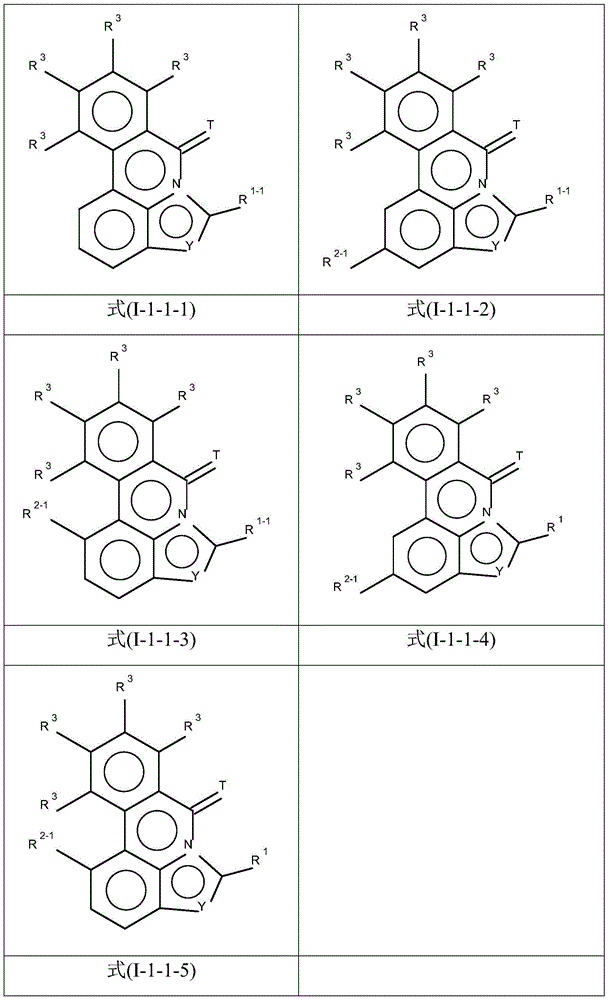
wherein R is1-1And R2-1Selected from the group consisting of those having 7 to 40 aromatic ring atoms and each of which is R5A group-substituted aromatic ring system; and having 5 to 40 aromatic ring atoms and each being substituted by R5A group-substituted heteroaromatic ring system and is preferably selected from one of the radicals R-1 to R-81, and wherein the other variables are as defined above and preferably correspond to their preferred embodiments. Particularly preferably, in the above formula, T is O and Y is N.
Preferred compounds of formula (I) are shown in the following table:
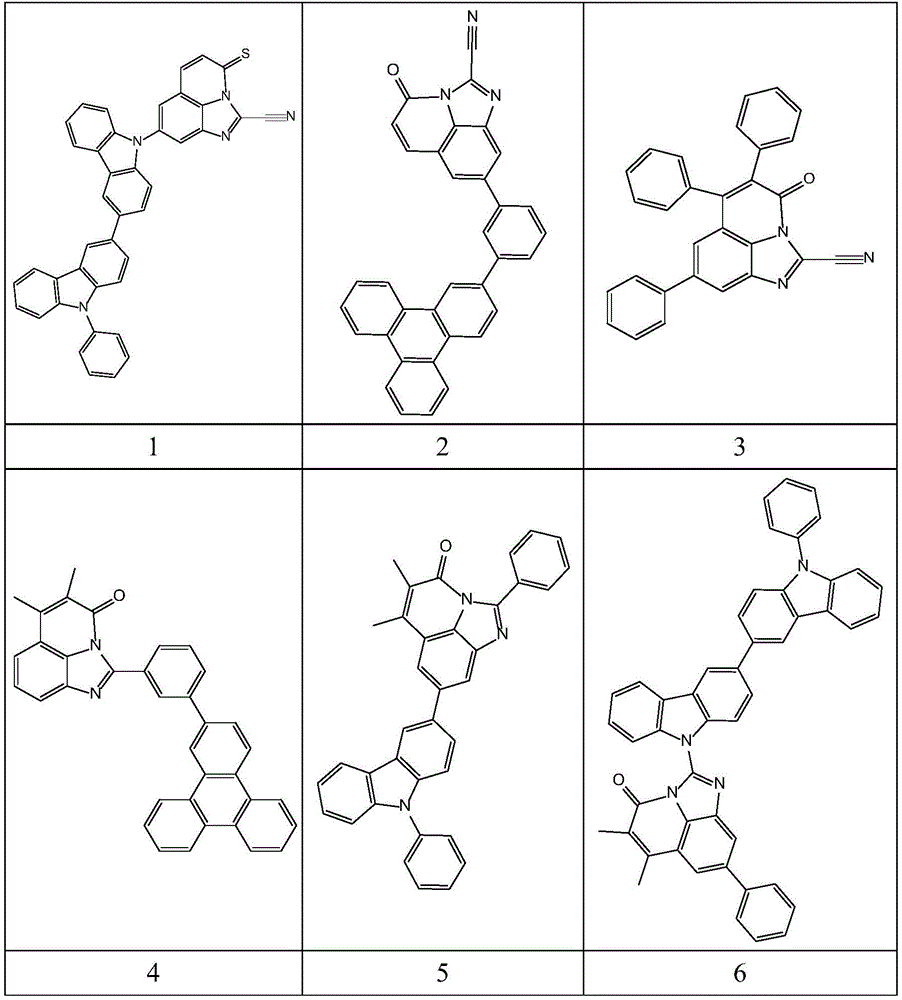
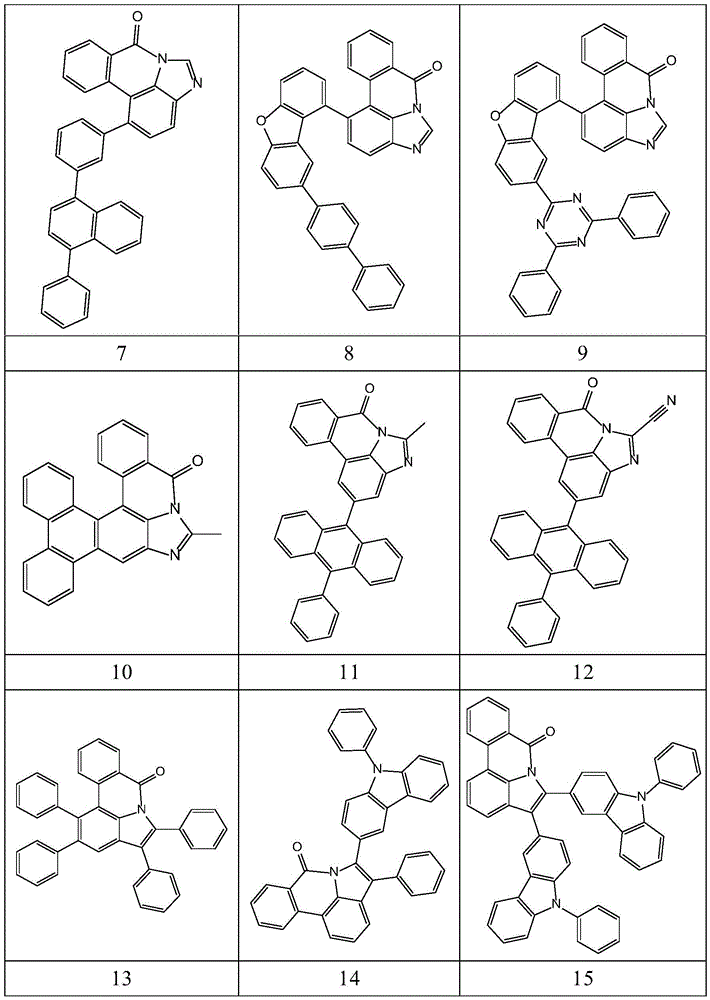
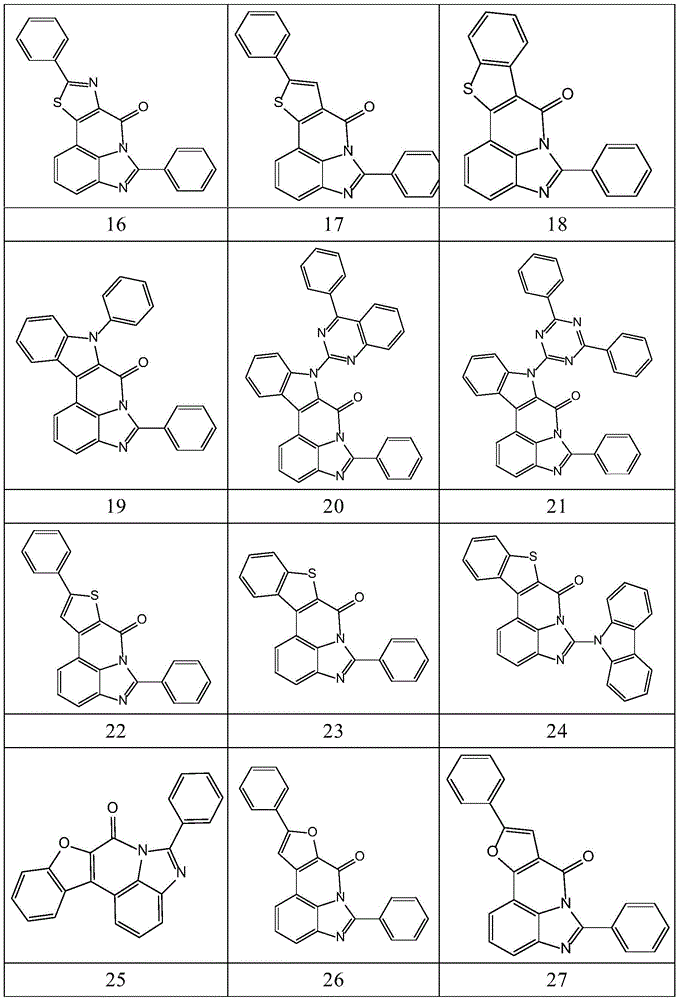
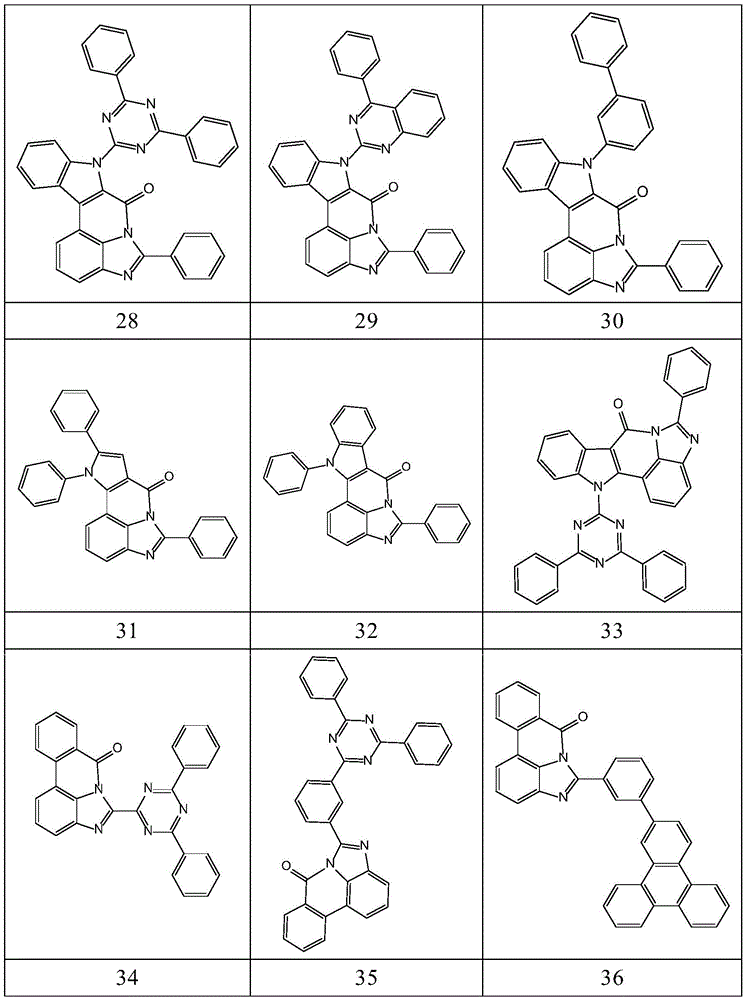
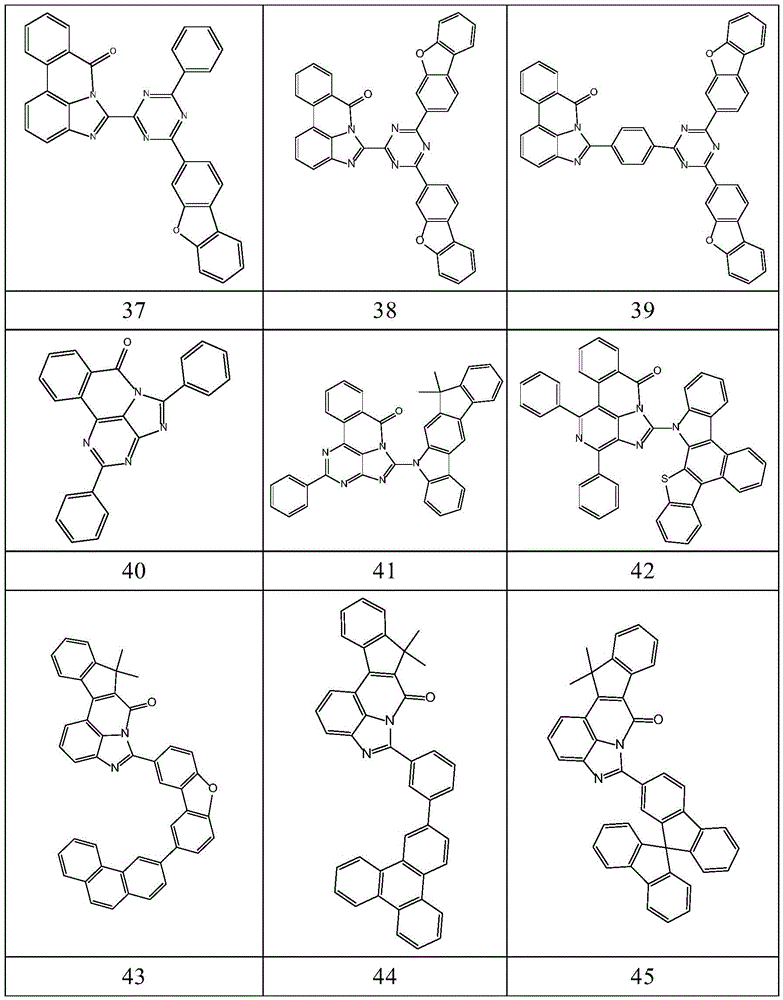
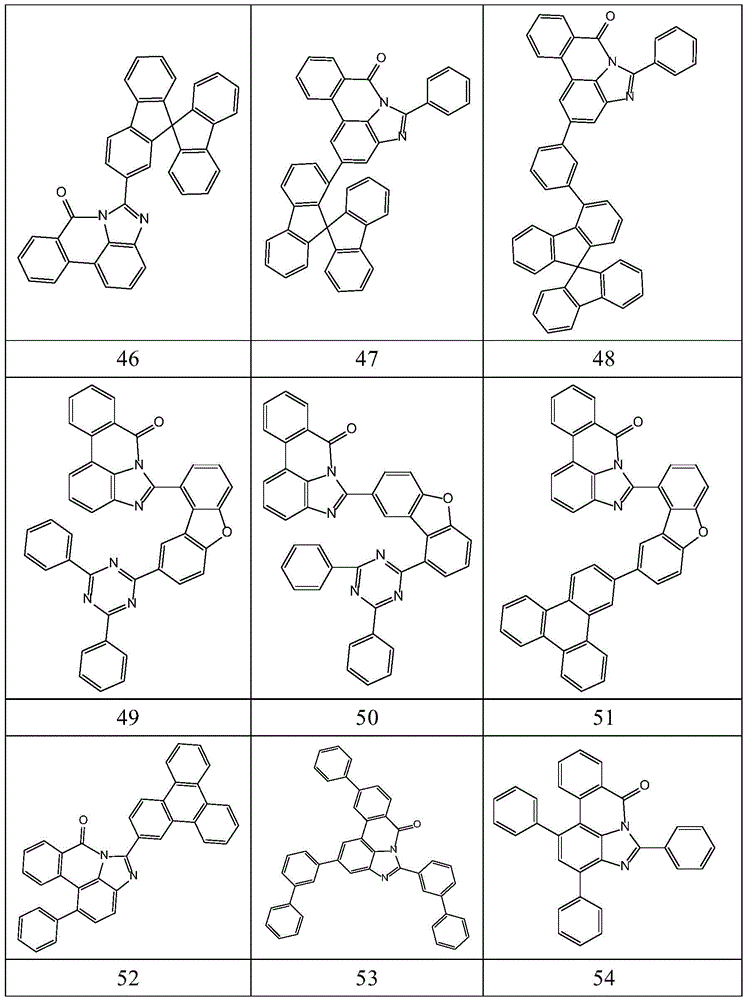

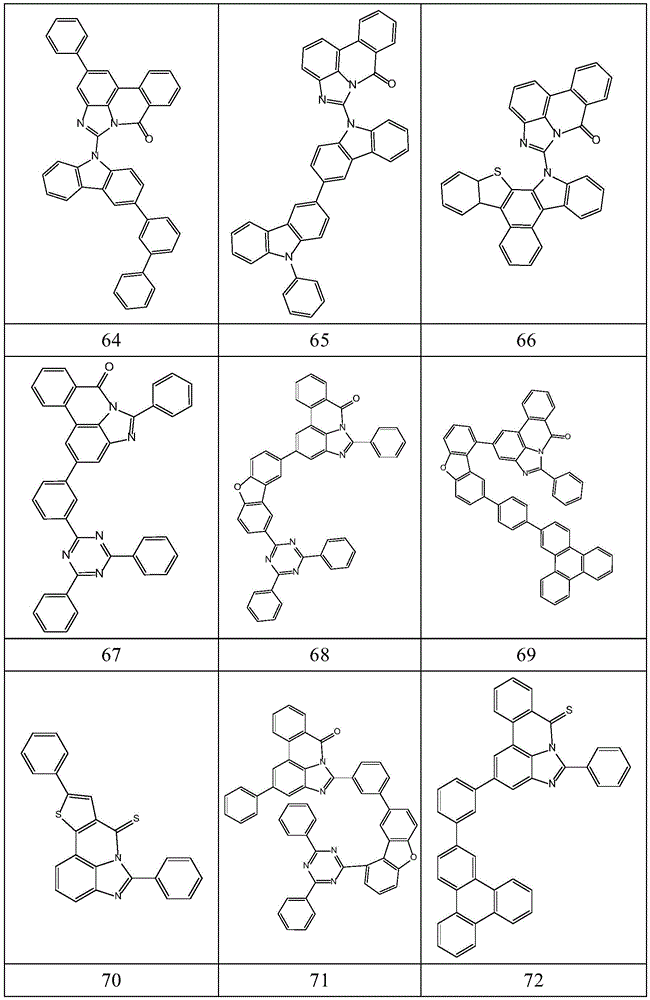
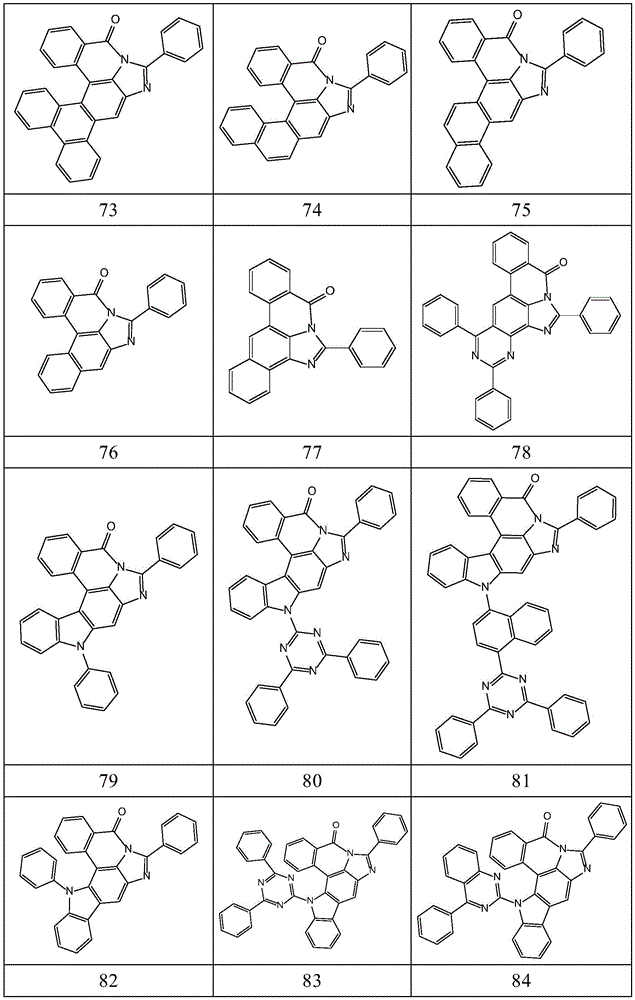

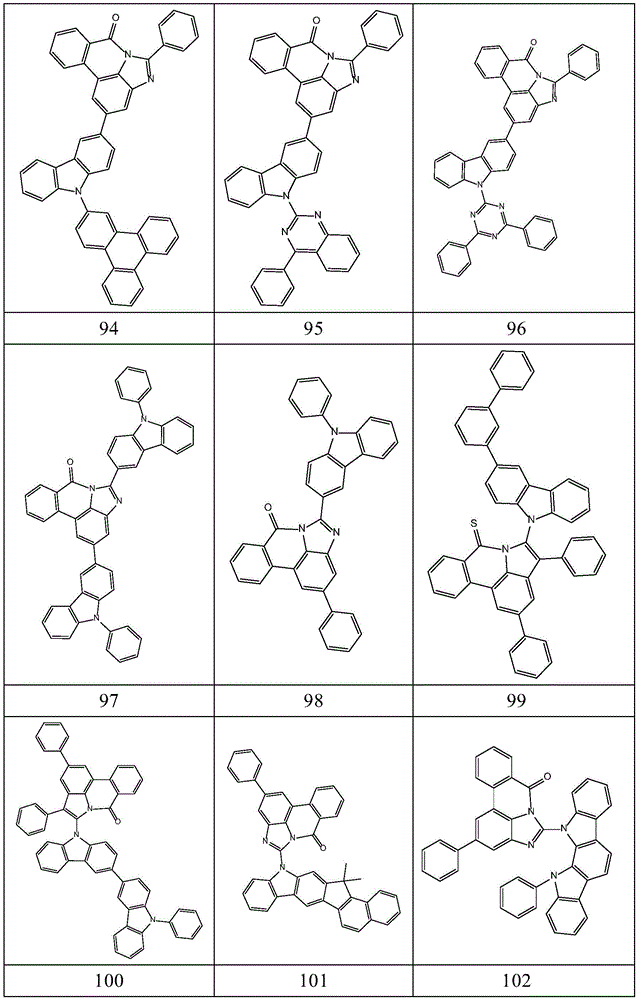

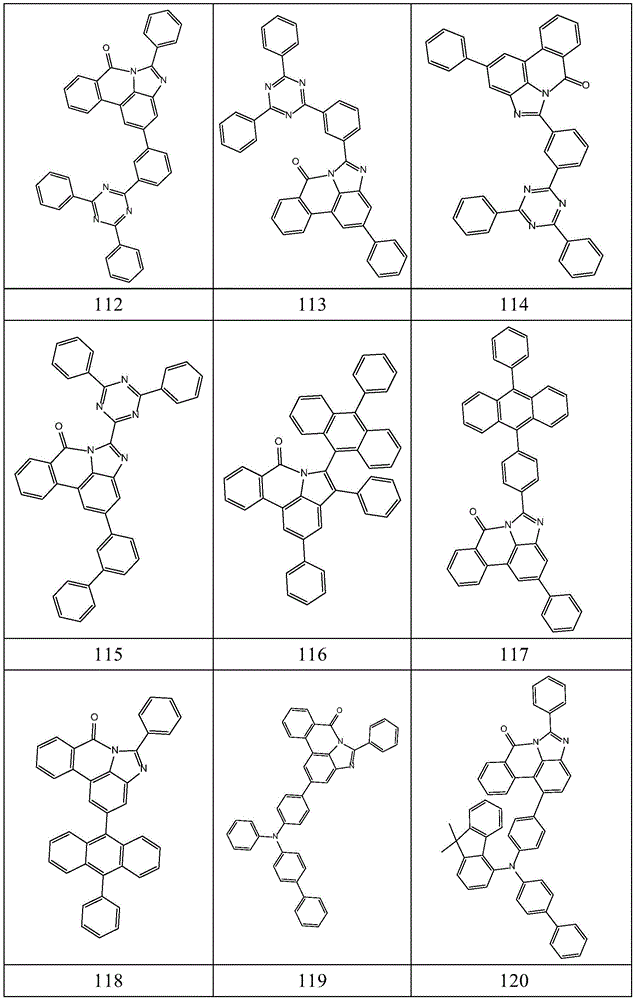


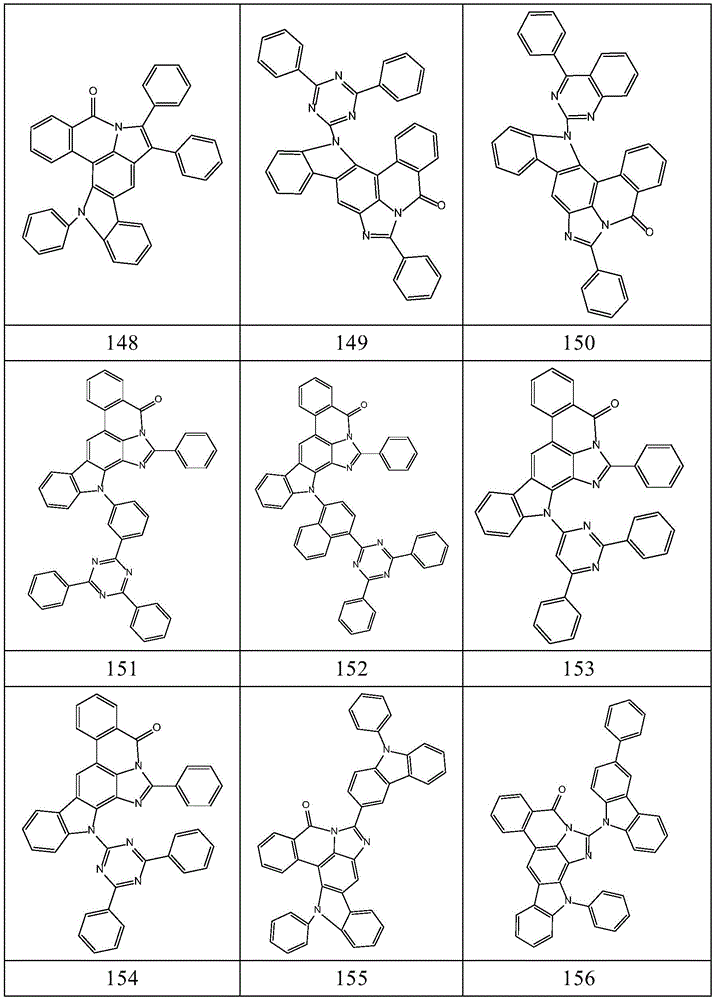


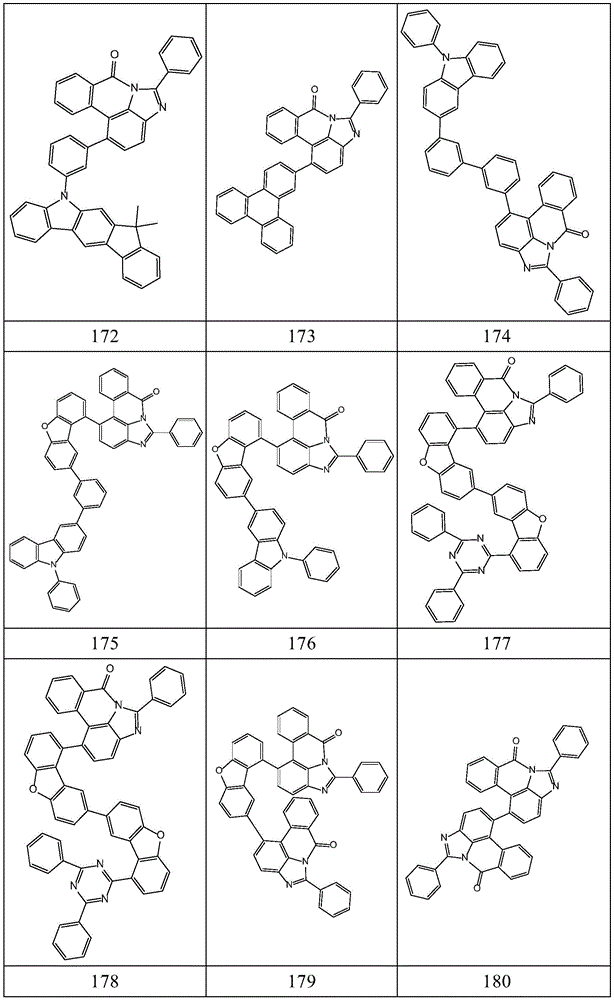

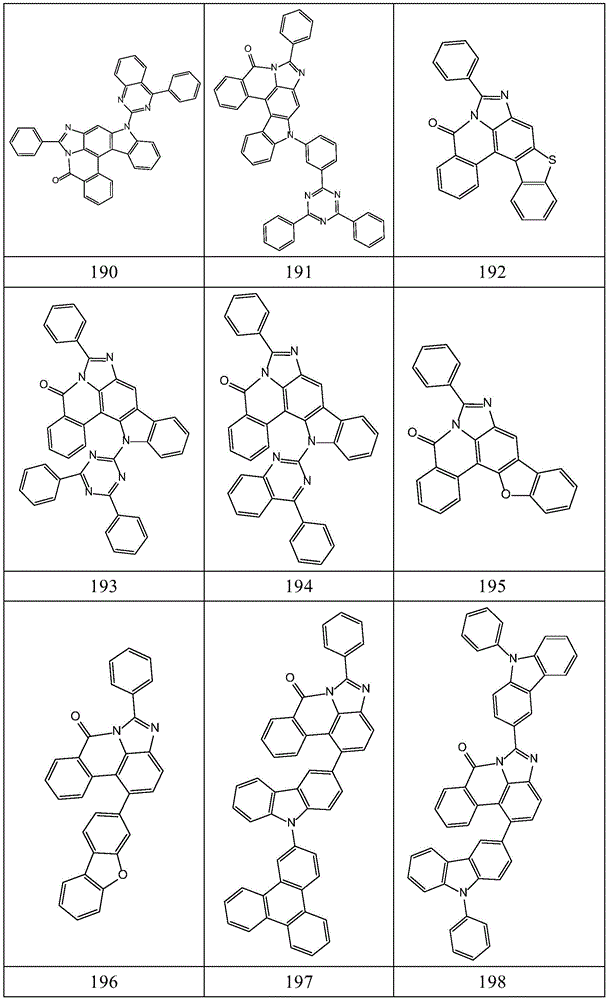

the compounds of formula (I) may be prepared by known synthetic procedures of organic chemistry such as bromination, Suzuki coupling and Hartwig-Buchwald coupling. Some preferred synthetic methods are exemplified below. These methods may be modified by the person skilled in the art within the scope of his general knowledge and should not be read in a limiting manner.
As shown in scheme 1, compounds of formula (E-1) can be reacted with aryl groups in a Suzuki coupling. This step is optional. In a subsequent step, the NH group in the heteroaromatic ring of the compound is reacted with an aromatic compound having a halogen atom at the benzyl position. Subsequently, a ring-closure reaction was performed under Pd catalysis, and then the methylene group was oxidized to a carbonyl group with an oxidizing agent. Subsequently, a halogenation reaction, preferably a bromination reaction, may optionally be carried out, followed by a coupling reaction, preferably a Suzuki or Hartwig-Buchwald coupling.
Scheme 1

Y is N or CR
R ═ organic group
Ar ═ aromatic or heteroaromatic ring
V is halogen, preferably Cl, Br or I
As shown in scheme 2, compounds of formula (E-1) can be reacted with aryl groups in a Suzuki coupling. This step is optional. In a subsequent step, the NH group in the heteroaromatic ring of the compound is reacted with an aryl or heteroaryl substituted acid halide. Subsequently, a ring closure reaction is carried out, preferably with tributyltin hydride (Bu)3SnH) or Pd (PPh)3)4By addition of a base such as potassium acetate. This may optionally be followed by a halogenation reactionPreferably, this is bromination, followed by a coupling reaction, preferably a Suzuki or Hartwig-Buchwald coupling.
Scheme 2

Y is N or CR
R ═ organic group
Ar ═ aromatic or heteroaromatic ring
V is halogen, preferably Cl, Br or I
Compounds of formula (E-3), some of which are commercially available, can be reacted directly with boronic acids in a Suzuki coupling to give compounds in which both Z groups are CR4Is a compound of formula (I) (scheme 3).
Scheme 3

Ar: aromatic or heteroaromatic compounds
V: reactive groups, preferably halogen, more preferably Cl, Br or I
R: organic radical
n:0-10
Thus, the present application provides a process for the preparation of a compound of formula (I), characterized in that: i) reaction of an imidazole or benzimidazole derivative with an aryl or heteroaryl compound having a halogen, preferably Cl, Br or I, at the benzyl position, ii) ring closure reaction under Pd catalysis, and iii) oxidation of the methylene group in the ring formed to a carbonyl group.
Preferably, said aryl or heteroaryl compound having a halogen in the benzyl position has a further halogen substituent directly bonded to the aromatic or heteroaromatic ring, preferably in the ortho position to the group bonded to the halogen atom in the benzyl position.
Preferably, steps i) to iii) are carried out in the indicated order and directly in succession.
The application also provides another process for the preparation of the compound of formula (I)The method is characterized in that: iv) reaction of imidazole or benzimidazole derivatives with aryl or heteroaryl compounds having a carbonyl halide, preferably a carbonyl chloride, bromide or iodide group, and v) ring closure, preferably with tin organic groups or with Pd0The process is carried out.
Preferably, said aryl or heteroaryl compound having a carbonyl halide group has a halogen substituent bonded directly to the aromatic or heteroaromatic ring, preferably in the ortho position to said carbonyl halide group.
Preferably, steps iv) and v) are carried out in the specified order and directly in succession.
In order to process the compounds of the invention from the liquid phase, for example by spin coating or by printing methods, a formulation of the compounds according to the invention is necessary. These formulations may be, for example, solutions, dispersions or emulsions. For this purpose, mixtures of two or more solvents can preferably be used. Suitable and preferred solvents are, for example, toluene, anisole, o-, m-or p-xylene, methyl benzoate, mesitylene, tetralin, o-dimethoxybenzene, THF, methyl-THF, THP, chlorobenzene, diclorobenzene Alkanes, phenoxytoluenes, especially 3-phenoxytoluene, (-) -fenchone, 1,2,3, 5-tetramethylbenzene, 1,2,4, 5-tetramethylbenzene, 1-methylnaphthalene, 2-methylbenzothiazole, 2-phenoxyethanol, 2-pyrrolidone, 3-methylanisole, 4-methylanisole, 3, 4-dimethylanisole, 3, 5-dimethylanisole, acetophenone, α -terpineol, benzothiazole, butyl benzoate, cumene, cyclohexanol, cyclohexanone, cyclohexylbenzene, decalin, dodecylbenzene, ethyl benzoate, indane, NMP, p-cymene, phenetole, 1, 4-diisopropylbenzene, dibenzyl ether, diethylene glycol butyl ether, triethylene glycol butyl ether, diethylene glycol dibutyl ether, triethylene glycol dimethyl ether, diethylene glycol monobutyl ether, tripropylene glycol dimethyl ether, tetraethylene glycol dimethyl ether, 2-isopropylnaphthalene, pentylbenzene, hexylbenzene, heptylbenzene, octylbenzene, 1, 1-bis (3, 4-dimethylphenyl) ethane, 2-methylbiphenyl, 3-methylbiphenyl, 1-methylnaphthalene,1-ethylnaphthalene, ethyl octanoate, diethyl sebacate, octyl octanoate, heptylbenzene, menthyl isovalerate, cyclohexyl hexanoate, or mixtures of these solvents.
Thus, the invention also provides formulations comprising a compound of the invention and at least one other compound. The further compound may be, for example, a solvent, especially one of the above-mentioned solvents or a mixture of these solvents. The further compound may alternatively be at least one further organic or inorganic compound, such as a light-emitting compound and/or a further matrix material, which is also used in the electronic device. Suitable light-emitting compounds and other matrix materials are listed later in connection with the organic electroluminescent device. The other compounds may also be polymeric.
The compounds of the invention are suitable for use in electronic devices, in particular in organic electroluminescent devices.
The invention therefore also provides the use of the compounds according to the invention in electronic devices, in particular in organic electroluminescent devices. The compounds of the invention are defined as follows: a compound of formula (I)

The variables appearing therein are as follows:
a is C-O, C-S, C-NR0、P(=O)R0SO or SO2;
Y is identical or different on each occurrence and is selected from N and CR1;
Ar1Is a compound having 6 to 40 aromatic ring atoms and substituted by R2An aromatic ring system substituted with a group and fused to the remainder of formula (I) via three carbon atoms as shown in formula (I), or having 5 to 40 aromatic ring atoms and being substituted by R2A group-substituted heteroaromatic ring system fused to the remainder of formula (I) via three carbon atoms shown in formula (I);
z is identical or different on each occurrence and is selected from the group consisting of CR4And N, or Z-Z unit is represented by formula (Ar)2) Unit (2) of

Wherein Ar is2Selected from the group consisting of those having 6 to 40 aromatic ring atoms and substituted by R3An aromatic ring system substituted with a group, said aromatic ring system comprising C-C units, and having 5 to 40 aromatic ring atoms and being substituted by R3A group-substituted heteroaromatic ring system comprising C-C units and wherein the dotted line is the bond connecting said Z-Z unit to the remainder of the formula;
R0in each case identical or different and selected from: a linear alkyl or alkoxy group having 1 to 20 carbon atoms, a branched or cyclic alkyl or alkoxy group having 3 to 20 carbon atoms, an alkenyl or alkynyl group having 2 to 20 carbon atoms, an aromatic ring system having 6 to 40 aromatic ring atoms, and a heteroaromatic ring system having 5 to 40 aromatic ring atoms; wherein the alkyl, alkoxy, alkenyl and alkynyl groups mentioned and the aromatic and heteroaromatic ring systems mentioned are each R5Substituted by groups; and wherein one or more CH of the alkyl, alkoxy, alkenyl and alkynyl groups mentioned2The group may be represented by-R5C=CR5-、-C≡C-、Si(R5)2、C=O、C=NR5、-C(=O)O-、-C(=O)NR5-、NR5、P(=O)(R5) -O-, -S-, SO or SO2Replacing;
R1in each case identical or different and selected from: h, D, F, Cl, Br, I, C (═ O) R5,CN,Si(R5)3,N(R5)2,P(=O)(R5)2,OR5,S(=O)R5,S(=O)2R5A linear alkyl or alkoxy group having 1 to 20 carbon atoms, a branched or cyclic alkyl or alkoxy group having 3 to 20 carbon atoms, an alkenyl or alkynyl group having 2 to 20 carbon atoms, an aromatic ring system having 6 to 40 aromatic ring atoms, and an aromatic ring system having 5 to 40 aromatic ring atomsA heteroaromatic ring system of group ring atoms; wherein the alkyl, alkoxy, alkenyl and alkynyl groups mentioned and the aromatic and heteroaromatic ring systems mentioned are each R5Substituted by groups; and wherein one or more CH of the alkyl, alkoxy, alkenyl and alkynyl groups mentioned2The group may be represented by-R5C=CR5-、-C≡C-、Si(R5)2、C=O、C=NR5、-C(=O)O-、-C(=O)NR5-、NR5、P(=O)(R5) -O-, -S-, SO or SO2Replacing;
R2in each case identical or different and selected from: h, D, F, Cl, Br, I, C (═ O) R5,CN,Si(R5)3,N(R5)2,P(=O)(R5)2,OR5,S(=O)R5,S(=O)2R5A linear alkyl or alkoxy group having 1 to 20 carbon atoms, a branched or cyclic alkyl or alkoxy group having 3 to 20 carbon atoms, an alkenyl or alkynyl group having 2 to 20 carbon atoms, an aromatic ring system having 6 to 40 aromatic ring atoms, and a heteroaromatic ring system having 5 to 40 aromatic ring atoms; wherein two or more are selected from R2、R3And R4The groups of (a) may be linked to each other and may form a ring; wherein the alkyl, alkoxy, alkenyl and alkynyl groups mentioned and the aromatic and heteroaromatic ring systems mentioned are each R5Substituted by groups; and wherein one or more CH of the alkyl, alkoxy, alkenyl and alkynyl groups mentioned2The group may be represented by-R5C=CR5-、-C≡C-、Si(R5)2、C=O、C=NR5、-C(=O)O-、-C(=O)NR5-、NR5、P(=O)(R5) -O-, -S-, SO or SO2Replacing;
R3in each case identical or different and selected from: h, D, F, Cl, Br, I, C (═ O) R5,CN,Si(R5)3,N(R5)2,P(=O)(R5)2,OR5,S(=O)R5,S(=O)2R5A linear alkyl or alkoxy group having 1 to 20 carbon atoms, a branched or cyclic alkyl or alkoxy group having 3 to 20 carbon atoms, an alkenyl or alkynyl group having 2 to 20 carbon atoms, an aromatic ring system having 6 to 40 aromatic ring atoms, and a heteroaromatic ring system having 5 to 40 aromatic ring atoms; wherein two or more are selected from R2、R3And R4The groups of (a) may be linked to each other and may form a ring; wherein the alkyl, alkoxy, alkenyl and alkynyl groups mentioned and the aromatic and heteroaromatic ring systems mentioned are each R5Substituted by groups; and wherein one or more CH of the alkyl, alkoxy, alkenyl and alkynyl groups mentioned2The group may be represented by-R5C=CR5-、-C≡C-、Si(R5)2、C=O、C=NR5、-C(=O)O-、-C(=O)NR5-、NR5、P(=O)(R5) -O-, -S-, SO or SO2Replacing;
R4in each case identical or different and selected from: h, D, F, Cl, Br, I, C (═ O) R5,CN,Si(R5)3,N(R5)2,P(=O)(R5)2,OR5,S(=O)R5,S(=O)2R5A linear alkyl or alkoxy group having 1 to 20 carbon atoms, a branched or cyclic alkyl or alkoxy group having 3 to 20 carbon atoms, an alkenyl or alkynyl group having 2 to 20 carbon atoms, an aromatic ring system having 6 to 40 aromatic ring atoms, and a heteroaromatic ring system having 5 to 40 aromatic ring atoms; wherein two or more R2、R3And R4The groups may be linked to each other and may form a ring; wherein the alkyl, alkoxy, alkenyl and alkynyl groups mentioned and the aromatic and heteroaromatic ring systems mentioned are each R5Substituted by groups; and wherein one or more CH of the alkyl, alkoxy, alkenyl and alkynyl groups mentioned2The group may be represented by-R5C=CR5-、-C≡C-、Si(R5)2、C=O、C=NR5、-C(=O)O-、-C(=O)NR5-、NR5、P(=O)(R5) -O-, -S-, SO or SO2Replacing;
R5in each case identical or different and selected from: h, D, F, Cl, Br, I, C (═ O) R6,CN,Si(R6)3,N(R6)2,P(=O)(R6)2,OR6,S(=O)R6,S(=O)2R6A linear alkyl or alkoxy group having 1 to 20 carbon atoms, a branched or cyclic alkyl or alkoxy group having 3 to 20 carbon atoms, an alkenyl or alkynyl group having 2 to 20 carbon atoms, an aromatic ring system having 6 to 40 aromatic ring atoms, and a heteroaromatic ring system having 5 to 40 aromatic ring atoms; wherein two or more R5The groups may be linked to each other and may form a ring; wherein the alkyl, alkoxy, alkenyl and alkynyl groups mentioned and the aromatic and heteroaromatic ring systems mentioned are each R6Substituted by groups; and wherein one or more CH of the alkyl, alkoxy, alkenyl and alkynyl groups mentioned2The group may be represented by-R6C=CR6-、-C≡C-、Si(R6)2、C=O、C=NR6、-C(=O)O-、-C(=O)NR6-、NR6、P(=O)(R6) -O-, -S-, SO or SO2Replacing;
R6in each case identical or different and selected from: h, D, F, Cl, Br, I, CN, alkyl or alkoxy groups having 1 to 20 carbon atoms, alkenyl or alkynyl groups having 2 to 20 carbon atoms, aromatic ring systems having 6 to 40 aromatic ring atoms, and heteroaromatic ring systems having 5 to 40 aromatic ring atoms; wherein two or more R6The groups may be linked to each other and may form a ring; and wherein the alkyl, alkoxy, alkenyl and alkynyl groups, aromatic ring systems and heteroaromatic ring systems mentioned may be substituted by one or more groups selected from F and CN.
The invention furthermore provides an electronic device comprising at least one compound of the formula (I) as defined above.
An electronic device in the context of the present invention is a device comprising at least one layer containing at least one organic compound. The element may also comprise an inorganic material or a layer formed entirely of an inorganic material.
The electronic device is preferably selected from the following: organic electroluminescent devices (OLEDs), organic integrated circuits (O-ICs), organic field effect transistors (O-FETs), organic thin film transistors (O-TFTs), organic light emitting transistors (O-LETs), organic solar cells (O-SCs), dye sensitized organic solar cells (DSSCs), organic optical detectors, organic photoreceptors, organic field quench devices (O-FQDs), light emitting electrochemical cells (LECs), organic laser diodes (O-lasers) and organic plasma light emitting devices, but organic electroluminescent devices (OLEDs) are preferred, phosphorescent OLEDs are more preferred.
The organic electroluminescent device comprises a cathode, an anode and at least one light-emitting layer. In addition to these layers, it may also comprise further layers, for example in each case one or more hole-injecting layers, hole-transporting layers, hole-blocking layers, electron-transporting layers, electron-injecting layers, exciton-blocking layers, electron-blocking layers and/or charge-generating layers. It is likewise possible to introduce an intermediate layer having, for example, an exciton blocking function between the two light-emitting layers. However, it should be noted that each of these layers need not necessarily be present. In this case, the organic electroluminescent device may include one light emitting layer, or it may include a plurality of light emitting layers. If there are a plurality of light-emitting layers, these layers preferably have several light-emission peaks overall between 380nm and 750nm, so that the overall result is a white light emission; in other words, various light-emitting compounds that can emit fluorescence or phosphorescence are used in the light-emitting layer. Particularly preferred are systems with three light-emitting layers, wherein the three layers exhibit blue, green and orange or red light emission. The organic electroluminescent device of the present invention may also be a tandem OLED, especially a white light emitting type OLED.
The compounds of the invention according to the embodiments detailed above can be used in different layers depending on the exact structure. Preferably, the organic electroluminescent device comprises the compound of the formula (1) or of the preferred embodiments described above as a host material for phosphorescent emitters or for emitters which exhibit TADF (thermally excited delayed fluorescence), in particular for phosphorescent emitters, in the light-emitting layer. In this case, the organic electroluminescent device may comprise a light-emitting layer, or it may comprise a plurality of light-emitting layers, at least one of which comprises at least one compound according to the invention as matrix material. In addition, the compounds according to the invention can also be used in electron-transport layers and/or hole-blocking layers and/or hole-transport layers and/or exciton-blocking layers.
When the compounds of the invention are used as matrix materials for phosphorescent compounds in the light-emitting layer, they are preferably used in combination with one or more phosphorescent materials (triplet emitters). Phosphorescence in the context of the present invention is understood to mean light emission from an excited state with a high spin multiplicities, i.e. a spin state >1, in particular from an excited triplet state. In the context of the present application, all luminescent complexes with transition metals or lanthanides, in particular all iridium, platinum and copper complexes, are to be regarded as phosphorescent compounds.
The mixture of the compounds according to the invention and of the luminescent compounds contains between 99% and 1% by volume, preferably between 98% and 10% by volume, more preferably between 97% and 60% by volume and in particular between 95% and 80% by volume of the compounds according to the invention, based on the total mixture of emitter and matrix material. Accordingly, the mixture contains between 1% and 99% by volume, preferably between 2% and 90% by volume, more preferably between 3% and 40% by volume, and especially between 5% and 20% by volume of luminophores, based on the total mixture of luminophores and matrix material.
Another preferred embodiment of the present invention is the use of the compounds according to the invention in combination with other matrix materials as matrix materials for phosphorescent emitters. Suitable matrix materials which can be used in combination with the compounds of the invention are, for example, aromatic ketones, aromatic phosphine oxides, or aromatic sulfoxides or sulfones according to WO 2004/013080, WO 2004/093207, WO 2006/005627 or WO 2010/006680; triarylamines, carbazole derivatives, such as CBP (N, N-biscarbazolylbiphenyl) or carbazole derivatives, disclosed in WO 2005/039246, US 2005/0069729, JP 2004/288381, EP 1205527, WO 2008/086851 or WO 2013/041176; indolocarbazole derivatives, for example according to WO 2007/063754 or WO 2008/056746; indenocarbazole derivatives, for example according to WO 2010/136109, WO 2011/000455, WO 2013/041176 or WO 2013/056776; azacarbazole derivatives, for example according to EP 1617710, EP 1617711, EP 1731584, JP 2005/347160; bipolar matrix materials, for example according to WO 2007/137725; for example silanes according to WO 2005/111172; for example boron nitrogen heterocyclic nuclei or borates according to WO 2006/117052; triazine derivatives, for example according to WO 2007/063754, WO 2008/056746, WO 2010/015306, WO 2011/057706, WO 2011/060859 or WO 2011/060877; zinc complexes, for example according to EP 652273 or WO 2009/062578; for example a silicon-diazacyclo-slow or silicon-tetraazazepine-slow derivative according to WO 2010/054729; for example a phosphorus diazacyclo-slow derivative according to WO 2010/054730; bridged carbazole derivatives, for example according to WO 2011/042107, WO 2011/060867, WO 2011/088877 and WO 2012/143080; for example a terphenyl fork derivative according to WO 2012/048781; for example dibenzofuran derivatives according to WO 2015/169412, WO 2016/015810, WO 2016/023608, WO 2017/148564 or WO 2017/148565. Likewise, it is also possible that a further phosphorescent emitter, which emits at a shorter wavelength than the actual emitter, is present as a co-host in the mixture, or that a compound which does not participate to a significant extent even if it participates in charge transport, for example, as described in WO 2010/108579.
In a preferred embodiment of the invention, the material is used in combination with other matrix materials. Preferred co-host materials, especially when the compounds of the invention are substituted with electron-deficient heteroaromatic ring systems, are selected from biscarbazoles, bridged carbazoles, triarylamines, dibenzofuranyl-carbazole derivatives or dibenzofuranyl-amine derivatives, and carbazoloamines.
Preferred biscarbazoles are of the formulae (21) and (22):
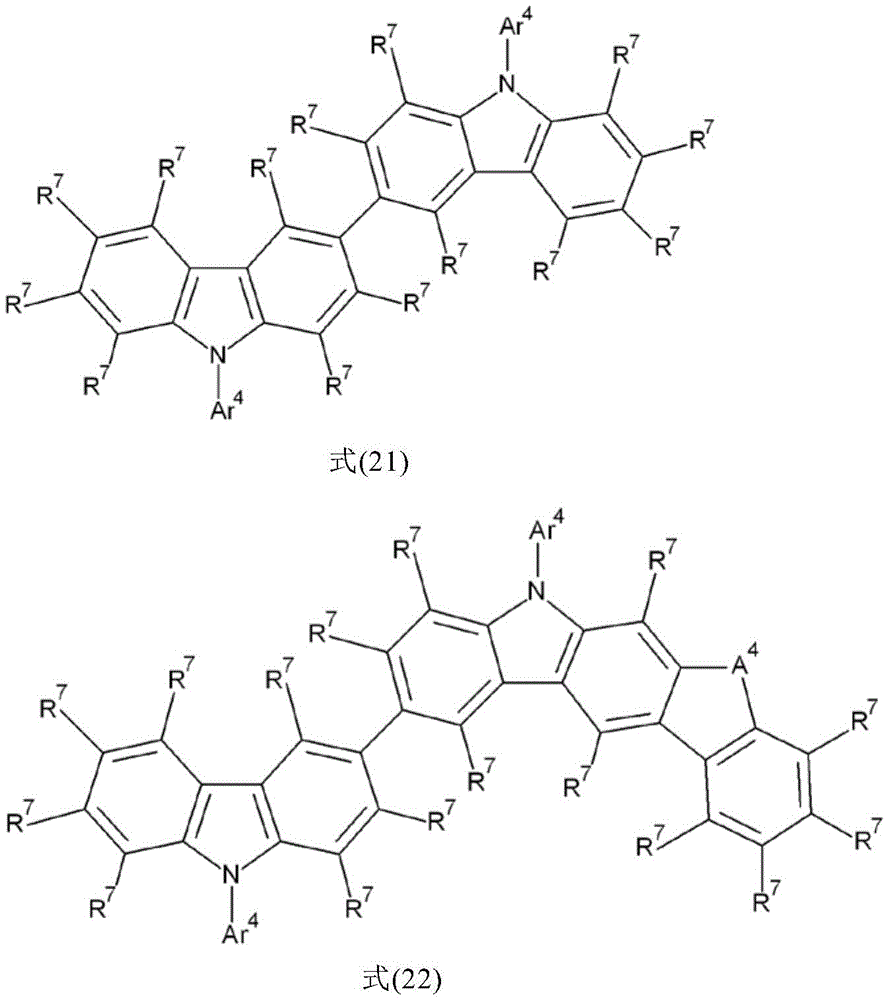
wherein Ar is4In each case the same or different and selected from having 6 to 40Aromatic ring atoms and by R5An aromatic ring system substituted by a group, and a compound having 5 to 40 aromatic ring atoms and substituted by R5A group-substituted heteroaromatic ring system; and is
A4Is selected from C (R)5)2、NR5O or S, and preferably C (R)5)2(ii) a And is
R7In each case identical or different and selected from: h, D, F, Cl, Br, I, C (═ O) R5,CN,Si(R5)3,N(R5)2,P(=O)(R5)2,OR5,S(=O)R5,S(=O)2R5A linear alkyl or alkoxy group having 1 to 20 carbon atoms, a branched or cyclic alkyl or alkoxy group having 3 to 20 carbon atoms, an alkenyl or alkynyl group having 2 to 20 carbon atoms, an aromatic ring system having 6 to 40 aromatic ring atoms, and a heteroaromatic ring system having 5 to 40 aromatic ring atoms; wherein two or more R7The groups may be linked to each other and may form a ring; wherein the alkyl, alkoxy, alkenyl and alkynyl groups mentioned and the aromatic and heteroaromatic ring systems mentioned are each R5Substituted by groups; and wherein one or more CH of the alkyl, alkoxy, alkenyl and alkynyl groups mentioned2The group may be represented by-R5C=CR5-、-C≡C-、Si(R5)2、C=O、C=NR5、-C(=O)O-、-C(=O)NR5-、NR5、P(=O)(R5) -O-, -S-, SO or SO2Replacing; and is
Wherein the other groups are as defined above.
Preferred embodiments of the compounds of formulae (21) and (22) are compounds of formulae (21a) and (22a) below:

wherein the symbols used have the definitions given above.
Examples of suitable compounds of formulae (21) and (22) are the compounds shown below:
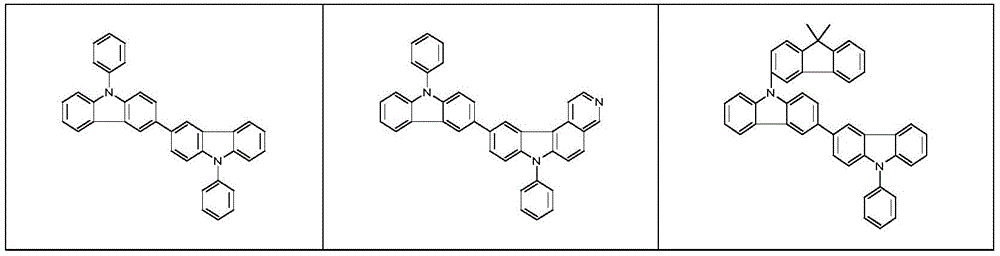


preferred bridged carbazoles are of formula (23):

wherein A is4And R7Has the definition given above, and A4Preferably identical or different in each case and selected from NR5And C (R)5)2。
Preferred dibenzofuran derivatives are compounds of formula (24):

in which oxygen may also be replaced by sulfur to form dibenzothiophenesL is a single bond or has 5 to 30 aromatic ring atoms and is substituted by R5A radical-substituted aromatic or heteroaromatic ring system, and R7And Ar4With the definitions given above. Two Ar's bound to the same nitrogen atom4Radicals, or an Ar bound to the same nitrogen atom4The groups and one L group may be bonded to each other, for example to produce carbazole.
Examples of suitable dibenzofuran derivatives are the compounds shown below.
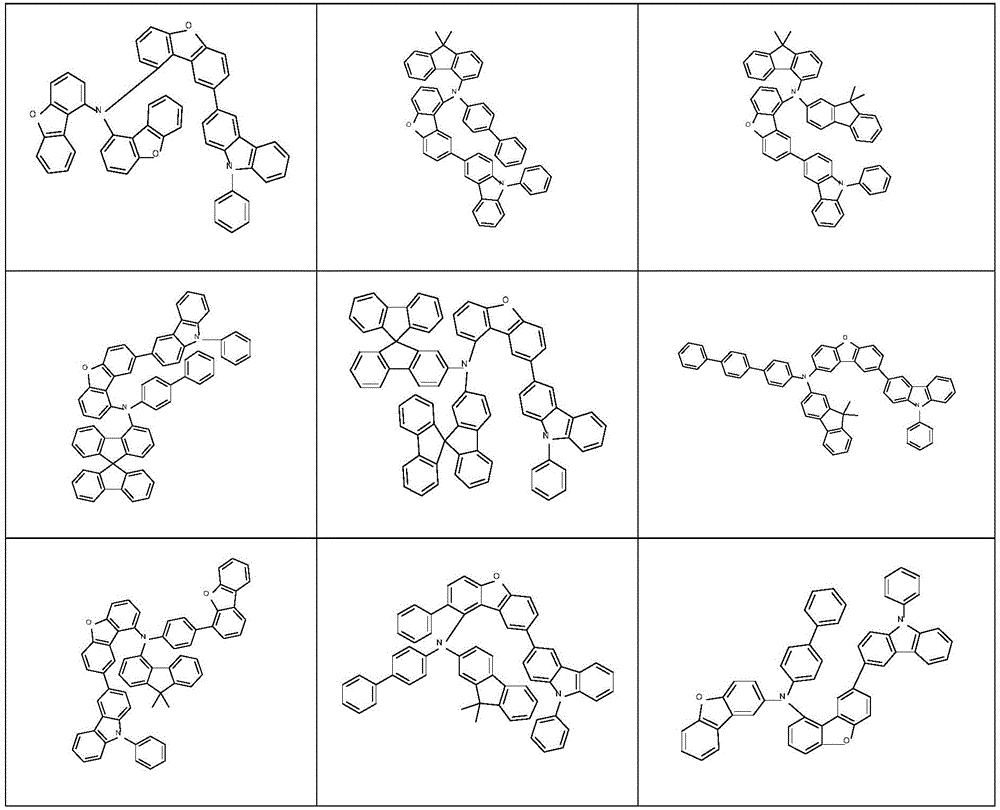

Preferred carbazoloamines are those of the following formulae (25), (26) and (27):

wherein L is a substituted or unsubstituted aromatic ring having 5 to 30 aromatic ring atoms and is substituted by R5A radical-substituted aromatic or heteroaromatic ring system, and R5、R7And Ar4With the definitions given above.
Examples of suitable carbazolomide derivatives are the compounds shown below.
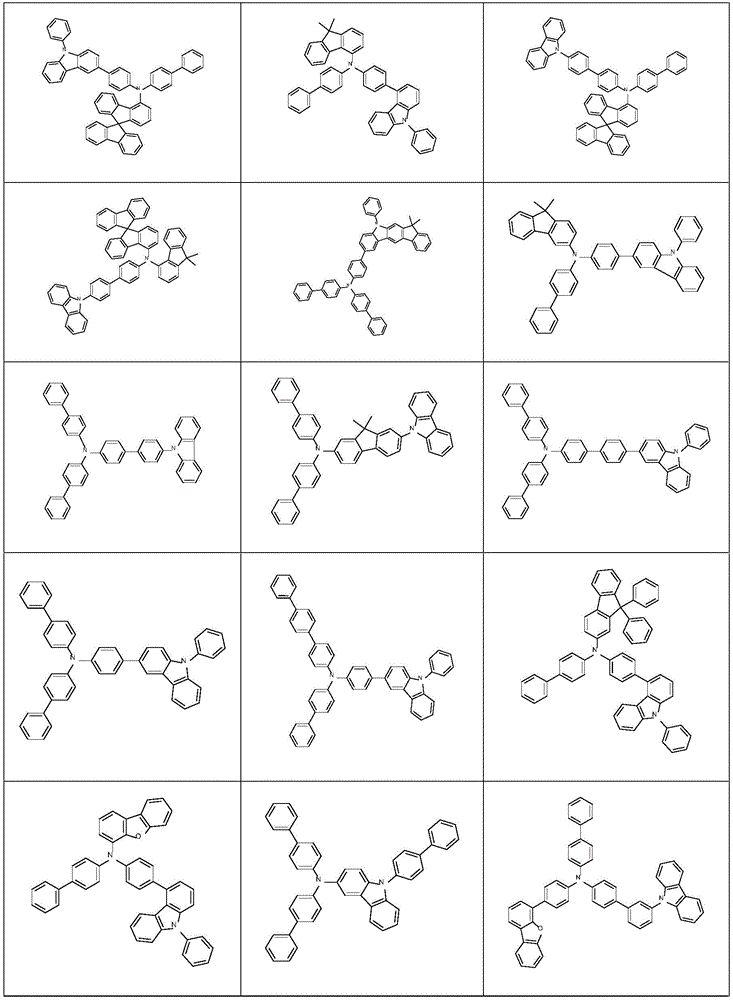

Preferred co-host materials, especially when the compounds of the invention are substituted with electron-rich heteroaromatic ring systems, such as carbazole groups, are also selected from triazine derivatives, pyrimidine derivatives and quinazoline derivatives. Preferred triazine, quinazoline or pyrimidine derivatives which may be used as mixtures with the compounds of the present invention are the compounds of the following formulae (28), (29) and (30):
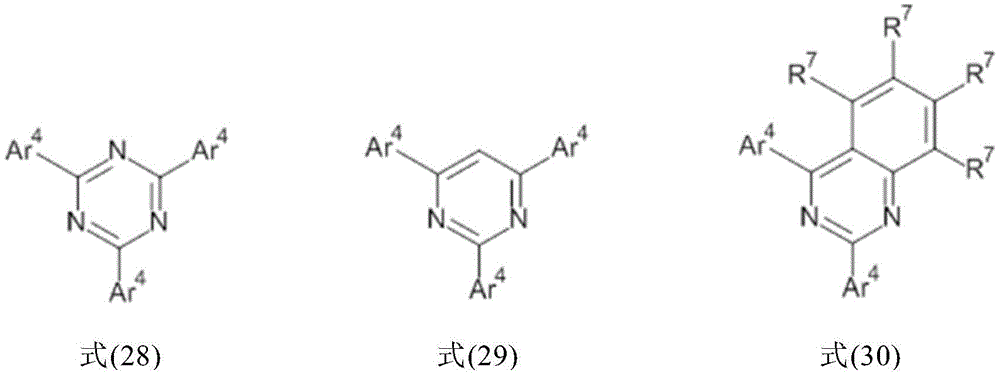
wherein Ar is4And R7With the definitions given above.
Particularly preferred are triazine derivatives of formula (28) and quinazoline derivatives of formula (30), especially triazine derivatives of formula (28).
In a preferred embodiment of the present invention, Ar in formulae (28), (29) and (30)4Preferably identical or different on each occurrence and having from 6 to 30 aromatic ring atoms, in particular from 6 to 24 aromatic ring atoms, and are substituted by R5A group-substituted aromatic or heteroaromatic ring system. Aromatic or heteroaromatic ring systems Ar suitable here4Identical to the structures R-1 to R-81 listed above.
Examples of suitable triazine compounds that can be used as matrix material with the compounds of the invention are the compounds shown in the following table:

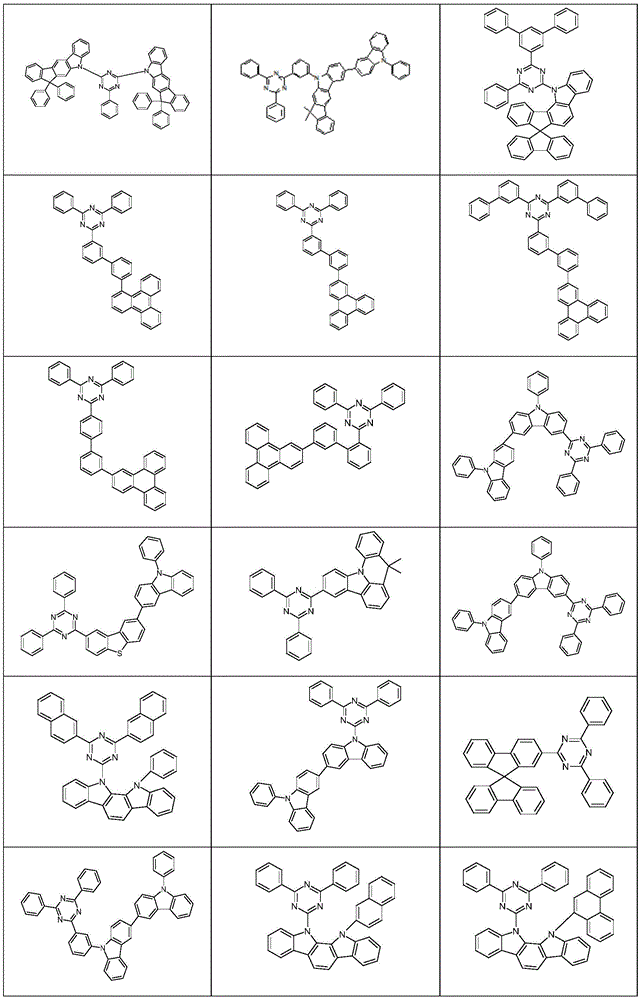


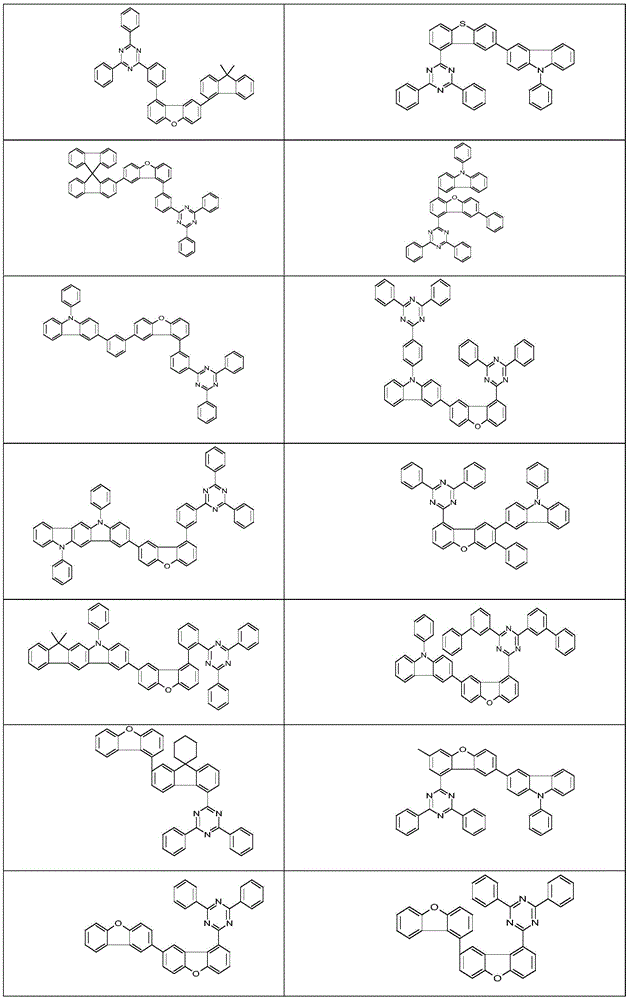
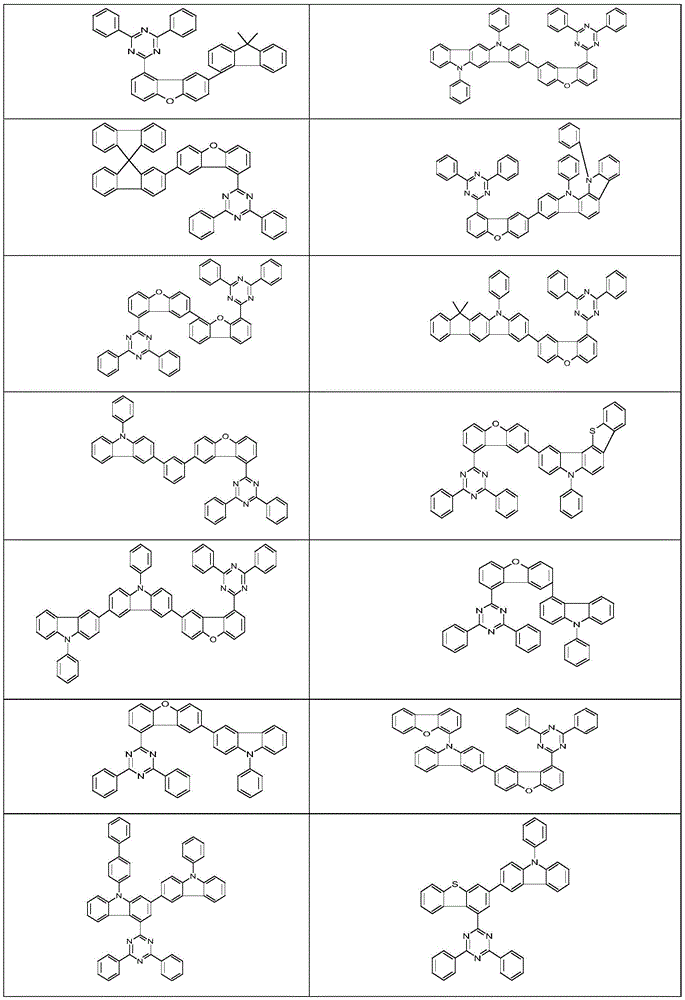
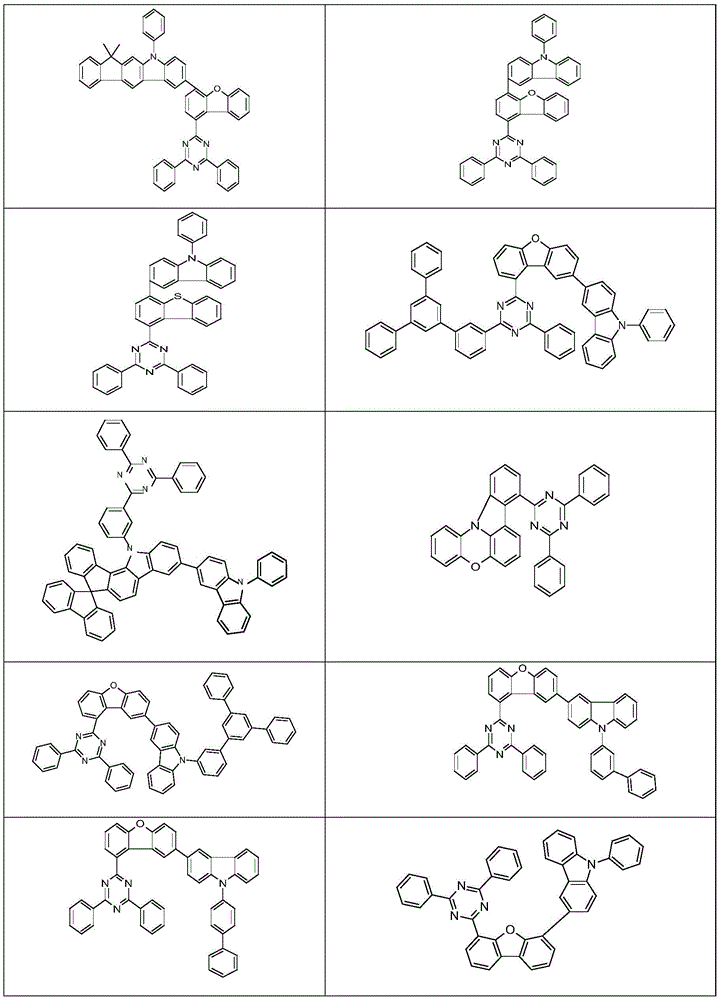
examples of suitable quinazoline compounds are those shown in the following table:

suitable phosphorescent compounds (═ triplet emitters) are in particular those in which: which when suitably excited emits light preferably in the visible region and also contains at least one atom having an atomic number greater than 20, preferably greater than 38 and less than 84, more preferably greater than 56 and less than 80, especially a metal having that atomic number. Phosphorescent emitters which are preferably used are compounds containing copper, molybdenum, tungsten, rhenium, ruthenium, osmium, rhodium, iridium, palladium, platinum, silver, gold or europium, in particular iridium-or platinum-containing compounds.
Examples of such emitters can be found in the following applications: WO 00/70655, WO 2001/41512, WO 2002/02714, WO 2002/15645, EP 1191613, EP 1191612, EP 1191614, WO 05/033244, WO 05/019373, US 2005/0258742, WO 2009/146770, WO 2010/015307, WO 2010/031485, WO 2010/054731, WO 2010/054728, WO 2010/086089, WO 2010/099852, WO 2010/102709, WO 2011/032626, WO 2011/066898, WO 2011/157339, WO 2012/007086, WO 2014/008982, WO 2014/023377, WO 2014/094961, WO 2014/094960, WO 2015/036074, WO 2015/104045, WO 2015/117718, WO 2016/015815, WO 2016/124304, WO 2017/032439, WO 2018/011186 and WO 2018/041769, WO 2019/020538, WO 2018/178001, and the unpublished patent applications EP 17206950.2 and EP 18156388.3. In general, all phosphorescent complexes used for phosphorescent OLEDs according to the prior art and known to the person skilled in the art in the field of organic electroluminescence are suitable, and the person skilled in the art will be able to use other phosphorescent complexes without inventive effort.
Examples of phosphorescent dopants are listed below.


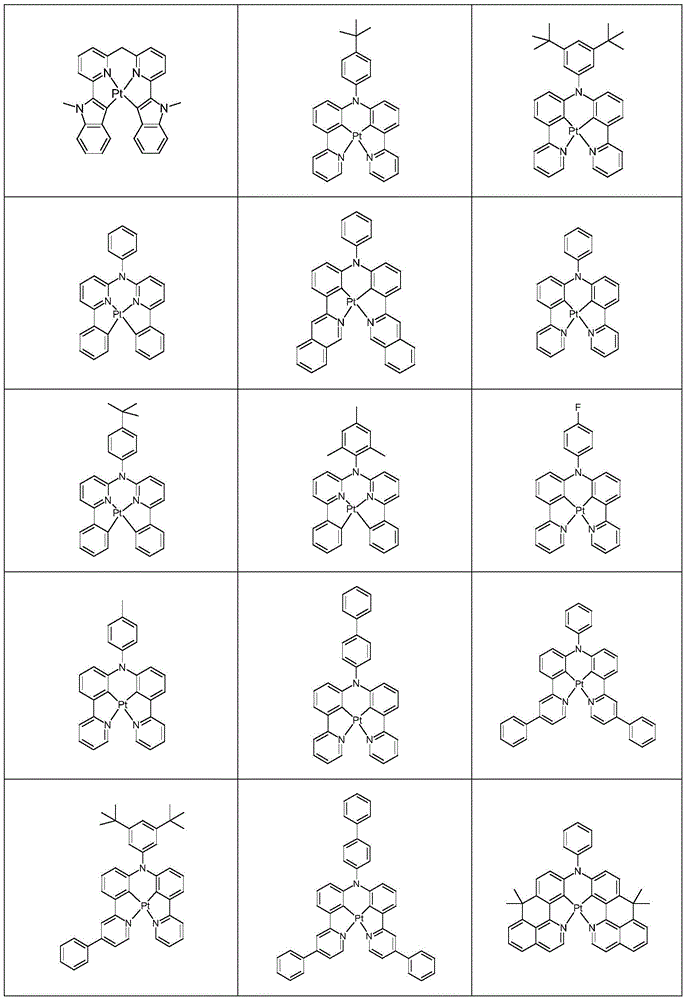
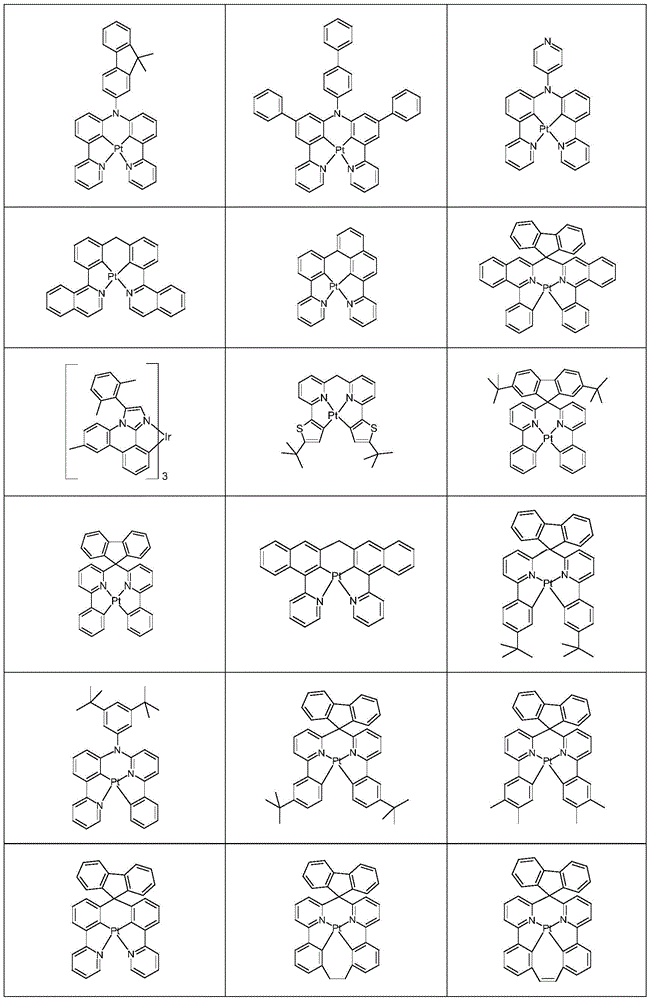


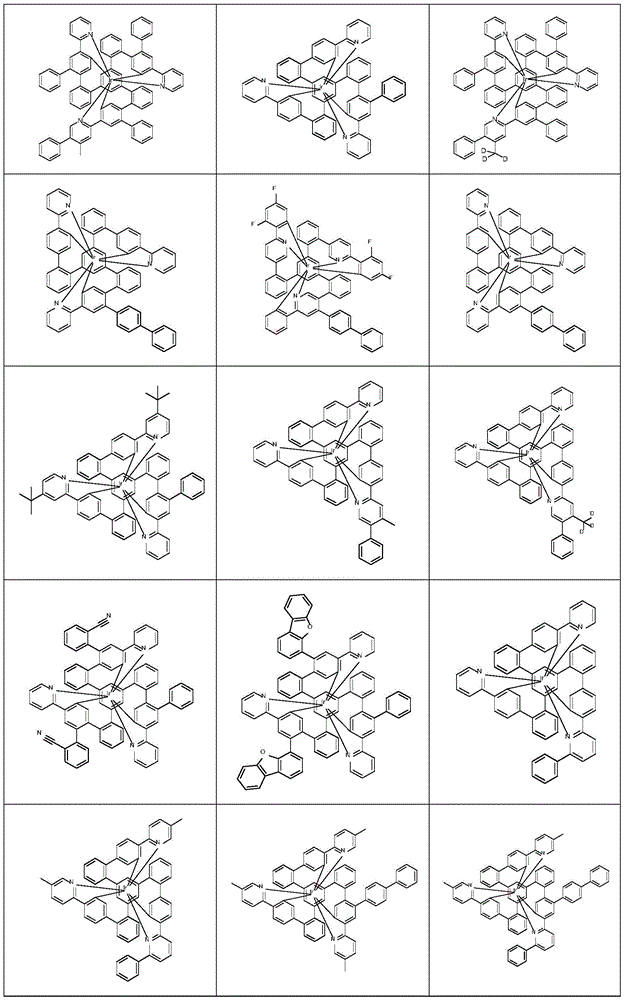

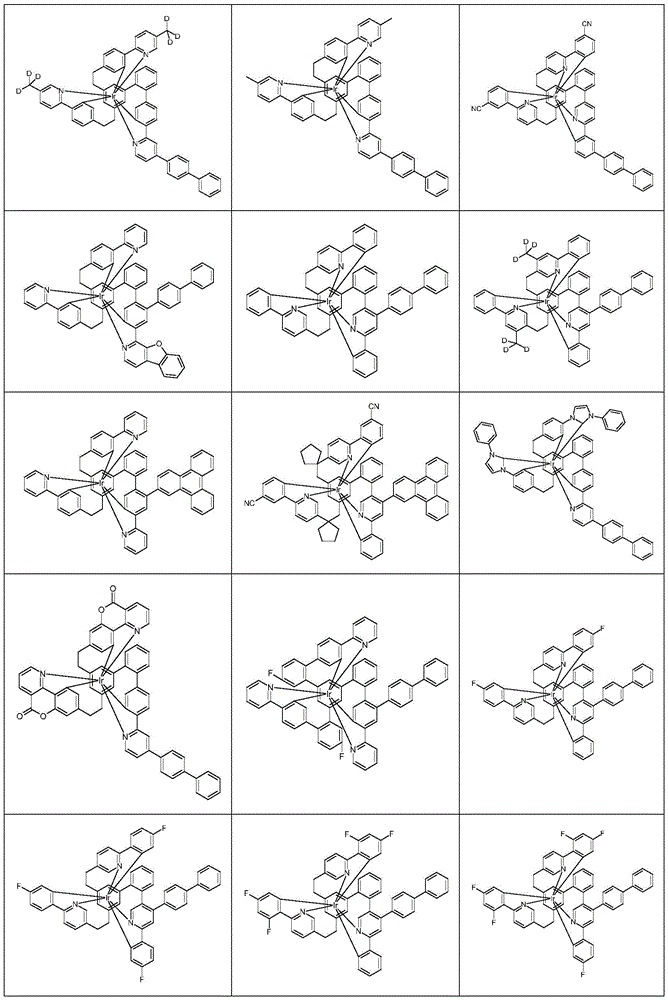
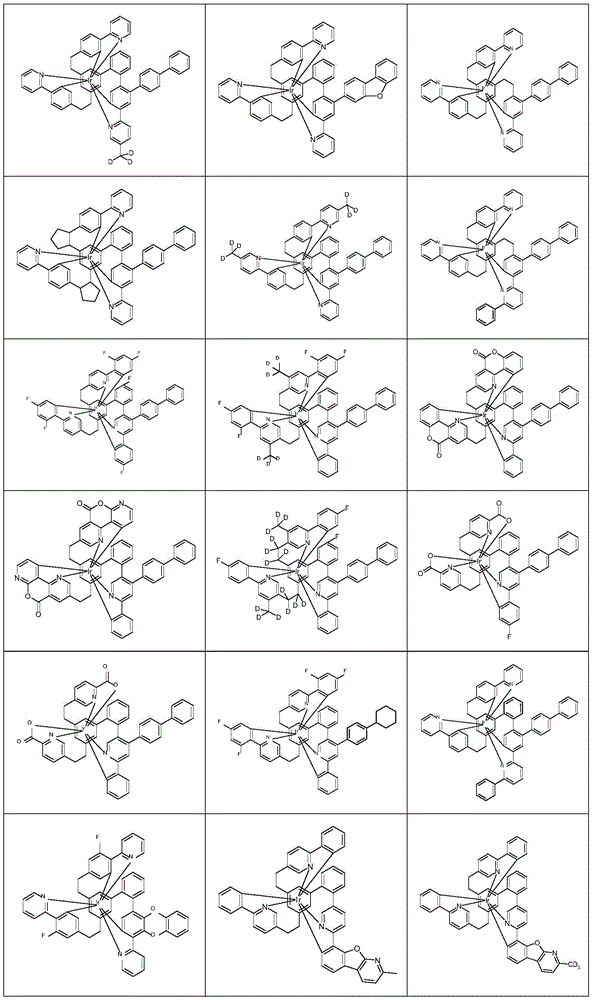

In the other layers of the organic electroluminescent device of the present invention, any material generally used according to the prior art may be used. The person skilled in the art will thus be able to use any material known for use in organic electroluminescent devices in combination with the compounds of the invention of the formula (I) or the preferred embodiments described above without inventive effort.
In the hole-transporting layer of the device, such as the hole-injecting layer, the hole-transporting layer, and the electron-blocking layer, indenofluorenamine derivatives, amine derivatives, hexaazatrityl derivatives, amine derivatives having a condensed aromatic system, monobenzoindenofluorenamine, dibenzoindenofluorenamine, spirobifluorenylamine, fluorenamine, spirodibenzopyranamine, dihydroacridine derivatives, spirodibenzofuran and spirodibenzothiophene, phenanthrenediarylamine, spirotriphenotolone, spirobifluorene having a m-phenylenediamine group, spirobisacridine, xanthene diarylamine, and 9, 10-dihydroanthracene spiro compound having a diarylamino group are preferably used. Specific examples of the compounds used for the hole-transporting layer are shown in the following table:


in addition, the following compounds HT-1 to HT-13 are suitable for use in layers having a hole-transporting function, in particular in hole-injecting, hole-transporting and/or electron-blocking layers, or as matrix material in light-emitting layers, in particular in light-emitting layers comprising one or more phosphorescent emitters:
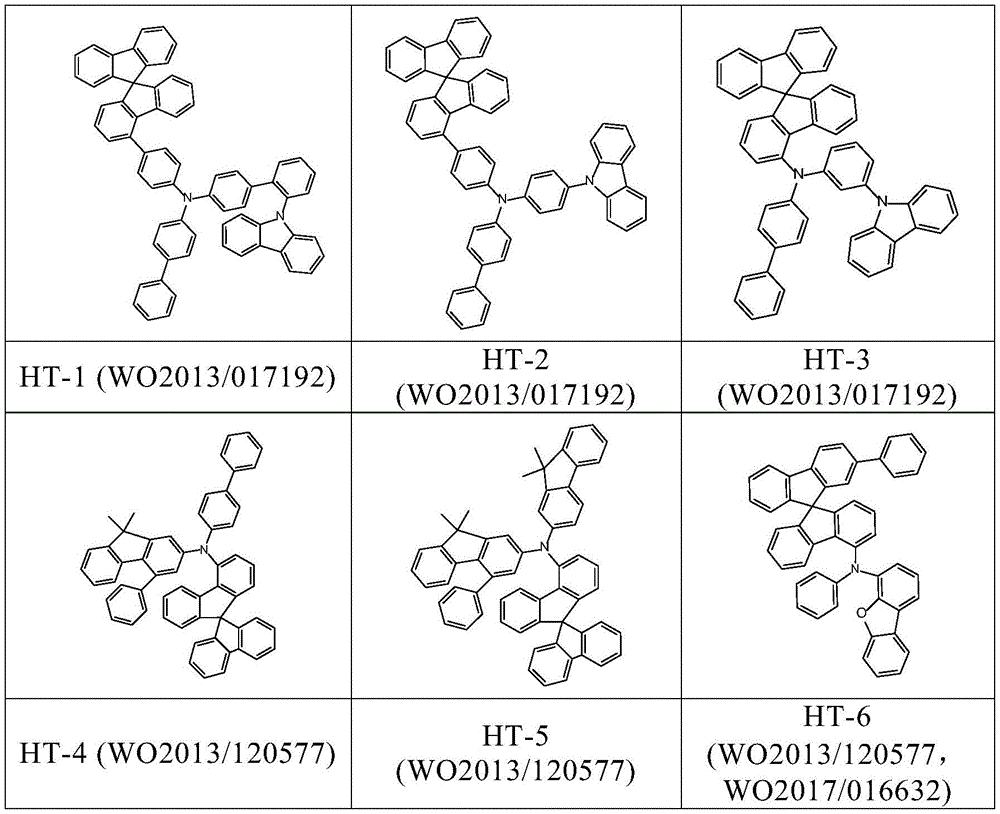
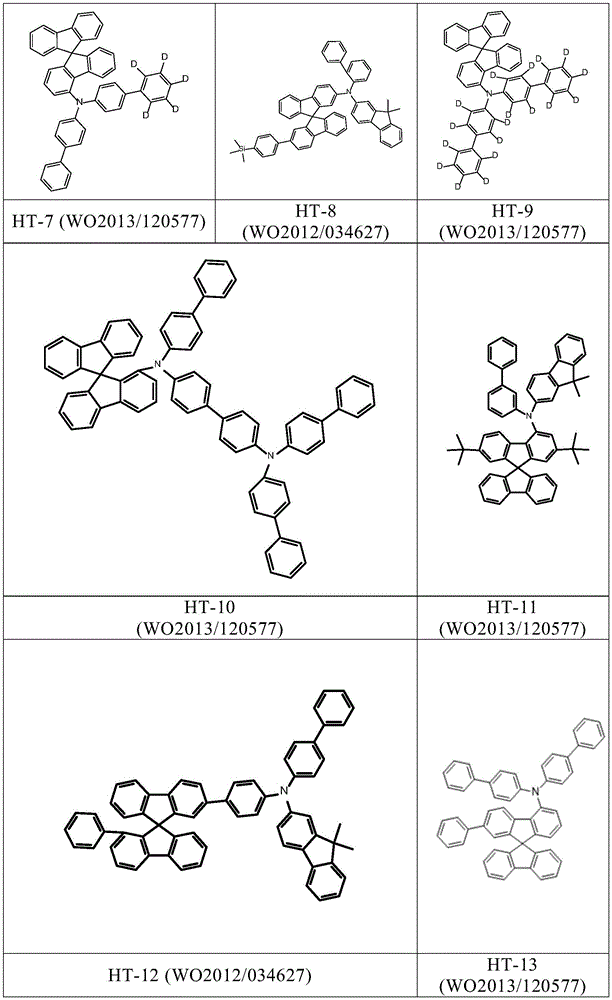
the compounds HT-1 to HT-13 are generally of good suitability for the above-mentioned use in OLEDs of any design and composition, not only in the OLEDs of the present application. Methods for the preparation of these compounds and further relevant disclosures relating to the use of these compounds are disclosed in the published specification, each of which is cited in parentheses below the corresponding compound in the tables. The compounds show good performance data in OLEDs, in particular good lifetimes and good efficiencies.
Also preferred is an organic electroluminescent device characterized in that one or more layers are applied by a sublimation process. In this case, less than 10 in a vacuum sublimation system-5Mbar, preferably less than 10-6The material is applied by vapour deposition at an initial pressure of mbar. However, the initial pressure may also be even lower, e.g. less than 10-7Millibar.
Also preferred are organic electroluminescent devices which are characterized in that one or more layers are applied by the OVPD (organic vapor deposition) method or sublimation with the aid of a carrier gas. In this case, 10-5The material is applied at a pressure between mbar and 1 bar. A special case of this method is the OVJP (organic vapor jet printing) method, in which the material is applied directly through a nozzle and is structured thereby.
Also preferred are organic electroluminescent devices which are characterized in that one or more layers are produced from solution, for example by spin coating, or by any printing method, for example screen printing, flexographic printing, offset printing, LITI (photo-induced thermal imaging, thermal transfer), ink-jet printing or nozzle printing. For this purpose, soluble compounds are required, which are obtained, for example, by appropriate substitution.
In addition, hybrid processes are possible, for example, wherein one or more layers are applied from solution and one or more other layers are applied by vapor deposition.
These methods are generally known to the person skilled in the art and can be applied without inventive effort to organic electroluminescent devices comprising the compounds according to the invention.
Examples
A) Synthesis of Compounds of formula (I)
a) 9-phenyl-3- (2-phenyl-1H-benzimidazol-5-yl) carbazoles

31.5g (110.0mmol) of phenylcarbazole-3-boronic acid, 30g (110.0mmol) of 6-bromo-2-phenyl-1H-benzimidazole and 44.6g (210.0mmol) of tripotassium phosphate are suspended in 500ml of toluene, 500ml of dipotassium phosphate Alkane and 500ml water. To the suspension was added 913mg (3.0mmol) of tri-o-tolylphosphine, then 112mg (0.5mmol) of palladium (II) acetate, and the reaction mixture was heated under reflux for 16 hours. After cooling, the organic phase is separated, filtered through silica gel, washed 3 times with 200mL of water each time and then concentrated to dryness. The residue was recrystallized from toluene and from dichloromethane/isopropanol. The yield was 39.6g (91mmol), corresponding to 83% of theory.
The following compounds can be obtained analogously:

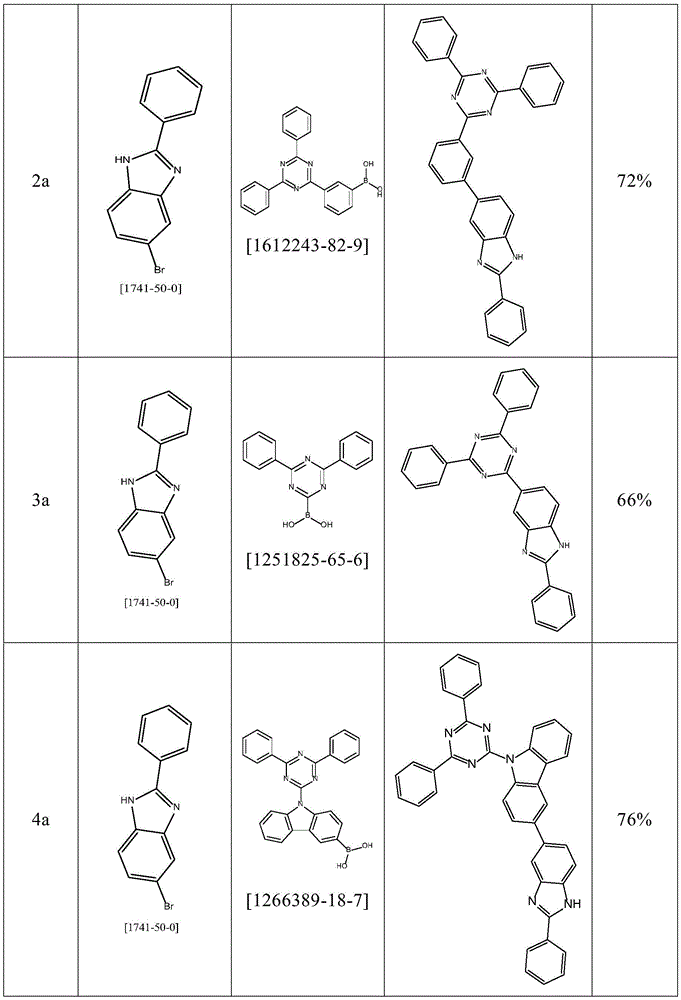
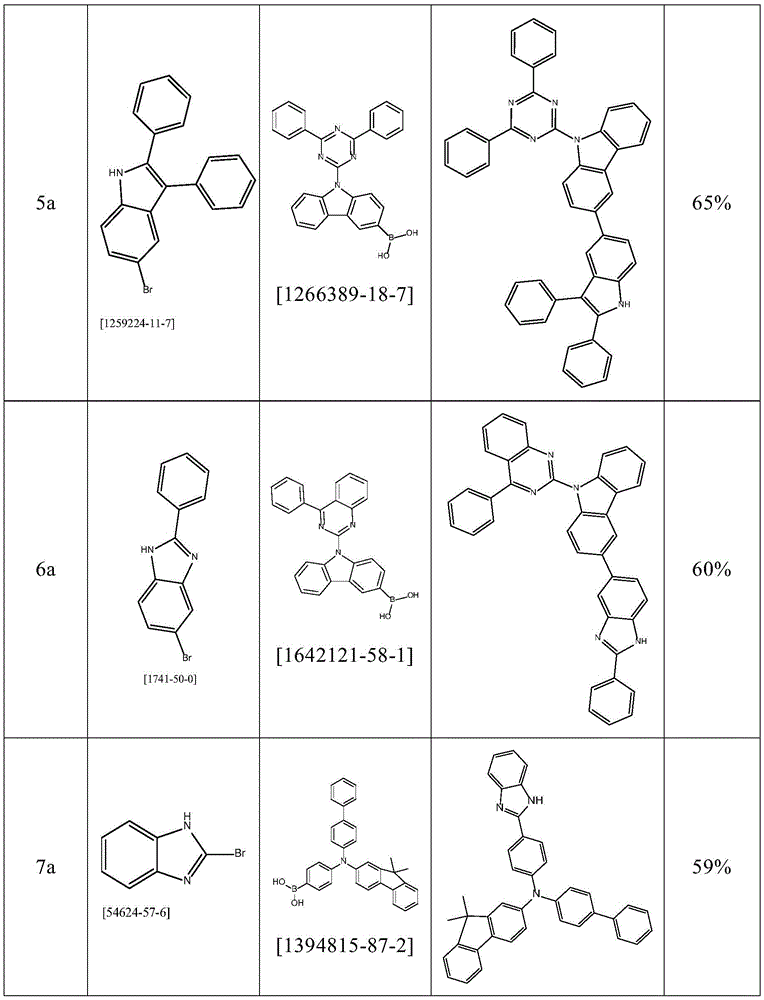


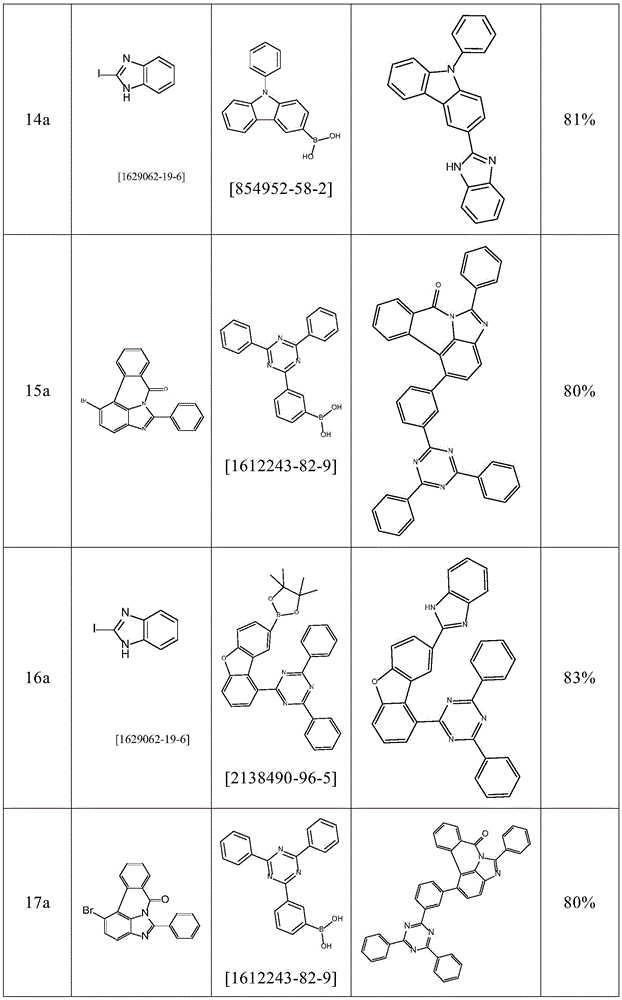
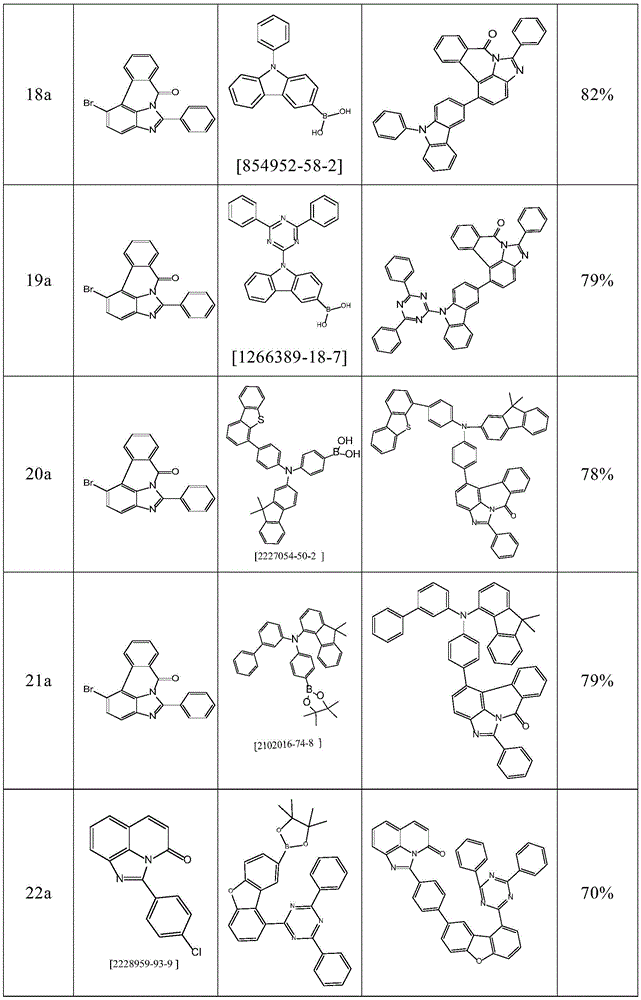
b)1- [ (2-bromophenyl) methyl ] -2-phenylbenzimidazole
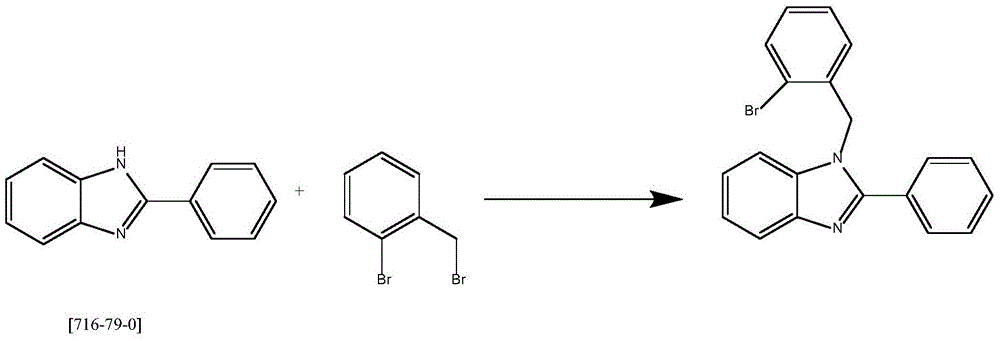
13.3g (334mmol) of 60% NaH in mineral oil were dissolved in 1000ml of dimethylformamide under a protective atmosphere. 50g (257mmol) of 2-phenylbenzimidazole are dissolved in 500ml of DMF and added dropwise to the reaction mixture. After 1 hour at room temperature, a solution of 70g (283mmol) of 2-bromobenzyl bromide in 500ml of DMF is added dropwise. The reaction mixture was then stirred at room temperature for 1 hour. After this time, the reaction mixture was poured onto ice and extracted three times with dichloromethane. The combined organic phases are passed over Na2SO4Dried and concentrated. The residue was thermally extracted with toluene and recrystallized from toluene/n-heptane.
Yield: 75g (207mmol), 80%.
The following compounds can be obtained analogously:


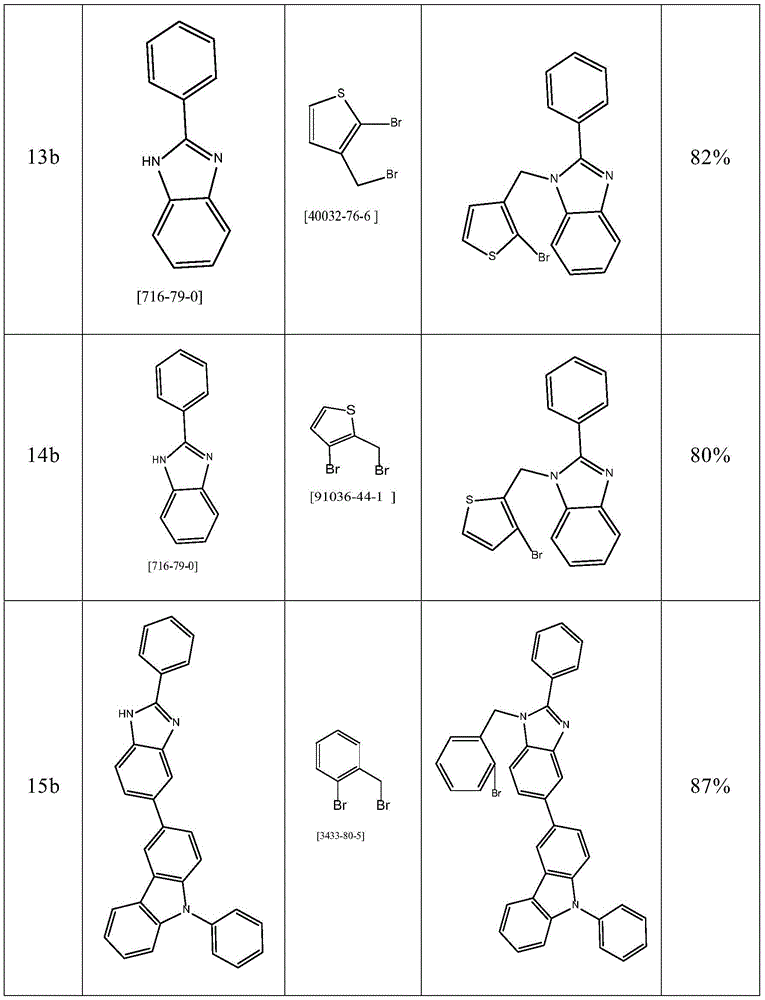
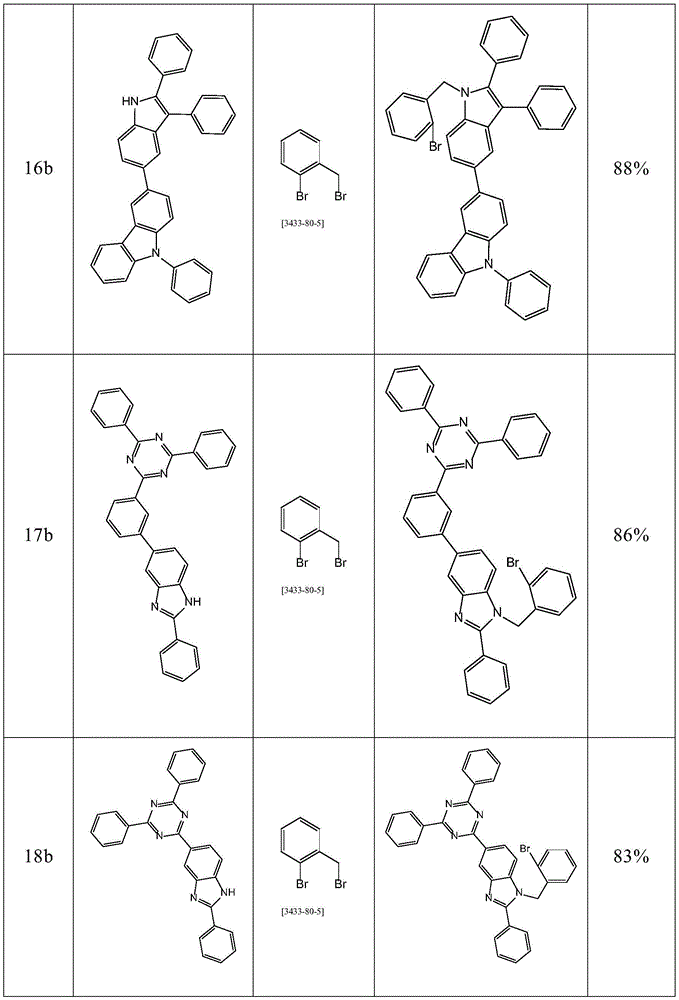


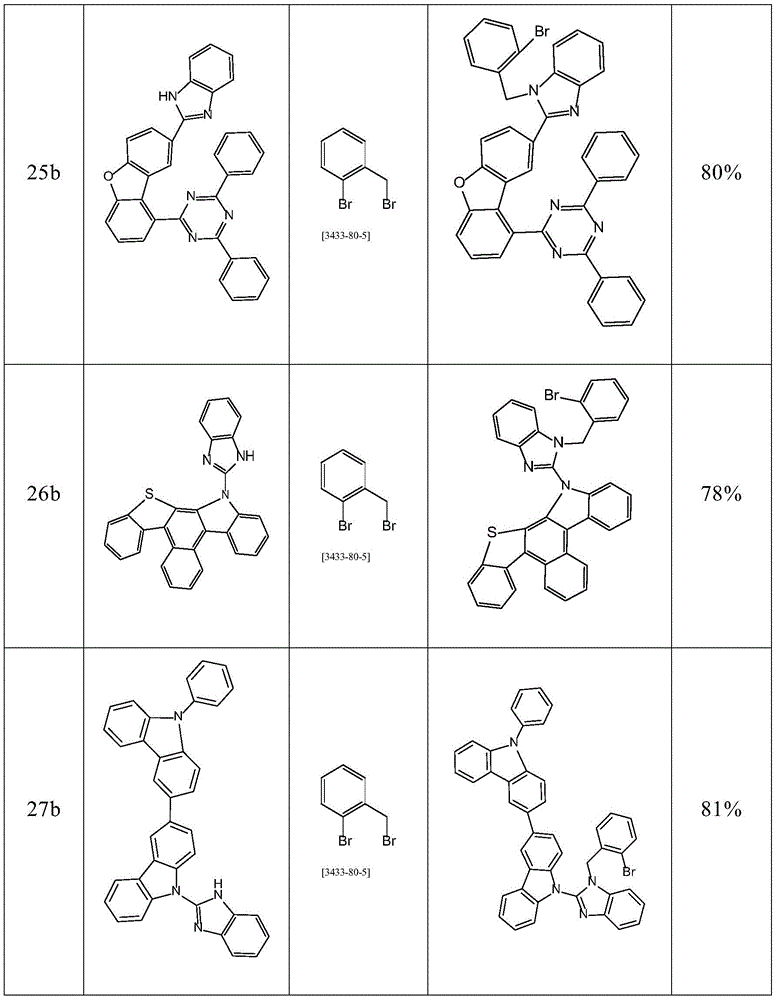
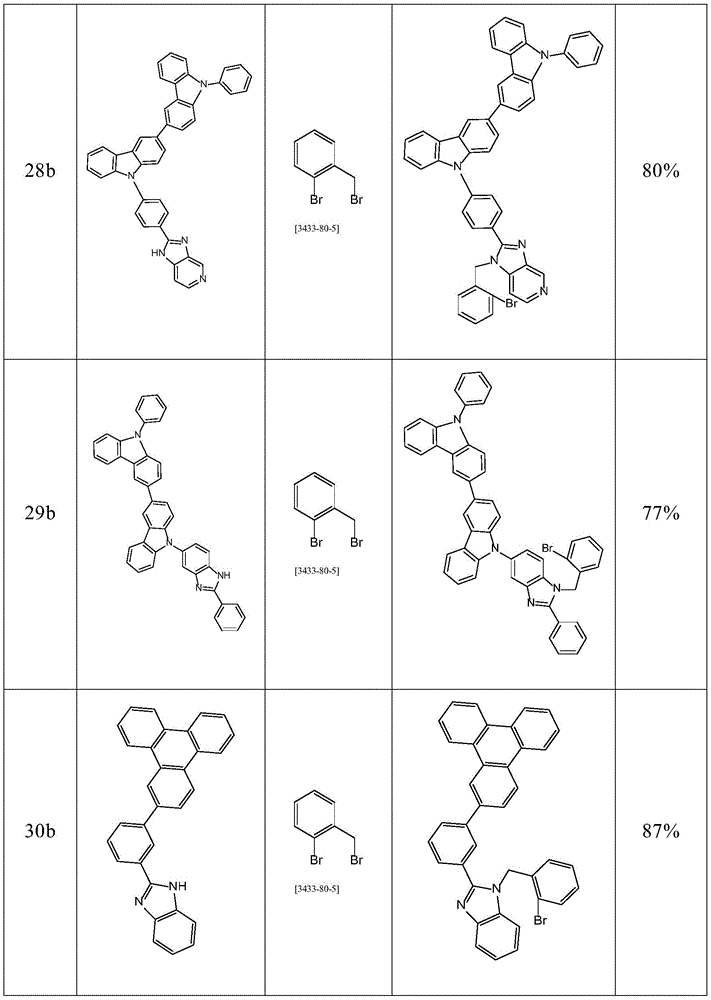
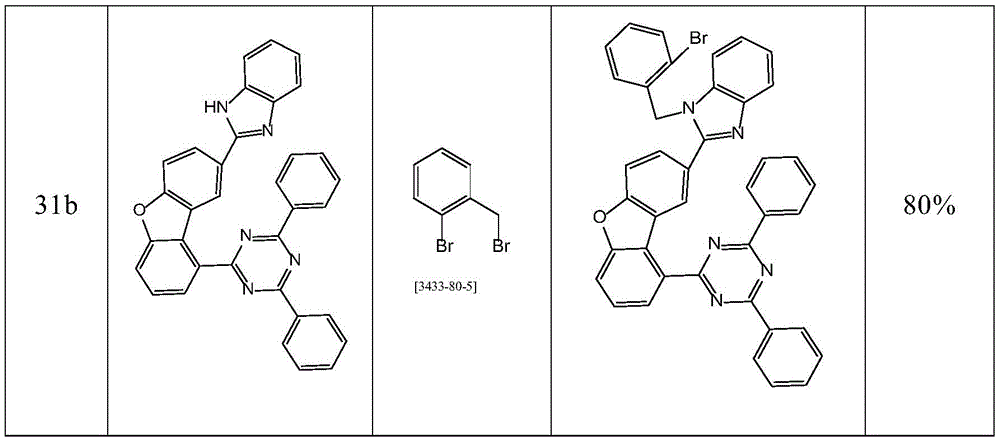
c) 5-phenyl-1H-imidazo [4,5,1-de ] phenanthridines
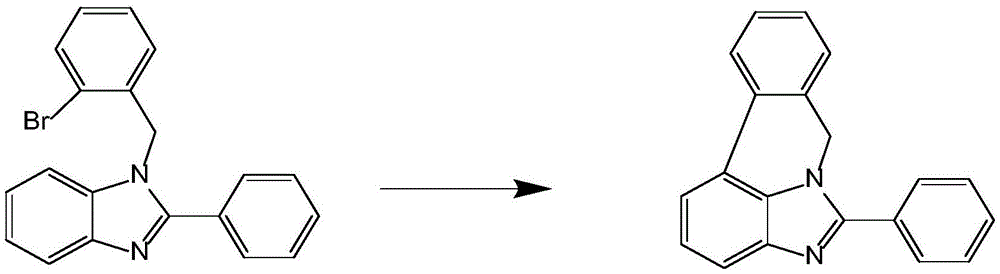
68g (187mol) of 1- [ (2-bromophenyl) methyl group were reacted under a protective atmosphere]-2-phenylbenzimidazole was dissolved in 500ml of dimethylformamide. To the solution was added 38g (394mmol) of potassium acetate, stirred for 30 minutes, and then 21g (18.7mmol) of Pd (PPh) was added3)4And the mixture was stirred at 110 ℃ for 5 days. After this time, the reaction mixture was cooled to room temperature and extracted with dichloromethane. The combined organic phases are passed over Na2SO4Dried and concentrated. The residue was recrystallized from acetone. Yield: 42g (151mmol), 81%.
The following compounds can be obtained analogously:


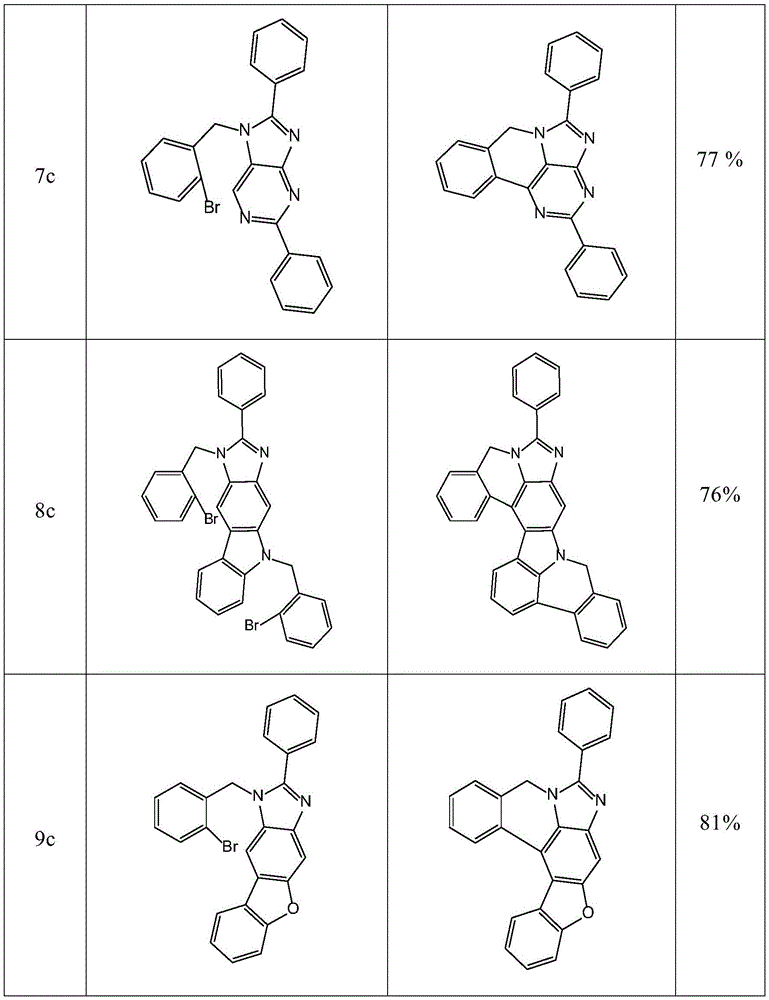
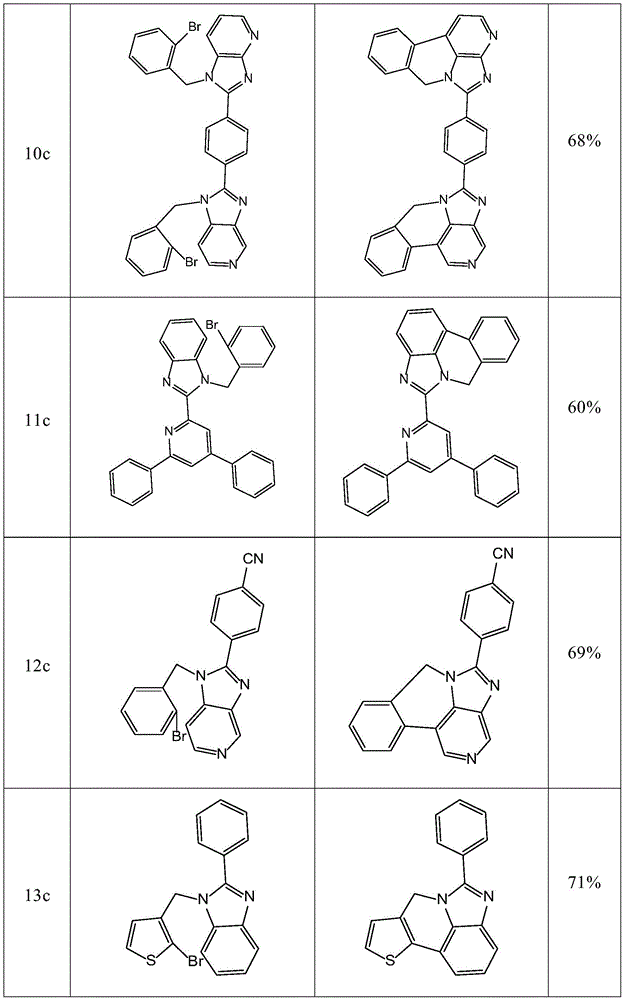

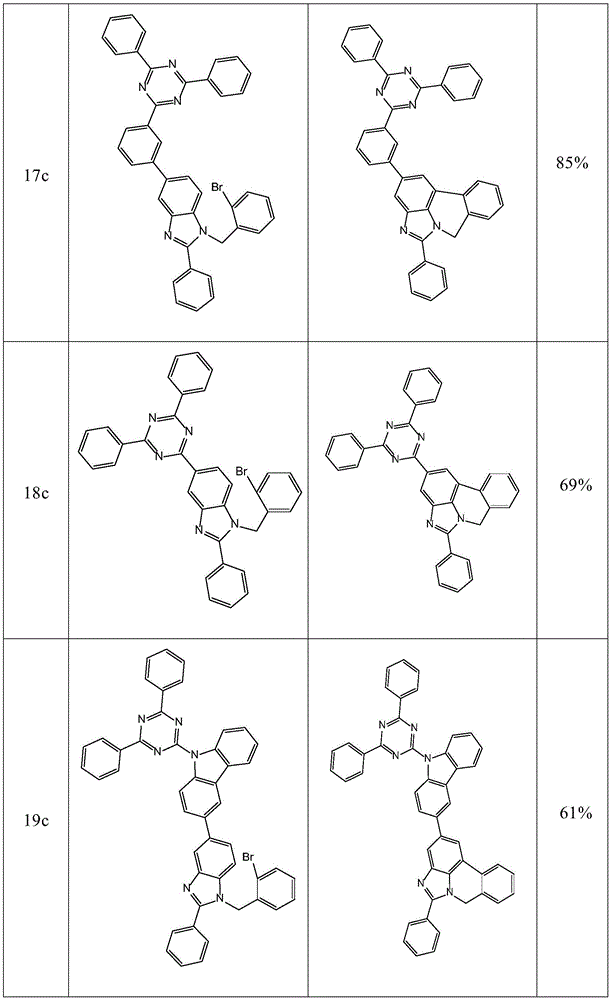
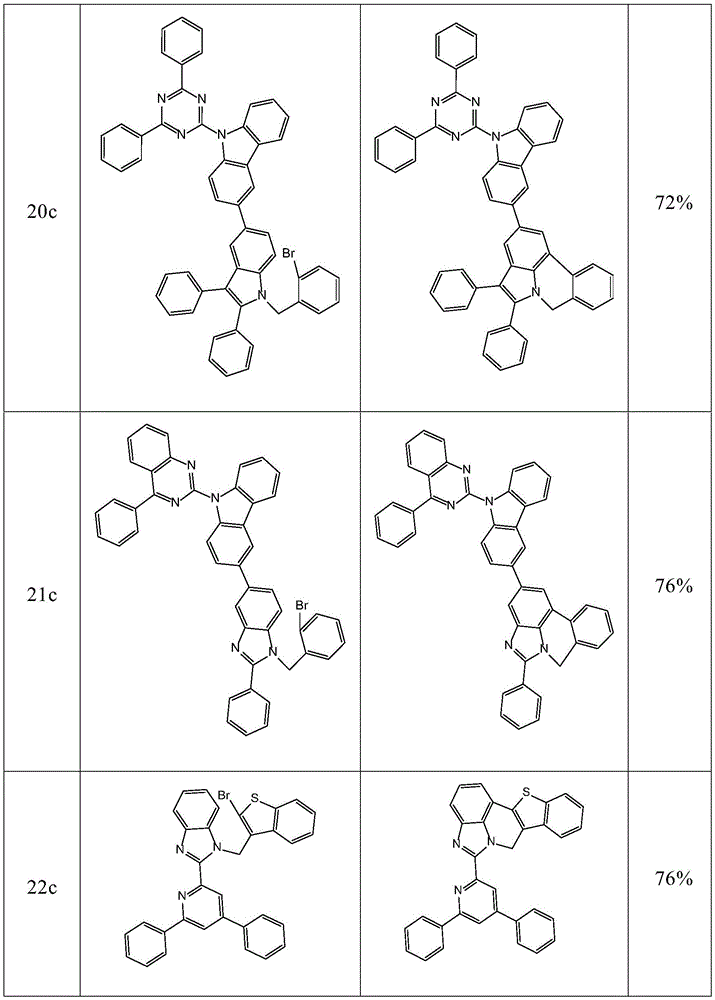
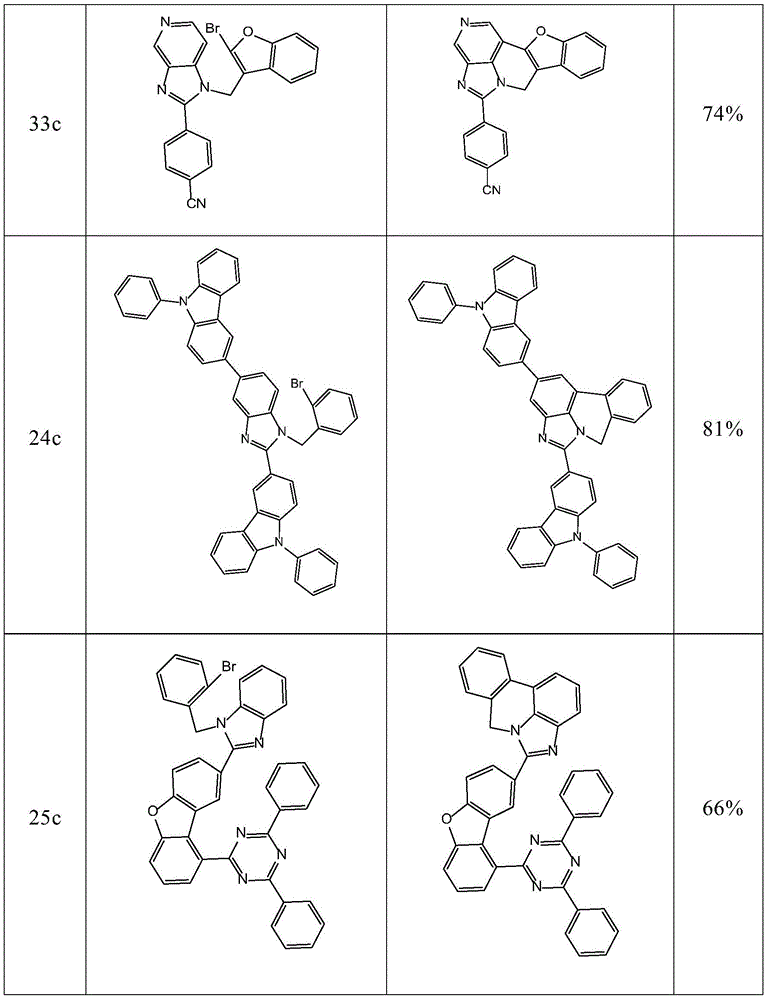


d) 5-phenyl-1H-imidazo [4,5,1-de ] phenanthridin-7-one

34g (120mmol) of 5-phenyl-1H-imidazo [4,5,1-de ] phenanthridine are dissolved in 600ml of dichloromethane and 600ml of water. To this solution 13g (120mmol) of 18-crown-16 and 28g (181mmol) of potassium permanganate were added in portions and the mixture was stirred at room temperature for two days. After this time, the potassium permanganate remaining is filtered off, the solution is concentrated and purified by chromatography (eluent: heptane/dichloromethane, 5: 1). The residue was recrystallized from toluene and from dichloromethane and finally sublimed under high vacuum; the purity was 99.9%.
Yield: 121g (71mmol), 59%.
The following compounds can be obtained analogously:
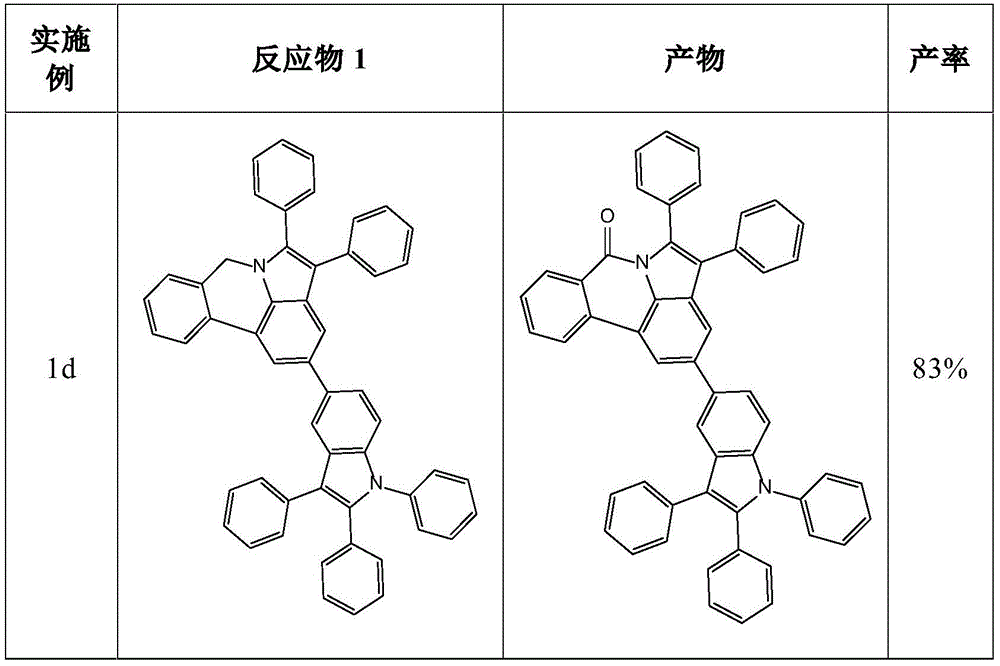


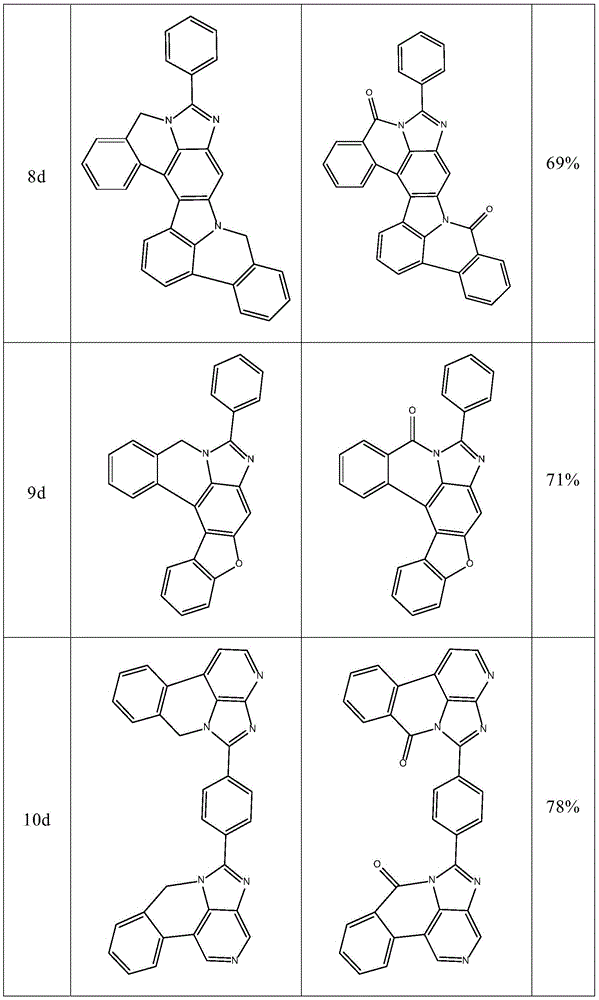
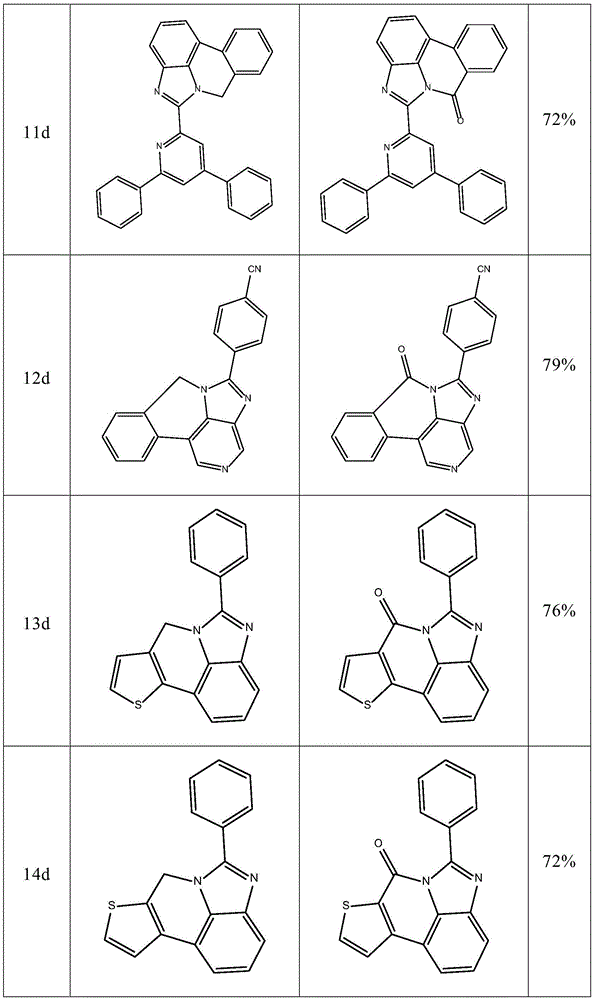


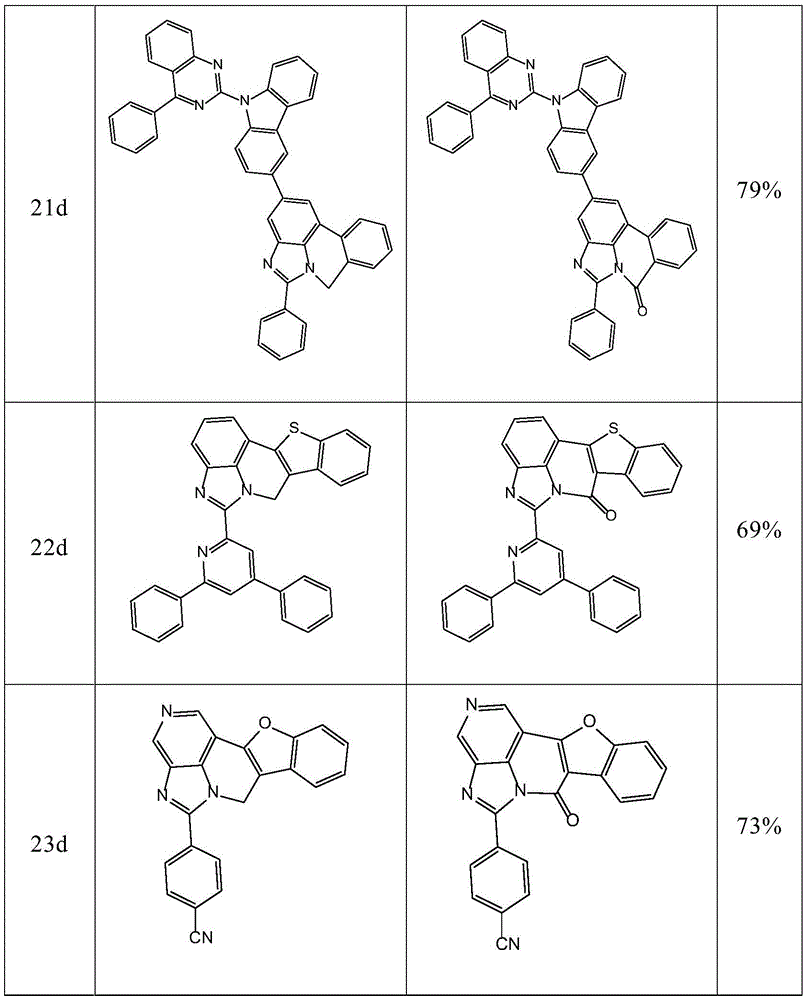

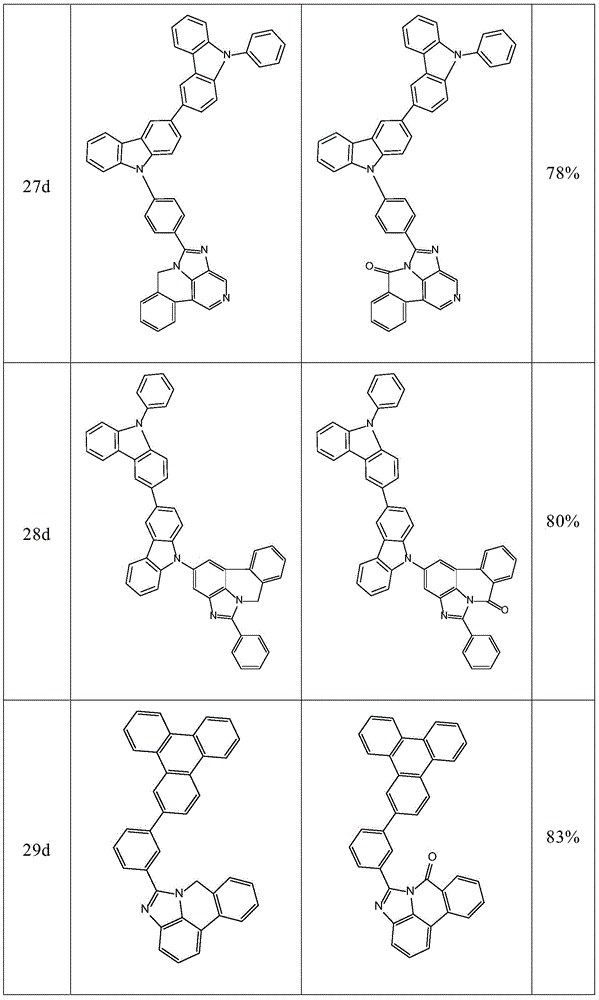
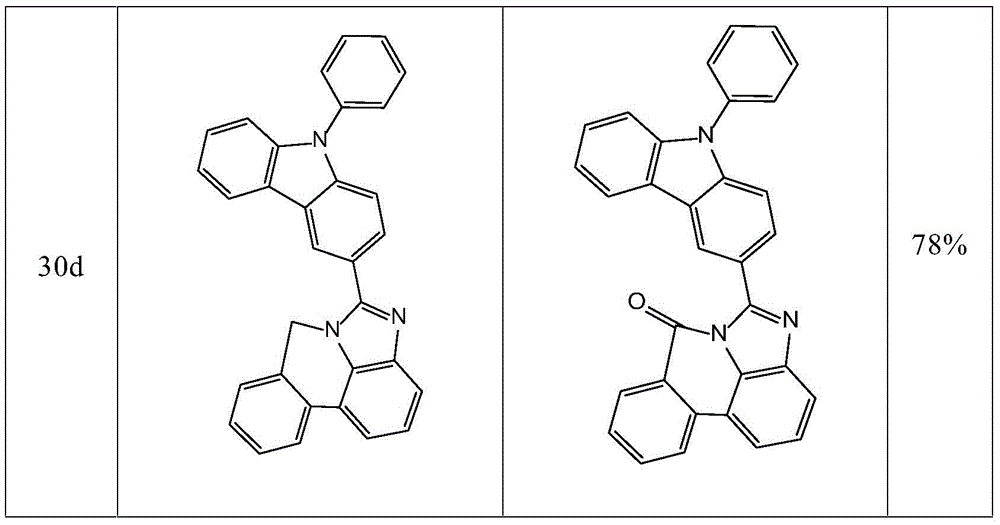
e)1- [2- (5-bromo-2-phenyl-3H-benzimidazol-4-yl) phenyl ] ethanone
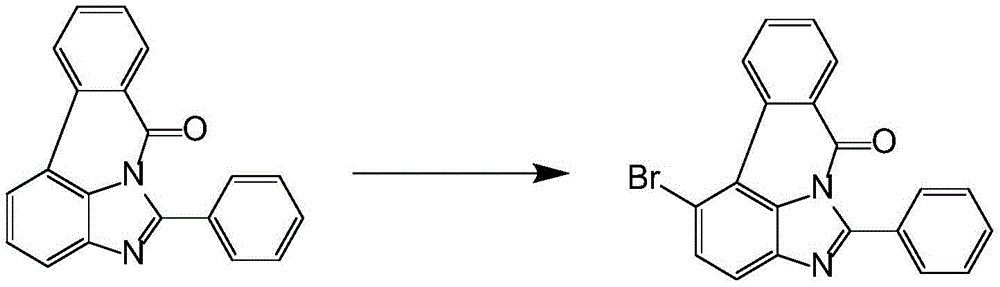
First, 6.5g (22mmol) of 5-phenyl-1H-imidazo [4 ],5,1-de]Phenanthridin-7-one was added to 160ml DMF. Subsequently, a solution of 4g (22.5mmol) of NBS in 100ml DMF is added dropwise at room temperature in the absence of light, the mixture is brought to room temperature and stirring is continued at this temperature for 4 hours. Subsequently, 150ml of water was added to the mixture, and CH was used2Cl2Extraction is carried out. The organic phase is passed over MgSO4Dried and the solvent removed under reduced pressure. The product was stirred with hot hexane extractably and filtered off with suction. Yield: 5g (13mmol), 61% of theory, by1H NMR gave a purity of about 98%.
The following compounds were obtained in a similar manner:

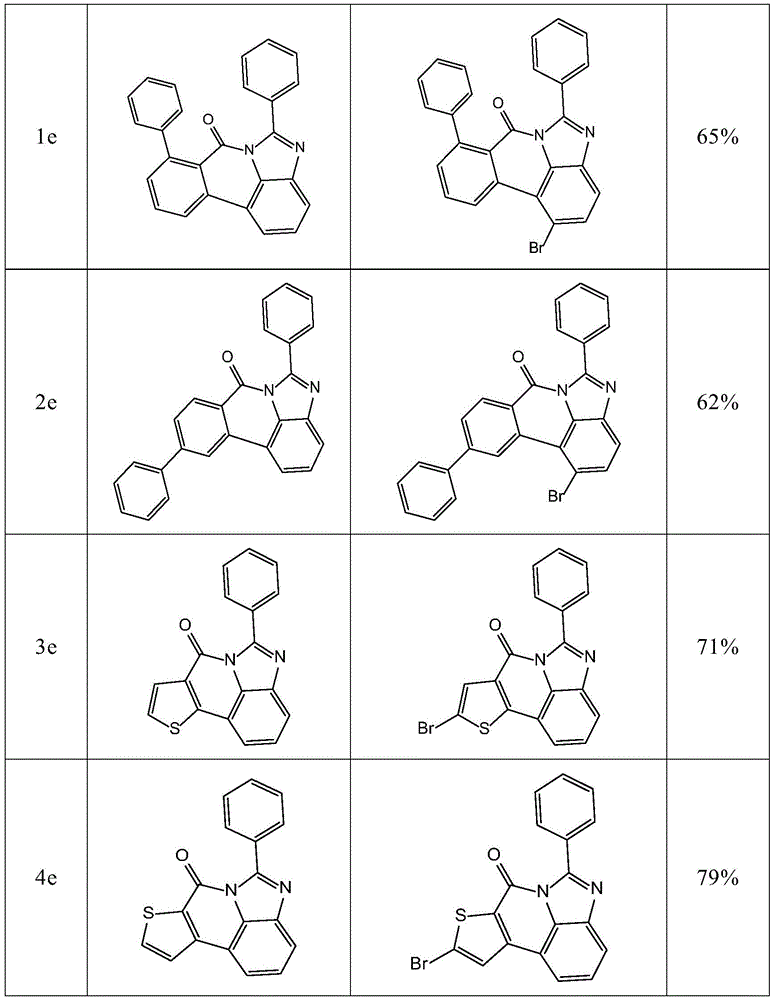
f)3- [9- (1H-benzimidazol-2-yl) carbazol-3-yl ] -9-phenylcarbazole

16.3g (40mmol) of 3- (9H-carbazol-3-yl) -9-phenylcarbazole and 11g (45mmol) of 2-iodo-1H-benzimidazole and 44.7g (320mmol) of potassium carbonate, 3g (16mmol) of copper (I) iodide and 3.6g (16mmol) of 1, 3-bis (pyridin-2-yl) propane-1, 3-dione are stirred in 100ml of DMF at 150 ℃ for 30 hours. The solution was diluted with water and extracted twice with ethyl acetate and the combined organic phases were taken over Na2SO4Dried and concentrated by rotary evaporation. The residue was purified by chromatography (EtOAc/hexane: 2/3). The purity was 99.9%.
The yield was 13g (25mmol), 63% of theory.
The following compounds can be prepared analogously:

g) 9-phenyl-3- [9- (2-phenyl-1H-benzimidazol-5-yl) carbazol-3-yl ] carbazole
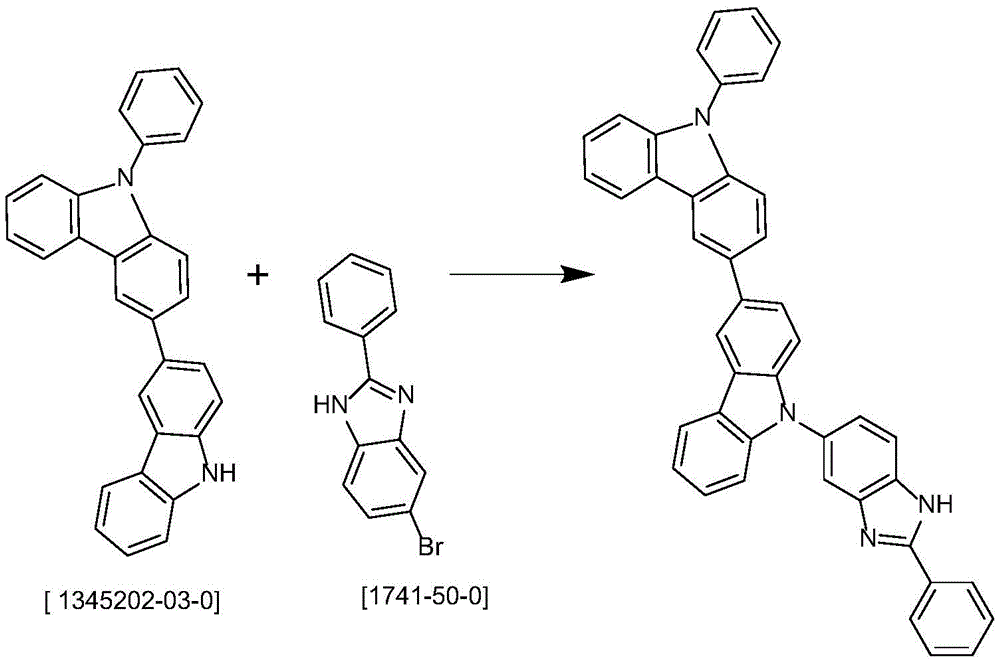
27g (66mmol) of 3- (9H-carbazol-3-yl) -9-phenylcarbazole, 19.11g (70mmol) of 5-bromo-2-phenyl-1H-benzimidazole and 19g of NaOtBu were suspended in 1l of p-xylene. To the suspension was added 0.3g (1.33mmol) of Pd (OAc)2And 1.0ml of a 1M solution of tri-tert-butylphosphine. The reaction mixture was heated at reflux for 16 hours. After cooling, dichloromethane was added, the organic phase was separated and washed 3 times with 200ml of water and then concentrated to dryness. The residue is thermally extracted with toluene and recrystallized from toluene; purity by HPLC was 99.9%. The yield was 29g (49 mmol; 75%).
The following compounds can be prepared analogously:

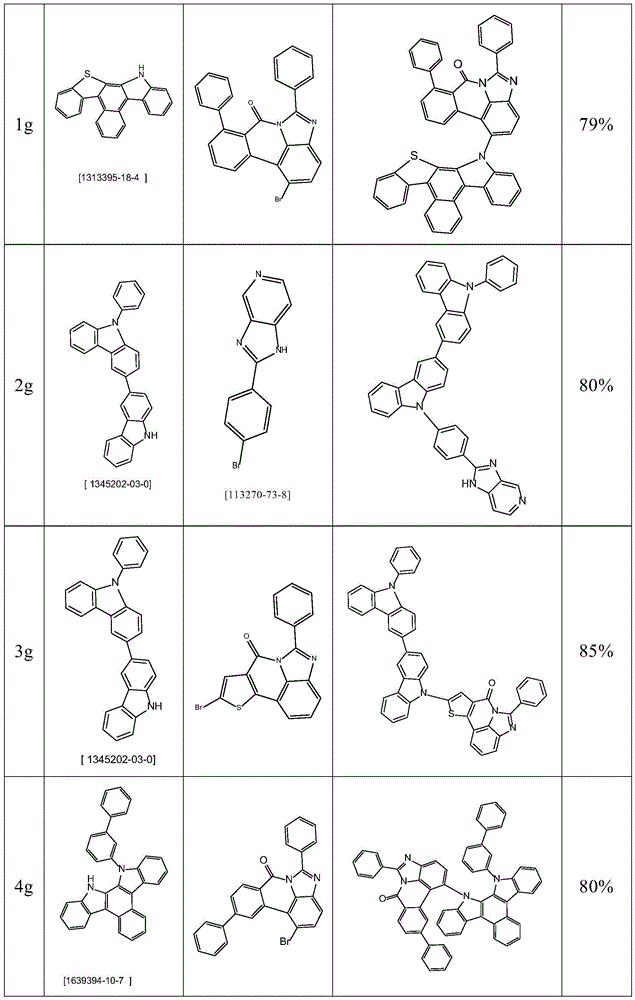

B) example of the device
The following examples E1 to E14 (see table 1) present the use of the materials of the invention in OLEDs.
A glass plate coated with structured ITO (indium tin oxide) with a thickness of 50nm was treated with oxygen plasma and then with argon plasma prior to coating. These plasma treated glass plates form the substrate to which the OLED is applied.
The OLED essentially has the following layer structure: substrate/optional Interlayer (IL)/Hole Injection Layer (HIL)/Hole Transport Layer (HTL)/Electron Blocking Layer (EBL)/emissive layer (EML)/optional Hole Blocking Layer (HBL)/Electron Transport Layer (ETL)/optional Electron Injection Layer (EIL) and finally a cathode. The cathode is formed from a 100nm thick layer of aluminum. The exact structure of the OLED can be found in table 1. Table 2 shows the materials required to fabricate an OLED. Tables 3 and 4 list the OLED data.
All materials were applied by thermal vapor deposition in a vacuum chamber. In this case, the light-emitting layer always consists of at least one host material (host material) and a light-emitting dopant (emitter) which is added to the host material in a specific volume proportion by co-evaporation. Detailed information given in such forms as IC1: EG1: TEG1 (45%: 45%: 10%) here means that the material IC1 is present in the layer in a proportion of 45% by volume, EG1 is present in the layer in a proportion of 45% by volume, and TEG1 is present in the layer in a proportion of 10% by volume. Similarly, the electron transport layer may also be composed of a mixture of two materials.
The OLEDs are characterized in a standard manner. For this purpose, the electroluminescence spectra were determined, and the current efficiency (SE, measured in cd/A) and the external quantum efficiency (EQE, measured in%) as a function of the luminescence density were calculated from the current-voltage-luminescence density characteristic lines which exhibit Lambertian luminescence characteristics. Measured at 1000cd/m2And these are used to calculate the CIE 1931x and y color coordinates. The results thus obtained can be found in tables 3 and 4.
Use of compounds of the formula (I) as matrix materials in light-emitting layers
The compounds EG1 to EG7 according to the invention were used as matrix materials in the light-emitting layers of phosphorescent green OLEDs in examples E1 to E9 (table 3). A low voltage and good efficiency now occur.
The compounds EG8, EG9 and EG10 according to the invention were used as matrix materials in the light-emitting layers of phosphorescent red OLEDs in examples E10 to E13 (table 3). A low voltage and good efficiency now occur.
Use of compounds of formula (I) as electron transport materials in light-emitting layers
When the compound EG5 of the invention was used as electron transport material in example E14, a low voltage and good efficiency were obtained (table 4).
Table 1: structure of OLED
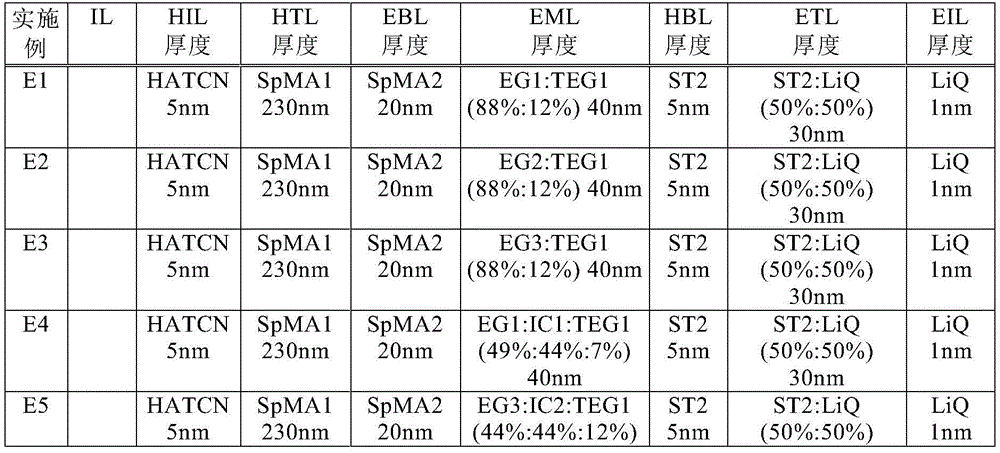
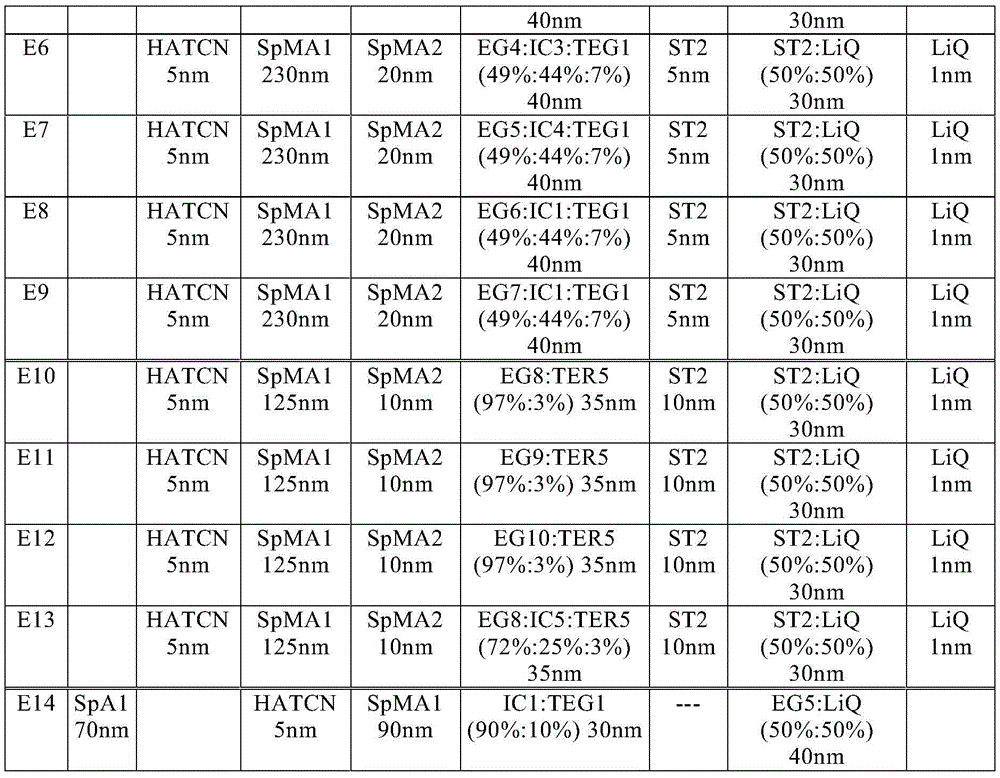
Table 2: structural formula of OLED material
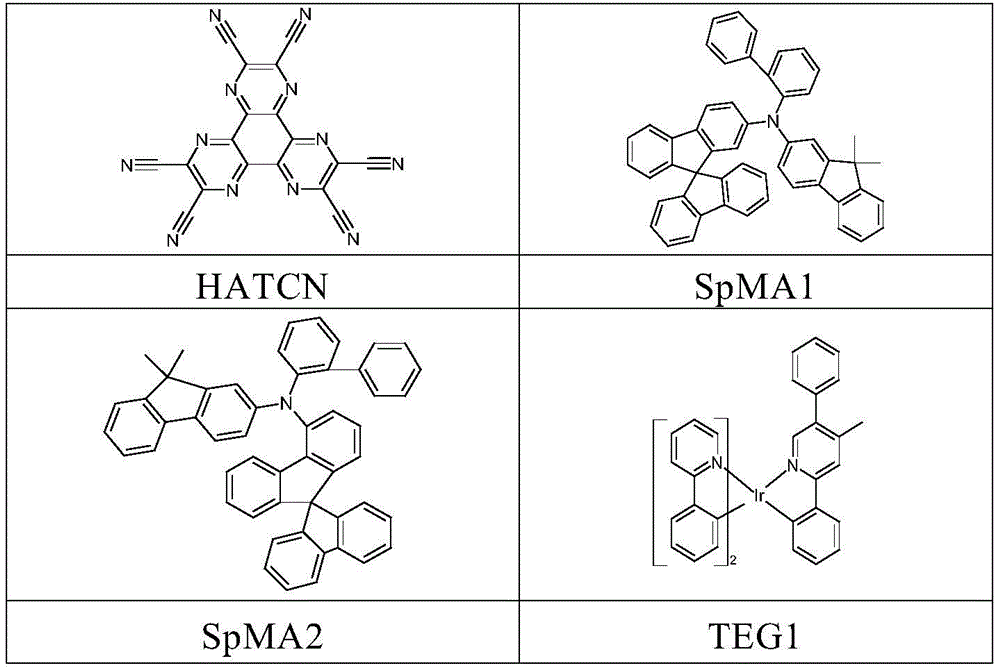

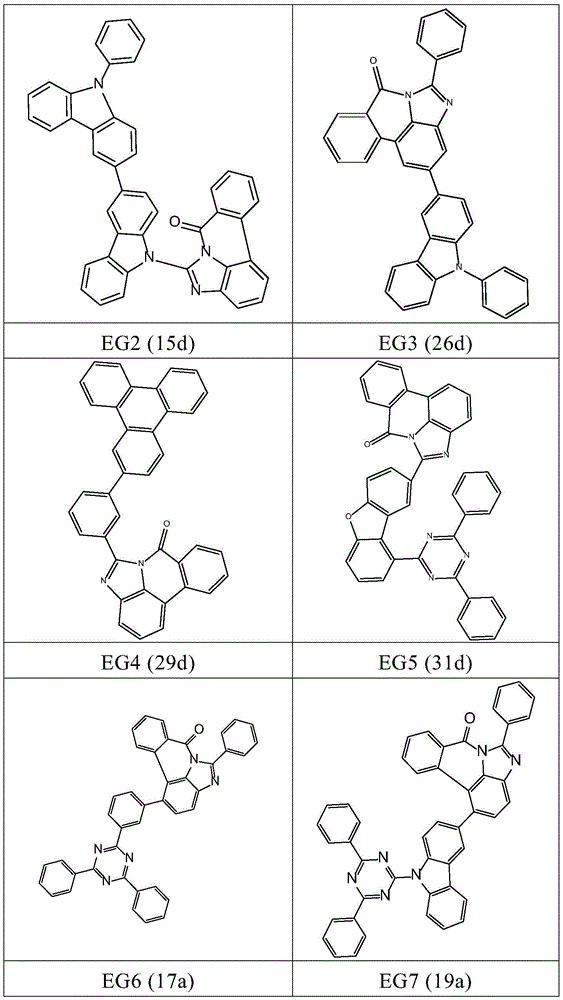

Table 3: data of OLED

Table 4: data of OLED

Claims (24)
1. A compound of formula (I)
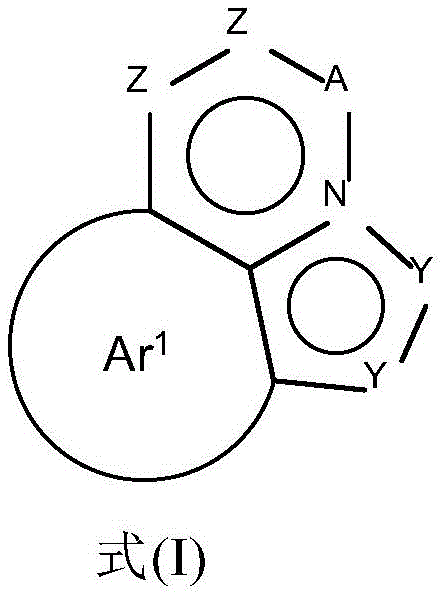
The variables appearing therein are as follows:
a is C-O, C-S, C-NR0、P(=O)R0SO or SO2;
Y is identical or different on each occurrence and is selected from N and CR1;
Ar1Is a compound having 6 to 40 aromatic ring atoms and substituted by R2An aromatic ring system substituted with a group and fused to the remainder of formula (I) via three carbon atoms as shown in formula (I), or having 5 to 40 aromatic ring atoms and being substituted by R2A group-substituted heteroaromatic ring system fused to the remainder of formula (I) via three carbon atoms shown in formula (I);
z is identical or different on each occurrence and is selected from the group consisting of CR4And N, or Z-Z unit is represented by formula (Ar)2) Unit (2) of
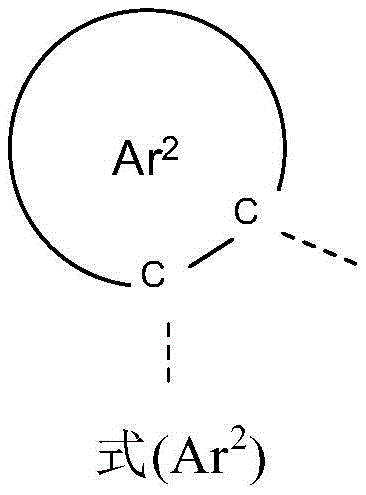
Wherein Ar is2Selected from the group consisting of those having 6 to 40 aromatic ring atoms and substituted by R3An aromatic ring system substituted with a group, said aromatic ring system comprising C-C units, and having 5 to 40 aromatic ring atoms and being substituted by R3A group-substituted heteroaromatic ring system comprising C-C units and wherein the dotted line is the bond connecting said Z-Z unit to the remainder of the formula;
R0in each case identical or different and selected from: a linear alkyl or alkoxy group having 1 to 20 carbon atoms, a branched or cyclic alkyl or alkoxy group having 3 to 20 carbon atoms, an alkenyl or alkynyl group having 2 to 20 carbon atoms, an aromatic ring system having 6 to 40 aromatic ring atoms, and a heteroaromatic ring system having 5 to 40 aromatic ring atoms; alkyl, alkoxy, alkenyl and alkynyl radicals mentioned therein andand the aromatic and heteroaromatic ring systems mentioned are each independently of the other R5Substituted by groups; and wherein one or more CH of the alkyl, alkoxy, alkenyl and alkynyl groups mentioned2The group may be represented by-R5C=CR5-、-C≡C-、Si(R5)2、C=O、C=NR5、-C(=O)O-、-C(=O)NR5-、NR5、P(=O)(R5) -O-, -S-, SO or SO2Replacing;
R1in each case identical or different and selected from: h, D, F, Cl, Br, I, C (═ O) R5,CN,Si(R5)3,N(R5)2,P(=O)(R5)2,OR5,S(=O)R5,S(=O)2R5A linear alkyl or alkoxy group having 1 to 20 carbon atoms, a branched or cyclic alkyl or alkoxy group having 3 to 20 carbon atoms, an alkenyl or alkynyl group having 2 to 20 carbon atoms, an aromatic ring system having 6 to 40 aromatic ring atoms, and a heteroaromatic ring system having 5 to 40 aromatic ring atoms; wherein the alkyl, alkoxy, alkenyl and alkynyl groups mentioned and the aromatic and heteroaromatic ring systems mentioned are each R5Substituted by groups; and wherein one or more CH of the alkyl, alkoxy, alkenyl and alkynyl groups mentioned2The group may be represented by-R5C=CR5-、-C≡C-、Si(R5)2、C=O、C=NR5、-C(=O)O-、-C(=O)NR5-、NR5、P(=O)(R5) -O-, -S-, SO or SO2Replacing;
R2in each case identical or different and selected from: h, D, F, Cl, Br, I, C (═ O) R5,CN,Si(R5)3,N(R5)2,P(=O)(R5)2,OR5,S(=O)R5,S(=O)2R5A linear alkyl or alkoxy radical having 1 to 20 carbon atoms, a branched or cyclic alkyl or alkoxy radical having 3 to 20 carbon atoms, an alkenyl or alkynyl radical having 2 to 20 carbon atoms, having 6 to 40An aromatic ring system of aromatic ring atoms, and a heteroaromatic ring system having from 5 to 40 aromatic ring atoms; wherein two or more are selected from R2、R3And R4The groups of (a) may be linked to each other and may form a ring; wherein the alkyl, alkoxy, alkenyl and alkynyl groups mentioned and the aromatic and heteroaromatic ring systems mentioned are each R5Substituted by groups; and wherein one or more CH of the alkyl, alkoxy, alkenyl and alkynyl groups mentioned2The group may be represented by-R5C=CR5-、-C≡C-、Si(R5)2、C=O、C=NR5、-C(=O)O-、-C(=O)NR5-、NR5、P(=O)(R5) -O-, -S-, SO or SO2Replacing;
R3in each case identical or different and selected from: h, D, F, Cl, Br, I, C (═ O) R5,CN,Si(R5)3,N(R5)2,P(=O)(R5)2,OR5,S(=O)R5,S(=O)2R5A linear alkyl or alkoxy group having 1 to 20 carbon atoms, a branched or cyclic alkyl or alkoxy group having 3 to 20 carbon atoms, an alkenyl or alkynyl group having 2 to 20 carbon atoms, an aromatic ring system having 6 to 40 aromatic ring atoms, and a heteroaromatic ring system having 5 to 40 aromatic ring atoms; wherein two or more are selected from R2、R3And R4The groups of (a) may be linked to each other and may form a ring; wherein the alkyl, alkoxy, alkenyl and alkynyl groups mentioned and the aromatic and heteroaromatic ring systems mentioned are each R5Substituted by groups; and wherein one or more CH of the alkyl, alkoxy, alkenyl and alkynyl groups mentioned2The group may be represented by-R5C=CR5-、-C≡C-、Si(R5)2、C=O、C=NR5、-C(=O)O-、-C(=O)NR5-、NR5、P(=O)(R5) -O-, -S-, SO or SO2Replacing;
R4in each case identical or different and selected from: h, D, F, Cl, Br, I, C (═ O) R5,CN,Si(R5)3,N(R5)2,P(=O)(R5)2,OR5,S(=O)R5,S(=O)2R5A linear alkyl or alkoxy group having 1 to 20 carbon atoms, a branched or cyclic alkyl or alkoxy group having 3 to 20 carbon atoms, an alkenyl or alkynyl group having 2 to 20 carbon atoms, an aromatic ring system having 6 to 40 aromatic ring atoms, and a heteroaromatic ring system having 5 to 40 aromatic ring atoms; wherein two or more R2、R3And R4The groups may be linked to each other and may form a ring; wherein the alkyl, alkoxy, alkenyl and alkynyl groups mentioned and the aromatic and heteroaromatic ring systems mentioned are each R5Substituted by groups; and wherein one or more CH of the alkyl, alkoxy, alkenyl and alkynyl groups mentioned2The group may be represented by-R5C=CR5-、-C≡C-、Si(R5)2、C=O、C=NR5、-C(=O)O-、-C(=O)NR5-、NR5、P(=O)(R5) -O-, -S-, SO or SO2Replacing;
R5in each case identical or different and selected from: h, D, F, Cl, Br, I, C (═ O) R6,CN,Si(R6)3,N(R6)2,P(=O)(R6)2,OR6,S(=O)R6,S(=O)2R6A linear alkyl or alkoxy group having 1 to 20 carbon atoms, a branched or cyclic alkyl or alkoxy group having 3 to 20 carbon atoms, an alkenyl or alkynyl group having 2 to 20 carbon atoms, an aromatic ring system having 6 to 40 aromatic ring atoms, and a heteroaromatic ring system having 5 to 40 aromatic ring atoms; wherein two or more R5The groups may be linked to each other and may form a ring; wherein the alkyl, alkoxy, alkenyl and alkynyl groups mentioned and the aromatic and heteroaromatic ring systems mentioned are each R6Substituted by groups; and wherein one or more CH of the alkyl, alkoxy, alkenyl and alkynyl groups mentioned2The group may be represented by-R6C=CR6-、-C≡C-、Si(R6)2、C=O、C=NR6、-C(=O)O-、-C(=O)NR6-、NR6、P(=O)(R6) -O-, -S-, SO or SO2Replacing;
R6in each case identical or different and selected from: h, D, F, Cl, Br, I, CN, alkyl or alkoxy groups having 1 to 20 carbon atoms, alkenyl or alkynyl groups having 2 to 20 carbon atoms, aromatic ring systems having 6 to 40 aromatic ring atoms, and heteroaromatic ring systems having 5 to 40 aromatic ring atoms; wherein two or more R6The groups may be linked to each other and may form a ring; and wherein the alkyl, alkoxy, alkenyl and alkynyl groups, aromatic ring systems and heteroaromatic ring systems mentioned may be substituted by one or more groups selected from F and CN;
wherein, when two Y groups in formula (I) are CR1If so, one of the following two is selected:
a) at least one is selected from R1、R2、R3And R4The radicals in the radical being selected from the group consisting of those having 7 to 40 aromatic ring atoms and each being substituted by R5A group-substituted aromatic ring system; and having 5 to 40 aromatic ring atoms and each being substituted by R5A group-substituted heteroaromatic ring system; or
b) At least two are selected from R1、R2、R3And R4The radicals in the radical being selected from those having 6 to 40 aromatic ring atoms and each being substituted by R5A group-substituted aromatic ring system; and having 5 to 40 aromatic ring atoms and each being substituted by R5A group-substituted heteroaromatic ring system.
2. A compound according to claim 1, characterized in that a is C ═ O.
3. The compound of claim 1 or 2, characterized by Ar1Selected from the group consisting of benzene, pyridine, pyrimidine, pyridazine, naphthalene, quinoline, quinazoline, phenanthrene, anthracene, terphenyl, fluorene, carbazole, dibenzofuran, and dibenzothiophene.
4. A compound according to one or more of claims 1 to 3, characterized in that the Z-Z unit is of formula (Ar)2) Unit (2) of

Wherein Ar is2Selected from the group consisting of those having 6 to 40 aromatic ring atoms and substituted by R3An aromatic ring system substituted with a group, said aromatic ring system comprising C-C units, and having 5 to 40 aromatic ring atoms and being substituted by R3A group-substituted heteroaromatic ring system comprising C-C units, and wherein the dotted line is the bond connecting the Z-Z unit to the remainder of the formula.
5. Compound according to one or more of claims 1 to 4, characterized in that Ar2Selected from benzene, pyridine, pyrimidine, pyridazine, pyrazine, naphthalene, thiophene, furan, pyrrole, imidazole, thiazole, and derivatives thereof, Oxazole, benzothiophene, benzofuran, indole, and indane, each of which is substituted with R3Is substituted and includes the formula (Ar)2) C-C units of (1).
6. Compound according to one or more of claims 1 to 5, characterized in that formula (I) comprises at least one N (R) chosen from5)2Having 6 to 40 aromatic ring atoms and substituted by R5An aromatic ring system substituted by a radical and having 5 to 40 aromatic ring atoms and being substituted by R5R of a group-substituted heteroaromatic ring system1A group.
7. The compound according to one or more of claims 1 to 6, characterized in that formula (I) comprises at least one R selected from the group consisting of R-1 to R-82 groups1Radical (I)

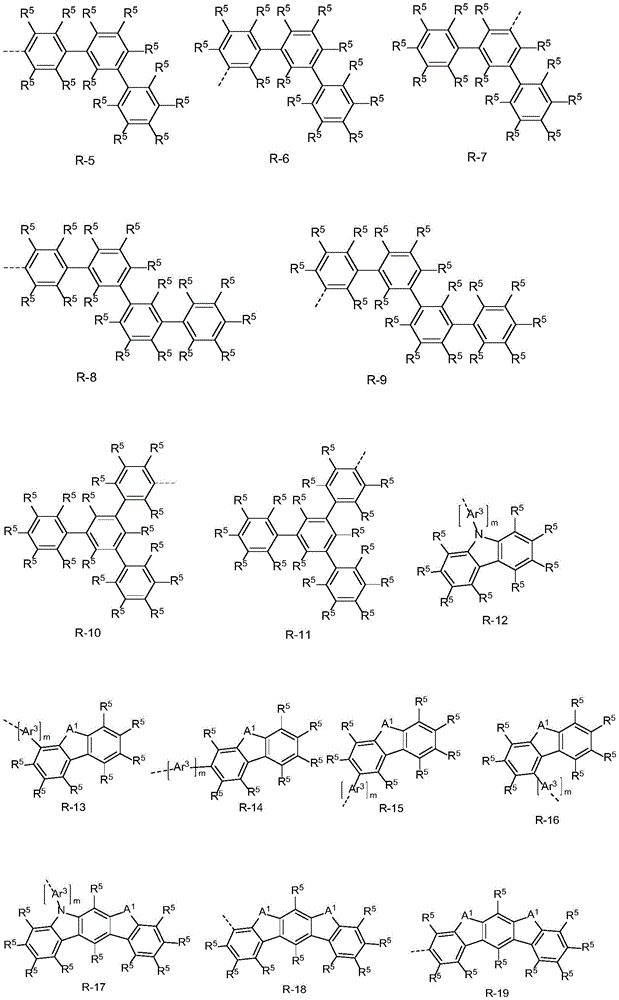
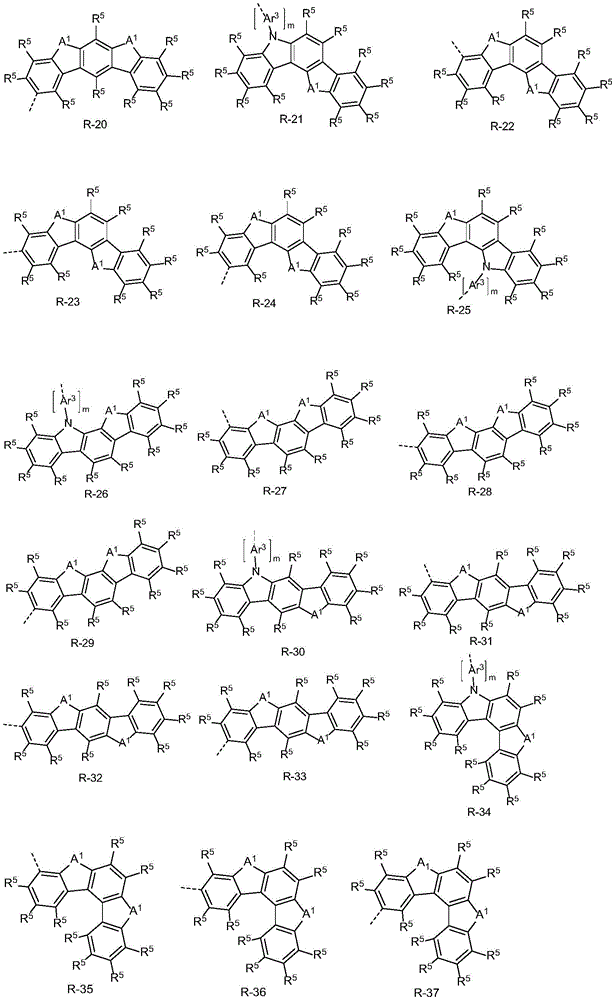

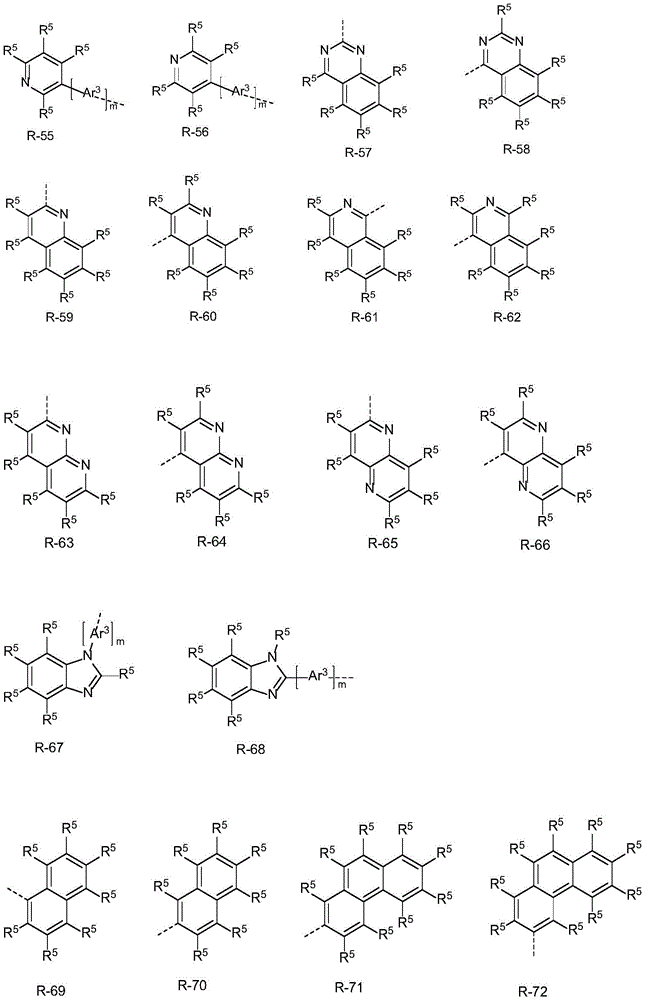

Wherein R is5The dotted bond represents a bond to the basic skeleton of formula (I) as defined in claim 1, and further:
Ar3are identical or different on each occurrence and are each having from 6 to 12 aromatic ring atoms and are each bound by R5A divalent aromatic or heteroaromatic ring system substituted with a group;
Ar5are identical or different on each occurrence and are each 6 to 40 aromatic ring atoms and are each R6An aromatic ring system substituted by a group, or an aromatic ring system having 6 to 40 aromatic ring atoms and substituted by R6A group-substituted heteroaromatic ring system;
A1in each case identical or different and is C (R)5)2、NR5O or S;
k is 0 or 1, wherein k-0 means that there is no A at this position1Radical bonding, alternatively, R5The groups are bonded to the corresponding carbon atoms;
m is 0 or 1, wherein m ═ 0 means Ar3The radicals are absent and the corresponding aromatic or heteroaromatic radicals are bonded directly to the basic skeleton of the formula (I).
8. The compound according to one or more of claims 1 to 7, characterized in that formula (I) comprises at least one N (R) chosen from5)2Having 6 to 40 aromatic ring atoms and substituted by R5An aromatic ring system substituted by a radical and having 5 to 40 aromatic ring atoms and being substituted by R5R of a group-substituted heteroaromatic ring system2A group.
9. Compound according to one or more of claims 1 to 8, characterized in that formula (I) comprises at least one R selected from the R-1 to R-82 groups as defined in claim 72A group.
10. Compound according to one or more of claims 1 to 9, characterized in that formula (I) comprises at least one element selected from N (R)5)2Having 6 to 40 aromatic ring atoms and substituted by R5An aromatic ring system substituted by a radical and having 5 to 40 aromatic ring atoms and being substituted by R5R of a group-substituted heteroaromatic ring system3A group.
11. Compound according to one or more of claims 1 to 10, characterized in that formula (I) comprises at least one R selected from the R-1 to R-82 groups as defined in claim 73A group.
12. Compound according to one or more of claims 1 to 11, characterized in that formula (I) comprises at least one selected from R1、R2And R3The radicals in the radical being selected from the group consisting of those having 7 to 40 aromatic ring atoms and each being substituted by R5A group-substituted aromatic ring system; and having 5 to 40 aromatic ring atoms and each being substituted by R5A group-substituted heteroaromatic ring system.
13. Compound according to one or more of claims 1 to 12, characterized in that formula (I) comprises at least one selected from R1、R2And R3The radicals in the group are selected from the group consisting of R-1 to R-81 as defined in claim 7.
14. Compound according to one or more of claims 1 to 13, characterized in that the compound corresponds to one of formulae (I-a-1) to (I-a-3)
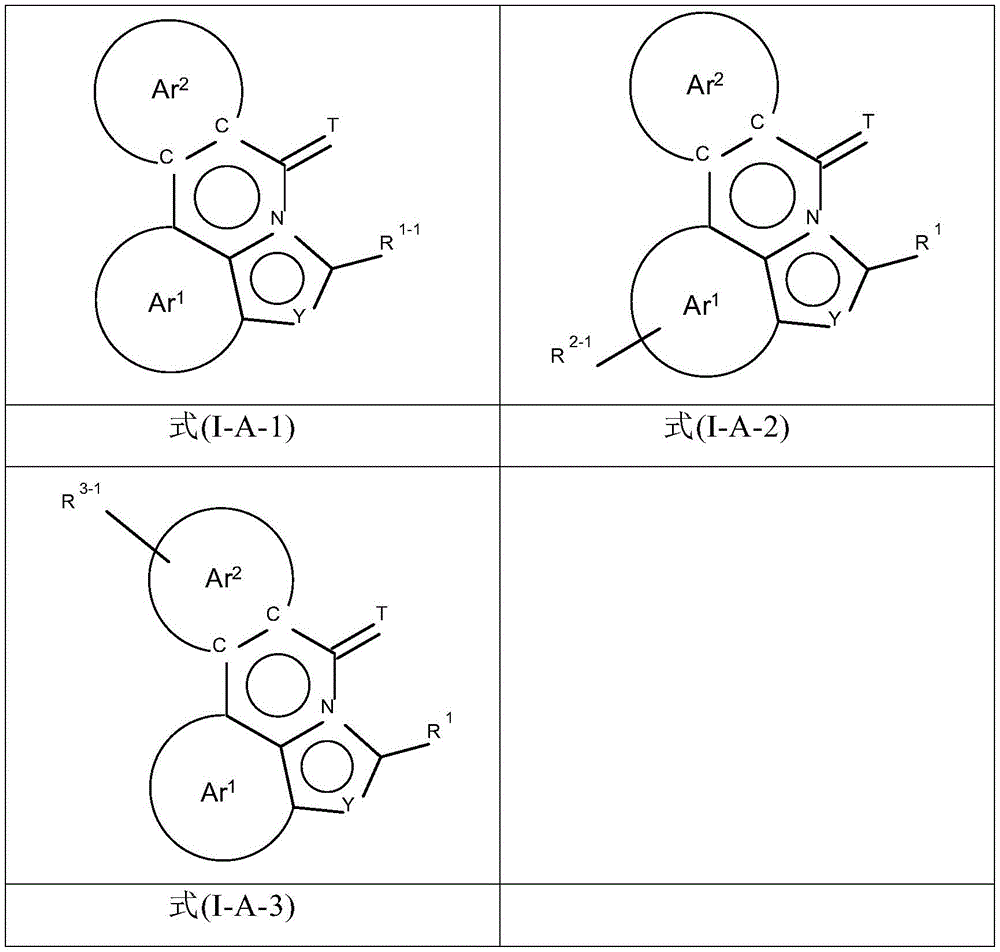
Wherein R is1-1、R2-1And R3-1Selected from the group consisting of those having 7 to 40 aromatic ring atoms and each of which is R5A group-substituted aromatic ring system; and having 5 to 40 aromatic ring atoms and each being substituted by R5A group-substituted heteroaromatic ring system.
15. Compound according to one or more of claims 1 to 14, characterized in that it corresponds to one of the following formulae:
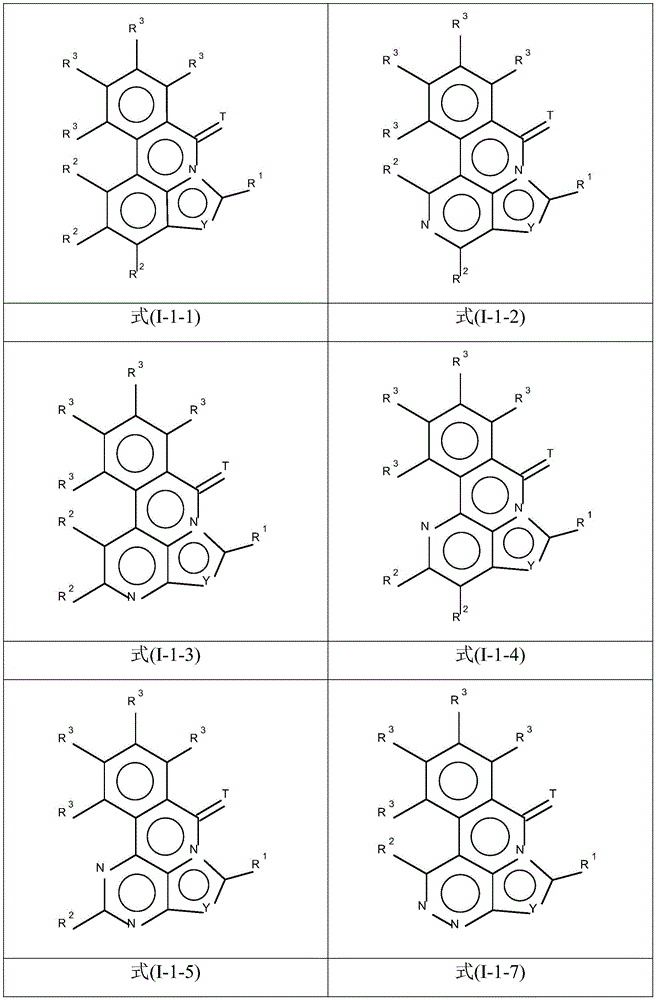
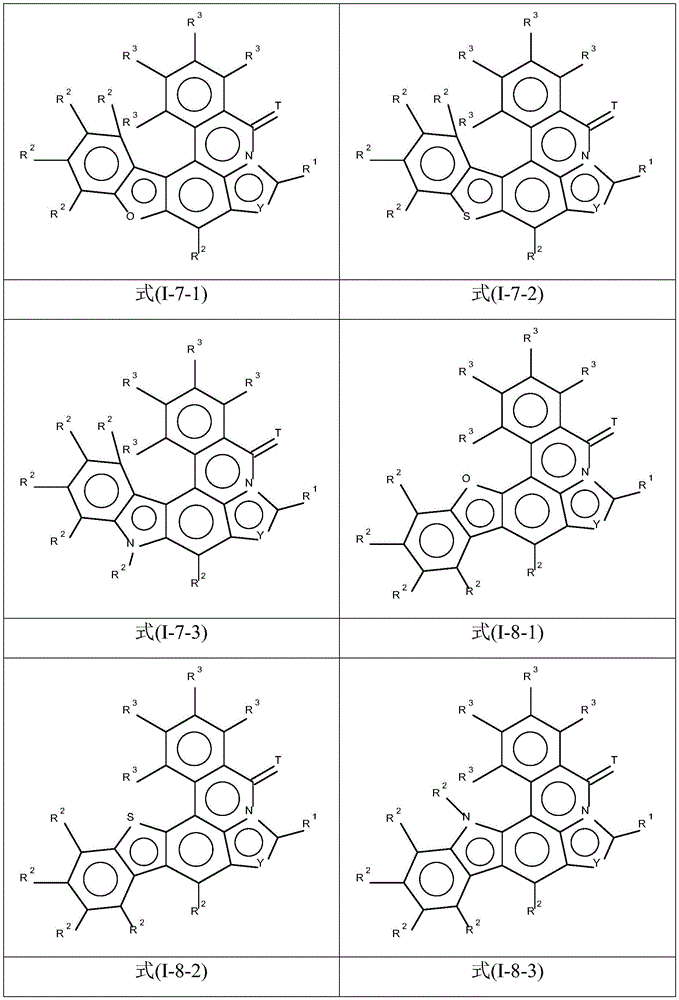
wherein the variables are as defined in one or more of claims 1,2,3 and 5, and when Y is CR1If so, one of the following two is selected:
a) at least one is selected from R1、R2、R3And R4The radicals in the radical being selected from the group having 7 to 40 aromatic ring atoms and each being substituted byR5A group-substituted aromatic ring system; and having 5 to 40 aromatic ring atoms and each being substituted by R5A group-substituted heteroaromatic ring system; or
b) At least two are selected from R1、R2、R3And R4The radicals in the radical being selected from those having 6 to 40 aromatic ring atoms and each being substituted by R5A group-substituted aromatic ring system; and having 5 to 40 aromatic ring atoms and each being substituted by R5A group-substituted heteroaromatic ring system.
16. The compound of claim 15, wherein each of said formulae includes at least one member selected from the group consisting of R1、R2And R3The radicals in the radical being selected from the group consisting of those having 7 to 40 aromatic ring atoms and each being substituted by R5A group-substituted aromatic ring system; and having 5 to 40 aromatic ring atoms and each being substituted by R5A group-substituted heteroaromatic ring system.
17. A compound of one of the following structural formulae HT-1 to HT-13:


18. process for the preparation of compounds according to one or more of claims 1 to 16, characterized in that: i) reaction of an imidazole or benzimidazole derivative with an aryl or heteroaryl compound having a halogen at the benzyl position, ii) ring closure reaction under Pd catalysis, and iii) oxidation of the methylene group in the formed ring to a carbonyl group; or is characterized in that: iv) reaction of an imidazole or benzimidazole derivative with an aryl or heteroaryl compound having a carbonyl halide group, and v) carrying out a ring closure reaction.
19. A formulation comprising at least one compound according to one or more of claims 1 to 17 and at least one further compound and/or at least one solvent.
20. Use of a compound of formula (I) in an electronic device,
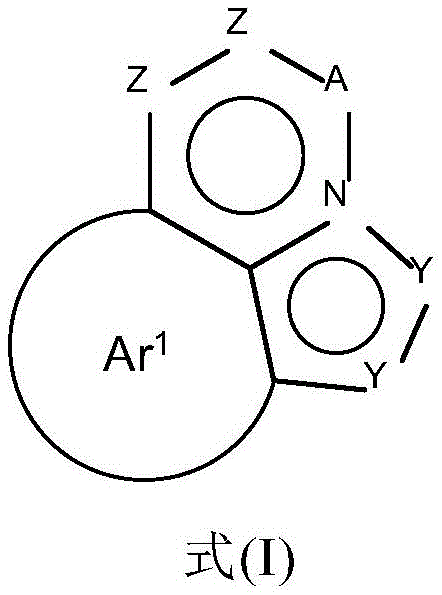
the variables appearing therein are as follows:
a is C-O, C-S, C-NR0、P(=O)R0SO or SO2;
Y is identical or different on each occurrence and is selected from N and CR1;
Ar1Is a compound having 6 to 40 aromatic ring atoms and substituted by R2An aromatic ring system substituted with a group and fused to the remainder of formula (I) via three carbon atoms as shown in formula (I), or having 5 to 40 aromatic ring atoms and being substituted by R2A group-substituted heteroaromatic ring system fused to the remainder of formula (I) via three carbon atoms shown in formula (I);
z is identical or different on each occurrence and is selected from the group consisting of CR4And N, or Z-Z unit is represented by formula (Ar)2) Unit (2) of

Wherein Ar is2Selected from the group consisting of those having 6 to 40 aromatic ring atoms and substituted by R3An aromatic ring system substituted with a group, said aromatic ring system comprising C-C units, and having 5 to 40 aromatic ring atoms and being substituted by R3A group-substituted heteroaromatic ring system comprising C-C units and wherein the dotted line is the bond connecting said Z-Z unit to the remainder of the formula;
R0in each caseIdentical or different and selected from: a linear alkyl or alkoxy group having 1 to 20 carbon atoms, a branched or cyclic alkyl or alkoxy group having 3 to 20 carbon atoms, an alkenyl or alkynyl group having 2 to 20 carbon atoms, an aromatic ring system having 6 to 40 aromatic ring atoms, and a heteroaromatic ring system having 5 to 40 aromatic ring atoms; wherein the alkyl, alkoxy, alkenyl and alkynyl groups mentioned and the aromatic and heteroaromatic ring systems mentioned are each R5Substituted by groups; and wherein one or more CH of the alkyl, alkoxy, alkenyl and alkynyl groups mentioned2The group may be represented by-R5C=CR5-、-C≡C-、Si(R5)2、C=O、C=NR5、-C(=O)O-、-C(=O)NR5-、NR5、P(=O)(R5) -O-, -S-, SO or SO2Replacing;
R1in each case identical or different and selected from: h, D, F, Cl, Br, I, C (═ O) R5,CN,Si(R5)3,N(R5)2,P(=O)(R5)2,OR5,S(=O)R5,S(=O)2R5A linear alkyl or alkoxy group having 1 to 20 carbon atoms, a branched or cyclic alkyl or alkoxy group having 3 to 20 carbon atoms, an alkenyl or alkynyl group having 2 to 20 carbon atoms, an aromatic ring system having 6 to 40 aromatic ring atoms, and a heteroaromatic ring system having 5 to 40 aromatic ring atoms; wherein the alkyl, alkoxy, alkenyl and alkynyl groups mentioned and the aromatic and heteroaromatic ring systems mentioned are each R5Substituted by groups; and wherein one or more CH of the alkyl, alkoxy, alkenyl and alkynyl groups mentioned2The group may be represented by-R5C=CR5-、-C≡C-、Si(R5)2、C=O、C=NR5、-C(=O)O-、-C(=O)NR5-、NR5、P(=O)(R5) -O-, -S-, SO or SO2Replacing;
R2in each case identical or different and selected from: h, D, F, Cl, Br, I, C (═ O) R5,CN,Si(R5)3,N(R5)2,P(=O)(R5)2,OR5,S(=O)R5,S(=O)2R5A linear alkyl or alkoxy group having 1 to 20 carbon atoms, a branched or cyclic alkyl or alkoxy group having 3 to 20 carbon atoms, an alkenyl or alkynyl group having 2 to 20 carbon atoms, an aromatic ring system having 6 to 40 aromatic ring atoms, and a heteroaromatic ring system having 5 to 40 aromatic ring atoms; wherein two or more are selected from R2、R3And R4The groups of (a) may be linked to each other and may form a ring; wherein the alkyl, alkoxy, alkenyl and alkynyl groups mentioned and the aromatic and heteroaromatic ring systems mentioned are each R5Substituted by groups; and wherein one or more CH of the alkyl, alkoxy, alkenyl and alkynyl groups mentioned2The group may be represented by-R5C=CR5-、-C≡C-、Si(R5)2、C=O、C=NR5、-C(=O)O-、-C(=O)NR5-、NR5、P(=O)(R5) -O-, -S-, SO or SO2Replacing;
R3in each case identical or different and selected from: h, D, F, Cl, Br, I, C (═ O) R5,CN,Si(R5)3,N(R5)2,P(=O)(R5)2,OR5,S(=O)R5,S(=O)2R5A linear alkyl or alkoxy group having 1 to 20 carbon atoms, a branched or cyclic alkyl or alkoxy group having 3 to 20 carbon atoms, an alkenyl or alkynyl group having 2 to 20 carbon atoms, an aromatic ring system having 6 to 40 aromatic ring atoms, and a heteroaromatic ring system having 5 to 40 aromatic ring atoms; wherein two or more are selected from R2、R3And R4The groups of (a) may be linked to each other and may form a ring; wherein the alkyl, alkoxy, alkenyl and alkynyl groups mentioned and the aromatic and heteroaromatic ring systems mentioned are each R5Substituted by groups; and wherein one or more of the alkyl, alkoxy, alkenyl and alkynyl groups mentionedCH2The group may be represented by-R5C=CR5-、-C≡C-、Si(R5)2、C=O、C=NR5、-C(=O)O-、-C(=O)NR5-、NR5、P(=O)(R5) -O-, -S-, SO or SO2Replacing;
R4in each case identical or different and selected from: h, D, F, Cl, Br, I, C (═ O) R5,CN,Si(R5)3,N(R5)2,P(=O)(R5)2,OR5,S(=O)R5,S(=O)2R5A linear alkyl or alkoxy group having 1 to 20 carbon atoms, a branched or cyclic alkyl or alkoxy group having 3 to 20 carbon atoms, an alkenyl or alkynyl group having 2 to 20 carbon atoms, an aromatic ring system having 6 to 40 aromatic ring atoms, and a heteroaromatic ring system having 5 to 40 aromatic ring atoms; wherein two or more R2、R3And R4The groups may be linked to each other and may form a ring; wherein the alkyl, alkoxy, alkenyl and alkynyl groups mentioned and the aromatic and heteroaromatic ring systems mentioned are each R5Substituted by groups; and wherein one or more CH of the alkyl, alkoxy, alkenyl and alkynyl groups mentioned2The group may be represented by-R5C=CR5-、-C≡C-、Si(R5)2、C=O、C=NR5、-C(=O)O-、-C(=O)NR5-、NR5、P(=O)(R5) -O-, -S-, SO or SO2Replacing;
R5in each case identical or different and selected from: h, D, F, Cl, Br, I, C (═ O) R6,CN,Si(R6)3,N(R6)2,P(=O)(R6)2,OR6,S(=O)R6,S(=O)2R6A linear alkyl or alkoxy group having 1 to 20 carbon atoms, a branched or cyclic alkyl or alkoxy group having 3 to 20 carbon atoms, an alkenyl or alkynyl group having 2 to 20 carbon atoms, an aromatic ring system having 6 to 40 aromatic ring atoms, and an aromatic ring system having 5 to 40 aromatic ring atomsA heteroaromatic ring system of group ring atoms; wherein two or more R5The groups may be linked to each other and may form a ring; wherein the alkyl, alkoxy, alkenyl and alkynyl groups mentioned and the aromatic and heteroaromatic ring systems mentioned are each R6Substituted by groups; and wherein one or more CH of the alkyl, alkoxy, alkenyl and alkynyl groups mentioned2The group may be represented by-R6C=CR6-、-C≡C-、Si(R6)2、C=O、C=NR6、-C(=O)O-、-C(=O)NR6-、NR6、P(=O)(R6) -O-, -S-, SO or SO2Replacing;
R6in each case identical or different and selected from: h, D, F, Cl, Br, I, CN, alkyl or alkoxy groups having 1 to 20 carbon atoms, alkenyl or alkynyl groups having 2 to 20 carbon atoms, aromatic ring systems having 6 to 40 aromatic ring atoms, and heteroaromatic ring systems having 5 to 40 aromatic ring atoms; wherein two or more R6The groups may be linked to each other and may form a ring; and wherein the alkyl, alkoxy, alkenyl and alkynyl groups, aromatic ring systems and heteroaromatic ring systems mentioned may be substituted by one or more groups selected from F and CN.
21. An electronic device comprising at least one compound as defined in claim 17 or 20.
22. Electronic device according to claim 21, characterized in that the electronic device is an organic electroluminescent device and in that the compound is used in the light-emitting layer as host material for phosphorescent emitters or emitters displaying TADF (thermally excited delayed fluorescence) or in the electron-transport layer and/or the hole-blocking layer and/or the hole-transport layer and/or the electron-blocking layer.
23. A material comprising at least one compound as defined in claim 19 and at least one further compound selected from the group consisting of bis-carbazoles, bridged carbazoles, triarylamines, dibenzofuranyl-carbazole derivatives, dibenzofuranyl-amine derivatives, and carbazoloamines.
24. An organic electroluminescent device comprising the material of claim 23 in a layer.
Applications Claiming Priority (3)
| Application Number | Priority Date | Filing Date | Title |
|---|---|---|---|
| EP19198695 | 2019-09-20 | ||
| EP19198695.9 | 2019-09-20 | ||
| PCT/EP2020/075926 WO2021053046A1 (en) | 2019-09-20 | 2020-09-17 | Peri-condensed heterocyclic compounds as materials for electronic devices |
Publications (1)
| Publication Number | Publication Date |
|---|---|
| CN114401945A true CN114401945A (en) | 2022-04-26 |
Family
ID=67998360
Family Applications (1)
| Application Number | Title | Priority Date | Filing Date |
|---|---|---|---|
| CN202080064421.4A Pending CN114401945A (en) | 2019-09-20 | 2020-09-17 | Peri-condensed heterocyclic compounds as materials for electronic devices |
Country Status (5)
| Country | Link |
|---|---|
| US (1) | US20220384735A1 (en) |
| EP (1) | EP4031549A1 (en) |
| KR (1) | KR20220066324A (en) |
| CN (1) | CN114401945A (en) |
| WO (1) | WO2021053046A1 (en) |
Citations (10)
| Publication number | Priority date | Publication date | Assignee | Title |
|---|---|---|---|---|
| WO1998001429A1 (en) * | 1996-07-05 | 1998-01-15 | Mochida Pharmaceutical Co., Ltd. | Novel benzimidazole derivatives |
| US20110112275A1 (en) * | 2008-10-31 | 2011-05-12 | Merck Patent Gmbh | Novel materials for organic electroluminescence devices |
| WO2011060036A1 (en) * | 2009-11-16 | 2011-05-19 | Schering Corporation | Bicyclic compounds and methods of use thereof |
| WO2011137951A1 (en) * | 2010-05-04 | 2011-11-10 | Merck Patent Gmbh | Organic electroluminescence devices |
| WO2013017192A1 (en) * | 2011-08-03 | 2013-02-07 | Merck Patent Gmbh | Materials for electronic devices |
| WO2014056567A1 (en) * | 2012-10-11 | 2014-04-17 | Merck Patent Gmbh | Materials for organic electroluminescent devices |
| WO2014094964A1 (en) * | 2012-12-18 | 2014-06-26 | Merck Patent Gmbh | Organic electroluminescent device |
| WO2019007867A1 (en) * | 2017-07-05 | 2019-01-10 | Merck Patent Gmbh | COMPOSITION FOR ORGANIC ELECTRONIC DEVICES |
| US20190135814A1 (en) * | 2016-04-29 | 2019-05-09 | Merck Patent Gmbh | Materials for organic electroluminescent devices |
| CN109890787A (en) * | 2016-11-02 | 2019-06-14 | 默克专利有限公司 | Material for electronic device |
Family Cites Families (74)
| Publication number | Priority date | Publication date | Assignee | Title |
|---|---|---|---|---|
| JPH07133483A (en) | 1993-11-09 | 1995-05-23 | Shinko Electric Ind Co Ltd | Organic light emitting material for EL device and EL device |
| WO2000070655A2 (en) | 1999-05-13 | 2000-11-23 | The Trustees Of Princeton University | Very high efficiency organic light emitting devices based on electrophosphorescence |
| KR100946314B1 (en) | 1999-12-01 | 2010-03-09 | 더 트러스티즈 오브 프린스턴 유니버시티 | Organic light emitting device comprising a phosphorescent organo metallic compound |
| US6660410B2 (en) | 2000-03-27 | 2003-12-09 | Idemitsu Kosan Co., Ltd. | Organic electroluminescence element |
| US20020121638A1 (en) | 2000-06-30 | 2002-09-05 | Vladimir Grushin | Electroluminescent iridium compounds with fluorinated phenylpyridines, phenylpyrimidines, and phenylquinolines and devices made with such compounds |
| CN101924190B (en) | 2000-08-11 | 2012-07-04 | 普林斯顿大学理事会 | Organometallic compounds and emission-shifting organic electrophosphorescence |
| JP4154140B2 (en) | 2000-09-26 | 2008-09-24 | キヤノン株式会社 | Metal coordination compounds |
| JP4154139B2 (en) | 2000-09-26 | 2008-09-24 | キヤノン株式会社 | Light emitting element |
| JP4154138B2 (en) | 2000-09-26 | 2008-09-24 | キヤノン株式会社 | Light emitting element, display device and metal coordination compound |
| ITRM20020411A1 (en) | 2002-08-01 | 2004-02-02 | Univ Roma La Sapienza | SPIROBIFLUORENE DERIVATIVES, THEIR PREPARATION AND USE. |
| JP4411851B2 (en) | 2003-03-19 | 2010-02-10 | コニカミノルタホールディングス株式会社 | Organic electroluminescence device |
| JP5318347B2 (en) | 2003-04-15 | 2013-10-16 | メルク パテント ゲーエムベーハー | Mixture of matrix material and organic semiconductor capable of emitting light, use thereof, and electronic component comprising said mixture |
| EP2236579B1 (en) | 2003-04-23 | 2014-04-09 | Konica Minolta Holdings, Inc. | Organic electroluminescent element and display |
| DE10338550A1 (en) | 2003-08-19 | 2005-03-31 | Basf Ag | Transition metal complexes with carbene ligands as emitters for organic light-emitting diodes (OLEDs) |
| DE10345572A1 (en) | 2003-09-29 | 2005-05-19 | Covion Organic Semiconductors Gmbh | metal complexes |
| US7795801B2 (en) | 2003-09-30 | 2010-09-14 | Konica Minolta Holdings, Inc. | Organic electroluminescent element, illuminator, display and compound |
| US7790890B2 (en) | 2004-03-31 | 2010-09-07 | Konica Minolta Holdings, Inc. | Organic electroluminescence element material, organic electroluminescence element, display device and illumination device |
| DE102004023277A1 (en) | 2004-05-11 | 2005-12-01 | Covion Organic Semiconductors Gmbh | New material mixtures for electroluminescence |
| US7598388B2 (en) | 2004-05-18 | 2009-10-06 | The University Of Southern California | Carbene containing metal complexes as OLEDs |
| JP4862248B2 (en) | 2004-06-04 | 2012-01-25 | コニカミノルタホールディングス株式会社 | Organic electroluminescence element, lighting device and display device |
| ITRM20040352A1 (en) | 2004-07-15 | 2004-10-15 | Univ Roma La Sapienza | OLIGOMERIC DERIVATIVES OF SPIROBIFLUORENE, THEIR PREPARATION AND THEIR USE. |
| CN101171320B (en) | 2005-05-03 | 2013-04-10 | 默克专利有限公司 | Organic electroluminescent device |
| EP1956022B1 (en) | 2005-12-01 | 2012-07-25 | Nippon Steel Chemical Co., Ltd. | Compound for organic electroluminescent element and organic electroluminescent element |
| DE102006025777A1 (en) | 2006-05-31 | 2007-12-06 | Merck Patent Gmbh | New materials for organic electroluminescent devices |
| US8062769B2 (en) | 2006-11-09 | 2011-11-22 | Nippon Steel Chemical Co., Ltd. | Indolocarbazole compound for use in organic electroluminescent device and organic electroluminescent device |
| DE102007002714A1 (en) | 2007-01-18 | 2008-07-31 | Merck Patent Gmbh | New materials for organic electroluminescent devices |
| DE102007053771A1 (en) | 2007-11-12 | 2009-05-14 | Merck Patent Gmbh | Organic electroluminescent devices |
| DE102008027005A1 (en) | 2008-06-05 | 2009-12-10 | Merck Patent Gmbh | Organic electronic device containing metal complexes |
| DE102008033943A1 (en) | 2008-07-18 | 2010-01-21 | Merck Patent Gmbh | New materials for organic electroluminescent devices |
| DE102008036247A1 (en) | 2008-08-04 | 2010-02-11 | Merck Patent Gmbh | Electronic devices containing metal complexes |
| DE102008036982A1 (en) | 2008-08-08 | 2010-02-11 | Merck Patent Gmbh | Organic electroluminescent device |
| DE102008048336A1 (en) | 2008-09-22 | 2010-03-25 | Merck Patent Gmbh | Mononuclear neutral copper (I) complexes and their use for the production of optoelectronic devices |
| KR20110097612A (en) | 2008-11-11 | 2011-08-31 | 메르크 파텐트 게엠베하 | Organic electroluminescent devices |
| DE102008056688A1 (en) | 2008-11-11 | 2010-05-12 | Merck Patent Gmbh | Materials for organic electroluminescent devices |
| DE102008057050B4 (en) | 2008-11-13 | 2021-06-02 | Merck Patent Gmbh | Materials for organic electroluminescent devices |
| DE102008057051B4 (en) | 2008-11-13 | 2021-06-17 | Merck Patent Gmbh | Materials for organic electroluminescent devices |
| DE102009007038A1 (en) | 2009-02-02 | 2010-08-05 | Merck Patent Gmbh | metal complexes |
| DE102009011223A1 (en) | 2009-03-02 | 2010-09-23 | Merck Patent Gmbh | metal complexes |
| DE102009013041A1 (en) | 2009-03-13 | 2010-09-16 | Merck Patent Gmbh | Materials for organic electroluminescent devices |
| DE102009014513A1 (en) | 2009-03-23 | 2010-09-30 | Merck Patent Gmbh | Organic electroluminescent device |
| DE102009023155A1 (en) | 2009-05-29 | 2010-12-02 | Merck Patent Gmbh | Materials for organic electroluminescent devices |
| DE102009031021A1 (en) | 2009-06-30 | 2011-01-05 | Merck Patent Gmbh | Materials for organic electroluminescent devices |
| DE102009041414A1 (en) | 2009-09-16 | 2011-03-17 | Merck Patent Gmbh | metal complexes |
| DE102009053644B4 (en) | 2009-11-17 | 2019-07-04 | Merck Patent Gmbh | Materials for organic electroluminescent devices |
| DE102009053645A1 (en) | 2009-11-17 | 2011-05-19 | Merck Patent Gmbh | Materials for organic electroluminescent device |
| DE102009048791A1 (en) | 2009-10-08 | 2011-04-14 | Merck Patent Gmbh | Materials for organic electroluminescent devices |
| DE102009053382A1 (en) | 2009-11-14 | 2011-05-19 | Merck Patent Gmbh | Materials for electronic devices |
| DE102009053836A1 (en) | 2009-11-18 | 2011-05-26 | Merck Patent Gmbh | Materials for organic electroluminescent devices |
| DE102009057167A1 (en) | 2009-12-05 | 2011-06-09 | Merck Patent Gmbh | Electronic device containing metal complexes |
| DE102010005697A1 (en) | 2010-01-25 | 2011-07-28 | Merck Patent GmbH, 64293 | Connections for electronic devices |
| DE112011102008B4 (en) | 2010-06-15 | 2022-04-21 | Merck Patent Gmbh | metal complexes |
| DE102010027317A1 (en) | 2010-07-16 | 2012-01-19 | Merck Patent Gmbh | metal complexes |
| DE102010048608A1 (en) | 2010-10-15 | 2012-04-19 | Merck Patent Gmbh | Materials for organic electroluminescent devices |
| KR101979469B1 (en) | 2011-04-18 | 2019-05-16 | 메르크 파텐트 게엠베하 | Materials for organic electroluminescent devices |
| CA2849087A1 (en) | 2011-09-21 | 2013-03-28 | Merck Patent Gmbh | Carbazole derivatives for organic electroluminescent devices |
| EP2768808B1 (en) | 2011-10-20 | 2017-11-15 | Merck Patent GmbH | Materials for organic electroluminescent devices |
| EP2872590B1 (en) | 2012-07-13 | 2018-11-14 | Merck Patent GmbH | Metal complexes |
| JP6363075B2 (en) | 2012-08-07 | 2018-07-25 | メルク パテント ゲーエムベーハー | Metal complex |
| WO2014094960A1 (en) | 2012-12-21 | 2014-06-26 | Merck Patent Gmbh | Metal complexes |
| EP2935292B1 (en) | 2012-12-21 | 2019-04-10 | Merck Patent GmbH | Metal complexes |
| EP3044284B1 (en) | 2013-09-11 | 2019-11-13 | Merck Patent GmbH | Metal complexes |
| US11005050B2 (en) | 2014-01-13 | 2021-05-11 | Merck Patent Gmbh | Metal complexes |
| CN105980519B (en) | 2014-02-05 | 2019-06-14 | 默克专利有限公司 | metal complex |
| EP3140302B1 (en) | 2014-05-05 | 2019-08-21 | Merck Patent GmbH | Materials for organic light emitting devices |
| WO2016015815A1 (en) | 2014-07-28 | 2016-02-04 | Merck Patent Gmbh | Metal complexes |
| CN106661006B (en) | 2014-07-29 | 2019-11-08 | 默克专利有限公司 | Materials for Organic Electroluminescent Devices |
| EP3180411B1 (en) | 2014-08-13 | 2018-08-29 | Merck Patent GmbH | Materials for organic electroluminescent devices |
| JP6772188B2 (en) | 2015-02-03 | 2020-10-21 | メルク、パテント、ゲゼルシャフト、ミット、ベシュレンクテル、ハフツングMerck Patent GmbH | Metal complex |
| US11031562B2 (en) | 2015-08-25 | 2021-06-08 | Merck Patent Gmbh | Metal complexes |
| KR102851400B1 (en) | 2016-03-03 | 2025-08-29 | 메르크 파텐트 게엠베하 | Materials for organic electroluminescent devices |
| JP7039549B2 (en) | 2016-07-14 | 2022-03-22 | メルク パテント ゲゼルシャフト ミット ベシュレンクテル ハフツング | Metal complex |
| WO2018041769A1 (en) | 2016-08-30 | 2018-03-08 | Merck Patent Gmbh | Binuclear and trinuclear metal complexes composed of two inter-linked tripodal hexadentate ligands for use in electroluminescent devices |
| US11569458B2 (en) | 2017-03-29 | 2023-01-31 | Merck Patent Gmbh | Metal complexes |
| TWI776926B (en) | 2017-07-25 | 2022-09-11 | 德商麥克專利有限公司 | Metal complexes |
-
2020
- 2020-09-17 CN CN202080064421.4A patent/CN114401945A/en active Pending
- 2020-09-17 US US17/761,313 patent/US20220384735A1/en not_active Abandoned
- 2020-09-17 EP EP20771870.1A patent/EP4031549A1/en active Pending
- 2020-09-17 KR KR1020227012744A patent/KR20220066324A/en not_active Withdrawn
- 2020-09-17 WO PCT/EP2020/075926 patent/WO2021053046A1/en not_active Ceased
Patent Citations (10)
| Publication number | Priority date | Publication date | Assignee | Title |
|---|---|---|---|---|
| WO1998001429A1 (en) * | 1996-07-05 | 1998-01-15 | Mochida Pharmaceutical Co., Ltd. | Novel benzimidazole derivatives |
| US20110112275A1 (en) * | 2008-10-31 | 2011-05-12 | Merck Patent Gmbh | Novel materials for organic electroluminescence devices |
| WO2011060036A1 (en) * | 2009-11-16 | 2011-05-19 | Schering Corporation | Bicyclic compounds and methods of use thereof |
| WO2011137951A1 (en) * | 2010-05-04 | 2011-11-10 | Merck Patent Gmbh | Organic electroluminescence devices |
| WO2013017192A1 (en) * | 2011-08-03 | 2013-02-07 | Merck Patent Gmbh | Materials for electronic devices |
| WO2014056567A1 (en) * | 2012-10-11 | 2014-04-17 | Merck Patent Gmbh | Materials for organic electroluminescent devices |
| WO2014094964A1 (en) * | 2012-12-18 | 2014-06-26 | Merck Patent Gmbh | Organic electroluminescent device |
| US20190135814A1 (en) * | 2016-04-29 | 2019-05-09 | Merck Patent Gmbh | Materials for organic electroluminescent devices |
| CN109890787A (en) * | 2016-11-02 | 2019-06-14 | 默克专利有限公司 | Material for electronic device |
| WO2019007867A1 (en) * | 2017-07-05 | 2019-01-10 | Merck Patent Gmbh | COMPOSITION FOR ORGANIC ELECTRONIC DEVICES |
Non-Patent Citations (9)
| Title |
|---|
| ABHISHEK P. KULKARNI等: "Electron Transport Materials for Organic Light-Emitting Diodes", CHEM. MATER., vol. 16, no. 23, pages 4556 - 4573, XP055032910, DOI: 10.1021/cm049473l * |
| AHMED A. R. SAYED 等: "Life span extension of Caenorhabditis elegans by novel pyridoperimidine derivative", ARCHIVES OF PHARMACAL RESEARCH., vol. 35, no. 1, pages 69 - 76, XP055740567, DOI: 10.1007/s12272-012-0107-x * |
| CHARLES W. REES等: "Imidazoquinolinethiones from quinolines: a new molecular rearrangement", CHEM. COMMUN., pages 2775 - 2776 * |
| CHRISTIAN G. HARTUNG等: "Directed ortho Metalation Approach to C-7-Substituted Indoles. Suzuki-Miyaura Cross Coupling and the Synthesis of Pyrrolophenanthridone Alkaloids", ORGANIC LETTERS, vol. 5, no. 11, pages 1899 - 1902 * |
| COLUMBUS, OHIO, US: "REGISTRY[Online]", REGISTRY, pages 1367360 - 24 * |
| RAMASAMY MANOHARAN 等: "Ruthenium-catalyzed cyclization of N-carbamoyl indolines with alkynes: an efficient route to pyrroloquinolinones", ORGANIC&BIOMOLECULAR CHEMISTRY, vol. 13, pages 9276 - 9284, XP055740534, DOI: 10.1039/C5OB01146A * |
| TAKASHI IKAWA等: "Regiocomplementary Cycloaddition Reactions of Boryl- and Silylbenzynes with 1,3-Dipoles: Selective Synthesis of Benzo-Fused Azole Derivatives", J. ORG. CHEM., vol. 78, pages 2965 - 2983, XP055329794, DOI: 10.1021/jo302802b * |
| 张晓宏 等: "苯并噻唑衍生物用作EL器件中发光材料的研究", 感光科学与光化学, vol. 17, no. 3, pages 199 - 202 * |
| 苏玉苗 等: "咔唑及其衍生物在蓝光OLED中的应用", 化学进展, vol. 27, no. 10, pages 1384 - 1399 * |
Also Published As
| Publication number | Publication date |
|---|---|
| EP4031549A1 (en) | 2022-07-27 |
| WO2021053046A1 (en) | 2021-03-25 |
| KR20220066324A (en) | 2022-05-24 |
| US20220384735A1 (en) | 2022-12-01 |
Similar Documents
| Publication | Publication Date | Title |
|---|---|---|
| CN109071580B (en) | Material for organic electroluminescent device | |
| CN111557122B (en) | Materials for organic electroluminescent devices | |
| CN108699438B (en) | Material for organic electroluminescent device | |
| TWI680969B (en) | Materials for organic electroluminescent devices | |
| CN114222738A (en) | Material for organic electroluminescent device | |
| KR101730779B1 (en) | Materials for organic light emitting devices | |
| CN115956074B (en) | Material for organic electroluminescent device | |
| CN110431136B (en) | Materials for Organic Electroluminescent Devices | |
| CN113166639A (en) | Compounds for electronic devices | |
| CN104871329A (en) | Organic electroluminescent device | |
| CN107922398B (en) | Material for organic electroluminescent device | |
| CN110914244A (en) | Spirobifluorene derivatives for use in electronic devices | |
| CN111065640A (en) | Materials for organic electroluminescent devices | |
| CN114830369A (en) | Compounds for electronic devices | |
| CN111225919A (en) | Materials for organic electroluminescent devices | |
| CN113169274A (en) | Compounds for electronic devices | |
| CN111051293A (en) | Materials for Electronic Devices | |
| CN112219292A (en) | Organic electroluminescent device | |
| CN113195500B (en) | Material for organic electroluminescent device | |
| CN116710454A (en) | Nitrogen-containing compounds for organic electroluminescent devices | |
| KR20180077216A (en) | Material for organic electroluminescence device | |
| CN113166643B (en) | Material for organic electroluminescent device | |
| CN112384595A (en) | Material for organic electroluminescent device | |
| CN117279902A (en) | Materials for organic electroluminescent devices | |
| CN113614082B (en) | Materials for organic electroluminescent devices |
Legal Events
| Date | Code | Title | Description |
|---|---|---|---|
| PB01 | Publication | ||
| PB01 | Publication | ||
| SE01 | Entry into force of request for substantive examination | ||
| SE01 | Entry into force of request for substantive examination | ||
| WD01 | Invention patent application deemed withdrawn after publication | ||
| WD01 | Invention patent application deemed withdrawn after publication |
Application publication date: 20220426 |