KR20140023316A - Nitrogen-containing aromatic compounds and organic electroluminescent elements - Google Patents
Nitrogen-containing aromatic compounds and organic electroluminescent elements Download PDFInfo
- Publication number
- KR20140023316A KR20140023316A KR1020137027210A KR20137027210A KR20140023316A KR 20140023316 A KR20140023316 A KR 20140023316A KR 1020137027210 A KR1020137027210 A KR 1020137027210A KR 20137027210 A KR20137027210 A KR 20137027210A KR 20140023316 A KR20140023316 A KR 20140023316A
- Authority
- KR
- South Korea
- Prior art keywords
- group
- carbon atoms
- layer
- nitrogen
- organic
- Prior art date
- Legal status (The legal status is an assumption and is not a legal conclusion. Google has not performed a legal analysis and makes no representation as to the accuracy of the status listed.)
- Granted
Links
- -1 Nitrogen-containing aromatic compounds Chemical class 0.000 title claims description 54
- 239000012044 organic layer Substances 0.000 claims abstract description 27
- 125000003118 aryl group Chemical group 0.000 claims abstract description 25
- 125000000217 alkyl group Chemical group 0.000 claims abstract description 24
- 125000000623 heterocyclic group Chemical group 0.000 claims abstract description 16
- 239000000758 substrate Substances 0.000 claims abstract description 11
- 229910052739 hydrogen Inorganic materials 0.000 claims abstract description 7
- 239000001257 hydrogen Substances 0.000 claims abstract description 7
- 229910052757 nitrogen Inorganic materials 0.000 claims abstract description 7
- 229910052717 sulfur Inorganic materials 0.000 claims abstract description 7
- 229910052760 oxygen Inorganic materials 0.000 claims abstract description 6
- 125000004435 hydrogen atom Chemical group [H]* 0.000 claims abstract 2
- 239000010410 layer Substances 0.000 claims description 151
- 125000004432 carbon atom Chemical group C* 0.000 claims description 81
- 239000000463 material Substances 0.000 claims description 66
- 125000006615 aromatic heterocyclic group Chemical group 0.000 claims description 31
- 125000000753 cycloalkyl group Chemical group 0.000 claims description 21
- 230000000903 blocking effect Effects 0.000 claims description 20
- 125000002029 aromatic hydrocarbon group Chemical group 0.000 claims description 19
- 125000003342 alkenyl group Chemical group 0.000 claims description 15
- 125000000304 alkynyl group Chemical group 0.000 claims description 15
- 238000000034 method Methods 0.000 claims description 14
- 239000002019 doping agent Substances 0.000 claims description 12
- 229910052711 selenium Inorganic materials 0.000 claims description 3
- 229910052727 yttrium Inorganic materials 0.000 claims description 2
- 150000001875 compounds Chemical class 0.000 description 65
- 125000001424 substituent group Chemical group 0.000 description 33
- 239000000203 mixture Substances 0.000 description 27
- YXFVVABEGXRONW-UHFFFAOYSA-N Toluene Chemical compound CC1=CC=CC=C1 YXFVVABEGXRONW-UHFFFAOYSA-N 0.000 description 18
- 239000000243 solution Substances 0.000 description 18
- 238000006243 chemical reaction Methods 0.000 description 16
- 238000002347 injection Methods 0.000 description 16
- 239000007924 injection Substances 0.000 description 16
- CSNNHWWHGAXBCP-UHFFFAOYSA-L Magnesium sulfate Chemical compound [Mg+2].[O-][S+2]([O-])([O-])[O-] CSNNHWWHGAXBCP-UHFFFAOYSA-L 0.000 description 15
- UEEXRMUCXBPYOV-UHFFFAOYSA-N iridium;2-phenylpyridine Chemical compound [Ir].C1=CC=CC=C1C1=CC=CC=N1.C1=CC=CC=C1C1=CC=CC=N1.C1=CC=CC=C1C1=CC=CC=N1 UEEXRMUCXBPYOV-UHFFFAOYSA-N 0.000 description 14
- 229910052751 metal Inorganic materials 0.000 description 14
- 239000002184 metal Substances 0.000 description 14
- 238000010898 silica gel chromatography Methods 0.000 description 12
- IAZDPXIOMUYVGZ-WFGJKAKNSA-N Dimethyl sulfoxide Chemical compound [2H]C([2H])([2H])S(=O)C([2H])([2H])[2H] IAZDPXIOMUYVGZ-WFGJKAKNSA-N 0.000 description 10
- CDBYLPFSWZWCQE-UHFFFAOYSA-L Sodium Carbonate Chemical compound [Na+].[Na+].[O-]C([O-])=O CDBYLPFSWZWCQE-UHFFFAOYSA-L 0.000 description 10
- MWPLVEDNUUSJAV-UHFFFAOYSA-N anthracene Chemical compound C1=CC=CC2=CC3=CC=CC=C3C=C21 MWPLVEDNUUSJAV-UHFFFAOYSA-N 0.000 description 10
- 238000010438 heat treatment Methods 0.000 description 10
- QTBSBXVTEAMEQO-UHFFFAOYSA-N Acetic acid Chemical compound CC(O)=O QTBSBXVTEAMEQO-UHFFFAOYSA-N 0.000 description 9
- UHOVQNZJYSORNB-UHFFFAOYSA-N Benzene Chemical compound C1=CC=CC=C1 UHOVQNZJYSORNB-UHFFFAOYSA-N 0.000 description 9
- 229910052782 aluminium Inorganic materials 0.000 description 9
- XAGFODPZIPBFFR-UHFFFAOYSA-N aluminium Chemical compound [Al] XAGFODPZIPBFFR-UHFFFAOYSA-N 0.000 description 9
- 230000015572 biosynthetic process Effects 0.000 description 9
- FYYHWMGAXLPEAU-UHFFFAOYSA-N Magnesium Chemical compound [Mg] FYYHWMGAXLPEAU-UHFFFAOYSA-N 0.000 description 8
- WYURNTSHIVDZCO-UHFFFAOYSA-N Tetrahydrofuran Chemical compound C1CCOC1 WYURNTSHIVDZCO-UHFFFAOYSA-N 0.000 description 8
- 239000011777 magnesium Substances 0.000 description 8
- 229910052749 magnesium Inorganic materials 0.000 description 8
- BWHMMNNQKKPAPP-UHFFFAOYSA-L potassium carbonate Chemical compound [K+].[K+].[O-]C([O-])=O BWHMMNNQKKPAPP-UHFFFAOYSA-L 0.000 description 8
- 239000002904 solvent Substances 0.000 description 8
- 238000003786 synthesis reaction Methods 0.000 description 8
- YCOXTKKNXUZSKD-UHFFFAOYSA-N as-o-xylenol Natural products CC1=CC=C(O)C=C1C YCOXTKKNXUZSKD-UHFFFAOYSA-N 0.000 description 7
- 239000007772 electrode material Substances 0.000 description 7
- 230000005525 hole transport Effects 0.000 description 7
- SNHMUERNLJLMHN-UHFFFAOYSA-N iodobenzene Chemical compound IC1=CC=CC=C1 SNHMUERNLJLMHN-UHFFFAOYSA-N 0.000 description 7
- 239000007787 solid Substances 0.000 description 7
- VFUDMQLBKNMONU-UHFFFAOYSA-N 9-[4-(4-carbazol-9-ylphenyl)phenyl]carbazole Chemical group C12=CC=CC=C2C2=CC=CC=C2N1C1=CC=C(C=2C=CC(=CC=2)N2C3=CC=CC=C3C3=CC=CC=C32)C=C1 VFUDMQLBKNMONU-UHFFFAOYSA-N 0.000 description 6
- 0 CCCCCCCC*1c(cc(C(CC)(CC)C(*)(*)c2c3[n](CCCCCCCC)c4ccccc4c3c(C(C)(CC)CC)c3c2c(cccc2)c2[n]3*C)cc2)c2-c2ccc(C(C)(C)*)cc12 Chemical compound CCCCCCCC*1c(cc(C(CC)(CC)C(*)(*)c2c3[n](CCCCCCCC)c4ccccc4c3c(C(C)(CC)CC)c3c2c(cccc2)c2[n]3*C)cc2)c2-c2ccc(C(C)(C)*)cc12 0.000 description 6
- LFQSCWFLJHTTHZ-UHFFFAOYSA-N Ethanol Chemical compound CCO LFQSCWFLJHTTHZ-UHFFFAOYSA-N 0.000 description 6
- SIKJAQJRHWYJAI-UHFFFAOYSA-N Indole Chemical compound C1=CC=C2NC=CC2=C1 SIKJAQJRHWYJAI-UHFFFAOYSA-N 0.000 description 6
- 230000000052 comparative effect Effects 0.000 description 6
- 230000005284 excitation Effects 0.000 description 6
- GVEPBJHOBDJJJI-UHFFFAOYSA-N fluoranthene Chemical compound C1=CC(C2=CC=CC=C22)=C3C2=CC=CC3=C1 GVEPBJHOBDJJJI-UHFFFAOYSA-N 0.000 description 6
- RAXXELZNTBOGNW-UHFFFAOYSA-N imidazole Natural products C1=CNC=N1 RAXXELZNTBOGNW-UHFFFAOYSA-N 0.000 description 6
- VVVPGLRKXQSQSZ-UHFFFAOYSA-N indolo[3,2-c]carbazole Chemical class C1=CC=CC2=NC3=C4C5=CC=CC=C5N=C4C=CC3=C21 VVVPGLRKXQSQSZ-UHFFFAOYSA-N 0.000 description 6
- NFHFRUOZVGFOOS-UHFFFAOYSA-N palladium;triphenylphosphane Chemical compound [Pd].C1=CC=CC=C1P(C=1C=CC=CC=1)C1=CC=CC=C1.C1=CC=CC=C1P(C=1C=CC=CC=1)C1=CC=CC=C1.C1=CC=CC=C1P(C=1C=CC=CC=1)C1=CC=CC=C1.C1=CC=CC=C1P(C=1C=CC=CC=1)C1=CC=CC=C1 NFHFRUOZVGFOOS-UHFFFAOYSA-N 0.000 description 6
- 125000003170 phenylsulfonyl group Chemical group C1(=CC=CC=C1)S(=O)(=O)* 0.000 description 6
- XLYOFNOQVPJJNP-UHFFFAOYSA-N water Substances O XLYOFNOQVPJJNP-UHFFFAOYSA-N 0.000 description 6
- 238000005160 1H NMR spectroscopy Methods 0.000 description 5
- WEVYAHXRMPXWCK-UHFFFAOYSA-N Acetonitrile Chemical compound CC#N WEVYAHXRMPXWCK-UHFFFAOYSA-N 0.000 description 5
- YLQBMQCUIZJEEH-UHFFFAOYSA-N Furan Chemical compound C=1C=COC=1 YLQBMQCUIZJEEH-UHFFFAOYSA-N 0.000 description 5
- 150000001491 aromatic compounds Chemical class 0.000 description 5
- IOJUPLGTWVMSFF-UHFFFAOYSA-N benzothiazole Chemical compound C1=CC=C2SC=NC2=C1 IOJUPLGTWVMSFF-UHFFFAOYSA-N 0.000 description 5
- 239000010408 film Substances 0.000 description 5
- 238000004020 luminiscence type Methods 0.000 description 5
- 239000012299 nitrogen atmosphere Substances 0.000 description 5
- 229920000642 polymer Polymers 0.000 description 5
- VYPSYNLAJGMNEJ-UHFFFAOYSA-N silicon dioxide Inorganic materials O=[Si]=O VYPSYNLAJGMNEJ-UHFFFAOYSA-N 0.000 description 5
- 229910000029 sodium carbonate Inorganic materials 0.000 description 5
- 235000017550 sodium carbonate Nutrition 0.000 description 5
- TVIVIEFSHFOWTE-UHFFFAOYSA-K tri(quinolin-8-yloxy)alumane Chemical compound [Al+3].C1=CN=C2C([O-])=CC=CC2=C1.C1=CN=C2C([O-])=CC=CC2=C1.C1=CN=C2C([O-])=CC=CC2=C1 TVIVIEFSHFOWTE-UHFFFAOYSA-K 0.000 description 5
- KDCGOANMDULRCW-UHFFFAOYSA-N 7H-purine Chemical compound N1=CNC2=NC=NC2=C1 KDCGOANMDULRCW-UHFFFAOYSA-N 0.000 description 4
- UFWIBTONFRDIAS-UHFFFAOYSA-N Naphthalene Chemical compound C1=CC=CC2=CC=CC=C21 UFWIBTONFRDIAS-UHFFFAOYSA-N 0.000 description 4
- KDLHZDBZIXYQEI-UHFFFAOYSA-N Palladium Chemical compound [Pd] KDLHZDBZIXYQEI-UHFFFAOYSA-N 0.000 description 4
- KYQCOXFCLRTKLS-UHFFFAOYSA-N Pyrazine Chemical compound C1=CN=CC=N1 KYQCOXFCLRTKLS-UHFFFAOYSA-N 0.000 description 4
- JUJWROOIHBZHMG-UHFFFAOYSA-N Pyridine Chemical compound C1=CC=NC=C1 JUJWROOIHBZHMG-UHFFFAOYSA-N 0.000 description 4
- XSCHRSMBECNVNS-UHFFFAOYSA-N benzopyrazine Natural products N1=CC=NC2=CC=CC=C21 XSCHRSMBECNVNS-UHFFFAOYSA-N 0.000 description 4
- WDECIBYCCFPHNR-UHFFFAOYSA-N chrysene Chemical compound C1=CC=CC2=CC=C3C4=CC=CC=C4C=CC3=C21 WDECIBYCCFPHNR-UHFFFAOYSA-N 0.000 description 4
- 125000004986 diarylamino group Chemical group 0.000 description 4
- 230000005281 excited state Effects 0.000 description 4
- 238000000605 extraction Methods 0.000 description 4
- 238000000434 field desorption mass spectrometry Methods 0.000 description 4
- 238000001914 filtration Methods 0.000 description 4
- NIHNNTQXNPWCJQ-UHFFFAOYSA-N fluorene Chemical compound C1=CC=C2CC3=CC=CC=C3C2=C1 NIHNNTQXNPWCJQ-UHFFFAOYSA-N 0.000 description 4
- AWJUIBRHMBBTKR-UHFFFAOYSA-N isoquinoline Chemical compound C1=NC=CC2=CC=CC=C21 AWJUIBRHMBBTKR-UHFFFAOYSA-N 0.000 description 4
- ZCSHNCUQKCANBX-UHFFFAOYSA-N lithium diisopropylamide Chemical compound [Li+].CC(C)[N-]C(C)C ZCSHNCUQKCANBX-UHFFFAOYSA-N 0.000 description 4
- 229910052943 magnesium sulfate Inorganic materials 0.000 description 4
- 235000019341 magnesium sulphate Nutrition 0.000 description 4
- IJGRMHOSHXDMSA-UHFFFAOYSA-N nitrogen Substances N#N IJGRMHOSHXDMSA-UHFFFAOYSA-N 0.000 description 4
- 150000004866 oxadiazoles Chemical class 0.000 description 4
- YNPNZTXNASCQKK-UHFFFAOYSA-N phenanthrene Chemical compound C1=CC=C2C3=CC=CC=C3C=CC2=C1 YNPNZTXNASCQKK-UHFFFAOYSA-N 0.000 description 4
- 229910000027 potassium carbonate Inorganic materials 0.000 description 4
- BBEAQIROQSPTKN-UHFFFAOYSA-N pyrene Chemical compound C1=CC=C2C=CC3=CC=CC4=CC=C1C2=C43 BBEAQIROQSPTKN-UHFFFAOYSA-N 0.000 description 4
- 239000010409 thin film Substances 0.000 description 4
- 150000003573 thiols Chemical class 0.000 description 4
- 238000001269 time-of-flight mass spectrometry Methods 0.000 description 4
- BAXOFTOLAUCFNW-UHFFFAOYSA-N 1H-indazole Chemical compound C1=CC=C2C=NNC2=C1 BAXOFTOLAUCFNW-UHFFFAOYSA-N 0.000 description 3
- SSFAUOAQOOISRQ-UHFFFAOYSA-N 2,2-diethoxy-n,n-dimethylethanamine Chemical compound CCOC(CN(C)C)OCC SSFAUOAQOOISRQ-UHFFFAOYSA-N 0.000 description 3
- UJOBWOGCFQCDNV-UHFFFAOYSA-N Carbazole Natural products C1=CC=C2C3=CC=CC=C3NC2=C1 UJOBWOGCFQCDNV-UHFFFAOYSA-N 0.000 description 3
- YMWUJEATGCHHMB-UHFFFAOYSA-N Dichloromethane Chemical compound ClCCl YMWUJEATGCHHMB-UHFFFAOYSA-N 0.000 description 3
- UFHFLCQGNIYNRP-UHFFFAOYSA-N Hydrogen Chemical compound [H][H] UFHFLCQGNIYNRP-UHFFFAOYSA-N 0.000 description 3
- WHXSMMKQMYFTQS-UHFFFAOYSA-N Lithium Chemical compound [Li] WHXSMMKQMYFTQS-UHFFFAOYSA-N 0.000 description 3
- PCNDJXKNXGMECE-UHFFFAOYSA-N Phenazine Natural products C1=CC=CC2=NC3=CC=CC=C3N=C21 PCNDJXKNXGMECE-UHFFFAOYSA-N 0.000 description 3
- BQCADISMDOOEFD-UHFFFAOYSA-N Silver Chemical compound [Ag] BQCADISMDOOEFD-UHFFFAOYSA-N 0.000 description 3
- GBRBMTNGQBKBQE-UHFFFAOYSA-L copper;diiodide Chemical compound I[Cu]I GBRBMTNGQBKBQE-UHFFFAOYSA-L 0.000 description 3
- 239000013078 crystal Substances 0.000 description 3
- 125000000113 cyclohexyl group Chemical group [H]C1([H])C([H])([H])C([H])([H])C([H])(*)C([H])([H])C1([H])[H] 0.000 description 3
- 125000004663 dialkyl amino group Chemical group 0.000 description 3
- 239000011521 glass Substances 0.000 description 3
- 229910052738 indium Inorganic materials 0.000 description 3
- APFVFJFRJDLVQX-UHFFFAOYSA-N indium atom Chemical compound [In] APFVFJFRJDLVQX-UHFFFAOYSA-N 0.000 description 3
- PZOUSPYUWWUPPK-UHFFFAOYSA-N indole Natural products CC1=CC=CC2=C1C=CN2 PZOUSPYUWWUPPK-UHFFFAOYSA-N 0.000 description 3
- RKJUIXBNRJVNHR-UHFFFAOYSA-N indolenine Natural products C1=CC=C2CC=NC2=C1 RKJUIXBNRJVNHR-UHFFFAOYSA-N 0.000 description 3
- 229910052744 lithium Inorganic materials 0.000 description 3
- PQXKHYXIUOZZFA-UHFFFAOYSA-M lithium fluoride Chemical compound [Li+].[F-] PQXKHYXIUOZZFA-UHFFFAOYSA-M 0.000 description 3
- 238000001748 luminescence spectrum Methods 0.000 description 3
- 125000002524 organometallic group Chemical group 0.000 description 3
- 238000005215 recombination Methods 0.000 description 3
- 230000006798 recombination Effects 0.000 description 3
- 229910052709 silver Inorganic materials 0.000 description 3
- 239000004332 silver Substances 0.000 description 3
- 238000004544 sputter deposition Methods 0.000 description 3
- 239000000725 suspension Substances 0.000 description 3
- 229930192474 thiophene Natural products 0.000 description 3
- JYEUMXHLPRZUAT-UHFFFAOYSA-N 1,2,3-triazine Chemical compound C1=CN=NN=C1 JYEUMXHLPRZUAT-UHFFFAOYSA-N 0.000 description 2
- DXBHBZVCASKNBY-UHFFFAOYSA-N 1,2-Benz(a)anthracene Chemical compound C1=CC=C2C3=CC4=CC=CC=C4C=C3C=CC2=C1 DXBHBZVCASKNBY-UHFFFAOYSA-N 0.000 description 2
- BCMCBBGGLRIHSE-UHFFFAOYSA-N 1,3-benzoxazole Chemical class C1=CC=C2OC=NC2=C1 BCMCBBGGLRIHSE-UHFFFAOYSA-N 0.000 description 2
- FLBAYUMRQUHISI-UHFFFAOYSA-N 1,8-naphthyridine Chemical compound N1=CC=CC2=CC=CN=C21 FLBAYUMRQUHISI-UHFFFAOYSA-N 0.000 description 2
- YBYIRNPNPLQARY-UHFFFAOYSA-N 1H-indene Chemical compound C1=CC=C2CC=CC2=C1 YBYIRNPNPLQARY-UHFFFAOYSA-N 0.000 description 2
- SVUOLADPCWQTTE-UHFFFAOYSA-N 1h-1,2-benzodiazepine Chemical compound N1N=CC=CC2=CC=CC=C12 SVUOLADPCWQTTE-UHFFFAOYSA-N 0.000 description 2
- MVXVYAKCVDQRLW-UHFFFAOYSA-N 1h-pyrrolo[2,3-b]pyridine Chemical compound C1=CN=C2NC=CC2=C1 MVXVYAKCVDQRLW-UHFFFAOYSA-N 0.000 description 2
- GKWLILHTTGWKLQ-UHFFFAOYSA-N 2,3-dihydrothieno[3,4-b][1,4]dioxine Chemical compound O1CCOC2=CSC=C21 GKWLILHTTGWKLQ-UHFFFAOYSA-N 0.000 description 2
- MVWPVABZQQJTPL-UHFFFAOYSA-N 2,3-diphenylcyclohexa-2,5-diene-1,4-dione Chemical class O=C1C=CC(=O)C(C=2C=CC=CC=2)=C1C1=CC=CC=C1 MVWPVABZQQJTPL-UHFFFAOYSA-N 0.000 description 2
- VHMICKWLTGFITH-UHFFFAOYSA-N 2H-isoindole Chemical compound C1=CC=CC2=CNC=C21 VHMICKWLTGFITH-UHFFFAOYSA-N 0.000 description 2
- 125000002373 5 membered heterocyclic group Chemical group 0.000 description 2
- 229910018072 Al 2 O 3 Inorganic materials 0.000 description 2
- PAYRUJLWNCNPSJ-UHFFFAOYSA-N Aniline Chemical compound NC1=CC=CC=C1 PAYRUJLWNCNPSJ-UHFFFAOYSA-N 0.000 description 2
- 101100030361 Neurospora crassa (strain ATCC 24698 / 74-OR23-1A / CBS 708.71 / DSM 1257 / FGSC 987) pph-3 gene Proteins 0.000 description 2
- 229920001609 Poly(3,4-ethylenedioxythiophene) Polymers 0.000 description 2
- 229920000265 Polyparaphenylene Polymers 0.000 description 2
- CZPWVGJYEJSRLH-UHFFFAOYSA-N Pyrimidine Chemical compound C1=CN=CN=C1 CZPWVGJYEJSRLH-UHFFFAOYSA-N 0.000 description 2
- PMZURENOXWZQFD-UHFFFAOYSA-L Sodium Sulfate Chemical compound [Na+].[Na+].[O-]S([O-])(=O)=O PMZURENOXWZQFD-UHFFFAOYSA-L 0.000 description 2
- YTPLMLYBLZKORZ-UHFFFAOYSA-N Thiophene Chemical compound C=1C=CSC=1 YTPLMLYBLZKORZ-UHFFFAOYSA-N 0.000 description 2
- DTQVDTLACAAQTR-UHFFFAOYSA-N Trifluoroacetic acid Chemical compound OC(=O)C(F)(F)F DTQVDTLACAAQTR-UHFFFAOYSA-N 0.000 description 2
- DGEZNRSVGBDHLK-UHFFFAOYSA-N [1,10]phenanthroline Chemical compound C1=CN=C2C3=NC=CC=C3C=CC2=C1 DGEZNRSVGBDHLK-UHFFFAOYSA-N 0.000 description 2
- 125000004054 acenaphthylenyl group Chemical group C1(=CC2=CC=CC3=CC=CC1=C23)* 0.000 description 2
- HXGDTGSAIMULJN-UHFFFAOYSA-N acetnaphthylene Natural products C1=CC(C=C2)=C3C2=CC=CC3=C1 HXGDTGSAIMULJN-UHFFFAOYSA-N 0.000 description 2
- DZBUGLKDJFMEHC-UHFFFAOYSA-N acridine Chemical compound C1=CC=CC2=CC3=CC=CC=C3N=C21 DZBUGLKDJFMEHC-UHFFFAOYSA-N 0.000 description 2
- 229910045601 alloy Inorganic materials 0.000 description 2
- 239000000956 alloy Substances 0.000 description 2
- 150000008425 anthrones Chemical class 0.000 description 2
- 239000007864 aqueous solution Substances 0.000 description 2
- 150000004982 aromatic amines Chemical class 0.000 description 2
- 150000004984 aromatic diamines Chemical class 0.000 description 2
- 239000012298 atmosphere Substances 0.000 description 2
- CUFNKYGDVFVPHO-UHFFFAOYSA-N azulene Chemical compound C1=CC=CC2=CC=CC2=C1 CUFNKYGDVFVPHO-UHFFFAOYSA-N 0.000 description 2
- JTRPLRMCBJSBJV-UHFFFAOYSA-N benzo[a]tetracene Chemical compound C1=CC=C2C3=CC4=CC5=CC=CC=C5C=C4C=C3C=CC2=C1 JTRPLRMCBJSBJV-UHFFFAOYSA-N 0.000 description 2
- 229940049706 benzodiazepine Drugs 0.000 description 2
- 125000004369 butenyl group Chemical group C(=CCC)* 0.000 description 2
- 125000000484 butyl group Chemical group [H]C([*])([H])C([H])([H])C([H])([H])C([H])([H])[H] 0.000 description 2
- 229920001577 copolymer Polymers 0.000 description 2
- VPUGDVKSAQVFFS-UHFFFAOYSA-N coronene Chemical compound C1=C(C2=C34)C=CC3=CC=C(C=C3)C4=C4C3=CC=C(C=C3)C4=C2C3=C1 VPUGDVKSAQVFFS-UHFFFAOYSA-N 0.000 description 2
- LPIQUOYDBNQMRZ-UHFFFAOYSA-N cyclopentene Chemical compound C1CC=CC1 LPIQUOYDBNQMRZ-UHFFFAOYSA-N 0.000 description 2
- 125000001511 cyclopentyl group Chemical group [H]C1([H])C([H])([H])C([H])([H])C([H])(*)C1([H])[H] 0.000 description 2
- 230000003111 delayed effect Effects 0.000 description 2
- TXCDCPKCNAJMEE-UHFFFAOYSA-N dibenzofuran Chemical compound C1=CC=C2C3=CC=CC=C3OC2=C1 TXCDCPKCNAJMEE-UHFFFAOYSA-N 0.000 description 2
- 230000005684 electric field Effects 0.000 description 2
- 125000005469 ethylenyl group Chemical group 0.000 description 2
- 239000010931 gold Substances 0.000 description 2
- 125000003187 heptyl group Chemical group [H]C([*])([H])C([H])([H])C([H])([H])C([H])([H])C([H])([H])C([H])([H])C([H])([H])[H] 0.000 description 2
- 125000004051 hexyl group Chemical group [H]C([H])([H])C([H])([H])C([H])([H])C([H])([H])C([H])([H])C([H])([H])* 0.000 description 2
- VEXZGXHMUGYJMC-UHFFFAOYSA-N hydrochloric acid Substances Cl VEXZGXHMUGYJMC-UHFFFAOYSA-N 0.000 description 2
- 150000002431 hydrogen Chemical group 0.000 description 2
- 150000002460 imidazoles Chemical class 0.000 description 2
- 229910052741 iridium Inorganic materials 0.000 description 2
- GKOZUEZYRPOHIO-UHFFFAOYSA-N iridium atom Chemical compound [Ir] GKOZUEZYRPOHIO-UHFFFAOYSA-N 0.000 description 2
- PSHKMPUSSFXUIA-UHFFFAOYSA-N n,n-dimethylpyridin-2-amine Chemical compound CN(C)C1=CC=CC=N1 PSHKMPUSSFXUIA-UHFFFAOYSA-N 0.000 description 2
- QJGQUHMNIGDVPM-UHFFFAOYSA-N nitrogen group Chemical group [N] QJGQUHMNIGDVPM-UHFFFAOYSA-N 0.000 description 2
- 125000002347 octyl group Chemical group [H]C([*])([H])C([H])([H])C([H])([H])C([H])([H])C([H])([H])C([H])([H])C([H])([H])C([H])([H])[H] 0.000 description 2
- TWNQGVIAIRXVLR-UHFFFAOYSA-N oxo(oxoalumanyloxy)alumane Chemical compound O=[Al]O[Al]=O TWNQGVIAIRXVLR-UHFFFAOYSA-N 0.000 description 2
- 125000001147 pentyl group Chemical group C(CCCC)* 0.000 description 2
- XDJOIMJURHQYDW-UHFFFAOYSA-N phenalene Chemical compound C1=CC(CC=C2)=C3C2=CC=CC3=C1 XDJOIMJURHQYDW-UHFFFAOYSA-N 0.000 description 2
- RDOWQLZANAYVLL-UHFFFAOYSA-N phenanthridine Chemical compound C1=CC=C2C3=CC=CC=C3C=NC2=C1 RDOWQLZANAYVLL-UHFFFAOYSA-N 0.000 description 2
- 125000001997 phenyl group Chemical group [H]C1=C([H])C([H])=C(*)C([H])=C1[H] 0.000 description 2
- LFSXCDWNBUNEEM-UHFFFAOYSA-N phthalazine Chemical compound C1=NN=CC2=CC=CC=C21 LFSXCDWNBUNEEM-UHFFFAOYSA-N 0.000 description 2
- BASFCYQUMIYNBI-UHFFFAOYSA-N platinum Chemical compound [Pt] BASFCYQUMIYNBI-UHFFFAOYSA-N 0.000 description 2
- 229920000553 poly(phenylenevinylene) Polymers 0.000 description 2
- 229920000172 poly(styrenesulfonic acid) Polymers 0.000 description 2
- 229940005642 polystyrene sulfonic acid Drugs 0.000 description 2
- 229920000123 polythiophene Polymers 0.000 description 2
- 125000004368 propenyl group Chemical group C(=CC)* 0.000 description 2
- 125000002568 propynyl group Chemical group [*]C#CC([H])([H])[H] 0.000 description 2
- JEXVQSWXXUJEMA-UHFFFAOYSA-N pyrazol-3-one Chemical class O=C1C=CN=N1 JEXVQSWXXUJEMA-UHFFFAOYSA-N 0.000 description 2
- 150000003219 pyrazolines Chemical class 0.000 description 2
- PBMFSQRYOILNGV-UHFFFAOYSA-N pyridazine Chemical compound C1=CC=NN=C1 PBMFSQRYOILNGV-UHFFFAOYSA-N 0.000 description 2
- UMJSCPRVCHMLSP-UHFFFAOYSA-N pyridine Natural products COC1=CC=CN=C1 UMJSCPRVCHMLSP-UHFFFAOYSA-N 0.000 description 2
- JWVCLYRUEFBMGU-UHFFFAOYSA-N quinazoline Chemical compound N1=CN=CC2=CC=CC=C21 JWVCLYRUEFBMGU-UHFFFAOYSA-N 0.000 description 2
- 229910052761 rare earth metal Inorganic materials 0.000 description 2
- 150000002910 rare earth metals Chemical class 0.000 description 2
- 229910052702 rhenium Inorganic materials 0.000 description 2
- WUAPFZMCVAUBPE-UHFFFAOYSA-N rhenium atom Chemical compound [Re] WUAPFZMCVAUBPE-UHFFFAOYSA-N 0.000 description 2
- 239000002356 single layer Substances 0.000 description 2
- 239000011734 sodium Substances 0.000 description 2
- 238000001228 spectrum Methods 0.000 description 2
- 238000004528 spin coating Methods 0.000 description 2
- 238000003756 stirring Methods 0.000 description 2
- IFLREYGFSNHWGE-UHFFFAOYSA-N tetracene Chemical compound C1=CC=CC2=CC3=CC4=CC=CC=C4C=C3C=C21 IFLREYGFSNHWGE-UHFFFAOYSA-N 0.000 description 2
- 150000003577 thiophenes Chemical class 0.000 description 2
- 229910052723 transition metal Inorganic materials 0.000 description 2
- 150000003624 transition metals Chemical class 0.000 description 2
- 239000012780 transparent material Substances 0.000 description 2
- RIOQSEWOXXDEQQ-UHFFFAOYSA-N triphenylphosphine Chemical compound C1=CC=CC=C1P(C=1C=CC=CC=1)C1=CC=CC=C1 RIOQSEWOXXDEQQ-UHFFFAOYSA-N 0.000 description 2
- 238000007740 vapor deposition Methods 0.000 description 2
- CSNIZNHTOVFARY-UHFFFAOYSA-N 1,2-benzothiazole Chemical compound C1=CC=C2C=NSC2=C1 CSNIZNHTOVFARY-UHFFFAOYSA-N 0.000 description 1
- KTZQTRPPVKQPFO-UHFFFAOYSA-N 1,2-benzoxazole Chemical compound C1=CC=C2C=NOC2=C1 KTZQTRPPVKQPFO-UHFFFAOYSA-N 0.000 description 1
- KLCLIOISYBHYDZ-UHFFFAOYSA-N 1,4,4-triphenylbuta-1,3-dienylbenzene Chemical class C=1C=CC=CC=1C(C=1C=CC=CC=1)=CC=C(C=1C=CC=CC=1)C1=CC=CC=C1 KLCLIOISYBHYDZ-UHFFFAOYSA-N 0.000 description 1
- ZHFLRRPGAVPNMB-UHFFFAOYSA-N 1-[3-(9h-carbazol-1-yl)phenyl]-9h-carbazole Chemical compound C12=CC=CC=C2NC2=C1C=CC=C2C1=CC(C2=C3NC=4C(C3=CC=C2)=CC=CC=4)=CC=C1 ZHFLRRPGAVPNMB-UHFFFAOYSA-N 0.000 description 1
- WJFKNYWRSNBZNX-UHFFFAOYSA-N 10H-phenothiazine Chemical compound C1=CC=C2NC3=CC=CC=C3SC2=C1 WJFKNYWRSNBZNX-UHFFFAOYSA-N 0.000 description 1
- HYZJCKYKOHLVJF-UHFFFAOYSA-N 1H-benzimidazole Chemical class C1=CC=C2NC=NC2=C1 HYZJCKYKOHLVJF-UHFFFAOYSA-N 0.000 description 1
- VEPOHXYIFQMVHW-XOZOLZJESA-N 2,3-dihydroxybutanedioic acid (2S,3S)-3,4-dimethyl-2-phenylmorpholine Chemical compound OC(C(O)C(O)=O)C(O)=O.C[C@H]1[C@@H](OCCN1C)c1ccccc1 VEPOHXYIFQMVHW-XOZOLZJESA-N 0.000 description 1
- UXGVMFHEKMGWMA-UHFFFAOYSA-N 2-benzofuran Chemical compound C1=CC=CC2=COC=C21 UXGVMFHEKMGWMA-UHFFFAOYSA-N 0.000 description 1
- DWHVZCLBMTZRQM-UHFFFAOYSA-N 2H-pyrazolo[4,3-b]quinoxalin-3-amine Chemical compound C1=CC=CC2=NC3=C(N)NN=C3N=C21 DWHVZCLBMTZRQM-UHFFFAOYSA-N 0.000 description 1
- BNGNNFQSUWVWCW-UHFFFAOYSA-N 3-bromophenanthrene Chemical compound C1=CC=C2C3=CC(Br)=CC=C3C=CC2=C1 BNGNNFQSUWVWCW-UHFFFAOYSA-N 0.000 description 1
- LGLDSEPDYUTBNZ-UHFFFAOYSA-N 3-phenylbuta-1,3-dien-2-ylbenzene Chemical class C=1C=CC=CC=1C(=C)C(=C)C1=CC=CC=C1 LGLDSEPDYUTBNZ-UHFFFAOYSA-N 0.000 description 1
- GDRVFDDBLLKWRI-UHFFFAOYSA-N 4H-quinolizine Chemical compound C1=CC=CN2CC=CC=C21 GDRVFDDBLLKWRI-UHFFFAOYSA-N 0.000 description 1
- VJOWMORERYNYON-UHFFFAOYSA-N 5-ethenyl-2-methylpyridine Chemical compound CC1=CC=C(C=C)C=N1 VJOWMORERYNYON-UHFFFAOYSA-N 0.000 description 1
- CFNMUZCFSDMZPQ-GHXNOFRVSA-N 7-[(z)-3-methyl-4-(4-methyl-5-oxo-2h-furan-2-yl)but-2-enoxy]chromen-2-one Chemical compound C=1C=C2C=CC(=O)OC2=CC=1OC/C=C(/C)CC1OC(=O)C(C)=C1 CFNMUZCFSDMZPQ-GHXNOFRVSA-N 0.000 description 1
- GJCOSYZMQJWQCA-UHFFFAOYSA-N 9H-xanthene Chemical compound C1=CC=C2CC3=CC=CC=C3OC2=C1 GJCOSYZMQJWQCA-UHFFFAOYSA-N 0.000 description 1
- ZVFQEOPUXVPSLB-UHFFFAOYSA-N CC(C)(C)c(cc1)ccc1-c1nnc(-c(cc2)ccc2-c2ccccc2)[n]1-c1ccccc1 Chemical compound CC(C)(C)c(cc1)ccc1-c1nnc(-c(cc2)ccc2-c2ccccc2)[n]1-c1ccccc1 ZVFQEOPUXVPSLB-UHFFFAOYSA-N 0.000 description 1
- OKTJSMMVPCPJKN-UHFFFAOYSA-N Carbon Chemical compound [C] OKTJSMMVPCPJKN-UHFFFAOYSA-N 0.000 description 1
- RYGMFSIKBFXOCR-UHFFFAOYSA-N Copper Chemical compound [Cu] RYGMFSIKBFXOCR-UHFFFAOYSA-N 0.000 description 1
- 229910052693 Europium Inorganic materials 0.000 description 1
- DGAQECJNVWCQMB-PUAWFVPOSA-M Ilexoside XXIX Chemical compound C[C@@H]1CC[C@@]2(CC[C@@]3(C(=CC[C@H]4[C@]3(CC[C@@H]5[C@@]4(CC[C@@H](C5(C)C)OS(=O)(=O)[O-])C)C)[C@@H]2[C@]1(C)O)C)C(=O)O[C@H]6[C@@H]([C@H]([C@@H]([C@H](O6)CO)O)O)O.[Na+] DGAQECJNVWCQMB-PUAWFVPOSA-M 0.000 description 1
- 229910000799 K alloy Inorganic materials 0.000 description 1
- LQZMLBORDGWNPD-UHFFFAOYSA-N N-iodosuccinimide Chemical compound IN1C(=O)CCC1=O LQZMLBORDGWNPD-UHFFFAOYSA-N 0.000 description 1
- ZCQWOFVYLHDMMC-UHFFFAOYSA-N Oxazole Chemical compound C1=COC=N1 ZCQWOFVYLHDMMC-UHFFFAOYSA-N 0.000 description 1
- OAICVXFJPJFONN-UHFFFAOYSA-N Phosphorus Chemical compound [P] OAICVXFJPJFONN-UHFFFAOYSA-N 0.000 description 1
- NRCMAYZCPIVABH-UHFFFAOYSA-N Quinacridone Chemical class N1C2=CC=CC=C2C(=O)C2=C1C=C1C(=O)C3=CC=CC=C3NC1=C2 NRCMAYZCPIVABH-UHFFFAOYSA-N 0.000 description 1
- KJTLSVCANCCWHF-UHFFFAOYSA-N Ruthenium Chemical compound [Ru] KJTLSVCANCCWHF-UHFFFAOYSA-N 0.000 description 1
- 229910006404 SnO 2 Inorganic materials 0.000 description 1
- KEAYESYHFKHZAL-UHFFFAOYSA-N Sodium Chemical compound [Na] KEAYESYHFKHZAL-UHFFFAOYSA-N 0.000 description 1
- FAPWRFPIFSIZLT-UHFFFAOYSA-M Sodium chloride Chemical class [Na+].[Cl-] FAPWRFPIFSIZLT-UHFFFAOYSA-M 0.000 description 1
- XBDYBAVJXHJMNQ-UHFFFAOYSA-N Tetrahydroanthracene Natural products C1=CC=C2C=C(CCCC3)C3=CC2=C1 XBDYBAVJXHJMNQ-UHFFFAOYSA-N 0.000 description 1
- SLGBZMMZGDRARJ-UHFFFAOYSA-N Triphenylene Natural products C1=CC=C2C3=CC=CC=C3C3=CC=CC=C3C2=C1 SLGBZMMZGDRARJ-UHFFFAOYSA-N 0.000 description 1
- 239000007983 Tris buffer Substances 0.000 description 1
- FKCMADOPPWWGNZ-YUMQZZPRSA-N [(2r)-1-[(2s)-2-amino-3-methylbutanoyl]pyrrolidin-2-yl]boronic acid Chemical class CC(C)[C@H](N)C(=O)N1CCC[C@H]1B(O)O FKCMADOPPWWGNZ-YUMQZZPRSA-N 0.000 description 1
- 238000010521 absorption reaction Methods 0.000 description 1
- ILYGRCGTUMHLGR-UHFFFAOYSA-N acenaphtho[1,2-j]fluoranthene Chemical compound C1=CC2=CC=CC(C=3C4=C5C=6C=CC=C7C=CC=C(C=67)C5=CC=3)=C2C4=C1 ILYGRCGTUMHLGR-UHFFFAOYSA-N 0.000 description 1
- 239000002253 acid Substances 0.000 description 1
- 125000003545 alkoxy group Chemical group 0.000 description 1
- REDXJYDRNCIFBQ-UHFFFAOYSA-N aluminium(3+) Chemical compound [Al+3] REDXJYDRNCIFBQ-UHFFFAOYSA-N 0.000 description 1
- XKMRRTOUMJRJIA-UHFFFAOYSA-N ammonia nh3 Chemical compound N.N XKMRRTOUMJRJIA-UHFFFAOYSA-N 0.000 description 1
- 150000001454 anthracenes Chemical class 0.000 description 1
- 229940054051 antipsychotic indole derivative Drugs 0.000 description 1
- 150000004945 aromatic hydrocarbons Chemical group 0.000 description 1
- 230000004888 barrier function Effects 0.000 description 1
- RFRXIWQYSOIBDI-UHFFFAOYSA-N benzarone Chemical compound CCC=1OC2=CC=CC=C2C=1C(=O)C1=CC=C(O)C=C1 RFRXIWQYSOIBDI-UHFFFAOYSA-N 0.000 description 1
- YNCYPMUJDDXIRH-UHFFFAOYSA-N benzo[b]thiophene-2-boronic acid Chemical compound C1=CC=C2SC(B(O)O)=CC2=C1 YNCYPMUJDDXIRH-UHFFFAOYSA-N 0.000 description 1
- XJHABGPPCLHLLV-UHFFFAOYSA-N benzo[de]isoquinoline-1,3-dione Chemical class C1=CC(C(=O)NC2=O)=C3C2=CC=CC3=C1 XJHABGPPCLHLLV-UHFFFAOYSA-N 0.000 description 1
- 150000008366 benzophenones Chemical class 0.000 description 1
- 230000008033 biological extinction Effects 0.000 description 1
- UFVXQDWNSAGPHN-UHFFFAOYSA-K bis[(2-methylquinolin-8-yl)oxy]-(4-phenylphenoxy)alumane Chemical compound [Al+3].C1=CC=C([O-])C2=NC(C)=CC=C21.C1=CC=C([O-])C2=NC(C)=CC=C21.C1=CC([O-])=CC=C1C1=CC=CC=C1 UFVXQDWNSAGPHN-UHFFFAOYSA-K 0.000 description 1
- KMGBZBJJOKUPIA-UHFFFAOYSA-N butyl iodide Chemical compound CCCCI KMGBZBJJOKUPIA-UHFFFAOYSA-N 0.000 description 1
- WKAHKYDYDUMBRW-UHFFFAOYSA-N c(cc1)ccc1-[n]1c(cc(c(cccc2)c2[n]2-c3ccccc3)c2c2)c2c2ccccc12 Chemical compound c(cc1)ccc1-[n]1c(cc(c(cccc2)c2[n]2-c3ccccc3)c2c2)c2c2ccccc12 WKAHKYDYDUMBRW-UHFFFAOYSA-N 0.000 description 1
- 150000001716 carbazoles Chemical class 0.000 description 1
- 229910052799 carbon Inorganic materials 0.000 description 1
- 238000000576 coating method Methods 0.000 description 1
- 229910052802 copper Inorganic materials 0.000 description 1
- 239000010949 copper Substances 0.000 description 1
- 150000004775 coumarins Chemical class 0.000 description 1
- 238000005859 coupling reaction Methods 0.000 description 1
- 125000001995 cyclobutyl group Chemical group [H]C1([H])C([H])([H])C([H])(*)C1([H])[H] 0.000 description 1
- 125000000582 cycloheptyl group Chemical group [H]C1([H])C([H])([H])C([H])([H])C([H])([H])C([H])(*)C([H])([H])C1([H])[H] 0.000 description 1
- MGNZXYYWBUKAII-UHFFFAOYSA-N cyclohexa-1,3-diene Chemical class C1CC=CC=C1 MGNZXYYWBUKAII-UHFFFAOYSA-N 0.000 description 1
- 125000000640 cyclooctyl group Chemical group [H]C1([H])C([H])([H])C([H])([H])C([H])([H])C([H])(*)C([H])([H])C([H])([H])C1([H])[H] 0.000 description 1
- ZSWFCLXCOIISFI-UHFFFAOYSA-N cyclopentadiene Chemical class C1C=CC=C1 ZSWFCLXCOIISFI-UHFFFAOYSA-N 0.000 description 1
- 125000001559 cyclopropyl group Chemical group [H]C1([H])C([H])([H])C1([H])* 0.000 description 1
- 125000002704 decyl group Chemical group [H]C([H])([H])C([H])([H])C([H])([H])C([H])([H])C([H])([H])C([H])([H])C([H])([H])C([H])([H])C([H])([H])C([H])([H])* 0.000 description 1
- 238000000151 deposition Methods 0.000 description 1
- 230000008021 deposition Effects 0.000 description 1
- 150000004985 diamines Chemical class 0.000 description 1
- IYYZUPMFVPLQIF-UHFFFAOYSA-N dibenzothiophene Chemical class C1=CC=C2C3=CC=CC=C3SC2=C1 IYYZUPMFVPLQIF-UHFFFAOYSA-N 0.000 description 1
- 239000012153 distilled water Substances 0.000 description 1
- 125000003438 dodecyl group Chemical group [H]C([H])([H])C([H])([H])C([H])([H])C([H])([H])C([H])([H])C([H])([H])C([H])([H])C([H])([H])C([H])([H])C([H])([H])C([H])([H])C([H])([H])* 0.000 description 1
- 125000006575 electron-withdrawing group Chemical group 0.000 description 1
- 125000001495 ethyl group Chemical group [H]C([H])([H])C([H])([H])* 0.000 description 1
- OGPBJKLSAFTDLK-UHFFFAOYSA-N europium atom Chemical compound [Eu] OGPBJKLSAFTDLK-UHFFFAOYSA-N 0.000 description 1
- 238000001704 evaporation Methods 0.000 description 1
- 230000008020 evaporation Effects 0.000 description 1
- 150000002220 fluorenes Chemical class 0.000 description 1
- 150000008376 fluorenones Chemical class 0.000 description 1
- 230000009477 glass transition Effects 0.000 description 1
- PCHJSUWPFVWCPO-UHFFFAOYSA-N gold Chemical compound [Au] PCHJSUWPFVWCPO-UHFFFAOYSA-N 0.000 description 1
- 229910052737 gold Inorganic materials 0.000 description 1
- DDTGNKBZWQHIEH-UHFFFAOYSA-N heptalene Chemical compound C1=CC=CC=C2C=CC=CC=C21 DDTGNKBZWQHIEH-UHFFFAOYSA-N 0.000 description 1
- 125000001072 heteroaryl group Chemical group 0.000 description 1
- 125000005842 heteroatom Chemical group 0.000 description 1
- QSQIGGCOCHABAP-UHFFFAOYSA-N hexacene Chemical compound C1=CC=CC2=CC3=CC4=CC5=CC6=CC=CC=C6C=C5C=C4C=C3C=C21 QSQIGGCOCHABAP-UHFFFAOYSA-N 0.000 description 1
- PKIFBGYEEVFWTJ-UHFFFAOYSA-N hexaphene Chemical compound C1=CC=C2C=C3C4=CC5=CC6=CC=CC=C6C=C5C=C4C=CC3=CC2=C1 PKIFBGYEEVFWTJ-UHFFFAOYSA-N 0.000 description 1
- 125000006038 hexenyl group Chemical group 0.000 description 1
- 229940083761 high-ceiling diuretics pyrazolone derivative Drugs 0.000 description 1
- 150000007857 hydrazones Chemical class 0.000 description 1
- 150000002467 indacenes Chemical class 0.000 description 1
- AMGQUBHHOARCQH-UHFFFAOYSA-N indium;oxotin Chemical compound [In].[Sn]=O AMGQUBHHOARCQH-UHFFFAOYSA-N 0.000 description 1
- 150000002475 indoles Chemical class 0.000 description 1
- 229960005544 indolocarbazole Drugs 0.000 description 1
- 229910010272 inorganic material Inorganic materials 0.000 description 1
- 239000011147 inorganic material Substances 0.000 description 1
- 229940079865 intestinal antiinfectives imidazole derivative Drugs 0.000 description 1
- 150000002503 iridium Chemical class 0.000 description 1
- ZLTPDFXIESTBQG-UHFFFAOYSA-N isothiazole Chemical compound C=1C=NSC=1 ZLTPDFXIESTBQG-UHFFFAOYSA-N 0.000 description 1
- 229910052747 lanthanoid Inorganic materials 0.000 description 1
- 150000002602 lanthanoids Chemical class 0.000 description 1
- QDLAGTHXVHQKRE-UHFFFAOYSA-N lichenxanthone Natural products COC1=CC(O)=C2C(=O)C3=C(C)C=C(OC)C=C3OC2=C1 QDLAGTHXVHQKRE-UHFFFAOYSA-N 0.000 description 1
- 239000004973 liquid crystal related substance Substances 0.000 description 1
- 238000004519 manufacturing process Methods 0.000 description 1
- 150000002739 metals Chemical class 0.000 description 1
- 125000002950 monocyclic group Chemical group 0.000 description 1
- 230000035772 mutation Effects 0.000 description 1
- IBHBKWKFFTZAHE-UHFFFAOYSA-N n-[4-[4-(n-naphthalen-1-ylanilino)phenyl]phenyl]-n-phenylnaphthalen-1-amine Chemical group C1=CC=CC=C1N(C=1C2=CC=CC=C2C=CC=1)C1=CC=C(C=2C=CC(=CC=2)N(C=2C=CC=CC=2)C=2C3=CC=CC=C3C=CC=2)C=C1 IBHBKWKFFTZAHE-UHFFFAOYSA-N 0.000 description 1
- KKFHAJHLJHVUDM-UHFFFAOYSA-N n-vinylcarbazole Chemical class C1=CC=C2N(C=C)C3=CC=CC=C3C2=C1 KKFHAJHLJHVUDM-UHFFFAOYSA-N 0.000 description 1
- AODWRBPUCXIRKB-UHFFFAOYSA-N naphthalene perylene Chemical group C1=CC=CC2=CC=CC=C21.C1=CC(C2=CC=CC=3C2=C2C=CC=3)=C3C2=CC=CC3=C1 AODWRBPUCXIRKB-UHFFFAOYSA-N 0.000 description 1
- ACIUFBMENRNYHI-UHFFFAOYSA-N naphtho[2,1-f]isoquinoline Chemical compound C1=CN=CC2=CC=C3C4=CC=CC=C4C=CC3=C21 ACIUFBMENRNYHI-UHFFFAOYSA-N 0.000 description 1
- 125000000449 nitro group Chemical group [O-][N+](*)=O 0.000 description 1
- 125000004433 nitrogen atom Chemical group N* 0.000 description 1
- 229910000510 noble metal Inorganic materials 0.000 description 1
- 125000001400 nonyl group Chemical group [H]C([*])([H])C([H])([H])C([H])([H])C([H])([H])C([H])([H])C([H])([H])C([H])([H])C([H])([H])C([H])([H])[H] 0.000 description 1
- OVPVGJFDFSJUIG-UHFFFAOYSA-N octalene Chemical compound C1=CC=CC=C2C=CC=CC=CC2=C1 OVPVGJFDFSJUIG-UHFFFAOYSA-N 0.000 description 1
- 125000004365 octenyl group Chemical group C(=CCCCCCC)* 0.000 description 1
- 150000002894 organic compounds Chemical class 0.000 description 1
- 239000011368 organic material Substances 0.000 description 1
- 229910052762 osmium Inorganic materials 0.000 description 1
- SYQBFIAQOQZEGI-UHFFFAOYSA-N osmium atom Chemical compound [Os] SYQBFIAQOQZEGI-UHFFFAOYSA-N 0.000 description 1
- WCPAKWJPBJAGKN-UHFFFAOYSA-N oxadiazole Chemical group C1=CON=N1 WCPAKWJPBJAGKN-UHFFFAOYSA-N 0.000 description 1
- 150000004893 oxazines Chemical class 0.000 description 1
- 150000007978 oxazole derivatives Chemical class 0.000 description 1
- 125000004430 oxygen atom Chemical group O* 0.000 description 1
- 229910052763 palladium Inorganic materials 0.000 description 1
- 239000003415 peat Substances 0.000 description 1
- RGSFGYAAUTVSQA-UHFFFAOYSA-N pentamethylene Natural products C1CCCC1 RGSFGYAAUTVSQA-UHFFFAOYSA-N 0.000 description 1
- 125000002255 pentenyl group Chemical group C(=CCCC)* 0.000 description 1
- 230000002093 peripheral effect Effects 0.000 description 1
- 125000002080 perylenyl group Chemical group C1(=CC=C2C=CC=C3C4=CC=CC5=CC=CC(C1=C23)=C45)* 0.000 description 1
- CSHWQDPOILHKBI-UHFFFAOYSA-N peryrene Natural products C1=CC(C2=CC=CC=3C2=C2C=CC=3)=C3C2=CC=CC3=C1 CSHWQDPOILHKBI-UHFFFAOYSA-N 0.000 description 1
- 229950000688 phenothiazine Drugs 0.000 description 1
- 150000004986 phenylenediamines Chemical class 0.000 description 1
- 125000000061 phosphanyl group Chemical group [H]P([H])* 0.000 description 1
- 229910052698 phosphorus Inorganic materials 0.000 description 1
- 239000011574 phosphorus Substances 0.000 description 1
- 238000000206 photolithography Methods 0.000 description 1
- IEQIEDJGQAUEQZ-UHFFFAOYSA-N phthalocyanine Chemical class N1C(N=C2C3=CC=CC=C3C(N=C3C4=CC=CC=C4C(=N4)N3)=N2)=C(C=CC=C2)C2=C1N=C1C2=CC=CC=C2C4=N1 IEQIEDJGQAUEQZ-UHFFFAOYSA-N 0.000 description 1
- 229920003023 plastic Polymers 0.000 description 1
- 229910052697 platinum Inorganic materials 0.000 description 1
- 229920002098 polyfluorene Polymers 0.000 description 1
- 239000002861 polymer material Substances 0.000 description 1
- 229920006389 polyphenyl polymer Polymers 0.000 description 1
- BITYAPCSNKJESK-UHFFFAOYSA-N potassiosodium Chemical compound [Na].[K] BITYAPCSNKJESK-UHFFFAOYSA-N 0.000 description 1
- 125000001436 propyl group Chemical group [H]C([*])([H])C([H])([H])C([H])([H])[H] 0.000 description 1
- LNKHTYQPVMAJSF-UHFFFAOYSA-N pyranthrene Chemical compound C1=C2C3=CC=CC=C3C=C(C=C3)C2=C2C3=CC3=C(C=CC=C4)C4=CC4=CC=C1C2=C34 LNKHTYQPVMAJSF-UHFFFAOYSA-N 0.000 description 1
- 150000003217 pyrazoles Chemical class 0.000 description 1
- 150000004892 pyridazines Chemical class 0.000 description 1
- 150000003233 pyrroles Chemical class 0.000 description 1
- FYNROBRQIVCIQF-UHFFFAOYSA-N pyrrolo[3,2-b]pyrrole-5,6-dione Chemical class C1=CN=C2C(=O)C(=O)N=C21 FYNROBRQIVCIQF-UHFFFAOYSA-N 0.000 description 1
- 150000005255 pyrrolopyridines Chemical class 0.000 description 1
- 239000010453 quartz Substances 0.000 description 1
- MCJGNVYPOGVAJF-UHFFFAOYSA-N quinolin-8-ol Chemical class C1=CN=C2C(O)=CC=CC2=C1 MCJGNVYPOGVAJF-UHFFFAOYSA-N 0.000 description 1
- 150000004322 quinolinols Chemical class 0.000 description 1
- 150000003252 quinoxalines Chemical class 0.000 description 1
- 125000001567 quinoxalinyl group Chemical group N1=C(C=NC2=CC=CC=C12)* 0.000 description 1
- 239000002994 raw material Substances 0.000 description 1
- 238000011160 research Methods 0.000 description 1
- 229910052703 rhodium Inorganic materials 0.000 description 1
- 239000010948 rhodium Substances 0.000 description 1
- MHOVAHRLVXNVSD-UHFFFAOYSA-N rhodium atom Chemical compound [Rh] MHOVAHRLVXNVSD-UHFFFAOYSA-N 0.000 description 1
- 229910052707 ruthenium Inorganic materials 0.000 description 1
- 150000003839 salts Chemical class 0.000 description 1
- 239000004065 semiconductor Substances 0.000 description 1
- 150000004756 silanes Chemical class 0.000 description 1
- 229910052708 sodium Inorganic materials 0.000 description 1
- 239000012312 sodium hydride Substances 0.000 description 1
- 229910000104 sodium hydride Inorganic materials 0.000 description 1
- 229910052938 sodium sulfate Inorganic materials 0.000 description 1
- 235000011152 sodium sulphate Nutrition 0.000 description 1
- 239000007858 starting material Substances 0.000 description 1
- PJANXHGTPQOBST-UHFFFAOYSA-N stilbene Chemical class C=1C=CC=CC=1C=CC1=CC=CC=C1 PJANXHGTPQOBST-UHFFFAOYSA-N 0.000 description 1
- 125000005504 styryl group Chemical group 0.000 description 1
- 125000004434 sulfur atom Chemical group 0.000 description 1
- 229940042055 systemic antimycotics triazole derivative Drugs 0.000 description 1
- NQRYJNQNLNOLGT-UHFFFAOYSA-N tetrahydropyridine hydrochloride Natural products C1CCNCC1 NQRYJNQNLNOLGT-UHFFFAOYSA-N 0.000 description 1
- WROMPOXWARCANT-UHFFFAOYSA-N tfa trifluoroacetic acid Chemical compound OC(=O)C(F)(F)F.OC(=O)C(F)(F)F WROMPOXWARCANT-UHFFFAOYSA-N 0.000 description 1
- 150000004867 thiadiazoles Chemical class 0.000 description 1
- QKTRRACPJVYJNU-UHFFFAOYSA-N thiadiazolo[5,4-b]pyridine Chemical class C1=CN=C2SN=NC2=C1 QKTRRACPJVYJNU-UHFFFAOYSA-N 0.000 description 1
- 150000004873 thianes Chemical class 0.000 description 1
- 150000005029 thianthrenes Chemical class 0.000 description 1
- 150000003557 thiazoles Chemical class 0.000 description 1
- IBBLKSWSCDAPIF-UHFFFAOYSA-N thiopyran Chemical compound S1C=CC=C=C1 IBBLKSWSCDAPIF-UHFFFAOYSA-N 0.000 description 1
- OVTCUIZCVUGJHS-VQHVLOKHSA-N trans-dipyrrin Chemical compound C=1C=CNC=1/C=C1\C=CC=N1 OVTCUIZCVUGJHS-VQHVLOKHSA-N 0.000 description 1
- 238000002834 transmittance Methods 0.000 description 1
- 150000003852 triazoles Chemical class 0.000 description 1
- PGXOVVAJURGPLL-UHFFFAOYSA-N trinaphthylene Chemical group C1=CC=C2C=C3C4=CC5=CC=CC=C5C=C4C4=CC5=CC=CC=C5C=C4C3=CC2=C1 PGXOVVAJURGPLL-UHFFFAOYSA-N 0.000 description 1
- 125000005580 triphenylene group Chemical group 0.000 description 1
- NHDIQVFFNDKAQU-UHFFFAOYSA-N tripropan-2-yl borate Chemical compound CC(C)OB(OC(C)C)OC(C)C NHDIQVFFNDKAQU-UHFFFAOYSA-N 0.000 description 1
- 238000007738 vacuum evaporation Methods 0.000 description 1
Images

Classifications
-
- H—ELECTRICITY
- H10—SEMICONDUCTOR DEVICES; ELECTRIC SOLID-STATE DEVICES NOT OTHERWISE PROVIDED FOR
- H10K—ORGANIC ELECTRIC SOLID-STATE DEVICES
- H10K85/00—Organic materials used in the body or electrodes of devices covered by this subclass
- H10K85/60—Organic compounds having low molecular weight
- H10K85/649—Aromatic compounds comprising a hetero atom
- H10K85/657—Polycyclic condensed heteroaromatic hydrocarbons
- H10K85/6572—Polycyclic condensed heteroaromatic hydrocarbons comprising only nitrogen in the heteroaromatic polycondensed ring system, e.g. phenanthroline or carbazole
-
- C—CHEMISTRY; METALLURGY
- C07—ORGANIC CHEMISTRY
- C07D—HETEROCYCLIC COMPOUNDS
- C07D471/00—Heterocyclic compounds containing nitrogen atoms as the only ring hetero atoms in the condensed system, at least one ring being a six-membered ring with one nitrogen atom, not provided for by groups C07D451/00 - C07D463/00
- C07D471/12—Heterocyclic compounds containing nitrogen atoms as the only ring hetero atoms in the condensed system, at least one ring being a six-membered ring with one nitrogen atom, not provided for by groups C07D451/00 - C07D463/00 in which the condensed system contains three hetero rings
- C07D471/14—Ortho-condensed systems
-
- C—CHEMISTRY; METALLURGY
- C07—ORGANIC CHEMISTRY
- C07D—HETEROCYCLIC COMPOUNDS
- C07D471/00—Heterocyclic compounds containing nitrogen atoms as the only ring hetero atoms in the condensed system, at least one ring being a six-membered ring with one nitrogen atom, not provided for by groups C07D451/00 - C07D463/00
- C07D471/22—Heterocyclic compounds containing nitrogen atoms as the only ring hetero atoms in the condensed system, at least one ring being a six-membered ring with one nitrogen atom, not provided for by groups C07D451/00 - C07D463/00 in which the condensed systems contains four or more hetero rings
-
- C—CHEMISTRY; METALLURGY
- C07—ORGANIC CHEMISTRY
- C07D—HETEROCYCLIC COMPOUNDS
- C07D487/00—Heterocyclic compounds containing nitrogen atoms as the only ring hetero atoms in the condensed system, not provided for by groups C07D451/00 - C07D477/00
- C07D487/12—Heterocyclic compounds containing nitrogen atoms as the only ring hetero atoms in the condensed system, not provided for by groups C07D451/00 - C07D477/00 in which the condensed system contains three hetero rings
- C07D487/14—Ortho-condensed systems
-
- C—CHEMISTRY; METALLURGY
- C07—ORGANIC CHEMISTRY
- C07D—HETEROCYCLIC COMPOUNDS
- C07D487/00—Heterocyclic compounds containing nitrogen atoms as the only ring hetero atoms in the condensed system, not provided for by groups C07D451/00 - C07D477/00
- C07D487/22—Heterocyclic compounds containing nitrogen atoms as the only ring hetero atoms in the condensed system, not provided for by groups C07D451/00 - C07D477/00 in which the condensed system contains four or more hetero rings
-
- C—CHEMISTRY; METALLURGY
- C07—ORGANIC CHEMISTRY
- C07D—HETEROCYCLIC COMPOUNDS
- C07D491/00—Heterocyclic compounds containing in the condensed ring system both one or more rings having oxygen atoms as the only ring hetero atoms and one or more rings having nitrogen atoms as the only ring hetero atoms, not provided for by groups C07D451/00 - C07D459/00, C07D463/00, C07D477/00 or C07D489/00
- C07D491/12—Heterocyclic compounds containing in the condensed ring system both one or more rings having oxygen atoms as the only ring hetero atoms and one or more rings having nitrogen atoms as the only ring hetero atoms, not provided for by groups C07D451/00 - C07D459/00, C07D463/00, C07D477/00 or C07D489/00 in which the condensed system contains three hetero rings
- C07D491/14—Ortho-condensed systems
- C07D491/147—Ortho-condensed systems the condensed system containing one ring with oxygen as ring hetero atom and two rings with nitrogen as ring hetero atom
-
- C—CHEMISTRY; METALLURGY
- C07—ORGANIC CHEMISTRY
- C07D—HETEROCYCLIC COMPOUNDS
- C07D495/00—Heterocyclic compounds containing in the condensed system at least one hetero ring having sulfur atoms as the only ring hetero atoms
- C07D495/12—Heterocyclic compounds containing in the condensed system at least one hetero ring having sulfur atoms as the only ring hetero atoms in which the condensed system contains three hetero rings
- C07D495/14—Ortho-condensed systems
-
- C—CHEMISTRY; METALLURGY
- C07—ORGANIC CHEMISTRY
- C07D—HETEROCYCLIC COMPOUNDS
- C07D495/00—Heterocyclic compounds containing in the condensed system at least one hetero ring having sulfur atoms as the only ring hetero atoms
- C07D495/22—Heterocyclic compounds containing in the condensed system at least one hetero ring having sulfur atoms as the only ring hetero atoms in which the condensed system contains four or more hetero rings
-
- C—CHEMISTRY; METALLURGY
- C07—ORGANIC CHEMISTRY
- C07D—HETEROCYCLIC COMPOUNDS
- C07D517/00—Heterocyclic compounds containing in the condensed system at least one hetero ring having selenium, tellurium, or halogen atoms as ring hetero atoms
- C07D517/12—Heterocyclic compounds containing in the condensed system at least one hetero ring having selenium, tellurium, or halogen atoms as ring hetero atoms in which the condensed system contains three hetero rings
- C07D517/14—Ortho-condensed systems
-
- C—CHEMISTRY; METALLURGY
- C09—DYES; PAINTS; POLISHES; NATURAL RESINS; ADHESIVES; COMPOSITIONS NOT OTHERWISE PROVIDED FOR; APPLICATIONS OF MATERIALS NOT OTHERWISE PROVIDED FOR
- C09K—MATERIALS FOR MISCELLANEOUS APPLICATIONS, NOT PROVIDED FOR ELSEWHERE
- C09K11/00—Luminescent, e.g. electroluminescent, chemiluminescent materials
- C09K11/06—Luminescent, e.g. electroluminescent, chemiluminescent materials containing organic luminescent materials
-
- H—ELECTRICITY
- H10—SEMICONDUCTOR DEVICES; ELECTRIC SOLID-STATE DEVICES NOT OTHERWISE PROVIDED FOR
- H10K—ORGANIC ELECTRIC SOLID-STATE DEVICES
- H10K50/00—Organic light-emitting devices
- H10K50/10—OLEDs or polymer light-emitting diodes [PLED]
- H10K50/11—OLEDs or polymer light-emitting diodes [PLED] characterised by the electroluminescent [EL] layers
-
- H—ELECTRICITY
- H10—SEMICONDUCTOR DEVICES; ELECTRIC SOLID-STATE DEVICES NOT OTHERWISE PROVIDED FOR
- H10K—ORGANIC ELECTRIC SOLID-STATE DEVICES
- H10K85/00—Organic materials used in the body or electrodes of devices covered by this subclass
- H10K85/10—Organic polymers or oligomers
- H10K85/111—Organic polymers or oligomers comprising aromatic, heteroaromatic, or aryl chains, e.g. polyaniline, polyphenylene or polyphenylene vinylene
- H10K85/113—Heteroaromatic compounds comprising sulfur or selene, e.g. polythiophene
- H10K85/1135—Polyethylene dioxythiophene [PEDOT]; Derivatives thereof
-
- H—ELECTRICITY
- H10—SEMICONDUCTOR DEVICES; ELECTRIC SOLID-STATE DEVICES NOT OTHERWISE PROVIDED FOR
- H10K—ORGANIC ELECTRIC SOLID-STATE DEVICES
- H10K85/00—Organic materials used in the body or electrodes of devices covered by this subclass
- H10K85/60—Organic compounds having low molecular weight
- H10K85/615—Polycyclic condensed aromatic hydrocarbons, e.g. anthracene
-
- H—ELECTRICITY
- H10—SEMICONDUCTOR DEVICES; ELECTRIC SOLID-STATE DEVICES NOT OTHERWISE PROVIDED FOR
- H10K—ORGANIC ELECTRIC SOLID-STATE DEVICES
- H10K85/00—Organic materials used in the body or electrodes of devices covered by this subclass
- H10K85/60—Organic compounds having low molecular weight
- H10K85/649—Aromatic compounds comprising a hetero atom
- H10K85/653—Aromatic compounds comprising a hetero atom comprising only oxygen as heteroatom
-
- H—ELECTRICITY
- H10—SEMICONDUCTOR DEVICES; ELECTRIC SOLID-STATE DEVICES NOT OTHERWISE PROVIDED FOR
- H10K—ORGANIC ELECTRIC SOLID-STATE DEVICES
- H10K85/00—Organic materials used in the body or electrodes of devices covered by this subclass
- H10K85/60—Organic compounds having low molecular weight
- H10K85/649—Aromatic compounds comprising a hetero atom
- H10K85/654—Aromatic compounds comprising a hetero atom comprising only nitrogen as heteroatom
-
- H—ELECTRICITY
- H10—SEMICONDUCTOR DEVICES; ELECTRIC SOLID-STATE DEVICES NOT OTHERWISE PROVIDED FOR
- H10K—ORGANIC ELECTRIC SOLID-STATE DEVICES
- H10K85/00—Organic materials used in the body or electrodes of devices covered by this subclass
- H10K85/60—Organic compounds having low molecular weight
- H10K85/649—Aromatic compounds comprising a hetero atom
- H10K85/655—Aromatic compounds comprising a hetero atom comprising only sulfur as heteroatom
-
- H—ELECTRICITY
- H10—SEMICONDUCTOR DEVICES; ELECTRIC SOLID-STATE DEVICES NOT OTHERWISE PROVIDED FOR
- H10K—ORGANIC ELECTRIC SOLID-STATE DEVICES
- H10K85/00—Organic materials used in the body or electrodes of devices covered by this subclass
- H10K85/60—Organic compounds having low molecular weight
- H10K85/649—Aromatic compounds comprising a hetero atom
- H10K85/657—Polycyclic condensed heteroaromatic hydrocarbons
-
- H—ELECTRICITY
- H10—SEMICONDUCTOR DEVICES; ELECTRIC SOLID-STATE DEVICES NOT OTHERWISE PROVIDED FOR
- H10K—ORGANIC ELECTRIC SOLID-STATE DEVICES
- H10K85/00—Organic materials used in the body or electrodes of devices covered by this subclass
- H10K85/60—Organic compounds having low molecular weight
- H10K85/649—Aromatic compounds comprising a hetero atom
- H10K85/657—Polycyclic condensed heteroaromatic hydrocarbons
- H10K85/6574—Polycyclic condensed heteroaromatic hydrocarbons comprising only oxygen in the heteroaromatic polycondensed ring system, e.g. cumarine dyes
-
- H—ELECTRICITY
- H10—SEMICONDUCTOR DEVICES; ELECTRIC SOLID-STATE DEVICES NOT OTHERWISE PROVIDED FOR
- H10K—ORGANIC ELECTRIC SOLID-STATE DEVICES
- H10K85/00—Organic materials used in the body or electrodes of devices covered by this subclass
- H10K85/60—Organic compounds having low molecular weight
- H10K85/649—Aromatic compounds comprising a hetero atom
- H10K85/657—Polycyclic condensed heteroaromatic hydrocarbons
- H10K85/6576—Polycyclic condensed heteroaromatic hydrocarbons comprising only sulfur in the heteroaromatic polycondensed ring system, e.g. benzothiophene
-
- C—CHEMISTRY; METALLURGY
- C09—DYES; PAINTS; POLISHES; NATURAL RESINS; ADHESIVES; COMPOSITIONS NOT OTHERWISE PROVIDED FOR; APPLICATIONS OF MATERIALS NOT OTHERWISE PROVIDED FOR
- C09K—MATERIALS FOR MISCELLANEOUS APPLICATIONS, NOT PROVIDED FOR ELSEWHERE
- C09K2211/00—Chemical nature of organic luminescent or tenebrescent compounds
- C09K2211/10—Non-macromolecular compounds
- C09K2211/1018—Heterocyclic compounds
- C09K2211/1025—Heterocyclic compounds characterised by ligands
- C09K2211/1029—Heterocyclic compounds characterised by ligands containing one nitrogen atom as the heteroatom
-
- C—CHEMISTRY; METALLURGY
- C09—DYES; PAINTS; POLISHES; NATURAL RESINS; ADHESIVES; COMPOSITIONS NOT OTHERWISE PROVIDED FOR; APPLICATIONS OF MATERIALS NOT OTHERWISE PROVIDED FOR
- C09K—MATERIALS FOR MISCELLANEOUS APPLICATIONS, NOT PROVIDED FOR ELSEWHERE
- C09K2211/00—Chemical nature of organic luminescent or tenebrescent compounds
- C09K2211/10—Non-macromolecular compounds
- C09K2211/1018—Heterocyclic compounds
- C09K2211/1025—Heterocyclic compounds characterised by ligands
- C09K2211/1044—Heterocyclic compounds characterised by ligands containing two nitrogen atoms as heteroatoms
-
- C—CHEMISTRY; METALLURGY
- C09—DYES; PAINTS; POLISHES; NATURAL RESINS; ADHESIVES; COMPOSITIONS NOT OTHERWISE PROVIDED FOR; APPLICATIONS OF MATERIALS NOT OTHERWISE PROVIDED FOR
- C09K—MATERIALS FOR MISCELLANEOUS APPLICATIONS, NOT PROVIDED FOR ELSEWHERE
- C09K2211/00—Chemical nature of organic luminescent or tenebrescent compounds
- C09K2211/10—Non-macromolecular compounds
- C09K2211/1018—Heterocyclic compounds
- C09K2211/1025—Heterocyclic compounds characterised by ligands
- C09K2211/1059—Heterocyclic compounds characterised by ligands containing three nitrogen atoms as heteroatoms
-
- C—CHEMISTRY; METALLURGY
- C09—DYES; PAINTS; POLISHES; NATURAL RESINS; ADHESIVES; COMPOSITIONS NOT OTHERWISE PROVIDED FOR; APPLICATIONS OF MATERIALS NOT OTHERWISE PROVIDED FOR
- C09K—MATERIALS FOR MISCELLANEOUS APPLICATIONS, NOT PROVIDED FOR ELSEWHERE
- C09K2211/00—Chemical nature of organic luminescent or tenebrescent compounds
- C09K2211/10—Non-macromolecular compounds
- C09K2211/1018—Heterocyclic compounds
- C09K2211/1025—Heterocyclic compounds characterised by ligands
- C09K2211/1088—Heterocyclic compounds characterised by ligands containing oxygen as the only heteroatom
-
- C—CHEMISTRY; METALLURGY
- C09—DYES; PAINTS; POLISHES; NATURAL RESINS; ADHESIVES; COMPOSITIONS NOT OTHERWISE PROVIDED FOR; APPLICATIONS OF MATERIALS NOT OTHERWISE PROVIDED FOR
- C09K—MATERIALS FOR MISCELLANEOUS APPLICATIONS, NOT PROVIDED FOR ELSEWHERE
- C09K2211/00—Chemical nature of organic luminescent or tenebrescent compounds
- C09K2211/10—Non-macromolecular compounds
- C09K2211/1018—Heterocyclic compounds
- C09K2211/1025—Heterocyclic compounds characterised by ligands
- C09K2211/1092—Heterocyclic compounds characterised by ligands containing sulfur as the only heteroatom
-
- C—CHEMISTRY; METALLURGY
- C09—DYES; PAINTS; POLISHES; NATURAL RESINS; ADHESIVES; COMPOSITIONS NOT OTHERWISE PROVIDED FOR; APPLICATIONS OF MATERIALS NOT OTHERWISE PROVIDED FOR
- C09K—MATERIALS FOR MISCELLANEOUS APPLICATIONS, NOT PROVIDED FOR ELSEWHERE
- C09K2211/00—Chemical nature of organic luminescent or tenebrescent compounds
- C09K2211/10—Non-macromolecular compounds
- C09K2211/1018—Heterocyclic compounds
- C09K2211/1025—Heterocyclic compounds characterised by ligands
- C09K2211/1096—Heterocyclic compounds characterised by ligands containing other heteroatoms
-
- H—ELECTRICITY
- H10—SEMICONDUCTOR DEVICES; ELECTRIC SOLID-STATE DEVICES NOT OTHERWISE PROVIDED FOR
- H10K—ORGANIC ELECTRIC SOLID-STATE DEVICES
- H10K2101/00—Properties of the organic materials covered by group H10K85/00
- H10K2101/10—Triplet emission
-
- H—ELECTRICITY
- H10—SEMICONDUCTOR DEVICES; ELECTRIC SOLID-STATE DEVICES NOT OTHERWISE PROVIDED FOR
- H10K—ORGANIC ELECTRIC SOLID-STATE DEVICES
- H10K50/00—Organic light-emitting devices
- H10K50/10—OLEDs or polymer light-emitting diodes [PLED]
- H10K50/14—Carrier transporting layers
- H10K50/15—Hole transporting layers
-
- H—ELECTRICITY
- H10—SEMICONDUCTOR DEVICES; ELECTRIC SOLID-STATE DEVICES NOT OTHERWISE PROVIDED FOR
- H10K—ORGANIC ELECTRIC SOLID-STATE DEVICES
- H10K85/00—Organic materials used in the body or electrodes of devices covered by this subclass
- H10K85/30—Coordination compounds
- H10K85/321—Metal complexes comprising a group IIIA element, e.g. Tris (8-hydroxyquinoline) gallium [Gaq3]
- H10K85/324—Metal complexes comprising a group IIIA element, e.g. Tris (8-hydroxyquinoline) gallium [Gaq3] comprising aluminium, e.g. Alq3
-
- H—ELECTRICITY
- H10—SEMICONDUCTOR DEVICES; ELECTRIC SOLID-STATE DEVICES NOT OTHERWISE PROVIDED FOR
- H10K—ORGANIC ELECTRIC SOLID-STATE DEVICES
- H10K85/00—Organic materials used in the body or electrodes of devices covered by this subclass
- H10K85/30—Coordination compounds
- H10K85/341—Transition metal complexes, e.g. Ru(II)polypyridine complexes
- H10K85/342—Transition metal complexes, e.g. Ru(II)polypyridine complexes comprising iridium
Landscapes
- Chemical & Material Sciences (AREA)
- Organic Chemistry (AREA)
- Engineering & Computer Science (AREA)
- Materials Engineering (AREA)
- Physics & Mathematics (AREA)
- Spectroscopy & Molecular Physics (AREA)
- Optics & Photonics (AREA)
- Electroluminescent Light Sources (AREA)
- Nitrogen Condensed Heterocyclic Rings (AREA)
Abstract
유기 전계 발광 소자로서 유용한 함질소 방향족 화합물과, 소자의 발광 효율을 개선하고, 구동 안정성을 충분히 확보하는 유기 전계 발광 소자(유기 EL 소자)을 제공한다.
이 함질소 방향족 복소환 화합물은 하기 식(1)으로 표시된다. 본 발명의 유기 EL 소자는 기판 위에 적층된 양극과 음극 사이에 상기 함질소 방향족 복소환 화합물을 포함하는 유기층을 가진다. 식(1) 중, 환 A는 2개의 인접환과 축합하는 식(1a)으로 표시되는 방향환을 나타내고, 환 B는 2개의 인접환과 축합하는 식(1b)으로 표시되는 복소환을 나타내며, Y는 C-R 또는 N을 나타낸다. X는 N-Z, O, S 또는 Se이며, R는 수소, 알킬기, 방향족기 등이며, Z는, 알킬기, 방향족기 등이다.An organic electroluminescent element (organic EL element) which is useful as an organic electroluminescent element, and which improves the luminous efficiency of the element and ensures sufficient driving stability.
This nitrogen-containing aromatic heterocyclic compound is represented by the following formula (1). The organic EL device of the present invention has an organic layer containing the nitrogen-containing aromatic heterocyclic compound between an anode and a cathode stacked on a substrate. In formula (1), ring A represents an aromatic ring represented by formula (1a) which condenses with two adjacent rings, ring B represents a heterocyclic ring represented by formula (1b) which condenses with two adjacent rings, and Y represents CR or N. X is NZ, O, S or Se, R is hydrogen, an alkyl group, an aromatic group, etc., and Z is an alkyl group or an aromatic group.
Description
본 발명은 신규 함질소 방향족 화합물 및 이를 이용한 유기 전계 발광 소자에 관한 것으로, 상세하게는 유기 화합물로 이루어지는 발광층에 전계를 걸어서 빛을 방출하는 박막형 디바이스에 관한 것이다. The present invention relates to a novel nitrogen aromatic compound and an organic electroluminescent device using the same. More particularly, the present invention relates to a thin film device that emits light by applying an electric field to a light emitting layer made of an organic compound.
일반적으로 유기 전계 발광 소자(이하, 유기 EL 소자라고 함)는, 그 가장 간단한 구조로는 발광층 및 상기 층을 낀 한 쌍의 대향 전극으로 구성되어 있다. 즉, 유기 EL 소자에서는 양 전극 사이에 전계가 인가되면 음극으로부터 전자가 주입되고 양극으로부터 정공이 주입되어서 이들이 발광층에서 재결합하여 빛을 방출하는 현상을 이용한다. 2. Description of the Related Art In general, an organic electroluminescent element (hereinafter referred to as an organic EL element) is composed of a light emitting layer and a pair of opposite electrodes sandwiching the layer in its simplest structure. That is, in the organic EL device, when an electric field is applied between both electrodes, electrons are injected from the cathode, holes are injected from the anode, and they are recombined in the light emitting layer to emit light.
최근 유기박막을 이용한 유기 EL 소자의 개발이 이루어지게 되었다. 특히 발광 효율을 높이기 위해서 전극으로부터 캐리어 주입의 효율 향상을 목적으로 하여 전극의 종류를 최적화하고, 방향족 디아민으로 이루어지는 정공 수송층과 8-히드록시퀴놀린알루미늄 착체(이하, Alq3이라고 함)로 이루어지는 발광층을 전극 사이에 박막으로서 마련한 소자의 개발에 의해, 종래의 안트라센 등의 단결정(單結晶)을 이용한 소자와 비교해서 대폭적으로 발광 효율이 개선됨으로써, 자발광·고속 응답성과 같은 특징을 가지는 고성능 플랫 패널이나 유기 EL 조명에 대한 실용화를 목표로 추진해 왔다. Recently, organic EL devices using organic thin films have been developed. Particularly, in order to improve the efficiency of light emission from the electrode, the type of the electrode is optimized for the purpose of improving efficiency of carrier injection from the electrode, and a light emitting layer composed of a hole transport layer made of an aromatic diamine and an 8-hydroxyquinoline aluminum complex (hereinafter referred to as Alq3) The inventors have found that the light emitting efficiency can be remarkably improved as compared with a device using a single crystal such as an anthracene of the related art to provide a high performance flat panel or organic We have been pursuing practical use of EL lighting.
또 소자의 발광 효율을 높이는 시도로서, 형광이 아닌 인광을 이용하는 것도 검토되고 있다. 상기의 방향족 디아민으로 이루어지는 정공 수송층과 Alq3으로 이루어지는 발광층을 마련한 소자를 비롯한 많은 소자가 형광 발광을 이용한 것이었지만, 인광 발광을 이용하는, 즉 삼중항 여기 상태로부터의 발광을 이용함으로써 종래의 형광(일중항)을 이용한 소자와 비교하여 3~4배 정도의 효율 향상이 기대된다. 이 목적을 위해서 쿠마린 유도체나 벤조페논 유도체를 발광층으로 하는 것이 검토되어 왔지만, 지극히 낮은 휘도밖에 얻지 못했다. 또 삼중항 상태를 이용하는 시도로서 유로퓸 착체를 이용하는 것이 검토되어 왔지만 이것도 고효율의 발광에는 이르지 못했다. 최근에는 특허문헌 1에 거론되는 것과 같이 발광의 고효율화나 장수명화를 목적으로 이리듐 착체 등의 유기 금속 착체를 중심으로 인광 발광 도펀트 재료의 연구가 다수 이루어지고 있다. In addition, as an attempt to increase the luminous efficiency of a device, use of phosphorescence other than fluorescence has also been studied. Although many devices including a device including a hole transport layer composed of the above aromatic diamine and a light emitting layer made of Alq3 use fluorescence emission, it has been found that by using the light emission from the phosphorescent emission, that is, by using the light emission from the triplet excited state, It is expected to improve the efficiency by about 3 to 4 times as compared with the device using the nonlinear device. For this purpose, the use of a coumarin derivative or a benzophenone derivative as a light emitting layer has been studied, but only extremely low luminance has been obtained. It has also been investigated to use europium complex as an attempt to use triplet state, but this has not reached the high efficiency of light emission. Recently, as described in
높은 발광 효율을 얻기 위해서는 상기 도펀트 재료와 동시에, 사용하는 호스트 재료가 중요해진다. 호스트 재료로서 제안되고 있는 대표적인 것으로서 특허문헌 2에서 소개되고 있는 카르바졸 화합물의 4,4'-비스(9-카르바졸릴)비페닐(이하, CBP라고 함)을 들 수 있다. CBP는 트리스(2-페닐피리딘)이리듐 착체(이하, Ir(ppy)3이라고 함)로 대표되는 녹색 인광 발광 재료의 호스트 재료로서 사용했을 경우, CBP의 정공을 흘리기 쉽고 전자를 흘리기 어려운 특성상, 전하 주입 밸런스가 무너져서 과잉된 정공은 전자 수송층측으로 유출되어 결과적으로서 Ir(ppy)3으로부터의 발광 효율이 저하된다. In order to obtain a high luminescent efficiency, the host material to be used becomes important at the same time as the dopant material. 4,4'-bis (9-carbazolyl) biphenyl (hereinafter referred to as CBP) of a carbazole compound introduced in
유기 EL 소자에서 높은 발광 효율을 얻기 위해서는 높은 삼중항 여기 에너지를 가지면서 양 전하(정공·전자) 주입 수송 특성에 있어서 균형 잡힌 호스트 재료가 필요하다. 또한 전기화학적으로 안정적이고, 높은 내열성과 함께 뛰어난 비정질 안정성을 구비하는 화합물이 요망되고 있어서 한층 더 개량이 요구되고 있다. In order to obtain a high luminescence efficiency in an organic EL device, a well-balanced host material is required in terms of positive charge (hole-electron injection) transport characteristics while having high triplet excitation energy. Further, a compound having electrochemically stable, high heat resistance and excellent amorphous stability is desired, and further improvement is demanded.
특허문헌 3에서는 이하에 나타내는 인돌로카르바졸 화합물이 개시되어 있지만, 유기 반도체로서 유용한 페리페랄 치환체의 개시뿐이다.

특허문헌 4에서는 이하에 나타내는 인돌로카르바졸 화합물이 개시되어 있지만, 청색 발광 폴리머로서 플루오렌과의 공중합체를 개시할뿐이다.

또 특허문헌 5에서는 이하에 나타내는 인돌로카르바졸 화합물이 개시되어 있지만, 인돌로카르바졸 골격이 복수 연결되는 화합물을 개시하는 것에 그친다.

또 특허문헌 6 및 7에서는 인돌로카르바졸 구조를 포함하는 방대한 범위의 일반식이 개시되어 있지만, 인돌로카르바졸의 양 말단의 벤젠환에 헤테로 원자가 도입된 화합물에 대해서는 아무런 개시도 시사도 없다. In
유기 EL 소자를 조명이나 플랫 패널 디스플레이 등의 표시 소자에 응용하기 위해서는 소자의 발광 효율을 개선함과 동시에 구동시의 안정성을 충분히 확보할 필요가 있다. 본 발명은 상기 현상황을 감안하여 고효율 및 높은 구동 안정성을 가진 실용상 유용한 유기 EL 소자 및 이에 적합한 화합물을 제공하는 것을 목적으로 한다.In order to apply the organic EL element to a display element such as a lighting or a flat panel display, it is necessary to improve the luminous efficiency of the element and secure sufficient stability at the time of driving. SUMMARY OF THE INVENTION It is an object of the present invention to provide a practically useful organic EL device having high efficiency and high driving stability in consideration of the present situation and a compound suitable therefor.
본 발명자들은 예의 검토한 결과, 다음 항에 나타내는 특정 구조를 가지는 함질소 방향족 화합물을 유기 EL 소자로서 이용함으로써 뛰어난 특성을 나타내는 것을 발견하고 본 발명을 완성하기에 이르렀다. As a result of intensive studies, the inventors of the present invention have found that the use of a nitrogen-containing aromatic compound having the specific structure shown below as an organic EL device exhibits excellent properties, and the present invention has been accomplished.
본 발명은 일반식(1)으로 표시되는 함질소 방향족 화합물에 관한 것이다. The present invention relates to a nitrogen-containing aromatic compound represented by the general formula (1).

식(1) 중, 환 A는 2개의 인접환과 임의의 위치에서 축합하는 식(1a)으로 표시되는 방향환을 나타내고, 환 B는 2개의 인접환과 임의의 위치에서 축합하는 식(1b)으로 표시되는 복소환을 나타내고, Y는 C-R 또는 N을 나타내는데, 1~4개의 Y는 N이다. X는 N-Z, O, S 또는 Se를 나타낸다. R은 수소, 탄소수 1~30의 알킬기, 탄소수 3~30의 시클로알킬기, 탄소수 2~30의 알케닐기, 탄소수 2~30의 알키닐기, 탄소수 6~50의 방향족 탄화수소기 또는 4환 이상의 축합 복소환을 포함하지 않는 탄소수 3~50의 방향족 복소환기를 나타낸다. Z는 탄소수 1~30의 알킬기, 탄소수 3~30의 시클로알킬기, 탄소수 2~30의 알케닐기, 탄소수 2~30의 알키닐기, 탄소수 6~50의 방향족 탄화수소기 또는 4환 이상의 축합 복소환을 포함하지 않는 탄소수 3~50의 방향족 복소환기를 나타낸다. In formula (1), ring A represents an aromatic ring represented by formula (1a) which condenses at two adjacent rings at an arbitrary position, and ring B represents a ring represented by formula (1b) And Y represents CR or N, with 1 to 4 Y being N. X represents N-Z, O, S or Se. R is hydrogen, an alkyl group having 1 to 30 carbon atoms, a cycloalkyl group having 3 to 30 carbon atoms, an alkenyl group having 2 to 30 carbon atoms, an alkynyl group having 2 to 30 carbon atoms, an aromatic hydrocarbon group having 6 to 50 carbon atoms, Or an aromatic heterocyclic group having 3 to 50 carbon atoms which does not contain an aromatic heterocyclic group. Z is an alkyl group having 1 to 30 carbon atoms, a cycloalkyl group having 3 to 30 carbon atoms, an alkenyl group having 2 to 30 carbon atoms, an alkynyl group having 2 to 30 carbon atoms, an aromatic hydrocarbon group having 6 to 50 carbon atoms or a condensed heterocyclic ring having 4 or more carbon atoms Represents an aromatic heterocyclic group having 3 to 50 carbon atoms.
일반식(1)으로 표시되는 함질소 방향족 화합물 중에서도 하기 일반식(2)으로 표시되는 화합물이 바람직한 화합물로서 들 수 있다. Among the nitrogen-containing aromatic compounds represented by the general formula (1), the compounds represented by the following general formula (2) are preferable.

일반식(2) 중, 환 A, 환 B, Y 및 Z는 일반식(1)과 같은 의미이다. In Formula (2), Ring A, Ring B, Y and Z have the same meanings as in Formula (1).
일반식(2)에 있어서 환 B의 X가 N-Z인 것, 또는 Y 중 1개 또는 2개가 N인 것이 바람직하다. 또 일반식(1)에 있어서 Y 중 1개 또는 2개가 N인 것이 바람직하다. It is preferable that X in the ring B in the general formula (2) is N-Z, or one or two of Y is N. [ It is preferable that one or two of Y in the general formula (1) is N.
또 본 발명은 상기 일반식(1) 또는 (2)로 표시되는 함질소 방향족 화합물을 포함하는 유기 전계 발광 소자에 관한 것이다. The present invention also relates to an organic electroluminescent device comprising the nitrogen-containing aromatic compound represented by the general formula (1) or (2).
본 발명의 유기 전계 발광 소자는 상기 일반식(1) 또는 (2)로 표시되는 화합물을 포함하는 유기층이 발광층, 정공 수송층, 전자 수송층 및 정공 저지층으로부터 선택되는 적어도 하나의 층인 것이 바람직하다. 또 본 발명의 인광 발광 소자는 상기 일반식(1) 또는 (2)로 표시되는 화합물을 포함하는 유기층이 발광층 또는 정공 수송층인 것이 보다 바람직하고, 상기 발광층이 인광 발광성 도펀트와 일반식(1) 또는 (2)로 표시되는 화합물을 호스트 재료로서 함유하는 층인 것도 바람직하다. In the organic electroluminescent device of the present invention, it is preferable that the organic layer containing the compound represented by the general formula (1) or (2) is at least one layer selected from the light emitting layer, the hole transporting layer, the electron transporting layer and the hole blocking layer. In the phosphorescent light-emitting element of the present invention, it is more preferable that the organic layer containing the compound represented by the general formula (1) or (2) is a light-emitting layer or a hole-transporting layer, Is a layer containing a compound represented by the general formula (2) as a host material.
도 1은 유기 EL 소자의 일구조예를 나타내는 단면도다. 1 is a cross-sectional view showing an example of the structure of an organic EL device.
본 발명의 함질소 방향족 화합물은 일반식(1)으로 표시된다. 이하, 본 발명의 함질소 방향족 화합물을 본 발명의 화합물 또는 일반식(1)으로 표시되는 화합물이라고도 한다. The nitrogen-containing aromatic compound of the present invention is represented by the general formula (1). Hereinafter, the nitrogen-containing aromatic compound of the present invention is also referred to as the compound of the present invention or the compound represented by the general formula (1).
일반식(1)에 있어서 환 A는 2개의 인접환과 임의의 위치에서 축합하는 식(1a)으로 표시되는 방향환을 나타낸다. 또 환 B는 2개의 인접환과 임의의 위치에서 축합하는 식(1b)으로 표시되는 복소환을 나타낸다. 그러나, 식(1b)에 있어서 X를 포함하는 변에서는 인접환과 축합할 수 없으므로 일반식(1)의 골격의 종류는 한정된다. In formula (1), ring A represents an aromatic ring represented by formula (1a) which condenses at two arbitrary positions with two adjacent rings. And ring B represents a heterocyclic ring represented by formula (1b) which condenses at two arbitrary positions with two adjacent rings. However, since the side containing X in formula (1b) can not be condensed with adjacent rings, the kind of the skeleton of general formula (1) is limited.
식(1b)에 있어서 X는 각각 독립적으로 N-Z, O, S 또는 Se를 나타낸다. 바람직하게는 N-Z, O 또는 S이며, 보다 바람직하게는 N-Z이다. In the formula (1b), X independently represents N-Z, O, S or Se. Preferably N-Z, O or S, more preferably N-Z.
여기에서 Z는 탄소수 1~30의 알킬기, 탄소수 3~30의 시클로알킬기, 탄소수 2~30의 알케닐기, 탄소수 2~30의 알키닐기, 탄소수 6~50의 방향족 탄화수소기 또는 4환 이상의 축합 복소환을 포함하지 않는 탄소수 3~50의 방향족 복소환기를 나타낸다. 바람직하게는 탄소수 1~20의 알킬기, 탄소수 3~20의 시클로알킬기, 탄소수 2~20의 알케닐기, 탄소수 2~20의 알키닐기, 탄소수 6~30의 방향족 탄화수소기 또는 4환 이상의 축합 복소환을 포함하지 않는 탄소수 3~30의 방향족 복소환기이다. X가 N-Z인 경우는 일반식(1) 중에 Z가 2개 존재하게 되지만, 이 2개의 Z는 동일해도 되고 달라도 된다. 여기에서, 방향족 복소환기는 4환 이상의 축합 복소환을 포함하지 않는다. 또 이들의 기는 4환 이상의 축합 복소환을 치환기로서 가지지 않는다. Z is an alkyl group having 1 to 30 carbon atoms, a cycloalkyl group having 3 to 30 carbon atoms, an alkenyl group having 2 to 30 carbon atoms, an alkynyl group having 2 to 30 carbon atoms, an aromatic hydrocarbon group having 6 to 50 carbon atoms, Or an aromatic heterocyclic group having 3 to 50 carbon atoms which does not contain an aromatic heterocyclic group. Preferably an alkyl group having 1 to 20 carbon atoms, a cycloalkyl group having 3 to 20 carbon atoms, an alkenyl group having 2 to 20 carbon atoms, an alkynyl group having 2 to 20 carbon atoms, an aromatic hydrocarbon group having 6 to 30 carbon atoms, Containing aromatic heterocyclic group having 3 to 30 carbon atoms. When X is N-Z, two Zs are present in the general formula (1), but these two Zs may be the same or different. Here, the aromatic heterocyclic group does not contain four or more ring condensed heterocycles. And these groups do not have four or more ring condensed heterocyclic rings as substituents.
Z가 탄소수 1~30의 알킬기인 경우, 그 탄소수는 바람직하게는 1~20, 보다 바람직하게는 1~10이다. 알킬기의 구체적인 예로는 무치환인 경우, 메틸기, 에틸기, 프로필기, 부틸기, 펜틸기, 헥실기, 헵틸기, 옥틸기, 노닐기, 데실기를 들 수 있고, 바람직하게는 메틸기, 에틸기, 프로필기, 부틸기, 펜틸기, 헥실기, 헵틸기, 또는 옥틸기를 들 수 있다. 상기 알킬기는 직쇄여도 되고 분기해 있어도 된다. When Z is an alkyl group having 1 to 30 carbon atoms, the number of carbon atoms thereof is preferably 1 to 20, more preferably 1 to 10. Specific examples of the alkyl group include an alkyl group, an ethyl group, a propyl group, a butyl group, a pentyl group, a hexyl group, a heptyl group, an octyl group, a nonyl group and a decyl group, , A butyl group, a pentyl group, a hexyl group, a heptyl group, or an octyl group. The alkyl group may be linear or branched.
상기 알킬기는 치환기를 가져도 되고, 이들이 치환기를 가지는 경우, 치환기로는 탄소수 3~11의 시클로알킬기, 탄소수 6~18의 방향족 탄화수소기 또는 탄소수 3~18의 방향족 복소환기이다. The alkyl group may have a substituent. When they have a substituent, the substituent is a cycloalkyl group having 3 to 11 carbon atoms, an aromatic hydrocarbon group having 6 to 18 carbon atoms, or an aromatic heterocyclic group having 3 to 18 carbon atoms.
상기 알킬기가 치환기를 가지는 경우, 치환기의 총수는 1~10이다. 바람직하게는 1~6이며, 보다 바람직하게는 1~4이다. 또 2개 이상의 치환기를 가지는 경우, 그들은 동일해도 되고 달라도 된다. When the alkyl group has a substituent, the total number of substituents is 1 to 10. Preferably 1 to 6, and more preferably 1 to 4. When two or more substituents are present, they may be the same or different.
본 명세서 중, 탄소수의 계산에 있어서 치환기를 가지는 경우는 그 치환기의 탄소수도 포함한다. In the present specification, in the case of having a substituent in the calculation of the number of carbon atoms, it includes the carbon number of the substituent.
Z가 탄소수 3~30의 시클로알킬기인 경우, 그 탄소수는 바람직하게는 3~20, 보다 바람직하게는 5~10이다. 시클로알킬기의 구체적인 예로는 무치환인 경우, 시클로프로필기, 시클로부틸기, 시클로펜틸기, 시클로헥실기, 시클로헵틸기, 시클로옥틸기, 시클로헥실기, 데카히드로나프틸기를 들 수 있다. 바람직하게는 시클로펜틸기, 또는 시클로헥실기를 들 수 있다. When Z is a cycloalkyl group having 3 to 30 carbon atoms, the number of carbon atoms thereof is preferably 3 to 20, more preferably 5 to 10. Specific examples of the cycloalkyl group include an uncyclic group such as a cyclopropyl group, a cyclobutyl group, a cyclopentyl group, a cyclohexyl group, a cycloheptyl group, a cyclooctyl group, a cyclohexyl group and a decahydronaphthyl group. Preferably a cyclopentyl group, or a cyclohexyl group.
상기 시클로알킬기는 치환기를 가져도 되고, 이들이 치환기를 가지는 경우, 치환기로는 탄소수 1~10의 알킬기, 탄소수 6~18의 방향족 탄화수소기 또는 탄소수 3~18의 방향족 복소환기이다. The cycloalkyl group may have a substituent. When the cycloalkyl group has a substituent, the substituent is an alkyl group having 1 to 10 carbon atoms, an aromatic hydrocarbon group having 6 to 18 carbon atoms, or an aromatic heterocyclic group having 3 to 18 carbon atoms.
상기 시클로알킬기가 치환기를 가지는 경우, 치환기의 총수는 1~10이다. 바람직하게는 1~6이며, 보다 바람직하게는 1~4이다. 또 2개 이상의 치환기를 가지는 경우, 그들은 동일해도 되고 달라도 된다. When the cycloalkyl group has a substituent, the total number of the substituents is 1 to 10. Preferably 1 to 6, and more preferably 1 to 4. When two or more substituents are present, they may be the same or different.
Z가 탄소수 2~30의 알케닐기, 또는 탄소수 2~30의 알키닐기인 경우, 이들의 탄소수는 바람직하게는 2~20, 보다 바람직하게는 2~10이다. 알케닐기 또는 알키닐기의 구체적인 예로는 무치환인 경우, 에틸레닐기, 프로필레닐기, 부테닐기, 펜테닐기, 헥세닐기, 헵테닐기, 옥테닐기, 아세틸레닐기, 프로피닐기, 부티닐기, 또는 펜티닐기를 들 수 있다. 바람직하게는 에틸레닐기, 프로필레닐기, 부테닐기, 아세틸레닐기, 또는 프로피닐기를 들 수 있다. 상기 알케닐기 및 알키닐기는 직쇄여도 되고 분기해 있어도 된다. When Z is an alkenyl group having 2 to 30 carbon atoms or an alkynyl group having 2 to 30 carbon atoms, the number of carbon atoms thereof is preferably 2 to 20, more preferably 2 to 10. Specific examples of the alkenyl group or alkynyl group include, but are not limited to, an ethylenyl group, a propenyl group, a butenyl group, a pentenyl group, a hexenyl group, a heptenyl group, an octenyl group, an acetylenyl group, a propynyl group, . Preferably an ethylenyl group, a propenyl group, a butenyl group, an acetylenyl group, or a propynyl group. The alkenyl group and the alkynyl group may be straight-chain or branched.
상기 알케닐기 또는 알키닐기는 치환기를 가져도 되고, 이들이 치환기를 가지는 경우, 치환기로는 탄소수 3~11의 시클로알킬기, 탄소수 6~18의 방향족 탄화수소기 또는 탄소수 3~18의 방향족 복소환기이다. The alkenyl group or the alkynyl group may have a substituent. When they have a substituent, the substituent is a cycloalkyl group having 3 to 11 carbon atoms, an aromatic hydrocarbon group having 6 to 18 carbon atoms, or an aromatic heterocyclic group having 3 to 18 carbon atoms.
Z가 탄소수 6~50의 방향족 탄화수소기인 경우, 그 탄소수는 바람직하게는 6~30, 보다 바람직하게는 6~18이다. Z가 탄소수 3~50의 방향족 복소환기인 경우, 탄소수는 바람직하게는 3~30, 보다 바람직하게는 3~18이다. 여기에서, 방향족 복소환기는 4환 이상의 축합 복소환을 포함하지 않는다. When Z is an aromatic hydrocarbon group having 6 to 50 carbon atoms, the number of carbon atoms thereof is preferably 6 to 30, more preferably 6 to 18. When Z is an aromatic heterocyclic group having 3 to 50 carbon atoms, the number of carbon atoms is preferably 3 to 30, more preferably 3 to 18. Here, the aromatic heterocyclic group does not contain four or more ring condensed heterocycles.
상기 방향족 탄화수소기 또는 방향족 복소환기의 구체적인 예로는 무치환인 경우, 벤젠, 펜탈렌, 인덴, 나프탈렌, 아줄렌, 헵탈렌, 옥탈렌, 인다센, 아세나프틸렌, 페날렌, 페난트렌, 안트라센, 트린덴, 플루오란텐, 아세페난트릴렌, 아세안트릴렌, 트리페닐렌, 피렌, 크리센, 테트라펜, 테트라센, 플레이아덴, 피센, 페릴렌, 펜타펜, 펜타센, 테트라페닐렌, 콜란트릴렌, 헬리센, 헥사펜, 루비센, 코로넨, 트리나프틸렌, 헵타펜, 피란트렌, 푸란, 벤조푸란, 이소벤조푸란, 크산텐, 옥사트렌, 디벤조푸란, 페리크산테노크산텐, 티오펜, 티오크산텐, 티안트렌, 페녹사티인, 티오나프텐, 이소티아나프텐, 티오프텐, 티오판트렌, 디벤조티오펜, 피롤, 피라졸, 텔룰라졸, 셀레나졸, 티아졸, 이소티아졸, 옥사졸, 푸라잔, 피리딘, 피라진, 피리미딘, 피리다진, 트리아진, 인돌리진, 인돌, 이소인돌, 인다졸, 푸린, 퀴놀리진, 이소퀴놀린, 카르바졸, 이미다졸, 나프티리딘, 프탈라진, 퀴나졸린, 벤조디아제핀, 퀴녹살린, 신놀린, 퀴놀린, 프테리딘, 페난트리딘, 아크리딘, 페리미딘, 페난트롤린, 페나진, 카르볼린, 페노텔룰라진, 페노셀레나진, 페노티아진, 페녹사진, 안티리딘, 벤조티아졸, 벤조이미다졸, 벤조옥사졸, 벤조이소옥사졸, 벤조이소티아졸 또는 이들 방향환이 복수 연결된 방향족 화합물 등에서 수소를 제거하고 생기는 1가의 기를 들 수 있다. 바람직하게는 벤젠, 나프탈렌, 안트라센, 피리딘, 피라진, 피리미딘, 피리다진, 트리아진, 이소인돌, 인다졸, 푸린, 이소퀴놀린, 이미다졸, 나프티리딘, 프탈라진, 퀴나졸린, 벤조디아제핀, 퀴녹살린, 신놀린, 퀴놀린, 프테리딘, 페난트리딘, 아크리딘, 페리미딘, 페난트롤린, 페나진, 카르볼린, 인돌, 카르바졸 또는 이들 방향환이 복수 연결된 방향족 화합물에서 수소를 제거하고 생기는 1가의 기를 들 수 있다. Specific examples of the aromatic hydrocarbon group or aromatic heterocyclic group include benzene, phenalene, indene, naphthalene, azulene, heptalene, octalene, indacene, acenaphthylene, phenalene, phenanthrene, anthracene But are not limited to, cyclopentene, lauryl, fluorene, fluoranthene, acenaphthylene, achenylene, triphenylene, pyrene, chrysene, tetraphen, tetracene, But are not limited to, rhenium, helixene, hexaphene, rubisene, coronene, trinaphthylene, heptapene, pyranthrene, furan, benzofuran, isobenzofuran, xanthene, oxantrene, dibenzofuran, Thiophenes, thiophenes, dibenzothiophenes, pyrroles, pyrazoles, telulasol, selenazoles, thiazoles, thiols, thiols, thiols, thiols, thianes, thianthrenes, , Isothiazole, oxazole, furan, pyridine, pyrazine, pyrimidine, pyridazine, triazine, phosphorus The compounds of the present invention may be used in combination with at least one compound selected from the group consisting of indole, indole, isoindole, indazole, purine, quinolizine, isoquinoline, carbazole, imidazole, naphthyridine, phthalazine, quinazoline, benzodiazepine, quinoxaline, But are not limited to, phenanthroline, phenanthridine, acridine, ferrimidine, phenanthroline, phenazine, carbolin, phenolthrolazine, phenothielenazine, phenothiazine, phenoxazo, antithyridine, benzothiazole, A monovalent group formed by removing hydrogen from an aromatic compound having a plurality of aromatic rings, such as benzoisooxazole, benzoisothiazole, or the like. Preferably benzene, naphthalene, anthracene, pyridine, pyrazine, pyrimidine, pyridazine, triazine, isoindole, indazole, purine, isoquinoline, imidazole, naphthyridine, phthalazine, quinazoline, benzodiazepine,
또한 방향환이 복수 연결된 방향족 화합물로부터 생기는 기인 경우, 연결되는 수는 2~10이 바람직하고, 보다 바람직하게는 2~7이며, 연결되는 방향환은 동일해도 되고, 달라도 된다. 그 경우, 질소와 결합하는 A의 결합 위치는 한정되지 않고, 연결된 방향환의 말단부의 환이여도 되고 중앙부의 환이어도 된다. 여기에서, 방향환은 방향족 탄화수소환 및 방향족 복소환을 총칭하는 의미이다. 또 연결된 방향환에 적어도 1개의 복소환이 포함되는 경우는 방향족 복소환기에 포함시킨다. When the aromatic ring is a group derived from aromatic compounds having a plurality of aromatic rings, the number of the aromatic rings is preferably from 2 to 10, more preferably from 2 to 7, and the connected aromatic rings may be the same or different. In this case, the bonding position of A bonded to nitrogen is not limited, and may be a ring of a terminal portion of a connected aromatic ring or a ring of a central portion. Here, the aromatic ring refers to an aromatic hydrocarbon ring and an aromatic heterocycle. When at least one heterocyclic ring is included in the connected aromatic ring, it is included in the aromatic heterocyclic ring.
여기에서, 방향환이 복수 연결되어서 생기는 1가의 기는 예를 들면 하기식으로 표시된다. Here, a monovalent group formed by connecting a plurality of aromatic rings is represented by the following formula, for example.

(식(3)~(5) 중, Ar1~Ar6은 치환 또는 무치환의 방향환을 나타낸다. ) (In the formulas (3) to (5), Ar 1 to Ar 6 represent a substituted or unsubstituted aromatic ring.)
여기에서, 4환 이상의 축합 복소환을 포함하지 않는 방향족 복소환기란, 단환의 방향족 복소환기 또는 2~3환의 축합 방향족 복소환기를 의미하고, 이 방향족 복소환기는 치환기를 가져도 된다. 또한 이 방향족 복소환기가 예를 들면 식(3)으로 표시되는 바와 같은 방향환이 복수 연결되어서 생기는 기인 경우, 이 방향환은 모두 4환 이상의 축합 방향족 복소환기인 경우는 없다. Here, the aromatic heterocyclic group not containing four or more ring condensed heterocyclic rings means a monocyclic aromatic heterocyclic group or a condensed aromatic heterocyclic group having two or three rings, and the aromatic heterocyclic group may have a substituent. In addition, when the aromatic heterocyclic group is a group formed by connecting a plurality of aromatic rings as represented by the formula (3), the aromatic rings are not all four-ring condensed aromatic heterocyclic groups.
상기 방향족 탄화수소기 또는 방향족 복소환기는 치환기를 가져도 되고, 이들이 치환기를 가지는 경우, 치환기로는 탄소수 1~20의 알킬기, 탄소수 3~20의 시클로알킬기, 탄소수 1~20의 알콕시기, 탄소수 2~20의 아실기, 탄소수 2~20의 디알킬아미노기, 탄소수 6~28의 디아릴아미노기, 탄소수 6~18의 포스파닐기, 또는 탄소수 3~18의 시릴기다. 바람직하게는 탄소수 1~4의 알킬기, 탄소수 3~6의 시클로알킬기 또는 탄소수 6~20의 디아릴아미노기다. 또한 상기 방향족 탄화수소기 또는 방향족 복소환기에 있어서 방향환이 복수 연결되어 있는 경우, 분기하여 연결되는 방향족기는 치환기로서는 다루지 않는다. 또 치환기가 디알킬아미노기 및 디아릴아미노기인 경우, 2개의 알킬기 및 아릴기는 동일해도 되고 달라도 되며, 아릴기는 복소환기여도 된다. The aromatic hydrocarbon group or aromatic heterocyclic group may have a substituent. When they have a substituent, examples of the substituent include an alkyl group having 1 to 20 carbon atoms, a cycloalkyl group having 3 to 20 carbon atoms, an alkoxy group having 1 to 20 carbon atoms, A dialkylamino group having 2 to 20 carbon atoms, a dialkylamino group having 2 to 20 carbon atoms, a diarylamino group having 6 to 28 carbon atoms, a phosphanyl group having 6 to 18 carbon atoms, or a cycloalkyl group having 3 to 18 carbon atoms. Preferably an alkyl group having 1 to 4 carbon atoms, a cycloalkyl group having 3 to 6 carbon atoms, or a diarylamino group having 6 to 20 carbon atoms. When a plurality of aromatic rings are connected to each other in the aromatic hydrocarbon group or the aromatic heterocyclic group, the branched aromatic group is not regarded as a substituent. When the substituent is a dialkylamino group and a diarylamino group, two alkyl groups and aryl groups may be the same or different, and the aryl group may be a heterocyclic group.
Z가 방향족 탄화수소기 또는 방향족 복소환기이며 치환기를 가지는 경우, 치환기의 총수는 1~10이다. 바람직하게는 1~6이며, 보다 바람직하게는 1~4이다. 또 2개 이상의 치환기를 가지는 경우, 그들은 동일해도 되고 달라도 된다. When Z is an aromatic hydrocarbon group or an aromatic heterocyclic group and has a substituent, the total number of substituents is 1 to 10. Preferably 1 to 6, and more preferably 1 to 4. When two or more substituents are present, they may be the same or different.
일반식(1)에 있어서 R은 각각 독립적으로 수소, 탄소수 1~30의 알킬기, 탄소수 3~30의 시클로알킬기, 탄소수 2~30의 알케닐기, 탄소수 2~30의 알키닐기, 탄소수 6~30의 방향족 탄화수소기 또는 4환 이상의 축합 복소환을 포함하지 않는 탄소수 3~30의 방향족 복소환기를 나타낸다. 바람직하게는 수소, 탄소수 1~20의 알킬기, 탄소수 3~20의 시클로알킬기, 탄소수 2~20의 알케닐기, 탄소수 2~20의 알키닐기, 탄소수 6~20의 방향족 탄화수소기 또는 4환 이상의 축합 복소환을 포함하지 않는 탄소수 3~20의 방향족 복소환기를 나타낸다. In the general formula (1), each R independently represents hydrogen, an alkyl group having 1 to 30 carbon atoms, a cycloalkyl group having 3 to 30 carbon atoms, an alkenyl group having 2 to 30 carbon atoms, an alkynyl group having 2 to 30 carbon atoms, An aromatic hydrocarbon group or an aromatic heterocyclic group having 3 to 30 carbon atoms and not containing four or more condensed heterocyclic rings. Preferably an alkyl group having 1 to 20 carbon atoms, a cycloalkyl group having 3 to 20 carbon atoms, an alkenyl group having 2 to 20 carbon atoms, an alkynyl group having 2 to 20 carbon atoms, an aromatic hydrocarbon group having 6 to 20 carbon atoms, Represents an aromatic heterocyclic group having 3 to 20 carbon atoms which does not contain a substituent.
알킬기, 시클로알킬기, 알케닐기 또는 알키닐기의 구체적인 예는 상기 Z를 구성하는 알킬기, 시클로알킬기, 알케닐기 또는 알키닐기와 마찬가지이다. 또 이들 알킬기, 시클로알킬기, 알케닐기 또는 알키닐기가 치환기를 가지는 경우도 Z의 경우와 마찬가지이다. Specific examples of the alkyl group, cycloalkyl group, alkenyl group or alkynyl group are the same as the alkyl group, cycloalkyl group, alkenyl group or alkynyl group constituting Z. The case where the alkyl group, cycloalkyl group, alkenyl group or alkynyl group has a substituent is also the same as in the case of Z.
방향족 탄화수소기 또는 4환 이상의 축합 복소환을 포함하지 않는 방향족 복소환기의 구체적인 예는 총 탄소수가 다른 것을 제외하고 상기 Z를 구성하는 방향족 탄화수소기 또는 4환 이상의 축합 복소환을 포함하지 않는 방향족 복소환기와 마찬가지이다. 또 이들 방향족 탄화수소기 또는 4환 이상의 축합 복소환을 포함하지 않는 방향족 복소환기가 치환기를 가지는 경우도 Z의 경우와 마찬가지이다. Specific examples of the aromatic heterocyclic group which does not contain an aromatic hydrocarbon group or four or more ring condensed heterocyclic groups include an aromatic hydrocarbon group constituting Z or an aromatic heterocyclic group containing no condensed heterocyclic ring having four or more rings, . The case where these aromatic hydrocarbon groups or aromatic heterocyclic groups containing no four or more ring condensed heterocyclic rings have substituents is also the same as in the case of Z.
일반식(1)에 있어서 Y는 C-R 또는 N을 나타내는데, 1~4개 Y는 N이다. 또 양 말단의 6원환에는 Y가 각 4개 있는데, 그 Y가 N인 수는 각각 2 이하가 바람직하고, 보다 바람직하게는 합계로 2 이하이다. 또한 R의 구체적인 예는 상기와 같은 의미이다. In the general formula (1), Y represents C-R or N, wherein 1 to 4 Y is N. In each of the six-membered rings at both ends, Y is each 4, and the number of Y is preferably 2 or less, and more preferably 2 or less in total. A specific example of R has the same meaning as described above.
일반식(2)의 화합물은 일반식(1)의 화합물의 바람직한 양태를 나타낸다. X가 N-Z에 특정된 이외는, 공통된 기호는 일반식(1)과 같은 의미를 가진다. The compound of formula (2) represents a preferred embodiment of the compound of formula (1). Except that X is N-Z specific, the common symbols have the same meanings as in general formula (1).
본 발명의 함질소 방향족 화합물은 아자인돌 유도체를 출발 원료로 하고, 목적으로 하는 화합물의 구조에 따라서 원료를 선택하고, 공지의 수법을 이용하여 합성할 수 있다. The nitrogen-containing aromatic compound of the present invention can be synthesized by using an azaindole derivative as a starting material and a raw material in accordance with the structure of a target compound and using a known technique.
예를 들면 일반식(1)에 있어서 X가 N-Z로 표시되는 골격은, Tetrahedron, 1999, 2371-2380에 표시되는 합성예를 참고로 하여 이하의 반응식으로 합성할 수 있다. For example, the skeleton in which X in the general formula (1) is represented by N-Z can be synthesized by the following reaction formula with reference to the synthesis example shown in Tetrahedron, 1999, 2371-2380.

또 일반식(1)에 있어서 X가 O, S, Se 중 어느 것으로 표시되는 골격에 대해서도 전술한 합성예를 이용해서 합성할 수 있다. Also, the skeleton in which X is represented by O, S, or Se in the general formula (1) can be synthesized by using the above-mentioned synthesis example.

전술한 반응식으로 얻어지는 화합물 중, 함질소 5원 복소환을 가지는 경우, 그 5원 복소환의 질소상의 수소를, 예를 들면 울만(Ullman)반응 등의 커플링 반응에 의해 대응하는 치환기에 치환시킴으로써 일반식(1)으로 표시되는 함질소 방향족 화합물을 합성할 수 있다. When the compound obtained by the above-mentioned reaction formula has a nitrogen-nitrogen-containing 5-membered heterocyclic ring, the hydrogen on the nitrogen of the 5-membered heterocyclic ring is substituted with a corresponding substituent by a coupling reaction such as a Ullman reaction A nitrogen-containing aromatic compound represented by the general formula (1) can be synthesized.
일반식(1)으로 표시되는 본 발명의 화합물의 구체적인 예를 이하에 나타내지만, 본 발명의 화합물은 이들에 한정되지 않는다. Specific examples of the compound of the present invention represented by the general formula (1) are shown below, but the compounds of the present invention are not limited thereto.


다음으로 본 발명의 유기 EL 소자에 대해서 설명한다. Next, the organic EL device of the present invention will be described.
본 발명의 유기 EL 소자는 기판 위에 적층된 양극과 음극의 사이에, 적어도 하나의 발광층을 가지는 유기층을 가지며, 적어도 하나의 유기층은 일반식(1)으로 표시되는 화합물을 포함한다. 일반식(1)으로 표시되는 화합물을 포함하는 층은 발광층, 정공 수송층, 전자 수송층, 또는 정공 저지층인 것이 좋고, 발광층, 또는 정공 수송층인 것이 보다 바람직하다. The organic EL device of the present invention has an organic layer having at least one light-emitting layer between an anode and a cathode stacked on a substrate, and at least one organic layer includes a compound represented by the general formula (1). The layer containing the compound represented by the general formula (1) is preferably a light emitting layer, a hole transporting layer, an electron transporting layer, or a hole blocking layer, more preferably a light emitting layer or a hole transporting layer.
다음으로 본 발명의 유기 EL 소자의 구조에 대해서 도면을 참조하면서 설명하지만, 본 발명의 유기 EL 소자의 구조는 어떠한 도시한 것에 한정되는 것이 아니다. Next, the structure of the organic EL device of the present invention will be described with reference to the drawings, but the structure of the organic EL device of the present invention is not limited to what is shown.
도 1은 본 발명에 이용되는 일반적인 유기 EL 소자의 구조예를 나타내는 단면도이며 1은 기판, 2는 양극, 3은 정공 주입층, 4는 정공 수송층, 5는 발광층, 6은 전자 수송층, 7은 음극을 각각 나타낸다. 본 발명의 유기 EL 소자에서는 발광층과 인접하여 여기자 저지층을 가져도 좋고, 또 발광층과 정공 주입층 사이에 전자 저지층을 가져도 좋다. 여기자 저지층은 발광층의 양극측, 음극측 중 어느 것에도 삽입할 수 있으며, 양쪽 동시에 삽입하는 것도 가능하다. 본 발명의 유기 EL 소자에서는 기판, 양극, 발광층 및 음극을 필수 층으로서 가지지만, 필수 층 이외의 층에 정공주입 수송층, 전자주입 수송층을 가지는 것이 좋고, 또한 발광층과 전자주입 수송층 사이에 정공 저지층을 가지는 것이 좋다. 또한 정공주입 수송층은 정공 주입층과 정공 수송층 중 어느 하나 또는 양자를 의미하고, 전자주입 수송층은 전자 주입층과 전자 수송층 중 어느 하나 또는 양자를 의미한다. 1 is a cross-sectional view showing a structural example of a general organic EL element used in the present invention, wherein 1 is a substrate, 2 is an anode, 3 is a hole injecting layer, 4 is a hole transporting layer, 5 is a light emitting layer, 6 is an electron transporting layer, Respectively. In the organic EL device of the present invention, an exciton blocking layer may be provided adjacent to the light emitting layer, and an electron blocking layer may be provided between the light emitting layer and the hole injection layer. The exciton blocking layer can be inserted either on the anode side or on the cathode side of the light emitting layer, or both can be inserted at the same time. In the organic EL device of the present invention, a substrate, an anode, a light emitting layer, and a cathode are provided as an essential layer. However, it is preferable that the layer other than the essential layer has a hole injecting and transporting layer and an electron injecting and transporting layer. . The hole injection transport layer means either or both of the hole injection layer and the hole transport layer, and the electron injection transport layer means either or both of the electron injection layer and the electron transport layer.
또한 도 1과는 반대의 구조, 즉 기판(1) 위에 음극(7), 전자 수송층(6), 발광층(5), 정공 수송층(4), 양극(2)의 순서로 적층하는 것도 가능하며, 이 경우도 필요에 따라 층을 추가하거나 생략하는 것이 가능하다. The
-기판- -Board-
본 발명의 유기 EL 소자는 기판에 지지되어 있는 것이 바람직하다. 이 기판에 대해서는 특별히 제한은 없고, 종래부터 유기 EL 소자에 관용되고 있는 것이면 되며 예를 들면 유리, 투명 플라스틱, 석영 등으로 이루어지는 것을 이용할 수 있다. The organic EL device of the present invention is preferably supported on a substrate. The substrate is not particularly limited, and any substrate conventionally used for an organic EL device may be used, and for example, glass, transparent plastic, quartz, or the like may be used.
-양극- -anode-
유기 EL 소자에 있어서의 양극으로는 일 함수가 큰(4eV 이상) 금속, 합금, 전기전도성 화합물 및 이들의 혼합물을 전극물질로 하는 것이 바람직하게 이용된다. 이러한 전극물질의 구체적인 예로는 Au 등의 금속, CuI, 인듐틴옥사이드(ITO), SnO2, ZnO 등의 도전성 투명 재료를 들 수 있다. 또 IDIXO(In2O3-ZnO) 등 비정질로 투명도전막을 제작 가능한 재료를 이용해도 된다. 양극은 이들의 전극물질을 증착이나 스퍼터링 등의 방법으로 박막을 형성시키고, 포토리소그래피법으로 원하는 형상의 패턴을 형성해도 되고, 혹은 패턴 정밀도를 그다지 필요로 하지 않는 경우는(100㎛ 이상 정도) 상기 전극물질의 증착이나 스퍼터링시에 원하는 형상의 마스크를 개재하여 패턴을 형성해도 된다. 혹은 유기 도전성 화합물과 같이 도포 가능한 물질을 이용하는 경우에는 인쇄 방식, 코팅 방식 등 습식 성막법을 이용할 수도 있다. 이 양극으로부터 발광을 추출하는 경우에는 투과율을 10%보다 크게 하는 것이 바람직하고, 또 양극으로서의 시트 저항은 몇백Ω/□ 이하가 바람직하다. 또한 막두께는 재료에 따라서 다르지만 보통 10~1000㎚, 바람직하게는 10~200㎚의 범위에서 선택된다. As the anode in the organic EL device, an electrode material having a large work function (4 eV or more), an alloy, an electrically conductive compound, or a mixture thereof is preferably used. Specific examples of such electrode materials include metals such as Au, and conductive transparent materials such as CuI, indium tin oxide (ITO), SnO 2 , and ZnO. Alternatively, a material capable of forming a transparent conductive film with an amorphous state, such as IDIXO (In 2 O 3 -ZnO), may be used. The anode may be formed by forming a thin film of these electrode materials by a method such as vapor deposition or sputtering and then forming a pattern of a desired shape by a photolithography method. Alternatively, when the pattern precision is not required to be large (about 100 μm or more) A pattern may be formed through a mask of a desired shape during the deposition or sputtering of the electrode material. Or a material capable of being applied such as an organic conductive compound is used, a wet film formation method such as a printing method or a coating method may be used. In the case of extracting light emission from this anode, the transmittance is preferably made larger than 10%, and the sheet resistance of the anode is preferably several hundreds? /? Or less. The film thickness varies depending on the material, but is usually selected in the range of 10 to 1000 nm, preferably 10 to 200 nm.
-음극- -cathode-
한편, 음극으로는 일 함수가 작은(4eV 이하) 금속(전자주입성 금속이라고 칭함), 합금, 전기전도성 화합물 및 이들의 혼합물을 전극물질로 하는 것이 이용된다. 이러한 전극물질의 구체적인 예로는 나트륨, 나트륨-칼륨 합금, 마그네슘, 리튬, 마그네슘/구리 혼합물, 마그네슘/은 혼합물, 마그네슘/알루미늄 혼합물, 마그네슘/인듐 혼합물, 알루미늄/산화 알루미늄(Al2O3) 혼합물, 인듐, 리튬/알루미늄 혼합물, 희토류 금속 등을 들 수 있다. 이들 중에서 전자주입성 및 산화 등에 대한 내구성의 점에서 전자주입성 금속과 이것보다 일 함수의 값이 크게 안정된 금속인 제2 금속의 혼합물, 예를 들면 마그네슘/은 혼합물, 마그네슘/알루미늄 혼합물, 마그네슘/인듐 혼합물, 알루미늄/산화 알루미늄(Al2O3) 혼합물, 리튬/알루미늄 혼합물, 알루미늄 등이 적합하다. 음극은 이들의 전극물질을 증착이나 스퍼터링 등의 방법으로 박막을 형성시킴으로써 제작할 수 있다. 또 음극으로서의 시트 저항은 몇백Ω/□ 이하가 바람직하고, 막두께는 보통 10㎚~5㎛, 바람직하게는 50~200㎚의 범위에서 선택된다. 또한 발광한 빛을 투과시키기 위해서, 유기 EL 소자의 양극 또는 음극 중 어느 한쪽이 투명 또는 반투명이면 발광 휘도가 향상되어 유리하다. On the other hand, as the cathode, an electrode material having a small work function (4 eV or less) (an electron injecting metal), an alloy, an electrically conductive compound, and a mixture thereof is used. Specific examples of such electrode materials include sodium, sodium-potassium alloy, magnesium, lithium, a magnesium / copper mixture, a magnesium / silver mixture, a magnesium / aluminum mixture, a magnesium / indium mixture, an aluminum / aluminum oxide (Al 2 O 3 ) Indium, a lithium / aluminum mixture, a rare earth metal, and the like. Among these, a mixture of an electron-injecting metal and a second metal which is a metal whose work function value is largely stabilized, such as a magnesium / silver mixture, a magnesium / aluminum mixture, a magnesium / aluminum mixture, Indium mixture, aluminum / aluminum oxide (Al 2 O 3 ) mixture, lithium / aluminum mixture, aluminum and the like are suitable. The negative electrode can be formed by forming a thin film of these electrode materials by vapor deposition, sputtering or the like. The sheet resistance as the cathode is preferably several hundreds? /? Or less, and the film thickness is usually selected in the range of 10 nm to 5 占 퐉, preferably 50 to 200 nm. In addition, when either the anode or the cathode of the organic EL element is transparent or semitransparent in order to transmit the emitted light, the light emission luminance is improved and is advantageous.
또 음극에 상기 금속을 1~20㎚의 막두께로 제작한 후에, 양극의 설명에서 든 도전성 투명 재료를 그 위에 제작함으로써 투명 또는 반투명의 음극을 제작할 수 있고, 이를 응용함으로써 양극과 음극의 양쪽이 투과성을 가지는 소자를 제작할 수 있다. In addition, a transparent or semitransparent negative electrode can be fabricated by forming the above-described metal to a thickness of 1 to 20 nm on the negative electrode, and then forming a conductive transparent material on the positive electrode as described above. It is possible to manufacture a device having transparency.
-발광층- - luminescent layer -
발광층은 형광 발광층, 인광 발광층 중 어느 것이라도 되지만, 인광 발광층인 것이 바람직하다. The light-emitting layer may be either a fluorescent light-emitting layer or a phosphorescent light-emitting layer, but is preferably a phosphorescent light-emitting layer.
발광층이 형광 발광층인 경우, 형광 발광 재료는 적어도 1종의 형광 발광 재료를 단독으로 사용해도 무방하지만, 형광 발광 재료를 형광 발광 도펀트로서 사용하고, 호스트 재료를 포함하는 것이 바람직하다. When the light-emitting layer is a fluorescent light-emitting layer, at least one kind of fluorescent light-emitting material may be used alone as the fluorescent light-emitting material, but it is preferable that the fluorescent light-emitting material is used as a fluorescent light-emitting dopant and includes a host material.
발광층의 형광 발광 재료로는 일반식(1)으로 표시되는 화합물을 이용할 수 있는데, 상기 화합물을 다른 어떠한 유기층에 사용할 경우는 다수의 특허문헌 등에 의해 알려져 있는 형광 발광 재료를 선택해서 사용할 수도 있다. 예를 들면 벤조옥사졸 유도체, 벤조이미다졸 유도체, 벤조티아졸 유도체, 스티릴벤젠 유도체, 폴리 페닐 유도체, 디페닐부타디엔 유도체, 테트라페닐부타디엔 유도체, 나프탈이미드 유도체, 쿠마린 유도체, 축합 방향족 화합물, 페리논 유도체, 옥사디아졸 유도체, 옥사진 유도체, 알다진 유도체, 피랄리딘 유도체, 시클로펜타디엔 유도체, 비스스티릴안트라센 유도체, 퀴나크리돈 유도체, 피롤로피리딘 유도체, 티아디아졸로피리딘 유도체, 시클로펜타디엔 유도체, 스티릴아민 유도체, 디케토피롤로피롤 유도체, 방향족 디메틸리딘 화합물, 8-퀴놀리놀 유도체의 금속 착체나 피로메텐 유도체의 금속 착체, 희토류 착체, 천이 금속 착체로 대표되는 각종 금속 착체 등, 폴리티오펜, 폴리페닐렌, 폴리페닐렌비닐렌 등의 폴리머 화합물, 유기 실란 유도체 등을 들 수 있다. 바람직하게는 축합 방향족 화합물, 스티릴 화합물, 디케토피롤로피롤 화합물, 옥사진 화합물, 피로메텐 금속 착체, 천이 금속 착체, 란타노이드 착체를 들 수 있고, 보다 바람직하게는 나프타센, 피렌, 크리센, 트리페닐렌, 벤조[c]페난트렌, 벤조[a]안트라센, 벤타센, 페릴렌, 플루오란텐, 아세나프소플루오란텐, 디벤조[a,j]안트라센, 디벤조[a,h]안트라센, 벤조[a]나프타센, 헥사센, 안탄트렌, 나프토[2,1-f]이소퀴놀린, α-나프토페난트리딘, 페난트로옥사졸, 퀴놀리노[6,5-f]퀴놀린, 또는 벤조티오판트렌 등을 들 수 있다. 이들은 치환기로서 아릴기, 복소 방향환기, 디아릴아미노기, 또는 알킬기를 가지고 있어도 된다. As the fluorescent light-emitting material of the light-emitting layer, a compound represented by the general formula (1) can be used. When the above compound is used in any other organic layer, a fluorescent light-emitting material known by many patent documents can be selected and used. For example, benzooxazole derivatives, benzoimidazole derivatives, benzothiazole derivatives, styrylbenzene derivatives, polyphenyl derivatives, diphenylbutadiene derivatives, tetraphenylbutadiene derivatives, naphthalimide derivatives, coumarin derivatives, condensed aromatic compounds, A pyridazine derivative, a cyclopentadiene derivative, a bisstyryl anthracene derivative, a quinacridone derivative, a pyrrolopyridine derivative, a thiadiazolopyridine derivative, a cyclohexadiene derivative, a pyrrolidine derivative, Metal complexes of 8-quinolinol derivatives, metal complexes of pyromethene derivatives, rare earth complexes, various metal complexes represented by transition metal complexes, etc. , Polymer compounds such as polythiophene, polyphenylene, and polyphenylene vinylene, organic silane derivatives and the like . Preferred examples thereof include condensed aromatic compounds, styryl compounds, diketopyrrolopyrrole compounds, oxazine compounds, pyrromethene metal complexes, transition metal complexes and lanthanoid complexes, more preferably naphthacene, pyrene, chrysene, A, j] anthracene, dibenzo [a, h] phenanthrene, benzo [a] anthracene, benzene, perylene, fluoranthene, acenaphthofluoranthene, dibenzo [ Anthracene, benzo [a] naphthacene, hexacene, anthrene, naphtho [2,1-f] isoquinoline, a-naphthophenanthridine, phenanthroxazole, quinolino [ , Benzothiopantrene, and the like. These may have an aryl group, a heteroaromatic group, a diarylamino group, or an alkyl group as a substituent.
상기 형광 발광 재료를 형광 발광 도펀트로서 사용하고, 호스트 재료를 포함하는 경우, 형광 발광 도펀트가 발광층 중에 함유되는 양은 0.01~20중량%, 바람직하게는 0.1~10중량%의 범위에 있는 것이 좋다. When the fluorescent light-emitting material is used as a fluorescent light-emitting dopant and includes a host material, the amount of the fluorescent light-emitting dopant contained in the light-emitting layer is preferably in the range of 0.01 to 20% by weight, and more preferably 0.1 to 10% by weight.
통상, 유기 EL 소자는 양극, 음극의 양 전극으로부터 발광 물질에 전하를 주입하고 여기 상태의 발광 물질을 생성하여 발광시킨다. 전하주입형의 유기 EL 소자인 경우, 생성한 여기자 중 여기 일중항 상태로 여기되는 것은 25%이며, 나머지 75%는 여기 삼중항 상태로 여기된다고 전해지고 있다. 제57회 응용 물리학 관계연합 강연회 강연예고집(19p-ZK-4 및 19p-ZK-5)에 나타나있는 바와 같이 특정한 형광 발광 물질은 계간(系間) 교차 등에 의해 여기 삼중항 상태로 에너지가 변이한 후, 삼중항-삼중항 소멸 혹은 열 에너지의 흡수에 의해 여기 일중항 상태로 역(逆)계간 교차되어 형광을 방사하고, 열 활성 지연 형광을 발현하는 것이 알려져 있다. 본 발명의 화합물을 이용한 유기 EL 소자에서도 지연 형광을 발현할 수 있다. 이 경우, 형광 발광 및 지연 형광 발광의 양쪽을 포함할 수도 있다. 단, 발광의 일부 혹은 부분적으로 호스트 재료로부터의 발광이 있어도 된다. Generally, an organic EL element injects a charge from a positive electrode and a negative electrode into a light emitting material, and generates a light emitting material in an excited state to emit light. In the case of the charge injection type organic EL device, it is said that excited excitons generated excitation state are excited to 25% and excitation excitation triplet excitation state is 75%. As shown in the lecture notes (19p-ZK-4 and 19p-ZK-5) of the 57th Annual Meeting of the Applied Physics Association, certain fluorescent light-emitting materials exhibit energy mutation to the excited triplet state by inter- , It is known that triplet-triplet extinction or absorption of heat energy crosses the excited state to the excited state to emit fluorescence and express thermally-activated delayed fluorescence. Delayed fluorescence can also be expressed in an organic EL device using the compound of the present invention. In this case, it may include both fluorescence emission and retardation fluorescence emission. However, light emission from the host material may be partly or partly emitted.
발광층이 인광 발광층인 경우, 인광 발광 도펀트와 호스트 재료를 포함한다. 인광 발광 도펀트 재료로는 루테늄, 로듐, 팔라듐, 은, 레늄, 오스뮴, 이리듐, 백금 및 돈으로부터 선택되는 적어도 하나의 금속을 포함하는 유기 금속 착체를 함유하는 것이 좋다. 이러한 유기 금속 착체는 상기 선행기술문헌 등에서 공지이며, 이들이 선택되어서 사용가능하다. When the light-emitting layer is a phosphorescent light-emitting layer, it includes a phosphorescent light-emitting dopant and a host material. The phosphorescent dopant material preferably contains an organometallic complex comprising at least one metal selected from ruthenium, rhodium, palladium, silver, rhenium, osmium, iridium, platinum and gold. Such organometallic complexes are known from the above-mentioned prior art documents, and they can be selected and used.
바람직한 인광 발광 도펀트로는 Ir 등의 귀금속 원소를 중심 금속으로서 가지는 Ir(ppy)3 등의 착체류, (Bt)2Iracac 등의 착체류, (Btp)Ptacac 등의 착체류를 들 수 있다. 이들의 착체류의 구체적인 예를 이하에 나타내지만, 하기의 화합물에 한정되지 않는다. Preferable examples of the phosphorescent luminescent dopant include complexes such as Ir (ppy) 3 having a noble metal element such as Ir as a center metal, complexes such as (Bt) 2 Iracac and complexes such as (Btp) Ptacac. Specific examples of these complexes are shown below, but are not limited to the following compounds.
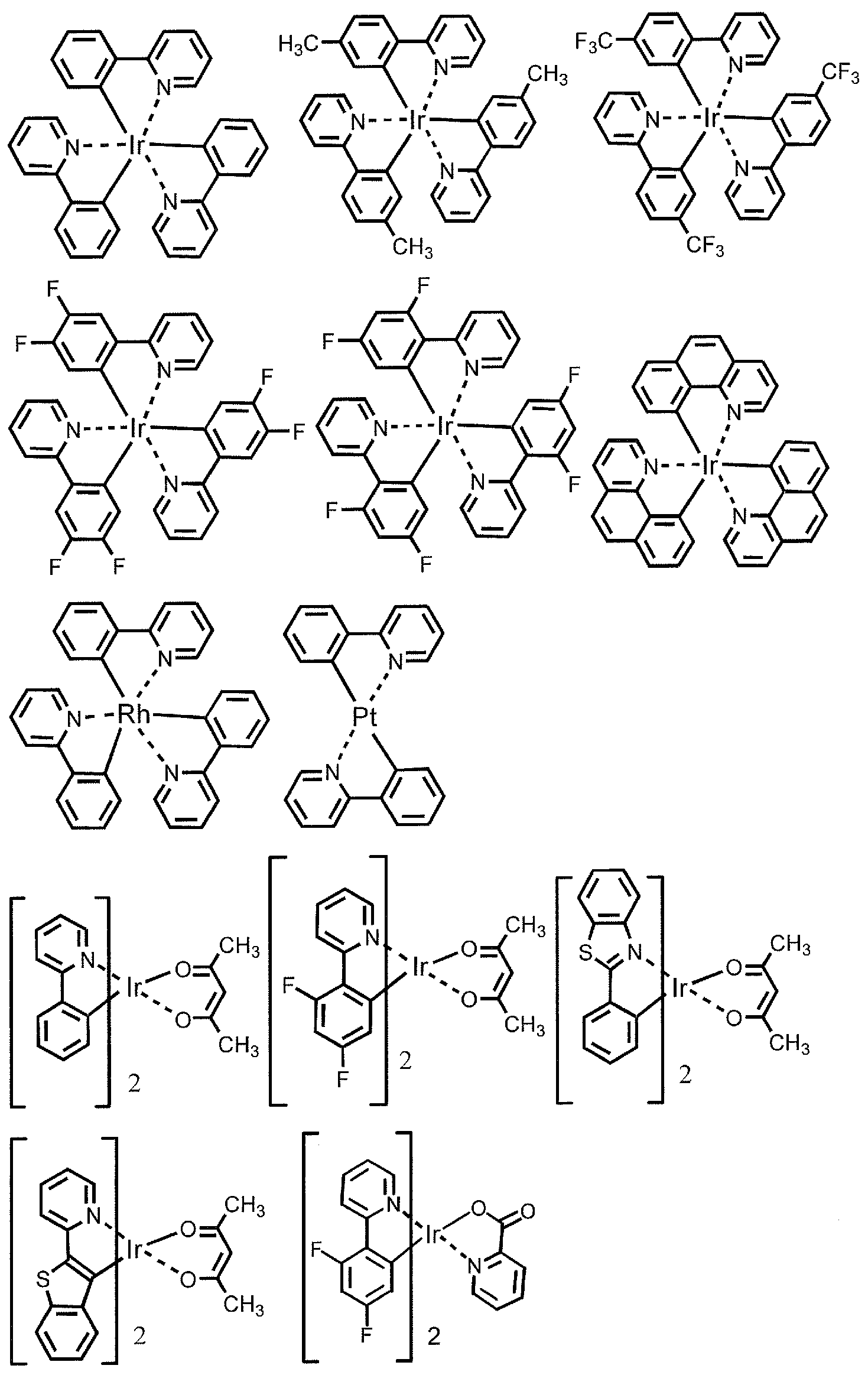

상기 인광 발광 도펀트가 발광층 중에 함유되는 양은 1~50중량%의 범위에 있는 것이 바람직하다. 보다 바람직하게는 5~30중량%이다. The amount of the phosphorescent dopant contained in the light emitting layer is preferably in the range of 1 to 50% by weight. And more preferably 5 to 30% by weight.
발광층의 호스트 재료로는 일반식(1)으로 표시되는 함질소 방향족 화합물을 이용하는 것이 바람직하다. 그러나 상기 일반식(1)으로 표시되는 함질소 방향족 화합물을 발광층 이외의 다른 어떠한 유기층에 사용할 경우는, 발광층에 사용하는 재료는 일반식(1)으로 표시되는 함질소 방향족 화합물 이외의 다른 호스트 재료여도 된다. 또 일반식(1)으로 표시되는 함질소 방향족 화합물과 다른 호스트 재료를 병용해도 된다. 또한 공지의 호스트 재료를 복수 종류 병용해서 이용해도 된다. As the host material of the light emitting layer, it is preferable to use the nitrogen-containing aromatic compound represented by the general formula (1). However, when the nitrogen-containing aromatic compound represented by the above general formula (1) is used for any organic layer other than the light-emitting layer, the material used for the light-emitting layer is not a host material other than the nitrogen-containing aromatic compound represented by the general formula (1) do. The nitrogen-containing aromatic compound represented by the general formula (1) and another host material may be used in combination. A plurality of known host materials may be used in combination.
사용할 수 있는 공지의 호스트 화합물로는 정공 수송능, 전자 수송능을 가지면서 발광의 장파장화를 막고, 또한 높은 유리 전이 온도를 가지는 화합물인 것이 바람직하다. A known host compound that can be used is preferably a compound having a hole transporting ability and an electron transporting ability while preventing long wavelength emission and having a high glass transition temperature.
이러한 다른 호스트 재료는 다수의 특허문헌 등에 의해 알려져 있으므로 그들로부터 선택할 수 있다. 호스트 재료의 구체적인 예로는 특별히 한정되는 것은 아니지만, 인돌 유도체, 카르바졸 유도체, 트리아졸 유도체, 옥사졸 유도체, 옥사디아졸 유도체, 이미다졸 유도체, 폴리아릴알칸 유도체, 피라졸린 유도체, 피라졸론 유도체, 페닐렌디아민 유도체, 아릴아민 유도체, 아미노 치환 칼콘(chalcone) 유도체, 스티릴안트라센 유도체, 플루오레논 유도체, 히드라존(hydrazone) 유도체, 스틸벤 유도체, 실라잔 유도체, 방향족 제3아민 화합물, 스티릴아민 화합물, 방향족 디메틸리덴계 화합물, 포르피린계 화합물, 안트라퀴노디메탄 유도체, 안트론 유도체, 디페닐퀴논 유도체, 티오피란디옥시드 유도체, 나프탈렌페릴렌 등의 복소환 테트라카르본산무수물, 프탈로시아닌 유도체, 8-퀴놀리놀 유도체의 금속 착체나 메탈프탈로시아닌, 벤조옥사졸이나 벤조티아졸 유도체의 금속 착체로 대표되는 각종 금속 착체, 폴리실란계 화합물, 폴리(N-비닐카르바졸) 유도체, 아닐린계 공중합체, 티오펜 올리고머, 폴리티오펜 유도체, 폴리페닐렌 유도체, 폴리페닐렌비닐렌 유도체, 폴리플루오렌 유도체 등의 고분자 화합물 등을 들 수 있다.These other host materials are known from a large number of patent documents and can be selected therefrom. Specific examples of the host material include, but are not limited to, indole derivatives, carbazole derivatives, triazole derivatives, oxazole derivatives, oxadiazole derivatives, imidazole derivatives, polyarylalkane derivatives, pyrazoline derivatives, pyrazolone derivatives, phenyl There may be mentioned a compound represented by the following general formula (1) or a salt thereof: a diamine derivative, an arylamine derivative, an amino substituted chalcone derivative, a styrylanthracene derivative, a fluorenone derivative, a hydrazone derivative, a stilbene derivative, a silazane derivative, , Aromatic dimethylidene compounds, porphyrin compounds, anthraquinodimethane derivatives, anthrone derivatives, diphenylquinone derivatives, thiopyran oxide derivatives, heterocyclic tetracarboxylic anhydrides such as naphthalene perylene, phthalocyanine derivatives, 8- Metal complexes of quinolinol derivatives, metal phthalocyanines, benzoxazole and benzothiazole oil (N-vinylcarbazole) derivatives, aniline-based copolymers, thiophene oligomers, polythiophene derivatives, polyphenylene derivatives, polyphenylene vinylene Derivatives, and polymer compounds such as polyfluorene derivatives.
-주입층- - injection layer -
주입층이란, 구동 전압 저하나 발광 휘도 향상을 위해 전극과 유기층 사이에 마련되는 층으로서 정공 주입층과 전자 주입층이 있으며, 양극과 발광층 또는 정공 수송층의 사이, 및 음극과 발광층 또는 전자 수송층의 사이에 존재시켜도 된다. 주입층은 필요에 따라 마련할 수 있다.The injection layer means a hole injection layer and an electron injection layer as layers provided between the electrode and the organic layer for the purpose of lowering the driving voltage or improving the light emission luminance and between the anode and the light emitting layer or the hole transporting layer and between the cathode and the light emitting layer or the electron transporting layer . The injection layer can be provided as needed.
-정공 저지층- - Hole blocking layer -
정공 저지층이란 넓은 의미에서는 전자 수송층의 기능을 가지며, 전자를 수송하는 기능을 가지면서 정공을 수송하는 능력이 현저하게 작은 정공 저지 재료로 이루어지고, 전자를 수송하면서 정공을 저지함으로써 전자와 정공의 재결합 확률을 향상시킬 수 있다. The hole blocking layer is composed of a hole blocking material having a function of an electron transporting layer in a broad sense, a function of transporting electrons and a capability of transporting holes, and a hole blocking material having a function of transporting electrons, The probability of recombination can be improved.
정공 저지층에는 일반식(1)으로 표시되는 본 발명의 화합물을 이용하는 것이 바람직하지만, 상기 화합물을 다른 어떠한 유기층에 사용할 경우는 공지의 정공 저지층 재료를 이용해도 된다. 또 정공 저지층 재료로는 후술하는 전자 수송층의 재료를 필요에 따라서 이용할 수 있다. It is preferable to use the compound of the present invention represented by the general formula (1) in the hole blocking layer, but in the case of using this compound in any other organic layer, a known hole blocking layer material may be used. As the hole blocking layer material, a material of an electron transporting layer described later can be used if necessary.
-전자 저지층- - Electronic stop layer -
전자 저지층이란 정공을 수송하는 기능을 가지면서 전자를 수송하는 능력이 현저하게 작은 재료로 이루어지고, 정공을 수송하면서 전자를 저지함으로써 전자와 정공이 재결합하는 확률을 향상시킬 수 있다.The electron blocking layer is made of a material having a function of transporting holes and capable of transporting electrons, and the probability of recombination of electrons and holes can be improved by blocking electrons while transporting holes.
전자 저지층의 재료로는 일반식(1)으로 표시되는 본 발명의 화합물을 이용하는 것이 바람직한데, 후술하는 정공 수송층의 재료를 필요에 따라 사용할 수 있다. 전자 저지층의 막두께는 바람직하게는 3~100㎚이며, 보다 바람직하게는 5~30㎚이다. As the material of the electron blocking layer, it is preferable to use the compound of the present invention represented by the general formula (1), and the material of the hole transporting layer described later can be used if necessary. The film thickness of the electron blocking layer is preferably 3 to 100 nm, more preferably 5 to 30 nm.
-여기자 저지층- - The exciting jersey floor -
여기자 저지층이란 발광층 내에서 정공과 전자가 재결합함으로써 생긴 여기자가 전하 수송층으로 확산되는 것을 저지하기 위한 층이며, 본 층의 삽입에 의해 여기자를 효율적으로 발광층 내에 가둘 수 있게 되어서 소자의 발광 효율을 향상시킬 수 있다. 여기자 저지층은 발광층에 인접하여 양극측, 음극측 중 어느 것에도 삽입할 수 있고, 양쪽 동시에 삽입하는 것도 가능하다.The exciton blocking layer is a layer for preventing excitons generated by the recombination of holes and electrons in the light emitting layer from diffusing into the charge transporting layer. By inserting this layer, the excitons can be efficiently confined in the light emitting layer, . The exciton blocking layer can be inserted into either the anode side or the cathode side adjacent to the light emitting layer and can be inserted at both sides simultaneously.
여기자 저지층의 재료로는 예를 들면 1,3-디카르바졸릴벤젠(mCP)이나, 비스(2-메틸-8-퀴놀리놀라토)-4-페닐페놀라토알루미늄(III)(BAlq)을 들 수 있다.Examples of materials for the exciton retardation layer include 1,3-dicarbazolylbenzene (mCP) or bis (2-methyl-8-quinolinolato) -4-phenylphenolatoaluminum (III) (BAlq) .
-정공 수송층-- Hole transport layer -
정공 수송층이란 정공을 수송하는 기능을 가지는 정공 수송 재료로 이루어지며, 정공 수송층은 단층 또는 복수층 마련할 수 있다.The hole transporting layer is made of a hole transporting material having a function of transporting holes, and the hole transporting layer may be provided as a single layer or a plurality of layers.
정공 수송 재료로는 정공의 주입 또는 수송, 전자의 장벽성 중 어느 하나를 가지는 것이며, 유기물, 무기물 중 어느 것이어도 된다. 사용할 수 있는 공지의 정공 수송 재료로는 일반식(1)으로 표시되는 본 발명의 화합물을 이용하는 것이 바람직하지만, 종래 공지의 화합물 중에서 임의의 것을 선택해서 이용할 수 있다. 예를 들면 트리아졸 유도체, 옥사디아졸 유도체, 이미다졸 유도체, 폴리아릴알칸 유도체, 피라졸린 유도체 및 피라졸론 유도체, 페닐렌디아민 유도체, 아릴아민 유도체, 아미노 치환 칼콘 유도체, 옥사졸 유도체, 스티릴안트라센 유도체, 플루오레논 유도체, 히드라존 유도체, 스틸벤 유도체, 실라잔 유도체, 아닐린계 공중합체, 또 도전성 고분자 올리고머, 특히 티오펜 올리고머 등을 들 수 있는데, 포르피린 화합물, 방향족 제3급 아민 화합물 및 스티릴아민 화합물을 이용하는 것이 바람직하고, 방향족 제3급 아민 화합물을 사용하는 것이 보다 바람직하다.As the hole transporting material, any one of an organic material and an inorganic material may be used, which has either hole injection or transportation, or electron barrier property. As the well-known hole transporting material which can be used, it is preferable to use the compound of the present invention represented by the general formula (1), but any one of conventionally known compounds can be selected and used. For example, a triazole derivative, an oxadiazole derivative, an imidazole derivative, a polyarylalkane derivative, a pyrazoline derivative and a pyrazolone derivative, a phenylenediamine derivative, an arylamine derivative, an amino substituted chalcone derivative, There may be mentioned a porphyrin compound, an aromatic tertiary amine compound, a styryl compound, an aromatic tertiary amine compound, an aromatic tertiary amine compound, an aromatic tertiary amine compound, It is preferable to use an amine compound, and it is more preferable to use an aromatic tertiary amine compound.
-전자 수송층- - Electron transport layer -
전자 수송층이란 전자를 수송하는 기능을 가지는 재료로 이루어지며, 전자 수송층은 단층 또는 복수층 마련할 수 있다.The electron transporting layer is made of a material having a function of transporting electrons, and the electron transporting layer may be provided as a single layer or a plurality of layers.
전자 수송 재료(정공 저지 재료를 겸하는 경우도 있음)로는, 음극으로부터 주입된 전자를 발광층에 전달하는 기능을 가지고 있으면 된다. 전자 수송층에는 일반식(1)으로 표시되는 본 발명의 화합물을 이용하는 것이 바람직하지만, 종래 공지의 화합물 중에서 임의의 것을 선택하여 사용할 수 있고, 예를 들면 니트로 치환 플루오렌 유도체, 디페닐퀴논 유도체, 티오피란디옥시드 유도체, 카르보디이미드, 플루오레닐리덴메탄 유도체, 안트라퀴노디메탄 및 안트론 유도체, 옥사디아졸 유도체 등을 들 수 있다. 또한 상기 옥사디아졸 유도체에 있어서 옥사디아졸환의 산소원자를 유황원자로 치환한 티아디아졸 유도체, 전자 흡인기로서 알려져 있는 퀴녹살린환을 가지는 퀴녹살린 유도체도 전자 수송 재료로서 사용할 수 있다. 또한 이 재료들을 고분자쇄에 도입했거나, 또는 이 재료들을 고분자의 주쇄로 한 고분자 재료를 사용할 수도 있다.The electron transporting material (which may also serve as a hole blocking material) may have a function of transferring electrons injected from the cathode to the light emitting layer. Although it is preferable to use the compound of the present invention represented by the general formula (1) in the electron transporting layer, any of the conventionally known compounds may be selected and used. For example, a nitro substituted fluorene derivative, a diphenylquinone derivative, Anthraquinodimethane, anthrone derivatives, oxadiazole derivatives, and the like can be given. Thiadiazole derivatives in which an oxygen atom of an oxadiazole ring is substituted with a sulfur atom in the oxadiazole derivative, and quinoxaline derivatives having a quinoxaline ring, which is known as an electron-withdrawing group, can also be used as an electron transporting material. Further, these materials may be introduced into the polymer chain, or a polymer material having these materials as a main chain of the polymer may be used.
실시예 Example
이하, 본 발명을 실시예에 의해 더욱 자세하게 설명하지만, 본 발명은 물론 이 실시예들에 한정되는 것이 아니며, 그 요지를 넘어서지 않는 한 다양한 형태로 실시하는 것이 가능하다.Hereinafter, the present invention will be described in more detail by way of examples, but the present invention is of course not limited to these embodiments, and can be carried out in various forms without departing from the gist thereof.
실시예 1Example 1
화합물(1-1)의 합성 Synthesis of Compound (1-1)

대기 분위기하, 7-아자인돌 11.9g(101mmol), 아세토니트릴(MeCN) 67ml를 첨가하고 50℃에서 5분 교반했다. 얻어진 용액에 N-요오도숙신이미드(N-Iodosuccinimide)(NIS) 25.0g(111mmol)을 첨가하고 50℃에서 2시간 교반했다. 얻어진 현탁액을 여과하고, 석출한 결정을 여과 추출했다. 결정을 물 150ml, 이어서 MeCN 150mL로 리슬러리하여 중간체(A-1)를 22.7g(101mmol, 수율 100mol%) 얻었다. 11.9 g (101 mmol) of 7-azaindole and 67 ml of acetonitrile (MeCN) were added in an atmosphere of air and the mixture was stirred at 50 ° C for 5 minutes. To the obtained solution, 25.0 g (111 mmol) of N-iodosuccinimide (NIS) was added, and the mixture was stirred at 50 ° C for 2 hours. The resulting suspension was filtered, and the precipitated crystals were filtered off. The crystals were reslurried in 150 ml of water and then 150 ml of MeCN to obtain 22.7 g (101 mmol, yield: 100 mol%) of intermediate (A-1).
대기 분위기하, 인돌 100g(854mmol), 이탄산t-부틸(Boc2O) 203g(931mmol), 디클로로메탄(CH2Cl2) 1600ml, N,N-디메틸아미노피리딘(DMAP) 10.4g(85.1mmol)을 첨가하고 실온에서 2시간 30분 교반했다. 반응 용액에 1N-염산 200ml를 첨가하여 교반하고, 수층과 유기층을 분획했다. 유기층에 포화 식염수 200ml를 첨가하여 교반하고, 수층과 유기층을 분획했다. 유기층을 무수 황산 나트륨으로 건조한 후에, 황산 나트륨을 여과 분별하고 용매를 감압 증류 제거했다. 얻어진 잔사(殘渣)를 실리카겔 칼럼 크로마토그래피로 정제하여 중간체(A-2)를 184g(847mmol, 수율 99mol%) 얻었다. Air atmosphere, indole 100g (854mmol), peat acid t- butyl (Boc 2 O) 203g (931mmol ), dichloromethane (CH 2 Cl 2) 1600ml, N, N- dimethylaminopyridine (DMAP) 10.4g (85.1mmol ) Was added and the mixture was stirred at room temperature for 2 hours and 30 minutes. 200 ml of 1N-hydrochloric acid was added to the reaction solution and stirred to separate the aqueous layer and the organic layer. To the organic layer was added 200 ml of a saturated saline solution and stirred to separate the aqueous layer and the organic layer. The organic layer was dried over anhydrous sodium sulfate, sodium sulfate was filtered off, and the solvent was distilled off under reduced pressure. The obtained residue was purified by silica gel column chromatography to obtain 184 g (847 mmol, yield: 99 mol%) of intermediate (A-2).
질소 분위기하, 중간체(A-2) 63.3g(290mmol), 트리이소프로필보레이트(B(OiPr)3) 99.6g(530mmol), THF를 370ml 첨가하고 0℃까지 냉각하여 리튬디이소프로필아미드/THF용액(LDA) 185ml(2.0mol/l)를 적하했다. 반응 용액을 실온까지 되돌리고 2시간 교반후, 2N-염산 370ml를 첨가하여 수층과 유기층을 분획했다. 수층을 THF(300ml)로 추출하고, 합한 유기층을 무수 황산 마그네슘으로 건조했다. 황산 마그네슘을 여과 분별하고 용매를 감압 증류 제거하여 중간체(A-3)를 74.0g(283mmol, 수율 98mol%) 얻었다. (290 mmol) of intermediate (A-2), triisopropylborate (B (OiPr) 3 ) and 370 ml of THF were added in a nitrogen atmosphere, and the mixture was cooled to 0 ° C to obtain lithium diisopropylamide / THF 185 ml (2.0 mol / l) of the solution (LDA) was added dropwise. After the reaction solution was returned to room temperature and stirred for 2 hours, 370 ml of 2N-hydrochloric acid was added to separate the aqueous layer and the organic layer. The aqueous layer was extracted with THF (300 ml), and the combined organic layer was dried over anhydrous magnesium sulfate. The magnesium sulfate was filtered off and the solvent was distilled off under reduced pressure to obtain 74.0 g (283 mmol, yield 98 mol%) of intermediate (A-3).
중간체(A-1) 68.4g(280mmol), 중간체(A-3) 73.0g(280mmol), 테트라키스(트리페닐포스핀)팔라듐(0)(Pd(PPh3)4) 15.6g(13.5mmol), 탄산 나트륨(Na2CO3) 75.3g의 물(280ml) 용액, 톨루엔 960ml, 에탄올을 510ml 첨가하고 70℃에서 가열하면서 4시간 교반했다. 반응 용액을 실온까지 냉각한 후에 수층과 유기층을 분획했다. 수층을 톨루엔(350ml)으로 추출하고, 합한 유기층을 무수 황산 마그네슘으로 건조했다. 유기층을 무수 황산 마그네슘으로 건조한 후에, 황산 마그네슘을 여과 분별하고 용매를 감압 증류 제거했다. 얻어진 잔사를 실리카겔 칼럼 크로마토그래피로 정제하여 중간체(A-4)를 78.7g(236mmol, 수율 84mol%) 얻었다. Intermediate (A-1) 68.4g (280mmol ), intermediate (A-3) 73.0g (280mmol ), tetrakis (triphenylphosphine) palladium (0) (Pd (PPh 3 ) 4) 15.6g (13.5mmol) , Water (280 ml) solution of sodium carbonate (

중간체(A-4) 38.7g(116mmol), 트리플루오로아세트산(TFA) 100ml를 첨가하고 실온에서 2시간 30분 교반했다. TFA를 감압 증류 제거하고, 얻어진 잔사를 실리카겔 칼럼 크로마토그래피로 정제하여 중간체(A-5)를 26.0g(111mol, 수율 96mol%)을 얻었다. 38.7 g (116 mmol) of the intermediate (A-4) and 100 ml of trifluoroacetic acid (TFA) were added, and the mixture was stirred at room temperature for 2 hours and 30 minutes. TFA was distilled off under reduced pressure, and the resulting residue was purified by silica gel column chromatography to obtain 26.0 g (111 mol, yield: 96 mol%) of intermediate (A-5).
중간체(A-5) 26.0g(111mmol), (디메틸아미노)아세트알데히드디에틸아세탈 22.5g(139mmol), 아세트산 50ml를 첨가하고 140℃에서 가열하면서 16시간 교반했다. 반응 용액을 실온까지 냉각한 후에 용매를 감압 증류 제거했다. 얻어진 잔사를 실리카겔 칼럼 크로마토그래피로 정제하여 중간체(A-6)를 15.9g(61.8mmol, 수율 55mol%) 얻었다. 26.0 g (111 mmol) of Intermediate (A-5), 22.5 g (139 mmol) of (dimethylamino) acetaldehyde diethyl acetal and 50 ml of acetic acid were added and stirred for 16 hours while heating at 140 占 폚. After the reaction solution was cooled to room temperature, the solvent was distilled off under reduced pressure. The obtained residue was purified by silica gel column chromatography to obtain 15.9 g (61.8 mmol, yield: 55 mol%) of intermediate (A-6).
APCI-TOFMS, m/z 257 [M+H]+ APCI-TOFMS, m / z 257 [M + H] < + &
질소 분위기하, 중간체(A-6)를 3.6g(13.9mmol), 요오도벤젠을 130g(634mmol), 요오드화 구리 8.5g(44.5mmol), 탄산 칼륨 12.2g(88.5mmol)을 첨가하고 210℃에서 가열하면서 17시간 교반했다. 반응 용액을 실온까지 냉각한 후에 셀라이트 545를 첨가하여 여과 추출하고, 요오도벤젠을 감압 증류 제거했다. 얻어진 잔사를 실리카겔 칼럼 크로마토그래피로 정제하여 백색 고체로서 화합물(1-1)을 3.3g(8.1mmol, 수율 59mol%) 얻었다. (13.9 mmol) of intermediate (A-6), 130 g (634 mmol) of iodobenzene, 8.5 g (44.5 mmol) of copper iodide and 12.2 g (88.5 mmol) of potassium carbonate were added in a nitrogen atmosphere at 210 deg. And the mixture was stirred for 17 hours while heating. After the reaction solution was cooled to room temperature, Celite 545 was added thereto, followed by filtration extraction, and the iodobenzene was distilled off under reduced pressure. The obtained residue was purified by silica gel column chromatography to obtain 3.3 g (8.1 mmol, yield: 59 mol%) of a compound (1-1) as a white solid.
APCI-TOFMS, m/z 410 [M+H]+ APCI-TOFMS, m / z 410 [M + H] < + &
1H-NMR(DMSO-d6):δ8.39(d,J=8.8Hz,1H), 8.25-8.27(m,1H), 8.23(dd,J=4.6,1.5Hz,1H), 7.63-7.79(m,9H), 7.54-7.59(m,1H), 7.31-7.41(m,3H), 7.24(d,J=7.8Hz,1H), 6.84(dd,J=8.1,4.6Hz,1H), 5.92(dd,J=8.1,1.5Hz,1H) 1 H-NMR (DMSO-d6 ): δ8.39 (d, J = 8.8Hz, 1H), 8.25-8.27 (m, 1H), 8.23 (dd, J = 4.6,1.5Hz, 1H), 7.63-7.79 (m, 9H), 7.54-7.59 (m, 1H), 7.31-7.41 (m, 3H), 7.24 (d, J = 7.8Hz, 1H), 6.84 5.92 (dd, J = 8.1, 1.5 Hz, 1 H)
실시예 2 Example 2
화합물(1-33)의 합성 Synthesis of Compound (1-33)

질소 분위기하, 중간체(A-6)를 5.5g(22mmol), 2-브로모디벤조벤젠 17g(65mmol), 1,3-디메틸-2-이미다졸리딘(DMI) 100ml, 요오드화 구리 16g(82mmol), 탄산 칼륨 20g(150mmol)을 첨가하고 210℃에서 가열하면서 24시간 교반했다. 반응 용액을 실온까지 냉각한 후에 셀라이트 545를 첨가하여, 여과 추출하고 요오도벤젠을 감압 증류 제거했다. 얻어진 잔사를 실리카겔 칼럼 크로마토그래피로 정제하여 백색 고체로서 화합물(1-33)을 8.5g(14mmol, 수율 62mol%) 얻었다. (22 mmol) of intermediate (A-6), 17 g (65 mmol) of 2-bromodibenzobenzene, 100 ml of 1,3-dimethyl-2-imidazolidine (DMI) and 16 g ) And 20 g (150 mmol) of potassium carbonate were added, and the mixture was stirred for 24 hours while heating at 210 deg. After the reaction solution was cooled to room temperature, Celite 545 was added, followed by filtration extraction, and iodobenzene was distilled off under reduced pressure. The obtained residue was purified by silica gel column chromatography to obtain 8.5 g (14 mmol, yield: 62 mol%) of a compound (1-33) as a white solid.
APCI-TOFMS, m/z 622 [M+H]+ APCI-TOF MS m / z 622 [M + H] < + >
1H-NMR(DMSO-d6):δ8.86(d,J=2.0Hz,1H), 8.67(d,J=2.2Hz,1H), 8.42-8.67(m,4H), 8.31(d,J=8.5Hz,1H), 8.29(d,J=8.1Hz,1H), 8.10-8.17(m,3H), 7.84(dd,J=8.3,2.2Hz,1H), 7.74(dd,J=8.3,2.2Hz,1H), 7.55-7.62(m,2H), 7.47-7.52(m,2H), 7.32-7.39(m,4H), 6.38(dd,J=8.1,4.9Hz,1H), 5.94(dd,J=8.1,1.4Hz,1H) 1 H-NMR (DMSO-d6 ): δ8.86 (d, J = 2.0Hz, 1H), 8.67 (d, J = 2.2Hz, 1H), 8.42-8.67 (m, 4H), 8.31 (d, J = 8.5 Hz, 1H), 8.29 (d, J = 8.1 Hz, 1H), 8.10-8.17 (m, 3H), 7.84 (dd, J = 8.3, 2.2 Hz, 1H) 2H), 7.47-7.52 (m, 2H), 7.32-7.39 (m, 4H), 6.38 (dd, J = 8.1, 4.9 Hz, 1H), 5.94 , J = 8.1, 1.4 Hz, 1H)
실시예 3 Example 3
화합물(1-46)의 합성 Synthesis of compound (1-46)

질소 분위기하, 수소화 나트륨(60.5% 제품) 2.7g(68mmol), DMF20ml를 첨가하고 실온에서 0.5시간 교반했다. 얻어진 현탁액에 중간체(A-6) 7.0g(27mmol)의 DMF(200ml) 용액을 첨가하고 실온에서 30분 교반했다. 얻어진 현탁액에 요오도부탄 20g(110mmol) 첨가하고 130℃에서 20시간 교반했다. 반응 용액에 증류수(700ml)를 교반하면서 첨가하고 석출한 고체를 여과 추출했다. 얻어진 고체를 리슬러리로 정제하여 백색 고체로서 화합물(1-46)을 6.3g(17mmol, 수율 64mol%)을 얻었다. 2.7 g (68 mmol) of sodium hydride (60.5% product) and 20 ml of DMF were added in a nitrogen atmosphere, followed by stirring at room temperature for 0.5 hours. To the obtained suspension was added a solution of 7.0 g (27 mmol) of intermediate (A-6) in 200 ml of DMF, and the mixture was stirred at room temperature for 30 minutes. 20 g (110 mmol) of iodobutane was added to the obtained suspension, and the mixture was stirred at 130 DEG C for 20 hours. Distilled water (700 ml) was added to the reaction solution while stirring, and the precipitated solid was filtered out. The obtained solid was purified by using a reslurry to obtain 6.3 g (17 mmol, yield: 64 mol%) of a compound (1-46) as a white solid.
APCI-TOFMS, m/z 370 [M+H]+ APCI-TOFMS, m / z 370 [M + H] < + &
1H-NMR(DMSO-d6):δ8.86(dd,J=8.1,1.2Hz,1H), 8.50(dd,J=4.6,1.2Hz,1H), 8.36(d,J=8.5Hz,1H), 8.18(d,J=7.6Hz,1H), 7.73(d,J=8.3Hz,1H), 7.57(d,J=8.5Hz,1H), 7.41(dd,J=7.1,1.2Hz,1H), 7.35(dd,J=8.0,4.6Hz,1H), 7.24(t,J=7.0Hz,1H), 4.93(t,J=7.3Hz,2H), 4.62(t,J=7.3Hz,2H), 1.80-1.94(m,4H), 1.33-1.41(m,4H), 0.91(t,J=7.3Hz,3H), 0.84(t,J=7.3Hz,3H) 1 H-NMR (DMSO-d6 ): δ8.86 (dd, J = 8.1,1.2Hz, 1H), 8.50 (dd, J = 4.6,1.2Hz, 1H), 8.36 (d, J = 8.5Hz, 1H ), 8.18 (d, J = 7.6 Hz, 1H), 7.73 (d, J = 8.3 Hz, 1H), 7.57 J = 7.3 Hz, 2H), 4.62 (t, J = 7.3 Hz, 2H), 7.35 (dd, J = 8.0, 4.6 Hz, 1H) J = 7.3 Hz, 3H), 0.84 (t, J = 7.3 Hz, 3H), 1.80-1.94 (m, 4H), 1.33-1.41
실시예 4 Example 4
막두께 110㎚의 ITO로 이루어지는 양극이 형성된 유리 기판 위에, ITO 상에 폴리(3,4-에틸렌디옥시티오펜)/폴리스틸렌술폰산(PEDOT/PSS):(에이치.씨.스타르크(H.C.Starck)가부시키가이샤 제품, 상품명:크레비오스PCH8000)을 스핀 코트법으로 25㎚의 두께로 형성했다. 다음으로, 진공증착법으로 진공도 4.0×10⁻⁵Pa로 정공 수송층으로서 4,4'-비스[N-(1-나프틸)-N-페닐아미노]비페닐(NPB)을 40㎚의 두께로 형성했다. 다음으로 정공 수송층 위에 호스트 재료로서의 합성예 1에서 얻은 화합물(1-1)과, 인광 발광 도펀트로서의 트리스(2-페닐피리딘)이리듐(III)(Ir(ppy)3)을 다른 증착원으로부터 공증착하여 40㎚의 두께로 발광층을 형성했다. 발광층중의 Ir(ppy)3의 농도는 6.0wt%였다. 다음으로 전자 수송층으로서 트리스(8-히드록시퀴놀리나토)알루미늄(III)(Alq3)을 20㎚의 두께로 형성했다. 또한 전자 수송층 위에 전자 주입층으로서 불화 리튬(LiF)을 1.0㎚의 두께로 형성했다. 마지막으로 전자 주입층 위에 전극으로서 알루미늄(Al)을 130㎚의 두께로 형성하여 유기 EL 소자를 제작했다. (3,4-ethylenedioxythiophene) / polystyrenesulfonic acid (PEDOT / PSS) (HCStarck) was applied onto a glass substrate on which an anode made of ITO having a thickness of 110 nm was formed, Trade name: CLEVIOS PCH8000) was formed to a thickness of 25 nm by a spin-coat method. Next, as the hole transport layer to form a vacuum of 4.0 × 10 -5 Pa by a vacuum evaporation of 4,4'-bis [N- (1- naphthyl) -N- phenylamino] biphenyl (NPB) to a thickness of 40㎚ did. Next, a compound (1-1) obtained in Synthesis Example 1 as a host material and tris (2-phenylpyridine) iridium (III) (Ir (ppy) 3 ) as a phosphorescent dopant were co-deposited To form a light-emitting layer with a thickness of 40 nm. The concentration of Ir (ppy) 3 in the light emitting layer was 6.0 wt%. Next, tris (8-hydroxyquinolinato) aluminum (III) (Alq3) was formed to a thickness of 20 nm as an electron transporting layer. Further, lithium fluoride (LiF) was formed as an electron injection layer to a thickness of 1.0 nm on the electron transporting layer. Finally, aluminum (Al) was formed as an electrode on the electron injecting layer to a thickness of 130 nm to prepare an organic EL device.
얻어진 유기 EL 소자의 초기 특성으로서 소자에 외부전원을 접속해서 100mA/cm2의 전류가 흐르도록 직류 전압을 인가하고, 그 때의 휘도(cd/m2), 전압(V), 시감 발광 효율(lm/W)을 측정했다. 이하의 실시예 및 비교예에서 얻어진 유기 EL 소자에 대해서도 마찬가지로 측정했다. 결과를 표 1에 나타낸다. 또한 소자발광 스펙트럼의 극대파장은 530㎚이며, Ir(ppy)3으로부터의 발광이 얻어져 있음을 알 수 있었다. As an initial characteristic of the obtained organic EL device, a direct current voltage was applied so that a current of 100 mA / cm 2 was applied to the device by connecting an external power source to the device. The luminance cd /
실시예 5 Example 5
발광층의 호스트 재료로서 화합물(1-33)을 이용한 것 이외는 실시예 4와 동일하게 해서 유기 EL 소자를 제작했다. An organic EL device was fabricated in the same manner as in Example 4 except that the compound (1-33) was used as the host material of the light emitting layer.
실시예 6 Example 6
발광층의 호스트 재료로서 화합물(1-46)을 이용한 것 이외는 실시예 4와 동일하게 해서 유기 EL 소자를 제작했다. An organic EL device was fabricated in the same manner as in Example 4 except that the compound (1-46) was used as the host material of the light emitting layer.
비교예 1 Comparative Example 1
발광층의 호스트 재료로서 하기 화합물(H-1)을 이용한 것 이외는 실시예 4와 동일하게 해서 유기 EL 소자를 제작했다. An organic EL device was produced in the same manner as in Example 4 except that the following compound (H-1) was used as the host material of the light emitting layer.

비교예 2 Comparative Example 2
발광층의 호스트 재료로서 하기 화합물(H-2)을 이용한 것 이외는 실시예 4와 동일하게 해서 유기 EL 소자를 제작했다. An organic EL device was produced in the same manner as in Example 4 except that the following compound (H-2) was used as the host material of the light emitting layer.

비교예 3 Comparative Example 3
발광층의 호스트 재료로서 하기 화합물 TAZ를 이용한 것 이외는 실시예 4와 동일하게 해서 유기 EL 소자를 제작했다. An organic EL device was fabricated in the same manner as in Example 4 except that the following compound TAZ was used as the host material of the light emitting layer.

실시예 5~6에서 얻어진 유기 EL 소자의 소자발광 스펙트럼의 극대파장은 530㎚이며, Ir(ppy)3으로부터의 발광이 얻어져 있음을 알 수 있었다.It was found that the maximum wavelength of the element luminescence spectrum of the organic EL device obtained in Examples 5 to 6 was 530 nm and light emission from Ir (ppy) 3 was obtained.

실시예 7 Example 7
막두께 110㎚의 ITO로 이루어지는 양극이 형성된 유리 기판 위에, ITO 상에 폴리(3,4-에틸렌디옥시티오펜)/폴리스틸렌술폰산(PEDOT/PSS):(에이치.씨.스타르크 가부시키가이샤 제품, 상품명:크레비오스PCH8000)을 스핀 코트법으로 25㎚의 두께로 형성했다. 다음으로 정공 수송용 재료(HTM)로서 화합물(1-1)을 테트라히드로푸란에 용해해서 0.4wt%용액으로 조제하고, 스핀 코트법으로 두께 20㎚의 정공 수송층을 제막했다. 다음으로 진공 증착법으로 진공도 4.0×10⁻⁵Pa에서 호스트 재료로서 4,4'-비스(9-카르바졸릴)비페닐(CBP)과, 인광 발광 도펀트로서의 Ir(ppy)3을 다른 증착원으로부터 공증착하고 50㎚의 두께로 발광층을 형성했다. 발광층 중의 Ir(ppy)3의 농도는 10.0wt%였다. 다음으로 전자 수송층으로서 Alq3을 30㎚의 두께로 형성했다. 또한 전자 수송층 위에 전자 주입층으로서 LiF를 0.5㎚의 두께로 형성했다. 마지막으로 전자 주입층 위에 전극으로서 Al을 150㎚의 두께로 형성하여 유기 EL 소자를 제작했다. (3,4-ethylenedioxythiophene) / polystyrenesulfonic acid (PEDOT / PSS) (produced by H.C. Stark Co., Ltd.) on ITO was formed on a glass substrate on which a positive electrode made of ITO having a thickness of 110 nm was formed, Trade name: CLEVIUS PCH8000) was formed to a thickness of 25 nm by a spin coating method. Next, Compound (1-1) as a hole transporting material (HTM) was dissolved in tetrahydrofuran to prepare a 0.4 wt% solution, and a hole transporting layer having a thickness of 20 nm was formed by spin coating. Next, 4,4'-bis (9-carbazolyl) biphenyl (CBP) as a host material and Ir (ppy) 3 as a phosphorescent dopant were vacuum deposited at a vacuum degree of 4.0 × 10 -5 Pa from another evaporation source And a luminescent layer was formed with a thickness of 50 nm. The concentration of Ir (ppy) 3 in the light emitting layer was 10.0 wt%. Next, Alq3 was formed to a thickness of 30 nm as an electron transporting layer. On the electron transporting layer, LiF as an electron injecting layer was formed to a thickness of 0.5 nm. Finally, Al was formed as an electrode on the electron injecting layer to a thickness of 150 nm to prepare an organic EL device.
얻어진 유기 EL 소자의 초기 특성으로서 소자에 외부전원을 접속하여 100mA/cm2의 전류가 흐르도록 직류 전압을 인가하고, 그 때의 휘도(cd/m2), 전압(V), 시감 발광 효율(lm/W)을 측정했다. 이하의 실시예 및 비교예에서 얻은 유기 EL 소자에 대해서도 마찬가지로 측정했다. 결과를 표 2에 나타낸다. As an initial characteristic of the obtained organic EL device, an external power supply was connected to the device, and a direct current voltage was applied so that a current of 100 mA / cm 2 was passed. The luminance cd / m2, the voltage V, / W) was measured. The organic EL devices obtained in the following examples and comparative examples were measured in the same manner. The results are shown in Table 2.
실시예 8 Example 8
정공 수송용 재료로서 화합물(1-33)을 이용한 것 이외는 실시예 7과 동일하게 해서 유기 EL 소자를 제작했다. An organic EL device was fabricated in the same manner as in Example 7 except that the compound (1-33) was used as a hole transporting material.
실시예 9 Example 9
정공 수송용 재료로서 화합물(1-46)을 이용한 것 이외는 실시예 7과 동일하게 해서 유기 EL 소자를 제작했다. An organic EL device was fabricated in the same manner as in Example 7 except that the compound (1-46) was used as a hole transporting material.
비교예 4 Comparative Example 4
정공 수송층으로서 화합물(H-1)을 이용한 것 이외는 실시예 7과 동일하게 해서 유기 EL 소자를 제작했다. An organic EL device was fabricated in the same manner as in Example 7 except that the compound (H-1) was used as the hole transporting layer.
실시예 7~9에서 얻은 유기 EL 소자의 발광 스펙트럼의 극대파장은 530㎚이며, Ir(ppy)3으로부터의 발광이 얻어져 있음을 알 수 있었다. 결과를 표 2에 나타낸다. HTM은 정공 수송용 재료이다. It was found that the maximum wavelength of the luminescence spectrum of the organic EL device obtained in Examples 7 to 9 was 530 nm and light emission from Ir (ppy) 3 was obtained. The results are shown in Table 2. HTM is a hole transport material.

실시예 10 Example 10
화합물(2-1)의 합성 Synthesis of compound (2-1)

중간체(A-1) 75.9g(310mmol), 벤조푸란-2-보론산(A-7) 50.0g(30.9mmol), 테트라키스(트리페닐포스핀)팔라듐(0)(Pd(PPh3)4) 4.3g(3.8mmol), 2규정 탄산 나트륨(Na2CO3) 수용액 390ml, 톨루엔 815ml, 에탄올을 490ml 첨가하고 70℃에서 가열하면서 21시간 교반했다. 반응 용액을 실온까지 냉각한 후에 수층과 유기층을 분획했다. 수층을 톨루엔(350ml)으로 추출하고, 합한 유기층을 무수 황산 마그네슘으로 건조했다. 유기층을 무수 황산 마그네슘으로 건조한 후에 황산 마그네슘을 여과 분별하고, 용매를 감압 증류 제거했다. 얻어진 잔사를 실리카겔 칼럼 크로마토그래피로 정제하여 중간체(A-8)를 14.1g(60mmol, 수율 19mol%) 얻었다. 50.9 g (30.9 mmol) of benzofuran-2-boronic acid (A-7), tetrakis (triphenylphosphine) palladium (0) (Pd (PPh3) 4) , 390 ml of an aqueous solution of 2N sodium carbonate (Na2CO3), 815 ml of toluene and 490 ml of ethanol were added and stirred for 21 hours while heating at 70 deg. After the reaction solution was cooled to room temperature, the water layer and the organic layer were separated. The aqueous layer was extracted with toluene (350 ml), and the combined organic layer was dried over anhydrous magnesium sulfate. The organic layer was dried over anhydrous magnesium sulfate, and then magnesium sulfate was filtered off, and the solvent was distilled off under reduced pressure. The resulting residue was purified by silica gel column chromatography to obtain 14.1 g (60 mmol, yield: 19 mol%) of intermediate (A-8).
APCI-TOFMS, m/z 235 [M+H]+ APCI-TOF MS m / z 235 [M + H] < + >
중간체(A-8) 5.0g(20.0mmol), (디메틸아미노)아세트알데히드디에틸아세탈 5.2g(32.1mmol), 아세트산 65ml를 첨가하고 140℃에서 가열하면서 96시간 교반했다. 반응 용액을 실온까지 냉각한 후에 용매를 감압 증류 제거했다. 얻어진 잔사를 실리카겔 칼럼 크로마토그래피로 정제하여 중간체(A-9)를 1.3g(4.9mmol, 수율 25mol%) 얻었다. 5.0 g (20.0 mmol) of intermediate (A-8), 5.2 g (32.1 mmol) of (dimethylamino) acetaldehyde diethyl acetal and 65 ml of acetic acid were added and the mixture was stirred for 96 hours while heating at 140 占 폚. After the reaction solution was cooled to room temperature, the solvent was distilled off under reduced pressure. The obtained residue was purified by silica gel column chromatography to obtain 1.3 g (4.9 mmol, yield: 25 mol%) of intermediate (A-9).
FD-MS, m/z 258 [M] FD-MS, m / z 258 < RTI ID = 0.0 > [M]
질소 분위기하, 중간체(A-9)를 1.3g(13.9mmol), 요오도벤젠을 32g(156mmol), 요오드화 구리 2.0g(10.7mmol), 탄산 칼륨 2.9g(21.1mmol)을 첨가하고 210℃에서 가열하면서 24시간 교반했다. 반응 용액을 실온까지 냉각한 후에 셀라이트 545를 첨가하여, 여과 추출하고 요오도벤젠을 감압 증류 제거했다. 얻어진 잔사를 실리카겔 칼럼 크로마토그래피로 정제하여 고체로서 화합물(2-1)을 1.3g(3.7mmol, 수율 73mol%) 얻었다. (13.9 mmol) of intermediate (A-9), 32 g (156 mmol) of iodobenzene, 2.0 g (10.7 mmol) of copper iodide and 2.9 g (21.1 mmol) of potassium carbonate were added in a nitrogen atmosphere at 210 deg. And the mixture was stirred for 24 hours while heating. After the reaction solution was cooled to room temperature, Celite 545 was added, followed by filtration extraction, and iodobenzene was distilled off under reduced pressure. The obtained residue was purified by silica gel column chromatography to obtain 1.3 g (3.7 mmol, yield: 73 mol%) of a compound (2-1) as a solid.
FD-MS, m/z 334 [M] FD-MS, m / z 334 [M] <
1H-NMR(DMSO-d6):8.63(d,J=8.8Hz,1H), 8.51-8.53(m,1H), 8.22(d,J=8.0Hz,1H), 7.82(d,J=8.0Hz,1H), 7.48-7.80(m,6H), 7.20-7.45(m,4H) 1 H-NMR (DMSO-d6 ): 8.63 (d, J = 8.8Hz, 1H), 8.51-8.53 (m, 1H), 8.22 (d, J = 8.0Hz, 1H), 7.82 (d, J = 8.0 Hz, 1H), 7.48-7.80 (m, 6H), 7.20-7.45 (m, 4H)
실시예 11 Example 11
화합물(3-1)의 합성 Synthesis of compound (3-1)

중간체(A-1) 69.7g(286mmol), 벤조티오펜-2-보론산(A-10) 50.5g(284mmol), 테트라키스(트리페닐포스핀)팔라듐(0)(Pd(PPh3)4) 5.3g(4.6mmol), 2규정 탄산 나트륨(Na2CO3) 수용액 360ml, 톨루엔 815ml, 에탄올을 490ml 첨가하고 70℃에서 가열하면서 22시간 교반했다. 반응 용액을 실온까지 냉각한 후에 수층과 유기층을 분획했다. 수층을 톨루엔(350ml)으로 추출하고 합한 유기층을 무수 황산 마그네슘으로 건조했다. 유기층을 무수 황산 마그네슘으로 건조한 후에 황산 마그네슘을 여과 분별하고 용매를 감압 증류 제거했다. 얻어진 잔사를 실리카겔 칼럼 크로마토그래피로 정제하여 중간체(A-11)를 10.3g(41mmol, 수율 14mol%) 얻었다. (286 mmol) of intermediate (A-1), 50.5 g (284 mmol) of benzothiophene-2-boronic acid (A-10), tetrakis (triphenylphosphine) palladium (0) 360 ml of an aqueous solution of 2N sodium carbonate (Na2CO3), 815 ml of toluene and 490 ml of ethanol were added and stirred for 22 hours while heating at 70 deg. After the reaction solution was cooled to room temperature, the water layer and the organic layer were separated. The aqueous layer was extracted with toluene (350 ml) and the combined organic layer was dried over anhydrous magnesium sulfate. The organic layer was dried over anhydrous magnesium sulfate, and the magnesium sulfate was filtered off, and the solvent was distilled off under reduced pressure. The obtained residue was purified by silica gel column chromatography to obtain 10.3 g (41 mmol, yield: 14 mol%) of intermediate (A-11).
APCI-TOFMS, m/z 251 [M+H]+ APCI-TOFMS, m / z 251 [M + H] < + &
중간체(A-11) 5.0g(20.0mmol), (디메틸아미노)아세트알데히드디에틸아세탈 4.8g(30.0mmol), 아세트산 78ml를 첨가하고 140℃에서 가열하면서 96시간 교반했다. 반응 용액을 실온까지 냉각한 후에 용매를 감압 증류 제거했다. 얻어진 잔사를 실리카겔 칼럼 크로마토그래피로 정제하여 중간체(A-12)를 2.3g(8.4mmol, 수율 42mol%) 얻었다. 5.0 g (20.0 mmol) of intermediate (A-11), 4.8 g (30.0 mmol) of (dimethylamino) acetaldehyde diethyl acetal and 78 ml of acetic acid were added and the mixture was stirred for 96 hours while heating at 140 占 폚. After the reaction solution was cooled to room temperature, the solvent was distilled off under reduced pressure. The obtained residue was purified by silica gel column chromatography to obtain 2.3 g (8.4 mmol, yield: 42 mol%) of intermediate (A-12).
FD-MS, m/z 274 [M] FD-MS, m / z 274 [M] <
질소 분위기하, 중간체(A-12)를 2.3g(8.4mmol), 요오도벤젠을 53g(260mmol), 요오드화 구리 3.4g(17.8mmol), 탄산 칼륨 4.9g(35.2mmol)을 첨가하고 210℃에서 가열하면서 24시간 교반했다. 반응 용액을 실온까지 냉각한 후에 셀라이트 545를 첨가하여 여과 추출하고, 요오도벤젠을 감압 증류 제거했다. 얻어진 잔사를 실리카겔 칼럼 크로마토그래피로 정제하여 고체로서 화합물(3-1)을 1.9g(5.5mmol, 수율 65mol%) 얻었다. 2.3 g (8.4 mmol) of intermediate (A-12), 53 g (260 mmol) of iodobenzene, 3.4 g (17.8 mmol) of copper iodide and 4.9 g (35.2 mmol) of potassium carbonate were added under nitrogen atmosphere, And the mixture was stirred for 24 hours while heating. After the reaction solution was cooled to room temperature, Celite 545 was added thereto, followed by filtration extraction, and the iodobenzene was distilled off under reduced pressure. The resulting residue was purified by silica gel column chromatography to obtain 1.9 g (5.5 mmol, yield 65 mol%) of the compound (3-1) as a solid.
FD-MS, m/z 350 [M+H]+ FD-MS, m / z 350 [M + H] < + &
1H-NMR(DMSO-d6):8.53(d,J=8.2Hz,1H), 8.47-8.50(m,1H), 8.16(d,J=8.0Hz,1H), 7.84(d,J=8.0Hz ,1H), 7.45-7.78(m,6H), 7.21-7.43(m,4H) 1 H-NMR (DMSO-d6 ): 8.53 (d, J = 8.2Hz, 1H), 8.47-8.50 (m, 1H), 8.16 (d, J = 8.0Hz, 1H), 7.84 (d, J = 8.0 Hz, 1H), 7.45-7.78 (m, 6H), 7.21-7.43 (m, 4H)
실시예 12 Example 12
발광층의 호스트 재료로서 화합물(2-1)을 이용한 것 이외는 실시예 4와 동일하게 해서 유기 EL 소자를 제작했다. An organic EL device was produced in the same manner as in Example 4 except that the compound (2-1) was used as the host material of the light emitting layer.
실시예 13 Example 13
발광층의 호스트 재료로서 화합물(3-1)을 이용한 것 이외는 실시예 4와 동일하게 해서 유기 EL 소자를 제작했다. An organic EL device was produced in the same manner as in Example 4 except that the compound (3-1) was used as the host material of the light emitting layer.
실시예 4와 동일하게 해서 소자를 평가했다. 실시예 12~13에서 얻은 소자발광 스펙트럼의 극대파장은 530㎚이며, Ir(ppy)3으로부터의 발광이 얻어져 있음을 알 수 있었다. 발광 특성을 표 3에 나타낸다. The device was evaluated in the same manner as in Example 4. It was found that the maximum wavelength of the element luminescence spectra obtained in Examples 12 to 13 was 530 nm, and light emission from Ir (ppy) 3 was obtained. Table 3 shows the luminescent characteristics.

실시예 14 Example 14
정공 수송용 재료로서 화합물(2-1)을 이용한 것 이외는 실시예 7과 동일하게 해서 유기 EL 소자를 제작했다. An organic EL device was produced in the same manner as in Example 7 except that the compound (2-1) was used as a hole transporting material.
실시예 15 Example 15
정공 수송용 재료로서 화합물(3-1)을 이용한 것 이외는 실시예 7과 동일하게 해서 유기 EL 소자를 제작했다. An organic EL device was produced in the same manner as in Example 7 except that the compound (3-1) was used as a hole transporting material.
실시예 7과 동일하게 해서 소자를 평가했다. 실시예 14~15에서 얻은 소자발광 스펙트럼의 극대파장은 530㎚이며, Ir(ppy)3으로부터의 발광이 얻어져 있음을 알 수 있었다. 발광 특성을 표 4에 나타낸다. The device was evaluated in the same manner as in Example 7. It was found that the maximum wavelength of the device luminescence spectra obtained in Examples 14 to 15 was 530 nm, and light emission from Ir (ppy) 3 was obtained. Table 4 shows the luminescence characteristics.

본 발명의 함질소 방향족 화합물의 골격은 화합물 말단 복소환의 질소원자 상의 고립 전자쌍에 의해 전하 이동의 향상이 기대된다. 또 말단 복소환 및 질소 상의 치환기에 의해, 이온화 포텐셜, 전자 친화력, 삼중항 여기 에너지의 각종 에너지값의 제어가 가능하게 될 것이라고 생각된다. 이를 이용한 유기 EL 소자는 뛰어난 전하 이동에 의해 효율의 향상을 기대할 수 있다. 또한 양호한 비정질 특성과 높은 열안정성을 나타내고, 또 전기화학적으로 안정된 것으로부터 구동 수명이 길고 내구성이 높은 유기 EL 소자를 실현한다고 생각된다. The skeleton of the nitrogen-containing aromatic compound of the present invention is expected to improve the charge transfer by the isolated electron pair on the nitrogen atom of the compound terminal heterocycle. It is thought that control of various energy values of ionization potential, electron affinity, and triplet excitation energy will be possible by the terminal heterocycle and the nitrogen substituent. The organic EL device using the organic EL device can be expected to improve efficiency by excellent charge transfer. Further, it is considered to realize an organic EL device which exhibits excellent amorphous characteristics and high thermal stability and is electrochemically stable and therefore has a long driving life and high durability.
본 발명에 의한 유기 EL 소자는 발광 특성, 구동 수명 및 내구성에 있어서 실용상 만족할 수 있는 수준에 있으며 플랫 패널 디스플레이(휴대전화 표시 소자, 차재 표시 소자, OA 컴퓨터 표시 소자나 텔레비전 등), 면발광체로서의 특징을 살린 광원(조명, 복사기의 광원, 액정 디스플레이나 계기(計器)류의 백라이트 광원), 표시판이나 표식등 등에 대한 응용에 있어서 그 기술적 가치는 큰 것이다. The organic EL device according to the present invention has a practically satisfactory level of luminescence characteristics, drive life and durability, and can be used as a flat panel display (mobile phone display device, in-vehicle display device, OA computer display device, The technical value is great in applications of light sources utilizing features (lights, light sources for copying machines, backlight sources for liquid crystal displays and instrumentation), signs and signs.
Claims (9)

식(1) 중, 환 A는 2개의 인접환과 임의의 위치에서 축합하는 식(1a)으로 표시되는 방향환을 나타내고, 환 B는 2개의 인접환과 임의의 위치에서 축합하는 식(1b)으로 표시되는 복소환을 나타내고, Y는 C-R 또는 N을 나타내는데, 1~4개의 Y는 N이다. X는 N-Z, O, S 또는 Se를 나타낸다. R은 수소, 탄소수 1~30의 알킬기, 탄소수 3~30의 시클로알킬기, 탄소수 2~30의 알케닐기, 탄소수 2~30의 알키닐기, 탄소수 6~50의 방향족 탄화수소기 또는 4환 이상의 축합 복소환을 포함하지 않는 탄소수 3~50의 방향족 복소환기를 나타낸다. Z는 탄소수 1~30의 알킬기, 탄소수 3~30의 시클로알킬기, 탄소수 2~30의 알케닐기, 탄소수 2~30의 알키닐기, 탄소수 6~50의 방향족 탄화수소기 또는 4환 이상의 축합 복소환을 포함하지 않는 탄소수 3~50의 방향족 복소환기를 나타낸다. A nitrogen-containing aromatic compound represented by the general formula (1).
In formula (1), ring A represents an aromatic ring represented by formula (1a) which condenses at two adjacent rings at an arbitrary position, and ring B represents a ring represented by formula (1b) And Y represents CR or N, with 1 to 4 Y being N. X represents NZ, O, S or Se. R is hydrogen, an alkyl group having 1 to 30 carbon atoms, a cycloalkyl group having 3 to 30 carbon atoms, an alkenyl group having 2 to 30 carbon atoms, an alkynyl group having 2 to 30 carbon atoms, an aromatic hydrocarbon group having 6 to 50 carbon atoms, Or an aromatic heterocyclic group having 3 to 50 carbon atoms which does not contain an aromatic heterocyclic group. Z is an alkyl group having 1 to 30 carbon atoms, a cycloalkyl group having 3 to 30 carbon atoms, an alkenyl group having 2 to 30 carbon atoms, an alkynyl group having 2 to 30 carbon atoms, an aromatic hydrocarbon group having 6 to 50 carbon atoms or a condensed heterocyclic ring having 4 or more carbon atoms Represents an aromatic heterocyclic group having 3 to 50 carbon atoms.
하기 일반식(2)으로 표시되는 것을 특징으로 하는 함질소 방향족 화합물.

일반식(2) 중, 환 A, 환 B, Y 및 Z는 일반식(1)과 같은 의미이다. The method according to claim 1,
A nitrogen-containing aromatic compound represented by the following general formula (2).
In Formula (2), Ring A, Ring B, Y and Z have the same meanings as in Formula (1).
일반식(2)에 있어서 환 B의 X가 N-Z인 것을 특징으로 하는 함질소 방향족 화합물. 3. The method of claim 2,
A nitrogen-containing aromatic compound represented by the general formula (2) wherein X in the ring B is NZ.
일반식(1)에 있어서 Y 중 1개 또는 2개가 N인 것을 특징으로 하는 함질소 방향족 화합물. The method according to claim 1,
Wherein one or two of Y in the general formula (1) is N. 2. A nitrogen-
일반식(2)에 있어서 Y 중 1개 또는 2개가 N인 것을 특징으로 하는 함질소 방향족 화합물. 3. The method of claim 2,
Wherein one or two of Y in the general formula (2) is N. 3. A nitrogen-
상기 함질소 방향족 화합물을 포함하는 유기층이 발광층, 정공 수송층, 전자 수송층 및 정공 저지층으로부터 선택되는 적어도 하나의 층인 것을 특징으로 하는 유기 발광 소자. The method according to claim 6,
Wherein the organic layer comprising the nitrogen-containing aromatic compound is at least one layer selected from a light emitting layer, a hole transporting layer, an electron transporting layer and a hole blocking layer.
상기 함질소 방향족 화합물을 포함하는 유기층이 발광층 또는 정공 수송층인 것을 특징으로 하는 유기 전계 발광 소자. The method according to claim 6,
Wherein the organic layer containing the nitrogen-containing aromatic compound is a light-emitting layer or a hole-transporting layer.
상기 함질소 방향족 화합물을 포함하는 유기층이 기판 위에 적층된 양극과 음극 사이에, 발광층을 가지는 유기 전계 발광 소자의 발광층이며, 상기 발광층이 인광 발광성 도펀트와 상기 함질소 방향족 화합물을 호스트 재료로서 함유하는 것을 특징으로 하는 유기 전계 발광 소자.
The method according to claim 6,
A light emitting layer of an organic electroluminescent device having a light emitting layer between an anode and a cathode in which an organic layer containing the nitrogen-containing aromatic compound is laminated on a substrate, wherein the light emitting layer contains a phosphorescent dopant and the nitrogen-containing aromatic compound as a host material Wherein the organic electroluminescent device comprises:
Applications Claiming Priority (3)
| Application Number | Priority Date | Filing Date | Title |
|---|---|---|---|
| JPJP-P-2011-057753 | 2011-03-16 | ||
| JP2011057753 | 2011-03-16 | ||
| PCT/JP2012/052937 WO2012124412A1 (en) | 2011-03-16 | 2012-02-09 | Nitrogen-containing aromatic compounds and organic electroluminescent elements |
Publications (2)
| Publication Number | Publication Date |
|---|---|
| KR20140023316A true KR20140023316A (en) | 2014-02-26 |
| KR101941529B1 KR101941529B1 (en) | 2019-01-23 |
Family
ID=46830490
Family Applications (1)
| Application Number | Title | Priority Date | Filing Date |
|---|---|---|---|
| KR1020137027210A Active KR101941529B1 (en) | 2011-03-16 | 2012-02-09 | Nitrogen-containing aromatic compounds and organic electroluminescent elements |
Country Status (7)
| Country | Link |
|---|---|
| US (1) | US9543526B2 (en) |
| EP (1) | EP2687530B1 (en) |
| JP (1) | JP5778756B2 (en) |
| KR (1) | KR101941529B1 (en) |
| CN (1) | CN103582641B (en) |
| TW (1) | TWI521043B (en) |
| WO (1) | WO2012124412A1 (en) |
Families Citing this family (9)
| Publication number | Priority date | Publication date | Assignee | Title |
|---|---|---|---|---|
| US9882144B2 (en) | 2012-12-28 | 2018-01-30 | Idemitsu Kosan Co., Ltd. | Organic electroluminescent element |
| WO2014104315A1 (en) * | 2012-12-28 | 2014-07-03 | 出光興産株式会社 | Organic electroluminescent element |
| EP2984151B1 (en) | 2013-04-08 | 2018-04-25 | Merck Patent GmbH | Organic electroluminescent device |
| US10069079B2 (en) | 2013-04-08 | 2018-09-04 | Merck Patent Gmbh | Organic electroluminescent device with thermally activated delayed fluorescence material |
| JP6580571B2 (en) * | 2013-09-11 | 2019-09-25 | メルク パテント ゲーエムベーハー | Electronic element |
| US9806269B2 (en) * | 2014-12-05 | 2017-10-31 | Lg Display Co., Ltd. | Delayed fluorescence compound, and organic light emitting diode and display device using the same |
| CN106349242A (en) * | 2016-08-02 | 2017-01-25 | 叶芳 | Preparation method of 7-azaindole with position 3 substituted by halogen |
| US20200006687A1 (en) * | 2017-03-21 | 2020-01-02 | Konica Minolta, Inc. | Organic electroluminescence element |
| CN120329318B (en) * | 2025-06-19 | 2025-08-22 | 北京理工大学 | Red light aza-thia-di-nonaspirane and synthetic method and application thereof |
Citations (11)
| Publication number | Priority date | Publication date | Assignee | Title |
|---|---|---|---|---|
| JP2001313178A (en) | 2000-04-28 | 2001-11-09 | Pioneer Electronic Corp | Organic electroluminescent element |
| JP2003515897A (en) | 1999-12-01 | 2003-05-07 | ザ、トラスティーズ オブ プリンストン ユニバーシティ | Complexes of Formula L2MX as phosphorescent dopants for organic LEDs |
| JP2004204234A (en) | 2002-12-24 | 2004-07-22 | Samsung Sdi Co Ltd | Blue light emitting polymer and organic EL device employing the same |
| JP2006193729A (en) | 2004-12-14 | 2006-07-27 | Xerox Corp | Compounds containing indolocarbazole residues, and electronic devices and thin film transistors containing such compounds |
| WO2007063754A1 (en) | 2005-12-01 | 2007-06-07 | Nippon Steel Chemical Co., Ltd. | Compound for organic electroluminescent element and organic electroluminescent element |
| JP2008545630A (en) | 2005-05-20 | 2008-12-18 | メルク パテント ゲーエムベーハー | Compounds for organic electronic devices |
| WO2009136595A1 (en) * | 2008-05-08 | 2009-11-12 | 新日鐵化学株式会社 | Compound for organic electric field light-emitting element and organic electric field light-emitting element |
| WO2009148015A1 (en) | 2008-06-05 | 2009-12-10 | 出光興産株式会社 | Halogen compound, polycyclic compound, and organic electroluminescence element comprising the polycyclic compound |
| WO2010107244A2 (en) * | 2009-03-20 | 2010-09-23 | Dow Advanced Display Materials, Ltd. | Novel organic electroluminescent compounds and organic electroluminescent device using the same |
| WO2010126234A1 (en) * | 2009-04-29 | 2010-11-04 | Dow Advanced Display Materials,Ltd. | Novel organic electroluminescent compounds and organic electroluminescent device using the same |
| KR20100129101A (en) * | 2009-05-29 | 2010-12-08 | 메르크 파텐트 게엠베하 | Materials for Organic Electroluminescent Devices |
Family Cites Families (4)
| Publication number | Priority date | Publication date | Assignee | Title |
|---|---|---|---|---|
| JP3687834B2 (en) | 1999-07-26 | 2005-08-24 | 株式会社ダイフク | Working cart type transport device |
| JP4747558B2 (en) * | 2004-11-08 | 2011-08-17 | ソニー株式会社 | Organic material for display element and display element |
| US8049411B2 (en) | 2008-06-05 | 2011-11-01 | Idemitsu Kosan Co., Ltd. | Material for organic electroluminescence device and organic electroluminescence device using the same |
| JP5707665B2 (en) | 2008-12-03 | 2015-04-30 | コニカミノルタ株式会社 | ORGANIC ELECTROLUMINESCENCE ELEMENT, LIGHTING DEVICE AND DISPLAY DEVICE HAVING THE ELEMENT |
-
2012
- 2012-02-09 CN CN201280013072.9A patent/CN103582641B/en active Active
- 2012-02-09 WO PCT/JP2012/052937 patent/WO2012124412A1/en not_active Ceased
- 2012-02-09 US US14/004,991 patent/US9543526B2/en not_active Expired - Fee Related
- 2012-02-09 KR KR1020137027210A patent/KR101941529B1/en active Active
- 2012-02-09 JP JP2013504615A patent/JP5778756B2/en active Active
- 2012-02-09 EP EP12757159.4A patent/EP2687530B1/en not_active Not-in-force
- 2012-03-02 TW TW101106980A patent/TWI521043B/en not_active IP Right Cessation
Patent Citations (11)
| Publication number | Priority date | Publication date | Assignee | Title |
|---|---|---|---|---|
| JP2003515897A (en) | 1999-12-01 | 2003-05-07 | ザ、トラスティーズ オブ プリンストン ユニバーシティ | Complexes of Formula L2MX as phosphorescent dopants for organic LEDs |
| JP2001313178A (en) | 2000-04-28 | 2001-11-09 | Pioneer Electronic Corp | Organic electroluminescent element |
| JP2004204234A (en) | 2002-12-24 | 2004-07-22 | Samsung Sdi Co Ltd | Blue light emitting polymer and organic EL device employing the same |
| JP2006193729A (en) | 2004-12-14 | 2006-07-27 | Xerox Corp | Compounds containing indolocarbazole residues, and electronic devices and thin film transistors containing such compounds |
| JP2008545630A (en) | 2005-05-20 | 2008-12-18 | メルク パテント ゲーエムベーハー | Compounds for organic electronic devices |
| WO2007063754A1 (en) | 2005-12-01 | 2007-06-07 | Nippon Steel Chemical Co., Ltd. | Compound for organic electroluminescent element and organic electroluminescent element |
| WO2009136595A1 (en) * | 2008-05-08 | 2009-11-12 | 新日鐵化学株式会社 | Compound for organic electric field light-emitting element and organic electric field light-emitting element |
| WO2009148015A1 (en) | 2008-06-05 | 2009-12-10 | 出光興産株式会社 | Halogen compound, polycyclic compound, and organic electroluminescence element comprising the polycyclic compound |
| WO2010107244A2 (en) * | 2009-03-20 | 2010-09-23 | Dow Advanced Display Materials, Ltd. | Novel organic electroluminescent compounds and organic electroluminescent device using the same |
| WO2010126234A1 (en) * | 2009-04-29 | 2010-11-04 | Dow Advanced Display Materials,Ltd. | Novel organic electroluminescent compounds and organic electroluminescent device using the same |
| KR20100129101A (en) * | 2009-05-29 | 2010-12-08 | 메르크 파텐트 게엠베하 | Materials for Organic Electroluminescent Devices |
Also Published As
| Publication number | Publication date |
|---|---|
| TW201249957A (en) | 2012-12-16 |
| CN103582641A (en) | 2014-02-12 |
| KR101941529B1 (en) | 2019-01-23 |
| WO2012124412A1 (en) | 2012-09-20 |
| EP2687530A1 (en) | 2014-01-22 |
| JPWO2012124412A1 (en) | 2014-07-17 |
| US20140001458A1 (en) | 2014-01-02 |
| US9543526B2 (en) | 2017-01-10 |
| TWI521043B (en) | 2016-02-11 |
| EP2687530B1 (en) | 2018-07-11 |
| CN103582641B (en) | 2016-05-04 |
| JP5778756B2 (en) | 2015-09-16 |
| EP2687530A4 (en) | 2014-09-17 |
Similar Documents
| Publication | Publication Date | Title |
|---|---|---|
| KR101719173B1 (en) | Organic electroluminescent element | |
| EP2757608B1 (en) | Organic electroluminescent element | |
| KR101771020B1 (en) | Organic electroluminescent element | |
| KR101838675B1 (en) | Organic electroluminescent element | |
| KR101759966B1 (en) | Organic electroluminescent device | |
| KR101941529B1 (en) | Nitrogen-containing aromatic compounds and organic electroluminescent elements | |
| KR102097718B1 (en) | Compound for organic electroluminescent elements, and organic electroluminescent element | |
| KR102014888B1 (en) | Organic electroluminescence element and material for organic electroluminescence element | |
| CN104471734B (en) | Organic electric-field light-emitting element | |
| WO2010082621A1 (en) | Organic electroluminescent element | |
| WO2011049063A1 (en) | Organic electroluminescent element | |
| KR102258147B1 (en) | Material for organic electroluminescent elements, and organic electroluminescent element using same | |
| WO2014087657A1 (en) | Aromatic amine derivative and organic electroluminescent element | |
| KR20160061406A (en) | Material for organic electroluminescent element and organic electroluminescent element using the same | |
| KR20150100860A (en) | Material for organic electroluminescent elements and organic electroluminescent elements using same | |
| KR20160056942A (en) | Material for organic electroluminescent elements, and organic electroluminescent element using same | |
| KR20160135357A (en) | Organic-electroluminescent-element material and organic electroluminescent element using same | |
| US10411198B2 (en) | Material for organic electroluminescent elements, and organic electroluminescent element using same | |
| KR20160130860A (en) | Organic-electroluminescent-element material and organic electroluminescent element using same |
Legal Events
| Date | Code | Title | Description |
|---|---|---|---|
| PA0105 | International application |
Patent event date: 20131015 Patent event code: PA01051R01D Comment text: International Patent Application |
|
| PG1501 | Laying open of application | ||
| A201 | Request for examination | ||
| PA0201 | Request for examination |
Patent event code: PA02012R01D Patent event date: 20161109 Comment text: Request for Examination of Application |
|
| E902 | Notification of reason for refusal | ||
| PE0902 | Notice of grounds for rejection |
Comment text: Notification of reason for refusal Patent event date: 20180704 Patent event code: PE09021S01D |
|
| E701 | Decision to grant or registration of patent right | ||
| PE0701 | Decision of registration |
Patent event code: PE07011S01D Comment text: Decision to Grant Registration Patent event date: 20190102 |
|
| GRNT | Written decision to grant | ||
| PR0701 | Registration of establishment |
Comment text: Registration of Establishment Patent event date: 20190117 Patent event code: PR07011E01D |
|
| PR1002 | Payment of registration fee |
Payment date: 20190118 End annual number: 3 Start annual number: 1 |
|
| PG1601 | Publication of registration | ||
| PR1001 | Payment of annual fee |
Payment date: 20211222 Start annual number: 4 End annual number: 4 |
|
| PR1001 | Payment of annual fee |
Payment date: 20221222 Start annual number: 5 End annual number: 5 |
|
| PR1001 | Payment of annual fee |
Payment date: 20241219 Start annual number: 7 End annual number: 7 |