KR101943676B1 - Metal complexes - Google Patents
Metal complexes Download PDFInfo
- Publication number
- KR101943676B1 KR101943676B1 KR1020147002027A KR20147002027A KR101943676B1 KR 101943676 B1 KR101943676 B1 KR 101943676B1 KR 1020147002027 A KR1020147002027 A KR 1020147002027A KR 20147002027 A KR20147002027 A KR 20147002027A KR 101943676 B1 KR101943676 B1 KR 101943676B1
- Authority
- KR
- South Korea
- Prior art keywords
- group
- atoms
- radicals
- substituted
- aromatic
- Prior art date
- Legal status (The legal status is an assumption and is not a legal conclusion. Google has not performed a legal analysis and makes no representation as to the accuracy of the status listed.)
- Active
Links
- MZKSEUZPJMWFDB-UHFFFAOYSA-N CC(C)(C)c1nc(nc(C(C)(C)C)nc2)c2c2ncc[n]12 Chemical compound CC(C)(C)c1nc(nc(C(C)(C)C)nc2)c2c2ncc[n]12 MZKSEUZPJMWFDB-UHFFFAOYSA-N 0.000 description 1
Classifications
-
- H—ELECTRICITY
- H10—SEMICONDUCTOR DEVICES; ELECTRIC SOLID-STATE DEVICES NOT OTHERWISE PROVIDED FOR
- H10K—ORGANIC ELECTRIC SOLID-STATE DEVICES
- H10K85/00—Organic materials used in the body or electrodes of devices covered by this subclass
- H10K85/60—Organic compounds having low molecular weight
- H10K85/649—Aromatic compounds comprising a hetero atom
- H10K85/657—Polycyclic condensed heteroaromatic hydrocarbons
- H10K85/6572—Polycyclic condensed heteroaromatic hydrocarbons comprising only nitrogen in the heteroaromatic polycondensed ring system, e.g. phenanthroline or carbazole
-
- C—CHEMISTRY; METALLURGY
- C07—ORGANIC CHEMISTRY
- C07F—ACYCLIC, CARBOCYCLIC OR HETEROCYCLIC COMPOUNDS CONTAINING ELEMENTS OTHER THAN CARBON, HYDROGEN, HALOGEN, OXYGEN, NITROGEN, SULFUR, SELENIUM OR TELLURIUM
- C07F15/00—Compounds containing elements of Groups 8, 9, 10 or 18 of the Periodic Table
-
- C—CHEMISTRY; METALLURGY
- C07—ORGANIC CHEMISTRY
- C07F—ACYCLIC, CARBOCYCLIC OR HETEROCYCLIC COMPOUNDS CONTAINING ELEMENTS OTHER THAN CARBON, HYDROGEN, HALOGEN, OXYGEN, NITROGEN, SULFUR, SELENIUM OR TELLURIUM
- C07F15/00—Compounds containing elements of Groups 8, 9, 10 or 18 of the Periodic Table
- C07F15/0006—Compounds containing elements of Groups 8, 9, 10 or 18 of the Periodic Table compounds of the platinum group
- C07F15/0086—Platinum compounds
-
- C—CHEMISTRY; METALLURGY
- C09—DYES; PAINTS; POLISHES; NATURAL RESINS; ADHESIVES; COMPOSITIONS NOT OTHERWISE PROVIDED FOR; APPLICATIONS OF MATERIALS NOT OTHERWISE PROVIDED FOR
- C09K—MATERIALS FOR MISCELLANEOUS APPLICATIONS, NOT PROVIDED FOR ELSEWHERE
- C09K11/00—Luminescent, e.g. electroluminescent, chemiluminescent materials
- C09K11/06—Luminescent, e.g. electroluminescent, chemiluminescent materials containing organic luminescent materials
-
- H—ELECTRICITY
- H05—ELECTRIC TECHNIQUES NOT OTHERWISE PROVIDED FOR
- H05B—ELECTRIC HEATING; ELECTRIC LIGHT SOURCES NOT OTHERWISE PROVIDED FOR; CIRCUIT ARRANGEMENTS FOR ELECTRIC LIGHT SOURCES, IN GENERAL
- H05B33/00—Electroluminescent light sources
- H05B33/12—Light sources with substantially two-dimensional radiating surfaces
- H05B33/14—Light sources with substantially two-dimensional radiating surfaces characterised by the chemical or physical composition or the arrangement of the electroluminescent material, or by the simultaneous addition of the electroluminescent material in or onto the light source
-
- H—ELECTRICITY
- H10—SEMICONDUCTOR DEVICES; ELECTRIC SOLID-STATE DEVICES NOT OTHERWISE PROVIDED FOR
- H10K—ORGANIC ELECTRIC SOLID-STATE DEVICES
- H10K50/00—Organic light-emitting devices
-
- H—ELECTRICITY
- H10—SEMICONDUCTOR DEVICES; ELECTRIC SOLID-STATE DEVICES NOT OTHERWISE PROVIDED FOR
- H10K—ORGANIC ELECTRIC SOLID-STATE DEVICES
- H10K85/00—Organic materials used in the body or electrodes of devices covered by this subclass
- H10K85/30—Coordination compounds
- H10K85/341—Transition metal complexes, e.g. Ru(II)polypyridine complexes
- H10K85/346—Transition metal complexes, e.g. Ru(II)polypyridine complexes comprising platinum
-
- H—ELECTRICITY
- H10—SEMICONDUCTOR DEVICES; ELECTRIC SOLID-STATE DEVICES NOT OTHERWISE PROVIDED FOR
- H10K—ORGANIC ELECTRIC SOLID-STATE DEVICES
- H10K85/00—Organic materials used in the body or electrodes of devices covered by this subclass
- H10K85/60—Organic compounds having low molecular weight
- H10K85/615—Polycyclic condensed aromatic hydrocarbons, e.g. anthracene
- H10K85/626—Polycyclic condensed aromatic hydrocarbons, e.g. anthracene containing more than one polycyclic condensed aromatic rings, e.g. bis-anthracene
-
- H—ELECTRICITY
- H10—SEMICONDUCTOR DEVICES; ELECTRIC SOLID-STATE DEVICES NOT OTHERWISE PROVIDED FOR
- H10K—ORGANIC ELECTRIC SOLID-STATE DEVICES
- H10K85/00—Organic materials used in the body or electrodes of devices covered by this subclass
- H10K85/60—Organic compounds having low molecular weight
- H10K85/649—Aromatic compounds comprising a hetero atom
- H10K85/657—Polycyclic condensed heteroaromatic hydrocarbons
-
- C—CHEMISTRY; METALLURGY
- C09—DYES; PAINTS; POLISHES; NATURAL RESINS; ADHESIVES; COMPOSITIONS NOT OTHERWISE PROVIDED FOR; APPLICATIONS OF MATERIALS NOT OTHERWISE PROVIDED FOR
- C09K—MATERIALS FOR MISCELLANEOUS APPLICATIONS, NOT PROVIDED FOR ELSEWHERE
- C09K2211/00—Chemical nature of organic luminescent or tenebrescent compounds
- C09K2211/10—Non-macromolecular compounds
- C09K2211/1003—Carbocyclic compounds
- C09K2211/1007—Non-condensed systems
-
- C—CHEMISTRY; METALLURGY
- C09—DYES; PAINTS; POLISHES; NATURAL RESINS; ADHESIVES; COMPOSITIONS NOT OTHERWISE PROVIDED FOR; APPLICATIONS OF MATERIALS NOT OTHERWISE PROVIDED FOR
- C09K—MATERIALS FOR MISCELLANEOUS APPLICATIONS, NOT PROVIDED FOR ELSEWHERE
- C09K2211/00—Chemical nature of organic luminescent or tenebrescent compounds
- C09K2211/10—Non-macromolecular compounds
- C09K2211/1003—Carbocyclic compounds
- C09K2211/1011—Condensed systems
-
- C—CHEMISTRY; METALLURGY
- C09—DYES; PAINTS; POLISHES; NATURAL RESINS; ADHESIVES; COMPOSITIONS NOT OTHERWISE PROVIDED FOR; APPLICATIONS OF MATERIALS NOT OTHERWISE PROVIDED FOR
- C09K—MATERIALS FOR MISCELLANEOUS APPLICATIONS, NOT PROVIDED FOR ELSEWHERE
- C09K2211/00—Chemical nature of organic luminescent or tenebrescent compounds
- C09K2211/10—Non-macromolecular compounds
- C09K2211/1003—Carbocyclic compounds
- C09K2211/1014—Carbocyclic compounds bridged by heteroatoms, e.g. N, P, Si or B
-
- C—CHEMISTRY; METALLURGY
- C09—DYES; PAINTS; POLISHES; NATURAL RESINS; ADHESIVES; COMPOSITIONS NOT OTHERWISE PROVIDED FOR; APPLICATIONS OF MATERIALS NOT OTHERWISE PROVIDED FOR
- C09K—MATERIALS FOR MISCELLANEOUS APPLICATIONS, NOT PROVIDED FOR ELSEWHERE
- C09K2211/00—Chemical nature of organic luminescent or tenebrescent compounds
- C09K2211/10—Non-macromolecular compounds
- C09K2211/1018—Heterocyclic compounds
- C09K2211/1025—Heterocyclic compounds characterised by ligands
- C09K2211/1044—Heterocyclic compounds characterised by ligands containing two nitrogen atoms as heteroatoms
-
- C—CHEMISTRY; METALLURGY
- C09—DYES; PAINTS; POLISHES; NATURAL RESINS; ADHESIVES; COMPOSITIONS NOT OTHERWISE PROVIDED FOR; APPLICATIONS OF MATERIALS NOT OTHERWISE PROVIDED FOR
- C09K—MATERIALS FOR MISCELLANEOUS APPLICATIONS, NOT PROVIDED FOR ELSEWHERE
- C09K2211/00—Chemical nature of organic luminescent or tenebrescent compounds
- C09K2211/10—Non-macromolecular compounds
- C09K2211/1018—Heterocyclic compounds
- C09K2211/1025—Heterocyclic compounds characterised by ligands
- C09K2211/1059—Heterocyclic compounds characterised by ligands containing three nitrogen atoms as heteroatoms
-
- C—CHEMISTRY; METALLURGY
- C09—DYES; PAINTS; POLISHES; NATURAL RESINS; ADHESIVES; COMPOSITIONS NOT OTHERWISE PROVIDED FOR; APPLICATIONS OF MATERIALS NOT OTHERWISE PROVIDED FOR
- C09K—MATERIALS FOR MISCELLANEOUS APPLICATIONS, NOT PROVIDED FOR ELSEWHERE
- C09K2211/00—Chemical nature of organic luminescent or tenebrescent compounds
- C09K2211/18—Metal complexes
- C09K2211/185—Metal complexes of the platinum group, i.e. Os, Ir, Pt, Ru, Rh or Pd
-
- H—ELECTRICITY
- H10—SEMICONDUCTOR DEVICES; ELECTRIC SOLID-STATE DEVICES NOT OTHERWISE PROVIDED FOR
- H10K—ORGANIC ELECTRIC SOLID-STATE DEVICES
- H10K2101/00—Properties of the organic materials covered by group H10K85/00
- H10K2101/10—Triplet emission
-
- H—ELECTRICITY
- H10—SEMICONDUCTOR DEVICES; ELECTRIC SOLID-STATE DEVICES NOT OTHERWISE PROVIDED FOR
- H10K—ORGANIC ELECTRIC SOLID-STATE DEVICES
- H10K50/00—Organic light-emitting devices
- H10K50/10—OLEDs or polymer light-emitting diodes [PLED]
- H10K50/11—OLEDs or polymer light-emitting diodes [PLED] characterised by the electroluminescent [EL] layers
-
- Y—GENERAL TAGGING OF NEW TECHNOLOGICAL DEVELOPMENTS; GENERAL TAGGING OF CROSS-SECTIONAL TECHNOLOGIES SPANNING OVER SEVERAL SECTIONS OF THE IPC; TECHNICAL SUBJECTS COVERED BY FORMER USPC CROSS-REFERENCE ART COLLECTIONS [XRACs] AND DIGESTS
- Y02—TECHNOLOGIES OR APPLICATIONS FOR MITIGATION OR ADAPTATION AGAINST CLIMATE CHANGE
- Y02E—REDUCTION OF GREENHOUSE GAS [GHG] EMISSIONS, RELATED TO ENERGY GENERATION, TRANSMISSION OR DISTRIBUTION
- Y02E10/00—Energy generation through renewable energy sources
- Y02E10/50—Photovoltaic [PV] energy
- Y02E10/549—Organic PV cells
Landscapes
- Chemical & Material Sciences (AREA)
- Organic Chemistry (AREA)
- Engineering & Computer Science (AREA)
- Materials Engineering (AREA)
- Physics & Mathematics (AREA)
- Spectroscopy & Molecular Physics (AREA)
- Crystallography & Structural Chemistry (AREA)
- Inorganic Chemistry (AREA)
- Optics & Photonics (AREA)
- Electroluminescent Light Sources (AREA)
Abstract
본 발명은 금속 착물 및 상기 금속 착물을 포함하는 전자 소자, 특히 유기 전계발광 소자에 관한 것이다.The present invention relates to a metal complex and an electronic device including the metal complex, particularly an organic electroluminescent device.
Description
본 발명은 금속 착물 및 방사층에 이들 금속 착물을 포함하는 유기 전계발광 소자에 관한 것이다.The present invention relates to a metal complex and an organic electroluminescent device including these metal complexes in a spinning layer.
유기 반도체가 기능성 물질로서 이용되는 유기 전계발광 소자 (OLED) 의 구조는, 예를 들어 US 4,539,507, US 5,151,629, EP 0676461 및 WO 98/27136 에 기재되어 있다. 여기서 이용되는 방사 물질은 흔히 형광 대신에 인광을 나타내는 유기금속 착물이다 (M. A. Baldo et al ., Appl . Phys . Lett. 1999, 75, 4-6). 양자역학적 이유로, 인광 방사체로서 유기금속 화합물을 사용하여 4 배 이하의 에너지 및 전력 효율성이 가능하다. 그러나, 일반적으로 삼중항 방사를 나타내는 OLED 의 경우, 특히 효율, 작동 전압 및 수명에 대한 개선이 여전히 필요하다. 특히, 이는 비교적 단-파장 범위에서 방사하는 (즉, 녹색 및 특히 청색) OLED 에 적용된다.The structure of an organic electroluminescent device (OLED) in which an organic semiconductor is used as a functional material is described in, for example, US 4,539,507, US 5,151,629, EP 0676461 and WO 98/27136. The emissive material used here is often an organometallic complex that exhibits phosphorescence instead of fluorescence (M.A. Baldo et al ., Appl . Phys . Lett . 1999 , 75 , 4-6). For quantum mechanical reasons, energy and power efficiency of less than 4 times is possible using organometallic compounds as phosphorescent emitters. However, in the case of OLEDs, which generally exhibit triple emission, there is still a need in particular for improvements in efficiency, operating voltage and lifetime. In particular, it applies to OLEDs emitting in a relatively short-wavelength range (i.e., green and particularly blue).
선행 기술에 따르면, 백금 착물은 특히 또한 인광 OLED 에서 삼중항 방사체로서 이리듐 착물 이외에 이용된다. 테트라덴테이트 (tetradentate) 리간드를 갖는 금속 착물에 의해, 상기 착물이 더 높은 열 안정성을 갖게 하고 그 결과 OLED 의 더 긴 수명을 유도함으로써 이들 OLED 의 개선 달성이 가능해졌다 (WO 2005/042550).According to the prior art, platinum complexes are used especially in addition to iridium complexes as triplet emitters in phosphorescent OLEDs. Metal complexes with tetradentate ligands have made it possible to achieve improvements in these OLEDs by allowing the complexes to have higher thermal stability and consequently the longer lifetime of OLEDs (WO 2005/042550).
또한, 선행 기술에는 리간드로서 이미다조페난트리딘 유도체 또는 디이미다조퀴나졸린 유도체를 포함하는 이리듐 착물 (WO 2007/095118) 및 부분-리간드로서 이미다조페난트리딘 또는 디이미다조퀴나졸린을 갖는 테트라덴테이트 리간드를 포함하는 백금 착물 (US 2011/0073848) 을 개시한다. 상기 착물은 리간드의 구조에 따라 유기 전계발광 소자에 사용시 청색 인광을 유도할 수 있다. 여기서 또한 효율, 작동 전압 및 수명과 관련된 추가 개선이 여전히 요망된다. 특히, 여기서 짙은 청색 방사를 달성할 수 있기 위해서 색 좌표와 관련된 개선에 대한 필요성이 여전히 있다.The prior art also discloses an iridium complex (WO 2007/095118) comprising an imidazophenanthridine derivative or a diimidazoquinazoline derivative as a ligand (WO 2007/095118) and imidazophenanthridine or diimidazoquinazoline as a partial ligand (US 2011/0073848) which comprises a tetradentate ligand having a fluorine atom. The complex may induce blue phosphorescence when used in an organic electroluminescent device according to the structure of the ligand. Here again, further improvements related to efficiency, operating voltage and lifetime are still desired. In particular, there is still a need for improvements related to color coordinates in order to be able to achieve a deep blue emission here.
WO 2010/086089 에는 리간드로서 이미다조이소퀴놀린 유도체를 함유하는 금속 착물이 개시되어 있다. 청색 삼중항 방사체의 개발에 대한 양호한 진전은 상기 유형의 착물을 사용함으로써 이미 달성되었다. 그러나, 효율, 작동 전압 및 수명에 관한 추가 개선이 또한 여전히 여기서 요망된다.WO 2010/086089 discloses metal complexes containing imidazoquinoline derivatives as ligands. A good development for the development of blue triplet emitters has already been achieved by using complexes of this type. However, further improvements in terms of efficiency, operating voltage and lifetime are still desired.
따라서, 본 발명의 목적은 OLED 용 방사체로서 적합한 신규 및 바람직하게는 개선된 금속 착물을 제공하는 것이다. 특히, 상기 목적은 청색- 및 녹색-인광 OLED 에 적합한 방사체를 제공하는 것이다.It is therefore an object of the present invention to provide novel and preferably improved metal complexes suitable as radiators for OLEDs. In particular, the above object is to provide a radiator suitable for blue- and green-phosphorescent OLEDs.
놀랍게도, 하기에 더 상세히 기재된 특정 금속 킬레이트 착물이 상기 목적을 달성하고, 그 결과 특히 작동 전압, 효율 및 방사 색에 있어서 유기 전계발광 소자를 개선시킨다는 것을 밝혀냈다. 하기에 더 상세히 정의된 바와 같은 브릿지 V 로서 헤테로원자를 포함하는 금속 착물이 브릿지 V 로서 탄소 원자를 포함하는 착물과 비교시 개선된 결과는 갖는다는 결과는 특히 놀랍다. 따라서, 본 발명은 이러한 금속 착물, 및 이러한 착물을 포함하는 유기 전계발광 소자에 관한 것이다.Surprisingly, it has been found that the specific metal chelate complexes described in more detail below achieve these objects and, as a result, improve the organic electroluminescent device, especially in terms of operating voltage, efficiency and emission color. It is particularly surprising that the metal complexes containing heteroatoms as bridge V as defined in more detail below have improved results when compared to complexes containing carbon atoms as bridge V. Accordingly, the present invention relates to such a metal complex, and an organic electroluminescent device including such a complex.
따라서, 본 발명은 하기 식 (1) 의 화합물에 관한 것이다:Accordingly, the present invention relates to compounds of formula (1)

[식 중, L1 은 동일 또는 상이하게 각 경우에 하기 식 (2) 의 부분-리간드를 나타내고:Wherein L < 1 & gt ;, which may be the same or different, each represent a partial-ligand of the following formula (2)

[식 중, 점선 결합은 V 에 대한 결합을 지시하고, * 는 M 에 대한 배위 위치를 나타내고, 하기가 사용된 기호 및 지수에 적용됨:Wherein the dotted bond indicates the bond to V, * indicates the coordination position to M, and the following applies to the symbols and indices used:
M 은 Pt, Ir 및 Au 로 이루어진 군으로부터 선택되고;M is selected from the group consisting of Pt, Ir and Au;
V 는 NR7, N-, BR7, B(R7)2 -, O, S 및 Se 로 이루어진 군으로부터 선택되고;V is selected from the group consisting of NR 7 , N - , BR 7 , B (R 7 ) 2 - , O, S and Se;
X 는 각 경우에 동일 또는 상이하게 C 또는 N 이고, 식 (2) 의 부분-리간드의 모든 X 는 함께 14 π 전자계를 형성하며, 단 식 (2) 의 각 부분-리간드의 2 개 이상의 기 X 및 6 개 이하의 기 X 는 N 을 나타내고;X is in each case the same or different C or N, and all X of the moiety-ligand of formula (2) together form a 14 pi electron system and only two or more groups X of each moiety-ligand of formula (2) And up to six groups X represent N;
R1 내지 R6 은 각 경우에 동일 또는 상이하게 H, D, F, Cl, Br, I, N(R8)2, CN, NO2, Si(R8)3, B(OR8)2, C(=O)R8, P(=O)(R8)2, S(=O)R8, S(=O)2R8, OSO2R8, 1 내지 40 개의 C 원자를 갖는 직쇄 알킬, 알콕시 또는 티오알콕시기, 또는 2 내지 40 개의 C 원자를 갖는 알케닐 또는 알키닐기, 또는 3 내지 40 개의 C 원자를 갖는 분지형 또는 시클릭 알킬, 알콕시 또는 티오알콕시기 (이들 각각은 하나 이상의 라디칼 R8 에 의해 치환될 수 있고, 하나 이상의 비-인접 CH2 기는 R8C=CR8, C≡C, Si(R8)2, C=O, C=S, C=NR8, P(=O)(R8), SO, SO2, NR8, O, S 또는 CONR8 에 의해 대체될 수 있고, 하나 이상의 H 원자는 D, F, Cl, Br, I 또는 CN 에 의해 대체될 수 있음), 또는 5 내지 60 개의 방향족 고리 원자를 갖는 방향족 또는 헤테로방향족 고리계 (이는 각 경우에 하나 이상의 라디칼 R8 에 의해 치환될 수 있음), 또는 5 내지 60 개의 방향족 고리 원자를 갖는 아릴옥시 또는 헤테로아릴옥시기 (이는 하나 이상의 라디칼 R8 에 의해 치환될 수 있음), 또는 5 내지 60 개의 방향족 고리 원자를 갖는 아르알킬 또는 헤테로아르알킬기 (이는 하나 이상의 라디칼 R8 에 의해 치환될 수 있음), 또는 10 내지 40 개의 방향족 고리 원자를 갖는 디아릴아미노기, 디헤테로아릴아미노기 또는 아릴헤테로아릴아미노기 (이는 하나 이상의 라디칼 R8 에 의해 치환될 수 있음) 이고; R4 및 R5 및/또는 R5 및 R6 및/또는 R1 및 R7 은 여기서 또한 서로 모노- 또는 폴리시클릭, 지방족, 방향족 및/또는 벤조-융합 고리계를 형성할 수 있고; 또한 R2 및 R3 은 서로 모노- 또는 폴리시클릭, 지방족 고리계를 형성할 수 있으며;R 1 to R 6 are the same or different at each occurrence be H, D, F, Cl, Br, I, N (R 8) 2, CN, NO 2, Si (R 8) 3, B (OR 8) 2 , C (= O) R 8 , P (= O) (R 8) 2, S (= O) R 8, S (= O) 2 R 8, OSO 2 R 8, 1 to having 40 C atoms An alkoxy or thioalkoxy group, or an alkenyl or alkynyl group having 2 to 40 C atoms, or a branched or cyclic alkyl, alkoxy or thioalkoxy group having 3 to 40 C atoms, above can be optionally substituted with a radical R 8, one or more non-adjacent CH 2 group is R 8 C = CR 8, C≡C , Si (R 8) 2, C = O, C = S, C = NR 8, P (= O) (R 8 ), SO, SO 2, NR 8, O, may be replaced by S or CONR 8, one or more H atom is replaced by D, F, Cl, Br, I or CN Or an aromatic or heteroaromatic ring system having 5 to 60 aromatic ring atoms, which in each case is substituted by one or more radicals R < 8 > Or an aryloxy or heteroaryloxy group having 5 to 60 aromatic ring atoms which may be substituted by one or more radicals R 8 , or an aralkyl or heteroaryl group having 5 to 60 aromatic ring atoms, Aralkyl group which may be substituted by one or more radicals R 8 , or a diarylamino group, a diheteroarylamino group or an arylheteroarylamino group having from 10 to 40 aromatic ring atoms, which is substituted by at least one radical R 8 Lt; / RTI > R 4 and R 5 and / or R 5 and R 6 and / or R 1 and R 7 may also here and together form a mono- or polycyclic, aliphatic, aromatic and / or benzo-fused ring system; And R < 2 > and R < 3 > may form a mono- or polycyclic, aliphatic ring system with each other;
단 R1 내지 R6 은 라디칼 R1 내지 R6 이 결합된 기 X 가 포화 원자가를 갖는 질소 원자인 경우에 자유 전자쌍을 나타내고;With the proviso that R 1 to R 6 represent a free electron pair when the group X to which the radicals R 1 to R 6 are bonded is a nitrogen atom having a valence number;
R7 은 각 경우에 동일 또는 상이하게 H, D, Si(R8)3, C(=O)R8, 1 내지 40 개의 C 원자를 갖는 직쇄 알킬 또는 알콕시기, 또는 2 내지 40 개의 C 원자를 갖는 알케닐 또는 알키닐기, 또는 3 내지 40 개의 C 원자를 갖는 분지형 또는 시클릭 알킬 또는 알콕시기 (이들 각각은 하나 이상의 라디칼 R8 에 의해 치환될 수 있고, 하나 이상의 비-인접 CH2 기는 R8C=CR8, C≡C, Si(R8)2, C=O, C=S, C=NR8, P(=O)(R8), SO, SO2, NR8, O, S 또는 CONR8 에 의해 대체될 수 있고, 하나 이상의 H 원자는 D, F, Cl, Br, I 또는 CN 에 의해 대체될 수 있음), 또는 5 내지 60 개의 방향족 고리 원자를 갖는 방향족 또는 헤테로방향족 고리계 (이는 각 경우에 하나 이상의 라디칼 R8 에 의해 치환될 수 있음), 또는 5 내지 60 개의 방향족 고리 원자를 갖는 아릴옥시 또는 헤테로아릴옥시기 (이는 하나 이상의 라디칼 R8 에 의해 치환될 수 있음), 또는 5 내지 60 개의 방향족 고리 원자를 갖는 아르알킬 또는 헤테로아르알킬기 (이는 하나 이상의 라디칼 R8 에 의해 치환될 수 있음) 이고; R1 및 R7 은 여기서 또한 서로 모노- 또는 폴리시클릭, 지방족, 방향족 및/또는 벤조-융합 고리계를 형성할 수 있고;R 7 is in each case the same or different H, D, Si (R 8 ) 3 , C (= O) R 8 , a straight chain alkyl or alkoxy group having 1 to 40 C atoms, or 2 to 40 C atoms Or a branched or cyclic alkyl or alkoxy group having from 3 to 40 C atoms each of which may be substituted by one or more radicals R < 8 >, wherein one or more non-adjacent CH 2 groups are R 8 C = CR 8, C≡C , Si (R 8) 2, C = O, C = S, C = NR 8, P (= O) (R 8), SO, SO 2, NR 8, O , S or CONR 8 , wherein one or more H atoms may be replaced by D, F, Cl, Br, I or CN, or an aromatic or heteroaromatic having from 5 to 60 aromatic ring atoms ring system (which may be substituted by one or more radicals R 8 in each case), or an aryl group having 5 to 60 aromatic ring atoms, aryloxy or heteroaryloxy group (which is one or more of La It may be substituted by knife R 8), or 5 to 60 aromatic aralkyl or heteroaralkyl group having a ring atom (which may be substituted by one or more radicals R 8), and; R < 1 > and R < 7 > may also here and together form a mono- or polycyclic, aliphatic, aromatic and / or benzo-fused ring system;
R8 은 각 경우에 동일 또는 상이하게 H, D, F, Cl, Br, I, N(R9)2, CN, NO2, Si(R9)3, B(OR9)2, C(=O)R9, P(=O)(R9)2, S(=O)R9, S(=O)2R9, OSO2R9, 1 내지 40 개의 C 원자를 갖는 직쇄 알킬, 알콕시 또는 티오알콕시기, 또는 2 내지 40 개의 C 원자를 갖는 알케닐 또는 알키닐기, 또는 3 내지 40 개의 C 원자를 갖는 분지형 또는 시클릭 알킬, 알콕시 또는 티오알콕시기 (이들 각각은 하나 이상의 라디칼 R9 에 의해 치환될 수 있고, 하나 이상의 비-인접 CH2 기는 R9C=CR9, C≡C, Si(R9)2, C=O, C=S, C=NR9, P(=O)(R9), SO, SO2, NR9, O, S 또는 CONR9 에 의해 대체될 수 있고, 하나 이상의 H 원자는 D, F, Cl, Br, I 또는 CN 에 의해 대체될 수 있음), 또는 5 내지 60 개의 방향족 고리 원자를 갖는 방향족 또는 헤테로방향족 고리계 (이는 각 경우에 하나 이상의 라디칼 R9 에 의해 치환될 수 있음), 또는 5 내지 60 개의 방향족 고리 원자를 갖는 아릴옥시 또는 헤테로아릴옥시기 (이는 하나 이상의 라디칼 R9 에 의해 치환될 수 있음), 또는 5 내지 60 개의 방향족 고리 원자를 갖는 아르알킬 또는 헤테로아르알킬기 (이는 하나 이상의 라디칼 R9 에 의해 치환될 수 있음), 또는 10 내지 40 개의 방향족 고리 원자를 갖는 디아릴아미노기, 디헤테로아릴아미노기 또는 아릴헤테로아릴아미노기 (이는 하나 이상의 라디칼 R9 에 의해 치환될 수 있음) 이고; 2 개 이상의 인접한 라디칼 R8 은 여기서 서로 모노- 또는 폴리시클릭, 지방족 또는 방향족 고리계를 형성할 수 있고;R 8 are the same or different on each occurrence H, D, F, Cl, Br, I, N (R 9) 2, CN, NO 2, Si (R 9) 3, B (OR 9) 2, C ( = O) R 9 , P (═O) (R 9 ) 2 , S (═O) R 9 , S (═O) 2 R 9 , OSO 2 R 9 , straight chain alkyl having 1 to 40 C atoms, An alkoxy or thioalkoxy group, or an alkenyl or alkynyl group having 2 to 40 C atoms, or a branched or cyclic alkyl, alkoxy or thioalkoxy group having 3 to 40 C atoms, each of which may be substituted with one or more radicals R 9 can be optionally substituted by one or more non-adjacent CH 2 groups R 9 C = CR 9, C≡C , Si (R 9) 2, C = O, C = S, C = NR 9, P (= O) (R 9), SO , SO 2, NR 9, O, may be replaced by S or CONR 9, one or more H atoms can be replaced by D, F, Cl, Br, I or CN ), Or an aromatic or heteroaromatic ring system having 5 to 60 aromatic ring atoms, which in each case may be substituted by one or more radicals R 9 Or an aryloxy or heteroaryloxy group having 5 to 60 aromatic ring atoms which may be substituted by one or more radicals R 9 , or an aralkyl or heteroaralkyl group having 5 to 60 aromatic ring atoms (Which may be substituted by one or more radicals R 9 ), or a diarylamino group, a diheteroarylamino group or an arylheteroarylamino group having 10 to 40 aromatic ring atoms, which may be substituted by one or more radicals R 9 Lt; / RTI > Two or more adjacent radicals R < 8 > may together form a mono- or polycyclic, aliphatic or aromatic ring system with one another;
R9 는 각 경우에 동일 또는 상이하게 H, D, F 또는 1 내지 20 개의 C 원자를 갖는 지방족, 방향족 및/또는 헤테로방향족 탄화수소 라디칼이며, 이때 추가로 하나 이상의 H 원자는 F 에 의해 대체될 수 있고; 2 개 이상의 치환기 R9 는 여기서 또한 서로 모노- 또는 폴리시클릭, 지방족 또는 방향족 고리계를 형성할 수 있음];R 9 is in each case the same or different H, D, F or an aliphatic, aromatic and / or heteroaromatic hydrocarbon radical having 1 to 20 C atoms, wherein one or more H atoms may be replaced by F Have; Two or more substituents R < 9 > may also here and together form a mono- or polycyclic, aliphatic or aromatic ring system;
L2 는 V 에 결합된 바이덴테이트 부분-리간드이고;L 2 is coupled to the V part bidentate-ligand and;
n 은 1 또는 2 이고;n is 1 or 2;
m 은 (2 - n) 임].m is (2 - n)].
전체로서 식 (1) 의 착물의 리간드 및 또한 식 (2) 의 부분-리간드의 개별 원자 X 둘 모두는 또한 하전될 수 있다.As a whole, the ligand of the complex of formula (1) and also the individual atoms X of the partial-ligand of formula (2) can also be charged.
본 발명에 따른 착물의 리간드는 식 (1) 의 바이덴테이트 부분-리간드 L1 및 바이덴테이트 부분-리간드 L2 가 브릿지 V 를 통해 서로 연결된 테트라덴테이트 리간드이다.The ligands of the complexes according to the invention are tetradentate ligands in which the bidentate moiety-ligand L 1 and the bidentate moiety-ligand L 2 of formula (1) are linked to each other via bridge V.
식 (2) 의 부분-리간드 L1 은 하나의 탄소 원자 및 하나의 질소 원자를 통해, 또는 2 개의 탄소 원자를 통해, 또는 2 개의 질소 원자를 통해 금속 M 에 결합된 바이덴테이트 리간드이다. 리간드가 2 개의 탄소 원자를 통해 금속에 결합되는 경우, 리간드는 바람직하게는 배위 카르벤 고리에 정확하게 2 개의 질소 원자를 포함한다. 본 발명의 바람직한 구현예에서, 부분-리간드 L1 은 하나의 탄소 원자 및 하나의 질소 원자를 통해 금속 M 에 결합된다.The ligand L 1 of the formula (2) is a bidentate ligand bound to the metal M through one carbon atom and one nitrogen atom, or through two carbon atoms, or through two nitrogen atoms. When a ligand is bonded to a metal through two carbon atoms, the ligand preferably contains exactly two nitrogen atoms in the coordinating carbenic ring. In a preferred embodiment of the present invention, the moiety-ligand L < 1 > is bonded to the metal M through one carbon atom and one nitrogen atom.
식 (2) 의 부분-리간드 L1 의 모든 원자 X 는 함께 14 π-전자계를 형성한다. 각 탄소 원자는 여기서 1 개의 π-전자를 전체 전자계에 제공한다. 마찬가지로, 단지 6-원 고리에 결합된 각 질소 원자는 1 개의 π-전자를 전체 전자계에 제공한다. 동시에 5-원 고리 및 6-원 고리에 결합된 각 질소 원자는 2 개의 π-전자를 전체 전자계에 제공한다. 단지 5-원 고리에 결합된 각 질소 원자는 1 또는 2 개의 π-전자를 전체 전자계에 제공한다. 이는, 질소 원자가 1 또는 2 개의 π-전자를 전체 전자계에 제공하든지 간에 5-원 고리의 질소의 결합에 따라 다르다. 식 (2), (3) 및 (4) 의 고리의 서클은, 유기 화학에서 대표적 방향족 또는 헤테로방향족 구조에서 통상적으로 사용되는바 6 π-전자계를 나타낸다. 하기 구조는 질소가 1 또는 2 개의 π-전자 (도식에서는 단지 전자로서 나타냄) 를 전체 π-전자계에 제공하는 경우를 다시 설명한다:All atoms X of the moiety-ligand L 1 of formula (2) together form a 14-electron system. Each carbon atom here provides one π-electron to the entire field. Likewise, each nitrogen atom bound to only a six-membered ring provides one pi-electron to the entire field. At the same time, each nitrogen atom bonded to the 5-membered ring and the 6-membered ring provides two π-electrons to the entire field. Each nitrogen atom bonded to the 5-membered ring provides one or two pi-electrons to the entire field. This differs depending on the bond of the nitrogen of the 5-membered ring, whether the nitrogen atom provides one or two π-electrons to the whole electromagnetic system. The rings of the rings of formulas (2), (3) and (4) represent the 6 pi-electron system which is commonly used in representative aromatic or heteroaromatic structures in organic chemistry. The following structure re-describes the case where nitrogen provides one or two? -Electrons (represented only by electrons in the scheme) to the entire? -Electromagnetic system:


본 발명의 의미에서 포화 원자가를 갖는 질소 원자는 형식적으로 방향족 골격 내에 하나의 단일 결합 및 하나의 이중 결합 또는 3 개의 단일 결합을 형성하는 질소 원자를 의미한다. 상기 경우에, 질소 원자에 결합된 라디칼 R1 내지 R6 은 자유 전자쌍을 나타낸다. 본 발명의 목적을 위해, 불포화 원자가를 갖는 질소 원자는 반대로 형식적으로 단지 방향족 골격 내에 2 개의 단일 결합을 형성하는 질소 원자를 의미한다. 상기 경우에, 질소 원자에 결합된 라디칼 R1 내지 R6 은 상기 정의된 바와 같은 라디칼을 나타내고, 자유 전자쌍을 나타내지는 않는다. 하기 구조는 포화 원자가를 갖는 질소 원자를 의미하는 것을 다시 설명한다:In the sense of the present invention, a nitrogen atom having a saturated valence means a nitrogen atom which formally forms a single bond and one double bond or three single bonds in the aromatic skeleton. In this case, the radicals R 1 to R 6 bonded to the nitrogen atom represent a free electron pair. For purposes of the present invention, a nitrogen atom having an unsaturated valency means, on the contrary, a nitrogen atom that formally only forms two single bonds in the aromatic skeleton. In this case, the radicals R < 1 > to R < 6 > bonded to the nitrogen atom represent a radical as defined above and do not represent a free electron pair. The following structure is again described to mean a nitrogen atom with a saturated valence:

본 발명의 의미에서, 아릴기는 6 내지 40 개의 C 원자를 함유하고; 본 발명의 의미에서, 헤테로아릴기는 2 내지 40 개의 C 원자 및 하나 이상의 헤테로 원자를 함유하며, 단 C 원자와 헤테로원자의 합은 5 이상이다. 바람직하게는, 헤테로원자는 N, O 및/또는 S 로부터 선택된다. 여기서, 아릴기 또는 헤테로아릴기는 단순한 방향족 고리 즉, 벤젠, 또는 단순한 헤테로방향족 고리, 예를 들어 피리딘, 피리미딘, 티오펜 등, 또는 축합된 아릴 또는 헤테로아릴기, 예를 들어 나프탈렌, 안트라센, 페난트렌, 퀴놀린, 이소퀴놀린 등을 의미한다.In the sense of the present invention, an aryl group contains 6 to 40 C atoms; In the sense of the present invention, a heteroaryl group contains 2 to 40 C atoms and at least one heteroatom, with the proviso that the sum of the C atom and the heteroatom is 5 or more. Preferably, the heteroatom is selected from N, O and / or S. Here, the aryl group or the heteroaryl group may be a simple aromatic ring, i.e., benzene, or a simple heteroaromatic ring such as pyridine, pyrimidine, thiophene, or the like, or a condensed aryl or heteroaryl group such as naphthalene, anthracene, Threne, quinoline, isoquinoline and the like.
리간드는 또한 카르벤 탄소 원자를 통해 금속에 결합될 수 있다. 본 발명의 의미에서, 시클릭 카르벤은 중성 C 원자를 통해 금속에 결합되는 시클릭기이다. 바람직한 것은 여기서 Arduengo 카르벤, 즉 2 개의 질소 원자가 카르벤 C 원자에 결합된 카르벤이다. 본 발명의 의미에서, 5-원 Arduengo 카르벤 고리 또는 또 다른 불포화 5-원 카르벤 고리는 마찬가지로 아릴기로 간주된다. 본 발명의 바람직한 구현예에서, 금속에 배위된 시클릭 카르벤은 카르벤 C 원자에 결합된 정확하게 2 개의 질소 원자를 포함하지만, 추가의 질소 원자를 포함하지는 않는다.The ligand can also be bonded to the metal through a carbene carbon atom. In the sense of the present invention, cyclic carbene is a cyclic group bonded to a metal through a neutral C atom. Preferred are Arduengo carbenes, i.e. carbenes in which two nitrogen atoms are attached to a carben C atom. In the sense of the present invention, a 5-membered Arduengo carbene ring or another unsaturated 5-membered carbene ring is likewise regarded as an aryl group. In a preferred embodiment of the present invention, the cyclic carbenes coordinated to the metal contain exactly two nitrogen atoms attached to the carbene C atom, but do not contain additional nitrogen atoms.
본 발명의 의미에서, 방향족 고리계는 고리계 내에 6 내지 60 개의 C 원자를 함유한다. 본 발명의 의미에서, 헤테로방향족 고리계는 1 내지 60 개의 C 원자 및 하나 이상의 헤테로원자를 고리계 내에 함유하며, 단 C 원자와 헤테로원자의 합은 5 이상이다. 바람직하게는, 헤테로원자는 N, O 및/또는 S 로부터 선택된다. 본 발명의 의미에서, 방향족 또는 헤테로방향족 고리계는 반드시 아릴 또는 헤테로아릴기만을 함유하지는 않는 계를 의미하지만, 대신 추가적으로 복수의 아릴 또는 헤테로아릴기는 비방향족 단위 (바람직하게는, H 외 원자들 중 10% 미만), 예를 들어 C, N 또는 O 원자, 또는 카르보닐기에 의해 차단될 수 있다. 따라서, 예를 들어 9,9'-스피로바이플루오렌, 9,9-디아릴플루오렌, 트리아릴아민, 디아릴 에테르, 스틸벤 등과 같은 계가 또한 본 발명의 의미에서 방향족 고리계를 의미하는데, 그 이유는 2 개 이상의 아릴기가, 예를 들어 선형 또는 시클릭 알킬기 또는 실릴기에 의해 차단되는 계를 의미하기 때문이다.In the sense of the present invention, the aromatic ring system contains 6 to 60 C atoms in the ring system. In the sense of the present invention, a heteroaromatic ring system contains from 1 to 60 C atoms and at least one heteroatom in the ring system, with the proviso that the sum of C atoms and heteroatoms is at least 5. Preferably, the heteroatom is selected from N, O and / or S. In the sense of the present invention, an aromatic or heteroaromatic ring system means a system which does not necessarily contain only an aryl or heteroaryl group, but in addition, a plurality of aryl or heteroaryl groups may be replaced by a nonaromatic unit (preferably, Less than 10%), e.g. C, N or O atoms, or a carbonyl group. Thus, for example, systems such as 9,9'-spirobifluorene, 9,9-diarylfluorene, triarylamine, diaryl ether, stilbene and the like also mean aromatic rings in the sense of the present invention, This is because it means a system in which two or more aryl groups are blocked by, for example, a linear or cyclic alkyl group or a silyl group.
본 발명의 의미에서, 시클릭 알킬, 알콕시 또는 티오알콕시기는 모노시클릭, 바이시클릭 또는 폴리시클릭기를 의미한다.In the sense of the present invention, a cyclic alkyl, alkoxy or thioalkoxy group means a monocyclic, bicyclic or polycyclic group.
본 발명의 목적을 위해서는, 또한 개별 H 원자 또는 CH2 기가 상기 언급된 기에 의해 치환될 수 있는 C1- 내지 C40-알킬기는, 예를 들어 라디칼 메틸, 에틸, n-프로필, i-프로필, n-부틸, i-부틸, s-부틸, t-부틸, 2-메틸부틸, n-펜틸, s-펜틸, tert-펜틸, 2-펜틸, 시클로펜틸, n-헥실, s-헥실, tert-헥실, 2-헥실, 3-헥실, 시클로헥실, 2-메틸펜틸, n-헵틸, 2-헵틸, 3-헵틸, 4-헵틸, 시클로헵틸, 1-메틸시클로헥실, n-옥틸, 2-에틸헥실, 시클로옥틸, 1-바이시클로[2.2.2]옥틸, 2-바이시클로[2.2.2]옥틸, 2-(2,6-디메틸)옥틸, 3-(3,7-디메틸)옥틸, 트리플루오로메틸, 펜타플루오로에틸 또는 2,2,2-트리플루오로에틸을 의미한다. 알케닐기는, 예를 들어 에테닐, 프로페닐, 부테닐, 펜테닐, 시클로펜테닐, 헥세닐, 시클로헥세닐, 헵테닐, 시클로헵테닐, 옥테닐, 시클로옥테닐 또는 시클로옥타디에닐을 의미한다. 알키닐기는, 예를 들어 에티닐, 프로피닐, 부티닐, 펜티닐, 헥시닐, 헵티닐 또는 옥티닐을 의미한다. C1- 내지 C40-알콕시기는, 예를 들어 메톡시, 트리플루오로메톡시, 에톡시, n-프로폭시, i-프로폭시, n-부톡시, i-부톡시, s-부톡시, t-부톡시 또는 2-메틸부톡시를 의미한다.For the purposes of the present invention, also individual H atoms or CH 2 The C 1 - to C 40 -alkyl group in which the group may be substituted by the above-mentioned groups is, for example, a radical such as a radical methyl, ethyl, n-propyl, i-propyl, n-butyl, Butyl, 2-methylbutyl, n-pentyl, s-pentyl, tert-pentyl, 2-pentyl, cyclopentyl, n-hexyl, s-hexyl, tert- Heptyl, 4-heptyl, cycloheptyl, 1-methylcyclohexyl, n-octyl, 2-ethylhexyl, cyclooctyl, 1-bicyclo [2.2.2] heptyl, Octyl, 2- (2,2-dimethyl) octyl, 3- (3,7-dimethyl) octyl, trifluoromethyl, pentafluoroethyl or 2,2,2- -Trifluoroethyl < / RTI > The alkenyl group means, for example, ethenyl, propenyl, butenyl, pentenyl, cyclopentenyl, hexenyl, cyclohexenyl, heptenyl, cycloheptenyl, octenyl, cyclooctenyl or cyclooctadienyl do. Alkynyl means, for example, ethynyl, propynyl, butynyl, pentynyl, hexynyl, heptynyl or octynyl. C 1 - to C 40 -alkoxy groups are, for example, methoxy, trifluoromethoxy, ethoxy, n-propoxy, i-propoxy, n-butoxy, i-butoxy, -Butoxy or 2-methylbutoxy. ≪ / RTI >
각각의 경우 또한 상기 언급된 라디칼 R 에 의해 치환될 수 있고 임의의 원하는 위치를 통해 방향족 또는 헤테로방향족 고리계에 연결될 수 있는 5 - 60 개의 방향족 고리 원자를 갖는 방향족 또는 헤테로방향족 고리계는, 예를 들어, 벤젠, 나프탈렌, 안트라센, 벤즈안트라센, 페난트렌, 벤조페난트렌, 피렌, 크리센, 페릴렌, 플루오란텐, 벤조플루오란텐, 나프타센, 펜타센, 벤조피렌, 바이페닐, 바이페닐렌, 터페닐, 터페닐렌, 플루오렌, 스피로바이플루오렌, 디히드로페난트렌, 디히드로피렌, 테트라히드로피렌, 시스- 또는 트랜스-인데노플루오렌, 시스- 또는 트랜스-모노벤조인데노플루오렌, 시스- 또는 트랜스-디벤조인데노플루오렌, 시스- 또는 트랜스-인테노카르바졸, 시스- 또는 트랜스-인돌로카르바졸, 트룩센, 이소트룩센, 스피로트룩센, 스피로이소트룩센, 푸란, 벤조푸란, 이소벤조푸란, 디벤조푸란, 티오펜, 벤조티오펜, 이소벤조티오펜, 디벤조티오펜, 피롤, 인돌, 이소인돌, 카르바졸, 피리딘, 퀴놀린, 이소퀴놀린, 아크리딘, 페난트리딘, 벤조-5,6-퀴놀린, 벤조-6,7-퀴놀린, 벤조-7,8-퀴놀린, 페노티아진, 페녹사진, 피라졸, 인다졸, 이미다졸, 벤즈이미다졸, 나프트이미다졸, 페난트리미다졸, 피리디미다졸, 피라진이미다졸, 퀴녹살린이미다졸, 옥사졸, 벤족사졸, 나프톡사졸, 안트록사졸, 페난트록사졸, 이속사졸, 1,2-티아졸, 1,3-티아졸, 벤조티아졸, 피리다진, 벤조피리다진, 피리미딘, 벤조피리미딘, 퀴녹살린, 1,5-디아자안트라센, 2,7-디아자피렌, 2,3-디아자피렌, 1,6-디아자피렌, 1,8-디아자피렌, 4,5-디아자피렌, 4,5,9,10-테트라아자페릴렌, 피라진, 페나진, 페녹사진, 페노티아진, 플루오루빈, 나프티리딘, 아자카르바졸, 벤조카르볼린, 페난트롤린, 1,2,3-트리아졸, 1,2,4-트리아졸, 벤조트리아졸, 1,2,3-옥사디아졸, 1,2,4-옥사디아졸, 1,2,5-옥사디아졸, 1,3,4-옥사디아졸, 1,2,3-티아디아졸, 1,2,4-티아디아졸, 1,2,5-티아디아졸, 1,3,4-티아디아졸, 1,3,5-트리아진, 1,2,4-트리아진, 1,2,3-트리아진, 테트라졸, 1,2,4,5-테트라진, 1,2,3,4-테트라진, 1,2,3,5-테트라진, 퓨린, 프테리딘, 인돌리진 및 벤조티아디아졸로부터 유도된 기를 의미한다.In each case an aromatic or heteroaromatic ring system having 5 to 60 aromatic ring atoms which may also be substituted by the abovementioned radicals R and which can be connected to an aromatic or heteroaromatic ring system through any desired position, For example, there may be mentioned benzene, naphthalene, anthracene, benzanthracene, phenanthrene, benzophenanthrene, pyrene, chrysene, perylene, fluoranthene, benzofluoranthene, naphthacene, pentacene, And examples thereof include a cyclopentadienyl group such as a cyclopentadienyl group, a cyclopentadienyl group, a cyclopentadienyl group, a cyclopentadienyl group, a cyclopentadienyl group, a cyclopentadienyl group, a cyclopentadienyl group, Cis- or trans-indolocarbazole, tris- or trans-dibenzoindenofluorene, cis- or trans-endocarbazole, cis- or trans-indolocarbazole, tuluxene, isotropexene, spirotoluxene, Benzene, benzene, benzene, benzene, toluene, xylene, benzene, toluene, xylene, benzene, toluene, xylene, Quinoline, benzo-7,8-quinoline, phenothiazine, phenoxazine, pyrazole, indazole, imidazole, benzimidazole , Naphthoimidazole, phenanthymidazole, pyridimidazole, pyrazinimidazole, quinoxaline imidazole, oxazole, benzoxazole, naphthoxazole, anthoxazole, phenanthroxazole, isoxazole, 2-thiazole, 1,3-thiazole, benzothiazole, pyridazine, benzopyridazine, pyrimidine, benzopyrimidine, quinoxaline, 1,5-diazylanthracene, 2,7- , 3-diazafylene, 1,6-diazafylene, 1,8-diazafylene, 4,5-diazafylene, 4,5,9,10-tetraazaferylene, pyrazine, phenazine, Photograph, phenothiazine, fluorovin, naphthyridine, 1,2,4-triazole, 1,2,4-triazole, benzotriazole, 1,2,3-oxadiazole, 1,2,4- Oxadiazole, 1,3,4-oxadiazole, 1,2,3-thiadiazole, 1,2,4-thiadiazole, 1,2,5- Thiadiazole, 1,3,5-triazine, 1,2,4-triazine, 1,2,3-triazine, tetrazole, 1,2,4- Tetrazine, 1,2,3,4-tetrazine, 1,2,3,5-tetrazine, purine, pteridine, indolizine and benzothiadiazole.
바람직한 것은 비하전된 것, 즉 전기적으로 중성인 것을 특징으로 하는 식 (1) 의 화합물이다. 이는, 착물화 금속 원자 M 의 전하를 보충하도록 브릿지 단위 V 및 부분-리간드 L1 및 L2 의 전하를 선택함으로써 단순한 방식으로 달성된다. 식 (1) 의 화합물이 하전되는 경우, 또한 반대이온을 포함한다.Preferred is a compound of formula (1), characterized in that it is uncharged, i.e. electrically neutral. This is accomplished in a simple manner by selecting the charge of the bridge unit V and the partial-ligands L 1 and L 2 to complement the charge of the complexed metal atom M. When the compound of formula (1) is charged, it also contains counterions.
본 발명의 바람직한 구현예에서, 부분-리간드 L1 의 5-원 고리는 하나의 질소 원자를 통해 금속 M 에 배위된다. 따라서, 식 (2) 의 부분-리간드의 바람직한 구현예는 하기 식 (3) 의 구조이다:In a preferred embodiment of the invention, the 5-membered ring of the partial-ligand L < 1 > is coordinated to the metal M through a single nitrogen atom. Thus, a preferred embodiment of the moiety-ligand of formula (2) is the structure of formula (3)

[식 중, 사용된 기호는 상기 제시된 의미를 갖고, 하나 이상의 기호 X 및 5 개 이하의 기호 X 는 N 을 나타냄].Wherein the symbols used have the meanings given above and at least one symbol X and at most 5 symbols X represent N].
본 발명의 특히 바람직한 구현예에서, 부분-리간드 L1 의 6-원 고리는 또한 탄소 원자를 통해 금속 M 에 배위된다. 따라서, 식 (2) 및 (3) 의 부분-리간드의 특히 바람직한 구현예는 하기 식 (4) 의 구조이다:In a particularly preferred embodiment of the invention, the six-membered ring of the partial-ligand L < 1 > is also coordinated to the metal M through a carbon atom. Thus, a particularly preferred embodiment of the partial-ligands of formulas (2) and (3) is the structure of formula (4)

[식 중, 사용된 기호는 상기 제시된 의미를 갖고, 하나 이상의 기호 X 및 5 개 이하의 기호 X 는 N 을 나타냄].Wherein the symbols used have the meanings given above and at least one symbol X and at most 5 symbols X represent N].
본 발명의 바람직한 구현예에서, 식 (2), (3) 및 (4) 의 부분-리간드의 5-원 고리는 2 개 이상의 질소 원자를 포함하며, 이때 5-원 고리 및 6-원 고리를 연결하는 모서리에서의 최대 하나의 원자는 질소 원자이다. 식 (4) 의 부분-리간드의 바람직한 구현예는 하기 식 (5), (6) 및 (7) 의 부분-리간드이다:In a preferred embodiment of the present invention, the 5-membered ring of the partial-ligands of formulas (2), (3) and (4) comprises two or more nitrogen atoms wherein 5-membered rings and 6-membered rings At most one atom at the connecting edge is a nitrogen atom. A preferred embodiment of the moiety-ligand of formula (4) is a partial-ligand of formula (5), (6) and (7)

[식 중, 사용된 기호는 상기 제시된 의미를 갖고, 식 (7) 의 부분-리간드를 사용하는 경우에 브릿지 단위 V 는 BR7 및 B(R7)2 로부터 선택됨].Wherein the symbols used have the meanings given above and the bridging unit V is selected from BR 7 and B (R 7 ) 2 when using the partial-ligand of formula (7).
식 (5), (6) 및 (7) 의 부분-리간드는 총 2, 3, 4, 5 또는 6 개의 질소 원자를 포함한다. 식 (5) 의 부분-리간드의 바람직한 구현예는 하기 식 (5a) 내지 (5r) 의 부분-리간드이고, 식 (6) 의 부분-리간드의 바람직한 구현예는 하기 식 (6a) 내지 (6r) 의 부분-리간드이고, 식 (7) 의 부분-리간드의 바람직한 구현예는 하기 식 (7a) 내지 (7r) 의 부분-리간드이다:The partial ligands of formulas (5), (6) and (7) contain a total of 2, 3, 4, 5 or 6 nitrogen atoms. Preferred embodiments of the partial ligands of the formula (5) are partial ligands of the following formulas (5a) to (5r) and preferred embodiments of the partial ligands of the formula (6) are those of the formulas (6a) And a preferred embodiment of the moiety-ligand of formula (7) is a moiety-ligand of formula (7a) to (7r)


[식 중, 사용된 기호는 상기 제시된 의미를 가짐].Wherein the symbols used have the meanings given above.
상기 그려진 식 (5f) 및 (5g) 의 구조는 녹색 방사에 특히 적합하지만, 추가의 부분-리간드 L2 에 따라 구조 (5a) 내지 (5e) 및 (5h) 내지 (5r) 은 또한 청색 방사에 특히 적합하다. 식 (6) 및 (7) 의 구조는 또한 청색 및 녹색 방사에 적합하다.Although the structures of the drawn formulas (5f) and (5g) are particularly suitable for green emission, structures 5a to 5e and (5h) to (5r), according to a further partial ligand L 2 , Particularly suitable. The structures of equations (6) and (7) are also suitable for blue and green radiation.
본 발명의 바람직한 구현예에서, 식 (2), (3) 및 (4) 의 부분-리간드는 총 3, 4 또는 5 개의 질소 원자, 특히 바람직하게는 3 또는 4 개의 질소 원자, 매우 특히 바람직하게는 3 개의 질소 원자를 포함한다.In a preferred embodiment of the invention, the partial ligands of the formulas (2), (3) and (4) contain a total of 3, 4 or 5 nitrogen atoms, particularly preferably 3 or 4 nitrogen atoms, Contains three nitrogen atoms.
식 (2), (3) 또는 (4) 의 부분-리간드가 3 개 이상의 질소 원자를 포함하는 경우, 벌키 라디칼의 경우에는 금속에 배위되지 않고, 동시에 5-원 고리 및 6-원 고리에 결합되지 않은 질소 원자에 인접한 탄소 원자에 결합되는 것이 바람직하다. "질소 원자에 인접한 탄소 원자" 는 여기서 상기 탄소 원자가 질소에 직접 결합될 수 있거나, 또는 탄소 원자가 식 (2), (3) 또는 (4) 에 존재하는 다음-가능성이 있는 위치인 것을 의미한다. 상기는 하기 대표 도식에서 특정한 리간드에 관련하여 다시 설명된다:When the partial ligand of the formula (2), (3) or (4) contains three or more nitrogen atoms, in the case of the bulky radical, it is not coordinated to the metal, Is bonded to the carbon atom adjacent to the nitrogen atom not bonded to the nitrogen atom. A carbon atom adjacent to a nitrogen atom means that the carbon atom can be bonded directly to nitrogen or is a next-likely position in which the carbon atom is present in formula (2), (3) or (4). The above is again described in relation to certain ligands in the following representative schemes:

상기 대표물에서, 질소에 직접 결합된 탄소 원자 및 또한 질소에 직접 결합되지 않는 경우에는 다음-가능성이 있는 탄소 원자 둘 모두가 표시된다. 본 출원의 의미에서, 둘 모두의 위치는 질소 원자에 인접한 위치로 간주된다.In this representation, both the carbon atom directly bonded to nitrogen and also the next-likely carbon atom if not directly bonded to nitrogen are indicated. In the sense of the present application, both positions are considered to be positions adjacent to the nitrogen atom.
상기 위치의 벌키 라디칼은 동일 또는 상이하게 각 경우에 N(R8)2, 1 내지 40 개의 C 원자를 갖는 직쇄 알킬, 알콕시 또는 티오알콕시기, 또는 2 내지 40 개의 C 원자를 갖는 알케닐 또는 알키닐기, 또는 3 내지 40 개의 C 원자를 갖는 분지형 또는 시클릭 알킬, 알콕시 또는 티오알콕시기 (이들 각각은 하나 이상의 라디칼 R8 에 의해 치환될 수 있고, 하나 이상의 비-인접 CH2 기는 R8C=CR8, C≡C, Si(R8)2, C=O, C=S, C=NR8, P(=O)(R7), SO, SO2, NR8, O, S 또는 CONR8 에 의해 대체될 수 있고, 하나 이상의 H 원자는 D, F, Cl, Br, I 또는 CN 에 의해 대체될 수 있음), 또는 5 내지 60 개의 방향족 고리 원자를 갖는 방향족 또는 헤테로방향족 고리계 (이는 각 경우에 하나 이상의 라디칼 R8 에 의해 치환될 수 있음), 또는 5 내지 60 개의 방향족 고리 원자를 갖는 아릴옥시 또는 헤테로아릴옥시기 (이는 하나 이상의 라디칼 R8 에 의해 치환될 수 있음), 또는 5 내지 60 개의 방향족 고리 원자를 갖는 아르알킬 또는 헤테로아르알킬기 (이는 하나 이상의 라디칼 R8 에 의해 치환될 수 있음), 또는 10 내지 40 개의 방향족 고리 원자를 갖는 디아릴아미노기, 디헤테로아릴아미노기 또는 아릴헤테로아릴아미노기 (이는 하나 이상의 라디칼 R8 에 의해 치환될 수 있음) 로 이루어진 군으로부터 선택된다. 본 출원의 의미에서, 각각의 이들 라디칼은 "벌키 라디칼" 인 것으로 취해진다.The bulky radical at that position may be the same or different in each case N (R 8 ) 2 , a straight chain alkyl, alkoxy or thioalkoxy group having 1 to 40 C atoms, or an alkenyl or alkoxy having 2 to 40 C atoms Or a branched or cyclic alkyl, alkoxy or thioalkoxy group having 3 to 40 C atoms, each of which may be substituted by one or more radicals R 8 and one or more non-adjacent CH 2 groups may be replaced by R 8 C = CR 8 , C≡C, Si (R 8 ) 2 , C═O, C═S, C═NR 8 , P (═O) (R 7 ), SO 2 SO 2 , NR 8 , CONR 8 , wherein one or more H atoms may be replaced by D, F, Cl, Br, I or CN, or an aromatic or heteroaromatic ring system having 5 to 60 aromatic ring atoms Which may in each case be substituted by one or more radicals R < 8 & gt ;, or aryloxy or heteroaryl having 5 to 60 aromatic ring atoms An aryloxy group which may be substituted by one or more radicals R 8 or an aralkyl or heteroaralkyl group containing from 5 to 60 aromatic ring atoms which may be substituted by one or more radicals R 8 , A diarylamino group having from 10 to 40 aromatic ring atoms, a diheteroarylamino group or an arylheteroarylamino group (which may be substituted by at least one radical R 8 ). In the sense of the present application, each of these radicals is taken to be a " bulky radical ".
벌키 라디칼은 바람직하게는 동일 또는 상이하게 각 경우에 CF3, OCF3, 3 내지 20 개의 C 원자를 갖는 분지형 또는 시클릭 알킬 또는 알콕시기 (이들 각각은 하나 이상의 라디칼 R8 에 의해 치환될 수 있고, 리간드에 직접 결합되지 않은 하나 이상의 비-인접 CH2 기는 R8C=CR8, C≡C, Si(R8)2, C=O, NR8, O, S 또는 CONR8 에 의해 대체될 수 있고, 하나 이상의 H 원자는 D, F, Cl, Br, I 또는 CN, 또는 Si(R8)3 (이때, R8 은 H 또는 D 는 아님) 에 의해 대체될 있음), 디알킬아미노기 (알킬기 각각은 1 내지 10 개의 C 원자를 갖고, 선형, 분지형 또는 시클릭일 수 있음), 또는 5 내지 60 개의 방향족 고리 원자를 갖는 방향족 또는 헤테로방향족 고리계 (이는 각 경우에 하나 이상의 라디칼 R8 에 의해 치환될 수 있음), 또는 5 내지 40 개의 방향족 고리 원자를 갖는 아르알킬 또는 헤테로아르알킬기 (이는 하나 이상의 라디칼 R8 에 의해 치환될 수 있음) 로 이루어진 군으로부터 선택된다.The bulky radicals are preferably identical or different in each case to CF 3 , OCF 3 , branched or cyclic alkyl or alkoxy groups having 3 to 20 C atoms, each of which may be substituted by one or more radicals R 8 and, a ratio that is not directly bound to the ligand over-adjacent CH 2 groups are replaced by an R 8 C = CR 8, C≡C , Si (R 8) 2, C = O, NR 8, O, S or CONR 8 And one or more H atoms may be replaced by D, F, Cl, Br, I or CN, or Si (R 8 ) 3 wherein R 8 is not H or D, (Each alkyl group having 1 to 10 C atoms, which may be linear, branched or cyclic), or an aromatic or heteroaromatic ring system having 5 to 60 aromatic ring atoms, which in each case is one or more radicals R 8 may be replaced by that), or aralkyl or H. having 5 to 40 aromatic ring atoms Loa Le alkyl group is selected from the group consisting of (which may be substituted by one or more radicals R 8).
벌키 라디칼이 알킬기를 나타내는 경우, 상기 알킬기는 바람직하게는 4 내지 10 개의 C 원자를 갖는다. 이는 또한 바람직하게는 2 차 또는 3 차 C 원자가 리간드에 직접 결합되거나, 또는 CH2 기를 통해 리간드에 결합되는 2 차 또는 3 차 알킬기이다. 상기 알킬기는 특히 바람직하게는 하기 식 (R-1) 내지 (R-33) 의 구조로부터 선택되며, 이때 이들 기의 리간드에의 연결은 각 경우에 또한 하기와 같이 그려진다:When the bulky radical represents an alkyl group, the alkyl group preferably has 4 to 10 C atoms. Which it is also preferably a secondary or tertiary C atom or a direct bond to a ligand, or a secondary or tertiary alkyl group is bonded to the ligand through a CH 2. The alkyl group is particularly preferably selected from the structures of the following formulas (R-1) to (R-33), wherein the linkage of these groups to the ligand is also depicted in each case as follows:

[식 중, Lig 는 알킬기의 리간드에의 연결을 나타냄].Wherein Lig represents the linkage of the alkyl group to the ligand.
벌키 라디칼이 알콕시기를 나타내는 경우, 상기 알콕시기는 바람직하게는 3 내지 10 개의 C 원자를 갖는다. 상기 알콕시기는 바람직하게는 하기 식 (R-34) 내지 (R-47) 의 구조로부터 선택되며, 이때 이들 기의 리간드에의 연결은 각 경우에 또한 하기와 같이 그려진다:When the bulky radical represents an alkoxy group, the alkoxy group preferably has 3 to 10 C atoms. The alkoxy group is preferably selected from the structures of the following formulas (R-34) to (R-47), wherein the linkage of these groups to the ligand is also depicted in each case as follows:

[식 중, Lig 는 알킬기의 리간드에의 연결을 나타냄].Wherein Lig represents the linkage of the alkyl group to the ligand.
벌키 라디칼이 디알킬아미노기를 나타내는 경우, 각각의 이들 알킬기는 바람직하게는 1 내지 8 개의 C 원자, 특히 바람직하게는 1 내지 6 개의 C 원자를 갖는다. 적합한 알킬기의 예는 메틸, 에틸 또는 기 (R-1) 내지 (R-33) 으로 상기 나타낸 구조이다. 디알킬아미노기는 특히 바람직하게는 하기 식 (R-48) 내지 (R-55) 의 구조로부터 선택되며, 이때 이들 기의 리간드에의 연결은 각 경우에 또한 하기와 같이 그려진다:When the bulky radical represents a dialkylamino group, each of these alkyl groups preferably has 1 to 8 C atoms, particularly preferably 1 to 6 C atoms. Examples of suitable alkyl groups are the methyl, ethyl or groups shown above as (R-1) to (R-33). The dialkylamino group is particularly preferably selected from the structures of the following formulas (R-48) to (R-55), wherein the linkage of these groups to the ligand is also depicted in each case as follows:

[식 중, Lig 는 알킬기의 리간드에의 연결을 나타냄].Wherein Lig represents the linkage of the alkyl group to the ligand.
벌키 라디칼이 아르알킬기를 나타내는 경우, 상기 아르알킬기는 바람직하게는 하기 식 (R-56) 내지 (R-69) 의 구조로부터 선택되며, 이때 이들 기의 리간드에의 연결은 각 경우에 또한 하기와 같이 그려진다:When the bulky radical represents an aralkyl group, the aralkyl group is preferably selected from the structures of the following formulas (R-56) to (R-69), wherein the linkage of these groups to the ligand is in each case also It is painted like this:

[식 중, Lig 는 아르알킬기의 리간드에의 연결을 나타내고, 페닐기는 각각 하나 이상의 라디칼 R8 에 의해 치환될 수 있음].Wherein Lig represents the linkage to the ligand of the aralkyl group and the phenyl group may each be substituted by one or more radicals R < 8 & gt ;.
알킬, 알콕시, 디알킬아미노 및 아르알킬기는 또한 정확한 구조에 따라 하나 이상의 입체중심을 가질 수 있다. 따라서, 부분입체이성질체의 형성은 입체중심을 갖는 복수의 상기 알킬, 알콕시, 디알킬아미노 및 아르알킬기가 존재하는 경우에 가능할 수 있다. 본 발명은 각종 부분입체이성질체 또는 상응하는 라세미체의 혼합물 및 또한 개별적 단리된 부분입체이성질체 또는 거울상이성질체 둘 모두에 관한 것이다.Alkyl, alkoxy, dialkylamino and aralkyl groups may also have one or more stereogenic centers, depending on the exact structure. Thus, the formation of diastereoisomers may be possible in the presence of a plurality of said alkyl, alkoxy, dialkylamino and aralkyl groups having stereocenters. The present invention relates to mixtures of various diastereoisomers or corresponding racemates and also to individual isolated diastereoisomers or enantiomers.
벌키 라디칼이 방향족 또는 헤테로방향족 고리계를 나타내는 경우, 상기 방향족 또는 헤테로방향족 고리계는 바람직하게는 5 내지 30 개의 방향족 고리 원자, 특히 바람직하게는 5 내지 24 개의 방향족 고리 원자를 갖는다. 상기 방향족 또는 헤테로방향족 고리계는 또한 바람직하게는 2 개 초과의 방향족 6-원 고리가 서로 직접 축합되는 아릴 또는 헤테로아릴기를 포함하지 않는다. 방향족 또는 헤테로방향족 고리계는 특히 바람직하게는 축합 아릴 또는 헤테로아릴기를 포함하지 않고, 매우 특히 바람직하게는 단지 페닐기를 포함한다. 방향족 고리계는 여기서 바람직하게는 하기 식 (R-70) 내지 (R-84) 의 구조로부터 선택되며, 이때 이들 기의 리간드에의 연결은 각 경우에 또한 하기와 같이 그려진다:When the bulky radical represents an aromatic or heteroaromatic ring system, said aromatic or heteroaromatic ring system preferably has 5 to 30 aromatic ring atoms, particularly preferably 5 to 24 aromatic ring atoms. The aromatic or heteroaromatic ring system also preferably does not include an aryl or heteroaryl group wherein more than two aromatic 6-membered rings are directly condensed with each other. The aromatic or heteroaromatic ring system particularly preferably does not comprise a condensed aryl or heteroaryl group and very particularly preferably contains only a phenyl group. The aromatic ring system is preferably selected from the structures of the following formulas (R-70) to (R-84), wherein the linkage of these groups to the ligand is also depicted in each case as follows:

[식 중, Lig 는 방향족 또는 헤테로방향족 고리계의 리간드에의 연결을 나타내고, 페닐기는 각각 하나 이상의 라디칼 R1 에 의해 치환될 수 있음].Wherein Lig represents the linkage to a ligand of an aromatic or heteroaromatic ring system and the phenyl group may each be substituted by one or more radicals R < 1 & gt ;.
헤테로방향족 고리계는 또한 바람직하게는 하기 식 (R-85) 내지 (R-112) 의 구조로부터 선택되며, 이때 이들 기의 리간드에의 연결은 각 경우에 또한 하기와 같이 그려진다:The heteroaromatic ring system is also preferably selected from the structures of the following formulas (R-85) to (R-112), wherein the linkage of these groups to the ligand is also depicted in each case as follows:

[식 중, Lig 는 방향족 또는 헤테로방향족 고리계의 리간드에의 연결을 나타내고, 방향족 및 헤테로방향족 기는 각각 하나 이상의 라디칼 R8 에 의해 치환될 수 있음].Wherein Lig represents linkage to a ligand of an aromatic or heteroaromatic ring system, wherein the aromatic and heteroaromatic groups may each be substituted by one or more radicals R < 8 & gt ;.
상기-언급된 벌키 라디칼 이외에, 추가의 라디칼 R1 내지 R6 이 식 (2) 의 부분에 결합되는 경우, 이들 라디칼은 바람직하게는 각 경우에 동일 또는 상이하게 H, D, F, Br, I, N(R8)2, CN, Si(R8)3, B(OR8)2, C(=O)R8, 1 내지 10 개의 C 원자를 갖는 직쇄 알킬기, 또는 2 내지 10 개의 C 원자를 갖는 알케닐기, 또는 3 내지 10 개의 C 원자를 갖는 분지형 또는 시클릭 알킬기 (이들 각각은 하나 이상의 라디칼 R1 에 의해 치환될 수 있고, 하나 이상의 H 원자는 D 또는 F 에 의해 대체될 수 있음), 또는 5 내지 30 개의 방향족 고리 원자를 갖는 방향족 또는 헤테로방향족 고리계 (이는 각 경우에 하나 이상의 라디칼 R8 에 의해 치환될 수 있음) 로 이루어진 군으로부터 선택된다. 이들 라디칼은 특히 바람직하게는 각 경우에 동일 또는 상이하게 H, D, F, N(R8)2, 1 내지 6 개의 C 원자를 갖는 직쇄 알킬기, 또는 3 내지 10 개의 C 원자를 갖는 분지형 또는 시클릭 알킬기 (하나 이상의 H 원자는 D 또는 F 에 의해 대체될 수 있음), 또는 5 내지 24 개의 방향족 고리 원자를 갖는 방향족 또는 헤테로방향족 고리계 (이는 각 경우에 하나 이상의 라디칼 R8 에 의해 치환될 수 있음) 로 이루어진 군으로부터 선택된다.In addition to the above-mentioned bulky radicals, when further radicals R 1 to R 6 are bonded to the moiety of formula (2), these radicals are preferably identical or different in each case to H, D, F, Br, I , N (R 8) 2, CN, Si (R 8) 3, B (oR 8) 2, C (= O) R 8, straight chain alkyl groups, or 2 to 10 C atoms having 1 to 10 C atoms Or a branched or cyclic alkyl group having 3 to 10 C atoms each of which may be substituted by one or more radicals R 1 and one or more H atoms may be replaced by D or F ), Or an aromatic or heteroaromatic ring system having 5 to 30 aromatic ring atoms, which in each case may be substituted by one or more radicals R < 8 & gt ;. These radicals are particularly preferably identical or different in each case to H, D, F, N (R 8 ) 2 , a straight chain alkyl group having 1 to 6 C atoms, or branched or straight- (In which at least one H atom may be replaced by D or F), or an aromatic or heteroaromatic ring system having 5 to 24 aromatic ring atoms, which in each case is substituted by one or more radicals R < 8 > Lt; / RTI >
본 발명에 따른 착물의 지수 n 은 1 또는 2 이며, 즉 식 (1) 의 착물은 식 (2) 의 1 또는 2 개의 부분-리간드를 포함한다. n = 2 인 경우, 식 (2) 의 2 개의 부분-리간드는 동일 또는 상이할 수 있다. n 은 바람직하게는 2 이다. 이후, 식 (2) 의 2 개의 부분-리간드는 특히 바람직하게는 동일하다.The exponent n of the complex according to the invention is 1 or 2, i.e. the complex of formula (1) comprises one or two partial-ligands of formula (2). When n = 2, the two part-ligands of formula (2) may be the same or different. n is preferably 2. Thereafter, the two partial ligands of formula (2) are particularly preferably identical.
n = 1 인 경우, 착물은 하나의 바이덴테이트 부분-리간드 L2 를 포함한다. 여기서, 바이덴테이트 부분-리간드 L2 의 경우에는 금속 M 과 함께 고리금속화 5-원 고리 또는 하나 이상의 금속-탄소 결합을 갖는 고리금속화 6-원 고리, 특히 바람직하게는 고리금속화 5-원 고리를 형성하는 것이 바람직하다. L2 는 여기서 바람직하게는 단일음이온이다. 일반적으로, 하기 식 (8) 내지 (35) 로 나타낸 바와 같은 2 개 기의 조합이 상기 목적에 특히 적합하며, 이때 하나의 기는 바람직하게는 중성 질소 원자 또는 카르벤 원자를 통해 결합되고, 기타 기는 바람직하게는 음전하 탄소 원자 또는 음전하 질소 원자를 통해 결합된다. 이후, 부분-리간드 L2 는 각 경우에 # 로 나타낸 위치에서 식 (8) 내지 (35) 의 기로부터 서로 결합되는 이들 기를 통해 형성될 수 있다. 기가 금속에 배위되는 위치는 * 로 나타낸다. 부분-리간드 L2 를 형성하는 식 (8) 내지 (35) 의 기들 중 하나는 V 에 결합된다. V 에 대한 상기 잠재적으로 존재하는 결합은 기호 (#) 로 나타낸다 (어떠한 치환기도 이후에 상기 위치에서 결합되지 않음).When n = 1, the complex contains one bidentate moiety-ligand L < 2 & gt ;. Here, in the case of the bidentate moiety-ligand L 2 , a ring metallized 5-membered ring together with the metal M or a ring metallized 6-membered ring having at least one metal-carbon bond, particularly preferably a ring metallized 5- It is preferable to form a ring. L 2 is preferably a single anion here. In general, a combination of two groups as shown in the following formulas (8) to (35) is particularly suitable for this purpose, in which one group is preferably bonded via a neutral nitrogen atom or a carbene atom, Preferably via a negatively charged carbon atom or a negative charge nitrogen atom. Subsequently, the partial-ligand L < 2 > may be formed through these groups bonded to each other from the groups of formulas (8) to (35) at positions indicated by # in each case. The position of coordination with the giga metal is indicated by *. One of the groups of formulas (8) to (35) forming the moiety-ligand L < 2 > is bonded to V. The potentially present bond to V is indicated by the symbol (#) (no substituent is subsequently bonded at this position).


본원에 사용된 기호는 상기 기재된 바와 동일한 의미를 갖고, A 는 동일 또는 상이하게 각 경우에 O 또는 S 를 나타내고, 바람직하게는 각 기에서 최대 3 개의 기호 X 는 N 을 나타내고, 특히 바람직하게는 각 기에서 최대 2 개의 기호 X 는 N 을 나타내고, 매우 특히 바람직하게는 각 기에서 최대 하나의 기호 X 는 N 을 나타낸다. 특히 바람직하게는, 모든 기호 X 는 C 를 나타낸다.The symbols used in this specification have the same meanings as described above, and A represents the same or different O or S in each case, preferably at most three symbols X in each group represent N, Up to two symbols X in the group denote N and very particularly preferably at most one symbol X in each group denotes N. Particularly preferably, all symbols X represent C.
식 (8) 내지 (35) 의 구조에서의 바람직한 라디칼 R1 내지 R6 은 각 경우에 동일 또는 상이하게 H, D, F, Br, N(R8)2, CN, B(OR8)2, C(=O)R8, P(=O)(R8)2, 1 내지 10 개의 C 원자를 갖는 직쇄 알킬기, 또는 2 내지 10 개의 C 원자를 갖는 직쇄 알케닐 또는 알키닐기, 또는 3 내지 10 개의 C 원자를 갖는 분지형 또는 시클릭 알킬기 (이들 각각은 하나 이상의 라디칼 R8 에 의해 치환될 수 있고, 하나 이상의 H 원자는 D 또는 F 에 의해 대체될 수 있음), 또는 5 내지 14 개의 방향족 고리 원자를 갖는 방향족 또는 헤테로방향족 고리계 (이는 각 경우에 하나 이상의 라디칼 R8 에 의해 치환될 수 있음) 로 이루어진 군으로부터 선택되고; 식 (5) 내지 (35) 의 상기-언급된 기 2 개 중 하나를 포함하는, 여기서의 인접한 라디칼은 또한 서로 모노- 또는 폴리시클릭, 지방족, 방향족 및/또는 벤조-융합 고리계를 형성할 수 있다. 특히 바람직한 라디칼 R1 내지 R6 은 각 경우에 동일 또는 상이하게 H, D, F, Br, CN, B(OR8)2, 1 내지 5 개의 C 원자를 갖는 직쇄 알킬기, 특히 메틸, 또는 3 내지 5 개의 C 원자를 갖는 분지형 또는 시클릭 알킬기, 특히 이소프로필 또는 tert-부틸 (하나 이상의 H 원자는 D 또는 F 에 의해 대체될 수 있음), 또는 5 내지 12 개의 방향족 고리 원자를 갖는 방향족 또는 헤테로방향족 고리계 (이는 각 경우에 하나 이상의 라디칼 R8 에 의해 치환될 수 있음) 로 이루어진 군으로부터 선택되고; 식 (5) 내지 (35) 의 상기-언급된 기 2 개 중 하나를 포함하는, 여기서의 인접한 라디칼은 또한 서로 모노- 또는 폴리시클릭, 지방족, 방향족 및/또는 벤조-융합 고리계를 형성할 수 있다.Equation (8) to the structure A preferred radical in the (35), R 1 to R 6 are the same or different at each occurrence be H, D, F, Br, N (R 8) 2, CN, B (OR 8) 2 , C (= O) R 8 , P (= O) (R 8) 2, 1 a straight-chain alkyl group to which a 10 C atoms, or two straight-chain alkenyl or alkynyl group having one to ten C atoms, or 3 to A branched or cyclic alkyl group having 10 C atoms each of which may be substituted by one or more radicals R 8 and one or more H atoms may be replaced by D or F, An aromatic or heteroaromatic ring system having a ring atom which may in each case be substituted by one or more radicals R < 8 & gt ;; The adjacent radicals herein, including one of the two-mentioned groups of formulas (5) to (35), may also form mono- or polycyclic, aliphatic, aromatic and / or benzo-fused ring systems with one another have. Particularly preferred radicals R 1 to R 6 are in each case the same or different H, D, F, Br, CN, B (OR 8 ) 2 , straight chain alkyl groups having 1 to 5 C atoms, Branched or cyclic alkyl groups with 5 C atoms, in particular isopropyl or tert-butyl, in which one or more H atoms may be replaced by D or F, or aromatic or heteroaromatic radicals having 5 to 12 aromatic ring atoms, An aromatic ring system which in each case may be substituted by one or more radicals R < 8 & gt ;; The adjacent radicals herein, including one of the two-mentioned groups of formulas (5) to (35), may also form mono- or polycyclic, aliphatic, aromatic and / or benzo-fused ring systems with one another have.
본 발명의 바람직한 구현예에서, 금속 M 은 Pt(II), Ir(I) 또는 Au(III), 특히 바람직하게는 Pt(II) 이다.In a preferred embodiment of the present invention, the metal M is Pt (II), Ir (I) or Au (III), particularly preferably Pt (II).
본 발명의 추가의 바람직한 구현예에서, 브릿지 단위 V 는 NR7, O 및 S, 특히 바람직하게는 NR7 로 이루어진 군으로부터 선택된다.In a further preferred embodiment of the invention, the bridge unit V is selected from the group consisting of NR 7 , O and S, particularly preferably NR 7 .
치환기 R7 은 여기서 바람직하게는 1 내지 20 개의 C 원자를 갖는 직쇄 알킬기, 또는 3 내지 20 개의 C 원자를 갖는 분지형 또는 시클릭 알킬기 (이들 각각은 하나 이상의 라디칼 R8 에 의해 치환될 수 있고, 하나 이상의 H 원자는 D, F 또는 CN 에 의해 대체될 수 있음), 또는 5 내지 60 개의 방향족 고리 원자를 갖는 방향족 또는 헤테로방향족 고리계 (이는 각 경우에 하나 이상의 라디칼 R8 에 의해 치환될 수 있음) 로 이루어진 군으로부터 선택된다. R7 은 특히 바람직하게는 아릴기 (이는 N 에 대한 결합에 대하여 하나 이상의 오르토-위치, 바람직하게는 둘 모두의 오르토-위치에서 H 또는 D 이외에 치환기 R8 에 의해 치환되고, 마찬가지로 기타 위치에서 치환기 R8 에 의해 치환될 수 있음) 로부터 선택된다. R7 은 매우 특히 바람직하게는 페닐기 (이는 질소에 대한 결합에 대하여 하나 이상의, 바람직하게는 둘 모두의 오르토-위치에서 1 내지 4 개의 C 원자를 갖는 알킬기, 특히 메틸, 에틸, 이소프로필 또는 tert-부틸에 의해 치환되고, 추가의 위치에서 추가의 치환기 R8 에 의해 치환될 수 있음), 또는 2 내지 5 개의 페닐기를 갖는 선형 또는 분지형 올리고페닐기를 나타낸다. 특히 적합한 치환기 R7 은 하기 식 (36) 내지 (45) 의 기로부터 선택된다:Substituent R 7 is preferably a straight-chain alkyl group having 1 to 20 C atoms, or a branched or cyclic alkyl group having 3 to 20 C atoms, each of which may be substituted by one or more radicals R 8 , One or more H atoms may be replaced by D, F, or CN), or an aromatic or heteroaromatic ring system having 5 to 60 aromatic ring atoms, which in each case may be substituted by one or more radicals R 8 ). R < 7 > is particularly preferably an aryl group which is substituted by a substituent R < 8 > in addition to H or D at one or more ortho-positions, preferably both ortho-positions relative to the bond to N, Lt; 8 >). R < 7 > very particularly preferably represents a phenyl group, which is an alkyl group having from one to four C atoms in at least one, preferably both ortho-positions, relative to the bond to nitrogen, in particular methyl, ethyl, Butyl, and may be substituted at an additional position with an additional substituent R < 8 >), or a linear or branched olophenyl group having 2 to 5 phenyl groups. Particularly suitable substituents R < 7 > are selected from the groups of formulas (36) to (45)

[식 중, 점선 결합은 붕소 원자 또는 질소 원자에 대한 결합을 나타내고, 식 (44) 의 말단 페닐기는 또한 1 내지 5 개의 C 원자를 갖는 하나 이상의 알킬기에 의해 치환될 수 있음]. 이들 기 중에서, 특히 바람직한 것은 식 (39), (40) 및 (45) 의 기이다.Wherein the dotted bond represents a bond to a boron atom or a nitrogen atom and the terminal phenyl group of formula (44) may also be substituted by one or more alkyl groups having from 1 to 5 C atoms. Of these groups, particularly preferred are the groups of formulas (39), (40) and (45).
상기 지시된 바람직한 구현예는 필요에 따라 서로 조합될 수 있다. 본 발명의 특히 바람직한 구현예에서, 상기 지시된 바람직한 구현예가 동시에 적용된다.The indicated preferred embodiments may be combined with one another as needed. In a particularly preferred embodiment of the invention, the indicated preferred embodiments are applied simultaneously.
본 발명에 따른 금속 착물은 이론상 각종 방법에 의해 제조될 수 있다. 그러나, 하기 기재된 방법이 특히 적합한 것으로 입증되었다.The metal complexes according to the present invention can be theoretically prepared by various methods. However, the methods described below have proved to be particularly suitable.
따라서, 본 발명은 또한 상응하는 자유 리간드와 하기 식 (46) 의 금속 알콕시드, 하기 식 (47) 의 금속 케토케토네이트 또는 하기 식 (48) 의 금속 할로겐화물과의 반응에 의한 식 (1) 의 화합물의 제조 방법에 관한 것이다:Accordingly, the present invention also relates to a process for preparing a compound of formula (1) by reaction of a corresponding free ligand with a metal alkoxide of formula (46), a metal ketoketonate of formula (47) or a metal halide of formula (48) Lt; RTI ID = 0.0 > of: < / RTI &

[식 중, 기호 M 및 R8 은 상기 지시된 의미를 갖고, Hal = F, Cl, Br 또는 I 이고, 금속 M 의 원자가에 따라 p 는 1, 2 또는 3 을 나타냄].Wherein the symbols M and R 8 have the indicated meanings and Hal = F, Cl, Br or I, and p represents 1, 2 or 3, depending on the valence of the metal M.
적합한 백금 출발 물질은, 예를 들어 PtCl2, K2[PtCl4], PtCl2(DMSO)2, Pt(Me)2(DMSO)2 또는 PtCl2(벤조니트릴)2 이다. 적합한 금 출발 물질은, 예를 들어 AuCl3, HAuCl4, KAuCl4 또는 (PPh3)AuCl 이다. 적합한 이리듐 출발 물질은, 예를 들어 [Ir(COD)Cl)]2, Ir(COD)2BF4 또는 Ir(PPh3)2(CO)Cl 이다.Suitable platinum starting materials are, for example, PtCl 2 , K 2 [PtCl 4 ], PtCl 2 (DMSO) 2 , Pt (Me) 2 (DMSO) 2 or PtCl 2 (benzonitrile) 2 . Suitable gold starting materials are, for example, AuCl 3 , HAuCl 4 , KAuCl 4 or (PPh 3 ) AuCl. Suitable iridium starting materials are, for example, [Ir (COD) Cl)] 2 , Ir (COD) 2 BF 4 or Ir (PPh 3 ) 2 (CO) Cl.
착물의 합성을 위한 적합한 방법은, 예를 들어 K2PtCl4 와 빙초산 중의 과량의 약 40 당량의 리튬 아세테이트 및 1 당량의 리간드와의 반응, 또는 환류 하에 PtCl2 와 벤조니트릴 중의 1 당량의 리간드와의 반응일 수 있다.A suitable method for the synthesis of the complex is for example the reaction of K 2 PtCl 4 with an excess of about 40 equivalents of lithium acetate and 1 equivalent of ligand in glacial acetic acid or with 1 equivalent of ligand in PtCl 2 and benzonitrile Lt; / RTI >
합성은 여기서 또한 예를 들어 열적, 광화학적으로 및/또는 마이크로파에 의해 활성화될 수 있다. 반응은 여기서 또한 추가의 용매의 사용 없이 용융물 중에서 수행될 수 있다. "용융물" 은 여기서 리간드가 용융 형태이고, 금속 전구체가 상기 용융물 중에 용해 또는 현탁된 것을 의미한다.The synthesis can also be activated here, for example, thermally, photochemically and / or by microwaves. The reaction can also be carried out here in the melt without the use of further solvents. &Quot; Melt " means that the ligand is in the molten form and the metal precursor is dissolved or suspended in the melt.
이들 방법은 본 발명에 따른 식 (1) 의 화합물이 고순도로, 바람직하게는 99% 초과로 수득되게 할 수 있다 (1H-NMR 및/또는 HPLC 로 측정).These methods allow the compounds of formula (1) according to the invention to be obtained in high purity, preferably more than 99% (as determined by 1 H-NMR and / or HPLC).
본 발명에 따른 리간드 전구체, 리간드 및 화합물의 합성이 반응식 1, 2 및 3 에 요약되어 있다.Synthesis of ligand precursors, ligands and compounds according to the invention is summarized in Schemes 1, 2 and 3.
반응식 1:Scheme 1:

1-아미노이소퀴놀린 또는 4-아미노퀴나졸린 1 로부터 개시하여, 메틸 브로모아세테이트와의 그 반응을 통해 각각 이미다조[2,1-a]이소퀴놀린-2-온 또는 이미다조[1,2-c]퀴나졸린-2-온 2 를 수득한 후, 이를 POCl3 또는 POBr3 과 반응시켜 각각 2-할로이미다조[2,1-a]이소퀴놀린 3a 또는 2-할로이미다조[1,2-c]퀴나졸린 3b 를 수득할 수 있다 (T. A. Kuzmenko et al., Khimiya Geterotsiklicheskikh Soedinenii 1992, 12, 1698-705; C. Hamadouchi et al. Boorg. & Med. Chem. Lett. 2005, 15, 1943).Starting from 1-aminoisoquinoline or 4-aminoquinazoline 1 , the reaction with methyl bromoacetate yields the imidazo [2,1-a] isoquinolin-2-one or imidazo [1,2- c] quinazolin-2-one 2 , which is then reacted with POCl 3 or POBr 3 to give 2 -haloimidazo [2,1-a] isoquinoline 3a or 2-haloimidazo [ c] quinazoline 3b can be obtained (TA Kuzmenko et al., Khimiya Geterotsiklicheskikh Soedinenii 1992 , 12, 1698-705; C. Hamadouchi et al., Boorg. & Med Chem. Lett., 2005 , 15, 1943).
3-치환된 2-할로이미다조[2,1-a]이소퀴놀린, 2-할로이미다조[1,2-c]퀴나졸린, 이미다조[2,1-f]-1,6-나프티리딘 및 1,3a,5,6-테트라아자시클로펜타[a]나프탈렌 (6, 10, 14) 을 반응식 2 에 따라 제조할 수 있다.Substituted imidazo [2,1-a] isoquinoline, 2-halomidazo [1,2-c] quinazoline, imidazo [2,1-f] -1,6-naphthyridine And 1,3a, 5,6-tetraazacyclopenta [a] naphthalene (6, 10, 14) can be prepared according to Reaction Scheme 2.
반응식 2:Scheme 2:

이후, 할로겐화 화합물 3a,b, 6, 10, 14 를 반응식 3 에 나타낸 바와 같이 에테르 형성, Ullmann 또는 Buchwald 방법에 의한 아미노화, 또는 리튬화 및 보라닐화에 의해 테트라덴테이트 리간드 (15, 16, 17) 로 전환시킬 수 있으며, 이를 적합한 금속 전구체와의 반응에 의해 본 발명에 따른 착물 (18, 19, 20) 로 전환시킬 수 있다.The halogenated compounds 3a, b , 6 , 10 , 14 can then be converted to the tetradentate ligands 15 , 16 , 17 (as shown in Scheme 3) by etherification, amination by the Ullmann or Buchwald method, or lithiation and boranylation. ), Which can be converted to the complexes 18 , 19 , 20 according to the invention by reaction with a suitable metal precursor.
반응식 3Scheme 3

본 발명에 따른 화합물은 또한 적합한 치환기, 예를 들어 알킬기, 특히 분지형 알킬기 또는 임의 치환된 아릴기, 예를 들어 자일릴, 메시틸 또는 분지형 터페닐 또는 쿼터페닐기에 의해 가용성으로 만들 수 있다.The compounds according to the invention may also be rendered soluble by suitable substituents, such as alkyl groups, especially branched alkyl groups or optionally substituted aryl groups such as xylyl, mesityl or branched terphenyl or quarter phenyl groups.
따라서, 본 발명은 또한 하나 이상의 식 (1) 의 화합물 및 하나 이상의 용매를 포함하는 제형물, 특히 용액, 현탁물 또는 미니에멀전에 관한 것이다.The invention therefore also relates to formulations, in particular solutions, suspensions or miniemulsions, comprising at least one compound of formula (1) and at least one solvent.
상기 기재된 식 (1) 의 착물 또는 상기 지시된 바람직한 구현예가 전자 소자에서 활성 성분으로서 사용될 수 있다. 전자 소자는 애노드, 캐소드 및 하나 이상의 층 (상기 층은 하나 이상의 유기 또는 유기금속 화합물을 포함) 을 포함하는 소자를 의미한다. 따라서, 본 발명에 따른 전자 소자는 애노드, 캐소드 및 상기 제시된 하나 이상의 식 (1) 의 화합물을 포함하는 하나 이상의 층을 포함한다. 바람직한 전자 소자는 여기서 하나 이상의 층에 상기 제시된 하나 이상의 식 (1) 의 화합물을 포함하는, 유기 전계발광 소자 (OLED, PLED), 유기 집적 회로 (O-IC), 유기 전계효과 트랜지스터 (O-FET), 유기 박막 트랜지스터 (O-TFT), 유기 발광 트랜지스터 (O-LET), 유기 태양 전지 (O-SC), 유기 광학 검출기, 유기 광수용체, 유기 전계-켄치 소자 (O-FQD), 발광 전기화학 전지 (LEC) 및 유기 레이저 다이오드 (O-레이저) 로 이루어진 군으로부터 선택된다. 유기 전계발광 소자가 특히 바람직하다. 활성 성분은 일반적으로 애노드 및 캐소드 사이에 도입되는 유기 또는 무기 물질, 예를 들어 전하-주입, 전하-수송 또는 전하-차단 물질, 그러나 특히 방사 물질 및 매트릭스 물질이다. 본 발명에 따른 화합물은 특히 유기 전계발광 소자에서 방사 물질로서 양호한 특성을 나타낸다. 따라서, 유기 전계발광 소자는 본 발명의 바람직한 구현예이다.The complexes of formula (1) described above or the indicated preferred embodiments can be used as active ingredients in electronic devices. An electronic device means an element comprising an anode, a cathode, and one or more layers, wherein said layer comprises one or more organic or organometallic compounds. Thus, the electronic device according to the invention comprises at least one layer comprising an anode, a cathode and the compounds of the formula (1) given above. A preferred electronic device is an organic electroluminescent device (OLED, PLED), an organic integrated circuit (O-IC), an organic field effect transistor (O-FET, ), An organic thin film transistor (O-TFT), an organic light emitting transistor (O-LET), an organic solar cell (O-SC), an organic optical detector, an organic photoreceptor, an organic field- A chemical cell (LEC) and an organic laser diode (O-laser). An organic electroluminescent device is particularly preferable. The active component is generally an organic or inorganic material that is introduced between the anode and the cathode, such as charge-injecting, charge-transporting or charge-blocking materials, but especially spinning and matrix materials. The compound according to the present invention exhibits good properties as a radiating substance particularly in an organic electroluminescent device. Therefore, the organic electroluminescent device is a preferred embodiment of the present invention.
유기 전계발광 소자는 캐소드, 애노드 및 하나 이상의 방사층을 포함한다. 이러한 층들 이외에, 또한 추가의 층, 예를 들어 각 경우에 하나 이상의 정공-주입층, 정공-수송층, 정공-차단층, 전자-수송층, 전자-주입층, 여기자-차단층, 전자-차단층, 전하-발생층 및/또는 유기 또는 무기 p/n 접합을 포함할 수 있다. 전계발광 소자에서, 예를 들어 여기자-차단 기능을 갖고/갖거나 전하 균형을 조절하는 사이층이 또한 2 개의 방사층 사이에 도입될 수 있다. 그러나, 이러한 층들 중 각각은 반드시 존재할 필요는 없는 것을 주목해야 한다.The organic electroluminescent device includes a cathode, an anode, and at least one radiation layer. In addition to these layers, there may also be additional layers, for example in each case one or more of a hole-injecting layer, a hole-transporting layer, a hole-blocking layer, an electron-transporting layer, an electron-injecting layer, Charge-generating layer and / or an organic or inorganic p / n junction. In an electroluminescent device, for example, an interlayer which has an exciton-blocking function and / or controls the charge balance can also be introduced between the two radiation layers. However, it should be noted that each of these layers need not necessarily be present.
유기 전계발광 소자는 여기서 하나의 방사층 또는 복수의 방사층을 포함할 수 있다. 복수의 방사층이 존재하는 경우, 이들은 바람직하게는 백색 방사를 전체적으로 유도하는 380 nm 내지 750 nm 의 복수의 방사 최대치 전체를 갖는데, 즉 형광 또는 인광을 낼 수 있는 다양한 방사 화합물이 방사층에서 사용된다. 특히 바람직한 것은 3 개의 층이 청색, 녹색 및 오렌지색 또는 적색 방사를 나타내는 3 층 시스템 (기본 구조의 경우, 예를 들어 WO 05/011013 참조), 또는 3 개 초과의 방사층을 갖는 시스템이다. 또한, 하나 이상의 층이 형광을 내고, 하나 이상의 다른 층이 인광을 내는 혼성 시스템일 수 있다.The organic electroluminescent device may here include one radiation layer or a plurality of radiation layers. When there are a plurality of radiation layers, they preferably have a total of a plurality of radiation maximums of 380 nm to 750 nm which totally induces white radiation, i.e. various radiation compounds capable of emitting fluorescence or phosphorescence are used in the radiation layer . Particularly preferred is a three layer system in which the three layers represent blue, green and orange or red emission (in the case of a base structure, for example WO 05/011013), or a system with more than three radiation layers. Also, one or more layers may fluoresce and one or more other layers may emit phosphorescence.
본 발명의 바람직한 구현예에서, 유기 전계발광 소자는 하나 이상의 방사층에서 방사 화합물로서 식 (1) 의 화합물 또는 상기 지시된 바람직한 구현예를 포함한다.In a preferred embodiment of the present invention, the organic electroluminescent device comprises the compound of formula (1) or the above-indicated preferred embodiment as the radiating compound in at least one radiation layer.
식 (1) 의 화합물이 방사층에서 방사 화합물로서 이용되는 경우, 바람직하게는 하나 이상의 매트릭스 물질과 조합하여 이용된다. 식 (1) 의 화합물 및 매트릭스 물질을 포함하는 혼합물은 방사체 및 매트릭스 물질을 포함하는 전체로서의 혼합물을 기준으로 1 내지 99 부피%, 바람직하게는 2 내지 90 부피%, 특히 바람직하게는 3 내지 40 부피%, 특히 5 내지 15 부피% 의 식 (1) 의 화합물을 포함한다. 결과적으로, 혼합물은 방사체 및 매트릭스 물질을 포함하는 전체로서의 혼합물을 기준으로 99 내지 1 부피%, 바람직하게는 98 내지 10 부피%, 특히 바람직하게는 97 내지 60 부피%, 특히 95 내지 85 부피% 의 매트릭스 물질을 포함한다.When the compound of formula (1) is used as a radiating compound in the spinning layer, it is preferably used in combination with one or more matrix materials. The mixture comprising the compound of formula (1) and the matrix material is used in an amount of from 1 to 99% by volume, preferably from 2 to 90% by volume, particularly preferably from 3 to 40% by volume, based on the mixture as a whole comprising the emitter and the matrix material %, In particular 5 to 15% by volume, of a compound of formula (1). As a result, the mixture contains 99 to 1% by volume, preferably 98 to 10% by volume, particularly preferably 97 to 60% by volume, in particular 95 to 85% by volume, based on the mixture as a whole comprising the emitter and the matrix material Matrix material.
이용될 수 있는 매트릭스 물질은 일반적으로 선행기술에 따른 목적에 대해 공지된 모든 물질일 수 있다. 매트릭스 물질의 삼중항 수준은 바람직하게는 방사체의 삼중항 수준보다 높다.The matrix material that can be used is generally any material known for purposes according to the prior art. The triplet level of the matrix material is preferably higher than the triplet level of the emitter.
본 발명에 따른 화합물에 적합한 매트릭스 물질는 케톤, 포스핀 옥시드, 술폭시드 및 술폰 (예를 들어, WO 2004/013080, WO 2004/093207, WO 2006/005627 또는 WO 2010/006680 에 따름), 트리아릴아민, 카르바졸 유도체, 예를 들어 CBP (N,N-비스카르바졸릴바이페닐), m-CBP 또는 카르바졸 유도체 (WO 2005/039246, US 2005/0069729, JP 2004/288381, EP 1205527, WO 2008/086851 또는 US 2009/0134784 에 개시됨), 인돌로카르바졸 유도체 (예를 들어, WO 2007/063754 또는 WO 2008/056746 에 따름), 인데노카르바졸 유도체 (예를 들어, WO 2010/136109 또는 WO 2011/000455 에 따름), 아자카르바졸 (예를 들어, EP 1617710, EP 1617711, EP 1731584, JP 2005/347160 에 따름), 양극성 매트릭스 물질 (예를 들어, WO 2007/137725 에 따름), 실란 (예를 들어, WO 2005/111172 에 따름), 아자보롤 또는 보론 에스테르 (예를 들어, WO 2006/117052 에 따름), 디아자실롤 유도체 (예를 들어, WO 2010/054729 에 따름), 디아자포스폴 유도체 (예를 들어, WO 2010/054730 에 따름), 트리아진 유도체 (예를 들어, WO 2010/015306, WO 2007/063754 또는 WO 2008/056746 에 따름), 아연 착물 (예를 들어, EP 652273 또는 WO 2009/062578 에 따름), 디벤조푸란 유도체 (예를 들어, WO 2009/148015 에 따름), 또는 브릿지 카르바졸 유도체 (예를 들어, US 2009/0136779, WO 2010/050778, WO 2011/042107 또는 미공개 출원 DE 102010005697.9 에 따름) 이다.Suitable matrix materials for the compounds according to the present invention are ketones, phosphine oxides, sulfoxides and sulfones (for example according to WO 2004/013080, WO 2004/093207, WO 2006/005627 or WO 2010/006680), triaryl Amine, carbazole derivatives such as CBP (N, N-biscarbazolylbiphenyl), m-CBP or carbazole derivatives (WO 2005/039246, US 2005/0069729, JP 2004/288381, EP 1205527, WO (For example, according to WO 2007/063754 or WO 2008/056746), indenocarbazole derivatives (for example as disclosed in WO 2010/136109, WO 2008/086851 or US 2009/0134784), indolocarbazole derivatives Or according to WO 2011/000455), azacarbazole (for example according to EP 1617710, EP 1617711, EP 1731584, JP 2005/347160), bipolar matrix material (for example according to WO 2007/137725) Silane (for example according to WO 2005/111172), azaborol or boron esters (for example according to WO 2006/117052), diazacilol oil (For example according to WO 2010/054729), diazappor derivatives (for example according to WO 2010/054730), triazine derivatives (for example WO 2010/015306, WO 2007/063754 or WO 2008/056746), zinc complexes (for example according to EP 652273 or WO 2009/062578), dibenzofuran derivatives (for example according to WO 2009/148015), or bridged carbazole derivatives For example, US 2009/0136779, WO 2010/050778, WO 2011/042107 or unpublished application DE 102010005697.9).
복수의 상이한 매트릭스 물질, 특히 하나 이상의 전자-전도성 매트릭스 물질 및 하나 이상의 정공-전도성 매트릭스 물질이 혼합물로서 사용된는 것이 또한 바람직할 수 있다. 바람직한 조합은, 예를 들어 본 발명에 따른 금속 착물을 위한 혼합 매트릭스로서 방향족 케톤, 트리아진 유도체 또는 포스핀 옥시드 유도체를 트리아릴아민 유도체 또는 카르바졸 유도체와 함께 사용하는 것이다. 마찬가지로 바람직한 것은, 예를 들어 WO 2010/108579 에 기재된 바와 같은 전하 수송에 관련되지 않거나 또는 본질적으로 관련되지 않은 전기적으로 비활성 매트릭스 물질 및 전하-수송 매트릭스 물질의 혼합물의 용도이다.It may also be desirable that a plurality of different matrix materials, especially one or more electron-conductive matrix materials and one or more hole-conductive matrix materials, are used as the mixture. A preferred combination is the use of aromatic ketones, triazine derivatives or phosphine oxide derivatives with triarylamine derivatives or carbazole derivatives as, for example, a mixed matrix for the metal complexes according to the invention. Likewise preferred is the use of mixtures of electrically inactive matrix materials and charge-transporting matrix materials that are not related to, or essentially unrelated to, charge transport as described, for example, in WO 2010/108579.
또한, 매트릭스와 함께 2 개 이상의 삼중항 방사체의 혼합물을 이용하는 것이 바람직하다. 단파 방사 스펙트럼을 갖는 삼중항 방사체는 장파 방사 스펙트럼을 갖는 삼중항-방사체용 코-매트릭스 (co-matrix) 로서 기여한다. 따라서, 예를 들어 본 발명에 따른 식 (1) 의 착물은 장파장에서 방사하는 삼중항 방사체용, 예를 들어 녹색- 또는 적색-방사 삼중항 방사체용 코-매트릭스로서 이용될 수 있다.It is also preferred to use a mixture of two or more triplet radiators together with the matrix. Triplet radiators with a short-wave emission spectrum contribute as a co-matrix for the triplet-emitter with a long-wave emission spectrum. Thus, for example, the complex of formula (1) according to the invention can be used as a co-matrix for triplet emitters emitting in the long wavelength, for example green-or red-emitting triplet emitters.
본 발명에 따른 화합물은 또한 예를 들어 정공-주입 또는 -수송층에서 정공-수송 물질로서, 전하-생성 물질 또는 전자-차단 물질로서 전자 소자에서 다른 기능으로 이용될 수 있다.The compounds according to the invention can also be used as electron-transporting materials in, for example, hole-injecting or -transporting layers, as charge-producing substances or as electron-blocking materials in electronic devices.
캐소드는 바람직하게는 낮은 일 함수를 갖는 금속, 금속 합금, 또는 예를 들어 알칼리 토금속, 알칼리 금속, 주족 금속 또는 란탄족 (예를 들어, Ca, Ba, Mg, Al, In, Mg, Yb, Sm 등) 과 같은 각종 금속을 포함하는 다층 구조를 포함한다. 또한, 알칼리 금속 또는 알칼리 토금속 및 은을 포함하는 합금, 예를 들어 마그네슘 및 은을 포함하는 합금이 적합하다. 다층 구조의 경우, 비교적 높은 일 함수를 갖는 추가의 금속, 예를 들어 Ag 가 또한 상기 금속에 추가적으로 사용될 수 있으며, 상기 경우에, 예를 들어 Ca/Ag 또는 Ba/Ag 와 같은 금속의 조합이 일반적으로 사용된다. 또한, 금속 캐소드 및 유기 반도체 사이에 높은 유전상수를 갖는 물질의 얇은 사이층을 도입시키는 것이 바람직할 수 있다. 상기 목적을 위해, 예를 들어 알칼리 금속 또는 알칼리 토금속 불화물, 뿐만 아니라 상응하는 산화물 또는 탄산염 (예를 들어, LiF, Li2O, BaF2, MgO, NaF, CsF, Cs2CO3 등) 이 적합하다. 상기 층의 층 두께는 바람직하게는 0.5 내지 5 nm 이다.The cathode preferably comprises a metal having a low work function, a metal alloy, or a metal alloy such as, for example, an alkaline earth metal, an alkali metal, a rare earth metal or a lanthanide (for example, Ca, Ba, Mg, Al, In, Mg, And the like). Further, an alloy containing an alkali metal or an alkaline earth metal and silver, for example, an alloy including magnesium and silver is suitable. In the case of a multi-layer structure, further metals with a relatively high work function, for example Ag, can also be additionally used in said metal, in which case a combination of metals, for example Ca / Ag or Ba / Ag, . It may also be desirable to introduce a thin interlayer of a material having a high dielectric constant between the metal cathode and the organic semiconductor. For this purpose, for example, alkali metal or alkaline earth metal fluorides, as well as corresponding oxides or carbonates (e.g. LiF, Li 2 O, BaF 2 , MgO, NaF, CsF, Cs 2 CO 3 ) Do. The layer thickness of the layer is preferably 0.5 to 5 nm.
애노드는 바람직하게는 높은 일 함수를 갖는 물질을 포함한다. 상기 애노드는 바람직하게는 진공에 대해 4.5 eV 초과의 일 함수를 갖는다. 한편으로는, 상기 목적을 위해, 예를 들어 Ag, Pt 또는 Au 와 같은 높은 산화환원 전위를 갖는 금속이 적합하다. 다른 한편으로는, 금속/금속 산화물 전극 (예를 들어, Al/Ni/NiOx, Al/PtOx) 이 또한 바람직할 수 있다. 일부 적용을 위해서, 유기 물질 (O-SC) 또는 광의 커플링-아웃 (OLED/PLED, O-레이저) 의 조사를 가능하게 하기 위해, 전극들 중 하나 이상은 투명해야 한다. 바람직한 구조는 투명한 애노드를 사용한다. 여기서의 바람직한 애노드 물질은 전도성의 혼합 금속 산화물이다. 인듐 주석 산화물 (ITO) 또는 인듐 아연 산화물 (IZO) 이 특히 바람직하다. 또한, 전도성의 도핑된 유기 물질, 특히 전도성의 도핑된 중합체, 예를 들어 PEDOT, PANI 또는 이들 중합체의 유도체가 바람직하다.The anode preferably comprises a material having a high work function. The anode preferably has a work function of greater than 4.5 eV against vacuum. On the other hand, metals having a high redox potential such as Ag, Pt or Au are suitable for this purpose. On the other hand, metal / metal oxide electrodes (e.g., Al / Ni / NiO x , Al / PtO x ) may also be preferred. For some applications, one or more of the electrodes must be transparent in order to enable irradiation of organic material (O-SC) or coupling-out of light (OLED / PLED, O-laser). A preferred structure uses a transparent anode. The preferred anode material herein is a conductive mixed metal oxide. Particularly preferred is indium tin oxide (ITO) or indium zinc oxide (IZO). Also preferred are conductive doped organic materials, especially conductive doped polymers such as PEDOT, PANI or derivatives of these polymers.
선행 기술에 따라 층을 위해 사용되는 모든 물질은 일반적으로 추가 층에 사용될 수 있고, 당업자는 진보성 없이 전자 소자에서 본 발명에 따른 물질과 상기 물질 각각을 조합할 수 있을 것이다.All materials used for the layers according to the prior art can generally be used for additional layers and those skilled in the art will be able to combine each of the materials with the material according to the invention in electronic devices without inventive step.
상기 소자는 (적용에 따라) 상응하게 구조화되고, 콘택트가 제공되며 최종적으로 밀폐되는데, 그 이유는 상기 소자의 수명이 물 및/또는 공기의 존재 하에 대폭 짧아지기 때문이다.The device is correspondingly structured (depending on the application), the contact is provided and finally sealed because the lifetime of the device is significantly shortened in the presence of water and / or air.
또한, 하나 이상의 층이 승화 공정에 의해 코팅되는 것을 특징으로 하는 유기 전계발광 소자가 바람직하며, 여기서 물질들은 보통 10-5 mbar 미만, 바람직하게는 10-6 mbar 미만의 초기 압력에서 진공 승화 단위로 증착된다. 초기 압력은 또한 훨씬 더 낮거나 훨씬 더 높고, 예를 들어 10-7 mbar 미만인 것이 가능하다.Further, the organic electroluminescent device characterized in that the coating by one or more layers sublimation process, preferably, where the materials are at an initial pressure of usually less than 10 -5 mbar, preferably less than 10 -6 mbar with a vacuum sublimation unit Lt; / RTI > The initial pressure can also be much lower or much higher, for example less than 10 -7 mbar.
하나 이상의 층이 OVPD (유기 기상 증착) 공정을 이용하여 또는 운반 기체 승화의 조력으로 코팅되는 것을 특징으로 하는 유기 전계발광 소자가 마찬가지로 바람직하며, 여기서 물질들은 10-5 mbar 내지 1 bar 의 압력에서 적용된다. 상기 공정의 특수한 경우는 OVJP (organic vapour jet printing, 유기 기상 제트 프린팅) 공정이며, 여기서 물질들은 노즐을 통해 직접 적용됨으로써 구조화된다 (예를 들어, M. S. Arnold et al , Appl . Phys . Lett . 2008, 92, 053301).Wherein at least one layer is coated with an aid of an OVPD (organic vapor deposition) process or with the aid of carrier gas sublimation, wherein the materials are applied at a pressure of 10 -5 mbar to 1 bar do. A particular case of this process is the OVJP (organic vapor jet printing) process, where materials are structured by direct application through a nozzle (see, for example, MS Arnold et al . , Appl . Phys . Lett . 2008 , 92 , 053301).
또한, 하나 이상의 층이, 예를 들어 스핀 코팅에 의해, 또는 예를 들어 스크린 프린팅, 플렉소그래픽 프린팅, 오프셋 프린팅 또는 노즐 프린팅과 같은 임의의 원하는 프린팅 공정에 의해, 그러나 특히 바람직하게는 LITI (light induced thermal imaging (광 유도 열 화상), 열 전사 프린팅) 또는 잉크젯 프린팅에 의해 용액으로부터 생성되는 것을 특징으로 하는 유기 전계발광 소자가 바람직하다. 예를 들어, 적합한 치환을 통해 수득되는 가용성 화합물이 본 목적을 위해 필요하다.Also, one or more layers may be formed by any desired printing process, for example by spin coating, or by, for example, screen printing, flexographic printing, offset printing or nozzle printing, induced thermal imaging, thermal transfer printing), or ink-jet printing. The organic electroluminescent device is preferably an organic electroluminescent device. For example, soluble compounds obtained through suitable substitution are necessary for this purpose.
유기 전계발광 소자는 또한 용액으로부터 하나 이상의 층을 적용하고 증착에 의해 하나 이상의 다른 층을 적용함으로써 혼성 시스템으로서 제조될 수 있다. 따라서, 예를 들어 식 (1) 의 화합물 및 매트릭스 물질을 포함하는 방사층을 용액으로부터 적용하고, 진공 증착에 의해 상부에 정공-차단층 및/또는 전자-수송층을 적용하는 것이 가능하다.The organic electroluminescent device can also be fabricated as a hybrid system by applying one or more layers from a solution and applying one or more other layers by deposition. Accordingly, it is possible to apply, for example, a spin coating layer containing a compound of formula (1) and a matrix material from a solution, and to apply a hole-blocking layer and / or an electron-transporting layer on top by vacuum deposition.
상기 공정들은 일반적으로 당업자에 공지되어 있고, 식 (1) 의 화합물을 포함하는 유기 전계발광 소자 또는 상기 지시된 바람직한 구현예에 대해 문제 없이 당업자에 의해 적용될 수 있다.These processes are generally known to those skilled in the art and can be applied by those skilled in the art without problems to the organic electroluminescent device comprising the compound of formula (1) or the indicated preferred embodiments.
본 발명에 따른 전자 소자, 특히 유기 전계발광 소자는 하기 놀라운 이점에 의해 선행 기술과 구별된다:An electronic device, in particular an organic electroluminescent device, according to the present invention is distinguished from the prior art by the following remarkable advantages:
1. 식 (1) 의 화합물을 방사 물질로서 포함하는 유기 전계발광 소자는 탁월한 수명을 갖는다.1. Organic electroluminescent devices comprising the compound of formula (1) as a spinning material have an excellent lifetime.
2. 식 (1) 의 화합물을 방사 물질로서 포함하는 유기 전계발광 소자는 탁월한 효율을 갖는다. 특히, 효율은 식 (5) 또는 식 (6) 의 구조 단위를 포함하지 않은 유사 화합물과 비교시 상당히 높다.2. An organic electroluminescent device comprising the compound of formula (1) as a spinning material has excellent efficiency. In particular, the efficiency is significantly higher when compared to similar compounds that do not include structural units of formula (5) or (6).
3. 본 발명에 따른 금속 착물을 사용함으로 청색 구역에서 인광을 내는 유기 전계발광 소자가 접근가능하다. 선행기술에서는 큰 어려움이 있었던 청색 인광이 특히 양호한 효율 및 수명과 함께 단지 달성될 수 있다.3. An organic electroluminescent device emitting phosphorescence in a blue region by using the metal complex according to the present invention is accessible. In the prior art, blue phosphorescence, which had great difficulty, can only be achieved with particularly good efficiency and lifetime.
상기 지시된 이점들은 다른 전자 특성의 손상을 동반하지 않는다.The indicated benefits are not accompanied by impairment of other electronic properties.
본 발명은 하기 실시예에 의해 제한됨 없이 그에 의해 더욱 상세히 설명된다. 당업자는 진보성 없이 명세서를 기초로 하여 추가의 전자 소자를 제조할 수 있을 것이고, 따라서 청구된 범위를 통틀어 본 발명을 수행할 수 있을 것이다.The present invention is described in more detail by the following examples without being limited thereto. Those skilled in the art will be able to fabricate additional electronic devices based on the specification without inventive step, and thus may make the present invention throughout the claimed scope.
실시예Example ::
하기 합성은, 달리 지시되지 않는 한, 건조 용매에서 보호-기체 분위기 하에 수행된다. 금속 착물은 추가적으로 빛 없이 취급된다. 용매 및 시약은, 예를 들어 Sigma-ALDRICH 또는 ABCR 로부터 구입할 수 있다. 꺾쇠괄호 내 수는 문헌으로부터 공지된 화합물의 CAS 수에 관한 것이다.The following synthesis is carried out in a dry-solvent under a protective-gas atmosphere, unless otherwise indicated. The metal complexes are additionally handled without light. Solvents and reagents can be purchased from, for example, Sigma-ALDRICH or ABCR. The number in parentheses relates to the number of CAS of known compounds from the literature.
A: A: 신톤Sinton S 의Of S 합성: synthesis:
1) 3-1) 3- 메틸methyl -6-(2,4,6--6- (2,4,6- 트리메틸페닐Trimethylphenyl )) 이미다조Imza [2,1-a]이소퀴놀린 [2,1-a] isoquinoline S1S1

1a) 4-1a) 4- 브로모이소퀴놀린Bromoisoquinoline -1--One- 일아민Yl amine

47.2 g (265 mmol) 의 N-브로모숙신이미드를 450 ml 의 빙초산 중의 36.0 g (250 mmol) 의 1-아미노이소퀴놀린 [1532-84-9] 의 현탁물에 적가하고, 상기 혼합물을 20 ℃ 에서 6 시간 동안 교반한다. 침전된 고체를 흡입으로 여과해내고, 매번 100 ml 의 빙초산으로 2 회, 매번 100 ml 의 디에틸 에테르로 2 회 세정하고, 진공에서 건조시킨다. 수율: 67.5 g (238 mmol), 95.4%. 순도: 1H-NMR 에 따라 약 98% 47.2 g (265 mmol) of N-bromosuccinimide was added dropwise to a suspension of 36.0 g (250 mmol) of 1-aminoisoquinoline [1532-84-9] in 450 ml of glacial acetic acid, Lt; 0 > C for 6 hours. The precipitated solid is filtered off with suction, washed twice with 100 ml of glacial acetic acid each time, twice with 100 ml of diethyl ether each time, and dried in vacuo. Yield: 67.5 g (238 mmol), 95.4%. Purity: About 98% by 1 H-NMR,
1b) 6-1b) 6- 브로모이미다조[2,1-a]이소퀴놀린Bromoimidazo [2,1-a] isoquinoline

28.4 g (100 mmol) 의 4-브로모-1-아미노이소퀴놀린 x HAc, 25.2 ml (300 mmol) 의 2-클로로프로파날, 33.6 g (400 mmol) 의 탄산수소나트륨, 300 ml 의 에탄올 및 50 ml 의 물의 혼합물을 환류 하에 24 시간 동안 가열한다. 반응 혼합물을 증발건조시키고, 그 잔류물을 300 ml 의 디클로로메탄 중에서 취하고, 유기상을 물로 2 회 및 염화나트륨 포화 용액으로 1 회 세정하고, 황산나트륨 상에서 건조시키고, 용매를 진공에서 제거한다. 상기 방식으로 수득한 오일에서 오일-펌프 진공 중에서 전구-튜브 증류에 의해 저비등 성분 및 비휘발성 성분을 제거한다. 수율: 23.0 g (88 mmol) 88.0%. 순도: 1H-NMR 에 따라 약 98%.Bromopropanal, 33.6 g (400 mmol) sodium hydrogencarbonate, 300 ml ethanol and 50 < RTI ID = 0.0 > ml of water is heated under reflux for 24 hours. The reaction mixture is evaporated to dryness, the residue is taken up in 300 ml of dichloromethane, the organic phase is washed twice with water and once with a saturated solution of sodium chloride, dried over sodium sulfate and the solvent is removed in vacuo. The low-boiling and non-volatile components are removed by oil-pump vacuum in the oil obtained in this way by distillation of the bulb-tubes. Yield: 23.0 g (88 mmol) 88.0%. Purity: about 98% according to 1 H-NMR.
1c) 6-(2,4,6-1c) 6- (2,4,6- 트리메틸페닐Trimethylphenyl )) 이미다조Imza [2,1-a]이소퀴놀린, [2,1-a] isoquinoline, S1S1
13.1 g (50 mmol) 의 6-브로모이미다조[2,1-a]이소퀴놀린, 24.6 g (150 mmol) 의 메시틸보론산, 53.1 g (250 mmol) 의 트리칼륨 포스페이트, 4.1 g (10 mmol) 의 디시클로헥실포스피노-2',6'-디메톡시바이페닐, 1.1 g (5 mmol) 의 팔라듐(II) 아세테이트, 100 g 의 유리 비드 (직경 3 mm) 및 200 ml 의 톨루엔의 혼합물을 80 ℃ 에서 48 시간 동안 교반한다. 냉각 후에, 유리 비드 및 염을 흡입으로 여과해내고, 염을 톨루엔으로 2 회 헹구고, 유기상을 300 ml 의 물로 3 회 세정하고, 황산나트륨 상에서 건조시킨 후, 톨루엔을 진공에서 제거하고, 그 잔류물을 에틸 아세테이트:헵탄을 포함하는 실리카 겔에서 크로마토그래프한다. 수율: 8.5 g (28 mmol), 56.1%. 순도: 1H-NMR 에 따라 약 98%.A mixture of 13.1 g (50 mmol) 6-bromoimidazo [2,1-a] isoquinoline, 24.6 g (150 mmol) mesityl boronic acid, 53.1 g (250 mmol) mmol) of dicyclohexylphosphino-2 ', 6'-dimethoxybiphenyl, 1.1 g (5 mmol) of palladium (II) acetate, 100 g of glass beads (diameter 3 mm) and 200 ml of toluene Is stirred at 80 < 0 > C for 48 hours. After cooling, the glass beads and salt are filtered off with suction, the salt is rinsed twice with toluene, the organic phase is washed with 300 ml of water three times, dried over sodium sulfate, the toluene is removed in vacuo, Chromatograph on silica gel with ethyl acetate: heptane. Yield: 8.5 g (28 mmol), 56.1%. Purity: about 98% according to 1 H-NMR.
2) 5-2) 5- terttert -- 부틸이미다조[1,2-c]퀴나졸린Butyl imidazo [1,2-c] quinazoline , , S8S8

2a) N-(2-2a) N- (2- 포르밀페닐Formylphenyl )-2,2-) -2,2- 디메틸프로피온아미드Dimethylpropionamide , , S2S2

400 ml 의 디옥산 중의 18.5 g (100 mmol) 의 2-브로모벤즈알데히드 [6630-33-7], 14.2 g (140 mmol) 의 피발아미드 [754-10-9], 81.5 g (250 mmol) 의 세슘 카르보네이트, 1.7 g (3 mmol) 의 9,9-디메틸-4,5-비스(디페닐포스피노)잔텐 및 630 mg (2.8 mmol) 의 팔라듐(II) 아세테이트의 혼합물을 100 ℃ 에서 4 시간 동안 교반한다. 냉각 후에, 용매를 진공에서 제거하고, 그 잔류물을 1000 ml 의 에틸 아세테이트 중에서 취하고, 유기상을 매번 300 ml 의 물로 3 회 및 300 ml 의 염화나트륨 포화 용액으로 1 회 세정하고, 짧은 실리카-겔 컬럼을 통해 여과하고, 용매를 진공에서 제거한다. 수율: 18.7 g (91 mmol), 91.1%. 순도: 1H-NMR 에 따라 약 95%.A solution of 18.5 g (100 mmol) of 2-bromobenzaldehyde [6630-33-7], 14.2 g (140 mmol) pivalamide [754-10-9] and 81.5 g (250 mmol) in 400 ml dioxane A mixture of cesium carbonate, 1.7 g (3 mmol) 9,9-dimethyl-4,5-bis (diphenylphosphino) xanthane and 630 mg (2.8 mmol) palladium (II) Lt; / RTI > After cooling, the solvent is removed in vacuo, the residue is taken up in 1000 ml of ethyl acetate, the organic phase is washed three times with 300 ml each time of water and once with 300 ml of saturated sodium chloride solution and a short silica- Lt; / RTI > and the solvent is removed in vacuo. Yield: 18.7 g (91 mmol), 91.1%. Purity: about 95% according to 1 H-NMR.
하기 화합물을 유사하게 제조한다:The following compounds are prepared analogously:


2b) 5-2b) 5- terttert -- 부틸이미다조[1,2-c]퀴나졸린Butyl imidazo [1,2-c] quinazoline , , S8S8
20.5 g (100 mmol) 의 N-(2-포르밀페닐)-2,2-디메틸프로피온아미드, S2, 8.0 ml (120 mmol) 의 에틸렌디아민, 50 ml 의 에탄올 및 50 ml 의 니트로벤젠의 혼합물을 실온에서 30 분 동안 교반한다. 이어서, 반응 혼합물을 200 ℃ 로 서서히 가열하며, 그 동안에 에탄올, 과잉의 에틸렌디아민 및 물을 연속하여 증류해낸다. 상기 혼합물을 200 ℃ 에서 추가적인 6 시간 동안 교반하고, 실온으로 냉각시키며, 그 동안에 N-[2-(1H-이미다졸-2-일)페닐]-2,2-디메틸프로피온아미드가 침전된다. 흡입으로의 여과 및 에탄올로의 세정에 의한 제거 후에, 고체를 150 ml 의 디옥산 및 12.0 ml (100 mmol) 의 피발로일 클로라이드 [3282-340-2] 의 혼합물 중에 현탁시킨다. 현탁물을 환류 하에 20 시간 동안 가열하고, 냉각하고, 500 ml 의 빙수에 첨가하고, 침전된 오일을 500 ml 의 에틸 아세테이트 중에서 취하고, 유기상을 매번 300 ml 의 물로 3 회 및 염화나트륨 포화 용액으로 1 회 세정하고, 황산나트륨 상에서 건조시킨다. 증발 후에 수득한 적색 오일을 디클로로메탄을 포함하는 산화알루미늄 (염기 활성 등급 1) 상에서 크로마토그래프한다. 수율: 10.6 g (47 mmol), 47.0%. 순도: 1H-NMR 에 따라 약 97%.A mixture of 20.5 g (100 mmol) of N- (2-formylphenyl) -2,2-dimethylpropionamide, S2, 8.0 ml (120 mmol) of ethylenediamine, 50 ml of ethanol and 50 ml of nitrobenzene Stir at room temperature for 30 minutes. The reaction mixture is then slowly heated to 200 DEG C, during which ethanol, excess ethylenediamine and water are successively distilled. The mixture is stirred at 200 < 0 > C for an additional 6 h and cooled to room temperature whilst N- [2- (lH-imidazol-2-yl) phenyl] -2,2-dimethylpropionamide is precipitated. After filtration by suction and removal by rinsing with ethanol, the solid is suspended in a mixture of 150 ml of dioxane and 12.0 ml (100 mmol) of pivaloyl chloride [3282-340-2]. The suspension is heated under reflux for 20 hours, cooled, added to 500 ml of ice water, the precipitated oil is taken up in 500 ml of ethyl acetate and the organic phase is washed three times with 300 ml each time of water and once with a saturated solution of sodium chloride Washed, and dried over sodium sulfate. The red oil obtained after evaporation is chromatographed on aluminum oxide (base activity grade 1) containing dichloromethane. Yield: 10.6 g (47 mmol), 47.0%. Purity: about 97% according to < 1 > H-NMR.
하기 화합물을 유사하게 제조한다:The following compounds are prepared analogously:

3) 5,8-디-3) 5,8-Di- terttert -- 부틸이미다조Butyl imidazo [2,1-f]-1,6-[2,1-f] -1,6- 나프티리딘Naphthyridine , , S14S14

24.3 g (100 mmol) 의 6-tert-부틸-2-(3,3-디메틸부트-1-이닐)피리딘-3-카르복스알데히드 (EP 10006208.2), 8.0 ml (120 mmol) 의 에틸렌디아민 및 300 ml 의 니트로벤젠의 혼합물을 200 ℃ 로 서서히 가열하고, 상기 온도에서 8 시간 동안 교반한다. 이후, 온도를 증가시키고, 니트로벤젠을 증류해내고, 마지막에는 약 50 mbar 의 진공을 적용하여 니트로벤젠의 최종 잔류물을 제거한다. 그 잔류물을 50 ml 의 디클로로메탄 중에서 취하고, 실리카 겔에서 크로마토그래프하는데, 처음에는 부산물을 디클로로메탄으로 용리시킨 후, 생성물을 에틸 아세테이트로 용리시킨다. 수율: 21.2 g (75 mmol), 75.2%. 순도: 1H-NMR 에 따라 약 97%.(EP 10006208.2), 8.0 ml (120 mmol) of ethylenediamine and 300 g (100 mmol) of 6-tert-butyl-2- (3,3-dimethylbut- ml of nitrobenzene is slowly heated to 200 < 0 > C and stirred at this temperature for 8 hours. Thereafter, the temperature is increased, the nitrobenzene is distilled off, and finally a vacuum of about 50 mbar is applied to remove the final residue of the nitrobenzene. The residue is taken up in 50 ml of dichloromethane and chromatographed on silica gel. The product is first eluted with dichloromethane and then the product is eluted with ethyl acetate. Yield: 21.2 g (75 mmol), 75.2%. Purity: about 97% according to < 1 > H-NMR.
하기 화합물을 유사하게 제조한다:The following compounds are prepared analogously:


4) 4,7-디-4) 4,7-Di- terttert -부틸-1,3a,5,6-Butyl-1,3a, 5,6- 테트라아자시클로펜타[a]나프탈렌Tetraazacyclopenta [a] naphthalene , , S19S19

N-(2-포르밀-페닐)-2,2-디메틸프로피온아미드 대신에 2-N-피발로일아미도-3-시아노-6-tert-부틸피리딘 (EP 10006208.2 에 따름) 을 사용하는 것을 제외하고는, 2b) 와 유사한 절차. 수율: 8.4 g (30 mmol), 29.7%. 순도: 1H-NMR 에 따라 약 97%.Using 2-N-pivaloylamido-3-cyano-6-tert-butylpyridine (according to EP 10006208.2) instead of N- (2-formyl-phenyl) -2,2- dimethylpropionamide A procedure similar to 2b). Yield: 8.4 g (30 mmol), 29.7%. Purity: about 97% according to < 1 > H-NMR.
5) 4,7-디-5) 4,7-Di- terttert -부틸-1,3a,5,8-Butyl-1,3a, 5,8- 펜타아자시클로펜타[a]나프탈렌Pentazacyclopenta [a] naphthalene , , S20S20

N-(2-포르밀페닐)-2,2-디메틸프로피온아미드 대신에 메틸 2-tert-부틸-4-(2,2-디메틸-프로피닐아미노)피리미딘-5-카르복실레이트 (EP 10006208.2 에 따름) 를 사용하는 것을 제외하고는, 2b) 와 유사한 절차. 수율: 9.2 g (32 mmol), 32.4%. 순도: 1H-NMR 에 따라 약 97%.(2-tert-butyl-4- (2,2-dimethyl-propylamino) pyrimidine-5-carboxylate (EP 10006208.2 ), A procedure similar to 2b). Yield: 9.2 g (32 mmol), 32.4%. Purity: about 97% according to < 1 > H-NMR.
6) 5-6) 5- terttert -부틸-3--Butyl-3- 메틸이미다조[1,2-c]퀴나졸린Methylimidazo [1,2-c] quinazoline , , S21S21

18.8 g (105 mmol) 의 N-브로모숙신이미드를 300 ml 의 THF 중의 22.5 g (100 mmol) 의 5-tert-부틸이미다조[1,2-c]퀴나졸린, S8 의 격렬히 교반된 용액에 20 ℃ 에서 적가한다. 2 시간 후에, THF 를 진공에서 제거하고, 그 잔류물을 500 ml 의 에틸 아세테이트 중에서 용해시키고, 매번 300 ml 의 물로 3 회 및 300 ml 의 염화나트륨 포화 용액으로 1 회 세정한다. 에틸 아세테이트의 제거 후에, 그 잔류물을 디클로로메탄을 포함하는 실리카 겔에서 크로마토그래프한다. 상기 방식으로 수득한 20.0 g (66 mmol) 의 5-tert-부틸-3-브로모이미다조[1,2-c]퀴나졸린을 500 ml 의 디에틸 에테르 중에 용해시키고, 용액을 -78 ℃ 로 냉각시키고, n-헥산 중의 28.0 ml (70 mmol) 의 n-부틸리튬 2.5 M 을 적가하고, 상기 혼합물을 추가적인 15 분 동안 교반한다. 6.2 ml (100 mmol) 의 메틸 요오다이드를 상기 방식으로 수득한 황색 현탁물에 격렬한 교반 하에 적가한다. 냉 배쓰 (bath) 를 제거하고, 상기 혼합물을 실온으로 서서히 가온시키고, 황색 용액을 매번 200 ml 의 5 중량% 암모니아 용액으로 2 회 세정하고, 황산나트륨 상에서 건조시킨 후, 디에틸 에테르를 진공에서 제거한다. 그 잔류물을 약 50 ml 의 시클로헥산으로부터 재결정화한다. 수율: 8.5 g (35 mmol), 35.5%. 순도: 1H-NMR 에 따라 약 97%.18.8 g (105 mmol) of N-bromosuccinimide are added to a solution of 22.5 g (100 mmol) of 5-tert-butylimidazo [1,2-c] quinazoline, S8 in 300 ml of THF, At 20 < 0 > C. After 2 h, the THF is removed in vacuo and the residue is dissolved in 500 ml of ethyl acetate and washed three times with 300 ml each time of water and once with 300 ml of saturated sodium chloride solution. After removal of the ethyl acetate, the residue is chromatographed on silica gel with dichloromethane. 20.0 g (66 mmol) of 5-tert-butyl-3-bromoimidazo [1,2-c] quinazoline obtained in the above manner are dissolved in 500 ml of diethyl ether and the solution is cooled to -78 ° C Cool, add 28.0 ml (70 mmol) of 2.5 M n-butyllithium in n-hexane dropwise and stir the mixture for an additional 15 minutes. 6.2 ml (100 mmol) of methyl iodide are added dropwise to the yellow suspension obtained in this way under vigorous stirring. The cold bath is removed, the mixture is slowly warmed to room temperature, the yellow solution is washed twice with 200 ml of a 5 wt% ammonia solution each time, dried over sodium sulphate and the diethyl ether is removed in vacuo . The residue is recrystallized from about 50 ml of cyclohexane. Yield: 8.5 g (35 mmol), 35.5%. Purity: about 97% according to < 1 > H-NMR.
하기 화합물을 유사하게 제조한다:The following compounds are prepared analogously:


6) 2-6) 2- 브로모Bromo -3--3- 메틸methyl -6-(2,4,6--6- (2,4,6- 트리메틸페닐Trimethylphenyl )) 이미다조Imza [2,1-a]이소퀴놀린, [2,1-a] isoquinoline, S34S34

200 ml 의 DMF 중의 30.0 g (100 mmol) 의 3-메틸-6-(2,4,6-트리메틸페닐)이미다조[2,1-a]이소퀴놀린, S1 의 용액을 400 ml 의 DMF 중의 18.8 g (105 mmol) 의 N-브로모숙신이미드의 격렬히 교반된 용액에 서서히 적가한다. 상기 혼합물을 추가적인 1 시간 동안 교반한 후, DMF 를 진공에서 제거하고, 그 잔류물을 에틸 아세테이트/메탄올로부터 재결정화한다. 수율: 22.9 g (60 mmol), 60.4%. 순도: 1H-NMR 에 따라 약 97%.A solution of 30.0 g (100 mmol) of 3-methyl-6- (2,4,6-trimethylphenyl) imidazo [2,1-a] isoquinoline, S1 in 200 ml DMF was treated with 18.8 < / RTI > g (105 mmol) of N-bromosuccinimide. After stirring the mixture for an additional hour, the DMF is removed in vacuo and the residue is recrystallized from ethyl acetate / methanol. Yield: 22.9 g (60 mmol), 60.4%. Purity: about 97% according to < 1 > H-NMR.


7) 2-7) 2- 브로모이미다조[2,1-a]이소퀴놀린Bromoimidazo [2,1-a] isoquinoline , , S71S71

14.4 g (100 mmol) 의 1-아미노이소퀴놀린 [1532-84-9], 15.3 g (100 mmol) 의 메틸 2-브로모아세테이트 [96-32-2], 15.2 ml (110 mmol) 의 트리에틸아민 및 150 ml 의 에탄올의 혼합물을 환류 하에 8 시간 동안 가열한다. 냉각 후에, 침전된 고체를 여과해내고, 40 ml 의 에탄올로 1 회 세정하고, 진공에서 건조시킨다. 57.3 g (200 mmol) 의 포스포릴 브로마이드를 상기 방식으로 수득한 이미다조[2,1-a]이소퀴놀린-2-온에 첨가하고, 상기 혼합물을 100 ℃ 에서 5 시간 동안 가열한다. 냉각 후에, 용융물을 500 ml 의 톨루엔으로 희석하고, 500 g 의 빙수를 격렬한 교반 하에 첨가하고, 상기 혼합물을 5% NaOH 를 사용해 약알칼리화가 되게 한다. 유기상을 분리해내고, 물로 세정하고, 황산나트륨 상에서 건조시킨다. 진공에서 용매의 제거 후에, 그 잔류물을 디클로로메탄을 포함하는 실리카 겔에서 크로마토그래프한다. 수율: 18.7 g (76 mmol), 75.7%. 순도: 1H-NMR 에 따라 약 96%.A solution of 14.4 g (100 mmol) 1-aminoisoquinoline 1532-84-9, 15.3 g (100 mmol) methyl 2-bromoacetate 96-32-2, 15.2 ml (110 mmol) Amine and 150 ml of ethanol is heated under reflux for 8 hours. After cooling, the precipitated solid is filtered off, washed once with 40 ml of ethanol and dried in vacuo. 57.3 g (200 mmol) of phosphoryl bromide are added to the imidazo [2,1-a] isoquinolin-2-one obtained in this way and the mixture is heated at 100 ° C for 5 hours. After cooling, the melt is diluted with 500 ml of toluene, 500 g of ice water is added under vigorous stirring, and the mixture is made weakly alkalinized with 5% NaOH. The organic phase is separated off, washed with water and dried over sodium sulfate. After removal of the solvent in vacuo, the residue is chromatographed on silica gel with dichloromethane. Yield: 18.7 g (76 mmol), 75.7%. Purity: about 96% according to 1 H-NMR.
하기 화합물을 유사하게 제조한다:The following compounds are prepared analogously:


B: B: 리간드Ligand L 의Of L 합성: synthesis:
1) V = 1) V = NRNR 인 sign 리간드Ligand ::
100 mmol 의 브로마이드, 50 mmol 의 아닐린/아민, 12.5 g (130 mmol) 의 나트륨 tert-부톡시드, 톨루엔 중의 10.0 ml (10 mmol) 의 트리-tert-부틸포스핀 1 M 및 300 ml 의 톨루엔 중의 1.1 g (5 mmol) 의 팔라듐(II) 아세테이트의 혼합물을 환류 하에 24 시간 동안 가열한다. 냉각 후에, 유기상을 매번 200 ml 의 물로 2 회 세정하고, 황산나트륨 상에서 건조시키고, 톨루엔을 진공에서 제거하고, 그 잔류물을 에틸 아세테이트/헵탄을 포함하는 실리카 겔에서 크로마토그래프한 후, 고체에 분별 승화 (p 약 10-5 mbar, T 약 260 - 300 ℃) 에 의해 휘발성 용이한 성분 및 비휘발성 성분을 제거한다. 순도: 1H-NMR 에 따라 약 99%.10 mmol (10 mmol) of tri-tert-butylphosphine 1 M in toluene and 1.1 ml (0.03 mmol) of sodium hydride in 100 ml of toluene were added to a solution of 100 mmol of bromide, 50 mmol of aniline / amine, 12.5 g g (5 mmol) of palladium (II) acetate is heated under reflux for 24 hours. After cooling, the organic phase is washed twice with 200 ml of water each time, dried over sodium sulfate, the toluene is removed in vacuo and the residue is chromatographed on silica gel with ethyl acetate / heptane, followed by fractional sublimation (p approximately 10 -5 mbar, T approximately 260 - 300 ° C) to remove volatile and non-volatile components. Purity: about 99% according to 1 H-NMR.
하기 아닐린/아민을 사용한다:Use the following aniline / amine:


2) V = 2) V = BRBR 인 sign 리간드Ligand ::
N-헥산 중의 40.0 ml (100 mmol) 의 n-부틸리튬 2.5 M 을 -78 ℃ 로 냉각시킨 300 ml 의 THF 중의 100 mmol 의 브로마이드의 용액에 적가한다. 반응 혼합물을 추가적인 30 분 동안 교반한 후, 100 ml 의 THF 중의 840 mg (50 mmol) 의 디플루오로메시틸보란의 용액을 적가한다. 반응 혼합물을 -78 ℃ 에서 추가적인 1 시간 동안 교반한 후, 실온으로 가온시키고, THF 를 진공에서 제거하고, 그 잔류물을 300 ml 의 디클로로메탄 중에서 취하고, 매번 100 ml 의 물로 2 회 세정하고, 황산나트륨 상에서 건조시키고, 용매를 진공에서 제거하고, 유성 잔류물을 에틸 아세테이트/메탄올로부터 재결정화한 후, 고체에 분별 승화 (p 약 10-5 mbar, T 약 260 - 300 ℃) 에 의해 휘발성 용이한 성분 및 비휘발성 성분을 제거한다. 순도: 1H-NMR 에 따라 약 99%.40.0 ml (100 mmol) of 2.5 M n-butyllithium in N-hexane are added dropwise to a solution of 100 mmol of bromide in 300 ml of THF cooled to -78 < 0 > C. After stirring the reaction mixture for an additional 30 minutes, a solution of 840 mg (50 mmol) of difluoromethytiborane in 100 ml of THF is added dropwise. The reaction mixture was stirred at -78 < 0 > C for an additional hour, then warmed to room temperature, the THF was removed in vacuo and the residue taken up in 300 ml dichloromethane, washed twice with 100 ml water each time, , The solvent is removed in vacuo and the oily residue is recrystallized from ethyl acetate / methanol and purified by fractional sublimation (p ~ 10 -5 mbar, T ~ 260-300 ° C) on the solid, And non-volatile components. Purity: about 99% according to 1 H-NMR.

3) V = O 인 3) V = O 리간드Ligand ::
200 ml 의 디에틸렌 글리콜 디메틸 에테르 중의 100 mmol 의 브로마이드, 4.0 g (100 mmol) 의 수산화나트륨, 14.9 g (120 mmol) 의 n-부틸이미다졸, 26.4 g (100 mmol) 의 18-크라운-6 및 1.9 g (10 mmol) 의 구리(I) 요오다이드의 혼합물을 120 ℃ 에서 16 시간 동안 가열한다. 냉각 후에, 반응 혼합물을 매번 300 ml 의 물로 3 회 세정하고, 황산나트륨 상에서 건조시키고, 용매를 진공에서 제거하고, 유성 잔류물을 에틸 아세테이트/메탄올로부터 재결정화한 후, 고체에 분별 승화 (p 약 10-5 mbar, T 약 260 - 300 ℃) 에 의해 휘발성 용이한 성분 및 비휘발성 성분을 제거한다. 순도: 1H-NMR 에 따라 약 99%.To a solution of 100 mmol of bromide, 4.0 g (100 mmol) of sodium hydroxide, 14.9 g (120 mmol) of n-butylimidazole in 200 ml of diethylene glycol dimethyl ether, 26.4 g (100 mmol) of 18- And 1.9 g (10 mmol) of copper (I) iodide is heated at 120 < 0 > C for 16 h. After cooling, the reaction mixture is washed three times with 300 ml of water each time, dried over sodium sulfate, the solvent is removed in vacuo and the oily residue is recrystallized from ethyl acetate / methanol and then purified by fractional sublimation -5 mbar, T approximately 260 - 300 ° C) to remove volatile and non-volatile components. Purity: about 99% according to 1 H-NMR.


C: 금속 C: Metal 착물의Complex 합성: synthesis:
100 ml 의 벤조니트릴 중의 10 mmol 의 비스(벤조니트릴)백금(II) 디클로라이드 및 10 mmol 의 리간드 L 의 혼합물을 환류 하에 16 시간 동안 가열한다. 100 ml 의 메탄올을 냉각시킨 반응 혼합물에 적가한 후, 고체를 흡입으로 여과해내고, 매번 25 ml 의 메탄올로 5 회 세정하고, 진공에서 건조시킨다. 고체를 100 ml 의 빙초산 중에 현탁시키고, 20 ml 의 피리딘 및 1.5 g 의 아연 분제를 현탁물에 첨가하고, 상기 혼합물을 90 ℃ 에서 5 시간 동안 교반한다. 냉각 후에, 고체를 흡입으로 여과해내고, 매번 25 ml 의 메탄올로 3 회 세정하고, 진공에서 건조시킨다. 상기 방식으로 수득한 고체를 깊이 3 cm 의 셀라이트 층 상의 고온 추출기에 놓은 후, 톨루엔 (도입량 약 300 ml) 으로 추출한다. 추출 완료시에, 추출물을 진공에서 약 100 ml 로 증발시킨다. 추출물 중에서 과잉으로 양호한 가용성을 갖는 금속 착물을 200 ml 의 메탄올을 적가하여 결정화한다. 상기 방식으로 수득한 현탁물의 고체를 흡입으로 여과해내고, 약 50 ml 의 메탄올로 1 회 세정하고, 건조시킨다. 건조 후에, 금속 착물의 순도를 NMR 및/또는 HPLC 로 측정한다. 순도가 99.5% 미만인 경우, 고온 추출 단계를 반복하고; 순도 99.5 - 99.9% 가 달성되는 경우에는, Pt 착물을 승화시킨다. 고진공에서 (p 약 10-6 mbar) 약 320 내지 약 390 ℃ 범위의 온도에서 승화를 수행하며, 이때 승화를 분별 승화 형태로 수행한다.A mixture of 10 mmol of bis (benzonitrile) platinum (II) dichloride and 10 mmol of ligand L in 100 ml of benzonitrile is heated under reflux for 16 hours. After adding 100 ml of methanol to the cooled reaction mixture, the solid is filtered off with suction, washed five times with 25 ml of methanol each time, and dried in vacuo. The solid is suspended in 100 ml of glacial acetic acid, 20 ml of pyridine and 1.5 g of zinc powder are added to the suspension, and the mixture is stirred at 90 DEG C for 5 hours. After cooling, the solid is filtered off with suction, washed three times with 25 ml of methanol each time, and dried in vacuo. The solids obtained in this way are placed in a high temperature extractor on a 3 cm deep celite layer and then extracted with toluene (approx. 300 ml). Upon completion of the extraction, the extract is evaporated to about 100 ml in vacuo. A metal complex having excess solubility in the extract is crystallized by dropwise addition of 200 ml of methanol. The solid of the suspension thus obtained is filtered off with suction, washed once with about 50 ml of methanol and dried. After drying, the purity of the metal complex is determined by NMR and / or HPLC. If the purity is less than 99.5%, the high temperature extraction step is repeated; When purity 99.5 - 99.9% is achieved, the Pt complex is sublimed. At a temperature in the range of from about 320 to about 390 < 0 > C (p about 10 -6 mbar), wherein sublimation is performed in a fractional sublimation form.


실시예Example : : OLED 의OLED 제조 Produce
본 발명에 따른 OLED 및 선행 기술에 따른 OLED 를 WO 2004/058911 에 따른 일반 공정에 여기서 기재된 환경 (층-두께 변화, 사용된 물질) 에 맞추어 제조한다.OLEDs according to the present invention and OLEDs according to the prior art are prepared according to the environment described herein (layer-thickness variation, materials used) in a general process according to WO 2004/058911.
다양한 OLED 의 결과가 하기 실시예에 제시되어 있다 (표 1 및 2 참조). 구조화된 ITO (인듐 주석 산화물) 을 이용하여 두께 150 nm 로 코팅된 유리판을 가공의 개선을 위해 20 nm 의 PEDOT (물로부터 스핀 코팅에 의해 적용된 폴리(3,4-에틸렌디옥시-2,5-티오펜); H. C. Starck, Goslar, Germany 로부터 구입) 로 코팅한다. 이러한 코팅된 유리판은 OLED 가 적용되는 기판을 형성한다. OLED 는 이론상 하기 층 구조를 갖는다: 기판 / 임의의 정공-주입층 (HIL1) / 임의의 정공-주입층 (HIL2) / 정공-수송층 (HTL) / 전자-차단층 (EBL) / 방사층 (EML) / 임의의 정공-차단층 (HBL) / 전자-수송층 (ETL) 및 마지막으로 캐소드. 캐소드는 두께가 100 nm 인 알루미늄 층에 의해 형성된다.The results of various OLEDs are presented in the following examples (see Tables 1 and 2). A glass plate coated with 150 nm thickness using structured ITO (Indium Tin Oxide) was applied to a 20 nm PEDOT (poly (3,4-ethylenedioxy-2,5- (Purchased from HC Starck, Goslar, Germany). This coated glass plate forms the substrate to which the OLED is applied. The OLED has the following layer structure in theory: substrate / optional hole-injecting layer (HIL1) / optional hole-injecting layer (HIL2) / hole-transporting layer (HTL) / electron- ) / Optional hole-blocking layer (HBL) / electron-transporting layer (ETL) and finally cathode. The cathode is formed by an aluminum layer having a thickness of 100 nm.
우선, 진공-처리된 OLED 가 기재되어 있다. 이 목적을 위해서, 모든 물질에는 진공 챔버에서 열 증착이 적용된다. 방사층은 여기서 항상 매트릭스 물질 또는 매트릭스 물질들과 특정 부피 비율로 공-증발에 의해 부가혼합되는 하나 이상의 매트릭스 물질 (호스트 물질) 및 방사 도펀트 (방사체) 로 이루어진다. 본원에서 M1:M2:PtL (55%:35%:10%) 과 같은 표현은, 물질 M1 이 55% 의 부피 비율로 층에 존재하고, M2 가 35% 의 비율로 층에 존재하고, PtL 이 10% 의 비율로 층에 존재하는 것을 의미한다. 유사하게는, 전자-수송층은 또한 2 개의 물질의 혼합물로 이루어질 수 있다. OLED 의 정확한 구조가 표 1 에 나타나 있다. OLED 의 제조에 사용되는 물질이 표 3 에 나타나 있다.First, vacuum-treated OLEDs are described. For this purpose, all materials are subjected to thermal evaporation in a vacuum chamber. The emissive layer here consists of at least one matrix material (host material) and a radiation dopant (emitter), which is always admixed by co-evaporation at a certain volume ratio with the matrix material or matrix material. Here, the expression M1: M2: PtL (55%: 35%: 10%) means that material M1 is present in the layer at a volume ratio of 55%, M2 is present in the layer at a ratio of 35% 10% < / RTI > in the layer. Similarly, the electron-transporting layer may also consist of a mixture of two materials. The exact structure of the OLED is shown in Table 1. The materials used in the manufacture of OLEDs are shown in Table 3.
OLED 는 표준 방법에 의해 특성화된다. 이 목적을 위해, 전계발광 스펙트럼, 전류 효율 (cd/A 로 측정됨) 및 전압 (1000 cd/㎡ 에서 V 로 측정됨) 은 전류/전압/휘도 특징선 (IUL 특징선) 으로부터 결정된다. 선택된 실험에서, 수명이 결정된다. 수명은 광 밀도 (luminous density) 가 특정한 초기 광 밀도로부터 특정 비율로 떨어진 후의 시간으로서 정의된다. 표현 LT50 은 제시된 수명이 광 밀도가 초기 광 밀도의 50% 로, 즉 예를 들어 4000 cd/㎡ 에서 2000 cd/㎡ 로 떨어지는 시간임을 의미한다. 방사 색에 따라, 상이한 초기 휘도가 선택되었다. 수명에 대한 값은 당업자에 공지된 전환식을 써서 다른 초기 광 밀도에 대한 수치로 전환될 수 있다. 1000 cd/㎡ 의 초기 광 밀도에 대한 수명은 본원의 통상적 수치이다.OLEDs are characterized by standard methods. For this purpose, the electroluminescence spectrum, the current efficiency (measured in cd / A) and the voltage (measured in V at 1000 cd / m 2) are determined from the current / voltage / luminance characteristic line (IUL characteristic line). In selected experiments, the lifetime is determined. The lifetime is defined as the time after the luminous density has dropped from a specific initial optical density at a certain rate. The expression LT50 means that the proposed lifetime is the time at which the optical density drops to 50% of the initial optical density, i. E., For example, from 4000 cd / m2 to 2000 cd / m2. Depending on the emission color, different initial brightness was selected. Values for lifetime can be converted to values for other initial optical densities using a conversion equation known to those skilled in the art. The lifetime for an initial optical density of 1000 cd / m < 2 > is a conventional value herein.
인광 Phosphorescence OLED 에서OLED 방사체 물질로서의 본 발명에 따른 화합물의 용도 Use of compounds according to the invention as radiator substances
본 발명에 따른 화합물은 특히 OLED 의 방사층에서 인광 방사체 물질로서 이용될 수 있다. OLED 에서, 본 발명에 따른 물질이 효율적인 청색- 및 녹색-방사 OLED 를 생산하는 것이 명백하다.The compounds according to the invention can be used particularly as phosphorescent emitter materials in the emissive layer of OLEDs. In OLEDs, it is clear that the materials according to the invention produce efficient blue- and green-emitting OLEDs.
표 1: 인광 OLED 에서의 방사체로서의 본 발명에 따른 화합물의 용도Table 1: Uses of compounds according to the invention as emitters in phosphorescent OLEDs

표 2: 인광 OLED 에서의 방사체로서의 본 발명에 따른 화합물의 용도Table 2: Uses of compounds according to the invention as emitters in phosphorescent OLEDs

표 3: 사용되는 물질의 구조식Table 3: Structures of materials used

Claims (15)

[식 중, L1 은 동일 또는 상이하게 각 경우에 하기 식 (5) 의 부분-리간드를 나타내고:

[식 중, 점선 결합은 V 에 대한 결합을 지시하고, * 는 M 에 대한 배위 위치를 나타내고, 하기가 사용된 기호 및 지수에 적용됨:
M 은 Pt이고;
V 는 NR7, BR7, 및 O 로 이루어진 군으로부터 선택되고;
X 는 각 경우에 동일 또는 상이하게 C 또는 N 이고, 식 (5) 의 부분-리간드의 모든 X 는 함께 14 π 전자계를 형성하며, 단 부분-리간드는 2, 3, 4 또는 5개의 질소 원자를 포함하고;
R1 내지 R6 은 각 경우에 동일 또는 상이하게 H, D, F, Cl, Br, I, N(R8)2, CN, 1 내지 40 개의 C 원자를 갖는 직쇄 알킬 또는 알콕시기, 또는 2 내지 40 개의 C 원자를 갖는 알케닐기, 또는 3 내지 40 개의 C 원자를 갖는 분지형 또는 시클릭 알킬 또는 알콕시기 (이들 각각은 하나 이상의 라디칼 R8 에 의해 치환될 수 있고, 하나 이상의 H 원자는 D 또는 F에 의해 대체될 수 있음), 또는 5 내지 60 개의 방향족 고리 원자를 갖는 방향족 또는 헤테로방향족 고리계 (이는 각 경우에 하나 이상의 라디칼 R8 에 의해 치환될 수 있음), 또는 5 내지 60 개의 방향족 고리 원자를 갖는 아릴옥시 또는 헤테로아릴옥시기 (이는 하나 이상의 라디칼 R8 에 의해 치환될 수 있음), 또는 5 내지 60 개의 방향족 고리 원자를 갖는 아르알킬 또는 헤테로아르알킬기 (이는 하나 이상의 라디칼 R8 에 의해 치환될 수 있음), 또는 10 내지 40 개의 방향족 고리 원자를 갖는 디아릴아미노기, 디헤테로아릴아미노기 또는 아릴헤테로아릴아미노기 (이는 하나 이상의 라디칼 R8 에 의해 치환될 수 있음) 이고; R4 및 R5 및/또는 R5 및 R6 및/또는 R1 및 R7 은 여기서 또한 서로 모노- 또는 폴리시클릭의 지방족, 방향족 또는 벤조-융합 고리계를 형성할 수 있고; 또한 R2 및 R3 은 서로 모노- 또는 폴리시클릭의 지방족 고리계를 형성할 수 있으며;
단 R1 내지 R6 은 라디칼 R1 내지 R6 이 결합된 기 X 가 포화 원자가를 갖는 질소 원자인 경우에 자유 전자쌍을 나타내고;
R7 은 각 경우에 동일 또는 상이하게 H, D, 1 내지 40 개의 C 원자를 갖는 직쇄 알킬기, 또는 2 내지 40 개의 C 원자를 갖는 알케닐기, 또는 3 내지 40 개의 C 원자를 갖는 분지형 또는 시클릭 알킬 또는 알콕시기 (이들 각각은 하나 이상의 라디칼 R8 에 의해 치환될 수 있고, 하나 이상의 H 원자는 D 또는 F에 의해 대체될 수 있음), 또는 5 내지 60 개의 방향족 고리 원자를 갖는 방향족 또는 헤테로방향족 고리계 (이는 각 경우에 하나 이상의 라디칼 R8 에 의해 치환될 수 있음), 또는 5 내지 60 개의 방향족 고리 원자를 갖는 아릴옥시 또는 헤테로아릴옥시기 (이는 하나 이상의 라디칼 R8 에 의해 치환될 수 있음), 또는 5 내지 60 개의 방향족 고리 원자를 갖는 아르알킬 또는 헤테로아르알킬기 (이는 하나 이상의 라디칼 R8 에 의해 치환될 수 있음) 이고; R1 및 R7 은 여기서 또한 서로 모노- 또는 폴리시클릭의 지방족, 방향족 또는 벤조-융합 고리계를 형성할 수 있고;
R8 은 각 경우에 동일 또는 상이하게 H, D, F, Cl, Br, I, N(R9)2, CN, 1 내지 40 개의 C 원자를 갖는 직쇄 알킬 또는 알콕시기, 또는 2 내지 40 개의 C 원자를 갖는 알케닐기, 또는 3 내지 40 개의 C 원자를 갖는 분지형 또는 시클릭 알킬 또는 알콕시기 (이들 각각은 하나 이상의 라디칼 R9 에 의해 치환될 수 있고, 하나 이상의 H 원자는 D 또는 F에 의해 대체될 수 있음), 또는 5 내지 60 개의 방향족 고리 원자를 갖는 방향족 또는 헤테로방향족 고리계 (이는 각 경우에 하나 이상의 라디칼 R9 에 의해 치환될 수 있음), 또는 5 내지 60 개의 방향족 고리 원자를 갖는 아릴옥시 또는 헤테로아릴옥시기 (이는 하나 이상의 라디칼 R9 에 의해 치환될 수 있음), 또는 5 내지 60 개의 방향족 고리 원자를 갖는 아르알킬 또는 헤테로아르알킬기 (이는 하나 이상의 라디칼 R9 에 의해 치환될 수 있음), 또는 10 내지 40 개의 방향족 고리 원자를 갖는 디아릴아미노기, 디헤테로아릴아미노기 또는 아릴헤테로아릴아미노기 (이는 하나 이상의 라디칼 R9 에 의해 치환될 수 있음) 이고; 2 개 이상의 인접한 라디칼 R8 은 여기서 서로 모노- 또는 폴리시클릭의 지방족 또는 방향족 고리계를 형성할 수 있고;
R9 는 각 경우에 동일 또는 상이하게 H, D, F 또는 1 내지 20 개의 C 원자를 갖는 지방족 또는 방향족 탄화수소 라디칼이며, 이때 추가로 하나 이상의 H 원자는 F 에 의해 대체될 수 있고; 2 개 이상의 치환기 R9 는 여기서 또한 서로 모노- 또는 폴리시클릭의 지방족 또는 방향족 고리계를 형성할 수 있음];
n 은 2 이고;
m 은 (2 - n) 임].A compound of formula (1): < EMI ID =
Wherein L < 1 > is the same or different and in each case represents a partial-ligand of the formula (5)
Wherein the dotted bond indicates the bond to V, * indicates the coordination position to M, and the following applies to the symbols and indices used:
M is Pt;
V is selected from the group consisting of NR 7 , BR 7 , and O;
X is in each case the same or different C or N and all the Xs of the moiety-ligands of formula (5) together form a 14 pi electron system, with the proviso that the moiety- ligand has 2, 3, 4 or 5 nitrogen atoms Include;
R 1 to R 6 in each case are the same or different and are H, D, F, Cl, Br, I, N (R 8 ) 2 , CN, a straight chain alkyl or alkoxy group having 1 to 40 C atoms, Or an alkenyl group having from 3 to 40 C atoms or a branched or cyclic alkyl or alkoxy group having from 3 to 40 C atoms each of which may be substituted by at least one radical R 8 , Or F), or an aromatic or heteroaromatic ring system having 5 to 60 aromatic ring atoms, which in each case may be substituted by one or more radicals R 8 , or 5 to 60 aromatic An aryloxy or heteroaryloxy group having a ring atom which may be substituted by one or more radicals R 8 , or an aralkyl or heteroaralkyl group having from 5 to 60 aromatic ring atoms, which may be substituted by one or more radicals R 8 , Or a diarylamino group, a diheteroarylamino group or an arylheteroarylamino group having 10 to 40 aromatic ring atoms (which may be substituted by one or more radicals R 8 ); R 4 and R 5 and / or R 5 and R 6 and / or R 1 and R 7 may also here and together form a mono- or polycyclic aliphatic, aromatic or benzo-fused ring system; And R < 2 > and R < 3 > may form a mono- or polycyclic aliphatic ring system with each other;
With the proviso that R 1 to R 6 represent a free electron pair when the group X to which the radicals R 1 to R 6 are bonded is a nitrogen atom having a valence number;
R 7 is in each case the same or different H, D, a straight-chain alkyl group having 1 to 40 C atoms, or an alkenyl group having 2 to 40 C atoms, or a branched or octyl group having 3 to 40 C atoms Each of which may be substituted by one or more radicals R 8 and one or more H atoms may be replaced by D or F, or aromatic or heteroaromatic radicals having 5 to 60 aromatic ring atoms, An aromatic ring system (which in each case may be substituted by one or more radicals R 8 ), or an aryloxy or heteroaryloxy radical having 5 to 60 aromatic ring atoms, which may be substituted by one or more radicals R 8 Or an aralkyl or heteroaralkyl group having 5 to 60 aromatic ring atoms, which may be substituted by one or more radicals R 8 ; R < 1 > and R < 7 > may also form an aliphatic, aromatic or benzo-fused ring system of mono- or polycyclic with each other;
R 8 is in each case the same or different H, D, F, Cl, Br, I, N (R 9 ) 2 , CN, a straight chain alkyl or alkoxy group having 1 to 40 C atoms, Or an alkenyl group having from 3 to 40 C atoms, each of which may be substituted by one or more radicals R < 9 & gt ;, wherein one or more H atoms are replaced by D or F Or an aromatic or heteroaromatic ring system having 5 to 60 aromatic ring atoms, which in each case may be substituted by one or more radicals R 9 , or 5 to 60 aromatic ring atoms, (Which may be substituted by one or more radicals R < 9 >), or an aralkyl or heteroaralkyl group having 5 to 60 aromatic ring atoms, which may be substituted by one or more radicals R < 9 > Or a diarylamino group, a diheteroarylamino group or an arylheteroarylamino group having 10 to 40 aromatic ring atoms (which may be substituted by at least one radical R 9 ); Two or more adjacent radicals R < 8 > may form an aliphatic or aromatic ring system of mono- or polycyclic with each other;
R 9 is in each case the same or different H, D, F, or an aliphatic or aromatic hydrocarbon radical having 1 to 20 C atoms, wherein at least one H atom may be replaced by F; The two or more substituents R < 9 > may also here and together form a mono- or polycyclic aliphatic or aromatic ring system;
n is 2;
m is (2 - n)].


[식 중, 사용된 기호는 제 1 항에 제시된 의미를 가짐].The compound according to claim 1, wherein the partial-ligand of formula (5) is selected from partial-ligands of formulas (5a) to (5q)
[Wherein the symbols used have the meanings given in claim 1].

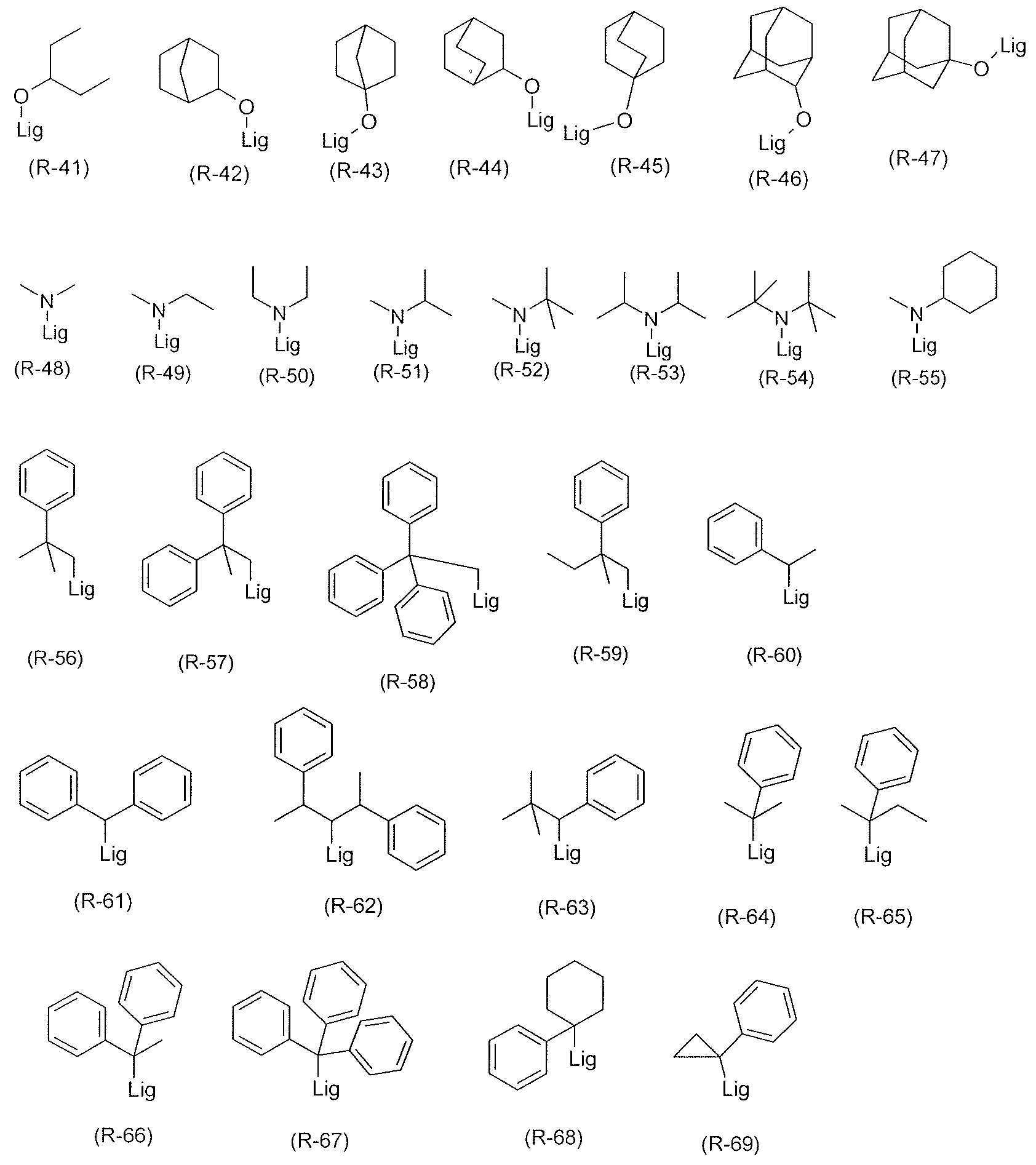

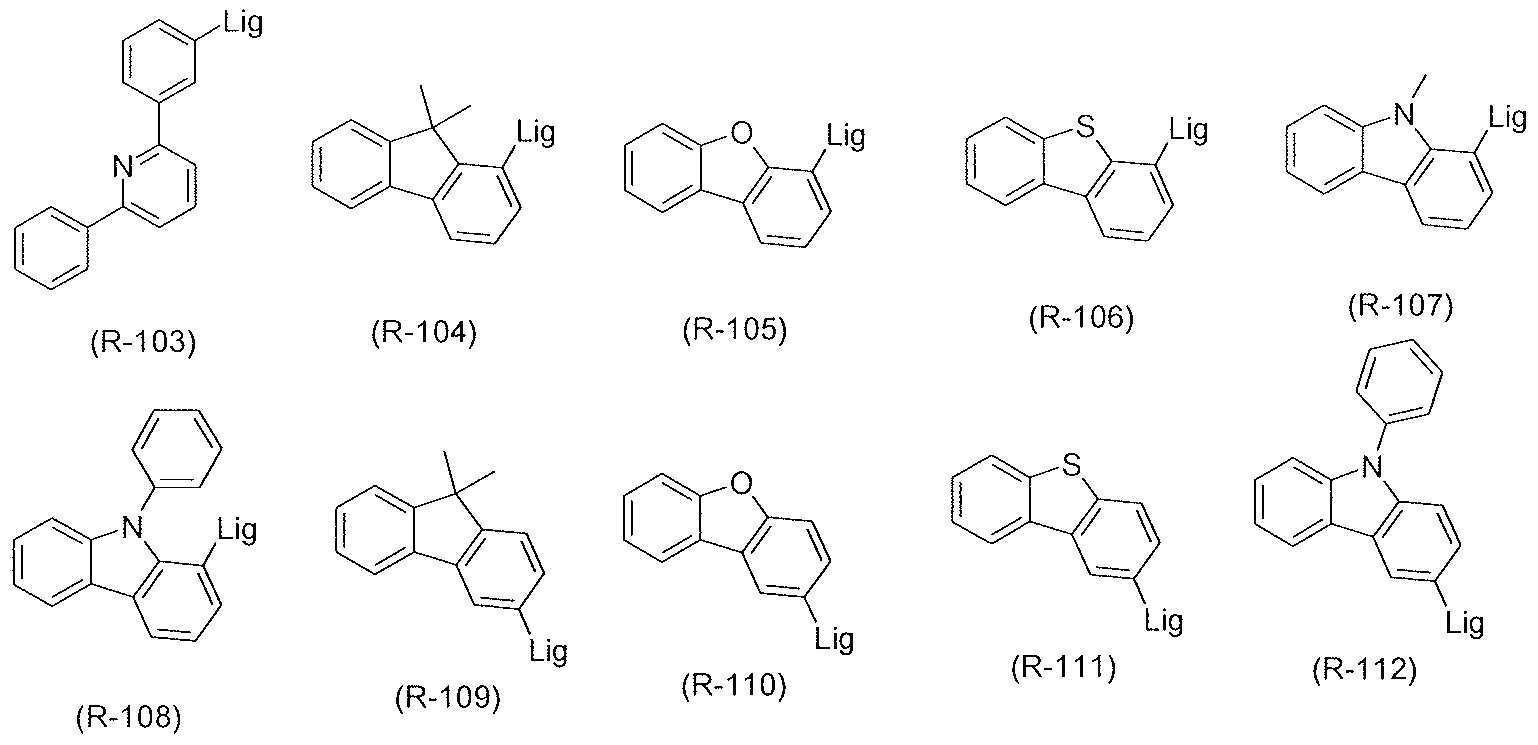
[식 중, Lig 는 기와 리간드와의 연결을 나타내고, 방향족 및 헤테로방향족 기는 각각 하나 이상의 라디칼 R8 에 의해 치환될 수 있음].The compound according to claim 3, wherein the bulky radical is selected from the structures of the following formulas (R-1) to (R-112):
Wherein Lig represents the linkage with the group ligand and the aromatic and heteroaromatic groups may each be substituted by one or more radicals R < 8 & gt ;.

[식 중, 점선 결합은 붕소 원자 또는 질소 원자에 대한 결합을 나타내고, 식 (44) 의 말단 페닐기는 또한 1 내지 5 개의 C 원자를 갖는 하나 이상의 알킬기에 의해 치환될 수 있음]. 7. A compound according to claim 6 wherein R < 7 > is selected from the groups of formulas (36) to (45)
Wherein the dotted bond represents a bond to a boron atom or a nitrogen atom and the terminal phenyl group of formula (44) may also be substituted by one or more alkyl groups having from 1 to 5 C atoms.

[식 중, 기호 M 및 R8 은 제 1 항에 지시된 의미를 갖고, Hal = F, Cl, Br 또는 I 이고, 금속 M 의 원자가에 따라 p 는 1, 2 또는 3 을 나타냄].Corresponding free ligand [L 1] n -V- [L 2] m [ wherein the symbols L 1, L 2, n, m, and V have the meaning indicated in claim 1 with the formula (46 A process for producing a compound according to any one of claims 1 to 7 by reaction of a metal alkoxide of formula (47) with a metal ketone ketonate of formula (47) or a metal halide of formula (48)
Wherein the symbols M and R 8 have the significance given in claim 1 and Hal = F, Cl, Br or I and p represents 1, 2 or 3, depending on the valence of the metal M.
Applications Claiming Priority (3)
| Application Number | Priority Date | Filing Date | Title |
|---|---|---|---|
| EP11005252.9 | 2011-06-28 | ||
| EP11005252 | 2011-06-28 | ||
| PCT/EP2012/002289 WO2013000531A1 (en) | 2011-06-28 | 2012-05-30 | Metal complexes |
Publications (2)
| Publication Number | Publication Date |
|---|---|
| KR20140053986A KR20140053986A (en) | 2014-05-08 |
| KR101943676B1 true KR101943676B1 (en) | 2019-01-29 |
Family
ID=46201567
Family Applications (1)
| Application Number | Title | Priority Date | Filing Date |
|---|---|---|---|
| KR1020147002027A Active KR101943676B1 (en) | 2011-06-28 | 2012-05-30 | Metal complexes |
Country Status (6)
| Country | Link |
|---|---|
| US (2) | US9673402B2 (en) |
| EP (1) | EP2726490B1 (en) |
| JP (1) | JP6038908B2 (en) |
| KR (1) | KR101943676B1 (en) |
| CN (1) | CN103635481A (en) |
| WO (1) | WO2013000531A1 (en) |
Families Citing this family (17)
| Publication number | Priority date | Publication date | Assignee | Title |
|---|---|---|---|---|
| WO2015171627A1 (en) * | 2014-05-08 | 2015-11-12 | Universal Display Corporation | Stabilized imidazophenanthridine materials |
| US10636983B2 (en) | 2014-05-08 | 2020-04-28 | Universal Display Corporation | Organic electroluminescent materials and devices |
| US10403830B2 (en) | 2014-05-08 | 2019-09-03 | Universal Display Corporation | Organic electroluminescent materials and devices |
| US10301338B2 (en) | 2014-05-08 | 2019-05-28 | Universal Display Corporation | Organic electroluminescent materials and devices |
| DE102014008722B4 (en) | 2014-06-18 | 2024-08-22 | Merck Patent Gmbh | Compositions for electronic devices, formulation containing them, use of the composition, use of the formulation and organic electronic device containing the composition |
| JP6556764B2 (en) | 2014-06-25 | 2019-08-07 | メルク パテント ゲーエムベーハー | Materials for organic electroluminescent devices |
| JP2018525331A (en) | 2015-06-10 | 2018-09-06 | メルク パテント ゲーエムベーハー | Materials for organic electroluminescent devices |
| CN107922359A (en) | 2015-07-30 | 2018-04-17 | 默克专利有限公司 | Material for organic electroluminescence device |
| EP3368520B1 (en) | 2015-10-27 | 2023-04-26 | Merck Patent GmbH | Materials for organic electroluminescent devices |
| US10608186B2 (en) * | 2016-09-14 | 2020-03-31 | Universal Display Corporation | Organic electroluminescent materials and devices |
| WO2019118313A1 (en) * | 2017-12-13 | 2019-06-20 | Merck Sharp & Dohme Corp. | Imidazo [1,2-c] quinazolin-5-amine compounds with a2a antagonist properties |
| GB201810710D0 (en) | 2018-06-29 | 2018-08-15 | Smartkem Ltd | Sputter Protective Layer For Organic Electronic Devices |
| JP2020158491A (en) * | 2019-03-26 | 2020-10-01 | ユニバーサル ディスプレイ コーポレイション | Organic electroluminescent materials and devices |
| GB201919031D0 (en) | 2019-12-20 | 2020-02-05 | Smartkem Ltd | Sputter protective layer for organic electronic devices |
| GB202017982D0 (en) | 2020-11-16 | 2020-12-30 | Smartkem Ltd | Organic thin film transistor |
| CN113512040B (en) * | 2021-08-25 | 2023-10-13 | 河南牧业经济学院 | Sanguinarine bionic compound and preparation method thereof |
| GB202209042D0 (en) | 2022-06-20 | 2022-08-10 | Smartkem Ltd | An integrated circuit for a flat-panel display |
Citations (2)
| Publication number | Priority date | Publication date | Assignee | Title |
|---|---|---|---|---|
| WO2010086089A1 (en) * | 2009-02-02 | 2010-08-05 | Merck Patent Gmbh | Metal complexes |
| JP2011094097A (en) * | 2009-09-30 | 2011-05-12 | Fujifilm Corp | Organic electroluminescent element |
Family Cites Families (41)
| Publication number | Priority date | Publication date | Assignee | Title |
|---|---|---|---|---|
| US4539507A (en) | 1983-03-25 | 1985-09-03 | Eastman Kodak Company | Organic electroluminescent devices having improved power conversion efficiencies |
| US5151629A (en) | 1991-08-01 | 1992-09-29 | Eastman Kodak Company | Blue emitting internal junction organic electroluminescent device (I) |
| JPH07133483A (en) | 1993-11-09 | 1995-05-23 | Shinko Electric Ind Co Ltd | Organic light emitting material for EL device and EL device |
| EP0676461B1 (en) | 1994-04-07 | 2002-08-14 | Covion Organic Semiconductors GmbH | Spiro compounds and their application as electroluminescence materials |
| DE19652261A1 (en) | 1996-12-16 | 1998-06-18 | Hoechst Ag | Aryl-substituted poly (p-arylenevinylenes), process for their preparation and their use in electroluminescent devices |
| GB9711237D0 (en) * | 1997-06-02 | 1997-07-23 | Isis Innovation | Organomettallic Complexes |
| ATE311877T1 (en) | 1998-02-24 | 2005-12-15 | Taiho Pharmaceutical Co Ltd | LP(A)-REDUCING AGENTS AND INHIBITORS OF APOPROTEIN (A) PRODUCTION |
| US6660410B2 (en) | 2000-03-27 | 2003-12-09 | Idemitsu Kosan Co., Ltd. | Organic electroluminescence element |
| ITRM20020411A1 (en) | 2002-08-01 | 2004-02-02 | Univ Roma La Sapienza | SPIROBIFLUORENE DERIVATIVES, THEIR PREPARATION AND USE. |
| JP2006511939A (en) | 2002-12-23 | 2006-04-06 | コビオン・オーガニック・セミコンダクターズ・ゲーエムベーハー | Organic electroluminescence device |
| JP4411851B2 (en) | 2003-03-19 | 2010-02-10 | コニカミノルタホールディングス株式会社 | Organic electroluminescence device |
| JP5318347B2 (en) | 2003-04-15 | 2013-10-16 | メルク パテント ゲーエムベーハー | Mixture of matrix material and organic semiconductor capable of emitting light, use thereof, and electronic component comprising said mixture |
| EP2236579B1 (en) | 2003-04-23 | 2014-04-09 | Konica Minolta Holdings, Inc. | Organic electroluminescent element and display |
| DE10333232A1 (en) | 2003-07-21 | 2007-10-11 | Merck Patent Gmbh | Organic electroluminescent element |
| US7795801B2 (en) | 2003-09-30 | 2010-09-14 | Konica Minolta Holdings, Inc. | Organic electroluminescent element, illuminator, display and compound |
| DE10350722A1 (en) | 2003-10-30 | 2005-05-25 | Covion Organic Semiconductors Gmbh | metal complexes |
| US7790890B2 (en) | 2004-03-31 | 2010-09-07 | Konica Minolta Holdings, Inc. | Organic electroluminescence element material, organic electroluminescence element, display device and illumination device |
| DE102004023277A1 (en) | 2004-05-11 | 2005-12-01 | Covion Organic Semiconductors Gmbh | New material mixtures for electroluminescence |
| JP4862248B2 (en) | 2004-06-04 | 2012-01-25 | コニカミノルタホールディングス株式会社 | Organic electroluminescence element, lighting device and display device |
| ITRM20040352A1 (en) | 2004-07-15 | 2004-10-15 | Univ Roma La Sapienza | OLIGOMERIC DERIVATIVES OF SPIROBIFLUORENE, THEIR PREPARATION AND THEIR USE. |
| CN101171320B (en) | 2005-05-03 | 2013-04-10 | 默克专利有限公司 | Organic electroluminescent device |
| EP1956022B1 (en) | 2005-12-01 | 2012-07-25 | Nippon Steel Chemical Co., Ltd. | Compound for organic electroluminescent element and organic electroluminescent element |
| KR101600624B1 (en) | 2006-02-10 | 2016-03-21 | 유니버셜 디스플레이 코포레이션 | METAL COMPLEXES OF CYCLOMETALLATED IMIDAZO[1,2-f]PHENANTHRIDINE AND DIIMIDAZO[1,2-A:1',2'-C]QUINAZOLINE LIGANDS AND ISOELECTRONIC AND BENZANNULATED ANALOGS THEREOF |
| DE102006025777A1 (en) | 2006-05-31 | 2007-12-06 | Merck Patent Gmbh | New materials for organic electroluminescent devices |
| US8062769B2 (en) | 2006-11-09 | 2011-11-22 | Nippon Steel Chemical Co., Ltd. | Indolocarbazole compound for use in organic electroluminescent device and organic electroluminescent device |
| DE102007002714A1 (en) | 2007-01-18 | 2008-07-31 | Merck Patent Gmbh | New materials for organic electroluminescent devices |
| DE102007053771A1 (en) | 2007-11-12 | 2009-05-14 | Merck Patent Gmbh | Organic electroluminescent devices |
| US7862908B2 (en) | 2007-11-26 | 2011-01-04 | National Tsing Hua University | Conjugated compounds containing hydroindoloacridine structural elements, and their use |
| US8221905B2 (en) | 2007-12-28 | 2012-07-17 | Universal Display Corporation | Carbazole-containing materials in phosphorescent light emitting diodes |
| EP2301926B1 (en) | 2008-06-05 | 2018-11-21 | Idemitsu Kosan Co., Ltd. | Halogen compound, polycyclic compound, and organic electroluminescence element comprising the polycyclic compound |
| DE102008033943A1 (en) | 2008-07-18 | 2010-01-21 | Merck Patent Gmbh | New materials for organic electroluminescent devices |
| KR101506919B1 (en) | 2008-10-31 | 2015-03-30 | 롬엔드하스전자재료코리아유한회사 | Novel compounds for organic electronic material and organic electronic device using the same |
| DE102008056688A1 (en) | 2008-11-11 | 2010-05-12 | Merck Patent Gmbh | Materials for organic electroluminescent devices |
| KR20110097612A (en) | 2008-11-11 | 2011-08-31 | 메르크 파텐트 게엠베하 | Organic electroluminescent devices |
| WO2010101530A1 (en) | 2009-03-04 | 2010-09-10 | Agency For Science, Technology And Research | Silsesquioxane derivatives having sulfur containing substituents |
| DE102009013041A1 (en) * | 2009-03-13 | 2010-09-16 | Merck Patent Gmbh | Materials for organic electroluminescent devices |
| DE102009014513A1 (en) | 2009-03-23 | 2010-09-30 | Merck Patent Gmbh | Organic electroluminescent device |
| DE102009023155A1 (en) | 2009-05-29 | 2010-12-02 | Merck Patent Gmbh | Materials for organic electroluminescent devices |
| DE102009031021A1 (en) | 2009-06-30 | 2011-01-05 | Merck Patent Gmbh | Materials for organic electroluminescent devices |
| DE102009048791A1 (en) | 2009-10-08 | 2011-04-14 | Merck Patent Gmbh | Materials for organic electroluminescent devices |
| DE102010005697A1 (en) | 2010-01-25 | 2011-07-28 | Merck Patent GmbH, 64293 | Connections for electronic devices |
-
2012
- 2012-05-30 KR KR1020147002027A patent/KR101943676B1/en active Active
- 2012-05-30 CN CN201280032163.7A patent/CN103635481A/en active Pending
- 2012-05-30 EP EP12724915.9A patent/EP2726490B1/en active Active
- 2012-05-30 JP JP2014517487A patent/JP6038908B2/en active Active
- 2012-05-30 WO PCT/EP2012/002289 patent/WO2013000531A1/en not_active Ceased
- 2012-05-30 US US14/128,654 patent/US9673402B2/en active Active
-
2017
- 2017-05-26 US US15/606,345 patent/US20170309832A1/en not_active Abandoned
Patent Citations (2)
| Publication number | Priority date | Publication date | Assignee | Title |
|---|---|---|---|---|
| WO2010086089A1 (en) * | 2009-02-02 | 2010-08-05 | Merck Patent Gmbh | Metal complexes |
| JP2011094097A (en) * | 2009-09-30 | 2011-05-12 | Fujifilm Corp | Organic electroluminescent element |
Also Published As
| Publication number | Publication date |
|---|---|
| JP6038908B2 (en) | 2016-12-07 |
| EP2726490B1 (en) | 2015-04-29 |
| EP2726490A1 (en) | 2014-05-07 |
| JP2014520766A (en) | 2014-08-25 |
| US20170309832A1 (en) | 2017-10-26 |
| KR20140053986A (en) | 2014-05-08 |
| US20140110642A1 (en) | 2014-04-24 |
| WO2013000531A1 (en) | 2013-01-03 |
| US9673402B2 (en) | 2017-06-06 |
| CN103635481A (en) | 2014-03-12 |
Similar Documents
| Publication | Publication Date | Title |
|---|---|---|
| KR101943676B1 (en) | Metal complexes | |
| CN111836820B (en) | metal complex | |
| TWI776926B (en) | Metal complexes | |
| CN111406062B (en) | Metal complex | |
| KR102713534B1 (en) | Heterocyclic compounds for use in electronic devices | |
| CN103619860B (en) | Metal complex | |
| JP7179456B2 (en) | Materials for organic electroluminescent devices | |
| CN102762546B (en) | Materials for Organic Electroluminescent Devices | |
| JP6054394B2 (en) | Metal complex | |
| JP5734965B2 (en) | Materials for organic electroluminescent devices | |
| JP6054290B2 (en) | Metal complex | |
| JP5868971B2 (en) | Metal complex | |
| CN104428392B (en) | metal complex | |
| CN111699192A (en) | Metal complexes | |
| CN109937207A (en) | Metal complex | |
| CN106661070A (en) | Metal complexes | |
| KR20190047014A (en) | A compound having a carbazole structure |
Legal Events
| Date | Code | Title | Description |
|---|---|---|---|
| PA0105 | International application |
St.27 status event code: A-0-1-A10-A15-nap-PA0105 |
|
| PG1501 | Laying open of application |
St.27 status event code: A-1-1-Q10-Q12-nap-PG1501 |
|
| A201 | Request for examination | ||
| P11-X000 | Amendment of application requested |
St.27 status event code: A-2-2-P10-P11-nap-X000 |
|
| P13-X000 | Application amended |
St.27 status event code: A-2-2-P10-P13-nap-X000 |
|
| PA0201 | Request for examination |
St.27 status event code: A-1-2-D10-D11-exm-PA0201 |
|
| D13-X000 | Search requested |
St.27 status event code: A-1-2-D10-D13-srh-X000 |
|
| D14-X000 | Search report completed |
St.27 status event code: A-1-2-D10-D14-srh-X000 |
|
| E902 | Notification of reason for refusal | ||
| PE0902 | Notice of grounds for rejection |
St.27 status event code: A-1-2-D10-D21-exm-PE0902 |
|
| E13-X000 | Pre-grant limitation requested |
St.27 status event code: A-2-3-E10-E13-lim-X000 |
|
| P11-X000 | Amendment of application requested |
St.27 status event code: A-2-2-P10-P11-nap-X000 |
|
| P13-X000 | Application amended |
St.27 status event code: A-2-2-P10-P13-nap-X000 |
|
| E701 | Decision to grant or registration of patent right | ||
| PE0701 | Decision of registration |
St.27 status event code: A-1-2-D10-D22-exm-PE0701 |
|
| GRNT | Written decision to grant | ||
| PR0701 | Registration of establishment |
St.27 status event code: A-2-4-F10-F11-exm-PR0701 |
|
| PR1002 | Payment of registration fee |
St.27 status event code: A-2-2-U10-U12-oth-PR1002 Fee payment year number: 1 |
|
| PG1601 | Publication of registration |
St.27 status event code: A-4-4-Q10-Q13-nap-PG1601 |
|
| R18-X000 | Changes to party contact information recorded |
St.27 status event code: A-5-5-R10-R18-oth-X000 |
|
| PR1001 | Payment of annual fee |
St.27 status event code: A-4-4-U10-U11-oth-PR1001 Fee payment year number: 4 |
|
| P22-X000 | Classification modified |
St.27 status event code: A-4-4-P10-P22-nap-X000 |
|
| PR1001 | Payment of annual fee |
St.27 status event code: A-4-4-U10-U11-oth-PR1001 Fee payment year number: 5 |
|
| R17-X000 | Change to representative recorded |
St.27 status event code: A-5-5-R10-R17-oth-X000 |
|
| PN2301 | Change of applicant |
St.27 status event code: A-5-5-R10-R11-asn-PN2301 |
|
| PN2301 | Change of applicant |
St.27 status event code: A-5-5-R10-R14-asn-PN2301 |
|
| PR1001 | Payment of annual fee |
St.27 status event code: A-4-4-U10-U11-oth-PR1001 Fee payment year number: 6 |
|
| P22-X000 | Classification modified |
St.27 status event code: A-4-4-P10-P22-nap-X000 |
|
| PR1001 | Payment of annual fee |
St.27 status event code: A-4-4-U10-U11-oth-PR1001 Fee payment year number: 7 |
|
| U11 | Full renewal or maintenance fee paid |
Free format text: ST27 STATUS EVENT CODE: A-4-4-U10-U11-OTH-PR1001 (AS PROVIDED BY THE NATIONAL OFFICE) Year of fee payment: 7 |