JP2017537085A - Materials for organic electroluminescent devices - Google Patents
Materials for organic electroluminescent devices Download PDFInfo
- Publication number
- JP2017537085A JP2017537085A JP2017525629A JP2017525629A JP2017537085A JP 2017537085 A JP2017537085 A JP 2017537085A JP 2017525629 A JP2017525629 A JP 2017525629A JP 2017525629 A JP2017525629 A JP 2017525629A JP 2017537085 A JP2017537085 A JP 2017537085A
- Authority
- JP
- Japan
- Prior art keywords
- groups
- aromatic ring
- substituted
- organic
- aromatic
- Prior art date
- Legal status (The legal status is an assumption and is not a legal conclusion. Google has not performed a legal analysis and makes no representation as to the accuracy of the status listed.)
- Pending
Links
- 0 *c(cccc1)c1-c1ccccc1* Chemical compound *c(cccc1)c1-c1ccccc1* 0.000 description 3
- NIHNNTQXNPWCJQ-UHFFFAOYSA-N C1c2ccccc2-c2ccccc12 Chemical compound C1c2ccccc2-c2ccccc12 NIHNNTQXNPWCJQ-UHFFFAOYSA-N 0.000 description 1
- LONBOJIXBFUBKQ-UHFFFAOYSA-N CC(C)(c1c2)c3cc(Br)ccc3-c1ccc2Br Chemical compound CC(C)(c1c2)c3cc(Br)ccc3-c1ccc2Br LONBOJIXBFUBKQ-UHFFFAOYSA-N 0.000 description 1
- UKQWNEQRMXLJCK-UHFFFAOYSA-N CC1(C)c2cc(-[n]3c(ccc(B(O)O)c4)c4c4c3cccc4)ccc2-c2c1cccc2 Chemical compound CC1(C)c2cc(-[n]3c(ccc(B(O)O)c4)c4c4c3cccc4)ccc2-c2c1cccc2 UKQWNEQRMXLJCK-UHFFFAOYSA-N 0.000 description 1
- DFLFZWTULQPFFK-UHFFFAOYSA-N CC1(C)c2cc(-[n]3c(ccc(Br)c4)c4c4c3cccc4)ccc2-c2c1cccc2 Chemical compound CC1(C)c2cc(-[n]3c(ccc(Br)c4)c4c4c3cccc4)ccc2-c2c1cccc2 DFLFZWTULQPFFK-UHFFFAOYSA-N 0.000 description 1
Classifications
-
- C—CHEMISTRY; METALLURGY
- C07—ORGANIC CHEMISTRY
- C07D—HETEROCYCLIC COMPOUNDS
- C07D401/00—Heterocyclic compounds containing two or more hetero rings, having nitrogen atoms as the only ring hetero atoms, at least one ring being a six-membered ring with only one nitrogen atom
- C07D401/02—Heterocyclic compounds containing two or more hetero rings, having nitrogen atoms as the only ring hetero atoms, at least one ring being a six-membered ring with only one nitrogen atom containing two hetero rings
- C07D401/04—Heterocyclic compounds containing two or more hetero rings, having nitrogen atoms as the only ring hetero atoms, at least one ring being a six-membered ring with only one nitrogen atom containing two hetero rings directly linked by a ring-member-to-ring-member bond
-
- C—CHEMISTRY; METALLURGY
- C07—ORGANIC CHEMISTRY
- C07D—HETEROCYCLIC COMPOUNDS
- C07D211/00—Heterocyclic compounds containing hydrogenated pyridine rings, not condensed with other rings
- C07D211/04—Heterocyclic compounds containing hydrogenated pyridine rings, not condensed with other rings with only hydrogen or carbon atoms directly attached to the ring nitrogen atom
- C07D211/06—Heterocyclic compounds containing hydrogenated pyridine rings, not condensed with other rings with only hydrogen or carbon atoms directly attached to the ring nitrogen atom having no double bonds between ring members or between ring members and non-ring members
- C07D211/08—Heterocyclic compounds containing hydrogenated pyridine rings, not condensed with other rings with only hydrogen or carbon atoms directly attached to the ring nitrogen atom having no double bonds between ring members or between ring members and non-ring members with hydrocarbon or substituted hydrocarbon radicals directly attached to ring carbon atoms
- C07D211/10—Heterocyclic compounds containing hydrogenated pyridine rings, not condensed with other rings with only hydrogen or carbon atoms directly attached to the ring nitrogen atom having no double bonds between ring members or between ring members and non-ring members with hydrocarbon or substituted hydrocarbon radicals directly attached to ring carbon atoms with radicals containing only carbon and hydrogen atoms attached to ring carbon atoms
-
- C—CHEMISTRY; METALLURGY
- C07—ORGANIC CHEMISTRY
- C07D—HETEROCYCLIC COMPOUNDS
- C07D401/00—Heterocyclic compounds containing two or more hetero rings, having nitrogen atoms as the only ring hetero atoms, at least one ring being a six-membered ring with only one nitrogen atom
- C07D401/02—Heterocyclic compounds containing two or more hetero rings, having nitrogen atoms as the only ring hetero atoms, at least one ring being a six-membered ring with only one nitrogen atom containing two hetero rings
- C07D401/10—Heterocyclic compounds containing two or more hetero rings, having nitrogen atoms as the only ring hetero atoms, at least one ring being a six-membered ring with only one nitrogen atom containing two hetero rings linked by a carbon chain containing aromatic rings
-
- C—CHEMISTRY; METALLURGY
- C07—ORGANIC CHEMISTRY
- C07D—HETEROCYCLIC COMPOUNDS
- C07D401/00—Heterocyclic compounds containing two or more hetero rings, having nitrogen atoms as the only ring hetero atoms, at least one ring being a six-membered ring with only one nitrogen atom
- C07D401/14—Heterocyclic compounds containing two or more hetero rings, having nitrogen atoms as the only ring hetero atoms, at least one ring being a six-membered ring with only one nitrogen atom containing three or more hetero rings
-
- C—CHEMISTRY; METALLURGY
- C07—ORGANIC CHEMISTRY
- C07D—HETEROCYCLIC COMPOUNDS
- C07D405/00—Heterocyclic compounds containing both one or more hetero rings having oxygen atoms as the only ring hetero atoms, and one or more rings having nitrogen as the only ring hetero atom
- C07D405/02—Heterocyclic compounds containing both one or more hetero rings having oxygen atoms as the only ring hetero atoms, and one or more rings having nitrogen as the only ring hetero atom containing two hetero rings
- C07D405/12—Heterocyclic compounds containing both one or more hetero rings having oxygen atoms as the only ring hetero atoms, and one or more rings having nitrogen as the only ring hetero atom containing two hetero rings linked by a chain containing hetero atoms as chain links
-
- C—CHEMISTRY; METALLURGY
- C07—ORGANIC CHEMISTRY
- C07D—HETEROCYCLIC COMPOUNDS
- C07D405/00—Heterocyclic compounds containing both one or more hetero rings having oxygen atoms as the only ring hetero atoms, and one or more rings having nitrogen as the only ring hetero atom
- C07D405/14—Heterocyclic compounds containing both one or more hetero rings having oxygen atoms as the only ring hetero atoms, and one or more rings having nitrogen as the only ring hetero atom containing three or more hetero rings
-
- C—CHEMISTRY; METALLURGY
- C07—ORGANIC CHEMISTRY
- C07D—HETEROCYCLIC COMPOUNDS
- C07D409/00—Heterocyclic compounds containing two or more hetero rings, at least one ring having sulfur atoms as the only ring hetero atoms
- C07D409/14—Heterocyclic compounds containing two or more hetero rings, at least one ring having sulfur atoms as the only ring hetero atoms containing three or more hetero rings
-
- C—CHEMISTRY; METALLURGY
- C07—ORGANIC CHEMISTRY
- C07D—HETEROCYCLIC COMPOUNDS
- C07D413/00—Heterocyclic compounds containing two or more hetero rings, at least one ring having nitrogen and oxygen atoms as the only ring hetero atoms
- C07D413/02—Heterocyclic compounds containing two or more hetero rings, at least one ring having nitrogen and oxygen atoms as the only ring hetero atoms containing two hetero rings
- C07D413/10—Heterocyclic compounds containing two or more hetero rings, at least one ring having nitrogen and oxygen atoms as the only ring hetero atoms containing two hetero rings linked by a carbon chain containing aromatic rings
-
- C—CHEMISTRY; METALLURGY
- C07—ORGANIC CHEMISTRY
- C07D—HETEROCYCLIC COMPOUNDS
- C07D417/00—Heterocyclic compounds containing two or more hetero rings, at least one ring having nitrogen and sulfur atoms as the only ring hetero atoms, not provided for by group C07D415/00
- C07D417/02—Heterocyclic compounds containing two or more hetero rings, at least one ring having nitrogen and sulfur atoms as the only ring hetero atoms, not provided for by group C07D415/00 containing two hetero rings
- C07D417/10—Heterocyclic compounds containing two or more hetero rings, at least one ring having nitrogen and sulfur atoms as the only ring hetero atoms, not provided for by group C07D415/00 containing two hetero rings linked by a carbon chain containing aromatic rings
-
- C—CHEMISTRY; METALLURGY
- C07—ORGANIC CHEMISTRY
- C07D—HETEROCYCLIC COMPOUNDS
- C07D471/00—Heterocyclic compounds containing nitrogen atoms as the only ring hetero atoms in the condensed system, at least one ring being a six-membered ring with one nitrogen atom, not provided for by groups C07D451/00 - C07D463/00
- C07D471/02—Heterocyclic compounds containing nitrogen atoms as the only ring hetero atoms in the condensed system, at least one ring being a six-membered ring with one nitrogen atom, not provided for by groups C07D451/00 - C07D463/00 in which the condensed system contains two hetero rings
- C07D471/04—Ortho-condensed systems
-
- C—CHEMISTRY; METALLURGY
- C07—ORGANIC CHEMISTRY
- C07D—HETEROCYCLIC COMPOUNDS
- C07D487/00—Heterocyclic compounds containing nitrogen atoms as the only ring hetero atoms in the condensed system, not provided for by groups C07D451/00 - C07D477/00
- C07D487/02—Heterocyclic compounds containing nitrogen atoms as the only ring hetero atoms in the condensed system, not provided for by groups C07D451/00 - C07D477/00 in which the condensed system contains two hetero rings
- C07D487/06—Peri-condensed systems
-
- C—CHEMISTRY; METALLURGY
- C07—ORGANIC CHEMISTRY
- C07D—HETEROCYCLIC COMPOUNDS
- C07D491/00—Heterocyclic compounds containing in the condensed ring system both one or more rings having oxygen atoms as the only ring hetero atoms and one or more rings having nitrogen atoms as the only ring hetero atoms, not provided for by groups C07D451/00 - C07D459/00, C07D463/00, C07D477/00 or C07D489/00
- C07D491/02—Heterocyclic compounds containing in the condensed ring system both one or more rings having oxygen atoms as the only ring hetero atoms and one or more rings having nitrogen atoms as the only ring hetero atoms, not provided for by groups C07D451/00 - C07D459/00, C07D463/00, C07D477/00 or C07D489/00 in which the condensed system contains two hetero rings
- C07D491/10—Spiro-condensed systems
- C07D491/107—Spiro-condensed systems with only one oxygen atom as ring hetero atom in the oxygen-containing ring
-
- C—CHEMISTRY; METALLURGY
- C09—DYES; PAINTS; POLISHES; NATURAL RESINS; ADHESIVES; COMPOSITIONS NOT OTHERWISE PROVIDED FOR; APPLICATIONS OF MATERIALS NOT OTHERWISE PROVIDED FOR
- C09K—MATERIALS FOR MISCELLANEOUS APPLICATIONS, NOT PROVIDED FOR ELSEWHERE
- C09K11/00—Luminescent, e.g. electroluminescent, chemiluminescent materials
- C09K11/06—Luminescent, e.g. electroluminescent, chemiluminescent materials containing organic luminescent materials
-
- H—ELECTRICITY
- H10—SEMICONDUCTOR DEVICES; ELECTRIC SOLID-STATE DEVICES NOT OTHERWISE PROVIDED FOR
- H10K—ORGANIC ELECTRIC SOLID-STATE DEVICES
- H10K50/00—Organic light-emitting devices
- H10K50/10—OLEDs or polymer light-emitting diodes [PLED]
- H10K50/11—OLEDs or polymer light-emitting diodes [PLED] characterised by the electroluminescent [EL] layers
-
- H—ELECTRICITY
- H10—SEMICONDUCTOR DEVICES; ELECTRIC SOLID-STATE DEVICES NOT OTHERWISE PROVIDED FOR
- H10K—ORGANIC ELECTRIC SOLID-STATE DEVICES
- H10K50/00—Organic light-emitting devices
- H10K50/10—OLEDs or polymer light-emitting diodes [PLED]
- H10K50/14—Carrier transporting layers
- H10K50/15—Hole transporting layers
-
- H—ELECTRICITY
- H10—SEMICONDUCTOR DEVICES; ELECTRIC SOLID-STATE DEVICES NOT OTHERWISE PROVIDED FOR
- H10K—ORGANIC ELECTRIC SOLID-STATE DEVICES
- H10K50/00—Organic light-emitting devices
- H10K50/10—OLEDs or polymer light-emitting diodes [PLED]
- H10K50/18—Carrier blocking layers
-
- H—ELECTRICITY
- H10—SEMICONDUCTOR DEVICES; ELECTRIC SOLID-STATE DEVICES NOT OTHERWISE PROVIDED FOR
- H10K—ORGANIC ELECTRIC SOLID-STATE DEVICES
- H10K85/00—Organic materials used in the body or electrodes of devices covered by this subclass
- H10K85/60—Organic compounds having low molecular weight
- H10K85/631—Amine compounds having at least two aryl rest on at least one amine-nitrogen atom, e.g. triphenylamine
-
- H—ELECTRICITY
- H10—SEMICONDUCTOR DEVICES; ELECTRIC SOLID-STATE DEVICES NOT OTHERWISE PROVIDED FOR
- H10K—ORGANIC ELECTRIC SOLID-STATE DEVICES
- H10K85/00—Organic materials used in the body or electrodes of devices covered by this subclass
- H10K85/60—Organic compounds having low molecular weight
- H10K85/631—Amine compounds having at least two aryl rest on at least one amine-nitrogen atom, e.g. triphenylamine
- H10K85/636—Amine compounds having at least two aryl rest on at least one amine-nitrogen atom, e.g. triphenylamine comprising heteroaromatic hydrocarbons as substituents on the nitrogen atom
-
- H—ELECTRICITY
- H10—SEMICONDUCTOR DEVICES; ELECTRIC SOLID-STATE DEVICES NOT OTHERWISE PROVIDED FOR
- H10K—ORGANIC ELECTRIC SOLID-STATE DEVICES
- H10K85/00—Organic materials used in the body or electrodes of devices covered by this subclass
- H10K85/60—Organic compounds having low molecular weight
- H10K85/649—Aromatic compounds comprising a hetero atom
- H10K85/654—Aromatic compounds comprising a hetero atom comprising only nitrogen as heteroatom
-
- H—ELECTRICITY
- H10—SEMICONDUCTOR DEVICES; ELECTRIC SOLID-STATE DEVICES NOT OTHERWISE PROVIDED FOR
- H10K—ORGANIC ELECTRIC SOLID-STATE DEVICES
- H10K85/00—Organic materials used in the body or electrodes of devices covered by this subclass
- H10K85/60—Organic compounds having low molecular weight
- H10K85/649—Aromatic compounds comprising a hetero atom
- H10K85/657—Polycyclic condensed heteroaromatic hydrocarbons
- H10K85/6572—Polycyclic condensed heteroaromatic hydrocarbons comprising only nitrogen in the heteroaromatic polycondensed ring system, e.g. phenanthroline or carbazole
-
- H—ELECTRICITY
- H10—SEMICONDUCTOR DEVICES; ELECTRIC SOLID-STATE DEVICES NOT OTHERWISE PROVIDED FOR
- H10K—ORGANIC ELECTRIC SOLID-STATE DEVICES
- H10K85/00—Organic materials used in the body or electrodes of devices covered by this subclass
- H10K85/60—Organic compounds having low molecular weight
- H10K85/649—Aromatic compounds comprising a hetero atom
- H10K85/657—Polycyclic condensed heteroaromatic hydrocarbons
- H10K85/6574—Polycyclic condensed heteroaromatic hydrocarbons comprising only oxygen in the heteroaromatic polycondensed ring system, e.g. cumarine dyes
-
- H—ELECTRICITY
- H10—SEMICONDUCTOR DEVICES; ELECTRIC SOLID-STATE DEVICES NOT OTHERWISE PROVIDED FOR
- H10K—ORGANIC ELECTRIC SOLID-STATE DEVICES
- H10K85/00—Organic materials used in the body or electrodes of devices covered by this subclass
- H10K85/60—Organic compounds having low molecular weight
- H10K85/649—Aromatic compounds comprising a hetero atom
- H10K85/657—Polycyclic condensed heteroaromatic hydrocarbons
- H10K85/6576—Polycyclic condensed heteroaromatic hydrocarbons comprising only sulfur in the heteroaromatic polycondensed ring system, e.g. benzothiophene
-
- H—ELECTRICITY
- H10—SEMICONDUCTOR DEVICES; ELECTRIC SOLID-STATE DEVICES NOT OTHERWISE PROVIDED FOR
- H10K—ORGANIC ELECTRIC SOLID-STATE DEVICES
- H10K2101/00—Properties of the organic materials covered by group H10K85/00
- H10K2101/10—Triplet emission
-
- H—ELECTRICITY
- H10—SEMICONDUCTOR DEVICES; ELECTRIC SOLID-STATE DEVICES NOT OTHERWISE PROVIDED FOR
- H10K—ORGANIC ELECTRIC SOLID-STATE DEVICES
- H10K85/00—Organic materials used in the body or electrodes of devices covered by this subclass
- H10K85/30—Coordination compounds
- H10K85/341—Transition metal complexes, e.g. Ru(II)polypyridine complexes
- H10K85/342—Transition metal complexes, e.g. Ru(II)polypyridine complexes comprising iridium
-
- H—ELECTRICITY
- H10—SEMICONDUCTOR DEVICES; ELECTRIC SOLID-STATE DEVICES NOT OTHERWISE PROVIDED FOR
- H10K—ORGANIC ELECTRIC SOLID-STATE DEVICES
- H10K85/00—Organic materials used in the body or electrodes of devices covered by this subclass
- H10K85/30—Coordination compounds
- H10K85/341—Transition metal complexes, e.g. Ru(II)polypyridine complexes
- H10K85/346—Transition metal complexes, e.g. Ru(II)polypyridine complexes comprising platinum
-
- H—ELECTRICITY
- H10—SEMICONDUCTOR DEVICES; ELECTRIC SOLID-STATE DEVICES NOT OTHERWISE PROVIDED FOR
- H10K—ORGANIC ELECTRIC SOLID-STATE DEVICES
- H10K85/00—Organic materials used in the body or electrodes of devices covered by this subclass
- H10K85/60—Organic compounds having low molecular weight
- H10K85/631—Amine compounds having at least two aryl rest on at least one amine-nitrogen atom, e.g. triphenylamine
- H10K85/633—Amine compounds having at least two aryl rest on at least one amine-nitrogen atom, e.g. triphenylamine comprising polycyclic condensed aromatic hydrocarbons as substituents on the nitrogen atom
-
- Y—GENERAL TAGGING OF NEW TECHNOLOGICAL DEVELOPMENTS; GENERAL TAGGING OF CROSS-SECTIONAL TECHNOLOGIES SPANNING OVER SEVERAL SECTIONS OF THE IPC; TECHNICAL SUBJECTS COVERED BY FORMER USPC CROSS-REFERENCE ART COLLECTIONS [XRACs] AND DIGESTS
- Y02—TECHNOLOGIES OR APPLICATIONS FOR MITIGATION OR ADAPTATION AGAINST CLIMATE CHANGE
- Y02E—REDUCTION OF GREENHOUSE GAS [GHG] EMISSIONS, RELATED TO ENERGY GENERATION, TRANSMISSION OR DISTRIBUTION
- Y02E10/00—Energy generation through renewable energy sources
- Y02E10/50—Photovoltaic [PV] energy
- Y02E10/549—Organic PV cells
Landscapes
- Chemical & Material Sciences (AREA)
- Organic Chemistry (AREA)
- Physics & Mathematics (AREA)
- Engineering & Computer Science (AREA)
- Materials Engineering (AREA)
- Spectroscopy & Molecular Physics (AREA)
- Optics & Photonics (AREA)
- Electroluminescent Light Sources (AREA)
- Other In-Based Heterocyclic Compounds (AREA)
- Plural Heterocyclic Compounds (AREA)
- Low-Molecular Organic Synthesis Reactions Using Catalysts (AREA)
Abstract
本発明は、電子素子、特別には、有機エレクトロルミッセンス素子での使用に適する式(1)の化合物に関する。The present invention relates to compounds of formula (1) suitable for use in electronic devices, in particular organic electroluminescent devices.
Description
本発明は、フェナントリジン誘導体の、特別には、有機エレクトロルミッセンス素子における三重項マトリックス材料もしくは正孔輸送材料としての使用に関する。本発明は、さらに、本発明の化合物の製造方法とこれらの化合物を含む電子素子に関する。 The present invention relates to the use of phenanthridine derivatives, in particular as triplet matrix materials or hole transport materials in organic electroluminescent devices. The present invention further relates to a method for producing the compound of the present invention and an electronic device containing these compounds.
有機半導体が機能性材料として使用される有機エレクトロルミネセンス素子(OLED)の構造は、たとえば、US 4539507、US 5151629、EP0676461およびWO98/27136に記載されている。使用される発光材料は、蛍光発光ではなく燐光発光を示す有機金属錯体であることが多い。量子力学的理由により、4倍までのエネルギー効率とパワー効率が、燐光発光エミッターとして有機金属化合物を使用して可能である。一般的に、OLEDにおいて、特別には、三重項発光(燐光発光)を示すOLEDにおいて、たとえば、効率、駆動電圧および寿命に関して、改善に対する必要性が未だ存在する。 The structure of an organic electroluminescent device (OLED) in which an organic semiconductor is used as a functional material is described, for example, in US 4539507, US 5151629, EP0676461 and WO98 / 27136. The light emitting material used is often an organometallic complex that exhibits phosphorescence rather than fluorescence. For quantum mechanical reasons, up to four times the energy efficiency and power efficiency are possible using organometallic compounds as phosphorescent emitters. In general, there is still a need for improvements in OLEDs, especially in OLEDs that exhibit triplet emission (phosphorescence emission), for example in terms of efficiency, drive voltage and lifetime.
燐光発光OLEDの特性は、使用される三重項エミッターによってだけ決定されるのではない。より好ましくは、使用されるその他の材料、たとえば、マトリックス材料は、また、ここで、特に重要である。そこで、これら材料に対する改善は、また、OLED特性に顕著な改善をもたらし得る。 The properties of phosphorescent OLEDs are not only determined by the triplet emitter used. More preferably, other materials used, such as matrix materials, are also of particular importance here. Thus, improvements to these materials can also lead to significant improvements in OLED properties.
先行技術によると、他の材料のなかでも、インドロカルバゾール誘導体(たとえば、WO 2007/063754もしくはWO 2008/056746によるもの)またはインデノカルバゾール誘導体(たとえば、WO 2010/136109もしくはWO2011/000455によるもの)、特別に、トリアジン等の電子不足複素環式芳香族で置換されたものが、燐光エミッターのためのマトリックス材料として使用される。さらに、たとえば、ビスジベンゾフラン誘導体(たとえば、EP 2301926によるもの)が燐光エミッターのためのマトリックス材料として使用される。しかしながら、特別に、素子の効率、寿命と駆動電圧に関して、これらのマトリックス材料の使用の場合に、改善に対する必要性が未だに存在する。 According to the prior art, among other materials, indolocarbazole derivatives (for example according to WO 2007/063754 or WO 2008/056746) or indenocarbazole derivatives (for example according to WO 2010/136109 or WO2011 / 000455) Specially substituted with electron-deficient heterocyclic aromatics such as triazine are used as matrix material for phosphorescent emitters. Furthermore, for example, bisdibenzofuran derivatives (for example according to EP 2301926) are used as matrix material for phosphorescent emitters. However, there is still a need for improvement, especially in the use of these matrix materials, with regard to device efficiency, lifetime and drive voltage.
本発明により取り組まれた課題は、蛍光もしくは燐光OLED、特別には、燐光OLEDにおいて、たとえば、マトリックス材料としてのまたは電荷輸送材料、特別には、正孔輸送もしくは電子ブロック材料としての使用に適する化合物を提供することである。本発明により取り組まれた特別な課題は、緑色および青色燐光OLEDのために適するマトリックス材料を提供すること、および新規な電荷輸送材料を提供することである。 The problem addressed by the present invention is a compound suitable for use in fluorescent or phosphorescent OLEDs, in particular phosphorescent OLEDs, for example as a matrix material or as a charge transport material, in particular as a hole transport or electron block material. Is to provide. A particular problem addressed by the present invention is to provide a matrix material suitable for green and blue phosphorescent OLEDs and to provide a novel charge transport material.
驚くべきことに、以下の式(1)の化合物を含むエレクトロルミッセンス素子が、特別には、燐光ドーパントのためのマトリックス材料もしくは正孔輸送材料として使用される場合に、先行技術を超える改善を有することが見出された。 Surprisingly, an improvement over the prior art when an electroluminescent device comprising a compound of formula (1) below is used, especially as a matrix material or hole transport material for a phosphorescent dopant: It was found to have
式中、使用される記号と添え字は、以下のとおりである;
Ar1は、出現毎に同一であるか異なり、6〜60個の芳香族環原子を有し、各場合に、1以上のR2基により置換されてもよい芳香族もしくは複素環式芳香族環構造であり;ここで、q>0の場合には、少なくとも2個のAr1は、結合してよくおよび/またはAr1は、少なくとも一つのブリッジKを介してAr2に結合してよく;
Kは、出現毎に同一であるか異なり、単結合またはN(R2)、B(R2)、O、C=O、C(R2)2、Si(R2)2およびSから選択される2価ブリッジであり;
Ar2は、出現毎に同一であるか異なり、5〜40個の芳香族環原子を有し、1以上のR2基により置換されてよい2価の芳香族もしくは複素環式芳香族環構造であり;
Xは、出現毎に同一であるか異なり、NまたはCR1であり;
R1は、出現毎に同一であるか異なり、H、D、F、Cl、Br、I、CHO、C(=O)(Ar)、P(=O)(Ar)2、S(=O)Ar、S(=O)2Ar、CN、NO2、Si(R2)3、B(OR2)2、OSO2R2、1〜40個の炭素原子を有する直鎖アルキル、アルコキシもしくはチオアルコキシ基、3〜40個の炭素原子を有する分岐あるいは環状アルキル、アルコキシもしくはチオアルコキシ基(夫々、1以上のR2基により置換されてもよく、1以上の隣接しないCH2基は、C≡C、Si(R2)2、Ge(R2)2、Sn(R2)2、C=O、C=S、C=Se、P(=O)(R2)、SO、SO2、O、SもしくはCONR2で置き代えられてよく、ここで、1以上の水素原子は、D、F、Cl、Br、I、CNもしくはNO2で置き代えられてよい。)または、夫々、1以上のR2基により置換されてよい5〜40個の芳香族環原子を有する芳香族もしくは複素環式芳香族環構造、または、1以上のR2基により置換されてよい5〜40個の芳香族環原子を有するアリールオキシもしくはヘテロアリーオキシ基またはこれらの構造の組み合わせであり;同時に、2個以上の隣接するR1置換基は、一緒になって、モノあるいはポリ環状の脂肪族もしくは芳香族環構造を形成してもよく;
Arは、出現毎に同一であるか異なり、6〜60個の芳香族環原子を有し、各場合に、1以上のR2基により置換されてもよい芳香族もしくは複素環式芳香族環構造であり;
R2は、出現毎に同一であるか異なり、H、D、F、Cl、Br、I、CHO、C(=O)R3、P(=O)(R3)2、S(=O)R3、S(=O)2R3、CN、NO2、Si(R3)3、B(OR3)2、OSO2R3、1〜40個の炭素原子を有する直鎖アルキル、アルコキシもしくはチオアルコキシ基、3〜40個の炭素原子を有する分岐あるいは環状アルキル、アルコキシもしくはチオアルコキシ基(夫々、1以上のR3基により置換されてもよく、1以上の隣接しないCH2基は、C≡C、Si(R3)2、Ge(R3)2、Sn(R3)2、C=O、C=S、C=Se、P(=O)(R3)、SO、SO2、O、SもしくはCONR3で置き代えられてよく、ここで、1以上の水素原子は、D、F、Cl、Br、I、CNもしくはNO2で置き代えられてよい。)または、夫々、1以上のR3基により置換されてよい5〜60個の芳香族環原子を有する芳香族もしくは複素環式芳香族環構造、または、1以上のR3基により置換されてよい5〜40個の芳香族環原子を有するアリールオキシもしくはヘテロアリーオキシ基またはこれらの構造の組み合わせであり;同時に、2個以上の隣接するR2置換基は、一緒になって、モノあるいはポリ環状の脂肪族もしくは芳香族環構造を形成してもよく;
R3は、出現毎に同一であるか異なり、H、D、F、Cl、Br、I、N(R4)2、C(=O)Ar、P(=O)(Ar)2、S(=O)Ar、S(=O)2Ar、CR4=CR4Ar、CN、NO2、Si(R4)3、B(OR4)2、OSO2R4、1〜40個の炭素原子を有する直鎖アルキル、アルコキシもしくはチオアルコキシ基、3〜40個の炭素原子を有する分岐あるいは環状アルキル、アルコキシもしくはチオアルコキシ基(夫々、1以上のR4基により置換されてもよく、1以上の隣接しないCH2基は、R4C=CR4、C≡C、Si(R4)2、C=O、C=NR4、P(=O)(R4)、SO、SO2、NR4、O、SもしくはCONR4で置き代えられてよく、ここで、1以上の水素原子は、D、F、Cl、Br、I、CNもしくはNO2で置き代えられてよい。)または、夫々、1以上のR4基により置換されてよい5〜60個の芳香族環原子を有する芳香族もしくは複素環式芳香族環構造、または、1以上のR4基により置換されてよい5〜40個の芳香族環原子を有するアリールオキシもしくはヘテロアリーオキシ基、または、1以上のR4基により置換されてよい5〜40個の芳香族環原子を有するアラルキルもしくはヘテロアラルキル基またはこれらの構造の組み合わせであり;同時に、2個以上のR3置換基は、一緒になって、モノあるいはポリ環状の脂肪族もしくは芳香族環構造を形成してもよく;
R4は、出現毎に同一であるか異なり、H、D、F、1〜20個の炭素原子を有する脂肪族炭化水素基または1以上のR5基により置換されてよい5〜40個の環原子を有するアリールもしくはヘテロアリール基またはこれらの構造の組み合わせであり;
R5は、出現毎に同一であるか異なり、H、D、F、1〜20個の炭素原子を有する脂肪族炭化水素基であり;
qは、0、1または2であり
ここで、
Ar2は、複素環式芳香族環構造の場合には、C−C結合を介してフェナントリジン基本骨格に結合してよく;
R1は、複素環式芳香族環構造の場合には、C−C結合を介してフェナントリジン基本骨格に結合してよい。
In the formula, the symbols and subscripts used are as follows:
Ar 1 is the same or different at each occurrence and has 6 to 60 aromatic ring atoms, in each case aromatic or heterocyclic aromatic optionally substituted by one or more R 2 groups Wherein, when q> 0, at least two Ar 1 may be bonded and / or Ar 1 may be bonded to Ar 2 via at least one bridge K. ;
K is the same or different at each occurrence and is selected from a single bond or N (R 2 ), B (R 2 ), O, C═O, C (R 2 ) 2 , Si (R 2 ) 2 and S A divalent bridge that is
Ar 2 is the same or different at each occurrence and has a divalent aromatic or heterocyclic aromatic ring structure having 5 to 40 aromatic ring atoms, which may be substituted by one or more R 2 groups Is;
X is the same or different at each occurrence and is N or CR 1 ;
R 1 is the same or different for each occurrence, and H, D, F, Cl, Br, I, CHO, C (═O) (Ar), P (═O) (Ar) 2 , S (═O ) Ar, S (═O) 2 Ar, CN, NO 2 , Si (R 2 ) 3 , B (OR 2 ) 2 , OSO 2 R 2 , linear alkyl having 1 to 40 carbon atoms, alkoxy or A thioalkoxy group, a branched or cyclic alkyl having 3 to 40 carbon atoms, an alkoxy or thioalkoxy group (each of which may be substituted by one or more R 2 groups and one or more non-adjacent CH 2 groups are C ≡C, Si (R 2 ) 2 , Ge (R 2 ) 2 , Sn (R 2 ) 2 , C═O, C═S, C═Se, P (═O) (R 2 ), SO, SO 2 , O, may be replaced by S or CONR 2, wherein one or more hydrogen atoms, D, F Cl, Br, I, may be replaced by CN or NO 2.) Or, respectively, the aromatic or heterocyclic having 1 or more substituted by R 2 groups which may be 5 to 40 aromatic ring atoms An aromatic ring structure, or an aryloxy or heteroaryoxy group having from 5 to 40 aromatic ring atoms that may be substituted by one or more R 2 groups, or a combination of these structures; Adjacent R 1 substituents together may form a mono- or polycyclic aliphatic or aromatic ring structure;
Ar is the same or different at each occurrence and has 6 to 60 aromatic ring atoms, in each case an aromatic or heteroaromatic ring optionally substituted by one or more R 2 groups Structure;
R 2 is the same or different for each occurrence, and H, D, F, Cl, Br, I, CHO, C (═O) R 3 , P (═O) (R 3 ) 2 , S (═O ) R 3 , S (═O) 2 R 3 , CN, NO 2 , Si (R 3 ) 3 , B (OR 3 ) 2 , OSO 2 R 3 , linear alkyl having 1 to 40 carbon atoms, alkoxy or thioalkoxy groups, 3 to 40 amino branched or cyclic alkyl having carbon atoms, alkoxy or thioalkoxy groups (each may be substituted by one or more R 3 groups, one or more non-adjacent CH 2 groups are , C≡C, Si (R 3 ) 2 , Ge (R 3 ) 2 , Sn (R 3 ) 2 , C═O, C═S, C═Se, P (═O) (R 3 ), SO, SO 2, O, it may be replaced by S or CONR 3, wherein one or more hydrogen atoms, D, , Cl, Br, I, may be replaced by CN or NO 2.) Or, respectively, the aromatic or heterocyclic ring having 1 or more 5 to 60 amino that may be substituted by R 3 groups of the aromatic ring atoms Or an aryloxy or heteroaryoxy group having 5 to 40 aromatic ring atoms that may be substituted by one or more R 3 groups or a combination of these structures; The adjacent R 2 substituents together may form a mono- or polycyclic aliphatic or aromatic ring structure;
R 3 is the same or different at each occurrence, and H, D, F, Cl, Br, I, N (R 4 ) 2 , C (═O) Ar, P (═O) (Ar) 2 , S (= O) Ar, S (= O) 2 Ar, CR 4 = CR 4 Ar, CN, NO 2 , Si (R 4 ) 3 , B (OR 4 ) 2 , OSO 2 R 4 , 1 to 40 Straight chain alkyl, alkoxy or thioalkoxy groups having carbon atoms, branched or cyclic alkyl, alkoxy or thioalkoxy groups having 3 to 40 carbon atoms, each of which may be substituted by one or more R 4 groups, The non-adjacent CH 2 groups are R 4 C═CR 4 , C≡C, Si (R 4 ) 2 , C═O, C═NR 4 , P (═O) (R 4 ), SO, SO 2. , NR 4 , O, S or CONR 4 where one or more hydrogens The atoms may be replaced by D, F, Cl, Br, I, CN or NO 2 ) or, respectively, 5-60 aromatic ring atoms that may be substituted by one or more R 4 groups. An aromatic or heteroaromatic ring structure having, or an aryloxy or heteroaryoxy group having from 5 to 40 aromatic ring atoms optionally substituted by one or more R 4 groups, or one or more R An aralkyl or heteroaralkyl group having from 5 to 40 aromatic ring atoms, which may be substituted by 4 groups, or a combination of these structures; at the same time, two or more R 3 substituents are taken together to form a mono Or may form a polycyclic aliphatic or aromatic ring structure;
R 4 is the same or different at each occurrence and is 5 to 40 H, D, F, 5 to 40 which may be substituted by an aliphatic hydrocarbon group having 1 to 20 carbon atoms or one or more R 5 groups An aryl or heteroaryl group having a ring atom or a combination of these structures;
R 5 is the same or different at each occurrence and is H, D, F, an aliphatic hydrocarbon group having 1 to 20 carbon atoms;
q is 0, 1 or 2, where
Ar 2 may be bonded to the phenanthridine basic skeleton through a C—C bond in the case of a heterocyclic aromatic ring structure;
In the case of a heterocyclic aromatic ring structure, R 1 may be bonded to the phenanthridine basic skeleton through a C—C bond.
アリール基は、本発明の文脈では、6〜60個の炭素原子を含有し、ヘテロアリール基は、本発明の文脈では、2〜60個の炭素原子と少なくとも1つのヘテロ原子を含有し、ただし炭素原子とヘテロ原子の合計は、少なくとも5個である。ヘテロ原子は、好ましくは、N、Oおよび/またはSから選択される。ここで、アリール基またはヘテロアリール基は、単純な芳香族環、すなわち、ベンゼン、または単純な複素環式芳香族環、たとえば、チオフェン等、または縮合(縮合環化)アリールもしくはヘテロアリール基、たとえば、ナフタレン、アントラセン、フェナントレン、ジベンゾフラン等の意味であると理解される。単結合により互いに結合した芳香族構造、たとえば、ビフェニルは、逆に、アリールもしくはヘテロアリール基ではなく、芳香族環構造と称される。 An aryl group contains 6 to 60 carbon atoms in the context of the present invention, and a heteroaryl group contains 2 to 60 carbon atoms and at least one heteroatom in the context of the present invention, provided that The total number of carbon atoms and heteroatoms is at least 5. The heteroatoms are preferably selected from N, O and / or S. Here, an aryl group or heteroaryl group is a simple aromatic ring, i.e. benzene, or a simple heteroaromatic ring, e.g. thiophene, etc., or a fused (fused cyclized) aryl or heteroaryl group, e.g. , Naphthalene, anthracene, phenanthrene, dibenzofuran and the like. Aromatic structures linked together by a single bond, eg, biphenyl, are conversely referred to as aromatic ring structures, rather than aryl or heteroaryl groups.
芳香族環構造は、本発明の文脈では、環構造中に6〜80個の炭素原子を含有する。複素環式芳香族環構造は、本発明の文脈では、環構造中に2〜60個の炭素原子と少なくとも1つのヘテロ原子を含有し、ただし炭素原子とヘテロ原子の合計は、少なくとも5個である。ヘテロ原子は、好ましくは、N、Oおよび/またはSから選択される。芳香族または複素環式芳香族環構造は、本発明の文脈では、必ずしもアリールまたはヘテロアリール基だけを含有するとは限らず、2個以上のアリールまたはヘテロアリール基が、非芳香族単位(好ましくは、10%未満のH以外の原子)、たとえば、炭素、窒素しくは酸素原子によって連結されることもできる構造の意味であると理解される。たとえば、フルオレン、9,9’-スピロビフルオレン、9,9-ジアリールフルオレン、トリアリールアミン、ジアリールエーテル、スチルベン等の構造は、2個以上のアリール基が、たとえば、短いアルキル基によって結合されている構造と同様に、本発明の文脈では芳香族環構造の意味であるとみなされるべきである。さらに、単結合により互いに結合した芳香族構造、たとえば、ビフェニルは、本発明の文脈では、芳香族環構造と称される。 An aromatic ring structure contains 6 to 80 carbon atoms in the ring structure in the context of the present invention. Heteroaromatic ring structures, in the context of the present invention, contain 2 to 60 carbon atoms and at least one heteroatom in the ring structure, provided that the total number of carbon atoms and heteroatoms is at least 5 is there. The heteroatoms are preferably selected from N, O and / or S. An aromatic or heteroaromatic ring structure does not necessarily contain only an aryl or heteroaryl group in the context of the present invention, but two or more aryl or heteroaryl groups contain non-aromatic units (preferably It is understood to mean a structure that can also be linked by less than 10% of atoms other than H), for example carbon, nitrogen or oxygen atoms. For example, a structure such as fluorene, 9,9'-spirobifluorene, 9,9-diarylfluorene, triarylamine, diarylether, stilbene, etc. has two or more aryl groups linked by, for example, a short alkyl group. As with the structures present, it should be considered in the context of the present invention to mean an aromatic ring structure. Furthermore, aromatic structures linked together by a single bond, such as biphenyl, are referred to in the context of the present invention as aromatic ring structures.
電子不足ヘテロアリール基は、本発明の文脈では、少なくとも2個のヘテロ原子を有する5員環ヘテロアリール基、たとえば、イミダゾール、オキサゾール、オキサジアゾール等、または少なくとも1個のヘテロ原子を有する6員環ヘテロアリール基、たとえば、ピリジン、ピリミジン、ピラジン、トリアジン等と定義される。さらなる6員環アリールもしくは6員環ヘテロアリール基が、これらの基に縮合することも可能であり、たとえば、ベンズイミダゾールもしくはキノリンである。 An electron-deficient heteroaryl group in the context of the present invention is a 5-membered ring heteroaryl group having at least 2 heteroatoms, such as imidazole, oxazole, oxadiazole, etc., or 6-membered having at least 1 heteroatom. Defined as a ring heteroaryl group such as pyridine, pyrimidine, pyrazine, triazine and the like. Further 6-membered aryl or 6-membered heteroaryl groups can be fused to these groups, for example benzimidazole or quinoline.
本発明の文脈では、1〜40個の、もしくは、1〜20個の炭素原子を典型的に含んでよく、さらに個々の水素原子もしくはCH2基が、前述の基により置き代えられていてもよい脂肪族炭化水素基もしくはアルキル基もしくはアルケニル基もしくはアルキニル基は、好ましくは、メチル、エチル、n-プロピル、i-プロピル、n-ブチル、i-ブチル、s-ブチル、t-ブチル、2-メチルブチル、n-ペンチル、s-ペンチル、シクロペンチル、n-ヘキシル、シクロヘキシル、n-ヘプチル、シクロヘプチル、n-オクチル、シクロオクチル、2-エチルヘキシル、トリフルオロメチル、ペンタフルオロエチル、2,2,2-トリフルオロエチル、エテニル、プロペニル、ブテニル、ペンテニル、シクロペンテニル、ヘキセニル、シクロヘキセニル、ヘプテニル、シクロヘプテニル、オクテニル、シクロオクテニル、エチニル、プロピニル、ブチニル、ペンチニル、ヘキシニル、ヘプチニルまたはオクチニル基の意味であると理解される。1〜40個の炭素原子を有するアルコキシ基は、好ましくは、メトキシ、トリフルオロメトキシ、エトキシ、n-プロポキシ、i-プロポキシ、n-ブトキシ、i-ブトキシ、s-ブトキシ、t-ブトキシ、n-ペントキシ、s-ペントキシ、2-メチルブトキシ、n-ヘキソキシ、シクロヘキシルオキシ、n-ヘプトキシ、シクロヘプチルオキシ、n-オクチルオキシ、シクロオクチルオキシ、2-エチルヘキシルオキシ、ペンタフルオロエトキシおよび2,2,2-トリフルオロエトキシの意味であると理解される。1〜40個の炭素原子を有するチオアルキル基は、特別に、メチルチオ、エチルチオ、n-プロピルチオ、i-プロピルチオ、n-ブチルチオ、i-ブチルチオ、s-ブチルチオ、t-ブチルチオ、n-ペンチルチオ、s-ペンチルチオ、n-ヘキシルチオ、シクロヘキシルチオ、n-ヘプチチオル、シクロヘプチルチオ、n-オクチルチオ、シクロオクチルチオ、2-エチルヘキシルチオ、トリフルオロメチルチオ、ペンタフルオロエチルチオ、2,2,2-トリフルオロエチルチオ、エテニルチオ、プロペニルチオ、ブテニルチオ、ペンテニルチオ、シクロペンテニルチオ、ヘキセニルチオ、シクロヘキセニルチオ、ヘプテニルチオ、シクロヘプテニルチオ、オクテニルチオ、シクロオクテニルチオ、エチニルチオ、プロピニルチオ、ブチニルチオ、ペンチニルチオ、ヘキシニルチオ、ヘプチニルチオまたはオクチニルチオの意味であると理解される。一般に、本発明によるアルキル、アルケニル、アルキニル、アルコキシまたはチオアルキル基は、直鎖状、分枝または環状であってよく、1以上の隣接していないCH2基は、上記基によって置きかえられていてもよく、さらに、1以上の水素原子も、D、F、Cl、Br、I、CNまたはNO2、好ましくは、F、ClまたはCN、さらに好ましくは、FまたはCN、特別に好ましくは、CNによって置きかえられていてもよい。 In the context of the present invention, it may typically contain 1 to 40 or 1 to 20 carbon atoms, even if individual hydrogen atoms or CH 2 groups are replaced by the aforementioned groups. Good aliphatic hydrocarbon groups or alkyl groups or alkenyl groups or alkynyl groups are preferably methyl, ethyl, n-propyl, i-propyl, n-butyl, i-butyl, s-butyl, t-butyl, 2- Methylbutyl, n-pentyl, s-pentyl, cyclopentyl, n-hexyl, cyclohexyl, n-heptyl, cycloheptyl, n-octyl, cyclooctyl, 2-ethylhexyl, trifluoromethyl, pentafluoroethyl, 2,2,2- Trifluoroethyl, ethenyl, propenyl, butenyl, pentenyl, cyclopentenyl, hexenyl, cyclohexenyl, heptenyl, cycloheptenyl , Octenyl, cyclooctenyl, ethynyl, propynyl, butynyl, pentynyl, hexynyl, is understood as meaning a heptynyl or octynyl. Alkoxy groups having 1 to 40 carbon atoms are preferably methoxy, trifluoromethoxy, ethoxy, n-propoxy, i-propoxy, n-butoxy, i-butoxy, s-butoxy, t-butoxy, n- Pentoxy, s-pentoxy, 2-methylbutoxy, n-hexoxy, cyclohexyloxy, n-heptoxy, cycloheptyloxy, n-octyloxy, cyclooctyloxy, 2-ethylhexyloxy, pentafluoroethoxy and 2,2,2- It is understood to mean trifluoroethoxy. Thioalkyl groups having 1 to 40 carbon atoms are specially methylthio, ethylthio, n-propylthio, i-propylthio, n-butylthio, i-butylthio, s-butylthio, t-butylthio, n-pentylthio, s- Pentylthio, n-hexylthio, cyclohexylthio, n-heptylthiol, cycloheptylthio, n-octylthio, cyclooctylthio, 2-ethylhexylthio, trifluoromethylthio, pentafluoroethylthio, 2,2,2-trifluoroethylthio, Ethenylthio, propenylthio, butenylthio, pentenylthio, cyclopentenylthio, hexenylthio, cyclohexenylthio, heptenylthio, cycloheptenylthio, octenylthio, cyclooctenylthio, ethynylthio, propynylthio, butynylthio, pentynylthio , Hexynylthio, heptynylthio or octynylthio. In general, an alkyl, alkenyl, alkynyl, alkoxy or thioalkyl group according to the present invention may be linear, branched or cyclic, and one or more non-adjacent CH 2 groups may be replaced by such groups. Well, furthermore, one or more hydrogen atoms may also be represented by D, F, Cl, Br, I, CN or NO 2 , preferably F, Cl or CN, more preferably F or CN, particularly preferably CN It may be replaced.
各場合において、前述の基により置換されていてもよく、任意の所望の位置で、芳香族もしくは複素環式芳香族環構造に連結していてもよい、5〜80個の芳香族環原子を有する芳香族または複素環式芳香族環構造は、特別には、ベンゼン、ナフタレン、アントラセン、ベンズアントラセン、フェナントレン、ベンゾフェナントレン、ピレン、クリセン、ペリレン、フルオランテン、ナフタセン、ペンタセン、ベンゾピレン、ビフェニル、ビフェニレン、テルフェニル、トリフェニレン、フルオレン、スピロビフルオレン、ジヒドロフェナントレン、ジヒドロピレン、テトラヒドロピレン、cis-もしくはtrans-インデノフルオレン、cis-もしくはtransインデノカルバゾール、cis-もしくはtrans-インドロカルバゾール、トルキセン、イソトルキセン、スピロトルキセン、スピロイソトルキセン、フラン、ベンゾフラン、イソベンゾフラン、ジベンゾフラン、チオフェン、ベンゾチオフェン、イソベンゾチオフェン、ジベンゾチオフェン、ピロール、インドール、イソインドール、カルバゾール、ピリジン、キノリン、イソキノリン、アクリジン、フェナントリジン、ベンゾ-5,6-キノリン、ベンゾ-6,7-キノリン、ベンゾ-7,8-キノリン、フェノチアジン、フェノキサジン、ピラゾール、インダゾール、イミダゾール、ベンズイミダゾール、ナフトイミダゾール、フェナントロイミダゾール、ピリドイミダゾール、ピラジンイミダゾール、キノキサリンイミダゾール、オキサゾール、ベンゾオキサゾール、ナフトオキサゾール、アントロオキサゾール、フェナントロオキサゾール、イソオキサゾール、1,2-チアゾール、1,3-チアゾール、ベンゾチアゾール、ピリダジン、ヘキサアザトリフェニレン、ベンゾピリダジン、ピリミジン、ベンゾピリミジン、キノキサリン、1,5-ジアザアントラセン、2,7-ジアザピレン、2,3-ジアザピレン、1,6-ジアザピレン、1,8-ジアザピレン、4,5-ジアザピレン、4,5,9,10-テトラアザペリレン、ピラジン、フェナジン、フェノキサジン、フェノチアジン、フルオルビン、ナフチリジン、アザカルバゾール、ベンゾカルボリン、フェナントロリン、1,2,3-トリアゾール、1,2,4-トリアゾール、ベンゾトリアゾール、1,2,3-オキサジアゾール、1,2,4-オキサジアゾール、1,2,5-オキサジアゾール、1,3,4-オキサジアゾール、1,2,3-チアジアゾール、1,2,4-チアジアゾール、1,2,5-チアジアゾール、1,3,4-チアジアゾール、1,3,5-トリアジン、1,2,4-トリアジン、1,2,3-トリアジン、テトラゾール、1,2,4,5-テトラジン、1,2,3,4-テトラジン、1,2,3,5-テトラジン、プリン、プテリジン、インドリジンおよびベンゾチアジアゾールまたはこれらの構造の組み合わせに由来する基の意味であると理解される。これらの基は、夫々、上記言及した基により置換されてよい。 In each case, from 5 to 80 aromatic ring atoms which may be substituted by the aforementioned groups and which may be linked to the aromatic or heterocyclic aromatic ring structure at any desired position The aromatic or heteroaromatic ring structure possessed by benzene, naphthalene, anthracene, benzanthracene, phenanthrene, benzophenanthrene, pyrene, chrysene, perylene, fluoranthene, naphthacene, pentacene, benzopyrene, biphenyl, biphenylene, ter Phenyl, triphenylene, fluorene, spirobifluorene, dihydrophenanthrene, dihydropyrene, tetrahydropyrene, cis- or trans-indenofluorene, cis- or trans indenocarbazole, cis- or trans-indolocarbazole, truxene, isotruxene, Pyrotorxene, spiroisotruxene, furan, benzofuran, isobenzofuran, dibenzofuran, thiophene, benzothiophene, isobenzothiophene, dibenzothiophene, pyrrole, indole, isoindole, carbazole, pyridine, quinoline, isoquinoline, acridine, phenanthridine, benzo -5,6-quinoline, benzo-6,7-quinoline, benzo-7,8-quinoline, phenothiazine, phenoxazine, pyrazole, indazole, imidazole, benzimidazole, naphthimidazole, phenanthroimidazole, pyridoimidazole, pyrazine Imidazole, quinoxaline imidazole, oxazole, benzoxazole, naphthoxazole, anthrooxazole, phenanthrooxazole, isoxazole, 1,2-thiazole, 1,3-thiazole, benzothiazole, pyridazine, hexaazatriphenylene, benzopyridazine, pyrimidine, benzopyrimidine, quinoxaline, 1,5-diazaanthracene, 2,7-diazapyrene, 2,3-diazapyrene 1,6-diazapyrene, 1,8-diazapyrene, 4,5-diazapyrene, 4,5,9,10-tetraazaperylene, pyrazine, phenazine, phenoxazine, phenothiazine, fluorvin, naphthyridine, azacarbazole, benzocarboline, Phenanthroline, 1,2,3-triazole, 1,2,4-triazole, benzotriazole, 1,2,3-oxadiazole, 1,2,4-oxadiazole, 1,2,5-oxadiazole 1,3,4-oxadiazole, 1,2,3-thiadiazole, 1,2,4-thiadiazole, 1,2,5-thiadiazole, 1,3,4-thiadiazole, 1,3,5-triazine 1,2,4-tria 1,2,3-triazine, tetrazole, 1,2,4,5-tetrazine, 1,2,3,4-tetrazine, 1,2,3,5-tetrazine, purine, pteridine, indolizine and benzo It is understood to mean a group derived from thiadiazole or a combination of these structures. Each of these groups may be substituted by the groups mentioned above.
本発明で定義されるとおりのアリールオキシ基は、酸素原子を介して結合する上記定義したとおりのアリール基の意味であると理解される。同様の定義が、ヘテロアリール基にあてはまる。 An aryloxy group as defined in the present invention is understood to mean an aryl group as defined above attached through an oxygen atom. Similar definitions apply for heteroaryl groups.
電子不足ヘテロアリール基は、本発明の文脈では、少なくとも2個のヘテロ原子を有する5員環ヘテロアリール基、たとえば、イミダゾール、オキサゾール、オキサジアゾール等、または少なくとも1個のヘテロ原子を有する6員環ヘテロアリール基、たとえば、ピリジン、ピリミジン、ピラジン、トリアジン等と定義される。さらなる6員環アリールもしくは6員環ヘテロアリール基が、これらの構造に縮合すること、たとえば、ベンズイミダゾールもしくはキノリンも可能である。 An electron-deficient heteroaryl group in the context of the present invention is a 5-membered ring heteroaryl group having at least 2 heteroatoms, such as imidazole, oxazole, oxadiazole, etc., or 6-membered having at least 1 heteroatom. Defined as a ring heteroaryl group such as pyridine, pyrimidine, pyrazine, triazine and the like. It is also possible for further 6-membered aryl or 6-membered heteroaryl groups to be fused to these structures, for example benzimidazole or quinoline.
2個以上の基が、一緒になって、環を形成してもよいという表現は、本願の文脈では、特に、2個の基が、化学結合により互いに結合する意味であると理解されるべきである。これは、以下のスキームにより示される。 The expression that two or more groups may be joined together to form a ring is to be understood in the context of the present application, in particular in the sense that the two groups are connected to each other by chemical bonds. It is. This is shown by the following scheme.
しかしながら、さらに、上記言及した表現は、2個の基の1つが水素である場合には、第2の基は、水素原子が結合した位置で結合して環を形成する意味であると理解されるべきである。これは、以下のスキームにより示されるべきである。 However, the expression mentioned above is further understood to mean that when one of the two groups is hydrogen, the second group is bonded at the position where the hydrogen atom is bonded to form a ring. Should be. This should be shown by the following scheme.
本発明の好ましい1態様では、式(1)において、2個以下のX記号は、Nである。より好ましくは、式(1)において、のX記号は、Nではない。 In a preferred embodiment of the present invention, 2 or less X symbols are N in the formula (1). More preferably, the X symbol in Formula (1) is not N.
式(1)の化合物の好ましい1態様で、以下の式(2)の化合物である。 A preferred embodiment of the compound of the formula (1) is a compound of the following formula (2).
式中、記号と添え字は、式(1)での定義に対応する。 In the formula, symbols and subscripts correspond to the definitions in formula (1).
式(2)の好ましい態様は、以下の式(3)〜(8)により示される。 A preferred embodiment of the formula (2) is shown by the following formulas (3) to (8).
式中、記号と添え字は、式(1)の記号と添え字に対応し、さらに、式(4)、(5)、(6)および(8)において、2個のAr1は、互いに結合せず、およびAr1は、さらなるKによりAr2に結合しない場合には、qは、少なくとも1である。 Wherein the subscript symbols corresponds subscripted with the symbols of the formula (1), further, the formula (4), (5), (6) and (8), the two Ar 1 are each If not bound and Ar 1 is not bound to Ar 2 by further K, q is at least 1.
本発明のさらなる態様では、式(4)において、K基を介して結合するN(Ar1)2基は、20個未満の芳香族環原子を有するヘテロアリール基を形成する。 In a further aspect of the invention, in formula (4), the N (Ar 1 ) 2 group attached via the K group forms a heteroaryl group having less than 20 aromatic ring atoms.
本発明の好ましい1態様では、化合物は、22個を超える芳香族環原子を有する、好ましくは、19個を超える芳香族環原子を有する如何なるアリールもしくはヘテロアリール基も含有しない。この効果は、化合物が、燐光OLEDで良好な性能データを示すことである。 In a preferred embodiment of the invention, the compound does not contain any aryl or heteroaryl group having more than 22 aromatic ring atoms, preferably having more than 19 aromatic ring atoms. The effect is that the compound shows good performance data with phosphorescent OLEDs.
本発明の好ましい1態様では、Ar1基は、出現毎に同一であるか異なり、以下の式(Ar−1)〜(Ar−13)を有する基から選ばれ: In a preferred embodiment of the invention, the Ar 1 group is the same or different at each occurrence and is selected from the groups having the following formulas (Ar-1) to (Ar-13):
式中、記号と添え字は、式(1)の記号と添え字に対応し、さらに、
Qは、出現毎に同一であるか異なり、CR2またはNであり、ここで、環毎の3個を超えないQ記号は、Nであり;
Eは、出現毎に同一であるか異なり、(CR2)2、NR2、O、SまたはC=Oであり;
Gは、出現毎に、単結合、(CR2)2、NR2、O、SまたはC=Oであり;
nは、0または1であり、ここで、n=0は、E基がこの位置で結合せず、R2基が代わって対応する炭素原子に結合することを意味し;および
*は、Ar2-N基への結合を表す。
In the formula, the symbols and subscripts correspond to the symbols and subscripts of formula (1), and
Q is the same or different at each occurrence and is CR 2 or N, where no more than 3 Q symbols per ring is N;
E is the same or different for each occurrence and is (CR 2 ) 2 , NR 2 , O, S or C═O;
G is at each occurrence a single bond, (CR 2 ) 2 , NR 2 , O, S or C═O;
n is 0 or 1, where n = 0 means that the E group is not attached at this position and the R 2 group is instead attached to the corresponding carbon atom; and * is Ar Represents a bond to a 2- N group.
本発明のさらなる1態様では、式(4)にも示されるとおりに、2個のAr1基が、K基を介して結合する場合には、N(Ar1)2基は、以下の式(Ar1−1)〜(Ar1−6)の一つから選ばれ、好ましくは、以下の式(Ar1−1)、(Ar1−2)、(Ar1−4)、(Ar1−5)および(Ar1−6)から選ばれ: In a further aspect of the invention, as shown in formula (4), when two Ar 1 groups are attached via a K group, the N (Ar 1 ) 2 group is It is selected from one of (Ar1-1) to (Ar1-6), preferably the following formulas (Ar1-1), (Ar1-2), (Ar1-4), (Ar1-5) and (Ar1) Selected from -6):
式中、記号と添え字は、式(1)の記号と添え字に対応し、さらに、式(Ar1−1)〜(Ar1−6)に対して、
Qは、出現毎に同一であるか異なり、CR2またはNであり、ここで、環毎の2個を超えないQ記号は、Nであり;
Eは、出現毎に同一であるか異なり、(CR2)2、NR2、O、SまたはC=Oであり;
Gは、出現毎に、単結合、(CR2)2、NR2、O、SまたはC=Oであり;
nは、0または1であり、ここで、n=0は、E基がこの位置で結合せず、R2基が代わって対応する炭素原子に結合することを意味し;
*は、Ar2基への結合を表す。
In the formula, symbols and subscripts correspond to the symbols and subscripts of formula (1), and further, for formulas (Ar1-1) to (Ar1-6),
Q is the same or different at each occurrence and is CR 2 or N, where no more than two Q symbols per ring is N;
E is the same or different for each occurrence and is (CR 2 ) 2 , NR 2 , O, S or C═O;
G is at each occurrence a single bond, (CR 2 ) 2 , NR 2 , O, S or C═O;
n is 0 or 1, where n = 0 means that the E group is not bonded at this position and the R 2 group is instead bonded to the corresponding carbon atom;
* Represents a bond to the Ar 2 group.
さらに好ましい1態様では、式(Ar−1)において、0、2または3個のQ記号は、Nである。 In a more preferred embodiment, 0, 2 or 3 Q symbols are N in the formula (Ar-1).
式(Ar−8)の好ましい態様は、以下の式(Ar−8−1)〜(Ar−8−7)により示され: Preferred embodiments of formula (Ar-8) are shown by the following formulas (Ar-8-1) to (Ar-8-7):
式中、記号は、式(Ar−8)の記号に対応する。より好ましくは、Qは、常に、CR2である。 In the formula, the symbol corresponds to the symbol of the formula (Ar-8). More preferably, Q is always a CR 2.
さらに好ましい1態様では、Ar1基は、出現毎に同一であるか異なり、式(Ar−1)〜(Ar−13)の構造を有する基から選ばれ、ここで、一般式は、以下の式(Ar−1−1)〜(Ar−13−1)の各々の特に好ましい態様により置き代えられる(たとえば、式(Ar−1)は、式(Ar−1−1)〜(Ar−1−9)の一つにより置き代えられる): In a further preferred embodiment, the Ar 1 group is the same or different at each occurrence and is selected from groups having the structure of formulas (Ar-1) to (Ar-13), wherein the general formula is Replaced by each particularly preferred embodiment of each of formulas (Ar-1-1) to (Ar-13-1) (e.g. -9))):
式中、記号は、式(1)での記号に対応する。式は、遊離位置でR2により置換されてよい。 In the formula, the symbols correspond to the symbols in formula (1). The formula may be substituted with R 2 at the free position.
本発明のさらなる1態様では、Ar1基がK基により互いに結合する場合には、式(4)にも示されるとおりに、N(Ar1)2基は、好ましくは、式(Ar1−1)〜(Ar1−6)の一つの基、好ましくは、以下の式(Ar1−1)、(Ar1−2)、(Ar1−4)、(Ar1−5)および(Ar1−6)から選ばれ、ここで、一般式は、各場合に、以下の式(Ar−1−1)〜(Ar−6−1)の特に好ましい態様により置き代えられる(たとえば、式(Ar−1)は、式(Ar−1−1−1)により置き代えられる): In a further aspect of the invention, when the Ar 1 groups are linked together by a K group, the N (Ar 1 ) 2 group is preferably represented by the formula (Ar1-1), as also shown in formula (4). ) To (Ar1-6), preferably selected from the following formulas (Ar1-1), (Ar1-2), (Ar1-4), (Ar1-5) and (Ar1-6) Here, the general formula is replaced in each case by a particularly preferred embodiment of the following formulas (Ar-1-1) to (Ar-6-1) (for example, formula (Ar-1) (Replaced by Ar-1-1-1)):
式中、記号は、式(Ar1−1)〜(Ar1−6)における記号に対応する。式は、遊離位置でR2により置換されてよい。 In the formula, symbols correspond to symbols in formulas (Ar1-1) to (Ar1-6). The formula may be substituted with R 2 at the free position.
本発明のさらなる1態様では、式(Ar−8)の基またはその好ましい態様は、式(Ar−8−1−1a)〜(Ar−8−7−6a)の一つの基から選ばれ: In a further embodiment of the present invention, the group of formula (Ar-8) or preferred embodiments thereof is selected from one group of formulas (Ar-8-1-1a) to (Ar-8-7-6a):
式中、記号は、式(Ar−8)における記号に対応する。式は、遊離位置でR2により置換されてよい。 In the formula, the symbols correspond to the symbols in the formula (Ar-8). The formula may be substituted with R 2 at the free position.
Ar2基は、存在する場合には、出現毎に同一であるか異なり、好ましくは、6〜24個の芳香族環原子を有する2価の芳香族または複素環式芳香族環構造である。好ましいAr2基は、出現毎に同一であるか異なり、オルト-、メタ-もしくはパラ-ベンゼン、オルト-、メタ-もしくはパラ-ビフェニル、テルフェニル、特別に、オルト-、メタ-もしくはパラ-テルフェニル、クアテルフェニル、特別に、オルト-、メタ-もしくはパラ-クアテルフェニル、フルオレン、9,9'スピロビフルオレン、フラン、ベンゾフラン、ジベンゾフラン、ジベンゾチオフェン、ピロール、インドールもしくはカルバゾールまたはこれらの基の組み合わせから選ばれ、ここで、複素環式芳香族環構造の場合に基本骨格に結合する2価の結合は、窒素原子を介しない。これらの基は、1以上のR2基により置換されてよいが、好ましくは、置換されない。 Ar 2 groups, when present, are the same or different at each occurrence and are preferably divalent aromatic or heterocyclic aromatic ring structures having 6 to 24 aromatic ring atoms. Preferred Ar 2 groups are the same or different at each occurrence and are ortho-, meta- or para-benzene, ortho-, meta- or para-biphenyl, terphenyl, especially, ortho-, meta- or para-ter Phenyl, quaterphenyl, specially ortho-, meta- or para-quaterphenyl, fluorene, 9,9'spirobifluorene, furan, benzofuran, dibenzofuran, dibenzothiophene, pyrrole, indole or carbazole or of these groups A divalent bond selected from a combination and bonded to the basic skeleton in the case of a heterocyclic aromatic ring structure is not via a nitrogen atom. These groups may be substituted by one or more R 2 groups, but are preferably not substituted.
本発明のさらなる1態様では、Ar2基は、式(Ar2−1)〜(Ar2−14)から選ばれ: In a further aspect of the invention, the Ar 2 group is selected from formulas (Ar2-1) to (Ar2-14):
式中、記号と添え字は、式(1)の記号と添え字に対応し、さらに、
Qは、出現毎に同一であるか異なり、CR2またはNであり、ここで、環毎の3個を超えないQ記号は、Nであり;
Eは、出現毎に同一であるか異なり、(CR2)2、NR2、O、SまたはC=Oであり;
Gは、出現毎に、単結合、(CR2)2、NR2、O、SまたはC=Oであり;
nは、0または1であり、ここで、n=0は、E基がこの位置で結合せず、R2基が代わって対応する炭素原子に結合することを意味し;および
式は、2価の芳香族もしくは複素環式芳香族環構造のように、N、Ar2およびフェナントリジン基本骨格から選ばれる、式(1)毎に隣接する基の一つへの少なくとも2位置の夫々の一つの結合を有する。
In the formula, the symbols and subscripts correspond to the symbols and subscripts of formula (1), and
Q is the same or different at each occurrence and is CR 2 or N, where no more than 3 Q symbols per ring is N;
E is the same or different for each occurrence and is (CR 2 ) 2 , NR 2 , O, S or C═O;
G is at each occurrence a single bond, (CR 2 ) 2 , NR 2 , O, S or C═O;
n is 0 or 1, where n = 0 means that the E group is not bonded at this position and the R 2 group is instead bonded to the corresponding carbon atom; and the formula is 2 Each of at least two positions to one of the adjacent groups per formula (1), selected from N, Ar 2 and the phenanthridine basic skeleton, such as a valent aromatic or heteroaromatic ring structure Has one bond.
フェナントリジン基本骨格への結合は、常に、C−C結合である。 The bond to the phenanthridine basic skeleton is always a C—C bond.
好ましい1態様では、Ar2は、式(Ar2−1−1)〜(Ar2−13−2)から選ばれる。 In a preferred embodiment, Ar 2 is selected from formulas (Ar2-1-1) to (Ar2-13-2).
式中、式(1)に対して使用される記号は、所与の定義を有し、*と**により同定される結合は、2価の芳香族もしくは複素環式芳香族環構造の隣接基への結合であり、結合は、C−C、C−NまたはN−C結合である。これは、たとえば、式(Ar2−9−6)の場合には、**により同定される結合は、式(1)のNに結合することはできない。基は、遊離位置でR2により置換されてよい。それらは、好ましくは、置換されない。 Wherein the symbols used for formula (1) have the given definition, and the bond identified by * and ** is adjacent to a divalent aromatic or heterocyclic aromatic ring structure. A bond to a group, the bond being a C—C, C—N or N—C bond. For example, in the case of formula (Ar2-9-6), the bond identified by ** cannot be bonded to N in formula (1). The group may be substituted with R 2 at the free position. They are preferably not substituted.
*または**が、フェナントリジン基本骨格への結合である場合には、C−C結合である。これは、式(Ar2−9−6)における**は、フェナントリジン基本骨格への結合ではないことを意味する。他のAr2は、他のAr2へのC−NまたはN−C結合であってよい。 When * or ** is a bond to the phenanthridine basic skeleton, it is a C—C bond. This means that ** in the formula (Ar2-9-6) is not a bond to the phenanthridine basic skeleton. The other Ar 2 may be a C—N or N—C bond to the other Ar 2 .
本発明のさらなる1態様では、Ar2は、19個を超える芳香族環原子を有する如何なる芳香族もしくは複素環式芳香族環構造も有さない。 In a further aspect of the invention, Ar 2 does not have any aromatic or heteroaromatic ring structure having more than 19 aromatic ring atoms.
Ar2基が少なくとも一つのAr1基に結合する場合には、式(5)および式(6)に示されるとおりに、Ar2-N(Ar1)2基は、好ましくは、式(Ar−5)〜(Ar−9)および(Ar−11)、(Ar−12)と(Ar−13)の構造から選ばれ、ここで、記号と添え字は、式(Ar−5)〜(Ar−9)および(Ar−11)、(Ar−12)と(Ar−13)の記号と添え字に対応し、さらに、
Eは、出現毎に同一であるか異なり、(CR2)2、NR2、O、SまたはC=Oであり;ここで、一つのEは、N−Ar1であり、
*は、フェナントリジン基本骨格への、または存在するならばAr2への結合である。
When the Ar 2 group is bonded to at least one Ar 1 group, the Ar 2 —N (Ar 1 ) 2 group is preferably represented by the formula (Ar, as shown in formula (5) and formula (6). -5) to (Ar-9) and (Ar-11), (Ar-12) and (Ar-13), wherein symbols and subscripts are represented by formulas (Ar-5) to (Ar Ar-9) and (Ar-11), (Ar-12) and (Ar-13) corresponding to symbols and subscripts,
E is the same or different at each occurrence and is (CR 2 ) 2 , NR 2 , O, S or C═O; where one E is N—Ar 1 ;
* Is the bond to the phenanthridine backbone or to Ar 2 if present.
Ar2基が少なくとも一つのAr1基に結合する場合には、Ar2-N(Ar1)2基のための好ましい構造は、式(Ar−5−9)、(Ar−5−10)、(Ar−5−11)、(Ar−5−12)、(Ar−6−5)、(Ar−6−6)、(Ar−6−7)、(Ar−6−8)、(Ar−8−1−1)、(Ar−8−1−2)、(Ar−8−1−3)、(Ar8−1−4)、(Ar−8−1−5)、(Ar−8−1−6)、(Ar−8−2−1)、(Ar8−2−2)、(Ar−8−2−3)、(Ar8−2−4)、(Ar−8−2−5)、(Ar−8−2−6)、(Ar−8−3−1)、(Ar−8−3−2)、(Ar−8−3−3)、(Ar8−3−4)、(Ar−8−4−1)、(Ar−8−4−2)、(Ar−8−4−3)、(Ar−8−4−4)、(Ar−8−4−5)、(Ar−8−4−6)、(Ar−8−5−1)、(Ar−8−5−2)、(Ar−8−5−3)、(Ar−8−5−4)、(Ar−8−5−5)、(Ar−8−5−6)、(Ar−8−6−1)、(Ar−8−6−2)、(Ar−8−6−3)、(Ar−8−6−4)、(Ar−8−6−5)、(Ar−8−6−6)、(Ar−8−7−1)、(Ar8−7−2)、(Ar−8−7−3)、(Ar−8−7−4)、(Ar−8−7−5)、(Ar−8−7−6)、(Ar−11−1)、(Ar−11−2)、(Ar−11−3)、(Ar−11−4)、(Ar−13−1)もしくは式の夫々好ましい態様の構造であり、ここで、記号と添え字は、式(Ar−5)〜(Ar−9)および(Ar−11)、(Ar−12)と(Ar−13)の記号と添え字に対応し、
R2は、Nに結合する場合には、R1であり;
*は、フェナントリジン基本骨格への、または存在するならばAr2への結合である。
When an Ar 2 group is bonded to at least one Ar 1 group, preferred structures for the Ar 2 —N (Ar 1 ) 2 group are represented by the formulas (Ar-5-9), (Ar-5-10) , (Ar-5-11), (Ar-5-12), (Ar-6-5), (Ar-6-6), (Ar-6-7), (Ar-6-8), ( Ar-8-1-1), (Ar-8-1-2), (Ar-8-1-3), (Ar8-1-4), (Ar-8-1-5), (Ar- 8-1-6), (Ar-8-2-1), (Ar8-2-2), (Ar-8-2-3), (Ar8-2-4), (Ar-8-2-) 5), (Ar-8-2-6), (Ar-8-3-1), (Ar-8-3-2), (Ar-8-3-3), (Ar8-3-4) , (Ar-8-4-1), (Ar-8-4-2), (Ar-8-4-3) (Ar-8-4-4), (Ar-8-4-5), (Ar-8-4-6), (Ar-8-5-1), (Ar-8-5-2), (Ar-8-5-3), (Ar-8-5-4), (Ar-8-5-5), (Ar-8-5-6), (Ar-8-6-1), (Ar-8-6-2), (Ar-8-6-3), (Ar-8-6-4), (Ar-8-6-5), (Ar-8-6-6), (Ar-8-7-1), (Ar8-7-2), (Ar-8-7-3), (Ar-8-7-4), (Ar-8-7-5), (Ar -8-7-6), (Ar-11-1), (Ar-11-2), (Ar-11-3), (Ar-11-4), (Ar-13-1) or Each is a preferred embodiment structure, wherein symbols and subscripts are represented by formulas (Ar-5) to (Ar-9) and (Ar- 11), corresponding to the symbols and subscripts of (Ar-12) and (Ar-13),
R 2 is R 1 when bound to N;
* Is the bond to the phenanthridine backbone or to Ar 2 if present.
本発明の好ましい1態様では、R1は、出現毎に同一であるか異なり、H、D、F、Si(R2)3、CN、1〜10個の炭素原子を有する直鎖アルキルもしくはアルコキシ基、3〜10個の炭素原子を有する分岐あるいは環状アルキルもしくはアルコキシ基(夫々、1以上のR2基により置換されてもよく、1以上の隣接しないCH2基はOで置き代えられてよく、ここで、1以上の水素原子は、DもしくはFで置き代えられてよい。)または、各場合に、1以上のR2基により置換されてよい6〜60個の芳香族環原子を有する芳香族もしくは複素環式芳香族環構造より成る基から選ばれ;2個以上の隣接するR1置換基は、随意に、モノあるいはポリ環状の脂肪族環構造を形成してもよく;
本発明のさらに好ましい1態様では、4個以下のR1は、各場合に、1以上のR2基により置換されてよい6〜60個の芳香族環原子を有する芳香族もしくは複素環式芳香族環構造であり;ここで、2個以上の隣接するR1置換基は、モノあるいはポリ環状の脂肪族環構造を随意に形成してよい。
In a preferred embodiment of the invention, R 1 is the same or different at each occurrence and is H, D, F, Si (R 2 ) 3 , CN, linear alkyl or alkoxy having 1 to 10 carbon atoms. Groups, branched or cyclic alkyl or alkoxy groups having 3 to 10 carbon atoms, each of which may be substituted by one or more R 2 groups and one or more non-adjacent CH 2 groups may be replaced by O Wherein one or more hydrogen atoms may be replaced by D or F.) or in each case 6 to 60 aromatic ring atoms which may be substituted by one or more R 2 groups Selected from groups consisting of aromatic or heteroaromatic ring structures; two or more adjacent R 1 substituents may optionally form a mono- or polycyclic aliphatic ring structure;
In a further preferred embodiment of the invention, no more than 4 R 1 s in each case are aromatic or heterocyclic fragrances having 6 to 60 aromatic ring atoms which may be substituted by one or more R 2 groups. Where two or more adjacent R 1 substituents may optionally form a mono- or polycyclic aliphatic ring structure.
本発明のさらに好ましい1態様では、2個以下の隣接するR1置換基は、モノあるいはポリ環状の脂肪族環構造を形成してよい。より好ましくは、さらなる芳香族環は、フェナントリジン基本骨格に結合しない。 In a further preferred embodiment of the invention, no more than two adjacent R 1 substituents may form a mono- or polycyclic aliphatic ring structure. More preferably, no further aromatic ring is attached to the phenanthridine basic skeleton.
本発明のさらに好ましい1態様では、芳香族もしくは複素環式芳香族環構造の場合のR1は、式(Ar−1)〜(Ar−13)もしくはその好ましい態様の構造を含み、ここで、式(Ar−1)〜(Ar−13)の記号と添え字が適用可能であり、さらに、*は、フェナントリジン基本骨格への結合である。 In a further preferred embodiment of the present invention, R 1 in the case of an aromatic or heterocyclic aromatic ring structure comprises a structure of formula (Ar-1) to (Ar-13) or a preferred embodiment thereof, wherein Symbols and subscripts of formulas (Ar-1) to (Ar-13) are applicable, and * is a bond to the phenanthridine basic skeleton.
本発明の好ましい1態様では、R2は、出現毎に同一であるか異なり、H、D、F、Si(R3)3、CN、1〜10個の炭素原子を有する直鎖アルキルもしくはアルコキシ基、3〜10個の炭素原子を有する分岐あるいは環状アルキルもしくはアルコキシ基(夫々、1以上のR3基により置換されてもよく、1以上の隣接しないCH2基は、Oで置き代えられてよく、ここで、1以上の水素原子は、DもしくはFで置き代えられてよい。)または、各場合に、1以上のR3基により置換されてよい6〜60個の芳香族環原子を有する芳香族もしくは複素環式芳香族環構造より成る基から選ばれ;2個以上の隣接するR2置換基は、1以上のR3基により置換されてよいモノあるいはポリ環状の脂肪族もしくは芳香族環構造を随意に形成してよい。 In a preferred embodiment of the invention, R 2 is the same or different at each occurrence and is H, D, F, Si (R 3 ) 3 , CN, linear alkyl or alkoxy having 1 to 10 carbon atoms. Groups, branched or cyclic alkyl or alkoxy groups having 3 to 10 carbon atoms, each of which may be substituted by one or more R 3 groups, and one or more non-adjacent CH 2 groups may be replaced by O Well, where one or more hydrogen atoms may be replaced by D or F.) Or in each case 6 to 60 aromatic ring atoms which may be substituted by one or more R 3 groups Selected from the group consisting of an aromatic or heteroaromatic ring structure having two or more adjacent R 2 substituents, which may be substituted by one or more R 3 groups, mono or polycyclic aliphatic or aromatic Arbitrary ring structure You can make it.
本発明の特に好ましい1態様では、R2は、出現毎に同一であるか異なり、H、D、F、1〜10個の炭素原子を有する直鎖アルキル基、3〜10個の炭素原子を有する分岐あるいは環状アルキル基(夫々、1以上のR3基により置換されてもよい。)または、各場合に、1以上のR3基により置換されてよい6〜60個の炭素原子を有する芳香族もしくは複素環式芳香族環構造より成る基から選ばれ;2個以上の隣接するR2置換基は、1以上のR3基により置換されてよいモノあるいはポリ環状の脂肪族環構造を随意に形成してもよい。 In one particularly preferred embodiment of the invention, R 2 is the same or different at each occurrence and is H, D, F, a linear alkyl group having 1 to 10 carbon atoms, 3 to 10 carbon atoms. A branched or cyclic alkyl group (which may be substituted by one or more R 3 groups, respectively) or an aromatic having 6 to 60 carbon atoms that may be substituted by one or more R 3 groups in each case Two or more adjacent R 2 substituents are optionally mono- or poly-cyclic aliphatic ring structures that may be substituted with one or more R 3 groups. You may form in.
本発明のさらに好ましい1態様では、芳香族もしくは複素環式芳香族環構造において、たとえば、式(Ar−5−1)、(Ar−5−2)、(Ar−5−3)、(Ar−5−4)、(Ar−6−1)、(Ar−6−2)、(Ar−6−3)、(Ar−6−4)、(Ar−8−3−1)、(Ar−11−1)、(Ar1−5−1)、(Ar2−9)もしくは(Ar2−9−2)において、炭素ブリッジに結合するR2は、出現毎に同一であるか異なり、1〜10個の炭素原子を有する直鎖アルキル基、3〜10個の炭素原子を有する分岐あるいは環状アルキル基または上記定義されるとおりであり、1以上のR3基により置換されてよい6〜30個の炭素原子を有する芳香族環構造より成る群から選ばれる。この場合に、2個のR2基は、脂肪族であってよいか、または上記所与のR2の定義に加えて、芳香族であってもよい環構造を互いに形成してもよい。環形成は、スピロ構造を生成する。 In a further preferred embodiment of the present invention, in an aromatic or heteroaromatic ring structure, for example, the formulas (Ar-5-1), (Ar-5-2), (Ar-5-3), (Ar -5-4), (Ar-6-1), (Ar-6-2), (Ar-6-3), (Ar-6-4), (Ar-8-3-1), (Ar -11-1), (Ar1-5-1), (Ar2-9) or (Ar2-9-2), R 2 bonded to the carbon bridge is the same or different for each occurrence, and 1 to 10 A straight chain alkyl group having 1 carbon atom, a branched or cyclic alkyl group having 3-10 carbon atoms, or as defined above, 6-30, optionally substituted by one or more R 3 groups Selected from the group consisting of aromatic ring structures having carbon atoms. In this case, the two R 2 groups may be aliphatic or, in addition to the given definition of R 2 above, may form together a ring structure that may be aromatic. Ring formation produces a spiro structure.
本発明のさらに好ましい1態様では、窒素原子に結合するR2は、1〜10個の炭素原子を有する直鎖アルキル基、3〜10個の炭素原子を有する分岐あるいは環状アルキル基または、6〜30個の炭素原子を有する芳香族環構造、特別には、上記定義されたとおりであり、6〜24個の炭素原子を有する芳香族環構造より成る群から選ばれ、1以上のR3基により置換されてよい。 In a more preferred embodiment of the present invention, R 2 bonded to the nitrogen atom is a linear alkyl group having 1 to 10 carbon atoms, a branched or cyclic alkyl group having 3 to 10 carbon atoms, or 6 to One or more R 3 groups selected from the group consisting of aromatic ring structures having 30 carbon atoms, in particular as defined above, and having 6 to 24 carbon atoms May be substituted.
上記態様は、所望のとおりに互いに組み合わされてよい。より特には、上記詳細な好ましい態様を互いに組み合わせることが好ましい。 The above aspects may be combined with each other as desired. More particularly, it is preferable to combine the above detailed preferred embodiments with each other.
本発明の好ましい1態様では、化合物は、Kが単結合であり、Ar1-N-Ar2と一緒に、式(Ar−5−9)、(Ar−5−10)、(Ar−5−11)、(Ar−5−12)の一つのカルバゾール基を形成する式(5)の化合物であり、ここで、N-R2は、NAr1である。 In a preferred embodiment of the present invention, the compound has the formula (Ar-5-9), (Ar-5-10), (Ar-5), wherein K is a single bond, together with Ar 1 -N-Ar 2. -11), a compound of formula (5) that forms one carbazole group of (Ar-5-12), wherein NR 2 is NAr 1 .
本発明の好ましい1態様では、化合物は、式(3)の化合物である、好ましくは、Ar1は、式(Ar−1)〜(Ar−13)から選ばれ、Ar2は、存在するならば、式(Ar2−1)〜(Ar2−14)の一つから選ばれ、より好ましくは、Ar1は、式(Ar−1−1)〜(Ar−13−1)から選ばれ、Ar2は、存在するならば、式(Ar2−1−1)〜(Ar2−13−3)の一つから選ばれる。 In a preferred embodiment of the invention, the compound is a compound of formula (3), preferably Ar 1 is selected from formulas (Ar-1) to (Ar-13) and Ar 2 is present. For example, Ar 1 is selected from Formulas (Ar2-1) to (Ar2-14), and more preferably Ar 1 is selected from Formulas (Ar-1-1) to (Ar-13-1), and Ar 2 is selected from one of formulas (Ar2-1-1) to (Ar2-13-3), if present.
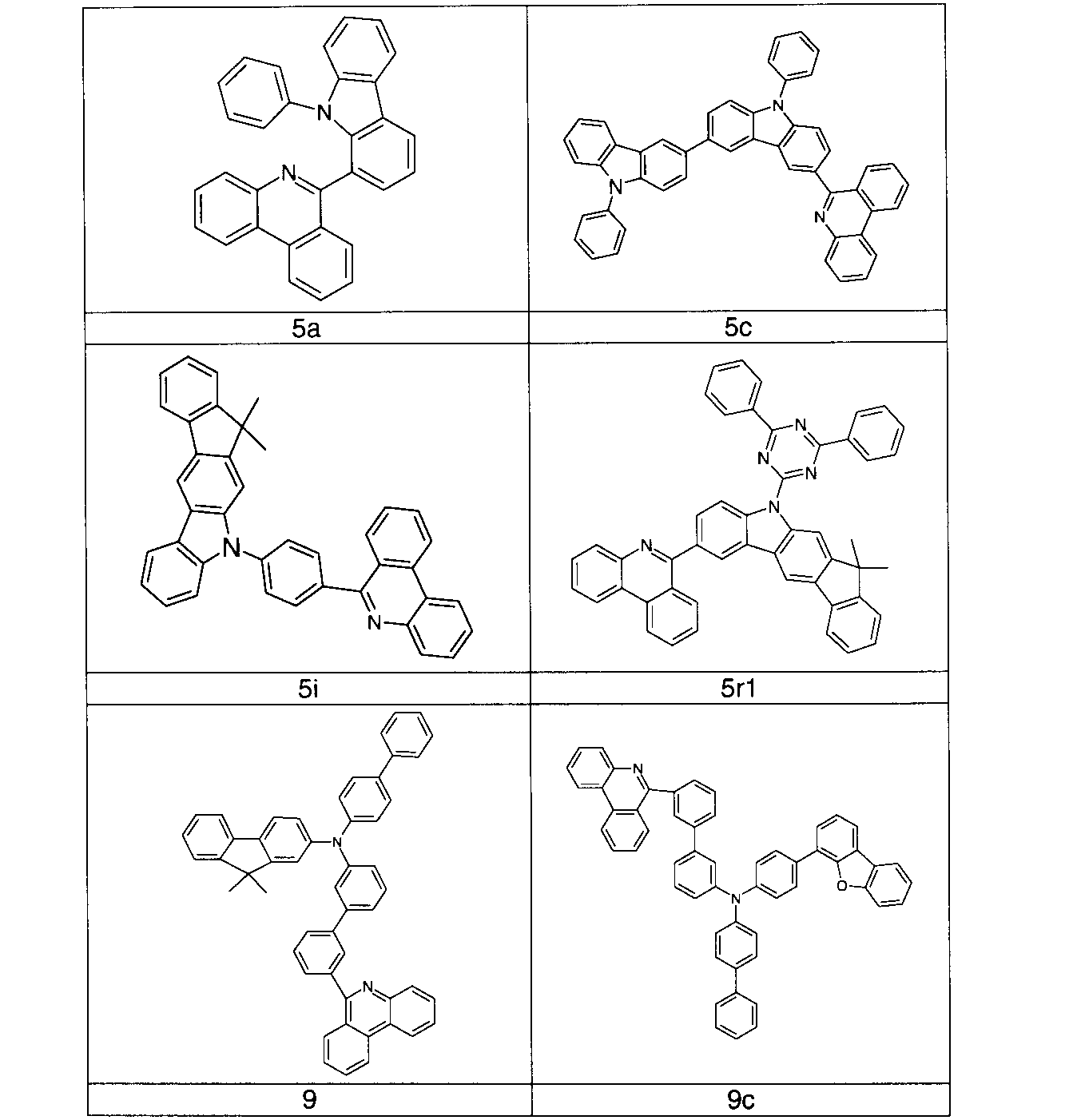
上記詳細な態様の好ましい化合物または有機電子素子で選好して使用可能な好ましい化合物の例は、以下の化合物である。 Examples of preferred compounds of the above detailed embodiment or preferred compounds that can be used with preference in organic electronic devices are the following compounds.
本発明の化合物を、当業者に知られた合成工程により、たとえば、臭素化、スズキカップリング、ウルマンカップリング、ハートウイッグ-ブフバルトカップリング等により調製することができる。 The compounds of the present invention can be prepared by synthetic processes known to those skilled in the art, for example, by bromination, Suzuki coupling, Ullmann coupling, Heartwig-Buchwald coupling, and the like.
フェナントリジン基本骨格は、たとえば、フルオレン-9-オンから出発して、引き続くベックマン転位によるアミドの生成により調製される。得られたアミドのケト基を、脱離基、たとえば、ハロゲン化物に変換することができる。一以上のカップリング反応により、そこで、式(1)の化合物を得ることができる
したがって、本発明は、式(1)の化合物を、一以上のカップリング反応、転位および/または環化により形成する、式(1)の化合物の製造方法をさらに提供する。
The phenanthridine basic skeleton is prepared, for example, starting from fluoren-9-one by subsequent amide formation by Beckmann rearrangement. The keto group of the resulting amide can be converted to a leaving group such as a halide. One or more coupling reactions can then yield compounds of formula (1). Accordingly, the present invention provides compounds of formula (1) formed by one or more coupling reactions, rearrangements and / or cyclizations. Further provided is a process for producing a compound of formula (1).
上記示された合成方法は、例示的な特徴であり、本発明の化合物の特定の態様の合成に有利であるならば、有機合成分野の当業者により、適切な方法で変形することができる。 The synthetic methods shown above are exemplary features and can be modified in a suitable manner by one skilled in the art of organic synthesis if it is advantageous for the synthesis of a particular embodiment of the compounds of the invention.
上記記載の本発明の化合物は、特別に、臭素、沃素、塩素、ボロン酸もしくはボロン酸エステル等の反応性脱離基により置換された化合物は、対応するオリゴマー、デンドリマーまたはポリマーの製造のためのモノマーとしての使用を見出されてよい。適切な反応性脱離基は、たとえば、臭素、沃素、塩素、ボロン酸、ボロン酸エステル、アミン、末端C-C二重結合もしくはC-C三重結合を有するアルケニルもしくはアルキニル基、オキシラン、オキセタン、環付加、たとえば、1,3-双極子環付加を受ける基、たとえば、ジエンもしくはアジド等、カルボン酸誘導体、アルコールおよびシランである。 The compounds of the present invention described above are specifically substituted with reactive leaving groups such as bromine, iodine, chlorine, boronic acid or boronic acid esters for the production of the corresponding oligomers, dendrimers or polymers. Use as a monomer may be found. Suitable reactive leaving groups are, for example, bromine, iodine, chlorine, boronic acid, boronic esters, amines, alkenyl or alkynyl groups with terminal C—C double bonds or C—C triple bonds, oxiranes, oxetanes, Groups undergoing cycloaddition, for example 1,3-dipolar cycloaddition, such as carboxylic acid derivatives, alcohols and silanes, such as dienes or azides.
したがって、本発明は、さらに、一以上の式(1)の化合物を含むオリゴマー、ポリマーまたはデンドリマーをさらに提供し、ポリマー、オリゴマーまたはデンドリマーへの結合は、式(1)において任意の占有されない位置に局在化してよい。本発明の化合物の結合により、化合物は、オリゴマーもしくはポリマーの側鎖の部分であるか、または主鎖の部分である。 Accordingly, the present invention further provides an oligomer, polymer or dendrimer comprising one or more compounds of formula (1), wherein the linkage to the polymer, oligomer or dendrimer is in any unoccupied position in formula (1). May be localized. Depending on the coupling of the compound of the invention, the compound is part of the side chain of the oligomer or polymer or part of the main chain.
本発明の文脈でのオリゴマーは、少なくとも3個のモノマー単位から形成される化合物を意味すると理解される。本発明の文脈でのポリマーは、少なくとも10個のモノマー単位から形成される化合物を意味すると理解される。 An oligomer in the context of the present invention is understood to mean a compound formed from at least three monomer units. A polymer in the context of the present invention is understood to mean a compound formed from at least 10 monomer units.
本発明のポリマー、オリゴマーまたはデンドリマーは、共役、部分共役もしくは非共役であってよい。本発明のオリゴマーまたはポリマーは、直鎖、分岐鎖もしくは樹状であってよい。 The polymer, oligomer or dendrimer of the present invention may be conjugated, partially conjugated or non-conjugated. The oligomer or polymer of the present invention may be linear, branched or dendritic.
直鎖状の結合を有する構造においては、式(1)の単位は、たがいに直接結合してよいか、または2価の基、たとえば、置換もしくは非置換アルキレン基により、ヘテロ原子により、または2価の芳香族もしくは複素環式芳香族基により、たがいに結合してよい。 In structures having a linear bond, the units of the formula (1) may be directly bonded to each other or may be a divalent group, for example a substituted or unsubstituted alkylene group, a heteroatom, or 2 They may be linked to each other by a valent aromatic or heterocyclic aromatic group.
分岐および樹状構造においては、たとえば、3、5個以上の式(1)の単位が、3価もしくはより多価の基、たとえば、3価もしくはより多価の芳香族もしくは複素環式芳香族基により結合することができ、分岐もしくは樹状オリゴマーまたはポリマーを生じる。 In branched and dendritic structures, for example, 3, 5 or more units of formula (1) are trivalent or more polyvalent groups, such as trivalent or more polyvalent aromatic or heterocyclic aromatics. Can be linked by a group, resulting in a branched or dendritic oligomer or polymer.
本発明の化合物に対する上記記載したとおりの同じ選好が、オリゴマー、デンドリマーおよびポリマー中の式(1)の反復単位にあてはまる。 The same preferences as described above for the compounds of the invention apply to the repeating units of formula (1) in oligomers, dendrimers and polymers.
オリゴマーまたはポリマーの調製のために、本発明のモノマーは、さらなるモノマーとホモ重合するか共重合する。適切で好ましいコモノマーは、フルオレン(たとえば、EP842208もしくはWO2000/22026によるもの)、スピロビフルオレン(たとえば、EP707020、EP894107もしくはWO2006/061181によるもの)、パラ-フェニレン(たとえば、WO1992/18552によるもの)、カルバゾール(たとえば、WO2004/070772もしくはW02004/113468によるもの)、チオフェン(たとえば、EP1028136によるもの)、ジヒドロフェナントレン(たとえば、WO 2005/014689もしくはWO 2007/006383によるもの)、cis-およびtrans-インデノフルオレン(たとえば、WO2004/041901もしくはWO2004/113412によるもの)、ケトン(たとえば、WO2005/040302によるもの)、フェナントレン(たとえば、WO2005/104264もしくはWO2007/017066によるもの)または複数のこれらの単位から選ばれる。ポリマー、オリゴマーおよびデンドリマーは、なおさらなる単位、たとえば、ビニルトリアリールアミン(たとえば、WO2007/068325によるもの)もしくは燐光金属錯体(たとえば、WO2006/03000によるもの)等の発光(蛍光または燐光)単位および/または電荷輸送単位、特に、トリアリールアミン系のものを通常含む。 For the preparation of oligomers or polymers, the monomers according to the invention are homopolymerised or copolymerised with further monomers. Suitable and preferred comonomers are fluorene (eg according to EP842208 or WO2000 / 22026), spirobifluorene (eg according to EP707020, EP894107 or WO2006 / 061181), para-phenylene (eg according to WO1992 / 18552), carbazole (E.g. according to WO2004 / 070772 or W02004 / 113468), thiophene (e.g. according to EP1028136), dihydrophenanthrene (e.g. according to WO 2005/014689 or WO 2007/006383), cis- and trans-indenofluorene (e.g. For example, selected from WO2004 / 041901 or WO2004 / 113412), ketones (eg according to WO2005 / 040302), phenanthrene (eg according to WO2005 / 104264 or WO2007 / 017066) or a plurality of these units. Polymers, oligomers and dendrimers are still further units such as luminescent (fluorescent or phosphorescent) units such as vinyltriarylamines (eg according to WO2007 / 068325) or phosphorescent metal complexes (eg according to WO2006 / 03000) and / or Or charge transport units, especially those of the triarylamine type.
本発明のポリマー、オリゴマーおよびデンドリマーは、有利な特性、特別には、長い寿命、高い効率と良好な色座標を有する。 The polymers, oligomers and dendrimers according to the invention have advantageous properties, in particular a long lifetime, high efficiency and good color coordinates.
本発明のポリマーおよびオリゴマーは、一以上のタイプのモノマーの重合により一般的に調製され、少なくとも一つのモノマーは、ポリマー中に式(1)の反復単位を生じる。適切な重合反応は、当業者に知られ、文献に記載されている。C-CおよびC-N結合をもたらす、特に適切で好ましい重合反応は、以下のとおりである:
(A)スズキ重合;
(B)ヤマモト重合;
(C)スチル重合および
(D)ハートウイッグ-ブッフバルト重合。
The polymers and oligomers of the present invention are generally prepared by polymerization of one or more types of monomers, where at least one monomer results in a repeating unit of formula (1) in the polymer. Suitable polymerization reactions are known to the person skilled in the art and are described in the literature. A particularly suitable and preferred polymerization reaction leading to C—C and C—N bonds is as follows:
(A) Suzuki polymerization;
(B) Yamamoto polymerization;
(C) Still polymerization and (D) Heartwig-Buchwald polymerization.
重合をこれらの方法により実行することができる方法と次いでポリマーを反応媒体から分離し、精製することができる方法は、当業者に知られており、文献、たとえば、WO 2003/048225、WO 2004/037887およびWO 2004/037887に詳細に記載されている。 Methods by which the polymerization can be carried out by these methods and then by which the polymer can be separated from the reaction medium and purified are known to those skilled in the art and are described in the literature, for example WO 2003/048225, WO 2004 / 037887 and WO 2004/037887 are described in detail.
したがって、本発明は、また、スズキによる重合、ヤマモトによる重合、スチルによる重合またはハートウイッグ-ブッフバルトによる重合によって調製されることを特徴とする、本発明のポリマー、オリゴマーおよびデンドリマーを製造する方法を提供する。本発明のデンドリマーは、当業者に知られた方法または類似方法により製造され得る。適切な方法は、文献、たとえば、Frechet, Jean M. J.; Hawker, Craig J., "Hyperbranched polyphenylene and hyperbranched polyesters: new soluble, three-dimensional, reactive polymers"、 Reactive & Functional Polymers (1995), 26(1-3), 127-36; Janssen, H. M.; Meijer, E. W.、 "The synthesis and characterization of dendritic molecules", Materials Science and Technology (1999), 20 (Synthesis of Polymers), 403-458; Tomalia, Donald A., "Dendrimer molecules", Scientific American (1995), 272(5), 62-6、WO 2002/067343 A1およびWO 2005/026144 A1に記載されている。 Accordingly, the present invention also provides a process for producing the polymers, oligomers and dendrimers of the present invention, characterized in that they are prepared by polymerization with Suzuki, polymerization with Yamamoto, polymerization with still or polymerization with Hartwig-Buchwald To do. The dendrimers of the present invention can be prepared by methods known to those skilled in the art or by analogous methods. Suitable methods are described in the literature, e.g., Frechet, Jean MJ; Hawker, Craig J., "Hyperbranched polyphenylene and hyperbranched polyesters: new soluble, three-dimensional, reactive polymers", Reactive & Functional Polymers (1995), 26 (1- 3), 127-36; Janssen, HM; Meijer, EW, "The synthesis and characterization of dendritic molecules", Materials Science and Technology (1999), 20 (Synthesis of Polymers), 403-458; Tomalia, Donald A., "Dendrimer molecules", Scientific American (1995), 272 (5), 62-6, WO 2002/067343 A1 and WO 2005/026144 A1.
液相からの、たとえば、スピンコーティングまたは印刷法による本発明の化合物の加工のためには、本発明の化合物の調合物が必要である。これらの調合物は、たとえば、溶液、分散液もしくはエマルジョンであり得る。二以上の溶媒の混合物を使用することが、この目的のために好ましい可能性がある。適切で好ましい溶媒は、たとえば、トルエン、アニソール、o-、m-もしくはp-キシレン、メチルベンゾエート、メシチレン、テトラリン、ベラトール、THF、メチル-THF、THP、クロロベンゼン、ジオキサン、フェノキシトルエン、特別には、3-フェノキシトルエン、(-)-フェンコンヌ、1,2,3,5-テトラメチルベンゼン、1,2,4,5-テトラメチルベンゼン、1-メチルナフタレン、2-メチルベンゾチアゾール、2-フェノキシエタノール、2-ピロリジノン、3-メチルアニソール、4-メチルアニソール、3,4-ジメチルアニソール、3,5-ジメチルアニソール、アセトフェノン、α-テルピネオール、ベンゾチアゾール、ブチルベンゾエート、クメン、シクロヘキサノール、シクロヘキサノン、シクロヘキシルベンゼン、デカリン、ドデシルベンゼン、エチルベンゾエート、インダン、メチルベンゾエート、NMP、p-シメン、フェネトール、1,4-ジイソプロピルベンゼン、ジベンジルエーテル、ジエチレングリコールブチルメチルエーテル、トリエチレングリコールブチルメチルエーテル、ジエチレングリコールジブチルエーテル、トリエチレングリコールジメチルエーテル、ジエチレングリコールモノブチルエ−テル、トリプロピレングリコールジメチルエ−テル、テトラエチレングリコールジメチルエ−テル、2-イソプロピルナフタレン、ペンチルベンゼン、ヘキシルベンゼン、ヘプチルベンゼン、オクチルベンゼン、1,1-ビス(3,4-ジメチルフェニル)エタンもしくはこれら溶媒の混合物である。 For the processing of the compounds of the invention from the liquid phase, for example by spin coating or printing, a formulation of the compounds of the invention is necessary. These formulations can be, for example, solutions, dispersions or emulsions. It may be preferred for this purpose to use a mixture of two or more solvents. Suitable and preferred solvents are, for example, toluene, anisole, o-, m- or p-xylene, methyl benzoate, mesitylene, tetralin, veratole, THF, methyl-THF, THP, chlorobenzene, dioxane, phenoxytoluene, especially 3-phenoxytoluene, (-)-phenconne, 1,2,3,5-tetramethylbenzene, 1,2,4,5-tetramethylbenzene, 1-methylnaphthalene, 2-methylbenzothiazole, 2-phenoxyethanol, 2-pyrrolidinone, 3-methylanisole, 4-methylanisole, 3,4-dimethylanisole, 3,5-dimethylanisole, acetophenone, α-terpineol, benzothiazole, butylbenzoate, cumene, cyclohexanol, cyclohexanone, cyclohexylbenzene, Decalin, dodecylbenzene, ethyl benzoe , Indane, methyl benzoate, NMP, p-cymene, phenetole, 1,4-diisopropylbenzene, dibenzyl ether, diethylene glycol butyl methyl ether, triethylene glycol butyl methyl ether, diethylene glycol dibutyl ether, triethylene glycol dimethyl ether, diethylene glycol mono Butyl ether, tripropylene glycol dimethyl ether, tetraethylene glycol dimethyl ether, 2-isopropylnaphthalene, pentylbenzene, hexylbenzene, heptylbenzene, octylbenzene, 1,1-bis (3,4-dimethylphenyl) ) Ethane or a mixture of these solvents.
したがって、本発明は、少なくとも一つの式(1))の化合物または少なくとも一つの式(1)の単位を含む少なくとも一つのポリマー、オリゴマーもしくはデンドリマーと少なくとも一つの燐光ドーパントと少なくとも一つの溶媒、好ましくは、有機溶媒を含む調合物、特別に、溶液、分散液もしくはエマルジョンを提供する。このような溶液を製造することができる方法は、当業者に知られており、たとえば、WO 2002/072714、WO 2003/019694とそこに引用された文献に記載されている。 Accordingly, the present invention provides at least one compound of formula (1)) or at least one polymer, oligomer or dendrimer comprising at least one unit of formula (1), at least one phosphorescent dopant and at least one solvent, preferably Providing a formulation comprising an organic solvent, in particular a solution, dispersion or emulsion. The methods by which such solutions can be produced are known to those skilled in the art and are described, for example, in WO 2002/072714, WO 2003/019694 and the literature cited therein.
本発明は、さらに、少なくとも一つの本発明の化合物と少なくとも一つのさらなる化合物とを含む混合物を提供する。さらなる化合物は、本発明の化合物が、マトリックス材料として、たとえば、燐光ドーパントとして使用される場合には、たとえば、蛍光もしくは燐光ドーパントであってよい。適切なドーパントは、有機エレクトロルミッセンス素子と関連して以下に詳らかにされ、本発明の混合物に対して好まれもする。 The present invention further provides a mixture comprising at least one compound of the invention and at least one further compound. Further compounds may be, for example, fluorescent or phosphorescent dopants when the compounds of the invention are used as matrix materials, for example as phosphorescent dopants. Suitable dopants are detailed below in connection with organic electroluminescent devices and are also preferred for the mixtures of the present invention.
本発明の化合物と混合物は、電子素子での使用に適している。電子素子は、少なくとも一つの有機化合物を含む少なくとも一つの層を含む素子を意味すると理解される。この素子は、また、無機材料または無機材料から完全に構成される層を含んでもよい。 The compounds and mixtures of the present invention are suitable for use in electronic devices. An electronic device is understood to mean a device comprising at least one layer comprising at least one organic compound. The element may also include an inorganic material or a layer composed entirely of inorganic material.
したがって、本発明は、さらに、本発明の化合物もしくは混合物の、電子素子での、特別に、有機エレクトロルミッセンス素子での使用を提供する。 The invention therefore further provides the use of the compounds or mixtures according to the invention in electronic devices, in particular in organic electroluminescent devices.
したがって、本発明は、なおさらに、少なくとも一つの上記詳細な本発明の化合物もしくは混合物を含む電子素子を提供する。この場合に、化合物に対する上記詳細な選好は、電子素子にもあてあまる。 Accordingly, the present invention still further provides an electronic device comprising at least one of the above detailed compounds or mixtures of the present invention. In this case, the above detailed preferences for compounds also apply to electronic devices.
電子素子は、好ましくは、有機エレクトロルミネッセンス素子(OLED、PLED)、有機集積回路(O−IC)、有機電界効果トランジスタ(O−FET)、有機薄膜トランジスタ(O−TFT)、有機発光トランジスタ(O−LET)、有機ソーラーセル(O−SC)、有機染料増感性ソーラーセル、有機光学検査器、有機光受容器、有機電場消光素子(OF−QD)、発光電子化学セル(LEC)、有機レーザーダイオード(O−laser)および有機プラズモン発光素子(D. M. Koller et al., Nature Photonics 2008, 1-4)から選ばれるが、好ましくは、有機エレクトロルミネッセンス素子(OLED、PLED)、特別には、燐光OLEDから選ばれる。 The electronic element is preferably an organic electroluminescence element (OLED, PLED), an organic integrated circuit (O-IC), an organic field effect transistor (O-FET), an organic thin film transistor (O-TFT), an organic light emitting transistor (O- LET), organic solar cell (O-SC), organic dye-sensitized solar cell, organic optical tester, organic photoreceptor, organic electric field quencher (OF-QD), light emitting electrochemical cell (LEC), organic laser diode (O-laser) and organic plasmon light emitting devices (DM Koller et al., Nature Photonics 2008, 1-4), but preferably from organic electroluminescent devices (OLED, PLED), especially phosphorescent OLEDs To be elected.
有機エレクトロルミッセンス素子は、カソード、アノードと少なくとも一つの発光層を含む。これらの層に加えて、さらなる層、たとえば、各場合に、1以上の正孔注入層、正孔輸送層、正孔ブロック層、電子輸送層、電子注入層、励起子ブロック層、電子ブロック層および/または電荷生成層を含んでもよい。たとえば、励起子ブロック機能を有する中間層を、2個の発光層の間に導入することも同様に可能である。しかしながら、これら層の夫々は、必ずしも存在する必要はないことが指摘されねばならない。この場合に、有機エレクトロルミネセンス素子は、一つの発光層を含むことができ、または複数の発光層を含むこともできる。複数の発光層が存在する場合には、これらは、好ましくは、380nm〜750nm間に全体で複数の最大発光波長を有し、その結果全体として、白色発光が生じるものであり、換言すれば、蛍光もしくは燐光を発し得る種々の発光化合物が、発光層で使用される。特別に好ましいものは、3個の発光層を有する構造であり、その3層は青色、緑色およびオレンジ色もしくは赤色発光を呈する(基本構造については、たとえば、WO 2005/011013参照。)。これらは、蛍光もしくは燐光発光層または蛍光および燐光発光層が互いに組み合わされたハイブリッド系であってよい。 The organic electroluminescent element includes a cathode, an anode, and at least one light emitting layer. In addition to these layers, further layers, for example in each case one or more hole injection layers, hole transport layers, hole block layers, electron transport layers, electron injection layers, exciton block layers, electron block layers And / or a charge generation layer. For example, it is also possible to introduce an intermediate layer having an exciton blocking function between two light emitting layers. However, it should be pointed out that each of these layers need not necessarily be present. In this case, the organic electroluminescent element can include one light emitting layer, or can include a plurality of light emitting layers. When there are a plurality of light emitting layers, these preferably have a plurality of maximum emission wavelengths overall between 380 nm and 750 nm, resulting in white emission as a whole, in other words, Various light emitting compounds capable of emitting fluorescence or phosphorescence are used in the light emitting layer. Particularly preferred is a structure having three light emitting layers, and the three layers emit blue, green and orange or red light (for basic structure, see, for example, WO 2005/011013). These may be fluorescent or phosphorescent emissive layers or hybrid systems in which the fluorescent and phosphorescent emissive layers are combined with each other.
上記詳細な態様による本発明の混合物は、その正確な構造に応じて、種々の層に使用されてよい。好ましいものは、式(1)の化合物またはその好ましい態様を、その正確な置換に応じて、蛍光もしくは燐光エミッターのための、特別には燐光エミッターのためのマトリックス材料として、および/または電子輸送層に、および/または電子ブロックもしくは励起子ブロック層に、および/または正孔輸送層に含む有機エレクトロルミネッセンス素子である。この文脈において、上記詳細な好ましい態様は、有機電子素子での材料の使用にもあてはまる。 The mixtures according to the invention according to the above detailed embodiments may be used in various layers, depending on their exact structure. Preference is given to compounds of the formula (1) or preferred embodiments thereof, depending on their exact substitution, as a matrix material for fluorescent or phosphorescent emitters, in particular for phosphorescent emitters and / or electron transport layers And / or in the electron block or exciton block layer and / or in the hole transport layer. In this context, the above detailed preferred embodiments also apply to the use of materials in organic electronic devices.
本発明の好ましい1態様では、式(1)の化合物またはその好ましい態様によるものは、発光層において、蛍光もしくは燐光化合物のための、特別には、燐光化合物のためのマトリックス材料として使用される。この場合に、有機エレクトロルミッセンス素子は、一つの発光層を含んでよく、または複数の発光層を含んでよく、ここで、少なくとも一つの発光層は、少なくとも一つの本発明の化合物をマトリックス材料として含む。 In a preferred embodiment of the invention, the compound of formula (1) or the preferred embodiment thereof is used in the light-emitting layer as a matrix material for fluorescent or phosphorescent compounds, in particular for phosphorescent compounds. In this case, the organic electroluminescent device may include one light emitting layer or a plurality of light emitting layers, where at least one light emitting layer is a matrix containing at least one compound of the present invention. Including as material.
本発明のさらに好ましい1態様は、式(1)の化合物またはその好ましい態様によるものの、さらなるマトリックス材料と組み合わせての燐光エミッターのためのマトリックス材料としての使用である。式(1)の化合物またはその好ましい態様によるものと組み合わせて使用することのできる、特に適切なマトリックス材料は、たとえば、WO 2004/013080、WO 2004/093207、WO 2006/005627もしくはWO 2010/006680による芳香族ケトン、芳香族ホスフィンオキシドまたは芳香族スルホキシドもしくはスルホン、トリアリールアミン、カルバゾール誘導体、たとえば、CBP(N,N-ビスカルバゾリルビフェニル)または、WO 2005/039246、US 2005/0069729、JP 2004/288381、EP 1205527もしくはWO 2008/086851に記載されたカルバゾール誘導体、たとえば、WO 2007/063754もしくはWO 2008/056746によるインドロカルバゾール誘導体、WO2010/136109およびWO2011/000455によるインデノカルバゾール誘導体、たとえば、EP 1617710、EP 1617711、EP 1731584、JP 2005/347160によるアザカルバゾール誘導体、たとえば、WO 2007/137725によるバイポーラーマトリックス材料、たとえば、WO 2005/111172によるシラン、たとえば、WO 2006/117052によるアザボロールもしくはボロン酸エステル、たとえば、WO 2010/15306、WO 2007/063754もしくはWO 2008/056746によるトリアジン誘導体、たとえば、EP 652273もしくはWO 2009/062578による亜鉛錯体、たとえば、WO 2010/054729によるジアザシロールもしくはテトラアザシロール誘導体、たとえば、WO 2010/054730によるジアザホスホール誘導体、たとえば、US 2009/0136779、WO 2010/050778、WO 2011/042107、WO 2011/088877もしくはWO 2012/1430800による架橋カルバゾール誘導体、たとえば、WO 2012/048781によるトリフェニレン誘導体、またはWO 2011/116865もしくはWO 2011/137951によるラクタムである。通常のエミッターよりも、より短い波長で発光するさらなる燐光エミッターが、同様に、コホストとして混合物中に存在することも可能である。 A further preferred embodiment of the present invention is the use of the compound of formula (1) or a preferred embodiment thereof as a matrix material for a phosphorescent emitter in combination with a further matrix material. Particularly suitable matrix materials that can be used in combination with a compound of formula (1) or according to preferred embodiments thereof are, for example, according to WO 2004/013080, WO 2004/093207, WO 2006/005627 or WO 2010/006680 Aromatic ketones, aromatic phosphine oxides or aromatic sulfoxides or sulfones, triarylamines, carbazole derivatives such as CBP (N, N-biscarbazolylbiphenyl) or WO 2005/039246, US 2005/0069729, JP 2004 / 288381, EP 1205527 or WO 2008/086851, such as indolocarbazole derivatives according to WO 2007/063754 or WO 2008/056746, indenocarbazole derivatives according to WO2010 / 136109 and WO2011 / 000455, for example EP Azacarbazole derivatives according to 1617710, EP 1617711, EP 1731584, JP 2005/347160, for example WO 2007/13 Bipolar matrix materials according to 7725, for example silanes according to WO 2005/111172, such as azabolol or boronic esters according to WO 2006/117052, such as triazine derivatives according to WO 2010/15306, WO 2007/063754 or WO 2008/056746, for example , EP 652273 or WO 2009/062578 zinc complexes, for example diazacilol or tetraazacilol derivatives according to WO 2010/054729, for example diazaphosphole derivatives according to WO 2010/054730, for example US 2009/0136779, WO 2010/050778, WO 2011 / 042107, bridged carbazole derivatives according to WO 2011/088877 or WO 2012/1430800, for example triphenylene derivatives according to WO 2012/048781, or lactams according to WO 2011/116865 or WO 2011/137951. It is possible that further phosphorescent emitters emitting at shorter wavelengths than conventional emitters can also be present in the mixture as cohosts.
式(1)の化合物またはその好ましい態様によるものと発光化合物の混合物は、エミッターとマトリックス材料の全混合物を基礎として、式(1)の化合物またはその好ましい態様によるものを、99%〜1体積%、好ましくは、98%〜10体積%、より好ましくは、97%〜60体積%、特別には、95%〜80体積%含む。対応して、混合物は、エミッターとマトリックス材料の全混合物を基礎として、エミッターを、1%〜99体積%、好ましくは、2%〜90体積%、より好ましくは、3%〜40体積%、特別には、5%〜20体積%含む。 The mixture of the compound of formula (1) or its preferred embodiment and the luminescent compound is 99% to 1% by volume of the compound of formula (1) or its preferred embodiment, based on the total mixture of emitter and matrix material. , Preferably 98% to 10% by volume, more preferably 97% to 60% by volume, and particularly 95% to 80% by volume. Correspondingly, the mixture is based on the total mixture of emitter and matrix material, the emitter being 1% to 99% by volume, preferably 2% to 90% by volume, more preferably 3% to 40% by volume, specially Includes 5% to 20% by volume.
用語「燐光ドーパント(エミッター)」は、典型的には、発光がスピン禁制遷移、たとえば、励起三重項状態からの遷移またはより高いスピン量子数をもつ状態、たとえば、五重項状態からなされる化合物を含む。 The term “phosphorescent dopant (emitter)” is typically a compound whose emission is from a spin-forbidden transition, eg, a transition from an excited triplet state or a state with a higher spin quantum number, eg, a quintet state. including.
適切な燐光ドーパントは、特別には、好ましくは、可視域で適切な励起により発光する化合物であり、加えて、20より大きい、好ましくは、38〜84の、より好ましくは、56〜80の原子番号を有する少なくとも一つの原子を含む。好ましい燐光発光ドーパントは、銅、モリブデン、タングステン、レニウム、ルテニウム、オスミウム、ロジウム、イリジウム、パラジウム、白金、銀、金および/またはユウロピウムを含む化合物、特別に、イリジウム、白金または銅を含む化合物である。 Suitable phosphorescent dopants are particularly preferably compounds that emit light with appropriate excitation in the visible range, in addition to more than 20, preferably 38 to 84, more preferably 56 to 80 atoms. Contains at least one atom having a number. Preferred phosphorescent dopants are compounds containing copper, molybdenum, tungsten, rhenium, ruthenium, osmium, rhodium, iridium, palladium, platinum, silver, gold and / or europium, in particular compounds containing iridium, platinum or copper. .
本発明の文脈において、すべてのルミネッセントイリジウム、白金または銅錯体が、燐光化合物であるとみなされる。 In the context of the present invention, all luminescent iridium, platinum or copper complexes are considered to be phosphorescent compounds.
燐光ドーパントの例は、出願WO 2000/70655、WO 2001/41512、WO 2002/02714、WO 2002/15645、EP 1191613、EP 1191612、EP 1191614、WO 2005/033244、WO 2005/019373およびUS 2005/0258742に見出すことができる。一般的には、燐光発光OLEDのために先行技術により使用され、有機エレクトロルミネッセンス素子分野の当業者に知られるようなすべての燐光発光錯体が適切である。当業者は発明力を行使することなく、OLED中で本発明の化合物と組み合わせてさらなる燐光錯体を使用することもできる。 Examples of phosphorescent dopants are the applications WO 2000/70655, WO 2001/41512, WO 2002/02714, WO 2002/15645, EP 1191613, EP 1191612, EP 1191614, WO 2005/033244, WO 2005/019373 and US 2005/0258742. Can be found in In general, all phosphorescent complexes used by the prior art for phosphorescent OLEDs and known to those skilled in the art of organic electroluminescent devices are suitable. One skilled in the art can also use additional phosphorescent complexes in combination with the compounds of the present invention in OLEDs without exercising inventive power.
本発明のさらなる1態様では、本発明の有機エレクトロルミネッセンス素子は、如何なる別々の正孔注入層および/または正孔輸送層および/または正孔ブロック層および/または電子輸送層を含まず、たとえば、WO 2005/053501に記載されるとおり、発光層は、正孔注入層もしくはアノードに直接隣接し、および/または発光層は、電子輸送層もしくは電子注入層もしくはカソードに直接隣接することを意味する。さらに、たとえば、WO 2009/030981に記載されるとおり、発光層中の金属錯体と同一または類似する金属錯体を、発光層に直接隣接して、正孔輸送もしくは正孔注入材料として使用することも可能である。 In a further aspect of the present invention, the organic electroluminescent device of the present invention does not comprise any separate hole injection layer and / or hole transport layer and / or hole blocking layer and / or electron transport layer, for example, As described in WO 2005/053501, it means that the light emitting layer is directly adjacent to the hole injection layer or anode and / or the light emitting layer is directly adjacent to the electron transport layer or electron injection layer or cathode. Further, for example, as described in WO 2009/030981, a metal complex that is the same as or similar to the metal complex in the light emitting layer may be used as a hole transport or hole injection material directly adjacent to the light emitting layer. Is possible.
本発明の有機エレクトロルミネッセンス素子のさらなる層では、先行技術により通常使用されるとおりの任意の材料を使用することができる。したがって、当業者は、発明力を行使することなく、式(1)の化合物またはその好ましい態様によるものと組み合わせて、有機エレクトロルミネッセンス素子のために知られた任意の材料を使用することができる。 In the further layers of the organic electroluminescent device of the present invention, any material as commonly used by the prior art can be used. Accordingly, those skilled in the art can use any material known for organic electroluminescent devices in combination with the compound of formula (1) or its preferred embodiments without exercising inventive power.
さらに好ましいのは、1以上の層が、昇華プロセスにより適用されることを特徴とする有機エレクトロルミネッセンス素子である。この場合に、材料は、10−5mbar未満、好ましくは、10−6mbar未満の初期圧力で、真空昇華ユニット中で気相堆積により適用される。初期圧力は、さらにより低くてもまたは高くても、たとえば、10−7mbar未満でも可能である。 Further preferred is an organic electroluminescent device characterized in that one or more layers are applied by a sublimation process. In this case, the material is applied by vapor deposition in a vacuum sublimation unit at an initial pressure of less than 10 −5 mbar, preferably less than 10 −6 mbar. The initial pressure can be even lower or higher, for example below 10 −7 mbar.
同様に好ましいのは、1以上の層が、OVPD(有機気相堆積)法もしくはキャリアガス昇華により被覆されることを特徴とする有機エレクトロルミネッセンス素子である。この場合に、材料は、10−5mbar〜1barの圧力で適用される。この方法の特別な場合は、OVJP(有機気相ジェット印刷)法であり、材料はノズルにより直接適用され、そのように構造化される(たとえば、M. S. Arnold et al., Appl. Phys. Lett. 2008, 92, 053301)。 Likewise preferred is an organic electroluminescent device characterized in that one or more layers are coated by OVPD (organic vapor deposition) or carrier gas sublimation. In this case, the material is applied at a pressure of 10 −5 mbar to 1 bar. A special case of this method is the OVJP (Organic Vapor Jet Printing) method, where the material is applied directly by a nozzle and structured as such (eg, MS Arnold et al., Appl. Phys. Lett. 2008, 92, 053301).
さらに、好ましいのは、1以上の層が、溶液から、たとえば、スピンコーティングにより、もしくは、たとえば、インクジェット印刷、LITI(光誘起熱画像化、熱転写印刷)、スクリーン印刷、フレキソ印刷、オフセット印刷もしくはノズル印刷のような任意の所望の印刷プロセスにより製造されることを特徴とする有機エレクトロルミネッセンス素子である。たとえば、適切な置換により得られた可溶性の化合物が、この目的のために必要である。これらの方法は、特別には、オリゴマー、デンドリマーおよびポリマーのためにも適している。 Furthermore, it is preferred that one or more layers are formed from a solution, for example by spin coating or, for example, ink jet printing, LITI (light induced thermal imaging, thermal transfer printing), screen printing, flexographic printing, offset printing or nozzles. An organic electroluminescent device manufactured by any desired printing process such as printing. For example, soluble compounds obtained by appropriate substitution are necessary for this purpose. These methods are also particularly suitable for oligomers, dendrimers and polymers.
さらに、たとえば、1以上の層が溶液から適用され、1以上のさらなる層が気相堆積により適用されるハイブリッド法が可能である。たとえば、溶液から発光層を適用し、気相堆積により電子輸送層を適用することも可能である。 Furthermore, for example, a hybrid process is possible in which one or more layers are applied from solution and one or more further layers are applied by vapor deposition. For example, it is possible to apply the light emitting layer from solution and apply the electron transport layer by vapor deposition.
これらの方法は、当業者に一般的用語で知られており、本発明の化合物を含む有機エレクトロルミネッセンス素子を、発明力を行使することなく適用することができる。 These methods are known in general terms to those skilled in the art, and organic electroluminescent devices containing the compounds of the present invention can be applied without exercising their inventive power.
本発明の化合物は、有機エレクトロルミネッセンス素子に使用すると、先行技術を凌駕する1以上の以下の驚くべき優位性を有する。 When used in organic electroluminescent devices, the compounds of the present invention have one or more of the following surprising advantages over the prior art.
1.先行技術によるシステムと比べて対応する素子のより高いパワー効率。 1. Higher power efficiency of corresponding elements compared to prior art systems.
2.はるかにより長い寿命で特に明らかにされる、先行技術によるシステムと比べて対応する素子のより高い安定性。 2. Higher stability of the corresponding element compared to prior art systems, especially revealed with a much longer lifetime.
3.本発明の有機エレクトロルミッセンス素子は、低下した駆動電圧を有する。 3. The organic electroluminescent element of the present invention has a reduced driving voltage.
4,本発明の化合物が、燐光エミッターのためのマトリックス材料として使用される場合、10体積%未満の領域での低エミッター濃度のみにより極めて良好な結果を実現することが、既に可能である。 4. When the compounds according to the invention are used as matrix material for phosphorescent emitters, it is already possible to achieve very good results only with a low emitter concentration in the region of less than 10% by volume.
5.本発明の化合物は、極めて良好な熱安定性を有する。 5. The compounds of the present invention have very good thermal stability.
本発明は、次の例により詳細に説明されるが、それにより限定することを望むものではない。 The invention is explained in greater detail by the following examples without wishing it to be restricted thereby.
例 Example
スキーム1は、1つの可能な合成経路を示している。Rは任意の基であり、Arは式(Ar2)qN(Ar1)2の複素環式芳香族環構造、あるいはブッフバルトカップリングの場合にはAr1である。Brではなく、カップリングに好適な別の基、たとえば塩素またはヨウ素、あるいはスルホン酸基が存在することも可能である。フルオレノンから進めて、ベックマン転位を経て、5H-フェナントリジン-6-オンを得ることが可能である。ここから、PBr3により、6-ブロモフェナントリジンを得ることが可能である。この化合物は、スズキまたはブッフバルトカップリングのような、有機金属カップリングにより、本発明の化合物へ変換されることができる。 Scheme 1 shows one possible synthetic route. R is an arbitrary group, and Ar is a heterocyclic aromatic ring structure of the formula (Ar 2 ) q N (Ar 1 ) 2 , or Ar 1 in the case of Buchwald coupling. It is also possible for there to be another group suitable for coupling, for example chlorine or iodine, or a sulfonic acid group, instead of Br. Proceeding from fluorenone, 5H-phenanthridin-6-one can be obtained via Beckmann rearrangement. From this it is possible to obtain 6-bromophenanthridine with PBr 3 . This compound can be converted to the compounds of the present invention by organometallic coupling, such as Suzuki or Buchwald coupling.
以下の合成は、他に断らない限り、保護ガス雰囲気下で行われる。反応物(酢酸パラジウム(II)、トリ-o-トリルホスフィン、無機物、溶媒)を、ALDRICHまたはABCRから入手することができる。 The following synthesis is performed under a protective gas atmosphere unless otherwise noted. The reactants (palladium (II) acetate, tri-o-tolylphosphine, inorganic, solvent) can be obtained from ALDRICH or ABCR.
例1:3-ブロモ-9-[1,1’;3’,1’’]テルフェニル-5’-イル-9H-カルバゾール Example 1: 3-Bromo-9- [1,1 '; 3', 1 "] terphenyl-5'-yl-9H-carbazole
10g(41ミリモル)の3-ブロモ-9H-カルバゾール(CAS 86-74-8)と、16g(45ミリモル、1.1当量)の5’-ヨード-[1,1’;3’,1’’]テルフェニルとを、9.2g(160ミリモル、4当量)の水酸化カリウムと、300mg(1.6ミリモル、0.04当量)の1,10-フェナントロリンと、160mg(1.6ミリモル、0.04当量)のヨウ化銅(I)とともに、250mlのp-キシレンに溶解させ、混合物を還流下で加熱する。反応が完了した後、混合物を水で三度抽出し、有機相を硫酸ナトリウムで脱水させ、溶媒を減圧下で除去し、得られた固形物をカラムクロマトグラフィーの手段で精製する(酢酸エチル/ヘプタン)。17g(36ミリモル、88%)の所望の生成物が得られる。 10 g (41 mmol) 3-bromo-9H-carbazole (CAS 86-74-8) and 16 g (45 mmol, 1.1 eq) 5'-iodo- [1,1 '; 3', 1 ' '] Terphenyl, 9.2 g (160 mmol, 4 eq) potassium hydroxide, 300 mg (1.6 mmol, 0.04 eq) 1,10-phenanthroline, 160 mg (1.6 mmol, 0.04 equivalents) of copper (I) iodide is dissolved in 250 ml of p-xylene and the mixture is heated under reflux. After the reaction is complete, the mixture is extracted three times with water, the organic phase is dried over sodium sulfate, the solvent is removed under reduced pressure, and the resulting solid is purified by means of column chromatography (ethyl acetate / Heptane). 17 g (36 mmol, 88%) of the desired product is obtained.
同じような方法で、以下の化合物を得ることができる: In a similar manner, the following compounds can be obtained:
例2:9-(9,9-ジメチル-9H-フルオレン-2-イル)-9H-カルバゾール-3-ボロン酸 Example 2: 9- (9,9-Dimethyl-9H-fluoren-2-yl) -9H-carbazole-3-boronic acid
22.3g(51ミリモル)の3-ブロモ-9-(9,9-ジメチル-9H-フルオレン-2-イル)-9H-カルバゾールを600mlの無水THFに溶解させ、−78℃に冷却する。この温度で、26.2ml(65.7ミリモル/ヘキサン中2.5M)のn-BuLiを約5分間以内に添加し、次いで、混合物を−78℃で2.5時間、撹拌する。この温度で、7.3ml(65.7ミリモル)のホウ酸トリメチルを非常に迅速に添加し、反応を徐々にRTにさせる(約18時間)。反応液を水で洗浄し、沈殿固形物と有機相とをトルエンで共沸的に乾燥させる。粗生成物を約40℃で、トルエン/塩化メチレンから、撹拌により抽出し、吸引濾過する。白色の固形物として、17.5g(85%)の生成物が得られる。 22.3 g (51 mmol) of 3-bromo-9- (9,9-dimethyl-9H-fluoren-2-yl) -9H-carbazole is dissolved in 600 ml of anhydrous THF and cooled to -78 ° C. At this temperature, 26.2 ml (65.7 mmol / 2.5 M in hexane) of n-BuLi are added within about 5 minutes and then the mixture is stirred at -78 ° C. for 2.5 hours. At this temperature, 7.3 ml (65.7 mmol) of trimethyl borate are added very rapidly and the reaction is allowed to slowly reach RT (about 18 hours). The reaction is washed with water and the precipitated solid and organic phase are azeotropically dried with toluene. The crude product is extracted from toluene / methylene chloride with stirring at about 40 ° C. and suction filtered. 17.5 g (85%) of product is obtained as a white solid.
同じような方法で、以下の化合物を得ることができる: In a similar manner, the following compounds can be obtained:
例3:3-(5-ブロモビフェニル-3-イル-)-9-フェニル-9H-カルバゾール Example 3: 3- (5-Bromobiphenyl-3-yl-)-9-phenyl-9H-carbazole
15.5g(43.3ミリモル)の3-ブロモ-5-ヨードビフェニルと、13.7g(48ミリモル)の(9-フェニル-9H-カルバゾール-3-イル)ボロン酸とを、80mlのトルエンに溶解させ、脱気する。281mlの脱気した2MのK2CO3溶液と、2.5g(2.2ミリモル)のPd(OAc)2を添加する。次いで、反応混合物を80℃で、保護ガス雰囲気下で48時間、撹拌する。冷ました溶液をトルエンで希釈し、水で繰り返し洗浄し、脱水させ、濃縮する。生成物をトルエン/ヘプタン(1:2)とともに、シリカゲルにおいてカラムクロマトグラフィーにより精製する。収率:理論値の17.6g(37ミリモル、78%)。 15.5 g (43.3 mmol) 3-bromo-5-iodobiphenyl and 13.7 g (48 mmol) (9-phenyl-9H-carbazol-3-yl) boronic acid in 80 ml toluene Dissolve and degas. 281 ml of degassed 2M K 2 CO 3 solution and 2.5 g (2.2 mmol) of Pd (OAc) 2 are added. The reaction mixture is then stirred at 80 ° C. under a protective gas atmosphere for 48 hours. The cooled solution is diluted with toluene, washed repeatedly with water, dehydrated and concentrated. The product is purified by column chromatography on silica gel with toluene / heptane (1: 2). Yield: 17.6 g (37 mmol, 78%) of theory.
同じような方法で、以下の化合物を得ることができる: In a similar manner, the following compounds can be obtained:
例4:3-(5-ボロン酸-ビフェニル-3-イル)-9-フェニル-9H-カルバゾール Example 4: 3- (5-boronic acid-biphenyl-3-yl) -9-phenyl-9H-carbazole
−78℃に冷却した、1500mLのジエチルエーテル中の128g(270ミリモル)の3-(5-ブロモフェニル-3-イル)-9-フェニル-9H-カルバゾールの溶液に対して、110ml(276ミリモル)のn-ブチルリチウム(ヘキサン中2.5M)を滴下する。反応混合物を−78℃で30分間撹拌する。混合物を室温にさせ、−78℃に再度冷却し、次いで、50mLのジエチルエーテル中の40ml(351ミリモル)のホウ酸トリメチル混合物を迅速に添加する。−10℃に暖めた後、135mlの2N 塩酸で加水分解を行う。有機相を除去し、水で洗浄し、硫酸ナトリウムで脱水させ、濃縮乾固させる。残留物を300mLのn-ヘプタンに取込み、無色の固形物を吸引濾過し、n-ヘプタンで洗浄し、減圧下で乾燥させる。収率:112g(256ミリモル)、理論値の95%。 110 ml (276 mmol) for a solution of 128 g (270 mmol) of 3- (5-bromophenyl-3-yl) -9-phenyl-9H-carbazole in 1500 mL of diethyl ether cooled to −78 ° C. N-butyllithium (2.5 M in hexane) is added dropwise. The reaction mixture is stirred at −78 ° C. for 30 minutes. The mixture is allowed to come to room temperature and cooled again to −78 ° C., then 40 ml (351 mmol) of trimethyl borate mixture in 50 mL of diethyl ether are added rapidly. After warming to −10 ° C., hydrolysis is performed with 135 ml of 2N hydrochloric acid. The organic phase is removed, washed with water, dried over sodium sulfate and concentrated to dryness. The residue is taken up in 300 mL of n-heptane, the colorless solid is filtered off with suction, washed with n-heptane and dried under reduced pressure. Yield: 112 g (256 mmol), 95% of theory.
同じような方法で、以下の化合物を得ることができる: In a similar manner, the following compounds can be obtained:
例5:6-(9-フェニル-9H-カルバゾール-3-イル)フェナントリジン Example 5: 6- (9-Phenyl-9H-carbazol-3-yl) phenanthridine
28.9g(43.3ミリモル)の6-ブロモフェナントリジンと、13.7g(48ミリモル)の9-フェニル-9H-カルバゾール-3-ボロン酸とを、80mlのトルエンに溶解させ、脱気する。281mlの脱気した2MのK2CO3溶液と、2.5g(2.2ミリモル)のPd(OAc)2を添加する。次いで、反応混合物を80℃で、保護ガス雰囲気下で48時間、撹拌する。冷ました溶液にトルエンを補充し、水で繰り返し洗浄し、乾燥させ、濃縮する。生成物をトルエン/ヘプタン(1:2)とともに、シリカゲルにおいてカラムクロマトグラフィーにより精製し、最後に高真空(p=5×10−7ミリバール)で昇華させる。純度は99.9%。収率:28g(31ミリモル)、理論値の80%。 28.9 g (43.3 mmol) of 6-bromophenanthridine and 13.7 g (48 mmol) of 9-phenyl-9H-carbazole-3-boronic acid were dissolved in 80 ml of toluene and degassed. To do. 281 ml of degassed 2M K 2 CO 3 solution and 2.5 g (2.2 mmol) of Pd (OAc) 2 are added. The reaction mixture is then stirred at 80 ° C. under a protective gas atmosphere for 48 hours. The cooled solution is supplemented with toluene, washed repeatedly with water, dried and concentrated. The product is purified by column chromatography on silica gel with toluene / heptane (1: 2) and finally sublimed under high vacuum (p = 5 × 10 −7 mbar). The purity is 99.9%. Yield: 28 g (31 mmol), 80% of theory.
同じような方法で、以下の化合物を得ることができる: In a similar manner, the following compounds can be obtained:
同じような方法で、0.5当量のフェナントリジンとともに、以下の化合物を得ることができる: In a similar manner, with 0.5 equivalents of phenanthridine, the following compound can be obtained:
例6:(9,9-ジメチル-9H-フルオレン-2-イル)-{4-[(Z)-1-eth-(E)-イリデン-ペンタ-2,4-ジエニル]フェニル}アミン Example 6: (9,9-Dimethyl-9H-fluoren-2-yl)-{4-[(Z) -1-eth- (E) -ylidene-penta-2,4-dienyl] phenyl} amine
24.0g(142ミリモル、1.2当量)の4-アミノビフェニル1a(CAS 92-67-1)を最初に、32.0g(117ミリモル、1.0当量)の2-ブロモ-9,9’-ジメチルフルオレン2a(CAS 28320-31-2)とともに、950mlのトルエンに入れ、混合物を30分間、アルゴンで飽和させる。その後、1.0g(1.8ミリモル、0.02当量)の1,1’-ビス(ジフェニルホスフィノ)フェロセン(CAS 12150-56-8)と、350mg(1.6ミリモル、0.01当量)の酢酸パラジウム(II)(CAS 3375-31-3)と、29g(300ミリモル、2.6当量)のナトリウムtert-ブトキシド(CAS 856-48-5)とを添加し、還流下で終夜、加熱する。反応が完了した後、混合物を300mlのトルエンで希釈し、水で抽出する。有機相を硫酸ナトリウムで脱水させ、溶媒をロータリーエバポレーターにより除去する。茶色のオイルを50mlの酢酸エチルに混ぜ、ヘプタン/酢酸エチル20:1の混合物へ添加する。得られた固形物を吸引濾過し、ヘプタンで洗浄する。乾燥後、29g(80ミリモル、69%)の所望の生成物3aが、HPLC純度99.1%で得られる。 24.0 g (142 mmol, 1.2 eq) of 4-aminobiphenyl la (CAS 92-67-1) was first added to 32.0 g (117 mmol, 1.0 eq) of 2-bromo-9,9 Along with '-dimethylfluorene 2a (CAS 28320-31-2) is placed in 950 ml of toluene and the mixture is saturated with argon for 30 minutes. Then 1.0 g (1.8 mmol, 0.02 eq) 1,1′-bis (diphenylphosphino) ferrocene (CAS 12150-56-8) and 350 mg (1.6 mmol, 0.01 eq) ) Of palladium (II) acetate (CAS 3375-31-3) and 29 g (300 mmol, 2.6 equivalents) of sodium tert-butoxide (CAS 856-48-5) are added under reflux overnight. Heat. After the reaction is complete, the mixture is diluted with 300 ml of toluene and extracted with water. The organic phase is dehydrated with sodium sulfate and the solvent is removed on a rotary evaporator. The brown oil is mixed with 50 ml of ethyl acetate and added to a heptane / ethyl acetate 20: 1 mixture. The solid obtained is filtered off with suction and washed with heptane. After drying, 29 g (80 mmol, 69%) of the desired product 3a is obtained with a HPLC purity of 99.1%.
同じような方法で、以下の化合物を得ることができる: In a similar manner, the following compounds can be obtained:
例7:ビフェニル-4-イル-(3’-ブロモビフェニル-3-イル)-(9,9-ジメチル-9H-フルオレン-2-イル)アミン Example 7: Biphenyl-4-yl- (3'-bromobiphenyl-3-yl)-(9,9-dimethyl-9H-fluoren-2-yl) amine
29g(80ミリモル、1.0当量)の中間体3aを、25g(80ミリモル、1.0当量)の3,3’-ジブロモ-1,1’-ビフェニル4a(CAS 16400-51-4)とともに、600mlのトルエンに溶解させ、30分間脱気する。その後、45g(240ミリモル、3.0当量)のナトリウムtert-ブトキシドと、890mg(0.40ミリモル、0.050当量)の酢酸パラジウム(II)と、8ml(8.0ミリモル、0.10当量)の1Mのトリ-tert-ブチルホスフィン溶液とを添加する。混合物を還流下で終夜、加熱し、反応が完了した後、アルミナを通して、トルエンで二度濾過する。溶媒をロータリーエバポレーターにより除去した後、オイルを少量のTHFに溶解させ、ヘプタンに入れる。得られた固形物を吸引濾過し、ヘプタン/トルエン1:1において熱抽出により精製する。16.6g(28ミリモル、35%)の所望の生成物5aが得られる。 29 g (80 mmol, 1.0 eq) of intermediate 3a together with 25 g (80 mmol, 1.0 eq) of 3,3′-dibromo-1,1′-biphenyl 4a (CAS 16400-51-4) Dissolve in 600 ml of toluene and degas for 30 minutes. Then 45 g (240 mmol, 3.0 eq) sodium tert-butoxide, 890 mg (0.40 mmol, 0.050 eq) palladium (II) acetate, 8 ml (8.0 mmol, 0.10 eq) ) In 1M tri-tert-butylphosphine solution. The mixture is heated at reflux overnight and after the reaction is complete, it is filtered twice through alumina with toluene. After removing the solvent by rotary evaporator, the oil is dissolved in a small amount of THF and put into heptane. The solid obtained is filtered off with suction and purified by hot extraction in heptane / toluene 1: 1. 16.6 g (28 mmol, 35%) of the desired product 5a is obtained.
同じような方法で、以下の化合物を得ることができる: In a similar manner, the following compounds can be obtained:
例8:ビフェニル-4-イル-(9,9-ジメチル-9H-フルオレン-2-イル)-[3’-(4,4,5,5-テトラメチル-[1,3,2]ジオキサボロラン-2-イル)ビフェニル-3-イル]アミン Example 8: Biphenyl-4-yl- (9,9-dimethyl-9H-fluoren-2-yl)-[3 '-(4,4,5,5-tetramethyl- [1,3,2] dioxaborolane- 2-yl) biphenyl-3-yl] amine
500mlのフラスコ中で、保護ガス下で、16.6g(28ミリモル、35%)の臭化物5aを、8.5g(34ミリモル、1.2当量)のビス-(ピナコラート)ジボラン(CAS 73183-34-3)とともに、120mlの無水DMFに溶解させ、30分間脱気する。その後、8.2g(84ミリモル、3.0当量)の酢酸カリウムと、690mg(0.84ミリモル、3モル%)の[1,1’-ビス(ジフェニルホスフィノ)フェロセン]-ジクロロパラジウム(II)錯体とを、ジクロロメタン(CAS 95464-05-4)とともに、添加し、混合物を90℃で終夜、加熱する。反応が完了した後、混合物を300mlのトルエンで希釈し、混合物を水で抽出する。溶媒をロータリーエバポレーターにより除去し、得られた固形物(14.7g(23ミリモル、82%))を乾燥させる。ボロン酸エステル6aをさらに精製せずに、変換する。 In a 500 ml flask, under protective gas, 16.6 g (28 mmol, 35%) of bromide 5a was converted to 8.5 g (34 mmol, 1.2 eq) of bis- (pinacolato) diborane (CAS 73183-34). -3) and dissolved in 120 ml of anhydrous DMF and degassed for 30 minutes. Then 8.2 g (84 mmol, 3.0 eq) potassium acetate and 690 mg (0.84 mmol, 3 mol%) [1,1′-bis (diphenylphosphino) ferrocene] -dichloropalladium (II ) Complex with dichloromethane (CAS 95464-05-4) is added and the mixture is heated at 90 ° C. overnight. After the reaction is complete, the mixture is diluted with 300 ml of toluene and the mixture is extracted with water. The solvent is removed on a rotary evaporator and the resulting solid (14.7 g (23 mmol, 82%)) is dried. The boronate ester 6a is converted without further purification.
同じような方法で、以下の化合物を得ることができる: In a similar manner, the following compounds can be obtained:
例9: Example 9:
例5と同じようにして、以下の分子を調製することができる: In the same manner as Example 5, the following molecules can be prepared:
例10:ビフェニル-4-イル-(9,9-ジメチル-9H-フルオレン-2-イル)フェナントリジン-6-イルアミン Example 10: Biphenyl-4-yl- (9,9-dimethyl-9H-fluoren-2-yl) phenanthridin-6-ylamine
29g(80ミリモル、1.0当量)のビフェニル-4-イル-(9,9-ジメチル-9H-フルオレン-2-イル)アミンを、20g(80ミリモル、1.0当量)の6-ブロモフェナントリジンとともに、600mlのトルエンに溶解させ、30分間脱気する。その後、45g(240ミリモル、3.0当量)のナトリウムtert-ブトキシドと、890mg(0.40ミリモル、0.050当量)の酢酸パラジウム(II)と、8ml(8.0ミリモル、0.10当量)の1Mのトリ-tert-ブチルホスフィン溶液とを添加する。混合物を還流下で終夜、加熱し、反応が完了した後、アルミナを通して、トルエンで二度濾過する。溶媒をロータリーエバポレーターで除去した後、オイルを少量のTHFに溶解させ、ヘプタンに入れる。生成物をトルエン/ヘプタン(1:2)とともに、シリカゲルにおいてカラムクロマトグラフィーにより精製し、最後に高真空(p=5×10−7ミリバール)で昇華させる。純度<99.9%である29g(28ミリモル、69%)の所望の生成物5aが得られる。 29 g (80 mmol, 1.0 eq) of biphenyl-4-yl- (9,9-dimethyl-9H-fluoren-2-yl) amine was added to 20 g (80 mmol, 1.0 eq) of 6-bromophen Dissolve together with Nantridine in 600 ml of toluene and degas for 30 minutes. Then 45 g (240 mmol, 3.0 eq) sodium tert-butoxide, 890 mg (0.40 mmol, 0.050 eq) palladium (II) acetate, 8 ml (8.0 mmol, 0.10 eq) ) In 1M tri-tert-butylphosphine solution. The mixture is heated at reflux overnight and after the reaction is complete, it is filtered twice through alumina with toluene. After removing the solvent on a rotary evaporator, the oil is dissolved in a small amount of THF and put into heptane. The product is purified by column chromatography on silica gel with toluene / heptane (1: 2) and finally sublimed under high vacuum (p = 5 × 10 −7 mbar). 29 g (28 mmol, 69%) of the desired product 5a with a purity <99.9% are obtained.
同じような方法で、以下の化合物を得ることができる: In a similar manner, the following compounds can be obtained:
例11:OLEDの製造
種々のOLEDについてのデータを、以下のI1〜I10で提示する(表1および2を参照)。厚さ50nmの構造化されたITO(インジウム錫酸化物)で被覆された、清浄にした(研究室のガラス洗浄機、Merck Extran洗浄剤で洗浄した)ガラス薄板が、UVオゾン(UVP製のPR-100 UVオゾン発生装置)で25分間、前処理され、改善された処理のために、20nmのPEDOT:PSS(ポリ(3, 4-エチレンジオキシチオフェン)ポリ(スチレン・スルホン酸)で水溶液からのスピン、Heraeus Precious Metals GmbH、独国からCLEVIOS(登録商標)P VP AI 4083として購入)で被覆され、次いで、180℃で10分間ベークされる。これらの被覆されたガラス薄板はOLEDが適用される基板を形成する。
Example 11: Production of OLEDs Data for various OLEDs is presented in the following I1-I10 (see Tables 1 and 2). A cleaned glass sheet (cleaned with a laboratory glass washer, Merck Extran detergent) coated with 50 nm thick structured ITO (indium tin oxide) is UV ozone (PR made by UVP) -100 UV ozone generator) for 25 minutes, for improved treatment from aqueous solution with 20 nm PEDOT: PSS (poly (3,4-ethylenedioxythiophene) poly (styrene sulfonic acid) Spin, Heraeus Precious Metals GmbH, purchased from Germany as CLEVIOS® P VP AI 4083) and then baked at 180 ° C. for 10 minutes. These coated glass sheets form the substrate to which the OLED is applied.
OLEDは、基本的に、次の層構造を有する:基板/正孔輸送層(HTL)/中間層(IL)/電子ブロック層(EBL)/発光層(EML)/随意に、正孔ブロック層(HBL)/電子輸送層(ETL)および最後にカソード。カソードは、100nm厚のアルミニウム層により形成される。OLEDの正確な構造を、表1に見ることができる。表中の「5a」等の参照符号は、例4〜10について表に示されている材料に関連する。OLEDの製造のために必要なさらなる材料を、表3に示す。 The OLED basically has the following layer structure: substrate / hole transport layer (HTL) / intermediate layer (IL) / electron blocking layer (EBL) / light emitting layer (EML) / optionally hole blocking layer. (HBL) / electron transport layer (ETL) and finally the cathode. The cathode is formed by a 100 nm thick aluminum layer. The exact structure of the OLED can be seen in Table 1. Reference numbers such as “5a” in the table relate to the materials shown in the table for Examples 4-10. Additional materials required for the manufacture of OLEDs are shown in Table 3.
すべての材料は、真空室において、熱気相堆積により適用される。発光層は、常に、少なくとも一種のマトリックス材料(ホスト材料)と、共蒸発により特定の体積割合で一種または複数種のマトリックス材料と混合される発光ドーパント(エミッター)とから成る。ここでは、IC2:5c:TEG1(60%:30%:10%)のような形で与えられている詳細は、材料IC2が60体積%の割合で層中に存在し、5cが30体積%の割合で層中に存在し、TEG1が10体積%の割合で層中に存在することを意味する。同じように、電子輸送層も、二種の材料の混合物から成ってもよい。 All materials are applied by thermal vapor deposition in a vacuum chamber. The light-emitting layer always consists of at least one matrix material (host material) and a light-emitting dopant (emitter) mixed with one or more matrix materials in a specific volume fraction by co-evaporation. Here, the details given in the form of IC2: 5c: TEG1 (60%: 30%: 10%), the material IC2 is present in the layer in a proportion of 60% by volume, and 5c is 30% by volume. This means that TEG1 is present in the layer at a rate of 10% by volume. Similarly, the electron transport layer may consist of a mixture of two materials.
OLEDは、標準方法により特性決定される。この目的のために、エレクトロルミネセンススペクトル、ランベルト発光特性を仮定して、電流/電圧/輝度特性線(IUL特性線)から計算した、輝度の関数としての電流効率(cd/Aで測定)、パワー効率(Im/Wで測定)、外部量子効率(EQE、パーセントで測定)および寿命が測定される。エレクトロルミネセンススペクトルは、輝度1000cd/m2で測定され、これらはCIE1931xおよびy色座標の計算に使用される。表2の数字U1000は、輝度1000cd/m2に対して必要とされる電圧を示す。SE1000とLE1000は、1000cd/m2で達成される電流効率およびパワー効率をそれぞれ示す。最後に、EQE1000は、動作輝度1000cd/m2での外部量子効率を示す。 OLEDs are characterized by standard methods. For this purpose, current efficiency (measured in cd / A) as a function of luminance, calculated from the current / voltage / luminance characteristic line (IUL characteristic line), assuming an electroluminescence spectrum, Lambertian emission characteristic, Power efficiency (measured in Im / W), external quantum efficiency (EQE, measured in percent) and lifetime are measured. The electroluminescence spectrum is measured at a luminance of 1000 cd / m 2 and these are used to calculate CIE 1931x and y color coordinates. The number U1000 in Table 2 indicates the voltage required for a luminance of 1000 cd / m 2 . SE1000 and LE1000 show the current efficiency and power efficiency achieved at 1000 cd / m 2 , respectively. Finally, EQE1000 shows external quantum efficiency at operation luminance 1000 cd / m 2.
種々のOLEDについてのデータを、表2に要約する。 Data for various OLEDs is summarized in Table 2.
Claims (9)
Ar1は、出現毎に同一であるか異なり、6〜60個の芳香族環原子を有し、各場合に、1以上のR2基により置換されてもよい芳香族もしくは複素環式芳香族環構造であり;ここで、q>0の場合には、少なくとも2個のAr1は、結合してよくおよび/またはAr1は、少なくとも一つのブリッジKを介してAr2に結合してよく;
Kは、出現毎に同一であるか異なり、単結合またはN(R2)、B(R2)、O、C=O、C(R2)2、Si(R2)2およびSから選択される2価ブリッジであり;
Ar2は、出現毎に同一であるか異なり、5〜40個の芳香族環原子を有し、1以上のR2基により置換されてよい2価の芳香族もしくは複素環式芳香族環構造であり;
Xは、出現毎に同一であるか異なり、NまたはCR1であり;
R1は、出現毎に同一であるか異なり、H、D、F、Cl、Br、I、CHO、C(=O)Ar、P(=O)(Ar)2、S(=O)Ar、S(=O)2Ar、CN、NO2、Si(R2)3、B(OR2)2、OSO2R2、1〜40個の炭素原子を有する直鎖アルキル、アルコキシもしくはチオアルコキシ基、3〜40個の炭素原子を有する分岐あるいは環状アルキル、アルコキシもしくはチオアルコキシ基(夫々、1以上のR2基により置換されてよく、1以上の隣接しないCH2基は、C≡C、Si(R2)2、Ge(R2)2、Sn(R2)2、C=O、C=S、C=Se、P(=O)(R2)、SO、SO2、O、SもしくはCONR2で置き代えられてよく、ここで、1以上の水素原子は、D、F、Cl、Br、I、CNもしくはNO2で置き代えられてよい。)または、夫々、1以上のR2基により置換されてよい5〜40個の芳香族環原子を有する芳香族もしくは複素環式芳香族環構造、または、1以上のR2基により置換されてよい5〜40個の芳香族環原子を有するアリールオキシもしくはヘテロアリーオキシ基、またはこれらの構造の組み合わせであり;同時に、2個以上の隣接するR1置換基は、一緒になって、モノあるいはポリ環状の脂肪族もしくは芳香族環構造を形成してもよく;
Arは、出現毎に同一であるか異なり、6〜60個の芳香族環原子を有し、各場合に、1以上のR2基により置換されてもよい芳香族もしくは複素環式芳香族環構造であり;
R2は、出現毎に同一であるか異なり、H、D、F、Cl、Br、I、CHO、C(=O)R3、P(=O)(R3)2、S(=O)R3、S(=O)2R3、CN、NO2、Si(R3)3、B(OR3)2、OSO2R3、1〜40個の炭素原子を有する直鎖アルキル、アルコキシもしくはチオアルコキシ基、3〜40個の炭素原子を有する分岐あるいは環状アルキル、アルコキシもしくはチオアルコキシ基(夫々、1以上のR3基により置換されてもよく、1以上の隣接しないCH2基は、C≡C、Si(R3)2、Ge(R3)2、Sn(R3)2、C=O、C=S、C=Se、P(=O)(R3)、SO、SO2、O、SもしくはCONR3で置き代えられてよく、ここで、1以上の水素原子は、D、F、Cl、Br、I、CNもしくはNO2で置き代えられてよい。)または、夫々、1以上のR3基により置換されてよい5〜60個の芳香族環原子を有する芳香族もしくは複素環式芳香族環構造、または、1以上のR3基により置換されてよい5〜40個の芳香族環原子を有するアリールオキシもしくはヘテロアリーオキシ基またはこれらの構造の組み合わせであり;同時に、2個以上の隣接するR2置換基は、一緒になって、モノあるいはポリ環状の脂肪族もしくは芳香族環構造を形成してもよく;
R3は、出現毎に同一であるか異なり、H、D、F、Cl、Br、I、N(R4)2、C(=O)Ar、P(=O)(Ar)2、S(=O)Ar、S(=O)2Ar、CR4=CR4Ar、CN、NO2、Si(R4)3、B(OR4)2、OSO2R4、1〜40個の炭素原子を有する直鎖アルキル、アルコキシもしくはチオアルコキシ基、3〜40個の炭素原子を有する分岐あるいは環状アルキル、アルコキシもしくはチオアルコキシ基(夫々、1以上のR4基により置換されてもよく、1以上の隣接しないCH2基は、R4C=CR4、C≡C、Si(R4)2、C=O、C=NR4、P(=O)(R4)、SO、SO2、NR4、O、SもしくはCONR4で置き代えられてよく、ここで、1以上の水素原子は、D、F、Cl、Br、I、CNもしくはNO2で置き代えられてよい。)または、夫々、1以上のR4基により置換されてよい5〜60個の芳香族環原子を有する芳香族もしくは複素環式芳香族環構造、または、1以上のR4基により置換されてよい5〜40個の芳香族環原子を有するアリールオキシもしくはヘテロアリーオキシ基、または、1以上のR4基により置換されてよい5〜40個の芳香族環原子を有するアラルキルもしくはヘテロアラルキル基またはこれらの構造の組み合わせであり;同時に、2個以上のR3置換基は、一緒になって、モノあるいはポリ環状の脂肪族もしくは芳香族環構造を形成してもよく;
R4は、出現毎に同一であるか異なり、H、D、F、1〜20個の炭素原子を有する脂肪族炭化水素基または1以上のR5基により置換されてよい5〜40個の環原子を有するアリールもしくはヘテロアリール基またはこれらの構造の組み合わせであり;
R5は、出現毎に同一であるか異なり、H、D、F、1〜20個の炭素原子を有する脂肪族炭化水素基であり;
qは、0、1または2であり
ここで、
Ar2は、複素環式芳香族環構造の場合には、C−C結合を介してフェナントリジン基本骨格に結合してよく;
R1は、複素環式芳香族環構造の場合には、C−C結合を介してフェナントリジン基本骨格に結合してよい。 Compound of formula (1):
Ar 1 is the same or different at each occurrence and has 6 to 60 aromatic ring atoms, in each case aromatic or heterocyclic aromatic optionally substituted by one or more R 2 groups Wherein, when q> 0, at least two Ar 1 may be bonded and / or Ar 1 may be bonded to Ar 2 via at least one bridge K. ;
K is the same or different at each occurrence and is selected from a single bond or N (R 2 ), B (R 2 ), O, C═O, C (R 2 ) 2 , Si (R 2 ) 2 and S A divalent bridge that is
Ar 2 is the same or different at each occurrence and has a divalent aromatic or heterocyclic aromatic ring structure having 5 to 40 aromatic ring atoms, which may be substituted by one or more R 2 groups Is;
X is the same or different at each occurrence and is N or CR 1 ;
R 1 is the same or different for each occurrence, and H, D, F, Cl, Br, I, CHO, C (═O) Ar, P (═O) (Ar) 2 , S (═O) Ar , S (═O) 2 Ar, CN, NO 2 , Si (R 2 ) 3 , B (OR 2 ) 2 , OSO 2 R 2 , linear alkyl having 1 to 40 carbon atoms, alkoxy or thioalkoxy Groups, branched or cyclic alkyl having 3 to 40 carbon atoms, alkoxy or thioalkoxy groups, each of which may be substituted by one or more R 2 groups, wherein one or more non-adjacent CH 2 groups are C≡C, Si (R 2 ) 2 , Ge (R 2 ) 2 , Sn (R 2 ) 2 , C═O, C═S, C═Se, P (═O) (R 2 ), SO, SO 2 , O, may be replaced by S or CONR 2, wherein one or more hydrogen atoms, D, F, Cl Br, I, may be replaced by CN or NO 2.) Or, respectively, an aromatic or heteroaromatic having substituted 5-40 may aromatic ring atoms by one or more R 2 groups A ring structure, or an aryloxy or heteroaryoxy group having 5-40 aromatic ring atoms that may be substituted by one or more R 2 groups, or a combination of these structures; Adjacent R 1 substituents may be taken together to form a mono- or polycyclic aliphatic or aromatic ring structure;
Ar is the same or different at each occurrence and has 6 to 60 aromatic ring atoms, in each case an aromatic or heteroaromatic ring optionally substituted by one or more R 2 groups Structure;
R 2 is the same or different for each occurrence, and H, D, F, Cl, Br, I, CHO, C (═O) R 3 , P (═O) (R 3 ) 2 , S (═O ) R 3 , S (═O) 2 R 3 , CN, NO 2 , Si (R 3 ) 3 , B (OR 3 ) 2 , OSO 2 R 3 , linear alkyl having 1 to 40 carbon atoms, alkoxy or thioalkoxy groups, 3 to 40 amino branched or cyclic alkyl having carbon atoms, alkoxy or thioalkoxy groups (each may be substituted by one or more R 3 groups, one or more non-adjacent CH 2 groups are , C≡C, Si (R 3 ) 2 , Ge (R 3 ) 2 , Sn (R 3 ) 2 , C═O, C═S, C═Se, P (═O) (R 3 ), SO, SO 2, O, it may be replaced by S or CONR 3, wherein one or more hydrogen atoms, D, , Cl, Br, I, may be replaced by CN or NO 2.) Or, respectively, the aromatic or heterocyclic ring having 1 or more 5 to 60 amino that may be substituted by R 3 groups of the aromatic ring atoms Or an aryloxy or heteroaryoxy group having 5 to 40 aromatic ring atoms that may be substituted by one or more R 3 groups or a combination of these structures; The adjacent R 2 substituents together may form a mono- or polycyclic aliphatic or aromatic ring structure;
R 3 is the same or different at each occurrence, and H, D, F, Cl, Br, I, N (R 4 ) 2 , C (═O) Ar, P (═O) (Ar) 2 , S (= O) Ar, S (= O) 2 Ar, CR 4 = CR 4 Ar, CN, NO 2 , Si (R 4 ) 3 , B (OR 4 ) 2 , OSO 2 R 4 , 1 to 40 Straight chain alkyl, alkoxy or thioalkoxy groups having carbon atoms, branched or cyclic alkyl, alkoxy or thioalkoxy groups having 3 to 40 carbon atoms, each of which may be substituted by one or more R 4 groups, The non-adjacent CH 2 groups are R 4 C═CR 4 , C≡C, Si (R 4 ) 2 , C═O, C═NR 4 , P (═O) (R 4 ), SO, SO 2. , NR 4 , O, S or CONR 4 where one or more hydrogens The atoms may be replaced by D, F, Cl, Br, I, CN or NO 2 ) or, respectively, 5-60 aromatic ring atoms that may be substituted by one or more R 4 groups. An aromatic or heteroaromatic ring structure having, or an aryloxy or heteroaryoxy group having from 5 to 40 aromatic ring atoms optionally substituted by one or more R 4 groups, or one or more R An aralkyl or heteroaralkyl group having from 5 to 40 aromatic ring atoms, which may be substituted by 4 groups, or a combination of these structures; at the same time, two or more R 3 substituents are taken together to form a mono Or may form a polycyclic aliphatic or aromatic ring structure;
R 4 is the same or different at each occurrence and is 5 to 40 H, D, F, 5 to 40 which may be substituted by an aliphatic hydrocarbon group having 1 to 20 carbon atoms or one or more R 5 groups An aryl or heteroaryl group having a ring atom or a combination of these structures;
R 5 is the same or different at each occurrence and is H, D, F, an aliphatic hydrocarbon group having 1 to 20 carbon atoms;
q is 0, 1 or 2, where
Ar 2 may be bonded to the phenanthridine basic skeleton through a C—C bond in the case of a heterocyclic aromatic ring structure;
In the case of a heterocyclic aromatic ring structure, R 1 may be bonded to the phenanthridine basic skeleton through a C—C bond.
Applications Claiming Priority (3)
| Application Number | Priority Date | Filing Date | Title |
|---|---|---|---|
| EP14003784.7 | 2014-11-11 | ||
| EP14003784 | 2014-11-11 | ||
| PCT/EP2015/002016 WO2016074755A1 (en) | 2014-11-11 | 2015-10-13 | Materials for organic electroluminescent devices |
Publications (1)
| Publication Number | Publication Date |
|---|---|
| JP2017537085A true JP2017537085A (en) | 2017-12-14 |
Family
ID=51900073
Family Applications (1)
| Application Number | Title | Priority Date | Filing Date |
|---|---|---|---|
| JP2017525629A Pending JP2017537085A (en) | 2014-11-11 | 2015-10-13 | Materials for organic electroluminescent devices |
Country Status (6)
| Country | Link |
|---|---|
| US (1) | US10577342B2 (en) |
| EP (1) | EP3218368B1 (en) |
| JP (1) | JP2017537085A (en) |
| KR (1) | KR102496045B1 (en) |
| CN (1) | CN107108500A (en) |
| WO (1) | WO2016074755A1 (en) |
Families Citing this family (11)
| Publication number | Priority date | Publication date | Assignee | Title |
|---|---|---|---|---|
| KR101947622B1 (en) * | 2016-11-30 | 2019-02-14 | 엘티소재주식회사 | Hetero-cyclic compound and organic light emitting device using the same |
| CN106831743B (en) | 2016-12-30 | 2020-03-17 | 上海天马有机发光显示技术有限公司 | Organic electroluminescent material and organic photoelectric device |
| TWI791481B (en) * | 2017-01-30 | 2023-02-11 | 德商麥克專利有限公司 | Method for forming an organic electroluminescence (el) element |
| KR102168061B1 (en) * | 2017-12-26 | 2020-10-20 | 엘티소재주식회사 | Heterocyclic compound and organic light emitting device comprising the same |
| EP3823958B1 (en) * | 2018-07-20 | 2023-08-23 | Merck Patent GmbH | Materials for organic electroluminescent devices |
| KR102089307B1 (en) * | 2018-09-19 | 2020-03-16 | 엘티소재주식회사 | Heterocyclic compound and organic light emitting device comprising the same |
| KR102054806B1 (en) | 2019-08-02 | 2019-12-10 | 주식회사 엘지화학 | Novel compound and organic light emitting device comprising the same |
| KR102219562B1 (en) | 2019-08-23 | 2021-02-24 | 엘티소재주식회사 | Heterocyclic compound and organic light emitting device using the same |
| WO2022120773A1 (en) | 2020-12-11 | 2022-06-16 | 京东方科技集团股份有限公司 | Organic light emitting device and display apparatus |
| NO20240925A1 (en) | 2023-09-15 | 2025-03-17 | Evah Atlantic Inc | Dihydroisoxazole compound for use in reducing ectoparasite infestations on fish |
| CN116924986B (en) * | 2023-09-18 | 2024-04-09 | 山东千铄新材料有限公司 | Functional layer material containing nitrogen heterocycle, preparation method and application |
Citations (5)
| Publication number | Priority date | Publication date | Assignee | Title |
|---|---|---|---|---|
| JP2006151844A (en) * | 2004-11-26 | 2006-06-15 | Canon Inc | Aminoanthryl derivative-substituted compound and organic light-emitting device |
| JP2012503600A (en) * | 2008-09-24 | 2012-02-09 | エルジー・ケム・リミテッド | Novel anthracene derivative and organic electronic device using the same |
| WO2015046955A1 (en) * | 2013-09-26 | 2015-04-02 | Rohm And Haas Electronic Materials Korea Ltd. | Novel organic electroluminescent compound and organic electroluminescent device comprising the same |
| WO2015175678A1 (en) * | 2014-05-14 | 2015-11-19 | President And Fellows Of Harvard College | Organic light-emitting diode materials |
| WO2016003171A1 (en) * | 2014-06-30 | 2016-01-07 | 희성소재(주) | Heterocyclic compound and organic light emitting element using same |
Family Cites Families (75)
| Publication number | Priority date | Publication date | Assignee | Title |
|---|---|---|---|---|
| US4539507A (en) | 1983-03-25 | 1985-09-03 | Eastman Kodak Company | Organic electroluminescent devices having improved power conversion efficiencies |
| DE4111878A1 (en) | 1991-04-11 | 1992-10-15 | Wacker Chemie Gmbh | LADDER POLYMERS WITH CONJUGATED DOUBLE BINDINGS |
| US5151629A (en) | 1991-08-01 | 1992-09-29 | Eastman Kodak Company | Blue emitting internal junction organic electroluminescent device (I) |
| JPH07133483A (en) | 1993-11-09 | 1995-05-23 | Shinko Electric Ind Co Ltd | Organic light emitting material for EL device and EL device |
| EP0676461B1 (en) | 1994-04-07 | 2002-08-14 | Covion Organic Semiconductors GmbH | Spiro compounds and their application as electroluminescence materials |
| DE4436773A1 (en) | 1994-10-14 | 1996-04-18 | Hoechst Ag | Conjugated polymers with spirocenters and their use as electroluminescent materials |
| WO1997005184A1 (en) | 1995-07-28 | 1997-02-13 | The Dow Chemical Company | 2,7-aryl-9-substituted fluorenes and 9-substituted fluorene oligomers and polymers |
| DE19614971A1 (en) | 1996-04-17 | 1997-10-23 | Hoechst Ag | Polymers with spiro atoms and their use as electroluminescent materials |
| DE19652261A1 (en) | 1996-12-16 | 1998-06-18 | Hoechst Ag | Aryl-substituted poly (p-arylenevinylenes), process for their preparation and their use in electroluminescent devices |
| DE19846766A1 (en) | 1998-10-10 | 2000-04-20 | Aventis Res & Tech Gmbh & Co | A conjugated fluorene-based polymer useful as an organic semiconductor, electroluminescence material, and for display elements |
| US6166172A (en) | 1999-02-10 | 2000-12-26 | Carnegie Mellon University | Method of forming poly-(3-substituted) thiophenes |
| WO2000070655A2 (en) | 1999-05-13 | 2000-11-23 | The Trustees Of Princeton University | Very high efficiency organic light emitting devices based on electrophosphorescence |
| KR100946314B1 (en) | 1999-12-01 | 2010-03-09 | 더 트러스티즈 오브 프린스턴 유니버시티 | Organic light emitting device comprising a phosphorescent organo metallic compound |
| US6660410B2 (en) | 2000-03-27 | 2003-12-09 | Idemitsu Kosan Co., Ltd. | Organic electroluminescence element |
| US20020121638A1 (en) | 2000-06-30 | 2002-09-05 | Vladimir Grushin | Electroluminescent iridium compounds with fluorinated phenylpyridines, phenylpyrimidines, and phenylquinolines and devices made with such compounds |
| CN101924190B (en) | 2000-08-11 | 2012-07-04 | 普林斯顿大学理事会 | Organometallic compounds and emission-shifting organic electrophosphorescence |
| JP4154138B2 (en) | 2000-09-26 | 2008-09-24 | キヤノン株式会社 | Light emitting element, display device and metal coordination compound |
| JP4154140B2 (en) | 2000-09-26 | 2008-09-24 | キヤノン株式会社 | Metal coordination compounds |
| JP4154139B2 (en) | 2000-09-26 | 2008-09-24 | キヤノン株式会社 | Light emitting element |
| GB0104177D0 (en) | 2001-02-20 | 2001-04-11 | Isis Innovation | Aryl-aryl dendrimers |
| EP1370619B1 (en) | 2001-03-10 | 2006-06-21 | MERCK PATENT GmbH | Solutions and dispersions of organic semiconductors |
| DE10141624A1 (en) | 2001-08-24 | 2003-03-06 | Covion Organic Semiconductors | Solutions of polymeric semiconductors |
| DE10159946A1 (en) | 2001-12-06 | 2003-06-18 | Covion Organic Semiconductors | Process for the production of aryl-aryl coupled compounds |
| ITRM20020411A1 (en) | 2002-08-01 | 2004-02-02 | Univ Roma La Sapienza | SPIROBIFLUORENE DERIVATIVES, THEIR PREPARATION AND USE. |
| DE10249723A1 (en) | 2002-10-25 | 2004-05-06 | Covion Organic Semiconductors Gmbh | Conjugated polymers containing arylamine units, their preparation and use |
| GB0226010D0 (en) | 2002-11-08 | 2002-12-18 | Cambridge Display Tech Ltd | Polymers for use in organic electroluminescent devices |
| DE10304819A1 (en) | 2003-02-06 | 2004-08-19 | Covion Organic Semiconductors Gmbh | Carbazole-containing conjugated polymers and blends, their preparation and use |
| JP4411851B2 (en) | 2003-03-19 | 2010-02-10 | コニカミノルタホールディングス株式会社 | Organic electroluminescence device |
| JP5318347B2 (en) | 2003-04-15 | 2013-10-16 | メルク パテント ゲーエムベーハー | Mixture of matrix material and organic semiconductor capable of emitting light, use thereof, and electronic component comprising said mixture |
| EP2236579B1 (en) | 2003-04-23 | 2014-04-09 | Konica Minolta Holdings, Inc. | Organic electroluminescent element and display |
| EP1491568A1 (en) | 2003-06-23 | 2004-12-29 | Covion Organic Semiconductors GmbH | Semiconductive Polymers |
| DE10328627A1 (en) | 2003-06-26 | 2005-02-17 | Covion Organic Semiconductors Gmbh | New materials for electroluminescence |
| DE10333232A1 (en) | 2003-07-21 | 2007-10-11 | Merck Patent Gmbh | Organic electroluminescent element |
| DE10337346A1 (en) | 2003-08-12 | 2005-03-31 | Covion Organic Semiconductors Gmbh | Conjugated polymers containing dihydrophenanthrene units and their use |
| DE10338550A1 (en) | 2003-08-19 | 2005-03-31 | Basf Ag | Transition metal complexes with carbene ligands as emitters for organic light-emitting diodes (OLEDs) |
| WO2005026144A1 (en) | 2003-09-12 | 2005-03-24 | Sumitomo Chemical Company, Limited | Dendrimer compound and organic luminescent element employing the same |
| DE10345572A1 (en) | 2003-09-29 | 2005-05-19 | Covion Organic Semiconductors Gmbh | metal complexes |
| US7795801B2 (en) | 2003-09-30 | 2010-09-14 | Konica Minolta Holdings, Inc. | Organic electroluminescent element, illuminator, display and compound |
| US7659540B2 (en) | 2003-10-22 | 2010-02-09 | Merck Patent Gmbh | Materials for electroluminescence and the utilization thereof |
| JP2007512692A (en) | 2003-11-25 | 2007-05-17 | メルク パテント ゲーエムベーハー | Organic electroluminescence device |
| US7790890B2 (en) | 2004-03-31 | 2010-09-07 | Konica Minolta Holdings, Inc. | Organic electroluminescence element material, organic electroluminescence element, display device and illumination device |
| DE102004020298A1 (en) | 2004-04-26 | 2005-11-10 | Covion Organic Semiconductors Gmbh | Electroluminescent polymers and their use |
| DE102004023277A1 (en) | 2004-05-11 | 2005-12-01 | Covion Organic Semiconductors Gmbh | New material mixtures for electroluminescence |
| US7598388B2 (en) | 2004-05-18 | 2009-10-06 | The University Of Southern California | Carbene containing metal complexes as OLEDs |
| JP4862248B2 (en) | 2004-06-04 | 2012-01-25 | コニカミノルタホールディングス株式会社 | Organic electroluminescence element, lighting device and display device |
| DE102004032527A1 (en) | 2004-07-06 | 2006-02-02 | Covion Organic Semiconductors Gmbh | Electroluminescent polymers |
| ITRM20040352A1 (en) | 2004-07-15 | 2004-10-15 | Univ Roma La Sapienza | OLIGOMERIC DERIVATIVES OF SPIROBIFLUORENE, THEIR PREPARATION AND THEIR USE. |
| EP1669386A1 (en) | 2004-12-06 | 2006-06-14 | Covion Organic Semiconductors GmbH | Conjugated polymers, representation thereof, and use |
| CN101171320B (en) | 2005-05-03 | 2013-04-10 | 默克专利有限公司 | Organic electroluminescent device |
| BRPI0613785A2 (en) | 2005-07-08 | 2011-02-01 | Unilever Nv | starch-containing food product, process for preparing intact starch-containing plant cells and process for preparing starch-containing food product |
| DE102005037734B4 (en) | 2005-08-10 | 2018-02-08 | Merck Patent Gmbh | Electroluminescent polymers, their use and bifunctional monomeric compounds |
| EP1956022B1 (en) | 2005-12-01 | 2012-07-25 | Nippon Steel Chemical Co., Ltd. | Compound for organic electroluminescent element and organic electroluminescent element |
| DE102005060473A1 (en) | 2005-12-17 | 2007-06-28 | Merck Patent Gmbh | Conjugated polymers, their preparation and use |
| DE102006025777A1 (en) | 2006-05-31 | 2007-12-06 | Merck Patent Gmbh | New materials for organic electroluminescent devices |
| US8062769B2 (en) | 2006-11-09 | 2011-11-22 | Nippon Steel Chemical Co., Ltd. | Indolocarbazole compound for use in organic electroluminescent device and organic electroluminescent device |
| WO2009030981A2 (en) | 2006-12-28 | 2009-03-12 | Universal Display Corporation | Long lifetime phosphorescent organic light emitting device (oled) structures |
| DE102007002714A1 (en) | 2007-01-18 | 2008-07-31 | Merck Patent Gmbh | New materials for organic electroluminescent devices |
| DE102007053771A1 (en) | 2007-11-12 | 2009-05-14 | Merck Patent Gmbh | Organic electroluminescent devices |
| US7862908B2 (en) | 2007-11-26 | 2011-01-04 | National Tsing Hua University | Conjugated compounds containing hydroindoloacridine structural elements, and their use |
| EP2301926B1 (en) | 2008-06-05 | 2018-11-21 | Idemitsu Kosan Co., Ltd. | Halogen compound, polycyclic compound, and organic electroluminescence element comprising the polycyclic compound |
| DE102008033943A1 (en) | 2008-07-18 | 2010-01-21 | Merck Patent Gmbh | New materials for organic electroluminescent devices |
| DE102008036982A1 (en) | 2008-08-08 | 2010-02-11 | Merck Patent Gmbh | Organic electroluminescent device |
| KR101506919B1 (en) | 2008-10-31 | 2015-03-30 | 롬엔드하스전자재료코리아유한회사 | Novel compounds for organic electronic material and organic electronic device using the same |
| KR20110097612A (en) | 2008-11-11 | 2011-08-31 | 메르크 파텐트 게엠베하 | Organic electroluminescent devices |
| DE102008056688A1 (en) | 2008-11-11 | 2010-05-12 | Merck Patent Gmbh | Materials for organic electroluminescent devices |
| DE102009023155A1 (en) | 2009-05-29 | 2010-12-02 | Merck Patent Gmbh | Materials for organic electroluminescent devices |
| DE102009031021A1 (en) | 2009-06-30 | 2011-01-05 | Merck Patent Gmbh | Materials for organic electroluminescent devices |
| DE102009048791A1 (en) | 2009-10-08 | 2011-04-14 | Merck Patent Gmbh | Materials for organic electroluminescent devices |
| DE102010005697A1 (en) | 2010-01-25 | 2011-07-28 | Merck Patent GmbH, 64293 | Connections for electronic devices |
| DE102010012738A1 (en) | 2010-03-25 | 2011-09-29 | Merck Patent Gmbh | Materials for organic electroluminescent devices |
| DE102010019306B4 (en) | 2010-05-04 | 2021-05-20 | Merck Patent Gmbh | Organic electroluminescent devices |
| DE102010048608A1 (en) | 2010-10-15 | 2012-04-19 | Merck Patent Gmbh | Materials for organic electroluminescent devices |
| KR101979469B1 (en) | 2011-04-18 | 2019-05-16 | 메르크 파텐트 게엠베하 | Materials for organic electroluminescent devices |
| KR102134843B1 (en) * | 2013-01-04 | 2020-07-17 | 삼성디스플레이 주식회사 | Carbazole-based compound and organic light emitting diode comprising the same |
| KR101579289B1 (en) * | 2014-06-30 | 2015-12-22 | 희성소재 (주) | Hetero-cyclic compound and organic light emitting device using the same |
-
2015
- 2015-10-13 JP JP2017525629A patent/JP2017537085A/en active Pending
- 2015-10-13 US US15/524,389 patent/US10577342B2/en active Active
- 2015-10-13 WO PCT/EP2015/002016 patent/WO2016074755A1/en not_active Ceased
- 2015-10-13 KR KR1020177015678A patent/KR102496045B1/en active Active
- 2015-10-13 EP EP15780766.0A patent/EP3218368B1/en active Active
- 2015-10-13 CN CN201580061083.8A patent/CN107108500A/en active Pending
Patent Citations (5)
| Publication number | Priority date | Publication date | Assignee | Title |
|---|---|---|---|---|
| JP2006151844A (en) * | 2004-11-26 | 2006-06-15 | Canon Inc | Aminoanthryl derivative-substituted compound and organic light-emitting device |
| JP2012503600A (en) * | 2008-09-24 | 2012-02-09 | エルジー・ケム・リミテッド | Novel anthracene derivative and organic electronic device using the same |
| WO2015046955A1 (en) * | 2013-09-26 | 2015-04-02 | Rohm And Haas Electronic Materials Korea Ltd. | Novel organic electroluminescent compound and organic electroluminescent device comprising the same |
| WO2015175678A1 (en) * | 2014-05-14 | 2015-11-19 | President And Fellows Of Harvard College | Organic light-emitting diode materials |
| WO2016003171A1 (en) * | 2014-06-30 | 2016-01-07 | 희성소재(주) | Heterocyclic compound and organic light emitting element using same |
Non-Patent Citations (2)
| Title |
|---|
| 川見伸ら: "燐光材料を用いた有機EL素子の長寿命化の可能性", PIONEER R&D, vol. 11(1), JPN6019027925, 2001, pages 13 - 20, ISSN: 0004223230 * |
| 時任静士: "有機ELデバイスの高効率化", THE CHEMICAL TIMES, vol. (2), JPN6019027924, 2010, pages 2 - 8, ISSN: 0004223229 * |
Also Published As
| Publication number | Publication date |
|---|---|
| EP3218368A1 (en) | 2017-09-20 |
| WO2016074755A1 (en) | 2016-05-19 |
| CN107108500A (en) | 2017-08-29 |
| KR102496045B1 (en) | 2023-02-03 |
| US20180282295A1 (en) | 2018-10-04 |
| KR20170084190A (en) | 2017-07-19 |
| US10577342B2 (en) | 2020-03-03 |
| EP3218368B1 (en) | 2020-11-25 |
Similar Documents
| Publication | Publication Date | Title |
|---|---|---|
| JP7059319B2 (en) | Compound and organic electroluminescence devices | |
| JP6585211B2 (en) | Materials for electronic devices | |
| JP6479895B2 (en) | Fluorene and organic electronic devices containing them | |
| JP6644688B2 (en) | Materials for electronic devices | |
| KR101765027B1 (en) | Materials for organic electroluminescent devices | |
| KR102433463B1 (en) | Materials for organic electroluminescent devices | |
| KR102265993B1 (en) | Materials for electronic devices | |
| JP6165746B2 (en) | Materials for organic electroluminescence devices | |
| JP6407883B2 (en) | Materials for electronic devices | |
| JP6556764B2 (en) | Materials for organic electroluminescent devices | |
| JP2019050373A (en) | 2-Diarylamino fluorene derivatives and organic electronic devices containing them | |
| KR102496045B1 (en) | Materials for organic electroluminescent devices | |
| JP6416244B2 (en) | Spiro-condensed lactam compounds for organic electroluminescent devices | |
| JP2018526360A (en) | Phenoxazine derivatives for organic electroluminescent devices | |
| JP2018504372A (en) | Materials for organic electroluminescent devices | |
| JP2018529644A (en) | Materials for organic electroluminescent devices | |
| JP2018531893A (en) | Phenoxazine derivatives for organic electroluminescent devices | |
| JP2015534543A (en) | Compounds for electronic devices | |
| JP2018526358A (en) | Materials for organic electroluminescent devices | |
| JP2018525331A (en) | Materials for organic electroluminescent devices | |
| JP6498688B2 (en) | Materials for organic electroluminescent devices | |
| JP2022116058A (en) | organic electroluminescent device materials | |
| JP2017531916A (en) | Materials for organic electroluminescent devices | |
| JP2017508728A (en) | Materials for organic electroluminescent devices | |
| KR20200090817A (en) | Materials for electronic devices |
Legal Events
| Date | Code | Title | Description |
|---|---|---|---|
| A621 | Written request for application examination |
Free format text: JAPANESE INTERMEDIATE CODE: A621 Effective date: 20181011 |
|
| A977 | Report on retrieval |
Free format text: JAPANESE INTERMEDIATE CODE: A971007 Effective date: 20190718 |
|
| A131 | Notification of reasons for refusal |
Free format text: JAPANESE INTERMEDIATE CODE: A131 Effective date: 20190723 |
|
| A02 | Decision of refusal |
Free format text: JAPANESE INTERMEDIATE CODE: A02 Effective date: 20200303 |