JP2004075567A - Oligoarylene derivatives and organic electroluminescent devices using the same - Google Patents
Oligoarylene derivatives and organic electroluminescent devices using the same Download PDFInfo
- Publication number
- JP2004075567A JP2004075567A JP2002234833A JP2002234833A JP2004075567A JP 2004075567 A JP2004075567 A JP 2004075567A JP 2002234833 A JP2002234833 A JP 2002234833A JP 2002234833 A JP2002234833 A JP 2002234833A JP 2004075567 A JP2004075567 A JP 2004075567A
- Authority
- JP
- Japan
- Prior art keywords
- group
- substituted
- organic
- oligoarylene
- unsubstituted
- Prior art date
- Legal status (The legal status is an assumption and is not a legal conclusion. Google has not performed a legal analysis and makes no representation as to the accuracy of the status listed.)
- Pending
Links
Classifications
-
- C—CHEMISTRY; METALLURGY
- C07—ORGANIC CHEMISTRY
- C07C—ACYCLIC OR CARBOCYCLIC COMPOUNDS
- C07C321/00—Thiols, sulfides, hydropolysulfides or polysulfides
- C07C321/24—Thiols, sulfides, hydropolysulfides, or polysulfides having thio groups bound to carbon atoms of six-membered aromatic rings
- C07C321/28—Sulfides, hydropolysulfides, or polysulfides having thio groups bound to carbon atoms of six-membered aromatic rings
-
- C—CHEMISTRY; METALLURGY
- C07—ORGANIC CHEMISTRY
- C07C—ACYCLIC OR CARBOCYCLIC COMPOUNDS
- C07C15/00—Cyclic hydrocarbons containing only six-membered aromatic rings as cyclic parts
- C07C15/40—Cyclic hydrocarbons containing only six-membered aromatic rings as cyclic parts substituted by unsaturated carbon radicals
- C07C15/56—Cyclic hydrocarbons containing only six-membered aromatic rings as cyclic parts substituted by unsaturated carbon radicals polycyclic condensed
- C07C15/62—Cyclic hydrocarbons containing only six-membered aromatic rings as cyclic parts substituted by unsaturated carbon radicals polycyclic condensed containing four rings
-
- C—CHEMISTRY; METALLURGY
- C07—ORGANIC CHEMISTRY
- C07C—ACYCLIC OR CARBOCYCLIC COMPOUNDS
- C07C13/00—Cyclic hydrocarbons containing rings other than, or in addition to, six-membered aromatic rings
- C07C13/28—Polycyclic hydrocarbons or acyclic hydrocarbon derivatives thereof
- C07C13/32—Polycyclic hydrocarbons or acyclic hydrocarbon derivatives thereof with condensed rings
- C07C13/54—Polycyclic hydrocarbons or acyclic hydrocarbon derivatives thereof with condensed rings with three condensed rings
- C07C13/547—Polycyclic hydrocarbons or acyclic hydrocarbon derivatives thereof with condensed rings with three condensed rings at least one ring not being six-membered, the other rings being at the most six-membered
- C07C13/567—Polycyclic hydrocarbons or acyclic hydrocarbon derivatives thereof with condensed rings with three condensed rings at least one ring not being six-membered, the other rings being at the most six-membered with a fluorene or hydrogenated fluorene ring system
-
- C—CHEMISTRY; METALLURGY
- C07—ORGANIC CHEMISTRY
- C07C—ACYCLIC OR CARBOCYCLIC COMPOUNDS
- C07C13/00—Cyclic hydrocarbons containing rings other than, or in addition to, six-membered aromatic rings
- C07C13/28—Polycyclic hydrocarbons or acyclic hydrocarbon derivatives thereof
- C07C13/32—Polycyclic hydrocarbons or acyclic hydrocarbon derivatives thereof with condensed rings
- C07C13/62—Polycyclic hydrocarbons or acyclic hydrocarbon derivatives thereof with condensed rings with more than three condensed rings
-
- C—CHEMISTRY; METALLURGY
- C07—ORGANIC CHEMISTRY
- C07C—ACYCLIC OR CARBOCYCLIC COMPOUNDS
- C07C13/00—Cyclic hydrocarbons containing rings other than, or in addition to, six-membered aromatic rings
- C07C13/28—Polycyclic hydrocarbons or acyclic hydrocarbon derivatives thereof
- C07C13/32—Polycyclic hydrocarbons or acyclic hydrocarbon derivatives thereof with condensed rings
- C07C13/62—Polycyclic hydrocarbons or acyclic hydrocarbon derivatives thereof with condensed rings with more than three condensed rings
- C07C13/66—Polycyclic hydrocarbons or acyclic hydrocarbon derivatives thereof with condensed rings with more than three condensed rings the condensed ring system contains only four rings
-
- C—CHEMISTRY; METALLURGY
- C07—ORGANIC CHEMISTRY
- C07C—ACYCLIC OR CARBOCYCLIC COMPOUNDS
- C07C13/00—Cyclic hydrocarbons containing rings other than, or in addition to, six-membered aromatic rings
- C07C13/28—Polycyclic hydrocarbons or acyclic hydrocarbon derivatives thereof
- C07C13/32—Polycyclic hydrocarbons or acyclic hydrocarbon derivatives thereof with condensed rings
- C07C13/72—Spiro hydrocarbons
-
- C—CHEMISTRY; METALLURGY
- C07—ORGANIC CHEMISTRY
- C07C—ACYCLIC OR CARBOCYCLIC COMPOUNDS
- C07C15/00—Cyclic hydrocarbons containing only six-membered aromatic rings as cyclic parts
-
- C—CHEMISTRY; METALLURGY
- C07—ORGANIC CHEMISTRY
- C07C—ACYCLIC OR CARBOCYCLIC COMPOUNDS
- C07C15/00—Cyclic hydrocarbons containing only six-membered aromatic rings as cyclic parts
- C07C15/20—Polycyclic condensed hydrocarbons
- C07C15/27—Polycyclic condensed hydrocarbons containing three rings
- C07C15/30—Phenanthrenes
-
- C—CHEMISTRY; METALLURGY
- C07—ORGANIC CHEMISTRY
- C07C—ACYCLIC OR CARBOCYCLIC COMPOUNDS
- C07C15/00—Cyclic hydrocarbons containing only six-membered aromatic rings as cyclic parts
- C07C15/20—Polycyclic condensed hydrocarbons
- C07C15/38—Polycyclic condensed hydrocarbons containing four rings
-
- C—CHEMISTRY; METALLURGY
- C07—ORGANIC CHEMISTRY
- C07C—ACYCLIC OR CARBOCYCLIC COMPOUNDS
- C07C43/00—Ethers; Compounds having groups, groups or groups
- C07C43/02—Ethers
- C07C43/20—Ethers having an ether-oxygen atom bound to a carbon atom of a six-membered aromatic ring
- C07C43/205—Ethers having an ether-oxygen atom bound to a carbon atom of a six-membered aromatic ring the aromatic ring being a non-condensed ring
- C07C43/2055—Ethers having an ether-oxygen atom bound to a carbon atom of a six-membered aromatic ring the aromatic ring being a non-condensed ring containing more than one ether bond
-
- C—CHEMISTRY; METALLURGY
- C07—ORGANIC CHEMISTRY
- C07C—ACYCLIC OR CARBOCYCLIC COMPOUNDS
- C07C43/00—Ethers; Compounds having groups, groups or groups
- C07C43/02—Ethers
- C07C43/257—Ethers having an ether-oxygen atom bound to carbon atoms both belonging to six-membered aromatic rings
- C07C43/275—Ethers having an ether-oxygen atom bound to carbon atoms both belonging to six-membered aromatic rings having all ether-oxygen atoms bound to carbon atoms of six-membered aromatic rings
-
- C—CHEMISTRY; METALLURGY
- C09—DYES; PAINTS; POLISHES; NATURAL RESINS; ADHESIVES; COMPOSITIONS NOT OTHERWISE PROVIDED FOR; APPLICATIONS OF MATERIALS NOT OTHERWISE PROVIDED FOR
- C09K—MATERIALS FOR MISCELLANEOUS APPLICATIONS, NOT PROVIDED FOR ELSEWHERE
- C09K11/00—Luminescent, e.g. electroluminescent, chemiluminescent materials
- C09K11/06—Luminescent, e.g. electroluminescent, chemiluminescent materials containing organic luminescent materials
-
- H—ELECTRICITY
- H05—ELECTRIC TECHNIQUES NOT OTHERWISE PROVIDED FOR
- H05B—ELECTRIC HEATING; ELECTRIC LIGHT SOURCES NOT OTHERWISE PROVIDED FOR; CIRCUIT ARRANGEMENTS FOR ELECTRIC LIGHT SOURCES, IN GENERAL
- H05B33/00—Electroluminescent light sources
- H05B33/12—Light sources with substantially two-dimensional radiating surfaces
- H05B33/14—Light sources with substantially two-dimensional radiating surfaces characterised by the chemical or physical composition or the arrangement of the electroluminescent material, or by the simultaneous addition of the electroluminescent material in or onto the light source
-
- H—ELECTRICITY
- H05—ELECTRIC TECHNIQUES NOT OTHERWISE PROVIDED FOR
- H05B—ELECTRIC HEATING; ELECTRIC LIGHT SOURCES NOT OTHERWISE PROVIDED FOR; CIRCUIT ARRANGEMENTS FOR ELECTRIC LIGHT SOURCES, IN GENERAL
- H05B33/00—Electroluminescent light sources
- H05B33/12—Light sources with substantially two-dimensional radiating surfaces
- H05B33/22—Light sources with substantially two-dimensional radiating surfaces characterised by the chemical or physical composition or the arrangement of auxiliary dielectric or reflective layers
-
- H—ELECTRICITY
- H10—SEMICONDUCTOR DEVICES; ELECTRIC SOLID-STATE DEVICES NOT OTHERWISE PROVIDED FOR
- H10K—ORGANIC ELECTRIC SOLID-STATE DEVICES
- H10K85/00—Organic materials used in the body or electrodes of devices covered by this subclass
- H10K85/60—Organic compounds having low molecular weight
- H10K85/615—Polycyclic condensed aromatic hydrocarbons, e.g. anthracene
- H10K85/626—Polycyclic condensed aromatic hydrocarbons, e.g. anthracene containing more than one polycyclic condensed aromatic rings, e.g. bis-anthracene
-
- H—ELECTRICITY
- H10—SEMICONDUCTOR DEVICES; ELECTRIC SOLID-STATE DEVICES NOT OTHERWISE PROVIDED FOR
- H10K—ORGANIC ELECTRIC SOLID-STATE DEVICES
- H10K85/00—Organic materials used in the body or electrodes of devices covered by this subclass
- H10K85/60—Organic compounds having low molecular weight
- H10K85/649—Aromatic compounds comprising a hetero atom
- H10K85/657—Polycyclic condensed heteroaromatic hydrocarbons
-
- C—CHEMISTRY; METALLURGY
- C07—ORGANIC CHEMISTRY
- C07C—ACYCLIC OR CARBOCYCLIC COMPOUNDS
- C07C2602/00—Systems containing two condensed rings
- C07C2602/02—Systems containing two condensed rings the rings having only two atoms in common
- C07C2602/04—One of the condensed rings being a six-membered aromatic ring
- C07C2602/10—One of the condensed rings being a six-membered aromatic ring the other ring being six-membered, e.g. tetraline
-
- C—CHEMISTRY; METALLURGY
- C07—ORGANIC CHEMISTRY
- C07C—ACYCLIC OR CARBOCYCLIC COMPOUNDS
- C07C2603/00—Systems containing at least three condensed rings
- C07C2603/02—Ortho- or ortho- and peri-condensed systems
- C07C2603/04—Ortho- or ortho- and peri-condensed systems containing three rings
- C07C2603/06—Ortho- or ortho- and peri-condensed systems containing three rings containing at least one ring with less than six ring members
- C07C2603/10—Ortho- or ortho- and peri-condensed systems containing three rings containing at least one ring with less than six ring members containing five-membered rings
- C07C2603/12—Ortho- or ortho- and peri-condensed systems containing three rings containing at least one ring with less than six ring members containing five-membered rings only one five-membered ring
- C07C2603/18—Fluorenes; Hydrogenated fluorenes
-
- C—CHEMISTRY; METALLURGY
- C07—ORGANIC CHEMISTRY
- C07C—ACYCLIC OR CARBOCYCLIC COMPOUNDS
- C07C2603/00—Systems containing at least three condensed rings
- C07C2603/02—Ortho- or ortho- and peri-condensed systems
- C07C2603/04—Ortho- or ortho- and peri-condensed systems containing three rings
- C07C2603/22—Ortho- or ortho- and peri-condensed systems containing three rings containing only six-membered rings
- C07C2603/26—Phenanthrenes; Hydrogenated phenanthrenes
-
- C—CHEMISTRY; METALLURGY
- C07—ORGANIC CHEMISTRY
- C07C—ACYCLIC OR CARBOCYCLIC COMPOUNDS
- C07C2603/00—Systems containing at least three condensed rings
- C07C2603/02—Ortho- or ortho- and peri-condensed systems
- C07C2603/40—Ortho- or ortho- and peri-condensed systems containing four condensed rings
-
- C—CHEMISTRY; METALLURGY
- C07—ORGANIC CHEMISTRY
- C07C—ACYCLIC OR CARBOCYCLIC COMPOUNDS
- C07C2603/00—Systems containing at least three condensed rings
- C07C2603/02—Ortho- or ortho- and peri-condensed systems
- C07C2603/40—Ortho- or ortho- and peri-condensed systems containing four condensed rings
- C07C2603/42—Ortho- or ortho- and peri-condensed systems containing four condensed rings containing only six-membered rings
-
- C—CHEMISTRY; METALLURGY
- C07—ORGANIC CHEMISTRY
- C07C—ACYCLIC OR CARBOCYCLIC COMPOUNDS
- C07C2603/00—Systems containing at least three condensed rings
- C07C2603/02—Ortho- or ortho- and peri-condensed systems
- C07C2603/40—Ortho- or ortho- and peri-condensed systems containing four condensed rings
- C07C2603/42—Ortho- or ortho- and peri-condensed systems containing four condensed rings containing only six-membered rings
- C07C2603/48—Chrysenes; Hydrogenated chrysenes
-
- C—CHEMISTRY; METALLURGY
- C07—ORGANIC CHEMISTRY
- C07C—ACYCLIC OR CARBOCYCLIC COMPOUNDS
- C07C2603/00—Systems containing at least three condensed rings
- C07C2603/02—Ortho- or ortho- and peri-condensed systems
- C07C2603/40—Ortho- or ortho- and peri-condensed systems containing four condensed rings
- C07C2603/42—Ortho- or ortho- and peri-condensed systems containing four condensed rings containing only six-membered rings
- C07C2603/50—Pyrenes; Hydrogenated pyrenes
-
- C—CHEMISTRY; METALLURGY
- C07—ORGANIC CHEMISTRY
- C07C—ACYCLIC OR CARBOCYCLIC COMPOUNDS
- C07C2603/00—Systems containing at least three condensed rings
- C07C2603/02—Ortho- or ortho- and peri-condensed systems
- C07C2603/52—Ortho- or ortho- and peri-condensed systems containing five condensed rings
-
- C—CHEMISTRY; METALLURGY
- C07—ORGANIC CHEMISTRY
- C07C—ACYCLIC OR CARBOCYCLIC COMPOUNDS
- C07C2603/00—Systems containing at least three condensed rings
- C07C2603/93—Spiro compounds
- C07C2603/94—Spiro compounds containing "free" spiro atoms
-
- C—CHEMISTRY; METALLURGY
- C07—ORGANIC CHEMISTRY
- C07C—ACYCLIC OR CARBOCYCLIC COMPOUNDS
- C07C2603/00—Systems containing at least three condensed rings
- C07C2603/93—Spiro compounds
- C07C2603/95—Spiro compounds containing "not free" spiro atoms
- C07C2603/96—Spiro compounds containing "not free" spiro atoms containing at least one ring with less than six members
- C07C2603/97—Spiro compounds containing "not free" spiro atoms containing at least one ring with less than six members containing five-membered rings
-
- C—CHEMISTRY; METALLURGY
- C09—DYES; PAINTS; POLISHES; NATURAL RESINS; ADHESIVES; COMPOSITIONS NOT OTHERWISE PROVIDED FOR; APPLICATIONS OF MATERIALS NOT OTHERWISE PROVIDED FOR
- C09K—MATERIALS FOR MISCELLANEOUS APPLICATIONS, NOT PROVIDED FOR ELSEWHERE
- C09K2211/00—Chemical nature of organic luminescent or tenebrescent compounds
- C09K2211/10—Non-macromolecular compounds
- C09K2211/1003—Carbocyclic compounds
-
- C—CHEMISTRY; METALLURGY
- C09—DYES; PAINTS; POLISHES; NATURAL RESINS; ADHESIVES; COMPOSITIONS NOT OTHERWISE PROVIDED FOR; APPLICATIONS OF MATERIALS NOT OTHERWISE PROVIDED FOR
- C09K—MATERIALS FOR MISCELLANEOUS APPLICATIONS, NOT PROVIDED FOR ELSEWHERE
- C09K2211/00—Chemical nature of organic luminescent or tenebrescent compounds
- C09K2211/10—Non-macromolecular compounds
- C09K2211/1003—Carbocyclic compounds
- C09K2211/1007—Non-condensed systems
-
- C—CHEMISTRY; METALLURGY
- C09—DYES; PAINTS; POLISHES; NATURAL RESINS; ADHESIVES; COMPOSITIONS NOT OTHERWISE PROVIDED FOR; APPLICATIONS OF MATERIALS NOT OTHERWISE PROVIDED FOR
- C09K—MATERIALS FOR MISCELLANEOUS APPLICATIONS, NOT PROVIDED FOR ELSEWHERE
- C09K2211/00—Chemical nature of organic luminescent or tenebrescent compounds
- C09K2211/10—Non-macromolecular compounds
- C09K2211/1003—Carbocyclic compounds
- C09K2211/1011—Condensed systems
-
- C—CHEMISTRY; METALLURGY
- C09—DYES; PAINTS; POLISHES; NATURAL RESINS; ADHESIVES; COMPOSITIONS NOT OTHERWISE PROVIDED FOR; APPLICATIONS OF MATERIALS NOT OTHERWISE PROVIDED FOR
- C09K—MATERIALS FOR MISCELLANEOUS APPLICATIONS, NOT PROVIDED FOR ELSEWHERE
- C09K2211/00—Chemical nature of organic luminescent or tenebrescent compounds
- C09K2211/10—Non-macromolecular compounds
- C09K2211/1003—Carbocyclic compounds
- C09K2211/1014—Carbocyclic compounds bridged by heteroatoms, e.g. N, P, Si or B
-
- C—CHEMISTRY; METALLURGY
- C09—DYES; PAINTS; POLISHES; NATURAL RESINS; ADHESIVES; COMPOSITIONS NOT OTHERWISE PROVIDED FOR; APPLICATIONS OF MATERIALS NOT OTHERWISE PROVIDED FOR
- C09K—MATERIALS FOR MISCELLANEOUS APPLICATIONS, NOT PROVIDED FOR ELSEWHERE
- C09K2211/00—Chemical nature of organic luminescent or tenebrescent compounds
- C09K2211/10—Non-macromolecular compounds
- C09K2211/1018—Heterocyclic compounds
- C09K2211/1025—Heterocyclic compounds characterised by ligands
- C09K2211/1044—Heterocyclic compounds characterised by ligands containing two nitrogen atoms as heteroatoms
-
- H—ELECTRICITY
- H10—SEMICONDUCTOR DEVICES; ELECTRIC SOLID-STATE DEVICES NOT OTHERWISE PROVIDED FOR
- H10K—ORGANIC ELECTRIC SOLID-STATE DEVICES
- H10K50/00—Organic light-emitting devices
- H10K50/10—OLEDs or polymer light-emitting diodes [PLED]
- H10K50/11—OLEDs or polymer light-emitting diodes [PLED] characterised by the electroluminescent [EL] layers
-
- H—ELECTRICITY
- H10—SEMICONDUCTOR DEVICES; ELECTRIC SOLID-STATE DEVICES NOT OTHERWISE PROVIDED FOR
- H10K—ORGANIC ELECTRIC SOLID-STATE DEVICES
- H10K50/00—Organic light-emitting devices
- H10K50/10—OLEDs or polymer light-emitting diodes [PLED]
- H10K50/14—Carrier transporting layers
-
- H—ELECTRICITY
- H10—SEMICONDUCTOR DEVICES; ELECTRIC SOLID-STATE DEVICES NOT OTHERWISE PROVIDED FOR
- H10K—ORGANIC ELECTRIC SOLID-STATE DEVICES
- H10K85/00—Organic materials used in the body or electrodes of devices covered by this subclass
- H10K85/30—Coordination compounds
- H10K85/321—Metal complexes comprising a group IIIA element, e.g. Tris (8-hydroxyquinoline) gallium [Gaq3]
- H10K85/324—Metal complexes comprising a group IIIA element, e.g. Tris (8-hydroxyquinoline) gallium [Gaq3] comprising aluminium, e.g. Alq3
-
- H—ELECTRICITY
- H10—SEMICONDUCTOR DEVICES; ELECTRIC SOLID-STATE DEVICES NOT OTHERWISE PROVIDED FOR
- H10K—ORGANIC ELECTRIC SOLID-STATE DEVICES
- H10K85/00—Organic materials used in the body or electrodes of devices covered by this subclass
- H10K85/60—Organic compounds having low molecular weight
- H10K85/615—Polycyclic condensed aromatic hydrocarbons, e.g. anthracene
- H10K85/622—Polycyclic condensed aromatic hydrocarbons, e.g. anthracene containing four rings, e.g. pyrene
-
- H—ELECTRICITY
- H10—SEMICONDUCTOR DEVICES; ELECTRIC SOLID-STATE DEVICES NOT OTHERWISE PROVIDED FOR
- H10K—ORGANIC ELECTRIC SOLID-STATE DEVICES
- H10K85/00—Organic materials used in the body or electrodes of devices covered by this subclass
- H10K85/60—Organic compounds having low molecular weight
- H10K85/631—Amine compounds having at least two aryl rest on at least one amine-nitrogen atom, e.g. triphenylamine
-
- H—ELECTRICITY
- H10—SEMICONDUCTOR DEVICES; ELECTRIC SOLID-STATE DEVICES NOT OTHERWISE PROVIDED FOR
- H10K—ORGANIC ELECTRIC SOLID-STATE DEVICES
- H10K85/00—Organic materials used in the body or electrodes of devices covered by this subclass
- H10K85/60—Organic compounds having low molecular weight
- H10K85/649—Aromatic compounds comprising a hetero atom
- H10K85/654—Aromatic compounds comprising a hetero atom comprising only nitrogen as heteroatom
-
- Y—GENERAL TAGGING OF NEW TECHNOLOGICAL DEVELOPMENTS; GENERAL TAGGING OF CROSS-SECTIONAL TECHNOLOGIES SPANNING OVER SEVERAL SECTIONS OF THE IPC; TECHNICAL SUBJECTS COVERED BY FORMER USPC CROSS-REFERENCE ART COLLECTIONS [XRACs] AND DIGESTS
- Y10—TECHNICAL SUBJECTS COVERED BY FORMER USPC
- Y10S—TECHNICAL SUBJECTS COVERED BY FORMER USPC CROSS-REFERENCE ART COLLECTIONS [XRACs] AND DIGESTS
- Y10S428/00—Stock material or miscellaneous articles
- Y10S428/917—Electroluminescent
Landscapes
- Chemical & Material Sciences (AREA)
- Organic Chemistry (AREA)
- Engineering & Computer Science (AREA)
- Materials Engineering (AREA)
- Physics & Mathematics (AREA)
- Spectroscopy & Molecular Physics (AREA)
- Electroluminescent Light Sources (AREA)
- Organic Low-Molecular-Weight Compounds And Preparation Thereof (AREA)
- Luminescent Compositions (AREA)
Abstract
【課題】高発光効率の青色発光が可能なオリゴアリーレン誘導体及びそれを利用した有機エレクトロルミネッセンス素子を提供する。
【解決手段】式(1)又は(2)で表されるオリゴアリーレン誘導体、並びに陰極と陽極間に少なくとも発光層を含む一層又は複数層からなる有機薄膜層が挟持されている有機エレクトロルミネッセンス素子において、該有機薄膜層の少なくとも1層が、前記オリゴアリーレン誘導体を単独もしくは混合物の成分として含有する有機エレクトロルミネッセンス素子である。Ar1−Ch−AR2(1)Ch1−L−Ch2(2)(Ch並びにCh1およびCh2は、置換もしくは無置換の核炭素数14〜20の縮合芳香族環を有する基、AR1およびAR2は、置換もしくは無置換の核原子数5〜30のアリール基、Lは、連結基。)
【選択図】 なしAn oligoarylene derivative capable of emitting blue light with high luminous efficiency and an organic electroluminescent device using the same are provided.
An oligoarylene derivative represented by the formula (1) or (2), and an organic electroluminescence device in which one or more organic thin film layers including at least a light emitting layer are sandwiched between a cathode and an anode. An organic electroluminescent device in which at least one of the organic thin film layers contains the oligoarylene derivative alone or as a component of a mixture. Ar1-Ch-AR2 (1) Ch1-L-Ch2 (2) (Ch and Ch1 and Ch2 are a substituted or unsubstituted group having a condensed aromatic ring having 14 to 20 ring carbon atoms, and AR1 and AR2 are substituted Or, an unsubstituted aryl group having 5 to 30 nuclear atoms, L is a linking group.)
[Selection diagram] None
Description
【0001】
【発明の属する技術分野】
本発明は、オリゴアリーレン誘導体及びそれを利用した有機エレクトロルミネッセンス素子に関し、さらに詳しくは、発光効率が高い青色発光が可能なオリゴアリーレン誘導体及びそれを利用した有機エレクトロルミネッセンス素子に関するものである。
【0002】
【従来の技術】
有機エレクトロルミネッセンス素子(以下エレクトロルミネッセンスをELと略記することがある)は、電界を印加することより、陽極より注入された正孔と陰極より注入された電子の再結合エネルギーにより蛍光性物質が発光する原理を利用した自発光素子である。イーストマン・コダック社のC.W.Tangらによる積層型素子による低電圧駆動有機EL素子の報告(C.W. Tang, S.A. Vanslyke, アプライドフィジックスレターズ(Applied Physics Letters),51巻、913頁、1987年等)がなされて以来、有機材料を構成材料とする有機EL素子に関する研究が盛んに行われている。Tangらは、トリス(8−ヒドロキシキノリノールアルミニウム)を発光層に、トリフェニルジアミン誘導体を正孔輸送層に用いている。積層構造の利点としては、発光層への正孔の注入効率を高めること、陰極より注入された電子をブロックして再結合により生成する励起子の生成効率を高めること、発光層内で生成した励起子を閉じ込めること等が挙げられる。この例のように有機EL素子の素子構造としては、正孔輸送(注入)層、電子輸送発光層の2層型、または正孔輸送(注入)層、発光層、電子輸送(注入)層の3層型等がよく知られている。こうした積層型構造素子では注入された正孔と電子の再結合効率を高めるため、素子構造や形成方法の工夫がなされている。
【0003】
また、発光材料としてはトリス(8−キノリノラート)アルミニウム錯体等のキレート錯体、クマリン誘導体、テトラフェニルブタジエン誘導体、ビススチリルアリーレン誘導体、オキサジアゾール誘導体等の発光材料が知られており、それらからは青色から赤色までの可視領域の発光が得られることが報告されており、カラー表示素子の実現が期待されている(例えば、特開平8−239655号公報、特開平7−138561号公報、特開平3−200289号公報等)。
しかし、青色発光素子に関しては、信頼性が高く安定な素子を提供する青色発光材料は少ない。一般に、青色発光材料は結晶性が高い。例えば、ジフェニルアントラセンは高い蛍光量子収率を持つにも関わらず、結晶性が高く、この化合物を発光材料に用いて、素子を作製しても高発光効率で信頼性の高い素子を提供できなかった〔C.Adachi,et al., Appli.Phys.Lett,.56,799(1990)〕。
【0004】
【発明が解決しようとする課題】
本発明は、前記の課題を解決するためなされたもので、発光効率が高い青色発光が可能なオリゴアリーレン誘導体及びそれを利用した有機EL素子を提供することを目的とする。
【0005】
【課題を解決するための手段】
本発明者らは、前記目的を達成するために、鋭意研究を重ねた結果、下記一般式(1)〜(4)のいずれかで表される特定構造のオリゴアリーレン誘導体を有機EL素子の発光材料や正孔輸送材料として用いることにより、発光効率が高い青色発光が可能であることを見出し、本発明を完成するに至った。
【0006】
すなわち、本発明は、下記一般式(1)〜(4)のいずれかで表されるオリゴアリーレン誘導体を提供するものである。
Ar1 −Ch−Ar2 (1)
(式中、Chは、少なくともひとつの置換もしくは無置換の核炭素数14〜20の縮合芳香族環を有する基である。
Ar1 及びAr2 は、それぞれ置換もしくは無置換の核原子数5〜30のアリール基であり、同一でも異なっていてもよい。)
Ch1 −L−Ch2 (2)
(式中、Lは連結基である。Ch1 及びCh2 は、それぞれ少なくともひとつの置換もしくは無置換の核炭素数14〜20の縮合芳香族環を有する基であり、同一でも異なっていてもよい。)
【0007】
【化3】
L1 及びL2 は、それぞれ連結基であり、同一でも異なっていてもよい。a及びbは、それぞれ0〜1の整数である。
Ar3 及びAr4 は、それぞれ置換もしくは無置換の核原子数5〜30のアリール基であり、同一でも異なっていてもよい。
ただし、Ch3 が置換もしくは無置換のピレンである場合、Ar3 及び/又はAr4 は、置換もしくは無置換のβ−ナフチル誘導体である。)
【0008】
【化4】
Ar5 及びAr6 は、それぞれ置換もしくは無置換の核原子数5〜30のアリール基であり、同一でも異なっていてもよい。
Ar7 及びAr8 は、それぞれ置換もしくは無置換の核原子数5〜30のアリーレン基であり、同一でも異なっていてもよい。n及びmは、それぞれ0〜1の整数である。)
【0009】
また、本発明は、陰極と陽極間に少なくとも発光層を含む一層又は複数層からなる有機薄膜層が挟持されている有機EL素子において、該有機薄膜層の少なくとも1層が、前記一般式(1)〜(4)のいずれかで表されるオリゴアリーレン誘導体を単独もしくは混合物の成分として含有する有機EL素子を提供するものである。
【0010】
【発明の実施の形態】
本発明のオリゴアリーレン誘導体は、下記一般式(1)又は(2)で表されるものである。
Ar1 −Ch−Ar2 (1)
Chは、少なくともひとつの置換もしくは無置換の核炭素数14〜20の縮合芳香族環を有する基である。
Chが示す縮合芳香族環としては、フェナンスレン、ピレン、クリセン、トリフェニレン又はペリレン等が挙げられ、ピレン又はクリセンが好ましい。
Ar1 及びAr2 は、それぞれ置換もしくは無置換の核原子数5〜30のアリール基であり、同一でも異なっていてもよい。
【0011】
Ar1 及びAr2 が示す置換もしくは無置換の核原子数5〜30のアリール基の例としては、フェニル基、1−ナフチル基、2−ナフチル基、1−アントリル基、2−アントリル基、9−アントリル基、1−フェナントリル基、2−フェナントリル基、3−フェナントリル基、4−フェナントリル基、9−フェナントリル基、1−ナフタセニル基、2−ナフタセニル基、9−ナフタセニル基、1−ピレニル基、2−ピレニル基、4−ピレニル基、2−ビフェニルイル基、3−ビフェニルイル基、4−ビフェニルイル基、p−ターフェニル−4−イル基、p−ターフェニル−3−イル基、p−ターフェニル−2−イル基、m−ターフェニル−4−イル基、m−ターフェニル−3−イル基、m−ターフェニル−2−イル基、o−トリル基、m−トリル基、p−トリル基、p−t−ブチルフェニル基、p−(2−フェニルプロピル)フェニル基、3−メチル−2−ナフチル基、4−メチル−1−ナフチル基、4−メチル−1−アントリル基、4’−メチルビフェニルイル基、4”−t−ブチル−p−ターフェニル−4−イル基、フルオレニル基等が挙げられる。
【0012】
Ch1 −L−Ch2 (2)
Lは連結基である。この連結基としては、例えば、単結合、メチレン基、エチレン基、ジメチルメチレン基、ジフェニルメチレン基、ラクトン環、ペプチド基等の構造を有するものが挙げられ、特に、単結合が好ましい。これらの基は置換されていてもよい。
Ch1 及びCh2 の縮合芳香族環の例としては、前記Chが示す縮合芳香族環と同様のものが挙げられる。
【0013】
前記一般式(1)は、上記一般式(3)で表されると好ましい。
Ch3 は、置換もしくは無置換の核炭素数14〜20のアリール基である。このアリール基の例としては、フェナンスレン、ピレン、クリセン、トリフェニレン又はペリレン等が挙げられ、ピレン又はクリセンが好ましい。
L1 及びL2 は、それぞれ連結基であり、同一でも異なっていてもよい。この連結基の例としては、前記Lが示す連結基と同様のものが挙げられる。これらの基は置換されていてもよい。a及びbは、それぞれ0〜1の整数である。
Ar3 及びAr4 は、それぞれ置換もしくは無置換の核原子数5〜30のアリール基であり、同一でも異なっていてもよい。このアリール基の例としては、前記Ar1 及びAr2 が示すアリール基と同様のものが挙げられる。
ただし、Ch3 が置換もしくは無置換のピレンである場合、Ar3 及び/又はAr4 は、置換もしくは無置換のβ−ナフチル誘導体である。
【0014】
前記一般式(2)は、上記一般式(4)で表されると好ましい。
L3 は連結基である。この連結基の例としては、前記Lが示す連結基と同様のものが挙げられる。この基は置換されていてもよい。
Ch4 及びCh5 は、それぞれ置換もしくは無置換の核原子数14〜20のアリーレン基であり、同一でも異なっていてもよい。このアリーレン基の例としては、フェナンスリレン、ピレニレン、クリセニレン、トリフェニレニレン又はペリレニレン等が挙げられ、ピレニレン又はクリセニレンが好ましい。
Ar5 及びAr6 は、それぞれ置換もしくは無置換の核原子数5〜30のアリール基であり、同一でも異なっていてもよい。このアリール基の例としては、前記Ar1 及びAr2 が示すアリール基と同様のものが挙げられる。
Ar7 及びAr8 は、それぞれ置換もしくは無置換の核原子数5〜30のアリーレン基であり、同一でも異なっていてもよい。このアリーレン基の例としては、前記Ar1 及びAr2 が示すアリール基を2価の基としたものが挙げられる。n及びmは、それぞれ0〜1の整数である。
【0015】
前記Ch、Ch1 〜Ch5 、Ar1 〜Ar8 が示す基における置換基としては、ハロゲン原子、ヒドロキシル基、ニトロ基、シアノ基、アルキル基、アリール基、シクロアルキル基、アルコキシ基、芳香族複素環基、アラルキル基、アリールオキシ基、アリールチオ基、アルコキシカルボニル基、又はカルボキシル基などが挙げられる。
また、前記L、L1 〜L3 が示す基の置換基としても、これらの基が挙げられる。
【0016】
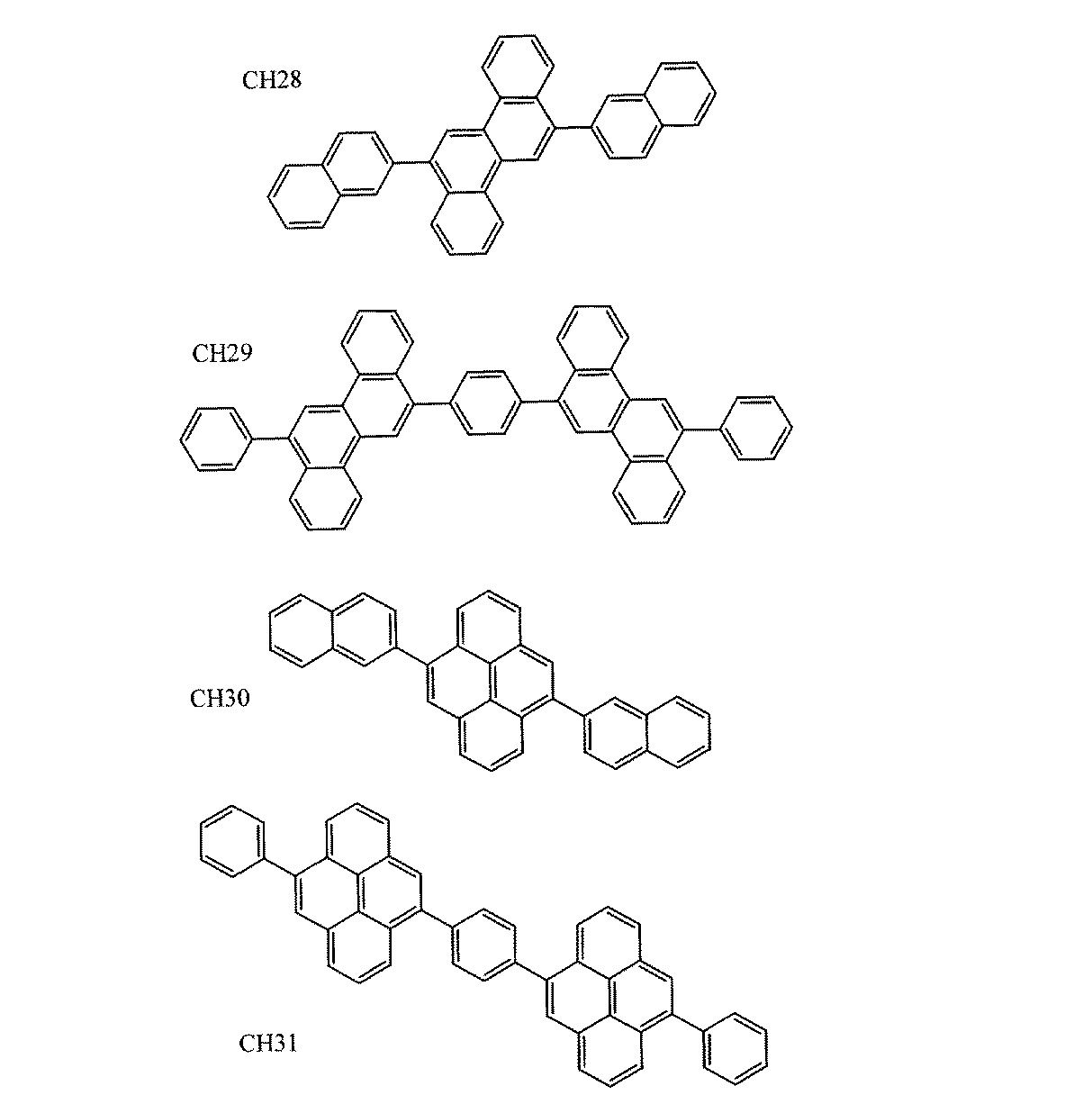
本発明の一般式(1)〜(4)で表されるオリゴアリーレン誘導体の具体例を以下に示すが、これら例示化合物に限定されるものではない。
【化5】
【化6】
【化7】
【化8】
【化9】
【化10】
【化11】
本発明のオリゴアリーレン誘導体は、有機EL素子用発光材料及び正孔輸送材料として用いると好ましい。
本発明の有機EL素子は、陰極と陽極間に少なくとも発光層を含む一層又は複数層からなる有機薄膜層が挟持されている有機EL素子において、該有機薄膜層の少なくとも1層が、前記一般式(1)〜(4)のいずれかで表されるオリゴアリーレン誘導体を単独もしくは混合物の成分として含有する。
前記発光層が、一般式(1)〜(4)のいずれかで表されるオリゴアリーレン誘導体を含有すると好ましく、特に発光層が、主成分として含有すると好ましい。
【0024】
また、本発明の有機EL素子は、前記発光層が、さらにアリールアミン化合物及び/又はスチリルアミン化合物を含有すると好ましい。
スチリルアミン化合物としては、下記一般式(A)で表されるものが好ましい。
【化12】
(式中、Ar9 は、フェニル基、ビフェニル基、ターフェニル基、スチルベン基、ジスチリルアリール基から選ばれる基であり、Ar10及びAr11は、それぞれ水素原子又は炭素数が6〜20の芳香族基であり、Ar9 、Ar10及びAr11は置換されいてもよい。cは1〜4の整数である。さらに好ましくはAr6 又はAr7 の少なくとも一方はスチリル基で置換されている。)
ここで、炭素数が6〜20の芳香族基としては、フェニル基、ナフチル基、アントラニル基、フェナンスリル基、ターフェニル基等が挙げられる。
【0026】
アリールアミン化合物としては、下記一般式(B)で表されるものが好ましい。
【化13】
【0027】
ここで、核炭素数が5〜40のアリール基としては、例えば、フェニル基、ナフチル基、アントラニル基、フェナンスリル基、ピレニル基、コロニル基、ビフェニル基、ターフェニル基、ピローリル基、フラニル基、チオフェニル基、ベンゾチオフェニル基、オキサジアゾリル基、ジフェニルアントラニル基、インドリル基、カルバゾリル基、ピリジル基、ベンゾキノリル基、フルオランテニル基、アセナフトフルオランテニル基、スチルベン基等が挙げられる。なお、このアリール基の好ましい置換基としては、炭素数1〜6のアルキル基(エチル基、メチル基、i−プロピル基、n−プロピル基、s−ブチル基、t−ブチル基、ペンチル基、ヘキシル基、シクロペンチル基、シクロヘキシル基等)、炭素数1〜6のアルコキシ基(エトキシ基、メトキシ基、i−プロポキシ基、n−プロポキシ基、s−ブトキシ基、t−ブトキシ基、ペントキシ基、ヘキシルオキシ基、シクロペントキシ基、シクロヘキシルオキシ基等)、核原子数5〜40のアリール基、核原子数5〜40のアリール基で置換されたアミノ基、核原子数5〜40のアリール基を有するエステル基、炭素数1〜6のアルキル基を有するエステル基、シアノ基、ニトロ基、ハロゲン原子等が挙げられる。
【0028】
前記有機薄膜層が正孔輸送層を有し、該正孔輸送層が、一般式(1)〜(4)のいずれかで表されるオリゴアリーレン誘導体を単独もしくは混合物の成分として含有してもよく、特に主成分として含有すると好ましい。
【0029】
以下、本発明の有機EL素子の素子構成について説明する。
本発明の有機EL素子の代表的な素子構成としては、
(1)陽極/発光層/陰極
(2)陽極/正孔注入層/発光層/陰極
(3)陽極/発光層/電子注入層/陰極
(4)陽極/正孔注入層/発光層/電子注入層/陰極
(5)陽極/有機半導体層/発光層/陰極
(6)陽極/有機半導体層/電子障壁層/発光層/陰極
(7)陽極/有機半導体層/発光層/付着改善層/陰極
(8)陽極/正孔注入層/正孔輸送層/発光層/電子注入層/陰極
(9)陽極/絶縁層/発光層/絶縁層/陰極
(10)陽極/無機半導体層/絶縁層/発光層/絶縁層/陰極
(11)陽極/有機半導体層/絶縁層/発光層/絶縁層/陰極
(12)陽極/絶縁層/正孔注入層/正孔輸送層/発光層/絶縁層/陰極
(13)陽極/絶縁層/正孔注入層/正孔輸送層/発光層/電子注入層/陰極
などの構造を挙げることができる。
これらの中で通常(8)の構成が好ましく用いられるが、もちろんこれらに限定されるものではない。
この有機EL素子は、通常透光性の基板上に作製する。この透光性基板は有機EL素子を支持する基板であり、その透光性については、400〜700nmの可視領域の光の透過率が50%以上であるものが望ましく、さらに平滑な基板を用いるのが好ましい。
【0030】
このような透光性基板としては、例えば、ガラス板、合成樹脂板などが好適に用いられる。ガラス板としては、特にソーダ石灰ガラス、バリウム・ストロンチウム含有ガラス、鉛ガラス、アルミノケイ酸ガラス、ホウケイ酸ガラス、バリウムホウケイ酸ガラス、石英などで成形された板が挙げられる。また、合成樹脂 板としては、ポリカーボネート樹脂、アクリル樹脂、ポリエチレンテレフタレート樹脂、ポリエーテルサルファイド樹脂、ポリサルフォン樹脂などの板か挙げられる。
次に、上記の陽極としては、仕事関数の大きい(4eV以上)金属、合金、電気伝導性化合物又はこれらの混合物を電極物質とするものが好ましく用いられる。このような電極物質の具体例としては、Auなどの金属,CuI,ITO(インジウムチンオキシド),SnO2 ,ZnO,In−Zn−Oなどの導電性材料が挙げられる。この陽極を形成するには、これらの電極物質を、蒸着法やスパッタリング法等の方法で薄膜を形成させることができる。この陽極は、上記発光層からの発光を陽極から取り出す場合、陽極の発光に対する透過率が10%より大きくなるような特性を有していることが望ましい。また、陽極のシート抵抗は、数百Ω/□以下のものが好ましい。さらに、陽極の膜厚は、材料にもよるが通常10nm〜1μm、好ましくは10〜200nmの範囲で選択される。
【0031】
次に、陰極としては、仕事関数の小さい(4eV以下)金属、合金、電気伝導性化合物及びこれらの混合物を電極物質とするものが用いられる。このような電極物質の具体例としては、ナトリウム,ナトリウム−カリウム合金、マグネシウム,リチウム,マグネシウム・銀合金,アルミニウム/酸化アルミニウム,Al/Li2 O,Al/LiO2 ,Al/LiF,アルミニウム・リチウム合金,インジウム,希土類金属などが挙げられる。
この陰極はこれらの電極物質を蒸着やスパッタリング等の方法により薄膜を形成させることにより、作製することができる。
ここで、発光層からの発光を陰極から取り出す場合、陰極の発光に対する透過率は10%より大きくすることが好ましい。また、陰極としてのシート抵抗は数百Ω/□以下が好ましく、さらに、膜厚は通常10nm〜1μm、好ましくは50〜200nmである。
【0032】
本発明の有機EL素子においては、このようにして作製された一対の電極の少なくとも一方の表面に、カルコゲナイド層,ハロゲン化金属層又は金属酸化物層(以下、これらを表面層ということがある。)を配置するのが好ましい。具体的には、発光層側の陽極表面にケイ素やアルミニウムなどの金属のカルコゲナイド(酸化物を含む)層を、また、発光層側の陰極表面にハロゲン化金属層又は金属酸化物層を配置するのがよい。これにより、駆動の安定化を図ることができる。
【0033】
上記カルコゲナイドとしては、例えばSiOx(1≦X≦2),AlOx(1≦X≦1.5),SiON,SiAlONなどが好ましく挙げられ、ハロゲン化金属としては、例えばLiF,MgF2 ,CaF2 ,フッ化希土類金属などが好ましく挙げられ、金属酸化物としては、例えばCs2 O,Li2 O,MgO,SrO,BaO,CaOなどが好ましく挙げられる。
【0034】
さらに、本発明の有機EL素子においては、このようにして作製された一対の電極の少なくとも一方の表面に電子伝達化合物と還元性ドーパントの混合領域又は正孔伝達化合物と酸化性ドーパントの混合領域を配置するのも好ましい。このようにすると、電子伝達化合物が還元され、アニオンとなり混合領域がより発光層に電子を注入、伝達しやすくなる。また、正孔伝達化合物は酸化され、カチオンとなり混合領域がより発光層に正孔を注入、伝達しやすくなる。好ましい酸化性ドーパントとしては、各種ルイス酸やアクセプター化合物がある。好ましい還元性ドーパントとしては、アルカリ金属,アルカリ金属化合物,アルカリ土類金属,希土類金属及びこれらの化合物がある。
本発明の有機EL素子においては、発光層は、
▲1▼注入機能;電界印加時に陽極又は正孔注入層より正孔を注入することができ、陰極又は電子注入層より電子を注入することができる機能
▲2▼輸送機能;注入した電荷(電子と正孔)を電界の力で移動させる機能
▲3▼発光機能;電子と正孔の再結合の場を提供し、これを発光につなげる機能
を有する。
【0035】
この発光層を形成する方法としては、例えば蒸着法、スピンコート法、LB法等の公知の方法を適用することができる。発光層は、特に分子堆積膜であることが好ましい。ここで分子堆積膜とは、気相状態の材料化合物から沈着され形成された薄膜や、溶液状態または液相状態の材料化合物から固体化され形成された膜のことであり、通常この分子堆積膜は、LB法により形成された薄膜(分子累積膜)とは凝集構造、高次構造の相違や、それに起因する機能的な相違により区分することができる。
また、特開昭57−51781号公報に開示されているように、樹脂等の結着剤と材料化合物とを溶剤に溶かして溶液とした後、これをスピンコート法等により薄膜化することによっても、発光層を形成することができる。
【0036】
本発明においては、本発明の目的が損なわれない範囲で、所望により、発光層に、本発明のオリゴアリーレン誘導体からなる発光材料以外の他の公知の発光材料を含有させてもよく、また、本発明のオリゴアリーレン誘導体からなる発光材料を含む発光層に、他の公知の発光材料を含む発光層を積層してもよい。
次に、正孔注入・輸送層は、発光層への正孔注入を助け、発光領域まで輸送する層であって、正孔移動度が大きく、イオン化エネルギーが通常5.5eV以下と小さい。このような正孔注入・輸送層としてはより低い電界強度で正孔を発光層に輸送する材料が好ましく、さらに正孔の移動度が、例えば104 〜106 V/cmの電界印加時に、少なくとも10−6cm2 /V・秒であるものが好ましい。このような正孔輸送材料としては、本発明のオリゴアリーレン誘導体が有用であり、こり他、従来、光導伝材料において正孔の電荷輸送材料として慣用されているものや、有機EL素子の正孔注入層に使用されている公知のものの中から任意のものを選択して用いることができる。
そして、この正孔注入・輸送層を形成するには、正孔注入・輸送材料を、例えば真空蒸着法、スピンコート法、キャスト法、LB法等の公知の方法により薄膜化すればよい。この場合、正孔注入・輸送層としての膜厚は、特に制限はないが、通常は5nm〜5μmである。
【0037】
次に、電子注入層・輸送層は、発光層への電子の注入を助け、発光領域まで輸送する層であって、電子移動度が大きく、また付着改善層は、この電子注入層の中で特に陰極との付着が良い材料からなる層である。電子注入層に用いられる材料としては、8−ヒドロキシキノリンまたはその誘導体の金属錯体が好適である。上記8−ヒドロキシキノリンまたはその誘導体の金属錯体の具体例としては、オキシン(一般に8−キノリノール又は8−ヒドロキシキノリン)のキレートを含む金属キレートオキシノイド化合物、例えばトリス(8−キノリノール)アルミニウムを電子注入材料として用いることができる。
【0038】
また、一般的に有機EL素子は、超薄膜に電界を印可するために、リークやショートによる画素欠陥が生じやすい。これを防止するために、一対の電極間に絶縁性の薄膜層を挿入しても良い。
絶縁層に用いられる材料としては、例えば、酸化アルミニウム、弗化リチウム、酸化リチウム、弗化セシウム、酸化セシウム、酸化マグネシウム、弗化マグネシウム、酸化カルシウム、弗化カルシウム、窒化アルミニウム、酸化チタン、酸化珪素、酸化ゲルマニウム、窒化珪素、窒化ホウ素、酸化モリブデン、酸化ルテニウム、酸化バナジウム等が挙げられる。これらの混合物や積層物を用いてもよい。
【0039】
次に、本発明の有機EL素子を作製する方法については、例えば上記の材料及び方法により陽極、発光層、必要に応じて正孔注入層、及び必要に応じて電子注入層を形成し、最後に陰極を形成すればよい。また、陰極から陽極へ、前記と逆の順序で有機EL素子を作製することもできる。
【0040】
以下、透光性基板上に、陽極/正孔注入層/発光層/電子注入層/陰極が順次設けられた構成の有機EL素子の作製例について説明する。
まず、適当な透光性基板上に、陽極材料からなる薄膜を1μm以下、好ましくは10〜200nmの範囲の膜厚になるように、蒸着法あるいはスパッタリング法により形成し、陽極とする。次に、この陽極上に正孔注入層を設ける。正孔注入層の形成は、前述したように真空蒸着法、スピンコート法、キャスト法、LB法等の方法により行うことができるが、均質な膜が得られやすく、かつピンホールが発生しにくい等の点から真空蒸着法により形成することが好ましい。真空蒸着法により正孔注入層を形成する場合、その蒸着条件は使用する化合物(正孔注入層の材料)、目的とする正孔注入層の結晶構造や再結合構造等により異なるが、一般に蒸着源温度50〜450℃、真空度10−7〜10−3torr、蒸着速度0.01〜50nm/秒、基板温度−50〜300℃、膜厚5nm〜5μmの範囲で適宜選択することが好ましい。
【0041】
次に、この正孔注入層上に発光層を設ける。この発光層の形成も、本発明に係る発光材料を用いて真空蒸着法、スパッタリング、スピンコート法、キャスト法等の方法により、発光材料を薄膜化することにより形成できるが、均質な膜が得られやすく、かつピンホールが発生しにくい等の点から真空蒸着法により形成することが好ましい。真空蒸着法により発光層を形成する場合、その蒸着条件は使用する化合物により異なるが、一般的に正孔注入層の形成と同様な条件範囲の中から選択することができる。膜厚は10〜40nmの範囲が好ましい。
【0042】
次に、この発光層上に電子注入層を設ける。この場合にも正孔注入層、発光層と同様、均質な膜を得る必要から真空蒸着法により形成することが好ましい。蒸着条件は正孔注入層、発光層と同様の条件範囲から選択することができる。
そして、最後に陰極を積層して有機EL素子を得ることができる。陰極は金属から構成されるもので、蒸着法、スパッタリングを用いることができる。しかし、下地の有機物層を製膜時の損傷から守るためには真空蒸着法が好ましい。
以上の有機EL素子の作製は、一回の真空引きで、一貫して陽極から陰極まで作製することが好ましい。
【0043】
この有機EL素子に直流電圧を印加する場合、陽極を+、陰極を−の極性にして、3〜40Vの電圧を印加すると、発光が観測できる。また、逆の極性で電圧を印加しても電流は流れず、発光は全く生じない。さらに、交流電圧を印加した場合には、陽極が+、陰極が−の極性になった時のみ均一な発光が観測される。この場合、印加する交流の波形は任意でよい。
【0044】
【実施例】
次に、本発明を実施例によりさらに詳細に説明するが、本発明は、これらの例によってなんら限定されるものではない。
実施例1(2,6−ビス(2− ナフチル) ピレン(CH1)の合成)
Ar雰囲気下、2,6−ジブロモピレン3g、2−ナフタレンボロン酸3.6g(東京化成社製)及びテトラキス(トリフェニルホスフィン)パラジウム(0)0.36g (広島和光社製)をトルエン100ml 中に溶かし、これに炭酸ナトリウム5gを24mlの水に溶かしたものを加え、10時間還流した後、一晩放置した。
反応混合物を濾過し、水、メタノール、アセトンで洗浄して2.9gの淡黄色固体を得た。
この化合物のFD−MS (フィールドディソープションマス分析)を測定したところ、C36H22=454 に対し、m/z =454 が得られたことから、この化合物を2,6−ビス(2− ナフチル) ピレン(CH1)と同定した(収率77%)。
【0045】
実施例2(6,12− ビス(1− ナフチル)−クリセン(CH2)の合成)
Ar雰囲気下、6,12− ジブロモクリセン3g、1−ナフタレンボロン酸4g(東京化成社製)及びテトラキス(トリフェニルホスフィン)パラジウム(0)0.36g (広島和光社製)をトルエン100ml 中に溶かし、これに炭酸ナトリウム5gを24mlの水に溶かしたものを加え、10時間還流した後、一晩放置した。
反応混合物を濾過し、水、メタノール、アセトンで洗浄して3.2gの淡黄色固体を得た。
この化合物のFD−MS を測定したところ、C38H24=480 に対し、m/z =480 が得られたことから、この化合物を6,12− ビス(1− ナフチル)−クリセン(CH2)と同定した(収率85%)。
【0046】
実施例3(6,12− ビス(9− フェナンスリル)−クリセン(CH3)の合成)
Ar雰囲気下、6,12− ジブロモクリセン3g、9−フェナンスレンボロン酸5g(東京化成社製)及びテトラキス(トリフェニルホスフィン)パラジウム(0)0.36g (広島和光社製)をトルエン100ml 中に溶かし、これに炭酸ナトリウム5gを24mlの水に溶かしたものを加え、10時間還流した後、一晩放置した。
反応混合物を濾過し、水、メタノール、アセトンで洗浄して4.2gの淡黄色固体を得た。
この化合物のFD−MS を測定したところ、C46H28=580 に対し、m/z =580 が得られたことから、この化合物を6,12− ビス(9− フェナンスリル)−クリセン(CH3)と同定した(収率93%)。
【0047】
実施例4(6,12− ビス(2− ターフェニル)−クリセン(CH4)の合成)
Ar雰囲気下、6,12− ジブロモクリセン3g、2−ターフェニルボロン酸5g及びテトラキス(トリフェニルホスフィン)パラジウム(0)0.36g (広島和光社製)をトルエン100ml 中に溶かし、これに炭酸ナトリウム5gを24mlの水に溶かしたものを加え、10時間還流した後、一晩放置した。
反応混合物を濾過し、水、メタノール、アセトンで洗浄して4.2gの淡黄色固体を得た。
この化合物のFD−MS を測定したところ、C54H36=684 に対し、m/z =684 が得られたことから、この化合物を6,12− ビス(2− ターフェニル)−クリセン(CH4)と同定した(収率79%)。
【0048】
実施例5(有機EL素子の製造)
25mm×75mm×1.1mm厚のITO透明電極付きガラス基板(ジオマティック社製)をイソプロピルアルコール中で超音波洗浄を5分間行なった後、UVオゾン洗浄を30分間行なった。洗浄後の透明電極ライン付きガラス基板を真空蒸着装置の基板ホルダーに装着し、まず透明電極ラインが形成されている側の面上に前記透明電極を覆うようにして膜厚60nmの下記N,N’−ビス(N,N’−ジフェニル−4−アミノフェニル)−N,N−ジフェニル−4,4’−ジアミノ−1,1’−ビフェニル膜(以下、TPD232膜)を成膜した。このTPD232膜は、正孔注入層として機能する。続いて、このTPD232膜上に膜厚20nmの下記N,N,N’,N’−テトラ(4−ビフェニル)−ジアミノビフェニレン膜(以下、TBDB膜)を成膜した。この膜は正孔輸送層として機能する。さらに、このTBDB膜上に、発光材料(ホスト材料)として膜厚40nmのCH1を蒸着し成膜した。同時に発光分子(ドーパント)として、下記のスチリル基を有するアミン化合物D1をCH1に対し、重量比でCH1:D1=40:2で蒸着した。この膜は、発光層として機能する。この膜上に膜厚10nmのAlq膜を成膜した。これは、電子注入層として機能する。この後、還元性ドーパントであるLi(Li源:サエスゲッター社製)とAlqを二元蒸着させ、電子注入層(陰極)としてAlq:Li膜(膜厚10nm)を形成した。このAlq:Li膜上に金属Alを蒸着させ金属陰極を形成し有機EL素子を形成した。
得られた有機EL素子について、発光輝度100nit付近の発光効率を測定し、その結果を表1に示す。
【0049】
【化14】
実施例6(有機EL素子の製造)
実施例5において、ドーパントとしてスチリル基を有するアミン化合物D1の代わりに、下記芳香族アミンD2を用いたこと以外は同様にして有機EL素子を製造し、同様に発光効率を測定した。その結果を表1に示す。
【化15】
実施例7〜12(有機EL素子の製造)
実施例5において、ホスト材料及びドーパントとして、表1に示すものを用いたこと以外は同様にして有機EL素子を製造し、同様に発光効率を測定した。それらの結果を表1に示す。
【0052】
比較例1(有機EL素子の製造)
実施例5において、ホスト材料としてCH1の代わりに、下記化合物an1を用いたこと以外は同様にして有機EL素子を製造し、同様に発光効率を測定した。その結果を表1に示す。
【化16】
比較例2(有機EL素子の製造)
比較例1において、ドーパントとしてスチリル基を有するアミン化合物D1の代わりに、芳香族アミンD2を用いたこと以外は同様にして有機EL素子を製造し、同様に発光効率を測定した。その結果を表1に示す。
【0054】
【表1】
表1に示したように、実施例5〜12の有機EL素子は、比較例1及び2に対して、発光効率が高い青色発光が得られた。
【0056】
【発明の効果】
以上、詳細に説明したように、本発明のオリゴアリーレン誘導体を利用した有機EL素子は、高い発光効率の青色発光が得られる。このためフルカラー用の有機EL素子として有用である。[0001]
TECHNICAL FIELD OF THE INVENTION
The present invention relates to an oligoarylene derivative and an organic electroluminescence device using the same, and more particularly, to an oligoarylene derivative capable of emitting blue light with high luminous efficiency and an organic electroluminescence device using the same.
[0002]
[Prior art]
2. Description of the Related Art In an organic electroluminescence element (hereinafter, electroluminescence may be abbreviated as EL), a fluorescent substance emits light by the recombination energy of holes injected from an anode and electrons injected from a cathode by applying an electric field. This is a self-luminous element utilizing the principle of light emission. Eastman Kodak C.I. W. Tang et al. Have reported a low-voltage driven organic EL device using a stacked device (CW Tang, SA Vanslyke, Applied Physics Letters, 51, 913, 1987, etc.). Since then, research on organic EL elements using organic materials as constituent materials has been actively conducted. Tang et al. Use tris (8-hydroxyquinolinol aluminum) for the light-emitting layer and a triphenyldiamine derivative for the hole transport layer. The advantages of the stacked structure include: increasing the efficiency of injecting holes into the light emitting layer; increasing the efficiency of generating excitons generated by recombination by blocking electrons injected from the cathode; Examples include confining excitons. As in this example, the element structure of the organic EL element is a two-layer type of a hole transporting (injection) layer and an electron transporting / emitting layer, or a hole transporting (injection) layer, a light emitting layer, and an electron transporting (injection) layer. Three-layer type and the like are well known. In such a stacked structure element, in order to increase the recombination efficiency of injected holes and electrons, the element structure and the forming method are devised.
[0003]
Further, as light emitting materials, chelate complexes such as tris (8-quinolinolato) aluminum complex, and light emitting materials such as coumarin derivatives, tetraphenylbutadiene derivatives, bisstyrylarylene derivatives, and oxadiazole derivatives are known. It has been reported that light emission in the visible region from red to red can be obtained, and realization of a color display element is expected (for example, JP-A-8-239655, JP-A-7-138561, JP-A-3138561). Publication No. 200289).
However, with respect to blue light emitting devices, few blue light emitting materials provide highly reliable and stable devices. Generally, blue light-emitting materials have high crystallinity. For example, although diphenylanthracene has a high fluorescence quantum yield, it has high crystallinity, and even if a device is manufactured using this compound as a light emitting material, a device with high luminous efficiency and high reliability cannot be provided. [C. Adachi, et al. , Appli. Phys. Lett,. 56, 799 (1990)].
[0004]
[Problems to be solved by the invention]
The present invention has been made to solve the above problems, and has as its object to provide an oligoarylene derivative capable of emitting blue light with high luminous efficiency and an organic EL device using the same.
[0005]
[Means for Solving the Problems]
The present inventors have conducted intensive studies to achieve the above object, and as a result, have found that an oligoarylene derivative having a specific structure represented by any of the following general formulas (1) to (4) emits light from an organic EL device. The inventors have found that blue light emission with high luminous efficiency is possible by using it as a material or a hole transport material, and have completed the present invention.
[0006]
That is, the present invention provides an oligoarylene derivative represented by any of the following general formulas (1) to (4).
Ar 1 -Ch-Ar 2 (1)
(In the formula, Ch is a group having at least one substituted or unsubstituted fused aromatic ring having 14 to 20 nuclear carbon atoms.)
Ar 1 and Ar 2 are each a substituted or unsubstituted aryl group having 5 to 30 nuclear atoms, and may be the same or different. )
Ch 1 -L-Ch 2 (2)
(In the formula, L is a linking group. Ch 1 and Ch 2 are each a group having at least one substituted or unsubstituted fused aromatic ring having 14 to 20 ring carbon atoms, and may be the same or different. Good.)
[0007]
Embedded image
L 1 and L 2 are each a linking group, and may be the same or different. a and b are each an integer of 0 to 1.
Ar 3 and Ar 4 are each a substituted or unsubstituted aryl group having 5 to 30 nuclear atoms, and may be the same or different.
However, when Ch 3 is a substituted or unsubstituted pyrene, Ar 3 and / or Ar 4 is a substituted or unsubstituted β-naphthyl derivative. )
[0008]
Embedded image
Ar 5 and Ar 6 are each a substituted or unsubstituted aryl group having 5 to 30 nuclear atoms, and may be the same or different.
Ar 7 and Ar 8 are each a substituted or unsubstituted arylene group having 5 to 30 nuclear atoms, and may be the same or different. n and m are each an integer of 0 to 1. )
[0009]
Further, the present invention provides an organic EL device in which one or more organic thin film layers including at least a light-emitting layer are sandwiched between a cathode and an anode, wherein at least one of the organic thin film layers has the general formula (1) The present invention provides an organic EL device containing the oligoarylene derivative represented by any one of (1) to (4) alone or as a component of a mixture.
[0010]
BEST MODE FOR CARRYING OUT THE INVENTION
The oligoarylene derivative of the present invention is represented by the following general formula (1) or (2).
Ar 1 -Ch-Ar 2 (1)
Ch is a group having at least one substituted or unsubstituted fused aromatic ring having 14 to 20 ring carbon atoms.
Examples of the condensed aromatic ring represented by Ch include phenanthrene, pyrene, chrysene, triphenylene, and perylene, and pyrene or chrysene is preferable.
Ar 1 and Ar 2 are each a substituted or unsubstituted aryl group having 5 to 30 nuclear atoms, and may be the same or different.
[0011]
Examples of the substituted or unsubstituted aryl group having 5 to 30 nuclear atoms represented by Ar 1 and Ar 2 include a phenyl group, a 1-naphthyl group, a 2-naphthyl group, a 1-anthryl group, a 2-anthryl group, and 9 -Anthryl group, 1-phenanthryl group, 2-phenanthryl group, 3-phenanthryl group, 4-phenanthryl group, 9-phenanthryl group, 1-naphthacenyl group, 2-naphthacenyl group, 9-naphthacenyl group, 1-pyrenyl group, 2 -Pyrenyl group, 4-pyrenyl group, 2-biphenylyl group, 3-biphenylyl group, 4-biphenylyl group, p-terphenyl-4-yl group, p-terphenyl-3-yl group, p-ter Phenyl-2-yl group, m-terphenyl-4-yl group, m-terphenyl-3-yl group, m-terphenyl-2-yl group, o-tolyl group, m- Ryl, p-tolyl, pt-butylphenyl, p- (2-phenylpropyl) phenyl, 3-methyl-2-naphthyl, 4-methyl-1-naphthyl, 4-methyl-1 -Anthryl group, 4'-methylbiphenylyl group, 4 "-t-butyl-p-terphenyl-4-yl group, fluorenyl group and the like.
[0012]
Ch 1 -L-Ch 2 (2)
L is a linking group. Examples of the linking group include those having a structure such as a single bond, a methylene group, an ethylene group, a dimethylmethylene group, a diphenylmethylene group, a lactone ring, and a peptide group. A single bond is particularly preferable. These groups may be substituted.
Examples of the condensed aromatic ring of Ch 1 and Ch 2 include those similar to the condensed aromatic ring represented by Ch.
[0013]
The general formula (1) is preferably represented by the general formula (3).
Ch 3 is a substituted or unsubstituted aryl group having 14 to 20 ring carbon atoms. Examples of the aryl group include phenanthrene, pyrene, chrysene, triphenylene or perylene, and pyrene or chrysene is preferred.
L 1 and L 2 are each a linking group, and may be the same or different. Examples of the linking group include those similar to the linking group represented by L. These groups may be substituted. a and b are each an integer of 0 to 1.
Ar 3 and Ar 4 are each a substituted or unsubstituted aryl group having 5 to 30 nuclear atoms, and may be the same or different. Examples of the aryl group include those similar to the aryl groups represented by Ar 1 and Ar 2 .
However, when Ch 3 is a substituted or unsubstituted pyrene, Ar 3 and / or Ar 4 is a substituted or unsubstituted β-naphthyl derivative.
[0014]
The general formula (2) is preferably represented by the general formula (4).
L 3 is a linking group. Examples of the linking group include those similar to the linking group represented by L. This group may be substituted.
Ch 4 and Ch 5 are each a substituted or unsubstituted arylene group having 14 to 20 nuclear atoms, and may be the same or different. Examples of the arylene group include phenanthrylene, pyrenylene, chrysenylene, triphenylenylene, peryleneylene, and the like, with pyrenylene or chrysenylene being preferred.
Ar 5 and Ar 6 are each a substituted or unsubstituted aryl group having 5 to 30 nuclear atoms, and may be the same or different. Examples of the aryl group include those similar to the aryl groups represented by Ar 1 and Ar 2 .
Ar 7 and Ar 8 are each a substituted or unsubstituted arylene group having 5 to 30 nuclear atoms, and may be the same or different. Examples of the arylene group include those in which the aryl group represented by Ar 1 and Ar 2 is a divalent group. n and m are each an integer of 0 to 1.
[0015]
Examples of the substituent in the group represented by Ch, Ch 1 to Ch 5 , and Ar 1 to Ar 8 include a halogen atom, a hydroxyl group, a nitro group, a cyano group, an alkyl group, an aryl group, a cycloalkyl group, an alkoxy group, and an aromatic group. Examples include a heterocyclic group, an aralkyl group, an aryloxy group, an arylthio group, an alkoxycarbonyl group, and a carboxyl group.
Further, examples of the substituent of the groups represented by L and L 1 to L 3 also include these groups.
[0016]
Specific examples of the oligoarylene derivative represented by the general formulas (1) to (4) of the present invention are shown below, but are not limited to these exemplified compounds.
Embedded image
Embedded image
Embedded image
Embedded image
Embedded image
Embedded image
Embedded image
The oligoarylene derivative of the present invention is preferably used as a light emitting material for an organic EL device and a hole transporting material.
The organic EL device of the present invention is an organic EL device in which one or more organic thin film layers including at least a light emitting layer are sandwiched between a cathode and an anode, wherein at least one of the organic thin film layers has the general formula The oligoarylene derivative represented by any of (1) to (4) is contained alone or as a component of a mixture.
The light emitting layer preferably contains an oligoarylene derivative represented by any of the general formulas (1) to (4), and particularly preferably the light emitting layer contains as a main component.
[0024]
In the organic EL device of the present invention, it is preferable that the light emitting layer further contains an arylamine compound and / or a styrylamine compound.
As the styrylamine compound, a compound represented by the following general formula (A) is preferable.
Embedded image
(In the formula, Ar 9 is a group selected from a phenyl group, a biphenyl group, a terphenyl group, a stilbene group, and a distyrylaryl group, and Ar 10 and Ar 11 are each a hydrogen atom or a carbon atom having 6 to 20 carbon atoms. Ar 9 is an aromatic group, and Ar 9 , Ar 10 and Ar 11 may be substituted, and c is an integer of 1 to 4. More preferably, at least one of Ar 6 and Ar 7 is substituted with a styryl group. .)
Here, examples of the aromatic group having 6 to 20 carbon atoms include a phenyl group, a naphthyl group, an anthranyl group, a phenanthryl group, and a terphenyl group.
[0026]
As the arylamine compound, a compound represented by the following general formula (B) is preferable.
Embedded image
[0027]
Here, examples of the aryl group having a nuclear carbon number of 5 to 40 include phenyl, naphthyl, anthranyl, phenanthryl, pyrenyl, coronyl, biphenyl, terphenyl, pyrrolyl, furanyl, and thiophenyl. Group, benzothiophenyl group, oxadiazolyl group, diphenylanthranyl group, indolyl group, carbazolyl group, pyridyl group, benzoquinolyl group, fluoranthenyl group, acenaphthofluoranthenyl group, stilbene group and the like. In addition, as a preferable substituent of this aryl group, an alkyl group having 1 to 6 carbon atoms (ethyl group, methyl group, i-propyl group, n-propyl group, s-butyl group, t-butyl group, pentyl group, Hexyl group, cyclopentyl group, cyclohexyl group, etc., alkoxy group having 1 to 6 carbon atoms (ethoxy group, methoxy group, i-propoxy group, n-propoxy group, s-butoxy group, t-butoxy group, pentoxy group, hexyl Oxy group, cyclopentoxy group, cyclohexyloxy group, etc.), an aryl group having 5 to 40 nuclear atoms, an amino group substituted with an aryl group having 5 to 40 nuclear atoms, and an aryl group having 5 to 40 nuclear atoms. And an ester group having an alkyl group having 1 to 6 carbon atoms, a cyano group, a nitro group, a halogen atom and the like.
[0028]
The organic thin film layer may have a hole transport layer, and the hole transport layer may contain the oligoarylene derivative represented by any of the general formulas (1) to (4) alone or as a component of a mixture. Often, it is particularly preferable to contain it as a main component.
[0029]
Hereinafter, the element configuration of the organic EL element of the present invention will be described.
As a typical element configuration of the organic EL element of the present invention,
(1) anode / light emitting layer / cathode (2) anode / hole injection layer / light emitting layer / cathode (3) anode / light emitting layer / electron injection layer / cathode (4) anode / hole injection layer / light emitting layer / electron Injection layer / cathode (5) anode / organic semiconductor layer / light emitting layer / cathode (6) anode / organic semiconductor layer / electron barrier layer / light emitting layer / cathode (7) anode / organic semiconductor layer / light emitting layer / adhesion improving layer / Cathode (8) anode / hole injection layer / hole transport layer / light emitting layer / electron injection layer / cathode (9) anode / insulating layer / light emitting layer / insulating layer / cathode (10) anode / inorganic semiconductor layer / insulating layer / Emission layer / insulation layer / cathode (11) anode / organic semiconductor layer / insulation layer / emission layer / insulation layer / cathode (12) anode / insulation layer / hole injection layer / hole transport layer / emission layer / insulation layer / Cathode (13) Anode / Insulating layer / Hole injection layer / Hole transport layer / Emitting layer / Electron injection layer / Cathode.
Of these, the configuration (8) is usually preferably used, but is not limited thereto.
This organic EL element is usually manufactured on a light-transmitting substrate. The light-transmitting substrate is a substrate that supports the organic EL element. The light-transmitting substrate desirably has a light transmittance of 50% or more in the visible region of 400 to 700 nm, and a smoother substrate is used. Is preferred.
[0030]
As such a light-transmitting substrate, for example, a glass plate, a synthetic resin plate, or the like is suitably used. Examples of the glass plate include a plate formed of soda lime glass, barium / strontium-containing glass, lead glass, aluminosilicate glass, borosilicate glass, barium borosilicate glass, quartz, or the like. Examples of the synthetic resin plate include plates made of polycarbonate resin, acrylic resin, polyethylene terephthalate resin, polyether sulfide resin, polysulfone resin, and the like.
Next, as the above-mentioned anode, those using a metal, an alloy, an electrically conductive compound or a mixture thereof having a large work function (4 eV or more) as an electrode material are preferably used. Specific examples of such an electrode material include metals such as Au, and conductive materials such as CuI, ITO (indium tin oxide), SnO 2 , ZnO, and In—Zn—O. In order to form the anode, a thin film can be formed from these electrode substances by a method such as an evaporation method or a sputtering method. The anode desirably has such a characteristic that when the light emitted from the light emitting layer is taken out from the anode, the transmittance of the anode to the emitted light is greater than 10%. The sheet resistance of the anode is preferably several hundreds Ω / □ or less. Further, the thickness of the anode is selected in the range of usually 10 nm to 1 μm, preferably 10 to 200 nm, though it depends on the material.
[0031]
Next, as the cathode, a metal, an alloy, an electrically conductive compound, or a mixture thereof having a low work function (4 eV or less) as an electrode material is used. Specific examples of the electrode substance include sodium, sodium - potassium alloy, magnesium, lithium, magnesium-silver alloy, aluminum / aluminum oxide, Al / Li 2 O, Al / LiO 2, Al / LiF, aluminum-lithium Alloys, indium, rare earth metals and the like.
The cathode can be manufactured by forming a thin film of these electrode materials by a method such as evaporation or sputtering.
Here, in the case where light emitted from the light emitting layer is extracted from the cathode, it is preferable that the transmittance of the cathode with respect to the emitted light be greater than 10%. Further, the sheet resistance as the cathode is preferably several hundred Ω / □ or less, and the film thickness is usually 10 nm to 1 μm, preferably 50 to 200 nm.
[0032]
In the organic EL device of the present invention, a chalcogenide layer, a metal halide layer, or a metal oxide layer (hereinafter, may be referred to as a surface layer) is formed on at least one surface of the pair of electrodes thus manufactured. ) Is preferably arranged. Specifically, a chalcogenide (including oxide) layer of a metal such as silicon or aluminum is disposed on the anode surface on the light emitting layer side, and a metal halide layer or metal oxide layer is disposed on the cathode surface on the light emitting layer side. Is good. Thereby, the driving can be stabilized.
[0033]
Preferred examples of the chalcogenide include SiOx (1 ≦ X ≦ 2), AlOx (1 ≦ X ≦ 1.5), SiON, SiAlON, and the like. Examples of the metal halide include LiF, MgF 2 , CaF 2 , and the like. Preferable examples include rare earth metal fluorides, and examples of the metal oxide include Cs 2 O, Li 2 O, MgO, SrO, BaO, CaO, and the like.
[0034]
Further, in the organic EL device of the present invention, a mixed region of an electron transfer compound and a reducing dopant or a mixed region of a hole transfer compound and an oxidizable dopant is formed on at least one surface of the pair of electrodes thus manufactured. It is also preferable to arrange them. In this case, the electron transfer compound is reduced and becomes an anion, so that the mixed region can more easily inject and transfer electrons to the light emitting layer. In addition, the hole transfer compound is oxidized to become a cation, and the mixed region is more likely to inject and transfer holes to the light emitting layer. Preferred oxidizing dopants include various Lewis acids and acceptor compounds. Preferred reducing dopants include alkali metals, alkali metal compounds, alkaline earth metals, rare earth metals and these compounds.
In the organic EL device of the present invention, the light emitting layer comprises:
{Circle around (1)} Injection function; a function to inject holes from an anode or a hole injection layer when an electric field is applied, and to inject electrons from a cathode or an electron injection layer. (3) Light-emitting function: Provides a field for recombination of electrons and holes, and has a function of connecting this to light emission.
[0035]
As a method for forming the light emitting layer, a known method such as an evaporation method, a spin coating method, and an LB method can be applied. The light emitting layer is particularly preferably a molecular deposition film. Here, the molecular deposition film refers to a thin film formed by deposition from a material compound in a gaseous state or a film formed by solidification from a material compound in a solution state or a liquid phase state. Can be distinguished from a thin film (molecule accumulation film) formed by the LB method by a difference in an aggregation structure and a higher-order structure and a functional difference caused by the difference.
Further, as disclosed in JP-A-57-51781, after a binder such as a resin and a material compound are dissolved in a solvent to form a solution, the solution is formed into a thin film by a spin coating method or the like. Also, a light emitting layer can be formed.
[0036]
In the present invention, as long as the object of the present invention is not impaired, if necessary, the light-emitting layer may contain a known light-emitting material other than the light-emitting material comprising the oligoarylene derivative of the present invention, A light emitting layer containing another known light emitting material may be laminated on the light emitting layer containing the light emitting material composed of the oligoarylene derivative of the present invention.
Next, the hole injecting / transporting layer is a layer that assists hole injection into the light emitting layer and transports it to the light emitting region, and has a large hole mobility and a small ionization energy of usually 5.5 eV or less. As such a hole injecting / transporting layer, a material that transports holes to the light emitting layer at a lower electric field strength is preferable. Further, when the hole mobility is, for example, 10 4 to 10 6 V / cm when an electric field is applied, It is preferably at least 10 −6 cm 2 / V · sec. As such a hole transporting material, the oligoarylene derivative of the present invention is useful. In addition, a material conventionally used as a charge transporting material for holes in a photoconductive material, a hole transporting material for an organic EL device, and the like. Any one of known ones used for the injection layer can be selected and used.
In order to form the hole injecting / transporting layer, the hole injecting / transporting material may be thinned by a known method such as a vacuum evaporation method, a spin coating method, a casting method, and an LB method. In this case, the thickness of the hole injection / transport layer is not particularly limited, but is usually 5 nm to 5 μm.
[0037]
Next, the electron injecting layer / transporting layer is a layer that helps injecting electrons into the light emitting layer and transports it to the light emitting region, has a high electron mobility, and the adhesion improving layer is one of the electron injecting layers. In particular, it is a layer made of a material having good adhesion to the cathode. As a material used for the electron injection layer, a metal complex of 8-hydroxyquinoline or a derivative thereof is preferable. As a specific example of the metal complex of 8-hydroxyquinoline or a derivative thereof, a metal chelate oxinoid compound containing a chelate of oxine (generally 8-quinolinol or 8-hydroxyquinoline), for example, tris (8-quinolinol) aluminum is electron-injected. It can be used as a material.
[0038]
In general, an organic EL element is apt to cause pixel defects due to leakage or short-circuit because an electric field is applied to an ultra-thin film. To prevent this, an insulating thin film layer may be inserted between the pair of electrodes.
Examples of the material used for the insulating layer include aluminum oxide, lithium fluoride, lithium oxide, cesium fluoride, cesium oxide, magnesium oxide, magnesium fluoride, calcium oxide, calcium fluoride, aluminum nitride, titanium oxide, and silicon oxide. , Germanium oxide, silicon nitride, boron nitride, molybdenum oxide, ruthenium oxide, vanadium oxide and the like. These mixtures and laminates may be used.
[0039]
Next, as for the method for producing the organic EL device of the present invention, for example, an anode, a light-emitting layer, a hole injection layer if necessary, and an electron injection layer if necessary are formed by the above materials and methods. The cathode may be formed on the substrate. Further, the organic EL device can be manufactured in the reverse order from the cathode to the anode.
[0040]
Hereinafter, an example of manufacturing an organic EL element having a configuration in which an anode / a hole injection layer / a light emitting layer / an electron injection layer / a cathode is sequentially provided on a light-transmitting substrate will be described.
First, a thin film made of an anode material is formed on a suitable light-transmitting substrate by a vapor deposition method or a sputtering method so as to have a thickness of 1 μm or less, preferably in the range of 10 to 200 nm, and used as an anode. Next, a hole injection layer is provided on the anode. As described above, the hole injection layer can be formed by a method such as a vacuum evaporation method, a spin coating method, a casting method, and an LB method. However, a uniform film is easily obtained and pinholes are not easily generated. From the viewpoint of the above, it is preferable to form by a vacuum evaporation method. When the hole injection layer is formed by a vacuum evaporation method, the deposition conditions vary depending on the compound used (the material of the hole injection layer), the crystal structure and the recombination structure of the target hole injection layer, etc. It is preferable to appropriately select a source temperature of 50 to 450 ° C., a degree of vacuum of 10 −7 to 10 −3 torr, a deposition rate of 0.01 to 50 nm / sec, a substrate temperature of −50 to 300 ° C., and a thickness of 5 nm to 5 μm. .
[0041]
Next, a light emitting layer is provided on the hole injection layer. This light-emitting layer can also be formed by thinning the light-emitting material using the light-emitting material according to the present invention by a method such as a vacuum evaporation method, a sputtering method, a spin coating method, or a casting method. It is preferable to form them by a vacuum evaporation method from the viewpoint that they are easily formed and pinholes are hardly generated. When the light emitting layer is formed by a vacuum deposition method, the deposition conditions vary depending on the compound used, but can be generally selected from the same condition range as the formation of the hole injection layer. The thickness is preferably in the range of 10 to 40 nm.
[0042]
Next, an electron injection layer is provided on the light emitting layer. In this case as well, like the hole injection layer and the light emitting layer, it is preferable to form the film by a vacuum evaporation method because it is necessary to obtain a uniform film. The deposition conditions can be selected from the same condition ranges as for the hole injection layer and the light emitting layer.
Finally, an organic EL element can be obtained by laminating a cathode. The cathode is made of a metal, and an evaporation method or sputtering can be used. However, in order to protect the underlying organic layer from damage during film formation, a vacuum deposition method is preferable.
In the production of the organic EL element described above, it is preferable to produce from the anode to the cathode consistently by one evacuation.
[0043]
When a DC voltage is applied to the organic EL element, light emission can be observed by applying a voltage of 3 to 40 V with the anode having a positive polarity and the cathode having a negative polarity. Also, even if a voltage is applied in the opposite polarity, no current flows and no light emission occurs. Furthermore, when an AC voltage is applied, uniform light emission is observed only when the anode has a positive polarity and the cathode has a negative polarity. In this case, the waveform of the applied alternating current may be arbitrary.
[0044]
【Example】
Next, the present invention will be described in more detail with reference to examples, but the present invention is not limited to these examples.
Example 1 (Synthesis of 2,6-bis (2-naphthyl) pyrene (CH1))
Under an Ar atmosphere, 3 g of 2,6-dibromopyrene, 3.6 g of 2-naphthaleneboronic acid (manufactured by Tokyo Kasei Co., Ltd.) and 0.36 g of tetrakis (triphenylphosphine) palladium (0) (manufactured by Hiroshima Wako Co., Ltd.) in 100 ml of toluene And 5 g of sodium carbonate dissolved in 24 ml of water was added thereto. The mixture was refluxed for 10 hours, and left overnight.
The reaction mixture was filtered and washed with water, methanol and acetone to obtain 2.9 g of a pale yellow solid.
When FD-MS (field desorption mass analysis) of this compound was measured, m / z = 454 was obtained for C 36 H 22 = 454. Therefore, this compound was converted to 2,6-bis (2 -Naphthyl) pyrene (CH1) was identified (yield 77%).
[0045]
Example 2 (Synthesis of 6,12-bis (1-naphthyl) -chrysene (CH2))
In an Ar atmosphere, 3 g of 6,12-dibromochrysene, 4 g of 1-naphthaleneboronic acid (manufactured by Tokyo Kasei) and 0.36 g of tetrakis (triphenylphosphine) palladium (0) (manufactured by Hiroshima Wako) are dissolved in 100 ml of toluene. A solution prepared by dissolving 5 g of sodium carbonate in 24 ml of water was added thereto, and the mixture was refluxed for 10 hours and left overnight.
The reaction mixture was filtered and washed with water, methanol and acetone to obtain 3.2 g of a pale yellow solid.
FD-MS of this compound was measured. As a result, m / z = 480 was obtained for C 38 H 24 = 480. Therefore, this compound was converted to 6,12-bis (1-naphthyl) -chrysene (CH 2). (85% yield).
[0046]
Example 3 (Synthesis of 6,12-bis (9-phenanthryl) -chrysene (CH3))
Under an Ar atmosphere, 3 g of 6,12-dibromochrysene, 5 g of 9-phenanthreneboronic acid (manufactured by Tokyo Chemical Industry Co., Ltd.) and 0.36 g of tetrakis (triphenylphosphine) palladium (0) (manufactured by Hiroshima Wako) in 100 ml of toluene. And 5 g of sodium carbonate dissolved in 24 ml of water was added thereto. The mixture was refluxed for 10 hours, and left overnight.
The reaction mixture was filtered and washed with water, methanol and acetone to obtain 4.2 g of a pale yellow solid.
FD-MS of this compound was measured. As a result, m / z = 580 was obtained for C 46 H 28 = 580. Therefore, this compound was converted to 6,12-bis (9-phenanthryl) -chrysene (CH 3). (93% yield).
[0047]
Example 4 (Synthesis of 6,12-bis (2-terphenyl) -chrysene (CH4))
Under an Ar atmosphere, 3 g of 6,12-dibromochrysene, 5 g of 2-terphenylboronic acid and 0.36 g of tetrakis (triphenylphosphine) palladium (0) (manufactured by Hiroshima Wako) were dissolved in 100 ml of toluene, and sodium carbonate was added thereto. A solution prepared by dissolving 5 g in 24 ml of water was added, refluxed for 10 hours, and left overnight.
The reaction mixture was filtered and washed with water, methanol and acetone to obtain 4.2 g of a pale yellow solid.
FD-MS of this compound was measured. As a result, m / z = 684 was obtained for C 54 H 36 = 684. Therefore, this compound was converted to 6,12-bis (2-terphenyl) -chrysene (CH 4 ) (79% yield).
[0048]
Example 5 (manufacture of organic EL element)
A 25 mm × 75 mm × 1.1 mm thick glass substrate with an ITO transparent electrode (manufactured by Geomatic) was subjected to ultrasonic cleaning in isopropyl alcohol for 5 minutes, and then UV ozone cleaning for 30 minutes. The washed glass substrate with a transparent electrode line is mounted on a substrate holder of a vacuum evaporation apparatus. First, the following N, N having a film thickness of 60 nm is coated on the surface on the side where the transparent electrode line is formed so as to cover the transparent electrode. A '-bis (N, N'-diphenyl-4-aminophenyl) -N, N-diphenyl-4,4'-diamino-1,1'-biphenyl film (hereinafter, TPD232 film) was formed. This TPD232 film functions as a hole injection layer. Subsequently, the following N, N, N ', N'-tetra (4-biphenyl) -diaminobiphenylene film (hereinafter, TBDB film) having a thickness of 20 nm was formed on the TPD232 film. This film functions as a hole transport layer. Further, CH1 having a thickness of 40 nm was deposited and formed as a light emitting material (host material) on the TBDB film. At the same time, the following amine compound D1 having a styryl group was vapor-deposited at a weight ratio of CH1: D1 = 40: 2 to CH1 as a light-emitting molecule (dopant). This film functions as a light emitting layer. An Alq film having a thickness of 10 nm was formed on this film. This functions as an electron injection layer. Thereafter, Li as a reducing dopant (Li source: manufactured by Saes Getter Co., Ltd.) and Alq were binary deposited to form an Alq: Li film (thickness: 10 nm) as an electron injection layer (cathode). Metallic Al was vapor-deposited on the Alq: Li film to form a metal cathode to form an organic EL device.
With respect to the obtained organic EL device, the luminous efficiency at a luminous luminance of around 100 nit was measured.
[0049]
Embedded image
Example 6 (manufacture of organic EL element)
An organic EL device was produced in the same manner as in Example 5, except that the following aromatic amine D2 was used instead of the amine compound D1 having a styryl group as a dopant, and the luminous efficiency was measured in the same manner. Table 1 shows the results.
Embedded image
Examples 7 to 12 (manufacture of organic EL element)
An organic EL device was manufactured in the same manner as in Example 5, except that the host material and the dopant shown in Table 1 were used, and the luminous efficiency was measured in the same manner. Table 1 shows the results.
[0052]
Comparative Example 1 (manufacture of organic EL element)
An organic EL device was manufactured in the same manner as in Example 5, except that the following compound an1 was used instead of CH1 as the host material, and the luminous efficiency was measured in the same manner. Table 1 shows the results.
Embedded image
Comparative Example 2 (manufacture of organic EL element)
In Comparative Example 1, an organic EL device was manufactured in the same manner except that an aromatic amine D2 was used instead of the amine compound D1 having a styryl group as a dopant, and the luminous efficiency was measured similarly. Table 1 shows the results.
[0054]
[Table 1]
As shown in Table 1, the organic EL devices of Examples 5 to 12 emitted blue light with higher luminous efficiency than Comparative Examples 1 and 2.
[0056]
【The invention's effect】
As described above in detail, the organic EL device using the oligoarylene derivative of the present invention can emit blue light with high luminous efficiency. Therefore, it is useful as a full-color organic EL device.
Claims (13)
Ar1 −Ch−Ar2 (1)
(式中、Chは、少なくともひとつの置換もしくは無置換の核炭素数14〜20の縮合芳香族環を有する基である。
Ar1 及びAr2 は、それぞれ置換もしくは無置換の核原子数5〜30のアリール基であり、同一でも異なっていてもよい。)
Ch1 −L−Ch2 (2)
(式中、Lは連結基である。Ch1 及びCh2 は、それぞれ少なくともひとつの置換もしくは無置換の核炭素数14〜20の縮合芳香族環を有する基であり、同一でも異なっていてもよい。)An oligoarylene derivative represented by the following general formula (1) or (2).
Ar 1 -Ch-Ar 2 (1)
(In the formula, Ch is a group having at least one substituted or unsubstituted fused aromatic ring having 14 to 20 ring carbon atoms.)
Ar 1 and Ar 2 are each a substituted or unsubstituted aryl group having 5 to 30 nuclear atoms, and may be the same or different. )
Ch 1 -L-Ch 2 (2)
(In the formula, L is a linking group. Ch 1 and Ch 2 are each a group having at least one substituted or unsubstituted fused aromatic ring having 14 to 20 ring carbon atoms, and may be the same or different. Good.)
L1 及びL2 は、それぞれ連結基であり、同一でも異なっていてもよい。a及びbは、それぞれ0〜1の整数である。
Ar3 及びAr4 は、それぞれ置換もしくは無置換の核原子数5〜30のアリール基であり、同一でも異なっていてもよい。
ただし、Ch3 が置換もしくは無置換のピレンである場合、Ar3 及び/又はAr4 は、置換もしくは無置換のβ−ナフチル誘導体である。)
Ar5 及びAr6 は、それぞれ置換もしくは無置換の核原子数5〜30のアリール基であり、同一でも異なっていてもよい。
Ar7 及びAr8 は、それぞれ置換もしくは無置換の核原子数5〜30のアリーレン基であり、同一でも異なっていてもよい。n及びmは、それぞれ0〜1の整数である。)An oligoarylene derivative represented by the following general formula (3) or (4).
L 1 and L 2 are each a linking group, and may be the same or different. a and b are each an integer of 0 to 1.
Ar 3 and Ar 4 are each a substituted or unsubstituted aryl group having 5 to 30 nuclear atoms, and may be the same or different.
However, when Ch 3 is a substituted or unsubstituted pyrene, Ar 3 and / or Ar 4 is a substituted or unsubstituted β-naphthyl derivative. )
Ar 5 and Ar 6 are each a substituted or unsubstituted aryl group having 5 to 30 nuclear atoms, and may be the same or different.
Ar 7 and Ar 8 are each a substituted or unsubstituted arylene group having 5 to 30 nuclear atoms, and may be the same or different. n and m are each an integer of 0 to 1. )
Priority Applications (9)
| Application Number | Priority Date | Filing Date | Title |
|---|---|---|---|
| JP2002234833A JP2004075567A (en) | 2002-08-12 | 2002-08-12 | Oligoarylene derivatives and organic electroluminescent devices using the same |
| KR1020057002392A KR20050038617A (en) | 2002-08-12 | 2003-08-07 | Oligoarylene derivatives and organic electroluminescent devices made by using the same |
| CNA038190583A CN1675149A (en) | 2002-08-12 | 2003-08-07 | Oligoarylene derivatives and organic electroluminescent devices manufactured using oligoarylene derivatives |
| PCT/JP2003/010071 WO2004016575A1 (en) | 2002-08-12 | 2003-08-07 | Oligoarylene derivatives and organic electroluminescent devices made by using the same |
| US10/522,546 US7429425B2 (en) | 2002-08-12 | 2003-08-07 | Oligoarylene derivatives and organic electroluminescent devices made by using the same |
| EP03788055A EP1533290A4 (en) | 2002-08-12 | 2003-08-07 | OLIGOARYLENE DERIVATIVES AND ORGANIC ELECTROLUMINESCENT DEVICES MADE BY USING THESE DERIVATIVES |
| TW092122023A TWI287408B (en) | 2002-08-12 | 2003-08-11 | Oligoarylene derivatives and organic electroluminescent devices made by using the same |
| US12/208,237 US20090009073A1 (en) | 2002-08-12 | 2008-09-10 | Oligoarylene Derivatives and Organic Electroluminescent Devices Made By Using The Same |
| US12/208,253 US20090009074A1 (en) | 2002-08-12 | 2008-09-10 | Oligoarylene Derivatives and Organic Electroluminescent Devices Made By Using The Same |
Applications Claiming Priority (1)
| Application Number | Priority Date | Filing Date | Title |
|---|---|---|---|
| JP2002234833A JP2004075567A (en) | 2002-08-12 | 2002-08-12 | Oligoarylene derivatives and organic electroluminescent devices using the same |
Publications (1)
| Publication Number | Publication Date |
|---|---|
| JP2004075567A true JP2004075567A (en) | 2004-03-11 |
Family
ID=31884360
Family Applications (1)
| Application Number | Title | Priority Date | Filing Date |
|---|---|---|---|
| JP2002234833A Pending JP2004075567A (en) | 2002-08-12 | 2002-08-12 | Oligoarylene derivatives and organic electroluminescent devices using the same |
Country Status (7)
| Country | Link |
|---|---|
| US (3) | US7429425B2 (en) |
| EP (1) | EP1533290A4 (en) |
| JP (1) | JP2004075567A (en) |
| KR (1) | KR20050038617A (en) |
| CN (1) | CN1675149A (en) |
| TW (1) | TWI287408B (en) |
| WO (1) | WO2004016575A1 (en) |
Cited By (39)
| Publication number | Priority date | Publication date | Assignee | Title |
|---|---|---|---|---|
| JP2005011806A (en) * | 2003-05-29 | 2005-01-13 | Sony Corp | Organic electroluminescence device |
| WO2005101913A1 (en) * | 2004-04-15 | 2005-10-27 | Idemitsu Kosan Co., Ltd. | Organic electroluminescent device |
| WO2006090772A1 (en) | 2005-02-25 | 2006-08-31 | Toray Industries, Inc. | Material for light-emitting element and light emitting element |
| WO2007004364A1 (en) * | 2005-07-06 | 2007-01-11 | Idemitsu Kosan Co., Ltd. | Pyrene derivative and organic electroluminescence device making use of the same |
| WO2007032162A1 (en) * | 2005-09-16 | 2007-03-22 | Idemitsu Kosan Co., Ltd. | Pyrene derivative and organic electroluminescence device making use of the same |
| WO2007100010A1 (en) | 2006-02-28 | 2007-09-07 | Idemitsu Kosan Co., Ltd. | Organic electroluminescent device |
| WO2008108256A1 (en) | 2007-03-07 | 2008-09-12 | Toray Industries, Inc. | Light-emitting device material and light-emitting device |
| JP2008231047A (en) * | 2007-03-22 | 2008-10-02 | Tosoh Corp | Organic compounds and their uses |
| JP2008308467A (en) * | 2007-06-18 | 2008-12-25 | Canon Inc | Phenanthrene derivatives and organic EL devices using them |
| WO2009008351A1 (en) * | 2007-07-07 | 2009-01-15 | Idemitsu Kosan Co., Ltd. | Organic el device |
| WO2009008311A1 (en) * | 2007-07-07 | 2009-01-15 | Idemitsu Kosan Co., Ltd. | Chrysene derivative and organic electroluminescent device using the same |
| WO2009008354A1 (en) * | 2007-07-07 | 2009-01-15 | Idemitsu Kosan Co., Ltd. | Chrysene derivative, material for organic el device, light-emitting material for organic el device, and organic el device |
| JP2009518831A (en) * | 2005-12-08 | 2009-05-07 | メルク パテント ゲーエムベーハー | Organic electroluminescence device |
| WO2009066779A1 (en) | 2007-11-22 | 2009-05-28 | Idemitsu Kosan Co., Ltd. | Organic el element |
| US7683225B2 (en) | 2004-06-16 | 2010-03-23 | Idemitsu Kosan Co., Ltd. | Fluorene-based derivative and organic electroluminescence device employing the same |
| KR20100039369A (en) | 2007-07-07 | 2010-04-15 | 이데미쓰 고산 가부시키가이샤 | Organic electroluminescent device and material for organic electroluminescent device |
| WO2010074087A1 (en) | 2008-12-26 | 2010-07-01 | 出光興産株式会社 | Material for organic electroluminescent element, and organic electroluminescent element |
| WO2010074181A1 (en) | 2008-12-26 | 2010-07-01 | 出光興産株式会社 | Organic electroluminescence element and compound |
| WO2010076878A1 (en) | 2009-01-05 | 2010-07-08 | 出光興産株式会社 | Organic electroluminescent element material and organic electroluminescent element comprising same |
| US7763761B2 (en) | 2004-05-27 | 2010-07-27 | Idemitsu Kosan Co., Ltd. | Asymmetric pyrene derivative and organic electroluminescence device employing the same |
| JPWO2009008341A1 (en) * | 2007-07-07 | 2010-09-09 | 出光興産株式会社 | Phenanthrene derivatives and materials for organic EL devices |
| WO2010107037A1 (en) * | 2009-03-16 | 2010-09-23 | Canon Kabushiki Kaisha | Novel chrysene compound and organic light-emitting device having the compound |
| WO2010107097A1 (en) | 2009-03-16 | 2010-09-23 | Canon Kabushiki Kaisha | Novel bichrysene compound and organic light emitting device having the compound |
| US7838130B2 (en) | 2006-11-01 | 2010-11-23 | Idemitsu Kosan Co., Ltd. | Aminodibenzofluorene derivative and organic electroluminescence device using the same |
| JP2011057651A (en) * | 2009-09-14 | 2011-03-24 | Canon Inc | New pyrene compound, and organic el element having the same |
| WO2011077691A1 (en) | 2009-12-21 | 2011-06-30 | 出光興産株式会社 | Organic electroluminescent element using pyrene derivative |
| US8039129B2 (en) | 2009-04-06 | 2011-10-18 | Idemitsu Kosan Co., Ltd. | Organic electroluminescence device and material for organic electroluminescence device |
| US8039127B2 (en) | 2009-04-06 | 2011-10-18 | Idemitsu Kosan Co., Ltd. | Organic electroluminescence device and material for organic electroluminescence device |
| WO2012005724A1 (en) | 2010-07-07 | 2012-01-12 | Universal Display Corporation | Host material for organic light emitting devices |
| JP2012506632A (en) * | 2008-10-23 | 2012-03-15 | ユニバーサル ディスプレイ コーポレイション | Organic light emitting device and materials for use in the same |
| US8154195B2 (en) | 2007-07-07 | 2012-04-10 | Idemitsu Kosan Co., Ltd. | Organic electroluminescence device and material for organic electroluminescence device |
| EP2463352A2 (en) | 2005-09-08 | 2012-06-13 | Toray Industries, Inc. | Light emitting device material and light emitting device |
| US8211552B2 (en) | 2007-07-07 | 2012-07-03 | Idemitsu Kosan Co., Ltd. | Organic electroluminescence device |
| WO2012108879A1 (en) | 2011-02-11 | 2012-08-16 | Universal Display Corporation | Organic light emitting device and materials for use in same |
| WO2012108881A1 (en) | 2011-02-11 | 2012-08-16 | Universal Display Corporation | Organic light emitting device and materials for use in same |
| WO2012108878A1 (en) | 2011-02-11 | 2012-08-16 | Universal Display Corporation | Organic light emitting device and materials for use in same |
| WO2012108877A1 (en) | 2011-02-11 | 2012-08-16 | University Display Corporation | Organic light emitting device and materials for use in same |
| US8779655B2 (en) | 2007-07-07 | 2014-07-15 | Idemitsu Kosan Co., Ltd. | Organic electroluminescence device and material for organic electroluminescence device |
| KR20150103510A (en) | 2014-03-03 | 2015-09-11 | 한국교통대학교산학협력단 | Pyrene derivatives and organic electroluminescent device comprising the same |
Families Citing this family (71)
| Publication number | Priority date | Publication date | Assignee | Title |
|---|---|---|---|---|
| EP1437395B2 (en) * | 2002-12-24 | 2015-08-26 | LG Display Co., Ltd. | Organic electroluminescent device |
| JP2004339136A (en) * | 2003-05-15 | 2004-12-02 | Idemitsu Kosan Co Ltd | Spiro bond-containing compound, luminescent coating material, and organic electroluminescent device using the same |
| US20050025993A1 (en) * | 2003-07-25 | 2005-02-03 | Thompson Mark E. | Materials and structures for enhancing the performance of organic light emitting devices |
| CN1879454A (en) * | 2004-02-19 | 2006-12-13 | 出光兴产株式会社 | White Organic Electroluminescent Devices |
| DE102004031000A1 (en) * | 2004-06-26 | 2006-01-12 | Covion Organic Semiconductors Gmbh | Organic electroluminescent devices |
| EP1645610A1 (en) | 2004-10-11 | 2006-04-12 | Covion Organic Semiconductors GmbH | Phenanthrene derivatives |
| JPWO2006062078A1 (en) * | 2004-12-08 | 2008-06-12 | 出光興産株式会社 | Organic electroluminescence device |
| US20060222886A1 (en) * | 2005-04-04 | 2006-10-05 | Raymond Kwong | Arylpyrene compounds |
| CN101203583A (en) | 2005-05-31 | 2008-06-18 | 通用显示公司 | Benzo [9,10] phenanthrene matrices in phosphorescent emitting diodes |
| DE102005026651A1 (en) | 2005-06-09 | 2006-12-14 | Merck Patent Gmbh | New materials for organic electroluminescent devices |
| US20080166594A1 (en) * | 2005-06-24 | 2008-07-10 | Idemitsu Kosan Co., Ltd. | Benzothiophene derivative and organic electroluminescence device making use of the same |
| KR100747313B1 (en) * | 2005-07-15 | 2007-08-07 | 엘지전자 주식회사 | Electron transport compound and organic light emitting device comprising the same |
| KR100747312B1 (en) * | 2005-07-15 | 2007-08-07 | 엘지전자 주식회사 | Electron Transport Compounds and Organic Electroluminescent Devices |
| DE102005040411A1 (en) | 2005-08-26 | 2007-03-01 | Merck Patent Gmbh | New materials for organic electroluminescent devices |
| JP5420249B2 (en) * | 2005-12-08 | 2014-02-19 | メルク パテント ゲーエムベーハー | Novel materials for organic electroluminescent devices |
| US9112170B2 (en) * | 2006-03-21 | 2015-08-18 | Semiconductor Energy Laboratory Co., Ltd. | Light-emitting element, light-emitting device, and electronic device |
| DE102006013802A1 (en) | 2006-03-24 | 2007-09-27 | Merck Patent Gmbh | New anthracene compounds useful in organic electronic devices, preferably organic electroluminescent device e.g. integrated organic electroluminescent devices and organic field-effect-transistors |
| DE102006025846A1 (en) * | 2006-06-02 | 2007-12-06 | Merck Patent Gmbh | New materials for organic electroluminescent devices |
| DE102006031990A1 (en) | 2006-07-11 | 2008-01-17 | Merck Patent Gmbh | New materials for organic electroluminescent devices |
| US8022401B2 (en) * | 2006-11-14 | 2011-09-20 | Idemitsu Kosan, Co., Ltd. | Organic thin film transistor and organic thin film light-emitting transistor |
| JP5291961B2 (en) * | 2007-03-20 | 2013-09-18 | 株式会社半導体エネルギー研究所 | material |
| DE102007024850A1 (en) | 2007-05-29 | 2008-12-04 | Merck Patent Gmbh | New materials for organic electroluminescent devices |
| TW200921964A (en) * | 2007-07-07 | 2009-05-16 | Idemitsu Kosan Co | Organic el device |
| WO2009008357A1 (en) * | 2007-07-07 | 2009-01-15 | Idemitsu Kosan Co., Ltd. | Organic el device |
| JPWO2009008346A1 (en) | 2007-07-07 | 2010-09-09 | 出光興産株式会社 | Organic EL device |
| JP2010245062A (en) * | 2007-07-07 | 2010-10-28 | Idemitsu Kosan Co Ltd | Organic EL device |
| US20090045731A1 (en) * | 2007-07-07 | 2009-02-19 | Idemitsu Kosan Co., Ltd. | Organic electroluminescence device and material for organic electroluminescence device |
| TW200920181A (en) | 2007-07-07 | 2009-05-01 | Idemitsu Kosan Co | Organic EL device |
| KR20100057593A (en) | 2007-07-07 | 2010-05-31 | 이데미쓰 고산 가부시키가이샤 | Organic el element and organic el material-containing solution |
| WO2009066600A1 (en) * | 2007-11-19 | 2009-05-28 | Idemitsu Kosan Co., Ltd. | Monobenzochrysene derivative, organic electroluminescent device material containing the same, and organic electroluminescent device using the organic electroluminescent device material |
| US8574725B2 (en) * | 2007-11-22 | 2013-11-05 | Idemitsu Kosan Co., Ltd. | Organic el element and solution containing organic el material |
| EP2239259B1 (en) | 2007-12-28 | 2016-04-13 | Idemitsu Kosan Co., Ltd. | Aromatic amine derivative and use of the same in an organic electroluminescent device |
| US20090169921A1 (en) * | 2008-01-02 | 2009-07-02 | Chien-Hong Cheng | Synthesis of triphenylene and pyrene based aromatics and their application in oleds |
| DE102008008953B4 (en) | 2008-02-13 | 2019-05-09 | Merck Patent Gmbh | New materials for organic electroluminescent devices |
| KR100901887B1 (en) * | 2008-03-14 | 2009-06-09 | (주)그라쎌 | Novel organic light emitting compound and organic light emitting device employing the same |
| DE102008018670A1 (en) | 2008-04-14 | 2009-10-15 | Merck Patent Gmbh | New materials for organic electroluminescent devices |
| DE102008054141A1 (en) | 2008-10-31 | 2010-05-06 | Merck Patent Gmbh | New materials for organic electroluminescent devices |
| JP5335379B2 (en) * | 2008-11-12 | 2013-11-06 | 学校法人東海大学 | Organic semiconductor material and organic electronic device using the same |
| US9200196B2 (en) * | 2008-11-18 | 2015-12-01 | Lg Chem, Ltd. | Chrysene derivatives and organic electrical device using the same |
| DE102009005746A1 (en) | 2009-01-23 | 2010-07-29 | Merck Patent Gmbh | Materials for organic electroluminescent devices |
| CN104795495B (en) | 2009-04-24 | 2017-09-29 | 出光兴产株式会社 | Aromatic amine derivative and organic electroluminescent device using same |
| DE102009033371A1 (en) | 2009-07-16 | 2011-05-12 | Merck Patent Gmbh | Materials for electronic devices |
| DE102009034625A1 (en) | 2009-07-27 | 2011-02-03 | Merck Patent Gmbh | New materials for organic electroluminescent devices |
| DE102009042680A1 (en) * | 2009-09-23 | 2011-03-24 | Merck Patent Gmbh | Organic electroluminescent device |
| DE102009051172A1 (en) | 2009-10-29 | 2011-05-05 | Merck Patent Gmbh | Materials for electronic devices |
| DE102009053191A1 (en) | 2009-11-06 | 2011-05-12 | Merck Patent Gmbh | Materials for electronic devices |
| DE102009052428A1 (en) | 2009-11-10 | 2011-05-12 | Merck Patent Gmbh | Connection for electronic devices |
| CN102239141A (en) | 2009-12-16 | 2011-11-09 | 出光兴产株式会社 | Aromatic amine derivative and organic electroluminescent element using same |
| DE102010005697A1 (en) | 2010-01-25 | 2011-07-28 | Merck Patent GmbH, 64293 | Connections for electronic devices |
| DE102010048074A1 (en) | 2010-10-09 | 2012-04-12 | Merck Patent Gmbh | Materials for electronic devices |
| DE102010048607A1 (en) | 2010-10-15 | 2012-04-19 | Merck Patent Gmbh | Connections for electronic devices |
| DE102010054316A1 (en) | 2010-12-13 | 2012-06-14 | Merck Patent Gmbh | Substituted tetraarylbenzenes |
| DE102011011104A1 (en) | 2011-02-12 | 2012-08-16 | Merck Patent Gmbh | Substituted dibenzonaphthacenes |
| CN102775279B (en) * | 2012-08-14 | 2014-03-05 | 河南省科学院化学研究所有限公司 | 2,7-dibromo-9-hydroxyl phenanthrene derivatives and preparation method thereof |
| JP6071390B2 (en) * | 2012-10-02 | 2017-02-01 | キヤノン株式会社 | Novel organic compound, organic light emitting device and display device having the same |
| KR20140087828A (en) * | 2012-12-31 | 2014-07-09 | 삼성디스플레이 주식회사 | Condensed cyclic compound and organic light-emitting diode comprising the same |
| US9862029B2 (en) | 2013-03-15 | 2018-01-09 | Kennametal Inc | Methods of making metal matrix composite and alloy articles |
| CN103710018B (en) * | 2013-04-15 | 2015-06-24 | 烟台万润精细化工股份有限公司 | Electroluminescent material and application thereof |
| WO2015014435A1 (en) | 2013-07-30 | 2015-02-05 | Merck Patent Gmbh | Materials for electronic devices |
| WO2015014434A1 (en) | 2013-07-30 | 2015-02-05 | Merck Patent Gmbh | Materials for electronic devices |
| CN106255687B (en) | 2014-04-30 | 2020-06-05 | 默克专利有限公司 | Material for electronic devices |
| DE102014008722B4 (en) | 2014-06-18 | 2024-08-22 | Merck Patent Gmbh | Compositions for electronic devices, formulation containing them, use of the composition, use of the formulation and organic electronic device containing the composition |
| KR101780605B1 (en) | 2014-09-19 | 2017-09-21 | 이데미쓰 고산 가부시키가이샤 | Novel compound |
| US10221702B2 (en) | 2015-02-23 | 2019-03-05 | Kennametal Inc. | Imparting high-temperature wear resistance to turbine blade Z-notches |
| CN107021378B (en) * | 2016-01-29 | 2021-08-03 | 佳能精技立志凯株式会社 | Sheet processing apparatus, image forming apparatus, and method for pressing a fold of a sheet |
| US11512039B2 (en) | 2016-11-23 | 2022-11-29 | Guangzhou Chinaray Optoelectronic Materials Ltd. | Aromatic amine derivatives, preparation methods therefor, and uses thereof |
| US11518723B2 (en) | 2016-11-23 | 2022-12-06 | Guangzhou Chinaray Optoelectronic Materials Ltd. | Fused ring compound, high polymer, mixture, composition and organic electronic component |
| US11117208B2 (en) | 2017-03-21 | 2021-09-14 | Kennametal Inc. | Imparting wear resistance to superalloy articles |
| WO2018189134A1 (en) | 2017-04-13 | 2018-10-18 | Merck Patent Gmbh | Composition for organic electronic devices |
| CN107721904B (en) * | 2017-10-10 | 2020-07-14 | 洛阳师范学院 | Pyrene derivative and its preparation method and application |
| CN114716295B (en) * | 2021-01-04 | 2024-09-24 | 浙江光昊光电科技有限公司 | Fused ring compound and application thereof in organic electronic device |
Family Cites Families (33)
| Publication number | Priority date | Publication date | Assignee | Title |
|---|---|---|---|---|
| US3121122A (en) * | 1958-09-30 | 1964-02-11 | Union Carbide Corp | Polycyclic hydrocarbons and process therefor |
| US3711567A (en) * | 1970-12-16 | 1973-01-16 | American Cyanamid Co | Bis-triphenylenes and use in photochromic and luminescent compositions |
| JP2897138B2 (en) | 1989-06-30 | 1999-05-31 | 株式会社リコー | EL device |
| JPH07138561A (en) | 1993-11-17 | 1995-05-30 | Idemitsu Kosan Co Ltd | Organic electroluminescent device |
| JP3724833B2 (en) | 1995-03-06 | 2005-12-07 | 出光興産株式会社 | Organic electroluminescence device |
| US6074725A (en) * | 1997-12-10 | 2000-06-13 | Caliper Technologies Corp. | Fabrication of microfluidic circuits by printing techniques |
| IL122937A (en) * | 1998-01-14 | 2003-05-29 | Technion Res & Dev Foundation | Process and apparatus for etching a semiconductor material |
| US5935721A (en) * | 1998-03-20 | 1999-08-10 | Eastman Kodak Company | Organic electroluminescent elements for stable electroluminescent |
| JP3915256B2 (en) * | 1998-06-29 | 2007-05-16 | 東洋インキ製造株式会社 | Organic electroluminescent device material and organic electroluminescent device using the same |
| US6171400B1 (en) * | 1998-10-02 | 2001-01-09 | Union Oil Company Of California | Vertical semiconductor wafer carrier |
| EP1666561A1 (en) * | 1998-12-28 | 2006-06-07 | Idemitsu Kosan Company Limited | Organic electroluminescent element |
| JP4429438B2 (en) * | 1999-01-19 | 2010-03-10 | 出光興産株式会社 | Amino compound and organic electroluminescence device using the same |
| JP2000273055A (en) * | 1999-03-25 | 2000-10-03 | Idemitsu Kosan Co Ltd | Distyrylarylene derivatives and organic electroluminescent devices using the same |
| JP2001118683A (en) | 1999-08-12 | 2001-04-27 | Toray Ind Inc | Luminescent element |
| JP3905265B2 (en) | 1999-10-21 | 2007-04-18 | 富士フイルム株式会社 | Organic electroluminescence device |
| JP2001335516A (en) * | 1999-11-08 | 2001-12-04 | Idemitsu Kosan Co Ltd | Organic electroluminescence device |
| JP4274668B2 (en) | 2000-03-10 | 2009-06-10 | 三井化学株式会社 | Hydrocarbon compounds and organic electroluminescent devices |
| JP4094203B2 (en) * | 2000-03-30 | 2008-06-04 | 出光興産株式会社 | Organic electroluminescence device and organic light emitting medium |
| JP2001332384A (en) * | 2000-05-19 | 2001-11-30 | Toray Ind Inc | Light emitting element |
| EP1315570A4 (en) * | 2000-08-03 | 2006-12-13 | Caliper Life Sciences Inc | Methods and devices for high throughput fluid delivery |
| JP2002063988A (en) * | 2000-08-22 | 2002-02-28 | Toray Ind Inc | Light emitting element |
| JP3870102B2 (en) * | 2001-02-22 | 2007-01-17 | キヤノン株式会社 | Organic light emitting device |
| EP1366354A2 (en) * | 2001-03-07 | 2003-12-03 | Instrumentation Laboratory Company | Reference electrode |
| US6787012B2 (en) * | 2001-09-20 | 2004-09-07 | Helio Volt Corp | Apparatus for the synthesis of layers, coatings or films |
| US6936167B2 (en) * | 2002-10-31 | 2005-08-30 | Nanostream, Inc. | System and method for performing multiple parallel chromatographic separations |
| US20060052641A1 (en) * | 2002-11-12 | 2006-03-09 | Masakazu Funahashi | Material for organic electroluminescent device and organic electroluminescent device using same |
| US7079760B2 (en) * | 2003-03-17 | 2006-07-18 | Tokyo Electron Limited | Processing system and method for thermally treating a substrate |
| JP2004339136A (en) * | 2003-05-15 | 2004-12-02 | Idemitsu Kosan Co Ltd | Spiro bond-containing compound, luminescent coating material, and organic electroluminescent device using the same |
| US20050173253A1 (en) * | 2004-02-05 | 2005-08-11 | Applied Materials, Inc. | Method and apparatus for infilm defect reduction for electrochemical copper deposition |
| US7435320B2 (en) * | 2004-04-30 | 2008-10-14 | Advanced Technology Materials, Inc. | Methods and apparatuses for monitoring organic additives in electrochemical deposition solutions |
| US7365007B2 (en) * | 2004-06-30 | 2008-04-29 | Intel Corporation | Interconnects with direct metalization and conductive polymer |
| JP2008537782A (en) * | 2005-04-08 | 2008-09-25 | ザ トラスティーズ オブ コロンビア ユニヴァーシティ イン ザ シティ オブ ニューヨーク | Method for monitoring plating and etching baths |
| US20080299780A1 (en) * | 2007-06-01 | 2008-12-04 | Uv Tech Systems, Inc. | Method and apparatus for laser oxidation and reduction |
-
2002
- 2002-08-12 JP JP2002234833A patent/JP2004075567A/en active Pending
-
2003
- 2003-08-07 KR KR1020057002392A patent/KR20050038617A/en not_active Ceased
- 2003-08-07 EP EP03788055A patent/EP1533290A4/en not_active Withdrawn
- 2003-08-07 WO PCT/JP2003/010071 patent/WO2004016575A1/en not_active Ceased
- 2003-08-07 CN CNA038190583A patent/CN1675149A/en active Pending
- 2003-08-07 US US10/522,546 patent/US7429425B2/en not_active Expired - Fee Related
- 2003-08-11 TW TW092122023A patent/TWI287408B/en not_active IP Right Cessation
-
2008
- 2008-09-10 US US12/208,253 patent/US20090009074A1/en not_active Abandoned
- 2008-09-10 US US12/208,237 patent/US20090009073A1/en not_active Abandoned
Cited By (60)
| Publication number | Priority date | Publication date | Assignee | Title |
|---|---|---|---|---|
| JP2005011806A (en) * | 2003-05-29 | 2005-01-13 | Sony Corp | Organic electroluminescence device |
| WO2005101913A1 (en) * | 2004-04-15 | 2005-10-27 | Idemitsu Kosan Co., Ltd. | Organic electroluminescent device |
| US7763761B2 (en) | 2004-05-27 | 2010-07-27 | Idemitsu Kosan Co., Ltd. | Asymmetric pyrene derivative and organic electroluminescence device employing the same |
| US8318995B2 (en) | 2004-05-27 | 2012-11-27 | Idemitsu Kosan Co., Ltd. | Asymmetric pyrene derivative and organic electroluminescence device employing the same |
| US7781628B2 (en) | 2004-06-16 | 2010-08-24 | Idemitsu Kosan Co., Ltd. | Fluorene-based derivative and organic electroluminescence device employing the same |
| US8013160B2 (en) | 2004-06-16 | 2011-09-06 | Idemitsu Kosan Co., Ltd. | Fluorene-based derivative and organic electroluminescence device employing the same |
| US7683225B2 (en) | 2004-06-16 | 2010-03-23 | Idemitsu Kosan Co., Ltd. | Fluorene-based derivative and organic electroluminescence device employing the same |
| WO2006090772A1 (en) | 2005-02-25 | 2006-08-31 | Toray Industries, Inc. | Material for light-emitting element and light emitting element |
| US7585574B2 (en) | 2005-07-06 | 2009-09-08 | Idemitsu Kosan Co., Ltd. | Pyrene derivative and organic electroluminescence device making use of the same |
| WO2007004364A1 (en) * | 2005-07-06 | 2007-01-11 | Idemitsu Kosan Co., Ltd. | Pyrene derivative and organic electroluminescence device making use of the same |
| US8610345B2 (en) | 2005-09-08 | 2013-12-17 | Toray Industries, Inc. | Light-emitting device material and light-emitting device |
| EP2463351A2 (en) | 2005-09-08 | 2012-06-13 | Toray Industries, Inc. | Light emitting device material and light emitting device |
| EP2463352A2 (en) | 2005-09-08 | 2012-06-13 | Toray Industries, Inc. | Light emitting device material and light emitting device |
| WO2007032162A1 (en) * | 2005-09-16 | 2007-03-22 | Idemitsu Kosan Co., Ltd. | Pyrene derivative and organic electroluminescence device making use of the same |
| JP2009518831A (en) * | 2005-12-08 | 2009-05-07 | メルク パテント ゲーエムベーハー | Organic electroluminescence device |
| US9214636B2 (en) | 2006-02-28 | 2015-12-15 | Idemitsu Kosan Co., Ltd. | Organic electroluminescence device |
| WO2007100010A1 (en) | 2006-02-28 | 2007-09-07 | Idemitsu Kosan Co., Ltd. | Organic electroluminescent device |
| US7838130B2 (en) | 2006-11-01 | 2010-11-23 | Idemitsu Kosan Co., Ltd. | Aminodibenzofluorene derivative and organic electroluminescence device using the same |
| US7989802B2 (en) | 2007-03-07 | 2011-08-02 | Toray Industries, Inc. | Light emitting device material and light emitting device |
| WO2008108256A1 (en) | 2007-03-07 | 2008-09-12 | Toray Industries, Inc. | Light-emitting device material and light-emitting device |
| JP2008231047A (en) * | 2007-03-22 | 2008-10-02 | Tosoh Corp | Organic compounds and their uses |
| JP2008308467A (en) * | 2007-06-18 | 2008-12-25 | Canon Inc | Phenanthrene derivatives and organic EL devices using them |
| JPWO2009008355A1 (en) * | 2007-07-07 | 2010-09-09 | 出光興産株式会社 | Phenanthrene derivatives and materials for organic EL devices |
| US8587192B2 (en) | 2007-07-07 | 2013-11-19 | Idemitsu Kosan Co., Ltd. | Organic electroluminescence device and material for organic electroluminescence device |
| US8568903B2 (en) | 2007-07-07 | 2013-10-29 | Idemitsu Kosan Co., Ltd. | Phenanthrene derivative, and material for organic EL element |
| JPWO2009008311A1 (en) * | 2007-07-07 | 2010-09-09 | 出光興産株式会社 | Chrysene derivative and organic electroluminescence device using the same |
| US8330350B2 (en) | 2007-07-07 | 2012-12-11 | Idemitsu Kosan Co., Ltd. | Organic electroluminescence device and material for organic electroluminescence device |
| WO2009008351A1 (en) * | 2007-07-07 | 2009-01-15 | Idemitsu Kosan Co., Ltd. | Organic el device |
| JPWO2009008342A1 (en) * | 2007-07-07 | 2010-09-09 | 出光興産株式会社 | ORGANIC ELECTROLUMINESCENT DEVICE AND MATERIAL FOR ORGANIC ELECTROLUMINESCENT DEVICE |
| US8154195B2 (en) | 2007-07-07 | 2012-04-10 | Idemitsu Kosan Co., Ltd. | Organic electroluminescence device and material for organic electroluminescence device |
| WO2009008311A1 (en) * | 2007-07-07 | 2009-01-15 | Idemitsu Kosan Co., Ltd. | Chrysene derivative and organic electroluminescent device using the same |
| US8779655B2 (en) | 2007-07-07 | 2014-07-15 | Idemitsu Kosan Co., Ltd. | Organic electroluminescence device and material for organic electroluminescence device |
| KR20100039369A (en) | 2007-07-07 | 2010-04-15 | 이데미쓰 고산 가부시키가이샤 | Organic electroluminescent device and material for organic electroluminescent device |
| US8221907B2 (en) | 2007-07-07 | 2012-07-17 | Idemitsu Kosan Co., Ltd. | Chrysene derivative and organic electroluminescent device using the same |
| US8211552B2 (en) | 2007-07-07 | 2012-07-03 | Idemitsu Kosan Co., Ltd. | Organic electroluminescence device |
| JPWO2009008341A1 (en) * | 2007-07-07 | 2010-09-09 | 出光興産株式会社 | Phenanthrene derivatives and materials for organic EL devices |
| WO2009008354A1 (en) * | 2007-07-07 | 2009-01-15 | Idemitsu Kosan Co., Ltd. | Chrysene derivative, material for organic el device, light-emitting material for organic el device, and organic el device |
| WO2009066779A1 (en) | 2007-11-22 | 2009-05-28 | Idemitsu Kosan Co., Ltd. | Organic el element |
| US9112171B2 (en) | 2008-10-23 | 2015-08-18 | Universal Display Corporation | Organic light emitting device and materials for use in same |
| JP2012506632A (en) * | 2008-10-23 | 2012-03-15 | ユニバーサル ディスプレイ コーポレイション | Organic light emitting device and materials for use in the same |
| WO2010074087A1 (en) | 2008-12-26 | 2010-07-01 | 出光興産株式会社 | Material for organic electroluminescent element, and organic electroluminescent element |
| EP2713415A1 (en) | 2008-12-26 | 2014-04-02 | Idemitsu Kosan Co., Ltd | Material for organic electroluminescent element, and organic electroluminescent element |
| WO2010074181A1 (en) | 2008-12-26 | 2010-07-01 | 出光興産株式会社 | Organic electroluminescence element and compound |
| WO2010076878A1 (en) | 2009-01-05 | 2010-07-08 | 出光興産株式会社 | Organic electroluminescent element material and organic electroluminescent element comprising same |
| WO2010107097A1 (en) | 2009-03-16 | 2010-09-23 | Canon Kabushiki Kaisha | Novel bichrysene compound and organic light emitting device having the compound |
| WO2010107037A1 (en) * | 2009-03-16 | 2010-09-23 | Canon Kabushiki Kaisha | Novel chrysene compound and organic light-emitting device having the compound |
| US8557401B2 (en) | 2009-03-16 | 2013-10-15 | Canon Kabushiki Kaisha | Chrysene compound and organic light-emitting device having the compound |
| US8580400B2 (en) | 2009-03-16 | 2013-11-12 | Canon Kabushiki Kaisha | Bichrysene compound and organic light emitting device having the compound |
| US8039127B2 (en) | 2009-04-06 | 2011-10-18 | Idemitsu Kosan Co., Ltd. | Organic electroluminescence device and material for organic electroluminescence device |
| US8039129B2 (en) | 2009-04-06 | 2011-10-18 | Idemitsu Kosan Co., Ltd. | Organic electroluminescence device and material for organic electroluminescence device |
| JP2011057651A (en) * | 2009-09-14 | 2011-03-24 | Canon Inc | New pyrene compound, and organic el element having the same |
| WO2011077691A1 (en) | 2009-12-21 | 2011-06-30 | 出光興産株式会社 | Organic electroluminescent element using pyrene derivative |
| US9353027B2 (en) | 2009-12-21 | 2016-05-31 | Idemitsu Kosan Co., Ltd. | Organic electroluminescent element using pyrene derivative |
| US8941099B2 (en) | 2010-07-07 | 2015-01-27 | Universal Display Corporation | Organic light emitting device and materials for use in same |
| WO2012005724A1 (en) | 2010-07-07 | 2012-01-12 | Universal Display Corporation | Host material for organic light emitting devices |
| WO2012108877A1 (en) | 2011-02-11 | 2012-08-16 | University Display Corporation | Organic light emitting device and materials for use in same |
| WO2012108878A1 (en) | 2011-02-11 | 2012-08-16 | Universal Display Corporation | Organic light emitting device and materials for use in same |
| WO2012108881A1 (en) | 2011-02-11 | 2012-08-16 | Universal Display Corporation | Organic light emitting device and materials for use in same |
| WO2012108879A1 (en) | 2011-02-11 | 2012-08-16 | Universal Display Corporation | Organic light emitting device and materials for use in same |
| KR20150103510A (en) | 2014-03-03 | 2015-09-11 | 한국교통대학교산학협력단 | Pyrene derivatives and organic electroluminescent device comprising the same |
Also Published As
| Publication number | Publication date |
|---|---|
| CN1675149A (en) | 2005-09-28 |
| US20090009073A1 (en) | 2009-01-08 |
| US7429425B2 (en) | 2008-09-30 |
| WO2004016575A1 (en) | 2004-02-26 |
| KR20050038617A (en) | 2005-04-27 |
| US20090009074A1 (en) | 2009-01-08 |
| TW200407047A (en) | 2004-05-01 |
| EP1533290A4 (en) | 2007-07-04 |
| US20060134456A1 (en) | 2006-06-22 |
| TWI287408B (en) | 2007-09-21 |
| EP1533290A1 (en) | 2005-05-25 |
Similar Documents
| Publication | Publication Date | Title |
|---|---|---|
| JP2004075567A (en) | Oligoarylene derivatives and organic electroluminescent devices using the same | |
| JP4041816B2 (en) | Organic electroluminescence device and anthracene derivative | |
| CN100482021C (en) | Organic electroluminescent device and organic luminescent medium | |
| JP4221050B2 (en) | Organic electroluminescence device and organic light emitting medium | |
| JP3949214B2 (en) | Organic electroluminescence device | |
| CN100449820C (en) | Organic electroluminescent device | |
| EP1707550B1 (en) | Asymmetric monoanthracene derivative, material for organic electroluminescent device and organic electroluminescent device utilizing the same | |
| US20070202354A1 (en) | Organic Electroluminescent Device | |
| WO2004013073A1 (en) | Anthracene derivatives and organic electroluminescent devices made by using the same | |
| JP2004171828A (en) | Organic electroluminescence device | |
| JP2004059535A (en) | Anthracene derivative, light emitting material for organic electroluminescent device, and organic electroluminescent device | |
| KR20080052594A (en) | Pyrene derivatives and organic electroluminescent device using the same | |
| JPH10110163A (en) | Organic electroluminescence device | |
| JP4065161B2 (en) | Anthracene derivative and organic electroluminescence device using the same | |
| CN103534331B (en) | Naphthalene derivatives, comprise its organic material and comprise its organic electroluminescent device | |
| JP2007314506A (en) | 4-Arylfluorene compound and organic light-emitting device using the same | |
| JP2001106657A (en) | Bis (aminostyryl) anthracene compound, synthetic intermediate thereof, and production method thereof | |
| JP2007123713A (en) | Organic electroluminescence device |
Legal Events
| Date | Code | Title | Description |
|---|---|---|---|
| A621 | Written request for application examination |
Free format text: JAPANESE INTERMEDIATE CODE: A621 Effective date: 20050711 |
|
| A131 | Notification of reasons for refusal |
Free format text: JAPANESE INTERMEDIATE CODE: A131 Effective date: 20080909 |
|
| A521 | Request for written amendment filed |
Free format text: JAPANESE INTERMEDIATE CODE: A523 Effective date: 20081107 |
|
| A02 | Decision of refusal |
Free format text: JAPANESE INTERMEDIATE CODE: A02 Effective date: 20090623 |