KR101554751B1 - Green luminous material - Google Patents
Green luminous material Download PDFInfo
- Publication number
- KR101554751B1 KR101554751B1 KR1020097027463A KR20097027463A KR101554751B1 KR 101554751 B1 KR101554751 B1 KR 101554751B1 KR 1020097027463 A KR1020097027463 A KR 1020097027463A KR 20097027463 A KR20097027463 A KR 20097027463A KR 101554751 B1 KR101554751 B1 KR 101554751B1
- Authority
- KR
- South Korea
- Prior art keywords
- group
- layer
- layer thickness
- light emitting
- added
- Prior art date
- Legal status (The legal status is an assumption and is not a legal conclusion. Google has not performed a legal analysis and makes no representation as to the accuracy of the status listed.)
- Expired - Fee Related
Links
- XHCAGOVGSDHHNP-UHFFFAOYSA-N CC(C)(C)c(cc1)ccc1Br Chemical compound CC(C)(C)c(cc1)ccc1Br XHCAGOVGSDHHNP-UHFFFAOYSA-N 0.000 description 1
- PSWJHLNZEIMRQG-UHFFFAOYSA-N CC(C)C(CC1)C(C)C(C)C1N Chemical compound CC(C)C(CC1)C(C)C(C)C1N PSWJHLNZEIMRQG-UHFFFAOYSA-N 0.000 description 1
- QCFQYVMTVPXVKG-UHFFFAOYSA-N COc(cc1)cc2c1cc(cc(cc1)OC)c1c2 Chemical compound COc(cc1)cc2c1cc(cc(cc1)OC)c1c2 QCFQYVMTVPXVKG-UHFFFAOYSA-N 0.000 description 1
- WJCYFLPTMOGIIY-UHFFFAOYSA-N COc(ccc1c(c2c3ccc(OC)c2)Br)cc1c3Br Chemical compound COc(ccc1c(c2c3ccc(OC)c2)Br)cc1c3Br WJCYFLPTMOGIIY-UHFFFAOYSA-N 0.000 description 1
Images

Classifications
-
- C—CHEMISTRY; METALLURGY
- C09—DYES; PAINTS; POLISHES; NATURAL RESINS; ADHESIVES; COMPOSITIONS NOT OTHERWISE PROVIDED FOR; APPLICATIONS OF MATERIALS NOT OTHERWISE PROVIDED FOR
- C09K—MATERIALS FOR MISCELLANEOUS APPLICATIONS, NOT PROVIDED FOR ELSEWHERE
- C09K11/00—Luminescent, e.g. electroluminescent, chemiluminescent materials
- C09K11/06—Luminescent, e.g. electroluminescent, chemiluminescent materials containing organic luminescent materials
-
- H—ELECTRICITY
- H10—SEMICONDUCTOR DEVICES; ELECTRIC SOLID-STATE DEVICES NOT OTHERWISE PROVIDED FOR
- H10K—ORGANIC ELECTRIC SOLID-STATE DEVICES
- H10K85/00—Organic materials used in the body or electrodes of devices covered by this subclass
- H10K85/60—Organic compounds having low molecular weight
- H10K85/615—Polycyclic condensed aromatic hydrocarbons, e.g. anthracene
-
- H—ELECTRICITY
- H10—SEMICONDUCTOR DEVICES; ELECTRIC SOLID-STATE DEVICES NOT OTHERWISE PROVIDED FOR
- H10K—ORGANIC ELECTRIC SOLID-STATE DEVICES
- H10K85/00—Organic materials used in the body or electrodes of devices covered by this subclass
- H10K85/60—Organic compounds having low molecular weight
- H10K85/631—Amine compounds having at least two aryl rest on at least one amine-nitrogen atom, e.g. triphenylamine
- H10K85/633—Amine compounds having at least two aryl rest on at least one amine-nitrogen atom, e.g. triphenylamine comprising polycyclic condensed aromatic hydrocarbons as substituents on the nitrogen atom
-
- C—CHEMISTRY; METALLURGY
- C09—DYES; PAINTS; POLISHES; NATURAL RESINS; ADHESIVES; COMPOSITIONS NOT OTHERWISE PROVIDED FOR; APPLICATIONS OF MATERIALS NOT OTHERWISE PROVIDED FOR
- C09K—MATERIALS FOR MISCELLANEOUS APPLICATIONS, NOT PROVIDED FOR ELSEWHERE
- C09K2211/00—Chemical nature of organic luminescent or tenebrescent compounds
- C09K2211/10—Non-macromolecular compounds
- C09K2211/1003—Carbocyclic compounds
- C09K2211/1007—Non-condensed systems
-
- C—CHEMISTRY; METALLURGY
- C09—DYES; PAINTS; POLISHES; NATURAL RESINS; ADHESIVES; COMPOSITIONS NOT OTHERWISE PROVIDED FOR; APPLICATIONS OF MATERIALS NOT OTHERWISE PROVIDED FOR
- C09K—MATERIALS FOR MISCELLANEOUS APPLICATIONS, NOT PROVIDED FOR ELSEWHERE
- C09K2211/00—Chemical nature of organic luminescent or tenebrescent compounds
- C09K2211/10—Non-macromolecular compounds
- C09K2211/1003—Carbocyclic compounds
- C09K2211/1011—Condensed systems
-
- C—CHEMISTRY; METALLURGY
- C09—DYES; PAINTS; POLISHES; NATURAL RESINS; ADHESIVES; COMPOSITIONS NOT OTHERWISE PROVIDED FOR; APPLICATIONS OF MATERIALS NOT OTHERWISE PROVIDED FOR
- C09K—MATERIALS FOR MISCELLANEOUS APPLICATIONS, NOT PROVIDED FOR ELSEWHERE
- C09K2211/00—Chemical nature of organic luminescent or tenebrescent compounds
- C09K2211/10—Non-macromolecular compounds
- C09K2211/1003—Carbocyclic compounds
- C09K2211/1014—Carbocyclic compounds bridged by heteroatoms, e.g. N, P, Si or B
-
- H—ELECTRICITY
- H10—SEMICONDUCTOR DEVICES; ELECTRIC SOLID-STATE DEVICES NOT OTHERWISE PROVIDED FOR
- H10K—ORGANIC ELECTRIC SOLID-STATE DEVICES
- H10K2102/00—Constructional details relating to the organic devices covered by this subclass
- H10K2102/10—Transparent electrodes, e.g. using graphene
- H10K2102/101—Transparent electrodes, e.g. using graphene comprising transparent conductive oxides [TCO]
- H10K2102/103—Transparent electrodes, e.g. using graphene comprising transparent conductive oxides [TCO] comprising indium oxides, e.g. ITO
-
- H—ELECTRICITY
- H10—SEMICONDUCTOR DEVICES; ELECTRIC SOLID-STATE DEVICES NOT OTHERWISE PROVIDED FOR
- H10K—ORGANIC ELECTRIC SOLID-STATE DEVICES
- H10K50/00—Organic light-emitting devices
- H10K50/10—OLEDs or polymer light-emitting diodes [PLED]
- H10K50/11—OLEDs or polymer light-emitting diodes [PLED] characterised by the electroluminescent [EL] layers
-
- H—ELECTRICITY
- H10—SEMICONDUCTOR DEVICES; ELECTRIC SOLID-STATE DEVICES NOT OTHERWISE PROVIDED FOR
- H10K—ORGANIC ELECTRIC SOLID-STATE DEVICES
- H10K85/00—Organic materials used in the body or electrodes of devices covered by this subclass
- H10K85/30—Coordination compounds
- H10K85/321—Metal complexes comprising a group IIIA element, e.g. Tris (8-hydroxyquinoline) gallium [Gaq3]
- H10K85/324—Metal complexes comprising a group IIIA element, e.g. Tris (8-hydroxyquinoline) gallium [Gaq3] comprising aluminium, e.g. Alq3
-
- H—ELECTRICITY
- H10—SEMICONDUCTOR DEVICES; ELECTRIC SOLID-STATE DEVICES NOT OTHERWISE PROVIDED FOR
- H10K—ORGANIC ELECTRIC SOLID-STATE DEVICES
- H10K85/00—Organic materials used in the body or electrodes of devices covered by this subclass
- H10K85/30—Coordination compounds
- H10K85/341—Transition metal complexes, e.g. Ru(II)polypyridine complexes
-
- H—ELECTRICITY
- H10—SEMICONDUCTOR DEVICES; ELECTRIC SOLID-STATE DEVICES NOT OTHERWISE PROVIDED FOR
- H10K—ORGANIC ELECTRIC SOLID-STATE DEVICES
- H10K85/00—Organic materials used in the body or electrodes of devices covered by this subclass
- H10K85/60—Organic compounds having low molecular weight
- H10K85/615—Polycyclic condensed aromatic hydrocarbons, e.g. anthracene
- H10K85/626—Polycyclic condensed aromatic hydrocarbons, e.g. anthracene containing more than one polycyclic condensed aromatic rings, e.g. bis-anthracene
Landscapes
- Chemical & Material Sciences (AREA)
- Engineering & Computer Science (AREA)
- Materials Engineering (AREA)
- Physics & Mathematics (AREA)
- Spectroscopy & Molecular Physics (AREA)
- Organic Chemistry (AREA)
- Electroluminescent Light Sources (AREA)
- Luminescent Compositions (AREA)
- Organic Low-Molecular-Weight Compounds And Preparation Thereof (AREA)
Abstract
하기 화학식 I 또는 화학식 II를 갖는 녹색 발광 재료가 제공된다.There is provided a green light-emitting material having the following general formula (I) or general formula (II).
[화학식 I](I)
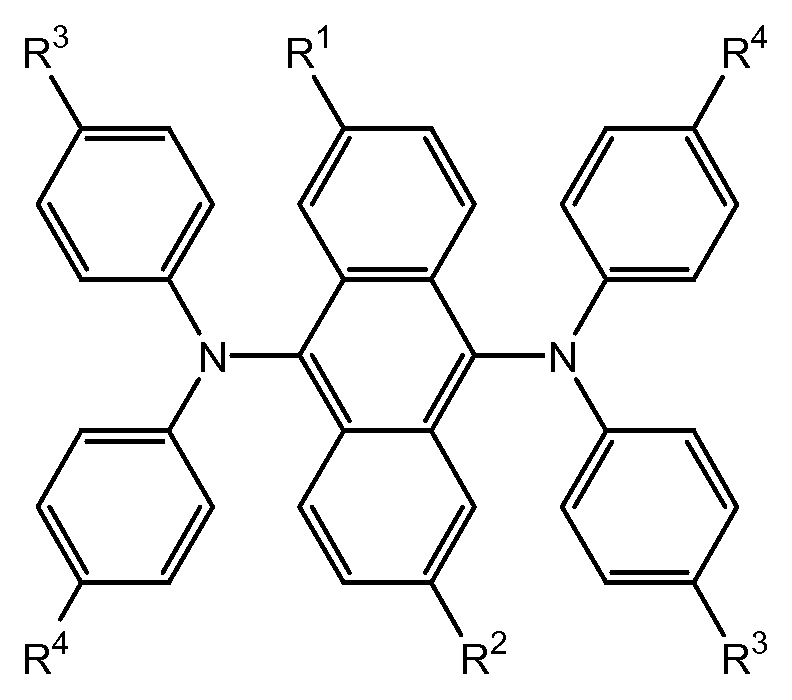
[화학식 II]≪ RTI ID = 0.0 &

여기서, R1 및 R2는 동일하거나 상이할 수 있고, 수소, 알콕시, 3차 알킬 또는 사이클로알킬일 수 있다. R3 및 R4는 동일하거나 상이하고, 불소, 아릴 또는 알킬일 수 있다. 녹색 발광 재료를 포함하는 유기 전자 소자가 또한 제공된다.Here, R 1 and R 2 may be the same or different and may be hydrogen, alkoxy, tertiary alkyl or cycloalkyl. R 3 and R 4 are the same or different and may be fluorine, aryl or alkyl. An organic electronic device including a green light emitting material is also provided.
유기 전자 소자, 발광 재료, 광활성 층, 알킬, 알콕시 Organic electronic device, light emitting material, photoactive layer, alkyl, alkoxy
Description
관련 출원 자료Related Application Documents
본 출원은 전체적으로 본 명세서에 참고로 포함되는 2007년 6월 1일자 미국 가특허 출원 제60/941,380호로부터 35 U.S.C. § 119(e) 하에 우선권을 주장한다.This application is a continuation-in-part of U.S. Provisional Application No. 60 / 941,380, filed June 1, 2007, which is incorporated herein by reference in its entirety. Priority is given under § 119 (e).
본 발명은 일반적으로 녹색 발광 재료 및 그 합성에 관한 것이다.The present invention relates generally to green light emitting materials and their synthesis.
디스플레이(display)를 구성하는 발광 다이오드와 같이 광을 발광하는 유기 전자 소자가 많은 다양한 종류의 전자 장비에 존재한다. 그러한 소자 모두에서, 유기 활성 층이 2개의 전기 접촉 층 사이에 개재된다. 적어도 하나의 전기 접촉 층은 광투과성이어서 광이 전기 접촉 층을 통과할 수 있다. 유기 활성 층은 광투과성 전기 접촉 층을 가로질러 전기를 인가할 때 전기 접촉 층을 통해 광을 발광한다.BACKGROUND ART [0002] Organic electronic devices that emit light, such as light emitting diodes constituting a display, exist in many types of electronic equipment. In both such devices, an organic active layer is interposed between the two electrical contact layers. The at least one electrical contact layer is light transmissive so that light can pass through the electrical contact layer. The organic active layer emits light through the electrical contact layer when electricity is applied across the optically transparent electrical contact layer.
발광 다이오드에서 활성 성분으로서 유기 전계발광 화합물을 사용하는 것이 잘 알려져 있다. 안트라센, 티아다이아졸 유도체 및 쿠마린 유도체와 같은, 단순한 유기 분자가 전계발광을 나타내는 것으로 알려져 있다. 일부 경우에, 이러한 소분자 재료는 공정 및/또는 전자적 특성을 개선하기 위하여 호스트 재료 중의 도펀트로서 존재한다.It is well known to use organic electroluminescent compounds as active ingredients in light emitting diodes. Simple organic molecules, such as anthracene, thiadiazole derivatives and coumarin derivatives, are known to exhibit electroluminescence. In some cases, such small molecule materials are present as dopants in the host material to improve process and / or electronic properties.
새로운 발광 재료, 특히 녹색을 발광하는 발광 화합물이 계속 요구되고 있다.A new luminescent material, particularly a luminescent compound which emits green light, has been continuously required.
발명의 개요Summary of the Invention
하기 화학식 I 또는 화학식 II를 갖는 녹색 발광 재료가 제공된다.There is provided a green light-emitting material having the following general formula (I) or general formula (II).


여기서,here,
R1 및 R2는 동일하거나 상이하고, 수소, 알콕시, 3차 알킬 및 사이클로알킬로 이루어진 군으로부터 선택되며;R 1 and R 2 are the same or different and are selected from the group consisting of hydrogen, alkoxy, tertiary alkyl and cycloalkyl;
R3 및 R4는 동일하거나 상이하고, 불소, 아릴 및 알킬로 이루어진 군으로부 터 선택된다.R 3 and R 4 are the same or different and are selected from the group consisting of fluorine, aryl and alkyl.
일부 실시 형태에서, R1 및 R2 중 적어도 하나는 수소가 아니다.In some embodiments, at least one of R < 1 > and R < 2 >
제1 전기 접촉부, 제2 전기 접촉부 및 이들 부 사이의 광활성 층을 포함하며, 광활성 층이 상기 녹색 발광 재료를 포함하는 유기 전자 소자가 또한 제공된다.An organic electronic device is also provided, comprising a first electrical contact, a second electrical contact and a photoactive layer between these portions, wherein the photoactive layer comprises the green light emitting material.
상기의 일반적인 설명 및 하기의 상세한 설명은 단지 예시적이고 설명적이며, 첨부된 청구의 범위에서 한정되는 본 발명을 제한하지 않는다.The foregoing general description and the following detailed description are exemplary and explanatory only and are not restrictive of the invention, as defined by the appended claims.
본 명세서에 나타낸 개념의 이해를 증진시키기 위해 실시 형태가 첨부 도면에 도시되어 있다.Embodiments are shown in the accompanying drawings to promote an understanding of the concepts presented herein.
도 1은 유기 발광 다이오드의 일례를 예시하는 도면.BRIEF DESCRIPTION OF THE DRAWINGS Fig. 1 is a diagram illustrating an example of an organic light emitting diode. Fig.
숙련자는 도면 내의 대상이 단순하고 명확하게 도시되었으며 반드시 일정한 축척으로 도시되지는 않았음을 이해한다. 예를 들어, 도면 내의 대상들 중 일부의 치수는 실시 형태의 이해를 증진시키는 것을 돕기 위해 다른 대상에 비해 과장될 수도 있다.It will be understood by those skilled in the art that the objects in the figures are shown for simplicity and clarity and are not necessarily drawn to scale. For example, the dimensions of some of the objects in the figures may be exaggerated relative to other objects to help improve understanding of the embodiment.
많은 태양 및 실시 형태가 본 명세서에 기술되며 이들은 단지 예시적이며 제한적인 것은 아니다. 본 명세서를 읽은 후에, 숙련자는 다른 태양 및 실시 형태가 본 발명의 범주로부터 벗어남이 없이 가능함을 이해할 것이다.Many aspects and embodiments are described herein and are intended to be illustrative and not restrictive. After reading this specification, it will be understood by those skilled in the art that other forms and embodiments are possible without departing from the scope of the present invention.
실시 형태들 중 임의의 하나 이상의 실시 형태의 다른 특징 및 이득이 하기의 상세한 설명 및 청구의 범위로부터 명백해질 것이다. 상세한 설명은 먼저 용어의 정의와 해설에 대해 다루며, 녹색 발광 재료, 합성, 소자에 대해 이어지고, 마지막으로 실시예가 이어진다.Other features and advantages of any one or more of the embodiments will be apparent from the following detailed description and claims. The detailed description first deals with definitions and explanations of terms, followed by green luminescent materials, composites, devices, and finally the examples.
1. 용어의 정의 및 해설1. Definition and Explanation of Terms
이하에서 설명되는 실시 형태의 상세 사항을 다루기 전에, 몇몇 용어를 정의하거나 명확히 하기로 한다.Before dealing with the details of the embodiments described below, some terms will be defined or clarified.
용어 "알콕시"는 산소를 통해 부착되는, 화학식 OR (여기서, R은 알킬임)을 갖는 기를 의미하고자 하는 것이다.The term "alkoxy" is intended to mean a group having the formula OR (where R is alkyl), attached through oxygen.
용어 "알킬"은 지방족 탄화수소로부터 유도된 기를 의미하고자 하는 것으로, 선형, 분지형 또는 환형 기를 포함한다. 일부 실시 형태에서, 알킬은 1 내지 20개의 탄소 원자를 갖는다.The term "alkyl" is intended to mean a group derived from an aliphatic hydrocarbon, including linear, branched, or cyclic groups. In some embodiments, alkyl has 1 to 20 carbon atoms.
용어 "사이클로알킬"은 하나 이상의 고리 구조를 갖는 알킬 기를 의미하고자 하는 것이다. 일부 실시 형태에서, 사이클로알킬은 4 내지 20개의 탄소 원자를 갖는다. The term "cycloalkyl" is intended to mean an alkyl group having one or more ring structures. In some embodiments, the cycloalkyl has 4 to 20 carbon atoms.
용어 "2차 알킬"은 2차 탄소를 포함하는 알킬 기를 의미하고자 하는 것이다. 일부 실시 형태에서, 2차 알킬은 3 내지 20개의 탄소 원자를 갖는다. 용어 "2차 탄소"는 2개의 추가적인 탄소에 연결된 탄소를 의미하고자 하는 것이다.The term "secondary alkyl" is intended to mean an alkyl group containing a secondary carbon. In some embodiments, the secondary alkyl has from 3 to 20 carbon atoms. The term "secondary carbon" is intended to mean carbon linked to two additional carbons.
용어 "3차 알킬"은 3차 탄소를 포함하는 알킬 기를 의미하고자 하는 것이다. 일부 실시 형태에서, 3차 알킬은 4 내지 20개의 탄소 원자를 갖는다. 용어 "3차 탄소"는 3개의 추가적인 탄소에 연결된 탄소를 의미하고자 하는 것이다.The term "tertiary alkyl" is intended to mean an alkyl group comprising a tertiary carbon. In some embodiments, the tertiary alkyl has from 4 to 20 carbon atoms. The term "tertiary carbon" is intended to mean carbon linked to three additional carbons.
용어 "아릴"은 방향족 탄화수소로부터 유도된 기를 의미하고자 하는 것이다. 이 기는 하나 이상의 방향족 고리를 포함할 수 있다.The term "aryl" is intended to mean a group derived from an aromatic hydrocarbon. This group may contain one or more aromatic rings.
용어 "발광 재료" 및 "에미터"(emitter)는 (발광 다이오드 또는 발광 전기화학 전지에서와 같이) 인가된 전압에 의해 활성화될 때 광을 발광하는 재료를 의미하고자 하는 것이다.The terms "emissive material" and "emitter " are intended to mean materials that emit light when activated by an applied voltage (such as in a light emitting diode or a light emitting electrochemical cell).
용어 "녹색 발광 재료"는 대략 500 내지 600 ㎚ 범위의 파장에서 방출 최대값을 갖는 방사선을 방출할 수 있는 재료를 의미하고자 하는 것이다.The term "green luminescent material" is intended to mean a material capable of emitting radiation having a maximum emission maximum at a wavelength in the range of 500 to 600 nm.
용어 "층"은 용어 "필름"과 상호 교환 가능하게 사용되고, 원하는 영역을 덮는 코팅을 말한다. 이 용어는 크기에 의해 제한되지 않는다. 상기 영역은 전체 소자만큼 크거나, 실제 시각 디스플레이와 같은 특정 기능 영역만큼 작거나, 또는 단일 서브픽셀만큼 작을 수 있다. 층과 필름은 증착, 액체 침착 (연속 및 불연속 기술), 및 열전사를 비롯한 임의의 종래 침착 기술에 의해 형성될 수 있다. 연속 침착 기술은 스핀 코팅, 그라비어 코팅, 커튼 코팅, 딥 코팅, 슬롯-다이 코팅, 스프레이 코팅, 및 연속 노즐 코팅을 포함하지만 이로 한정되지 않는다. 불연속 침착 기술은 잉크젯 인쇄, 그라비어 인쇄, 및 스크린 인쇄를 포함하지만 이로 한정되지 않는다.The term "layer" is used interchangeably with the term "film " and refers to a coating that covers the desired area. The term is not limited by size. The area may be as large as the entire device, as small as a certain functional area, such as an actual time display, or as small as a single sub-pixel. Layers and films may be formed by any conventional deposition technique, including deposition, liquid deposition (continuous and discontinuous techniques), and thermal transfer. Continuous deposition techniques include, but are not limited to, spin coating, gravure coating, curtain coating, dip coating, slot-die coating, spray coating, and continuous nozzle coating. Discontinuous deposition techniques include, but are not limited to, inkjet printing, gravure printing, and screen printing.
용어 "유기 전자 소자" 또는 때때로 단지 "전자 소자"는 하나 이상의 유기 반도체 층 또는 재료를 포함하는 소자를 의미하고자 하는 것이다.The term "organic electronic device" or sometimes only "electronic device" is intended to mean an element comprising one or more organic semiconductor layers or materials.
본 명세서에서 사용되는 바와 같이, "포함하다 ", "포함하는", "함유하다", "함유하는", "갖는다", "갖는"이라는 용어 또는 이들의 임의의 다른 변형은 배타적이지 않은 포함을 커버하고자 한다. 예를 들어, 요소들의 목록을 포함하는 공정, 방법, 용품, 또는 장치는 반드시 그러한 요소만으로 제한되지는 않고, 명확하게 열거되지 않거나 그러한 공정, 방법, 용품, 또는 장치에 내재적인 다른 요소를 포함할 수도 있다. 더욱이, 명백히 반대로 기술되지 않는다면, "또는"은 포괄적인 '또는'을 말하며 배타적인 '또는'을 말하는 것은 아니다. 예를 들어, 조건 A 또는 B는 하기 중 어느 하나에 의해 만족된다: A는 참 (또는 존재함)이고 B는 거짓 (또는 존재하지 않음), A는 거짓 (또는 존재하지 않음)이고 B는 참 (또는 존재함), A 및 B 둘 모두가 참 (또는 존재함).As used herein, the terms "comprise," "including," "containing," "containing," "having," "having," or any other variation thereof, I want to cover it. For example, a process, method, article, or apparatus that comprises a list of elements is not necessarily limited to such elements, but may include other elements not expressly listed or inherent to such process, method, article, or apparatus It is possible. Moreover, unless expressly stated to the contrary, "or" does not mean " comprehensive " or " exclusive " For example, the condition A or B is satisfied by either: A is true (or exists), B is false (or not present), A is false (or nonexistent) (Or present), A and B are both true (or present).
또한, 부정관사("a" 또는 "an")의 사용은 본 명세서에서 설명되는 요소 및 구성요소를 설명하기 위해 채용된다. 이는 단지 편의상 그리고 본 발명의 범주의 전반적인 의미를 제공하기 위해 행해진다. 이러한 기재는 하나 또는 적어도 하나를 포함하는 것으로 이해되어야 하고, 단수형은 그가 달리 의미하는 것이 명백하지 않으면 복수를 또한 포함한다.In addition, the use of the indefinite article ("a" or "an") is employed to illustrate the elements and components described herein. This is done merely for convenience and to provide an overall sense of the scope of the invention. It is to be understood that such description includes one or at least one, and the singular also includes the plural unless it is obvious that what he otherwise means.
원소의 주기율표 내의 칼럼(column)에 대응하는 족(group) 번호는 문헌[CRC Handbook of Chemistry and Physics, 81st Edition (2000-2001)]에서 보이는 바와 같은 "새로운 표기"(New Notation) 규정을 사용한다.Group in the periodic table of the elements corresponding to the column (column) (group) number using the "new notation" (New Notation) defined as shown in the literature [CRC Handbook of Chemistry and Physics, 81 st Edition (2000-2001)] do.
달리 정의되지 않으면, 본 명세서에서 사용되는 모든 기술적 및 과학적 용어는 본 발명이 속하는 기술 분야의 숙련자에 의해 통상적으로 이해되는 바와 동일한 의미를 갖는다. 본 명세서에서 설명되는 것과 유사하거나 등가인 방법 및 재료가 본 발명의 실시 형태의 실시 또는 시험에서 사용될 수 있지만, 적합한 방법 및 재료가 후술된다. 본 명세서에서 언급되는 모든 간행물, 특허 출원, 특허 및 다른 참고 문헌은 전체적으로 참고로 포함되며, 상충되는 경우 특정 어구(passage)가 언급되지 않으면, 정의를 비롯한 본 명세서가 우선할 것이다. 게다가, 재료, 방법, 및 실시예는 단지 예시적인 것이며 제한하고자 하는 것은 아니다.Unless otherwise defined, all technical and scientific terms used herein have the same meaning as commonly understood by one of ordinary skill in the art to which this invention belongs. Although methods and materials similar or equivalent to those described herein can be used in the practice or testing of embodiments of the present invention, suitable methods and materials are described below. All publications, patent applications, patents, and other references mentioned herein are incorporated by reference in their entirety and, unless otherwise specified, where a particular passage is referred to, the present specification, including definitions, will control. In addition, the materials, methods, and embodiments are illustrative only and not intended to be limiting.
본 명세서에서 설명되지 않으면, 특정 재료, 가공 행위, 및 회로에 관한 많은 상세 사항은 통상적인 것으로, 유기 발광 다이오드 디스플레이, 광검출기, 광기전, 및 반전도성 부재 기술 분야 내의 교재 및 기타 출처에서 발견할 수 있다.Many details regarding specific materials, fabrication behaviors, and circuitry are not described herein and are conventional and may be found in textbooks and other sources in the art of organic light emitting diode displays, photodetectors, photoconductors, .
2. 녹색 발광 재료2. Green luminous material
본 명세서에 기재된 새로운 녹색 발광 재료는 하기 화학식 I 또는 화학식 II를 갖는다.The novel green light emitting material described herein has the following formula (I) or formula (II).
[화학식 I](I)

[화학식 II]≪ RTI ID = 0.0 &

여기서,here,
R1 및 R2는 동일하거나 상이하고, 수소, 알콕시, 3차 알킬 및 사이클로알킬로 이루어진 군으로부터 선택된다.R 1 and R 2 are the same or different and are selected from the group consisting of hydrogen, alkoxy, tertiary alkyl and cycloalkyl.
R3 및 R4는 동일하거나 상이하고, 불소, 아릴 및 알킬로 이루어진 군으로부터 선택된다.R 3 and R 4 are the same or different and are selected from the group consisting of fluorine, aryl and alkyl.
일부 실시 형태에서, 알콕시 기는 1 내지 10개의 탄소 원자를 가지며; 일부 실시 형태에서는, 1 내지 5개의 탄소 원자를 갖는다. 적합한 알콕시 기의 예에는 메톡시 및 에톡시 기가 포함되지만 이로 한정되지 않는다.In some embodiments, the alkoxy group has 1 to 10 carbon atoms; In some embodiments, from 1 to 5 carbon atoms. Examples of suitable alkoxy groups include, but are not limited to, methoxy and ethoxy groups.
일부 실시 형태에서, 3차 알킬 기는 4 내지 12개의 탄소 원자를 가지며, 일부 실시 형태에서는, 4 내지 6개의 탄소 원자를 갖는다. 적합한 3차 알킬 기의 예에는 3차 부틸 및 네오펜틸 기가 포함되지만 이로 한정되지 않는다.In some embodiments, the tertiary alkyl group has from 4 to 12 carbon atoms, and in some embodiments, from 4 to 6 carbon atoms. Examples of suitable tertiary alkyl groups include, but are not limited to, tertiary butyl and neopentyl groups.
일부 실시 형태에서, 사이클로알킬 기는 6 내지 20개의 탄소 원자를 가지며, 일부 실시 형태에서는, 6 내지 12개의 탄소 원자를 갖는다. 적합한 사이클로알킬 기의 예에는 사이클로헥실, 1-메틸사이클로헥실 및 1-아다만틸 기가 포함되지만 이로 한정되지 않는다.In some embodiments, the cycloalkyl group has from 6 to 20 carbon atoms, and in some embodiments, from 6 to 12 carbon atoms. Examples of suitable cycloalkyl groups include, but are not limited to, cyclohexyl, 1-methylcyclohexyl and 1-adamantyl groups.
일부 실시 형태에서, R1과 R2는 동일하다.In some embodiments, R 1 and R 2 are the same.
일부 실시 형태에서, R3 및 R4 중 적어도 하나는 2차 알킬 또는 3차 알킬이다. 일부 실시 형태에서, R3 및 R4 중 적어도 하나는 아릴 기이다. 일부 실시 형태에서, 아릴 기는 페닐, 나프틸, 바이페닐 및 터페닐 기로부터 선택된다. 일부 실시 형태에서, R3와 R4는 동일하다.In some embodiments, at least one of R 3 and R 4 is secondary alkyl or tertiary alkyl. In some embodiments, at least one of R3 and R4 is an aryl group. In some embodiments, the aryl group is selected from phenyl, naphthyl, biphenyl, and terphenyl groups. In some embodiments, R 3 and R 4 are the same.
화학식 I 또는 화학식 II를 갖는 녹색 발광 재료의 예에는 하기 표 1의 화합물 G1 내지 G12가 포함되지만 이로 한정되지 않는다.Examples of green light emitting materials having Formula (I) or Formula (II) include, but are not limited to, compounds G1 to G12 of Table 1 below.

3. 합성3. Synthesis
본 명세서에 기재된 녹색 발광 재료는 일반적으로 하기 도식(scheme)에 따라 제조된다:The green light emitting materials described herein are generally prepared according to the following scheme:
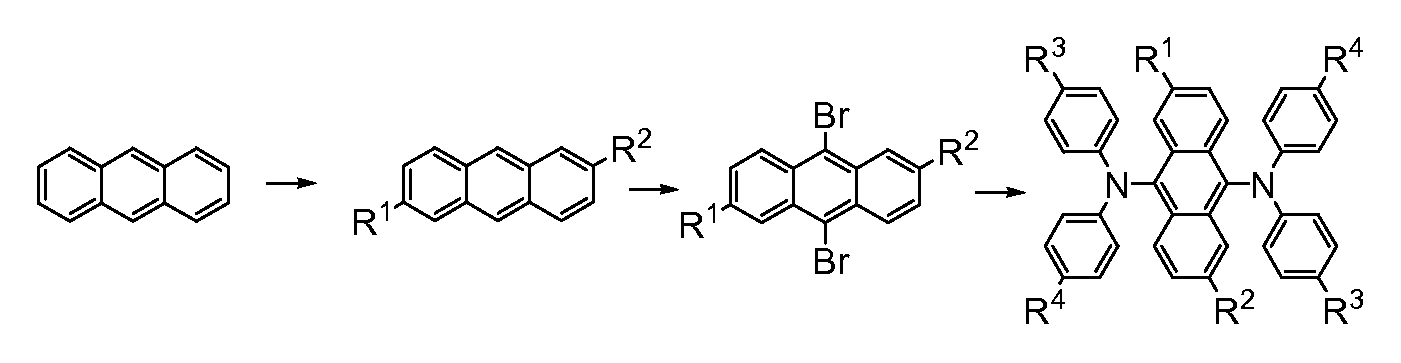
R1이 R2와 동일한 경우, 제1 단계는 적절한 알코올, 예를 들어, t-부탄올, 1-아다만탄올 또는 1-메틸사이클로헥산올을 사용하여 프리델 크라프츠 화학반응(Friedel Crafts chemistry)을 이용하여 안트라센을 알킬화하는 것을 포함한다. 이는 일반적으로 가열하면서 순수한 트라이플루오로아세트산과 같은 용매 중에서 실시할 수 있으며, 분리 및 크로마토그래피 정제가 이어진다. 일부 화합물의 경우, 치환된 안트라센, 예를 들어, 2-t-부틸안트라센은 구매가능하다.When R 1 is the same as R 2 , the first step is a Friedel Crafts chemistry using an appropriate alcohol, for example, t-butanol, To alkylate anthracene. This can generally be carried out in a solvent such as pure trifluoroacetic acid with heating, followed by separation and chromatographic purification. For some compounds, substituted anthracene, such as 2-t-butyl anthracene, is commercially available.
이어서, 치환된 안트라센을, 예를 들어, CCl4 중의 Br2를 사용하여, 브롬화할 수 있다. R1이 R2와 동일하며 이들이 H인 화합물의 경우, 다이브로마이드는 구매가능하다.Substituted anthracene can then be brominated, for example using Br 2 in CCl 4 . For compounds where R < 1 > is the same as R < 2 > and they are H, dibromide is commercially available.
이어서, 브롬화된 생성물은 Pd 촉매를 사용하여 적절한 2차 아민과 반응시킨다. Pd 촉매 아미노화(Pd catalyzed amination)에 의해서 2차 아민을 또한 제조할 수 있다.The brominated product is then reacted with the appropriate secondary amine using a Pd catalyst. Secondary amines can also be prepared by Pd catalyzed amination.
치환체가 알콕시 기인 경우에, 다이하이드록시안트로퀴논의 에테르화, 이어서 수소화물 환원에 의해서 치환된 안트라센 중간체를 제조할 수 있다.When the substituent is an alkoxy group, an anthracene intermediate substituted by etherification of dihydroxyanthroquinone followed by hydride reduction can be prepared.
많은 경우에, 화학식 I 및 화학식 II를 갖는 화합물들의 혼합물이 형성된다. 물리적 특성에 따라, 화합물들을 분리하거나 혼합물로서 사용할 수 있다.In many cases, a mixture of compounds having formula (I) and formula (II) is formed. Depending on the physical properties, the compounds may be separated or used as a mixture.
4. 소자4. Device
본 명세서에 기재된 녹색 발광 재료를 포함하는 하나 이상의 층을 갖는 것으로부터 이익을 얻을 수 있는 유기 전자 소자는 (1) 전기 에너지를 방사선으로 변환하는 소자(예컨대, 발광 다이오드, 발광 다이오드 디스플레이, 또는 다이오드 레이저), (2) 전자공학적 공정을 통해 신호를 검출하는 소자(예컨대, 광검출기, 광전도성 전지, 포토레지스터, 광스위치, 광트랜지스터, 광전관, IR 검출기), (3) 방사선을 전기 에너지로 변환하는 소자(예컨대, 광기전 장치 또는 태양 전지), 및 (4) 하나 이상의 유기 반도체 층을 포함하는 하나 이상의 전자 구성요소를 포함하는 소자(예컨대, 트랜지스터 또는 다이오드)를 포함하지만 이로 한정되지 않는다.Organic electronic devices that can benefit from having one or more layers comprising the green light emitting material described herein include (1) devices that convert electrical energy to radiation (e.g., light emitting diodes, light emitting diode displays, or diode lasers A photodetector, a photoconductive battery, a photoresistor, an optical switch, a phototransistor, a phototube, an IR detector), (3) a device that converts a radiation into electrical energy (E. G., Transistors or diodes) that include one or more electronic components including one or more organic semiconductor layers (e. G., Photovoltaic devices or solar cells), and (4) one or more organic semiconductor layers.
유기 전자 소자 구조의 하나의 예시가 도 1에 도시되어 있다. 소자(100)는 제1 전기 접촉 층, 애노드 층(110) 및 제2 전기 접촉 층, 캐소드 층(160), 및 이들 사이의 광활성 층(140)을 갖는다. 완충 층(120)은 애노드와 인접한다. 정공 수송 재료를 포함하는 정공 수송 층(130)은 완충 층과 인접한다. 전자 수송 재료를 포함하는 전자 수송 층(150)이 캐소드와 인접할 수도 있다. 선택 사양으로서, 소자는 애노드(110) 옆의 하나 이상의 추가적인 정공 주입 또는 정공 수송 층(도시하지 않음) 및/또는 캐소드(160) 옆의 하나 이상의 추가적인 전자 주입 또는 전자 수송 층(도시하지 않음)을 사용할 수 있다.One example of an organic electronic device structure is shown in FIG. The
일 실시 형태에서, 상이한 층들은 하기 두께 범위를 갖는다: 애노드(110)는 500 내지 5000 Å이고, 일 실시 형태에서는 1000 내지 2000 Å이며; 완충 층(120)은 50 내지 2000 Å이고, 일 실시 형태에서는 200 내지 1000 Å이며; 정공 수송 층(120)은 50 내지 2000 Å이고, 일 실시 형태에서는 200 내지 1000 Å이며; 광활성 층(130)은 10 내지 2000 Å이고, 일 실시 형태에서는 100 내지 1000 Å이며; 층(140)은 50 내지 2000 Å이고, 일 실시 형태에서는 100 내지 1000 Å이며; 캐소드(150)는 200 내지 10000 Å이고, 일 실시 형태에서는 300 내지 5000 Å이다. 소자 중의 전자-정공 재조합 구역의 위치, 및 따라서 소자의 발광 스펙트럼은 각 층의 상대적인 두께에 의해 영향을 받을 수 있다. 층 두께의 원하는 비는 사용된 재료의 정확한 성질에 의존적일 것이다.In one embodiment, the different layers have the following thickness ranges:
a. 광활성 층a. Photoactive layer
본 명세서에 기재된 녹색 발광 재료는 광활성 층(140)의 광활성 재료로서 특히 적합하다. 이 재료는 단독으로, 다른 발광 재료와 조합하여, 또는 호스트 재료 중에 사용될 수 있다.The green light emitting material described herein is particularly suitable as the photoactive material of the
일부 실시 형태에서, 호스트는 비스-축합 환형 방향족 화합물이다.In some embodiments, the host is a bis-condensed cyclic aromatic compound.
일부 실시 형태에서, 호스트는 안트라센 유도체 화합물이다. 일부 실시 형태에서, 당해 화합물은 하기 화학식을 갖는다:In some embodiments, the host is an anthracene derivative compound. In some embodiments, the compound has the formula:
An - L- AnAn-L-An
여기서,here,
An은 안트라센 부분이며;An is an anthracene moiety;
L은 2가 연결기이다.L is a divalent linking group.
이 화학식의 일부 실시 형태에서, L은 단일 결합, -O-, -S-, -N(R) -, 또는 방향족 기이다. 일부 실시 형태에서, An은 모노- 또는 다이페닐안트릴 부분이다.In some embodiments of this formula, L is a single bond, -O-, -S-, -N (R) -, or an aromatic group. In some embodiments, An is a mono- or diphenyl anthryl moiety.
일부 실시 형태에서, 호스트는 하기 화학식을 갖는다: In some embodiments, the host has the formula:
A - An - AA - An - A
여기서,here,
An은 안트라센 부분이며;An is an anthracene moiety;
A는 방향족 기이다.A is an aromatic group.
일부 실시 형태에서, 호스트는 다이아릴안트라센이다. 일부 실시 형태에서 당해 화합물은 대칭이고, 일부 실시 형태에서 당해 화합물은 비대칭이다.In some embodiments, the host is diaryl anthracene. In some embodiments, the compound is symmetric and in some embodiments the compound is asymmetric.
일부 실시 형태에서, 호스트는 하기 화학식을 갖는다:In some embodiments, the host has the formula:

여기서,here,
A1 및 A2는 각각 나타날 때 동일하거나 상이하며, H, 방향족 기, 및 알켄일 기로 이루어진 군으로부터 선택되거나, 또는 A는 하나 이상의 융합된 방향족 고리를 나타낼 수 있고;A 1 and A 2, when present, are the same or different and are selected from the group consisting of H, an aromatic group, and an alkenyl group, or A may represent one or more fused aromatic rings;
p 및 q는 동일하거나 상이하며 1 내지 3의 정수이다.p and q are the same or different and an integer of 1 to 3;
일부 실시 형태에서, 안트라센 유도체는 비대칭이다. 일부 실시 형태에서, p는 2이고 q는 1이다. 일부 실시 형태에서, 적어도 하나의 A1 및 A2는 나프틸 기이다.In some embodiments, the anthracene derivative is asymmetric. In some embodiments, p is 2 and q is 1. In some embodiments, at least one of A 1 and A 2 is a naphthyl group.
일부 실시 형태에서, 호스트는In some embodiments, the host
H1H1

H2H2

및 그 조합으로 이루어진 군으로부터 선택된다.And combinations thereof.
b. 기타 소자 층b. Other element layers
소자 내의 기타 층은 그러한 층에 유용한 것으로 공지된 임의의 재료로 만들어질 수 있다.Other layers within the device may be made of any material known to be useful in such layers.
애노드(110)는 양전하 캐리어를 주입하는 데 있어서 특히 효율적인 전극이다. 이것은 예를 들어, 금속, 혼합 금속, 합금, 금속 산화물 또는 혼합-금속 산화물을 함유하는 재료로 제조될 수 있거나, 또는 이것은 전도성 중합체, 및 그 혼합물일 수 있다. 적합한 금속은 11족 금속, 4, 5 및 6족 금속, 및 8 내지 10족 전이 금속을 포함한다. 애노드가 투광성이어야 하는 경우, 12, 13 및 14족 금속의 혼합-금속 산화물, 예를 들어, 인듐 주석 산화물이 일반적으로 사용된다. 애노드는 또한 문헌["Flexible light-emitting diodes made from soluble conducting polymer, " Nature vol. 357, pp 477 479 (11 June 1992)]에 기재된 바와 같이 폴리아닐린과 같은 유기 재료를 포함할 수 있다. 발생된 광의 관찰이 허용되도록 애노드 및 캐소드 중 적어도 하나는 적어도 부분적으로 투명해야만 한다.The
완충 층(120)은 완충 재료를 포함하며, 유기 전자 소자에서, 하부 층의 평탄화, 전하 수송 및/또는 전하 주입 특성, 산소 또는 금속 이온과 같은 불순물의 제거, 및 유기 전자 소자의 성능을 증진 또는 개선하는 다른 측면을 포함하지만 이로 한정되지 않는 하나 이상의 기능을 가질 수 있다. 완충 층은 양성자성 산(protonic acid)으로 종종 도핑되는, 폴리아닐린(PANI) 또는 폴리에틸렌다이옥시티오펜(PEDOT)과 같은 중합체 재료로 형성될 수 있다. 양성자성 산은 예를 들어 폴리(스티렌설폰산), 폴리(2-아크릴아미도-2-메틸-1-프로판설폰산) 등일 수 있다.The
완충 층은 구리 프탈로시아닌 및 테트라티아풀발렌-테트라시아노퀴노다이메탄 시스템(TTF-TCNQ)과 같은, 전하 전달 화합물 등을 포함할 수 있다.The buffer layer may comprise a charge transfer compound, such as copper phthalocyanine and a tetra thiafulene-tetracyanoquinodimethane system (TTF-TCNQ).
일부 실시 형태에서, 완충 층은 적어도 하나의 전기적 전도성 중합체 및 적어도 하나의 플루오르화 산 중합체를 포함한다.In some embodiments, the buffer layer comprises at least one electrically conductive polymer and at least one fluorinated acid polymer.
일부 실시 형태에서, 전기적 전도성 중합체는 전도도가 적어도 10-7 S/㎝인 필름을 형성할 것이다. 전도성 중합체를 형성하는 단량체는 "전구체 단량체"로 지칭된다. 공중합체는 하나 초과의 전구체 단량체를 가질 것이다.In some embodiments, the electrically conductive polymer will form a film having a conductivity of at least 10 -7 S / cm. Monomers forming conductive polymers are referred to as "precursor monomers ". The copolymer will have more than one precursor monomer.
일부 실시 형태에서, 전도성 중합체는 티오펜, 셀레노펜, 텔루로펜, 피롤, 아닐린 및 다환식 방향족 물질로부터 선택된 적어도 하나의 전구체 단량체로부터 제조된다. 이러한 단량체로부터 제조된 중합체는 본 명세서에서 각각 폴리티오펜, 폴리(셀레노펜), 폴리(텔루로펜), 폴리피롤, 폴리아닐린, 및 다환식 방향족 중합체로 지칭된다. "다환식 방향족"이라는 용어는 하나 초과의 방향족 고리를 갖는 화합물을 말한다. 고리들은 하나 이상의 결합에 의해 연결될 수 있거나, 또는 이들은 함께 융합될 수 있다. "방향족 고리"라는 용어는 헤테로방향족 고리를 포함하고자 한다. "다환식 헤테로방향족" 화합물은 적어도 하나의 헤테로방향족 고리를 갖는다. 일부 실시 형태에서, 다환식 방향족 중합체는 폴리(티에노티오펜)이다.In some embodiments, the conductive polymer is prepared from at least one precursor monomer selected from thiophene, selenophene, telulophene, pyrrole, aniline, and polycyclic aromatic materials. Polymers prepared from these monomers are referred to herein as polythiophenes, poly (selenophenes), poly (telulophenes), polypyrroles, polyanilines, and polycyclic aromatic polymers, respectively. The term "polycyclic aromatic" refers to a compound having more than one aromatic ring. The rings may be connected by one or more bonds, or they may be fused together. The term "aromatic ring" is intended to include a heteroaromatic ring. A "polycyclic heteroaromatic" compound has at least one heteroaromatic ring. In some embodiments, the polycyclic aromatic polymer is poly (thienothiophene).
플루오르화 산 중합체는 플루오르화되고 산성 양성자를 갖는 산성 기를 갖는 임의의 중합체일 수 있다. 이 용어는 부분적으로 및 완전히 플루오르화된 재료를 포함한다. 일부 실시 형태에서, 플루오르화 산 중합체는 고도로 플루오르화된다. "고도로 플루오르화된"이라는 용어는 탄소에 결합된 이용가능한 수소의 적어도 50%가 불소로 치환되었음을 의미한다. 산성 기는 이온가능한 양성자를 제공한다. 일부 실시 형태에서, 산성 양성자는 pKa가 3 미만이다. 일부 실시 형태에서, 산성 양성자는 pKa가 0 미만이다. 일부 실시 형태에서, 산성 양성자는 pKa가 -5 미만이다. 산성 기는 중합체 골격에 직접 부착될 수 있거나, 또는 이것은 중합체 골격 상의 측쇄에 부착될 수 있다. 산성 기의 예에는, 카르복실산 기, 설폰산 기, 설폰이미드 기, 인산 기, 포스폰산 기, 및 그 조합이 포함되지만 이로 한정되지 않는다. 산성 기는 모두 동일할 수 있거나, 또는 중합체는 하나 초과의 유형의 산성 기를 가질 수 있다.The fluorinated acid polymer may be any polymer that has been fluorinated and has acidic groups with acidic protons. The term includes partially and fully fluorinated materials. In some embodiments, the fluorinated acid polymer is highly fluorinated. The term " highly fluorinated "means that at least 50% of the available hydrogen bound to carbon has been replaced by fluorine. Acidic groups provide ionizable proton. In some embodiments, the acidic proton has a pKa of less than 3. In some embodiments, the acidic proton has a pKa of less than zero. In some embodiments, the acidic proton has a pKa of less than -5. The acidic group can be attached directly to the polymer backbone, or it can be attached to the side chain on the polymer backbone. Examples of acidic groups include, but are not limited to, carboxylic acid groups, sulfonic acid groups, sulfonimide groups, phosphoric acid groups, phosphonic acid groups, and combinations thereof. The acid groups may all be the same, or the polymer may have more than one type of acidic group.
일부 실시 형태에서, 플루오르화 산 중합체는 수-용해성이다. 일부 실시 형태에서, 플루오르화 산 중합체는 물에 분산가능하다. 일부 실시 형태에서, 플루오르화 산 중합체는 유기 용매 습윤성이다.In some embodiments, the fluorinated acid polymer is water-soluble. In some embodiments, the fluoro acid polymer is dispersible in water. In some embodiments, the fluorinated acid polymer is organic solvent wettable.
일부 실시 형태에서, 플루오르화 산 중합체는 플루오르화된 중합체 골격을 갖는다. 적합한 중합체성 골격의 예에는 폴리올레핀, 폴리아크릴레이트, 폴리메타크릴레이트, 폴리이미드, 폴리아미드, 폴리아라미드, 폴리아크릴아미드, 폴리스티렌, 및 그 공중합체가 포함되지만 이로 한정되지 않는다. 일부 실시 형태에서, 중합체 골격은 고도로 플루오르화된다. 일부 실시 형태에서, 중합체 골격은 완전하게 플루오르화된다.In some embodiments, the fluorinated acid polymer has a fluorinated polymer backbone. Examples of suitable polymeric backbones include, but are not limited to, polyolefins, polyacrylates, polymethacrylates, polyimides, polyamides, polyaramides, polyacrylamides, polystyrenes, and copolymers thereof. In some embodiments, the polymer backbone is highly fluorinated. In some embodiments, the polymer backbone is completely fluorinated.
일부 실시 형태에서, 산성 기는 설폰산 기 또는 설폰이미드 기이다. 설폰이미드 기는 하기 화학식을 갖는다:In some embodiments, the acidic group is a sulfonic acid group or a sulfonimide group. The sulfonimide group has the formula:
-SO2-NH-SO2-R-SO 2 -NH-SO 2 -R
여기서, R은 알킬기이다.Wherein R is an alkyl group.
일부 실시 형태에서, 산성 기는 플루오르화된 측쇄 상에 있다. 일부 실시 형태에서, 플루오르화된 측쇄는 알킬기, 알콕시기, 아미도기, 에테르기, 및 그 조합으로부터 선택된다.In some embodiments, the acid group is on the fluorinated side chain. In some embodiments, the fluorinated side chain is selected from an alkyl group, an alkoxy group, an amido group, an ether group, and combinations thereof.
일부 실시 형태에서, 플루오르화 산 중합체는 펜던트 플루오르화 에테르 설포네이트, 플루오르화된 에스테르 설포네이트, 또는 플루오르화된 에테르 설폰이미드기를 갖는 플루오르화된 올레핀 골격을 갖는다. 일부 실시 형태에서, 중합체는 1,1-다이플루오로에틸렌과 2-(1,1-다이플루오로-2-(트라이플루오로메틸)알릴옥시) -1,1,2,2-테트라플루오로에탄설폰산의 공중합체이다. 일부 실시 형태에서, 중합체는 에틸렌과 2-(2-(1,2,2-트라이플루오로비닐옥시)-1,1,2,3,3,3-헥사플루오로프로폭시)-1,1,2,2-테트라플루오로에탄설폰산의 공중합체이다. 이들 공중합체는 상응하는 설포닐 플루오라이드 중합체로서 제조될 수 있고, 그 후에 설폰산 형태로 변환될 수 있다. In some embodiments, the fluorinated acid polymer has a fluorinated olefin skeleton having a pendant fluorinated ether sulfonate, a fluorinated ester sulfonate, or a fluorinated ether sulfonimide group. In some embodiments, the polymer is selected from the group consisting of 1,1-difluoroethylene and 2- (1,1-difluoro-2- (trifluoromethyl) allyloxy) -1,1,2,2-tetrafluoro Ethanesulfonic acid. In some embodiments, the polymer is selected from the group consisting of ethylene and 2- (2- (1,2,2-trifluorovinyloxy) -1,1,2,3,3,3-hexafluoropropoxy) -1,1 , 2,2-tetrafluoroethanesulfonic acid. These copolymers can be prepared as the corresponding sulfonyl fluoride polymers and then converted into the sulfonic acid form.
일부 실시 형태에서, 플루오르화 산 중합체는 플루오르화된 그리고 부분적으로 설폰화된 폴리(아릴렌 에테르 설폰)의 단일중합체 또는 공중합체이다. 공중합체는 블록 공중합체일 수 있다. 공단량체의 예는 부타디엔, 부틸렌, 아이소부틸렌, 스티렌, 및 그 조합을 포함하지만 이로 한정되지 않는다.In some embodiments, the fluorinated acid polymer is a homopolymer or copolymer of fluorinated and partially sulfonated poly (arylene ether sulfone). The copolymer may be a block copolymer. Examples of comonomers include but are not limited to butadiene, butylene, isobutylene, styrene, and combinations thereof.
일부 실시 형태에서, 완충 층은 전기적 전도성 중합체 및 콜로이드-형성 중합체성 산의 수성 분산물로부터 제조된다. 그러한 재료는 예를 들어 미국 특허 출원 공개 제2004-0102577호, 제2004-0127637호, 및 제2005-0205860호에 설명되어 있다.In some embodiments, the buffer layer is prepared from an aqueous dispersion of an electrically conductive polymer and a colloid-forming polymeric acid. Such materials are described, for example, in U.S. Patent Application Publication Nos. 2004-0102577, 2004-0127637, and 2005-0205860.
정공 수송 층(130)은 층의 두께를 통한 양전하의 이동을 상대적으로 효율적으로 그리고 전하의 손실이 작게 촉진하는 층이다. 정공 수송 층을 위한 정공 수송 재료의 예는, 예를 들어, 문헌[Kirk-Othmer Encyclopedia of Chemical Technology, Fourth Edition, Vol. 18, p. 837-860, 1996, by Y. Wang]에 요약되어 있다. 정공 수송 소분자 및 중합체 둘 모두가 사용될 수 있다. 통상적으로 사용되는 정공 수송 분자는 4,4',4"-트리스(N,N-다이페닐-아미노)-트라이페닐아민 (TDATA); 4,4',4"-트리스(N-3-메틸페닐-N-페닐-아미노)-트라이페닐아민 (MTDATA); N,N-'다이페닐-N,N'-비스(3-메틸페닐)-[1,1'-바이페닐]-4,4'-다이아민 (TPD); 4, 4'-비스(카르바졸-9-일)바이페닐 (CBP); 1,3-비스(카르바졸-9-일)벤젠 (mCP); 1,1-비스((다이-4-톨릴아미노) 페닐]사이클로헥산 (TAPC); N,N'-비스(4-메틸페닐)-N,N'-비스(4-에틸페닐)-[1,1'-(3,3'-다이메틸)바이페닐]-4,4'-다이아민 (ETPD); 테트라키스-(3-메틸페닐)-N,N,N',N'-2,5-페닐렌다이아민 (PDA); α-페닐4-N,N-다이페닐아미노스티렌 (TPS); p-(다이에틸아미노)벤즈알데히드 다이페닐하이드라존 (DEH); 트라이페닐아민 (TPA); 비스[4-(N,N-다이에틸아미노)-2-메틸페닐](4-메틸페닐)메탄 (MPMP); 1-페닐-3-[p-(다이에틸아미노)스티릴]-5-[p-(다이에틸아미노)페닐] 피라졸린 (PPR 또는 DEASP);1,2트랜스-비스(9H-카르바졸-9-일)사이클로부탄 (DCZB); N,N,N',N'-테트라키스(4-메틸페닐)-(1,1'-바이페닐)-4,4'-다이아민 (TTB); N,N'-비스(나프탈렌-1-일)-N,N'-비스-(페닐)벤지딘 (α-NPB); 및 포르피린 화합물, 예를 들어 구리 프탈로시아닌을 포함하지만 이로 한정되지 않는다. 통상적으로 사용되는 정공 수송 중합체는 폴리비닐카르바졸, (페닐메틸)폴리실란, 폴리(다이옥시티오펜), 폴리아닐린, 및 폴리피롤을 포함하지만 이로 한정되지 않는다. 전술된 것과 같은 정공 수송 분자를 폴리스티렌 및 폴리카르보네이트와 같은 중합체 내로 도핑함으로써 정공 수송 중합체를 또한 얻을 수 있다.The
일부 실시 형태에서, 정공 수송 층은 정공 수송 중합체를 포함한다. 일부 실시 형태에서, 정공 수송 중합체는 다이스티릴아릴 화합물이다. 일부 실시 형태에서, 아릴기는 둘 이상의 융합된 방향족 고리를 갖는다. 일부 실시 형태에서, 아릴기는 아센이다. 본 명세서에 사용되는 바와 같이, "아센"이라는 용어는 둘 이상의 오르토-융합된 벤젠 고리를 직선형 배열로 포함하는 탄화수소 부모 성분을 말한다.In some embodiments, the hole transport layer comprises a hole transport polymer. In some embodiments, the hole transport polymer is a styryl aryl compound. In some embodiments, the aryl group has two or more fused aromatic rings. In some embodiments, the aryl group is acen. As used herein, the term "arsenic" refers to a hydrocarbon parent moiety comprising two or more ortho-fused benzene rings in a linear array.
일부 실시 형태에서, 정공 수송 중합체는 아릴아민 중합체이다. 일부 실시 형태에서, 이것은 플루오렌 및 아릴아민 단량체의 공중합체이다.In some embodiments, the hole transport polymer is an arylamine polymer. In some embodiments, it is a copolymer of fluorene and arylamine monomers.
일부 실시 형태에서, 중합체는 가교결합성 기를 갖는다. 일부 실시 형태에서, 가교결합은 열처리 및/또는 UV 또는 가시 방사선 노출에 의해 성취될 수 있다. 가교결합성 기의 예에는 비닐, 아크릴레이트, 퍼플루오로비닐에테르, 1-벤조-3,4-사이클로부탄, 실록산, 및 메틸 에스테르가 포함되지만 이로 한정되지 않는다. 가교결합성 중합체는 용액-공정 OLED의 제작에서 이점을 가질 수 있다. 침착 후에 불용성 필름으로 변환될 수 있는 층을 형성하기 위하여 용해성 중합체성 재료를 적용하는 것은 층분리 문제가 없는 다층 용액-처리 OLED 소자의 제작을 허용할 수 있다.In some embodiments, the polymer has a crosslinkable group. In some embodiments, cross-linking may be achieved by heat treatment and / or UV or visible radiation exposure. Examples of crosslinkable groups include, but are not limited to, vinyl, acrylate, perfluorovinyl ether, 1-benzo-3,4-cyclobutane, siloxane, and methyl esters. Crosslinkable polymers can have advantages in making solution-process OLEDs. Applying a soluble polymeric material to form a layer that can be converted to an insoluble film after deposition can allow the fabrication of multilayer solution-treated OLED devices without layer separation problems.
가교결합성 중합체의 예는, 예를 들어, 미국 특허 출원 공개 제2005-0184287호 및 국제특허 공개 WO 2005/052027호에서 찾아볼 수 있다.Examples of crosslinkable polymers can be found, for example, in U.S. Patent Application Publication No. 2005-0184287 and International Patent Publication No. WO 2005/052027.
일부 실시 형태에서, 정공 수송 층은 9,9-다이알킬플루오렌과 트라이페닐아민의 공중합체인 중합체를 포함한다. 일부 실시 형태에서, 중합체는 9,9-다이알킬플루오렌과 4,4'-비스(다이페닐아미노)바이페닐의 공중합체이다. 일부 실시 형태에서, 중합체는 9,9-다이알킬플루오렌과 TPB의 공중합체이다. 일부 실시 형태에서, 중합체는 9,9-다이알킬플루오렌과 NPB의 공중합체이다. 일부 실시 형태에서, 공중합체는 (비닐페닐)다이페닐아민과 9,9-다이스티릴플루오렌 또는 9,9-다이(비닐벤질)플루오렌으로부터 선택된 제3 공단량체로부터 제조된다. 일부 실시 형태에서, 정공 수송 재료는 전자 수용체(electron acceptor) 재료 또는 전자 공여체(electron donor) 재료와 혼합될 수 있다.In some embodiments, the hole transport layer comprises a polymer that is a copolymer of 9,9-dialkylfluorene and triphenylamine. In some embodiments, the polymer is a copolymer of 9,9-dialkylfluorene and 4,4'-bis (diphenylamino) biphenyl. In some embodiments, the polymer is a copolymer of 9,9-dialkylfluorene and TPB. In some embodiments, the polymer is a copolymer of 9,9-dialkylfluorene and NPB. In some embodiments, the copolymer is prepared from a third comonomer selected from (vinylphenyl) diphenylamine and 9,9-distyrylfluorene or 9,9-di (vinylbenzyl) fluorene. In some embodiments, the hole transport material may be mixed with an electron acceptor material or an electron donor material.
전자 수송 층(150)은 층의 두께를 통한 음전하의 이동을 상대적으로 효율적으로 그리고 전하의 손실이 작게 촉진하는 층이다. 선택적인 전자 수송 층(140)에 사용할 수 있는 전자 수송 재료의 예는 금속 킬레이트 옥시노이드 화합물, 예를 들어, 트리스(8-하이드록시퀴놀라토)알루미늄 (AlQ), 비스(2-메틸-8-퀴놀리놀라토)(p-페닐페놀라토)알루미늄 (BAlq), 테트라키스-(8-하이드록시퀴놀라토)하프늄 (HfQ) 및 테트라키스-(8-하이드록시퀴놀라토)지르코늄 (ZrQ) 및 아졸 화합물, 예를 들어, 2-(4-바이페닐일)-5-(4-t-부틸페닐)-1,3,4-옥사다이아졸 (PBD), 3-(4-바이페닐일)-4-페닐-5-(4-t-부틸페닐)-1,2,4-트라이아졸 (TAZ), 및 1,3,5-트라이(페닐-2-벤즈이미다졸)벤젠 (TPBI); 퀴녹살린 유도체, 예를 들어, 2,3-비스(4-플루오로페닐)퀴녹살린; 페난트롤린, 예를 들어, 4,7-다이페닐-1,10-페난트롤린 (DPA) 또는 DPA의 추가로 치환된 변형(substituted version) 및 2,9-다이메틸-4,7-다이페닐-1,10-페난트롤린 (DDPA); 및 이들의 혼합물을 포함한다. 일부 실시 형태에서, 전자 수송 재료는 전자 수용체 재료 또는 전자 공여체 재료와 혼합될 수 있다.The
캐소드(160)는 전자 또는 음전하 캐리어를 주입하는 데 있어서 특히 효율적인 전극이다. 캐소드는 애노드보다 일함수(work function)가 더 낮은 임의의 금속 또는 비금속일 수 있다. 캐소드를 위한 재료는 1족의 알칼리 금속 (예컨대, Li, Cs), 2족(알칼리토) 금속, 12족 금속 - 희토류 원소와 란탄족, 및 악티늄족을 포함함 - 으로부터 선택될 수 있다. 알루미늄, 인듐, 칼슘, 바륨, 사마륨 및 마그네슘뿐만 아니라 그 조합과 같은 재료가 사용될 수 있다. Li- 및 Cs-함유 유기금속 화합물, LiF, Li2O, 및 CsF를 또한 유기 층(150)과 캐소드 층(160) 사이에 침착시켜 작동 전압을 낮출 수 있다. 도시하지 않은 이러한 층을 전자 주입 층이라고 부를 수 있다.The
c. 소자 제작c. Device fabrication
소자 층들은 증착, 액체 침착, 및 열전사를 포함하는 임의의 침착 기술 또는 기술들의 조합에 의해 형성될 수 있다.The device layers may be formed by any deposition technique or combination of techniques, including deposition, liquid deposition, and thermal transfer.
일부 실시 형태에서, 소자는 완충 층, 정공 수송 층, 및 광활성 층의 액체 침착, 및 애노드, 전자 수송 층, 전자 주입 층 및 캐소드의 증착에 의해 제작된다.In some embodiments, the device is fabricated by liquid deposition of a buffer layer, a hole transport layer, and a photoactive layer, and deposition of an anode, an electron transport layer, an electron injection layer, and a cathode.
완충 층은 그가 용해 또는 분산되어 있는 임의의 액체 매질로부터 침착될 수 있는데, 완충 층은 상기 액체 매질로부터 필름을 형성할 것이다. 일 실시 형태에서, 액체 매질은 하나 이상의 유기 용매로 본질적으로 이루어진다. 일 실시 형태에서, 액체 매질은 물 또는 물과 유기 용매로 본질적으로 이루어진다. 일 실시 형태에서, 유기 용매는 알코올, 케톤, 환형 에테르, 및 폴리올로 이루어진 군으로부터 선택된다. 일 실시 형태에서, 유기 액체는 다이메틸아세트아미드("DMAc"), N메틸피롤리돈("NMP"), 다이메틸포름아미드("DMF"), 에틸렌 글리콜("EG"), 지방족 알코올, 및 그 혼합물로부터 선택된다. 완충 재료는 액체 매질 중에 0.5 내지 10 중량%의 양으로 존재할 수 있다. 액체 매질에 따라 다른 중량 백분율의 완충 재료를 사용할 수 있다. 완충 층은 임의의 연속 또는 불연속 액체 침착 기술에 의해 적용될 수 있다. 일 실시 형태에서, 완충 층은 스핀 코팅에 의해 적용된다. 일 실시 형태에서, 완충 층은 잉크젯 인쇄에 의해 적용된다. 액체 침착 후에, 액체 매질을 공기 중에서, 불활성 분위기에서, 또는 진공에 의해, 실온에서 또는 가열에 의해 제거할 수 있다. 일 실시 형태에서, 상기 층은 275℃ 미만의 온도로 가열된다. 일 실시 형태에서, 가열 온도는 100℃ 내지 275℃이다. 일 실시 형태에서, 가열 온도는 100℃ 내지 120℃이다. 일 실시 형태에서, 가열 온도는 120℃ 내지 140℃이다. 일 실시 형태에서, 가열 온도는 140℃ 내지 160℃이다. 일 실시 형태에서, 가열 온도는 160℃ 내지 180℃이다. 일 실시 형태에서, 가열 온도는 180℃ 내지 200℃이다. 일 실시 형태에서, 가열 온도는 200℃ 내지 220℃이다. 일 실시 형태에서, 가열 온도는 190℃ 내지 220℃이다. 일 실시 형태에서, 가열 온도는 220℃ 내지 240℃이다. 일 실시 형태에서, 가열 온도는 240℃ 내지 260℃이다. 일 실시 형태에서, 가열 온도는 260℃ 내지 275℃이다. 가열 시간은 온도에 의존적이며, 일반적으로 5 내지 60분이다. 일 실시 형태에서, 최종 층 두께는 5 내지 200 ㎚이다. 일 실시 형태에서, 최종 층 두께는 5 내지 40 ㎚이다. 일 실시 형태에서, 최종 층 두께는 40 내지 80 ㎚이다. 일 실시 형태에서, 최종 층 두께는 80 내지 120 ㎚이다. 일 실시 형태에서, 최종 층 두께는 120 내지 160 ㎚이다. 일 실시 형태에서, 최종 층 두께는 160 내지 200 ㎚이다.The buffer layer may be deposited from any liquid medium in which it is dissolved or dispersed, the buffer layer will form a film from the liquid medium. In one embodiment, the liquid medium consists essentially of one or more organic solvents. In one embodiment, the liquid medium consists essentially of water or water and an organic solvent. In one embodiment, the organic solvent is selected from the group consisting of alcohols, ketones, cyclic ethers, and polyols. In one embodiment, the organic liquid is selected from the group consisting of dimethylacetamide ("DMAc"), N-methylpyrrolidone ("NMP"), dimethylformamide ("DMF"), ethylene glycol ("EG" And mixtures thereof. The buffer material may be present in the liquid medium in an amount of from 0.5 to 10% by weight. Depending on the liquid medium, different weight percentages of buffering materials may be used. The buffer layer may be applied by any continuous or discontinuous liquid deposition technique. In one embodiment, the buffer layer is applied by spin coating. In one embodiment, the buffer layer is applied by ink jet printing. After liquid deposition, the liquid medium can be removed by air, in an inert atmosphere, by vacuum, at room temperature or by heating. In one embodiment, the layer is heated to a temperature of less than 275 ° C. In one embodiment, the heating temperature is 100 ° C to 275 ° C. In one embodiment, the heating temperature is 100 占 폚 to 120 占 폚. In one embodiment, the heating temperature is 120 占 폚 to 140 占 폚. In one embodiment, the heating temperature is 140 占 폚 to 160 占 폚. In one embodiment, the heating temperature is 160 占 폚 to 180 占 폚. In one embodiment, the heating temperature is 180 占 폚 to 200 占 폚. In one embodiment, the heating temperature is 200 占 폚 to 220 占 폚. In one embodiment, the heating temperature is 190 占 폚 to 220 占 폚. In one embodiment, the heating temperature is 220 占 폚 to 240 占 폚. In one embodiment, the heating temperature is 240 캜 to 260 캜. In one embodiment, the heating temperature is 260 ° C to 275 ° C. The heating time depends on the temperature, and is generally from 5 to 60 minutes. In one embodiment, the final layer thickness is 5 to 200 nm. In one embodiment, the final layer thickness is 5 to 40 nm. In one embodiment, the final layer thickness is 40 to 80 nm. In one embodiment, the final layer thickness is 80 to 120 nm. In one embodiment, the final layer thickness is 120 to 160 nm. In one embodiment, the final layer thickness is from 160 to 200 nm.
정공 수송 층은 그가 용해 또는 분산되어 있는 임의의 액체 매질로부터 침착될 수 있는데, 정공 수송 층은 상기 액체 매질로부터 필름을 형성할 것이다. 일 실시 형태에서, 액체 매질은 하나 이상의 유기 용매로 본질적으로 이루어진다. 일 실시 형태에서, 액체 매질은 물 또는 물과 유기 용매로 본질적으로 이루어진다. 일 실시 형태에서, 유기 용매는 방향족 용매이다. 일 실시 형태에서, 유기 액체는 클로로포름, 다이클로로메탄, 톨루엔, 자일렌, 메시틸렌, 아니솔 및 그 혼합물로부터 선택된다. 공 수송 재료는 0.2 내지 2 중량%의 농도로 액체 매질 중에 존재할 수 있다. 액체 매질에 따라 다른 중량 백분율의 정공 수송 재료를 사용할 수 있다. 정공 수송 층은 임의의 연속 또는 불연속 액체 침착 기술에 의해 적용될 수 있다. 일 실시 형태에서, 정공 수송 층은 스핀 코팅에 의해서 적용된다. 일 실시 형태에서, 정공 수송 층은 잉크젯 인쇄에 의해서 적용된다. 액체 침착 후에, 액체 매질을 공기 중에서, 불활성 분위기에서, 또는 진공에 의해, 실온에서 또는 가열에 의해 제거할 수 있다. 일 실시 형태에서, 상기 층은 300℃ 이하의 온도로 가열된다. 일 실시 형태에서, 가열 온도는 170℃ 내지 275℃이다. 일 실시 형태에서, 가열 온도는 170℃ 내지 200℃이다. 일 실시 형태에서, 가열 온도는 190℃ 내지 220℃이다. 일 실시 형태에서, 가열 온도는 210℃ 내지 240℃이다. 일 실시 형태에서, 가열 온도는 230℃ 내지 270℃이다. 일 실시 형태에서, 가열 온도는 270℃ 내지 300℃이다. 가열 시간은 온도에 의존적이며, 일반적으로 5 내지 60분이다. 일 실시 형태에서, 최종 층 두께는 5 내지 50 ㎚이다. 일 실시 형태에서, 최종 층 두께는 5 내지 15 ㎚이다. 일 실시 형태에서, 최종 층 두께는 15 내지 25 ㎚이다. 일 실시 형태에서, 최종 층 두께는 25 내지 35 ㎚이다. 일 실시 형태에서, 최종 층 두께는 35 내지 50 ㎚이다.The hole transport layer can be deposited from any liquid medium in which it is dissolved or dispersed, and the hole transport layer will form a film from the liquid medium. In one embodiment, the liquid medium consists essentially of one or more organic solvents. In one embodiment, the liquid medium consists essentially of water or water and an organic solvent. In one embodiment, the organic solvent is an aromatic solvent. In one embodiment, the organic liquid is selected from chloroform, dichloromethane, toluene, xylene, mesitylene, anisole, and mixtures thereof. The co-transporting material may be present in the liquid medium at a concentration of 0.2 to 2% by weight. Different weight percentages of hole transport materials may be used depending on the liquid medium. The hole transport layer may be applied by any continuous or discontinuous liquid deposition technique. In one embodiment, the hole transport layer is applied by spin coating. In one embodiment, the hole transport layer is applied by ink jet printing. After liquid deposition, the liquid medium can be removed by air, in an inert atmosphere, by vacuum, at room temperature or by heating. In one embodiment, the layer is heated to a temperature of 300 DEG C or less. In one embodiment, the heating temperature is 170 ° C to 275 ° C. In one embodiment, the heating temperature is 170 占 폚 to 200 占 폚. In one embodiment, the heating temperature is 190 占 폚 to 220 占 폚. In one embodiment, the heating temperature is 210 占 폚 to 240 占 폚. In one embodiment, the heating temperature is from 230 캜 to 270 캜. In one embodiment, the heating temperature is 270 占 폚 to 300 占 폚. The heating time depends on the temperature, and is generally from 5 to 60 minutes. In one embodiment, the final layer thickness is 5 to 50 nm. In one embodiment, the final layer thickness is 5 to 15 nm. In one embodiment, the final layer thickness is 15 to 25 nm. In one embodiment, the final layer thickness is 25 to 35 nm. In one embodiment, the final layer thickness is 35-50 nm.
광활성 층은 그가 용해 또는 분산되어 있는 임의의 액체 매질로부터 침착될 수 있는데, 광활성 층은 상기 액체 매질로부터 필름을 형성할 것이다. 일 실시 형태에서, 액체 매질은 하나 이상의 유기 용매로 본질적으로 이루어진다. 일 실시 형태에서, 액체 매질은 물 또는 물과 유기 용매로 본질적으로 이루어진다. 일 실시 형태에서, 유기 용매는 방향족 용매이다. 일 실시 형태에서, 유기 용매는 클로로포름, 다이클로로메탄, 톨루엔, 아니솔, 2-부타논, 3-펜타논, 부틸 아세테이트, 아세톤, 자일렌, 메시틸렌, 클로로벤젠, 테트라하이드로푸란, 다이에틸 에테르, 트라이플루오로톨루엔, 및 그 혼합물로부터 선택된다. 광활성 재료는 0.2 내지 2 중량%의 농도로 액체 매질 중에 존재할 수 있다. 액체 매질에 따라 다른 중량 백분율의 광활성 재료를 사용할 수 있다. 광활성 층은 임의의 연속 또는 불연속 액체 침착 기술에 의해 적용될 수 있다. 일 실시 형태에서, 광활성 층은 스핀 코팅에 의해서 적용된다. 일 실시 형태에서, 광활성 층은 잉크젯 인쇄에 의해서 적용된다. 액체 침착 후에, 액체 매질을 공기 중에서, 불활성 분위기에서, 또는 진공에 의해, 실온에서 또는 가열에 의해 제거할 수 있다. 최적 베이킹 조건은 제거되는 액체의 증기압 특성 및 당해 액체와의 분자 상호작용에 의존적이다. 일 실시 형태에서, 침착된 층은 가장 높은 Tg를 갖는 재료의 Tg보다 높은 온도로 가열된다. 일 실시 형태에서, 침착된 층은 가장 높은 Tg를 갖는 재료의 Tg보다 10 내지 20℃ 더 높은 온도로 가열된다. 일 실시 형태에서, 침착된 층은 가장 낮은 Tg를 갖는 재료의 Tg보다 낮은 온도로 가열된다. 일 실시 형태에서, 가열 온도는 가장 낮은 Tg보다 적어도 10℃ 더 낮다. 일 실시 형태에서, 가열 온도는 가장 낮은 Tg보다 적어도 20℃ 더 낮다. 일 실시 형태에서, 가열 온도는 가장 낮은 Tg보다 적어도 30℃ 더 낮다. 일 실시 형태에서, 가열 온도는 50℃ 내지 150℃이다. 일 실시 형태에서, 가열 온도는 50℃ 내지 75℃이다. 일 실시 형태에서, 가열 온도는 75℃ 내지 100℃이다. 일 실시 형태에서, 가열 온도는 100℃ 내지 125℃이다. 일 실시 형태에서, 가열 온도는 125℃ 내지 150℃이다. 가열 시간은 온도에 의존적이며, 일반적으로 5 내지 60분이다. 일 실시 형태에서, 최종 층 두께는 25 내지 100 ㎚이다. 일 실시 형태에서, 최종 층 두께는 25 내지 40 ㎚이다. 일 실시 형태에서, 최종 층 두께는 40 내지 65 ㎚이다. 일 실시 형태에서, 최종 층 두께는 65 내지 80 ㎚이다. 일 실시 형태에서, 최종 층 두께는 80 내지 100 ㎚이다.The photoactive layer may be deposited from any liquid medium in which it is dissolved or dispersed, the photoactive layer will form a film from the liquid medium. In one embodiment, the liquid medium consists essentially of one or more organic solvents. In one embodiment, the liquid medium consists essentially of water or water and an organic solvent. In one embodiment, the organic solvent is an aromatic solvent. In one embodiment, the organic solvent is selected from the group consisting of chloroform, dichloromethane, toluene, anisole, 2-butanone, 3-pentanone, butyl acetate, acetone, xylene, mesitylene, chlorobenzene, tetrahydrofuran, , Trifluorotoluene, and mixtures thereof. The photoactive material may be present in the liquid medium in a concentration of 0.2 to 2% by weight. Depending on the liquid medium, different weight percent of the photoactive material may be used. The photoactive layer may be applied by any continuous or discontinuous liquid deposition technique. In one embodiment, the photoactive layer is applied by spin coating. In one embodiment, the photoactive layer is applied by ink jet printing. After liquid deposition, the liquid medium can be removed by air, in an inert atmosphere, by vacuum, at room temperature or by heating. Optimum baking conditions are dependent on the vapor pressure characteristics of the liquid being removed and the molecular interactions with the liquid. In one embodiment, the deposited layer is heated to a temperature above the Tg of the material having the highest Tg. In one embodiment, the deposited layer is heated to a temperature 10-20 < 0 > C higher than the Tg of the material having the highest Tg. In one embodiment, the deposited layer is heated to a temperature below the Tg of the material having the lowest Tg. In one embodiment, the heating temperature is at least 10 占 폚 lower than the lowest Tg. In one embodiment, the heating temperature is at least 20 占 폚 lower than the lowest Tg. In one embodiment, the heating temperature is at least 30 占 폚 lower than the lowest Tg. In one embodiment, the heating temperature is 50 ° C to 150 ° C. In one embodiment, the heating temperature is 50 占 폚 to 75 占 폚. In one embodiment, the heating temperature is from 75 占 폚 to 100 占 폚. In one embodiment, the heating temperature is between 100 캜 and 125 캜. In one embodiment, the heating temperature is 125 캜 to 150 캜. The heating time depends on the temperature, and is generally from 5 to 60 minutes. In one embodiment, the final layer thickness is 25-100 nm. In one embodiment, the final layer thickness is 25 to 40 nm. In one embodiment, the final layer thickness is 40 to 65 nm. In one embodiment, the final layer thickness is 65-80 nm. In one embodiment, the final layer thickness is 80-100 nm.
전자 수송 층은 임의의 증착법에 의해 침착될 수 있다. 일 실시 형태에서, 이것은 진공 하에 열증발에 의해 침착된다. 일 실시 형태에서, 최종 층 두께는 1 내지 100 ㎚이다. 일 실시 형태에서, 최종 층 두께는 1 내지 15 ㎚이다. 일 실시 형태에서, 최종 층 두께는 15 내지 30 ㎚이다. 일 실시 형태에서, 최종 층 두께는 30 내지 45 ㎚이다. 일 실시 형태에서, 최종 층 두께는 45 내지 60 ㎚이다. 일 실시 형태에서, 최종 층 두께는 60 내지 75 ㎚이다. 일 실시 형태에서, 최종 층 두께는 75 내지 90 ㎚이다. 일 실시 형태에서, 최종 층 두께는 90 내지 100 ㎚이다. The electron transporting layer may be deposited by any deposition method. In one embodiment, it is deposited by thermal evaporation under vacuum. In one embodiment, the final layer thickness is 1 to 100 nm. In one embodiment, the final layer thickness is 1 to 15 nm. In one embodiment, the final layer thickness is 15 to 30 nm. In one embodiment, the final layer thickness is 30 to 45 nm. In one embodiment, the final layer thickness is 45 to 60 nm. In one embodiment, the final layer thickness is 60 to 75 nm. In one embodiment, the final layer thickness is 75 to 90 nm. In one embodiment, the final layer thickness is 90-100 nm.
전자 주입 층은 임의의 증착법에 의해 침착될 수 있다. 일 실시 형태에서, 이것은 진공 하에 열증발에 의해 침착된다. 일 실시 형태에서, 진공은 133.2 μPa (10-6 torr) 미만이다. 일 실시 형태에서, 진공은 13.3 μPa (10-7 torr) 미만이다. 일 실시 형태에서, 진공은 1.3 μPa (10-8 torr) 미만이다. 일 실시 형태에서, 재료는 100℃ 내지 400℃; 바람직하게는 150℃ 내지 350℃ 범위의 온도로 가열된다. 본 명세서에서 주어진 증착 속도는 초당 옹스트롬 단위이다. 일 실시 형태에서, 재료는 0.5 내지 10 Å/초의 속도로 침착된다. 일 실시 형태에서, 재료는 0.5 내지 1 Å/초의 속도로 침착된다. 일 실시 형태에서, 재료는 1 내지 2 Å/초의 속도로 침착된다. 일 실시 형태에서, 재료는 2 내지 3 Å/초의 속도로 침착된다. 일 실시 형태에서, 재료는 3 내지 4 Å/초의 속도로 침착된다. 일 실시 형태에서, 재료는 4 내지 5 Å/초의 속도로 침착된다. 일 실시 형태에서, 재료는 5 내지 6 Å/초의 속도로 침착된다. 일 실시 형태에서, 재료는 6 내지 7 Å/초의 속도로 침착된다. 일 실시 형태에서, 재료는 7 내지 8 Å/초의 속도로 침착된다. 일 실시 형태에서, 재료는 8 내지 9 Å/초의 속도로 침착된다. 일 실시 형태에서, 재료는 9 내지 10 Å/초의 속도로 침착된다. 일 실시 형태에서, 최종 층 두께는 0.1 내지 3 ㎚이다. 일 실시 형태에서, 최종 층 두께는 0.1 내지 1 ㎚이다. 일 실시 형태에서, 최종 층 두께는 1 내지 2 ㎚이다. 일 실시 형태에서, 최종 층 두께는 2 내지 3 ㎚이다.The electron injection layer may be deposited by any deposition method. In one embodiment, it is deposited by thermal evaporation under vacuum. In one embodiment, the vacuum is less than 10 < -6 > torr. In one embodiment, the vacuum is less than 10 -7 torr. In one embodiment, the vacuum is less than 10 -8 torr. In one embodiment, the material is heated to a temperature between 100 C and 400 C; Lt; RTI ID = 0.0 > 150 C < / RTI > The deposition rate given herein is in angstrom units per second. In one embodiment, the material is deposited at a rate of 0.5 to 10 A / sec. In one embodiment, the material is deposited at a rate of 0.5 to 1 A / sec. In one embodiment, the material is deposited at a rate of 1 to 2 A / sec. In one embodiment, the material is deposited at a rate of 2 to 3 A / sec. In one embodiment, the material is deposited at a rate of 3 to 4 A / sec. In one embodiment, the material is deposited at a rate of 4 to 5 A / sec. In one embodiment, the material is deposited at a rate of 5 to 6 A / sec. In one embodiment, the material is deposited at a rate of 6 to 7 A / sec. In one embodiment, the material is deposited at a rate of 7 to 8 A / sec. In one embodiment, the material is deposited at a rate of 8 to 9 A / sec. In one embodiment, the material is deposited at a rate of 9 to 10 A / sec. In one embodiment, the final layer thickness is 0.1 to 3 nm. In one embodiment, the final layer thickness is 0.1 to 1 nm. In one embodiment, the final layer thickness is 1 to 2 nm. In one embodiment, the final layer thickness is 2 to 3 nm.
캐소드는 임의의 증착법에 의해 침착될 수 있다. 일 실시 형태에서, 이것은 진공 하에 열증발에 의해 침착된다. 일 실시 형태에서, 진공은 133.2 μPa (10-6 torr) 미만이다. 일 실시 형태에서, 진공은 13.3 μPa (10-7 torr) 미만이다. 일 실시 형태에서, 진공은 1.3 μPa (10-8 torr) 미만이다. 일 실시 형태에서, 재료는 100℃ 내지 400℃; 바람직하게는 150℃ 내지 350℃ 범위의 온도로 가열된다. 일 실시 형태에서, 재료는 0.5 내지 10 Å/초의 속도로 침착된다. 일 실시 형태에서, 재료는 0.5 내지 1 Å/초의 속도로 침착된다. 일 실시 형태에서, 재료는 1 내지 2 Å/초의 속도로 침착된다. 일 실시 형태에서, 재료는 2 내지 3 Å/초의 속도로 침착된다. 일 실시 형태에서, 재료는 3 내지 4 Å/초의 속도로 침착된다. 일 실시 형태에서, 재료는 4 내지 5 Å/초의 속도로 침착된다. 일 실시 형태에서, 재료는 5 내지 6 Å/초의 속도로 침착된다. 일 실시 형태에서, 재료는 6 내지 7 Å/초의 속도로 침착된다. 일 실시 형태에서, 재료는 7 내지 8 Å/초의 속도로 침착된다. 일 실시 형태에서, 재료는 8 내지 9 Å/초의 속도로 침착된다. 일 실시 형태에서, 재료는 9 내지 10 Å/초의 속도로 침착된다. 일 실시 형태에서, 최종 층 두께는 10 내지 10000 ㎚이다. 일 실시 형태에서, 최종 층 두께는 10 내지 1000 ㎚이다. 일 실시 형태에서, 최종 층 두께는 10 내지 50 ㎚이다. 일 실시 형태에서, 최종 층 두께는 50 내지 100 ㎚이다. 일 실시 형태에서, 최종 층 두께는 100 내지 200 ㎚이다. 일 실시 형태에서, 최종 층 두께는 200 내지 300 ㎚이다. 일 실시 형태에서, 최종 층 두께는 300 내지 400 ㎚이다. 일 실시 형태에서, 최종 층 두께는 400 내지 500 ㎚이다. 일 실시 형태에서, 최종 층 두께는 500 내지 600 ㎚이다. 일 실시 형태에서, 최종 층 두께는 600 내지 700 ㎚이다. 일 실시 형태에서, 최종 층 두께는 700 내지 800 ㎚이다. 일 실시 형태에서, 최종 층 두께는 800 내지 900 ㎚이다. 일 실시 형태에서, 최종 층 두께는 900 내지 1000 ㎚이다. 일 실시 형태에서, 최종 층 두께는 1000 내지 2000 ㎚이다. 일 실시 형태에서, 최종 층 두께는 2000 내지 3000 ㎚이다. 일 실시 형태에서, 최종 층 두께는 3000 내지 4000 ㎚이다. 일 실시 형태에서, 최종 층 두께는 4000 내지 5000 ㎚이다. 일 실시 형태에서, 최종 층 두께는 5000 내지 6000 ㎚이다. 일 실시 형태에서, 최종 층 두께는 6000 내지 7000 ㎚이다. 일 실시 형태에서, 최종 층 두께는 7000 내지 8000 ㎚이다. 일 실시 형태에서, 최종 층 두께는 8000 내지 9000 ㎚이다. 일 실시 형태에서, 최종 층 두께는 9000 내지 10000 ㎚이다.The cathode may be deposited by any deposition method. In one embodiment, it is deposited by thermal evaporation under vacuum. In one embodiment, the vacuum is less than 10 < -6 > torr. In one embodiment, the vacuum is less than 10 -7 torr. In one embodiment, the vacuum is less than 10 -8 torr. In one embodiment, the material is heated to a temperature of 100 C to 400 C; Lt; RTI ID = 0.0 > 150 C < / RTI > In one embodiment, the material is deposited at a rate of 0.5 to 10 A / sec. In one embodiment, the material is deposited at a rate of 0.5 to 1 A / sec. In one embodiment, the material is deposited at a rate of 1 to 2 A / sec. In one embodiment, the material is deposited at a rate of 2 to 3 A / sec. In one embodiment, the material is deposited at a rate of 3 to 4 A / sec. In one embodiment, the material is deposited at a rate of 4 to 5 A / sec. In one embodiment, the material is deposited at a rate of 5 to 6 A / sec. In one embodiment, the material is deposited at a rate of 6 to 7 A / sec. In one embodiment, the material is deposited at a rate of 7 to 8 A / sec. In one embodiment, the material is deposited at a rate of 8 to 9 A / sec. In one embodiment, the material is deposited at a rate of 9 to 10 A / sec. In one embodiment, the final layer thickness is 10 to 10000 nm. In one embodiment, the final layer thickness is 10 to 1000 nm. In one embodiment, the final layer thickness is 10 to 50 nm. In one embodiment, the final layer thickness is 50 to 100 nm. In one embodiment, the final layer thickness is 100 to 200 nm. In one embodiment, the final layer thickness is 200-300 nm. In one embodiment, the final layer thickness is 300 to 400 nm. In one embodiment, the final layer thickness is 400 to 500 nm. In one embodiment, the final layer thickness is 500 to 600 nm. In one embodiment, the final layer thickness is 600 to 700 nm. In one embodiment, the final layer thickness is 700 to 800 nm. In one embodiment, the final layer thickness is 800 to 900 nm. In one embodiment, the final layer thickness is 900 to 1000 nm. In one embodiment, the final layer thickness is 1000 to 2000 nm. In one embodiment, the final layer thickness is 2000 to 3000 nm. In one embodiment, the final layer thickness is 3000 to 4000 nm. In one embodiment, the final layer thickness is 4000 to 5000 nm. In one embodiment, the final layer thickness is 5000 to 6000 nm. In one embodiment, the final layer thickness is 6000 to 7000 nm. In one embodiment, the final layer thickness is 7000-8000 nm. In one embodiment, the final layer thickness is from 8000 to 9000 nm. In one embodiment, the final layer thickness is 9000 to 10000 nm.
본 명세서에서 설명된 개념은 청구의 범위에서 기술되는 본 발명의 범주를 제한하지 않는, 하기의 실시예에서 추가로 설명될 것이다.The concepts described herein will be further described in the following examples, which do not limit the scope of the invention as set forth in the claims.
실시예 1 내지 실시예 10Examples 1 to 10
본 실시예들은 화합물 G1 내지 G12의 제조를 설명한다. 이들 화합물의 용액 광발광(solution photoluminescence) 데이터가 표 2에 주어진다.These examples illustrate the preparation of compounds Gl to G12. Solution photoluminescence data of these compounds are given in Table 2. < tb > < TABLE >
실시예 1Example 1
본 실시예는 중간체 2차 아민 화합물의 제조를 설명한다.This example illustrates the preparation of intermediate secondary amine compounds.
(a) 아민 1:(a) amine 1:

질소 분위기 글로브 박스 내에서 21.2 g의 4-브로모-t-부틸벤젠 (100 mM) 및Nitrogen atmosphere In a glove box, 21.2 g of 4-bromo-t-butylbenzene (100 mM) and

13.5 g (100 mM) 4-i-프로필아닐린을 500 ㎖ 플라스크에서 혼합하였다. 1.0 g Pd2DBA3 (1.08 mM), 0.44g P(t-Bu)3 (2.16 mM) 및 10.6 g t-BuONa (110 mM)을 첨가하고 250 ㎖ 건조 톨루엔에 모두 용해하였다. Pd 촉매 재료를 첨가할 때, 격렬한 발열이 있었다. 글로브 박스 내에서 맨틀에서 80℃로 3시간 동안 가열한 다음, 질소 하에 실온에서 하룻밤 두었다. 냉각하고 실리카 크로마토크래피(헥산:톨루엔 1:1)(생성물은 출발 재료들 사이에서 진행함)로 워크 업(work up)하여 2차 아민을 생성하였다.13.5 g (100 mM) of 4-i-propylaniline were mixed in a 500 ml flask. 1.0 g Pd 2 DBA 3 (1.08 mM), 0.44 g P (t-Bu) 3 (2.16 mM) and 10.6 g t-BuONa (110 mM) were added and all dissolved in 250 ml dry toluene. When Pd catalyst material was added, there was intense heat. In a glove box, the mantle was heated to 80 DEG C for 3 hours and then left under nitrogen at room temperature overnight. Cooled and worked up to silica chromato-talc (hexane: toluene 1: 1) (the product proceeds between the starting materials) to give the secondary amine.
생성물을 에탄올/물로부터 회백색 결정성 고체(약 21 g)로서 수집하였다. 그 구조를 1-H nmr 분석으로 확인하였다.The product was collected as an off-white crystalline solid (about 21 g) from ethanol / water. The structure was confirmed by 1-H nmr analysis.
(b) 아민 2를 4-플루오로아닐린 및 4-플루오로-브로모벤젠을 사용하여 유사한 방식으로 제조하였다.(b) The amine 2 was prepared in a similar manner using 4-fluoroaniline and 4-fluoro-bromobenzene.

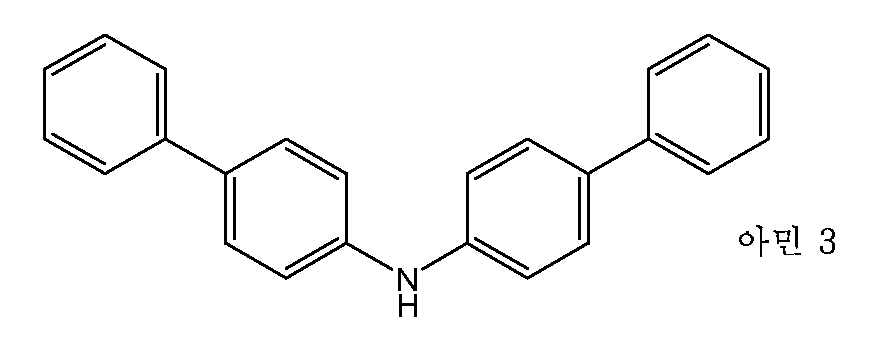
(c) 아민 3을 4-아미노바이페닐 및 4-브로모바이페닐을 사용하여 유사한 방식으로 제조하였다.(c) The amine 3 was prepared in a similar manner using 4-aminobiphenyl and 4-bromobiphenyl.
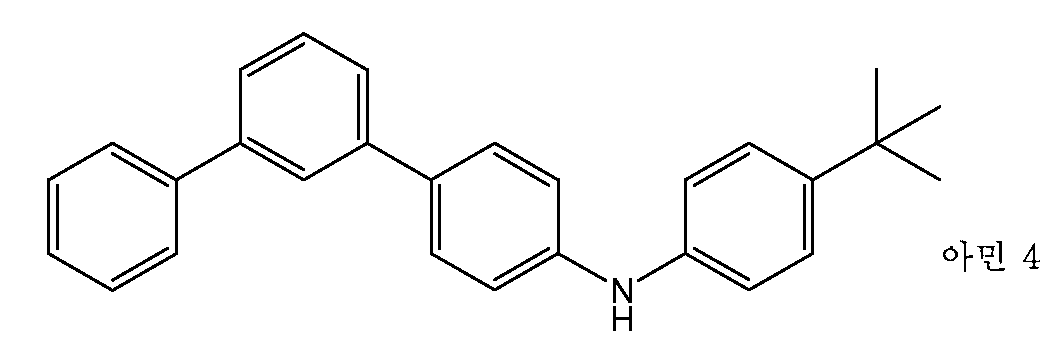
(d) 아민 4를 4-t-부틸아닐린 및 4-(3-바이페닐)-브로모벤젠을 사용하여 유사한 방식으로 제조하였다.(d) The amine 4 was prepared in a similar manner using 4-t-butylaniline and 4- (3-biphenyl) -bromobenzene.
(e) 아민 5를 4-t-부틸아닐린 및 4-브로모바이페닐을 사용하여 유사한 방식으로 제조하였다.(e) The amine 5 was prepared in a similar manner using 4-t-butylaniline and 4-bromobiphenyl.

실시예 2Example 2
본 실시예는 화합물 G1 및 G2의 제조를 설명한다.This example illustrates the preparation of compounds G1 and G2.

질소 충전된 글로브 박스 내에서, 3.34 g의 다이브로모안트라센 (10 mM, In a nitrogen-filled glove box, 3.34 g of dibromoanthracene (10 mM,
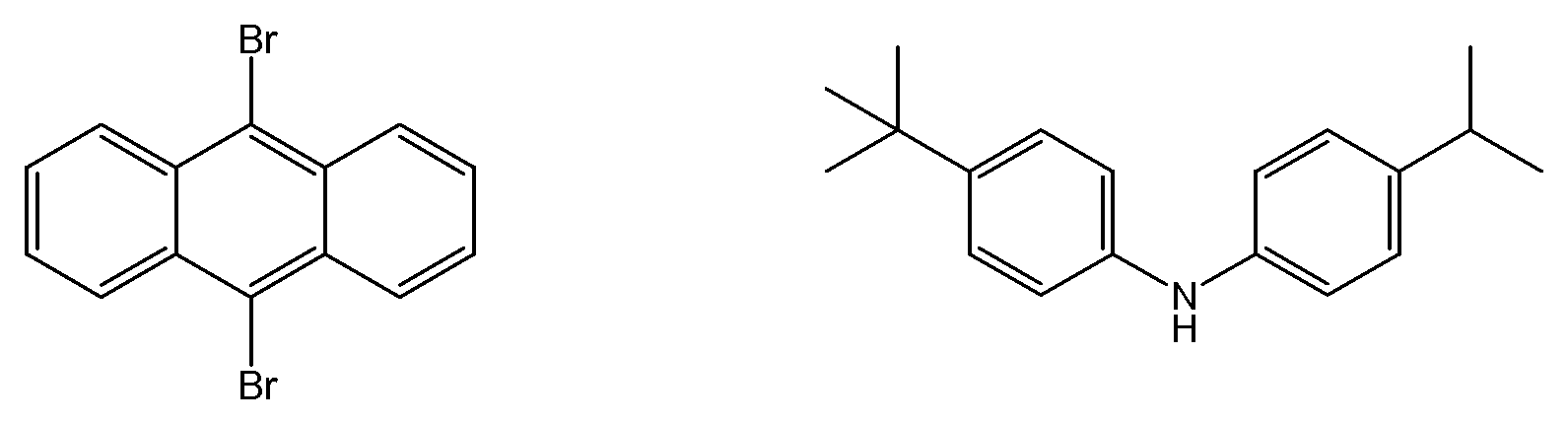
알드리치(Aldrich)) 및 5.4 g (21 mM) 4-i-프로필, 4-t-부틸아닐린 (아민 1) 을 50 ㎖ 건조 톨루엔에 혼합하였다. 1.0 g Pd2DBA3 (1.0 mM), 0.41 g P(t-Bu)3 (2.0 mM) 및 2.4 g t-BuONa (24 mM)을 50 ㎖ 톨루엔에 모두 용해하고 반응 플라스크에 첨가하였다. 생성된 슬러리를 교반하고 글로브 박스 내에서 맨틀에서 질소 하에 80℃로 하룻밤 가열하였다. 용액은 그 즉시에는 어두운 보라색이나, 약 80℃에 도달시 현저한 녹색 광발광을 갖는 어두운 황록색이다. 생성된 용액을 냉각하고 글로브 박스에서 꺼내어 알루미나 플러그(plug)를 통해 메틸렌 클로라이드로 용출하여 여과하였다.(Aldrich) and 5.4 g (21 mM) of 4-i-propyl, 4-t-butyl aniline (amine 1) were mixed in 50 ml dry toluene. 1.0 g Pd 2 DBA 3 (1.0 mM), 0.41 g P (t-Bu) 3 (2.0 mM) and 2.4 g t-BuONa (24 mM) were all dissolved in 50 ml toluene and added to the reaction flask. The resulting slurry was stirred and heated at 80 < 0 > C under nitrogen in a mantle overnight in a glovebox. The solution is a dark violet immediately upon its arrival, but a dark yellow green color with a pronounced green light emission upon reaching about 80 ° C. The resulting solution was cooled, taken out from the glove box, eluted with methylene chloride through an alumina plug, and filtered.
알루미나 패드를 통해 여과하고 메틸렌 클로라이드로 헹군 후에, 진녹색 용액을 증발시켜 부피를 줄였다. 황색 미세결정이 형성되기 시작하였고, 메탄올을 첨가하여 황색 분말 물질을 침전시켰다. 여과하고 메탄올로 세척하여 6.5 g의 황색 미세결정을 얻었다. CDCl3에서의 1-H nmr에 의한 분석에서 원하는 생성물로 확인되었다. 소자에서 평가하기 전에 물질을 고진공 하에 승화시켰다.After filtration through an alumina pad and rinsing with methylene chloride, the dark green solution was evaporated to reduce volume. Yellow microcrystals began to form, and methanol was added to precipitate a yellow powder material. Filtered and washed with methanol to give 6.5 g of yellow microcrystals. It was identified in the analysis by 1-H nmr in CDCl 3 as a desired product. The material was sublimed under high vacuum before evaluation in the device.
9,10-다이브로모안트라센 대신에 9,10-다이브로모-2-t-부틸안트라센으로 출발하여, 유사한 방식으로 화합물 G2을 제조하였다.Starting with 9,10-dibromo-2-t-butyl anthracene instead of 9,10-dibromoanthracene, compound G2 was prepared in a similar manner.
실시예 3Example 3
본 실시예는 화합물 G3의 제조를 설명한다.This example illustrates the preparation of compound G3.
단계 1: 안트라센의 t-부틸화:Step 1: t-Butylation of Anthracene:
7.13 g (40 mM) 안트라센 및 10.8 g t-부탄올 (120 mM)을 40 ㎖ 트라이플루오로아세트산 중에서 혼합하고 격렬하게 교반하면서 15시간 동안 환류시켰다. 이 어서, 냉각된 용액을 300 ㎖의 빙냉수에 붓고, 생성된 침전물을 여과하여 수집하였다. 회백색 고체를 진공에서 건조하고, 이어서 뜨거운 톨루엔/메탄올로부터 재결정하여 약 8 g의 무색 결정 (약 70% 수율)을 얻었고, 그 실체가 nmr에 의해서 2,6-다이-t-부틸안트라센으로서 확인되었다.7.13 g (40 mM) of anthracene and 10.8 g of t-butanol (120 mM) were mixed in 40 ml of trifluoroacetic acid and refluxed with vigorous stirring for 15 hours. The cooled solution was then poured into 300 ml of ice cold water and the resulting precipitate was collected by filtration. The off-white solid was dried in vacuo and then recrystallized from hot toluene / methanol to give about 8 g of colorless crystals (about 70% yield), the identity of which was confirmed as 2,6-di-t-butyl anthracene by nmr .

단계 2: 2,6-다이-t-부틸안트라센의 브롬화Step 2: Bromination of 2,6-di-t-butyl anthracene
4.94 g (17 mM) 2,6-다이-t-부틸안트라센을 100 ㎖ 사염화탄소 중에 용해하고 실온에서 교반하면서 1.76 ㎖ 브롬 (34 mM)을 적가하고, 생성된 혼합물을 실온에서 4시간 동안 교반하였다. 옅은 오렌지색 용액을 물에 붓고 과량의 아황산나트륨을 첨가하여 잔류 브롬을 모두 소진시켰다. 유기 상을 수집하였고, 수성 층을 추출하는 데 사용되는 메틸렌 클로라이드와 합하였다. 유기 층을 무수 황산마그네슘으로 건조한 다음 증발시켰다. 회수된 고체를 뜨거운 에탄올로부터 재결정하였다. 회수된 황색 고체를 메틸렌 클로라이드/메탄올로부터 추가로 재결정하여 약 4.9 g의 담황색 결정을 얻었고, 그 실체가 1-H nmr에 의해서 확인되었다.4.94 g (17 mM) of 2,6-di-t-butyl anthracene was dissolved in 100 ml of carbon tetrachloride, 1.76 ml of bromine (34 mM) was added dropwise with stirring at room temperature and the resulting mixture was stirred at room temperature for 4 hours. The pale orange solution was poured into water and excess sodium sulphate was added to dissipate any residual bromine. The organic phase was collected and combined with the methylene chloride used to extract the aqueous layer. The organic layer was dried over anhydrous magnesium sulfate and then evaporated. The recovered solid was recrystallized from hot ethanol. The recovered yellow solid was further recrystallized from methylene chloride / methanol to give 4.9 g of pale yellow crystals, the identity of which was confirmed by 1-H nmr.

단계 3: 다이브로모안트라센의 아미노화Step 3: Amination of dibromoanthracene
상기 실시예 2에 기재된 화합물 G1에 대해 사용된 절차를 따랐으며, 9,10-다이브로모안트라센 대신에 단계 2로부터의 9,10-다이브로모-2,6-다이-t-부틸안트라센을 사용하였다.The procedure used for compound G1 described in Example 2 above was followed and 9,10-dibromo-2,6-di-t-butyl anthracene from step 2 was used instead of 9,10-dibromoanthracene .
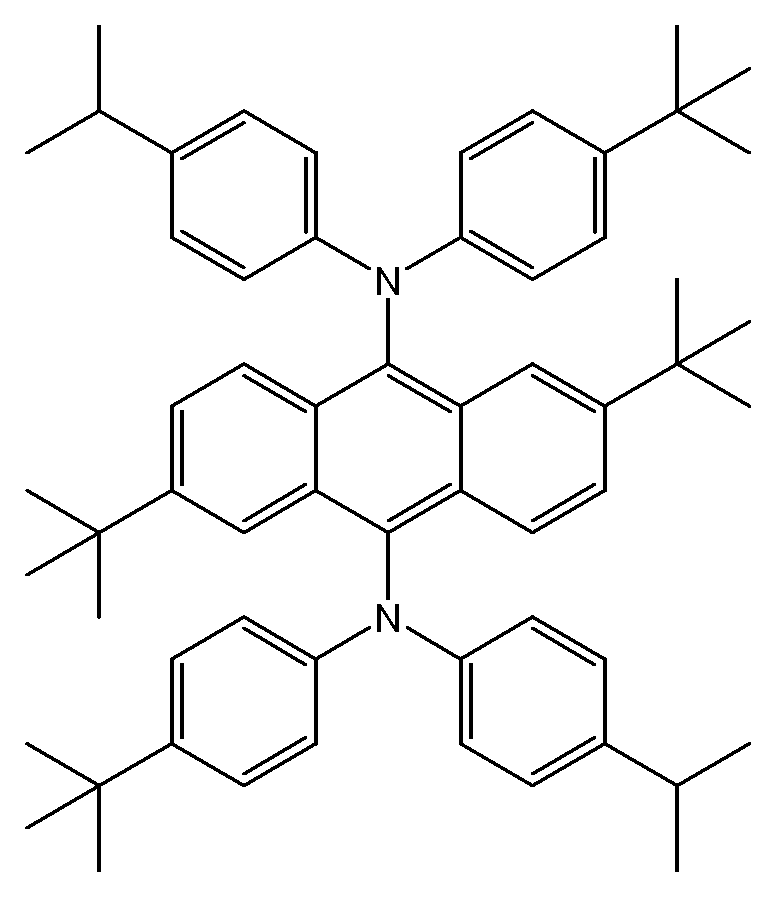
이 물질은 톨루엔 및 메틸렌 클로라이드에 난용성인 것으로 나타났으므로, 메틸렌 클로라이드를 사용하여 속슬렛(soxhlet)에 의해 추출하였다. 어두운 녹색 용액을 증발시켜 강한 녹색 발광성인 밝은 황색 미세결정을 생성하였다. 속슬렛 추출된 물질은 약 5.7 g의 황색 미세결정을 제공하였다. CD2Cl2에서의 1-H nmr로 이 물질의 실체를 확인하였고, 이는 소자 평가 전에 승화에 의해 추가로 정제하였다.Since this material appeared to be sparingly soluble in toluene and methylene chloride, it was extracted with a soxhlet using methylene chloride. Evaporation of the dark green solution produced bright yellow microcrystals with strong green luminescence. The Soxhlet extracted material provided about 5.7 g of yellow microcrystals. The identity of this material was confirmed with 1-H nmr in CD 2 Cl 2 , which was further purified by sublimation prior to device evaluation.
실시예 4Example 4
본 실시예는, 화합물 G3와 유사한 방식으로 이루어지며 단계 1에서의 t-부탄올 대신에 1-메틸사이클로헥산올로부터 출발하는, 화합물 G4 및 G5의 제조 및 분리를 설명한다.This example illustrates the preparation and separation of compounds G4 and G5 starting from 1-methylcyclohexanol in place of t-butanol, which is done in a similar manner to compound G3 and in step 1.
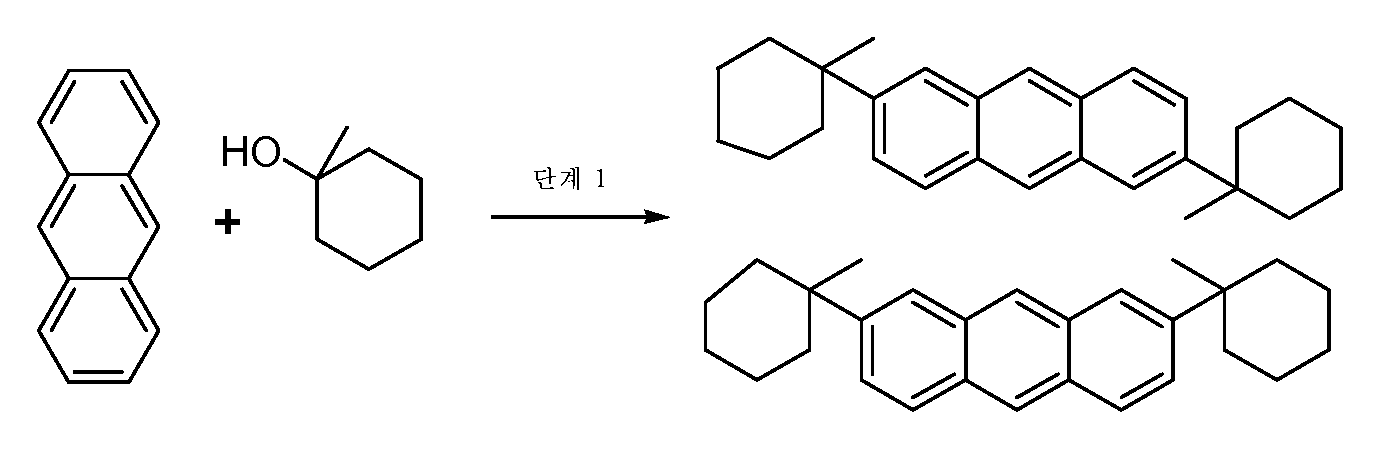
안트라센 (10 g, 56 mmol) 및 트라이플루오로아세트산 (TFA) (56 ㎖)을, 교반 막대, 환류 응축기 및 메틸사이클로헥산올(19.25 g, 168 mmol)이 담긴 적하 깔때기가 구비된 3목 둥근바닥 플라스크에 취하였다. 생성된 슬러리를 질소 하에 환류시켰고, 여기에 약 5 ㎖ 배치(batch)로 6시간에 걸쳐 메틸사이클로헥산올을 첨가하였다. 첫번째 첨가 후에 반응 혼합물이 진갈색(purple-brown)으로 변하였고, 반응 온도(오일조)는 110℃로 증가하였다. 반응물을 하룻밤 격렬하게 교반하였고, 추가로 동량의 메틸사이클로헥산올 (6.41 g, 56 mmol)을 30분에 걸쳐 첨가하였고 반응물을 추가 24시간 환류시켰다. GC-MS에서는 반응이 완료되어 안트라센이나 모노-알킬화 생성물이 전혀 없는 것으로 나타났으므로, 반응 혼합물을 냉각하고 여과하여 TFA를 제거하였다. 여과액이 투명해질 때까지 갈색을 띤 고체 잔류물을 에테르로 세척하였다 (약 250 ㎖). 생성된 담황색 생성물 (15.8 g, 76%)을 수집하였고 GC-MS 및 1-H nmr에 의하면 추가적인 사용을 위해 충분히 순수한 것으로 여겨졌다. 1-H nmr은 2,6- 및 2,7-알킬화 이성체 둘 모두의 존재를 분명하게 나타내었으며, 후자가 더 적은 양의 생성물이었다.Anthracene (10 g, 56 mmol) and trifluoroacetic acid (TFA) (56 mL) were added to a three necked round bottom equipped with a stir bar, a reflux condenser and a dropping funnel containing methyl cyclohexanol (19.25 g, 168 mmol) Lt; / RTI > The resulting slurry was refluxed under nitrogen and methylcyclohexanol was added thereto over a period of 6 hours in a batch of about 5 ml. After the first addition, the reaction mixture turned purple-brown and the reaction temperature (oil bath) increased to 110 ° C. The reaction was stirred vigorously overnight and an additional amount of methylcyclohexanol (6.41 g, 56 mmol) was added over 30 min and the reaction was refluxed for an additional 24 h. Since the reaction was complete in GC-MS and no anthracene or mono-alkylation products were found, the reaction mixture was cooled and filtered to remove TFA. The brownish solid residue was washed with ether (~ 250 mL) until the filtrate became clear. The resulting pale yellow product (15.8 g, 76%) was collected and considered pure enough for further use according to GC-MS and 1-H nmr. 1-H nmr clearly indicated the presence of both 2,6- and 2,7-alkylated isomers, the latter being less product.
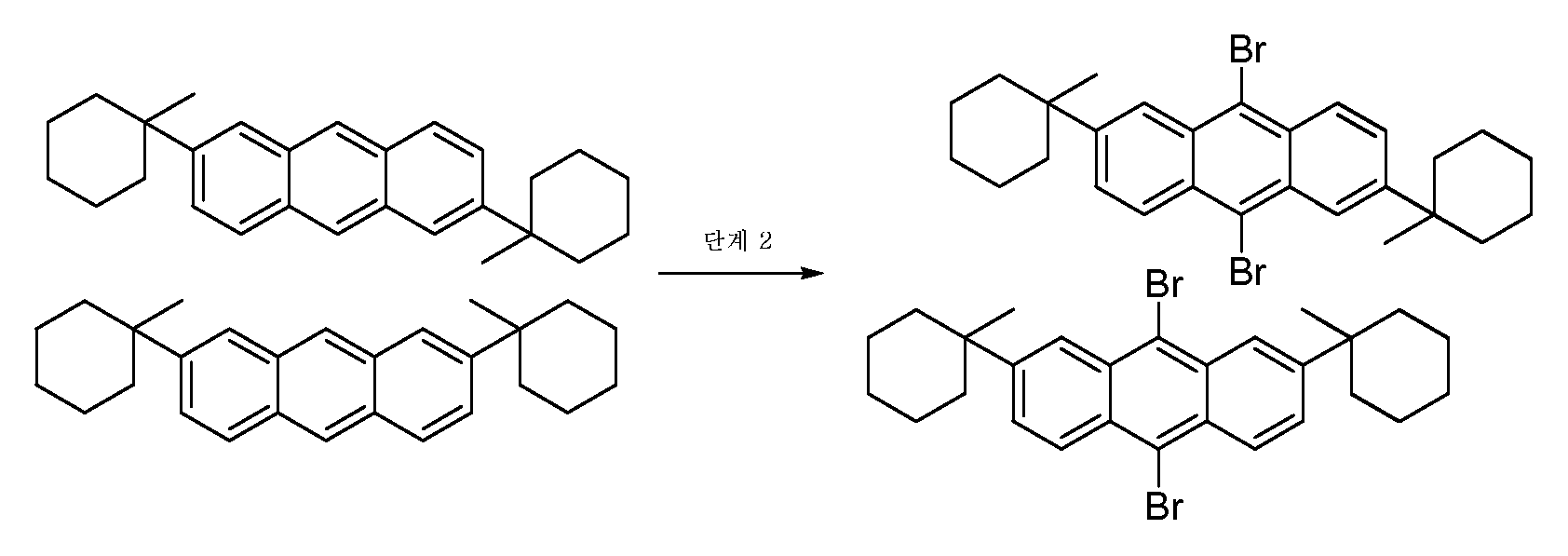
이전 단계로부터의 메틸사이클로헥실안트라센 (14 g, 37.8 mmol) 및 사염화탄소 (190 ㎖)를 질소 하에 교반 막대 및 브롬 (12 g, 75.6 mmol)이 담긴 적하 깔때기가 구비된 둥근 바닥 플라스크에 취하였다. 용액이 투명해질 때까지 브롬을 교반된 슬러리에 3시간에 걸쳐 적가하였고, GC-MS에서 더 이상의 출발 물질이 남아있지 않은 것으로 나타났다. 반응물을 추가 1시간 동안 교반되게 하였고 Na2S2O3의 용액을 사용하여 여분의 브롬을 중화되게 하였다. 두 층을 분리하여 수성 층을 2 x 50 ㎖ CCl4로 추출하였다. 합한 유기 층을 건조(무수 MgSO4)하고 농축하여 황색 고체를 얻었고, 환류하는 EtOH 중에서 30분 동안 교반하였고 생성된 슬러리를 하룻밤 냉각되게 하였다. 생성된 담황색 고체를 여과하여 수집하고 진공 하에 건조하여 18.5 g (92.6%)의 원하는 브롬화 화합물을 2,6- 및 2,7-알킬화 생성물의 혼합물로서 얻었다.Methylcyclohexyl anthracene (14 g, 37.8 mmol) from the previous step and carbon tetrachloride (190 mL) were taken in a round bottom flask under nitrogen with a dropping funnel containing a stir bar and bromine (12 g, 75.6 mmol). Bromine was added dropwise to the stirred slurry over 3 hours until the solution became clear and no further starting material remained in the GC-MS. Was presented reaction was stirred for an additional hour with a solution of Na 2 S 2 O 3 was allowed to neutralize excess bromine. And the two layers were separated and the aqueous layer was extracted with 2 x 50 ㎖ CCl 4. The combined organic layers were dried (anhydrous MgSO 4 ) and concentrated to give a yellow solid which was stirred in refluxing EtOH for 30 minutes and the resulting slurry allowed to cool overnight. The resulting pale yellow solid was collected by filtration and dried under vacuum to give 18.5 g (92.6%) of the desired brominated compound as a mixture of 2,6- and 2,7-alkylated products.

9-10-다이브로모-다이메틸사이클로헥실안트라센 (18 g, 34 mmol) 및 4-tert-부틸-N-(4-아이소프로필페닐)벤젠아민 (19.1 g, 71.5 mmol)을 질소 하에 1L 둥근 바닥 플라스크에 취하였고, 200 ㎖의 탈기된 건조 톨루엔을 플라스크에 첨가하여 황색 슬러리를 얻었다. 40 ㎖ 바이알을 Pd2(dba)3 (0.3 g, 0.3 mmol), P(t-Bu)3 (0.14 g, 0.7 mmol) 및 15 ㎖의 건조 톨루엔으로 채우고 글로브 박스 내에서 교반되게 두었다. 10분 후, 그 내용물을 반응 플라스크에 첨가하였다. 추가로 10분 더 교반한 후에, 소듐 tert-부톡사이드 (7.9 g, 81.8 mmol)를 질소 하에 반응 플라스크에 나누어 첨가하였고, 반응물을 80℃ 샌드 배스(sand bath)에서 하룻밤 가온하였다. CI-LCMS에서 반응이 완료되지 않은 것으로 나타났으므로, 반응물을 냉각하였고 여기에 Pd2(dba)3 (1.25 g, 1.4 mmol) 및 P(t-Bu)3 (0.55 g, 2.7 mmol)의 추가 배치(batch)를 첨가하였고 하룻밤 교반을 계속하였다. 반응 혼합물을 실리카+셀라이트(silica+celite)의 5.1 + 5.1 ㎝ (2 + 2") 플러그를 통해 여과하고 통과된 흐름이 투명해질 때까지 톨루엔 및 DCM으로 세척하였다. 여과액을 감압 하에 농축하여 어두운 황색 오일이 생성되었고, 정치하여 황색 분말을 얻었다. 여과하여 분 말을 수집하였고 에테르로 세척하여 첫 번째 수확(crop)의 10.82 g (35%) G4를 얻었다. nmr에서는 농축된 여과액이 G4 및 G5 둘 모두를 포함하는 것으로 나타났다. 두 번째 침전에서는 11.22 g (36.5%)의 대략 동일한 양의 G4 및 G5 생성물과, 대부분 G5 및 다른 불순물을 포함하는 아주 탁한 갈색 물질을 얻었다. 마지막 것을 용출제(eluent)로서 1:15 DCM:헥산을 사용하는 실리카 젤 크로마토그래피로 정제하여 주로 G5 (73%)인 3.8 g (12.4%)을 얻었다.Tert-Butyl-N- (4-isopropylphenyl) benzeneamine (19.1 g, 71.5 mmol) was added dropwise under nitrogen to a 1 L round bottom The flask was taken and 200 ml of degassed dry toluene was added to the flask to give a yellow slurry. A 40 mL vial was charged with Pd 2 (dba) 3 (0.3 g, 0.3 mmol), P ( t- Bu) 3 (0.14 g, 0.7 mmol) and 15 mL of dry toluene and allowed to stir in a glovebox. After 10 minutes, the contents were added to the reaction flask. After an additional 10 minutes of stirring, sodium tert-butoxide (7.9 g, 81.8 mmol) was added in portions to the reaction flask under nitrogen and the reaction was warmed in an 80 ° C sand bath overnight. The reaction was cooled and the addition of Pd 2 (dba) 3 (1.25 g, 1.4 mmol) and P ( t- Bu) 3 (0.55 g, 2.7 mmol) The batch was added and stirring was continued overnight. The reaction mixture was filtered through a 5.1 + 5.1 cm (2 + 2 ") plug of silica + celite and washed with toluene and DCM until the passed stream was clear. The filtrate was concentrated under reduced pressure The filtrate was collected by filtration and washed with ether to give 10.82 g (35%) of G4 of the first crop. In nmr, the concentrated filtrate was washed with G4 And G5 in Example 1. In the second precipitation, a very turbid brown material containing approximately the same amount of G4 and G5 products of 11.22 g (36.5%) and mostly G5 and other impurities was obtained. Purification by silica gel chromatography using 1:15 DCM: hexanes as eluent gave 3.8 g (12.4%) of G5 (73%).
실시예Example 5 5

본 실시예는 화합물 G6의 제조를 설명한다.This example illustrates the preparation of compound G6.
단계 1Step 1

2,6-다이하이드록시안트라퀴논 (50 g, 0.2082 ㏖), 탄산나트륨 (35.0 g, 0.3302 ㏖) 및 o-다이클로로벤젠 (800 ㎖)을 자석 교반, 수냉 응축기를 이용하여 그리고 N2 블랭킷팅(blanketing)을 이용하여 2 L 플라스크에서 합하였다. 메틸-p-톨루엔설포네이트 (110.0 g, 0.5907 ㏖)를 약 20분에 걸쳐 첨가하였고, 혼합물을 178℃로 하룻밤 가열하였다. 슬러리를 70℃로 냉각하고 1L의 물에 첨가하였다. 혼합물을 여과하고, 필터 케이크(filter cake)를 물 및 메탄올로 세척하고 건조하여 43.8 g의 밝은 황갈색 고체를 78% 수율로 얻었다.(50 g, 0.2082 mol), sodium carbonate (35.0 g, 0.3302 mol) and o-dichlorobenzene (800 mL) were stirred in a reaction vessel equipped with a magnetic stirrer, a water-cooled condenser and N 2 blanketing blanketing) in a 2 L flask. Methyl-p-toluenesulfonate (110.0 g, 0.5907 mol) was added over about 20 minutes and the mixture was heated to 178 占 폚 overnight. The slurry was cooled to < RTI ID = 0.0 > 70 C < / RTI > The mixture was filtered and the filter cake was washed with water and methanol and dried to give 43.8 g of a light tan solid in 78% yield.
단계 2Step 2

상기 단계 1로부터의 2,6-다이메톡시안트라퀴논 (16.7 g, 0.0623 ㏖)과 1250 ㎖ 아이소프로필 알코올을 합하고 질소로 30분간 탈기하였다. NaBH4 (49 g, 1.295 ㏖)를 첨가하고 하룻밤 환류시켰다. 냉각하고 용매를 증발시키고 500 ㎖의 얼음물을 첨가한 다음 pH가 2 미만이 될 때까지 135 g의 진한 HCl를 나누어 첨가하였다. 수성 혼합물을 다이클로로메탄으로 추출하고 13.31 g의 흑색 고체로 농축하였고, 이것을 61 g의 실리카 상에 사전 흡수(preabsorb)시키고 헥산 및 다이클로로메탄으로 용출하는 실리카 컬럼 크로마토크래피로 정제한 다음 클로로포름으로부터 재결정하여 1.58 g의 생성물을 얻었다. 모액 재료(mother liquor material)를 실리카 컬럼 크로마토그래피로 다시 정제하여 추가 1.28 g의 생성물을 얻었고 총 수율은 19%였다.2,6-Dimethoxy anthraquinone (16.7 g, 0.0623 mol) from step 1 above and 1250 ml isopropyl alcohol were combined and degassed with nitrogen for 30 minutes. It was added NaBH 4 (49 g, 1.295 ㏖ ) and refluxed overnight. Cool, evaporate the solvent, add 500 mL of ice water, and add 135 g of concentrated HCl in portions until the pH is less than 2. The aqueous mixture was extracted with dichloromethane and concentrated to 13.31 g of a black solid, This was preabsorbed onto 61 g of silica and purified by silica column chromatography eluting with hexane and dichloromethane and then recrystallized from chloroform to give 1.58 g of product. The mother liquor material was further purified by silica column chromatography to give an additional 1.28 g of product with a total yield of 19%.
단계 3Step 3

2,6-다이메톡시안트라센 (2.49 g, 0.0105 ㏖) 및 114 ㎖의 사염화탄소를 합하고 nmr에 의해 변화가 전혀 검출되지 않을 때까지 브롬 (3.78 g, 0.0237 ㏖)을 나누어 첨가하였다. 이 혼합물을 700 ㎖ 다이클로로메탄으로 희석하고 200 ㎖ 물 및 Na2S2O4 (11 g, 0.0696 ㏖)로 세척하였다. 유기물을 분리하고 농축하고 컬럼 크로마토그래피로 정제하였다. 잘 정제된 물질은 총 0.3 g이었고 7% 수율이었으나, 추가 정제를 필요로 하는 불순 물질은 총 2.18 g이었고 미정제 수율(crude yield )이 45%였다.2,6-dimethoxyanthracene (2.49 g, 0.0105 mol) and 114 mL of carbon tetrachloride were added and bromine (3.78 g, 0.0237 mol) was added portionwise until no change was detected by nmr. The mixture was diluted with 700 mL of dichloromethane and washed with 200 mL of water and Na 2 S 2 O 4 (11 g, 0.0696 mol). The organics were separated, concentrated and purified by column chromatography. The well-purified material was 0.3 g in total and yielded 7%, while the total amount of impurities requiring further purification was 2.18 g and the crude yield (crude yi eld ) was 45%.
단계 4Step 4

4-t-부틸-4'-아이소프로필다이페닐아민 (0.421 g, 0.0016 ㏖), 2,6-다이메톡시-9,10-다이브로모안트라센 (0.2495 g, 0.00063 ㏖), Pd2DBA3 (0.0419 g, 0.0457 mmol), 트라이-t-부틸포스핀 (0.0185 g, 0.0914 mmol), 소듐 t-부톡사이드 (0.1211 g, 1.26 mmol) 및 8 ㎖ 톨루엔을 합하였다. 95℃에서 50시간에 걸쳐 실행하였다. 염기성-알루미나 상의 컬럼 크로마토그래피로 정제하고, 이어서 아세토니트릴을 사용하여 다이클로로메탄으로부터 침전시켜 100 ㎎의 순수 물질을 20% 수율로 얻었다.(0.421 g, 0.0016 mol), 2,6-dimethoxy-9,10-dibromoanthracene (0.2495 g, 0.00063 mol), Pd 2 DBA 3 0.0414 g, 0.0457 mmol), tri-t-butylphosphine (0.0185 g, 0.0914 mmol), sodium t-butoxide (0.1211 g, 1.26 mmol) and 8 mL toluene. Gt; 95 C < / RTI > over 50 hours. Purification by column chromatography on basic-alumina and subsequent precipitation from dichloromethane using acetonitrile gave 100 mg of pure material in 20% yield.
실시예Example 6 6
본 실시예는 화합물 G7 및 G8의 제조를 설명한다.This example illustrates the preparation of compounds G7 and G8.
1-메틸사이클로헥산올 대신에 1-아다만톨을 사용하여 상기 G4 및 G5에서와 유사한 방식으로 비스-1-아다만틸 안트라센의 2가지 이성체를 제조하였다. G8 이성체로부터의 G7의 분리는 브롬화 단계 전에 알킬화의 초기 생성물을 분리함으로써 가장 잘 달성된다. 2,7-비스-1-아다만틸 안트라센 (G8로 이어지는 이성체)이 더 용해성인 물질이므로, 이 단계에서 톨루엔으로 추출하면 2,6 이성체가 남고 2,7 이성체의 용액이 생성된다. 단리된 고체를 메틸렌 클로라이드로부터 후속적으로 재결정하여 각각의 개별 이성체를 추가로 정제한다. 최종 G7 및 G8 물질은 둘 모두 톨루엔에 상당히 용해성이며 소자 평가 전에 승화에 의해 추가로 정제하였다. 1-H nmr 분광법으로 개별 물질들을 확인하였고 그들의 이성체 배정(isomeric assignment)을 확인하였다:Two isomers of bis-1-adamantylanthracene were prepared in a similar manner as in G4 and G5 above using 1-adamantol instead of 1-methylcyclohexanol. The separation of G7 from the G8 isomer is best accomplished by separating the initial product of alkylation prior to the bromination step. Since 2,7-bis-1-adamantylanthracene (an isomer leading to G8) is a more soluble substance, extraction with toluene at this stage leaves 2,6 isomers and a solution of 2,7 isomers. The isolated solid is subsequently recrystallized from methylene chloride to further purify each individual isomer. Both the final G7 and G8 materials were fairly soluble in toluene and were further purified by sublimation prior to device evaluation. Individual materials were identified by 1-H nmr spectroscopy and their isomeric assignments were confirmed:
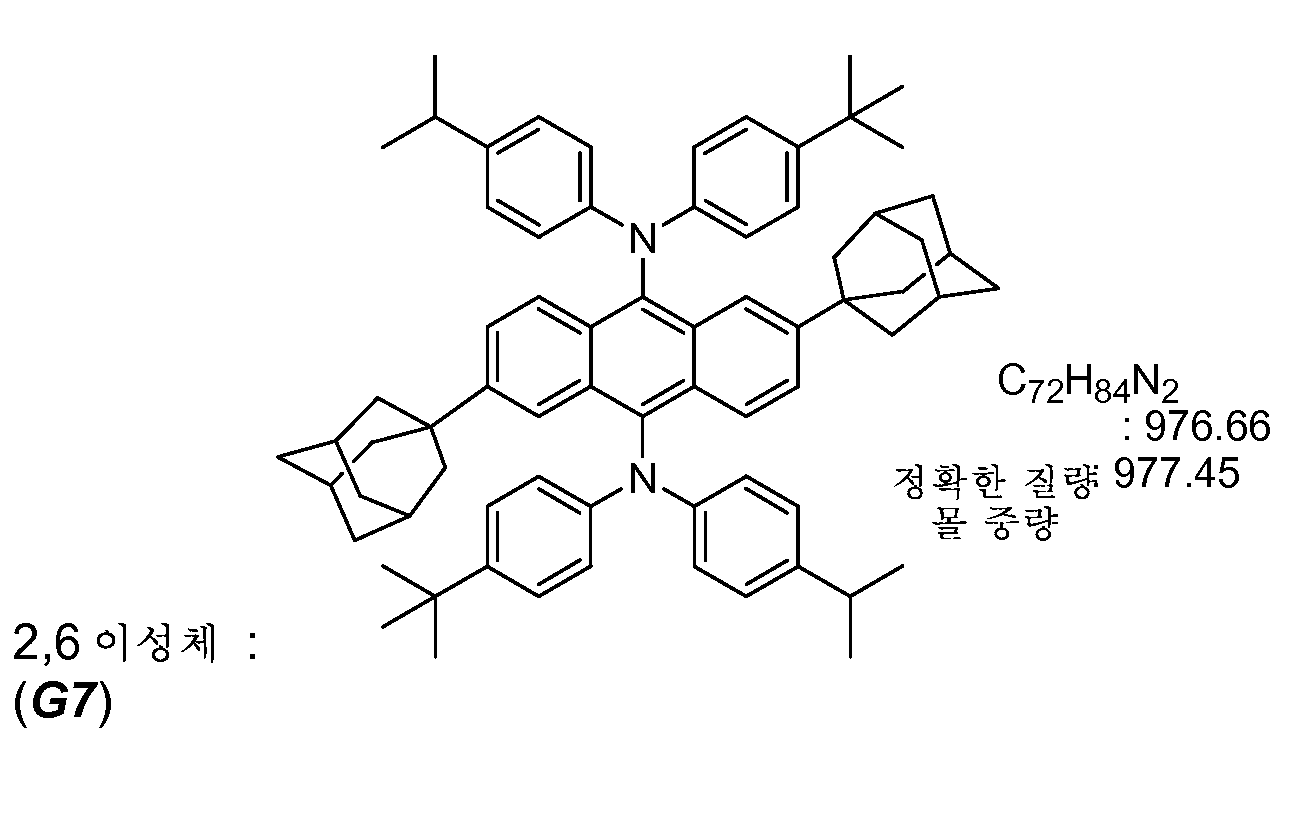
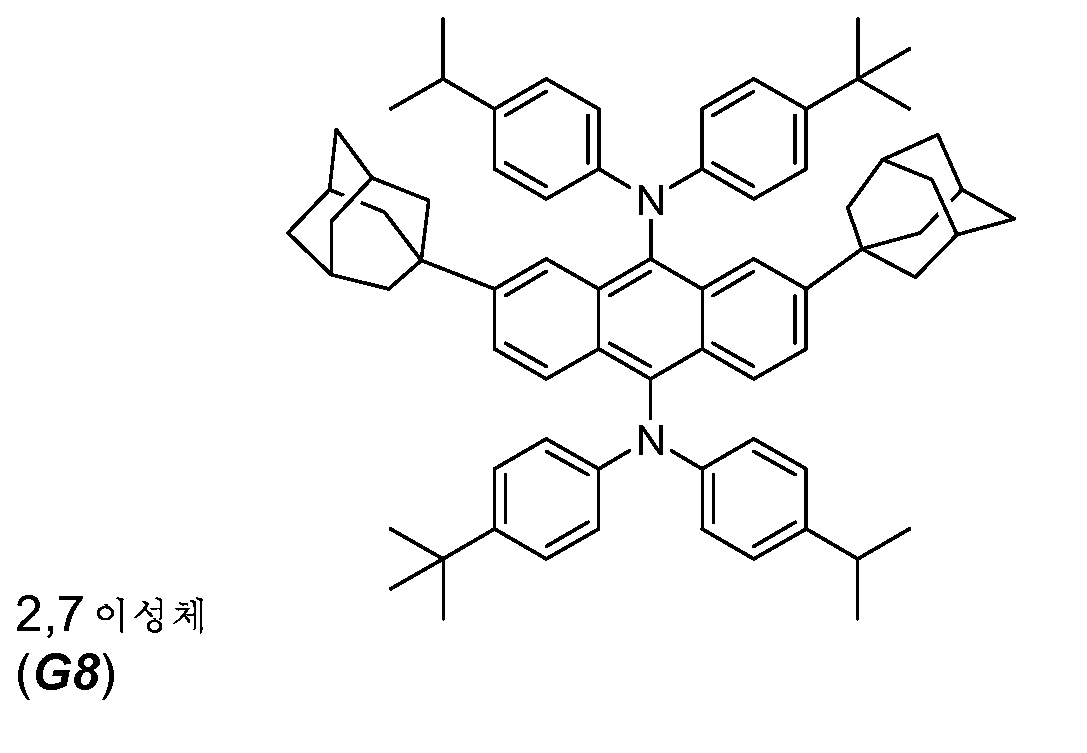
실시예 7Example 7
본 실시예는 화합물 G9의 제조를 설명한다.This example illustrates the preparation of compound G9.
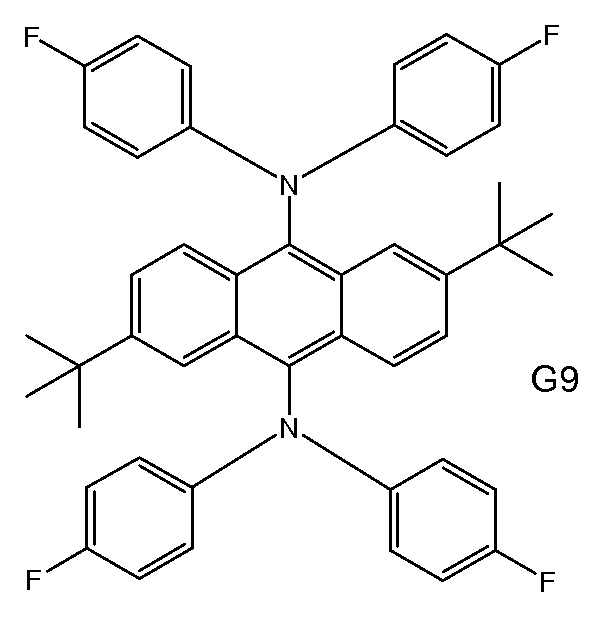
2.25 g의 9,10-다이브로모-2,6-다이-t-부틸-안트라센 (5 mM) 및 2.25 g (11 mM) 아민 2를 질소 글로브 박스 내에서 25 ㎖ 톨루엔 중에 혼합하였다. 0.5 g Pd2DBA3 (0.5 mM), 0.20g 트라이-t-부틸포스핀 (1 mM) 및 1.0 g t-BuONa (20 mM)를 혼합하고 10 ㎖ 톨루엔 중에 용해하였다. 이어서, 2가지 용액을 혼합하고 글로브 박스 내에서 80℃로 1시간 동안 가열한 다음 질소 하에 하룻밤 서서히 가온하였다(약 50℃). 혼합된 용액은 그 즉시에는 어두운 보라색이나 80℃에 도달시 어두운 황갈색이 된다. 용액을 냉각하고 글로브 박스로부터 꺼내어 알루미나 플러그를 통해 메틸렌 클로라이드로 용출하여 여과하였다. 밝은 황색 여과액의 TLC에서 밝은 녹색 광발광 스팟(photoluminescent spot)이 나타났다. 플로리실(Florisil) 상에서 메틸렌 클로라이드로 용출하여 추가로 정제하여 밝은 황색 용액(실내등에서 가시적인 녹색 광발광)을 수집하였는데, 이는 메탄올을 첨가하여 하룻밤 정치시킬 때 결정화되었다. 메탄올을 첨가해 톨루엔으로부터 최종 재결정하여 약 2.5 g의 밝은 황색 결정을 얻었다. 황색 고체는 1-H nmr에 의해서 원하는 화합물(약간의 톨루엔으로 습윤됨)인 것으로 확인되었고, 이어서 소자 평가 전에 트레인 승화(train sublimation)에 의해서 추가로 정제하였다.2.25 g of 9,10-dibromo-2,6-di-t-butyl-anthracene (5 mM) and 2.25 g (11 mM) amine 2 were mixed in 25 ml toluene in a nitrogen glovebox. 0.5 g Pd 2 DBA 3 (0.5 mM), 0.20 g tri-t-butylphosphine (1 mM) and 1.0 g t-BuONa (20 mM) were mixed and dissolved in 10 ml toluene. The two solutions were then mixed and heated in a glove box to 80 DEG C for 1 hour and then slowly heated to about 50 DEG C under nitrogen overnight. The blended solution immediately becomes a dark violet, or a dark tan when it reaches 80 ° C. The solution was cooled and taken out from the glove box, eluted with methylene chloride through alumina plug, and filtered. A light green photoluminescent spot appeared on the TLC of the light yellow filtrate. Eluted with methylene chloride on Florisil and further purified to collect a light yellow solution (green light emission visible in the room light), which crystallized upon standing overnight with methanol. Methanol was added and final recrystallization from toluene gave about 2.5 g of light yellow crystals. The yellow solid was identified to be the desired compound (wetted with some toluene) by 1-H nmr and then further purified by train sublimation prior to device evaluation.
실시예Example 8 8
본 실시예는 화합물 G10의 제조를 설명한다.This example illustrates the preparation of compound G10.

0.94 g의 9,10-다이브로모-2,6-다이-(1-아다만틸)-안트라센 (1.5 mM) (상기 실시예 6 참조) 및 1.0 g (3.1 mM) 아민 3을 질소 글로브 박스 내에서 10 ㎖ 톨루엔 중에 혼합하였다. 0.15 g Pd2DBA3 (0.15 mM), 0.06g 트라이-t-부틸포스핀 (0.3 mM) 및 0.32 g t-BuONa (3.3 mM)를 혼합하고 10 ㎖ 톨루엔 중에 용해하였다. 이어서, 2가지 용액을 혼합하고 글로브 박스 내에서 80℃로 1시간 동안 가열한 다음 질소 하에 하룻밤 서서히 가온하였다(약 50℃). 혼합된 용액은 그 즉시에는 어두운 보라색이나 80℃에 도달시 어두운 황갈색이 된다. 용액을 냉각하고 글로브 박스로부터 꺼내어 알루미나 플러그를 통해 메틸렌 클로라이드로 용출하여 여과하였다. 밝은 황색 여과액의 TLC에서 밝은 녹색 광발광 스팟이 나타났다. 플로리실 상에서 메틸렌 클로라이드로 용출하여 추가로 정제하여 밝은 황색 용액(실내등에서 가시적인 녹색 광발광)을 수집하였고, 이는 메탄올을 추가할 때 결정화되었다. 톨루엔으로부터 최종 재결정하여 약 1.1 g의 밝은 황색 결정을 얻었다. 황색 고체는 1-H nmr에 의해서 원하는 화합물(약간의 톨루엔으로 습윤됨)인 것으로 확인되었고, 이어서 소자 평가 전에 트레인 승화(train sublimation)에 의해서 추가로 정제하였다.0.94 g of 9,10-dibromo-2,6-di- (1-adamantyl) -anthracene (1.5 mM) (see Example 6 above) and 1.0 g (3.1 mM) of amine 3 in a nitrogen globbox In 10 ml toluene. 0.15 g Pd 2 DBA 3 (0.15 mM), 0.06 g tri-t-butylphosphine (0.3 mM) and 0.32 g t-BuONa (3.3 mM) were mixed and dissolved in 10 ml toluene. The two solutions were then mixed and heated in a glove box to 80 DEG C for 1 hour and then slowly heated to about 50 DEG C under nitrogen overnight. The blended solution immediately becomes a dark violet, or a dark tan when it reaches 80 ° C. The solution was cooled and taken out from the glove box, eluted with methylene chloride through alumina plug, and filtered. A bright green light-emitting spot appeared on the TLC of the light yellow filtrate. Eluting with methylene chloride on the Florisil and further purification to collect a light yellow solution (green light emission visible in the room light) which crystallized upon the addition of methanol. Final recrystallization from toluene gave about 1.1 g of light yellow crystals. The yellow solid was identified to be the desired compound (wetted with some toluene) by 1-H nmr and then further purified by train sublimation prior to device evaluation.
실시예Example 9 9
본 실시예는 화합물 G11의 제조를 설명한다.This example illustrates the preparation of compound G11.

3.02 g의 9,10-다이브로모-2,6-다이-(1-아다만틸)-안트라센 (5 mM) (상기 실시예 6 참조) 및 3.85 g (11 mM) 아민 4를 질소 글로브 박스 내에서 25 ㎖ 톨루엔 중에 혼합하였다. 0.5 g Pd2DBA3 (0.5 mM), 0.20g 트라이-t-부틸포스핀 (1 mM) 및 1.0 g t-BuONa (20 mM)를 혼합하고 10 ㎖ 톨루엔 중에 용해하였다. 이어서, 2가지 용액을 혼합하고 글로브 박스 내에서 80℃로 1시간 동안 가열한 다음 질소 하에 하룻밤 서서히 가온하였다(약 50℃). 혼합된 용액은 그 즉시에는 어두운 보라색이나 80℃에 도달시 어두운 황갈색이 된다. 용액을 냉각하고 글로브 박스로부터 꺼내어 알루미나 플러그를 통해 메틸렌 클로라이드로 용출하여 여과하였다. 짙은 오렌지색 여과액의 TLC에서 밝은 녹색 광발광 스팟이 나타났다. 플로리실 상에서 이어서 중성 알루미나 상에서 메틸렌 클로라이드로 용출하여 추가로 정제하여 밝은 황색 용액(실내등에서 가시적인 녹색 광발광)을 수집하였는데, 이는 메탄올을 첨가하여 하룻밤 정치시킬 때 결정화되었다. 메탄올을 첨가해 톨루엔으로부터 최종 재결정하여 약 2.2 g의 밝은 황색 결정을 얻었다. 황색 고체는 1-H nmr에 의해서 원하는 화합물(약간의 톨루엔 및 메탄올로 습윤됨)인 것으로 확인되었고, 이어서 소자 평 가 전에 트레인 승화에 의해서 추가로 정제하였다.A mixture of 3.02 g 9,10-dibromo-2,6-di- (1-adamantyl) -anthracene 5 mM (see Example 6 above) and 3.85 g (11 mM) amine 4 in a nitrogen glovebox In 25 ml toluene. 0.5 g Pd 2 DBA 3 (0.5 mM), 0.20 g tri-t-butylphosphine (1 mM) and 1.0 g t-BuONa (20 mM) were mixed and dissolved in 10 ml toluene. The two solutions were then mixed and heated in a glove box to 80 DEG C for 1 hour and then slowly heated to about 50 DEG C under nitrogen overnight. The blended solution immediately becomes a dark violet, or a dark tan when it reaches 80 ° C. The solution was cooled and taken out from the glove box, eluted with methylene chloride through alumina plug, and filtered. A bright green light-emitting spot appeared on the TLC of the deep orange filtrate. The filtrate was then purified further by eluting with methylene chloride on neutral alumina and collecting a light yellow solution (green light emission visible in the room light), which crystallized upon standing overnight with methanol. Methanol was added and final recrystallization from toluene gave about 2.2 g of light yellow crystals. The yellow solid was identified to be the desired compound (wetted with some toluene and methanol) by 1-H nmr, and then further purified by train sublimation prior to device evaluation.
실시예 10Example 10
본 실시예는 화합물 G12의 제조를 설명한다.This example illustrates the preparation of compound G12.

0.25 g의 9,10-다이브로모-2,6-다이-(1-아다만틸)-안트라센 (0.42 mM) (상기 실시예 6 참조) 및 0.3 g (1 mM) 아민 5를 질소 글로브 박스 내에서 10 ㎖ 톨루엔 중에 혼합하였다. 0.04 g Pd2DBA3 (0.04 mM), 0.017 g 트라이-t-부틸포스핀 (0.08 mM) 및 0.1g t-BuONa (1 mM)를 혼합하고 10 ㎖ 톨루엔에 용해하였다. 이어서, 2가지 용액을 혼합하고 글로브 박스 내에서 80℃로 1시간 동안 가열한 다음 질소 하에 하룻밤 서서히 가온하였다(약 50℃). 혼합된 용액은 그 즉시에는 어두운 보라색이나 80℃에 도달시 어두운 황갈색이 된다. 용액을 냉각하고 글로브 박스로부터 꺼내어 알루미나 플러그를 통해 메틸렌 클로라이드로 용출하여 여과하였다. 짙은 황색 여과액의 TLC에서 빛나는 녹색 광발광 스팟이 나타났다. 플로리실 상에서 이어서 중성 알루미나 상에서 메틸렌 클로라이드로 용출하여 추가로 정제하여 밝은 황색 용액(실내등에서 가시적인 녹색 광발광)을 수집하였고, 이는 메탄올을 추가하고 하룻밤 정치시킬 때 결정화되었다. 메탄올을 첨가해 톨루엔으로부터 최종 재결정하여 약 0.24 g의 밝은 황색 결정을 얻었다. 황색 고체는 1-H nmr에 의해서 원하는 화합물(약간의 톨루엔 및 메탄올로 습윤됨)인 것으로 확인되었고, 이어서 소자 평가 전에 트레인 승화에 의해서 추가로 정제하였다.0.25 g of 9,10-dibromo-2,6-di- (1-adamantyl) -anthracene (0.42 mM) (see Example 6 above) and 0.3 g (1 mM) of amine 5 were dissolved in a nitrogen globbox In 10 ml toluene. 0.04 g Pd 2 DBA 3 (0.04 mM), 0.017 g tri-t-butylphosphine (0.08 mM) and 0.1 g t-BuONa (1 mM) were mixed and dissolved in 10 ml toluene. The two solutions were then mixed and heated in a glove box to 80 DEG C for 1 hour and then slowly heated to about 50 DEG C under nitrogen overnight. The blended solution immediately becomes a dark violet, or a dark tan when it reaches 80 ° C. The solution was cooled and taken out from the glove box, eluted with methylene chloride through alumina plug, and filtered. A green light-emitting spot appeared in the TLC of the deep yellow filtrate. The filtrate was then further purified by eluting with methylene chloride on neutral alumina to obtain a light yellow solution (visible light emission visible in the room light) which crystallized upon addition of methanol and overnight standing. Methanol was added and final recrystallization from toluene gave about 0.24 g of light yellow crystals. The yellow solid was identified to be the desired compound (wetted with some toluene and methanol) by 1-H nmr and then further purified by train sublimation prior to device evaluation.
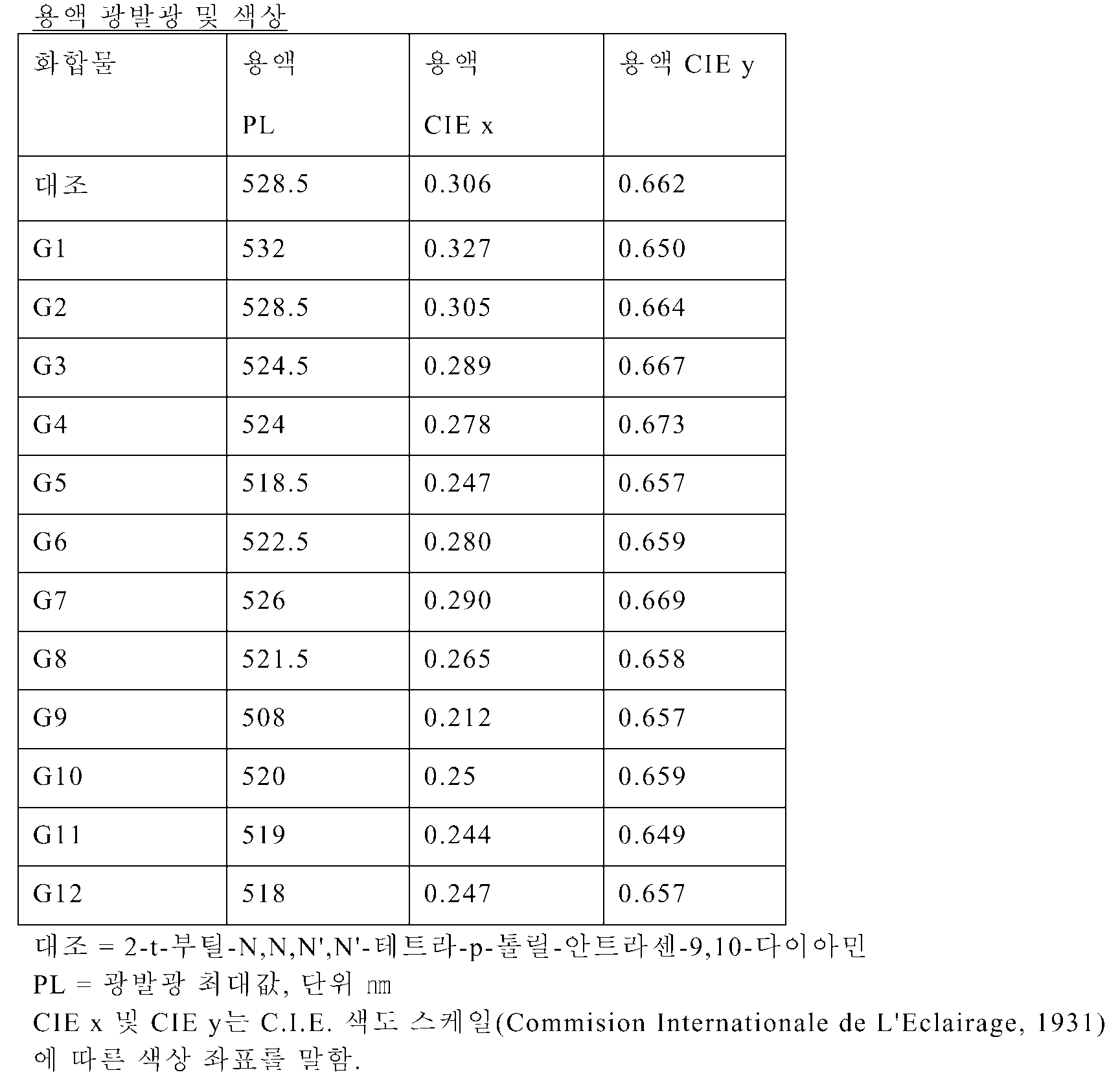
실시예 11Example 11
본 실시예는 정공 수송 재료 HT1의 제조를 설명한다.This embodiment describes the manufacture of the hole transporting material HT1.
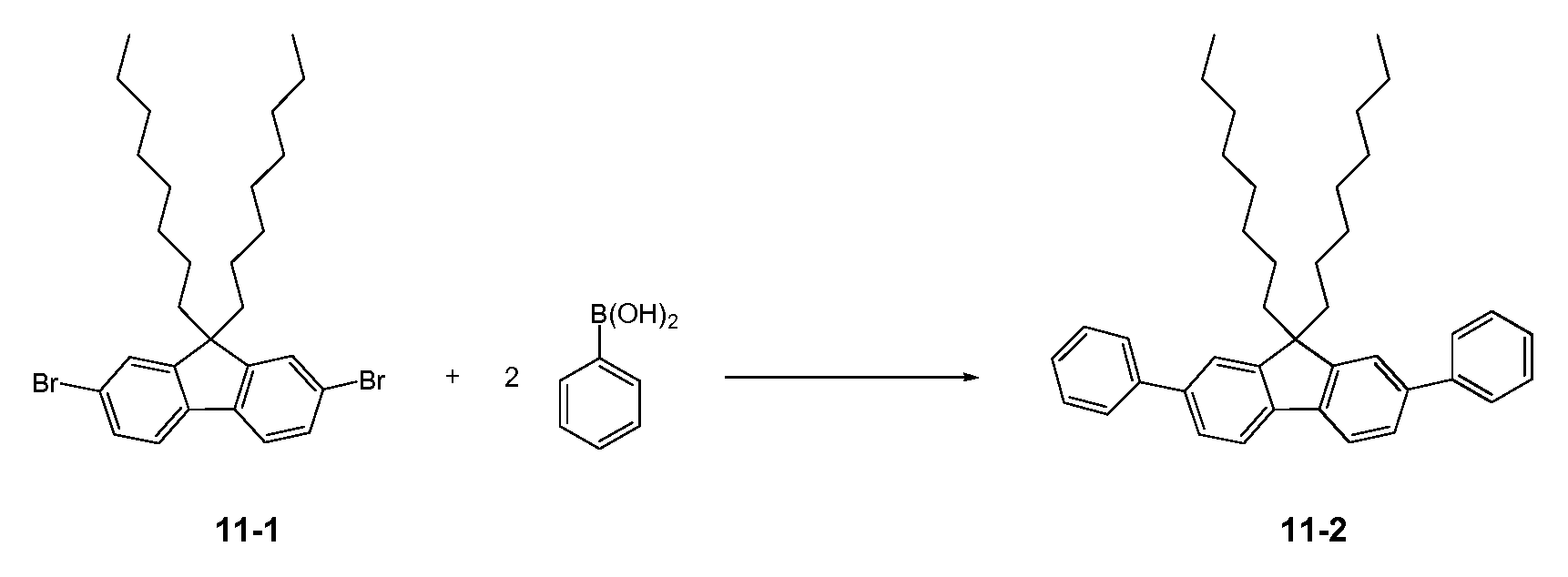
(a) 화합물 11-2의 합성(a) Synthesis of Compound 11-2
질소 분위기 하에, 250 ㎖ 둥근 바닥 플라스크를 9,9-다이옥틸-2,7-다이브로모플루오렌 (25.0 g, 45.58 mmol), 페닐보론산 (12.23 g, 100.28 mmol), Pd2(dba)3 (0.42 g, 0.46 mmol), PtBu3 (0.22 g, 1.09 mmol) 및 100 ㎖의 톨루엔으로 충전시켰다. 반응 혼합물을 5분 동안 교반하였고, 그 후에, KF (8.74 g, 150.43 mmol)를 두 번에 나누어 첨가하였고, 생성된 용액을 실온에서 하룻밤 교반하였다. 혼합물을 500 ㎖ THF로 희석하였고 실리카 및 셀라이트의 플러그를 통해 여과하였고 감압 하에 여과액으로부터 휘발성 물질을 제거하였다. 황색 오일을 헥산을 용출제로서 사용하여 실리카 젤 상의 플래시 컬럼 크로마토그래피로 정제하였다. 생성물을 백색 고체로서 80.0% 수율 (19.8 g)로 얻었다. 그 구조를 1-H nmr 분석으로 확인하였다.Dibromo fluorene (25.0 g, 45.58 mmol), phenylboronic acid (12.23 g, 100.28 mmol), Pd 2 (dba) 3 (0.42 g, 0.46 mmol), P t Bu 3 (0.22 g, 1.09 mmol) and 100 mL of toluene. The reaction mixture was stirred for 5 minutes, after which KF (8.74 g, 150.43 mmol) was added in two portions and the resulting solution was stirred at room temperature overnight. The mixture was diluted with 500 mL THF and filtered through a plug of silica and celite and volatiles were removed from the filtrate under reduced pressure. The yellow oil was purified by flash column chromatography on silica gel using hexane as eluent. The product was obtained in 80.0% yield (19.8 g) as a white solid. The structure was confirmed by 1-H nmr analysis.
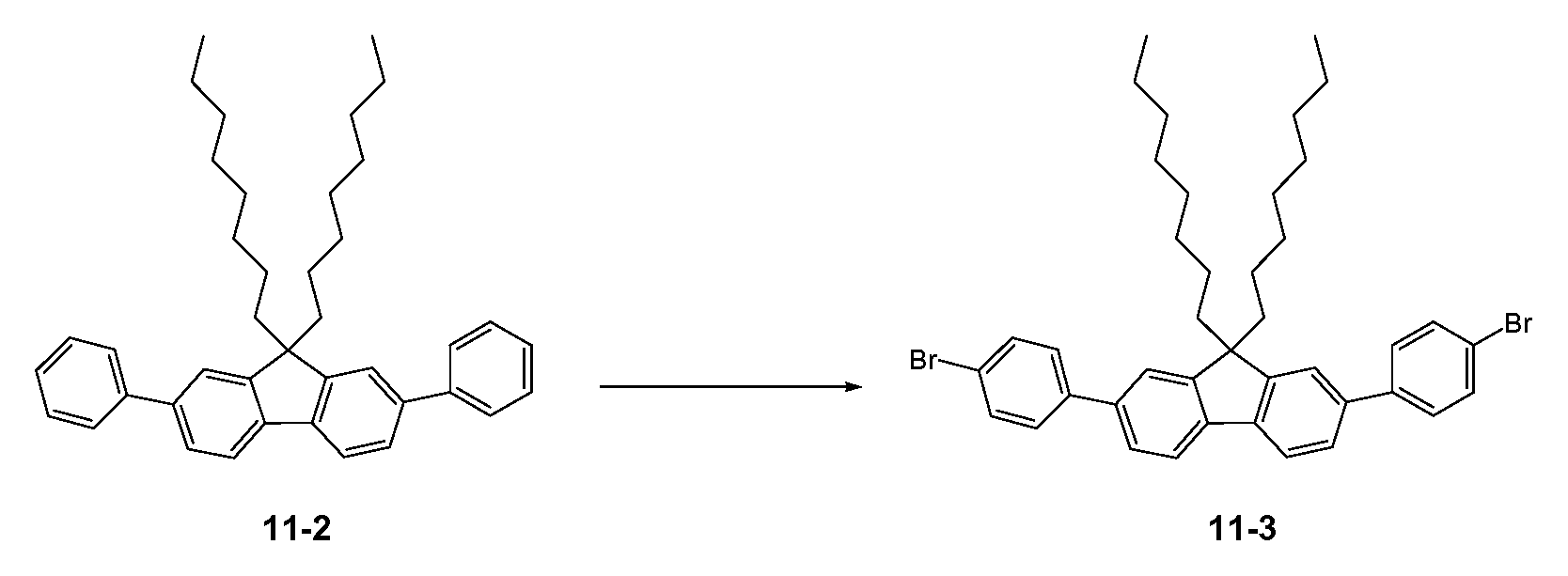
(b) 화합물 11-3의 합성(b) Synthesis of Compound 11-3
응축기 및 적하 깔대기가 구비된 250 ㎖ 3-목 둥근-바닥 플라스크를 N2로 30분간 플러싱하였다. 9,9-다이옥틸-2,7-다이페닐플루오렌 (19.8 g, 36.48 mmol) (상기 화합물 11-2)을 첨가하고 100 ㎖ 다이클로로메탄 중에 용해하였다. 투명한 용액을 -10℃로 냉각하였고, 20 ㎖ 다이클로로메탄 중의 브롬 (12.24 g, 76.60 mmol) 의 용액을 적가하였다. 혼합물을 0℃에서 1시간 동안 교반하였고, 그 다음 실온으로 가온시켰고 하룻밤 교반하였다. 100 ㎖의 10% Na2S2O3 수용액을 첨가하였고, 반응 혼합물을 1시간 동안 교반하였다. 유기 층을 추출하였고 수 층을 100 ㎖ 다이클로로메탄으로 3회 세척하였다. 합한 유기 층을 Na2SO4로 건조하였고, 여과 및 농축하여 건조시켰다. 생성된 오일에 아세톤을 첨가하여 백색 침전물을 얻었다. 여과 및 건조시에, 백색 분말이 얻어졌다 (13.3 g, 52.2 %). 그 구조를 1-H nmr 분석으로 확인하였다.A 250 ml three-necked round-bottomed flask equipped with a condenser and a dropping funnel was flushed with N 2 for 30 minutes. 9,9-Dioctyl-2,7-diphenylfluorene (19.8 g, 36.48 mmol) (compound 11-2) was added and dissolved in 100 ml dichloromethane. The clear solution was cooled to -10 C and a solution of bromine (12.24 g, 76.60 mmol) in 20 mL dichloromethane was added dropwise. The mixture was stirred at 0 < 0 > C for 1 hour, then warmed to room temperature and stirred overnight. Was added 10% Na 2 S 2 O 3 aqueous solution of 100 ㎖, the reaction mixture was stirred for 1 hour. The organic layer was extracted and several layers were washed three times with 100 mL dichloromethane. The combined organic layers were dried over Na 2 SO 4 , filtered and concentrated to dryness. Acetone was added to the resulting oil to give a white precipitate. Upon filtration and drying, a white powder was obtained (13.3 g, 52.2%). The structure was confirmed by 1-H nmr analysis.
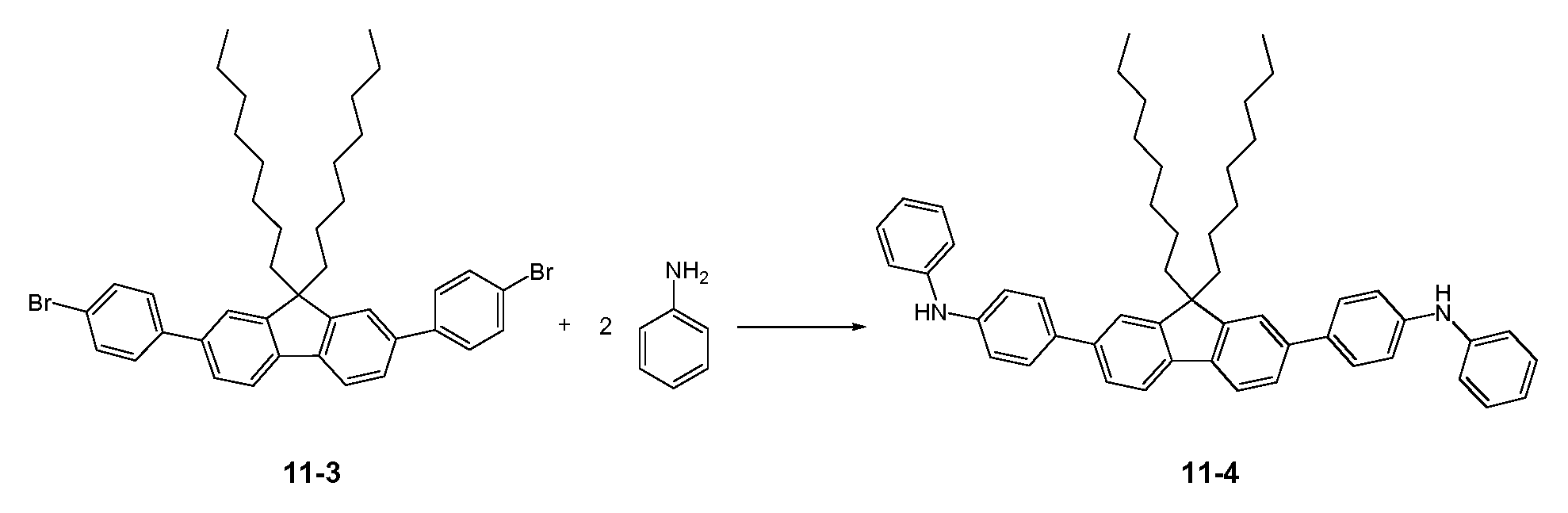
(c) 화합물 11-4의 합성(c) Synthesis of Compound 11-4
질소 분위기 하에, 250 ㎖의 둥근 바닥 플라스크를 화합물 11-3 (13.1 g, 18.70 mmol), 아닐린 (3.66 g, 39.27 mmol), Pd2(dba)3 (0.34 g, 0.37 mmol), PtBu3 (0.15 g, 0.75 mmol) 및 100 ㎖의 톨루엔으로 채웠다. 반응 혼합물을 10분간 교반하였고, 그 후에 NaOtBu (3.68 g, 38.33 mmol)를 첨가하였고, 반응 혼합물을 실온에서 1일간 교반하였다. 생성된 반응 혼합물을 3 L 톨루엔으로 희석하였고, 실리카 및 셀라이트의 플러그를 통해 여과하였다. 휘발성 물질의 증발시에, 얻어진 짙은 갈색 오일을 1:10의 에틸 아세테이트:헥산의 혼합물을 용출제로서 사용하여 실리카 젤 상의 플래시 컬럼 크로마토그래피로 정제하였다. 생성물을 담황색 분말로서 50.2% (6.8 g) 수율로 얻었다. 그 구조를 1-H nmr 분석으로 확인하였다.(13.1 g, 18.70 mmol), aniline (3.66 g, 39.27 mmol), Pd 2 (dba) 3 (0.34 g, 0.37 mmol), P t Bu 3 (0.15 g, 0.75 mmol) and 100 mL of toluene. The reaction mixture was stirred for 10 minutes, then NaO t Bu (3.68 g, 38.33 mmol) was added and the reaction mixture was stirred at room temperature for 1 day. The resulting reaction mixture was diluted with 3 L toluene and filtered through a plug of silica and celite. Upon evaporation of the volatiles, the resulting dark brown oil was purified by flash column chromatography on silica gel using a 1: 10 mixture of ethyl acetate: hexanes as the eluent. The product was obtained as a pale yellow powder in a yield of 50.2% (6.8 g). The structure was confirmed by 1-H nmr analysis.
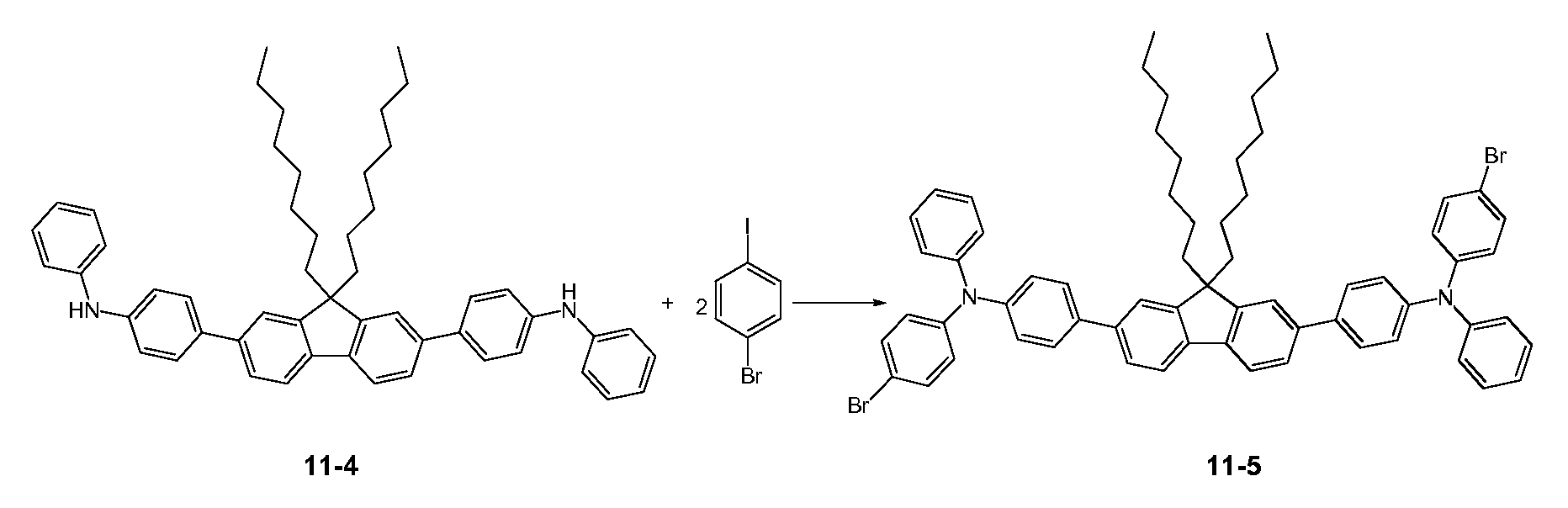
(d) 화합물 11-5의 합성(d) Synthesis of Compound 11-5
응축기가 구비된 250 ㎖ 3-목 둥근바닥 플라스크에서, 화합물 11-4 (4.00 g, 5.52 mmol), 1-브로모-4-요오도벤젠 (4.68 g, 16.55 mmol), Pd2(dba)3 (0.30 g, 0.33 mmol) 및 DPPF (0.37 g, 0.66 mmol)를 80 ㎖ 톨루엔과 합하였다. 생성된 혼합물을 10분간 교반하였다. NaOtBu (1.17 g, 12.14 mmol)를 첨가하였고 80℃로 4일간 가열하였다. 생성된 반응 혼합물을 1 L 톨루엔 및 1 L THF로 희석하였고, 실리카 및 셀라이트의 플러그를 통해 여과하여 불용성 염을 제거하였다. 휘발성 물질의 증발시에, 생성된 갈색 오일을 1:10의 다이클로로메탄:헥산의 혼합물을 용출제로서 사용하여 실리카 젤 상의 플래시 컬럼 크로마토그래피로 정제하였다. 건조한 후 황색 분말을 얻었다 (4.8 g, 84.8%). 그 구조를 1-H nmr 분석으로 확인하였다.(4.00 g, 5.52 mmol), l-bromo-4-iodobenzene (4.68 g, 16.55 mmol), Pd 2 (dba) 3 (0.30 g, 0.33 mmol) and DPPF (0.37 g, 0.66 mmol) were combined with 80 mL toluene. The resulting mixture was stirred for 10 minutes. NaO t Bu (1.17 g, 12.14 mmol) was added and heated to 80 ° C for 4 days. The resulting reaction mixture was diluted with 1 L toluene and 1 L THF and filtered through a plug of silica and celite to remove insoluble salts. Upon evaporation of the volatiles, the resulting brown oil was purified by flash column chromatography on silica gel using a 1: 10 mixture of dichloromethane: hexanes as the eluent. After drying, a yellow powder was obtained (4.8 g, 84.8%). The structure was confirmed by 1-H nmr analysis.
(e) 화합물 11-6의 합성(e) Synthesis of Compound 11-6
문헌[Klaerner, G.; Lee, J.-I.; Lee, V. Y.; Chan, E.; Chen, J.-P.; Nelson, A.; Markiewicz, D.; Siemens, R.; Scott, J. C.; Miller, R. D., Chemistry of Materials (1999), 11(7), 1800-1805]에 공개된 절차에 따라 본 화합물을 제조하였다.Klaerner, G .; Lee, J.-I .; Lee, V. Y .; Chan, E .; Chen, J.-P .; Nelson, A .; Markiewicz, D .; Siemens, R .; Scott, J. C .; Miller, R. D., Chemistry of Materials (1999), 11 (7), 1800-1805.
(f) (f) HT1HT1 의 합성Synthesis of
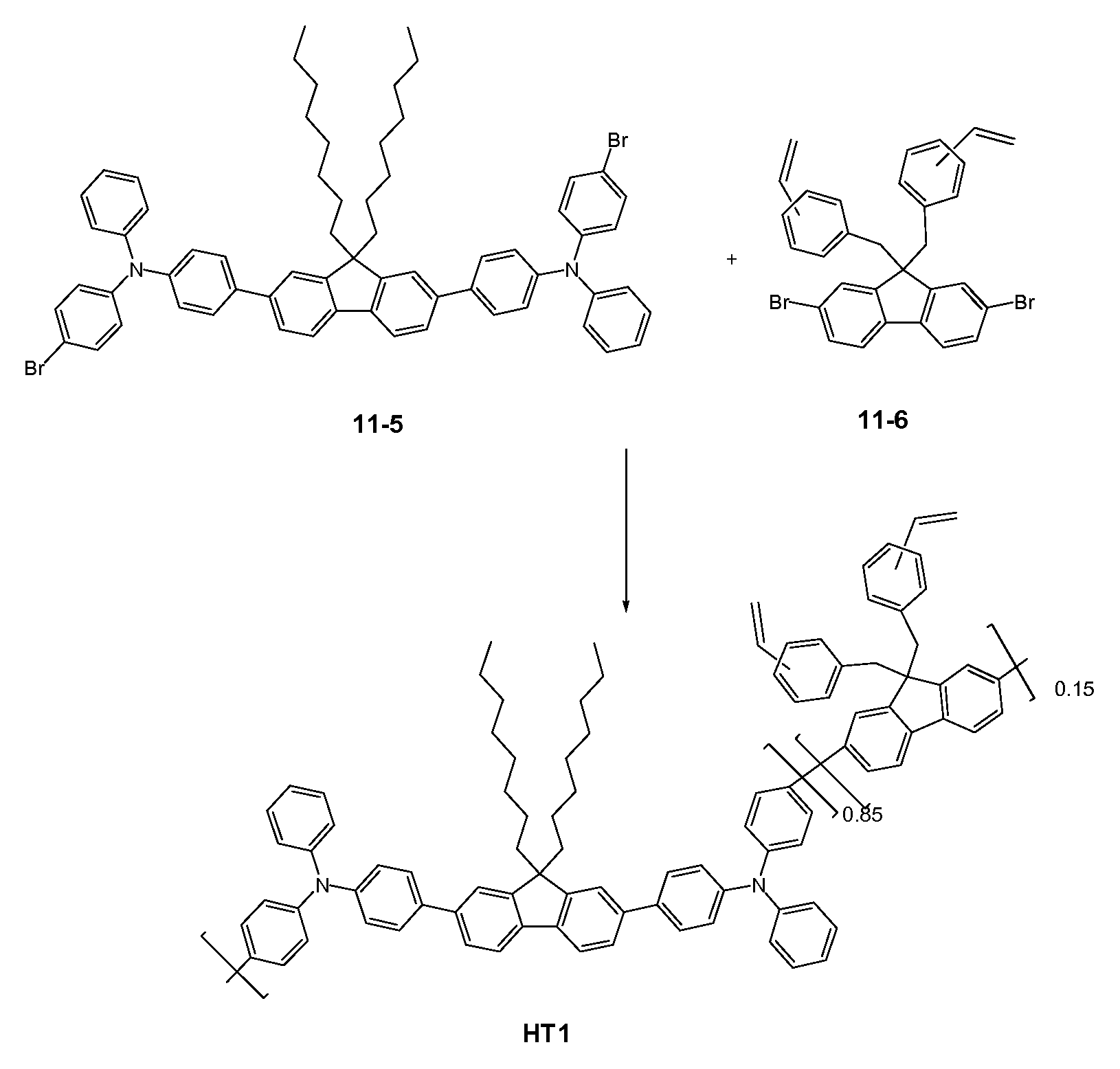
비스(1,5-사이클로옥타디엔)-니켈-(0) (0.556 g, 2.02 mmol)을 2,2'-바이피리딜 (0.315 g, 2.02 mmol) 및 1,5-사이클로옥타디엔 (0.219 g, 2.02 mmol)의 N,N-다이메틸포름아미드 (무수, 4 ㎖) 용액에 첨가하였다. 생성된 혼합물을 60℃로 30분 동안 가열하였다. 이어서, 2,7-다이브로모-9,9'-(p-비닐벤질)-플루오렌 (0.0834 g, 0.15 mmol) 및 화합물 11-5 (0.88 g, 0.85 mmol)의 톨루엔(무수, 16 ㎖) 용액을 교반 중인 촉매 혼합물에 재빨리 첨가하였다. 혼합물을 60℃에서 7시간 동안 교반하였다. 반응 혼합물을 실온으로 냉각한 후, 이것을 격렬히 교반하면서 250 ㎖ 메탄올에 서서히 부었고 하룻밤 교반하였다. 15 ㎖의 진한 HCl의 첨가가 뒤따랐고, 1시간 동안 교반하였다. 침전물을 여과한 다음 50 ㎖의 톨루엔에 첨가하였고, 500 ㎖의 메탄올에 서서히 부었다. 생성된 밝은 황색 침전물을 1시간 동안 교반한 다음 여과로 단리하였다. 크로마토그래피(실리카, 톨루엔) 및 에틸 아세테이트로부터의 침전에 의해 고체를 추가로 정제하였다. 생성된 재료를 진공 하에 건조한 후, 밝은 황색 중합체를 80% 수율(0.64 g)로 단리하였다. GPC (THF, 실온): Mn = 80,147; Mw = 262,659; Mw/Mn = 2.98.(0.556 g, 2.02 mmol) was reacted with 2,2'-bipyridyl (0.315 g, 2.02 mmol) and 1,5-cyclooctadiene (0.219 g, , 2.02 mmol) in N, N-dimethylformamide (anhydrous, 4 mL). The resulting mixture was heated to < RTI ID = 0.0 > 60 C < / RTI > (Anhydrous, 16 ml) of 2,7-dibromo-9,9'- (p-vinylbenzyl) -fluorene (0.0834 g, 0.15 mmol) and compound 11-5 (0.88 g, 0.85 mmol) The solution was added quickly to the stirred catalyst mixture. The mixture was stirred at 60 < 0 > C for 7 hours. After the reaction mixture was cooled to room temperature, it was slowly poured into 250 ml methanol with vigorous stirring and stirred overnight. Followed by the addition of 15 mL of concentrated HCl and stirring for 1 hour. The precipitate was filtered and then added to 50 mL of toluene and slowly poured into 500 mL of methanol. The resulting light yellow precipitate was stirred for 1 hour and then isolated by filtration. The solid was further purified by precipitation from chromatography (silica, toluene) and ethyl acetate. After drying the resulting material under vacuum, the light yellow polymer was isolated in 80% yield (0.64 g). GPC (THF, room temperature): Mn = 80, 147; Mw = 262,659; Mw / Mn = 2.98.
실시예Example 12 12
본 실시예는 호스트 재료 H1의 제조를 설명한다.This embodiment describes the production of the host material H1.
H1을 하기 도식에 따라 제조하였다:H1 was prepared according to the following scheme:


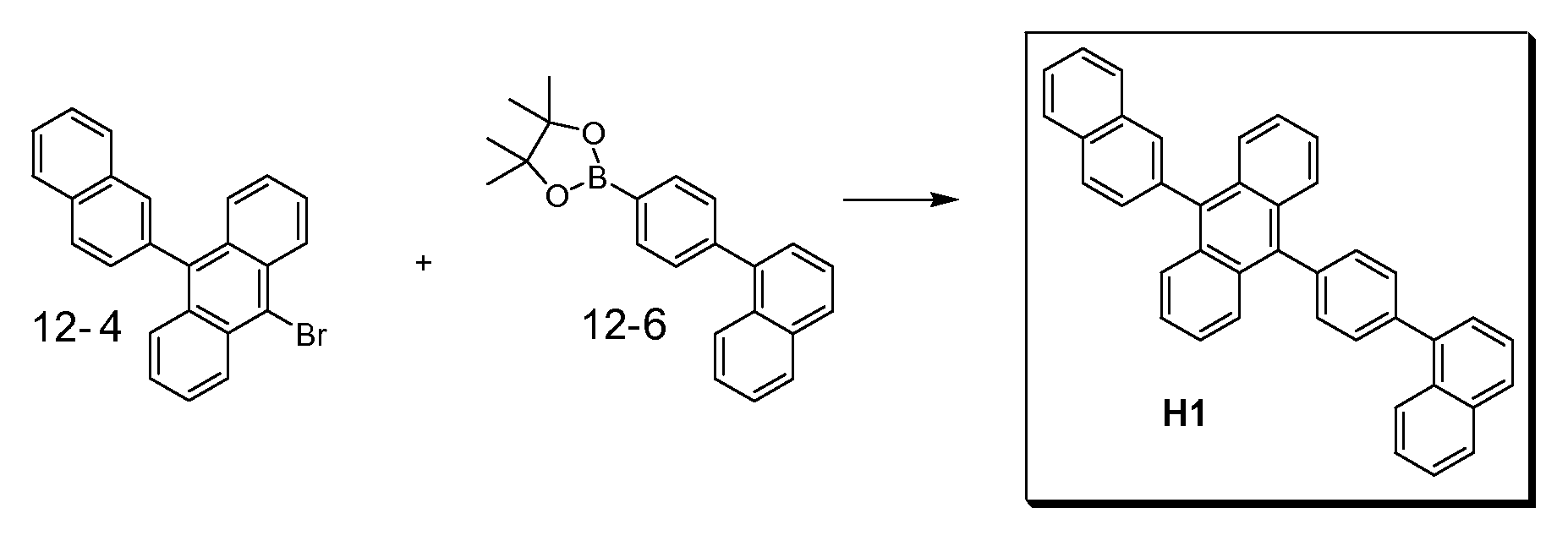
(a) 화합물 12-2의 합성(a) Synthesis of Compound 12-2
화합물 12-22을 미국 특허출원 공개 제2005/0245752호의 절차에 따라 합성하였다.Compounds 12-22 were synthesized according to the procedures of United States Patent Application Publication No. 2005/0245752.
(b) 화합물 12-3의 합성(b) Synthesis of Compound 12-3

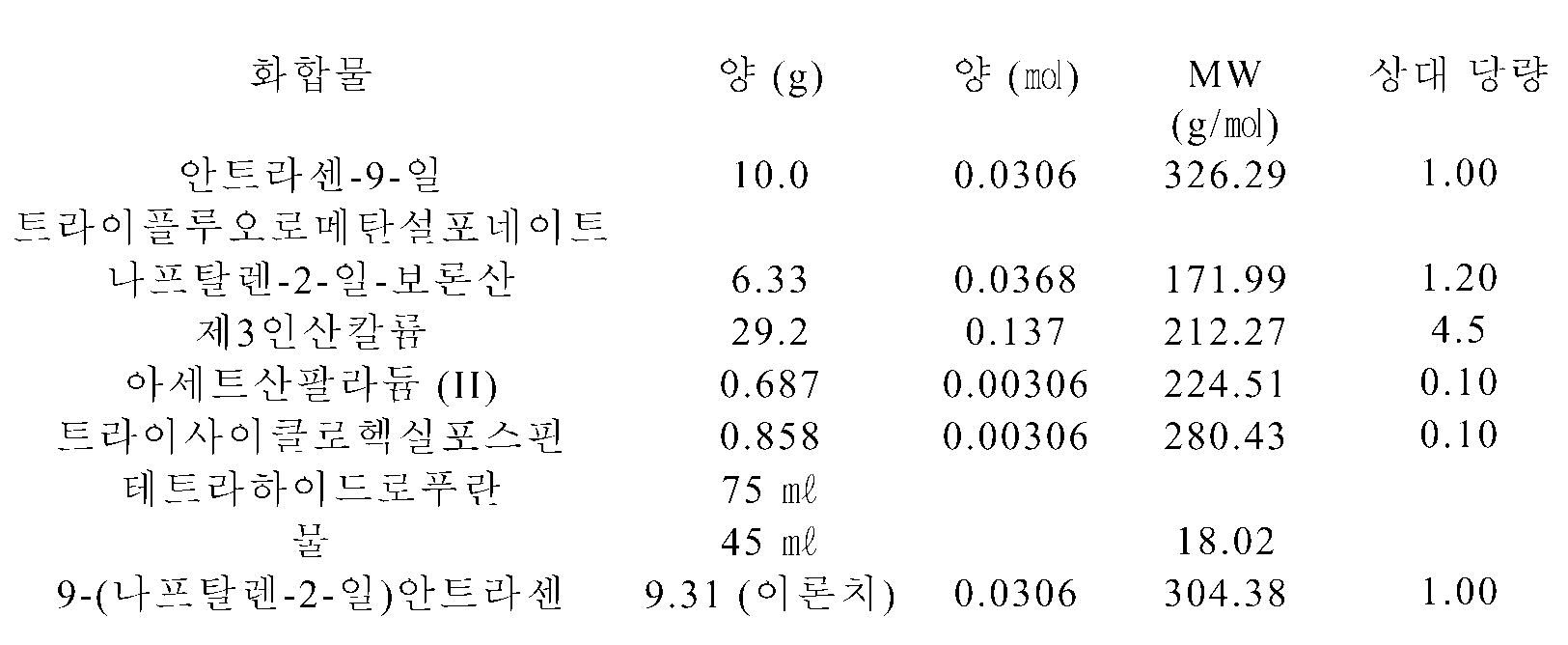
질소-충전 글로브 박스 내에서 모든 고체 시약들 및 THF를 교반 막대가 구비된 200 ㎖ 켈달(Kjeldahl) 반응 플라스크에서 합하였다. 드라이박스에서 꺼낸 후, 반응 혼합물을 질소로 퍼징하였고, 탈기된 물을 시린지로 첨가하였다. 그 다음, 응축기를 부가하였고, 반응물을 24시간 동안 환류하였다. TLC를 실시하였더니 안트라센-9-일 트라이플루오로메탄설포네이트 출발 물질이 없는 것으로 나타났다. 냉각 후에, 유기 층을 분리하였고, 수성 층을 DCM으로 추출하였다. 유기 분획들을 합하였고 용매를 감압 하에 제거하였다. 생성된 조 고체를 헥산 중의 5% DCM 및 알드리치 중성 알루미나를 사용한 컬럼 크로마토그래피로 정제하였다. 용매 극성을 점진적으로 50% DCM까지 증가시켰다. 용매를 제거하여 4.08 g의 백색 고체(43.8%의 수율)를 얻었다. 생성물을 1-H nmr 분석으로 확인하였다.All solid reagents and THF were combined in a 200 ml Kjeldahl reaction flask equipped with a stir bar in a nitrogen-filled glove box. After removal from the dry box, the reaction mixture was purged with nitrogen and the degassed water was added as a syringe. The condenser was then added and the reaction was refluxed for 24 hours. TLC showed no anthracene-9-yl trifluoromethane sulfonate starting material. After cooling, the organic layer was separated and the aqueous layer was extracted with DCM. The organic fractions were combined and the solvent was removed under reduced pressure. The resulting crude solid was purified by column chromatography using 5% DCM in hexanes and Aldrich neutral alumina. The solvent polarity was gradually increased to 50% DCM. The solvent was removed to give 4.08 g of a white solid (43.8% yield). The product was identified by 1-H nmr analysis.
(c) 화합물 12-4의 합성(c) Synthesis of Compound 12-4
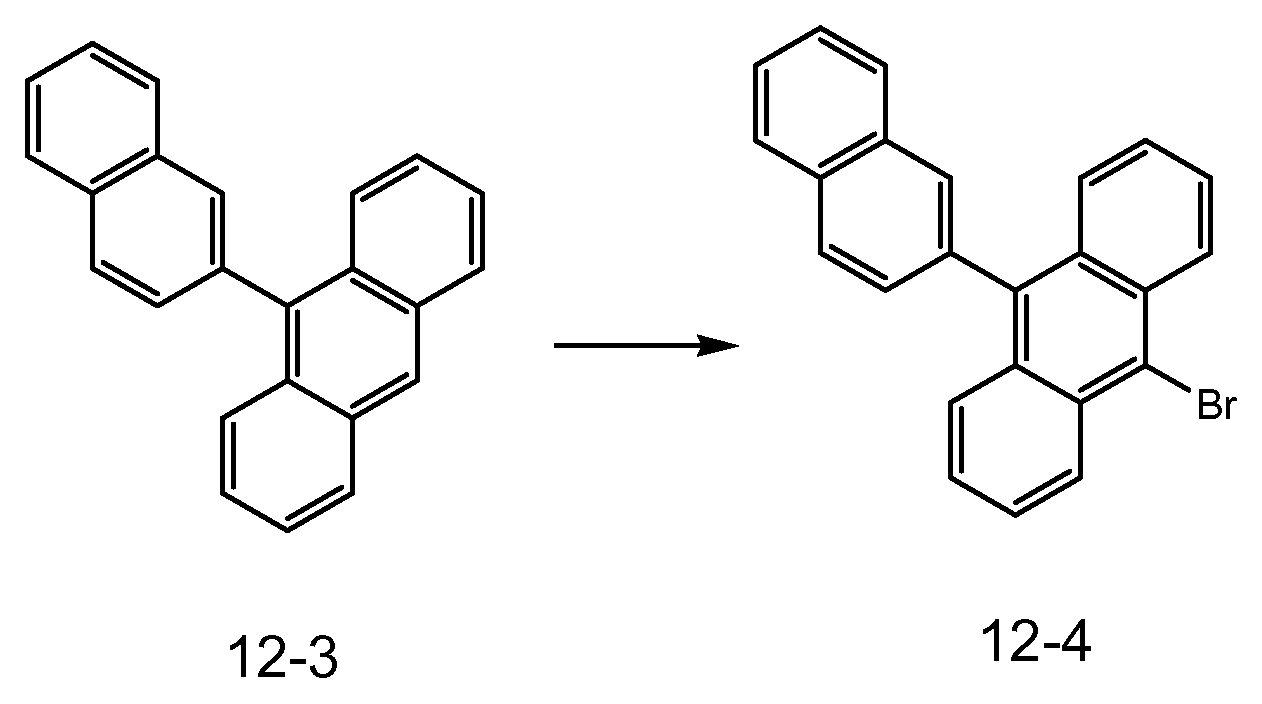
(d) 화합물 12-5의 합성(d) Synthesis of Compound 12-5


질소-충전 글로브 박스 내에서 모든 시약들 및 톨루엔을 교반 막대가 구비된 500 ㎖ 둥근 바닥 플라스크에서 합하였다. 드라이박스에서 꺼낸 후, 반응 혼합물을 질소로 퍼징하였고, 탈기된 물을 시린지로 첨가하였다. 응축기를 구비하고 반응물을 15시간 동안 환류시켰다. TLC를 실시하였더니 반응이 완료된 것으로 나타났다. 반응 혼합물을 실온으로 냉각하였다. 유기 층을 분리하고 수성 층을 DCM으로 추출하였다. 유기 분획들을 합하고 감압 하에 용매를 제거하여 점성 오일을 얻었다. 조 물질을 실리카 젤 및 10% DCM/헥산을 사용한 컬럼 크로마토그래피로 정제하였다. 용매를 제거하여 20 그램(85% 수율)의 투명한 점성 오일을 얻었다. 생성물을 1-H nmr 분석에 의해 확인하였다.In a nitrogen-filled glove box, all reagents and toluene were combined in a 500 mL round bottom flask equipped with a stir bar. After removal from the dry box, the reaction mixture was purged with nitrogen and the degassed water was added as a syringe. The condenser was equipped and the reaction was refluxed for 15 hours. TLC was performed and the reaction was completed. The reaction mixture was cooled to room temperature. The organic layer was separated and the aqueous layer was extracted with DCM. The organic fractions were combined and the solvent removed under reduced pressure to give a viscous oil. The crude material was purified by column chromatography using silica gel and 10% DCM / hexanes. The solvent was removed to give 20 grams (85% yield) of a clear viscous oil. The product was confirmed by 1-H nmr analysis.
(e) 화합물 12-6의 합성(e) Synthesis of Compound 12-6

무수 THF (800 ㎖) 중에 용해된 1-(4-브로모-페닐)-나프탈렌 (40 g)의 용액에 nBuLi (헥산 중 1.6 M, 130 ㎖)를 -78℃ (드라이아이스/아세톤)에서 천천히 첨가하였다. 반응 혼합물이 갈색으로 변하였고 10분 동안 -78℃에서 교반한 다음 가온하고, 추가 10분 동안 교반한 다음 -78℃로 다시 냉각하였다. 여기에 다이옥사보롤란 (42.8 ㎖)을 첨가하였고, 반응물을 이 온도에서 0.5시간 동안 교반한 후에 실온으로 가온하고 1시간 동안 교반하였다. 이어서, 물을 반응 혼합물에 첨가하고 Et2O로 완전히 추출하였다. 유기 층을 무수 황산마그네슘으로 건조하고 여과하였다. 용매를 진공 하에 제거하고 이러한 농축된 용액에 물을 첨가하였고, 백색 고체가 형성되어 여과하였다. 조 생성물을 톨루엔 중에서 재결정하고, 진공 하에 건조하여 25 g의 화합물 12-6을 백색 고체로서 얻었다.To a solution of 1- (4-bromo-phenyl) -naphthalene (40 g) dissolved in anhydrous THF (800 mL) was slowly added nBuLi (1.6 M in hexane, 130 mL) at -78 째 C (dry ice / acetone) . The reaction mixture turned brown and stirred at -78 < 0 > C for 10 min, then warmed, stirred for an additional 10 min and then cooled again to -78 < 0 > C. To this was added dioxaborolane (42.8 mL) and the reaction was stirred at this temperature for 0.5 h, then warmed to room temperature and stirred for 1 h. Then, water was added to the reaction mixture and thoroughly extracted with Et 2 O. The organic layer was dried over anhydrous magnesium sulfate and filtered. The solvent was removed in vacuo and water was added to this concentrated solution, a white solid formed and filtered. The crude product was recrystallized in toluene and dried under vacuum to give 25 g of compound 12-6 as a white solid.
(f) H1의 합성(f) Synthesis of H1
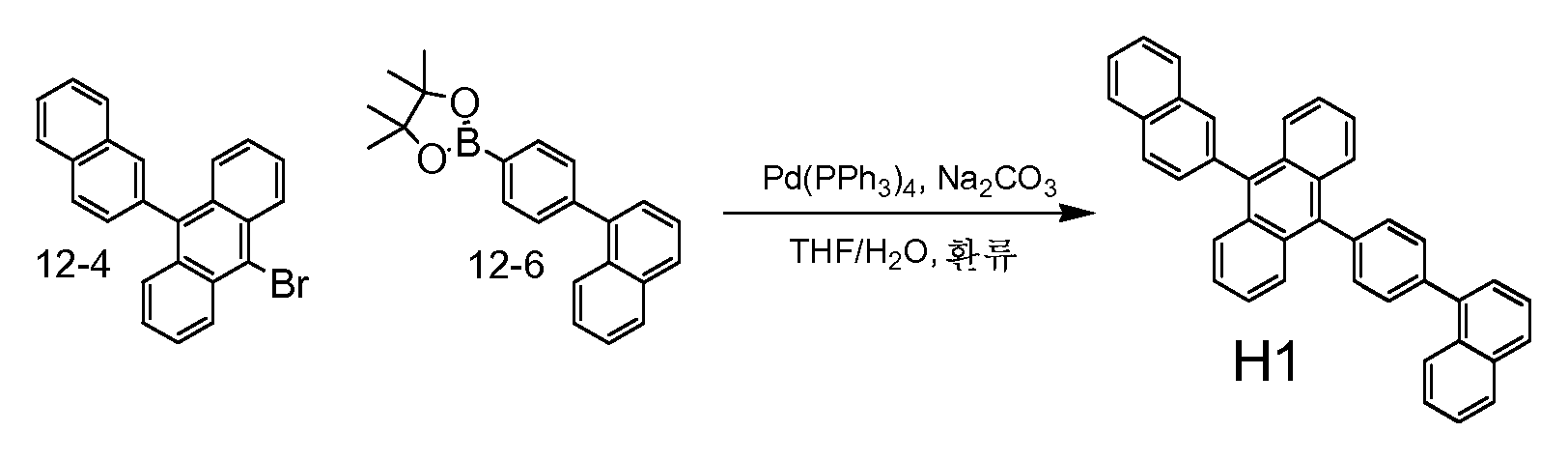

질소-충전 글로브 박스 내에서 모든 시약들 및 THF를 교반 막대가 구비된 100 ㎖ 둥근 바닥 플라스크에서 합하였다. 드라이박스에서 꺼낸 후, 반응 혼합물을 질소로 퍼징하였고, 탈기된 물을 시린지로 첨가하였다. 응축기를 구비하고 반응물을 72시간 동안 환류시켰다. LC-MS를 실시하였더니 반응이 완료된 것으로 나타났다. 반응 혼합물을 실온으로 냉각시켰다. 유기 층을 분리하고 수성 층을 DCM으로 추출하였다. 유기 분획들을 합하고 용매를 감압 하에 제거하여 회색 고체를 얻었다. 조 물질을 실리카 젤 및 DCM/헥산을 사용한 컬럼 크로마토그래피로 정제하였다. 용매를 제거하여 1 그램(76% 수율)의 백색 고체를 얻었다. 용액 및 증기 승화 기술 둘 모두를 사용하여 호스트 H1을 정제하였다.All reagents and THF in a nitrogen-filled glove box were combined in a 100 ml round bottom flask equipped with a stir bar. After removal from the dry box, the reaction mixture was purged with nitrogen and the degassed water was added as a syringe. The condenser was equipped and the reaction was refluxed for 72 hours. LC-MS showed that the reaction was complete. The reaction mixture was cooled to room temperature. The organic layer was separated and the aqueous layer was extracted with DCM. The organic fractions were combined and the solvent was removed under reduced pressure to give a gray solid. The crude material was purified by column chromatography using silica gel and DCM / hexane. The solvent was removed to give 1 gram (76% yield) of a white solid. The host H1 was purified using both solution and steam sublimation techniques.
실시예 13Example 13
본 실시예는 호스트 H2의 제조를 설명한다.This embodiment describes the fabrication of the host H2.
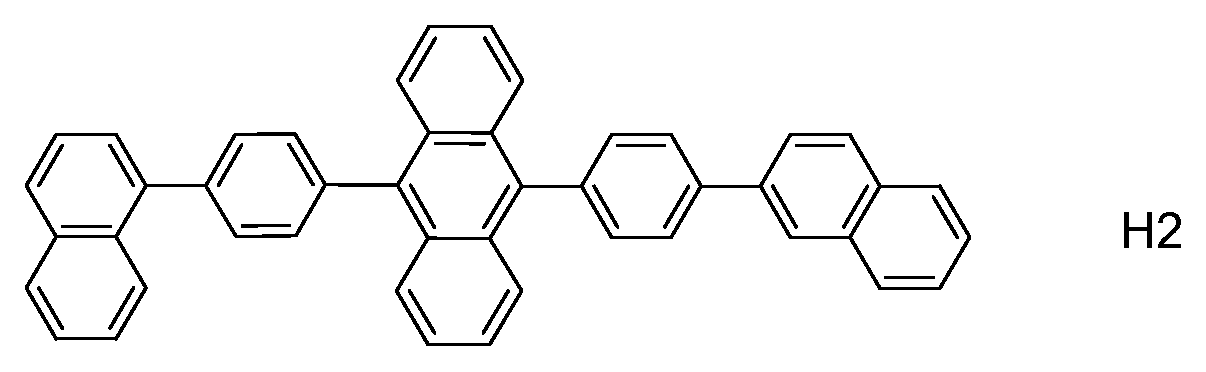
하기 도식에 따라 H1과 유사한 방식으로 호스트 재료 H2를 합성하였다.The host material H2 was synthesized in a similar manner to H1 according to the following scheme.

(a) 화합물 13-1의 합성(a) Synthesis of Compound 13-1
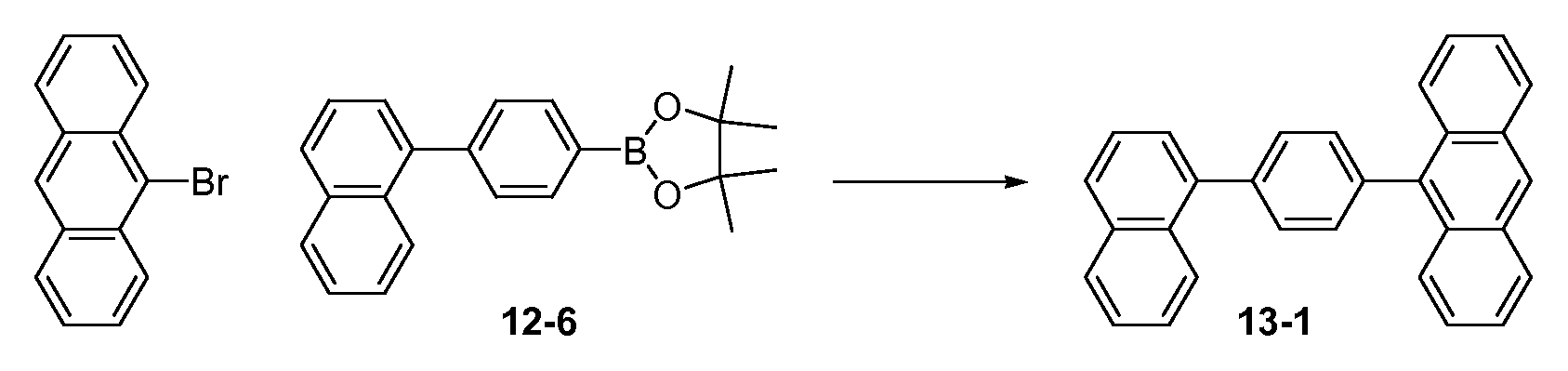
톨루엔 (300 ㎖) 중의 4,4,5,5-테트라메틸-2-(4-나프탈렌-1-일-페닐 [1,3,2]다이옥사보롤란 (20.7 g) 및 9-브로모-안트라센 (14.6 g)의 혼합물에 2M 탄산나트륨 (57 ㎖의 물 중에 12.1 g 용해됨)을 첨가한 다음 상전이제 알리콰트(Aliquat)336 (2.4 g)을 첨가하였다. 혼합물을 질소로 15분 동안 버블링한 후에, 테트라키스(트라이페닐포스핀)팔라듐(0) (Pd[(C6H5)3P]4 (0.69 g)를 첨가하고 반응물을 질소 분위기 하에 90℃(오일조)에서 1일간 가열하였다. 이어서, 반응 혼합물을 실온으로 냉각하고 에틸 에테르로 추출하였다. 유기 용매를 진공 하에 제거하고, 조 생성물을 헥산으로 세척하고 헥산:THF (1:1.5)를 용출제로서 사용하는 플로리실의 짧은 컬럼으로 정제하였다. 17 g의 원하는 화합물을 백색 고체로서 얻었다.To a solution of 4,4,5,5-tetramethyl-2- (4-naphthalen-l-yl-phenyl [l, 3,2] dioxaborolane (20.7 g) and 9- bromo-anthracene (14.6 g) was added 2M sodium carbonate (12.1 g dissolved in 57 ml of water) and then the phase transition Aliquat 336 (2.4 g) was added. The mixture was bubbled with nitrogen for 15 minutes (Pd [(C 6 H 5 ) 3 P] 4 (0.69 g) was added and the reaction was heated at 90 ° C (oil bath) for 1 day under a nitrogen atmosphere . The organic solvent was removed in vacuo and the crude product was washed with hexane and eluted with a short column of Florisil using hexane: THF (1: 1.5) as the eluent < RTI ID = To give 17 g of the desired compound as a white solid.
(b) 화합물 13-2의 합성(b) Synthesis of Compound 13-2
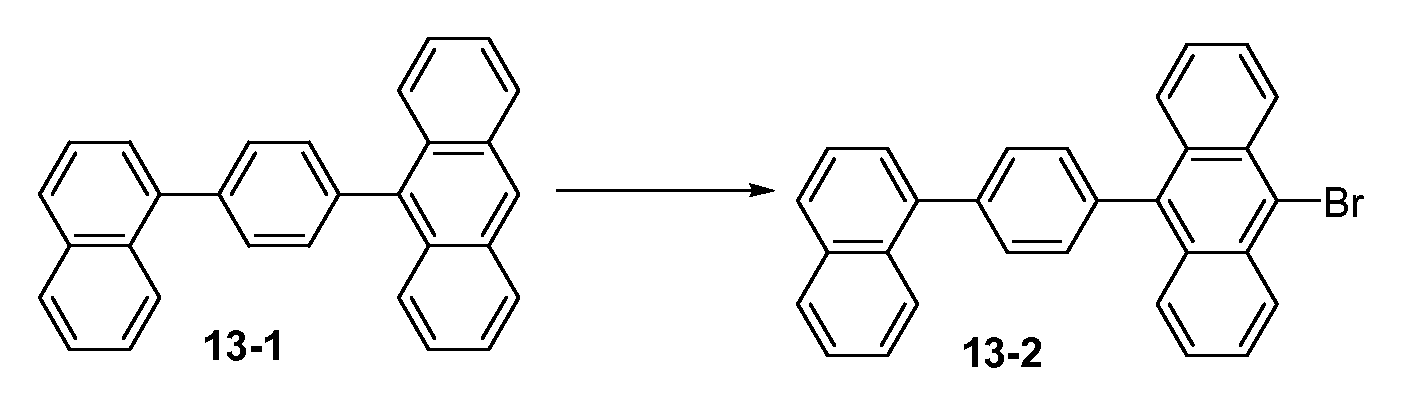
3-목 둥근바닥 플라스크에서 9-(4-나프탈렌-1-일-페닐)-안트라센 (15 g, 40 mmol)을 메틸렌 클로라이드 (500 ㎖)에 용해하고, 적하 깔때기를 통해 1시간에 걸쳐 브롬 (7 g, d 3.12 g/㎖, FW 159.81, 44 mmol)을 천천히 첨가하였다. 이어서, 반응 혼합물에 질소를 살포하여 HBr를 제거하고 반응물을 실온에서 하룻밤 교반하였다. 이어서, 반응 혼합물을 물로 추출하고 MgSO4로 건조하고 플로리실로 여과하였다. 진공 하에 용매를 제거하고 황색 고체를 수집하고, 이를 헥산으로 세척 및 건조시 16 g의 황색 고체를 원하는 화합물로서 얻었다.A solution of 9- (4-naphthalen-1-yl-phenyl) -anthracene (15 g, 40 mmol) in methylene chloride (500 mL) was added dropwise via a dropping funnel to bromine 7 g, d 3.12 g / ml, FW 159.81, 44 mmol) was slowly added. The reaction mixture was then sparged with nitrogen to remove HBr, and the reaction was stirred at room temperature overnight. Then, the reaction mixture was extracted with water, dried over MgSO 4 and filtered Indeed Florisil. The solvent was removed in vacuo and the yellow solid was collected, which was washed with hexane and dried to yield 16 g of a yellow solid as the desired compound.
(c) 화합물 (c) Compound H2H2 의 합성Synthesis of


톨루엔 (300 ㎖) 중의 4,4,5,5-테트라메틸-2-(4-나프탈렌-2-일-페닐)-[1,3,2]다이옥사보롤란 (12.6 g) 및 9-브로모-10-(4-나프탈렌-1-일-페닐)-안트라센 (16 g)의 혼합물에 2M 탄산 나트륨 (35 ㎖의 물 중에 7.4 g 용해됨)을 첨가한 다음 상전이제 알리콰트336 (1.4 g)을 첨가하였다. 혼합물을 질소로 15분 동안 버블링한 후에, 테트라키스(트라이페닐포스핀)팔라듐(0) (Pd[(C6H5)3P]4 (0.40 g)를 첨가하고 반응물을 질소 분위기 하에 90℃(오일조)에서 1일간 가열하였다. 이어서, 반응 혼합물을 실온으로 냉각하고 에틸 에테르로 추출하고, MgSO4로 건조하고, 여과하고, 메탄올에 첨가하고, 여과하고, 이렇게 수집된 황색 고체를 진공 하에 건조하였다. 황색 고체를 THF 중에 용해하고 THF/헥산 (1:1)을 사용하여 플로리실 컬럼에 통과시키고, 진공 하에 농축시켜서 10 g의 밝은 황색 고체를 얻었고, 3-구역 ( 250C, 210C, 170C) 승화에 의해 70시간 동안 정제하였다. 5.6 g의 담황색 고체를 회수하였다.To a solution of 4,4,5,5-tetramethyl-2- (4-naphthalen-2-yl-phenyl) - [l, 3,2] dioxaborolane (12.6 g) and 9- (1.4 g dissolved in 35 mL of water) was added to a mixture of 2-amino-10- (4- naphthalen-1-yl-phenyl) -anthracene (16 g) Was added. After the mixture was bubbled with nitrogen for 15 min, tetrakis (triphenylphosphine) palladium (0) (Pd [(C 6 H 5 ) 3 P] 4 (0.40 g) was added and the reaction was stirred at 90 ℃ was heated for a day at (oil bath). Next, the reaction mixture was cooled to room temperature and extracted with ethyl ether, dried over MgSO 4, filtered, and added to methanol, filtered and vacuum to a yellow solid collected so The yellow solid was dissolved in THF and passed through a florisil column using THF / hexane (1: 1) and concentrated in vacuo to give 10 g of a light yellow solid and a 3-zone (250C, 210C, 170C) sublimation for 70 h. 5.6 g of light yellow solid was recovered.
실시예Example 14 내지 14 - 실시예Example 27 27
본 실시예들은 녹색을 발광하는 유기 전자 소자의 제작 및 성능을 설명한다.These embodiments describe the fabrication and performance of an organic electronic device emitting green light.
소자 제작 및 시험Device fabrication and testing
소자를 다음과 같이 구성하였다:The device was configured as follows:
인듐 주석 산화물 (ITO) 100 ㎚Indium tin oxide (ITO) 100 nm
완충 층 = 폴리피롤과 중합체성 플루오르화 설폰산의 수성 분산물인 완충제 1 (25 ㎚). 이 재료는 미국 특허 출원 공개 제2005/0205860호의 실시예 1에 기재된 것과 유사한 방법을 사용하여 제조하였다.Buffer 1 = Buffer 1 (25 nm) which is an aqueous dispersion of polypyrrole and polymeric fluorinated sulfonic acid. This material was prepared using a method similar to that described in Example 1 of U.S. Patent Application Publication No. 2005/0205860.
정공 수송 층 = 중합체 HT1 (20 ㎚)Hole transport layer = polymer HT1 (20 nm)
광활성 층 = 13:1의 호스트:도펀트 (48 ㎚)Photoactive layer = 13: 1 host: dopant (48 nm)
전자 수송(ET) 층 = (20 ㎚)Electron transport (ET) layer = (20 nm)
캐소드 = LiF/Al (0.5/100 ㎚)Cathode = LiF / Al (0.5 / 100 nm)
용액 처리 및 열증발 기술의 조합에 의해서 OLED 소자를 제작하였다. 신 필름 디바이스, 인크(Thin Film Devices, Inc)로부터의 패턴화된 인듐 주석 산화물 (ITO) 코팅된 유리 기재를 사용하였다. 이러한 ITO 기재는 시트 저항이 30 ohm/square이고 광 투과율이 80%인 ITO로 코팅된 코닝(Corning) 1737 유리를 기반으로 한다. 패턴화된 ITO 기재를 수성 세제 용액 중에서 초음파로 세정하였고 증류수로 헹구었다. 그 후, 패턴화된 ITO를 아세톤 중에서 초음파로 세정하였고, 아이소프로판올로 헹구었고, 질소 스트림에서 건조하였다.OLED devices were fabricated by a combination of solution treatment and thermal evaporation techniques. A patterned indium tin oxide (ITO) coated glass substrate from Thin Film Devices, Inc was used. Such an ITO substrate is based on Corning 1737 glass coated with ITO having a sheet resistance of 30 ohm / square and a light transmittance of 80%. The patterned ITO substrate was ultrasonically cleaned in aqueous detergent solution and rinsed with distilled water. The patterned ITO was then ultrasonically cleaned in acetone, rinsed with isopropanol and dried in a stream of nitrogen.
소자 제작 직전에, 세정되고 패턴화된 ITO 기재를 UV 오존으로 10분 동안 처리하였다. 냉각 직후에, 완충제 1의 수성 분산물을 ITO 표면 위에 스핀-코팅하였고 가열하여 용매를 제거하였다. 냉각 후, 기재를 다음으로 정공 수송 재료의 용액으로 스핀 코팅한 다음, 가열하여 용매를 제거하였다. 냉각 후, 발광 층 용액으로 기재를 스핀 코팅하고, 가열하여 용매를 제거하였다. 기재를 마스킹하고, 진공 챔버에 넣었다. 열증발에 의해 전자 수송 층을 침착하였고, 이어서 LiF의 층을 침착하였다. 그 다음, 진공에서 마스크를 바꾸고 열증발에 의해서 Al의 층을 침착하였다. 챔버를 통기시키고, 유리 덮개, 건조제, 및 UV 경화성 에폭시를 사용하여 소자를 봉지하였다.Immediately prior to device fabrication, the cleaned and patterned ITO substrate was treated with UV ozone for 10 minutes. Immediately after cooling, an aqueous dispersion of Buffer 1 was spin-coated onto the ITO surface and heated to remove the solvent. After cooling, the substrate was then spin-coated with a solution of the hole transport material and then heated to remove the solvent. After cooling, the substrate was spin-coated with the light emitting layer solution and heated to remove the solvent. The substrate was masked and placed in a vacuum chamber. The electron transport layer was deposited by thermal evaporation and then a layer of LiF was deposited. The mask was then changed in vacuum and the layer of Al was deposited by thermal evaporation. The chamber was vented, and the device was sealed using a glass lid, a desiccant, and a UV curable epoxy.
OLED 샘플을 그의 (1) 전류-전압 (I-V) 곡선, (2) 전계발광 방사 휘도(electroluminescence radiance) 대 전압, 및 (3) 전계발광 스펙트럼 대 전압을 측정함으로써 특성화하였다. 모든 3가지 측정을 동일 시간에 실시하였고 컴퓨터로 제어하였다. 소정 전압에서의 소자의 전류 효율은 LED의 전계발광 방사 휘도를, 소자를 작동하는 데 필요한 전류 밀도로 나누어서 결정한다. 단위는 cd/A이다. 전력 효율은 전류 효율을 작동 전압으로 나눈 것이다. 단위는 lm/W이다.OLED samples were characterized by measuring their (1) current-voltage (I-V) curves, (2) electroluminescence radiance vs voltage, and (3) electroluminescence spectral versus voltage. All three measurements were performed at the same time and were computer controlled. The current efficiency of the device at a given voltage is determined by dividing the electroluminescent emission luminance of the LED by the current density required to operate the device. The unit is cd / A. Power efficiency is the current efficiency divided by the operating voltage. The unit is lm / W.
사용된 재료들(호스트, 도펀트 및 ET 재료)이 도 3에 주어진다. 소자 결과가 표 4에 주어진다. 비교를 위해, 대조 도펀트를 사용하였다.The materials used (host, dopant and ET material) are given in Fig. The device results are given in Table 4. For comparison, control dopants were used.
대조 도펀트 = 2-t-부틸-N,N,N',N'-테트라-p-톨릴-안트라센-9,10-다이아민Control dopant = 2-t-butyl-N, N, N ', N'-tetra-p-tolyl-
AlQ = 트리스(8-하이드록시퀴놀라토)알루미늄AlQ = tris (8-hydroxyquinolato) aluminum
ZrQ = 테트라키스(8-하이드록시퀴놀라토)지르코늄ZrQ = tetrakis (8-hydroxyquinolato) zirconium


일반적인 설명 또는 실시예에서 전술된 모든 작용이 요구되지는 않으며, 특정 작용의 일부가 요구되지 않을 수 있고, 설명된 것에 더하여 하나 이상의 추가의 작용이 수행될 수 있음을 알아야 한다. 또한, 작용들이 나열된 순서는 반드시 그들이 수행되는 순서는 아니다.It is to be understood that not all of the acts described above in the generic description or the examples are required, that some of the specified acts may not be required, and that one or more additional actions in addition to those described may be performed. Also, the order in which actions are listed is not necessarily the order in which they are performed.
상기 명세서에서, 개념들이 특정 실시 형태를 참조하여 설명되었다. 그러나, 당업자는 아래의 청구의 범위에서 설명되는 바와 같은 본 발명의 범주로부터 벗어남이 없이 다양한 변형 및 변경이 이루어질 수 있음을 이해한다. 따라서, 명세서 및 도면은 제한적인 의미보다는 예시적인 의미로 간주되어야 하고, 모든 그러한 변형이 본 발명의 범주 내에 포함되게 하고자 한다.In the foregoing specification, the concepts have been described with reference to specific embodiments. However, it will be understood by those skilled in the art that various changes and modifications may be made therein without departing from the scope of the invention as set forth in the claims below. Accordingly, the specification and figures are to be regarded in an illustrative rather than a restrictive sense, and all such modifications are intended to be included within the scope of the present invention.
이득, 다른 이점, 및 문제에 대한 해결책이 특정 실시 형태에 관해 전술되었다. 그러나, 이득, 이점, 문제에 대한 해결책, 그리고 임의의 이득, 이점, 또는 해결책을 발생시키거나 더 명확해지게 할 수 있는 임의의 특징부(들)는 임의의 또는 모든 청구의 범위의 매우 중요하거나, 요구되거나, 필수적인 특징부로서 해석되어서는 안 된다.Benefits, other advantages, and solutions to problems have been described above with regard to specific embodiments. However, it is to be understood that any feature (s) capable of generating, or making clearer, the benefits, advantages, solutions to problems, and any benefit, advantage, , It shall not be construed as a required or essential feature.
본 명세서에서 특정된 다양한 범위의 수치값의 사용은 기술된 범위 내의 최소 및 최대 값 둘 모두에 용어 "약"이 선행하는 것처럼 근사값으로서 기술된다. 이러한 방식으로, 기술된 범위 위아래의 약간의 변동을 그 범위 이내의 값과 사실상 동일한 결과를 달성하는 데 사용할 수 있다. 또한, 이러한 범위의 개시 사항은 하나의 값의 일부 구성요소가 상이한 값의 구성요소와 혼합될 때 생성될 수 있는 분수 값을 포함하는, 최소 평균값과 최대 평균값 사이의 모든 값을 포함하는 연속적인 범위로서 의도된다. 더욱이, 더 넓은 범위 및 더 좁은 범위가 개시될 때, 하나의 범위로부터의 최소값을 다른 범위로부터의 최대값과 일치시키는 것 및 그 반대의 경우는 본 발명의 고려 이내이다.The use of the various ranges of numerical values specified herein is described as an approximation such that the term "about" precedes both the minimum and maximum values within the ranges described. In this way, some variation above or below the range described can be used to achieve substantially the same results as values within that range. Also, the scope of this disclosure is intended to encompass a continuous range including all values between the minimum average value and the maximum average value, including fractional values that can be generated when some of the components of one value are mixed with components of different values . Moreover, when broader and narrower ranges are disclosed, it is within the considerations of the present invention to match the minimum value from one range to the maximum value from the other range and vice versa.
소정 특징부가 명확함을 위해 별개의 실시 형태들과 관련하여 본 명세서에서 설명되고, 단일 실시 형태와 조합하여 또한 제공될 수 있다는 것을 이해하여야 한다. 역으로, 간략함을 위해 단일 실시예와 관련하여 설명된 여러 특징부들은 별개로 또는 임의의 하위 조합으로 또한 제공될 수 있다.It is to be understood that certain features may be resorted to and described in connection with the separate embodiments for clarity and in combination with a single embodiment. Conversely, various features described in connection with a single embodiment for the sake of simplicity may also be provided separately or in any subcombination.
Claims (19)
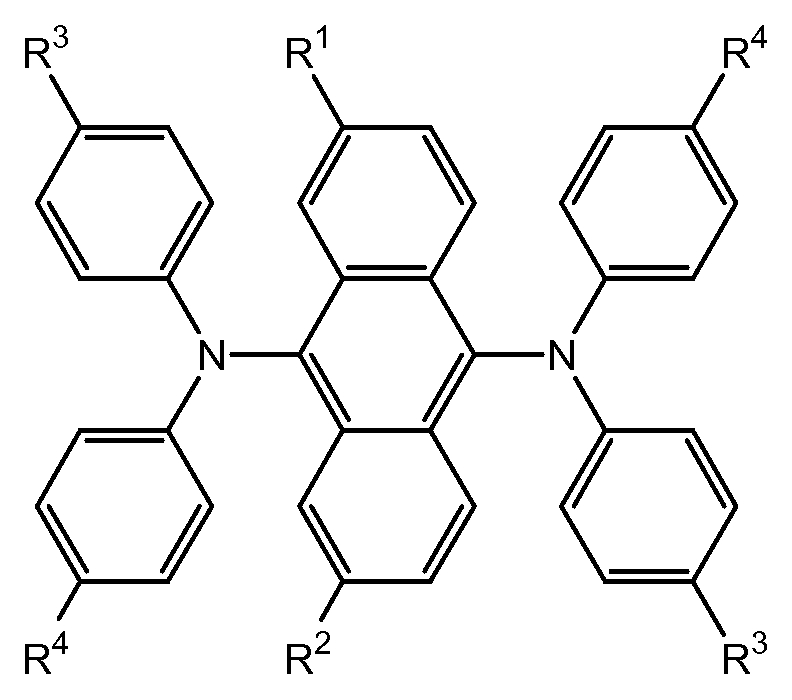


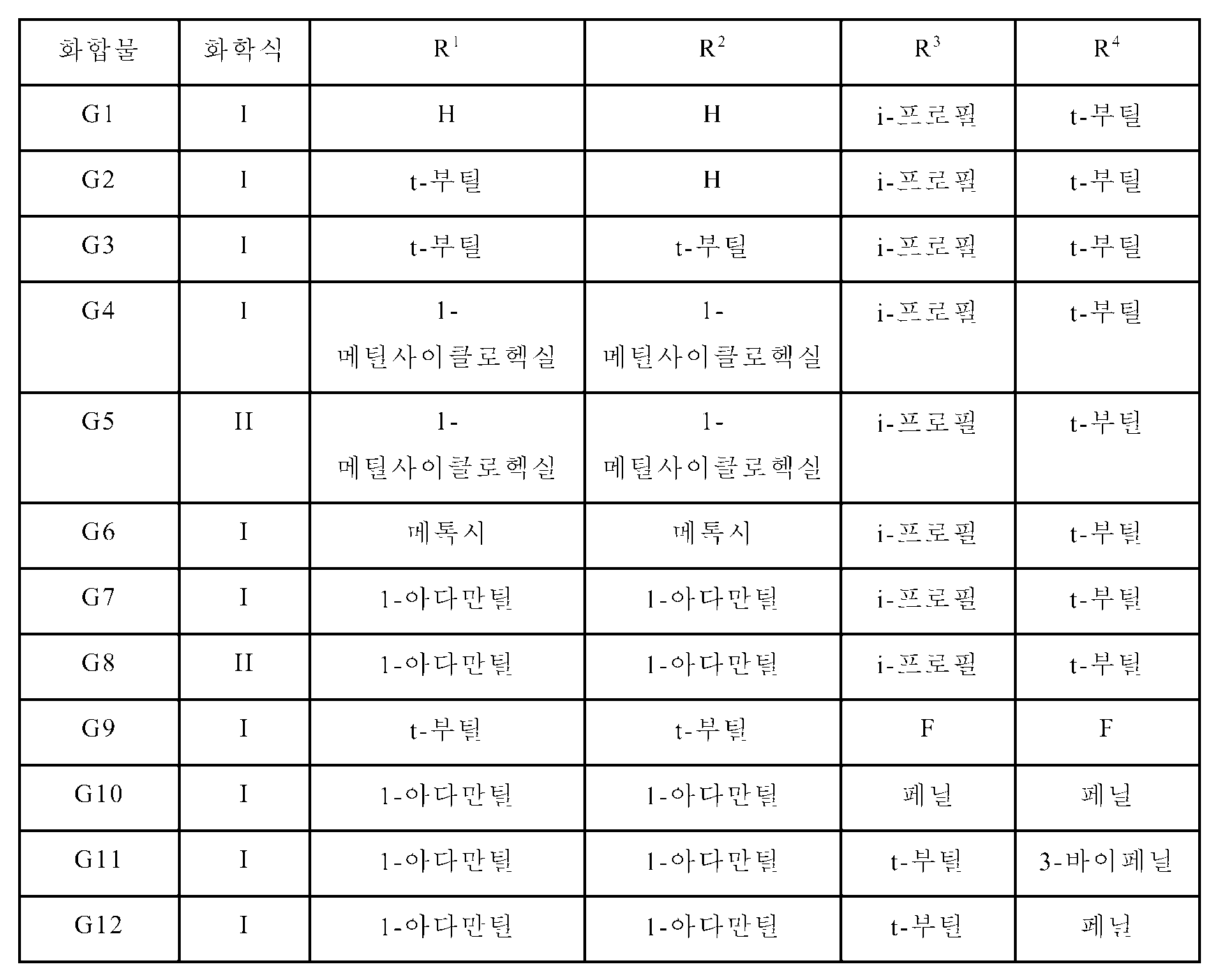


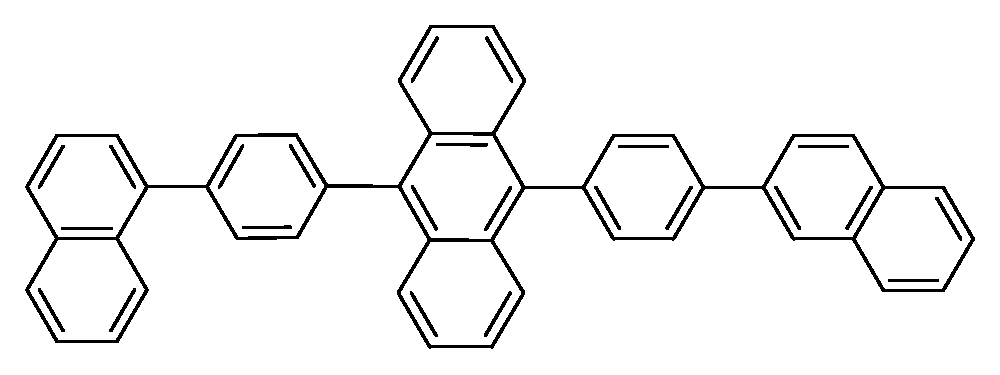
Applications Claiming Priority (2)
| Application Number | Priority Date | Filing Date | Title |
|---|---|---|---|
| US94138007P | 2007-06-01 | 2007-06-01 | |
| US60/941,380 | 2007-06-01 |
Publications (2)
| Publication Number | Publication Date |
|---|---|
| KR20100017970A KR20100017970A (en) | 2010-02-16 |
| KR101554751B1 true KR101554751B1 (en) | 2015-09-22 |
Family
ID=40094349
Family Applications (1)
| Application Number | Title | Priority Date | Filing Date |
|---|---|---|---|
| KR1020097027463A Expired - Fee Related KR101554751B1 (en) | 2007-06-01 | 2008-05-29 | Green luminous material |
Country Status (7)
| Country | Link |
|---|---|
| US (2) | US20080303429A1 (en) |
| EP (1) | EP2197981B1 (en) |
| JP (1) | JP5466150B2 (en) |
| KR (1) | KR101554751B1 (en) |
| CN (1) | CN101918512B (en) |
| TW (1) | TW200907020A (en) |
| WO (1) | WO2008150828A2 (en) |
Families Citing this family (28)
| Publication number | Priority date | Publication date | Assignee | Title |
|---|---|---|---|---|
| US8465848B2 (en) | 2006-12-29 | 2013-06-18 | E I Du Pont De Nemours And Company | Benzofluorenes for luminescent applications |
| EP2232606A1 (en) * | 2007-12-17 | 2010-09-29 | 3M Innovative Properties Company | Solution processable organic semiconductors based on anthracene |
| JP2011524908A (en) * | 2008-06-19 | 2011-09-08 | スリーエム イノベイティブ プロパティズ カンパニー | Solution-processable organic semiconductors |
| GB2488258B (en) * | 2008-09-02 | 2013-01-16 | Cambridge Display Tech Ltd | Electroluminescent material and device |
| US8759818B2 (en) | 2009-02-27 | 2014-06-24 | E I Du Pont De Nemours And Company | Deuterated compounds for electronic applications |
| US8147989B2 (en) * | 2009-02-27 | 2012-04-03 | Global Oled Technology Llc | OLED device with stabilized green light-emitting layer |
| US9153790B2 (en) | 2009-05-22 | 2015-10-06 | Idemitsu Kosan Co., Ltd. | Organic electroluminescent device |
| US20110133632A1 (en) * | 2009-12-09 | 2011-06-09 | E.I. Du Pont De Nemours And Company | Deuterated compound as part of a combination of compounds for electronic applications |
| US20110147717A1 (en) * | 2009-12-21 | 2011-06-23 | E. I. Du Pont De Nemours And Company | Deuterated compounds for luminescent applications |
| WO2012083301A1 (en) * | 2010-12-17 | 2012-06-21 | E. I. Du Pont De Nemours And Company | Anthracene derivative compounds for electronic applications |
| EP2610240A1 (en) * | 2011-12-28 | 2013-07-03 | Solvay Sa | Crosslinkable arylamine compounds |
| CN103421487B (en) * | 2013-01-14 | 2016-02-03 | 烟台九目化学制品有限公司 | A kind of novel materials for electroluminescence and application thereof |
| CN103762320B (en) * | 2013-12-31 | 2016-09-28 | 南京邮电大学 | A kind of method that electrical annealing or thermal annealing prepare high color rendering index (CRI) white light parts |
| JP7191687B2 (en) * | 2018-12-28 | 2022-12-19 | 住友化学株式会社 | COMPOSITION FOR LIGHT-EMITTING DEVICE AND LIGHT-EMITTING DEVICE CONTAINING THE SAME |
| JP7191688B2 (en) * | 2018-12-28 | 2022-12-19 | 住友化学株式会社 | COMPOSITION FOR LIGHT-EMITTING DEVICE AND LIGHT-EMITTING DEVICE CONTAINING THE SAME |
| JP7191686B2 (en) * | 2018-12-28 | 2022-12-19 | 住友化学株式会社 | COMPOSITION FOR LIGHT-EMITTING DEVICE AND LIGHT-EMITTING DEVICE CONTAINING THE SAME |
| JP7191685B2 (en) * | 2018-12-28 | 2022-12-19 | 住友化学株式会社 | COMPOSITION FOR LIGHT-EMITTING DEVICE AND LIGHT-EMITTING DEVICE CONTAINING THE SAME |
| JP7191684B2 (en) * | 2018-12-28 | 2022-12-19 | 住友化学株式会社 | COMPOSITION FOR LIGHT-EMITTING DEVICE AND LIGHT-EMITTING DEVICE CONTAINING THE SAME |
| JP2020109823A (en) * | 2019-09-04 | 2020-07-16 | 住友化学株式会社 | Light emitting element composition and light emitting element including the same |
| JP2020109828A (en) * | 2019-09-05 | 2020-07-16 | 住友化学株式会社 | Light emitting device composition and light emitting device containing the same |
| JP2020109831A (en) * | 2019-09-05 | 2020-07-16 | 住友化学株式会社 | Light emitting element composition and light emitting element including the same |
| JP2020109832A (en) * | 2019-09-05 | 2020-07-16 | 住友化学株式会社 | Light emitting element composition and light emitting element including the same |
| JP2020109825A (en) * | 2019-09-05 | 2020-07-16 | 住友化学株式会社 | Light emitting element composition and light emitting element including the same |
| JP2020109829A (en) * | 2019-09-05 | 2020-07-16 | 住友化学株式会社 | Light emitting element composition and light emitting element including the same |
| JP2020109827A (en) * | 2019-09-05 | 2020-07-16 | 住友化学株式会社 | Light emitting device composition and light emitting device containing the same |
| JP2020109833A (en) * | 2019-09-05 | 2020-07-16 | 住友化学株式会社 | Light emitting device composition and light emitting device containing the same |
| JP2021075730A (en) * | 2021-01-29 | 2021-05-20 | 住友化学株式会社 | Light emitting element composition and light emitting element including the same |
| US20240415012A1 (en) * | 2021-09-17 | 2024-12-12 | Semiconductor Energy Laboratory Co., Ltd. | Photoelectric conversion device material and display device |
Citations (3)
| Publication number | Priority date | Publication date | Assignee | Title |
|---|---|---|---|---|
| EP0765106A2 (en) | 1995-09-25 | 1997-03-26 | Toyo Ink Manufacturing Co., Ltd. | Light-emitting material for organic electroluminescence device, and organic electroluminescence device for which the light-emitting material is adapted |
| EP1541657A1 (en) | 2002-07-19 | 2005-06-15 | Idemitsu Kosan Co., Ltd. | Organic electroluminescent devices and organic luminescent medium |
| US20060217572A1 (en) * | 2005-03-25 | 2006-09-28 | Idemitsu Kosan Co., Ltd. | Aromatic amine derivative and organic electroluminescence device employing the same |
Family Cites Families (98)
| Publication number | Priority date | Publication date | Assignee | Title |
|---|---|---|---|---|
| US4053311A (en) | 1976-04-02 | 1977-10-11 | Limburg William W | Poly-n-vinylcarbazole image transport layer plasticized by bis(4-diethylamino-2-methylphenyl)phenylmethane |
| GB8909011D0 (en) | 1989-04-20 | 1989-06-07 | Friend Richard H | Electroluminescent devices |
| EP0443861B2 (en) | 1990-02-23 | 2008-05-28 | Sumitomo Chemical Company, Limited | Organic electroluminescence device |
| US5408109A (en) | 1991-02-27 | 1995-04-18 | The Regents Of The University Of California | Visible light emitting diodes fabricated from soluble semiconducting polymers |
| US5378519A (en) | 1992-04-28 | 1995-01-03 | Canon Kabushiki Kaisha | Electroluminescent device |
| JPH07249490A (en) | 1994-03-08 | 1995-09-26 | Ricoh Co Ltd | Electroluminescent device |
| JP2686418B2 (en) | 1994-08-12 | 1997-12-08 | 東洋インキ製造株式会社 | Diarylamine derivative, production method and use thereof |
| US6303238B1 (en) | 1997-12-01 | 2001-10-16 | The Trustees Of Princeton University | OLEDs doped with phosphorescent compounds |
| EP1666561A1 (en) | 1998-12-28 | 2006-06-07 | Idemitsu Kosan Company Limited | Organic electroluminescent element |
| WO2000070655A2 (en) | 1999-05-13 | 2000-11-23 | The Trustees Of Princeton University | Very high efficiency organic light emitting devices based on electrophosphorescence |
| KR100946314B1 (en) | 1999-12-01 | 2010-03-09 | 더 트러스티즈 오브 프린스턴 유니버시티 | Organic light emitting device comprising a phosphorescent organo metallic compound |
| US7476452B2 (en) | 2000-06-30 | 2009-01-13 | E. I. Du Pont De Nemours And Company | Electroluminescent iridium compounds with fluorinated phenylpyridine ligands, and devices made with such compounds |
| US6670645B2 (en) | 2000-06-30 | 2003-12-30 | E. I. Du Pont De Nemours And Company | Electroluminescent iridium compounds with fluorinated phenylpyridines, phenylpyrimidines, and phenylquinolines and devices made with such compounds |
| US7595501B2 (en) | 2000-06-30 | 2009-09-29 | E. I. Du Pont De Nemours And Company | Electroluminescent iridium compounds with fluorinated phenylpryidines, phenylpyrimidines, and phenylquinolines and devices made with such compounds |
| US6579630B2 (en) | 2000-12-07 | 2003-06-17 | Canon Kabushiki Kaisha | Deuterated semiconducting organic compounds used for opto-electronic devices |
| US6875523B2 (en) | 2001-07-05 | 2005-04-05 | E. I. Du Pont De Nemours And Company | Photoactive lanthanide complexes with phosphine oxides, phosphine oxide-sulfides, pyridine N-oxides, and phosphine oxide-pyridine N-oxides, and devices made with such complexes |
| KR20040018467A (en) | 2001-07-18 | 2004-03-03 | 이 아이 듀폰 디 네모아 앤드 캄파니 | Luminescent lanthanide complexes with imine ligands and devices made with such complexes |
| KR100577179B1 (en) | 2001-10-30 | 2006-05-10 | 엘지전자 주식회사 | Organic electroluminescent element |
| US7166368B2 (en) | 2001-11-07 | 2007-01-23 | E. I. Du Pont De Nemours And Company | Electroluminescent platinum compounds and devices made with such compounds |
| EP2306788A1 (en) | 2001-12-26 | 2011-04-06 | E. I. du Pont de Nemours and Company | Iridium compounds and devices made therewith |
| JP2004010550A (en) | 2002-06-07 | 2004-01-15 | Japan Science & Technology Corp | Method for producing deuterated aromatic compound |
| JP4161262B2 (en) | 2002-06-26 | 2008-10-08 | ソニー株式会社 | ORGANIC ELECTROLUMINESCENT ELEMENT AND LIGHT EMITTING OR DISPLAY DEVICE USING THE SAME |
| TW200404054A (en) | 2002-07-26 | 2004-03-16 | Wako Pure Chem Ind Ltd | Method for deuteration of aromatic ring |
| US6963005B2 (en) | 2002-08-15 | 2005-11-08 | E. I. Du Pont De Nemours And Company | Compounds comprising phosphorus-containing metal complexes |
| KR20050052473A (en) | 2002-08-16 | 2005-06-02 | 더 유니버시티 오브 써던 캘리포니아 | Organic light emitting materials and devices |
| KR100924462B1 (en) | 2002-08-23 | 2009-11-03 | 이데미쓰 고산 가부시키가이샤 | Organic Electroluminescent Devices and Anthracene Derivatives |
| JP4164317B2 (en) | 2002-08-28 | 2008-10-15 | キヤノン株式会社 | Organic light emitting device |
| AU2003275203A1 (en) * | 2002-09-24 | 2004-04-19 | E.I. Du Pont De Nemours And Company | Water dispersible polythiophenes made with polymeric acid colloids |
| US7462298B2 (en) * | 2002-09-24 | 2008-12-09 | E.I. Du Pont De Nemours And Company | Water dispersible polyanilines made with polymeric acid colloids for electronics applications |
| US20060052641A1 (en) | 2002-11-12 | 2006-03-09 | Masakazu Funahashi | Material for organic electroluminescent device and organic electroluminescent device using same |
| US6872475B2 (en) | 2002-12-03 | 2005-03-29 | Canon Kabushiki Kaisha | Binaphthalene derivatives for organic electro-luminescent devices |
| US7651788B2 (en) | 2003-03-05 | 2010-01-26 | Lg Display Co., Ltd. | Organic electroluminescent device |
| CN101789496B (en) * | 2003-04-10 | 2011-12-28 | 出光兴产株式会社 | Aromatic amine derivative and organic electroluminescence element using the same |
| DE10328627A1 (en) | 2003-06-26 | 2005-02-17 | Covion Organic Semiconductors Gmbh | New materials for electroluminescence |
| JP3848306B2 (en) | 2003-06-27 | 2006-11-22 | キヤノン株式会社 | Anthryl derivative-substituted compound and organic light emitting device using the same |
| JP4035482B2 (en) | 2003-06-27 | 2008-01-23 | キヤノン株式会社 | Substituted anthryl derivative and organic light emitting device using the same |
| JP3840235B2 (en) | 2003-06-27 | 2006-11-01 | キヤノン株式会社 | Organic light emitting device |
| JP3848307B2 (en) | 2003-06-27 | 2006-11-22 | キヤノン株式会社 | Aminoanthryl derivative-substituted compound and organic light-emitting device using the same |
| US6852429B1 (en) | 2003-08-06 | 2005-02-08 | Canon Kabushiki Kaisha | Organic electroluminescent device based on pyrene derivatives |
| US6875524B2 (en) | 2003-08-20 | 2005-04-05 | Eastman Kodak Company | White light-emitting device with improved doping |
| CN1894199B (en) | 2003-11-14 | 2011-04-13 | 住友化学株式会社 | Halogenated bisdiarylaminopolycyclic aromatic compounds and polymers thereof |
| TWI365218B (en) | 2003-11-17 | 2012-06-01 | Sumitomo Chemical Co | Conjugated oligomers or polymers based on crosslinkable arylamine compounds |
| CN1879454A (en) | 2004-02-19 | 2006-12-13 | 出光兴产株式会社 | White Organic Electroluminescent Devices |
| US7365230B2 (en) * | 2004-02-20 | 2008-04-29 | E.I. Du Pont De Nemours And Company | Cross-linkable polymers and electronic devices made with such polymers |
| WO2005086539A1 (en) * | 2004-03-05 | 2005-09-15 | Idemitsu Kosan Co., Ltd. | Organic electroluminescence display device |
| US7351358B2 (en) * | 2004-03-17 | 2008-04-01 | E.I. Du Pont De Nemours And Company | Water dispersible polypyrroles made with polymeric acid colloids for electronics applications |
| US20050245752A1 (en) * | 2004-04-29 | 2005-11-03 | Eastman Kodak Company | Synthesis of unsymmetric anthracene compounds |
| TWI373506B (en) | 2004-05-21 | 2012-10-01 | Toray Industries | Light-emitting element material and light-emitting material |
| JPWO2005117500A1 (en) * | 2004-05-27 | 2008-04-03 | 出光興産株式会社 | White organic electroluminescence device |
| JP4637651B2 (en) | 2004-06-03 | 2011-02-23 | 三井化学株式会社 | Amine compound and organic electroluminescence device containing the amine compound |
| US7402681B2 (en) | 2004-12-14 | 2008-07-22 | Xerox Corporation | Compound with indolocarbazole moieties and devices containing such compound |
| JP2006052323A (en) | 2004-08-12 | 2006-02-23 | Sony Corp | Organic material, organic electroluminescent element, and display device |
| JP4832304B2 (en) | 2004-08-31 | 2011-12-07 | 出光興産株式会社 | Aromatic amine derivative and organic electroluminescence device using the same |
| KR100721565B1 (en) | 2004-11-17 | 2007-05-23 | 삼성에스디아이 주식회사 | Low molecular organic electroluminescent device and manufacturing method thereof |
| JP4677221B2 (en) | 2004-11-26 | 2011-04-27 | キヤノン株式会社 | Organic light emitting device |
| JP4599142B2 (en) | 2004-11-26 | 2010-12-15 | キヤノン株式会社 | Organic light emitting device |
| JP4955971B2 (en) | 2004-11-26 | 2012-06-20 | キヤノン株式会社 | Aminoanthryl derivative-substituted pyrene compound and organic light-emitting device |
| JP4429149B2 (en) | 2004-11-26 | 2010-03-10 | キヤノン株式会社 | Fluorene compound and organic light emitting device |
| JP4653469B2 (en) * | 2004-12-01 | 2011-03-16 | 出光興産株式会社 | Organic electroluminescence device |
| CN101124202B (en) | 2004-12-28 | 2012-05-23 | 株式会社半导体能源研究所 | Anthracene derivative and light emitting element, light emittign device and electronic device using the same |
| WO2006076610A2 (en) | 2005-01-14 | 2006-07-20 | Cabot Corporation | Controlling ink migration during the formation of printable electronic features |
| WO2006082705A1 (en) | 2005-02-07 | 2006-08-10 | Idemitsu Kosan Co., Ltd. | Aromatic amine derivative and organic electroluminescent device using same |
| JP2006219392A (en) | 2005-02-09 | 2006-08-24 | Canon Inc | Bisanthryl derivative-substituted compound and organic light-emitting device |
| JP4263700B2 (en) | 2005-03-15 | 2009-05-13 | 出光興産株式会社 | Aromatic amine derivative and organic electroluminescence device using the same |
| KR100739498B1 (en) | 2005-05-07 | 2007-07-19 | 주식회사 두산 | Deuterated new arylamine derivatives, preparation method thereof and organic electroluminescent device using the same |
| EP1910289A4 (en) | 2005-08-04 | 2010-06-09 | Semiconductor Energy Lab | Carbazole derivative, light-emitting element material obtained by using carbazole derivative, light-emitting element, and electronic device |
| JP2007137837A (en) | 2005-11-21 | 2007-06-07 | Idemitsu Kosan Co Ltd | Aromatic amine derivative and organic electroluminescence device using the same |
| JP2007186449A (en) | 2006-01-13 | 2007-07-26 | Canon Inc | Aminobisanthryl derivative-substituted compound and organic light-emitting device using the same |
| JP2007230960A (en) | 2006-03-03 | 2007-09-13 | Idemitsu Kosan Co Ltd | Aromatic amine derivative and organic electroluminescence device using the same |
| KR100852328B1 (en) | 2006-03-15 | 2008-08-14 | 주식회사 엘지화학 | Novel anthracene derivatives, preparation method thereof and organic electroluminescent device using same |
| KR100877876B1 (en) | 2006-03-23 | 2009-01-13 | 주식회사 엘지화학 | Novel diamine derivative, preparation method thereof and organic electronic device using same |
| DE602007010616D1 (en) | 2006-06-05 | 2010-12-30 | Du Pont | METHOD FOR PRODUCING AN ORGANIC ELECTRICAL DEVICE |
| US20080049413A1 (en) | 2006-08-22 | 2008-02-28 | Idemitsu Kosan Co., Ltd. | Organic electroluminescence device |
| US8242223B2 (en) | 2006-08-24 | 2012-08-14 | E I Du Pont De Nemours And Company | Hole transport polymers |
| WO2008038607A1 (en) | 2006-09-28 | 2008-04-03 | Semiconductor Energy Laboratory Co., Ltd. | Anthracene derivative, and light emitting element, light emitting device, and electronic device using the anthracene derivative |
| WO2008105472A1 (en) * | 2007-02-28 | 2008-09-04 | Idemitsu Kosan Co., Ltd. | Organic el material-containing solution, method for forming organic el thin film, organic el device comprising organic el thin film, and method for manufacturing organic el display panel |
| JP2008270737A (en) | 2007-03-23 | 2008-11-06 | Fujifilm Corp | Organic electroluminescence device |
| JP5484690B2 (en) | 2007-05-18 | 2014-05-07 | ユー・ディー・シー アイルランド リミテッド | Organic electroluminescence device |
| JP5351018B2 (en) | 2007-05-21 | 2013-11-27 | 出光興産株式会社 | Anthracene derivative and organic electroluminescence device using the same |
| WO2008147721A1 (en) | 2007-06-01 | 2008-12-04 | E. I. Du Pont De Nemours And Company | Chrysenes for blue luminescent applications |
| KR20100024451A (en) | 2007-06-01 | 2010-03-05 | 이 아이 듀폰 디 네모아 앤드 캄파니 | Chrysenes for green luminescent applications |
| TW200916434A (en) | 2007-06-07 | 2009-04-16 | Idemitsu Kosan Co | Aromatic amine derivatives and organic electroluminescent device |
| CN101688052A (en) | 2007-07-27 | 2010-03-31 | E.I.内穆尔杜邦公司 | Aqueous dispersion of conductive polymer comprising inorganic nanoparticles |
| JP2009076865A (en) | 2007-08-29 | 2009-04-09 | Fujifilm Corp | Organic electroluminescence device |
| KR100963378B1 (en) | 2007-08-31 | 2010-06-14 | 주식회사 엘지화학 | Organometallic Complex Derivatives and Organic Light-Emitting Devices Using the Same |
| US8309376B2 (en) | 2007-10-26 | 2012-11-13 | E I Du Pont De Nemours And Company | Process and materials for making contained layers and devices made with same |
| KR101092003B1 (en) | 2007-11-05 | 2011-12-09 | 에스에프씨 주식회사 | Anthracene derivative and organoelectroluminescent device employing the same |
| US8063399B2 (en) | 2007-11-19 | 2011-11-22 | E. I. Du Pont De Nemours And Company | Electroactive materials |
| KR100935356B1 (en) | 2007-11-19 | 2010-01-06 | 다우어드밴스드디스플레이머티리얼 유한회사 | Green light emitting compound and organic electroluminescent device employing the same as light emitting material |
| KR100940938B1 (en) | 2007-12-04 | 2010-02-08 | 다우어드밴스드디스플레이머티리얼 유한회사 | Novel organic light emitting compound and organic electroluminescent device employing it as light emitting material |
| JP2009161470A (en) | 2007-12-28 | 2009-07-23 | Idemitsu Kosan Co Ltd | Asymmetric aromatic diamine derivative and organic electroluminescence device using the same |
| KR101068224B1 (en) | 2008-02-05 | 2011-09-28 | 에스에프씨 주식회사 | Anthracene Derivatives and Organic Electroluminescent Devices Comprising the Same |
| KR100964223B1 (en) | 2008-02-11 | 2010-06-17 | 삼성모바일디스플레이주식회사 | Organic light emitting device and flat panel display device having the same |
| KR101092005B1 (en) | 2008-02-11 | 2011-12-09 | 에스에프씨 주식회사 | Organoelectroluminescent device and a compound used in the device |
| KR101161289B1 (en) | 2008-02-29 | 2012-07-02 | 에스에프씨 주식회사 | Amine derivatives and organoelectroluminescent device employing the same |
| CN102369256B (en) | 2009-02-27 | 2015-02-25 | E.I.内穆尔杜邦公司 | Deuterated compounds for electronic applications |
| EP2432849B1 (en) | 2009-05-19 | 2015-02-25 | E. I. du Pont de Nemours and Company | Chrysene compounds for luminescent applications |
| US8617720B2 (en) | 2009-12-21 | 2013-12-31 | E I Du Pont De Nemours And Company | Electroactive composition and electronic device made with the composition |
-
2008
- 2008-05-29 KR KR1020097027463A patent/KR101554751B1/en not_active Expired - Fee Related
- 2008-05-29 WO PCT/US2008/065022 patent/WO2008150828A2/en not_active Ceased
- 2008-05-29 EP EP08756403A patent/EP2197981B1/en not_active Not-in-force
- 2008-05-29 CN CN200880018003.0A patent/CN101918512B/en not_active Expired - Fee Related
- 2008-05-29 JP JP2010510477A patent/JP5466150B2/en not_active Expired - Fee Related
- 2008-05-30 US US12/129,770 patent/US20080303429A1/en not_active Abandoned
- 2008-05-30 TW TW097120363A patent/TW200907020A/en unknown
-
2011
- 2011-04-13 US US13/085,574 patent/US8273468B2/en active Active
Patent Citations (3)
| Publication number | Priority date | Publication date | Assignee | Title |
|---|---|---|---|---|
| EP0765106A2 (en) | 1995-09-25 | 1997-03-26 | Toyo Ink Manufacturing Co., Ltd. | Light-emitting material for organic electroluminescence device, and organic electroluminescence device for which the light-emitting material is adapted |
| EP1541657A1 (en) | 2002-07-19 | 2005-06-15 | Idemitsu Kosan Co., Ltd. | Organic electroluminescent devices and organic luminescent medium |
| US20060217572A1 (en) * | 2005-03-25 | 2006-09-28 | Idemitsu Kosan Co., Ltd. | Aromatic amine derivative and organic electroluminescence device employing the same |
Also Published As
| Publication number | Publication date |
|---|---|
| US20080303429A1 (en) | 2008-12-11 |
| KR20100017970A (en) | 2010-02-16 |
| EP2197981A2 (en) | 2010-06-23 |
| CN101918512B (en) | 2014-09-24 |
| JP5466150B2 (en) | 2014-04-09 |
| WO2008150828A3 (en) | 2010-06-10 |
| US20110186836A1 (en) | 2011-08-04 |
| EP2197981B1 (en) | 2013-04-03 |
| JP2011506617A (en) | 2011-03-03 |
| US8273468B2 (en) | 2012-09-25 |
| WO2008150828A2 (en) | 2008-12-11 |
| CN101918512A (en) | 2010-12-15 |
| TW200907020A (en) | 2009-02-16 |
Similar Documents
| Publication | Publication Date | Title |
|---|---|---|
| KR101554751B1 (en) | Green luminous material | |
| US8372525B2 (en) | Organic electronic device | |
| KR101599563B1 (en) | Electroactive materials | |
| KR101582707B1 (en) | Electroactive materials | |
| KR101790854B1 (en) | Deuterated compounds for luminescent applications | |
| KR101817808B1 (en) | Electroactive materials | |
| KR102283559B1 (en) | Electroactive materials | |
| KR101616149B1 (en) | Electroactive materials | |
| KR20080018834A (en) | Organic electronic devices | |
| KR20140143809A (en) | Deuterated compound as part of a combination of compounds for electronic applications | |
| KR20110099292A (en) | Electroactive materials | |
| JP2013515011A (en) | Deuterated zirconium compounds for electronic applications | |
| KR101644193B1 (en) | Charge transport materials for luminescent applications | |
| CN101679208B (en) | Blue luminescent materials | |
| KR20180002707A (en) | Electroactive material | |
| KR101545418B1 (en) | Electroactive materials | |
| CN118239964A (en) | Polycyclic aromatic compounds, polymer compounds, materials for organic devices, organic electroluminescent elements, display and lighting devices | |
| KR20210154262A (en) | electroactive compound |
Legal Events
| Date | Code | Title | Description |
|---|---|---|---|
| PA0105 | International application |
St.27 status event code: A-0-1-A10-A15-nap-PA0105 |
|
| AMND | Amendment | ||
| E13-X000 | Pre-grant limitation requested |
St.27 status event code: A-2-3-E10-E13-lim-X000 |
|
| P11-X000 | Amendment of application requested |
St.27 status event code: A-2-2-P10-P11-nap-X000 |
|
| P13-X000 | Application amended |
St.27 status event code: A-2-2-P10-P13-nap-X000 |
|
| PG1501 | Laying open of application |
St.27 status event code: A-1-1-Q10-Q12-nap-PG1501 |
|
| A201 | Request for examination | ||
| PA0201 | Request for examination |
St.27 status event code: A-1-2-D10-D11-exm-PA0201 |
|
| E902 | Notification of reason for refusal | ||
| PE0902 | Notice of grounds for rejection |
St.27 status event code: A-1-2-D10-D21-exm-PE0902 |
|
| AMND | Amendment | ||
| P11-X000 | Amendment of application requested |
St.27 status event code: A-2-2-P10-P11-nap-X000 |
|
| P13-X000 | Application amended |
St.27 status event code: A-2-2-P10-P13-nap-X000 |
|
| E601 | Decision to refuse application | ||
| PE0601 | Decision on rejection of patent |
St.27 status event code: N-2-6-B10-B15-exm-PE0601 |
|
| AMND | Amendment | ||
| J201 | Request for trial against refusal decision | ||
| P11-X000 | Amendment of application requested |
St.27 status event code: A-2-2-P10-P11-nap-X000 |
|
| P13-X000 | Application amended |
St.27 status event code: A-2-2-P10-P13-nap-X000 |
|
| PJ0201 | Trial against decision of rejection |
St.27 status event code: A-3-3-V10-V11-apl-PJ0201 |
|
| PB0901 | Examination by re-examination before a trial |
St.27 status event code: A-6-3-E10-E12-rex-PB0901 |
|
| B701 | Decision to grant | ||
| PB0701 | Decision of registration after re-examination before a trial |
St.27 status event code: A-3-4-F10-F13-rex-PB0701 |
|
| R18-X000 | Changes to party contact information recorded |
St.27 status event code: A-3-3-R10-R18-oth-X000 |
|
| GRNT | Written decision to grant | ||
| PR0701 | Registration of establishment |
St.27 status event code: A-2-4-F10-F11-exm-PR0701 |
|
| PR1002 | Payment of registration fee |
St.27 status event code: A-2-2-U10-U12-oth-PR1002 Fee payment year number: 1 |
|
| PG1601 | Publication of registration |
St.27 status event code: A-4-4-Q10-Q13-nap-PG1601 |
|
| PR1001 | Payment of annual fee |
St.27 status event code: A-4-4-U10-U11-oth-PR1001 Fee payment year number: 4 |
|
| PN2301 | Change of applicant |
St.27 status event code: A-5-5-R10-R11-asn-PN2301 |
|
| PN2301 | Change of applicant |
St.27 status event code: A-5-5-R10-R14-asn-PN2301 |
|
| FPAY | Annual fee payment |
Payment date: 20190711 Year of fee payment: 5 |
|
| PR1001 | Payment of annual fee |
St.27 status event code: A-4-4-U10-U11-oth-PR1001 Fee payment year number: 5 |
|
| PR1001 | Payment of annual fee |
St.27 status event code: A-4-4-U10-U11-oth-PR1001 Fee payment year number: 6 |
|
| PR1001 | Payment of annual fee |
St.27 status event code: A-4-4-U10-U11-oth-PR1001 Fee payment year number: 7 |
|
| P22-X000 | Classification modified |
St.27 status event code: A-4-4-P10-P22-nap-X000 |
|
| PR1001 | Payment of annual fee |
St.27 status event code: A-4-4-U10-U11-oth-PR1001 Fee payment year number: 8 |
|
| PR1001 | Payment of annual fee |
St.27 status event code: A-4-4-U10-U11-oth-PR1001 Fee payment year number: 9 |
|
| PN2301 | Change of applicant |
St.27 status event code: A-5-5-R10-R13-asn-PN2301 St.27 status event code: A-5-5-R10-R11-asn-PN2301 |
|
| PC1903 | Unpaid annual fee |
St.27 status event code: A-4-4-U10-U13-oth-PC1903 Not in force date: 20240916 Payment event data comment text: Termination Category : DEFAULT_OF_REGISTRATION_FEE |
|
| PC1903 | Unpaid annual fee |
St.27 status event code: N-4-6-H10-H13-oth-PC1903 Ip right cessation event data comment text: Termination Category : DEFAULT_OF_REGISTRATION_FEE Not in force date: 20240916 |