KR100852328B1 - Novel anthracene derivatives, preparation method thereof and organic electroluminescent device using same - Google Patents
Novel anthracene derivatives, preparation method thereof and organic electroluminescent device using same Download PDFInfo
- Publication number
- KR100852328B1 KR100852328B1 KR1020070025049A KR20070025049A KR100852328B1 KR 100852328 B1 KR100852328 B1 KR 100852328B1 KR 1020070025049 A KR1020070025049 A KR 1020070025049A KR 20070025049 A KR20070025049 A KR 20070025049A KR 100852328 B1 KR100852328 B1 KR 100852328B1
- Authority
- KR
- South Korea
- Prior art keywords
- group
- substituted
- aryl
- organic
- compound
- Prior art date
- Legal status (The legal status is an assumption and is not a legal conclusion. Google has not performed a legal analysis and makes no representation as to the accuracy of the status listed.)
- Active
Links
Images

Classifications
-
- H—ELECTRICITY
- H05—ELECTRIC TECHNIQUES NOT OTHERWISE PROVIDED FOR
- H05B—ELECTRIC HEATING; ELECTRIC LIGHT SOURCES NOT OTHERWISE PROVIDED FOR; CIRCUIT ARRANGEMENTS FOR ELECTRIC LIGHT SOURCES, IN GENERAL
- H05B33/00—Electroluminescent light sources
- H05B33/12—Light sources with substantially two-dimensional radiating surfaces
- H05B33/14—Light sources with substantially two-dimensional radiating surfaces characterised by the chemical or physical composition or the arrangement of the electroluminescent material, or by the simultaneous addition of the electroluminescent material in or onto the light source
-
- C—CHEMISTRY; METALLURGY
- C07—ORGANIC CHEMISTRY
- C07C—ACYCLIC OR CARBOCYCLIC COMPOUNDS
- C07C211/00—Compounds containing amino groups bound to a carbon skeleton
- C07C211/43—Compounds containing amino groups bound to a carbon skeleton having amino groups bound to carbon atoms of six-membered aromatic rings of the carbon skeleton
- C07C211/54—Compounds containing amino groups bound to a carbon skeleton having amino groups bound to carbon atoms of six-membered aromatic rings of the carbon skeleton having amino groups bound to two or three six-membered aromatic rings
-
- C—CHEMISTRY; METALLURGY
- C07—ORGANIC CHEMISTRY
- C07C—ACYCLIC OR CARBOCYCLIC COMPOUNDS
- C07C211/00—Compounds containing amino groups bound to a carbon skeleton
- C07C211/43—Compounds containing amino groups bound to a carbon skeleton having amino groups bound to carbon atoms of six-membered aromatic rings of the carbon skeleton
- C07C211/57—Compounds containing amino groups bound to a carbon skeleton having amino groups bound to carbon atoms of six-membered aromatic rings of the carbon skeleton having amino groups bound to carbon atoms of six-membered aromatic rings being part of condensed ring systems of the carbon skeleton
- C07C211/61—Compounds containing amino groups bound to a carbon skeleton having amino groups bound to carbon atoms of six-membered aromatic rings of the carbon skeleton having amino groups bound to carbon atoms of six-membered aromatic rings being part of condensed ring systems of the carbon skeleton with at least one of the condensed ring systems formed by three or more rings
-
- C—CHEMISTRY; METALLURGY
- C07—ORGANIC CHEMISTRY
- C07C—ACYCLIC OR CARBOCYCLIC COMPOUNDS
- C07C255/00—Carboxylic acid nitriles
- C07C255/49—Carboxylic acid nitriles having cyano groups bound to carbon atoms of six-membered aromatic rings of a carbon skeleton
- C07C255/58—Carboxylic acid nitriles having cyano groups bound to carbon atoms of six-membered aromatic rings of a carbon skeleton containing cyano groups and singly-bound nitrogen atoms, not being further bound to other hetero atoms, bound to the carbon skeleton
-
- C—CHEMISTRY; METALLURGY
- C07—ORGANIC CHEMISTRY
- C07F—ACYCLIC, CARBOCYCLIC OR HETEROCYCLIC COMPOUNDS CONTAINING ELEMENTS OTHER THAN CARBON, HYDROGEN, HALOGEN, OXYGEN, NITROGEN, SULFUR, SELENIUM OR TELLURIUM
- C07F7/00—Compounds containing elements of Groups 4 or 14 of the Periodic Table
- C07F7/02—Silicon compounds
- C07F7/08—Compounds having one or more C—Si linkages
-
- C—CHEMISTRY; METALLURGY
- C07—ORGANIC CHEMISTRY
- C07F—ACYCLIC, CARBOCYCLIC OR HETEROCYCLIC COMPOUNDS CONTAINING ELEMENTS OTHER THAN CARBON, HYDROGEN, HALOGEN, OXYGEN, NITROGEN, SULFUR, SELENIUM OR TELLURIUM
- C07F7/00—Compounds containing elements of Groups 4 or 14 of the Periodic Table
- C07F7/02—Silicon compounds
- C07F7/08—Compounds having one or more C—Si linkages
- C07F7/0803—Compounds with Si-C or Si-Si linkages
- C07F7/081—Compounds with Si-C or Si-Si linkages comprising at least one atom selected from the elements N, O, halogen, S, Se or Te
-
- C—CHEMISTRY; METALLURGY
- C09—DYES; PAINTS; POLISHES; NATURAL RESINS; ADHESIVES; COMPOSITIONS NOT OTHERWISE PROVIDED FOR; APPLICATIONS OF MATERIALS NOT OTHERWISE PROVIDED FOR
- C09K—MATERIALS FOR MISCELLANEOUS APPLICATIONS, NOT PROVIDED FOR ELSEWHERE
- C09K11/00—Luminescent, e.g. electroluminescent, chemiluminescent materials
- C09K11/06—Luminescent, e.g. electroluminescent, chemiluminescent materials containing organic luminescent materials
-
- H—ELECTRICITY
- H05—ELECTRIC TECHNIQUES NOT OTHERWISE PROVIDED FOR
- H05B—ELECTRIC HEATING; ELECTRIC LIGHT SOURCES NOT OTHERWISE PROVIDED FOR; CIRCUIT ARRANGEMENTS FOR ELECTRIC LIGHT SOURCES, IN GENERAL
- H05B33/00—Electroluminescent light sources
-
- H—ELECTRICITY
- H10—SEMICONDUCTOR DEVICES; ELECTRIC SOLID-STATE DEVICES NOT OTHERWISE PROVIDED FOR
- H10K—ORGANIC ELECTRIC SOLID-STATE DEVICES
- H10K85/00—Organic materials used in the body or electrodes of devices covered by this subclass
- H10K85/40—Organosilicon compounds, e.g. TIPS pentacene
-
- H—ELECTRICITY
- H10—SEMICONDUCTOR DEVICES; ELECTRIC SOLID-STATE DEVICES NOT OTHERWISE PROVIDED FOR
- H10K—ORGANIC ELECTRIC SOLID-STATE DEVICES
- H10K85/00—Organic materials used in the body or electrodes of devices covered by this subclass
- H10K85/60—Organic compounds having low molecular weight
- H10K85/615—Polycyclic condensed aromatic hydrocarbons, e.g. anthracene
- H10K85/626—Polycyclic condensed aromatic hydrocarbons, e.g. anthracene containing more than one polycyclic condensed aromatic rings, e.g. bis-anthracene
-
- H—ELECTRICITY
- H10—SEMICONDUCTOR DEVICES; ELECTRIC SOLID-STATE DEVICES NOT OTHERWISE PROVIDED FOR
- H10K—ORGANIC ELECTRIC SOLID-STATE DEVICES
- H10K85/00—Organic materials used in the body or electrodes of devices covered by this subclass
- H10K85/60—Organic compounds having low molecular weight
- H10K85/631—Amine compounds having at least two aryl rest on at least one amine-nitrogen atom, e.g. triphenylamine
- H10K85/633—Amine compounds having at least two aryl rest on at least one amine-nitrogen atom, e.g. triphenylamine comprising polycyclic condensed aromatic hydrocarbons as substituents on the nitrogen atom
-
- H—ELECTRICITY
- H10—SEMICONDUCTOR DEVICES; ELECTRIC SOLID-STATE DEVICES NOT OTHERWISE PROVIDED FOR
- H10K—ORGANIC ELECTRIC SOLID-STATE DEVICES
- H10K85/00—Organic materials used in the body or electrodes of devices covered by this subclass
- H10K85/60—Organic compounds having low molecular weight
- H10K85/649—Aromatic compounds comprising a hetero atom
- H10K85/655—Aromatic compounds comprising a hetero atom comprising only sulfur as heteroatom
-
- C—CHEMISTRY; METALLURGY
- C09—DYES; PAINTS; POLISHES; NATURAL RESINS; ADHESIVES; COMPOSITIONS NOT OTHERWISE PROVIDED FOR; APPLICATIONS OF MATERIALS NOT OTHERWISE PROVIDED FOR
- C09K—MATERIALS FOR MISCELLANEOUS APPLICATIONS, NOT PROVIDED FOR ELSEWHERE
- C09K2211/00—Chemical nature of organic luminescent or tenebrescent compounds
- C09K2211/10—Non-macromolecular compounds
- C09K2211/1003—Carbocyclic compounds
- C09K2211/1007—Non-condensed systems
-
- C—CHEMISTRY; METALLURGY
- C09—DYES; PAINTS; POLISHES; NATURAL RESINS; ADHESIVES; COMPOSITIONS NOT OTHERWISE PROVIDED FOR; APPLICATIONS OF MATERIALS NOT OTHERWISE PROVIDED FOR
- C09K—MATERIALS FOR MISCELLANEOUS APPLICATIONS, NOT PROVIDED FOR ELSEWHERE
- C09K2211/00—Chemical nature of organic luminescent or tenebrescent compounds
- C09K2211/10—Non-macromolecular compounds
- C09K2211/1003—Carbocyclic compounds
- C09K2211/1011—Condensed systems
-
- C—CHEMISTRY; METALLURGY
- C09—DYES; PAINTS; POLISHES; NATURAL RESINS; ADHESIVES; COMPOSITIONS NOT OTHERWISE PROVIDED FOR; APPLICATIONS OF MATERIALS NOT OTHERWISE PROVIDED FOR
- C09K—MATERIALS FOR MISCELLANEOUS APPLICATIONS, NOT PROVIDED FOR ELSEWHERE
- C09K2211/00—Chemical nature of organic luminescent or tenebrescent compounds
- C09K2211/10—Non-macromolecular compounds
- C09K2211/1003—Carbocyclic compounds
- C09K2211/1014—Carbocyclic compounds bridged by heteroatoms, e.g. N, P, Si or B
-
- C—CHEMISTRY; METALLURGY
- C09—DYES; PAINTS; POLISHES; NATURAL RESINS; ADHESIVES; COMPOSITIONS NOT OTHERWISE PROVIDED FOR; APPLICATIONS OF MATERIALS NOT OTHERWISE PROVIDED FOR
- C09K—MATERIALS FOR MISCELLANEOUS APPLICATIONS, NOT PROVIDED FOR ELSEWHERE
- C09K2211/00—Chemical nature of organic luminescent or tenebrescent compounds
- C09K2211/10—Non-macromolecular compounds
- C09K2211/1018—Heterocyclic compounds
- C09K2211/1025—Heterocyclic compounds characterised by ligands
- C09K2211/1092—Heterocyclic compounds characterised by ligands containing sulfur as the only heteroatom
-
- H—ELECTRICITY
- H10—SEMICONDUCTOR DEVICES; ELECTRIC SOLID-STATE DEVICES NOT OTHERWISE PROVIDED FOR
- H10K—ORGANIC ELECTRIC SOLID-STATE DEVICES
- H10K2102/00—Constructional details relating to the organic devices covered by this subclass
- H10K2102/10—Transparent electrodes, e.g. using graphene
- H10K2102/101—Transparent electrodes, e.g. using graphene comprising transparent conductive oxides [TCO]
- H10K2102/103—Transparent electrodes, e.g. using graphene comprising transparent conductive oxides [TCO] comprising indium oxides, e.g. ITO
-
- H—ELECTRICITY
- H10—SEMICONDUCTOR DEVICES; ELECTRIC SOLID-STATE DEVICES NOT OTHERWISE PROVIDED FOR
- H10K—ORGANIC ELECTRIC SOLID-STATE DEVICES
- H10K50/00—Organic light-emitting devices
- H10K50/10—OLEDs or polymer light-emitting diodes [PLED]
- H10K50/11—OLEDs or polymer light-emitting diodes [PLED] characterised by the electroluminescent [EL] layers
-
- H—ELECTRICITY
- H10—SEMICONDUCTOR DEVICES; ELECTRIC SOLID-STATE DEVICES NOT OTHERWISE PROVIDED FOR
- H10K—ORGANIC ELECTRIC SOLID-STATE DEVICES
- H10K50/00—Organic light-emitting devices
- H10K50/10—OLEDs or polymer light-emitting diodes [PLED]
- H10K50/14—Carrier transporting layers
-
- H—ELECTRICITY
- H10—SEMICONDUCTOR DEVICES; ELECTRIC SOLID-STATE DEVICES NOT OTHERWISE PROVIDED FOR
- H10K—ORGANIC ELECTRIC SOLID-STATE DEVICES
- H10K50/00—Organic light-emitting devices
- H10K50/10—OLEDs or polymer light-emitting diodes [PLED]
- H10K50/17—Carrier injection layers
-
- H—ELECTRICITY
- H10—SEMICONDUCTOR DEVICES; ELECTRIC SOLID-STATE DEVICES NOT OTHERWISE PROVIDED FOR
- H10K—ORGANIC ELECTRIC SOLID-STATE DEVICES
- H10K50/00—Organic light-emitting devices
- H10K50/10—OLEDs or polymer light-emitting diodes [PLED]
- H10K50/17—Carrier injection layers
- H10K50/171—Electron injection layers
-
- H—ELECTRICITY
- H10—SEMICONDUCTOR DEVICES; ELECTRIC SOLID-STATE DEVICES NOT OTHERWISE PROVIDED FOR
- H10K—ORGANIC ELECTRIC SOLID-STATE DEVICES
- H10K85/00—Organic materials used in the body or electrodes of devices covered by this subclass
- H10K85/60—Organic compounds having low molecular weight
- H10K85/649—Aromatic compounds comprising a hetero atom
- H10K85/657—Polycyclic condensed heteroaromatic hydrocarbons
-
- H—ELECTRICITY
- H10—SEMICONDUCTOR DEVICES; ELECTRIC SOLID-STATE DEVICES NOT OTHERWISE PROVIDED FOR
- H10K—ORGANIC ELECTRIC SOLID-STATE DEVICES
- H10K85/00—Organic materials used in the body or electrodes of devices covered by this subclass
- H10K85/60—Organic compounds having low molecular weight
- H10K85/649—Aromatic compounds comprising a hetero atom
- H10K85/657—Polycyclic condensed heteroaromatic hydrocarbons
- H10K85/6572—Polycyclic condensed heteroaromatic hydrocarbons comprising only nitrogen in the heteroaromatic polycondensed ring system, e.g. phenanthroline or carbazole
-
- Y—GENERAL TAGGING OF NEW TECHNOLOGICAL DEVELOPMENTS; GENERAL TAGGING OF CROSS-SECTIONAL TECHNOLOGIES SPANNING OVER SEVERAL SECTIONS OF THE IPC; TECHNICAL SUBJECTS COVERED BY FORMER USPC CROSS-REFERENCE ART COLLECTIONS [XRACs] AND DIGESTS
- Y02—TECHNOLOGIES OR APPLICATIONS FOR MITIGATION OR ADAPTATION AGAINST CLIMATE CHANGE
- Y02E—REDUCTION OF GREENHOUSE GAS [GHG] EMISSIONS, RELATED TO ENERGY GENERATION, TRANSMISSION OR DISTRIBUTION
- Y02E10/00—Energy generation through renewable energy sources
- Y02E10/50—Photovoltaic [PV] energy
- Y02E10/549—Organic PV cells
-
- Y—GENERAL TAGGING OF NEW TECHNOLOGICAL DEVELOPMENTS; GENERAL TAGGING OF CROSS-SECTIONAL TECHNOLOGIES SPANNING OVER SEVERAL SECTIONS OF THE IPC; TECHNICAL SUBJECTS COVERED BY FORMER USPC CROSS-REFERENCE ART COLLECTIONS [XRACs] AND DIGESTS
- Y10—TECHNICAL SUBJECTS COVERED BY FORMER USPC
- Y10S—TECHNICAL SUBJECTS COVERED BY FORMER USPC CROSS-REFERENCE ART COLLECTIONS [XRACs] AND DIGESTS
- Y10S428/00—Stock material or miscellaneous articles
- Y10S428/917—Electroluminescent
Landscapes
- Chemical & Material Sciences (AREA)
- Organic Chemistry (AREA)
- Engineering & Computer Science (AREA)
- Materials Engineering (AREA)
- Physics & Mathematics (AREA)
- Spectroscopy & Molecular Physics (AREA)
- Electroluminescent Light Sources (AREA)
- Organic Low-Molecular-Weight Compounds And Preparation Thereof (AREA)
- Low-Molecular Organic Synthesis Reactions Using Catalysts (AREA)
Abstract
본 발명은 신규한 안트라센 유도체, 이의 제조방법 및 이를 이용한 유기 전기 소자에 관한 것이다. 본 발명에 따른 안트라센 유도체는 유기 발광 소자를 비롯한 유기 전기 소자에서 정공 주입, 정공 수송, 전자 주입, 전자 수송, 또는 발광 물질 역할을 할 수 있으며, 특히 단독으로 발광 호스트 또는 도판트, 특히 녹색 호스트 또는 도판트로서 역할을 할 수 있다. 본 발명에 따른 유기 전기 소자는 효율, 구동전압, 수명 및 안정성 면에서 우수한 특성을 나타낸다.The present invention relates to a novel anthracene derivative, a preparation method thereof and an organic electric device using the same. The anthracene derivative according to the present invention may serve as hole injection, hole transport, electron injection, electron transport, or light emitting material in organic electric devices including organic light emitting devices, and in particular, light emitting hosts or dopants, especially green hosts or It can serve as a dopant. The organic electric element according to the present invention exhibits excellent characteristics in terms of efficiency, driving voltage, lifetime and stability.
Description
도 1은 본 발명의 일 실시 상태에 따른 유기 발광 소자의 구조를 예시한 도이다.1 is a diagram illustrating a structure of an organic light emitting diode according to an exemplary embodiment of the present invention.
본 발명은 신규한 안트라센 유도체, 이의 제조방법 및 이를 이용한 유기 전기 발광 소자에 관한 것이다.The present invention relates to a novel anthracene derivative, a preparation method thereof and an organic electroluminescent device using the same.
본 출원은 2006년 3월 15일에 한국특허청에 제출된 한국 특허 출원 제10-2006-0023830호의 출원일의 이익을 주장하며, 그 내용 전부는 본 명세서에 포함된다.This application claims the benefit of the filing date of Korean Patent Application No. 10-2006-0023830 filed with the Korea Intellectual Property Office on March 15, 2006, the entire contents of which are incorporated herein.
유기 전기 소자란 정공 및 전자를 이용하여 전극과 유기물 사이에서의 전하 교류를 필요로 하는 소자를 의미한다. 유기 전기 소자는 동작 원리에 따라 하기와 같이 크게 두 가지로 나눌 수 있다. 첫째는 외부의 광원으로부터 소자로 유입된 광자에 의하여 유기물층에서 엑시톤(exiton)이 형성되고 이 엑시톤이 전자와 정공으 로 분리되고, 이 전자와 정공이 각각 다른 전극으로 전달되어 전류원(전압원)으로 사용되는 형태의 전기 소자이다. 둘째는 2개 이상의 전극에 전압 또는 전류를 가하여 전극과 계면을 이루는 유기물 반도체에 정공 및/또는 전자를 주입하고, 주입된 전자와 정공에 의하여 동작하는 형태의 전기 소자이다.An organic electric device refers to a device requiring charge exchange between an electrode and an organic material using holes and electrons. The organic electric element can be divided into two types according to the operation principle. First, an exciton is formed in the organic layer by photons introduced into the device from an external light source, and the exciton is separated into electrons and holes, and these electrons and holes are transferred to different electrodes to be used as current sources (voltage sources). It is an electric element of the form. The second type is an electrical device in which holes and / or electrons are injected into an organic semiconductor forming an interface with the electrodes by applying voltage or current to two or more electrodes, and operated by the injected electrons and holes.
유기 전기 소자의 예로는 유기 발광 소자, 유기 태양 전지, 유기 감광체(OPC), 유기 트랜지스터 등이 있으며, 이들은 모두 소자의 구동을 위하여 정공의 주입 또는 수송 물질, 전자의 주입 또는 수송 물질, 또는 발광 물질을 필요로 한다.Examples of the organic electric element include an organic light emitting element, an organic solar cell, an organic photoconductor (OPC), an organic transistor, and the like, all of which are used to inject or transport holes, inject or transport electrons, or light emitting materials to drive the device. need.
이하에서는 주로 유기 발광 소자에 대하여 구체적으로 설명하지만, 상기 유기 전기 소자들에서는 정공의 주입 또는 수송 물질, 전자의 주입 또는 수송 물질, 또는 발광 물질이 유사한 원리로 작용한다.Hereinafter, the organic light emitting device will be described in detail. However, in the organic electric devices, a hole injection or transport material, an electron injection or transport material, or a light emitting material functions on a similar principle.
일반적으로 유기 발광 현상이란 유기 물질을 이용하여 전기 에너지를 빛 에너지로 전환시켜주는 현상을 말한다. 유기 발광 현상을 이용하는 유기 발광 소자는 통상 양극과 음극 및 이 사이에 유기물층을 포함하는 구조를 가진다. 여기서 유기물층은 유기 발광 소자의 효율과 안정성을 높이기 위하여 각기 다른 물질로 구성된 다층의 구조로 이루어진 경우가 많으며, 예컨대 정공 주입층, 정공 수송층, 발광층, 전자 수송층, 전자 주입층 등으로 이루어질 수 있다. 이러한 유기 발광 소자의 구조에서 두 전극 사이에 전압을 걸어주게 되면 양극에서는 정공이, 음극에서는 전자가 유기물층에 주입되게 되고, 주입된 정공과 전자가 만났을 때 엑시톤(exciton)이 형성되며, 이 엑시톤이 다시 바닥상태로 떨어질 때 빛이 나게 된다. 이러한 유 기 발광 소자는 자발광, 고휘도, 고효율, 낮은 구동 전압, 넓은 시야각, 높은 콘트라스트, 고속 응답성 등의 특성을 갖는 것으로 알려져 있다.In general, organic light emitting phenomenon refers to a phenomenon of converting electrical energy into light energy using an organic material. An organic light emitting device using an organic light emitting phenomenon usually has a structure including an anode, a cathode, and an organic material layer therebetween. In this case, the organic material layer is often formed of a multi-layered structure composed of different materials to increase the efficiency and stability of the organic light emitting device, for example, it may be made of a hole injection layer, a hole transport layer, a light emitting layer, an electron transport layer, an electron injection layer. When the voltage is applied between the two electrodes in the structure of the organic light emitting device, holes are injected into the organic material layer at the anode and electrons are injected into the organic material layer, and excitons are formed when the injected holes and the electrons meet each other. When it falls back to the ground, it glows. Such organic light emitting devices are known to have characteristics such as self-luminous, high brightness, high efficiency, low driving voltage, wide viewing angle, high contrast, and high speed response.
유기 발광 소자에서 유기물층으로 사용되는 재료는 기능에 따라, 발광 재료와 전하 수송 재료, 예컨대 정공 주입 재료, 정공 수송 재료, 전자 수송 재료, 전자 주입 재료 등으로 분류될 수 있다. 상기 발광 재료는 분자량에 따라 고분자형과 저분자형으로 분류될 수 있고, 발광 메커니즘에 따라 전자의 일중항 여기상태로부터 유래되는 형광 재료와 전자의 삼중항 여기상태로부터 유래되는 인광 재료로 분류될 수 있다. 또한, 발광 재료는 발광색에 따라 청색, 녹색, 적색 발광 재료와 보다 나은 천연색을 구현하기 위해 필요한 노란색 및 주황색 발광 재료로 구분될 수 있다.Materials used as the organic material layer in the organic light emitting device may be classified into light emitting materials and charge transport materials such as hole injection materials, hole transport materials, electron transport materials, electron injection materials and the like depending on their functions. The light emitting material may be classified into a polymer type and a low molecular type according to molecular weight, and may be classified into a fluorescent material derived from a singlet excited state of electrons and a phosphorescent material derived from a triplet excited state of electrons according to a light emitting mechanism. . In addition, the light emitting material may be classified into blue, green, and red light emitting materials and yellow and orange light emitting materials required to achieve a better natural color according to the light emitting color.
한편, 발광 재료로서 하나의 물질만 사용하는 경우 분자간 상호 작용에 의하여 최대 발광 파장이 장파장으로 이동하고 색순도가 떨어지거나 발광 감쇄 효과로 소자의 효율이 감소되는 문제가 발생하므로, 색순도의 증가와 에너지 전이를 통한 발광 효율을 증가시키기 위하여 발광 재료로서 호스트/도판트 계를 사용할 수 있다. 그 원리는 발광층을 형성하는 호스트보다 에너지 대역 간극이 작은 도판트를 발광층에 소량 혼합하면, 발광층에서 발생한 엑시톤이 도판트로 수송되어 효율이 높은 빛을 내는 것이다. 이 때 호스트의 파장이 도판트의 파장대로 이동하므로, 이용하는 도판트의 종류에 따라 원하는 파장의 빛을 얻을 수 있다.On the other hand, when only one material is used as the light emitting material, the maximum emission wavelength is shifted to a long wavelength due to the intermolecular interaction, and the color purity decreases or the efficiency of the device decreases due to the emission attenuation effect. In order to increase the light emitting efficiency through the light emitting material, a host / dopant system may be used. The principle is that when a small amount of dopant having an energy band gap smaller than that of the host forming the light emitting layer is mixed in the light emitting layer, excitons generated in the light emitting layer are transported to the dopant, thereby producing high efficiency light. At this time, since the wavelength of the host shifts to the wavelength of the dopant, light having a desired wavelength can be obtained according to the type of dopant to be used.
유기 발광 소자가 전술한 우수한 특징들을 충분히 발휘하기 위해서는 소자 내 유기물층을 이루는 물질, 예컨대 정공 주입 물질, 정공 수송 물질, 발광 물질, 전자 수송 물질, 전자 주입 물질 등이 안정하고 효율적인 재료에 의하여 뒷받침되는 것이 선행되어야 하나, 아직까지 안정하고 효율적인 유기 발광 소자용 유기물층 재료의 개발이 충분히 이루어지지 않은 상태이다. 따라서, 새로운 재료의 개발이 계속 요구되고 있으며, 이와 같은 재료 개발의 필요성은 전술한 다른 유기 전기 소자에서도 마찬가지이다.In order for the organic light emitting device to fully exhibit the above-mentioned excellent characteristics, it is supported that a material which constitutes the organic material layer in the device, such as a hole injection material, a hole transport material, a light emitting material, an electron transport material, an electron injection material, etc., is supported by a stable and efficient material. Although it should be preceded, the development of a stable and efficient organic material layer for an organic light emitting device has not been made yet. Therefore, the development of new materials continues to be demanded, and the necessity of such material development is the same in the other organic electric elements described above.
이에, 본 발명자들은 신규한 안트라센 유도체를 합성하였으며, 이러한 화합물들이 유기 전기 소자에서 발광층에 발광 호스트 또는 도판트로 사용됨으로써 유기 전기 소자의 효율 상승, 구동전압 하강, 수명 상승 및 안정성 상승 효과가 우수하여짐을 확인하고 본 발명을 완성하였다.Accordingly, the present inventors have synthesized a novel anthracene derivative, and these compounds are used as a light emitting host or dopant in the light emitting layer in the organic electric device, the efficiency of the organic electric device, the driving voltage is lowered, the service life is increased and the stability increase effect is excellent. It confirmed and completed this invention.
본 발명은 신규한 안트라센 유도체를 제공하고자 한다.The present invention seeks to provide novel anthracene derivatives.
또한, 본 발명은 상기 안트라센 유도체의 제조방법을 제공하고자 한다.In addition, the present invention is to provide a method for producing the anthracene derivative.
또한, 본 발명은 상기 안트라센 유도체를 이용한 유기 전기 소자를 제공하고자 한다.In addition, the present invention is to provide an organic electric device using the anthracene derivative.
본 발명은 하기 화학식 1로 표시되는 안트라센 유도체를 제공한다.The present invention provides an anthracene derivative represented by the following formula (1).
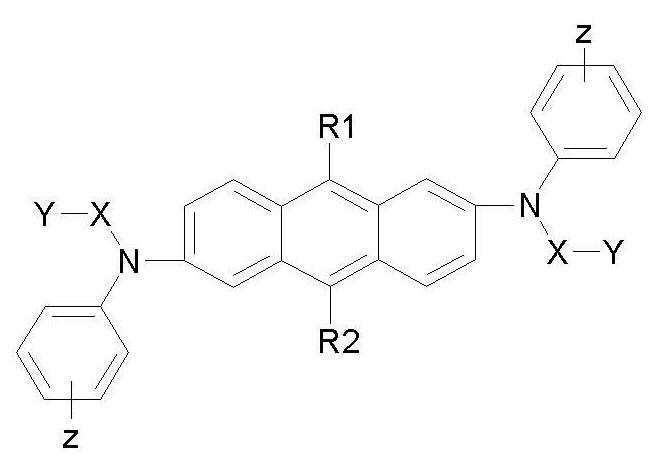
상기 화학식 1에서,In Chemical Formula 1,
R1 및 R2는 각각 독립적으로 할로겐, CN, NO2, C1 ~ C20의 알킬기, C1 ~ C20의 알콕시기, C1 ~ C20의 알킬아민기, C1 ~ C20의 알킬 티오펜기, C6 ~ C20의 아릴 티오펜기, C2 ~ C20의 알케닐기, C2 ~ C20의 알키닐기, C3 ~ C20의 시클로알킬기, C6 ~ C20의 아릴기, 중수소로 치환된 C6 ~ C20의 아릴기, C8 ~ C20의 아릴알케닐기, 치환 또는 비치환된 실란기, 치환 또는 비치환된 붕소기, 치환 또는 비치환된 게르마늄기, 및 치환 또는 비치환된 C5 ~ C20의 헤테로고리기로 이루어진 군으로부터 선택된 하나 이상의 기로 치환 또는 비치환된 C6 ~ C20의 아릴기; 할로겐, CN, NO2, C1 ~ C20의 알킬기, C1 ~ C20의 알콕시기, C1 ~ C20의 알킬아민기, C1 ~ C20의 알킬티오기, C2 ~ C20의 알케닐기, C2 ~ C20의 알키닐기, C3 ~ C20의 시클로알킬기, C6 ~ C20의 아릴기, 중수소로 치환된 C6 ~ C20의 아릴기, 치환 또는 비치환된 실란기, 치환 또는 비치환된 붕 소기, 치환 또는 비치환된 게르마늄기, 및 치환 또는 비치환된 C5 ~ C20의 헤테로고리기로 이루어진 군으로부터 선택된 하나 이상의 기로 치환 또는 비치환된 C5 ~ C20의 헤테로고리기; 또는 C6 ~ C20의 방향족 고리와 C4 ~ C20의 지방족 고리의 축합 고리기이고,R1 and R2 are each independently halogen, CN, NO 2 , C 1 An alkyl group of C 20 , C 1 C 20 alkoxy group, C 1 An alkylamine group of C 20 , C 1 C 20 an alkyl thiophene group, C 6 C 20 aryl thiophene group, C 2 C 20 Alkenyl group, C 2 Alkynyl group of C 20 , C 3 A cycloalkyl group of C 20 , C 6 Aryl group of C 20 , C 6 ~ C 20 aryl group substituted with deuterium, C 8 ~ C 20 aryl alkenyl group, substituted or unsubstituted silane group, substituted or unsubstituted boron group, substituted or unsubstituted Germanium groups, and substituted or unsubstituted C 5 C 6 unsubstituted or substituted with one or more groups selected from the group consisting of C 20 heterocyclic groups An aryl group of -C 20 ; Halogen, CN, NO 2 , C 1 An alkyl group of C 20 , C 1 C 20 alkoxy group, C 1 An alkylamine group of C 20 , C 1 C 20 an alkylthio group, C 2 C 20 Alkenyl group, C 2 Alkynyl group of C 20 , C 3 A cycloalkyl group of C 20 , C 6 An aryl group of C 20 , a C 6 to C 20 aryl group substituted with deuterium, a substituted or unsubstituted silane group, a substituted or unsubstituted boron group, a substituted or unsubstituted germanium group, and a substituted or unsubstituted C 5 A heterocyclic group of 20 ~ C with one or more groups selected from the group consisting of heterocyclic ring groups is substituted or unsubstituted C 5 ~ C 20 of; Or a fused ring group of C 6 ~ C 20 aliphatic ring of the aromatic ring and C 4 ~ C 20,
X는 서로 같거나 다를 수 있으며, 각각 독립적으로 할로겐, CN, NO2, C1 ~ C20의 알킬기, C1 ~ C20의 알콕시기, C1 ~ C20의 알킬아민기, C1 ~ C20의 알킬 티오펜기, C6 ~ C20의 아릴 티오펜기, C2 ~ C20의 알케닐기, C2 ~ C20의 알키닐기, C3 ~ C20의 시클로알킬기, C6 ~ C20의 아릴기, 중수소로 치환된 C6 ~ C20의 아릴기, 치환 또는 비치환된 실란기, 치환 또는 비치환된 붕소기, 치환 또는 비치환된 게르마늄기, 및 치환 또는 비치환된 C5 ~ C20의 헤테로고리기로 이루어진 군으로부터 선택된 하나 이상의 기로 치환 또는 비치환된 C6 ~ C20의 아릴렌기; 또는 할로겐, CN, NO2, C1 ~ C20의 알킬기, C1 ~ C20의 알콕시기, C1 ~ C20의 알킬아민기, C1 ~ C20의 알킬티오기, C2 ~ C20의 알케닐기, C2 ~ C20의 알키닐기, C3 ~ C20의 시클로알킬기, C6 ~ C20의 아릴기, 중수소로 치환된 C6 ~ C20의 아릴기, 치환 또는 비치환된 실란기, 치환 또는 비치환된 붕소기, 치환 또는 비치환된 게르마늄기, 및 치환 또는 비치환된 C5 ~ C20의 헤테로고리기로 이루어진 군으로부터 선택된 하나 이상의 기로 치환 또는 비치환된 2가의 C5 ~ C20의 헤테로고리기이고,X may be the same or different from each other, and each independently halogen, CN, NO 2 , C 1 An alkyl group of C 20 , C 1 C 20 alkoxy group, C 1 An alkylamine group of C 20 , C 1 C 20 an alkyl thiophene group, C 6 C 20 aryl thiophene group, C 2 C 20 Alkenyl group, C 2 Alkynyl group of C 20 , C 3 A cycloalkyl group of C 20 , C 6 An aryl group of C 20 , a C 6 to C 20 aryl group substituted with deuterium, a substituted or unsubstituted silane group, a substituted or unsubstituted boron group, a substituted or unsubstituted germanium group, and a substituted or unsubstituted C 5 C 6 unsubstituted or substituted with one or more groups selected from the group consisting of C 20 heterocyclic groups C 20 arylene group; Or halogen, CN, NO 2 , C 1 An alkyl group of C 20 , C 1 C 20 alkoxy group, C 1 An alkylamine group of C 20 , C 1 C 20 an alkylthio group, C 2 C 20 Alkenyl group, C 2 Alkynyl group of C 20 , C 3 A cycloalkyl group of C 20 , C 6 An aryl group of C 20 , a C 6 to C 20 aryl group substituted with deuterium, a substituted or unsubstituted silane group, a substituted or unsubstituted boron group, a substituted or unsubstituted germanium group, and a substituted or unsubstituted Divalent C 5 unsubstituted or substituted with one or more groups selected from the group consisting of C 5 to C 20 heterocyclic groups C 20 is a heterocyclic group,
Y는 수소, 중수소, 할로겐, CN, NO2, C1 ~ C20의 알킬기, C1 ~ C20의 알콕시기, C1 ~ C20의 알킬아민기, C6 ~ C20의 아릴아민기, C1 ~ C20의 알킬 티오기, C6 ~ C20의 아릴 티오기, C1 ~ C20의 알킬 티오펜기, C6 ~ C20의 아릴 티오펜기, C2 ~ C20의 알케닐기, C2 ~ C20의 알키닐기, C3 ~ C20의 시클로알킬기, C6 ~ C20의 아릴기, 중수소로 치환된 C6 ~ C20의 아릴기, 치환 또는 비치환된 실란기, 치환 또는 비치환된 붕소기, 치환 또는 비치환된 게르마늄기, 또는 치환 또는 비치환된 C5 ~ C20의 헤테로고리기이며,Y is hydrogen, deuterium, halogen, CN, NO 2 , C 1 An alkyl group of C 20 , C 1 C 20 alkoxy group, C 1 C 20 is an alkylamine group, C 6 Arylamine group of C 20 , C 1 Alkyl thiio of C 20 , C 6 Aryl thi group of C 20 , C 1 ~ C 20 alkyl thiophene group, C 6 C 20 aryl thiophene group, C 2 C 20 Alkenyl group, C 2 Alkynyl group of C 20 , C 3 A cycloalkyl group of C 20 , C 6 Aryl group of C 20 , C 6 ~ C 20 aryl group substituted with deuterium, substituted or unsubstituted silane group, substituted or unsubstituted boron group, substituted or unsubstituted germanium group, or substituted or unsubstituted C 5 C 20 is a heterocyclic group,
Z는 CN, NO2, 중수소, C1 ~ C20의 알킬 티오기, C6 ~ C20의 아릴 티오기, C1 ~ C20의 알킬 티오펜기, C6 ~ C20의 아릴 티오펜기, C2 ~ C20의 알케닐기, C2 ~ C20의 알키닐기, C3 ~ C20의 시클로알킬기, 치환 또는 비치환된 실란기, 치환 또는 비치환된 붕소기, 또는 치환 또는 비치환된 게르마늄기이다.Z is CN, NO2, Deuterium, COne ~ C20Alkyl thio, C6 ~ C20Aryl Thio, COne ~ C20Alkyl thiophene groups, C6 ~ C20Aryl thiophene group, C2 ~ C20Alkenyl, C2 ~ C20Alkynyl, C3 ~ C20And a cycloalkyl group, a substituted or unsubstituted silane group, a substituted or unsubstituted boron group, or a substituted or unsubstituted germanium group.
상기 화학식 1에서, R1 및 R2는 각각 독립적으로 페닐기, 치환 또는 비치환된 C5 ~ C20의 헤테로고리기가 치환된 페닐기, d5-페닐기, 나프틸기, 바이페닐기, 플루오레닐기, 안트라세닐기, 테트라세닐기, 펜타세닐기, 터페닐기, 테트랄리닐기, 스틸베닐기, 카바졸릴렌기, 페릴레닐기, 파이레닐기, 페난트레닐기, 트리페닐레닐기, 크라이세닐기, 피리딜기, 비피리딜기, 카바졸기, 티오페닐기, 퀴놀리닐기, 또 는 이소퀴놀리닐기인 것이 바람직하나, 이에만 한정되는 것은 아니다.In Formula 1, R1 and R2 are each independently a phenyl group, a substituted or unsubstituted C 5 C 20 heterocyclic group substituted phenyl group, d5-phenyl group, naphthyl group, biphenyl group, fluorenyl group, anthracenyl group, tetrasenyl group, pentacenyl group, terphenyl group, tetralinyl group, stilbenyl group, carbazolyl Phenylene group, pyrenyl group, phenanthrenyl group, triphenylenyl group, chrysenyl group, pyridyl group, bipyridyl group, carbazole group, thiophenyl group, quinolinyl group, or isoquinolinyl group is preferable. However, the present invention is not limited thereto.
상기 화학식 1에서, X는 서로 같거나 다를 수 있으며, 각각 독립적으로 페닐렌기, 치환 또는 비치환된 C5 ~ C20의 헤테로고리기가 치환된 페닐렌기, 중수소로 치환된 페닐렌기, 나프틸렌기, 바이페닐렌기, 플루오레닐렌기, 안트라세닐렌기, 테트라세닐렌기, 펜타세닐렌기, 터페닐렌기, 테트랄리닐렌기, 스틸베닐렌기, 카바졸릴렌기, 페릴레닐렌기, 파이레닐렌기, 페난트레닐렌기, 트리페닐레닐렌기, 크라이세닐렌기, 피리딜렌기, 비피리딜렌기, 카바졸기, 티오페닐렌기, 퀴놀리닐렌기, 또는 이소퀴놀리닐렌기인 것이 바람직하나, 이에만 한정되는 것은 아니다.In Formula 1, X may be the same as or different from each other, each independently a phenylene group, a substituted or unsubstituted C 5 C 20 heterocyclic group substituted phenylene group, deuterium substituted phenylene group, naphthylene group, biphenylene group, fluorenylene group, anthracenylene group, tetrasenylene group, pentacenylene group, terphenylene group, tetraali Neylene group, stilbenylene group, carbazolylene group, peryleneylene group, pyrenylene group, phenanthrenylene group, triphenylenylene group, chrysenylene group, pyridylene group, bipyridylene group, carbazole group, thiophenylene group, It is preferable that it is a quinolinyl group or an isoquinolinyl group, but it is not limited to this.
상기 화학식 1에서, Y는 수소, 중수소, 중수소로 치환된 C6 ~ C20의 아릴기,치환 또는 비치환된 실란기, 치환 또는 비치환된 붕소기, 치환 또는 비치환된 게르마늄기, 치환 또는 비치환된 C5 ~ C20의 헤테로고리기, 또는 C6 ~ C20의 아릴기 것이 바람직하나, 이에만 한정되는 것은 아니다.In Formula 1, Y is hydrogen, deuterium, C 6 ~ C 20 aryl group substituted with deuterium, substituted or unsubstituted silane group, substituted or unsubstituted boron group, substituted or unsubstituted germanium group, substituted or An unsubstituted C 5 ~ C 20 heterocyclic group, or C 6 ~ C 20 aryl group is preferred, but is not limited thereto.
상기 화학식 1에서, Z는 CN, NO2, 중수소, 치환 또는 비치환된 실란기, 또는 치환 또는 비치환된 게르마늄기인 것이 바람직하나, 이에만 한정되는 것은 아니다.In Chemical Formula 1, Z is preferably CN, NO 2 , deuterium, a substituted or unsubstituted silane group, or a substituted or unsubstituted germanium group, but is not limited thereto.
상기 화학식 1에서, R1, R2, X, 및 Z가 다른 치환기를 갖는 경우, 이들 치환기는 C1 ~ C20의 알킬기, C1 ~ C20의 알콕시기, C2 ~ C20의 알케닐기, C6 ~ C20의 아릴기, 중수소로 치환된 C6 ~ C20의 아릴기, C6 ~ C20의 아릴 아민기, C5 ~ C20의 헤테로고리기, C3 ~ C20의 시클로알킬기, 실란기, 붕소기, 아미노기, 니트릴기, 니트로기, 할로겐, 아미드기, 에스테르기, 에테르기로 이루어진 군에서 선택될 수 있다.In Formula 1, when R1, R2, X, and Z have different substituents, these substituents are C 1 ~ C 20 Alkyl group, C 1 ~ C 20 Alkoxy group, C 2 ~ C 20 Alkenyl group, C 6 ~ C 20 aryl group, of a C 6 ~ C 20 substituted by deuterium aryl group, C 6 ~ C 20 aryl amine group, a cycloalkyl group of C 5 ~ C heterocyclic group of 20, C 3 ~ C 20, It may be selected from the group consisting of silane group, boron group, amino group, nitrile group, nitro group, halogen, amide group, ester group, ether group.
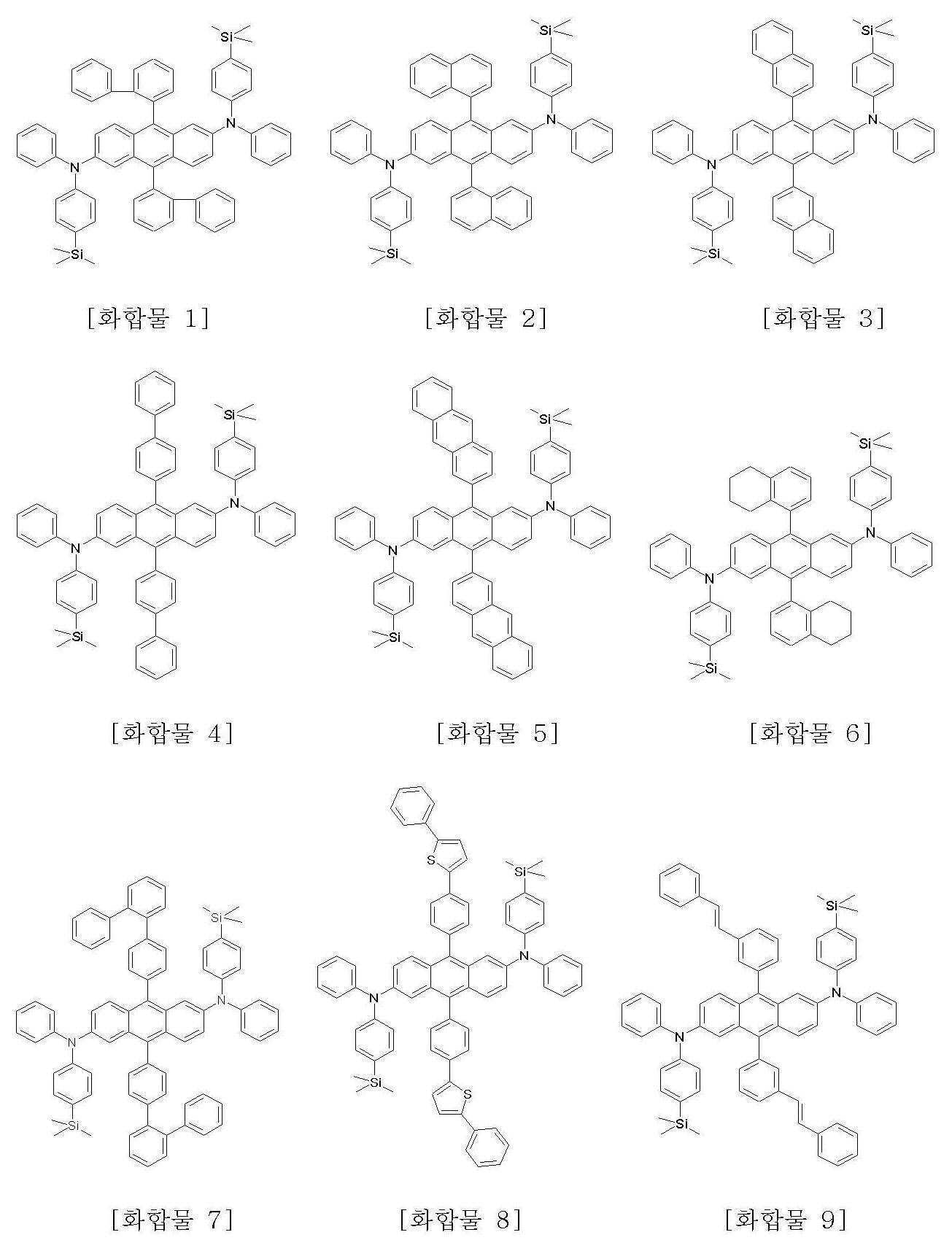
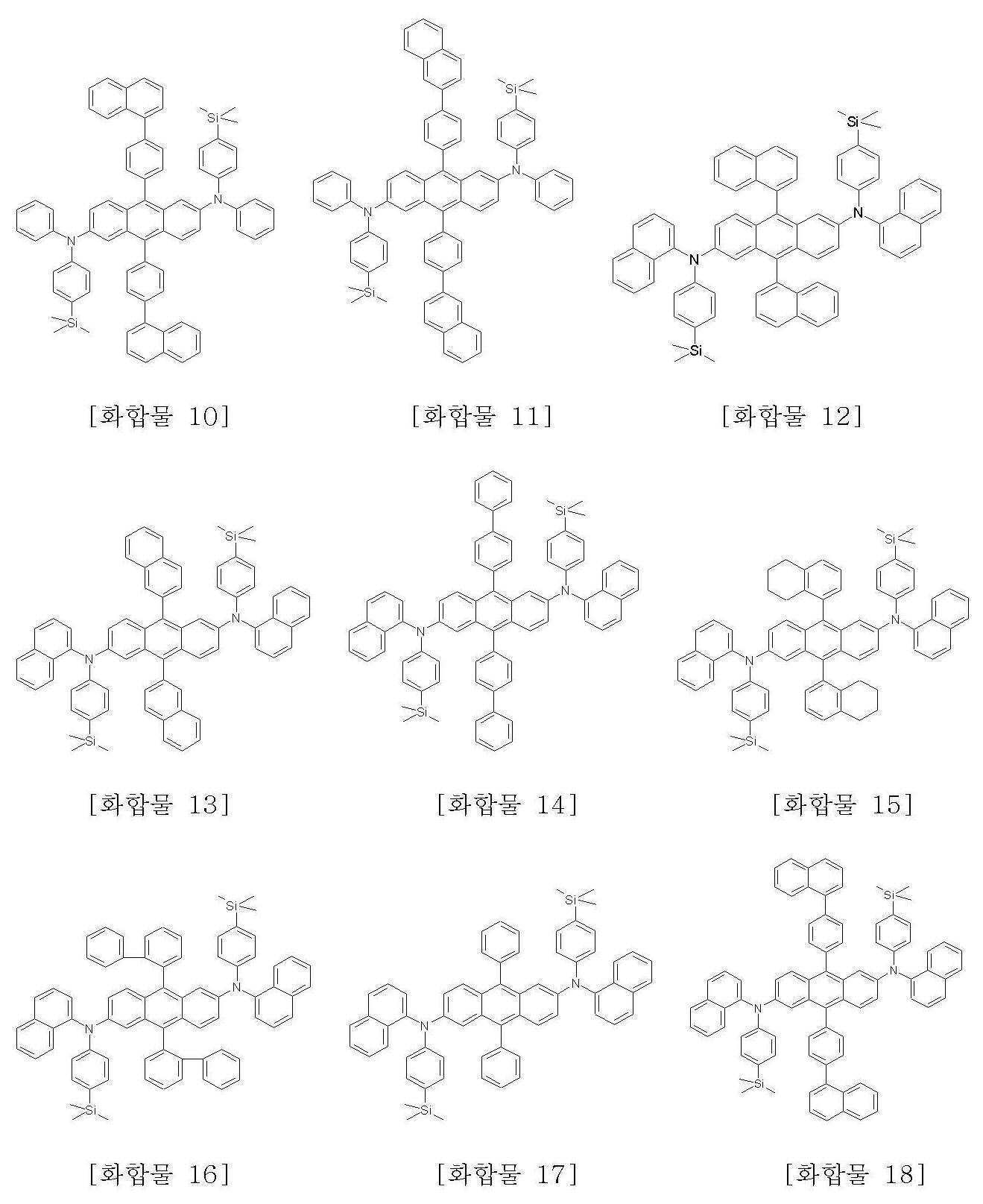
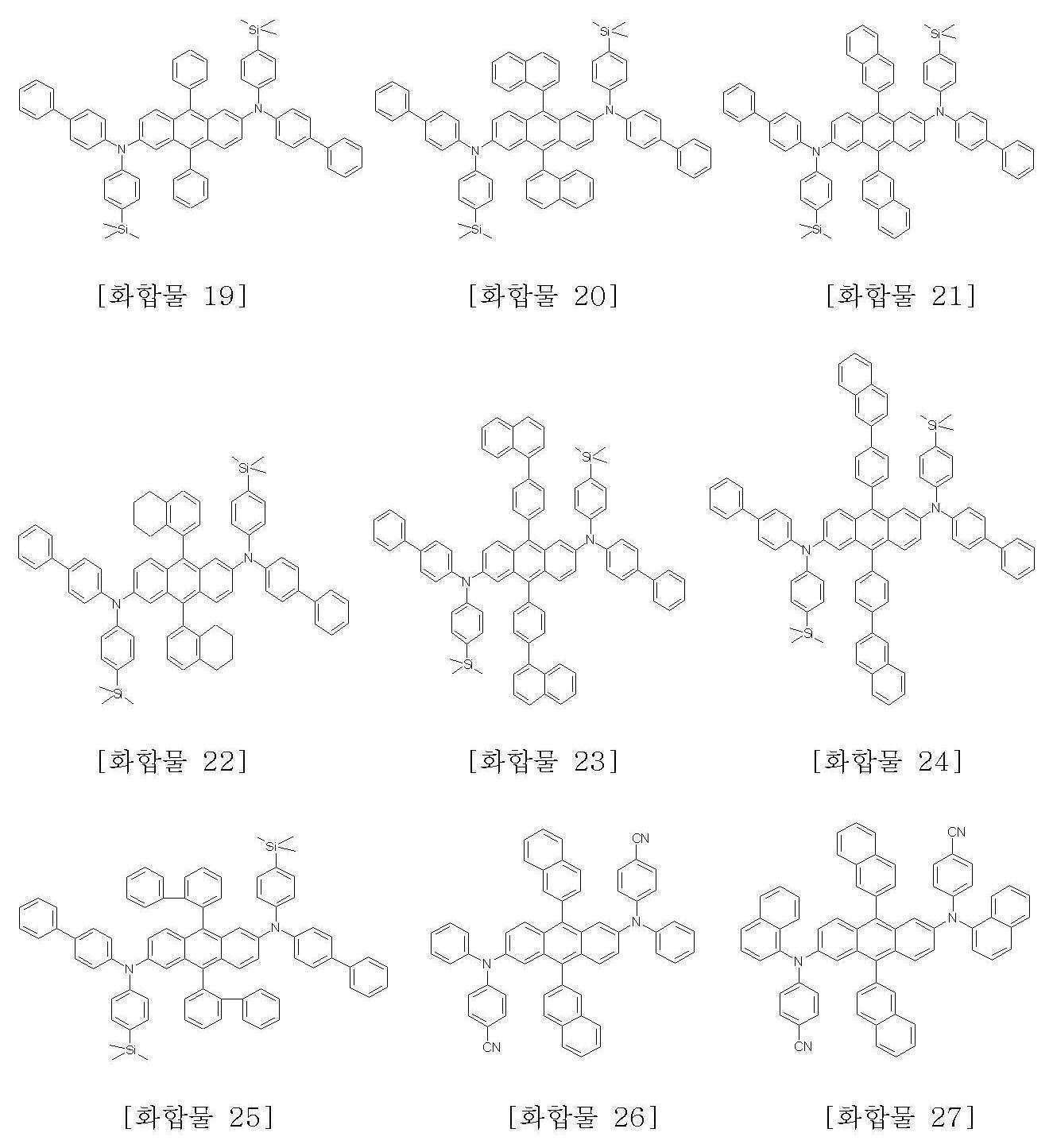
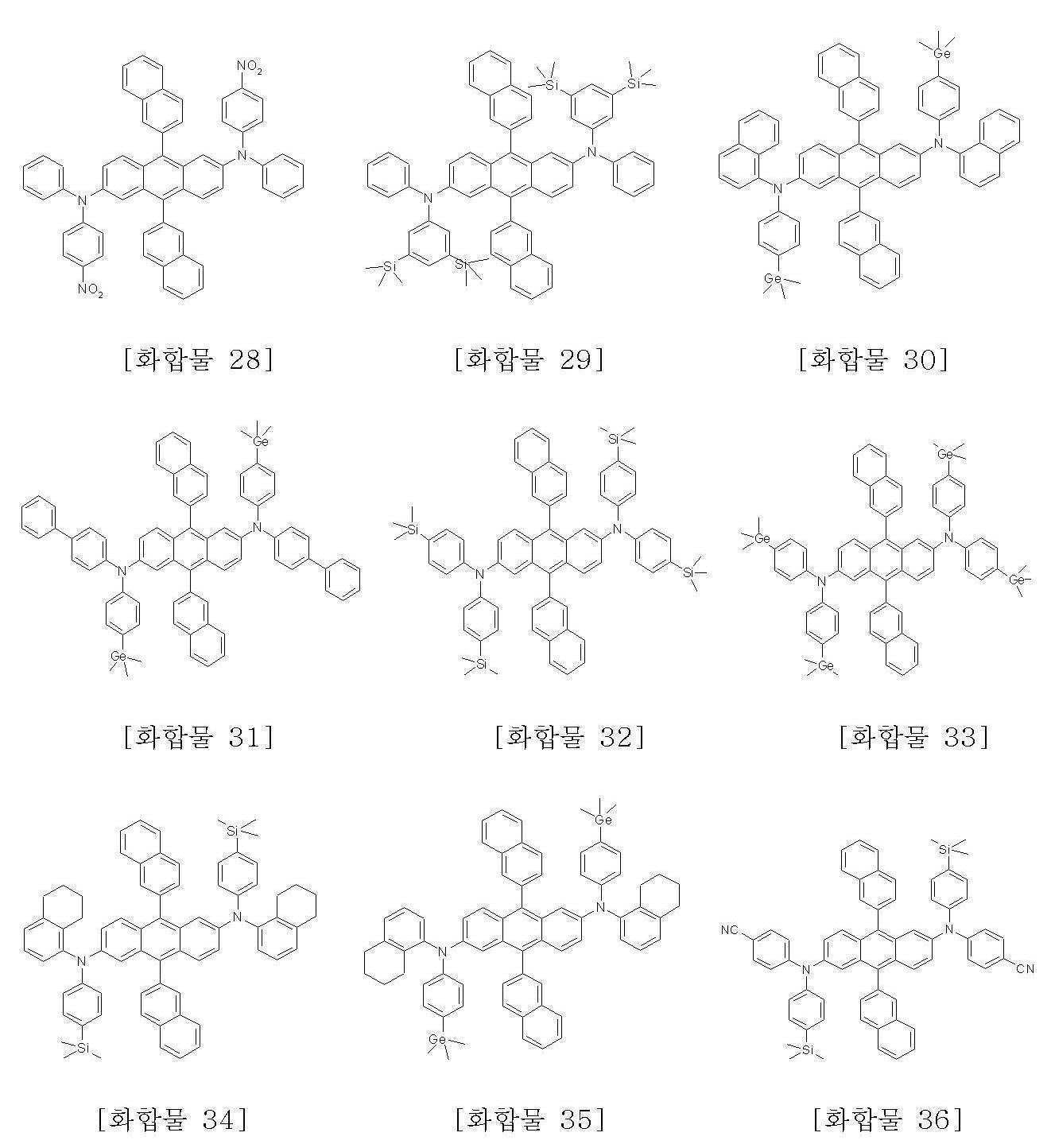
본 발명에 따른 화학식 1로 표시되는 안트라센 유도체의 구체적인 예는 하기에 나타내었으며, 이에 한정되지 않는다.Specific examples of the anthracene derivative represented by Formula 1 according to the present invention are shown below, but are not limited thereto.


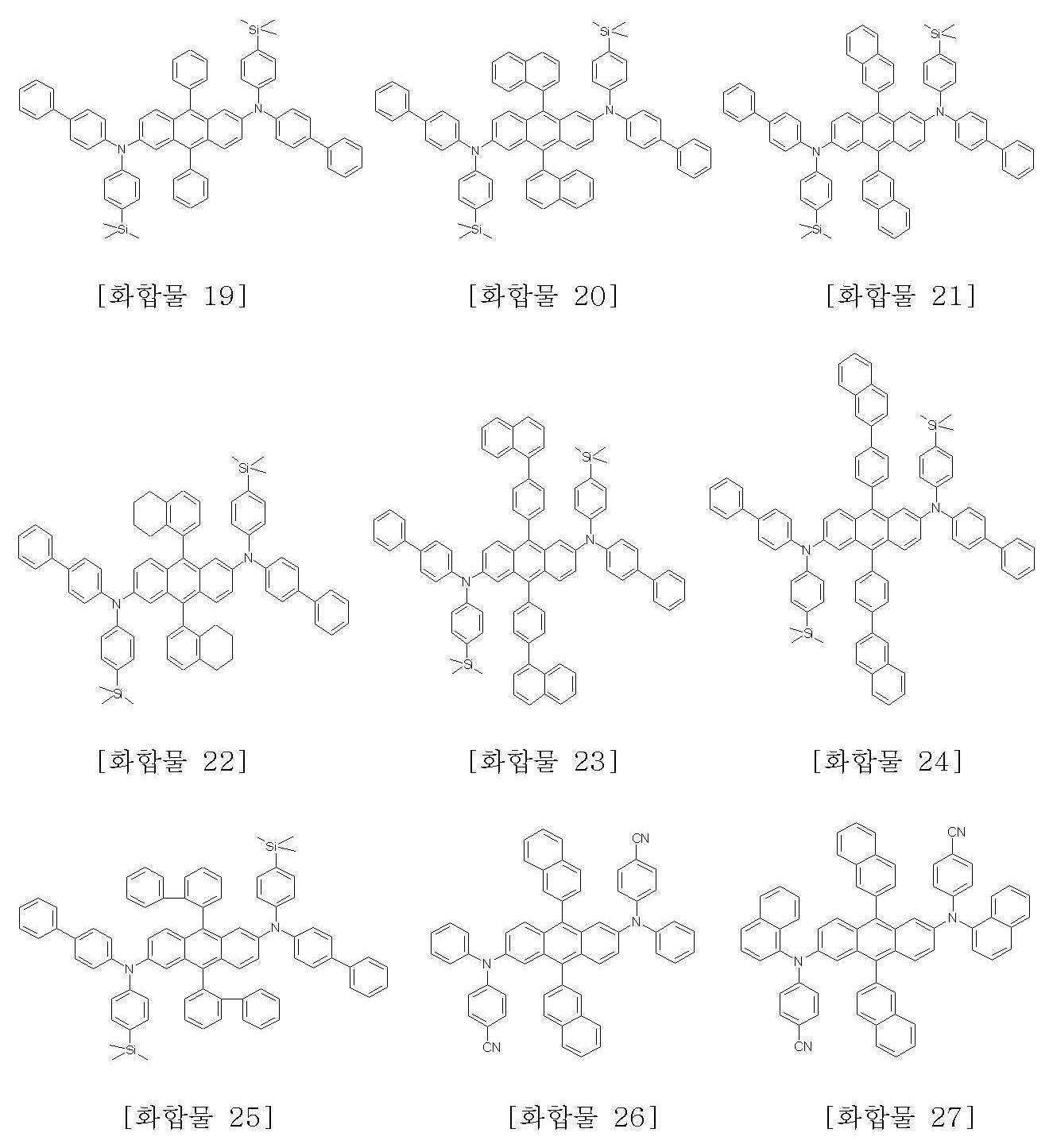


또한, 본 발명은 상기 화학식 1로 표시되는 안트라센 유도체의 제조방법을 제공한다.In another aspect, the present invention provides a method for producing an anthracene derivative represented by the formula (1).
본 발명에 따른 안트라센 유도체는, 디브로모 아릴 화합물과 아릴아민 화합물을 팔라듐 촉매 하에 반응시켜 제조될 수 있다.Anthracene derivatives according to the invention can be prepared by reacting a dibromo aryl compound with an arylamine compound under a palladium catalyst.
상기 아릴아민 화합물은 실릴기, 중수소 또는 게르마늄기를 포함하는 것이 바람직하다.It is preferable that the said arylamine compound contains a silyl group, deuterium, or germanium group.
본 발명에 따른 화학식 1의 화합물은 다단계 화학 반응으로 제조할 수 있다. 상기 화합물들의 제조는 후술할 실시예에 의해 기술된다. 실시예에 나타난 바와 같이, 일부 중간체 화합물이 먼저 제조되고, 그 중간체 화합물들로부터 화학식 1의 화합물들이 제조된다. 예증적인 중간체 화합물들은 이하 화합물 A ~ Q이다. 이들 화합물들에서, "Br"은 임의의 다른 반응성 원자 또는 작용기로 치환될 수 있다.The compound of formula 1 according to the present invention may be prepared by a multistage chemical reaction. The preparation of the compounds is described by the examples which will be described later. As shown in the examples, some intermediate compounds are prepared first, and compounds of formula 1 are prepared from the intermediate compounds. Exemplary intermediate compounds are compounds A-Q below. In these compounds, "Br" may be substituted with any other reactive atom or functional group.
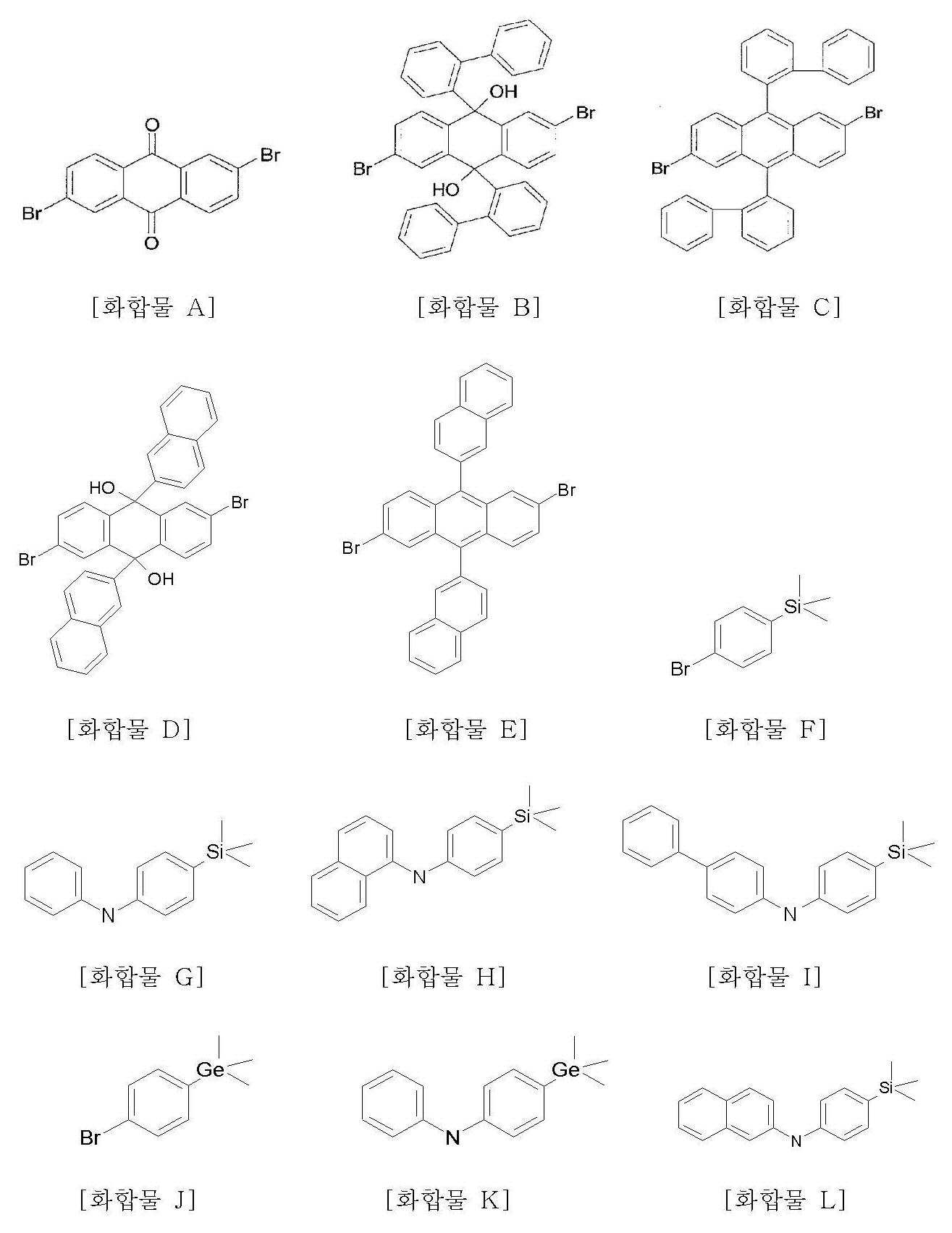
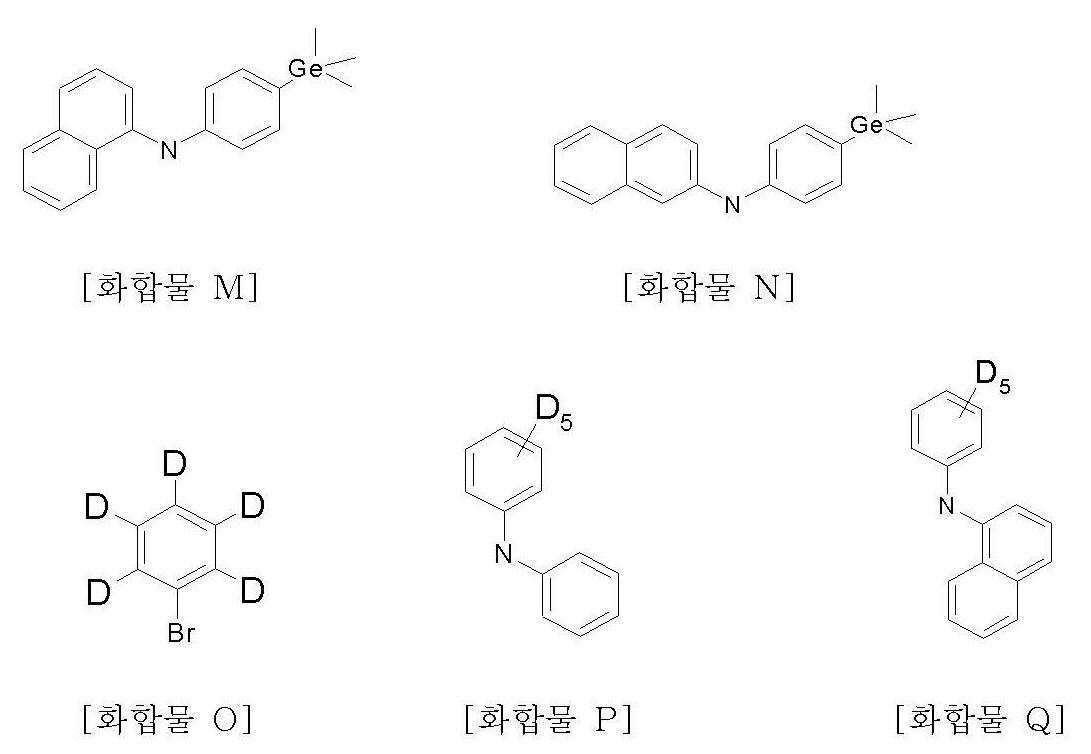
또한, 본 발명은 상기 화학식 1의 화합물을 이용한 유기 전기 소자를 제공한다.In addition, the present invention provides an organic electric device using the compound of Formula 1.
본 발명의 유기 전기 소자는 전술한 화합물들을 이용하여 한층 이상의 유기물층을 형성하는 것을 제외하고는, 통상의 유기 전기 소자의 제조방법 및 재료에 의하여 제조될 수 있다.The organic electric device of the present invention may be manufactured by a conventional method and material for manufacturing an organic electric device except for forming one or more organic material layers using the above-described compounds.
이하에서는 유기 발광 소자에 대하여 예시한다.Hereinafter, the organic light emitting device will be exemplified.
전술한 본 발명의 화합물들은 유기 발광 소자에서 정공 주입, 정공 수송, 전자 주입, 전자 수송, 또는 발광 물질 역할을 할 수 있으며, 특히 단독으로 발광 물질의 역할을 할 수 있을 뿐만 아니라, 적절한 발광 도판트와 함께 발광 호스트, 또는 적절한 발광 호스트와 함께 발광 도판트 역할을 할 수 있다.The compounds of the present invention described above may serve as hole injection, hole transport, electron injection, electron transport, or light emitting materials in the organic light emitting device, and in particular, may not only serve as light emitting materials alone, but also suitable light emitting dopants. Together with a light emitting host, or a suitable light emitting host.
본 발명의 하나의 실시 상태에 있어서, 유기 발광 소자는 제 1 전극과 제 2 전극 및 이 사이에 배치된 유기물층을 포함하는 구조로 이루어질 수 있으며, 전술한 본 발명에 따른 화합물을 유기 발광 소자의 유기물층 중 1층 이상에 사용한다는 것을 제외하고는 통상의 유기 발광 소자의 제조방법 및 재료를 사용하여 제조될 수 있다. 본 발명에 따른 유기 발광 소자의 구조는 도 1에 예시되어 있다.In one exemplary embodiment of the present invention, the organic light emitting diode may have a structure including a first electrode, a second electrode, and an organic material layer disposed therebetween, and the organic material layer of the organic light emitting diode may include the compound according to the present invention. Except for use in at least one of the layers can be prepared using a conventional method and material for manufacturing an organic light emitting device. The structure of the organic light emitting device according to the invention is illustrated in FIG. 1.
예컨대, 본 발명에 따른 유기 발광 소자는 스퍼터링(sputtering)이나 전자빔 증발(e-beam evaporation)과 같은 PVD(physical vapor deposition) 방법을 이용하여, 기판 상에 금속 또는 전도성을 가지는 금속 산화물 또는 이들의 합금을 증착시켜 양극을 형성하고, 그 위에 정공 주입층, 정공 수송층, 발광층, 전자 수송층을 포함하는 유기물층을 형성한 후, 그 위에 음극으로 사용할 수 있는 물질을 증착시킴으로써 제조될 수 있다. 이와 같은 방법 외에도, 기판 상에 음극 물질부터 유기물층, 양극 물질을 차례로 증착시켜 유기 발광 소자를 제조할 수도 있다.For example, the organic light emitting device according to the present invention uses a metal vapor deposition (PVD) method such as sputtering or e-beam evaporation, and has a metal oxide or a metal oxide or an alloy thereof on a substrate. It can be prepared by depositing an anode to form an anode, an organic material layer including a hole injection layer, a hole transport layer, a light emitting layer, an electron transport layer thereon, and then depositing a material that can be used as a cathode thereon. In addition to the above method, an organic light emitting device may be manufactured by sequentially depositing a cathode material, an organic material layer, and an anode material on a substrate.
상기 유기물층은 정공 주입층, 정공 수송층, 발광층 및 전자 수송층 등을 포함하는 다층 구조일 수도 있으나, 이에 한정되지 않고 단층 구조일 수 있다. 또한, 상기 유기물층은 다양한 고분자 소재를 사용하여 증착법이 아닌 용매 공정(solvent process), 예컨대 스핀 코팅, 딥 코팅, 닥터 블레이딩, 스크린 프린팅, 잉크젯 프린팅 또는 열 전사법 등의 방법에 의하여 더 적은 수의 층으로 제조할 수 있다.The organic material layer may have a multilayer structure including a hole injection layer, a hole transport layer, a light emitting layer, and an electron transport layer, but is not limited thereto and may have a single layer structure. In addition, the organic layer may be prepared by using a variety of polymer materials, and by using a method such as spin coating, dip coating, doctor blading, screen printing, inkjet printing, or thermal transfer, rather than a deposition method. It can be prepared in layers.
상기 양극 물질로는 통상 유기물층으로 정공 주입이 원활할 수 있도록 일함수가 큰 물질이 바람직하다. 본 발명에서 사용될 수 있는 양극 물질의 구체적인 예로는 바나듐, 크롬, 구리, 아연, 금과 같은 금속 또는 이들의 합금; 아연 산화물, 인듐 산화물, 인듐 주석 산화물(ITO), 인듐 아연 산화물(IZO)과 같은 금속 산화물; ZnO:Al 또는 SnO2:Sb와 같은 금속과 산화물의 조합; 폴리(3-메틸티오펜), 폴리[3,4-(에틸렌-1,2-디옥시)티오펜](PEDT), 폴리피롤 및 폴리아닐린과 같은 전도성 고분자 등이 있으나, 이들에만 한정되는 것은 아니다.As the anode material, a material having a large work function is usually preferred to facilitate hole injection into the organic material layer. Specific examples of the positive electrode material that can be used in the present invention include metals such as vanadium, chromium, copper, zinc and gold or alloys thereof; Metal oxides such as zinc oxide, indium oxide, indium tin oxide (ITO), indium zinc oxide (IZO); Combinations of metals and oxides such as ZnO: Al or SnO 2 : Sb; Conductive polymers such as poly (3-methylthiophene), poly [3,4- (ethylene-1,2-dioxy) thiophene] (PEDT), polypyrrole and polyaniline, and the like, but are not limited thereto.
상기 음극 물질로는 통상 유기물층으로 전자 주입이 용이하도록 일함수가 작은 물질인 것이 바람직하다. 음극 물질의 구체적인 예로는 마그네슘, 칼슘, 나트륨, 칼륨, 타이타늄, 인듐, 이트륨, 리튬, 가돌리늄, 알루미늄, 은, 주석 및 납과 같은 금속 또는 이들의 합금; LiF/Al 또는 LiO2/Al과 같은 다층 구조 물질 등이 있으나, 이들에만 한정되는 것은 아니다.It is preferable that the cathode material is a material having a small work function to facilitate electron injection into the organic material layer. Specific examples of the negative electrode material include metals such as magnesium, calcium, sodium, potassium, titanium, indium, yttrium, lithium, gadolinium, aluminum, silver, tin, and lead or alloys thereof; Multilayer structure materials such as LiF / Al or LiO 2 / Al, and the like, but are not limited thereto.
상기 정공 주입 물질로는 낮은 전압에서 양극으로부터 정공을 잘 주입받을 수 있는 물질로서, 정공 주입 물질의 HOMO(highest occupied molecular orbital)가 양극 물질의 일함수와 주변 유기물층의 HOMO 사이인 것이 바람직하다. 정공 주입 물질의 구체적인 예로는 금속 포피린(porphyrine), 올리고티오펜, 아릴아민 계열의 유기물, 헥사니트릴 헥사아자트리페닐렌, 퀴나크리돈(quinacridone) 계열의 유기물, 페릴렌(perylene) 계열의 유기물, 안트라퀴논 및 폴리아닐린과 폴리티오펜 계열의 전도성 고분자 등이 있으나, 이들에만 한정되는 것은 아니다.The hole injection material is a material capable of well injecting holes from the anode at a low voltage, and the highest occupied molecular orbital (HOMO) of the hole injection material is preferably between the work function of the anode material and the HOMO of the surrounding organic material layer. Specific examples of hole injection materials include metal porphyrine, oligothiophene, arylamine-based organics, hexanitrile hexaazatriphenylene, quinacridone-based organics, perylene-based organics, Anthraquinone, polyaniline and polythiophene-based conductive polymers, but are not limited thereto.
상기 정공 수송 물질로는 양극이나 정공 주입층으로부터 정공을 수송 받아 발광층으로 옮겨줄 수 있는 물질로 정공에 대한 이동성이 큰 물질이 적합하다. 구체적인 예로는 아릴아민 계열의 유기물, 전도성 고분자, 및 공액 부분과 비공액 부 분이 함께 있는 블록 공중합체 등이 있으나, 이들에만 한정되는 것은 아니다.As the hole transporting material, a material capable of transporting holes from the anode or the hole injection layer and transferring the holes to the light emitting layer is suitable. Specific examples include, but are not limited to, an arylamine-based organic material, a conductive polymer, and a block copolymer having a conjugated portion and a nonconjugated portion together.
상기 발광 물질로는 정공 수송층과 전자 수송층으로부터 정공과 전자를 각각 수송받아 결합시킴으로써 가시광선 영역의 빛을 낼 수 있는 물질로서, 형광이나 인광에 대한 양자효율이 좋은 물질이 바람직하다. 구체적인 예로는 8-히드록시-퀴놀린 알루미늄 착물(Alq3); 카바졸 계열 화합물; 이량체화 스티릴(dimerized styryl) 화합물; BAlq; 10-히드록시벤조 퀴놀린-금속 화합물; 벤족사졸, 벤즈티아졸 및 벤즈이미다졸 계열의 화합물; 폴리(p-페닐렌비닐렌)(PPV) 계열의 고분자; 스피로(spiro) 화합물; 폴리플루오렌, 루브렌 등이 있으나, 이들에만 한정되는 것은 아니다.The light emitting material is a material capable of emitting light in the visible region by transporting and combining holes and electrons from the hole transport layer and the electron transport layer, respectively, and a material having good quantum efficiency with respect to fluorescence or phosphorescence is preferable. Specific examples thereof include 8-hydroxyquinoline aluminum complex (Alq 3 ); Carbazole series compounds; Dimerized styryl compounds; BAlq; 10-hydroxybenzoquinoline-metal compound; Benzoxazole, benzthiazole and benzimidazole series compounds; Poly (p-phenylenevinylene) (PPV) -based polymers; Spiro compounds; Polyfluorene, rubrene and the like, but are not limited thereto.
상기 전자 수송 물질로는 음극으로부터 전자를 잘 주입 받아 발광층으로 옮겨줄 수 있는 물질로서, 전자에 대한 이동성이 큰 물질이 적합하다. 구체적인 예로는 8-히드록시퀴놀린의 Al 착물; Alq3를 포함한 착물; 유기 라디칼 화합물; 히드록시플라본-금속 착물 등이 있으나, 이들에만 한정되는 것은 아니다.As the electron transporting material, a material capable of injecting electrons well from the cathode and transferring the electrons to the light emitting layer is suitable. Specific examples include Al complexes of 8-hydroxyquinoline; Complexes including Alq 3 ; Organic radical compounds; Hydroxyflavone-metal complexes and the like, but are not limited thereto.
본 발명에 따른 유기 발광 소자는 사용되는 재료에 따라 전면 발광형, 후면 발광형 또는 양면 발광형일 수 있다.The organic light emitting device according to the present invention may be a top emission type, a bottom emission type or a double-sided emission type depending on the material used.
본 발명에 따른 화합물은 유기 태양 전지, 유기 감광체, 유기 트랜지스터 등을 비롯한 유기 전기 소자에서도 유기 발광 소자에 적용되는 것과 유사한 원리로 작용할 수 있다.The compounds according to the present invention can also operate on principles similar to those applied to organic light emitting devices in organic electrical devices, including organic solar cells, organic photoconductors, organic transistors, and the like.
이하, 본 발명의 이해를 돕기 위하여 바람직한 실시예를 제시한다. 그러나, 하기의 실시예는 본 발명을 보다 쉽게 이해하기 위하여 제공되는 것일 뿐, 이에 의해 본 발명의 내용이 한정되는 것은 아니다.Hereinafter, preferred examples are provided to aid in understanding the present invention. However, the following examples are merely provided to more easily understand the present invention, and the contents of the present invention are not limited thereto.
<< 제조예Production Example 1> 화합물 A의 제조 1> Preparation of Compound A
2,6-디아미노안트라퀴논(23.8g, 100mmol)을 48 wt%의 브롬화 수소 수용액에 분산시켰다. 아질산 나트륨(NaNO2, 14.1g, 204mmol)을 -20℃에서 상기 혼합물에 서서히 가하였으며, 반응이 진행되면서 질소 가스가 방출되었다. 가스 방출이 완료된 후, 48 wt%의 브롬화 수소 수용액(63mL)에 용해된 브롬화 구리(CuBr, 29.5g, 206mmol) 용액을 소량의 에탄올(50mL)과 함께 상기 혼합물에 서서히 가하였다. 반응 혼합물의 온도를 서서히 상승시킨 후 혼합물을 서서히 환류시켰다. 혼합물을 실온으로 냉각시키고 물로 희석하였다. 혼합물 내 침전물을 흡인 여과하고, 물로 세척하고, 진공 건조하였다. 건조된 침전물을 클로로포름으로 용해하고, 실리카겔을 통과한 후 감압 하에 농축시켰다. 컬럼 크로마토그래피에 의해 정제하고 클로로포름으로부터 재결정하여 화합물 A(10.0g, 27%)를 얻었다.2,6-diaminoanthraquinone (23.8 g, 100 mmol) was dispersed in 48 wt% aqueous hydrogen bromide. Sodium nitrite (NaNO 2 , 14.1 g, 204 mmol) was slowly added to the mixture at −20 ° C., and nitrogen gas was released as the reaction proceeded. After gas evolution was complete, a solution of copper bromide (CuBr, 29.5 g, 206 mmol) dissolved in 48 wt% aqueous hydrogen bromide (63 mL) was slowly added to the mixture with a small amount of ethanol (50 mL). After slowly raising the temperature of the reaction mixture, the mixture was slowly refluxed. The mixture was cooled to rt and diluted with water. The precipitate in the mixture was suction filtered, washed with water and dried in vacuo. The dried precipitate was dissolved in chloroform, passed through silica gel and concentrated under reduced pressure. Purification by column chromatography and recrystallization from chloroform to give Compound A (10.0 g, 27%).
1H NMR (300 MHz, CDCl3), 8.44 (d, J=2.1 Hz, 2H), 8.18 (d, J=8.0 Hz, 2H), 7.95 (dd, J=2.1, 8.0 Hz, 2H). 1 H NMR (300 MHz, CDCl 3 ), 8.44 (d, J = 2.1 Hz, 2H), 8.18 (d, J = 8.0 Hz, 2H), 7.95 (dd, J = 2.1, 8.0 Hz, 2H).
<< 제조예Production Example 2> 화합물 B의 제조 2> Preparation of Compound B
2-브로모 비페닐(8.83mL, 51.2mmol)을 실온에서 질소 분위기 하에 건조 테트라히드로푸란(THF, 200mL)에 용해시켰다. 상기 용액을 -78℃로 냉각시켰다. t-부틸 리튬(60mL, 1.7M 펜탄 용액)을 -78℃에서 상기 용액에 서서히 가하고, 혼합물을 동 일 온도에서 약 40분간 교반하였다. 그 다음, 화합물 A(7.50g, 20.5mmol)을 동일 온도에서 상기 혼합물에 가하였다. 냉각 용기를 제거하고, 혼합물을 실온에서 약 15분간 교반하였다. 그 후, 혼합물을 디에틸 에테르(200mL) 및 2N 염산(200mL)에 가하고 실온에서 약 40분간 교반하였다. 침전물을 흡인 여과하고, 물 및 에틸에테르로 세척하였다. 결과물을 건조하여 화합물 B(29.3g, 85%)를 얻었다.2-bromo biphenyl (8.83 mL, 51.2 mmol) was dissolved in dry tetrahydrofuran (THF, 200 mL) at room temperature under nitrogen atmosphere. The solution was cooled to -78 ° C. t-butyl lithium (60 mL, 1.7 M pentane solution) was added slowly to the solution at -78 ° C and the mixture was stirred at the same temperature for about 40 minutes. Compound A (7.50 g, 20.5 mmol) was then added to the mixture at the same temperature. The cold vessel was removed and the mixture was stirred at room temperature for about 15 minutes. The mixture was then added to diethyl ether (200 mL) and 2N hydrochloric acid (200 mL) and stirred at room temperature for about 40 minutes. The precipitate was suction filtered and washed with water and ethyl ether. The resulting product was dried to give Compound B (29.3 g, 85%).
<< 제조예Production Example 3> 화합물 C의 제조 3> Preparation of Compound C
화합물 B(4.00g, 5.93mmol), 요오드화 칼륨(9.85g, 59.3mmol) 및 하이포아인산나트륨 수화물(10.4g, 98.0mmol)의 혼합물을 아세트산(80mL) 및 오르토-디클로로벤젠(600mL)의 혼합 액체 내 환류하였다. 결과 혼합물을 실온으로 냉각하였다. 그 후, 혼합물을 클로로포름으로 추출하고, 황산 마그네슘 상에서 건조하고, 감압 하에 농축하였다. 농축된 고체를 클로로포름 내 용해하고, 실리카겔을 통과시키고, 감압 하에 농축시켰다. 고체를 n-헥산 내 분산시키고, 교반하고 여과한 다음, 진공 건조하여 화합물 C(3.30g, 87%)를 연노랑색으로 얻었다.A mixture of compound B (4.00 g, 5.93 mmol), potassium iodide (9.85 g, 59.3 mmol) and sodium hypophosphite hydrate (10.4 g, 98.0 mmol) was added to a mixed liquid of acetic acid (80 mL) and ortho-dichlorobenzene (600 mL). It was refluxed. The resulting mixture was cooled to room temperature. The mixture was then extracted with chloroform, dried over magnesium sulfate and concentrated under reduced pressure. The concentrated solid was dissolved in chloroform, passed through silica gel and concentrated under reduced pressure. The solid was dispersed in n-hexane, stirred, filtered and dried in vacuo to yield Compound C (3.30 g, 87%) in pale yellow.
m.p. 478.1℃;m.p. 478.1 ° C .;
1H NMR (300 MHz, CDCl3) 7.92(d, J=7.6 Hz, 4H), 7.46(t, J=8.0 Hz, 4H), 7.33(t, J=7.4 Hz, 4H), 7.21(d, J=7.6 Hz, 4H), 6.88(dd, J=2.1, 8.6 Hz, 2H), 6.47(d, J=2.1 Hz, 2H), 6.22(d, J=8.6 Hz, 2H); 1 H NMR (300 MHz, CDCl 3 ) 7.92 (d, J = 7.6 Hz, 4H), 7.46 (t, J = 8.0 Hz, 4H), 7.33 (t, J = 7.4 Hz, 4H), 7.21 (d, J = 7.6 Hz, 4H), 6.88 (dd, J = 2.1, 8.6 Hz, 2H), 6.47 (d, J = 2.1 Hz, 2H), 6.22 (d, J = 8.6 Hz, 2H);
MS (M+) = 636;MS (M < + >) = 636;
Anal. Calc'd. for C38H22Br2: C, 71.50; H, 3.47; Br, 25.03. Found: C, 71.90; H, 3.40; Br, 25.7.Anal. Calc'd. for C 38 H 22 Br 2 : C, 71.50; H, 3.47; Br, 25.03. Found: C, 71.90; H, 3. 40; Br, 25.7.
<< 제조예Production Example 4> 화합물 D의 제조 4> Preparation of Compound D
상기 제조예 2에서 2-브로모 비페닐(8.83mL, 51.2mmol) 대신 2-브로모 나프탈렌(10.6g, 51.2mmol)을 사용한 것을 제외하고는, 제조예 2의 방법과 동일하게 하여 화합물 D(28.6g, 90%)를 얻었다.Except for using 2-bromo naphthalene (10.6g, 51.2mmol) instead of 2-bromo biphenyl (8.83mL, 51.2mmol) in Preparation Example 2 in the same manner as in Preparation Example 2 Compound D ( 28.6 g, 90%).
<< 제조예Production Example 5> 화합물 E의 제조 5> Preparation of Compound E
상기 제조예 3에서 화합물 B(4.00g, 5.93mmol) 대신 화합물 D(3.69g, 5.93mmol)를 사용한 것을 제외하고는, 제조예 3의 방법과 동일하게 하여 화합물 E(2.96g, 85%)를 연노랑색으로 얻었다.Compound E (2.96 g, 85%) was prepared in the same manner as in Preparation Example 3, except that Compound D (3.69 g, 5.93 mmol) was used instead of Compound B (4.00 g, 5.93 mmol) in Preparation Example 3. Obtained in light yellow.
MS (M+) = 588MS (M +) = 588
<< 제조예Production Example 6> 화합물 F의 제조 6> Preparation of Compound F
디브로모벤젠(20g, 84.78mmol)을 실온에서 질소 분위기 하에 건조 테트라히드로푸란(THF, 200mL)에 용해시켰다. 상기 용액을 -78℃로 냉각시켰다. n-부틸 리튬(34mL, 2.5M 펜탄 용액)을 -78℃에서 상기 용액에 서서히 가하고, 혼합물을 약 1시간 동안 0℃로 천천히 올렸다. 여기에 클로로트리메틸실란(chloro trimethylsilane; 13ml, 101.74mmol)을 넣고 상온으로 1시간에 걸쳐서 올렸다. 반응이 완결된 것을 확인하고 혼합물을 에틸 아세테이트로 추출하고, 황산 마그네슘 상에서 건조하고, 감압 하에 분별 증류하여 화합물 F(18g, 93%)를 얻었다.Dibromobenzene (20 g, 84.78 mmol) was dissolved in dry tetrahydrofuran (THF, 200 mL) at room temperature under nitrogen atmosphere. The solution was cooled to -78 ° C. n-butyl lithium (34 mL, 2.5 M pentane solution) was slowly added to the solution at −78 ° C. and the mixture was slowly raised to 0 ° C. for about 1 hour. Chloro trimethylsilane (13 ml, 101.74 mmol) was added thereto, and the mixture was raised to room temperature over 1 hour. After confirming that the reaction was completed, the mixture was extracted with ethyl acetate, dried over magnesium sulfate and fractional distillation under reduced pressure to obtain Compound F (18 g, 93%).
MS (M+) = 229MS (M +) = 229
<< 제조예Production Example 7> 화합물 G의 제조 7> Preparation of Compound G
화합물 F(15g, 65.45mmol), 아닐린(6.6ml, 72mmol), pd(dba)2(0.125g, 0.13mmol), P(t-Bu)3(0.04g, 0.2mmol) 및 소듐 t-부톡사이드(1.80g, 18.7mmol)를 톨루엔(200mL)에 넣고, 3시간 가량 환류시켰다. 반응이 끝난 후 상온으로 냉각시키고 반응 혼합액을 THF와 H2O의 혼합액에 넣었다. 유기층을 층 분리하고 MgSO4로 건조한 후 농축시켰다. 컬럼 크로마토그래피로 정제한 후 화합물 G(15g, 86%)를 얻었다.Compound F (15 g, 65.45 mmol), aniline (6.6 ml, 72 mmol), pd (dba) 2 (0.125 g, 0.13 mmol), P (t-Bu) 3 (0.04 g, 0.2 mmol) and sodium t-butoxide (1.80 g, 18.7 mmol) was added to toluene (200 mL) and refluxed for about 3 hours. After the reaction was completed, the reaction mixture was cooled to room temperature, and the reaction mixture was added to a mixture of THF and H 2 O. The organic layer was separated, dried over MgSO 4 and concentrated. Compound G (15 g, 86%) was obtained after purification by column chromatography.
MS [M] = 143MS [M] = 143
<< 제조예Production Example 8> 화합물 H의 제조 8> Preparation of Compound H
제조예 7에서 아닐린(6.6ml, 72mmol) 대신 1-아미노나프탈렌(10.3g, 72mmol)을 사용한 것을 제외하고는, 제조예 7의 방법과 동일하게 하여 화합물 H(14.8g, 78%)를 얻었다.A compound H (14.8 g, 78%) was obtained in the same manner as in Example 7, except that 1-aminonaphthalene (10.3 g, 72 mmol) was used instead of aniline (6.6 ml, 72 mmol) in Preparation Example 7.
MS [M] = 291MS [M] = 291
<< 제조예Production Example 9> 화합물 I의 제조 9> Preparation of Compound I
제조예 7에서 아닐린(6.6ml, 72mmol) 대신 4-아미노바이페닐(10.3g, 72mmol)을 사용한 것을 제외하고는, 제조예 7의 방법과 동일하게 하여 화합물 I(15.58g, 75%)를 얻었다.Compound I (15.58 g, 75%) was obtained in the same manner as in Production Example 7, except that 4-aminobiphenyl (10.3 g, 72 mmol) was used instead of aniline (6.6 ml, 72 mmol) in Preparation Example 7. .
MS [M] = 317MS [M] = 317
<< 제조예Production Example 10> 화합물 J의 제조 10> Preparation of Compound J
제조예 6에서 클로로트리메틸실란(chloro trimethylsilane; 13ml, 101.74mmol) 대신 트리메틸게르마늄 브로마이드(trimethylgerumanium bromide; 18ml, 101.74mmol)를 사용한 것을 제외하고는, 제조예 6의 방법과 동일하게 하여 화합물 J(20g, 90%)를 얻었다.Except for using chloro trimethylsilane (13ml, 101.74mmol) instead of trimethylgerumanium bromide (18ml, 101.74mmol) in Preparation Example 6, Compound J (20g, 90%).
MS [M] = 273MS [M] = 273
<< 제조예Production Example 11> 화합물 K의 제조 11> Preparation of Compound K
제조예 7에서 화합물 F(15g, 65.45mmol) 대신 화합물 J(18g, 65.45mmol)를 사용한 것을 제외하고는, 제조예 7의 방법과 동일하게 하여 화합물 K(16g, 85%)를 얻었다.Compound K (16 g, 85%) was obtained in the same manner as in Production Example 7, except that Compound J (18 g, 65.45 mmol) was used instead of Compound F (15 g, 65.45 mmol) in Preparation Example 7.
MS [M] = 286MS [M] = 286
<< 제조예Production Example 12> 화합물 L의 제조 12> Preparation of Compound L
제조예 7에서 아닐린(6.6ml, 72mmol) 대신 2-아미노나프탈렌(10.3g, 72mmol)을 사용한 것을 제외하고는, 제조예 7의 방법과 동일하게 하여 화합물 L(14.8g, 78%)를 얻었다.Compound L (14.8 g, 78%) was obtained in the same manner as in Production Example 7, except that 2-aminonaphthalene (10.3 g, 72 mmol) was used instead of aniline (6.6 ml, 72 mmol) in Preparation Example 7.
MS [M] = 291MS [M] = 291
<< 제조예Production Example 13> 화합물 M의 제조 13> Preparation of Compound M
제조예 7에서 화합물 F(15g, 65.45mmol) 대신 화합물 J(18g, 65.45mmol), 아닐린(6.6ml, 72mmol) 대신 1-아미노나프탈렌(10.3g, 72mmol)을 사용한 것을 제외하고는 사용한 것을 제외하고는, 제조예 7의 방법과 동일하게 하여 화합물 M(17.6g, 80%)를 얻었다.Except for using Compound J (18 g, 65.45 mmol) instead of Compound F (15 g, 65.45 mmol) and 1-aminonaphthalene (10.3 g, 72 mmol) instead of aniline (6.6 ml, 72 mmol) in Preparation Example 7 Was obtained in the same manner as in Production Example 7 to obtain Compound M (17.6 g, 80%).
MS [M] = 336MS [M] = 336
<< 제조예Production Example 14> 화합물 N의 제조 14> Preparation of Compound N
제조예 13에서 1-아미노나프탈렌(10.3g, 72mmol) 대신 2-아미노나프탈렌(10.3g, 72mmol)을 사용한 것을 제외하고는 사용한 것을 제외하고는, 제조예 13의 방법과 동일하게 하여 화합물 N (18g, 82%)를 얻었다.A compound N (18 g) was prepared in the same manner as in Example 13, except that 2-aminonaphthalene (10.3 g, 72 mmol) was used instead of 1-aminonaphthalene (10.3 g, 72 mmol) in Preparation Example 13. , 82%).
MS [M] = 336MS [M] = 336
<< 제조예Production Example 15> 화합물 P의 제조 15> Preparation of Compound P
화합물 O(6.84ml, 65.45mmol), 아닐린(6.6ml, 72mmol), pd(dba)2(0.125g, 0.13mmol), P(t-Bu)3(0.04g, 0.2mmol) 및 소듐 t-부톡사이드(1.80g, 18.7mmol)를 톨루엔(200mL)에 넣고, 3시간 가량 환류시켰다. 반응이 끝난 후 상온으로 냉각시키고 반응 혼합액을 THF와 H2O의 혼합액에 넣었다. 유기층을 층 분리하고 MgSO4로 건조한 후 농축시켰다. 컬럼 크로마토그래피로 정제한 후 화합물 P(9.23g, 81%)를 얻었다.Compound O (6.84 ml, 65.45 mmol), aniline (6.6 ml, 72 mmol), pd (dba) 2 (0.125 g, 0.13 mmol), P (t-Bu) 3 (0.04 g, 0.2 mmol) and sodium t-butoxide The side (1.80g, 18.7mmol) was put into toluene (200mL), and it refluxed for about 3 hours. After the reaction was completed, the reaction mixture was cooled to room temperature, and the reaction mixture was added to a mixture of THF and H 2 O. The organic layer was separated, dried over MgSO 4 and concentrated. After purification by column chromatography, compound P (9.23 g, 81%) was obtained.
MS [M] = 174MS [M] = 174
<< 제조예Production Example 16> 화합물 Q의 제조 16> Preparation of Compound Q
제조예 15에서 아닐린(6.6ml, 72mmol) 대신 1-아미노나프탈렌(10.3g, 72mmol)을 사용한 것을 제외하고는, 제조예 15의 방법과 동일하게 하여 화합물 Q(11g, 75%)를 얻었다.Compound Q (11 g, 75%) was obtained in the same manner as in Production Example 15, except that 1-aminonaphthalene (10.3 g, 72 mmol) was used instead of aniline (6.6 ml, 72 mmol) in Preparation Example 15.
MS [M] = 224MS [M] = 224
<< 실시예Example 1> 화합물 1의 제조 1> Preparation of Compound 1
화합물 C(5.4g, 8.5mmol), 화합물 G(4.92g, 20.4mmol), pd(dba)2(0.097g, 0.17mmol), P(t-Bu)3(0.05g, 0.255mmol) 및 소듐 t-부톡사이드(2.45g, 25.5mmol)를 톨루엔(100mL)에 넣고, 2시간 가량 환류시켰다. 반응이 끝난 후 상온으로 냉각시키고 반응 혼합액을 THF와 H2O의 혼합액에 넣었다. 유기층을 층 분리하고 MgSO4로 건조한 후 농축시켰다. 컬럼 크로마토그래피로 정제한 후 화합물 1(4.74g, 58%)을 얻었다.Compound C (5.4 g, 8.5 mmol), Compound G (4.92 g, 20.4 mmol), pd (dba) 2 (0.097 g, 0.17 mmol), P (t-Bu) 3 (0.05 g, 0.255 mmol) and sodium t Butoxide (2.45 g, 25.5 mmol) was added to toluene (100 mL) and refluxed for 2 hours. After the reaction was completed, the reaction mixture was cooled to room temperature, and the reaction mixture was added to a mixture of THF and H 2 O. The organic layer was separated, dried over MgSO 4 and concentrated. After purification by column chromatography Compound 1 (4.74g, 58%) was obtained.
MS [M] = 960MS [M] = 960
<< 실시예Example 2> 화합물 16의 제조 2> Preparation of Compound 16
실시예 1에서 화합물 G(4.92g, 20.4mmol) 대신 화합물 H(5.94g, 20.4mmol)를 사용한 것을 제외하고는, 실시예 1의 방법과 동일하게 하여 화합물 16(5.87g, 65%)을 얻었다.Compound 16 (5.87 g, 65%) was obtained in the same manner as in Example 1 except that Compound H (5.94 g, 20.4 mmol) was used instead of Compound G (4.92 g, 20.4 mmol) in Example 1. .
MS [M] = 1060MS [M] = 1060
<< 실시예Example 3> 화합물 25의 제조 3> Preparation of Compound 25
실시예 1에서 화합물 G(4.92g, 20.4mmol) 대신 화합물 I(6.5g, 20.4mmol)를 사용한 것을 제외하고는, 실시예 1의 방법과 동일하게 하여 화합물 25(5.68g, 60%)를 얻었다.Compound 25 (5.68 g, 60%) was obtained in the same manner as in Example 1 except that Compound I (6.5 g, 20.4 mmol) was used instead of Compound G (4.92 g, 20.4 mmol) in Example 1. .
MS [M] = 1112MS [M] = 1112
<< 실시예Example 4> 화합물 3의 제조 4> Preparation of Compound 3
실시예 1에서 화합물 C(5.4g, 8.5mmol) 대신 화합물 E(5.0g, 8.5mmol)를 사용한 것을 제외하고는, 실시예 1의 방법과 동일하게 하여 화합물 3(5.02g, 65%)을 얻었다.Example 3 Compound 3 (5.02 g, 65%) was obtained in the same manner as in Example 1 except that Compound E (5.0 g, 8.5 mmol) was used instead of Compound C (5.4 g, 8.5 mmol). .
MS [M] = 910MS [M] = 910
<< 실시예Example 5> 화합물 13의 제조 5> Preparation of Compound 13
실시예 1에서 화합물 C(5.4g, 8.5mmol) 대신 화합물 E(5.0g, 8.5mmol), 화합물 G(4.92g, 20.4mmol) 대신 화합물 H(5.94g, 20.4mmol)를 사용한 것을 제외하고는, 실시예 1의 방법과 동일하게 하여 화합물 13(6.0g, 70%)을 얻었다.Except for using Compound H (5.0 g, 8.5 mmol) and Compound G (4.92 g, 20.4 mmol) instead of Compound C (5.4 g, 8.5 mmol) in Example 1, Compound H (5.94 g, 20.4 mmol), In the same manner as in Example 1, compound 13 (6.0 g, 70%) was obtained.
MS [M] = 1008MS [M] = 1008
<< 실시예Example 6> 화합물 21의 제조 6> Preparation of Compound 21
실시예 1에서 화합물 C(5.4g, 8.5mmol) 대신 화합물 E(5.0g, 8.5mmol), 화합물 G(4.92g, 20.4mmol) 대신 화합물 I(6.48g, 20.4mmol)를 사용한 것을 제외하고는, 실시예 1의 방법과 동일하게 하여 화합물 21(5.77g, 64%)을 얻었다.Except for using Compound E (5.0 g, 8.5 mmol) and Compound G (4.92 g, 20.4 mmol) instead of Compound C (5.4 g, 8.5 mmol) in Example 1, Compound I (6.48 g, 20.4 mmol), In the same manner as in Example 1, compound 21 (5.77 g, 64%) was obtained.
MS [M] = 1060MS [M] = 1060
<< 실시예Example 7>화합물 29의 제조 7> Preparation of Compound 29
실시예 1에서 화합물 C(5.4g, 8.5mmol) 대신 화합물 E(5.0g, 8.5mmol), 화합물 G(4.92g, 20.4mmol) 대신 화합물 K(5.83g, 20.4mmol)를 사용한 것을 제외하고는, 실시예 1의 방법과 동일하게 하여 화합물 29(4.84g, 57%)를 얻었다.Except for using Compound K (5.8 g, 8.5 mmol) and Compound G (4.92 g, 20.4 mmol) instead of Compound C (5.4 g, 8.5 mmol) in Example 1, Compound K (5.83 g, 20.4 mmol), In the same manner as in Example 1, compound 29 (4.84 g, 57%) was obtained.
MS [M] = 998MS [M] = 998
<< 실시예Example 8>화합물 30의 제조 8> Preparation of Compound 30
실시예 1에서 화합물 C(5.4g, 8.5mmol) 대신 화합물 E(5.0g, 8.5mmol), 화합물 G(4.92g, 20.4mmol) 대신 화합물 M(6.85g, 20.4mmol)를 사용한 것을 제외하고 는, 실시예 1의 방법과 동일하게 하여 화합물 30(4.67g, 50%)를 얻었다.Except for using Compound M (6.85 g, 8.5 mmol) instead of Compound C (5.4 g, 8.5 mmol) and Compound G (4.92 g, 20.4 mmol) in Example 1, instead of Compound M (6.85 g, 20.4 mmol), In the same manner as in Example 1, compound 30 (4.67 g, 50%) was obtained.
MS [M] = 1098MS [M] = 1098
<< 실시예Example 9>화합물 38의 제조 9> Preparation of Compound 38
실시예 1에서 화합물 C(5.4g, 8.5mmol) 대신 화합물 E(5.0g, 8.5mmol), 화합물 G(4.92g, 20.4mmol) 대신 화합물 L(5.94g, 20.4mmol)를 사용한 것을 제외하고는, 실시예 1의 방법과 동일하게 하여 화합물 38(4.98g, 58%)를 얻었다.Except for using Compound L (5.0 g, 8.5 mmol) and Compound G (4.92 g, 20.4 mmol) instead of Compound C (5.4 g, 8.5 mmol) in Example 1, Compound L (5.94 g, 20.4 mmol), In the same manner as in Example 1, compound 38 (4.98 g, 58%) was obtained.
MS [M] = 1008MS [M] = 1008
<< 실시예Example 10>화합물 39의 제조 10> Preparation of Compound 39
실시예 1에서 화합물 C(5.4g, 8.5mmol) 대신 화합물 E(5.0g, 8.5mmol), 화합물 G(4.92g, 20.4mmol) 대신 화합물 N(6.85g, 20.4mmol)를 사용한 것을 제외하고는, 실시예 1의 방법과 동일하게 하여 화합물 39(5.79g, 62%)를 얻었다.Except for using Compound N (5.0 g, 8.5 mmol) and Compound G (4.92 g, 20.4 mmol) instead of Compound C (5.4 g, 8.5 mmol) in Example 1, Compound N (6.85 g, 20.4 mmol), In the same manner as in Example 1, compound 39 (5.79 g, 62%) was obtained.
MS [M] = 1098MS [M] = 1098
<< 실시예Example 11> 화합물 40의 제조 11> Preparation of Compound 40
화합물 E(5.0g, 8.5mmol), 화합물 P(3.55g, 20.4mmol), pd(dba)2(0.097g, 0.17mmol), P(t-Bu)3(0.05g, 0.255mmol) 및 소듐 t-부톡사이드(2.45g, 25.5mmol)를 톨루엔(100mL)에 넣고, 2시간 가량 환류시켰다. 반응이 끝난 후 상온으로 냉각시키고 반응 혼합액을 THF와 H2O의 혼합액에 넣었다. 유기층을 층 분리하고 MgSO4로 건조한 후 농축시켰다. 컬럼 크로마토그래피로 정제한 후 화합물 40(4.08g, 62%)을 얻었다.Compound E (5.0 g, 8.5 mmol), Compound P (3.55 g, 20.4 mmol), pd (dba) 2 (0.097 g, 0.17 mmol), P (t-Bu) 3 (0.05 g, 0.255 mmol) and sodium t Butoxide (2.45 g, 25.5 mmol) was added to toluene (100 mL) and refluxed for 2 hours. After the reaction was completed, the reaction mixture was cooled to room temperature, and the reaction mixture was added to a mixture of THF and H 2 O. The organic layer was separated, dried over MgSO 4 and concentrated. Compound 40 (4.08 g, 62%) was obtained after purification by column chromatography.
MS [M] = 774MS [M] = 774
<< 실시예Example 12> 화합물 41의 제조 12> Preparation of Compound 41
화합물 E(5.0g, 8.5mmol), 화합물 Q(4.57g, 20.4mmol), pd(dba)2(0.097g, 0.17mmol), P(t-Bu)3(0.05g, 0.255mmol) 및 소듐 t-부톡사이드(2.45g, 25.5mmol)를 톨루엔(100mL)에 넣고, 2시간 가량 환류시켰다. 반응이 끝난 후 상온으로 냉각시키고 반응 혼합액을 THF와 H2O의 혼합액에 넣었다. 유기층을 층 분리하고 MgSO4로 건조한 후 농축시켰다. 컬럼 크로마토그래피로 정제한 후 화합물 41(4.31g, 58%)을 얻었다.Compound E (5.0 g, 8.5 mmol), Compound Q (4.57 g, 20.4 mmol), pd (dba) 2 (0.097 g, 0.17 mmol), P (t-Bu) 3 (0.05 g, 0.255 mmol) and sodium t Butoxide (2.45 g, 25.5 mmol) was added to toluene (100 mL) and refluxed for 2 hours. After the reaction was completed, the reaction mixture was cooled to room temperature, and the reaction mixture was added to a mixture of THF and H 2 O. The organic layer was separated, dried over MgSO 4 and concentrated. After purification by column chromatography compound 41 (4.31 g, 58%) was obtained.
MS [M] = 874MS [M] = 874
<< 실험예Experimental Example 1> 1>
ITO(인듐 주석 산화물)가 1,000Å 두께로 박막 코팅된 유리 기판(corning 7059 glass)을, 분산제를 녹인 증류수에 넣고 초음파로 세척하였다. 분산제는 Fischer Co.의 제품을 사용하였으며, 증류수는 Millipore Co. 제품의 필터(Filter)로 2차 걸러진 증류수를 사용하였다. ITO를 30분간 세척한 후, 증류수로 2회 반복하여 초음파 세척을 10분간 진행하였다. 증류수 세척이 끝난 후 이소프로필알콜, 아세톤, 메탄올 용제 순서로 초음파 세척을 하고 건조시킨 후, 플라즈마 세정기로 수송시켜 산소 플라즈마를 이용하여 상기 기판을 5분간 세정한 후 진공 증착기로 기판을 수송시켰다.A glass substrate (corning 7059 glass) coated with ITO (Indium Tin Oxide) with a thickness of 1,000 Å was placed in distilled water in which a dispersant was dissolved, and ultrasonically washed. Dispersant was used Fischer Co. product, distilled water was Millipore Co. Secondly filtered distilled water was used as a filter of the product. After the ITO was washed for 30 minutes, the ultrasonic cleaning was repeated twice with distilled water for 10 minutes. After the washing of distilled water, ultrasonic cleaning was performed in the order of isopropyl alcohol, acetone, and methanol solvent, followed by drying. The substrate was then transported to a plasma cleaner, and the substrate was washed for 5 minutes using an oxygen plasma, and then transported to a vacuum evaporator.
상기 ITO 전극 위에 3,6-비스-2-나프틸페닐아미노-N-[4-(2-나프틸페닐)아미 노 페닐]카바졸(800Å), 4,4'-비스[N-(1-나프틸)-N-페닐아미노]비페닐(NPB) (300Å), 상기 실시예 1에서 제조한 화합물 1(2 wt%)을 하기 화합물 R과 함께 증착시키고(300Å), 9,10-비스-2-나프틸-2-[4-(N-페닐벤조이미다조일)페닐]안트라센(300Å)을 순차적으로 열 진공 증착하여 정공 주입층, 정공 수송층, 발광층, 전자 수송층을 차례로 형성시켰다.3,6-bis-2-naphthylphenylamino-N- [4- (2-naphthylphenyl) amino phenyl] carbazole (800 Å), 4,4'-bis [N- (1) on the ITO electrode -Naphthyl) -N-phenylamino] biphenyl (NPB) (300 μs), compound 1 (2 wt%) prepared in Example 1 was deposited together with the following compound R (300 μs), and 9,10-bis 2-naphthyl-2- [4- (N-phenylbenzoimidazoyl) phenyl] anthracene (300 Pa) was sequentially vacuum deposited to form a hole injection layer, a hole transport layer, a light emitting layer, and an electron transport layer in this order.
상기 전자 수송층 위에 순차적으로 12Å 두께의 리튬 플루오라이드(LiF)와 2,000Å 두께의 알루미늄을 증착하여 음극을 형성하고 유기 발광 소자를 제조하였다.12 전자 thick lithium fluoride (LiF) and 2,000 Å thick aluminum were deposited on the electron transport layer to form a cathode, thereby manufacturing an organic light emitting device.
상기의 과정에서 유기물의 증착속도는 0.4 ~ 0.7 Å/sec를 유지하였고, 음극의 리튬플루오라이드는 0.3 Å/sec, 알루미늄은 2 Å/sec의 증착속도를 유지하였으며, 증착시 진공도는 2 × 10⁻⁷ ~ 5 × 10⁻⁸ torr를 유지하였다.In the above process, the deposition rate of the organic material was maintained at 0.4 ~ 0.7 Å / sec, the lithium fluoride of the cathode was maintained at 0.3 Å / sec, the aluminum was maintained at a deposition rate of 2 Å / sec, the vacuum degree during deposition was 2 × 10 −7 to 5 × 10 −8 torr was maintained.
상기에서 제조된 유기 발광 소자에 8.0V의 순방향 전계를 가한 결과, 100 mA/㎠의 전류밀도에서 1931 CIE color coordinate 기준으로 x = 0.31, y = 0.64 에 해당하는 18.1 cd/A 의 녹색 발광이 관찰되었다.As a result of applying a forward electric field of 8.0V to the organic light emitting device manufactured above, green light emission of 18.1 cd / A corresponding to x = 0.31 and y = 0.64 based on 1931 CIE color coordinate at a current density of 100 mA / cm 2 was observed. It became.

<< 실험예Experimental Example 2> 2>
상기 실험예 1에서 화합물 1 대신 화합물 3을 사용한 것을 제외하고는 실험예 1과 동일한 방법으로 유기 발광 소자를 제조하였다.An organic light emitting diode was manufactured according to the same method as Experimental Example 1 except for using compound 3 instead of compound 1 in Experimental Example 1.
상기 제조된 유기 발광 소자에 8.5V의 순방향 전계를 가한 결과, 100 mA/㎠의 전류밀도에서 1931 CIE color coordinate 기준으로 x = 0.32, y = 0.65 에 해당하는 18.5 cd/A 의 녹색 발광이 관찰되었다.As a result of applying a forward electric field of 8.5V to the organic light emitting device, green light emission of 18.5 cd / A corresponding to x = 0.32 and y = 0.65 was observed based on 1931 CIE color coordinate at a current density of 100 mA / cm 2. .
<< 실험예Experimental Example 3> 3>
상기 실험예 1에서 화합물 1 대신 화합물 13을 사용한 것을 제외하고는 실험예 1과 동일한 방법으로 유기 발광 소자를 제조하였다.The organic light emitting device was manufactured by the same method as Experimental Example 1, except that compound 13 was used instead of compound 1 in Experimental Example 1.
상기 제조된 유기 발광 소자에 8.7V의 순방향 전계를 가한 결과, 100 mA/㎠의 전류밀도에서 1931 CIE color coordinate 기준으로 x = 0.33, y = 0.65 에 해당하는 18.1 cd/A 의 녹색 발광이 관찰되었다.As a result of applying a forward electric field of 8.7 V to the organic light emitting device, green light emission of 18.1 cd / A corresponding to x = 0.33 and y = 0.65 was observed based on 1931 CIE color coordinate at a current density of 100 mA / cm 2. .
<< 실험예Experimental Example 4> 4>
상기 실험예 1에서 화합물 1 대신 화합물 16을 사용한 것을 제외하고는 실험예 1과 동일한 방법으로 유기 발광 소자를 제조하였다.An organic light emitting diode was manufactured according to the same method as Experimental Example 1 except for using compound 16 instead of compound 1 in Experimental Example 1.
상기 제조된 유기 발광 소자에 8.9V의 순방향 전계를 가한 결과, 100 mA/㎠의 전류밀도에서 1931 CIE color coordinate 기준으로 x = 0.33, y = 0.65 에 해당하는 18.5 cd/A 의 녹색 발광이 관찰되었다.As a result of applying a forward electric field of 8.9V to the organic light emitting device, green light emission of 18.5 cd / A corresponding to x = 0.33 and y = 0.65 was observed based on 1931 CIE color coordinate at a current density of 100 mA / cm 2. .
<< 실험예Experimental Example 5> 5>
상기 실험예 1에서 화합물 1 대신 화합물 21을 사용한 것을 제외하고는 실험예 1과 동일한 방법으로 유기 발광 소자를 제조하였다.An organic light emitting diode was manufactured according to the same method as Experimental Example 1 except for using compound 21 instead of compound 1 in Experimental Example 1.
상기 제조된 유기 발광 소자에 9.4V의 순방향 전계를 가한 결과, 100 mA/㎠의 전류밀도에서 1931 CIE color coordinate 기준으로 x = 0.33, y = 0.64 에 해당하는 17.8 cd/A 의 녹색 발광이 관찰되었다.As a result of applying a forward electric field of 9.4 V to the organic light emitting device, green light emission of 17.8 cd / A corresponding to x = 0.33 and y = 0.64 was observed based on 1931 CIE color coordinate at a current density of 100 mA / cm 2. .
<< 실험예Experimental Example 6> 6>
상기 실험예 1에서 화합물 1 대신 화합물 25를 사용한 것을 제외하고는 실험예 1과 동일한 방법으로 유기 발광 소자를 제조하였다.An organic light emitting diode was manufactured according to the same method as Experimental Example 1 except that compound 25 was used instead of compound 1 in Experimental Example 1.
상기 제조된 유기 발광 소자에 9.6V의 순방향 전계를 가한 결과, 100 mA/㎠의 전류밀도에서 1931 CIE color coordinate 기준으로 x = 0.32, y = 0.65 에 해당하는 17.9 cd/A 의 녹색 발광이 관찰되었다.As a result of applying a forward electric field of 9.6 V to the organic light emitting device, green light emission of 17.9 cd / A corresponding to x = 0.32 and y = 0.65 was observed based on 1931 CIE color coordinate at a current density of 100 mA / cm 2. .
<< 실험예Experimental Example 7> 7>
상기 실험예 1에서 화합물 1 대신 화합물 29를 사용한 것을 제외하고는 실험예 1과 동일한 방법으로 유기 발광 소자를 제조하였다.An organic light emitting diode was manufactured according to the same method as Experimental Example 1 except for using compound 29 instead of compound 1 in Experimental Example 1.
상기 제조된 유기 발광 소자에 9.0V의 순방향 전계를 가한 결과, 100 mA/㎠의 전류밀도에서 1931 CIE color coordinate 기준으로 x = 0.32, y = 0.63 에 해당하는 18.0 cd/A 의 녹색 발광이 관찰되었다.As a result of applying a forward electric field of 9.0V to the organic light emitting device, green light emission of 18.0 cd / A corresponding to x = 0.32 and y = 0.63 was observed based on 1931 CIE color coordinate at a current density of 100 mA / cm 2. .
<< 실험예Experimental Example 8> 8>
상기 실험예 1에서 화합물 1 대신 화합물 30을 사용한 것을 제외하고는 실험예 1과 동일한 방법으로 유기 발광 소자를 제조하였다.An organic light emitting diode was manufactured according to the same method as Experimental Example 1 except that compound 30 was used instead of compound 1 in Experimental Example 1.
상기 제조된 유기 발광 소자에 9.1V의 순방향 전계를 가한 결과, 100 mA/㎠의 전류밀도에서 1931 CIE color coordinate 기준으로 x = 0.33, y = 0.64 에 해당 하는 18.2cd/A 의 녹색 발광이 관찰되었다.As a result of applying a 9.1 V forward electric field to the organic light emitting device, green light emission of 18.2 cd / A corresponding to x = 0.33 and y = 0.64 was observed based on 1931 CIE color coordinate at a current density of 100 mA / cm 2. .
<< 실험예Experimental Example 9> 9>
상기 실험예 1에서 화합물 1 대신 화합물 38을 사용한 것을 제외하고는 실험예 1과 동일한 방법으로 유기 발광 소자를 제조하였다.An organic light emitting diode was manufactured according to the same method as Experimental Example 1 except for using compound 38 instead of compound 1 in Experimental Example 1.
상기 제조된 유기 발광 소자에 9.4V의 순방향 전계를 가한 결과, 100 mA/㎠의 전류밀도에서 1931 CIE color coordinate 기준으로 x = 0.35, y = 0.66 에 해당하는 18.3 cd/A 의 녹색 발광이 관찰되었다.As a result of applying a forward electric field of 9.4 V to the organic light emitting device, green light emission of 18.3 cd / A corresponding to x = 0.35 and y = 0.66 was observed based on 1931 CIE color coordinate at a current density of 100 mA / cm 2. .
<< 실험예Experimental Example 10> 10>
상기 실험예 1에서 화합물 1 대신 화합물 39를 사용한 것을 제외하고는 실험예 1과 동일한 방법으로 유기 발광 소자를 제조하였다.An organic light emitting diode was manufactured according to the same method as Experimental Example 1 except for using compound 39 instead of compound 1 in Experimental Example 1.
상기 제조된 유기 발광 소자에 9.5V의 순방향 전계를 가한 결과, 100 mA/㎠의 전류밀도에서 1931 CIE color coordinate 기준으로 x = 0.35, y = 0.67 에 해당하는 18.4 cd/A 의 녹색 발광이 관찰되었다.As a result of applying a forward electric field of 9.5V to the organic light emitting device, green light emission of 18.4 cd / A corresponding to x = 0.35 and y = 0.67 was observed based on 1931 CIE color coordinate at a current density of 100 mA / cm 2. .
본 발명에 따른 안트라센 유도체는 유기 발광 소자를 비롯한 유기 전기 소자에서 정공 주입, 정공 수송, 전자 주입, 전자 수송, 또는 발광 물질 역할을 할 수 있으며, 특히 단독으로 발광 호스트 또는 도판트, 특히 녹색 호스트 또는 도판트로서 역할을 할 수 있다. 본 발명에 따른 유기 전기 소자는 효율, 구동전압, 수명 및 안정성 면에서 우수한 특성을 나타낸다.The anthracene derivative according to the present invention may serve as hole injection, hole transport, electron injection, electron transport, or light emitting material in organic electric devices including organic light emitting devices, and in particular, light emitting hosts or dopants, especially green hosts or It can serve as a dopant. The organic electric element according to the present invention exhibits excellent characteristics in terms of efficiency, driving voltage, lifetime and stability.
Claims (13)


Applications Claiming Priority (2)
| Application Number | Priority Date | Filing Date | Title |
|---|---|---|---|
| KR20060023830 | 2006-03-15 | ||
| KR1020060023830 | 2006-03-15 |
Publications (2)
| Publication Number | Publication Date |
|---|---|
| KR20070093897A KR20070093897A (en) | 2007-09-19 |
| KR100852328B1 true KR100852328B1 (en) | 2008-08-14 |
Family
ID=38509701
Family Applications (1)
| Application Number | Title | Priority Date | Filing Date |
|---|---|---|---|
| KR1020070025049A Active KR100852328B1 (en) | 2006-03-15 | 2007-03-14 | Novel anthracene derivatives, preparation method thereof and organic electroluminescent device using same |
Country Status (7)
| Country | Link |
|---|---|
| US (1) | US8137823B2 (en) |
| EP (1) | EP1902013B1 (en) |
| JP (1) | JP4842319B2 (en) |
| KR (1) | KR100852328B1 (en) |
| CN (1) | CN101331111B (en) |
| TW (1) | TWI350830B (en) |
| WO (1) | WO2007105917A1 (en) |
Cited By (2)
| Publication number | Priority date | Publication date | Assignee | Title |
|---|---|---|---|---|
| WO2010068000A3 (en) * | 2008-12-08 | 2010-08-19 | 주식회사 두산 | Aryl amine derivatives and organic electroluminescent device using the same |
| WO2010071362A3 (en) * | 2008-12-16 | 2010-09-23 | 주식회사 두산 | Deuterated anthracene derivative, and organic light-emitting device comprising same |
Families Citing this family (50)
| Publication number | Priority date | Publication date | Assignee | Title |
|---|---|---|---|---|
| DE102005026651A1 (en) | 2005-06-09 | 2006-12-14 | Merck Patent Gmbh | New materials for organic electroluminescent devices |
| JP5420249B2 (en) * | 2005-12-08 | 2014-02-19 | メルク パテント ゲーエムベーハー | Novel materials for organic electroluminescent devices |
| KR100877876B1 (en) | 2006-03-23 | 2009-01-13 | 주식회사 엘지화학 | Novel diamine derivative, preparation method thereof and organic electronic device using same |
| US8115378B2 (en) | 2006-12-28 | 2012-02-14 | E. I. Du Pont De Nemours And Company | Tetra-substituted chrysenes for luminescent applications |
| US8257836B2 (en) | 2006-12-29 | 2012-09-04 | E I Du Pont De Nemours And Company | Di-substituted pyrenes for luminescent applications |
| KR101554751B1 (en) | 2007-06-01 | 2015-09-22 | 이 아이 듀폰 디 네모아 앤드 캄파니 | Green luminous material |
| JP5401448B2 (en) | 2007-06-01 | 2014-01-29 | イー・アイ・デュポン・ドウ・ヌムール・アンド・カンパニー | Chrysene for deep blue light emitting applications |
| KR100935356B1 (en) * | 2007-11-19 | 2010-01-06 | 다우어드밴스드디스플레이머티리얼 유한회사 | Green light emitting compound and organic electroluminescent device employing the same as light emitting material |
| KR100940938B1 (en) * | 2007-12-04 | 2010-02-08 | 다우어드밴스드디스플레이머티리얼 유한회사 | Novel organic light emitting compound and organic electroluminescent device employing it as light emitting material |
| WO2009084585A1 (en) * | 2007-12-28 | 2009-07-09 | Idemitsu Kosan Co., Ltd. | Aromatic diamine derivative and organic electroluminescent device using the same |
| US8192848B2 (en) | 2008-01-11 | 2012-06-05 | E I Du Pont De Nemours And Company | Substituted pyrenes and associated production methods for luminescent applications |
| KR101001384B1 (en) * | 2008-02-29 | 2010-12-14 | 다우어드밴스드디스플레이머티리얼 유한회사 | Novel organic light emitting compound and organic electroluminescent device employing it as light emitting material |
| KR20090098585A (en) * | 2008-03-14 | 2009-09-17 | (주)그라쎌 | Organic electroluminescent device employing organic light emitting compound as light emitting material |
| KR100946411B1 (en) | 2008-03-28 | 2010-03-09 | 다우어드밴스드디스플레이머티리얼 유한회사 | Novel organic light emitting compound and organic light emitting device employing the same as light emitting material |
| KR20090105495A (en) * | 2008-04-02 | 2009-10-07 | (주)그라쎌 | Novel organic light emitting compound and organic electroluminescent device employing it as light emitting material |
| KR101495547B1 (en) | 2008-04-17 | 2015-02-25 | 롬엔드하스전자재료코리아유한회사 | Novel compounds for electronic material and organic electronic device using the same |
| EP2194110A1 (en) * | 2008-11-26 | 2010-06-09 | Gracel Display Inc. | Electroluminescent device using electroluminescent compounds |
| US8932733B2 (en) | 2008-12-19 | 2015-01-13 | E I Du Pont De Nemours And Company | Chrysene derivative host materials |
| US8263973B2 (en) | 2008-12-19 | 2012-09-11 | E I Du Pont De Nemours And Company | Anthracene compounds for luminescent applications |
| TW201035281A (en) * | 2008-12-22 | 2010-10-01 | Du Pont | Electronic devices having long lifetime |
| US8531100B2 (en) | 2008-12-22 | 2013-09-10 | E I Du Pont De Nemours And Company | Deuterated compounds for luminescent applications |
| CN101445422B (en) * | 2008-12-31 | 2013-06-12 | 清华大学 | Organic electroluminescent material and application thereof |
| US8759818B2 (en) | 2009-02-27 | 2014-06-24 | E I Du Pont De Nemours And Company | Deuterated compounds for electronic applications |
| CN102369256B (en) * | 2009-02-27 | 2015-02-25 | E.I.内穆尔杜邦公司 | Deuterated compounds for electronic applications |
| JP5567656B2 (en) * | 2009-04-03 | 2014-08-06 | イー・アイ・デュポン・ドウ・ヌムール・アンド・カンパニー | Electroactive materials |
| KR101720399B1 (en) * | 2009-05-07 | 2017-03-27 | 이 아이 듀폰 디 네모아 앤드 캄파니 | Deuterated compounds for luminescent applications |
| US20110121269A1 (en) * | 2009-05-19 | 2011-05-26 | E.I. Du Pont De Nemours And Company | Deuterated compounds for electronic applications |
| EP2432849B1 (en) | 2009-05-19 | 2015-02-25 | E. I. du Pont de Nemours and Company | Chrysene compounds for luminescent applications |
| US9133095B2 (en) | 2009-07-01 | 2015-09-15 | E I Du Pont De Nemours And Company | Chrysene compounds for luminescent applications |
| JP5727478B2 (en) | 2009-07-27 | 2015-06-03 | イー・アイ・デュポン・ドウ・ヌムール・アンド・カンパニーE.I.Du Pont De Nemours And Company | Methods and materials for making confinement layers and devices made thereby |
| JP5567675B2 (en) | 2009-08-13 | 2014-08-06 | イー・アイ・デュポン・ドウ・ヌムール・アンド・カンパニー | Chrysene derivative material |
| CN104370686A (en) * | 2009-09-03 | 2015-02-25 | E.I.内穆尔杜邦公司 | Deuterated Compounds For Electronic Applications |
| JP5715142B2 (en) * | 2009-09-29 | 2015-05-07 | イー・アイ・デュポン・ドウ・ヌムール・アンド・カンパニーE.I.Du Pont De Nemours And Company | Deuterium compounds for luminescence applications |
| KR101782660B1 (en) | 2009-10-19 | 2017-09-27 | 이 아이 듀폰 디 네모아 앤드 캄파니 | Triarylamine compounds for electronic applications |
| CN102596893A (en) | 2009-10-19 | 2012-07-18 | E.I.内穆尔杜邦公司 | Triarylamine compounds for electronic applications |
| US20110101312A1 (en) * | 2009-10-29 | 2011-05-05 | E. I. Du Pont De Nemours And Company | Deuterated compounds for electronic applications |
| US20110133632A1 (en) * | 2009-12-09 | 2011-06-09 | E.I. Du Pont De Nemours And Company | Deuterated compound as part of a combination of compounds for electronic applications |
| US8617720B2 (en) * | 2009-12-21 | 2013-12-31 | E I Du Pont De Nemours And Company | Electroactive composition and electronic device made with the composition |
| JP5335103B2 (en) | 2010-01-26 | 2013-11-06 | 保土谷化学工業株式会社 | Compound having triphenylamine structure and organic electroluminescence device |
| WO2012087955A1 (en) | 2010-12-20 | 2012-06-28 | E. I. Du Pont De Nemours And Company | Compositions for electronic applications |
| JP5794155B2 (en) * | 2011-02-24 | 2015-10-14 | Jnc株式会社 | Novel 2,7-bisanthrylnaphthalene compound and organic electroluminescence device using the same |
| US9136478B2 (en) | 2011-10-14 | 2015-09-15 | Lg Display Co., Ltd. | Organic light emitting device and display panel using the same method, terminal, and server for implementing fast playout |
| CN103553936B (en) * | 2013-10-30 | 2015-06-17 | 吉林奥来德光电材料股份有限公司 | Anthracene containing derivative as well as preparation method and application thereof |
| CN105601557B (en) * | 2013-12-10 | 2018-06-26 | 京东方科技集团股份有限公司 | Containing anthracene compound, preparation method and its application, organic luminescent device |
| GB201523037D0 (en) * | 2015-12-29 | 2016-02-10 | Univ St Andrews | Light emitting compounds |
| CN107382908A (en) * | 2017-07-12 | 2017-11-24 | 赵东敏 | A kind of biphenyl compound, organic electroluminescence device and display device |
| JP7325731B2 (en) | 2018-08-23 | 2023-08-15 | 国立大学法人九州大学 | organic electroluminescence element |
| TW202136181A (en) * | 2019-12-04 | 2021-10-01 | 德商麥克專利有限公司 | Materials for organic electroluminescent devices |
| WO2022191583A1 (en) * | 2021-03-08 | 2022-09-15 | 에스에프씨 주식회사 | Organic light-emitting device |
| CN114975839B (en) * | 2022-07-26 | 2022-10-28 | 吉林奥来德光电材料股份有限公司 | An organic electroluminescence device, organic electroluminescence device and optoelectronic equipment |
Citations (3)
| Publication number | Priority date | Publication date | Assignee | Title |
|---|---|---|---|---|
| JP2001131541A (en) * | 1998-12-28 | 2001-05-15 | Idemitsu Kosan Co Ltd | Organic electroluminescent device material and organic electroluminescent device using the same |
| JP2004091334A (en) * | 2002-08-29 | 2004-03-25 | Mitsubishi Chemicals Corp | 2,6-Arylaminoanthracene-based compound, charge transport material, and organic electroluminescent device |
| US20050260442A1 (en) * | 2004-05-24 | 2005-11-24 | Chen-Ping Yu | Anthracene compound for organic electroluminescent device |
Family Cites Families (7)
| Publication number | Priority date | Publication date | Assignee | Title |
|---|---|---|---|---|
| EP1666561A1 (en) * | 1998-12-28 | 2006-06-07 | Idemitsu Kosan Company Limited | Organic electroluminescent element |
| JP2004095850A (en) | 2002-08-30 | 2004-03-25 | Mitsubishi Chemicals Corp | Organic transistor |
| JP2006041103A (en) * | 2004-07-26 | 2006-02-09 | Toyo Ink Mfg Co Ltd | Organic transistor |
| KR100788254B1 (en) | 2005-08-16 | 2007-12-27 | (주)그라쎌 | Green electroluminescent compounds and organic electroluminescent device using the same |
| US8647753B2 (en) * | 2005-10-12 | 2014-02-11 | Lg Display Co., Ltd. | Organic electroluminescence device |
| KR100736619B1 (en) | 2005-10-12 | 2007-07-09 | 엘지전자 주식회사 | Organic light emitting diode |
| KR20090105495A (en) * | 2008-04-02 | 2009-10-07 | (주)그라쎌 | Novel organic light emitting compound and organic electroluminescent device employing it as light emitting material |
-
2007
- 2007-03-14 KR KR1020070025049A patent/KR100852328B1/en active Active
- 2007-03-15 US US11/988,794 patent/US8137823B2/en active Active
- 2007-03-15 CN CN200780000746.0A patent/CN101331111B/en active Active
- 2007-03-15 EP EP07715665.1A patent/EP1902013B1/en active Active
- 2007-03-15 TW TW096108902A patent/TWI350830B/en active
- 2007-03-15 WO PCT/KR2007/001269 patent/WO2007105917A1/en not_active Ceased
- 2007-03-15 JP JP2008522719A patent/JP4842319B2/en active Active
Patent Citations (3)
| Publication number | Priority date | Publication date | Assignee | Title |
|---|---|---|---|---|
| JP2001131541A (en) * | 1998-12-28 | 2001-05-15 | Idemitsu Kosan Co Ltd | Organic electroluminescent device material and organic electroluminescent device using the same |
| JP2004091334A (en) * | 2002-08-29 | 2004-03-25 | Mitsubishi Chemicals Corp | 2,6-Arylaminoanthracene-based compound, charge transport material, and organic electroluminescent device |
| US20050260442A1 (en) * | 2004-05-24 | 2005-11-24 | Chen-Ping Yu | Anthracene compound for organic electroluminescent device |
Cited By (3)
| Publication number | Priority date | Publication date | Assignee | Title |
|---|---|---|---|---|
| WO2010068000A3 (en) * | 2008-12-08 | 2010-08-19 | 주식회사 두산 | Aryl amine derivatives and organic electroluminescent device using the same |
| KR101064823B1 (en) | 2008-12-08 | 2011-09-14 | 주식회사 두산 | Aryl Amine Derivatives and Organic Electroluminescent Devices Using The Same |
| WO2010071362A3 (en) * | 2008-12-16 | 2010-09-23 | 주식회사 두산 | Deuterated anthracene derivative, and organic light-emitting device comprising same |
Also Published As
| Publication number | Publication date |
|---|---|
| EP1902013A4 (en) | 2011-07-06 |
| US20090079334A1 (en) | 2009-03-26 |
| US8137823B2 (en) | 2012-03-20 |
| KR20070093897A (en) | 2007-09-19 |
| TWI350830B (en) | 2011-10-21 |
| CN101331111B (en) | 2016-01-06 |
| JP2009502778A (en) | 2009-01-29 |
| EP1902013A1 (en) | 2008-03-26 |
| CN101331111A (en) | 2008-12-24 |
| EP1902013B1 (en) | 2016-06-01 |
| TW200738587A (en) | 2007-10-16 |
| WO2007105917A1 (en) | 2007-09-20 |
| JP4842319B2 (en) | 2011-12-21 |
Similar Documents
| Publication | Publication Date | Title |
|---|---|---|
| KR100852328B1 (en) | Novel anthracene derivatives, preparation method thereof and organic electroluminescent device using same | |
| KR100877876B1 (en) | Novel diamine derivative, preparation method thereof and organic electronic device using same | |
| KR101115255B1 (en) | Novel anthracene derivatives and organic electronic devices using the same | |
| KR101231931B1 (en) | New fused cyclic compound and organic electronic device | |
| KR101012578B1 (en) | Novel diamine derivatives and organic electronic devices using the same | |
| JP5908651B2 (en) | Nitrogen-containing heterocyclic compound and organic electronic device containing the same | |
| JP5253378B2 (en) | NOVEL ANTHRACENE DERIVATIVE, PROCESS FOR PRODUCING THE SAME, AND ORGANIC ELECTRONIC DEVICE USING THE SAME | |
| KR101132462B1 (en) | New anthracene derivatives and organic electronic device using the same | |
| JP2015520125A (en) | New nitrogen-containing heterocyclic compound and organic electronic device using the same | |
| JP6067873B2 (en) | Novel compound and organic electronic device using the same | |
| KR20100056398A (en) | New chrysene derivatives and organic electronic diode using the same | |
| KR20110057008A (en) | Novel diamine derivatives, preparation method thereof and organic electronic device using the same | |
| KR101396647B1 (en) | New anthracene derivatives, preparation method thereof and organic electronic device using the same | |
| KR101295492B1 (en) | New anthracene derivatives and organic light emitting diode using the same | |
| KR100887870B1 (en) | Novel anthracene derivatives, preparation method thereof and organic electronic device using same | |
| KR20140016214A (en) | New anthracene derivatives, preparation method thereof and organic electronic device using the same | |
| KR101273057B1 (en) | New anthracene derivatives and organic electronic device using the same |
Legal Events
| Date | Code | Title | Description |
|---|---|---|---|
| A201 | Request for examination | ||
| PA0109 | Patent application |
Patent event code: PA01091R01D Comment text: Patent Application Patent event date: 20070314 |
|
| PA0201 | Request for examination | ||
| PG1501 | Laying open of application | ||
| E902 | Notification of reason for refusal | ||
| PE0902 | Notice of grounds for rejection |
Comment text: Notification of reason for refusal Patent event date: 20080128 Patent event code: PE09021S01D |
|
| E701 | Decision to grant or registration of patent right | ||
| PE0701 | Decision of registration |
Patent event code: PE07011S01D Comment text: Decision to Grant Registration Patent event date: 20080722 |
|
| GRNT | Written decision to grant | ||
| PR0701 | Registration of establishment |
Comment text: Registration of Establishment Patent event date: 20080807 Patent event code: PR07011E01D |
|
| PR1002 | Payment of registration fee |
Payment date: 20080807 End annual number: 3 Start annual number: 1 |
|
| PG1601 | Publication of registration | ||
| PR1001 | Payment of annual fee |
Payment date: 20110729 Start annual number: 4 End annual number: 4 |
|
| PR1001 | Payment of annual fee |
Payment date: 20120710 Start annual number: 5 End annual number: 5 |
|
| FPAY | Annual fee payment |
Payment date: 20130730 Year of fee payment: 6 |
|
| PR1001 | Payment of annual fee |
Payment date: 20130730 Start annual number: 6 End annual number: 6 |
|
| FPAY | Annual fee payment |
Payment date: 20140716 Year of fee payment: 7 |
|
| PR1001 | Payment of annual fee |
Payment date: 20140716 Start annual number: 7 End annual number: 7 |
|
| FPAY | Annual fee payment |
Payment date: 20150716 Year of fee payment: 8 |
|
| PR1001 | Payment of annual fee |
Payment date: 20150716 Start annual number: 8 End annual number: 8 |
|
| FPAY | Annual fee payment |
Payment date: 20160803 Year of fee payment: 9 |
|
| PR1001 | Payment of annual fee |
Payment date: 20160803 Start annual number: 9 End annual number: 9 |
|
| FPAY | Annual fee payment |
Payment date: 20170718 Year of fee payment: 10 |
|
| PR1001 | Payment of annual fee |
Payment date: 20170718 Start annual number: 10 End annual number: 10 |
|
| FPAY | Annual fee payment |
Payment date: 20180619 Year of fee payment: 11 |
|
| PR1001 | Payment of annual fee |
Payment date: 20180619 Start annual number: 11 End annual number: 11 |
|
| PR1001 | Payment of annual fee |
Payment date: 20200618 Start annual number: 13 End annual number: 13 |
|
| PR1001 | Payment of annual fee |
Payment date: 20210719 Start annual number: 14 End annual number: 14 |
|
| PR1001 | Payment of annual fee |
Payment date: 20220725 Start annual number: 15 End annual number: 15 |
|
| PR1001 | Payment of annual fee |
Payment date: 20230627 Start annual number: 16 End annual number: 16 |
|
| PR1001 | Payment of annual fee |
Payment date: 20250623 Start annual number: 18 End annual number: 18 |