CN102596893A - Triarylamine compounds for electronic applications - Google Patents
Triarylamine compounds for electronic applications Download PDFInfo
- Publication number
- CN102596893A CN102596893A CN2010800467860A CN201080046786A CN102596893A CN 102596893 A CN102596893 A CN 102596893A CN 2010800467860 A CN2010800467860 A CN 2010800467860A CN 201080046786 A CN201080046786 A CN 201080046786A CN 102596893 A CN102596893 A CN 102596893A
- Authority
- CN
- China
- Prior art keywords
- alkyl
- engaged
- compound
- different
- layer
- Prior art date
- Legal status (The legal status is an assumption and is not a legal conclusion. Google has not performed a legal analysis and makes no representation as to the accuracy of the status listed.)
- Pending
Links
- 125000005259 triarylamine group Chemical group 0.000 title abstract description 6
- 150000001875 compounds Chemical class 0.000 claims abstract description 34
- 239000000463 material Substances 0.000 claims description 89
- -1 triarylamine compound Chemical class 0.000 claims description 67
- 125000000217 alkyl group Chemical group 0.000 claims description 66
- 229910052805 deuterium Inorganic materials 0.000 claims description 38
- 239000002019 doping agent Substances 0.000 claims description 36
- 125000003118 aryl group Chemical group 0.000 claims description 33
- 125000004122 cyclic group Chemical group 0.000 claims description 29
- 239000011248 coating agent Substances 0.000 claims description 25
- 238000000576 coating method Methods 0.000 claims description 25
- YZCKVEUIGOORGS-OUBTZVSYSA-N Deuterium Chemical compound [2H] YZCKVEUIGOORGS-OUBTZVSYSA-N 0.000 claims description 24
- 239000000758 substrate Substances 0.000 claims description 23
- 230000005540 biological transmission Effects 0.000 claims description 22
- ZUOUZKKEUPVFJK-UHFFFAOYSA-N diphenyl Chemical compound C1=CC=CC=C1C1=CC=CC=C1 ZUOUZKKEUPVFJK-UHFFFAOYSA-N 0.000 claims description 19
- 229910052739 hydrogen Inorganic materials 0.000 claims description 14
- 229910052799 carbon Inorganic materials 0.000 claims description 13
- 238000002347 injection Methods 0.000 claims description 13
- 239000007924 injection Substances 0.000 claims description 13
- SMWDFEZZVXVKRB-UHFFFAOYSA-N Quinoline Chemical compound N1=CC=CC2=CC=CC=C21 SMWDFEZZVXVKRB-UHFFFAOYSA-N 0.000 claims description 12
- 125000002524 organometallic group Chemical group 0.000 claims description 12
- 125000001997 phenyl group Chemical group [H]C1=C([H])C([H])=C(*)C([H])=C1[H] 0.000 claims description 12
- MWPLVEDNUUSJAV-UHFFFAOYSA-N anthracene Chemical compound C1=CC=CC2=CC3=CC=CC=C3C=C21 MWPLVEDNUUSJAV-UHFFFAOYSA-N 0.000 claims description 11
- 235000010290 biphenyl Nutrition 0.000 claims description 11
- AWJUIBRHMBBTKR-UHFFFAOYSA-N isoquinoline Chemical compound C1=NC=CC2=CC=CC=C21 AWJUIBRHMBBTKR-UHFFFAOYSA-N 0.000 claims description 10
- VQGHOUODWALEFC-UHFFFAOYSA-N 2-phenylpyridine Chemical compound C1=CC=CC=C1C1=CC=CC=N1 VQGHOUODWALEFC-UHFFFAOYSA-N 0.000 claims description 9
- 125000002924 primary amino group Chemical group [H]N([H])* 0.000 claims description 8
- 239000011159 matrix material Substances 0.000 claims description 7
- 229920000642 polymer Polymers 0.000 claims description 7
- UFWIBTONFRDIAS-UHFFFAOYSA-N Naphthalene Chemical compound C1=CC=CC2=CC=CC=C21 UFWIBTONFRDIAS-UHFFFAOYSA-N 0.000 claims description 6
- 239000004305 biphenyl Substances 0.000 claims description 6
- 229920001940 conductive polymer Polymers 0.000 claims description 5
- YNPNZTXNASCQKK-UHFFFAOYSA-N phenanthrene Chemical compound C1=CC=C2C3=CC=CC=C3C=CC2=C1 YNPNZTXNASCQKK-UHFFFAOYSA-N 0.000 claims description 5
- DGEZNRSVGBDHLK-UHFFFAOYSA-N [1,10]phenanthroline Chemical compound C1=CN=C2C3=NC=CC=C3C=CC2=C1 DGEZNRSVGBDHLK-UHFFFAOYSA-N 0.000 claims description 4
- XSCHRSMBECNVNS-UHFFFAOYSA-N quinoxaline Chemical compound N1=CC=NC2=CC=CC=C21 XSCHRSMBECNVNS-UHFFFAOYSA-N 0.000 claims description 4
- SLGBZMMZGDRARJ-UHFFFAOYSA-N triphenylene Chemical compound C1=CC=C2C3=CC=CC=C3C3=CC=CC=C3C2=C1 SLGBZMMZGDRARJ-UHFFFAOYSA-N 0.000 claims description 4
- JVZRCNQLWOELDU-UHFFFAOYSA-N gamma-Phenylpyridine Natural products C1=CC=CC=C1C1=CC=NC=C1 JVZRCNQLWOELDU-UHFFFAOYSA-N 0.000 claims description 3
- VVVPGLRKXQSQSZ-UHFFFAOYSA-N indolo[3,2-c]carbazole Chemical compound C1=CC=CC2=NC3=C4C5=CC=CC=C5N=C4C=CC3=C21 VVVPGLRKXQSQSZ-UHFFFAOYSA-N 0.000 claims description 3
- 229960005544 indolocarbazole Drugs 0.000 claims description 3
- 125000001624 naphthyl group Chemical group 0.000 claims description 3
- 230000002378 acidificating effect Effects 0.000 claims description 2
- 125000005605 benzo group Chemical group 0.000 claims description 2
- 125000004432 carbon atom Chemical group C* 0.000 claims description 2
- 150000002240 furans Chemical class 0.000 claims description 2
- 239000010410 layer Substances 0.000 description 126
- 229910052757 nitrogen Inorganic materials 0.000 description 45
- YXFVVABEGXRONW-UHFFFAOYSA-N Toluene Chemical compound CC1=CC=CC=C1 YXFVVABEGXRONW-UHFFFAOYSA-N 0.000 description 32
- IJGRMHOSHXDMSA-UHFFFAOYSA-N Atomic nitrogen Chemical compound N#N IJGRMHOSHXDMSA-UHFFFAOYSA-N 0.000 description 26
- 229910052751 metal Inorganic materials 0.000 description 21
- 239000002184 metal Substances 0.000 description 21
- YMWUJEATGCHHMB-UHFFFAOYSA-N Dichloromethane Chemical compound ClCCl YMWUJEATGCHHMB-UHFFFAOYSA-N 0.000 description 20
- HEDRZPFGACZZDS-UHFFFAOYSA-N Chloroform Chemical compound ClC(Cl)Cl HEDRZPFGACZZDS-UHFFFAOYSA-N 0.000 description 18
- VLKZOEOYAKHREP-UHFFFAOYSA-N n-Hexane Chemical compound CCCCCC VLKZOEOYAKHREP-UHFFFAOYSA-N 0.000 description 18
- 239000000047 product Substances 0.000 description 16
- OKKJLVBELUTLKV-UHFFFAOYSA-N Methanol Chemical compound OC OKKJLVBELUTLKV-UHFFFAOYSA-N 0.000 description 15
- 239000000203 mixture Substances 0.000 description 15
- 239000000243 solution Substances 0.000 description 15
- 239000000126 substance Substances 0.000 description 15
- PAYRUJLWNCNPSJ-UHFFFAOYSA-N Aniline Chemical compound NC1=CC=CC=C1 PAYRUJLWNCNPSJ-UHFFFAOYSA-N 0.000 description 14
- 239000002585 base Substances 0.000 description 14
- 238000000151 deposition Methods 0.000 description 14
- 229910052741 iridium Inorganic materials 0.000 description 14
- 239000002904 solvent Substances 0.000 description 14
- 238000002390 rotary evaporation Methods 0.000 description 13
- GKOZUEZYRPOHIO-UHFFFAOYSA-N iridium atom Chemical compound [Ir] GKOZUEZYRPOHIO-UHFFFAOYSA-N 0.000 description 12
- 230000008021 deposition Effects 0.000 description 11
- 238000005516 engineering process Methods 0.000 description 10
- 230000005855 radiation Effects 0.000 description 10
- 230000027756 respiratory electron transport chain Effects 0.000 description 10
- 0 CC(*)(*)c(cc1)cc(*)c1N(C(C=C)=C(C)*)c1c(*)cccc1 Chemical compound CC(*)(*)c(cc1)cc(*)c1N(C(C=C)=C(C)*)c1c(*)cccc1 0.000 description 9
- 238000001914 filtration Methods 0.000 description 9
- 125000004429 atom Chemical group 0.000 description 8
- 230000005525 hole transport Effects 0.000 description 8
- 239000003446 ligand Substances 0.000 description 8
- 239000003921 oil Substances 0.000 description 8
- OKTJSMMVPCPJKN-UHFFFAOYSA-N Carbon Chemical group [C] OKTJSMMVPCPJKN-UHFFFAOYSA-N 0.000 description 7
- 238000000034 method Methods 0.000 description 7
- KDLHZDBZIXYQEI-UHFFFAOYSA-N palladium Substances [Pd] KDLHZDBZIXYQEI-UHFFFAOYSA-N 0.000 description 7
- MFRIHAYPQRLWNB-UHFFFAOYSA-N sodium tert-butoxide Chemical compound [Na+].CC(C)(C)[O-] MFRIHAYPQRLWNB-UHFFFAOYSA-N 0.000 description 7
- 238000003756 stirring Methods 0.000 description 7
- LFQSCWFLJHTTHZ-UHFFFAOYSA-N Ethanol Chemical compound CCO LFQSCWFLJHTTHZ-UHFFFAOYSA-N 0.000 description 6
- JUJWROOIHBZHMG-UHFFFAOYSA-N Pyridine Chemical compound C1=CC=NC=C1 JUJWROOIHBZHMG-UHFFFAOYSA-N 0.000 description 6
- 239000002253 acid Substances 0.000 description 6
- 238000006243 chemical reaction Methods 0.000 description 6
- 238000002360 preparation method Methods 0.000 description 6
- ZOKIJILZFXPFTO-UHFFFAOYSA-N 4-methyl-n-[4-[1-[4-(4-methyl-n-(4-methylphenyl)anilino)phenyl]cyclohexyl]phenyl]-n-(4-methylphenyl)aniline Chemical compound C1=CC(C)=CC=C1N(C=1C=CC(=CC=1)C1(CCCCC1)C=1C=CC(=CC=1)N(C=1C=CC(C)=CC=1)C=1C=CC(C)=CC=1)C1=CC=C(C)C=C1 ZOKIJILZFXPFTO-UHFFFAOYSA-N 0.000 description 5
- 150000001450 anions Chemical class 0.000 description 5
- 230000008901 benefit Effects 0.000 description 5
- 239000012043 crude product Substances 0.000 description 5
- 150000002902 organometallic compounds Chemical class 0.000 description 5
- BASFCYQUMIYNBI-UHFFFAOYSA-N platinum Substances [Pt] BASFCYQUMIYNBI-UHFFFAOYSA-N 0.000 description 5
- 229920000767 polyaniline Polymers 0.000 description 5
- 238000010926 purge Methods 0.000 description 5
- MCJGNVYPOGVAJF-UHFFFAOYSA-N quinolin-8-ol Chemical compound C1=CN=C2C(O)=CC=CC2=C1 MCJGNVYPOGVAJF-UHFFFAOYSA-N 0.000 description 5
- 238000001228 spectrum Methods 0.000 description 5
- 238000005160 1H NMR spectroscopy Methods 0.000 description 4
- RTZKZFJDLAIYFH-UHFFFAOYSA-N Diethyl ether Chemical compound CCOCC RTZKZFJDLAIYFH-UHFFFAOYSA-N 0.000 description 4
- 238000013019 agitation Methods 0.000 description 4
- 230000006399 behavior Effects 0.000 description 4
- 230000009286 beneficial effect Effects 0.000 description 4
- UHOVQNZJYSORNB-UHFFFAOYSA-N benzene Substances C1=CC=CC=C1 UHOVQNZJYSORNB-UHFFFAOYSA-N 0.000 description 4
- 150000001721 carbon Chemical group 0.000 description 4
- 238000002425 crystallisation Methods 0.000 description 4
- XLJMAIOERFSOGZ-UHFFFAOYSA-N cyanic acid Chemical compound OC#N XLJMAIOERFSOGZ-UHFFFAOYSA-N 0.000 description 4
- 238000010438 heat treatment Methods 0.000 description 4
- 238000004770 highest occupied molecular orbital Methods 0.000 description 4
- 239000007788 liquid Substances 0.000 description 4
- 238000003760 magnetic stirring Methods 0.000 description 4
- HZVOZRGWRWCICA-UHFFFAOYSA-N methanediyl Chemical compound [CH2] HZVOZRGWRWCICA-UHFFFAOYSA-N 0.000 description 4
- 229910052760 oxygen Inorganic materials 0.000 description 4
- 238000007639 printing Methods 0.000 description 4
- 239000011541 reaction mixture Substances 0.000 description 4
- 238000010898 silica gel chromatography Methods 0.000 description 4
- XLYOFNOQVPJJNP-UHFFFAOYSA-N water Substances O XLYOFNOQVPJJNP-UHFFFAOYSA-N 0.000 description 4
- WIHIUTUAHOZVLE-UHFFFAOYSA-N 1,3-diethoxypropan-2-ol Chemical compound CCOCC(O)COCC WIHIUTUAHOZVLE-UHFFFAOYSA-N 0.000 description 3
- RYHBNJHYFVUHQT-UHFFFAOYSA-N 1,4-Dioxane Chemical compound C1COCCO1 RYHBNJHYFVUHQT-UHFFFAOYSA-N 0.000 description 3
- QTBSBXVTEAMEQO-UHFFFAOYSA-M Acetate Chemical compound CC([O-])=O QTBSBXVTEAMEQO-UHFFFAOYSA-M 0.000 description 3
- WEVYAHXRMPXWCK-UHFFFAOYSA-N Acetonitrile Chemical compound CC#N WEVYAHXRMPXWCK-UHFFFAOYSA-N 0.000 description 3
- XDTMQSROBMDMFD-UHFFFAOYSA-N Cyclohexane Chemical compound C1CCCCC1 XDTMQSROBMDMFD-UHFFFAOYSA-N 0.000 description 3
- 238000003775 Density Functional Theory Methods 0.000 description 3
- XPDWGBQVDMORPB-UHFFFAOYSA-N Fluoroform Chemical compound FC(F)F XPDWGBQVDMORPB-UHFFFAOYSA-N 0.000 description 3
- XYFCBTPGUUZFHI-UHFFFAOYSA-N Phosphine Natural products P XYFCBTPGUUZFHI-UHFFFAOYSA-N 0.000 description 3
- VYPSYNLAJGMNEJ-UHFFFAOYSA-N Silicium dioxide Chemical compound O=[Si]=O VYPSYNLAJGMNEJ-UHFFFAOYSA-N 0.000 description 3
- HEMHJVSKTPXQMS-UHFFFAOYSA-M Sodium hydroxide Chemical compound [OH-].[Na+] HEMHJVSKTPXQMS-UHFFFAOYSA-M 0.000 description 3
- 125000003545 alkoxy group Chemical group 0.000 description 3
- FSEXLNMNADBYJU-UHFFFAOYSA-N alpha-Phenylquinoline Natural products C1=CC=CC=C1C1=CC=C(C=CC=C2)C2=N1 FSEXLNMNADBYJU-UHFFFAOYSA-N 0.000 description 3
- 229910052782 aluminium Inorganic materials 0.000 description 3
- 239000004411 aluminium Substances 0.000 description 3
- XAGFODPZIPBFFR-UHFFFAOYSA-N aluminium Chemical compound [Al] XAGFODPZIPBFFR-UHFFFAOYSA-N 0.000 description 3
- 239000003054 catalyst Substances 0.000 description 3
- 230000008859 change Effects 0.000 description 3
- 230000000052 comparative effect Effects 0.000 description 3
- 238000005859 coupling reaction Methods 0.000 description 3
- 230000008025 crystallization Effects 0.000 description 3
- 239000011263 electroactive material Substances 0.000 description 3
- 235000019441 ethanol Nutrition 0.000 description 3
- GVEPBJHOBDJJJI-UHFFFAOYSA-N fluoranthene Chemical compound C1=CC(C2=CC=CC=C22)=C3C2=CC=CC3=C1 GVEPBJHOBDJJJI-UHFFFAOYSA-N 0.000 description 3
- RBTKNAXYKSUFRK-UHFFFAOYSA-N heliogen blue Chemical compound [Cu].[N-]1C2=C(C=CC=C3)C3=C1N=C([N-]1)C3=CC=CC=C3C1=NC([N-]1)=C(C=CC=C3)C3=C1N=C([N-]1)C3=CC=CC=C3C1=N2 RBTKNAXYKSUFRK-UHFFFAOYSA-N 0.000 description 3
- 238000004128 high performance liquid chromatography Methods 0.000 description 3
- 150000002500 ions Chemical class 0.000 description 3
- 238000004768 lowest unoccupied molecular orbital Methods 0.000 description 3
- 238000004020 luminiscence type Methods 0.000 description 3
- 229910052697 platinum Inorganic materials 0.000 description 3
- 239000000843 powder Substances 0.000 description 3
- UMJSCPRVCHMLSP-UHFFFAOYSA-N pyridine Natural products COC1=CC=CN=C1 UMJSCPRVCHMLSP-UHFFFAOYSA-N 0.000 description 3
- 238000010791 quenching Methods 0.000 description 3
- 230000000171 quenching effect Effects 0.000 description 3
- 239000000741 silica gel Substances 0.000 description 3
- 229910002027 silica gel Inorganic materials 0.000 description 3
- 229960001866 silicon dioxide Drugs 0.000 description 3
- 238000004528 spin coating Methods 0.000 description 3
- 229910052717 sulfur Inorganic materials 0.000 description 3
- 238000012546 transfer Methods 0.000 description 3
- ODHXBMXNKOYIBV-UHFFFAOYSA-N triphenylamine Chemical compound C1=CC=CC=C1N(C=1C=CC=CC=1)C1=CC=CC=C1 ODHXBMXNKOYIBV-UHFFFAOYSA-N 0.000 description 3
- SNTWKPAKVQFCCF-UHFFFAOYSA-N 2,3-dihydro-1h-triazole Chemical compound N1NC=CN1 SNTWKPAKVQFCCF-UHFFFAOYSA-N 0.000 description 2
- MUNOBADFTHUUFG-UHFFFAOYSA-N 3-phenylaniline Chemical compound NC1=CC=CC(C=2C=CC=CC=2)=C1 MUNOBADFTHUUFG-UHFFFAOYSA-N 0.000 description 2
- ZPTVNYMJQHSSEA-UHFFFAOYSA-N 4-nitrotoluene Chemical compound CC1=CC=C([N+]([O-])=O)C=C1 ZPTVNYMJQHSSEA-UHFFFAOYSA-N 0.000 description 2
- UJOBWOGCFQCDNV-UHFFFAOYSA-N 9H-carbazole Chemical compound C1=CC=C2C3=CC=CC=C3NC2=C1 UJOBWOGCFQCDNV-UHFFFAOYSA-N 0.000 description 2
- KXDHJXZQYSOELW-UHFFFAOYSA-N Carbamic acid Chemical compound NC(O)=O KXDHJXZQYSOELW-UHFFFAOYSA-N 0.000 description 2
- 239000004215 Carbon black (E152) Substances 0.000 description 2
- XFXPMWWXUTWYJX-UHFFFAOYSA-N Cyanide Chemical compound N#[C-] XFXPMWWXUTWYJX-UHFFFAOYSA-N 0.000 description 2
- 238000004057 DFT-B3LYP calculation Methods 0.000 description 2
- 229920001609 Poly(3,4-ethylenedioxythiophene) Polymers 0.000 description 2
- YTPLMLYBLZKORZ-UHFFFAOYSA-N Thiophene Chemical compound C=1C=CSC=1 YTPLMLYBLZKORZ-UHFFFAOYSA-N 0.000 description 2
- 238000007605 air drying Methods 0.000 description 2
- 125000001931 aliphatic group Chemical group 0.000 description 2
- 150000004703 alkoxides Chemical class 0.000 description 2
- VSCWAEJMTAWNJL-UHFFFAOYSA-K aluminium trichloride Chemical compound Cl[Al](Cl)Cl VSCWAEJMTAWNJL-UHFFFAOYSA-K 0.000 description 2
- 150000004945 aromatic hydrocarbons Chemical class 0.000 description 2
- JXLHNMVSKXFWAO-UHFFFAOYSA-N azane;7-fluoro-2,1,3-benzoxadiazole-4-sulfonic acid Chemical compound N.OS(=O)(=O)C1=CC=C(F)C2=NON=C12 JXLHNMVSKXFWAO-UHFFFAOYSA-N 0.000 description 2
- 229910052788 barium Inorganic materials 0.000 description 2
- 229910052792 caesium Inorganic materials 0.000 description 2
- 229910052791 calcium Inorganic materials 0.000 description 2
- 239000011575 calcium Substances 0.000 description 2
- 238000004364 calculation method Methods 0.000 description 2
- 150000001733 carboxylic acid esters Chemical class 0.000 description 2
- 239000002800 charge carrier Substances 0.000 description 2
- 229940125782 compound 2 Drugs 0.000 description 2
- 229940126214 compound 3 Drugs 0.000 description 2
- 230000008878 coupling Effects 0.000 description 2
- 238000010168 coupling process Methods 0.000 description 2
- 239000013078 crystal Substances 0.000 description 2
- 238000003618 dip coating Methods 0.000 description 2
- 239000006185 dispersion Substances 0.000 description 2
- 150000002148 esters Chemical class 0.000 description 2
- 230000005281 excited state Effects 0.000 description 2
- 125000003983 fluorenyl group Chemical class C1(=CC=CC=2C3=CC=CC=C3CC12)* 0.000 description 2
- 125000003709 fluoroalkyl group Chemical group 0.000 description 2
- 239000007789 gas Substances 0.000 description 2
- 239000011521 glass Substances 0.000 description 2
- 229910052736 halogen Inorganic materials 0.000 description 2
- 125000000623 heterocyclic group Chemical group 0.000 description 2
- 229930195733 hydrocarbon Natural products 0.000 description 2
- MRNHPUHPBOKKQT-UHFFFAOYSA-N indium;tin;hydrate Chemical compound O.[In].[Sn] MRNHPUHPBOKKQT-UHFFFAOYSA-N 0.000 description 2
- 238000007641 inkjet printing Methods 0.000 description 2
- 229910052744 lithium Inorganic materials 0.000 description 2
- 150000002739 metals Chemical class 0.000 description 2
- 229910003455 mixed metal oxide Inorganic materials 0.000 description 2
- 230000004048 modification Effects 0.000 description 2
- 238000012986 modification Methods 0.000 description 2
- JGOAZQAXRONCCI-SDNWHVSQSA-N n-[(e)-benzylideneamino]aniline Chemical compound C=1C=CC=CC=1N\N=C\C1=CC=CC=C1 JGOAZQAXRONCCI-SDNWHVSQSA-N 0.000 description 2
- 239000012044 organic layer Substances 0.000 description 2
- 125000001181 organosilyl group Chemical group [SiH3]* 0.000 description 2
- AICOOMRHRUFYCM-ZRRPKQBOSA-N oxazine, 1 Chemical compound C([C@@H]1[C@H](C(C[C@]2(C)[C@@H]([C@H](C)N(C)C)[C@H](O)C[C@]21C)=O)CC1=CC2)C[C@H]1[C@@]1(C)[C@H]2N=C(C(C)C)OC1 AICOOMRHRUFYCM-ZRRPKQBOSA-N 0.000 description 2
- NQPDZGIKBAWPEJ-UHFFFAOYSA-N pentanoic acid group Chemical group C(CCCC)(=O)O NQPDZGIKBAWPEJ-UHFFFAOYSA-N 0.000 description 2
- 230000000737 periodic effect Effects 0.000 description 2
- 229910000073 phosphorus hydride Inorganic materials 0.000 description 2
- 150000003252 quinoxalines Chemical class 0.000 description 2
- 239000002994 raw material Substances 0.000 description 2
- 230000006798 recombination Effects 0.000 description 2
- 238000005215 recombination Methods 0.000 description 2
- 238000001953 recrystallisation Methods 0.000 description 2
- 239000012266 salt solution Substances 0.000 description 2
- 229920006395 saturated elastomer Polymers 0.000 description 2
- 238000007650 screen-printing Methods 0.000 description 2
- 239000004065 semiconductor Substances 0.000 description 2
- 238000005507 spraying Methods 0.000 description 2
- 238000006467 substitution reaction Methods 0.000 description 2
- ZGNPLWZYVAFUNZ-UHFFFAOYSA-N tert-butylphosphane Chemical compound CC(C)(C)P ZGNPLWZYVAFUNZ-UHFFFAOYSA-N 0.000 description 2
- 238000012360 testing method Methods 0.000 description 2
- WJKHJLXJJJATHN-UHFFFAOYSA-N triflic anhydride Chemical compound FC(F)(F)S(=O)(=O)OS(=O)(=O)C(F)(F)F WJKHJLXJJJATHN-UHFFFAOYSA-N 0.000 description 2
- 238000004704 ultra performance liquid chromatography Methods 0.000 description 2
- 238000005406 washing Methods 0.000 description 2
- NWZSZGALRFJKBT-KNIFDHDWSA-N (2s)-2,6-diaminohexanoic acid;(2s)-2-hydroxybutanedioic acid Chemical compound OC(=O)[C@@H](O)CC(O)=O.NCCCC[C@H](N)C(O)=O NWZSZGALRFJKBT-KNIFDHDWSA-N 0.000 description 1
- HMTSWYPNXFHGEP-UHFFFAOYSA-N (4-methylphenyl)methanamine Chemical compound CC1=CC=C(CN)C=C1 HMTSWYPNXFHGEP-UHFFFAOYSA-N 0.000 description 1
- JYEUMXHLPRZUAT-UHFFFAOYSA-N 1,2,3-triazine Chemical compound C1=CN=NN=C1 JYEUMXHLPRZUAT-UHFFFAOYSA-N 0.000 description 1
- YJTKZCDBKVTVBY-UHFFFAOYSA-N 1,3-Diphenylbenzene Chemical group C1=CC=CC=C1C1=CC=CC(C=2C=CC=CC=2)=C1 YJTKZCDBKVTVBY-UHFFFAOYSA-N 0.000 description 1
- OZKOMUDCMCEDTM-UHFFFAOYSA-N 1,7-phenanthroline Chemical compound C1=CC=C2C3=NC=CC=C3C=CC2=N1 OZKOMUDCMCEDTM-UHFFFAOYSA-N 0.000 description 1
- VYBULKYOUJBBPW-UHFFFAOYSA-N 1-amino-3-iminothiourea Chemical compound NNC(=S)N=N VYBULKYOUJBBPW-UHFFFAOYSA-N 0.000 description 1
- VDULMXJUOWIPGE-UHFFFAOYSA-N 1-phenylisoquinoline quinoline Chemical group N1=CC=CC2=CC=CC=C12.C1(=CC=CC=C1)C1=NC=CC2=CC=CC=C12 VDULMXJUOWIPGE-UHFFFAOYSA-N 0.000 description 1
- FQFPALKHIHTSNY-UHFFFAOYSA-N 2,4,6-tri(propan-2-yl)aniline Chemical compound CC(C)C1=CC(C(C)C)=C(N)C(C(C)C)=C1 FQFPALKHIHTSNY-UHFFFAOYSA-N 0.000 description 1
- GEQBRULPNIVQPP-UHFFFAOYSA-N 2-[3,5-bis(1-phenylbenzimidazol-2-yl)phenyl]-1-phenylbenzimidazole Chemical compound C1=CC=CC=C1N1C2=CC=CC=C2N=C1C1=CC(C=2N(C3=CC=CC=C3N=2)C=2C=CC=CC=2)=CC(C=2N(C3=CC=CC=C3N=2)C=2C=CC=CC=2)=C1 GEQBRULPNIVQPP-UHFFFAOYSA-N 0.000 description 1
- NSMJMUQZRGZMQC-UHFFFAOYSA-N 2-naphthalen-1-yl-1H-imidazo[4,5-f][1,10]phenanthroline Chemical compound C12=CC=CN=C2C2=NC=CC=C2C2=C1NC(C=1C3=CC=CC=C3C=CC=1)=N2 NSMJMUQZRGZMQC-UHFFFAOYSA-N 0.000 description 1
- AGBXYHCHUYARJY-UHFFFAOYSA-N 2-phenylethenesulfonic acid Chemical compound OS(=O)(=O)C=CC1=CC=CC=C1 AGBXYHCHUYARJY-UHFFFAOYSA-N 0.000 description 1
- OXPDQFOKSZYEMJ-UHFFFAOYSA-N 2-phenylpyrimidine Chemical compound C1=CC=CC=C1C1=NC=CC=N1 OXPDQFOKSZYEMJ-UHFFFAOYSA-N 0.000 description 1
- DISHRDNUYGLDMW-UHFFFAOYSA-N 3,6-dioxocyclohexa-1,4-diene-1-carbonitrile methane Chemical compound C.C.O=C1C=CC(=O)C(=C1)C#N DISHRDNUYGLDMW-UHFFFAOYSA-N 0.000 description 1
- LOIBXBUXWRVJCF-UHFFFAOYSA-N 4-(4-aminophenyl)-3-phenylaniline Chemical compound C1=CC(N)=CC=C1C1=CC=C(N)C=C1C1=CC=CC=C1 LOIBXBUXWRVJCF-UHFFFAOYSA-N 0.000 description 1
- 125000001255 4-fluorophenyl group Chemical group [H]C1=C([H])C(*)=C([H])C([H])=C1F 0.000 description 1
- OEDUIFSDODUDRK-UHFFFAOYSA-N 5-phenyl-1h-pyrazole Chemical compound N1N=CC=C1C1=CC=CC=C1 OEDUIFSDODUDRK-UHFFFAOYSA-N 0.000 description 1
- WFDIJRYMOXRFFG-UHFFFAOYSA-N Acetic anhydride Chemical compound CC(=O)OC(C)=O WFDIJRYMOXRFFG-UHFFFAOYSA-N 0.000 description 1
- OYPRJOBELJOOCE-UHFFFAOYSA-N Calcium Chemical compound [Ca] OYPRJOBELJOOCE-UHFFFAOYSA-N 0.000 description 1
- KXDHJXZQYSOELW-UHFFFAOYSA-M Carbamate Chemical compound NC([O-])=O KXDHJXZQYSOELW-UHFFFAOYSA-M 0.000 description 1
- UFHFLCQGNIYNRP-UHFFFAOYSA-N Hydrogen Chemical compound [H][H] UFHFLCQGNIYNRP-UHFFFAOYSA-N 0.000 description 1
- 239000002841 Lewis acid Substances 0.000 description 1
- WHXSMMKQMYFTQS-UHFFFAOYSA-N Lithium Chemical compound [Li] WHXSMMKQMYFTQS-UHFFFAOYSA-N 0.000 description 1
- FYYHWMGAXLPEAU-UHFFFAOYSA-N Magnesium Chemical compound [Mg] FYYHWMGAXLPEAU-UHFFFAOYSA-N 0.000 description 1
- LRHPLDYGYMQRHN-UHFFFAOYSA-N N-Butanol Chemical compound CCCCO LRHPLDYGYMQRHN-UHFFFAOYSA-N 0.000 description 1
- 238000005481 NMR spectroscopy Methods 0.000 description 1
- GRYLNZFGIOXLOG-UHFFFAOYSA-N Nitric acid Chemical compound O[N+]([O-])=O GRYLNZFGIOXLOG-UHFFFAOYSA-N 0.000 description 1
- FEWBJNDYDLNVNH-UHFFFAOYSA-N S(=O)(=O)(O)NNC(=O)N=N Chemical compound S(=O)(=O)(O)NNC(=O)N=N FEWBJNDYDLNVNH-UHFFFAOYSA-N 0.000 description 1
- 229910052772 Samarium Inorganic materials 0.000 description 1
- BLRPTPMANUNPDV-UHFFFAOYSA-N Silane Chemical compound [SiH4] BLRPTPMANUNPDV-UHFFFAOYSA-N 0.000 description 1
- XUIMIQQOPSSXEZ-UHFFFAOYSA-N Silicon Chemical compound [Si] XUIMIQQOPSSXEZ-UHFFFAOYSA-N 0.000 description 1
- 241000534944 Thia Species 0.000 description 1
- QCWXUUIWCKQGHC-UHFFFAOYSA-N Zirconium Chemical compound [Zr] QCWXUUIWCKQGHC-UHFFFAOYSA-N 0.000 description 1
- WEVJWWOGQMMQDE-UHFFFAOYSA-N [O].C1(=CC=CC=C1)C1=C(C=CC=C1)O Chemical compound [O].C1(=CC=CC=C1)C1=C(C=CC=C1)O WEVJWWOGQMMQDE-UHFFFAOYSA-N 0.000 description 1
- 229910052768 actinide Inorganic materials 0.000 description 1
- 150000001255 actinides Chemical class 0.000 description 1
- 239000004480 active ingredient Substances 0.000 description 1
- 239000011149 active material Substances 0.000 description 1
- 150000001299 aldehydes Chemical class 0.000 description 1
- 125000002723 alicyclic group Chemical group 0.000 description 1
- 239000000956 alloy Substances 0.000 description 1
- 229910045601 alloy Inorganic materials 0.000 description 1
- 125000003368 amide group Chemical group 0.000 description 1
- 125000003277 amino group Chemical group 0.000 description 1
- 238000004458 analytical method Methods 0.000 description 1
- 150000008064 anhydrides Chemical class 0.000 description 1
- 150000004982 aromatic amines Chemical class 0.000 description 1
- 150000004646 arylidenes Chemical group 0.000 description 1
- 125000004104 aryloxy group Chemical group 0.000 description 1
- QVGXLLKOCUKJST-UHFFFAOYSA-N atomic oxygen Chemical compound [O] QVGXLLKOCUKJST-UHFFFAOYSA-N 0.000 description 1
- 150000003851 azoles Chemical class 0.000 description 1
- DSAJWYNOEDNPEQ-UHFFFAOYSA-N barium atom Chemical compound [Ba] DSAJWYNOEDNPEQ-UHFFFAOYSA-N 0.000 description 1
- 229910052728 basic metal Inorganic materials 0.000 description 1
- 150000003818 basic metals Chemical class 0.000 description 1
- HFACYLZERDEVSX-UHFFFAOYSA-N benzidine Chemical compound C1=CC(N)=CC=C1C1=CC=C(N)C=C1 HFACYLZERDEVSX-UHFFFAOYSA-N 0.000 description 1
- 125000001797 benzyl group Chemical group [H]C1=C([H])C([H])=C(C([H])=C1[H])C([H])([H])* 0.000 description 1
- MUALRAIOVNYAIW-UHFFFAOYSA-N binap Chemical compound C1=CC=CC=C1P(C=1C(=C2C=CC=CC2=CC=1)C=1C2=CC=CC=C2C=CC=1P(C=1C=CC=CC=1)C=1C=CC=CC=1)C1=CC=CC=C1 MUALRAIOVNYAIW-UHFFFAOYSA-N 0.000 description 1
- UFVXQDWNSAGPHN-UHFFFAOYSA-K bis[(2-methylquinolin-8-yl)oxy]-(4-phenylphenoxy)alumane Chemical compound [Al+3].C1=CC=C([O-])C2=NC(C)=CC=C21.C1=CC=C([O-])C2=NC(C)=CC=C21.C1=CC([O-])=CC=C1C1=CC=CC=C1 UFVXQDWNSAGPHN-UHFFFAOYSA-K 0.000 description 1
- 230000005587 bubbling Effects 0.000 description 1
- TVFDJXOCXUVLDH-UHFFFAOYSA-N caesium atom Chemical compound [Cs] TVFDJXOCXUVLDH-UHFFFAOYSA-N 0.000 description 1
- DKVNPHBNOWQYFE-UHFFFAOYSA-N carbamodithioic acid Chemical compound NC(S)=S DKVNPHBNOWQYFE-UHFFFAOYSA-N 0.000 description 1
- 238000005229 chemical vapour deposition Methods 0.000 description 1
- 238000004587 chromatography analysis Methods 0.000 description 1
- ILZSSCVGGYJLOG-UHFFFAOYSA-N cobaltocene Chemical compound [Co+2].C=1C=C[CH-]C=1.C=1C=C[CH-]C=1 ILZSSCVGGYJLOG-UHFFFAOYSA-N 0.000 description 1
- 239000003086 colorant Substances 0.000 description 1
- 239000002322 conducting polymer Substances 0.000 description 1
- 229920000547 conjugated polymer Polymers 0.000 description 1
- 238000011109 contamination Methods 0.000 description 1
- 238000001816 cooling Methods 0.000 description 1
- 150000004696 coordination complex Chemical class 0.000 description 1
- 229920001577 copolymer Polymers 0.000 description 1
- 150000001893 coumarin derivatives Chemical class 0.000 description 1
- 239000002178 crystalline material Substances 0.000 description 1
- SIFHTIHFPPIGBL-UHFFFAOYSA-N ctk2i0750 Chemical class C12=C3C4=CC=CC3=CC=C2C=CC=C1C1=C4CC2=CC=CC=C21 SIFHTIHFPPIGBL-UHFFFAOYSA-N 0.000 description 1
- 125000004093 cyano group Chemical group *C#N 0.000 description 1
- 238000001514 detection method Methods 0.000 description 1
- 239000011903 deuterated solvents Substances 0.000 description 1
- 238000010586 diagram Methods 0.000 description 1
- 239000000539 dimer Substances 0.000 description 1
- 239000012990 dithiocarbamate Substances 0.000 description 1
- 238000005401 electroluminescence Methods 0.000 description 1
- 238000010828 elution Methods 0.000 description 1
- 239000000839 emulsion Substances 0.000 description 1
- 230000007613 environmental effect Effects 0.000 description 1
- 239000012259 ether extract Substances 0.000 description 1
- UAIZDWNSWGTKFZ-UHFFFAOYSA-L ethylaluminum(2+);dichloride Chemical compound CC[Al](Cl)Cl UAIZDWNSWGTKFZ-UHFFFAOYSA-L 0.000 description 1
- 239000000284 extract Substances 0.000 description 1
- NBVXSUQYWXRMNV-UHFFFAOYSA-N fluoromethane Chemical compound FC NBVXSUQYWXRMNV-UHFFFAOYSA-N 0.000 description 1
- 239000002223 garnet Substances 0.000 description 1
- 229910052735 hafnium Inorganic materials 0.000 description 1
- VBJZVLUMGGDVMO-UHFFFAOYSA-N hafnium atom Chemical compound [Hf] VBJZVLUMGGDVMO-UHFFFAOYSA-N 0.000 description 1
- 150000002367 halogens Chemical class 0.000 description 1
- 125000001072 heteroaryl group Chemical group 0.000 description 1
- 239000008241 heterogeneous mixture Substances 0.000 description 1
- 238000000265 homogenisation Methods 0.000 description 1
- IKDUDTNKRLTJSI-UHFFFAOYSA-N hydrazine monohydrate Substances O.NN IKDUDTNKRLTJSI-UHFFFAOYSA-N 0.000 description 1
- 239000001257 hydrogen Substances 0.000 description 1
- 229910052738 indium Inorganic materials 0.000 description 1
- APFVFJFRJDLVQX-UHFFFAOYSA-N indium atom Chemical compound [In] APFVFJFRJDLVQX-UHFFFAOYSA-N 0.000 description 1
- 239000011810 insulating material Substances 0.000 description 1
- 230000002045 lasting effect Effects 0.000 description 1
- 239000002346 layers by function Substances 0.000 description 1
- 150000007517 lewis acids Chemical class 0.000 description 1
- PQXKHYXIUOZZFA-UHFFFAOYSA-M lithium fluoride Inorganic materials [Li+].[F-] PQXKHYXIUOZZFA-UHFFFAOYSA-M 0.000 description 1
- ANYCDYKKVZQRMR-UHFFFAOYSA-N lithium;quinoline Chemical compound [Li].N1=CC=CC2=CC=CC=C21 ANYCDYKKVZQRMR-UHFFFAOYSA-N 0.000 description 1
- 229910052749 magnesium Inorganic materials 0.000 description 1
- 239000011777 magnesium Substances 0.000 description 1
- 125000002496 methyl group Chemical group [H]C([H])([H])* 0.000 description 1
- 125000002950 monocyclic group Chemical group 0.000 description 1
- 230000007935 neutral effect Effects 0.000 description 1
- YPJKMVATUPSWOH-UHFFFAOYSA-N nitrooxidanyl Chemical compound [O][N+]([O-])=O YPJKMVATUPSWOH-UHFFFAOYSA-N 0.000 description 1
- 229910052755 nonmetal Inorganic materials 0.000 description 1
- 238000000655 nuclear magnetic resonance spectrum Methods 0.000 description 1
- 238000005457 optimization Methods 0.000 description 1
- 239000011368 organic material Substances 0.000 description 1
- 239000001301 oxygen Substances 0.000 description 1
- CBHCDHNUZWWAPP-UHFFFAOYSA-N pecazine Chemical compound C1N(C)CCCC1CN1C2=CC=CC=C2SC2=CC=CC=C21 CBHCDHNUZWWAPP-UHFFFAOYSA-N 0.000 description 1
- 125000002080 perylenyl group Chemical group C1(=CC=C2C=CC=C3C4=CC=CC5=CC=CC(C1=C23)=C45)* 0.000 description 1
- 125000001792 phenanthrenyl group Chemical group C1(=CC=CC=2C3=CC=CC=C3C=CC12)* 0.000 description 1
- 125000005561 phenanthryl group Chemical group 0.000 description 1
- 238000000053 physical method Methods 0.000 description 1
- SIOXPEMLGUPBBT-UHFFFAOYSA-N picolinic acid Chemical compound OC(=O)C1=CC=CC=N1 SIOXPEMLGUPBBT-UHFFFAOYSA-N 0.000 description 1
- 229920003023 plastic Polymers 0.000 description 1
- 239000004033 plastic Substances 0.000 description 1
- 229920003227 poly(N-vinyl carbazole) Polymers 0.000 description 1
- 229920000548 poly(silane) polymer Polymers 0.000 description 1
- 239000004417 polycarbonate Substances 0.000 description 1
- 229920000515 polycarbonate Polymers 0.000 description 1
- 125000003367 polycyclic group Chemical group 0.000 description 1
- 238000006116 polymerization reaction Methods 0.000 description 1
- 239000002244 precipitate Substances 0.000 description 1
- 239000002243 precursor Substances 0.000 description 1
- 238000012545 processing Methods 0.000 description 1
- 230000001737 promoting effect Effects 0.000 description 1
- YSAUAVHXTIETRK-AATRIKPKSA-N pyrantel Chemical compound CN1CCCN=C1\C=C\C1=CC=CS1 YSAUAVHXTIETRK-AATRIKPKSA-N 0.000 description 1
- 229960005134 pyrantel Drugs 0.000 description 1
- 150000003217 pyrazoles Chemical class 0.000 description 1
- DNXIASIHZYFFRO-UHFFFAOYSA-N pyrazoline Chemical compound C1CN=NC1 DNXIASIHZYFFRO-UHFFFAOYSA-N 0.000 description 1
- KAVSMINTEBGDTI-UHFFFAOYSA-N pyridine;thiophene Chemical compound C=1C=CSC=1.C1=CC=NC=C1 KAVSMINTEBGDTI-UHFFFAOYSA-N 0.000 description 1
- 150000003233 pyrroles Chemical class 0.000 description 1
- 238000006862 quantum yield reaction Methods 0.000 description 1
- VMSKYEUTOGMGTQ-UHFFFAOYSA-N quinoline;thiophene Chemical compound C=1C=CSC=1.N1=CC=CC2=CC=CC=C21 VMSKYEUTOGMGTQ-UHFFFAOYSA-N 0.000 description 1
- 150000003248 quinolines Chemical class 0.000 description 1
- 229910052761 rare earth metal Inorganic materials 0.000 description 1
- YGSDEFSMJLZEOE-UHFFFAOYSA-M salicylate Chemical group OC1=CC=CC=C1C([O-])=O YGSDEFSMJLZEOE-UHFFFAOYSA-M 0.000 description 1
- 229960001860 salicylate Drugs 0.000 description 1
- YGSDEFSMJLZEOE-UHFFFAOYSA-N salicylic acid Chemical class OC(=O)C1=CC=CC=C1O YGSDEFSMJLZEOE-UHFFFAOYSA-N 0.000 description 1
- 150000003839 salts Chemical group 0.000 description 1
- KZUNJOHGWZRPMI-UHFFFAOYSA-N samarium atom Chemical compound [Sm] KZUNJOHGWZRPMI-UHFFFAOYSA-N 0.000 description 1
- 238000004062 sedimentation Methods 0.000 description 1
- 238000007493 shaping process Methods 0.000 description 1
- 229910000077 silane Inorganic materials 0.000 description 1
- 229910052710 silicon Inorganic materials 0.000 description 1
- 239000010703 silicon Substances 0.000 description 1
- 150000003384 small molecules Chemical class 0.000 description 1
- HPALAKNZSZLMCH-UHFFFAOYSA-M sodium;chloride;hydrate Chemical class O.[Na+].[Cl-] HPALAKNZSZLMCH-UHFFFAOYSA-M 0.000 description 1
- 239000007787 solid Substances 0.000 description 1
- 239000012265 solid product Substances 0.000 description 1
- 238000010129 solution processing Methods 0.000 description 1
- 241000894007 species Species 0.000 description 1
- VNFWTIYUKDMAOP-UHFFFAOYSA-N sphos Chemical compound COC1=CC=CC(OC)=C1C1=CC=CC=C1P(C1CCCCC1)C1CCCCC1 VNFWTIYUKDMAOP-UHFFFAOYSA-N 0.000 description 1
- 125000005504 styryl group Chemical group 0.000 description 1
- 238000000859 sublimation Methods 0.000 description 1
- 230000008022 sublimation Effects 0.000 description 1
- 125000000547 substituted alkyl group Chemical group 0.000 description 1
- 125000003107 substituted aryl group Chemical group 0.000 description 1
- SEEPANYCNGTZFQ-UHFFFAOYSA-N sulfadiazine Chemical compound C1=CC(N)=CC=C1S(=O)(=O)NC1=NC=CC=N1 SEEPANYCNGTZFQ-UHFFFAOYSA-N 0.000 description 1
- 229940124530 sulfonamide Drugs 0.000 description 1
- 238000004381 surface treatment Methods 0.000 description 1
- 150000003518 tetracenes Chemical class 0.000 description 1
- PEQHIRFAKIASBK-UHFFFAOYSA-N tetraphenylmethane Chemical compound C1=CC=CC=C1C(C=1C=CC=CC=1)(C=1C=CC=CC=1)C1=CC=CC=C1 PEQHIRFAKIASBK-UHFFFAOYSA-N 0.000 description 1
- FHCPAXDKURNIOZ-UHFFFAOYSA-N tetrathiafulvalene Chemical compound S1C=CSC1=C1SC=CS1 FHCPAXDKURNIOZ-UHFFFAOYSA-N 0.000 description 1
- 238000002207 thermal evaporation Methods 0.000 description 1
- 150000004867 thiadiazoles Chemical class 0.000 description 1
- 150000007944 thiolates Chemical class 0.000 description 1
- 229930192474 thiophene Natural products 0.000 description 1
- 230000036962 time dependent Effects 0.000 description 1
- 230000009466 transformation Effects 0.000 description 1
- 229910052723 transition metal Inorganic materials 0.000 description 1
- 150000003624 transition metals Chemical class 0.000 description 1
- TUQOTMZNTHZOKS-UHFFFAOYSA-N tributylphosphine Chemical compound CCCCP(CCCC)CCCC TUQOTMZNTHZOKS-UHFFFAOYSA-N 0.000 description 1
- ITMCEJHCFYSIIV-UHFFFAOYSA-N triflic acid Chemical class OS(=O)(=O)C(F)(F)F ITMCEJHCFYSIIV-UHFFFAOYSA-N 0.000 description 1
- DTQVDTLACAAQTR-DYCDLGHISA-N trifluoroacetic acid-d1 Chemical compound [2H]OC(=O)C(F)(F)F DTQVDTLACAAQTR-DYCDLGHISA-N 0.000 description 1
- 238000007740 vapor deposition Methods 0.000 description 1
- 230000000007 visual effect Effects 0.000 description 1
- 229910052726 zirconium Inorganic materials 0.000 description 1
Images


Classifications
-
- C—CHEMISTRY; METALLURGY
- C09—DYES; PAINTS; POLISHES; NATURAL RESINS; ADHESIVES; COMPOSITIONS NOT OTHERWISE PROVIDED FOR; APPLICATIONS OF MATERIALS NOT OTHERWISE PROVIDED FOR
- C09K—MATERIALS FOR MISCELLANEOUS APPLICATIONS, NOT PROVIDED FOR ELSEWHERE
- C09K11/00—Luminescent, e.g. electroluminescent, chemiluminescent materials
- C09K11/06—Luminescent, e.g. electroluminescent, chemiluminescent materials containing organic luminescent materials
-
- C—CHEMISTRY; METALLURGY
- C07—ORGANIC CHEMISTRY
- C07C—ACYCLIC OR CARBOCYCLIC COMPOUNDS
- C07C211/00—Compounds containing amino groups bound to a carbon skeleton
- C07C211/43—Compounds containing amino groups bound to a carbon skeleton having amino groups bound to carbon atoms of six-membered aromatic rings of the carbon skeleton
- C07C211/54—Compounds containing amino groups bound to a carbon skeleton having amino groups bound to carbon atoms of six-membered aromatic rings of the carbon skeleton having amino groups bound to two or three six-membered aromatic rings
-
- H—ELECTRICITY
- H05—ELECTRIC TECHNIQUES NOT OTHERWISE PROVIDED FOR
- H05B—ELECTRIC HEATING; ELECTRIC LIGHT SOURCES NOT OTHERWISE PROVIDED FOR; CIRCUIT ARRANGEMENTS FOR ELECTRIC LIGHT SOURCES, IN GENERAL
- H05B33/00—Electroluminescent light sources
- H05B33/12—Light sources with substantially two-dimensional radiating surfaces
- H05B33/20—Light sources with substantially two-dimensional radiating surfaces characterised by the chemical or physical composition or the arrangement of the material in which the electroluminescent material is embedded
-
- H—ELECTRICITY
- H10—SEMICONDUCTOR DEVICES; ELECTRIC SOLID-STATE DEVICES NOT OTHERWISE PROVIDED FOR
- H10K—ORGANIC ELECTRIC SOLID-STATE DEVICES
- H10K85/00—Organic materials used in the body or electrodes of devices covered by this subclass
- H10K85/60—Organic compounds having low molecular weight
- H10K85/631—Amine compounds having at least two aryl rest on at least one amine-nitrogen atom, e.g. triphenylamine
-
- C—CHEMISTRY; METALLURGY
- C09—DYES; PAINTS; POLISHES; NATURAL RESINS; ADHESIVES; COMPOSITIONS NOT OTHERWISE PROVIDED FOR; APPLICATIONS OF MATERIALS NOT OTHERWISE PROVIDED FOR
- C09K—MATERIALS FOR MISCELLANEOUS APPLICATIONS, NOT PROVIDED FOR ELSEWHERE
- C09K2211/00—Chemical nature of organic luminescent or tenebrescent compounds
- C09K2211/10—Non-macromolecular compounds
- C09K2211/1003—Carbocyclic compounds
- C09K2211/1007—Non-condensed systems
-
- C—CHEMISTRY; METALLURGY
- C09—DYES; PAINTS; POLISHES; NATURAL RESINS; ADHESIVES; COMPOSITIONS NOT OTHERWISE PROVIDED FOR; APPLICATIONS OF MATERIALS NOT OTHERWISE PROVIDED FOR
- C09K—MATERIALS FOR MISCELLANEOUS APPLICATIONS, NOT PROVIDED FOR ELSEWHERE
- C09K2211/00—Chemical nature of organic luminescent or tenebrescent compounds
- C09K2211/10—Non-macromolecular compounds
- C09K2211/1003—Carbocyclic compounds
- C09K2211/1014—Carbocyclic compounds bridged by heteroatoms, e.g. N, P, Si or B
Landscapes
- Chemical & Material Sciences (AREA)
- Organic Chemistry (AREA)
- Engineering & Computer Science (AREA)
- Materials Engineering (AREA)
- Physics & Mathematics (AREA)
- Spectroscopy & Molecular Physics (AREA)
- Electroluminescent Light Sources (AREA)
- Organic Low-Molecular-Weight Compounds And Preparation Thereof (AREA)
- Compositions Of Macromolecular Compounds (AREA)
Abstract
This invention relates to triarylamine compounds that are useful in electronic applications. It also relates to electronic devices in which the active layer includes such a compound.
Description
The related application data
Present patent application requires the right of priority of U.S. Provisional Application of submitting on October 19th, 2,009 61/252808 and the U.S. Provisional Application of submitting on July 8th, 2,010 61/362427 according to 35U.S.C. § 119 (e), said document full text is incorporated this paper into way of reference.
Background of invention
Open field
The present invention relates to triarylamine compound.It also relates to the electron device that at least one active coating wherein comprises this compounds.
The association area explanation
Luminous organic electronic devices is present in many different types of electron devices such as the photodiode of forming indicating meter.In this type of all devices, organic active layer all is sandwiched between between two electric contacting layers.In the said electric contacting layer at least one be printing opacity so that light can pass this electric contacting layer.When on whole electric contacting layer, applying electric current, the light of the electric contacting layer of this printing opacity is passed in the organic active layer emission.
Known in photodiode with organic electroluminescent compounds as active ingredient.Known simple organic molecule such as anthracene, thiadiazoles derivative and coumarin derivatives show to have electroluminescent property.The annular metal complex compound of known organometallic compound such as Ir and Pt shows to have electroluminescent property.Semiconductive conjugated polymers also has been used as the electroluminescent component.In many cases, electroluminescent compounds is present in the substrate material with the doping agent form.
Lasting needs are used for the type material of electron device.
Summary of the invention
The invention provides the electron device that comprises active coating, said active coating comprises the compound with formula I, II or III:
Wherein:
R
1, R
2And R
3Identical or different and be alkyl, two or more in the wherein said alkyl can be engaged with and form ring-type or many cyclic groups together;
R
4, R
5And R
6Identical or different and be selected from alkyl and aryl, wherein R
5And R
6Can be engaged with together to form cyclic group;
R
7And R
8Identical or different and be alkyl
R
9Be selected from H, D and alkyl, wherein R
7, R
8And R
9In two or more can be engaged with together to form ring-type or many cyclic groups;
R
10And R
11Identical or different and be alkyl
R
12Be selected from H, D and alkyl, wherein R
10, R
11And R
12In two or more can be engaged with together to form ring-type or many cyclic groups; And
R
13And R
14Identical or different and be selected from alkyl, aryl and virtue is amino, or R
13And R
14Can be engaged with together to form cyclic group.
The present invention also provides electroactive compsn, and said compsn comprises triarylamine with formula I, II or III and (b) can electroluminescent organo-metallic doping agent, and said doping agent has the emission maximum between 380nm and 750nm.
Organic electronic devices also is provided; Said organic electronic devices comprises first electric contacting layer, second electric contacting layer and at least one active coating between said first electric contacting layer and said second electric contacting layer, and wherein said active coating comprises the triarylamine compound with formula I, formula II or formula III.
The accompanying drawing summary
Embodiment has been shown to promote the understanding of the notion that this paper is proposed in the accompanying drawing.
Fig. 1 has comprised the example of an instance of organic electronic devices.
Fig. 2 has comprised the synoptic diagram of another instance of organic electronic devices.
The technician can recognize, the object among the figure is with shown in the simple and clear mode, might not draw in proportion.
For example, the size of some objects possibly amplified with respect to other object to some extent among the figure, so that understand embodiment better.
Detailed Description Of The Invention
This paper is exemplary and disclose many aspects and embodiment without limitation.After reading this specification sheets, the technician it should be understood that without departing from the present invention others and embodiment also are possible.
Through reading following detailed Description Of The Invention and claim,, the further feature and the beneficial effect of any one or a plurality of embodiments will be obvious.Detailed Description Of The Invention at first defines and illustrates term, then describes triarylamine compound, electron device, describes embodiment at last.
1. the definition of term and explanation
Before proposing following embodiment details, define or illustrate some terms earlier.
As used herein, term " alicyclic ring " is intended to represent not have the cyclic group of delocalized.In some embodiments, said aliphatic series ring is non-unsaturated.In some embodiments, this ring has two keys or triple bond.
Term " alkyl " is intended to represent to have the group derived from aliphatic hydrocrbon of a tie point, and comprises straight chain, side chain or cyclic group.This term is intended to comprise assorted alkyl.Term " hydrocarbon alkyl " is meant not have heteroatomic alkyl.Term " deuterium substituted alkyl " is for having at least one available H by the substituted alkyl of D.In some embodiments, alkyl has 1-20 carbon atom.
Term " branched-chain alkyl " is meant the alkyl with at least one secondary carbon or tertiary carbon.Term " secondary alkyl " is meant the branched-chain alkyl with secondary carbon(atom).Term " tertiary alkyl " is meant the branched-chain alkyl with tertiary carbon atom.In some embodiments, branched-chain alkyl connects through secondary carbon or tertiary carbon.
Term " aryl " be intended to represent to have a tie point, derived from the group of aromatic hydrocarbon.Term " aromatic substance " is intended to represent to comprise the organic cpds that at least one has the unsaturated cyclic group of delocalized.This term is intended to comprise heteroaryl.Term " hydrocarbon aryl " is intended to do not have heteroatomic aromatic substance in the representative ring.Term aryl comprises having monocyclic group, and have by singly-bound connect or condense together polycyclic those.Term " deuterium is for aryl " is meant that the available H with at least one Direct Bonding aryl is by the substituted aryl of D.Term " arylidene " is intended to represent the group with two tie points derived from aromatic hydrocarbon.In some embodiments, aryl has 3-60 carbon atom.
When relating to layer, material, member or structure, term " charge transfer " is intended to represent that this type of layer, material, member or structure promote said electric charge to pass said layer, material, member or thickness of structure with high relatively efficient and few loss of charge and move.Hole transmission layer, material, member and structure help positive charge.Electron transfer layer, material, member and structure help negative charge.Although luminescent material also can have some charge transmission, term " electric charge, hole or electron transfer layer, material, member or structure " is not intended to comprise that its major function is luminous layer, material, member or structure.
Term " compound " is intended to represent molecular neutral species, and said molecule is made up of atom again, and wherein atom can not separate through physical method.In when layer in being used to refer to device, phrase " vicinity " is not that certain expression one deck is right after another layer.On the other hand, phrase " adjacent R yl " is used to refer to the R group (that is, through the R group on the key bonded atom) that is right after each other in the chemical formula.
Term " deuterium generation " is intended to represent that at least one H is replaced by D.Deuterium exists with 100 times of natural abundance at least." deuterium is for the verivate " of compounds X has the structure identical with compounds X, but has the D that at least one replaces H.
Term " doping agent " is intended to represent to comprise the interior material of layer of substrate material; Said layer Radiation Emission, reception or filtering one or more electrical characteristic or one or more wavelength are compared during with this type of material of shortage, and said doping agent has changed said layer Radiation Emission, reception or filtering one or more electrical characteristic or one or more index wavelength.
When relating to layer or material, term " electroactive " is intended to represent to show the layer or the material of electronics or electirc radiation characteristic.In electron device, help to electroactive material electronics property the operation of device.The instance of electroactive material includes but not limited to conduct, inject, transmit or block the material of electric charge, and wherein electric charge can be electronics or hole, and emitted radiation or show the material of electron-hole pair concentration change when including but not limited to accept radiation.The instance of non-active material includes but not limited to planarisation material, insulating material and environmental protection material.
Prefix " is mixed " the one or more carbon atoms of expression by different atomic substitutions.In some embodiments, said different atom is N, O or S.
Term " substrate material " is intended to represent to add to it material of doping agent.Substrate material can have or can not have the characteristic electron or the ability of emission, reception or filter radiation.In some embodiments, said substrate material exists with higher concentration.
Term " layer " and the interchangeable use of term " film ", and be meant the coating that covers desired zone.This term does not receive the restriction of size.Said zone can be greatly like entire device, or also can be little of particular functionality district (like actual visual display unit), or little as single sub-pixel.Layer and film can form through the deposition technique of any routine, comprise that vapour deposition, liquid deposition (continuous and discontinuous technology) and heat shift.The successive sedimentation technology includes but not limited to spin coating, the coating of recessed formula, the coating of curtain formula, dip-coating, channel mould coating, spraying and spraying continuously.Discontinuous deposition technique includes but not limited to ink jet printing, intaglio printing and silk screen printing.
Term " organic electronic devices " or only be called " electron device " sometimes is intended to represent to comprise the device of one or more organic semiconductor layers or material.
Except as otherwise noted, all groups can be replacement or unsubstituted.In some embodiments, substituting group is selected from D, halogenide, alkyl, alkoxyl group, aryl, aryloxy, cyanic acid and NR
2, wherein R is an alkyl or aryl.
Only if definition is arranged in addition, all technology used herein and the implication of scientific terminology be the same with those skilled in the art's common sense all.Although also can be used in enforcement of the present invention or the test with method as herein described and materials similar or the method that is equal to and material, hereinafter has been described suitable method and material.Other bibliography that all publications, patented claim, patent and this paper mention is all incorporated this paper into way of reference in full.As conflict, then be as the criterion with this specification sheets and included definition thereof.In addition, material, method and embodiment only are exemplary, are not intended to limit.
The IUPAC numbering system is used in full, and wherein the family of the periodic table of elements numbers (CRC Handbook of Chemistry and Physics, the 81st edition, 2000) from left to right by 1-18.
2. triarylamine compound
Said triarylamine compound has formula I, II or III:

Wherein:
R
1, R
2And R
3Identical or different and be alkyl, two or more in the wherein said alkyl can be engaged with together to form ring-type or many cyclic groups;
R
4, R
5And R
6Identical or different and be selected from alkyl and aryl, wherein R
5And R
6Can be engaged with together to form cyclic group;
R
7And R
8Identical or different and be alkyl
R
9Be selected from H, D and alkyl, wherein R
7, R
8And R
9In two or more can be engaged with together to form ring-type or many cyclic groups;
R
10And R
11Identical or different and be alkyl
R
12Be selected from H, D and alkyl, wherein R
10, R
11And R
12In two or more can be engaged with and form ring-type or many cyclic groups together; And
R
13And R
14Identical or different and be selected from alkyl, aryl and aryl amine, or R
13And R
14Can be engaged with together to form cyclic group.
In some embodiments, alkyl has 1-3 carbon atom.In some embodiments, alkyl is a methyl.In some embodiments, alkyl is deuterium generation.
In some embodiments, said aryl is selected from phenyl, biphenyl, naphthyl, their deuterium for verivate and group with formula IV:

Wherein:
Ar
1And Ar
2Identical or different and be aryl, or Ar
1And Ar
2Can be engaged with together to form carbazyl;
R
15Identical or different and be selected from H, D and alkyl when occurring at every turn, or adjacent R
15Base can be engaged with together to form aromatic ring; And
M identical or different and be 0 to 5 integer when occurring at every turn.
In some embodiments, said triarylamine compound was at least 10% deuterium generation.This is meant that in said compound at least 10% hydrogen is by deuterium exchange.In some embodiments, said triarylamine compound was at least 20% deuterium generation; Be at least 30% deuterium generation in some embodiments; Be at least 40% deuterium generation in some embodiments; Be at least 50% deuterium generation in some embodiments; Be at least 60% deuterium generation in some embodiments; Be at least 70% deuterium generation in some embodiments; Be at least 80% deuterium generation in some embodiments; Be at least 90% deuterium generation in some embodiments; Be 100% deuterium generation in some embodiments;
Some instances with triarylamine compound of following formula include but not limited to the compound shown in the hereinafter.


Said novel triarylamine compound can prepare through known coupled reaction and substitution reaction.Then through using deuterium in a similar fashion for precursor material; Or more generally pass through in Lewis acid H/D exchange catalysts such as aluminum chloride or ethylaluminium chloride; Or under the existence of acid like CF3COOD, DCl etc., handling not with deuterated solvent such as d6-benzene, deuterium makes the deuterium similar compound in generation for compound.Illustrative preparation is shown among the embodiment.
3. electron device
The organic electronic devices that can benefit includes but not limited to that (1) changes into radiating device (like photodiode, light emitting diode indicator or diode laser) with electric energy through having the one or more layers that comprise triarylamine compound as herein described; (2) device (like photodetector, photoconductive cell, photo-resistor, photoswitch, phototransistor, vacuum photocell, IR detector or biosensor) through electron device method detection signal; (3) radiation is changed into the device (like photovoltaic device or solar cell) of electric energy; (4) comprise the device of one or more electronic components, said electronic component comprises one or more organic semiconductor layers (like transistor or diode).
An illustration of organic electronic device structures is shown among Fig. 1.It is that the anode layer 110 and second electric contacting layer are cathode layer 160 and the electroactive layer 140 between said first electric contacting layer and said second electric contacting layer that device 100 has first electric contacting layer.Contiguous anodic can be hole injection layer 120.The adjacent hole input horizon can be the hole transmission layer 130 that comprises hole mobile material.Adjacent cathodes can be the electron transfer layer 150 that comprises electron transport material.Device can use the additional hole injection layer or the hole transmission layer (not shown) of one or more next-door neighbour's anodes 110, and/or the one or more additional electron input horizons or the electron transfer layer (not shown) of next-door neighbour's negative electrode 160.In some embodiments, device has extra play to help processing or to improve function.
In some embodiments, electroactive layer 140 is a filterization, and is as shown in Figure 2.Layer 140 is divided into multiple pixel or sub-pixel unit 141,142 and 143 on said layer.Each pixel or sub-pixel unit are represented distinct colors.In some embodiments, said sub-pixel unit is red, green and blue.Although three sub-pixel elements illustrate in the drawings, can use two or more than three.
In one embodiment; Different layers have following thickness range: anode 110; 500-5000
 is 1000-2000
hole injection layer 120 in one embodiment; 50-2000
 is 200-1000

hole transmission layer 130 in one embodiment; 50-2000
 is 200-1000

electroactive layer 140 in one embodiment; 10-2000
 is 100-1000

layer 150 in one embodiment; 50-2000
 is 100-1000
negative electrode 160 in one embodiment; 200-10000
 possibly receive the influence of every layer of relative thickness for the position in electronics in 300-5000
device-hole recombination zone in one embodiment, thereby influences the emmission spectrum of device.The desired ratio of each layer thickness will depend on the definite character of material therefor.
possibly receive the influence of every layer of relative thickness for the position in electronics in 300-5000
device-hole recombination zone in one embodiment, thereby influences the emmission spectrum of device.The desired ratio of each layer thickness will depend on the definite character of material therefor.
Application according to device 100; Can the serve as reasons luminescent layer (as in photodiode or light-emitting electrochemical cell) of the voltage-activated that applies of electroactive layer 140, or responsive radiation can and at the material layer (as in photodetector) that is having or is not having generation signal under the bias voltage that applies.The instance of photodetector comprises photoconductive cell, photo-resistor, photoswitch, phototransistor and vacuum photocell and photovoltaic cell; These term descriptions are in Markus; John; " Electronics and Nucleonics Dictionary ", the 470th and 476 page (McGraw-Hill, Inc.1966) in.
Triarylamine compound as herein described has special effectiveness in Organic Light Emitting Diode (" OLEDs ").In OLED, said luminescent material is under many circumstances for comprising the organometallic compound of heavy atom such as Ir, Pt, Os, Rh etc.The lowest excited attitude of these organometallic compounds has blended singlet state and triplet state characteristic (Yersin, Hartmut usually; Finkenzeller, Walter J., Triplet emitters for organic light-emitting diodes:basic properties.Highly?Efficient?OLEDs?with?Phosphorescent?Materials(2008))。Since said triplet state characteristic, near the triplet state of molecule excited state can be sent to its energy, and said molecule can be on identical or adjacent layer.This causes luminescence quenching.In order to prevent this type of luminescence quenching in the OLED device, the triplet energies that is used for the various layer materials of OLED device have to the lowest excited attitude energy of organo-metallic radiator quite or be higher than the lowest excited attitude energy of organo-metallic radiator.For example, proved, used NPB, because the low triplet energies of NPB causes luminescence quenching (Y.Wang, Appl.Phys.Lett., 85,4848 (2004)) as hole transmission layer for green emitters Ir (ppy) 3.The excited energy that should be pointed out that the organo-metallic radiator can change mensuration by the 0-0 in luminescent spectrum, and this is higher than glow peak energy usually.
If the complex group zone in said OLED device emission layer is positioned at hole transport one side, the luminous triplet energies than used hole transmission layer of so said electron-hole pair is more responsive.On the contrary, if recombination region is positioned at the electric transmission side, the luminous triplet energies than used electron transfer layer of so said electron-hole pair is more responsive.Said electron-hole pair is luminous to be tending towards the most responsive to the triplet energies of substrate material.
A normally used hole mobile material with high triplet energies is 1,1-two [(two-4-tolyl is amino) phenyl] hexanaphthene (" TAPC ").Need to continue further to increase green, blueness-green and the blue emission body of its triplet energies to be used to have the triplet state characteristic.Has the novel triarylamine compound of formula I, II or III because aryl-out-of-plane distortion of N group has the triplet energies of increase.Therefore, said novel triarylamine compound is particularly useful for having the device of organo-metallic radiator.Said triarylamine compound can be used as the hole mobile material in the layer 130, as the substrate material in the layer 140, or as both existence.
Said organic electronic devices comprises first electric contacting layer, second electric contacting layer and at least one active coating between said first electric contacting layer and said second electric contacting layer, and wherein said active coating comprises the triarylamine compound with formula I, formula II or formula III.In some embodiments, active coating is a hole transmission layer 130.In some embodiments, active coating is an electroactive layer 140.
In some embodiments; Organic electronic devices comprises anode, first electroactive layer, second electroactive layer and negative electrode; Wherein said first electroactive layer comprises the compound with formula I, II or III; And said second electroactive layer comprises can electroluminescent organometallic compound, and said compound has the emission maximum between 380nm and 750nm.In some embodiments, said first electroactive layer is a hole transmission layer, and said second electroactive layer is an electroluminescence layer.In some embodiments, said second electroactive layer comprises the compound with formula I, II or III.
A. hole transmission layer
In some embodiments, said hole transmission layer comprises the novel triarylamine compound with formula I, II or III.In some embodiments, said hole transmission layer is made up of novel triarylamine compound basically.Said triarylamine compound layer can form through any deposition method, comprises that vapour deposition, liquid deposition and heat shift.
In some embodiments, said hole transmission layer comprises different hole mobile materials.The instance of layer other hole mobile material of 130 for example has been summarized in " Kirk Othmer Encyclopedia of Chemical Technology " the 4th edition of Y.Wang in 1996, and the 18th volume is in the 837-860 page or leaf.Hole transport molecule and hole transport polymer all can be used.Hole transport molecule commonly used is: N, and N '-phenylbenzene-N, N '-two (3-aminomethyl phenyl)-[1,1 '-biphenyl]-4; 4 '-diamines (TPD), 1,1-two [(two-4-tolyl is amino) phenyl] hexanaphthene (TAPC), N, N '-two (4-aminomethyl phenyl)-N; N '-two (4-ethylphenyl)-[1,1 '-(3,3 '-dimethyl-) biphenyl]-4; 4 '-diamines (ETPD), four (3-aminomethyl phenyl)-N, N, N '; N '-2,5-phenylenediamine (PDA), a-phenyl-4-N, N-diphenyl amino vinylbenzene (TPS), to (diethylin) phenyl aldehyde diphenyl hydrazone (DEH), triphenylamine (TPA), two [4-(N; The N-diethylin)-and the 2-aminomethyl phenyl] (4-aminomethyl phenyl) methane (MPMP), 1-phenyl-3-[to (diethylin) styryl]-5-[to (diethylin) phenyl] pyrazoline (PPR or DEASP), 1, trans two (9H-carbazole-9-yl) tetramethylene (DCZB) of 2-, N, N; N ', N '-four (4-aminomethyl phenyl)-(1,1 '-biphenyl)-4; 4 '-diamines (TTB), N, N '-two (naphthalene-1-yl)-N, N '-two (phenyl) benzidine (L-NPB) and porphyrin compound such as copper phthalocyanine.Hole transport polymer commonly used is polyvinyl carbazole, (phenyl methyl) polysilane and polyaniline.Also can obtain hole transport polymer through the hole transport molecule is incorporated in polymkeric substance such as PS and the polycarbonate such as above-mentioned those.In some cases, use triarylamine polymkeric substance, especially triarylamine-fluorene copolymer.In some cases, said polymkeric substance and multipolymer are crosslinkable.The instance of crosslinkable hole transport polymer for example is found among the PCT patented claim WO 2005/052027 of the U.S. Patent application 2005-0184287 that announces and announcement.In some embodiments, said hole transmission layer is mixed with p type doping agent, like tetrafluoro four cyano quino-bismethane with perylene-3,4,9,10-tetracarboxylic-3,4,9,10-dicarboxylic anhydride.
B. electroactive layer
In some embodiments, said matrix with novel triarylamine compound of formula I, II or III for the electroluminescent material in electroactive layer 140.In some embodiments, said electroactive compsn comprises (a) and has the triarylamine compound matrix of formula I, II or III and (b) can electroluminescent organo-metallic doping agent, and said doping agent has the emission maximum between 380nm and 750nm.In some embodiments, said electroactive compsn also comprises (c) second substrate material.In some embodiments; Said electroactive compsn is had the triarylamine compound of formula I, II or III basically by (a); (b) can form by electroluminescent organo-metallic doping agent, said doping agent has the emission maximum between 380nm and 750nm.In some embodiments; Said electroactive compsn is had the triarylamine compound of formula I, II or III basically by (a); (b) can electroluminescent organo-metallic doping agent, said doping agent have between 380nm and 750nm emission maximum and (c) second substrate material form.
Novel triarylamine compound can be used as the matrix of the doping agent of launching any color.In some embodiments, said novel triarylamine compound is as having the electroluminescent material of ray color in green to blue spectrum.
Other instance of substrate material includes but not limited to
 phenanthrene, benzophenanthrene, phenanthroline, naphthalene, anthracene, quinoline, isoquinoline 99.9, quinoxaline, phenylpyridine, benzo two furans, indolocarbazole and metal quinoline complexes.
The amount that is present in doping agent in the said electroactive compsn based on the gross weight of said compsn generally in the scope of 3-20% by weight; In some embodiments in the scope of 5-15% by weight.When having second matrix, the ratio of triarylamine matrix and second matrix with formula I, II or III is generally in 1: 20 to 20: 1 scope; In some embodiments in 5: 15 to 15: 5 scope.In some embodiments, said triarylamine substrate material is by weight at least 50% of said total substrate material; In some embodiments, by weight at least 70%.
In some embodiments, said second substrate material has formula V:

Wherein:
Ar
3Identical or different and for aryl when occurring at every turn;
Q be selected from the multivalence aryl and

T is selected from (CR ')
a, SiR
2, S, SO
2, PR, PO, PO
2, BR and R;
R identical or different and be selected from alkyl and aryl when occurring at every turn;
R ' identical or different and be selected from H and alkyl when occurring at every turn;
A is the integer of 1-6;
And n is the integer of 0-6.
Though n can have the value of 0-6, should be appreciated that the value of n receives the restriction of the chemical property of group with regard to some Q groups.In some embodiments, n is 0 or 1.
In some embodiments of formula IV, adjacent Ar group is engaged with together to form ring like carbazole.In formula IV, " adjacent " is meant that the Ar group bonding is to identical N.
In some embodiments, Ar
3Be independently selected from phenyl, biphenyl, terphenyl, tetrad phenyl, naphthyl, phenanthryl, naphthyl phenyl and phenanthryl phenyl.Also can use the analogue that is higher than quaterphenyl with 5-10 phenyl ring.
In some embodiments, Ar
3In at least one have at least one substituting group.Can exist substituting group to change the physics or the electrical characteristic of substrate material.In some embodiments, said substituting group has improved the workability of substrate material.In some embodiments, said substituting group has improved the solubleness of substrate material and/or has improved the Tg of substrate material.In some embodiments, said substituting group is selected from D, alkyl, alkoxyl group, silyl, siloxanes and their combination.
In some embodiments, Q is the aryl with at least two fused rings.In some embodiments, Q has 3-5 condensed aromatic ring.In some embodiments, Q is selected from
 phenanthrene, benzophenanthrene, phenanthroline, naphthalene, anthracene, quinoline and isoquinoline 99.9.
The electroluminescent doping agent is can electroluminescent electroactive material, and said doping agent has the emission maximum between 380nm and 750nm.In some embodiments, the doping agent emission is red, green or blue.The instance of material of glowing includes but not limited to have Cyclometalated iridium complex compound, two indeno pyrenes, fluoranthene He the perylene class of phenylquinoline or phenyl isoquinolin quinoline part.The material that glows for example has been disclosed in that USP discloses 6,875,524 with the U.S. Patent application 2005-0158577 that announces in.
The instance of the material of green light includes but not limited to have ring metal iridium complex, diaminoanthraquinone-and the polyphenylacetylene polymkeric substance of phenylpyridine part.The material of green light has been disclosed among the PCT patented claim WO 2007/021117 that for example announces.
The instance of the material of blue light-emitting includes but not limited to diaryl anthracene, diamino-
 diamino-pyrene, has the ring metal iridium complex of phenylpyridine part and gather fluorenes polymer.The material of blue light-emitting for example has been disclosed in that USP discloses 6,875,524 with the U.S. Patent application 2007-0292713 and 20070063638 that announces in.
In some embodiments, doping agent is an organometallic complex.In some embodiments, doping agent is Cyclometalated iridium or platinum complex.This type of material for example has been disclosed that USP discloses 6,670,645 with the PCT patented claim WO 03/063555, WO 2004/016710 and the WO 03/040257 that announce in.
In some embodiments, said doping agent is for having formula Ir (L1)
x(L2)
y(L3)
zComplex compound; Wherein
L1 is for passing through carbon and nitrogen coordinate single anion bidentate cyclic metal complexes;
L2 is not for passing through carbon coordinate single anion bidentate ligand;
L3 is a unidentate ligand;
X is 1-3;
Y and z are 0-2 independently;
And select x, y and z to make that iridium is hexa-coordinate, and said title complex is electroneutral.
Some instances of formula include but not limited to Ir (L1)
3Ir (L1)
2(L2); And Ir (L1 (L3) (L3 '), wherein L3 is a negatively charged ion, and L3 ' is a nonionic.
In some embodiments, L1 has the structure that N-heterocyclic bond wherein is incorporated into second aromatic ring, is shown in the following figure.

N-heterocyclic instance includes but not limited to pyridine, quinoline, isoquinoline 99.9, diazine, pyrazoles and triazine.The instance of second aromatic ring includes but not limited to phenyl, pyrroles, thiophene and pyridine.The said N-heterocycle and second aromatic ring can have the substituting group of one or more D of being selected from, halogenide (especially F), alkyl, alkoxyl group, aryl aryloxy, silyl, fragrant amino and cyanic acid.
The instance of L1 part includes but not limited to phenylpyridine, phenylquinoline, phenyl pyrimidine, phenylpyrazole, thiophene pyridine, thiophene quinoline, pyrantel and 1,7 phenanthroline.As used herein, except as otherwise noted, term " quinoline " comprises " isoquinoline 99.9 ".These parts can have aforesaid substituting group.
Single anion bidentate ligand L2 is that the metal-complexing chemical field is known.In general, these parts have N, O, P or the S as ligating atom, and when with the iridium coordination, form 5 yuan or 6 yuan of rings.Suitable coordinating group comprises amino, imino-, amido, alkoxide, carboxylicesters, phosphino-, thiolate etc.The instance that is applicable to the parent compound of these parts comprises β-dicarboxyl (β-enol part) and their N and S analogue; Aminocarboxylic acid (aminocarboxylate part); Pyridine carboxylic acid (Iminocarboxylic acid salt part); Salicyclic acid derivatives (salicylate part); Phenopyridine (hydroxyquinoline part) and their S analogue; With phosphino-alkanol (phosphino-alkoxide part).
In some embodiments, L2 is selected from
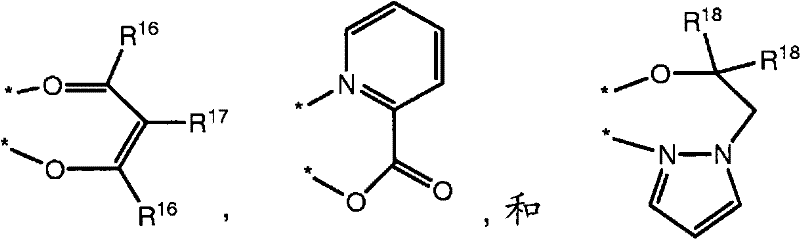
Wherein:
R
16Identical or different and be selected from alkyl and fluoro-alkyl when occurring at every turn;
R
17Be H, D or F;
R
18Identical or different and be selected from alkyl and fluoro-alkyl when occurring at every turn; And
* represent hapto with iridium.
Unidentate ligand L3 can be negatively charged ion or nonionic.Anion ligand includes but not limited to H
-(" hydrogenate ") and part with C, O or S as ligating atom.Coordinating group includes but not limited to alkoxide, carboxylicesters, carbothioic acid ester, dithiocarboxylic esters, sulphonate, mercaptan ester, carbamate, dithiocarbamate, thiocarbazone sulfocarbazone negatively charged ion, sulfonamide anions etc.In some cases, preceding text part such as β-enolate and the phosphine alkoxide of classifying L2 as can be used as unidentate ligand.Unidentate ligand also can be coordination anion, like halogen ion, prussiate, isocyanide, nitrate radical, sulfate radical, six halogen metaantimmonic acid roots etc.These parts generally are commercially available acquisitions.
Monodentate L3 part also can be nonionic part such as CO or monodentate phosphine ligand.
In some embodiments, one or more in the part have at least one substituting group, and the substituting group that protects is selected from F and fluorinated alkyl.
Can adopt for example USP 6,670, the standard synthetic technology described in 645 prepares the iridium complex doping agent.
Some limiting examples with iridium complex doping agent of redness or orange emission provide as follows.

Some limiting examples with iridium complex doping agent of green emitted provide as follows.


Some limiting examples with iridium complex doping agent of blueness-green to blue emission provide as follows.

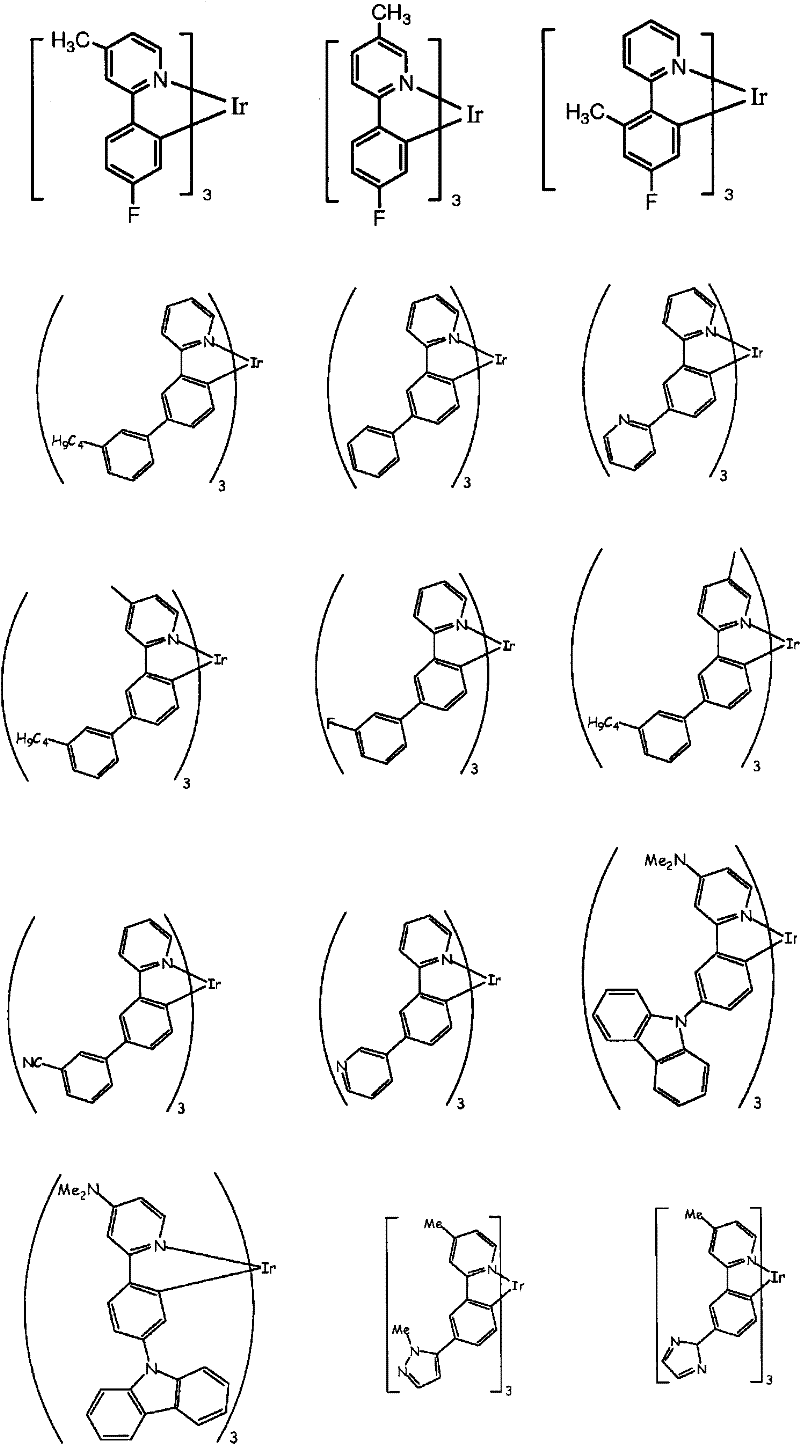





In some embodiments, said doping agent is an organic cpds.In some embodiments, said doping agent is selected from non-polymeric spiral shell two fluorene compounds, fluoranthene compound, amino substituted
 and amino substituted anthracene.
C. other device layer
In the device other layer can be processed by the known any material that is used for this type of layer.
Said hole injection layer can be formed by polymeric materials, and like polyaniline (PANI) or polyethylene dioxythiophene (PEDOT), it is mixed with protonic acid usually.Protonic acid for example can be and gathers (styrene sulfonic acid), gathers (2-acrylic amide-2-methyl isophthalic acid-propanesulfonic acid) etc.
Said hole injection layer can comprise charge transfer compound etc., like copper phthalocyanine and tetrathiafulvalene-four cyano benzoquinone bismethane system (TTF-TCNQ).
In some embodiments, hole injection layer comprises at least a conductive polymers and at least a fluorizated acidic polymer.This type of substance description is in the PCT patented claim WO 2009/018009 of the U.S. Patent application US2004/0102577, US 2004/0127637 and the US 2005/0205860 that for example announce and announcement.
The instance that can be used for the electron transport material of electron transfer layer 150 includes but not limited to metalchelated oxine ketone compound, comprises that the hydroxy quinazine metal verivate is like three (oxine) aluminium (AlQ), two (2-methyl-oxines) (to phenyl phenol oxygen base) aluminium (BAlq), four (oxine) hafnium (HfQ) and four (oxine) zirconium (ZrQ); And azole compounds; Like 2-(4-xenyl)-5-(4-tert-butyl-phenyl)-1,3,4-
 diazole (PBD), 3-(4-xenyl)-4-phenyl-5-(4-tert-butyl-phenyl)-1; 2; 4-triazole (TAZ) and 1,3,5-three (phenyl-2-benzoglyoxaline) benzene (TPBI); Quinoxaline derivatives is as 2, two (the 4-fluoro phenyl) quinoxalines of 3-; Phenanthroline is as 4,7-phenylbenzene-1,10-phenanthroline (DPA) and 2,9-dimethyl--4,7-phenylbenzene-1,10-phenanthroline (DDPA); And their mixture.In some embodiments, said electron transport material is selected from metal quinoline and phenanthroline derivative.In some embodiments, said electron transfer layer also comprises n type doping agent.N type dopant material is known by people.Described n type doping agent includes but not limited to the 1st family and 2 family's metals; The 1st family and 2 family's metal-salts are like LiF, CsF and Cs
2CO
3The 1st family and 2 family's organic cpds are like the quinoline lithium; With molecule n type doping agent, like leuco dye, metal complex is like W
2(hpp)
4Hpp=1 wherein; 3; 4,6,7; Dimer, oligopolymer, polymkeric substance, two spirocyclic compounds and many cyclisation thing of 8-hexahydro--2H-Mi Dingbing-[1,2-a]-pyrimidine and dicyclopentadienylcobalt, four thia naphthacenes, two (ethylene sulfenyl) tetrathiafulvalene, heterocyclic group or divalent group and heterocyclic group or divalent group.Layer 150 not only can be used for promoting electric transmission, also can be used as impact plies or limiting layer, to prevent the cancellation of the electron-hole pair that the bed interface is located.Preferably, this layer promotes the cancellation of electron mobility and minimizing electron-hole pair.
diazole (PBD), 3-(4-xenyl)-4-phenyl-5-(4-tert-butyl-phenyl)-1; 2; 4-triazole (TAZ) and 1,3,5-three (phenyl-2-benzoglyoxaline) benzene (TPBI); Quinoxaline derivatives is as 2, two (the 4-fluoro phenyl) quinoxalines of 3-; Phenanthroline is as 4,7-phenylbenzene-1,10-phenanthroline (DPA) and 2,9-dimethyl--4,7-phenylbenzene-1,10-phenanthroline (DDPA); And their mixture.In some embodiments, said electron transport material is selected from metal quinoline and phenanthroline derivative.In some embodiments, said electron transfer layer also comprises n type doping agent.N type dopant material is known by people.Described n type doping agent includes but not limited to the 1st family and 2 family's metals; The 1st family and 2 family's metal-salts are like LiF, CsF and Cs
2CO
3The 1st family and 2 family's organic cpds are like the quinoline lithium; With molecule n type doping agent, like leuco dye, metal complex is like W
2(hpp)
4Hpp=1 wherein; 3; 4,6,7; Dimer, oligopolymer, polymkeric substance, two spirocyclic compounds and many cyclisation thing of 8-hexahydro--2H-Mi Dingbing-[1,2-a]-pyrimidine and dicyclopentadienylcobalt, four thia naphthacenes, two (ethylene sulfenyl) tetrathiafulvalene, heterocyclic group or divalent group and heterocyclic group or divalent group.Layer 150 not only can be used for promoting electric transmission, also can be used as impact plies or limiting layer, to prevent the cancellation of the electron-hole pair that the bed interface is located.Preferably, this layer promotes the cancellation of electron mobility and minimizing electron-hole pair.
Said negative electrode 160 is to be used to inject electronics or the especially effective electrode of negative charge carrier.Negative electrode can be has work content than the low any metal of anode or nonmetal.The material that is used for negative electrode can be selected from the basic metal of the 1st family (for example lithium, caesium), the 2nd family (alkaline earth) metal, the 12nd family's metal, comprises REE and lanthanon and actinoid.Can use material like aluminium, indium, calcium, barium, samarium and magnesium and their combination.The organometallic compound, LiF, CsF and the Li that contain Li or Cs
2O also can be deposited between organic layer and the cathode layer to reduce operating voltage.
Known other layer that in organic electronic devices, exists.For example, between anode 110 and hole injection layer 120, there be layer (not shown), with the positive charge amount of controlling injection and/or the band-gap that layer is provided, or as resist.Can use layer known in the art, like copper phthalocyanine, silicon oxynitride, fluorocarbon, silane or super thin metal layer such as Pt.As other a kind of selection, anode layer 110, active coating 120,130,140 and 150 or cathode layer 160 in some or all of can be by surface treatment to increase electric charge load transmission efficiency.Preferably confirm the material chosen of each component layer, so that the device with high electroluminescent efficiency to be provided through positive charge in the balance emitter layer and negative charge.
Should be appreciated that each functional layer can be by constituting more than one deck.
Said device can pass through multiple technologies, and being included on the suitable substrate continuously, each layer of vapour deposition prepares.Can use substrate for example glass, plastics and metal.Can use conventional for example thermal evaporation, chemical vapour deposition etc. of gas phase deposition technology.As other a kind of selection, can use conventional coating or printing technology, include but not limited to spin coating, dip-coating, volume to volume technology, ink jet printing, silk screen printing, photogravure etc., apply organic layer by solution in the suitable solvent or dispersion-s.
The invention still further relates to electron device, said electron device comprises at least one active coating between two electric contacting layers, and at least one active coating in the wherein said device comprises the triarylamine compound with formula I, II or III.Device has additional hole transmission layer and electron transfer layer under a lot of situation.
In order to reach high-level efficiency LED, the HOMO (highest occupied molecular orbital(HOMO)) of expectation hole mobile material and anodic work content coupling, and the work content coupling of the LUMO (lowest unoccupied molecular orbital) of expectation electron transport material and negative electrode.When selecting electronics and hole mobile material, the chemical compatibility of material and sublimation temperature also are important consideration.
Should be appreciated that through other layer in the optimised devices, can further improve the efficient of the device that makes with anthracene compound described herein.For example, can use more effective negative electrode for example Ca, Ba or LiF.Also can use and cause shaping substrate and the novel hole mobile material that operating voltage reduces or quantum yield increases.Also can add extra play, thereby customize the energy level of various layers and promote electroluminescent.
Embodiment
Following examples show some feature and advantage of the present invention.They are intended to illustrate the present invention, but are not restrictive.All per-cents all by weight, except as otherwise noted.
Embodiment 1
This embodiment shows for the increase of triarylamine compound as herein described on triplet energies.Said benchmark compound is a triphenylamine, and it has the triplet energies of 3.12eV.The triplet energies of TAPC has been reported as 2.87eV.
Density functional theory (DFT) method that all calculating is used in Gaussian 03 package is carried out.(Gaussian 03, D.01 version; Gaussian, Inc., Wallingford, CT, 2004).Said molecular structure is at first in the horizontal optimization of said BP86/6-31G+IrMWB60, under the identical level of this calculating, is used for subsequently analysis vibrational frequency then and calculates that balance is once really to guarantee these structures.Calculate for said excited state, the time-dependent manner DFT (TDDFT) that former experience has been presented at said B3LYP/6-31G+IrMWB60 level satisfies first seven singlet states of calculating and triplet energies transformation.In order to obtain HOMO and LUMO value, use said B3LYP/6-31+G (d)+IrMWB60 level about these molecules.
Calculation result is illustrated in the following table 1.
Table 1: calculation result


Embodiment 2
This embodiment shows the preparation of triarylamine compound, and said triarylamine compound has formula III, 4 ', 4 " (phenylbenzene methylene radical) two (N, two (2) biphenyl of N--3-amine), compounds 1.
In dried case operator casing, with 4 ', 4 " (phenylbenzene methylene radical) biphenyl-3-amine (0.95g, 1.80mmol), 1-bromo-2,4, the 5-Three methyl Benzene (1.52g, 7.58mmol), tri-butyl phosphine (0.029g, 0.144mmol) and Pd
2(DBA)
3(0.066g 0.072mmol) mixes in round-bottomed flask and is dissolved in the dry toluene of 35mL.With said solution stirring one minute, and (0.76g was 7.94mmol) with the dry toluene of 5mL to add sodium tert-butoxide subsequently.Add heating jacket and in 18 hours, reaction is heated to 60 ℃.Then said reaction mixture is cooled to room temperature and filtration, washs with chloroform.Remove said solvent through rotary evaporation, and the chloroform (0-36%) in the hexane of use gradient is further purified said resistates through silica gel column chromatography.Collection also mixes the product that comprises small portion.Remove said solvent through rotary evaporation.Said resistates from methylene dichloride and ethanol crystallization to obtain the white powder product of 1.20g (68%).1H NMR (CDCl3) is consistent with the structure of compound 1.
Embodiment 3
This embodiment shows the preparation of triarylamine compound, and said triarylamine compound has formula III, N, N ', N "; N " '-(4,4 ', 4 ", 4 " '-methane four (benzene-4,1-two bases)) four (2; 4,5-trimethylammonium-N-(2) aniline), compound 2.

A. four (4-nitrophenyl) methane
This is according to literature method (J.Am.Chem.Soc., 2001,123 (19), 4432-4445) preparation.
In a 250mL round-bottomed flask that is equipped with magnetic stirring apparatus and ice bath, add nitrosonitric acid (45mL).Under~0 ℃, (8.21g 13.00mmol) also stirs in 15 minutes, slowly to add tetraphenyl methane.In this reaction, slowly add the mixture of diacetyl oxide (14mL) and acetate (28mL), keep said temperature simultaneously at~0 ℃.To react and continue reaction 30 minutes.Subsequently, add more acetate (55mL) and said mixture stirred 15 minutes.Filtration crude product deposition, with acetate and water washing, and at air drying.Recrystallization is to obtain the white crystal product of 7.22g (56%) from THF.
B.4,4 ', 4 ", 4 " '-methane four aniline
In the 250mL round-bottomed flask that is equipped with magnetic stirring apparatus and oil bath, add four (4-nitrophenyl) methane (6.50g, 13.00mmol), Pd/C (0.98g, 15 weight %) and propyl carbinol (150mL).Along with the nitrogen bubbling passes through, heated 15 minutes down with said mixture stirring and at 50 ℃.(7.6mL 156mmol), maintains the temperature at 50-60 ℃ simultaneously to drip Hydrazine Hydrate 80 via feed hopper.Said dropping was accomplished in 30 minutes.Subsequently, will be reflected at 50 ℃ of following restir 2 hours.Said be reflected at remain in the whole time uneven.HPLC analyzes and shows that all raw materials have been consumed and said product occurs as unique component.After being cooled to room temperature, mixture with nitrogen purging 10 minutes, is filtered then and washes with THF.Remove said solvent through rotary evaporation, and said resistates by alcohol crystal to obtain shallow colour of skin crystalline product 3.76g (76%).MS is consistent with the structure of proposition with NMR result.
C.N, N ', N ", N " '-(4,4 ', 4 ", 4 " '-methane four (benzene-4,1-two bases)) four (2,4,5-trimethylammonium-N-
(2) aniline)
In dried case operator casing, with 4,4 ', 4 ", 4 " '-methane four aniline (1.00g, 3.08mmol), 1-bromo-2,4, the 5-Three methyl Benzene (1.35g, 3.67mmol), three (tertiary butyl) phosphine (0.10g, 0.50mmol) and Pd
2(DBA)
3(0.23g 0.25mmol) is mixed in the round-bottomed flask and is dissolved in the dry toluene of 120mL.With said solution stirring one minute, and (2.72g was 28.33mmol) with the dry toluene of 5mL to add sodium tert-butoxide subsequently.Add heating jacket and in 18 hours, reaction is heated to 80 ℃.Add more 1-bromo-2,4,5-Three methyl Benzene (350mg) and NaOtBu (180mg) are also with said 80 ℃ of following restir 24 hours that are reflected at.Then said reaction mixture is cooled to room temperature and filtration, washs with toluene (200mL).Remove said solvent and said resistates is dissolved in the chloroform (40mL) again through rotary evaporation.Said crude product is precipitated in methyl alcohol (300mL) and through filter collecting (3.3g, 85% purity).Hexane solution (5-21%) gradient elution through silica gel column chromatography use chloroform is further purified crude product.Produce the faint yellow solid product of 2.60g (64%) by chloroform and ethyl alcohol recrystallization.1H NMR (CDCl3) is consistent with the structure of compound 2.
Embodiment 4
This embodiment shows the preparation of triarylamine compound, and said triarylamine compound has formula III, N, and N '-(4,4 '-(hexanaphthene-1,1-two bases) two (4, the 1-phenylene)) two (2,4,5-trimethylammonium-N-(2) aniline), compound 3.

4 a.4, '-(hexanaphthene-1,1-two bases) two (4, the 1-phenylene) two (trifluoro-methanyl sulfonates)
In the 1L 3-neck round-bottomed flask that is equipped with magnetic stirring apparatus, feed hopper, add 4,4 '-(phenylbenzene methylene radical) xenol (30.00g), DCM (350mL) and pyridine (38.00mL).After stirring 10 minutes at ambient temperature, the homogenization that becomes of heterogeneous mixture originally.Then said flask is placed ice bath, and under agitation in 25 minutes, drip Trifluoromethanesulfonic anhydride (39.50mL in 50mL DCM) (being fuming).Subsequently, said reaction was stirred 1 hour at ambient temperature.HPLC analyzes and shows that all raw materials are consumed, and said product occurs as unique component.Said solution with rare HCl (10%, 2 * 200mL), water (200mL) and the washing of saturated salt solution (200mL).Then with said solution and MgSO
4(20g) stirred together at ambient temperature 1 hour.Said mixture filters the short silicagel column with the DCM wash-out.Remove said solvent and place the remaining oil of crystallization at ambient temperature through rotary evaporation.Collect dried overnight in said material and the vacuum oven at ambient temperature.Yield, 57.8g (97%) wherein are 99% purity through the HPLC analysis.
4 b.4, '-(hexanaphthene-1,1-two bases) two (N-(phenylbenzene methylene radical) aniline)
In being equipped with magnetic stirring apparatus and the 1000mL round-bottomed flask of condensing surface that is connected to the nitrogen conduit, add 4,4 '-(hexanaphthene-1,1-two bases) two (4; The 1-phenylene) two (fluoroform sulphonate) (18.22g; 34.22mmol), 4,4 '-(hexanaphthene-1,1-two bases) two (4; The 1-phenylene) two (fluoroform sulphonates) (14.88g, 82.12mmol), Pd
2(OCOCH
3)
2(0.46g, 2.05mmol), BINAP (1.92g, 3.08mmol), Cs
2CO
3(31.22g, 95.82mmol) and THF (250mL).Said mixture through Glass tubing from side arm with nitrogen bubble 15 minutes, the while, said system was used nitrogen purging from the nitrogen conduit.Subsequently, said mixture stirs under nitrogen and (oil bath) heated overnight (18h) under 80 ℃.After the cooling, add toluene (300mL).Said solution with water (2 * 200mL), saturated salt solution (100mL) washs and uses MgSO
4Dry 4 hours at ambient temperature.Remove said solvent to obtain thick brown oil through rotary evaporation, it, separates with DCM/Hexance gradient (1/4,1/1 and 1/0) wash-out on silicagel column through chromatography.Mix the product that comprises small portion, and remove said solvent to obtain the light brown viscous oil product through rotary evaporation.In thick oil, add methyl alcohol (500mL) and said mixture was stirred 2 hours under envrionment conditions.Formed a large amount of white precipitates during this period.Collect said product through filtering, with methanol wash and at air drying.Yield, 14.1g (69.3%), wherein analyzing through UPLC is 95% purity.
4 c.4, '-(hexanaphthene-1,1-two bases) pentanoic
Under agitation, the above-mentioned solid in the 1L round-bottomed flask (14.0g, 23.54mmol) the middle THF (200mL) that adds.The aqueous HCl of slow adding (2.5M, 40mL).Said mixture was at room temperature stirred 10 minutes.Use ether (200mL) to extract said solution then.Separate said waterbearing stratum, and through add sodium hydroxide become alkalescence and with ether (2 * 150mL) extract.Mix said ether extract,, and use MgSO with saturated brine wash
4Dry 3 hours at ambient temperature.After the filtration, remove said solvent to obtain shallow brown oil through rotary evaporation.Said crude product is at first used hexane/DCM gradient (1/1,1/0) on silicagel column, use MeOH/DCM (1/9) wash-out to separate then.Collection comprises the product of small portion, and removes said solvent to obtain colourless thick oil through rotary evaporation.The product that is light yellow crystalline material with the crystallization of DCM/ hexane with acquisition.Yield, 5.75g (90%).NMR spectrum is consistent with the structure of product.
D.N, N '-(4,4 '-(hexanaphthene-1,1-two bases) two (4, the 1-phenylene)) two (2,4,5-trimethylammonium-N-
(2) aniline)
In dried case operator casing, with 4,4 '-(hexanaphthene-1,1-two bases) pentanoic (6.75g, 25.09mmol), 1-bromo-2,4, the 5-Three methyl Benzene (21.19g, 105.36mmol), three (tertiary butyl) phosphine (0.41g, 2.01mmol) and Pd
2(DBA)
3(0.92g 1.00mmol) is blended in the round-bottomed flask and is dissolved in the dry toluene of 450ml.With said solution stirring one minute, (10.61g was 110.38mmol) with the dry toluene of 50mL to add sodium tert-butoxide subsequently.Put heating jacket and in 18 hours, reaction is heated to 80 ℃.Then said reaction mixture is cooled to room temperature and filtration, washs with chloroform.Remove said solvent through rotary evaporation, and the chloroform (0-25%) in the hexane of use gradient is further purified said resistates through silica gel column chromatography.Collection also mixes the product that comprises small portion.Remove said solvent through rotary evaporation.With said crude product be dissolved among the DCM (100mL) and in methyl alcohol (700mL) deposition to obtain 17.47g (94%) white powder product.1H NMR (CDCl3) is consistent with structure.
Embodiment 5
This shows the preparation of triarylamine compound, and said triarylamine compound has formula III, N, N '-(4; 4 '-(1-diphenylphosphino ethane-1,1-two bases) two (4, the 1-phenylene)) two (3 '-phenyl-6-methyl-N-(2; 4,6-triisopropyl phenyl) biphenyl-3-amine, compound 4.
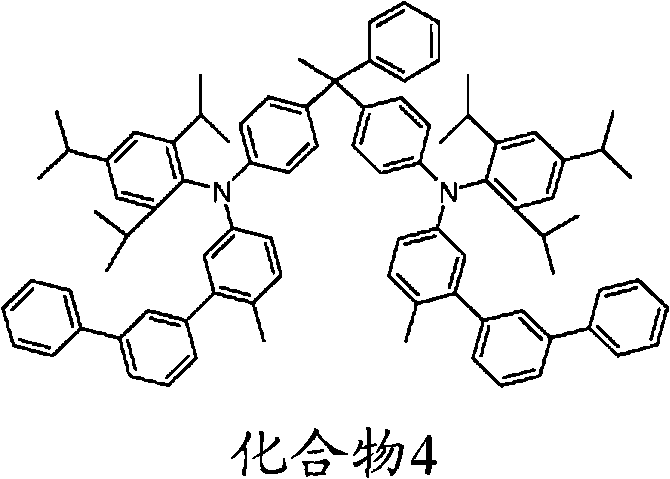
In the round-bottomed flask of 50mL, add Pd (OAc)
2And S-Phos (0.12g, 0.29mmol) and dioxane (10mL).Under agitation, with said system with nitrogen purging 10 minutes.At one independently in the flask, (0.004g 0.23mmol) mixes with dioxane (2mL), and with nitrogen purging 5 minutes, joins in the catalyst solution then with water.Said mixture heated one minute down at 100 ℃, so color is from bright red blackening to black dull/garnet.
Under nitrogen, in two neck 200mL round-bottomed flasks, add N, N '-(4,4 '-(1-phenylethane-1,1-two bases) two (4, the 1-phenylene)) two (2,4,6-triisopropyl aniline) (2.02g, 2.91mmol) 5-and dioxane (50mL).Under agitation, said system with nitrogen purging 10 minutes, is added catalyst solution then.Add heating jacket, and in 3 days, said being reflected at is heated to 110 ℃ under the nitrogen.Then said reaction mixture is cooled to room temperature and filtration, washs with chloroform.Remove said solvent through rotary evaporation, and be further purified said resistates through silica gel column chromatography through the chloroform (0-31%) in the hexane that uses gradient.Collection also mixes the product that comprises small portion.Remove said solvent through rotary evaporation.The said resistates of periodic crystallisation is to obtain the white powder product of 0.34g (10%) from methylene dichloride and acetonitrile, and being analyzed by UPLC is>99.9% purity.1H NMR (CDCl3) is consistent with structure.
Embodiment 6-8 and Comparative Example A An and B
These embodiment show the performance of novel triarylamine compound in device.
(a) material:
HIJ-1 is the aqueous dispersion of conductive polymers and polymerization fluorinated sulfonic.This type of substance description is in the PCT patented claim WO 2009/018009 of the U.S. Patent application US2004/0102577, US 2004/0127637 and the US 2005/0205860 that for example announce and announcement.
TAPC is 1, and 1-two [(two-4-tolyl is amino) phenyl] hexanaphthene is as follows.
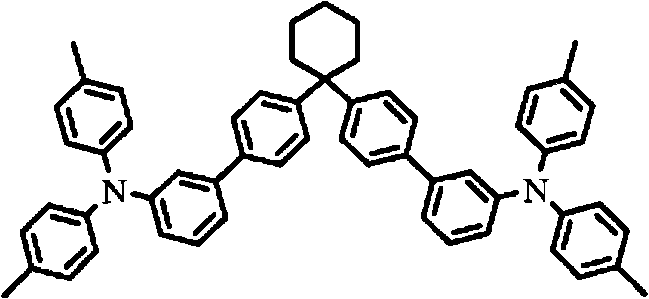
NPB is N, N '-two (naphthalene-1-yl)-N, and N '-two-(phenyl) benzidine, as follows
Green-1 be have following shown in the organic metal iridium radiator of structure.

Matrix-1 is indolocarbazole verivate as follows.This type of material has been described in the European patent application EP 2080762 of announcement.

ET-1 is the benzophenanthrene verivate.
ET-2 is the hydroxy quinazine metal verivate.
(b) device
In these instances, device makes through the combination of solution processing and gas phase deposition technology.The substrate that has 80nm tin indium oxide (" ITO ") is used as anode.HIJ-1 is through being used by the aqueous dispersion spin coating.Other material is used through vapor deposition.Said device architecture is:
Anode: ITO (80nm)
Hole injection layer: HIJ-1 (60nm)
Hole transmission layer: the material that is shown in Table 2 (20nm)
Electroactive layer: the 10%Green-1 in matrix-1 (66nm)
First electron transfer layer: ET-1 (5nm)
Second electron transfer layer: ET-2 (15nm)
Electron injecting layer: LiF (1nm is sedimentary)
Negative electrode: Al (100nm)
In embodiment 6, said hole mobile material is a compound 3.
In embodiment 7, said hole mobile material is a compound 4.
In embodiment 8, said hole mobile material is a compound 1.
In Comparative Example A An, said hole mobile material is TAPC.
In Comparative Examples B, said hole mobile material is NPB.
Through measuring their (1) current-voltage (I-V) curve, (2) with respect to the electroluminescent spectrum of voltage, characterize the OLED sample with respect to the electroluminescent radiation of voltage and (3).All three tests are all carried out and by computer control simultaneously.Through the electroluminescent radiation of LED is confirmed the current efficiency of device under a certain voltage divided by the required current density of operation device.Unit is cd/A.Calculate external quantum efficiency (EQE) by current efficiency (cd/A) and electroluminescent spectrum then, the light of supposing emission is that Lambertian distributes.The result is shown in Table 2.
Table 2: device result
The HTL=hole transmission layer; X and y are the color coordinates according to C.I.E. colourity scale (Commission Internationale de L ' Eclairage, 1931).
Said external quantum efficiency and current efficiency for novel triarylamine compound of the present invention for bigger.
It should be noted that, preceding text are general describe or embodiment described in behavior not all be essential, a part of concrete behavior is optional, and those, also can implement one or more other behaviors except described.In addition, the order of listed behavior needs not to be the order of implementing them.
In above-mentioned specification sheets, with reference to concrete embodiment different concepts has been described.Yet those of ordinary skill in the art recognizes, under the situation that does not break away from the scope of the invention described in the sharp requirement of following right to culture, can carry out various modifications and variation.Therefore, it is exemplary and nonrestrictive that specification sheets and accompanying drawing should be considered to, and all these type of modification all are intended to be included in the scope of the present invention.
Preceding text have combined concrete embodiment to describe the solution of beneficial effect, other advantage and problem.Yet, the solution of beneficial effect, advantage, problem and can cause any beneficial effect, advantage solution produces or the more significant any characteristic intangibility that becomes to be interpreted as be the key of any or all claim, essential or essential characteristic.
Will be appreciated that for clarity sake, some characteristic described in the context of this paper different embodiments also can provide with array mode in single embodiment.Otherwise for for simplicity, a plurality of characteristics described in single embodiment context also can provide respectively, or provide with the mode of any son combination.In addition, the correlation values of in scope, describing comprises each value in the said scope.
Claims (15)
1. the triarylamine compound that has formula I, formula II or formula III:

Wherein:
R
1, R
2And R
3Identical or different and be alkyl, two or more in the wherein said alkyl can be engaged with together to form ring-type or many cyclic groups;
R
4, R
5And R
6Identical or different and be selected from alkyl and aryl, wherein R
5And R
6Can be engaged with and form cyclic group together;
R
7And R
8Identical or different and be alkyl
R
9Be selected from H, D and alkyl, wherein R
7, R
8And R
9In two or more can be engaged with together to form ring-type or many cyclic groups;
R
10And R
11Identical or different and be alkyl
R
12Be selected from H, D and alkyl, wherein R
10, R
11And R
12In two or more can be engaged with together to form ring-type or many cyclic groups; And
R
13And R
14Identical or different and be selected from alkyl, aryl and virtue is amino, or R
13And R
14Can be engaged with together to form cyclic group.
2. the compound of claim 1, said compound were at least 10% deuterium generation.
3. the compound of claim 1, said compound were at least 50% deuterium generation.
4. the compound of claim 1, said compound were 100% deuterium generation.
5. the compound of claim 1, wherein said alkyl has 1-3 carbon atom.
6. the compound of claim 1, wherein said aryl are selected from phenyl, biphenyl, naphthyl, their deuterium for verivate and group with formula IV:
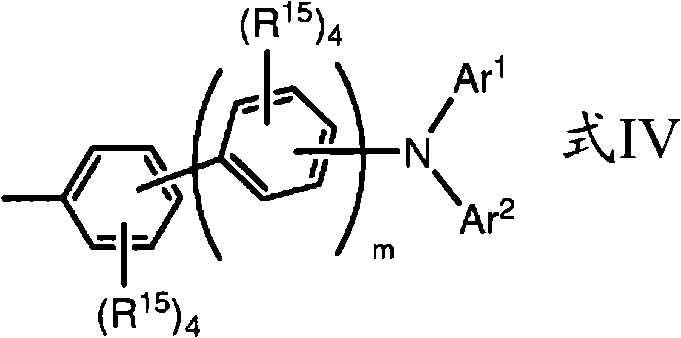
Wherein:
Ar
1And Ar
2Identical or different and be aryl, or Ar
1And Ar
2Can be engaged with together to form carbazyl;
R
15Identical or different and be selected from H, D and alkyl when occurring at every turn, or adjacent
R
15Base can be engaged with together to form aromatic ring; And
M identical or different and be 0 to 5 integer when occurring at every turn.
7. electroactive compsn comprises:
(a) have the triarylamine compound matrix of formula I, formula II or formula III:
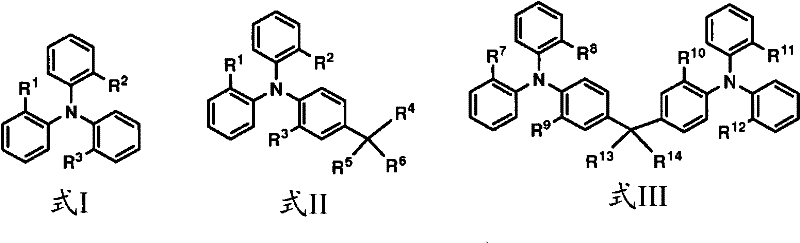
Wherein:
R
1, R
2And R
3Identical or different and be alkyl, two or more in the wherein said alkyl can be engaged with together to form ring-type or many cyclic groups;
R
4, R
5And R
6Identical or different and be selected from alkyl and aryl, wherein R
5And R
6Can be engaged with together to form cyclic group;
R
7And R
8Identical or different and be alkyl
R
9Be selected from H, D and alkyl, wherein R
7, R
8And R
9In two or more can be engaged with together to form ring-type or many cyclic groups;
R
10And R
11Identical or different and be alkyl
R
12Be selected from H, D and alkyl, wherein R
10, R
11And R
12In two or more can be engaged with together to form ring-type or many cyclic groups; And
R
13And R
14Identical or different and be selected from alkyl, aryl and virtue is amino, or R
13And R
14Can be engaged with together to form cyclic group; With
(b) can electroluminescent organo-metallic doping agent, said doping agent has the emission maximum between 380nm and 750nm.
8. the electroactive compsn of claim 7, said compsn also comprises: (c) second substrate material.
9. the electroactive compsn of claim 8, wherein said second substrate material is selected from
 phenanthrene, benzophenanthrene, phenanthroline, naphthalene, anthracene, quinoline, isoquinoline 99.9, quinoxaline, phenylpyridine, benzo two furans, indolocarbazole and hydroxy quinazine metal complex compound.
10. organic electronic devices; Comprise first electric contacting layer, second electric contacting layer and at least one active coating between said first electric contacting layer and said second electric contacting layer, wherein said active coating comprises the triarylamine compound with formula I, formula II or formula III:

Wherein:
R
1, R
2And R
3Identical or different and be alkyl, two or more in the wherein said alkyl can be engaged with together to form ring-type or many cyclic groups;
R
4, R
5And R
6Identical or different and be selected from alkyl and aryl, wherein R
5And R
6Can be engaged with together to form cyclic group;
R
7And R
8Identical or different and be alkyl
R
9Be selected from H, D and alkyl, wherein R
7, R
8And R
9In two or more can be engaged with together to form ring-type or many cyclic groups;
R
10And R
11Identical or different and be alkyl
R
12Be selected from H, D and alkyl, wherein R
10, R
11And R
12In two or more can be engaged with together to form ring-type or many cyclic groups; And
R
13And R
14Identical or different and be selected from alkyl, aryl and virtue is amino, or R
13And R
14Can be engaged with together to form cyclic group.
11. the device of claim 10, wherein said active coating are electroactive layer, said electroactive layer also comprises can electroluminescent organo-metallic doping agent, and said doping agent has the emission maximum between 380nm and 750nm.
12. the device of claim 11, wherein said active coating are made up of compound with formula I, formula II or formula III and organo-metallic doping agent basically.
13. the device of claim 10, wherein said active coating are hole transmission layer.
14. the device of claim 13, wherein said active coating is made up of the compound with formula I, formula II or formula III basically.
15. the device of claim 10 also comprises the hole injection layer between said first electric contacting layer and said active coating, wherein said hole injection layer comprises at least a conductive polymers and at least a fluorizated acidic polymer.
Applications Claiming Priority (5)
| Application Number | Priority Date | Filing Date | Title |
|---|---|---|---|
| US25280809P | 2009-10-19 | 2009-10-19 | |
| US61/252,808 | 2009-10-19 | ||
| US36242710P | 2010-07-08 | 2010-07-08 | |
| US61/362,427 | 2010-07-08 | ||
| PCT/US2010/053124 WO2011049904A2 (en) | 2009-10-19 | 2010-10-19 | Triarylamine compounds for electronic applications |
Publications (1)
| Publication Number | Publication Date |
|---|---|
| CN102596893A true CN102596893A (en) | 2012-07-18 |
Family
ID=43900903
Family Applications (1)
| Application Number | Title | Priority Date | Filing Date |
|---|---|---|---|
| CN2010800467860A Pending CN102596893A (en) | 2009-10-19 | 2010-10-19 | Triarylamine compounds for electronic applications |
Country Status (6)
| Country | Link |
|---|---|
| US (1) | US8937300B2 (en) |
| EP (1) | EP2491002A4 (en) |
| JP (1) | JP2013508375A (en) |
| KR (1) | KR20120086319A (en) |
| CN (1) | CN102596893A (en) |
| WO (1) | WO2011049904A2 (en) |
Cited By (3)
| Publication number | Priority date | Publication date | Assignee | Title |
|---|---|---|---|---|
| CN107925001A (en) * | 2015-08-11 | 2018-04-17 | E.I.内穆尔杜邦公司 | Hole mobile material |
| CN110582878A (en) * | 2017-04-28 | 2019-12-17 | Ess技术有限公司 | Integrated water circulation system using pressurized multi-chamber tanks |
| CN112236410A (en) * | 2018-09-21 | 2021-01-15 | 株式会社Lg化学 | Compounds, compositions containing the same, and organic light-emitting diodes containing the same |
Families Citing this family (6)
| Publication number | Priority date | Publication date | Assignee | Title |
|---|---|---|---|---|
| KR101936978B1 (en) | 2011-07-05 | 2019-01-09 | 닛산 가가쿠 가부시키가이샤 | Vertically phase-separating semiconducting organic material layers |
| JP6034600B2 (en) * | 2012-06-12 | 2016-11-30 | ユー・ディー・シー アイルランド リミテッド | Organic electroluminescence device |
| US9972783B2 (en) * | 2015-03-25 | 2018-05-15 | E I Du Pont De Nemours And Company | High energy triarylamine compounds for hole transport materials |
| KR102824606B1 (en) * | 2018-02-13 | 2025-06-25 | 삼성디스플레이 주식회사 | Organic light emitting device and display apparatus comprising the same |
| WO2021039463A1 (en) * | 2019-08-23 | 2021-03-04 | 国立大学法人東京大学 | Dopant, electroconductive composition and method for producing same |
| KR20220090667A (en) * | 2020-12-22 | 2022-06-30 | 삼성디스플레이 주식회사 | Light-emitting device and electronic apparatus including the same |
Citations (6)
| Publication number | Priority date | Publication date | Assignee | Title |
|---|---|---|---|---|
| JPH08278642A (en) * | 1995-04-10 | 1996-10-22 | Mita Ind Co Ltd | Electrophotographic photoreceptor |
| US20040189190A1 (en) * | 2003-03-26 | 2004-09-30 | Yoshiyuki Suzuri | Organic electroluminescent element, illuminator, and display |
| US20060069287A1 (en) * | 2002-09-10 | 2006-03-30 | Shinji Kubo | Process for producing arylamine |
| US20060257767A1 (en) * | 2005-05-11 | 2006-11-16 | Xerox Corporation | Imaging member |
| CN1876620A (en) * | 2006-07-06 | 2006-12-13 | 上虞市金腾医药化工有限公司 | Preparation method of N, N '-bis (3-methylphenyl) -N, N' -diphenyl benzidine |
| WO2007031165A2 (en) * | 2005-09-12 | 2007-03-22 | Merck Patent Gmbh | Compounds for organic electronic devices |
Family Cites Families (241)
| Publication number | Priority date | Publication date | Assignee | Title |
|---|---|---|---|---|
| BE626527A (en) | 1961-12-29 | |||
| DE2356370C2 (en) | 1973-11-12 | 1983-05-11 | Hoechst Ag, 6230 Frankfurt | Electrophotographic recording material |
| CA1084647A (en) | 1974-02-21 | 1980-08-26 | Shigeyoshi Hara | Nitrogen-containing aromatic polymers and process for their preparation |
| US4127412A (en) | 1975-12-09 | 1978-11-28 | Eastman Kodak Company | Photoconductive compositions and elements |
| CA1098755A (en) | 1976-04-02 | 1981-04-07 | Milan Stolka | Imaging member with n,n'-diphenyl-n,n'-bis (phenylmethyl)-¬1,1'-biphenyl|-4,4'-diamine in the charge transport layer |
| US4047949A (en) | 1976-11-01 | 1977-09-13 | Xerox Corporation | Composite layered imaging member for electrophotography |
| US4047948A (en) | 1976-11-01 | 1977-09-13 | Xerox Corporation | Composite layered imaging member for electrophotography |
| US4265990A (en) | 1977-05-04 | 1981-05-05 | Xerox Corporation | Imaging system with a diamine charge transport material in a polycarbonate resin |
| US4346158A (en) | 1978-12-04 | 1982-08-24 | Xerox Corporation | Imaging system with a diamine charge transport material in a polycarbonate resin |
| US4299897A (en) | 1978-12-15 | 1981-11-10 | Xerox Corporation | Aromatic amino charge transport layer in electrophotography |
| US4233384A (en) | 1979-04-30 | 1980-11-11 | Xerox Corporation | Imaging system using novel charge transport layer |
| US4322487A (en) | 1979-08-08 | 1982-03-30 | Eastman Kodak Company | Composite electrically photosensitive particles for electrophoretic migration imaging process |
| US4714779A (en) | 1980-11-20 | 1987-12-22 | Xerox Corporation | Aromatic aryl amine polymers |
| US4517354A (en) | 1981-07-06 | 1985-05-14 | Plastics Engineering Company | Polysulfone compositions and derivatives thereof |
| US4504564A (en) | 1984-01-03 | 1985-03-12 | Xerox Corporation | Method for the preparation of photoconductive compositions |
| US4665000A (en) | 1984-10-19 | 1987-05-12 | Xerox Corporation | Photoresponsive devices containing aromatic ether hole transport layers |
| US4933245A (en) | 1986-09-18 | 1990-06-12 | Fuji Xerox Co., Ltd. | Electrophotographic photoreceptor |
| US4933053A (en) | 1987-02-05 | 1990-06-12 | Ciba-Geigy Corporation | Carbazole-containing, electrically conductive polysiloxanes |
| US4801517A (en) | 1987-06-10 | 1989-01-31 | Xerox Corporation | Polyarylamine compounds and systems utilizing polyarylamine compounds |
| US4898800A (en) * | 1987-10-20 | 1990-02-06 | Ricoh Company, Ltd. | Aminobiphenyl charge transporting materials and electrophotographic photoconductors using the same |
| US4946754A (en) | 1988-11-21 | 1990-08-07 | Xerox Corporation | Photoconductive imaging members with diaryl biarylylamine charge transporting components |
| JPH02282263A (en) | 1988-12-09 | 1990-11-19 | Nippon Oil Co Ltd | Hole transferring material |
| US5262261A (en) * | 1988-12-29 | 1993-11-16 | Canon Kabushiki Kaisha | Photosensitive member for electrophotography |
| CA2010770A1 (en) | 1989-03-09 | 1990-09-09 | Dinesh N. Khanna | Bis-n,n' nitro or amino benzoyl aminophenols |
| US5126214A (en) | 1989-03-15 | 1992-06-30 | Idemitsu Kosan Co., Ltd. | Electroluminescent element |
| US4937165A (en) | 1989-04-03 | 1990-06-26 | Xerox Corporation | Photoconductive imaging members with N,N-bis(biarylyl)aniline charge transport polymers |
| US5155200A (en) | 1990-04-20 | 1992-10-13 | Xerox Corporation | Polyarylamine polymers |
| JP3185258B2 (en) | 1991-07-31 | 2001-07-09 | ミノルタ株式会社 | Novel diamino compound and photoreceptor using the same |
| JPH05112509A (en) | 1991-10-18 | 1993-05-07 | Ricoh Co Ltd | Tertiary amine compound having fluorocarbon group |
| US5237045A (en) | 1992-01-09 | 1993-08-17 | The United States Of America As Represented By The Secretary Of The Navy | Curing phthalonitrile resins with acid and amine |
| US5652067A (en) | 1992-09-10 | 1997-07-29 | Toppan Printing Co., Ltd. | Organic electroluminescent device |
| US5846681A (en) | 1992-09-30 | 1998-12-08 | Xerox Corporation | Multilayer imaging member having improved substrate |
| US5449564A (en) | 1992-10-29 | 1995-09-12 | Sanyo Electric Co., Ltd. | Organic electroluminescent element having improved durability |
| TW382076B (en) * | 1993-06-30 | 2000-02-11 | Canon Kk | Electrophotographic photosensitive member and electrophotographic apparatus using same |
| JPH0790256A (en) | 1993-09-22 | 1995-04-04 | Pioneer Electron Corp | Organic electroluminescent device |
| DE69412567T2 (en) | 1993-11-01 | 1999-02-04 | Hodogaya Chemical Co., Ltd., Tokio/Tokyo | Amine compound and electroluminescent device containing it |
| EP0666298A3 (en) | 1994-02-08 | 1995-11-15 | Tdk Corp | Organic EL element and compound used therein. |
| US5981124A (en) * | 1994-06-23 | 1999-11-09 | Ricoh Company, Ltd. | Electrophotographic photoconductor, azo compounds for use in the same, and intermediates for producing the azo compounds |
| US5681664A (en) | 1994-08-04 | 1997-10-28 | Toyo Ink Manufacturing Co., Ltd. | Hole-transporting material and use thereof |
| US5554450A (en) * | 1995-03-08 | 1996-09-10 | Eastman Kodak Company | Organic electroluminescent devices with high thermal stability |
| JPH08292586A (en) | 1995-04-21 | 1996-11-05 | Hodogaya Chem Co Ltd | Electrophotographic photoreceptor |
| US5708130A (en) | 1995-07-28 | 1998-01-13 | The Dow Chemical Company | 2,7-aryl-9-substituted fluorenes and 9-substituted fluorene oligomers and polymers |
| US5814244A (en) * | 1995-09-04 | 1998-09-29 | Hoechst Aktiengesellschaft | Polymers comprising triaylamine units as electroluminescence materials |
| JP3058069B2 (en) | 1995-10-18 | 2000-07-04 | 富士ゼロックス株式会社 | Novel charge transporting polymer and organic electronic device using the same |
| JP3916269B2 (en) | 1995-11-06 | 2007-05-16 | 東レ・ダウコーニング株式会社 | Organosilicon-modified charge transporting compound and curable composition having charge transporting ability containing the compound |
| US5789128A (en) | 1995-12-15 | 1998-08-04 | Ricoh Company, Ltd. | Electrophotographic photoconductor and aromatic polycarbonate resin for use therein |
| US5677097A (en) | 1996-01-18 | 1997-10-14 | Fuji Xerox Co., Ltd. | Electrophotographic photoreceptor |
| US5929194A (en) | 1996-02-23 | 1999-07-27 | The Dow Chemical Company | Crosslinkable or chain extendable polyarylpolyamines and films thereof |
| US6939625B2 (en) | 1996-06-25 | 2005-09-06 | Nôrthwestern University | Organic light-emitting diodes and methods for assembly and enhanced charge injection |
| DE19627070A1 (en) | 1996-07-05 | 1998-01-08 | Bayer Ag | Electroluminescent devices using glare systems |
| US5728801A (en) | 1996-08-13 | 1998-03-17 | The Dow Chemical Company | Poly (arylamines) and films thereof |
| DE19643097A1 (en) | 1996-10-18 | 1998-04-23 | Basf Ag | Novel thermally-crosslinkable tri:aryl:amine(s) |
| US6020426A (en) | 1996-11-01 | 2000-02-01 | Fuji Xerox Co., Ltd. | Charge-transporting copolymer, method of forming charge-transporting copolymer, electrophotographic photosensitive body, and electrophotographic device |
| US5891587A (en) | 1997-02-27 | 1999-04-06 | Xerox Corporation | Electroluminescent devices |
| JP3503403B2 (en) | 1997-03-17 | 2004-03-08 | 東洋インキ製造株式会社 | Light emitting material for organic electroluminescent device and organic electroluminescent device using the same |
| JPH10265773A (en) | 1997-03-24 | 1998-10-06 | Toyo Ink Mfg Co Ltd | Hole injection material for organic electroluminescence device and organic electroluminescence device using the same |
| JP3871396B2 (en) | 1997-04-03 | 2007-01-24 | 靖彦 城田 | Organic EL device |
| EP0879868B1 (en) | 1997-05-19 | 2002-04-03 | Canon Kabushiki Kaisha | Organic compound and electroluminescent device using the same |
| US6309763B1 (en) | 1997-05-21 | 2001-10-30 | The Dow Chemical Company | Fluorene-containing polymers and electroluminescent devices therefrom |
| JP2998707B2 (en) | 1997-07-09 | 2000-01-11 | 日本電気株式会社 | Organic electroluminescence device |
| GB2328686B (en) * | 1997-08-25 | 2001-09-26 | Sankio Chemical Co Ltd | Method for producing arylamine |
| US6150043A (en) * | 1998-04-10 | 2000-11-21 | The Trustees Of Princeton University | OLEDs containing thermally stable glassy organic hole transporting materials |
| US6303238B1 (en) | 1997-12-01 | 2001-10-16 | The Trustees Of Princeton University | OLEDs doped with phosphorescent compounds |
| US5853906A (en) * | 1997-10-14 | 1998-12-29 | Xerox Corporation | Conductive polymer compositions and processes thereof |
| EP1027398B1 (en) | 1997-10-23 | 2004-06-09 | Isis Innovation Limited | Light-emitting dendrimers and devices |
| JP4545243B2 (en) | 1997-12-16 | 2010-09-15 | チッソ株式会社 | Diaminonaphthalene derivative and organic electroluminescence device using the same |
| GB9726810D0 (en) * | 1997-12-19 | 1998-02-18 | Zeneca Ltd | Compounds composition & use |
| JP4392869B2 (en) | 1997-12-24 | 2010-01-06 | ダウ コ−ニング コ−ポレ−ション | Method for producing triarylamine having hydrocarbonoxysilyl group |
| GB2334959A (en) | 1998-03-05 | 1999-09-08 | Secr Defence | Conducting polymers |
| KR100697861B1 (en) | 1998-03-13 | 2007-03-22 | 캠브리지 디스플레이 테크놀로지 리미티드 | Electric field light emitting devices |
| DE19812259A1 (en) | 1998-03-20 | 1999-10-21 | Bayer Ag | EL arrangement based on tertiary amines, alcohol-soluble Alq3 derivatives or mixtures and polymeric binders |
| US20010017155A1 (en) | 1998-04-09 | 2001-08-30 | Erika Bellmann | Hole-transporting polymers |
| US6361885B1 (en) | 1998-04-10 | 2002-03-26 | Organic Display Technology | Organic electroluminescent materials and device made from such materials |
| JPH11327181A (en) | 1998-05-07 | 1999-11-26 | Fuji Xerox Co Ltd | Organic electronic device |
| DE19825737A1 (en) | 1998-06-09 | 1999-12-16 | Bayer Ag | Electroluminescent devices with N-alkyl-2,2'-imino-bis (8-hydroxyquinoline) metal complexes |
| CA2276808A1 (en) | 1998-07-04 | 2000-01-04 | Bayer Aktiengesellschaft | Electroluminescent assemblies using boron chelates of 8-aminoquinoline derivatives |
| US6316130B1 (en) | 1998-07-04 | 2001-11-13 | Bayer Aktiengesellschaft | Electroluminescent assemblies using azomethine-metal complexes |
| DE19829947A1 (en) | 1998-07-04 | 2000-01-05 | Bayer Ag | Electroluminescent devices with boron chelates |
| US6376694B1 (en) | 1998-07-09 | 2002-04-23 | Chisso Corporation | Silole derivatives and organic electroluminescent element containing the same |
| JP3180802B2 (en) | 1998-07-16 | 2001-06-25 | 住友電気工業株式会社 | Triphenylamine derivative and organic electroluminescent device using the same |
| DE19839947A1 (en) | 1998-09-02 | 2000-03-09 | Bayer Ag | Electroluminescent devices with thiophene carboxylate metal complexes |
| DE19839946A1 (en) | 1998-09-02 | 2000-03-09 | Bayer Ag | Electroluminescent devices with multinuclear metal complexes |
| US6143452A (en) | 1998-09-29 | 2000-11-07 | Konica Corporation | Electrophotographic photoreceptor |
| US6107452A (en) | 1998-10-09 | 2000-08-22 | International Business Machines Corporation | Thermally and/or photochemically crosslinked electroactive polymers in the manufacture of opto-electronic devices |
| US5976744A (en) | 1998-10-29 | 1999-11-02 | Xerox Corporation | Photoreceptor overcoatings containing hydroxy functionalized aromatic diamine, hydroxy functionalized triarylamine and crosslinked acrylated polyamide |
| JP3496541B2 (en) | 1998-11-11 | 2004-02-16 | 富士ゼロックス株式会社 | Charge transporting polyester and organic electronic device using the same |
| US6107439A (en) | 1998-12-22 | 2000-08-22 | Xerox Corporation | Cross linked conducting compositions |
| JP4213832B2 (en) | 1999-02-08 | 2009-01-21 | 富士フイルム株式会社 | Organic light emitting device material, organic light emitting device using the same, and styrylamine compound |
| US6689491B1 (en) | 1999-02-08 | 2004-02-10 | Fuji Photo Film Co., Ltd. | Luminescent device material, luminescent device using the same, and amine compound |
| US6008399A (en) | 1999-03-11 | 1999-12-28 | Mobil Oil Corporation | Process for preparing organic carbonates |
| WO2000070655A2 (en) | 1999-05-13 | 2000-11-23 | The Trustees Of Princeton University | Very high efficiency organic light emitting devices based on electrophosphorescence |
| JP4442960B2 (en) | 1999-09-22 | 2010-03-31 | ケミプロ化成株式会社 | Organic electroluminescent device using novel dimeric tetraphenylenediamine |
| KR100946314B1 (en) | 1999-12-01 | 2010-03-09 | 더 트러스티즈 오브 프린스턴 유니버시티 | Organic light emitting device comprising a phosphorescent organo metallic compound |
| US6821645B2 (en) | 1999-12-27 | 2004-11-23 | Fuji Photo Film Co., Ltd. | Light-emitting material comprising orthometalated iridium complex, light-emitting device, high efficiency red light-emitting device, and novel iridium complex |
| ATE284910T1 (en) | 2000-01-05 | 2005-01-15 | Cambridge Display Tech Ltd | POLYMERS, THEIR PRODUCTION AND USE |
| US6207334B1 (en) | 2000-05-12 | 2001-03-27 | Xerox Corporation | Photoreceptor with improved combination of overcoat layer and charge transport layer |
| US20020057050A1 (en) | 2000-06-28 | 2002-05-16 | Xiaobo Shi | Organic light emitting diode devices using aromatic amine compounds with high and tunable glass transition temperatures |
| US7476452B2 (en) | 2000-06-30 | 2009-01-13 | E. I. Du Pont De Nemours And Company | Electroluminescent iridium compounds with fluorinated phenylpyridine ligands, and devices made with such compounds |
| US20020121638A1 (en) | 2000-06-30 | 2002-09-05 | Vladimir Grushin | Electroluminescent iridium compounds with fluorinated phenylpyridines, phenylpyrimidines, and phenylquinolines and devices made with such compounds |
| US6670645B2 (en) | 2000-06-30 | 2003-12-30 | E. I. Du Pont De Nemours And Company | Electroluminescent iridium compounds with fluorinated phenylpyridines, phenylpyrimidines, and phenylquinolines and devices made with such compounds |
| US6489071B2 (en) * | 2000-07-25 | 2002-12-03 | Kyocera Mita Corporation | Electrophotosensitive material |
| CN101924190B (en) | 2000-08-11 | 2012-07-04 | 普林斯顿大学理事会 | Organometallic compounds and emission-shifting organic electrophosphorescence |
| JP4344494B2 (en) | 2000-08-24 | 2009-10-14 | 富士フイルム株式会社 | Light emitting device and novel polymer element |
| JP2002075654A (en) | 2000-08-28 | 2002-03-15 | Fuji Xerox Co Ltd | Organic electroluminescent device |
| JP4569997B2 (en) | 2000-09-07 | 2010-10-27 | 凸版印刷株式会社 | Polymer charge transport material, method for producing the same, and electroluminescence device using the same |
| EP1191821B1 (en) * | 2000-09-25 | 2009-05-27 | Konica Corporation | Organic electroluminescent element and organic electroluminescent material used therefor |
| JP4154140B2 (en) | 2000-09-26 | 2008-09-24 | キヤノン株式会社 | Metal coordination compounds |
| JP4154139B2 (en) | 2000-09-26 | 2008-09-24 | キヤノン株式会社 | Light emitting element |
| US6579630B2 (en) | 2000-12-07 | 2003-06-17 | Canon Kabushiki Kaisha | Deuterated semiconducting organic compounds used for opto-electronic devices |
| JP2002184581A (en) | 2000-12-13 | 2002-06-28 | Sanyo Electric Co Ltd | Organic luminescent element |
| JP2002212150A (en) | 2001-01-22 | 2002-07-31 | Canon Inc | Triarylamine compound, polymer film using the triarylamine compound, organic light emitting device, and method of manufacturing the same |
| DE10103416A1 (en) | 2001-01-26 | 2002-08-01 | Bayer Ag | Electroluminescent devices |
| TWI293964B (en) | 2001-02-05 | 2008-03-01 | Sumitomo Chemical Co | Polymeric fluorescent substance, production thereof and polymer light-emitting device |
| DE10109463B4 (en) | 2001-02-27 | 2009-04-16 | Sensient Imaging Technologies Gmbh | Novel triarylamine tetramers and their use in electrophotographic and organic electroluminescent devices |
| US6852355B2 (en) | 2001-03-01 | 2005-02-08 | E. I. Du Pont De Nemours And Company | Thermal imaging processes and products of electroactive organic material |
| WO2002088223A1 (en) | 2001-04-27 | 2002-11-07 | Sumitomo Chemical Company, Limited | Block copolymer and polymeric luminescent element |
| US6723828B2 (en) | 2001-05-23 | 2004-04-20 | Sri International | Conjugated electroluminescent polymers and associated methods of preparation and use |
| US6830831B2 (en) | 2001-06-29 | 2004-12-14 | University Of Hull | Light emitter for a display |
| US6875523B2 (en) | 2001-07-05 | 2005-04-05 | E. I. Du Pont De Nemours And Company | Photoactive lanthanide complexes with phosphine oxides, phosphine oxide-sulfides, pyridine N-oxides, and phosphine oxide-pyridine N-oxides, and devices made with such complexes |
| KR20040018467A (en) | 2001-07-18 | 2004-03-03 | 이 아이 듀폰 디 네모아 앤드 캄파니 | Luminescent lanthanide complexes with imine ligands and devices made with such complexes |
| TW588105B (en) * | 2001-07-19 | 2004-05-21 | Sumitomo Chemical Co | Polymeric fluorescent substance and polymer light-emitting device using the same |
| EP1284258B1 (en) | 2001-08-17 | 2006-02-08 | MERCK PATENT GmbH | Mono-, oligo- and polyalkylidenefluorenes and their use as charge transport materials |
| JP4329305B2 (en) | 2001-08-27 | 2009-09-09 | 株式会社デンソー | Organic EL device |
| JP4366032B2 (en) | 2001-09-19 | 2009-11-18 | オリヱント化学工業株式会社 | Triphenylamine dimer mixture |
| US7166368B2 (en) | 2001-11-07 | 2007-01-23 | E. I. Du Pont De Nemours And Company | Electroluminescent platinum compounds and devices made with such compounds |
| TWI249542B (en) | 2001-11-09 | 2006-02-21 | Sumitomo Chemical Co | Polymer compound and polymer light-emitting device using the same |
| WO2003046225A1 (en) | 2001-11-26 | 2003-06-05 | Mitokor | Mitochondrial dna polymorphisms |
| US6734457B2 (en) * | 2001-11-27 | 2004-05-11 | Semiconductor Energy Laboratory Co., Ltd. | Light emitting device |
| EP2306788A1 (en) | 2001-12-26 | 2011-04-06 | E. I. du Pont de Nemours and Company | Iridium compounds and devices made therewith |
| JP4218340B2 (en) | 2001-12-28 | 2009-02-04 | 住友化学株式会社 | Method for producing polymer compound |
| DE10203328A1 (en) | 2002-01-28 | 2003-08-07 | Syntec Ges Fuer Chemie Und Tec | New triarylamine derivatives with space-filling wing groups and their use in electro-photographic and organic electroluminescent devices |
| JP2003277333A (en) | 2002-03-22 | 2003-10-02 | Tosoh Corp | Method for producing halotriarylamines and method for producing vinyltriarylamines using the same |
| US7205366B2 (en) | 2002-04-02 | 2007-04-17 | E. I. Du Pont De Nemours And Company | Hole transport polymers and devices made with such polymers |
| US6830830B2 (en) | 2002-04-18 | 2004-12-14 | Canon Kabushiki Kaisha | Semiconducting hole injection materials for organic light emitting devices |
| US7241512B2 (en) | 2002-04-19 | 2007-07-10 | 3M Innovative Properties Company | Electroluminescent materials and methods of manufacture and use |
| US6964833B2 (en) | 2002-05-31 | 2005-11-15 | Samsung Electronics Co., Ltd. | Linked dihydrazone-based charge transport compounds |
| JP2004010550A (en) | 2002-06-07 | 2004-01-15 | Japan Science & Technology Corp | Method for producing deuterated aromatic compound |
| US20040004433A1 (en) * | 2002-06-26 | 2004-01-08 | 3M Innovative Properties Company | Buffer layers for organic electroluminescent devices and methods of manufacture and use |
| JP4161262B2 (en) | 2002-06-26 | 2008-10-08 | ソニー株式会社 | ORGANIC ELECTROLUMINESCENT ELEMENT AND LIGHT EMITTING OR DISPLAY DEVICE USING THE SAME |
| US20040097725A1 (en) * | 2002-07-10 | 2004-05-20 | Norman Herron | Charge transport compositions and electronic devices made with such compositions |
| EP2199361B2 (en) | 2002-07-19 | 2016-06-15 | Idemitsu Kosan Co., Ltd. | Organic electroluminescent devices and organic luminescent medium |
| TW200404054A (en) | 2002-07-26 | 2004-03-16 | Wako Pure Chem Ind Ltd | Method for deuteration of aromatic ring |
| US6963005B2 (en) | 2002-08-15 | 2005-11-08 | E. I. Du Pont De Nemours And Company | Compounds comprising phosphorus-containing metal complexes |
| US20040048099A1 (en) * | 2002-08-29 | 2004-03-11 | Chen Jian Ping | Organic light-emitting device using iptycene derivatives |
| JP4174391B2 (en) | 2002-08-30 | 2008-10-29 | キヤノン株式会社 | Electrophotographic photosensitive member, process cartridge, and electrophotographic apparatus |
| WO2004025748A1 (en) | 2002-09-10 | 2004-03-25 | Agfa-Gevaert | Photovoltaic device comprising a 1,3,5-tris-aminophenyl-benzene compound |
| AU2003275203A1 (en) | 2002-09-24 | 2004-04-19 | E.I. Du Pont De Nemours And Company | Water dispersible polythiophenes made with polymeric acid colloids |
| US7462298B2 (en) | 2002-09-24 | 2008-12-09 | E.I. Du Pont De Nemours And Company | Water dispersible polyanilines made with polymeric acid colloids for electronics applications |
| JP2004200141A (en) | 2002-10-24 | 2004-07-15 | Toyota Industries Corp | Organic EL device |
| US20060052641A1 (en) | 2002-11-12 | 2006-03-09 | Masakazu Funahashi | Material for organic electroluminescent device and organic electroluminescent device using same |
| JP2004176024A (en) | 2002-11-29 | 2004-06-24 | Toyo Ink Mfg Co Ltd | Light-emitting material and organic electroluminescent device using the same |
| JP3944066B2 (en) | 2002-12-02 | 2007-07-11 | キヤノン株式会社 | Electrophotographic photosensitive member, process cartridge having the electrophotographic photosensitive member, and electrophotographic apparatus |
| US6872475B2 (en) | 2002-12-03 | 2005-03-29 | Canon Kabushiki Kaisha | Binaphthalene derivatives for organic electro-luminescent devices |
| US7651788B2 (en) | 2003-03-05 | 2010-01-26 | Lg Display Co., Ltd. | Organic electroluminescent device |
| JP4736336B2 (en) * | 2003-03-26 | 2011-07-27 | コニカミノルタホールディングス株式会社 | Organic electroluminescence element, lighting device and display device |
| US7390438B2 (en) | 2003-04-22 | 2008-06-24 | E.I. Du Pont De Nemours And Company | Water dispersible substituted polydioxythiophenes made with fluorinated polymeric sulfonic acid colloids |
| JP4487587B2 (en) | 2003-05-27 | 2010-06-23 | 株式会社デンソー | Organic EL device and method for manufacturing the same |
| JP2007504342A (en) | 2003-05-30 | 2007-03-01 | メルク パテント ゲーエムベーハー | polymer |
| KR100527194B1 (en) | 2003-06-24 | 2005-11-08 | 삼성에스디아이 주식회사 | organic electroluminescence device employing doped hole transfer layer and/or hole injection layer |
| JP3848307B2 (en) | 2003-06-27 | 2006-11-22 | キヤノン株式会社 | Aminoanthryl derivative-substituted compound and organic light-emitting device using the same |
| JP3848306B2 (en) | 2003-06-27 | 2006-11-22 | キヤノン株式会社 | Anthryl derivative-substituted compound and organic light emitting device using the same |
| JP4035482B2 (en) | 2003-06-27 | 2008-01-23 | キヤノン株式会社 | Substituted anthryl derivative and organic light emitting device using the same |
| JP3840235B2 (en) | 2003-06-27 | 2006-11-01 | キヤノン株式会社 | Organic light emitting device |
| JP4591652B2 (en) | 2003-08-05 | 2010-12-01 | 東洋インキ製造株式会社 | Material for organic electroluminescence device and organic electroluminescence device using the same |
| US6852429B1 (en) | 2003-08-06 | 2005-02-08 | Canon Kabushiki Kaisha | Organic electroluminescent device based on pyrene derivatives |
| JP2005063892A (en) | 2003-08-19 | 2005-03-10 | Seiko Epson Corp | ORGANIC ELECTROLUMINESCENT DEVICE, METHOD FOR PRODUCING ORGANIC ELECTROLUMINESCENT EL DEVICE, AND ELECTRONIC DEVICE |
| US6875524B2 (en) | 2003-08-20 | 2005-04-05 | Eastman Kodak Company | White light-emitting device with improved doping |
| CN1894199B (en) | 2003-11-14 | 2011-04-13 | 住友化学株式会社 | Halogenated bisdiarylaminopolycyclic aromatic compounds and polymers thereof |
| CN102585172A (en) | 2003-11-17 | 2012-07-18 | 住友化学株式会社 | Crosslinkable substituted fluorene compounds and conjugated oligomers or polymers based thereon |
| TWI365218B (en) | 2003-11-17 | 2012-06-01 | Sumitomo Chemical Co | Conjugated oligomers or polymers based on crosslinkable arylamine compounds |
| KR101140500B1 (en) * | 2003-11-21 | 2012-04-30 | 반도 카가쿠 가부시키가이샤 | Organo-electronic functional material and use thereof |
| EP1553079A3 (en) * | 2003-12-03 | 2005-11-30 | Orient Chemical Industries, Ltd. | Triarylamine dimer derivative having amorphous phase |
| DE102004020046A1 (en) | 2003-12-22 | 2005-07-28 | Sensient Imaging Technologies Gmbh | New tris(diarylaminoaryl)amine derivatives, used as hole transport substance or luminescent substance in organic electroluminescent or electrophotographic device, have triaryl-methyl- or -silyl-aryl substituent(s) |
| CN1879454A (en) | 2004-02-19 | 2006-12-13 | 出光兴产株式会社 | White Organic Electroluminescent Devices |
| US7960587B2 (en) | 2004-02-19 | 2011-06-14 | E.I. Du Pont De Nemours And Company | Compositions comprising novel compounds and electronic devices made with such compositions |
| US7365230B2 (en) | 2004-02-20 | 2008-04-29 | E.I. Du Pont De Nemours And Company | Cross-linkable polymers and electronic devices made with such polymers |
| JP2005243300A (en) | 2004-02-24 | 2005-09-08 | Sanyo Electric Co Ltd | Organic electroluminescent device and manufacturing method thereof |
| US7351358B2 (en) | 2004-03-17 | 2008-04-01 | E.I. Du Pont De Nemours And Company | Water dispersible polypyrroles made with polymeric acid colloids for electronics applications |
| KR100565665B1 (en) | 2004-03-22 | 2006-03-30 | 엘지전자 주식회사 | Organic light emitting diode |
| CN101002506B (en) * | 2004-03-31 | 2014-06-25 | E.I.内穆尔杜邦公司 | Triarylamine compounds used as charge-transporting substances |
| US7534505B2 (en) | 2004-05-18 | 2009-05-19 | The University Of Southern California | Organometallic compounds for use in electroluminescent devices |
| US7402681B2 (en) | 2004-12-14 | 2008-07-22 | Xerox Corporation | Compound with indolocarbazole moieties and devices containing such compound |
| US7023013B2 (en) | 2004-06-16 | 2006-04-04 | Eastman Kodak Company | Array of light-emitting OLED microcavity pixels |
| US7390617B2 (en) | 2004-06-30 | 2008-06-24 | Eastman Kodak Company | Selective light absorption shifting layer and process |
| GB0417036D0 (en) * | 2004-07-30 | 2004-09-01 | Avecia Ltd | Compounds, compositions and devices |
| US20060182993A1 (en) | 2004-08-10 | 2006-08-17 | Mitsubishi Chemical Corporation | Compositions for organic electroluminescent device and organic electroluminescent device |
| HUE044130T2 (en) | 2004-08-27 | 2019-09-30 | Coopervision Int Holding Co Lp | Silicone hydrogel contact lenses |
| GB0423528D0 (en) | 2004-10-22 | 2004-11-24 | Cambridge Display Tech Ltd | Monomer for making a crosslinked polymer |
| JP2006140182A (en) * | 2004-11-10 | 2006-06-01 | Fuji Photo Film Co Ltd | Organic electroluminescent element |
| JP4677221B2 (en) | 2004-11-26 | 2011-04-27 | キヤノン株式会社 | Organic light emitting device |
| JP4599142B2 (en) | 2004-11-26 | 2010-12-15 | キヤノン株式会社 | Organic light emitting device |
| JP4955971B2 (en) | 2004-11-26 | 2012-06-20 | キヤノン株式会社 | Aminoanthryl derivative-substituted pyrene compound and organic light-emitting device |
| JP4429149B2 (en) | 2004-11-26 | 2010-03-10 | キヤノン株式会社 | Fluorene compound and organic light emitting device |
| US20110118429A1 (en) | 2004-12-30 | 2011-05-19 | E.I. Du Pont De Nemours And Company | Charge transport materials |
| WO2006072015A2 (en) | 2004-12-30 | 2006-07-06 | E.I. Dupont De Nemours And Company | Organometallic complexes |
| KR101272435B1 (en) | 2004-12-30 | 2013-06-07 | 이 아이 듀폰 디 네모아 앤드 캄파니 | Organometallic complexes |
| WO2006076610A2 (en) | 2005-01-14 | 2006-07-20 | Cabot Corporation | Controlling ink migration during the formation of printable electronic features |
| JP2006219392A (en) | 2005-02-09 | 2006-08-24 | Canon Inc | Bisanthryl derivative-substituted compound and organic light-emitting device |
| KR101282574B1 (en) | 2005-02-10 | 2013-07-04 | 이 아이 듀폰 디 네모아 앤드 캄파니 | Photoactive material comprising a metal hydroxyquinoline complex |
| KR100739498B1 (en) | 2005-05-07 | 2007-07-19 | 주식회사 두산 | Deuterated new arylamine derivatives, preparation method thereof and organic electroluminescent device using the same |
| KR100788254B1 (en) | 2005-08-16 | 2007-12-27 | (주)그라쎌 | Green electroluminescent compounds and organic electroluminescent device using the same |
| JP2007108309A (en) * | 2005-10-12 | 2007-04-26 | Konica Minolta Business Technologies Inc | Organic photoreceptor, image forming method and image forming apparatus |
| US7527903B2 (en) * | 2005-10-28 | 2009-05-05 | Xerox Corporation | Imaging member |
| JP2007137837A (en) | 2005-11-21 | 2007-06-07 | Idemitsu Kosan Co Ltd | Aromatic amine derivative and organic electroluminescence device using the same |
| US8440324B2 (en) | 2005-12-27 | 2013-05-14 | E I Du Pont De Nemours And Company | Compositions comprising novel copolymers and electronic devices made with such compositions |
| EP2412699A1 (en) | 2005-12-28 | 2012-02-01 | E.I. Du Pont De Nemours And Company | Compositions comprising novel compounds and electronic devices made with such compositions |
| CN102221793B (en) | 2006-01-06 | 2013-07-31 | 三菱化学株式会社 | Electrophotographic photoreceptor, image forming device and electrophotographic photoreceptor cartridge using the same |
| JP2007230960A (en) | 2006-03-03 | 2007-09-13 | Idemitsu Kosan Co Ltd | Aromatic amine derivative and organic electroluminescence device using the same |
| KR100852328B1 (en) | 2006-03-15 | 2008-08-14 | 주식회사 엘지화학 | Novel anthracene derivatives, preparation method thereof and organic electroluminescent device using same |
| KR100877876B1 (en) | 2006-03-23 | 2009-01-13 | 주식회사 엘지화학 | Novel diamine derivative, preparation method thereof and organic electronic device using same |
| DE102006015183A1 (en) * | 2006-04-01 | 2007-10-04 | Merck Patent Gmbh | Materials for organic electroluminescent devices |
| DE602007010616D1 (en) | 2006-06-05 | 2010-12-30 | Du Pont | METHOD FOR PRODUCING AN ORGANIC ELECTRICAL DEVICE |
| JP4227158B2 (en) * | 2006-08-04 | 2009-02-18 | バンドー化学株式会社 | Organic electroluminescence device |
| EP2074635A2 (en) | 2006-08-24 | 2009-07-01 | E.I. Du Pont De Nemours And Company | Crosslinkable hole transport polymers |
| US8242223B2 (en) | 2006-08-24 | 2012-08-14 | E I Du Pont De Nemours And Company | Hole transport polymers |
| JP4838208B2 (en) * | 2006-09-11 | 2011-12-14 | 株式会社リコー | Electrophotographic photoreceptor, method for manufacturing the same, image forming apparatus, and process cartridge |
| US8062769B2 (en) | 2006-11-09 | 2011-11-22 | Nippon Steel Chemical Co., Ltd. | Indolocarbazole compound for use in organic electroluminescent device and organic electroluminescent device |
| JP2008270737A (en) | 2007-03-23 | 2008-11-06 | Fujifilm Corp | Organic electroluminescence device |
| JP5156409B2 (en) * | 2007-03-29 | 2013-03-06 | 京セラドキュメントソリューションズ株式会社 | Single layer type electrophotographic photosensitive member and image forming apparatus |
| JP5121287B2 (en) * | 2007-04-13 | 2013-01-16 | 富士フイルム株式会社 | Triarylamine derivatives |
| JP5484690B2 (en) | 2007-05-18 | 2014-05-07 | ユー・ディー・シー アイルランド リミテッド | Organic electroluminescence device |
| DE102007024850A1 (en) * | 2007-05-29 | 2008-12-04 | Merck Patent Gmbh | New materials for organic electroluminescent devices |
| TW200916434A (en) | 2007-06-07 | 2009-04-16 | Idemitsu Kosan Co | Aromatic amine derivatives and organic electroluminescent device |
| JP5115061B2 (en) | 2007-07-09 | 2013-01-09 | コニカミノルタホールディングス株式会社 | Organic electroluminescence element, display device and lighting device |
| CN101688052A (en) | 2007-07-27 | 2010-03-31 | E.I.内穆尔杜邦公司 | Aqueous dispersion of conductive polymer comprising inorganic nanoparticles |
| JP2009076865A (en) | 2007-08-29 | 2009-04-09 | Fujifilm Corp | Organic electroluminescence device |
| KR100963378B1 (en) | 2007-08-31 | 2010-06-14 | 주식회사 엘지화학 | Organometallic Complex Derivatives and Organic Light-Emitting Devices Using the Same |
| JP2009091304A (en) * | 2007-10-10 | 2009-04-30 | Konica Minolta Business Technologies Inc | Amine compound mixture, electrophotographic photoreceptor, image-forming method and image-forming apparatus |
| US8309376B2 (en) | 2007-10-26 | 2012-11-13 | E I Du Pont De Nemours And Company | Process and materials for making contained layers and devices made with same |
| KR101092003B1 (en) | 2007-11-05 | 2011-12-09 | 에스에프씨 주식회사 | Anthracene derivative and organoelectroluminescent device employing the same |
| KR100935356B1 (en) | 2007-11-19 | 2010-01-06 | 다우어드밴스드디스플레이머티리얼 유한회사 | Green light emitting compound and organic electroluminescent device employing the same as light emitting material |
| US8063399B2 (en) | 2007-11-19 | 2011-11-22 | E. I. Du Pont De Nemours And Company | Electroactive materials |
| KR101532458B1 (en) * | 2007-11-21 | 2015-06-29 | 메르크 파텐트 게엠베하 | Conjugated copolymer |
| KR100940938B1 (en) | 2007-12-04 | 2010-02-08 | 다우어드밴스드디스플레이머티리얼 유한회사 | Novel organic light emitting compound and organic electroluminescent device employing it as light emitting material |
| US20090295274A1 (en) * | 2008-02-04 | 2009-12-03 | Kuo-Chu Hwang | Deuterated Semiconducting Organic Compounds for Use in Light-Emitting Devices |
| KR101068224B1 (en) | 2008-02-05 | 2011-09-28 | 에스에프씨 주식회사 | Anthracene Derivatives and Organic Electroluminescent Devices Comprising the Same |
| KR101092005B1 (en) | 2008-02-11 | 2011-12-09 | 에스에프씨 주식회사 | Organoelectroluminescent device and a compound used in the device |
| JP5040714B2 (en) | 2008-02-19 | 2012-10-03 | コニカミノルタビジネステクノロジーズ株式会社 | Electrophotographic photosensitive member, image forming apparatus, and process cartridge |
| KR101161289B1 (en) | 2008-02-29 | 2012-07-02 | 에스에프씨 주식회사 | Amine derivatives and organoelectroluminescent device employing the same |
| JP2009229776A (en) | 2008-03-22 | 2009-10-08 | Konica Minolta Business Technologies Inc | Electrophotographic photoreceptor, image forming method and image forming apparatus |
| US8531100B2 (en) | 2008-12-22 | 2013-09-10 | E I Du Pont De Nemours And Company | Deuterated compounds for luminescent applications |
-
2010
- 2010-10-19 CN CN2010800467860A patent/CN102596893A/en active Pending
- 2010-10-19 JP JP2012535290A patent/JP2013508375A/en active Pending
- 2010-10-19 US US12/907,067 patent/US8937300B2/en active Active
- 2010-10-19 KR KR1020127012883A patent/KR20120086319A/en not_active Ceased
- 2010-10-19 WO PCT/US2010/053124 patent/WO2011049904A2/en not_active Ceased
- 2010-10-19 EP EP10825491.3A patent/EP2491002A4/en not_active Withdrawn
Patent Citations (6)
| Publication number | Priority date | Publication date | Assignee | Title |
|---|---|---|---|---|
| JPH08278642A (en) * | 1995-04-10 | 1996-10-22 | Mita Ind Co Ltd | Electrophotographic photoreceptor |
| US20060069287A1 (en) * | 2002-09-10 | 2006-03-30 | Shinji Kubo | Process for producing arylamine |
| US20040189190A1 (en) * | 2003-03-26 | 2004-09-30 | Yoshiyuki Suzuri | Organic electroluminescent element, illuminator, and display |
| US20060257767A1 (en) * | 2005-05-11 | 2006-11-16 | Xerox Corporation | Imaging member |
| WO2007031165A2 (en) * | 2005-09-12 | 2007-03-22 | Merck Patent Gmbh | Compounds for organic electronic devices |
| CN1876620A (en) * | 2006-07-06 | 2006-12-13 | 上虞市金腾医药化工有限公司 | Preparation method of N, N '-bis (3-methylphenyl) -N, N' -diphenyl benzidine |
Non-Patent Citations (2)
| Title |
|---|
| BO-CHENG WANG等: "Electronic structure and molecular orbital study of hole-transport material triphenylamine derivatives", 《JOURNAL OF LUMINESCENCE》, vol. 124, 9 June 2006 (2006-06-09) * |
| ROBIN B. BEDFORD等: "Hydroxylamine O-benzyl ether as an ammonia equivalent in the catalytic amination of aryl halides", 《TETRAHEDRON LETTERS》, vol. 48, 26 October 2007 (2007-10-26), XP022355445, DOI: doi:10.1016/j.tetlet.2007.10.115 * |
Cited By (4)
| Publication number | Priority date | Publication date | Assignee | Title |
|---|---|---|---|---|
| CN107925001A (en) * | 2015-08-11 | 2018-04-17 | E.I.内穆尔杜邦公司 | Hole mobile material |
| CN110582878A (en) * | 2017-04-28 | 2019-12-17 | Ess技术有限公司 | Integrated water circulation system using pressurized multi-chamber tanks |
| CN110582878B (en) * | 2017-04-28 | 2023-10-31 | Ess技术有限公司 | Integrated water circulation system using pressurized multi-chamber tank |
| CN112236410A (en) * | 2018-09-21 | 2021-01-15 | 株式会社Lg化学 | Compounds, compositions containing the same, and organic light-emitting diodes containing the same |
Also Published As
| Publication number | Publication date |
|---|---|
| EP2491002A4 (en) | 2013-05-08 |
| KR20120086319A (en) | 2012-08-02 |
| US8937300B2 (en) | 2015-01-20 |
| EP2491002A2 (en) | 2012-08-29 |
| US20110253986A1 (en) | 2011-10-20 |
| WO2011049904A3 (en) | 2011-09-09 |
| JP2013508375A (en) | 2013-03-07 |
| WO2011049904A2 (en) | 2011-04-28 |
Similar Documents
| Publication | Publication Date | Title |
|---|---|---|
| EP2401341B1 (en) | Deuterated compounds for electronic applications | |
| CN102695777B (en) | Electroactive composition and the electron device obtained by said composition | |
| KR102158326B1 (en) | Electroactive compositions for electronic applications | |
| CN102596893A (en) | Triarylamine compounds for electronic applications | |
| CN103562343B (en) | Electronic installation | |
| CN102992942B (en) | Organic compound and organic light emitting device having the same | |
| CN113501778B (en) | Blue emitting compounds | |
| KR20070050859A (en) | Transition Metal Complexes Containing Carbin Ligands Acting as Emitters for Organic Light Emitting Diodes | |
| CN105175313B (en) | A kind of hole injection compound and its organic electroluminescence device | |
| CN101228647A (en) | Monoamine compound, charge transporting material, and organic electroluminescent device | |
| WO2014085296A1 (en) | Blue luminescent compounds | |
| EP2828273B1 (en) | Green luminescent materials | |
| KR102123622B1 (en) | Blue luminescent compounds | |
| CN107074763B (en) | Blue light-emitting compound | |
| CN105924383B (en) | Electroluminescent organic material and preparation method thereof and organic electroluminescence device | |
| US8648333B2 (en) | Triarylamine compounds for use in organic light-emitting diodes | |
| US8115378B2 (en) | Tetra-substituted chrysenes for luminescent applications | |
| CN106366083B (en) | A kind of OLED material, preparation method and applications containing azepine carbazole and Phen structure | |
| WO2014176159A1 (en) | Blue luminescent compounds | |
| CN117303998B (en) | A tetraphenylethylene derivative and an organic electroluminescent device comprising the same. | |
| CN116675711A (en) | Boron-containing organic compounds and their applications in organic electroluminescent devices | |
| CN114628600A (en) | Organic electroluminescent element | |
| CN113889581B (en) | An organic electroluminescent element | |
| CN117143121A (en) | Compounds and their applications | |
| KR20220143594A (en) | Light-emitting material with a polycyclic ligand |
Legal Events
| Date | Code | Title | Description |
|---|---|---|---|
| C06 | Publication | ||
| PB01 | Publication | ||
| C10 | Entry into substantive examination | ||
| SE01 | Entry into force of request for substantive examination | ||
| C12 | Rejection of a patent application after its publication | ||
| RJ01 | Rejection of invention patent application after publication |
Application publication date: 20120718 |