WO2013127704A1 - Active compound combinations containing a thiazoylisoxazoline and a fungicide - Google Patents
Active compound combinations containing a thiazoylisoxazoline and a fungicide Download PDFInfo
- Publication number
- WO2013127704A1 WO2013127704A1 PCT/EP2013/053578 EP2013053578W WO2013127704A1 WO 2013127704 A1 WO2013127704 A1 WO 2013127704A1 EP 2013053578 W EP2013053578 W EP 2013053578W WO 2013127704 A1 WO2013127704 A1 WO 2013127704A1
- Authority
- WO
- WIPO (PCT)
- Prior art keywords
- plants
- species
- plant
- inhibitors
- seed
- Prior art date
- Legal status (The legal status is an assumption and is not a legal conclusion. Google has not performed a legal analysis and makes no representation as to the accuracy of the status listed.)
- Ceased
Links
Classifications
-
- A—HUMAN NECESSITIES
- A01—AGRICULTURE; FORESTRY; ANIMAL HUSBANDRY; HUNTING; TRAPPING; FISHING
- A01N—PRESERVATION OF BODIES OF HUMANS OR ANIMALS OR PLANTS OR PARTS THEREOF; BIOCIDES, e.g. AS DISINFECTANTS, AS PESTICIDES OR AS HERBICIDES; PEST REPELLANTS OR ATTRACTANTS; PLANT GROWTH REGULATORS
- A01N43/00—Biocides, pest repellants or attractants, or plant growth regulators containing heterocyclic compounds
- A01N43/72—Biocides, pest repellants or attractants, or plant growth regulators containing heterocyclic compounds having rings with nitrogen atoms and oxygen or sulfur atoms as ring hetero atoms
- A01N43/80—Biocides, pest repellants or attractants, or plant growth regulators containing heterocyclic compounds having rings with nitrogen atoms and oxygen or sulfur atoms as ring hetero atoms five-membered rings with one nitrogen atom and either one oxygen atom or one sulfur atom in positions 1,2
-
- A—HUMAN NECESSITIES
- A01—AGRICULTURE; FORESTRY; ANIMAL HUSBANDRY; HUNTING; TRAPPING; FISHING
- A01N—PRESERVATION OF BODIES OF HUMANS OR ANIMALS OR PLANTS OR PARTS THEREOF; BIOCIDES, e.g. AS DISINFECTANTS, AS PESTICIDES OR AS HERBICIDES; PEST REPELLANTS OR ATTRACTANTS; PLANT GROWTH REGULATORS
- A01N25/00—Biocides, pest repellants or attractants, or plant growth regulators, characterised by their forms, or by their non-active ingredients or by their methods of application, e.g. seed treatment or sequential application; Substances for reducing the noxious effect of the active ingredients to organisms other than pests
-
- A—HUMAN NECESSITIES
- A01—AGRICULTURE; FORESTRY; ANIMAL HUSBANDRY; HUNTING; TRAPPING; FISHING
- A01N—PRESERVATION OF BODIES OF HUMANS OR ANIMALS OR PLANTS OR PARTS THEREOF; BIOCIDES, e.g. AS DISINFECTANTS, AS PESTICIDES OR AS HERBICIDES; PEST REPELLANTS OR ATTRACTANTS; PLANT GROWTH REGULATORS
- A01N37/00—Biocides, pest repellants or attractants, or plant growth regulators containing organic compounds containing a carbon atom having three bonds to hetero atoms with at the most two bonds to halogen, e.g. carboxylic acids
- A01N37/34—Nitriles
-
- A—HUMAN NECESSITIES
- A01—AGRICULTURE; FORESTRY; ANIMAL HUSBANDRY; HUNTING; TRAPPING; FISHING
- A01N—PRESERVATION OF BODIES OF HUMANS OR ANIMALS OR PLANTS OR PARTS THEREOF; BIOCIDES, e.g. AS DISINFECTANTS, AS PESTICIDES OR AS HERBICIDES; PEST REPELLANTS OR ATTRACTANTS; PLANT GROWTH REGULATORS
- A01N37/00—Biocides, pest repellants or attractants, or plant growth regulators containing organic compounds containing a carbon atom having three bonds to hetero atoms with at the most two bonds to halogen, e.g. carboxylic acids
- A01N37/36—Biocides, pest repellants or attractants, or plant growth regulators containing organic compounds containing a carbon atom having three bonds to hetero atoms with at the most two bonds to halogen, e.g. carboxylic acids containing at least one carboxylic group or a thio analogue, or a derivative thereof, and a singly bound oxygen or sulfur atom attached to the same carbon skeleton, this oxygen or sulfur atom not being a member of a carboxylic group or of a thio analogue, or of a derivative thereof, e.g. hydroxy-carboxylic acids
- A01N37/38—Biocides, pest repellants or attractants, or plant growth regulators containing organic compounds containing a carbon atom having three bonds to hetero atoms with at the most two bonds to halogen, e.g. carboxylic acids containing at least one carboxylic group or a thio analogue, or a derivative thereof, and a singly bound oxygen or sulfur atom attached to the same carbon skeleton, this oxygen or sulfur atom not being a member of a carboxylic group or of a thio analogue, or of a derivative thereof, e.g. hydroxy-carboxylic acids having at least one oxygen or sulfur atom attached to an aromatic ring system
-
- A—HUMAN NECESSITIES
- A01—AGRICULTURE; FORESTRY; ANIMAL HUSBANDRY; HUNTING; TRAPPING; FISHING
- A01N—PRESERVATION OF BODIES OF HUMANS OR ANIMALS OR PLANTS OR PARTS THEREOF; BIOCIDES, e.g. AS DISINFECTANTS, AS PESTICIDES OR AS HERBICIDES; PEST REPELLANTS OR ATTRACTANTS; PLANT GROWTH REGULATORS
- A01N37/00—Biocides, pest repellants or attractants, or plant growth regulators containing organic compounds containing a carbon atom having three bonds to hetero atoms with at the most two bonds to halogen, e.g. carboxylic acids
- A01N37/44—Biocides, pest repellants or attractants, or plant growth regulators containing organic compounds containing a carbon atom having three bonds to hetero atoms with at the most two bonds to halogen, e.g. carboxylic acids containing at least one carboxylic group or a thio analogue, or a derivative thereof, and a nitrogen atom attached to the same carbon skeleton by a single or double bond, this nitrogen atom not being a member of a derivative or of a thio analogue of a carboxylic group, e.g. amino-carboxylic acids
- A01N37/46—N-acyl derivatives
-
- A—HUMAN NECESSITIES
- A01—AGRICULTURE; FORESTRY; ANIMAL HUSBANDRY; HUNTING; TRAPPING; FISHING
- A01N—PRESERVATION OF BODIES OF HUMANS OR ANIMALS OR PLANTS OR PARTS THEREOF; BIOCIDES, e.g. AS DISINFECTANTS, AS PESTICIDES OR AS HERBICIDES; PEST REPELLANTS OR ATTRACTANTS; PLANT GROWTH REGULATORS
- A01N37/00—Biocides, pest repellants or attractants, or plant growth regulators containing organic compounds containing a carbon atom having three bonds to hetero atoms with at the most two bonds to halogen, e.g. carboxylic acids
- A01N37/44—Biocides, pest repellants or attractants, or plant growth regulators containing organic compounds containing a carbon atom having three bonds to hetero atoms with at the most two bonds to halogen, e.g. carboxylic acids containing at least one carboxylic group or a thio analogue, or a derivative thereof, and a nitrogen atom attached to the same carbon skeleton by a single or double bond, this nitrogen atom not being a member of a derivative or of a thio analogue of a carboxylic group, e.g. amino-carboxylic acids
- A01N37/50—Biocides, pest repellants or attractants, or plant growth regulators containing organic compounds containing a carbon atom having three bonds to hetero atoms with at the most two bonds to halogen, e.g. carboxylic acids containing at least one carboxylic group or a thio analogue, or a derivative thereof, and a nitrogen atom attached to the same carbon skeleton by a single or double bond, this nitrogen atom not being a member of a derivative or of a thio analogue of a carboxylic group, e.g. amino-carboxylic acids the nitrogen atom being doubly bound to the carbon skeleton
-
- A—HUMAN NECESSITIES
- A01—AGRICULTURE; FORESTRY; ANIMAL HUSBANDRY; HUNTING; TRAPPING; FISHING
- A01N—PRESERVATION OF BODIES OF HUMANS OR ANIMALS OR PLANTS OR PARTS THEREOF; BIOCIDES, e.g. AS DISINFECTANTS, AS PESTICIDES OR AS HERBICIDES; PEST REPELLANTS OR ATTRACTANTS; PLANT GROWTH REGULATORS
- A01N43/00—Biocides, pest repellants or attractants, or plant growth regulators containing heterocyclic compounds
- A01N43/34—Biocides, pest repellants or attractants, or plant growth regulators containing heterocyclic compounds having rings with one nitrogen atom as the only ring hetero atom
- A01N43/36—Biocides, pest repellants or attractants, or plant growth regulators containing heterocyclic compounds having rings with one nitrogen atom as the only ring hetero atom five-membered rings
- A01N43/38—Biocides, pest repellants or attractants, or plant growth regulators containing heterocyclic compounds having rings with one nitrogen atom as the only ring hetero atom five-membered rings condensed with carbocyclic rings
-
- A—HUMAN NECESSITIES
- A01—AGRICULTURE; FORESTRY; ANIMAL HUSBANDRY; HUNTING; TRAPPING; FISHING
- A01N—PRESERVATION OF BODIES OF HUMANS OR ANIMALS OR PLANTS OR PARTS THEREOF; BIOCIDES, e.g. AS DISINFECTANTS, AS PESTICIDES OR AS HERBICIDES; PEST REPELLANTS OR ATTRACTANTS; PLANT GROWTH REGULATORS
- A01N43/00—Biocides, pest repellants or attractants, or plant growth regulators containing heterocyclic compounds
- A01N43/34—Biocides, pest repellants or attractants, or plant growth regulators containing heterocyclic compounds having rings with one nitrogen atom as the only ring hetero atom
- A01N43/40—Biocides, pest repellants or attractants, or plant growth regulators containing heterocyclic compounds having rings with one nitrogen atom as the only ring hetero atom six-membered rings
-
- A—HUMAN NECESSITIES
- A01—AGRICULTURE; FORESTRY; ANIMAL HUSBANDRY; HUNTING; TRAPPING; FISHING
- A01N—PRESERVATION OF BODIES OF HUMANS OR ANIMALS OR PLANTS OR PARTS THEREOF; BIOCIDES, e.g. AS DISINFECTANTS, AS PESTICIDES OR AS HERBICIDES; PEST REPELLANTS OR ATTRACTANTS; PLANT GROWTH REGULATORS
- A01N43/00—Biocides, pest repellants or attractants, or plant growth regulators containing heterocyclic compounds
- A01N43/48—Biocides, pest repellants or attractants, or plant growth regulators containing heterocyclic compounds having rings with two nitrogen atoms as the only ring hetero atoms
- A01N43/50—1,3-Diazoles; Hydrogenated 1,3-diazoles
-
- A—HUMAN NECESSITIES
- A01—AGRICULTURE; FORESTRY; ANIMAL HUSBANDRY; HUNTING; TRAPPING; FISHING
- A01N—PRESERVATION OF BODIES OF HUMANS OR ANIMALS OR PLANTS OR PARTS THEREOF; BIOCIDES, e.g. AS DISINFECTANTS, AS PESTICIDES OR AS HERBICIDES; PEST REPELLANTS OR ATTRACTANTS; PLANT GROWTH REGULATORS
- A01N43/00—Biocides, pest repellants or attractants, or plant growth regulators containing heterocyclic compounds
- A01N43/48—Biocides, pest repellants or attractants, or plant growth regulators containing heterocyclic compounds having rings with two nitrogen atoms as the only ring hetero atoms
- A01N43/54—1,3-Diazines; Hydrogenated 1,3-diazines
-
- A—HUMAN NECESSITIES
- A01—AGRICULTURE; FORESTRY; ANIMAL HUSBANDRY; HUNTING; TRAPPING; FISHING
- A01N—PRESERVATION OF BODIES OF HUMANS OR ANIMALS OR PLANTS OR PARTS THEREOF; BIOCIDES, e.g. AS DISINFECTANTS, AS PESTICIDES OR AS HERBICIDES; PEST REPELLANTS OR ATTRACTANTS; PLANT GROWTH REGULATORS
- A01N43/00—Biocides, pest repellants or attractants, or plant growth regulators containing heterocyclic compounds
- A01N43/48—Biocides, pest repellants or attractants, or plant growth regulators containing heterocyclic compounds having rings with two nitrogen atoms as the only ring hetero atoms
- A01N43/56—1,2-Diazoles; Hydrogenated 1,2-diazoles
-
- A—HUMAN NECESSITIES
- A01—AGRICULTURE; FORESTRY; ANIMAL HUSBANDRY; HUNTING; TRAPPING; FISHING
- A01N—PRESERVATION OF BODIES OF HUMANS OR ANIMALS OR PLANTS OR PARTS THEREOF; BIOCIDES, e.g. AS DISINFECTANTS, AS PESTICIDES OR AS HERBICIDES; PEST REPELLANTS OR ATTRACTANTS; PLANT GROWTH REGULATORS
- A01N43/00—Biocides, pest repellants or attractants, or plant growth regulators containing heterocyclic compounds
- A01N43/64—Biocides, pest repellants or attractants, or plant growth regulators containing heterocyclic compounds having rings with three nitrogen atoms as the only ring hetero atoms
- A01N43/647—Triazoles; Hydrogenated triazoles
- A01N43/653—1,2,4-Triazoles; Hydrogenated 1,2,4-triazoles
-
- A—HUMAN NECESSITIES
- A01—AGRICULTURE; FORESTRY; ANIMAL HUSBANDRY; HUNTING; TRAPPING; FISHING
- A01N—PRESERVATION OF BODIES OF HUMANS OR ANIMALS OR PLANTS OR PARTS THEREOF; BIOCIDES, e.g. AS DISINFECTANTS, AS PESTICIDES OR AS HERBICIDES; PEST REPELLANTS OR ATTRACTANTS; PLANT GROWTH REGULATORS
- A01N43/00—Biocides, pest repellants or attractants, or plant growth regulators containing heterocyclic compounds
- A01N43/90—Biocides, pest repellants or attractants, or plant growth regulators containing heterocyclic compounds having two or more relevant hetero rings, condensed among themselves or with a common carbocyclic ring system
-
- A—HUMAN NECESSITIES
- A01—AGRICULTURE; FORESTRY; ANIMAL HUSBANDRY; HUNTING; TRAPPING; FISHING
- A01N—PRESERVATION OF BODIES OF HUMANS OR ANIMALS OR PLANTS OR PARTS THEREOF; BIOCIDES, e.g. AS DISINFECTANTS, AS PESTICIDES OR AS HERBICIDES; PEST REPELLANTS OR ATTRACTANTS; PLANT GROWTH REGULATORS
- A01N45/00—Biocides, pest repellants or attractants, or plant growth regulators, containing compounds having three or more carbocyclic rings condensed among themselves, at least one ring not being a six-membered ring
- A01N45/02—Biocides, pest repellants or attractants, or plant growth regulators, containing compounds having three or more carbocyclic rings condensed among themselves, at least one ring not being a six-membered ring having three carbocyclic rings
-
- A—HUMAN NECESSITIES
- A01—AGRICULTURE; FORESTRY; ANIMAL HUSBANDRY; HUNTING; TRAPPING; FISHING
- A01N—PRESERVATION OF BODIES OF HUMANS OR ANIMALS OR PLANTS OR PARTS THEREOF; BIOCIDES, e.g. AS DISINFECTANTS, AS PESTICIDES OR AS HERBICIDES; PEST REPELLANTS OR ATTRACTANTS; PLANT GROWTH REGULATORS
- A01N47/00—Biocides, pest repellants or attractants, or plant growth regulators containing organic compounds containing a carbon atom not being member of a ring and having no bond to a carbon or hydrogen atom, e.g. derivatives of carbonic acid
- A01N47/08—Biocides, pest repellants or attractants, or plant growth regulators containing organic compounds containing a carbon atom not being member of a ring and having no bond to a carbon or hydrogen atom, e.g. derivatives of carbonic acid the carbon atom having one or more single bonds to nitrogen atoms
-
- A—HUMAN NECESSITIES
- A01—AGRICULTURE; FORESTRY; ANIMAL HUSBANDRY; HUNTING; TRAPPING; FISHING
- A01N—PRESERVATION OF BODIES OF HUMANS OR ANIMALS OR PLANTS OR PARTS THEREOF; BIOCIDES, e.g. AS DISINFECTANTS, AS PESTICIDES OR AS HERBICIDES; PEST REPELLANTS OR ATTRACTANTS; PLANT GROWTH REGULATORS
- A01N47/00—Biocides, pest repellants or attractants, or plant growth regulators containing organic compounds containing a carbon atom not being member of a ring and having no bond to a carbon or hydrogen atom, e.g. derivatives of carbonic acid
- A01N47/08—Biocides, pest repellants or attractants, or plant growth regulators containing organic compounds containing a carbon atom not being member of a ring and having no bond to a carbon or hydrogen atom, e.g. derivatives of carbonic acid the carbon atom having one or more single bonds to nitrogen atoms
- A01N47/10—Carbamic acid derivatives, i.e. containing the group —O—CO—N<; Thio analogues thereof
- A01N47/12—Carbamic acid derivatives, i.e. containing the group —O—CO—N<; Thio analogues thereof containing a —O—CO—N< group, or a thio analogue thereof, neither directly attached to a ring nor the nitrogen atom being a member of a heterocyclic ring
-
- A—HUMAN NECESSITIES
- A01—AGRICULTURE; FORESTRY; ANIMAL HUSBANDRY; HUNTING; TRAPPING; FISHING
- A01N—PRESERVATION OF BODIES OF HUMANS OR ANIMALS OR PLANTS OR PARTS THEREOF; BIOCIDES, e.g. AS DISINFECTANTS, AS PESTICIDES OR AS HERBICIDES; PEST REPELLANTS OR ATTRACTANTS; PLANT GROWTH REGULATORS
- A01N47/00—Biocides, pest repellants or attractants, or plant growth regulators containing organic compounds containing a carbon atom not being member of a ring and having no bond to a carbon or hydrogen atom, e.g. derivatives of carbonic acid
- A01N47/08—Biocides, pest repellants or attractants, or plant growth regulators containing organic compounds containing a carbon atom not being member of a ring and having no bond to a carbon or hydrogen atom, e.g. derivatives of carbonic acid the carbon atom having one or more single bonds to nitrogen atoms
- A01N47/10—Carbamic acid derivatives, i.e. containing the group —O—CO—N<; Thio analogues thereof
- A01N47/12—Carbamic acid derivatives, i.e. containing the group —O—CO—N<; Thio analogues thereof containing a —O—CO—N< group, or a thio analogue thereof, neither directly attached to a ring nor the nitrogen atom being a member of a heterocyclic ring
- A01N47/14—Di-thio analogues thereof
-
- A—HUMAN NECESSITIES
- A01—AGRICULTURE; FORESTRY; ANIMAL HUSBANDRY; HUNTING; TRAPPING; FISHING
- A01N—PRESERVATION OF BODIES OF HUMANS OR ANIMALS OR PLANTS OR PARTS THEREOF; BIOCIDES, e.g. AS DISINFECTANTS, AS PESTICIDES OR AS HERBICIDES; PEST REPELLANTS OR ATTRACTANTS; PLANT GROWTH REGULATORS
- A01N47/00—Biocides, pest repellants or attractants, or plant growth regulators containing organic compounds containing a carbon atom not being member of a ring and having no bond to a carbon or hydrogen atom, e.g. derivatives of carbonic acid
- A01N47/08—Biocides, pest repellants or attractants, or plant growth regulators containing organic compounds containing a carbon atom not being member of a ring and having no bond to a carbon or hydrogen atom, e.g. derivatives of carbonic acid the carbon atom having one or more single bonds to nitrogen atoms
- A01N47/10—Carbamic acid derivatives, i.e. containing the group —O—CO—N<; Thio analogues thereof
- A01N47/24—Carbamic acid derivatives, i.e. containing the group —O—CO—N<; Thio analogues thereof containing the groups, or; Thio analogues thereof
-
- A—HUMAN NECESSITIES
- A01—AGRICULTURE; FORESTRY; ANIMAL HUSBANDRY; HUNTING; TRAPPING; FISHING
- A01N—PRESERVATION OF BODIES OF HUMANS OR ANIMALS OR PLANTS OR PARTS THEREOF; BIOCIDES, e.g. AS DISINFECTANTS, AS PESTICIDES OR AS HERBICIDES; PEST REPELLANTS OR ATTRACTANTS; PLANT GROWTH REGULATORS
- A01N47/00—Biocides, pest repellants or attractants, or plant growth regulators containing organic compounds containing a carbon atom not being member of a ring and having no bond to a carbon or hydrogen atom, e.g. derivatives of carbonic acid
- A01N47/08—Biocides, pest repellants or attractants, or plant growth regulators containing organic compounds containing a carbon atom not being member of a ring and having no bond to a carbon or hydrogen atom, e.g. derivatives of carbonic acid the carbon atom having one or more single bonds to nitrogen atoms
- A01N47/28—Ureas or thioureas containing the groups >N—CO—N< or >N—CS—N<
-
- A—HUMAN NECESSITIES
- A01—AGRICULTURE; FORESTRY; ANIMAL HUSBANDRY; HUNTING; TRAPPING; FISHING
- A01N—PRESERVATION OF BODIES OF HUMANS OR ANIMALS OR PLANTS OR PARTS THEREOF; BIOCIDES, e.g. AS DISINFECTANTS, AS PESTICIDES OR AS HERBICIDES; PEST REPELLANTS OR ATTRACTANTS; PLANT GROWTH REGULATORS
- A01N57/00—Biocides, pest repellants or attractants, or plant growth regulators containing organic phosphorus compounds
- A01N57/10—Biocides, pest repellants or attractants, or plant growth regulators containing organic phosphorus compounds having phosphorus-to-oxygen bonds or phosphorus-to-sulfur bonds
- A01N57/12—Biocides, pest repellants or attractants, or plant growth regulators containing organic phosphorus compounds having phosphorus-to-oxygen bonds or phosphorus-to-sulfur bonds containing acyclic or cycloaliphatic radicals
-
- A—HUMAN NECESSITIES
- A01—AGRICULTURE; FORESTRY; ANIMAL HUSBANDRY; HUNTING; TRAPPING; FISHING
- A01N—PRESERVATION OF BODIES OF HUMANS OR ANIMALS OR PLANTS OR PARTS THEREOF; BIOCIDES, e.g. AS DISINFECTANTS, AS PESTICIDES OR AS HERBICIDES; PEST REPELLANTS OR ATTRACTANTS; PLANT GROWTH REGULATORS
- A01N59/00—Biocides, pest repellants or attractants, or plant growth regulators containing elements or inorganic compounds
- A01N59/02—Sulfur; Selenium; Tellurium; Compounds thereof
-
- A—HUMAN NECESSITIES
- A01—AGRICULTURE; FORESTRY; ANIMAL HUSBANDRY; HUNTING; TRAPPING; FISHING
- A01N—PRESERVATION OF BODIES OF HUMANS OR ANIMALS OR PLANTS OR PARTS THEREOF; BIOCIDES, e.g. AS DISINFECTANTS, AS PESTICIDES OR AS HERBICIDES; PEST REPELLANTS OR ATTRACTANTS; PLANT GROWTH REGULATORS
- A01N59/00—Biocides, pest repellants or attractants, or plant growth regulators containing elements or inorganic compounds
- A01N59/16—Heavy metals; Compounds thereof
- A01N59/20—Copper
Definitions
- the present invention relates to active compound combinations, in particular within a fungicide composition, which comprises (A) a thiazolylisoxazoline of formula (I) and a further fungicidally active compound (B). Moreover, the invention relates to a method for curatively or preventively controlling the phytopatho- genie fungi of plants or crops, to the use of a combination according to the invention for the treatment of seed, to a method for protecting a seed and not at least to the treated seed.
- the combinations according to the invention not only bring about the additive enhancement of the spectrum of action with respect to the phytopathogen to be controlled that was in principle to be expected but achieves a synergistic effect which extends the range of action of the component (A) and of the component (B) in two ways. Firstly, the rates of application of the component (A) and of the component (B) are lowered whilst the action remains equally good. Secondly, the combination still achieves a high degree of phytopathogen control even where the two individual compounds have become totally ineffective in such a low application rate range. This allows, on the one hand, a substantial broadening of the spectrum of phytopathogens that can be controlled and, on the other hand, increased safety in use.
- the active compound combinations according to the invention have further surprising properties which, in a wider sense, may also be called synergistic, such as, for example: broadening of the activity spectrum to other phytopathogens, for example to resistant strains of plant diseases; lower application rates of the active compounds; sufficient control of pests with the aid of the active compound combinations according to the invention even at application rates where the individual compounds show no or virtually no activity; advantageous behaviour during formulation or during use, for example during grinding, sieving, emulsifying, dissolving or dispensing; improved storage stability and light stability; advantageous residue formation; improved toxicological or ecotoxicological behaviour; improved properties of the plant, for example better growth, increased harvest yields, a better developed root system, a larger leaf area, greener leaves, stronger shoots, less seed required, lower phytotoxicity, mobilization of the defence system of the plant, good compatibility with plants.
- synergistic such as, for example: broadening of the activity spectrum to other phytopathogens, for example to resistant strains of plant diseases; lower application rates of the active compounds;
- the use of the active compound combina- tions or compositions according to the invention contributes considerably to keeping young cereal stands healthy, which increases, for example, the winter survival of the cereal seed treated, and also safeguards quality and yield.
- the active compound combinations according to the invention may contribute to enhanced systemic action. Even if the individual compounds of the combination have no sufficient systemic properties, the active compound combinations according to the invention may still have this property. In a similar manner, the active compound combinations according to the invention may result in higher persistency of the fungicidal action.
- the present invention provides a combination comprising: (A) at least one thiazolylisoxazoline of formula (I)
- R 1 represents phenyl, which is at least substituted with one methylsulfonyloxy and optionally be additionally substituted by one substituents selected from the group consisting of methyl, methoxy, fluoro or chloro, or an agrochemically acceptable salt thereof, and
- Inhibitors of the ergosterol biosynthesis for example (1.1) aldimorph (1704-28-5), (1.2) azaconazole (60207-31-0), (1.3) bitertanol (55179-31-2), (1.4) bromuconazole (116255 ⁇ 8-2), (1.5) cyproconazole (113096-99 ⁇ ), (1.6) diclobutrazole (75736-33-3), (1.7) difenoconazole (119446-68-3), (1.8) diniconazole (83657-24-3), (1.9) diniconazole-M (83657-18-5), (1.10) dodemorph (1593-77-7), (1.11) dodemorph acetate (31717-87-0), (1.12) epoxiconazole (106325-08-0), (1.13) etaconazole (60207-93 ⁇ ), (1.14) fenarimol (60168-88-9), (1.15) fluconazole (114369 ⁇ 3-6), (1.16) fenhe
- inhibitors of the respiratory chain at complex I or II for example (2.1) bixafen (581809-46-3), (2.2) boscalid (188425-85-6), (2.3) carboxin (5234-68 ⁇ ), (2.4) diflumetorim (130339-07-0), (2.5) fenfuram (24691-80-3), (2.6) fluopyram (658066-35 ⁇ ), (2.7) flutolanil (66332-96-5), (2.8) fluxapyroxad (907204- 31-3), (2.9) furametpyr (123572-88-3), (2.10) furmecyclox (60568-05-0), (2.11) isopyrazam (mixture of syn-epimeric racemate 1RS,4SR,9RS and anti-epimeric racemate 1RS,4SR,9SR) (881685-58-1), (2.12) isopyrazam (anti-epimeric racemate 1RS,4SR,9SR), (2.13) isopyrazam (anti-ep
- inhibitors of the respiratory chain at complex III for example (3.1) ametoctradin (865318-97-4), (3.2) amisulbrom (348635-87-0), (3.3) azoxystrobin (131860-33-8), (3.4) cyazofamid (120116-88-3), (3.5) coumethoxystrobin (850881-30-0), (3.6) coumoxystrobin (850881-70-8), (3.7) dimoxystrobin (141600-52- 4), (3.8) enestroburin (238410-11-2), (3.9) famoxadone (131807-57-3), (3.10) fenamidone (161326-34-7), (3.11) fenoxystrobin (918162-02 ⁇ ), (3.12) fluoxastrobin (361377-29-9), (3.13) kresoxim-methyl (143390- 89-0), (3.14) metominostrobin (133408-50-1), (3.15) orysastrobin (1898
- Inhibitors of the mitosis and cell division for example (4.1) benomyl (17804-35-2), (4.2) carbendazim (10605-21-7), (4.3) chlorfenazole (3574-96-7), (4.4) diethofencarb (87130-20-9), (4.5) ethaboxam (162650-77-3), (4.6) fluopicolide (239110-15-7), (4.7) Albendazole (3878-19-1), (4.8) pencycuron (66063-05-6), (4.9) thiabendazole (148-79-8), (4.10) thiophanate-methyl (23564-05-8), (4.11) thiophanate (23564-06-9), (4.12) zoxamide (156052-68-5), (4.13) 5-chloro-7-(4-methylpiperidin-l-yl)-6-(2,4,6- trifluorophenyl)[l ⁇ ,4]triazolo[l,5-a]pyrimidine (214706-53-3), (4.13)
- Inhibitors of the amino acid and/or protein biosynthesis for example (7.1) andoprim (23951-85-1), (7.2) blasticidin-S (2079-00-7), (7.3) cyprodinil (121552-61-2), (7.4) kasugamycin (6980-18-3), (7.5) ka- sugamycin hydrochloride hydrate (19408 ⁇ 16-9), (7.6) mepanipyrim (110235 ⁇ 17-7), (7.7) pyrimethanil (53112-28-0), (7.8) 3-(5-fluoro-3,3,4,4-tetramemyl-3,4-dihydroisoquinolin-l-yl)quinolin ⁇ (861647-32-7).
- Inhibitors of the ATP production for example (8.1) fentin acetate (900-95-8), (8.2) fentin chloride (639-58-7), (8.3) fentin hydroxide (76-87-9), (8.4) silthiofam (175217-20-6).
- Inhibitors of the cell wall synthesis for example (9.1) benthiavalicarb (177406-68-7), (9.2) dimetho- morph (110488-70-5), (9.3) flumorph (211867 ⁇ 17-9), (9.4) iprovalicarb (140923-17-7), (9.5) mandipro- pamid (374726-62-2), (9.6) polyoxins (11113-80-7), (9.7) polyoxorim (22976-86-9), (9.8) validamycin A (37248 ⁇ 7-8), (9.9) valifenalate (283159-94 ⁇ ; 283159-90-0).
- Inhibitors of the lipid and membrane synthesis for example (10.1) biphenyl (92-52-4), (10.2) chloroneb (2675-77-6), (10.3) dicloran (99-30-9), (10.4) edifenphos (17109 ⁇ 9-8), (10.5) etridiazole (2593-15-9), (10.6) iodocarb (55406-53-6), (10.7) iprobenfos (26087 ⁇ 7-8), (10.8) isoprothiolane (50512- 35-1), (10.9) propamocarb (25606 ⁇ 1-1), (10.10) propamocarb hydrochloride (25606 ⁇ 1-1), (10.11) prothiocarb (19622-08-3), (10.12) pyrazophos (13457-18-6), (10.13) quintozene (82-68-8), (10.14) tec- clawene (117-18-0), (10.15) tolclofos-methyl (57018-04-9).
- Inhibitors of the melanine biosynthesis for example (11.1) carpropamid (104030-54-8), (11.2) di- clocymet (139920-32 ⁇ ), (11.3) fenoxanil (115852 ⁇ 8-7), (11.4) phthalide (27355-22-2), (11.5) pyroquilon
- Inhibitors of the nucleic acid synthesis for example (12.1) benalaxyl (71626-11-4), (12.2) benalaxyl- M (kiralaxyl) (98243-83-5), (12.3) bupirimate (41483 ⁇ 3-6), (12.4) clozylacon (67932-85-8), (12.5) dime- thirimol (5221-53-4), (12.6) ethirimol (23947-60-6), (12.7) furalaxyl (57646-30-7), (12.8) hymexazol (10004 ⁇ 4-1), (12.9) metalaxyl (57837-19-1), (12.10) metalaxyl-M (mefenoxam) (70630-17-0), (12.11) ofurace (58810 ⁇ 8-3), (12.12) oxadixyl (77732-09-3), (12.13) oxolinic acid (14698-29 ⁇ ).
- Inhibitors of the signal transduction for example (13.1) chlozolinate (84332-86-5), (13.2) fenpiclonil (74738-17-3), (13.3) fludioxonil (131341-86-1), (13.4) iprodione (36734-19-7), (13.5) procymidone (32809-16-8), (13.6) quinoxyfen (124495-18-7), (13.7) vinclozolin (50471 ⁇ 4-8).
- this invention is directed to mixtures comprising the compound (1-1) as compound of formula (I) and one component (B), in particular the mixtures (I-l) + (l.l), (I-l) + (1.2), (I-l) + (1.3), (I-l) + (1.4), (I-l) + (1.5), (I-l) + (1.6), (I-l) + (1.7), (I-l) + (1.8), (I-l) + (1.9), (1-1) + (1.10), (I-l) + (l.ll), (I-l) + (1.12), (I-l) + (1.13), (I-l) + (1.14), (I-l) + (1.15), (1-1) + (1.16), (1-1) + (1.17), (I-l) + (1.18), (I-l) + (1.19), (I-l) + (1.20), (1-1) + (1.21), (I-l) + (122), (1-1) + (1.23), (1-1) + (1-1) + (1
- this invention is directed to mixtures comprising the compound (I-l) as compound of formula (I) and one component (B), in particular the mixtures (I-l) + (2.1), (I-l) + (2.2), (I-l) + (2.6), (I-l) + (2.8), (I-l) + (2.11), (I-l) + (2.12), (I-l) + (2.13), (I-l) + (2.14), (I-l) + (2.15), (I-l) + (2.16), (I-l) + (2.17), (I-l) + (2.29), (I-l) + (3.1), (I-l) + (3.2), (I-l) + (3.3), (I-l) + (3.4), (I-l) + (3.9), (I-l) + (3.10), (I-l) + (3.12), (I-l) + (3.16), (I-l) + (3.17), (I-l) + (3.22), (I-l) + (2.1),
- this invention is directed to mixtures comprising the compound (1-2) as compound of formula (I) and one component (B), in particular the mixtures (1-2) + (1.1), (1-2) + (1.2), (I- 2) + (1.3), (1-2) + (1.4), (1-2) + (1.5), (1-2) + (1.6), (1-2) + (1.7), (1-2) + (1.8), (1-2) + (1.9), (1-2) + (1.10), (I- 2) + (1.11), (I-2) + (1.12), (I-2) + (1.13), (I-2) + (1.14), (1-2) + ( ⁇ 5), (1-2) + (1.16), (1-2) + (1.17), (I- 2) + (1.18), (1-2) + (1.19), (1-2) + (1.20), (1-2) + (1.21), (1-2) +0-22), (1-2) + (1.23), (1-2) + (1.24), (I- 2) + (1.25), (1-2) + (1.26), (1-2) + (1.27), (1-2) + (1
- this invention is directed to mixtures comprising the compound (1-2) as compound of formula (I) and one component (B), in particular the mixtures (1-2) + (2.1), (I- 2) + (2.2), (1-2) + (2.6), (1-2) + (2.8), (1-2) + (2.11), (1-2) + (2.12), (1-2) + (2.13), (1-2) + (2.14), (1-2) + (2.15), (1-2) + (2.16), (1-2) + (2.17), (1-2) + (2.29), (1-2) + (3.1), (1-2) + (3.2), (1-2) + (3.3), (1-2) + (3.4), (1-2) + (3.9), (1-2) + (3.10), (1-2) + (3.12), (1-2) + (3.16), (1-2) + (3.17), (1-2) + (3.22), (1-2) + (4.6), (1-2) + (5.1), (I- 2) + (5.4), (1-2) + (5.5), (1-2) + (5.7), (1-2) + (5.8), (1-2) + (1-2) + (2.1
- this invention is directed to mixtures comprising the compound (1-3) as compound of formula (I) and one component (B), in particular the mixtures (1-3) + (1.1), (1-3) + (1.2), (I-
- this invention is directed to mixtures comprising the compound (1-3) as compound of formula (I) and one component (B), in particular the mixtures (1-3) + (2.1), (I- 3) + (2.2), (1-3) + (2.6), (1-3) + (2.8), (1-3) + (2.11), (1-3) + (2.12), (1-3) + (2.13), (1-3) + (2.14), (1-3) + (2.15), (1-3) + (2.16), (1-3) + (2.17), (1-3) + (2.29), (1-3) + (3.1), (1-3) + (3.2), (1-3) + (3.3), (1-3) + (3.4), (1-3) + (3.9), (1-3) + (3.10), (1-3) + (3.12), (1-3) + (3.16), (1-3) + (3.17), (1-3) + (3.22), (1-3) + (4.6), (1-3) + (5.1), (I- 3) + (5.4), (1-3) + (5.5), (1-3) + (5.7), (1-3) + (5.8), (1-3) + (2.1), (
- this invention is directed to mixtures comprising the compound (1-4) as compound of formula (I) and one component (B), in particular the mixtures (1-4) + (1.1), (1-4) + (1.2), (I-
- this invention is directed to mixtures comprising the compound (1-4) as compound of formula (I) and one component (B), in particular the mixtures (1-4) + (2.1), (I- 4) + (2.2), (1-4) + (2.6), (1-4) + (2.8), (1-4) + (2.11), (1-4) + (2.12), (1-4) + (2.13), (1-4) + (2.14), (1-4) + (2.15), (1-4) + (2.16), (1-4) + (2.17), (1-4) + (2.29), (1-4) + (3.1), (1-4) + (3.2), (1-4) + (3.3), (1-4) + (3.4), (1-4) + (3.9), (M) + (3.10), (M) + (3.12), (M) + (3.16), (M) + (3.17), (IA) + (3.22), (lA) + (4.6), (M) + (5.1), (I- 4) + (5.4), (M) + (5.5), (1-4) + (5.7), (1-4) + (5.8),
- this invention is directed to mixtures comprising the compound (1-5) as compound of formula (I) and one component (B), in particular the mixtures (1-5) + (1.1), (1-5) + (1.2), (I- 5) + (1.3), (1-5) + (1.4), (1-5) + (1.5), (1-5) + (1.6), (1-5) + (1.7), (1-5) + (1.8), (1-5) + (1.9), (1-5) + (1.10), (I- 5) + (1.11), (I-5) + (1.12), (I-5) + (1.13), (I-5) + (1.14), (I-5) + (1.15), (1-5) + (1.16), (1-5) + (1.17), (I- 5) + (1.18), (1-5) + (1.19), (1-5) + (1.20), (1-5) + (1.21), (1-5) +0-22), (1-5) + (1.23), (1-5) + (1.24), (I- 5) + (1.25), (1-5) + (1.26), (1-5) + (1.27),
- this invention is directed to mixtures comprising the compound (1-5) as compound of formula (I) and one component (B), in particular the mixtures (1-5) + (2.1), (I- 5) + (2.2), (1-5) + (2.6), (1-5) + (2.8), (1-5) + (2.11), (1-5) + (2.12), (1-5) + (2.13), (1-5) + (2.14), (1-5) + (2.15), (1-5) + (2.16), (1-5) + (2.17), (1-5) + (2.29), (1-5) + (3.1), (1-5) + (3.2), (1-5) + (3.3), (1-5) + (3.4), (1-5) + (3.9), (1-5) + (3.10), (1-5) + (3.12), (1-5) + (3.16), (1-5) + (3.17), (1-5) + (3.22), (1-5) + (4.6), (1-5) + (5.1), (I- 5) + (5.4), (1-5) + (5.5), (1-5) + (5.7), (1-5) + (5.8), (1-5) + (2.1), (
- this invention is directed to mixtures comprising the compound (1-6) as compound of formula (I) and one component (B), in particular the mixtures (1-6) + (1.1), (1-6) + (1.2), (I-
- this invention is directed to mixtures comprising the compound (1-6) as compound of formula (I) and one component (B), in particular the mixtures (1-6) + (2.1), (I- 6) + (2.2), (1-6) + (2.6), (1-6) + (2.8), (1-6) + (2.11), (1-6) + (2.12), (1-6) + (2.13), (1-6) + (2.14), (1-6) + (2.15), (1-6) + (2.16), (1-6) + (2.17), (1-6) + (2.29), (1-6) + (3.1), (1-6) + (3.2), (1-6) + (3.3), (1-6) + (3.4), (1-6) + (3.9), (1-6) + (3.10), (1-6) + (3.12), (1-6) + (3.16), (1-6) + (3.17), (T-6) + (3.22), (1-6) + (4.6), (1-6) + (5.1), (I- 6) + (5.4), (T-6) + (5.5), (1-6) + (5.7), (1-6) + (5.8),
- this invention is directed to mixtures comprising the compound (1-7) as compound of formula (I) and one component (B), in particular the mixtures (1-7) + (1.1), (1-7) + (1.2), (I-
- this invention is directed to mixtures comprising the compound (1-7) as compound of formula (I) and one component (B), in particular the mixtures (1-7) + (2.1), (I- 7) + (2.2), (1-7) + (2.6), (1-7) + (2.8), (1-7) + (2.11), (1-7) + (2.12), (1-7) + (2.13), (1-7) + (2.14), (1-7) + (2.15), (1-7) + (2.16), (1-7) + (2.17), (1-7) + (2.29), (1-7) + (3.1), (1-7) + (3.2), (1-7) + (3.3), (1-7) + (3.4), (1-7) + (3.9), (1-7) + (3.10), (1-7) + (3.12), (1-7) + (3.16), (1-7) + (3.17), (1-7) + (3.22), (1-7) + (4.6), (1-7) + (5.1), (I- 7) + (5.4), (1-7) + (5.5), (1-7) + (5.7), (1-7) + (5.8), (1-7) + (2.1), (
- this invention is directed to mixtures comprising the compound (1-8) as com pound of formula (I) and one component (B), in particular the mixtures (1-8) + (1.1), (1-8) + (1.2), (I 8) + (1.3), (1-8) + (1.4), (1-8) + (1.5), (1-8) + (1.6), (1-8) + (1.7), (1-8) + (1.8), (1-8) + (1.9), (1-8) + (1.10), (I 8) + (1.11), (I-8) + (1.12), (I-8) + (1.13), (I-8) + (1.14), (I-8) + (1.15), (1-8) + (1.16), (1-8) + (1.17), (I- 8) + (1.18), (1-8) + (1.19), (1-8) + (1-8) + (1.20), (1-8) + (1.21), (1-8) + 0-22), (1-8) + (1.23), (1-8) + (1.24), (I- 8) + (1.25), (1-8) + (1.26), (1-8) + (1.
- this invention is directed to mixtures comprising the compound (1-8) as compound of formula (I) and one component (B), in particular the mixtures (1-8) + (2.1), (I- 8) + (2.2), (1-8) + (2.6), (1-8) + (2.8), (1-8) + (2.11), (1-8) + (2.12), (1-8) + (2.13), (1-8) + (2.14), (1-8) + (2.15), (1-8) + (2.16), (1-8) + (2.17), (1-8) + (2.29), (1-8) + (3.1), (1-8) + (3.2), (1-8) + (3.3), (1-8) + (3.4), (1-8) + (3.9), (1-8) + (3.10), (1-8) + (3.12), (1-8) + (3.16), (1-8) + (3.17), (T-8) + (3.22), (1-8) + (4.6), (1-8) + (5.1), (I- 8) + (5.4), (T-8) + (5.5), (1-8) + (5.7), (1-8) + (5.8),
- the compounds (A) and (B) are present in a synergistically effective weight ratio of A:B in a range of 500:1 to 1:5000, preferably in a weight ratio of 300:1 to 1:2000, most preferably in a weight ratio of 200:1 to 1 :1000.
- ratios of A:B which can be used according to the present invention with increasing preference in the order given are: 250:1 to 1 :250, 220:1 to 1220, 200:1 to 1:200, 170:1 to 1:170, 140:1 to 1:140, 120:1 to 1:120, 100:1 to 1:100, 95:1 to 1:95, 90:1 to 1:90, 85:1 to 1:85, 80:1 to 1:80, 75:1 to 1:75, 70:1 to 1:70, 65:1 to 1:65, 60:1 to 1:60, 55:1 to 1:55, 45:1 to 1:45, 40:1 to 1:40, 35:1 to 1:35, 30:1 to 1:30, 25:1 to 1:25, 15:1 to 1:15, 10:1 to 1:10, 5:1 to 1:5, 4:1 to 1:4, 3:1 to 1:3, 2:1 to 1:2.
- ratios of A:B which can be used according to the present invention are: 1:1 to 1 :5000, 1 :1 to 1:2000, 1:1 to 1:1000, 1:10 to 1:5000, 1:10 to 1:2000, 1:10 to 1:1000, 1:20 to 1:5000, 1:20 to 1:2000, 1:20 to 1:1000, 1:100 to 1:5000, 1:100 to 1:2000, 1:100 to 1:1000, 1:200 to 1:5000, 1200 to 1:2000, 1:200 to 1:1000, 1:500 to 1:5000, 1:500 to 1:2000, 1:500 to 1:1000.
- A:B which can be used according to the present invention are: 500:1 to 1 :50, 500:1 to 1:2, 500:1 to 10:1, 500:1 to 20:1, 500:1 to 100:1, 300:1 to 1:50, 300:1 to 1:2, 300:1 to 10:1, 300:1 to 20:1, 300:1 to 100:1, 250:1 to 1:50, 250:1 to 1:2, 250:1 to 10:1, 250:1 to 20:1, 250:1 to 100:1, 200:1 to 1:50, 200:1 to 1:2, 200:1 to 10:1, 200:1 to 20:1, 200:1 to 100:1.
- a compound (A) or a compound (B) can be present as mixtures of various possible isomeric forms, in particular of stereoisomers, such as, for example, E and Z, threo and erythro, and also optical isomers, and, if appropriate, also of tautomers.
- stereoisomers such as, for example, E and Z, threo and erythro, and also optical isomers, and, if appropriate, also of tautomers.
- Compounds (A) or compounds (B) having at least one basic centre are capable of forming, for example, acid addition salts, e.g. with strong inorganic acids, such as mineral acids, e.g. perchloric acid, sulfuric ac- id, nitric acid, nitrous acid, a phosphoric acid or a hydrohalic acid, with strong organic carboxylic acids, such as unsubstituted substituted, e.g. halo-substituted, C1-C4 alkanecarboxylic acids, e.g. acetic acid, saturated or unsaturated dicarboxylic acids, e.g.
- strong inorganic acids such as mineral acids, e.g. perchloric acid, sulfuric ac- id, nitric acid, nitrous acid, a phosphoric acid or a hydrohalic acid
- strong organic carboxylic acids such as unsubstituted substituted, e.g. halo-
- oxalic, malonic, succinic, maleic, fumaric and phthalic acid hydroxycarboxylic acids, e.g. ascorbic, lactic, malic, tartaric and citric acid, or benzoic acid, or with organic sulfonic acids, such as unsubstituted or substituted, e.g. halo-substituted, Ci-Qalkane- or aryl-sulfonic acids, e.g. methane- or p-toluene-sulfonic acid.
- Compounds (A) or compounds (B) having at least one acid group are capable of forming, for example, salts with bases, e.g.
- metal salts such as alkali metal or alkaline earth metal salts, e.g. sodium, potassium or magnesium salts, or salts with ammonia or an organic amine, such as morpholine, piperidine, pyrrolidine, a mono-, di- or tri-lower alkylamine, e.g. ethyl-, diethyl-, triethyl- or dimethyl-propyl-amine, or a mono-, di- or tri-hydroxy-lower alkylamine, e.g. mono-, di- or tri-ethanolamine.
- corresponding internal salts may optionally be formed. In the context of the invention, preference is given to agrochemically advantageous salts.
- any reference to the free compounds (A) or free compounds (B) or to their salts should be understood as including also the corresponding salts or the free compounds (A) or free compounds (B), respectively, where appropriate and expedient.
- the equivalent also applies to tautomers of compounds (A) or compounds (B) and to their salts.
- the expression “combination” stands for the various combinations of compounds (A) and (B), for example in a single “ready-mix” form, in a combined spray mixture composed from separate formulations of the single active compounds, such as a "tank-mix", and in a combined use of the single active ingredients when applied in a sequential manner, i.e. one after the other with a reasonably short period, such as a few hours or days.
- the order of applying the compounds (A) and (B) is not essential for working the present invention.
- the present invention furthermore relates to compositions for combating/controlling undesirable microor- ganisms comprising the active compound combinations according to the invention.
- the compositions are fungicidal compositions comprising agriculturally suitable auxiliaries, solvents, carriers, surfactants or extenders.
- control of harmful microorganisms means a reduction in infestation by harmful microorganisms, compared with the untreated plant measured as fungicidal efficacy, pref- erably a reduction by 25-50 %, compared with the untreated plant (100 %), more preferably a reduction by 40-79 %, compared with the untreated plant (100 %); even more preferably, the infection by harmful microorganisms is entirely suppressed (by 70-100 %).
- the control may be curative, i.e. for treatment of already infected plants, or protective, for protection of plants which have not yet been infected.
- an "effective but non-phytotoxic amount” means an amount of the inventive composition which is sufficient to control the fungal disease of the plant in a satisfactory manner or to eradicate the fungal disease completely, and which, at the same time, does not cause any significant symptoms of phytotoxicity.
- this application rate may vary within a relatively wide range. It depends on several factors, for example on the fungus to be controlled, the plant, the climatic conditions and the ingredients of the inventive compositions.
- Suitable organic solvents include all polar and non-polar organic solvents usually employed for formulation purposes.
- the solvents are selected from ketones, e.g. methyl-isobutyl-ketone and cyclohexanone, amides, e.g. dimethyl formamide and alkanecarboxylic acid amides, e.g. ⁇ , ⁇ -dimethyl decaneamide and ⁇ , ⁇ -dimethyl octanamide, furthermore cyclic solvents, e.g.
- propyleneglycol-monomethylether acetate adipic acid dibutylester, acetic acid hexylester, acetic acid heptylester, citric acid tri-n-butylester and phthalic acid di-n-butylester, and also alkohols, e.g. benzyl alcohol and l-methoxy-2-propanol.
- the invention relates to a method of combating undesirable microorganisms, characterized in that the active compound combinations according to the invention are applied to the phytopathogenic fungi and/or their habitat
- carrier is to be understood as meaning a natural or synthetic, organic or inorganic substance which is mixed or combined with the active compounds for better applicability, in particular for application to plants or plant parts or seeds.
- the carrier which may be solid or liquid, is generally inert and should be suitable for use in agriculture.
- a carrier is a natural or synthetic, organic or inorganic substance with which the active ingredients are mixed or combined for better applicability, in particular for application to plants or plant parts or seed.
- the carrier which may be solid or liquid, is generally inert and should be suitable for use in agriculture.
- Useful solid or liquid carriers include: for example ammonium salts and natural rock dusts, such as kao- lins, clays, talc, chalk, quartz, attapulgite, montmorillonite or diatomaceous earth, and synthetic rock dusts, such as finely divided silica, alumina and natural or synthetic silicates, resins, waxes, solid fertilizers, water, alcohols, especially butanol, organic solvents, mineral and vegetable oils, and derivatives thereof. Mixtures of such carriers can likewise be used.
- natural rock dusts such as kao- lins, clays, talc, chalk, quartz, attapulgite, montmorillonite or diatomaceous earth
- synthetic rock dusts such as finely divided silica, alumina and natural or synthetic silicates, resins, waxes, solid fertilizers, water, alcohols, especially butanol, organic solvents, mineral and vegetable oils, and derivatives thereof. Mixtures of such carriers can likewise be used.
- Suitable solid filler and carrier include inorganic particles, e.g. carbonates, silikates, sulphates and oxides with an average particle size of between 0.005 and 20 ⁇ , preferably of between 0.02 to 10 ⁇ , for example ammonium sulphate, ammonium phosphate, urea, calcium carbonate, calcium sulphate, magnesium sulphate, magnesium oxide, aluminium oxide, silicium dioxide, so-called fine-particle silica, silica gels, natural or synthetic silicates, and alumosilicates and plant products like cereal flour, wood powder/sawdust and cellulose powder.
- inorganic particles e.g. carbonates, silikates, sulphates and oxides with an average particle size of between 0.005 and 20 ⁇ , preferably of between 0.02 to 10 ⁇ , for example ammonium sulphate, ammonium phosphate, urea, calcium carbonate, calcium sulphate, magnesium sulphate, magnesium oxide, aluminium oxide, silicium
- Useful solid carriers for granules include: for example crushed and fractionated natural rocks such as cal- cite, marble, pumice, sepiolite, dolomite, and synthetic granules of inorganic and organic meals, and also granules of organic material such as sawdust, coconut shells, maize cobs and tobacco stalks.
- Useful liquefied gaseous extenders or carriers are those liquids which are gaseous at standard temperature and under standard pressure, for example aerosol propellants such as halohydrocarbons, and also butane, propane, nitrogen and carbon dioxide.
- aerosol propellants such as halohydrocarbons, and also butane, propane, nitrogen and carbon dioxide.
- tackifiers such as carboxymethylcellulose, and natural and synthetic polymers in the form of powders, granules or latices, such as gum arabic, polyvinyl alcohol and polyvinyl acetate, or else natural phospholipids, such as cephalins and lecithins, and synthetic phospholipids.
- Further additives may be mineral and vegetable oils. If the extender used is water, it is also possible for example, to use organic solvents as auxiliary solvents.
- Suitable liquid solvents are essentially: aromatic compounds, such as xylene, toluene or alkylnaphthalenes, chlorinated aromatic compounds or chlorinated aliphatic hydrocarbons, such as chlorobenzenes, chloro- ethylenes or methylene chloride, aliphatic hydrocarbons, such as cyclohexane or paraffins, for example mineral oil fractions, mineral and vegetable oils, alcohols, such as butanol or glycol, and also ethers and esters thereof, ketones, such as acetone, methyl ethyl ketone, methyl isobutyl ketone or cyclohexanone, strongly polar solvents, such as dimethylformamide and dimethyl sulphoxide, and also water.
- aromatic compounds such as xylene, toluene or alkylnaphthalenes
- chlorinated aromatic compounds or chlorinated aliphatic hydrocarbons such as chlorobenzenes, chloro- ethylenes
- compositions according to the invention may comprise additional further components, such as, for example, surfactants.
- surfactants are emulsifiers, dispersants or wetting agents having ionic or nonionic properties, or mixtures of these surfactants. Examples of these are salts of polyacrylic acid, salts of lignosulphonic acid, salts of phenolsulphonic acid or naphthalenesulphonic acid, polycondensates of ethylene oxide with fatty alcohols or with fatty acids or with fatty amines, substituted phenols (preferably alkylphenols or arylphenols), salts of sulphosuccinic esters, taurine derivatives (preferably alkyl taurates), phosphoric esters of polyethoxylated alcohols or phenols, fatty esters of polyols, and derivatives of the compounds containing sulphates, sulphonates and phosphates.
- the presence of a surfactant is required if one of the active compounds and/or one of the inert carriers is insoluble in water and when the application takes place in water.
- the proportion of surfactants is between 5 and 40 per cent by weight of the composition according to the invention.
- Suitable surfactants include all common ionic and non-ionic substances, for example ethoxylated nonylphenols, polyalkylene glycolether of linear or branched alcohols, reaction products of alkyl phenols with ethylene oxide and/or propylene oxide, reaction products of fatty acid amines with ethylene oxide and/or propylene oxide, furthermore fattic acid esters, alkyl sulfonates, alkyl sulphates, alkyl ethersulphates, alkyl etherphosphates, arylsulphate, ethoxylated arylalkylphenols, e.g.
- tristyryl-phenol-ethoxylates furthermore ethoxylated and propoxylated arylalkylphenols like sulphated or phosphated arylalkylphenol-ethoxylates and -ethoxy- and -propoxylates.
- arylalkylphenols like sulphated or phosphated arylalkylphenol-ethoxylates and -ethoxy- and -propoxylates.
- Further examples are natural and synthetic, water soluble polymers, e.g.
- lignosulpho- nates gelatine, gum arabic, phospholipides, starch, hydrophobic modified starch and cellulose derivatives, in particular cellulose ester and cellulose ether, further polyvinyl alcohol, polyvinyl acetate, polyvinyl pyr- rolidone, polyacrylic acid, polymethacrylic acid and co-polymerisates of (meth)acrylic acid and (meth)acrylic acid esters, and further co-polymerisates of methacrylic acid and methacrylic acid esters which are neutralized with alkalimetal hydroxide and also condensation products of optionally substituted naphthalene sulfonic acid salts with formaldehyde.
- colorants such as inorganic pigments, for example iron oxide, titanium oxide, Prussian blue, and organic dyes, such as alizarin dyes, azo dyes and metal phthalocyanine dyes, and trace nutrients, such as salts of iron, manganese, boron, copper, cobalt, molybdenum and zinc.
- inorganic pigments for example iron oxide, titanium oxide, Prussian blue
- organic dyes such as alizarin dyes, azo dyes and metal phthalocyanine dyes
- trace nutrients such as salts of iron, manganese, boron, copper, cobalt, molybdenum and zinc.
- Antifoams which may be present in the formulations include e.g. silicone emulsions, longchain alcohols, fattiy acids and their salts as well as fluoroorganic substances and mixtures therof.
- thickeners are polysaccharides, e.g. xanthan gum or veegum, silicates, e.g. attapulgite, ben- tonite as well as fine-particle silica.
- additional components may also be present, for example protective colloids, binders, adhesives, thickeners, thixotropic substances, penetrants, stabilizers, sequestering agents, complex for- mers.
- the active compounds can be combined with any solid or liquid additive customarily used for formulation purposes.
- inventive compositions can be used as such or, depending on their particular physical and/or chemical properties, in the form of their formulations or the use forms prepared therefrom, such as aerosols, capsule suspensions, cold-fogging concentrates, warm-fogging concentrates, encapsulated granules, fine granules, flowable concentrates for the treatment of seed, ready-to-use solutions, dustable powders, emulsifiable concentrates, oil-in-water emulsions, water-in-oil emulsions, macrogranules, microgranules, oil- dispersible powders, oil-miscible flowable concentrates, oil-miscible liquids, gas (under pressure), gas generating product, foams, pastes, pesticide coated seed, suspension concentrates, suspoemulsion concentrates, soluble concentrates, suspensions, wettable powders, soluble powders, dusts and granules, water- soluble and water-dispersible granules or tablets
- inventive compositions include not only formulations which are already ready for use and can be ap- plied with a suitable apparatus to the plant or the seed, but also commercial concentrates which have to be diluted with water prior to use.
- Customary applications are for example dilution in water and subsequent spraying of the resulting spray liquor, application after dilution in oil, direct application without dilution, seed treatment or soil application of granules.
- compositions according to the invention comprise between 0.05 and 99 per cent by weight, 0.01 and 98 per cent by weight, preferable between 0.1 and 95 per cent by weight, particularly preferred between 0.5 and 90 per cent by weight of the active compound combination according to the invention, very particularly preferable between 10 and 70 per cent by weight
- the contents of active ingredient in the application forms prepared from the commercial formulations may vary in a broad range.
- the concentration of the active ingredients in the application forms is generally be- tween 0.000001 to 95 % by weight, preferably between 0.0001 and 2 % by weight
- the formulations mentioned can be prepared in a manner known per se, for example by mixing the active ingredients with at least one customary extender, solvent or diluent, adjuvant, emulsifier, dispersant, and/or binder or fixative, wetting agent, water repellent, if appropriate desiccants and UV stabilizers and, if appropriate, dyes and pigments, antifoams, preservatives, inorganic and organic thickeners, adhesives, gibberellins and also further processing auxiliaries and also water.
- further processing steps are necessary, e.g. wet grinding, dry grinding and granulation.
- inventive composition may be present as such or in their (commercial) formulations and in the use forms prepared from these formulations as a mixture with other (known) active ingredients, such as insecticides, attractants, sterilants, bactericides, acaricides, nematicides, fungicides, growth regulators, herbicides, fertiliz- ers, safeners and/or semiochemicals.
- active ingredients such as insecticides, attractants, sterilants, bactericides, acaricides, nematicides, fungicides, growth regulators, herbicides, fertiliz- ers, safeners and/or semiochemicals.
- compositions according to the invention do not only comprise ready-to-use compositions which can be applied with suitable apparatus to the plant or the seed, but also commercial concentrates which have to be diluted with water prior to use.
- the treatment according to the invention of the plants and plant parts with the active compounds or com- positions is carried out directly or by action on their surroundings, habitat or storage space using customary treatment methods, for example by dipping, spraying, atomizing, irrigating, evaporating, dusting, fogging, broadcasting, foaming, painting, spreading-on, watering (drenching), drip irrigating and, in the case of propagation material, in particular in the case of seeds, furthermore as a powder for dry seed treatment, a solution for seed treatment, a water-soluble powder for slurry treatment, by incrusting, by coating with one or more layers, etc. It is furthermore possible to apply the active compounds by the ultra-low volume method, or to inject the active compound preparation or the active compound itself into the soil.
- inventive active ingredients or compositions have potent microbicidal activity and can be used for control of unwanted microorganisms, such as fungi and bacteria, in crop protection and in the protection of materials.
- the invention also relates to a method for controlling unwanted microorganisms, characterized in that the inventive active ingredients are applied to the phytopathogenic fungi, phytopathogenic bacteria and/or their habitat.
- Fungicides can be used in crop protection for control of phytopathogenic fungi. They are characterized by an outstanding efficacy against a broad spectrum of phytopathogenic fungi, including soilborne pathogens, which are in particular members of the classes Phsmodioph oromycetes , Peronosporomycetes (Syn. Oo- mycetes), Chytridiomycetes, Zygomycetes, Ascomycetes, Basidiomycetes and Deuteromycetes (Syn. Fungi imperfecti). Some fungicides are systemically active and ca be used in plant protection as foliar, seed dressing or soil fungicide. Furthermore, they are suitable for combating fungi, which inter alia infest wood or roots of plant. Bactericides can be used in crop protection for control of Pseudomonadaceae, Rhizobiaceae, Enterobacte- riaceae, Cotynebacteriaceae and Streptomycetaceae.
- Non-limiting examples of pathogens of fungal diseases which can be treated in accordance with the invention include: diseases caused by powdery mildew pathogens, for example Blumeria species, for example Blumeria graminis; Podosphaera species, for example Podosphaera leucotricha; Sphaerotheca species, for example Sphaerotheca fuliginea; Uncinula species, for example Uncinula necator; diseases caused by rust disease pathogens, for example Gymnosporangium species, for example Gymno- sporangium sabinae; Hemileia species, for example Hemileia vastatrix; Phakopsora species, for example Phakopsora pachyrhizi and Phakopsora meibomiae; Puccinia species, for example Puccinia recondite, P.
- diseases caused by powdery mildew pathogens for example Blumeria species, for example Blumeria graminis
- Uromyces species for example Uromyces appendiculatus
- diseases caused by pathogens from the group of the Oomycetes for example Albugo species, for example Algubo Candida
- Bremia species for example Bremia lactucae
- Peronospora species for example Peronospora pisi or P.
- brassicae Phytophthora species, for example Phytophthora infestans
- Plasmopara species for example Plasmopara vitieola
- Pseudoperonospora species for example Pseudoperonospora humuli or Pseudoperonospora cubensis
- Pythium species for example Pythium ultimum
- Cercospora species for example Cercospora beticola
- Cladiosporium species for example Cladiosporium cucumerinum
- Cochliobolus species for example Cochliobolus sativus (conidia form: Drechslera, Syn: Helminthosporium), Cochliobolus miyabeanus
- Colletotrichum species for example Colletotrichum lindemuthan
- Rhizoctonia species such as, for example Rhizoctonia sol
- Urocystis species for example Urocystis oc- culta
- Ustilago species for example Ustilago nuda, U. nuda tritici
- Botrytis species for example Botrytis cinerea
- Penicillium species for example Penicillium expansum and P.
- Sclerotinia species for example Sclerotinia sclerotiorum
- Verticilium species for example Verticilium al- boatrum
- Aphanomyces species caused for example by Aphanomyces euteiches
- Ascochyta species caused for example by Ascochyta lentis
- Aspergillus species caused for example by Aspergillus flavus
- Cladosporium species caused for example by Cladosporium herbarum
- Cochliobolus species caused for example by Cochliobolus sativus
- Colletotrichum species caused for example by Colletotrichum coc- codes
- Fusarium species caused for example by Fusarium species, caused for example
- Plasmodiophora species for example Plamodiophora brassicae
- diseases caused by bacterial pathogens for example Xanthomonas species, for example Xanthomonas campestris pv. oryzae
- Pseudomonas species for example Pseudomonas syringae pv. lachrymans
- Erwin- ia species for example Erwinia amylovora.
- phytophthora rot (Phy- tophthora megasperma), brown stem rot (Phialophora gregata), pythium rot (Pythium aphanidermatum, Pythium irregulare, Pythium debaryanum, Pythium myriotylum, Pythium ultimum), rhizoctonia root rot, stem decay, and damping-off (Rhizoctonia solani), sclerotinia stem decay (Sclerotinia sclerotiorum), scle- rotinia southern blight (Sclerotinia rolfsii), thielaviopsis root rot (Thielaviopsis basi old).
- inventive fungicidal compositions can be used for curative or protective/preventive control of phyto- pathogenic fungi.
- the invention therefore also relates to curative and protective methods for controlling phytopathogenic fungi by the use of the inventive active ingredients or compositions, which are applied to the seed, the plant or plant parts, the fruit or the soil in which the plants grow.
- inventive active ingredients or compositions which are applied to the seed, the plant or plant parts, the fruit or the soil in which the plants grow.
- the fact that the active ingredients are well tolerated by plants at the concentrations required for controlling plant diseases allows the treatment of above-ground parts of plants, of propagation stock and seeds, and of the soil.
- plants and plant parts can be treated.
- plants are meant all plants and plant populations such as desirable and undesirable wild plants, cultivars and plant varieties (whether or not pro- tectable by plant variety or plant breeder's rights).
- Cultivars and plant varieties can be plants obtained by conventional propagation and breeding methods which can be assisted or supplemented by one or more biotechnological methods such as by use of double haploids, protoplast fusion, random and directed mutagenesis, molecular or genetic markers or by bioengineering and genetic engineering methods.
- plant parts are meant all above ground and below ground parts and organs of plants such as shoot, leaf, blossom and root, whereby for example leaves, needles, stems, branches, blossoms, fruiting bodies, fruits and seed as well as roots, corms and rhizomes are listed.
- Crops and vegetative and generative propagating material for example cuttings, corms, rhizomes, runners and seeds also belong to plant parts.
- inventive active compositions when they are well tolerated by plants, have favourable homeotherm toxicity and are well tolerated by the environment, are suitable for protecting plants and plant organs, for enhancing harvest yields, for improving the quality of the harvested material. They can preferably be used as crop protection compositions. They are active against normally sensitive and resistant species and against all or some stages of development.
- Plants which can be treated in accordance with the invention include the following main crop plants: maize, soya bean, alfalfa, cotton, sunflower, Brassica oil seeds such as Brassica napus (e.g. canola, rape- seed), Brassica rapa, B. juncea (e.g. (field) mustard) and Brassica carinata, Arecaceae sp. (e.g. oilpalm, coconut), rice, wheat, sugar beet, sugar cane, oats, rye, barley, millet and sorghum, triticale, flax, nuts, grapes and vine and various fruit and vegetables from various botanic taxa, e.g. Rosaceae sp. (e.g.
- pome fruits such as apples and pears, but also stone fruits such as apricots, cherries, almonds, plums and peaches, and berry fruits such as strawberries, raspberries, red and black currant and gooseberry), Ribesioidae sp., Juglandaceae sp., Betulaceae sp., Anacardiaceae sp., Fagaceae sp., Moraceae sp., Oleaceae sp. (e.g. olive tree), Actinidaceae sp., Lauraceae sp. (e.g. avocado, cinnamon, camphor), Musaceae sp. (e.g.
- Rubiaceae sp. e.g. coffee
- Theaceae sp. e.g. tea
- Sterculiceae sp. e.g. lemons, oranges, mandarins and grapefruit
- Sofonaceae sp. e.g. tomatoes, potatoes, peppers, capsicum, aubergines, tobacco
- Liliaceae sp. Compositae sp. (e.g. lettuce, artichokes and chicory - including root chicory, endive or common chicory), Umbelliferae sp. (e.g.
- carrots, parsley, celery and celeriac Cu- curbitaceae sp. (e.g. cucumbers - including gherkins, pumpkins, watermelons, calabashes and melons), Alliaceae sp. (e.g. leeks and onions), Cruciferae sp. (e.g. white cabbage, red cabbage, broccoli, cauliflow- er, Brussels sprouts, pak choi, kohlrabi, radishes, horseradish, cress and Chinese cabbage), Leguminosae sp. (e.g. peanuts, peas, lentils and beans - e.g. common beans and broad beans), Chenopodiaceae sp. (e.g.
- mixtures and compositions according to the invention are suitable for controlling the following plant diseases:
- Albugo spp. (white rust) on ornamental plants, vegetable crops (e.g. A. Candida) and sunflowers (e.g. A. tragopogonis); Alternaria spp. (black spot disease, black blotch) on vegetables, oilseed rape (e.g. A. bras- sicola or A. brassicae), sugar beet (e.g. A. tenuis), fruit, rice, soybeans and also on potatoes (e.g. A. so ni or A. alternata) and tomatoes (e.g. A. solani or A. alternata) and Alternaria spp. (black head) on wheat; Aphanomyces spp. on sugar beet and vegetables; Ascochyta spp.
- Alternaria spp. black spot disease, black blotch
- oilseed rape e.g. A. bras- sicola or A. brassicae
- sugar beet e.g. A. tenuis
- fruit
- Botryosphaeria spp. ('Slack Dead Arm Disease') on grapevines (e.g. B. obtusa); Botrytis cinerea (teleomorph: Botryotinia juekeliana: gray mold, gray rot) on soft fruit and pomaceous fruit (inter alia strawberries), vegetables (inter alia lettuce, carrots, celeriac and cabbage), oilseed rape, flowers, grapevines, forest crops and wheat (ear mold); Bremia ctucae (downy mildew) on lettuce; Ceratocystis (syn. Ophiostoma) spp. (blue stain fungus) on deciduous trees and coniferous trees, e.g.
- C. ulmi Dutch elm disease on elms
- Cercospora spp. Cercospora leat spot
- corn e.g. C. zeae-maydis
- rice e.g. C. beticold
- sugar cane e.g. C. beticold
- sugar cane e.g. C. sojina or C. Mkuchil
- rice e.g. C. sojina or C. Mkuchil
- Cladosporium spp. on tomato e.g. C. fubmm: tomato leaf mold
- cereals e.g. C.
- herbarum ear rot
- Claviceps purpurea ergot
- Cochliobolus anamorph: Helminthosporium or Bipo ris
- spp. grain spot
- corn e.g. C. carbonum
- cereals e.g. C. sativus, anamorph: B. sorokiniana: glume blotch
- rice tor example C. miyabeanus, anamorph: H. oryzae
- fruit tree cancer or black foot disease of grapevine teleomorph: Nectria or Neonectria spp.) on fruit trees, grapevines (e.g. C. liriodendn; teleomorph: Neonectria lirioden- dri, black foot disease) and many ornamental trees; Dematophora (teleomorph: Rosellinia) necatrix (root/stem rot) on soybeans; Diaporthe spp. e.g. D. phaseolorum (stem disease) on soybeans; Drechslera (syn. Helminthosporium, teleomorph: Pyrenophora) spp. on corn, cereals, such as barley (e.g.
- D. teres, net blotch and on wheat (e.g. D. tritici-repentis: DTR leaf spot), rice and lawn; Esca disease (dieback of grapevine, apoplexia) on grapevines, caused by Formitiporia (syn. Phellinus) punctata, F mediterranea.
- Phaeomoniella chlamydospora old name Phaeoacremonium chlamydosporum
- Drechslera, teleomorph Cochliobolus) on corn, cereals and rice; Hemileia spp., e.g. H. vastatrix (coffee leaf rust) on coffee; Isariopsis clavispora (syn. Cladosporium vitis) on grapevines; Macrophomina phaseolina (syn. phaseoli) (root/stem rot) on soybeans and cotton; Micro-dicium (syn. Fusarium) nivale (pink snow mold) on cereals (e.g. wheat or barley); Microsphaera diffusa (powdery mildew) on soybeans; Monilinia spp., e.g. M.
- Phakopsora pachyrhizi and P. meibomiae on soybeans
- Phialophora spp. e.g. on grapevines (e.g. P. tracheiphila and P. tetraspora) and soybeans (e.g. P. gregata: stem disease); Phoma lingam (root and stem rot) on oilseed rape and cabbage and P. betae (leaf spot) on sugar beet
- phaseoli, teleomorph Diaporthe phaseolorum
- Physoderma maydis brown spot
- Phytophthora spp. wilt disease, root, leaf, stem and fruit rot
- various plants such as on bell peppers and cucumber species (e.g. P. capsici), soybeans (e.g. P. megasperma, syn. P. sojae), potatoes and tomatoes (e.g. P. infestans. late blight and brown rot) and deciduous trees (e.g. P. ramorum sudden oak death); Plasmodiophora brassicae (club-root) on cabbage, oilseed rape, radish and other plants; Plasmopara spp., e.g.
- P. viticola peronospora of grapevines, downy mildew
- grapevines and P. halstedii on sunflowers
- Podosphaera spp. pronospora of grapevines, downy mildew
- Podosphaera spp. prowdery mildew
- Rosaceae hops, pomaceaus fruit and soft fruit, e.g. P. leucotricha on apple
- Polymyxa spp. e.g. on cereals, such as barley and wheat (P. graminis) and sugar beet (P. betae) and the viral diseases transmitted thereby
- Pseudocercosporella herpotrichoides eyespot/stem break, teleomorph: Tapesia yallundae
- wheat or barley Pseudoperonospora (downy mildew) on various plants, e.g. P. cubensis on cucumber species or P. humili on hops; Pseudo- pezieula tracheiphila (angular leaf scorch, anamorph Phialophora) on grapevines; Puccinia spp. (rust dis- ease) on various plants, e.g. P. triticina (brown rust of wheat), P. striiformis (yellow rust). P. hordei (dwarf leaf rust), P. graminis (black rust) or P.
- recondita brown rust of rye
- cereals such as e.g. wheat, barley or rye.
- P. kuehnii on sugar cane and, e.g., on asparagus (e.g. P. asparagi); Pyrenophora (anamorph: Drechslerd) tritici-repentis (speckled leaf blotch) on wheat or P. teres (net blotch) on barley; Pyricularia spp., e.g. P. oryzae (teleomorph: Magnaporthe grisea. rice blast) on rice and P. grisea on lawn and cereals; Pythium spp.
- sotoni (sheath blight) on rice or R. cerealis (sharp eyespot) on wheat or barley; Rhizopus stolonifer (soft rot) on strawberries, carrots, cabbage, grapevines and tomato; Rhynchosporium secalis (leaf spot) on barley, rye and triticale; Sa- rocladium oryzae and S. attenuatum (sheath rot) on rice; Sclerotinia spp. (stem or white rot) on vegetable and field crops, such as oilseed rape, sunflowers (e.g. Sclerotinia sclerotiorum) and soybeans (e.g. S.
- rolfsii Septoria spp. on various plants, e.g. S. glycines (leaf spot) on soybeans, S. tritici (Septoria leaf blotch) on wheat and S. (syn. Stagonospora) nodorum (leaf blotch and glume blotch) on cereals; Uncinula (syn. Erysiphe) necator ⁇ powdery mildew, anamorph: Oidium tuckeri) on grapevines; Setospaeria spp. (leaf spot) on com (e.g. S. turcicum, syn.
- Sphacelotheca spp. head smut on com, (e.g. S. reiliana: kernel smut), millet and sugar cane; Sphaerotheca fuliginea (powdery mildew) on cucumber species; Spongospora subterranea (powdery scab) on potatoes and the viral diseases transmitted thereby; Stagonospora spp. on cereals, e.g. S. nodorum (leaf blotch and glume blotch, teleomorph: Leptosphaeria [syn.
- T. deformans curly-leaf disease
- T. pruni plum- pocket disease
- Thielaviopsis spp. black root rot
- tobacco, pome fruit, vegetable crops, soy- beans and cotton e.
- the inventive compositions can, at particular concentrations or application rates, also be used as herbicides, safeners, growth regulators or agents to improve plant properties, or as microbicides, for example as fungicides, antimycotics, bactericides, viricides (including compositions against viroids) or as compositions against MLO (Mycoplasma-like organisms) and RLO (Rickettsia-like organisms). If appropriate, they can also be used as intermediates or precursors for the synthesis of other active ingredients. The inventive active combinations intervene in the metabolism of the plants and can therefore also be used as growth regulators.
- Plant growth regulators may exert various effects on plants. The effect of the substances depends essentially on the time of application in relation to the developmental stage of the plant, and also on the amounts of active ingredient applied to the plants or their environment and on the type of application. In each case, growth regulators should have a particular desired effect on the crop plants.
- Plant growth-regulating compounds can be used, for example, to inhibit the vegetative growth of the plants.
- Such inhibition of growth is of economic interest, for example, in the case of grasses, since it is thus possible to reduce the frequency of grass cutting in ornamental gardens, parks and sport facilities, on roadsides, at airports or in fruit crops.
- Also of significance is the inhibition of the growth of herbaceous and woody plants on roadsides and in the vicinity of pipelines or overhead cables, or quite generally in areas where vigorous plant growth is unwanted.
- growth regulators for inhibition of the longitudinal growth of cereal. This reduces or completely eliminates the risk of lodging of the plants prior to harvest.
- growth regula- tors in the case of cereals can strengthen the culm, which also counteracts lodging.
- the employment of growth regulators for shortening and strengthening culms allows the deployment of higher fertilizer volumes to increase the yield, without any risk of lodging of the cereal crop.
- Inhibition of the vegetative plant growth may also lead to enhanced yields because the nutrients and assimilates are of more benefit to flower and fruit formation than to the vegetative parts of the plants.
- growth regulators can also be used to promote vegetative growth. This is of great benefit when harvesting the vegetative plant parts. However, promoting vegetative growth may also promote generative growth in that more assimilates are formed, resulting in more or larger fruits.
- yield increases may be achieved by manipulating the metabolism of the plant, without any detectable changes in vegetative growth.
- growth regulators can be used to alter the composition of the plants, which in turn may result in an improvement in quality of the harvested products. For example, it is possible to increase the sugar content in sugar beet, sugar cane, pineapples and in citrus fruit, or to increase the protein content in soya or cereals. It is also possible, for example, to use growth regulators to inhibit the degradation of desirable ingredients, for example sugar in sugar beet or sugar cane, before or after harvest It is also possible to positively influence the production or the elimination of secondary plant ingredients.
- One example is the stimulation of the flow of latex in rubber trees. Under the influence of growth regulators, parthenocarpic fruits may be formed.
- growth regulators can control the branching of the plants.
- by breaking apical dominance it is possible to promote the development of side shoots, which may be highly desirable particularly in the cultivation of ornamental plants, also in combination with an inhibition of growth.
- side shoots which may be highly desirable particularly in the cultivation of ornamental plants, also in combination with an inhibition of growth.
- the amount of leaves on the plants can be controlled such that defoliation of the plants is achieved at a desired time.
- defoliation plays a major role in the mechanical harvesting of cotton, but is also of interest for facilitating harvesting in other crops, for example in viticulture.
- Defoliation of the plants can also be undertaken to lower the transpiration of the plants before they are transplanted.
- Growth regulators can likewise be used to regulate fruit dehiscence. On the one hand, it is possible to pre- vent premature fruit dehiscence. On the other hand, it is also possible to promote fruit dehiscence or even flower abortion to achieve a desired mass ("thinning"), in order to eliminate alternation. Alternation is understood to mean the characteristic of some fruit species, for endogenous reasons, to deliver very different yields from year to year. Finally, it is possible to use growth regulators at the time of harvest to reduce the forces required to detach the fruits, in order to allow mechanical harvesting or to facilitate manual harvest- ing.
- Growth regulators can also be used to achieve faster or else delayed ripening of the harvested material before or after harvest This is particularly advantageous as it allows optimal adjustment to the requirements of the market Moreover, growth regulators in some cases can improve the fruit colour. In addition, growth regulators can also be used to concentrate maturation within a certain period of time. This estab- lishes the prerequisites for complete mechanical or manual harvesting in a single operation, for example in the case of tobacco, tomatoes or coffee.
- growth regulators By using growth regulators, it is additionally possible to influence the resting of seed or buds of the plants, such that plants such as pineapple or ornamental plants in nurseries, for example, germinate, sprout or flower at a time when they are normally not inclined to do so. In areas where there is a risk of frost, it may be desirable to delay budding or germination of seeds with the aid of growth regulators, in order to avoid damage resulting from late frosts.
- growth regulators can induce resistance of the plants to frost, drought or high salinity of the soil. This allows the cultivation of plants in regions which are normally unsuitable for this purpose.
- the active combinations according to the invention also exhibit a potent strengthening effect in plants. Accordingly, they can be used for mobilizing the defences of the plant against attack by undesirable microorganisms.
- Plant-strengthening (resistance-inducing) substances are to be understood as meaning, in the present con- text, those substances which are capable of stimulating the defence system of plants in such a way that the treated plants, when subsequently inoculated with undesirable microorganisms, develop a high degree of resistance to these microorganisms.
- plant physiology effects comprise the following:
- Abiotic stress tolerance comprising temperature tolerance, drought tolerance and recovery after drought stress, water use efficiency (correlating to reduced water consumption), flood tolerance, ozone stress and UV tolerance, tolerance towards chemicals like heavy metals, salts, pesticides (safener) etc.
- Biotic stress tolerance comprising increased fungal resistance and increased resistance against nematodes, viruses and bacteria.
- biotic stress tolerance preferably comprises increased fungal resistance and increased resistance against nematodes
- Increased plant vigor comprising plant health / plant quality and seed vigor, reduced stand failure, improved appearance, increased recovery, improved greening effect and improved photosynthetic efficiency.
- growth regulators comprising earlier germination, better emergence, more developed root system and/or improved root growth, increased ability of tillering, more productive tillers, earlier flowering, increased plant height and/or biomass, shorting of stems, improvements in shoot growth, number of kernels/ear, number of ears/m 2 , number of stolons
- Increased yield referring to total biomass per hectare, yield per hectare, kernel/fruit weight, seed size and/or hectolitre weight as well as to increased product quality, comprising: improved processability relating to size distribution (kernel, fruit, etc.), homogenous riping, grain mois- ture, better milling, better vinification, better brewing, increased juice yield, harvestability, digestibility, sedimentation value, falling number, pod stability, storage stability, improved fiber length/strength/uniformity, increase of milk and/or meet quality of silage fed animals, adaption to cooking and frying; further comprising improved marketability relating to improved fruit/grain quality, size distribution (kernel, fruit, etc.), increased storage / shelf-life, firmness / softness, taste (aroma, texture, etc.), grade (size, shape, number of berries, etc.), number of berries/fruits per bunch, crispness, freshness, coverage with wax, frequency of physiological disorders, colour, etc.; further comprising increased desired ingredients such as
- protein content protein content, fatty acids, oil content, oil quality, aminoacid composition, sugar content, acid content (pH), sugar/acid ratio (Brix), polyphenols, starch content, nutritional quality, gluten content/index, energy content, taste, etc.; and further comprising decreased undesired ingredients such as e.g. less mycotoxines, less aflatoxines, ge- osmin level, phenolic aromas, lacchase, polyphenol oxidases and peroxidases, nitrate content etc.
- decreased undesired ingredients such as e.g. less mycotoxines, less aflatoxines, ge- osmin level, phenolic aromas, lacchase, polyphenol oxidases and peroxidases, nitrate content etc.
- Delayed senescence comprising improvement of plant physiology which is manifested, for example, in a longer grain filling phase, leading to higher yield, a longer duration of green leaf colouration of the plant and thus comprising colour (greening), water content, dryness etc..
- the specific inventive application of the active compound combination makes it possible to prolong the green leaf area duration, which delays the maturation (senescence) of the plant.
- the main advantage to the farmer is a longer grain filling phase leading to higher yield.
- sedimentation value is a measure for protein quality and describes according to Zeleny (Zeleny value) the degree of sedimentation of flour suspended in a lactic acid solution during a standard time interval. This is taken as a measure of the baking quality. Swelling of the gluten fraction of flour in lactic acid solution affects the rate of sedimentation of a flour suspension. Both a higher gluten content and a better gluten quality give rise to slower sedimentation and higher Zeleny test values.
- the sedimentation value of flour depends on the wheat protein composition and is mostly correlated to the protein content, the wheat hardness, and the volume of pan and hearth loaves. A stronger correlation between loaf volume and Zeleny sedimentation volume compared to SDS sedimentation volume could be due to the protein content influencing both the volume and Zeleny value ( Czech J. Food Sci. Vol. 21, No. 3: 91-96, 2000).
- the 'Tailing number is a measure for the baking quality of cereals, especially of wheat.
- the falling number test indicates that sprout damage may have occurred. It means that changes to the physical properties of the starch portion of the wheat kernel has already happened.
- the falling number instrument analyzes viscosity by measuring the resistance of a flour and water paste to a falling plunger. The time (in seconds) for this to happen is known as the falling number.
- the falling number results are recorded as an index of enzyme activity in a wheat or flour sample and results are expressed in time as seconds.
- a high falling number for example, above 300 seconds
- a low falling number indicates substantial enzyme activity and sprout-damaged wheat or flour.
- more developed root system / "improved root growth” refers to longer root system, deeper root growth, faster root growth, higher root dry/fresh weight, higher root volume, larger root surface area, big- ger root diameter, higher root stability, more root branching, higher number of root hairs, and/or more root tips and can be measured by analyzing the root architecture with suitable methodologies and Image analysis programmes (e.g. WinRhizo).
- crop water use efficiency refers technically to the mass of agriculture produce per unit water consumed and economically to the value of produces) produced per unit water volume consumed and can e.g. be measured in terms of yield per ha, biomass of the plants, thousand-kernel mass, and the number of ears per m2.
- nitrogen-use efficiency refers technically to the mass of agriculture produce per unit nitrogen consumed and economically to the value of produces) produced per unit nitrogen consumed, reflecting uptake and utilization efficiency. Improvement in greening / improved colour and improved photosynthetic efficiency as well as the delay of senescence can be measured with well-known techniques such as a HandyPea system (Hansatech).
- Fv/Fm is a parameter widely used to indicate the maximum quantum efficiency of photosystem II (PSII). This parameter is widely considered to be a selective indication of plant photosynthetic performance with healthy samples typically achieving a maximum Fv Fm value of approx. 0.85.
- Fv/Fm is presented as a ratio of variable fluorescence (Fv) over the maximum fluorescence value (Fm).
- the Performance Index is essentially an indicator of sample vitality. (See e.g. Advanced Techniques in Soil Microbiology, 2007, 11, 319-341; Applied Soil Ecology, 2000, 5, 169-182.)
- Pn net photosynthetic rate
- the novel use of the fungicidal compositions of the present invention relates to a combined use of a) preventively and/or curatively controlling pathogenic fungi and/or nematodes, with or without resistance management, and b) at least one of enhanced root growth, improved greening, improved water use efficiency, delayed senescence and enhanced yield. From group b) enhancement of root system, water use efficiency and N-use efficiency is particularly preferred.
- Seed Treatment The invention further comprises a method for treating seed.
- the invention further relates to seed which has been treated by one of the methods described in the previous paragraph.
- inventive seeds are employed in methods for the protection of seed from unwanted microorganisms. In these methods, seed treated with at least one inventive active ingredient is used.
- the inventive compositions are also suitable for treating seed.
- a large part of the damage to crop plants caused by harmful organisms is triggered by the infection of the seed during storage or after sowing, and also during and after germination of the plant. This phase is particularly critical since the roots and shoots of the growing plant are particularly sensitive, and even minor damage may result in the death of the plant. There is therefore a great interest in protecting the seed and the germinating plant by using appropriate compositions.
- the control of phytopathogenic fungi by treating the seed of plants has been known for a long time and is the subject of constant improvements. However, the treatment of seed entails a series of problems which cannot always be solved in a satisfactory manner.
- the present invention therefore also relates to a method for protection of seed and germinating plants from attack by phytopathogenic fungi, by treating the seed with an inventive composition.
- the invention likewise relates to the use of the inventive compositions for treatment of seed to protect the seed and the germinating plant from phytopathogenic fungi.
- the invention further relates to seed which has been treated with an inventive composition for protection from phytopathogenic fungi.
- the control of phytopathogenic fungi which damage plants post-emergence is effected primarily by treating the soil and the above-ground parts of plants with crop protection compositions. Owing to the concerns regarding a possible influence of the crop protection compositions on the environment and the health of humans and animals, there are efforts to reduce the amount of active ingredients deployed.
- the particular systemic properties of the inventive active ingredients and compositions mean that treatment of the seed with these active ingredients and compositions not only protects the seed itself, but also the resulting plants after emergence, from phytopathogenic fungi. In this way, the immediate treatment of the crop at the time of sowing or shortly thereafter can be dispensed with.
- the inventive compositions can especially also be used with transgenic seed, in which case the plant growing from this seed is capable of expressing a protein which acts against pests.
- the inventive active ingredients or compositions By virtue of the treatment of such seed with the inventive active ingredients or compositions, merely the expression of the protein, for example an insecticidal protein, can control certain pests. Surprisingly, a further synergistic effect can be observed in this case, which additionally increases the effectiveness for protection against attack by pests.
- the inventive compositions are suitable for protecting seed of any plant variety which is used in agriculture, in greenhouses, in forests or in horticulture and viticulture.
- this is the seed of cereals (such as wheat, barley, rye, triticale, sorghum/millet and oats), maize, cotton, soya beans, rice, potatoes, sunflower, bean, coffee, beet (for example sugar beet and fodder beet), peanut, oilseed rape, poppy, olive, coconut, cocoa, sugar cane, tobacco, vegetables (such as tomato, cucumbers, onions and lettuce), turf and ornamentals (see also below).
- the treatment of the seed of cereals (such as wheat, barley, rye, triticale and oats), maize and rice is of particular significance.
- transgenic seed As also described below, the treatment of transgenic seed with the inventive active ingredients or compositions is of particular significance.
- the heterologous gene in transgenic seed can originate, for example, from microorganisms of the species Bacillus, Rhi- zobium, Pseudomonas, Serratia, Trichoderma, Clavibacter, Glomus or Gliocladium.
- This heterologous gene preferably originates from Bacillus sp., in which case the gene product is effective against the European maize borer and/or the Western maize rootworm.
- the heterologous gene more preferably originates from Bacillus thuringiensis.
- the inventive composition is applied to the seed alone or in a suitable formulation.
- the seed is treated in a state in which it is sufficiently stable for no damage to occur in the course of treatment
- the seed can be treated at any time between harvest and sowing. It is customary to use seed which has been separated from the plant and freed from cobs, shells, stalks, coats, hairs or the flesh of the fruits. For example, it is possible to use seed which has been harvested, cleaned and dried down to a moisture content of less than 15 % by weight. Alternatively, it is also possible to use seed which, after drying, for example, has been treated with water and then dried again.
- the amount of the inventive composition applied to the seed and/or the amount of further additives is selected such that the germination of the seed is not impaired, or that the resulting plant is not damaged.
- compositions can be applied directly, i.e. without containing any other components and without having been diluted.
- suitable formulations and methods for seed treatment are known to those skilled in the art and are described, for example, in the following documents: US 4,272,417, US 4,245,432, US 4,808,430, US 5,876,739, US 2003/0176428 Al, WO 2002/080675, WO 2002/028186.
- the active ingredients usable in accordance with the invention can be converted to the customary seed dressing formulations, such as solutions, emulsions, suspensions, powders, foams, slurries or other coating compositions for seed, and also ULV formulations.
- customary seed dressing formulations such as solutions, emulsions, suspensions, powders, foams, slurries or other coating compositions for seed, and also ULV formulations.
- customary additives for example customary extenders and also solvents or diluents, dyes, wetting agents, dispersants, emulsifiers, antifoams, preservatives, secondary thickeners, adhesives, gibberellins and also water.
- Useful dyes which may be present in the seed dressing formulations usable in accordance with the invention are all dyes which are customary for such purposes. It is possible to use either pigments, which are sparingly soluble in water, or dyes, which are soluble in water. Examples include the dyes known by the names Rhodamine B, C.I. Pigment Red 112 and C.I. Solvent Red 1.
- Useful wetting agents which may be present in the seed dressing formulations usable in accordance with the invention are all substances which promote wetting and which are conventionally used for the formulation of active agrochemical ingredients. Preference is given to using alkyl naphthalenesulphonates, such as diisopropyl or diisobutyl naphthalenesulphonates.
- Useful dispersants and/or emulsifiers which may be present in the seed dressing formulations usable in accordance with the invention are all nonionic, anionic and cationic dispersants conventionally used for the formulation of active agrochemical ingredients. Usable with preference are nonionic or anionic dispersants or mixtures of nonionic or anionic dispersants. Suitable nonionic dispersants include especially ethylene oxide/propylene oxide block polymers, alkylphenol polyglycol ethers and tristryrylphenol polyglycol ether, and the phosphated or sulphated derivatives thereof.
- Suitable anionic dispersants are especially lig- nosulphonates, polyacrylic acid salts and arylsulphonate/formaldehyde condensates.
- Antifoams which may be present in the seed dressing formulations usable in accordance with the invention are all foam-inhibiting substances conventionally used for the formulation of active agrochemical ingredients. Silicone antifoams and magnesium stearate can be used with preference.
- Preservatives which may be present in the seed dressing formulations usable in accordance with the inven- tion are all substances usable for such purposes in agrochemical compositions. Examples include dichlo- rophene and benzyl alcohol hemiformal.
- Secondary thickeners which may be present in the seed dressing formulations usable in accordance with the invention are all substances usable for such purposes in agrochemical compositions.
- Preferred examples include cellulose derivatives, acrylic acid derivatives, xanthan, modified clays and finely divided sili- ca.
- Adhesives which may be present in the seed dressing formulations usable in accordance with the invention are all customary binders usable in seed dressing products.
- Preferred examples include polyvinylpyrrolidone, polyvinyl acetate, polyvinyl alcohol and tylose.
- the gibberellins are known (cf. R. Wegler "Chemie der convinced für Schweizer- und Schadlmgsbekampfungsstoff" [Chemistry of the Crop Protection Compositions and Pesticides], vol. 2, Springer Verlag, 1970, p. 401 ⁇ 12).
- the seed dressing formulations usable in accordance with the invention can be used, either directly or after previously having been diluted with water, for the treatment of a wide range of different seed, including the seed of transgenic plants. In this case, additional synergistic effects may also occur in interaction with the substances formed by expression.
- the procedure in the seed dressing is to place the seed into a mixer, to add the particular desired amount of seed dressing formulations, either as such or after prior dilution with water, and to mix everything until the formulation is distributed homogeneously on the seed. If appropriate, this is followed by a drying process.
- Mycotoxins include particularly, but not exclusively, the following: deoxynivalenol (DON), nivalenol, 15-Ac-DON, 3-Ac-DON, T2- and HT2-toxin, fumonisins, zearalenon, moniliformin, fusarin, diaceotoxyscirpenol (DAS), beauvericin, enniatin, fusaroproliferin, fusarenol, ochratoxins, patulin, ergot alkaloids and anatoxins which can be produced, for example, by the following fungi: Fusarium spec., such as F.
- As- pergillus spec such as A.flavus, A. parasiticus, A. nomius, A. ochraceus, A. clavatus, A. terreus, A. versicolor, Penicillium spec, such as P. verrucosum, P. viridicatum, P. citrinum, P. expansum, P. claviforme, P. roqueforti, Clavieeps spec, such as C. purpurea, C. jusiformis, C. paspali, C. africana, Stachybotrys spec, and others.
- As- pergillus spec such as A.flavus, A. parasiticus, A. nomius, A. ochraceus, A. clavatus, A. terreus, A. versicolor
- Penicillium spec such as P. verrucosum, P. viridicatum, P. citrinum, P. expansum, P.
- inventive compositions can also be used in the protection of materials, for protection of industrial materials against attack and destruction by unwanted microorganisms, for example fungi and insects.
- inventive combinations can be used as antifouling compositions, alone or in combinations with other active ingredients.
- Industrial materials in the present context are understood to mean inanimate materials which have been prepared for use in industry.
- industrial materials which are to be protected by inventive active ingredients from microbial alteration or destruction may be adhesives, glues, paper, wallpaper and board/cardboard, textiles, carpets, leather, wood, fibers and tissues, paints and plastic articles, cooling lubricants and other materials which can be infected with or destroyed by microorganisms.
- Parts of production plants and buildings, for example cooling-water circuits, cooling and heating systems and ventilation and air-conditioning units, which may be impaired by the proliferation of microorganisms may also be mentioned within the scope of the materials to be protected.
- Industrial materials within the scope of the present invention preferably include adhesives, sizes, paper and card, leather, wood, paints, cooling lubricants and heat transfer fluids, more preferably wood.
- inventive active combinations may prevent adverse effects, such as rotting, decay, discoloration, de- coloration or formation of mould.
- compositions according to the invention may also be used against fungal diseases liable to grow on or inside timber.
- the term "timber" means all types of species of wood, and all types of working of this wood intended for construction, for example solid wood, high-density wood, laminated wood, and plywood.
- the method for treating timber according to the invention mainly consists in contacting one or more compounds according to the invention or a composition according to the invention; this includes for example direct application, spraying, dipping, injection or any other suitable means.
- inventive combinations can be used to protect objects which come into contact with saltwater or brackish water, especially hulls, screens, nets, buildings, moorings and signalling systems, from fouling.
- inventive method for controlling unwanted fungi can also be employed for protecting storage goods.
- Storage goods are understood to mean natural substances of vegetable or animal origin or processed products thereof which are of natural origin, and for which long-term protection is desired.
- Storage goods of vegetable origin for example plants or plant parts, such as stems, leaves, tubers, seeds, fruits, grains, can be protected freshly harvested or after processing by (pre)drying, moistening, comminuting, grinding, pressing or roasting.
- Storage goods also include timber, both unprocessed, such as construction timber, electricity poles and barriers, or in the form of finished products, such as furniture.
- Storage goods of animal origin are, for example, hides, leather, furs and hairs.
- the inventive active ingredients may prevent adverse effects, such as rotting, decay, discoloration, decoloration or formation of mould.
- Microorganisms capable of degrading or altering the industrial materials include, for example, bacteria, fungi, yeasts, algae and slime organisms.
- the inventive active ingredients preferably act against fungi, especially moulds, wood-discoloring and wood-destroying fungi (Ascomycetes, Basidiomycetes, Deuteromy- cetes and Zygomycetes), and against slime organisms and algae.
- microorganisms of the following genera Alternaria, such as Alternaria tenuis; Aspergillus, such as Aspergillus niger; Chaetomi- urn, such as Chaetomium globosum; Coniophora, such as Coniophora puetana; Lentinus, such as Lentinus tigrinus; Penicillium, such as Penicillium glaucum; Polyporus, such as Polyporus versicolor, Aureobasid- ium, such as Aureobasidium pullulans; Sclerophoma, such as Sclerophoma pityophila; Trichoderma, such as Trichoderma viride; Ophiostoma spp., Ceratocystis spp., Humicola spp., Petriella spp., Trichurus spp., Coriolus spp., Gloeophyllum spp., Pleurotus
- inventive combinations also have very good antimycotic activity. They have a very broad antimycotic activity spectrum, especially against dermatophytes and yeasts, moulds and diphasic fungi (for example against Candida species, such as C. albicans, C. glabrata), and Epidermophyton floccosum, Aspergillus species, such as A. niger and A.fumigatus, Trichophyton species, such as T. mentagrophytes, Mi- crosporon species such as M. canis and M. audouinii.
- Candida species such as C. albicans, C. glabrata
- Epidermophyton floccosum Aspergillus species, such as A. niger and A.fumigatus
- Trichophyton species such as T. mentagrophytes
- Mi- crosporon species such as M. canis and M. audouinii.
- the list of these fungi by no means constitutes a restriction of the mycotic
- plants and their parts are treated.
- wild plant species and plant cultivars or those obtained by conventional biological breeding methods, such as crossing or protoplast fusion, and also parts thereof, are treated.
- transgenic plants and plant cultivars obtained by genetic engineering meth- ods if appropriate in combination with conventional methods (Genetically Modified Organisms), and parts thereof are treated.
- the terms "parts” or “parts of plants” or “plant parts” have been explained above. More preferably, plants of the plant cultivars which are commercially available or are in use are treated in accordance with the invention.
- Plant cultivars are understood to mean plants which have new properties ("traits") and have been obtained by conventional breeding, by mutagenesis or by recombinant DNA techniques. They can be cultivars, varieties, bio- or genotypes.
- the method of treatment according to the invention can be used in the treatment of genetically modified organisms (GMOs), e.g. plants or seeds.
- GMOs genetically modified organisms
- Genetically modified plants are plants of which a heterologous gene has been stably integrated into genome.
- the expression heterologous gene essentially means a gene which is provided or assembled outside the plant and when introduced in the nuclear, chloroplastic or mitochondrial genome gives the transformed plant new or improved agronomic or other properties by expressing a protein or polypeptide of interest or by downregulating or silencing other gene(s) which are present in the plant (using for example, antisense technology, cosuppression technology, RNA interference - RNAi - technology or microRNA - miRNA - technology).
- a heterologous gene that is located in the genome is also called a transgene.
- a transgene that is defined by its particular location in the plant genome is called a transformation or transgenic event.
- the treatment according to the invention may also result in superadditive ("synergistic") effects.
- superadditive for example, reduced application rates and/or a widening of the activity spectrum and/or an increase in the activity of the active compounds and compositions which can be used according to the invention, better plant growth, increased tolerance to high or low temperatures, increased tolerance to drought or to water or soil salt content, increased flowering performance, easier harvesting, accelerated maturation, higher harvest yields, bigger fruits, larger plant height, greener leaf color, earlier flowering, higher quality and/or a higher nutritional value of the harvested products, higher sugar concentration with- in the fruits, better storage stability and/or processability of the harvested products are possible, which exceed the effects which were actually to be expected.
- the combinations according to the invention may also have a strengthening effect in plants. Accordingly, they are also suitable for mobilizing the defense system of the plant against attack by unwanted microorganisms. This may, if appropriate, be one of the reasons of the enhanced activ- ity of the combinations according to the invention, for example against fungi.
- Plant-strengthening (resistance-inducing) substances are to be understood as meaning, in the present context, those substances or combinations of substances which are capable of stimulating the defense system of plants in such a way that, when subsequently inoculated with unwanted microorganisms, the treated plants display a substantial degree of resistance to these microorganisms.
- the substances according to the invention can be employed for protecting plants against attack by the abovementioned pathogens within a certain period of time after the treatment
- the period of time within which protection is effected generally extends from 1 to 10 days, preferably 1 to 7 days, after the treatment of the plants with the active compounds.
- Plants and plant cultivars which are preferably to be treated according to the invention include all plants which have genetic material which impart particularly advantageous, useful traits to these plants (whether obtained by breeding and/or biotechnological means).
- Plants and plant cultivars which are also preferably to be treated according to the combinations are resistant against one or more biotic stresses, i.e. said plants show a better defense against animal and microbial pests, such as against nematodes, insects, mites, phytopathogenic fungi, bacteria, viruses and/or vi- roids. Examples of nematode or insect resistant plants are described in e.g. U.S.
- Plants and plant cultivars which may also be treated according to the invention are those plants which are resistant to one or more abiotic stresses.
- Abiotic stress conditions may include, for example, drought, cold temperature exposure, heat exposure, osmotic stress, flooding, increased soil salinity, increased mineral exposure, ozone exposure, high light exposure, limited availability of nitrogen nutrients, limited availability of phosphorus nutrients, shade avoidance.
- Plants and plant cultivars which may also be treated according to the invention are those plants characterized by enhanced yield characteristics. Increased yield in said plants can be the result of, for example, improved plant physiology, growth and development, such as water use efficiency, water retention efficiency, improved nitrogen use, enhanced carbon assimilation, improved photosynthesis, increased germination efficiency and accelerated maturation.
- Yield can furthermore be affected by improved plant architecture (under stress and non-stress conditions), including but not limited to, early flowering, flowering control for hybrid seed production, seedling vigor, plant size, internode number and distance, root growth, seed size, fruit size, pod size, pod or ear number, seed number per pod or ear, seed mass, enhanced seed filling, reduced seed dispersal, reduced pod dehiscence and lodging resistance.
- Further yield traits include seed composition, such as carbohydrate content, protein content, oil content and composition, nutritional value, reduction in anti-nutritional compounds, improved processability and better storage stability.
- Plants that may be treated according to the invention are hybrid plants that already express the characteristic of heterosis or hybrid vigor which results in generally higher yield, vigor, health and resistance towards biotic and abiotic stresses). Such plants are typically made by crossing an inbred male-sterile parent line (the female parent) with another inbred male-fertile parent line (the male parent). Hybrid seed is typically harvested from the male sterile plants and sold to growers. Male sterile plants can sometimes (e.g. in corn) be produced by detasseling, i.e. the mechanical removal of the male reproductive organs (or males flowers) but, more typically, male sterility is the result of genetic determinants in the plant genome.
- Male sterile plants can also be obtained by plant biotechnology methods such as genetic engineering.
- a particularly useful means of obtaining male-sterile plants is described in WO 89/10396 in which, for example, a ribonuclease such as barnase is selectively expressed in the tapetum cells in the stamens. Fertility can then be restored by expression in the tapetum cells of a ribonuclease inhibitor such as barstar (e.g. WO 91/02069).
- Plants or plant cultivars obtained by plant biotechnology methods such as genetic engineering
- Such plants can be obtained either by genetic transformation, or by selection of plants containing a mutation imparting such herbicide tolerance.
- Herbicide-resistant plants are for example glyphosate-tolerant plants, i.e. plants made tolerant to the herbi- cide glyphosate or salts thereof. Plants can be made tolerant to glyphosate through different means.
- glyphosate-tolerant plants can be obtained by transforming the plant with a gene encoding the enzyme 5-enolpyruvylshikimate-3-phosphate synthase (EPSPS).
- EPSPS 5-enolpyruvylshikimate-3-phosphate synthase
- Examples of such EPSPS genes are the AroA gene (mutant CT7) of the bacterium Salmonella typhimurium (Science 1983, 221, 370-371), the CP4 gene of the bacterium Agrobacterium sp. (purr. Topics Plant Physiol.
- Glyphosate-tolerant plants can also be obtained by expressing a gene that encodes a glyphosate oxido-reductase enzyme as described in US 5,776,760 and US 5,463,175.
- Glyphosate-tolerant plants can also be obtained by expressing a gene that encodes a glyphosate acetyl transferase enzyme as described in for example WO 02/036782, WO 03/092360, WO 2005/012515 and WO 2007/024782.
- Glyphosate-tolerant plants can also be obtained by selecting plants containing naturally-occurring mutations of the above-mentioned genes, as described in for example WO 01/024615 or WO 03/013226. Plants expressing EPSPS genes that confer glyphosate tolerance are described in e.g. U.S.
- Plants comprising other genes that confer glyphosate tolerance, such as decarboxylase genes are described in e.g. U.S. Patent Applications 11/588,811, 11/185,342, 12/364,724, 11/185,560 or 12/423,926.
- herbicide resistant plants are for example plants that are made tolerant to herbicides inhibiting the enzyme glutamine synthase, such as bialaphos, phosphinothricin or glufosinate.
- Such plants can be obtained by expressing an enzyme detoxifying the herbicide or a mutant glutamine synthase enzyme that is resistant to inhibition, e.g. described in U.S. Patent Application 11/760,602.
- One such efficient detoxifying enzyme is an enzyme encoding a phosphinothricin acetyltransferase (such as the bar or pat protein from Streptomyces species).
- Plants expressing an exogenous phosphinothricin acetyltransferase are for example described in U.S. Patents 5,561,236; 5,648,477; 5,646,024; 5,273,894; 5,637,489; 5,276,268; 5,739,082; 5,908,810 and 7,112,665.
- HPPD en- zyme hydroxyphenylpyruvatedioxygenase
- HPPD is an enzyme that catalyze the reaction in which para-hydroxyphenylpyruvate (HPP) is transformed into homogentisate.
- Plants tolerant to HPPD- inhibitors can be transformed with a gene encoding a naturally-occurring resistant HPPD enzyme, or a gene encoding a mutated or chimeric HPPD enzyme as described in WO 96/38567, WO 99/24585, WO 99/24586, WO 09/144079, WO 02/046387, or US 6,768,044.
- Tolerance to HPPD-inhibitors can also be obtained by transforming plants with genes encoding certain enzymes enabling the formation of homogentisate despite the inhibition of the native HPPD enzyme by the HPPD-inhibitor. Such plants and genes are described in WO 99/34008 and WO 02/36787. Tolerance of plants to HPPD inhibitors can also be improved by transforming plants with a gene encoding an enzyme having prephenate deshydrogenase (PDH) activity in addition to a gene encoding an HPPD-tolerant enzyme, as described in WO 04/024928.
- PDH prephenate deshydrogenase
- plants can be made more tolerant to HPPD-inhibitor herbicides by adding into their genome a gene encoding an enzyme capable of metabolizing or degrading HPPD inhibitors, such as the CYP450 enzymes shown in WO 2007/103567 and WO 2008/150473.
- an enzyme capable of metabolizing or degrading HPPD inhibitors such as the CYP450 enzymes shown in WO 2007/103567 and WO 2008/150473.
- Still further herbicide resistant plants are plants that are made tolerant to acetolactate synthase (ALS) inhibitors.
- ALS-inhibitors include, for example, sulfonylurea, imidazolinone, triazolopyrimidines, pryimidinyoxy(thio)benzoates, and/or sulfonylaminocarbonyltriazolinone herbicides.
- Different mutations in the ALS enzyme also known as acetohydroxyacid synthase, AHAS
- AHAS acetohydroxyacid synthase
- the production of sulfonylurea-tolerant plants and imidazolinone-tolerant plants is described in U.S. Patents 5,605,011; 5,013,659; 5,141,870; 5,767,361; 5,731,180; 5,304,732; 4,761,373; 5,331,107; 5,928,937; and 5,378,824; and WO 96/33270.
- imidazolinone-tolerant plants are also described in for example WO 2004/040012, WO 2004/106529, WO 2005/020673, WO 2005/093093, WO 2006/007373, WO 2006/015376, WO 2006/024351, and WO 2006/060634. Further sulfonylurea- and imidazolinone- tolerant plants are also described in for example WO 2007/024782 and U.S. Patent Application 61/288958.
- plants tolerant to imidazolinone and/or sulfonylurea can be obtained by induced mutagenesis, selection in cell cultures in the presence of the herbicide or mutation breeding as described for example for soy- beans in US 5,084,082, for rice in WO 97/41218, for sugar beet in US 5,773,702 and WO 99/057965, for lettuce in US 5,198,599, or for sunflower in WO 01/065922.
- Plants or plant cultivars obtained by plant biotechnology methods such as genetic engineering which may also be treated according to the invention are insect-resistant transgenic plants, i.e. plants made re- sistant to attack by certain target insects. Such plants can be obtained by genetic transformation, or by selection of plants containing a mutation imparting such insect resistance.
- An "insect-resistant transgenic plant”, as used herein, includes any plant containing at least one transgene comprising a coding sequence encoding:
- insecticidal portions thereof e.g., proteins of the Cry protein classes CrylAb, CrylAc, CrylB, CrylC, CrylD, CrylF, Cry2Ab, Cry3Aa, or Cry3Bb or insecticidal portions thereof (e.g. EP-A 1 999 141 and WO 2007/107302), or such proteins encoded by synthetic genes as e.g. described in and U.S. Patent Application 12/249,016 ; or
- a crystal protein from Bacillus thuringiensis or a portion thereof which is insecticidal in the presence of a second other crystal protein from Bacillus thuringiensis or a portion thereof, such as the binary toxin made up of the Cry34 and Cry35 crystal proteins (Nat. Biotechnol. 2001, 19, 668-72; Applied Envi- ronm. Microbiol. 2006, 71, 1765-1774) or the binary toxin made up of the CrylA or CrylF proteins and the Cry2Aa or Cry2Ab or Cry2Ae proteins (U.S. Patent Application 12/214,022 and EP-A 2 300 618); or
- a hybrid insecticidal protein comprising parts of different insecticidal crystal proteins from Bacillus thuringiensis, such as a hybrid of the proteins of 1) above or a hybrid of the proteins of 2) above, e.g., the Cryl A.105 protein produced by corn event MON89034 (WO 2007/027777); or
- an insecticidal secreted protein from Bacillus thuringiensis or Bacillus cereus or an insecticidal portion thereof, such as the vegetative insecticidal (VIP) proteins listed at: http://www.lifesci.sussex.ac.uk/homeMeil_Crickmore/Bt/vipA e.g., proteins from the VIP3Aa protein class; or 6) a secreted protein from Bacillus thuringiensis or Bacillus cereus which is insecticidal in the presence of a second secreted protein from Bacillus thuringiensis or B. cereus, such as the binary toxin made up of the VIP1A and VIP2A proteins (WO 94/21795); or
- a hybrid insecticidal protein comprising parts from different secreted proteins from Bacillus thu- ringiensis or Bacillus cereus, such as a hybrid of the proteins in 1) above or a hybrid of the proteins in 2) above; or
- 8) a protein of any one of 5) to 7) above wherein some, particularly 1 to 10, amino acids have been replaced by another amino acid to obtain a higher insecticidal activity to a target insect species, and/or to expand the range of target insect species affected, and/or because of changes introduced into the encoding DNA during cloning or transformation (while still encoding an insecticidal protein), such as the VIP3Aa protein in cotton event COT102; or
- a secreted protein from Bacillus thuringiensis or Bacillus cereus which is insecticidal in the presence of a crystal protein from Bacillus thuringiensis, such as the binary toxin made up of VIP3 and Cryl A or CrylF (U.S. Patent Applications 61/126083 and 61/195019), or the binary toxin made up of the VIP3 protein and the Cry2Aa or Cry2Ab or Cry2Ae proteins (U.S. Patent Application 12/214,022 and EP-A 2 300 618).
- a crystal protein from Bacillus thuringiensis such as the binary toxin made up of VIP3 and Cryl A or CrylF (U.S. Patent Applications 61/126083 and 61/195019), or the binary toxin made up of the VIP3 protein and the Cry2Aa or Cry2Ab or Cry2Ae proteins (U.S. Patent Application 12/214,022 and EP-A 2 300 618).
- an insect-resistant transgenic plant also includes any plant comprising a combination of genes encoding the proteins of any one of the above classes 1 to 10.
- an insect-resistant plant contains more than one transgene encoding a protein of any one of the above classes 1 to 10, to expand the range of target insect species affected when using different proteins directed at differ- ent target insect species, or to delay insect resistance development to the plants by using different proteins insecticidal to the same target insect species but having a different mode of action, such as binding to different receptor binding sites in the insect.
- An "insect-resistant transgenic plant”, as used herein, further includes any plant containing at least one transgene comprising a sequence producing upon expression a double-stranded RNA which upon inges- tion by a plant insect pest inhibits the growth of this insect pest, as described e.g. in WO 2007/080126, WO 2006/129204, WO 2007/074405, WO 2007/080127 and WO 2007/035650.
- Plants or plant cultivars which may also be treated according to the invention are tolerant to abiotic stresses. Such plants can be obtained by genetic transformation, or by selection of plants containing a mutation imparting such stress resistance. Particularly useful stress tolerance plants include: 1) plants which contain a transgene capable of reducing the expression and/or the activity of poly(ADP-ribose) polymerase (PARP) gene in the plant cells or plants as described in WO 00/04173, WO 2006/045633, EP-A 1 807 519, or EP-A 2 018431.
- PARP poly(ADP-ribose) polymerase
- plants which contain a stress tolerance enhancing transgene coding for a plant-functional enzyme of the nicotineamide adenine dinucleotide salvage synthesis pathway including nicotinamidase, nicotinate phosphoribosyltransferase, nicotinic acid mononucleotide adenyl transferase, nicotinamide adenine dinu- cleotide synthetase or nicotine amide phosphorybosyltransferase as described e.g. in EP-A 1 794 306, WO 2006/133827, WO 2007/107326, EP-A 1 999 263, or WO 2007/107326.
- Plants or plant cultivars which may also be treated according to the invention show altered quantity, quality and/or storage-stability of the harvested product and/or altered properties of specific ingredients of the harvested product such as: 1) transgenic plants which synthesize a modified starch, which in its physical-chemical characteristics, in particular the amylose content or the amylose/amylopectin ratio, the degree of branching, the average chain length, the side chain distribution, the viscosity behaviour, the gelling strength, the starch grain size and/or the starch grain morphology, is changed in comparison with the synthesised starch in wild type plant cells or plants, so that this is better suited for special applications.
- a modified starch which in its physical-chemical characteristics, in particular the amylose content or the amylose/amylopectin ratio, the degree of branching, the average chain length, the side chain distribution, the viscosity behaviour, the gelling strength, the starch grain size and/or the starch grain morphology, is changed in comparison with the synthesis
- Said transgenic plants synthesizing a modified starch are disclosed, for example, in EP-A 0 571 427, WO 95/04826, EP-A 0719 338, WO 96/15248, WO 96/19581, WO 96/27674, WO 97/11188, WO 97/26362, WO 97/32985, WO 97/42328, WO 97/44472, WO 97/45545, WO 98/27212, WO 98/40503, WO 99/58688, WO 99/58690, WO 99/58654, WO 00/08184, WO 00/08185, WO 00/08175, WO 00/28052, WO 00/77229, WO 01/12782, WO 01/12826, WO 02/101059, WO 03/071860, WO 04/056999, WO 05/030942, WO 2005/030941, WO 2005/095632, WO 2005
- transgenic plants which synthesize non starch carbohydrate polymers or which synthesize non starch carbohydrate polymers with altered properties in comparison to wild type plants without genetic modification.
- Examples are plants producing polyfructose, especially of the inulin and levan-type, as disclosed in EP-A 0663 956, WO 96/01904, WO 96/21023, WO 98/39460, and WO 99/24593, plants pro- ducing alpha-l,4-glucans as disclosed in WO 95/31553, US 2002031826, US 6,284,479, US 5,712,107, WO 97/47806, WO 97/47807, WO 97/47808 and WO 00/14249, plants producing alpha-1,6 branched alpha- 1,4-glucans, as disclosed in WO 00/73422, plants producing alternan, as disclosed in e.g.
- transgenic plants or hybrid plants such as onions with characteristics such as 'high soluble solids content', 'low pungency' (LP) and/or 'long storage' (LS), as described in U.S. Patent Applications 12/020,360 and 61/054,026.
- Plants or plant cultivars (that can be obtained by plant biotechnology methods such as genetic engineering) which may also be treated according to the invention are plants, such as cotton plants, with altered fiber characteristics.
- Such plants can be obtained by genetic transformation, or by selection of plants contain a mutation imparting such altered fiber characteristics and include: a) Plants, such as cotton plants, containing an altered form of cellulose synthase genes as described in WO 98/00549.
- Plants or plant cultivars which may also be treated according to the invention are plants, such as oilseed rape or related Brassica plants, with altered oil profile characteristics.
- Such plants can be obtained by genetic transformation, or by selection of plants contain a mutation imparting such altered oil profile characteristics and include: a) Plants, such as oilseed rape plants, producing oil having a high oleic acid content as described e.g.
- Plants or plant cultivars which may also be treated according to the invention are plants, such as oilseed rape or related Brassica plants, with altered seed shattering characteristics.
- Such plants can be obtained by genetic transformation, or by selection of plants contain a mutation imparting such altered seed shattering characteristics and include plants such as oilseed rape plants with delayed or reduced seed shattering as described in U.S. Patent Application 61/135,230, WO 2009/068313 and WO 2010/006732.
- Plants or plant cultivars which may also be treated according to the invention are plants, such as Tobacco plants, with altered post- translational protein modification patterns, for example as described in WO 2010/121818 and WO 2010/145846.
- Particularly useful transgenic plants which may be treated according to the invention are plants containing transformation events, or combination of transformation events, that are the subject of petitions for non- regulated status, in the United States of America, to the Animal and Plant Health Inspection Service (APHIS) of the United States Department of Agriculture (USDA) whether such petitions are granted or are still pending.
- APHIS Animal and Plant Health Inspection Service
- UPA United States Department of Agriculture
- Transgenic phenotype the trait conferred to the plants by the transformation event - Transformation event or line: the name of the event or events (sometimes also designated as lines or lines) for which nonregulated status is requested.
- APHIS documents various documents published by APHIS in relation to the Petition and which can be requested with APHIS. Additional particularly useful plants containing single transformation events or combinations of transformation events are listed for example in the databases from various national or regional regulatory agencies (see for example http://gmoinfo.jrc.it/gmp_browse.aspx and http://www.agbios.com/dbase.php).
- Particularly useful transgenic plants which may be treated according to the invention are plants containing transformation events, or a combination of transformation events, and that are listed for example in the da- tabases for various national or regional regulatory agencies including Event 1143-14A (cotton, insect control, not deposited, described in WO 2006/128569); Event 1143-5 IB (cotton, insect control, not deposited, described in WO 2006/128570); Event 1445 (cotton, herbicide tolerance, not deposited, described in US-A 2002-120964 or WO 02/034946); Event 17053 (rice, herbicide tolerance, deposited as PTA-9843, described in WO 2010/117737); Event 17314 (rice, herbicide tolerance, deposited as PTA-9844, described in WO 2010/117735); Event 281-24-236 (cotton, insect control - herbicide tolerance, deposited as PTA- 6233, described in WO 2005/103266 or US-A 2005-216969); Event 3006-210-23 (cotton, insect control - herbicide tolerance,
- Event CE43-67B (cotton, insect control, deposited as DSM ACC2724, described in US-A 2009-217423 or WO2006/128573); Event CE44-69D (cotton, insect control, not deposited, described in US-A 2010-0024077); Event CE44-69D (cotton, insect control, not deposited, described in WO 2006/128571); Event CE46-02A (cotton, insect control, not deposited, described in WO 2006/128572); Event COT102 (cotton, insect control, not deposited, described in US-A 2006-130175 or WO 2004/039986); Event COT202 (cotton, insect control, not deposited, described in US-A 2007-067868 or WO 2005/054479); Event COT203 (cotton, insect control, not deposited, described in WO 2005/054480); Event DAS40278 (corn, herbicide tolerance, deposited as ATCC PTA-10244, described in WO 2011/
- the application rates can be varied within a relatively wide range, depending on the kind of application.
- the application rate of the inventive active ingredients is
- leaves from 0.1 to 10000 g/ha, preferably from 10 to 1000 g/ha, more preferably from 10 to 800 g/ha, even more preferably from 50 to 300 g/ha (in the case of application by watering or dripping, it is even possible to reduce the application rate, especially when inert substrates such as rockwool or perlite are used);
- the inventive compositions can thus be used to protect plants from attack by the pathogens mentioned for a certain period of time after treatment.
- the period for which protection is provided extends generally for 1 to 28 days, preferably for 1 to 14 days, more preferably for 1 to 10 days, most preferably for 1 to 7 days, after the treatment of the plants with the active ingredients, or for up to 200 days after a seed treatment.
- the method of treatment according to the invention also provides the use or application of compounds (A) and (B) and/or (C) in a simultaneous, separate or sequential manner. If the single active ingredients are ap- plied in a sequential manner, i.e. at different times, they are applied one after the other within a reasonably short period, such as a few hours or days. Preferably the order of applying the compounds (A) and (B) and/or (C) is not essential for working the present invention.
- the plants listed can particularly advantageously be treated in accordance with the invention with the compounds of the general formula (I) and the inventive compositions.
- the preferred ranges stated above for the active ingredients or compositions also apply to the treatment of these plants. Particular emphasis is given to the treatment of plants with the compounds or compositions specifically mentioned in the present text.
- the advanced fungicidal activity of the active compound combinations according to the invention is evident from the example below. While the individual active compounds exhibit weaknesses with re- gard to the fungicidal activity, the combinations have an activity which exceeds a simple addition of activities.
- a synergistic effect of fungicides is always present when the fungicidal activity of the active compound combinations exceeds the total of the activities of the active compounds when applied individually.
- the expected activity for a given combination of two active compounds can be calculated as follows (cf. Colby, S.R., "Calculating Synergistic and Antagonistic Responses of Herbicide Combinations", Weeds 1967, 15, 20-22):
- X is the efficacy when active compound A is applied at an application rate of m ppm (or g/ha),
- Y is the efficacy when active compound B is applied at an application rate of n ppm (or g ha)
- E is the efficacy when the active compounds A and B are applied at application rates of m and n ppm (or g/ha), respectively, and then
- the degree of efficacy, expressed in % is denoted. 0 % means an efficacy which corresponds to that of the control while an efficacy of 100 % means that no disease is observed. If the actual fungicidal activity exceeds the calculated value, then the activity of the combination is superadditive, i.e. a synergistic effect exists. In this case, the efficacy which was actually observed must be greater than the value for the expected efficacy (E) calculated from the abovementioned formula.
- E expected efficacy
- active compound 1 part by weight of active compound is mixed with the stated amounts of solvent and emulsifier, and the concentrate is diluted with water to the desired concentration.
- 0% means an efficacy which corresponds to that of the untreated control while an efficacy of 100% means that no disease is observed.
- the untreated control while an efficacy of 100% means that no disease is observed.
- active compound 1 part by weight of active compound is mixed with the stated amounts of solvent and emulsifier, and the concentrate is diluted with water to the desired concentration.
- the test is evaluated 3 days after the inoculation. 0% means an efficacy which corresponds to that of the untreated control, while an efficacy of 100% means that no disease is observed.
- the table below clearly shows that the observed activity of the active compound combination according to the invention is greater than the calculated activity, i.e. a synergistic effect is present.
- active compound 1 part by weight of active compound is mixed with the stated amounts of solvent and emulsifier, and the concentrate is diluted with water to the desired concentration.
- the test is evaluated 7 days after the inoculation. 0% means an efficacy which corresponds to that of the untreated control, while an efficacy of 100% means that no disease is observed.
- the table below clearly shows that the observed activity of the active compound combination according to the invention is greater than the calculated activity, i.e. a synergistic effect is present.
- Emulsifier 1 part by weight of alkylaryl polyglycol ether
- active compound 1 part by weight of active compound is mixed with the stated amounts of solvent and emulsifier, and the concentrate is diluted with water to the desired concentration.
- the plants are then placed in a greenhouse at approximately 21 °C and a relative atmospheric humidi- ty of approximately 90%.
- the test is evaluated 10 days after the inoculation. 0% means an efficacy which corresponds to that of the untreated control, while an efficacy of 100% means that no disease is observed.
Landscapes
- Life Sciences & Earth Sciences (AREA)
- Health & Medical Sciences (AREA)
- General Health & Medical Sciences (AREA)
- Wood Science & Technology (AREA)
- Environmental Sciences (AREA)
- Engineering & Computer Science (AREA)
- Dentistry (AREA)
- Pest Control & Pesticides (AREA)
- Agronomy & Crop Science (AREA)
- Zoology (AREA)
- Plant Pathology (AREA)
- Chemical & Material Sciences (AREA)
- Inorganic Chemistry (AREA)
- Toxicology (AREA)
- Agricultural Chemicals And Associated Chemicals (AREA)
- Plural Heterocyclic Compounds (AREA)
- Pharmaceuticals Containing Other Organic And Inorganic Compounds (AREA)
Description


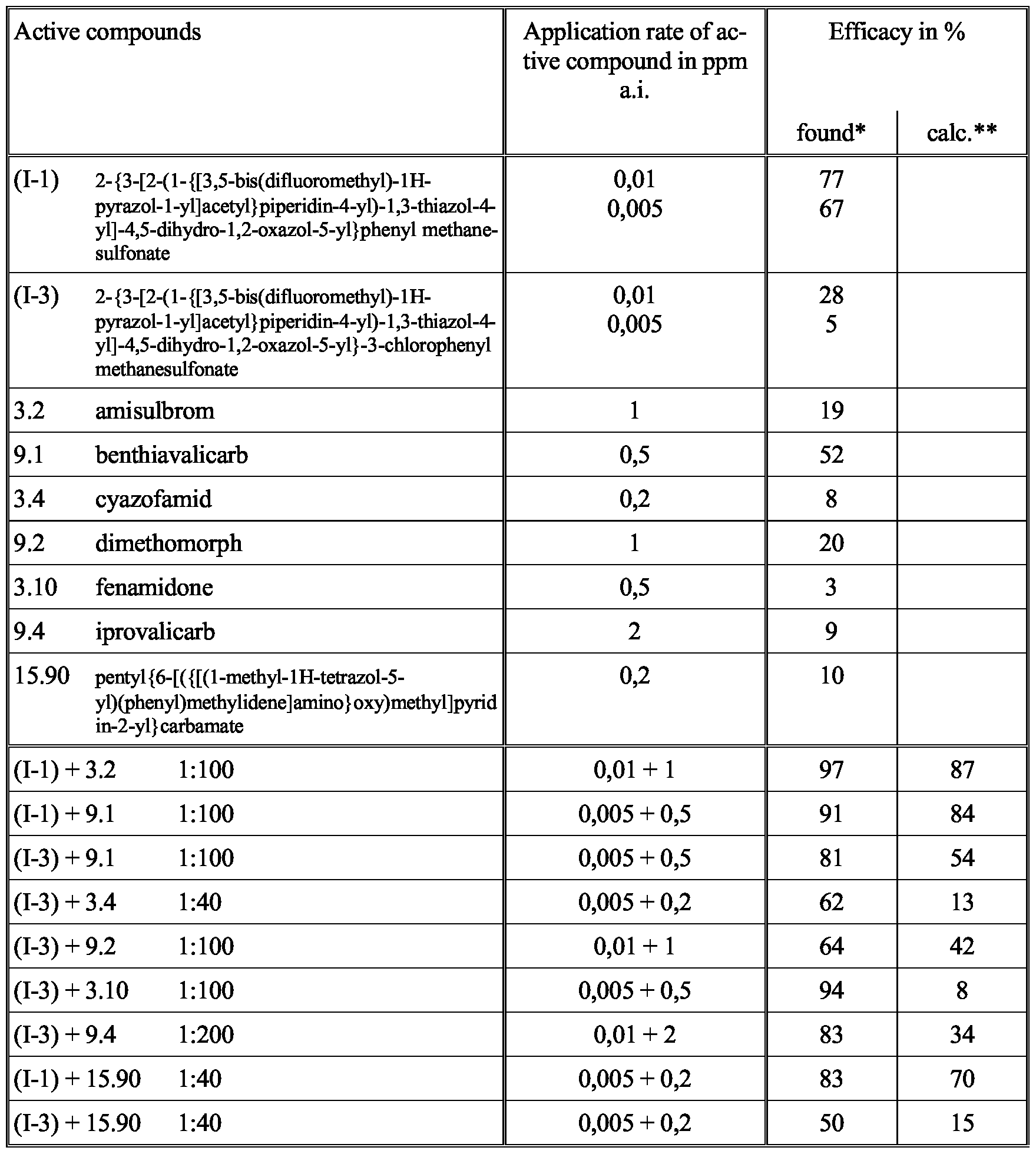

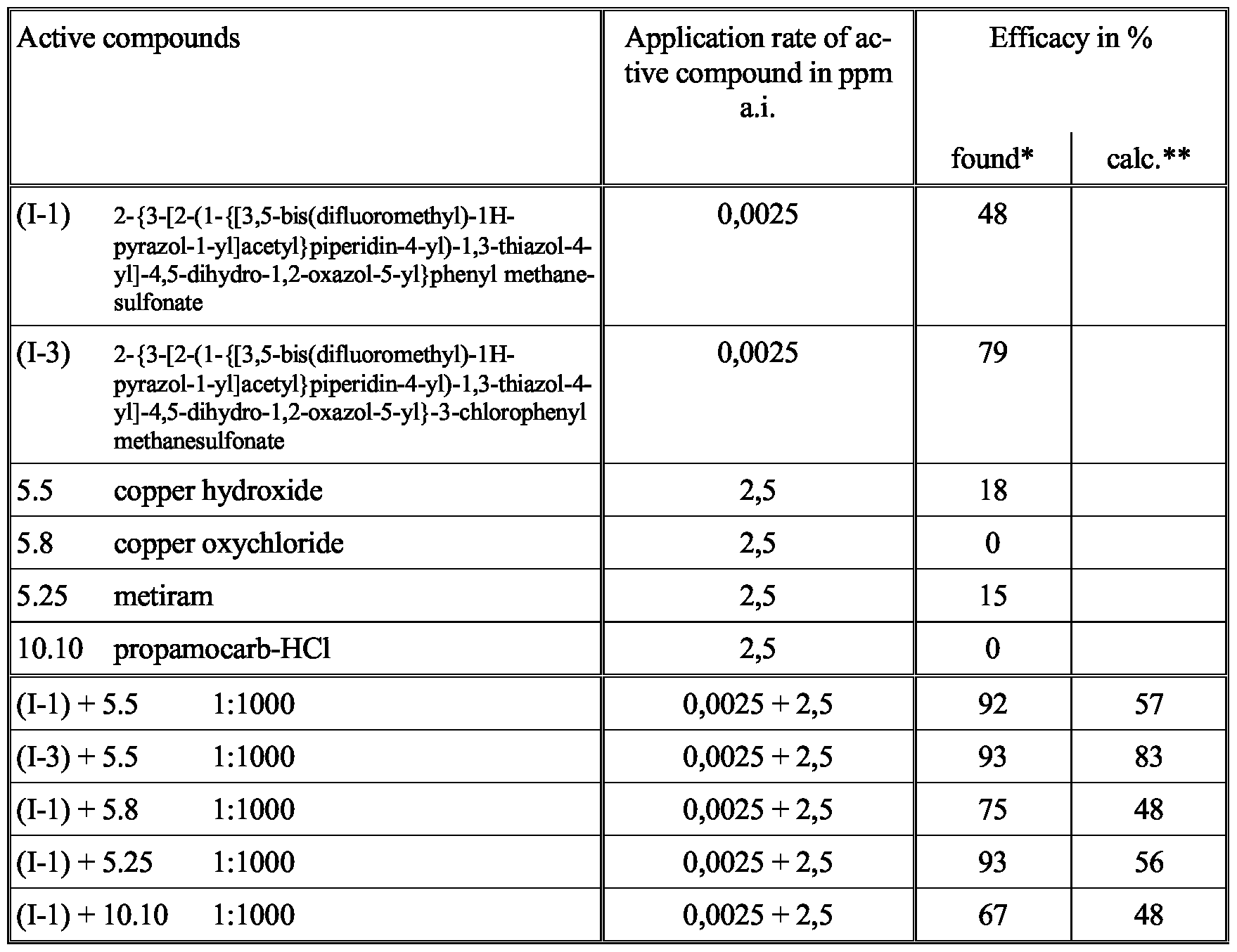
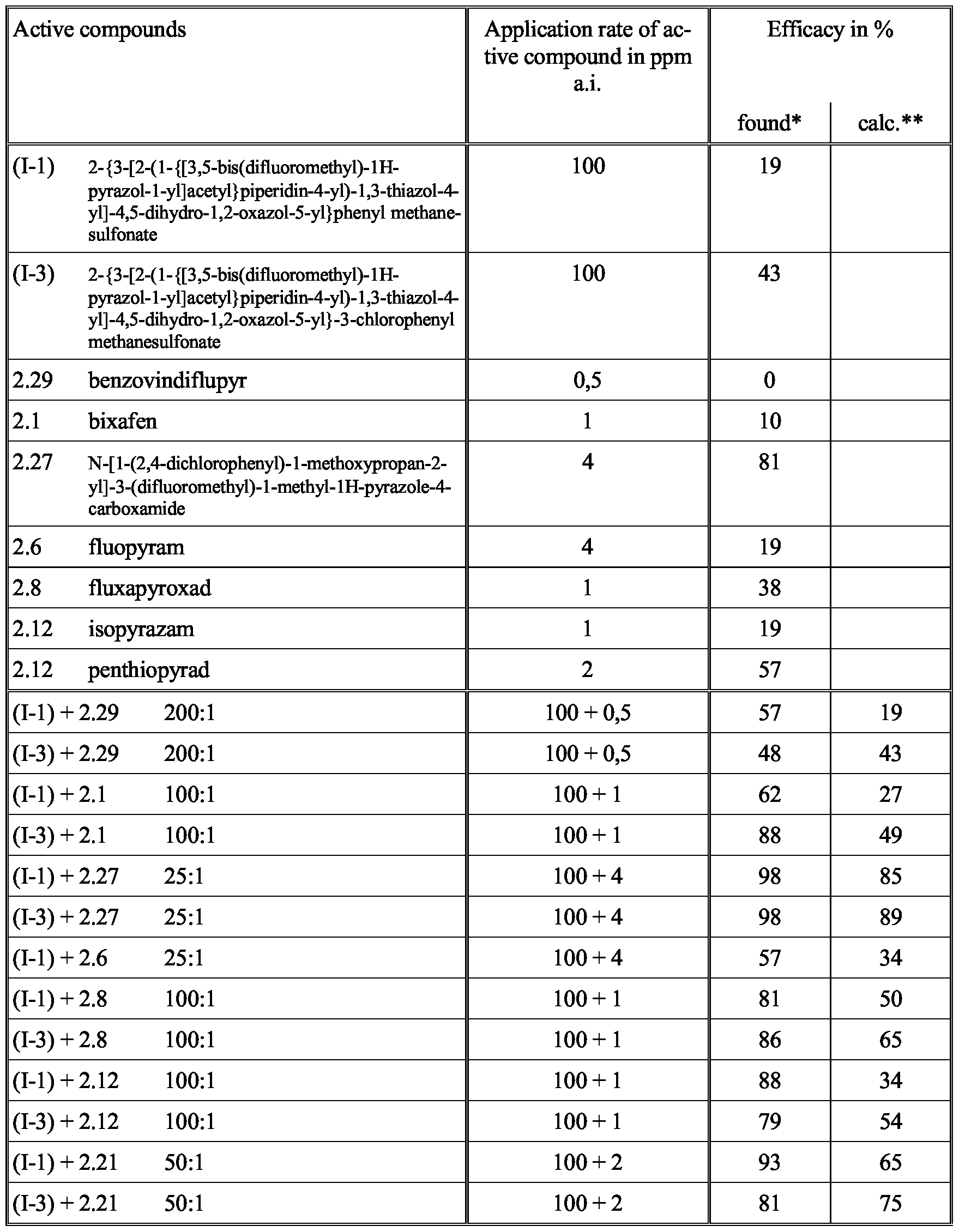
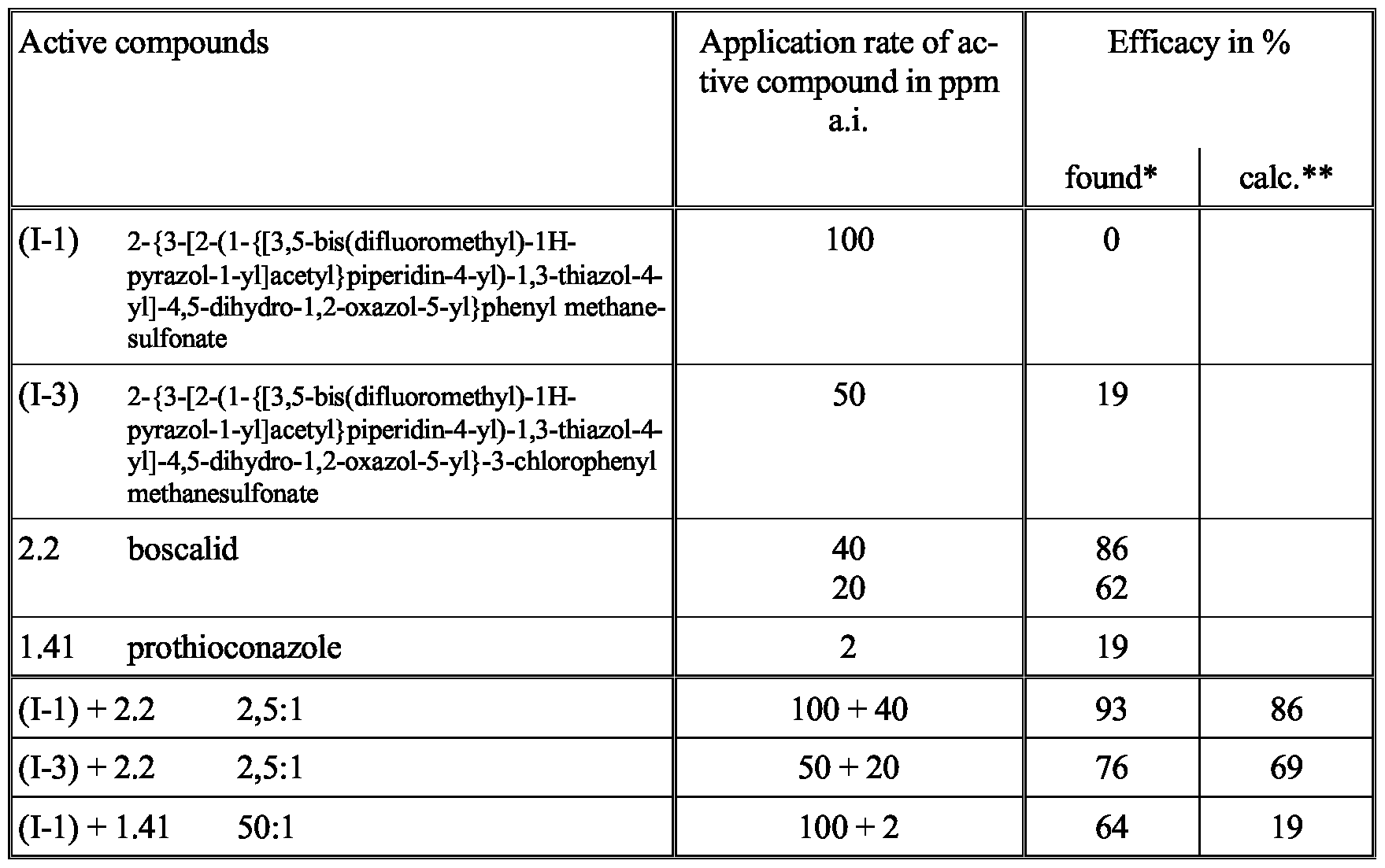
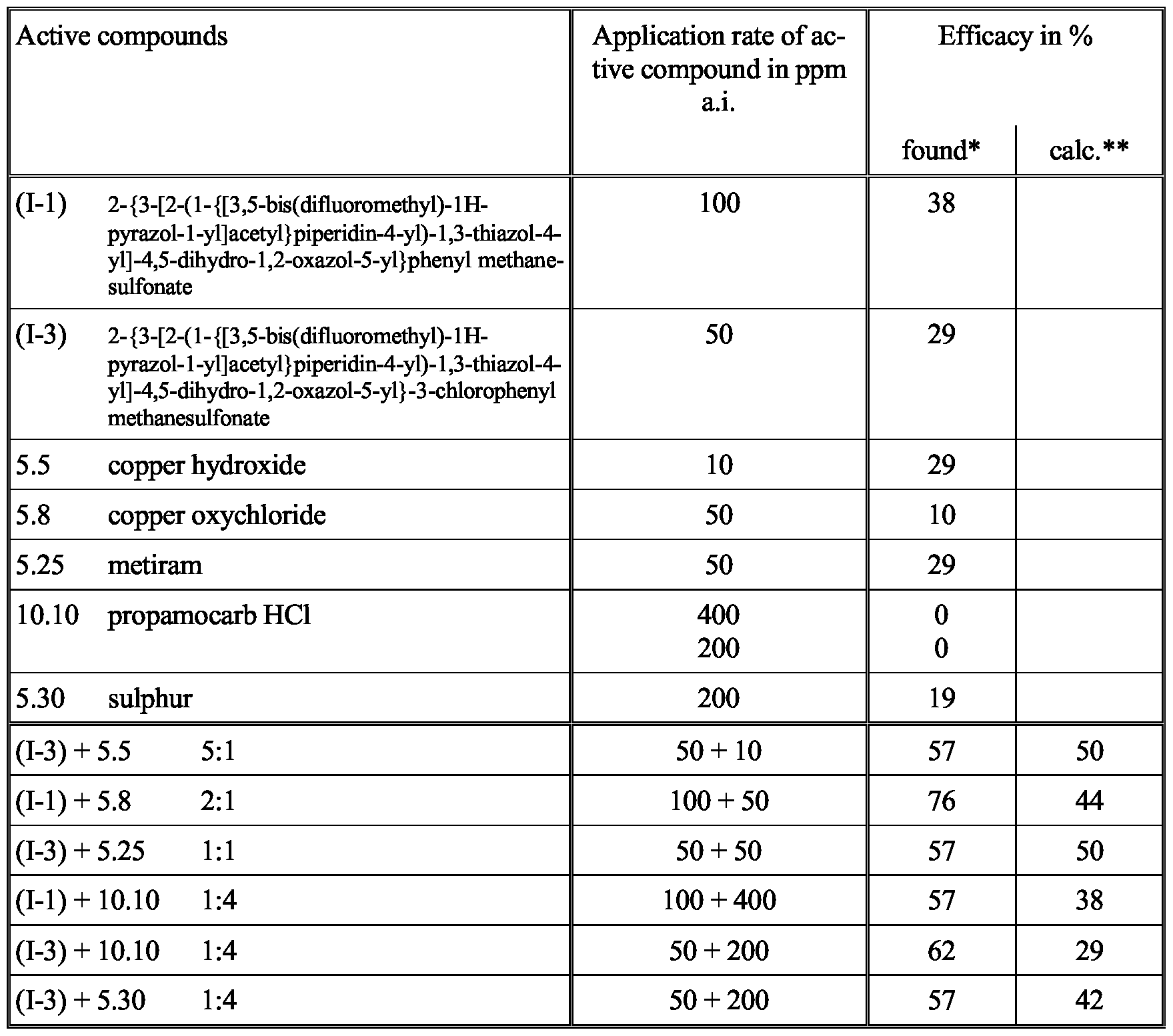
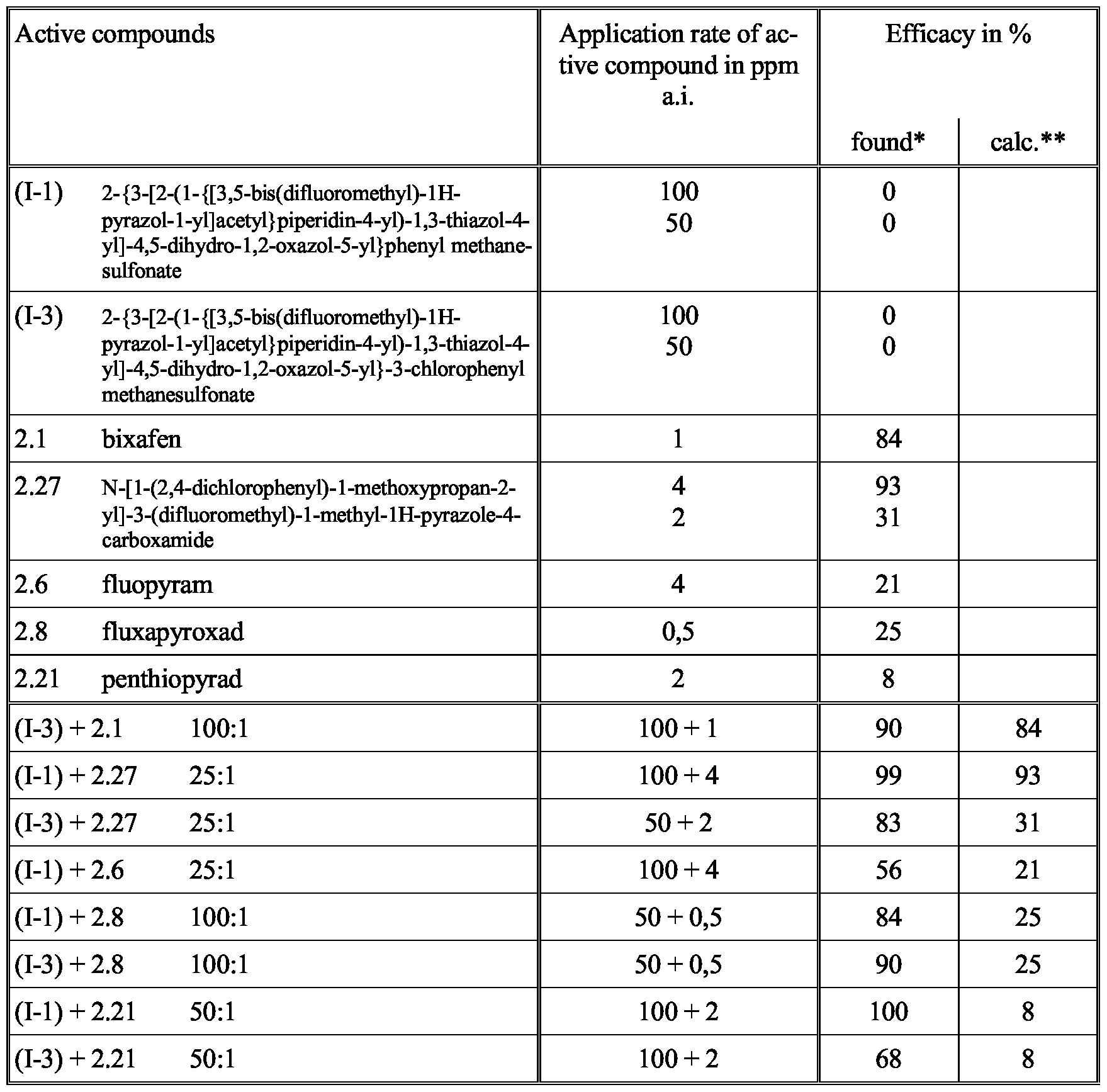

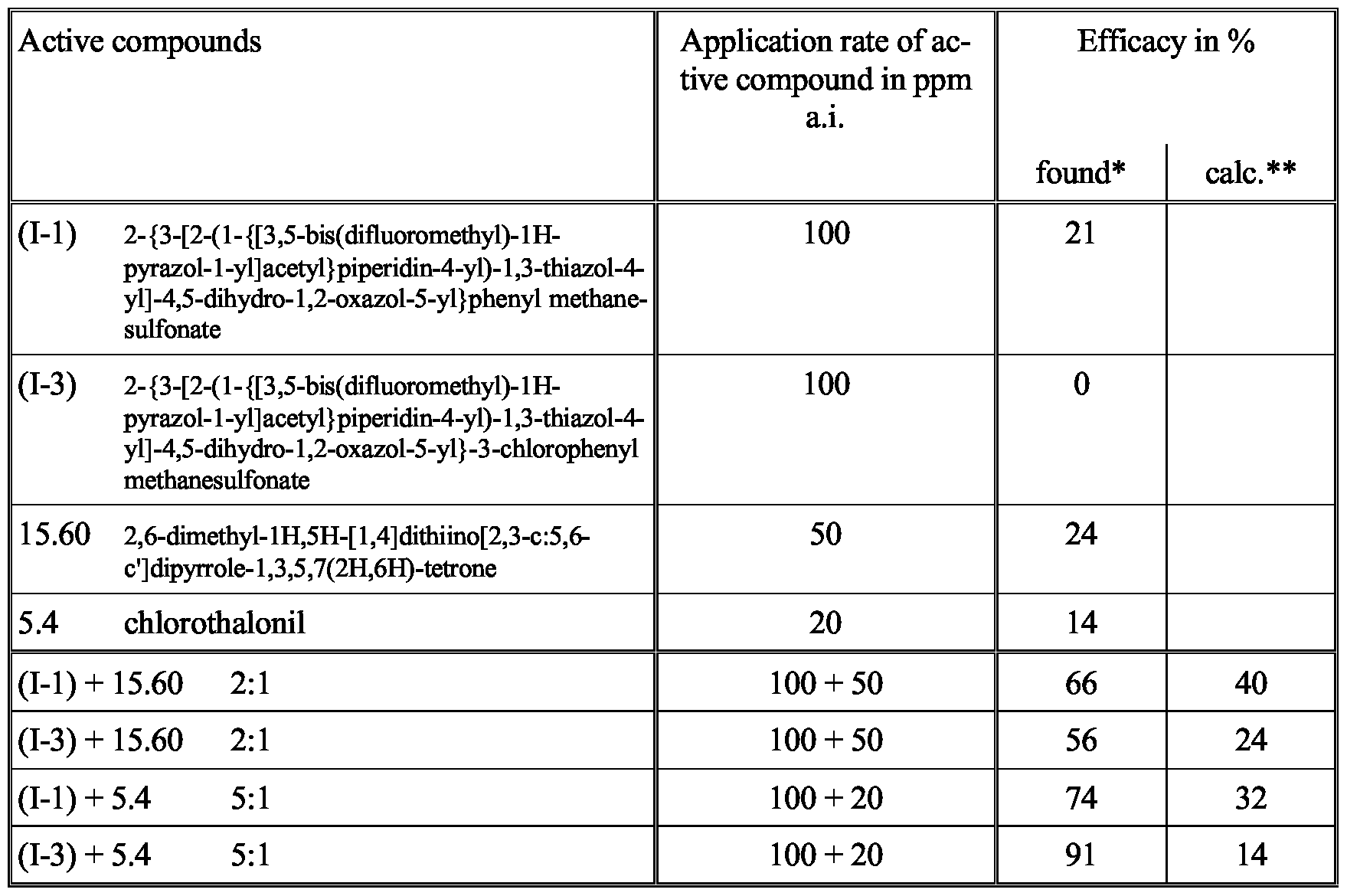
Claims

Priority Applications (23)
| Application Number | Priority Date | Filing Date | Title |
|---|---|---|---|
| EP13705990.3A EP2819518B1 (en) | 2012-02-27 | 2013-02-22 | Active compound combinations containing a thiazoylisoxazoline and a fungicide |
| CA2865300A CA2865300C (en) | 2012-02-27 | 2013-02-22 | Active compound combinations containing a thiazoylisoxazoline and a fungicide |
| MX2014010118A MX360174B (en) | 2012-02-27 | 2013-02-22 | Active compound combinations containing a thiazoylisoxazoline and a fungicide. |
| BR122019010638-0A BR122019010638B1 (en) | 2012-02-27 | 2013-02-22 | combination, method to control harmful phytopathogenic fungi and use of said combination |
| AP2014007876A AP2014007876A0 (en) | 2012-02-27 | 2013-02-22 | Active compound combinations containing a thiazoylisoxazoline and a fungicide |
| BR122019010637-1A BR122019010637B1 (en) | 2012-02-27 | 2013-02-22 | combination, method to control harmful phytopathogenic fungi and use of said combination |
| BR122019010641-0A BR122019010641B1 (en) | 2012-02-27 | 2013-02-22 | combination, method to control harmful phytopathogenic fungi and use of said combination |
| JP2014558126A JP6093381B2 (en) | 2012-02-27 | 2013-02-22 | Active compound combination containing thiazolyl isoxazoline and fungicide |
| US14/380,768 US9629367B2 (en) | 2012-02-27 | 2013-02-22 | Active compound combinations containing a thiazoylisoxazoline and a fungicide |
| PL13705990T PL2819518T3 (en) | 2012-02-27 | 2013-02-22 | Active compound combinations containing a thiazoylisoxazoline and a fungicide |
| BR112014020898-0A BR112014020898B1 (en) | 2012-02-27 | 2013-02-22 | COMBINATION, METHOD FOR THE CONTROL OF HARMFUL PHYTOPATHOGENIC FUNGI UNDERSTANDING THE REFERRED COMBINATION AND ITS USE |
| UAA201410432A UA113198C2 (en) | 2012-02-27 | 2013-02-22 | COMBINATIONS OF ACTIVE COMPOUNDS |
| BR122019010640-1A BR122019010640B1 (en) | 2012-02-27 | 2013-02-22 | combination, method to control harmful phytopathogenic fungi and use of said combination |
| ES13705990.3T ES2650764T3 (en) | 2012-02-27 | 2013-02-22 | Combinations of active compounds containing a thiazolylisoxazoline and a fungicide |
| BR122019010639-8A BR122019010639B1 (en) | 2012-02-27 | 2013-02-22 | combination, method to control harmful phytopathogenic fungi and use of said combination |
| BR122019010667-3A BR122019010667B1 (en) | 2012-02-27 | 2013-02-22 | combination, method to control harmful phytopathogenic fungi and use of said combination |
| DK13705990.3T DK2819518T3 (en) | 2012-02-27 | 2013-02-22 | COMBINATIONS OF ACTIVE COMPOUNDS CONTAINING A THIAZOYLISOXAZOLINE AND A FUNGICIDE |
| KR1020147026299A KR101891320B1 (en) | 2012-02-27 | 2013-02-22 | Active compound combinations containing a thiazoylisoxazoline and a fungicide |
| CN201380021849.0A CN104244716B (en) | 2012-02-27 | 2013-02-22 | Active compound combinations containing a thiazoylisoxazoline and a fungicide |
| US15/421,946 US10375961B2 (en) | 2012-02-27 | 2017-02-01 | Active compound combinations containing a thiazoylisoxazoline and a fungicide |
| US16/369,725 US11147274B2 (en) | 2012-02-27 | 2019-03-29 | Active compound combinations containing a thiazoylisoxazoline and a fungicide |
| US17/363,334 US12102087B2 (en) | 2012-02-27 | 2021-06-30 | Active compound combinations containing a thiazoylisoxazoline and a fungicide |
| US18/806,193 US20240397948A1 (en) | 2012-02-27 | 2024-08-15 | Active compound combinations containing a thiazoylisoxazoline and a fungicide |
Applications Claiming Priority (2)
| Application Number | Priority Date | Filing Date | Title |
|---|---|---|---|
| EP12157090 | 2012-02-27 | ||
| EP12157090.7 | 2012-02-27 |
Related Child Applications (3)
| Application Number | Title | Priority Date | Filing Date |
|---|---|---|---|
| US14/380,768 A-371-Of-International US9629367B2 (en) | 2012-02-27 | 2013-02-22 | Active compound combinations containing a thiazoylisoxazoline and a fungicide |
| US14380786 A-371-Of-International | 2013-02-22 | ||
| US15/421,946 Division US10375961B2 (en) | 2012-02-27 | 2017-02-01 | Active compound combinations containing a thiazoylisoxazoline and a fungicide |
Publications (1)
| Publication Number | Publication Date |
|---|---|
| WO2013127704A1 true WO2013127704A1 (en) | 2013-09-06 |
Family
ID=47749823
Family Applications (1)
| Application Number | Title | Priority Date | Filing Date |
|---|---|---|---|
| PCT/EP2013/053578 Ceased WO2013127704A1 (en) | 2012-02-27 | 2013-02-22 | Active compound combinations containing a thiazoylisoxazoline and a fungicide |
Country Status (21)
| Country | Link |
|---|---|
| US (5) | US9629367B2 (en) |
| EP (1) | EP2819518B1 (en) |
| JP (1) | JP6093381B2 (en) |
| KR (1) | KR101891320B1 (en) |
| CN (1) | CN104244716B (en) |
| AP (1) | AP2014007876A0 (en) |
| AR (1) | AR090157A1 (en) |
| BR (7) | BR122019010640B1 (en) |
| CA (1) | CA2865300C (en) |
| CL (1) | CL2014002250A1 (en) |
| CO (1) | CO7061086A2 (en) |
| DK (1) | DK2819518T3 (en) |
| EC (1) | ECSP14016162A (en) |
| ES (1) | ES2650764T3 (en) |
| MX (1) | MX360174B (en) |
| PE (7) | PE20190341A1 (en) |
| PL (1) | PL2819518T3 (en) |
| PT (1) | PT2819518T (en) |
| TW (1) | TWI561171B (en) |
| UA (1) | UA113198C2 (en) |
| WO (1) | WO2013127704A1 (en) |
Cited By (287)
| Publication number | Priority date | Publication date | Assignee | Title |
|---|---|---|---|---|
| WO2014082880A1 (en) | 2012-11-27 | 2014-06-05 | Basf Se | Substituted [1,2,4] triazole compounds |
| WO2014082881A1 (en) | 2012-11-27 | 2014-06-05 | Basf Se | Substituted 2-[phenoxy-phenyl]-1-[1,2,4]triazol-1-yl-ethanol compounds and their use as fungicides |
| WO2014082879A1 (en) | 2012-11-27 | 2014-06-05 | Basf Se | Substituted [1,2,4]triazole compounds |
| WO2014082871A1 (en) | 2012-11-27 | 2014-06-05 | Basf Se | Substituted 2-[phenoxy-phenyl]-1-[1,2,4]triazol-1-yl-ethanol compounds and their use as fungicides |
| WO2014086856A1 (en) | 2012-12-04 | 2014-06-12 | Basf Agro B.V., Arnhem (Nl) | Compositions comprising a quillay extract and a biopesticide |
| WO2014086850A1 (en) | 2012-12-04 | 2014-06-12 | Basf Agro B.V., Arnhem (Nl) | Compositions comprising a quillay extract and a fungicidal inhibitor of respiratory complex ii |
| WO2014086854A1 (en) | 2012-12-04 | 2014-06-12 | Basf Agro B.V., Arnhem (Nl) | Compositions comprising a quillay extract and a plant growth regulator |
| EP2746255A1 (en) | 2012-12-19 | 2014-06-25 | Basf Se | Substituted [1,2,4]triazole and imidazole compounds |
| EP2746263A1 (en) | 2012-12-19 | 2014-06-25 | Basf Se | Alpha-substituted triazoles and imidazoles |
| EP2746264A1 (en) | 2012-12-19 | 2014-06-25 | Basf Se | Substituted [1,2,4]triazole and imidazole compounds |
| EP2746262A1 (en) | 2012-12-19 | 2014-06-25 | Basf Se | Substituted [1,2,4]triazole and imidazole compounds for combating phytopathogenic fungi |
| EP2746259A1 (en) | 2012-12-21 | 2014-06-25 | Basf Se | Substituted [1,2,4]triazole and imidazole compounds |
| EP2746277A1 (en) | 2012-12-19 | 2014-06-25 | Basf Se | Fungicidal imidazolyl and triazolyl compounds |
| EP2746279A1 (en) | 2012-12-19 | 2014-06-25 | Basf Se | Fungicidal imidazolyl and triazolyl compounds |
| EP2746257A1 (en) | 2012-12-21 | 2014-06-25 | Basf Se | Substituted [1,2,4]triazole and imidazole compounds |
| EP2746267A2 (en) | 2012-12-19 | 2014-06-25 | Basf Se | New substituted triazoles and imidazoles and their use as fungicides |
| EP2746256A1 (en) | 2012-12-19 | 2014-06-25 | Basf Se | Fungicidal imidazolyl and triazolyl compounds |
| EP2746278A1 (en) | 2012-12-19 | 2014-06-25 | Basf Se | Substituted [1,2,4]triazole and imidazole compounds |
| EP2746258A1 (en) | 2012-12-21 | 2014-06-25 | Basf Se | Substituted [1,2,4]triazole and imidazole compounds |
| EP2746260A1 (en) | 2012-12-21 | 2014-06-25 | Basf Se | Substituted [1,2,4]triazole and imidazole compounds |
| WO2014095994A1 (en) | 2012-12-20 | 2014-06-26 | Basf Se | Compositions comprising a triazole compound |
| WO2014095534A1 (en) | 2012-12-19 | 2014-06-26 | Basf Se | New substituted triazoles and imidazoles and their use as fungicides |
| WO2014095381A1 (en) | 2012-12-19 | 2014-06-26 | Basf Se | Fungicidal imidazolyl and triazolyl compounds |
| WO2014095555A1 (en) | 2012-12-19 | 2014-06-26 | Basf Se | New substituted triazoles and imidazoles and their use as fungicides |
| WO2014095547A1 (en) | 2012-12-19 | 2014-06-26 | Basf Se | New substituted triazoles and imidazoles and their use as fungicides |
| WO2014095548A1 (en) | 2012-12-19 | 2014-06-26 | Basf Se | Substituted [1,2,4]triazole compounds and their use as fungicides |
| WO2014095672A1 (en) | 2012-12-19 | 2014-06-26 | Basf Se | Substituted [1,2,4]triazole compounds and their use as fungicides |
| WO2014124850A1 (en) | 2013-02-14 | 2014-08-21 | Basf Se | Substituted [1,2,4]triazole and imidazole compounds |
| EP2813499A1 (en) | 2013-06-12 | 2014-12-17 | Basf Se | Substituted [1,2,4]triazole and imidazole compounds |
| WO2015036379A1 (en) * | 2013-09-13 | 2015-03-19 | Bayer Cropscience Ag | Fungicidal compositions containing thiazolylisoxazoline fungicide and biological fungicide |
| WO2015055707A1 (en) * | 2013-10-16 | 2015-04-23 | Bayer Cropscience Ag | Active compound combinations comprising a (thio)carboxamide derivative and a fungicidal compound |
| WO2015086462A1 (en) | 2013-12-12 | 2015-06-18 | Basf Se | Substituted [1,2,4]triazole and imidazole compounds |
| EP2924027A1 (en) | 2014-03-28 | 2015-09-30 | Basf Se | Substituted [1,2,4]triazole and imidazole fungicidal compounds |
| WO2015144480A1 (en) | 2014-03-26 | 2015-10-01 | Basf Se | Substituted [1,2,4]triazole and imidazole compounds as fungicides |
| WO2015173209A1 (en) * | 2014-05-15 | 2015-11-19 | Bayer Cropscience Ag | Active compound combinations |
| EP2949649A1 (en) | 2014-05-30 | 2015-12-02 | Basf Se | Fungicide substituted [1,2,4]triazole and imidazole compounds |
| EP2949216A1 (en) | 2014-05-30 | 2015-12-02 | Basf Se | Fungicidal substituted alkynyl [1,2,4]triazole and imidazole compounds |
| EP2952512A1 (en) | 2014-06-06 | 2015-12-09 | Basf Se | Substituted [1,2,4]triazole compounds |
| EP2952507A1 (en) | 2014-06-06 | 2015-12-09 | Basf Se | Substituted [1,2,4]triazole compounds |
| EP2952506A1 (en) | 2014-06-06 | 2015-12-09 | Basf Se | Substituted [1,2,4]triazole and imidazole compounds |
| WO2015185708A1 (en) | 2014-06-06 | 2015-12-10 | Basf Se | Substituted [1,2,4]triazole compounds |
| EP2979549A1 (en) | 2014-07-31 | 2016-02-03 | Basf Se | Method for improving the health of a plant |
| WO2016071499A1 (en) | 2014-11-06 | 2016-05-12 | Basf Se | 3-pyridyl heterobicyclic compound for controlling invertebrate pests |
| EP3028573A1 (en) | 2014-12-05 | 2016-06-08 | Basf Se | Use of a triazole fungicide on transgenic plants |
| KR20160072134A (en) * | 2013-10-17 | 2016-06-22 | 바이엘 크롭사이언스 악티엔게젤샤프트 | Novel crystalline form of 2-{3-[2-(1-{[3,5-bis(difluoromethyl)-1h-pyrazol-1-yl]acetyl}piperidin-4-yl)-1,3-thiazol-4-yl]-4,5-dihydro-1,2-oxazol-5-yl}-3-chlorophenylmethane sulfonate |
| WO2016128240A1 (en) | 2015-02-11 | 2016-08-18 | Basf Se | Pesticidal mixture comprising a pyrazole compound and two fungicides |
| WO2016128261A2 (en) | 2015-02-11 | 2016-08-18 | Basf Se | Pesticidal mixture comprising a pyrazole compound, an insecticide and a fungicide |
| WO2016162371A1 (en) | 2015-04-07 | 2016-10-13 | Basf Agrochemical Products B.V. | Use of an insecticidal carboxamide compound against pests on cultivated plants |
| WO2016173996A1 (en) * | 2015-04-29 | 2016-11-03 | Bayer Cropscience Aktiengesellschaft | Use of 2-{3-[2-(1-{[3,5-bis(difluoromethyl)-1h-pyrazol-1-yl]acetyl}piperidin-4-yl)-1,3-thiazol-4-yl]-4,5-dihydro-1,2-oxazol-5-yl}-3-chlorophenyl methanesulfonate |
| WO2016198613A1 (en) | 2015-06-11 | 2016-12-15 | Basf Se | N-(thio)acylimino compounds |
| WO2016198611A1 (en) | 2015-06-11 | 2016-12-15 | Basf Se | N-(thio)acylimino heterocyclic compounds |
| WO2016202761A1 (en) | 2015-06-17 | 2016-12-22 | Bayer Cropscience Aktiengesellschaft | Active compound combinations |
| WO2016202819A1 (en) | 2015-06-17 | 2016-12-22 | Bayer Cropscience Aktiengesellschaft | Active compound combinations |
| WO2017016883A1 (en) | 2015-07-24 | 2017-02-02 | Basf Se | Process for preparation of cyclopentene compounds |
| KR20170036104A (en) | 2014-08-13 | 2017-03-31 | 가부시키가이샤 에스디에스 바이오텍크 | Condensed 11-member ring compound and agriculture and horticultural fungicide comprising same |
| WO2017060148A1 (en) | 2015-10-05 | 2017-04-13 | Basf Se | Pyridine derivatives for combating phytopathogenic fungi |
| EP3165094A1 (en) | 2015-11-03 | 2017-05-10 | Basf Se | Substituted oxadiazoles for combating phytopathogenic fungi |
| EP3165093A1 (en) | 2015-11-05 | 2017-05-10 | Basf Se | Substituted oxadiazoles for combating phytopathogenic fungi |
| WO2017076740A1 (en) | 2015-11-04 | 2017-05-11 | Basf Se | Substituted oxadiazoles for combating phytopathogenic fungi |
| WO2017076757A1 (en) | 2015-11-02 | 2017-05-11 | Basf Se | Substituted oxadiazoles for combating phytopathogenic fungi |
| EP3167716A1 (en) | 2015-11-10 | 2017-05-17 | Basf Se | Substituted oxadiazoles for combating phytopathogenic fungi |
| WO2017081312A1 (en) | 2015-11-13 | 2017-05-18 | Basf Se | Substituted oxadiazoles for combating phytopathogenic fungi |
| WO2017081310A1 (en) | 2015-11-13 | 2017-05-18 | Basf Se | Substituted oxadiazoles for combating phytopathogenic fungi |
| WO2017085100A1 (en) | 2015-11-19 | 2017-05-26 | Basf Se | Substituted oxadiazoles for combating phytopathogenic fungi |
| WO2017085098A1 (en) | 2015-11-19 | 2017-05-26 | Basf Se | Substituted oxadiazoles for combating phytopathogenic fungi |
| WO2017093167A1 (en) | 2015-12-01 | 2017-06-08 | Basf Se | Pyridine compounds as fungicides |
| WO2017093120A1 (en) | 2015-12-01 | 2017-06-08 | Basf Se | Pyridine compounds as fungicides |
| WO2017093163A1 (en) | 2015-11-30 | 2017-06-08 | Basf Se | Mixtures of cis-jasmone and bacillus amyloliquefaciens |
| EP3205208A1 (en) | 2016-02-09 | 2017-08-16 | Basf Se | Mixtures and compositions comprising paenibacillus strains or fusaricidins and chemical pesticides |
| WO2017153217A1 (en) | 2016-03-09 | 2017-09-14 | Basf Se | Spirocyclic derivatives |
| WO2017153200A1 (en) | 2016-03-10 | 2017-09-14 | Basf Se | Fungicidal mixtures iii comprising strobilurin-type fungicides |
| WO2017153218A1 (en) | 2016-03-11 | 2017-09-14 | Basf Se | Method for controlling pests of plants |
| WO2017167832A1 (en) | 2016-04-01 | 2017-10-05 | Basf Se | Bicyclic compounds |
| WO2017178245A1 (en) | 2016-04-11 | 2017-10-19 | Basf Se | Substituted oxadiazoles for combating phytopathogenic fungi |
| WO2017198588A1 (en) | 2016-05-18 | 2017-11-23 | Basf Se | Capsules comprising benzylpropargylethers for use as nitrification inhibitors |
| WO2018050421A1 (en) | 2016-09-13 | 2018-03-22 | Basf Se | Fungicidal mixtures i comprising quinoline fungicides |
| WO2018054721A1 (en) | 2016-09-26 | 2018-03-29 | Basf Se | Pyridine compounds for controlling phytopathogenic harmful fungi |
| WO2018054723A1 (en) | 2016-09-26 | 2018-03-29 | Basf Se | Pyridine compounds for controlling phytopathogenic harmful fungi |
| WO2018054711A1 (en) | 2016-09-26 | 2018-03-29 | Basf Se | Pyridine compounds for controlling phytopathogenic harmful fungi |
| WO2018065182A1 (en) | 2016-10-04 | 2018-04-12 | Basf Se | Reduced quinoline compounds as antifuni agents |
| WO2018069110A1 (en) | 2016-10-10 | 2018-04-19 | Basf Se | Pesticidal mixtures |
| WO2018069109A1 (en) | 2016-10-10 | 2018-04-19 | Basf Se | Pesticidal mixtures |
| WO2018069108A1 (en) | 2016-10-10 | 2018-04-19 | Basf Se | Pesticidal mixtures |
| WO2018073110A1 (en) | 2016-10-20 | 2018-04-26 | Basf Se | Quinoline compounds as fungicides |
| WO2018108671A1 (en) | 2016-12-16 | 2018-06-21 | Basf Se | Pesticidal compounds |
| EP3339297A1 (en) | 2016-12-20 | 2018-06-27 | Basf Se | Substituted oxadiazoles for combating phytopathogenic fungi |
| EP3338552A1 (en) | 2016-12-21 | 2018-06-27 | Basf Se | Use of a tetrazolinone fungicide on transgenic plants |
| WO2018114393A1 (en) | 2016-12-19 | 2018-06-28 | Basf Se | Substituted oxadiazoles for combating phytopathogenic fungi |
| WO2018134127A1 (en) | 2017-01-23 | 2018-07-26 | Basf Se | Fungicidal pyridine compounds |
| WO2018149754A1 (en) | 2017-02-16 | 2018-08-23 | Basf Se | Pyridine compounds |
| WO2018153730A1 (en) | 2017-02-21 | 2018-08-30 | Basf Se | Substituted oxadiazoles for combating phytopathogenic fungi |
| WO2018162312A1 (en) | 2017-03-10 | 2018-09-13 | Basf Se | Spirocyclic derivatives |
| WO2018166855A1 (en) | 2017-03-16 | 2018-09-20 | Basf Se | Heterobicyclic substituted dihydroisoxazoles |
| WO2018177970A1 (en) | 2017-03-31 | 2018-10-04 | Basf Se | Process for preparing chiral 2,3-dihydrothiazolo[3,2-a]pyrimidin-4-ium compounds |
| WO2018177781A1 (en) | 2017-03-28 | 2018-10-04 | Basf Se | Pesticidal compounds |
| WO2018184882A1 (en) | 2017-04-06 | 2018-10-11 | Basf Se | Pyridine compounds |
| WO2018184970A1 (en) | 2017-04-07 | 2018-10-11 | Basf Se | Substituted oxadiazoles for combating phytopathogenic fungi |
| WO2018188962A1 (en) | 2017-04-11 | 2018-10-18 | Basf Se | Substituted oxadiazoles for combating phytopathogenic fungi |
| WO2018192793A1 (en) | 2017-04-20 | 2018-10-25 | Basf Se | Substituted rhodanine derivatives |
| WO2018193385A1 (en) | 2017-04-20 | 2018-10-25 | Pi Industries Ltd. | Novel phenylamine compounds |
| WO2018197466A1 (en) | 2017-04-26 | 2018-11-01 | Basf Se | Substituted succinimide derivatives as pesticides |
| WO2018202487A1 (en) | 2017-05-04 | 2018-11-08 | Basf Se | Substituted 5-(haloalkyl)-5-hydroxy-isoxazoles for combating phytopathogenic fungi |
| WO2018202737A1 (en) | 2017-05-05 | 2018-11-08 | Basf Se | Fungicidal mixtures comprising triazole compounds |
| WO2018202491A1 (en) | 2017-05-04 | 2018-11-08 | Basf Se | Substituted trifluoromethyloxadiazoles for combating phytopathogenic fungi |
| WO2018202428A1 (en) | 2017-05-02 | 2018-11-08 | Basf Se | Fungicidal mixture comprising substituted 3-phenyl-5-(trifluoromethyl)-1,2,4-oxadiazoles |
| WO2018206479A1 (en) | 2017-05-10 | 2018-11-15 | Basf Se | Bicyclic pesticidal compounds |
| WO2018210658A1 (en) | 2017-05-15 | 2018-11-22 | Basf Se | Heteroaryl compounds as agrochemical fungicides |
| WO2018211442A1 (en) | 2017-05-18 | 2018-11-22 | Pi Industries Ltd. | Formimidamidine compounds useful against phytopathogenic microorganisms |
| WO2018210661A1 (en) | 2017-05-15 | 2018-11-22 | Basf Se | Heteroaryl compounds as agrochemical fungicides |
| WO2018210659A1 (en) | 2017-05-15 | 2018-11-22 | Basf Se | Heteroaryl compounds as agrochemical fungicides |
| WO2018210660A1 (en) | 2017-05-15 | 2018-11-22 | Basf Se | Heteroaryl compounds as agrochemical fungicides |
| WO2018219725A1 (en) | 2017-05-30 | 2018-12-06 | Basf Se | Pyridine and pyrazine compounds |
| WO2018219797A1 (en) | 2017-06-02 | 2018-12-06 | Basf Se | Substituted oxadiazoles for combating phytopathogenic fungi |
| US10149477B2 (en) | 2014-10-06 | 2018-12-11 | Basf Se | Substituted pyrimidinium compounds for combating animal pests |
| WO2018224455A1 (en) | 2017-06-07 | 2018-12-13 | Basf Se | Substituted cyclopropyl derivatives |
| WO2018229202A1 (en) | 2017-06-16 | 2018-12-20 | Basf Se | Mesoionic imidazolium compounds and derivatives for combating animal pests |
| WO2018234488A1 (en) | 2017-06-23 | 2018-12-27 | Basf Se | SUBSTITUTED CYCLOPROPYL DERIVATIVES |
| WO2018234202A1 (en) | 2017-06-19 | 2018-12-27 | Basf Se | SUBSTITUTED PYRIMIDINIUM COMPOUNDS AND DERIVATIVES FOR CONTROLLING HARMFUL ANIMALS |
| WO2018234139A1 (en) | 2017-06-19 | 2018-12-27 | Basf Se | 2 - [[5- (TRIFLUOROMETHYL) -1,2,4-OXADIAZOL-3-YL] ARYLOXY] (THIO) ACETAMIDES FOR THE CONTROL OF PHYTOPATHOGENIC FUNGI |
| WO2019002158A1 (en) | 2017-06-30 | 2019-01-03 | Basf Se | Substituted trifluoromethyloxadiazoles for combating phytopathogenic fungi |
| WO2019025250A1 (en) | 2017-08-04 | 2019-02-07 | Basf Se | Substituted trifluoromethyloxadiazoles for combating phytopathogenic fungi |
| WO2019038042A1 (en) | 2017-08-21 | 2019-02-28 | Basf Se | Substituted trifluoromethyloxadiazoles for combating phytopathogenic fungi |
| WO2019042932A1 (en) | 2017-08-31 | 2019-03-07 | Basf Se | Method of controlling rice pests in rice |
| WO2019042800A1 (en) | 2017-08-29 | 2019-03-07 | Basf Se | Pesticidal mixtures |
| EP3453706A1 (en) | 2017-09-08 | 2019-03-13 | Basf Se | Pesticidal imidazole compounds |
| WO2019052932A1 (en) | 2017-09-18 | 2019-03-21 | Basf Se | Substituted trifluoromethyloxadiazoles for combating phytopathogenic fungi |
| WO2019057660A1 (en) | 2017-09-25 | 2019-03-28 | Basf Se | Indole and azaindole compounds with substituted 6-membered aryl and heteroaryl rings as agrochemical fungicides |
| WO2019072906A1 (en) | 2017-10-13 | 2019-04-18 | Basf Se | Imidazolidine pyrimidinium compounds for combating animal pests |
| WO2019101511A1 (en) | 2017-11-23 | 2019-05-31 | Basf Se | Substituted trifluoromethyloxadiazoles for combating phytopathogenic fungi |
| WO2019115343A1 (en) | 2017-12-15 | 2019-06-20 | Basf Se | Fungicidal mixture comprising substituted pyridines |
| WO2019115511A1 (en) | 2017-12-14 | 2019-06-20 | Basf Se | Fungicidal mixture comprising substituted 3-phenyl-5-(trifluoromethyl)-1,2,4-oxadiazoles |
| WO2019123196A1 (en) | 2017-12-20 | 2019-06-27 | Pi Industries Ltd. | Fluoralkenyl compounds, process for preparation and use thereof |
| WO2019121159A1 (en) | 2017-12-21 | 2019-06-27 | Basf Se | Pesticidal compounds |
| WO2019121143A1 (en) | 2017-12-20 | 2019-06-27 | Basf Se | Substituted cyclopropyl derivatives |
| WO2019137995A1 (en) | 2018-01-11 | 2019-07-18 | Basf Se | Novel pyridazine compounds for controlling invertebrate pests |
| WO2019145140A1 (en) | 2018-01-09 | 2019-08-01 | Basf Se | Silylethynyl hetaryl compounds as nitrification inhibitors |
| WO2019150311A1 (en) | 2018-02-02 | 2019-08-08 | Pi Industries Ltd. | 1-3 dithiol compounds and their use for the protection of crops from phytopathogenic microorganisms |
| WO2019150219A2 (en) | 2018-01-30 | 2019-08-08 | Pi Industries Ltd. | Novel oxadiazoles |
| WO2019154663A1 (en) | 2018-02-07 | 2019-08-15 | Basf Se | New pyridine carboxamides |
| WO2019154665A1 (en) | 2018-02-07 | 2019-08-15 | Basf Se | New pyridine carboxamides |
| EP3530118A1 (en) | 2018-02-26 | 2019-08-28 | Basf Se | Fungicidal mixtures |
| EP3530116A1 (en) | 2018-02-27 | 2019-08-28 | Basf Se | Fungicidal mixtures comprising xemium |
| EP3533333A1 (en) | 2018-03-02 | 2019-09-04 | Basf Se | Fungicidal mixtures comprising pydiflumetofen |
| EP3533331A1 (en) | 2018-03-02 | 2019-09-04 | Basf Se | Fungicidal mixtures comprising pydiflumetofen |
| WO2019166560A1 (en) | 2018-02-28 | 2019-09-06 | Basf Se | Use of n-functionalized alkoxy pyrazole compounds as nitrification inhibitors |
| WO2019166257A1 (en) | 2018-03-01 | 2019-09-06 | BASF Agro B.V. | Fungicidal compositions of mefentrifluconazole |
| WO2019166252A1 (en) | 2018-02-28 | 2019-09-06 | Basf Se | Fungicidal mixtures comprising fenpropidin |
| WO2019166561A1 (en) | 2018-02-28 | 2019-09-06 | Basf Se | Use of alkoxypyrazoles as nitrification inhibitors |
| WO2019166558A1 (en) | 2018-02-28 | 2019-09-06 | Basf Se | Use of pyrazole propargyl ethers as nitrification inhibitors |
| EP3536150A1 (en) | 2018-03-06 | 2019-09-11 | Basf Se | Fungicidal mixtures comprising fluxapyroxad |
| WO2019171234A1 (en) | 2018-03-09 | 2019-09-12 | Pi Industries Ltd. | Heterocyclic compounds as fungicides |
| WO2019175713A1 (en) | 2018-03-14 | 2019-09-19 | Basf Corporation | New catechol molecules and their use as inhibitors to p450 related metabolic pathways |
| WO2019175712A1 (en) | 2018-03-14 | 2019-09-19 | Basf Corporation | New uses for catechol molecules as inhibitors to glutathione s-transferase metabolic pathways |
| WO2019185413A1 (en) | 2018-03-27 | 2019-10-03 | Basf Se | Pesticidal substituted cyclopropyl derivatives |
| WO2019202459A1 (en) | 2018-04-16 | 2019-10-24 | Pi Industries Ltd. | Use of 4-substituted phenylamidine compounds for controlling disease rust diseases in plants |
| WO2019219529A1 (en) | 2018-05-15 | 2019-11-21 | Basf Se | Mixtures comprising benzpyrimoxan and oxazosulfyl and uses and methods of applying them |
| WO2019219464A1 (en) | 2018-05-15 | 2019-11-21 | Basf Se | Substituted trifluoromethyloxadiazoles for combating phytopathogenic fungi |
| WO2019224092A1 (en) | 2018-05-22 | 2019-11-28 | Basf Se | Pesticidally active c15-derivatives of ginkgolides |
| WO2020002472A1 (en) | 2018-06-28 | 2020-01-02 | Basf Se | Use of alkynylthiophenes as nitrification inhibitors |
| WO2020020765A1 (en) | 2018-07-23 | 2020-01-30 | Basf Se | Use of a substituted thiazolidine compound as nitrification inhibitor |
| WO2020020777A1 (en) | 2018-07-23 | 2020-01-30 | Basf Se | Use of substituted 2-thiazolines as nitrification inhibitors |
| US10556844B2 (en) | 2015-02-06 | 2020-02-11 | Basf Se | Pyrazole compounds as nitrification inhibitors |
| WO2020035826A1 (en) | 2018-08-17 | 2020-02-20 | Pi Industries Ltd. | 1,2-dithiolone compounds and use thereof |
| EP3613736A1 (en) | 2018-08-22 | 2020-02-26 | Basf Se | Substituted glutarimide derivatives |
| EP3628157A1 (en) | 2018-09-28 | 2020-04-01 | Basf Se | Method of controlling insecticide resistant insects and virus transmission to plants |
| EP3628156A1 (en) | 2018-09-28 | 2020-04-01 | Basf Se | Method for controlling pests of sugarcane, citrus, rapeseed, and potato plants |
| EP3628158A1 (en) | 2018-09-28 | 2020-04-01 | Basf Se | Pesticidal mixture comprising a mesoionic compound and a biopesticide |
| WO2020064492A1 (en) | 2018-09-28 | 2020-04-02 | Basf Se | Method of controlling pests by seed treatment application of a mesoionic compound or mixture thereof |
| WO2020070610A1 (en) | 2018-10-01 | 2020-04-09 | Pi Industries Ltd. | Novel oxadiazoles |
| WO2020070611A1 (en) | 2018-10-01 | 2020-04-09 | Pi Industries Ltd | Oxadiazoles as fungicides |
| US10631540B2 (en) | 2015-12-01 | 2020-04-28 | Sumitomo Chemical Company, Limited | Plant disease control composition, and plant disease control method |
| EP3643705A1 (en) | 2018-10-24 | 2020-04-29 | Basf Se | Pesticidal compounds |
| WO2020095161A1 (en) | 2018-11-05 | 2020-05-14 | Pi Industries Ltd. | Nitrone compounds and use thereof |
| WO2020109039A1 (en) | 2018-11-28 | 2020-06-04 | Basf Se | Pesticidal compounds |
| EP3670501A1 (en) | 2018-12-17 | 2020-06-24 | Basf Se | Substituted [1,2,4]triazole compounds as fungicides |
| WO2020126591A1 (en) | 2018-12-18 | 2020-06-25 | Basf Se | Substituted pyrimidinium compounds for combating animal pests |
| EP3696177A1 (en) | 2019-02-12 | 2020-08-19 | Basf Se | Heterocyclic compounds for the control of invertebrate pests |
| WO2020169414A1 (en) | 2019-02-20 | 2020-08-27 | Basf Se | Pesticidal mixtures comprising a pyrazole compound |
| EP3701796A1 (en) | 2019-08-08 | 2020-09-02 | Bayer AG | Active compound combinations |
| WO2020208511A1 (en) | 2019-04-08 | 2020-10-15 | Pi Industries Limited | Novel oxadiazole compounds for controlling or preventing phytopathogenic fungi |
| WO2020208509A1 (en) | 2019-04-08 | 2020-10-15 | Pi Industries Limited | Novel oxadiazole compounds for controlling or preventing phytopathogenic fungi |
| WO2020208510A1 (en) | 2019-04-08 | 2020-10-15 | Pi Industries Limited | Novel oxadiazole compounds for controlling or preventing phytopathogenic fungi |
| EP3730489A1 (en) | 2019-04-25 | 2020-10-28 | Basf Se | Heteroaryl compounds as agrochemical fungicides |
| WO2020225242A1 (en) | 2019-05-08 | 2020-11-12 | Bayer Aktiengesellschaft | Active compound combination |
| WO2020239517A1 (en) | 2019-05-29 | 2020-12-03 | Basf Se | Mesoionic imidazolium compounds and derivatives for combating animal pests |
| WO2020244969A1 (en) | 2019-06-06 | 2020-12-10 | Basf Se | Pyridine derivatives and their use as fungicides |
| WO2020244970A1 (en) | 2019-06-06 | 2020-12-10 | Basf Se | New carbocyclic pyridine carboxamides |
| WO2020244968A1 (en) | 2019-06-06 | 2020-12-10 | Basf Se | Fungicidal n-(pyrid-3-yl)carboxamides |
| EP3756464A1 (en) | 2014-06-06 | 2020-12-30 | Basf Se | Substituted oxadiazoles for combating phytopathogenic fungi |
| EP3766879A1 (en) | 2019-07-19 | 2021-01-20 | Basf Se | Pesticidal pyrazole derivatives |
| US10899932B2 (en) | 2014-10-24 | 2021-01-26 | Basf Se | Non-amphoteric, quaternisable and water-soluble polymers for modifying the surface charge of solid particles |
| EP3769623A1 (en) | 2019-07-22 | 2021-01-27 | Basf Se | Mesoionic imidazolium compounds and derivatives for combating animal pests |
| WO2021023735A1 (en) * | 2019-08-08 | 2021-02-11 | Bayer Aktiengesellschaft | Active compound combinations having insecticidal properties |
| WO2021033133A1 (en) | 2019-08-19 | 2021-02-25 | Pi Industries Ltd. | Novel oxadiazole compounds containing 5- membered heteroaromatic ring for controlling or preventing phytopathogenic fungi |
| WO2021063735A1 (en) | 2019-10-02 | 2021-04-08 | Basf Se | New bicyclic pyridine derivatives |
| WO2021063736A1 (en) | 2019-10-02 | 2021-04-08 | Basf Se | Bicyclic pyridine derivatives |
| WO2021090282A1 (en) | 2019-11-08 | 2021-05-14 | Pi Industries Ltd. | Novel oxadiazole compounds containing fused heterocyclyl rings for controlling or preventing phytopathogenic fungi |
| WO2021130143A1 (en) | 2019-12-23 | 2021-07-01 | Basf Se | Enzyme enhanced root uptake of agrochemical active compound |
| US11053175B2 (en) | 2015-05-12 | 2021-07-06 | Basf Se | Thioether compounds as nitrification inhibitors |
| WO2021170463A1 (en) | 2020-02-28 | 2021-09-02 | BASF Agro B.V. | Methods and uses of a mixture comprising alpha-cypermethrin and dinotefuran for controlling invertebrate pests in turf |
| WO2021175669A1 (en) | 2020-03-04 | 2021-09-10 | Basf Se | Use of substituted 1,2,4-oxadiazoles for combating phytopathogenic fungi |
| US11142514B2 (en) | 2015-10-02 | 2021-10-12 | Basf Se | Imino compounds with a 2-chloropyrimidin-5-yl substituent as pest-control agents |
| WO2021209360A1 (en) | 2020-04-14 | 2021-10-21 | Basf Se | Fungicidal mixtures comprising substituted 3-phenyl-5-(trifluoromethyl)-1,2,4-oxadiazoles |
| EP3903583A1 (en) | 2020-04-28 | 2021-11-03 | Basf Se | Use of strobilurin type compounds for combating phytopathogenic fungi containing an amino acid substitution f129l in the mitochondrial cytochrome b protein conferring resistance to qo inhibitors iii |
| EP3903581A1 (en) | 2020-04-28 | 2021-11-03 | Basf Se | Use of strobilurin type compounds for combating phytopathogenic fungi containing an amino acid substitution f129l in the mitochondrial cytochrome b protein conferring resistance to qo inhibitors i |
| EP3903584A1 (en) | 2020-04-28 | 2021-11-03 | Basf Se | Use of strobilurin type compounds for combating phytopathogenic fungi containing an amino acid substitution f129l in the mitochondrial cytochrome b protein conferring resistance to qo inhibitors iv |
| EP3903582A1 (en) | 2020-04-28 | 2021-11-03 | Basf Se | Use of strobilurin type compounds for combating phytopathogenic fungi containing an amino acid substitution f129l in the mitochondrial cytochrome b protein conferring resistance to qo inhibitors ii |
| WO2021219513A1 (en) | 2020-04-28 | 2021-11-04 | Basf Se | Pesticidal compounds |
| EP3909950A1 (en) | 2020-05-13 | 2021-11-17 | Basf Se | Heterocyclic compounds for the control of invertebrate pests |
| WO2021249800A1 (en) | 2020-06-10 | 2021-12-16 | Basf Se | Substituted [1,2,4]triazole compounds as fungicides |
| EP3939961A1 (en) | 2020-07-16 | 2022-01-19 | Basf Se | Strobilurin type compounds and their use for combating phytopathogenic fungi |
| WO2022017836A1 (en) | 2020-07-20 | 2022-01-27 | BASF Agro B.V. | Fungicidal compositions comprising (r)-2-[4-(4-chlorophenoxy)-2-(trifluoromethyl)phenyl]-1- (1,2,4-triazol-1-yl)propan-2-ol |
| EP3945089A1 (en) | 2020-07-31 | 2022-02-02 | Basf Se | Use of strobilurin type compounds for combating phytopathogenic fungi containing an amino acid substitution f129l in the mitochondrial cytochrome b protein conferring resistance to qo inhibitors v |
| WO2022038500A1 (en) | 2020-08-18 | 2022-02-24 | Pi Industries Limited | Novel heterocyclic compounds for combating phytopathogenic fungi |
| EP3960727A1 (en) | 2020-08-28 | 2022-03-02 | Basf Se | Use of strobilurin type compounds for combating phytopathogenic fungi containing an amino acid substitution f129l in the mitochondrial cytochrome b protein conferring resistance to qo inhibitors vi |
| US11274076B2 (en) | 2016-02-08 | 2022-03-15 | Gowan Company, L.L.C. | Process for preparing 1, 2-benzenedimethanol compound |
| EP3970494A1 (en) | 2020-09-21 | 2022-03-23 | Basf Se | Use of strobilurin type compounds for combating phytopathogenic fungi containing an amino acid substitution f129l in the mitochondrial cytochrome b protein conferring resistance to qo inhibitors viii |
| WO2022058877A1 (en) | 2020-09-15 | 2022-03-24 | Pi Industries Limited | Novel picolinamide compounds for combating phytopathogenic fungi |
| WO2022058878A1 (en) | 2020-09-15 | 2022-03-24 | Pi Industries Limited | Novel picolinamide compounds for combating phytopathogenic fungi |
| WO2022064453A1 (en) | 2020-09-26 | 2022-03-31 | Pi Industries Ltd. | Nematocidal compounds and use thereof |
| WO2022089969A1 (en) | 2020-10-27 | 2022-05-05 | BASF Agro B.V. | Compositions comprising mefentrifluconazole |
| WO2022090069A1 (en) | 2020-11-02 | 2022-05-05 | Basf Se | Compositions comprising mefenpyr-diethyl |
| WO2022090071A1 (en) | 2020-11-02 | 2022-05-05 | Basf Se | Use of mefenpyr-diethyl for controlling phytopathogenic fungi |
| WO2022106304A1 (en) | 2020-11-23 | 2022-05-27 | BASF Agro B.V. | Compositions comprising mefentrifluconazole |
| WO2022130188A1 (en) | 2020-12-15 | 2022-06-23 | Pi Industries Ltd. | Agrochemical composition comprising piperidine thiazole compounds |
| EP4018830A1 (en) | 2020-12-23 | 2022-06-29 | Basf Se | Pesticidal mixtures |
| WO2022167488A1 (en) | 2021-02-02 | 2022-08-11 | Basf Se | Synergistic action of dcd and alkoxypyrazoles as nitrification inhibitors |
| EP4043444A1 (en) | 2021-02-11 | 2022-08-17 | Basf Se | Substituted isoxazoline derivatives |
| WO2022234470A1 (en) | 2021-05-05 | 2022-11-10 | Pi Industries Ltd. | Novel fused heterocyclic compounds for combating phytopathogenic fungi |
| WO2022238157A1 (en) | 2021-05-11 | 2022-11-17 | Basf Se | Fungicidal mixtures comprising substituted 3-phenyl-5-(trifluoromethyl)-1,2,4-oxadiazoles |
| WO2022243521A1 (en) | 2021-05-21 | 2022-11-24 | Basf Se | Use of ethynylpyridine compounds as nitrification inhibitors |
| WO2022243810A1 (en) | 2021-05-15 | 2022-11-24 | Pi Industries Ltd. | Novel agrochemical composition comprising piperidine thiazole compounds |
| WO2022243109A1 (en) | 2021-05-18 | 2022-11-24 | Basf Se | New substituted quinolines as fungicides |
| WO2022243107A1 (en) | 2021-05-18 | 2022-11-24 | Basf Se | New substituted pyridines as fungicides |
| WO2022243523A1 (en) | 2021-05-21 | 2022-11-24 | Basf Se | Use of an n-functionalized alkoxy pyrazole compound as nitrification inhibitor |
| WO2022243111A1 (en) | 2021-05-18 | 2022-11-24 | Basf Se | New substituted pyridines as fungicides |
| EP4094579A1 (en) | 2021-05-28 | 2022-11-30 | Basf Se | Pesticidal mixtures comprising metyltetraprole |
| WO2022249074A1 (en) | 2021-05-26 | 2022-12-01 | Pi Industries Ltd. | Fungicidal composition containing oxadiazole compounds |
| WO2022268810A1 (en) | 2021-06-21 | 2022-12-29 | Basf Se | Metal-organic frameworks with pyrazole-based building blocks |
| EP4119547A1 (en) | 2021-07-12 | 2023-01-18 | Basf Se | Triazole compounds for the control of invertebrate pests |
| WO2023011958A1 (en) | 2021-08-02 | 2023-02-09 | Basf Se | (3-pirydyl)-quinazoline |
| WO2023011957A1 (en) | 2021-08-02 | 2023-02-09 | Basf Se | (3-quinolyl)-quinazoline |
| EP4140995A1 (en) | 2021-08-27 | 2023-03-01 | Basf Se | Pyrazine compounds for the control of invertebrate pests |
| EP4140986A1 (en) | 2021-08-23 | 2023-03-01 | Basf Se | Pyrazine compounds for the control of invertebrate pests |
| EP4151631A1 (en) | 2021-09-20 | 2023-03-22 | Basf Se | Heterocyclic compounds for the control of invertebrate pests |
| WO2023072671A1 (en) | 2021-10-28 | 2023-05-04 | Basf Se | Use of strobilurin type compounds for combating phytopathogenic fungi containing an amino acid substitution f129l in the mitochondrial cytochrome b protein conferring resistance to qo inhibitors ix |
| WO2023072670A1 (en) | 2021-10-28 | 2023-05-04 | Basf Se | Use of strobilurin type compounds for combating phytopathogenic fungi containing an amino acid substitution f129l in the mitochondrial cytochrome b protein conferring resistance to qo inhibitors x |
| EP4194453A1 (en) | 2021-12-08 | 2023-06-14 | Basf Se | Pyrazine compounds for the control of invertebrate pests |
| EP4198033A1 (en) | 2021-12-14 | 2023-06-21 | Basf Se | Heterocyclic compounds for the control of invertebrate pests |
| EP4198023A1 (en) | 2021-12-16 | 2023-06-21 | Basf Se | Pesticidally active thiosemicarbazone compounds |
| WO2023112056A1 (en) | 2021-12-17 | 2023-06-22 | Pi Industries Ltd. | Novel substituted fused bicyclic pyridine carboxamide compounds for combating phytopathogenic fungi |
| EP4238971A1 (en) | 2022-03-02 | 2023-09-06 | Basf Se | Substituted isoxazoline derivatives |
| WO2023203066A1 (en) | 2022-04-21 | 2023-10-26 | Basf Se | Synergistic action as nitrification inhibitors of dcd oligomers with alkoxypyrazole and its oligomers |
| WO2023208447A1 (en) | 2022-04-25 | 2023-11-02 | Basf Se | An emulsifiable concentrate having a (substituted) benzaldehyde-based solvent system |
| WO2024028243A1 (en) | 2022-08-02 | 2024-02-08 | Basf Se | Pyrazolo pesticidal compounds |
| US11903387B2 (en) | 2016-02-08 | 2024-02-20 | Gowan Company, L.L.C. | Fungicidal composition |
| EP4342885A1 (en) | 2022-09-20 | 2024-03-27 | Basf Se | N-(3-(aminomethyl)-phenyl)-5-(4-phenyl)-5-(trifluoromethyl)-4,5-dihydroisoxazol-3-amine derivatives and similar compounds as pesticides |
| EP4361126A1 (en) | 2022-10-24 | 2024-05-01 | Basf Se | Use of strobilurin type compounds for combating phytopathogenic fungi containing an amino acid substitution f129l in the mitochondrial cytochrome b protein conferring resistance to qo inhibitors xv |
| WO2024104814A1 (en) | 2022-11-16 | 2024-05-23 | Basf Se | Fungicidal mixture comprising substituted pyridines |
| WO2024104815A1 (en) | 2022-11-16 | 2024-05-23 | Basf Se | Substituted benzodiazepines as fungicides |
| WO2024104813A1 (en) | 2022-11-14 | 2024-05-23 | Basf Se | Fungicidal mixture comprising substituted pyridines |
| WO2024104822A1 (en) | 2022-11-16 | 2024-05-23 | Basf Se | Substituted tetrahydrobenzodiazepine as fungicides |
| WO2024104823A1 (en) | 2022-11-16 | 2024-05-23 | Basf Se | New substituted tetrahydrobenzoxazepine |
| WO2024104818A1 (en) | 2022-11-16 | 2024-05-23 | Basf Se | Substituted benzodiazepines as fungicides |
| EP4389210A1 (en) | 2022-12-21 | 2024-06-26 | Basf Se | Heteroaryl compounds for the control of invertebrate pests |
| WO2024165343A1 (en) | 2023-02-08 | 2024-08-15 | Basf Se | New substituted quinoline compounds for combatitng phytopathogenic fungi |
| WO2024194038A1 (en) | 2023-03-17 | 2024-09-26 | Basf Se | Substituted pyridyl/pyrazidyl dihydrobenzothiazepine compounds for combatting phytopathogenic fungi |
| EP4455137A1 (en) | 2023-04-24 | 2024-10-30 | Basf Se | Pyrimidine compounds for the control of invertebrate pests |
| WO2024223034A1 (en) | 2023-04-26 | 2024-10-31 | Basf Se | Use of strobilurin type compounds for combating phytopathogenic fungi containing an amino acid substitution f129l in the mitochondrial cytochrome b protein conferring resistance to qo inhibitors xvi |
| EP4467535A1 (en) | 2023-05-25 | 2024-11-27 | Basf Se | Lactam pesticidal compounds |
| EP4488273A1 (en) | 2023-07-06 | 2025-01-08 | Basf Se | Triazole compounds for the control of invertebrate pests |
| EP4488270A1 (en) | 2023-07-06 | 2025-01-08 | Basf Se | Triazole compounds for the control of invertebrate pests |
| EP4488269A1 (en) | 2023-07-06 | 2025-01-08 | Basf Se | Triazole compounds for the control of invertebrate pests |
| WO2025008227A1 (en) | 2023-07-05 | 2025-01-09 | Basf Se | Substituted pyridyl/pyrazinyl dihydropyrrolotriazine compounds for combatting phytopath-ogenic fungi |
| WO2025008226A1 (en) | 2023-07-05 | 2025-01-09 | Basf Se | Substituted quinolyl/quinoxalyl dihydropyrrolotriazine compounds for combatting phyto-pathogenic fungi |
| WO2025031842A1 (en) | 2023-08-09 | 2025-02-13 | Basf Se | New substituted benzoxazepine picolinonitrile compounds for combatting phytopathogenic fungi |
| WO2025031843A1 (en) | 2023-08-09 | 2025-02-13 | Basf Se | New substituted benzoxazine picolinonitrile compounds for combatting phytopathogenic fungi |
| WO2025078183A1 (en) | 2023-10-09 | 2025-04-17 | Basf Se | Fungicidal mixture comprising substituted quinazolyl quinolines |
| WO2025078181A1 (en) | 2023-10-09 | 2025-04-17 | Basf Se | Fungicidal mixture comprising substituted pyridines |
| EP4574819A1 (en) | 2023-12-22 | 2025-06-25 | Basf Se | Diazinone compounds for the control of invertebrate pests |
| WO2025180964A1 (en) | 2024-03-01 | 2025-09-04 | Basf Se | New substituted benzoxazepine compounds for combatting phytopathogenic fungi |
| WO2025223904A1 (en) | 2024-04-24 | 2025-10-30 | Basf Se | Mixtures of strobilurin type compounds for combating phytopathogenic fungi containing an amino acid substitution f129l in the mitochondrial cytochrome b protein conferring resistance to qo inhibitors with at least one further pesticide i |
| WO2026012814A1 (en) | 2024-07-10 | 2026-01-15 | Basf Se | Compositions and methods to enhance crop yield and plant health |
| WO2026021912A1 (en) | 2024-07-23 | 2026-01-29 | Basf Se | New substituted benzothiazine pyridine compounds for combatting phytopathogenic fungi |
| WO2026021910A1 (en) | 2024-07-23 | 2026-01-29 | Basf Se | New substituted benzothiazine pyridine compounds for combatting phytopathogenic fungi |
| WO2026021909A1 (en) | 2024-07-23 | 2026-01-29 | Basf Se | New substituted benzothiazine pyridine compounds for combatting phytopathogenic fungi |
| WO2026021911A1 (en) | 2024-07-23 | 2026-01-29 | Basf Se | New substituted benzothiazine pyridine compounds for combatting phytopathogenic fungi |
Families Citing this family (10)
| Publication number | Priority date | Publication date | Assignee | Title |
|---|---|---|---|---|
| CN105165858A (en) * | 2015-07-19 | 2015-12-23 | 广东中迅农科股份有限公司 | Pesticide composition containing pyraclostrobin and s-abscisic acid |
| BR112019013082B1 (en) | 2017-01-24 | 2023-04-04 | Germains Seed Technology, Inc | COATED SEEDS AND METHODS OF APPLYING A SEED TREATMENT TO A SEED OR A SEED POPULATION AND PROTECTING AN EMERGING ROOT SYSTEM AGAINST FUNGAL INFECTIONS |
| WO2018182381A1 (en) | 2017-03-31 | 2018-10-04 | 엘지전자(주) | Method for transmitting uplink data in wireless communication system and apparatus therefor |
| US10438588B2 (en) * | 2017-09-12 | 2019-10-08 | Intel Corporation | Simultaneous multi-user audio signal recognition and processing for far field audio |
| CN113973830A (en) * | 2021-11-30 | 2022-01-28 | 青岛奥迪斯生物科技有限公司 | Sterilization composition containing fluxaprirolin and prothioconazole |
| CN115413660B (en) * | 2022-09-24 | 2024-03-29 | 青岛奥迪斯生物科技有限公司 | Sterilization composition containing flumorph and application thereof |
| CN115474607A (en) * | 2022-09-30 | 2022-12-16 | 青岛海利尔生物科技有限公司 | A kind of bactericidal composition containing fluoxapiprolin and its application |
| CN115968910B (en) * | 2023-01-07 | 2025-09-09 | 江西师范大学 | Chaetomium globosum DX-THS3 bacterial fertilizer, preparation method and application thereof |
| CN119453223B (en) * | 2023-03-06 | 2025-09-30 | 青岛滕润翔检测评价有限公司 | A bactericidal composition and its application |
| CN116250533B (en) * | 2023-03-27 | 2025-10-31 | 海利尔药业集团股份有限公司 | Bactericidal composition containing mandipropamid and application thereof |
Citations (276)
| Publication number | Priority date | Publication date | Assignee | Title |
|---|---|---|---|---|
| US2036008A (en) | 1934-11-07 | 1936-03-31 | White Martin Henry | Plug fuse |
| US2289060A (en) | 1940-03-12 | 1942-07-07 | Merkle Corp | Method of and apparatus for utilizing dry ice |
| US4245432A (en) | 1979-07-25 | 1981-01-20 | Eastman Kodak Company | Seed coatings |
| US4272417A (en) | 1979-05-22 | 1981-06-09 | Cargill, Incorporated | Stable protective seed coating |
| US4761373A (en) | 1984-03-06 | 1988-08-02 | Molecular Genetics, Inc. | Herbicide resistance in plants |
| US4808430A (en) | 1987-02-27 | 1989-02-28 | Yazaki Corporation | Method of applying gel coating to plant seeds |
| WO1989010396A1 (en) | 1988-04-28 | 1989-11-02 | Plant Genetic Systems N.V. | Plants with modified stamen cells |
| WO1991002069A1 (en) | 1989-08-10 | 1991-02-21 | Plant Genetic Systems N.V. | Plants with modified flowers |
| US5013659A (en) | 1987-07-27 | 1991-05-07 | E. I. Du Pont De Nemours And Company | Nucleic acid fragment encoding herbicide resistant plant acetolactate synthase |
| US5084082A (en) | 1988-09-22 | 1992-01-28 | E. I. Du Pont De Nemours And Company | Soybean plants with dominant selectable trait for herbicide resistance |
| WO1992005251A1 (en) | 1990-09-21 | 1992-04-02 | Institut National De La Recherche Agronomique | Dna sequence imparting cytoplasmic male sterility, mitochondrial genome, nuclear genome, mitochondria and plant containing said sequence and process for the preparation of hybrids |
| US5198599A (en) | 1990-06-05 | 1993-03-30 | Idaho Resarch Foundation, Inc. | Sulfonylurea herbicide resistance in plants |
| EP0571427A1 (en) | 1991-02-13 | 1993-12-01 | Hoechst Schering AgrEvo GmbH | Plasmids containing dna-sequences that cause changes in the carbohydrate concentration and the carbohydrate composition in plants, as well as plant cells and plants containing these plasmids |
| US5273894A (en) | 1986-08-23 | 1993-12-28 | Hoechst Aktiengesellschaft | Phosphinothricin-resistance gene, and its use |
| US5276268A (en) | 1986-08-23 | 1994-01-04 | Hoechst Aktiengesellschaft | Phosphinothricin-resistance gene, and its use |
| WO1994004693A2 (en) | 1992-08-26 | 1994-03-03 | Zeneca Limited | Novel plants and processes for obtaining them |
| US5304732A (en) | 1984-03-06 | 1994-04-19 | Mgi Pharma, Inc. | Herbicide resistance in plants |
| WO1994009144A1 (en) | 1992-10-14 | 1994-04-28 | Zeneca Limited | Novel plants and processes for obtaining them |
| WO1994011520A2 (en) | 1992-11-09 | 1994-05-26 | Zeneca Limited | Novel plants and processes for obtaining them |
| US5331107A (en) | 1984-03-06 | 1994-07-19 | Mgi Pharma, Inc. | Herbicide resistance in plants |
| EP0607730A1 (en) | 1992-12-24 | 1994-07-27 | International Business Machines Corporation | Method of direct transferring of electrically conductive elements into a substrate |
| WO1994021795A1 (en) | 1993-03-25 | 1994-09-29 | Ciba-Geigy Ag | Novel pesticidal proteins and strains |
| US5378824A (en) | 1986-08-26 | 1995-01-03 | E. I. Du Pont De Nemours And Company | Nucleic acid fragment encoding herbicide resistant plant acetolactate synthase |
| WO1995004826A1 (en) | 1993-08-09 | 1995-02-16 | Institut Für Genbiologische Forschung Berlin Gmbh | Debranching enzymes and dna sequences coding them, suitable for changing the degree of branching of amylopectin starch in plants |
| WO1995009910A1 (en) | 1993-10-01 | 1995-04-13 | Mitsubishi Corporation | Gene that identifies sterile plant cytoplasm and process for preparing hybrid plant by using the same |
| US5434283A (en) | 1990-04-04 | 1995-07-18 | Pioneer Hi-Bred International, Inc. | Edible endogenous vegetable oil extracted from rapeseeds of reduced stearic and palmitic saturated fatty acid content |
| EP0663956A1 (en) | 1992-08-12 | 1995-07-26 | Hoechst Schering AgrEvo GmbH | Dna sequences which lead to the formation of polyfructans (levans), plasmids containing these sequences as well as a process for preparing transgenic plants |
| WO1995026407A1 (en) | 1994-03-25 | 1995-10-05 | National Starch And Chemical Investment Holding Corporation | Method for producing altered starch from potato plants |
| US5463175A (en) | 1990-06-25 | 1995-10-31 | Monsanto Company | Glyphosate tolerant plants |
| WO1995031553A1 (en) | 1994-05-18 | 1995-11-23 | Institut Für Genbiologische Forschung Berlin Gmbh | DNA SEQUENCES CODING FOR ENZYMES CAPABLE OF FACILITATING THE SYNTHESIS OF LINEAR α-1,4 GLUCANS IN PLANTS, FUNGI AND MICROORGANISMS |
| WO1995035026A1 (en) | 1994-06-21 | 1995-12-28 | Zeneca Limited | Novel plants and processes for obtaining them |
| WO1996001904A1 (en) | 1994-07-08 | 1996-01-25 | Stichting Scheikundig Onderzoek In Nederland | Production of oligosaccharides in transgenic plants |
| EP0709000A1 (en) | 1993-07-15 | 1996-05-01 | Siemens Ag | METHOD AND DEVICE FOR CONTROLLING A PULSE INVERTER DEVICE COMPRISING A MASTER INVERTER AND AT LEAST ONE SLAVE INVERTER |
| WO1996015248A1 (en) | 1994-11-10 | 1996-05-23 | Hoechst Schering Agrevo Gmbh | Dna molecules that code for enzymes involved in starch synthesis, vectors, bacteria, transgenic plant cells and plants containing said molecules |
| WO1996019581A1 (en) | 1994-12-22 | 1996-06-27 | Hoechst Schering Agrevo Gmbh | Dna molecules coding for debranching enzymes derived from plants |
| EP0719338A1 (en) | 1993-09-09 | 1996-07-03 | Hoechst Schering AgrEvo GmbH | Combination of dna sequences which enable the formation of modified starch in plant cells and plants, processes for the production of these plants and the modified starch obtainable therefrom |
| WO1996021023A1 (en) | 1995-01-06 | 1996-07-11 | Centrum Voor Plantenveredelings- En Reproduktieonderzoek (Cpro - Dlo) | Dna sequences encoding carbohydrate polymer synthesizing enzymes and method for producing transgenic plants |
| EP0728213A1 (en) | 1993-11-09 | 1996-08-28 | E.I. Du Pont De Nemours And Company | Transgenic fructan accumulating crops and methods for their production |
| WO1996027674A1 (en) | 1995-03-08 | 1996-09-12 | Hoechst Schering Agrevo Gmbh | Modified starch from plants, plants synthesizing this starch, and process for its preparation |
| US5561236A (en) | 1986-03-11 | 1996-10-01 | Plant Genetic Systems | Genetically engineered plant cells and plants exhibiting resistance to glutamine synthetase inhibitors, DNA fragments and recombinants for use in the production of said cells and plants |
| WO1996033270A1 (en) | 1995-04-20 | 1996-10-24 | American Cyanamid Company | Structure-based designed herbicide resistant products |
| WO1996034968A2 (en) | 1995-05-05 | 1996-11-07 | National Starch And Chemical Investment Holding Corporation | Improvements in or relating to plant starch composition |
| WO1996038567A2 (en) | 1995-06-02 | 1996-12-05 | Rhone-Poulenc Agrochimie | Dna sequence of a gene of hydroxy-phenyl pyruvate dioxygenase and production of plants containing a gene of hydroxy-phenyl pyruvate dioxygenase and which are tolerant to certain herbicides |
| US5605011A (en) | 1986-08-26 | 1997-02-25 | E. I. Du Pont De Nemours And Company | Nucleic acid fragment encoding herbicide resistant plant acetolactate synthase |
| WO1997011188A1 (en) | 1995-09-19 | 1997-03-27 | Planttec Biotechnologie Gmbh | Plants which synthesise a modified starch, process for the production thereof and modified starch |
| US5637489A (en) | 1986-08-23 | 1997-06-10 | Hoechst Aktiengesellschaft | Phosphinothricin-resistance gene, and its use |
| WO1997020936A1 (en) | 1995-12-06 | 1997-06-12 | Zeneca Limited | Modification of starch synthesis in plants |
| WO1997026362A1 (en) | 1996-01-16 | 1997-07-24 | Planttec Biotechnologie Gmbh | Nucleic acid molecules from plants coding enzymes which participate in the starch synthesis |
| WO1997032985A1 (en) | 1996-03-07 | 1997-09-12 | Planttec Biotechnologie Gmbh Forschung & Entwicklung | Nucleic acid molecules coding for debranching enzymes from maize |
| WO1997041218A1 (en) | 1996-04-29 | 1997-11-06 | Board Of Supervisors Of Louisiana State University And Agricultural And Mechanical College | Herbicide resistant rice |
| WO1997042328A1 (en) | 1996-05-06 | 1997-11-13 | Planttec Biotechnologie Gmbh | Nucleic acid molecules which code the potato debranching enzyme |
| WO1997044472A1 (en) | 1996-05-17 | 1997-11-27 | Planttec Biotechnologie Gmbh | Nucleic acid molecules coding soluble maize starch synthases |
| WO1997045545A1 (en) | 1996-05-29 | 1997-12-04 | Hoechst Schering Agrevo Gmbh | Nucleic acid molecules encoding enzymes from wheat which are involved in starch synthesis |
| WO1997047807A1 (en) | 1996-06-12 | 1997-12-18 | Pioneer Hi-Bred International, Inc. | Substitutes for modified starch in paper manufacture |
| WO1997047806A1 (en) | 1996-06-12 | 1997-12-18 | Pioneer Hi-Bred International, Inc. | Substitutes for modified starch in paper manufacture |
| WO1997047808A1 (en) | 1996-06-12 | 1997-12-18 | Pioneer Hi-Bred International, Inc. | Substitutes for modified starch in paper manufacture |
| WO1998000549A1 (en) | 1996-06-27 | 1998-01-08 | The Australian National University | MANIPULATION OF CELLULOSE AND/OR β-1,4-GLUCAN |
| US5712107A (en) | 1995-06-07 | 1998-01-27 | Pioneer Hi-Bred International, Inc. | Substitutes for modified starch and latexes in paper manufacture |
| US5731180A (en) | 1991-07-31 | 1998-03-24 | American Cyanamid Company | Imidazolinone resistant AHAS mutants |
| US5739082A (en) | 1990-02-02 | 1998-04-14 | Hoechst Schering Agrevo Gmbh | Method of improving the yield of herbicide-resistant crop plants |
| EP0837944A2 (en) | 1995-07-19 | 1998-04-29 | Rhone-Poulenc Agrochimie | Mutated 5-enol pyruvylshikimate-3-phosphate synthase, gene coding for said protein and transformed plants containing said gene |
| WO1998020145A2 (en) | 1996-11-05 | 1998-05-14 | National Starch And Chemical Investment Holding Corporation | Improvements in or relating to starch content of plants |
| WO1998022604A1 (en) | 1996-11-20 | 1998-05-28 | Pioneer Hi-Bred International, Inc. | Methods of producing high-oil seed by modification of starch levels |
| WO1998027212A1 (en) | 1996-12-19 | 1998-06-25 | Planttec Biotechnologie Gmbh | Novel nucleic acid molecules from maize and their use for the production of modified starch |
| US5773702A (en) | 1996-07-17 | 1998-06-30 | Board Of Trustees Operating Michigan State University | Imidazolinone herbicide resistant sugar beet plants |
| WO1998027806A1 (en) | 1996-12-24 | 1998-07-02 | Pioneer Hi-Bred International, Inc. | Oilseed brassica containing an improved fertility restorer gene for ogura cytoplasmic male sterility |
| WO1998032326A2 (en) | 1997-01-24 | 1998-07-30 | Pioneer Hi-Bred International, Inc. | Methods for $i(agrobacterium)-mediated transformation |
| WO1998039460A1 (en) | 1997-03-04 | 1998-09-11 | MAX-PLANCK-Gesellschaft zur Förderung der Wissenschaften e.V. | Nucleic acid molecules from artichoke ($i(cynara scolymus)) encoding enzymes having fructosyl polymerase activity |
| WO1998040503A1 (en) | 1997-03-10 | 1998-09-17 | Planttec Biotechnologie Gmbh | Nucleic acid molecules encoding starch phosphorylase from maize |
| WO1998044140A1 (en) | 1997-04-03 | 1998-10-08 | Dekalb Genetics Corporation | Glyphosate resistant maize lines |
| US5824790A (en) | 1994-06-21 | 1998-10-20 | Zeneca Limited | Modification of starch synthesis in plants |
| US5840946A (en) | 1987-12-31 | 1998-11-24 | Pioneer Hi-Bred International, Inc. | Vegetable oil extracted from rapeseeds having a genetically controlled unusually high oleic acid content |
| US5876739A (en) | 1996-06-13 | 1999-03-02 | Novartis Ag | Insecticidal seed coating |
| WO1999012950A2 (en) | 1997-09-06 | 1999-03-18 | National Starch And Chemical Investment Holding Corporation | Improvements in or relating to stability of plant starches |
| WO1999024593A1 (en) | 1997-11-06 | 1999-05-20 | MAX-PLANCK-Gesellschaft zur Förderung der Wissenschaften e.V. | Nucleic acid molecules which encode proteins having fructosyl transferase activity and methods for producing long-chain inulin |
| WO1999024585A1 (en) | 1997-11-07 | 1999-05-20 | Aventis Cropscience S.A. | Mutated hydroxy-phenyl pyruvate dioxygenase, dna sequence and method for obtaining herbicide-tolerant plants containing such gene |
| US5908810A (en) | 1990-02-02 | 1999-06-01 | Hoechst Schering Agrevo Gmbh | Method of improving the growth of crop plants which are resistant to glutamine synthetase inhibitors |
| WO1999034008A1 (en) | 1997-12-24 | 1999-07-08 | Aventis Cropscience S.A. | Method for enzymatic preparation of homogentisate |
| US5928937A (en) | 1995-04-20 | 1999-07-27 | American Cyanamid Company | Structure-based designed herbicide resistant products |
| US5965755A (en) | 1993-10-12 | 1999-10-12 | Agrigenetics, Inc. | Oil produced from the Brassica napus |
| US5969169A (en) | 1993-04-27 | 1999-10-19 | Cargill, Incorporated | Non-hydrogenated canola oil for food applications |
| WO1999053072A1 (en) | 1998-04-09 | 1999-10-21 | E.I. Du Pont De Nemours And Company | Starch r1 phosphorylation protein homologs |
| WO1999058688A2 (en) | 1998-05-08 | 1999-11-18 | Aventis Cropscience Gmbh | Nucleic acid molecules which code for enzymes derived from wheat and which are involved in the synthesis of starch |
| WO1999058690A2 (en) | 1998-05-08 | 1999-11-18 | Aventis Cropscience Gmbh | Nucleic acid molecules which code for enzymes derived from wheat and which are involved in the synthesis of starch |
| WO1999058654A2 (en) | 1998-05-13 | 1999-11-18 | Planttec Biotechnologie Gmbh Forschung & Entwicklung | Transgenic plants with a modified activity of a plastidial adp/atp translocator |
| WO1999057965A1 (en) | 1998-05-14 | 1999-11-18 | Aventis Cropscience Gmbh | Sulfonylurea-tolerant sugar beet mutants |
| WO1999066050A1 (en) | 1998-06-15 | 1999-12-23 | National Starch And Chemical Investment Holding Corporation | Improvements in or relating to plants and plant products |
| US6013861A (en) | 1989-05-26 | 2000-01-11 | Zeneca Limited | Plants and processes for obtaining them |
| WO2000004173A1 (en) | 1998-07-17 | 2000-01-27 | Aventis Cropscience N.V. | Methods and means to modulate programmed cell death in eukaryotic cells |
| WO2000008184A1 (en) | 1998-07-31 | 2000-02-17 | Aventis Cropscience Gmbh | Plants which synthesize a modified starch, methods for producing the plants, their use, and the modified starch |
| WO2000008175A2 (en) | 1998-07-31 | 2000-02-17 | Aventis Cropscience Gmbh | Nucleic acid module coding for alpha glucosidase, plants that synthesize modified starch, methods for the production and use of said plants, and modified starch |
| WO2000008185A1 (en) | 1998-07-31 | 2000-02-17 | Aventis Cropscience Gmbh | Nucleic acid molecule coding for beta-amylase, plants synthesizing a modified starch, method of production and applications |
| WO2000011192A2 (en) | 1998-08-25 | 2000-03-02 | Pioneer Hi-Bred International, Inc. | Plant glutamine: fructose-6-phosphate amidotransferase nucleic acids |
| WO2000014249A1 (en) | 1998-09-02 | 2000-03-16 | Planttec Biotechnologie Gmbh | Nucleic acid molecules encoding an amylosucrase |
| WO2000022140A1 (en) | 1998-10-09 | 2000-04-20 | Planttec Biotechnologie Gmbh Forschung & Entwicklung | NUCLEIC ACID MOLECULES WHICH CODE A BRANCHING ENZYME FROM BACTERIA OF THE GENUS NEISSERIA, AND A METHOD FOR PRODUCING α-1,6-BRANCHED α-1,4-GLUCANS |
| WO2000026345A1 (en) | 1998-11-03 | 2000-05-11 | Aventis Cropscience N.V. | Glufosinate tolerant rice |
| WO2000026356A1 (en) | 1998-11-03 | 2000-05-11 | Aventis Cropscience N. V. | Glufosinate tolerant rice |
| US6063947A (en) | 1996-07-03 | 2000-05-16 | Cargill, Incorporated | Canola oil having increased oleic acid and decreased linolenic acid content |
| WO2000028052A2 (en) | 1998-11-09 | 2000-05-18 | Planttec Biotechnologie Gmbh | Nucleic acid molecules from rice encoding an r1 protein and their use for the production of modified starch |
| WO2000047727A2 (en) | 1999-02-08 | 2000-08-17 | Planttec Biotechnologie Gmbh Forschung & Entwicklung | Nucleic acid molecules encoding alternansucrase |
| WO2000066747A1 (en) | 1999-04-29 | 2000-11-09 | Syngenta Limited | Herbicide resistant plants |
| WO2000066746A1 (en) | 1999-04-29 | 2000-11-09 | Syngenta Limited | Herbicide resistant plants |
| WO2000073422A1 (en) | 1999-05-27 | 2000-12-07 | Planttec Biotechnologie Gmbh | Genetically modified plant cells and plants with an increased activity of an amylosucrase protein and a branching enzyme |
| WO2000077229A2 (en) | 1999-06-11 | 2000-12-21 | Aventis Cropscience Gmbh | R1 protein from wheat and the use thereof for the production of modified strach |
| WO2001012826A2 (en) | 1999-08-11 | 2001-02-22 | Aventis Cropscience Gmbh | Nucleic acid molecules derived from plants which code for enzymes which are involved in the synthesis of starch |
| WO2001012782A2 (en) | 1999-08-12 | 2001-02-22 | Aventis Cropscience Gmbh | Transgenically modified plant cells and plants having modified gbssi- and be-protein activity |
| WO2001014569A2 (en) | 1999-08-20 | 2001-03-01 | Basf Plant Science Gmbh | Increasing the polysaccharide content in plants |
| WO2001017333A1 (en) | 1999-09-10 | 2001-03-15 | Texas Tech University | Transgenic fiber producing plants with increased expression of sucrose phosphate synthase |
| WO2001019975A2 (en) | 1999-09-15 | 2001-03-22 | National Starch And Chemical Investment Holding Corporation | Plants having reduced activity in two or more starch-modifying enzymes |
| WO2001024615A1 (en) | 1999-10-07 | 2001-04-12 | Valigen (Us), Inc. | Non-transgenic herbicide resistant plants |
| WO2001031042A2 (en) | 1999-10-29 | 2001-05-03 | Aventis Cropscience N.V. | Male-sterile brassica plants and methods for producing same |
| US6229072B1 (en) | 1995-07-07 | 2001-05-08 | Adventa Technology Ltd | Cytoplasmic male sterility system production canola hybrids |
| WO2001041558A1 (en) | 1999-12-08 | 2001-06-14 | Aventis Cropscience N.V. | Hybrid winter oilseed rape and methods for producing same |
| WO2001051654A2 (en) | 2000-01-11 | 2001-07-19 | Bayer Cropscience N.V. | Methods and kits for identifying elite event gat-zm1 in biological samples |
| US6270828B1 (en) | 1993-11-12 | 2001-08-07 | Cargrill Incorporated | Canola variety producing a seed with reduced glucosinolates and linolenic acid yielding an oil with low sulfur, improved sensory characteristics and increased oxidative stability |
| US6284479B1 (en) | 1995-06-07 | 2001-09-04 | Pioneer Hi-Bred International, Inc. | Substitutes for modified starch and latexes in paper manufacture |
| WO2001066704A2 (en) | 2000-03-09 | 2001-09-13 | Monsanto Technology Llc | Methods for making plants tolerant to glyphosate and compositions thereof |
| WO2001065922A2 (en) | 2000-03-09 | 2001-09-13 | E. I. Du Pont De Nemours And Company | Sulfonylurea-tolerant sunflower plants |
| US6323392B1 (en) | 1999-03-01 | 2001-11-27 | Pioneer Hi-Bred International, Inc. | Formation of brassica napus F1 hybrid seeds which exhibit a highly elevated oleic acid content and a reduced linolenic acid content in the endogenously formed oil of the seeds |
| WO2001098509A2 (en) | 2000-06-21 | 2001-12-27 | Syngenta Participations Ag | Grain processing method and transgenic plants useful therein |
| WO2002026995A1 (en) | 2000-09-29 | 2002-04-04 | Syngenta Limited | Herbicide resistant plants |
| WO2002028186A2 (en) | 2000-10-06 | 2002-04-11 | Monsanto Technology, Llc | Seed treatment with combinations of insecticides |
| WO2002034946A2 (en) | 2000-10-25 | 2002-05-02 | Monsanto Technology Llc | Cotton event pv-ghgt07(1445) and compositions and methods for detection thereof |
| WO2002034923A2 (en) | 2000-10-23 | 2002-05-02 | Bayer Cropscience Gmbh | Monocotyledon plant cells and plants which synthesise modified starch |
| WO2002036782A2 (en) | 2000-10-30 | 2002-05-10 | Maxygen, Inc. | Novel glyphosate n-acetyltransferase (gat) genes |
| WO2002036787A2 (en) | 2000-10-30 | 2002-05-10 | Bayer Cropscience S.A. | Herbicide-tolerant plants through bypassing metabolic pathway |
| WO2002036831A2 (en) | 2000-10-30 | 2002-05-10 | Monsanto Technology Llc | Canola event pv-bngt04(rt73) and compositions and methods for detection thereof |
| WO2002044407A2 (en) | 2000-11-30 | 2002-06-06 | Ses Europe N.V. | Glyphosate resistant transgenic sugar beet characterised by a specific transgene insertion (t227-1), methods and primers for the detection of said insertion |
| WO2002045485A1 (en) | 2000-12-08 | 2002-06-13 | Commonwealth Scienctific And Industrial Research Organisation | Modification of sucrose synthase gene expression in plant tissue and uses therefor |
| WO2002046387A2 (en) | 2000-12-07 | 2002-06-13 | Syngenta Limited | Plant derived hydroxy phenyl pyruvate dioxygenases (hppd) resistant against triketone herbicides and transgenic plants containing these dioxygenases |
| US20020102582A1 (en) | 2000-09-13 | 2002-08-01 | Levine Elaine B. | Corn event MON810 and compositions and methods for detection thereof |
| WO2002079410A2 (en) | 2001-03-30 | 2002-10-10 | Basf Plant Science Gmbh | Glucan chain length domains |
| WO2002080675A1 (en) | 2001-03-21 | 2002-10-17 | Monsanto Technology, Llc | Treated plant seeds with controlled release of active agents |
| WO2002100163A2 (en) | 2001-06-11 | 2002-12-19 | Monsanto Technology Llc | Cotton event moni5985 and compositions and methods for detection |
| WO2002101059A2 (en) | 2001-06-12 | 2002-12-19 | Bayer Cropscience Gmbh | Transgenic plants synthesising high amylose starch |
| WO2003013224A2 (en) | 2001-08-06 | 2003-02-20 | Bayer Bioscience N.V. | Herbicide tolerant cotton plants and methods for producing and identifying same |
| WO2003013226A2 (en) | 2001-08-09 | 2003-02-20 | Cibus Genetics | Non-transgenic herbicide resistant plants |
| WO2003033540A2 (en) | 2001-10-17 | 2003-04-24 | Basf Plant Science Gmbh | Starch |
| WO2003052073A2 (en) | 2001-12-17 | 2003-06-26 | Syngenta Participations Ag | Novel corn event |
| US20030126634A1 (en) | 1990-08-09 | 2003-07-03 | Dekalb Genetics Corporation | Methods and compositions for the increase of yield in plants |
| WO2003071860A2 (en) | 2002-02-26 | 2003-09-04 | Bayer Cropscience Gmbh | Method for generating maize plants with an increased leaf starch content, and their use for making maize silage |
| US20030176428A1 (en) | 1998-11-16 | 2003-09-18 | Schneidersmann Ferdinand Martin | Pesticidal composition for seed treatment |
| WO2003092360A2 (en) | 2002-04-30 | 2003-11-13 | Verdia, Inc. | Novel glyphosate-n-acetyltransferase (gat) genes |
| WO2004011601A2 (en) | 2002-07-29 | 2004-02-05 | Monsanto Technology, Llc | Corn event pv-zmir13 (mon863) plants and compositions and methods for detection thereof |
| WO2004024928A2 (en) | 2002-09-11 | 2004-03-25 | Bayer Cropscience S.A. | Transformed plants with enhanced prenylquinone biosynthesis |
| US6734341B2 (en) | 1999-09-02 | 2004-05-11 | Pioneer Hi-Bred International, Inc. | Starch synthase polynucleotides and their use in the production of new starches |
| WO2004039986A1 (en) | 2002-10-29 | 2004-05-13 | Syngenta Participations Ag | Cot102 insecticidal cotton |
| WO2004040012A2 (en) | 2002-10-29 | 2004-05-13 | Basf Plant Science Gmbh | Compositions and methods for identifying plants having increased tolerance to imidazolinone herbicides |
| WO2004053219A2 (en) | 2002-12-05 | 2004-06-24 | Jentex Corporation | Abrasive webs and methods of making the same |
| WO2004053062A2 (en) | 2002-12-05 | 2004-06-24 | Monsanto Technology Llc | Bentgrass event asr-368 and compositions and methods for detection thereof |
| WO2004056999A1 (en) | 2002-12-19 | 2004-07-08 | Bayer Cropscience Gmbh | Plant cells and plants which synthesize a starch with an increased final viscosity |
| US6768044B1 (en) | 2000-05-10 | 2004-07-27 | Bayer Cropscience Sa | Chimeric hydroxyl-phenyl pyruvate dioxygenase, DNA sequence and method for obtaining plants containing such a gene, with herbicide tolerance |
| WO2004072235A2 (en) | 2003-02-12 | 2004-08-26 | Monsanto Technology Llc | Cotton event mon 88913 and compositions and methods for detection thereof |
| WO2004074492A1 (en) | 2003-02-20 | 2004-09-02 | Kws Saat Ag | Glyphosate tolerant sugar beet |
| US20040172669A1 (en) | 2003-02-28 | 2004-09-02 | Josef Kraus | Glyphosate tolerant sugar beet |
| WO2004078983A2 (en) | 2003-03-07 | 2004-09-16 | Basf Plant Science Gmbh | Enhanced amylose production in plants |
| WO2004090140A2 (en) | 2003-04-09 | 2004-10-21 | Bayer Bioscience N.V. | Methods and means for increasing the tolerance of plants to stress conditions |
| WO2004099447A2 (en) | 2003-05-02 | 2004-11-18 | Dow Agrosciences Llc | Corn event tc1507 and methods for detection thereof |
| WO2004106529A2 (en) | 2003-05-28 | 2004-12-09 | Basf Aktiengesellschaft | Wheat plants having increased tolerance to imidazolinone herbicides |
| WO2005002359A2 (en) | 2003-05-22 | 2005-01-13 | Syngenta Participations Ag | Modified starch, uses, methods for production thereof |
| WO2005002324A2 (en) | 2003-07-04 | 2005-01-13 | Institut National De La Recherche Agronomique | Method of producing double low restorer lines of brassica napus having a good agronomic value |
| WO2005012529A1 (en) | 2003-07-31 | 2005-02-10 | Toyo Boseki Kabushiki Kaisha | Plant producing hyaluronic acid |
| WO2005012515A2 (en) | 2003-04-29 | 2005-02-10 | Pioneer Hi-Bred International, Inc. | Novel glyphosate-n-acetyltransferase (gat) genes |
| WO2005017157A1 (en) | 2003-08-15 | 2005-02-24 | Commonwealth Scientific And Industrial Research Organisation (Csiro) | Methods and means for altering fiber characteristics in fiber-producing plants |
| WO2005020673A1 (en) | 2003-08-29 | 2005-03-10 | Instituto Nacional De Technologia Agropecuaria | Rice plants having increased tolerance to imidazolinone herbicides |
| WO2005030941A1 (en) | 2003-09-30 | 2005-04-07 | Bayer Cropscience Gmbh | Plants with increased activity of a class 3 branching enzyme |
| WO2005030942A1 (en) | 2003-09-30 | 2005-04-07 | Bayer Cropscience Gmbh | Plants with reduced activity of a class 3 branching enzyme |
| WO2005054479A1 (en) | 2003-12-01 | 2005-06-16 | Syngenta Participations Ag | Insect resistant cotton plants and methods of detecting the same |
| WO2005054480A2 (en) | 2003-12-01 | 2005-06-16 | Syngenta Participations Ag | Insect resistant cotton plants and methods of detecting the same |
| WO2005059103A2 (en) | 2003-12-15 | 2005-06-30 | Monsanto Technology Llc | Corn plant mon88017 and compositions and methods for detection thereof |
| WO2005061720A2 (en) | 2003-12-11 | 2005-07-07 | Monsanto Technology Llc | High lysine maize compositions and methods for detection thereof |
| US20050216969A1 (en) | 2004-03-26 | 2005-09-29 | Dow Agrosciences Llc | Cry1F and Cry1AC transgenic cotton lines and event-specific identification thereof |
| WO2005093093A2 (en) | 2004-03-22 | 2005-10-06 | Basf Aktiengesellschaft | Methods and compositions for analyzing ahasl genes |
| WO2005095632A2 (en) | 2004-03-05 | 2005-10-13 | Bayer Cropscience Gmbh | Methods for identifying proteins with starch phosphorylating enzymatic activity |
| WO2005095619A1 (en) | 2004-03-05 | 2005-10-13 | Bayer Cropscience Gmbh | Plants with increased activity of multiple starch phosphorylating enzymes |
| WO2005095618A2 (en) | 2004-03-05 | 2005-10-13 | Bayer Cropscience Gmbh | Plants with reduced activity of the starch phosphorylating enzyme phosphoglucan, water dikinase |
| WO2005095617A2 (en) | 2004-03-05 | 2005-10-13 | Bayer Cropscience Gmbh | Plants with increased activity of a starch phosphorylating enzyme |
| WO2005103301A2 (en) | 2004-03-25 | 2005-11-03 | Syngenta Participations Ag | Corn event mir604 |
| WO2005123927A1 (en) | 2004-06-21 | 2005-12-29 | Bayer Cropscience Gmbh | Plants that produce amylopectin starch with novel properties |
| WO2006007373A2 (en) | 2004-06-16 | 2006-01-19 | Basf Plant Science Gmbh | Polynucleotides encoding mature ahasl proteins for creating imidazolinone-tolerant plants |
| WO2006015376A2 (en) | 2004-08-04 | 2006-02-09 | Basf Plant Science Gmbh | Monocot ahass sequences and methods of use |
| WO2006018319A1 (en) | 2004-08-18 | 2006-02-23 | Bayer Cropscience Gmbh | Plants with increased plastidic activity of r3 starch-phosphorylating enzyme |
| WO2006021972A1 (en) | 2004-08-26 | 2006-03-02 | Dhara Vegetable Oil And Foods Company Limited | A novel cytoplasmic male sterility system for brassica species and its use for hybrid seed production in indian oilseed mustard brassica juncea |
| WO2006024351A1 (en) | 2004-07-30 | 2006-03-09 | Basf Agrochemical Products B.V. | Herbicide-resistant sunflower plants, plynucleotides encoding herbicide-resistant acetohydroxy acid synthase large subunit proteins, and methods of use |
| WO2006032538A1 (en) | 2004-09-23 | 2006-03-30 | Bayer Cropscience Gmbh | Methods and means for producing hyaluronan |
| US20060070139A1 (en) | 2004-09-29 | 2006-03-30 | Pioneer Hi-Bred International, Inc. | Corn event DAS-59122-7 and methods for detection thereof |
| WO2006045633A1 (en) | 2004-10-29 | 2006-05-04 | Bayer Bioscience N.V. | Stress tolerant cotton plants |
| WO2006060634A2 (en) | 2004-12-01 | 2006-06-08 | Basf Agrochemical Products, B.V. | Novel mutation involved in increased tolerance to imidazolinone herbicides in plants |
| WO2006063862A1 (en) | 2004-12-17 | 2006-06-22 | Bayer Cropscience Ag | Transformed plant expressing a dextransucrase and synthesizing a modified starch |
| WO2006072603A2 (en) | 2005-01-10 | 2006-07-13 | Bayer Cropscience Ag | Transformed plant expressing a mutansucrase and synthesizing a modified starch |
| WO2006098952A2 (en) | 2005-03-16 | 2006-09-21 | Syngenta Participations Ag | Corn event 3272 and methods of detection thereof |
| WO2006103107A1 (en) | 2005-04-01 | 2006-10-05 | Bayer Cropscience Ag | Phosphorylated waxy potato starch |
| WO2006108675A2 (en) | 2005-04-11 | 2006-10-19 | Bayer Bioscience N.V. | Elite event a5547-127 and methods and kits for identifying such event in biological samples |
| WO2006108702A1 (en) | 2005-04-08 | 2006-10-19 | Bayer Cropscience Ag | High-phosphate starch |
| WO2006108674A2 (en) | 2005-04-08 | 2006-10-19 | Bayer Bioscience N.V. | Elite event a2704-12 and methods and kits for identifying such event in biological samples |
| JP2006304779A (en) | 2005-03-30 | 2006-11-09 | Toyobo Co Ltd | Hexosamine high production plant |
| WO2006128569A2 (en) | 2005-06-02 | 2006-12-07 | Syngenta Participations Ag | 1143-14a, insecticidal transgenic cotton expressing cry1ab |
| WO2006130436A2 (en) | 2005-05-27 | 2006-12-07 | Monsanto Technology Llc | Soybean event mon89788 and methods for detection thereof |
| WO2006129204A2 (en) | 2005-05-31 | 2006-12-07 | Devgen Nv | Rnai for control of insects and arachnids |
| WO2006128570A1 (en) | 2005-06-02 | 2006-12-07 | Syngenta Participations Ag | 1143-51b insecticidal cotton |
| WO2006128571A2 (en) | 2005-06-02 | 2006-12-07 | Syngenta Participations Ag | Ce44-69d , insecticidal transgenic cotton expressing cry1ab |
| WO2006128573A2 (en) | 2005-06-02 | 2006-12-07 | Syngenta Participations Ag | Ce43- 67b, insecticidal transgenic cotton expressing cry1ab |
| WO2006128572A1 (en) | 2005-06-02 | 2006-12-07 | Syngenta Participations Ag | Ce46-02a insecticidal cotton |
| WO2006128568A2 (en) | 2005-06-02 | 2006-12-07 | Syngenta Participations Ag | T342-142, insecticidal transgenic cotton expressing cry1ab |
| WO2006133827A2 (en) | 2005-06-15 | 2006-12-21 | Bayer Bioscience N.V. | Methods for increasing the resistance of plants to hypoxic conditions |
| WO2006136351A2 (en) | 2005-06-24 | 2006-12-28 | Bayer Bioscience N.V. | Methods for altering the reactivity of plant cell walls |
| WO2007009823A1 (en) | 2005-07-22 | 2007-01-25 | Bayer Cropscience Ag | Overexpression of starch synthase in plants |
| WO2007017186A1 (en) | 2005-08-08 | 2007-02-15 | Bayer Bioscience N.V. | Herbicide tolerant cotton plants and methods for identifying same |
| WO2007024782A2 (en) | 2005-08-24 | 2007-03-01 | Pioneer Hi-Bred International, Inc. | Compositions providing tolerance to multiple herbicides and methods of use thereof |
| WO2007027777A2 (en) | 2005-08-31 | 2007-03-08 | Monsanto Technology Llc | Nucleotide sequences encoding insecticidal proteins |
| WO2007035650A2 (en) | 2005-09-16 | 2007-03-29 | Monsanto Technology Llc | Methods for genetic control of insect infestations in plants and compositions thereof |
| WO2007039314A2 (en) | 2005-10-05 | 2007-04-12 | Bayer Cropscience Ag | Plants with increased hyaluronan production |
| WO2007039315A1 (en) | 2005-10-05 | 2007-04-12 | Bayer Cropscience Ag | Plants with an increased production of hyaluronan ii |
| WO2007039316A1 (en) | 2005-10-05 | 2007-04-12 | Bayer Cropscience Ag | Improved methods and means for producings hyaluronan |
| EP1794306A2 (en) | 2004-09-24 | 2007-06-13 | Bayer BioScience N.V. | Stress resistant plants |
| WO2007074405A2 (en) | 2005-09-16 | 2007-07-05 | Devgen Nv | Dsrna as insect control agent |
| WO2007080127A2 (en) | 2006-01-12 | 2007-07-19 | Devgen N.V. | Dsrna as insect control agent |
| WO2007080126A2 (en) | 2006-01-12 | 2007-07-19 | Devgen N.V. | Dsrna as insect control agent |
| WO2007091277A2 (en) | 2006-02-10 | 2007-08-16 | Maharashtra Hybrid Seeds Company Limited (Mahyco) | TRANSGENIC BRINJAL (SOLANUM MELONGENA) EXPRESSING THE CRYlAC GENE |
| WO2007103567A2 (en) | 2006-03-09 | 2007-09-13 | E. I. Dupont De Nemours & Company | Polynucleotide encoding a maize herbicide resistance gene and methods for use |
| WO2007107302A2 (en) | 2006-03-21 | 2007-09-27 | Bayer Bioscience N.V. | Novel genes encoding insecticidal proteins |
| WO2007107326A1 (en) | 2006-03-21 | 2007-09-27 | Bayer Bioscience N.V. | Stress resistant plants |
| WO2007140256A1 (en) | 2006-05-26 | 2007-12-06 | Monsanto Technology, Llc | Corn plant and seed corresponding to transgenic event mon89034 and methods for detection and use thereof |
| WO2007142840A2 (en) | 2006-06-03 | 2007-12-13 | Syngenta Participations Ag | Corn event mir162 |
| US20070292854A1 (en) | 2000-06-22 | 2007-12-20 | Behr Carl F | Corn event PV-ZMGT32(nk603) and compositions and methods for detection thereof |
| WO2008002872A2 (en) | 2006-06-28 | 2008-01-03 | Pioneer Hi-Bred International, Inc. | Soybean event 3560.4.3.5 and compositions and methods for the identification and/or detection thereof |
| WO2008013622A2 (en) | 2006-07-27 | 2008-01-31 | E. I. Du Pont De Nemours And Company | Fungicidal azocyclic amides |
| WO2008017518A1 (en) | 2006-08-09 | 2008-02-14 | Bayer Cropscience Ag | Genetically modified plants which synthesize a starch having increased swelling power |
| US20080064032A1 (en) | 2006-09-13 | 2008-03-13 | Syngenta Participations Ag | Polynucleotides and uses thereof |
| WO2008054747A2 (en) | 2006-10-31 | 2008-05-08 | E. I. Du Pont De Nemours And Company | Soybean event dp-305423-1 and compositions and methods for the identification and/or detection thereof |
| WO2008080631A1 (en) | 2006-12-29 | 2008-07-10 | Bayer Cropscience Ag | Process for modifying the thermal and/or digestion properties of corn starches and corn flours |
| WO2008080630A1 (en) | 2006-12-29 | 2008-07-10 | Bayer Cropscience Ag | Corn starch and also corn flours and food comprising this corn starch |
| WO2008090008A1 (en) | 2007-01-26 | 2008-07-31 | Bayer Cropscience Ag | Genetically modified plants which synthesize a low amylose starch with increased swelling power |
| WO2008112019A2 (en) | 2006-10-30 | 2008-09-18 | Pioneer Hi-Bred International, Inc. | Maize event dp-098140-6 and compositions and methods for the identification and/or detection thereof |
| WO2008114282A2 (en) | 2007-03-19 | 2008-09-25 | Maharashtra Hybrid Seeds Company Limited | Transgenic rice (oryza sativa) comprising pe-7 event and method of detection thereof |
| WO2008122406A1 (en) | 2007-04-05 | 2008-10-16 | Bayer Bioscience N.V. | Insect resistant cotton plants and methods for identifying same |
| WO2008150473A2 (en) | 2007-05-30 | 2008-12-11 | Syngenta Participations Ag | Cytochrome p450 genes conferring herbicide resistance |
| WO2008151780A1 (en) | 2007-06-11 | 2008-12-18 | Bayer Bioscience N.V. | Insect resistant cotton plants comprising elite event ee-gh6 and methods for identifying same |
| EP2018431A2 (en) | 2006-05-12 | 2009-01-28 | Bayer BioScience N.V. | Novel stress-related microrna molecules and uses thereof |
| WO2009055514A2 (en) | 2007-10-23 | 2009-04-30 | E. I. Du Pont De Nemours And Company | Fungicidal mixtures |
| US20090130071A1 (en) | 2007-11-15 | 2009-05-21 | Ai-Guo Gao | Soybean Plant And Seed Corresponding To Transgenic Event MON87701 And Methods For Detection Thereof |
| US20090137395A1 (en) | 2006-10-30 | 2009-05-28 | Pioneer Hi-Bred International, Inc. | Maize event DP-098140-6 and compositions and methods for the identification and/or detection thereof |
| WO2009068313A2 (en) | 2007-11-28 | 2009-06-04 | Bayer Bioscience N.V. | Brassica plant comprising a mutant indehiscent allele |
| WO2009094445A2 (en) | 2008-01-25 | 2009-07-30 | E. I. Du Pont De Nemours And Company | Fungicidal hetercyclic compounds |
| WO2009094407A2 (en) | 2008-01-25 | 2009-07-30 | E. I. Du Pont De Nemours And Company | Fungicidal amides |
| WO2009100188A2 (en) | 2008-02-08 | 2009-08-13 | Dow Agrosciences Llc | Methods for detection of corn event das-59132 |
| US20090210970A1 (en) | 2008-02-14 | 2009-08-20 | Pioneer Hi-Bred International, Inc. | Plant Genomic DNA Flanking SPT Event and Methods for Identifying SPT Event |
| WO2009102873A1 (en) | 2008-02-15 | 2009-08-20 | Monsanto Technology Llc | Soybean plant and seed corresponding to transgenic event mon87769 and methods for detection thereof |
| WO2009111263A1 (en) | 2008-02-29 | 2009-09-11 | Monsanto Technology Llc | Corn plant event mon87460 and compositions and methods for detection thereof |
| WO2009143995A1 (en) | 2008-05-26 | 2009-12-03 | Bayer Bioscience N.V. | Methods and means to modify fiber strength in fiber-producing plants |
| WO2009144079A1 (en) | 2008-04-14 | 2009-12-03 | Bayer Bioscience N.V. | New mutated hydroxyphenylpyruvate dioxygenase, dna sequence and isolation of plants which are tolerant to hppd inhibitor herbicides |
| WO2010003701A1 (en) | 2008-07-10 | 2010-01-14 | Bayer Cropscience Ag | Wheat starch and wheat flours and foodstuffs containing these wheat starch/wheat flours |
| WO2010006732A2 (en) | 2008-07-17 | 2010-01-21 | Bayer Bioscience N.V. | Brassica plant comprising a mutant indehiscent allelle |
| WO2010012796A1 (en) | 2008-08-01 | 2010-02-04 | Bayer Bioscience N.V. | A method for increasing photosynthetic carbon fixation in rice |
| WO2010024976A1 (en) | 2008-08-29 | 2010-03-04 | Monsanto Technology Llc | Soybean plant and seed corresponding to transgenic event mon87754 and methods for detection thereof |
| US20100080887A1 (en) | 2008-09-29 | 2010-04-01 | Monsanto Technology Llc | Soybean Transgenic Event MON87705 and Methods for Detection Thereof |
| WO2010065579A2 (en) | 2008-12-02 | 2010-06-10 | E. I. Du Pont De Nemours And Company | Fungicidal heterocyclic compounds |
| WO2010077816A1 (en) | 2008-12-16 | 2010-07-08 | Syngenta Participations Ag | Corn event 5307 |
| WO2010076212A1 (en) | 2008-12-19 | 2010-07-08 | Syngenta Participations Ag | Transgenic sugar beet event gm rz13 |
| WO2010080829A1 (en) | 2009-01-07 | 2010-07-15 | Basf Agrochemical Products B.V. | Soybean event 127 and methods related thereto |
| WO2010117735A1 (en) | 2009-03-30 | 2010-10-14 | Monsanto Technology Llc | Transgenic rice event17314 and methods of use thereof |
| WO2010117737A1 (en) | 2009-03-30 | 2010-10-14 | Monsanto Technology Llc | Rice transgenic event17053 and methods of use thereof |
| WO2010121818A1 (en) | 2009-04-22 | 2010-10-28 | Bayer Bioscience N.V. | Production of multi-antennary n-glycan structures in plants |
| WO2010145846A1 (en) | 2009-06-15 | 2010-12-23 | Bayer Bioscience N.V. | Nicotiana benthamiana plants deficient in xylosyltransferase activity |
| WO2011022469A2 (en) | 2009-08-19 | 2011-02-24 | Dow Agrosciences Llc | Aad-1 event das-40278-9, related transgenic corn lines, and event-specific identification thereof |
| WO2011034704A1 (en) | 2009-09-17 | 2011-03-24 | Monsanto Technology Llc | Soybean transgenic event mon 87708 and methods of use thereof |
| EP2300618A1 (en) | 2008-06-13 | 2011-03-30 | Bayer BioScience N.V. | Bollworm insect resistance management in transgenic plants |
| WO2011062904A1 (en) | 2009-11-23 | 2011-05-26 | Monsanto Technology Llc | Transgenic maize event mon 87427 and the relative development scale |
| WO2011066384A1 (en) | 2009-11-24 | 2011-06-03 | Dow Agrosciences Llc | Aad-12 event 416, related transgenic soybean lines, and event-specific identification thereof |
| WO2011066360A1 (en) | 2009-11-24 | 2011-06-03 | Dow Agrosciences Llc | Detection of aad-12 soybean event 416 |
| WO2011075593A1 (en) | 2009-12-17 | 2011-06-23 | Pioneer Hi-Bred International, Inc. | Maize event dp-040416-8 and methods for detection thereof |
| WO2011075595A1 (en) | 2009-12-17 | 2011-06-23 | Pioneer Hi-Bred International, Inc. | Maize event dp-043a47-3 and methods for detection thereof |
| WO2011076699A1 (en) | 2009-12-21 | 2011-06-30 | Bayer Cropscience Ag | Bis(difluormethyl)pyrazoles used as fungicides |
| WO2011085170A1 (en) | 2010-01-07 | 2011-07-14 | E. I. Du Pont De Nemours And Company | Fungicidal heterocyclic compounds |
| WO2011084621A1 (en) | 2009-12-17 | 2011-07-14 | Pioneer Hi-Bred International, Inc. | Maize event dp-004114-3 and methods for detection thereof |
| WO2011084632A1 (en) | 2009-12-17 | 2011-07-14 | Pioneer Hi-Bred International, Inc. | Maize event dp-032316-8 and methods for detection thereof |
Family Cites Families (15)
| Publication number | Priority date | Publication date | Assignee | Title |
|---|---|---|---|---|
| US143130A (en) * | 1873-09-23 | Improvement in feather-renovators | ||
| US143100A (en) * | 1873-09-23 | Improvement in wind-wheels | ||
| FR2254276B1 (en) * | 1973-12-14 | 1977-03-04 | Philagro Sa | |
| AU2003266316B2 (en) * | 2002-08-12 | 2007-10-25 | Bayer S.A.S. | Novel 2-pyridylethylbenzamide derivative |
| DE102005015677A1 (en) * | 2005-04-06 | 2006-10-12 | Bayer Cropscience Ag | Synergistic fungicidal drug combinations |
| EP1885712B1 (en) | 2005-05-18 | 2011-02-23 | Bayer CropScience AG | New 2-pyridinylcycloalkylcarboxamide derivatives as fungicides. |
| DE102005035300A1 (en) * | 2005-07-28 | 2007-02-01 | Bayer Cropscience Ag | Synergistic fungicidal composition containing a carboxamide, azole and optionally strobilurin, for control of e.g. Puccinia or Erysiphe by treatment of plants, seeds or soil |
| TWI412322B (en) | 2005-12-30 | 2013-10-21 | Du Pont | Isoxazolines for controlling invertebrate pests |
| TWI411395B (en) | 2007-12-24 | 2013-10-11 | Syngenta Participations Ag | Insecticidal compounds |
| MX2011006042A (en) * | 2008-12-11 | 2011-07-04 | Bayer Cropscience Ag | Thiazolyl oxime ether and hydrazones asl plant protection agent. |
| EP2218717A1 (en) * | 2009-02-17 | 2010-08-18 | Bayer CropScience AG | Fungicidal N-((HET)Arylethyl)thiocarboxamide derivatives |
| CN102348380B (en) * | 2009-03-16 | 2013-10-23 | 巴斯夫欧洲公司 | Fungicidal compositions comprising fluopyram and metrafenone |
| TWI487486B (en) | 2009-12-01 | 2015-06-11 | Syngenta Participations Ag | Insecticidal compound based on isoxazoline derivatives |
| JP2012010972A (en) * | 2010-06-30 | 2012-01-19 | Unicharm Corp | Thin absorbent article |
| US8759527B2 (en) | 2010-08-25 | 2014-06-24 | Bayer Cropscience Ag | Heteroarylpiperidine and -piperazine derivatives as fungicides |
-
2013
- 2013-02-22 UA UAA201410432A patent/UA113198C2/en unknown
- 2013-02-22 EP EP13705990.3A patent/EP2819518B1/en active Active
- 2013-02-22 PL PL13705990T patent/PL2819518T3/en unknown
- 2013-02-22 BR BR122019010640-1A patent/BR122019010640B1/en active IP Right Grant
- 2013-02-22 PE PE2018003288A patent/PE20190341A1/en unknown
- 2013-02-22 PE PE2018003287A patent/PE20190342A1/en unknown
- 2013-02-22 BR BR112014020898-0A patent/BR112014020898B1/en active IP Right Grant
- 2013-02-22 MX MX2014010118A patent/MX360174B/en active IP Right Grant
- 2013-02-22 BR BR122019010639-8A patent/BR122019010639B1/en active IP Right Grant
- 2013-02-22 JP JP2014558126A patent/JP6093381B2/en active Active
- 2013-02-22 PE PE2018003286A patent/PE20190343A1/en unknown
- 2013-02-22 US US14/380,768 patent/US9629367B2/en active Active
- 2013-02-22 AP AP2014007876A patent/AP2014007876A0/en unknown
- 2013-02-22 PE PE2014001299A patent/PE20141735A1/en active IP Right Grant
- 2013-02-22 CA CA2865300A patent/CA2865300C/en active Active
- 2013-02-22 PE PE2018003285A patent/PE20190344A1/en unknown
- 2013-02-22 WO PCT/EP2013/053578 patent/WO2013127704A1/en not_active Ceased
- 2013-02-22 PT PT137059903T patent/PT2819518T/en unknown
- 2013-02-22 ES ES13705990.3T patent/ES2650764T3/en active Active
- 2013-02-22 BR BR122019010641-0A patent/BR122019010641B1/en active IP Right Grant
- 2013-02-22 BR BR122019010638-0A patent/BR122019010638B1/en active IP Right Grant
- 2013-02-22 KR KR1020147026299A patent/KR101891320B1/en active Active
- 2013-02-22 DK DK13705990.3T patent/DK2819518T3/en active
- 2013-02-22 BR BR122019010637-1A patent/BR122019010637B1/en active IP Right Grant
- 2013-02-22 PE PE2018003283A patent/PE20190346A1/en unknown
- 2013-02-22 BR BR122019010667-3A patent/BR122019010667B1/en active IP Right Grant
- 2013-02-22 PE PE2018003284A patent/PE20190345A1/en unknown
- 2013-02-22 CN CN201380021849.0A patent/CN104244716B/en active Active
- 2013-02-26 AR ARP130100583A patent/AR090157A1/en active IP Right Grant
- 2013-02-26 TW TW102106630A patent/TWI561171B/en not_active IP Right Cessation
-
2014
- 2014-08-25 CO CO14185809A patent/CO7061086A2/en unknown
- 2014-08-25 CL CL2014002250A patent/CL2014002250A1/en unknown
- 2014-08-27 EC ECIEPI201416162A patent/ECSP14016162A/en unknown
-
2017
- 2017-02-01 US US15/421,946 patent/US10375961B2/en active Active
-
2019
- 2019-03-29 US US16/369,725 patent/US11147274B2/en active Active
-
2021
- 2021-06-30 US US17/363,334 patent/US12102087B2/en active Active
-
2024
- 2024-08-15 US US18/806,193 patent/US20240397948A1/en active Pending
Patent Citations (330)
| Publication number | Priority date | Publication date | Assignee | Title |
|---|---|---|---|---|
| US2036008A (en) | 1934-11-07 | 1936-03-31 | White Martin Henry | Plug fuse |
| US2289060A (en) | 1940-03-12 | 1942-07-07 | Merkle Corp | Method of and apparatus for utilizing dry ice |
| US4272417A (en) | 1979-05-22 | 1981-06-09 | Cargill, Incorporated | Stable protective seed coating |
| US4245432A (en) | 1979-07-25 | 1981-01-20 | Eastman Kodak Company | Seed coatings |
| US4761373A (en) | 1984-03-06 | 1988-08-02 | Molecular Genetics, Inc. | Herbicide resistance in plants |
| US5304732A (en) | 1984-03-06 | 1994-04-19 | Mgi Pharma, Inc. | Herbicide resistance in plants |
| US5331107A (en) | 1984-03-06 | 1994-07-19 | Mgi Pharma, Inc. | Herbicide resistance in plants |
| US5646024A (en) | 1986-03-11 | 1997-07-08 | Plant Genetic Systems, N.V. | Genetically engineered plant cells and plants exhibiting resistance to glutamine synthetase inhibitors, DNA fragments and recombinants for use in the production of said cells and plants |
| US7112665B1 (en) | 1986-03-11 | 2006-09-26 | Bayer Bioscience N.V. | Genetically engineered plant cells and plants exhibiting resistance to glutamine synthetase inhibitors, DNA fragments and recombinants for use in the production of said cells and plants |
| US5561236A (en) | 1986-03-11 | 1996-10-01 | Plant Genetic Systems | Genetically engineered plant cells and plants exhibiting resistance to glutamine synthetase inhibitors, DNA fragments and recombinants for use in the production of said cells and plants |
| US5648477A (en) | 1986-03-11 | 1997-07-15 | Plant Genetic Systems, N.V. | Genetically engineered plant cells and plants exhibiting resistance to glutamine synthetase inhibitors, DNA fragments and recombinants for use in the production of said cells and plants |
| US5637489A (en) | 1986-08-23 | 1997-06-10 | Hoechst Aktiengesellschaft | Phosphinothricin-resistance gene, and its use |
| US5273894A (en) | 1986-08-23 | 1993-12-28 | Hoechst Aktiengesellschaft | Phosphinothricin-resistance gene, and its use |
| US5276268A (en) | 1986-08-23 | 1994-01-04 | Hoechst Aktiengesellschaft | Phosphinothricin-resistance gene, and its use |
| US5605011A (en) | 1986-08-26 | 1997-02-25 | E. I. Du Pont De Nemours And Company | Nucleic acid fragment encoding herbicide resistant plant acetolactate synthase |
| US5378824A (en) | 1986-08-26 | 1995-01-03 | E. I. Du Pont De Nemours And Company | Nucleic acid fragment encoding herbicide resistant plant acetolactate synthase |
| US4808430A (en) | 1987-02-27 | 1989-02-28 | Yazaki Corporation | Method of applying gel coating to plant seeds |
| US5141870A (en) | 1987-07-27 | 1992-08-25 | E. I. Du Pont De Nemours And Company | Nucleic acid fragment encoding herbicide resistant plant acetolactate synthase |
| US5013659A (en) | 1987-07-27 | 1991-05-07 | E. I. Du Pont De Nemours And Company | Nucleic acid fragment encoding herbicide resistant plant acetolactate synthase |
| US5840946A (en) | 1987-12-31 | 1998-11-24 | Pioneer Hi-Bred International, Inc. | Vegetable oil extracted from rapeseeds having a genetically controlled unusually high oleic acid content |
| WO1989010396A1 (en) | 1988-04-28 | 1989-11-02 | Plant Genetic Systems N.V. | Plants with modified stamen cells |
| US5084082A (en) | 1988-09-22 | 1992-01-28 | E. I. Du Pont De Nemours And Company | Soybean plants with dominant selectable trait for herbicide resistance |
| US6013861A (en) | 1989-05-26 | 2000-01-11 | Zeneca Limited | Plants and processes for obtaining them |
| WO1991002069A1 (en) | 1989-08-10 | 1991-02-21 | Plant Genetic Systems N.V. | Plants with modified flowers |
| US5908810A (en) | 1990-02-02 | 1999-06-01 | Hoechst Schering Agrevo Gmbh | Method of improving the growth of crop plants which are resistant to glutamine synthetase inhibitors |
| US5739082A (en) | 1990-02-02 | 1998-04-14 | Hoechst Schering Agrevo Gmbh | Method of improving the yield of herbicide-resistant crop plants |
| US5434283A (en) | 1990-04-04 | 1995-07-18 | Pioneer Hi-Bred International, Inc. | Edible endogenous vegetable oil extracted from rapeseeds of reduced stearic and palmitic saturated fatty acid content |
| US5198599A (en) | 1990-06-05 | 1993-03-30 | Idaho Resarch Foundation, Inc. | Sulfonylurea herbicide resistance in plants |
| US5463175A (en) | 1990-06-25 | 1995-10-31 | Monsanto Company | Glyphosate tolerant plants |
| US5776760A (en) | 1990-06-25 | 1998-07-07 | Monsanto Company | Glyphosate tolerant plants |
| US20030126634A1 (en) | 1990-08-09 | 2003-07-03 | Dekalb Genetics Corporation | Methods and compositions for the increase of yield in plants |
| WO1992005251A1 (en) | 1990-09-21 | 1992-04-02 | Institut National De La Recherche Agronomique | Dna sequence imparting cytoplasmic male sterility, mitochondrial genome, nuclear genome, mitochondria and plant containing said sequence and process for the preparation of hybrids |
| EP0571427A1 (en) | 1991-02-13 | 1993-12-01 | Hoechst Schering AgrEvo GmbH | Plasmids containing dna-sequences that cause changes in the carbohydrate concentration and the carbohydrate composition in plants, as well as plant cells and plants containing these plasmids |
| US5731180A (en) | 1991-07-31 | 1998-03-24 | American Cyanamid Company | Imidazolinone resistant AHAS mutants |
| US5767361A (en) | 1991-07-31 | 1998-06-16 | American Cyanamid Company | Imidazolinone resistant AHAS mutants |
| EP0663956A1 (en) | 1992-08-12 | 1995-07-26 | Hoechst Schering AgrEvo GmbH | Dna sequences which lead to the formation of polyfructans (levans), plasmids containing these sequences as well as a process for preparing transgenic plants |
| WO1994004693A2 (en) | 1992-08-26 | 1994-03-03 | Zeneca Limited | Novel plants and processes for obtaining them |
| WO1994009144A1 (en) | 1992-10-14 | 1994-04-28 | Zeneca Limited | Novel plants and processes for obtaining them |
| WO1994011520A2 (en) | 1992-11-09 | 1994-05-26 | Zeneca Limited | Novel plants and processes for obtaining them |
| EP0607730A1 (en) | 1992-12-24 | 1994-07-27 | International Business Machines Corporation | Method of direct transferring of electrically conductive elements into a substrate |
| WO1994021795A1 (en) | 1993-03-25 | 1994-09-29 | Ciba-Geigy Ag | Novel pesticidal proteins and strains |
| US5969169A (en) | 1993-04-27 | 1999-10-19 | Cargill, Incorporated | Non-hydrogenated canola oil for food applications |
| EP0709000A1 (en) | 1993-07-15 | 1996-05-01 | Siemens Ag | METHOD AND DEVICE FOR CONTROLLING A PULSE INVERTER DEVICE COMPRISING A MASTER INVERTER AND AT LEAST ONE SLAVE INVERTER |
| WO1995004826A1 (en) | 1993-08-09 | 1995-02-16 | Institut Für Genbiologische Forschung Berlin Gmbh | Debranching enzymes and dna sequences coding them, suitable for changing the degree of branching of amylopectin starch in plants |
| EP0719338A1 (en) | 1993-09-09 | 1996-07-03 | Hoechst Schering AgrEvo GmbH | Combination of dna sequences which enable the formation of modified starch in plant cells and plants, processes for the production of these plants and the modified starch obtainable therefrom |
| WO1995009910A1 (en) | 1993-10-01 | 1995-04-13 | Mitsubishi Corporation | Gene that identifies sterile plant cytoplasm and process for preparing hybrid plant by using the same |
| US5965755A (en) | 1993-10-12 | 1999-10-12 | Agrigenetics, Inc. | Oil produced from the Brassica napus |
| US6169190B1 (en) | 1993-10-12 | 2001-01-02 | Agrigenetics Inc | Oil of Brassica napus |
| EP0728213A1 (en) | 1993-11-09 | 1996-08-28 | E.I. Du Pont De Nemours And Company | Transgenic fructan accumulating crops and methods for their production |
| US5908975A (en) | 1993-11-09 | 1999-06-01 | E. I. Du Pont De Nemours And Company | Accumulation of fructans in plants by targeted expression of bacterial levansucrase |
| US6270828B1 (en) | 1993-11-12 | 2001-08-07 | Cargrill Incorporated | Canola variety producing a seed with reduced glucosinolates and linolenic acid yielding an oil with low sulfur, improved sensory characteristics and increased oxidative stability |
| WO1995026407A1 (en) | 1994-03-25 | 1995-10-05 | National Starch And Chemical Investment Holding Corporation | Method for producing altered starch from potato plants |
| WO1995031553A1 (en) | 1994-05-18 | 1995-11-23 | Institut Für Genbiologische Forschung Berlin Gmbh | DNA SEQUENCES CODING FOR ENZYMES CAPABLE OF FACILITATING THE SYNTHESIS OF LINEAR α-1,4 GLUCANS IN PLANTS, FUNGI AND MICROORGANISMS |
| US5824790A (en) | 1994-06-21 | 1998-10-20 | Zeneca Limited | Modification of starch synthesis in plants |
| WO1995035026A1 (en) | 1994-06-21 | 1995-12-28 | Zeneca Limited | Novel plants and processes for obtaining them |
| WO1996001904A1 (en) | 1994-07-08 | 1996-01-25 | Stichting Scheikundig Onderzoek In Nederland | Production of oligosaccharides in transgenic plants |
| WO1996015248A1 (en) | 1994-11-10 | 1996-05-23 | Hoechst Schering Agrevo Gmbh | Dna molecules that code for enzymes involved in starch synthesis, vectors, bacteria, transgenic plant cells and plants containing said molecules |
| WO1996019581A1 (en) | 1994-12-22 | 1996-06-27 | Hoechst Schering Agrevo Gmbh | Dna molecules coding for debranching enzymes derived from plants |
| WO1996021023A1 (en) | 1995-01-06 | 1996-07-11 | Centrum Voor Plantenveredelings- En Reproduktieonderzoek (Cpro - Dlo) | Dna sequences encoding carbohydrate polymer synthesizing enzymes and method for producing transgenic plants |
| WO1996027674A1 (en) | 1995-03-08 | 1996-09-12 | Hoechst Schering Agrevo Gmbh | Modified starch from plants, plants synthesizing this starch, and process for its preparation |
| US5928937A (en) | 1995-04-20 | 1999-07-27 | American Cyanamid Company | Structure-based designed herbicide resistant products |
| WO1996033270A1 (en) | 1995-04-20 | 1996-10-24 | American Cyanamid Company | Structure-based designed herbicide resistant products |
| WO1996034968A2 (en) | 1995-05-05 | 1996-11-07 | National Starch And Chemical Investment Holding Corporation | Improvements in or relating to plant starch composition |
| WO1996038567A2 (en) | 1995-06-02 | 1996-12-05 | Rhone-Poulenc Agrochimie | Dna sequence of a gene of hydroxy-phenyl pyruvate dioxygenase and production of plants containing a gene of hydroxy-phenyl pyruvate dioxygenase and which are tolerant to certain herbicides |
| US6284479B1 (en) | 1995-06-07 | 2001-09-04 | Pioneer Hi-Bred International, Inc. | Substitutes for modified starch and latexes in paper manufacture |
| US5712107A (en) | 1995-06-07 | 1998-01-27 | Pioneer Hi-Bred International, Inc. | Substitutes for modified starch and latexes in paper manufacture |
| US20020031826A1 (en) | 1995-06-07 | 2002-03-14 | Nichols Scott E. | Glucan-containing compositions and paper |
| US6229072B1 (en) | 1995-07-07 | 2001-05-08 | Adventa Technology Ltd | Cytoplasmic male sterility system production canola hybrids |
| EP0837944A2 (en) | 1995-07-19 | 1998-04-29 | Rhone-Poulenc Agrochimie | Mutated 5-enol pyruvylshikimate-3-phosphate synthase, gene coding for said protein and transformed plants containing said gene |
| WO1997011188A1 (en) | 1995-09-19 | 1997-03-27 | Planttec Biotechnologie Gmbh | Plants which synthesise a modified starch, process for the production thereof and modified starch |
| WO1997020936A1 (en) | 1995-12-06 | 1997-06-12 | Zeneca Limited | Modification of starch synthesis in plants |
| WO1997026362A1 (en) | 1996-01-16 | 1997-07-24 | Planttec Biotechnologie Gmbh | Nucleic acid molecules from plants coding enzymes which participate in the starch synthesis |
| WO1997032985A1 (en) | 1996-03-07 | 1997-09-12 | Planttec Biotechnologie Gmbh Forschung & Entwicklung | Nucleic acid molecules coding for debranching enzymes from maize |
| WO1997041218A1 (en) | 1996-04-29 | 1997-11-06 | Board Of Supervisors Of Louisiana State University And Agricultural And Mechanical College | Herbicide resistant rice |
| WO1997042328A1 (en) | 1996-05-06 | 1997-11-13 | Planttec Biotechnologie Gmbh | Nucleic acid molecules which code the potato debranching enzyme |
| WO1997044472A1 (en) | 1996-05-17 | 1997-11-27 | Planttec Biotechnologie Gmbh | Nucleic acid molecules coding soluble maize starch synthases |
| WO1997045545A1 (en) | 1996-05-29 | 1997-12-04 | Hoechst Schering Agrevo Gmbh | Nucleic acid molecules encoding enzymes from wheat which are involved in starch synthesis |
| WO1997047808A1 (en) | 1996-06-12 | 1997-12-18 | Pioneer Hi-Bred International, Inc. | Substitutes for modified starch in paper manufacture |
| WO1997047806A1 (en) | 1996-06-12 | 1997-12-18 | Pioneer Hi-Bred International, Inc. | Substitutes for modified starch in paper manufacture |
| WO1997047807A1 (en) | 1996-06-12 | 1997-12-18 | Pioneer Hi-Bred International, Inc. | Substitutes for modified starch in paper manufacture |
| US5876739A (en) | 1996-06-13 | 1999-03-02 | Novartis Ag | Insecticidal seed coating |
| WO1998000549A1 (en) | 1996-06-27 | 1998-01-08 | The Australian National University | MANIPULATION OF CELLULOSE AND/OR β-1,4-GLUCAN |
| US6063947A (en) | 1996-07-03 | 2000-05-16 | Cargill, Incorporated | Canola oil having increased oleic acid and decreased linolenic acid content |
| US5773702A (en) | 1996-07-17 | 1998-06-30 | Board Of Trustees Operating Michigan State University | Imidazolinone herbicide resistant sugar beet plants |
| WO1998020145A2 (en) | 1996-11-05 | 1998-05-14 | National Starch And Chemical Investment Holding Corporation | Improvements in or relating to starch content of plants |
| WO1998022604A1 (en) | 1996-11-20 | 1998-05-28 | Pioneer Hi-Bred International, Inc. | Methods of producing high-oil seed by modification of starch levels |
| WO1998027212A1 (en) | 1996-12-19 | 1998-06-25 | Planttec Biotechnologie Gmbh | Novel nucleic acid molecules from maize and their use for the production of modified starch |
| WO1998027806A1 (en) | 1996-12-24 | 1998-07-02 | Pioneer Hi-Bred International, Inc. | Oilseed brassica containing an improved fertility restorer gene for ogura cytoplasmic male sterility |
| WO1998032326A2 (en) | 1997-01-24 | 1998-07-30 | Pioneer Hi-Bred International, Inc. | Methods for $i(agrobacterium)-mediated transformation |
| WO1998039460A1 (en) | 1997-03-04 | 1998-09-11 | MAX-PLANCK-Gesellschaft zur Förderung der Wissenschaften e.V. | Nucleic acid molecules from artichoke ($i(cynara scolymus)) encoding enzymes having fructosyl polymerase activity |
| WO1998040503A1 (en) | 1997-03-10 | 1998-09-17 | Planttec Biotechnologie Gmbh | Nucleic acid molecules encoding starch phosphorylase from maize |
| WO1998044140A1 (en) | 1997-04-03 | 1998-10-08 | Dekalb Genetics Corporation | Glyphosate resistant maize lines |
| US20050188434A1 (en) | 1997-04-03 | 2005-08-25 | Michael Spencer | Method for plant breeding |
| US20060059581A1 (en) | 1997-04-03 | 2006-03-16 | Dekalb Genetics Corporation | Method of breeding glyphosate resistant plants |
| US20050086719A1 (en) | 1997-04-03 | 2005-04-21 | Michael Spencer | Glyphosate resistant maize lines |
| WO1999012950A2 (en) | 1997-09-06 | 1999-03-18 | National Starch And Chemical Investment Holding Corporation | Improvements in or relating to stability of plant starches |
| WO1999024593A1 (en) | 1997-11-06 | 1999-05-20 | MAX-PLANCK-Gesellschaft zur Förderung der Wissenschaften e.V. | Nucleic acid molecules which encode proteins having fructosyl transferase activity and methods for producing long-chain inulin |
| WO1999024585A1 (en) | 1997-11-07 | 1999-05-20 | Aventis Cropscience S.A. | Mutated hydroxy-phenyl pyruvate dioxygenase, dna sequence and method for obtaining herbicide-tolerant plants containing such gene |
| WO1999024586A1 (en) | 1997-11-07 | 1999-05-20 | Aventis Cropscience S.A. | Chimeric hydroxy-phenyl pyruvate dioxygenase, dna sequence and method for obtaining plants containing such a gene, with herbicide tolerance |
| WO1999034008A1 (en) | 1997-12-24 | 1999-07-08 | Aventis Cropscience S.A. | Method for enzymatic preparation of homogentisate |
| WO1999053072A1 (en) | 1998-04-09 | 1999-10-21 | E.I. Du Pont De Nemours And Company | Starch r1 phosphorylation protein homologs |
| WO1999058688A2 (en) | 1998-05-08 | 1999-11-18 | Aventis Cropscience Gmbh | Nucleic acid molecules which code for enzymes derived from wheat and which are involved in the synthesis of starch |
| WO1999058690A2 (en) | 1998-05-08 | 1999-11-18 | Aventis Cropscience Gmbh | Nucleic acid molecules which code for enzymes derived from wheat and which are involved in the synthesis of starch |
| WO1999058654A2 (en) | 1998-05-13 | 1999-11-18 | Planttec Biotechnologie Gmbh Forschung & Entwicklung | Transgenic plants with a modified activity of a plastidial adp/atp translocator |
| WO1999057965A1 (en) | 1998-05-14 | 1999-11-18 | Aventis Cropscience Gmbh | Sulfonylurea-tolerant sugar beet mutants |
| WO1999066050A1 (en) | 1998-06-15 | 1999-12-23 | National Starch And Chemical Investment Holding Corporation | Improvements in or relating to plants and plant products |
| WO2000004173A1 (en) | 1998-07-17 | 2000-01-27 | Aventis Cropscience N.V. | Methods and means to modulate programmed cell death in eukaryotic cells |
| WO2000008184A1 (en) | 1998-07-31 | 2000-02-17 | Aventis Cropscience Gmbh | Plants which synthesize a modified starch, methods for producing the plants, their use, and the modified starch |
| WO2000008175A2 (en) | 1998-07-31 | 2000-02-17 | Aventis Cropscience Gmbh | Nucleic acid module coding for alpha glucosidase, plants that synthesize modified starch, methods for the production and use of said plants, and modified starch |
| WO2000008185A1 (en) | 1998-07-31 | 2000-02-17 | Aventis Cropscience Gmbh | Nucleic acid molecule coding for beta-amylase, plants synthesizing a modified starch, method of production and applications |
| WO2000011192A2 (en) | 1998-08-25 | 2000-03-02 | Pioneer Hi-Bred International, Inc. | Plant glutamine: fructose-6-phosphate amidotransferase nucleic acids |
| WO2000014249A1 (en) | 1998-09-02 | 2000-03-16 | Planttec Biotechnologie Gmbh | Nucleic acid molecules encoding an amylosucrase |
| WO2000022140A1 (en) | 1998-10-09 | 2000-04-20 | Planttec Biotechnologie Gmbh Forschung & Entwicklung | NUCLEIC ACID MOLECULES WHICH CODE A BRANCHING ENZYME FROM BACTERIA OF THE GENUS NEISSERIA, AND A METHOD FOR PRODUCING α-1,6-BRANCHED α-1,4-GLUCANS |
| WO2000026356A1 (en) | 1998-11-03 | 2000-05-11 | Aventis Cropscience N. V. | Glufosinate tolerant rice |
| US6468747B1 (en) | 1998-11-03 | 2002-10-22 | Plant Genetic System, N.V. | Glufosinate tolerant rice |
| WO2000026345A1 (en) | 1998-11-03 | 2000-05-11 | Aventis Cropscience N.V. | Glufosinate tolerant rice |
| WO2000028052A2 (en) | 1998-11-09 | 2000-05-18 | Planttec Biotechnologie Gmbh | Nucleic acid molecules from rice encoding an r1 protein and their use for the production of modified starch |
| US20030176428A1 (en) | 1998-11-16 | 2003-09-18 | Schneidersmann Ferdinand Martin | Pesticidal composition for seed treatment |
| WO2000047727A2 (en) | 1999-02-08 | 2000-08-17 | Planttec Biotechnologie Gmbh Forschung & Entwicklung | Nucleic acid molecules encoding alternansucrase |
| US6323392B1 (en) | 1999-03-01 | 2001-11-27 | Pioneer Hi-Bred International, Inc. | Formation of brassica napus F1 hybrid seeds which exhibit a highly elevated oleic acid content and a reduced linolenic acid content in the endogenously formed oil of the seeds |
| WO2000066747A1 (en) | 1999-04-29 | 2000-11-09 | Syngenta Limited | Herbicide resistant plants |
| WO2000066746A1 (en) | 1999-04-29 | 2000-11-09 | Syngenta Limited | Herbicide resistant plants |
| WO2000073422A1 (en) | 1999-05-27 | 2000-12-07 | Planttec Biotechnologie Gmbh | Genetically modified plant cells and plants with an increased activity of an amylosucrase protein and a branching enzyme |
| WO2000077229A2 (en) | 1999-06-11 | 2000-12-21 | Aventis Cropscience Gmbh | R1 protein from wheat and the use thereof for the production of modified strach |
| WO2001012826A2 (en) | 1999-08-11 | 2001-02-22 | Aventis Cropscience Gmbh | Nucleic acid molecules derived from plants which code for enzymes which are involved in the synthesis of starch |
| WO2001012782A2 (en) | 1999-08-12 | 2001-02-22 | Aventis Cropscience Gmbh | Transgenically modified plant cells and plants having modified gbssi- and be-protein activity |
| WO2001014569A2 (en) | 1999-08-20 | 2001-03-01 | Basf Plant Science Gmbh | Increasing the polysaccharide content in plants |
| US6734341B2 (en) | 1999-09-02 | 2004-05-11 | Pioneer Hi-Bred International, Inc. | Starch synthase polynucleotides and their use in the production of new starches |
| WO2001017333A1 (en) | 1999-09-10 | 2001-03-15 | Texas Tech University | Transgenic fiber producing plants with increased expression of sucrose phosphate synthase |
| WO2001019975A2 (en) | 1999-09-15 | 2001-03-22 | National Starch And Chemical Investment Holding Corporation | Plants having reduced activity in two or more starch-modifying enzymes |
| WO2001024615A1 (en) | 1999-10-07 | 2001-04-12 | Valigen (Us), Inc. | Non-transgenic herbicide resistant plants |
| WO2001031042A2 (en) | 1999-10-29 | 2001-05-03 | Aventis Cropscience N.V. | Male-sterile brassica plants and methods for producing same |
| US20030188347A1 (en) | 1999-12-08 | 2003-10-02 | Both Greta De | Hybrid winter oilseed rape and methods for producing same |
| WO2001041558A1 (en) | 1999-12-08 | 2001-06-14 | Aventis Cropscience N.V. | Hybrid winter oilseed rape and methods for producing same |
| US20010029014A1 (en) | 2000-01-11 | 2001-10-11 | Beuckeleer Marc De | Methods and kits for identifying elite event GAT-ZM1 in biological samples |
| WO2001051654A2 (en) | 2000-01-11 | 2001-07-19 | Bayer Cropscience N.V. | Methods and kits for identifying elite event gat-zm1 in biological samples |
| WO2001065922A2 (en) | 2000-03-09 | 2001-09-13 | E. I. Du Pont De Nemours And Company | Sulfonylurea-tolerant sunflower plants |
| WO2001066704A2 (en) | 2000-03-09 | 2001-09-13 | Monsanto Technology Llc | Methods for making plants tolerant to glyphosate and compositions thereof |
| US6768044B1 (en) | 2000-05-10 | 2004-07-27 | Bayer Cropscience Sa | Chimeric hydroxyl-phenyl pyruvate dioxygenase, DNA sequence and method for obtaining plants containing such a gene, with herbicide tolerance |
| WO2001098509A2 (en) | 2000-06-21 | 2001-12-27 | Syngenta Participations Ag | Grain processing method and transgenic plants useful therein |
| US20070292854A1 (en) | 2000-06-22 | 2007-12-20 | Behr Carl F | Corn event PV-ZMGT32(nk603) and compositions and methods for detection thereof |
| US20020102582A1 (en) | 2000-09-13 | 2002-08-01 | Levine Elaine B. | Corn event MON810 and compositions and methods for detection thereof |
| WO2002026995A1 (en) | 2000-09-29 | 2002-04-04 | Syngenta Limited | Herbicide resistant plants |
| WO2002028186A2 (en) | 2000-10-06 | 2002-04-11 | Monsanto Technology, Llc | Seed treatment with combinations of insecticides |
| WO2002034923A2 (en) | 2000-10-23 | 2002-05-02 | Bayer Cropscience Gmbh | Monocotyledon plant cells and plants which synthesise modified starch |
| US20020120964A1 (en) | 2000-10-25 | 2002-08-29 | Rangwala Tasneem S. | Cotton event PV-GHGT07(1445) and compositions and methods for detection thereof |
| WO2002034946A2 (en) | 2000-10-25 | 2002-05-02 | Monsanto Technology Llc | Cotton event pv-ghgt07(1445) and compositions and methods for detection thereof |
| US20080070260A1 (en) | 2000-10-30 | 2008-03-20 | Rachel Krieb | Canola event PV-BNGT04(RT73) and compositions and methods for detection thereof |
| WO2002036831A2 (en) | 2000-10-30 | 2002-05-10 | Monsanto Technology Llc | Canola event pv-bngt04(rt73) and compositions and methods for detection thereof |
| WO2002036787A2 (en) | 2000-10-30 | 2002-05-10 | Bayer Cropscience S.A. | Herbicide-tolerant plants through bypassing metabolic pathway |
| WO2002036782A2 (en) | 2000-10-30 | 2002-05-10 | Maxygen, Inc. | Novel glyphosate n-acetyltransferase (gat) genes |
| US20090265817A1 (en) | 2000-11-30 | 2009-10-22 | Ses Europe N.V./S.A. | T227-1 flanking sequence |
| WO2002044407A2 (en) | 2000-11-30 | 2002-06-06 | Ses Europe N.V. | Glyphosate resistant transgenic sugar beet characterised by a specific transgene insertion (t227-1), methods and primers for the detection of said insertion |
| WO2002046387A2 (en) | 2000-12-07 | 2002-06-13 | Syngenta Limited | Plant derived hydroxy phenyl pyruvate dioxygenases (hppd) resistant against triketone herbicides and transgenic plants containing these dioxygenases |
| WO2002045485A1 (en) | 2000-12-08 | 2002-06-13 | Commonwealth Scienctific And Industrial Research Organisation | Modification of sucrose synthase gene expression in plant tissue and uses therefor |
| WO2002080675A1 (en) | 2001-03-21 | 2002-10-17 | Monsanto Technology, Llc | Treated plant seeds with controlled release of active agents |
| WO2002079410A2 (en) | 2001-03-30 | 2002-10-10 | Basf Plant Science Gmbh | Glucan chain length domains |
| US20040250317A1 (en) | 2001-06-11 | 2004-12-09 | Huber Scott A | Cotton event moni5985 and compositions and methods for detection thereof |
| WO2002100163A2 (en) | 2001-06-11 | 2002-12-19 | Monsanto Technology Llc | Cotton event moni5985 and compositions and methods for detection |
| WO2002101059A2 (en) | 2001-06-12 | 2002-12-19 | Bayer Cropscience Gmbh | Transgenic plants synthesising high amylose starch |
| US20030097687A1 (en) | 2001-08-06 | 2003-05-22 | Linda Trolinder | Herbicide tolerant cotton plants and methods for producing and identifying same |
| WO2003013224A2 (en) | 2001-08-06 | 2003-02-20 | Bayer Bioscience N.V. | Herbicide tolerant cotton plants and methods for producing and identifying same |
| WO2003013226A2 (en) | 2001-08-09 | 2003-02-20 | Cibus Genetics | Non-transgenic herbicide resistant plants |
| WO2003033540A2 (en) | 2001-10-17 | 2003-04-24 | Basf Plant Science Gmbh | Starch |
| WO2003052073A2 (en) | 2001-12-17 | 2003-06-26 | Syngenta Participations Ag | Novel corn event |
| WO2003071860A2 (en) | 2002-02-26 | 2003-09-04 | Bayer Cropscience Gmbh | Method for generating maize plants with an increased leaf starch content, and their use for making maize silage |
| WO2003092360A2 (en) | 2002-04-30 | 2003-11-13 | Verdia, Inc. | Novel glyphosate-n-acetyltransferase (gat) genes |
| US20060095986A1 (en) | 2002-07-29 | 2006-05-04 | Cavato Tracey A | Corn event pv-zmir13 (mon863) plants and compositions and methods for detection thereof |
| WO2004011601A2 (en) | 2002-07-29 | 2004-02-05 | Monsanto Technology, Llc | Corn event pv-zmir13 (mon863) plants and compositions and methods for detection thereof |
| WO2004024928A2 (en) | 2002-09-11 | 2004-03-25 | Bayer Cropscience S.A. | Transformed plants with enhanced prenylquinone biosynthesis |
| WO2004040012A2 (en) | 2002-10-29 | 2004-05-13 | Basf Plant Science Gmbh | Compositions and methods for identifying plants having increased tolerance to imidazolinone herbicides |
| WO2004039986A1 (en) | 2002-10-29 | 2004-05-13 | Syngenta Participations Ag | Cot102 insecticidal cotton |
| US20060130175A1 (en) | 2002-10-29 | 2006-06-15 | Ellis Daniel M | Cot102 insecticidal cotton |
| WO2004053062A2 (en) | 2002-12-05 | 2004-06-24 | Monsanto Technology Llc | Bentgrass event asr-368 and compositions and methods for detection thereof |
| US20060162007A1 (en) | 2002-12-05 | 2006-07-20 | Monsanto Technology Llc | Bentgrass event asr-368 and compositions and methods for detection thereof |
| WO2004053219A2 (en) | 2002-12-05 | 2004-06-24 | Jentex Corporation | Abrasive webs and methods of making the same |
| WO2004056999A1 (en) | 2002-12-19 | 2004-07-08 | Bayer Cropscience Gmbh | Plant cells and plants which synthesize a starch with an increased final viscosity |
| WO2004072235A2 (en) | 2003-02-12 | 2004-08-26 | Monsanto Technology Llc | Cotton event mon 88913 and compositions and methods for detection thereof |
| US20060059590A1 (en) | 2003-02-12 | 2006-03-16 | Monsanto Technology Llc | Cotton event mon 88913 and compositions and methods for detection thereof |
| WO2004074492A1 (en) | 2003-02-20 | 2004-09-02 | Kws Saat Ag | Glyphosate tolerant sugar beet |
| US20040172669A1 (en) | 2003-02-28 | 2004-09-02 | Josef Kraus | Glyphosate tolerant sugar beet |
| WO2004078983A2 (en) | 2003-03-07 | 2004-09-16 | Basf Plant Science Gmbh | Enhanced amylose production in plants |
| WO2004090140A2 (en) | 2003-04-09 | 2004-10-21 | Bayer Bioscience N.V. | Methods and means for increasing the tolerance of plants to stress conditions |
| WO2005012515A2 (en) | 2003-04-29 | 2005-02-10 | Pioneer Hi-Bred International, Inc. | Novel glyphosate-n-acetyltransferase (gat) genes |
| US20050039226A1 (en) | 2003-05-02 | 2005-02-17 | Dow Agrosciences Llc | Corn event TC1507 and methods for detection thereof |
| WO2004099447A2 (en) | 2003-05-02 | 2004-11-18 | Dow Agrosciences Llc | Corn event tc1507 and methods for detection thereof |
| WO2005002359A2 (en) | 2003-05-22 | 2005-01-13 | Syngenta Participations Ag | Modified starch, uses, methods for production thereof |
| WO2004106529A2 (en) | 2003-05-28 | 2004-12-09 | Basf Aktiengesellschaft | Wheat plants having increased tolerance to imidazolinone herbicides |
| WO2005002324A2 (en) | 2003-07-04 | 2005-01-13 | Institut National De La Recherche Agronomique | Method of producing double low restorer lines of brassica napus having a good agronomic value |
| WO2005012529A1 (en) | 2003-07-31 | 2005-02-10 | Toyo Boseki Kabushiki Kaisha | Plant producing hyaluronic acid |
| WO2005017157A1 (en) | 2003-08-15 | 2005-02-24 | Commonwealth Scientific And Industrial Research Organisation (Csiro) | Methods and means for altering fiber characteristics in fiber-producing plants |
| WO2005020673A1 (en) | 2003-08-29 | 2005-03-10 | Instituto Nacional De Technologia Agropecuaria | Rice plants having increased tolerance to imidazolinone herbicides |
| WO2005030941A1 (en) | 2003-09-30 | 2005-04-07 | Bayer Cropscience Gmbh | Plants with increased activity of a class 3 branching enzyme |
| WO2005030942A1 (en) | 2003-09-30 | 2005-04-07 | Bayer Cropscience Gmbh | Plants with reduced activity of a class 3 branching enzyme |
| WO2005054479A1 (en) | 2003-12-01 | 2005-06-16 | Syngenta Participations Ag | Insect resistant cotton plants and methods of detecting the same |
| WO2005054480A2 (en) | 2003-12-01 | 2005-06-16 | Syngenta Participations Ag | Insect resistant cotton plants and methods of detecting the same |
| US20070067868A1 (en) | 2003-12-01 | 2007-03-22 | Negrotto David V | Insect resistant cotton plants and methods of detecting the same |
| WO2005061720A2 (en) | 2003-12-11 | 2005-07-07 | Monsanto Technology Llc | High lysine maize compositions and methods for detection thereof |
| US20070028322A1 (en) | 2003-12-11 | 2007-02-01 | Dizigan Mark A | High lysine maize compositions and methods for detection thereof |
| WO2005059103A2 (en) | 2003-12-15 | 2005-06-30 | Monsanto Technology Llc | Corn plant mon88017 and compositions and methods for detection thereof |
| US20080028482A1 (en) | 2003-12-15 | 2008-01-31 | Beazley Kim A | Corn Plant Mon88017 and Compositions and Methods for Detection Thereof |
| WO2005095617A2 (en) | 2004-03-05 | 2005-10-13 | Bayer Cropscience Gmbh | Plants with increased activity of a starch phosphorylating enzyme |
| WO2005095618A2 (en) | 2004-03-05 | 2005-10-13 | Bayer Cropscience Gmbh | Plants with reduced activity of the starch phosphorylating enzyme phosphoglucan, water dikinase |
| WO2005095619A1 (en) | 2004-03-05 | 2005-10-13 | Bayer Cropscience Gmbh | Plants with increased activity of multiple starch phosphorylating enzymes |
| WO2005095632A2 (en) | 2004-03-05 | 2005-10-13 | Bayer Cropscience Gmbh | Methods for identifying proteins with starch phosphorylating enzymatic activity |
| WO2005093093A2 (en) | 2004-03-22 | 2005-10-06 | Basf Aktiengesellschaft | Methods and compositions for analyzing ahasl genes |
| WO2005103301A2 (en) | 2004-03-25 | 2005-11-03 | Syngenta Participations Ag | Corn event mir604 |
| US20080167456A1 (en) | 2004-03-25 | 2008-07-10 | Syngenta Participations Ag | Corn Event MIR604 |
| US20070143876A1 (en) | 2004-03-26 | 2007-06-21 | Dow Agrosciences Llc | Cry1F and Cry1Ac transgenic cotton lines and event-specific identification thereof |
| WO2005103266A1 (en) | 2004-03-26 | 2005-11-03 | Dow Agrosciences Llc | Cry1f and cry1ac transgenic cotton lines and event-specific identification thereof |
| US20050216969A1 (en) | 2004-03-26 | 2005-09-29 | Dow Agrosciences Llc | Cry1F and Cry1AC transgenic cotton lines and event-specific identification thereof |
| WO2006007373A2 (en) | 2004-06-16 | 2006-01-19 | Basf Plant Science Gmbh | Polynucleotides encoding mature ahasl proteins for creating imidazolinone-tolerant plants |
| WO2005123927A1 (en) | 2004-06-21 | 2005-12-29 | Bayer Cropscience Gmbh | Plants that produce amylopectin starch with novel properties |
| WO2006024351A1 (en) | 2004-07-30 | 2006-03-09 | Basf Agrochemical Products B.V. | Herbicide-resistant sunflower plants, plynucleotides encoding herbicide-resistant acetohydroxy acid synthase large subunit proteins, and methods of use |
| WO2006015376A2 (en) | 2004-08-04 | 2006-02-09 | Basf Plant Science Gmbh | Monocot ahass sequences and methods of use |
| WO2006018319A1 (en) | 2004-08-18 | 2006-02-23 | Bayer Cropscience Gmbh | Plants with increased plastidic activity of r3 starch-phosphorylating enzyme |
| WO2006021972A1 (en) | 2004-08-26 | 2006-03-02 | Dhara Vegetable Oil And Foods Company Limited | A novel cytoplasmic male sterility system for brassica species and its use for hybrid seed production in indian oilseed mustard brassica juncea |
| WO2006032538A1 (en) | 2004-09-23 | 2006-03-30 | Bayer Cropscience Gmbh | Methods and means for producing hyaluronan |
| EP1794306A2 (en) | 2004-09-24 | 2007-06-13 | Bayer BioScience N.V. | Stress resistant plants |
| US20060070139A1 (en) | 2004-09-29 | 2006-03-30 | Pioneer Hi-Bred International, Inc. | Corn event DAS-59122-7 and methods for detection thereof |
| WO2006045633A1 (en) | 2004-10-29 | 2006-05-04 | Bayer Bioscience N.V. | Stress tolerant cotton plants |
| EP1807519A1 (en) | 2004-10-29 | 2007-07-18 | Bayer BioScience N.V. | Stress tolerant cotton plants |
| WO2006060634A2 (en) | 2004-12-01 | 2006-06-08 | Basf Agrochemical Products, B.V. | Novel mutation involved in increased tolerance to imidazolinone herbicides in plants |
| WO2006063862A1 (en) | 2004-12-17 | 2006-06-22 | Bayer Cropscience Ag | Transformed plant expressing a dextransucrase and synthesizing a modified starch |
| WO2006072603A2 (en) | 2005-01-10 | 2006-07-13 | Bayer Cropscience Ag | Transformed plant expressing a mutansucrase and synthesizing a modified starch |
| US20060230473A1 (en) | 2005-03-16 | 2006-10-12 | Syngenta Participations Ag | Corn event 3272 and methods for detection thereof |
| WO2006098952A2 (en) | 2005-03-16 | 2006-09-21 | Syngenta Participations Ag | Corn event 3272 and methods of detection thereof |
| JP2006304779A (en) | 2005-03-30 | 2006-11-09 | Toyobo Co Ltd | Hexosamine high production plant |
| WO2006103107A1 (en) | 2005-04-01 | 2006-10-05 | Bayer Cropscience Ag | Phosphorylated waxy potato starch |
| US20080320616A1 (en) | 2005-04-08 | 2008-12-25 | Bayer Bioscience N.V. | Elite Event A2407-12 and Methods and Kits for Identifying Such Event in Biological Samples |
| WO2006108674A2 (en) | 2005-04-08 | 2006-10-19 | Bayer Bioscience N.V. | Elite event a2704-12 and methods and kits for identifying such event in biological samples |
| WO2006108702A1 (en) | 2005-04-08 | 2006-10-19 | Bayer Cropscience Ag | High-phosphate starch |
| WO2006108675A2 (en) | 2005-04-11 | 2006-10-19 | Bayer Bioscience N.V. | Elite event a5547-127 and methods and kits for identifying such event in biological samples |
| US20080196127A1 (en) | 2005-04-11 | 2008-08-14 | Bayer Bioscience N.V. | Elite Event A5547-127 and Methods and Kits For Identifying Such Event in Biological Samples |
| US20060282915A1 (en) | 2005-05-27 | 2006-12-14 | Monsanto Technology Llc | Soybean event MON89788 and methods for detection thereof |
| WO2006130436A2 (en) | 2005-05-27 | 2006-12-07 | Monsanto Technology Llc | Soybean event mon89788 and methods for detection thereof |
| WO2006129204A2 (en) | 2005-05-31 | 2006-12-07 | Devgen Nv | Rnai for control of insects and arachnids |
| WO2006128573A2 (en) | 2005-06-02 | 2006-12-07 | Syngenta Participations Ag | Ce43- 67b, insecticidal transgenic cotton expressing cry1ab |
| WO2006128572A1 (en) | 2005-06-02 | 2006-12-07 | Syngenta Participations Ag | Ce46-02a insecticidal cotton |
| US20100024077A1 (en) | 2005-06-02 | 2010-01-28 | Syngenta Participations Ag | Ce44-69d insecticidal cotton |
| WO2006128568A2 (en) | 2005-06-02 | 2006-12-07 | Syngenta Participations Ag | T342-142, insecticidal transgenic cotton expressing cry1ab |
| US20090217423A1 (en) | 2005-06-02 | 2009-08-27 | Cayley Patricia J | Ce43-67b insecticidal cotton |
| WO2006128571A2 (en) | 2005-06-02 | 2006-12-07 | Syngenta Participations Ag | Ce44-69d , insecticidal transgenic cotton expressing cry1ab |
| WO2006128570A1 (en) | 2005-06-02 | 2006-12-07 | Syngenta Participations Ag | 1143-51b insecticidal cotton |
| WO2006128569A2 (en) | 2005-06-02 | 2006-12-07 | Syngenta Participations Ag | 1143-14a, insecticidal transgenic cotton expressing cry1ab |
| WO2006133827A2 (en) | 2005-06-15 | 2006-12-21 | Bayer Bioscience N.V. | Methods for increasing the resistance of plants to hypoxic conditions |
| WO2006136351A2 (en) | 2005-06-24 | 2006-12-28 | Bayer Bioscience N.V. | Methods for altering the reactivity of plant cell walls |
| WO2007009823A1 (en) | 2005-07-22 | 2007-01-25 | Bayer Cropscience Ag | Overexpression of starch synthase in plants |
| WO2007017186A1 (en) | 2005-08-08 | 2007-02-15 | Bayer Bioscience N.V. | Herbicide tolerant cotton plants and methods for identifying same |
| US20100050282A1 (en) | 2005-08-08 | 2010-02-25 | Bayer Bioscience N.V. | Herbicide Tolerant Cotton Plants and Methods for Identifying the Same |
| WO2007024782A2 (en) | 2005-08-24 | 2007-03-01 | Pioneer Hi-Bred International, Inc. | Compositions providing tolerance to multiple herbicides and methods of use thereof |
| WO2007027777A2 (en) | 2005-08-31 | 2007-03-08 | Monsanto Technology Llc | Nucleotide sequences encoding insecticidal proteins |
| WO2007074405A2 (en) | 2005-09-16 | 2007-07-05 | Devgen Nv | Dsrna as insect control agent |
| WO2007035650A2 (en) | 2005-09-16 | 2007-03-29 | Monsanto Technology Llc | Methods for genetic control of insect infestations in plants and compositions thereof |
| WO2007039316A1 (en) | 2005-10-05 | 2007-04-12 | Bayer Cropscience Ag | Improved methods and means for producings hyaluronan |
| WO2007039315A1 (en) | 2005-10-05 | 2007-04-12 | Bayer Cropscience Ag | Plants with an increased production of hyaluronan ii |
| WO2007039314A2 (en) | 2005-10-05 | 2007-04-12 | Bayer Cropscience Ag | Plants with increased hyaluronan production |
| WO2007080126A2 (en) | 2006-01-12 | 2007-07-19 | Devgen N.V. | Dsrna as insect control agent |
| WO2007080127A2 (en) | 2006-01-12 | 2007-07-19 | Devgen N.V. | Dsrna as insect control agent |
| WO2007091277A2 (en) | 2006-02-10 | 2007-08-16 | Maharashtra Hybrid Seeds Company Limited (Mahyco) | TRANSGENIC BRINJAL (SOLANUM MELONGENA) EXPRESSING THE CRYlAC GENE |
| WO2007103567A2 (en) | 2006-03-09 | 2007-09-13 | E. I. Dupont De Nemours & Company | Polynucleotide encoding a maize herbicide resistance gene and methods for use |
| WO2007107326A1 (en) | 2006-03-21 | 2007-09-27 | Bayer Bioscience N.V. | Stress resistant plants |
| EP1999141A2 (en) | 2006-03-21 | 2008-12-10 | Bayer BioScience N.V. | Novel genes encoding insecticidal proteins |
| EP1999263A1 (en) | 2006-03-21 | 2008-12-10 | Bayer BioScience N.V. | Stress resistant plants |
| WO2007107302A2 (en) | 2006-03-21 | 2007-09-27 | Bayer Bioscience N.V. | Novel genes encoding insecticidal proteins |
| EP2018431A2 (en) | 2006-05-12 | 2009-01-28 | Bayer BioScience N.V. | Novel stress-related microrna molecules and uses thereof |
| US20080260932A1 (en) | 2006-05-26 | 2008-10-23 | Anderson Heather M | Corn Plant and Seed Corresponding to Transgenic Event MON89034 and Methods For Detection and Use Thereof |
| WO2007140256A1 (en) | 2006-05-26 | 2007-12-06 | Monsanto Technology, Llc | Corn plant and seed corresponding to transgenic event mon89034 and methods for detection and use thereof |
| WO2007142840A2 (en) | 2006-06-03 | 2007-12-13 | Syngenta Participations Ag | Corn event mir162 |
| US20090300784A1 (en) | 2006-06-03 | 2009-12-03 | Syngenta Participations Ag | Corn event mir162 |
| US20100184079A1 (en) | 2006-06-28 | 2010-07-22 | Pioneer Hi-Bred International, Inc. | Soybean event 3560.4.3.5 and compositions and methods for the identification and detection thereof |
| WO2008002872A2 (en) | 2006-06-28 | 2008-01-03 | Pioneer Hi-Bred International, Inc. | Soybean event 3560.4.3.5 and compositions and methods for the identification and/or detection thereof |
| WO2008013925A2 (en) | 2006-07-27 | 2008-01-31 | E. I. Du Pont De Nemours And Company | Fungicidal azocyclic amides |
| WO2008013622A2 (en) | 2006-07-27 | 2008-01-31 | E. I. Du Pont De Nemours And Company | Fungicidal azocyclic amides |
| WO2008017518A1 (en) | 2006-08-09 | 2008-02-14 | Bayer Cropscience Ag | Genetically modified plants which synthesize a starch having increased swelling power |
| US20080064032A1 (en) | 2006-09-13 | 2008-03-13 | Syngenta Participations Ag | Polynucleotides and uses thereof |
| US20090137395A1 (en) | 2006-10-30 | 2009-05-28 | Pioneer Hi-Bred International, Inc. | Maize event DP-098140-6 and compositions and methods for the identification and/or detection thereof |
| WO2008112019A2 (en) | 2006-10-30 | 2008-09-18 | Pioneer Hi-Bred International, Inc. | Maize event dp-098140-6 and compositions and methods for the identification and/or detection thereof |
| US20080312082A1 (en) | 2006-10-31 | 2008-12-18 | Kinney Anthony J | Soybean event dp-305423-1 and compositions and methods for the identification and/or detection thereof |
| WO2008054747A2 (en) | 2006-10-31 | 2008-05-08 | E. I. Du Pont De Nemours And Company | Soybean event dp-305423-1 and compositions and methods for the identification and/or detection thereof |
| WO2008080631A1 (en) | 2006-12-29 | 2008-07-10 | Bayer Cropscience Ag | Process for modifying the thermal and/or digestion properties of corn starches and corn flours |
| WO2008080630A1 (en) | 2006-12-29 | 2008-07-10 | Bayer Cropscience Ag | Corn starch and also corn flours and food comprising this corn starch |
| WO2008090008A1 (en) | 2007-01-26 | 2008-07-31 | Bayer Cropscience Ag | Genetically modified plants which synthesize a low amylose starch with increased swelling power |
| WO2008114282A2 (en) | 2007-03-19 | 2008-09-25 | Maharashtra Hybrid Seeds Company Limited | Transgenic rice (oryza sativa) comprising pe-7 event and method of detection thereof |
| WO2008122406A1 (en) | 2007-04-05 | 2008-10-16 | Bayer Bioscience N.V. | Insect resistant cotton plants and methods for identifying same |
| US20100077501A1 (en) | 2007-04-05 | 2010-03-25 | Bayer Bioscience N.V. | Insect resistant cotton plants and methods for identifying same |
| WO2008150473A2 (en) | 2007-05-30 | 2008-12-11 | Syngenta Participations Ag | Cytochrome p450 genes conferring herbicide resistance |
| WO2008151780A1 (en) | 2007-06-11 | 2008-12-18 | Bayer Bioscience N.V. | Insect resistant cotton plants comprising elite event ee-gh6 and methods for identifying same |
| WO2009055514A2 (en) | 2007-10-23 | 2009-04-30 | E. I. Du Pont De Nemours And Company | Fungicidal mixtures |
| US20100240619A1 (en) * | 2007-10-23 | 2010-09-23 | Vann Gregory | Fungicidal mixtures |
| WO2009064652A1 (en) | 2007-11-15 | 2009-05-22 | Monsanto Technology Llc | Soybean plant and seed corresponding to transgenic event mon87701 and methods for detection thereof |
| US20090130071A1 (en) | 2007-11-15 | 2009-05-21 | Ai-Guo Gao | Soybean Plant And Seed Corresponding To Transgenic Event MON87701 And Methods For Detection Thereof |
| WO2009068313A2 (en) | 2007-11-28 | 2009-06-04 | Bayer Bioscience N.V. | Brassica plant comprising a mutant indehiscent allele |
| WO2009094407A2 (en) | 2008-01-25 | 2009-07-30 | E. I. Du Pont De Nemours And Company | Fungicidal amides |
| WO2009094445A2 (en) | 2008-01-25 | 2009-07-30 | E. I. Du Pont De Nemours And Company | Fungicidal hetercyclic compounds |
| WO2009100188A2 (en) | 2008-02-08 | 2009-08-13 | Dow Agrosciences Llc | Methods for detection of corn event das-59132 |
| WO2009103049A2 (en) | 2008-02-14 | 2009-08-20 | Pioneer Hi-Bred International, Inc. | Plant genomic dna flanking spt event and methods for identifying spt event |
| US20090210970A1 (en) | 2008-02-14 | 2009-08-20 | Pioneer Hi-Bred International, Inc. | Plant Genomic DNA Flanking SPT Event and Methods for Identifying SPT Event |
| WO2009102873A1 (en) | 2008-02-15 | 2009-08-20 | Monsanto Technology Llc | Soybean plant and seed corresponding to transgenic event mon87769 and methods for detection thereof |
| US20110067141A1 (en) | 2008-02-15 | 2011-03-17 | Byron Froman | Soybean plant and seed corresponding to transgenic event mon87769 and methods for detection thereof |
| WO2009111263A1 (en) | 2008-02-29 | 2009-09-11 | Monsanto Technology Llc | Corn plant event mon87460 and compositions and methods for detection thereof |
| US20110138504A1 (en) | 2008-02-29 | 2011-06-09 | Monsanto Technology Llc | Corn plant event mon87460 and compositions and methods for detection thereof |
| WO2009144079A1 (en) | 2008-04-14 | 2009-12-03 | Bayer Bioscience N.V. | New mutated hydroxyphenylpyruvate dioxygenase, dna sequence and isolation of plants which are tolerant to hppd inhibitor herbicides |
| WO2009143995A1 (en) | 2008-05-26 | 2009-12-03 | Bayer Bioscience N.V. | Methods and means to modify fiber strength in fiber-producing plants |
| EP2300618A1 (en) | 2008-06-13 | 2011-03-30 | Bayer BioScience N.V. | Bollworm insect resistance management in transgenic plants |
| WO2010003701A1 (en) | 2008-07-10 | 2010-01-14 | Bayer Cropscience Ag | Wheat starch and wheat flours and foodstuffs containing these wheat starch/wheat flours |
| WO2010006732A2 (en) | 2008-07-17 | 2010-01-21 | Bayer Bioscience N.V. | Brassica plant comprising a mutant indehiscent allelle |
| WO2010012796A1 (en) | 2008-08-01 | 2010-02-04 | Bayer Bioscience N.V. | A method for increasing photosynthetic carbon fixation in rice |
| WO2010024976A1 (en) | 2008-08-29 | 2010-03-04 | Monsanto Technology Llc | Soybean plant and seed corresponding to transgenic event mon87754 and methods for detection thereof |
| US20100080887A1 (en) | 2008-09-29 | 2010-04-01 | Monsanto Technology Llc | Soybean Transgenic Event MON87705 and Methods for Detection Thereof |
| WO2010037016A1 (en) | 2008-09-29 | 2010-04-01 | Monsanto Technology Llc | Soybean transgenic event mon87705 and methods for detection thereof |
| WO2010065579A2 (en) | 2008-12-02 | 2010-06-10 | E. I. Du Pont De Nemours And Company | Fungicidal heterocyclic compounds |
| WO2010077816A1 (en) | 2008-12-16 | 2010-07-08 | Syngenta Participations Ag | Corn event 5307 |
| WO2010076212A1 (en) | 2008-12-19 | 2010-07-08 | Syngenta Participations Ag | Transgenic sugar beet event gm rz13 |
| WO2010080829A1 (en) | 2009-01-07 | 2010-07-15 | Basf Agrochemical Products B.V. | Soybean event 127 and methods related thereto |
| WO2010117737A1 (en) | 2009-03-30 | 2010-10-14 | Monsanto Technology Llc | Rice transgenic event17053 and methods of use thereof |
| WO2010117735A1 (en) | 2009-03-30 | 2010-10-14 | Monsanto Technology Llc | Transgenic rice event17314 and methods of use thereof |
| WO2010121818A1 (en) | 2009-04-22 | 2010-10-28 | Bayer Bioscience N.V. | Production of multi-antennary n-glycan structures in plants |
| WO2010145846A1 (en) | 2009-06-15 | 2010-12-23 | Bayer Bioscience N.V. | Nicotiana benthamiana plants deficient in xylosyltransferase activity |
| WO2011022469A2 (en) | 2009-08-19 | 2011-02-24 | Dow Agrosciences Llc | Aad-1 event das-40278-9, related transgenic corn lines, and event-specific identification thereof |
| WO2011034704A1 (en) | 2009-09-17 | 2011-03-24 | Monsanto Technology Llc | Soybean transgenic event mon 87708 and methods of use thereof |
| WO2011062904A1 (en) | 2009-11-23 | 2011-05-26 | Monsanto Technology Llc | Transgenic maize event mon 87427 and the relative development scale |
| WO2011066384A1 (en) | 2009-11-24 | 2011-06-03 | Dow Agrosciences Llc | Aad-12 event 416, related transgenic soybean lines, and event-specific identification thereof |
| WO2011066360A1 (en) | 2009-11-24 | 2011-06-03 | Dow Agrosciences Llc | Detection of aad-12 soybean event 416 |
| WO2011075593A1 (en) | 2009-12-17 | 2011-06-23 | Pioneer Hi-Bred International, Inc. | Maize event dp-040416-8 and methods for detection thereof |
| WO2011075595A1 (en) | 2009-12-17 | 2011-06-23 | Pioneer Hi-Bred International, Inc. | Maize event dp-043a47-3 and methods for detection thereof |
| WO2011084621A1 (en) | 2009-12-17 | 2011-07-14 | Pioneer Hi-Bred International, Inc. | Maize event dp-004114-3 and methods for detection thereof |
| WO2011084632A1 (en) | 2009-12-17 | 2011-07-14 | Pioneer Hi-Bred International, Inc. | Maize event dp-032316-8 and methods for detection thereof |
| WO2011076699A1 (en) | 2009-12-21 | 2011-06-30 | Bayer Cropscience Ag | Bis(difluormethyl)pyrazoles used as fungicides |
| WO2011085170A1 (en) | 2010-01-07 | 2011-07-14 | E. I. Du Pont De Nemours And Company | Fungicidal heterocyclic compounds |
Non-Patent Citations (14)
| Title |
|---|
| ADVANCED TECHNIQUES IN SOIL MICROBIOLOGY, vol. 11, 2007, pages 319 - 341 |
| APPLIED ENVI- RONM. MICROBIOL., vol. 71, 2006, pages 1765 - 1774 |
| APPLIED SOIL ECOLOGY, vol. 15, 2000, pages 169 - 182 |
| COLBY, S.R.: "Calculating Synergistic and Antagonistic Responses of Herbicide Combinations", WEEDS, vol. 15, 1967, pages 20 - 22, XP001112961 |
| CRICKMORE ET AL., MICROBIOLOGY AND MOLECULAR BIOLOGY REVIEWS, vol. 62, 1998, pages 807 - 813 |
| CURR. TOPICS PLANT PHYSIOL., vol. 7, 1992, pages 139 - 145 |
| CZECH J. FOOD SCI., vol. 21, no. 3, 2000, pages 91 - 96 |
| J BIOL. CHEM., vol. 263, 1988, pages 4280 - 4289 |
| NAT. BIOTECHNOL., vol. 19, 2001, pages 668 - 72 |
| R. WEGLER: "Chemie der Pflanzenschutz- und Schadlingsbekampfungsmittel", vol. 2, 1970, SPRINGER VERLAG, pages: 401 - 412 |
| SCIENCE, vol. 221, 1983, pages 370 - 371 |
| SCIENCE, vol. 233, 1986, pages 478 - 481 |
| TAMMES: "Isoboles, a graphic representation ofsynergism in pesticides", NETH.J PLANT PATH, vol. 70, 1964, pages 73 - 80, XP009013480, DOI: doi:10.1007/BF01974412 |
| TRANEL; WRIGHT, WEED SCIENCE, vol. 50, 2002, pages 700 - 712 |
Cited By (322)
| Publication number | Priority date | Publication date | Assignee | Title |
|---|---|---|---|---|
| WO2014082880A1 (en) | 2012-11-27 | 2014-06-05 | Basf Se | Substituted [1,2,4] triazole compounds |
| WO2014082881A1 (en) | 2012-11-27 | 2014-06-05 | Basf Se | Substituted 2-[phenoxy-phenyl]-1-[1,2,4]triazol-1-yl-ethanol compounds and their use as fungicides |
| WO2014082879A1 (en) | 2012-11-27 | 2014-06-05 | Basf Se | Substituted [1,2,4]triazole compounds |
| WO2014082871A1 (en) | 2012-11-27 | 2014-06-05 | Basf Se | Substituted 2-[phenoxy-phenyl]-1-[1,2,4]triazol-1-yl-ethanol compounds and their use as fungicides |
| WO2014086856A1 (en) | 2012-12-04 | 2014-06-12 | Basf Agro B.V., Arnhem (Nl) | Compositions comprising a quillay extract and a biopesticide |
| WO2014086850A1 (en) | 2012-12-04 | 2014-06-12 | Basf Agro B.V., Arnhem (Nl) | Compositions comprising a quillay extract and a fungicidal inhibitor of respiratory complex ii |
| WO2014086854A1 (en) | 2012-12-04 | 2014-06-12 | Basf Agro B.V., Arnhem (Nl) | Compositions comprising a quillay extract and a plant growth regulator |
| WO2014095547A1 (en) | 2012-12-19 | 2014-06-26 | Basf Se | New substituted triazoles and imidazoles and their use as fungicides |
| EP2746256A1 (en) | 2012-12-19 | 2014-06-25 | Basf Se | Fungicidal imidazolyl and triazolyl compounds |
| EP2746264A1 (en) | 2012-12-19 | 2014-06-25 | Basf Se | Substituted [1,2,4]triazole and imidazole compounds |
| EP2746262A1 (en) | 2012-12-19 | 2014-06-25 | Basf Se | Substituted [1,2,4]triazole and imidazole compounds for combating phytopathogenic fungi |
| WO2014095548A1 (en) | 2012-12-19 | 2014-06-26 | Basf Se | Substituted [1,2,4]triazole compounds and their use as fungicides |
| EP2746277A1 (en) | 2012-12-19 | 2014-06-25 | Basf Se | Fungicidal imidazolyl and triazolyl compounds |
| EP2746279A1 (en) | 2012-12-19 | 2014-06-25 | Basf Se | Fungicidal imidazolyl and triazolyl compounds |
| EP2746255A1 (en) | 2012-12-19 | 2014-06-25 | Basf Se | Substituted [1,2,4]triazole and imidazole compounds |
| EP2746267A2 (en) | 2012-12-19 | 2014-06-25 | Basf Se | New substituted triazoles and imidazoles and their use as fungicides |
| WO2014095672A1 (en) | 2012-12-19 | 2014-06-26 | Basf Se | Substituted [1,2,4]triazole compounds and their use as fungicides |
| EP2746278A1 (en) | 2012-12-19 | 2014-06-25 | Basf Se | Substituted [1,2,4]triazole and imidazole compounds |
| EP2746263A1 (en) | 2012-12-19 | 2014-06-25 | Basf Se | Alpha-substituted triazoles and imidazoles |
| EP3173406A1 (en) | 2012-12-19 | 2017-05-31 | Basf Se | Substituted [1,2,4]triazole compounds and their use as fungicides |
| EP3181558A1 (en) | 2012-12-19 | 2017-06-21 | Basf Se | Substituted [1,2,4]triazole compounds and their use as fungicides |
| WO2014095534A1 (en) | 2012-12-19 | 2014-06-26 | Basf Se | New substituted triazoles and imidazoles and their use as fungicides |
| WO2014095381A1 (en) | 2012-12-19 | 2014-06-26 | Basf Se | Fungicidal imidazolyl and triazolyl compounds |
| WO2014095555A1 (en) | 2012-12-19 | 2014-06-26 | Basf Se | New substituted triazoles and imidazoles and their use as fungicides |
| WO2014095994A1 (en) | 2012-12-20 | 2014-06-26 | Basf Se | Compositions comprising a triazole compound |
| EP3498098A1 (en) | 2012-12-20 | 2019-06-19 | BASF Agro B.V. | Compositions comprising a triazole compound |
| EP2746258A1 (en) | 2012-12-21 | 2014-06-25 | Basf Se | Substituted [1,2,4]triazole and imidazole compounds |
| EP2746259A1 (en) | 2012-12-21 | 2014-06-25 | Basf Se | Substituted [1,2,4]triazole and imidazole compounds |
| EP2746257A1 (en) | 2012-12-21 | 2014-06-25 | Basf Se | Substituted [1,2,4]triazole and imidazole compounds |
| EP2746260A1 (en) | 2012-12-21 | 2014-06-25 | Basf Se | Substituted [1,2,4]triazole and imidazole compounds |
| WO2014124850A1 (en) | 2013-02-14 | 2014-08-21 | Basf Se | Substituted [1,2,4]triazole and imidazole compounds |
| EP2813499A1 (en) | 2013-06-12 | 2014-12-17 | Basf Se | Substituted [1,2,4]triazole and imidazole compounds |
| WO2015036379A1 (en) * | 2013-09-13 | 2015-03-19 | Bayer Cropscience Ag | Fungicidal compositions containing thiazolylisoxazoline fungicide and biological fungicide |
| US10945432B2 (en) | 2013-10-16 | 2021-03-16 | Bayer Cropscience Aktiengesellschaft | Active compound combinations comprising a (thio)carboxamide derivative and a fungicidal compound |
| WO2015055707A1 (en) * | 2013-10-16 | 2015-04-23 | Bayer Cropscience Ag | Active compound combinations comprising a (thio)carboxamide derivative and a fungicidal compound |
| KR20160072175A (en) * | 2013-10-16 | 2016-06-22 | 바이엘 크롭사이언스 악티엔게젤샤프트 | Active compound combinations comprising a (thio)carboxamide derivative and a fungicidal compound |
| AU2014336178B2 (en) * | 2013-10-16 | 2018-03-01 | Bayer Cropscience Aktiengesellschaft | Active compound combinations comprising a (thio)carboxamide derivative and a fungicidal compound |
| EA030055B1 (en) * | 2013-10-16 | 2018-06-29 | Байер Кропсайенс Акциенгезелльшафт | Active compound combinations comprising a (thio)carboxamide derivative and a fungicidal compound |
| KR102264349B1 (en) * | 2013-10-16 | 2021-06-11 | 바이엘 크롭사이언스 악티엔게젤샤프트 | Active compound combinations comprising a (thio)carboxamide derivative and a fungicidal compound |
| KR20160072134A (en) * | 2013-10-17 | 2016-06-22 | 바이엘 크롭사이언스 악티엔게젤샤프트 | Novel crystalline form of 2-{3-[2-(1-{[3,5-bis(difluoromethyl)-1h-pyrazol-1-yl]acetyl}piperidin-4-yl)-1,3-thiazol-4-yl]-4,5-dihydro-1,2-oxazol-5-yl}-3-chlorophenylmethane sulfonate |
| RU2691948C2 (en) * | 2013-10-17 | 2019-06-19 | Байер Кропсайенс Акциенгезельшафт | New crystalline form of 2-{3-[2-(1-{[3,5-bis(difluoromethyl)-1h-pyrazol-1-yl]acetyl}piperidin-4-yl)-1,3-thiazol-4-yl]-4,5-dihydro-1,2-oxazol-5-yl}-3-chlorophenylmethane sulphonate |
| US9783534B2 (en) | 2013-10-17 | 2017-10-10 | Bayer Cropscience Aktiengesellschaft | Crystalline form of 2-{3-[2-(1-{[3,5-bis(difluoromethyl)-1H-pyrazol-1-yl]acetyl}piperidin-4-yl)-1, 3-thiazol-4-yl]-4,5-dihydro-1,2-oxazol-5-yl}-3-chlorophenylmethanesulphonate |
| KR102280580B1 (en) | 2013-10-17 | 2021-07-21 | 바이엘 크롭사이언스 악티엔게젤샤프트 | Novel crystalline form of 2-{3-[2-(1-{[3,5-bis(difluoromethyl)-1h-pyrazol-1-yl]acetyl}piperidin-4-yl)-1,3-thiazol-4-yl]-4,5-dihydro-1,2-oxazol-5-yl}-3-chlorophenylmethane sulfonate |
| CN105829306A (en) * | 2013-10-17 | 2016-08-03 | 拜耳作物科学股份公司 | Novel crystalline form of 2-{3-[2-(1-{[3,5-bis(difluoromethyl)-1h-pyrazol-1-yl]acetyl}piperidin-4-yl)-1,3-thiazol-4-yl]-4,5-dihydro-1,2-oxazol-5-yl}-3-chlorophenylmethane sulfonate |
| CN105829306B (en) * | 2013-10-17 | 2019-07-23 | 拜耳作物科学股份公司 | Crystalline forms of compounds, methods for their preparation, compositions containing them, and uses thereof |
| JP2016533362A (en) * | 2013-10-17 | 2016-10-27 | バイエル・クロップサイエンス・アクチェンゲゼルシャフト | 2- {3- [2- (1-{[3,5-bis (difluoromethyl) -1H-pyrazol-1-yl] acetyl} piperidin-4-yl) -1,3-thiazole in novel crystalline form -4-yl] -4,5-dihydro-1,2-oxazol-5-yl} -3-chlorophenylmethanesulfonate |
| WO2015086462A1 (en) | 2013-12-12 | 2015-06-18 | Basf Se | Substituted [1,2,4]triazole and imidazole compounds |
| WO2015144480A1 (en) | 2014-03-26 | 2015-10-01 | Basf Se | Substituted [1,2,4]triazole and imidazole compounds as fungicides |
| EP2924027A1 (en) | 2014-03-28 | 2015-09-30 | Basf Se | Substituted [1,2,4]triazole and imidazole fungicidal compounds |
| WO2015173209A1 (en) * | 2014-05-15 | 2015-11-19 | Bayer Cropscience Ag | Active compound combinations |
| CN106455575A (en) * | 2014-05-15 | 2017-02-22 | 拜耳作物科学股份公司 | Active compound combinations |
| EP2949216A1 (en) | 2014-05-30 | 2015-12-02 | Basf Se | Fungicidal substituted alkynyl [1,2,4]triazole and imidazole compounds |
| EP2949649A1 (en) | 2014-05-30 | 2015-12-02 | Basf Se | Fungicide substituted [1,2,4]triazole and imidazole compounds |
| WO2015185708A1 (en) | 2014-06-06 | 2015-12-10 | Basf Se | Substituted [1,2,4]triazole compounds |
| EP2952512A1 (en) | 2014-06-06 | 2015-12-09 | Basf Se | Substituted [1,2,4]triazole compounds |
| EP3756464A1 (en) | 2014-06-06 | 2020-12-30 | Basf Se | Substituted oxadiazoles for combating phytopathogenic fungi |
| EP2952507A1 (en) | 2014-06-06 | 2015-12-09 | Basf Se | Substituted [1,2,4]triazole compounds |
| EP2952506A1 (en) | 2014-06-06 | 2015-12-09 | Basf Se | Substituted [1,2,4]triazole and imidazole compounds |
| EP2979549A1 (en) | 2014-07-31 | 2016-02-03 | Basf Se | Method for improving the health of a plant |
| US10104891B2 (en) | 2014-08-13 | 2018-10-23 | Sds Biotech K.K. | Fused 11-membered compounds and agricultural/horticultural fungicides containing them |
| KR20170036104A (en) | 2014-08-13 | 2017-03-31 | 가부시키가이샤 에스디에스 바이오텍크 | Condensed 11-member ring compound and agriculture and horticultural fungicide comprising same |
| US9980487B2 (en) | 2014-08-13 | 2018-05-29 | Sds Biotech K.K. | Fused 11-membered compounds and agricultural/horticultural fungicides containing them |
| US10149477B2 (en) | 2014-10-06 | 2018-12-11 | Basf Se | Substituted pyrimidinium compounds for combating animal pests |
| US10899932B2 (en) | 2014-10-24 | 2021-01-26 | Basf Se | Non-amphoteric, quaternisable and water-soluble polymers for modifying the surface charge of solid particles |
| WO2016071499A1 (en) | 2014-11-06 | 2016-05-12 | Basf Se | 3-pyridyl heterobicyclic compound for controlling invertebrate pests |
| EP3028573A1 (en) | 2014-12-05 | 2016-06-08 | Basf Se | Use of a triazole fungicide on transgenic plants |
| US10556844B2 (en) | 2015-02-06 | 2020-02-11 | Basf Se | Pyrazole compounds as nitrification inhibitors |
| WO2016128240A1 (en) | 2015-02-11 | 2016-08-18 | Basf Se | Pesticidal mixture comprising a pyrazole compound and two fungicides |
| WO2016128261A2 (en) | 2015-02-11 | 2016-08-18 | Basf Se | Pesticidal mixture comprising a pyrazole compound, an insecticide and a fungicide |
| US10701937B2 (en) | 2015-02-11 | 2020-07-07 | Basf Se | Pesticidal mixture comprising a pyrazole compound, an insecticide and a fungicide |
| WO2016162371A1 (en) | 2015-04-07 | 2016-10-13 | Basf Agrochemical Products B.V. | Use of an insecticidal carboxamide compound against pests on cultivated plants |
| WO2016173996A1 (en) * | 2015-04-29 | 2016-11-03 | Bayer Cropscience Aktiengesellschaft | Use of 2-{3-[2-(1-{[3,5-bis(difluoromethyl)-1h-pyrazol-1-yl]acetyl}piperidin-4-yl)-1,3-thiazol-4-yl]-4,5-dihydro-1,2-oxazol-5-yl}-3-chlorophenyl methanesulfonate |
| US11053175B2 (en) | 2015-05-12 | 2021-07-06 | Basf Se | Thioether compounds as nitrification inhibitors |
| WO2016198613A1 (en) | 2015-06-11 | 2016-12-15 | Basf Se | N-(thio)acylimino compounds |
| WO2016198611A1 (en) | 2015-06-11 | 2016-12-15 | Basf Se | N-(thio)acylimino heterocyclic compounds |
| WO2016202761A1 (en) | 2015-06-17 | 2016-12-22 | Bayer Cropscience Aktiengesellschaft | Active compound combinations |
| WO2016202819A1 (en) | 2015-06-17 | 2016-12-22 | Bayer Cropscience Aktiengesellschaft | Active compound combinations |
| WO2017016883A1 (en) | 2015-07-24 | 2017-02-02 | Basf Se | Process for preparation of cyclopentene compounds |
| US11142514B2 (en) | 2015-10-02 | 2021-10-12 | Basf Se | Imino compounds with a 2-chloropyrimidin-5-yl substituent as pest-control agents |
| WO2017060148A1 (en) | 2015-10-05 | 2017-04-13 | Basf Se | Pyridine derivatives for combating phytopathogenic fungi |
| WO2017076757A1 (en) | 2015-11-02 | 2017-05-11 | Basf Se | Substituted oxadiazoles for combating phytopathogenic fungi |
| EP3165094A1 (en) | 2015-11-03 | 2017-05-10 | Basf Se | Substituted oxadiazoles for combating phytopathogenic fungi |
| WO2017076740A1 (en) | 2015-11-04 | 2017-05-11 | Basf Se | Substituted oxadiazoles for combating phytopathogenic fungi |
| EP3165093A1 (en) | 2015-11-05 | 2017-05-10 | Basf Se | Substituted oxadiazoles for combating phytopathogenic fungi |
| EP3167716A1 (en) | 2015-11-10 | 2017-05-17 | Basf Se | Substituted oxadiazoles for combating phytopathogenic fungi |
| WO2017081312A1 (en) | 2015-11-13 | 2017-05-18 | Basf Se | Substituted oxadiazoles for combating phytopathogenic fungi |
| WO2017081310A1 (en) | 2015-11-13 | 2017-05-18 | Basf Se | Substituted oxadiazoles for combating phytopathogenic fungi |
| WO2017085100A1 (en) | 2015-11-19 | 2017-05-26 | Basf Se | Substituted oxadiazoles for combating phytopathogenic fungi |
| WO2017085098A1 (en) | 2015-11-19 | 2017-05-26 | Basf Se | Substituted oxadiazoles for combating phytopathogenic fungi |
| WO2017093163A1 (en) | 2015-11-30 | 2017-06-08 | Basf Se | Mixtures of cis-jasmone and bacillus amyloliquefaciens |
| US10631540B2 (en) | 2015-12-01 | 2020-04-28 | Sumitomo Chemical Company, Limited | Plant disease control composition, and plant disease control method |
| WO2017093120A1 (en) | 2015-12-01 | 2017-06-08 | Basf Se | Pyridine compounds as fungicides |
| WO2017093167A1 (en) | 2015-12-01 | 2017-06-08 | Basf Se | Pyridine compounds as fungicides |
| US11274076B2 (en) | 2016-02-08 | 2022-03-15 | Gowan Company, L.L.C. | Process for preparing 1, 2-benzenedimethanol compound |
| US11903387B2 (en) | 2016-02-08 | 2024-02-20 | Gowan Company, L.L.C. | Fungicidal composition |
| EP3205208A1 (en) | 2016-02-09 | 2017-08-16 | Basf Se | Mixtures and compositions comprising paenibacillus strains or fusaricidins and chemical pesticides |
| US12239136B2 (en) | 2016-02-09 | 2025-03-04 | Basf Se | Mixtures and compositions comprising Paenibacillus strains or fusaricidins and chemical pesticides |
| EP4292433A2 (en) | 2016-02-09 | 2023-12-20 | Basf Se | Mixtures and compositions comprising paenibacillus strains or fusaricidins and chemical pesticides |
| WO2017153217A1 (en) | 2016-03-09 | 2017-09-14 | Basf Se | Spirocyclic derivatives |
| WO2017153200A1 (en) | 2016-03-10 | 2017-09-14 | Basf Se | Fungicidal mixtures iii comprising strobilurin-type fungicides |
| WO2017153218A1 (en) | 2016-03-11 | 2017-09-14 | Basf Se | Method for controlling pests of plants |
| WO2017167832A1 (en) | 2016-04-01 | 2017-10-05 | Basf Se | Bicyclic compounds |
| WO2017178245A1 (en) | 2016-04-11 | 2017-10-19 | Basf Se | Substituted oxadiazoles for combating phytopathogenic fungi |
| WO2017198588A1 (en) | 2016-05-18 | 2017-11-23 | Basf Se | Capsules comprising benzylpropargylethers for use as nitrification inhibitors |
| WO2018050421A1 (en) | 2016-09-13 | 2018-03-22 | Basf Se | Fungicidal mixtures i comprising quinoline fungicides |
| WO2018054721A1 (en) | 2016-09-26 | 2018-03-29 | Basf Se | Pyridine compounds for controlling phytopathogenic harmful fungi |
| WO2018054723A1 (en) | 2016-09-26 | 2018-03-29 | Basf Se | Pyridine compounds for controlling phytopathogenic harmful fungi |
| WO2018054711A1 (en) | 2016-09-26 | 2018-03-29 | Basf Se | Pyridine compounds for controlling phytopathogenic harmful fungi |
| WO2018065182A1 (en) | 2016-10-04 | 2018-04-12 | Basf Se | Reduced quinoline compounds as antifuni agents |
| WO2018069110A1 (en) | 2016-10-10 | 2018-04-19 | Basf Se | Pesticidal mixtures |
| US10959431B2 (en) | 2016-10-10 | 2021-03-30 | Basf Se | Pesticidal mixtures |
| WO2018069109A1 (en) | 2016-10-10 | 2018-04-19 | Basf Se | Pesticidal mixtures |
| WO2018069108A1 (en) | 2016-10-10 | 2018-04-19 | Basf Se | Pesticidal mixtures |
| EP3522714B1 (en) | 2016-10-10 | 2023-08-30 | Basf Se | Pesticidal mixtures |
| WO2018073110A1 (en) | 2016-10-20 | 2018-04-26 | Basf Se | Quinoline compounds as fungicides |
| WO2018108671A1 (en) | 2016-12-16 | 2018-06-21 | Basf Se | Pesticidal compounds |
| WO2018114393A1 (en) | 2016-12-19 | 2018-06-28 | Basf Se | Substituted oxadiazoles for combating phytopathogenic fungi |
| EP3339297A1 (en) | 2016-12-20 | 2018-06-27 | Basf Se | Substituted oxadiazoles for combating phytopathogenic fungi |
| EP3338552A1 (en) | 2016-12-21 | 2018-06-27 | Basf Se | Use of a tetrazolinone fungicide on transgenic plants |
| WO2018134127A1 (en) | 2017-01-23 | 2018-07-26 | Basf Se | Fungicidal pyridine compounds |
| WO2018149754A1 (en) | 2017-02-16 | 2018-08-23 | Basf Se | Pyridine compounds |
| WO2018153730A1 (en) | 2017-02-21 | 2018-08-30 | Basf Se | Substituted oxadiazoles for combating phytopathogenic fungi |
| WO2018162312A1 (en) | 2017-03-10 | 2018-09-13 | Basf Se | Spirocyclic derivatives |
| WO2018166855A1 (en) | 2017-03-16 | 2018-09-20 | Basf Se | Heterobicyclic substituted dihydroisoxazoles |
| WO2018177781A1 (en) | 2017-03-28 | 2018-10-04 | Basf Se | Pesticidal compounds |
| EP3978504A1 (en) | 2017-03-31 | 2022-04-06 | Basf Se | Chiral 2,3-dihydrothiazolo[3,2-a]pyrimidine derivatives for combating animal pests |
| WO2018177970A1 (en) | 2017-03-31 | 2018-10-04 | Basf Se | Process for preparing chiral 2,3-dihydrothiazolo[3,2-a]pyrimidin-4-ium compounds |
| WO2018184882A1 (en) | 2017-04-06 | 2018-10-11 | Basf Se | Pyridine compounds |
| WO2018184970A1 (en) | 2017-04-07 | 2018-10-11 | Basf Se | Substituted oxadiazoles for combating phytopathogenic fungi |
| WO2018188962A1 (en) | 2017-04-11 | 2018-10-18 | Basf Se | Substituted oxadiazoles for combating phytopathogenic fungi |
| WO2018193385A1 (en) | 2017-04-20 | 2018-10-25 | Pi Industries Ltd. | Novel phenylamine compounds |
| WO2018192793A1 (en) | 2017-04-20 | 2018-10-25 | Basf Se | Substituted rhodanine derivatives |
| US11524934B2 (en) | 2017-04-20 | 2022-12-13 | Pi Industries Ltd | Phenylamine compounds |
| WO2018197466A1 (en) | 2017-04-26 | 2018-11-01 | Basf Se | Substituted succinimide derivatives as pesticides |
| WO2018202428A1 (en) | 2017-05-02 | 2018-11-08 | Basf Se | Fungicidal mixture comprising substituted 3-phenyl-5-(trifluoromethyl)-1,2,4-oxadiazoles |
| WO2018202487A1 (en) | 2017-05-04 | 2018-11-08 | Basf Se | Substituted 5-(haloalkyl)-5-hydroxy-isoxazoles for combating phytopathogenic fungi |
| WO2018202491A1 (en) | 2017-05-04 | 2018-11-08 | Basf Se | Substituted trifluoromethyloxadiazoles for combating phytopathogenic fungi |
| WO2018202737A1 (en) | 2017-05-05 | 2018-11-08 | Basf Se | Fungicidal mixtures comprising triazole compounds |
| WO2018206479A1 (en) | 2017-05-10 | 2018-11-15 | Basf Se | Bicyclic pesticidal compounds |
| WO2018210661A1 (en) | 2017-05-15 | 2018-11-22 | Basf Se | Heteroaryl compounds as agrochemical fungicides |
| WO2018210659A1 (en) | 2017-05-15 | 2018-11-22 | Basf Se | Heteroaryl compounds as agrochemical fungicides |
| WO2018210660A1 (en) | 2017-05-15 | 2018-11-22 | Basf Se | Heteroaryl compounds as agrochemical fungicides |
| WO2018210658A1 (en) | 2017-05-15 | 2018-11-22 | Basf Se | Heteroaryl compounds as agrochemical fungicides |
| WO2018211442A1 (en) | 2017-05-18 | 2018-11-22 | Pi Industries Ltd. | Formimidamidine compounds useful against phytopathogenic microorganisms |
| WO2018219725A1 (en) | 2017-05-30 | 2018-12-06 | Basf Se | Pyridine and pyrazine compounds |
| WO2018219797A1 (en) | 2017-06-02 | 2018-12-06 | Basf Se | Substituted oxadiazoles for combating phytopathogenic fungi |
| WO2018224455A1 (en) | 2017-06-07 | 2018-12-13 | Basf Se | Substituted cyclopropyl derivatives |
| WO2018229202A1 (en) | 2017-06-16 | 2018-12-20 | Basf Se | Mesoionic imidazolium compounds and derivatives for combating animal pests |
| WO2018234202A1 (en) | 2017-06-19 | 2018-12-27 | Basf Se | SUBSTITUTED PYRIMIDINIUM COMPOUNDS AND DERIVATIVES FOR CONTROLLING HARMFUL ANIMALS |
| WO2018234139A1 (en) | 2017-06-19 | 2018-12-27 | Basf Se | 2 - [[5- (TRIFLUOROMETHYL) -1,2,4-OXADIAZOL-3-YL] ARYLOXY] (THIO) ACETAMIDES FOR THE CONTROL OF PHYTOPATHOGENIC FUNGI |
| WO2018234488A1 (en) | 2017-06-23 | 2018-12-27 | Basf Se | SUBSTITUTED CYCLOPROPYL DERIVATIVES |
| WO2019002158A1 (en) | 2017-06-30 | 2019-01-03 | Basf Se | Substituted trifluoromethyloxadiazoles for combating phytopathogenic fungi |
| WO2019025250A1 (en) | 2017-08-04 | 2019-02-07 | Basf Se | Substituted trifluoromethyloxadiazoles for combating phytopathogenic fungi |
| WO2019038042A1 (en) | 2017-08-21 | 2019-02-28 | Basf Se | Substituted trifluoromethyloxadiazoles for combating phytopathogenic fungi |
| EP3915379A1 (en) | 2017-08-29 | 2021-12-01 | Basf Se | Pesticidal mixtures |
| WO2019042800A1 (en) | 2017-08-29 | 2019-03-07 | Basf Se | Pesticidal mixtures |
| WO2019043183A1 (en) | 2017-08-31 | 2019-03-07 | Basf Se | Method of controlling rice pests in rice |
| WO2019042932A1 (en) | 2017-08-31 | 2019-03-07 | Basf Se | Method of controlling rice pests in rice |
| EP3453706A1 (en) | 2017-09-08 | 2019-03-13 | Basf Se | Pesticidal imidazole compounds |
| WO2019052932A1 (en) | 2017-09-18 | 2019-03-21 | Basf Se | Substituted trifluoromethyloxadiazoles for combating phytopathogenic fungi |
| WO2019057660A1 (en) | 2017-09-25 | 2019-03-28 | Basf Se | Indole and azaindole compounds with substituted 6-membered aryl and heteroaryl rings as agrochemical fungicides |
| WO2019072906A1 (en) | 2017-10-13 | 2019-04-18 | Basf Se | Imidazolidine pyrimidinium compounds for combating animal pests |
| WO2019101511A1 (en) | 2017-11-23 | 2019-05-31 | Basf Se | Substituted trifluoromethyloxadiazoles for combating phytopathogenic fungi |
| WO2019115511A1 (en) | 2017-12-14 | 2019-06-20 | Basf Se | Fungicidal mixture comprising substituted 3-phenyl-5-(trifluoromethyl)-1,2,4-oxadiazoles |
| WO2019115343A1 (en) | 2017-12-15 | 2019-06-20 | Basf Se | Fungicidal mixture comprising substituted pyridines |
| WO2019121143A1 (en) | 2017-12-20 | 2019-06-27 | Basf Se | Substituted cyclopropyl derivatives |
| WO2019123196A1 (en) | 2017-12-20 | 2019-06-27 | Pi Industries Ltd. | Fluoralkenyl compounds, process for preparation and use thereof |
| WO2019121159A1 (en) | 2017-12-21 | 2019-06-27 | Basf Se | Pesticidal compounds |
| WO2019145140A1 (en) | 2018-01-09 | 2019-08-01 | Basf Se | Silylethynyl hetaryl compounds as nitrification inhibitors |
| WO2019137995A1 (en) | 2018-01-11 | 2019-07-18 | Basf Se | Novel pyridazine compounds for controlling invertebrate pests |
| WO2019150219A2 (en) | 2018-01-30 | 2019-08-08 | Pi Industries Ltd. | Novel oxadiazoles |
| US11286242B2 (en) | 2018-01-30 | 2022-03-29 | Pi Industries Ltd. | Oxadiazoles for use in controlling phytopathogenic fungi |
| WO2019150311A1 (en) | 2018-02-02 | 2019-08-08 | Pi Industries Ltd. | 1-3 dithiol compounds and their use for the protection of crops from phytopathogenic microorganisms |
| WO2019154665A1 (en) | 2018-02-07 | 2019-08-15 | Basf Se | New pyridine carboxamides |
| WO2019154663A1 (en) | 2018-02-07 | 2019-08-15 | Basf Se | New pyridine carboxamides |
| EP3530118A1 (en) | 2018-02-26 | 2019-08-28 | Basf Se | Fungicidal mixtures |
| EP3530116A1 (en) | 2018-02-27 | 2019-08-28 | Basf Se | Fungicidal mixtures comprising xemium |
| WO2019166252A1 (en) | 2018-02-28 | 2019-09-06 | Basf Se | Fungicidal mixtures comprising fenpropidin |
| WO2019166561A1 (en) | 2018-02-28 | 2019-09-06 | Basf Se | Use of alkoxypyrazoles as nitrification inhibitors |
| WO2019166560A1 (en) | 2018-02-28 | 2019-09-06 | Basf Se | Use of n-functionalized alkoxy pyrazole compounds as nitrification inhibitors |
| WO2019166558A1 (en) | 2018-02-28 | 2019-09-06 | Basf Se | Use of pyrazole propargyl ethers as nitrification inhibitors |
| WO2019166257A1 (en) | 2018-03-01 | 2019-09-06 | BASF Agro B.V. | Fungicidal compositions of mefentrifluconazole |
| EP3533331A1 (en) | 2018-03-02 | 2019-09-04 | Basf Se | Fungicidal mixtures comprising pydiflumetofen |
| EP3533333A1 (en) | 2018-03-02 | 2019-09-04 | Basf Se | Fungicidal mixtures comprising pydiflumetofen |
| EP3536150A1 (en) | 2018-03-06 | 2019-09-11 | Basf Se | Fungicidal mixtures comprising fluxapyroxad |
| WO2019171234A1 (en) | 2018-03-09 | 2019-09-12 | Pi Industries Ltd. | Heterocyclic compounds as fungicides |
| WO2019175713A1 (en) | 2018-03-14 | 2019-09-19 | Basf Corporation | New catechol molecules and their use as inhibitors to p450 related metabolic pathways |
| WO2019175712A1 (en) | 2018-03-14 | 2019-09-19 | Basf Corporation | New uses for catechol molecules as inhibitors to glutathione s-transferase metabolic pathways |
| WO2019185413A1 (en) | 2018-03-27 | 2019-10-03 | Basf Se | Pesticidal substituted cyclopropyl derivatives |
| WO2019202459A1 (en) | 2018-04-16 | 2019-10-24 | Pi Industries Ltd. | Use of 4-substituted phenylamidine compounds for controlling disease rust diseases in plants |
| WO2019219464A1 (en) | 2018-05-15 | 2019-11-21 | Basf Se | Substituted trifluoromethyloxadiazoles for combating phytopathogenic fungi |
| WO2019219529A1 (en) | 2018-05-15 | 2019-11-21 | Basf Se | Mixtures comprising benzpyrimoxan and oxazosulfyl and uses and methods of applying them |
| WO2019224092A1 (en) | 2018-05-22 | 2019-11-28 | Basf Se | Pesticidally active c15-derivatives of ginkgolides |
| WO2020002472A1 (en) | 2018-06-28 | 2020-01-02 | Basf Se | Use of alkynylthiophenes as nitrification inhibitors |
| WO2020020777A1 (en) | 2018-07-23 | 2020-01-30 | Basf Se | Use of substituted 2-thiazolines as nitrification inhibitors |
| WO2020020765A1 (en) | 2018-07-23 | 2020-01-30 | Basf Se | Use of a substituted thiazolidine compound as nitrification inhibitor |
| WO2020035826A1 (en) | 2018-08-17 | 2020-02-20 | Pi Industries Ltd. | 1,2-dithiolone compounds and use thereof |
| EP3613736A1 (en) | 2018-08-22 | 2020-02-26 | Basf Se | Substituted glutarimide derivatives |
| WO2020064408A1 (en) | 2018-09-28 | 2020-04-02 | Basf Se | Method of controlling insecticide resistant insects and virus transmission to plants |
| WO2020064492A1 (en) | 2018-09-28 | 2020-04-02 | Basf Se | Method of controlling pests by seed treatment application of a mesoionic compound or mixture thereof |
| EP3628158A1 (en) | 2018-09-28 | 2020-04-01 | Basf Se | Pesticidal mixture comprising a mesoionic compound and a biopesticide |
| EP3628156A1 (en) | 2018-09-28 | 2020-04-01 | Basf Se | Method for controlling pests of sugarcane, citrus, rapeseed, and potato plants |
| EP3628157A1 (en) | 2018-09-28 | 2020-04-01 | Basf Se | Method of controlling insecticide resistant insects and virus transmission to plants |
| WO2020064480A1 (en) | 2018-09-28 | 2020-04-02 | Basf Se | Pesticidal mixture comprising a mesoionic compound and a biopesticide |
| WO2020070611A1 (en) | 2018-10-01 | 2020-04-09 | Pi Industries Ltd | Oxadiazoles as fungicides |
| WO2020070610A1 (en) | 2018-10-01 | 2020-04-09 | Pi Industries Ltd. | Novel oxadiazoles |
| WO2020083733A1 (en) | 2018-10-24 | 2020-04-30 | Basf Se | Pesticidal compounds |
| EP3643705A1 (en) | 2018-10-24 | 2020-04-29 | Basf Se | Pesticidal compounds |
| WO2020095161A1 (en) | 2018-11-05 | 2020-05-14 | Pi Industries Ltd. | Nitrone compounds and use thereof |
| WO2020109039A1 (en) | 2018-11-28 | 2020-06-04 | Basf Se | Pesticidal compounds |
| EP3670501A1 (en) | 2018-12-17 | 2020-06-24 | Basf Se | Substituted [1,2,4]triazole compounds as fungicides |
| WO2020126591A1 (en) | 2018-12-18 | 2020-06-25 | Basf Se | Substituted pyrimidinium compounds for combating animal pests |
| EP3696177A1 (en) | 2019-02-12 | 2020-08-19 | Basf Se | Heterocyclic compounds for the control of invertebrate pests |
| WO2020169414A1 (en) | 2019-02-20 | 2020-08-27 | Basf Se | Pesticidal mixtures comprising a pyrazole compound |
| US12342821B2 (en) | 2019-02-20 | 2025-07-01 | Basf Se | Pesticidal mixtures comprising a pyrazole compound |
| WO2020208509A1 (en) | 2019-04-08 | 2020-10-15 | Pi Industries Limited | Novel oxadiazole compounds for controlling or preventing phytopathogenic fungi |
| US12486240B2 (en) | 2019-04-08 | 2025-12-02 | Pi Industries Ltd. | Oxadiazole compounds for controlling or preventing phytopathogenic fungi |
| WO2020208511A1 (en) | 2019-04-08 | 2020-10-15 | Pi Industries Limited | Novel oxadiazole compounds for controlling or preventing phytopathogenic fungi |
| WO2020208510A1 (en) | 2019-04-08 | 2020-10-15 | Pi Industries Limited | Novel oxadiazole compounds for controlling or preventing phytopathogenic fungi |
| EP3730489A1 (en) | 2019-04-25 | 2020-10-28 | Basf Se | Heteroaryl compounds as agrochemical fungicides |
| WO2020225242A1 (en) | 2019-05-08 | 2020-11-12 | Bayer Aktiengesellschaft | Active compound combination |
| WO2020239517A1 (en) | 2019-05-29 | 2020-12-03 | Basf Se | Mesoionic imidazolium compounds and derivatives for combating animal pests |
| WO2020244968A1 (en) | 2019-06-06 | 2020-12-10 | Basf Se | Fungicidal n-(pyrid-3-yl)carboxamides |
| WO2020244969A1 (en) | 2019-06-06 | 2020-12-10 | Basf Se | Pyridine derivatives and their use as fungicides |
| WO2020244970A1 (en) | 2019-06-06 | 2020-12-10 | Basf Se | New carbocyclic pyridine carboxamides |
| EP3766879A1 (en) | 2019-07-19 | 2021-01-20 | Basf Se | Pesticidal pyrazole derivatives |
| WO2021013561A1 (en) | 2019-07-19 | 2021-01-28 | Basf Se | Pesticidal pyrazole and triazole derivatives |
| EP3769623A1 (en) | 2019-07-22 | 2021-01-27 | Basf Se | Mesoionic imidazolium compounds and derivatives for combating animal pests |
| EP3701796A1 (en) | 2019-08-08 | 2020-09-02 | Bayer AG | Active compound combinations |
| US12490740B2 (en) | 2019-08-08 | 2025-12-09 | Bayer Aktiengesellschaft | Active compound combinations having insecticidal properties |
| WO2021023735A1 (en) * | 2019-08-08 | 2021-02-11 | Bayer Aktiengesellschaft | Active compound combinations having insecticidal properties |
| WO2021033133A1 (en) | 2019-08-19 | 2021-02-25 | Pi Industries Ltd. | Novel oxadiazole compounds containing 5- membered heteroaromatic ring for controlling or preventing phytopathogenic fungi |
| WO2021063736A1 (en) | 2019-10-02 | 2021-04-08 | Basf Se | Bicyclic pyridine derivatives |
| WO2021063735A1 (en) | 2019-10-02 | 2021-04-08 | Basf Se | New bicyclic pyridine derivatives |
| WO2021090282A1 (en) | 2019-11-08 | 2021-05-14 | Pi Industries Ltd. | Novel oxadiazole compounds containing fused heterocyclyl rings for controlling or preventing phytopathogenic fungi |
| WO2021130143A1 (en) | 2019-12-23 | 2021-07-01 | Basf Se | Enzyme enhanced root uptake of agrochemical active compound |
| WO2021170463A1 (en) | 2020-02-28 | 2021-09-02 | BASF Agro B.V. | Methods and uses of a mixture comprising alpha-cypermethrin and dinotefuran for controlling invertebrate pests in turf |
| WO2021175669A1 (en) | 2020-03-04 | 2021-09-10 | Basf Se | Use of substituted 1,2,4-oxadiazoles for combating phytopathogenic fungi |
| WO2021209360A1 (en) | 2020-04-14 | 2021-10-21 | Basf Se | Fungicidal mixtures comprising substituted 3-phenyl-5-(trifluoromethyl)-1,2,4-oxadiazoles |
| EP3903584A1 (en) | 2020-04-28 | 2021-11-03 | Basf Se | Use of strobilurin type compounds for combating phytopathogenic fungi containing an amino acid substitution f129l in the mitochondrial cytochrome b protein conferring resistance to qo inhibitors iv |
| WO2021219513A1 (en) | 2020-04-28 | 2021-11-04 | Basf Se | Pesticidal compounds |
| EP3903582A1 (en) | 2020-04-28 | 2021-11-03 | Basf Se | Use of strobilurin type compounds for combating phytopathogenic fungi containing an amino acid substitution f129l in the mitochondrial cytochrome b protein conferring resistance to qo inhibitors ii |
| EP3903581A1 (en) | 2020-04-28 | 2021-11-03 | Basf Se | Use of strobilurin type compounds for combating phytopathogenic fungi containing an amino acid substitution f129l in the mitochondrial cytochrome b protein conferring resistance to qo inhibitors i |
| EP3903583A1 (en) | 2020-04-28 | 2021-11-03 | Basf Se | Use of strobilurin type compounds for combating phytopathogenic fungi containing an amino acid substitution f129l in the mitochondrial cytochrome b protein conferring resistance to qo inhibitors iii |
| EP3909950A1 (en) | 2020-05-13 | 2021-11-17 | Basf Se | Heterocyclic compounds for the control of invertebrate pests |
| WO2021249800A1 (en) | 2020-06-10 | 2021-12-16 | Basf Se | Substituted [1,2,4]triazole compounds as fungicides |
| EP3939961A1 (en) | 2020-07-16 | 2022-01-19 | Basf Se | Strobilurin type compounds and their use for combating phytopathogenic fungi |
| WO2022017836A1 (en) | 2020-07-20 | 2022-01-27 | BASF Agro B.V. | Fungicidal compositions comprising (r)-2-[4-(4-chlorophenoxy)-2-(trifluoromethyl)phenyl]-1- (1,2,4-triazol-1-yl)propan-2-ol |
| EP3945089A1 (en) | 2020-07-31 | 2022-02-02 | Basf Se | Use of strobilurin type compounds for combating phytopathogenic fungi containing an amino acid substitution f129l in the mitochondrial cytochrome b protein conferring resistance to qo inhibitors v |
| WO2022038500A1 (en) | 2020-08-18 | 2022-02-24 | Pi Industries Limited | Novel heterocyclic compounds for combating phytopathogenic fungi |
| EP3960727A1 (en) | 2020-08-28 | 2022-03-02 | Basf Se | Use of strobilurin type compounds for combating phytopathogenic fungi containing an amino acid substitution f129l in the mitochondrial cytochrome b protein conferring resistance to qo inhibitors vi |
| WO2022058878A1 (en) | 2020-09-15 | 2022-03-24 | Pi Industries Limited | Novel picolinamide compounds for combating phytopathogenic fungi |
| WO2022058877A1 (en) | 2020-09-15 | 2022-03-24 | Pi Industries Limited | Novel picolinamide compounds for combating phytopathogenic fungi |
| EP3970494A1 (en) | 2020-09-21 | 2022-03-23 | Basf Se | Use of strobilurin type compounds for combating phytopathogenic fungi containing an amino acid substitution f129l in the mitochondrial cytochrome b protein conferring resistance to qo inhibitors viii |
| WO2022064453A1 (en) | 2020-09-26 | 2022-03-31 | Pi Industries Ltd. | Nematocidal compounds and use thereof |
| WO2022089969A1 (en) | 2020-10-27 | 2022-05-05 | BASF Agro B.V. | Compositions comprising mefentrifluconazole |
| WO2022090071A1 (en) | 2020-11-02 | 2022-05-05 | Basf Se | Use of mefenpyr-diethyl for controlling phytopathogenic fungi |
| WO2022090069A1 (en) | 2020-11-02 | 2022-05-05 | Basf Se | Compositions comprising mefenpyr-diethyl |
| WO2022106304A1 (en) | 2020-11-23 | 2022-05-27 | BASF Agro B.V. | Compositions comprising mefentrifluconazole |
| WO2022130188A1 (en) | 2020-12-15 | 2022-06-23 | Pi Industries Ltd. | Agrochemical composition comprising piperidine thiazole compounds |
| EP4018830A1 (en) | 2020-12-23 | 2022-06-29 | Basf Se | Pesticidal mixtures |
| WO2022167488A1 (en) | 2021-02-02 | 2022-08-11 | Basf Se | Synergistic action of dcd and alkoxypyrazoles as nitrification inhibitors |
| EP4043444A1 (en) | 2021-02-11 | 2022-08-17 | Basf Se | Substituted isoxazoline derivatives |
| WO2022234470A1 (en) | 2021-05-05 | 2022-11-10 | Pi Industries Ltd. | Novel fused heterocyclic compounds for combating phytopathogenic fungi |
| WO2022238157A1 (en) | 2021-05-11 | 2022-11-17 | Basf Se | Fungicidal mixtures comprising substituted 3-phenyl-5-(trifluoromethyl)-1,2,4-oxadiazoles |
| WO2022243810A1 (en) | 2021-05-15 | 2022-11-24 | Pi Industries Ltd. | Novel agrochemical composition comprising piperidine thiazole compounds |
| WO2022243111A1 (en) | 2021-05-18 | 2022-11-24 | Basf Se | New substituted pyridines as fungicides |
| WO2022243109A1 (en) | 2021-05-18 | 2022-11-24 | Basf Se | New substituted quinolines as fungicides |
| WO2022243107A1 (en) | 2021-05-18 | 2022-11-24 | Basf Se | New substituted pyridines as fungicides |
| WO2022243521A1 (en) | 2021-05-21 | 2022-11-24 | Basf Se | Use of ethynylpyridine compounds as nitrification inhibitors |
| WO2022243523A1 (en) | 2021-05-21 | 2022-11-24 | Basf Se | Use of an n-functionalized alkoxy pyrazole compound as nitrification inhibitor |
| WO2022249074A1 (en) | 2021-05-26 | 2022-12-01 | Pi Industries Ltd. | Fungicidal composition containing oxadiazole compounds |
| EP4094579A1 (en) | 2021-05-28 | 2022-11-30 | Basf Se | Pesticidal mixtures comprising metyltetraprole |
| WO2022268810A1 (en) | 2021-06-21 | 2022-12-29 | Basf Se | Metal-organic frameworks with pyrazole-based building blocks |
| EP4119547A1 (en) | 2021-07-12 | 2023-01-18 | Basf Se | Triazole compounds for the control of invertebrate pests |
| WO2023011958A1 (en) | 2021-08-02 | 2023-02-09 | Basf Se | (3-pirydyl)-quinazoline |
| WO2023011957A1 (en) | 2021-08-02 | 2023-02-09 | Basf Se | (3-quinolyl)-quinazoline |
| EP4140986A1 (en) | 2021-08-23 | 2023-03-01 | Basf Se | Pyrazine compounds for the control of invertebrate pests |
| EP4140995A1 (en) | 2021-08-27 | 2023-03-01 | Basf Se | Pyrazine compounds for the control of invertebrate pests |
| EP4151631A1 (en) | 2021-09-20 | 2023-03-22 | Basf Se | Heterocyclic compounds for the control of invertebrate pests |
| WO2023072671A1 (en) | 2021-10-28 | 2023-05-04 | Basf Se | Use of strobilurin type compounds for combating phytopathogenic fungi containing an amino acid substitution f129l in the mitochondrial cytochrome b protein conferring resistance to qo inhibitors ix |
| WO2023072670A1 (en) | 2021-10-28 | 2023-05-04 | Basf Se | Use of strobilurin type compounds for combating phytopathogenic fungi containing an amino acid substitution f129l in the mitochondrial cytochrome b protein conferring resistance to qo inhibitors x |
| EP4194453A1 (en) | 2021-12-08 | 2023-06-14 | Basf Se | Pyrazine compounds for the control of invertebrate pests |
| EP4198033A1 (en) | 2021-12-14 | 2023-06-21 | Basf Se | Heterocyclic compounds for the control of invertebrate pests |
| EP4198023A1 (en) | 2021-12-16 | 2023-06-21 | Basf Se | Pesticidally active thiosemicarbazone compounds |
| WO2023112056A1 (en) | 2021-12-17 | 2023-06-22 | Pi Industries Ltd. | Novel substituted fused bicyclic pyridine carboxamide compounds for combating phytopathogenic fungi |
| EP4238971A1 (en) | 2022-03-02 | 2023-09-06 | Basf Se | Substituted isoxazoline derivatives |
| WO2023203066A1 (en) | 2022-04-21 | 2023-10-26 | Basf Se | Synergistic action as nitrification inhibitors of dcd oligomers with alkoxypyrazole and its oligomers |
| WO2023208447A1 (en) | 2022-04-25 | 2023-11-02 | Basf Se | An emulsifiable concentrate having a (substituted) benzaldehyde-based solvent system |
| WO2024028243A1 (en) | 2022-08-02 | 2024-02-08 | Basf Se | Pyrazolo pesticidal compounds |
| EP4342885A1 (en) | 2022-09-20 | 2024-03-27 | Basf Se | N-(3-(aminomethyl)-phenyl)-5-(4-phenyl)-5-(trifluoromethyl)-4,5-dihydroisoxazol-3-amine derivatives and similar compounds as pesticides |
| WO2024088792A1 (en) | 2022-10-24 | 2024-05-02 | Basf Se | Use of strobilurin type compounds for combating phytopathogenic fungi containing an amino acid substitution f129l in the mitochondrial cytochrome b protein conferring resistance to qo inhibitors xv |
| EP4361126A1 (en) | 2022-10-24 | 2024-05-01 | Basf Se | Use of strobilurin type compounds for combating phytopathogenic fungi containing an amino acid substitution f129l in the mitochondrial cytochrome b protein conferring resistance to qo inhibitors xv |
| WO2024104813A1 (en) | 2022-11-14 | 2024-05-23 | Basf Se | Fungicidal mixture comprising substituted pyridines |
| WO2024104814A1 (en) | 2022-11-16 | 2024-05-23 | Basf Se | Fungicidal mixture comprising substituted pyridines |
| WO2024104815A1 (en) | 2022-11-16 | 2024-05-23 | Basf Se | Substituted benzodiazepines as fungicides |
| WO2024104822A1 (en) | 2022-11-16 | 2024-05-23 | Basf Se | Substituted tetrahydrobenzodiazepine as fungicides |
| WO2024104818A1 (en) | 2022-11-16 | 2024-05-23 | Basf Se | Substituted benzodiazepines as fungicides |
| WO2024104823A1 (en) | 2022-11-16 | 2024-05-23 | Basf Se | New substituted tetrahydrobenzoxazepine |
| EP4389210A1 (en) | 2022-12-21 | 2024-06-26 | Basf Se | Heteroaryl compounds for the control of invertebrate pests |
| WO2024165343A1 (en) | 2023-02-08 | 2024-08-15 | Basf Se | New substituted quinoline compounds for combatitng phytopathogenic fungi |
| WO2024194038A1 (en) | 2023-03-17 | 2024-09-26 | Basf Se | Substituted pyridyl/pyrazidyl dihydrobenzothiazepine compounds for combatting phytopathogenic fungi |
| EP4455137A1 (en) | 2023-04-24 | 2024-10-30 | Basf Se | Pyrimidine compounds for the control of invertebrate pests |
| WO2024223034A1 (en) | 2023-04-26 | 2024-10-31 | Basf Se | Use of strobilurin type compounds for combating phytopathogenic fungi containing an amino acid substitution f129l in the mitochondrial cytochrome b protein conferring resistance to qo inhibitors xvi |
| EP4467535A1 (en) | 2023-05-25 | 2024-11-27 | Basf Se | Lactam pesticidal compounds |
| WO2025008227A1 (en) | 2023-07-05 | 2025-01-09 | Basf Se | Substituted pyridyl/pyrazinyl dihydropyrrolotriazine compounds for combatting phytopath-ogenic fungi |
| WO2025008226A1 (en) | 2023-07-05 | 2025-01-09 | Basf Se | Substituted quinolyl/quinoxalyl dihydropyrrolotriazine compounds for combatting phyto-pathogenic fungi |
| EP4488269A1 (en) | 2023-07-06 | 2025-01-08 | Basf Se | Triazole compounds for the control of invertebrate pests |
| EP4488270A1 (en) | 2023-07-06 | 2025-01-08 | Basf Se | Triazole compounds for the control of invertebrate pests |
| EP4488273A1 (en) | 2023-07-06 | 2025-01-08 | Basf Se | Triazole compounds for the control of invertebrate pests |
| WO2025031843A1 (en) | 2023-08-09 | 2025-02-13 | Basf Se | New substituted benzoxazine picolinonitrile compounds for combatting phytopathogenic fungi |
| WO2025031842A1 (en) | 2023-08-09 | 2025-02-13 | Basf Se | New substituted benzoxazepine picolinonitrile compounds for combatting phytopathogenic fungi |
| WO2025078181A1 (en) | 2023-10-09 | 2025-04-17 | Basf Se | Fungicidal mixture comprising substituted pyridines |
| WO2025078183A1 (en) | 2023-10-09 | 2025-04-17 | Basf Se | Fungicidal mixture comprising substituted quinazolyl quinolines |
| EP4574819A1 (en) | 2023-12-22 | 2025-06-25 | Basf Se | Diazinone compounds for the control of invertebrate pests |
| WO2025180964A1 (en) | 2024-03-01 | 2025-09-04 | Basf Se | New substituted benzoxazepine compounds for combatting phytopathogenic fungi |
| WO2025223904A1 (en) | 2024-04-24 | 2025-10-30 | Basf Se | Mixtures of strobilurin type compounds for combating phytopathogenic fungi containing an amino acid substitution f129l in the mitochondrial cytochrome b protein conferring resistance to qo inhibitors with at least one further pesticide i |
| WO2026012814A1 (en) | 2024-07-10 | 2026-01-15 | Basf Se | Compositions and methods to enhance crop yield and plant health |
| WO2026021912A1 (en) | 2024-07-23 | 2026-01-29 | Basf Se | New substituted benzothiazine pyridine compounds for combatting phytopathogenic fungi |
| WO2026021910A1 (en) | 2024-07-23 | 2026-01-29 | Basf Se | New substituted benzothiazine pyridine compounds for combatting phytopathogenic fungi |
| WO2026021909A1 (en) | 2024-07-23 | 2026-01-29 | Basf Se | New substituted benzothiazine pyridine compounds for combatting phytopathogenic fungi |
| WO2026021911A1 (en) | 2024-07-23 | 2026-01-29 | Basf Se | New substituted benzothiazine pyridine compounds for combatting phytopathogenic fungi |
Also Published As
Similar Documents
| Publication | Publication Date | Title |
|---|---|---|
| US12102087B2 (en) | Active compound combinations containing a thiazoylisoxazoline and a fungicide | |
| US9668477B2 (en) | Active compound combinations | |
| CA2833749C (en) | Active compound combinations comprising a (thio)carboxamide derivative and a fungicidal compound | |
| US9572343B2 (en) | Active compound combinations | |
| AU2012244533B8 (en) | Active compound combinations comprising a (thio)carboxamide derivative and a fungicidal compound |
Legal Events
| Date | Code | Title | Description |
|---|---|---|---|
| 121 | Ep: the epo has been informed by wipo that ep was designated in this application |
Ref document number: 13705990 Country of ref document: EP Kind code of ref document: A1 |
|
| REEP | Request for entry into the european phase |
Ref document number: 2013705990 Country of ref document: EP |
|
| WWE | Wipo information: entry into national phase |
Ref document number: 2013705990 Country of ref document: EP |
|
| WWE | Wipo information: entry into national phase |
Ref document number: DZP2014000477 Country of ref document: DZ |
|
| ENP | Entry into the national phase |
Ref document number: 2865300 Country of ref document: CA |
|
| WWE | Wipo information: entry into national phase |
Ref document number: 001299-2014 Country of ref document: PE Ref document number: MX/A/2014/010118 Country of ref document: MX |
|
| ENP | Entry into the national phase |
Ref document number: 2014558126 Country of ref document: JP Kind code of ref document: A |
|
| WWE | Wipo information: entry into national phase |
Ref document number: 2014002250 Country of ref document: CL Ref document number: 14380768 Country of ref document: US Ref document number: 14185809 Country of ref document: CO Ref document number: 16122888 Country of ref document: CO |
|
| NENP | Non-entry into the national phase |
Ref country code: DE |
|
| ENP | Entry into the national phase |
Ref document number: 20147026299 Country of ref document: KR Kind code of ref document: A |
|
| WWP | Wipo information: published in national office |
Ref document number: 16122931 Country of ref document: CO |
|
| WWE | Wipo information: entry into national phase |
Ref document number: A201410432 Country of ref document: UA |
|
| REG | Reference to national code |
Ref country code: BR Ref legal event code: B01A Ref document number: 112014020898 Country of ref document: BR |
|
| WWE | Wipo information: entry into national phase |
Ref document number: 16122931 Country of ref document: CO Ref document number: 16122938 Country of ref document: CO Ref document number: 16122959 Country of ref document: CO Ref document number: 16122916 Country of ref document: CO |
|
| ENP | Entry into the national phase |
Ref document number: 112014020898 Country of ref document: BR Kind code of ref document: A2 Effective date: 20140825 |
|
| WWW | Wipo information: withdrawn in national office |
Ref document number: 16122931 Country of ref document: CO |