WO2010145846A1 - Nicotiana benthamiana plants deficient in xylosyltransferase activity - Google Patents
Nicotiana benthamiana plants deficient in xylosyltransferase activity Download PDFInfo
- Publication number
- WO2010145846A1 WO2010145846A1 PCT/EP2010/003749 EP2010003749W WO2010145846A1 WO 2010145846 A1 WO2010145846 A1 WO 2010145846A1 EP 2010003749 W EP2010003749 W EP 2010003749W WO 2010145846 A1 WO2010145846 A1 WO 2010145846A1
- Authority
- WO
- WIPO (PCT)
- Prior art keywords
- plant
- mutant
- beta
- xyit
- protein
- Prior art date
- Legal status (The legal status is an assumption and is not a legal conclusion. Google has not performed a legal analysis and makes no representation as to the accuracy of the status listed.)
- Ceased
Links
Classifications
-
- C—CHEMISTRY; METALLURGY
- C12—BIOCHEMISTRY; BEER; SPIRITS; WINE; VINEGAR; MICROBIOLOGY; ENZYMOLOGY; MUTATION OR GENETIC ENGINEERING
- C12N—MICROORGANISMS OR ENZYMES; COMPOSITIONS THEREOF; PROPAGATING, PRESERVING, OR MAINTAINING MICROORGANISMS; MUTATION OR GENETIC ENGINEERING; CULTURE MEDIA
- C12N9/00—Enzymes; Proenzymes; Compositions thereof; Processes for preparing, activating, inhibiting, separating or purifying enzymes
- C12N9/10—Transferases (2.)
- C12N9/1048—Glycosyltransferases (2.4)
- C12N9/1077—Pentosyltransferases (2.4.2)
-
- C—CHEMISTRY; METALLURGY
- C12—BIOCHEMISTRY; BEER; SPIRITS; WINE; VINEGAR; MICROBIOLOGY; ENZYMOLOGY; MUTATION OR GENETIC ENGINEERING
- C12N—MICROORGANISMS OR ENZYMES; COMPOSITIONS THEREOF; PROPAGATING, PRESERVING, OR MAINTAINING MICROORGANISMS; MUTATION OR GENETIC ENGINEERING; CULTURE MEDIA
- C12N15/00—Mutation or genetic engineering; DNA or RNA concerning genetic engineering, vectors, e.g. plasmids, or their isolation, preparation or purification; Use of hosts therefor
- C12N15/09—Recombinant DNA-technology
- C12N15/63—Introduction of foreign genetic material using vectors; Vectors; Use of hosts therefor; Regulation of expression
- C12N15/79—Vectors or expression systems specially adapted for eukaryotic hosts
- C12N15/82—Vectors or expression systems specially adapted for eukaryotic hosts for plant cells, e.g. plant artificial chromosomes (PACs)
- C12N15/8241—Phenotypically and genetically modified plants via recombinant DNA technology
- C12N15/8242—Phenotypically and genetically modified plants via recombinant DNA technology with non-agronomic quality (output) traits, e.g. for industrial processing; Value added, non-agronomic traits
- C12N15/8257—Phenotypically and genetically modified plants via recombinant DNA technology with non-agronomic quality (output) traits, e.g. for industrial processing; Value added, non-agronomic traits for the production of primary gene products, e.g. pharmaceutical products, interferon
-
- C—CHEMISTRY; METALLURGY
- C12—BIOCHEMISTRY; BEER; SPIRITS; WINE; VINEGAR; MICROBIOLOGY; ENZYMOLOGY; MUTATION OR GENETIC ENGINEERING
- C12N—MICROORGANISMS OR ENZYMES; COMPOSITIONS THEREOF; PROPAGATING, PRESERVING, OR MAINTAINING MICROORGANISMS; MUTATION OR GENETIC ENGINEERING; CULTURE MEDIA
- C12N15/00—Mutation or genetic engineering; DNA or RNA concerning genetic engineering, vectors, e.g. plasmids, or their isolation, preparation or purification; Use of hosts therefor
- C12N15/09—Recombinant DNA-technology
- C12N15/63—Introduction of foreign genetic material using vectors; Vectors; Use of hosts therefor; Regulation of expression
- C12N15/79—Vectors or expression systems specially adapted for eukaryotic hosts
- C12N15/82—Vectors or expression systems specially adapted for eukaryotic hosts for plant cells, e.g. plant artificial chromosomes (PACs)
- C12N15/8241—Phenotypically and genetically modified plants via recombinant DNA technology
- C12N15/8242—Phenotypically and genetically modified plants via recombinant DNA technology with non-agronomic quality (output) traits, e.g. for industrial processing; Value added, non-agronomic traits
- C12N15/8257—Phenotypically and genetically modified plants via recombinant DNA technology with non-agronomic quality (output) traits, e.g. for industrial processing; Value added, non-agronomic traits for the production of primary gene products, e.g. pharmaceutical products, interferon
- C12N15/8258—Phenotypically and genetically modified plants via recombinant DNA technology with non-agronomic quality (output) traits, e.g. for industrial processing; Value added, non-agronomic traits for the production of primary gene products, e.g. pharmaceutical products, interferon for the production of oral vaccines (antigens) or immunoglobulins
Definitions
- the current invention relates to the field of molecular farming, i.e. the use of plants and plant cells as bioreactors to produce biopharmaceuticals, particularly proteins with pharmaceutical interest such as therapeutic proteins, which have an N-glycosylation pattern that resembles mammalian glycosylation.
- the invention relates to plants of the genus Nicotiana which are deficient in xylosyltransferase activity, which plants may be applied as host plants or host cells to produce heterologous glycoproteins.
- Glycosylation is the covalent linkage of an oligosaccharide chain to a protein resulting in a glycoprotein.
- the oligosaccharide chain is attached to the amide nitrogen of an asparagine (Asn) residue and leads to N- glycosylation.
- Glycosylation represents the most widespread post-translational modification found in natural and biopharmaceutical proteins. It is estimated that more than half of the human proteins are glycosylated and their function frequently depends on particular glycoforms (glycans), which can affect their plasma half life, tissue targeting or even their biological activity. Similarly, more than one-third of approved biopharmaceuticals are glycoproteins and both their function and efficiency are affected by the presence and composition of their N- glycans.
- Leafy crops such as the tobacco plant Nicotiana benthamiana
- Nicotiana benthamiana are an attractive system for the production of therapeutic proteins, as plants are generally considered to have several advantages, including the lack of animal pathogens such as prions and viruses, low cost and the large-scale production of safe and biologically active valuable recombinant proteins, the case of scale-up, efficient harvesting and storage possibilities.
- N-linked glycans from plants differ from those of mammalian cells.
- beta-(1 ,2)- xylose residues have been shown to be linked to the core Man3GlucNAc2-Asn of glycans, whereas they are not detected on mammalian glycans, where sialic acid residues and terminal beta(1 ,4)-galactosyl structures occur instead.
- the unique N-glycans added by plants could impact on both immunogenicity and functional activity of the protein and, consequently, may represent a limitation for plants to be used as a protein production platform. Indeed, the immunogenicity of beta- 1 ,2-xylose residues in mammals has been described in for example Jin et al. (2006) Glycobiology 16: 349- 357.
- beta-1 ,2-xylosyltransferase The enzyme that catalyses the transfer of xylose from UDP-xylose to the core ⁇ - linked mannose of protein-bound N-glycans is beta-1 ,2-xylosyltransferase ("XyIT", EC 2.4.2.38).
- XyIT beta-1 ,2-xylosyltransferase
- the beta-1 ,2-xylosyltransferase is an enzyme unique to plants and some non-vertebrate animal species and does not occur in human beings or in other vertebrates.
- WO2007107296 describes the identification and cloning of beta-1 ,2 xylosyltransferases from the genus Nicotiana such as Nicotiana benthamiana.
- RNA interference strategy for the generation of Nicotiana benthamiana plants which are deficient in the formation of beta-1 ,2-xylosyl structures as well as devoid of alfa-1 ,3-fucosyl structures on heterologous glycoproteins.
- the cleanest approach for the production of glycoproteins lacking xylosyl- epitopes in Nicotiana benthamiana would be the generation of a full knock-out of the beta-1 ,2-xylosyltransferase gene in this plant.
- the latter is however not a straight-forward strategy because of the documented presence of at least two beta-1 ,2-xylosyltransferases (see WO2007107296) and the extremely low efficiency of homologous recombination in plants.
- Another strategy would be the generation of null mutations in all of the functional alleles of the genes possessing beta-1 ,2 xylosyltransferase activity in Nicotiana benthamiana.
- Nicotians benthamiana is however a higher plant and is estimated to contain 30.000 to 50.000.
- a major obstacle in Nicotiana benthamiana genetics is the lack of large mutant populations required for mutant gene identification.
- Such a useful N. benthamiana population would ideally contain at least one mutant allele for every N. benthamiana gene.
- Mutant N. benthamiana plants can be produced through the use of DNA damaging agents such as EMS, X-rays, or fast-neutrons.
- DNA damaging agents such as EMS, X-rays, or fast-neutrons.
- no stocks of mutagenized M2 seeds, originating from a large population of M1 plants, are available for screening mutations in candidate genes.
- the aim of our research was to provide a mutant population of N. benthamiana, to screen for null alleles in said population for genes that encode beta-1 ,2- xylosyltransferase activity with the ultimate goal to evaluate the possibility of obtaining an induced mutant plant completely deficient in the xylosyltransferase activity.
- the inventors sought to inactivate by classical mutagenesis the beta-1 ,2-xylosyltransferase pathway in Nicotiana benthamiana which is involved in undesired N-glycosylation hampering the usefulness for the production of heterologous proteins in higher plants.
- the inventors have chemically mutagenized a wild type Nicotiana benthamiana plant and have identified null alleles of two beta-1 ,2- xylosyltransferase genes by classical mutagenesis in Nicotiana benthamiana.
- Nicotiana benthamiana plant or a cell, part, seed or progeny thereof, obtained from the reference seed having been deposited at the NCIMB on May 21 , 2009, under accession number NCIMB 41622.
- beta-1 ,2-xylosyltransferase null mutant of the plant or plant cell of Nicotiana benthamiana further comprises a silenced alpha-1 ,3- fucosyltransferase activity.
- beta-1 ,2-xylosyltransferase null mutant of the plant or plant cell of Nicotiana benthamiana that comprises a silenced alpha- 1 ,3-fucosyltransferase activity in addition also comprises a beta-1 ,4- galactosyltransferase activity.
- the beta-1 ,2-xylosyltransferase null mutant of the plant or plant cell of Nicotiana benthamiana that comprises a silenced alpha- 1 ,3-fucosyltransferase activity and a beta-1 ,4-galactosyltransferase activity further comprises a chimeric gene encoding a heterologous protein.
- Nicotiana benthamiana plants described herein before are used for the production of heterologous proteins.
- a method is provided to produce at least one heterologous protein in plants or plant cells according to any of claims 1-3 and 5-8 comprising the steps of a) providing a plant or plant cell according to any of claims 1-3 and 5- 8 with at least one chimeric gene comprising the following operably linked nucleic acid molecules: i) a plant-expressible promoter, ii) a DNA region encoding a heterologous protein, and iii) a DNA region involved in transcription termination and polyadenylation , and b) cultivating said plant or plant cell and isolating said at least one heterologous protein from said plant or plant cell.
- said heterologous protein is an antibody.
- Figure 1 Fig. 1 A. Determination of the optimum EMS dose for production of M2 seeds in N. benthamiana. Seeds were treated with different concentrations of EMS and the effect on seed survival is shown. Fig. 1 B. Determination of the optimum EMS dose for production of M2 seeds in N. benthamiana. Seeds were treated with different concentrations of EMS and the effect on plant fertility was recorded.
- Figure 2 Summary of the position of SNPs between accessions BENTHAMIANA and NBNPGS2 and of mutant alleles in XyITgI 4 and XyITgI 9. The SNP and name of allele or accession are indicated above the sequence. The area searched for EMS mutations and/or SNPs is underlined.
- Figure 3 Absence of detectable beta-1 ,2-xylose sugars on N-glycans of total protein from plants homozygous for XyITgI 4-1 and XyITgI 9-1. Left panel: western blot probed with anti-xylose antibody; right panel: western blot probed with anti-fucose antibody.
- Figure 4 N-glycan analysis of heavy chain of a magnlCON ® -expressed IgGI from a homozygous XylTg14-1 and XylTg19-1 double knock out N. benthamiana plant.
- Purified heavy chain was digested with a proteinase and resulting peptides were analyzed by LC-ESI-MS. Peaks in the mass spectrum representing glyco- peptides were annotated for the type of glycan attached.
- gp-1 and gp-2 refer to a similar heavy chain glycopeptide differing by 1 amino acid.
- Nicotiana benthamiana has been described as an amphidiploid species from a hybridization between Nicotiana debneyi and Nicotiana suaveolens (Goodspeed, T. H. (1954) The Genus Nicotiana, Waltham, Massachusetts: Chronica Botanica).
- An amphidiploid is a polyploid formed from the union of two separate chromosome sets and their subsequent doubling, thus N. benthamiana can also be designated as an allotetraploid species.
- the invention provides in a first embodiment a beta-1 ,2-xylosyltransferase null mutant of the plant Nicotiana benthamiana, or cells, parts, seed or progeny thereof, reference seed having been deposited on May 21 , 2009 at the NCIMB under accession number NCIMB 41622.
- the invention provides a beta-1 ,2-xylosyltransferase null mutant of the plant Nicotiana benthamiana, or cells, parts, seed or progeny thereof, obtained from reference seed having been deposited on May 21 , 2009 at the NCIMB under accession number NCIMB 41622.
- the invention provides a beta- 1 ,2-xylosyltransferase null mutant of the plant Nicotiana benthamiana, or cells, parts, seed or progeny thereof, obtainable by propagation of and/or breeding with a plant grown from the reference seed having been deposited on May 21 , 2009 at the NCIMB under accession number NCIMB 41622. It is envisaged that two "alleles" are present in vivo for each beta-1 ,2-xylosyltransferase gene at each XyIT locus in the genome (one allele being the gene sequence found on one chromosome and the other on the homologous chromosome).
- nucleotide sequence of these two alleles may be identical (homozygous plant) or different (heterozygous plant) in any given plant, although the number of different possible alleles existing for each XyIT gene may be much larger than two in the species population as a whole.
- a Nicotiana benthamiana beta-1 ,2-xylosyltransferase null mutant plant or plant cell characterized by having a combination of homozygous null alleles selected from a null allele from the group consisting of xyltg14-1 , xyltg14-2 or xyltg14-3 and a null allele selected from the group consisting of xyltg19-1 or xyltg19-2.
- Nicotiana benthamiana plants comprising alleles xyltg14-1 and xyltg19-1 in homozygous state have been deposited at the National Collection of Industrial, Marine and Food Bacteria (NCIMB), NCIMB Ltd, Ferguson Building, Craibstone Estate, Bucksburn, Aberdeen AB219YA, Scotland, on May 21 , 2009, under accession number NCIMB 41622 (strain designation 09GNNB000046).
- NCIMB National Collection of Industrial, Marine and Food Bacteria
- the invention provides Nicotiana benthamiana seed characterized as being homozygous for two null alleles, xyltg14-1 and xyltg19-1 , of beta-1 ,2-xylosyltransferase, having been deposited at the NCIMB on May 21 , 2009, under accession number NCIMB 41622.
- the invention provides a Nicotiana benthamiana plant, or a cell, part, seed or progeny thereof, obtained from the seed which has been deposited at the NCIMB on May 21 , 2009, under accession number NCIMB 41622.
- seed refers to any plant structure which is formed by continued differentiation of the ovule of the plant, following its normal maturation point at flower opening, irrespective of whether it is formed in the presence or absence of fertilization and irrespective of whether or not said seed structure is fertile or infertile.
- expression shall be taken in its widest context to refer to the transcription of a particular genetic sequence to produce sense or antisense mRNA or the translation of a sense mRNA molecule to produce a peptide, polypeptide, oligopeptide, protein or enzyme molecule.
- expression may also be construed to indicate the combination of transcription and translation processes, with or without subsequent post-translational events which modify the biological activity, cellular or sub-cellular localization, turnover or steady-state level of the peptide, polypeptide, oligopeptide, protein or enzyme molecule.
- inhibiting, interrupting, knocking-out, knocking-down or otherwise reducing the expression of a stated integer is meant that transcription and/or translation post-translational modification of the integer is inhibited or prevented or knocked- down or knocked-out or interrupted such that the specified integer has a reduced biological effect on a cell, tissue, organ or organism in which it would otherwise be expressed.
- the level of expression of a particular gene may be determined by polymerase chain reaction (PCR) following reverse transcription of an mRNA template molecule.
- PCR polymerase chain reaction
- the expression level of a genetic sequence may be determined by northern hybridisation analysis or dot-blot hybridisation analysis or in situ hybridisation analysis or similar technique, wherein mRNA is transferred to a membrane support and hybridised to a "probe"molecule which comprises a nucleotide sequence complementary to the nucleotide sequence of the mRNA transcript encoded by the gene-of-interest, labeled with a suitable reporter molecule such as a radioactively-labelled dNTP (eg [alpha-32P] dCTP or [alpha- 35S] dCTP) or biotinylated dNTP, amongst others.
- a radioactively-labelled dNTP eg [alpha-32P] dCTP or [alpha- 35S] dCTP
- Expression of the gene-of- interest may then be determined by detecting the appearance of a signal produced by the reporter molecule bound to the hybridised probe molecule.
- the rate of transcription of a particular gene may be determined by nuclear run-on and/or nuclear run-off experiments, wherein nuclei are isolated from a particular cell or tissue and the rate of incorporation of rNTPs into specific mRNA molecules is determined.
- the expression of the gene-of- interest may be determined by RNase protection assay, wherein a labelled RNA probe or "riboprobe" which is complementary to the nucleotide sequence of mRNA encoded by said gene- of-interest is annealed to said mRNA for a time and under conditions sufficient for a double-stranded mRNA molecule to form, after which time the sample is subjected to digestion by RNase to remove single- stranded RNA molecules and in particular, to remove excess unhybridised riboprobe.
- RNase protection assay wherein a labelled RNA probe or "riboprobe" which is complementary to the nucleotide sequence of mRNA encoded by said gene- of-interest is annealed to said mRNA for a time and under conditions sufficient for a double-stranded mRNA molecule to form, after which time the sample is subjected to digestion by RNase to remove single- stranded RNA molecules and in particular, to remove excess unhybri
- allele(s) means any of one or more alternative forms of a gene at a particular locus.
- alleles of a given gene are located at a specific location or locus (loci plural) on a chromosome.
- loci plural locus
- One allele is present on each chromosome of the pair of homologous chromosomes.
- heterozygous means a genetic condition existing when two different alleles reside at a specific locus, but are positioned individually on corresponding pairs of homologous chromosomes in the cell.
- homozygous means a genetic condition existing when two identical alleles reside at a specific locus, but are positioned individually on corresponding pairs of homologous chromosomes in the cell.
- plant or “plants” according to the invention.
- plant parts cells, tissues or organs, seeds, severed parts such as roots, leaves, flowers, pollen, etc.
- progeny of the plants which retain the distinguishing characteristics of the parents, such as seed obtained by selfing or crossing, are encompassed herein, unless otherwise indicated.
- Wild type refers to a typical form of a plant or a gene as it most commonly occurs in nature.
- a wild type plant refers to a plant with the most common phenotype of such plant in the natural population.
- a wild type allele refers to an allele of a gene required to produce the wild-type phenotype.
- a “mutant plant” refers to a plant with a different rare phenotype of such plant in the natural population or produced by human intervention, e.g. by mutagenesis, and a “mutant allele” refers to an allele of a gene required to produce the mutant phenotype.
- wild type beta-1 ,2-xylosyltransf erase e.g. wild type XylTg14 or XyITgW
- wild type XylTg14 or XyITgW means a naturally occurring XyIT allele found within Nicotiana, in particular Nicotiana benthamiana plants, which encodes a functional XyIT protein.
- a fragment of the XyITgI 4 gene is depicted in SEQ ID NO: 11 in WO2007107296 and a fragment of the XyITgI 9 gene is depicted in SEQ ID NO: 13 in WO2007107296.
- nucleotide sequence of a fragment of the XylTg14 gene is in the present application depicted as SEQ ID NO: 1 while the nucleotide sequence of a fragment of the XyITgW gene is in the present application depicted as SEQ ID NO: 3.
- mutant XyIT e.g. mutant XylTg14 or XyITgW
- mutant XyIT refers to a XyIT allele, which does not encode a functional XyIT protein, i.e.
- a XyIT allele encoding a non-functional XyIT protein which, as used herein, refers to a XyIT protein having no biological activity or encoding no XyIT protein at all.
- a "mutant XyIT allele" (also herein further designated as “null” allele) is a wild-type XyIT allele, which comprises one or more mutations in its nucleic acid sequence, whereby the mutation(s) result in no detectable amount of functional XyIT protein in the plant or plant cell in vivo.
- said mutations it the nucleic acid sequence lead to a STOP codon when said nucleic acid sequence is translated.
- a beta-1 ,2-xylosyltransferase null mutant is a Nicotiana benthamiana plant with two XylTg14 null alleles and two XylTg19 null alleles which combination results in a loss of beta-1 ,2 bound xylose-sugars on endogenous and heterologous produced N-glycan structures of glycoproteins.
- Mutant alleles of the XyIT protein-encoding nucleic acid sequences are designated as "xylf (e.g. xyltg14-1, xyltg14-2, xyltg14-3 or xyltg19-1, xyltg19-2, respectively) herein.
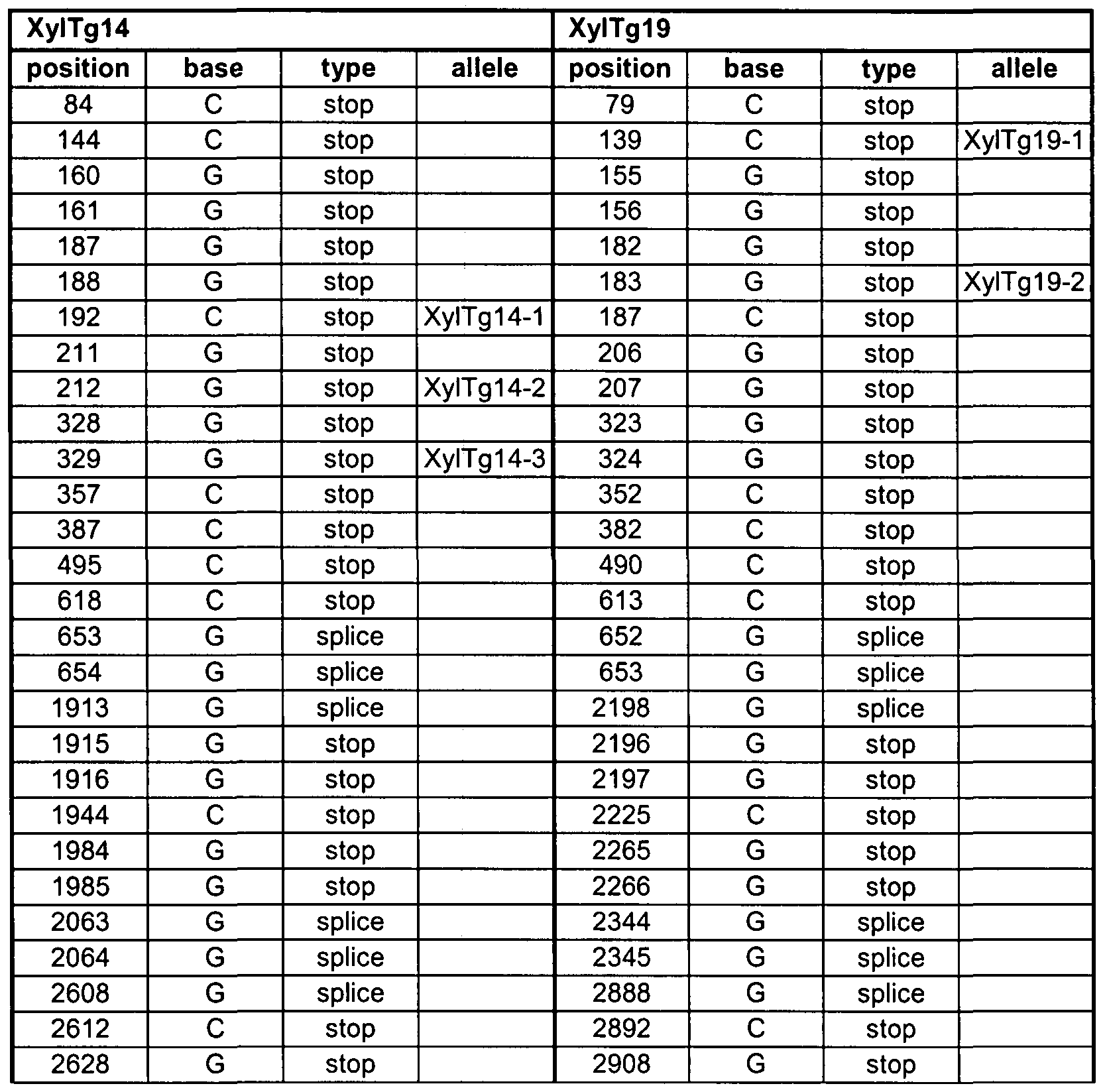
- Allele xyltg14-1 corresponds with a C ⁇ T mutation on position 192 in SEQ ID NO: 1 , thereby introducing a STOP codon in SEQ ID NO: 1.
- Allele xyltg14-2 corresponds with a G ⁇ A mutation on position 212 in SEQ ID NO: 1 , thereby introducing a STOP codon in SEQ ID NO: 1.
- Allele xyltg14-3 corresponds with a G ⁇ A mutation on position 329 in SEQ ID NO: 1 , thereby introducing a STOP codon in SEQ ID NO: 1.
- Allele xyltg19-1 corresponds with a C ⁇ T mutation on position 139 in SEQ ID NO: 1 , thereby introducing a STOP codon in SEQ ID NO: 3.
- Allele xyltg19-2 corresponds with a G ⁇ A mutation on position 183 in SEQ ID NO: 1 , thereby introducing a STOP codon in SEQ ID NO: 3.
- Table 2 A summary of the identified alleles and possibility of the occurrence of other alleles is depicted in Table 2.
- Mutant null alleles can be either "natural mutant” null alleles, which are mutant null alleles found in nature (e.g. produced spontaneously without human application of mutagens) or "induced mutant” null alleles, which are induced by human intervention, e.g. by mutagenesis and are called non-natural mutant null alleles.
- a "significantly reduced amount of functional XyIT protein” refers to a reduction in the amount of a functional XyIT protein produced by the cell comprising a mutant xyltg14 or xyltg19 allele by at least 95% or preferably 100% (i.e. no functional XyIT protein is produced by the alleles) as compared to the amount of the functional XyIT protein produced by the cell not comprising the mutant XyIT alleles.
- This definition encompasses the production of a "non-functional" XyIT protein (e.g. truncated XyIT protein) having no biological activity in vivo, the reduction in the absolute amount of the functional XyIT protein (e.g. no functional XyIT protein being made due to the mutation in the XyIT gene).
- “Mutagenesis” refers to the process in which plant cells (e.g., a plurality of Nicotiana benthamiana seeds or other parts, such as pollen, etc.) are subjected to a technique which induces mutations in the DNA of the cells, such as contact with a mutagenic agent, such as a chemical substance (such as ethylmethylsulfonate (EMS), ethylnitrosourea (ENU), etc.) or ionizing radiation (neutrons (such as in fast neutron mutagenesis, etc.), alpha rays, gamma rays (such as that supplied by a Cobalt 60 source), X-rays, UV-radiation, etc.), or a combination of two or more of these.
- a mutagenic agent such as a chemical substance (such as ethylmethylsulfonate (EMS), ethylnitrosourea (ENU), etc.) or ionizing radiation (neutrons
- the desired mutagenesis of one or more XyIT alleles may be accomplished by use of chemical means such as by contact of one or more plant tissues with ethylmethylsulfonate (EMS), ethylnitrosourea, etc., by the use of physical means such as x-ray, etc, or by gamma radiation, such as that supplied by a Cobalt 60 source. While mutations created by irradiation are often large deletions or other gross lesions such as translocations or complex rearrangements, mutations created by chemical mutagens are often more discrete lesions such as point mutations.
- chemical means such as by contact of one or more plant tissues with ethylmethylsulfonate (EMS), ethylnitrosourea, etc.
- EMS alkylates guanine bases, which results in base mispairing: an alkylated guanine will pair with a thymine base, resulting primarily in G/C to A/T transitions.
- Nicotiana benthamiana plants are regenerated from the treated cells using known techniques. For instance, the resulting Nicotiana benthamiana seeds may be planted in accordance with conventional growing procedures and following self-pollination seed is formed on the plants. Additional seed that is formed as a result of such self-pollination in the present or a subsequent generation may be harvested and screened for the presence of mutant XyIT alleles.
- DeleteageneTM Delete-a-gene; Li et a/., 2001 , Plant J 27: 235-242
- PCR polymerase chain reaction
- sequence identity of two related nucleotide or amino acid sequences, expressed as a percentage, refers to the number of positions in the two optimally aligned sequences which have identical residues (x100) divided by the number of positions compared.
- a gap i.e., a position in an alignment where a residue is present in one sequence but not in the other, is regarded as a position with non-identical residues.
- the default scoring matrix used is EDNAFULL and for proteins the default scoring matrix is EBLOSUM62.
- mutant xylt nucleic acid sequences comprising one or more mutations, preferably mutations which result in no or a significantly reduced biological activity of the encoded XyIT protein or in no XyIT protein being produced
- Nicotiana species particularly from Nicotiana benthamiana.
- Mutant nucleic acid sequences of Xyltg14 and Xyltg19 have been isolated from Nicotiana benthamiana as depicted in the sequence listing.
- the wild type Xyltg14 and Xyltg19 sequences are depicted, while the mutant xyltg 14 and xyltg19 sequences of these sequences are described herein below in Figure 2 and in the examples, with reference to the wild type Xyltg14 and Xyltg19 sequences.
- XyIt alleles can be incorporated into a transformation vector and be used to transform a knock-out line of the model plant Arabidopsis thaliana, with deficiency of active beta-1 ,2-xylosyltransferase (XyIT) and core alpha-1 ,3-fucosyltransferase (FucT) (Strasser et al. (2004) FEBS Lett. 561 : 132- 136).
- Mutant xylt14 and/or xylt19 alleles may be generated (for example induced by mutagenesis) and/or identified using a range of methods, which are conventional in the art, for example using PCR based methods to amplify part or all of the ind genomic or cDNA.
- plants are grown from the treated seeds, or regenerated from the treated cells using known techniques.
- mutagenized seeds may be planted in accordance with conventional growing procedures and following self-pollination seed is formed on the plants. Additional seed which is formed as a result of such self-pollination in the present or a subsequent generation may be harvested and screened for the presence of mutant XyIT alleles, using techniques which are conventional in the art, for example polymerase chain reaction (PCR) based techniques (amplification of the ind alleles) or hybridization based techniques, e.g. Southern blot analysis, BAC library screening, and the like, and/or direct sequencing of xylt alleles.
- PCR polymerase chain reaction
- hybridization based techniques e.g. Southern blot analysis, BAC library screening, and the like, and/or direct sequencing of xylt alleles.
- SNP detection methods conventional in the art can be used, for example oligo-ligation-based techniques, single base extension- based techniques or techniques based on differences in restriction sites, such as TILLING.
- mutagenization spontaneous as well as induced
- mutation region one or more deleted, inserted, or substituted nucleotides
- the mutant XyIT allele can thus be characterized by the location and the configuration of the one or more deleted, inserted, or substituted nucleotides in the wild type XyIT allele.
- the site in the wild type XyIT allele where the one or more nucleotides have been inserted, deleted, or substituted, respectively, is herein also referred to as the "mutation region or sequence".
- a "5' or 3' flanking region or sequence” as used herein refers to a DNA region or sequence in the mutant (or the corresponding wild type) XyIT allele of at least 20 bp, preferably at least 50 bp, at least 750 bp, at least 1500 bp, and up to 5000 bp of DNA different from the DNA containing the one or more deleted, inserted, or substituted nucleotides, preferably DNA from the mutant (or the corresponding wild type) XyIT allele which is located either immediately upstream of and contiguous with (5' flanking region or sequence") or immediately downstream of and contiguous with (3' flanking region or sequence") the mutation region in the mutant XyIT allele (or in the corresponding wild type XYLT allele).
- a “joining region” as used herein refers to a DNA region in the mutant (or the corresponding wild type) XyIT allele where the mutation region and the 5' or 3' flanking region are linked to each other.
- a “sequence spanning the joining region between the mutation region and the 5' or 3' flanking region thus comprises a mutation sequence as well as the flanking sequence contiguous therewith.
- the tools developed to identify a specific mutant XyIT allele or the plant or plant material comprising a specific mutant XyIT allele, or products which comprise plant material comprising a specific mutant XyIT allele are based on the specific genomic characteristics of the specific mutant XyIT allele as compared to the genomic characteristics of the corresponding wild type XyIT allele, such as, a specific restriction map of the genomic region comprising the mutation region, molecular markers or the sequence of the flanking and/or mutation regions.
- primers and probes can be developed which specifically recognize a sequence within the 5' flanking, 3' flanking and/or mutation regions of the mutant XyIT allele in the nucleic acid (DNA or RNA) of a sample by way of a molecular biological technique. For instance a PCR method can be developed to identify the mutant XyIT allele in biological samples (such as samples of plants, plant material or products comprising plant material).
- Such a PCR is based on at least two specific "primers": one recognizing a sequence within the 5' or 3' flanking region of the mutant XyIT allele and the other recognizing a sequence within the 3' or 5' flanking region of the mutant XyIT allele, respectively; or one recognizing a sequence within the 5' or 3' flanking region of the mutant XyIT allele and the other recognizing a sequence within the mutation region of the mutant XyIT allele; or one recognizing a sequence within the 5' or 3' flanking region of the mutant XyIT allele and the other recognizing a sequence spanning the joining region between the 3' or 5' flanking region and the mutation region of the specific mutant XyIT allele (as described further below), respectively.
- the primers preferably have a sequence of between 15 and 35 nucleotides which under optimized PCR conditions "specifically recognize” a sequence within the 5' or 3' flanking region, a sequence within the mutation region, or a sequence spanning the joining region between the 3' or 5' flanking and mutation regions of the specific mutant XyIT allele, so that a specific fragment ("mutant XyIT specific fragment” or discriminating amplicon) is amplified from a nucleic acid sample comprising the specific mutant XyIT allele. This means that only the targeted mutant XyIT allele, and no other sequence in the plant genome, is amplified under optimized PCR conditions.
- Detection and/or identification of a "mutant XyIT specific fragment” can occur in various ways, e.g., via size estimation after gel or capillary electrophoresis or via fluorescence-based detection methods.
- the mutant XyIT specific fragments may also be directly sequenced.
- Other sequence specific methods for detection of amplified DNA fragments are also known in the art. Standard PCR protocols are described in the art, such as in 1 PCR Applications Manual” (Roche Molecular Biochemicals, 2nd Edition, 1999) and other references.
- the optimal conditions for the PCR, including the sequence of the specific primers, is specified in a "PCR identification protocol" for each specific mutant XyIT allele.
- PCR identification protocol may need to be adjusted to specific laboratory conditions, and may be modified slightly to obtain similar results. For instance, use of a different method for preparation of DNA may require adjustment of, for instance, the amount of primers, polymerase, MgC ⁇ concentration or annealing conditions used. Similarly, the selection of other primers may dictate other optimal conditions for the PCR identification protocol. These adjustments will however be apparent to a person skilled in the art, and are furthermore detailed in current PCR application manuals such as the one cited above.
- specific primers can be used to amplify a mutant XyIT specific fragment that can be used as a "specific probe" for identifying a specific mutant XyIT allele in biological samples.
- Contacting nucleic acid of a biological sample, with the probe, under conditions that allow hybridization of the probe with its corresponding fragment in the nucleic acid results in the formation of a nucleic acid/probe hybrid.
- the formation of this hybrid can be detected (e.g. labeling of the nucleic acid or probe), whereby the formation of this hybrid indicates the presence of the specific mutant XyIT allele.
- identification methods based on hybridization with a specific probe (either on a solid phase carrier or in solution) have been described in the art.
- the specific probe is preferably a sequence that, under optimized conditions, hybridizes specifically to a region within the 5' or 3' flanking region and/or within the mutation region of the specific mutant XyIT allele (hereinafter referred to as "mutant XyIT specific region").
- the specific probe comprises a sequence of between 10 and 1000 bp, 50 and 600 bp, between 100 to 500 bp, between 150 to 350bp, which is at least 80%, preferably between 80 and 85%, more preferably between 85 and 90%, especially preferably between 90 and 95%, most preferably between 95% and 100% identical (or complementary) to the nucleotide sequence of a specific region.
- the specific probe will comprise a sequence of about 13 to about 100 contiguous nucleotides identical (or complementary) to a specific region of the specific mutant XyIT allele.
- the invention provides a Nicotiana benthamiana plant which is a double homozygous null mutant for beta-1 ,2-xylosyltransferase further comprising a silenced alpha-1 ,3-fucosyltransferase activity.
- silencing RNA refers to any RNA molecule, which upon introduction into a plant cell, reduces the expression of a target gene.
- silencing RNA may e.g.
- antisense RNA whereby the RNA molecule comprises a sequence of at least 20 consecutive nucleotides having 95% sequence identity to the complement of the sequence of the target nucleic acid, preferably the coding sequence of the target gene.
- antisense RNA may also be directed to regulatory sequences of target genes, including the promoter sequences and transcription termination and polyadenylation signals.
- Silencing RNA further includes so-called “sense RNA” whereby the RNA molecule comprises a sequence of at least 20 consecutive nucleotides having 95% sequence identity to the sequence of the target nucleic acid.
- silencing RNA may be "unpolyadenylated RNA" comprising at least 20 consecutive nucleotides having 95% sequence identity to the complement of the sequence of the target nucleic acid, such as described in WO01/12824 or US6423885 (both documents herein incorporated by reference).
- silencing RNA is an RNA molecule as described in WO03/076619 (herein incorporated by reference) comprising at least 20 consecutive nucleotides having 95% sequence identity to the sequence of the target nucleic acid or the complement thereof, and further comprising a largely-double stranded region as described in WO03/076619 (including largely double stranded regions comprising a nuclear localization signal from a viroid of the Potato spindle tuber viroid-type or comprising CUG trinucleotide repeats).
- Silencing RNA may also be double stranded RNA comprising a sense and antisense strand as herein defined, wherein the sense and antisense strand are capable of base-pairing with each other to form a double stranded RNA region (preferably the said at least 20 consecutive nucleotides of the sense and antisense RNA are complementary to each other).
- the sense and antisense region may also be present within one RNA molecule such that a hairpin RNA (hpRNA) can be formed when the sense and antisense region form a double stranded RNA region.
- hpRNA hairpin RNA
- the hpRNA may be classified as long hpRNA, having long, sense and antisense regions which can be largely complementary, but need not be entirely complementary (typically larger than about 200 bp, ranging between 200-1000 bp). hpRNA can also be rather small ranging in size from about 30 to about 42 bp, but not much longer than 94 bp (see WO04/073390, herein incorporated by reference). Silencing RNA may also be artificial micro-RNA molecules as described e.g. in WO2005/052170, WO2005/047505 or US 2005/0144667 (all documents incorporated herein by reference)
- the silencing RNA molecules are provided to the plant cell or plant by producing a transgenic plant cell or plant comprising a chimeric gene capable of producing a silencing RNA molecule, particularly a double stranded RNA ("dsRNA”) molecule, wherein the complementary RNA strands of such a dsRNA molecule comprises a part of a nucleotide sequence encoding a XyIT or FucT protein.
- dsRNA double stranded RNA
- the enzyme that catalyses the transfer of fucose from GDP-fucose to the core ⁇ - linked N-acetyl glucosamine (GIcNAc) of protein-bound N-glycans is ⁇ -1 ,3- fucosyltransferase ("FucT", EC 2.4.1.214).
- DQ789145 (Lemna minor), AY557602 ⁇ Medicago truncatula) Y18529 (Vigna radiata) AP004457 (Oryza sativa), AJ891040 encoding protein CAI70373 ⁇ Populus alba x Populus tremula) AY082445 encoding protein AAL99371 ⁇ Medicago sativa) AJ582182 encoding protein CAE46649 ⁇ Triticum aestivum) AJ582181 encoding protein CAE46648 ⁇ Hordeum vulgare) (all sequences herein incorporated by reference).
- homologous nucleotide sequence may be identified and isolated by hybridization under stringent conditions using as probes identified nucleotide sequences. "Stringent hybridization conditions" as used herein means that hybridization will generally occur if there is at least 95% and preferably at least 97% sequence identity between the probe and the target sequence.
- Examples of stringent hybridization conditions are overnight incubation in a solution comprising 50% formamide, 5 x SSC (150 mM NaCI, 15 mM trisodium citrate), 50 mM sodium phosphate (pH 7.6), 5x Denhardt's solution, 10% dextran sulfate, and 20 ⁇ g/ml denatured, sheared carrier DNA such as salmon sperm DNA, followed by washing the hybridization support in 0.1 x SSC at approximately 65 0 C, preferably twice for about 10 minutes.
- Other hybridization and wash conditions are well known and are exemplified in Sambrook et al, Molecular Cloning: A Laboratory Manual, Second Edition, Cold Spring Harbor, NY (1989), particularly chapter 11.
- Nucleotide sequences obtained in this way should be verified for encoding a polypeptide having an amino acid sequence which is at least 80% to 95% identical to a known alfa(1 ,3) fucosyltransferase from plants.
- the beta-1 ,2-xylosyltransferase null mutant Nicotiana benthamiana plant which comprises a silenced alfa(1 ,3) fucosyltransferase additionally comprises a beta-1 ,4-galactosyltransferase activity.
- such activity may be introduced into plant cells by providing them with a chimeric gene comprising a plant-expressible promoter operably linked to a DNA region encoding a beta(1 ,4) galactosyltransferase and optionally a 3' end region involving in transcription termination and polyadenylation functional in plant cells.
- beta-1 ,4- galactosyltransferase refers to the glycosyltransferase designated as EC2.4.1.38 that is required for the biosynthesis of the backbone structure from type 2 chain (Galbetal ⁇ 4GIcNAc), which appears widely on N- linked glycans, i.e., which enzyme has galactosylating activity on N-linked glycans.
- Useful beta-1 ,4-galactosyltransferases are derived from human, mouse, rat as well as orthologs of beta-1 ,4-galactosyltransferase from non-mammalian species such as chicken and zebrafish (see also WO2008125972).
- Regions encoding a beta-1 ,4-galactosyltransferase are preferably obtained from mammalian organisms, including humans, but may be obtained from other organisms as well.
- NM 001497(Homo sapiens) are a few database entries for genes encoding a ⁇ (1 ,4) galactosyltransferase.
- galactosyltransferases include AAB05218 (Gall ⁇ s gallus), XP693272 ⁇ Danio rerio), CAF95423 ⁇ Tetraodon nigroviridis) or NP001016664 (Xenopus tropicalis) (all sequence herein incorporated by reference).
- plant-expressible promoter means a DNA sequence that is capable of controlling (initiating) transcription in a plant cell. This includes any promoter of plant origin, but also any promoter of non-plant origin which is capable of directing transcription in a plant cell, i.e., certain promoters of viral or bacterial origin such as the CaMV35S (Harpster et al. (1988) MoI Gen Genet.
- the subterranean clover virus promoter No 4 or No 7 (WO9606932), or T-DNA gene promoters but also tissue-specific or organ- specific promoters including but not limited to seed-specific promoters (e.g., WO89/03887), organ-primordia specific promoters (An et al. (1996) Plant Cell 8(1 ): 15-30), stem-specific promoters (Keller et al., (1988) EMBO J. 7(12): 3625- 3633), leaf specific promoters (Hudspeth et al. (1989) Plant MoI Biol.
- mesophyl-specific promoters such as the light-inducible Rubisco promoters
- root-specific promoters such as the light-inducible Rubisco promoters
- tuber-specific promoters such as the tuber-specific promoters
- vascular tissue specific promoters such as the vascular tissue specific promoters (Peleman et al. (1989) Gene 84: 359-369)
- stamen-selective promoters WO 89/10396, WO 92/13956
- dehiscence zone specific promoters WO 97/13865
- the mutant Nicotiana benthamiana plants comprising a silenced fucosyltransferase and optionally a further beta-1 ,4- galactosyltransferase can comprise also a heterologous gene encoding a glycoprotein.
- the glycoproteins may be glycoproteins endogeneous to the cell of the higher plant, and may result in altered functionality, folding or half-life of these proteins.
- Glycoproteins also include proteins which are foreign to the cell of the higher plant (i.e. a heterologous glycoprotein), i.e. which are not normally expressed in such plant cells in nature. These may include mammalian or human proteins, which can be used as therapeutics such as e.g. monoclonal antibodies.
- the foreign glycoproteins may be expressed from chimeric genes comprising a plant-expressible promoter and the coding region of the glycoprotein of interest, whereby the chimeric gene is stably integrated in the genome of the plant cell.
- Methods to express foreign proteins in plant cells are well known in the art.
- the foreign glycoproteins may also be expressed in a transient manner, e.g. using the viral vectors and methods described in WO02/088369, WO2006/079546 and WO2006/012906 or using the viral vectors described in WO89/08145, WO93/03161 and WO96/40867 or WO96/12028.
- heterologous protein it is understood a protein (i.e. a polypeptide) that is not expressed by the plant or plant cells in nature. This is in contrast with a homologous protein which is a protein naturally expressed by a plant or plant cell. Heterologous and homologous polypeptides that undergo post-translational N- glycosylation are referred to herein as heterologous or homologous glycoproteins.
- heterologous proteins of interest that can be advantageously produced by the methods of this invention include, without limitation, cytokines, cytokine receptors, growth factors (e.g. EGF, HER-2, FGF-alpha, FGF-beta, TGF-alpha, TGF-beta, PDGF, IGF-I, IGF-2, NGF), growth factor receptors.
- growth factors e.g. EGF, HER-2, FGF-alpha, FGF-beta, TGF-alpha, TGF-beta, PDGF, IGF-I, IGF-2, NGF
- growth factor receptors e.g. human growth hormone, bovine growth hormone
- insulin e.g., insulin A chain and insulin B chain
- pro-insulin erythropoietin (EPO)
- colony stimulating factors e.g.
- G-CSF G-CSF, GM-CSF, M-CSF
- interleukins vascular endothelial growth factor (VEGF) and its receptor (VEGF- R), interferons, tumor necrosis factor and its receptors, thrombopoietin (TPO), thrombin, brain natriuretic peptide (BNP); clotting factors (e.g. Factor VIII, Factor IX, von Willebrands factor and the like), anti-clotting factors; tissue plasminogen activator (TPA), urokinase, follicle stimulating hormone (FSH), luteinizing hormone (LH), calcitonin, CD proteins (e.
- TPA tissue plasminogen activator
- FSH follicle stimulating hormone
- LH luteinizing hormone
- CD proteins e.
- CTLA proteins e.g. CTLA4
- BNPs bone morphogenic proteins
- BNPs bone derived neurotrophic factor
- neurotrophins e.g. rennin, rheumatoid factor, RANTES, albumin, relaxin, macrophage inhibitory protein (e.g.
- MIP-I, MIP-2 viral proteins or antigens, surface membrane proteins, ion channel proteins, enzymes, regulatory proteins, immunomodulatory proteins, (e.g. HLA, MHC, the B7 family), homing receptors, transport proteins, superoxide dismutase (SOD), G-protein coupled receptor proteins (GPCRs), neuromodulatory proteins, Alzheimer's Disease associated proteins and peptides.
- Fusion proteins and polypeptides, chimeric proteins and polypeptides, as well as fragments or portions, or mutants, variants, or analogs of any of the aforementioned proteins and polypeptides are also included among the suitable proteins, polypeptides and peptides that can be produced by the methods of the present invention.
- the protein of interest is a glycoprotein.
- One class of glycoproteins are viral glycoproteins, in particular subunits, than can be used to produce for example a vaccine.
- viral proteins comprise proteins from rhinovirus, poliomyelitis virus, herpes virus, bovine herpes virus, influenza virus, newcastle disease virus, respiratory syncitio virus, measles virus, retrovirus, such as human immunodeficiency virus or a parvovirus or a papovavirus, rotavirus or a coronavirus, such as transmissable gastroenteritisvirus or a flavivirus, such as tick-borne encephalitis virus or yellow fever virus, a togavirus, such as rubella virus or eastern-, western-, or venezuelean equine encephalomyelitis virus, a hepatitis causing virus, such as hepatitis A or hepatitis B virus, a pestivirus, such as hog cholera virus or a r
- the heterologous glycoprotein is an antibody or a fragment thereof.
- antibody refers to recombinant antibodies (for example of the classes IgD, IgG, IgA, IgM, IgE) and recombinant antibodies such as single-chain antibodies, chimeric and humanized antibodies and multi-specific antibodies.
- antibody also refers to fragments and derivatives of all of the foregoing, and may further comprises any modified or derivatised variants thereof that retain the ability to specifically bind an epitope.
- Antibody derivatives may comprise a protein or chemical moiety conjugated to an antibody.
- a monoclonal antibody is capable of selectively binding to a target antigen or epitope.
- Antibodies include, monoclonal antibodies (mAbs), humanized or chimeric antibodies, camelized antibodies, camelid antibodies (nanobodies ® ), single chain antibodies (scFvs), Fab fragments, F(ab') 2 fragments, disulfide- linked Fvs (sdFv) fragments, anti- idiotypic (anti-Id) antibodies, intra-bodies, synthetic antibodies, and epitope- binding fragments of any of the above.
- the term "antibody” also refers to fusion protein that includes a region equivalent to the Fc region of an immunoglobulin. Also envisaged is the production in the plant or plant cells of the invention of so called dual-specificity antibodies (Bostrom J et al (2009) Science 323, 1610- 1614).
- Preferred antibodies within the scope of the present invention include those comprising the amino acid sequences of the following antibodies: anti-HER2 antibodies including antibodies comprising the heavy and light chain variable regions (see US5,725,856) or Trastuzumab such as HERCEPTINTM; anti-CD20 antibodies such as chimeric anti-CD20 as in US5,736,137, a chimeric or humanized variant of the 2H7 antibody as in US5,721 ,108; anti-VEGF antibodies including humanized and/or affinity matured anti-VEGF antibodies such as the humanized anti- VEGF antibody huA4.6.1 AVASTIN TM (WO 96/30046 and WO 98/45331 ); anti-EGFR (chimerized or humanized antibody as in WO 96/40210); anti-CD3 antibodies such as OKT3 (US4,515,893); anti-CD25 or anti-tac antibodies such as CHI-621 (SIMULECT) and (ZENAPAX) (US5,693,762).
- the present invention provides
- nucleotide sequences of the glycosyltransferases and/or the heterologous genes may be codon optimized to increase the level of expression within the plant.
- codon optimization it is meant the selection of appropriate DNA nucleotides for the synthesis of oligonucleotide building blocks, and their subsequent enzymatic assembly, of a structural gene or fragment thereof in order to approach codon usage in plants.
- methods for obtaining a desired glycoprotein or functional fragment thereof comprise cultivating a plant described herein until said plant has reached a harvestable stage, harvesting and fractionating the plant to obtain fractionated plant material and at least partly isolating said glycoprotein from said fractionated plant material.
- methods for obtaining a desired glycoprotein or functional fragment thereof comprise growing recombinant plant cells in cell culture in a fermentor until said cell culture has reached a harvestable stage or the desired glycoprotein can be collected from the medium.
- the glycoproteins described herein, such as e.g., antibodies, vaccines, cytokines and hormones may be purified by standard techniques well known to those of skill in the art.
- Such recombinantly produced proteins may be directly expressed or expressed as a fusion protein.
- the recombinant protein is purified by a combination of cell lysis (e.g., sonication, French press) and affinity chromatography or other affinity- based method. For fusion products, subsequent digestion of the fusion protein with an appropriate proteolytic enzyme releases the desired recombinant protein.
- the invention provides a method to produce at least one heterologous protein in null mutant Nicotiana benthamiana plants described herein before comprising the steps of: a) providing a null mutant plant or plant cell according to the invention with at least one chimeric gene comprising the following operably linked nucleic acid molecules: i) plant-expressible promoter, ii) DNA region encoding a heterologous protein, and iii) DNA region involved in transcription termination and polyadenylation , and b) cultivating said plant or plant cell and isolating said at least one heterologous protein from said plant or plant cell.
- the heterologous protein produced is an antibody.
- the proteins described herein, recombinant or synthetic may be purified to substantial purity by standard techniques well known in the art, including detergent solubilization, selective precipitation with such substances as ammonium sulfate, column chromatography, immunopurification methods, and others. See, for instance, R. Scopes, Protein Purification: Principles and Practice, Springer- Verlag: New York (1982); Deutscher, Guide to Protein Purification, Academic Press (1990). For example, antibodies may be raised to the proteins as described herein. Purification from E. coli can be achieved following procedures described in U. S. Patent No. 4,511 ,503. The protein may then be isolated from cells expressing the protein and further purified by standard protein chemistry techniques as described herein. Detection of the expressed protein is achieved by methods known in the art and include, for example, radioimmunoassays, Western blotting techniques or immunoprecipitation.
- SEQ ID NO 1 nucleotide sequence of beta-1 ,2-xylosyltransferase XyITgM of Nicotiana benthamiana
- SEQ ID NO 2 amino acid sequence of SEQ ID NO: 1
- SEQ ID NO 3 nucleotide sequence of beta-1 ,2-xylosyltransferase XylTg19 of Nicotiana benthamiana
- SEQ ID NO 4 amino acid sequence of SEQ ID NO: 3
- the optimal dose for EMS mutagensis was determined by treating seeds of N. benthamiana with 0, 50, 75, 100, 150, and 200 mM EMS. Briefly, seeds were imbibed for 2 hours at room temperature, treated with EMS for 4 hours at room temperature and washed 5 times for 15 minutes at room temperature. Seeds were dried overnight and sown immediately. The effects on germination, seedling lethality and plant fertility were recorded.
- N. benthamiana has been described to be an amphidiploid species from a combination of N. debneyi and N. suaveolens
- EMS-induced point mutations were detected in a high-throughput manner by direct sequence analysis by using the method described in Smits B. M. et al (2006) Pharmacogenet. Genomics 16: 159-169. Briefly, specific gene fragments were amplified by PCR from DNA of leaf tissue of individual plants using gene specific primers. Each primer carried an additional sequence at its 5' end that allowed analysis of the sequence of both strands of the resulting PCR fragment. In a first step we optimized the method. Thereto DNA was extracted from several N. benthamiana accessions (see Table 1 for the accessions). The first exons of genes XylTg14 and XylTg19 were amplified and nucleotide sequences were determined.
- Accession NBNPGS2 was used as a control and position marker (i.e. leaf material from NBNPGS2 was sampled in well H12) when sampling leaf material, in 96-well format, for DNA production of the final M2 populations.
- EmsPred a proprietary algorithm to Bayer BioScience that identifies all codons in a coding sequence that can be mutated to a stop codon or a splice mutant induced by EMS mutagenesis.
- the positions identified in XyITgI 4 and XyITgI 9 are listed in Table 2.
- thaliana ⁇ -1 ,2-xylosyltransferase by the removal of 82, 106, and 143 amino acids at the N-terminus.
- this area corresponds to a part of the first exon (until position 650) and part of the first intron and codes for amino acids 41 to 217.
- this area also corresponds to part of the first exon (until position 648) and part of the first intron and codes for amino acids 41 to 216.
- mutants i.e. including xyltg14-2 and xyltg14-3 and xyltg19-2) were allowed to self fertilize to establish homozygous single mutant seed lots.
- Progeny from the XyITgI 4-1 x XyITgI 9-1 crosses were analyzed by direct seguencing to confirm their heterozygous genotype and selected plants were allowed to self-fertilize. Double homozygous mutants were identified from the progeny of these plants by direct sequencing. To establish a stable homozygous seed lot, these plants were allowed to self-fertilize. Simultaneously, these plants were backcrossed with the BENTHAMIANA accession to produce start producing a plant homozygous for xyltg14-1 and xyltg19-1 but free of undesired background mutations.
- protein from either single homozygous mutants or double heterozygous mutants is recognized by the anti- xylose antibody.
- the control blot probed with the anti-fucose antibody shows that protein was loaded in all lanes.
- the mutations in alleles xyltg14-1 and xyltg19-1 are null mutations and that generating null mutants of both XyITgI 4 and XyITgI 9, for instance in the double homozygous xyltg14-1 and xyltg19-1 plants, is both sufficient and necessary to inactivate the complete ⁇ 1 ,2- xylosyltransferase activity and to fully prevent addition of any ⁇ 1 ,2-xylose to the N-glycans of N.
- the heavy chain protein in this band was used for glycan analysis by LC-MS as described by Kolarich et al. (Kolarich, D. et al (2006) Proteomics 6:3369-3380). Results shown in Figure 4 show that no xylose is present on the heavy chain of this IgGL This confirms that the double homozygous xyltg14-1 and xyltg19-1 N. benthamiana mutant completely lacks beta-1 ,2-xylosyltransferase activity.
Landscapes
- Health & Medical Sciences (AREA)
- Genetics & Genomics (AREA)
- Life Sciences & Earth Sciences (AREA)
- Chemical & Material Sciences (AREA)
- Engineering & Computer Science (AREA)
- Molecular Biology (AREA)
- Zoology (AREA)
- Bioinformatics & Cheminformatics (AREA)
- Organic Chemistry (AREA)
- Wood Science & Technology (AREA)
- General Engineering & Computer Science (AREA)
- Biotechnology (AREA)
- Biomedical Technology (AREA)
- Medicinal Chemistry (AREA)
- General Health & Medical Sciences (AREA)
- Biochemistry (AREA)
- Microbiology (AREA)
- Pharmacology & Pharmacy (AREA)
- Cell Biology (AREA)
- Physics & Mathematics (AREA)
- Biophysics (AREA)
- Plant Pathology (AREA)
- Immunology (AREA)
- Breeding Of Plants And Reproduction By Means Of Culturing (AREA)
- Micro-Organisms Or Cultivation Processes Thereof (AREA)
- Preparation Of Compounds By Using Micro-Organisms (AREA)
Abstract
Description


Claims
Priority Applications (6)
| Application Number | Priority Date | Filing Date | Title |
|---|---|---|---|
| AU2010262087A AU2010262087B9 (en) | 2009-06-15 | 2010-06-10 | Nicotiana benthamiana plants deficient in xylosyltransferase activity |
| EP10731460.1A EP2443234B1 (en) | 2009-06-15 | 2010-06-10 | Nicotiana benthamiana plants deficient in xylosyltransferase activity |
| US13/376,912 US8933297B2 (en) | 2009-06-15 | 2010-06-10 | Nicotiana benthamiana plants deficient in xylosyltransferase activity |
| JP2012514397A JP5925677B2 (en) | 2009-06-15 | 2010-06-10 | Nicotiana benthamiana plant deficient in xylosyltransferase activity |
| CA2765287A CA2765287C (en) | 2009-06-15 | 2010-06-10 | Nicotiana benthamiana plants deficient in xylosyltransferase activity |
| IL216866A IL216866A (en) | 2009-06-15 | 2011-12-08 | Nicotiana benthamiana plants deficient in xylosyltransferase acitivity |
Applications Claiming Priority (4)
| Application Number | Priority Date | Filing Date | Title |
|---|---|---|---|
| EP09007817 | 2009-06-15 | ||
| EP09007817.1 | 2009-06-15 | ||
| US18740909P | 2009-06-16 | 2009-06-16 | |
| US61/187,409 | 2009-06-16 |
Publications (1)
| Publication Number | Publication Date |
|---|---|
| WO2010145846A1 true WO2010145846A1 (en) | 2010-12-23 |
Family
ID=43355902
Family Applications (1)
| Application Number | Title | Priority Date | Filing Date |
|---|---|---|---|
| PCT/EP2010/003749 Ceased WO2010145846A1 (en) | 2009-06-15 | 2010-06-10 | Nicotiana benthamiana plants deficient in xylosyltransferase activity |
Country Status (7)
| Country | Link |
|---|---|
| US (1) | US8933297B2 (en) |
| EP (1) | EP2443234B1 (en) |
| JP (1) | JP5925677B2 (en) |
| AU (1) | AU2010262087B9 (en) |
| CA (1) | CA2765287C (en) |
| IL (1) | IL216866A (en) |
| WO (1) | WO2010145846A1 (en) |
Cited By (49)
| Publication number | Priority date | Publication date | Assignee | Title |
|---|---|---|---|---|
| WO2013037717A1 (en) | 2011-09-12 | 2013-03-21 | Bayer Intellectual Property Gmbh | Fungicidal 4-substituted-3-{phenyl[(heterocyclylmethoxy)imino]methyl}-1,2,4-oxadizol-5(4h)-one derivatives |
| WO2013050410A1 (en) | 2011-10-04 | 2013-04-11 | Bayer Intellectual Property Gmbh | RNAi FOR THE CONTROL OF FUNGI AND OOMYCETES BY INHIBITING SACCHAROPINE DEHYDROGENASE GENE |
| WO2013050155A1 (en) | 2011-10-04 | 2013-04-11 | Icon Genetics Gmbh | Nicotiana benthamiana plants deficient in fucosyltransferase activity |
| WO2013075817A1 (en) | 2011-11-21 | 2013-05-30 | Bayer Intellectual Property Gmbh | Fungicide n-[(trisubstitutedsilyl)methyl]-carboxamide derivatives |
| WO2013079566A2 (en) | 2011-11-30 | 2013-06-06 | Bayer Intellectual Property Gmbh | Fungicidal n-bicycloalkyl and n-tricycloalkyl (thio)carboxamide derivatives |
| WO2013092519A1 (en) | 2011-12-19 | 2013-06-27 | Bayer Cropscience Ag | Use of anthranilic acid diamide derivatives for pest control in transgenic crops |
| WO2013098147A1 (en) | 2011-12-29 | 2013-07-04 | Bayer Intellectual Property Gmbh | Fungicidal 3-[(pyridin-2-ylmethoxyimino)(phenyl)methyl]-2-substituted-1,2,4-oxadiazol-5(2h)-one derivatives |
| WO2013098146A1 (en) | 2011-12-29 | 2013-07-04 | Bayer Intellectual Property Gmbh | Fungicidal 3-[(1,3-thiazol-4-ylmethoxyimino)(phenyl)methyl]-2-substituted-1,2,4-oxadiazol-5(2h)-one derivatives |
| WO2013127704A1 (en) | 2012-02-27 | 2013-09-06 | Bayer Intellectual Property Gmbh | Active compound combinations containing a thiazoylisoxazoline and a fungicide |
| WO2013139949A1 (en) | 2012-03-23 | 2013-09-26 | Bayer Intellectual Property Gmbh | Compositions comprising a strigolactame compound for enhanced plant growth and yield |
| EP2662360A1 (en) | 2012-05-09 | 2013-11-13 | Bayer CropScience AG | 5-Halogenopyrazole indanyl carboxamides |
| EP2662361A1 (en) | 2012-05-09 | 2013-11-13 | Bayer CropScience AG | Pyrazol indanyl carboxamides |
| EP2662364A1 (en) | 2012-05-09 | 2013-11-13 | Bayer CropScience AG | Pyrazole tetrahydronaphthyl carboxamides |
| EP2662362A1 (en) | 2012-05-09 | 2013-11-13 | Bayer CropScience AG | Pyrazole indanyl carboxamides |
| EP2662363A1 (en) | 2012-05-09 | 2013-11-13 | Bayer CropScience AG | 5-Halogenopyrazole biphenylcarboxamides |
| EP2662370A1 (en) | 2012-05-09 | 2013-11-13 | Bayer CropScience AG | 5-Halogenopyrazole benzofuranyl carboxamides |
| WO2013167545A1 (en) | 2012-05-09 | 2013-11-14 | Bayer Cropscience Ag | Pyrazole indanyl carboxamides |
| WO2013167544A1 (en) | 2012-05-09 | 2013-11-14 | Bayer Cropscience Ag | 5-halogenopyrazole indanyl carboxamides |
| WO2014060502A1 (en) | 2012-10-19 | 2014-04-24 | Bayer Cropscience Ag | Active compound combinations comprising carboxamide derivatives |
| WO2014060520A1 (en) | 2012-10-19 | 2014-04-24 | Bayer Cropscience Ag | Method for treating plants against fungi resistant to fungicides using carboxamide or thiocarboxamide derivatives |
| WO2014060519A1 (en) | 2012-10-19 | 2014-04-24 | Bayer Cropscience Ag | Method for enhancing tolerance to abiotic stress in plants using carboxamide or thiocarboxamide derivatives |
| WO2014060518A1 (en) | 2012-10-19 | 2014-04-24 | Bayer Cropscience Ag | Method of plant growth promotion using carboxamide derivatives |
| WO2014071039A1 (en) * | 2012-11-01 | 2014-05-08 | Cellectis Sa | Plants for production of therapeutic proteins |
| EP2735231A1 (en) | 2012-11-23 | 2014-05-28 | Bayer CropScience AG | Active compound combinations |
| WO2014082950A1 (en) | 2012-11-30 | 2014-06-05 | Bayer Cropscience Ag | Ternary fungicidal mixtures |
| WO2014083031A2 (en) | 2012-11-30 | 2014-06-05 | Bayer Cropscience Ag | Binary pesticidal and fungicidal mixtures |
| WO2014083088A2 (en) | 2012-11-30 | 2014-06-05 | Bayer Cropscience Ag | Binary fungicidal mixtures |
| WO2014083089A1 (en) | 2012-11-30 | 2014-06-05 | Bayer Cropscience Ag | Ternary fungicidal and pesticidal mixtures |
| WO2014083033A1 (en) | 2012-11-30 | 2014-06-05 | Bayer Cropsience Ag | Binary fungicidal or pesticidal mixture |
| WO2014095826A1 (en) | 2012-12-18 | 2014-06-26 | Bayer Cropscience Ag | Binary fungicidal and bactericidal combinations |
| WO2014095677A1 (en) | 2012-12-19 | 2014-06-26 | Bayer Cropscience Ag | Difluoromethyl-nicotinic- tetrahydronaphtyl carboxamides |
| WO2014167008A1 (en) | 2013-04-12 | 2014-10-16 | Bayer Cropscience Ag | Novel triazolinthione derivatives |
| WO2014167009A1 (en) | 2013-04-12 | 2014-10-16 | Bayer Cropscience Ag | Novel triazole derivatives |
| WO2014170364A1 (en) | 2013-04-19 | 2014-10-23 | Bayer Cropscience Ag | Binary insecticidal or pesticidal mixture |
| WO2014170345A2 (en) | 2013-04-19 | 2014-10-23 | Bayer Cropscience Ag | Method for improved utilization of the production potential of transgenic plants |
| WO2014177514A1 (en) | 2013-04-30 | 2014-11-06 | Bayer Cropscience Ag | Nematicidal n-substituted phenethylcarboxamides |
| WO2014177582A1 (en) | 2013-04-30 | 2014-11-06 | Bayer Cropscience Ag | N-(2-fluoro-2-phenethyl)carboxamides as nematicides and endoparasiticides |
| WO2018019676A1 (en) | 2016-07-29 | 2018-02-01 | Bayer Cropscience Aktiengesellschaft | Active compound combinations and methods to protect the propagation material of plants |
| WO2018054829A1 (en) | 2016-09-22 | 2018-03-29 | Bayer Cropscience Aktiengesellschaft | Novel triazole derivatives and their use as fungicides |
| WO2018054832A1 (en) | 2016-09-22 | 2018-03-29 | Bayer Cropscience Aktiengesellschaft | Novel triazole derivatives |
| US10113162B2 (en) | 2013-03-15 | 2018-10-30 | Cellectis | Modifying soybean oil composition through targeted knockout of the FAD2-1A/1B genes |
| US10301637B2 (en) | 2014-06-20 | 2019-05-28 | Cellectis | Potatoes with reduced granule-bound starch synthase |
| WO2019233863A1 (en) | 2018-06-04 | 2019-12-12 | Bayer Aktiengesellschaft | Herbicidally active bicyclic benzoylpyrazoles |
| US10513698B2 (en) | 2012-12-21 | 2019-12-24 | Cellectis | Potatoes with reduced cold-induced sweetening |
| US10550402B2 (en) | 2016-02-02 | 2020-02-04 | Cellectis | Modifying soybean oil composition through targeted knockout of the FAD3A/B/C genes |
| US10837024B2 (en) | 2015-09-17 | 2020-11-17 | Cellectis | Modifying messenger RNA stability in plant transformations |
| US11312972B2 (en) | 2016-11-16 | 2022-04-26 | Cellectis | Methods for altering amino acid content in plants through frameshift mutations |
| US11384360B2 (en) | 2012-06-19 | 2022-07-12 | Regents Of The University Of Minnesota | Gene targeting in plants using DNA viruses |
| US11479782B2 (en) | 2017-04-25 | 2022-10-25 | Cellectis | Alfalfa with reduced lignin composition |
Families Citing this family (3)
| Publication number | Priority date | Publication date | Assignee | Title |
|---|---|---|---|---|
| US5100052A (en) * | 1991-09-16 | 1992-03-31 | Slm Manufacturing Corporation | Tubular display packages with tab locking, double wall hollow insert closure box |
| US20100154081A1 (en) * | 2007-05-21 | 2010-06-17 | Bayer Bioscience N.V. | Methods and means for producing glycoproteins with altered glycosylation pattern in higher plants |
| US11499160B2 (en) | 2016-12-01 | 2022-11-15 | Plantform Corporation | Transgenic plant with reduced fucosyltransferase and xylosyltransferase activity |
Citations (31)
| Publication number | Priority date | Publication date | Assignee | Title |
|---|---|---|---|---|
| US4511503A (en) | 1982-12-22 | 1985-04-16 | Genentech, Inc. | Purification and activity assurance of precipitated heterologous proteins |
| US4515893A (en) | 1979-04-26 | 1985-05-07 | Ortho Pharmaceutical Corporation | Hybrid cell line for producing complement-fixing monoclonal antibody to human T cells |
| WO1989003887A1 (en) | 1987-10-20 | 1989-05-05 | Plant Genetic Systems N.V. | A process for the production of biologically active peptide via the expression of modified storage seed protein genes in transgenic plants |
| WO1989008145A1 (en) | 1988-02-26 | 1989-09-08 | Biosource Genetics Corporation | Non-nuclear chromosomal transformation |
| WO1989010396A1 (en) | 1988-04-28 | 1989-11-02 | Plant Genetic Systems N.V. | Plants with modified stamen cells |
| WO1992013956A1 (en) | 1991-02-08 | 1992-08-20 | Plant Genetic Systems, N.V. | Stamen-specific promoters from rice |
| WO1993003161A1 (en) | 1990-10-22 | 1993-02-18 | Biosource Genetics Corporation | Recombinant plant viral nucleic acids |
| WO1996006932A1 (en) | 1994-08-30 | 1996-03-07 | Commonwealth Scientific And Industrial Research Organisation | Plant transcription regulators from circovirus |
| WO1996012028A1 (en) | 1994-10-14 | 1996-04-25 | Biosource Technologies, Inc. | Production of peptides in plants as viral coat protein fusions |
| WO1996030046A1 (en) | 1995-03-30 | 1996-10-03 | Genentech, Inc. | Vascular endothelial cell growth factor antagonists |
| WO1996040210A1 (en) | 1995-06-07 | 1996-12-19 | Imclone Systems Incorporated | Antibody and antibody fragments for inhibiting the growth of tumors |
| WO1996040867A1 (en) | 1995-06-07 | 1996-12-19 | Biosource Technologies, Inc. | Recombinant viral nucleic acids |
| WO1997013865A1 (en) | 1995-10-06 | 1997-04-17 | Plant Genetic Systems, N.V. | Seed shattering |
| US5693762A (en) | 1988-12-28 | 1997-12-02 | Protein Design Labs, Inc. | Humanized immunoglobulins |
| US5721108A (en) | 1987-01-08 | 1998-02-24 | Xoma Corporation | Chimeric antibody with specificity to human B cell surface antigen |
| US5725856A (en) | 1988-01-12 | 1998-03-10 | Genentech, Inc. | Monoclonal antibodies directed to the HER2 receptor |
| US5736137A (en) | 1992-11-13 | 1998-04-07 | Idec Pharmaceuticals Corporation | Therapeutic application of chimeric and radiolabeled antibodies to human B lymphocyte restricted differentiation antigen for treatment of B cell lymphoma |
| WO1998045331A2 (en) | 1997-04-07 | 1998-10-15 | Genentech, Inc. | Anti-vegf antibodies |
| WO1999053050A1 (en) | 1998-04-08 | 1999-10-21 | Commonwealth Scientific And Industrial Research Organisation | Methods and means for obtaining modified phenotypes |
| WO2001012824A1 (en) | 1999-08-13 | 2001-02-22 | Commonwealth Scientific And Industrial Research Organisation | Means and methods for modifying gene expression using unpolyadenylated rna |
| WO2002088369A1 (en) | 2001-04-30 | 2002-11-07 | Icon Genetics Ag | Processes and vectors for amplification or expression of nucleic acid sequences of interest in plants |
| WO2003076619A1 (en) | 2002-03-14 | 2003-09-18 | Commonwealth Scientific And Industrial Research Organisation | Modified gene-silencing rna and uses thereof |
| WO2004073390A1 (en) | 2003-02-19 | 2004-09-02 | Commonwealth Scientific And Industrial Research Organisation | Efficient gene silencing in plants using short dsrna sequences |
| WO2005047505A2 (en) | 2003-08-07 | 2005-05-26 | Whitehead Institute For Biomedical Research | Methods and products for expression of micro rnas |
| WO2005052170A2 (en) | 2003-10-09 | 2005-06-09 | E. I. Du Pont De Nemours And Company | Gene silencing by using micro-rna molecules |
| US20050144667A1 (en) | 2001-09-28 | 2005-06-30 | Duncan Stanley | Plant polypeptides and polynucleotides encoding same |
| WO2006012906A1 (en) | 2003-11-10 | 2006-02-09 | Icon Genetics Ag | Rna virus-derived plant expression system |
| WO2006079546A2 (en) | 2005-01-28 | 2006-08-03 | Icon Genetics Gmbh | Production of antibodies in plants with plus -sense single -stranded viral rna vectors |
| WO2007107296A1 (en) | 2006-03-23 | 2007-09-27 | Bayer Bioscience N.V. | Novel nucleotide sequences encoding nicotiana beta-1,2-xylosyltransferase |
| WO2008125972A2 (en) | 2007-04-17 | 2008-10-23 | Plant Research International B.V. | Mammalian-type glycosylation in plants by expression of non-mammalian glycosyltransferases |
| WO2009056155A1 (en) | 2007-10-31 | 2009-05-07 | Bayer Bioscience N.V. | Method to produce modified plants with altered n-glycosylation pattern |
Family Cites Families (1)
| Publication number | Priority date | Publication date | Assignee | Title |
|---|---|---|---|---|
| EP1485486B1 (en) * | 2002-03-19 | 2012-11-21 | Stichting Dienst Landbouwkundig Onderzoek | Optimizing glycan processing in plants |
-
2010
- 2010-06-10 US US13/376,912 patent/US8933297B2/en active Active
- 2010-06-10 EP EP10731460.1A patent/EP2443234B1/en active Active
- 2010-06-10 CA CA2765287A patent/CA2765287C/en active Active
- 2010-06-10 JP JP2012514397A patent/JP5925677B2/en active Active
- 2010-06-10 AU AU2010262087A patent/AU2010262087B9/en not_active Ceased
- 2010-06-10 WO PCT/EP2010/003749 patent/WO2010145846A1/en not_active Ceased
-
2011
- 2011-12-08 IL IL216866A patent/IL216866A/en active IP Right Grant
Patent Citations (32)
| Publication number | Priority date | Publication date | Assignee | Title |
|---|---|---|---|---|
| US4515893A (en) | 1979-04-26 | 1985-05-07 | Ortho Pharmaceutical Corporation | Hybrid cell line for producing complement-fixing monoclonal antibody to human T cells |
| US4511503A (en) | 1982-12-22 | 1985-04-16 | Genentech, Inc. | Purification and activity assurance of precipitated heterologous proteins |
| US5721108A (en) | 1987-01-08 | 1998-02-24 | Xoma Corporation | Chimeric antibody with specificity to human B cell surface antigen |
| WO1989003887A1 (en) | 1987-10-20 | 1989-05-05 | Plant Genetic Systems N.V. | A process for the production of biologically active peptide via the expression of modified storage seed protein genes in transgenic plants |
| US5725856A (en) | 1988-01-12 | 1998-03-10 | Genentech, Inc. | Monoclonal antibodies directed to the HER2 receptor |
| WO1989008145A1 (en) | 1988-02-26 | 1989-09-08 | Biosource Genetics Corporation | Non-nuclear chromosomal transformation |
| WO1989010396A1 (en) | 1988-04-28 | 1989-11-02 | Plant Genetic Systems N.V. | Plants with modified stamen cells |
| US5693762A (en) | 1988-12-28 | 1997-12-02 | Protein Design Labs, Inc. | Humanized immunoglobulins |
| WO1993003161A1 (en) | 1990-10-22 | 1993-02-18 | Biosource Genetics Corporation | Recombinant plant viral nucleic acids |
| WO1992013956A1 (en) | 1991-02-08 | 1992-08-20 | Plant Genetic Systems, N.V. | Stamen-specific promoters from rice |
| US5736137A (en) | 1992-11-13 | 1998-04-07 | Idec Pharmaceuticals Corporation | Therapeutic application of chimeric and radiolabeled antibodies to human B lymphocyte restricted differentiation antigen for treatment of B cell lymphoma |
| WO1996006932A1 (en) | 1994-08-30 | 1996-03-07 | Commonwealth Scientific And Industrial Research Organisation | Plant transcription regulators from circovirus |
| WO1996012028A1 (en) | 1994-10-14 | 1996-04-25 | Biosource Technologies, Inc. | Production of peptides in plants as viral coat protein fusions |
| WO1996030046A1 (en) | 1995-03-30 | 1996-10-03 | Genentech, Inc. | Vascular endothelial cell growth factor antagonists |
| WO1996040867A1 (en) | 1995-06-07 | 1996-12-19 | Biosource Technologies, Inc. | Recombinant viral nucleic acids |
| WO1996040210A1 (en) | 1995-06-07 | 1996-12-19 | Imclone Systems Incorporated | Antibody and antibody fragments for inhibiting the growth of tumors |
| WO1997013865A1 (en) | 1995-10-06 | 1997-04-17 | Plant Genetic Systems, N.V. | Seed shattering |
| WO1998045331A2 (en) | 1997-04-07 | 1998-10-15 | Genentech, Inc. | Anti-vegf antibodies |
| WO1999053050A1 (en) | 1998-04-08 | 1999-10-21 | Commonwealth Scientific And Industrial Research Organisation | Methods and means for obtaining modified phenotypes |
| WO2001012824A1 (en) | 1999-08-13 | 2001-02-22 | Commonwealth Scientific And Industrial Research Organisation | Means and methods for modifying gene expression using unpolyadenylated rna |
| US6423885B1 (en) | 1999-08-13 | 2002-07-23 | Commonwealth Scientific And Industrial Research Organization (Csiro) | Methods for obtaining modified phenotypes in plant cells |
| WO2002088369A1 (en) | 2001-04-30 | 2002-11-07 | Icon Genetics Ag | Processes and vectors for amplification or expression of nucleic acid sequences of interest in plants |
| US20050144667A1 (en) | 2001-09-28 | 2005-06-30 | Duncan Stanley | Plant polypeptides and polynucleotides encoding same |
| WO2003076619A1 (en) | 2002-03-14 | 2003-09-18 | Commonwealth Scientific And Industrial Research Organisation | Modified gene-silencing rna and uses thereof |
| WO2004073390A1 (en) | 2003-02-19 | 2004-09-02 | Commonwealth Scientific And Industrial Research Organisation | Efficient gene silencing in plants using short dsrna sequences |
| WO2005047505A2 (en) | 2003-08-07 | 2005-05-26 | Whitehead Institute For Biomedical Research | Methods and products for expression of micro rnas |
| WO2005052170A2 (en) | 2003-10-09 | 2005-06-09 | E. I. Du Pont De Nemours And Company | Gene silencing by using micro-rna molecules |
| WO2006012906A1 (en) | 2003-11-10 | 2006-02-09 | Icon Genetics Ag | Rna virus-derived plant expression system |
| WO2006079546A2 (en) | 2005-01-28 | 2006-08-03 | Icon Genetics Gmbh | Production of antibodies in plants with plus -sense single -stranded viral rna vectors |
| WO2007107296A1 (en) | 2006-03-23 | 2007-09-27 | Bayer Bioscience N.V. | Novel nucleotide sequences encoding nicotiana beta-1,2-xylosyltransferase |
| WO2008125972A2 (en) | 2007-04-17 | 2008-10-23 | Plant Research International B.V. | Mammalian-type glycosylation in plants by expression of non-mammalian glycosyltransferases |
| WO2009056155A1 (en) | 2007-10-31 | 2009-05-07 | Bayer Bioscience N.V. | Method to produce modified plants with altered n-glycosylation pattern |
Non-Patent Citations (21)
| Title |
|---|
| AN ET AL., PLANT CELL, vol. 8, no. 1, 1996, pages 15 - 30 |
| BOSTROM J ET AL., SCIENCE, vol. 323, 2009, pages 1610 - 1614 |
| FAYE, L. ET AL., ANAL. BIOCHEM., vol. 209, 1993, pages 104 - 108 |
| HARPSTER ET AL., MOL GEN GENET., vol. 212, no. 1, 1988, pages 182 - 90 |
| HUDSPETH ET AL., PLANT MOL BIOL., vol. 12, 1989, pages 579 - 589 |
| JIN ET AL., GLYCOBIOLOGY, vol. 16, 2006, pages 349 - 357 |
| KEIL ET AL., EMBO J., vol. 8, no. 5, 1989, pages 1323 - 1330 |
| KELLER ET AL., EMBO J., vol. 7, no. 12, 1988, pages 3625 - 3633 |
| KELLER ET AL., GENES DEV., vol. 3, 1989, pages 1639 - 1646 |
| KOLARICH, D. ET AL., PROTEOMICS, vol. 6, 2006, pages 3369 - 3380 |
| LI ET AL., PLANT J, vol. 27, 2001, pages 235 - 242 |
| MARILLONNET ET AL., NATURE BIOTECHNOLOGY, vol. 23, 2005, pages 718 - 723 |
| MCCALLUM ET AL., NAT BIOTECHNOL, vol. 18, 2000, pages 455 - 457 |
| NEEDLEMAN; WUNSCH, J MOL BIOL, vol. 48, no. 3, 1970, pages 443 - 53 |
| PAGNY, S. ET AL., PLANT J., vol. 33, 2003, pages 189 - 203 |
| PELEMAN ET AL., GENE, vol. 84, 1989, pages 359 - 369 |
| RICE ET AL., TRENDS IN GENETICS, vol. 16, no. 6, 2000, pages 276 - 277 |
| SMITS B.M. ET AL., PHARMACOGENET. GENOMICS, vol. 16, 2006, pages 159 - 169 |
| STRASSER ET AL., FEBS LETT., vol. 561, 2004, pages 132 - 136 |
| STRASSER R ET AL: "Generation of Arabidopsis thaliana plants with complex N-glycans lacking beta1,2-linked xylose and core alpha1,3-linked fucose", FEBS LETTERS, ELSEVIER, AMSTERDAM, NL LNKD- DOI:10.1016/S0014-5793(04)00150-4, vol. 561, no. 1-3, 12 March 2004 (2004-03-12), pages 132 - 136, XP004495465, ISSN: 0014-5793 * |
| WECKX S. ET AL., GENOME RESEARCH, vol. 15, 2005, pages 436 - 442 |
Cited By (60)
| Publication number | Priority date | Publication date | Assignee | Title |
|---|---|---|---|---|
| WO2013037717A1 (en) | 2011-09-12 | 2013-03-21 | Bayer Intellectual Property Gmbh | Fungicidal 4-substituted-3-{phenyl[(heterocyclylmethoxy)imino]methyl}-1,2,4-oxadizol-5(4h)-one derivatives |
| JP2014531903A (en) * | 2011-10-04 | 2014-12-04 | アイコン・ジェネティクス・ゲーエムベーハー | Nicotiana benthamiana plant deficient in fucosyltransferase activity |
| WO2013050410A1 (en) | 2011-10-04 | 2013-04-11 | Bayer Intellectual Property Gmbh | RNAi FOR THE CONTROL OF FUNGI AND OOMYCETES BY INHIBITING SACCHAROPINE DEHYDROGENASE GENE |
| WO2013050155A1 (en) | 2011-10-04 | 2013-04-11 | Icon Genetics Gmbh | Nicotiana benthamiana plants deficient in fucosyltransferase activity |
| US10196664B2 (en) | 2011-10-04 | 2019-02-05 | Icon Genetics Gmbh | Nicotiana benthamiana plants deficient in fucosyltransferase activity |
| WO2013075817A1 (en) | 2011-11-21 | 2013-05-30 | Bayer Intellectual Property Gmbh | Fungicide n-[(trisubstitutedsilyl)methyl]-carboxamide derivatives |
| WO2013079566A2 (en) | 2011-11-30 | 2013-06-06 | Bayer Intellectual Property Gmbh | Fungicidal n-bicycloalkyl and n-tricycloalkyl (thio)carboxamide derivatives |
| WO2013092519A1 (en) | 2011-12-19 | 2013-06-27 | Bayer Cropscience Ag | Use of anthranilic acid diamide derivatives for pest control in transgenic crops |
| WO2013098147A1 (en) | 2011-12-29 | 2013-07-04 | Bayer Intellectual Property Gmbh | Fungicidal 3-[(pyridin-2-ylmethoxyimino)(phenyl)methyl]-2-substituted-1,2,4-oxadiazol-5(2h)-one derivatives |
| WO2013098146A1 (en) | 2011-12-29 | 2013-07-04 | Bayer Intellectual Property Gmbh | Fungicidal 3-[(1,3-thiazol-4-ylmethoxyimino)(phenyl)methyl]-2-substituted-1,2,4-oxadiazol-5(2h)-one derivatives |
| WO2013127704A1 (en) | 2012-02-27 | 2013-09-06 | Bayer Intellectual Property Gmbh | Active compound combinations containing a thiazoylisoxazoline and a fungicide |
| WO2013139949A1 (en) | 2012-03-23 | 2013-09-26 | Bayer Intellectual Property Gmbh | Compositions comprising a strigolactame compound for enhanced plant growth and yield |
| EP2662364A1 (en) | 2012-05-09 | 2013-11-13 | Bayer CropScience AG | Pyrazole tetrahydronaphthyl carboxamides |
| EP2662362A1 (en) | 2012-05-09 | 2013-11-13 | Bayer CropScience AG | Pyrazole indanyl carboxamides |
| EP2662363A1 (en) | 2012-05-09 | 2013-11-13 | Bayer CropScience AG | 5-Halogenopyrazole biphenylcarboxamides |
| EP2662370A1 (en) | 2012-05-09 | 2013-11-13 | Bayer CropScience AG | 5-Halogenopyrazole benzofuranyl carboxamides |
| WO2013167545A1 (en) | 2012-05-09 | 2013-11-14 | Bayer Cropscience Ag | Pyrazole indanyl carboxamides |
| WO2013167544A1 (en) | 2012-05-09 | 2013-11-14 | Bayer Cropscience Ag | 5-halogenopyrazole indanyl carboxamides |
| EP2662361A1 (en) | 2012-05-09 | 2013-11-13 | Bayer CropScience AG | Pyrazol indanyl carboxamides |
| EP2662360A1 (en) | 2012-05-09 | 2013-11-13 | Bayer CropScience AG | 5-Halogenopyrazole indanyl carboxamides |
| US11384360B2 (en) | 2012-06-19 | 2022-07-12 | Regents Of The University Of Minnesota | Gene targeting in plants using DNA viruses |
| WO2014060502A1 (en) | 2012-10-19 | 2014-04-24 | Bayer Cropscience Ag | Active compound combinations comprising carboxamide derivatives |
| WO2014060520A1 (en) | 2012-10-19 | 2014-04-24 | Bayer Cropscience Ag | Method for treating plants against fungi resistant to fungicides using carboxamide or thiocarboxamide derivatives |
| WO2014060519A1 (en) | 2012-10-19 | 2014-04-24 | Bayer Cropscience Ag | Method for enhancing tolerance to abiotic stress in plants using carboxamide or thiocarboxamide derivatives |
| WO2014060518A1 (en) | 2012-10-19 | 2014-04-24 | Bayer Cropscience Ag | Method of plant growth promotion using carboxamide derivatives |
| JP2019033749A (en) * | 2012-11-01 | 2019-03-07 | セレクティス | Plants for the production of therapeutic proteins |
| CN104968193B (en) * | 2012-11-01 | 2021-02-09 | 塞尔克蒂斯股份有限公司 | Plants for production of therapeutic proteins |
| EP3695713A1 (en) * | 2012-11-01 | 2020-08-19 | Cellectis | Plants for production of therapeutic proteins |
| AU2013337832B2 (en) * | 2012-11-01 | 2019-04-04 | Cellectis | Plants for production of therapeutic proteins |
| JP2015533295A (en) * | 2012-11-01 | 2015-11-24 | セレクティス | Plants for the production of therapeutic proteins |
| CN104968193A (en) * | 2012-11-01 | 2015-10-07 | 塞尔克蒂斯股份有限公司 | Plants for production of therapeutic proteins |
| WO2014071039A1 (en) * | 2012-11-01 | 2014-05-08 | Cellectis Sa | Plants for production of therapeutic proteins |
| US11555198B2 (en) | 2012-11-01 | 2023-01-17 | Cellectis Sa | Method for making nicotiana plants with mutations in XylT and FucT alleles using rare-cutting endonucleases |
| US11576317B2 (en) | 2012-11-01 | 2023-02-14 | Cellectis Sa | Mutant Nicotiana benthamiana plant or cell with reduced XylT and FucT |
| EP2735231A1 (en) | 2012-11-23 | 2014-05-28 | Bayer CropScience AG | Active compound combinations |
| WO2014079789A1 (en) | 2012-11-23 | 2014-05-30 | Bayer Cropscience Ag | Active compound combinations |
| WO2014083088A2 (en) | 2012-11-30 | 2014-06-05 | Bayer Cropscience Ag | Binary fungicidal mixtures |
| WO2014083031A2 (en) | 2012-11-30 | 2014-06-05 | Bayer Cropscience Ag | Binary pesticidal and fungicidal mixtures |
| WO2014082950A1 (en) | 2012-11-30 | 2014-06-05 | Bayer Cropscience Ag | Ternary fungicidal mixtures |
| WO2014083033A1 (en) | 2012-11-30 | 2014-06-05 | Bayer Cropsience Ag | Binary fungicidal or pesticidal mixture |
| WO2014083089A1 (en) | 2012-11-30 | 2014-06-05 | Bayer Cropscience Ag | Ternary fungicidal and pesticidal mixtures |
| WO2014095826A1 (en) | 2012-12-18 | 2014-06-26 | Bayer Cropscience Ag | Binary fungicidal and bactericidal combinations |
| WO2014095677A1 (en) | 2012-12-19 | 2014-06-26 | Bayer Cropscience Ag | Difluoromethyl-nicotinic- tetrahydronaphtyl carboxamides |
| US10513698B2 (en) | 2012-12-21 | 2019-12-24 | Cellectis | Potatoes with reduced cold-induced sweetening |
| US10113162B2 (en) | 2013-03-15 | 2018-10-30 | Cellectis | Modifying soybean oil composition through targeted knockout of the FAD2-1A/1B genes |
| WO2014167008A1 (en) | 2013-04-12 | 2014-10-16 | Bayer Cropscience Ag | Novel triazolinthione derivatives |
| WO2014167009A1 (en) | 2013-04-12 | 2014-10-16 | Bayer Cropscience Ag | Novel triazole derivatives |
| WO2014170364A1 (en) | 2013-04-19 | 2014-10-23 | Bayer Cropscience Ag | Binary insecticidal or pesticidal mixture |
| WO2014170345A2 (en) | 2013-04-19 | 2014-10-23 | Bayer Cropscience Ag | Method for improved utilization of the production potential of transgenic plants |
| WO2014177582A1 (en) | 2013-04-30 | 2014-11-06 | Bayer Cropscience Ag | N-(2-fluoro-2-phenethyl)carboxamides as nematicides and endoparasiticides |
| WO2014177514A1 (en) | 2013-04-30 | 2014-11-06 | Bayer Cropscience Ag | Nematicidal n-substituted phenethylcarboxamides |
| US10301637B2 (en) | 2014-06-20 | 2019-05-28 | Cellectis | Potatoes with reduced granule-bound starch synthase |
| US10837024B2 (en) | 2015-09-17 | 2020-11-17 | Cellectis | Modifying messenger RNA stability in plant transformations |
| US10550402B2 (en) | 2016-02-02 | 2020-02-04 | Cellectis | Modifying soybean oil composition through targeted knockout of the FAD3A/B/C genes |
| WO2018019676A1 (en) | 2016-07-29 | 2018-02-01 | Bayer Cropscience Aktiengesellschaft | Active compound combinations and methods to protect the propagation material of plants |
| WO2018054832A1 (en) | 2016-09-22 | 2018-03-29 | Bayer Cropscience Aktiengesellschaft | Novel triazole derivatives |
| WO2018054829A1 (en) | 2016-09-22 | 2018-03-29 | Bayer Cropscience Aktiengesellschaft | Novel triazole derivatives and their use as fungicides |
| US11312972B2 (en) | 2016-11-16 | 2022-04-26 | Cellectis | Methods for altering amino acid content in plants through frameshift mutations |
| US11479782B2 (en) | 2017-04-25 | 2022-10-25 | Cellectis | Alfalfa with reduced lignin composition |
| WO2019233863A1 (en) | 2018-06-04 | 2019-12-12 | Bayer Aktiengesellschaft | Herbicidally active bicyclic benzoylpyrazoles |
Also Published As
| Publication number | Publication date |
|---|---|
| EP2443234B1 (en) | 2018-08-15 |
| IL216866A (en) | 2016-07-31 |
| JP2012529886A (en) | 2012-11-29 |
| IL216866A0 (en) | 2012-02-29 |
| AU2010262087B2 (en) | 2015-04-02 |
| US8933297B2 (en) | 2015-01-13 |
| AU2010262087A1 (en) | 2011-12-22 |
| EP2443234A1 (en) | 2012-04-25 |
| CA2765287A1 (en) | 2010-12-23 |
| US20120083014A1 (en) | 2012-04-05 |
| JP5925677B2 (en) | 2016-06-01 |
| AU2010262087B9 (en) | 2015-07-30 |
| CA2765287C (en) | 2018-12-11 |
Similar Documents
| Publication | Publication Date | Title |
|---|---|---|
| EP2443234B1 (en) | Nicotiana benthamiana plants deficient in xylosyltransferase activity | |
| JP6104252B2 (en) | Nicotiana benthamiana plant deficient in fucosyltransferase activity | |
| KR101196023B1 (en) | Optimizing Glycan Processing in Plants | |
| KR101426576B1 (en) | Mammalian-type glycosylation in plants by expression of non-mammalian glycosyltransferases | |
| JP2017158592A (en) | Modifying enzyme activity in plant | |
| US20100154081A1 (en) | Methods and means for producing glycoproteins with altered glycosylation pattern in higher plants | |
| JP2009529898A (en) | Novel nucleotide sequence encoding Nicotiana β-1,2-xylosyltransferase | |
| CA2890281C (en) | Plants for production of therapeutic proteins | |
| US9181532B2 (en) | Production of galactosylated N-glycans in plants | |
| AU2013205260B2 (en) | Optimizing glycan processing in plants | |
| HK1211789B (en) | Plants for production of therapeutic proteins |
Legal Events
| Date | Code | Title | Description |
|---|---|---|---|
| 121 | Ep: the epo has been informed by wipo that ep was designated in this application |
Ref document number: 10731460 Country of ref document: EP Kind code of ref document: A1 |
|
| WWE | Wipo information: entry into national phase |
Ref document number: 2010262087 Country of ref document: AU |
|
| WWE | Wipo information: entry into national phase |
Ref document number: 13376912 Country of ref document: US |
|
| WWE | Wipo information: entry into national phase |
Ref document number: 2765287 Country of ref document: CA Ref document number: 2010731460 Country of ref document: EP |
|
| WWE | Wipo information: entry into national phase |
Ref document number: 2012514397 Country of ref document: JP |
|
| NENP | Non-entry into the national phase |
Ref country code: DE |
|
| ENP | Entry into the national phase |
Ref document number: 2010262087 Country of ref document: AU Date of ref document: 20100610 Kind code of ref document: A |