WO1998020145A2 - Improvements in or relating to starch content of plants - Google Patents
Improvements in or relating to starch content of plants Download PDFInfo
- Publication number
- WO1998020145A2 WO1998020145A2 PCT/GB1997/003032 GB9703032W WO9820145A2 WO 1998020145 A2 WO1998020145 A2 WO 1998020145A2 GB 9703032 W GB9703032 W GB 9703032W WO 9820145 A2 WO9820145 A2 WO 9820145A2
- Authority
- WO
- WIPO (PCT)
- Prior art keywords
- nucleic acid
- gly
- ser
- sequence
- asp
- Prior art date
- Legal status (The legal status is an assumption and is not a legal conclusion. Google has not performed a legal analysis and makes no representation as to the accuracy of the status listed.)
- Ceased
Links
Classifications
-
- C—CHEMISTRY; METALLURGY
- C12—BIOCHEMISTRY; BEER; SPIRITS; WINE; VINEGAR; MICROBIOLOGY; ENZYMOLOGY; MUTATION OR GENETIC ENGINEERING
- C12N—MICROORGANISMS OR ENZYMES; COMPOSITIONS THEREOF; PROPAGATING, PRESERVING, OR MAINTAINING MICROORGANISMS; MUTATION OR GENETIC ENGINEERING; CULTURE MEDIA
- C12N9/00—Enzymes; Proenzymes; Compositions thereof; Processes for preparing, activating, inhibiting, separating or purifying enzymes
- C12N9/10—Transferases (2.)
- C12N9/1048—Glycosyltransferases (2.4)
- C12N9/1051—Hexosyltransferases (2.4.1)
- C12N9/107—1,4-Alpha-glucan branching enzyme (2.4.1.18)
-
- C—CHEMISTRY; METALLURGY
- C12—BIOCHEMISTRY; BEER; SPIRITS; WINE; VINEGAR; MICROBIOLOGY; ENZYMOLOGY; MUTATION OR GENETIC ENGINEERING
- C12N—MICROORGANISMS OR ENZYMES; COMPOSITIONS THEREOF; PROPAGATING, PRESERVING, OR MAINTAINING MICROORGANISMS; MUTATION OR GENETIC ENGINEERING; CULTURE MEDIA
- C12N15/00—Mutation or genetic engineering; DNA or RNA concerning genetic engineering, vectors, e.g. plasmids, or their isolation, preparation or purification; Use of hosts therefor
- C12N15/09—Recombinant DNA-technology
- C12N15/63—Introduction of foreign genetic material using vectors; Vectors; Use of hosts therefor; Regulation of expression
- C12N15/79—Vectors or expression systems specially adapted for eukaryotic hosts
- C12N15/82—Vectors or expression systems specially adapted for eukaryotic hosts for plant cells, e.g. plant artificial chromosomes (PACs)
- C12N15/8241—Phenotypically and genetically modified plants via recombinant DNA technology
- C12N15/8242—Phenotypically and genetically modified plants via recombinant DNA technology with non-agronomic quality (output) traits, e.g. for industrial processing; Value added, non-agronomic traits
- C12N15/8243—Phenotypically and genetically modified plants via recombinant DNA technology with non-agronomic quality (output) traits, e.g. for industrial processing; Value added, non-agronomic traits involving biosynthetic or metabolic pathways, i.e. metabolic engineering, e.g. nicotine, caffeine
- C12N15/8245—Phenotypically and genetically modified plants via recombinant DNA technology with non-agronomic quality (output) traits, e.g. for industrial processing; Value added, non-agronomic traits involving biosynthetic or metabolic pathways, i.e. metabolic engineering, e.g. nicotine, caffeine involving modified carbohydrate or sugar alcohol metabolism, e.g. starch biosynthesis
Definitions
- This invention relates to novel nucleic acid sequences, vectors and host cells comprising the nucleic acid sequence(s), to polypeptides encoded thereby, and to a method of altering a host cell by introducing the nucleic acid sequence(s) of the invention.
- Starch consists of two main polysaccharides. amylose and amylopectin.
- Amylose is a linear polymer containing - l A linked glucose units
- amylopectin is a highly branched polymer consisting of a cr- 1 ,4 linked glucan backbone with ⁇ -1.6 linked glucan branches. In most plant storage reserves amylopectin consitutes about 75% of the starch content.
- Amylopectin is synthesized by the concerted action of soluble starch synthase and starch branching enzyme [ «- 1.4 glucan: ⁇ -1.4 glucan 6-glycosyltransferase, EC 2.4.1.18].
- Starch branching enzyme hydrolyses ⁇ - 1 ,4 linkages and rejoins the cleaved glucan. via an u- 1.6 linkage, to an acceptor chain to produce a branched structure.
- SBE Starch branching enzyme hydrolyses ⁇ - 1 ,4 linkages and rejoins the cleaved glucan. via an u- 1.6 linkage, to an acceptor chain to produce a branched structure.
- the physical properties of starch are strongly affected by the relative abundance of amylose and amylopectin , and SBE is therefore a crucial enzyme in determining both the quantity and quality of starches produced in plant systems.
- Starches are commercially available from several plant sources including maize, potato and cassava. Each of these starches has unique physical characteristics and properties and a variety of possible industrial uses. In maize there are a number of naturally occurring mutants which have altered starch composition such as high amylopectin types ( "waxy " starches) or high amylose starches but in potato and cassava no such mutants exist on a commercial basis as vet. Genetic modification offers the possibility of obtaining new starches which may have novel and potentially useful characteristics. Most of the work to date has involved potato plants because they are amenable to genetic manipulation i.e. they can be transformed using Agrobacterium and regenerated easily from tissue culture. In addition many of the genes involved in starch biosynthesis have been cloned from potato and thus are available as targets for genetic manipulation, for example, by antisense inhibition of expression or sense suppression.
- Cassava Manihot esculenta L. Crantz
- Cassava starch being a root-derived starch has properties similar but not identical to potato starch and is composed of 20-25% amylose and 75-80% amylopectin (Rickard et al. , 1991. Trop. Sci. 31 , 189-207).
- starch branching enzyme I SBE I
- GBSS I granule bound starch synthase I
- the invention provides a nucleic acid sequence encoding a polypeptide having starch branching enzyme (SBE) activity, the polypeptide comprising an effective portion of the amino acid sequences shown in Figure 4 or Figure 13.
- SBE starch branching enzyme
- the nucleic acid is conveniently in substantial isolation, especially in isolation from other naturally associated nucleic acid sequences.
- an "effective portion" of the amino acid sequences may be defined as a portion which retains sufficient SBE activity when expressed in E. coli KV832 to complement the branching enzyme mutation therein.
- the amino acid sequences shown in Figures 4 and 13 include the N terminal transit peptide, which comprises about the first 50 amino acid residues. As those skiHed in the art will be well aware , such a transit peptide is not essential for SBE activity. Thus the mature polypeptide, lacking a transit peptide. may be considered as one example of an effective portion of the amino acid sequence shown in Figure 4 or Figure 13.
- the nucleic acid sequence is obtainable from cassava, preferably obtained therefrom, and typically encodes a polypeptide obtainable from cassava.
- the encoded polypeptide may have the amino acid sequence NSKH at about position 697 (in relation to Figure 4), which sequence appears peculiar to an isoform of the SBE class A enzyme of cassava, other class A SBE enzymes having the conserved sequence DA D/E Y (Burton et al. , 1995 cited above).
- nucleic acid comprising a portion of nucleotides 21 to 2531 of the nucleic acid sequence shown in Figure 4, or a functionally equivalent nucleic acid sequence.
- functionally equivalent nucleic acid sequences include, but are not limited to, those sequences which encode substantially the same amino acid sequence but which differ in nucleotide sequence from that shown in Figure 4 by virtue of the degeneracy of the genetic code.
- a nucleic acid sequence may be altered (e.g. "codon optimised") for expression in a host other than cassava, such that the nucleotide sequence differs substantially whilst the amino acid sequence of the encoded polypeptide is unchanged.
- nucleic acid sequences are those which will hybridise under stringent hybridisation conditions (e.g. as described by Sa brook et al. , Molecular Cloning. A Laboratory Manual, CSH, i.e. washing with O. lxSSC, 0.5% SDS at 68°C) with the sequence shown in Figure 4.
- Figure 10 shows a functionally equivalent sequence designated " 125 + 94" , which includes a region corresponding to the 3' coding portion of the sequence in Figure 4.
- Figure 13 shows a functionally equivalent sequence which comprises a second complete SBE coding sequence (the SBE-derived sequence is from nucleotides 35 to 2760, of which the coding sequence is nucleotides 131-2677, the rest of the sequence in the figure is vector-derived).
- Functionally equivalent DNA sequences will preferably comprise at least 200-300bp, more preferably 300-600bp, and will exhibit at least 88% identity (more preferably at least 90% , and most preferably at least 95% identity) with the corresponding region of the DNA sequence shown in figures 4 or 10.
- the nucleic acid sequence may alternatively comprise a 5' and/or a 3 ' untranslated region ( "UTR" ), examples of which are shown in Figures 2 and 4.
- Figure 9 includes a 3' UTR, as nucleotides 688-1044 and
- Figure 10 includes 3' UTR as nucleotides 1507-1900 (which nucleotides correspond to the first base after the "stop" codon to the base immediately preceding the poly (A) tail).
- Any one of the sequences defined above, or a functional equivalent thereof could be useful in sense or anti-sense inhibition of corresponding genes, as will be apparent to those skilled in the art.
- the invention provides a replicable nucleic acid construct comprising any one of the nucleic acid sequences defined above.
- the construct will typically comprise a selectable marker and may allow for expression of the nucleic acid sequence of the invention.
- the vector will comprise a promoter (especially a promoter sequence operable in a plant and/or a promoter operable in a bacterial cell) and one or more regulatory signals known to those skilled in the art.
- the invention provides a polypeptide having SBE activity, the polypeptide comprising an effective portion of the amino acid sequence shown in Figure 4 or Figure 13.
- the polypeptide is conveniently one obtainable from cassava, although it may be derived using recombinant DNA techniques.
- the polypeptide is preferably in substantial isolation from other polypeptides of plant origin, and more preferably in substantial isolation from any other polypeptides.
- the polypeptide may have amino acid residues NSKH at about position 697 (in the sequence shown in Figure 4), instead of the sequence DA D/E Y found in other SBE class A polypeptides.
- the polypeptide may be used in a method of modifying starch in vitro, the method comprising treating starch under suitable conditions (of temperature, pH etc. ) with an effective amount of the polypeptide.
- a host cell may be altered by recombinant DNA techniques.
- a method by which a host cell may be altered by introduction of a nucleic acid sequence comprising at least 2()0bp and exhibiting at least 88% sequence identity (more preferably at least 90% .
- the altered host cell is typically a plant cell, such as a cell of a cassava, banana, potato, sweet potato, tomato, pea, wheat, barley, oat. maize, or rice plant.
- the method further comprises the introduction of one or more nucleic acid sequences which are effective in interfering with the expression of other homologous gene or genes naturally present in the host cell.
- Such other genes whose expression is inhibited may be involved in starch biosynthesis (e.g. an SBE I gene), or may be unrelated to SBE II.
- antisense inhibition and “sense suppression” of expression of genes, especially plant genes, has been demonstrated (e.g. Matzke & Matzke 1995 Plant Physiol. 107. 679-685). It is believed that antisense methods are mainly operable by the production of antisense mRNA which hybridises to the sense mRNA, preventing its translation into functional polypeptide, possibly by causing the hybrid RNA to be degraded (e.g. Sheehy et al. , 1988 PNAS 85, 8805-8809; Van der Krol et al. . Mol. Gen. Genet. 220. 204-212).
- Sense suppression also requires homology between the introduced sequence and the target gene, but the .exact mechanism is unclear. It is apparent however that, in relation to both antisense and sense suppression, neither a full length nucleotide sequence, nor a "native" sequence is essential.
- the nucleic acid sequence used in the method will comprise at least 200-300bp, more preferably at least 300-600bp, of the full length sequence, but by simple trial and error other fragments (smaller or larger) may be found which are functional in altering the characteristics of the plant. It is also known that untranslated portions of sequence can suffice to inhibit expression of the homologous gene - coding portions may be present within the introduced sequence, but they do not appear to be essential under all circumstances.
- the inventors have discovered that there are at least two class A SBE genes in cassava.
- a fragment of a second gene has been isolated, which fragment directs the expression of the C terminal 481 amino acids of cassava class A SBE (see Figure 10) and comprises a 3' untranslated region.
- a complete clone of the second gene was also recovered (see Figure 12).
- the coding portions of the two genes show some slight differences, and the second SBE gene may be considered as functionally equivalent to the corresponding portion of the nucleotide sequence shown in Figure 4.
- the 3" untranslated regions of the two genes show marked differences.
- the method of altering a host cell may comprise the use of a sufficient portion of either gene so as to inhibit the expression of the naturally occurring homologous gene.
- a portion of nucleotide sequence is employed which is conserved between both genes.
- sufficient portions of both genes may be employed, typically using a single construct to direct the transcription of both introduced sequences.
- class B SBE i.e. SBE I
- SBE I class B SBE gene sequences
- the sequence used is that which derives from the host cell sought to be altered (e.g. when altering the characteristics of a cassava plant cell, it is generally preferred to use sense or anti-sense sequences corresponding exactly to at least portions of the cassava gene whose expression is sought to be inhibited).
- the invention provides an altered host cell, into which has been introduced a nucleic acid sequence comprising at least 200bp and exhibiting at least 88%- sequence identity (more preferably at least 90% , and most preferably at least 95% identity) with the corresponding region of the DNA sequence shown in Figures 4, 9, 10 or 13, operably linked in the sense or anti-sense orientation to a suitable promoter, said host cell comprising a natural gene sharing sequence homology with the introduced sequence.
- the host cell may be a micro-organism (such as a bacterial, fungal or yeast cell) or a plant cell.
- the host cell altered by the method is a cell of a cassava plant, or another plant with starch storage reserves, such as banana, potato, sweet potato, tomato, pea, wheat, barley, oat, maize, or rice plant.
- the sequence will be introduced in a nucleic acid construct, by way of transformation, transduction. micro-injection or other method known to those skilled in the art.
- the invention also provides for a plant into which has been introduced a nucleic acid sequence of the invention, or the progeny of such a plant.
- the altered plant cell will preferably be grown into an altered plant, using techniques of plant growth and cultivation well-known to those skilled in the art of re-generating plantlets from plant cells.
- the invention also provides a method of obtaining starch from an altered plant, the plant being obtained by the method defined above .
- Starch may be extracted from the plant by any of the known techniques (e.g. milling).
- the invention further provides starch obtainable from a plant altered by the method defined above, the starch having altered properties compared to starch extracted from an equivalent but unaltered plant.
- the altered starch is obtained from an altered plant selected from the group consisting of cassava, potato, pea, tomato, maize, wheat, barley, oat, sweet potato and rice. Typically the altered starch will have increased amylose content.
- FIG. 1 is a schematic illustration of the cloning strategy for cassava SBE II.
- the top line represents the size of a full length clone with distances in kilobases (kb) and arrows representing oligonucleotides (rightward pointing arrows are sense strand, leftward are on opposite strand).
- the long thick arrow is the open reading frame with start and stop codons shown.
- the 3' RACE, 5 ' RACE and PCR clones identified either by the plasmid name (shown in brackets above the line) or the clone number (shown to the left of the clone) for the 5 ' RACE only. Also shown (by an x) in the 5' RACE clones are positions of small deletions or introns.
- Figure 2 shows the DNA sequence and predicted ORF of csbe2con.seq. This sequence is a consensus of 3' RACE pSJ94 and 5' RACE clones 27/9, 11 and 28. The first 64 base pairs are derived from the RoRidT17 adaptor primer/dT tail followed by the SBE sequence. The one long open reading frame is shown in one letter code below the double strand DNA sequence. Also shown is the upstream ORF (MQL...LPW).
- Figure 3 shows an alignment of the 5 ' region of cassava SBE II csbe2con and pSJ99 (clones 20 and 35) DNA sequences. Differences from the consensus sequence are shaded.
- Figure 4 shows the DNA sequence and predicted ORF ot full length cassava SBE II tuber cDNA in pSJ107.
- the sequence shown is from the CSBE214 to the CSBE218 oligonucleotide.
- the DNA sequence is sequence ID No. 28 in the attached sequence listing; the amino acid sequence is Seq ID No. 29.
- Figure 5 shows an alignment of 3' region of cassava SBE II pSJ116 and 125 + 94 DNA sequences.
- the top line is the 125 -*- 94 sequence and the bottom SJ116 sequence.
- Identical nucleotides are indicated bv the same letter in the middle line, differences are indicated by a gap, and dashed lines indicate gaps introduced to optimise alignment.
- Figure 6 shows an alignment of carboxy terminal region of pSJ116 and 125 + 94 protein sequences.
- the top sequence is from 125 + 94 and the bottom from pSJ116.
- Identical amino acid residues are shown with the same letter, conserved changes with a colon and neutral changes with a period.
- Figure 7 shows a phylogenetic tree of starch branching enzyme proteins.
- the length of each pair of branches represents the distance between sequence pairs.
- the scale beneath the tree measures the distance between sequences (units indicate the number of substitution events). Dotted lines indicate a negative branch length because of averaging the tree.
- Zmconl2.pro is maize SBE II
- psstb l .pro is pea SBE I (Bhattacharyya et al 1990 Cell 60, 115- 121) and atsbe2-l & 2-2.
- pro are two SBE II proteins from Arabidopsis thalania (Fisher et al 1996 Plant Mol. Biol . 30, 97- 108).
- SJ107.pro is representative of a cassava SBE II sequence
- potsbe2.pro is a potato SBE II sequence known to the inventors.
- Figure 8 is an alignment of SBE II proteins. Protein sequences are indicated in one letter code. The top line represents the consensus sequence, below which is shown the consensus ruler and the individual SBE II sequences. Residues matching the consensus are shaded. Dashes represent gaps introduced to optimise alignment. Sequence identities are shown at the right of the figure and are as Figure 7, except that SJ 107. pro is cassava SBE II.
- Figure 9 shows the DNA sequence and predicted ORF of a cassava SBE II cDNA isolated by 3' RACE (plasmid pSJ 101 ).
- Figure 10 shows the consensus DNA sequence and predicted ORF of a second cassava SBE II cDNA isolated by 3' and 5' RACE (sequence designated 125 + 94 is from plasmid pSJ125 and pSJ94. spiiced at the CSBE217 oligo sequence).
- FIG 11 is a schematic diagram of the plant transformation vector pSJ64.
- the black line represents the DNA sequence.
- the hashed line represents the bacterial plasmid backbone (containing the origin of replication and bacterial selection marker) and is not shown in full.
- Figure 12 is a schematic illustration of the cloning strategy used to isolate a second cassava SBE II gene.
- the top line represents the size of a full length clone with distances in kilobases (kb) and arrows representing oligonucleotides (rightward pointing arrows are sense strand, leftward are on opposite strand).
- the long thick arrow is the open reading frame with start and stop codons shown.
- 3' RACE, 5' RACE and PCR clones identified either by the plasmid name (shown in brackets above the line) or the clone number (shown to the right of the clone).
- Figure 13 shows the DNA sequence and predicted ORF of a second full length cassava SBE II tuber cDNA in pSJ146. Nucleotides 35-2760 are SBE II sequence and the remainder are from the pT7Blue vector.
- the DNA sequence of Figure 13 is Seq ID No. 30, and the amino acid sequence is Seq ID No. 31, in the attached sequence listing.
- This example relates to the isolation and cloning of SBE II sequences from cassava.
- RNA reverse transcriptase H- reverse transcriptase (50 U) in a 50 ⁇ l reaction according to the manufacturer ' s instructions (Stratagene). The reaction was incubated for 1 hour at 37°C and then diluted to 200 ⁇ l with TE (10 mM Tris HC1, 1 mM EDTA) pH 8 and stored at 4°C.
- TE 10 mM Tris HC1, 1 mM EDTA
- PCR was performed in a 50 ⁇ l volume using 5 l of tailed cDNA, 2.5 pmol of RoRidT17 and 25 pmol of Ro and CSBE24 primers for 30 cycles of 94°C 45 sec, 55°C 25 sec, 72°C 3 min.
- Amplified products were separated on a l c / ⁇ TAE agarose gel. cut out, 200/ of TE was added and melted at 99° C for 10 min. Five ⁇ l of this was re-amplified in a 50 ⁇ l volume using CSBE25 and Ri as primers and 25 cycles of 94° C 45 sec. 55°C 25 sec, 72°C 1 min 30 sec. Amplified fragments were separated on a 1 % TAE agarose gel, purified on DEAE paper and cloned into pT7Blue.
- the second round of 5' RACE was performed using CSBE28 and 29 primers in the first and second round PCR reactions respectively using a new A-tailed cDNA library primed with CSBE27.
- a third round of 5' RACE was performed on the same CSBE27 primed cDNA .
- the 3[ RACE library (RoRidT 17 primed leaf RNA) was used as a template.
- the first PCR reaction was diluted 1 :20 and 1 ⁇ l was used in a 50 ⁇ l PCR reaction with SBE A and Ri primers and the products were cloned into pT7Blue.
- the cloned PCR products were screened for the presence or absence of the CSBE23 oligo by colony PCR.
- a full length cDNA of cassava SBE II was isolated by PCR from leaf or root cDNA (RoRidT17 primed) using primers CSBE214 and CSBE218 from 2.5 ⁇ l of cDNA in a 25 ⁇ l reaction and 30 cycles of 94°C 45 sec, 55°C 25 sec. 72°C 2 min.
- Leaf RNA was isolated from 0.5 gm of in vitro grown plant tissue. The total yield was 300 ⁇ g. Three month old roots (88 gm) were used for isolation of root
- SBE II class A SBE DNA sequences identified a 23 bp region which appears to be completely conserved among most genes (data not shown) and is positioned about one kilobase upstream from the 3' end of the gene.
- An oligonucleotide primer (designated SBE A) was made to this sequence and used to isolate a partial cDNA clone by 3' RACE PCR from first strand leaf cDNA as illustrated in Figure 1.
- An approximately 1 100 bp band was amplified, cloned into pT7Blue vector and sequenced.
- This clone was designated pSJ94 and contained a 1120 bp insert starting with the SBE A oligo and ending with a polyA tail.
- SBE II class A
- the overlapping cDNA fragments could be assembled into a contiguous 3 kb sequence (designated csbe2con.seq) which contained one long predicted ORF as shown in Figure 2.
- csbe2con.seq a contiguous 3 kb sequence
- Several clones in the last round of 5' RACE were obtained which included sequence of the untranslated leader (UTL). All of these clones had an ORF (42 amino acids) 46 bp upstream and out of frame with that of the long ORF.
- the 3' end corresponding to pSJ99 was therefore cloned as follows: 3' RACE PCR was performed on leaf cDNA using the SBE A oligo as the gene specific primer so that all SBE II genes would be amplified. The cloned DNA fragments were then screened for the presence or absence of the CSBE23 primer by PCR. Two out of 15 clones were positive with the SBE A + Ri primer pair but negative with SBE A + CSBE23 primers. The sequence of these two clones (designated pSJ Ol , as shown in Figure 9) demonstrated that they were indeed from an SBE II gene and that they were different from pSJ94. However the overlapping region of pSJIOl (the 3' clone) and pSJ99 (the 5' clone) was identical suggesting that they were derived from the same gene.
- a primer (CSBE218) was made to a region in the 3' UTR (untranslated region) of pSJIOl and used in combination with CSBE214 primer to recover by PCR a full length cDNA from both leaf and root cDNA.
- CSBE228 was made to a region in the 3' UTR (untranslated region) of pSJIOl and used in combination with CSBE214 primer to recover by PCR a full length cDNA from both leaf and root cDNA.
- the long ORF in plasmid pSJ106 was found to be interrupted by a stop codon (presumably introduced in the PCR process) approximately 1 kb from the 3' end of the gene, therefore another cDNA clone (designated pSJll 6) was amplified in a separate reaction, cloned and sequenced. This clone had an intact ORF (data not shown). There were only a few differences in these two sequences (in the transit peptide aa 27- 41 : YRRTSSCLSFNFKEA to DRRTSSCLSFIFKKAA and L831 in pSJ107 to V in pSJ116 respectively).
- a full length cDNA clone of a starch branching enzyme II (SBE II) gene has been cloned from leaves and starch storing roots of cassava.
- This cDNA encodes a 836 amino acid protein (Mr 95 Kd) and is 86 % identical to pea SBE I over the central conserved domain, although the level of sequence identity over the entire coding region is lower than 86% .
- each class is expressed in both leaves and roots as judged by PCR (data not shown). Sequence analysis of the predicted ORF of the leaf and root genes showed only a few differences (4 amino acid changes and one deletion) which could have arisen through PCR errors or, alternatively, there may be more than one nearly identical gene expressed in these tissues.
- the proteins are so similar around this region it can be predicted that the mature terminus of the cassava SBE II protein is likely to be GKSSHES.
- the precursor has a predicted molecular mass of 96 kD and the mature protein a predicted molecule mass of 91.3 kD.
- the .cassava SBE II has a short acidic tail at the C-terminal although this is not as long or as acidic as that found in the pea or potato proteins. The significance of this acidic tail, if any, remains to be determined.
- One notable difference between the amino acid sequence of cassava SBE II and all other SBE II proteins is the presence of the sequence NSKH at around position 697 instead of the conserved sequence DAD/EY.
- ATG upstream ATG in the 5' UTR.
- This ATG could initiate a small peptide of 42 amino acids which would terminate downstream of the predicted initiating methionine codon of the SB ⁇ II precursor. If this does occur then the translation of the SB ⁇ II protein from this mRNA is likely to be inefficient as ribosomes normally initiate at the 5' most ATG in the mRNA.
- the first ATG is in a poorer Kozak context than the SB ⁇ II initiator and it may be too close to the 5' end of the message to initiate efficiently (14 nucleotides) thus allowing initiation to occur at the correct ATG.
- cassava does have SB ⁇ II gene sequences, that they are expressed in both leaves and tubers and that more than one gene exists.
- the 5' end of the gene corresponding to the 3 'RACE clone pSJ94 was isolated in three rounds of 5 'RACE. Prior to performing the first round of 5' RACE, 5 ⁇ g of total leaf RNA was reverse transcribed in a 20 ⁇ l reaction using conditions as decribed by the manufacturer (Superscript enzyme, BRL) and 10 pmol of the SBE II gene specific primer CSBE23. Primers were then removed and the cDNA tailed with dATP as described above. The first round of 5'RACE used primers CSBE216 and Ro. This PCR reaction was diluted 1 :20 and used as a template for a second round of amplification using primers CSBE217 and Ri.
- the gene specific primers were designed so that they would preferentially hybridise to the SBE II sequence in pSJ94. Amplified products appeared as a smear of approximately 600-1200 bp when subjected to electrophoresis on a 1 % TAE agarose gel.
- This smear was excised and DNA purified using a Qiaquick column (Qiagen) before ligation to the pT7Blue vector.
- Qiaquick column Qiagen
- Several clones were sequenced and clone #7 was designated pSJ125.
- New primers (CSBE219 and 220) were designed to hybridise to the 5' end of pSJ125 and a second round of 5'RACE was performed using the same CSBE23 primed library. Two fragments of 600 and 800 bp were cloned and sequenced (clones 13,17).
- Primers CSBE221 and 222 were designed to hybridise to the 5' sequence of the longest clone (#13) and a third round of 5' RACE was performed on a new library (5 ⁇ g total leaf RNA reverse transcribed with Superscript using CSBE220 as primer and then dATP tailed with TdT from Boehringer Mannheim). Fragments of approximately 500 bp were amplified, cloned and sequenced. Clone #13, was designated pSJ143. The process is illustrated schematically in Figure 12.
- a new primer (CSBE225) was designed to hybridise to the 5' end of clone pSJ143 and used with one of the primers (CSBE226 or 23) in the 3' end of clone pSJ94, in a PCR reaction using RoRidT17 primed leaf cDNA as template.
- Use of primer CSBE226 resulted in production of Clone #2 (designated pSJ144), and use of primer CSBE23 resulted in production of Clones #10 and 13 (designated pSJ145 and pSJ146 respectively). Only pSJ146 was sequenced fully.
- the overlapping cDNA fragments (sequences of the 5'RACE clones pSJ143, 13, pSJ125 and the 3 'RACE clone pSJ94) could be assembled into a consensus sequence of approximately 3 kb which was designated csbe2-2.seq.
- This sequence contained one long ORF with a predicted size of 848 aa (M r 97 kDa).
- the full length gene was then isolated as a contiguous sequence by PCR amplification from RoRidT17 primed leaf cDNA using primers at the 5' (CSBE225) and 3' (CSBE23 or CSBE226) ends of the RACE clones.
- One clone, designated pSJ146 was sequenced and the restriction map is shown along with the predicted amino acid sequence in Figure 13.
- the two cassava genes (pSJ116 and pSJ146) share 88.8% identity at the DNA level over the entire coding region (data not shown). The homology extends about 50 bases outside of this region but beyond this the untranslated regions show no similarity (data not shown). At the protein level the two genes show 86%- identity over the entire ORF (data not shown). The two genes are more closely related to each other than to any other SBE II. Between species, the pea SBE I shows the most homology to the cassava SBE II genes.
- This example describes in detail how a portion of the SBE II gene isolated from cassava may be introduced into cassava plants to create transgenic plants with altered properties.
- Cabb-JI strain equivalent to nucleotides 7040 to 7376 duplicated upstre . am of 7040 to 7433, as described by Frank et al. , 1980 Cell 21 , 285-294
- a similar construct was made with the cassava SBE II sequence from plasmid pSJIOl.
- plasmids are then introduced into Agrobacterium tumefaciens LBA4404 by a direct DNA uptake method (An et al. Binary vectors, In: Plant Molecular Biology Manual (ed Galvin and Schilperoort) AD 1988 pp 1-19) and can be used to transform cassava somatic embryos by selecting on hygromycin as described by Li et al. (1996, Nature Biotechnology 14, 736-740).
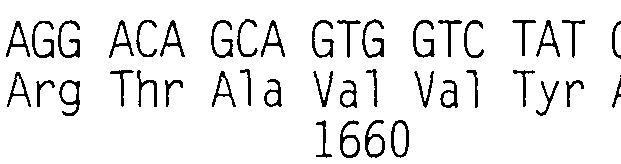
- GCA AGA TGG TGG ⁇ G GAA GAG TAC AGG T ⁇ GAT GGT T ⁇ AGA ⁇ T GAT 1561 Ala ( Arg Trp Trp Leu Glu Glu Tyr Arg Phe Asp Gly Phe Arg Phe Asp 1300 1305 1310
Landscapes
- Health & Medical Sciences (AREA)
- Life Sciences & Earth Sciences (AREA)
- Genetics & Genomics (AREA)
- Engineering & Computer Science (AREA)
- Chemical & Material Sciences (AREA)
- Organic Chemistry (AREA)
- Biotechnology (AREA)
- Molecular Biology (AREA)
- Wood Science & Technology (AREA)
- Zoology (AREA)
- Bioinformatics & Cheminformatics (AREA)
- Biomedical Technology (AREA)
- General Engineering & Computer Science (AREA)
- Nutrition Science (AREA)
- Microbiology (AREA)
- Biochemistry (AREA)
- General Health & Medical Sciences (AREA)
- Cell Biology (AREA)
- Physics & Mathematics (AREA)
- Biophysics (AREA)
- Plant Pathology (AREA)
- Medicinal Chemistry (AREA)
- Breeding Of Plants And Reproduction By Means Of Culturing (AREA)
- Polysaccharides And Polysaccharide Derivatives (AREA)
- Micro-Organisms Or Cultivation Processes Thereof (AREA)
- Enzymes And Modification Thereof (AREA)
- Management, Administration, Business Operations System, And Electronic Commerce (AREA)
- General Preparation And Processing Of Foods (AREA)
- Bakery Products And Manufacturing Methods Therefor (AREA)
- Fertilizers (AREA)
- Compounds Of Unknown Constitution (AREA)
- Solid-Sorbent Or Filter-Aiding Compositions (AREA)
Abstract
Description





Claims
Priority Applications (5)
| Application Number | Priority Date | Filing Date | Title |
|---|---|---|---|
| US09/297,703 US6956148B1 (en) | 1996-11-05 | 1997-11-04 | Nucleic acids from cassava encoding starch branching enzyme II (SBEII) and their use |
| CA002268043A CA2268043C (en) | 1996-11-05 | 1997-11-04 | Improvements in or relating to starch content of plants |
| EP97911332A EP0941352B1 (en) | 1996-11-05 | 1997-11-04 | Improvements in or relating to starch content of plants |
| AU48747/97A AU730900B2 (en) | 1996-11-05 | 1997-11-04 | Improvements in or relating to starch content of plants |
| DE69736006T DE69736006T2 (en) | 1996-11-05 | 1997-11-04 | IMPROVEMENTS OF STRENGTH CONTENT OF PLANTS |
Applications Claiming Priority (2)
| Application Number | Priority Date | Filing Date | Title |
|---|---|---|---|
| GB9623095.8 | 1996-11-05 | ||
| GBGB9623095.8A GB9623095D0 (en) | 1996-11-05 | 1996-11-05 | Improvements in or relating to starch content of plants |
Publications (2)
| Publication Number | Publication Date |
|---|---|
| WO1998020145A2 true WO1998020145A2 (en) | 1998-05-14 |
| WO1998020145A3 WO1998020145A3 (en) | 1998-07-16 |
Family
ID=10802523
Family Applications (1)
| Application Number | Title | Priority Date | Filing Date |
|---|---|---|---|
| PCT/GB1997/003032 Ceased WO1998020145A2 (en) | 1996-11-05 | 1997-11-04 | Improvements in or relating to starch content of plants |
Country Status (11)
| Country | Link |
|---|---|
| US (1) | US6956148B1 (en) |
| EP (1) | EP0941352B1 (en) |
| AT (1) | ATE328095T1 (en) |
| AU (1) | AU730900B2 (en) |
| CA (1) | CA2268043C (en) |
| DE (1) | DE69736006T2 (en) |
| DK (1) | DK0941352T3 (en) |
| ES (1) | ES2263171T3 (en) |
| GB (2) | GB9623095D0 (en) |
| PT (1) | PT941352E (en) |
| WO (1) | WO1998020145A2 (en) |
Cited By (174)
| Publication number | Priority date | Publication date | Assignee | Title |
|---|---|---|---|---|
| EP2039771A2 (en) | 2009-01-06 | 2009-03-25 | Bayer CropScience AG | Method for improved utilization of the production potential of transgenic plants |
| EP2039770A2 (en) | 2009-01-06 | 2009-03-25 | Bayer CropScience AG | Method for improved utilization of the production potential of transgenic plants |
| EP2039772A2 (en) | 2009-01-06 | 2009-03-25 | Bayer CropScience AG | Method for improved utilization of the production potential of transgenic plants introduction |
| EP2072506A1 (en) | 2007-12-21 | 2009-06-24 | Bayer CropScience AG | Thiazolyloxyphenylamidine or thiadiazolyloxyphenylamidine und its use as fungicide |
| EP2090168A1 (en) | 2008-02-12 | 2009-08-19 | Bayer CropScience AG | Method for improving plant growth |
| EP2168434A1 (en) | 2008-08-02 | 2010-03-31 | Bayer CropScience AG | Use of azols to increase resistance of plants of parts of plants to abiotic stress |
| EP2198709A1 (en) | 2008-12-19 | 2010-06-23 | Bayer CropScience AG | Method for treating resistant animal pests |
| EP2201838A1 (en) | 2008-12-05 | 2010-06-30 | Bayer CropScience AG | Active ingredient-beneficial organism combinations with insecticide and acaricide properties |
| EP2204094A1 (en) | 2008-12-29 | 2010-07-07 | Bayer CropScience AG | Method for improved utilization of the production potential of transgenic plants Introduction |
| WO2010083955A2 (en) | 2009-01-23 | 2010-07-29 | Bayer Cropscience Aktiengesellschaft | Use of enaminocarboxylic compounds for fighting viruses transmitted by insects |
| WO2010086095A1 (en) | 2009-01-29 | 2010-08-05 | Bayer Cropscience Ag | Method for improved utilization of the production potential of transgenic plants introduction |
| WO2010086311A1 (en) | 2009-01-28 | 2010-08-05 | Bayer Cropscience Ag | Fungicide n-cycloalkyl-n-bicyclicmethylene-carboxamide derivatives |
| EP2218717A1 (en) | 2009-02-17 | 2010-08-18 | Bayer CropScience AG | Fungicidal N-((HET)Arylethyl)thiocarboxamide derivatives |
| WO2010094728A1 (en) | 2009-02-19 | 2010-08-26 | Bayer Cropscience Ag | Pesticide composition comprising a tetrazolyloxime derivative and a fungicide or an insecticide active substance |
| WO2010094666A2 (en) | 2009-02-17 | 2010-08-26 | Bayer Cropscience Ag | Fungicidal n-(phenylcycloalkyl)carboxamide, n-(benzylcycloalkyl)carboxamide and thiocarboxamide derivatives |
| EP2223602A1 (en) | 2009-02-23 | 2010-09-01 | Bayer CropScience AG | Method for improved utilisation of the production potential of genetically modified plants |
| EP2232995A1 (en) | 2009-03-25 | 2010-09-29 | Bayer CropScience AG | Method for improved utilisation of the production potential of transgenic plants |
| EP2239331A1 (en) | 2009-04-07 | 2010-10-13 | Bayer CropScience AG | Method for improved utilization of the production potential of transgenic plants |
| EP2251331A1 (en) | 2009-05-15 | 2010-11-17 | Bayer CropScience AG | Fungicide pyrazole carboxamides derivatives |
| EP2255626A1 (en) | 2009-05-27 | 2010-12-01 | Bayer CropScience AG | Use of succinate dehydrogenase inhibitors to increase resistance of plants or parts of plants to abiotic stress |
| WO2011006603A2 (en) | 2009-07-16 | 2011-01-20 | Bayer Cropscience Ag | Synergistic active substance combinations containing phenyl triazoles |
| WO2011015524A2 (en) | 2009-08-03 | 2011-02-10 | Bayer Cropscience Ag | Fungicide heterocycles derivatives |
| EP2292094A1 (en) | 2009-09-02 | 2011-03-09 | Bayer CropScience AG | Active compound combinations |
| WO2011080254A2 (en) | 2009-12-28 | 2011-07-07 | Bayer Cropscience Ag | Fungicide hydroximoyl-heterocycles derivatives |
| WO2011080255A2 (en) | 2009-12-28 | 2011-07-07 | Bayer Cropscience Ag | Fungicide hydroximoyl-tetrazole derivatives |
| WO2011080256A1 (en) | 2009-12-28 | 2011-07-07 | Bayer Cropscience Ag | Fungicide hydroximoyl-tetrazole derivatives |
| EP2343280A1 (en) | 2009-12-10 | 2011-07-13 | Bayer CropScience AG | Fungicide quinoline derivatives |
| WO2011089071A2 (en) | 2010-01-22 | 2011-07-28 | Bayer Cropscience Ag | Acaricide and/or insecticide active substance combinations |
| WO2011107504A1 (en) | 2010-03-04 | 2011-09-09 | Bayer Cropscience Ag | Fluoroalkyl-substituted 2-amidobenzimidazoles and the use thereof for boosting stress tolerance in plants |
| EP2374791A1 (en) | 2008-08-14 | 2011-10-12 | Bayer CropScience Aktiengesellschaft | Insecticidal 4-phenyl-1H pyrazoles |
| WO2011124554A2 (en) | 2010-04-06 | 2011-10-13 | Bayer Cropscience Ag | Use of 4-phenylbutyric acid and/or the salts thereof for enhancing the stress tolerance of plants |
| WO2011124553A2 (en) | 2010-04-09 | 2011-10-13 | Bayer Cropscience Ag | Use of derivatives of the (1-cyanocyclopropyl)phenylphosphinic acid, the esters thereof and/or the salts thereof for enhancing the tolerance of plants to abiotic stress |
| WO2011134912A1 (en) | 2010-04-28 | 2011-11-03 | Bayer Cropscience Ag | Fungicide hydroximoyl-heterocycles derivatives |
| WO2011134911A2 (en) | 2010-04-28 | 2011-11-03 | Bayer Cropscience Ag | Fungicide hydroximoyl-tetrazole derivatives |
| WO2011134913A1 (en) | 2010-04-28 | 2011-11-03 | Bayer Cropscience Ag | Fungicide hydroximoyl-heterocycles derivatives |
| WO2011151368A2 (en) | 2010-06-03 | 2011-12-08 | Bayer Cropscience Ag | Fungicide n-[(trisubstitutedsilyl)methyl]-carboxamide derivatives |
| WO2011151369A1 (en) | 2010-06-03 | 2011-12-08 | Bayer Cropscience Ag | N-[(het)arylethyl)] pyrazole(thio)carboxamides and their heterosubstituted analogues |
| WO2011151370A1 (en) | 2010-06-03 | 2011-12-08 | Bayer Cropscience Ag | N-[(het)arylalkyl)] pyrazole (thio)carboxamides and their heterosubstituted analogues |
| WO2011154159A1 (en) | 2010-06-09 | 2011-12-15 | Bayer Bioscience N.V. | Methods and means to modify a plant genome at a nucleotide sequence commonly used in plant genome engineering |
| WO2011154158A1 (en) | 2010-06-09 | 2011-12-15 | Bayer Bioscience N.V. | Methods and means to modify a plant genome at a nucleotide sequence commonly used in plant genome engineering |
| WO2012010579A2 (en) | 2010-07-20 | 2012-01-26 | Bayer Cropscience Ag | Benzocycloalkenes as antifungal agents |
| WO2012028578A1 (en) | 2010-09-03 | 2012-03-08 | Bayer Cropscience Ag | Substituted fused pyrimidinones and dihydropyrimidinones |
| WO2012038480A2 (en) | 2010-09-22 | 2012-03-29 | Bayer Cropscience Ag | Use of biological or chemical control agents for controlling insects and nematodes in resistant crops |
| WO2012045798A1 (en) | 2010-10-07 | 2012-04-12 | Bayer Cropscience Ag | Fungicide composition comprising a tetrazolyloxime derivative and a thiazolylpiperidine derivative |
| WO2012052490A1 (en) | 2010-10-21 | 2012-04-26 | Bayer Cropscience Ag | N-benzyl heterocyclic carboxamides |
| WO2012052489A1 (en) | 2010-10-21 | 2012-04-26 | Bayer Cropscience Ag | 1-(heterocyclic carbonyl) piperidines |
| WO2012059497A1 (en) | 2010-11-02 | 2012-05-10 | Bayer Cropscience Ag | N-hetarylmethyl pyrazolylcarboxamides |
| WO2012065947A1 (en) | 2010-11-15 | 2012-05-24 | Bayer Cropscience Ag | 5-halogenopyrazolecarboxamides |
| WO2012065944A1 (en) | 2010-11-15 | 2012-05-24 | Bayer Cropscience Ag | N-aryl pyrazole(thio)carboxamides |
| WO2012065945A1 (en) | 2010-11-15 | 2012-05-24 | Bayer Cropscience Ag | 5-halogenopyrazole(thio)carboxamides |
| EP2460407A1 (en) | 2010-12-01 | 2012-06-06 | Bayer CropScience AG | Agent combinations comprising pyridylethyl benzamides and other agents |
| EP2460406A1 (en) | 2010-12-01 | 2012-06-06 | Bayer CropScience AG | Use of fluopyram for controlling nematodes in nematode resistant crops |
| WO2012072660A1 (en) | 2010-12-01 | 2012-06-07 | Bayer Cropscience Ag | Use of fluopyram for controlling nematodes in crops and for increasing yield |
| WO2012089757A1 (en) | 2010-12-29 | 2012-07-05 | Bayer Cropscience Ag | Fungicide hydroximoyl-tetrazole derivatives |
| WO2012089721A1 (en) | 2010-12-30 | 2012-07-05 | Bayer Cropscience Ag | Use of substituted spirocyclic sulfonamidocarboxylic acids, carboxylic esters thereof, carboxamides thereof and carbonitriles thereof or salts thereof for enhancement of stress tolerance in plants |
| EP2474542A1 (en) | 2010-12-29 | 2012-07-11 | Bayer CropScience AG | Fungicide hydroximoyl-tetrazole derivatives |
| EP2494867A1 (en) | 2011-03-01 | 2012-09-05 | Bayer CropScience AG | Halogen-substituted compounds in combination with fungicides |
| WO2012120105A1 (en) | 2011-03-10 | 2012-09-13 | Bayer Cropscience Ag | Use of lipochito-oligosaccharide compounds for safeguarding seed safety of treated seeds |
| WO2012123434A1 (en) | 2011-03-14 | 2012-09-20 | Bayer Cropscience Ag | Fungicide hydroximoyl-tetrazole derivatives |
| WO2012136581A1 (en) | 2011-04-08 | 2012-10-11 | Bayer Cropscience Ag | Fungicide hydroximoyl-tetrazole derivatives |
| EP2511255A1 (en) | 2011-04-15 | 2012-10-17 | Bayer CropScience AG | Substituted prop-2-in-1-ol and prop-2-en-1-ol derivatives |
| WO2012139890A1 (en) | 2011-04-15 | 2012-10-18 | Bayer Cropscience Ag | Substituted 5-(cyclohex-2-en-1-yl)-penta-2,4-dienes and 5-(cyclohex-2-en-1-yl)-pent-2-en-4-ines as active agents against abiotic stress in plants |
| WO2012139892A1 (en) | 2011-04-15 | 2012-10-18 | Bayer Cropscience Ag | Substituted 5-(bicyclo[4.1.0]hept-3-en-2-yl)-penta-2,4-dienes and 5-(bicyclo[4.1.0]hept-3-en-2-yl)-pent-2-ene-4-ines as active agents against abiotic stress in plants |
| WO2012139891A1 (en) | 2011-04-15 | 2012-10-18 | Bayer Cropscience Ag | Substituted vinyl and alkinyl cyclohexenols as active agents against abiotic stress in plants |
| US8299302B2 (en) | 2007-03-12 | 2012-10-30 | Bayer Cropscience Ag | 4-Cycloalkyl or 4-substituted phenoxyphenylamidines and use thereof as fungicides |
| WO2012168124A1 (en) | 2011-06-06 | 2012-12-13 | Bayer Cropscience Nv | Methods and means to modify a plant genome at a preselected site |
| US8334237B2 (en) | 2007-03-12 | 2012-12-18 | Bayer Cropscience Ag | Substituted phenylamidines and the use thereof as fungicides |
| WO2013004652A1 (en) | 2011-07-04 | 2013-01-10 | Bayer Intellectual Property Gmbh | Use of substituted isoquinolinones, isoquinolindiones, isoquinolintriones and dihydroisoquinolinones or in each case salts thereof as active agents against abiotic stress in plants |
| WO2013020985A1 (en) | 2011-08-10 | 2013-02-14 | Bayer Intellectual Property Gmbh | Active compound combinations comprising specific tetramic acid derivatives |
| EP2561759A1 (en) | 2011-08-26 | 2013-02-27 | Bayer Cropscience AG | Fluoroalkyl-substituted 2-amidobenzimidazoles and their effect on plant growth |
| WO2013026836A1 (en) | 2011-08-22 | 2013-02-28 | Bayer Intellectual Property Gmbh | Fungicide hydroximoyl-tetrazole derivatives |
| WO2013026740A2 (en) | 2011-08-22 | 2013-02-28 | Bayer Cropscience Nv | Methods and means to modify a plant genome |
| US8394991B2 (en) | 2007-03-12 | 2013-03-12 | Bayer Cropscience Ag | Phenoxy substituted phenylamidine derivatives and their use as fungicides |
| WO2013034621A1 (en) | 2011-09-09 | 2013-03-14 | Bayer Intellectual Property Gmbh | Acyl-homoserine lactone derivatives for improving plant yield |
| WO2013037717A1 (en) | 2011-09-12 | 2013-03-21 | Bayer Intellectual Property Gmbh | Fungicidal 4-substituted-3-{phenyl[(heterocyclylmethoxy)imino]methyl}-1,2,4-oxadizol-5(4h)-one derivatives |
| WO2013037955A1 (en) | 2011-09-16 | 2013-03-21 | Bayer Intellectual Property Gmbh | Use of acylsulfonamides for improving plant yield |
| WO2013037958A1 (en) | 2011-09-16 | 2013-03-21 | Bayer Intellectual Property Gmbh | Use of phenylpyrazolin-3-carboxylates for improving plant yield |
| WO2013037956A1 (en) | 2011-09-16 | 2013-03-21 | Bayer Intellectual Property Gmbh | Use of 5-phenyl- or 5-benzyl-2 isoxazoline-3 carboxylates for improving plant yield |
| WO2013041602A1 (en) | 2011-09-23 | 2013-03-28 | Bayer Intellectual Property Gmbh | Use of 4-substituted 1-phenyl-pyrazole-3-carboxylic-acid derivatives as agents against abiotic plant stress |
| WO2013050324A1 (en) | 2011-10-06 | 2013-04-11 | Bayer Intellectual Property Gmbh | Combination, containing 4-phenylbutyric acid (4-pba) or a salt thereof (component (a)) and one or more selected additional agronomically active compounds (component(s) (b)), that reduces abiotic plant stress |
| WO2013050410A1 (en) | 2011-10-04 | 2013-04-11 | Bayer Intellectual Property Gmbh | RNAi FOR THE CONTROL OF FUNGI AND OOMYCETES BY INHIBITING SACCHAROPINE DEHYDROGENASE GENE |
| WO2013075817A1 (en) | 2011-11-21 | 2013-05-30 | Bayer Intellectual Property Gmbh | Fungicide n-[(trisubstitutedsilyl)methyl]-carboxamide derivatives |
| US8455480B2 (en) | 2007-09-26 | 2013-06-04 | Bayer Cropscience Ag | Active agent combinations having insecticidal and acaricidal properties |
| WO2013079566A2 (en) | 2011-11-30 | 2013-06-06 | Bayer Intellectual Property Gmbh | Fungicidal n-bicycloalkyl and n-tricycloalkyl (thio)carboxamide derivatives |
| WO2013092519A1 (en) | 2011-12-19 | 2013-06-27 | Bayer Cropscience Ag | Use of anthranilic acid diamide derivatives for pest control in transgenic crops |
| WO2013098146A1 (en) | 2011-12-29 | 2013-07-04 | Bayer Intellectual Property Gmbh | Fungicidal 3-[(1,3-thiazol-4-ylmethoxyimino)(phenyl)methyl]-2-substituted-1,2,4-oxadiazol-5(2h)-one derivatives |
| WO2013098147A1 (en) | 2011-12-29 | 2013-07-04 | Bayer Intellectual Property Gmbh | Fungicidal 3-[(pyridin-2-ylmethoxyimino)(phenyl)methyl]-2-substituted-1,2,4-oxadiazol-5(2h)-one derivatives |
| US8487118B2 (en) | 2009-01-19 | 2013-07-16 | Bayer Cropscience Ag | Cyclic diones and their use as insecticides, acaricides and/or fungicides |
| US8519003B2 (en) | 2007-03-12 | 2013-08-27 | Bayer Cropscience Ag | Phenoxyphenylamidines as fungicides |
| WO2013124275A1 (en) | 2012-02-22 | 2013-08-29 | Bayer Cropscience Ag | Use of succinate dehydrogenase inhibitors (sdhis) for controlling wood diseases in grape. |
| WO2013127704A1 (en) | 2012-02-27 | 2013-09-06 | Bayer Intellectual Property Gmbh | Active compound combinations containing a thiazoylisoxazoline and a fungicide |
| WO2013139949A1 (en) | 2012-03-23 | 2013-09-26 | Bayer Intellectual Property Gmbh | Compositions comprising a strigolactame compound for enhanced plant growth and yield |
| WO2013153143A1 (en) | 2012-04-12 | 2013-10-17 | Bayer Cropscience Ag | N-acyl- 2 - (cyclo) alkylpyrrolidines and piperidines useful as fungicides |
| WO2013156560A1 (en) | 2012-04-20 | 2013-10-24 | Bayer Cropscience Ag | N-cycloalkyl-n-[(trisubstitutedsilylphenyl)methylene]-(thio)carboxamide derivatives |
| WO2013156559A1 (en) | 2012-04-20 | 2013-10-24 | Bayer Cropscience Ag | N-cycloalkyl-n-[(heterocyclylphenyl)methylene]-(thio)carboxamide derivatives |
| WO2013160230A1 (en) | 2012-04-23 | 2013-10-31 | Bayer Cropscience Nv | Targeted genome engineering in plants |
| EP2662370A1 (en) | 2012-05-09 | 2013-11-13 | Bayer CropScience AG | 5-Halogenopyrazole benzofuranyl carboxamides |
| EP2662362A1 (en) | 2012-05-09 | 2013-11-13 | Bayer CropScience AG | Pyrazole indanyl carboxamides |
| EP2662364A1 (en) | 2012-05-09 | 2013-11-13 | Bayer CropScience AG | Pyrazole tetrahydronaphthyl carboxamides |
| EP2662361A1 (en) | 2012-05-09 | 2013-11-13 | Bayer CropScience AG | Pyrazol indanyl carboxamides |
| EP2662363A1 (en) | 2012-05-09 | 2013-11-13 | Bayer CropScience AG | 5-Halogenopyrazole biphenylcarboxamides |
| EP2662360A1 (en) | 2012-05-09 | 2013-11-13 | Bayer CropScience AG | 5-Halogenopyrazole indanyl carboxamides |
| WO2013167545A1 (en) | 2012-05-09 | 2013-11-14 | Bayer Cropscience Ag | Pyrazole indanyl carboxamides |
| WO2013167544A1 (en) | 2012-05-09 | 2013-11-14 | Bayer Cropscience Ag | 5-halogenopyrazole indanyl carboxamides |
| WO2013174836A1 (en) | 2012-05-22 | 2013-11-28 | Bayer Cropscience Ag | Active compounds combinations comprising a lipo-chitooligosaccharide derivative and a nematicide, insecticidal or fungicidal compound |
| WO2014009322A1 (en) | 2012-07-11 | 2014-01-16 | Bayer Cropscience Ag | Use of fungicidal combinations for increasing the tolerance of a plant towards abiotic stress |
| WO2014037340A1 (en) | 2012-09-05 | 2014-03-13 | Bayer Cropscience Ag | Use of substituted 2-amidobenzimidazoles, 2-amidobenzoxazoles and 2-amidobenzothiazoles or salts thereof as active substances against abiotic plant stress |
| WO2014060502A1 (en) | 2012-10-19 | 2014-04-24 | Bayer Cropscience Ag | Active compound combinations comprising carboxamide derivatives |
| WO2014060519A1 (en) | 2012-10-19 | 2014-04-24 | Bayer Cropscience Ag | Method for enhancing tolerance to abiotic stress in plants using carboxamide or thiocarboxamide derivatives |
| WO2014060518A1 (en) | 2012-10-19 | 2014-04-24 | Bayer Cropscience Ag | Method of plant growth promotion using carboxamide derivatives |
| WO2014060520A1 (en) | 2012-10-19 | 2014-04-24 | Bayer Cropscience Ag | Method for treating plants against fungi resistant to fungicides using carboxamide or thiocarboxamide derivatives |
| EP2735231A1 (en) | 2012-11-23 | 2014-05-28 | Bayer CropScience AG | Active compound combinations |
| WO2014079957A1 (en) | 2012-11-23 | 2014-05-30 | Bayer Cropscience Ag | Selective inhibition of ethylene signal transduction |
| WO2014083089A1 (en) | 2012-11-30 | 2014-06-05 | Bayer Cropscience Ag | Ternary fungicidal and pesticidal mixtures |
| WO2014083031A2 (en) | 2012-11-30 | 2014-06-05 | Bayer Cropscience Ag | Binary pesticidal and fungicidal mixtures |
| WO2014083033A1 (en) | 2012-11-30 | 2014-06-05 | Bayer Cropsience Ag | Binary fungicidal or pesticidal mixture |
| WO2014083088A2 (en) | 2012-11-30 | 2014-06-05 | Bayer Cropscience Ag | Binary fungicidal mixtures |
| WO2014082950A1 (en) | 2012-11-30 | 2014-06-05 | Bayer Cropscience Ag | Ternary fungicidal mixtures |
| EP2740356A1 (en) | 2012-12-05 | 2014-06-11 | Bayer CropScience AG | Substituted (2Z)-5(1-Hydroxycyclohexyl)pent-2-en-4-inic acid derivatives |
| EP2740720A1 (en) | 2012-12-05 | 2014-06-11 | Bayer CropScience AG | Substituted bicyclic and tricyclic pent-2-en-4-inic acid derivatives and their use for enhancing the stress tolerance in plants |
| WO2014086751A1 (en) | 2012-12-05 | 2014-06-12 | Bayer Cropscience Ag | Use of substituted 1-(aryl ethynyl)-, 1-(heteroaryl ethynyl)-, 1-(heterocyclyl ethynyl)- and 1-(cyloalkenyl ethynyl)-cyclohexanols as active agents against abiotic plant stress |
| WO2014090765A1 (en) | 2012-12-12 | 2014-06-19 | Bayer Cropscience Ag | Use of 1-[2-fluoro-4-methyl-5-(2,2,2-trifluoroethylsulfinyl)phenyl]-5-amino-3-trifluoromethyl)-1 h-1,2,4 tfia zole for controlling nematodes in nematode-resistant crops |
| WO2014095677A1 (en) | 2012-12-19 | 2014-06-26 | Bayer Cropscience Ag | Difluoromethyl-nicotinic- tetrahydronaphtyl carboxamides |
| WO2014095826A1 (en) | 2012-12-18 | 2014-06-26 | Bayer Cropscience Ag | Binary fungicidal and bactericidal combinations |
| US8796175B2 (en) | 2008-08-29 | 2014-08-05 | Bayer Cropscience Ag | Method for enhancing plant intrinsic defense |
| US8828906B2 (en) | 2009-03-25 | 2014-09-09 | Bayer Cropscience Ag | Active compound combinations having insecticidal and acaricidal properties |
| US8828907B2 (en) | 2009-03-25 | 2014-09-09 | Bayer Cropscience Ag | Active ingredient combinations having insecticidal and acaricidal properties |
| WO2014135608A1 (en) | 2013-03-07 | 2014-09-12 | Bayer Cropscience Ag | Fungicidal 3-{phenyl[(heterocyclylmethoxy)imino]methyl}-heterocycle derivatives |
| US8835657B2 (en) | 2009-05-06 | 2014-09-16 | Bayer Cropscience Ag | Cyclopentanedione compounds and their use as insecticides, acaricides and/or fungicides |
| US8846568B2 (en) | 2009-03-25 | 2014-09-30 | Bayer Cropscience Ag | Active compound combinations having insecticidal and acaricidal properties |
| US8846567B2 (en) | 2009-03-25 | 2014-09-30 | Bayer Cropscience Ag | Active compound combinations having insecticidal and acaricidal properties |
| WO2014161821A1 (en) | 2013-04-02 | 2014-10-09 | Bayer Cropscience Nv | Targeted genome engineering in eukaryotes |
| WO2014167008A1 (en) | 2013-04-12 | 2014-10-16 | Bayer Cropscience Ag | Novel triazolinthione derivatives |
| WO2014167009A1 (en) | 2013-04-12 | 2014-10-16 | Bayer Cropscience Ag | Novel triazole derivatives |
| WO2014170345A2 (en) | 2013-04-19 | 2014-10-23 | Bayer Cropscience Ag | Method for improved utilization of the production potential of transgenic plants |
| WO2014170364A1 (en) | 2013-04-19 | 2014-10-23 | Bayer Cropscience Ag | Binary insecticidal or pesticidal mixture |
| WO2014177582A1 (en) | 2013-04-30 | 2014-11-06 | Bayer Cropscience Ag | N-(2-fluoro-2-phenethyl)carboxamides as nematicides and endoparasiticides |
| WO2014177514A1 (en) | 2013-04-30 | 2014-11-06 | Bayer Cropscience Ag | Nematicidal n-substituted phenethylcarboxamides |
| WO2014206953A1 (en) | 2013-06-26 | 2014-12-31 | Bayer Cropscience Ag | N-cycloalkyl-n-[(bicyclylphenyl)methylene]-(thio)carboxamide derivatives |
| US8927583B2 (en) | 2006-12-22 | 2015-01-06 | Bayer Cropscience Ag | Pesticidal composition comprising a 2-pyrdilmethylbenzamide derivative and an insecticide compound |
| WO2015004040A1 (en) | 2013-07-09 | 2015-01-15 | Bayer Cropscience Ag | Use of selected pyridone carboxamides or salts thereof as active substances against abiotic plant stress |
| US9012360B2 (en) | 2009-03-25 | 2015-04-21 | Bayer Intellectual Property Gmbh | Synergistic combinations of active ingredients |
| WO2015082587A1 (en) | 2013-12-05 | 2015-06-11 | Bayer Cropscience Ag | N-cycloalkyl-n-{[2-(1-substitutedcycloalkyl)phenyl]methylene}-(thio)carboxamide derivatives |
| WO2015082586A1 (en) | 2013-12-05 | 2015-06-11 | Bayer Cropscience Ag | N-cycloalkyl-n-{[2-(1-substitutedcycloalkyl)phenyl]methylene}-(thio)carboxamide derivatives |
| US9199922B2 (en) | 2007-03-12 | 2015-12-01 | Bayer Intellectual Property Gmbh | Dihalophenoxyphenylamidines and use thereof as fungicides |
| US9232794B2 (en) | 2009-06-02 | 2016-01-12 | Bayer Intellectual Property Gmbh | Use of succinate dehydrogenase inhibitors for controlling Sclerotinia ssp |
| WO2016012362A1 (en) | 2014-07-22 | 2016-01-28 | Bayer Cropscience Aktiengesellschaft | Substituted cyano cycloalkyl penta-2,4-dienes, cyano cycloalkyl pent-2-en-4-ynes, cyano heterocyclyl penta-2,4-dienes and cyano heterocyclyl pent-2-en-4-ynes as active substances against abiotic plant stress |
| EP2997825A1 (en) | 2011-04-22 | 2016-03-23 | Bayer Intellectual Property GmbH | Active compound combinations comprising a (thio)carboxamide derivative and a fungicidal compound |
| EP3000809A1 (en) | 2009-05-15 | 2016-03-30 | Bayer Intellectual Property GmbH | Fungicide pyrazole carboxamides derivatives |
| WO2016096942A1 (en) | 2014-12-18 | 2016-06-23 | Bayer Cropscience Aktiengesellschaft | Use of selected pyridone carboxamides or salts thereof as active substances against abiotic plant stress |
| WO2016166077A1 (en) | 2015-04-13 | 2016-10-20 | Bayer Cropscience Aktiengesellschaft | N-cycloalkyl-n-(biheterocyclyethylene)-(thio)carboxamide derivatives |
| US9763451B2 (en) | 2008-12-29 | 2017-09-19 | Bayer Intellectual Property Gmbh | Method for improved use of the production potential of genetically modified plants |
| WO2018019676A1 (en) | 2016-07-29 | 2018-02-01 | Bayer Cropscience Aktiengesellschaft | Active compound combinations and methods to protect the propagation material of plants |
| WO2018054829A1 (en) | 2016-09-22 | 2018-03-29 | Bayer Cropscience Aktiengesellschaft | Novel triazole derivatives and their use as fungicides |
| WO2018054911A1 (en) | 2016-09-23 | 2018-03-29 | Bayer Cropscience Nv | Targeted genome optimization in plants |
| WO2018054832A1 (en) | 2016-09-22 | 2018-03-29 | Bayer Cropscience Aktiengesellschaft | Novel triazole derivatives |
| WO2018077711A2 (en) | 2016-10-26 | 2018-05-03 | Bayer Cropscience Aktiengesellschaft | Use of pyraziflumid for controlling sclerotinia spp in seed treatment applications |
| EP3332645A1 (en) | 2016-12-12 | 2018-06-13 | Bayer Cropscience AG | Use of substituted pyrimidine diones or their salts as agents to combat abiotic plant stress |
| WO2018104392A1 (en) | 2016-12-08 | 2018-06-14 | Bayer Cropscience Aktiengesellschaft | Use of insecticides for controlling wireworms |
| WO2018108627A1 (en) | 2016-12-12 | 2018-06-21 | Bayer Cropscience Aktiengesellschaft | Use of substituted indolinylmethyl sulfonamides, or the salts thereof for increasing the stress tolerance of plants |
| DE102007045920B4 (en) | 2007-09-26 | 2018-07-05 | Bayer Intellectual Property Gmbh | Synergistic drug combinations |
| DE102007045919B4 (en) | 2007-09-26 | 2018-07-05 | Bayer Intellectual Property Gmbh | Drug combinations with insecticidal and acaricidal properties |
| DE102007045953B4 (en) | 2007-09-26 | 2018-07-05 | Bayer Intellectual Property Gmbh | Drug combinations with insecticidal and acaricidal properties |
| WO2019025153A1 (en) | 2017-07-31 | 2019-02-07 | Bayer Cropscience Aktiengesellschaft | USE OF SUBSTITUTED N-SULFONYL-N'-ARYLDIAMINOALKANES AND N-SULFONYL-N'-HETEROARYL DIAMINOALKANES OR THEIR SALTS TO INCREASE STRESSTOLERANCE IN PLANTS |
| WO2019060746A1 (en) | 2017-09-21 | 2019-03-28 | The Broad Institute, Inc. | Systems, methods, and compositions for targeted nucleic acid editing |
| WO2019126709A1 (en) | 2017-12-22 | 2019-06-27 | The Broad Institute, Inc. | Cas12b systems, methods, and compositions for targeted dna base editing |
| WO2019233863A1 (en) | 2018-06-04 | 2019-12-12 | Bayer Aktiengesellschaft | Herbicidally active bicyclic benzoylpyrazoles |
| CN111171121A (en) * | 2019-11-26 | 2020-05-19 | 中国热带农业科学院热带生物技术研究所 | Transcription factor and application thereof in activating expression of banana MaSBE2.3 |
| WO2020131862A1 (en) | 2018-12-17 | 2020-06-25 | The Broad Institute, Inc. | Crispr-associated transposase systems and methods of use thereof |
| US10968257B2 (en) | 2018-04-03 | 2021-04-06 | The Broad Institute, Inc. | Target recognition motifs and uses thereof |
| US11180751B2 (en) | 2015-06-18 | 2021-11-23 | The Broad Institute, Inc. | CRISPR enzymes and systems |
| US11591601B2 (en) | 2017-05-05 | 2023-02-28 | The Broad Institute, Inc. | Methods for identification and modification of lncRNA associated with target genotypes and phenotypes |
| US12297436B2 (en) | 2017-05-18 | 2025-05-13 | The Broad Institute, Inc. | Systems, methods, and compositions for targeted nucleic acid editing |
| US12499971B2 (en) | 2016-09-28 | 2025-12-16 | The Broad Institute, Inc. | Systematic screening and mapping of regulatory elements in non-coding genomic regions, methods, compositions, and applications thereof |
Families Citing this family (7)
| Publication number | Priority date | Publication date | Assignee | Title |
|---|---|---|---|---|
| ES2321248T3 (en) | 1997-09-12 | 2009-06-03 | Commonwealth Scientific And Industrial Research Organisation | REGULATION OF GENE EXPRESSION IN PLANTS. |
| EP1649022B1 (en) | 2003-06-30 | 2011-07-27 | Commonwealth Scientific And Industrial Research Organisation | Wheat with altered branching enzyme activity and starch and starch containing products derived thereform |
| CL2007003743A1 (en) * | 2006-12-22 | 2008-07-11 | Bayer Cropscience Ag | COMPOSITION THAT INCLUDES FENAMIDONA AND AN INSECTICIDE COMPOUND; AND METHOD TO CONTROL FITOPATOGENOS CULTURES AND INSECTS FACING OR PREVENTIVELY. |
| EP1969931A1 (en) * | 2007-03-12 | 2008-09-17 | Bayer CropScience Aktiengesellschaft | Fluoroalkyl phenylamidines and their use as fungicides |
| BRPI0808798A2 (en) * | 2007-03-12 | 2014-10-07 | Bayer Cropscience Ag | 3,5-DISSUBSTITUTED PHENOXYPHENYLAMIDINS AND THEIR USE AS FUNGICIDES |
| US8168567B2 (en) * | 2007-04-19 | 2012-05-01 | Bayer Cropscience Ag | Thiadiazolyl oxyphenyl amidines and the use thereof as a fungicide |
| DE102007045922A1 (en) | 2007-09-26 | 2009-04-02 | Bayer Cropscience Ag | Drug combinations with insecticidal and acaricidal properties |
Family Cites Families (6)
| Publication number | Priority date | Publication date | Assignee | Title |
|---|---|---|---|---|
| SE9004095L (en) * | 1990-12-21 | 1992-06-01 | Amylogene Hb | GENETIC MODIFICATION OF POTATOIS BEFORE EDUCATION OF AMYLOST TYPE |
| GB9223454D0 (en) * | 1992-11-09 | 1992-12-23 | Ici Plc | Novel plants and processes for obtaining them |
| CA2186399C (en) * | 1994-03-25 | 2001-09-04 | David Cooke | Method for producing altered starch from potato plants |
| AU706009B2 (en) * | 1995-05-05 | 1999-06-03 | Brunob Ii B.V. | Improvements in or relating to plant starch composition |
| SE513209C2 (en) * | 1995-11-29 | 2000-07-31 | Lars Rask | Process for producing transgenic potatoes with increased or decreased degree of branching of amylopectin starch |
| BR9612086A (en) * | 1995-12-20 | 1999-02-17 | Du Pont | Method for controlling fine starch structure of starch variety Starch method for preparing a thickened food and method for controlling branch chain distribution |
-
1996
- 1996-11-05 GB GBGB9623095.8A patent/GB9623095D0/en active Pending
-
1997
- 1997-11-04 GB GB9723142A patent/GB2320716B/en not_active Expired - Fee Related
- 1997-11-04 US US09/297,703 patent/US6956148B1/en not_active Expired - Fee Related
- 1997-11-04 CA CA002268043A patent/CA2268043C/en not_active Expired - Fee Related
- 1997-11-04 AT AT97911332T patent/ATE328095T1/en not_active IP Right Cessation
- 1997-11-04 PT PT97911332T patent/PT941352E/en unknown
- 1997-11-04 DE DE69736006T patent/DE69736006T2/en not_active Expired - Lifetime
- 1997-11-04 WO PCT/GB1997/003032 patent/WO1998020145A2/en not_active Ceased
- 1997-11-04 EP EP97911332A patent/EP0941352B1/en not_active Expired - Lifetime
- 1997-11-04 ES ES97911332T patent/ES2263171T3/en not_active Expired - Lifetime
- 1997-11-04 DK DK97911332T patent/DK0941352T3/en active
- 1997-11-04 AU AU48747/97A patent/AU730900B2/en not_active Ceased
Cited By (195)
| Publication number | Priority date | Publication date | Assignee | Title |
|---|---|---|---|---|
| US8927583B2 (en) | 2006-12-22 | 2015-01-06 | Bayer Cropscience Ag | Pesticidal composition comprising a 2-pyrdilmethylbenzamide derivative and an insecticide compound |
| US8299302B2 (en) | 2007-03-12 | 2012-10-30 | Bayer Cropscience Ag | 4-Cycloalkyl or 4-substituted phenoxyphenylamidines and use thereof as fungicides |
| US8394991B2 (en) | 2007-03-12 | 2013-03-12 | Bayer Cropscience Ag | Phenoxy substituted phenylamidine derivatives and their use as fungicides |
| US8334237B2 (en) | 2007-03-12 | 2012-12-18 | Bayer Cropscience Ag | Substituted phenylamidines and the use thereof as fungicides |
| US8519003B2 (en) | 2007-03-12 | 2013-08-27 | Bayer Cropscience Ag | Phenoxyphenylamidines as fungicides |
| US9199922B2 (en) | 2007-03-12 | 2015-12-01 | Bayer Intellectual Property Gmbh | Dihalophenoxyphenylamidines and use thereof as fungicides |
| US8748662B2 (en) | 2007-03-12 | 2014-06-10 | Bayer Cropscience Ag | 4-cycloalkyl or 4-aryl substituted phenoxyphenylamidines and use thereof as fungicides |
| US8785692B2 (en) | 2007-03-12 | 2014-07-22 | Bayer Cropscience Ag | Substituted phenylamidines and the use thereof as fungicides |
| DE102007045920B4 (en) | 2007-09-26 | 2018-07-05 | Bayer Intellectual Property Gmbh | Synergistic drug combinations |
| DE102007045953B4 (en) | 2007-09-26 | 2018-07-05 | Bayer Intellectual Property Gmbh | Drug combinations with insecticidal and acaricidal properties |
| US8455480B2 (en) | 2007-09-26 | 2013-06-04 | Bayer Cropscience Ag | Active agent combinations having insecticidal and acaricidal properties |
| DE102007045919B4 (en) | 2007-09-26 | 2018-07-05 | Bayer Intellectual Property Gmbh | Drug combinations with insecticidal and acaricidal properties |
| EP2072506A1 (en) | 2007-12-21 | 2009-06-24 | Bayer CropScience AG | Thiazolyloxyphenylamidine or thiadiazolyloxyphenylamidine und its use as fungicide |
| EP2090168A1 (en) | 2008-02-12 | 2009-08-19 | Bayer CropScience AG | Method for improving plant growth |
| EP2168434A1 (en) | 2008-08-02 | 2010-03-31 | Bayer CropScience AG | Use of azols to increase resistance of plants of parts of plants to abiotic stress |
| EP2374791A1 (en) | 2008-08-14 | 2011-10-12 | Bayer CropScience Aktiengesellschaft | Insecticidal 4-phenyl-1H pyrazoles |
| US8796175B2 (en) | 2008-08-29 | 2014-08-05 | Bayer Cropscience Ag | Method for enhancing plant intrinsic defense |
| EP2201838A1 (en) | 2008-12-05 | 2010-06-30 | Bayer CropScience AG | Active ingredient-beneficial organism combinations with insecticide and acaricide properties |
| EP2198709A1 (en) | 2008-12-19 | 2010-06-23 | Bayer CropScience AG | Method for treating resistant animal pests |
| US9763451B2 (en) | 2008-12-29 | 2017-09-19 | Bayer Intellectual Property Gmbh | Method for improved use of the production potential of genetically modified plants |
| EP2204094A1 (en) | 2008-12-29 | 2010-07-07 | Bayer CropScience AG | Method for improved utilization of the production potential of transgenic plants Introduction |
| WO2010075994A1 (en) | 2008-12-29 | 2010-07-08 | Bayer Cropscience Aktiengesellschaft | Treatment of transgenic crops with mixtures of fiproles and chloronicotinyls |
| EP2039770A2 (en) | 2009-01-06 | 2009-03-25 | Bayer CropScience AG | Method for improved utilization of the production potential of transgenic plants |
| EP2039772A2 (en) | 2009-01-06 | 2009-03-25 | Bayer CropScience AG | Method for improved utilization of the production potential of transgenic plants introduction |
| EP2039771A2 (en) | 2009-01-06 | 2009-03-25 | Bayer CropScience AG | Method for improved utilization of the production potential of transgenic plants |
| US8487118B2 (en) | 2009-01-19 | 2013-07-16 | Bayer Cropscience Ag | Cyclic diones and their use as insecticides, acaricides and/or fungicides |
| EP2227951A1 (en) | 2009-01-23 | 2010-09-15 | Bayer CropScience AG | Application of enaminocarbonyl compounds for combating viruses transmitted by insects |
| WO2010083955A2 (en) | 2009-01-23 | 2010-07-29 | Bayer Cropscience Aktiengesellschaft | Use of enaminocarboxylic compounds for fighting viruses transmitted by insects |
| WO2010086311A1 (en) | 2009-01-28 | 2010-08-05 | Bayer Cropscience Ag | Fungicide n-cycloalkyl-n-bicyclicmethylene-carboxamide derivatives |
| WO2010086095A1 (en) | 2009-01-29 | 2010-08-05 | Bayer Cropscience Ag | Method for improved utilization of the production potential of transgenic plants introduction |
| WO2010094666A2 (en) | 2009-02-17 | 2010-08-26 | Bayer Cropscience Ag | Fungicidal n-(phenylcycloalkyl)carboxamide, n-(benzylcycloalkyl)carboxamide and thiocarboxamide derivatives |
| EP2218717A1 (en) | 2009-02-17 | 2010-08-18 | Bayer CropScience AG | Fungicidal N-((HET)Arylethyl)thiocarboxamide derivatives |
| WO2010094728A1 (en) | 2009-02-19 | 2010-08-26 | Bayer Cropscience Ag | Pesticide composition comprising a tetrazolyloxime derivative and a fungicide or an insecticide active substance |
| EP2223602A1 (en) | 2009-02-23 | 2010-09-01 | Bayer CropScience AG | Method for improved utilisation of the production potential of genetically modified plants |
| US8846567B2 (en) | 2009-03-25 | 2014-09-30 | Bayer Cropscience Ag | Active compound combinations having insecticidal and acaricidal properties |
| US8828907B2 (en) | 2009-03-25 | 2014-09-09 | Bayer Cropscience Ag | Active ingredient combinations having insecticidal and acaricidal properties |
| US8846568B2 (en) | 2009-03-25 | 2014-09-30 | Bayer Cropscience Ag | Active compound combinations having insecticidal and acaricidal properties |
| US8828906B2 (en) | 2009-03-25 | 2014-09-09 | Bayer Cropscience Ag | Active compound combinations having insecticidal and acaricidal properties |
| EP2232995A1 (en) | 2009-03-25 | 2010-09-29 | Bayer CropScience AG | Method for improved utilisation of the production potential of transgenic plants |
| US9012360B2 (en) | 2009-03-25 | 2015-04-21 | Bayer Intellectual Property Gmbh | Synergistic combinations of active ingredients |
| EP2239331A1 (en) | 2009-04-07 | 2010-10-13 | Bayer CropScience AG | Method for improved utilization of the production potential of transgenic plants |
| US8835657B2 (en) | 2009-05-06 | 2014-09-16 | Bayer Cropscience Ag | Cyclopentanedione compounds and their use as insecticides, acaricides and/or fungicides |
| EP2251331A1 (en) | 2009-05-15 | 2010-11-17 | Bayer CropScience AG | Fungicide pyrazole carboxamides derivatives |
| EP3000809A1 (en) | 2009-05-15 | 2016-03-30 | Bayer Intellectual Property GmbH | Fungicide pyrazole carboxamides derivatives |
| EP2255626A1 (en) | 2009-05-27 | 2010-12-01 | Bayer CropScience AG | Use of succinate dehydrogenase inhibitors to increase resistance of plants or parts of plants to abiotic stress |
| US9877482B2 (en) | 2009-06-02 | 2018-01-30 | Bayer Intellectual Property Gmbh | Use of succinate dehydrogenase inhibitors for controlling Sclerotinia ssp |
| US9232794B2 (en) | 2009-06-02 | 2016-01-12 | Bayer Intellectual Property Gmbh | Use of succinate dehydrogenase inhibitors for controlling Sclerotinia ssp |
| WO2011006603A2 (en) | 2009-07-16 | 2011-01-20 | Bayer Cropscience Ag | Synergistic active substance combinations containing phenyl triazoles |
| WO2011015524A2 (en) | 2009-08-03 | 2011-02-10 | Bayer Cropscience Ag | Fungicide heterocycles derivatives |
| WO2011035834A1 (en) | 2009-09-02 | 2011-03-31 | Bayer Cropscience Ag | Active compound combinations |
| EP2292094A1 (en) | 2009-09-02 | 2011-03-09 | Bayer CropScience AG | Active compound combinations |
| EP2343280A1 (en) | 2009-12-10 | 2011-07-13 | Bayer CropScience AG | Fungicide quinoline derivatives |
| WO2011080254A2 (en) | 2009-12-28 | 2011-07-07 | Bayer Cropscience Ag | Fungicide hydroximoyl-heterocycles derivatives |
| WO2011080255A2 (en) | 2009-12-28 | 2011-07-07 | Bayer Cropscience Ag | Fungicide hydroximoyl-tetrazole derivatives |
| WO2011080256A1 (en) | 2009-12-28 | 2011-07-07 | Bayer Cropscience Ag | Fungicide hydroximoyl-tetrazole derivatives |
| WO2011089071A2 (en) | 2010-01-22 | 2011-07-28 | Bayer Cropscience Ag | Acaricide and/or insecticide active substance combinations |
| US8722072B2 (en) | 2010-01-22 | 2014-05-13 | Bayer Intellectual Property Gmbh | Acaricidal and/or insecticidal active ingredient combinations |
| WO2011107504A1 (en) | 2010-03-04 | 2011-09-09 | Bayer Cropscience Ag | Fluoroalkyl-substituted 2-amidobenzimidazoles and the use thereof for boosting stress tolerance in plants |
| WO2011124554A2 (en) | 2010-04-06 | 2011-10-13 | Bayer Cropscience Ag | Use of 4-phenylbutyric acid and/or the salts thereof for enhancing the stress tolerance of plants |
| WO2011124553A2 (en) | 2010-04-09 | 2011-10-13 | Bayer Cropscience Ag | Use of derivatives of the (1-cyanocyclopropyl)phenylphosphinic acid, the esters thereof and/or the salts thereof for enhancing the tolerance of plants to abiotic stress |
| WO2011134911A2 (en) | 2010-04-28 | 2011-11-03 | Bayer Cropscience Ag | Fungicide hydroximoyl-tetrazole derivatives |
| WO2011134913A1 (en) | 2010-04-28 | 2011-11-03 | Bayer Cropscience Ag | Fungicide hydroximoyl-heterocycles derivatives |
| WO2011134912A1 (en) | 2010-04-28 | 2011-11-03 | Bayer Cropscience Ag | Fungicide hydroximoyl-heterocycles derivatives |
| WO2011151369A1 (en) | 2010-06-03 | 2011-12-08 | Bayer Cropscience Ag | N-[(het)arylethyl)] pyrazole(thio)carboxamides and their heterosubstituted analogues |
| WO2011151370A1 (en) | 2010-06-03 | 2011-12-08 | Bayer Cropscience Ag | N-[(het)arylalkyl)] pyrazole (thio)carboxamides and their heterosubstituted analogues |
| WO2011151368A2 (en) | 2010-06-03 | 2011-12-08 | Bayer Cropscience Ag | Fungicide n-[(trisubstitutedsilyl)methyl]-carboxamide derivatives |
| WO2011154159A1 (en) | 2010-06-09 | 2011-12-15 | Bayer Bioscience N.V. | Methods and means to modify a plant genome at a nucleotide sequence commonly used in plant genome engineering |
| WO2011154158A1 (en) | 2010-06-09 | 2011-12-15 | Bayer Bioscience N.V. | Methods and means to modify a plant genome at a nucleotide sequence commonly used in plant genome engineering |
| WO2012010579A2 (en) | 2010-07-20 | 2012-01-26 | Bayer Cropscience Ag | Benzocycloalkenes as antifungal agents |
| WO2012028578A1 (en) | 2010-09-03 | 2012-03-08 | Bayer Cropscience Ag | Substituted fused pyrimidinones and dihydropyrimidinones |
| WO2012038476A1 (en) | 2010-09-22 | 2012-03-29 | Bayer Cropscience Ag | Use of active ingredients for controlling nematodes in nematode-resistant crops |
| WO2012038480A2 (en) | 2010-09-22 | 2012-03-29 | Bayer Cropscience Ag | Use of biological or chemical control agents for controlling insects and nematodes in resistant crops |
| WO2012045798A1 (en) | 2010-10-07 | 2012-04-12 | Bayer Cropscience Ag | Fungicide composition comprising a tetrazolyloxime derivative and a thiazolylpiperidine derivative |
| WO2012052489A1 (en) | 2010-10-21 | 2012-04-26 | Bayer Cropscience Ag | 1-(heterocyclic carbonyl) piperidines |
| WO2012052490A1 (en) | 2010-10-21 | 2012-04-26 | Bayer Cropscience Ag | N-benzyl heterocyclic carboxamides |
| WO2012059497A1 (en) | 2010-11-02 | 2012-05-10 | Bayer Cropscience Ag | N-hetarylmethyl pyrazolylcarboxamides |
| US9206137B2 (en) | 2010-11-15 | 2015-12-08 | Bayer Intellectual Property Gmbh | N-Aryl pyrazole(thio)carboxamides |
| WO2012065947A1 (en) | 2010-11-15 | 2012-05-24 | Bayer Cropscience Ag | 5-halogenopyrazolecarboxamides |
| WO2012065945A1 (en) | 2010-11-15 | 2012-05-24 | Bayer Cropscience Ag | 5-halogenopyrazole(thio)carboxamides |
| WO2012065944A1 (en) | 2010-11-15 | 2012-05-24 | Bayer Cropscience Ag | N-aryl pyrazole(thio)carboxamides |
| EP3103338A1 (en) | 2010-12-01 | 2016-12-14 | Bayer Intellectual Property GmbH | Agent combinations comprising pyridylethyl benzamides and other agents |
| EP2460406A1 (en) | 2010-12-01 | 2012-06-06 | Bayer CropScience AG | Use of fluopyram for controlling nematodes in nematode resistant crops |
| EP2460407A1 (en) | 2010-12-01 | 2012-06-06 | Bayer CropScience AG | Agent combinations comprising pyridylethyl benzamides and other agents |
| EP3103339A1 (en) | 2010-12-01 | 2016-12-14 | Bayer Intellectual Property GmbH | Agent combinations comprising pyridylethyl benzamides and other agents |
| WO2012072660A1 (en) | 2010-12-01 | 2012-06-07 | Bayer Cropscience Ag | Use of fluopyram for controlling nematodes in crops and for increasing yield |
| EP3103334A1 (en) | 2010-12-01 | 2016-12-14 | Bayer Intellectual Property GmbH | Agent combinations comprising pyridylethyl benzamides and other agents |
| EP3092900A1 (en) | 2010-12-01 | 2016-11-16 | Bayer Intellectual Property GmbH | Active ingredient combinations comprising pyridylethylbenzamides and other active ingredients |
| WO2012072696A1 (en) | 2010-12-01 | 2012-06-07 | Bayer Cropscience Ag | Active ingredient combinations comprising pyridylethylbenzamides and other active ingredients |
| EP3103340A1 (en) | 2010-12-01 | 2016-12-14 | Bayer Intellectual Property GmbH | Agent combinations comprising pyridylethyl benzamides and other agents |
| WO2012089757A1 (en) | 2010-12-29 | 2012-07-05 | Bayer Cropscience Ag | Fungicide hydroximoyl-tetrazole derivatives |
| EP2474542A1 (en) | 2010-12-29 | 2012-07-11 | Bayer CropScience AG | Fungicide hydroximoyl-tetrazole derivatives |
| WO2012089721A1 (en) | 2010-12-30 | 2012-07-05 | Bayer Cropscience Ag | Use of substituted spirocyclic sulfonamidocarboxylic acids, carboxylic esters thereof, carboxamides thereof and carbonitriles thereof or salts thereof for enhancement of stress tolerance in plants |
| WO2012089722A2 (en) | 2010-12-30 | 2012-07-05 | Bayer Cropscience Ag | Use of open-chain carboxylic acids, carbonic esters, carboxamides and carbonitriles of aryl, heteroaryl and benzylsulfonamide or the salts thereof for improving the stress tolerance in plants |
| EP2494867A1 (en) | 2011-03-01 | 2012-09-05 | Bayer CropScience AG | Halogen-substituted compounds in combination with fungicides |
| WO2012120105A1 (en) | 2011-03-10 | 2012-09-13 | Bayer Cropscience Ag | Use of lipochito-oligosaccharide compounds for safeguarding seed safety of treated seeds |
| WO2012123434A1 (en) | 2011-03-14 | 2012-09-20 | Bayer Cropscience Ag | Fungicide hydroximoyl-tetrazole derivatives |
| WO2012136581A1 (en) | 2011-04-08 | 2012-10-11 | Bayer Cropscience Ag | Fungicide hydroximoyl-tetrazole derivatives |
| WO2012139890A1 (en) | 2011-04-15 | 2012-10-18 | Bayer Cropscience Ag | Substituted 5-(cyclohex-2-en-1-yl)-penta-2,4-dienes and 5-(cyclohex-2-en-1-yl)-pent-2-en-4-ines as active agents against abiotic stress in plants |
| WO2012139891A1 (en) | 2011-04-15 | 2012-10-18 | Bayer Cropscience Ag | Substituted vinyl and alkinyl cyclohexenols as active agents against abiotic stress in plants |
| WO2012139892A1 (en) | 2011-04-15 | 2012-10-18 | Bayer Cropscience Ag | Substituted 5-(bicyclo[4.1.0]hept-3-en-2-yl)-penta-2,4-dienes and 5-(bicyclo[4.1.0]hept-3-en-2-yl)-pent-2-ene-4-ines as active agents against abiotic stress in plants |
| EP2511255A1 (en) | 2011-04-15 | 2012-10-17 | Bayer CropScience AG | Substituted prop-2-in-1-ol and prop-2-en-1-ol derivatives |
| EP2997825A1 (en) | 2011-04-22 | 2016-03-23 | Bayer Intellectual Property GmbH | Active compound combinations comprising a (thio)carboxamide derivative and a fungicidal compound |
| WO2012168124A1 (en) | 2011-06-06 | 2012-12-13 | Bayer Cropscience Nv | Methods and means to modify a plant genome at a preselected site |
| WO2013004652A1 (en) | 2011-07-04 | 2013-01-10 | Bayer Intellectual Property Gmbh | Use of substituted isoquinolinones, isoquinolindiones, isoquinolintriones and dihydroisoquinolinones or in each case salts thereof as active agents against abiotic stress in plants |
| US9265252B2 (en) | 2011-08-10 | 2016-02-23 | Bayer Intellectual Property Gmbh | Active compound combinations comprising specific tetramic acid derivatives |
| WO2013020985A1 (en) | 2011-08-10 | 2013-02-14 | Bayer Intellectual Property Gmbh | Active compound combinations comprising specific tetramic acid derivatives |
| US10538774B2 (en) | 2011-08-22 | 2020-01-21 | Basf Agricultural Solutions Seed, Us Llc | Methods and means to modify a plant genome |
| WO2013026836A1 (en) | 2011-08-22 | 2013-02-28 | Bayer Intellectual Property Gmbh | Fungicide hydroximoyl-tetrazole derivatives |
| WO2013026740A2 (en) | 2011-08-22 | 2013-02-28 | Bayer Cropscience Nv | Methods and means to modify a plant genome |
| US9670496B2 (en) | 2011-08-22 | 2017-06-06 | Bayer Cropscience N.V. | Methods and means to modify a plant genome |
| EP2561759A1 (en) | 2011-08-26 | 2013-02-27 | Bayer Cropscience AG | Fluoroalkyl-substituted 2-amidobenzimidazoles and their effect on plant growth |
| WO2013034621A1 (en) | 2011-09-09 | 2013-03-14 | Bayer Intellectual Property Gmbh | Acyl-homoserine lactone derivatives for improving plant yield |
| WO2013037717A1 (en) | 2011-09-12 | 2013-03-21 | Bayer Intellectual Property Gmbh | Fungicidal 4-substituted-3-{phenyl[(heterocyclylmethoxy)imino]methyl}-1,2,4-oxadizol-5(4h)-one derivatives |
| WO2013037955A1 (en) | 2011-09-16 | 2013-03-21 | Bayer Intellectual Property Gmbh | Use of acylsulfonamides for improving plant yield |
| WO2013037956A1 (en) | 2011-09-16 | 2013-03-21 | Bayer Intellectual Property Gmbh | Use of 5-phenyl- or 5-benzyl-2 isoxazoline-3 carboxylates for improving plant yield |
| WO2013037958A1 (en) | 2011-09-16 | 2013-03-21 | Bayer Intellectual Property Gmbh | Use of phenylpyrazolin-3-carboxylates for improving plant yield |
| WO2013041602A1 (en) | 2011-09-23 | 2013-03-28 | Bayer Intellectual Property Gmbh | Use of 4-substituted 1-phenyl-pyrazole-3-carboxylic-acid derivatives as agents against abiotic plant stress |
| WO2013050410A1 (en) | 2011-10-04 | 2013-04-11 | Bayer Intellectual Property Gmbh | RNAi FOR THE CONTROL OF FUNGI AND OOMYCETES BY INHIBITING SACCHAROPINE DEHYDROGENASE GENE |
| WO2013050324A1 (en) | 2011-10-06 | 2013-04-11 | Bayer Intellectual Property Gmbh | Combination, containing 4-phenylbutyric acid (4-pba) or a salt thereof (component (a)) and one or more selected additional agronomically active compounds (component(s) (b)), that reduces abiotic plant stress |
| WO2013075817A1 (en) | 2011-11-21 | 2013-05-30 | Bayer Intellectual Property Gmbh | Fungicide n-[(trisubstitutedsilyl)methyl]-carboxamide derivatives |
| WO2013079566A2 (en) | 2011-11-30 | 2013-06-06 | Bayer Intellectual Property Gmbh | Fungicidal n-bicycloalkyl and n-tricycloalkyl (thio)carboxamide derivatives |
| WO2013092519A1 (en) | 2011-12-19 | 2013-06-27 | Bayer Cropscience Ag | Use of anthranilic acid diamide derivatives for pest control in transgenic crops |
| WO2013098146A1 (en) | 2011-12-29 | 2013-07-04 | Bayer Intellectual Property Gmbh | Fungicidal 3-[(1,3-thiazol-4-ylmethoxyimino)(phenyl)methyl]-2-substituted-1,2,4-oxadiazol-5(2h)-one derivatives |
| WO2013098147A1 (en) | 2011-12-29 | 2013-07-04 | Bayer Intellectual Property Gmbh | Fungicidal 3-[(pyridin-2-ylmethoxyimino)(phenyl)methyl]-2-substituted-1,2,4-oxadiazol-5(2h)-one derivatives |
| WO2013124275A1 (en) | 2012-02-22 | 2013-08-29 | Bayer Cropscience Ag | Use of succinate dehydrogenase inhibitors (sdhis) for controlling wood diseases in grape. |
| WO2013127704A1 (en) | 2012-02-27 | 2013-09-06 | Bayer Intellectual Property Gmbh | Active compound combinations containing a thiazoylisoxazoline and a fungicide |
| WO2013139949A1 (en) | 2012-03-23 | 2013-09-26 | Bayer Intellectual Property Gmbh | Compositions comprising a strigolactame compound for enhanced plant growth and yield |
| WO2013153143A1 (en) | 2012-04-12 | 2013-10-17 | Bayer Cropscience Ag | N-acyl- 2 - (cyclo) alkylpyrrolidines and piperidines useful as fungicides |
| WO2013156559A1 (en) | 2012-04-20 | 2013-10-24 | Bayer Cropscience Ag | N-cycloalkyl-n-[(heterocyclylphenyl)methylene]-(thio)carboxamide derivatives |
| WO2013156560A1 (en) | 2012-04-20 | 2013-10-24 | Bayer Cropscience Ag | N-cycloalkyl-n-[(trisubstitutedsilylphenyl)methylene]-(thio)carboxamide derivatives |
| WO2013160230A1 (en) | 2012-04-23 | 2013-10-31 | Bayer Cropscience Nv | Targeted genome engineering in plants |
| EP2662361A1 (en) | 2012-05-09 | 2013-11-13 | Bayer CropScience AG | Pyrazol indanyl carboxamides |
| WO2013167545A1 (en) | 2012-05-09 | 2013-11-14 | Bayer Cropscience Ag | Pyrazole indanyl carboxamides |
| EP2662360A1 (en) | 2012-05-09 | 2013-11-13 | Bayer CropScience AG | 5-Halogenopyrazole indanyl carboxamides |
| WO2013167544A1 (en) | 2012-05-09 | 2013-11-14 | Bayer Cropscience Ag | 5-halogenopyrazole indanyl carboxamides |
| EP2662370A1 (en) | 2012-05-09 | 2013-11-13 | Bayer CropScience AG | 5-Halogenopyrazole benzofuranyl carboxamides |
| EP2662362A1 (en) | 2012-05-09 | 2013-11-13 | Bayer CropScience AG | Pyrazole indanyl carboxamides |
| EP2662363A1 (en) | 2012-05-09 | 2013-11-13 | Bayer CropScience AG | 5-Halogenopyrazole biphenylcarboxamides |
| EP2662364A1 (en) | 2012-05-09 | 2013-11-13 | Bayer CropScience AG | Pyrazole tetrahydronaphthyl carboxamides |
| WO2013174836A1 (en) | 2012-05-22 | 2013-11-28 | Bayer Cropscience Ag | Active compounds combinations comprising a lipo-chitooligosaccharide derivative and a nematicide, insecticidal or fungicidal compound |
| WO2014009322A1 (en) | 2012-07-11 | 2014-01-16 | Bayer Cropscience Ag | Use of fungicidal combinations for increasing the tolerance of a plant towards abiotic stress |
| WO2014037340A1 (en) | 2012-09-05 | 2014-03-13 | Bayer Cropscience Ag | Use of substituted 2-amidobenzimidazoles, 2-amidobenzoxazoles and 2-amidobenzothiazoles or salts thereof as active substances against abiotic plant stress |
| WO2014060519A1 (en) | 2012-10-19 | 2014-04-24 | Bayer Cropscience Ag | Method for enhancing tolerance to abiotic stress in plants using carboxamide or thiocarboxamide derivatives |
| WO2014060502A1 (en) | 2012-10-19 | 2014-04-24 | Bayer Cropscience Ag | Active compound combinations comprising carboxamide derivatives |
| WO2014060518A1 (en) | 2012-10-19 | 2014-04-24 | Bayer Cropscience Ag | Method of plant growth promotion using carboxamide derivatives |
| WO2014060520A1 (en) | 2012-10-19 | 2014-04-24 | Bayer Cropscience Ag | Method for treating plants against fungi resistant to fungicides using carboxamide or thiocarboxamide derivatives |
| WO2014079957A1 (en) | 2012-11-23 | 2014-05-30 | Bayer Cropscience Ag | Selective inhibition of ethylene signal transduction |
| EP2735231A1 (en) | 2012-11-23 | 2014-05-28 | Bayer CropScience AG | Active compound combinations |
| WO2014079789A1 (en) | 2012-11-23 | 2014-05-30 | Bayer Cropscience Ag | Active compound combinations |
| WO2014083089A1 (en) | 2012-11-30 | 2014-06-05 | Bayer Cropscience Ag | Ternary fungicidal and pesticidal mixtures |
| WO2014082950A1 (en) | 2012-11-30 | 2014-06-05 | Bayer Cropscience Ag | Ternary fungicidal mixtures |
| WO2014083088A2 (en) | 2012-11-30 | 2014-06-05 | Bayer Cropscience Ag | Binary fungicidal mixtures |
| WO2014083033A1 (en) | 2012-11-30 | 2014-06-05 | Bayer Cropsience Ag | Binary fungicidal or pesticidal mixture |
| WO2014083031A2 (en) | 2012-11-30 | 2014-06-05 | Bayer Cropscience Ag | Binary pesticidal and fungicidal mixtures |
| EP2740720A1 (en) | 2012-12-05 | 2014-06-11 | Bayer CropScience AG | Substituted bicyclic and tricyclic pent-2-en-4-inic acid derivatives and their use for enhancing the stress tolerance in plants |
| WO2014086751A1 (en) | 2012-12-05 | 2014-06-12 | Bayer Cropscience Ag | Use of substituted 1-(aryl ethynyl)-, 1-(heteroaryl ethynyl)-, 1-(heterocyclyl ethynyl)- and 1-(cyloalkenyl ethynyl)-cyclohexanols as active agents against abiotic plant stress |
| EP2740356A1 (en) | 2012-12-05 | 2014-06-11 | Bayer CropScience AG | Substituted (2Z)-5(1-Hydroxycyclohexyl)pent-2-en-4-inic acid derivatives |
| WO2014090765A1 (en) | 2012-12-12 | 2014-06-19 | Bayer Cropscience Ag | Use of 1-[2-fluoro-4-methyl-5-(2,2,2-trifluoroethylsulfinyl)phenyl]-5-amino-3-trifluoromethyl)-1 h-1,2,4 tfia zole for controlling nematodes in nematode-resistant crops |
| WO2014095826A1 (en) | 2012-12-18 | 2014-06-26 | Bayer Cropscience Ag | Binary fungicidal and bactericidal combinations |
| WO2014095677A1 (en) | 2012-12-19 | 2014-06-26 | Bayer Cropscience Ag | Difluoromethyl-nicotinic- tetrahydronaphtyl carboxamides |
| WO2014135608A1 (en) | 2013-03-07 | 2014-09-12 | Bayer Cropscience Ag | Fungicidal 3-{phenyl[(heterocyclylmethoxy)imino]methyl}-heterocycle derivatives |
| WO2014161821A1 (en) | 2013-04-02 | 2014-10-09 | Bayer Cropscience Nv | Targeted genome engineering in eukaryotes |
| WO2014167009A1 (en) | 2013-04-12 | 2014-10-16 | Bayer Cropscience Ag | Novel triazole derivatives |
| WO2014167008A1 (en) | 2013-04-12 | 2014-10-16 | Bayer Cropscience Ag | Novel triazolinthione derivatives |
| WO2014170364A1 (en) | 2013-04-19 | 2014-10-23 | Bayer Cropscience Ag | Binary insecticidal or pesticidal mixture |
| WO2014170345A2 (en) | 2013-04-19 | 2014-10-23 | Bayer Cropscience Ag | Method for improved utilization of the production potential of transgenic plants |
| WO2014177514A1 (en) | 2013-04-30 | 2014-11-06 | Bayer Cropscience Ag | Nematicidal n-substituted phenethylcarboxamides |
| WO2014177582A1 (en) | 2013-04-30 | 2014-11-06 | Bayer Cropscience Ag | N-(2-fluoro-2-phenethyl)carboxamides as nematicides and endoparasiticides |
| WO2014206953A1 (en) | 2013-06-26 | 2014-12-31 | Bayer Cropscience Ag | N-cycloalkyl-n-[(bicyclylphenyl)methylene]-(thio)carboxamide derivatives |
| WO2015004040A1 (en) | 2013-07-09 | 2015-01-15 | Bayer Cropscience Ag | Use of selected pyridone carboxamides or salts thereof as active substances against abiotic plant stress |
| WO2015082586A1 (en) | 2013-12-05 | 2015-06-11 | Bayer Cropscience Ag | N-cycloalkyl-n-{[2-(1-substitutedcycloalkyl)phenyl]methylene}-(thio)carboxamide derivatives |
| WO2015082587A1 (en) | 2013-12-05 | 2015-06-11 | Bayer Cropscience Ag | N-cycloalkyl-n-{[2-(1-substitutedcycloalkyl)phenyl]methylene}-(thio)carboxamide derivatives |
| WO2016012362A1 (en) | 2014-07-22 | 2016-01-28 | Bayer Cropscience Aktiengesellschaft | Substituted cyano cycloalkyl penta-2,4-dienes, cyano cycloalkyl pent-2-en-4-ynes, cyano heterocyclyl penta-2,4-dienes and cyano heterocyclyl pent-2-en-4-ynes as active substances against abiotic plant stress |
| WO2016096942A1 (en) | 2014-12-18 | 2016-06-23 | Bayer Cropscience Aktiengesellschaft | Use of selected pyridone carboxamides or salts thereof as active substances against abiotic plant stress |
| WO2016166077A1 (en) | 2015-04-13 | 2016-10-20 | Bayer Cropscience Aktiengesellschaft | N-cycloalkyl-n-(biheterocyclyethylene)-(thio)carboxamide derivatives |
| US11180751B2 (en) | 2015-06-18 | 2021-11-23 | The Broad Institute, Inc. | CRISPR enzymes and systems |
| WO2018019676A1 (en) | 2016-07-29 | 2018-02-01 | Bayer Cropscience Aktiengesellschaft | Active compound combinations and methods to protect the propagation material of plants |
| WO2018054832A1 (en) | 2016-09-22 | 2018-03-29 | Bayer Cropscience Aktiengesellschaft | Novel triazole derivatives |
| WO2018054829A1 (en) | 2016-09-22 | 2018-03-29 | Bayer Cropscience Aktiengesellschaft | Novel triazole derivatives and their use as fungicides |
| WO2018054911A1 (en) | 2016-09-23 | 2018-03-29 | Bayer Cropscience Nv | Targeted genome optimization in plants |
| US12499971B2 (en) | 2016-09-28 | 2025-12-16 | The Broad Institute, Inc. | Systematic screening and mapping of regulatory elements in non-coding genomic regions, methods, compositions, and applications thereof |
| WO2018077711A2 (en) | 2016-10-26 | 2018-05-03 | Bayer Cropscience Aktiengesellschaft | Use of pyraziflumid for controlling sclerotinia spp in seed treatment applications |
| WO2018104392A1 (en) | 2016-12-08 | 2018-06-14 | Bayer Cropscience Aktiengesellschaft | Use of insecticides for controlling wireworms |
| EP3332645A1 (en) | 2016-12-12 | 2018-06-13 | Bayer Cropscience AG | Use of substituted pyrimidine diones or their salts as agents to combat abiotic plant stress |
| WO2018108627A1 (en) | 2016-12-12 | 2018-06-21 | Bayer Cropscience Aktiengesellschaft | Use of substituted indolinylmethyl sulfonamides, or the salts thereof for increasing the stress tolerance of plants |
| US11591601B2 (en) | 2017-05-05 | 2023-02-28 | The Broad Institute, Inc. | Methods for identification and modification of lncRNA associated with target genotypes and phenotypes |
| US12297436B2 (en) | 2017-05-18 | 2025-05-13 | The Broad Institute, Inc. | Systems, methods, and compositions for targeted nucleic acid editing |
| WO2019025153A1 (en) | 2017-07-31 | 2019-02-07 | Bayer Cropscience Aktiengesellschaft | USE OF SUBSTITUTED N-SULFONYL-N'-ARYLDIAMINOALKANES AND N-SULFONYL-N'-HETEROARYL DIAMINOALKANES OR THEIR SALTS TO INCREASE STRESSTOLERANCE IN PLANTS |
| WO2019060746A1 (en) | 2017-09-21 | 2019-03-28 | The Broad Institute, Inc. | Systems, methods, and compositions for targeted nucleic acid editing |
| WO2019126709A1 (en) | 2017-12-22 | 2019-06-27 | The Broad Institute, Inc. | Cas12b systems, methods, and compositions for targeted dna base editing |
| US10968257B2 (en) | 2018-04-03 | 2021-04-06 | The Broad Institute, Inc. | Target recognition motifs and uses thereof |
| US11999767B2 (en) | 2018-04-03 | 2024-06-04 | The Broad Institute, Inc. | Target recognition motifs and uses thereof |
| WO2019233863A1 (en) | 2018-06-04 | 2019-12-12 | Bayer Aktiengesellschaft | Herbicidally active bicyclic benzoylpyrazoles |
| WO2020131862A1 (en) | 2018-12-17 | 2020-06-25 | The Broad Institute, Inc. | Crispr-associated transposase systems and methods of use thereof |
| CN111171121A (en) * | 2019-11-26 | 2020-05-19 | 中国热带农业科学院热带生物技术研究所 | Transcription factor and application thereof in activating expression of banana MaSBE2.3 |
Also Published As
| Publication number | Publication date |
|---|---|
| DE69736006D1 (en) | 2006-07-06 |
| WO1998020145A3 (en) | 1998-07-16 |
| DE69736006T2 (en) | 2006-12-21 |
| PT941352E (en) | 2006-08-31 |
| ATE328095T1 (en) | 2006-06-15 |
| GB9723142D0 (en) | 1998-01-07 |
| GB9623095D0 (en) | 1997-01-08 |
| CA2268043A1 (en) | 1998-05-14 |
| EP0941352B1 (en) | 2006-05-31 |
| DK0941352T3 (en) | 2006-09-11 |
| US6956148B1 (en) | 2005-10-18 |
| ES2263171T3 (en) | 2006-12-01 |
| GB2320716B (en) | 2001-06-20 |
| AU730900B2 (en) | 2001-03-15 |
| GB2320716A (en) | 1998-07-01 |
| AU4874797A (en) | 1998-05-29 |
| CA2268043C (en) | 2008-07-08 |
| EP0941352A2 (en) | 1999-09-15 |
Similar Documents
| Publication | Publication Date | Title |
|---|---|---|
| EP0941352B1 (en) | Improvements in or relating to starch content of plants | |
| EP1457563B1 (en) | Regulation of quinolate phosphoribosyl transferase expression in tobacco plants | |
| EP0826061B1 (en) | Improvements in or relating to plant starch composition | |
| US6420629B1 (en) | Process of increasing plant growth and yield and modifying cellulose production in plants | |
| WO1999012950A9 (en) | Improvements in or relating to stability of plant starches | |
| CA2238948C (en) | Starch branching enzyme ii of potato | |
| AU719168B2 (en) | Enhanced accumulation of trehalose in plants | |
| WO1998034471A1 (en) | Dna sequences encoding solanidine udp-glucose glucosyltransferase and use to reduce glycoalkaloids in solanaceous plants | |
| EP0909314A4 (en) | PLANTS DETECTING SUGARS AND THEIR USES | |
| DE10006462B4 (en) | Production of non-cariogenic sugar in transgenic plants | |
| JP4070354B2 (en) | 4-coumaric acid: CoA ligase cDNA, gene prepared using the cDNA, and transformed plant into which the gene has been introduced | |
| US7674951B1 (en) | Isolated cellulose synthase promoter regions | |
| CA2354433A1 (en) | Maize rad2/fen-1 orthologues and uses thereof | |
| JP3054687B2 (en) | L-galactonolactone dehydrogenase gene | |
| AU754482B2 (en) | Enhanced accumulation of trehalose in plants | |
| HK1069411B (en) | Regulation of quinolate phosphoribosyl transferase expression in tobacco plants | |
| HK1065066B (en) | Increase of quinolate phosphoribosyl transferase expression in plants |
Legal Events
| Date | Code | Title | Description |
|---|---|---|---|
| AK | Designated states |
Kind code of ref document: A2 Designated state(s): AU BR CA JP KR US |
|
| AL | Designated countries for regional patents |
Kind code of ref document: A2 Designated state(s): AT BE CH DE DK ES FI FR GB GR IE IT LU MC NL PT SE |
|
| DFPE | Request for preliminary examination filed prior to expiration of 19th month from priority date (pct application filed before 20040101) | ||
| 121 | Ep: the epo has been informed by wipo that ep was designated in this application | ||
| ENP | Entry into the national phase |
Ref document number: 2268043 Country of ref document: CA Ref country code: CA Ref document number: 2268043 Kind code of ref document: A Format of ref document f/p: F |
|
| WWE | Wipo information: entry into national phase |
Ref document number: 1997911332 Country of ref document: EP |
|
| WWE | Wipo information: entry into national phase |
Ref document number: 09297703 Country of ref document: US |
|
| WWP | Wipo information: published in national office |
Ref document number: 1997911332 Country of ref document: EP |
|
| WWG | Wipo information: grant in national office |
Ref document number: 1997911332 Country of ref document: EP |