EP2997825A1 - Active compound combinations comprising a (thio)carboxamide derivative and a fungicidal compound - Google Patents
Active compound combinations comprising a (thio)carboxamide derivative and a fungicidal compound Download PDFInfo
- Publication number
- EP2997825A1 EP2997825A1 EP15186314.9A EP15186314A EP2997825A1 EP 2997825 A1 EP2997825 A1 EP 2997825A1 EP 15186314 A EP15186314 A EP 15186314A EP 2997825 A1 EP2997825 A1 EP 2997825A1
- Authority
- EP
- European Patent Office
- Prior art keywords
- methyl
- carboxamide
- fluoro
- pyrazole
- difluoromethyl
- Prior art date
- Legal status (The legal status is an assumption and is not a legal conclusion. Google has not performed a legal analysis and makes no representation as to the accuracy of the status listed.)
- Granted
Links
Classifications
-
- A—HUMAN NECESSITIES
- A01—AGRICULTURE; FORESTRY; ANIMAL HUSBANDRY; HUNTING; TRAPPING; FISHING
- A01N—PRESERVATION OF BODIES OF HUMANS OR ANIMALS OR PLANTS OR PARTS THEREOF; BIOCIDES, e.g. AS DISINFECTANTS, AS PESTICIDES OR AS HERBICIDES; PEST REPELLANTS OR ATTRACTANTS; PLANT GROWTH REGULATORS
- A01N43/00—Biocides, pest repellants or attractants, or plant growth regulators containing heterocyclic compounds
- A01N43/48—Biocides, pest repellants or attractants, or plant growth regulators containing heterocyclic compounds having rings with two nitrogen atoms as the only ring hetero atoms
- A01N43/56—1,2-Diazoles; Hydrogenated 1,2-diazoles
-
- A—HUMAN NECESSITIES
- A01—AGRICULTURE; FORESTRY; ANIMAL HUSBANDRY; HUNTING; TRAPPING; FISHING
- A01N—PRESERVATION OF BODIES OF HUMANS OR ANIMALS OR PLANTS OR PARTS THEREOF; BIOCIDES, e.g. AS DISINFECTANTS, AS PESTICIDES OR AS HERBICIDES; PEST REPELLANTS OR ATTRACTANTS; PLANT GROWTH REGULATORS
- A01N37/00—Biocides, pest repellants or attractants, or plant growth regulators containing organic compounds containing a carbon atom having three bonds to hetero atoms with at the most two bonds to halogen, e.g. carboxylic acids
- A01N37/18—Biocides, pest repellants or attractants, or plant growth regulators containing organic compounds containing a carbon atom having three bonds to hetero atoms with at the most two bonds to halogen, e.g. carboxylic acids containing the group —CO—N<, e.g. carboxylic acid amides or imides; Thio analogues thereof
- A01N37/22—Biocides, pest repellants or attractants, or plant growth regulators containing organic compounds containing a carbon atom having three bonds to hetero atoms with at the most two bonds to halogen, e.g. carboxylic acids containing the group —CO—N<, e.g. carboxylic acid amides or imides; Thio analogues thereof the nitrogen atom being directly attached to an aromatic ring system, e.g. anilides
- A01N37/24—Biocides, pest repellants or attractants, or plant growth regulators containing organic compounds containing a carbon atom having three bonds to hetero atoms with at the most two bonds to halogen, e.g. carboxylic acids containing the group —CO—N<, e.g. carboxylic acid amides or imides; Thio analogues thereof the nitrogen atom being directly attached to an aromatic ring system, e.g. anilides containing at least one oxygen or sulfur atom being directly attached to the same aromatic ring system
-
- A—HUMAN NECESSITIES
- A01—AGRICULTURE; FORESTRY; ANIMAL HUSBANDRY; HUNTING; TRAPPING; FISHING
- A01N—PRESERVATION OF BODIES OF HUMANS OR ANIMALS OR PLANTS OR PARTS THEREOF; BIOCIDES, e.g. AS DISINFECTANTS, AS PESTICIDES OR AS HERBICIDES; PEST REPELLANTS OR ATTRACTANTS; PLANT GROWTH REGULATORS
- A01N37/00—Biocides, pest repellants or attractants, or plant growth regulators containing organic compounds containing a carbon atom having three bonds to hetero atoms with at the most two bonds to halogen, e.g. carboxylic acids
- A01N37/34—Nitriles
-
- A—HUMAN NECESSITIES
- A01—AGRICULTURE; FORESTRY; ANIMAL HUSBANDRY; HUNTING; TRAPPING; FISHING
- A01N—PRESERVATION OF BODIES OF HUMANS OR ANIMALS OR PLANTS OR PARTS THEREOF; BIOCIDES, e.g. AS DISINFECTANTS, AS PESTICIDES OR AS HERBICIDES; PEST REPELLANTS OR ATTRACTANTS; PLANT GROWTH REGULATORS
- A01N43/00—Biocides, pest repellants or attractants, or plant growth regulators containing heterocyclic compounds
- A01N43/02—Biocides, pest repellants or attractants, or plant growth regulators containing heterocyclic compounds having rings with one or more oxygen or sulfur atoms as the only ring hetero atoms
- A01N43/24—Biocides, pest repellants or attractants, or plant growth regulators containing heterocyclic compounds having rings with one or more oxygen or sulfur atoms as the only ring hetero atoms with two or more hetero atoms
- A01N43/26—Biocides, pest repellants or attractants, or plant growth regulators containing heterocyclic compounds having rings with one or more oxygen or sulfur atoms as the only ring hetero atoms with two or more hetero atoms five-membered rings
- A01N43/28—Biocides, pest repellants or attractants, or plant growth regulators containing heterocyclic compounds having rings with one or more oxygen or sulfur atoms as the only ring hetero atoms with two or more hetero atoms five-membered rings with two hetero atoms in positions 1,3
- A01N43/30—Biocides, pest repellants or attractants, or plant growth regulators containing heterocyclic compounds having rings with one or more oxygen or sulfur atoms as the only ring hetero atoms with two or more hetero atoms five-membered rings with two hetero atoms in positions 1,3 with two oxygen atoms in positions 1,3, condensed with a carbocyclic ring
-
- A—HUMAN NECESSITIES
- A01—AGRICULTURE; FORESTRY; ANIMAL HUSBANDRY; HUNTING; TRAPPING; FISHING
- A01N—PRESERVATION OF BODIES OF HUMANS OR ANIMALS OR PLANTS OR PARTS THEREOF; BIOCIDES, e.g. AS DISINFECTANTS, AS PESTICIDES OR AS HERBICIDES; PEST REPELLANTS OR ATTRACTANTS; PLANT GROWTH REGULATORS
- A01N43/00—Biocides, pest repellants or attractants, or plant growth regulators containing heterocyclic compounds
- A01N43/34—Biocides, pest repellants or attractants, or plant growth regulators containing heterocyclic compounds having rings with one nitrogen atom as the only ring hetero atom
- A01N43/40—Biocides, pest repellants or attractants, or plant growth regulators containing heterocyclic compounds having rings with one nitrogen atom as the only ring hetero atom six-membered rings
-
- A—HUMAN NECESSITIES
- A01—AGRICULTURE; FORESTRY; ANIMAL HUSBANDRY; HUNTING; TRAPPING; FISHING
- A01N—PRESERVATION OF BODIES OF HUMANS OR ANIMALS OR PLANTS OR PARTS THEREOF; BIOCIDES, e.g. AS DISINFECTANTS, AS PESTICIDES OR AS HERBICIDES; PEST REPELLANTS OR ATTRACTANTS; PLANT GROWTH REGULATORS
- A01N43/00—Biocides, pest repellants or attractants, or plant growth regulators containing heterocyclic compounds
- A01N43/48—Biocides, pest repellants or attractants, or plant growth regulators containing heterocyclic compounds having rings with two nitrogen atoms as the only ring hetero atoms
- A01N43/50—1,3-Diazoles; Hydrogenated 1,3-diazoles
-
- A—HUMAN NECESSITIES
- A01—AGRICULTURE; FORESTRY; ANIMAL HUSBANDRY; HUNTING; TRAPPING; FISHING
- A01N—PRESERVATION OF BODIES OF HUMANS OR ANIMALS OR PLANTS OR PARTS THEREOF; BIOCIDES, e.g. AS DISINFECTANTS, AS PESTICIDES OR AS HERBICIDES; PEST REPELLANTS OR ATTRACTANTS; PLANT GROWTH REGULATORS
- A01N43/00—Biocides, pest repellants or attractants, or plant growth regulators containing heterocyclic compounds
- A01N43/48—Biocides, pest repellants or attractants, or plant growth regulators containing heterocyclic compounds having rings with two nitrogen atoms as the only ring hetero atoms
- A01N43/54—1,3-Diazines; Hydrogenated 1,3-diazines
-
- A—HUMAN NECESSITIES
- A01—AGRICULTURE; FORESTRY; ANIMAL HUSBANDRY; HUNTING; TRAPPING; FISHING
- A01N—PRESERVATION OF BODIES OF HUMANS OR ANIMALS OR PLANTS OR PARTS THEREOF; BIOCIDES, e.g. AS DISINFECTANTS, AS PESTICIDES OR AS HERBICIDES; PEST REPELLANTS OR ATTRACTANTS; PLANT GROWTH REGULATORS
- A01N43/00—Biocides, pest repellants or attractants, or plant growth regulators containing heterocyclic compounds
- A01N43/64—Biocides, pest repellants or attractants, or plant growth regulators containing heterocyclic compounds having rings with three nitrogen atoms as the only ring hetero atoms
- A01N43/647—Triazoles; Hydrogenated triazoles
- A01N43/653—1,2,4-Triazoles; Hydrogenated 1,2,4-triazoles
-
- A—HUMAN NECESSITIES
- A01—AGRICULTURE; FORESTRY; ANIMAL HUSBANDRY; HUNTING; TRAPPING; FISHING
- A01N—PRESERVATION OF BODIES OF HUMANS OR ANIMALS OR PLANTS OR PARTS THEREOF; BIOCIDES, e.g. AS DISINFECTANTS, AS PESTICIDES OR AS HERBICIDES; PEST REPELLANTS OR ATTRACTANTS; PLANT GROWTH REGULATORS
- A01N43/00—Biocides, pest repellants or attractants, or plant growth regulators containing heterocyclic compounds
- A01N43/72—Biocides, pest repellants or attractants, or plant growth regulators containing heterocyclic compounds having rings with nitrogen atoms and oxygen or sulfur atoms as ring hetero atoms
- A01N43/84—Biocides, pest repellants or attractants, or plant growth regulators containing heterocyclic compounds having rings with nitrogen atoms and oxygen or sulfur atoms as ring hetero atoms six-membered rings with one nitrogen atom and either one oxygen atom or one sulfur atom in positions 1,4
-
- A—HUMAN NECESSITIES
- A01—AGRICULTURE; FORESTRY; ANIMAL HUSBANDRY; HUNTING; TRAPPING; FISHING
- A01N—PRESERVATION OF BODIES OF HUMANS OR ANIMALS OR PLANTS OR PARTS THEREOF; BIOCIDES, e.g. AS DISINFECTANTS, AS PESTICIDES OR AS HERBICIDES; PEST REPELLANTS OR ATTRACTANTS; PLANT GROWTH REGULATORS
- A01N55/00—Biocides, pest repellants or attractants, or plant growth regulators, containing organic compounds containing elements other than carbon, hydrogen, halogen, oxygen, nitrogen and sulfur
-
- A—HUMAN NECESSITIES
- A01—AGRICULTURE; FORESTRY; ANIMAL HUSBANDRY; HUNTING; TRAPPING; FISHING
- A01N—PRESERVATION OF BODIES OF HUMANS OR ANIMALS OR PLANTS OR PARTS THEREOF; BIOCIDES, e.g. AS DISINFECTANTS, AS PESTICIDES OR AS HERBICIDES; PEST REPELLANTS OR ATTRACTANTS; PLANT GROWTH REGULATORS
- A01N59/00—Biocides, pest repellants or attractants, or plant growth regulators containing elements or inorganic compounds
- A01N59/16—Heavy metals; Compounds thereof
- A01N59/20—Copper
Definitions
- the present invention relates to active compound combinations, in particular within a fungicide composition, which comprises (A) a N-cyclopropyl-N-[substituted-benzyl]-3-(difluoromethyl)-5-fluoro-1-methyl-1H-pyrazole-4-carboxamide or thiocarboxamide derivative and a further fungicidally active compound (B).
- a fungicide composition which comprises (A) a N-cyclopropyl-N-[substituted-benzyl]-3-(difluoromethyl)-5-fluoro-1-methyl-1H-pyrazole-4-carboxamide or thiocarboxamide derivative and a further fungicidally active compound (B).
- the invention relates to a method for curatively or preventively or eradicatively controlling the phytopathogenic fungi of plants or crops, to the use of a combination according to the invention for the treatment of seed, to a method for protecting a seed and not at least to the treated
- N-cyclopropyl-N-[substituted-benryl]-carboxamides or thiocarboxamides, their preparation from commercially available materials and their use as fungicides are disclosed in WO2007/087906 , WO2009/016220 and WO2010/130767 .
- the present invention provides active compound combinations/compositions which in some aspects at least achieve the stated objective.
- the combinations according to the invention not only bring about the additive enhancement of the spectrum of action with respect to the phytopathogen to be controlled that was in principle to be expected but achieves a synergistic effect which extends the range of action of the component (A) and of the component (B) in two ways. Firstly, the rates of application of the component (A) and of the component (B) are lowered whilst the action remains equally good. Secondly, the combination still achieves a high degree of phytopathogen control even where the two individual compounds have become totally ineffective in such a low application rate range. This allows, on the one hand, a substantial broadening of the spectrum of phytopathogens that can be controlled and, on the other hand, increased safety in use.
- the active compound combinations according to the invention have further surprising properties which, in a wider sense, may also be called synergistic, such as, for example: broadening of the activity spectrum to other phytopathogens, for example to resistant strains of plant diseases; lower application rates of the active compounds; sufficient control of pests with the aid of the active compound combinations according to the invention even at application rates where the individual compounds show no or virtually no activity; advantageous behaviour during formulation or during use, for example during grinding, sieving, emulsifying, dissolving or dispensing; improved storage stability and light stability; advantageous residue formation; improved toxicological or ecotoxicological behaviour; improved properties of the plant, for example better growth, increased harvest yields, a better developed root system, a larger leaf area, greener leaves, stronger shoots, less seed required, lower phytotoxicity, mobilization of the defence system of the plant, good compatibility with plants.
- synergistic such as, for example: broadening of the activity spectrum to other phytopathogens, for example to resistant strains of plant diseases; lower application rates of the active compounds;
- the use of the active compound combinations or compositions according to the invention contributes considerably to keeping young cereal stands healthy, which increases, for example, the winter survival of the cereal seed treated, and also safeguards quality and yield.
- the active compound combinations according to the invention may contribute to enhanced systemic action. Even if the individual compounds of the combination have no sufficient systemic properties, the active compound combinations according to the invention may still have this property. In a similar manner, the active compound combinations according to the invention may result in higher persistency of the fungicidal action.
- the present invention provides a combination comprising:
- the fungicidal compound B of the invention is selected from the following groups:
- combinations comprising an inhibitor of the ergosterol synthesis selected from the group consisting of cyproconazole (113096-99-4), difenoconazole (119446-68-3), epoxiconazole (106325-08-0), fenhexamid (126833-17-8), fenpropidin (67306-00-7), fenpropimorph (67306-03-0), fluquinconazole (136426-54-5), hexaconazole (79983-71-4), ipconazole (125225-28-7), metconazole (125116-23-6), myclobutanil (88671-89-0), prochloraz (67747-09-5), propiconazole (60207-90-1), prothioconazole (178928-70-6), spiroxamine (118134-30-8), tebuconazole (107534-96-3), tetraconazole (112281-77-3) and triadimenol (894
- an inhibitor of the ergosterol synthesis selected from the group consisting of cyproconazole (113096-994), ), epoxiconazole (106325-08-0), fenhexamid (126833-17-8), metconazole (125116-23-6), propiconazole (60207-90-1), prothioconazole (178928-70-6), spiroxamine (118134-30-8) and tebuconazole (107534-96-3), and salts thereof.
- an inhibitor of the ergosterol synthesis selected from the group consisting of cyproconazole (113096-994), ), epoxiconazole (106325-08-0), fenhexamid (126833-17-8), metconazole (125116-23-6), propiconazole (60207-90-1), prothioconazole (178928-70-6), spiroxamine (118134-30-8) and tebuconazole (107534-96-3), and salts thereof.
- an inhibitor of the respiratory chain at complex I or II selected from the group consisting of [Group (2)]: (2.1) bixafen (581809-46-3), (2.2) boscalid (188425-85-6), (2.3) carboxin (5234-68-4), (2.4) diflumetorim (130339-07-0), (2.5) fenfuram (24691-80-3), (2.6) fluopyram (658066-35-4), (2.7) flutolanil (66332-96-5), (2.8) fluxapyroxad (907204-31-3), (2.9) furametpyr (123572-88-3), (2.10) furmecyclox (60568-05-0), (2.11) isopyrazam (mixture of syn-epimeric racemate 1RS,4SR,9RS and anti-epimeric racemate 1 RS,4SR,9SR) (881685-58-1), (2.12) isopyrazam (anti-epimeric racemate 1 RS,
- an inhibitor of the respiratory chain at complex I or II selected from the group consisting of bixafen (581809-46-03), boscalid (188425-85-6), fluopyram (658066-35-4), flutolanil (66332-96-5), isopyrazam (mixture of syn-epimeric racemate 1 RS,4SR,9RS and anti-epimeric racemate 1 RS,4SR,9SR) (88165-58-1), isopyrazam (syn epimeric racemate 1RS,4SR,9RS), isopyrazam (syn-epimeric enantiomer 1 R,4S,9R), isopyrazam (syn-epimeric enantiomer 1S,4R,9S), isopyrazam (anti-epimeric racemate 1RS,4SR,9SR), isopyrazam (anti-epimeric racemate 1RS,4SR,9SR), isopyrazam (anti-epimeric
- combinations comprising an inhibitor of the respiratory chain at complex I or II selected from the group consisting of bixafen (581809-46-03), fluopyram (658066-35-4), isopyrazam (mixture of syn-epimeric racemate 1RS,4SR,9RS and anti-epimeric racemate 1RS,4SR,9SR) (88165-58-1), isopyrazam (syn epimeric racemate 1RS,4SR,9RS), isopyrazam (syn-epimeric enantiomer 1R,4S,9R), isopyrazam (syn-epimeric enantiomer 1S,4R,9S), isopyrazam (anti-epimeric racemate 1RS,4SR,9SR), isopyrazam (anti-epimeric enantiomer 1R,4S,9S), isopyrazam (anti-epimeric racemate 1RS,4SR,9SR), isopyrazam (anti-
- combinations comprising an inhibitor of the respiratory chain at complex III selected from the group consisting of ametoctradin (865318-97-4), amisulbrom (348635-87-0), azoxystrobin (131860-33-8), cyazofamid (120116-88-3), dimoxystrobin (141600-52-4), enestroburin (238410-11-2), fenamidone (161326-34-7), fluoxastrobin (361377-29-9), kresoxim-methyl (143390-89-0), metominostrobin (133408-50-1), orysastrobin (189892-69-1), picoxystrobin (117428-22-5), pyraclostrobin (175013-18-0) and trifloxystrobin (141517-21-7), and salts thereof.
- an inhibitor of the respiratory chain at complex III selected from the group consisting of ametoctradin (865318-97-4), amisulbrom (348635-87-0), azoxy
- an inhibitor of the respiratory chain at complex III selected from the group consisting of ametoctradin (865318-97-4), azoxystrobin (131860-33-8), fluoxastrobin (361377-29-9), pyraclostrobin (175013-18-0) and trifloxystrobin (141517-21-7), and salts thereof.
- an inhibitor of the mitosis and cell division selected from the group consisting of pencycuron (66063-05-6), thiophanate-methyl (23564-05-8), fluopicolide (239110-15-7) and thiophanate (23564-06-9), and salts thereof.
- combinations comprising a compound capable of having a multisite action selected from the group consisting of bordeaux mixture (8011-63-0), chlorothalonil (1897-45-6), dithianon (3347-22-6), dodine (2439-10-3), folpet (133-07-3), guazatine (108173-90-6), copper oxide (1317-39-1), copper oxychloride (1332-40-7), copper hydroxide (20427-59-2), copper sulfate (7758-98-7), mancozeb (8018-01-7), maneb (12427-38-2), oxine-copper (10380-28-6), propineb (12071-83-9), sulfur and sulfur preparations including calcium polysulfide (7704-34-9), thiram (137-26-8) and copper naphthenate (1338-02-9), and salts thereof.
- bordeaux mixture 8011-63-0
- chlorothalonil 1897-45-6
- dithianon 3347-22-6
- dodine 2439-10-3
- combinations comprising a compound capable of having a multisite action selected from the group consisting of chlorothalonil (1897-45-6), folpet (133-07-3), mancozeb (8018-01-7) and propineb (12071-83-9), and salts thereof.
- an inhibitor of the cell wall synthesis or glucan synthesis selected from the group consisting of [Group (9)]:(9.1) benthiavalicarb (177406-68-7), (9.2) dimethomorph (110488-70
- an inhibitor of the cell wall synthesis or glucan synthesis selected from the group consisting of benthiavalicarb (177406-68-7), dimethomorph (110488-70-5), iprovalicarb (140923-17-7) and mandipropamid (374726-62-2), and salts thereof.
- compositions comprising an inhibitor of the lipid and membrane synthesis selected from the group consisting of propamocarb (25606-41-1) and propamocarb-hydrochloride (25606-41-1), and salts thereof.
- an inhibitor of the nucleic acid synthesis selected from the group consisting of benalaxyl (71626-11-4), benalaxyl-M (kiralaxyl) (98243-83-5), metalaxyl (57837-19-1) and metalaxyl-M (mefenoxam) (70630-17-0), and salts thereof.
- combinations comprising an inhibitor of the signal transduction selected from the group consisting of fludioxonil (131341-86-1), iprodione (36734-19-7) and vinclozolin (50471-44-8), and salts thereof.
- an inhibitor of the signal transduction selected from the group consisting of fludioxonil (131341-86-1), iprodione (36734-19-7) and vinclozolin (50471-44-8), and salts thereof.
- fungicide selected from the group consisting of fosetyl-Al (39148-24-8), metrafenone (220899-03-6), propamocarb-fosetylate, proquinazid (189278-12-4), N-methyl-2-(1- ⁇ [5-methyl-3-(trifluoromethyl)-1H-pyrazol-1-yl]acetyl ⁇ piperidin-4-yl)-N-[(1R)-1,2,3,4-tetrahydronaphthalen-1-yl]-1,3-thiazole-4-carboxamide (922514-07-6), N-methyl-2-(1- ⁇ [5-methyl-3-(trifluoromethyl)-1H-pyrazol-1-yl]acetyl ⁇ piperidin-4-yl)-N-(1,2,3,4-tetrahydronaphthalen-1-yl)-1,3-thiazole-4-carboxamide (922514-49-6), 1-(4- ⁇ 4-[
- fungicide selected from the group consisting of fosetyl-Al (39148-24-8), and salts thereof.
- component (B) is selected from the compounds mentioned in List L1:
- Component (B) is preferably selected from the compounds mentioned in List L2:
- Component (B) is more preferably selected from the compounds mentioned in List L3:
- this invention is directed to mixtures comprising the compound A1 as compound of formula (I) and one compound selected from the compounds listed in List L1, in List L2 or in List L3.
- this invention is directed to mixtures comprising the compound A2 as compound of formula (I) and one compound selected from the compounds listed in List L1, in List L2 or in List L3.
- this invention is directed to mixtures comprising the compound A3 as compound of formula (I) and one compound selected from the compounds listed in List L1, in List L2 or in List L3.
- this invention is directed to mixtures comprising the compound A4 as compound of formula (I) and one compound selected from the compounds listed in List L1, in List L2 or in List L3.
- this invention is directed to mixtures comprising the compound A5 as compound of formula (I) and one compound selected from the compounds listed in List L1, in List L2 or in List L3.
- this invention is directed to mixtures comprising the compound A6 as compound of formula (I) and one compound selected from the compounds listed in List L1, in List L2 or in List L3.
- this invention is directed to mixtures comprising the compound A7 as compound of formula (I) and one compound selected from the compounds listed in List L1, in List L2 or in List L3.
- this invention is directed to mixtures comprising the compound A8 as compound of formula (I) and one compound selected from the compounds listed in List L1, in List L2 or in List L3.
- this invention is directed to mixtures comprising the compound A9 as compound of formula (I) and one compound selected from the compounds listed in List L1, in List L2 or in List L3.
- this invention is directed to mixtures comprising the compound A10 as compound of formula (I) and one compound selected from the compounds listed in List L1, in List L2 or in List L3.
- this invention is directed to mixtures comprising the compound A1 as compound of formula (I) and one compound selected from the compounds listed in List L1, in List L2 or in List L3.
- this invention is directed to mixtures comprising the compound A12 as compound of formula (I) and one compound selected from the compounds listed in List L1, in List L2 or in List L3.
- this invention is directed to mixtures comprising the compound A13 as compound of formula (I) and one compound selected from the compounds listed in List L1, in List L2 or in List L3.
- this invention is directed to mixtures comprising the compound A14 as compound of formula (I) and one compound selected from the compounds listed in List L1, in List L2 or in List L3.
- this invention is directed to mixtures comprising the compound A15 as compound of formula (I) and one compound selected from the compounds listed in List L1, in List L2 or in List L3.
- this invention is directed to mixtures comprising the compound A16 as compound of formula (I) and one compound selected from the compounds listed in List L1, in List L2 or in List L3.
- this invention is directed to mixtures comprising the compound A17 as compound of formula (I) and one compound selected from the compounds listed in List L1, in List L2 or in List L3.
- this invention is directed to mixtures comprising the compound A18 as compound of formula (I) and one compound selected from the compounds listed in List L1, in List L2 or in List L3.
- this invention is directed to mixtures comprising the compound A19 as compound of formula (I) and one compound selected from the compounds listed in List L1, in List L2 or in List L3.
- this invention is directed to mixtures comprising the compound A20 as compound of formula (I) and one compound selected from the compounds listed in List L1, in List L2 or in List L3.
- this invention is directed to mixtures consisting of one compound selected from the list consisting of A1, A2, A3, A4, A5, A6, A7, A8, A9, A10, A11, A12, A13, A14, A15, A16, A17, A18, A19, and A20, and of one compound selected from the compounds listed in List L1, in List L2 or in List L3.
- the synergistic effect is particularly pronounced.
- the weight ratios of the active compounds in the active compound combinations can be varied within a relatively wide range.
- the compounds (A) and (B) are present in a synergistically effective weight ratio of A:B in a range of 1000:1 to 1:1000, preferably in a weight ratio of 100:1 to 1:100, more preferably in a weight ratio of 50:1 to 1:50, even more preferably in a weight ratio of 20:1 to 1:20.
- ratios of A:B which can be used according to the present invention with increasing preference in the order given are: 95:1 to 1:95, 90:1 to 1:90, 85:1 to 1:85, 80:1 to 1:80, 75:1 to 1:75, 70:1 to 1:70, 65:1 to 1:65, 60:1 to 1:60, 55:1 to 1:55,45:1 to 1:45,40:1 to 1:40,35:1 to 1:35, 30:1 to 1:30, 25:1 to 1:25, 15:1 to 1:15, 10:1 to 1:10,5:1 to 1:5,4:1 to 1:4, 3:1 to 1:3,2:1 to 1:2.
- Compounds (A) or compounds (B) having at least one basic centre are capable of forming, for example, acid addition salts, e.g. with strong inorganic acids, such as mineral acids, e.g. perchloric acid, sulfuric acid, nitric acid, nitrous acid, a phosphoric acid or a hydrohalic acid, with strong organic carboxylic acids, such as unsubstituted substituted, e.g. halo-substituted, C 1 -C 4 -alkanecarboxylic acids, e.g. acetic acid, saturated or unsaturated dicarboxylic acids, e.g.
- strong inorganic acids such as mineral acids, e.g. perchloric acid, sulfuric acid, nitric acid, nitrous acid, a phosphoric acid or a hydrohalic acid
- strong organic carboxylic acids such as unsubstituted substituted, e.g. halo-substituted, C 1
- oxalic, malonic, succinic, maleic, fumaric and phthalic acid hydroxycarboxylic acids, e.g. ascorbic, lactic, malic, tartaric and citric acid, or benzoic acid, or with organic sulfonic acids, such as unsubstituted or substituted, e.g. halo-substituted, C 1 -C 4 -alkane- or arylsulfonic acids, e.g. methane- or p-toluene-sulfonic acid.
- Compounds (A) or compounds (B) having at least one acid group are capable of forming, for example, salts with bases, e.g.
- metal salts such as alkali metal or alkaline earth metal salts, e.g. sodium, potassium or magnesium salts, or salts with ammonia or an organic amine, such as morpholine, piperidine, pyrrolidine, a mono-, di- or tri-lower alkylamine, e.g. ethyl-, diethyl-, triethyl- or dimethyl-propyl-amine, or a mono-, di- or tri-hydroxy-lower alkylamine, e.g. mono-, di- or tri-ethanolamine.
- corresponding internal salts may optionally be formed. In the context of the invention, preference is given to agrochemically advantageous salts.
- any reference to the free compounds (A) or free compounds (B) or to their salts should be understood as including also the corresponding salts or the free compounds (A) or free compounds (B), respectively, where appropriate and expedient.
- the equivalent also applies to tautomers of compounds (A) or compounds (B) and to their salts.
- the expression “combination” stands for the various combinations of compounds (A) and (B), for example in a single “ready-mix” form, in a combined spray mixture composed from separate formulations of the single active compounds, such as a "tank-mix", and in a combined use of the single active ingredients when applied in a sequential manner, i.e. one after the other with a reasonably short period, such as a few hours or days.
- the order of applying the compounds (A) and (B) is not essential for working the present invention.
- the present invention furthermore relates to compositions for combating/controlling undesirable microorganisms comprising the active compound combinations according to the invention.
- the compositions are fungicidal compositions comprising agriculturally suitable auxiliaries, solvents, carriers, surfactants or extenders.
- the invention relates to a method of combating undesirable microorganisms, characterized in that the active compound combinations according to the invention are applied to the phytopathogenic fungi and/or their habitat.
- carrier is to be understood as meaning a natural or synthetic, organic or inorganic substance which is mixed or combined with the active compounds for better applicability, in particular for application to plants or plant parts or seeds.
- the carrier which may be solid or liquid, is generally inert and should be suitable for use in agriculture.
- Suitable solid or liquid carriers are: for example ammonium salts and natural ground minerals, such as kaolins, clays, talc, chalk, quartz, attapulgite, montmorillonite or diatomaceous earth, and ground synthetic minerals, such as finely divided silica, alumina and natural or synthetic silicates, resins, waxes, solid fertilizers, water, alcohols, especially butanol, organic solvents, mineral oils and vegetable oils, and also derivatives thereof. It is also possible to use mixtures of such carriers.
- natural ground minerals such as kaolins, clays, talc, chalk, quartz, attapulgite, montmorillonite or diatomaceous earth
- ground synthetic minerals such as finely divided silica, alumina and natural or synthetic silicates, resins, waxes, solid fertilizers, water, alcohols, especially butanol, organic solvents, mineral oils and vegetable oils, and also derivatives thereof. It is also possible to use mixtures of such carriers.
- Solid carriers suitable for granules are: for example crushed and fractionated natural minerals, such as calcite, marble, pumice, sepiolite, dolomite, and also synthetic granules of inorganic and organic meals and also granules of organic material, such as sawdust, coconut shells, maize cobs and tobacco stalks.
- Suitable liquefied gaseous extenders or carriers are liquids which are gaseous at ambient temperature and under atmospheric pressure, for example aerosol propellants, such as butane, propane, nitrogen and carbon dioxide.
- Tackifiers such as carboxymethylcellulose and natural and synthetic polymers in the form of powders, granules and latices, such as gum arabic, polyvinyl alcohol, polyvinyl acetate, or else natural phospholipids, such as cephalins and lecithins and synthetic phospholipids can be used in the formulations.
- Other possible additives are mineral and vegetable oils and waxes, optionally modified.
- Suitable liquid solvents are essentially: aromatic compounds, such as xylene, toluene or alkylnaphthalenes, chlorinated aromatic compounds or chlorinated aliphatic hydrocarbons, such as chlorobenzenes, chloroethylenes or methylene chloride, aliphatic hydrocarbons, such as cyclohexane or paraffins, for example mineral oil fractions, mineral and vegetable oils, alcohols, such as butanol or glycol, and also ethers and esters thereof, ketones, such as acetone, methyl ethyl ketone, methyl isobutyl ketone or cyclohexanone, strongly polar solvents, such as dimethylformamide and dimethyl sulfoxide, and also water.
- aromatic compounds such as xylene, toluene or alkylnaphthalenes
- chlorinated aromatic compounds or chlorinated aliphatic hydrocarbons such as chlorobenzenes, chloroethylenes or methylene
- compositions according to the invention may comprise additional further components, such as, for example, surfactants.
- Suitable surfactants are emulsifiers, dispersants or wetting agents having ionic or nonionic properties, or mixtures of these surfactants. Examples of these are salts of polyacrylic acid, salts of lignosulfonic acid, salts of phenolsulfonic acid or naphthalenesulfonic acid, polycondensates of ethylene oxide with fatty alcohols or with fatty acids or with fatty amines, substituted phenols (preferably alkylphenols or arylphenols), salts of sulfosuccinic esters, taurine derivatives (preferably alkyl taurates), phosphoric esters of polyethoxylated alcohols or phenols, fatty esters of polyols, and derivatives of the compounds containing sulfates, sulfonates and phosphates.
- the presence of a surfactant is required if one of the active compounds and/or one of the inert carriers is insoluble in water and when the application takes place in water.
- the proportion of surfactants is between 5 and 40 per cent by weight of the composition according to the invention.
- colorants such as inorganic pigments, for example iron oxide, titanium oxide, Prussian blue, and organic dyes, such as alizarin dyes, azo dyes and metal phthalocyanine dyes, and trace nutrients, such as salts of iron, manganese, boron, copper, cobalt, molybdenum and zinc.
- inorganic pigments for example iron oxide, titanium oxide, Prussian blue
- organic dyes such as alizarin dyes, azo dyes and metal phthalocyanine dyes
- trace nutrients such as salts of iron, manganese, boron, copper, cobalt, molybdenum and zinc.
- additional components may also be present, for example protective colloids, binders, adhesives, thickeners, thixotropic substances, penetrants, stabilizers, sequestering agents, complex formers.
- the active compounds can be combined with any solid or liquid additive customarily used for formulation purposes.
- compositions according to the invention comprise between 0.05 and 99 per cent by weight, 0.01 and 98 per cent by weight, preferable between 0.1 and 95 per cent by weight, particularly preferred between 0.5 and 90 per cent by weight of the active compound combination according to the invention, very particularly preferable between 10 and 70 per cent by weight.
- the active compound combinations or compositions according to the invention can be used as such or, depending on their respective physical and/or chemical properties, in the form of their formulations or the use forms prepared therefrom, such as aerosols, capsule suspensions, cold-fogging concentrates, warm-fogging concentrates, encapsulated granules, fine granules, flowable concentrates for the treatment of seed, ready-to-use solutions, dustable powders, emulsifiable concentrates, oil-in-water emulsions, water-in-oil emulsions, macrogranules, microgranules, oil-dispersible powders, oil-miscible flowable concentrates, oil-miscible liquids, foams, pastes, pesticide-coated seed, suspension concentrates, suspoemulsion concentrates, soluble concentrates, suspensions, wettable powders, soluble powders, dusts and granules, water-soluble granules or tablets, water-soluble powders for
- the formulations mentioned can be prepared in a manner known per se, for example by mixing the active compounds or the active compound combinations with at least one additive.
- Suitable additives are all customary formulation auxiliaries, such as, for example, organic solvents, extenders, solvents or diluents, solid carriers and fillers, surfactants (such as adjuvants, emulsifiers, dispersants, protective colloids, wetting agents and tackifiers), dispersants and/or binders or fixatives, preservatives, dyes and pigments, defoamers, inorganic and organic thickeners, water repellents, if appropriate siccatives and UV stabilizers, gibberellins and also water and further processing auxiliaries.
- further processing steps such as, for example, wet grinding, dry grinding or granulation may be required.
- compositions according to the invention do not only comprise ready-to-use compositions which can be applied with suitable apparatus to the plant or the seed, but also commercial concentrates which have to be diluted with water prior to use.
- the active compound combinations according to the invention can be present in (commercial) formulations and in the use forms prepared from these formulations as a mixture with other (known) active compounds, such as insecticides, attractants, sterilants, bactericides, acaricides, nematicides, fungicides, growth regulators, herbicides, fertilizers, safeners and Semiochemicals.
- active compounds such as insecticides, attractants, sterilants, bactericides, acaricides, nematicides, fungicides, growth regulators, herbicides, fertilizers, safeners and Semiochemicals.
- the treatment according to the invention of the plants and plant parts with the active compounds or compositions is carried out directly or by action on their surroundings, habitat or storage space using customary treatment methods, for example by dipping, spraying, atomizing, irrigating, evaporating, dusting, fogging, broadcasting, foaming, painting, spreading-on, watering (drenching), drip irrigating and, in the case of propagation material, in particular in the case of seeds, furthermore as a powder for dry seed treatment, a solution for seed treatment, a water-soluble powder for slurry treatment, by incrusting, by coating with one or more layers, etc. It is furthermore possible to apply the active compounds by the ultra-low volume method, or to inject the active compound preparation or the active compound itself into the soil.
- the invention furthermore comprises a method for treating seed.
- the invention furthermore relates to seed treated according to one of the methods described in the preceding paragraph.
- the active compounds or compositions according to the invention are especially suitable for treating seed.
- a large part of the damage to crop plants caused by harmful organisms is triggered by an infection of the seed during storage or after sowing as well as during and after germination of the plant. This phase is particularly critical since the roots and shoots of the growing plant are particularly sensitive, and even small damage may result in the death of the plant. Accordingly, there is great interest in protecting the seed and the germinating plant by using appropriate compositions.
- the present invention also relates in particular to a method for protecting seed and germinating plants against attack by phytopathogenic fungi by treating the seed with a composition according to the invention.
- the invention also relates to the use of the compositions according to the invention for treating seed for protecting the seed and the germinating plant against phytopathogenic fungi.
- the invention relates to seed treated with a composition according to the invention for protection against phytopathogenic fungi.
- compositions according to the invention treatment of the seed with these compositions not only protects the seed itself, but also the resulting plants after emergence, from phytopathogenic fungi. In this manner, the immediate treatment of the crop at the time of sowing or shortly thereafter can be dispensed with.
- the mixtures according to the invention can be used in particular also for transgenic seed where the plant growing from this seed is capable of expressing a protein which acts against pests.
- the active compound combinations or compositions according to the invention even by the expression of the, for example, insecticidal protein, certain pests may be controlled.
- a further synergistic effect may be observed here, which additionally increases the effectiveness of the protection against attack by pests.
- compositions according to the invention are suitable for protecting seed of any plant variety employed in agriculture, in the greenhouse, in forests or in horticulture or viticulture.
- this takes the form of seed of cereals (such as wheat, barley, rye, triticale, millet, oats), maize (corn), cotton, soya bean, rice, potatoes, sunflowers, beans, coffee, beets (e.g. sugar beets and fodder beets), peanuts, oilseed rape, poppies, olives, coconuts, cacao, sugar cane, tobacco, vegetables (such as tomatoes, cucumbers, onions and lettuce), lawn and ornamental plants (also see below).
- the treatment of seeds of cereals (such as wheat, barley, rye, triticale, and oats), maize (corn) and rice is of particular importance.
- plants and plant parts can be treated.
- plants are meant all plants and plant populations such as desirable and undesirable wild plants, cultivars and plant varieties (whether or not protectable by plant variety or plant breeder's rights).
- Cultivars and plant varieties can be plants obtained by conventional propagation and breeding methods which can be assisted or supplemented by one or more biotechnological methods such as by use of double haploids, protoplast fusion, random and directed mutagenesis, molecular or genetic markers or by bioengineering and genetic engineering methods.
- plant parts are meant all above ground and below ground parts and organs of plants such as shoot, leaf, blossom and root, whereby for example leaves, needles, stems, branches, blossoms, fruiting bodies, fruits and seed as well as roots, corms and rhizomes are listed.
- Crops and vegetative and generative propagating material for example cuttings, corms, rhizomes, runners and seeds also belong to plant parts.
- plants that can be protected by the method according to the invention mention may be made of major field crops like corn, soybean, cotton, Brassica oilseeds such as Brassica napus (e.g. canola), Brassica rapa, B. juncea (e.g. mustard) and Brassica carinata, rice, wheat, sugarbeet, sugarcane, oats, rye, barley, millet, triticale, flax, vine and various fruits and vegetables of various botanical taxa such as Rosaceae sp.
- Brassica oilseeds such as Brassica napus (e.g. canola), Brassica rapa, B. juncea (e.g. mustard) and Brassica carinata, rice, wheat, sugarbeet, sugarcane, oats, rye, barley, millet, triticale, flax, vine and various fruits and vegetables of various botanical taxa such as Rosaceae sp.
- Brassica oilseeds such as Brassica napus (e.g. canola
- Ribesioidae sp. for instance pip fruit such as apples and pears, but also stone fruit such as apricots, cherries, almonds and peaches, berry fruits such as strawberries
- Ribesioidae sp. Juglandaceae sp.
- Betulaceae sp. Anacardiaceae sp., Fagaceae sp., Moraceae sp., Oleaceae sp., Actinidaceae sp., Lauraceae sp., Musaceae sp. (for instance banana trees and plantings), Rubiaceae sp.
- Theaceae sp. for instance coffee
- Theaceae sp. Sterculiceae sp.
- Rutaceae sp. for instance lemons, oranges and grapefruit
- Solanaceae sp. for instance tomatoes, potatoes, peppers, eggplant
- Liliaceae sp. Compositiae sp.
- lettuce, artichoke and chicory - including root chicory, endive or common chicory for instance Umbelliferae sp. (for instance carrot, parsley, celery and celeriac)
- Cucurbitaceae sp. for instance cucumber - including pickling cucumber, squash, watermelon, gourds and melons
- Cruciferae sp. for instance white cabbage, red cabbage, broccoli, cauliflower, brussel sprouts, pak choi, kohlrabi, radish, horseradish, cress, Chinese cabbage
- Leguminosae sp. for instance peanuts, peas and beans beans - such as climbing beans and broad beans
- Chenopodiaceae sp. for instance mangold, spinach beet, spinach, beetroots
- Malvaceae for instance okra
- Asparagaceae for instance asparagus
- horticultural and forest crops ornamental plants; as well as genetically modified homologues of these crops.
- the method of treatment according to the invention can be used in the treatment of genetically modified organisms (GMOs), e.g. plants or seeds.
- GMOs genetically modified organisms
- Genetically modified plants are plants of which a heterologous gene has been stably integrated into genome.
- the expression "heterologous gene” essentially means a gene which is provided or assembled outside the plant and when introduced in the nuclear, chloroplastic or mitochondrial genome gives the transformed plant new or improved agronomic or other properties by expressing a protein or polypeptide of interest or by downregulating or silencing other gene(s) which are present in the plant (using for example, antisense technology, cosuppression technology or RNA interference - RNAi - technology).
- a heterologous gene that is located in the genome is also called a transgene.
- a transgene that is defined by its particular location in the plant genome is called a transformation or transgenic event.
- the treatment according to the invention may also result in superadditive (“synergistic") effects.
- superadditive for example, reduced application rates and/or a widening of the activity spectrum and/or an increase in the activity of the active compounds and compositions which can be used according to the invention, better plant growth, increased tolerance to high or low temperatures, increased tolerance to drought or to water or soil salt content, increased flowering performance, easier harvesting, accelerated maturation, higher harvest yields, bigger fruits, larger plant height, greener leaf color, earlier flowering, higher quality and/or a higher nutritional value of the harvested products, higher sugar concentration within the fruits, better storage stability and/or processability of the harvested products are possible, which exceed the effects which were actually to be expected.
- the active compound combinations according to the invention may also have a strengthening effect in plants. Accordingly, they are also suitable for mobilizing the defense system of the plant against attack by unwanted microorganisms. This may, if appropriate, be one of the reasons of the enhanced activity of the combinations according to the invention, for example against fungi.
- Plant-strengthening (resistance-inducing) substances are to be understood as meaning, in the present context, those substances or combinations of substances which are capable of stimulating the defense system of plants in such a way that, when subsequently inoculated with unwanted microorganisms, the treated plants display a substantial degree of resistance to these microorganisms.
- the substances according to the invention can be employed for protecting plants against attack by the abovementioned pathogens within a certain period of time after the treatment.
- the period of time within which protection is effected generally extends from 1 to 10 days, preferably 1 to 7 days, after the treatment of the plants with the active compounds.
- Plants and plant cultivars which are preferably to be treated according to the invention include all plants which have genetic material which impart particularly advantageous, useful traits to these plants (whether obtained by breeding and/or biotechnological means).
- Plants and plant cultivars which are also preferably to be treated according to the invention are resistant against one or more biotic stresses, i.e. said plants show a better defense against animal and microbial pests, such as against nematodes, insects, mites, phytopathogenic fungi, bacteria, viruses and/or viroids. Examples of nematode resistant plants are described in e.g.
- Plants and plant cultivars which may also be treated according to the invention are those plants which are resistant to one or more abiotic stresses.
- Abiotic stress conditions may include, for example, drought, cold temperature exposure, heat exposure, osmotic stress, flooding, increased soil salinity, increased mineral exposure, ozone exposure, high light exposure, limited availability of nitrogen nutrients, limited availability of phosphorus nutrients, shade avoidance.
- Plants and plant cultivars which may also be treated according to the invention are those plants characterized by enhanced yield characteristics. Increased yield in said plants can be the result of, for example, improved plant physiology, growth and development, such as water use efficiency, water retention efficiency, improved nitrogen use, enhanced carbon assimilation, improved photosynthesis, increased germination efficiency and accelerated maturation.
- Yield can furthermore be affected by improved plant architecture (under stress and non-stress conditions), including but not limited to, early flowering, flowering control for hybrid seed production, seedling vigor, plant size, internode number and distance, root growth, seed size, fruit size, pod size, pod or ear number, seed number per pod or ear, seed mass, enhanced seed filling, reduced seed dispersal, reduced pod dehiscence and lodging resistance.
- Further yield traits include seed composition, such as carbohydrate content, protein content, oil content and composition, nutritional value, reduction in anti-nutritional compounds, improved processability and better storage stability.
- Plants that may be treated according to the invention are hybrid plants that already express the characteristic of heterosis or hybrid vigor which results in generally higher yield, vigor, health and resistance towards biotic and abiotic stresses). Such plants are typically made by crossing an inbred male-sterile parent line (the female parent) with another inbred male-fertile parent line (the male parent). Hybrid seed is typically harvested from the male sterile plants and sold to growers. Male sterile plants can sometimes (e.g. in corn) be produced by detasseling, i.e. the mechanical removal of the male reproductive organs (or males flowers) but, more typically, male sterility is the result of genetic determinants in the plant genome.
- cytoplasmic male sterility were for instance described in Brassica species ( WO 92/05251 , WO 95/09910 , WO 98/27806 , WO 05/002324 , WO 06/021972 and US 6,229,072 ).
- male sterile plants can also be obtained by plant biotechnology methods such as genetic engineering.
- a particularly useful means of obtaining male-sterile plants is described in WO 89/10396 in which, for example, a ribonuclease such as barnase is selectively expressed in the tapetum cells in the stamens. Fertility can then be restored by expression in the tapetum cells of a ribonuclease inhibitor such as barstar (e.g. WO 91/02069 ).
- Plants or plant cultivars obtained by plant biotechnology methods such as genetic engineering which may be treated according to the invention are herbicide-tolerant plants, i.e. plants made tolerant to one or more given herbicides. Such plants can be obtained either by genetic transformation, or by selection of plants containing a mutation imparting such herbicide tolerance.
- Herbicide-resistant plants are for example glyphosate-tolerant plants, i.e. plants made tolerant to the herbicide glyphosate or salts thereof. Plants can be made tolerant to glyphosate through different means.
- glyphosate-tolerant plants can be obtained by transforming the plant with a gene encoding the enzyme 5-enolpyruvylshikimate-3-phosphate synthase (EPSPS).
- EPSPS 5-enolpyruvylshikimate-3-phosphate synthase
- EPSPS 5-enolpyruvylshikimate-3-phosphate synthase
- Glyphosate-tolerant plants can also be obtained by expressing a gene that encodes a glyphosate oxido-reductase enzyme as described in U.S. Patent Nos. 5,776,760 and 5,463,175 .
- Glyphosate-tolerant plants can also be obtained by expressing a gene that encodes a glyphosate acetyl transferase enzyme as described in for example WO 02/36782 , WO 03/092360 , WO 05/012515 and WO 07/024782 .
- Glyphosate-tolerant plants can also be obtained by selecting plants containing naturally-occurring mutations of the above-mentioned genes, as described in for example WO 01/024615 or WO 03/013226 . Plants expressing EPSPS genes that confer glyphosate tolerance are described in e.g.
- herbicide resistant plants are for example plants that are made tolerant to herbicides inhibiting the enzyme glutamine synthase, such as bialaphos, phosphinothricin or glufosinate.
- Such plants can be obtained by expressing an enzyme detoxifying the herbicide or a mutant glutamine synthase enzyme that is resistant to inhibition, e.g. described in US Patent Application No 11/760,602 .
- One such efficient detoxifying enzyme is an enzyme encoding a phosphinothricin acetyltransferase (such as the bar or pat protein from Streptomyces species). Plants expressing an exogenous phosphinothricin acetyltransferase are for example described in U.S. Patent Nos.
- hydroxyphenylpyruvatedioxygenase HPPD
- Hydroxyphenylpyruvatedioxygenases are enzymes that catalyze the reaction in which para-hydroxyphenylpyruvate (HPP) is transformed into homogentisate.
- Plants tolerant to HPPD-inhibitors can be transformed with a gene encoding a naturally-occurring resistant HPPD enzyme, or a gene encoding a mutated or chimeric HPPD enzyme as described in WO 96/38567 , WO 99/24585 , WO 99/24586 , WO 2009/144079 , WO 2002/046387 , or US 6,768,044 .
- Tolerance to HPPD-inhibitors can also be obtained by transforming plants with genes encoding certain enzymes enabling the formation of homogentisate despite the inhibition of the native HPPD enzyme by the HPPD-inhibitor. Such plants and genes are described in WO 99/34008 and WO 02/36787 .
- Tolerance of plants to HPPD inhibitors can also be improved by transforming plants with a gene encoding an enzyme having prephenate deshydrogenase (PDH) activity in addition to a gene encoding an HPPD-tolerant enzyme, as described in WO 2004/024928 . Further, plants can be made more tolerant to HPPD-inhibitor herbicides by adding into their genome a gene encoding an enzyme capable of metabolizing or degrading HPPD inhibitors, such as the CYP450 enzymes shown in WO 2007/103567 and WO 2008/150473 .
- PDH prephenate deshydrogenase
- Still further herbicide resistant plants are plants that are made tolerant to acetolactate synthase (ALS) inhibitors.
- ALS-inhibitors include, for example, sulfonylurea, imidazolinone, triazolopyrimidines, pryimidinyoxy(thio)benzoates, and/or sulfonylaminocarbonyltriazolinone herbicides.
- Different mutations in the ALS enzyme also known as acetohydroxyacid synthase, AHAS
- AHAS acetohydroxyacid synthase
- imidazolinone-tolerant plants are also described in for example WO 2004/040012 , WO 2004/106529 , WO 2005/020673 , WO 2005/093093 , WO 2006/007373 , WO 2006/015376 , WO 2006/024351 , and WO 2006/060634 .
- Further sulfonylurea- and imidazolinone-tolerant plants are also described in for example WO 07/024782 and US Patent Application No 61/288958 .
- plants tolerant to imidazolinone and/or sulfonylurea can be obtained by induced mutagenesis, selection in cell cultures in the presence of the herbicide or mutation breeding as described for example for soybeans in U.S. Patent 5,084,082 , for rice in WO 97/41218 , for sugar beet in U.S. Patent 5,773,702 and WO 99/057965 , for lettuce in U.S. Patent 5,198,599 , or for sunflower in WO 01/065922 .
- Plants or plant cultivars obtained by plant biotechnology methods such as genetic engineering which may also be treated according to the invention are insect-resistant transgenic plants, i.e. plants made resistant to attack by certain target insects. Such plants can be obtained by genetic transformation, or by selection of plants containing a mutation imparting such insect resistance.
- An "insect-resistant transgenic plant”, as used herein, includes any plant containing at least one transgene comprising a coding sequence encoding:
- an insect-resistant transgenic plant also includes any plant comprising a combination of genes encoding the proteins of any one of the above classes 1 to 10.
- an insect-resistant plant contains more than one transgene encoding a protein of any one of the above classes 1 to 10, to expand the range of target insect species affected when using different proteins directed at different target insect species, or to delay insect resistance development to the plants by using different proteins insecticidal to the same target insect species but having a different mode of action, such as binding to different receptor binding sites in the insect.
- An "insect-resistant transgenic plant”, as used herein, further includes any plant containing at least one transgene comprising a sequence producing upon expression a double-stranded RNA which upon ingestion by a plant insect pest inhibits the growth of this insect pest, as described e.g. in WO 2007/080126 , WO 2006/129204 , WO 2007/074405 , WO 2007/080127 and WO 2007/035650 .
- Plants or plant cultivars obtained by plant biotechnology methods such as genetic engineering which may also be treated according to the invention are tolerant to abiotic stresses. Such plants can be obtained by genetic transformation, or by selection of plants containing a mutation imparting such stress resistance. Particularly useful stress tolerance plants include:
- Plants or plant cultivars obtained by plant biotechnology methods such as genetic engineering which may also be treated according to the invention show altered quantity, quality and/or storage-stability of the harvested product and/or altered properties of specific ingredients of the harvested product such as :
- Plants or plant cultivars which may also be treated according to the invention are plants, such as cotton plants, with altered fiber characteristics.
- plants can be obtained by genetic transformation, or by selection of plants contain a mutation imparting such altered fiber characteristics and include:
- Plants or plant cultivars which may also be treated according to the invention are plants, such as oilseed rape or related Brassica plants, with altered oil profile characteristics.
- plants can be obtained by genetic transformation, or by selection of plants contain a mutation imparting such altered oil profile characteristics and include:
- Plants or plant cultivars which may also be treated according to the invention are plants, such as oilseed rape or related Brassica plants, with altered seed shattering characteristics.
- Such plants can be obtained by genetic transformation, or by selection of plants contain a mutation imparting such altered seed shattering characteristics and include plants such as oilseed rape plants with delayed or reduced seed shattering as described in US Patent Appl. No. 61/135,230 WO09/068313 and WO10/006732 .
- Particularly useful transgenic plants which may be treated according to the invention are plants containing transformation events, or combination of transformation events, that are the subject of petitions for nonregulated status, in the United States of America, to the Animal and Plant Health Inspection Service (APHIS) of the United States Department of Agriculture (USDA) whether such petitions are granted or are still pending.
- APHIS Animal and Plant Health Inspection Service
- USA United States Department of Agriculture
- Particularly useful transgenic plants which may be treated according to the invention are plants containing transformation events, or a combination of transformation events, and that are listed for example in the databases for various national or regional regulatory agencies including Event 1143-14A (cotton, insect control, not deposited, described in WO 2006/128569 ); Event 1143-51B (cotton, insect control, not deposited, described in WO 2006/128570 ); Event 1445 (cotton, herbicide tolerance, not deposited, described in US-A 2002-120964 or WO 02/034946 ); Event 17053 (rice, herbicide tolerance, deposited as PTA-9843, described in WO 2010/117737 ); Event 17314 (rice, herbicide tolerance, deposited as PTA-9844, described in WO 2010/117735 ); Event 281-24-236 (cotton, insect control - herbicide tolerance, deposited as PTA-6233, described in WO 2005/103266 or US-A 2005-216969 ); Event 3006-210-23 (cotton, insect control - herbicide tolerance
- Event CE43-67B (cotton, insect control, deposited as DSM ACC2724, described in US-A 2009-217423 or WO2006/128573 ); Event CE44-69D (cotton, insect control, not deposited, described in US-A 2010-0024077 ); Event CE44-69D (cotton, insect control, not deposited, described in WO 2006/128571 ); Event CE46-02A (cotton, insect control, not deposited, described in WO 2006/128572 ); Event COT102 (cotton, insect control, not deposited, described in US-A 2006-130175 or WO 2004/039986 ); Event COT202 (cotton, insect control, not deposited, described in US-A 2007-067868 or WO 2005/054479 ); Event COT203 (cotton, insect control, not deposited, described in WO 2005/054480 ); Event DAS40278 (corn, herbicide tolerance, deposited as ATCC PTA-102
- the active compound combinations or compositions according to the invention are applied on their own or in a suitable formulation to the seed.
- the seed is treated in a state in which it is sufficiently stable so that the treatment does not cause any damage.
- treatment of the seed may take place at any point in time between harvesting and sowing.
- the seed used is separated from the plant and freed from cobs, shells, stalks, coats, hairs or the flesh of the fruits.
- seed which has been harvested, cleaned and dried to a moisture content of less than 15 % by weight.
- the amount of the composition according to the invention applied to the seed and/or the amount of further additives is chosen in such a way that the germination of the seed is not adversely affected, or that the resulting plant is not damaged. This must be borne in mind in particular in the case of active compounds which may have phytotoxic effects at certain application rates.
- compositions according to the invention can be applied directly, that is to say without comprising further components and without having been diluted.
- suitable formulations and methods for the treatment of seed are known to the person skilled in the art and are described, for example, in the following documents: US 4,272,417 A , US 4,245,432 A , US 4,808,430 A , US 5,876,739 A , US 2003/0176428 A1 , WO 2002/080675 A1 , WO 2002/028186 A2 .
- the active compound combinations which can be used according to the invention can be converted into customary seed dressing formulations, such as solutions, emulsions, suspensions, powders, foams, slurries or other coating materials for seed, and also ULV formulations.
- formulations are prepared in a known manner by mixing the active compounds or active compound combinations with customary additives, such as, for example, customary extenders and also solvents or diluents, colorants, wetting agents, dispersants, emulsifiers, defoamers, preservatives, secondary thickeners, adhesives, gibberellins and water as well.
- customary additives such as, for example, customary extenders and also solvents or diluents, colorants, wetting agents, dispersants, emulsifiers, defoamers, preservatives, secondary thickeners, adhesives, gibberellins and water as well.
- Suitable colorants that may be present in the seed dressing formulations which can be used according to the invention include all colorants customary for such purposes. Use may be made both of pigments, of sparing solubility in water, and of dyes, which are soluble in water. Examples that may be mentioned include the colorants known under the designations Rhodamine B, C.I. Pigment Red 112, and C.I. Solvent Red 1.
- Suitable wetting agents that may be present in the seed dressing formulations which can be used according to the invention include all substances which promote wetting and are customary in the formulation of active agrochemical substances. With preference it is possible to use alkylnaphthalene-sulfonates, such as diisopropyl- or diisobutylnaphthalene-sulfonates.
- Suitable dispersants and/or emulsifiers that may be present in the seed dressing formulations which can be used according to the invention include all nonionic, anionic, and cationic dispersants which are customary in the formulation of active agrochemical substances. With preference, it is possible to use nonionic or anionic dispersants or mixtures of nonionic or anionic dispersants.
- Particularly suitable nonionic dispersants are ethylene oxide-propylene oxide block polymers, alkylphenol polyglycol ethers, and tristyrylphenol polyglycol ethers, and their phosphated or sulfated derivatives.
- Particularly suitable anionic dispersants are lignosulfonates, polyacrylic salts, and arylsulfonate-formaldehyde condensates.
- Defoamers that may be present in the seed dressing formulations to be used according to the invention include all foam-inhibiting compounds which are customary in the formulation of agrochemically active compounds. Preference is given to using silicone defoamers, magnesium stearate, silicone emulsions, long-chain alcohols, fatty acids and their salts and also organofluorine compounds and mixtures thereof.
- Preservatives that may be present in the seed dressing formulations to be used according to the invention include all compounds which can be used for such purposes in agrochemical compositions. By way of example, mention may be made of dichlorophen and benzyl alcohol hemiformal.
- Secondary thickeners that may be present in the seed dressing formulations to be used according to the invention include all compounds which can be used for such purposes in agrochemical compositions. Preference is given to cellulose derivatives, acrylic acid derivatives, polysaccharides, such as xanthan gum or Veegum, modified clays, phyllosilicates, such as attapulgite and bentonite, and also finely divided silicic acids.
- Suitable adhesives that may be present in the seed dressing formulations to be used according to the invention include all customary binders which can be used in seed dressings.
- Polyvinylpyrrolidone, polyvinyl acetate, polyvinyl alcohol and tylose may be mentioned as being preferred.
- the gibberellins are known (cf. R. Wegler "Chemie der convinced für Schweizer- and Schdlingsbehimmpfungsstoff” [Chemistry of Crop Protection Agents and Pesticides], Vol. 2, Springer Verlag, 1970, pp. 401-412 ).
- the seed dressing formulations which can be used according to the invention may be used directly or after dilution with water beforehand to treat seed of any of a very wide variety of types.
- the seed dressing formulations which can be used according to the invention or their dilute preparations may also be used to dress seed of transgenic plants.
- synergistic effects may also arise in interaction with the substances formed by expression.
- Suitable mixing equipment for treating seed with the seed dressing formulations which can be used according to the invention or the preparations prepared from them by adding water includes all mixing equipment which can commonly be used for dressing.
- the specific procedure adopted when dressing comprises introducing the seed into a mixer, adding the particular desired amount of seed dressing formulation, either as it is or following dilution with water beforehand, and carrying out mixing until the formulation is uniformly distributed on the seed.
- a drying operation follows.
- the active compounds or compositions according to the invention have strong microbicidal activity and can be used for controlling unwanted microorganisms, such as fungi and bacteria, in crop protection and material protection.
- fungicides can be used for controlling Plasmodiophoromycetes, Oomycetes, Chytridiomycetes, Zygomycetes, Ascomycetes, Basidiomycetes and Deuteromycetes.
- bactericides can be used for controlling Pseudomonadaceae, Rhizobiaceae, Enterobacteriaceae, Corynebacteriaceae and Streptomycetaceae.
- the fungicidal compositions according to the invention can be used for the curative or protective control of phytopathogenic fungi. Accordingly, the invention also relates to curative and protective methods for controlling phytopathogenic fungi using the active compound combinations or compositions according to the invention, which are applied to the seed, the plant or plant parts, the fruit or the soil in which the plants grow. Preference is given to application onto the plant or the plant parts, the fruits or the soil in which the plants grow.
- compositions according to the invention for combating phytopathogenic fungi in crop protection comprise an active, but non-phytotoxic amount of the compounds according to the invention.
- Active, but non-phytotoxic amount shall mean an amount of the composition according to the invention which is sufficient to control or to completely kill the plant disease caused by fungi, which amount at the same time does not exhibit noteworthy symptoms of phytotoxicity.
- These application rates generally may be varied in a broader range, which rate depends on several factors, e.g. the phytopathogenic fungi, the plant or crop, the climatic conditions and the ingredients of the composition according to the invention.
- Plants are to be understood here as meaning all plants and plant populations, such as wanted and unwanted wild plants or crop plants (including naturally occurring crop plants).
- Crop plants can be plants which can be obtained by conventional breeding and optimization methods or by biotechnological and genetic engineering methods or combinations of these methods, including the transgenic plants and including plant cultivars which can or cannot be protected by plant variety protection rights.
- Parts of plants are to be understood as meaning all above-ground and below-ground parts and organs of the plants, such as shoot, leaf, flower and root, examples which may be mentioned being leaves, needles, stems, trunks, flowers, fruit bodies, fruits and seeds and also roots, tubers and rhizomes.
- Plant parts also include harvested material and vegetative and generative propagation material, for example seedlings, tubers, rhizomes, cuttings and seeds. Preference is given to the treatment of the plants and the above-ground and below-ground parts and organs of the plants, such as shoot, leaf, flower and root, examples which may be mentioned being leaves, needles, stems, trunks, flowers, and fruits.
- the active compounds of the invention in combination with good plant tolerance and favourable toxicity to warm-blooded animals and being tolerated well by the environment, are suitable for protecting plants and plant organs, for increasing the harvest yields, for improving the quality of the harvested material. They may be preferably employed as crop protection agents. They are active against normally sensitive and resistant species and against all or some stages of development.
- plants which can be treated according to the invention cotton, flax, grapevines, fruit, vegetable, such as Rosaceae sp. (for example pomaceous fruit, such as apples and pears, but also stone fruit, such as apricots, cherries, almonds and peaches and soft fruit such as strawberries), Ribesioidae sp., Juglandaceae sp., Betulaceae sp., Anacardiaceae sp., Fagaceae sp., Moraceae sp., Oleaceae sp., Actinidaceae sp., Lauraceae sp., Musaceae sp.
- Rosaceae sp. for example pomaceous fruit, such as apples and pears, but also stone fruit, such as apricots, cherries, almonds and peaches and soft fruit such as strawberries
- Rosaceae sp. for example pomaceous fruit, such as apples and pears, but also stone fruit,
- Rubiaceae sp. for example coffee
- Theaceae sp. Sterculiceae sp.
- Rutaceae sp. for example lemons, oranges and grapefruit
- Solanaceae sp. for example tomatoes
- Liliaceae sp. Asteraceae sp.
- Umbelliferae sp. for example Cruciferae sp.
- Chenopodiaceae sp. Cucurbitaceae sp. (for example cucumbers), Alliaceae sp. (for example leek, onions), Papilionaceae sp.
- peas for example peas
- major crop plants such as Gramineae sp. (for example maize, lawn; cereals such as wheat, rye, rice, barley, oats, millet and triticale), Asteraceae sp. (for example sunflowers), Brassicaceae sp. (for example white cabbage, red cabbage, broccoli, cauliflowers, Brussels sprouts, pak choi, kohlrabi, garden radish, and also oilseed rape, mustard, horseradish and cress), Fabacae sp. (for example beans, peas, peanuts), Papilionaceae sp. (for example soya beans), Solanaceae sp.
- plants and their parts are treated.
- wild plant species and plant cultivars or those obtained by conventional biological breeding methods, such as crossing or protoplast fusion, and parts thereof, are treated.
- transgenic plants and plant cultivars obtained by genetic engineering methods if appropriate in combination with conventional methods (genetically modified organisms), and parts thereof are treated.
- the terms "parts”, “parts of plants” and “plant parts” have been explained above.
- plants of the plant cultivars which are in each case commercially available or in use are treated according to the invention.
- Plant cultivars are to be understood as meaning plants having novel properties ("traits") which have been obtained by conventional breeding, by mutagenesis or by recombinant DNA techniques. These can be cultivars, bio- or genotypes.
- the substances of the invention may be used for the protection of technical materials against infestation and destruction by undesirable fungi and/or microorganisms.
- Technical materials are understood to be in the present context non-living materials that have been prepared for use in engineering.
- technical materials that are to be protected against micro-biological change or destruction by the active materials of the invention can be adhesives, glues, paper and cardboard, textiles, carpets, leather, wood, paint and plastic articles, cooling lubricants and other materials that can be infested or destroyed by micro-organisms.
- materials to be protected are also parts of production plants and buildings, for example cooling circuits, cooling and heating systems, air conditioning and ventilation systems, which can be adversely affected by the propagation of fungi and/or microorganisms.
- adhesives preferably mentioned as technical materials are adhesives, glues, paper and cardboard, leather, wood, paints, cooling lubricants and heat exchanger liquids, particularly preferred is wood.
- the combinations according to the invention can prevent disadvantageous effects like decaying, dis- and decoloring, or molding.
- the active compound combinations and compositions according to the invention can likewise be employed for protecting against colonization of objects, in particular ship hulls, sieves, nets, buildings, quays and signalling installations, which are in contact with sea water or brackish water.
- the method of treatment according to the invention can also be used in the field of protecting storage goods against attack of fungi and microorganisms.
- the term "storage goods” is understood to denote natural substances of vegetable or animal origin and their processed forms, which have been taken from the natural life cycle and for which long-term protection is desired.
- Storage goods of vegetable origin such as plants or parts thereof, for example stalks, leafs, tubers, seeds, fruits or grains, can be protected in the freshly harvested state or in processed form, such as pre-dried, moistened, comminuted, ground, pressed or roasted.
- storage goods are timber, whether in the form of crude timber, such as construction timber, electricity pylons and barriers, or in the form of finished articles, such as furniture or objects made from wood.
- Storage goods of animal origin are hides, leather, furs, hairs and the like. The combinations according the present invention can prevent disadvantageous effects such as decay, discoloration or mold.
- storage goods is understood to denote natural substances of vegetable origin and their processed forms, more preferably fruits and their processed forms, such as pomes, stone fruits, soft fruits and citrus fruits and their processed forms.
- Microorganisms capable of degrading or changing the industrial materials are, for example, bacteria, fungi, yeasts, algae and slime organisms.
- the active compounds according to the invention preferably act against fungi, in particular moulds, wood-discolouring and wood-destroying fungi (Basidiomycetes) and against slime organisms and algae.
- Microorganisms of the following genera may be mentioned as examples: Alternaria, such as Alternaria tenuis, Aspergillus, such as Aspergillus niger, Chaetomium, such as Chaetomium globosum, Coniophora, such as Coniophora puetana, Lentinus, such as Lentinus tigrinus, Penicillium, such as Penicillium glaucum, Polyporus, such as Polyporus versicolor, Aureobasidium, such as Aureobasidium pullulans, Sclerophoma, such as Sclerophoma pityophila, Trichoderma, such as Trichoderma viride, Escherichia, such as Escherichia coli, Pseudomonas, such as Pseudomonas aeruginosa, and Staphylococcus, such as Staphylococcus aureus.
- Alternaria such as Alternaria tenuis
- the compounds of the formula (I) according to the invention also have very good antimycotic activity. They have a very broad antimycotic activity spectrum in particular against dermatophytes and yeasts, moulds and diphasic fungi (for example against Candida species such as Candida albicans, Candida glabrata) and Epidermophyton floccosum, Aspergillus species such as Aspergillus niger and Aspergillus fumigatus, Trichophyton species such as Trichophyton mentagrophytes, Microsporon species such as Microsporon canis and audouinii.
- Candida species such as Candida albicans, Candida glabrata
- Epidermophyton floccosum for example against Candida species such as Candida albicans, Candida glabrata
- Epidermophyton floccosum for example against Candida species such as Candida albicans, Candida glabrata
- Epidermophyton floccosum for example against Candida species such as Candida albicans, Candida glabrata
- the application rates can be varied within a broad range.
- the dose of active compound/application rate usually applied in the method of treatment according to the invention is generally and advantageously
- the combination according to the invention can be used in order to protect plants within a certain time range after the treatment against pests and/or phytopathogenic fungi and/or microorganisms.
- the time range, in which protection is effected spans in general 1 to 28 days, preferably 1 to 14 days, more preferably 1 to 10 days, even more preferably 1 to 7 days after the treatment of the plants with the combinations or up to 200 days after the treatment of plant propagation material.
- compositions according to the invention may also be used to reduce the contents of mycotoxins in plants and the harvested plant material and therefore in foods and animal feed stuff made therefrom.
- mycotoxins can be specified: Deoxynivalenole (DON), Nivalenole, 15-Ac-DON, 3-Ac-DON, T2- und HT2- Toxins, Fumonisines, Zearalenone Moniliformine, Fusarine, Diaceotoxyscirpenole (DAS), Beauvericine, Enniatine, Fusaroproliferine, Fusarenole, Ochratoxines, Patuline, Ergotalkaloides und Aflatoxines, which are caused for example by the following fungal diseases: Fusarium spec., like Fusarium acuminatum, F.
- the present invention further relates to a composition as herein-defined comprising at least one further active ingredient selected from the group of the insecticides, attractants, sterilants, bactericides, acaricides, nematicides, fungicides, growth regulators, herbicides, fertilizers, safeners and semiochemicals.
- the present invention further relates to a method for controlling phytopathogenic harmful fungi, characterized in that an active compound combination as herein-defined is applied to the phytopathogenic harmful fungi and/or their habitat.
- the present invention further relates to a process for producing compositions for controlling phytopathogenic harmful fungi, characterized in that an active compound combination as herein-defined is mixed with extenders and/or surfactants.
- the present invention further relates to the use of an active compound combination as herein-defined for control of phytopathogenic harmful fungi.
- the present invention further relates to the use of an active compound combination as herein-defined for the treatment of transgenic plants.
- the present invention further relates to the use of an active compound combination as herein-defined for the treatment of seed and of seed of transgenic plants.
- the advanced fungicidal activity of the active compound combinations according to the invention is evident from the example below. While the individual active compounds exhibit weaknesses with regard to the fungicidal activity, the combinations have an activity which exceeds a simple addition of activities.
- a synergistic effect of fungicides is always present when the fungicidal activity of the active compound combinations exceeds the total of the activities of the active compounds when applied individually.
- the expected activity for a given combination of two active compounds can be calculated as follows (cf. Colby, S.R., "Calculating Synergistic and Antagonistic Responses of Herbicide Combinations", Weeds 1967, 15, 20-22 ):
- the degree of efficacy, expressed in % is denoted. 0% means an efficacy which corresponds to that of the control while an efficacy of 100% means that no disease is observed.
- the activity of the combination is superadditive, i.e. a synergistic effect exists.
- the efficacy which was actually observed must be greater than the value for the expected efficacy (E) calculated from the abovementioned formula.
- Example 1 Phytophthora test (tomatoes) / preventive
- active compound 1 part by weight of active compound is mixed with the stated amounts of solvent and emulsifier, and the concentrate is diluted with water to the desired concentration.
- the test is evaluated 3 days after the inoculation. 0% means an efficacy which corresponds to that of the untreated control, while an efficacy of 100% means that no disease is observed.
- Table 1a Phytophthora test (tomatoes) / protective Active compounds Application rate of active compound in ppm a.i.
- Example 2 Venturia test (apples) / preventive
- active compound 1 part by weight of active compound is mixed with the stated amounts of solvent and emulsifier, and the concentrate is diluted with water to the desired concentration.
- the plants are then placed in a greenhouse at approximately 21 °C and a relative atmospheric humidity of approximately 90%.
- the test is evaluated 10 days after the inoculation. 0% means an efficacy which corresponds to that of the untreated control, while an efficacy of 100% means that no disease is observed.
- active compound 1 part by weight of active compound is mixed with the stated amounts of solvent and emulsifier, and the concentrate is diluted with water to the desired concentration.
- the test is evaluated 3 days after the inoculation. 0% means an efficacy which corresponds to that of the untreated control while an efficacy of 100% means that no disease is observed.
- Example 4 Sphaerotheca test (cucumbers) / preventive
- active compound 1 part by weight of active compound is mixed with the stated amounts of solvent and emulsifier, and the concentrate is diluted with water to the desired concentration.
- the test is evaluated 7 days after the inoculation. 0% means an efficacy which corresponds to that of the untreated control, while an efficacy of 100% means that no disease is observed.
- active compound 1 part by weight of active compound is mixed with the stated amounts of solvent and emulsifier, and the concentrate is diluted with water to the desired concentration.
- active compound 1 part by weight of active compound or active compound combination is mixed with the stated amounts of solvent and emulsifier, and the concentrate is diluted with water to the desired concentration.
- the plants are dusted with spores of Blumeria graminis f.sp. hordei.
- the plants are placed in the greenhouse at a temperature of approximately 18 °C and a relative atmospheric humidity of approximately 80% to promote the development of mildew pustules.
- Example 7 Fusarium graminearum-test (barley) / preventive
- active compound 1 part by weight of active compound or active compound combination is mixed with the stated amounts of solvent and emulsifier, and the concentrate is diluted with water to the desired concentration.
- the plants are slightly injured by using a sandblast and afterwards they are sprayed with a conidia suspension of Fusarium graminearum.
- the plants are placed in the greenhouse under a translucent incubation cabinet at a temperature of approximately 22 °C and a relative atmospheric humidity of approximately 100%.
- Example 8 Fusarium nivale (var. majus)-test (wheat) / preventive
- active compound 1 part by weight of active compound or active compound combination is mixed with the stated amounts of solvent and emulsifier, and the concentrate is diluted with water to the desired concentration.
- the plants are slightly injured by using a sandblast and afterwards they are sprayed with a conidia suspension of Fusarium nivale (var. majus).
- the plants are placed in the greenhouse under a translucent incubation cabinet at a temperature of approximately 10 °C and a relative atmospheric humidity of approximately 100%.
- Example 9 Leptosphaeria nodorum test (wheat) / preventive
- active compound 1 part by weight of active compound or active compound combination is mixed with the stated amounts of solvent and emulsifier, and the concentrate is diluted with water to the desired concentration.
- the plants are sprayed with a spore suspension of Leptosphaeria nodorum.
- the plants remain for 48 hours in an incubation cabinet at approximately 20 °C and a relative atmospheric humidity of approximately 100%.
- the plants are placed in the greenhouse at a temperature of approximately 22 °C and a relative atmospheric humidity of approximately 80%.
- active compound 1 part by weight of active compound or active compound combination is mixed with the stated amounts of solvent and emulsifier, and the concentrate is diluted with water to the desired concentration.
- the plants are sprayed with a spore suspension of Puccinia triticina.
- the plants remain for 48 hours in an incubation cabinet at approximately 20 °C and a relative atmospheric humidity of approximately 100%.
- the plants are placed in the greenhouse at a temperature of approximately 20 °C and a relative atmospheric humidity of approximately 80%.
- active compound 1 part by weight of active compound or active compound combination is mixed with the stated amounts of solvent and emulsifier, and the concentrate is diluted with water to the desired concentration.
- the plants are sprayed with a spore suspension of Pyrenophora teres.
- the plants remain for 48 hours in an incubation cabinet at approximately 20 °C and a relative atmospheric humidity of approximately 100%.
- the plants are placed in the greenhouse at a temperature of approximately 20 °C and a relative atmospheric humidity of approximately 80%.
- the test is evaluated 8 days after the inoculation. 0% means an efficacy which corresponds to that of the untreated control, while an efficacy of 100% means that no disease is observed.
- Example 12 Septoria tritici-test (wheat) / preventive
- active compound 1 part by weight of active compound or active compound combination is mixed with the stated amounts of solvent and emulsifier, and the concentrate is diluted with water to the desired concentration.
- the plants are sprayed with a spore suspension of Septoria tritici.
- the plants remain for 48 hours in an incubation cabinet at approximately 20 °C and a relative atmospheric humidity of approximately 100% and afterwards for 60 hours at approximately 15 °C in a translucent incubation cabinet at a relative atmospheric humidity of approximately 100%.
- the plants are placed in the greenhouse at a temperature of approximately 15 °C and a relative atmospheric humidity of approximately 80%.
- test is evaluated 21 days after the inoculation. 0% means an efficacy which corresponds to that of the untreated control, while an efficacy of 100% means that no disease is observed.
- Table 12a Septoria tritici-test (wheat) / preventive Active compounds Application rate of active compound in ppm a.i.
Landscapes
- Life Sciences & Earth Sciences (AREA)
- Dentistry (AREA)
- Zoology (AREA)
- Environmental Sciences (AREA)
- Pest Control & Pesticides (AREA)
- Plant Pathology (AREA)
- Health & Medical Sciences (AREA)
- Agronomy & Crop Science (AREA)
- General Health & Medical Sciences (AREA)
- Engineering & Computer Science (AREA)
- Wood Science & Technology (AREA)
- Chemical & Material Sciences (AREA)
- Inorganic Chemistry (AREA)
- Agricultural Chemicals And Associated Chemicals (AREA)
- Plural Heterocyclic Compounds (AREA)
- Pharmaceuticals Containing Other Organic And Inorganic Compounds (AREA)
Abstract
Description
- The present invention relates to active compound combinations, in particular within a fungicide composition, which comprises (A) a N-cyclopropyl-N-[substituted-benzyl]-3-(difluoromethyl)-5-fluoro-1-methyl-1H-pyrazole-4-carboxamide or thiocarboxamide derivative and a further fungicidally active compound (B). Moreover, the invention relates to a method for curatively or preventively or eradicatively controlling the phytopathogenic fungi of plants or crops, to the use of a combination according to the invention for the treatment of seed, to a method for protecting a seed and not at least to the treated seed.
- N-cyclopropyl-N-[substituted-benryl]-carboxamides or thiocarboxamides, their preparation from commercially available materials and their use as fungicides are disclosed in
WO2007/087906 ,WO2009/016220 andWO2010/130767 . - Since the environmental and economic requirements imposed on modern-day crop protection compositions are continually increasing, with regard, for example, to the spectrum of action, toxicity, selectivity, application rate, formation of residues, and favourable preparation ability, and since, furthermore, there may be problems, for example, with resistances, a constant task is to develop new compositions, in particular fungicidal agents, which in some areas at least help to fulfil the abovementioned requirements.
- The present invention provides active compound combinations/compositions which in some aspects at least achieve the stated objective.
- It has now been found, surprisingly, that the combinations according to the invention not only bring about the additive enhancement of the spectrum of action with respect to the phytopathogen to be controlled that was in principle to be expected but achieves a synergistic effect which extends the range of action of the component (A) and of the component (B) in two ways. Firstly, the rates of application of the component (A) and of the component (B) are lowered whilst the action remains equally good. Secondly, the combination still achieves a high degree of phytopathogen control even where the two individual compounds have become totally ineffective in such a low application rate range. This allows, on the one hand, a substantial broadening of the spectrum of phytopathogens that can be controlled and, on the other hand, increased safety in use.
- In addition to the fungicidal synergistic activity, the active compound combinations according to the invention have further surprising properties which, in a wider sense, may also be called synergistic, such as, for example: broadening of the activity spectrum to other phytopathogens, for example to resistant strains of plant diseases; lower application rates of the active compounds; sufficient control of pests with the aid of the active compound combinations according to the invention even at application rates where the individual compounds show no or virtually no activity; advantageous behaviour during formulation or during use, for example during grinding, sieving, emulsifying, dissolving or dispensing; improved storage stability and light stability; advantageous residue formation; improved toxicological or ecotoxicological behaviour; improved properties of the plant, for example better growth, increased harvest yields, a better developed root system, a larger leaf area, greener leaves, stronger shoots, less seed required, lower phytotoxicity, mobilization of the defence system of the plant, good compatibility with plants. Thus, the use of the active compound combinations or compositions according to the invention contributes considerably to keeping young cereal stands healthy, which increases, for example, the winter survival of the cereal seed treated, and also safeguards quality and yield. Moreover, the active compound combinations according to the invention may contribute to enhanced systemic action. Even if the individual compounds of the combination have no sufficient systemic properties, the active compound combinations according to the invention may still have this property. In a similar manner, the active compound combinations according to the invention may result in higher persistency of the fungicidal action.
- Accordingly, the present invention provides a combination comprising:
- (A) at least one derivative of formula (I)

- (B) at least one further active fungicidal compound B.
- Preference is given to combinations comprising at least one compound of the formula (I) selected from the group consisting of:
- N-cyclopropyl-3-(difluoromethyl)-5-fluoro-N-(2-isopropylbenzyl)-1-methyl-1H-pyrazole-4-carboxamide (compound A1),
- N-cyclopropyl-N-(2-cyclopropylbenzyl)-3-(difluoromethyl)-5-fluoro-1-methyl-1H-pyrazole-4-carboxamide (compound A2),
- N-(2-tert-butylbenzyl)-N-cyclopropyl-3-(difluoromethyl)-5-fluoro-1-methyl-1H-pyrazole-4-carboxamide (compound A3),
- N-(5-chloro-2-ethylbenzyl)-N-cyclopropyl-3-(difluoromethyl)-5-fluoro-1-methyl-1H-pyrazole-4-carboxamide (compound A4),
- N-(5-chloro-2-isopropylbenzyl)-N-cyclopropyl-3-(difluoromethyl)-5-fluoro-1-methyl-1H-pyrazole-4-carboxamide (compound A5),
- N-cyclopropyl-3-(difluoromethyl)-N-(2-ethyl-5-fluorobenzyl)-5-fluoro-1-methyl-1H-pyrazole-4-carboxamide (compound A6),
- N-cyclopropyl-3-(difluoromethyl)-5-fluoro-N-(5-fluoro-2-isopropylbenzyl)-1-methyl-1H-pyrazole-4-carboxamide (compound A7),
- N-cyclopropyl-N-(2-cyclopropyl-5-fluorobenzyl)-3-(difluoromethyl)-5-fluoro-1-methyl-1H-pyrazole-4-carboxamide (compound A8),
- N-(2-cyclopentyl-5-fluorobenzyl)-N-cyclopropyl-3-(difluoromethyl)-5-fluoro-1-methyl-1H-pyrazole-4-carboxamide (compound A9),
- N-cyclopropyl-3-(difluoromethyl)-5-fluoro-N-(2-fluoro-6-isopropylbenzyl)-1-methyl-H-pyrazole-4-carboxamide (compound A10),
- N-cyclopropyl-3-(difluoromethyl)-N-(2-ethyl-5-methylbenzyl)-5-fluoro-1-methyl-1H-pyrazole-4-carboxamide (compound A11),
- N-cyclopropyl-3-(difluoromethyl)-5-fluoro-N-(2-isopropyl-5-methylbenzyl)-1-methyl-1H-pyrazole-4-carboxamide (compound A12),
- N-cyclopropyl-N-(2-cyclopropyl-5-methylbenzyl)-3-(difluoromethyl)-5-fluoro-1-methyl-1H-pyrazole-4-carboxamide (compound A13),
- N-(2-tert-butyl-5-methylbenzyl)-N-cyclopropyl-3-(difluoromethyl)-5-fluoro-1-methyl-1H-pyrazole-4-carboxamide (compound A14),
- N-[5-chloro-2-(trifluoromethyl)benzyl]-N-cyclopropyl-3-(difluoromethyl)-5-fluoro-1-methyl-1H-pyrazole-4-carboxamide (compound A15),
- N-cyclopropyl-3-(difluoromethyl)-5-fluoro-1-methyl-N-[5-methyl-2-(trifluoromethyl)benzyl]-1H-pyrazole-4-carboxamide (compound A 16),
- N-[2-chloro-6-(trifluoromethyl)benzyl]-N-cyclopropyl-3-(difluoromethyl)-5-fluoro-1-methyl-1H-pyrazole-4-carboxamide (compound A17),
- N-[3-chloro-2-fluoro-6-(trifluoromethyl)benzyl]-N-cyclopropyl-3-(difluoromethyl)-5-fluoro-1-methyl-1H-pyrazole-4-carboxamide (compound A18).
- N-cyclopropyl-3-(difluoromethyl)-N-(2-ethyl-4,5-dimethylbenzyl)-5-fluoro-1-methyl-1H-pyrazole-4-carboxamide (compound A19),
- and N-cyclopropyl-3-(difluoromethyl)-5-fluoro-N-(2-isopropylbenzyl)-1-methyl-1H-pyrazole-4-carbothio-amide (compound A20).
- In a particular embodiment of the invention, the fungicidal compound B of the invention is selected from the following groups:
- (1) inhibitors of the ergosterol synthesis,
- (2) inhibitors of the respiratory chain at complex I or II,
- (3) inhibitors of the respiratory chain at complex III,
- (4) inhibitors of the mitosis and cell division,
- (5) compounds capable of having a multisite action,
- (6) compounds capable of inducing a host defense,
- (7) inhibitors of the amino acid and/or protein biosynthesis,
- (8) inhibitors of the ATP production,
- (9) inhibitors of the cell wall synthesis or glucan Synthesis,
- (10) inhibitors of the lipid and membrane synthesis,
- (11) inhibitors of the melanine biosynthesis,
- (12) inhibitors of the nucleic acid synthesis,
- (13) inhibitors of the signal transduction,
- (14) compounds capable of acting as uncoupler,
- (15) other fungicides
- (16) further fungicides
- Preference is further given to combinations comprising an inhibitor of the ergosterol synthesis selected from the group consisting of [Group (1)]:
- (1.1) aldimorph (1704-28-5), (1.2) azaconazole (60207-31-0), (1.3) bitertanol (55179-31-2), (1.4) bromuconazole (116255-48-2), (1.5) cyproconazole (113096-99-4), (1.6) diclobutrazole (75736-33-3), (1.7) difenoconazole (119446-68-3), (1.8) diniconazole (83657-24-3), (1.9) diniconazole-M (83657-18-5), (1.10) dodemorph (1593-77-7), (1.11) dodemorph acetate (31717-87-0), (1.12) epoxiconazole (106325-08-0), (1.13) etaconazole (60207-93-4), (1.14) fenarimol (60168-88-9), (1.15) fenbuconazole (114369-43-6), (1.16) fenhexamid (126833-17-8), (1.17) fenpropidin (67306-00-7), (1.18) fenpropimorph (67306-03-0), (1.19) fluquinconazole (136426-54-5), (1.20) flurprimidol (56425-91-3), (1.21) flusilazole (85509-19-9), (1.22) flutriafol (76674-21-0), (1.23) furconazole (112839-33-5), (1.24) furconazole-cis (112839-32-4), (1.25) hexaconazole (79983-71-4), (1.26) imazalil (60534-80-7), (1.27) imazalil sulfate (58594-72-2), (1.28) imibenconazole (86598-92-7), (1.29) ipconazole (125225-28-7), (1.30) metconazole (125116-23-6), (1.31) myclobutanil (88671-89-0), (1.32) naftifine (65472-88-0), (1.33) nuarimol (63284-71-9), (1.34) oxpoconazole (174212-12-5), (1.35) paclobutrazol (76738-62-0), (1.36) pefurazoate (101903-30-4), (1.37) penconazole (66246-88-6), (1.38) piperalin (3478-94-2), (1.39) prochloraz (67747-09-5), (1.40) propiconazole (60207-90-1), (1.41) prothioconazole (178928-70-6), (1.42) pyributicarb (88678-67-5), (1.43) pyrifenox (88283-41-4), (1.44) quinconazole (103970-75-8), (1.45) simeconazole (149508-90-7), (1.46) spiroxamine (118134-30-8), (1.47) tebuconazole (107534-96-3), (1.48) terbinafine (91161-71-6), (1.49) tetraconazole (112281-77-3), (1.50) triadimefon (43121-43-3), (1.51) triadimenol (89482-17-7), (1.52) tridemorph (81412-43-3), (1.53) triflumizole (68694-11-1), (1.54) triforine (26644-46-2), (1.55) triticonazole (131983-72-7), (1.56) uniconazole (83657-22-1), (1.57) uniconazole-p (83657-17-4), (1.58) viniconazole (77174-66-4), (1.59) voriconazole (137234-62-9), (1.60) 1-(4-chlorophenyl)-2-(1H-1,2,4-triazol-1-yl)cycloheptanol (129586-32-9), (1.61) methyl 1-(2,2-dimethyl-2,3-dihydro-1H-inden-1-yl)-1H-imidazole-5-carboxylate (110323-95-0), (1.62) N'-{5-(difluoromethyl)-2-methyl-4-[3-(trimethylsilyl)propoxy]phenyl}-N-ethyl-N-methylimidoformamide, (1.63) N-ethyl-N-methyl-N'-{2-methyl-5-(trifluoromethyl)-4-[3-(trimethylsilyl)propoxy]phenyl}imidoformamide and (1.64) O-[1-(4-methoxyphenoxy)-3,3-dimethylbutan-2-yl] 1H-imidazole-1-carbothioate (111226-71-2), and salts thereof.
- Particular preference is given to combinations comprising an inhibitor of the ergosterol synthesis selected from the group consisting of cyproconazole (113096-99-4), difenoconazole (119446-68-3), epoxiconazole (106325-08-0), fenhexamid (126833-17-8), fenpropidin (67306-00-7), fenpropimorph (67306-03-0), fluquinconazole (136426-54-5), hexaconazole (79983-71-4), ipconazole (125225-28-7), metconazole (125116-23-6), myclobutanil (88671-89-0), prochloraz (67747-09-5), propiconazole (60207-90-1), prothioconazole (178928-70-6), spiroxamine (118134-30-8), tebuconazole (107534-96-3), tetraconazole (112281-77-3) and triadimenol (89482-17-7), and salts thereof.
- More particular preference is given to combinations comprising an inhibitor of the ergosterol synthesis selected from the group consisting of cyproconazole (113096-994), ), epoxiconazole (106325-08-0), fenhexamid (126833-17-8), metconazole (125116-23-6), propiconazole (60207-90-1), prothioconazole (178928-70-6), spiroxamine (118134-30-8) and tebuconazole (107534-96-3), and salts thereof.
- Preference is further given to combinations comprising an inhibitor of the respiratory chain at complex I or II selected from the group consisting of [Group (2)]: (2.1) bixafen (581809-46-3), (2.2) boscalid (188425-85-6), (2.3) carboxin (5234-68-4), (2.4) diflumetorim (130339-07-0), (2.5) fenfuram (24691-80-3), (2.6) fluopyram (658066-35-4), (2.7) flutolanil (66332-96-5), (2.8) fluxapyroxad (907204-31-3), (2.9) furametpyr (123572-88-3), (2.10) furmecyclox (60568-05-0), (2.11) isopyrazam (mixture of syn-epimeric racemate 1RS,4SR,9RS and anti-epimeric racemate 1 RS,4SR,9SR) (881685-58-1), (2.12) isopyrazam (anti-epimeric racemate 1 RS,4SR,9SR), (2.13) isopyrazam (anti-epimeric enantiomer 1R,4S,9S), (2.14) isopyrazam (anti-epimeric enantiomer 1S,4R,9R), (2.15) isopyrazam (syn epimeric racemate 1RS,4SR,9RS), (2.16) isopyrazam (syn-epimeric enantiomer 1R,4S,9R), (2.17) isopyrazam (syn-epimeric enantiomer 1S,4R,9S), (2.18) mepronil (55814-41-0), (2.19) oxycarboxin (5259-88-1), (2.20) penflufen (494793-67-8), (2.21) penthiopyrad (183675-82-3), (2.22) sedaxane (874967-67-6), (2.23) thifluzamide (130000-40-7), (2.24) 1-methyl-N-[2-(1,1,2,2-tetrafluoroethoxy)phenyl]-3-(trifluoromethyl)-1H-pyrazole-4-carboxamide, (2.25) 3-(difluoromethyl)-1-methyl-N-[2-(1,1,2,2-tetrafluoroethoxy)phenyl]-1H-pyrazole-4-carboxamide, (2.26) 3-(difluoromethyl)-N-[4-fluoro-2-(1,1,2,3,3,3-hexafluoropropoxy)phenyl]-1-methyl-1H-pyrazole-4-carboxamide, (2.27) N-[1-(2,4-dichlorophenyl)-1-methoxypropan-2-yl]-3-(difluoromethyl)-1-methyl-1H-pyrazole-4-carboxamide (1092400-95-7), (2.28) 5,8-difluoro-N-[2-(2-fluoro-4-{[4-(trifluoromethyl)pyridin-2-yl]oxy}phenyl)ethyl]quinazolin-4-amine (1210070-84-0), (2.29) benzovindiflupyr, (2.30) N-[(1S,4R)-9-(dichloromethylene)-1,2,3,4-tetrahydro-1,4-methanonaphthalen-5-yl]-3-(difluoromethyl)-1-methyl-1H-pyrazole-4-carboxamide, (2.31) N-[(1R,4S)-9-(dichtoromethylene)-1,2,3,4-tetrahydro-,4-methanonaphthalen-5-yl]-3-(difluoromethyl)-1-methyl-1H-pyrazole-4-carboxamide, (2.32) 3-(Difluormethyl)-1-methyl-N-(1,1,3-trimethyl-2,3-dihydro-1H-inden-4-yl)-1H-pyrazol-4-carboxamide, (2.33) 1,3,5-Trimethyl-N-(1,1,3-trimethyl-2,3-dihydro-1H-inden-4-yl)-1H-pyrazol-4-carboxamide, (2.34) 1-Methyl-3-(trifluormethyl)-N-(1,3,3-trimethyl-2,3-dihydro-1H-inden-4-yl)-1H-pyrazol-4-carboxamide, (2.35) 1-Methyl-3-(trifluormethyl)-N-[(1S)-1,3,3-trimethyl-2,3-dihydro-1H-inden-4-yl]-1H-pyrazol-4-carboxamide, (2.36) 1-Methyl-3-(trifluormethyl)-N-[(1R)-1,3,3-trimethyl-2,3-dihydro-1H-inden-4-yl]-1H-pyrazol-4-carboxamide, (2.37) 3-(Difluormethyl)-1-methyl-N-[(3S)-1,1,3-trimethyl-2,3-dihydro-1H-inden-4-yl]-1H-pyrazol-4-carboxamide, (2.38) 3-(Difluormethyl)-1-methyl-N-[(3R)-1,1,3-trimethyl-2,3-dihydro-1H-inden-4-yl]-1H-pyrazol-4-carboxamide, (2.39) 1,3,5-Trimethyl-N-[(3R)-1,1,3-trimethyl-2,3-dihydro-1H-inden-4-yl]-1H-pyrazol-4-carboxamide, (2.40) 1,3,5-Trimethyl-N-[(3S)-1,1,3-trimethyl-2,3-dihydro-1H-inden-4-yl]-1H-pyrazol-4-carboxamide and (2.41) benodanil (15310-01-7), and salts thereof.
- Particular preference is given to combinations comprising an inhibitor of the respiratory chain at complex I or II selected from the group consisting of bixafen (581809-46-03), boscalid (188425-85-6), fluopyram (658066-35-4), flutolanil (66332-96-5), isopyrazam (mixture of syn-epimeric racemate 1 RS,4SR,9RS and anti-epimeric racemate 1 RS,4SR,9SR) (88165-58-1), isopyrazam (syn epimeric racemate 1RS,4SR,9RS), isopyrazam (syn-epimeric enantiomer 1 R,4S,9R), isopyrazam (syn-epimeric enantiomer 1S,4R,9S), isopyrazam (anti-epimeric racemate 1RS,4SR,9SR), isopyrazam (anti-epimeric enantiomer 1R,4S,9S), isopyrazam (anti-epimeric enantiomer 1S,4R,9R), penflufen (494793-67-8), penthiopyrad (183675-82-3), sedaxane (874967-67-6), 3-(difluoromethyl)-1-methyl-N-[2-(1,1,2,2-tetrafluoroethoxy)phenyl]-1H-pyrazole-4-carboxamide, 3-(difluoromethyl)-N-[4-fluoro-2-(1,1,2,3,3,3-hexafluoropropoxy)phenyl]-1-methyl-1H-pyrazole -4-carboxamide, fluxapyroxad (907204-31-3), benzovindiflupyr and N-[1-(2,4-dichlorophenyl)-1-methoxypropan-2-yl]-3-(difluoromethyl)-1-methyl-1H-pyrazole-4-carboxamide, and salts thereof.
- More particular preference is given to combinations comprising an inhibitor of the respiratory chain at complex I or II selected from the group consisting of bixafen (581809-46-03), fluopyram (658066-35-4), isopyrazam (mixture of syn-epimeric racemate 1RS,4SR,9RS and anti-epimeric racemate 1RS,4SR,9SR) (88165-58-1), isopyrazam (syn epimeric racemate 1RS,4SR,9RS), isopyrazam (syn-epimeric enantiomer 1R,4S,9R), isopyrazam (syn-epimeric enantiomer 1S,4R,9S), isopyrazam (anti-epimeric racemate 1RS,4SR,9SR), isopyrazam (anti-epimeric enantiomer 1R,4S,9S), isopyrazam (anti-epimeric enantiomer 1S,4R,9R), penflufen (494793-67-8), penthiopyrad (183675-82-3), sedaxane (874967-67-6), fluxapyroxad (907204-31-3), benzovindiflupyr and N-[1-(2,4-dichlorophenyl)-1-methoxypropan-2-yl]-3-(difluoromethyl)-1-methyl-1H-pyrazole-4-carboxamide, and salts thereof.
- Preference is further given to combinations comprising an inhibitor of the respiratory chain at complex III selected from the group consisting of [Group (3)]: (3.1) ametoctradin (865318-97-4), (3.2) amisulbrom (348635-87-0), (3.3) azoxystrobin (131860-33-8), (3.4) cyazofamid (120116-88-3), (3.5) coumethoxystrobin (850881-30-0), (3.6) coumoxystrobin (850881-70-8), (3.7) dimoxystrobin (141600-52-4), (3.8) enestroburin (238410-11-2), (3.9) famoxadone (131807-57-3), (3.10) fenamidone (161326-34-7), (3.11) fenoxystrobin (918162-02-4), (3.12) fluoxastrobin (361377-29-9), (3.13) kresoxim-methyl (143390-89-0), (3.14) metominostrobin (133408-50-1), (3.15) orysastrobin (189892-69-1), (3.16) picoxystrobin (117428-22-5), (3.17) pyraclostrobin (175013-18-0), (3.18) pyrametostrobin (915410-70-7), (3.19) pyraoxystrobin (862588-11-2), (3.20) pyribencarb (799247-52-2), (3.21) triclopyricarb (902760-40-1), (3.22) trifloxystrobin (141517-21-7), (3.23) (2E)-2-(2-{[6-(3-chloro-2-methylphenoxy)-5-fluoropyrimidin-4-yl]oxy}phenyl)-2-(methoxyimino)-N-methylethanamide, (3.24) (2E)-2-(methoxyimino)-N-methyl-2-(2-{[({(1E)-1-[3-(trifluoromethyl)phenyl]ethylidene}amino)oxy]methyl}-phenyl)ethanamide, (3.25) (2E)-2-(methoxyimino)-N-methyl-2-{2-[(E)-({1-[3-(trifluoromethyl)phenyl]-ethoxy}imino)methyl]phenyl}ethanamide (158169-73-4), (3.26) (2E)-2-{2-[({[(1E)-1-(3-{[(E)-1-fluoro-2-phenylethenyl]oxy}phenyl)ethylidene]amino}oxy)methyl]phenyl}-2-(methoxyimino)-N-methylethanamide (326896-28-0), (3.27) (2E)-2-{2-[({[(2E,3E)-4-(2,6-dichlorophenyl)but-3-en-2-ylidene]amino}oxy)methyl]-phenyl}-2-(methoxyimino)-N-methylethanamide, (3.28) 2-chloro-N-(1,1,3-trimethyl-2,3-dihydro-1H-inden-4-yl)pyridine-3-carboxamide (119899-14-8), (3.29) 5-methoxy-2-methyl-4-(2-{[({(1E)-1-[3-(trifluoromethyl)phenyl]ethylidene}amino)oxy]methyl}phenyl)-2,4-dihydro-3H-1,2,4-triazol-3-one, (3.30) methyl (2E)-2-{2-[({cyclopropyl[(4-methoxyphenyl)imino]methyl}sulfanyl)methyl]phenyl}-3-methoxyprop-2-enoate (149601-03-6), (3.31) N-(3-ethyl-3,5,5-trimethylcyclohexyl)-3-(formylamino)-2-hydroxybenzamide (226551-21-9), (3.32) 2-{2-[(2,5-dimethylphenoxy)methyl]phenyl}-2-methoxy-N-methylacetamide (173662-97-0) and (3.33) (2R)-2-{2-[(2,5-dimethylphenoxy)methyl]phenyl}-2-methoxy-N-methylacetamide (394657-24-0), and salts thereof
- Particular preference is given to combinations comprising an inhibitor of the respiratory chain at complex III selected from the group consisting of ametoctradin (865318-97-4), amisulbrom (348635-87-0), azoxystrobin (131860-33-8), cyazofamid (120116-88-3), dimoxystrobin (141600-52-4), enestroburin (238410-11-2), fenamidone (161326-34-7), fluoxastrobin (361377-29-9), kresoxim-methyl (143390-89-0), metominostrobin (133408-50-1), orysastrobin (189892-69-1), picoxystrobin (117428-22-5), pyraclostrobin (175013-18-0) and trifloxystrobin (141517-21-7), and salts thereof.
- More particular preference is given to combinations comprising an inhibitor of the respiratory chain at complex III selected from the group consisting of ametoctradin (865318-97-4), azoxystrobin (131860-33-8), fluoxastrobin (361377-29-9), pyraclostrobin (175013-18-0) and trifloxystrobin (141517-21-7), and salts thereof.
- Preference is further given to combinations comprising an inhibitor of the mitosis and cell division selected from the group consisting of [Group (4)]:
- (4.1) benomyl (17804-35-2), (4.2) carbendazim (10605-21-7), (4.3) chlorfenazole (3574-96-7), (4.4) diethofencarb (87130-20-9), (4.5) ethaboxam (162650-77-3), (4.6) fluopicolide (239110-15-7), (4.7) fuberidazole (3878-19-1), (4.8) pencycuron (66063-05-6), (4.9) thiabendazole (148-79-8), (4.10) thiophanate-methyl (23564-05-8), (4.11) thiophanate (23564-06-9), (4.12) zoxamide (156052-68-5), (4.13) 5-chloro-7-(4-methylpiperidin-1-yl)-6-(2,4,6-trifluorophenyl)[1,2,4]triazolo[1,5-a]pyrimidine (214706-53-3) and (4.14) 3-chloro-5-(6-chloropyridin-3-yl)-6-methyl-4-(2,4,6-trifluorophenyl)pyridazine (1002756-87-7), and salts thereof.
- Particular preference is given to combinations comprising an inhibitor of the mitosis and cell division selected from the group consisting of pencycuron (66063-05-6), thiophanate-methyl (23564-05-8), fluopicolide (239110-15-7) and thiophanate (23564-06-9), and salts thereof.
- More particular preference is given to combinations comprising an inhibitor of the mitosis and cell division selected from the group consisting of fluopicolide (239110-15-7) and salts thereof.
- Preference is further given to combinations comprising a compound capable of having a multisite action selected from the group consisting of [Group (5)]:
- (5.1) bordeaux mixture (8011-63-0), (5.2) captafol (2425-06-1), (5.3) captan (133-06-2), (5.4) chlorothalonil (1897-45-6), (5.5) copper hydroxide (20427-59-2), (5.6) copper naphthenate (1338-02-9), (5.7) copper oxide (1317-39-1), (5.8) copper oxychloride (1332-40-7), (5.9) copper(2+) sulfate (7758-98-7), (5.10) dichlofluanid (1085-98-9), (5.11) dithianon (3347-22-6), (5.12) dodine (2439-10-3), (5.13) dodine free base, (5.14) ferbam (14484-64-1), (5.15) fluorofolpet (719-96-0), (5.16) folpet (133-07-3), (5.17) guazatine (108173-90-6), (5.18) guazatine acetate, (5.19) iminoctadine (13516-27-3), (5.20) iminoctadine albesilate (169202-06-6), (5.21) iminoctadine triacetate (57520-17-9), (5.22) mancopper (53988-93-5), (5.23) mancozeb (8018-01-7), (5.24) maneb (12427-38-2), (5.25) metiram (9006-42-2), (5.26) metiram zinc (9006-42-2), (5.27) oxine-copper (10380-28-6), (5.28) propamidine (104-32-5), (5.29) propineb (12071-83-9), (5.30) sulfur and sulfur preparations including calcium polysulfide (7704-34-9), (5.31) thiram (137-26-8), (5.32) tolylfluanid (731-27-1), (5.33) zineb (12122-67-7), (5.34) ziram (137-30-4) and (5.35) anilazine (101-05-3), and salts thereof.
- Particular preference is given to combinations comprising a compound capable of having a multisite action selected from the group consisting of bordeaux mixture (8011-63-0), chlorothalonil (1897-45-6), dithianon (3347-22-6), dodine (2439-10-3), folpet (133-07-3), guazatine (108173-90-6), copper oxide (1317-39-1), copper oxychloride (1332-40-7), copper hydroxide (20427-59-2), copper sulfate (7758-98-7), mancozeb (8018-01-7), maneb (12427-38-2), oxine-copper (10380-28-6), propineb (12071-83-9), sulfur and sulfur preparations including calcium polysulfide (7704-34-9), thiram (137-26-8) and copper naphthenate (1338-02-9), and salts thereof.
- More particular preference is given to combinations comprising a compound capable of having a multisite action selected from the group consisting of chlorothalonil (1897-45-6), folpet (133-07-3), mancozeb (8018-01-7) and propineb (12071-83-9), and salts thereof.
- Preference is further given to combinations comprising a compound capable of inducing a host defense selected from the group consisting of [Group (6)]:
- (6.1) acibenzolar-S-methyl (135158-54-2), (6.2) isotianil (224049-04-1), (6.3) probenazole (27605-76-1), (6.4) tiadinil (223580-51-6) and (6.5) laminarin (9008-22-4), and salts thereof.
- More particular preference is given to combinations comprising a compound capable of inducing a host defense selected from the group consisting of isotianil (224049-04-1)and salts thereof..
- Preference is further given to combinations comprising an inhibitor of the amino acid and/or protein biosynthesis selected from the group consisting of [Group (7)]:
- (7.1) andoprim (23951-85-1), (7.2) blasticidin-S (2079-00-7), (7.3) cyprodinil (121552-61-2), (7.4) kasugamycin (6980-18-3), (7.5) kasugamycin hydrochloride hydrate (19408-46-9), (7.6) mepanipyrim (110235-47-7), (7.7) pyrimethanil (53112-28-0), (7.8) 3-(5-fluoro-3,3,4,4-tetramethyl-3,4-dihydroisoquinolin-1-yl)quinoline (861647-32-7), (7.9) oxytetracycline (79-57-2) and (7.10) streptomycin (57-92-1), and salts thereof.
- Particular preference is given to combinations comprising an inhibitor of the amino acid and/or protein biosynthesis selected from the group consisting of cyprodinyl (121552-61-2) and pyrimethanil (53112-28-0), and salts thereof.
- More particular preference is given to combinations comprising an inhibitor of the amino acid and/or protein biosynthesis selected from the group consisting of pyrimethanil (53112-28-0) and salts thereof..
- Preference is further given to combinations comprising an inhibitor of the ATP production selected from the group consisting of [Group (8)]:
- (8.1) fentin acetate (900-95-8), (8.2) fentin chloride (639-58-7), (8.3) fentin hydroxide (76-87-9) and (8.4) silthiofam (175217-20-6), and salts thereof.
- Preference is further given to combinations comprising an inhibitor of the cell wall synthesis or glucan synthesis selected from the group consisting of [Group (9)]:(9.1) benthiavalicarb (177406-68-7), (9.2) dimethomorph (110488-70-5), (9.3) flumorph (211867-47-9), (9.4) iprovalicarb (140923-17-7), (9.5) mandipropamid (374726-62-2), (9.6) polyoxins (11113-80-7), (9.7) polyoxorim (22976-86-9), (9.8) validamycin A (37248-47-8), (9.9) valifenalate (283159-94-4; 283159-90-0) and (9.10) polyoxin B (19396-06-6), and salts thereof.
- Particular preference is given to combinations comprising an inhibitor of the cell wall synthesis or glucan synthesis selected from the group consisting of benthiavalicarb (177406-68-7), dimethomorph (110488-70-5), iprovalicarb (140923-17-7) and mandipropamid (374726-62-2), and salts thereof.
- More particular preference is given to combinations comprising an inhibitor of the cell wall synthesis or glucan synthesis selected from the group consisting of iprovalicarb (140923-17-7) and salts thereof.
- Preference is further given to combinations comprising an inhibitor of the lipid and membrane synthesis selected from the group consisting of [Group (10)]:
- (10.1) biphenyl (92-52-4), (10.2) chloroneb (2675-77-6), (10.3) dicloran (99-30-9), (10.4) edifenphos (17109-49-8), (10.5) etridiazole (2593-15-9), (10.6) iodocarb (55406-53-6), (10.7) iprobenfos (26087-47-8), (10.8) isoprothiolane (50512-35-1), (10.9) propamocarb (25606-41-1), (10.10) propamocarb hydrochloride (25606-41-1), (10.11) prothiocarb (19622-08-3), (10.12) pyrazophos (13457-18-6), (10.13) quintozene (82-68-8), (10.14) tecnazene (117-18-0) and (10.15) tolclofos-methyl (57018-04-9), and salts thereof.
- Particular preference is given to combinations comprising an inhibitor of the lipid and membrane synthesis selected from the group consisting of propamocarb (25606-41-1) and propamocarb-hydrochloride (25606-41-1), and salts thereof.
- More particular preference is given to combinations comprising an inhibitor of the lipid and membrane synthesis selected from the group consisting of propamocarb (25606-41-1) and salts thereof.
- Preference is further given to combinations comprising an inhibitor of the melanine biosynthesis selected from the group consisting of [Group (11)]:
- (11.1) carpropamid (104030-54-8), (11.2) diclocymet (139920-32-4), (11.3) fenoxanil (115852-48-7), (11.4) phthalide (27355-22-2), (11.5) pyroquilon (57369-32-1), (11.6) tricyclazole (41814-78-2) and (11.7) 2,2,2-trifluoroethyl {3-methyl-1-[(4-methylbenzoyl)amino]butan-2-yl}carbamate (851524-22-6, and salts thereof.
- Particular preference is given to combinations comprising an inhibitor of the melanine biosynthesis selected from the group consisting of tricyclazole (41814-78-2), and salts thereof.
- Preference is further given to combinations comprising an inhibitor of the nucleic acid synthesis selected from the group consisting of [Group (12)]:
- (12.1) benalaxyl (71626-11-4), (12.2) benalaxyl-M (kiralaxyl) (98243-83-5), (12.3) bupirimate (41483-43-6), (12.4) clozylacon (67932-85-8), (12.5) dimethirimol (5221-53-4), (12.6) ethirimol (23947-60-6), (12.7) furalaxyl (57646-30-7), (12.8) hymexazol (10004-44-1), (12.9) metalaxyl (57837-19-1), (12.10) metalaxyl-M (mefenoxam) (70630-17-0), (12.11) ofurace (58810-48-3), (12.12) oxadixyl (77732-09-3) and (12.13) oxolinic acid (14698-29-4), and salts thereof.
- Particular preference is given to combinations comprising an inhibitor of the nucleic acid synthesis selected from the group consisting of benalaxyl (71626-11-4), benalaxyl-M (kiralaxyl) (98243-83-5), metalaxyl (57837-19-1) and metalaxyl-M (mefenoxam) (70630-17-0), and salts thereof.
- More particular preference is given to combinations comprising an inhibitor of the nucleic acid synthesis selected from the group consisting of metalaxyl (57837-19-1) and metalaxyl-M (mefenoxam) (70630-17-0), and salts thereof.
- Preference is further given to combinations comprising an inhibitor of the signal transduction selected from the group consisting of [Group (13)]:
- (13.1) chlozolinate (84332-86-5), (13.2) fenpiclonil (74738-17-3), (13.3) fludioxonil (131341-86-1), (13.4) iprodione (36734-19-7), (13.5) procymidone (32809-16-8), (13.6) quinoxyfen (124495-18-7) and (13.7) vinclozolin (50471-44-8), and salts thereof.
- Particular preference is given to combinations comprising an inhibitor of the signal transduction selected from the group consisting of fludioxonil (131341-86-1), iprodione (36734-19-7) and vinclozolin (50471-44-8), and salts thereof.
- More particular preference is given to combinations comprising an inhibitor of the signal transduction selected from the group consisting of fludioxonil (131341-86-1), and salts thereof.
- Preference is further given to combinations comprising a compound capable of acting as uncoupler selected from the group consisting of [Group (14)]:
- (14.1) binapacryl (485-31-4), (14.2) dinocap (131-72-6), (14.3) ferimzone (89269-64-7), (14.4) fluazinam (79622-59-6) and (14.5) meptyldinocap (131-72-6), and salts thereof.
- Particular preference is given to combinations comprising a compound capable of acting as uncoupler selected from the group consisting fluazinam (79622-59-6) and meptyldinocap (131-72-6), and salts thereof.
- Preference is further given to combinations comprising a fungicide selected from the group consisting of [Group (15)]:
- (15.1) benthiazole (21564-17-0), (15.2) bethoxazin (163269-30-5), (15.3) capsimycin (70694-08-5), (15.4) carvone (99-49-0), (15.5) chinomethionat (2439-01-2), (15.6) pyriofenone (chlazafenone) (688046-61-9), (15.7) cufraneb (11096-18-7), (15.8) cyflufenamid (180409-60-3), (15.9) cymoxanil (57966-95-7), (15.10) cyprosulfamide (221667-31-8), (15.11) dazomet (533-74-4), (15.12) debacarb (62732-91-6), (15.13) dichlorophen (97-23-4), (15.14) diclomezine (62865-36-5), (15.15) difenzoquat (49866-87-7), (15.16) difenzoquat methylsulfate (43222-48-6), (15.17) diphenylamine (122-39-4), (15.18) ecomate, (15.19) fenpyrazamine (473798-59-3), (15.20) flumetover (154025-04-4), (15.21) fluoroimide (41205-21-4), (15.22) flusulfamide (106917-52-6), (15.23) flutianil (304900-25-2), (15.24) fosetyl-aluminium (39148-24-8), (15.25) fosetyl-calcium, (15.26) fosetyl-sodium (39148-16-8), (15.27) hexachlorobenzene (118-74-1), (15.28) irumamycin (81604-73-1), (15.29) methasulfocarb (66952-49-6), (15.30) methyl isothiocyanate (556-61-6), (15.31) metrafenone (220899-03-6), (15.32) mildiomycin (67527-71-3), (15.33) natamycin (7681-93-8), (15.34) nickel dimethyldithiocarbamate (15521-65-0), (15.35) nitrothal-isopropyl (10552-74-6), (15.36) octhilinone (26530-20-1), (15.37) oxamocarb (917242-12-7), (15.38) oxyfenthiin (34407-87-9), (15.39) pentachlorophenol and salts (87-86-5), (15.40) phenothrin, (15.41) phosphorous acid and its salts (13598-36-2), (15.42) propamocarb-fosetylate, (15.43) propanosine-sodium (88498-02-6), (15.44) proquinazid (189278-12-4), (15.45) pyrimorph (868390-90-3), (15.45e) (2E)-3-(4-tert-butylphenyl)-3-(2-chloropyridin-4-yl)-1-(morpholin-4-yl)prop-2-en-1-one (1231776-28-5), (15.45z) (2Z)-3-(4-tert-butylphenyl)-3-(2-chloropyridin-4-yl)-1-(morpholin-4-yl)prop-2-en-1-one (1231776-29-6), (15.46) pyrrolnitrine (1018-71-9), (15.47) tebufloquin (376645-78-2), (15.48) tecloftalam (76280-91-6), (15.49) tolnifanide (304911-98-6), (15.50) triazoxide (72459-58-6), (15.51) trichlamide (70193-21-4), (15.52) zarilamid (84527-51-5), (15.53) (3S,6S,7R,8R)-8-benzyl-3-[({3-[(isobutyryloxy)methoxy]-4-methoxypyridin-2-yl}carbonyl)amino]-6-methyl-4,9-dioxo-1,5-dioxonan-7-yl 2-methylpropanoate (517875-34-2), (15.54) 1-(4-{4-[(5R)-5-(2,6-difluorophenyl)-4,5-dihydro-1,2-oxazol-3-yl]-1,3-thiazol-2-yl}piperidin-1-yl)-2-[5-methyl-3-(trifluoromethyl)-1H-pyrazol-1-yl]ethanone (1003319-79-6), (15.55) 1-(4-{4-[(5S)-5-(2,6-difluorophenyl)-4,5-dihydro-1,2-oxazol-3-yl]-1,3-thiazol-2-yl}piperidin-1-yl)-2-[5-methyl-3-(trifluoromethyl)-1H-pyrazol-1-yl]ethanone (1003319-80-9), (15.56) 1-(4-{4-[5-(2,6-difluorophenyl)-4,5-dihydro-1,2-oxazol-3-yl]-1,3-thiazol-2-yl}piperidin-1-yl)-2-[5-methyl-3-(trifluoromethyl)-1H-pyrazol-1-yl]ethanone (1003318-67-9), (15.57) 1-(4-methoxyphenoxy)-3,3-dimethylbutan-2-yl 1H-imidazole-1-carboxylate (111227-17-9), (15.58) 2,3,5,6-tetrachloro-4-(methylsulfonyl)pyridine (13108-52-6), (15.59) 2,3-dibutyl-6-chlorothieno[2,3-d]pyrimidin-4(3H)-one (221451-58-7), (15.60) 2,6-dimethyl-1H,5H-[1,4]dithiino[2,3-c:5,6-c']dipyrrole-1,3,5,7(2H,6H)-tetrone, (15.61) 2-[5-methyl-3-(trifluoromethyl)-1H-pyrazol-1-yl]-1-(4-{4-[(5R)-5-phenyl-4,5-dihydro-1,2-oxazol-3-yl]-1,3-thiazol-2-yl}piperidin-1-yl)ethanone (1003316-53-7), (15.62) 2-[5-methyl-3-(trifluoromethyl)-1H-pyrazol-1-yl]-1-(4-{4-[(5S)-5-phenyl-4,5-dihydro-1,2-oxazol-3-yl]-1,3-thiazol-2-yl}piperidin-1-yl)ethanone (1003316-54-8), (15.63) 2-[5-methyl-3-(trifluoromethyl)-1H-pyrazol-1-yl]-1-{4-[4-(5-phenyl-4,5-dihydro-1,2-oxazol-3-yl)-1,3-thiazol-2-yl]piperidin-1-yl}ethanone (1003316-51-5), (15.64) 2-butoxy-6-iodo-3-propyl-4H-chromen-4-one, (15.65) 2-chloro-5-[2-chloro-1-(2,6-difluoro-4-methoxyphenyl)-4-methyl-1H-imidazol-5-yl]pyridine, (15.66) 2-phenylphenol and salts (90-43-7), (15.67) 3-(4,4,5-trifluoro-3,3-dimethyl-3,4-dihydroisoquinolin-1-yl)quinoline (861647-85-0), (15.68) 3,4,5-trichloropyridine-2,6-dicarbonitrile (17824-85-0), (15.69) 3-[5-(4-chlorophenyl)-2,3-dimethyl-1,2-oxazolidin-3-yl]pyridine, (15.70) 3-chloro-5-(4-chlorophenyl)-4-(2,6-difluorophenyl)-6-methylpyridazine, (15.71) 4-(4-chlorophenyl)-5-(2,6-difluorophenyl)-3,6-dimethylpyridazine, (15.72) 5-amino-1,3,4-thiadiazole-2-thiol, (15.73) 5-chloro-N'-phenyl-N'-(prop-2-yn-1-yl)thiophene-2-sulfonohydrazide (134-31-6), (15.74) 5-fluoro-2-[(4-fluorobenzyl)oxy]pyrimidin-4-amine (1174376-11-4), (15.75) 5-fluoro-2-[(4-methylbenzyl)oxy]pyrimidin-4-amine (1174376-25-0), (15.76) 5-methyl-6-octyl[1,2,4]triazolo[1,5-a]pyrimidin-7-amine, (15.77) ethyl (2Z)-3-amino-2-cyano-3-phenylprop-2-enoate, (15.78) N'-(4-{[3-(4-chlorobenzyl)-1,2,4-thiadiazol-5-yl]oxy}-2,5-dimethylphenyl)-N-ethyl-N-methylimidoformamide, (15.79) N-(4-chlorobenzyl)-3-[3-methoxy-4-(prop-2-yn-1-yloxy)phenyl]propanamide, (15.80) N-[(4-chlorophenyl)(cyano)methyl]-3-[3-methoxy-4-(prop-2-yn-1-yloxy)phenyl]propanamide, (15.81) N-[(5-bromo-3-chloropyridin-2-yl)methyl]-2,4-dichloropyridine-3-carboxamide, (15.82) N-[1-(5-bromo-3-chloropyridin-2-yl)ethyl]-2,4-dichloropyridine-3-carboxamide, (15.83) N-[1-(5-bromo-3-chloropyridin-2-yl)ethyl]-2-fluoro-4-iodopyridine-3-carboxamide, (15.84) N-{(E)-[(cyclopropylmethoxy)imino][6-(difluoromethoxy)-2,3-difluorophenyl]methyl}-2-phenylacetamide (221201-92-9), (15.85) N-{(Z)-[(cyclopropylmethoxy)imino][6-(difluoromethoxy)-2,3-difluorophenyl]methyl}-2-phenylacetamide (221201-92-9), (15.86) N'-{4-[(3-tert-butyl-4-cyano-1,2-thiazol-5-yl)oxy]-2-chloro-5-methylphenyl}-N-ethyl-N-methylimidoformamide, (15.87) N-methyl-2-(1-{[5-methyl-3-(trifluoromethyl)-1H-pyrazol-1-yl]acetyl}piperidin-4-yl)-N-(1,2,3,4-tetrahydronaphthalen-1-yl)-1,3-thiazole-4-carboxamide (922514-49-6), (15.88) N-methyl-2-(1-{[5-methyl-3-(trifluoromethyl)-1H-pyrazol-1-yl]acetyl}piperidin-4-yl)-N-[(1R)-1,2,3,4-tetrahydronaphthalen-1-yl]-1,3-thiazole-4-carboxamide (922514-07-6), (15.89) N-methyl-2-(1-{[5-methyl-3-(trifluoromethyl)-1H-pyrazol-1-yl]acetyl}piperidin-4-yl)-N-[(1S)-1,2,3,4-tetrahydronaphthalen-1-yl]-1,3-thiazole-4-carboxamide (922514-48-5), (15.90) pentyl {6-[({[(1-methyl-1H-tetrazol-5-yl)(phenyl)methylidene]amino}oxy)methyl]pyridin-2-yl}carbamate, (15.91) phenazine-1-carboxylic acid, (15.92) quinolin-8-ol (134-31-6), (15.93) quinolin-8-ol sulfate (2:1) (134-31-6) and (15.94) tert-butyl {6-[({[(1-methyl-1H-tetrazol-5-yl)(phenyl)methylene]amino}oxy)methyl]pyridin-2-yl}carbamate, and salts thereof.
- Particular preference is given to combinations comprising a fungicide selected from the group consisting of fosetyl-Al (39148-24-8), metrafenone (220899-03-6), propamocarb-fosetylate, proquinazid (189278-12-4), N-methyl-2-(1-{[5-methyl-3-(trifluoromethyl)-1H-pyrazol-1-yl]acetyl}piperidin-4-yl)-N-[(1R)-1,2,3,4-tetrahydronaphthalen-1-yl]-1,3-thiazole-4-carboxamide (922514-07-6), N-methyl-2-(1-{[5-methyl-3-(trifluoromethyl)-1H-pyrazol-1-yl]acetyl}piperidin-4-yl)-N-(1,2,3,4-tetrahydronaphthalen-1-yl)-1,3-thiazole-4-carboxamide (922514-49-6), 1-(4-{4-[5-(2,6-difluorophenyl)-4,5-dihydro-1,2-oxazol-3-yl]-1,3-thiazol-2-yl}piperidin-1-yl)-2-[5-methyl-3-(trifluoromethyl)-1H-pyrazol-1-yl]ethanone (1003318-67-9) and 2-butoxy-6-iodo-3-propyl-4H-chromen-4-one, and salts thereof..
- More particular preference is given to combinations comprising a fungicide selected from the group consisting of fosetyl-Al (39148-24-8), and salts thereof.
- Preference is further given to combinations comprising a fungicide selected from the group consisting of [Group (16)]:
- (16.1) 1-methyl-3-(trifluoromethyl)-N-[2'-(trifluoromethyl)biphenyl-2-yl]-1H-pyrazole-4-carboxamide, (16.2) N-(4'-chlorobiphenyl-2-yl)-3-(difluoromethyl)-1-methyl-1H-pyrazole-4-carboxamide, (16.3) N-(2',4'-dichlorobiphenyl-2-yl)-3-(difluoromethyl)-1-methyl-1H-pyrazole-4-carboxamide, (16.4) 3-(difluoromethyl)-1-methyl-N-[4'-(trifluoromethyl)biphenyl-2-yl]-1H-pyrazole-4-carboxamide, (16.5) N-(2',5'-difluorobiphenyl-2-yl)-1-methyl-3-(trifluoromethyl)-1H-pyrazole-4-carboxamide, (16.6) 3-(difluoromethyl)-1-methyl-N-[4'-(prop-1-yn-1-yl)biphenyl-2-yl]-1H-pyrazole-4-carboxamide, (16.7) 5-fluoro-1,3-dimethyl-N-[4'-(prop-1-yn-1-yl)biphenyl-2-yl]-1H-pyrazole-4-carboxamide, (16.8) 2-chloro-N-[4'-(prop-1-yn-1-yl)biphenyl-2-yl]pyridine-3-carboxamide, (16.9) 3-(difluoromethyl)-N-[4'-(3,3-dimethylbut-1-yn-1-yl)biphenyl-2-yl]-1-methyl-1H-pyrazole-4-carboxamide, (16.10) N-[4'-(3,3-dimethylbut-1-yn-1-yl)biphenyl-2-yl]-5-fluoro-1,3-dimethyl-1H-pyrazole-4-carboxamide, (16.11) 3-(difluoromethyl)-N-(4'-ethynylbiphenyl-2-yl)-1-methyl-1H-pyrazole-4-carboxamide, (16.12) N-(4'-ethynylbiphenyl-2-yl)-5-fluoro-1,3-dimethyl-1H-pyrazole-4-carboxamide, (16.13) 2-chloro-N-(4'-ethynylbiphenyl-2-yl)pyridine-3-carboxamide, (16.14) 2-chloro-N-[4'-(3,3-dimethylbut-1-yn-1-yl)biphenyl-2-yl]pyridine-3-carboxamide, (16.15) 4-(difluoromethyl)-2-methyl-N-[4'-(trifluoromethyl)biphenyl-2-yl]-1,3-thiazole-5-carboxamide, (16.16) 5-fluoro-N-[4'-(3-hydroxy-3-methylbut-1-yn-1-yl)biphenyl-2-yl]-1,3-dimethyl-1H-pyrazole-4-carboxamide, (16.17) 2-chloro-N-[4'-(3-hydroxy-3-methylbut-1-yn-1-yl)biphenyl-2-yl]pyridine-3-carboxamide, (16.18) 3-(difluoromethyl)-N-[4'-(3-methoxy-3-methylbut-1-yn-1-yl)biphenyl-2-yl]-1-methyl-1H-pyrazole-4-carboxamide, (16.19) 5-fluoro-N-[4'-(3-methoxy-3-methylbut-1-yn-1-yl)biphenyl-2-yl]-1,3-dimethyl-1H-pyrazole-4-carboxamide, (16.20) 2-chloro-N-[4'-(3-methoxy-3-methylbut-1-yn-1-yl)biphenyl-2-yl]pyridine-3-carboxamide, (16.21) (5-bromo-2-methoxy-4-methylpyridin-3-yl)(2,3,4-trimethoxy-6-methylphenyl)methanone, (16.22) N-[2-(4-{[3-(4-chlorophenyl)prop-2-yn-1-yl]oxy}-3-methoxyphenyl)ethyl]-N2-(methylsulfonyl)valinamide (220706-93-4), (16.23) 4-oxo-4-[(2-phenylethyl)amino]butanoic acid, (16.24) but-3-yn-1-yl {6-[({[(Z)-(1-methy)-1H-tetrazol-5-yl)(phenyl)methylene]amino}oxy)methyl]pyridin-2-yl}carbamate, (16.25) 4-Amino-5-fluorpyrimidin-2-ol (mesomere form: 6-Amino-5-fluorpyrimidin-2(1H)-on), (16.26) propyl 3,4,5-trihydroxybenzoate, (16.27) 1,3-dimethyl-N-(1,1,3-trimethyl-2,3-dihydro-1H-inden4-yl)-H-pyrazole-4-carboxamide (105113-56-2), (16.28) 1,3-dimethyl-N-[(3R)-]-1,1,3-trimethyl-2,3-dihydro-1H-inden-4-yl]-1H-pyrazole-4-carboxamide, (16.29) 1,3-dimethyl-N-[(3S)-1,1,3-trimethyl-2,3-dihydro-1H-inden-4-yl]-1H-pyrazole-4-carboxamide, (16.30) [3-(4-chloro-2-fluorophenyl)-5-(2,4-difluorophenyl)-1,2-oxazol-4-yl](pyridin-3-yl)methanol (1229605-96-2), (16.31) (S)-[3-(4-chloro-2-fluorophenyl)-5-(2,4-difluorophenyl)-1,2-oxazol-4-yl](pyridin-3-yl)methanol(1229606-46-5), (16.32) (R)-[3-(4-chloro-2-fluorophenyl)-5-(2,4-difluorophenyl)-1,2-oxazol-4-yl](pyridin-3-yl)methanol (1229606-02-3), (16.33) 2-{[3-(2-chlorophenyl)-2-(2,4-difluorophenyl)-oxiran-2-yl]methyl}-2,4-dihydro-3H-1,2,4-triazole-3-thione (1342260-19-8), (16.34) 1-{[3-(2-chlorophenyl)-2-(2,4-difluorophenyl)oxiran-2-yl]methyl}-1H-1,2,4-triazol-5-yl thiocyanate (1342260-26-7), (16.35) 5-(allylsulfanyl)-1-{[3-(2-chlorophenyl)-2-(2,4-difluorophenyl)oxiran-2-yl]methyl}-1H-1,2,4-triazole (1342260-41-6), (16.36) 2-fluoro-6-(trifluoromethyl)-N-(1,1,3-trimethyl-2,3-dihydro-1H-inden-4-yl)benzamide, (16.37) 2-fluoro-6-(trifluoromethyl)-N-[(3R)-1,1,3-trimethyl-2,3-dihydro-1H-inden-4-yl]benzamide and (16.38) 2-fluoro-6-(trifluoromethyl)-N-[(3S)-1,1,3-trimethyl-2,3-dihydro-1H-inden-4-yl]benzamide, and salts thereof.
- All named mixing partners of the classes (1) to (16) can, if their functional groups enable this, optionally form salts with suitable bases or acids.
- In general component (B) is selected from the compounds mentioned in List L1:
- (1.1) aldimorph (1704-28-5), (1.2) azaconazole (60207-31-0), (1.3) bitertanol (55179-31-2), (1.4) bromuconazole (116255-48-2), (1.5) cyproconazole (113096-99-4), (1.6) diclobutrazole (75736-33-3), (1.7) difenoconazole (119446-68-3), (1.8) diniconazole (83657-24-3), (1.9) diniconazole-M (83657-18-5), (1.10) dodemorph (1593-77-7), (1.11) dodemorph acetate (31717-87-0), (1.12) epoxiconazole (106325-08-0), (1.13) etaconazole (60207-93-4), (1.14) fenarimol (60168-88-9), (1.15) fenbuconazole (114369-43-6), (1.16) fenhexamid (126833-17-8), (1.17) fenpropidin (67306-00-7), (1.18) fenpropimorph (67306-03-0), (1.19) fluquinconazole (136426-54-5), (1.20) flurprimidol (56425-91-3), (1.21) flusilazole (85509-19-9), (1.22) flutriafol (76674-21-0), (1.23) furconazole (112839-33-5), (1.24) furconazole-cis (112839-32-4), (1.25) hexaconazole (79983-71-4), (1.26) imazalil (60534-80-7), (1.27) imazalil sulfate (58594-72-2), (1.28) imibenconazole (86598-92-7), (1.29) ipconazole (125225-28-7), (1.30) metconazole (125116-23-6), (1.31) myclobutanil (88671-89-0), (1.32) naftifine (65472-88-0), (1.33) nuarimol (63284-71-9), (1.34) oxpoconazole (174212-12-5), (1.35) paclobutrazol (76738-62-0), (1.36) pefurazoate (101903-30-4), (1.37) penconazole (66246-88-6), (1.38) piperalin (3478-94-2), (1.39) prochloraz (67747-09-5), (1.40) propiconazole (60207-90-1), (1.41) prothioconazole (178928-70-6), (1.42) pyributicarb (88678-67-5), (1.43) pyrifenox (88283-41-4), (1.44) quinconazole (103970-75-8), (1.45) simeconazole (149508-90-7), (1.46) spiroxamine (118134-30-8), (1.47) tebuconazole (107534-96-3), (1.48) terbinafine (91161-71-6), (1.49) tetraconazole (112281-77-3), (1.50) triadimefon (43121-43-3), (1.51) triadimenol (89482-17-7), (1.52) tridemorph (81412-43-3), (1.53) triflumizole (68694-11-1), (1.54) triforine (26644-46-2), (1.55) triticonazole (131983-72-7), (1.56) uniconazole (83657-22-1), (1.57) uniconazole-p (83657-17-4), (1.58) viniconazole (77174-66-4), (1.59) voriconazole (137234-62-9), (1.60) 1-(4-chlorophenyl)-2-(1H-1,2,4-triazol-1-yl)cycloheptanol (129586-32-9), (1.61) methyl 1-(2,2-dimethyl-2,3-dihydro-1H-inden-1-yl)-1H-imidazole-5-carboxylate (110323-95-0), (1.62) N'-{5-(difluoromethyl)-2-methyl-4-[3-(trimethylsilyl)propoxy]phenyl}-N-ethyl-N-methylimidoformamide, (1.63) N-ethyl-N-methyl-N'-{2-methyl-5-(trifluoromethyl)-4-[3-(trimethylsilyl)-propoxy]phenyl}imidoformamide (1.64) O-[1-(4-methoxyphenoxy)-3,3-dimethylbutan-2-yl] 1H-imidazole-1-carbothioate (111226-71-2), (2.1) bixafen (581809-46-3), (2.2) boscalid (188425-85-6), (2.3) carboxin (5234-68-4), (2.4) diflumetorim (130339-07-0), (2.5) fenfuram (24691-80-3), (2.6) fluopyram (658066-35-4), (2.7) flutolanil (66332-96-5), (2.8) fluxapyroxad (907204-31-3), (2.9) furametpyr (123572-88-3), (2.10) furmecyclox (60568-05-0), (2.11) isopyrazam (mixture of syn-epimeric racemate 1RS,4SR,9RS and anti-epimeric racemate 1RS,4SR,9SR) (881685-58-1), (2.12) isopyrazam (anti-epimeric racemate 1RS,4SR,9SR), (2.13) isopyrazam (anti-epimeric enantiomer 1R,4S,9S), (2.14) isopyrazam (anti-epimeric enantiomer 1S,4R,9R), (2.15) isopyrazam (syn epimeric racemate 1RS,4SR,9RS), (2.16) isopyrazam (syn-epimeric enantiomer 1R,4S,9R), (2.17) isopyrazam (syn-epimeric enantiomer 1S,4R,9S), (2.18) mepronil (55814-41-0), (2.19) oxycarboxin (5259-88-1), (2.20) penflufen (494793-67-8), (2.21) penthiopyrad (183675-82-3), (2.22) sedaxane (874967-67-6), (2.23) thifluzamide (130000-40-7), (2.24) 1-methyl-N-[2-(1,1,2,2-tetrafluoroethoxy)phenyl]-3-(trifluoromethyl)-1H-pyrazole-4-carboxamide, (2.25) 3-(difluoromethyl)-1-methyl-N-[2-(1,1,2,2-tetrafluoroethoxy)phenyl]-1H-pyrazole-4-carboxamide, (2.26) 3-(difluoromethyl)-N-[4-fluoro-2-(1,1,2,3,3,3-hexafluoropropoxy)phenyl]-1-methyl-1H-pyrazole-4-carboxamide, (2.27) N-[1-(2,4-dichlorophenyl)-1-methoxypropan-2-yl]-3-(difluoromethyl)-1-methyl-1H-pyrazole-4-carboxamide (1092400-95-7), (2.28) 5,8-difluoro-N-[2-(2-fluoro-4-{[4-(trifluoromethyl)pyridin-2-yl]oxy}phenyl)ethyl]quinazolin-4-amine (1210070-84-0), (2.29) benzovindiflupyr, (2.30) N-[(1S,4R)-9-(dichloromethylene)-1,2,3,4-tetrahydro-1,4-methanonaphthalen-5-yl]-3-(difluoromethyl)-1-methyl-1H-pyrazole-4-carboxamide, (2.31) N-[(1R,4S)-9-(dichloromethylene)-1,2,3,4-tetrahydro-1,4-methanonaphthalen-5-yl]-3-(difluoromethyl)-1-methyl-1H-pyrazole-4-carboxamide, (2.32) 3-(Difluormethyl)-1-methyl-N-(1,1,3-trimethyl-2,3-dihydro-1H-inden-4-yl)-1H-pyrazol-4-carboxamide, (2.33) 1,3,5-Trimethyl-N-(1,1,3-trimethyl-2,3-dihydro-1H-inden-4-yl)-1H-pyrazol-4-carboxamide, (2.34) 1-Methyl-3-(trifluormethyl)-N-(1,3,3-trimethyl-2,3-dihydro-1H-inden-4-yl)-1H-pyrazol-4-carboxamide, (2.35) 1-Methyl-3-(trifluormethyl)-N-[(1S)-1,3,3-trimethyl-2,3-dihydro-1H-inden-4-yl]-1 H-pyrazol-4-carboxamide, (2.36) 1-Methyl-3-(trifluormethyl)-N-[(1R)-1,3,3-trimethyl-2,3-dihydro-1H-inden-4-yl]-1H-pyrazol-4-carboxamide, (2.37) 3-(Difluormethyl)-1-methyl-N-[(3S)-1,1,3-trimethyl-2,3-dihydro-1H-inden-4-yl]-1H-pyrazol-4-carboxamide, (2.38) 3-(Difluormethyl)-1-methyl-N-[(3R)-1,1,3-trimethyl-2,3-dihydro-1H-inden-4-yl]-1H-pyrazol-4-carboxamide, (2.39) 1,3,5-Trimethyl-N-[(3R)-1,1,3-trimethyl-2,3-dihydro-1H-inden-4-yl]-1H-pyrazol-4-carboxamide, (2.40) 1,3,5-Trimethyl-N-[(3S)-1,1,3-trimethyl-2,3-dihydro-1H-inden-4-yl]-1H-pyrazol-4-carboxamide, (2.41) benodanil (15310-01-7), (3.1) ametoctradin (865318-97-4), (3.2) amisulbrom (348635-87-0), (3.3) azoxystrobin (131860-33-8), (3.4) cyazofamid (120116-88-3), (3.5) coumethoxystrobin (850881-30-0), (3.6) coumoxystrobin (850881-70-8), (3.7) dimoxystrobin (141600-52-4), (3.8) enestroburin (238410-11-2), (3.9) famoxadone (131807-57-3), (3.10) fenamidone (161326-34-7), (3.11) fenoxystrobin (918162-02-4), (3.12) fluoxastrobin (361377-29-9), (3.13) kresoxim-methyl (143390-89-0), (3.14) metominostrobin (133408-50-1), (3.15) orysastrobin (189892-69-1), (3.16) picoxystrobin (117428-22-5), (3.17) pyraclostrobin (175013-18-0), (3.18) pyrametostrobin (915410-70-7), (3.19) pyraoxystrobin (862588-11-2), (3.20) pyribencarb (799247-52-2), (3.21) triclopyricarb (902760-40-1), (3.22) trifloxystrobin (141517-21-7), (3.23) (2E)-2-(2-{[6-(3-chloro-2-methylphenoxy)-5-fluoropyrimidin-4-yl]oxy}phenyl)-2-(methoxyimino)-N-methylethanamide, (3.24) (2E)-2-(methoxyimino)-N-methyl-2-(2-{[({(1E)-1-[3-(trifluoromethyl)phenyl]-ethylidene}amino)oxy]methyl}-phenyl)ethanamide, (3.25) (2E)-2-(methoxyimino)-N-methyl-2-{2-[(E)-({1-[3-(trifluoromethyl)phenyl]-ethoxy}imino)methyl]phenyl}ethanamide (158169-73-4), (3.26) (2E)-2-{2-[({[(1E)-1-(3-{[(E)-1-fluoro-2-phenylethenyl]oxy}phenyl)ethylidene]amino}oxy)methyl]phenyl}-2-(methoxyimino)-N-methylethanamide (326896-28-0), (3.27) (2E)-2-{2-[({[(2E,3E)-4-(2,6-dichlorophenyl)but-3-en-2-ylidene]amino}oxy)methyl]-phenyl}-2-(methoxyimino)-N-methylethanamide, (3.28) 2-chloro-N-(1,1,3-trimethyl-2,3-dihydro-1H-inden-4-yl)pyridine-3-carboxamide (119899-14-8), (3.29) 5-methoxy-2-methyl-4-(2-{[({(1E)-1-[3-(trifluoromethyl)phenyl]ethylidene}amino)oxy]methyl}-phenyl)-2,4-dihydro-3H-1,2,4-triazol-3-one, (3.30) methyl (2E)-2-{2-[({cyclopropyl[(4-methoxyphenyl)imino]methyl}sulfanyl)methyl]phenyl}-3-methoxyprop-2-enoate (149601-03-6), (3.31) N-(3-ethyl-3,5,5-trimethylcyclohexyl)-3-(formylamino)-2-hydroxybenzamide (226551-21-9), (3.32) 2-{2-[(2,5-dimethylphenoxy)methyl]phenyl}-2-methoxy-N-methylacetamide (173662-97-0), (3.33) (2R)-2-{2-[(2,5-dimethylphenoxy)methyl]phenyl}-2-methoxy-N-methylacetamide (394657-24-0), (4.1) benomyl (17804-35-2), (4.2) carbendazim (10605-21-7), (4.3) chlorfenazole (3574-96-7), (4.4) diethofencarb (87130-20-9), (4.5) ethaboxam (162650-77-3), (4.6) fluopicolide (239110-15-7), (4.7) fuberidazole (3878-19-1), (4.8) pencycuron (66063-05-6), (4.9) thiabendazole (148-79-8), (4.10) thiophanate-methyl (23564-05-8), (4.11) thiophanate (23564-06-9), (4.12) zoxamide (156052-68-5), (4.13) 5-chloro-7-(4-methylpiperidin-1-yl)-6-(2,4,6-trifluorophenyl)[1,2,4]triazolo[1,5-a]pyrimidine (214706-53-3), (4.14) 3-chloro-5-(6-chloropyridin-3-yl)-6-methyl-4-(2,4,6-trifluorophenyl)pyridazine (1002756-87-7), (5.1) bordeaux mixture (8011-63-0), (5.2) captafol (2425-06-1), (5.3) captan (133-06-2), (5.4) chlorothalonil (1897-45-6), (5.5) copper hydroxide (20427-59-2), (5.6) copper naphthenate (1338-02-9), (5.7) copper oxide (1317-39-1), (5.8) copper oxychloride (1332-40-7), (5.9) copper(2+) sulfate (7758-98-7), (5.10) dichlofluanid (1085-98-9), (5.11) dithianon (3347-22-6), (5.12) dodine (2439-10-3), (5.13) dodine free base, (5.14) ferbam (14484-64-1), (5.15) fluorofolpet (719-96-0), (5.16) folpet (133-07-3), (5.17) guazatine (108173-90-6), (5.18) guazatine acetate, (5.19) iminoctadine (13516-27-3), (5.20) iminoctadine albesilate (169202-06-6), (5.21) iminoctadine triacetate (57520-17-9), (5.22) mancopper (53988-93-5), (5.23) mancozeb (8018-01-7), (5.24) maneb (12427-38-2), (5.25) metiram (9006-42-2), (5.26) metiram zinc (9006-42-2), (5.27) oxine-copper (10380-28-6), (5.28) propamidine (104-32-5), (5.29) propineb (12071-83-9), (5.30) sulfur and sulfur preparations including calcium polysulfide (7704-34-9), (5.31) thiram (137-26-8), (5.32) tolylfluanid (731-27-1), (5.33) zineb (12122-67-7), (5.34) ziram (137-30-4), (5.35) anilazine (101-05-3), (6.1) acibenzolar-S-methyl (135158-54-2), (6.2) isotianil (224049-04-1), (6.3) probenazole (27605-76-1), (6.4) tiadinil (223580-51-6), (6.5) laminarin (9008-22-4), (7.1) andoprim (23951-85-1), (7.2) blasticidin-S (2079-00-7), (7.3) cyprodinil (121552-61-2), (7.4) kasugamycin (6980-18-3), (7.5) kasugamycin hydrochloride hydrate (19408-46-9), (7.6) mepanipyrim (110235-47-7), (7.7) pyrimethanil (53112-28-0), (7.8) 3-(5-fluoro-3,3,4,4-tetramethyl-3,4-dihydroisoquinolin-1-yl)quinoline (861647-32-7), (7.9) oxytetracycline (79-57-2), (7.10) streptomycin (57-92-1), (8.1) fentin acetate (900-95-8), (8.2) fentin chloride (639-58-7), (8.3) fentin hydroxide (76-87-9), (8.4) silthiofam (175217-20-6), (9.1) benthiavalicarb (177406-68-7), (9.2) dimethomorph (110488-70-5), (9.3) flumorph (211867-47-9), (9.4) iprovalicarb (140923-17-7), (9.5) mandipropamid (374726-62-2), (9.6) polyoxins (11113-80-7), (9.7) polyoxorim (22976-86-9), (9.8) validamycin A (37248-47-8), (9.9) valifenalate (283159-94-4; 283159-90-0), (9.10) polyoxin B (19396-06-6), (10.1) biphenyl (92-52-4), (10.2) chloroneb (2675-77-6), (10.3) dicloran (99-30-9), (10.4) edifenphos (17109-49-8), (10.5) etridiazole (2593-15-9), (10.6) iodocarb (55406-53-6), (10.7) iprobenfos (26087-47-8), (10.8) isoprothiolane (50512-35-1), (10.9) propamocarb (25606-41-1), (10.10) propamocarb hydrochloride (25606-41-1), (10.11) prothiocarb (19622-08-3), (10.12) pyrazophos (13457-18-6), (10.13) quintozene (82-68-8), (10.14) tecnazene (117-18-0), (10.15) tolclofos-methyl (57018-04-9), (11.1) carpropamid (104030-54-8), (11.2) diclocymet (139920-32-4), (11.3) fenoxanil (115852-48-7), (11.4) phthalide (27355-22-2), (11.5) pyroquilon (57369-32-1), (11.6) tricyclazole (41814-78-2), (11.7) 2,2,2-trifluoroethyl {3-methyl-1-[(4-methylbenzoyl)amino]butan-2-yl}carbamate (851524-22-6), (12.1) benalaxyl (71626-11-4), (12.2) benalaxyl-M (kiralaxyl) (98243-83-5), (12.3) bupirimate (41483-43-6), (12.4) clozylacon (67932-85-8), (12.5) dimethirimol (5221-53-4), (12.6) ethirimol (23947-60-6), (12.7) furalaxyl (57646-30-7), (12.8) hymexazol (10004-44-1), (12.9) metalaxyl (57837-19-1), (12.10) metalaxyl-M (mefenoxam) (70630-17-0), (12.11) ofurace (58810-48-3), (12.12) oxadixyl (77732-09-3), (12.13) oxolinic acid (14698-29-4), (13.1) chlozolinate (84332-86-5), (13.2) fenpiclonil (74738-17-3), (13.3) fludioxonil (131341-86-1), (13.4) iprodione (36734-19-7), (13.5) procymidone (32809-16-8), (13.6) quinoxyfen (124495-18-7), (13.7) vinclozolin (50471-44-8), (14.1) binapacryl (485-31-4), (14.2) dinocap (131-72-6), (14.3) ferimzone (89269-64-7), (14.4) fluazinam (79622-59-6), (14.5) meptyldinocap (131-72-6), (15.1) benthiazole (21564-17-0), (15.2) bethoxazin (163269-30-5), (15.3) capsimycin (70694-08-5), (15.4) carvone (99-49-0), (15.5) chinomethionat (2439-01-2), (15.6) pyriofenone (chlazafenone) (688046-61-9), (15.7) cufraneb (11096-18-7), (15.8) cyflufenamid (180409-60-3), (15.9) cymoxanil (57966-95-7), (15.10) cyprosulfamide (221667-31-8), (15.11) dazomet (533-74-4), (15.12) debacarb (62732-91-6), (15.13) dichlorophen (97-23-4), (15.14) diclomezine (62865-36-5), (15.15) difenzoquat (49866-87-7), (15.16) difenzoquat methylsulfate (43222-48-6), (15.17) diphenylamine (122-39-4), (15.18) ecomate, (15.19) fenpyrazamine (473798-59-3), (15.20) flumetover (154025-04-4), (15.21) fluoroimide (41205-21-4), (15.22) flusulfamide (106917-52-6), (15.23) flutianil (304900-25-2), (15.24) fosetyl-aluminium (39148-24-8), (15.25) fosetyl-calcium, (15.26) fosetyl-sodium (39148-16-8), (15.27) hexachlorobenzene (118-74-1), (15.28) irumamycin (81604-73-1), (15.29) methasulfocarb (66952-49-6), (15.30) methyl isothiocyanate (556-61-6), (15.31) metrafenone (220899-03-6), (15.32) mildiomycin (67527-71-3), (15.33) natamycin (7681-93-8), (15.34) nickel dimethyldithiocarbamate (15521-65-0), (15.35) nitrothal-isopropyl (10552-74-6), (15.36) octhilinone (26530-20-1), (15.37) oxamocarb (917242-12-7), (15.38) oxyfenthiin (34407-87-9), (15.39) pentachlorophenol and salts (87-86-5), (15.40) phenothrin, (15.41) phosphorous acid and its salts (13598-36-2), (15.42) propamocarb-fosetylate, (15.43) propanosine-sodium (88498-02-6), (15.44) proquinazid (189278-12-4), (15.45) pyrimorph (868390-90-3), (15.45e) (2E)-3-(4-tert-butylphenyl)-3-(2-chloropyridin-4-yl)-1-(morpholin-4-yl)prop-2-en-1-one (1231776-28-5), (15.45z) (2Z)-3-(4-tert-butylphenyl)-3-(2-chloropyridin-4-yl)-1-(morpholin-4-yl)prop-2-en-1-one (1231776-29-6), (15.46) pyrrolnitrine (1018-71-9), (15.47) tebufloquin (376645-78-2), (15.48) tecloftalam (76280-91-6), (15.49) tolnifanide (304911-98-6), (15.50) triazoxide (72459-58-6), (15.51) trichlamide (70193-21-4), (15.52) zarilamid (84527-51-5), (15.53) (3S,6S,7R,8R)-8-benzyl-3-[({3-[(isobutyryloxy)methoxy]-4-methoxypyridin-2-yl}carbonyl)amino]-6-methyl-4,9-dioxo-1,5-dioxonan-7-yl 2-methylpropanoate (517875-34-2), (15.54) 1-(4-{4-[(5R)-5-(2,6-difluorophenyl)-4,5-dihydro-1,2-oxazol-3-yl]-1,3-thiazol-2-yl}piperidin-1-yl)-2-[5-methyl-3-(trifluoromethyl)-1H-pyrazol-1-yl]ethanone (1003319-79-6), (15.55) 1-(4-{4-[(5S)-5-(2,6-difluorophenyl)-4,5-dihydro-1,2-oxazol-3-yl]-1,3-thiazol-2-yl}piperidin-1-yl)-2-[5-methyl-3-(trifluoromethyl)-1H-pyrazol-1-yl]ethanone (1003319-80-9), (15.56) 1-(4-{4-[5-(2,6-difluorophenyl)-4,5-dihydro-1,2-oxazol-3-yl]-1,3-thiazol-2-yl}piperidin-1-yl)-2-[5-methyl-3-(trifluoromethyl)-1H-pyrazol-1-yl]ethanone (1003318-67-9), (15.57) 1-(4-methoxyphenoxy)-3,3-dimethylbutan-2-yl 1H-imidazole-1-carboxylate (111227-17-9), (15.58) 2,3,5,6-tetrachloro-4-(methylsulfonyl)pyridine (13108-52-6), (15.59) 2,3-dibutyl-6-chlorothieno[2,3-d]pyrimidin-4(3H)-one (221451-58-7), (15.60) 2,6-dimethyl-1H,5H-[1,4]dithiino[2,3-c:5,6-c']dipyrrole-1,3,5,7(2H,6H)-tetrone, (15.61) 2-[5-methyl-3-(trifluoromethyl)-1H-pyrazol-1-yl]-1-(4-{4-[(5R)-5-phenyl-4,5-dihydro-1,2-oxazol-3-yl]-1,3-thiazol-2-yl}piperidin-1-yl)ethanone (1003316-53-7), (15.62) 2-[5-methyl-3-(trifluoromethyl)-1H-pyrazol-1-yl]-1-(4-{4-[(5S)-5-phenyl-4,5-dihydro-1,2-oxazol-3-yl]-1,3-thiazol-2-yl}piperidin-1-yl)ethanone (1003316-54-8), (15.63) 2-[5-methyl-3-(trifluoromethyl)-1H-pyrazol-1-yl]-1-{4-[4-(5-phenyl-4,5-dihydro-1,2-oxazol-3-yl)-1,3-thiazol-2-yl]piperidin-1-yl}ethanone (1003316-51-5), (15.64) 2-butoxy-6-iodo-3-propyl-4H-chromen-4-one, (15.65) 2-chloro-5-[2-chloro-1-(2,6-difluoro-4-methoxyphenyl)-4-methyl-1H-imidazol-5-yl]pyridine, (15.66) 2-phenylphenol and salts (90-43-7), (15.67) 3-(4,4,5-trifluoro-3,3-dimethyl-3,4-dihydroisoquinolin-1-yl)quinoline (861647-85-0), (15.68) 3,4,5-trichloropyridine-2,6-dicarbonitrile (17824-85-0), (15.69) 3-[5-(4-chlorophenyl)-2,3-dimethyl-1,2-oxazolidin-3-yl]pyridine, (15.70) 3-chloro-5-(4-chlorophenyl)-4-(2,6-difluorophenyl)-6-methylpyridazine, (15.71) 4-(4-chlorophenyl)-5-(2,6-difluorophenyl)-3,6-dimethylpyridazine, (15.72) 5-amino-1,3,4-thiadiazole-2-thiol, (15.73) 5-chloro-N'-phenyl-N'-(prop-2-yn-1-yl)thiophene-2-sulfonohydrazide (134-31-6), (15.74) 5-fluoro-2-[(4-fluorobenzyl)oxy]pyrimidin-4-amine (1174376-11-4), (15.75) 5-fluoro-2-[(4-methylbenzyl)oxy]pyrimidin-4-amine (1174376-25-0), (15.76) 5-methyl-6-octyl[1,2,4]triazolo[1,5-a]pyrimidin-7-amine, (15.77) ethyl (2Z)-3-amino-2-cyano-3-phenylprop-2-enoate, (15.78) N'-(4-{[3-(4-chlorobenzyl)-1,2,4-thiadiazol-5-yl]oxy}-2,5-dimethylphenyl)-N-ethyl-N-methylimidoformamide, (5.79) N-(4-chlorobenzyl)-3-[3-methoxy-4-(prop-2-yn-1-yloxy)phenyl]propanamide, (15.80) N-[(4-chlorophenyl)(cyano)methyl]-3-[3-methoxy-4-(prop-2-yn-1-yloxy)phenyl]propanamide, (15.81) N-[(5-bromo-3-chloropyridin-2-yl)methyl]-2,4-dichloropyridine-3-carboxamide, (15.82) N-[1-(5-bromo-3-chloropyridin-2-yl)ethyl]-2,4-dichloropyridine-3-carboxamide, (15.83) N-[1-(5-bromo-3-chloropyridin-2-yl)ethyl]-2-fluoro-4-iodopyridine-3-carboxamide, (15.84) N-{(E)-[(cyclopropylmethoxy)imino][6-(difluoromethoxy)-2,3-difluorophenyl]methyl}-2-phenylacetamide (221201-92-9), (15.85) N-{(Z)-[(cyclopropylmethoxy)imino][6-(difluoromethoxy)-2,3-difluorophenyl]methyl}-2-phenylacetamide (221201-92-9), (15.86) N'-{4-[(3-tert-butyl-4-cyano-1,2-thiazol-5-yl)oxy]-2-chloro-5-methylphenyl}-N-ethyl-N-methylimidoformamide, (15.87) N-methyl-2-(1-{[5-methyl-3-(trifluoromethyl)-1H-pyrazol-1-yl]acetyl}piperidin-4-yl)-N-(1,2,3,4-tetrahydronaphthalen-1-yl)-1,3-thiazole-4-carboxamide (922514-49-6), (15.88) N-methyl-2-(1-{[5-methyl-3-(trifluoromethyl)-1H-pyrazol-1-yl]acetyl}piperidin-4-yl)-N-[(1R)-1,2,3,4-tetrahydronaphthalen-1-yl]-1,3-thiazole-4-carboxamide (922514-07-6), (15.89) N-methyl-2-(1-{[5-methyl-3-(trifluoromethyl)-1H-pyrazol-1-yl]acetyl}piperidin-4-yl)-N-[(1S)-1,2,3,4-tetrahydronaphthalen-1-yl]-1,3-thiazole-4-carboxamide (922514-48-5), (15.90) pentyl {6-[({[(1-methyl-1H-tetrazol-5-yl)(phenyl)methylidene]amino}oxy)methyl]pyridin-2-yl}carbamate, (15.91) phenazine-1-carboxylic acid, (15.92) quinolin-8-ol (134-31-6), (15.93) quinolin-8-ol sulfate (2:1) (134-31-6), (15.94) tert-butyl {6-[({[(1-methyl-1H-tetrazol-5-yl)(phenyl)methylene]amino}oxy)methyl]pyridin-2-yl}carbamate, (16.1) 1-methyl-3-(trifluoromethyl)-N-[2'-(trifluoromethyl)biphenyl-2-yl]-1H-pyrazole-4-carboxamide, (16.2) N-(4'-chlorobiphenyl-2-yl)-3-(difluoromethyl)-1-methyl-1H-pyrazole-4-carboxamide, (16.3) N-(2',4'-dichlorobiphenyl-2-yl)-3-(difluoromethyl)-1-methyl-1H-pyrazole-4-carboxamide, (16.4) 3-(difluoromethyl)-1-methyl-N-[4'-(trifluoromethyl)biphenyl-2-yl]-1H-pyrazole-4-carboxamide, (16.5) N-(2',5'-difluorobiphenyl-2-yl)-1-methyl-3-(trifluoromethyl)-1H-pyrazole-4-carboxamide, (16.6) 3-(difluoromethyl)-1-methyl-N-[4'-(prop-1-yn-1-yl)biphenyl-2-yl]-1H-pyrazole-4-carboxamide, (16.7) 5-fluoro-1,3-dimethyl-N-[4'-(prop-1-yn-1-yl)biphenyl-2-yl]-1H-pyrazole-4-carboxamide, (16.8) 2-chloro-N-[4'-(prop-1-yn-1-yl)biphenyl-2-yl]pyridine-3-carboxamide, (16.9) 3-(difluoromethyl)-N-[4'-(3,3-dimethylbut-1-yn-1-yl)biphenyl-2-yl]-1-methyl-1H-pyrazole-4-carboxamide, (16.10) N-[4'-(3,3-dimethylbut-1-yn-1-yl)biphenyl-2-yl]-5-fluoro-1,3-dimethyl-1H-pyrazole-4-carboxamide, (16.11) 3-(difluoromethyl)-N-(4'-ethynylbiphenyl-2-yl)-1-methyl-1H-pyrazole-4-carboxamide, (16.12) N-(4'-ethynylbiphenyl-2-yl)-5-fluoro-1,3-dimethyl-1H-pyrazole-4-carboxamide, (16.13) 2-chloro-N-(4'-ethynylbiphenyl-2-yl)pyridine-3-carboxamide, (16.14) 2-chloro-N-[4'-(3,3-dimethylbut-1-yn-1-yl)biphenyl-2-yl]pyridine-3-carboxamide, (16.15) 4-(difluoromethyl)-2-methyl-N-[4'-(trifluoromethyl)biphenyl-2-yl]-1,3-thiazole-5-carboxamide, (16.16) 5-fluoro-N-[4'-(3-hydroxy-3-methylbut-1-yn-1-yl)biphenyl-2-yl]-1,3-dimethyl-1H-pyrazole-4-carboxamide, (16.17) 2-chloro-N-[4'-(3-hydroxy-3-methylbut-1-yn-1-yl)biphenyl-2-yl]pyridine-3-carboxamide, (16.18) 3-(difluoromethyl)-N-[4'-(3-methoxy-3-methylbut-1-yn-1-yl)biphenyl-2-yl]-1-methyl-1H-pyrazole-4-carboxamide, (16.19) 5-fluoro-N-[4'-(3-methoxy-3-methylbut-1-yn-1-yl)biphenyl-2-yl]-1,3-dimethyl-1H-pyrazole-4-carboxamide, (16.20) 2-chloro-N-[4'-(3-methoxy-3-methylbut-1-yn-1-yl)biphenyl-2-yl]pyridine-3-carboxamide, (16.21) (5-bromo-2-methoxy-4-methylpyridin-3-yl)(2,3,4-trimethoxy-6-methylphenyl)methanone, (16.22) N-[2-(4-{[3-(4-chlorophenyl)prop-2-yn-1-yl]oxy}-3-methoxyphenyl)ethyl]-N2-(methylsulfonyl)valinamide (220706-93-4), (16.23) 4-oxo-4-[(2-phenylethyl)amino]butanoic acid, (16.24) but-3-yn-1-yl {6-[({[(Z)-(1-methy)-1H-tetrazol-5-yl)(phenyl)methylene]amino}oxy)methyl]pyridin-2-yl}carbamate, (16.25) 4-Amino-5-fluorpyrimidin-2-ol (mesomere Form: 6-Amino-5-fluorpyrimidin-2(1H)-on), (16.26) propyl 3,4,5-trihydroxybenzoate, (16.27) 1,3-dimethyl-N-(1,1,3-trimethyl-2,3-dihydro-1H-inden-4-yl)-1H-pyrazole-4-carboxamide (105113-56-2), (16.28) 1,3-dimethyl-N-[(3R)-1,1,3-trimethyl-2,3-dihydro-1H-inden-4-yl]-1H-pyrazole-4-carboxamide, (16.29) 1,3-dimethyl-N-[(3S)-1,1,3-trimethyl-2,3-dihydro-1H-inden-4-yl]-1H-pyrazole-4-carboxamide, (16.30) [3-(4-chloro-2-fluorophenyl)-5-(2,4-difluorophenyl)-1,2-oxazol-4-yl](pyridin-3-yl)methanol (1229605-96-2), (16.31) (S)-[3-(4-chloro-2-fluorophenyl)-5-(2,4-difluorophenyl)-1,2-oxazol-4-yl](pyridin-3-yl)methanol (1229606-46-5), (16.32) (R)-[3-(4-chloro-2-fluorophenyl)-5-(2,4-difluorophenyl)-1,2-oxazol-4-yl](pyridin-3-yl)methanol (1229606-02-3), (16.33) 2-{[3-(2-chlorophenyl)-2-(2,4-difluorophenyl)oxiran-2-yl]methyl}-2,4-dihydro-3H-1,2,4-triazole-3-thione (1342260-19-8), (16.34) 1-{[3-(2-chlorophenyl)-2-(2,4-difluorophenyl)oxiran-2-yl]methyl}-1H-1,2,4-triazol-5-yl thiocyanate (1342260-26-7), (16.35) 5-(allylsulfanyl)-1-{[3-(2-chlorophenyl)-2-(2,4-difluorophenyl)oxiran-2-yl]methyl}-1H-1,2,4-triazole (1342260-41-6), (16.36) 2-fluoro-6-(trifluoro-methyl)-N-(1,1,3-trimethyl-2,3-dihydro-1H-inden-4-yl)benzamide, (16.37) 2-fluoro-6-(trifluoromethyl)-N-[(3R)-1,1,3-trimethyl-2,3-dihydro-1H-inden-4-yl]benzamide and (16.38) 2-fluoro-6-(trifluoromethyl)-N-[(3S)-1,1,3-trimethyl-2,3-dihydro-1H-inden-4-yl]benzamide, and salts thereof.
- Component (B) is preferably selected from the compounds mentioned in List L2:
- cyproconazole (113096-99-4), difenoconazole (119446-68-3), epoxiconazole (106325-08-0), fenhexamid (126833-17-8), fenpropidin (67306-00-7), fenpropimorph (67306-03-0), fluquinconazole (136426-54-5), hexaconazole (79983-71-4), ipconazole (125225-28-7), metconazole (125116-23-6), myclobutanil (88671-89-0), prochloraz (67747-09-5), propiconazole (60207-90-1), prothioconazole (178928-70-6), spiroxamine (118134-30-8), tebuconazole (107534-96-3), tetraconazole (112281-77-3), triadimenol (89482-17-7), bixafen (581809-46-03), boscalid (188425-85-6), fluopyram (658066-35-4), flutolanil (66332-96-5), isopyrazam (mixture of syn-epimeric racemate 1 RS,4SR,9RS and anti-epimeric racemate 1RS,4SR,9SR) (88165-58-1), isopyrazam (syn epimeric racemate 1RS,4SR,9RS), isopyrazam (syn-epimeric enantiomer 1R,4S,9R), isopyrazam (syn-epimeric enantiomer 1S,4R,9S), isopyrazam (anti-epimeric racemate 1RS,4SR,9SR), isopyrazam (anti-epimeric enantiomer 1R,4S,9S), isopyrazam (anti-epimeric enantiomer 1S,4R,9R), penflufen (494793-67-8), penthiopyrad (183675-82-3), sedaxane (874967-67-6), 3-(difluoromethyl)-1-methyl-N-[2-(1,1,2,2-tetrafluoroethoxy)phenyl]-1H-pyrazole-4-carboxamide, 3-(difluoromethyl)-N-[4-fluoro-2-(1,1,2,3,3,3-hexa-fluoropropoxy)phenyl]-1-methyl-1H-pyrazole-4-carboxamide, fluxapyroxad (907204-31-3), benzovindiflupyr, N-[1-(2,4-dichlorophenyl)-1-methoxypropan-2-yl]-3-(difluoromethyl)-1-methyl-1H-pyrazole-4-carboxamide, ametoctradin (865318-97-4), amisulbrom (348635-87-0), azoxystrobin (131860-33-8), cyazofamid (120116-88-3), dimoxystrobin (141600-52-4), enestroburin (238410-11-2), fenamidone (161326-34-7), fluoxastrobin (361377-29-9), kresoxim-methyl (143390-89-0), metominostrobin (133408-50-1), orysastrobin (189892-69-1), picoxystrobin (117428-22-5), pyraclostrobin (175013-18-0), trifloxystrobin (141517-21-7), pencycuron (66063-05-6), thiophanate-methyl (23564-05-8), fluopicolide (239110-15-7), thiophanate (23564-06-9), bordeaux mixture (8011-63-0), chlorothalonil (1897-45-6), dithianon (3347-22-6), dodine (2439-10-3), folpet (133-07-3), guazatine, copper oxide (1317-39-1), copper oxychloride (1332-40-7), copper hydroxide (20427-59-2), copper sulfate (7758-98-7), mancozeb (8018-01-7), maneb (12427-38-2), oxine-copper (10380-28-6), propineb (12071-83-9), sulfur and sulfur preparations including calcium polysulfide, thiram (137-26-8), copper naphthenate (1338-02-9), isotianil (224049-04-1), cyprodinyl (121552-61-2), pyrimethanil (53112-28-0), benthiavalicarb (177406-68-7), dimethomorph (110488-70-5), iprovalicarb (140923-17-7), mandipropamid (374726-62-2), propamocarb (25606-41-1), propamocarb-hydrochloride (25606-41-1), tricyclazole (41814-78-2), benalaxyl (71626-11-4), benalaxyl-M (kiralaxyl) (98243-83-5), metalaxyl (57837-19-1), metalaxyl-M (mefenoxam) (70630-17-0), fludioxonil (131341-86-1), iprodione (36734-19-7), vinclozolin (50471-44-8), fluazinam (79622-59-6), meptyldinocap (131-72-6), fosetyl-Al (39148-24-8), metrafenone (220899-03-6), propamocarb-fosetylate, proquinazid (189278-12-4), N-methyl-2-(1-{[5-methyl-3-(trifluoromethyl)-1H-pyrazol-1-yl]acetyl}piperidin-4-yl)-N-[(1R)-1,2,3,4-tetrahydronaphthalen-1-yl]-1,3-thiazole-4-carboxamide (922514-07-6), N-methyl-2-(1-{[5-methyl-3-(trifluoromethyl)-1H-pyrazol-1-yl]acetyl}piperidin-4-yl)-N-(1,2,3,4-tetrahydronaphthalen-1-yl)-1,3-thiazole-4-carboxamide (922514-49-6), 1-(4-{4-[5-(2,6-difluorophenyl)-4,5-dihydro-1,2-oxazol-3-yl]-1,3-thiazol-2-yl}piperidin-1-yl)-2-[5-methyl-3-(trifluoromethyl)-1H-pyrazol-1-yl]ethanone (1003318-67-9) and 2-butoxy-6-iodo-3-propyl-4H-chromen-4-one, N'-(4-{[3-(4-chlorobenzyl)-1,2,4-thiadiazol-5-yl]oxy}-2,5-dimethylphenyl)-N-ethyl-N-methylimidoformamide and salts thereof.
- Component (B) is more preferably selected from the compounds mentioned in List L3:
- cyproconazole (113096-99-4), epoxiconazole (106325-08-0), fenhexamid (126833-17-8), metconazole (125116-23-6), propiconazole (60207-90-1), prothioconazole (178928-70-6), spiroxamine (118134-30-8), tebuconazole (107534-96-3), bixafen (581809-46-03), fluopyram (658066-35-4), isopyrazam (mixture of syn-epimeric racemate 1RS,4SR,9RS and anti-epimeric racemate 1RS,4SR,9SR) (88165-58-1), isopyrazam (syn epimeric racemate 1RS,4SR,9RS), isopyrazam (syn-epimeric enantiomer 1 R,4S,9R), isopyrazam (syn-epimeric enantiomer 1S,4R,9S), isopyrazam (anti-epimeric racemate 1RS,4SR,9SR), isopyrazam (anti-epimeric enantiomer 1R,4S,9S), isopyrazam (anti-epimeric enantiomer 1S,4R,9R), penflufen (494793-67-8), penthiopyrad (183675-82-3), sedaxane (874967-67-6), fluxapyroxad (907204-31-3), benzovindiflupyr, N-[1-(2,4-dichlorophenyl)-1-methoxypropan-2-yl]-3-(difluoromethyl)-1-methyl-1H-pyrazole-4-carboxamide, ametoctradin (865318-97-4), azoxystrobin (131860-33-8), fluoxastrobin (361377-29-9), pyraclostrobin (175013-18-0), trifloxystrobin (141517-21-7), fluopicolide (239110-15-7), chlorothalonil (1897-45-6), folpet (133-07-3), mancozeb (8018-01-7), propineb (12071-83-9), isotianil (224049-04-1), pyrimethanil (53112-28-0), iprovalicarb (140923-17-7), propamocarb (25606-41-1), metalaxyl (57837-19-1), metalaxyl-M (mefenoxam) (70630-17-0), fludioxonil (131341-86-1) and fosetyl-Al (39148-24-8), N'-(4-{[3-(4-chlorobenzyl)-1,2,4-thiadiazol-5-yl]oxy}-2,5-dimethylphenyl)-N-ethyl-N-methylimidoformamide and salts thereof.
- In a preferred embodiment this invention is directed to mixtures comprising the compound A1 as compound of formula (I) and one compound selected from the compounds listed in List L1, in List L2 or in List L3.
- In a preferred embodiment this invention is directed to mixtures comprising the compound A2 as compound of formula (I) and one compound selected from the compounds listed in List L1, in List L2 or in List L3.
- In a preferred embodiment this invention is directed to mixtures comprising the compound A3 as compound of formula (I) and one compound selected from the compounds listed in List L1, in List L2 or in List L3.
- In a preferred embodiment this invention is directed to mixtures comprising the compound A4 as compound of formula (I) and one compound selected from the compounds listed in List L1, in List L2 or in List L3.
- In a preferred embodiment this invention is directed to mixtures comprising the compound A5 as compound of formula (I) and one compound selected from the compounds listed in List L1, in List L2 or in List L3.
- In a preferred embodiment this invention is directed to mixtures comprising the compound A6 as compound of formula (I) and one compound selected from the compounds listed in List L1, in List L2 or in List L3.
- In a preferred embodiment this invention is directed to mixtures comprising the compound A7 as compound of formula (I) and one compound selected from the compounds listed in List L1, in List L2 or in List L3.
- In a preferred embodiment this invention is directed to mixtures comprising the compound A8 as compound of formula (I) and one compound selected from the compounds listed in List L1, in List L2 or in List L3.
- In a preferred embodiment this invention is directed to mixtures comprising the compound A9 as compound of formula (I) and one compound selected from the compounds listed in List L1, in List L2 or in List L3.
- In a preferred embodiment this invention is directed to mixtures comprising the compound A10 as compound of formula (I) and one compound selected from the compounds listed in List L1, in List L2 or in List L3.
- In a preferred embodiment this invention is directed to mixtures comprising the compound A1 as compound of formula (I) and one compound selected from the compounds listed in List L1, in List L2 or in List L3.
- In a preferred embodiment this invention is directed to mixtures comprising the compound A12 as compound of formula (I) and one compound selected from the compounds listed in List L1, in List L2 or in List L3.
- In a preferred embodiment this invention is directed to mixtures comprising the compound A13 as compound of formula (I) and one compound selected from the compounds listed in List L1, in List L2 or in List L3.
- In a preferred embodiment this invention is directed to mixtures comprising the compound A14 as compound of formula (I) and one compound selected from the compounds listed in List L1, in List L2 or in List L3.
- In a preferred embodiment this invention is directed to mixtures comprising the compound A15 as compound of formula (I) and one compound selected from the compounds listed in List L1, in List L2 or in List L3.
- In a preferred embodiment this invention is directed to mixtures comprising the compound A16 as compound of formula (I) and one compound selected from the compounds listed in List L1, in List L2 or in List L3.
- In a preferred embodiment this invention is directed to mixtures comprising the compound A17 as compound of formula (I) and one compound selected from the compounds listed in List L1, in List L2 or in List L3.
- In a preferred embodiment this invention is directed to mixtures comprising the compound A18 as compound of formula (I) and one compound selected from the compounds listed in List L1, in List L2 or in List L3.
- In a preferred embodiment this invention is directed to mixtures comprising the compound A19 as compound of formula (I) and one compound selected from the compounds listed in List L1, in List L2 or in List L3.
- In a preferred embodiment this invention is directed to mixtures comprising the compound A20 as compound of formula (I) and one compound selected from the compounds listed in List L1, in List L2 or in List L3.
- In a particular embodiment, this invention is directed to mixtures consisting of one compound selected from the list consisting of A1, A2, A3, A4, A5, A6, A7, A8, A9, A10, A11, A12, A13, A14, A15, A16, A17, A18, A19, and A20, and of one compound selected from the compounds listed in List L1, in List L2 or in List L3.
- If the active compounds in the active compound combinations according to the invention are present in certain weight ratios, the synergistic effect is particularly pronounced. However, the weight ratios of the active compounds in the active compound combinations can be varied within a relatively wide range.
- In the combinations according to the invention the compounds (A) and (B) are present in a synergistically effective weight ratio of A:B in a range of 1000:1 to 1:1000, preferably in a weight ratio of 100:1 to 1:100, more preferably in a weight ratio of 50:1 to 1:50, even more preferably in a weight ratio of 20:1 to 1:20. Further ratios of A:B which can be used according to the present invention with increasing preference in the order given are: 95:1 to 1:95, 90:1 to 1:90, 85:1 to 1:85, 80:1 to 1:80, 75:1 to 1:75, 70:1 to 1:70, 65:1 to 1:65, 60:1 to 1:60, 55:1 to 1:55,45:1 to 1:45,40:1 to 1:40,35:1 to 1:35, 30:1 to 1:30, 25:1 to 1:25, 15:1 to 1:15, 10:1 to 1:10,5:1 to 1:5,4:1 to 1:4, 3:1 to 1:3,2:1 to 1:2.
- Where a compound (A) or a compound (B) can be present in tautomeric form, such a compound is understood hereinabove and hereinbelow also to include, where applicable, corresponding tautomeric forms, even when these are not specifically mentioned in each case.
- Compounds (A) or compounds (B) having at least one basic centre are capable of forming, for example, acid addition salts, e.g. with strong inorganic acids, such as mineral acids, e.g. perchloric acid, sulfuric acid, nitric acid, nitrous acid, a phosphoric acid or a hydrohalic acid, with strong organic carboxylic acids, such as unsubstituted substituted, e.g. halo-substituted, C1-C4-alkanecarboxylic acids, e.g. acetic acid, saturated or unsaturated dicarboxylic acids, e.g. oxalic, malonic, succinic, maleic, fumaric and phthalic acid, hydroxycarboxylic acids, e.g. ascorbic, lactic, malic, tartaric and citric acid, or benzoic acid, or with organic sulfonic acids, such as unsubstituted or substituted, e.g. halo-substituted, C1-C4-alkane- or arylsulfonic acids, e.g. methane- or p-toluene-sulfonic acid. Compounds (A) or compounds (B) having at least one acid group are capable of forming, for example, salts with bases, e.g. metal salts, such as alkali metal or alkaline earth metal salts, e.g. sodium, potassium or magnesium salts, or salts with ammonia or an organic amine, such as morpholine, piperidine, pyrrolidine, a mono-, di- or tri-lower alkylamine, e.g. ethyl-, diethyl-, triethyl- or dimethyl-propyl-amine, or a mono-, di- or tri-hydroxy-lower alkylamine, e.g. mono-, di- or tri-ethanolamine. In addition, corresponding internal salts may optionally be formed. In the context of the invention, preference is given to agrochemically advantageous salts. In view of the close relationship between the compounds (A) or the compounds (B) in free form and in the form of their salts, hereinabove and herein below any reference to the free compounds (A) or free compounds (B) or to their salts should be understood as including also the corresponding salts or the free compounds (A) or free compounds (B), respectively, where appropriate and expedient. The equivalent also applies to tautomers of compounds (A) or compounds (B) and to their salts.
- According to the invention the expression "combination" stands for the various combinations of compounds (A) and (B), for example in a single "ready-mix" form, in a combined spray mixture composed from separate formulations of the single active compounds, such as a "tank-mix", and in a combined use of the single active ingredients when applied in a sequential manner, i.e. one after the other with a reasonably short period, such as a few hours or days. Preferably the order of applying the compounds (A) and (B) is not essential for working the present invention.
- The present invention furthermore relates to compositions for combating/controlling undesirable microorganisms comprising the active compound combinations according to the invention. Preferably, the compositions are fungicidal compositions comprising agriculturally suitable auxiliaries, solvents, carriers, surfactants or extenders.
- Furthermore the invention relates to a method of combating undesirable microorganisms, characterized in that the active compound combinations according to the invention are applied to the phytopathogenic fungi and/or their habitat.
- According to the invention, carrier is to be understood as meaning a natural or synthetic, organic or inorganic substance which is mixed or combined with the active compounds for better applicability, in particular for application to plants or plant parts or seeds. The carrier, which may be solid or liquid, is generally inert and should be suitable for use in agriculture.
- Suitable solid or liquid carriers are: for example ammonium salts and natural ground minerals, such as kaolins, clays, talc, chalk, quartz, attapulgite, montmorillonite or diatomaceous earth, and ground synthetic minerals, such as finely divided silica, alumina and natural or synthetic silicates, resins, waxes, solid fertilizers, water, alcohols, especially butanol, organic solvents, mineral oils and vegetable oils, and also derivatives thereof. It is also possible to use mixtures of such carriers. Solid carriers suitable for granules are: for example crushed and fractionated natural minerals, such as calcite, marble, pumice, sepiolite, dolomite, and also synthetic granules of inorganic and organic meals and also granules of organic material, such as sawdust, coconut shells, maize cobs and tobacco stalks.
- Suitable liquefied gaseous extenders or carriers are liquids which are gaseous at ambient temperature and under atmospheric pressure, for example aerosol propellants, such as butane, propane, nitrogen and carbon dioxide.
- Tackifiers, such as carboxymethylcellulose and natural and synthetic polymers in the form of powders, granules and latices, such as gum arabic, polyvinyl alcohol, polyvinyl acetate, or else natural phospholipids, such as cephalins and lecithins and synthetic phospholipids can be used in the formulations. Other possible additives are mineral and vegetable oils and waxes, optionally modified.
- If the extender used is water, it is also possible for example, to use organic solvents as auxiliary solvents. Suitable liquid solvents are essentially: aromatic compounds, such as xylene, toluene or alkylnaphthalenes, chlorinated aromatic compounds or chlorinated aliphatic hydrocarbons, such as chlorobenzenes, chloroethylenes or methylene chloride, aliphatic hydrocarbons, such as cyclohexane or paraffins, for example mineral oil fractions, mineral and vegetable oils, alcohols, such as butanol or glycol, and also ethers and esters thereof, ketones, such as acetone, methyl ethyl ketone, methyl isobutyl ketone or cyclohexanone, strongly polar solvents, such as dimethylformamide and dimethyl sulfoxide, and also water.
- The compositions according to the invention may comprise additional further components, such as, for example, surfactants. Suitable surfactants are emulsifiers, dispersants or wetting agents having ionic or nonionic properties, or mixtures of these surfactants. Examples of these are salts of polyacrylic acid, salts of lignosulfonic acid, salts of phenolsulfonic acid or naphthalenesulfonic acid, polycondensates of ethylene oxide with fatty alcohols or with fatty acids or with fatty amines, substituted phenols (preferably alkylphenols or arylphenols), salts of sulfosuccinic esters, taurine derivatives (preferably alkyl taurates), phosphoric esters of polyethoxylated alcohols or phenols, fatty esters of polyols, and derivatives of the compounds containing sulfates, sulfonates and phosphates. The presence of a surfactant is required if one of the active compounds and/or one of the inert carriers is insoluble in water and when the application takes place in water. The proportion of surfactants is between 5 and 40 per cent by weight of the composition according to the invention.
- It is possible to use colorants such as inorganic pigments, for example iron oxide, titanium oxide, Prussian blue, and organic dyes, such as alizarin dyes, azo dyes and metal phthalocyanine dyes, and trace nutrients, such as salts of iron, manganese, boron, copper, cobalt, molybdenum and zinc.
- If appropriate, other additional components may also be present, for example protective colloids, binders, adhesives, thickeners, thixotropic substances, penetrants, stabilizers, sequestering agents, complex formers. In general, the active compounds can be combined with any solid or liquid additive customarily used for formulation purposes.
- In general, the compositions according to the invention comprise between 0.05 and 99 per cent by weight, 0.01 and 98 per cent by weight, preferable between 0.1 and 95 per cent by weight, particularly preferred between 0.5 and 90 per cent by weight of the active compound combination according to the invention, very particularly preferable between 10 and 70 per cent by weight.
- The active compound combinations or compositions according to the invention can be used as such or, depending on their respective physical and/or chemical properties, in the form of their formulations or the use forms prepared therefrom, such as aerosols, capsule suspensions, cold-fogging concentrates, warm-fogging concentrates, encapsulated granules, fine granules, flowable concentrates for the treatment of seed, ready-to-use solutions, dustable powders, emulsifiable concentrates, oil-in-water emulsions, water-in-oil emulsions, macrogranules, microgranules, oil-dispersible powders, oil-miscible flowable concentrates, oil-miscible liquids, foams, pastes, pesticide-coated seed, suspension concentrates, suspoemulsion concentrates, soluble concentrates, suspensions, wettable powders, soluble powders, dusts and granules, water-soluble granules or tablets, water-soluble powders for the treatment of seed, wettable powders, natural products and synthetic substances impregnated with active compound, and also microencapsulations in polymeric substances and in coating materials for seed, and also ULV cold-fogging and warm-fogging formulations.
- The formulations mentioned can be prepared in a manner known per se, for example by mixing the active compounds or the active compound combinations with at least one additive. Suitable additives are all customary formulation auxiliaries, such as, for example, organic solvents, extenders, solvents or diluents, solid carriers and fillers, surfactants (such as adjuvants, emulsifiers, dispersants, protective colloids, wetting agents and tackifiers), dispersants and/or binders or fixatives, preservatives, dyes and pigments, defoamers, inorganic and organic thickeners, water repellents, if appropriate siccatives and UV stabilizers, gibberellins and also water and further processing auxiliaries. Depending on the formulation type to be prepared in each case, further processing steps such as, for example, wet grinding, dry grinding or granulation may be required.
- The compositions according to the invention do not only comprise ready-to-use compositions which can be applied with suitable apparatus to the plant or the seed, but also commercial concentrates which have to be diluted with water prior to use.
- The active compound combinations according to the invention can be present in (commercial) formulations and in the use forms prepared from these formulations as a mixture with other (known) active compounds, such as insecticides, attractants, sterilants, bactericides, acaricides, nematicides, fungicides, growth regulators, herbicides, fertilizers, safeners and Semiochemicals.
- The treatment according to the invention of the plants and plant parts with the active compounds or compositions is carried out directly or by action on their surroundings, habitat or storage space using customary treatment methods, for example by dipping, spraying, atomizing, irrigating, evaporating, dusting, fogging, broadcasting, foaming, painting, spreading-on, watering (drenching), drip irrigating and, in the case of propagation material, in particular in the case of seeds, furthermore as a powder for dry seed treatment, a solution for seed treatment, a water-soluble powder for slurry treatment, by incrusting, by coating with one or more layers, etc. It is furthermore possible to apply the active compounds by the ultra-low volume method, or to inject the active compound preparation or the active compound itself into the soil.
- The invention furthermore comprises a method for treating seed. The invention furthermore relates to seed treated according to one of the methods described in the preceding paragraph.
- The active compounds or compositions according to the invention are especially suitable for treating seed. A large part of the damage to crop plants caused by harmful organisms is triggered by an infection of the seed during storage or after sowing as well as during and after germination of the plant. This phase is particularly critical since the roots and shoots of the growing plant are particularly sensitive, and even small damage may result in the death of the plant. Accordingly, there is great interest in protecting the seed and the germinating plant by using appropriate compositions.
- The control of phytopathogenic fungi by treating the seed of plants has been known for a long time and is the subject of continuous improvements. However, the treatment of seed entails a series of problems which cannot always be solved in a satisfactory manner. Thus, it is desirable to develop methods for protecting the seed and the germinating plant which dispense with the additional application of crop protection agents after sowing or after the emergence of the plants or which at least considerably reduce additional application. It is furthermore desirable to optimize the amount of active compound employed in such a way as to provide maximum protection for the seed and the germinating plant from attack by phytopathogenic fungi, but without damaging the plant itself by the active compound employed. In particular, methods for the treatment of seed should also take into consideration the intrinsic fungicidal properties of transgenic plants in order to achieve optimum protection of the seed and the germinating plant with a minimum of crop protection agents being employed.
- Accordingly, the present invention also relates in particular to a method for protecting seed and germinating plants against attack by phytopathogenic fungi by treating the seed with a composition according to the invention. The invention also relates to the use of the compositions according to the invention for treating seed for protecting the seed and the germinating plant against phytopathogenic fungi. Furthermore, the invention relates to seed treated with a composition according to the invention for protection against phytopathogenic fungi.
- The control of phytopathogenic fungi which damage plants post-emergence is carried out primarily by treating the soil and the above-ground parts of plants with crop protection compositions. Owing to the concerns regarding a possible impact of the crop protection composition on the environment and the health of humans and animals, there are efforts to reduce the amount of active compounds applied.
- One of the advantages of the present invention is that, because of the particular systemic properties of the compositions according to the invention, treatment of the seed with these compositions not only protects the seed itself, but also the resulting plants after emergence, from phytopathogenic fungi. In this manner, the immediate treatment of the crop at the time of sowing or shortly thereafter can be dispensed with.
- It is also considered to be advantageous that the mixtures according to the invention can be used in particular also for transgenic seed where the plant growing from this seed is capable of expressing a protein which acts against pests. By treating such seed with the active compound combinations or compositions according to the invention, even by the expression of the, for example, insecticidal protein, certain pests may be controlled. Surprisingly, a further synergistic effect may be observed here, which additionally increases the effectiveness of the protection against attack by pests.
- The compositions according to the invention are suitable for protecting seed of any plant variety employed in agriculture, in the greenhouse, in forests or in horticulture or viticulture. In particular, this takes the form of seed of cereals (such as wheat, barley, rye, triticale, millet, oats), maize (corn), cotton, soya bean, rice, potatoes, sunflowers, beans, coffee, beets (e.g. sugar beets and fodder beets), peanuts, oilseed rape, poppies, olives, coconuts, cacao, sugar cane, tobacco, vegetables (such as tomatoes, cucumbers, onions and lettuce), lawn and ornamental plants (also see below). The treatment of seeds of cereals (such as wheat, barley, rye, triticale, and oats), maize (corn) and rice is of particular importance.
- According to the invention all plants and plant parts can be treated. By plants is meant all plants and plant populations such as desirable and undesirable wild plants, cultivars and plant varieties (whether or not protectable by plant variety or plant breeder's rights). Cultivars and plant varieties can be plants obtained by conventional propagation and breeding methods which can be assisted or supplemented by one or more biotechnological methods such as by use of double haploids, protoplast fusion, random and directed mutagenesis, molecular or genetic markers or by bioengineering and genetic engineering methods. By plant parts is meant all above ground and below ground parts and organs of plants such as shoot, leaf, blossom and root, whereby for example leaves, needles, stems, branches, blossoms, fruiting bodies, fruits and seed as well as roots, corms and rhizomes are listed. Crops and vegetative and generative propagating material, for example cuttings, corms, rhizomes, runners and seeds also belong to plant parts.
- Among the plants that can be protected by the method according to the invention, mention may be made of major field crops like corn, soybean, cotton, Brassica oilseeds such as Brassica napus (e.g. canola), Brassica rapa, B. juncea (e.g. mustard) and Brassica carinata, rice, wheat, sugarbeet, sugarcane, oats, rye, barley, millet, triticale, flax, vine and various fruits and vegetables of various botanical taxa such as Rosaceae sp. (for instance pip fruit such as apples and pears, but also stone fruit such as apricots, cherries, almonds and peaches, berry fruits such as strawberries), Ribesioidae sp., Juglandaceae sp., Betulaceae sp., Anacardiaceae sp., Fagaceae sp., Moraceae sp., Oleaceae sp., Actinidaceae sp., Lauraceae sp., Musaceae sp. (for instance banana trees and plantings), Rubiaceae sp. (for instance coffee), Theaceae sp., Sterculiceae sp., Rutaceae sp. (for instance lemons, oranges and grapefruit); Solanaceae sp. (for instance tomatoes, potatoes, peppers, eggplant), Liliaceae sp., Compositiae sp. (for instance lettuce, artichoke and chicory - including root chicory, endive or common chicory), Umbelliferae sp. (for instance carrot, parsley, celery and celeriac), Cucurbitaceae sp. (for instance cucumber - including pickling cucumber, squash, watermelon, gourds and melons), Alliaceae sp. (for instance onions and leek), Cruciferae sp. (for instance white cabbage, red cabbage, broccoli, cauliflower, brussel sprouts, pak choi, kohlrabi, radish, horseradish, cress, Chinese cabbage), Leguminosae sp. (for instance peanuts, peas and beans beans - such as climbing beans and broad beans), Chenopodiaceae sp. (for instance mangold, spinach beet, spinach, beetroots), Malvaceae (for instance okra), Asparagaceae (for instance asparagus); horticultural and forest crops; ornamental plants; as well as genetically modified homologues of these crops.
- The method of treatment according to the invention can be used in the treatment of genetically modified organisms (GMOs), e.g. plants or seeds. Genetically modified plants (or transgenic plants) are plants of which a heterologous gene has been stably integrated into genome. The expression "heterologous gene" essentially means a gene which is provided or assembled outside the plant and when introduced in the nuclear, chloroplastic or mitochondrial genome gives the transformed plant new or improved agronomic or other properties by expressing a protein or polypeptide of interest or by downregulating or silencing other gene(s) which are present in the plant (using for example, antisense technology, cosuppression technology or RNA interference - RNAi - technology). A heterologous gene that is located in the genome is also called a transgene. A transgene that is defined by its particular location in the plant genome is called a transformation or transgenic event.
- Depending on the plant species or plant cultivars, their location and growth conditions (soils, climate, vegetation period, diet), the treatment according to the invention may also result in superadditive ("synergistic") effects. Thus, for example, reduced application rates and/or a widening of the activity spectrum and/or an increase in the activity of the active compounds and compositions which can be used according to the invention, better plant growth, increased tolerance to high or low temperatures, increased tolerance to drought or to water or soil salt content, increased flowering performance, easier harvesting, accelerated maturation, higher harvest yields, bigger fruits, larger plant height, greener leaf color, earlier flowering, higher quality and/or a higher nutritional value of the harvested products, higher sugar concentration within the fruits, better storage stability and/or processability of the harvested products are possible, which exceed the effects which were actually to be expected.
- At certain application rates, the active compound combinations according to the invention may also have a strengthening effect in plants. Accordingly, they are also suitable for mobilizing the defense system of the plant against attack by unwanted microorganisms. This may, if appropriate, be one of the reasons of the enhanced activity of the combinations according to the invention, for example against fungi. Plant-strengthening (resistance-inducing) substances are to be understood as meaning, in the present context, those substances or combinations of substances which are capable of stimulating the defense system of plants in such a way that, when subsequently inoculated with unwanted microorganisms, the treated plants display a substantial degree of resistance to these microorganisms. In the present case, unwanted microorganisms are to be understood as meaning phytopathogenic fungi, bacteria and viruses. Thus, the substances according to the invention can be employed for protecting plants against attack by the abovementioned pathogens within a certain period of time after the treatment. The period of time within which protection is effected generally extends from 1 to 10 days, preferably 1 to 7 days, after the treatment of the plants with the active compounds.
- Plants and plant cultivars which are preferably to be treated according to the invention include all plants which have genetic material which impart particularly advantageous, useful traits to these plants (whether obtained by breeding and/or biotechnological means).
- Plants and plant cultivars which are also preferably to be treated according to the invention are resistant against one or more biotic stresses, i.e. said plants show a better defense against animal and microbial pests, such as against nematodes, insects, mites, phytopathogenic fungi, bacteria, viruses and/or viroids. Examples of nematode resistant plants are described in e.g.
US Patent Application Nos 11/765,491 11/765,494 10/926,819 10/782,020 12/032,479 10/783,417 10/782,096 11/657,964 12/192,904 11/396,808 12/166,253 12/166,239 12/166,124 12/166,209 11/762,886 12/364,335 11/763,947 12/252,453 12/209,354 12/491,396 12/497,221 - Plants and plant cultivars which may also be treated according to the invention are those plants which are resistant to one or more abiotic stresses. Abiotic stress conditions may include, for example, drought, cold temperature exposure, heat exposure, osmotic stress, flooding, increased soil salinity, increased mineral exposure, ozone exposure, high light exposure, limited availability of nitrogen nutrients, limited availability of phosphorus nutrients, shade avoidance.
- Plants and plant cultivars which may also be treated according to the invention, are those plants characterized by enhanced yield characteristics. Increased yield in said plants can be the result of, for example, improved plant physiology, growth and development, such as water use efficiency, water retention efficiency, improved nitrogen use, enhanced carbon assimilation, improved photosynthesis, increased germination efficiency and accelerated maturation. Yield can furthermore be affected by improved plant architecture (under stress and non-stress conditions), including but not limited to, early flowering, flowering control for hybrid seed production, seedling vigor, plant size, internode number and distance, root growth, seed size, fruit size, pod size, pod or ear number, seed number per pod or ear, seed mass, enhanced seed filling, reduced seed dispersal, reduced pod dehiscence and lodging resistance. Further yield traits include seed composition, such as carbohydrate content, protein content, oil content and composition, nutritional value, reduction in anti-nutritional compounds, improved processability and better storage stability.
- Plants that may be treated according to the invention are hybrid plants that already express the characteristic of heterosis or hybrid vigor which results in generally higher yield, vigor, health and resistance towards biotic and abiotic stresses). Such plants are typically made by crossing an inbred male-sterile parent line (the female parent) with another inbred male-fertile parent line (the male parent). Hybrid seed is typically harvested from the male sterile plants and sold to growers. Male sterile plants can sometimes (e.g. in corn) be produced by detasseling, i.e. the mechanical removal of the male reproductive organs (or males flowers) but, more typically, male sterility is the result of genetic determinants in the plant genome. In that case, and especially when seed is the desired product to be harvested from the hybrid plants it is typically useful to ensure that male fertility in the hybrid plants is fully restored. This can be accomplished by ensuring that the male parents have appropriate fertility restorer genes which are capable of restoring the male fertility in hybrid plants that contain the genetic determinants responsible for male-sterility. Genetic determinants for male sterility may be located in the cytoplasm. Examples of cytoplasmic male sterility (CMS) were for instance described in Brassica species (
WO 92/05251 WO 95/09910 WO 98/27806 WO 05/002324 WO 06/021972 US 6,229,072 ). However, genetic determinants for male sterility can also be located in the nuclear genome. Male sterile plants can also be obtained by plant biotechnology methods such as genetic engineering. A particularly useful means of obtaining male-sterile plants is described inWO 89/10396 WO 91/02069 - Plants or plant cultivars (obtained by plant biotechnology methods such as genetic engineering) which may be treated according to the invention are herbicide-tolerant plants, i.e. plants made tolerant to one or more given herbicides. Such plants can be obtained either by genetic transformation, or by selection of plants containing a mutation imparting such herbicide tolerance.
- Herbicide-resistant plants are for example glyphosate-tolerant plants, i.e. plants made tolerant to the herbicide glyphosate or salts thereof. Plants can be made tolerant to glyphosate through different means. For example, glyphosate-tolerant plants can be obtained by transforming the plant with a gene encoding the enzyme 5-enolpyruvylshikimate-3-phosphate synthase (EPSPS). Examples of such EPSPS genes are the AroA gene (mutant CT7) of the bacterium Salmonella typhimurium (Comai et al., 1983, Science 221, 370-371), the CP4 gene of the bacterium Agrobacterium sp. (Barry et al., 1992, Curr. Topics Plant Physiol. 7, 139-145), the genes encoding a Petunia EPSPS (Shah et al., 1986, Science 233, 478-481), a Tomato EPSPS (Gasser et al., 1988, J. Biol. Chem. 263, 4280-4289), or an Eleusine EPSPS (
WO 01/66704 EP 0837944 ,WO 00/66746 WO 00/66747 WO 02/26995 U.S. Patent Nos. 5,776,760 and5,463,175 . Glyphosate-tolerant plants can also be obtained by expressing a gene that encodes a glyphosate acetyl transferase enzyme as described in for exampleWO 02/36782 WO 03/092360 WO 05/012515 WO 07/024782 WO 01/024615 WO 03/013226 US Patent Application Nos 11/517,991 10/739,610 12/139,408 12/352,532 11/312,866 11/315,678 12/421,292 11/400,598 11/651,752 11/681,285 11/605,824 12/468,205 11/760,570 11/762,526 11/769,327 11/769,255 11/943801 12/362,774 US patent applications 11/588,811 11/185,342 12/364,724 11/185,560 12/423,926 - Other herbicide resistant plants are for example plants that are made tolerant to herbicides inhibiting the enzyme glutamine synthase, such as bialaphos, phosphinothricin or glufosinate. Such plants can be obtained by expressing an enzyme detoxifying the herbicide or a mutant glutamine synthase enzyme that is resistant to inhibition, e.g. described in
US Patent Application No 11/760,602 U.S. Patent Nos. 5,561,236 ;5,648,477 ;5,646,024 ;5,273,894 ;5,637,489 ;5,276,268 ;5,739,082 ;5,908,810 and7,112,665 . - Further herbicide-tolerant plants are also plants that are made tolerant to the herbicides inhibiting the enzyme hydroxyphenylpyruvatedioxygenase (HPPD). Hydroxyphenylpyruvatedioxygenases are enzymes that catalyze the reaction in which para-hydroxyphenylpyruvate (HPP) is transformed into homogentisate. Plants tolerant to HPPD-inhibitors can be transformed with a gene encoding a naturally-occurring resistant HPPD enzyme, or a gene encoding a mutated or chimeric HPPD enzyme as described in
WO 96/38567 WO 99/24585 WO 99/24586 WO 2009/144079 ,WO 2002/046387 , orUS 6,768,044 .. Tolerance to HPPD-inhibitors can also be obtained by transforming plants with genes encoding certain enzymes enabling the formation of homogentisate despite the inhibition of the native HPPD enzyme by the HPPD-inhibitor. Such plants and genes are described inWO 99/34008 WO 02/36787 WO 2004/024928 . Further, plants can be made more tolerant to HPPD-inhibitor herbicides by adding into their genome a gene encoding an enzyme capable of metabolizing or degrading HPPD inhibitors, such as the CYP450 enzymes shown inWO 2007/103567 andWO 2008/150473 . - Still further herbicide resistant plants are plants that are made tolerant to acetolactate synthase (ALS) inhibitors. Known ALS-inhibitors include, for example, sulfonylurea, imidazolinone, triazolopyrimidines, pryimidinyoxy(thio)benzoates, and/or sulfonylaminocarbonyltriazolinone herbicides. Different mutations in the ALS enzyme (also known as acetohydroxyacid synthase, AHAS) are known to confer tolerance to different herbicides and groups of herbicides, as described for example in Tranel and Wright (2002, Weed Science 50:700-712), but also, in
U.S. Patent No. 5,605,011 ,5,378,824 ,5,141,870 , and5,013,659 . The production of sulfonylurea-tolerant plants and imidazolinone-tolerant plants is described inU.S. Patent Nos. 5,605,011 ;5,013,659 ;5,141,870 ;5,767,361 ;5,731,180 ;5,304,732 ;4,761,373 ;5,331,107 ;5,928,937 ; and5,378,824 ; and international publicationWO 96/33270 WO 2004/040012 ,WO 2004/106529 ,WO 2005/020673 ,WO 2005/093093 ,WO 2006/007373 ,WO 2006/015376 ,WO 2006/024351 , andWO 2006/060634 . Further sulfonylurea- and imidazolinone-tolerant plants are also described in for exampleWO 07/024782 US Patent Application No 61/288958 - Other plants tolerant to imidazolinone and/or sulfonylurea can be obtained by induced mutagenesis, selection in cell cultures in the presence of the herbicide or mutation breeding as described for example for soybeans in
U.S. Patent 5,084,082 , for rice inWO 97/41218 U.S. Patent 5,773,702 andWO 99/057965 U.S. Patent 5,198,599 , or for sunflower inWO 01/065922 - Plants or plant cultivars (obtained by plant biotechnology methods such as genetic engineering) which may also be treated according to the invention are insect-resistant transgenic plants, i.e. plants made resistant to attack by certain target insects. Such plants can be obtained by genetic transformation, or by selection of plants containing a mutation imparting such insect resistance.
- An "insect-resistant transgenic plant", as used herein, includes any plant containing at least one transgene comprising a coding sequence encoding:
- 1) an insecticidal crystal protein from Bacillus thuringiensis or an insecticidal portion thereof, such as the insecticidal crystal proteins listed by Crickmore et al. (1998, Microbiology and Molecular Biology Reviews, 62: 807-813), updated by Crickmore et al. (2005) at the Bacillus thuringiensis toxin nomenclature, online at:
- http://www.lifesci.sussex.ac.uk/Home/Neil_Crickmore/Bt/), or insecticidal portions thereof, e.g., proteins of the Cry protein classes Cry1Ab, Cry1Ac, Cry1B, Cry1C, Cry1D, Cry1F, Cry2Ab, Cry3Aa, or Cry3Bb or insecticidal portions thereof (e.g.
EP 1999141 andWO 2007/107302 ), or such proteins encoded by synthetic genes as e.g. described in andUS Patent Application No 12/249,016
- http://www.lifesci.sussex.ac.uk/Home/Neil_Crickmore/Bt/), or insecticidal portions thereof, e.g., proteins of the Cry protein classes Cry1Ab, Cry1Ac, Cry1B, Cry1C, Cry1D, Cry1F, Cry2Ab, Cry3Aa, or Cry3Bb or insecticidal portions thereof (e.g.
- 2) a crystal protein from Bacillus thuringiensis or a portion thereof which is insecticidal in the presence of a second other crystal protein from Bacillus thuringiensis or a portion thereof, such as the binary toxin made up of the Cry34 and Cry35 crystal proteins (Moellenbeck et al. 2001, Nat. Biotechnol. 19: 668-72; Schnepf et al. 2006, Applied Environm. Microbiol. 71, 1765-1774) or the binary toxin made up of the Cry1A or Cry1F proteins and the Cry2Aa or Cry2Ab or Cry2Ae proteins (
US Patent Appl. No. 12/214,022 EP 08010791.5 - 3) a hybrid insecticidal protein comprising parts of different insecticidal crystal proteins from Bacillus thuringiensis, such as a hybrid of the proteins of 1) above or a hybrid of the proteins of 2) above, e.g., the Cry1A.105 protein produced by corn event MON89034 (
WO 2007/027777 ); or - 4) a protein of any one of 1) to 3) above wherein some, particularly 1 to 10, amino acids have been replaced by another amino acid to obtain a higher insecticidal activity to a target insect species, and/or to expand the range of target insect species affected, and/or because of changes introduced into the encoding DNA during cloning or transformation, such as the Cry3Bb1 protein in corn events MON863 or MON88017, or the Cry3A protein in corn event MIR604; or
- 5) an insecticidal secreted protein from Bacillus thuringiensis or Bacillus cereus, or an insecticidal portion thereof, such as the vegetative insecticidal (VIP) proteins listed at:
- http://www.lifesci.sussex.ac.uk/home/Neil_CrickmoreBt/vip.html, e.g., proteins from the VIP3Aa protein class; or
- 6) a secreted protein from Bacillus thuringiensis or Bacillus cereus which is insecticidal in the presence of a second secreted protein from Bacillus thuringiensis or B. cereus, such as the binary toxin made up of the VIP1A and VIP2A proteins (
WO 94/21795 - 7) a hybrid insecticidal protein comprising parts from different secreted proteins from Bacillus thuringiensis or Bacillus cereus, such as a hybrid of the proteins in 1) above or a hybrid of the proteins in 2) above; or
- 8) a protein of any one of 5) to 7) above wherein some, particularly 1 to 10, amino acids have been replaced by another amino acid to obtain a higher insecticidal activity to a target insect species, and/or to expand the range of target insect species affected, and/or because of changes introduced into the encoding DNA during cloning or transformation (while still encoding an insecticidal protein), such as the VIP3Aa protein in cotton event COT102; or
- 9) a secreted protein from Bacillus thuringiensis or Bacillus cereus which is insecticidal in the presence of a crystal protein from Bacillus thuringiensis, such as the binary toxin made up of VIP3 and Cry1A or Cry1F (
US Patent Appl. No. 61/126083 61/195019 US Patent Appl. No. 12/214,022 EP 08010791.5 - 10) a protein of 9) above wherein some, particularly 1 to 10, amino acids have been replaced by another amino acid to obtain a higher insecticidal activity to a target insect species, and/or to expand the range of target insect species affected, and/or because of changes introduced into the encoding DNA during cloning or transformation (while still encoding an insecticidal protein)
- Of course, an insect-resistant transgenic plant, as used herein, also includes any plant comprising a combination of genes encoding the proteins of any one of the above classes 1 to 10. In one embodiment, an insect-resistant plant contains more than one transgene encoding a protein of any one of the above classes 1 to 10, to expand the range of target insect species affected when using different proteins directed at different target insect species, or to delay insect resistance development to the plants by using different proteins insecticidal to the same target insect species but having a different mode of action, such as binding to different receptor binding sites in the insect.
- An "insect-resistant transgenic plant", as used herein, further includes any plant containing at least one transgene comprising a sequence producing upon expression a double-stranded RNA which upon ingestion by a plant insect pest inhibits the growth of this insect pest, as described e.g. in
WO 2007/080126 ,WO 2006/129204 ,WO 2007/074405 ,WO 2007/080127 andWO 2007/035650 . - Plants or plant cultivars (obtained by plant biotechnology methods such as genetic engineering) which may also be treated according to the invention are tolerant to abiotic stresses. Such plants can be obtained by genetic transformation, or by selection of plants containing a mutation imparting such stress resistance. Particularly useful stress tolerance plants include:
- 1) plants which contain a transgene capable of reducing the expression and/or the activity of poly(ADP-ribose) polymerase (PARP) gene in the plant cells or plants as described in
WO 00/04173 WO/2006/045633 ,EP 04077984.5 EP 06009836.5 - 2) plants which contain a stress tolerance enhancing transgene capable of reducing the expression and/or the activity of the PARG encoding genes of the plants or plants cells, as described e.g. in
WO 2004/090140 . - 3) plants which contain a stress tolerance enhancing transgene coding for a plant-functional enzyme of the nicotineamide adenine dinucleotide salvage synthesis pathway including nicotinamidase, nicotinate phosphoribosyltransferase, nicotinic acid mononucleotide adenyl transferase, nicotinamide adenine dinucleotide synthetase or nicotine amide phosphorybosyltransferase as described e.g. in
EP 04077624.7 WO 2006/133827 ,PCT/EP07/002433 EP 1999263 , orWO 2007/107326 . - Plants or plant cultivars (obtained by plant biotechnology methods such as genetic engineering) which may also be treated according to the invention show altered quantity, quality and/or storage-stability of the harvested product and/or altered properties of specific ingredients of the harvested product such as :
- 1) transgenic plants which synthesize a modified starch, which in its physical-chemical characteristics, in particular the amylose content or the amylose/amylopectin ratio, the degree of branching, the average chain length, the side chain distribution, the viscosity behaviour, the gelling strength, the starch grain size and/or the starch grain morphology, is changed in comparison with the synthesised starch in wild type plant cells or plants, so that this is better suited for special applications. Said transgenic plants synthesizing a modified starch are disclosed, for example, in
EP 0571427 ,WO 95/04826 EP 0719338 ,WO 96/15248 WO 96/19581 WO 96/27674 WO 97/11188 WO 97/26362 WO 97/32985 WO 97/42328 WO 97/44472 WO 97/45545 WO 98/27212 WO 98/40503 WO99/58688 WO 99/58690 WO 99/58654 WO 00/08184 WO 00/08185 WO 00/08175 WO 00/28052 WO 00/77229 WO 01/12782 WO 01/12826 WO 02/101059 WO 03/071860 WO 2004/056999 ,WO 2005/030942 ,WO 2005/030941 ,WO 2005/095632 ,WO 2005/095617 ,WO 2005/095619 ,WO 2005/095618 ,WO 2005/123927 ,WO 2006/018319 ,WO 2006/103107 ,WO 2006/108702 ,WO 2007/009823 ,WO 00/22140 WO 2006/063862 ,WO 2006/072603 ,WO 02/034923 EP 06090134.5 EP 06090228.5 EP 06090227.7 EP 07090007.1 EP 07090009.7 WO 01/14569 WO 02/79410 WO 03/33540 WO 2004/078983 ,WO 01/19975 WO 95/26407 WO 96/34968 WO 98/20145 WO 99/12950 WO 99/66050 WO 99/53072 US 6,734,341 ,WO 00/11192 WO 98/22604 WO 98/32326 WO 01/98509 WO 01/98509 WO 2005/002359 ,US 5,824,790 ,US 6,013,861 ,WO 94/04693 WO 94/09144 WO 94/11520 WO 95/35026 WO 97/20936 - 2) transgenic plants which synthesize non starch carbohydrate polymers or which synthesize non starch carbohydrate polymers with altered properties in comparison to wild type plants without genetic modification. Examples are plants producing polyfructose, especially of the inulin and levan-type, as disclosed in
EP 0663956 ,WO 96/01904 WO 96/21023 WO 98/39460 WO 99/24593 WO 95/31553 US 2002031826 ,US 6,284,479 ,US 5,712,107 ,WO 97/47806 WO 97/47807 WO 97/47808 WO 00/14249 WO 00/73422 WO 00/47727 WO 00/73422 EP 06077301.7 US 5,908,975 andEP 0728213 , - 3) transgenic plants which produce hyaluronan, as for example disclosed in
WO 2006/032538 ,WO 2007/039314 ,WO 2007/039315 ,WO 2007/039316 ,JP 2006304779 WO 2005/012529 . - 4) transgenic plants or hybrid plants, such as onions with characteristics such as 'high soluble solids content', 'low pungency' (LP) and/or 'long storage' (LS), as described in
US Patent Appl. No. 12/020,360 61/054,026 - Plants or plant cultivars (that can be obtained by plant biotechnology methods such as genetic engineering) which may also be treated according to the invention are plants, such as cotton plants, with altered fiber characteristics. Such plants can be obtained by genetic transformation, or by selection of plants contain a mutation imparting such altered fiber characteristics and include:
- a) Plants, such as cotton plants, containing an altered form of cellulose synthase genes as described in
WO 98/00549 - b) Plants, such as cotton plants, containing an altered form of rsw2 or rsw3 homologous nucleic acids as described in
WO 2004/053219 - c) Plants, such as cotton plants, with increased expression of sucrose phosphate synthase as described in
WO 01/17333 - d) Plants, such as cotton plants, with increased expression of sucrose synthase as described in
WO 02/45485 - e) Plants, such as cotton plants, wherein the timing of the plasmodesmatal gating at the basis of the fiber cell is altered, e.g. through downregulation of fiber-selective β-1,3-glucanase as described in
WO 2005/017157 , or as described inEP 08075514.3 US Patent Appl. No. 61/128,938 - f) Plants, such as cotton plants, having fibers with altered reactivity, e.g. through the expression of N-acetylglucosaminetransferase gene including nodC and chitin synthase genes as described in
WO 2006/136351 - Plants or plant cultivars (that can be obtained by plant biotechnology methods such as genetic engineering) which may also be treated according to the invention are plants, such as oilseed rape or related Brassica plants, with altered oil profile characteristics. Such plants can be obtained by genetic transformation, or by selection of plants contain a mutation imparting such altered oil profile characteristics and include:
- a) Plants, such as oilseed rape plants, producing oil having a high oleic acid content as described e.g. in
US 5,969,169 ,US 5,840,946 orUS 6,323,392 orUS 6,063,947 - b) Plants such as oilseed rape plants, producing oil having a low linolenic acid content as described in
US 6,270,828 ,US 6,169,190 , orUS 5,965,755 - c) Plant such as oilseed rape plants, producing oil having a low level of saturated fatty acids as described e.g. in
US Patent No. 5,434,283 orUS Patent Application No 12/668303 - Plants or plant cultivars (that can be obtained by plant biotechnology methods such as genetic engineering) which may also be treated according to the invention are plants, such as oilseed rape or related Brassica plants, with altered seed shattering characteristics. Such plants can be obtained by genetic transformation, or by selection of plants contain a mutation imparting such altered seed shattering characteristics and include plants such as oilseed rape plants with delayed or reduced seed shattering as described in
US Patent Appl. No. 61/135,230 WO09/068313 WO10/006732 - Particularly useful transgenic plants which may be treated according to the invention are plants containing transformation events, or combination of transformation events, that are the subject of petitions for nonregulated status, in the United States of America, to the Animal and Plant Health Inspection Service (APHIS) of the United States Department of Agriculture (USDA) whether such petitions are granted or are still pending. At any time this information is readily available from APHIS (4700 River Road Riverdale, MD 20737, USA), for instance on its internet site (URL http://www.aphis.usda.gov/brs/not_reg.html). On the filing date of this application the petitions for nonregulated status that were pending with APHIS or granted by APHIS were those which contains the following information:
- Petition : the identification number of the petition. Technical descriptions of the transformation events can be found in the individual petition documents which are obtainable from APHIS, for example on the APHIS website, by reference to this petition number. These descriptions are herein incorporated by reference.
- Extension of Petition : reference to a previous petition for which an extension is requested.
- Institution : the name of the entity submitting the petition.
- Regulated article : the plant species concerned.
- Transgenic phenotype : the trait conferred to the plants by the transformation event.
- Transformation event or line : the name of the event or events (sometimes also designated as lines or lines) for which nonregulated status is requested.
- APHIS documents : various documents published by APHIS in relation to the Petition and which can be requested with APHIS.
- Additional particularly useful plants containing single transformation events or combinations of transformation events are listed for example in the databases from various national or regional regulatory agencies (see for example http://gmoinfo.jrc.it/gmp_browse.aspx and http://www.agbios.com/dbase.php).
- Particularly useful transgenic plants which may be treated according to the invention are plants containing transformation events, or a combination of transformation events, and that are listed for example in the databases for various national or regional regulatory agencies including Event 1143-14A (cotton, insect control, not deposited, described in
WO 2006/128569 ); Event 1143-51B (cotton, insect control, not deposited, described inWO 2006/128570 ); Event 1445 (cotton, herbicide tolerance, not deposited, described inUS-A 2002-120964 orWO 02/034946 WO 2010/117737 ); Event 17314 (rice, herbicide tolerance, deposited as PTA-9844, described inWO 2010/117735 ); Event 281-24-236 (cotton, insect control - herbicide tolerance, deposited as PTA-6233, described inWO 2005/103266 orUS-A 2005-216969 ); Event 3006-210-23 (cotton, insect control - herbicide tolerance, deposited as PTA-6233, described inUS-A 2007-143876 orWO 2005/103266 ); Event 3272 (corn, quality trait, deposited as PTA-9972, described inWO 2006/098952 orUS-A 2006-230473 ); Event 40416 (corn, insect control - herbicide tolerance, deposited as ATCC PTA-11508, described inWO 2011/075593 ); Event 43A47 (corn, insect control - herbicide tolerance, deposited as ATCC PTA-11509, described inWO 2011/075595 ); Event 5307 (corn, insect control, deposited as ATCC PTA-9561, described inWO 2010/077816 ); Event ASR-368 (bent grass, herbicide tolerance, deposited as ATCC PTA-4816, described inUS-A 2006-162007 orWO 2004/053062 ); Event B16 (corn, herbicide tolerance, not deposited, described inUS-A 2003-126634 ); Event BPS-CV127-9 (soybean, herbicide tolerance, deposited as NCIMB No. 41603, described inWO 2010/080829 ); Event CE43-67B (cotton, insect control, deposited as DSM ACC2724, described inUS-A 2009-217423 orWO2006/128573 ); Event CE44-69D (cotton, insect control, not deposited, described inUS-A 2010-0024077 ); Event CE44-69D (cotton, insect control, not deposited, described inWO 2006/128571 ); Event CE46-02A (cotton, insect control, not deposited, described inWO 2006/128572 ); Event COT102 (cotton, insect control, not deposited, described inUS-A 2006-130175 orWO 2004/039986 ); Event COT202 (cotton, insect control, not deposited, described inUS-A 2007-067868 orWO 2005/054479 ); Event COT203 (cotton, insect control, not deposited, described inWO 2005/054480 ); Event DAS40278 (corn, herbicide tolerance, deposited as ATCC PTA-10244, described inWO 2011/022469 ); Event DAS-59122-7 (corn, insect control - herbicide tolerance, deposited as ATCC PTA 11384 , described inUS-A 2006-070139 ); Event DAS-59132 (corn, insect control - herbicide tolerance, not deposited, described inWO 2009/100188 ); Event DAS68416 (soybean, herbicide tolerance, deposited as ATCC PTA-10442, described inWO 2011/066384 orWO 2011/066360 ); Event DP-098140-6 (corn, herbicide tolerance, deposited as ATCC PTA-8296, described inUS-A 2009-137395 orWO 2008/112019 ); Event DP-305423-1 (soybean, quality trait, not deposited, described inUS-A 2008-312082 orWO 2008/054747 ); Event DP-32138-1 (corn, hybridization system, deposited as ATCC PTA-9158, described inUS-A 2009-0210970 orWO 2009/103049 ); Event DP-356043-5 (soybean, herbicide tolerance, deposited as ATCC PTA-8287, described inUS-A 2010-0184079 orWO 2008/002872 ); Event EE-1 (brinjal, insect control, not deposited, described inWO 2007/091277 ); Event FI117 (corn, herbicide tolerance, deposited as ATCC 209031, described inUS-A 2006-059581 orWO 98/044140 US-A 2005-086719 orWO 98/044140 US-A 2005-188434 orWO 98/044140 WO 2008/151780 ); Event GHB614 (cotton, herbicide tolerance, deposited as ATCC PTA-6878, described inUS-A 2010-050282 orWO 2007/017186 ); Event GJ11 (corn, herbicide tolerance, deposited as ATCC 209030, described inUS-A 2005-188434 orWO 98/044140 WO 2010/076212 ); Event H7-1 (sugar beet, herbicide tolerance, deposited as NCIMB 41158 or NCIMB 41159, described inUS-A 2004-172669 orWO 2004/074492 ); Event JOPLIN1 (wheat, disease tolerance, not deposited, described inUS-A 2008-064032 ); Event LL27 (soybean, herbicide tolerance, deposited as NCIMB41658, described inWO 2006/108674 orUS-A 2008-320616 ); Event LL55 (soybean, herbicide tolerance, deposited as NCIMB 41660, described inWO 2006/108675 orUS-A 2008-196127 ); Event LLcotton25 (cotton, herbicide tolerance, deposited as ATCC PTA-3343, described inWO 03/013224 US-A 2003-097687 ); Event LLRICE06 (rice, herbicide tolerance, deposited as ATCC-23352, described inUS 6,468,747 orWO 00/026345 US-A 2008-2289060 orWO 00/026356 US-A 2007-028322 orWO 2005/061720 ); Event MIR162 (corn, insect control, deposited as PTA-8166, described inUS-A 2009-300784 orWO 2007/142840 ); Event MIR604 (corn, insect control, not deposited, described inUS-A 2008-167456 orWO 2005/103301 ); Event MON15985 (cotton, insect control, deposited as ATCC PTA-2516, described inUS-A 2004-250317 orWO 02/100163 US-A 2002-102582 ); Event MON863 (corn, insect control, deposited as ATCC PTA-2605, described inWO 2004/011601 orUS-A 2006-095986 ); Event MON87427 (corn, pollination control, deposited as ATCC PTA-7899, described inWO 2011/062904 ); Event MON87460 (corn, stress tolerance, deposited as ATCC PTA-8910, described inWO 2009/111263 orUS-A 2011-0138504 ); Event MON87701 (soybean, insect control, deposited as ATCC PTA-8194, described inUS-A 2009-130071 orWO 2009/064652 ); Event MON87705 (soybean, quality trait - herbicide tolerance, deposited as ATCC PTA-9241, described inUS-A 2010-0080887 orWO 2010/037016 ); Event MON87708 (soybean, herbicide tolerance, deposited as ATCC PTA9670, described inWO 2011/034704 ); Event MON87754 (soybean, quality trait, deposited as ATCC PTA-9385, described inWO 2010/024976 ); Event MON87769 (soybean, quality trait, deposited as ATCC PTA-8911, described inUS-A 2011-0067141 orWO 2009/102873 ); Event MON88017 (corn, insect control - herbicide tolerance, deposited as ATCC PTA-5582, described inUS-A 2008-028482 orWO 2005/059103 ); Event MON88913 (cotton, herbicide tolerance, deposited as ATCC PTA-4854, described inWO 2004/072235 orUS-A 2006- 059590 ); Event MON89034 (corn, insect control, deposited as ATCC PTA-7455, described inWO 2007/140256 orUS-A 2008-260932 ); Event MON89788 (soybean, herbicide tolerance, deposited as ATCC PTA-6708, described inUS-A 2006-282915 orWO 2006/130436 ); Event MS11 (oilseed rape, pollination control - herbicide tolerance, deposited as ATCC PTA-850 or PTA-2485, described inWO 01/031042 WO 01/041558 US-A 2003-188347 ); Event NK603 (corn, herbicide tolerance, deposited as ATCC PTA-2478, described inUS-A 2007- 292854 ); Event PE-7 (rice, insect control, not deposited, described inWO 2008/114282 ); Event RF3 (oilseed rape, pollination control - herbicide tolerance, deposited as ATCC PTA-730, described inWO 01/041558 US-A 2003-188347 ); Event RT73 (oilseed rape, herbicide tolerance, not deposited, described inWO 02/036831 US-A 2008-070260 ); Event T227-1 (sugar beet, herbicide tolerance, not deposited, described inWO 02/44407 US-A 2009-265817 ); Event T25 (corn, herbicide tolerance, not deposited, described inUS-A 2001-029014 orWO 01/051654 US-A 2010-077501 orWO 2008/122406 ); Event T342-142 (cotton, insect control, not deposited, described inWO 2006/128568 ); Event TC1507 (corn, insect control - herbicide tolerance, not deposited, described inUS-A 2005-039226 orWO 2004/099447 ); Event VIP1034 (corn, insect control - herbicide tolerance, deposited as ATCC PTA-3925., described inWO 03/052073 WO 2011/084632 ), Event 4114 (corn,insect control-herbicide tolerance,deposited as PTA-11506, described inWO 2011/084621 ). - In the context of the present invention, the active compound combinations or compositions according to the invention are applied on their own or in a suitable formulation to the seed. Preferably, the seed is treated in a state in which it is sufficiently stable so that the treatment does not cause any damage. In general, treatment of the seed may take place at any point in time between harvesting and sowing. Usually, the seed used is separated from the plant and freed from cobs, shells, stalks, coats, hairs or the flesh of the fruits. Thus, it is possible to use, for example, seed which has been harvested, cleaned and dried to a moisture content of less than 15 % by weight. Alternatively, it is also possible to use seed which, after drying, has been treated, for example, with water and then dried again.
- When treating the seed, care must generally be taken that the amount of the composition according to the invention applied to the seed and/or the amount of further additives is chosen in such a way that the germination of the seed is not adversely affected, or that the resulting plant is not damaged. This must be borne in mind in particular in the case of active compounds which may have phytotoxic effects at certain application rates.
- The compositions according to the invention can be applied directly, that is to say without comprising further components and without having been diluted. In general, it is preferable to apply the compositions to the seed in the form of a suitable formulation. Suitable formulations and methods for the treatment of seed are known to the person skilled in the art and are described, for example, in the following documents:
US 4,272,417 A ,US 4,245,432 A ,US 4,808,430 A ,US 5,876,739 A ,US 2003/0176428 A1 ,WO 2002/080675 A1 ,WO 2002/028186 A2 . - The active compound combinations which can be used according to the invention can be converted into customary seed dressing formulations, such as solutions, emulsions, suspensions, powders, foams, slurries or other coating materials for seed, and also ULV formulations.
- These formulations are prepared in a known manner by mixing the active compounds or active compound combinations with customary additives, such as, for example, customary extenders and also solvents or diluents, colorants, wetting agents, dispersants, emulsifiers, defoamers, preservatives, secondary thickeners, adhesives, gibberellins and water as well.
- Suitable colorants that may be present in the seed dressing formulations which can be used according to the invention include all colorants customary for such purposes. Use may be made both of pigments, of sparing solubility in water, and of dyes, which are soluble in water. Examples that may be mentioned include the colorants known under the designations Rhodamine B, C.I. Pigment Red 112, and C.I. Solvent Red 1. Suitable wetting agents that may be present in the seed dressing formulations which can be used according to the invention include all substances which promote wetting and are customary in the formulation of active agrochemical substances. With preference it is possible to use alkylnaphthalene-sulfonates, such as diisopropyl- or diisobutylnaphthalene-sulfonates.
- Suitable dispersants and/or emulsifiers that may be present in the seed dressing formulations which can be used according to the invention include all nonionic, anionic, and cationic dispersants which are customary in the formulation of active agrochemical substances. With preference, it is possible to use nonionic or anionic dispersants or mixtures of nonionic or anionic dispersants. Particularly suitable nonionic dispersants are ethylene oxide-propylene oxide block polymers, alkylphenol polyglycol ethers, and tristyrylphenol polyglycol ethers, and their phosphated or sulfated derivatives. Particularly suitable anionic dispersants are lignosulfonates, polyacrylic salts, and arylsulfonate-formaldehyde condensates.
- Defoamers that may be present in the seed dressing formulations to be used according to the invention include all foam-inhibiting compounds which are customary in the formulation of agrochemically active compounds. Preference is given to using silicone defoamers, magnesium stearate, silicone emulsions, long-chain alcohols, fatty acids and their salts and also organofluorine compounds and mixtures thereof.
- Preservatives that may be present in the seed dressing formulations to be used according to the invention include all compounds which can be used for such purposes in agrochemical compositions. By way of example, mention may be made of dichlorophen and benzyl alcohol hemiformal.
- Secondary thickeners that may be present in the seed dressing formulations to be used according to the invention include all compounds which can be used for such purposes in agrochemical compositions. Preference is given to cellulose derivatives, acrylic acid derivatives, polysaccharides, such as xanthan gum or Veegum, modified clays, phyllosilicates, such as attapulgite and bentonite, and also finely divided silicic acids.
- Suitable adhesives that may be present in the seed dressing formulations to be used according to the invention include all customary binders which can be used in seed dressings. Polyvinylpyrrolidone, polyvinyl acetate, polyvinyl alcohol and tylose may be mentioned as being preferred.
- Suitable gibberellins that may be present in the seed dressing formulations to be used according to the invention are preferably the gibberellins A1, A3 (= gibberellic acid), A4 and A7; particular preference is given to using gibberellic acid. The gibberellins are known (cf. R. Wegler "Chemie der Pflanzenschutz- and Schädlingsbekämpfungsmittel" [Chemistry of Crop Protection Agents and Pesticides], Vol. 2, Springer Verlag, 1970, pp. 401-412).
- The seed dressing formulations which can be used according to the invention may be used directly or after dilution with water beforehand to treat seed of any of a very wide variety of types. The seed dressing formulations which can be used according to the invention or their dilute preparations may also be used to dress seed of transgenic plants. In this context, synergistic effects may also arise in interaction with the substances formed by expression.
- Suitable mixing equipment for treating seed with the seed dressing formulations which can be used according to the invention or the preparations prepared from them by adding water includes all mixing equipment which can commonly be used for dressing. The specific procedure adopted when dressing comprises introducing the seed into a mixer, adding the particular desired amount of seed dressing formulation, either as it is or following dilution with water beforehand, and carrying out mixing until the formulation is uniformly distributed on the seed. Optionally, a drying operation follows.
- The active compounds or compositions according to the invention have strong microbicidal activity and can be used for controlling unwanted microorganisms, such as fungi and bacteria, in crop protection and material protection.
- In crop protection, fungicides can be used for controlling Plasmodiophoromycetes, Oomycetes, Chytridiomycetes, Zygomycetes, Ascomycetes, Basidiomycetes and Deuteromycetes.
In crop protection, bactericides can be used for controlling Pseudomonadaceae, Rhizobiaceae, Enterobacteriaceae, Corynebacteriaceae and Streptomycetaceae. - The fungicidal compositions according to the invention can be used for the curative or protective control of phytopathogenic fungi. Accordingly, the invention also relates to curative and protective methods for controlling phytopathogenic fungi using the active compound combinations or compositions according to the invention, which are applied to the seed, the plant or plant parts, the fruit or the soil in which the plants grow. Preference is given to application onto the plant or the plant parts, the fruits or the soil in which the plants grow.
- The compositions according to the invention for combating phytopathogenic fungi in crop protection comprise an active, but non-phytotoxic amount of the compounds according to the invention. "Active, but non-phytotoxic amount" shall mean an amount of the composition according to the invention which is sufficient to control or to completely kill the plant disease caused by fungi, which amount at the same time does not exhibit noteworthy symptoms of phytotoxicity. These application rates generally may be varied in a broader range, which rate depends on several factors, e.g. the phytopathogenic fungi, the plant or crop, the climatic conditions and the ingredients of the composition according to the invention.
- The fact that the active compounds, at the concentrations required for the controlling of plant diseases, are well tolerated by plants permits the treatment of aerial plant parts, of vegetative propagation material and seed, and of the soil.
- According to the invention, it is possible to treat all plants and parts of plants. Plants are to be understood here as meaning all plants and plant populations, such as wanted and unwanted wild plants or crop plants (including naturally occurring crop plants). Crop plants can be plants which can be obtained by conventional breeding and optimization methods or by biotechnological and genetic engineering methods or combinations of these methods, including the transgenic plants and including plant cultivars which can or cannot be protected by plant variety protection rights. Parts of plants are to be understood as meaning all above-ground and below-ground parts and organs of the plants, such as shoot, leaf, flower and root, examples which may be mentioned being leaves, needles, stems, trunks, flowers, fruit bodies, fruits and seeds and also roots, tubers and rhizomes. Plant parts also include harvested material and vegetative and generative propagation material, for example seedlings, tubers, rhizomes, cuttings and seeds. Preference is given to the treatment of the plants and the above-ground and below-ground parts and organs of the plants, such as shoot, leaf, flower and root, examples which may be mentioned being leaves, needles, stems, trunks, flowers, and fruits.
- The active compounds of the invention, in combination with good plant tolerance and favourable toxicity to warm-blooded animals and being tolerated well by the environment, are suitable for protecting plants and plant organs, for increasing the harvest yields, for improving the quality of the harvested material. They may be preferably employed as crop protection agents. They are active against normally sensitive and resistant species and against all or some stages of development.
- The following plants may be mentioned as plants which can be treated according to the invention: cotton, flax, grapevines, fruit, vegetable, such as Rosaceae sp. (for example pomaceous fruit, such as apples and pears, but also stone fruit, such as apricots, cherries, almonds and peaches and soft fruit such as strawberries), Ribesioidae sp., Juglandaceae sp., Betulaceae sp., Anacardiaceae sp., Fagaceae sp., Moraceae sp., Oleaceae sp., Actinidaceae sp., Lauraceae sp., Musaceae sp. (for example banana trees and plantations), Rubiaceae sp. (for example coffee), Theaceae sp., Sterculiceae sp., Rutaceae sp. (for example lemons, oranges and grapefruit), Solanaceae sp. (for example tomatoes), Liliaceae sp., Asteraceae sp. (for example lettuce), Umbelliferae sp., Cruciferae sp., Chenopodiaceae sp., Cucurbitaceae sp. (for example cucumbers), Alliaceae sp. (for example leek, onions), Papilionaceae sp. (for example peas); major crop plants, such Gramineae sp. (for example maize, lawn; cereals such as wheat, rye, rice, barley, oats, millet and triticale), Asteraceae sp. (for example sunflowers), Brassicaceae sp. (for example white cabbage, red cabbage, broccoli, cauliflowers, Brussels sprouts, pak choi, kohlrabi, garden radish, and also oilseed rape, mustard, horseradish and cress), Fabacae sp. (for example beans, peas, peanuts), Papilionaceae sp. (for example soya beans), Solanaceae sp. (for example potatoes), Chenopodiaceae sp. (for example sugar beet, fodder beet, Swiss chard, beetroot); crop plants and ornamental plants in garden and forest; and also in each case genetically modified varieties of these plants.
- As already mentioned above, it is possible to treat all plants and their parts according to the invention. In a preferred embodiment, wild plant species and plant cultivars, or those obtained by conventional biological breeding methods, such as crossing or protoplast fusion, and parts thereof, are treated. In a further preferred embodiment, transgenic plants and plant cultivars obtained by genetic engineering methods, if appropriate in combination with conventional methods (genetically modified organisms), and parts thereof are treated. The terms "parts", "parts of plants" and "plant parts" have been explained above. Particularly preferably, plants of the plant cultivars which are in each case commercially available or in use are treated according to the invention. Plant cultivars are to be understood as meaning plants having novel properties ("traits") which have been obtained by conventional breeding, by mutagenesis or by recombinant DNA techniques. These can be cultivars, bio- or genotypes.
- In material protection the substances of the invention may be used for the protection of technical materials against infestation and destruction by undesirable fungi and/or microorganisms.
- Technical materials are understood to be in the present context non-living materials that have been prepared for use in engineering. For example, technical materials that are to be protected against micro-biological change or destruction by the active materials of the invention can be adhesives, glues, paper and cardboard, textiles, carpets, leather, wood, paint and plastic articles, cooling lubricants and other materials that can be infested or destroyed by micro-organisms. Within the context of materials to be protected are also parts of production plants and buildings, for example cooling circuits, cooling and heating systems, air conditioning and ventilation systems, which can be adversely affected by the propagation of fungi and/or microorganisms. Within the context of the present invention, preferably mentioned as technical materials are adhesives, glues, paper and cardboard, leather, wood, paints, cooling lubricants and heat exchanger liquids, particularly preferred is wood. The combinations according to the invention can prevent disadvantageous effects like decaying, dis- and decoloring, or molding. The active compound combinations and compositions according to the invention can likewise be employed for protecting against colonization of objects, in particular ship hulls, sieves, nets, buildings, quays and signalling installations, which are in contact with sea water or brackish water.
- The method of treatment according to the invention can also be used in the field of protecting storage goods against attack of fungi and microorganisms. According to the present invention, the term "storage goods" is understood to denote natural substances of vegetable or animal origin and their processed forms, which have been taken from the natural life cycle and for which long-term protection is desired. Storage goods of vegetable origin, such as plants or parts thereof, for example stalks, leafs, tubers, seeds, fruits or grains, can be protected in the freshly harvested state or in processed form, such as pre-dried, moistened, comminuted, ground, pressed or roasted. Also falling under the definition of storage goods is timber, whether in the form of crude timber, such as construction timber, electricity pylons and barriers, or in the form of finished articles, such as furniture or objects made from wood. Storage goods of animal origin are hides, leather, furs, hairs and the like. The combinations according the present invention can prevent disadvantageous effects such as decay, discoloration or mold. Preferably "storage goods" is understood to denote natural substances of vegetable origin and their processed forms, more preferably fruits and their processed forms, such as pomes, stone fruits, soft fruits and citrus fruits and their processed forms.
- Some pathogens of fungal diseases which can be treated according to the invention may be mentioned by way of example, but not by way of limitation:
- Diseases caused by powdery mildew pathogens, such as, for example, Blumeria species, such as, for example, Blumeria graminis; Podosphaera species, such as, for example, Podosphaera leucotricha; Sphaerotheca species, such as, for example, Sphaerotheca fuliginea; Uncinula species, such as, for example, Uncinula necator;
- Diseases caused by rust disease pathogens, such as, for example, Gymnosporangium species, such as, for example, Gymnosporangium sabinae; Hemileia species, such as, for example, Hemileia vastatrix; Phakopsora species, such as, for example, Phakopsora pachyrhizi and Phakopsora meibomiae; Puccinia species, such as, for example, Puccinia recondita or Puccinia triticina; Uromyces species, such as, for example, Uromyces appendiculatus;
- Diseases caused by pathogens from the group of the Oomycetes, such as, for example, Bremia species, such as, for example, Bremia lactucae; Peronospora species, such as, for example, Peronospora pisi or P. brassicae; Phytophthora species, such as, for example Phytophthora infestans; Plasmopara species, such as, for example, Plasmopara viticola; Pseudoperonospora species, such as, for example, Pseudoperonospora humuli or Pseudoperonospora cubensis; Pythium species, such as, for example, Pythium ultimum;
- Leaf blotch diseases and leaf wilt diseases caused, for example, by Alternaria species, such as, for example, Alternaria solani; Cercospora species, such as, for example, Cercospora beticola; Cladiosporium species, such as, for example, Cladiosporium cucumerinum; Cochliobolus species, such as, for example, Cochliobolus sativus (conidia form: Drechslera, Syn: Helminthosporium); Colletotrichum species, such as, for example, Colletotrichum lindemuthanium; Cycloconium species, such as, for example, Cycloconium oleaginum; Diaporthe species, such as, for example, Diaporthe citri; Elsinoe species, such as, for example, Elsinoe fawcettii; Gloeosporium species, such as, for example, Gloeosporium laeticolor; Glomerella species, such as, for example, Glomerella cingulata; Guignardia species, such as, for example, Guignardia bidwelli; Leptosphaeria species, such as, for example, Leptosphaeria maculans; Magnaporthe species, such as, for example, Magnaporthe grisea; Microdochium species, such as, for example, Microdochium nivale; Mycosphaerella species, such as, for example, Mycosphaerella graminicola and M. fijiensis; Phaeosphaeria species, such as, for example, Phaeosphaeria nodorum; Pyrenophora species, such as, for example, Pyrenophora teres; Ramularia species, such as, for example, Ramularia collo-cygni; Rhynchosporium species, such as, for example, Rhynchosporium secalis; Septoria species, such as, for example, Septoria apii; Typhula species, such as, for example, Typhula incarnata; Venturia species, such as, for example, Venturia inaequalis;
- Root and stem diseases caused, for example, by Corticium species, such as, for example, Corticium graminearum; Fusarium species, such as, for example, Fusarium oxysporum; Gaeumannomyces species, such as, for example, Gaeumannomyces graminis; Rhizoctonia species, such as, for example Rhizoctonia solani; Tapesia species, such as, for example, Tapesia acuformis; Thielaviopsis species, such as, for example, Thielaviopsis basicola;
- Ear and panicle diseases (including maize cobs) caused, for example, by Alternaria species, such as, for example, Alternaria spp.; Aspergillus species, such as, for example, Aspergillus flavus; Cladosporium species, such as, for example, Cladosporium cladosporioides; Claviceps species, such as, for example, Claviceps purpurea; Fusarium species, such as, for example, Fusarium culmorum; Gibberella species, such as, for example, Gibberella zeae; Monographella species, such as, for example, Monographella nivalis; Septoria species, such as for example, Septoria nodorum;
- Diseases caused by smut fungi, such as, for example, Sphacelotheca species, such as, for example, Sphacelotheca reiliana; Tilletia species, such as, for example, Tilletia caries; T. controversa; Urocystis species, such as, for example, Urocystis occulta; Ustilago species, such as, for example, Ustilago nuda; U. nuda tritici;
- Fruit rot caused, for example, by Aspergillus species, such as, for example, Aspergillus flavus; Botrytis species, such as, for example, Botrytis cinerea; Penicillium species, such as, for example, Penicillium expansum and P. purpurogenum; Sclerotinia species, such as, for example, Sclerotinia sclerotiorum; Verticilium species, such as, for example, Verticilium alboatrum;
- Seed- and soil-borne rot and wilt diseases, and also diseases of seedlings, caused, for example, by Fusarium species, such as, for example, Fusarium culmorum; Phytophthora species, such as, for example, Phytophthora cactorum; Pythium species, such as, for example, Pythium ultimum; Rhizoctonia species, such as, for example, Rhizoctonia solani; Sclerotium species, such as, for example, Sclerotium rolfsii;
- Cancerous diseases, galls and witches' broom caused, for example, by Nectria species, such as, for example, Nectria galligena;
- Wilt diseases caused, for example, by Monilinia species, such as, for example, Monilinia laxa; Deformations of leaves, flowers and fruits caused, for example, by Taphrina species, such as, for example, Taphrina deformans;
- Degenerative diseases of woody plants caused, for example, by Esca species, such as, for example, Phaemoniella clamydospora and Phaeoacremonium aleophilum and Fomitiporia mediterranea;
- Diseases of flowers and seeds caused, for example, by Botrytis species, such as, for example, Botrytis cinerea; Diseases of plant tubers caused, for example, by Rhizoctonia species, such as, for example, Rhizoctonia solani; Helminthosporium species, such as, for example, Helminthosporium solani;
- Diseases caused by bacteriopathogens, such as, for example, Xanthomonas species, such as, for example, Xanthomonas campestris pv. oryzae; Pseudomonas species, such as, for example, Pseudomonas syringae pv. lachrymans; Erwinia species, such as, for example, Erwinia amylovora.
- Preference is given to controlling the following diseases of soya beans:
- Fungal diseases on leaves, stems, pods and seeds caused, for example, by alternaria leaf spot (Alternaria spec. atrans tenuissima), anthracnose (Colletotrichum gloeosporoides dematium var. truncatum), brown spot (Septoria glycines), cercospora leaf spot and blight (Cercospora kikuchii), choanephora leaf blight (Choanephora infundibulifera trispora (Syn.)), dactuliophora leaf spot (Dactuliophora glycines), downy mildew (Peronospora manshurica), drechslera blight (Drechslera glycini), frogeye leaf spot (Cercospora sojina), leptosphaerulina leaf spot (Leptosphaerulina trifolii), phyllostica leaf spot (Phyllosticta sojaecola), pod and stem blight (Phomopsis sojae), powdery mildew (Microsphaera diffusa), pyrenochaeta leaf spot (Pyrenochaeta glycines), rhizoctonia aerial, foliage, and web blight (Rhizoctonia solani), rust (Phakopsora pachyrhizi Phakopsora meibomiae), scab (Sphaceloma glycines), stemphylium leaf blight (Stemphylium botryosum), target spot (Corynespora cassiicola).
- Fungal diseases on roots and the stem base caused, for example, by black root rot (Calonectria crotalariae), charcoal rot (Macrophomina phaseolina), fusarium blight or wilt, root rot, and pod and collar rot (Fusarium oxysporum, Fusarium orthoceras, Fusarium semitectum, Fusarium equiseti), mycoleptodiscus root rot (Mycoleptodiscus terrestris), neocosmospora (Neocosmopspora vasinfecta), pod and stem blight (Diaporthe phaseolorum), stem canker (Diaporthe phaseolorum var. caulivora), phytophthora rot (Phytophthora megasperma), brown stem rot (Phialophora gregata), pythium rot (Pythium aphanidermatum, Pythium irregulare, Pythium debaryanum, Pythium myriotylum, Pythium ultimum), rhizoctonia root rot, stem decay, and damping-off (Rhizoctonia solani), sclerotinia stem decay (Sclerotinia sclerotiorum), sclerotinia Southern blight (Sclerotinia rolfsii), thielaviopsis root rot (Thielaviopsis basicola).
- It is also possible to control resistant strains of the organisms mentioned above.
- Microorganisms capable of degrading or changing the industrial materials which may be mentioned are, for example, bacteria, fungi, yeasts, algae and slime organisms. The active compounds according to the invention preferably act against fungi, in particular moulds, wood-discolouring and wood-destroying fungi (Basidiomycetes) and against slime organisms and algae. Microorganisms of the following genera may be mentioned as examples: Alternaria, such as Alternaria tenuis, Aspergillus, such as Aspergillus niger, Chaetomium, such as Chaetomium globosum, Coniophora, such as Coniophora puetana, Lentinus, such as Lentinus tigrinus, Penicillium, such as Penicillium glaucum, Polyporus, such as Polyporus versicolor, Aureobasidium, such as Aureobasidium pullulans, Sclerophoma, such as Sclerophoma pityophila, Trichoderma, such as Trichoderma viride, Escherichia, such as Escherichia coli, Pseudomonas, such as Pseudomonas aeruginosa, and Staphylococcus, such as Staphylococcus aureus.
- In addition, the compounds of the formula (I) according to the invention also have very good antimycotic activity. They have a very broad antimycotic activity spectrum in particular against dermatophytes and yeasts, moulds and diphasic fungi (for example against Candida species such as Candida albicans, Candida glabrata) and Epidermophyton floccosum, Aspergillus species such as Aspergillus niger and Aspergillus fumigatus, Trichophyton species such as Trichophyton mentagrophytes, Microsporon species such as Microsporon canis and audouinii. The list of these fungi by no means limits the mycotic spectrum which can be covered, but is only for illustration.
- When applying the compounds according to the invention the application rates can be varied within a broad range. The dose of active compound/application rate usually applied in the method of treatment according to the invention is generally and advantageously
- for treatment of part of plants, e.g. leafs (foliar treatment): from 0.1 to 10,000 g/ha, preferably from 10 to 1,000 g/ha, more preferably from 50 to 300 g/ha; in case of drench or drip application, the dose can even be reduced, especially while using inert substrates like rockwool or perlite;
- for seed treatment: from 2 to 200 g per 100 kg of seed, preferably from 3 to 150 g per 100 kg of seed, more preferably from 2.5 to 25 g per 100 kg of seed, even more preferably from 2.5 to 12.5 g per 100 kg of seed;
- for soil treatment: from 0.1 to 10,000 g/ha, preferably from 1 to 5,000 g/ha.
- The doses herein indicated are given as illustrative examples of the method according to the invention. A person skilled in the art will know how to adapt the application doses, notably according to the nature of the plant or crop to be treated.
- The combination according to the invention can be used in order to protect plants within a certain time range after the treatment against pests and/or phytopathogenic fungi and/or microorganisms. The time range, in which protection is effected, spans in general 1 to 28 days, preferably 1 to 14 days, more preferably 1 to 10 days, even more preferably 1 to 7 days after the treatment of the plants with the combinations or up to 200 days after the treatment of plant propagation material.
- Furthermore combinations and compositions according to the invention may also be used to reduce the contents of mycotoxins in plants and the harvested plant material and therefore in foods and animal feed stuff made therefrom. Especially but not exclusively the following mycotoxins can be specified: Deoxynivalenole (DON), Nivalenole, 15-Ac-DON, 3-Ac-DON, T2- und HT2- Toxins, Fumonisines, Zearalenone Moniliformine, Fusarine, Diaceotoxyscirpenole (DAS), Beauvericine, Enniatine, Fusaroproliferine, Fusarenole, Ochratoxines, Patuline, Ergotalkaloides und Aflatoxines, which are caused for example by the following fungal diseases: Fusarium spec., like Fusarium acuminatum, F. avenaceum, F. crookwellense, F. culmorum, F. graminearum (Gibberella zeae), F. equiseti, F.fujikoroi, F. musarum, F. oxysporum, F. proliferatum, F. poae, F. pseudograminearum, F. sambucinum, F. scirpi, F. semitectum, F. solani, F. sporotrichoides, F. langsethiae, F. subglutinans, F. tricinctum, F. verticillioides and others but also by Aspergillus spec., Penicillium spec., Claviceps purpurea, Stachybotrys spec. and others.
- The present invention further relates to a composition as herein-defined comprising at least one further active ingredient selected from the group of the insecticides, attractants, sterilants, bactericides, acaricides, nematicides, fungicides, growth regulators, herbicides, fertilizers, safeners and semiochemicals.
- The present invention further relates to a method for controlling phytopathogenic harmful fungi, characterized in that an active compound combination as herein-defined is applied to the phytopathogenic harmful fungi and/or their habitat.
- The present invention further relates to a process for producing compositions for controlling phytopathogenic harmful fungi, characterized in that an active compound combination as herein-defined is mixed with extenders and/or surfactants.
- The present invention further relates to the use of an active compound combination as herein-defined for control of phytopathogenic harmful fungi.
- The present invention further relates to the use of an active compound combination as herein-defined for the treatment of transgenic plants.
- The present invention further relates to the use of an active compound combination as herein-defined for the treatment of seed and of seed of transgenic plants.
- The advanced fungicidal activity of the active compound combinations according to the invention is evident from the example below. While the individual active compounds exhibit weaknesses with regard to the fungicidal activity, the combinations have an activity which exceeds a simple addition of activities.
- A synergistic effect of fungicides is always present when the fungicidal activity of the active compound combinations exceeds the total of the activities of the active compounds when applied individually. The expected activity for a given combination of two active compounds can be calculated as follows (cf. Colby, S.R., "Calculating Synergistic and Antagonistic Responses of Herbicide Combinations", Weeds 1967, 15, 20-22):
- If
- X
- is the efficacy when active compound A is applied at an application rate of x ppm (or g/ha),
- Y
- is the efficacy when active compound B is applied at an application rate of y ppm (or g/ha),
- E
- is the efficacy when the active compounds A and B are applied at application rates of x and y ppm (or g/ha), respectively, and

- The degree of efficacy, expressed in % is denoted. 0% means an efficacy which corresponds to that of the control while an efficacy of 100% means that no disease is observed.
- If the actual fungicidal activity exceeds the calculated value, then the activity of the combination is superadditive, i.e. a synergistic effect exists. In this case, the efficacy which was actually observed must be greater than the value for the expected efficacy (E) calculated from the abovementioned formula.
- A further way of demonstrating a synergistic effect is the method of Tammes (cf. "Isoboles, a graphic representation of synergism in pesticides" in Neth. J. Plant Path., 1964, 70, 73-80).
- The invention is illustrated by the following examples. However the invention is not limited to the example.
-
Solvent: 24.5 parts by weight of acetone 24.5 parts by weight of N,N-dimethylacetamide Emulsifier: 1 part by weight of alkylaryl polyglycol ether - To produce a suitable preparation of active compound, 1 part by weight of active compound is mixed with the stated amounts of solvent and emulsifier, and the concentrate is diluted with water to the desired concentration.
- To test for preventive activity, young plants are sprayed with the preparation of active compound at the stated rate of application. After the spray coating has dried on, the plants are inoculated with an aqueous spore suspension of Phytophthora infestans. The plants are then placed in an incubation cabinet at approximately 20 °C and a relative atmospheric humidity of 100%.
- The test is evaluated 3 days after the inoculation. 0% means an efficacy which corresponds to that of the untreated control, while an efficacy of 100% means that no disease is observed.
- The table below clearly shows that the observed activity of the active compound combination according to the invention is greater than the calculated activity, i.e. a synergistic effect is present.
Table 1a: Phytophthora test (tomatoes) / protective Active compounds Application rate of active compound in ppm a.i. Efficacy in % found* calc.** A1 N-cyclopropyl-3-(difluoromethyl)-5-fluoro-N-(2-isopropylbenzyl)-1-methyl-1H-pyrazole-4-carboxamide 100 0 A15 N-[5-chloro-2-(trifluoromethyl)benzyl]-N-cyclopropyl-3-(difluoromethyl)-5-fluoro-1-methyl-1H-pyrazole-4-carboxamide 100 25 A17 N-[2-chloro-6-(trifluoromethyl)benzyl]-N-cyclopropyl-3-(difluoromethyl)-5-fluoro-1-methyl-1H-pyrazole-4-carboxamide 100 30 A18 N-[3-chloro-2-fluoro-6-(trifluoromethyl)-benzyl]-N-cyclopropyl-3-(difluoromethyl)-5-fluoro-1-methyl-1Hpyrazole-4-carboxamide 100 32 B3.1 ametoctradin 5 48 B4.6 fluopicolide 1 13 B9.4 iprovalicarb 5 48 B12.9 metalaxyl 5 18 A1 + B3.1 20:1 100 + 5 79 48 A17 + B3.1 20:1 100 + 5 81 64 A15 + B3.1 20:1 100 + 5 81 61 A18 + B3.1 20:1 100 + 5 83 65 A17 + B4.6 100:1 100 + 1 58 39 A15 + B4.6 100:1 100 + 1 55 35 A1 + B9.4 20:1 100 + 5 63 48 A17 + B12.9 20:1 100 + 5 54 43 A15 + B12.9 20:1 100 + 5 64 39 * found = activity found
** calc. = activity calculated using Colby's formulaTable 1b: Phytophthora test (tomatoes) / protective Active compounds Application rate of active compound in ppm a.i. Efficacy in % found* calc.** A1 N-cyclopropyl-3-(difluoromethyl)-5-fluoro-N-(2-isopropylbenzyl)-1-methyl-1H-pyrazole-4-carboxamide 0.25 0 A15 N-[5-chloro-2-(trifluoromethyl)benzyl]-N-cyclopropyl-3-(difluoromethyl)-5-fluoro-1-methyl-1H-pyrazole-4-carboxamide 0.5 0 0.25 0 A17 N-[2-chloro-6-(trifluoromethyl)benzyl]-N-cyclopropyl-3-(difluoromethyl)-5-fluoro-1-methyl-1H-pyrazole-4-carboxamide 0.5 0 0.25 0 A18 N-[3-chloro-2-fluoro-6-(trifluoromethyl)-benzyl]-N-cyclopropyl-3-(difluoromethyl)-5-fluoro-1-methyl-1Hpyrazole-4-carboxamide 0.25 0 B3.3 azoxystrobin 1 50 B3.12 fluoxastrobin 2 49 B3.17 pyraclostrobin 1 53 A15 + B3.3 1:4 0.25 + 1 71 50 A18 + B3.3 1:4 0.25 + 1 76 50 A17 + B3.12 1:4 0.5 + 2 60 49 A15 + B3.12 1:4 0.5 + 2 78 49 A1 + B3.17 1:4 0.25 + 1 67 53 A17 + B3.17 1:4 0.25 + 1 77 53 A15 + B3.17 1:4 0.25 + 1 84 53 A18 + B3.17 1:4 0.25 + 1 72 53 * found = activity found
** calc. = activity calculated using Colby's formulaTable 1c: Phytophthora test (tomatoes) / protective Active compounds Application rate of active compound in ppm a.i. Efficacy in % found* calc.** A5 N-(5-chloro-2-isopropylbenzyl)-N-cyclopropyl-3-(difluoromethyl)-5-fluoro-1-methyl-1H-pyrazole-4-carboxamide 0,5 0 B5.4 chlorothalonil 50 75 B5.23 mancozeb 50 45 B5.29 propineb 50 50 A5 + B5.4 1:100 0,5 + 50 88 75 A5 + B5.23 1:100 0,5 + 50 85 45 A5 + B5.29 1:100 0,5 + 50 98 50 * found = activity found
** calc. = activity calculated using Colby's formula -
Solvent: 24.5 parts by weight of acetone 24.5 parts by weight of N,N-dimethylacetamide Emulsifier: 1 part by weight of alkylaryl polyglycol ether - To produce a suitable preparation of active compound, 1 part by weight of active compound is mixed with the stated amounts of solvent and emulsifier, and the concentrate is diluted with water to the desired concentration.
- To test for preventive activity, young plants are sprayed with the preparation of active compound at the stated rate of application. After the spray coating has dried on, the plants are inoculated with an aqueous conidia suspension of the causal agent of apple scab (Venturia inaequalis) and then remain for 1 day in an incubation cabinet at approximately 20 °C and a relative atmospheric humidity of 100%.
- The plants are then placed in a greenhouse at approximately 21 °C and a relative atmospheric humidity of approximately 90%.
- The test is evaluated 10 days after the inoculation. 0% means an efficacy which corresponds to that of the untreated control, while an efficacy of 100% means that no disease is observed.
- The table below clearly shows that the observed activity of the active compound combination according to the invention is greater than the calculated activity, i.e. a synergistic effect is present.
Table 2a: Venturia test (apples) / preventive Active compounds Application rate of active compound in ppm a.i. Efficacy in % found* calc.** A1 N-cyclopropyl-3-(difluoromethyl)-5-fluoro-N-(2-isopropylbenzyl)-1-methyl-1H-pyrazole-4-carboxamide 0.5 57 0.125 0 A15 N-[5-chloro-2-(trifluoromethyl)benzyl]-N-cyclopropyl-3-(difluoromethyl)-5-fluoro-1-methyl-1H-pyrazole-4-carboxamide 0.5 0 0.125 0 A 17 N-[2-chloro-6-(trifluoromethyl)benzyl]-N-cyclopropyl-3-(difluoromethyl)-5-fluoro-1-methyl-1H-pyrazole-4-carboxamide 0.125 0 A18 N-[3-chloro-2-fluoro-6-(trifluoromethyl)-benzyl]-N-cyclopropyl-3-(difluoromethyl)-5-fluoro-1-methyl-1Hpyrazole-4-carboxamide 0.125 0 B5.4 chlorothalonil 12.5 35 B5.16 folpet 12.5 47 B 15.24 fosetyl-Al 50 0 B10.10 propamocarb-HCl 50 0 A1 + B5.4 1:100 0.125 + 12.5 53 35 A17 + B5.4 1:100 0.125 + 12.5 58 35 A15 + B5.4 1:100 0.125 + 12.5 85 35 A18 + B5.4 1:100 0.125 + 12.5 59 35 A17 + B5.16 1:100 0.125 + 12.5 76 47 A15 + B5.16 1:100 0.125 + 12.5 85 47 A18 + B5.16 1:100 0.125 + 12.5 82 47 A1 + B15.24 1:100 0.5 + 50 96 57 A15 + B15.24 1:100 0.5 + 50 87 0 A1 + B10.10 1:100 0.5 + 50 97 57 * found = activity found
** calc. = activity calculated using Colby's formulaTable 2b: Venturia test (apples) / preventive Active compounds Application rate of active compound in ppm a.i. Efficacy in % found* calc.** A1 N-cyclopropyl-3-(difluoromethyl)-5-fluoro-N-(2-isopropylbenzyl)-1-methyl-1H-pyrazole-4-carboxamide 0.25 31 0.125 15 A15 N-[5-chloro-2-(trifluoromethyl)benzyl]-N-cyclopropyl-3-(difluoromethyl)-5-fluoro-1-methyl-1H-pyrazole-4-carboxamide 0.25 0 A17 N-[2-chloro-6-(trifluoromethyl)benzyl]-N-cyclopropyl-3-(difluoromethyl)-5-fluoro-1-methyl-1H-pyrazole-4-carboxamide 0.25 8 A18 N-[3-chloro-2-fluoro-6-(trifluoromethyl)-benzyl]-N-cyclopropyl-3-(difluoromethyl)-5-fluoro-1-methyl-1Hpyrazole-4-carboxamide 0.25 0 0.125 0 B3.12 fluoxastrobin 0.5 61 B3.17 pyraclostrobin 1 79 A1 + B3.12 1:4 0.125 + 0.5 96 67 A18 + B3.12 1:4 0.125 + 0.5 77 61 A1 + B3.17 1:4 0.25 + 1 99 86 A17 + B3.17 1:4 0.25 + 1 88 81 A15 + B3.17 1:4 0.25 + 1 89 79 A18 + B3.17 1:4 0.25 + 1 95 79 * found = activity found
** calc. = activity calculated using Colby's formulaTable 2c: Venturia test (apples) / preventive Active compounds Application rate of active compound in ppm a.i. Efficacy in % found* calc.** A1 N-cyclopropyl-3-(difluoromethyl)-5-fluoro-N-(2-isopropylbenzyl)-1-methyl-1H-pyrazole-4-carboxamide 0.25 0 B1.30 metconazole 1 38 A1 + B1.30 1:4 0.25 + 1 49 38 * found = activity found
** calc. = activity calculated using Colby's formulaTable 2d: Venturia test (apples) / preventive Active compounds Application rate of active compound in ppm a.i. Efficacy in % found* calc.** A5 N-(5-chloro-2-isopropylbenzyl)-N-cyclopropyl-3-(difluoromethyl)-5-fluoro-1-methyl-1H-pyrazole-4-carboxamide 0.5 0 0.25 0 0.125 0 B1.41 prothioconazole 0.125 78 B2.8 fluxapyroxad 0.25 19 B2.11 isopyrazam (syn + anti) 0.25 88 B2.21 penthiopyrad 0.5 0 B2.22 sedaxane 0.5 53 A5 + B1.41 1:1 0.125 + 0.125 94 78 A5 + B2.8 1:1 0.25 + 0.25 91 19 A5 + B2.11 1:1 0.25 + 0.25 99 88 A5 + B2.21 1:1 0.5 + 0.5 78 0 A5 + B2.22 1:1 0.5 + 0.5 73 53 * found = activity found
** calc. = activity calculated using Colby's formulaTable 2e: Venturia test (apples) / preventive Active compounds Application rate of active compound in ppm a.i. Efficacy in % found* calc.** A5 N-(5-chloro-2-isopropylbenzyl)-N-cyclopropyl-3-(difluoromethyl)-5-fluoro-1-methyl-1H-pyrazole-4-carboxamide 2 57 0.5 15 B2.29 benzovindiflupyr 0.1 76 B5.16 folpet 10 45 A5 + B2.29 1:0.2 0.5 + 0.1 95 80 A5 + B5.16 1:5 2 + 10 99 76 * found = activity found
** calc. = activity calculated using Colby's formulaTable 2f: Venturia test (apples) / preventive Active compounds Application rate of active compound in ppm a.i. Efficacy in % found* calc.** A1 N-cyclopropyl-3-(difluoromethyl)-5-fluoro-N-(2-isopropylbenzyl)-1-methyl-1H-pyrazole-4-carboxamide 0.5 29 B15.78 N'-(4-{[3-(4-chlorobenzyl)-1,2,4-thiadiazol-5-yl]oxy}-2,5-dimethylphenyl)-N-ethyl-N-methylimidoformamide 5 16 A1 + B15.78 1:10 0.5 + 5 80 40 * found = activity found
** calc. = activity calculated using Colby's formula -
Solvent: 24.5 parts by weight of acetone 24.5 parts by weight of N,N-dimethylacetamide Emulsifier: 1 part by weight of alkylaryl polyglycol ether - To produce a suitable preparation of active compound, 1 part by weight of active compound is mixed with the stated amounts of solvent and emulsifier, and the concentrate is diluted with water to the desired concentration.
- To test for preventive activity, young plants are sprayed with the preparation of active compound at the stated rate of application. After the spray coating has dried on, the plants are inoculated with an aqueous spore suspension of Alternaria solani. The plants are then placed in an incubation cabinet at approximately 20 °C and a relative atmospheric humidity of 100%.
- The test is evaluated 3 days after the inoculation. 0% means an efficacy which corresponds to that of the untreated control while an efficacy of 100% means that no disease is observed.
- The table below clearly shows that the observed activity of the active compound combination according to the invention is greater than the calculated activity, i.e. a synergistic effect is present.
Table 3a: Alternaria test (tomatoes) / preventive Active compounds Application rate of active compound in ppm a.i. Efficacy in % found* calc.** A1 N-cyclopropyl-3-(difluoromethyl)-5-fluoro-N-(2-isopropylbenzyl)-1-methyl-1H-pyrazole-4-carboxamide 0.5 38 A18 N-[3-chloro-2-fluoro-6-(trifluoromethyl)-benzyl]-N-cyclopropyl-3-(difluoromethyl)-5-fluoro-1-methyl-1Hpyrazole-4-carboxamide 0.5 30 B5.4 chlorothalonil 50 35 B5.23 mancozeb 50 56 B5.29 propineb 50 33 B15.24 fosetyl-Al 50 40 B10.10 propamocarb-HCl 50 0 A18 + B5.4 1:100 0.5 + 50 65 55 A1 + B5.23 1:100 0.5 + 50 95 73 A18 + B5.23 1:100 0.5 + 50 83 69 A1 + B5.29 1:100 0.5 + 50 67 58 A18 + B5.29 1:100 0.5 + 50 65 53 A18 + B15.24 1:100 0.5 + 50 68 58 A1 + B10.10 1:100 0.5 + 50 58 38 A18 + B10.10 1:100 0.5 + 50 50 30 * found = activity found
** calc. = activity calculated using Colby's formulaTable 3b: Alternaria test (tomatoes) / preventive Active compounds Application rate of active compound in ppm Efficacy in % found* calc.** A1 N-cyclopropyl-3-(difluoromethyl)-5-fluoro-N-(2-isopropylbenzyl)-1-methyl-1H-pyrazole-4-carboxamide 0.5 59 0.25 53 A15 N-[5-chloro-2-(trifluoromethyl)benzyl]-N-cyclopropyl-3-(difluoromethyl)-5-fluoro-1-methyl-1H-pyrazole-4-carboxamide 0.5 63 0.25 59 A17 N-[2-chloro-6-(trifluoromethyl)benzyl]-N-cyclopropyl-3-(difluoromethyl)-5-fluoro-1-methyl-1H-pyrazole-4-carboxamide 0.5 71 A18 N-[3-chloro-2-fluoro-6-(trifluoromethyl)-benzyl]-N-cyclopropyl-3-(difluoromethyl)-5-fluoro-1-methyl-1Hpyrazole-4-carboxamide 0.5 43 0.25 30 B1.16 fenhexamid 50 22 B6.2 isotianil 50 27 B7.7 pyrimethanil 25 26 A1 + B1.16 1:100 0.5 + 50 89 68 A17 + B1.16 1:100 0.5 + 50 93 77 A15 + B1.16 1:100 0.5 + 50 92 71 A18 + B1.16 1:100 0.5 + 50 83 56 A1 + B6.2 1:100 0.5 + 50 81 70 A17 + B6.2 1:100 0.5 + 50 92 79 A18 + B6.2 1:100 0.5 + 50 76 58 A1 + B7.7 1:100 0.25 + 25 85 65 A15 + B7.7 1:100 0.25 + 25 94 70 A18 + B7.7 1:100 0.25 + 25 82 48 * found = activity found
** calc. = activity calculated using Colby's formulaTable 3c: Alternaria test (tomatoes) / preventive Active compounds Application rate of active compound in ppm Efficacy in % found* calc.** A1 N-cyclopropyl-3-(difluoromethyl)-5-fluoro-N-(2-isopropylbenzyl)-1-methyl-1H-pyrazole-4-carboxamide 0.5 16 A17 N-[2-chloro-6-(trifluoromethyl)benzyl]-N-cyclopropyl-3-(difluoromethyl)-5-fluoro-1-methyl-1H-pyrazole-4-carboxamide 0.5 32 B1.40 propiconazole 2 0 B1.41 prothioconazole 2 0 A17 + B1.40 1:4 0.5 + 2 48 32 A1 + B1.41 1:4 0.5 + 2 48 16 * found = activity found
** calc. = activity calculated using Colby's formulaTable 3d: Alternaria test (tomatoes) / preventive Active compounds Application rate of active compound in ppm Efficacy in % found* calc.** A5 N-(5-chloro-2-isopropylbenzyl)-N-cyclopropyl-3-(difluoromethyl)-5-fluoro-1-methyl-1H-pyrazole-4-carboxamide 0.5 0 B5.23 mancozeb 50 0 B5.29 propineb 50 0 B15.60 2,6-dimethyl-1H,5H-[1,4]dithiino[2,3-c:5,6-c']dipyrrole-1,3,5,7(2H,6H)-tetrone 50 0 A5 + B5.23 1:100 0.5 + 50 60 0 A5 + B5.29 1:100 0.5 + 50 75 0 A5 + B15.60 1:100 0.5 + 50 65 0 * found = activity found
** calc. = activity calculated using Colby's formulaTable 3e: Alternaria test (tomatoes) / preventive Active compounds Application rate of active compound in ppm Efficacy in % found* calc.** A5 N-(5-chloro-2-isopropylbenzyl)-N-cyclopropyl-3-(difluoromethyl)-5-fluoro-1-methyl-1H-pyrazole-4-carboxamide 0.5 6 B2.29 benzovindiflupyr 0.5 21 B5.16 folpet 12.5 39 A5 + B2.29 1:1 0.5 + 0.5 59 26 A5 + B5.16 1:25 0.5 + 12.5 97 43 * found = activity found
** calc. = activity calculated using Colby's formula -
Solvent: 24.5 parts by weight of acetone 24.5 parts by weight of N,N-dimethylacetamide Emulsifier: 1 part by weight of alkylaryl polyglycol ether - To produce a suitable preparation of active compound, 1 part by weight of active compound is mixed with the stated amounts of solvent and emulsifier, and the concentrate is diluted with water to the desired concentration.
- To test for protect activity, young plants are sprayed with the preparation of active compound at the stated rate of application. After the spray coating has dried on, the plants are inoculated with an aqueous spore suspension of Sphaerotheca fuliginea. The plants are then placed in a greenhouse at approximately 23 °C and a relative atmospheric humidity of approximately 70%.
- The test is evaluated 7 days after the inoculation. 0% means an efficacy which corresponds to that of the untreated control, while an efficacy of 100% means that no disease is observed.
- The table below clearly shows that the observed activity of the active compound combination according to the invention is greater than the calculated activity, i.e. a synergistic effect is present.
Table 4a: Sphaerotheca test (cucumbers) / preventive Active compounds Application rate of active compound in ppm a.i. Efficacy in % found* calc.** A1 N-cyclopropyl-3-(difluoromethyl)-5-fluoro-N-(2-isopropylbenzyl)-1-methyl-1H-pyrazole-4-carboxamide 0.5 0.25 69 19 A17 N-[2-chloro-6-(trifluoromethyl)benzyl]-N-cyclopropyl-3-(difluoromethyl)-5-fluoro-1-methyl-1H-pyrazole-4-carboxamide 0.5 74 B5.16 folpet 25 0 B5.23 mancozeb 25 0 B5.29 propineb 50 0 B15.24 fosetyl-Al 50 0 B10.10 propamocarb-HCl 50 0 A1 + B5.16 1:100 0.25 + 25 62 19 A1 + B5.23 1:100 0.25 + 25 62 19 A1 + B5.29 1:100 0.5 + 50 81 69 A17 + B5.29 1:100 0.5 + 50 86 74 A1 + B15.24 1:100 0.5 + 50 79 69 A17 + B15.24 1:100 0.5 + 50 93 74 A17 + B10.10 1:100 0.5 + 50 88 74 * found = activity found
** calc. = activity calculated using Colby's formulaTable 4b: Sphaerotheca test (cucumbers) / preventive Active compounds Application rate of active compound in ppm a.i. Efficacy in % found* calc.** A1 N-cyclopropyl-3-(difluoromethyl)-5-fluoro-N-(2-isopropylbenzyl)-1-methyl-1H-pyrazole-4-carboxamide 0.25 48 A17 N-[2-chloro-6-(trifluoromethyl)benzyl]-N-cyclopropyl-3-(difluoromethyl)-5-fluoro-1-methyl-1H-pyrazole-4-carboxamide 0.25 71 B1.46 spiroxamine 25 0 A1 + B1.46 1:100 0.25 + 25 62 48 A17 + B1.46 1:100 0.25 + 25 88 71 * found = activity found
** calc. = activity calculated using Colby's formulaTable 4c: Sphaerotheca test (cucumbers) / preventive Active compounds Application rate of active compound in ppm a.i. Efficacy in % found* calc.** A1 N-cyclopropyl-3-(difluoromethyl)-5-fluoro-N-(2-isopropylbenzyl)-1-methyl-1H-pyrazole-4-carboxamide 0.25 21 0.125 0 A15 N-[5-chloro-2-(trifluoromethyl)benzyl]-N-cyclopropyl-3-(difluoromethyl)-5-fluoro-1-methyl-1H-pyrazole-4-carboxamide 0.25 29 0.125 50 A18 N-[3-chloro-2-fluoro-6-(trifluoromethyl)-benzyl]-N-cyclopropyl-3-(difluoromethyl)-5-fluoro-1-methyl-1Hpyrazole-4-carboxamide 0.25 13 B1.5 cyproconazole 0.5 30 B3.22 trifloxystrobin 1 21 A1 + B1.15 1:4 0.125 + 0.5 50 30 A15 + B1.15 1:4 0.125 + 0.5 50 30 A1 + B3.22 1:4 0.25 + 1 54 38 A15 + B3.22 1:4 0.25 + 1 73 44 A18 + B3.22 1:4 0.25 + 1 67 31 * found = activity found
** calc. = activity calculated using Colby's formulaTable 4d: Sphaerotheca test (cucumbers) / preventive Active compounds Application rate of active compound in ppm a.i. Efficacy in % found* calc.** A5 N-(5-chloro-2-isopropylbenzyl)-N-cyclopropyl-3-(difluoromethyl)-5-fluoro-1-methyl-1H-pyrazole-4-carboxamide 0.5 0 0.125 0 B1.30 metconazole 5 77 B1.40 propiconazole 1.25 57 B1.47 tebuconazole 1.25 0 B2.1 bixafen 0.5 67 B2.8 fluxapyroxad 0.5 0 B2.20 penflufen 0.5 0 B2.21 penthiopyrad 0.5 0 B3.3 azoxystrobin 2 50 B3.17 pyraclostrobin 2 0 B5.29 propineb 50 70 B10.10 propamocarb-HCl 50 70 B15.24 fosetyl-Al 12.5 0 A5 + B1.30 1:10 0.5 + 5 100 77 A5 + B1.40 1:10 0.125 + 12.5 77 57 A5 + B1.47 1:10 0.125 + 1.25 90 0 A5 + B2.1 1:1 0.5 + 0.5 77 67 A5 + B2.8 1:1 0.5 + 0.5 77 0 A5 + B2.20 1:1 0.5 + 0.5 50 0 A5 + B2.21 1:1 0.5 + 0.5 50 0 A5 + B3.3 1:4 0.5 + 2 90 50 A5 + B3.17 1:4 0.5 + 2 100 0 A5 + B5.29 1:100 0.5 + 5 100 70 A5 + B10.10 1:100 0.5 + 50 90 70 A5 + B15.24 1:100 0.125 + 12.5 70 0 * found = activity found
** calc. = activity calculated using Colby's formula -
Solvent: 24.5 parts by weight of acetone 24.5 parts by weight of N,N-dimethylacetamide Emulsifier: 1 part by weight of alkylaryl polyglycol ether - To produce a suitable preparation of active compound, 1 part by weight of active compound is mixed with the stated amounts of solvent and emulsifier, and the concentrate is diluted with water to the desired concentration.
- To test for preventive activity, young plants are sprayed with the preparation of active compound. After the spray coating has dried on, 2 small pieces of agar covered with growth of Botrytis cinerea are placed on each leaf. The inoculated plants are placed in a darkened chamber at 20 °C and a relative atmospheric humidity of 100%.
- 2 days after the inoculation, the size of the lesions on the leaves is evaluated. 0% means an efficacy which corresponds to that of the untreated control, while an efficacy of 100% means that no disease is observed.
- The table below clearly shows that the observed activity of the active compound combination according to the invention is greater than the calculated activity, i.e. a synergistic effect is present.
Table 5a: Botrytis test (beans) / preventive Active compounds Application rate of active compound in ppm a.i. Efficacy in % found* found* calc.** A15 N-[5-chloro-2-(trifluoromethyl)benzyl]-N-cyclopropyl-3-(difluoromethyl)-5-fluoro-1-methyl-1H-pyrazole-4-carboxamide 2.5 8 B1.16 fenhexamid 2.5 51 B13.3 fludioxonil 2.5 53 A15 + B1.16 1:1 2.5 + 2.5 83 55 A15 + B13.3 1:1 2.5 + 2.5 80 57 * found = activity found
** calc. = activity calculated using Colby's formulaTable 5b: Botrytis test (beans) / preventive Active compounds Application rate of active compound in ppm a.i. Efficacy in % found* calc.** A5 N-(5-chloro-2-isopropylbenzyl)-N-cyclopropyl-3-(difluoromethyl)-5-fluoro-1-methyl-1H-pyrazole-4-carboxamide 2 72 0.5 16 B1.16 fenhexamid 2 0 B7.7 pyrimethanil 10 24 B 13.3 fludioxonil 0.5 0 A5 + B1.16 1:1 2 + 2 86 72 A5 + B7.7 1:20 0.5 + 10 60 36 A5 + B13.3 1:1 0.5 + 0.5 52 16 * found = activity found
** calc. = activity calculated using Colby's formula -
Solvent: 49 parts by weight of N,N-dimethylacetamide Emulsifier: 1 part by weight of alkylaryl polyglycol ether - To produce a suitable preparation of active compound, 1 part by weight of active compound or active compound combination is mixed with the stated amounts of solvent and emulsifier, and the concentrate is diluted with water to the desired concentration.
- To test for preventive activity, young plants are sprayed with the preparation of active compound or active compound combination at the stated rate of application.
- After the spray coating has been dried, the plants are dusted with spores of Blumeria graminis f.sp. hordei.
- The plants are placed in the greenhouse at a temperature of approximately 18 °C and a relative atmospheric humidity of approximately 80% to promote the development of mildew pustules.
- The test is evaluated 7 days after the inoculation. 0% means an efficacy which corresponds to that of the untreated control, while an efficacy of 100% means that no disease is observed.
Table 6a: Blumeria test (barley) / preventive Active compounds Application rate of active compound in ppm a.i. Efficacy in % found* calc.** A17 N-[2-chloro-6-(trifluoromethyl)benzyl]-N-cyclopropyl-3-(difluoromethyl)-5-fluoro-1-methyl-1H-pyrazole-4-carboxamide 10 95 B3.3 azoxystrobin 10 0 B2.21 penthiopyrad 20 20 A17 + B3.3 1:1 10 + 10 100 95 A17 + B2.21 1:2 10 + 20 100 96 * found = activity found
** calc. = activity calculated using Colby's formulaTable 6b: Blumeria test (barley) / preventive Active compounds Application rate of active compound in ppm a.i. Efficacy in % found* calc.** A15 N-[5-chloro-2-(trifluoromethyl)benzyl]-N-cyclopropyl-3-(difluoromethyl)-5-fluoro-1-methyl-1H-pyrazole-4-carboxamide 40 70 10 13 B3.17 pyraclostrobin 40 20 B6.2 isotianil 100 38 A15 + B3.17 1:1 40 + 40 90 76 A15 + B6.2 1:10 10 + 100 75 46 * found = activity found
** calc. = activity calculated using Colby's formulaTable 6c: Blumeria test (barley) / preventive Active compounds Application rate of active compound in ppm Efficacy in % found* calc.** A15 N-[5-chloro-2-(trifluoromethyl)benzyl]-N-cyclopropyl-3-(difluoromethyl)-5-fluoro-1-methyl-1H-pyrazole-4-carboxamide 40 75 B5.23 mancozeb 400 0 B5.29 propineb 400 13 B10.10 propamocarb-HCl 400 13 A15 + B5.23 1:10 40 + 400 100 75 A15 + B5.29 1:10 40 + 400 100 78 A15 + B10.10 1:10 40 + 400 100 78 * found = activity found
** calc. = activity calculated using Colby's formulaTable 6d: Blumeria test (barley) / preventive Active compounds Application rate of active compound in ppm Efficacy in % found* calc.** A18 N-[3-chloro-2-fluoro-6-(trifluoromethyl)-benzyl]-N-cyclopropyl-3-(difluoromethyl)-5-fluoro-1-methyl-1Hpyrazole-4-carboxamide 10 56 B1.47 tebuconazole 10 33 B1.5 cyproconazole 20 78 B2.6 fluopyram 20 11 A18 + B1.47 1:1 10 + 10 89 71 A18 + B1.5 1:2 10 + 20 100 90 A18 + B2.6 1:2 10 + 20 100 61 * found = activity found
** calc. = activity calculated using Colby's formulaTable 6e: Blumeria test (barley) / preventive Active compounds Application rate of active compound in ppm a.i. Efficacy in % found* calc.** A18 N-[3-chloro-2-fluoro-6-(trifluoromethyl)-benzyl]-N-cyclopropyl-3-(difluoromethyl)-5-fluoro-1-methyl-1Hpyrazole-4-carboxamide 10 29 B9.4 iprovalicarb 100 0 B13.3 fludioxonil 100 0 A18 + B9.4 1:10 10 + 100 71 29 A18 + B13.3 1:10 10 + 100 71 29 * found = activity found
** calc. = activity calculated using Colby's formulaTable 6f: Blumeria test (barley) / preventive Active compounds Application rate of active compound in ppm a.i. Efficacy in % found* calc.** A5 N-(5-chloro-2-isopropylbenzyl)-N-cyclopropyl-3-(difluoromethyl)-5-fluoro-1-methyl-1H-pyrazole-4-carboxamide 40 25 A12 N-cyclopropyl-3-(difluoromethyl)-5-fluoro-N-(2-isopropyl-5-methylbenzyl)-1-methyl-1H-pyrazole-4-carboxamide 10 50 B1.47 tebuconazole 10 50 B4.6 fluopicolide 400 13 B12.10 mefenoxam 400 25 B13.3 fludioxonil 400 13 A5 + B4.6 1:10 40 + 400 88 35 A5 + B12.10 1:10 40 + 400 100 44 A5 + B13.3 1:10 40 + 400 88 35 A12 + B1.47 1:1 10 + 10 88 75 * found = activity found
** calc. = activity calculated using Colby's formula -
Solvent: 49 parts by weight of N,N-dimethylacetamide Emulsifier: 1 part by weight of alkylaryl polyglycol ether - To produce a suitable preparation of active compound, 1 part by weight of active compound or active compound combination is mixed with the stated amounts of solvent and emulsifier, and the concentrate is diluted with water to the desired concentration.
- To test for preventive activity, young plants are sprayed with the preparation of active compound or active compound combination at the stated rate of application.
- After the spray coating has been dried, the plants are slightly injured by using a sandblast and afterwards they are sprayed with a conidia suspension of Fusarium graminearum.
- The plants are placed in the greenhouse under a translucent incubation cabinet at a temperature of approximately 22 °C and a relative atmospheric humidity of approximately 100%.
- The test is evaluated 5 days after the inoculation. 0% means an efficacy which corresponds to that of the untreated control, while an efficacy of 100% means that no disease is observed.
Table 7a: Fusarium graminearum-test (barley) / preventive Active compounds Application rate of active compound in ppm a.i. Efficacy in % found* calc.** A17 N-[2-chloro-6-(trifluoromethyl)benzyl]-N-cyclopropyl-3-(difluoromethyl)-5-fluoro-1-methyl-1H-pyrazole-4-carboxamide 10 50 B3.22 trifloxystrobin 10 0 A17 + B3.22 1:1 10 + 10 75 50 * found = activity found
** calc. = activity calculated using Colby's formulaTable 7b: Fusarium graminearum-test (barley) / preventive Active compounds Application rate of active compound in ppm a.i. Efficacy in % found* calc.** A15 N-[5-chloro-2-(trifluoromethyl)benzyl]-N-cyclopropyl-3-(difluoromethyl)-5-fluoro-1-methyl-1H-pyrazole-4-carboxamide 40 0 10 0 B2.11 isopyrazam (syn + anti) 40 0 B3.22 trifloxystrobin 10 25 A15 + B2.11 1:1 40 + 40 75 0 A15 + B3.22 1:1 10 + 10 75 25 * found = activity found
** calc. = activity calculated using Colby's formula -
Solvent: 49 parts by weight of N,N-dimethylacetamide Emulsifier: 1 part by weight of alkylaryl polyglycol ether - To produce a suitable preparation of active compound, 1 part by weight of active compound or active compound combination is mixed with the stated amounts of solvent and emulsifier, and the concentrate is diluted with water to the desired concentration.
- To test for preventive activity, young plants are sprayed with the preparation of active compound or active compound combination at the stated rate of application.
- After the spray coating has been dried, the plants are slightly injured by using a sandblast and afterwards they are sprayed with a conidia suspension of Fusarium nivale (var. majus).
- The plants are placed in the greenhouse under a translucent incubation cabinet at a temperature of approximately 10 °C and a relative atmospheric humidity of approximately 100%.
- The test is evaluated 5 days after the inoculation. 0% means an efficacy which corresponds to that of the untreated control, while an efficacy of 100% means that no disease is observed.
Table 8a: Fusarium nivale (var. majus)-test (wheat) / preventive Active compounds Application rate of active compound in ppm Efficacy in % found* calc.** A1 N-cyclopropyl-3-(difluoromethyl)-5-fluoro-N-(2-isopropylbenzyl)-1-methyl-1H-pyrazole-4-carboxamide 40 29 10 0 B2.20 penflufen 20 14 B3.17 pyraclostrobin 40 93 A1 + B2.20 1:2 10 + 20 71 14 A1 + B3.17 1:1 40 + 40 100 95 * found = activity found
** calc. = activity calculated using Colby's formulaTable 8b: Fusarium nivale (var. majus)-test (wheat) / preventive Active compounds Application rate of active compound in ppm a.i. Efficacy in % found* calc.** A18 N-[3-chloro-2-fluoro-6-(trifluoromethyl)-benzyl]-N-cyclopropyl-3-(difluoromethyl)-5-fluoro-1-methyl-1Hpyrazole-4-carboxamide 10 43 B1.40 propiconazole 20 0 B2.1 bixafen 10 14 B2.20 penflufen 20 29 A18 + B1.40 1:2 10 + 20 71 43 A18 + B2.1 1:1 10 + 10 86 51 A18 + B2.20 1:2 10 + 20 86 60 * found = activity found
** calc. = activity calculated using Colby's formulaTable 8c: Fusarium nivale (var. majus)-test (wheat) / preventive Active compounds Application rate of active compound in ppm a.i. Efficacy in % found* calc.** A15 N-[5-chloro-2-(trifluoromethyl)benzyl]-N-cyclopropyl-3-(difluoromethyl)-5-fluoro-1-methyl-1H-pyrazole-4-carboxamide 10 63 B1.30 metconazole 20 13 B1.47 tebuconazole 10 25 B2.21 penthiopyrad 20 13 B3.12 fluoxastrobin 10 50 A15 + B1.30 1:2 10 + 20 75 68 A15 + B1.47 1:1 10 + 10 100 72 A15 + B2.21 1:2 10 + 20 88 68 A15 + B3.12 1:1 10 + 10 100 82 * found = activity found
** calc. = activity calculated using Colby's formulaTable 8d: Fusarium nivale (var. majus)-test (wheat) / preventive Active compounds Application rate of active compound in ppm a.i. Efficacy in % found* calc.** A17 N-[2-chloro-6-(trifluoromethyl)benzyl]-N-cyclopropyl-3-(difluoromethyl)-5-fluoro-1-methyl-1H-pyrazole-4-carboxamide 10 43 B3.17 pyraclostrobin 10 71 A17+B3.17 1:1 10 + 10 100 84 * found = activity found
** calc. = activity calculated using Colby's formulaTable 8e: Fusarium nivale (var. majus)-test (wheat) / preventive Active compounds Application rate of active compound in ppm a.i. Efficacy in % found* calc.** A5 N-(5-chloro-2-isopropylbenzyl)-N-cyclopropyl-3-(difluoromethyl)-5-fluoro-1-methyl-1H-pyrazole-4-carboxamide 40 0 10 0 B1.12 epoxiconazole 40 0 B1.30 metconazole 80 0 B1.47 tebuconazole 40 0 B2.21 penthiopyrad 80 0 B2.22 sedaxane 80 0 B3.12 fluoxastrobin 10 43 B3.17 pyraclostrobin 10 57 B3.3 azoxystrobin 40 0 A5 + B1.12 1:1 40 + 40 71 0 A5 + B1.30 1:2 40 + 80 71 0 A5 + B1.47 1:1 40 + 40 71 0 A5 + B2.21 1:2 40 + 80 93 0 A5 + B2.22 1:2 40 + 80 57 0 A5 + B3.12 1:1 10 + 10 71 43 A5 + B3.17 1:1 10 + 10 71 57 A5 + B3.3 1:1 40 + 40 43 0 * found = activity found
** calc. = activity calculated using Colby's formulaTable 8f: Fusarium nivale (var. majus)-test (wheat) / preventive Active compounds Application rate of active compound in ppm a.i. Efficacy in % found* calc.** A5 N-(5-chloro-2-isopropylbenzyl)-N-cyclopropyl-3-(difluoromethyl)-5-fluoro-1-methyl-1H-pyrazole-4-carboxamide 40 38 B2.29 benzovindiflupyr 120 25 B5.16 folpet 200 50 A5 + B2.29 1:3 40 + 120 63 54 A5 + B5.16 1:5 40 + 200 88 69 * found = activity found
** calc. = activity calculated using Colby's formula -
Solvent: 49 parts by weight of N,N-dimethylacetamide Emulsifier: 1 part by weight of alkylaryl polyglycol ether - To produce a suitable preparation of active compound, 1 part by weight of active compound or active compound combination is mixed with the stated amounts of solvent and emulsifier, and the concentrate is diluted with water to the desired concentration.
- To test for preventive activity, young plants are sprayed with the preparation of active compound or active compound combination at the stated rate of application.
- After the spray coating has been dried, the plants are sprayed with a spore suspension of Leptosphaeria nodorum. The plants remain for 48 hours in an incubation cabinet at approximately 20 °C and a relative atmospheric humidity of approximately 100%.
- The plants are placed in the greenhouse at a temperature of approximately 22 °C and a relative atmospheric humidity of approximately 80%.
- The test is evaluated 8 days after the inoculation. 0% means an efficacy which corresponds to that of the untreated control, while an efficacy of 100% means that no disease is observed.
Table 9a: Leptosphaeria nodorum test (wheat) / preventive Active compounds Application rate of active compound in ppm a.i. Efficacy in % found* calc.** A1 N-cyclopropyl-3-(difluoromethyl)-5-fluoro-N-(2-isopropylbenzyl)-1-methyl-1H-pyrazole-4-carboxamide 40 71 10 29 B1.5 cyproconazole 80 29 B1.12 epoxiconazole 10 0 B1.46 spiroxamine 200 29 B2.1 bixafen 40 0 B2.22 sedaxane 80 0 B2.6 fluopyram 80 0 B3.12 fluoxastrobin 40 43 A1 + B1.5 1:2 40 + 80 93 79 A1 + B1.12 1:1 10 + 10 71 29 A1 + B1.46 1:5 40 + 200 86 79 A1 + B2.1 1:1 40 + 40 86 71 A1 + B2.22 1:2 40 + 80 93 71 A1 + B2.6 1:2 40 + 80 86 71 A1 + B3.12 1:1 40 + 40 93 83 * found = activity found
** calc. = activity calculated using Colby's formulaTable 9b: Leptosphaeria nodorum test (wheat) / preventive Active compounds Application rate of active compound in ppm a.i. Efficacy in % found* calc.** A1 N-cyclopropyl-3-(difluoromethyl)-5-fluoro-N-(2-isopropylbenzyl)-1-methyl-1H-pyrazole-4-carboxamide 10 0 B2.11 isopyrazam (syn + anti) 10 0 A1 + B2.11 1:1 10 + 10 71 0 * found = activity found
** calc. = activity calculated using Colby's formulaTable 9c: Leptosphaeria nodorum test (wheat) / preventive Active compounds Application rate of active compound in ppm a.i. Efficacy in % found* calc.** A1 N-cyclopropyl-3-(difluoromethyl)-5-fluoro-N-(2-isopropylbenzyl)-1-methyl-1H-pyrazole-4-carboxamide 10 50 B4.6 fluopicolide 100 17 B12.9 metalaxyl 100 33 A1 + B4.6 1:10 10 + 100 83 59 A1 + B12.9 1:10 10 + 100 83 67 * found = activity found
** calc. = activity calculated using Colby's formulaTable 9d: Leptosphaeria nodorum test (wheat) / preventive Active compounds Application rate of active compound in ppm Efficacy in % found* calc.** A17 N-[2-chloro-6-(trifluoromethyl)benzyl]-N-cyclopropyl-3-(difluoromethyl)-5-fluoro-1-methyl-1H-pyrazole-4-carboxamide 40 67 10 33 B1.30 metconazole 80 44 B1.40 propiconazole 20 0 B1.46 spiroxamine 200 22 B1.47 tebuconazole 10 33 A17 + B1.30 1:2 40 + 80 89 82 A17 + B1.40 1:2 10 + 20 56 33 A17 + B1.46 1:5 40 + 200 89 74 A17 + B1.47 1:1 10 + 10 67 55 * found = activity found
** calc. = activity calculated using Colby's formulaTable 9e: Leptosphaeria nodorum test (wheat) / preventive Active compounds Application rate of active compound in ppm a.i. Efficacy in % found* calc.* A17 N-[2-chloro-6-(trifluoromethyl)benzyl]-N-cyclopropyl-3-(difluoromethyl)-5-fluoro-1-methyl-lH-pyrazole-4-carboxamide 10 29 B5.23 mancozeb 100 0 A17 + B5.23 1:10 10 + 100 71 29 * found = activity found
** calc. = activity calculated using Colby's formulaTable 9f: Leptosphaeria nodorum test (wheat) / preventive Active compounds Application rate of active compound in ppm Efficacy in % found* calc.** A18 N-[3-chloro-2-fluoro-6-(trifluoromethyl)-benzyl]-N-cyclopropyl-3-(difluoromethyl)-5-fluoro-1-methyl-1Hpyrazole-4-carboxamide 40 71 10 0 B1.12 epoxiconazole 10 29 B3.17 pyraclostrobin 40 57 B3.22 trifloxystrobin 40 57 B12.10 mefenoxam 100 0 A18 + B1.12 1:1 10 + 10 71 29 A18 + B3.17 1:1 40 + 40 100 88 A18 + B3.22 1:1 40 + 40 93 88 A18 + B12.10 1:10 10 + 100 78 0 * found = activity found
** calc. = activity calculated using Colby's formulaTable 9g: Leptosphaeria nodorum test (wheat) / preventive Active compounds Application rate of active compound in ppm a.i. Efficacy in % found* calc.** A18 N-[3-chloro-2-fluoro-6-(trifluoromethyl)-benzyl]-N-cyclopropyl-3-(difluoromethyl)-5-fluoro-1-methyl-1Hpyrazole-4-carboxamide 40 33 B5.16 folpet 400 44 A18 + B5.16 1:10 40 + 400 89 62 * found = activity found
** calc. = activity calculated using Colby's formulaTable 9h: Leptosphaeria nodorum test (wheat) / preventive Active compounds Application rate of active compound in ppm Efficacy in % found* calc.** A5 N-(5-chloro-2-isopropylbenzyl)-N-cyclopropyl-3-(difluoromethyl)-5-fluoro-1-methyl-1H-pyrazole-4-carboxamide 40 60 10 20 B1.46 spiroxamine 200 40 B2.1 bixafen 40 0 B2.6 fluopyram 80 0 B2.8 fluxapyroxad 10 0 B2.20 penflufen 20 0 B3.12 fluoxastrobin 10 0 B3.22 trifloxystrobin 10 40 A5 + B1.46 1:5 40 + 200 90 76 A5 + B2.1 1:1 40 + 40 90 60 A5 + B2.6 1:2 40 + 80 90 60 A5 + B2.8 1:1 10 + 10 60 20 A5 + B2.20 1:2 10 + 20 60 20 A5 + B3.12 1:1 10 + 10 60 20 A5 + B3.22 1:1 10 + 10 80 52 * found = activity found
** calc. = activity calculated using Colby's formulaTable 9i: Leptosphaeria nodorum test (wheat) / preventive Active compounds Application rate of active compound in ppm a.i. Efficacy in % found* calc.** A5 N-(5-chloro-2-isopropylbenzyl)-N-cyclopropyl-3-(difluoromethyl)-5-fluoro-1-methyl-1H-pyrazole-4-carboxamide 40 67 B12.9 metalaxyl 400 0 A5 + B12.9 1:10 40 + 400 83 67 * found = activity found
** calc. = activity calculated using Colby's formula -
Solvent: 49 parts by weight of N,N-dimethylacetamide Emulsifier: 1 part by weight of alkylaryl polyglycol ether - To produce a suitable preparation of active compound, 1 part by weight of active compound or active compound combination is mixed with the stated amounts of solvent and emulsifier, and the concentrate is diluted with water to the desired concentration.
- To test for preventive activity, young plants are sprayed with the preparation of active compound or active compound combination at the stated rate of application.
- After the spray coating has been dried, the plants are sprayed with a spore suspension of Puccinia triticina. The plants remain for 48 hours in an incubation cabinet at approximately 20 °C and a relative atmospheric humidity of approximately 100%.
- The plants are placed in the greenhouse at a temperature of approximately 20 °C and a relative atmospheric humidity of approximately 80%.
- The test is evaluated 8 days after the inoculation. 0% means an efficacy which corresponds to that of the untreated control, while an efficacy of 100% means that no disease is observed.
Table 10a: Puccinia triticina-test (wheat) / preventive Active compounds Application rate of active compound in ppm a.i. Efficacy in % found* calc.** A1 N-cyclopropyl-3-(difluoromethyl)-5-fluoro-N-(2-isopropylbenzyl)-1-methyl-1H-pyrazole-4-carboxamide 40 22 62.5 57 B1.47 tebuconazole 4 33 B2.21 penthiopyrad 80 78 B2.8 fluxapyroxad 40 67 B15.78 N'-(4-{[3-(4-chlorobenzyl)-1,2,4-thiadiazol-5-yl]oxy}-2,5-dimethylphenyl)-N-ethyl-N-methylimidoformamide 62.5 57 A1 + B1.47 1:1 40 + 40 100 48 A1 + B2.21 1:2 40 + 80 100 83 A1 + B2.8 1:1 40 + 40 100 74 A1 + B15.78 1:1 62.5 + 62.5 100 82 * found = activity found
** calc. = activity calculated using Colby's formulaTable 10b: Puccinia triticina-test (wheat) / preventive Active compounds Application rate of active compound in ppm a.i. Efficacy in % found* calc.** A1 N-cyclopropyl-3-(difluoromethyl)-5-fluoro-N-(2-isopropylbenzyl)-1-methyl-1H-pyrazole-4-carboxamide 40 56 B12.10 mefenoxam 400 0 B13.3 fludioxonil 400 0 A1 + B12.10 1:10 40 + 400 89 56 A1 + B13.3 1:10 40 + 400 78 56 * found = activity found
** calc. = activity calculated using Colby's formulaTable 10c: Puccinia triticina-test (wheat) / preventive Active compounds Application rate of active compound in ppm Efficacy in % found* calc.** A17 N-[2-chloro-6-(trifluoromethyl)benzyl]-N-cyclopropyl-3-(difluoromethyl)-5-fluoro-1-methyl-1H-pyrazole-4-carboxamide 40 67 B7.7 pyrimethanil 400 11 B 13.3 fludioxonil 400 0 A17 + B7.7 1:10 40 + 400 89 71 A17 + B13.3 1:10 40 + 400 89 67 * found = activity found
** calc. = activity calculated using Colby's formulaTable 10d: Puccinia triticina-test (wheat) / preventive Active compounds Application rate of active compound in ppm a.i. Efficacy in % found* calc.** A17 N-[2-chloro-6-(trifluoromethyl)benzyl]-N-cyclopropyl-3-(difluoromethyl)-5-fluoro-1-methyl-1H-pyrazole-4-carboxamide 40 78 B2.1 bixafen 40 22 B2.8 fluxapyroxad 40 67 A17 + B2.1 1:1 40 + 40 94 83 A17 + 82.8 1:1 40 + 40 100 93 * found = activity found
** calc. = activity calculated using Colby's formulaTable 10e: Puccinia triticina-test (wheat) / preventive Active compounds Application rate of active compound in ppm a.i. Efficacy in % found* calc.** A15 N-[5-chloro-2-(trifluoromethyl)benzyl]-N-cyclopropyl-3-(difluoromethyl)-5-fluoro-1-methyl-1H-pyrazole-4-carboxamide 40 89 10 44 B1.40 propiconazole 80 0 B1.46 spiroxamine 200 0 B2.8 fluxapyroxad 10 0 A15 + B1.40 1:2 40 + 80 100 89 A15 + B1.46 1:5 40 + 200 100 89 A15 + B2.8 1:1 10 + 10 78 44 * found = activity found
** calc. = activity calculated using Colby's formulaTable 10f: Puccinia triticina-test (wheat) / preventive Active compounds Application rate of active compound in ppm a.i. Efficacy in % found* calc.** A15 N-[5-chloro-2-(trifluoromethyl)benzyl]-N-cyclopropyl-3-(difluoromethyl)-5-fluoro-1-methyl-1H-pyrazole-4-carboxamide 40 78 B12.9 metalaxyl 400 11 B12.10 mefenoxam 400 11 A15 + B12.9 1:10 40 + 400 100 80 A15 + B12.10 1:10 40 + 400 100 80 * found = activity found
** calc. = activity calculated using Colby's formulaTable 10g: Puccinia triticina-test (wheat) / preventive Active compounds Application rate of active compound in ppm a.i. Efficacy in % found* calc.** A18 N-[3-chloro-2-fluoro-6-(trifluoromethyl)-benzyl]-N-cyclopropyl-3-(difluoromethyl)-5-fluoro-1-methyl-1Hpyrazole-4-carboxamide 10 33 B1.30 metconazole 20 44 B1.41 prothioconazole 20 11 B2.11 isopyrazam (syn + anti) 10 33 A18 + B1.30 1:2 10 + 20 78 62 A18 + B1.41 1:2 10 + 20 89 40 A18 + B2.11 1:1 10 + 10 67 55 * found = activity found
** calc. = activity calculated using Colby's formulaTable 10h: Puccinia triticina-test (wheat) / preventive Active compounds Application rate of active compound in ppm a.i. Efficacy in % found* calc.** A5 N-(5-chloro-2-isopropylbenzyl)-N-cyclopropyl-3-(difluoromethyl)-5-fluoro-1-methyl-1H-pyrazole-4-carboxamide 40 94 10 44 A12 N-cyclopropyl-3-(difluoromethyl)-5-fluoro-N-(2-isopropyl-5-methylbenzyl)-1-methyl-1H-pyrazole-4-carboxamide 40 89 B1.40 propiconazole 80 11 B1.41 prothioconazole 80 11 B1.5 cyproconazole 20 56 B2.1 bixafen 40 22 B2.11 isopyrazam (syn + anti) 10 33 A5 + B1.40 1:2 40 + 80 100 95 A5 + B1.41 1:2 40 + 80 100 95 A12 + B1.41 1:2 40 + 80 100 90 A5 + B1.5 1:2 10 + 20 100 75 A12 + B2.1 1:1 40 + 40 100 91 A5 + B2.11 1:1 10 + 10 94 62 * found = activity found
** calc. = activity calculated using Colby's formula -
Solvent: 49 parts by weight of N,N-dimethylacetamide Emulsifier: 1 part by weight of alkylaryl polyglycol ether - To produce a suitable preparation of active compound, 1 part by weight of active compound or active compound combination is mixed with the stated amounts of solvent and emulsifier, and the concentrate is diluted with water to the desired concentration.
- To test for preventive activity, young plants are sprayed with the preparation of active compound or active compound combination at the stated rate of application.
- After the spray coating has been dried, the plants are sprayed with a spore suspension of Pyrenophora teres. The plants remain for 48 hours in an incubation cabinet at approximately 20 °C and a relative atmospheric humidity of approximately 100%.
- The plants are placed in the greenhouse at a temperature of approximately 20 °C and a relative atmospheric humidity of approximately 80%.
- The test is evaluated 8 days after the inoculation. 0% means an efficacy which corresponds to that of the untreated control, while an efficacy of 100% means that no disease is observed.
- untreated control, while an efficacy of 100% means that no disease is observed.
Table 11a: Pyrenophora teres-test (barley) / preventive Active compounds Application rate of active compound in ppm a.i. Efficacy in % found* calc.** A17 N-[2-chloro-6-(trifluoromethyl)benzyl]-N-cyclopropyl-3-(difluoromethyl)-5-fluoro-1-methyl-1H-pyrazole-4-carboxamide 10 86 B1.5 cyproconazole 20 0 B1.41 prothioconazole 20 14 B2.11 isopyrazam (syn + anti) 10 0 B2.20 penflufen 20 29 B2.22 sedaxane 20 0 B2.6 fluopyram 20 57 A17+B1.5 1:2 10 + 20 93 86 A17+B1.41 1:2 10 + 20 93 88 A17+B2.11 1:1 10 + 10 93 86 A17 + B2.20 1:2 10 + 20 100 90 A17 + B2.22 1:2 10 + 20 100 86 A17 + B2.6 1:2 10 + 20 100 94 * found = activity found
** calc. = activity calculated using Colby's formulaTable 11b: Pyrenophora teres-test (barley) / preventive Active compounds Application rate of active compound in ppm a.i. Efficacy in % found* calc.** A17 N-[2-chloro-6-(trifluoromethyl)benzyl]-N-cyclopropyl-3-(difluoromethyl)-5-fluoro-1-methyl-1H-pyrazole-4-carboxamide 10 89 B9.4 iprovalicarb 100 33 A17 + B9.4 1:10 10 + 100 100 93 * found = activity found
** calc. = activity calculated using Colby's formulaTable 11c: Pyrenophora teres-test (barley) / preventive Active compounds Application rate of active compound in ppm a.i. Efficacy in % found* calc.** A15 N-[5-chloro-2-(trifluoromethyl)benzyl]-N-cyclopropyl-3-(difluoromethyl)-5-fluoro-1-methyl-1H-pyrazole-4-carboxamide 10 67 B1.41 prothioconazole 20 22 A15 + B1.41 1:2 10 + 20 89 74 * found = activity found
** calc. = activity calculated using Colby's formula -
Solvent: 49 parts by weight of N,N-dimethylacetamide Emulsifier: 1 part by weight of alkylaryl polyglycol ether - To produce a suitable preparation of active compound, 1 part by weight of active compound or active compound combination is mixed with the stated amounts of solvent and emulsifier, and the concentrate is diluted with water to the desired concentration.
- To test for preventive activity, young plants are sprayed with the preparation of active compound or active compound combination at the stated rate of application.
- After the spray coating has been dried, the plants are sprayed with a spore suspension of Septoria tritici. The plants remain for 48 hours in an incubation cabinet at approximately 20 °C and a relative atmospheric humidity of approximately 100% and afterwards for 60 hours at approximately 15 °C in a translucent incubation cabinet at a relative atmospheric humidity of approximately 100%.
- The plants are placed in the greenhouse at a temperature of approximately 15 °C and a relative atmospheric humidity of approximately 80%.
- The test is evaluated 21 days after the inoculation. 0% means an efficacy which corresponds to that of the untreated control, while an efficacy of 100% means that no disease is observed.
Table 12a: Septoria tritici-test (wheat) / preventive Active compounds Application rate of active compound in ppm a.i. Efficacy in % found* calc.** A15 N-[5-chloro-2-(trifluoromethyl)benzyl]-N-cyclopropyl-3-(difluoromethyl)-5-fluoro-1-methyl-1H-pyrazole-4-carboxamide 10 57 B1.12 epoxiconazole 10 0 B1.5 cyproconazole 20 29 B2.1 bixafen 10 29 B2.20 penflufen 20 29 B2.22 sedaxane 20 14 B2.6 fluopyram 20 57 B3.3 azoxystrobin 10 29 A15+B1.12 1:1 10 + 10 100 57 A15 + B1.5 1:2 10 + 20 86 69 A15 + B2.1 1:1 10 + 10 100 69 A15 + B2.20 1:2 10 + 20 100 69 A15 + B2.22 1:2 10 + 20 100 63 A15 + B2.6 1:2 10 + 20 100 82 A15 + B3.3 1:1 10 + 10 100 69 Table 12b: Septoria tritici-test (wheat) / preventive Active compounds Application rate of active compound in ppm a.i. Efficacy in % found* calc.** A1 N-cyclopropyl-3-(difluoromethyl)-5-fluoro-N-(2-isopropylbenzyl)-1-methyl-1H-pyrazole-4-carboxamide 10 50 B3.22 trifloxystrobin 10 13 A1+B3.22 1:1 10 + 10 88 57 * found = activity found
** calc. = activity calculated using Colby's formulaTable 12c: Septoria tritici-test (wheat) / preventive Active compounds Application rate of active compound in ppm a.i. Efficacy in % found* calc.**, A18 N-[3-chloro-2-fluoro-6-(trifluoromethyl)-benzyl]-N-cyclopropyl-3-(difluoromethyl)-5-fluoro-1-methyl-1Hpyrazole-4-carboxamide 10 89 B2.8 fluxapyroxad 10 0 A18 + B2.8 1:1 10 + 10 100 89 * found = activity found
** calc. = activity calculated using Colby's formulaTable 12d: Septoria tritici-test (wheat) / preventive Active compounds Application rate of active compound in ppm a.i. Efficacy in % found* calc.** A18 N-[3-chloro-2-fluoro-6-(trifluoromethyl)-benzyl]-N-cyclopropyl-3-(difluoromethyl)-5-fluoro-1-methyl-1Hpyrazole-4-carboxamide 10 80 B12.9 metalaxyl 100 10 A18 + B12.9 1:10 10 + 100 100 82 * found = activity found
** calc. = activity calculated using Colby's formulaTable 12e: Septoria tritici-test (wheat) / preventive Active compounds Application rate of active compound in ppm a.i. Efficacy in % found* calc.** A5 N-(5-chloro-2-isopropylbenzyl)-N-cyclopropyl-3-(difluoromethyl)-5-fluoro-1-methyl-1H-pyrazole-4-carboxamide 40 93 A7 N-cyclopropyl-3-(difluoromethyl)-5-fluoro-N-(5-fluoro-2-isopropylbenzyl)-1-methyl-1H-pyrazole-4-carboxamide 10 71 B1.41 prothioconazole 80 43 B1.47 tebuconazole 40 71 B2.1 bixafen 40 29 B3.12 fluoxastrobin 10 14 A7 + B1.41 1:2 40 + 80 100 96 A7 + B1.47 1:1 40 + 40 100 98 A7 + B2.1 1:1 40 + 40 100 95 A5 + B3.12 1:1 10 + 10 93 75
Claims (13)
- An active compound combination comprising(A) at least one derivative of formula (I)
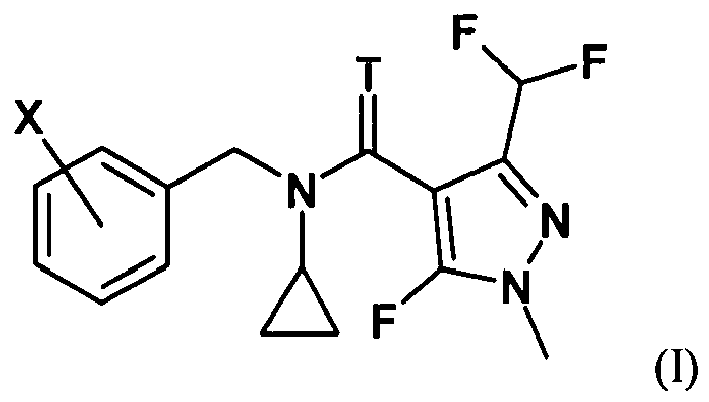
and(B) at least one further active fungicidal compound B. - An active compound combination according to claim 1 wherein the compound (A) of formula (I) is selected from the group consisting of:N-cyclopropyl-3-(difluoromethyl)-5-fluoro-N-(2-isopropylbenzyl)-1-methyl-1H-pyrazole-4-carboxamide (compound A1),N-cyclopropyl-N-(2-cyclopropylbenzyl)-3-(difluoromethyl)-5-fluoro-1-methyl-1H-pyrazole-4-carboxamide (compound A2),N-(2-tert-butylbenzyl)-N-cyclopropyl-3-(difluoromethyl)-5-fluoro-1-methyl-1H-pyrazole-4-carboxamide (compound A3),N-(5-chloro-2-ethylbenzyl)-N-cyclopropyl-3-(difluoromethyl)-5-fluoro-1-methyl-1H-pyrazole-4-carboxamide (compound A4),N-(5-chloro-2-isopropylbenzyl)-N-cyclopropyl-3-(difluoromethyl)-5-fluoro-1-methyl-1H-pyrazole-4-carboxamide (compound A5),N-cyclopropyl-3-(difluoromethyl)-N-(2-ethyl-5-fluorobenzyl)-5-fluoro-1-methyl-1H-pyrazole-4-carboxamide (compound A6),N-cyclopropyl-3-(difluoromethyl)-5-fluoro-N-(5-fluoro-2-isopropylbenzyl)-1-methyl-1H-pyrazole-4-carboxamide (compound A7),N-cyclopropyl-N-(2-cyclopropyl-5-fluorobenzyl)-3-(difluoromethyl)-5-fluoro-1-methyl-1H-pyrazole-4-carboxamide (compound A8),N-(2-cyclopentyl-5-fluorobenzyl)-N-cyclopropyl-3-(difluoromethyl)-5-fluoro-1-methyl-1H-pyrazole-4-carboxamide (compound A9),N-cyclopropyl-3-(difluoromethyl)-5-fluoro-N-(2-fluoro-6-isopropylbenzyl)-1-methyl-1H-pyrazole-4-carboxamide (compound A10),N-cyclopropyl-3-(difluoromethyl)-N-(2-ethyl-5-methylbenzyl)-5-fluoro-1-methyl-1H-pyrazole-4-carboxamide (compound A11),N-cyclopropyl-3-(difluoromethyl)-5-fluoro-N-(2-isopropyl-5-methylbenzyl)-1-methyl-1H-pyrazole-4-carboxamide (compound A12),N-cyclopropyl-N-(2-cyclopropyl-5-methylbenzyl)-3-(difluoromethyl)-5-fluoro-1-methyl-1H-pyrazole-4-carboxamide (compound A13),N-(2-tert-butyl-5-methylbenzyl)-N-cyclopropyl-3-(difluoromethyl)-5-fluoro-1-methyl-1H-pyrazole-4-carboxamide (compound A14),N-[5-chloro-2-(trifluoromethyl)benzyl]-N-cyclopropyl-3-(difluoromethyl)-5-fluoro-1-methyl-1H-pyrazole-4-carboxamide (compound A15),N-cyclopropyl-3-(difluoromethyl)-5-fluoro-1-methyl-N-[5-methyl-2-(trifluoromethyl)benzyl]-1H-pyrazole-4-carboxamide (compound A 16),N-[2-chloro-6-(trifluoromethyl)benzyl]-N-cyclopropyl-3-(difluoromethyl)-5-fluoro-1-methyl-1H-pyrazole-4-carboxamide (compound A17),N-[3-chloro-2-fluoro-6-(trifluoromethyl)benzyl]-N-cyclopropyl-3-(difluoromethyl)-5-fluoro-1-methyl-1H-pyrazole-4-carboxamide (compound A18).N-cyclopropyl-3-(difluoromethyl)-N-(2-ethyl-4,5-dimethylbenzyl)-5-fluoro-1-methyl-1H-pyrazole-4-carboxamide (compound A 19),and N-cyclopropyl-3-(difluoromethyl)-5-fluoro-N-(2-isopropylbenzyl)-1-methyl-1H-pyrazole-4-carbothio-amide (compound A20).
- An active compound combination according to claim 1 or 2 wherein the fungicidal compound B of the invention is selected from the following groups:(1) inhibitors of the ergosterol synthesis,(2) inhibitors of the respiratory chain at complex I or II,(3) inhibitors of the respiratory chain at complex III,(4) inhibitors of the mitosis and cell division,(5) compounds capable of having a multisite action,(6) compounds capable of inducing a host defense,(7) inhibitors of the amino acid and/or protein biosynthesis,(8) inhibitors of the ATP production,(9) inhibitors of the cell wall synthesis or glucan Synthesis,(10) inhibitors of the lipid and membrane synthesis,(11) inhibitors of the melanine biosynthesis,(12) inhibitors of the nucleic acid synthesis,(13) inhibitors of the signal transduction,(14) compounds capable of acting as uncoupler,(15) other fungicides(16) further fungicides.
- An active compound combination according to any one of claims 1 to 3 wherein the fungicidal compound B of the invention is selected from the List L1:(1.1) aldimorph (1704-28-5), (1.2) azaconazole (60207-31-0), (1.3) bitertanol (55179-31-2), (1.4) bromuconazole (116255-48-2), (1.5) cyproconazole (113096-99-4), (1.6) diclobutrazole (75736-33-3), (1.7) difenoconazole (119446-68-3), (1.8) diniconazole (83657-24-3), (1.9) diniconazole-M (83657-18-5), (1.10) dodemorph (1593-77-7), (1.11) dodemorph acetate (31717-87-0), (1.12) epoxiconazole (106325-08-0), (1.13) etaconazole (60207-93-4), (1.14) fenarimol (60168-88-9), (1.15) fenbuconazole (114369-43-6), (1.16) fenhexamid (126833-17-8), (1.17) fenpropidin (67306-00-7), (1.18) fenpropimorph (67306-03-0), (1.19) fluquinconazole (136426-54-5), (1.20) flurprimidol (56425-91-3), (1.21) flusilazole (85509-19-9), (1.22) flutriafol (76674-21-0), (1.23) furconazole (112839-33-5), (1.24) furconazole-cis (112839-32-4), (1.25) hexaconazole (79983-71-4), (1.26) imazalil (60534-80-7), (1.27) imazalil sulfate (58594-72-2), (1.28) imibenconazole (86598-92-7), (1.29) ipconazole (125225-28-7), (1.30) metconazole (125116-23-6), (1.31) myclobutanil (88671-89-0), (1.32) naftifine (65472-88-0), (1.33) nuarimol (63284-71-9), (1.34) oxpoconazole (174212-12-5), (1.35) paclobutrazol (76738-62-0), (1.36) pefurazoate (101903-30-4), (1.37) penconazole (66246-88-6), (1.38) piperalin (3478-94-2), (1.39) prochloraz (67747-09-5), (1.40) propiconazole (60207-90-1), (1.41) prothioconazole (178928-70-6), (1.42) pyributicarb (88678-67-5), (1.43) pyrifenox (88283-41-4), (1.44) quinconazole (103970-75-8), (1.45) simeconazole (149508-90-7), (1.46) spiroxamine (118134-30-8), (1.47) tebuconazole (107534-96-3), (1.48) terbinafine (91161-71-6), (1.49) tetraconazole (112281-77-3), (1.50) triadimefon (43121-43-3), (1.51) triadimenol (89482-17-7), (1.52) tridemorph (81412-43-3), (1.53) triflumizole (68694-11-1), (1.54) triforine (26644-46-2), (1.55) triticonazole (131983-72-7), (1.56) uniconazole (83657-22-1), (1.57) uniconazole-p (83657-17-4), (1.58) viniconazole (77174-66-4), (1.59) voriconazole (137234-62-9), (1.60) 1-(4-chlorophenyl)-2-(1H-1,2,4-triazol-1-yl)cycloheptanol (129586-32-9), (1.61) methyl 1-(2,2-dimethyl-2,3-dihydro-1H-inden-1-yl)-1H-imidazole-5-carboxylate (110323-95-0), (1.62) N'-{5-(difluoromethyl)-2-methyl-4-[3-(trimethylsilyl)propoxy]phenyl}-N-ethyl-N-methylimidoformamide, (1.63) N-ethyl-N-methyl-N'-{2-methyl-5-(trifluoromethyl)-4-[3-(trimethylsilyl)-propoxy]phenyl}imidoformamide (1.64) O-[1-(4-methoxyphenoxy)-3,3-dimethylbutan-2-yl] 1H-imidazole-1-carbothioate (111226-71-2), (2.1) bixafen (581809-46-3), (2.2) boscalid (188425-85-6), (2.3) carboxin (5234-68-4), (2.4) diflumetorim (130339-07-0), (2.5) fenfuram (24691-80-3), (2.6) fluopyram (658066-35-4), (2.7) flutolanil (66332-96-5), (2.8) fluxapyroxad (907204-31-3), (2.9) furametpyr (123572-88-3), (2.10) furmecyclox (60568-05-0), (2.11) isopyrazam (mixture of syn-epimeric racemate 1RS,4SR,9RS and anti-epimeric racemate 1RS,4SR,9SR) (881685-58-1), (2.12) isopyrazam (anti-epimeric racemate 1RS,4SR,9SR), (2.13) isopyrazam (anti-epimeric enantiomer 1R,4S,9S), (2.14) isopyrazam (anti-epimeric enantiomer 1S,4R,9R), (2.15) isopyrazam (syn epimeric racemate 1 RS,4SR,9RS), (2.16) isopyrazam (syn-epimeric enantiomer 1R,4S,9R), (2.17) isopyrazam (syn-epimeric enantiomer 1S,4R,9S), (2.18) mepronil (55814-41-0), (2.19) oxycarboxin (5259-88-1), (2.20) penflufen (494793-67-8), (2.21) penthi-opyrad (183675-82-3), (2.22) sedaxane (874967-67-6), (2.23) thifluzamide (130000-40-7), (2.24) 1-methyl-N-[2-(1,1,2,2-tetrafluoroethoxy)phenyl]-3-(trifluoromethyl)-1H-pyrazole-4-carboxamide, (2.25) 3-(difluoromethyl)-1-methyl-N-[2-(1,1,2,2-tetrafluoroethoxy)phenyl]-1H-pyrazole-4-carboxamide, (2.26) 3-(difluoromethyl)-N-[4-fluoro-2-(1,1,2,3,3,3-hexafluoropropoxy)phenyl]-1-methyl-1H-pyrazole-4-carboxamide, (2.27) N-[1-(2,4-dichlorophenyl)-1-methoxypropan-2-yl]-3-(difluoromethyl)-1-methyl-1H-pyrazole-4-carboxamide (1092400-95-7), (2.28) 5,8-difluoro-N-[2-(2-fluoro-4-{[4-(trifluoromethyl)pyridin-2-yl]oxy}phenyl)ethyl]quinazolin-4-amine (1210070-84-0), (2.29) benzovindiflupyr, (2.30) N-[(1S,4R)-9-(dichloromethylene)-1,2,3,4-tetrahydro-1,4-methanonaphthalen-5-yl]-3-(difluoromethyl)-1-methyl-1H-pyrazole-4-carboxamide, (2.31) N-[(1R,4S)-9-(dichloromethylene)-1,2,3,4-tetrahydro-1,4-methanonaphthalen-5-yl]-3-(difluoromethyl)-1-methyl-1H-pyrazole-4-carboxamide, (2.32) 3-(Difluormethyl)-1-methyl-N-(1,1,3-trimethyl-2,3-dihydro-1H-inden-4-yl)-1H-pyrazol-4-carboxamide, (2.33) 1,3,5-Trimethyl-N-(1,1,3-trimethyl-2,3-dihydro-1H-inden-4-yl)-1H-pyrazol-4-carboxamide, (2.34) 1-Methyl-3-(trifluormethyl)-N-(1,3,3-trimethyl-2,3-dihydro-1H-inden-4-yl)-1H-pyrazol-4-carboxamide, (2.35) 1-Methyl-3-(trifluormethyl)-N-[(1S)-1,3,3-trimethyl-2,3-dihydro-1H-inden-4-yl]-1H-pyrazol-4-carboxamide, (2.36) 1-Methyl-3-(trifluormethyl)-N-[(1R)-1,3,3-trimethyl-2,3-dihydro-1H-inden-4-yl]-1H-pyrazol-4-carboxamide, (2.37) 3-(Difluormethyl)-1-methyl-N-[(3S)-1,1,3-trimethyl-2,3-dihydro-1H-inden-4-yl]-1H-pyrazol-4-carboxamide, (2.38) 3-(Difluormethyl)-1-methyl-N-[(3R)-1,1,3-trimethyl-2,3-dihydro-1H-inden-4-yl]-1H-pyrazol-4-carboxamide, (2.39) 1,3,5-Trimethyl-N-[(3R)-1,1,3-trimethyl-2,3-dihydro-1H-inden-4-yl]-1H-pyrazol-4-carboxamide, (2.40) 1,3,5-Trimethyl-N-[(3S)-1,1,3-trimethyl-2,3-dihydro-1H-inden-4-yl]-1H-pyrazol-4-carboxamide, (2.41) benodanil (15310-01-7), (3.1) ametoctradin (865318-97-4), (3.2) amisulbrom (348635-87-0), (3.3) azoxystrobin (131860-33-8), (3.4) cyazofamid (120116-88-3), (3.5) coumethoxystrobin (850881-30-0), (3.6) coumoxystrobin (850881-70-8), (3.7) dimoxystrobin (141600-52-4), (3.8) enestroburin (238410-11-2), (3.9) famoxadone (131807-57-3), (3.10) fenamidone (161326-34-7), (3.11) fenoxystrobin (918162-02-4), (3.12) fluoxastrobin (361377-29-9), (3.13) kresoxim-methyl (143390-89-0), (3.14) metominostrobin (133408-50-1), (3.15) orysastrobin (189892-69-1), (3.16) picoxystrobin (117428-22-5), (3.17) pyraclostrobin (175013-18-0), (3.18) pyrametostrobin (915410-70-7), (3.19) pyraoxystrobin (862588-11-2), (3.20) pyriben-carb (799247-52-2), (3.21) triclopyricarb (902760-10-1), (3.22) trifloxystrobin (141517-21-7), (3.23) (2E)-2-(2-{[6-(3-chloro-2-methylphenoxy)-5-fluoropyrimidin-4-yl]oxy}phenyl)-2-(methoxyimino)-N-methylethanamide, (3.24) (2E)-2-(methoxyimino)-N-methyl-2-(2-{[({(1E)-1-[3-(trifluoromethyl)phenyl]-ethylidene}amino)oxy]methyl}-phenyl)ethanamide, (3.25) (2E)-2-(methoxyimino)-N-methyl-2-{2-[(E)-({1-[3-(trifluoromethyl)phenyl]-ethoxy}imino)methyl]phenyl}ethanamide (158169-73-4), (3.26) (2E)-2-{2-[({[(1E)-1-(3-{[(E)-1-fluoro-2-phenylethenyl]oxy}phenyl)ethylidene]amino}oxy)methyl]phenyl}-2-(methoxyimino)-N-methylethanamide (326896-28-0), (3.27) (2E)-2-{2-[({[(2E,3E)-4-(2,6-dichlorophenyl)but-3-en-2-ylidene]amino}oxy)methyl]-phenyl}-2-(methoxyimino)-N-methylethanamide, (3.28) 2-chloro-N-(1,1,3-trimethyl-2,3-dihydro-1H-inden-4-yl)pyridine-3-carboxamide (119899-14-8), (3.29) 5-methoxy-2-methyl-4-(2-{[({(1E)-1-[3-(trifluoromethyl)phenyl]ethylidene}amino)oxy]methyl}-phenyl)-2,4-dihydro-3H-1,2,4-triazol-3-one, (3.30) methyl (2E)-2-{2-[({cyclopropyl[(4-methoxyphenyl)imino]methyl}sulfanyl)methyl]phenyl}-3-methoxyprop-2-enoate (149601-03-6), (3.31) N-(3-ethyl-3,5,5-trimethylcyclohexyl)-3-(formylamino)-2-hydroxybenzamide (226551-21-9), (3.32) 2-{2-[(2,5-dimethylphenoxy)methyl]phenyl}-2-methoxy-N-methylacetamide (173662-97-0), (3.33) (2R)-2-{2-[(2,5-dimethylphenoxy)methyl]phenyl}-2-methoxy-N-methylacetamide (394657-24-0), (4.1) benomyl (17804-35-2), (4.2) carbendazim (10605-21-7), (4.3) chlorfenazole (3574-96-7), (4.4) dietho-fencarb (87130-20-9), (4.5) ethaboxam (162650-77-3), (4.6) fluopicolide (239110-15-7), (4.7) fuberidazole (3878-19-1), (4.8) pencycuron (66063-05-6), (4.9) thiabendazole (148-79-8), (4.10) thiophanate-methyl (23564-05-8), (4.11) thiophanate (23564-06-9), (4.12) zoxamide (156052-68-5), (4.13) 5-chloro-7-(4-methylpiperidin-1-yl)-6-(2,4,6-trifluorophenyl)[1,2,4]triazolo[1,5-a]pyrimidine (214706-53-3), (4.14) 3-chloro-5-(6-chloropyridin-3-yl)-6-methyl-4-(2,4,6-trifluorophenyl)pyridazine (1002756-87-7), (5.1) bordeaux mixture (8011-63-0), (5.2) captafol (2425-06-1), (5.3) captan (133-06-2), (5.4) chlorothalonil (1897-45-6), (5.5) copper hydroxide (20427-59-2), (5.6) copper naphthenate (1338-02-9), (5.7) copper oxide (1317-39-1), (5.8) copper oxychloride (1332-40-7), (5.9) copper(2+) sulfate (7758-98-7), (5.10) dichlofluanid (1085-98-9), (5.11) dithianon (3347-22-6), (5.12) dodine (2439-10-3), (5.13) dodine free base, (5.14) ferbam (14484-64-1), (5.15) fluorofolpet (719-96-0), (5.16) folpet (133-07-3), (5.17) guazatine (108173-90-6), (5.18) guazatine acetate, (5.19) iminoctadine (13516-27-3), (5.20) iminoctadine albesilate (169202-06-6), (5.21) iminoctadine triacetate (57520-17-9), (5.22) mancopper (53988-93-5), (5.23) mancozeb (8018-01-7), (5.24) maneb (12427-38-2), (5.25) metiram (9006-42-2), (5.26) metiram zinc (9006-42-2), (5.27) oxine-copper (10380-28-6), (5.28) pro-pamidine (104-32-5), (5.29) propineb (12071-83-9), (5.30) sulfur and sulfur preparations including calcium polysulfide (7704-34-9), (5.31) thiram (137-26-8), (5.32) tolylfluanid (731-27-1), (5.33) zineb (12122-67-7), (5.34) ziram (137-30-4), (5.35) anilazine (101-05-3), (6.1) acibenzolar-S-methyl (135158-54-2), (6.2) isotianil (224049-04-1), (6.3) probenazole (27605-76-1), (6.4) tiadinil (223580-51-6), (6.5) laminarin (9008-22-4), (7.1) andoprim (23951-85-1), (7.2) blasticidin-S (2079-00-7), (7.3) cyprodinil (121552-61-2), (7.4) kasugamycin (6980-18-3), (7.5) kasugamycin hydrochloride hydrate (19408-46-9), (7.6) mepanipyrim (110235-47-7), (7.7) pyrimethanil (53112-28-0), (7.8) 3-(5-fluoro-3,3,4,4-tetramethyl-3,4-dihydroisoquinolin-1-yl)quinoline (861647-32-7), (7.9) oxytetracycline (79-57-2), (7.10) streptomycin (57-92-1), (8.1) fentin acetate (900-95-8), (8.2) fentin chloride (639-58-7), (8.3) fentin hydroxide (76-87-9), (8.4) silthiofam (175217-20-6), (9.1) benthiavalicarb (177406-68-7), (9.2) dimethomorph (110488-70-5), (9.3) flumorph (211867-47-9), (9.4) iprovali-carb (140923-17-7), (9.5) mandipropamid (374726-62-2), (9.6) polyoxins (11113-80-7), (9.7) polyoxorim (22976-86-9), (9.8) validamycin A (37248-47-8), (9.9) valifenalate (283159-94-4; 283159-90-0), (9.10) polyoxin B (19396-06-6), (10.1) biphenyl (92-52-4), (10.2) chloroneb (2675-77-6), (10.3) dicloran (99-30-9), (10.4) edifenphos (17109-49-8), (10.5) etridiazole (2593-15-9), (10.6) iodocarb (55406-53-6), (10.7) iprobenfos (26087-47-8), (10.8) isoprothiolane (50512-35-1), (10.9) propamocarb (25606-41-1), (10.10) propamocarb hydrochloride (25606-41-1), (10.11) prothiocarb (19622-08-3), (10.12) pyrazophos (13457-18-6), (10.13) quintozene (82-68-8), (10.14) tecnazene (117-18-0), (10.15) tolclofos-methyl (57018-04-9), (11.1) carpropamid (104030-54-8), (11.2) diclocymet (139920-32-4), (11.3) fenoxanil (115852-48-7), (11.4) phthalide (27355-22-2), (11.5) pyroquilon (57369-32-1), (11.6) tricyclazole (41814-78-2), (11.7) 2,2,2-trifluoroethyl {3-methyl-1-[(4-methylbenzoyl)amino]butan-2-yl}carbamate (851524-22-6), (12.1) benalaxyl (71626-11-4), (12.2) benalaxyl-M (kiralaxyl) (98243-83-5), (12.3) bupirimate (41483-43-6), (12.4) clozylacon (67932-85-8), (12.5) dimethirimol (5221-53-4), (12.6) ethirimol (23947-60-6), (12.7) furalaxyl (57646-30-7), (12.8) hymexazol (10004-44-1), (12.9) metalaxyl (57837-19-1), (12.10) metalaxyl-M (mefenoxam) (70630-17-0), (12.11) ofurace (58810-48-3), (12.12) oxadixyl (77732-09-3), (12.13) oxolinic acid (14698-29-4), (13.1) chlozolinate (84332-86-5), (13.2) fenpiclonil (74738-17-3), (13.3) fludioxonil (131341-86-1), (13.4) iprodione (36734-19-7), (13.5) procymidone (32809-16-8), (13.6) quinoxyfen (124495-18-7), (13.7) vinclozolin (50471-44-8), (14.1) binapacryl (485-31-4), (14.2) dinocap (131-72-6), (14.3) ferimzone (89269-64-7), (14.4) fluazinam (79622-59-6), (14.5) meptyldinocap (131-72-6), (15.1) benthiazole (21564-17-0), (15.2) bethoxazin (163269-30-5), (15.3) capsimycin (70694-08-5), (15.4) carvone (99-49-0), (15.5) chinomethionat (2439-01-2), (15.6) pyriofenone (chlazafenone) (688046-61-9), (15.7) cufraneb (11096-18-7), (15.8) cyflufenamid (180409-60-3), (15.9) cymoxanil (57966-95-7), (15.10) cyprosulfamide (221667-31-8), (15.11) dazomet (533-74-4), (15.12) debacarb (62732-91-6), (15.13) dichlorophen (97-23-4), (15.14) diclomezine (62865-36-5), (15.15) difenzoquat (49866-87-7), (15.16) difenzoquat methylsulfate (43222-48-6), (15.17) diphenylamine (122-39-4), (15.18) ecomate, (15.19) fenpyrazamine (473798-59-3), (15.20) flumetover (154025-04-4), (15.21) fluoroimide (41205-21-4), (15.22) flusulfamide (106917-52-6), (15.23) flutianil (304900-25-2), (15.24) fosetyl-aluminium (39148-24-8), (15.25) fosetyl-calcium, (15.26) fosetyl-sodium (39148-16-8), (15.27) hexachlorobenzene (118-74-1), (15.28) irumamycin (81604-73-1), (15.29) methasulfocarb (66952-49-6), (15.30) methyl isothiocyanate (556-61-6), (15.31) metrafenone (220899-03-6), (15.32) mildiomycin (67527-71-3), (15.33) natamycin (7681-93-8), (15.34) nickel dimethyldithiocarbamate (15521-65-0), (15.35) nitrothal-isopropyl (10552-74-6), (15.36) octhilinone (26530-20-1), (15.37) oxamocarb (917242-12-7), (15.38) oxyfenthiin (34407-87-9), (15.39) pentachlorophenol and salts (87-86-5), (15.40) phenothrin, (15.41) phosphorous acid and its salts (13598-36-2), (15.42) propamocarb-fosetylate, (15.43) propanosine-sodium (88498-02-6), (15.44) proquinazid (189278-12-4), (15.45) pyrimorph (868390-90-3), (15.45e) (2E)-3-(4-tert-butylphenyl)-3-(2-chloropyridin-4-yl)-1-(morpholin-4-yl)prop-2-en-1-one (1231776-28-5), (15.45z) (2Z)-3-(4-tert-butylphenyl)-3-(2-chloropyridin-4-yl)-1-(morpholin-4-yl)prop-2-en-1-one (1231776-29-6), (15.46) pyrrolnitrine (1018-71-9), (15.47) tebufloquin (376645-78-2), (15.48) tecloftalam (76280-91-6), (15.49) tolnifanide (304911-98-6), (15.50) triazoxide (72459-58-6), (15.51) trichlamide (70193-21-4), (15.52) zarilamid (84527-51-5), (15.53) (3S,6S,7R,8R)-8-benzyl-3-[({3-[(isobutyryloxy)methoxy]-4-methoxypyridin-2-yl}carbonyl)amino]-6-methyl-4,9-dioxo-1,5-dioxonan-7-yl 2-methylpropanoate (517875-34-2), (15.54) 1-(4-{4-[(5R)-5-(2,6-difluorophenyl)-4,5-dihydro-1,2-oxazol-3-yl]-1,3-thiazol-2-yl}piperidin-1-yl)-2-[5-methyl-3-(trifluoromethyl)-1H-pyrazol-1-yl]ethanone (1003319-79-6), (15.55) 1-(4-{4-[(5S)-5-(2,6-difluorophenyl)-4,5-dihydro-1,2-oxazol-3-yl]-1,3-thiazol-2-yl}piperidin-1-yl)-2-[5-methyl-3-(trifluoromethyl)-1H-pyrazol-1-yl]ethanone (1003319-80-9), (15.56) 1-(4-{4-[5-(2,6-difluorophenyl)-4,5-dihydro-1,2-oxazol-3-yl]-1,3-thiazol-2-yl}piperidin-1-yl)-2-[5-methyl-3-(trifluoromethyl)-1H-pyrazol-1-yl]ethanone (1003318-67-9), (15.57) 1-(4-methoxyphenoxy)-3,3-dimethylbutan-2-yl 1H-imidazole-1-carboxylate (111227-17-9), (15.58) 2,3,5,6-tetrachloro-4-(methylsulfonyl)pyridine (13108-52-6), (15.59) 2,3-dibutyl-6-chlorothieno[2,3-d]pyrimidin-4(3H)-one (221451-58-7), (15.60) 2,6-dimethyl-1H,5H-[1,4]dithiino[2,3-c:5,6-c']dipyrrole-1,3,5,7(2H,6H)-tetrone, (15.61) 2-[5-methyl-3-(trifluoromethyl)-1H-pyrazol-1-yl]-1-(4-{4-[(5R)-5-phenyl-4,5-dihydro-1,2-oxazol-3-yl]-1,3-thiazol-2-yl}piperidin-1-yl)ethanone (1003316-53-7), (15.62) 2-[5-methyl-3-(trifluoromethyl)-1H-pyrazol-1-yl]-1-(4-{4-[(5S)-5-phenyl-4,5-dihydro-1,2-oxazol-3-yl]-1,3-thiazol-2-yl}piperidin-1-yl)ethanone (1003316-54-8), (15.63) 2-[5-methyl-3-(trifluoromethyl)-1H-pyrazol-1-yl]-1-{4-[4-(5-phenyl-4,5-dihydro-1,2-oxazol-3-yl)-1,3-thiazol-2-yl]piperidin-1-yl}ethanone (1003316-51-5), (15.64) 2-butoxy-6-iodo-3-propyl-4H-chromen-4-one, (15.65) 2-chloro-5-[2-chloro-1-(2,6-difluoro-4-methoxyphenyl)-4-methyl-1H-imidazol-5-yl]pyridine, (15.66) 2-phenylphenol and salts (90-43-7), (15.67) 3-(4,4,5-trifluoro-3,3-dimethyl-3,4-dihydroisoquinolin-1-yl)quinoline (861647-85-0), (15.68) 3,4,5-trichloropyridine-2,6-dicarbonitrile (17824-85-0), (15.69) 3-[5-(4-chlorophenyl)-2,3-dimethyl-1,2-oxazolidin-3-yl]pyridine, (15.70) 3-chloro-5-(4-chlorophenyl)-4-(2,6-difluorophenyl)-6-methylpyridazine, (15.71) 4-(4-chlorophenyl)-5-(2,6-difluorophenyl)-3,6-dimethylpyridazine, (15.72) 5-amino-1,3,4-thiadiazole-2-thiol, (15.73) 5-chloro-N'-phenyl-N'-(prop-2-yn-1-yl)thiophene-2-sulfonohydrazide (134-31-6), (15.74) 5-fluoro-2-[(4-fluorobenzyl)oxy]pyrimidin-4-amine (1174376-11-4), (15.75) 5-fluoro-2-[(4-methylbenzyl)oxy]pyrimidin-4-amine (1174376-25-0), (15.76) 5-methyl-6-octyl[1,2,4]triazolo[1,5-a]pyrimidin-7-amine, (15.77) ethyl (2Z)-3-amino-2-cyano-3-phenylprop-2-enoate, (15.78) N'-(4-{[3-(4-chlorobenzyl)-1,2,4-thiadiazol-5-yl]oxy}-2,5-dimethylphenyl)-N-ethyl-N-methylimidoformamide, (15.79) N-(4-chlorobenzyl)-3-[3-methoxy-4-(prop-2-yn-1-yloxy)phenyl]propanamide, (15.80) N-[(4-chlorophenyl)(cyano)methyl]-3-[3-methoxy-4-(prop-2-yn-1-yloxy)phenyl]propanamide, (15.81) N-[(5-bromo-3-chloropyridin-2-yl)methyl]-2,4-dichloropyridine-3-carboxamide, (15.82) N-[1-(5-bromo-3-chloropyridin-2-yl)ethyl]-2,4-dichloropyridine-3-carboxamide, (15.83) N-[1-(5-bromo-3-chloropyridin-2-yl)ethyl]-2-fluoro-4-iodopyridine-3-carboxamide, (15.84) N-{(E)-[(cyclopropylmethoxy)imino][6-(difluoromethoxy)-2,3-difluorophenyl]methyl}-2-phenylacetamide (221201-92-9), (15.85) N-{(Z)-[(cyclopropylmethoxy)imino][6-(difluoromethoxy)-2,3-difluorophenyl]methyl}-2-phenylacetamide (221201-92-9), (15.86) N'-{4-[(3-tert-butyl-4-cyano-1,2-thiazol-5-yl)oxy]-2-chloro-5-methylphenyl}-N-ethyl-N-methylimidoformamide, (15.87) N-methyl-2-(1-{[5-methyl-3-(trifluoromethyl)-1H-pyrazol-1-yl]acetyl}piperidin-4-yl)-N-(1,2,3,4-tetrahydronaphthalen-1-yl)-1,3-thiazole-4-carboxamide (922514-49-6), (15.88) N-methyl-2-(1-{[5-methyl-3-(trifluoromethyl)-1H-pyrazol-1-yl]acetyl}piperidin-4-yl)-N-[(1R)-1,2,3,4-tetrahydronaphthalen-1-yl]-1,3-thiazole-4-carboxamide (922514-07-6), (15.89) N-methyl-2-(1-{[5-methyl-3-(trifluoromethyl)-1H-pyrazol-1-yl]acetyl}piperidin-4-yl)-N-[(1S)-1,2,3,4-tetrahydronaphthalen-1-yl]-1,3-thiazole-4-carboxamide (922514-48-5), (15.90) pentyl {6-[({[(1-methyl-1H-tetrazol-5-yl)(phenyl)methylidene]amino}oxy)methyl]pyridin-2-yl}carbamate, (15.91) phenazine-1-carboxylic acid, (15.92) quinolin-8-ol (134-31-6), (15.93) quinolin-8-ol sulfate (2:1) (134-31-6), (15.94) tert-butyl {6-[({[(1-methyl-1H-tetrazol-5-yl)(phenyl)methylene]amino}oxy)methyl]pyridin-2-yl}carbamate, (16.1) 1-methyl-3-(trifluoromethyl)-N-[2'-(trifluoromethyl)biphenyl-2-yl]-1H-pyrazole-4-carboxamide, (16.2) N-(4'-chlorobiphenyl-2-yl)-3-(difluoromethyl)-1-methyl-1H-pyrazole-4-carboxamide, (16.3) N-(2',4'-dichlorobiphenyl-2-yl)-3-(difluoromethyl)-1-methyl-1H-pyrazole-4-carboxamide, (16.4) 3-(difluoromethyl)-1-methyl-N-[4'-(trifluoromethyl)biphenyl-2-yl]-1H-pyrazole-4-carboxamide, (16.5) N-(2',5'-difluorobiphenyl-2-yl)-1-methyl-3-(trifluoromethyl)-1H-pyrazole-4-carboxamide, (16.6) 3-(difluoromethyl)-1-methyl-N-[4'-(prop-1-yn-1-yl)biphenyl-2-yl]-1H-pyrazole-4-carboxamide, (16.7) 5-fluoro-1,3-dimethyl-N-[4'-(prop-1-yn-1-yl)biphenyl-2-yl]-1H-pyrazole-4-carboxamide, (16.8) 2-chloro-N-[4'-(prop-1-yn-1-yl)biphenyl-2-yl]pyridine-3-carboxamide, (16.9) 3-(difluoromethyl)-N-[4'-(3,3-dimethylbut-1-yn-1-yl)biphenyl-2-yl]-1-methyl-1H-pyrazole-4-carboxamide, (16.10) N-[4'-(3,3-dimethylbut-1-yn-1-yl)biphenyl-2-yl]-5-fluoro-1,3-dimethyl-1H-pyrazole-4-carboxamide, (16.11) 3-(difluoromethyl)-N-(4'-ethynylbiphenyl-2-yl)-1-methyl-1H-pyrazole-4-carboxamide, (16.12) N-(4'-ethynylbiphenyl-2-yl)-5-fluoro-1,3-dimethyl-1H-pyrazole-4-carboxamide, (16.13) 2-chloro-N-(4'-ethynylbiphenyl-2-yl)pyridine-3-carboxamide, (16.14) 2-chloro-N-[4'-(3,3-dimethylbut-1-yn-1-yl)biphenyl-2-yl]pyridine-3-carboxamide, (16.15) 4-(difluoromethyl)-2-methyl-N-[4'-(trifluoromethyl)biphenyl-2-yl]-1,3-thiazole-5-carboxamide, (16.16) 5-fluoro-N-[4'-(3-hydroxy-3-methylbut-1-yn-1-yl)biphenyl-2-yl]-1,3-dimethyl-1H-pyrazole-4-carboxamide, (16.17) 2-chloro-N-[4'-(3-hydroxy-3-methylbut-1-yn-1-yl)biphenyl-2-yl]pyridine-3-carboxamide, (16.18) 3-(difluoromethyl)-N-[4'-(3-methoxy-3-methylbut-1-yn-1-yl)biphenyl-2-yl]-1-methyl-1H-pyrazole-4-carboxamide, (16.19) 5-fluoro-N-[4'-(3-methoxy-3-methylbut-1-yn-1-yl)biphenyl-2-yl]-1,3-dimethyl-1 H-pyrazole-4-carboxamide, (16.20) 2-chloro-N-[4'-(3-methoxy-3-methylbut-1-yn-1-yl)biphenyl-2-yl]pyridine-3-carboxamide, (16.21) (5-bromo-2-methoxy-4-methylpyridin-3-yl)(2,3,4-trimethoxy-6-methylphenyl)methanone, (16.22) N-[2-(4-{[3-(4-chlorophenyl)prop-2-yn-1-yl]oxy}-3-methoxyphenyl)ethyl]-N2-(methylsulfonyl)valinamide (220706-93-4), (16.23) 4-oxo-4-[(2-phenylethyl)amino]butanoic acid, (16.24) but-3-yn-1-yl {6-[({[(Z)-(1-methyl-1H-tetrazol-5-yl)(phenyl)methylene]amino}oxy)methyl]pyridin-2-yl}carbamate, (16.25) 4-Amino-5-fluorpyrimidin-2-ol (mesomere Form: 6-Amino-5-fluorpyrimidin-2(1H)-on), (16.26) propyl 3,4,5-trihydroxybenzoate, (16.27) 1,3-dimethyl-N-(1,1,3-trimethyl-2,3-dihydro-1H-inden-4-yl)-1H-pyrazole-4-carboxamide (105113-56-2), (16.28) 1,3-dimethyl-N-[(3R)-1,1,3-trimethyl-2,3-dihydro-1H-inden-4-yl]-1H-pyrazole-4-carboxamide, (16.29) 1,3-dimethyl-N-[(3S)-1,1,3-trimethyl-2,3-dihydro-1H-inden-4-yl]-1H-pyrazole-4-carboxamide, (16.30) [3-(4-chloro-2-fluorophenyl)-5-(2,4-difluorophenyl)-1,2-oxazol-4-yl](pyridin-3-yl)methanol (1229605-96-2), (16.31) (S)-[3-(4-chloro-2-fluorophenyl)-5-(2,4-difluorophenyl)-1,2-oxazol-4-yl](pyridin-3-yl)methanol (1229606-46-5), (16.32) (R)-[3-(4-chloro-2-fluorophenyl)-5-(2,4-difluorophenyl)-1,2-oxazol-4-yl](pyridin-3-yl)methanol (1229606-02-3), (16.33) 2-{[3-(2-chlorophenyl)-2-(2,4-difluorophenyl)oxiran-2-yl]methyl}-2,4-dihydro-3H-1,2,4-triazole-3-thione (1342260-19-8), (16.34) 1-{[3-(2-chlorophenyl)-2-(2,4-difluorophenyl)oxiran-2-yl]methyl}-1H-1,2,4-triazol-5-yl thiocyanate (1342260-26-7), (16.35) 5-(allylsulfanyl)-1-{[3-(2-chlorophenyl)-2-(2,4-difluorophenyl)oxiran-2-yl]methyl}-1H-1,2,4-triazole (1342260-41-6), (16.36) 2-fluoro-6-(trifluoro-methyl)-N-(1,1,3-trimethyl-2,3-dihydro-1H-inden-4-yl)benzamide, (16.37) 2-fluoro-6-(trifluoromethyl)-N-[(3R)-1,1,3-trimethyl-2,3-dihydro-1H-inden-4-yl]benzamide and (16.38) 2-fluoro-6-(trifluoromethyl)-N-[(3S)-1,1,3-trimethyl-2,3-dihydro-1H-inden-4-yl]benzamide, and salts thereof.
- An active compound combination according to any one of claims 1 to 4 wherein the fungicidal compound B of the invention is selected from the List L2:cyproconazole (113096-99-4), difenoconazole (119446-68-3), epoxiconazole (106325-08-0), fenhexamid (126833-17-8), fenpropidin (67306-00-7), fenpropimorph (67306-03-0), fluquinconazole (136426-54-5), hexaconazole (79983-71-4), ipconazole (125225-28-7), metconazole (125116-23-6), myclobutanil (88671-89-0), prochloraz (67747-09-5), propiconazole (60207-90-1), prothioconazole (178928-70-6), spiroxamine (118134-30-8), tebuconazole (107534-96-3), tetraconazole (112281-77-3), triadimenol (89482-17-7), bixafen (581809-46-03), boscalid (188425-85-6), fluopyram (658066-35-4), flutolanil (66332-96-5), isopyrazam (mixture of syn-epimeric racemate 1RS,4SR,9RS and anti-epimeric racemate 1RS,4SR,9SR) (88165-58-1), isopyrazam (syn epimeric racemate 1RS,4SR,9RS), isopyrazam (syn-epimeric enantiomer 1R,4S,9R), isopyrazam (syn-epimeric enantiomer 1S,4R,9S), isopyrazam (anti-epimeric racemate 1RS,4SR,9SR), isopyrazam (anti-epimeric enantiomer 1R,4S,9S), isopyrazam (anti-epimeric enantiomer 1S,4R,9R), penflufen (494793-67-8), penthiopyrad (183675-82-3), sedaxane (874967-67-6), 3-(difluoromethyl)-1-methyl-N-[2-(1,1,2,2-tetrafluoroethoxy)phenyl]-1H-pyrazole-4-carboxamide, 3-(difluoromethyl)-N-[4-fluoro-2-(1,1,2,3,3,3-hexa-fluoropropoxy)phenyl]-1-methyl-1H-pyrazole-4-carboxamide, fluxapyroxad (907204-31-3), benzovindiflupyr, N-[1-(2,4-dichlorophenyl)-1-methoxypropan-2-yl]-3-(difluoromethyl)-1-methyl-1H-pyrazole-4-carboxamide, ametoctradin (865318-97-4), amisulbrom (348635-87-0), azoxystrobin (131860-33-8), cyazofamid (120116-88-3), dimoxystrobin (141600-52-4), enestroburin (238410-11-2), fenamidone (161326-34-7), fluoxastrobin (361377-29-9), kresoxim-methyl (143390-89-0), metominostrobin (133408-50-1), orysastrobin (189892-69-1), picoxystrobin (117428-22-5), pyraclostrobin (175013-18-0), trifloxystrobin (141517-21-7), pencycuron (66063-05-6), thiophanate-methyl (23564-05-8), fluopicolide (239110-15-7), thiophanate (23564-06-9), bordeaux mixture (8011-63-0), chlorothalonil (1897-45-6), dithianon (3347-22-6), dodine (2439-10-3), folpet (133-07-3), guazatine, copper oxide (1317-39-1), copper oxychloride (1332-40-7), copper hydroxide (20427-59-2), copper sulfate (7758-98-7), mancozeb (8018-01-7), maneb (12427-38-2), oxine-copper (10380-28-6), propineb (12071-83-9), sulfur and sulfur preparations including calcium polysulfide, thiram (137-26-8), copper naphthenate (1338-02-9), isotianil (224049-04-1), cyprodinyl (121552-61-2), pyrimethanil (53112-28-0), benthiavalicarb (177406-68-7), dimethomorph (110488-70-5), iprovalicarb (140923-17-7), mandipropamid (374726-62-2), propamocarb (25606-41-1), pro-pamocarb-hydrochloride (25606-41-1), tricyclazole (41814-78-2), benalaxyl (71626-11-4), benalaxyl-M (kiral-axyl) (98243-83-5), metalaxyl (57837-19-1), metalaxyl-M (mefenoxam) (70630-17-0), fludioxonil (131341-86-1), iprodione (36734-19-7), vinclozolin (50471-44-8), fluazinam (79622-59-6), meptyldinocap (131-72-6), fosetyl-Al (39148-24-8), metrafenone (220899-03-6), propamocarb-fosetylate, proquinazid (189278-12-4), N-methyl-2-(1-{[5-methyl-3-(trifluoromethyl)-1H-pyrazol-1-yl]acetyl}piperidin-4-yl)-N-[(1R)-1,2,3,4-tetrahydronaphthalen-1-yl]-1,3-thiazole-4-carboxamide (922514-07-6), N-methyl-2-(1-{[5-methyl-3-(trifluoromethyl)-1H-pyrazol-1-yl]acetyl}piperidin-4-yl)-N-(1,2,3,4-tetrahydronaphthalen-1-yl)-1,3-thiazole-4-carboxamide (922514-49-6), 1-(4-{4-[5-(2,6-difluorophenyl)-4,5-dihydro-1,2-oxazol-3-yl]-1,3-thiazol-2-yl}piperidin-1-yl)-2-[5-methyl-3-(trifluoromethyl)-1H-pyrazol-1-yl]ethanone (1003318-67-9) and 2-butoxy-6-iodo-3-propyl-4H-chromen-4-one, N'-(4-{[3-(4-chlorobenzyl)-1,2,4-thiadiazol-5-yl]oxy}-2,5-dimethylphenyl)-N-ethyl-N-methylimidoformamide and salts thereof.
- An active compound combination according to any one of claims 1 to 5 wherein the fungicidal compound B of the invention is selected from the List L3:cyproconazole (113096-99-4), epoxiconazole (106325-08-0), fenhexamid (126833-17-8), metconazole (125116-23-6), propiconazole (60207-90-1), prothioconazole (178928-70-6), spiroxamine (118134-30-8), tebuconazole (107534-96-3), bixafen (581809-46-03), fluopyram (658066-35-4), isopyrazam (mixture of syn-epimeric racemate 1RS,4SR,9RS and anti-epimeric racemate 1RS,4SR,9SR) (88165-58-1), isopyrazam (syn epimeric racemate 1RS,4SR,9RS), isopyrazam (syn-epimeric enantiomer 1 R,4S,9R), isopyrazam (syn-epimeric enantiomer 1S,4R,9S), isopyrazam (anti-epimeric racemate 1RS,4SR,9SR), isopyrazam (anti-epimeric enantiomer 1R,4S,9S), isopyrazam (anti-epimeric enantiomer 1S,4R,9R), penflufen (494793-67-8), penthiopyrad (183675-82-3), sedaxane (874967-67-6), fluxapyroxad (907204-31-3), benzovindiflupyr, N-[1-(2,4-dichlorophenyl)-1-methoxypropan-2-yl]-3-(difluoromethyl)-1-methyl-1H-pyrazole-4-carboxamide, ametoctradin (865318-97-4), azoxystrobin (131860-33-8), fluoxastrobin (361377-29-9), pyraclostrobin (175013-18-0), trifloxystrobin (141517-21-7), fluopicolide (239110-15-7), chlorothalonil (1897-45-6), folpet (133-07-3), mancozeb (8018-01-7), propineb (12071-83-9), isotianil (224049-04-1), pyrimethanil (53112-28-0), iprovalicarb (140923-17-7), propamocarb (25606-41-1), metalaxyl (57837-19-1), metalaxyl-M (mefenoxam) (70630-17-0), fludioxonil (131341-86-1) and fosetyl-Al (39148-24-8), N'-(4-{[3-(4-chlorobenzyl)-1,2,4-thiadiazol-5-yl]oxy}-2,5-dimethylphenyl)-N-ethyl-N-methylimidoformamide and salts thereof.
- Composition for controlling phytopathogenic harmful fungi, characterized by a content of at least one active compound combination according to any one of claims 1 to 6, in addition to extenders and/or surfactants.
- Composition according to claim 7 comprising at least one further active ingredient selected from the group of the insecticides, attractants, sterilants, bactericides, acaricides, nematicides, fungicides, growth regulators, herbicides, fertilizers, safeners and semiochemicals.
- Method for controlling phytopathogenic harmful fungi, characterized in that an active compound combination according to any one of claims 1 to 6 is applied to the phytopathogenic harmful fungi and/or their habitat.
- Process for producing compositions for controlling phytopathogenic harmful fungi, characterized in that an active compound combination according to any one of claims 1 to 6 is mixed with extenders and/or surfactants.
- Use of an active compound combination according to any one of claims 1 to 6 for control of phytopathogenic harmful fungi.
- Use of an active compound combination according to any one of claims 1 to 6 for the treatment of transgenic plants.
- Use of an active compound combination according to any one of claims 1 to 6 for the treatment of seed and of seed of transgenic plants.
Priority Applications (2)
| Application Number | Priority Date | Filing Date | Title |
|---|---|---|---|
| PL15186314T PL2997825T3 (en) | 2011-04-22 | 2012-04-18 | Active compound compositions comprising a (thio)carboxamide derivative and a fungicidal compound |
| HRP20190244TT HRP20190244T1 (en) | 2011-04-22 | 2019-02-06 | Active compound compositions comprising a (thio)carboxamide derivative and a fungicidal compound |
Applications Claiming Priority (4)
| Application Number | Priority Date | Filing Date | Title |
|---|---|---|---|
| EP11356005 | 2011-04-22 | ||
| US201161486479P | 2011-05-16 | 2011-05-16 | |
| PCT/EP2012/001676 WO2012143127A1 (en) | 2011-04-22 | 2012-04-18 | Active compound combinations comprising a (thio)carboxamide derivative and a fungicidal compound |
| EP12717193.2A EP2699093B1 (en) | 2011-04-22 | 2012-04-18 | Active compound combinations comprising a carboximide derivative and a fungicidal compound |
Related Parent Applications (3)
| Application Number | Title | Priority Date | Filing Date |
|---|---|---|---|
| PCT/EP2012/001676 Previously-Filed-Application WO2012143127A1 (en) | 2011-04-22 | 2012-04-18 | Active compound combinations comprising a (thio)carboxamide derivative and a fungicidal compound |
| EP12717193.2A Division-Into EP2699093B1 (en) | 2011-04-22 | 2012-04-18 | Active compound combinations comprising a carboximide derivative and a fungicidal compound |
| EP12717193.2A Division EP2699093B1 (en) | 2011-04-22 | 2012-04-18 | Active compound combinations comprising a carboximide derivative and a fungicidal compound |
Publications (2)
| Publication Number | Publication Date |
|---|---|
| EP2997825A1 true EP2997825A1 (en) | 2016-03-23 |
| EP2997825B1 EP2997825B1 (en) | 2018-11-07 |
Family
ID=44201841
Family Applications (2)
| Application Number | Title | Priority Date | Filing Date |
|---|---|---|---|
| EP15186314.9A Active EP2997825B1 (en) | 2011-04-22 | 2012-04-18 | Active compound compositions comprising a (thio)carboxamide derivative and a fungicidal compound |
| EP12717193.2A Active EP2699093B1 (en) | 2011-04-22 | 2012-04-18 | Active compound combinations comprising a carboximide derivative and a fungicidal compound |
Family Applications After (1)
| Application Number | Title | Priority Date | Filing Date |
|---|---|---|---|
| EP12717193.2A Active EP2699093B1 (en) | 2011-04-22 | 2012-04-18 | Active compound combinations comprising a carboximide derivative and a fungicidal compound |
Country Status (24)
| Country | Link |
|---|---|
| US (2) | US20140038823A1 (en) |
| EP (2) | EP2997825B1 (en) |
| JP (1) | JP5870186B2 (en) |
| KR (1) | KR101974227B1 (en) |
| CN (1) | CN103635089B (en) |
| AR (2) | AR086467A1 (en) |
| BR (1) | BR112013027091B1 (en) |
| CA (1) | CA2833749C (en) |
| CL (2) | CL2013003060A1 (en) |
| CO (1) | CO6831988A2 (en) |
| DK (2) | DK2699093T3 (en) |
| EA (2) | EA029682B1 (en) |
| EC (2) | ECSP13013035A (en) |
| ES (2) | ES2561296T3 (en) |
| HR (2) | HRP20160061T1 (en) |
| HU (2) | HUE026627T2 (en) |
| LT (1) | LT2997825T (en) |
| MX (2) | MX388266B (en) |
| PH (1) | PH12013502165A1 (en) |
| PL (2) | PL2997825T3 (en) |
| PT (2) | PT2997825T (en) |
| TR (1) | TR201901837T4 (en) |
| WO (1) | WO2012143127A1 (en) |
| ZA (1) | ZA201308770B (en) |
Cited By (1)
| Publication number | Priority date | Publication date | Assignee | Title |
|---|---|---|---|---|
| US10233134B2 (en) | 2017-01-24 | 2019-03-19 | Germains Seed Technology, Inc. | Anti-fungal seed treatment formulations, treated seeds, and methods |
Families Citing this family (37)
| Publication number | Priority date | Publication date | Assignee | Title |
|---|---|---|---|---|
| BR112013027107B8 (en) * | 2011-04-22 | 2020-05-12 | Bayer Cropscience Aktiengesellshaft | active combination, composition for controlling insects, method for controlling insects, process for producing compositions and uses of an active combination |
| WO2013111893A1 (en) * | 2012-01-24 | 2013-08-01 | Sumitomo Chemical Company, Limited | Plant disease control composition |
| KR20140117424A (en) * | 2012-01-25 | 2014-10-07 | 스미또모 가가꾸 가부시끼가이샤 | Plant disease control composition |
| BR112015008802B1 (en) * | 2012-10-19 | 2020-11-10 | Bayer Cropscience Ag | active compositions, method to control phytopathogenic fungi and use of said active compositions |
| AU2013333845B2 (en) * | 2012-10-19 | 2017-06-08 | Bayer Cropscience Ag | Method of plant growth promotion using carboxamide derivatives |
| CA2888559C (en) * | 2012-10-19 | 2021-03-02 | Bayer Cropscience Ag | Method for enhancing tolerance to abiotic stress in plants using carboxamide or thiocarboxamide derivatives |
| EP2908639A1 (en) | 2012-10-19 | 2015-08-26 | Bayer Cropscience AG | Active compound combinations comprising carboxamide derivatives |
| HRP20180540T1 (en) | 2012-10-19 | 2018-05-04 | Bayer Cropscience Ag | Method for treating plants against fungi resistant to fungicides using carboxamide or thiocarboxamide derivatives |
| UA116223C2 (en) * | 2012-11-30 | 2018-02-26 | Байєр Кропсайєнс Акцієнгезелльшафт | Binary fungicidal mixtures |
| WO2014083012A1 (en) * | 2012-11-30 | 2014-06-05 | Bayer Cropscience Ag | (r) enantiomers of carboxamides for controlling of harmful microorganisms or for enhancing plant health |
| EP2965628B1 (en) * | 2013-03-05 | 2019-06-26 | Nippon Soda Co., Ltd. | Method for controlling rhizopus genus fungus in rice |
| JP2016166131A (en) * | 2013-07-11 | 2016-09-15 | 国立大学法人 東京大学 | Aflatoxin production inhibitor and aflatoxin contamination control method |
| AR098031A1 (en) * | 2013-10-16 | 2016-04-27 | Bayer Cropscience Ag | COMBINATIONS OF ACTIVE COMPOUNDS THAT INCLUDE A DERIVATIVE OF (UNCLE) CARBOXAMIDE AND A FUNGIED COMPOUND |
| UY36432A (en) * | 2014-12-16 | 2016-06-30 | Bayer Cropscience Ag | COMBINATIONS OF ACTIVE COMPOUNDS THAT INCLUDE A DERIVATIVE OF (UNCLE) CARBOXAMIDE AND FUNGICIDE COMPOUND (S) |
| WO2016174042A1 (en) | 2015-04-27 | 2016-11-03 | BASF Agro B.V. | Pesticidal compositions |
| AR104687A1 (en) * | 2015-05-19 | 2017-08-09 | Bayer Cropscience Ag | METHOD FOR TREATING ROYA COFFEE DISEASES, BLACK MANCHA OF THE CITRUS, SARNA OF THE CITRUS AND SIGATOKA BLACK OF THE BANANA |
| CA2991048A1 (en) | 2015-07-02 | 2017-01-05 | Valent U.S.A. Llc | Methods for apple scab control |
| MX392781B (en) * | 2015-07-02 | 2025-03-24 | Valent Usa Llc | COMPOSITIONS FOR THE CONTROL OF APPLE POWDER, AND METHODS OF ITS USE. |
| CN105085075A (en) * | 2015-09-12 | 2015-11-25 | 顾伟 | Agricultural composition containing propamidine and foliage fertilizer |
| UY36964A (en) * | 2015-10-27 | 2017-05-31 | Bayer Cropscience Ag | COMBINATIONS OF ACTIVE PRINCIPLES THAT INCLUDE A DERIVATIVE OF (UNCLE) CARBOXAMIDE AND A FUNGUITED COMPOUND |
| WO2017110864A1 (en) * | 2015-12-25 | 2017-06-29 | 住友化学株式会社 | Plant disease control composition and application for same |
| WO2017194363A1 (en) * | 2016-05-10 | 2017-11-16 | Bayer Cropscience Aktiengesellschaft | Compound combination for controlling phytopathogenic harmful fungi |
| WO2017207368A1 (en) | 2016-06-02 | 2017-12-07 | BASF Agro B.V. | Fungicidal compositions |
| US20190307127A1 (en) | 2016-10-10 | 2019-10-10 | Basf Se | Pesticidal Mixtures |
| WO2018069110A1 (en) | 2016-10-10 | 2018-04-19 | Basf Se | Pesticidal mixtures |
| BR122022025232B1 (en) | 2016-10-10 | 2023-10-31 | Basf Se | PESTICIDE MIXTURE, PESTICIDE COMPOSITION, METHODS FOR CONTROLLING PHYTOPATHOGENIC PESTS, FOR IMPROVING THE HEALTH OF PLANTS AND FOR PROTECTING PLANT PROPAGATION MATERIAL AGAINST PESTS AND PLANT PROPAGATION MATERIAL |
| CN106489966B (en) * | 2016-10-14 | 2019-05-14 | 浙江省农药检定管理所 | Ternary built fungicide containing Fluoxastrobin and application thereof |
| MX2019006915A (en) * | 2016-12-16 | 2019-09-02 | Bayer Cropscience Ag | Method for the control of plant bacterial diseases using carboxamide derivatives. |
| WO2018109062A1 (en) * | 2016-12-16 | 2018-06-21 | Bayer Cropscience Aktiengesellschaft | Method for the control of plant bacterial diseases using carboxamide derivatives |
| WO2020007646A1 (en) | 2018-07-02 | 2020-01-09 | Basf Se | Pesticidal mixtures |
| CN109169676A (en) * | 2018-09-30 | 2019-01-11 | 东莞东阳光科研发有限公司 | A kind of bactericidal composition containing Isoflucypram and methoxy acrylic bactericide |
| CN116439252A (en) * | 2018-12-31 | 2023-07-18 | 安道麦马克西姆有限公司 | Fungicidal mixtures |
| EP3698634A1 (en) | 2019-02-25 | 2020-08-26 | Basf Se | Pesticidal mixtures |
| CN112616844B (en) * | 2020-11-27 | 2021-10-15 | 浙江威尔达化工有限公司 | Bactericide |
| EP4066643A1 (en) | 2021-03-30 | 2022-10-05 | Basf Se | Pesticidal mixtures |
| CN115251066B (en) * | 2022-08-04 | 2024-04-09 | 青岛海利尔生物科技有限公司 | Sterilization composition containing cyprodinil |
| CN115316394B (en) * | 2022-08-11 | 2023-08-11 | 青岛海利尔生物科技有限公司 | Sterilization composition containing fluazinam |
Citations (259)
| Publication number | Priority date | Publication date | Assignee | Title |
|---|---|---|---|---|
| US2036008A (en) | 1934-11-07 | 1936-03-31 | White Martin Henry | Plug fuse |
| US3247908A (en) | 1962-08-27 | 1966-04-26 | Robook Nicolay Nikolaevich | Adjustable blades hydraulic turbine runner |
| US4245432A (en) | 1979-07-25 | 1981-01-20 | Eastman Kodak Company | Seed coatings |
| US4272417A (en) | 1979-05-22 | 1981-06-09 | Cargill, Incorporated | Stable protective seed coating |
| US4761373A (en) | 1984-03-06 | 1988-08-02 | Molecular Genetics, Inc. | Herbicide resistance in plants |
| US4808430A (en) | 1987-02-27 | 1989-02-28 | Yazaki Corporation | Method of applying gel coating to plant seeds |
| WO1989010396A1 (en) | 1988-04-28 | 1989-11-02 | Plant Genetic Systems N.V. | Plants with modified stamen cells |
| WO1991002069A1 (en) | 1989-08-10 | 1991-02-21 | Plant Genetic Systems N.V. | Plants with modified flowers |
| US5013659A (en) | 1987-07-27 | 1991-05-07 | E. I. Du Pont De Nemours And Company | Nucleic acid fragment encoding herbicide resistant plant acetolactate synthase |
| US5084082A (en) | 1988-09-22 | 1992-01-28 | E. I. Du Pont De Nemours And Company | Soybean plants with dominant selectable trait for herbicide resistance |
| WO1992005251A1 (en) | 1990-09-21 | 1992-04-02 | Institut National De La Recherche Agronomique | Dna sequence imparting cytoplasmic male sterility, mitochondrial genome, nuclear genome, mitochondria and plant containing said sequence and process for the preparation of hybrids |
| US5198599A (en) | 1990-06-05 | 1993-03-30 | Idaho Resarch Foundation, Inc. | Sulfonylurea herbicide resistance in plants |
| EP0571427A1 (en) | 1991-02-13 | 1993-12-01 | Hoechst Schering AgrEvo GmbH | Plasmids containing dna-sequences that cause changes in the carbohydrate concentration and the carbohydrate composition in plants, as well as plant cells and plants containing these plasmids |
| US5273894A (en) | 1986-08-23 | 1993-12-28 | Hoechst Aktiengesellschaft | Phosphinothricin-resistance gene, and its use |
| US5276268A (en) | 1986-08-23 | 1994-01-04 | Hoechst Aktiengesellschaft | Phosphinothricin-resistance gene, and its use |
| WO1994004693A2 (en) | 1992-08-26 | 1994-03-03 | Zeneca Limited | Novel plants and processes for obtaining them |
| US5304732A (en) | 1984-03-06 | 1994-04-19 | Mgi Pharma, Inc. | Herbicide resistance in plants |
| WO1994009144A1 (en) | 1992-10-14 | 1994-04-28 | Zeneca Limited | Novel plants and processes for obtaining them |
| WO1994011520A2 (en) | 1992-11-09 | 1994-05-26 | Zeneca Limited | Novel plants and processes for obtaining them |
| US5331107A (en) | 1984-03-06 | 1994-07-19 | Mgi Pharma, Inc. | Herbicide resistance in plants |
| WO1994021795A1 (en) | 1993-03-25 | 1994-09-29 | Ciba-Geigy Ag | Novel pesticidal proteins and strains |
| US5378824A (en) | 1986-08-26 | 1995-01-03 | E. I. Du Pont De Nemours And Company | Nucleic acid fragment encoding herbicide resistant plant acetolactate synthase |
| WO1995004826A1 (en) | 1993-08-09 | 1995-02-16 | Institut Für Genbiologische Forschung Berlin Gmbh | Debranching enzymes and dna sequences coding them, suitable for changing the degree of branching of amylopectin starch in plants |
| WO1995009910A1 (en) | 1993-10-01 | 1995-04-13 | Mitsubishi Corporation | Gene that identifies sterile plant cytoplasm and process for preparing hybrid plant by using the same |
| US5434283A (en) | 1990-04-04 | 1995-07-18 | Pioneer Hi-Bred International, Inc. | Edible endogenous vegetable oil extracted from rapeseeds of reduced stearic and palmitic saturated fatty acid content |
| EP0663956A1 (en) | 1992-08-12 | 1995-07-26 | Hoechst Schering AgrEvo GmbH | Dna sequences which lead to the formation of polyfructans (levans), plasmids containing these sequences as well as a process for preparing transgenic plants |
| WO1995026407A1 (en) | 1994-03-25 | 1995-10-05 | National Starch And Chemical Investment Holding Corporation | Method for producing altered starch from potato plants |
| US5463175A (en) | 1990-06-25 | 1995-10-31 | Monsanto Company | Glyphosate tolerant plants |
| WO1995031553A1 (en) | 1994-05-18 | 1995-11-23 | Institut Für Genbiologische Forschung Berlin Gmbh | DNA SEQUENCES CODING FOR ENZYMES CAPABLE OF FACILITATING THE SYNTHESIS OF LINEAR α-1,4 GLUCANS IN PLANTS, FUNGI AND MICROORGANISMS |
| WO1995035026A1 (en) | 1994-06-21 | 1995-12-28 | Zeneca Limited | Novel plants and processes for obtaining them |
| WO1996001904A1 (en) | 1994-07-08 | 1996-01-25 | Stichting Scheikundig Onderzoek In Nederland | Production of oligosaccharides in transgenic plants |
| WO1996015248A1 (en) | 1994-11-10 | 1996-05-23 | Hoechst Schering Agrevo Gmbh | Dna molecules that code for enzymes involved in starch synthesis, vectors, bacteria, transgenic plant cells and plants containing said molecules |
| WO1996019581A1 (en) | 1994-12-22 | 1996-06-27 | Hoechst Schering Agrevo Gmbh | Dna molecules coding for debranching enzymes derived from plants |
| EP0719338A1 (en) | 1993-09-09 | 1996-07-03 | Hoechst Schering AgrEvo GmbH | Combination of dna sequences which enable the formation of modified starch in plant cells and plants, processes for the production of these plants and the modified starch obtainable therefrom |
| WO1996021023A1 (en) | 1995-01-06 | 1996-07-11 | Centrum Voor Plantenveredelings- En Reproduktieonderzoek (Cpro - Dlo) | Dna sequences encoding carbohydrate polymer synthesizing enzymes and method for producing transgenic plants |
| EP0728213A1 (en) | 1993-11-09 | 1996-08-28 | E.I. Du Pont De Nemours And Company | Transgenic fructan accumulating crops and methods for their production |
| WO1996027674A1 (en) | 1995-03-08 | 1996-09-12 | Hoechst Schering Agrevo Gmbh | Modified starch from plants, plants synthesizing this starch, and process for its preparation |
| US5561236A (en) | 1986-03-11 | 1996-10-01 | Plant Genetic Systems | Genetically engineered plant cells and plants exhibiting resistance to glutamine synthetase inhibitors, DNA fragments and recombinants for use in the production of said cells and plants |
| WO1996033270A1 (en) | 1995-04-20 | 1996-10-24 | American Cyanamid Company | Structure-based designed herbicide resistant products |
| WO1996034968A2 (en) | 1995-05-05 | 1996-11-07 | National Starch And Chemical Investment Holding Corporation | Improvements in or relating to plant starch composition |
| WO1996038567A2 (en) | 1995-06-02 | 1996-12-05 | Rhone-Poulenc Agrochimie | Dna sequence of a gene of hydroxy-phenyl pyruvate dioxygenase and production of plants containing a gene of hydroxy-phenyl pyruvate dioxygenase and which are tolerant to certain herbicides |
| US5605011A (en) | 1986-08-26 | 1997-02-25 | E. I. Du Pont De Nemours And Company | Nucleic acid fragment encoding herbicide resistant plant acetolactate synthase |
| WO1997011188A1 (en) | 1995-09-19 | 1997-03-27 | Planttec Biotechnologie Gmbh | Plants which synthesise a modified starch, process for the production thereof and modified starch |
| US5637489A (en) | 1986-08-23 | 1997-06-10 | Hoechst Aktiengesellschaft | Phosphinothricin-resistance gene, and its use |
| WO1997020936A1 (en) | 1995-12-06 | 1997-06-12 | Zeneca Limited | Modification of starch synthesis in plants |
| WO1997026362A1 (en) | 1996-01-16 | 1997-07-24 | Planttec Biotechnologie Gmbh | Nucleic acid molecules from plants coding enzymes which participate in the starch synthesis |
| WO1997032985A1 (en) | 1996-03-07 | 1997-09-12 | Planttec Biotechnologie Gmbh Forschung & Entwicklung | Nucleic acid molecules coding for debranching enzymes from maize |
| WO1997041218A1 (en) | 1996-04-29 | 1997-11-06 | Board Of Supervisors Of Louisiana State University And Agricultural And Mechanical College | Herbicide resistant rice |
| WO1997042328A1 (en) | 1996-05-06 | 1997-11-13 | Planttec Biotechnologie Gmbh | Nucleic acid molecules which code the potato debranching enzyme |
| WO1997044472A1 (en) | 1996-05-17 | 1997-11-27 | Planttec Biotechnologie Gmbh | Nucleic acid molecules coding soluble maize starch synthases |
| WO1997045545A1 (en) | 1996-05-29 | 1997-12-04 | Hoechst Schering Agrevo Gmbh | Nucleic acid molecules encoding enzymes from wheat which are involved in starch synthesis |
| WO1997047808A1 (en) | 1996-06-12 | 1997-12-18 | Pioneer Hi-Bred International, Inc. | Substitutes for modified starch in paper manufacture |
| WO1997047806A1 (en) | 1996-06-12 | 1997-12-18 | Pioneer Hi-Bred International, Inc. | Substitutes for modified starch in paper manufacture |
| WO1997047807A1 (en) | 1996-06-12 | 1997-12-18 | Pioneer Hi-Bred International, Inc. | Substitutes for modified starch in paper manufacture |
| WO1998000549A1 (en) | 1996-06-27 | 1998-01-08 | The Australian National University | MANIPULATION OF CELLULOSE AND/OR β-1,4-GLUCAN |
| US5712107A (en) | 1995-06-07 | 1998-01-27 | Pioneer Hi-Bred International, Inc. | Substitutes for modified starch and latexes in paper manufacture |
| US5731180A (en) | 1991-07-31 | 1998-03-24 | American Cyanamid Company | Imidazolinone resistant AHAS mutants |
| US5739082A (en) | 1990-02-02 | 1998-04-14 | Hoechst Schering Agrevo Gmbh | Method of improving the yield of herbicide-resistant crop plants |
| EP0837944A2 (en) | 1995-07-19 | 1998-04-29 | Rhone-Poulenc Agrochimie | Mutated 5-enol pyruvylshikimate-3-phosphate synthase, gene coding for said protein and transformed plants containing said gene |
| WO1998020145A2 (en) | 1996-11-05 | 1998-05-14 | National Starch And Chemical Investment Holding Corporation | Improvements in or relating to starch content of plants |
| WO1998022604A1 (en) | 1996-11-20 | 1998-05-28 | Pioneer Hi-Bred International, Inc. | Methods of producing high-oil seed by modification of starch levels |
| WO1998027212A1 (en) | 1996-12-19 | 1998-06-25 | Planttec Biotechnologie Gmbh | Novel nucleic acid molecules from maize and their use for the production of modified starch |
| US5773702A (en) | 1996-07-17 | 1998-06-30 | Board Of Trustees Operating Michigan State University | Imidazolinone herbicide resistant sugar beet plants |
| WO1998027806A1 (en) | 1996-12-24 | 1998-07-02 | Pioneer Hi-Bred International, Inc. | Oilseed brassica containing an improved fertility restorer gene for ogura cytoplasmic male sterility |
| WO1998032326A2 (en) | 1997-01-24 | 1998-07-30 | Pioneer Hi-Bred International, Inc. | Methods for $i(agrobacterium)-mediated transformation |
| WO1998039460A1 (en) | 1997-03-04 | 1998-09-11 | MAX-PLANCK-Gesellschaft zur Förderung der Wissenschaften e.V. | Nucleic acid molecules from artichoke ($i(cynara scolymus)) encoding enzymes having fructosyl polymerase activity |
| WO1998040503A1 (en) | 1997-03-10 | 1998-09-17 | Planttec Biotechnologie Gmbh | Nucleic acid molecules encoding starch phosphorylase from maize |
| WO1998044140A1 (en) | 1997-04-03 | 1998-10-08 | Dekalb Genetics Corporation | Glyphosate resistant maize lines |
| US5824790A (en) | 1994-06-21 | 1998-10-20 | Zeneca Limited | Modification of starch synthesis in plants |
| US5840946A (en) | 1987-12-31 | 1998-11-24 | Pioneer Hi-Bred International, Inc. | Vegetable oil extracted from rapeseeds having a genetically controlled unusually high oleic acid content |
| US5876739A (en) | 1996-06-13 | 1999-03-02 | Novartis Ag | Insecticidal seed coating |
| WO1999012950A2 (en) | 1997-09-06 | 1999-03-18 | National Starch And Chemical Investment Holding Corporation | Improvements in or relating to stability of plant starches |
| WO1999024586A1 (en) | 1997-11-07 | 1999-05-20 | Aventis Cropscience S.A. | Chimeric hydroxy-phenyl pyruvate dioxygenase, dna sequence and method for obtaining plants containing such a gene, with herbicide tolerance |
| WO1999024593A1 (en) | 1997-11-06 | 1999-05-20 | MAX-PLANCK-Gesellschaft zur Förderung der Wissenschaften e.V. | Nucleic acid molecules which encode proteins having fructosyl transferase activity and methods for producing long-chain inulin |
| US5908810A (en) | 1990-02-02 | 1999-06-01 | Hoechst Schering Agrevo Gmbh | Method of improving the growth of crop plants which are resistant to glutamine synthetase inhibitors |
| WO1999034008A1 (en) | 1997-12-24 | 1999-07-08 | Aventis Cropscience S.A. | Method for enzymatic preparation of homogentisate |
| US5928937A (en) | 1995-04-20 | 1999-07-27 | American Cyanamid Company | Structure-based designed herbicide resistant products |
| US5965755A (en) | 1993-10-12 | 1999-10-12 | Agrigenetics, Inc. | Oil produced from the Brassica napus |
| US5969169A (en) | 1993-04-27 | 1999-10-19 | Cargill, Incorporated | Non-hydrogenated canola oil for food applications |
| WO1999053072A1 (en) | 1998-04-09 | 1999-10-21 | E.I. Du Pont De Nemours And Company | Starch r1 phosphorylation protein homologs |
| WO1999057965A1 (en) | 1998-05-14 | 1999-11-18 | Aventis Cropscience Gmbh | Sulfonylurea-tolerant sugar beet mutants |
| WO1999058690A2 (en) | 1998-05-08 | 1999-11-18 | Aventis Cropscience Gmbh | Nucleic acid molecules which code for enzymes derived from wheat and which are involved in the synthesis of starch |
| WO1999058654A2 (en) | 1998-05-13 | 1999-11-18 | Planttec Biotechnologie Gmbh Forschung & Entwicklung | Transgenic plants with a modified activity of a plastidial adp/atp translocator |
| WO1999058688A2 (en) | 1998-05-08 | 1999-11-18 | Aventis Cropscience Gmbh | Nucleic acid molecules which code for enzymes derived from wheat and which are involved in the synthesis of starch |
| WO1999066050A1 (en) | 1998-06-15 | 1999-12-23 | National Starch And Chemical Investment Holding Corporation | Improvements in or relating to plants and plant products |
| US6013861A (en) | 1989-05-26 | 2000-01-11 | Zeneca Limited | Plants and processes for obtaining them |
| WO2000004173A1 (en) | 1998-07-17 | 2000-01-27 | Aventis Cropscience N.V. | Methods and means to modulate programmed cell death in eukaryotic cells |
| WO2000008175A2 (en) | 1998-07-31 | 2000-02-17 | Aventis Cropscience Gmbh | Nucleic acid module coding for alpha glucosidase, plants that synthesize modified starch, methods for the production and use of said plants, and modified starch |
| WO2000008184A1 (en) | 1998-07-31 | 2000-02-17 | Aventis Cropscience Gmbh | Plants which synthesize a modified starch, methods for producing the plants, their use, and the modified starch |
| WO2000008185A1 (en) | 1998-07-31 | 2000-02-17 | Aventis Cropscience Gmbh | Nucleic acid molecule coding for beta-amylase, plants synthesizing a modified starch, method of production and applications |
| WO2000011192A2 (en) | 1998-08-25 | 2000-03-02 | Pioneer Hi-Bred International, Inc. | Plant glutamine: fructose-6-phosphate amidotransferase nucleic acids |
| WO2000014249A1 (en) | 1998-09-02 | 2000-03-16 | Planttec Biotechnologie Gmbh | Nucleic acid molecules encoding an amylosucrase |
| WO2000022140A1 (en) | 1998-10-09 | 2000-04-20 | Planttec Biotechnologie Gmbh Forschung & Entwicklung | NUCLEIC ACID MOLECULES WHICH CODE A BRANCHING ENZYME FROM BACTERIA OF THE GENUS NEISSERIA, AND A METHOD FOR PRODUCING α-1,6-BRANCHED α-1,4-GLUCANS |
| WO2000026356A1 (en) | 1998-11-03 | 2000-05-11 | Aventis Cropscience N. V. | Glufosinate tolerant rice |
| WO2000026345A1 (en) | 1998-11-03 | 2000-05-11 | Aventis Cropscience N.V. | Glufosinate tolerant rice |
| US6063947A (en) | 1996-07-03 | 2000-05-16 | Cargill, Incorporated | Canola oil having increased oleic acid and decreased linolenic acid content |
| WO2000028052A2 (en) | 1998-11-09 | 2000-05-18 | Planttec Biotechnologie Gmbh | Nucleic acid molecules from rice encoding an r1 protein and their use for the production of modified starch |
| WO2000047727A2 (en) | 1999-02-08 | 2000-08-17 | Planttec Biotechnologie Gmbh Forschung & Entwicklung | Nucleic acid molecules encoding alternansucrase |
| WO2000066747A1 (en) | 1999-04-29 | 2000-11-09 | Syngenta Limited | Herbicide resistant plants |
| WO2000066746A1 (en) | 1999-04-29 | 2000-11-09 | Syngenta Limited | Herbicide resistant plants |
| WO2000073422A1 (en) | 1999-05-27 | 2000-12-07 | Planttec Biotechnologie Gmbh | Genetically modified plant cells and plants with an increased activity of an amylosucrase protein and a branching enzyme |
| WO2000077229A2 (en) | 1999-06-11 | 2000-12-21 | Aventis Cropscience Gmbh | R1 protein from wheat and the use thereof for the production of modified strach |
| WO2001012782A2 (en) | 1999-08-12 | 2001-02-22 | Aventis Cropscience Gmbh | Transgenically modified plant cells and plants having modified gbssi- and be-protein activity |
| WO2001012826A2 (en) | 1999-08-11 | 2001-02-22 | Aventis Cropscience Gmbh | Nucleic acid molecules derived from plants which code for enzymes which are involved in the synthesis of starch |
| WO2001014569A2 (en) | 1999-08-20 | 2001-03-01 | Basf Plant Science Gmbh | Increasing the polysaccharide content in plants |
| WO2001017333A1 (en) | 1999-09-10 | 2001-03-15 | Texas Tech University | Transgenic fiber producing plants with increased expression of sucrose phosphate synthase |
| WO2001019975A2 (en) | 1999-09-15 | 2001-03-22 | National Starch And Chemical Investment Holding Corporation | Plants having reduced activity in two or more starch-modifying enzymes |
| WO2001024615A1 (en) | 1999-10-07 | 2001-04-12 | Valigen (Us), Inc. | Non-transgenic herbicide resistant plants |
| WO2001031042A2 (en) | 1999-10-29 | 2001-05-03 | Aventis Cropscience N.V. | Male-sterile brassica plants and methods for producing same |
| US6229072B1 (en) | 1995-07-07 | 2001-05-08 | Adventa Technology Ltd | Cytoplasmic male sterility system production canola hybrids |
| WO2001041558A1 (en) | 1999-12-08 | 2001-06-14 | Aventis Cropscience N.V. | Hybrid winter oilseed rape and methods for producing same |
| WO2001051654A2 (en) | 2000-01-11 | 2001-07-19 | Bayer Cropscience N.V. | Methods and kits for identifying elite event gat-zm1 in biological samples |
| US6270828B1 (en) | 1993-11-12 | 2001-08-07 | Cargrill Incorporated | Canola variety producing a seed with reduced glucosinolates and linolenic acid yielding an oil with low sulfur, improved sensory characteristics and increased oxidative stability |
| US6284479B1 (en) | 1995-06-07 | 2001-09-04 | Pioneer Hi-Bred International, Inc. | Substitutes for modified starch and latexes in paper manufacture |
| WO2001066704A2 (en) | 2000-03-09 | 2001-09-13 | Monsanto Technology Llc | Methods for making plants tolerant to glyphosate and compositions thereof |
| WO2001065922A2 (en) | 2000-03-09 | 2001-09-13 | E. I. Du Pont De Nemours And Company | Sulfonylurea-tolerant sunflower plants |
| US6323392B1 (en) | 1999-03-01 | 2001-11-27 | Pioneer Hi-Bred International, Inc. | Formation of brassica napus F1 hybrid seeds which exhibit a highly elevated oleic acid content and a reduced linolenic acid content in the endogenously formed oil of the seeds |
| WO2001098509A2 (en) | 2000-06-21 | 2001-12-27 | Syngenta Participations Ag | Grain processing method and transgenic plants useful therein |
| WO2002026995A1 (en) | 2000-09-29 | 2002-04-04 | Syngenta Limited | Herbicide resistant plants |
| WO2002028186A2 (en) | 2000-10-06 | 2002-04-11 | Monsanto Technology, Llc | Seed treatment with combinations of insecticides |
| WO2002034946A2 (en) | 2000-10-25 | 2002-05-02 | Monsanto Technology Llc | Cotton event pv-ghgt07(1445) and compositions and methods for detection thereof |
| WO2002034923A2 (en) | 2000-10-23 | 2002-05-02 | Bayer Cropscience Gmbh | Monocotyledon plant cells and plants which synthesise modified starch |
| WO2002036787A2 (en) | 2000-10-30 | 2002-05-10 | Bayer Cropscience S.A. | Herbicide-tolerant plants through bypassing metabolic pathway |
| WO2002036831A2 (en) | 2000-10-30 | 2002-05-10 | Monsanto Technology Llc | Canola event pv-bngt04(rt73) and compositions and methods for detection thereof |
| WO2002036782A2 (en) | 2000-10-30 | 2002-05-10 | Maxygen, Inc. | Novel glyphosate n-acetyltransferase (gat) genes |
| WO2002044407A2 (en) | 2000-11-30 | 2002-06-06 | Ses Europe N.V. | Glyphosate resistant transgenic sugar beet characterised by a specific transgene insertion (t227-1), methods and primers for the detection of said insertion |
| WO2002046387A2 (en) | 2000-12-07 | 2002-06-13 | Syngenta Limited | Plant derived hydroxy phenyl pyruvate dioxygenases (hppd) resistant against triketone herbicides and transgenic plants containing these dioxygenases |
| WO2002045485A1 (en) | 2000-12-08 | 2002-06-13 | Commonwealth Scienctific And Industrial Research Organisation | Modification of sucrose synthase gene expression in plant tissue and uses therefor |
| US20020102582A1 (en) | 2000-09-13 | 2002-08-01 | Levine Elaine B. | Corn event MON810 and compositions and methods for detection thereof |
| WO2002079410A2 (en) | 2001-03-30 | 2002-10-10 | Basf Plant Science Gmbh | Glucan chain length domains |
| WO2002080675A1 (en) | 2001-03-21 | 2002-10-17 | Monsanto Technology, Llc | Treated plant seeds with controlled release of active agents |
| WO2002100163A2 (en) | 2001-06-11 | 2002-12-19 | Monsanto Technology Llc | Cotton event moni5985 and compositions and methods for detection |
| WO2002101059A2 (en) | 2001-06-12 | 2002-12-19 | Bayer Cropscience Gmbh | Transgenic plants synthesising high amylose starch |
| WO2003013224A2 (en) | 2001-08-06 | 2003-02-20 | Bayer Bioscience N.V. | Herbicide tolerant cotton plants and methods for producing and identifying same |
| WO2003013226A2 (en) | 2001-08-09 | 2003-02-20 | Cibus Genetics | Non-transgenic herbicide resistant plants |
| WO2003033540A2 (en) | 2001-10-17 | 2003-04-24 | Basf Plant Science Gmbh | Starch |
| WO2003052073A2 (en) | 2001-12-17 | 2003-06-26 | Syngenta Participations Ag | Novel corn event |
| US20030126634A1 (en) | 1990-08-09 | 2003-07-03 | Dekalb Genetics Corporation | Methods and compositions for the increase of yield in plants |
| WO2003071860A2 (en) | 2002-02-26 | 2003-09-04 | Bayer Cropscience Gmbh | Method for generating maize plants with an increased leaf starch content, and their use for making maize silage |
| US20030176428A1 (en) | 1998-11-16 | 2003-09-18 | Schneidersmann Ferdinand Martin | Pesticidal composition for seed treatment |
| WO2003092360A2 (en) | 2002-04-30 | 2003-11-13 | Verdia, Inc. | Novel glyphosate-n-acetyltransferase (gat) genes |
| WO2004011601A2 (en) | 2002-07-29 | 2004-02-05 | Monsanto Technology, Llc | Corn event pv-zmir13 (mon863) plants and compositions and methods for detection thereof |
| WO2004024928A2 (en) | 2002-09-11 | 2004-03-25 | Bayer Cropscience S.A. | Transformed plants with enhanced prenylquinone biosynthesis |
| US6734341B2 (en) | 1999-09-02 | 2004-05-11 | Pioneer Hi-Bred International, Inc. | Starch synthase polynucleotides and their use in the production of new starches |
| WO2004040012A2 (en) | 2002-10-29 | 2004-05-13 | Basf Plant Science Gmbh | Compositions and methods for identifying plants having increased tolerance to imidazolinone herbicides |
| WO2004039986A1 (en) | 2002-10-29 | 2004-05-13 | Syngenta Participations Ag | Cot102 insecticidal cotton |
| WO2004053219A2 (en) | 2002-12-05 | 2004-06-24 | Jentex Corporation | Abrasive webs and methods of making the same |
| WO2004053062A2 (en) | 2002-12-05 | 2004-06-24 | Monsanto Technology Llc | Bentgrass event asr-368 and compositions and methods for detection thereof |
| WO2004056999A1 (en) | 2002-12-19 | 2004-07-08 | Bayer Cropscience Gmbh | Plant cells and plants which synthesize a starch with an increased final viscosity |
| US6768044B1 (en) | 2000-05-10 | 2004-07-27 | Bayer Cropscience Sa | Chimeric hydroxyl-phenyl pyruvate dioxygenase, DNA sequence and method for obtaining plants containing such a gene, with herbicide tolerance |
| WO2004072235A2 (en) | 2003-02-12 | 2004-08-26 | Monsanto Technology Llc | Cotton event mon 88913 and compositions and methods for detection thereof |
| WO2004074492A1 (en) | 2003-02-20 | 2004-09-02 | Kws Saat Ag | Glyphosate tolerant sugar beet |
| US20040172669A1 (en) | 2003-02-28 | 2004-09-02 | Josef Kraus | Glyphosate tolerant sugar beet |
| WO2004078983A2 (en) | 2003-03-07 | 2004-09-16 | Basf Plant Science Gmbh | Enhanced amylose production in plants |
| WO2004090140A2 (en) | 2003-04-09 | 2004-10-21 | Bayer Bioscience N.V. | Methods and means for increasing the tolerance of plants to stress conditions |
| WO2004099447A2 (en) | 2003-05-02 | 2004-11-18 | Dow Agrosciences Llc | Corn event tc1507 and methods for detection thereof |
| WO2004106529A2 (en) | 2003-05-28 | 2004-12-09 | Basf Aktiengesellschaft | Wheat plants having increased tolerance to imidazolinone herbicides |
| WO2005002324A2 (en) | 2003-07-04 | 2005-01-13 | Institut National De La Recherche Agronomique | Method of producing double low restorer lines of brassica napus having a good agronomic value |
| WO2005002359A2 (en) | 2003-05-22 | 2005-01-13 | Syngenta Participations Ag | Modified starch, uses, methods for production thereof |
| WO2005012515A2 (en) | 2003-04-29 | 2005-02-10 | Pioneer Hi-Bred International, Inc. | Novel glyphosate-n-acetyltransferase (gat) genes |
| WO2005012529A1 (en) | 2003-07-31 | 2005-02-10 | Toyo Boseki Kabushiki Kaisha | Plant producing hyaluronic acid |
| WO2005017157A1 (en) | 2003-08-15 | 2005-02-24 | Commonwealth Scientific And Industrial Research Organisation (Csiro) | Methods and means for altering fiber characteristics in fiber-producing plants |
| WO2005020673A1 (en) | 2003-08-29 | 2005-03-10 | Instituto Nacional De Technologia Agropecuaria | Rice plants having increased tolerance to imidazolinone herbicides |
| WO2005030942A1 (en) | 2003-09-30 | 2005-04-07 | Bayer Cropscience Gmbh | Plants with reduced activity of a class 3 branching enzyme |
| WO2005030941A1 (en) | 2003-09-30 | 2005-04-07 | Bayer Cropscience Gmbh | Plants with increased activity of a class 3 branching enzyme |
| WO2005054480A2 (en) | 2003-12-01 | 2005-06-16 | Syngenta Participations Ag | Insect resistant cotton plants and methods of detecting the same |
| WO2005054479A1 (en) | 2003-12-01 | 2005-06-16 | Syngenta Participations Ag | Insect resistant cotton plants and methods of detecting the same |
| WO2005059103A2 (en) | 2003-12-15 | 2005-06-30 | Monsanto Technology Llc | Corn plant mon88017 and compositions and methods for detection thereof |
| WO2005061720A2 (en) | 2003-12-11 | 2005-07-07 | Monsanto Technology Llc | High lysine maize compositions and methods for detection thereof |
| US20050216969A1 (en) | 2004-03-26 | 2005-09-29 | Dow Agrosciences Llc | Cry1F and Cry1AC transgenic cotton lines and event-specific identification thereof |
| WO2005093093A2 (en) | 2004-03-22 | 2005-10-06 | Basf Aktiengesellschaft | Methods and compositions for analyzing ahasl genes |
| WO2005095617A2 (en) | 2004-03-05 | 2005-10-13 | Bayer Cropscience Gmbh | Plants with increased activity of a starch phosphorylating enzyme |
| WO2005095632A2 (en) | 2004-03-05 | 2005-10-13 | Bayer Cropscience Gmbh | Methods for identifying proteins with starch phosphorylating enzymatic activity |
| WO2005095618A2 (en) | 2004-03-05 | 2005-10-13 | Bayer Cropscience Gmbh | Plants with reduced activity of the starch phosphorylating enzyme phosphoglucan, water dikinase |
| WO2005095619A1 (en) | 2004-03-05 | 2005-10-13 | Bayer Cropscience Gmbh | Plants with increased activity of multiple starch phosphorylating enzymes |
| WO2005103301A2 (en) | 2004-03-25 | 2005-11-03 | Syngenta Participations Ag | Corn event mir604 |
| WO2005123927A1 (en) | 2004-06-21 | 2005-12-29 | Bayer Cropscience Gmbh | Plants that produce amylopectin starch with novel properties |
| WO2006007373A2 (en) | 2004-06-16 | 2006-01-19 | Basf Plant Science Gmbh | Polynucleotides encoding mature ahasl proteins for creating imidazolinone-tolerant plants |
| WO2006015376A2 (en) | 2004-08-04 | 2006-02-09 | Basf Plant Science Gmbh | Monocot ahass sequences and methods of use |
| WO2006018319A1 (en) | 2004-08-18 | 2006-02-23 | Bayer Cropscience Gmbh | Plants with increased plastidic activity of r3 starch-phosphorylating enzyme |
| WO2006021972A1 (en) | 2004-08-26 | 2006-03-02 | Dhara Vegetable Oil And Foods Company Limited | A novel cytoplasmic male sterility system for brassica species and its use for hybrid seed production in indian oilseed mustard brassica juncea |
| WO2006024351A1 (en) | 2004-07-30 | 2006-03-09 | Basf Agrochemical Products B.V. | Herbicide-resistant sunflower plants, plynucleotides encoding herbicide-resistant acetohydroxy acid synthase large subunit proteins, and methods of use |
| WO2006032538A1 (en) | 2004-09-23 | 2006-03-30 | Bayer Cropscience Gmbh | Methods and means for producing hyaluronan |
| US20060070139A1 (en) | 2004-09-29 | 2006-03-30 | Pioneer Hi-Bred International, Inc. | Corn event DAS-59122-7 and methods for detection thereof |
| WO2006045633A1 (en) | 2004-10-29 | 2006-05-04 | Bayer Bioscience N.V. | Stress tolerant cotton plants |
| WO2006060634A2 (en) | 2004-12-01 | 2006-06-08 | Basf Agrochemical Products, B.V. | Novel mutation involved in increased tolerance to imidazolinone herbicides in plants |
| WO2006063862A1 (en) | 2004-12-17 | 2006-06-22 | Bayer Cropscience Ag | Transformed plant expressing a dextransucrase and synthesizing a modified starch |
| WO2006072603A2 (en) | 2005-01-10 | 2006-07-13 | Bayer Cropscience Ag | Transformed plant expressing a mutansucrase and synthesizing a modified starch |
| WO2006098952A2 (en) | 2005-03-16 | 2006-09-21 | Syngenta Participations Ag | Corn event 3272 and methods of detection thereof |
| WO2006103107A1 (en) | 2005-04-01 | 2006-10-05 | Bayer Cropscience Ag | Phosphorylated waxy potato starch |
| WO2006108702A1 (en) | 2005-04-08 | 2006-10-19 | Bayer Cropscience Ag | High-phosphate starch |
| WO2006108675A2 (en) | 2005-04-11 | 2006-10-19 | Bayer Bioscience N.V. | Elite event a5547-127 and methods and kits for identifying such event in biological samples |
| JP2006304779A (en) | 2005-03-30 | 2006-11-09 | Toyobo Co Ltd | Hexosamine high production plant |
| WO2006128570A1 (en) | 2005-06-02 | 2006-12-07 | Syngenta Participations Ag | 1143-51b insecticidal cotton |
| WO2006128573A2 (en) | 2005-06-02 | 2006-12-07 | Syngenta Participations Ag | Ce43- 67b, insecticidal transgenic cotton expressing cry1ab |
| WO2006129204A2 (en) | 2005-05-31 | 2006-12-07 | Devgen Nv | Rnai for control of insects and arachnids |
| WO2006128571A2 (en) | 2005-06-02 | 2006-12-07 | Syngenta Participations Ag | Ce44-69d , insecticidal transgenic cotton expressing cry1ab |
| WO2006128572A1 (en) | 2005-06-02 | 2006-12-07 | Syngenta Participations Ag | Ce46-02a insecticidal cotton |
| WO2006128568A2 (en) | 2005-06-02 | 2006-12-07 | Syngenta Participations Ag | T342-142, insecticidal transgenic cotton expressing cry1ab |
| WO2006128569A2 (en) | 2005-06-02 | 2006-12-07 | Syngenta Participations Ag | 1143-14a, insecticidal transgenic cotton expressing cry1ab |
| WO2006130436A2 (en) | 2005-05-27 | 2006-12-07 | Monsanto Technology Llc | Soybean event mon89788 and methods for detection thereof |
| WO2006133827A2 (en) | 2005-06-15 | 2006-12-21 | Bayer Bioscience N.V. | Methods for increasing the resistance of plants to hypoxic conditions |
| WO2006136351A2 (en) | 2005-06-24 | 2006-12-28 | Bayer Bioscience N.V. | Methods for altering the reactivity of plant cell walls |
| WO2007009823A1 (en) | 2005-07-22 | 2007-01-25 | Bayer Cropscience Ag | Overexpression of starch synthase in plants |
| WO2007017186A1 (en) | 2005-08-08 | 2007-02-15 | Bayer Bioscience N.V. | Herbicide tolerant cotton plants and methods for identifying same |
| WO2007024782A2 (en) | 2005-08-24 | 2007-03-01 | Pioneer Hi-Bred International, Inc. | Compositions providing tolerance to multiple herbicides and methods of use thereof |
| WO2007027777A2 (en) | 2005-08-31 | 2007-03-08 | Monsanto Technology Llc | Nucleotide sequences encoding insecticidal proteins |
| WO2007035650A2 (en) | 2005-09-16 | 2007-03-29 | Monsanto Technology Llc | Methods for genetic control of insect infestations in plants and compositions thereof |
| WO2007039316A1 (en) | 2005-10-05 | 2007-04-12 | Bayer Cropscience Ag | Improved methods and means for producings hyaluronan |
| WO2007039315A1 (en) | 2005-10-05 | 2007-04-12 | Bayer Cropscience Ag | Plants with an increased production of hyaluronan ii |
| WO2007039314A2 (en) | 2005-10-05 | 2007-04-12 | Bayer Cropscience Ag | Plants with increased hyaluronan production |
| WO2007074405A2 (en) | 2005-09-16 | 2007-07-05 | Devgen Nv | Dsrna as insect control agent |
| WO2007080127A2 (en) | 2006-01-12 | 2007-07-19 | Devgen N.V. | Dsrna as insect control agent |
| WO2007080126A2 (en) | 2006-01-12 | 2007-07-19 | Devgen N.V. | Dsrna as insect control agent |
| WO2007087906A1 (en) | 2006-02-01 | 2007-08-09 | Bayer Cropscience Sa | Fungicide n-cycloalkyl-benzyl-amide derivatives |
| WO2007091277A2 (en) | 2006-02-10 | 2007-08-16 | Maharashtra Hybrid Seeds Company Limited (Mahyco) | TRANSGENIC BRINJAL (SOLANUM MELONGENA) EXPRESSING THE CRYlAC GENE |
| WO2007103567A2 (en) | 2006-03-09 | 2007-09-13 | E. I. Dupont De Nemours & Company | Polynucleotide encoding a maize herbicide resistance gene and methods for use |
| WO2007107326A1 (en) | 2006-03-21 | 2007-09-27 | Bayer Bioscience N.V. | Stress resistant plants |
| WO2007107302A2 (en) | 2006-03-21 | 2007-09-27 | Bayer Bioscience N.V. | Novel genes encoding insecticidal proteins |
| WO2007140256A1 (en) | 2006-05-26 | 2007-12-06 | Monsanto Technology, Llc | Corn plant and seed corresponding to transgenic event mon89034 and methods for detection and use thereof |
| WO2007142840A2 (en) | 2006-06-03 | 2007-12-13 | Syngenta Participations Ag | Corn event mir162 |
| US20070292854A1 (en) | 2000-06-22 | 2007-12-20 | Behr Carl F | Corn event PV-ZMGT32(nk603) and compositions and methods for detection thereof |
| WO2008002872A2 (en) | 2006-06-28 | 2008-01-03 | Pioneer Hi-Bred International, Inc. | Soybean event 3560.4.3.5 and compositions and methods for the identification and/or detection thereof |
| US20080064032A1 (en) | 2006-09-13 | 2008-03-13 | Syngenta Participations Ag | Polynucleotides and uses thereof |
| WO2008054747A2 (en) | 2006-10-31 | 2008-05-08 | E. I. Du Pont De Nemours And Company | Soybean event dp-305423-1 and compositions and methods for the identification and/or detection thereof |
| WO2008112019A2 (en) | 2006-10-30 | 2008-09-18 | Pioneer Hi-Bred International, Inc. | Maize event dp-098140-6 and compositions and methods for the identification and/or detection thereof |
| WO2008114282A2 (en) | 2007-03-19 | 2008-09-25 | Maharashtra Hybrid Seeds Company Limited | Transgenic rice (oryza sativa) comprising pe-7 event and method of detection thereof |
| WO2008122406A1 (en) | 2007-04-05 | 2008-10-16 | Bayer Bioscience N.V. | Insect resistant cotton plants and methods for identifying same |
| US20080289060A1 (en) | 2006-08-24 | 2008-11-20 | Bayer Bioscience N.V. | Herbicide tolerant rice plants and methods for identifying same |
| WO2008150473A2 (en) | 2007-05-30 | 2008-12-11 | Syngenta Participations Ag | Cytochrome p450 genes conferring herbicide resistance |
| WO2008151780A1 (en) | 2007-06-11 | 2008-12-18 | Bayer Bioscience N.V. | Insect resistant cotton plants comprising elite event ee-gh6 and methods for identifying same |
| US20080320616A1 (en) | 2005-04-08 | 2008-12-25 | Bayer Bioscience N.V. | Elite Event A2407-12 and Methods and Kits for Identifying Such Event in Biological Samples |
| WO2009016220A1 (en) | 2007-07-31 | 2009-02-05 | Bayer Cropscience Sa | Fungicidal n-cycloalkyl-benzyl-thiocarboxamides or n-cycloalkyl-benzyl-n' -substituted-amidine derivatives |
| US20090130071A1 (en) | 2007-11-15 | 2009-05-21 | Ai-Guo Gao | Soybean Plant And Seed Corresponding To Transgenic Event MON87701 And Methods For Detection Thereof |
| US20090137395A1 (en) | 2006-10-30 | 2009-05-28 | Pioneer Hi-Bred International, Inc. | Maize event DP-098140-6 and compositions and methods for the identification and/or detection thereof |
| WO2009068313A2 (en) | 2007-11-28 | 2009-06-04 | Bayer Bioscience N.V. | Brassica plant comprising a mutant indehiscent allele |
| WO2009100188A2 (en) | 2008-02-08 | 2009-08-13 | Dow Agrosciences Llc | Methods for detection of corn event das-59132 |
| US20090210970A1 (en) | 2008-02-14 | 2009-08-20 | Pioneer Hi-Bred International, Inc. | Plant Genomic DNA Flanking SPT Event and Methods for Identifying SPT Event |
| WO2009102873A1 (en) | 2008-02-15 | 2009-08-20 | Monsanto Technology Llc | Soybean plant and seed corresponding to transgenic event mon87769 and methods for detection thereof |
| WO2009111263A1 (en) | 2008-02-29 | 2009-09-11 | Monsanto Technology Llc | Corn plant event mon87460 and compositions and methods for detection thereof |
| WO2009144079A1 (en) | 2008-04-14 | 2009-12-03 | Bayer Bioscience N.V. | New mutated hydroxyphenylpyruvate dioxygenase, dna sequence and isolation of plants which are tolerant to hppd inhibitor herbicides |
| WO2010006732A2 (en) | 2008-07-17 | 2010-01-21 | Bayer Bioscience N.V. | Brassica plant comprising a mutant indehiscent allelle |
| WO2010024976A1 (en) | 2008-08-29 | 2010-03-04 | Monsanto Technology Llc | Soybean plant and seed corresponding to transgenic event mon87754 and methods for detection thereof |
| US20100080887A1 (en) | 2008-09-29 | 2010-04-01 | Monsanto Technology Llc | Soybean Transgenic Event MON87705 and Methods for Detection Thereof |
| WO2010076212A1 (en) | 2008-12-19 | 2010-07-08 | Syngenta Participations Ag | Transgenic sugar beet event gm rz13 |
| WO2010077816A1 (en) | 2008-12-16 | 2010-07-08 | Syngenta Participations Ag | Corn event 5307 |
| WO2010080829A1 (en) | 2009-01-07 | 2010-07-15 | Basf Agrochemical Products B.V. | Soybean event 127 and methods related thereto |
| WO2010117735A1 (en) | 2009-03-30 | 2010-10-14 | Monsanto Technology Llc | Transgenic rice event17314 and methods of use thereof |
| WO2010117737A1 (en) | 2009-03-30 | 2010-10-14 | Monsanto Technology Llc | Rice transgenic event17053 and methods of use thereof |
| WO2010130767A2 (en) | 2009-05-15 | 2010-11-18 | Bayer Cropscience Ag | Fungicide pyrazole carboxamides derivatives |
| WO2011022469A2 (en) | 2009-08-19 | 2011-02-24 | Dow Agrosciences Llc | Aad-1 event das-40278-9, related transgenic corn lines, and event-specific identification thereof |
| WO2011034704A1 (en) | 2009-09-17 | 2011-03-24 | Monsanto Technology Llc | Soybean transgenic event mon 87708 and methods of use thereof |
| WO2011062904A1 (en) | 2009-11-23 | 2011-05-26 | Monsanto Technology Llc | Transgenic maize event mon 87427 and the relative development scale |
| WO2011066360A1 (en) | 2009-11-24 | 2011-06-03 | Dow Agrosciences Llc | Detection of aad-12 soybean event 416 |
| WO2011066384A1 (en) | 2009-11-24 | 2011-06-03 | Dow Agrosciences Llc | Aad-12 event 416, related transgenic soybean lines, and event-specific identification thereof |
| WO2011075595A1 (en) | 2009-12-17 | 2011-06-23 | Pioneer Hi-Bred International, Inc. | Maize event dp-043a47-3 and methods for detection thereof |
| WO2011075593A1 (en) | 2009-12-17 | 2011-06-23 | Pioneer Hi-Bred International, Inc. | Maize event dp-040416-8 and methods for detection thereof |
| WO2011084621A1 (en) | 2009-12-17 | 2011-07-14 | Pioneer Hi-Bred International, Inc. | Maize event dp-004114-3 and methods for detection thereof |
| WO2011084632A1 (en) | 2009-12-17 | 2011-07-14 | Pioneer Hi-Bred International, Inc. | Maize event dp-032316-8 and methods for detection thereof |
Family Cites Families (5)
| Publication number | Priority date | Publication date | Assignee | Title |
|---|---|---|---|---|
| DE19528046A1 (en) * | 1994-11-21 | 1996-05-23 | Bayer Ag | New sulphur substd tri:azole derivs |
| DE102007045922A1 (en) * | 2007-09-26 | 2009-04-02 | Bayer Cropscience Ag | Drug combinations with insecticidal and acaricidal properties |
| EP2201838A1 (en) * | 2008-12-05 | 2010-06-30 | Bayer CropScience AG | Active ingredient-beneficial organism combinations with insecticide and acaricide properties |
| AR077956A1 (en) * | 2009-09-14 | 2011-10-05 | Bayer Cropscience Ag | COMBINATIONS OF ACTIVE COMPOUNDS |
| BR112013027107B8 (en) * | 2011-04-22 | 2020-05-12 | Bayer Cropscience Aktiengesellshaft | active combination, composition for controlling insects, method for controlling insects, process for producing compositions and uses of an active combination |
-
2012
- 2012-04-18 JP JP2014505537A patent/JP5870186B2/en active Active
- 2012-04-18 MX MX2017002860A patent/MX388266B/en unknown
- 2012-04-18 PL PL15186314T patent/PL2997825T3/en unknown
- 2012-04-18 CN CN201280019820.4A patent/CN103635089B/en active Active
- 2012-04-18 EA EA201501060A patent/EA029682B1/en not_active IP Right Cessation
- 2012-04-18 ES ES12717193.2T patent/ES2561296T3/en active Active
- 2012-04-18 EP EP15186314.9A patent/EP2997825B1/en active Active
- 2012-04-18 EA EA201391566A patent/EA023712B1/en not_active IP Right Cessation
- 2012-04-18 MX MX2013012123A patent/MX346208B/en active IP Right Grant
- 2012-04-18 US US14/112,375 patent/US20140038823A1/en not_active Abandoned
- 2012-04-18 TR TR2019/01837T patent/TR201901837T4/en unknown
- 2012-04-18 PT PT15186314T patent/PT2997825T/en unknown
- 2012-04-18 WO PCT/EP2012/001676 patent/WO2012143127A1/en not_active Ceased
- 2012-04-18 HU HUE12717193A patent/HUE026627T2/en unknown
- 2012-04-18 PT PT127171932T patent/PT2699093E/en unknown
- 2012-04-18 KR KR1020137030952A patent/KR101974227B1/en active Active
- 2012-04-18 PL PL12717193T patent/PL2699093T3/en unknown
- 2012-04-18 DK DK12717193.2T patent/DK2699093T3/en active
- 2012-04-18 HR HRP20160061TT patent/HRP20160061T1/en unknown
- 2012-04-18 HU HUE15186314A patent/HUE043158T2/en unknown
- 2012-04-18 ES ES15186314T patent/ES2714714T3/en active Active
- 2012-04-18 CA CA2833749A patent/CA2833749C/en active Active
- 2012-04-18 DK DK15186314.9T patent/DK2997825T3/en active
- 2012-04-18 BR BR112013027091-8A patent/BR112013027091B1/en active IP Right Grant
- 2012-04-18 PH PH1/2013/502165A patent/PH12013502165A1/en unknown
- 2012-04-18 EP EP12717193.2A patent/EP2699093B1/en active Active
- 2012-04-18 LT LTEP15186314.9T patent/LT2997825T/en unknown
- 2012-04-20 AR ARP120101375A patent/AR086467A1/en active IP Right Grant
-
2013
- 2013-10-10 CO CO13241875A patent/CO6831988A2/en active IP Right Grant
- 2013-10-22 CL CL2013003060A patent/CL2013003060A1/en unknown
- 2013-11-21 EC ECSP13013035 patent/ECSP13013035A/en unknown
- 2013-11-21 ZA ZA2013/08770A patent/ZA201308770B/en unknown
-
2016
- 2016-11-24 CL CL2016003013A patent/CL2016003013A1/en unknown
-
2019
- 2019-02-06 HR HRP20190244TT patent/HRP20190244T1/en unknown
- 2019-09-20 AR ARP190102670A patent/AR116462A2/en active IP Right Grant
-
2021
- 2021-02-01 US US17/164,293 patent/US20210227828A1/en active Pending
- 2021-08-30 EC ECSENADI202164100A patent/ECSP21064100A/en unknown
Patent Citations (309)
| Publication number | Priority date | Publication date | Assignee | Title |
|---|---|---|---|---|
| US2036008A (en) | 1934-11-07 | 1936-03-31 | White Martin Henry | Plug fuse |
| US3247908A (en) | 1962-08-27 | 1966-04-26 | Robook Nicolay Nikolaevich | Adjustable blades hydraulic turbine runner |
| US4272417A (en) | 1979-05-22 | 1981-06-09 | Cargill, Incorporated | Stable protective seed coating |
| US4245432A (en) | 1979-07-25 | 1981-01-20 | Eastman Kodak Company | Seed coatings |
| US5304732A (en) | 1984-03-06 | 1994-04-19 | Mgi Pharma, Inc. | Herbicide resistance in plants |
| US4761373A (en) | 1984-03-06 | 1988-08-02 | Molecular Genetics, Inc. | Herbicide resistance in plants |
| US5331107A (en) | 1984-03-06 | 1994-07-19 | Mgi Pharma, Inc. | Herbicide resistance in plants |
| US5648477A (en) | 1986-03-11 | 1997-07-15 | Plant Genetic Systems, N.V. | Genetically engineered plant cells and plants exhibiting resistance to glutamine synthetase inhibitors, DNA fragments and recombinants for use in the production of said cells and plants |
| US5646024A (en) | 1986-03-11 | 1997-07-08 | Plant Genetic Systems, N.V. | Genetically engineered plant cells and plants exhibiting resistance to glutamine synthetase inhibitors, DNA fragments and recombinants for use in the production of said cells and plants |
| US7112665B1 (en) | 1986-03-11 | 2006-09-26 | Bayer Bioscience N.V. | Genetically engineered plant cells and plants exhibiting resistance to glutamine synthetase inhibitors, DNA fragments and recombinants for use in the production of said cells and plants |
| US5561236A (en) | 1986-03-11 | 1996-10-01 | Plant Genetic Systems | Genetically engineered plant cells and plants exhibiting resistance to glutamine synthetase inhibitors, DNA fragments and recombinants for use in the production of said cells and plants |
| US5637489A (en) | 1986-08-23 | 1997-06-10 | Hoechst Aktiengesellschaft | Phosphinothricin-resistance gene, and its use |
| US5273894A (en) | 1986-08-23 | 1993-12-28 | Hoechst Aktiengesellschaft | Phosphinothricin-resistance gene, and its use |
| US5276268A (en) | 1986-08-23 | 1994-01-04 | Hoechst Aktiengesellschaft | Phosphinothricin-resistance gene, and its use |
| US5378824A (en) | 1986-08-26 | 1995-01-03 | E. I. Du Pont De Nemours And Company | Nucleic acid fragment encoding herbicide resistant plant acetolactate synthase |
| US5605011A (en) | 1986-08-26 | 1997-02-25 | E. I. Du Pont De Nemours And Company | Nucleic acid fragment encoding herbicide resistant plant acetolactate synthase |
| US4808430A (en) | 1987-02-27 | 1989-02-28 | Yazaki Corporation | Method of applying gel coating to plant seeds |
| US5141870A (en) | 1987-07-27 | 1992-08-25 | E. I. Du Pont De Nemours And Company | Nucleic acid fragment encoding herbicide resistant plant acetolactate synthase |
| US5013659A (en) | 1987-07-27 | 1991-05-07 | E. I. Du Pont De Nemours And Company | Nucleic acid fragment encoding herbicide resistant plant acetolactate synthase |
| US5840946A (en) | 1987-12-31 | 1998-11-24 | Pioneer Hi-Bred International, Inc. | Vegetable oil extracted from rapeseeds having a genetically controlled unusually high oleic acid content |
| WO1989010396A1 (en) | 1988-04-28 | 1989-11-02 | Plant Genetic Systems N.V. | Plants with modified stamen cells |
| US5084082A (en) | 1988-09-22 | 1992-01-28 | E. I. Du Pont De Nemours And Company | Soybean plants with dominant selectable trait for herbicide resistance |
| US6013861A (en) | 1989-05-26 | 2000-01-11 | Zeneca Limited | Plants and processes for obtaining them |
| WO1991002069A1 (en) | 1989-08-10 | 1991-02-21 | Plant Genetic Systems N.V. | Plants with modified flowers |
| US5739082A (en) | 1990-02-02 | 1998-04-14 | Hoechst Schering Agrevo Gmbh | Method of improving the yield of herbicide-resistant crop plants |
| US5908810A (en) | 1990-02-02 | 1999-06-01 | Hoechst Schering Agrevo Gmbh | Method of improving the growth of crop plants which are resistant to glutamine synthetase inhibitors |
| US5434283A (en) | 1990-04-04 | 1995-07-18 | Pioneer Hi-Bred International, Inc. | Edible endogenous vegetable oil extracted from rapeseeds of reduced stearic and palmitic saturated fatty acid content |
| US5198599A (en) | 1990-06-05 | 1993-03-30 | Idaho Resarch Foundation, Inc. | Sulfonylurea herbicide resistance in plants |
| US5463175A (en) | 1990-06-25 | 1995-10-31 | Monsanto Company | Glyphosate tolerant plants |
| US5776760A (en) | 1990-06-25 | 1998-07-07 | Monsanto Company | Glyphosate tolerant plants |
| US20030126634A1 (en) | 1990-08-09 | 2003-07-03 | Dekalb Genetics Corporation | Methods and compositions for the increase of yield in plants |
| WO1992005251A1 (en) | 1990-09-21 | 1992-04-02 | Institut National De La Recherche Agronomique | Dna sequence imparting cytoplasmic male sterility, mitochondrial genome, nuclear genome, mitochondria and plant containing said sequence and process for the preparation of hybrids |
| EP0571427A1 (en) | 1991-02-13 | 1993-12-01 | Hoechst Schering AgrEvo GmbH | Plasmids containing dna-sequences that cause changes in the carbohydrate concentration and the carbohydrate composition in plants, as well as plant cells and plants containing these plasmids |
| US5731180A (en) | 1991-07-31 | 1998-03-24 | American Cyanamid Company | Imidazolinone resistant AHAS mutants |
| US5767361A (en) | 1991-07-31 | 1998-06-16 | American Cyanamid Company | Imidazolinone resistant AHAS mutants |
| EP0663956A1 (en) | 1992-08-12 | 1995-07-26 | Hoechst Schering AgrEvo GmbH | Dna sequences which lead to the formation of polyfructans (levans), plasmids containing these sequences as well as a process for preparing transgenic plants |
| WO1994004693A2 (en) | 1992-08-26 | 1994-03-03 | Zeneca Limited | Novel plants and processes for obtaining them |
| WO1994009144A1 (en) | 1992-10-14 | 1994-04-28 | Zeneca Limited | Novel plants and processes for obtaining them |
| WO1994011520A2 (en) | 1992-11-09 | 1994-05-26 | Zeneca Limited | Novel plants and processes for obtaining them |
| WO1994021795A1 (en) | 1993-03-25 | 1994-09-29 | Ciba-Geigy Ag | Novel pesticidal proteins and strains |
| US5969169A (en) | 1993-04-27 | 1999-10-19 | Cargill, Incorporated | Non-hydrogenated canola oil for food applications |
| WO1995004826A1 (en) | 1993-08-09 | 1995-02-16 | Institut Für Genbiologische Forschung Berlin Gmbh | Debranching enzymes and dna sequences coding them, suitable for changing the degree of branching of amylopectin starch in plants |
| EP0719338A1 (en) | 1993-09-09 | 1996-07-03 | Hoechst Schering AgrEvo GmbH | Combination of dna sequences which enable the formation of modified starch in plant cells and plants, processes for the production of these plants and the modified starch obtainable therefrom |
| WO1995009910A1 (en) | 1993-10-01 | 1995-04-13 | Mitsubishi Corporation | Gene that identifies sterile plant cytoplasm and process for preparing hybrid plant by using the same |
| US6169190B1 (en) | 1993-10-12 | 2001-01-02 | Agrigenetics Inc | Oil of Brassica napus |
| US5965755A (en) | 1993-10-12 | 1999-10-12 | Agrigenetics, Inc. | Oil produced from the Brassica napus |
| EP0728213A1 (en) | 1993-11-09 | 1996-08-28 | E.I. Du Pont De Nemours And Company | Transgenic fructan accumulating crops and methods for their production |
| US5908975A (en) | 1993-11-09 | 1999-06-01 | E. I. Du Pont De Nemours And Company | Accumulation of fructans in plants by targeted expression of bacterial levansucrase |
| US6270828B1 (en) | 1993-11-12 | 2001-08-07 | Cargrill Incorporated | Canola variety producing a seed with reduced glucosinolates and linolenic acid yielding an oil with low sulfur, improved sensory characteristics and increased oxidative stability |
| WO1995026407A1 (en) | 1994-03-25 | 1995-10-05 | National Starch And Chemical Investment Holding Corporation | Method for producing altered starch from potato plants |
| WO1995031553A1 (en) | 1994-05-18 | 1995-11-23 | Institut Für Genbiologische Forschung Berlin Gmbh | DNA SEQUENCES CODING FOR ENZYMES CAPABLE OF FACILITATING THE SYNTHESIS OF LINEAR α-1,4 GLUCANS IN PLANTS, FUNGI AND MICROORGANISMS |
| US5824790A (en) | 1994-06-21 | 1998-10-20 | Zeneca Limited | Modification of starch synthesis in plants |
| WO1995035026A1 (en) | 1994-06-21 | 1995-12-28 | Zeneca Limited | Novel plants and processes for obtaining them |
| WO1996001904A1 (en) | 1994-07-08 | 1996-01-25 | Stichting Scheikundig Onderzoek In Nederland | Production of oligosaccharides in transgenic plants |
| WO1996015248A1 (en) | 1994-11-10 | 1996-05-23 | Hoechst Schering Agrevo Gmbh | Dna molecules that code for enzymes involved in starch synthesis, vectors, bacteria, transgenic plant cells and plants containing said molecules |
| WO1996019581A1 (en) | 1994-12-22 | 1996-06-27 | Hoechst Schering Agrevo Gmbh | Dna molecules coding for debranching enzymes derived from plants |
| WO1996021023A1 (en) | 1995-01-06 | 1996-07-11 | Centrum Voor Plantenveredelings- En Reproduktieonderzoek (Cpro - Dlo) | Dna sequences encoding carbohydrate polymer synthesizing enzymes and method for producing transgenic plants |
| WO1996027674A1 (en) | 1995-03-08 | 1996-09-12 | Hoechst Schering Agrevo Gmbh | Modified starch from plants, plants synthesizing this starch, and process for its preparation |
| US5928937A (en) | 1995-04-20 | 1999-07-27 | American Cyanamid Company | Structure-based designed herbicide resistant products |
| WO1996033270A1 (en) | 1995-04-20 | 1996-10-24 | American Cyanamid Company | Structure-based designed herbicide resistant products |
| WO1996034968A2 (en) | 1995-05-05 | 1996-11-07 | National Starch And Chemical Investment Holding Corporation | Improvements in or relating to plant starch composition |
| WO1996038567A2 (en) | 1995-06-02 | 1996-12-05 | Rhone-Poulenc Agrochimie | Dna sequence of a gene of hydroxy-phenyl pyruvate dioxygenase and production of plants containing a gene of hydroxy-phenyl pyruvate dioxygenase and which are tolerant to certain herbicides |
| US6284479B1 (en) | 1995-06-07 | 2001-09-04 | Pioneer Hi-Bred International, Inc. | Substitutes for modified starch and latexes in paper manufacture |
| US20020031826A1 (en) | 1995-06-07 | 2002-03-14 | Nichols Scott E. | Glucan-containing compositions and paper |
| US5712107A (en) | 1995-06-07 | 1998-01-27 | Pioneer Hi-Bred International, Inc. | Substitutes for modified starch and latexes in paper manufacture |
| US6229072B1 (en) | 1995-07-07 | 2001-05-08 | Adventa Technology Ltd | Cytoplasmic male sterility system production canola hybrids |
| EP0837944A2 (en) | 1995-07-19 | 1998-04-29 | Rhone-Poulenc Agrochimie | Mutated 5-enol pyruvylshikimate-3-phosphate synthase, gene coding for said protein and transformed plants containing said gene |
| WO1997011188A1 (en) | 1995-09-19 | 1997-03-27 | Planttec Biotechnologie Gmbh | Plants which synthesise a modified starch, process for the production thereof and modified starch |
| WO1997020936A1 (en) | 1995-12-06 | 1997-06-12 | Zeneca Limited | Modification of starch synthesis in plants |
| WO1997026362A1 (en) | 1996-01-16 | 1997-07-24 | Planttec Biotechnologie Gmbh | Nucleic acid molecules from plants coding enzymes which participate in the starch synthesis |
| WO1997032985A1 (en) | 1996-03-07 | 1997-09-12 | Planttec Biotechnologie Gmbh Forschung & Entwicklung | Nucleic acid molecules coding for debranching enzymes from maize |
| WO1997041218A1 (en) | 1996-04-29 | 1997-11-06 | Board Of Supervisors Of Louisiana State University And Agricultural And Mechanical College | Herbicide resistant rice |
| WO1997042328A1 (en) | 1996-05-06 | 1997-11-13 | Planttec Biotechnologie Gmbh | Nucleic acid molecules which code the potato debranching enzyme |
| WO1997044472A1 (en) | 1996-05-17 | 1997-11-27 | Planttec Biotechnologie Gmbh | Nucleic acid molecules coding soluble maize starch synthases |
| WO1997045545A1 (en) | 1996-05-29 | 1997-12-04 | Hoechst Schering Agrevo Gmbh | Nucleic acid molecules encoding enzymes from wheat which are involved in starch synthesis |
| WO1997047807A1 (en) | 1996-06-12 | 1997-12-18 | Pioneer Hi-Bred International, Inc. | Substitutes for modified starch in paper manufacture |
| WO1997047806A1 (en) | 1996-06-12 | 1997-12-18 | Pioneer Hi-Bred International, Inc. | Substitutes for modified starch in paper manufacture |
| WO1997047808A1 (en) | 1996-06-12 | 1997-12-18 | Pioneer Hi-Bred International, Inc. | Substitutes for modified starch in paper manufacture |
| US5876739A (en) | 1996-06-13 | 1999-03-02 | Novartis Ag | Insecticidal seed coating |
| WO1998000549A1 (en) | 1996-06-27 | 1998-01-08 | The Australian National University | MANIPULATION OF CELLULOSE AND/OR β-1,4-GLUCAN |
| US6063947A (en) | 1996-07-03 | 2000-05-16 | Cargill, Incorporated | Canola oil having increased oleic acid and decreased linolenic acid content |
| US5773702A (en) | 1996-07-17 | 1998-06-30 | Board Of Trustees Operating Michigan State University | Imidazolinone herbicide resistant sugar beet plants |
| WO1998020145A2 (en) | 1996-11-05 | 1998-05-14 | National Starch And Chemical Investment Holding Corporation | Improvements in or relating to starch content of plants |
| WO1998022604A1 (en) | 1996-11-20 | 1998-05-28 | Pioneer Hi-Bred International, Inc. | Methods of producing high-oil seed by modification of starch levels |
| WO1998027212A1 (en) | 1996-12-19 | 1998-06-25 | Planttec Biotechnologie Gmbh | Novel nucleic acid molecules from maize and their use for the production of modified starch |
| WO1998027806A1 (en) | 1996-12-24 | 1998-07-02 | Pioneer Hi-Bred International, Inc. | Oilseed brassica containing an improved fertility restorer gene for ogura cytoplasmic male sterility |
| WO1998032326A2 (en) | 1997-01-24 | 1998-07-30 | Pioneer Hi-Bred International, Inc. | Methods for $i(agrobacterium)-mediated transformation |
| WO1998039460A1 (en) | 1997-03-04 | 1998-09-11 | MAX-PLANCK-Gesellschaft zur Förderung der Wissenschaften e.V. | Nucleic acid molecules from artichoke ($i(cynara scolymus)) encoding enzymes having fructosyl polymerase activity |
| WO1998040503A1 (en) | 1997-03-10 | 1998-09-17 | Planttec Biotechnologie Gmbh | Nucleic acid molecules encoding starch phosphorylase from maize |
| US20060059581A1 (en) | 1997-04-03 | 2006-03-16 | Dekalb Genetics Corporation | Method of breeding glyphosate resistant plants |
| US20050188434A1 (en) | 1997-04-03 | 2005-08-25 | Michael Spencer | Method for plant breeding |
| US20050086719A1 (en) | 1997-04-03 | 2005-04-21 | Michael Spencer | Glyphosate resistant maize lines |
| WO1998044140A1 (en) | 1997-04-03 | 1998-10-08 | Dekalb Genetics Corporation | Glyphosate resistant maize lines |
| WO1999012950A2 (en) | 1997-09-06 | 1999-03-18 | National Starch And Chemical Investment Holding Corporation | Improvements in or relating to stability of plant starches |
| WO1999024593A1 (en) | 1997-11-06 | 1999-05-20 | MAX-PLANCK-Gesellschaft zur Förderung der Wissenschaften e.V. | Nucleic acid molecules which encode proteins having fructosyl transferase activity and methods for producing long-chain inulin |
| WO1999024585A1 (en) | 1997-11-07 | 1999-05-20 | Aventis Cropscience S.A. | Mutated hydroxy-phenyl pyruvate dioxygenase, dna sequence and method for obtaining herbicide-tolerant plants containing such gene |
| WO1999024586A1 (en) | 1997-11-07 | 1999-05-20 | Aventis Cropscience S.A. | Chimeric hydroxy-phenyl pyruvate dioxygenase, dna sequence and method for obtaining plants containing such a gene, with herbicide tolerance |
| WO1999034008A1 (en) | 1997-12-24 | 1999-07-08 | Aventis Cropscience S.A. | Method for enzymatic preparation of homogentisate |
| WO1999053072A1 (en) | 1998-04-09 | 1999-10-21 | E.I. Du Pont De Nemours And Company | Starch r1 phosphorylation protein homologs |
| WO1999058688A2 (en) | 1998-05-08 | 1999-11-18 | Aventis Cropscience Gmbh | Nucleic acid molecules which code for enzymes derived from wheat and which are involved in the synthesis of starch |
| WO1999058690A2 (en) | 1998-05-08 | 1999-11-18 | Aventis Cropscience Gmbh | Nucleic acid molecules which code for enzymes derived from wheat and which are involved in the synthesis of starch |
| WO1999058654A2 (en) | 1998-05-13 | 1999-11-18 | Planttec Biotechnologie Gmbh Forschung & Entwicklung | Transgenic plants with a modified activity of a plastidial adp/atp translocator |
| WO1999057965A1 (en) | 1998-05-14 | 1999-11-18 | Aventis Cropscience Gmbh | Sulfonylurea-tolerant sugar beet mutants |
| WO1999066050A1 (en) | 1998-06-15 | 1999-12-23 | National Starch And Chemical Investment Holding Corporation | Improvements in or relating to plants and plant products |
| WO2000004173A1 (en) | 1998-07-17 | 2000-01-27 | Aventis Cropscience N.V. | Methods and means to modulate programmed cell death in eukaryotic cells |
| WO2000008185A1 (en) | 1998-07-31 | 2000-02-17 | Aventis Cropscience Gmbh | Nucleic acid molecule coding for beta-amylase, plants synthesizing a modified starch, method of production and applications |
| WO2000008175A2 (en) | 1998-07-31 | 2000-02-17 | Aventis Cropscience Gmbh | Nucleic acid module coding for alpha glucosidase, plants that synthesize modified starch, methods for the production and use of said plants, and modified starch |
| WO2000008184A1 (en) | 1998-07-31 | 2000-02-17 | Aventis Cropscience Gmbh | Plants which synthesize a modified starch, methods for producing the plants, their use, and the modified starch |
| WO2000011192A2 (en) | 1998-08-25 | 2000-03-02 | Pioneer Hi-Bred International, Inc. | Plant glutamine: fructose-6-phosphate amidotransferase nucleic acids |
| WO2000014249A1 (en) | 1998-09-02 | 2000-03-16 | Planttec Biotechnologie Gmbh | Nucleic acid molecules encoding an amylosucrase |
| WO2000022140A1 (en) | 1998-10-09 | 2000-04-20 | Planttec Biotechnologie Gmbh Forschung & Entwicklung | NUCLEIC ACID MOLECULES WHICH CODE A BRANCHING ENZYME FROM BACTERIA OF THE GENUS NEISSERIA, AND A METHOD FOR PRODUCING α-1,6-BRANCHED α-1,4-GLUCANS |
| WO2000026356A1 (en) | 1998-11-03 | 2000-05-11 | Aventis Cropscience N. V. | Glufosinate tolerant rice |
| WO2000026345A1 (en) | 1998-11-03 | 2000-05-11 | Aventis Cropscience N.V. | Glufosinate tolerant rice |
| US6468747B1 (en) | 1998-11-03 | 2002-10-22 | Plant Genetic System, N.V. | Glufosinate tolerant rice |
| WO2000028052A2 (en) | 1998-11-09 | 2000-05-18 | Planttec Biotechnologie Gmbh | Nucleic acid molecules from rice encoding an r1 protein and their use for the production of modified starch |
| US20030176428A1 (en) | 1998-11-16 | 2003-09-18 | Schneidersmann Ferdinand Martin | Pesticidal composition for seed treatment |
| WO2000047727A2 (en) | 1999-02-08 | 2000-08-17 | Planttec Biotechnologie Gmbh Forschung & Entwicklung | Nucleic acid molecules encoding alternansucrase |
| US6323392B1 (en) | 1999-03-01 | 2001-11-27 | Pioneer Hi-Bred International, Inc. | Formation of brassica napus F1 hybrid seeds which exhibit a highly elevated oleic acid content and a reduced linolenic acid content in the endogenously formed oil of the seeds |
| WO2000066747A1 (en) | 1999-04-29 | 2000-11-09 | Syngenta Limited | Herbicide resistant plants |
| WO2000066746A1 (en) | 1999-04-29 | 2000-11-09 | Syngenta Limited | Herbicide resistant plants |
| WO2000073422A1 (en) | 1999-05-27 | 2000-12-07 | Planttec Biotechnologie Gmbh | Genetically modified plant cells and plants with an increased activity of an amylosucrase protein and a branching enzyme |
| WO2000077229A2 (en) | 1999-06-11 | 2000-12-21 | Aventis Cropscience Gmbh | R1 protein from wheat and the use thereof for the production of modified strach |
| WO2001012826A2 (en) | 1999-08-11 | 2001-02-22 | Aventis Cropscience Gmbh | Nucleic acid molecules derived from plants which code for enzymes which are involved in the synthesis of starch |
| WO2001012782A2 (en) | 1999-08-12 | 2001-02-22 | Aventis Cropscience Gmbh | Transgenically modified plant cells and plants having modified gbssi- and be-protein activity |
| WO2001014569A2 (en) | 1999-08-20 | 2001-03-01 | Basf Plant Science Gmbh | Increasing the polysaccharide content in plants |
| US6734341B2 (en) | 1999-09-02 | 2004-05-11 | Pioneer Hi-Bred International, Inc. | Starch synthase polynucleotides and their use in the production of new starches |
| WO2001017333A1 (en) | 1999-09-10 | 2001-03-15 | Texas Tech University | Transgenic fiber producing plants with increased expression of sucrose phosphate synthase |
| WO2001019975A2 (en) | 1999-09-15 | 2001-03-22 | National Starch And Chemical Investment Holding Corporation | Plants having reduced activity in two or more starch-modifying enzymes |
| WO2001024615A1 (en) | 1999-10-07 | 2001-04-12 | Valigen (Us), Inc. | Non-transgenic herbicide resistant plants |
| WO2001031042A2 (en) | 1999-10-29 | 2001-05-03 | Aventis Cropscience N.V. | Male-sterile brassica plants and methods for producing same |
| WO2001041558A1 (en) | 1999-12-08 | 2001-06-14 | Aventis Cropscience N.V. | Hybrid winter oilseed rape and methods for producing same |
| US20030188347A1 (en) | 1999-12-08 | 2003-10-02 | Both Greta De | Hybrid winter oilseed rape and methods for producing same |
| WO2001051654A2 (en) | 2000-01-11 | 2001-07-19 | Bayer Cropscience N.V. | Methods and kits for identifying elite event gat-zm1 in biological samples |
| US20010029014A1 (en) | 2000-01-11 | 2001-10-11 | Beuckeleer Marc De | Methods and kits for identifying elite event GAT-ZM1 in biological samples |
| WO2001065922A2 (en) | 2000-03-09 | 2001-09-13 | E. I. Du Pont De Nemours And Company | Sulfonylurea-tolerant sunflower plants |
| WO2001066704A2 (en) | 2000-03-09 | 2001-09-13 | Monsanto Technology Llc | Methods for making plants tolerant to glyphosate and compositions thereof |
| US6768044B1 (en) | 2000-05-10 | 2004-07-27 | Bayer Cropscience Sa | Chimeric hydroxyl-phenyl pyruvate dioxygenase, DNA sequence and method for obtaining plants containing such a gene, with herbicide tolerance |
| WO2001098509A2 (en) | 2000-06-21 | 2001-12-27 | Syngenta Participations Ag | Grain processing method and transgenic plants useful therein |
| US20070292854A1 (en) | 2000-06-22 | 2007-12-20 | Behr Carl F | Corn event PV-ZMGT32(nk603) and compositions and methods for detection thereof |
| US20020102582A1 (en) | 2000-09-13 | 2002-08-01 | Levine Elaine B. | Corn event MON810 and compositions and methods for detection thereof |
| WO2002026995A1 (en) | 2000-09-29 | 2002-04-04 | Syngenta Limited | Herbicide resistant plants |
| WO2002028186A2 (en) | 2000-10-06 | 2002-04-11 | Monsanto Technology, Llc | Seed treatment with combinations of insecticides |
| WO2002034923A2 (en) | 2000-10-23 | 2002-05-02 | Bayer Cropscience Gmbh | Monocotyledon plant cells and plants which synthesise modified starch |
| US20020120964A1 (en) | 2000-10-25 | 2002-08-29 | Rangwala Tasneem S. | Cotton event PV-GHGT07(1445) and compositions and methods for detection thereof |
| WO2002034946A2 (en) | 2000-10-25 | 2002-05-02 | Monsanto Technology Llc | Cotton event pv-ghgt07(1445) and compositions and methods for detection thereof |
| WO2002036782A2 (en) | 2000-10-30 | 2002-05-10 | Maxygen, Inc. | Novel glyphosate n-acetyltransferase (gat) genes |
| WO2002036787A2 (en) | 2000-10-30 | 2002-05-10 | Bayer Cropscience S.A. | Herbicide-tolerant plants through bypassing metabolic pathway |
| WO2002036831A2 (en) | 2000-10-30 | 2002-05-10 | Monsanto Technology Llc | Canola event pv-bngt04(rt73) and compositions and methods for detection thereof |
| US20080070260A1 (en) | 2000-10-30 | 2008-03-20 | Rachel Krieb | Canola event PV-BNGT04(RT73) and compositions and methods for detection thereof |
| US20090265817A1 (en) | 2000-11-30 | 2009-10-22 | Ses Europe N.V./S.A. | T227-1 flanking sequence |
| WO2002044407A2 (en) | 2000-11-30 | 2002-06-06 | Ses Europe N.V. | Glyphosate resistant transgenic sugar beet characterised by a specific transgene insertion (t227-1), methods and primers for the detection of said insertion |
| WO2002046387A2 (en) | 2000-12-07 | 2002-06-13 | Syngenta Limited | Plant derived hydroxy phenyl pyruvate dioxygenases (hppd) resistant against triketone herbicides and transgenic plants containing these dioxygenases |
| WO2002045485A1 (en) | 2000-12-08 | 2002-06-13 | Commonwealth Scienctific And Industrial Research Organisation | Modification of sucrose synthase gene expression in plant tissue and uses therefor |
| WO2002080675A1 (en) | 2001-03-21 | 2002-10-17 | Monsanto Technology, Llc | Treated plant seeds with controlled release of active agents |
| WO2002079410A2 (en) | 2001-03-30 | 2002-10-10 | Basf Plant Science Gmbh | Glucan chain length domains |
| WO2002100163A2 (en) | 2001-06-11 | 2002-12-19 | Monsanto Technology Llc | Cotton event moni5985 and compositions and methods for detection |
| US20040250317A1 (en) | 2001-06-11 | 2004-12-09 | Huber Scott A | Cotton event moni5985 and compositions and methods for detection thereof |
| WO2002101059A2 (en) | 2001-06-12 | 2002-12-19 | Bayer Cropscience Gmbh | Transgenic plants synthesising high amylose starch |
| WO2003013224A2 (en) | 2001-08-06 | 2003-02-20 | Bayer Bioscience N.V. | Herbicide tolerant cotton plants and methods for producing and identifying same |
| US20030097687A1 (en) | 2001-08-06 | 2003-05-22 | Linda Trolinder | Herbicide tolerant cotton plants and methods for producing and identifying same |
| WO2003013226A2 (en) | 2001-08-09 | 2003-02-20 | Cibus Genetics | Non-transgenic herbicide resistant plants |
| WO2003033540A2 (en) | 2001-10-17 | 2003-04-24 | Basf Plant Science Gmbh | Starch |
| WO2003052073A2 (en) | 2001-12-17 | 2003-06-26 | Syngenta Participations Ag | Novel corn event |
| WO2003071860A2 (en) | 2002-02-26 | 2003-09-04 | Bayer Cropscience Gmbh | Method for generating maize plants with an increased leaf starch content, and their use for making maize silage |
| WO2003092360A2 (en) | 2002-04-30 | 2003-11-13 | Verdia, Inc. | Novel glyphosate-n-acetyltransferase (gat) genes |
| US20060095986A1 (en) | 2002-07-29 | 2006-05-04 | Cavato Tracey A | Corn event pv-zmir13 (mon863) plants and compositions and methods for detection thereof |
| WO2004011601A2 (en) | 2002-07-29 | 2004-02-05 | Monsanto Technology, Llc | Corn event pv-zmir13 (mon863) plants and compositions and methods for detection thereof |
| WO2004024928A2 (en) | 2002-09-11 | 2004-03-25 | Bayer Cropscience S.A. | Transformed plants with enhanced prenylquinone biosynthesis |
| WO2004040012A2 (en) | 2002-10-29 | 2004-05-13 | Basf Plant Science Gmbh | Compositions and methods for identifying plants having increased tolerance to imidazolinone herbicides |
| US20060130175A1 (en) | 2002-10-29 | 2006-06-15 | Ellis Daniel M | Cot102 insecticidal cotton |
| WO2004039986A1 (en) | 2002-10-29 | 2004-05-13 | Syngenta Participations Ag | Cot102 insecticidal cotton |
| WO2004053062A2 (en) | 2002-12-05 | 2004-06-24 | Monsanto Technology Llc | Bentgrass event asr-368 and compositions and methods for detection thereof |
| WO2004053219A2 (en) | 2002-12-05 | 2004-06-24 | Jentex Corporation | Abrasive webs and methods of making the same |
| US20060162007A1 (en) | 2002-12-05 | 2006-07-20 | Monsanto Technology Llc | Bentgrass event asr-368 and compositions and methods for detection thereof |
| WO2004056999A1 (en) | 2002-12-19 | 2004-07-08 | Bayer Cropscience Gmbh | Plant cells and plants which synthesize a starch with an increased final viscosity |
| US20060059590A1 (en) | 2003-02-12 | 2006-03-16 | Monsanto Technology Llc | Cotton event mon 88913 and compositions and methods for detection thereof |
| WO2004072235A2 (en) | 2003-02-12 | 2004-08-26 | Monsanto Technology Llc | Cotton event mon 88913 and compositions and methods for detection thereof |
| WO2004074492A1 (en) | 2003-02-20 | 2004-09-02 | Kws Saat Ag | Glyphosate tolerant sugar beet |
| US20040172669A1 (en) | 2003-02-28 | 2004-09-02 | Josef Kraus | Glyphosate tolerant sugar beet |
| WO2004078983A2 (en) | 2003-03-07 | 2004-09-16 | Basf Plant Science Gmbh | Enhanced amylose production in plants |
| WO2004090140A2 (en) | 2003-04-09 | 2004-10-21 | Bayer Bioscience N.V. | Methods and means for increasing the tolerance of plants to stress conditions |
| WO2005012515A2 (en) | 2003-04-29 | 2005-02-10 | Pioneer Hi-Bred International, Inc. | Novel glyphosate-n-acetyltransferase (gat) genes |
| US20050039226A1 (en) | 2003-05-02 | 2005-02-17 | Dow Agrosciences Llc | Corn event TC1507 and methods for detection thereof |
| WO2004099447A2 (en) | 2003-05-02 | 2004-11-18 | Dow Agrosciences Llc | Corn event tc1507 and methods for detection thereof |
| WO2005002359A2 (en) | 2003-05-22 | 2005-01-13 | Syngenta Participations Ag | Modified starch, uses, methods for production thereof |
| WO2004106529A2 (en) | 2003-05-28 | 2004-12-09 | Basf Aktiengesellschaft | Wheat plants having increased tolerance to imidazolinone herbicides |
| WO2005002324A2 (en) | 2003-07-04 | 2005-01-13 | Institut National De La Recherche Agronomique | Method of producing double low restorer lines of brassica napus having a good agronomic value |
| WO2005012529A1 (en) | 2003-07-31 | 2005-02-10 | Toyo Boseki Kabushiki Kaisha | Plant producing hyaluronic acid |
| WO2005017157A1 (en) | 2003-08-15 | 2005-02-24 | Commonwealth Scientific And Industrial Research Organisation (Csiro) | Methods and means for altering fiber characteristics in fiber-producing plants |
| WO2005020673A1 (en) | 2003-08-29 | 2005-03-10 | Instituto Nacional De Technologia Agropecuaria | Rice plants having increased tolerance to imidazolinone herbicides |
| WO2005030942A1 (en) | 2003-09-30 | 2005-04-07 | Bayer Cropscience Gmbh | Plants with reduced activity of a class 3 branching enzyme |
| WO2005030941A1 (en) | 2003-09-30 | 2005-04-07 | Bayer Cropscience Gmbh | Plants with increased activity of a class 3 branching enzyme |
| WO2005054480A2 (en) | 2003-12-01 | 2005-06-16 | Syngenta Participations Ag | Insect resistant cotton plants and methods of detecting the same |
| WO2005054479A1 (en) | 2003-12-01 | 2005-06-16 | Syngenta Participations Ag | Insect resistant cotton plants and methods of detecting the same |
| US20070067868A1 (en) | 2003-12-01 | 2007-03-22 | Negrotto David V | Insect resistant cotton plants and methods of detecting the same |
| WO2005061720A2 (en) | 2003-12-11 | 2005-07-07 | Monsanto Technology Llc | High lysine maize compositions and methods for detection thereof |
| US20070028322A1 (en) | 2003-12-11 | 2007-02-01 | Dizigan Mark A | High lysine maize compositions and methods for detection thereof |
| US20080028482A1 (en) | 2003-12-15 | 2008-01-31 | Beazley Kim A | Corn Plant Mon88017 and Compositions and Methods for Detection Thereof |
| WO2005059103A2 (en) | 2003-12-15 | 2005-06-30 | Monsanto Technology Llc | Corn plant mon88017 and compositions and methods for detection thereof |
| WO2005095618A2 (en) | 2004-03-05 | 2005-10-13 | Bayer Cropscience Gmbh | Plants with reduced activity of the starch phosphorylating enzyme phosphoglucan, water dikinase |
| WO2005095619A1 (en) | 2004-03-05 | 2005-10-13 | Bayer Cropscience Gmbh | Plants with increased activity of multiple starch phosphorylating enzymes |
| WO2005095617A2 (en) | 2004-03-05 | 2005-10-13 | Bayer Cropscience Gmbh | Plants with increased activity of a starch phosphorylating enzyme |
| WO2005095632A2 (en) | 2004-03-05 | 2005-10-13 | Bayer Cropscience Gmbh | Methods for identifying proteins with starch phosphorylating enzymatic activity |
| WO2005093093A2 (en) | 2004-03-22 | 2005-10-06 | Basf Aktiengesellschaft | Methods and compositions for analyzing ahasl genes |
| WO2005103301A2 (en) | 2004-03-25 | 2005-11-03 | Syngenta Participations Ag | Corn event mir604 |
| US20080167456A1 (en) | 2004-03-25 | 2008-07-10 | Syngenta Participations Ag | Corn Event MIR604 |
| WO2005103266A1 (en) | 2004-03-26 | 2005-11-03 | Dow Agrosciences Llc | Cry1f and cry1ac transgenic cotton lines and event-specific identification thereof |
| US20070143876A1 (en) | 2004-03-26 | 2007-06-21 | Dow Agrosciences Llc | Cry1F and Cry1Ac transgenic cotton lines and event-specific identification thereof |
| US20050216969A1 (en) | 2004-03-26 | 2005-09-29 | Dow Agrosciences Llc | Cry1F and Cry1AC transgenic cotton lines and event-specific identification thereof |
| WO2006007373A2 (en) | 2004-06-16 | 2006-01-19 | Basf Plant Science Gmbh | Polynucleotides encoding mature ahasl proteins for creating imidazolinone-tolerant plants |
| WO2005123927A1 (en) | 2004-06-21 | 2005-12-29 | Bayer Cropscience Gmbh | Plants that produce amylopectin starch with novel properties |
| WO2006024351A1 (en) | 2004-07-30 | 2006-03-09 | Basf Agrochemical Products B.V. | Herbicide-resistant sunflower plants, plynucleotides encoding herbicide-resistant acetohydroxy acid synthase large subunit proteins, and methods of use |
| WO2006015376A2 (en) | 2004-08-04 | 2006-02-09 | Basf Plant Science Gmbh | Monocot ahass sequences and methods of use |
| WO2006018319A1 (en) | 2004-08-18 | 2006-02-23 | Bayer Cropscience Gmbh | Plants with increased plastidic activity of r3 starch-phosphorylating enzyme |
| WO2006021972A1 (en) | 2004-08-26 | 2006-03-02 | Dhara Vegetable Oil And Foods Company Limited | A novel cytoplasmic male sterility system for brassica species and its use for hybrid seed production in indian oilseed mustard brassica juncea |
| WO2006032538A1 (en) | 2004-09-23 | 2006-03-30 | Bayer Cropscience Gmbh | Methods and means for producing hyaluronan |
| US20060070139A1 (en) | 2004-09-29 | 2006-03-30 | Pioneer Hi-Bred International, Inc. | Corn event DAS-59122-7 and methods for detection thereof |
| WO2006045633A1 (en) | 2004-10-29 | 2006-05-04 | Bayer Bioscience N.V. | Stress tolerant cotton plants |
| WO2006060634A2 (en) | 2004-12-01 | 2006-06-08 | Basf Agrochemical Products, B.V. | Novel mutation involved in increased tolerance to imidazolinone herbicides in plants |
| WO2006063862A1 (en) | 2004-12-17 | 2006-06-22 | Bayer Cropscience Ag | Transformed plant expressing a dextransucrase and synthesizing a modified starch |
| WO2006072603A2 (en) | 2005-01-10 | 2006-07-13 | Bayer Cropscience Ag | Transformed plant expressing a mutansucrase and synthesizing a modified starch |
| WO2006098952A2 (en) | 2005-03-16 | 2006-09-21 | Syngenta Participations Ag | Corn event 3272 and methods of detection thereof |
| US20060230473A1 (en) | 2005-03-16 | 2006-10-12 | Syngenta Participations Ag | Corn event 3272 and methods for detection thereof |
| JP2006304779A (en) | 2005-03-30 | 2006-11-09 | Toyobo Co Ltd | Hexosamine high production plant |
| WO2006103107A1 (en) | 2005-04-01 | 2006-10-05 | Bayer Cropscience Ag | Phosphorylated waxy potato starch |
| US20080320616A1 (en) | 2005-04-08 | 2008-12-25 | Bayer Bioscience N.V. | Elite Event A2407-12 and Methods and Kits for Identifying Such Event in Biological Samples |
| WO2006108702A1 (en) | 2005-04-08 | 2006-10-19 | Bayer Cropscience Ag | High-phosphate starch |
| WO2006108675A2 (en) | 2005-04-11 | 2006-10-19 | Bayer Bioscience N.V. | Elite event a5547-127 and methods and kits for identifying such event in biological samples |
| US20080196127A1 (en) | 2005-04-11 | 2008-08-14 | Bayer Bioscience N.V. | Elite Event A5547-127 and Methods and Kits For Identifying Such Event in Biological Samples |
| US20060282915A1 (en) | 2005-05-27 | 2006-12-14 | Monsanto Technology Llc | Soybean event MON89788 and methods for detection thereof |
| WO2006130436A2 (en) | 2005-05-27 | 2006-12-07 | Monsanto Technology Llc | Soybean event mon89788 and methods for detection thereof |
| WO2006129204A2 (en) | 2005-05-31 | 2006-12-07 | Devgen Nv | Rnai for control of insects and arachnids |
| US20100024077A1 (en) | 2005-06-02 | 2010-01-28 | Syngenta Participations Ag | Ce44-69d insecticidal cotton |
| WO2006128569A2 (en) | 2005-06-02 | 2006-12-07 | Syngenta Participations Ag | 1143-14a, insecticidal transgenic cotton expressing cry1ab |
| WO2006128570A1 (en) | 2005-06-02 | 2006-12-07 | Syngenta Participations Ag | 1143-51b insecticidal cotton |
| WO2006128573A2 (en) | 2005-06-02 | 2006-12-07 | Syngenta Participations Ag | Ce43- 67b, insecticidal transgenic cotton expressing cry1ab |
| WO2006128571A2 (en) | 2005-06-02 | 2006-12-07 | Syngenta Participations Ag | Ce44-69d , insecticidal transgenic cotton expressing cry1ab |
| WO2006128572A1 (en) | 2005-06-02 | 2006-12-07 | Syngenta Participations Ag | Ce46-02a insecticidal cotton |
| WO2006128568A2 (en) | 2005-06-02 | 2006-12-07 | Syngenta Participations Ag | T342-142, insecticidal transgenic cotton expressing cry1ab |
| US20090217423A1 (en) | 2005-06-02 | 2009-08-27 | Cayley Patricia J | Ce43-67b insecticidal cotton |
| WO2006133827A2 (en) | 2005-06-15 | 2006-12-21 | Bayer Bioscience N.V. | Methods for increasing the resistance of plants to hypoxic conditions |
| WO2006136351A2 (en) | 2005-06-24 | 2006-12-28 | Bayer Bioscience N.V. | Methods for altering the reactivity of plant cell walls |
| WO2007009823A1 (en) | 2005-07-22 | 2007-01-25 | Bayer Cropscience Ag | Overexpression of starch synthase in plants |
| US20100050282A1 (en) | 2005-08-08 | 2010-02-25 | Bayer Bioscience N.V. | Herbicide Tolerant Cotton Plants and Methods for Identifying the Same |
| WO2007017186A1 (en) | 2005-08-08 | 2007-02-15 | Bayer Bioscience N.V. | Herbicide tolerant cotton plants and methods for identifying same |
| WO2007024782A2 (en) | 2005-08-24 | 2007-03-01 | Pioneer Hi-Bred International, Inc. | Compositions providing tolerance to multiple herbicides and methods of use thereof |
| WO2007027777A2 (en) | 2005-08-31 | 2007-03-08 | Monsanto Technology Llc | Nucleotide sequences encoding insecticidal proteins |
| WO2007074405A2 (en) | 2005-09-16 | 2007-07-05 | Devgen Nv | Dsrna as insect control agent |
| WO2007035650A2 (en) | 2005-09-16 | 2007-03-29 | Monsanto Technology Llc | Methods for genetic control of insect infestations in plants and compositions thereof |
| WO2007039316A1 (en) | 2005-10-05 | 2007-04-12 | Bayer Cropscience Ag | Improved methods and means for producings hyaluronan |
| WO2007039315A1 (en) | 2005-10-05 | 2007-04-12 | Bayer Cropscience Ag | Plants with an increased production of hyaluronan ii |
| WO2007039314A2 (en) | 2005-10-05 | 2007-04-12 | Bayer Cropscience Ag | Plants with increased hyaluronan production |
| WO2007080126A2 (en) | 2006-01-12 | 2007-07-19 | Devgen N.V. | Dsrna as insect control agent |
| WO2007080127A2 (en) | 2006-01-12 | 2007-07-19 | Devgen N.V. | Dsrna as insect control agent |
| WO2007087906A1 (en) | 2006-02-01 | 2007-08-09 | Bayer Cropscience Sa | Fungicide n-cycloalkyl-benzyl-amide derivatives |
| WO2007091277A2 (en) | 2006-02-10 | 2007-08-16 | Maharashtra Hybrid Seeds Company Limited (Mahyco) | TRANSGENIC BRINJAL (SOLANUM MELONGENA) EXPRESSING THE CRYlAC GENE |
| WO2007103567A2 (en) | 2006-03-09 | 2007-09-13 | E. I. Dupont De Nemours & Company | Polynucleotide encoding a maize herbicide resistance gene and methods for use |
| WO2007107326A1 (en) | 2006-03-21 | 2007-09-27 | Bayer Bioscience N.V. | Stress resistant plants |
| WO2007107302A2 (en) | 2006-03-21 | 2007-09-27 | Bayer Bioscience N.V. | Novel genes encoding insecticidal proteins |
| EP1999263A1 (en) | 2006-03-21 | 2008-12-10 | Bayer BioScience N.V. | Stress resistant plants |
| EP1999141A2 (en) | 2006-03-21 | 2008-12-10 | Bayer BioScience N.V. | Novel genes encoding insecticidal proteins |
| WO2007140256A1 (en) | 2006-05-26 | 2007-12-06 | Monsanto Technology, Llc | Corn plant and seed corresponding to transgenic event mon89034 and methods for detection and use thereof |
| US20080260932A1 (en) | 2006-05-26 | 2008-10-23 | Anderson Heather M | Corn Plant and Seed Corresponding to Transgenic Event MON89034 and Methods For Detection and Use Thereof |
| US20090300784A1 (en) | 2006-06-03 | 2009-12-03 | Syngenta Participations Ag | Corn event mir162 |
| WO2007142840A2 (en) | 2006-06-03 | 2007-12-13 | Syngenta Participations Ag | Corn event mir162 |
| US20100184079A1 (en) | 2006-06-28 | 2010-07-22 | Pioneer Hi-Bred International, Inc. | Soybean event 3560.4.3.5 and compositions and methods for the identification and detection thereof |
| WO2008002872A2 (en) | 2006-06-28 | 2008-01-03 | Pioneer Hi-Bred International, Inc. | Soybean event 3560.4.3.5 and compositions and methods for the identification and/or detection thereof |
| US20080289060A1 (en) | 2006-08-24 | 2008-11-20 | Bayer Bioscience N.V. | Herbicide tolerant rice plants and methods for identifying same |
| US20080064032A1 (en) | 2006-09-13 | 2008-03-13 | Syngenta Participations Ag | Polynucleotides and uses thereof |
| WO2008112019A2 (en) | 2006-10-30 | 2008-09-18 | Pioneer Hi-Bred International, Inc. | Maize event dp-098140-6 and compositions and methods for the identification and/or detection thereof |
| US20090137395A1 (en) | 2006-10-30 | 2009-05-28 | Pioneer Hi-Bred International, Inc. | Maize event DP-098140-6 and compositions and methods for the identification and/or detection thereof |
| US20080312082A1 (en) | 2006-10-31 | 2008-12-18 | Kinney Anthony J | Soybean event dp-305423-1 and compositions and methods for the identification and/or detection thereof |
| WO2008054747A2 (en) | 2006-10-31 | 2008-05-08 | E. I. Du Pont De Nemours And Company | Soybean event dp-305423-1 and compositions and methods for the identification and/or detection thereof |
| WO2008114282A2 (en) | 2007-03-19 | 2008-09-25 | Maharashtra Hybrid Seeds Company Limited | Transgenic rice (oryza sativa) comprising pe-7 event and method of detection thereof |
| WO2008122406A1 (en) | 2007-04-05 | 2008-10-16 | Bayer Bioscience N.V. | Insect resistant cotton plants and methods for identifying same |
| US20100077501A1 (en) | 2007-04-05 | 2010-03-25 | Bayer Bioscience N.V. | Insect resistant cotton plants and methods for identifying same |
| WO2008150473A2 (en) | 2007-05-30 | 2008-12-11 | Syngenta Participations Ag | Cytochrome p450 genes conferring herbicide resistance |
| WO2008151780A1 (en) | 2007-06-11 | 2008-12-18 | Bayer Bioscience N.V. | Insect resistant cotton plants comprising elite event ee-gh6 and methods for identifying same |
| WO2009016220A1 (en) | 2007-07-31 | 2009-02-05 | Bayer Cropscience Sa | Fungicidal n-cycloalkyl-benzyl-thiocarboxamides or n-cycloalkyl-benzyl-n' -substituted-amidine derivatives |
| WO2009064652A1 (en) | 2007-11-15 | 2009-05-22 | Monsanto Technology Llc | Soybean plant and seed corresponding to transgenic event mon87701 and methods for detection thereof |
| US20090130071A1 (en) | 2007-11-15 | 2009-05-21 | Ai-Guo Gao | Soybean Plant And Seed Corresponding To Transgenic Event MON87701 And Methods For Detection Thereof |
| WO2009068313A2 (en) | 2007-11-28 | 2009-06-04 | Bayer Bioscience N.V. | Brassica plant comprising a mutant indehiscent allele |
| WO2009100188A2 (en) | 2008-02-08 | 2009-08-13 | Dow Agrosciences Llc | Methods for detection of corn event das-59132 |
| WO2009103049A2 (en) | 2008-02-14 | 2009-08-20 | Pioneer Hi-Bred International, Inc. | Plant genomic dna flanking spt event and methods for identifying spt event |
| US20090210970A1 (en) | 2008-02-14 | 2009-08-20 | Pioneer Hi-Bred International, Inc. | Plant Genomic DNA Flanking SPT Event and Methods for Identifying SPT Event |
| WO2009102873A1 (en) | 2008-02-15 | 2009-08-20 | Monsanto Technology Llc | Soybean plant and seed corresponding to transgenic event mon87769 and methods for detection thereof |
| US20110067141A1 (en) | 2008-02-15 | 2011-03-17 | Byron Froman | Soybean plant and seed corresponding to transgenic event mon87769 and methods for detection thereof |
| WO2009111263A1 (en) | 2008-02-29 | 2009-09-11 | Monsanto Technology Llc | Corn plant event mon87460 and compositions and methods for detection thereof |
| US20110138504A1 (en) | 2008-02-29 | 2011-06-09 | Monsanto Technology Llc | Corn plant event mon87460 and compositions and methods for detection thereof |
| WO2009144079A1 (en) | 2008-04-14 | 2009-12-03 | Bayer Bioscience N.V. | New mutated hydroxyphenylpyruvate dioxygenase, dna sequence and isolation of plants which are tolerant to hppd inhibitor herbicides |
| WO2010006732A2 (en) | 2008-07-17 | 2010-01-21 | Bayer Bioscience N.V. | Brassica plant comprising a mutant indehiscent allelle |
| WO2010024976A1 (en) | 2008-08-29 | 2010-03-04 | Monsanto Technology Llc | Soybean plant and seed corresponding to transgenic event mon87754 and methods for detection thereof |
| WO2010037016A1 (en) | 2008-09-29 | 2010-04-01 | Monsanto Technology Llc | Soybean transgenic event mon87705 and methods for detection thereof |
| US20100080887A1 (en) | 2008-09-29 | 2010-04-01 | Monsanto Technology Llc | Soybean Transgenic Event MON87705 and Methods for Detection Thereof |
| WO2010077816A1 (en) | 2008-12-16 | 2010-07-08 | Syngenta Participations Ag | Corn event 5307 |
| WO2010076212A1 (en) | 2008-12-19 | 2010-07-08 | Syngenta Participations Ag | Transgenic sugar beet event gm rz13 |
| WO2010080829A1 (en) | 2009-01-07 | 2010-07-15 | Basf Agrochemical Products B.V. | Soybean event 127 and methods related thereto |
| WO2010117737A1 (en) | 2009-03-30 | 2010-10-14 | Monsanto Technology Llc | Rice transgenic event17053 and methods of use thereof |
| WO2010117735A1 (en) | 2009-03-30 | 2010-10-14 | Monsanto Technology Llc | Transgenic rice event17314 and methods of use thereof |
| WO2010130767A2 (en) | 2009-05-15 | 2010-11-18 | Bayer Cropscience Ag | Fungicide pyrazole carboxamides derivatives |
| WO2011022469A2 (en) | 2009-08-19 | 2011-02-24 | Dow Agrosciences Llc | Aad-1 event das-40278-9, related transgenic corn lines, and event-specific identification thereof |
| WO2011034704A1 (en) | 2009-09-17 | 2011-03-24 | Monsanto Technology Llc | Soybean transgenic event mon 87708 and methods of use thereof |
| WO2011062904A1 (en) | 2009-11-23 | 2011-05-26 | Monsanto Technology Llc | Transgenic maize event mon 87427 and the relative development scale |
| WO2011066360A1 (en) | 2009-11-24 | 2011-06-03 | Dow Agrosciences Llc | Detection of aad-12 soybean event 416 |
| WO2011066384A1 (en) | 2009-11-24 | 2011-06-03 | Dow Agrosciences Llc | Aad-12 event 416, related transgenic soybean lines, and event-specific identification thereof |
| WO2011075595A1 (en) | 2009-12-17 | 2011-06-23 | Pioneer Hi-Bred International, Inc. | Maize event dp-043a47-3 and methods for detection thereof |
| WO2011075593A1 (en) | 2009-12-17 | 2011-06-23 | Pioneer Hi-Bred International, Inc. | Maize event dp-040416-8 and methods for detection thereof |
| WO2011084621A1 (en) | 2009-12-17 | 2011-07-14 | Pioneer Hi-Bred International, Inc. | Maize event dp-004114-3 and methods for detection thereof |
| WO2011084632A1 (en) | 2009-12-17 | 2011-07-14 | Pioneer Hi-Bred International, Inc. | Maize event dp-032316-8 and methods for detection thereof |
Non-Patent Citations (11)
| Title |
|---|
| "Isoboles, a graphic representation of synergism in pesticides", NETH. J. PLANT PATH., vol. 70, 1964, pages 73 - 80 |
| BARRY ET AL., CURR. TOPICS PLANT PHYSIOL., vol. 7, 1992, pages 139 - 145 |
| COLBY, S.R.: "Calculating Synergistic and Antagonistic Responses of Herbicide Combinations", WEEDS, vol. 15, 1967, pages 20 - 22, XP001112961 |
| COMAI ET AL., SCIENCE, vol. 221, 1983, pages 370 - 371 |
| CRICKMORE ET AL., MICROBIOLOGY AND MOLECULAR BIOLOGY REVIEWS, vol. 62, 1998, pages 807 - 813 |
| GASSER ET AL., J. BIOL. CHEM., vol. 263, 1988, pages 4280 - 4289 |
| MOELLENBECK ET AL., NAT. BIO-TECHNOL., vol. 19, 2001, pages 668 - 72 |
| R. WEGLER: "Chemistry of Crop Protection Agents and Pesticides", vol. 2, 1970, SPRINGER VERLAG, article "Chemie der Pflanzenschutz- and Schad-lingsbekampfungsmittel", pages: 401 - 412 |
| SCHNEPF ET AL., APPLIED ENVIRONM. MICROBIOL., vol. 71, 2006, pages 1765 - 1774 |
| SHAH ET AL., SCIENCE, vol. 233, 1986, pages 478 - 481 |
| TRANEL; WRIGHT, WEED SCIENCE, vol. 50, 2002, pages 700 - 712 |
Cited By (2)
| Publication number | Priority date | Publication date | Assignee | Title |
|---|---|---|---|---|
| US10233134B2 (en) | 2017-01-24 | 2019-03-19 | Germains Seed Technology, Inc. | Anti-fungal seed treatment formulations, treated seeds, and methods |
| US10427989B2 (en) | 2017-01-24 | 2019-10-01 | Germain Seed Technology, Inc. | Anti-fungal seed treatment formulations, treated seeds, and methods |
Also Published As
Similar Documents
| Publication | Publication Date | Title |
|---|---|---|
| US12102087B2 (en) | Active compound combinations containing a thiazoylisoxazoline and a fungicide | |
| CA2833749C (en) | Active compound combinations comprising a (thio)carboxamide derivative and a fungicidal compound | |
| EP2477497B1 (en) | Synergistic fungicidal combinations containing a dithiino-tetracarboxamide fungicide | |
| US20110124501A1 (en) | Active compound combinations | |
| US9445589B2 (en) | Active compounds combinations comprising a lipo-chitooligosaccharide derivative and a nematicide, insecticidal or fungicidal compound | |
| AU2012244533B8 (en) | Active compound combinations comprising a (thio)carboxamide derivative and a fungicidal compound |
Legal Events
| Date | Code | Title | Description |
|---|---|---|---|
| PUAI | Public reference made under article 153(3) epc to a published international application that has entered the european phase |
Free format text: ORIGINAL CODE: 0009012 |
|
| AC | Divisional application: reference to earlier application |
Ref document number: 2699093 Country of ref document: EP Kind code of ref document: P |
|
| AK | Designated contracting states |
Kind code of ref document: A1 Designated state(s): AL AT BE BG CH CY CZ DE DK EE ES FI FR GB GR HR HU IE IS IT LI LT LU LV MC MK MT NL NO PL PT RO RS SE SI SK SM TR |
|
| RIN1 | Information on inventor provided before grant (corrected) |
Inventor name: HELMKE, HENDRIK Inventor name: GOEHLICH, FRANK Inventor name: DUBOST, CHRISTOPHE Inventor name: GARY, STEPHANIE Inventor name: WETCHOLOWSKY, INGO Inventor name: SEITZ, THOMAS Inventor name: DESBORDES, PHILIPPE Inventor name: WACHENDORFF-NEUMANN, ULRIKE Inventor name: DAHMEN, PETER |
|
| RIN1 | Information on inventor provided before grant (corrected) |
Inventor name: WACHENDORFF-NEUMANN, ULRIKE Inventor name: WETCHOLOWSKY, INGO Inventor name: DESBORDES, PHILIPPE Inventor name: HELMKE, HENDRIK Inventor name: DAHMEN, PETER Inventor name: DUBOST, CHRISTOPHE Inventor name: GARY, STEPHANIE Inventor name: GOEHLICH, FRANK Inventor name: SEITZ, THOMAS |
|
| 17P | Request for examination filed |
Effective date: 20160923 |
|
| RBV | Designated contracting states (corrected) |
Designated state(s): AL AT BE BG CH CY CZ DE DK EE ES FI FR GB GR HR HU IE IS IT LI LT LU LV MC MK MT NL NO PL PT RO RS SE SI SK SM TR |
|
| STAA | Information on the status of an ep patent application or granted ep patent |
Free format text: STATUS: EXAMINATION IS IN PROGRESS |
|
| 17Q | First examination report despatched |
Effective date: 20170206 |
|
| GRAP | Despatch of communication of intention to grant a patent |
Free format text: ORIGINAL CODE: EPIDOSNIGR1 |
|
| STAA | Information on the status of an ep patent application or granted ep patent |
Free format text: STATUS: GRANT OF PATENT IS INTENDED |
|
| INTG | Intention to grant announced |
Effective date: 20180604 |
|
| GRAS | Grant fee paid |
Free format text: ORIGINAL CODE: EPIDOSNIGR3 |
|
| GRAA | (expected) grant |
Free format text: ORIGINAL CODE: 0009210 |
|
| STAA | Information on the status of an ep patent application or granted ep patent |
Free format text: STATUS: THE PATENT HAS BEEN GRANTED |
|
| AC | Divisional application: reference to earlier application |
Ref document number: 2699093 Country of ref document: EP Kind code of ref document: P |
|
| AK | Designated contracting states |
Kind code of ref document: B1 Designated state(s): AL AT BE BG CH CY CZ DE DK EE ES FI FR GB GR HR HU IE IS IT LI LT LU LV MC MK MT NL NO PL PT RO RS SE SI SK SM TR |
|
| REG | Reference to a national code |
Ref country code: GB Ref legal event code: FG4D |
|
| REG | Reference to a national code |
Ref country code: CH Ref legal event code: EP Ref country code: AT Ref legal event code: REF Ref document number: 1061008 Country of ref document: AT Kind code of ref document: T Effective date: 20181115 |
|
| REG | Reference to a national code |
Ref country code: DE Ref legal event code: R096 Ref document number: 602012053358 Country of ref document: DE |
|
| REG | Reference to a national code |
Ref country code: IE Ref legal event code: FG4D |
|
| REG | Reference to a national code |
Ref country code: CH Ref legal event code: PUE Owner name: BAYER CROPSCIENCE AKTIENGESELLSCHAFT, DE Free format text: FORMER OWNER: BAYER INTELLECTUAL PROPERTY GMBH, DE |
|
| REG | Reference to a national code |
Ref country code: RO Ref legal event code: EPE Ref country code: HR Ref legal event code: TUEP Ref document number: P20190244 Country of ref document: HR |
|
| REG | Reference to a national code |
Ref country code: SE Ref legal event code: TRGR |
|
| RAP2 | Party data changed (patent owner data changed or rights of a patent transferred) |
Owner name: BAYER CROPSCIENCE AKTIENGESELLSCHAFT |
|
| REG | Reference to a national code |
Ref country code: GB Ref legal event code: 732E Free format text: REGISTERED BETWEEN 20190207 AND 20190213 |
|
| REG | Reference to a national code |
Ref country code: DK Ref legal event code: T3 Effective date: 20190304 |
|
| REG | Reference to a national code |
Ref country code: EE Ref legal event code: FG4A Ref document number: E016694 Country of ref document: EE Effective date: 20190207 |
|
| REG | Reference to a national code |
Ref country code: NL Ref legal event code: FP |
|
| REG | Reference to a national code |
Ref country code: PT Ref legal event code: SC4A Ref document number: 2997825 Country of ref document: PT Date of ref document: 20190325 Kind code of ref document: T Free format text: AVAILABILITY OF NATIONAL TRANSLATION Effective date: 20190305 |
|
| REG | Reference to a national code |
Ref country code: DE Ref legal event code: R081 Ref document number: 602012053358 Country of ref document: DE Owner name: BAYER CROPSCIENCE AKTIENGESELLSCHAFT, DE Free format text: FORMER OWNER: BAYER INTELLECTUAL PROPERTY GMBH, 40789 MONHEIM, DE |
|
| REG | Reference to a national code |
Ref country code: HR Ref legal event code: T1PR Ref document number: P20190244 Country of ref document: HR |
|
| REG | Reference to a national code |
Ref country code: NO Ref legal event code: CREP Representative=s name: TANDBERG INNOVATION AS, POSTBOKS 1570 VIKA, 0118 |
|
| REG | Reference to a national code |
Ref country code: NL Ref legal event code: PD Owner name: BAYER CROPSCIENCE AKTIENGESELLSCHAFT; DE Free format text: DETAILS ASSIGNMENT: CHANGE OF OWNER(S), ASSIGNMENT; FORMER OWNER NAME: BAYER INTELLECTUAL PROPERTY GMBH Effective date: 20190208 |
|
| REG | Reference to a national code |
Ref country code: HR Ref legal event code: ODRP Ref document number: P20190244 Country of ref document: HR Payment date: 20190327 Year of fee payment: 8 |
|
| REG | Reference to a national code |
Ref country code: NO Ref legal event code: T2 Effective date: 20181107 |
|
| PG25 | Lapsed in a contracting state [announced via postgrant information from national office to epo] |
Ref country code: IS Free format text: LAPSE BECAUSE OF FAILURE TO SUBMIT A TRANSLATION OF THE DESCRIPTION OR TO PAY THE FEE WITHIN THE PRESCRIBED TIME-LIMIT Effective date: 20190307 |
|
| REG | Reference to a national code |
Ref country code: BE Ref legal event code: PD Owner name: BAYER CROPSCIENCE AKTIENGESELLSCHAFT; DE Free format text: DETAILS ASSIGNMENT: CHANGE OF OWNER(S), CESSION; FORMER OWNER NAME: BAYER INTELLECTUAL PROPERTY GMBH Effective date: 20190221 Ref country code: BE Ref legal event code: PD Owner name: BAYER CROPSCIENCE AKTIENGESELLSCHAFT; DE Free format text: DETAILS ASSIGNMENT: CHANGE OF OWNER(S), CESSION; FORMER OWNER NAME: BAYER CROPSCIENCE AKTIENGESELLSCHAFT Effective date: 20190221 |
|
| REG | Reference to a national code |
Ref country code: AT Ref legal event code: PC Ref document number: 1061008 Country of ref document: AT Kind code of ref document: T Owner name: BAYER CROPSCIENCE AKTIENGESELLSCHAFT, DE Effective date: 20190405 |
|
| REG | Reference to a national code |
Ref country code: ES Ref legal event code: FG2A Ref document number: 2714714 Country of ref document: ES Kind code of ref document: T3 Effective date: 20190529 |
|
| PG25 | Lapsed in a contracting state [announced via postgrant information from national office to epo] |
Ref country code: GR Free format text: LAPSE BECAUSE OF FAILURE TO SUBMIT A TRANSLATION OF THE DESCRIPTION OR TO PAY THE FEE WITHIN THE PRESCRIBED TIME-LIMIT Effective date: 20190208 Ref country code: AL Free format text: LAPSE BECAUSE OF FAILURE TO SUBMIT A TRANSLATION OF THE DESCRIPTION OR TO PAY THE FEE WITHIN THE PRESCRIBED TIME-LIMIT Effective date: 20181107 Ref country code: RS Free format text: LAPSE BECAUSE OF FAILURE TO SUBMIT A TRANSLATION OF THE DESCRIPTION OR TO PAY THE FEE WITHIN THE PRESCRIBED TIME-LIMIT Effective date: 20181107 |
|
| REG | Reference to a national code |
Ref country code: SK Ref legal event code: T3 Ref document number: E 30621 Country of ref document: SK |
|
| REG | Reference to a national code |
Ref country code: DE Ref legal event code: R097 Ref document number: 602012053358 Country of ref document: DE |
|
| REG | Reference to a national code |
Ref country code: HU Ref legal event code: AG4A Ref document number: E043158 Country of ref document: HU |
|
| PG25 | Lapsed in a contracting state [announced via postgrant information from national office to epo] |
Ref country code: SM Free format text: LAPSE BECAUSE OF FAILURE TO SUBMIT A TRANSLATION OF THE DESCRIPTION OR TO PAY THE FEE WITHIN THE PRESCRIBED TIME-LIMIT Effective date: 20181107 |
|
| PLBE | No opposition filed within time limit |
Free format text: ORIGINAL CODE: 0009261 |
|
| STAA | Information on the status of an ep patent application or granted ep patent |
Free format text: STATUS: NO OPPOSITION FILED WITHIN TIME LIMIT |
|
| 26N | No opposition filed |
Effective date: 20190808 |
|
| PG25 | Lapsed in a contracting state [announced via postgrant information from national office to epo] |
Ref country code: SI Free format text: LAPSE BECAUSE OF FAILURE TO SUBMIT A TRANSLATION OF THE DESCRIPTION OR TO PAY THE FEE WITHIN THE PRESCRIBED TIME-LIMIT Effective date: 20181107 |
|
| PG25 | Lapsed in a contracting state [announced via postgrant information from national office to epo] |
Ref country code: MC Free format text: LAPSE BECAUSE OF FAILURE TO SUBMIT A TRANSLATION OF THE DESCRIPTION OR TO PAY THE FEE WITHIN THE PRESCRIBED TIME-LIMIT Effective date: 20181107 Ref country code: LU Free format text: LAPSE BECAUSE OF NON-PAYMENT OF DUE FEES Effective date: 20190418 |
|
| REG | Reference to a national code |
Ref country code: AT Ref legal event code: UEP Ref document number: 1061008 Country of ref document: AT Kind code of ref document: T Effective date: 20181107 |
|
| REG | Reference to a national code |
Ref country code: HR Ref legal event code: ODRP Ref document number: P20190244 Country of ref document: HR Payment date: 20200330 Year of fee payment: 9 |
|
| REG | Reference to a national code |
Ref country code: HR Ref legal event code: ODRP Ref document number: P20190244 Country of ref document: HR Payment date: 20210409 Year of fee payment: 10 |
|
| PG25 | Lapsed in a contracting state [announced via postgrant information from national office to epo] |
Ref country code: CY Free format text: LAPSE BECAUSE OF FAILURE TO SUBMIT A TRANSLATION OF THE DESCRIPTION OR TO PAY THE FEE WITHIN THE PRESCRIBED TIME-LIMIT Effective date: 20181107 |
|
| PG25 | Lapsed in a contracting state [announced via postgrant information from national office to epo] |
Ref country code: MT Free format text: LAPSE BECAUSE OF FAILURE TO SUBMIT A TRANSLATION OF THE DESCRIPTION OR TO PAY THE FEE WITHIN THE PRESCRIBED TIME-LIMIT Effective date: 20181107 |
|
| REG | Reference to a national code |
Ref country code: HR Ref legal event code: ODRP Ref document number: P20190244 Country of ref document: HR Payment date: 20220414 Year of fee payment: 11 |
|
| PG25 | Lapsed in a contracting state [announced via postgrant information from national office to epo] |
Ref country code: MK Free format text: LAPSE BECAUSE OF FAILURE TO SUBMIT A TRANSLATION OF THE DESCRIPTION OR TO PAY THE FEE WITHIN THE PRESCRIBED TIME-LIMIT Effective date: 20181107 |
|
| REG | Reference to a national code |
Ref country code: HR Ref legal event code: ODRP Ref document number: P20190244 Country of ref document: HR Payment date: 20230404 Year of fee payment: 12 |
|
| P01 | Opt-out of the competence of the unified patent court (upc) registered |
Effective date: 20230507 |
|
| REG | Reference to a national code |
Ref country code: HR Ref legal event code: ODRP Ref document number: P20190244 Country of ref document: HR Payment date: 20240402 Year of fee payment: 13 |
|
| PGFP | Annual fee paid to national office [announced via postgrant information from national office to epo] |
Ref country code: SE Payment date: 20250326 Year of fee payment: 14 |
|
| PGFP | Annual fee paid to national office [announced via postgrant information from national office to epo] |
Ref country code: NL Payment date: 20250326 Year of fee payment: 14 Ref country code: RO Payment date: 20250328 Year of fee payment: 14 Ref country code: LT Payment date: 20250318 Year of fee payment: 14 |
|
| PGFP | Annual fee paid to national office [announced via postgrant information from national office to epo] |
Ref country code: BG Payment date: 20250327 Year of fee payment: 14 |
|
| PGFP | Annual fee paid to national office [announced via postgrant information from national office to epo] |
Ref country code: IE Payment date: 20250324 Year of fee payment: 14 |
|
| PGFP | Annual fee paid to national office [announced via postgrant information from national office to epo] |
Ref country code: LV Payment date: 20250319 Year of fee payment: 14 Ref country code: EE Payment date: 20250319 Year of fee payment: 14 Ref country code: BE Payment date: 20250326 Year of fee payment: 14 |
|
| PGFP | Annual fee paid to national office [announced via postgrant information from national office to epo] |
Ref country code: FR Payment date: 20250321 Year of fee payment: 14 Ref country code: PL Payment date: 20250328 Year of fee payment: 14 |
|
| REG | Reference to a national code |
Ref country code: HR Ref legal event code: ODRP Ref document number: P20190244 Country of ref document: HR Payment date: 20250324 Year of fee payment: 14 |
|
| PGFP | Annual fee paid to national office [announced via postgrant information from national office to epo] |
Ref country code: SK Payment date: 20250324 Year of fee payment: 14 Ref country code: GB Payment date: 20250320 Year of fee payment: 14 |
|
| PGFP | Annual fee paid to national office [announced via postgrant information from national office to epo] |
Ref country code: TR Payment date: 20250328 Year of fee payment: 14 |
|
| PGFP | Annual fee paid to national office [announced via postgrant information from national office to epo] |
Ref country code: FI Payment date: 20250421 Year of fee payment: 14 |
|
| PGFP | Annual fee paid to national office [announced via postgrant information from national office to epo] |
Ref country code: DE Payment date: 20250319 Year of fee payment: 14 |
|
| PGFP | Annual fee paid to national office [announced via postgrant information from national office to epo] |
Ref country code: ES Payment date: 20250508 Year of fee payment: 14 Ref country code: DK Payment date: 20250411 Year of fee payment: 14 |
|
| PGFP | Annual fee paid to national office [announced via postgrant information from national office to epo] |
Ref country code: HU Payment date: 20250415 Year of fee payment: 14 Ref country code: NO Payment date: 20250409 Year of fee payment: 14 |
|
| PGFP | Annual fee paid to national office [announced via postgrant information from national office to epo] |
Ref country code: IT Payment date: 20250326 Year of fee payment: 14 |
|
| PGFP | Annual fee paid to national office [announced via postgrant information from national office to epo] |
Ref country code: HR Payment date: 20250409 Year of fee payment: 14 |
|
| PGFP | Annual fee paid to national office [announced via postgrant information from national office to epo] |
Ref country code: PT Payment date: 20250414 Year of fee payment: 14 |
|
| PGFP | Annual fee paid to national office [announced via postgrant information from national office to epo] |
Ref country code: CH Payment date: 20250501 Year of fee payment: 14 |
|
| PGFP | Annual fee paid to national office [announced via postgrant information from national office to epo] |
Ref country code: AT Payment date: 20250325 Year of fee payment: 14 |
|
| PGFP | Annual fee paid to national office [announced via postgrant information from national office to epo] |
Ref country code: CZ Payment date: 20250331 Year of fee payment: 14 |