WO2022167488A1 - Synergistic action of dcd and alkoxypyrazoles as nitrification inhibitors - Google Patents
Synergistic action of dcd and alkoxypyrazoles as nitrification inhibitors Download PDFInfo
- Publication number
- WO2022167488A1 WO2022167488A1 PCT/EP2022/052489 EP2022052489W WO2022167488A1 WO 2022167488 A1 WO2022167488 A1 WO 2022167488A1 EP 2022052489 W EP2022052489 W EP 2022052489W WO 2022167488 A1 WO2022167488 A1 WO 2022167488A1
- Authority
- WO
- WIPO (PCT)
- Prior art keywords
- mixture
- plant
- fertilizer
- composition
- methyl
- Prior art date
- Legal status (The legal status is an assumption and is not a legal conclusion. Google has not performed a legal analysis and makes no representation as to the accuracy of the status listed.)
- Ceased
Links
Classifications
-
- C—CHEMISTRY; METALLURGY
- C05—FERTILISERS; MANUFACTURE THEREOF
- C05G—MIXTURES OF FERTILISERS COVERED INDIVIDUALLY BY DIFFERENT SUBCLASSES OF CLASS C05; MIXTURES OF ONE OR MORE FERTILISERS WITH MATERIALS NOT HAVING A SPECIFIC FERTILISING ACTIVITY, e.g. PESTICIDES, SOIL-CONDITIONERS, WETTING AGENTS; FERTILISERS CHARACTERISED BY THEIR FORM
- C05G3/00—Mixtures of one or more fertilisers with additives not having a specially fertilising activity
- C05G3/90—Mixtures of one or more fertilisers with additives not having a specially fertilising activity for affecting the nitrification of ammonium compounds or urea in the soil
-
- A—HUMAN NECESSITIES
- A01—AGRICULTURE; FORESTRY; ANIMAL HUSBANDRY; HUNTING; TRAPPING; FISHING
- A01N—PRESERVATION OF BODIES OF HUMANS OR ANIMALS OR PLANTS OR PARTS THEREOF; BIOCIDES, e.g. AS DISINFECTANTS, AS PESTICIDES OR AS HERBICIDES; PEST REPELLANTS OR ATTRACTANTS; PLANT GROWTH REGULATORS
- A01N43/00—Biocides, pest repellants or attractants, or plant growth regulators containing heterocyclic compounds
- A01N43/48—Biocides, pest repellants or attractants, or plant growth regulators containing heterocyclic compounds having rings with two nitrogen atoms as the only ring hetero atoms
- A01N43/56—1,2-Diazoles; Hydrogenated 1,2-diazoles
-
- C—CHEMISTRY; METALLURGY
- C05—FERTILISERS; MANUFACTURE THEREOF
- C05C—NITROGENOUS FERTILISERS
- C05C9/00—Fertilisers containing urea or urea compounds
-
- Y—GENERAL TAGGING OF NEW TECHNOLOGICAL DEVELOPMENTS; GENERAL TAGGING OF CROSS-SECTIONAL TECHNOLOGIES SPANNING OVER SEVERAL SECTIONS OF THE IPC; TECHNICAL SUBJECTS COVERED BY FORMER USPC CROSS-REFERENCE ART COLLECTIONS [XRACs] AND DIGESTS
- Y02—TECHNOLOGIES OR APPLICATIONS FOR MITIGATION OR ADAPTATION AGAINST CLIMATE CHANGE
- Y02P—CLIMATE CHANGE MITIGATION TECHNOLOGIES IN THE PRODUCTION OR PROCESSING OF GOODS
- Y02P60/00—Technologies relating to agriculture, livestock or agroalimentary industries
- Y02P60/20—Reduction of greenhouse gas [GHG] emissions in agriculture, e.g. CO2
- Y02P60/21—Dinitrogen oxide [N2O], e.g. using aquaponics, hydroponics or efficiency measures
Definitions
- the present invention relates to a novel mixture of nitrification inhibitors comprising (i) an alkoxypyrazole compound of formula (I) or a salt, tautomer, or N-oxide thereof, and (ii) dicyandi- amide (DCD), in a weight ratio of from 100:1 to 1 : 100.
- the invention relates to the use of the mixture of the invention, methods of applying the mixture of the invention, and to agrochemical mixtures and compositions comprising the mixture of the invention.
- Nitrogen is an essential element for plant growth and reproduction. About 25% of the plant available nitrogen in soils (ammonium and nitrate) originate from decomposition processes (mineralization) of organic nitrogen compounds such as humus, plant and animal residues and organic fertilizers. Approximately 5% derive from rainfall. On a global basis, the biggest part (70%), however, is supplied to the plant by inorganic nitrogen fertilizers.
- the mainly used nitro- gen fertilizers comprise ammonium compounds or derivatives thereof, i.e. nearly 90% of the ni- trogen fertilizers applied worldwide is in the NH 4 + form (Subbarao et al., 2012, Advances in Agronomy, 114, 249-302). This is, inter alia, due to the fact that NH 4 + assimilation is energeti- cally more efficient than assimilation of other nitrogen sources such as NO 3 -.
- NH 4 + is held electrostatically by the negatively charged clay surfaces and functional groups of soil organic matter. This binding is strong enough to limit NH 4 + -loss by leaching to groundwater.
- NO 3 _ being negatively charged, does not bind to the soil and is liable to be leached out of the plants' root zone.
- nitrate may be lost by denitri- fication which is the microbiological conversion of nitrate and nitrite (NO 2 ) to gaseous forms of nitrogen such as nitrous oxide (N 2 O) and molecular nitrogen (N 2 ).
- ammonium (NH 4 + ) compounds are converted by soil microorganisms to nitrates (NO 3 ) in a relatively short time in a process known as nitrification.
- the nitrification is carried out primarily by two groups of chemolithotrophic bacteria, ammonia-oxidizing bacteria (AOB) of the genus Nitrosomonas and Nitrobacter, which are ubiquitous component of soil bacteria popula- tions.
- AOB ammonia-oxidizing bacteria
- the first enzyme, which is essentially responsible for nitrification is ammonia monooxyge- nase (AMO), which was also found in ammonia-oxidizing archaea (Subbarao et al., 2012, Ad- vances in Agronomy, 114, 249-302).
- nitrification inhibitors include biological nitrification inhibitors (BN Is) such as linoleic acid, alpha-linolenic acid, methyl p-coumarate, methyl ferulate, MHPP, Karanjin, brachialacton or the p-benzoquinone sorgoleone (Subbarao et al., 2012, Advances in Agron- omy, 114, 249-302).
- biological nitrification inhibitors such as linoleic acid, alpha-linolenic acid, methyl p-coumarate, methyl ferulate, MHPP, Karanjin, brachialacton or the p-benzoquinone sorgoleone (Subbarao et al., 2012, Advances in Agron- omy, 114, 249-302).
- nitrification inhibitors are synthetic chemical inhibitors such as nitrapyrin, dicyandiamide (DCD), 3,4-dimethyl pyrazole phosphate (DMPP), 4-amino-1 ,2,4- triazole hydrochloride (ATC), 1-amido-2-thiourea (ASU), 2-amino-4-chloro-6-methylpyrimidine (AM), 5-ethoxy-3-trichloromethyl-1 ,2,4-thiodiazole (terrazole), or 2-sulfanilamidothiazole (ST) (S GmbH and Kerkhoff, 1984, Fertilizer research, 5(1), 1-76).
- WO201916656 describes alkoxypyrazoles as nitrification inhibitors.
- R 1 is CH 3 or CH 2 CH 3 ;
- a synergistic effect occurs regarding reduction of nitrification.
- a surpris- ingly high reduction in ammoniacal nitrogen (NH 3 -N) oxidation rate and/or a surprisingly high re- duction of NO 3 - production can be observed.
- a synergistic effect can be observed for the reduction of NO 3 _ production over a broad range of weight ratios of components (i) and (ii).
- components (I) and (ii) are present in a weight ra- tio of from 50:1 to 1 :50, preferably from 25:1 to 1 :25.
- components (i) and (ii) are present in a weight ratio of from
- the alkoxypyrazole compound is a compound of formula I*:
- the alkoxypyrazole compound is present in the form of a phosphate salt.
- the present invention relates to a composition
- a composition comprising the mixture of the invention and at least one carrier.
- the present invention relates to an agrochemical mixture comprising (a) at least one fertilizer and (b) the mixture of the invention or the composition the invention.
- the present invention relates to the use of the mixture of the invention or the composition of the invention for reducing nitrification of a fertilizer, preferably such that com- pared to a control sample, a soil sample containing the mixture of the invention or the composi- tion of the invention shows a 20% reduction in ammoniacal nitrogen (NH 3 -N) oxidation rate and/or at least 20% reduction of NO 3 _ production 14 days after treatment of the soil with the mix- ture of the invention or the composition of the invention.
- NH 3 -N ammoniacal nitrogen
- the reduction of nitrification occurs in or on a plant, in the root zone of a plant, in or on soil or soil substituents and/or at the locus where a plant is growing or is intended to grow and/or wherein said reduction of nitrification occurs for at least 28 days, preferably at least 42 days, after application of the mixture or the composition of the in- vention.
- the present invention relates to a method for reducing nitrification compris- ing treating a plant growing on soil or soil substituents and/or the locus or soil or soil sub- stituents where the plant is growing or is intended to grow with the mixture of a the invention or the composition of the invention, and optionally additionally with a fertilizer, wherein preferably nitrification is reduced for at least 28 days, preferably at least 42 days, after treatment with the mixture or the composition of the invention.
- the application of the mixture of any one of claims 1 to 5 or the composition of claim 6 and the fertilizer is carried out simultaneously or with a time lag, preferably an interval of 1 day, 2 days, 3 days, 1 week, 2 weeks or 3 weeks.
- the present invention relates to a method for treating a fertilizer or a fertil- izer composition, comprising the application of a mixture of the invention or a composition of the invention to a fertilizer or fertilizer composition.
- said fertilizer is an solid or liquid ammonium-containing inorganic fertilizer such as an NPK fertilizer, ammonium nitrate, calcium ammonium nitrate, ammonium sulfate nitrate, ammo- nium sulfate or ammonium phosphate; an solid or liquid organic fertilizer such as liquid manure, semi-liquid manure, biogas manure, stable manure and straw manure, worm castings, compost, seaweed or guano, or an urea-containing fertilizer such as urea, formaldehyde urea, anhydrous ammonium, urea ammonium nitrate (UAN) solution, urea sulphur, urea based NPK-fertilizers, or urea ammonium sulfate.
- NPK fertilizer ammonium nitrate, calcium ammonium nitrate, ammonium sulfate nitrate, ammo- nium sulfate or
- the applied amount of the mixture is such that at least 0.1 % by weight of component (i) relative to the NH 4 - nitrogen content of the fertilizer are applied, and at least 0.2 % by weight of component (ii) rela- tive to the NH 4 -nitrogen content of the fertilizer.
- component (I) is applied in an amount of from 0.3 to 3 % by weight relative to the NH 4 -nitrogen content of the fertilizer
- component (II) is applied in an amount of from 0.3 to 4 % by weight relative to the NH 4 -nitrogen content of the fertilizer.
- component (i) is applied in an amount of from 0.3 to 2 % by weight relative to the NH 4 -nitrogen content of the fertilizer, and component (ii) is applied in an amount of from 1 .0 to 4 % by weight relative to the NH 4 -nitrogen content of the fertilizer.
- said plant is an agricultural plant such as wheat, barley, oat, rye, soybean, corn, potatoes, oilseed rape, canola, sunflower, cotton, sugar cane, sugar beet, rice, or a vegetable such as spinach, lettuce, aspara- gus, or cabbages; or sorghum; a silvicultural plant; an ornamental plant; or a horticultural plant, each in its natural or in a genetically modified form.
- agricultural plant such as wheat, barley, oat, rye, soybean, corn, potatoes, oilseed rape, canola, sunflower, cotton, sugar cane, sugar beet, rice, or a vegetable such as spinach, lettuce, aspara- gus, or cabbages; or sorghum; a silvicultural plant; an ornamental plant; or a horticultural plant, each in its natural or in a genetically modified form.
- the compounds of claim 1 can be prepared by standard processes of organic chemistry. Suit- able methods for preparing pyrazole compounds in general are described in “Progress in Hete- rocyclic Chemistry”, Vol. 27, G.W. Gribble, J. A. Joule, Elsevier, 2015, Chapter 5.4.2.
- a general method for the synthesis of 3-alkoxy-pyrazoles comprises the reaction between hydrazine hy- drochloride and various p-ketoesters as described by, for example: a) Sadrine Guillou, Frederic J. Bon Subscribe, Yves L. Janin, Synthesis 2008, 3504-3508; or b) in WO 2010/015657 A2.
- the 3-alkoxy group can be introduced by alkylating a suitable hydroxypyrazole derivative as described e.g. by a) D. Piomelli and coworkers, Synthesis IMS, 2739-2756, or b) Sandrine Guillou, Yves L. Janin, Chem. Eur. J. 2010, 16, 4669 - 4677. Diverse methods to synthesize pyrazoles bearing the alkoxy group in the position 4 were described by William F. Vernier, Lau- rent Gomez, Tetrahedron Letters 2017, 4587-4590. WO201916656 describes the compounds of formula (I) as nitrification inhibitors.
- 1 H-pyrazoles especially those with different substituents in 3- and 5-position, may be present in the form of different annular tautomers, i.e. prototrophic tau- tomers, as described by a) Schaumann, Ernst, Methoden der Organischen Chemie, 1994, Houben-Weyl, E8b: Hetarene III and b) A. Guven, N. Kaniskan, Journal of Molecular Structure (Theochem), 1999, 488, 125-134. It is to be understood that these annular tautomers of the compounds of formula I may be formed, as the hydrogen atom may migrate to the other nitro- gen atom and vice versa.
- the compounds of formula I may be present in the form of the different annular tautomers, or as a mixture thereof. Further, it is to be understood that the equilibrium between those tautomeric forms depends on the steric and electronic properties of the substituents present on the pyrazole ring of the compounds of formula I. Therefore, if pyrazolium ions of the compounds of formula I are formed, the different tautomers will typically result in two different isomers of the pyrazolium ion. In certain preferred embodiments of the invention, such isomer mixtures of pyrazolium ions of the compounds of formula I may be used.
- Dicyandiamide (DCD) is a commercially available nitrification inhibitor, which has the following structure:
- Nitrification inhibitor is to be understood in this context as a chemical substance which slows down or stops the nitrification process. Nitrification inhibitors accordingly retard the natural transformation of ammonium into nitrate, by inhibiting the activity of bacteria such as Ni- trosomonas spp .
- the term "nitrification” as used herein is to be understood as the biological ox- idation of ammonia (NH 3 ) or ammonium (NH 4 + ) with oxygen into nitrite (NO 2 j followed by the ox- idation of these nitrites into nitrates (NO 3 ) by microorganisms.
- Nitrification is an important step in the nitrogen cycle in soil.
- the inhibition of nitrification may thus also reduce N 2 O losses.
- nitrification in- hibitor is considered equivalent to the use of such a compound for inhibiting nitrification.
- the term “nitrification inhibitor” is also used to describe the mixture of the invention.
- compound of formula (I) comprises the compound(s) as defined herein as well as a salt, tautomer or N-oxide thereof.
- the compounds of formula I may be amorphous or may exist in one or more different crys- talline states (polymorphs) which may have different macroscopic properties such as stability or show different biological properties such as activities.
- the present invention covers amorphous and crystalline compounds of formula I, mixtures of different crystalline states of the respective compound I, as well as amorphous or crystalline salts thereof.
- Salts of the compounds of the formula I are preferably agriculturally acceptable salts. They can be formed in a customary manner, e.g. by reacting the compound with an acid of the anion in question if the compound of formula I has a basic functionality. Agriculturally useful salts of the compounds of formula I encompass especially the acid addition salts of those acids whose cations and anions, respectively, have no adverse effect on the mode of action of the com- pounds of formula I.
- Anions of useful acid addition salts are primarily chloride, bromide, fluoride, hydrogensulfate, sulfate, dihydrogenphosphate, hydrogenphosphate, phosphate, nitrate, bicar- bonate, carbonate, hexafluorosilicate, hexafluorophosphate, benzoate, and the anions of C r C 4 - alkanoic acids, preferably formate, acetate, propionate and butyrate. They can preferably be formed by reacting compounds of formula I with an acid of the corresponding anion, preferably of hydrochloric acid, hydrobromic acid, sulfuric acid, phosphoric acid or nitric acid.
- Preferred salts of the compounds of formula I are phosphate salts.
- N-oxide includes any compound of formula I, wherein a tertiary nitrogen atom, e.g. the pyridine nitrogen atom, is oxidized to an N-oxide moiety.
- Tautomers of the compounds of formula I may be present as described above.
- tautomers may be present, as the hydrogen atom may migrate to the other nitrogen atom and vice versa.
- the organic moieties mentioned in the above definition of the variable R 1 include CH 3 , i.e. methyl, and CH 2 CH 3 , i.e. ethyl.
- the present invention relates in one aspect to a mixture comprising (i) an alkoxypyrazole compound of formula (I) or a salt, tautomer, or N-oxide thereof, wherein
- R 1 is CH 3 or CH 2 CH 3 ;
- Component (i) is the alkoxypyrazole compound, and component (ii) is dicyandiamide (DCD).
- components (i) and (ii) are present in a weight ratio of from 50:1 to 1 :50, preferably from 25:1 to 1 :25.
- components (i) and (ii) are present in a weight ratio of from 40:1 to 1 :40.
- components (i) and (ii) are present in a weight ratio of from 35:1 to 1 :35.
- components (i) and (ii) are present in a weight ratio of from 30:1 to 1 :30.
- components (i) and (ii) are present in a weight ratio of from 25:1 to 1 :25.
- components (i) and (ii) are present in a weight ratio of from 20:1 to 1 :20.
- components (i) and (ii) are present in a weight ratio of from 10:1 to 1 :30, preferably from 5:1 to 1 :25.
- components (i) and (ii) are present in a weight ratio of from 8:1 to 1 :28.
- components (i) and (ii) are present in a weight ratio of from 5:1 to 1 :25.
- components (i) and (ii) are present in a weight ratio of from 4:1 to 1 :22.
- components (i) and (ii) are present in a weight ratio of from 3.5:1 to 1 :21.
- components (i) and (ii) are present in a weight ratio of from 3.2:1 to 1 :20.
- components (i) and (ii) are present in synergistically effective amounts, i.e. in relative amounts such that a synergistic effect regarding the inhibition of nitrifi- cation is achieved.
- Synergism can be determined using Colby’s formula (Colby, S.R., Calculat- ing synergistic and antagonistic responses of herbicide combinations, Weeds, 15, pp. 20-22, 1967) and compared with the observed efficacies.
- R 1 is CH 3 .
- R 1 is CH 2 CH 3 .
- the alkoxypyrazole compound is a compound of formula (I*):
- the alkoxypyrazole compound is present in the form of a salt, prefer- ably in the form of a pyrazolium salt, such that the compound of formula (I) or (I*) is present in cationic form.
- Preferred anions are primarily chloride, bromide, fluoride, hydrogensulfate, sul- fate, dihydrogenphosphate, hydrogenphosphate, phosphate, nitrate, bicarbonate, carbonate, hexafluorosilicate, hexafluorophosphate, benzoate, and the anions of CrC ⁇ -alkanolc acids, preferably formate, acetate, propionate and butyrate.
- the alkoxypyrazole compound is present in the form of a phos- phate salt.
- the alkoxypyrazole compound is a compound of for- mula (I*), which is present in the form of a phosphate salt.
- the alkoxypyrazole compound is a compound of formula (I), wherein R 1 is CH 2 CH 3 , which may be present in the form of a phosphate salt.
- the mixture is applied in the following amounts.
- the applied amount of the mixture is such that at least 0.1 % by weight of component (i) relative to the NH 4 -nitrogen content of the fertilizer are applied, and at least 0.1 % by weight of component (II) relative to the NH 4 -nitrogen content of the fertilizer.
- the applied amount of the mixture is such that at least 0.1 % by weight of component (I) relative to the NH 4 -nitrogen content of the fertilizer are applied, and at least 0.2 % by weight of component (ii) relative to the N H 4 -nitrogen content of the fertilizer.
- the applied amount of the mixture is such that from 0.1 % to 3 % by weight of component (I) relative to the NH 4 -nitrogen content of the fertilizer are applied, and from 0.1 % to 3 % by weight of component (ii) relative to the NH 4 -nitrogen content of the fertil- izer.
- the applied amount of the mixture is such that from 0.1 % to 3 % by weight of component (i) relative to the NH 4 -nitrogen content of the fertilizer are applied, and from 0.2 % to 3.13 % by weight of component (ii) relative to the NH 4 -nitrogen content of the fertilizer.
- component (I) is applied in an amount of from 0.3 to 3 % by weight relative to the NH 4 -nitrogen content of the fertilizer, and component (ii) is applied in an amount of from 0.3 to 4 % by weight relative to the NH 4 -nitrogen content of the fertilizer.
- the applied amount of the mixture is such that from 0.3 % to 3 % by weight of component (i) relative to the NH 4 -nitrogen content of the fertilizer are ap- plied, and from 0.3 % to 3 % by weight of component (ii) relative to the NH 4 -nitrogen content of the fertilizer.
- the weight ratios of the applied components (i) and (ii) preferably corre- spond to the weight ratios defined above in connection with the mixtures of the invention.
- components (i) and (ii) are provided in the mixtures of the invention in a weight ratio of from 50:1 to 1 :50, preferably from 25:1 to 1 :25.
- components (I) and (ii) are provided in the mixtures of the invention in a weight ratio of from 10:1 to 1 :30, preferably from 5:1 to 1 :25.
- compo- nents (i) and (ii) are provided in the mixtures of the invention in a weight ratio of from 5:1 to 1 :50, preferably from 1 :4 to 1 :32.
- the applied amounts of the mixture are then selected such that the above defined amounts of components (I) and (ii) are applied.
- the use of the mixtures of the invention as a nitrification inhibitor may be based on the appli- cation of the mixture, the composition or the agrochemical mixture as defined herein to a plant growing on soil and/or the locus where the plant is growing or is intended to grow, or the use may be based on the application of the nitrification inhibitor, the composition or the agrochemi- cal mixture as defined herein to soil where a plant is growing or is intended to grow or to soil substituents.
- the nitrification inhibitor may be used for reducing nitrifi- cation in the absence of plants, e.g.
- the nitrification inhibitor, or a composition comprising said nitrification inhibitor according to the present invention may be used for the reduction of nitrification in sewage, slurry, manure or dung of animals, e.g. swine or bovine feces.
- the nitrification inhibitor, or a com- position comprising said nitrification inhibitor according to the present invention may be used for the reduction of nitrification in sewage plants, biogas plants, cowsheds, liquid manure tanks or containers etc.
- the nitrification inhibitor, or a composition comprising said nitrifica- tion inhibitor may be used in exhaust air systems, preferably in exhaust air systems of stables or cowsheds.
- the present invention therefore also relates to the use of the mixture of the invention for treating exhaust air, preferably the exhaust air of stables and cowsheds.
- the nitrification inhibitor, or a composition comprising said nitrification inhibitor according to the present invention may be used for the reduction of nitrification in situ in animals, e.g. in productive livestock. Accordingly, the nitrification inhibitor, or a composition comprising said ni- trification inhibitor according to the present invention may be fed to an animal, e.g.
- nitrification inhibitor or a composition com- prising said nitrification inhibitor according to the present invention may be repeated one to sev- eral times, e.g. each 2 nd , 3 rd , 4 th , 5 th , 6 th , 7 th day, or each week, 2 weeks, 3 weeks, or month, 2 months etc.
- the use may further include the application of a nitrification inhibitor or compositions compris- ing said nitrification inhibitor, or agrochemical mixtures comprising said nitrification inhibitor as defined herein above to environments, areas or zones, where nitrification takes place or is as- sumed or expected to take place.
- environments, areas or zones may not comprise plants or soil.
- the nitrification inhibitor may be used for nitrification inhibition in laboratory environments, e.g. based on enzymatic reactions or the like. Also envisaged is the use in green houses or similar indoor facilities.
- reducing nitrification or “reduction of nitrification” as used herein refers to a slowing down or stopping of nitrification processes, e.g. by retarding or eliminating the natural transfor- mation of ammonium into nitrate.
- reduction may be a complete or partial elimination of ni- trification at the plant or locus where the inhibitor or composition comprising said inhibitor is ap- plied.
- a partial elimination may result in a residual nitrification on or in the plant, or in or on the soil or soil substituents where a plant grows or is intended to grow of about 90% to 1 %, e.g.
- a partial elimination may result in a residual nitrification on or in the plant or in or on the soil or soil substituents where a plant grows or is intended to grow of below 1%, e.g. at 0.5%, 0.1 % or less in comparison to a control situation where the nitrification inhibitor is not used.
- nitrification inhibitor as defined herein above, or of a composition as defined herein for reducing nitrification may be a single use, or it may be a repeated use.
- the nitrification inhibitor or corresponding compositions may be provided to their target sites, e.g. soil or loci, or objects, e.g. plants, only once in a physiologically relevant time interval, e.g. once a year, or once every 2 to 5 years, or once during the lifetime of a plant.
- the use may be repeated at least once per time period, e.g. the nitrifica- tion inhibitor as defined herein above, or a composition as defined herein may be used for re- ducing nitrification at their target sites or objects two times within a time interval of days, weeks or months.
- the term "at least once" as used in the context of a use of the nitrification inhibitor means that the inhibitor may be used two times, or several times, i.e. that a repetition or multiple repetitions of an application or treatment with a nitrification inhibitor may be envisaged. Such a repetition may be a 2 times, 3 times, 4 times, 5 times, 6 times, 7 times, 8 times, 9 times, 10 times or more frequent repetition of the use.
- the nitrification inhibitor according to the present invention may be used in any suitable form.
- it may be used as coated or uncoated granule, in liquid or semi-liquid form, as sprayable entity, or in irrigation approaches etc.
- the nitrification in- hibitor as defined herein may be applied or used as such, i.e. without formulations, fertilizer, ad- ditional water, coatings, or any further ingredient.
- irrigation refers to the watering of plants or loci or soils or soil sub- stituents where a plant grows or is intended to grow, wherein said watering includes the provi- sion of the nitrification inhibitor according to the present invention together with water.
- the invention relates to a composition for reducing nitrification comprising the mixture of the invention; and at least one carrier.
- composition for reducing nitrification refers to a composition which is suitable, e.g. comprises effective concentrations and amounts of the components of the mix- ture of the invention for reducing nitrification in any context or environment in which nitrification may occur.
- the nitrification may be reduced in or on or at the locus of a plant.
- the nitrification may be reduced in the root zone of a plant.
- the area in which such reduction of nitrification may occur is not limited to the plants and their environment, but may also include any other habitat of nitrifying bacteria or any site at which nitrifying enzy- matic activities can be found or can function in a general manner, e.g. sewage plants, biogas plants, animal effluents from productive livestock, e.g. cows, pigs etc..
- "Effective amounts" or "effective concentrations" of nitrification inhibitors as defined herein may be determined accord- ing to suitable in vitro and in vivo testings known to the skilled person. These amounts and con- centrations may be adjusted to the locus, plant, soil, climate conditions or any other suitable pa- rameter which may have an influence on nitrification processes.
- a “carrier” as used herein is a substance or composition which facilitates the delivery and/or release of the ingredients to the place or locus of destination.
- the term includes, for instance, agrochemical carriers which facilitate the delivery and/or release of agrochemicals in their field of use, in particular on or into plants.
- suitable carriers include solid carriers such as phytogels, or hydrogels, or mineral earths e.g. silicates, silica gels, talc, kaolins, limestone, lime, chalk, bole, loess, clays, dolomite, diatomaceous earth, calcium sulfate, magnesium sulfate, magnesium oxide, ground synthetic materials, fertilizers, such as, e.g.
- an solid or liquid ammonium-containing inorganic fertilizer such as an NPK fertilizer, ammonium nitrate, calcium ammonium nitrate, ammonium sulfate ni- trate, ammonium sulfate or ammonium phosphate; an solid or liquid organic fertilizer such as liquid manure, semi-liquid manure, stable manure, biogas manure and straw manure, worm castings, compost, seaweed or guano, or an urea-containing fertilizer such as urea, formalde- hyde urea, anhydrous ammonium, urea ammonium nitrate (UAN) solution, urea sulphur, stabi- lized urea, urea based NPK-fertilizers, or urea ammonium sulfate, and products of vegetable origin, such as cereal meal, tree bark meal, wood meal and nutshell meal, cellulose powders and other solid carriers.
- an NPK fertilizer such as am
- suitable examples of carriers include fumed silica or precipi- tated silica, which may, for instance, be used in solid formulations as flow aid, anti-caking aid, milling aid and as carrier for liquid active ingredients.
- suitable carriers are microparticles, for instance microparticles which stick to plant leaves and release their con- tent over a certain period of time.
- agrochemical carriers such as com- posite gel microparticles that can be used to deliver plant-protection active principles, e.g. as described in US 6,180,141 ; or compositions comprising at least one phytoactive compound and an encapsulating adjuvant, wherein the adjuvant comprises a fungal cell or a fragment thereof, e.g.
- car- riers may include specific, strongly binding molecule which assure that the carrier sticks to the plant, the seed, and/or loci where the plant is growing or is intended to grow, till its content is completely delivered.
- the carrier may be or comprise cellulose binding domains (CBDs) have been described as useful agents for attachment of molecular species to cellulose (see US 6,124,117); or direct fusions between a CBD and an enzyme; or a multifunctional fu- sion protein which may be used for delivery of encapsulated agents, wherein the multifunctional fusion proteins may consist of a first binding domain which is a carbohydrate binding domain and a second binding domain, wherein either the first binding domain or the second binding do- main can bind to a microparticle (see also WO 03/031477).
- CBDs cellulose binding domains
- the carrier may be or comprise cellulose binding domains (CBDs) have been described as useful agents for attachment of molecular species to cellulose (see US 6,124,117); or direct fusions between a CBD and an enzyme; or a multifunctional fu- sion protein which may be used for delivery of encapsulated agents, wherein the multifunctional fusion proteins may consist of a first binding domain which is a carbohydrate binding domain
- carri- ers include bifunctional fusion proteins consisting of a CBD and an anti-RR6 antibody fragment binding to a microparticle, which complex may be deposited onto treads or cut grass (see also WO 03/031477).
- the carrier may be active ingredient carrier granules that adhere to e.g. the surface of plants, grasses, weeds, seeds, and/or loci where the plant is growing or is intended to grow etc. using a moisture-active coating, for instance included- ing gum arabic, guar gum, gum karaya, gum tragacanth and locust bean gum.
- water from precipitation, irrigation, dew, co-appli- cation with the granules from special application equipment, or guttation water from the plant it- self may provide sufficient moisture for adherence of the granule to the plant surface (see also US 2007/0280981).
- the carrier e.g. an agrochemical carrier
- Polyaminoacids may be obtained according to any suitable process, e.g. by polymerization of single or multiple amino acids such as glycine, alanine, valine, leucine, isoleucine, phenylalanine, proline, tryptophan, serine, tyrosine, cysteine, methionine, as- paragine, glutamine, threonine, aspartic acid, glutamic acid, lysine, arginine, histidine and/or or- nithine.
- Polyaminoacids may be combined with a nitrification inhibitor according to the present invention and, in certain embodiments, also with further carriers as mentioned herein above, or other nitrification inhibitors as mentioned herein in any suitable ratio.
- Polyaminoacids may be combined with a nitrification inhibitor according to the present invention in a ratio of 1 to 10 (polyaminoacids) vs. 0.5 to 2 (nitrification inhibitor according to the present invention).
- the mixture of the invention or the composition of the invention comprising the mixture of the invention may further comprise additional ingredients, for example at least one pesticidal com- pound.
- the mixture or composition may additionally comprise at least one herbici- dal compound and/or at least one fungicidal compound and/or at least one insecticidal com- pound and/or at least one nematicide and/or at least one biopesticide and/or at least one bios- timulant.
- the mixture or composition may, in addition to the above indicated in- gredients, further comprise one or more alternative or additional nitrification inhibitors.
- alternative or additional nitrification inhibitors are linoleic acid, alpha-linolenic acid, methyl p-coumarate, methyl ferulate, methyl 3-(4-hydroxyphenyl) propionate (MHPP), Karanjin, brachialacton, p-benzoquinone sorgoleone, 2-chloro-6-(trichloromethyl)-pyridine (nitrapyrin or N-serve), 3,4-dimethyl pyrazole phosphate (DMPP, ENTEC), 4-amino-1 ,2,4-triazole hydrochlo- ride (ATC), 1-amido-2-thiourea (ASU), 2-amino-4-chloro-6-methylpyrimidine (AM), 2-mercapto- benzothiazole (MBT), 5-ethoxy-3
- the mixture or composition according to the present invention may further comprise 2-chloro-6-(trichloromethyl)-pyridine (nitrapyrin or N-serve).
- the mixture or composition according to the present inven- tion may further comprise 5-ethoxy-3-trichloromethyl-1 ,2,4-thiodiazole (terrazole, etridiazole).
- the mixture or composition according to the present inven- tion may further comprise 3,4-dimethyl pyrazole phosphate (DMPP, ENTEC).
- DMPP 3,4-dimethyl pyrazole phosphate
- the mixture or composition according to the present inven- tion may further comprise 2-amino-4-chloro-6-methylpyrimidine (AM).
- AM 2-amino-4-chloro-6-methylpyrimidine
- the mixture or composition according to the present inven- tion may further comprise 2-mercapto-benzothiazole (MBT).
- MBT 2-mercapto-benzothiazole
- the mixture or composition according to the present inven- tion may further comprise 2-sulfanilamidothiazole (ST).
- the mixture or composition according to the present inven- tion may further comprise ammoniumthiosulfate (ATU).
- ATU ammoniumthiosulfate
- the mixture or composition according to the present inven- tion may further comprise 3-methylpyrazol (3-MP).
- the mixture or composition according to the present inven- tion may further comprise 3,5-dimethylpyrazole (DMP).
- DMP 3,5-dimethylpyrazole
- the mixture or composition according to the present inven- tion may further comprise 1 ,2,4-triazol.
- the mixture or composition according to the present inven- tion may further comprise thiourea (TU).
- TU thiourea
- the mixture or composition according to the present in- vention may further comprise linoleic acid.
- the mixture or composition according to the present in- vention may further comprise alpha-linolenic acid.
- the mixture or composition according to the present in- vention may further comprise methyl p-coumarate.
- the mixture or composition according to the present in- vention may further comprise methyl 3-(4-hydroxyphenyl) propionate (MHPP).
- MHPP methyl 3-(4-hydroxyphenyl) propionate
- the mixture or composition according to the present in- vention may further comprise methyl ferulate.
- the mixture or composition according to the present in- vention may further comprise Karanjin.
- the mixture or composition according to the present in- vention may further comprise brachialacton.
- the mixture or composition according to the present in- vention may further comprise p-benzoquinone sorgoleone.
- the c mixture or omposition according to the present in- vention may further comprise 4-amino-1 ,2,4-triazole hydrochloride (ATC).
- the mixture or composition according to the present in- vention may further comprise 1-amido-2-thiourea (ASU).
- the mixture or composition according to the present in- vention may further comprise N-((3(5)-methyl-1 H-pyrazole-1-yl)methyl)acetamide.
- the mixture or composition according to the present in- vention may further comprise N-((3(5)-methyl-1 H-pyrazole-1-yl)methyl formamide.
- the mixture or composition according to the present in- vention may further comprise N-(4-chloro-3(5)-methyl-pyrazole-1-ylmethyl)-formamide.
- the mixture or composition according to the present in- vention may further comprise N-(3(5),4-dimethyl-pyrazole-1-ylmethyl)-formamide.
- the mixture or composition according to the present in- vention may further comprise neem or products based on ingredients of neem.
- the mixture or composition according to the present in- vention may further comprise cyanamide.
- the mixture or composition according to the present in- vention may further comprise melamine.
- the mixture or composition according to the present in- vention may further comprise zeolite powder.
- the mixture or composition according to the present in- vention may further comprise batechol.
- the mixture or composition according to the present in- vention may further comprise benzoquinone.
- the mixture or composition according to the present in- vention may further comprise sodium terat borate.
- the mixture or composition according to the present in- vention may further comprise zinc sulfate.
- the mixture or composition according to the present invention may comprise a combination of the mixture of the invention and two entities selected from the group comprising: linoleic acid, alpha-linolenic acid, methyl p-coumarate, methyl ferulate, methyl 3-(4- hydroxyphenyl) propionate (MHPP), Karanjin, brachialacton, p-benzoquinone sorgoleone, 2- chloro-6-(trichloromethyl)-pyridine (nitrapyrin or N-serve), dicyandiamide (DCD, DIDIN), 3,4- dimethyl pyrazole phosphate (DMPP, ENTEC), 4-amino-1 ,2,4-triazole hydrochloride (ATC), 1- amido-2-thiourea (ASU), 2-amino-4-chloro-6-methylpyrimidine (AM), 2-mercapto-benzothiazole (MBT), 5-ethoxy-3-trichloromethyl-1 ,2,4
- the mixture or composition according to the present in- vention may comprise a combination of the mixture of the invention and three, four or more enti- ties selected from the group comprising: linoleic acid, alpha-linolenic acid, methyl p-coumarate, methyl ferulate, methyl 3-(4-hydroxyphenyl) propionate (MHPP), Karanjin, brachialacton, p-ben- zoquinone sorgoleone, 2-chloro-6-(trichloromethyl)-pyridine (nitrapyrin or N-serve), dicyandi- amide (DCD, DIDIN), 3,4-dimethyl pyrazole phosphate (DMPP, ENTEC), 4-amino-1 ,2,4-triazole hydrochloride (ATC), 1 -am ido-2-th iourea (ASU), 2-amino-4-chloro-6-methylpyrimidine (AM), 2-
- the mixture or composition may, in addition to the above indicated in- gredients, further comprise one or more urease inhibitors.
- urease in- hibitors include N-(n-butyl) thiophosphoric acid triamide (NBPT, Agrotain), N-(n-propyl) thio- phosphoric acid triamide (NPPT), 2-nitrophenyl phosphoric triamide (2-NPT), further NXPTs known to the skilled person, phenylphosphorodiamidate (PPD/PPDA), hydroquinone, ammo- nium thiosulfate, and mixtures of NBPT and NPPT (see e.g. US 8,075,659).
- Such mixtures of NBPT and NPPT may comprise NBPT in amounts of from 40 to 95% wt.-% and preferably of 60 to 80% wt.-% based on the total amount of active substances.
- Such mixtures are marketed as LIMUS, which is a composition comprising about 16.9 wt.-% NBPT and about 5.6 wt.-% NPPT and about 77.5 wt.-% of other ingredients including solvents and adjuvants.
- the mixture or composition according to the present invention may further comprise N-(n-butyl) thiophosphoric acid triamide (NBPT, Agrotain).
- NBPT N-(n-butyl) thiophosphoric acid triamide
- the mixture or composition according to the present inven- tion may further comprise phenylphosphorodiamidate (PPD/PPDA).
- the mixture or composition according to the present inven- tion may further comprise N-(n-propyl) thiophosphoric acid triamide (NPPT).
- NPPT N-(n-propyl) thiophosphoric acid triamide
- the mixture or composition according to the present inven- tion may further comprise 2-nitrophenyl phosphoric triamide (2-NPT).
- the mixture or composition according to the present inven- tion may further comprise hydroquinone.
- the mixture or composition according to the present inven- tion may further comprise ammonium thiosulfate.
- the mixture or composition according to the present in- vention may further comprise neem.
- the mixture or composition according to the present in- vention may further comprise cyanamide.
- the mixture or composition according to the present in- vention may further comprise melamine.
- the mixture or composition according to the present inven- tion may further comprise a mixture of NBPT and NPPT such as LIMUS.
- the mixture or composition according to the present invention may comprise a combination of the mixture of the invention and two or more entities selected from the group comprising: N-(n-butyl) thiophosphoric acid triamide (NBPT, Agrotain), N-(n-propyl) thiophosphoric acid triamide (NPPT), 2-nitrophenyl phosphoric triamide (2-NPT), further NXPTs known to the skilled person, phenylphosphorodiamidate (PPD/PPDA), hydroquinone, ammo- nium thiosulfate, and LIMUS.
- NBPT N-(n-butyl) thiophosphoric acid triamide
- NPPT N-(n-propyl) thiophosphoric acid triamide
- 2-NPT 2-nitrophenyl phosphoric triamide
- PPD/PPDA phenylphosphorodiamidate
- hydroquinone ammo- nium thiosulfate
- LIMUS LIMUS
- the mixture or composition may, in addition to one, more or all of the above indicated ingredients, further comprise one or more plant growth regulators.
- plant growth regulators are antiauxins, auxins, cytokinins, defoliants, ethylene modu- lators, ethylene releasers, gibberellins, growth inhibitors, morphactins, growth retardants, growth stimulators, and further unclassified plant growth regulators.
- Suitable examples of antiauxins to be used in a mixture or composition according to the present invention are clofibric acid or 2,3,5-tri-iodobenzoic acid.
- auxins to be used in a mixture or composition according to the present invention are 4-CPA, 2,4-D, 2,4-DB, 2,4-DEP, dichlorprop, fenoprop, IAA (indole-3-acetic acid), I BA, naphthaleneacetamide, alpha-naphthaleneacetic acid, 1 -naphthol, naphthoxyacetic acid, potassium naphthenate, sodium naphthenate or 2,4,5-T.
- 6-BA 6-Benzylaminopurine
- 6-BA N-6 Benzyladenine
- 2,6- Dimethylpuridine N-Oxide-2,6-Lultidine
- 2,6-Dimethylpyridine 2,6-Dimethylpyridine
- kinetin or zeatin.
- Suitable examples of defoliants to be used in a mixture or composition according to the present invention are calcium cyanamide, dimethipin, endothal, merphos, metoxuron, pen- tachlorophenol, thidiazuron, tribufos, or tributyl phosphorotrithioate.
- ethylene modulators to be used in a mixture or composition according to the present invention are aviglycine, 1 -methylcyclopropene (1-MCP), Prohexadione (prohexa- dione calcium), or trinexapac (Trinexapac-ethyl).
- Suitable examples of ethylene releasers to be used in a composition according to the present invention are ACC, et messagingl, ethephon, or glyoxime.
- Suitable examples of gibberellins to be used in a mixture or composition according to the present invention are gibberelline or gibberellic acid.
- Suitable examples of growth inhibitors to be used in a mixture or composition according to the present invention are abscisic acid, S-abscisic acid, ancymidol, butralin, carbaryl ,chlorphonium, chlorpropham, dikegulac, flumetralin, fluoridamid,fosamine, glyphosine, isopyrimol, jasmonic acid, maleic hydrazide, mepiquat (mepiquat chloride, mepiquat pentaborate), piproctanyl, prohy- drojasmon, propham, or 2,3,5-tri-iodobenzoic acid.
- Suitable examples of morphactins to be used in a mixture or composition according to the present invention are chlorfluren, chlorflurenol, dichlorflurenol, or flurenol
- Suitable examples of growth retardants to be used in a mixture or composition according to the present invention are chlormequat (chlormequat chloride), daminozide, flurprimidol, meflui- dide, paclobutrazol, tetcyclacis, uniconazole, metconazol.
- Suitable examples of growth stimulators to be used in a mixture or composition according to the present invention are brassinolide, forchlorfenuron, or hymexazol.
- Suitable examples of further unclassified plant growth regulators to be used in a mixture or composition according to the present invention are amidochlor, benzofluor, buminafos, carvone, choline chloride, ciobutide, clofencet, cloxyfonac, cyanamide, cyclanilide, cycloheximide, cypro- sulfamide, epocholeone, ethychlozate, ethylene, fenridazon, fluprimidol, fluthiacet, heptopargil, holosulf, inabenfide, karetazan, lead arsenate, methasulfocarb, pydanon, sintofen, diflufenzopyr or triapenthenol.
- the mixture or composition according to the present invention may further comprise clofibric acid.
- the mixture or composition according to the present inven- tion may further comprise 2,3,5-tri-iodobenzoic acid.
- the mixture or composition according to the present inven- tion may further comprise 4-CPA.
- the c mixture or omposition according to the present inven- tion may further comprise 2,4-D.
- the mixture or composition according to the present inven- tion may further comprise 2,4-DB.
- the mixture or composition according to the present inven- tion may further comprise 2,4-DEP.
- the mixture or composition according to the present inven- tion may further comprise dichlorprop.
- the mixture or composition according to the present inven- tion may further comprise fenoprop.
- the mixture or composition according to the present inven- tion may further comprise IAA (indole-3-acetic acid).
- the mixture or composition according to the present inven- tion may further comprise IBA.
- the mixture or composition according to the present inven- tion may further comprise naphthaleneacetamide.
- the mixture or composition according to the present inven- tion may further comprise alpha-naphthaleneacetic acid. In a further preferred embodiment, the mixture or composition according to the present inven- tion may further comprise 1 -naphthol.
- the mixture or composition according to the present inven- tion may further comprise naphthoxyacetic acid.
- the mixture or composition according to the present inven- tion may further comprise potassium naphthenate.
- the mixture or composition according to the present inven- tion may further comprise sodium naphthenate.
- the mixture or composition according to the present inven- tion may further comprise and 2,4,5-T.
- the mixture or composition according to the present inven- tion may further comprise 2iP.
- the mixture or composition according to the present inven- tion may further comprise 2,6-Dimethylpuridine (N-Oxide-2,6-Lultidine).
- the mixture or composition according to the present inven- tion may further comprise zeatin.
- the mixture or composition according to the present inven- tion may further comprise kinetin.
- the mixture or composition according to the present inven- tion may further comprise calcium cyanamide.
- the mixture or composition according to the present inven- tion may further comprise dimethipin.
- the mixture or composition according to the present inven- tion may further comprise endothal.
- the mixture or composition according to the present inven- tion may further comprise merphos.
- the mixture or composition according to the present inven- tion may further comprise metoxuron.
- the mixture or composition according to the present inven- tion may further comprise pentachlorophenol.
- the mixture or composition according to the present inven- tion may further comprise thidiazuron.
- the mixture or composition according to the present inven- tion may further comprise tribufos.
- the mixture or composition according to the present inven- tion may further comprise tributyl phosphorotrithioate.
- the mixture or composition according to the present inven- tion may further comprise aviglycine.
- the mixture or composition according to the present inven- tion may further comprise 1 -methylcyclopropene.
- a mixture or composition as defined herein, in particular a mixture or composition further com- prising a plant growth regulator as defined herein, may be used for the increase of plant health.
- plant health as used herein is intended to mean a condition of the plant which is determined by several aspects alone or in combination with each other.
- One indicator (indicator 1) for the condition of the plant is the crop yield.
- “Crop” and “fruit” are to be understood as any plant product which is further utilized after harvesting, e.g. fruits in the proper sense, vegeta- bles, nuts, grains, seeds, wood (e.g. in the case of silviculture plants), flowers (e.g. in the case of gardening plants, ornamentals) etc., that is anything of economic value that is produced by the plant.
- Another indicator (indicator 2) for the condition of the plant is the plant vigor. The plant vigor becomes manifest in several aspects, too, some of which are visual appearance, e.g.
- leaf color, fruit color and aspect amount of dead basal leaves and/or extent of leaf blades, plant weight, plant height, extent of plant verse (lodging), number, strong ness and productivity of tillers, panicles' length, extent of root system, strength of roots, extent of nodulation, in particular of rhizobial nodulation, point of time of germination, emergence, flowering, grain maturity and/or senescence, protein content, sugar content and the like.
- Another indicator (indicator 3) for an in- crease of a plant's health is the reduction of biotic or abiotic stress factors.
- the three above mentioned indicators for the health condition of a plant may be interdependent and may result from each other.
- a reduction of biotic or abiotic stress may lead to a better plant vigor, e.g. to better and bigger crops, and thus to an increased yield.
- Biotic stress especially over longer terms, can have harmful effects on plants.
- the term "biotic stress” as used in the context of the present invention refers in particular to stress caused by living organisms.
- the quantity and the quality of the stressed plants, their crops and fruits decrease.
- reproductive development is usually severely affected with conse- quences on the crops which are important for fruits or seeds.
- Growth may be slowed by the stresses; polysaccharide synthesis, both structural and storage, may be reduced or modified: these effects may lead to a decrease in biomass and to changes in the nutritional value of the product.
- Abiotic stress includes drought, cold, increased UV, increased heat, or other changes in the environment of the plant, that leads to sub-optimal growth conditions.
- the term "increased yield" of a plant as used herein means that the yield of a product of the respective plant is in- creased by a measurable amount over the yield of the same product of the plant produced un- der the same conditions, but without the application of the composition of the invention.
- An in- creased yield may, for example, be due to a reduction of nitrification and a corresponding im- provement of uptake of nitrogen nutrients.
- improved plant vigor means that certain crop characteristics are increased or improved by a measurable or notice- able amount over the same factor of the plant produced under the same conditions, but without the application of the composition of the present invention. Improved plant vigor can be charac- terized, among others, by following improved properties of a plant:
- the improvement of the plant vigor according to the present invention particularly means that the improvement of anyone or several or all of the above mentioned plant characteristics are im- proved. It further means that if not all of the above characteristics are improved, those which are not improved are not worsened as compared to plants which were not treated according to the invention or are at least not worsened to such an extent that the negative effect exceeds the positive effect of the improved characteristic (i.e. there is always an overall positive effect which preferably results in an improved crop yield).
- An improved plant vigor may, for example, be due to a reduction of nitrification and, e.g. a regulation of plant growth.
- the mixture or composition may, in addition to the above indicated in- gredients, further comprise one or more pesticides.
- a pesticide is generally a chemical or biological agent (such as pesticidal active ingredient, compound, composition, virus, bacterium, antimicrobial or disinfectant) that through its effect deters, incapacitates, kills or otherwise discourages pests.
- Target pests can include insects, plant pathogens, weeds, mollusks, birds, mammals, fish, nematodes (roundworms), and mi- crobes that destroy property, cause nuisance, spread disease or are vectors for disease.
- pesticide includes also plant growth regulators that alter the expected growth, flowering, or reproduction rate of plants; defoliants that cause leaves or other foliage to drop from a plant, usually to facilitate harvest; desiccants that promote drying of living tissues, such as unwanted plant tops; plant activators that activate plant physiology for defense of against certain pests; safeners that reduce unwanted herbicidal action of pesticides on crop plants; and plant growth promoters that affect plant physiology e.g. to increase plant growth, biomass, yield or any other quality parameter of the harvestable goods of a crop plant.
- Biopesticides have been defined as a form of pesticides based on micro-organisms (bacte- ria, fungi, viruses, nematodes, etc.) or natural products (compounds, such as metabolites, pro- teins, or extracts from biological or other natural sources) (U.S. Environmental Protection Agency: http://www.epa.gov/pesticides/biopesticides/). Biopesticides fall into two major classes, microbial and biochemical pesticides:
- Microbial pesticides consist of bacteria, fungi or viruses (and often include the metabo- lites that bacteria and fungi produce). Entomopathogenic nematodes are also classed as microbial pesticides, even though they are multi-cellular.
- Biochemical pesticides are naturally occurring substances that control pests or provide other crop protection uses as defined below, but are relatively non-toxic to mammals.
- individual components of the composition according to the in- vention such as parts of a kit or parts of a binary or ternary mixture may be mixed by the user himself in a spray tank or any other kind of vessel used for applications (e. g. seed treater drums, seed pelleting machinery, knapsack sprayer) and further auxiliaries may be added, if ap- intestinalte.
- one embodiment of the invention is a kit for preparing a usable pesticidal composition, the kit comprising a) a composition comprising component 1) as defined herein and at least one auxiliary; and b) a composition comprising component 2) as defined herein and at least one auxiliary; and optionally c) a composition comprising at least one auxiliary and op- tionally a further active component 3) as defined herein.
- pesticides I e. g. pesticidally-active substances and biopesticides
- the compounds I in conjunction with which the compounds I can be used, is intended to illustrate the possible com- binations but does not limit them:
- Inhibitors of complex III at Q o site azoxystrobin (A.1.1), coumethoxystrobin (A.1.2), coumoxystrobin (A.1.3), dimoxystrobin (A.1.4), enestroburin (A.1.5), fenaminstrobin (A.1.6), fenoxystrobin/flufenoxystrobin (A.1.7), fluoxastrobin (A.1.8), kresoxim-methyl (A.1.9), mande- strobin (A.1.10), metominostrobin (A.1.11), orysastrobin (A.1.12), picoxystrobin (A.1.13), pyra- clostrobin (A.1.14), pyrametostrobin (A.1.15), pyraoxystrobin (A.1.16), trifloxystrobin (A.1.17),
- C14 demethylase inhibitors triazoles: azaconazole (B.1.1), bitertanol (B.1.2), bromucona- zole (B.1.3), cyproconazole (B.1.4), difenoconazole (B.1.5), diniconazole (B.1.6), diniconazole- M (B.1.7), epoxiconazole (B.1.8), fenbuconazole (B.1.9), fluquinconazole (B.1.10), flusilazole (B.1.11), flutriafol (B.1.12), hexaconazole (B.1.13), imibenconazole (B.1.14), ipconazole (B.1.15), metconazole (B.1.17), myclobutanil (B.1.18), oxpoconazole (B.1.19), paclobutrazole (B.1.20), penconazole (B.1.21), propiconazole (B
- Delta14-reductase inhibitors aldimorph (B.2.1), dodemorph (B.2.2), dodemorph-acetate (B.2.3), fenpropimorph (B.2.4), tridemorph (B.2.5), fenpropidin (B.2.6), piperalin (B.2.7), spirox- amine (B.2.8);
- Inhibitors of 3-keto reductase fenhexamid (B.3.1 );
- Nucleic acid synthesis inhibitors phenylamides or acyl amino acid fungicides benalaxyl (C.1.1), benalaxyl-M (C.1.2), ki- ralaxyl (C.1.3), metalaxyl (C.1.4), metalaxyl-M (C.1.5), ofurace (C.1.6), oxadixyl (C.1.7); other nucleic acid synthesis inhibitors: hymexazole (C.2.1), octhilinone (C.2.2), oxolinic acid (C.2.3), bupirimate (C.2.4), 5-fluorocytosine (C.2.5), 5-fluoro-2-(p-tolylmethoxy)pyrimidin- 4-amine (C.2.6), 5-fluoro-2-(4-fluorophenylmethoxy)pyrimidin-4-amine (C.2.7), 5-fluoro- 2-(4-chlorophenylmethoxy)pyrimidin
- MAP / histidine kinase inhibitors fluoroimid (F.1.1), iprodione (F.1.2), procymidone (F.1.3), vinclozolin (F.1.4), fludioxonil (F.1.5);
- G protein inhibitors quinoxyfen (F.2.1);
- Phospholipid biosynthesis inhibitors edifenphos (G.1 .1), iprobenfos (G.1.2), pyrazophos (G.1.3), isoprothiolane (G.1.4); lipid peroxidation: dicloran (G.2.1), quintozene (G.2.2), tecnazene (G.2.3), tolclofos-methyl (G.2.4), biphenyl (G.2.5), chloroneb (G.2.6), etridiazole (G.2.7); phospholipid biosynthesis and cell wall deposition: dimethomorph (G.3.1), flumorph (G.3.2), mandipropamid (G.3.3), pyrimorph (G.3.4), benthiavalicarb (G.3.5), iprovalicarb (G.3.6), valifenalate (G.3.7); compounds affecting cell membrane permeability and fatty acides: propamocarb (G.4.1); inhibitors of oxysterol binding protein:
- Microbial pesticides with fungicidal, bactericidal, viricidal and/or plant defense activator ac- tivity Ampelomyces quisqua/is, Aspergillus flavus, Aureobasidium pullulans, Bacillus a/titudinis, B. amyloliquefaciens, B. megaterium, B. mojavensis, B. mycoides, B. pumi/us, B. simplex, B. solisalsi, B. subti/is, B. subtiHs var. amyloliquefaciens, Candida o/eophi/a, C.
- potymyxa Pantoea vagans, Penicillium bi/aiae, Ph/ebi opsis gigantea, Pseudomonas sp., Pseudomonas ch/oraphis, Pseudo- zyma flocculosa, Pichia anoma/a, Pythium oligandrum, Sphaerodes mycoparasitica, Strepto- myces griseoviridis, S. tydicus, S. vio/aceusniger, Ta/aromyces flavus, Trichoderma asperet- loides, T. asperellum, T. atroviride, T. fertile, T.
- Biochemical pesticides with fungicidal, bactericidal, viricidal and/or plant defense activator activity harpin protein, Reynoutria sacha/inensis extract;
- Microbial pesticides with insecticidal, acaricidal, molluscidal and/or nematicidal activity Agrobacterium radiobader, Bacillus cereus, B. firmus, B. thuringiensis, B. thuringiensisssp. aizawai, B. t. ssp. israelensis, B. t. ssp. galleriae, B. t. ssp. kurstaki, B. t. ssp. tenebrionis, Beau- veria bassiana, B.
- brongniartii Burkholderia spp., Chromobacterium subtsugae, Cydia (CrleGV), Flavobac- terium spp., /7e//coi/e/z? ⁇ ⁇ /777/ ⁇ era nucleopolyhedrovirus (HearNPV), Helicoverpa zea nucle- opolyhedrovirus (HzNPV), Helicoverpa zea single capsid nucleopolyhedrovirus (HzSNPV), Het- erorhabditis baderiophora, Isaria fumosorosea, LecaniciHium longisporum, L.
- HearNPV Helicoverpa zea nucle- opolyhedrovirus
- HzSNPV Helicoverpa zea single capsid nucleopolyhedrovirus
- Het- erorhabditis baderiophora Isaria fumos
- Microbial pesticides with plant stress reducing, plant growth regulator, plant growth pro- moting and/or yield enhancing activity Azospirillum amazonense, A. brasiiense, A. Hpoferum, A. irakense, A. haiopraeferens, Bradyrhizobium spp., B. elkanii, B. japonicum, B. iiaoningense, B. iupini, Deiftia acidovorans, Glomus intraradices, Mesorhizobium spp., Rhizobium iegumi- nosarum bv. phaseoii, R. i. bv. trifoiii, R. /. bv. viciae, R. tropici, Sinorhizobium meHioti.
- M.1 Acetylcholine esterase (AChE) inhibitors: M.1A carbamates, e.g. aldicarb, alanycarb, bendiocarb, benfuracarb, butocarboxim, butoxycarboxim, carbaryl, carbofuran, carbosulfan, ethiofencarb, fenobucarb, formetanate, furathiocarb, isoprocarb, me- thiocarb, methomyl, metolcarb, oxamyl, pirimicarb, propoxur, thiodicarb, thiofanox, tri- methacarb, XMC, xylylcarb and triazamate; or M.1 B organophosphates, e.g.
- M.2A GABA-gated chloride channel antagonists M.2A cyclodiene organochlorine com- pounds, e.g. endosulfan or chlordane; or M.2B fiproles (phenylpyrazoles), e.g. ethiprole, fipronil, flufiprole, pyrafluprole, and pyriprole;
- M.3A Sodium channel modulators from the class of M.3A pyrethroids, e.g. acrinathrin, al- lethrin, d-cis-trans allethrin, d-trans allethrin, bifenthrin, kappa-bifenthrin, bioallethrin, bioallethrin S-cylclopentenyl, bioresmethrin, cycloprothrin, cyfluthrin, beta-cyfluthrin, cy- halothrin, lambda-cyhalothrin, gamma-cyhalothrin, cypermethrin, alpha-cypermethrin, beta-cy permethrin, theta-cypermethrin, zeta-cy permethrin, cyphenothrin, deltamethrin, empenthrin, es
- Nicotinic acetylcholine receptor agonists M.4A neonicotinoids, e.g. acetami- prid, clothianidin, cycloxaprid, dinotefuran, imidacloprid, nitenpyram, thiacloprid and thiamethoxam; or the compounds M.4A.1 4,5-Dihydro-N-nitro-1-(2-oxiranylmethyl)-1 H- imidazol-2-amine, M.4A.2: (2E-)-1-[(6-Chloropyridin-3-yl)methyl]-N'-nitro-2-pentylidene- hydrazinecarboximidamide; or M4.A.3: 1-[(6-Chloropyridin-3-yl)methyl]-7-methyl-8-ni- tro-5-propoxy-1 ,2,3,5,6,7-hexahydroimidazo[1 ,2-a]pyr
- Nicotinic acetylcholine receptor allosteric activators :spinosyns, e.g. spinosad or spinet- oram;
- Chloride channel activators from the class of avermectins and milbemycins e.g. abamectin, emamectin benzoate, ivermectin, lepimectin, or milbemectin;
- Juvenile hormone mimics such as M.7A juvenile hormone analogues hydroprene, kinoprene, and methoprene; or M.7B fenoxycarb, or M.7C pyriproxyfen;
- M.8A alkyl halides as methyl bromide and other alkyl halides
- M.8B chloropicrin M.8C sulfuryl fluoride
- M.8D borax M.8E tartar emetic
- Chordotonal organ TRPV channel modulators e.g. M.9B pymetrozine; pyrifluquinazon; M.10 Mite growth inhibitors, e.g. M.10A clofentezine, hexythiazox, and diflovidazin, or M.10B etoxazole;
- Mite growth inhibitors e.g. M.10A clofentezine, hexythiazox, and diflovidazin, or M.10B etoxazole;
- M.11)Microbial disruptors of insect midgut membranes e.g. bacillus thuringiensis or bacillus sphaericus and the insecticdal proteins they produce such as bacillus thuringiensis subsp. israe/ensis, bacillus sphaericus, bacillus thuringiensis subsp. aizawai, bacillus thuringiensis subsp. kurstaki and bacillus thuringiensis subsp. tenebrionis, or the Bt crop proteins: CrylAb, CrylAc, Cryl Fa, Cry2Ab, mCry3A, Cry3Ab, Cry3Bb, and Cry34/35Ab1;
- M.12 Inhibitors of mitochondrial ATP synthase, e.g. M.12A diafenthiuron, or M.12B organ- otin miticides such as azocyclotin, cyhexatin, or fenbutatin oxide, M.12C propargite, or M.12D tetradifon;
- Nicotinic acetylcholine receptor (nAChR) channel blockers e.g. nereistoxin analogues bensultap, cartap hydrochloride, thiocyclam, or thiosultap sodium;
- benzoylureas e.g. bistrifluron, chlor- fluazuron, diflubenzuron, flucycloxuron, flufenoxuron, hexaflumuron, lufenuron, noval- uron, noviflumuron, teflubenzuron, or triflumuron;
- Inhibitors of the chitin biosynthesis type 1 e.g. buprofezin;
- M.17 Moulting disruptors, Dipteran, e.g. cyromazine
- M.18 Ecdyson receptor agonists such as diacylhydrazines, e.g. methoxyfenozide, te- bufenozide, halofenozide, fufenozide, or chromafenozide;
- Octopamin receptor agonists e.g. amitraz
- M.20 Mitochondrial complex III electron transport inhibitors, e.g. M.20A hydramethylnon, M.20B acequinocyl, M.20C fluacrypyrim; or M.20D bifenazate;
- M.21 Mitochondrial complex I electron transport inhibitors, e.g. M.21A METI acaricides and insecticides such as fenazaquin, fenpyroximate, pyrimidifen, pyridaben, tebufenpyrad or tolfenpyrad, or M.21 B rotenone;
- M.22 Voltage-dependent sodium channel blockers, e.g. M.22A indoxacarb, M.22B metaflu- mizone, or M.22B.1 : 2-[2-(4-Cyanophenyl)-1-[3-(trifluoromethyl)phenyl]ethylidene]-N-[4- (difluoromethoxy)phenyl]-hydrazinecarboxamide or M.22B.2: N-(3-Chloro-2-methyl- phenyl)-2-[(4-chlorophenyl)[4-[methyl(methylsulfonyl)amino]phenyl]methylene]-hy- drazinecarboxamide;
- Inhibitors of the of acetyl CoA carboxylase such as Tetronic and Tetramic acid deriv- atives, e.g. spirodiclofen, spiromesifen, or spirotetramat; M.23.1 spiropidion;
- M.24 Mitochondrial complex IV electron transport inhibitors, e.g. M.24A phosphine such as aluminium phosphide, calcium phosphide, phosphine or zinc phosphide, or M.24B cy- anide;
- M.24A phosphine such as aluminium phosphide, calcium phosphide, phosphine or zinc phosphide, or M.24B cy- anide
- Mitochondrial complex II electron transport inhibitors such as beta-ketonitrile derivat- ives, e.g. cyenopyrafen or cyflumetofen;
- M.28 Ryanodine receptor-modulators from the class of diamides, e.g. flubendiamide, chlor- antraniliprole, cyantraniliprole, tetraniliprole, M.28.1 : (R)-3-Chlor-N 1 - ⁇ 2-methyl-4- [1 ,2,2,2 -tetrafl uoro-1 -(trifluoromethyl)ethyl]phenyl ⁇ -N2-(1 -methyl-2-methylsulf- onylethyl)phthalamid, M.28.2: (S)-3-Chloro-N1- ⁇ 2-methyl-4-[1 , 2,2, 2-tetrafl uoro-1 -(tri- fluoromethyl)ethyl]phenyl ⁇ -N2-(1-methyl-2-methylsulfonylethyl)phthalamid, M.28.3: cyc- laniliprole, or M.28.4: methyl-2-[3,
- M.UN. insecticidal active compounds of unknown or uncertain mode of action e.g. afido- pyropen, afoxolaner, azadirachtin, amidoflumet, benzoximate, broflanilide, bromopro- pylate, chinomethionat, cryolite, dicloromezotiaz, dicofol, flufenerim, flometoquin, fluen- sulfone, fluhexafon, fluopyram, fluralaner, metaldehyde, metoxadiazone, piperonyl but- oxide, pyflubumide, pyridalyl, tioxazafen, M.UN.3: 11-(4-chloro-2,6-dimethylphenyl)-12- hydroxy-1 ,4-dioxa-9-azadispiro[4.2.4.2]-tetradec-11 -en-10-one,
- M.UN.5 1-[2-fluoro-4-methyl-5-[(2,2,2-trifluoroethyl)sulfinyl]phenyl]-3-(trifluoromethyl)-1 H- 1 ,2,4-triazole-5-amine, or actives on basis of bacillus firmus ⁇ Votive, 1-1582);
- M.UN.8 fluazaindolizine
- M.UN.9.a) 4-[5-(3,5-dichlorophenyl)-5-(trifluoromethyl)-4H- isoxazol-3-yl]-2-methyl-N-(1-oxothietan-3-yl)benzamide
- M.UN.10 5-[3-[2,6-dichloro-4-(3,3-dichloroallyloxy)phenoxy]propoxy]-1 H-pyrazole;
- M.UN.H .i 4-cyano-N-[2-cyano-5-[[2,6-dibromo-4-[1 ,2,2,3,3,3-hexafluoro-1- (trifluoromethyl)propyl]phenyl]carbamoyl]phenyl]-2-methyl-benzamide; M.UN.11 .j) 4-cy- ano-3-[(4-cyano-2-methyl-benzoyl)amino]-N-[2,6-dichloro-4-[1 ,2,2,3,3,3-hexafluoro-1- (trifluoromethyl)propyl]phenyl]-2-fluoro-benzamide; M.UN.11 .k) N-[5-[[2-chloro-6-cyano- 4-[1 ,2,2,3,3,3-hexafluoro-1-(trifluoromethyl)propyl]phenyl]carbamoyl]-2-cyano-phenyl]- 4-cyano-2
- M.UN.11 .n 4-cyano-N-[2-cyano-5-[[2,6-dichloro-4-[1 ,2,2,3,3,3-hexafluoro-1-(trifluoro- methyl)propyl]phenyl]carbamoyl]phenyl]-2-methyl-benzamide; M.UN.11 .o) 4-cyano-N- [2-cyano-5-[[2,6-dichloro-4-[1 ,2,2,2-tetrafluoro-1-(trifluoromethyl)ethyl]phenyl]car- bamoyl]phenyl]-2-methyl-benzamide; M.UN.11 .p) N-[5-[[2-bromo-6-chloro-4-[1 ,2,2,2- tetrafluoro-1-(trifluoromethyl)ethyl]phenyl]carbamoyl]-2-cyano-phenyl]-4-cyano-2- methyl-benzamide; or
- M.UN.14a 1-[(6-Chloro-3-pyridinyl)methyl]-1 ,2,3,5,6,7-hexahydro-5-methoxy-7-methyl-8-ni- tro-imidazo[1 ,2-a]pyridine; or M.UN.14b) 1-[(6-Chloropyridin-3-yl)methyl]-7-methyl-8-ni- tro-1 ,2,3,5,6,7-hexahydroimidazo[1 ,2-a]pyridi n-5-ol;
- M.UN.16b 1-(1 ,2-dimethylpropyl)-N-ethyl-5-methyl-N-pyridazin-4-yl-pyrazole-4-carbox- amide;
- M . U N .16c N ,5-dimethyl-N-pyridazin-4-yl-1 -(2 ,2,2-trifl uo ro- 1 -methyl-ethyl)pyra- zole-4-carboxamide;
- M.UN.16d 1-[1-(1-cyanocyclopropyl)ethyl]-N-ethyl-5-methyl-N- pyridazin-4-yl-pyrazole-4-carboxamide;
- M.UN.16e N-ethyl-1-(2-fluoro-1 -methyl- propyl)-5-methyl-N-pyridazin-4-yl-pyrazole-4-carboxamide;
- M.UN.16f 1-(1 ,
- M.UN.16h N-methyl-1-(2-fluoro-1-methyl-propyl]-5-methyl-N-pyridazin-4-yl-pyrazole-4- carboxamide
- M.UN.16i 1-(4,4-difluorocyclohexyl)-N-ethyl-5-methyl-N-pyridazin-4-yl- pyrazole-4-carboxamide
- M.UN.16j 1-(4,4-difluorocyclohexyl)-N,5-dimethyl-N-pyri- dazin-4-yl-pyrazole-4-carboxamide
- M. UN.17a N-(1-methylethyl)-2-(3-pyridinyl)-2H-indazole-4-carboxamide
- M. UN.17b N-cy- clopropyl-2-(3-pyridinyl)-2H-indazole-4-carboxamide
- M.UN.21 N-[4-Chloro-3-[[(phenylmethyl)amino]carbonyl]phenyl]-1-methyl-3-(1 ,1 ,2,2,2- pentafluoroethyl)-4-(trifluoromethyl)-1 H-pyrazole-5-carboxamide;
- M. UN.22a 2-(3-ethyl- sulfonyl-2-pyridyl)-3-methyl-6-(trifluoromethyl)imidazo[4,5-b]pyridine, or M.
- M. UN.23a 4-[5-(3,5-dichlorophenyl)-5-(trifluoromethyl)-4H-isoxazol-3-yl]-N-[(4R)-2-ethyl-3- oxo-isoxazolidin-4-yl]-2-methyl-benzamide, or M. UN.23b) 4-[5-(3,5-dichloro-4-fluoro- phenyl)-5-(trifluoromethyl)-4H-isoxazol-3-yl]-N-[(4R)-2-ethyl-3-oxo-isoxazolidin-4-yl]-2- methyl-benzamide;
- the present invention furthermore relates to mixtures and compositions comprising at least one further active substance useful for plant protection, e. g. selected from the groups A) to N) (component 2), in particular one further herbicide selected from the group N).
- at least one further active substance useful for plant protection e. g. selected from the groups A) to N) (component 2), in particular one further herbicide selected from the group N).
- the order of application is not essential for working of the present invention.
- the time between both applications may vary e. g. between 2 hours to 7 days. Also a broader range is possible ranging from 0.25 hour to 30 days, preferably from 0.5 hour to 14 days, particularly from 1 hour to 7 days or from 1 .5 hours to 5 days, even more preferred from 2 hours to 1 day.
- the pesti- cide I is applied as last treatment.
- the solid material (dry matter) of the biopesticides (with the ex- ception of oils such as Neem oil, Tagetes oil, etc.) are considered as active components (e. g. to be obtained after drying or evaporation of the extraction medium or the suspension medium in case of liquid formulations of the microbial pesticides).
- the weight ratios and percentages used herein for a biological extract such as Quillay extract are based on the total weight of the dry content (solid material) of the respective extract(s).
- the total weight ratios of compositions comprising at least one microbial pesticide in the form of viable microbial cells including dormant forms can be determined using the amount of CFU of the respective microorganism to calculate the total weight of the respective active component with the following equation that 1 x 10 10 CFU equals one gram of total weight of the respective active component.
- Colony forming unit is measure of viable microbial cells, in particular fungal and bacterial cells.
- CFU may also be understood as the number of (juvenile) individual nematodes in case of (entomopathogenic) nematode biopesticides, such as Steinernema feltiae.
- the weight ratio of the components generally depends from the properties of the active components used, usually it is in the range of from 1 :100 to 100:1 , regularly in the range of from 1 :50 to 50:1 , preferably in the range of from 1 :20 to 20:1 , more preferably in the range of from 1 :10 to 10:1 , even more prefer- ably in the range of from 1 :4 to 4:1 and in particular in the range of from 1 :2 to 2:1.
- the weight ratio of the components usually is in the range of from 1000:1 to 1 :1 , often in the range of from 100: 1 to 1 :1 , regularly in the range of from 50:1 to 1 :1 , preferably in the range of from 20:1 to 1 :1 , more preferably in the range of from 10:1 to 1 :1 , even more preferably in the range of from 4:1 to 1 :1 and in particular in the range of from 2:1 to 1 :1.
- the weight ratio of the components usually is in the range of from 1 :1 to 1 :1000, often in the range of from 1 :1 to 1 :100, regularly in the range of from 1 :1 to 1 :50, preferably in the range of from 1 :1 to 1 :20, more preferably in the range of from 1 :1 to 1 :10, even more preferably in the range of from 1 :1 to 1 :4 and in particular in the range of from 1 :1 to 1 :2.
- the weight ratio of the components generally depends from the properties of the active components used, usually it is in the range of from 1 :10,000 to 10,000:1 , regularly in the range of from 1 :100 to 10,000:1 , preferably in the range of from 1 :100 to 5,000:1 , more preferably in the range of from 1 :1 to 1 ,000:1 , even more preferably in the range of from 1 :1 to 500:1 and in particular in the range of from 10:1 to 300:1.
- the weight ratio of the components usually is in the range of from 20,000:1 to 1 :10, often in the range of from 10,000:1 to 1 :1 , regularly in the range of from 5,000:1 to 5:1 , preferably in the range of from 5,000:1 to 10:1 , more preferably in the range of from 2,000:1 to 30:1 , even more preferably in the range of from 2,000:1 to 100:1 and in par- ticular in the range of from 1 ,000:1 to 100:1.
- the weight ratios of the components usually is in the range of from 1 :20,000 to 10:1 , often in the range of from 1 :10,000 to 1 :1 , regularly in the range of from 1 :5,000 to 1 :5, preferably in the range of from 1 :5,000 to 1 :10, more preferably in the range of from 1 :2,000 to 1 :30, even more preferably in the range of from 1 :2,000 to 1 :100 and in particular in the range of from 1 :1 ,000 to 1 :100.
- WO 05/123690 WO 05/63721 ; WO 05/87772; WO 05/87773; WO 06/15866; WO 06/87325; WO 06/87343; WO 07/82098; WO 07/90624, WO 10/139271 , WO 11/028657, WO 12/168188, WO 07/006670, WO 11/77514; WO 13/047749, WO 10/069882, WO 13/047441 , WO 03/16303, WO 09/90181 , WO 13/007767, WO 13/010862, WO 13/127704, WO 13/024009, WO 13/24010, WO 13/047441 , WO 13/162072, WO 13/092224, WO 11/135833, CN 1907024, CN 1456054, ON 103387541 , CN 1309897, WO 12/84812, CN 1907024, WO
- M.4 cycloxaprid is known from W02010/069266 and WO2011/069456.
- M.4A.1 is known from CN 103814937; CN 105367557, CN 105481839.
- M.4A.2, guadipyr is known from WO 2013/003977, and M.4A.3 (approved as paichongding in China) is known from WO 2007/101369.
- M.22B.1 is described in CN 10171577 and M.22B.2 in CN 102126994.
- Spiropidion M.23.1 is known from WO 2014/191271.
- M.28.1 and M.28.2 are known from W02007/101540.
- M.28.3 is described in W02005/077934.
- M.28.4 is described in W02007/043677.
- M.28.5a) to M.28.5d) and M.28.5h) are described in WO 2007/006670, WO2013/024009 and WO 2013/024010,
- M.28.5i) is described in WO2011/085575,
- M.28.6 can be found in WO2012/034472.
- M. UN.3 is known from W02006/089633 and M. UN.4 from W02008/067911. M.
- UN.5 is descri- bed in W02006/043635, and biological control agents on the basis of bacillus firmus axa de- scribed in W02009/124707. Flupyrimin is described in WO2012/029672.
- M. UN.8 is known from WO2013/055584.
- M.UN.9.a) is described in WO2013/050317.
- M.UN.9.b) is described in WO2014/126208.
- M. UN.10 is known from WO2010/060379. Broflanilide and M.UN.11 .b) to M.UN.11.h) are described in WO2010/018714, and M.UN.11i) to M.UN.11.p) in WO 2010/127926.
- M.UN.12.a) to M.UN.12.C) are known from WO2010/006713
- M.UN.12.d) and M.UN.12.e) are known from WO2012/000896.
- M. UN.14a) and M. UN.14b) are known from W02007/101369.
- M.UN.16.a) to M.UN.16h) are described in WO2010/034737, WO2012/084670, and WO2012/143317, resp.
- M.UN.16i) and M.UN.16j) are described in WO2015/055497.
- M.UN.17a) to M.UN.17J) are described in WO2015/038503.
- M.UN.18 Tyclo- prazoflor is described in US2014/0213448.
- M.UN.19 is described in WO2014/036056.
- M.UN.20 is known from WO2014/090918.
- M.UN.21 is known from EP2910126.
- M.UN.22a and M.UN.22b are known from W02015/059039 and W02015/190316.
- M.UN.23a and M.UN.23b are known from WO2013/050302.
- M.UN.24a) and M.UN.24b) are known from WO2012/126766.
- Acynon- apyr M.UN.25 is known from WO 2011/105506.
- Benzpyrimoxan M.UN.26 is known from W02016/104516.
- M.UN.27 is known from WO2016/174049.
- M.UN.28 Oxazosulfyl is known from WO2017/104592.
- M. UN.29a) to M.UN.29f) are known from W02009/102736 or WO2013116053.
- the biopesticides from group L1) and/or L2) may also have insecticidal, acaricidal, mollusci- dal, pheromone, nematicidal, plant stress reducing, plant growth regulator, plant growth promot- ing and/or yield enhancing activity.
- the biopesticides from group L3) and/or L4) may also have fungicidal, bactericidal, viricidal, plant defense activator, plant stress reducing, plant growth reg- ulator, plant growth promoting and/or yield enhancing activity.
- the biopesticides from group L5) may also have fungicidal, bactericidal, viricidal, plant defense activator, insecticidal, acaricidal, molluscidal, pheromone and/or nematicidal activity.
- CNCM 1-1582 a variant of parental strain EIP-N1 (CNCM 1-1556) isolated from soil of central plain area of Israel (WO 2009/126473, US 6,406,690; e. g. Votivo® from Bayer CropScience LP, USA), B. puml/usGH/X 180 isolated from apple tree rhizosphere in Mexico (IDAC 260707-01 ; e. g. PRO- MIX® BX from Premier Horticulture, Quebec, Canada), B.
- pumi/us INR-7 otherwise referred to as BU-F22 and BU-F33 isolated at least before 1993 from cucumber infested by Erwinia tra- c/ra/p/7/7a(NRRL B-50185, NRRL B-50153; US 8,445,255), B. pumilusKFPQF isolated from the rhizosphere of grasses in South Africa at least before 2008 (NRRL B-50754; WO 2014/029697; e. g. BAC-UP or FUSION-P from BASF Agricultural Specialities (Pty) Ltd., South Africa), B.
- pumilusQSrf 2808 was isolated from soil collected in Pohnpei, Federated States of Micronesia, in 1998 (NRRL B-30087; e. g. Sonata® or Ballad® Plus from Bayer Crop Science LP, USA), B. simplex ABU 288 (NRRL B-50304; US 8,445,255), B. subtiiis FB17 also called UD 1022 or UD10-22 isolated from red beet roots in North America (ATCC PTA-11857; System. Appl. Mi- crobiol. 27, 372-379, 2004; US 2010/0260735; WO 2011/109395); B. thuringiensisssp.
- aizawai ABTS-1857 isolated from soil taken from a lawn in Ephraim, Wisconsin, U.S.A., in 1987 also called ABG-6346; ATCC SD-1372; e. g. XenTari® from BioFa AG, Munsingen, Germany
- ATCC SD-1275 e. g. Dipel® DF from Valent BioSciences, IL, USA
- bassiana JW-1 (ATCC 74040; e. g. Naturalis® from CBC (Europe) S.r.L, Italy), B. bassiana PPR ⁇ 5339 isolated from the larva of the tortoise beetle Concbyfoctenia punctata (NRRL 50757; e. g. BroadBand® from BASF Agricultural Specialities (Pty) Ltd., South Africa), Bradyrhizobium etkanii strains SEMIA 5019 (also called 29W) isolated in Rio de Janeiro, Brazil and SEMIA 587 isolated in 1967 in the State of Rio Grande do Sul, from an area previously inoculated with a North American isolate, and used in commercial inoc- ulants since 1968 (Appl. Environ.
- SEMIA 5079 isolated from soil in Cerrados region, Brazil by Embrapa-Cerra- dos used in commercial inoculants since 1992
- CPAC 15 e. g. GELFIX 5 or ADHERE 60 from BASF Agricultural Specialties Ltd., Brazil
- B. japonicum SEM ⁇ i ⁇ 5080 obtained under lab cond- tions by Embrapa-Cerrados in Brazil and used in commercial inoculants since 1992, being a natural variant of SEMIA 586 (CB1809) originally isolated in U.S.A.
- CPAC 7 e. g.
- HearNPV Heticoverpa armigera nucleopolyhedrovirus
- HzSNPV Heticoverpa armigera nucleopolyhedrovirus
- WO 1995/017806 e. g. Jump Start®, Provide® from Novozymes Biologicals BioAg Group, Canada
- Reynoutria sachalinensis extract EP 0307510 B1 ; e. g. Regalia® SC from Marrone BioInnovations, Davis, CA, USA or Milsana® from BioFa AG, Germany
- Steinernema car- pocapsae e. g. Millenium® from BASF Agricultural Specialities Limited, UK
- S. fe/tiae e. g.
- the at least one pesticide II is selected from the groups L1) to L6):
- Microbial pesticides with fungicidal, bactericidal, viricidal and/or plant defense activator ac- tivity Aureobasidium pu/iu/ans DSM 14940 and DSM 14941 (L1.1 ), Bacillus amyloliquefa- ciens AP-188 (L.1.2), B. amyloliquefaciens ssp. plantarum DlM (L.1.3), B. amyloliquefa- ciensss’q. plantarum FZB24 (L.1.4), B. amyloliquefaciens sp. plantarum FZB42 (L.1.5), B. amyloliquefaciens ssp.
- subtilis FB17 (L.1.15), Coniothyrium minitans CON/M/91-08 (L.1.16), Metschnikowia fructicoia N RRL Y-30752 (L.1.17), Peniciiiium biiaiae KTCC, 22348 (L.1.19), P. biiaiae ATCC 20851 (L.1.20), Peniciiiium biiaiae ATCC 18309 (L.1.21), Streptomyces microfiavus ⁇ APR ⁇ _ B-50550 (L.1.22), T. harzianuml-22 (L.1.24);
- Microbial pesticides with insecticidal, acaricidal, molluscidal and/or nematicidal activity Bacillus firmus 1-1582 (L.3.1); B. thuringiensisssp. aizawai ABTS-1857 (L.3.2), B. t. ssp. Awrs/a/r/ABTS-351 (L.3.3), B. /. ssp. tenebrionis NB- 176-1 (L.3.5), Beauveria bassiana GHA (L.3.6), B. bassiana JW-1 (L.3.7), Burkholderia ⁇ y. A396 (L.3.9), Heiicoverpa armigera nucleopolyhedrovirus (HearNPV) (L.3.10), nucleopolyhedrovirus (HzNPV)
- ABA-NPV-U (L.3.11), Heiicoverpa zea single capsid nucleopolyhedrovirus (HzSNPV) (L.3.12), Heterohabditis bacteriophora (L.3.13), isaria fumosorosea Apopka-97 (L.3.14), Metarhizium anisop/iaexiar anisopiiae F52 (L.3.15), Paeciiomyces Hiacinusl ⁇ A (L.3.16), Pasteuria nishizawae Pvrt (L.3.17), Steinernema carpocapsae S. feitiae (L.3.19);
- L5 Microbial pesticides with plant stress reducing, plant growth regulator, plant growth promot- ing and/or yield enhancing activity.
- the present invention relates to an agrochemical mixture comprising at least one fertilizer; and the mixture of the invention; or at least one fertilizer and the composition as mentioned above.
- agrochemical mixture means a combination of at least two components, in the present case the mixture of compositions of the invention and the fertil- izer.
- the term is, however, not restricted to a physical mixture comprising the at least two com- ponents, but refers to any preparation form of at least one component and at least one further component, the use of which many be time- and/or locus-related.
- the agrochemical mixtures may, for example, be formulated separately but applied in a tem- poral relationship, i.e. simultaneously or subsequently, the subsequent application having a time interval which allows a combined action of the compounds.
- the individual components of the agrochemical mixtures according to the inven- tion such as parts of a kit or parts of the binary mixture may be mixed by the user himself in a suitable mixing device.
- further auxiliaries may be added, if appropriate.
- fertilizers is to be understood as chemical compounds applied to promote plant and fruit growth. Fertilizers are typically applied either through the soil (for uptake by plant roots), through soil substituents (also for uptake by plant roots), or by foliar feeding (for uptake through leaves). The term also includes mixtures of one or more different types of fertilizers as men- tioned below.
- fertilizers can be subdivided into several categories including: a) organic fertilizers (composed of decayed plant/animal matter), b) inorganic fertilizers (composed of chemicals and minerals) and c) urea-containing fertilizers.
- Organic fertilizers include manure, e.g. liquid manure, semi-liquid manure, biogas manure, sta- ble manure or straw manure, slurry, worm castings, peat, seaweed, compost, sewage, and guano. Green manure crops are also regularly grown to add nutrients (especially nitrogen) to the soil.
- Manufactured organic fertilizers include compost, blood meal, bone meal and seaweed extracts. Further examples are enzyme digested proteins, fish meal, and feather meal. The de- composing crop residue from prior years is another source of fertility.
- naturally oc- curring minerals such as mine rock phosphate, sulfate of potash and limestone are also consid- ered inorganic fertilizers.
- Inorganic fertilizers are usually manufactured through chemical processes (such as the Haber process), also using naturally occurring deposits, while chemically altering them (e.g. concen- trated triple superphosphate).
- Naturally occurring inorganic fertilizers include Chilean sodium ni- trate, mine rock phosphate, limestone, and raw potash fertilizers.
- the inorganic fertilizer may, in a specific embodiment, be a NPK fertilizer.
- NPK fertilizers are inorganic fertilizers formulated in appropriate concentrations and combinations comprising the three main nutrients nitrogen (N), phosphorus (P) and potassium (K) as well as typically S, Mg, Ca, and trace elements.
- Urea-containing fertilizer may, in specific embodiments, be urea, formaldehyde urea, anhy- drous ammonium, urea ammonium nitrate (UAN) solution, urea sulfur, urea based NPK-fertiliz- ers, or urea ammonium sulfate. Also envisaged is the use of urea as fertilizer. In case urea-con- taining fertilizers or urea are used or provided, it is particularly preferred that urease inhibitors as defined herein above may be added or additionally be present, or be used at the same time or in connection with the urea-containing fertilizers.
- Fertilizers may be provided in any suitable form, e.g. as solid coated or uncoated granules, in liquid or semi-liquid form, as sprayable fertilizer, or via fertigation etc.
- Coated fertilizers may be provided with a wide range of materials. Coatings may, for example, be applied to granular or prilled nitrogen (N) fertilizer or to multi-nutrient fertilizers. Typically, urea is used as base material for most coated fertilizers. Alternatively, ammonium or NPK fertil- izers are used as base material for coated fertilizers. The present invention, however, also en- visages the use of other base materials for coated fertilizers, any one of the fertilizer materials defined herein.
- elemental sulfur may be used as fertilizer coating. The coating may be performed by spraying molten S over urea granules, followed by an application of sealant wax to close fissures in the coating. In a further embodiment, the S layer may be cov- ered with a layer of organic polymers, preferably a thin layer of organic polymers.
- coated fertilizers may be provided by reacting resin-based polymers on the surface of the fertilizer granule.
- a further example of providing coated fertilizers includes the use of low permeability polyethylene polymers in combination with high permeability coatings.
- composition and/or thickness of the fertilizer coating may be ad- justed to control, for example, the nutrient release rate for specific applications.
- the duration of nutrient release from specific fertilizers may vary, e.g. from several weeks to many months.
- the presence of nitrification inhibitors in a mixture with coated fertilizers may accordingly be adapted. It is, in particular, envisaged that the nutrient release involves or is accompanied by the release of the mixture of nitrification inhibitors according to the present invention.
- Coated fertilizers may be provided as controlled release fertilizers (CRFs).
- these controlled release fertilizers are fully coated urea or N-P-K fertilizers, which are ho- mogeneous and which typically show a pre-defined longevity of release.
- the CRFs may be provided as blended controlled release fertilizer products which may contain coated, uncoated and/or slow release components.
- these coated fertilizers may additionally comprise micronutrients.
- these fertil- izers may show a pre-defined longevity, e.g. in case of N-P-K fertilizers.
- envisaged examples of CRFs include patterned release fertilizers. These fertiliz- ers typically show a pre-defined release patterns (e.g. hi/standard/lo) and a pre-defined longevity.
- fully coated N-P-K, Mg and micronutrients may be deliv- ered in a patterned release manner.
- the fertilizer mixture may be provided as, or may comprise or contain a slow release fertilizer.
- the fertilizer may, for example, be released over any suitable period of time, e.g. over a period of 1 to 5 months, preferably up to 3 months.
- Typical examples of ingre- Trs of slow release fertilizers are IBDU (isobutylidenediurea), e.g. containing about 31-32 % nitrogen, of which 90% is water insoluble; or UF, i.e.
- an urea-formaldehyde product which con- tains about 38 % nitrogen of which about 70 % may be provided as water insoluble nitrogen; or CDU (crotonylidene diurea) containing about 32 % nitrogen; or MU (methylene urea) containing about 38 to 40% nitrogen, of which 25-60 % is typically cold water insoluble nitrogen; or MDU (methylene diurea) containing about 40% nitrogen, of which less than 25 % is cold water insolu- ble nitrogen; or MO (methylol urea) containing about 30% nitrogen, which may typically be used in solutions; or DMTU (diimethylene triurea) containing about 40% nitrogen, of which less than 25% is cold water insoluble nitrogen; or TMTU (tri methylene tetraurea), which may be provided as component of UF products; or TMPU (tri methylene pentaurea), which may also be provided as component of UF products; or UT (urea triazone solution) which typically contains about 28 % nitrogen
- the fertilizer mixture may also be long-term nitrogen-bearing fertiliser containing a mixture of acetylene diurea and at least one other organic nitrogen-bearing fertiliser selected from methylene urea, isobutylidene diurea, crotonylidene diurea, substituted triazones, triuret or mixtures thereof.
- any of the above mentioned fertilizers or fertilizer forms may suitably be combined.
- slow release fertilizers may be provided as coated fertilizers. They may also be com- bined with other fertilizers or fertilizer types.
- the present invention further envisages fertilizer or fertilizer forms as defined herein above in combi- nation with nitrification inhibitors as defined herein above and further in combination with urease inhibitors as defined herein above.
- Such combinations may be provided as coated or uncoated forms and/or as slow or fast release forms. Preferred are combinations with slow release fertiliz- ers including a coating. In further embodiments, also different release schemes are envisaged, e.g. a slower or a faster release.
- the term "fertigation" as used herein refers to the application of fertilizers, optionally soil amendments, and optionally other water-soluble products together with water through an irriga- tion system to a plant or to the locus where a plant is growing or is intended to grow, or to a soil substituent as defined herein below.
- liquid fertilizers or dissolved fertilizers may be provided via fertigation directly to a plant or a locus where a plant is growing or is intended to grow.
- nitrification inhibitors according to the present invention may be provided via fertigation to plants or to a locus where a plant is growing or is intended to grow.
- Fertilizers and nitrification inhibitors according to the present invention, or in combination with additional nitrification inhibitors may be provided to- gether, e.g. dissolved in the same charge or load of material (typically water) to be irrigated.
- fertilizers and nitrification inhibitors may be provided at different points in time.
- the fertilizer may be fertigated first, followed by the nitrification inhibitor, or preferably, the nitrification inhibitor may be fertigated first, followed by the fertilizer.
- the time in- tervals for these activities follow the herein above outlined time intervals for the application of fertilizers and nitrification inhibitors.
- a repeated fertigation of fertilizers and ni- trification inhibitors according to the present invention either together or intermittently, e.g. ev- ery 2 hours, 6 hours, 12 hours, 24 hours, 2 days, 3 days, 4 days, 5 days, 6 days or more.
- the fertilizer is an ammonium-containing fertilizer.
- the agrochemical mixture according to the present invention may comprise one fertilizer as defined herein above and the mixture or composition of the invention defined herein above.
- the agrochemical mixture according to the present invention may com- prise at least one or more than one fertilizer as defined herein above, e.g. 2, 3, 4, 5, 6, 6, 7, 8, 9, 10 or more different fertilizers (including inorganic, organic and urea-containing fertilizers) and the mixture of composition as defined herein above.
- At least one is to be understood as 1 , 2, 3 or more of the respective compound se- lected from the group consisting of fertilizers as defined herein above.
- an agrochemical mixture may comprise further ingredients, compounds, active com- pounds or compositions or the like.
- the agrochemical mixture may additionally comprise or composed with or on the basis of a carrier, e.g. an agrochemical carrier, preferably as defined herein.
- the agrochemical mixture may further comprise at least one pesticidal compound.
- the agrochemical mixture may additionally com- prise at least one herbicidal compound and/or at least one fungicidal compound and/or at least one insecticidal compound.
- the agrochemical mixture may, in addition to the above indicated in- gredients, further comprise alternative or additional nitrification inhibitors such as linoleic acid, alpha-linolenic acid, methyl p-coumarate, methyl ferulate, MHPP, Karanjin, brachialacton, p- benzoquinone sorgoleone, nitrapyrin, dicyandiamide (DCD), 3,4-dimethyl pyrazole phosphate (DMPP), 4-amino-1 ,2,4-triazole hydrochloride (ATC), 1-amido-2-thiourea (ASU), 2-amino-4- chloro-6-methylpyrimidine (AM), 5-ethoxy-3-trichloromethyl-1 ,2,4-thiodiazole (terrazole), ammo- niumthiosulfate (ATU), 3-methylpyrazol (3-MP), 3,5-dimethylpyrazole (DMP), 1
- the invention relates to a method for reducing nitrification, comprising treating a plant growing on soil and/or the locus where the plant is growing or is intended to grow with the mixture or composition as defined herein above.
- plant is to be understood as a plant of economic importance and/or men-grown plant. In certain embodiments, the term may also be understood as plants which have no or no significant economic importance.
- the plant is preferably selected from agricultural, silvicultural and horticultural (including ornamental) plants. The term also relates to genetically modified plants.
- plant as used herein further includes all parts of a plant such as germinating seeds, emerging seedlings, plant propagules, herbaceous vegetation as well as established woody plants including all belowground portions (such as the roots) and aboveground portions.
- the plant is grow- ing on soil.
- the plant may also grow differently, e.g. in synthetic labora- tory environments or on soil substituents, or be supplemented with nutrients, water etc. by artifi- cial or technical means.
- the invention envisages a treatment of the zone or area where the nutrients, water etc. are provided to the plant. Also envisaged is that the plant grows in green houses or similar indoor facilities.
- locus is to be understood as any type of environment, soil, soil substituent, area or material where the plant is growing or intended to grow.
- the term relates to soil or soil substituent on which a plant is growing.
- the plant to be treated according to the method of the invention is an agri- cultural plant.
- Agricultural plants are plants of which a part (e.g. seeds) or all is harvested or cultivated on a commercial scale or which serve as an important source of feed, food, fibers (e.g. cotton, linen), combustibles (e.g. wood, bioethanol, biodiesel, biomass) or other chemical compounds.
- Preferred agricultural plants are for example cereals, e.g. wheat, rye, barley, triti- cale, oats, corn, sorghum or rice, beet, e.g. sugar beet or fodder beet; fruits, such as pomes, stone fruits or soft fruits, e.g.
- the plant to be treated according to the method of the invention is a horticultural plant.
- the term "horticultural plants” are to be understood as plants which are com- monly used in horticulture, e.g. the cultivation of ornamentals, vegetables and/or fruits.
- Exam- pies for ornamentals are turf, geranium, pelargonia, petunia, begonia and fuchsia.
- Examples for vegetables are potatoes, tomatoes, peppers, cucurbits, cucumbers, melons, watermelons, gar- lic, onions, carrots, cabbage, beans, peas and lettuce and more preferably from tomatoes, onions, peas and lettuce.
- fruits are apples, pears, cherries, strawberry, citrus, peaches, apricots and blueberries.
- the plant to be treated according to the method of the invention is an ornamental plant.
- “Ornamental plants” are plants which are commonly used in gardening, e.g. in parks, gardens and on balconies. Examples are turf, geranium, pelargonia, petunia, begonia and fuchsia.
- the plant to be treated according to the method of the invention is a silvicultural plant.
- the term "silvicultural plant” is to be understood as trees, more specifically trees used in reforestation or industrial plantations.
- Industrial planta- tions generally serve for the commercial production of forest products, such as wood, pulp, pa- per, rubber tree, Christmas trees, or young trees for gardening purposes.
- silvicul- tural plants are conifers, like pines, in particular Pinus spec., fir and spruce, eucalyptus, tropical trees like teak, rubber tree, oil palm, willow (Salix), in particular Salix spec., poplar (cottonwood), in particular Populus spec., beech, in particular Fagus spec., birch, oil palm, and oak.
- plant propagation material is to be understood to denote all the generative parts of the plant such as seeds and vegetative plant material such as cuttings and tubers (e.g. pota- toes), which can be used for the multiplication of the plant.
- vegetative plant material such as cuttings and tubers (e.g. pota- toes)
- This includes seeds, grains, roots, fruits, tubers, bulbs, rhizomes, cuttings, spores, offshoots, shoots, sprouts and other parts of plants, including seedlings and young plants, which are to be transplanted after germination or after emergence from soil, meristem tissues, single and multiple plant cells and any other plant tissue from which a complete plant can be obtained.
- genetically modified plants is to be understood as plants, which genetic material has been modified by the use of recombinant DNA techniques in a way that under natural cir- cumstances it cannot readily be obtained by cross breeding, mutations or natural recombina- tion.
- one or more genes have been integrated into the genetic material of a geneti- cally modified plant in order to improve certain properties of the plant.
- Such genetic modifica- tions also include but are not limited to targeted post-translational modification of protein(s), oligo- or polypeptides e. g. by glycosylation or polymer additions such as prenylated, acetylated or farnesylated moieties or PEG moieties.
- herbicides e. bromoxynil or ioxynil herbicides as a result of conventional methods of breeding or genetic engineering. Furthermore, plants have been made resistant to multiple classes of herbicides through multiple genetic modifications, such as resis- tance to both glyphosate and glufosinate or to both glyphosate and a herbicide from another class such as ALS inhibitors, HPPD inhibitors, auxin herbicides, or ACCase inhibitors. These herbicide resistance technologies are e. g. described in Pest Managem. Sci.
- cultivated plants have been rendered tolerant to herbicides by conventional methods of breeding (mutagenesis), e. g. Clearfield® summer rape (Canola, BASF SE, Germany) being tolerant to imidazolinones, e. g.
- plants are also covered that are by the use of recombinant DNA techniques ca- pable to synthesize one or more insecticidal proteins, especially those known from the bacterial genus Bacillus, particularly from Bacillus thuringiensis, such as b-endotoxins, e. g. CrylA(b), CrylA(c), CrylF, CrylF(a2), CryllA(b), CrylllA, CrylllB(bl) or Cry9c; vegetative insecticidal pro- teins (VIP), e. g. VIP1 , VI P2, VI P3 or VIP3A; insecticidal proteins of bacteria colonizing nema- todes, e. g.
- VIP vegetative insecticidal pro- teins
- Photorhabdus spp. or Xenorhabdusspp: toxins produced by animals, such as scor- pion toxins, arachnid toxins, wasp toxins, or other insect-specific neurotoxins; toxins produced by fungi, such Streptomycetes toxins, plant lectins, such as pea or barley lectins; agglutinins; proteinase inhibitors, such as trypsin inhibitors, serine protease inhibitors, patatin, cystatin or papain inhibitors; ribosome-inactivating proteins (RIP), such as ricin, maize-RIP, abrin, luffin, saporin or bryodin; steroid metabolism enzymes, such as 3-hydroxysteroid oxidase, ecdys- teroid-IDP-glycosyl-transferase, cholesterol oxidases, ecdysone inhibitors or HMG-CoA-reduc- tase;
- insecticidal pro- teins or toxins are to be understood expressly also as pre-toxins, hybrid proteins, truncated or otherwise modified proteins.
- Hybrid proteins are characterized by a new combination of protein domains, (see, e. g. WO 02/015701 ).
- Further examples of such toxins or genetically modified plants capable of synthesizing such toxins are disclosed, e. g., in EP-A 374 753,
- the methods for producing such genetically modified plants are generally known to the person skilled in the art and are described, e. g. in the publications mentioned above.
- These insecticidal proteins contained in the genetically modified plants impart to the plants producing these pro- teins tolerance to harmful pests from all taxonomic groups of arthropods, especially to beetles (Coeloptera), two-winged insects (Diptera), and moths (Lepidoptera) and to nematodes (Nema- toda).
- Genetically modified plants capable to synthesize one or more insecticidal proteins are, e.
- NewLeaf® (potato cultivars producing the Cry3A toxin); Bt-Xtra®, NatureGard®, KnockOut®, Bite- Gard®, Protecta®, Bt11 (e. g. Agrisure® CB) and Bt176 from Syngenta Seeds SAS, France, (corn cultivars producing the Cry 1 Ab toxin and PAT enyzme), MIR604 from Syngenta Seeds SAS, France (corn cultivars producing a modified version of the Cry3A toxin, c.f.
- WO 03/018810 MON 863 from Monsanto Europe S.A., Belgium (corn cultivars producing the Cry3Bb1 toxin), IPC 531 from Monsanto Europe S.A., Belgium (cotton cultivars producing a modified version of the CrylAc toxin) and 1507 from Pioneer Overseas Corporation, Belgium (corn cultivars producing the Cry1 F toxin and PAT enzyme).
- plants are also covered that are by the use of recombinant DNA techniques ca- pable to synthesize one or more proteins to increase the resistance or tolerance of those plants to bacterial, viral or fungal pathogens.
- proteins are the so-called “pathogene- sis-related proteins” (PR proteins, see, e. g. EP-A 392225), plant disease resistance genes (e. g. potato cultivars, which express resistance genes acting against Phytophthora infestans de- rived from the Mexican wild potato So/anum buibocastanum) or T4-lysozym (e. g.
- plants are also covered that are by the use of recombinant DNA techniques ca- pable to synthesize one or more proteins to increase the productivity (e. g. bio mass production, grain yield, starch content, oil content or protein content), tolerance to drought, salinity or other growth-limiting environmental factors or tolerance to pests and fungal, bacterial or viral pathogens of those plants.
- productivity e. g. bio mass production, grain yield, starch content, oil content or protein content
- plants are also covered that contain by the use of recombinant DNA techniques a modified amount of substances of content or new substances of content, specifically to im- prove human or animal nutrition, e. g. oil crops that produce health-promoting long-chain omega-3 fatty acids or unsaturated omega-9 fatty acids (e. g. Nexera® rape, DOW Agro Sci- ences, Canada).
- plants are also covered that contain by the use of recombinant DNA techniques a modified amount of substances of content or new substances of content, specifically to im- prove raw material production, e. g. potatoes that produce increased amounts of amylopectin (e. g. Amflora® potato, BASF SE, Germany).
- a modified amount of substances of content or new substances of content specifically to im- prove raw material production, e. g. potatoes that produce increased amounts of amylopectin (e. g. Amflora® potato, BASF SE, Germany).
- soil substituent refers to a substrate which is able to allow the growth of a plant and does not comprise usual soil ingredients.
- This substrate is typically an in- organic substrate which may have the function of an inert medium. It may, in certain embodi- ments, also comprise organic elements or portions.
- Soil substituents may, for example, be used in hydroculture or hydroponic approaches, i.e. wherein plants are grown in soilless medium and/or aquatic based environments.
- suitable soil substituents which may be used in the context of the present invention, are perlite, gravel, biochar, mineral wool, coconut husk, phyllosilicates, i.e.
- sheet silicate minerals typically formed by parallel sheets of silicate tetrahe- dra with Si 2 O 5 or a 2:5 ratio, or clay aggregates, in particular expanded clay aggregates with a diameter of about 10 to 40 mm.
- clay aggregates in particular expanded clay aggregates with a diameter of about 10 to 40 mm.
- vermiculite i.e. a phyllosilicate with 2 tetrahedral sheets for every one octahedral sheet present.
- soil substituents may, in specific embodiments, be combined with fertigation or irri- gation as defined herein.
- the treatment may be carried out during all suitable growth stages of a plant as defined herein.
- the treatment may be carried out during the BBCH prin- ciple growth stages.
- BBCH principal growth stage refers to the extended BBCH-scale which is a system for a uniform coding of phenologically similar growth stages of all mono- and dicotyledonous plant species in which the entire developmental cycle of the plants is subdivided into clearly rec- ognizable and distinguishable longer-lasting developmental phases.
- the BBCH-scale uses a decimal code system, which is divided into principal and secondary growth stages.
- the abbrevi- ation BBCH derives from the Federal Biological Research Centre for Agriculture and Forestry (Germany), the Bundessortenamt (Germany) and the chemical industry.
- the invention relates to a method for reducing nitrification comprising treat- ing a plant growing on soil or soil substituents and/or the locus where the plant is growing or is intended to grow with the mixture or composition as defined herein above at a growth stage (GS) between GS 00 and GS > BBCH 99 of the pant (e.g. when fertilizing in fall after harvesting apples) and preferably between GS 00 and GS 65 BBCH of the plant.
- GS growth stage
- the invention relates to a method for reducing nitrification comprising treat- ing a plant growing on soil or soil substituents and/or the locus where the plant is growing or is intended to grow with a mixture or composition as defined herein above at a growth stage (GS) between GS 00 to GS 45, preferably between GS 00 and GS 40 BBCH of the plant.
- GS growth stage
- the invention relates to a method for reducing nitrification compris- ing treating a plant growing on soil or soil substituents and/or the locus where the plant is grow- ing or is intended to grow with a mixture or composition as defined herein above at an early growth stage (GS), in particular a GS 00 to GS 05, or GS 00 to GS 10, or GS 00 to GS 15, or GS 00 to GS 20, or GS 00 to GS 25 or GS 00 to GS 33 BBCH of the plant.
- GS early growth stage
- the method for reducing nitrification comprises treating a plant growing on soil or soil substituents and/or the locus where the plant is growing or is intended to grow with a mixture or composition as defined herein above during growth stages including GS 00.
- a mixture or composition as defined herein above is applied to a plant growing on soil or soil substituents and/or the locus where the plant is growing or is intended to grow at a growth stage between GS 00 and GS 55 BBCH, or of the plant.
- a mixture or composition as defined herein above is applied to a plant growing on soil or soil substituents and/or the locus where the plant is growing or is intended to grow at the growth stage between GS 00 and GS 47 BBCH of the plant.
- a mixture or composition is applied to a plant growing on soil or soil substituents and/or the locus where the plant is growing or is intended to grow before and at sowing, before emergence, and until harvest (GS 00 to GS 89 BBCH), or at a growth stage (GS) between GS 00 and GS 65 BBCH of the plant.
- the invention relates to a method for reducing nitrification compris- ing treating a plant growing on soil or soil substituents and/or the locus where the plant is grow- ing with a mixture or composition as defined herein above, wherein the plant and/or the locus where plant is growing or is intended to grow is additionally provided with at least one fertilizer.
- the fertilizer may be any suitable fertilizer, preferably a fertilizer as defined herein above. Also envisaged is the application of more than one fertilizer, e.g. 2, 3, 4, 5, 6, 7, 8, 9, 10 fertilizers, or of different fertilizer classes or categories.
- the mixture or composition of the invention and at least one fertilizer is applied to a plant growing on soil or soil substituents and/or the locus where the plant is growing or is intended to grow at a growth stage between GS OOand GS 33 BBCH of the plant.
- the mixture or composition of the invention and at least one fertilizer is applied to a plant growing on soil or soil substituents and/or the locus where the plant is growing or is intended to grow at a growth stage between GS 00 and GS 55 BBCH of the plant.
- the mixture or composition of the invention and at least one fertilizer is applied to a plant growing on soil or soil substituents and/or the lo- cus where the plant is growing or is intended to grow at sowing, before emergence, or at a growth stage (GS) between GS 00 and GS > BBCH 99 of the pant (e.g. when fertilizing in fall af- ter harvesting apples) and preferably between GS 00 and 65 BBCH of the plant.
- GS growth stage
- time lag means that either the mixture or composition of the invention is applied before the fertilizer to the plant growing on soil or soil substituents and/or the locus where the plant is growing or is intended to grow; or the fertilizer is applied before the mixture or composition of the invention to the plant growing on soil or soil substituents and/or the locus where the plant is growing or is intended to grow.
- time lag may be any suitable period of time which still allows to provide a nitrification inhibiting effect in the context of fertilizer usage.
- the time lag may be a time period of 1 day, 2 days, 3 days, 4 days, 5 days, 6 days, 7 days, 8 days, 9 days, 10 days, 11 days, 12 days, 13 days, 14 days, 3 weeks 4 weeks, 5 weeks, 6 weeks, 7 weeks, 8 weeks, 9 weeks, 10 weeks, 11 weeks, 12 weeks, 4 months, 5 months, 6 months, 7 months, 8 months, 9 months, 10 months or more or any time period in between the mentioned time periods.
- the time lag is an interval of 1 day, 2 days, 3 days, 1 week, 2 weeks or 3 weeks.
- the time lag preferably refers to situations in which the mixture or composition of the invention is provided 1 day, 2 days, 3 days, 4 days, 5 days, 6 days, 7 days, 8 days, 9 days, 10 days, 11 days, 12 days, 13 days, 14 days, 3 weeks 4 weeks, 5 weeks, 6 weeks, 7 weeks, 8 weeks , 9 weeks, 10 weeks, 11 weeks, 12 weeks, 4 months, 5 months, 6 months, 7 months, 8 months, 9 months, 10 months or more or any time period in between the mentioned time periods before the application of a fertilizer as defined herein above.
- the mixture or composition of the invention is applied between GS 00 to GS 33 BBCH of the plant, or between GS 00 and GS 65 BBCH of the plant, provided that the application of at least one fertilizer as defined herein above is carried out with a time lag of at least 1 day, e.g. a time lag of 1 day, 2 days, 3 days, 4 days, 5 days, 6 days, 7 days, 8 days, 9 days, 10 days, 11 days, 12 days, 13 days, 14 days, 3 weeks 4 weeks, 5 weeks, 6 weeks, 7 weeks, 8 weeks , 9 weeks, 10 weeks, or more or any time period in between the mentioned time periods.
- a time lag of at least 1 day e.g. a time lag of 1 day, 2 days, 3 days, 4 days, 5 days, 6 days, 7 days, 8 days, 9 days, 10 days, 11 days, 12 days, 13 days, 14 days, 3 weeks 4 weeks, 5 weeks, 6 weeks, 7 weeks, 8 weeks , 9 weeks, 10 weeks, or more or any time
- the mixture or composition of the invention which is applied between GS 00 to GS 33 BBCH of the plant, is provided 1 day, 2 days, 3 days, 4 days, 5 days, 6 days, 7 days, 8 days, 9 days, 10 days, 11 days, 12 days, 13 days, 14 days, 3 weeks 4 weeks, 5 weeks, 6 weeks, 7 weeks, 8 weeks, 9 weeks, 10 weeks, 11 weeks, or 12 weeks before the application of a fertilizer as defined herein above.
- At least one fertilizer as defined herein above is applied between GS 00 to GS 33 BBCH of the plant or between GS 00 and GS 65 BBCH of the plant, provided that the application of the mixture or composition of the invention is carried out with a time lag of at least 1 day, e.g. a time lag of 1 day, 2 days, 3 days, 4 days, 5 days, 6 days, 7 days, 8 days, 9 days, 10 days, 11 days, 12 days, 13 days, 14 days, 3 weeks 4 weeks, 5 weeks, 6 weeks, 7 weeks, 8 weeks , 9 weeks, 10 weeks or more or any time period in between the mentioned time periods.
- a plant growing on soil or soil sub- stituents and/or the locus where the plant is growing or is intended to grow is treated at least once with the mixture or composition of the invention.
- a plant growing on soil or soil substituents and/or the locus where the plant is growing or is intended to grow is treated at least once with the mixture or composition of the in- vention, and at least once with a fertilizer as defined herein above.
- the term "at least once" means that the application may be performed one time, or several times, i.e. that a repetition of the treatment with the mixture or composition of the invention and/or a fertilizer may be envisaged. Such a repetition may a 2 times, 3 times, 4 times, 5 times, 6 times, 7 times, 8 times, 9 times, 10 times or more frequent repetition of the treatment with a ni- trification inhibitor and/or a fertilizer.
- the repetition of treatment with the mixture or composition of the invention and a fertilizer may further be different. For example, while the fertilizer may be applied only once, the nitrification inhibitor may be applied 2 times, 3 times, 4 times etc.
- the mixture or composition of the invention may be applied only once, the fertilizer may be applied 2 times, 3 times, 4 times etc. Further envisaged are all combination of numerical different numbers of repetitions for the application of the mixture or composition of the invention and a fertilizer as defined herein above.
- Such a repeated treatment may further be combined with a time lag between the treatment of the mixture or composition of the invention and the fertilizer as described above.
- the time interval between a first application and second or subsequent application of the mix- ture or composition of the invention and/or a fertilizer may be any suitable interval. This interval may range from a few seconds up to 3 months, e.g. from a few seconds up to 1 month, or from a few seconds up to 2 weeks. In further embodiments, the time interval may range from a few seconds up to 3 days or from 1 second up to 24 hours.
- a method for reducing nitrification as described above is car- ried out by treating a plant growing on soil or soil substituents and/or the locus where the plant is growing or is intended to grow with at least one agrochemical mixture as defined herein above, or with a mixture or composition as defined herein above.
- an agrochemical mixture comprising an ammonium- or urea-containing fertilizer and at least one nitrification inhibitor as defined herein above is ap- plied before and at sowing, before emergence, and until GS > BBCH 99 of the pant (e.g. when fertilizing in fall after harvesting apples).
- the agrochemical mixture may be applied with a time lag between the application of the nitrification inhibitor and the fertilizer or between the application of the nitrification inhibitor a secondary or further ingredient, e.g. a pesticidal compound as mentioned herein above.
- plant propagules are preferably treated simultaneously (together or separately) or subsequently.
- propagules or "plant propagules” is to be understood to denote any structure with the capacity to give rise to a new plant, e.g. a seed, a spore, or a part of the vegetative body ca- pable of independent growth if detached from the parent.
- the term “propagules” or “plant propagules” denotes for seed.
- the application rates of the mixture or composition of the in- vention are between 0,01 g and 5 kg of active ingredient per hectare, preferably between 1 g and 1 kg of active ingredient per hectare, especially preferred between 50 g and 300 g of active ingredient per hectare depending on different parameters such as the specific active ingredient applied and the plant species treated.
- amounts of from 0.001 g to 20 g per kg of seed, preferably from 0.01 g to 10 g per kg of seed, more preferably from 0.05 to 2 g per kg of seed of nitrification inhibitors may be generally required.
- the compounds may be used in an effective and non-phytotoxic amount. This means that they are used in a quantity which allows to obtain the desired effect but which does not give rise to any phytotoxic symptoms on the treated plant or on the plant raised from the treated propagule or treated soil or soil substituents.
- the application rates of fertilizers may be selected such that the amount of applied N is between 10 kg and 1000 kg per hectare, preferably between 50 kg and 700 kg per hectare.
- the mixture or composition of the invention can be present in different structural or chemical modifications whose biological activity may differ. They are likewise subject matter of the present invention.
- the nitrification inhibitor compounds according to the invention, their N-oxides and/or salts etc. may be converted into customary types of compositions, e.g. agrochemical or agricultural com- positions such as solutions, emulsions, suspensions, dusts, powders, pastes and granules.
- composition type depends on the particular intended purpose; in each case, it should en- sure a fine and uniform distribution of the compound according to the invention.
- examples for composition types are suspensions (SC, 00, FS), emulsifiable concentrates (EC), emulsions (EW, EO, ES), microemulsions (ME), pastes, pastilles, wettable powders or dusts (WP, SP, SS, WS, OP, OS) or granules (GR, FG, GG, MG), which can be watersoluble or wettable, as well as gel formulations for the treatment of plant propagation materials such as seeds (GF).
- suspensions SC, 00, FS
- EC emulsifiable concentrates
- EW emulsions
- ME microemulsions
- WP wettable powders or dusts
- GR granules
- FG, GG, MG granules
- SC 00, FS, EC, WG, SG, WP, SP, SS, WS, GF
- Composition types such as OP, OS, GR, FG, GG and MG are usually used undiluted.
- compositions are prepared in a known manner (see, for example, US 3,060,084, EP 707 445 (for liquid concentrates), Browning: "Agglomeration", Chemical Engineering, Dec. 4, 1967, 147- 48, Perry's Chemical Engineer's Handbook, 4th Ed., McGraw-Hili, New York, 1963, S. 8-57 und ff. WO 91/13546, US 4,172,714, US 4,144,050, US 3,920,442, US 5,180,587, US 5,232,701 , US 5,208,030, GB 2,095,558, US 3,299,566, Klingman: Weed Control as a Science (J.
- compositions or mixtures may also comprise auxiliaries which are customary, for example, in agrochemical compositions.
- auxiliaries depend on the particular application form and active substance, respectively.
- auxiliaries examples include solvents, solid carriers, dispersants or emulsifiers (such as further solubilizers, protective colloids, surfactants and adhesion agents), organic and inor- ganic thickeners, bactericides, anti-freezing agents, anti-foaming agents, if appropriate col- orants and tackifiers or binders (e.g. for seed treatment formulations).
- Suitable solvents are wa- ter, organic solvents such as mineral oil fractions of medium to high boiling point, such as kerosene or diesel oil, furthermore coal tar oils and oils of vegetable or animal origin, aliphatic, cyclic and aromatic hydrocarbons, e.g.
- Suitable surfactants are alkali metal, alkaline earth metal and ammonium salts of aromatic sulfonic acids, such as ligninsoulfonic acid (Borresperse® types, Borregard, Norway) phenolsulfonic acid, naphthalenesulfonic acid (Mor- wet® types, Akzo Nobel, U.S.A.), dibutylnaphthalene-sulfonic acid (Nekal® types, BASF, Ger- man Y), and fatty acids, alkylsulfonates, alkylarylsulfonates, alkyl sulfates, laurylether sulfates, fatty alcohol sulfates, and sulfated hexa-, hepta- and octadecanolates, sulfated fatty alcohol gly- col ethers,
- aromatic sulfonic acids such as ligninsoulfonic acid (Borresperse
- methylcellulose g. methylcellulose
- hydrophobically modified starches polyvinyl alcohols (Mowiol® types, Clariant, Switzerland), polycarboxylates (Sokolan® types, BASF, Germany), polyalkoxylates, polyvinylamines (Lupasol® types, BASF, Germany), polyvinylpyrrolidone and the copolymers thereof.
- suitable thickeners i.e. com- pounds that impart a modified flowability to compositions, i.e.
- Xanthan gum Kelzan®, CP Kelco, U.S.A.
- Rhodopol® 23 Rhodia, France
- Veegum® R.T. Vanderbilt, U.S.A.
- Attaclay® Engelhard Corp., NJ, USA
- bactericides may be added for preservation and stabilization of the composition.
- suitable bactericides are those based on dichlorophene and benzyl alcohol hemi formal (Proxel® from ICI or Acticide® RS from Thor Chemie and Kathon® MK from Rohm & Haas) and isothiazolinone derivatives such as alkylisothiazolinones and ben- ziothiazolinones (Acticide® MBS from Thor Chemie).
- Suitable anti-freezing agents are ethylene glycol, propylene glycol, urea and glycerin.
- suitable anti-freezing agents are ethylene glycol, propylene glycol, urea and glycerin.
- anti-foaming agents are silicone emulsions (such as e.g. Silikon® SRE, Wacker, Germany or Rhodorsil®, Rhodia, France), long chain alcohols, fatty acids, salts of fatty acids, fluoroorganic compounds and mixtures thereof.
- Suitable colorants are pigments of low water solubility and water-soluble dyes, e.g. rhodamin B, C. I. pigment red 112, C. I. solvent red 1 , pigment blue 15:4, pigment blue 15:3, pigment blue 15:2, pigment blue 15: 1 , pigment blue 80, pigment yellow 1 , pigment yellow 13, pigment red 112, pigment red 48:2, pigment red 48:1 , pigment red 57:1 , pigment red 53:1 , pigment orange 43, pigment orange 34, pigment orange 5, pigment green 36, pigment green 7, pigment white 6, pigment brown 25, basic violet 10, basic violet 49, acid red 51 , acid red 52, acid red 14, acid blue 9, acid yellow 23, basic red 10, basic red 108.
- rhodamin B C. I. pigment red 112, C. I. solvent red 1 , pigment blue 15:4, pigment blue 15:3, pigment blue 15:2, pigment blue 15: 1 , pigment blue 80, pigment yellow 1 , pigment yellow 13, pigment red 112, pigment red 48:2, pigment red 48:1 , pigment red 57:1
- odorous substances may be present in the compositions as defined above.
- Such odorous substances comprise citronellynitri I, citral, zertrahydrolinalool, tetrahydrogeraniol, gera- nonitril, beta-lonon R, rootanol, linalylacetat, morillol, and p-cresometylether.
- tackifiers or binders examples include polyvinylpyrrolidons, polyvinylacetates, polyvinyl alco- hols and cellulose ethers (Tylose®, Shin-Etsu, Japan).
- Powders, materials for spreading and dusts can be prepared by mixing or concomitantly grind- ing the components of the mixture of the invention and, if appropriate, further active substances, with at least one solid carrier.
- Granules e.g. coated granules, impregnated granules and homo- geneous granules, can be prepared by binding the active substances to solid carriers.
- Such suitable solid carriers are mineral earths such as silica gels, silicates, talc, kaolin, attaclay, limestone, lime, chalk, bole, loess, clay, dolomite, diatomaceous earth, calcium sulfate, magnesium sulfate, magnesium oxide, ground synthetic materials, fertilizers, such as, e.g. am- monium sulfate, ammonium phosphate, ammonium nitrate, ureas, and products of vegetable origin, such as cereal meal, tree bark meal, wood meal and nutshell meal, cellulose powders and other solid carriers.
- mineral earths such as silica gels, silicates, talc, kaolin, attaclay, limestone, lime, chalk, bole, loess, clay, dolomite, diatomaceous earth, calcium sulfate, magnesium sulfate, magnesium oxide, ground synthetic materials, fertilizers, such as, e.g. am- monium sulfate
- composition types are: i) Water-soluble concentrates (SL, LS) 10 parts by weight of a nitrification inhibitor are dis- solved in 90 parts by weight of water or in a water-soluble solvent. As an alternative, wetting agents or other auxiliaries are added. The active substance dissolves upon dilution with water. In this way, a composition having a content of 10% by weight of active substance is obtained. ii) Dispersible concentrates (DC) 20 parts by weight of a nitrification inhibitor are dissolved in 70 parts by weight of cyclohexanone with addition of 10 parts by weight of a dispersant, e.g. polyvinylpyrrolidone. Dilution with water gives a dispersion.
- a dispersant e.g. polyvinylpyrrolidone
- Emulsifiable concentrates 15 parts by weight of a nitrification inhibitor are dissolved in 75 parts by weight of xylene with addition of calcium dodecylbenzenesulfonate and castor oil ethoxylate (in each case 5 parts by weight). Dilution with water gives an emulsion.
- the compo- sition has an active substance content of 15% by weight.
- Emulsions (EW, EO, ES) 25 parts by weight of a nitrification inhibitor are dissolved in 35 parts by weight of xylene with addition of calcium dodecylbenzenesulfonate and castor oil ethoxylate (in each case 5 parts by weight).
- This mixture is introduced into 30 parts by weight of water by means of an emulsifying machine (Ultraturrax) and made into a homogeneous emul- sion. Dilution with water gives an emulsion.
- the composition has an active substance content of 25% by weight.
- Suspensions SC, 00, FS
- 20 parts by weight of a nitrification in- hibitor are comminuted with addition of 10 parts by weight of dispersants and wetting agents and 70 parts by weight of water or an organic solvent to give a fine active substance suspen- sion.
- Dilution with water gives a stable suspension of the active substance.
- the active sub- stance content in the composition is 20% by weight.
- Water-dispersible granules and water-soluble granules 50 parts by weight of a nitrification inhibitor are ground finely with addition of 50 parts by weight of dispersants and wet- ting agents and prepared as water-dispersible or water-soluble granules by means of technical appliances (e.g. extrusion, spray tower, fluidized bed). Dilution with water gives a stable disper- sion or solution of the active substance.
- the composition has an active substance content of 50% by weight.
- Water-dispersible powders and water-soluble powders 75 parts by weight of a nitrification inhibitor are ground in a rotor-stator mill with addition of 25 parts by weight of dispersants, wetting agents and silica gel. Dilution with water gives a stable dispersion or solution of the active substance.
- the active substance content of the composition is 75% by weight.
- GF Gel
- 20 parts by weight of a nitrification inhibitor are commin- uted with addition of 10 parts by weight of dispersants, 1 part by weight of a gelling agent wet- ters and 70 parts by weight of water or of an organic solvent to give a fine suspension of the ac- tive substance.
- Dilution with water gives a stable suspension of the active substance, whereby a composition with 20% (w/w) of active substance is obtained.
- Composition types to be applied undiluted ix Oustable powders (OP, OS) 5 parts by weight of a nitrification inhibitor are ground finely and mixed intimately with 95 parts by weight of finely divided kaolin.
- xi) ULV solutions (UL) 10 parts by weight of a nitrification inhibitor are dissolved in 90 parts by weight of an organic solvent, e.g. xylene. This gives a composition to be applied undiluted hav- ing an active substance content of 10% by weight.
- compositions e.g. agrochemical or agriculatural compositons
- compositions generally comprise be- tween 0.01 and 95%, preferably between 0.1 and 90%, most preferably between 0.5 and 90%, by weight of active substance.
- the active substances are employed in a purity offrom 90% to 100%, preferably from 95% to 100% (according to NMR spectrum).
- Water-soluble concentrates (LS), flowable concentrates (FS), powders for dry treatment (OS), water-dispersible powders for slurry treatment (WS), water-soluble powders (SS), emulsions (ES) emulsifiable concentrates (EC) and gels (GF) are usually employed for the purposes of treatment of plant propagation materials, particularly seeds.
- compositions can be applied to plant propagation materials, particularly seeds, diluted or undiluted.
- compositions in question give, after two-to-tenfold dilution, active substance concentra- tions of from 0.01 to 60% by weight, preferably from 0.1 to 40% by weight, in the ready-to-use preparations. Application can be carried out before or during sowing.
- Methods for applying or treating agrochemical or agricultural compounds or mixtures, or com- positions as defined herein, respectively, on to plant propagation material, especially seeds, the plant and/or the locus where the plant is growing or intended to grow are known in the art, and include dressing, coating, pelleting, dusting, soaking and in-furrow application methods of the propagation material.
- the compounds or the compositions thereof, respectively are applied on to the plant propagation material by a method such that germination is not induced, e.g. by seed dressing, pelleting, coating and dusting.
- a suspension-type (FS) composition may be used.
- a FS composition may comprise 1-800 g/l of active substance, 1 200 g/l surfactant, o to 200 g/l an- tifreezing agent, 0 to 400 g/l of binder, 0 to 200 g/l of a pigment and up to 1 liter of a solvent, preferably water.
- the active substances can be used as such or in the form of their compositions, e.g. in the form of directly sprayable solutions, powders, suspensions, dispersions, emulsions, oil disper- sions, pastes, dustable products, materials for spreading, or granules, by means of spraying, at- omizing, dusting, spreading, brushing, immersing or pouring.
- Aqueous application forms can be prepared from emulsion concentrates, pastes or wettable powders (sprayable powders, oil dispersions) by adding water.
- the substances can be homogenized in water by means of a wetter, tackifier, dispersant or emulsi- fier.
- a wetter, tackifier, dispersant or emulsi- fier can be homogenized in water by means of a wetter, tackifier, dispersant or emulsi- fier.
- concentrates composed of active substance, wetter, tackifier, dispersant or emulsifier and, if appropriate, solvent or oil, and such concentrates are suitable for dilution with water.
- the active substance concentrations in the ready-to-use preparations can be varied within rel- atively wide ranges. In general, they are from 0.0001 to 90%, such as from 30 to 80%, e.g. from 35 to 45% or from 65 to 75% by weight of active substance.
- the active substances may also be used successfully in the ultra-low-volume process (ULV), it being possible to apply compositions comprising over 95% by weight of active substance, or even to apply the active substance with- out additives.
- UUV ultra-low-volume process
- oils, wetters, adjuvants, herbicides, bactericides, other fungicides and/or pes- ticides may be added to the active substances or the compositions comprising them, if appropri- ate not until immediately prior to use (tank mix).
- These agents can be admixed with the compo- sitions according to the invention in a weight ratio of 1 : 100 to 100 : 1 , preferably 1 : 10 to 10 : 1.
- Adjuvants which can be used are in particular organic modified polysiloxanes such as Break Thru S 240®; alcohol alkoxylates such as Atplus 245®, Atplus MBA 1303®, Plurafac LF 300® and Lutensol ON 30®; EO/PO block polymers, e.g. Pluronic RPE 2035® and Genapol B®; alco- hol ethoxylates such as Lutensol XP 80®; and dioctyl sulfosuccinate sodium such as Leophen RA®.
- organic modified polysiloxanes such as Break Thru S 240®
- alcohol alkoxylates such as Atplus 245®, Atplus MBA 1303®, Plurafac LF 300® and Lutensol ON 30®
- EO/PO block polymers e.g. Pluronic RPE 2035® and Genapol B®
- alco- hol ethoxylates such as Lutensol XP 80®
- the invention in a further aspect relates to a method for treating a fertilizer or a composition.
- This treatment includes the application of the mixture or composition of the invention to a fertil- izer or a composition.
- the treatment may accordingly result in the presence of the mixture or composition of the invention in a preparation of fertilizers or other compositions.
- Such treatment may, for example, result in a homogenous distribution of nitrification inhibitors on or in fertilizer preparations.
- Treatment processes are known to the skilled person and may include, for in- stance, dressing, coating, pelleting, dusting or soaking.
- the treatment may be a coating of nitrification inhibitors with fertilizer preparations, or a coating of fertilizers with nitrification inhibitors.
- the treatment may be based on the use of granulation methods as known to the skilled person, e.g. fluidized bed granulation.
- the treatment may, in certain em- bodiments, be performed with a composition comprising the mixture as defined herein above, e.g. comprising besides the inhibitors a carrier or a pesticide or any other suitable additional compound as mentioned above.
- the present invention relates to a method for treating seed or plant propagation material.
- seed treatment refers to or involves steps towards the control of biotic stresses on or in seed and the improvement of shooting and devel- opment of plants from seeds.
- biotic stresses such as fungal or insecticidal attack or which has difficulties obtaining sufficient suit- able nitrogen-sources shows reduced germination and emergence leading to poorer plant or crop establishment and vigor, and consequently, to a reduced yield as compared to a plant propagation material which has been subjected to curative or preventive treatment against the relevant pest and which can grow without the damage caused by the biotic stress factor.
- Meth- ods for treating seed or plant progation material according to the invention thus lead, among other advantages, to an enhanced plant health, a better protection against biotic stresses and an increased plant yield.
- Seed treatment methods for applying or treating inventive mixtures and compositions thereof e.g. compositions or agrochemical compositions as defined herein above, and in particular com- binations of nitrification inhibitors as defined herein above and secondary effectors such as pes- ticides, in particular fungicides, insecticides, nematicides and/or biopesticides and/or biostimu- lants, to plant propagation material, especially seeds, are known in the art, and include dress- ing, coating, film coating, pelleting and soaking application methods of the propagation material. Such methods are also applicable to the combinations or compositions according to the inven- tion.
- inventive mixtures and compositions thereof e.g. compositions or agrochemical compositions as defined herein above, and in particular com- binations of nitrification inhibitors as defined herein above and secondary effectors such as pes- ticides, in particular fungicides, insecticides, nematicides and/or biopesticide
- compositions comprising, besides a nitrification inhibitor according to the present invention, e.g. compositions as defined herein above, a fungicide and an insecticide, or a fungicide and a nematicide, or a fungicide and a biopesticide and/or biostimulant, or an insecticide and a nematicide, or an insecticide and a biopesticide and/or biostimulant, or a nematicide and a biopesticide and/or biostimulant, or a combination of a fungicide, insecticide and nematicide, or a combination of a fungicide, insecti- cide and biopesticide and/or biostimulant, or a combination of an insecticide, nematicide, and biopesticide etc.
- a nitrification inhibitor e.g. compositions as defined herein above, a fungicide and an insecticide, or a fungicide and a nematicide, or a biop
- the agricultural composition or combination comprising a nitrifica- tion inhibitor according to the present invention is applied or treated on to the plant propagation material by a method such that the germination is not nega- tively impacted.
- a plant propagation material such as a seed
- seed dressing is seed dressing, seed coating or seed pelleting and alike. It is preferred that the plant propagation material is a seed, seed piece (i.e. stalk) or seed bulb.
- the present method can be applied to a seed in any physiological state, it is preferred that the seed be in a sufficiently durable state that it incurs no damage dur- ing the treatment process.
- the seed would be a seed that had been harvested from the field; removed from the plant; and separated from any cob, stalk, outer husk, and surround- ing pulp or other non-seed plant material.
- the seed would preferably also be biologically stable to the extent that the treatment would cause no biological damage to the seed. It is believed that the treatment can be applied to the seed at any time between harvest of the seed and sowing of the seed or during the sowing process (seed directed applications).
- the seed may also be primed either before or after the treatment.
- Treatment could vary from a thin film (dressing) of the formulation containing the combination, for example, a mixture of active ingredient(s), on a plant propagation material, such as a seed, where the origi- nal size and/or shape are recognizable to an intermediary state (such as a coating) and then to a thicker film (such as pelleting with many layers of different materials (such as carriers, for ex- ample, clays; different formulations, such as of other active ingredients; polymers; and col- orants) where the original shape and/or size of the seed is no longer recognizable.
- An aspect of the present invention includes application of the composition, e.g. agricultural composition or combination comprising a nitrification inhibitor according to the present inven- tion, onto the plant propagation material in a targeted fashion, including positioning the ingredi- ents in the combination onto the entire plant propagation material or on only parts thereof, in- cluding on only a single side or a portion of a single side.
- the composition e.g. agricultural composition or combination comprising a nitrification inhibitor according to the present inven- tion
- composition e.g. agricultural composition or combination comprising a nitrification in- hibitor according to the present invention
- Such techniques are known in the art, particularly in EP1124414, W007/67042, and W007/67044.
- Application of the composition e.g.
- agricultural composition, or combination com- prising a nitrification inhibitor according to the present invention, onto plant propagation material also includes protecting the plant propagation material treated with the combination of the present invention by placing one or more pesticide- and nitrification inhibitor (Nl)-containing par- ticles next to a pesticide- and Nl-treated seed, wherein the amount of pesticide is such that the pesticide-treated seed and the pesticide- containing particles together contain an Effective Dose of the pesticide and the pesticide dose contained in the pesticide-treated seed is less than or equal to the Maximal Non-Phytotoxic Dose of the pesticide.
- Nl pesticide- and nitrification inhibitor
- Controlled release coatings on the seeds wherein the ingredients of the combinations are incorporated into materials that release the ingredients over time.
- controlled release seed treatment technologies are gen- erally known in the art and include polymer films, waxes, or other seed coatings, wherein the in- gredients may be incorporated into the controlled release material or applied between layers of materials, or both.
- Seed can be treated by applying thereto the compounds present in the inventive mixtures in any desired sequence or simultaneously.
- the seed treatment occurs to an unsown seed, and the term "unsown seed” is meant to in- clude seed at any period between the harvest of the seed and the sowing of the seed in the ground for the purpose of germination and growth of the plant.
- Treatment to an unsown seed is not meant to include those practices in which the active ingre-h is applied to the soil or soil substituents but would include any application practice that would target the seed during the planting process.
- the treatment occurs before sowing of the seed so that the sown seed has been pre-treated with the combination.
- seed coating or seed pelleting are preferred in the treatment of the combinations according to the invention.
- the in- gredients in each combination are adhered on to the seed and therefore available for pest con- trol.
- the treated seeds can be stored, handled, sowed and tilled in the same manner as any other active ingredient treated seed.
- Solutions for seed treatment (LS), suspoemulsions (SE), flowable concentrates (FS), powders for dry treatment (DS), water-dispersible powders for slurry treatment (WS), water-soluble pow- ders (SS), emulsions (ES), emulsifiable concentrates (EC) and gels (GF) are usually employed for the purposes of treatment of plant propagation materials, particularly seeds.
- Preferred exam- ples of seed treatment formulation types or soil application for pre-mix compositions are of WS, LS, ES, FS, WG or CS-type.
- compositions in question give, after two-to-tenfold dilution, active components concentra- tions of from 0.01 to 60% by weight, preferably from 0.1 to 40%, in the ready-to-use prepara- tions.
- Application can be carried out before or during sowing.
- Methods for applying or treating compositions or combinations comprising a nitrification inhibitor according to the present inven- tion, on to plant propagation material, especially seeds include dressing, coating, pelleting, dust- ing, soaking and in-furrow application methods of the propagation material.
- mixtures or compositions according to the present invention are applied on to the plant propagation ma- terial by a method such that germination is not induced, e. g. by seed dressing, pelleting, coat- ing and dusting.
- a pre-mix formulation for seed treatment application comprises 0.5 to 99.9 percent, especially 1 to 95 percent, of the desired ingredients, and 99.5 to 0.1 percent, especially 99 to 5 percent, of a solid or liquid adjuvant (including, for example, a solvent such as water), where the auxiliaries can be a surfactant in an amount of 0 to 50 percent, especially 0.5 to 40 percent, based on the pre-mix formulation.
- a solid or liquid adjuvant including, for example, a solvent such as water
- the auxiliaries can be a surfactant in an amount of 0 to 50 percent, especially 0.5 to 40 percent, based on the pre-mix formulation.
- commercial products will preferably be formulated as concentrates (e.g., pre- mix composition (formulation), the end user will normally employ di- lute formulations (e.g. tank mix composition).
- the total amounts of active components applied are, de- pending on the kind of effect desired, from 0.001 to 10 kg per ha, preferably from 0.005 to 2 kg per ha, more preferably from 0.05 to 0.9 kg per ha, in particular from 0.1 to 0.75 kg per ha.
- the application rates may range from about 1 x 10 6 to 5 x 10 15 (or more) CFU/ha.
- the spore concentration is about 1 x 10 7 to about 1 x 10 11 CFU/ha.
- (ento- mopathogenic) nematodes as microbial pesticides (e.g.
- the application rates preferably range inform about 1 x 10 5 to 1 x 10 12 (or more), more preferably from 1 x 10 8 to 1 x 10 11 , even more preferably from 5 x 10 8 to 1 x 10 10 individuals (e.g. in the form of eggs, juve- nile or any other live stages, preferably in an infetive juvenile stage) per ha.
- the amount of the mixture or composi- tion of the invention is in the range from 0.01 -10 kg, preferably from 0.1-1000 g, more preferably from 1-100 g per 100 kilogram of plant propaga- tion material (preferably seeds).
- the application rates with respect to plant propagation material preferably may range from about 1 x 10 6 to 1 x 10 12 (or more) CFU/seed.
- the con- centration is about 1 x 10 6 to about 1 x 10 11 CFU/seed.
- the application rates with respect to plant propagation material may range from about 1 x 10 7 to 1 x 10 14 (or more) CFU per 100 kg of seed, preferably from 1 x 10 9 to about 1 x 10 11 CFU per 100 kg of seed.
- 100 g soil soil Limburgerhof with pH(CaCI 2 ) 6.8; 73% sand, 23% silt, 4% clay, which is classi- fied according to FAO as a sandy loam
- 100 g soil soil Limburgerhof with pH(CaCI 2 ) 6.8; 73% sand, 23% silt, 4% clay, which is classi- fied according to FAO as a sandy loam
- the soil is incubated at 20 °C for two weeks prior to the experi- ments to activate the microbial biomass.
- 1 ml test solution containing the components of the mixture in the appropriate concentration (usually from 0.1 to 3.13 % (w/w) of fertilized NH 4 -N), and 10 mg nitrogen in the form of ammoniumsulfate-N (NH 4 -N) is added to the soil and every- thing mixed well.
- Unfertilized controls received 1 ml pure water. Bottles are capped but loosely to allow air exchange. The bottles are then incubated at 20 °C for 0 and 28 days in Experiment 1 , and for 0 and 42 days in Experiment 2.
- the nitrification inhibition is expressed as % of NH 4 -N recovery from fertilized NH 4 -N (100%) after subtraction of unfertilized control soil, and as % inhibition of NO 3 -N formation (% reduction of NO 3 production) according to the formula: inhibition
- Component (i): wherein R 1 is CH 2 CH 3 .
Landscapes
- Life Sciences & Earth Sciences (AREA)
- Chemical & Material Sciences (AREA)
- Organic Chemistry (AREA)
- Pest Control & Pesticides (AREA)
- Soil Sciences (AREA)
- Engineering & Computer Science (AREA)
- Plant Pathology (AREA)
- Health & Medical Sciences (AREA)
- Agronomy & Crop Science (AREA)
- Dentistry (AREA)
- General Health & Medical Sciences (AREA)
- Wood Science & Technology (AREA)
- Zoology (AREA)
- Environmental Sciences (AREA)
- Fertilizers (AREA)
- Agricultural Chemicals And Associated Chemicals (AREA)
- Pharmaceuticals Containing Other Organic And Inorganic Compounds (AREA)
Abstract
Description





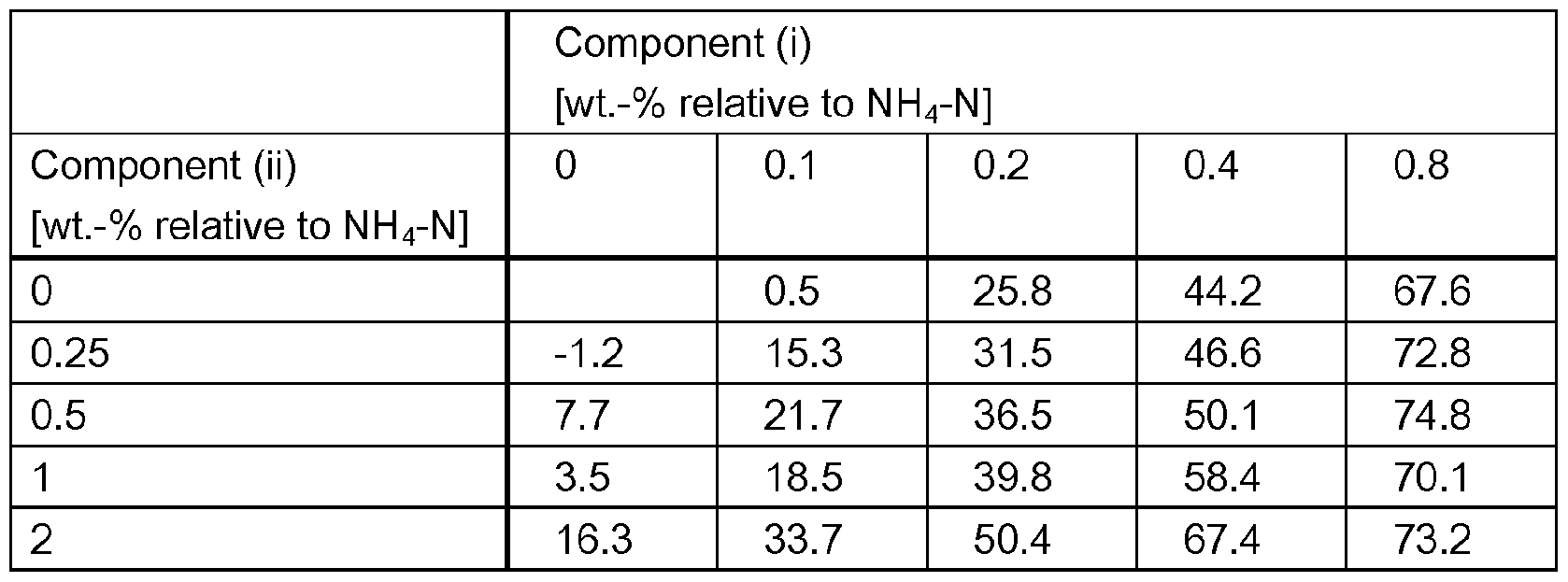


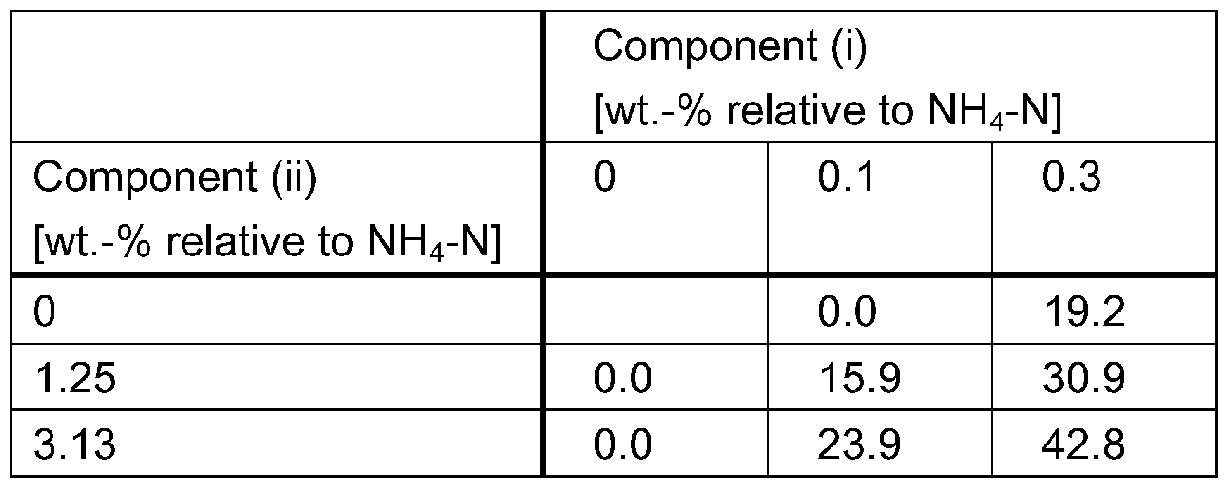


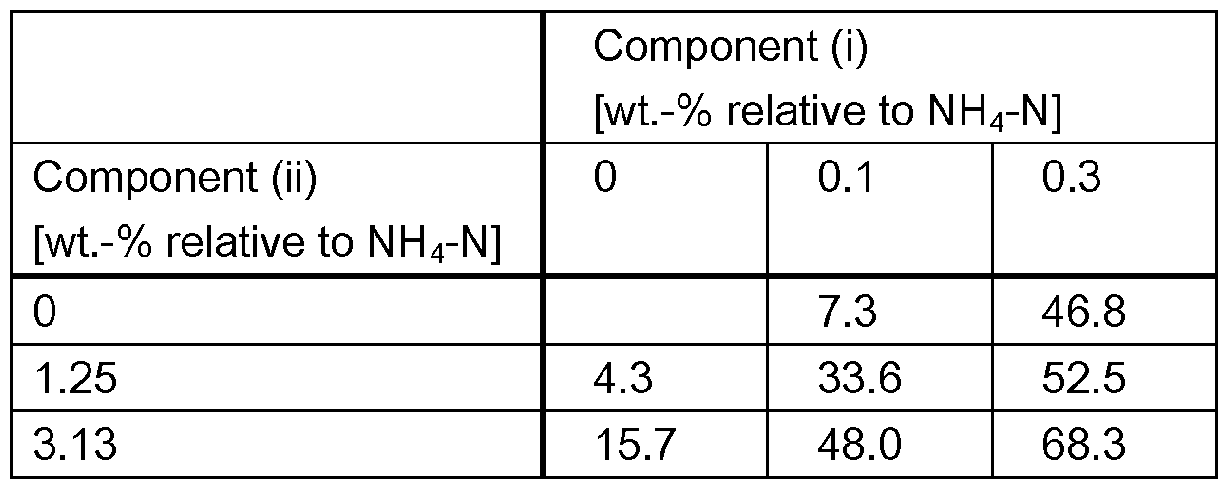
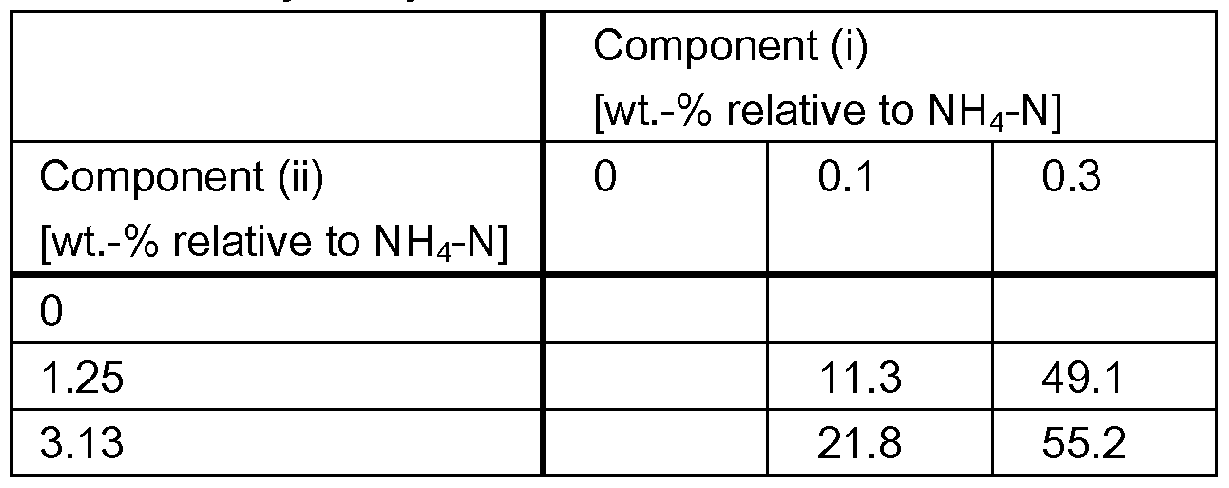


Claims


Priority Applications (5)
| Application Number | Priority Date | Filing Date | Title |
|---|---|---|---|
| CN202280012488.2A CN116829521A (en) | 2021-02-02 | 2022-02-02 | Synergistic effects of DCD and alkoxypyrazoles as nitrification inhibitors |
| CA3206495A CA3206495A1 (en) | 2021-02-02 | 2022-02-02 | Synergistic action of dcd and alkoxypyrazoles as nitrification inhibitors |
| EP22713293.3A EP4288398A1 (en) | 2021-02-02 | 2022-02-02 | Synergistic action of dcd and alkoxypyrazoles as nitrification inhibitors |
| US18/274,240 US20240101496A1 (en) | 2021-02-02 | 2022-02-02 | Synergistic action of dcd and alkoxypyrazoles as nitrification inhibitors |
| AU2022216425A AU2022216425A1 (en) | 2021-02-02 | 2022-02-02 | Synergistic action of dcd and alkoxypyrazoles as nitrification inhibitors |
Applications Claiming Priority (2)
| Application Number | Priority Date | Filing Date | Title |
|---|---|---|---|
| EP21154866 | 2021-02-02 | ||
| EP21154866.4 | 2021-02-02 |
Publications (1)
| Publication Number | Publication Date |
|---|---|
| WO2022167488A1 true WO2022167488A1 (en) | 2022-08-11 |
Family
ID=74550456
Family Applications (1)
| Application Number | Title | Priority Date | Filing Date |
|---|---|---|---|
| PCT/EP2022/052489 Ceased WO2022167488A1 (en) | 2021-02-02 | 2022-02-02 | Synergistic action of dcd and alkoxypyrazoles as nitrification inhibitors |
Country Status (7)
| Country | Link |
|---|---|
| US (1) | US20240101496A1 (en) |
| EP (1) | EP4288398A1 (en) |
| CN (1) | CN116829521A (en) |
| AR (1) | AR124796A1 (en) |
| AU (1) | AU2022216425A1 (en) |
| CA (1) | CA3206495A1 (en) |
| WO (1) | WO2022167488A1 (en) |
Cited By (2)
| Publication number | Priority date | Publication date | Assignee | Title |
|---|---|---|---|---|
| WO2023203066A1 (en) * | 2022-04-21 | 2023-10-26 | Basf Se | Synergistic action as nitrification inhibitors of dcd oligomers with alkoxypyrazole and its oligomers |
| WO2025056674A1 (en) * | 2023-09-14 | 2025-03-20 | Basf Se | Nitrification inhibitor formulation to prevent crystallization on solid mineral fertilizer |
Citations (157)
| Publication number | Priority date | Publication date | Assignee | Title |
|---|---|---|---|---|
| US3060084A (en) | 1961-06-09 | 1962-10-23 | Du Pont | Improved homogeneous, readily dispersed, pesticidal concentrate |
| US3299566A (en) | 1964-06-01 | 1967-01-24 | Olin Mathieson | Water soluble film containing agricultural chemicals |
| US3920442A (en) | 1972-09-18 | 1975-11-18 | Du Pont | Water-dispersible pesticide aggregates |
| US4144050A (en) | 1969-02-05 | 1979-03-13 | Hoechst Aktiengesellschaft | Micro granules for pesticides and process for their manufacture |
| US4172714A (en) | 1976-12-20 | 1979-10-30 | E. I. Du Pont De Nemours And Company | Dry compactible, swellable herbicidal compositions and pellets produced therefrom |
| GB2095558A (en) | 1981-03-30 | 1982-10-06 | Avon Packers Ltd | Formulation of agricultural chemicals |
| EP0141317A2 (en) | 1983-10-21 | 1985-05-15 | BASF Aktiengesellschaft | 7-Amino-azolo[1,5-a]pyrimidines and fungicides containing them |
| DD222471A3 (en) * | 1982-09-06 | 1985-05-15 | Piesteritz Stickstoff | ACTIVE COMBINATION FOR INHIBITION BZW. REGULATION OF NITRIFICATION OF AMMONIUM NITROGEN IN CULTURED BODIES |
| EP0152031A2 (en) | 1984-02-03 | 1985-08-21 | Shionogi & Co., Ltd. | Azolyl cycloalkanol derivatives and agricultural fungicides |
| EP0226917A1 (en) | 1985-12-20 | 1987-07-01 | BASF Aktiengesellschaft | Acrylic acid esters and fungicides containing these compounds |
| EP0243970A1 (en) | 1986-05-02 | 1987-11-04 | Stauffer Chemical Company | Fungicidal pyridyl imidates |
| EP0256503A2 (en) | 1986-08-12 | 1988-02-24 | Mitsubishi Kasei Corporation | Pyridinecarboxamide derivatives and their use as fungicide |
| EP0374753A2 (en) | 1988-12-19 | 1990-06-27 | American Cyanamid Company | Insecticidal toxines, genes coding therefor, antibodies binding them, transgenic plant cells and plants expressing these toxines |
| EP0392225A2 (en) | 1989-03-24 | 1990-10-17 | Ciba-Geigy Ag | Disease-resistant transgenic plants |
| EP0307510B1 (en) | 1987-09-17 | 1991-02-06 | BASF Aktiengesellschaft | Process for combating fungicides |
| WO1991002051A1 (en) | 1989-08-03 | 1991-02-21 | The Australian Technological Innovation Corporation | Myconematicide |
| EP0427529A1 (en) | 1989-11-07 | 1991-05-15 | Pioneer Hi-Bred International, Inc. | Larvicidal lectins and plant insect resistance based thereon |
| EP0428941A1 (en) | 1989-11-10 | 1991-05-29 | Agro-Kanesho Co., Ltd. | Hexahydrotriazine compounds and insecticides |
| US5026417A (en) | 1987-03-17 | 1991-06-25 | Her Majesty The Queen In Right Of Canada, As Represented By The Minister Of Agriculture | Methods and compositions for increasing the amounts of phosphorus and/or micronutrients available for plant uptake from soils |
| WO1991013546A1 (en) | 1990-03-12 | 1991-09-19 | E.I. Du Pont De Nemours And Company | Water-dispersible or water-soluble pesticide granules from heat-activated binders |
| EP0451878A1 (en) | 1985-01-18 | 1991-10-16 | Plant Genetic Systems, N.V. | Modifying plants by genetic engineering to combat or control insects |
| US5180587A (en) | 1988-06-28 | 1993-01-19 | E. I. Du Pont De Nemours And Company | Tablet formulations of pesticides |
| WO1993007278A1 (en) | 1991-10-04 | 1993-04-15 | Ciba-Geigy Ag | Synthetic dna sequence having enhanced insecticidal activity in maize |
| US5208030A (en) | 1989-08-30 | 1993-05-04 | Imperial Chemical Industries Plc | Active ingredient dosage device |
| US5232701A (en) | 1990-10-11 | 1993-08-03 | Sumitomo Chemical Company, Limited | Boron carbonate and solid acid pesticidal composition |
| WO1994001546A1 (en) | 1992-07-01 | 1994-01-20 | Cornell Research Foundation, Inc. | Elicitor of the hypersensitive response in plants |
| WO1995017806A1 (en) | 1993-12-29 | 1995-07-06 | Philom Bios Inc. | Methods and compositions for increasing the benefits of rhizobium inoculation to legume crop productivity |
| WO1995034656A1 (en) | 1994-06-10 | 1995-12-21 | Ciba-Geigy Ag | Novel bacillus thuringiensis genes coding toxins active against lepidopteran pests |
| EP0707445A1 (en) | 1993-07-03 | 1996-04-24 | Basf Ag | READY-TO-USE, STABLE, MULTI-PHASE AQUEOUS FORMULATION FOR PHYTOSANITARY PRODUCTS AND METHOD OF PREPARATION |
| WO1996021358A1 (en) | 1995-01-14 | 1996-07-18 | Prophyta Biologischer Pflanzenschutz Gmbh | Fungus isolate, preparation for combatting plant-pathogenic fungi, process for producing it and its use |
| EP0585215B1 (en) | 1989-11-17 | 1999-09-15 | Abbott Laboratories | Mutants or variants of bacillus thuringiensis producing high yields of delta endotoxin |
| US6124117A (en) | 1988-07-08 | 2000-09-26 | University Of British Columbia | Polysaccharide binding fusion proteins and conjugates |
| US6180141B1 (en) | 1996-03-15 | 2001-01-30 | Flamel Technologies | Composite gel microparticles as active principle carriers |
| EP1124414A1 (en) | 1999-08-26 | 2001-08-22 | Incotec International B.V. | Protection of germinating seed and pills containing pesticides |
| CN1309897A (en) | 2000-02-24 | 2001-08-29 | 沈阳化工研究院 | Unsaturated oximino ether bactericide |
| WO2002015701A2 (en) | 2000-08-25 | 2002-02-28 | Syngenta Participations Ag | Bacillus thuringiensis crystal protein hybrids |
| US6406690B1 (en) | 1995-04-17 | 2002-06-18 | Minrav Industries Ltd. | Bacillus firmus CNCM I-1582 or Bacillus cereus CNCM I-1562 for controlling nematodes |
| WO2003016303A1 (en) | 2001-08-20 | 2003-02-27 | Dainippon Ink And Chemicals, Inc. | Tetrazoyl oxime derivative and agricultural chemical containing the same as active ingredient |
| WO2003018810A2 (en) | 2001-08-31 | 2003-03-06 | Syngenta Participations Ag | Modified cry3a toxins and nucleic acid sequences coding therefor |
| WO2003031477A1 (en) | 2001-10-03 | 2003-04-17 | Unilever N.V. | Carbohydrate binding domain containing fusion proteins for delivery of therapeutic and other agents, and compositions containing them |
| EP0954213B1 (en) | 1996-12-12 | 2003-05-02 | Plantenkwekerij G.N.M. Grootscholten B.V. | Method for cultivating a plant using a culture block, culture block and apparatus for handling such blocks |
| WO2003052073A2 (en) | 2001-12-17 | 2003-06-26 | Syngenta Participations Ag | Novel corn event |
| WO2003066609A1 (en) | 2002-02-04 | 2003-08-14 | Bayer Cropscience Aktiengesellschaft | Disubstituted thiazolyl carboxanilides and their use as microbicides |
| WO2003074491A1 (en) | 2002-03-05 | 2003-09-12 | Syngenta Participations Ag | O-cyclopropyl-carboxanilides and their use as fungicides |
| CN1456054A (en) | 2003-03-25 | 2003-11-19 | 浙江省化工研究院 | Methoxy methyl acrylate compounds as bactericidal agent |
| WO2004049804A2 (en) | 2002-11-29 | 2004-06-17 | Syngenta Participations Ag | Fungicidal combinations for crop potection |
| WO2004083193A1 (en) | 2003-03-17 | 2004-09-30 | Sumitomo Chemical Company, Limited | Amide compound and bactericide composition containing the same |
| WO2005063721A1 (en) | 2003-12-19 | 2005-07-14 | E.I. Dupont De Nemours And Company | Herbicidal pyrimidines |
| WO2005077934A1 (en) | 2004-02-18 | 2005-08-25 | Ishihara Sangyo Kaisha, Ltd. | Anthranilamides, process for the production thereof, and pest controllers containing the same |
| WO2005087773A1 (en) | 2004-03-10 | 2005-09-22 | Basf Aktiengesellschaft | 5,6-dialkyl-7-amino-triazolopyrimidines, method for their production, their use for controlling pathogenic fungi and agents containing said compounds |
| WO2005087772A1 (en) | 2004-03-10 | 2005-09-22 | Basf Aktiengesellschaft | 5,6-dialkyl-7-amino-triazolopyrimidines, method for their production, their use for controlling pathogenic fungi and agents containing said compounds |
| WO2005102045A1 (en) | 2004-04-27 | 2005-11-03 | Micap Plc | Phytoactive composition |
| WO2005120226A2 (en) | 2004-06-10 | 2005-12-22 | Syngenta Participations Ag | Method of applying pesticides |
| WO2005120234A2 (en) | 2004-06-03 | 2005-12-22 | E.I. Dupont De Nemours And Company | Fungicidal mixtures of amidinylphenyl compounds |
| WO2005123690A1 (en) | 2004-06-18 | 2005-12-29 | Basf Aktiengesellschaft | 1-methyl-3-difluoromethyl-pyrazol-4-carbonic acid-(ortho-phenyl)-anilides, and use thereof as a fungicide |
| WO2005123689A1 (en) | 2004-06-18 | 2005-12-29 | Basf Aktiengesellschaft | 1-methyl-3-trifluoromethyl-pyrazole-4-carboxylic acid (ortho-phenyl)-anilides and to use thereof as fungicide |
| US6994849B2 (en) | 2001-03-14 | 2006-02-07 | State Of Israel, Ministry Of Agriculture, Agricultural Research Organization | Yeast Metschnikowia fructicola NRRL Y-30752 for inhibiting deleterious microorganisms on plants |
| WO2006015866A1 (en) | 2004-08-12 | 2006-02-16 | Syngenta Participations Ag | Method for protecting useful plants or plant propagation material |
| WO2006043635A1 (en) | 2004-10-20 | 2006-04-27 | Kumiai Chemical Industry Co., Ltd. | 3-triazolylphenyl sulfide derivative and insecticide/acaricide/nematicide containing the same as active ingredient |
| WO2006087343A1 (en) | 2005-02-16 | 2006-08-24 | Basf Aktiengesellschaft | Pyrazole carboxylic acid anilides, method for the production thereof and agents containing them for controlling pathogenic fungi |
| WO2006087325A1 (en) | 2005-02-16 | 2006-08-24 | Basf Aktiengesellschaft | 5-alkoxyalkyl-6-alkyl-7-amino-azolopyrimidines, method for their production, their use for controlling pathogenic fungi and agents containing said substances |
| WO2006089633A2 (en) | 2005-02-22 | 2006-08-31 | Bayer Cropscience Ag | Spiroketal-substituted cyclic ketoenols |
| WO2006112700A1 (en) | 2005-04-19 | 2006-10-26 | Precision Drip B.V. | The planting of plant material |
| WO2007006670A1 (en) | 2005-07-07 | 2007-01-18 | Basf Aktiengesellschaft | N-thio-anthranilamid compounds and their use as pesticides |
| CN1907024A (en) | 2005-08-03 | 2007-02-07 | 浙江化工科技集团有限公司 | Methoxyl group displacement methyl acrylate compound bactericidal agent |
| WO2007043677A1 (en) | 2005-10-14 | 2007-04-19 | Sumitomo Chemical Company, Limited | Hydrazide compound and pesticidal use of the same |
| WO2007067042A1 (en) | 2005-12-07 | 2007-06-14 | Incotec International B.V. | Protection of germinating seed and pills containing pesticides |
| WO2007067044A2 (en) | 2005-12-07 | 2007-06-14 | Incotec International B.V. | Modified active-ingredient-containing pellets/capsules |
| WO2007082098A2 (en) | 2006-01-13 | 2007-07-19 | Dow Agrosciences Llc | 6-(poly-substituted aryl)-4-aminopicolinates and their use as herbicides |
| WO2007090624A2 (en) | 2006-02-09 | 2007-08-16 | Syngenta Participations Ag | A method of protecting a plant propagation material, a plant, and/or plant organs |
| WO2007101540A1 (en) | 2006-03-06 | 2007-09-13 | Bayer Cropscience Ag | Combinations of active ingredients with insecticidal properties |
| WO2007101369A1 (en) | 2006-03-09 | 2007-09-13 | East China University Of Science And Technology | Preparation method and use of compounds having high biocidal activities |
| WO2007129454A1 (en) | 2006-05-08 | 2007-11-15 | Kumiai Chemical Industry Co., Ltd. | 1,2-benzisothiazole derivative, and agricultural or horticultural plant disease-controlling agent |
| US20070280981A1 (en) | 2006-06-02 | 2007-12-06 | The Andersons, Inc. | Adherent biologically active ingredient carrier granule |
| WO2008013622A2 (en) | 2006-07-27 | 2008-01-31 | E. I. Du Pont De Nemours And Company | Fungicidal azocyclic amides |
| WO2008067911A1 (en) | 2006-12-04 | 2008-06-12 | Bayer Cropscience Ag | Biphenyl-substituted spirocyclic ketoenols |
| WO2008134969A1 (en) | 2007-04-30 | 2008-11-13 | Sinochem Corporation | Benzamide compounds and applications thereof |
| WO2009090181A2 (en) | 2008-01-15 | 2009-07-23 | Bayer Cropscience Sa | Pesticide composition comprising a tetrazolyloxime derivative and a fungicide or an insecticide active substance |
| WO2009094442A2 (en) | 2008-01-22 | 2009-07-30 | Dow Agrosciences Llc | 5-fluoro pyrimidine derivatives |
| WO2009102736A1 (en) | 2008-02-12 | 2009-08-20 | Dow Agrosciences Llc | Pesticidal compositions |
| WO2009124707A2 (en) | 2008-04-07 | 2009-10-15 | Bayer Cropscience Ag | Combinations of biological control agents and insecticides or fungicides |
| WO2009126473A1 (en) | 2008-04-07 | 2009-10-15 | Bayer Cropscience Lp | Stable aqueous spore-containing formulation |
| WO2010006713A2 (en) | 2008-07-17 | 2010-01-21 | Bayer Cropscience Ag | Heterocyclic compounds used as pesticides |
| WO2010015657A2 (en) | 2008-08-05 | 2010-02-11 | Institut Pasteur | New alkoxypyrazoles |
| WO2010018714A1 (en) | 2008-08-13 | 2010-02-18 | 三井化学アグロ株式会社 | Amide derivative, pest control agent containing the amide derivative and use of the pest control agent |
| WO2010034737A1 (en) | 2008-09-24 | 2010-04-01 | Basf Se | Pyrazole compounds for controlling invertebrate pests |
| CN101715770A (en) | 2009-12-08 | 2010-06-02 | 中国科学院南海海洋研究所 | Application of loop proline-3-hydroxy-2-aminobutyric acid in preventing and removing marine fouling organisms |
| WO2010060379A1 (en) | 2008-11-28 | 2010-06-03 | 中国中化集团公司 | Ether compounds with nitrogen-containing 5-member heterocycle and the uses thereof |
| WO2010069266A1 (en) | 2008-12-19 | 2010-06-24 | 华东理工大学 | Heterocyclic nitrogenous or oxygenous compounds with insecticidal activity formed from dialdehydes and their preparation and uses thereof |
| WO2010069882A1 (en) | 2008-12-17 | 2010-06-24 | Syngenta Participations Ag | Isoxazole derivatives for use as fungicides |
| US20100260735A1 (en) | 2009-04-13 | 2010-10-14 | University of Delawre | Methods for promoting plant health |
| WO2010127926A1 (en) | 2009-05-06 | 2010-11-11 | Syngenta Participations Ag | 4 -cyano- 3 -benzoylamino-n- phenyl-benzamides for use in pest control |
| WO2010139271A1 (en) | 2009-06-05 | 2010-12-09 | 中国中化股份有限公司 | E-type phenyl acrylic ester compounds containing substituted anilino pyrimidine group and uses thereof |
| US20110046186A1 (en) | 2008-07-07 | 2011-02-24 | Bin Li | 1-Substituted Pyridyl-Pyrazolyl Amide Compounds and Uses Thereof |
| WO2011028657A1 (en) | 2009-09-01 | 2011-03-10 | Dow Agrosciences Llc | Synergistic fungicidal compositions containing a 5-fluoropyrimidine derivative for fungal control in cereals |
| WO2011069456A1 (en) | 2009-12-09 | 2011-06-16 | 华东理工大学 | Divalent and oxabridged heterocyclic neonicotinoid compounds and preparation methods thereof |
| WO2011077514A1 (en) | 2009-12-22 | 2011-06-30 | 三井化学アグロ株式会社 | Plant disease control composition and method for controlling plant diseases by applying the composition |
| WO2011081174A1 (en) | 2010-01-04 | 2011-07-07 | 日本曹達株式会社 | Nitrogen-containing heterocyclic compound and agricultural/horticultural germicide |
| CN102126994A (en) | 2010-01-19 | 2011-07-20 | 中化蓝天集团有限公司 | Benzophenone hydrazone derivative and preparation method and application thereof |
| WO2011085575A1 (en) | 2010-01-15 | 2011-07-21 | 江苏省农药研究所股份有限公司 | Ortho-heterocyclyl formanilide compounds, their synthesis methods and use |
| WO2011105506A1 (en) | 2010-02-25 | 2011-09-01 | 日本曹達株式会社 | Cyclic amine compound and miticide |
| WO2011109395A2 (en) | 2010-03-01 | 2011-09-09 | University Of Delaware | Compositions and methods for increasing biomass, iron concentration, and tolerance to pathogens in plants |
| WO2011135833A1 (en) | 2010-04-28 | 2011-11-03 | Sumitomo Chemical Company, Limited | Plant disease control composition and its use |
| US8075659B2 (en) | 2006-02-16 | 2011-12-13 | Basf Se | Preparations with improved urease-inhibiting effect and urea-containing fertilizers containing the latter |
| WO2012000896A2 (en) | 2010-06-28 | 2012-01-05 | Bayer Cropscience Ag | Heterocyclic compounds as agents for pest control |
| WO2012029672A1 (en) | 2010-08-31 | 2012-03-08 | Meiji Seikaファルマ株式会社 | Noxious organism control agent |
| WO2012034472A1 (en) | 2010-09-13 | 2012-03-22 | 中化蓝天集团有限公司 | Cyano benzenedicarboxamide compounds, preparing methods and as agricultural insecticides uses thereof |
| WO2012034403A1 (en) | 2010-09-14 | 2012-03-22 | 中化蓝天集团有限公司 | Fluoromethoxypyrazole anthranilamide compounds, synthesization methods and uses thereof |
| US20120149571A1 (en) | 2010-12-10 | 2012-06-14 | Auburn University | Inoculants Including Bacillus Bacteria for Inducing Production of Volatile Organic Compounds in Plants |
| WO2012084812A1 (en) | 2010-12-20 | 2012-06-28 | Isagro Ricerca S.R.L. | Aminoindanes amides having a high fungicidal activity and their phytosanitary compositions |
| WO2012084670A1 (en) | 2010-12-20 | 2012-06-28 | Basf Se | Pesticidal active mixtures comprising pyrazole compounds |
| WO2012126766A1 (en) | 2011-03-18 | 2012-09-27 | Bayer Cropscience Ag | N-(3-carbamoylphenyl)-1h-pyrazole-5-carboxamide derivatives and the use thereof for controlling animal pests |
| WO2012143317A1 (en) | 2011-04-21 | 2012-10-26 | Basf Se | Novel pesticidal pyrazole compounds |
| WO2012165511A1 (en) | 2011-05-31 | 2012-12-06 | クミアイ化学工業株式会社 | Method for controlling diseases in rice plant |
| WO2012168188A1 (en) | 2011-06-07 | 2012-12-13 | Bayer Intellectual Property Gmbh | Active compound combinations |
| WO2013003977A1 (en) | 2011-07-01 | 2013-01-10 | 合肥星宇化学有限责任公司 | Compound of 2,5-disubstituted-3-nitroimino-1,2,4-triazoline and preparation method and use as pesticide thereof |
| WO2013007767A1 (en) | 2011-07-13 | 2013-01-17 | Basf Se | Fungicidal substituted 2-[2-halogenalkyl-4-(phenoxy)-phenyl]-1-[1,2,4]triazol-1-yl-ethanol compounds |
| WO2013010862A1 (en) | 2011-07-15 | 2013-01-24 | Basf Se | Fungicidal alkyl-substituted 2-[2-chloro-4-(4-chloro-phenoxy)-phenyl]-1-[1,2,4]triazol-1-yl-ethanol compounds |
| WO2013024010A1 (en) | 2011-08-12 | 2013-02-21 | Basf Se | N-thio-anthranilamide compounds and their use as pesticides |
| WO2013024009A1 (en) | 2011-08-12 | 2013-02-21 | Basf Se | N-thio-anthranilamide compounds and their use as pesticides |
| WO2013032693A2 (en) | 2011-08-27 | 2013-03-07 | Marrone Bio Innovations, Inc. | Isolated bacterial strain of the genus burkholderia and pesticidal metabolites therefrom-formulations and uses |
| WO2013047749A1 (en) | 2011-09-29 | 2013-04-04 | 三井化学アグロ株式会社 | Production method for 4, 4-difluoro-3,4-dihydroisoquinoline derivative |
| WO2013047441A1 (en) | 2011-09-26 | 2013-04-04 | 日本曹達株式会社 | Agricultural and horticultural bactericide composition |
| WO2013050317A1 (en) | 2011-10-03 | 2013-04-11 | Syngenta Limited | Polymorphs of an isoxazoline derivative |
| WO2013050302A1 (en) | 2011-10-03 | 2013-04-11 | Syngenta Participations Ag | Isoxazoline derivatives as insecticidal compounds |
| WO2013055584A1 (en) | 2011-10-13 | 2013-04-18 | E. I. Du Pont De Nemours And Company | Solid forms of nematocidal sulfonamides |
| WO2013092224A1 (en) | 2011-12-21 | 2013-06-27 | Basf Se | Use of strobilurin type compounds for combating phytopathogenic fungi resistant to qo inhibitors |
| WO2013116053A1 (en) | 2012-02-02 | 2013-08-08 | Dow Agrosciences Llc | Pesticidal compositions and processes related thereto |
| WO2013116251A2 (en) | 2012-02-01 | 2013-08-08 | E. I. Du Pont De Nemours And Company | Fungicidal pyrazole mixtures |
| WO2013127704A1 (en) | 2012-02-27 | 2013-09-06 | Bayer Intellectual Property Gmbh | Active compound combinations containing a thiazoylisoxazoline and a fungicide |
| US20130236522A1 (en) | 2010-11-10 | 2013-09-12 | Kumiai Chemical Industry Co., Ltd. | Microbial pesticidal composition |
| WO2013162072A1 (en) | 2012-04-27 | 2013-10-31 | Sumitomo Chemical Company, Limited | Tetrazolinone compounds and its use as pesticides |
| CN103387541A (en) | 2012-05-10 | 2013-11-13 | 中国中化股份有限公司 | Preparation method of substituted pyrazolylether compound |
| WO2014029697A1 (en) | 2012-08-22 | 2014-02-27 | Basf Se | Fungicidal ternary mixtures comprising fluazinam |
| WO2014036056A1 (en) | 2012-08-31 | 2014-03-06 | Zoetis Llc | Crystalline forms of 1-(5'-(5-(3,5-dichloro-4-fluorophenyl)-5-(trifluoromethyl)-4,5-dihydroisoxazol-3-yl)-3'h-spiro[azetidine-3,1'-isobenzofuran]-1-yl)-2-(methylsulfonyl)ethanone |
| WO2014060177A1 (en) | 2012-10-16 | 2014-04-24 | Syngenta Participations Ag | Fungicidal compositions |
| CN103814937A (en) | 2014-02-11 | 2014-05-28 | 深圳诺普信农化股份有限公司 | Insecticide composition |
| WO2014090918A1 (en) | 2012-12-13 | 2014-06-19 | Novartis Ag | Process for the enantiomeric enrichment of diaryloxazoline derivatives |
| US20140213448A1 (en) | 2012-04-27 | 2014-07-31 | Dow Agrosciences Llc | Pesticidal compositions and processes related thereto |
| WO2014124369A1 (en) | 2013-02-11 | 2014-08-14 | Bayer Cropscience Lp | Compositions comprising a streptomyces-based biological control agent and a fungicide |
| WO2014126208A1 (en) | 2013-02-14 | 2014-08-21 | 日産化学工業株式会社 | Crystalline polymorph of isoxazoline-substituted benzamide compound, and method for producing same |
| WO2014191271A1 (en) | 2013-05-28 | 2014-12-04 | Syngenta Participations Ag | Use of tetramic acid derivatives as nematicides |
| WO2015038503A1 (en) | 2013-09-13 | 2015-03-19 | E. I. Du Pont De Nemours And Company | Heterocycle-substituted bicyclic azole pesticides |
| WO2015055497A1 (en) | 2013-10-16 | 2015-04-23 | Basf Se | Substituted pesticidal pyrazole compounds |
| EP2865265A1 (en) | 2014-02-13 | 2015-04-29 | Bayer CropScience AG | Active compound combinations comprising phenylamidine compounds and biological control agents |
| WO2015059039A1 (en) | 2013-10-24 | 2015-04-30 | Syngenta Participations Ag | Method of protecting a plant propagation material |
| WO2015065922A1 (en) | 2013-10-28 | 2015-05-07 | Dexcom, Inc. | Devices used in connection with continuous analyte monitoring that provide the user with one or more notifications, and related methods |
| EP2910126A1 (en) | 2015-05-05 | 2015-08-26 | Bayer CropScience AG | Active compound combinations having insecticidal properties |
| WO2015190316A1 (en) | 2014-06-09 | 2015-12-17 | 住友化学株式会社 | Method for producing pyridine compound |
| WO2016020371A1 (en) | 2014-08-04 | 2016-02-11 | Basf Se | Antifungal paenibacillus strains, fusaricidin-type compounds, and their use |
| CN105367557A (en) | 2015-11-23 | 2016-03-02 | 安徽千和新材料科技发展有限公司 | Method for preparing cycloxylidin |
| CN105481839A (en) | 2015-11-23 | 2016-04-13 | 安徽千和新材料科技发展有限公司 | Preparation method for cycloxylidin enantiomer with photoactivity |
| WO2016104516A1 (en) | 2014-12-22 | 2016-06-30 | 日本農薬株式会社 | Noxious organism control agent composition for agricultural and horticultural applications, and method for using said composition |
| WO2016174049A1 (en) | 2015-04-30 | 2016-11-03 | Bayer Animal Health Gmbh | Anti-parasitic combinations including halogen-substituted compounds |
| WO2017104592A1 (en) | 2015-12-16 | 2017-06-22 | 住友化学株式会社 | 2-(3-e thanesulfonyl pyridine-2-yl)-5-(trifluoromethanesulfonyl) benzoxazole crystal |
| WO2019016656A1 (en) | 2017-07-19 | 2019-01-24 | Università Degli Studi Di Siena | Process for the automatic generation of parallel code |
| US20210000115A1 (en) * | 2018-02-28 | 2021-01-07 | Basf Se | Use of alkoxypyrazoles as nitrification inhibitors |
-
2022
- 2022-02-02 EP EP22713293.3A patent/EP4288398A1/en not_active Withdrawn
- 2022-02-02 CN CN202280012488.2A patent/CN116829521A/en active Pending
- 2022-02-02 US US18/274,240 patent/US20240101496A1/en active Pending
- 2022-02-02 AU AU2022216425A patent/AU2022216425A1/en not_active Abandoned
- 2022-02-02 WO PCT/EP2022/052489 patent/WO2022167488A1/en not_active Ceased
- 2022-02-02 CA CA3206495A patent/CA3206495A1/en active Pending
- 2022-02-02 AR ARP220100210A patent/AR124796A1/en unknown
Patent Citations (158)
| Publication number | Priority date | Publication date | Assignee | Title |
|---|---|---|---|---|
| US3060084A (en) | 1961-06-09 | 1962-10-23 | Du Pont | Improved homogeneous, readily dispersed, pesticidal concentrate |
| US3299566A (en) | 1964-06-01 | 1967-01-24 | Olin Mathieson | Water soluble film containing agricultural chemicals |
| US4144050A (en) | 1969-02-05 | 1979-03-13 | Hoechst Aktiengesellschaft | Micro granules for pesticides and process for their manufacture |
| US3920442A (en) | 1972-09-18 | 1975-11-18 | Du Pont | Water-dispersible pesticide aggregates |
| US4172714A (en) | 1976-12-20 | 1979-10-30 | E. I. Du Pont De Nemours And Company | Dry compactible, swellable herbicidal compositions and pellets produced therefrom |
| GB2095558A (en) | 1981-03-30 | 1982-10-06 | Avon Packers Ltd | Formulation of agricultural chemicals |
| DD222471A3 (en) * | 1982-09-06 | 1985-05-15 | Piesteritz Stickstoff | ACTIVE COMBINATION FOR INHIBITION BZW. REGULATION OF NITRIFICATION OF AMMONIUM NITROGEN IN CULTURED BODIES |
| EP0141317A2 (en) | 1983-10-21 | 1985-05-15 | BASF Aktiengesellschaft | 7-Amino-azolo[1,5-a]pyrimidines and fungicides containing them |
| EP0152031A2 (en) | 1984-02-03 | 1985-08-21 | Shionogi & Co., Ltd. | Azolyl cycloalkanol derivatives and agricultural fungicides |
| EP0451878A1 (en) | 1985-01-18 | 1991-10-16 | Plant Genetic Systems, N.V. | Modifying plants by genetic engineering to combat or control insects |
| EP0226917A1 (en) | 1985-12-20 | 1987-07-01 | BASF Aktiengesellschaft | Acrylic acid esters and fungicides containing these compounds |
| EP0243970A1 (en) | 1986-05-02 | 1987-11-04 | Stauffer Chemical Company | Fungicidal pyridyl imidates |
| EP0256503A2 (en) | 1986-08-12 | 1988-02-24 | Mitsubishi Kasei Corporation | Pyridinecarboxamide derivatives and their use as fungicide |
| US5026417A (en) | 1987-03-17 | 1991-06-25 | Her Majesty The Queen In Right Of Canada, As Represented By The Minister Of Agriculture | Methods and compositions for increasing the amounts of phosphorus and/or micronutrients available for plant uptake from soils |
| EP0307510B1 (en) | 1987-09-17 | 1991-02-06 | BASF Aktiengesellschaft | Process for combating fungicides |
| US5180587A (en) | 1988-06-28 | 1993-01-19 | E. I. Du Pont De Nemours And Company | Tablet formulations of pesticides |
| US6124117A (en) | 1988-07-08 | 2000-09-26 | University Of British Columbia | Polysaccharide binding fusion proteins and conjugates |
| EP0374753A2 (en) | 1988-12-19 | 1990-06-27 | American Cyanamid Company | Insecticidal toxines, genes coding therefor, antibodies binding them, transgenic plant cells and plants expressing these toxines |
| EP0392225A2 (en) | 1989-03-24 | 1990-10-17 | Ciba-Geigy Ag | Disease-resistant transgenic plants |
| WO1991002051A1 (en) | 1989-08-03 | 1991-02-21 | The Australian Technological Innovation Corporation | Myconematicide |
| US5208030A (en) | 1989-08-30 | 1993-05-04 | Imperial Chemical Industries Plc | Active ingredient dosage device |
| EP0427529A1 (en) | 1989-11-07 | 1991-05-15 | Pioneer Hi-Bred International, Inc. | Larvicidal lectins and plant insect resistance based thereon |
| EP0428941A1 (en) | 1989-11-10 | 1991-05-29 | Agro-Kanesho Co., Ltd. | Hexahydrotriazine compounds and insecticides |
| EP0585215B1 (en) | 1989-11-17 | 1999-09-15 | Abbott Laboratories | Mutants or variants of bacillus thuringiensis producing high yields of delta endotoxin |
| WO1991013546A1 (en) | 1990-03-12 | 1991-09-19 | E.I. Du Pont De Nemours And Company | Water-dispersible or water-soluble pesticide granules from heat-activated binders |
| US5232701A (en) | 1990-10-11 | 1993-08-03 | Sumitomo Chemical Company, Limited | Boron carbonate and solid acid pesticidal composition |
| WO1993007278A1 (en) | 1991-10-04 | 1993-04-15 | Ciba-Geigy Ag | Synthetic dna sequence having enhanced insecticidal activity in maize |
| WO1994001546A1 (en) | 1992-07-01 | 1994-01-20 | Cornell Research Foundation, Inc. | Elicitor of the hypersensitive response in plants |
| EP0707445A1 (en) | 1993-07-03 | 1996-04-24 | Basf Ag | READY-TO-USE, STABLE, MULTI-PHASE AQUEOUS FORMULATION FOR PHYTOSANITARY PRODUCTS AND METHOD OF PREPARATION |
| WO1995017806A1 (en) | 1993-12-29 | 1995-07-06 | Philom Bios Inc. | Methods and compositions for increasing the benefits of rhizobium inoculation to legume crop productivity |
| WO1995034656A1 (en) | 1994-06-10 | 1995-12-21 | Ciba-Geigy Ag | Novel bacillus thuringiensis genes coding toxins active against lepidopteran pests |
| WO1996021358A1 (en) | 1995-01-14 | 1996-07-18 | Prophyta Biologischer Pflanzenschutz Gmbh | Fungus isolate, preparation for combatting plant-pathogenic fungi, process for producing it and its use |
| US6406690B1 (en) | 1995-04-17 | 2002-06-18 | Minrav Industries Ltd. | Bacillus firmus CNCM I-1582 or Bacillus cereus CNCM I-1562 for controlling nematodes |
| US6180141B1 (en) | 1996-03-15 | 2001-01-30 | Flamel Technologies | Composite gel microparticles as active principle carriers |
| EP0954213B1 (en) | 1996-12-12 | 2003-05-02 | Plantenkwekerij G.N.M. Grootscholten B.V. | Method for cultivating a plant using a culture block, culture block and apparatus for handling such blocks |
| EP1124414A1 (en) | 1999-08-26 | 2001-08-22 | Incotec International B.V. | Protection of germinating seed and pills containing pesticides |
| CN1309897A (en) | 2000-02-24 | 2001-08-29 | 沈阳化工研究院 | Unsaturated oximino ether bactericide |
| WO2002015701A2 (en) | 2000-08-25 | 2002-02-28 | Syngenta Participations Ag | Bacillus thuringiensis crystal protein hybrids |
| US6994849B2 (en) | 2001-03-14 | 2006-02-07 | State Of Israel, Ministry Of Agriculture, Agricultural Research Organization | Yeast Metschnikowia fructicola NRRL Y-30752 for inhibiting deleterious microorganisms on plants |
| WO2003016303A1 (en) | 2001-08-20 | 2003-02-27 | Dainippon Ink And Chemicals, Inc. | Tetrazoyl oxime derivative and agricultural chemical containing the same as active ingredient |
| WO2003018810A2 (en) | 2001-08-31 | 2003-03-06 | Syngenta Participations Ag | Modified cry3a toxins and nucleic acid sequences coding therefor |
| WO2003031477A1 (en) | 2001-10-03 | 2003-04-17 | Unilever N.V. | Carbohydrate binding domain containing fusion proteins for delivery of therapeutic and other agents, and compositions containing them |
| WO2003052073A2 (en) | 2001-12-17 | 2003-06-26 | Syngenta Participations Ag | Novel corn event |
| WO2003066609A1 (en) | 2002-02-04 | 2003-08-14 | Bayer Cropscience Aktiengesellschaft | Disubstituted thiazolyl carboxanilides and their use as microbicides |
| WO2003074491A1 (en) | 2002-03-05 | 2003-09-12 | Syngenta Participations Ag | O-cyclopropyl-carboxanilides and their use as fungicides |
| WO2004049804A2 (en) | 2002-11-29 | 2004-06-17 | Syngenta Participations Ag | Fungicidal combinations for crop potection |
| WO2004083193A1 (en) | 2003-03-17 | 2004-09-30 | Sumitomo Chemical Company, Limited | Amide compound and bactericide composition containing the same |
| CN1456054A (en) | 2003-03-25 | 2003-11-19 | 浙江省化工研究院 | Methoxy methyl acrylate compounds as bactericidal agent |
| WO2005063721A1 (en) | 2003-12-19 | 2005-07-14 | E.I. Dupont De Nemours And Company | Herbicidal pyrimidines |
| WO2005077934A1 (en) | 2004-02-18 | 2005-08-25 | Ishihara Sangyo Kaisha, Ltd. | Anthranilamides, process for the production thereof, and pest controllers containing the same |
| WO2005087773A1 (en) | 2004-03-10 | 2005-09-22 | Basf Aktiengesellschaft | 5,6-dialkyl-7-amino-triazolopyrimidines, method for their production, their use for controlling pathogenic fungi and agents containing said compounds |
| WO2005087772A1 (en) | 2004-03-10 | 2005-09-22 | Basf Aktiengesellschaft | 5,6-dialkyl-7-amino-triazolopyrimidines, method for their production, their use for controlling pathogenic fungi and agents containing said compounds |
| WO2005102045A1 (en) | 2004-04-27 | 2005-11-03 | Micap Plc | Phytoactive composition |
| WO2005120234A2 (en) | 2004-06-03 | 2005-12-22 | E.I. Dupont De Nemours And Company | Fungicidal mixtures of amidinylphenyl compounds |
| WO2005120226A2 (en) | 2004-06-10 | 2005-12-22 | Syngenta Participations Ag | Method of applying pesticides |
| WO2005123690A1 (en) | 2004-06-18 | 2005-12-29 | Basf Aktiengesellschaft | 1-methyl-3-difluoromethyl-pyrazol-4-carbonic acid-(ortho-phenyl)-anilides, and use thereof as a fungicide |
| WO2005123689A1 (en) | 2004-06-18 | 2005-12-29 | Basf Aktiengesellschaft | 1-methyl-3-trifluoromethyl-pyrazole-4-carboxylic acid (ortho-phenyl)-anilides and to use thereof as fungicide |
| WO2006015866A1 (en) | 2004-08-12 | 2006-02-16 | Syngenta Participations Ag | Method for protecting useful plants or plant propagation material |
| WO2006043635A1 (en) | 2004-10-20 | 2006-04-27 | Kumiai Chemical Industry Co., Ltd. | 3-triazolylphenyl sulfide derivative and insecticide/acaricide/nematicide containing the same as active ingredient |
| WO2006087343A1 (en) | 2005-02-16 | 2006-08-24 | Basf Aktiengesellschaft | Pyrazole carboxylic acid anilides, method for the production thereof and agents containing them for controlling pathogenic fungi |
| WO2006087325A1 (en) | 2005-02-16 | 2006-08-24 | Basf Aktiengesellschaft | 5-alkoxyalkyl-6-alkyl-7-amino-azolopyrimidines, method for their production, their use for controlling pathogenic fungi and agents containing said substances |
| WO2006089633A2 (en) | 2005-02-22 | 2006-08-31 | Bayer Cropscience Ag | Spiroketal-substituted cyclic ketoenols |
| WO2006112700A1 (en) | 2005-04-19 | 2006-10-26 | Precision Drip B.V. | The planting of plant material |
| WO2007006670A1 (en) | 2005-07-07 | 2007-01-18 | Basf Aktiengesellschaft | N-thio-anthranilamid compounds and their use as pesticides |
| CN1907024A (en) | 2005-08-03 | 2007-02-07 | 浙江化工科技集团有限公司 | Methoxyl group displacement methyl acrylate compound bactericidal agent |
| WO2007043677A1 (en) | 2005-10-14 | 2007-04-19 | Sumitomo Chemical Company, Limited | Hydrazide compound and pesticidal use of the same |
| WO2007067042A1 (en) | 2005-12-07 | 2007-06-14 | Incotec International B.V. | Protection of germinating seed and pills containing pesticides |
| WO2007067044A2 (en) | 2005-12-07 | 2007-06-14 | Incotec International B.V. | Modified active-ingredient-containing pellets/capsules |
| WO2007082098A2 (en) | 2006-01-13 | 2007-07-19 | Dow Agrosciences Llc | 6-(poly-substituted aryl)-4-aminopicolinates and their use as herbicides |
| WO2007090624A2 (en) | 2006-02-09 | 2007-08-16 | Syngenta Participations Ag | A method of protecting a plant propagation material, a plant, and/or plant organs |
| US8075659B2 (en) | 2006-02-16 | 2011-12-13 | Basf Se | Preparations with improved urease-inhibiting effect and urea-containing fertilizers containing the latter |
| WO2007101540A1 (en) | 2006-03-06 | 2007-09-13 | Bayer Cropscience Ag | Combinations of active ingredients with insecticidal properties |
| WO2007101369A1 (en) | 2006-03-09 | 2007-09-13 | East China University Of Science And Technology | Preparation method and use of compounds having high biocidal activities |
| WO2007129454A1 (en) | 2006-05-08 | 2007-11-15 | Kumiai Chemical Industry Co., Ltd. | 1,2-benzisothiazole derivative, and agricultural or horticultural plant disease-controlling agent |
| US20070280981A1 (en) | 2006-06-02 | 2007-12-06 | The Andersons, Inc. | Adherent biologically active ingredient carrier granule |
| WO2008013622A2 (en) | 2006-07-27 | 2008-01-31 | E. I. Du Pont De Nemours And Company | Fungicidal azocyclic amides |
| WO2008067911A1 (en) | 2006-12-04 | 2008-06-12 | Bayer Cropscience Ag | Biphenyl-substituted spirocyclic ketoenols |
| WO2008134969A1 (en) | 2007-04-30 | 2008-11-13 | Sinochem Corporation | Benzamide compounds and applications thereof |
| WO2009090181A2 (en) | 2008-01-15 | 2009-07-23 | Bayer Cropscience Sa | Pesticide composition comprising a tetrazolyloxime derivative and a fungicide or an insecticide active substance |
| WO2009094442A2 (en) | 2008-01-22 | 2009-07-30 | Dow Agrosciences Llc | 5-fluoro pyrimidine derivatives |
| WO2009102736A1 (en) | 2008-02-12 | 2009-08-20 | Dow Agrosciences Llc | Pesticidal compositions |
| WO2009126473A1 (en) | 2008-04-07 | 2009-10-15 | Bayer Cropscience Lp | Stable aqueous spore-containing formulation |
| WO2009124707A2 (en) | 2008-04-07 | 2009-10-15 | Bayer Cropscience Ag | Combinations of biological control agents and insecticides or fungicides |
| US20110046186A1 (en) | 2008-07-07 | 2011-02-24 | Bin Li | 1-Substituted Pyridyl-Pyrazolyl Amide Compounds and Uses Thereof |
| WO2010006713A2 (en) | 2008-07-17 | 2010-01-21 | Bayer Cropscience Ag | Heterocyclic compounds used as pesticides |
| WO2010015657A2 (en) | 2008-08-05 | 2010-02-11 | Institut Pasteur | New alkoxypyrazoles |
| WO2010018714A1 (en) | 2008-08-13 | 2010-02-18 | 三井化学アグロ株式会社 | Amide derivative, pest control agent containing the amide derivative and use of the pest control agent |
| WO2010034737A1 (en) | 2008-09-24 | 2010-04-01 | Basf Se | Pyrazole compounds for controlling invertebrate pests |
| WO2010060379A1 (en) | 2008-11-28 | 2010-06-03 | 中国中化集团公司 | Ether compounds with nitrogen-containing 5-member heterocycle and the uses thereof |
| WO2010069882A1 (en) | 2008-12-17 | 2010-06-24 | Syngenta Participations Ag | Isoxazole derivatives for use as fungicides |
| WO2010069266A1 (en) | 2008-12-19 | 2010-06-24 | 华东理工大学 | Heterocyclic nitrogenous or oxygenous compounds with insecticidal activity formed from dialdehydes and their preparation and uses thereof |
| US20100260735A1 (en) | 2009-04-13 | 2010-10-14 | University of Delawre | Methods for promoting plant health |
| WO2010127926A1 (en) | 2009-05-06 | 2010-11-11 | Syngenta Participations Ag | 4 -cyano- 3 -benzoylamino-n- phenyl-benzamides for use in pest control |
| WO2010139271A1 (en) | 2009-06-05 | 2010-12-09 | 中国中化股份有限公司 | E-type phenyl acrylic ester compounds containing substituted anilino pyrimidine group and uses thereof |
| WO2011028657A1 (en) | 2009-09-01 | 2011-03-10 | Dow Agrosciences Llc | Synergistic fungicidal compositions containing a 5-fluoropyrimidine derivative for fungal control in cereals |
| CN101715770A (en) | 2009-12-08 | 2010-06-02 | 中国科学院南海海洋研究所 | Application of loop proline-3-hydroxy-2-aminobutyric acid in preventing and removing marine fouling organisms |
| WO2011069456A1 (en) | 2009-12-09 | 2011-06-16 | 华东理工大学 | Divalent and oxabridged heterocyclic neonicotinoid compounds and preparation methods thereof |
| WO2011077514A1 (en) | 2009-12-22 | 2011-06-30 | 三井化学アグロ株式会社 | Plant disease control composition and method for controlling plant diseases by applying the composition |
| WO2011081174A1 (en) | 2010-01-04 | 2011-07-07 | 日本曹達株式会社 | Nitrogen-containing heterocyclic compound and agricultural/horticultural germicide |
| WO2011085575A1 (en) | 2010-01-15 | 2011-07-21 | 江苏省农药研究所股份有限公司 | Ortho-heterocyclyl formanilide compounds, their synthesis methods and use |
| CN102126994A (en) | 2010-01-19 | 2011-07-20 | 中化蓝天集团有限公司 | Benzophenone hydrazone derivative and preparation method and application thereof |
| WO2011105506A1 (en) | 2010-02-25 | 2011-09-01 | 日本曹達株式会社 | Cyclic amine compound and miticide |
| WO2011109395A2 (en) | 2010-03-01 | 2011-09-09 | University Of Delaware | Compositions and methods for increasing biomass, iron concentration, and tolerance to pathogens in plants |
| WO2011135833A1 (en) | 2010-04-28 | 2011-11-03 | Sumitomo Chemical Company, Limited | Plant disease control composition and its use |
| WO2012000896A2 (en) | 2010-06-28 | 2012-01-05 | Bayer Cropscience Ag | Heterocyclic compounds as agents for pest control |
| WO2012029672A1 (en) | 2010-08-31 | 2012-03-08 | Meiji Seikaファルマ株式会社 | Noxious organism control agent |
| WO2012034472A1 (en) | 2010-09-13 | 2012-03-22 | 中化蓝天集团有限公司 | Cyano benzenedicarboxamide compounds, preparing methods and as agricultural insecticides uses thereof |
| WO2012034403A1 (en) | 2010-09-14 | 2012-03-22 | 中化蓝天集团有限公司 | Fluoromethoxypyrazole anthranilamide compounds, synthesization methods and uses thereof |
| US20130236522A1 (en) | 2010-11-10 | 2013-09-12 | Kumiai Chemical Industry Co., Ltd. | Microbial pesticidal composition |
| US8445255B2 (en) | 2010-12-10 | 2013-05-21 | Auburn University | Inoculants including Bacillus bacteria for inducing production of volatile organic compounds in plants |
| US20120149571A1 (en) | 2010-12-10 | 2012-06-14 | Auburn University | Inoculants Including Bacillus Bacteria for Inducing Production of Volatile Organic Compounds in Plants |
| WO2012084670A1 (en) | 2010-12-20 | 2012-06-28 | Basf Se | Pesticidal active mixtures comprising pyrazole compounds |
| WO2012084812A1 (en) | 2010-12-20 | 2012-06-28 | Isagro Ricerca S.R.L. | Aminoindanes amides having a high fungicidal activity and their phytosanitary compositions |
| WO2012126766A1 (en) | 2011-03-18 | 2012-09-27 | Bayer Cropscience Ag | N-(3-carbamoylphenyl)-1h-pyrazole-5-carboxamide derivatives and the use thereof for controlling animal pests |
| WO2012143317A1 (en) | 2011-04-21 | 2012-10-26 | Basf Se | Novel pesticidal pyrazole compounds |
| WO2012165511A1 (en) | 2011-05-31 | 2012-12-06 | クミアイ化学工業株式会社 | Method for controlling diseases in rice plant |
| WO2012168188A1 (en) | 2011-06-07 | 2012-12-13 | Bayer Intellectual Property Gmbh | Active compound combinations |
| WO2013003977A1 (en) | 2011-07-01 | 2013-01-10 | 合肥星宇化学有限责任公司 | Compound of 2,5-disubstituted-3-nitroimino-1,2,4-triazoline and preparation method and use as pesticide thereof |
| WO2013007767A1 (en) | 2011-07-13 | 2013-01-17 | Basf Se | Fungicidal substituted 2-[2-halogenalkyl-4-(phenoxy)-phenyl]-1-[1,2,4]triazol-1-yl-ethanol compounds |
| WO2013010862A1 (en) | 2011-07-15 | 2013-01-24 | Basf Se | Fungicidal alkyl-substituted 2-[2-chloro-4-(4-chloro-phenoxy)-phenyl]-1-[1,2,4]triazol-1-yl-ethanol compounds |
| WO2013024010A1 (en) | 2011-08-12 | 2013-02-21 | Basf Se | N-thio-anthranilamide compounds and their use as pesticides |
| WO2013024009A1 (en) | 2011-08-12 | 2013-02-21 | Basf Se | N-thio-anthranilamide compounds and their use as pesticides |
| WO2013032693A2 (en) | 2011-08-27 | 2013-03-07 | Marrone Bio Innovations, Inc. | Isolated bacterial strain of the genus burkholderia and pesticidal metabolites therefrom-formulations and uses |
| WO2013047441A1 (en) | 2011-09-26 | 2013-04-04 | 日本曹達株式会社 | Agricultural and horticultural bactericide composition |
| WO2013047749A1 (en) | 2011-09-29 | 2013-04-04 | 三井化学アグロ株式会社 | Production method for 4, 4-difluoro-3,4-dihydroisoquinoline derivative |
| WO2013050317A1 (en) | 2011-10-03 | 2013-04-11 | Syngenta Limited | Polymorphs of an isoxazoline derivative |
| WO2013050302A1 (en) | 2011-10-03 | 2013-04-11 | Syngenta Participations Ag | Isoxazoline derivatives as insecticidal compounds |
| WO2013055584A1 (en) | 2011-10-13 | 2013-04-18 | E. I. Du Pont De Nemours And Company | Solid forms of nematocidal sulfonamides |
| WO2013092224A1 (en) | 2011-12-21 | 2013-06-27 | Basf Se | Use of strobilurin type compounds for combating phytopathogenic fungi resistant to qo inhibitors |
| WO2013116251A2 (en) | 2012-02-01 | 2013-08-08 | E. I. Du Pont De Nemours And Company | Fungicidal pyrazole mixtures |
| WO2013116053A1 (en) | 2012-02-02 | 2013-08-08 | Dow Agrosciences Llc | Pesticidal compositions and processes related thereto |
| WO2013127704A1 (en) | 2012-02-27 | 2013-09-06 | Bayer Intellectual Property Gmbh | Active compound combinations containing a thiazoylisoxazoline and a fungicide |
| US20140213448A1 (en) | 2012-04-27 | 2014-07-31 | Dow Agrosciences Llc | Pesticidal compositions and processes related thereto |
| WO2013162072A1 (en) | 2012-04-27 | 2013-10-31 | Sumitomo Chemical Company, Limited | Tetrazolinone compounds and its use as pesticides |
| CN103387541A (en) | 2012-05-10 | 2013-11-13 | 中国中化股份有限公司 | Preparation method of substituted pyrazolylether compound |
| WO2014029697A1 (en) | 2012-08-22 | 2014-02-27 | Basf Se | Fungicidal ternary mixtures comprising fluazinam |
| WO2014036056A1 (en) | 2012-08-31 | 2014-03-06 | Zoetis Llc | Crystalline forms of 1-(5'-(5-(3,5-dichloro-4-fluorophenyl)-5-(trifluoromethyl)-4,5-dihydroisoxazol-3-yl)-3'h-spiro[azetidine-3,1'-isobenzofuran]-1-yl)-2-(methylsulfonyl)ethanone |
| WO2014060177A1 (en) | 2012-10-16 | 2014-04-24 | Syngenta Participations Ag | Fungicidal compositions |
| WO2014090918A1 (en) | 2012-12-13 | 2014-06-19 | Novartis Ag | Process for the enantiomeric enrichment of diaryloxazoline derivatives |
| WO2014124369A1 (en) | 2013-02-11 | 2014-08-14 | Bayer Cropscience Lp | Compositions comprising a streptomyces-based biological control agent and a fungicide |
| WO2014126208A1 (en) | 2013-02-14 | 2014-08-21 | 日産化学工業株式会社 | Crystalline polymorph of isoxazoline-substituted benzamide compound, and method for producing same |
| WO2014191271A1 (en) | 2013-05-28 | 2014-12-04 | Syngenta Participations Ag | Use of tetramic acid derivatives as nematicides |
| WO2015038503A1 (en) | 2013-09-13 | 2015-03-19 | E. I. Du Pont De Nemours And Company | Heterocycle-substituted bicyclic azole pesticides |
| WO2015055497A1 (en) | 2013-10-16 | 2015-04-23 | Basf Se | Substituted pesticidal pyrazole compounds |
| WO2015059039A1 (en) | 2013-10-24 | 2015-04-30 | Syngenta Participations Ag | Method of protecting a plant propagation material |
| WO2015065922A1 (en) | 2013-10-28 | 2015-05-07 | Dexcom, Inc. | Devices used in connection with continuous analyte monitoring that provide the user with one or more notifications, and related methods |
| CN103814937A (en) | 2014-02-11 | 2014-05-28 | 深圳诺普信农化股份有限公司 | Insecticide composition |
| EP2865265A1 (en) | 2014-02-13 | 2015-04-29 | Bayer CropScience AG | Active compound combinations comprising phenylamidine compounds and biological control agents |
| WO2015190316A1 (en) | 2014-06-09 | 2015-12-17 | 住友化学株式会社 | Method for producing pyridine compound |
| WO2016020371A1 (en) | 2014-08-04 | 2016-02-11 | Basf Se | Antifungal paenibacillus strains, fusaricidin-type compounds, and their use |
| WO2016104516A1 (en) | 2014-12-22 | 2016-06-30 | 日本農薬株式会社 | Noxious organism control agent composition for agricultural and horticultural applications, and method for using said composition |
| WO2016174049A1 (en) | 2015-04-30 | 2016-11-03 | Bayer Animal Health Gmbh | Anti-parasitic combinations including halogen-substituted compounds |
| EP2910126A1 (en) | 2015-05-05 | 2015-08-26 | Bayer CropScience AG | Active compound combinations having insecticidal properties |
| CN105367557A (en) | 2015-11-23 | 2016-03-02 | 安徽千和新材料科技发展有限公司 | Method for preparing cycloxylidin |
| CN105481839A (en) | 2015-11-23 | 2016-04-13 | 安徽千和新材料科技发展有限公司 | Preparation method for cycloxylidin enantiomer with photoactivity |
| WO2017104592A1 (en) | 2015-12-16 | 2017-06-22 | 住友化学株式会社 | 2-(3-e thanesulfonyl pyridine-2-yl)-5-(trifluoromethanesulfonyl) benzoxazole crystal |
| WO2019016656A1 (en) | 2017-07-19 | 2019-01-24 | Università Degli Studi Di Siena | Process for the automatic generation of parallel code |
| US20210000115A1 (en) * | 2018-02-28 | 2021-01-07 | Basf Se | Use of alkoxypyrazoles as nitrification inhibitors |
Non-Patent Citations (31)
| Title |
|---|
| A. GUVENN. KANISKAN, JOURNAL OF MOLECULAR STRUCTURE (THEOCHEM, vol. 488, 1999, pages 125 - 134 |
| AUSTRAL, J. AGRICULT. RES., vol. 58, 2007, pages 708 |
| BIOCONTROL SCIENCE TECHNOL., vol. 22, no. 7, 2012, pages 747 - 761 |
| BIOCONTROL, vol. 57, 2012, pages 687 - 696 |
| BIOL. FERTIL. SOILS, vol. 47, 2011, pages 81 - 89 |
| BROWNING: "Agglomeration", CHEMICAL ENGINEERING, 4 December 1967 (1967-12-04), pages 147 - 48 |
| CAN. J. PLANT SCI., vol. 48, no. 6, 1968, pages 587 - 94 |
| CAN. J. PLANT SCI., vol. 78, no. 1, 1998, pages 91 - 102 |
| CAN. J. PLANT. SCI., vol. 70, 1990, pages 661 - 666 |
| COLBY, S.R.: "Calculating synergistic and antagonistic responses of herbicide combinations", WEEDS, vol. 15, 1967, pages 20 - 22, XP001112961 |
| CROP PROTECTION, vol. 27, 2008, pages 352 - 361 |
| D. PIOMELLI, SYNTHESIS, 2016, pages 2739 - 2756 |
| EUR. J. SOIL BIOL., vol. 45, 2009, pages 28 - 35 |
| FEDERAL REGISTER, vol. 76, no. 22, 2 February 2011 (2011-02-02), pages 5808 |
| FERTILIZER RES., vol. 39, 1994, pages 97 - 103 |
| G.W. GRIBBLEJ.A. JOULE: "Progress in Heterocyclic Chemistry", vol. 27, 2015, BRITISH CROP PROTECTION COUNCIL |
| HANCE ET AL.: "Weed Control Handbook", 1989, BLACKWELL SCIENTIFIC |
| J. INVERTEBRATE PATHOL., vol. 107, 2011, pages 112 - 126 |
| J. PLANT DIS. PROT., vol. 105, 1998, pages 181 - 197 |
| KLINGMAN: "Weed Control as a Science", 1961, J. WILEY & SONS |
| MOLLET, H.GRUBEMANN, A.: "Formulation technology", 2001, WILEY VCH VERLAG |
| NELSONHUBER: "National Corn Handbook", 2001, IOWA STATE UNIVERSITY, article "Nitrification inhibitors for corn production" |
| PERRY'S: "Chemical Engineer's Handbook", 1963, MCGRAW-HILI, pages: 8 - 57 |
| SADRINE GUILLOUFREDERIC J. BONHOMMEYVES L. JANIN, SYNTHESIS, 2008, pages 3504 - 3508 |
| SANDRINE GUILLOUYVES L. JANIN, CHEM. EUR. J., vol. 16, 2010, pages 4669 - 4677 |
| SCIENCE, vol. 257, 1992, pages 85 - 88 |
| SIMBIOSE-AGRO, BRAZIL; PLANT SOIL, vol. 331, 2010, pages 413 - 425 |
| SLANGENKERKHOFF, FERTILIZER RESEARCH, vol. 5, no. 1, 1984, pages 1 - 76 |
| SUBBARAO ET AL., ADVANCES IN AGRONOMY, vol. 114, 2012, pages 249 - 302 |
| SYSTEM. APPL. MICROBIOL., vol. 27, 2004, pages 372 - 379 |
| WILLIAM F. VERNIERLAU-RENT GOMEZ, TETRAHEDRON LETTERS, 2017, pages 4587 - 4590 |
Cited By (2)
| Publication number | Priority date | Publication date | Assignee | Title |
|---|---|---|---|---|
| WO2023203066A1 (en) * | 2022-04-21 | 2023-10-26 | Basf Se | Synergistic action as nitrification inhibitors of dcd oligomers with alkoxypyrazole and its oligomers |
| WO2025056674A1 (en) * | 2023-09-14 | 2025-03-20 | Basf Se | Nitrification inhibitor formulation to prevent crystallization on solid mineral fertilizer |
Also Published As
| Publication number | Publication date |
|---|---|
| CA3206495A1 (en) | 2022-08-11 |
| US20240101496A1 (en) | 2024-03-28 |
| CN116829521A (en) | 2023-09-29 |
| AU2022216425A1 (en) | 2023-08-17 |
| AR124796A1 (en) | 2023-05-03 |
| EP4288398A1 (en) | 2023-12-13 |
Similar Documents
| Publication | Publication Date | Title |
|---|---|---|
| US20240309022A1 (en) | Metal-Organic Frameworks with Pyrazole-Based Building Blocks | |
| US12484580B2 (en) | Use of alkoxypyrazoles as nitrification inhibitors | |
| EP3826982B1 (en) | Use of a substituted thiazolidine compound as nitrification inhibitor | |
| EP3826983A1 (en) | Use of substituted 2-thiazolines as nitrification inhibitors | |
| EP3758491A1 (en) | Use of pyrazole propargyl ethers as nitrification inhibitors | |
| AU2019226359A1 (en) | Use of N-functionalized alkoxy pyrazole compounds as nitrification inhibitors | |
| WO2022167488A1 (en) | Synergistic action of dcd and alkoxypyrazoles as nitrification inhibitors | |
| WO2020002472A1 (en) | Use of alkynylthiophenes as nitrification inhibitors | |
| US11414438B2 (en) | Silylethynyl hetaryl compounds as nitrification inhibitors | |
| WO2023203066A1 (en) | Synergistic action as nitrification inhibitors of dcd oligomers with alkoxypyrazole and its oligomers | |
| WO2022243521A1 (en) | Use of ethynylpyridine compounds as nitrification inhibitors | |
| US20240270658A1 (en) | Use of an N-Functionalized Alkoxy Pyrazole Compound as Nitrification Inhibitor |
Legal Events
| Date | Code | Title | Description |
|---|---|---|---|
| 121 | Ep: the epo has been informed by wipo that ep was designated in this application |
Ref document number: 22713293 Country of ref document: EP Kind code of ref document: A1 |
|
| ENP | Entry into the national phase |
Ref document number: 3206495 Country of ref document: CA |
|
| WWE | Wipo information: entry into national phase |
Ref document number: 18274240 Country of ref document: US |
|
| WWE | Wipo information: entry into national phase |
Ref document number: 202280012488.2 Country of ref document: CN |
|
| REG | Reference to national code |
Ref country code: BR Ref legal event code: B01A Ref document number: 112023015459 Country of ref document: BR |
|
| ENP | Entry into the national phase |
Ref document number: 2022216425 Country of ref document: AU Date of ref document: 20220202 Kind code of ref document: A |
|
| WWE | Wipo information: entry into national phase |
Ref document number: 803283 Country of ref document: NZ |
|
| ENP | Entry into the national phase |
Ref document number: 112023015459 Country of ref document: BR Kind code of ref document: A2 Effective date: 20230801 |
|
| NENP | Non-entry into the national phase |
Ref country code: DE |
|
| ENP | Entry into the national phase |
Ref document number: 2022713293 Country of ref document: EP Effective date: 20230904 |