WO2006089633A2 - Spiroketal-substituted cyclic ketoenols - Google Patents
Spiroketal-substituted cyclic ketoenols Download PDFInfo
- Publication number
- WO2006089633A2 WO2006089633A2 PCT/EP2006/001089 EP2006001089W WO2006089633A2 WO 2006089633 A2 WO2006089633 A2 WO 2006089633A2 EP 2006001089 W EP2006001089 W EP 2006001089W WO 2006089633 A2 WO2006089633 A2 WO 2006089633A2
- Authority
- WO
- WIPO (PCT)
- Prior art keywords
- alkyl
- alkoxy
- compounds
- substituted
- formula
- Prior art date
- Legal status (The legal status is an assumption and is not a legal conclusion. Google has not performed a legal analysis and makes no representation as to the accuracy of the status listed.)
- Ceased
Links
- 0 CC(C*C*(C)C1)CC(*)CC1(C(OC(*)=O)=C1c2c(*)cc(C)c(N)c2*)OC1=O Chemical compound CC(C*C*(C)C1)CC(*)CC1(C(OC(*)=O)=C1c2c(*)cc(C)c(N)c2*)OC1=O 0.000 description 6
- NVRUDHSUWVUWDP-UHFFFAOYSA-O CC1[OH+]N=C(C)N1 Chemical compound CC1[OH+]N=C(C)N1 NVRUDHSUWVUWDP-UHFFFAOYSA-O 0.000 description 1
- WPHPAGOLIKGFKX-UHFFFAOYSA-N Cc(cc1)cc(C)c1C(C(NC1(CC2)CCC22OCCO2)=O)=C1O Chemical compound Cc(cc1)cc(C)c1C(C(NC1(CC2)CCC22OCCO2)=O)=C1O WPHPAGOLIKGFKX-UHFFFAOYSA-N 0.000 description 1
- OJXHIYZLQHWMTG-UHFFFAOYSA-N Cc1cc(C)c(CC(NC(CC2)(CCC22OCCO2)C(OC)=O)=O)c(C)c1 Chemical compound Cc1cc(C)c(CC(NC(CC2)(CCC22OCCO2)C(OC)=O)=O)c(C)c1 OJXHIYZLQHWMTG-UHFFFAOYSA-N 0.000 description 1
Classifications
-
- C—CHEMISTRY; METALLURGY
- C07—ORGANIC CHEMISTRY
- C07D—HETEROCYCLIC COMPOUNDS
- C07D491/00—Heterocyclic compounds containing in the condensed ring system both one or more rings having oxygen atoms as the only ring hetero atoms and one or more rings having nitrogen atoms as the only ring hetero atoms, not provided for by groups C07D451/00 - C07D459/00, C07D463/00, C07D477/00 or C07D489/00
- C07D491/02—Heterocyclic compounds containing in the condensed ring system both one or more rings having oxygen atoms as the only ring hetero atoms and one or more rings having nitrogen atoms as the only ring hetero atoms, not provided for by groups C07D451/00 - C07D459/00, C07D463/00, C07D477/00 or C07D489/00 in which the condensed system contains two hetero rings
- C07D491/10—Spiro-condensed systems
- C07D491/113—Spiro-condensed systems with two or more oxygen atoms as ring hetero atoms in the oxygen-containing ring
-
- A—HUMAN NECESSITIES
- A01—AGRICULTURE; FORESTRY; ANIMAL HUSBANDRY; HUNTING; TRAPPING; FISHING
- A01N—PRESERVATION OF BODIES OF HUMANS OR ANIMALS OR PLANTS OR PARTS THEREOF; BIOCIDES, e.g. AS DISINFECTANTS, AS PESTICIDES OR AS HERBICIDES; PEST REPELLANTS OR ATTRACTANTS; PLANT GROWTH REGULATORS
- A01N43/00—Biocides, pest repellants or attractants, or plant growth regulators containing heterocyclic compounds
- A01N43/34—Biocides, pest repellants or attractants, or plant growth regulators containing heterocyclic compounds having rings with one nitrogen atom as the only ring hetero atom
- A01N43/36—Biocides, pest repellants or attractants, or plant growth regulators containing heterocyclic compounds having rings with one nitrogen atom as the only ring hetero atom five-membered rings
- A01N43/38—Biocides, pest repellants or attractants, or plant growth regulators containing heterocyclic compounds having rings with one nitrogen atom as the only ring hetero atom five-membered rings condensed with carbocyclic rings
-
- A—HUMAN NECESSITIES
- A01—AGRICULTURE; FORESTRY; ANIMAL HUSBANDRY; HUNTING; TRAPPING; FISHING
- A01N—PRESERVATION OF BODIES OF HUMANS OR ANIMALS OR PLANTS OR PARTS THEREOF; BIOCIDES, e.g. AS DISINFECTANTS, AS PESTICIDES OR AS HERBICIDES; PEST REPELLANTS OR ATTRACTANTS; PLANT GROWTH REGULATORS
- A01N43/00—Biocides, pest repellants or attractants, or plant growth regulators containing heterocyclic compounds
- A01N43/02—Biocides, pest repellants or attractants, or plant growth regulators containing heterocyclic compounds having rings with one or more oxygen or sulfur atoms as the only ring hetero atoms
- A01N43/04—Biocides, pest repellants or attractants, or plant growth regulators containing heterocyclic compounds having rings with one or more oxygen or sulfur atoms as the only ring hetero atoms with one hetero atom
- A01N43/06—Biocides, pest repellants or attractants, or plant growth regulators containing heterocyclic compounds having rings with one or more oxygen or sulfur atoms as the only ring hetero atoms with one hetero atom five-membered rings
- A01N43/12—Biocides, pest repellants or attractants, or plant growth regulators containing heterocyclic compounds having rings with one or more oxygen or sulfur atoms as the only ring hetero atoms with one hetero atom five-membered rings condensed with a carbocyclic ring
-
- A—HUMAN NECESSITIES
- A01—AGRICULTURE; FORESTRY; ANIMAL HUSBANDRY; HUNTING; TRAPPING; FISHING
- A01N—PRESERVATION OF BODIES OF HUMANS OR ANIMALS OR PLANTS OR PARTS THEREOF; BIOCIDES, e.g. AS DISINFECTANTS, AS PESTICIDES OR AS HERBICIDES; PEST REPELLANTS OR ATTRACTANTS; PLANT GROWTH REGULATORS
- A01N43/00—Biocides, pest repellants or attractants, or plant growth regulators containing heterocyclic compounds
- A01N43/02—Biocides, pest repellants or attractants, or plant growth regulators containing heterocyclic compounds having rings with one or more oxygen or sulfur atoms as the only ring hetero atoms
- A01N43/24—Biocides, pest repellants or attractants, or plant growth regulators containing heterocyclic compounds having rings with one or more oxygen or sulfur atoms as the only ring hetero atoms with two or more hetero atoms
-
- A—HUMAN NECESSITIES
- A01—AGRICULTURE; FORESTRY; ANIMAL HUSBANDRY; HUNTING; TRAPPING; FISHING
- A01N—PRESERVATION OF BODIES OF HUMANS OR ANIMALS OR PLANTS OR PARTS THEREOF; BIOCIDES, e.g. AS DISINFECTANTS, AS PESTICIDES OR AS HERBICIDES; PEST REPELLANTS OR ATTRACTANTS; PLANT GROWTH REGULATORS
- A01N43/00—Biocides, pest repellants or attractants, or plant growth regulators containing heterocyclic compounds
- A01N43/02—Biocides, pest repellants or attractants, or plant growth regulators containing heterocyclic compounds having rings with one or more oxygen or sulfur atoms as the only ring hetero atoms
- A01N43/24—Biocides, pest repellants or attractants, or plant growth regulators containing heterocyclic compounds having rings with one or more oxygen or sulfur atoms as the only ring hetero atoms with two or more hetero atoms
- A01N43/26—Biocides, pest repellants or attractants, or plant growth regulators containing heterocyclic compounds having rings with one or more oxygen or sulfur atoms as the only ring hetero atoms with two or more hetero atoms five-membered rings
- A01N43/28—Biocides, pest repellants or attractants, or plant growth regulators containing heterocyclic compounds having rings with one or more oxygen or sulfur atoms as the only ring hetero atoms with two or more hetero atoms five-membered rings with two hetero atoms in positions 1,3
- A01N43/30—Biocides, pest repellants or attractants, or plant growth regulators containing heterocyclic compounds having rings with one or more oxygen or sulfur atoms as the only ring hetero atoms with two or more hetero atoms five-membered rings with two hetero atoms in positions 1,3 with two oxygen atoms in positions 1,3, condensed with a carbocyclic ring
-
- A—HUMAN NECESSITIES
- A01—AGRICULTURE; FORESTRY; ANIMAL HUSBANDRY; HUNTING; TRAPPING; FISHING
- A01N—PRESERVATION OF BODIES OF HUMANS OR ANIMALS OR PLANTS OR PARTS THEREOF; BIOCIDES, e.g. AS DISINFECTANTS, AS PESTICIDES OR AS HERBICIDES; PEST REPELLANTS OR ATTRACTANTS; PLANT GROWTH REGULATORS
- A01N43/00—Biocides, pest repellants or attractants, or plant growth regulators containing heterocyclic compounds
- A01N43/02—Biocides, pest repellants or attractants, or plant growth regulators containing heterocyclic compounds having rings with one or more oxygen or sulfur atoms as the only ring hetero atoms
- A01N43/24—Biocides, pest repellants or attractants, or plant growth regulators containing heterocyclic compounds having rings with one or more oxygen or sulfur atoms as the only ring hetero atoms with two or more hetero atoms
- A01N43/32—Biocides, pest repellants or attractants, or plant growth regulators containing heterocyclic compounds having rings with one or more oxygen or sulfur atoms as the only ring hetero atoms with two or more hetero atoms six-membered rings
-
- A—HUMAN NECESSITIES
- A01—AGRICULTURE; FORESTRY; ANIMAL HUSBANDRY; HUNTING; TRAPPING; FISHING
- A01N—PRESERVATION OF BODIES OF HUMANS OR ANIMALS OR PLANTS OR PARTS THEREOF; BIOCIDES, e.g. AS DISINFECTANTS, AS PESTICIDES OR AS HERBICIDES; PEST REPELLANTS OR ATTRACTANTS; PLANT GROWTH REGULATORS
- A01N43/00—Biocides, pest repellants or attractants, or plant growth regulators containing heterocyclic compounds
- A01N43/34—Biocides, pest repellants or attractants, or plant growth regulators containing heterocyclic compounds having rings with one nitrogen atom as the only ring hetero atom
- A01N43/36—Biocides, pest repellants or attractants, or plant growth regulators containing heterocyclic compounds having rings with one nitrogen atom as the only ring hetero atom five-membered rings
-
- A—HUMAN NECESSITIES
- A01—AGRICULTURE; FORESTRY; ANIMAL HUSBANDRY; HUNTING; TRAPPING; FISHING
- A01N—PRESERVATION OF BODIES OF HUMANS OR ANIMALS OR PLANTS OR PARTS THEREOF; BIOCIDES, e.g. AS DISINFECTANTS, AS PESTICIDES OR AS HERBICIDES; PEST REPELLANTS OR ATTRACTANTS; PLANT GROWTH REGULATORS
- A01N43/00—Biocides, pest repellants or attractants, or plant growth regulators containing heterocyclic compounds
- A01N43/90—Biocides, pest repellants or attractants, or plant growth regulators containing heterocyclic compounds having two or more relevant hetero rings, condensed among themselves or with a common carbocyclic ring system
-
- A—HUMAN NECESSITIES
- A01—AGRICULTURE; FORESTRY; ANIMAL HUSBANDRY; HUNTING; TRAPPING; FISHING
- A01N—PRESERVATION OF BODIES OF HUMANS OR ANIMALS OR PLANTS OR PARTS THEREOF; BIOCIDES, e.g. AS DISINFECTANTS, AS PESTICIDES OR AS HERBICIDES; PEST REPELLANTS OR ATTRACTANTS; PLANT GROWTH REGULATORS
- A01N47/00—Biocides, pest repellants or attractants, or plant growth regulators containing organic compounds containing a carbon atom not being member of a ring and having no bond to a carbon or hydrogen atom, e.g. derivatives of carbonic acid
- A01N47/02—Biocides, pest repellants or attractants, or plant growth regulators containing organic compounds containing a carbon atom not being member of a ring and having no bond to a carbon or hydrogen atom, e.g. derivatives of carbonic acid the carbon atom having no bond to a nitrogen atom
- A01N47/06—Biocides, pest repellants or attractants, or plant growth regulators containing organic compounds containing a carbon atom not being member of a ring and having no bond to a carbon or hydrogen atom, e.g. derivatives of carbonic acid the carbon atom having no bond to a nitrogen atom containing —O—CO—O— groups; Thio analogues thereof
-
- A—HUMAN NECESSITIES
- A01—AGRICULTURE; FORESTRY; ANIMAL HUSBANDRY; HUNTING; TRAPPING; FISHING
- A01N—PRESERVATION OF BODIES OF HUMANS OR ANIMALS OR PLANTS OR PARTS THEREOF; BIOCIDES, e.g. AS DISINFECTANTS, AS PESTICIDES OR AS HERBICIDES; PEST REPELLANTS OR ATTRACTANTS; PLANT GROWTH REGULATORS
- A01N47/00—Biocides, pest repellants or attractants, or plant growth regulators containing organic compounds containing a carbon atom not being member of a ring and having no bond to a carbon or hydrogen atom, e.g. derivatives of carbonic acid
- A01N47/08—Biocides, pest repellants or attractants, or plant growth regulators containing organic compounds containing a carbon atom not being member of a ring and having no bond to a carbon or hydrogen atom, e.g. derivatives of carbonic acid the carbon atom having one or more single bonds to nitrogen atoms
- A01N47/10—Carbamic acid derivatives, i.e. containing the group —O—CO—N<; Thio analogues thereof
- A01N47/16—Carbamic acid derivatives, i.e. containing the group —O—CO—N<; Thio analogues thereof the nitrogen atom being part of a heterocyclic ring
-
- C—CHEMISTRY; METALLURGY
- C07—ORGANIC CHEMISTRY
- C07D—HETEROCYCLIC COMPOUNDS
- C07D491/00—Heterocyclic compounds containing in the condensed ring system both one or more rings having oxygen atoms as the only ring hetero atoms and one or more rings having nitrogen atoms as the only ring hetero atoms, not provided for by groups C07D451/00 - C07D459/00, C07D463/00, C07D477/00 or C07D489/00
- C07D491/02—Heterocyclic compounds containing in the condensed ring system both one or more rings having oxygen atoms as the only ring hetero atoms and one or more rings having nitrogen atoms as the only ring hetero atoms, not provided for by groups C07D451/00 - C07D459/00, C07D463/00, C07D477/00 or C07D489/00 in which the condensed system contains two hetero rings
- C07D491/10—Spiro-condensed systems
-
- C—CHEMISTRY; METALLURGY
- C07—ORGANIC CHEMISTRY
- C07D—HETEROCYCLIC COMPOUNDS
- C07D493/00—Heterocyclic compounds containing oxygen atoms as the only ring hetero atoms in the condensed system
- C07D493/02—Heterocyclic compounds containing oxygen atoms as the only ring hetero atoms in the condensed system in which the condensed system contains two hetero rings
- C07D493/10—Spiro-condensed systems
Definitions
- the present invention relates to novel spiroketalsubstituABLE cyclic ketoenols, a plurality of processes for their preparation and their use as pesticides and / or herbicides and / or microbicides.
- the invention also relates to selective herbicidal compositions which contain spiroketal-substituted cyclic ketoenols on the one hand and a crop plant compatibility-improving compound on the other hand.
- EP-A-0 262 399 and GB-A-2266 888 disclose similarly structured compounds (3-aryl-pyrrolidine-2,4-diones), of which, however, no herbicidal, insecticidal or acaricidal action has become known.
- Unsubstituted, bicyclic 3-arylpyrrolidine-2,4-dione derivatives (EP-A-355 599, EP-A-415 211 and JP-A-12-053 670 are known to have herbicidal, insecticidal or acaricidal activity and substituted monocyclic 3-arylpyrrolidine-2,4-dione derivatives (EP-A-377 893 and EP-A-442 077).
- EP-A-442 073 polycyclic 3-arylpyrrolidine-2,4-dione derivatives
- EP-A-456 063 EP-A-521 334, EP-A- 596 298, EP-A-613 884, EP-A-613 885, WO 94/01 997, WO 95/26 954, WO 95/20 572, EP-A-0 668 267, WO 96/25 395, WO 96 / 35,664, WO 97/01 535, WO 97/02 243, WO 97/36868, WO 97/43275, WO 98/05638, WO 98/06721, WO 98/25928, WO 99/24437, WO 99/43649 , WO 99/48869 and WO 99/55673, WO 01/17972, WO 01/23354, WO 01/74770, WO 03/0132
- ketal-substituted 1H-arylpyrrolidine-2,4-diones from WO 99/16748 and (spiro) ketal-substituted N-alkoxy-alkoxy-substituted aryl-pyrrolidinediones are known from JP-A-14 205 984 and Ito M. et al., Bioscience, Biotechnology and Biochemistry 67, 1230-1238, (2003).
- W is hydrogen, alkyl, alkenyl, alkynyl, halogen, alkoxy, alkenyloxy, haloalkyl, haloalkoxy or cyano,
- X is halogen, alkyl, alkenyl, alkynyl, alkoxy, alkenyloxy, alkylthio, alkylsulfinyl, alkylsulfonyl, haloalkyl, haloalkoxy, haloalkenyloxy, nitro or cyano,
- Y and Z independently of one another represent hydrogen, alkyl, alkenyl, alkynyl, alkoxy, halogen, halogenoalkyl, haloalkoxy, cyano, nitro or in each case optionally substituted aryl or hetaryl,
- a and B and the carbon atom to which they are attached are each optionally substituted by alkyl, haloalkyl, alkoxy, alkoxyalkyl or optionally substituted phenyl substituted five- to seven-membered ketal, thioketal or dithioketal, which may optionally be interrupted by another heteroatom,
- Q 1 , Q 2 independently of one another represent hydrogen, alkyl, haloalkyl or alkoxy
- G is hydrogen (a) or one of the groups
- E is a metal ion or an ammonium ion
- L is oxygen or sulfur
- M is oxygen or sulfur
- R 1 is in each case optionally halogen or cyano-substituted alkyl, alkenyl,
- R.2 represents in each case optionally halogen, cyano-substituted alkyl, alkenyl, alkoxyalkyl or polyalkoxyalkyl or represents optionally substituted cycloalkyl, phenyl or benzyl,
- R 4 and R 1 independently of one another are each optionally halogen-substituted alkyl, alkoxy, alkylamino, dialkylamino, alkylthio, alkenylthio or cycloalkylthio or in each case optionally substituted phenyl, benzyl, phenoxy or phenylthio,
- R.6 and R7 are each independently hydrogen, each optionally substituted by halogen or cyano alkyl, cycloalkyl, alkenyl, alkoxy, alkoxyalkyl, each optionally substituted phenyl or benzyl, or together with the N-atom to which they are attached , form an optionally oxygen or sulfur containing and optionally substituted cycle.
- the compounds of the formula (I) can also be present in different compositions as optical isomers or mixtures of isomers, which can optionally be separated in a customary manner. Both the pure isomers and the mixtures of isomers, their preparation and use and agents containing them are the subject of the present invention. However, in the following, for the sake of simplicity, compounds of the formula (I) are always referred to, although both the pure compounds and optionally also mixtures with different proportions of isomeric compounds are meant.
- A, B, G, Q, Q 2, W, X, Y and Z have the meaning given above.
- A, B, E, L, M, Ql, Q 2 , W, X 5 Y, Z, R 1 , R 2 , R 3 , R 4 , R 5 , R 6 and R 7 have the meanings given above.
- A, B, Q, Q 2, W, X, Y and Z have the meanings given above,
- A, B, Q 1 , Q 2 , W, X, Y and Z have the meanings given above,
- R 8 is Alky 1 (preferably C 1 -C 6 -alky 1)
- A, B, Q, Q 2, W, X, Y and Z have the meanings given above,
- A, B 5 , Q 1, Q 2, W, X, Y, Z and R 1 have the meanings given above,
- Hal is halogen (especially chlorine or bromine)
- R 1 has the meaning given above
- R 1 and M have the meanings given above,
- Hal is halogen (especially chlorine or bromine),
- Me is a mono- or divalent metal (preferably an alkali metal or alkaline earth metal such as lithium, sodium, potassium, magnesium or calcium),
- Rl Q 5 5 RJL R12 independently represent hydrogen or alkyl (preferably Ci-Cs alkyl),
- D, G, Q 1 , Q 2 , W, X, Y and Z are as defined above. and A, B and the carbon atom to which they are attached for a
- novel compounds of the formula (I) have a good activity as pesticides, preferably as insecticides and / or acaricides and / or fungicides and / or herbicides and, moreover, are often very well tolerated by plants, in particular with respect to crop plants, are.
- the invention also relates to selective herbicidal compositions containing an effective content of a combination of active substances comprising as components (a 1 ) at least one compound of the formula (I) in which A, B 3 D, G, Q 1 , Q 2 , W, X, Y and Z have the abovementioned meaning
- n is a number 0, 1, 2, 3, 4 or 5
- a 1 represents one of the divalent heterocyclic groupings outlined below,
- n is a number 0, 1, 2, 3, 4 or 5
- a 2 represents alkanediyl having 1 or 2 carbon atoms which is optionally substituted by Q 1 -C 4 -alkyl and / or C 1 -C 4 -alkoxy-carbonyl and / or C 1 -C 4 -alkenyloxycarbonyl,
- R 14 represents hydroxyl, mercapto, amino, Ci-C ⁇ -alkoxy, Ci-C ö alkylthio, CrC ⁇ -alkylamino or di- (Ci-Gj-alkyO-amino group,
- C r C 6 - R 15 is hydroxy, mercapto, amino, C 1 -C 7 -alkoxy, C r C 6 alkylthio, d-Ce-alkenyloxy, C 1 -C 6 - Alkylamino or di- (C 1 -C 4 -alkyl) -amino,
- R 16 is optionally C 1 -C 4 -alkyl which is substituted by fluorine, chlorine and / or bromine,
- R 17 represents hydrogen, in each case optionally substituted by fluorine, chlorine and / or bromine-substituted Q- C ö alkyl, C 2 -C 6 alkenyl or C 2 -C 6 -AIkinyl, C-G t-alkoxy-Ci Gralkyl, Dioxolanyl-C r C 4 -alkyl, furyl, furyl-C 1 -C 4 -alkyl, thienyl, thiazolyl, piperidinyl, or phenyl optionally substituted by fluorine, chlorine and / or bromine or C 1 -C 4 -alkyl,
- R 18 is hydrogen, in each case optionally substituted by fluorine, chlorine and / or bromine C] - 'Ce-alkyl, C 2 -C 6 alkenyl or C 2 -C 6 alkynyl, Ci-C 4 alkoxy C r C 4 -alkyl, Dipxolanyl-Ci-C 4 - alkyl, furyl, furyl-Ci-C 4 -alkyl, thienyl, thiazolyl, piperidinyl, or optionally
- R 19 is hydrogen, cyano, halogen, or is in each case optionally substituted by fluorine, chlorine and / or bromine-substituted C 1 -C 6 -alkyl, C 3 -C 6 -cycloalkyl or phenyl,
- R 20 is hydrogen, in each case optionally substituted by hydroxy, cyano, halogen or Cj-G) - alkoxy-substituted C r C 6 alkyl, C 3 -C 6 cycloalkyl or tri-CCrC ⁇ alky ⁇ silyl,
- R 21 represents hydrogen, cyano, halogen or represents in each case optionally fluorine, chlorine and / or bromine-substituted C 1 -C 4 -alkyl, C 3 -C 6 -cycloalkyl or phenyl,
- X 1 represents nitro, cyano, halogen, C r C 4 alkyl, Q-CrHalogenalkyl, C r C 4 alkoxy or C 1 -C 4 - haloalkoxy,
- X 2 represents hydrogen, cyano, nitro, halogen, QQ-alkyl, C r C 4 haloalkyl, Ci-C,
- X 3 represents hydrogen, cyano, nitro, halogen, C r C alkyl 4 5 C r C 4 haloalkyl, C, -C 4 alkoxy or C r C is 4 haloalkoxy,
- t is a number 0, 1, 2, 3, 4 or 5
- v is a number 0, 1, 2, 3, 4 or 5
- R 22 is hydrogen or C 4 alkyl C r '
- R 23 is hydrogen or C r C 4 alkyl,.
- R 24 represents hydrogen, in each case optionally cyano-, halogen or Ci-C4 alkoxy-substituted Ci-COE--alkyl, C r C 6 alkoxy, C r C 6 alkylthio, C r C 6 -alkylamino or di- (C R C 4 -alkyl) -amino, or in each case optionally substituted by cyano, halogen or C 1 -C 4 -alkyl-substituted C 3 -C 6 -cycloalkyl, C 3 -C 6 -cycloalkyloxy, C 3 -C 6 -cycloalkylthio or C 3 -C 6 -cycloalkylamino,
- R 25 represents hydrogen, optionally substituted by cyano, hydroxy, halogen or Ci-C 4 alkoxy Cj-C ⁇ -alkyl, each optionally substituted by cyano or halogen substituted C 3 -C 6 - alkenyl or C 3 -C 6 alkynyl, or C 3 -C 6 -cycloalkyl optionally substituted by cyano, halogen or C 1 -C 6 -alkyl,
- R 26 is hydrogen, optionally substituted by cyano, hydroxy, halogen or Ci-C 4 - alkoxy Ci-Cö-alkyl, in each case optionally substituted by cyano or halogen C 3 -C 6 - alkenyl or C 3 -C 6 alkynyl, optionally by cyano, halogen or C r C 4 -alkyl-substituted C 3 -C 6 cycloalkyl, or optionally substituted by nitro, cyano, halogen, Ci-C4-alkyl, Ci-C4-haloalkyl, Ci-C 4 alkoxy or C r C 4 -haloalkoxy-substituted phenyl, or together with R 25 represents in each case optionally substituted by Ci-C 4 alkyl-substituted C 2 -C 6 -
- X is 4-C Ci 4 alkoxy or Ci-C 4 haloalkoxy stands for nitro, cyano, carboxy, carbamoyl, formyl, Sulfaraoyl, hydroxy, amino, halo, C r C 4 alkyl, Ci-C 4 haloalkyl, and
- X is nitro, cyano, carboxy, carbamoyl, formyl, sulfamoyl, hydroxy, amino, halo, C 1 -C 4 alkyl, C r C r haloalkyl ; Ci-C 4 alkoxy or C r C 4 haloalkoxy.
- W preferably represents hydrogen, Ci-Gg-alkyl, C 2 -CG-alkenyl, C 2 -CG-alkynyl, halogen, C 1 -C 6 -alkoxy, Ci-C 4 haloalkyl, CrC 4 -HalogenaIkoxy or cyano,
- X preferably represents halogen, C 1 -C 8 alkyl, C 2 -CG-alkenyl, C 2 -CG-AIkUIyI, C 1 -C 6 - haloalkyl, C 1 -CG -alkoxy, C3-Cg-alkenyloxy, C ⁇ Cg alkylthio, C r C 6 alkylsulfinyl, C ⁇ -CG-alkylsulfonyl, C1-C6 haloalkoxy, C3-Cg-Hal ⁇ genalkenyloxy, nitro or cyano,
- Y and Z are preferably each independently hydrogen, halogen, Cj-C ⁇ alkyl, C 2 - Cg alkenyl, C 2 -CG-AIkUVyL, C 1 -C 6 alkoxy, C 1 -C 6 haloalkyl, C 1 -C 6 -haloalkoxyl, cyano, C 2 -Cg -alkenyl, C 2 -Cg -alkynyl or for one of the (Het) -aryl radicals
- V 1 is preferably hydrogen, halogen, Cj-C ⁇ alkyl, C 1 -C 6 alkoxy, C 1 -C 6 - alkylthio, C j--Cö Alkylsulfmyl, C 1 -C 6 alkylsulfonyl, C j - C 1-4 haloalkyl, C 1 -C 4 haloalkoxy, nitro, cyano or in each case optionally mono- or polysubstituted by halogen, C 1 -C 6 -alkyl, C 1 -C 8 -alkoxy, C 1 -C 4 -haloalkyl, C 2 -C 4 -haloalkoxy, nitro or cyano-substituted phenyl, phenoxy, phenoxy-Ci-C4-alkyl, phenyl-C 1 -C 4 -alkoxy, phenylthio-C 1 -C 4 alkyl or phen
- V 1 and V 1 are preferably, independently of one another, hydrogen, halogen, C 1 -C 6 -alkyl, C 1 -C -alkoxy, C 1 -C 4 -haloalkyl or C 1 -C 4 -haloalkoxy,
- a and B and the carbon atom to which they are attached preferably represent an optionally mono- to tetrasubstituted by Ci-Cg-alkyl, Ci-C4-haloalkyl, Ci-C 6 alkoxy or C 1 -C 4 alkoxy C 1 -C 4 -alkyl-substituted five- to seven-membered ketal, thioketal or dithioketal, which may optionally be interrupted by another oxygen atom, sulfur atom or by the group N - y 4 ,
- V 4 is preferably hydrogen, Q-COE-alkyl, C 3 -C 6 alkenyl, or represents the groups -CO-V S, -CO 2 V 5, CO-NH-V 5 or CO-NH-OV 5 .
- V 5 is preferably C 1 -C 6 -alkyl
- D is preferably NH (1) or oxygen (2)
- Q 1 and Q 2 are preferably independently of one another represent hydrogen, C r C 6 alkyl, C 1 -C 2 - haloalkyl or C 1 -C 4 - ⁇ -alkoxy. , ⁇ .
- G is preferably hydrogen (a) or one of the groups
- E is a metal ion or an ammonium ion
- M is oxygen or sulfur
- RI preferably represents in each case optionally substituted by halogen or cyano, C ⁇ - C 2 o alkyl, C 2 -C 2 -alkenyl, C 1 -C 6 alkoxy-C 1 -C 6 alkyl, C ⁇ Cg alkylthio -Ci-Cs-alkyl or poly-C i -Cs-alkoxy-C 1 -C 6 -alkyl or C 3 -C 8 -cycloalkyl optionally substituted by halogen, C 1 -C 8 -alkyl or C 1 -C 8 -alkoxy, in which optionally one or two not directly adjacent methylene groups are replaced by oxygen and / or sulfur,
- halogen cyano, nitro, C 1 -C 8 alkyl, C 1 -C 8 alkoxy, C 1 -C 6 - haloalkyl, C 1 -C 6 haloalkoxy, C 1 -C 8 alkylthio or C C 1 -C 6 -alkylsulfonyl-substituted phenyl,
- phenyl-C 1 -C 6 -alkyl which is unsubstituted or substituted by halogen, nitro, cyano, C 1 -C 8 -alkyl, C 1 -C -alkoxy, C 1 -C 8 -halogenoalkyl or C 1 -C 9 -halogenoalkoxy,
- R 2 preferably represents in each case optionally halogen or cyano-substituted C 1 -.
- Css-Cg-cycloalkyl optionally substituted by halogen, C 1 -C 6 -alkyl or Cj-Cg-alkoxy or
- R-3 is preferably C 1 -C 8 -alkyl optionally substituted by halogen or in each case optionally halogen, C 1 -C 6 -alkyl, C 1 -C 8 -alkoxy, C 1 -C 4 -haloalkyl, C 1 -C 4 Haloalkoxy, cyano or nitro substituted phenyl or benzyl,
- R4 and RS are each, independently of one another, preferably C 1 -C -alkyl which is optionally substituted by halogen, C 1 -C 6 -alkoxy, C 1 -C 6 -alkylamino, di- (C 1 -C 6 -alkyl) ammo, C 1 -C 4 -alkyl -Cg-alkylthio or Cß-Cg-alkenylthio or for each optionally by halogen,
- R ⁇ and R? independently of one another preferably represent hydrogen, in each case optionally halogen- or cyano-substituted C 1 -C 6 -alkyl, C 3 -C 9 -cycloalkyl, C 1 -C -alkoxy, C 3 -C -alkenyl or C 1 -C 6 -alkoxy C 2 -C 6 -alkyl, each of which is optionally substituted by halogen, Cj-Cg-alkyl, C 1 -C 6 -haloalkyl or C 1 -C 8 -alkoxy-substituted phenyl or benzyl or together represent an optionally substituted by Cj-Cg-alkyl C3 -C6-alkylene radical in which optionally a methylene group is replaced by oxygen or sulfur.
- halogen is fluorine, chlorine, bromine and iodine, in particular fluorine, chlorine and bromine.
- W is particularly preferably hydrogen, chlorine, bromine, C 1 -C 4 -alkyl, C 2 -C 4 -alkenyl, C 2 -C 4 -alkynyl, C 1 -C 4 -alkoxy, C 1 -C 8 -haloalkyl or Cy-C -Halogenalkoxy
- X is more preferably chlorine ,.
- Y and Z are particularly preferably each independently hydrogen, fluorine, chlorine, bromine, C 1 -C 4 alkyl, C 2 -C 4 -AlkCHyI 5 C 2 -C 4 -AIkMyI, C 1 -C 6 -alkoxy, Ci C 4 -haloalkyl, C 1 -C 4 -haloalkoxy, cyano, C 2 -C 4 -alkenyl, C 2 -C 4 -alkyl or for one of the (het) -aryl radicals,
- V * particularly preferably represents hydrogen, fluorine, chlorine, bromine, C 1 -C 8 alkyl, C 1 -C 4 - alkoxy, C 1 -C 2 - haloalkyl, C 1 -C 2 -HaIOgBUaIkOXy, nitro, cyano or in each case, if appropriate, once to twice by fluorine, chlorine, bromine, C 1 -C 4 -alkyl, C 1 -C 4 -alkoxy, C 1 -
- V 1 and V 1 particularly preferably independently of one another represent hydrogen, fluorine, chlorine, bromine, C 1 -C 4 -alkyl, C 1 -C 4 -alkoxy, or C 1 -C 2 -haloalkoxy,
- a and B and the carbon atom, on. that they are attached particularly preferably represent an optionally mono- to trisubstituted by C r C 4 - ⁇ .lkyl, C r C3-haloalkyl, C 1 -C 4 -alkoxy or C 1 -C 4 -alkoxy-C 1 -C 2 -EIlCyI substituted five-, six- or sieve 'engliedr ⁇ ges ketal, which may be optionally interrupted by a further oxygen atom,
- D particularly preferably represents NH (1) or oxygen (2)
- Q 1 and Q 2 are particularly preferably independently of one another represent hydrogen, methyl, ethyl, trifluoromethyl, methoxy or ethoxy,
- G is particularly preferably hydrogen (a) or one of the groups
- E is a metal ion or an ammonium ion
- M is oxygen or sulfur
- R.1 particularly preferably represents in each case optionally mono- to trisubstituted by fluorine or chlorine-substituted Ci-Cig-alkyl, C2 -Ci6 alkenyl, C 1 -C 6 alkoxy-C ⁇ alkyl, C] 1 -Cg- Alkylthio-C ⁇ -C4-alkyl or poly-C i -Cg-alkoxy-Ci-C ⁇ alkyl or optionally mono- to. two times substituted by fluorine, chlorine, C ⁇ -Cs-alkyl or Ci-C5-alkoxy
- phenyl-C 1 -C 4 -alkyl optionally substituted once to twice by fluorine, chlorine, bromine, C 1 -C 4 -alkyl, C 1 -C 4 -alkoxy, C 1 -C 3 -haloalkyl or C 1 -C 3 -haloalkoxy, in each case optionally mono- to disubstituted by fluorine, chlorine, bromine or C 1 -C 4 -alkyl-substituted pyrazolyl, thiazolyl, pyridyl, pyrimidyl, furanyl or thienyl,
- R 2 particularly preferably represents in each case optionally monosubstituted to trisubstituted by fluorine or chlorine C 1 -C 16 -alkyl, C 2 -C 16 -alkenyl, C 1 -C 6 -alkoxy-C 2 -C 6 -alkyl or poly- C 1 -C 6 -alkoxy-C 2 -C 6 -alkyl,
- R 3 particularly preferably represents optionally mono- to trisubstituted by fluorine or chlorine-substituted C 1 -C 6 -alkyl or in each case optionally mono- to disubstituted by fluorine, chlorine, bromine, C 1 -C 4 -alkyl, C j ⁇ -alkoxy, Ci -C 2 -haloalkoxy, C 1 -C 2 -haloalkyl, cyano or nitro-substituted phenyl or benzyl,
- R 4 and R 1 independently of one another particularly preferably represent in each case optionally mono- to trisubstituted by fluorine or chlorine, C 1 -C 6 -alkyl, C 1 -C 6 -alkoxy, C 1 -C 6 -alkylamino, di- (C 1 -C 6 -alkyl) amino, C 1 -C 6 -alkylthio or C 3 -C 4 -alkenylthio, or in each case optionally mono- to disubstituted by fluorine, chlorine, bromine, nitro, cyano, C 1 -C 3 -alkoxy, C 1 -C 3 -haloalkoxy, C 1 -C 3 alkylthio, C 1 -C 3 haloalkylthio, C 1 -C 3 alkyl or C 1 -C 3 -halogenoalkyl-substituted phenyl, phenoxy or phenylthio,
- R 6 and R 7 independently of one another particularly preferably represent hydrogen, in each case optionally mono- to trisubstituted by fluorine or chlorine, C 1 -C 6 -alkyl, C 3 -C 6 -cycloalkyl, C 1 -C 6 -alkoxy, Cs-Cg- Alkenyl or C 1 -C 6 -Alkoxy ⁇ -Cö alkyl, each optionally optionally mono- to trisubstituted by fluorine, chlorine, bromine, Cj-C5-Halo genalkyl, Cj-C5-alkyl or C j -C5-alkoxy-substituted phenyl or benzyl, or together for an optionally C 2 -C 4 -alkyl-substituted C 3 -C 6 -alkylene radical, in which optionally a methylene group is replaced by oxygen or sulfur.
- halogen is fluorine, chlorine and bromine, in particular fluorine and chlorine.
- W is very particularly preferably hydrogen, chlorine, bromine, methyl, ethyl, vinyl, ethynyl, propynyl, methoxy, ethoxy or trifluoromethyl,
- X is very particularly preferably chlorine, bromine, methyl, ethyl, propyl, isopropyl, vinyl, ethynyl, propynyl, methoxy, ethoxy, trifluoromethyl, difluoromethoxy, trifluoromethoxy or cyano,
- Y and Z very particularly preferably independently of one another represent hydrogen, fluorine, chlorine, bromine, methyl, ethyl, vinyl, ethynyl, propynyl, methoxy, trifluoromethyl, trifluoromethoxy, cyano or a phenyl radical,
- V 1 very particularly preferably represents hydrogen, fluorine, chlorine, bromine, methyl, ethyl, n-propyl, isopropyl, tert-butyl, methoxy, ethoxy, n-propoxy, isopropoxy, trifluoromethyl or trifluoromethoxy,
- V 2 very particularly preferably represents hydrogen, fluorine, chlorine, methyl, ethyl, n-propyl, isopropyl, methoxy, ethoxy or trifluoromethyl,
- a and B and the carbon atom to which they are attached very particularly preferably represent an optionally mono- or disubstituted by methyl, ethyl, propyl, trifluoromethyl,
- Oxygen atom can be interrupted, D is very particularly preferably NH (I) or oxygen (2), ',.
- Q 1 and Q 2 very particularly preferably represent hydrogen
- G is very particularly preferably hydrogen (a) or one of the groups
- E is a metal ion or an ammonium ion
- M is oxygen or sulfur
- R.1 very particularly preferably represents in each case optionally monosubstituted to trisubstituted by fluorine or chlorine, C 1 -C 10 -alkyl, C 2 -C 10 -alkenyl, C 1 -C 4 -alkoxy-C 1 -C 2 -alkyl, C 1 C 4 -alkylthio-C 1 -C 2 -alkyl or C 3 -C 6 -cycloalkyl which is optionally monosubstituted by fluorine, chlorine, methyl, ethyl or methoxy,
- R.2 very particularly preferably represents in each case optionally mono- to trisubstituted by fluorine or chlorine, C ⁇ -C Q alkyl, C 2 -C 10 alkenyl or C 1 -C 4 alkoxy-C2-C4 alkyl,
- cyclopentyl or cyclohexyl or represents phenyl or benzyl which is optionally mono- to disubstituted by fluorine, chlorine, cyano, nitro, methyl, ethyl, methoxy, trifluoromethyl or trifluoromethoxy,
- R 1 very particularly preferably represents in each case optionally mono- to trisubstituted by fluorine or chlorine, methyl, ethyl, propyl or iso-propyl, or in each case optionally simply by fluorine, chlorine, bromine, methyl, ethyl, iso-propyl, teit-butyl, Methoxy, ethoxy, iso-propoxy, trifluoromethyl, trifluoromethoxy, cyano or nitro substituted phenyl,
- R.4 and R.5 are each independently very particularly preferably represent C 1 -C 4 alkoxy or C j - C ⁇ alkylthio, or represents in each case optionally monosubstituted by fluorine, chlorine, bromine, nitro,
- R.6 and R? independently of one another very particularly preferably represent hydrogen, C1-C4 alkyl, C 3 -C ⁇ 5 cycloalkyl, Ci-O / j alkoxy, C3-C 4 alkenyl or C 1 -C 4 -alkoxy-C2 C4-alkyl, in each case optionally once or twice by fluorine, chlorine, bromine, methyl,
- W is particularly preferably hydrogen, chlorine, bromine, methyl, ethyl or methoxy
- X is particularly preferably chlorine, bromine, methyl, ethyl or methoxy
- Y and Z are particularly preferably independently of one another hydrogen, chlorine, bromine, methyl or the radical
- radicals W or Z must not be hydrogen if X and Y are methyl
- a and B and the carbon atom to which they are bonded are particularly preferably a five- or six-membered ketal which is optionally mono- to disubstituted by methyl, ethyl, propyl, monochloromethyl or methoxymethyl.
- D is particularly preferably NH (1) or oxygen (2)
- Q 1 and Q 2 are particularly preferably hydrogen
- G is particularly preferably hydrogen (a) or one of the groups
- R 1 particularly preferably represents C 1 -C 10 -alkyl, C 1 -C 4 -alkoxy-C 1 -C 2 -alkyl, C 3 -C 6 -cycloalkyl,
- R ⁇ especially preferably represents C ⁇ -C ⁇ Q alkyl, C2-C ⁇ Q alkenyl, or benzyl,
- R 1 particularly preferably represents methyl
- R ⁇ and R? are particularly preferably together for a C5-C (5-alkylene radical in which optionally a methylene group is replaced by oxygen or sulfur.
- Saturated or unsaturated hydrocarbon radicals such as alkyl, alkanediyl or alkenyl may also be used in conjunction with heteroatoms, e.g. in alkoxy, as far as possible, in each case straight-chain or branched.
- optionally substituted radicals may be monosubstituted or polysubstituted, with multiple substituents the substituents being the same or different.
- Table 2 W. X, Y and Z as indicated in Table 1
- Table 3 W, X, Y and Z as given in Table 1
- Table 5 W, X, Y and Z as given in Table 1
- Table 7 W, X 5 Y and Z as indicated in Table 1
- Table 8 W, X, Y and Z as given in Table 1 AB 4 -O-CH-CH-CHrO-CH 3
- Table 10 W, X, Y and Z as given in Table 1
- Table 11 W, X, Y and Z as given in Table 1
- Table 12 W, X, Y and Z as given in Table 1
- Table 14 W, X, Y and Z as given in Table 1
- Table 15 W, X, Y and Z as given in Table 1
- Table 16 W, X, Y and Z as given in Table 1
- Table 18 W, X, Y and Z as shown in Table 17
- Table 20 W 5 X, Y and Z as given in Table 17
- Table 21 W, X, Y and Z as shown in Table 17
- Table 22 W, X, Y and Z as shown in Table 17
- Table 23 W, X, Y and Z as indicated in Table 17
- Table 27 W, X, Y and Z as indicated in Table 17
- Table 28 W, X, Y and Z are as shown in Table 17
- Table 30 W, X, Y and Z as shown in Table 17
- Table 31 W, X, Y and Z as shown in Table 17
- Table 32 W, X, Y and Z as indicated in Table 17
- a 1 preferably represents one of the divalerite / heterocyclic groupings outlined below
- n preferably represents the numbers 0, 1, 2, 3 or 4.
- a 2 preferably represents in each case optionally methyl, ethyl, methoxycarbonyl or ethoxycarbonyl or alloxycarbonyl-substituted methylene or ethylene.
- R 14 is preferably hydroxy, mercapto, amino, methoxy, ethoxy, n- or i-propoxy, n-, i-, s- or t-butoxy, methylthio, ethylthio, n- or i-propylthio, n-, i -, s- or t-butylthio, methylamino, ethylamino, n- or i-propylamino, n-, i-, s- or t-butylamino, dimethylamino or diethylamino.
- R 15 preferably represents hydroxyl, mercapto, amino, mefhoxy, ethoxy, n- or i-propoxy, n-, i-, s- or t-butoxy, 1-methylhexyloxy, allyloxy, 1-allyloxymethyl-ethoxy, methylthio, ethylthio , n- or i-propylthio, n-, i-, s- or t-butylthio, methylamino, ethylamino, n- or i-propylamino, n-, i-, s- or t-butylamino, dimethylamino or diethylamino.
- R 16 is preferably in each case optionally substituted by fluorine, chlorine and / or bromine substituted methyl, ethyl, n- or i-propyl.
- R 17 is preferably hydrogen, in each case optionally fluorine- and / or chlorine-substituted methyl, ethyl, n- or i-propyl, n-, i-, s- or t-butyl, propenyl, butenyl, propynyl or butynyl, methoxymethyl, Ethoxymethyl, methoxyethyl, ethoxyethyl, dioxolanylmethyl, furyl, furylmethyl, thienyl, thiazolyl, piperidinyl, or optionally fluorine, chlorine,
- R 18 is preferably hydrogen, in each case optionally fluorine- and / or chlorine-substituted methyl, ethyl, n- or i-propyl, n-, i-, s- or t-butyl, propenyl, butenyl, propynyl or butynyl, methoxymethyl, Ethoxymethyl, methoxyethyl, ethoxyethyl, dioxolanylmethyl, furyl, furylmethyl, thienyl, thiazolyl, piperidinyl, or optionally fluorine, chlorine,
- R 19 preferably represents hydrogen, cyano, fluorine, chlorine, bromine, or represents in each case optionally substituted by fluorine, chlorine and / or bromine-substituted methyl, ethyl, n- or i-propyl, cyclo pro ⁇ yl. Cyclobutyl, cyclopentyl, cyclohexyl or phenyl.
- R 20 is preferably hydrogen, optionally substituted by hydroxyl, cyano, fluorine, chlorine, methoxy, ethoxy, n- or i-propoxy substituted methyl, ethyl, n- or i-propyl, n-, i-, s- or t- butyl.
- R 21 preferably represents hydrogen, cyano, fluorine, chlorine, bromine, or represents in each case optionally fluorine, chlorine and / or bromine-substituted methyl, ethyl, n- or i-propyl, n-, i-, s- or t- Butyl, cyclopropyl, cyclobutyl, cyclopentyl, cyclohexyl or phenyl.
- X 1 is preferably nitro, cyano, fluorine, chlorine, bromine, methyl, ethyl, n- or i-propyl, n-, i-, s- or t-butyl, difluoromethyl, dichloromethyl, trifluoromethyl, trichloromethyl, chlorodifluoromethyl , Fluorodichloromethyl, methoxy, ethoxy, n- or i-propoxy, difluoromethoxy or trifluoromethoxy.
- X 2 is preferably hydrogen, nitro, cyano, fluorine, chlorine, bromine, methyl, ethyl, n- or i-propyl, n-, i-, s- or t-butyl, difluoromethyl, dichloromethyl, trifluoromethyl, trichloromethyl, chlorodifluoromethyl , Fluorodichloromethyl, methoxy, ethoxy, n- or i-propoxy, difluoromethoxy or trifluoromethoxy.
- X 3 is preferably hydrogen, nitro, cyano, fluorine, chlorine, bromine, methyl, ethyl, n- or i-propyl, n-, i-, s- or t-butyl, difluoromethyl, dichloromethyl, trifluoromethyl, trichloromethyl, chlorodifluoromethyl , Fluorodichloromethyl, methoxy, ethoxy, n- or i-propoxy, difluoromethoxy or trifluoromethoxy.
- t preferably stands for the numbers 0, 1, 2, 3 or 4.
- v preferably represents the numbers 0, 1, 2 or 3.
- R 22 is preferably hydrogen, methyl, ethyl, n- or i-propyl.
- R 23 is preferably hydrogen, methyl, E & yl, n- or i-propyl.
- R 24 is preferably hydrogen, respectively. optionally by cyano, fluorine; Chlorine, methoxy, ethoxy, n- or i-propoxy-substituted methyl, ethyl, n- or i-propyl, n-, i-, s- or t-butyl, methoxy, ethoxy, n- or i-propoxy, n- , i-, s- or t-butoxy, methylthio, ethylthio, n- or i-propylthio, n-, i-, s- or t-butylthio,, methylamino, ethylamino, n- or i-propylamino, n-, i-, s- or t-butylamino, dimethyla
- R 25 is preferably hydrogen, in each case optionally cyano, hydroxyl, fluorine, chlorine, methoxy, ethoxy, n- or i-propoxy-substituted methyl, ethyl, n- or i-propyl, n-, i- or s-butyl, in each case optionally substituted by cyano, fluorine, chlorine or bromine substituted propenyl, butenyl, propynyl or butynyl, or in each case optionally substituted by cyano, fluorine, chlorine, bromine, methyl, ethyl, n- or i-propyl, cyclopropyl, cyclobutyl, cyclopentyl or cyclohexyl.
- R 26 is preferably hydrogen, in each case optionally cyano, hydroxyl, fluorine, chlorine, methoxy, ethoxy, n- or i-propoxy-substituted methyl, ethyl, n- or i-propyl, n-, i- or s-butyl, in each case optionally substituted by cyano, fluorine, chlorine or bromine substituted propenyl, butenyl, propynyl or butynyl, in each case optionally substituted by cyano, fluorine, chlorine, bromine, methyl, ethyl, n- or i-propyl, cyclopropyl, cyclobutyl, cyclopentyl or
- Cyclohexyl or optionally by nitro, cyano, fluorine, chlorine, bromine, methyl, ethyl, n- or i-propyl, n-, i-, s- or t-butyl, trifluoromethyl, methoxy, ethoxy, n- or i- Propoxy, di-fluoromethoxy or trifluoromethoxy-substituted phenyl, or together with R 25 for each optionally substituted by methyl or ethyl butane-1,4-diyl (trimethylene), pentane-1,5-diyL, 1-oxa-butan-1, 4-diyl or 3-oxa-pentane-l, 5-diyl.
- X 4 is preferably nitro, cyano, carboxy, carbamoyl, formyl, sulfamoyl, hydroxy, amino, fluorine, chlorine, bromine, methyl, ethyl, n- or i-propyl, n-, i-, s- or t-butyl , Trifluoromethyl, methoxy, ethoxy, n- or i-propoxy, difluoromethoxy or trifluoromethoxy.
- X 5 is preferably nitro, cyano, carboxy, carbamoyl, formyl, sulfamoyl, hydroxy, amino, fluorine, chlorine, bromine, methyl, ethyl, n- or i-propyl, n-, i-, s- or t-butyl , Trifluoromethyl,
- herbicidal safeners particularly preferred compounds of the formula (Ha) according to the invention are listed in the table below. , , ' . , Table Examples of the compounds of the formula (Ha)
- herbicidal safeners particularly preferred compounds of formula (Ub) according to the invention are listed in the table below.
- herbicidal safeners particularly preferred compounds of the formula (Ho) according to the invention are listed in the table below.
- herbicidal safeners according to the invention very particularly preferred compounds of formula (Hd) are listed in the table below.
- Cropquintocet-mexyl, fenchlorazole-ethyl, isoxadifen-ethyl, mefenpyr-diethyl, furilazoles, fenclorim, cumyluron, dymron, dimepiperate and the compounds He-5 and IIe are considered as the crop plant compatibility-improving compound [component (b 1 )].
- 11 is most preferred, with cloquintocet-mexyl and mefenpyr-diethyl being particularly emphasized.
- the compounds of general formula (Ha) to be used according to the invention as safeners are known and / or can be prepared by processes known per se (cf., WO-A-91/07874, WO-A-95/07897).
- reaction scheme For example, according to process (G), use is made of 8,8'-propylenedioxy-3 - [(2,4-dichloro-6-methyl) -phenyl] -l-oxaspiro [4,5] decane-2,4-dione and methanthoethane phosphonic acid chloride (2,2,2-trifluoroethyl ester) as starting materials, the reaction can be represented by the following reaction scheme:
- A, B, QI, Q2, W, X, Y, Z and R ⁇ have the meanings given above,
- acylamino acid esters of the formula (II) are obtained, for example, if amino acid derivatives of the formula (XVI)
- A, B, Cr and Q 2 and R 1 have the abovementioned meaning
- W, X, Y and Z have the meanings given above, and U for a by Carbonklaregent michigangenzien such as carbonyldiimidazole,.
- Carbonyldiimide such as Dicyciohexylcarbondiimid
- Phosphorylierungsreagenzien such as POCl 3 , BOP-Cl
- halogenating agent such as thionyl chloride, oxalyl chloride, phosgene or chloroformate introduced leaving group
- A, B, Q! , Cp-, W, X, Y and Z have the meanings given above,
- the compounds of the formula (XVDI) are obtained, for example, by reacting 1-aminocyclohexanecarboxylic acids of the formula (XIX). , , , ,
- A, B, Ql and Q 2 have the meanings given above
- A, B, Q 1 , Q 2 , W, X, Y, Z and R 8 have the meanings given above,
- A, B, Q 1 and Q 2 have the meanings given above,
- A, B, Cr, Cr, W, X, Y and Z have the meanings given above,
- the compounds of formula (XXI) are also new.
- the compounds of formula (XX) are in part new and can be e.g. as described in EP-A-595 130.
- A, B, Q 1 , Q 2 , W, X, Y, Z and R 8 have the meanings given above,
- A, B, CA Q 2 and R 1 have the meanings given above,
- the l-hydroxy-S-alkoxy-cyclohexyl-carboxylic acid esters of the formula (XXII) are new. They are obtained, for example, by reacting substituted 1-hydroxy-4,4'-alkylidenyldioxy-cyclohexane-carbonitriles in the presence of acids, e.g. reacted according to Pinner with alcohols and the resulting l-hydroxy-4- ⁇ xo-cylohexancarbonklareester known from WO 99/16748 (Ex. XXI-I) ketalized again with diols.
- the cyanohydrin is obtained, for example, by reaction of substituted 4,4'-alkylidenyldioxycyclohexan-1-ones with hydrocyanic acid (see WO 99/16748).
- acid halides of the formula (IV) carboxylic anhydrides of Formula (V), chloroformate or chloroformic thioester of the formula (VI), chloro-monothioic acid esters or Chlordithioameisenhoffreester of formula (VI), sulfonyl chlorides of the formula (VTS), phosphorus compounds of the formula (IX) and metal hydroxides, metal alkoxides or amines of the formula (X ) and (XI) and isocyanates of the formula (XU) and carbamido acid chlorides of the formula (XST) and diols of the formula (XV) are generally known compounds. fertilize organic or inorganic chemistry.
- the compounds of formula 4 (XIV) are known in part from WO 99/16748.
- the process (A) is characterized in that compounds of the formula (IT) in which A, B, Q 1 , Q, W, X, Y, Z and R 1 have the abovementioned meanings, in the presence of a diluent and in the presence of a base of an intramolecular condensation.
- Diluents which can be used in the process (A) according to the invention are all inert organic solvents in relation to the reactants. Preference is given to using hydrocarbons, such as toluene and xylene, furthermore ethers, such as dibutyl ether, tetrahydrofuran, dioxane, glycol dimethyl ether and diglycol dimethyl ether, furthermore polar solvents, such as dimethyl sulfoxide, sulfolane, dimethylformamide and N-methylpyrrolidone, and also alcohols, such as methanol , Ethanol, propanol, iso-propanol, butanol, iso-butanol and tert-butanol.
- hydrocarbons such as toluene and xylene
- furthermore ethers such as dibutyl ether, tetrahydrofuran, dioxane, glycol dimethyl ether and diglycol dimethyl ether
- all customary proton acceptors can be used as the base (deprotonating agent).
- alkali metals such as sodium or potassium can be used.
- alkali metal and alkaline earth metal amides and hydrides such as sodium amide, sodium hydride and calcium hydride, and also alkali metal alkoxides, such as sodium methoxide, sodium ethylate and potassium tert-butoxide.
- the Reaktipnstemperatur can be varied in carrying out the process (A) according to the invention within a substantial range. In general, one works at temperatures between -75 ° C and 200 0 C, preferably between -50 0 C and 150 0 C.
- the process (A) according to the invention is generally carried out under atmospheric pressure.
- reaction component of the formula (H) and the deprotonating base are generally employed in equimolar to about twice-equimolar amounts. However, it is also possible to use one or the other component in a larger excess (up to 3 MpI).
- the process (B) is characterized in that compounds of the. Formula (IE) in which A, B, Q 1 , Q, W, X, Y, Z and R 8 have the meanings given above, intramolecularly condensed in the presence of a diluent and in the presence of a base.
- Diluents used in process (B) according to the invention are all organic solvents inert to the reactants. Preference is given to using hydrocarbons, such as toluene and xylene, furthermore ethers, such as dibutyl ether, tetrahydrofuran, dioxane, glycol dimethyl ether and diglycol dimethyl ether, as well as polar solvents, such as dimethyl sulfoxide, sulfolane, dimethylformamide and N-methylpyrrolidone. Furthermore, alcohols such as methanol, ethanol, propanol, iso-propanol, butanol, isobutanol and tert-butanol can be used.
- hydrocarbons such as toluene and xylene
- ethers such as dibutyl ether, tetrahydrofuran, dioxane, glycol dimethyl ether and diglycol dimethyl ether
- polar solvents such as di
- all conventional proton acceptors can be used in carrying out the process (B) according to the invention.
- phase transfer catalysts e.g. Triethylbenzylammonium chloride, tetrabutylammonium bromide
- TDA 1 tris (methoxyethoxyethy
- alkali metals such as sodium or potassium can be used.
- alkali metal and alkaline earth metal amides and hydrides such as sodium amide, sodium hydride and calcium hydride, and also alkali metal alkoxides, such as sodium methoxide, sodium ethoxide and potassium tert-butoxide can be used.
- the reaction temperature can be varied within a substantial range when carrying out the process (B) according to the invention. In general, one works at temperatures between -75 0 C and 200 0 C, preferably between -50 0 C and 15O 0 C.
- the erf ⁇ ndungshiele process (B) is generally carried out under atmospheric pressure.
- reaction components of the formula (EI) and the deprotonating bases are generally employed in approximately equimolar amounts. However, it is also possible to use one or the other component in a larger excess (up to 3 mol).
- the process (C ⁇ ) is characterized in that compounds of the formulas (IIa) to (I-2-a) are each reacted with carboxylic acid halide de ⁇ of the formula (IV), if appropriate in the presence of a diluent and if appropriate in the presence of an acid binder.
- Suitable diluents for the process according to the invention (C ⁇ ) are all solvents which are inert to the acid halides.
- hydrocarbons such as benzene, benzene, toluene, xylene and tetralin, furthermore halogenated hydrocarbons, such as methylene chloride, chloroform, carbon tetrachloride, chlorobenzene and o-dichlorobenzene, furthermore ketones, such as acetone and methyl isopropyl ketone, furthermore ethers, such as diethyl ether, tetrahydrofuran and Dioxane, moreover carboxylic acid esters, such as ethyl acetate, and also strongly polar solvents, such as dimethylformamide, Diniethylsulfoxid and sulfolane. If the hydrolytic stability of the acid halide permits it, the reaction may also be carried out in the presence of water.
- Suitable acid binders in the reaction by the process (C ⁇ ) according to the invention are all customary acid acceptors.
- tertiary amines such as triethylamine, pyridine, diazabicyclooctane (DABCO), diazabicycloundecene (DBU), diazabicyclo-nonene (DBN), Hünig base and N
- the reaction temperature can be varied within a relatively wide range in the process according to the invention (C ⁇ ). In general, one works at temperatures between -20 0 C and +150 0 C, preferably between 0 0 C and 100 0 C.
- the starting materials of the formulas (IIa) to (I-2-a) and the carboxylic acid halide of the formula (IV) are generally each used in approximately equivalent amounts. However, it is also possible to use the carboxylic acid halide in a larger excess (up to 5 moles). The workup is carried out by conventional methods.
- the process (C ⁇ ) is characterized in that compounds of the formulas (I-I-a) to (I-2-a) are each reacted with carboxylic anhydrides of the formula (V), if appropriate in the presence of a diluent and if appropriate in the presence of an acid binder.
- Diluents which may be used in the process (C ⁇ ) according to the invention are preferably those diluents which are also suitable when using acid halides.
- an excess carboxylic acid anhydride may also function as a diluent at the same time.
- Suitable acid binders which may be added in process (C ⁇ ) are preferably those acid binders which are also preferably used when using acid halides.
- the reaction temperature in the process (C ⁇ ) according to the invention can be varied within a relatively wide range. In general, it is carried out at temperatures between -20 0 C and + 15O 0 C 5, preferably between 0 0 C. and 100 0 C.
- the starting materials of the formulas (I-I-a) to (I-2-a) and the carboxylic anhydride of the formula (V) are generally used in approximately equivalent amounts. However, it is also possible to use the carboxylic acid anhydride in a larger excess (up to 5 moles). The workup is carried out by conventional methods.
- diluent and excess carboxylic anhydride and the resulting carboxylic acid are removed by distillation or by washing with an organic solvent or with water.
- the process (D) is characterized in that compounds of the formulas (I-I-a) to (I-2-a) are reacted in each case with chloroformates or chloroformic thioesters of the formula (VI), if appropriate in the presence of a diluent and if appropriate in the presence of an acid binder.
- Suitable acid binders in the process (D) according to the invention are all customary acid acceptors. Preference is given to using tertiary amines, such as triethylamine, pyridine, DABCO, DBU, DBN, Hünig base and N, N-dimethylaniline, furthermore alkaline earth metal oxides, such as magnesium and calcium oxide, and also alkali metal and alkaline earth metal carbonates, such as sodium carbonate, potassium carbonate and calcium carbonate and alkali hydroxides such as sodium hydroxide and potassium hydroxide.
- tertiary amines such as triethylamine, pyridine, DABCO, DBU, DBN, Hünig base and N, N-dimethylaniline
- alkaline earth metal oxides such as magnesium and calcium oxide
- alkali metal and alkaline earth metal carbonates such as sodium carbonate, potassium carbonate and calcium carbonate and alkali hydroxides such as sodium hydroxide and potassium hydroxide.
- Suitable diluents for the process (D) according to the invention are all solvents which are inert to the chloroformic esters or chloroformic thioesters.
- hydrocarbons such as benzene, benzene, toluene, xylene and tetralin
- halogenated hydrocarbons such as methylene chloride, chloroform, carbon tetrachloride, chlorobenzene and o-dichlorobenzene
- ketones such as acetone and methyl isopropyl ether
- furthermore ethers such as diethyl ether, tetrahydrofuran and dioxane
- carboxylic esters such as ethyl acetate, and also nitriles, such as acetonitrile, and also strongly polar solvents, such as dimethylformamide, dimethyl sulfoxide and sulfolane.
- the reaction temperature can in
- the erf ⁇ ndungshiele process (D) is generally carried out under atmospheric pressure.
- the starting materials of the formulas (I-I-a) to (I-2-a) and the corresponding chloroformate or chloroformic thioester of the formula (VI) are generally each used in approximately equivalent amounts. However, it is also possible to use one or the other component in a larger excess (up to 2 mol).
- the workup is carried out by conventional methods. In general, the procedure is to remove precipitated salts and to concentrate the remaining reaction mixture by stripping off the diluent.
- the process (E) according to the invention is characterized in that compounds of the formulas (I-I-a) to (I-2-a) are each reacted with compounds of the formula (VIT) in the presence of a diluent and optionally in the presence of an acid binder.
- Suitable optionally added diluents are all inert polar organic solvents, such as ethers, amides, sulfones, sulfoxides, but also haloalkanes.
- the addition of strong deprotonating agents e.g. Sodium hydride or potassium tert-butylate the enolate salt of the compounds (I-l-a) to (I-2-a) can be dispensed with the further addition of acid binders.
- the bases used in process (E) are all customary proton acceptors. Preference is given to using alkali metal hydrides, alkali metal alcoholates, alkali metal or alkaline earth metal carbonates or bicarbonates or. Nitrogen bases. Examples include sodium hydride, sodium methoxide, sodium hydroxide, calcium hydroxide, potassium carbonate, sodium hydrogencarbonate, triethylamine, dibenzylamine, diisopropylamine, pyridine, quinoline, diazabicyclooctane (DABCO), Diazäbicyclononen (DBN) 'and diazabicycloundecene were. (DBU). , The reaction can be carried out at atmospheric pressure or under elevated pressure, preferably ⁇ works at atmospheric pressure. The workup is done by conventional methods.
- the process (F) according to the invention is characterized in that compounds of the formulas (I-I-a) to (I-2-a) are each reacted with sulfonyl chlorides of the formula (VIH), if appropriate in the presence of a diluent and if appropriate in the presence of an acid binder.
- the process (F) is preferably carried out in the presence of a diluent.
- Suitable diluents are all inert polar organic solvents such as ethers, amides, ketones, carboxylic acid esters, nitriles, sulfones, sulfoxides or halogenated hydrocarbons such as methylene chloride.
- the addition of strong deprotonating agents represents the enolate salt of the compounds (I-I-a) to (I-2-a)
- the further addition of acid binders can be dispensed with.
- acid binders are used, conventional inorganic or organic bases are suitable; sodium hydroxide, sodium carbonate, potassium carbonate, pyridine and triethylamine may be mentioned by way of example.
- the reaction can be carried out at atmospheric pressure or under elevated pressure, preferably is carried out at atmospheric pressure.
- the workup is done by conventional methods.
- Process (G) according to the invention is characterized in that compounds of the formulas (I-I-a) to (I-2-a) are each reacted with phosphorus compounds of the formula (IX), if appropriate in the presence of a diluent and if appropriate in the presence of an acid binder.
- the process (G) is preferably carried out in the presence of a diluent.
- Suitable diluents are all inert, polar organic solvents such as ethers, carboxylic esters, halogenated hydrocarbons, ketones, amides, nitriles, sulfones, sulfoxides, etc.
- acetonitrile dimethyl sulfoxide, tetrahydrofuran, dimethylformamide, methylene chloride are used.
- Suitable acid binders which may be added are customary inorganic or organic bases such as hydroxides, carbonates or amines. Exemplary sodium hydroxide, sodium carbonate, potassium carbonate, pyridine and triethylamine are listed.
- the reaction can be carried out at atmospheric pressure or under elevated pressure, preferably is carried out at atmospheric pressure.
- the workup is done by conventional methods of organic chemistry.
- the final products are preferably purified by crystallization, chromatographic purification or by so-called “distillation", i. Removal of volatiles purified in vacuo.
- the process (H) is characterized in that compounds of the formulas (IIa) to (I-2-a) are each reacted with metal hydroxides or metal alkoxides of the formula (X) or amines of the formula (XI), if appropriate in the presence of a diluent, implements.
- Suitable diluents in the process (H) according to the invention are preferably ethers such as tetrahydrofuran, dioxane, diethyl ether or else alcohols such as methanol, ethanol, isopropanol, but also water.
- the process (H) according to the invention is generally carried out under atmospheric pressure.
- the reaction temperature is generally between -20 0 C and 100 0 C, preferably between 0 0 C and 50 0 C.
- the process (I) according to the invention is characterized in that compounds of the formulas (IIa) to (I-2-a) are each reacted with (I ⁇ ) : compounds of the formula (XH), if appropriate in the presence of a diluent and if appropriate in the presence of a catalyst or (I ⁇ ) is reacted with compounds of the formula (XIH), if appropriate in the presence of a diluent and if appropriate in the presence of an acid binder.
- the process (Ia) is preferably carried out in the presence of a diluent.
- Suitable diluents are all inert organic solvents, such as aromatic hydrocarbons, halogenated hydrocarbons, ethers, amides, nitriles, sulfones or sulfoxides.
- catalysts can be added to accelerate the reaction.
- organotin compounds e.g. Dibutylzmndilaurat be used.
- Possible diluents which are added are all inert polar organic solvents, such as ethers, carboxylic esters, nitriles, ketones, amides, sulfones, sulfoxides or halogenated hydrocarbons.
- the addition of strong deprotonating agents represents the enolate salt of the compound (I-I-a) to (I-2-a)
- the further addition of acid binders can be dispensed with.
- customary inorganic or organic bases are suitable, for example sodium hydroxide, sodium carbonate, potassium carbonate, triethylamine or pyridine.
- the reaction can be carried out at atmospheric pressure or under elevated pressure, preferably is carried out at atmospheric pressure.
- the workup is done by conventional methods.
- Suitable diluents are all inert organic solvents such as aromatic hydrocarbons, halogenated hydrocarbons ethers, esters, amides, nitriles, sulfones or sulfoxides.
- catalysts can be added to accelerate the reaction.
- acids such as e.g. p-toluenesulfonic acid, conc. Sulfuric acid but also Lewis acids such. Bortrifluoretherat be used.
- dehydrating conditions can be achieved both by azeotropic removal of the water and by addition of suitable dehydrating reagents, e.g. Formic acid orthoester, dimethoxypropane but also achieve molecular sieve.
- suitable dehydrating reagents e.g. Formic acid orthoester, dimethoxypropane but also achieve molecular sieve.
- the workup is done by the usual methods.
- the active compounds / active substance combinations according to the invention are suitable, with good plant compatibility, favorable toxicity to warm-blooded animals and good environmental compatibility, for protecting plants and plant organs, for increasing crop yields, improving the quality of the crop and for controlling animal pests, in particular insects, arachnids, heatminths, Nematodes and molluscs found in agriculture, horticulture, livestock, forestry, gardens and recreational facilities, in the protection of materials and materials and in the hygiene sector. They can preferably be used as crop protection agents. They are effective against normally sensitive and resistant species as well as against all or individual developmental stages.
- the above mentioned pests include:
- Anoplura e.g. Damalinia spp., Haematopinus spp., Linognathus spp., Pediculus spp., Trichodectes spp.
- arachnids e.g. Acarus siro, Aceria sheldoni,. Aculops spp., Acutus spp., Amblyomma spp., Argas spp., Boophilus spp., Brevipalpus spp., Bryobia praetiosa, Chorioptes spp., Dermanyssus gallinae, Eotetranychus spp., Epitrimerus pyri, Eutetranychus spp., Eriophyes spp., Hemitarsonemus Spp., Hyalomma spp., Ixodes spp., Latrodectus mactans, Metatetranychus spp., Oligonychus spp., Ornithodoros spp., Panonychus spp., Phyllocoptruta oleivora, Polyphagotarsonemus
- Gastropoda e.g. Arion spp., Biomphalaria spp., Bulinus spp., Deroceras spp., Galba spp., Lymnaea spp., Oncomelania spp., Succinea spp.
- helminths e.g. Ancylostoma duodenale, Ancylostoma ceylanicum, Acylostoma braziliensis, Ancylostoma spp., Ascaris lubricoides, Ascaris spp., Brugia malayi, Brugia timori, Bunostomum spp., Chabertia spp., Clonorchis spp., Cooperia spp., Dictocoelram spp, Dictyocaulus filaria, Diphyllobothrium latum , Dracunculus medinensis, Echinococcus granulosus, Echinococcus multilocularis, Enterobius vermicularis, Faciola spp., Haemonchus spp., Heterakis spp., Hymenolepis nana, Hyostrongulus spp., Loa Loa,
- protozoa such as Eimeria
- Eimeria protozoa
- Pteromalis spp Pyrilla spp., Quadraspidiotus spp., Quesada gigas, Rastrococcus spp., Rhopalosiphum spp., Saissetia spp., Scaphoides titanus, Schizaphis graminum, Selenaspidus articulatus, Sogata spp., Sogatella furcifera, Sogatodes spp., Stictocephala festina, Tenalaphara malayensis, Tinocallis caryaefoliae, Tomaspis spp., Toxoptera spp., Tnalleurodes vaporariorum, Trioza spp., Typhlocyba spp., Unaspis spp., Viteus vitifolii.
- Hymenoptera e.g. Diprion spp., Hoplocampa spp., Lasius spp., Monomorium pharaonis, Vespa spp.
- Orthoptera e.g. Acheta domesticus, Blatta orientalis, Blattella germanica, Gryllotalpa spp., Leucophaea maderae, Locusta spp., Melanoplus spp., Periplaneta americana, Schistocerca gregaria.
- siphonaptera e.g. Ceratophyllus spp., Xenopsylla cheopis.
- Symphyla e.g. Scutigerella Immaculata.
- Thysanoptera e.g. Basothrips biformis, Enneothrips flavens, Frankliniella spp., Heliothrips spp., Hercinothrips femoralis, Rhipiphorothrips cruentatus, Scirtothrips spp., Taeniothrips cardamoni, Thrips spp.
- Thysanura e.g. Lepisma saccharina.
- the plant parasitic nematodes include e.g. Aphelenchoides spp., Bursaphelenchus spp., Ditylenchus dipsaci, Globodera spp., Heterodera spp., Longidorus spp., Meloidogyne spp., Pratylenchus spp., Radopholus similis, Trichodorus spp., Tylenchulus semipenetrans, Xiphinema spp.
- Aphelenchoides spp. Bursaphelenchus spp.
- Ditylenchus dipsaci Globodera spp.
- Heterodera spp. Heterodera spp.
- Longidorus spp. Meloidogyne spp.
- Pratylenchus spp. Radopholus similis
- Trichodorus spp. Tylenchulus semipenetrans
- the compounds / active substance combinations according to the invention may optionally also be used in certain concentrations or application rates as herbicides, safeners, growth regulators or agents for improving plant properties, or as microbicides, for example as fungicides, antimycotics, bactericides, viricides (including anti-viral agents) or as agents MLO (Mycoplasma-like-organism) and RLO (Rickettsia-like-organism) are used. If appropriate, they can also be used as intermediates or precursors for the synthesis of further active ingredients.
- plants and parts of plants can be treated.
- plants are understood as meaning all plants and plant populations, such as desired and undesired wild plants or crop plants (including naturally occurring crop plants).
- Crop plants can be plants produced by conventional breeding and Optimization methods or by biotechnological and genetic engineering methods or combinations of these methods can be obtained, including the transgenic plants and including protected by plant breeders' rights or non-protectable plant varieties.
- Plant parts are to be understood as meaning all aboveground and subterranean parts and organs of the plants, such as shoot, leaf, flower and root, examples of which include leaves, needles, stems, stems, flowers, fruiting bodies, fruits and seeds, and roots, tubers and rhizomes.
- Crops also include crops as well as vegetative and generative propagation material, such as cuttings, tubers, rhizomes, cuttings and seeds.
- the erf ⁇ ndungssiee treatment of the plants and plant parts with the active ingredients / drug combinations is carried out directly or by affecting the environment, habitat or storage space according to the usual treatment methods, e.g. by dipping, spraying, evaporating, atomizing, spreading, spreading, injecting and propagating material, in particular in seeds, further by single or multilayer coating.
- the active compounds / active substance combinations can be converted into the customary formulations, such as solutions, emulsions, wettable powders, water- and oil-based suspensions, powders, dusts, pastes, soluble powders, soluble granules, scattering granules, suspension-emulsion concentrates, active substance-impregnated natural products, Active substance-impregnated synthetic substances, fertilizers and very fine encapsulation in.polymeren substances.
- formulations are prepared in a known manner, e.g. by mixing the active compounds / active substance combinations with extenders, ie liquid solvents and / or solid carriers, optionally with the use of surface-active agents, ie emulsifiers and / or dispersants and / or foam-forming agents.
- Aromatics such as xylene, toluene, or alkylnaphthalenes, chlorinated aromatics and chlorinated aliphatic hydrocarbons, such as chlorobenzenes, chloroethylenes or methylene chloride, aliphatic hydrocarbons, such as cyclohexane or paraffins, eg petroleum fractions, mineral and vegetable oils, alcohols, such as butanol or glycol and their ethers and esters, ketones such as acetone, methyl ethyl ketone, methyl isobutyl ketor or cyanohexanone, strongly polar solvents such as dimethyl sulfoxide, and water.
- Suitable solid carriers are:
- Ammonium salts and ground natural minerals such as kaolins, clays, talc, chalk, quartz, attapulgite, montmorillonite or diatomaceous earth and synthetic minerals, such as finely divided silica, alumina and silicates, as solid carriers for granules kom-. in question: e.g. crushed and fractionated natural rocks such as calcite, marble, pumice, sepiolite, dolomite and synthetic granules of inorganic and organic flours and granules of organic material such as. Sawdust, coconut shells, corn cobs and tobacco stalks; suitable emulsifiers and / or foam formers are: e.g.
- nonionic and anionic emulsifiers such as polyoxyethylene fatty acid esters, polyoxyethylene fatty alcohol ethers, e.g. Alkylaryl polyglycol ethers, alkylsulfonates, alkyl sulfates, arylsulfonates and protein hydrolysates; suitable dispersants are: e.g. Lignin-sulphite liquors and methylcellulose.
- Adhesives such as carboxymethyl cellulose, natural and synthetic powdery, granular or latex polymers such as gum arabic, polyvinyl alcohol, polyvinyl acetate, and natural phospholipids such as cephalins and lecithins and synthetic phospholipids may be used in the formulations.
- Other additives may be mineral and vegetable oils.
- Dyes such as inorganic pigments, e.g. Iron oxide, titanium oxide, ferrocyan blue and organic dyes such as alizarin, azo and metal phthalocyanine dyes and trace nutrients such as salts of iron, manganese, boron, copper, cobalt, molybdenum and zinc.
- inorganic pigments e.g. Iron oxide, titanium oxide, ferrocyan blue and organic dyes such as alizarin, azo and metal phthalocyanine dyes and trace nutrients such as salts of iron, manganese, boron, copper, cobalt, molybdenum and zinc.
- the formulations generally contain between 0.1 and 95% by weight of active compound, preferably between 0.5 and 90%.
- the active substance / active substance combinations according to the invention can be present in its commercial formulations as well as in the formulations prepared from these formulations in admixture with other active ingredients such as insecticides, attractants, sterilants, bactericides, acaricides, nematicides, fungicides, growth-regulating substances, herbicides, safeners, fertilizers or semiochemicals.
- active ingredients such as insecticides, attractants, sterilants, bactericides, acaricides, nematicides, fungicides, growth-regulating substances, herbicides, safeners, fertilizers or semiochemicals.
- Particularly favorable mixing partners are e.g. the following:
- Buthiobate Burylamine; Calcium polysulfides; Capsiroycin; captafol; captan; carbendazim;
- carboxin carproparm ' d; carvones; chinomethionat; Chlobenthiazone; Chlorfenazole; chloroneb;
- chlorothalonil chlozolinate; Clozylacon; cyazofamid; cyflufenamid; cymoxanil; Cyproconazoles; cyprodinil; cyprofuram; Dagger G; debacarb; dichlofluanid; dichlone; dichlorophen;
- dimethomorph dimoxystrobin; diniconazole; Diniconazole-M; dinocap; diphenylamines;
- fenpropimorph ferbam; fluazinam; Flubenzimine; fludioxonil; flumetover; flumorph;
- fluoromides fluoxastrobin; fluquinconazole; flurprimidol; flusilazole; flusulfamide; flutolanil;
- flutriafol flutriafol; folpet; Fosetyl-Al; Fosetyl-sodium; fuberidazole; furalaxyl; furametpyr; Furcarbanil;
- iprobenfos iprodione; iprovalicarb; Irumamycin; isoprothiolane; Isovaledione; kasugamycin;
- M ⁇ talaxyl-M metconazole; methasulfocarb; MethfAiroxam; metiram; metominostrobin;
- phosdiphen phthalides; picoxystrobin; piperalin; Polyoxins; Polyoxorim; Probenazole; prochloraz;
- procymidone propamocarb; Propanosine-sodium; propiconazole; propineb; proquinazid;
- prothioconazole pyraclostrobin; Pyrazohos; pyrifenox; pyrimethanil; pyroquilon; Pyroxyfur; Pyrrolnitrine; Quinconazole; quinoxyfen; quintozene; Simeconazole; spiroxamine; Sul &r;
- tebuconazole tecloftalam; Tecnazene; Tetcyclacis; tetraconazole; thiabendazole; Thicyofen;
- Thifluzamide Thiophanate-methyl; thiram; Tioxymid; Tolclofos-methyl; tolylfluanid; Triadimefon; triadimenol; Triazbutil; triazoxide; Tricyclamide; Tricyclazole; tridemorph;
- trifloxystrobin triflumizole; triforine; triticonazole; Uniconazole; Validamycin A; vinclozolin; Zineb; ziram; zoxamide; (2S) -N- [2- [4 - [[3- (4-chlorophenyl) -2-propynyl] oxy] -3-methoxyphenyl] ethyl] -3-methyl-2 - [(methylsulfonyl) amino] - butanamide; I- (l-näphthalenyl) -lH- ⁇ yrrole-2,5-diones;
- Carbamates for example alanycarb, aldicarb, aldoxycarb, allyxycarb, aminocarb, bendiocarb, benzuracarb, bufencarb, butacarb, butocarboxime, butoxycarboxim, carbaryl, carbofuran, carbosulfan, cloethocarb, dimetilane, ethiofencarb, fenobucarb, fenothiocarb, formetanate, furathiocarb, isoprocarb , Metam-sodium, Methiocarb, Methomyl, Metolcarb, Oxamyl, Pirir ⁇ icarb, Promecarb, Propoxur, Thiodicarb, Thiofanox,
- Organophosphates for example acephates, azamethiphos, azinphos (-methyl, -ethyl), bromophos-ethyl, bromfenvinfos (-methyl), butathiofos, cadusafos, carbophenothion, chloroethoxyfos, chlorfenvinphos, chloroforms, chlorpyrifos (-methylethyl), coumaphos,
- Pyrethroids for example acrinathrin, allethrin (d-cis-trans, d-trans), beta-cyfluthrin, bifenthrin, bioallethrin, bioallethrin S-cyclopentyl isomer, bioethanomethrin, biopermethrin, bioresmethrin, chlovaporthrin, cis-cypermethrin, cis Resmethrin, cis-permethrin,
- Metaflumizone (BAS 3201)
- Acetylcholine receptor modulators are Acetylcholine receptor modulators
- GABA-driven chloride channel antagonists 5.1 organochlorines, for example, camphechlor, chlordane, endosulfan, gamma-HCH, HCH, heptachlor, Lindaüe, methoxychlor
- Fiproles for example, acetoprole, ethiprole, fipronil, pyrafluprole, pyriprole, vaniliprole
- Mectins for example avermectin, emamectin, emamectin benzoate, ivermectin, milbemydn
- Juvenile hormone mimetics for example, diofenolan, epofenonans, fenoxycarb, hydroprene, kinoprene,
- Diacylhydrazines for example chromafenozides, halofenozides, methoxyfenozides, tebufenozide inhibitors of chitin biosynthesis
- Benzoylureas for example bistrifluron, chlorofluazuron, diflubenzuron, fluazuron, flucycloxuron, fenphenoxuron, hexaflumuron, lufenuron, novaluron, noviflumuron, penfluron, teflubenzuron, triflumuron
- Organotin compounds for example azocyclotin, cyhexatin, fenbutatin oxides
- METFs for example Fenazaquin, Fenpyroximate, Pyrimidifen, Pyridaben, Tebufenpyrad, Tolfenpyrad as well
- Tetronic acids for example spirodiclofen, spiromesifen
- Carboxamides for example flonicamide Octopaminergic agonists, for example Amitraz
- Nereistoxin analogs for example thiocyclam hydrogen oxalate, thiosultap-sodium
- fumigants for example aluminum phosphides, methyl bromides, sulfuryl fluorides
- feed inhibitors for example cryolites, flonicamide, pymetrozines
- mite growth inhibitors for example clofentezine, etoxazole, hexythiazox
- the active compounds / active substance combinations according to the invention can furthermore be present when used as insecticides in their commercial formulations and in the forms of use prepared from these formulations in admixture with synergists.
- Synergists are compounds that increase the effect of the active ingredients without the added synergist itself having to be active.
- the active compounds / active substance combinations according to the invention can also be present in insecticides in their commercial formulations and in the formulations prepared from these formulations in mixtures with inhibitors, the degradation of the active ingredient after application in the environment of the plant, on the surface of plant parts or in plant Reduce tissue.
- the active substance content of the application forms prepared from the commercial formulations can vary within wide ranges.
- the active ingredient concentration of the use forms may be from 0.00000001 up to 95% by weight of active compound, preferably between 0.0000% and 1% by weight.
- the application is done in a custom forms adapted to the application forms.
- plants and their parts can be treated.
- wild species or plant species obtained by conventional biological breeding methods such as crossing or protoplast fusion
- plant cultivars and their parts are treated.
- transgenic plants and plant cultivars which have been obtained by genetic engineering methods if appropriate in combination with conventional methods (Genetically Modified Organisms), and parts thereof are treated.
- the terms "parts” or “parts of plants” or “plant parts” have been explained above.
- Plant varieties are understood as meaning plants having new traits which have been bred by conventional breeding, by mutagenesis or by recombinant DNA techniques. These can be varieties, biotypes and genotypes.
- the 'treatment of the invention can, depending on the plant species or plant cultivars, their location and growth conditions (soils, climate, vegetation period, diet) by, even superadditive ("synergistic") effects occur.
- superadditive superadditive
- reduced application rates and / or extensions of the spectrum of action and / or an increase in the effect of the substances and agents usable in the invention better plant growth, increased tolerance to high or low temperatures, increased tolerance to drought or to water or soil salt content, increased flowering power facilitated harvesting, acceleration of ripeness, higher crop yields, higher quality and / or higher nutritional value of the harvested products, higher shelf life and / or machinability of the harvested products, which go beyond the expected effects.
- plants or Pf ⁇ anzensorten include all plants that received genetic engineering material through the genetic modification, which gives these plants special beneficial properties ("traits"). Examples of such properties are better plant growth, increased tolerance to high or low temperatures, increased tolerance to dryness or to bottoms salt, increased flowering, easier harvesting, acceleration of ripeness, higher crop yields, higher quality and / or higher nutritional value of the harvested products , higher shelf life and / or workability of the harvested products.
- transgenic plants are the important crops such as cereals (wheat, rice), corn, soybeans, potatoes, sugar beets, tomatoes, peas and other vegetables, cotton, tobacco, oilseed rape and fruit plants (with the fruits apples, pears, citrus fruits and Grapes,), with particular emphasis on maize, soya, potato, cotton, tobacco and oilseed rape.
- Traits which are particularly emphasized are the increased defense of the plants against insects, arachnids, nematodes and snails by toxins produced in the plants, in particular those produced by the genetic material from Bacillus thuringiensis (eg by the genes Cry ⁇ A (a), Cry ⁇ A (b), Cry ⁇ A (c), CryllA, CrylDA, CryIIIB2, Cry9c Cry2Ab, Cry3Bb and CrylF and their combinations) in the plants be generated (hereinafter "Bt plants”). Traits also highlight the increased resistance of plants to fungi, bacteria and viruses by systemic acquired resistance (SAR) 5 systemin, phytoalexins, elicitors and resistance genes and correspondingly expressed proteins and toxins.
- SAR systemic acquired resistance
- Traits which are furthermore particularly emphasized are the increased tolerance of the plants to certain herbicidally active compounds, for example imidazolinones, sulfonylureas, glyphosate or phosphinotricin (eg "PAT" gene).
- the respectively the desired Traits can also occur in combinations with each other in the transgenic plants.
- “Bt plants” are maize varieties, cotton varieties, soybean varieties and potato varieties which are sold under the trade names YIELD GARD® (eg corn, cotton, soya), KnockOut® (eg maize), StarLink® (eg maize), Bollgard® ( Cotton), Nucotn® (cotton) and NewLeaf® (potato).
- herbicide-tolerant plants are maize varieties, cotton varieties and soybean varieties, which are sold under the trade names Roundup Ready® (tolerance to glyphosate eg corn, cotton, soy), Liberty Link® (tolerance to phosphinotricin, eg rapeseed), IMI® (tolerance against imidazolinone) and STS® (tolerance to sulfonylureas eg corn).
- Roundup Ready® tolerance to glyphosate eg corn, cotton, soy
- Liberty Link® tolerance to phosphinotricin, eg rapeseed
- IMI® tolerance against imidazolinone
- STS® tolerance to sulfonylureas eg corn
- Clearfield® varieties eg corn
- the listed plants can be treated particularly advantageously according to the invention with the compounds of the general formula I or the active substance mixtures according to the invention.
- the preferred ranges given above for the active compounds or mixtures also apply to the treatment of these plants.
- Particularly emphasized is the plant treatment with the compounds or mixtures specifically mentioned in the present text.
- the active compounds / drug combinations according to the invention not only act against plant, hygiene and storage pests, but also in the veterinary sector against animal parasites (ecto- and endoparasites) such as ticks, leather ticks, mange mites, running mites, flies (stinging and licking), parasitic fly larvae , Lice, hair pieces, feathers and fleas.
- animal parasites ecto- and endoparasites
- Anoplurida e.g. Haematopinus spp., Linognathus spp., Pedicutus spp., Phtirus spp., Solenopotes spp.
- Trimenopon spp. Menopon spp., Trinoton spp., Bovicola spp., Werneckiella spp., Lepikentron spp., Damalina spp., Trichodectes spp., Felicola spp.
- Nematocerina and Brachycerina eg Aedes spp., Anopheles spp., Culex spp., Simulium spp., Eusimulium spp., Phlebotomus spp., Lutzomyia spp., Culicoides spp., Chrysops spp., Hybomitra spp.
- Atylotus spp. Tabanus spp., Haematopota spp., Philipomyia spp., Bfaula spp., Musca spp., Hydrotaea spp., Stomoxys spp., Haematobia spp. Morellia spp., Fannia spp., Glossina spp.,.
- siphonaptrida e.g. Pulex spp., Ctenocephalides spp., Xenopsylla spp., Ceratophyllus spp.
- heteropterid e.g. Cimex spp., Triatoma spp., Rhodnius spp., Panstrongylus spp.
- Actinedida Prostigmata
- Acaridida Acaridida
- Acarapis spp. Ch ⁇ yletiella spp., Ornitrocheyletia spp., Myobia spp., Psorergates spp., Demodex spp., Trombicula spp., Listrophorus spp., Acarus spp., Tyrophagus spp., Caloglyphus spp., Hypodectes spp., Pterolichus spp , Psoroptes spp., Chorioptes spp., Otodectes spp., Sarcoptes spp., TSiotoedres spp., Knemidocoptes spp., Cytodites spp., Laminosioptes spp., Laminosioptes spp.
- the active compounds / active substance combinations of the formula (I) according to the invention are also suitable for controlling arthropods which are farm animals, such as e.g. Cattle, sheep, goats, horses, pigs, donkeys, camels, buffaloes, rabbits, chickens, turkeys, ducks, geese, bees, other pets such as e.g. Dogs, cats, caged birds, aquarium fish and so-called experimental animals, such. Hamsters, guinea pigs, rats and mice.
- arthropods are farm animals, such as e.g. Cattle, sheep, goats, horses, pigs, donkeys, camels, buffaloes, rabbits, chickens, turkeys, ducks, geese, bees, other pets such as e.g. Dogs, cats, caged birds, aquarium fish and so-called experimental animals, such. Hamsters, guinea pigs, rats and mice.
- the application of the active compounds / active compound combinations according to the invention takes place in the veterinary sector and animal husbandry in a known manner by enteral administration in the form of, for example, tablets, capsules, infusions, drenches, granules, pastes, boilies, the feedthrough method, suppositories, by parenteral Administration, for example by injections (intramuscular, subcutaneous, intravenous, intraperitoneal, etc.), implants, by nasal administration, dermal application in the form of e.g. Diving or swimming (Dipping), spraying, pouring and spot-on, washing, powdering and with the aid of active substance-containing shaped articles, such as collars, ear tags, tail tags, limb bands, holsters, marking devices, etc.
- enteral administration in the form of, for example, tablets, capsules, infusions, drenches, granules, pastes, boilies, the feedthrough method, suppositories
- parenteral Administration for example by injections
- the active compounds of the formula (I) can be used as formulations (for example powders, emulsions, flowable agents) which contain the active ingredients in an amount of from 1 to 80% by weight, directly or apply after 100 to 10,000 times dilution or use as a chemical bath.
- formulations for example powders, emulsions, flowable agents
- inventive compounds / drug combinations show a high insecticidal activity against insects that destroy industrial materials.
- insects By way of example and preferably without limiting however, the following insects are mentioned:
- Hymenoptera such as Sirex juveocus, Urocerus gigas, Urocerus gigas taignus, Urocerus augur;
- Termites such as Kalotermes flavicollis, Crypfotermes brevis, Heterotermes indicola, Reticulitermes flavipes, Reticulitermes santonensis, Reticulitermes lucifugus, Mastotermes darwiniensis, Zootermopsis nevadensis, Coptotermes formosanus;
- Non-living materials such as preferably plastics, adhesives, glues, papers and cardboard, leather, wood, wood processing products and paints.
- the material to be protected from insect attack is wood and woodworking products.
- the active compounds can be used as such, in the form of concentrates or generally customary formulations such as powders, granules, solutions, suspensions, emulsions or pastes.
- the formulations mentioned can be prepared in a manner known per se, e.g. by mixing the active compounds with at least one solvent or diluent, emulsifier, dispersing and / or binding or fixing agent, water repellent, optionally siccatives and UV stabilizers and optionally dyes and pigments and. other processing aids.
- the insecticidal agents or concentrates used for the protection of wood and wood-based materials contain the active ingredient according to the invention in a concentration of 0.0001 to 95 wt .-%, in particular 0.001 to 60 wt .-%.
- the amount of agents or concentrates used depends on the nature and occurrence of the insects and on the medium.
- the optimal amount used can be determined in each case by test series. In general, however, it is sufficiently 0.0001 to 20% by weight, preferably 0.001 to 10% by weight, of the active ingredient, based on the one to be protected
- the solvent and / or diluent used is an organic-chemical solvent or L ⁇ sungsmittelgemisch and / or an oily or oily high-volatile organic-chemical solvent or solvent mixture and / or a polar organic-chemical solvent or solvent mixture and / or water and optionally an emulsifier and / or wetting agent.
- Organic chemical solvents which are preferably oily or oil-type solvents with an evaporation number of above 35 and a flashpoint above 3O 0 C, preferably above 45 0 C inserted. 5
- water-insoluble, oily and oily solvents corresponding mineral oils or their aromatic fractions or mineral oil-containing solvent mixtures, preferably white spirit, petroleum and / or alkylbenzene are used.
- Mineral oils having a boiling range of 170 to 22O 0 C, white spirit having a boiling range of 170 to 220 0 C., spindle oil with a boiling range of 250 to 35O 0 C 5 petroleum or aromatics of boiling range from 160 to 280 0 C, oil of turpentine and Like. For use.
- the organic semi-volatile oily or oily solvents having an evaporation number above 35 and a flash point above 30O 0 C, preferably above 45 ° C, can partially replaced by light or medium volatile organic chemical solvents, with the proviso that the solvent mixture also has an evaporation number over 35 and a flashpoint above 3O 0 C, preferably above 45 0 C, and in that the insecticide fungicide mixture is soluble or emulsifiable in this solvent mixture is.
- a part of the organic-chemical solvent or solvent mixture or an aliphatic polar organic-chemical solvent or solvent mixture is replaced.
- aliphatic organic chemical solvents containing hydroxyl and / or ester and / or ether groups are used, for example glycol ethers, esters or the like. .
- organic-chemical binders are the water-dilutable and / or soluble or dispersible or emulsifiable synthetic resins and / or binding drying oils used in the organic-chemical solvents used, in particular binders consisting of or containing an acrylate resin, a vinyl resin, eg Polyvinyl acetate, polyester resin, polycondensation or polyaddition resin, polyurethane resin, alkyd resin or modified alkyd resin, phenolic resin, hydrocarbon resin such as indene Cumaronharz, silicone resin, drying vegetable and / or drying oils and / or physically drying binder based on a natural and / or synthetic resin used.
- binders consisting of or containing an acrylate resin, a vinyl resin, eg Polyvinyl acetate, polyester resin, polycondensation or polyaddition resin, polyurethane resin, alkyd resin or modified alkyd resin, phenolic resin, hydrocarbon resin such as indene Cumaronharz, silicone
- the synthetic resin used as the binder may be used in the form of an emulsion, dispersion or solution. Bitumen or bituminous substances up to 10% by weight can also be used as binders. In addition, dyestuffs, pigments, water repellents, scents and inhibitors or the like and the like can be used. According to the invention, at least one alkyd resin or modified alkyd resin and / or a drying vegetable oil is preferably present as the organic-chemical binder in the middle or in the concentrate. Alkyd resins with an oil content of more than 45% by weight, preferably 50 to 68% by weight, are preferably used according to the invention.
- the mentioned binder can be completely or partially replaced by a fixing agent (mixture) or a plasticizer (mixture). These additives are intended to prevent volatilization of the active ingredients and crystallization or failure. Preferably, they replace 0.01 to 30% of the binder (based on 100% of the binder used).
- the plasticizers are derived from the chemical classes of phthalic acid esters such as dibutyl, dioctyl or benzyl butyl phthalate, phosphoric esters such as tributyl phosphate, adipic acid esters such as di (2-ethylhexyl) adipate, stearates such as butyl stearate or amyl stearate, oleates such as butyl oleate, glycerol ethers or higher molecular weight glycol ethers, glycerol esters and p-toluenesulfonic acid ester.
- phthalic acid esters such as dibutyl, dioctyl or benzyl butyl phthalate
- phosphoric esters such as tributyl phosphate
- adipic acid esters such as di (2-ethylhexyl) adipate
- stearates such as butyl
- Fixing agents are chemically based on polyvinyl alkyl ethers such as e.g. Polyvinyl methyl ether or ketones such as benzophenone, ethylene benzophenone.
- Particularly suitable solvents or diluents are also water, optionally in admixture with one or more of the abovementioned organochemical solvents or diluents, emulsifiers and dispersants.
- wood protection is provided by large scale impregnation methods, e.g. Vacuum, double vacuum or printing process achieved.
- the ready-to-use agents may optionally contain further insecticides and optionally one or more fungicides.
- Especially preferred mixing partners which may insecticides such as chlorpyrifos, phoxim, Silafluofm, alphamethrin, cyfluthrin, cypermethrin, deltamethrin, permethrin, imidacloprid, NI-25, Flufenoxüron, hexaflumuron, transfluthrin, thiacloprid, Methoxyphe ⁇ oxide, triflumuron, clothianidine, spinosad, tefluthrin .
- insecticides such as chlorpyrifos, phoxim, Silafluofm, alphamethrin, cyfluthrin, cypermethrin, deltamethrin, permethrin, imidacloprid, NI-25, Flufenoxüron, hexaflumuron, transfluthrin, thiacloprid, Methoxyphe ⁇ oxide, triflumuron, clothianidine,
- fungicides such as epoxyconazoles, hexaconazoles, azaconazoles, propiconazoles, tebuconazoles, cyproconazoh, metconazoh, imazalil, dichlorofluid, tolylfluanid, 3-iodo-2-propynyl-butylcarbamate, N-octylisothiazolin-3-one and 4-dichloro-dichloro N-octylisothiazolin-3-one.
- the compounds according to the invention can be used to protect against the growth of objects, in particular hulls, sieves, nets, structures, wharfage systems and signal systems, which come into contact with seawater or brackish water.
- Butyl titanate, phenyl (bispyridine) bismuth chloride Tri-n-butyltin fluoride, manganese ethylene bis-thiocarbamate, zinc dimethyldithiocarbamate, zinc ethylene bis-thiocarbamate, zinc and copper salts of 2-pyridinethiol-1-oxide, bisdimethyldithiocarbamoylzinc ethylene bisthiocarbamate, zinc oxide, copper (I) ethylene bisdithiocarbamate, copper thiocyanate, copper naphthenate and tributyltin halides, or the concentration These compounds are decisively reduced.
- the ready-to-use antifouling paints may optionally contain other active substances, preferably algicides, fungicides, herbicides, molluscicides or other antifouling active ingredients.
- Suitable combination partners for the antifouling agents according to the invention are preferably: _ ?8th . ,
Landscapes
- Life Sciences & Earth Sciences (AREA)
- Chemical & Material Sciences (AREA)
- Organic Chemistry (AREA)
- Wood Science & Technology (AREA)
- Environmental Sciences (AREA)
- Plant Pathology (AREA)
- Health & Medical Sciences (AREA)
- Engineering & Computer Science (AREA)
- Dentistry (AREA)
- General Health & Medical Sciences (AREA)
- Agronomy & Crop Science (AREA)
- Zoology (AREA)
- Pest Control & Pesticides (AREA)
- Agricultural Chemicals And Associated Chemicals (AREA)
- Plural Heterocyclic Compounds (AREA)
- Furan Compounds (AREA)
- Nitrogen Condensed Heterocyclic Rings (AREA)
- Heterocyclic Carbon Compounds Containing A Hetero Ring Having Oxygen Or Sulfur (AREA)
- Indole Compounds (AREA)
- Heterocyclic Compounds That Contain Two Or More Ring Oxygen Atoms (AREA)
- Organic Low-Molecular-Weight Compounds And Preparation Thereof (AREA)
- Nitrogen And Oxygen Or Sulfur-Condensed Heterocyclic Ring Systems (AREA)
Abstract
Description
Sniroketal-substituierte cyclische KetoenoleSniroketal-substituted cyclic ketoenols
Die vorliegende Erfindung betrifft neue spiroketalsubstituierte cyclische Ketoenole, mehrere Verfahren zu ihrer Herstellung und ihre Verwendung als Schädlingsbekämpfungsmittel und/oder Herbizide und/oder Mikrobizide. Auch Gegenstand der Erfindung sind selektiv herbizide Mittel, die Spiroketal-substituierte cyclische Ketoenole einerseits und eine die Kulturpflanzenverträglichkeit verbessernde Verbindung andererseits enthalten.The present invention relates to novel spiroketalsubstituierte cyclic ketoenols, a plurality of processes for their preparation and their use as pesticides and / or herbicides and / or microbicides. The invention also relates to selective herbicidal compositions which contain spiroketal-substituted cyclic ketoenols on the one hand and a crop plant compatibility-improving compound on the other hand.
Von 3-Acyl-pyrrolidin-2,4-dionen sind pharmazeutische Eigenschaften vorbeschrieben (S. Suzuki et al. Chem. Pharm. Bull. 15 1120 (1967)). Weiterhin wurden N-Phenylpyrrolidin-2,4-dione von R. Schmierer und H. Mildenberger (Liebigs Ann. Chem. 1985, 1095) synthetisiert. Eine biologische Wirksamkeit dieser Verbindungen wurde nicht beschrieben.Pharmaceutical properties of 3-acyl-pyrrolidine-2,4-diones are described above (S. Suzuki et al., Chem. Pharm. Bull. 15 1120 (1967)). Furthermore, N-phenylpyrrolidine-2,4-diones were synthesized by R. Schmierer and H. Mildenberger (Liebigs Ann. Chem. 1985, 1095). Biological activity of these compounds has not been described.
In EP-A-O 262 399 und GB-A-2266 888 werden ähnlich strukturierte Verbindungen (3-AryI-pyr- rolidin-2,4-dione) offenbart, von denen jedoch keine herbizide, insektizide oder akarizide Wirkung bekannt geworden ist. Bekannt mit herbizider, insektizider oder akarizider Wirkung sind unsub- stituierte, bicyclische 3-Aryl-pyrrolidin-2,4-dion-Derivate (EP-A-355 599, EP-A-415 211 und JP-A-12-053 670) sowie substituierte monocyclische 3-Aryl-pyrrolidin-2,4-dion-Derivate (EP-A- 377 893 und EP-A-442 077).EP-A-0 262 399 and GB-A-2266 888 disclose similarly structured compounds (3-aryl-pyrrolidine-2,4-diones), of which, however, no herbicidal, insecticidal or acaricidal action has become known. Unsubstituted, bicyclic 3-arylpyrrolidine-2,4-dione derivatives (EP-A-355 599, EP-A-415 211 and JP-A-12-053 670 are known to have herbicidal, insecticidal or acaricidal activity and substituted monocyclic 3-arylpyrrolidine-2,4-dione derivatives (EP-A-377 893 and EP-A-442 077).
Weiterhin bekannt sind polycyclische 3-Arylpyrrolidin-2,4-dion-Derivate (EP-A-442 073) sowie lH-Aiylpyrrolidin-dion-Derivate (EP-A-456 063, EP-A-521 334, EP-A-596 298, EP-A-613 884, EP-A-613 885, WO 94/01 997, WO 95/26 954, WO 95/20 572, EP-A-O 668 267, WO 96/25 395, WO 96/35 664, WO 97/01 535, WO 97/02 243, WO 97/36 868, WO 97/43275, WO 98/05638, WO 98/06721, WO 98/25928, WO 99/24437, WO 99/43649, WO 99/48869 und WO 99/55673, WO 01/17972, WO 01/23354, WO 01/74770, WO 03/013249, WO 03/062244, WO 2004/007448, WO 2004/024 688, WO 04/065366, WO 04/080962, WO 04/111042, WO 05/044791, WO 05/044796, WO 05/048710, WO 05/049596, WO 05/066125, WO 05/092897 und DE-A- 04 030 753. Außerdem sind ketalsubstituierte l-H-Arylpyrrolidin-2,4-dione aus WO 99/16748 und (spiro)-ketalsubstituierte N-Alkoxy-alkoxy-substituierte Aryl-pyrrolidindione aus JP-A-14 205 984 und Ito M. et. al Bioscience, Biotechnology and Biochemistry 67, 1230-1238, (2003) bekannt.Also known are polycyclic 3-arylpyrrolidine-2,4-dione derivatives (EP-A-442 073) and lH-aiylpyrrolidinone-dione derivatives (EP-A-456 063, EP-A-521 334, EP-A- 596 298, EP-A-613 884, EP-A-613 885, WO 94/01 997, WO 95/26 954, WO 95/20 572, EP-A-0 668 267, WO 96/25 395, WO 96 / 35,664, WO 97/01 535, WO 97/02 243, WO 97/36868, WO 97/43275, WO 98/05638, WO 98/06721, WO 98/25928, WO 99/24437, WO 99/43649 , WO 99/48869 and WO 99/55673, WO 01/17972, WO 01/23354, WO 01/74770, WO 03/013249, WO 03/062244, WO 2004/007448, WO 2004/024 688, WO 04 / 065366, WO 04/080962, WO 04/111042, WO 05/044791, WO 05/044796, WO 05/048710, WO 05/049596, WO 05/066125, WO 05/092897 and DE-A-04 030 753. In addition, ketal-substituted 1H-arylpyrrolidine-2,4-diones from WO 99/16748 and (spiro) ketal-substituted N-alkoxy-alkoxy-substituted aryl-pyrrolidinediones are known from JP-A-14 205 984 and Ito M. et al., Bioscience, Biotechnology and Biochemistry 67, 1230-1238, (2003).
Es ist bekannt, dass bestimmte substituierte Δ3-Dihydrofuran-2-on-Derivate herbizide Eigenschaften besitzen (vgl. DE-A-4 014 420). Die Synthese der als Ausgangsverbindungen ver- wendeten Tetronsäurederivate (wie z.B. 3-(2-Methyl-phenyl)-4-hydroxy-5-(4-fluorρhenyl)-Δ3-di- hydrofuranon-(2)) ist ebenfalls in DE-A-4 014 420 beschrieben. Ähnlich strukturierte Verbindungen ohne Angabe einer Insektiziden und/oder akariziden Wirksamkeit sind aus der Publikation Campbell et al., J. Chem. Soc, Perkin Trans. 1, 1985. (8) 1567-76 bekannt. Weiterhin sind S-Aryl-Δ^-dihydrofuration-Derivate mit herbiziden, akariziden und insektiziden Eigenschaften aus EP-A-528 156, EP-A-O 647 637, WO 95/26 345, WO 96/20 196, WO 96/25 395, WO 96/35 664, WO 97/01 535, WO 97/02243, WO 97/36 S68, WO 98/05638, WO 98/25928, WO 99/16748, WO 99/43649, WO 99/48869, WO 99/55673, WO 01/17972, WO 01/23354 und WO 01/74770, WO 03/013 249, WO 2004/024 688, WO 04/080962, WO 04/111042, WO 05/092897 und DE-A-04 030 753 bekanntIt is known that certain substituted Δ3-dihydrofuran-2-one derivatives have herbicidal properties (cf., DE-A-4 014 420). The synthesis of the tetronic acid derivatives used as starting compounds (such as, for example, 3- (2-methylphenyl) -4-hydroxy-5- (4-fluorophenyl) -Δ3-dihydrofuranone- (2)) is likewise disclosed in DE-A No. 4,014,420. Similarly structured compounds without indication of insecticidal and / or acaricidal activity are known from the publication Campbell et al., J.Chem.Soc, Perkin Trans. 1, 1985. (8) 1567-76. Farther are S-aryl-Δ ^ -dihydrofuration derivatives having herbicidal, acaricidal and insecticidal properties from EP-A-528 156, EP-A-0 647 637, WO 95/26 345, WO 96/20 196, WO 96/25 395, WO 96/35 664, WO 97/01 535, WO 97/02243, WO 97/36 S68, WO 98/05638, WO 98/25928, WO 99/16748, WO 99/43649, WO 99/48869, WO 99 / 55673, WO 01/17972, WO 01/23354 and WO 01/74770, WO 03/013 249, WO 2004/024 688, WO 04/080962, WO 04/111042, WO 05/092897 and DE-A-04 030 753 known
Die herbizide und/oder akarizide und/oder insektizide Wirksamkeit und/oder Wirkungsbreite und/oder die Pflanzenverträglichkeit der bekannten Verbindungen, insbesondere gegenüber Kulturpflanzen, ist jedoch nicht immer ausreichend.However, the herbicidal and / or acaricidal and / or insecticidal activity and / or activity and / or the plant tolerance of the known compounds, in particular to crops, is not always sufficient.
Es wurden nun neue Verbindungen der Formel (I)There have now been new compounds of formula (I)
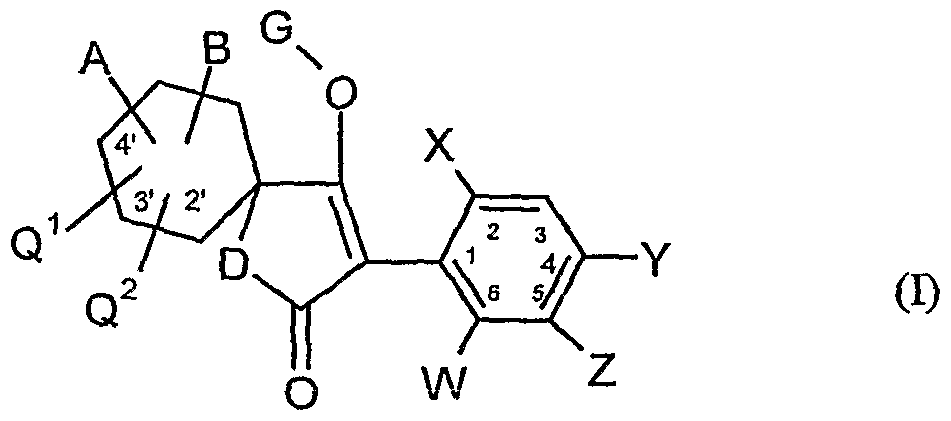
gefunden,found,
in welcherin which
W für Wasserstoff, Alkyl, Alkenyl, Alkinyl, Halogen, Alkoxy, Alkenyloxy, Halogenalkyi, Halogenalkoxy oder Cyano steht,W is hydrogen, alkyl, alkenyl, alkynyl, halogen, alkoxy, alkenyloxy, haloalkyl, haloalkoxy or cyano,
X für Halogen, Alkyl, Alkenyl, Alkinyl, Alkoxy, Alkenyloxy, Alkylthio, AlkylsulfϊnyL, Alkylsulfonyl, Halogenalkyi, Halogenalkoxy, Halogenalkenyloxy, Nitro oder Cyano steht,X is halogen, alkyl, alkenyl, alkynyl, alkoxy, alkenyloxy, alkylthio, alkylsulfinyl, alkylsulfonyl, haloalkyl, haloalkoxy, haloalkenyloxy, nitro or cyano,
Y und Z unabhängig voneinander für Wasserstoff, Alkyl, Alkenyl, Alkinyl, Alkoxy, Halogen, Halogenalkyi, Halogenalkoxy, Cyano, Nitro oder jeweils gegebenenfalls substituiertes Aryl oder Hetaryl steht,Y and Z independently of one another represent hydrogen, alkyl, alkenyl, alkynyl, alkoxy, halogen, halogenoalkyl, haloalkoxy, cyano, nitro or in each case optionally substituted aryl or hetaryl,
mit der Mäßgabe, dass mindestens einer der Reste W oder Z ungleich Wasserstoff sein muss, wenn X und Y für Methyl stehen,with the proviso that at least one of the radicals W or Z must not be hydrogen if X and Y are methyl,
A und B und das Kohlenstoffatom, an das sie gebunden sind, für ein jeweils gegebenenfalls durch Alkyl, Halogenalkyi, Alkoxy, Alkoxyalkyl oder gegebenenfalls substituiertes Phenyl substituiertes fünf- bis siebengliedriges Ketal, Thioketal oder Dithioketal steht, welches gegebenenfalls durch ein weiteres Heteroatom unterbrochen sein kann,A and B and the carbon atom to which they are attached are each optionally substituted by alkyl, haloalkyl, alkoxy, alkoxyalkyl or optionally substituted phenyl substituted five- to seven-membered ketal, thioketal or dithioketal, which may optionally be interrupted by another heteroatom,
D für NH und Sauerstoff steht,D is NH and oxygen,
Q1, Q2 unabhängig voneinander für Wasserstoff, Alkyl, Halogenalkyl oder Alkoxy stehen,Q 1 , Q 2 independently of one another represent hydrogen, alkyl, haloalkyl or alkoxy,
G für Wasserstoff (a) oder für eine der GruppenG is hydrogen (a) or one of the groups

R4 / . RR 4 /. R
- /PV. . ( .β.).. E . ( „f), od .er y . _N( y - / PV. , (.β.) .. E. ("F), od .er y. _ N ( y
R'R '
steht,stands,
worinwherein
E für ein Metallion oder ein Ammoniumion steht,E is a metal ion or an ammonium ion,
L für Sauerstoff oder Schwefel steht,L is oxygen or sulfur,
M für Sauerstoff oder Schwefel steht,M is oxygen or sulfur,
R1 für jeweils gegebenenfalls durch Halogen oder Cyano substituiertes Alkyl, Alkenyl,R 1 is in each case optionally halogen or cyano-substituted alkyl, alkenyl,
Alkoxyalkyl, Alkylthioalkyl oder Polyalkoxyalkyl oder für jeweils gegebenenfalls durchAlkoxyalkyl, alkylthioalkyl or polyalkoxyalkyl or each optionally optionally
Halogen, Alkyl oder Alkoxy substituiertes Cycloalkyl oder Heterocyclyl oder für jeweils gegebenenfalls substituiertes Phenyl, Phenylalkyl, Hetaryl, Phenoxyalkyl oder Hetaryloxy- alkyl steht,Is halogen, alkyl or alkoxy-substituted cycloalkyl or heterocyclyl or represents in each case optionally substituted phenyl, phenylalkyl, hetaryl, phenoxyalkyl or hetaryloxyalkyl,
R.2 für jeweils gegebenenfalls durch Halogen oder Cyano substituiertes Alkyl, Alkenyl, Alkoxyalkyl oder Polyalkoxyalkyl oder für jeweils gegebenenfalls substituiertes Cycloalkyl, Phenyl oder Benzyl steht,R.2 represents in each case optionally halogen, cyano-substituted alkyl, alkenyl, alkoxyalkyl or polyalkoxyalkyl or represents optionally substituted cycloalkyl, phenyl or benzyl,
B?, R4 und R^ unabhängig voneinander für jeweils gegebenenfalls durch Halogen substituiertes Alkyl, Alkoxy, Alkylamino, Dialkylamino, Alkylthio, Alkenylthio oder Cycloalkylthio oder für jeweils gegebenenfalls substituiertes Phenyl, Benzyl, Phenoxy oder Phenylthio stehen, R.6 und R7 unabhängig voneinander für Wasserstoff, für jeweils gegebenenfalls durch Halogen oder Cyano substituiertes Alkyl, Cycloalkyl, Alkenyl, Alkoxy, Alkoxyalkyl, für jeweils gegebenenfalls substituiertes Phenyl oder Benzyl stehen, oder gemeinsam mit dem N-Atom, an das sie gebunden sind, einen gegebenenfalls Sauerstoff oder Schwefel enthaltenden und gegebenenfalls substituierten Cyclus bilden.B 1, R 4 and R 1 independently of one another are each optionally halogen-substituted alkyl, alkoxy, alkylamino, dialkylamino, alkylthio, alkenylthio or cycloalkylthio or in each case optionally substituted phenyl, benzyl, phenoxy or phenylthio, R.6 and R7 are each independently hydrogen, each optionally substituted by halogen or cyano alkyl, cycloalkyl, alkenyl, alkoxy, alkoxyalkyl, each optionally substituted phenyl or benzyl, or together with the N-atom to which they are attached , form an optionally oxygen or sulfur containing and optionally substituted cycle.
Die Verbindungen der Formel (I) können, auch in Abhängigkeit von der Art der Substituenten, als optische Isomere oder Isomerengemische, in unterschiedlicher Zusammensetzung vorliegen, die gegebenenfalls in üblicher Art und Weise getrennt werden können. Sowohl die reinen Isomeren als auch die Isomerengemische, deren Herstellung und Verwendung sowie diese enthaltende Mittel sind Gegenstand der vorliegenden Erfindung. Im folgenden wird der Einfachheit halber jedoch stets von Verbindungen der Formel (I) gesprochen, obwohl sowohl die Teinen Verbindungen als gegebenenfalls auch Gemische mit unterschiedlichen Anteilen an isomeren Verbindungen gemeint sind.Depending on the nature of the substituents, the compounds of the formula (I) can also be present in different compositions as optical isomers or mixtures of isomers, which can optionally be separated in a customary manner. Both the pure isomers and the mixtures of isomers, their preparation and use and agents containing them are the subject of the present invention. However, in the following, for the sake of simplicity, compounds of the formula (I) are always referred to, although both the pure compounds and optionally also mixtures with different proportions of isomeric compounds are meant.
Unter Einbeziehung von D für NH (1) und D für O (2) ergeben sich folgende hauptsächliche Strukturen (1-1) bis (1-2):Including D for NH (1) and D for O (2), the following main structures (1-1) to (1-2) result:

A, B, G, Ql, Q2, W, X, Y und Z die oben angegebene Bedeutung haben.A, B, G, Q, Q 2, W, X, Y and Z have the meaning given above.
Unter Einbeziehung der verschiedenen Bedeutungen (a), (b), (c), (d), (e), (f) und (g) der Gruppe G ergeben sich folgende hauptsächliche Strukturen (I-l-a) bis (I-l-g), wenn D für NH (1) steht,Including the different meanings (a), (b), (c), (d), (e), (f) and (g) of the group G, the following main structures (Ila) to (Ilg) result if D stands for NH (1),
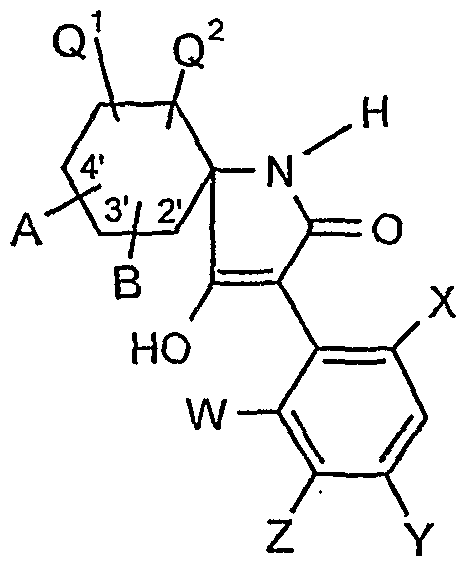
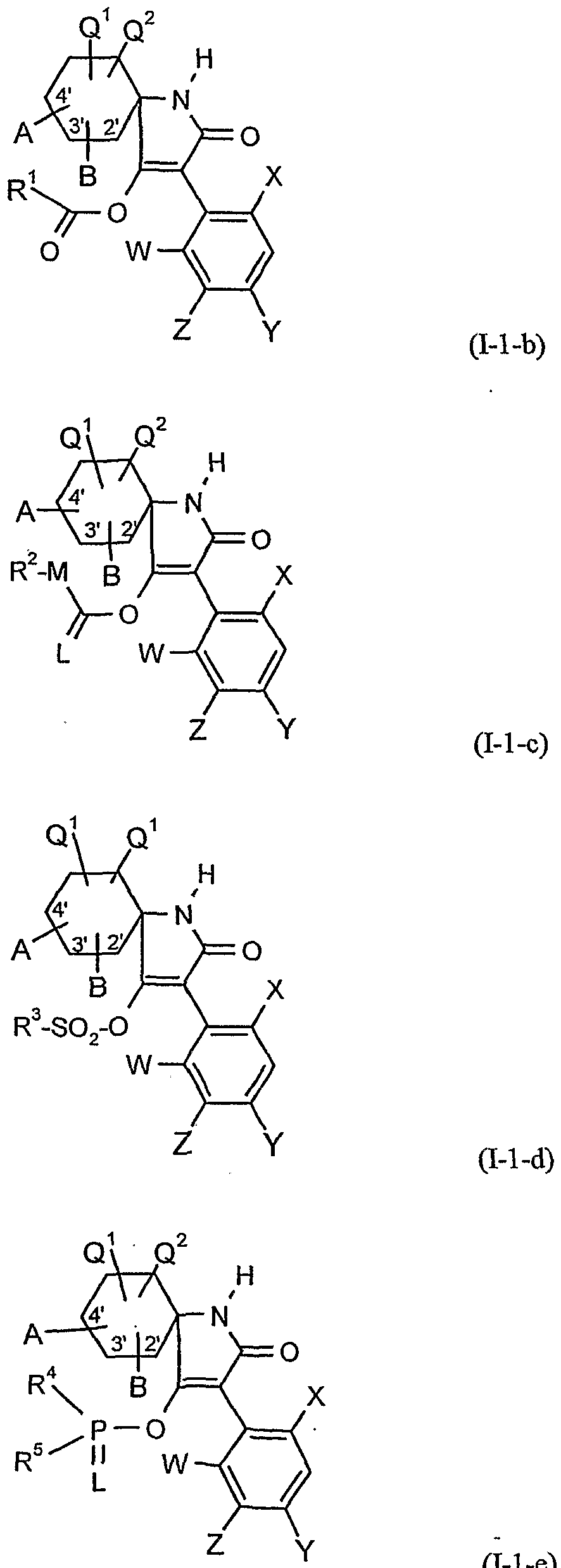
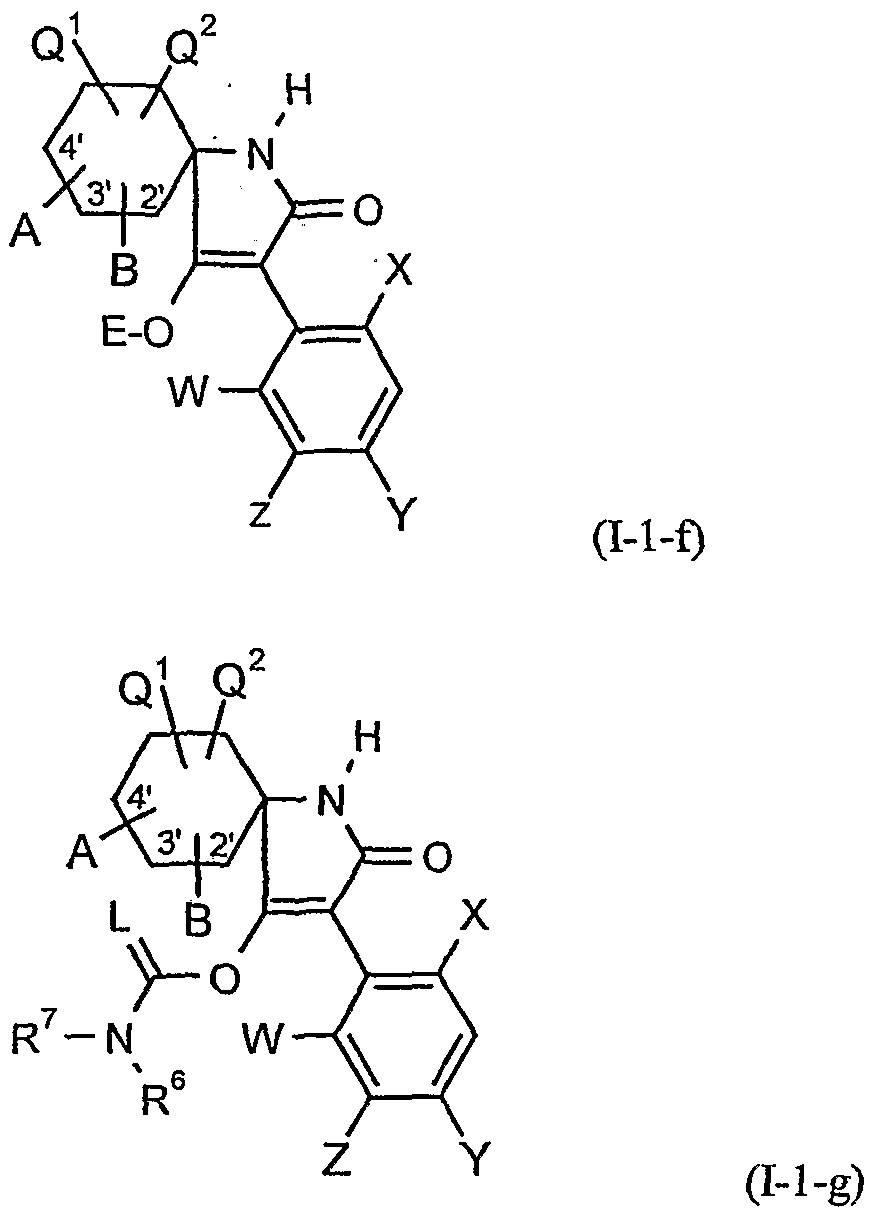
worinwherein
A, B, E, L, M, Ql, Q2, W, X5 Y, Z, R1, R2, R3, R4, R5, R6 und R7 die oben angegebenen Bedeutungen besitzen.A, B, E, L, M, Ql, Q 2 , W, X 5 Y, Z, R 1 , R 2 , R 3 , R 4 , R 5 , R 6 and R 7 have the meanings given above.
Unter Einbeziehung der verschiedenen Bedeutungen (a), (b), (c), (d), (e), (f) und (g) der Gruppe G ergeben sich folgende hauptsächliche Strukturen (I-2-a) bis (I-2-g), wenn D für O (2) steht,Taking into account the various meanings (a), (b), (c), (d), (e), (f) and (g) of the group G, the following main structures (I-2-a) to (I -2-g), when D is O (2),

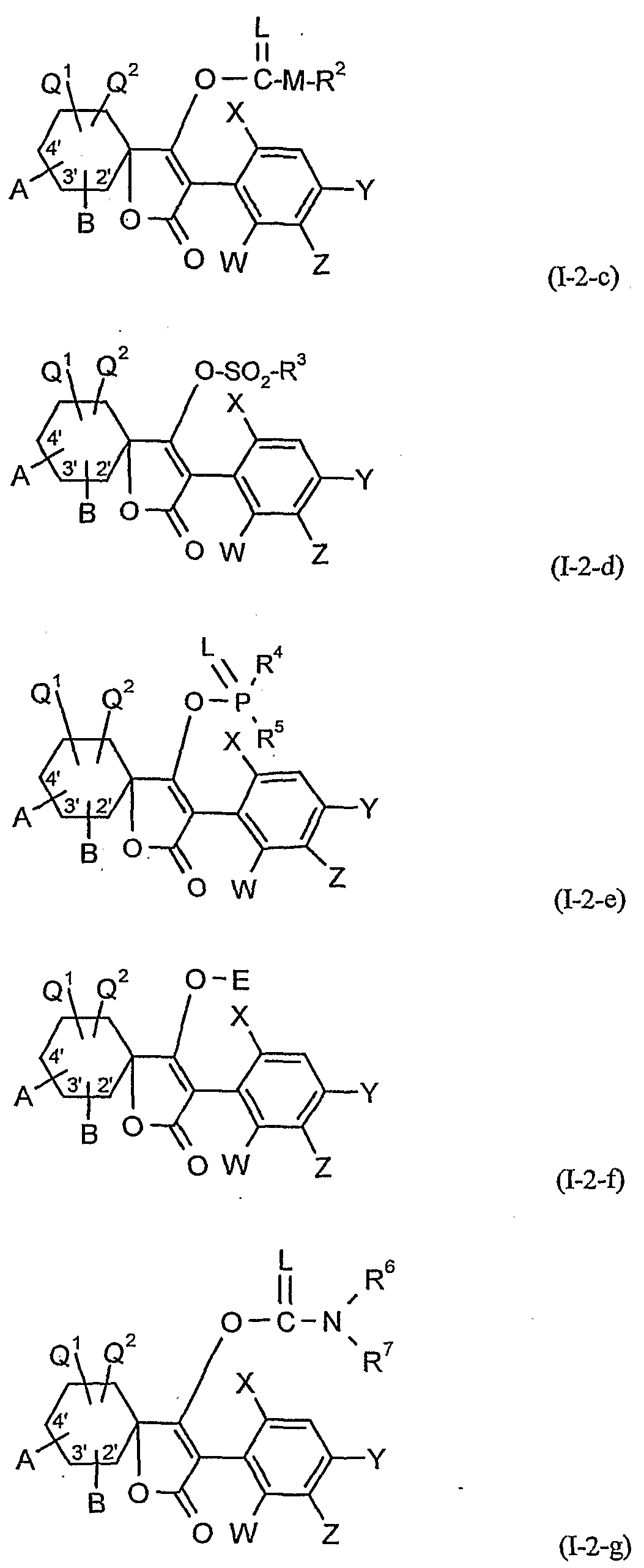
worinwherein
A, B, E, L, M, Q1, Q2, W, X3 Y3 Z, R1, R2, R3, R4, R5, R6 und R7 die oben angegebene Bedeutung haben. Weiterhin wurde gefunden, dass man die neuen Verbindungen der Formel (I) nach den im Folgenden beschriebenen Verfahren erhält:A, B, E, L, M, Q 1 , Q 2 , W, X 3 Y 3 Z, R 1 , R 2 , R 3 , R 4 , R 5 , R 6 and R 7 have the meaning given above. Furthermore, it has been found that the novel compounds of the formula (I) are obtained by the processes described below:
(A) Man erhält Verbindungen der Formel (I-l-a)(A) Compounds of the formula (I-I-a) are obtained
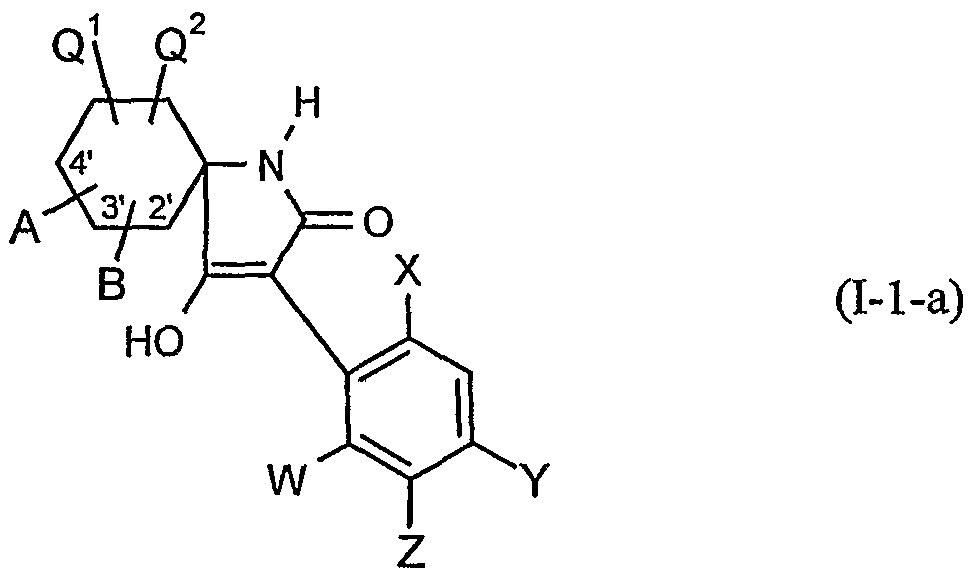
in welcherin which
A, B, Ql, Q2, W, X, Y und Z die oben angegebenen Bedeutungen haben,A, B, Q, Q 2, W, X, Y and Z have the meanings given above,
wenn manif
Verbindungen der Formel (D)Compounds of the formula (D)

in welcherin which
A, B, Q1, Q2, W, X, Y und Z die oben angegebenen Bedeutungen haben,A, B, Q 1 , Q 2 , W, X, Y and Z have the meanings given above,
undand
R8 für Alky 1 (bevorzugt C \ -Cg-Alky 1) steht,R 8 is Alky 1 (preferably C 1 -C 6 -alky 1),
in Gegenwart eines Verdünnungsmittels und in Gegenwart einer Base intramolekular kondensiert. (B) Außerdem wurde gefunden, dass man Verbindungen der Formel (I-2-a)in the presence of a diluent and in the presence of a base intramolecularly condensed. (B) In addition, it has been found that compounds of the formula (I-2-a)

in welcherin which
A, B, Ql, Q2, W, X, Y und Z die oben angegebenen Bedeutungen haben,A, B, Q, Q 2, W, X, Y and Z have the meanings given above,
erhält, wenn manif you get
Verbindungen der Formel (IE)Compounds of the formula (IE)
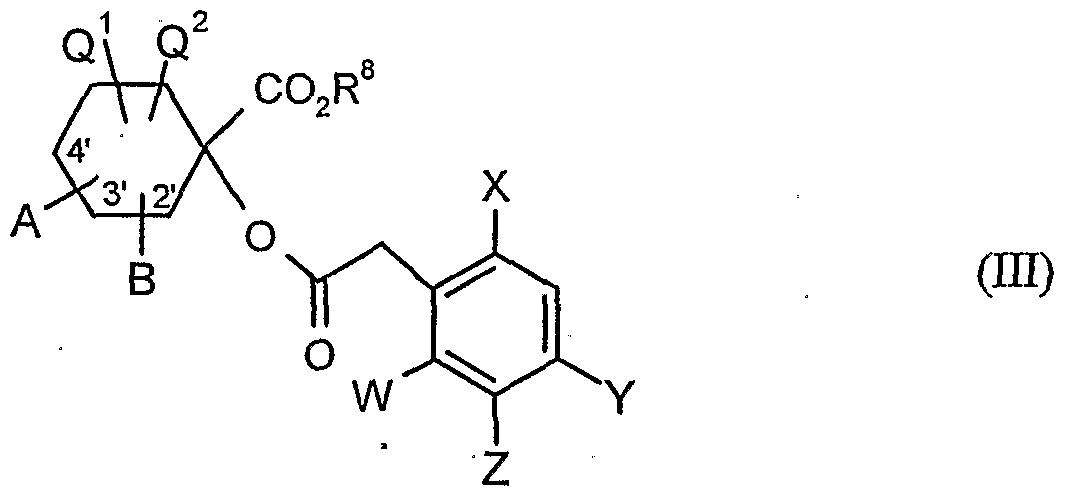
in welcherin which
A, B5 Ql, Q2, W, X, Y, Z und R^ die oben angegebenen Bedeutungen haben,A, B 5 , Q 1, Q 2, W, X, Y, Z and R 1 have the meanings given above,
in Gegenwart eines Verdünnungsmittels und in Gegenwart einer Base intramolekular kondensiert.in the presence of a diluent and in the presence of a base intramolecularly condensed.
Außerdem wurden gefundenIn addition, were found
(C) dass man die Verbindungen der oben gezeigten Formeln (I-l-b) bis (I-2-b), in welchen R*, A, B, Ql, Q2, W, X, Y und Z die oben angegebenen Bedeutungen haben, erhält, wenn man Verbindungen der oben gezeigten Formeln (I-l-a) bis (I-2-a), in welchen A, B, Q^, Q2 5 W,(C) that the compounds of the formulas (IIb) shown above to (I-2-b) in which R *, A, B, Q, Q 2, W, X, Y and Z have the meanings given above, when compounds of the formulas (Ila) to (I-2-a) shown above, in which A, B, Q ^, Q 2 5 W,
X, Y und Z die oben angegebenen Bedeutungen haben, jeweilsX, Y and Z have the meanings given above, respectively
α) mit Verbindungen der Formel (IV) HaL R1 α) with compounds of the formula (IV) HaL R 1
Y O (IV)YO ( IV )
in welcherin which
RI die oben angegebene Bedeutung hat undRI has the meaning given above and
HaI für Halogen (insbesondere Chlor oder Brom) stehtHal is halogen (especially chlorine or bromine)
oderor
ß) mit Carbonsäureanhydriden der Formel (V)ß) with carboxylic acid anhydrides of the formula (V)
R^CO-O-CO-R1 (V)R 1 CO-O-CO-R 1 (V)
in welcherin which
R1 die oben angegebene Bedeutung hat,R 1 has the meaning given above,
gegebenenfalls in Gegenwart eines Verdünnungsmittels und gegebenenfalls in Gegenwart eines Säurebindemittels umsetzt;if appropriate in the presence of a diluent and if appropriate in the presence of an acid binder;
(D) dass man die Verbindungen der oben gezeigten Formeln (I-l-c) bis (I-2-c), in welchen R^, A, B, Ql, Q2, W, M, X, Y und Z die oben angegebenen Bedeutungen haben und L für Sauerstoff steht, erhält, wenn man Verbindungen der oben gezeigten Formeln (I-l-a) bis (I-2-a), in welchen A, B, Q1, Q2, W, X5 Y und Z die oben angegebenen Bedeutungen haben, jeweils(D) that the compounds of formulas (IIc) shown above to (I-2-c) in which R ^, A, B, Q, Q 2, W, M, X, Y and Z have the meanings given above and L is oxygen, when compounds of the above-shown formulas (IIa) to (I-2-a) are obtained, in which A, B, Q 1 , Q 2 , W, X 5, Y and Z are those given above Have meanings, respectively
mit Chlorameisensäureestern oder Chlorameisensäurethioestern der Formel (VI)with chloroformates or chloroformic thioesters of the formula (VI)
R2-M-CO-C1 (VI)R 2 -M -CO-C1 (VI)
in welcherin which
R^ und M die oben angegebenen Bedeutungen haben,R 1 and M have the meanings given above,
gegebenenfalls in Gegenwart eines Verdünnungsmittels und gegebenenfalls in Gegenwart eines Säurebindemittels umsetzt;if appropriate in the presence of a diluent and if appropriate in the presence of an acid binder;
(E) dass man Verbindungen der oben gezeigten Formeln (I-l-c) bis (I-2-c), in welchen R2, A, B, Q1, Q2, W, M, X, Y und Z die oben angegebenen Bedeutungen haben und L für Schwefel steht, erhält, wenn man Verbindungen der oben gezeigten Formeln (I-l-a) bis (I-2-a), in welchen A, B, Ql, Q2, W, X, Y und Z die oben angegebenen Bedeutungen haben, jeweils(E) that compounds of the formulas (IIc) to (I-2-c) shown above, in which R 2 , A, B, Q 1 , Q 2 , W, M, X, Y and Z have the meanings given above have and L for Sulfur, obtained when compounds of the above-shown formulas (IIa) to (I-2-a), in which A, B, Ql, Q 2 , W, X, Y and Z have the meanings given above, respectively
mit Chlormonothioameisensäureestern oder Chlordithioameisensäureestern derwith Chlormonothioameisensäureestern or Chlordithioameisensäureestern the
Formel (VD)Formula (VD)
Cl ^ M-R2 Cl ^ MR 2
Y (VII)Y (VII)
SS
in welcherin which
M und R.2 die oben angegebenen Bedeutungen haben,M and R.2 have the meanings given above,
gegebenenfalls in Gegenwart eines Verdünnungsmittels und gegebenenfalls in Gegenwart eines Säurebindemittels umsetzt,if appropriate in the presence of a diluent and if appropriate in the presence of an acid binder,
(F) dass man Verbindungen der oben gezeigten Formeln (I-l-d) bis (I-2-d), in welchen Rß, A, B, W, Ql, Q2, X, Y und Z die oben angegebenen Bedeutungen haben, erhält, wenn man Verbindungen der oben gezeigten Formeln (I-l-a) bis (I-2-a), in welchen A, B, Q1, Q2, W, X, Y und Z die oben angegebenen Bedeutungen haben, jeweils(F) that compounds of formulas (Ild) shown above to (I-2-d) in which RSs A, B, W, Q, Q 2, X, Y and Z have the meanings given above, are obtained, when compounds of the above-shown formulas (IIa) to (I-2-a) in which A, B, Q 1 , Q 2 , W, X, Y and Z have the meanings given above, respectively
mit Sulfonsäurechloriden der Formel (VIII)with sulfonyl chlorides of the formula (VIII)
R3-SO2-C1 (YWL) R3-SO2 -C1 (YWL)
in welcherin which
Ry die oben angegebene Bedeutung hat,Ry has the meaning given above,
gegebenenfalls in Gegenwart eines Verdünnungsmittels und gegebenenfalls in Gegenwart eines Säurebindemittels umsetzt,if appropriate in the presence of a diluent and if appropriate in the presence of an acid binder,
(G) dass man Verbindungen der oben gezeigten Formeln (I-l-e) bis (I-2-e), in welchen L, R^, R5, A, B, Ql, Q2, W, X5 Y und Z die oben angegebenen Bedeutungen haben, erhält, wenn man Verbindungen der oben gezeigten Formeln (I-l-a) bis (I-2-a), in welchen A, B5 Q1,(G) that compounds of the formulas (Ile) as shown above to (I-2-e) in which L, R ^, R5, A, B, Q, Q 2, W, 5 Y, and Z given X above If one has compounds of the formulas shown above (Ila) to (I-2-a), in which A, B 5 Q 1 ,
Q2, W, X, Y und Z die oben angegebenen Bedeutungen haben, jeweilsQ 2 , W, X, Y and Z have the meanings given above, respectively
mit Phosphorverbindungen der Formel (IX) R4 with phosphorus compounds of the formula (IX) R 4
HaI-P 7 (IX)HaI-P 7 (IX)
L R5 LR 5
in welcherin which
L, R.4 und R-> die oben angegebenen Bedeutungen haben undL, R.4 and R-> have the meanings given above and
HaI für Halogen (insbesondere Chlor oder Brom) steht,Hal is halogen (especially chlorine or bromine),
gegebenenfalls in Gegenwart eines Verdünnungsmittels und gegebenenfalls in Gegenwart eines Säurebindemittels umsetzt,if appropriate in the presence of a diluent and if appropriate in the presence of an acid binder,
(H) dass man Verbindungen der oben gezeigten Formeln (I-l-f) bis (I-2-f), in welchen E, A, B, Q1, Q2, W, X, Y und Z die oben angegebenen Bedeutungen haben, erhält, wenn man Verbindungen der Formeln (I-l-a) bis (I-2-a), in welchen A, B, Q1, Q2, W, X5 Y und Z die oben angegebenen Bedeutungen haben, j eweils(H) that compounds of the formulas (IIf) to (I-2-f) shown above, in which E, A, B, Q 1 , Q 2 , W, X, Y and Z have the meanings given above, are obtained when compounds of the formulas (Ila) to (I-2-a), in which A, B, Q 1 , Q 2 , W, X 5 Y and Z have the meanings given above, in each case
mit Metallverbindungen oder Aminen der Formeln (X) oder (XI)with metal compounds or amines of the formulas (X) or (XI)
R10 R11 R 10 R 11
Me(OR10), (X) ■ N ?^ (XI)Me (OR 10 ), (X) ■ N ? ^ (XI)
R12 R 12
in welchenin which
Me für ein ein- oder zweiwertiges Metall (bevorzugt ein Alkali- oder Erdalkalimetall wie Lithium, Natrium, Kalium, Magnesium oder Calcium),Me is a mono- or divalent metal (preferably an alkali metal or alkaline earth metal such as lithium, sodium, potassium, magnesium or calcium),
t für die Zahl 1 oder 2. undt for the number 1 or 2 and
RlQ 5 RJl5 R12 unabhängig voneinander für Wasserstoff oder Alkyl (bevorzugt Ci-Cs- Alkyl) stehen,Rl Q 5 5 RJL R12 independently represent hydrogen or alkyl (preferably Ci-Cs alkyl),
gegebenenfalls in Gegenwart eines Verdünnungsmittels umsetzt,if appropriate in the presence of a diluent,
(I) dass man Verbindungen der oben gezeigten Formeln (I-l-g) bis (I-2-g), in welchen L, R^5 R7, A, B, Q1, Q2, W, X5 Y und Z die oben angegebenen Bedeutungen haben, erhält, wenn man Verbindungen der oben gezeigten Formeln- (I-l-a) bis (I-2-a), in welchen A, B, Q1, Q2, W, X5 Y und Z die oben angegebenen Bedeutungen haben, jeweils . . α) mit Isocyanaten oder Isothiocyanaten der Formel (XH)(I) that compounds of the formulas (IIg) to (I-2-g) shown above, in which L, R ^ 5 R7, A, B, Q 1 , Q 2 , W, X 5 Y and Z are the above given compounds obtained compounds of the above-shown formulas (Ila) to (I-2-a), in which A, B, Q 1 , Q 2 , W, X 5 Y and Z have the meanings given above , each . , α) with isocyanates or isothiocyanates of the formula (XH)
R6-N=C=L (XU)R 6 -N = C = L (XU)
in welcherin which
R.6 und L die oben angegebenen Bedeutungen haben,R.6 and L have the meanings given above,
gegebenenfalls in Gegenwart eines Verdünnungsmittels und gegebenenfalls in Gegenwart eines Katalysators umsetzt oderif appropriate in the presence of a diluent and if appropriate in the presence of a catalyst or
ß) mit Carbamidsäurechloriden oder Thiocarbarmdsäurechloriden der Formel (XSl)ß) with carbamoyl chlorides or Thiocarbarmdsäurechloriden of formula (XSl)

in welcherin which
L, R" und R ' die oben angegebenen Bedeutungen haben,L, R "and R 'have the meanings given above,
gegebenenfalls in Gegenwart eines Verdünnungsmittels und gegebenenfalls in Gegenwart eines Säurebindemittels, umsetzt,if appropriate in the presence of a diluent and if appropriate in the presence of an acid binder,
(J) dass man Verbindungen der oben gezeigten Formeln (I-l-a) bis (I-l-g) und (I-2-a) bis (1-2- g), in welchen A, B, D, G, Q1, Q2, W, X, Y und Z die oben angegebenen Bedeutungen haben, erhält, wenn man Verbindungen der Formel (XIV)(J) that compounds of the above-shown formulas (IIa) to (IIg) and (I-2-a) to (1-2g) in which A, B, D, G, Q 1 , Q 2 , W, X, Y and Z have the meanings given above, when compounds of the formula (XIV)

D, G, Q1, Q2, W,X, YundZ die obenangegebenenBedeutungenhaben,. und A, B und das Kohlenstoffatom, an das sie gebunden sind für eineD, G, Q 1 , Q 2 , W, X, Y and Z are as defined above. and A, B and the carbon atom to which they are attached for a
,C— O— Gruppe stehen, C- O- group stand
//
beispielsweise mit Diolen der Formel (XV)for example with diols of the formula (XV)
HO -A -B - OH. (XV)HO -A -B - OH. (XV)
in welcherin which
A und B die oben genannte Bedeutung haben,A and B have the abovementioned meaning,
gegebenenfalls in Gegenwart eines Verdünnungsmittels, in Gegenwart eines sauren Katalysators unter wasserentziehenden Bedingungen umsetzt.if appropriate in the presence of a diluent, in the presence of an acidic catalyst under dehydrating conditions.
Folgende Verbindung der Formel (I-a) ist 1994 im Rahmen des europäischen Patentprüfungs- 10 verfahren zur EP 596 298 bekannt geworden.The following compound of the formula (I-a) has become known in 1994 in the context of the European patent examination method 10 to EP 596 298.

Weiterhin wurde gefunden, dass die neuen Verbindungen der Formel (I) eine gute Wirksamkeit als Schädlingsbekämpfungsmittel, vorzugsweise als Insektizide und/oder Akarizide und/oder Fungizide und/oder Herbizide aufweisen und darüber hinaus häufig sehr gut pflanzenverträglich, insbe- 15 sondere gegenüber Kulturpflanzen, sind.Furthermore, it has been found that the novel compounds of the formula (I) have a good activity as pesticides, preferably as insecticides and / or acaricides and / or fungicides and / or herbicides and, moreover, are often very well tolerated by plants, in particular with respect to crop plants, are.
Überraschenderweise wurde nun auch gefunden, dass bestimmte substituierte, cyclische Ketoenole bei gemeinsamer Anwendung mit den im weiteren beschriebenen, die Kulturpflanzen- Verträglichkeit verbessernden Verbindungen (Safenern/Antidots) ausgesprochen gut die Schädigung der Kulturpflanzen verhindern und besonders vorteilhaft als breit wirksame Kombinationspräparate zur selek- 20. tiven Bekämpfung von unerwünschten Pflanzen in Nutzpflanzenkulturen, wie z.B. in Getreide aber auch Mais, Soja und Reis, verwendet werden können.Surprisingly, it has now also been found that certain substituted, cyclic ketoenols, when used together with the compounds (safeners / antidotes) which improve the crop plant compatibility, very well prevent the damage to the crop plants and are particularly advantageous as widely effective combination preparations for the selecctive 20 , tive control of undesirable plants in crops, such as in cereals but also corn, soy and rice can be used.
Gegenstand der Erfindung sind auch selektiv-herbizide Mittel enthaltend einen wirksamen Gehalt an einer Wirkstoffkombination umfassend als Komponenten (a1) mindestens eine Verbindung der Formel (I), in welcher A, B3 D, G, Q1, Q2, W, X, Y und Z die oben angegebene Bedeutung habenThe invention also relates to selective herbicidal compositions containing an effective content of a combination of active substances comprising as components (a 1 ) at least one compound of the formula (I) in which A, B 3 D, G, Q 1 , Q 2 , W, X, Y and Z have the abovementioned meaning
undand
(b1) zumindest eine die Kulturpflanzen-Verträglichkeit verbessernde Verbindung aus der folgen- den Gruppe von Verbindungen:(b 1 ) at least one crop plant compatibility-improving compound from the following group of compounds:
4-Dichloracetyl-l-oxa-4-aza-spiro[4.5]-decan (AD-67, MON-4660), 1-Dichloracetyl-hexahydro- 3,3,8a-trimethylpyrrolo[l,2-a]-ρyrimidin-6(2H)-on (Dioyclonon, BAS-145138), 4-DichIoracetyI-' 3 ,4-dihydro-3 -methyl-2H- 1 ,4-benzoxazin (Benoxacor), 5 -Chlor-chinolin-8-oxy-essigsäure-( 1 - methyl-hexylester) (Cloquintocet-mexyl - vgl. auch verwandte Verbindungen in EP-A-86750, EP- A-94349, EP-A-191736, EP-A-492366), 3-(2-Chlor-benzyl)-l-(l-methyl-l-phenyl-ethyl)-harnstoff (Cumyluron), α-(Cyanomethoximino)-phenylacetonitril (Cyometrinil), 2,4-Dichlor-phenoxyessig- säure (2,4-D), 4-(2,4-Dichlor-phenoxy)-buttersäure (2,4-DB), l-(l-Methyl-l-phenyl-ethyl)-3-(4- methyl-phenyl)-harnstoff (Daimuron, Dymron), 3,6-Dichlor-2-methoxy-benzoesäure (Dicamba), Piperidin-1-thiocarbonsäure-S-l-methyl-l-phenyl-ethylester (Dimepiperate), 2,2-Dichlor-N-(2- oxo-2-(2-propenylamino)-ethyl)-N-(2-propenyl)-acetamid (DKA-24), 2,2-Dichlor-N,N-di-2-pro- penyl-acetamid (Dichlormid), 4,6-Dichlor-2-phenyl-ρyrimidin (Fenclorim), l-(2,4-Dichlor- phenyl)-5-trichlormethyl-lH-l,2,4-triazol-3-carbonsäure-ethylester (Fenchlorazole-ethyl - vgl. auch verwandte Verbindungen in EP-A-174562 und EP-A-346620), 2-Chlor-4-trifluormethyl-thi- azol-5-carbonsäure-phenylmethylester (Flurazole), 4-Chlor-N-(l ,3-dioxolan-2-yl-methoxy)-α- trifluor-acetophenonoxim (Fluxofenim), 3-Dichloracetyl-5-(2-füranyl)-2,2-dimethyl-oxazolidin (Furilazole, MON-13900), Ethyl-4,5-dihydro-5,5-diphenyl-3-isoxazolcarboxylat (Isoxadifen-ethyl - vgl. auch verwandte Verbindungen in WO-A-95/07897), l-(Ethoxycarbonyl)-ethyl-3,6-dichlor-2- methoxybenzoat (Lactidichlor), (4-Chlor-o-tolyloxy)-essigsäure (MCPA)3 2-(4-Chlor-o-tolyloxy)- propionsäure (Mecoprop), Diethyl-l-(2,4-dichlor-phenyl)-4,5-dihydro-5-methyl-lH-pyrazol-3,S-di- carboxylat (Mefenpyr-diethyl - vgl. auch verwandte Verbindungen in WO-A-91/07874) 2-Dichlor- methyl-2-methyi-l,3-dioxolan (MG-191), 2-Propenyl-l-oxa-4-azaspiro[4.5]decane-4-carbo- dithioate (MG-838), 1,8-Naphthalsäureanhydrid, α-(l,3-Dioxolan-2-yl-methoximino)-phenylaceto- nitril (Oxabetrinil), 2,2-Dichlor-N-(l,3-dioxolan-2-yl-methyl)-N-(2-ρropenyl)-acetamid (PPG- 1292), 3-Dichloracetyl-2,2-dimethyl-oxazolidin (R-28725), 3-Dichloracetyl-2,2,5-trimethyl- oxazolidin (R-29148), 4-(4-Chlor-o-tolyI)-buttersäure, 4-(4-ChIor-phenoxy)-buttersäure, Diphenyl- methoxyessigsäure, Diphenylmethoxyessigsäure-methylester, Diphenylmethoxyessigsäure-ethyl- ester, l-(2-Chlor-phenyl)-5-phenyl-lH-pyrazol-3-carbonsäure-methylester, l-(2,4-Dichlor-phenyl)- 5-methyl-lH-pyrazol-3-carbonsäure-ethylester, l-(2,4-Dichlor-phenyl)-5-isopropyl-lH-pyrazol-3- carbonsäure-ethylester, l-(2,4-Dichlor-phenyl)-5-(l,l-dimethyl-ethyl)-lH-pyrazol73rcarbpnsäure- ethylester, l-(2,4-Dichlor-phenyl)-5-ρhenyHH-pyrazol-3-carbonsäure-etliylester (vgl. auch verwandte Verbindungen in EP-A-269806 und EP-A-333131), 5-(2,4-Dichior-benzyl)-2-isoxazolin-3- carbonsäure-ethylester, 5-Phenyl-2-isoxazolin-3-carbonsäure-ethylester, 5-(4-Fluor-ρhenyl)-5- phenyl-2-isoxazolin-3-carbonsäure-ethylester (vgl. auch verwandte Verbindungen in WO-A- 91/08202), 5-Chlor-chinolin-8-oxy-essigsäure-(l,3-dimethyl-but-l-yl)-ester, 5-Chlor-chinolin-8- oxy-essigsäure-4-allyloxy-butylester, 5-Chlor-chinolin-8-oxy-essigsäure-l-allyloxy-prop-2-yl-ester, S-Chlor-chinoxalin-δ-oxy-essigsäure-inethylester, S-Chlor-chinolin-S-oxy-^essigsäure-ethylester, 5- Chlor-chinoxalin-8-oxy-essigsäure-allylester, S-Chlor-chinolin-δ-oxy-essigsäure^-oxo-prop-l-yl- ester, S-Chlor-chinoIin-δ-oxy-malonsäurerdiethylester, 5-Chlor-chinoxalin-8-oxy-malonsäure-di- allylester, S-Chlor-chinolin-S-oxy-malonsäure-diethylester (vgl. auch verwandte Verbindungen in EP-A-582198), 4-Carboxy-chroman-4-yI-essigsäure (AC-304415, vgl. EP-A-613618), 4-Chlor- phenoxy-essigsäure, 3,3 '-Dimethyl-4-methoxy-benzophenon, 1 -Brom-4-chlormethylsulfonyl- benzol, l-[4-(N-2-Methoxybenzoylsulfamoyl)-phenyl]-3-methyl-harnstoff (alias N-(2-Methoxy- benzoyl)-4-[(methylamino-carbonyl)-amino]-benzolsulfonamid), • l-[4-(N-2-Methoxybenzoyl- sulfamoyl)-phenyl]-3,3-dimethyl-harnstoff, 1 -[4-(N-4,5-Dimethylbenzoylsulfamoyl)-phenyl]-3- methyl-harnstoff, l-[4-(N-Naphthylsulfamoyl)-phenyl]-3,3-dimethyl-harnstoff, N-(2-Methoxy-5- methyl-benzoyl)-4-(cyclopropylaminocarbonyl)-benzolsulfonamid,4-dichloroacetyl-1-oxa-4-aza-spiro [4.5] -decane (AD-67, MON-4660), 1-dichloroacetyl-hexahydro-3,3,8a-trimethylpyrrolo [1,2-a] -pyrimidine -6 (2H) -one (Dioyclonon, BAS-145138), 4-DichIoracetyI- '3, 4-dihydro-3-methyl-2H-1, 4-benzoxazine (benoxacor), 5-chloro-quinolin-8-oxy acetic acid (1-methyl-hexyl ester) (cloquintocet-mexyl - see also related compounds in EP-A-86750, EP-A-94349, EP-A-191736, EP-A-492366), 3- (2 -Chlorobenzyl) -1- (1-methyl-1-phenylethyl) urea (cumyluron), α- (cyanomethoximino) phenylacetonitrile (cyometrinil), 2,4-dichlorophenoxyacetic acid (2,4-dichlorophenoxyacetic acid). D), 4- (2,4-dichlorophenoxy) butyric acid (2,4-DB), 1- (1-methyl-1-phenylethyl) -3- (4-methylphenyl) urea ( Daimurone, dymron), 3,6-dichloro-2-methoxy-benzoic acid (Dicamba), piperidine-1-thiocarboxylic acid-1-methyl-1-phenyl-ethyl ester (dimepiperate), 2,2-dichloro-N- (2 oxo-2- (2-propenylamino) ethyl) -N- (2-propenyl) acetamide (DKA-24), 2,2-dichloro-N, N-di-2-propenylacetamide (dichloromid) , 4,6-dichloro-2-phenyl-pyrimidine (F. enclorim), 1- (2,4-dichlorophenyl) -5-trichloromethyl-1H-l, 2,4-triazole-3-carboxylic acid ethyl ester (Fenchlorazole-ethyl - cf. also related compounds in EP-A-174562 and EP-A-346620), 2-chloro-4-trifluoromethyl-thiazole-5-carboxylic acid phenylmethyl ester (flurazoles), 4-chloro-N- (1,3-dioxolane -2-yl-methoxy) -α-trifluoro-acetophenone oxime (Fluxofenim), 3-dichloroacetyl-5- (2-furanyl) -2,2-dimethyl-oxazolidine (furilazole, MON-13900), ethyl-4,5- dihydro-5,5-diphenyl-3-isoxazolecarboxylate (isoxadifen-ethyl - see also related compounds in WO-A-95/07897), 1- (ethoxycarbonyl) -ethyl-3,6-dichloro-2-methoxybenzoate (lactidichloro ), (4-chloro-o-tolyloxy) -acetic acid (MCPA) 3 2- (4-chloro-o-tolyloxy) -propionic acid (mecoprop), diethyl-1- (2,4-dichloro-phenyl) -4, 5-dihydro-5-methyl-1H-pyrazole-3-S-discarboxylate (mefenpyr-diethyl - see also related compounds in WO-A-91/07874) 2-dichloromethyl-2-methyl-1, 3-dioxolane (MG-191), 2-propenyl-1-oxa-4-azaspiro [4.5] decane-4-carbo-dithioate (MG-838), 1,8-naphthalic anhydride, α- (1,3-dioxolane -2-ylmethoximino) -phenylacetonitrile (oxabetrinil), 2,2-dichloro-N- (1,3-dioxolan-2-ylmethyl) -N- (2-p-roproyl) -acetamide (PPG-1292), 3-dichloroacetyl-2,2-dimethyl-oxazolidine (R-28725), 3-dichloroacetyl-2,2,5-trimethyl-oxazolidine (R-29148 ), 4- (4-chloro-o-tolyI) -butyric acid, 4- (4-chlorophenoxy) -butyric acid, diphenylmethoxyacetic acid, methyl diphenylmethoxyacetate, ethyl diphenylmethoxyacetate, 1- (2-chlorophenyl ) -5-phenyl-1H-pyrazole-3-carboxylic acid methyl ester, 1- (2,4-dichloro-phenyl) -5-methyl-1H-pyrazole-3-carboxylic acid ethyl ester, 1- (2,4-dichloro -phenyl) -5-isopropyl-1H-pyrazole-3-carboxylic acid ethyl ester, 1- (2,4-dichloro-phenyl) -5- (1, 1-dimethyl-ethyl) -lH-pyrazole 7 3-carboxylic acid ethyl ester, 1- (2,4-dichloro-phenyl) -5-p-phenyH-pyrazole-3-carboxylic acid etylyl ester (also see related compounds in EP-A-269806 and EP-A-333131), 5- (2, Ethyl 4-dichloro-benzyl) -2-isoxazoline-3-carboxylate, ethyl 5-phenyl-2-isoxazoline-3-carboxylate, 5- (4-fluoro-phenyl) -5-phenyl-2-isoxazoline-3 -carboxylic acid ethyl ester (see also related compounds in WO-A-91/08202), 5-chloro-quinoline-8-oxy-acetic acid (1,3-dimethyl-but-1-yl) ester, Chloro-quinolin-8-oxy-acetic acid 4-allyloxy-butyl ester, 5-chloro-quinolin-8-oxy-acetic acid 1-allyloxy-prop-2-yl-ester, S-chloro-quinoxaline-δ-oxy- ethyl acetate, S-chloro-quinoline-S-oxy-acetic acid ethyl ester, 5-chloro-quinoxaline-8-oxy-acetic acid allyl ester, S-chloro-quinoline-δ-oxy-acetic acid ^ -oxo-propyl 1-yl ester, S-chloro-quinoline-δ-oxy-malonic acid diethyl ester, 5-chloro-quinoxaline-8-oxy-malonic acid di-allyl ester, S-chloro-quinoline-S-oxy-malonic acid diethyl ester (cf. also related compounds in EP-A-582198), 4-carboxychroman 4-yl-acetic acid (AC-304415, cf. EP-A-613618), 4-chlorophenoxyacetic acid, 3,3'-dimethyl-4-methoxybenzophenone, 1-bromo-4-chloromethylsulfonylbenzene, 1- [4- (N-2-methoxybenzoylsulfamoyl) -phenyl] -3-methyl-urea (also known as N- (2-methoxybenzoyl) -4 - [(methylamino-carbonyl) -amino] -benzenesulfonamide), • 1- [4- (N-2-methoxybenzoyl-sulfamoyl ) -phenyl] -3,3-dimethylurea, 1- [4- (N-4,5-dimethylbenzoylsulfamoyl) -phenyl] -3-methyl-urea, 1- [4- (N-naphthylsulfamoyl) -phenyl] 3,3-dimethyl-urea, N- (2-methoxy-5-methylbenzoyl) -4- (cyclopropylaminocarbonyl) -benzenesulfonamide,
und/oder eine der folgenden durch allgemeine Formeln definierten Verbindungenand / or one of the following compounds defined by general formulas
der allgemeinen Formel (IIa)the general formula (IIa)

oder der allgemeinen Formel (Db)or the general formula (Db)

oder der Formel (IIc)
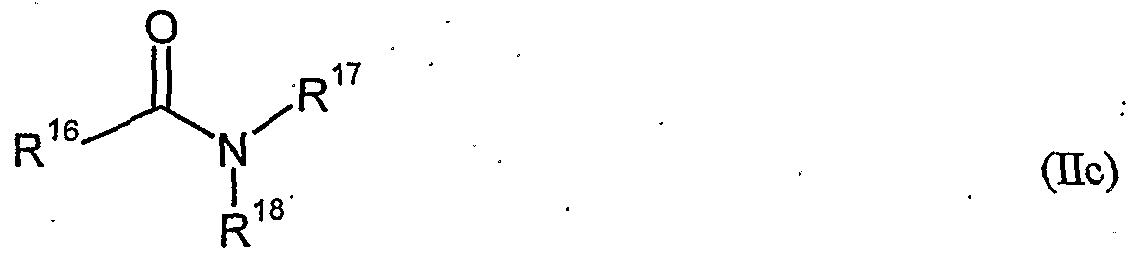
wobei :in which :
m für eine Zahl 0, 1, 2, 3, 4 oder 5 steht,m is a number 0, 1, 2, 3, 4 or 5,
A1 für eine der nachstehend skizzierten divalenten heterocyclischen Gruppierungen steht,A 1 represents one of the divalent heterocyclic groupings outlined below,

n für eine Zahl 0, 1, 2, 3, 4 oder 5 steht,n is a number 0, 1, 2, 3, 4 or 5,
A2 für gegebenenfalls durch Q-C^Alkyl und/oder Ci-GrAlkoxy-carbonyl und/oder C1-C4- Alkenyloxy-carbonyl substituiertes Alkandiyl mit 1 oder 2 Kohlenstoffatomen steht,A 2 represents alkanediyl having 1 or 2 carbon atoms which is optionally substituted by Q 1 -C 4 -alkyl and / or C 1 -C 4 -alkoxy-carbonyl and / or C 1 -C 4 -alkenyloxycarbonyl,
R14 für Hydroxy, Mercapto, Amino, Ci-Cβ-Alkoxy, Ci-Cö-Alkylthio, CrCβ-Alkylamino oder Di- (Ci-Gj-alkyO-amino steht,R 14 represents hydroxyl, mercapto, amino, Ci-Cβ-alkoxy, Ci-C ö alkylthio, CrCβ-alkylamino or di- (Ci-Gj-alkyO-amino group,
R15 für Hydroxy, Mercapto, Amino, C1-C7-AIkOXy, CrC6-Alkylthio, d-Ce-Alkenyloxy, C1-C6- Alkenyloxy-Ci-C6-alkoxy, CrC6-Alkylamino oder Di-(Ci-C4-alkyl)-amino steht,Alkoxy alkenyloxy-Ci-C 6, C r C 6 - R 15 is hydroxy, mercapto, amino, C 1 -C 7 -alkoxy, C r C 6 alkylthio, d-Ce-alkenyloxy, C 1 -C 6 - Alkylamino or di- (C 1 -C 4 -alkyl) -amino,
R16 für gegebenenfalls durch Fluor, Chlor und/oder Brom substituiertes Ci-C4-Alkyl steht,R 16 is optionally C 1 -C 4 -alkyl which is substituted by fluorine, chlorine and / or bromine,
R17 für Wasserstoff, jeweils gegebenenfalls durch Fluor, Chlor und/oder Brom substituiertes Q- Cö-Alkyl, C2-C6-Alkenyl oder C2-C6-AIkinyl, Ci-Gt-Alkoxy-Ci-Gralkyl, Dioxolanyl-CrC4- alkyl, Furyl, Furyl-CrC4-alkyl, Thienyl, Thiazolyl, Piperidinyl, oder gegebenenfalls durch Fluor, Chlor und/oder Brom oder Ci-C4-AIlCyI substituiertes Phenyl steht,R 17 represents hydrogen, in each case optionally substituted by fluorine, chlorine and / or bromine-substituted Q- C ö alkyl, C 2 -C 6 alkenyl or C 2 -C 6 -AIkinyl, C-G t-alkoxy-Ci Gralkyl, Dioxolanyl-C r C 4 -alkyl, furyl, furyl-C 1 -C 4 -alkyl, thienyl, thiazolyl, piperidinyl, or phenyl optionally substituted by fluorine, chlorine and / or bromine or C 1 -C 4 -alkyl,
R18 für Wasserstoff, jeweils gegebenenfalls durch Fluor, Chlor und/oder Brom substituiertes C]-' Ce-Alkyl, C2-C6-Alkenyl oder C2-C6-Alkinyl, Ci-C4-Alkoxy-CrC4-aIkyI, Dipxolanyl-Ci-C4- alkyl, Furyl, Furyl-Ci-C4-alkyl, Thienyl, Thiazolyl, Piperidinyl, oder gegebenenfalls durchR 18 is hydrogen, in each case optionally substituted by fluorine, chlorine and / or bromine C] - 'Ce-alkyl, C 2 -C 6 alkenyl or C 2 -C 6 alkynyl, Ci-C 4 alkoxy C r C 4 -alkyl, Dipxolanyl-Ci-C 4 - alkyl, furyl, furyl-Ci-C 4 -alkyl, thienyl, thiazolyl, piperidinyl, or optionally
Fluor, Chlor und/oder Brom oder Ci-C4-Alkyl substituiertes Phenyl, R17 und R18 auch gemeinsam für jeweils gegebenenfalls durch Q-CvAlkyl, Phenyl, Furyl, einen annelliβrten Benzolring oder durch zwei Substituenten, die gemeinsam mit dem C-Atom, an das sie gebunden sind, einen 5- oder 6-gliedrigen Carboxyclus bilden, substituiertes C3-C6-Alkandiyl oder C2-C5-Oxaalkandiyl steht,Fluorine, chlorine and / or bromine or C 1 -C 4 -alkyl-substituted phenyl, R 17 and R 18 also together in each case optionally by Q-C 1 -C 4 -alkyl, phenyl, furyl, an annealed benzene ring or by two substituents which together with the C Atom, to which she are bonded, form a 5- or 6-membered carboxy ring, substituted C 3 -C 6 -alkanediyl or C 2 -C 5 -oxaalkanediyl,
R19 für Wasserstoff, Cyano, Halogen, oder für jeweils gegebenenfalls durch Fluor, Chlor und/oder Brom substituiertes Ci-GrAlkyl, C3-C6-Cycloalkyl oder Phenyl steht,R 19 is hydrogen, cyano, halogen, or is in each case optionally substituted by fluorine, chlorine and / or bromine-substituted C 1 -C 6 -alkyl, C 3 -C 6 -cycloalkyl or phenyl,
R20 für Wasserstoff, jeweils gegebenenfalls durch Hydroxy, Cyano, Halogen oder Cj-G)- Alkoxy substituiertes CrC6-Alkyl, C3-C6-Cycloalkyl öder Tri-CCrC^alky^-silyl steht,R 20 is hydrogen, in each case optionally substituted by hydroxy, cyano, halogen or Cj-G) - alkoxy-substituted C r C 6 alkyl, C 3 -C 6 cycloalkyl or tri-CCrC ^ alky ^ silyl,
R21 für Wasserstoff, Cyano, Halogen, oder für jeweils gegebenenfalls durch Fluor, Chlor und/oder Brom substituiertes Ci-C4-Alkyl, C3-C6-Cycloalkyl oder Phenyl steht,R 21 represents hydrogen, cyano, halogen or represents in each case optionally fluorine, chlorine and / or bromine-substituted C 1 -C 4 -alkyl, C 3 -C 6 -cycloalkyl or phenyl,
X1 für Nitro, Cyano, Halogen, CrC4-Alkyl, Q-CrHalogenalkyl, CrC4-Alkoxy oder C1-C4- Halogenalkoxy steht,X 1 represents nitro, cyano, halogen, C r C 4 alkyl, Q-CrHalogenalkyl, C r C 4 alkoxy or C 1 -C 4 - haloalkoxy,
X2 für Wasserstoff, Cyano, Nitro, Halogen, Q-Q-Alkyl, CrC4-Halogenalkyl, Ci-C4-AIkoxy oder CrC4-Halogenalkoxy steht, 4 -alkoxy or C r C is 4 -haloalkoxy X 2 represents hydrogen, cyano, nitro, halogen, QQ-alkyl, C r C 4 haloalkyl, Ci-C,
X3 für Wasserstoff, Cyano, Nitro, Halogen, CrC4-Alkyl5 CrC4-Halogenalkyl, C,-C4-Alkoxy oder CrC4-Halogenalkoxy steht,X 3 represents hydrogen, cyano, nitro, halogen, C r C alkyl 4 5 C r C 4 haloalkyl, C, -C 4 alkoxy or C r C is 4 haloalkoxy,
und/oder die folgenden durch allgemeine Formeln definierten Verbindungenand / or the following compounds defined by general formulas
der allgemeinen Formel (Hd)the general formula (Hd)

oder der allgemeinen Formel (He)or the general formula (He)
(He)
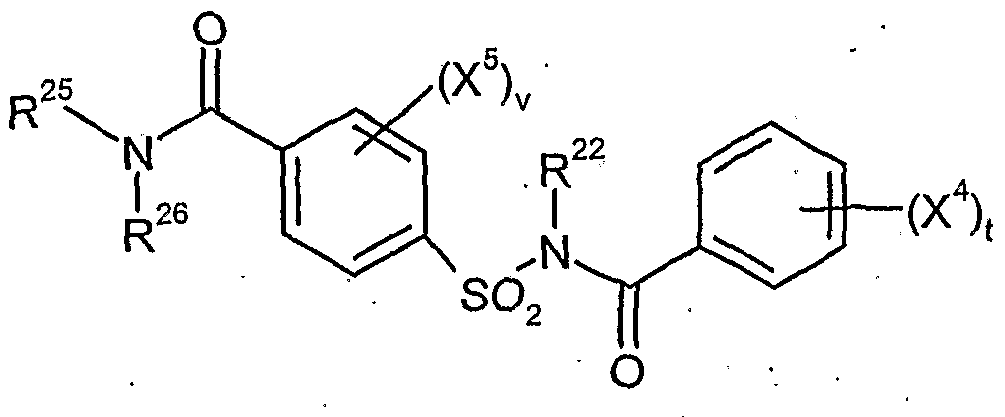
t für eine Zahl 0, 1 , 2, 3, 4 oder 5 steht,t is a number 0, 1, 2, 3, 4 or 5,
v für eine Zahl 0, 1 , 2, 3, 4 oder 5 steht,v is a number 0, 1, 2, 3, 4 or 5,
R22 für Wasserstoff oder CrC4-Alkyl steht, ' R 22 is hydrogen or C 4 alkyl C r '
R23 für Wasserstoff oder CrC4-Alkyl steht, .R 23 is hydrogen or C r C 4 alkyl,.
R24 für Wasserstoff, jeweils gegebenenfalls durch Cyano, Halogen oder Ci-C4-Alkoxy substituiertes Ci-Cö-AIkyl, CrC6-Alkoxy, CrC6-Alkylthio, CrC6-Alkylamino oder Di-(CrC4-alkyl)- amino, oder jeweils gegebenenfalls durch Cyano, Halogen oder C1-C4-AIlCyI substituiertes C3-C6-Cycloalkyl, C3-C6-Cycloalkyloxy, C3-C6-Cycloalkylthio oder C3-C6-Cycloalkylamino stellt,R 24 represents hydrogen, in each case optionally cyano-, halogen or Ci-C4 alkoxy-substituted Ci-COE--alkyl, C r C 6 alkoxy, C r C 6 alkylthio, C r C 6 -alkylamino or di- (C R C 4 -alkyl) -amino, or in each case optionally substituted by cyano, halogen or C 1 -C 4 -alkyl-substituted C 3 -C 6 -cycloalkyl, C 3 -C 6 -cycloalkyloxy, C 3 -C 6 -cycloalkylthio or C 3 -C 6 -cycloalkylamino,
R25 für Wasserstoff, gegebenenfalls durch Cyano, Hydroxy, Halogen oder Ci-C4-Alkoxy substituiertes Cj-Cβ-Alkyl, jeweils gegebenenfalls durch Cyano oder Halogen substituiertes C3-C6- Alkenyl oder C3-C6-Alkinyl, oder gegebenenfalls durch Cyano, Halogen oder Ci-GrAlkyl substituiertes C3-C6-Cycϊoalkyl steht,R 25 represents hydrogen, optionally substituted by cyano, hydroxy, halogen or Ci-C 4 alkoxy Cj-Cβ-alkyl, each optionally substituted by cyano or halogen substituted C 3 -C 6 - alkenyl or C 3 -C 6 alkynyl, or C 3 -C 6 -cycloalkyl optionally substituted by cyano, halogen or C 1 -C 6 -alkyl,
R26 für Wasserstoff, gegebenenfalls durch Cyano, Hydroxy, Halogen oder Ci-C4- Alkoxy substituiertes Ci-Cö-Alkyl, jeweils gegebenenfalls durch Cyano oder Halogen substituiertes C3-C6- Alkenyl oder C3-C6-Alkinyl, gegebenenfalls durch Cyano, Halogen oder CrC4-Alkyl substituiertes C3-C6-Cycloalkyl, oder gegebenenfalls durch Nitro, Cyano, Halogen, Ci-C4-Alkyl, Ci-C4-Halogenalkyl, Ci-C4-Alkoxy oder CrC4-Halogenalkoxy substituiertes Phenyl steht, oder zusammen mit R25 für jeweils gegebenenfalls durch Ci-C4-Alkyl substituiertes C2-C6-R 26 is hydrogen, optionally substituted by cyano, hydroxy, halogen or Ci-C 4 - alkoxy Ci-Cö-alkyl, in each case optionally substituted by cyano or halogen C 3 -C 6 - alkenyl or C 3 -C 6 alkynyl, optionally by cyano, halogen or C r C 4 -alkyl-substituted C 3 -C 6 cycloalkyl, or optionally substituted by nitro, cyano, halogen, Ci-C4-alkyl, Ci-C4-haloalkyl, Ci-C 4 alkoxy or C r C 4 -haloalkoxy-substituted phenyl, or together with R 25 represents in each case optionally substituted by Ci-C 4 alkyl-substituted C 2 -C 6 -
Alkandiyl oder C2-C5-Oxaalkandiyl steht,Alkanediyl or C 2 -C 5 oxaalkanediyl,
X4 für Nitro, Cyano, Carboxy, Carbamoyl, Formyl, Sulfaraoyl, Hydroxy, Amino, Halogen, Cr C4-Alkyl, Ci-C4-Halogenalkyl, Ci-C4-Alkoxy oder Ci-C4-Halogenalkoxy steht, undX is 4-C Ci 4 alkoxy or Ci-C 4 haloalkoxy stands for nitro, cyano, carboxy, carbamoyl, formyl, Sulfaraoyl, hydroxy, amino, halo, C r C 4 alkyl, Ci-C 4 haloalkyl, and
X für Nitro, Cyano, Carboxy, Carbamoyl, Formyl, Sulfamoyl, Hydroxy, Amino, Halogen, Cr GrAlkyl, CrCrHalogenalkyl; Ci-C4-Alkoxy oder CrC4-Halogenalkoxy steht.X is nitro, cyano, carboxy, carbamoyl, formyl, sulfamoyl, hydroxy, amino, halo, C 1 -C 4 alkyl, C r C r haloalkyl ; Ci-C 4 alkoxy or C r C 4 haloalkoxy.
Die erfindungsgemäßen Verbindungen sind durch die Formel (I) allgemein definiert. Bevorzugte Substituenten bzw. Bereiche der in der oben und nachstehend erwähnten Formeln aufgeführten Reste werden im Folgenden erläutert: W steht bevorzugt für Wasserstoff, Ci-Gg-Alkyl, C2-Cg-Alkenyl, C2-Cg-Alkinyl, Halogen, C1-C6-AIkoxy, Ci-C4-Halogenalkyl, CrC4-HalogenaIkoxy oder Cyano,The compounds of the invention are generally defined by the formula (I). Preferred substituents or ranges of the radicals listed in the formulas mentioned above and below are explained below: W preferably represents hydrogen, Ci-Gg-alkyl, C 2 -CG-alkenyl, C 2 -CG-alkynyl, halogen, C 1 -C 6 -alkoxy, Ci-C 4 haloalkyl, CrC 4 -HalogenaIkoxy or cyano,
X steht bevorzugt für Halogen, C1-C8-Alkyl, C2-Cg-Alkenyl, C2-Cg-AIkUIyI, C1-C6- Halogenalkyl, C1-Cg-AIkOXy, C3-Cg-Alkenyloxy, C^Cg-Alkylthio, CrC6-Alkylsulfinyl, C^-Cg-Alkylsulfonyl, C1-C6-Halogenalkoxy, C3-Cg-Halόgenalkenyloxy, Nitro oder Cyano,X preferably represents halogen, C 1 -C 8 alkyl, C 2 -CG-alkenyl, C 2 -CG-AIkUIyI, C 1 -C 6 - haloalkyl, C 1 -CG -alkoxy, C3-Cg-alkenyloxy, C ^ Cg alkylthio, C r C 6 alkylsulfinyl, C ^ -CG-alkylsulfonyl, C1-C6 haloalkoxy, C3-Cg-Halόgenalkenyloxy, nitro or cyano,
Y und Z stehen bevorzugt unabhängig voneinander für Wasserstoff, Halogen, Cj-Cρ-Alkyl, C2- Cg-Alkenyl, C2-Cg-AIkUVyL, C1-C6-Alkoxy, C1-C6-Halogenalkyl, C1-C6-Halogenalkoxyl, Cyano, C2-Cg-Alkenyl, C2-Cg-Alkinyl oder für einen der (Het)-arylreste, Y and Z are preferably each independently hydrogen, halogen, Cj-Cρ alkyl, C 2 - Cg alkenyl, C 2 -CG-AIkUVyL, C 1 -C 6 alkoxy, C 1 -C 6 haloalkyl, C 1 -C 6 -haloalkoxyl, cyano, C 2 -Cg -alkenyl, C 2 -Cg -alkynyl or for one of the (Het) -aryl radicals
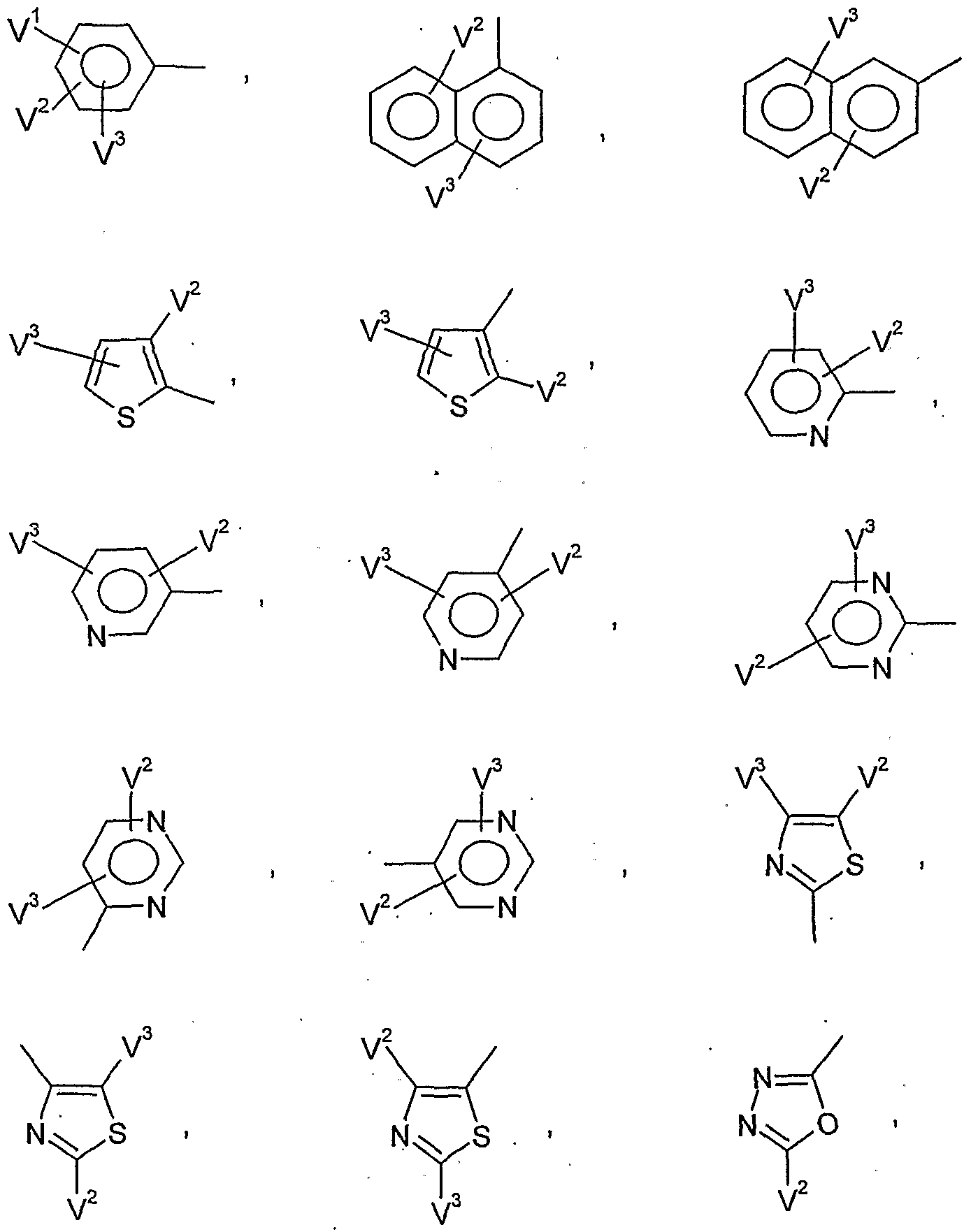

wobei im Falle von (Het)-aiyl nur einer der Reste Y oder Z für (Het)-aryl stehen darf,in the case of (het) -aiyl, only one of the radicals Y or Z may be (het) -aryl,
V1 steht bevorzugt für Wasserstoff, Halogen, Cj-C^-Alkyl, C1-C6-Alkoxy, C1-C6- Alkylthio, Cj-Cö-Alkylsulfmyl, C1-C6-Alkylsulfonyl, Cj-C^Halogenalkyl, C1-C4- Halogenalkoxy, Nitro, Cyano oder jeweils gegebenenfalls einfach oder mehrfach durch Halogen, Cj-Cg-Alkyl, C1-C8-Alkoxy, Cj-C^Halogenalkyl, C2-C4-Halogenalkoxy, Nitro oder Cyano substituiertes Phenyl, Phenoxy, Phenoxy-Ci -C4-alkyl, Phenyl-C1-C4-alkoxy, Phenylthio-C1-C4-alkyl oder Phenyl-Cj^-alkylthio,V 1 is preferably hydrogen, halogen, Cj-C ^ alkyl, C 1 -C 6 alkoxy, C 1 -C 6 - alkylthio, C j--Cö Alkylsulfmyl, C 1 -C 6 alkylsulfonyl, C j - C 1-4 haloalkyl, C 1 -C 4 haloalkoxy, nitro, cyano or in each case optionally mono- or polysubstituted by halogen, C 1 -C 6 -alkyl, C 1 -C 8 -alkoxy, C 1 -C 4 -haloalkyl, C 2 -C 4 -haloalkoxy, nitro or cyano-substituted phenyl, phenoxy, phenoxy-Ci-C4-alkyl, phenyl-C 1 -C 4 -alkoxy, phenylthio-C 1 -C 4 alkyl or phenyl-C j ^ alkylthio,
V^ und V^ stehen bevorzugt unabhängig voneinander für Wasserstoff, Halogen, Cj-Cg-Alkyl, Cj-Cg-Alkoxy, C1-C4-Halogenalkyl oder C1-C4-Haϊogenalkoxy,V 1 and V 1 are preferably, independently of one another, hydrogen, halogen, C 1 -C 6 -alkyl, C 1 -C -alkoxy, C 1 -C 4 -haloalkyl or C 1 -C 4 -haloalkoxy,
mit der Maßgabe, dass mindestens einer der Reste W oder Z ungleich Wasserstoff sein muss, wenn X und Y für Methyl stehen,with the proviso that at least one of the radicals W or Z must not be hydrogen if X and Y are methyl,
A und B und das Kohlenstoffatom, an dass sie gebunden sind, stehen bevorzugt für ein gegebenenfalls einfach bis vierfach durch Ci-Cg-Alkyl, Ci-C4-Halogenalkyl, Ci-C6-Alkoxy oder C1-C4-Alkoxy-Ci-C4-alkyl substituiertes fünf- bis siebengliedriges Ketal, Thioketal oder Dithioketal, welches gegebenenfalls durch ein weiteres Sauerstoffatom, Schwefelatom oder durch die Gruppe N — y4 unterbrochen sein kann,A and B and the carbon atom to which they are attached preferably represent an optionally mono- to tetrasubstituted by Ci-Cg-alkyl, Ci-C4-haloalkyl, Ci-C 6 alkoxy or C 1 -C 4 alkoxy C 1 -C 4 -alkyl-substituted five- to seven-membered ketal, thioketal or dithioketal, which may optionally be interrupted by another oxygen atom, sulfur atom or by the group N - y 4 ,
V4 steht bevorzugt für Wasserstoff, Q-Cö-Alkyl, C3-C6-Alkenyl, oder für die Gruppen -CO-VS, -CO2V5, CO-NH-V5 oder CO-NH-O-V5,V 4 is preferably hydrogen, Q-COE-alkyl, C 3 -C 6 alkenyl, or represents the groups -CO-V S, -CO 2 V 5, CO-NH-V 5 or CO-NH-OV 5 .
V5 steht bevorzugt für C1-C6-AIlCyI,V 5 is preferably C 1 -C 6 -alkyl,
D steht bevorzugt für NH (1 ) oder Sauerstoff (2),D is preferably NH (1) or oxygen (2),
Q1 und Q2 stehen bevorzugt unabhängig voneinander für Wasserstoff, CrC6-Alkyl, C1-C2- Halogenalkyl oder C1-C4-^AIkOXy, . . ■ . G steht bevorzugt für Wasserstoff (a) oder für eine der GruppenQ 1 and Q 2 are preferably independently of one another represent hydrogen, C r C 6 alkyl, C 1 -C 2 - haloalkyl or C 1 -C 4 - ^ -alkoxy. , ■ . G is preferably hydrogen (a) or one of the groups

(g),

in welchenin which
E für ein Metallion oder ein Ammoniumion steht,E is a metal ion or an ammonium ion,
L für Sauerstoff oder Schwefel steht undL stands for oxygen or sulfur and
M für Sauerstoff oder Schwefel steht,M is oxygen or sulfur,
RI steht bevorzugt für jeweils gegebenenfalls durch Halogen oder Cyano substituiertes C\- C2o-Alkyl, C2-C2o-Alkenyl, C1-C6-Alkoxy-C1-C6-alkyl, C^Cg-Alkylthio-Ci-Cs-alkyl oder PoIy-C i-Cs-alkoxy-C1-C6-alkyl oder für gegebenenfalls durch Halogen, Cj-Cg- Alkyl oder C1-C8-Alkoxy substituiertes C3-C8-Cycloalkyl, in welchem gegebenenfalls eine oder zwei nicht direkt benachbarte Methylengruppen durch Sauerstoff und/oder Schwefel ersetzt sind,RI preferably represents in each case optionally substituted by halogen or cyano, C \ - C 2 o alkyl, C 2 -C 2 -alkenyl, C 1 -C 6 alkoxy-C 1 -C 6 alkyl, C ^ Cg alkylthio -Ci-Cs-alkyl or poly-C i -Cs-alkoxy-C 1 -C 6 -alkyl or C 3 -C 8 -cycloalkyl optionally substituted by halogen, C 1 -C 8 -alkyl or C 1 -C 8 -alkoxy, in which optionally one or two not directly adjacent methylene groups are replaced by oxygen and / or sulfur,
für gegebenenfalls durch Halogen, Cyano, Nitro, C1-C8-Alkyl, C1-C8-Alkoxy, C1-C6- Halogenalkyl, C1-C6-Halogenalkoxy, C1-C8-Alkylthio oder C1-C6-Alkylsulfonyl sub- stituiertes Phenyl,is optionally substituted by halogen, cyano, nitro, C 1 -C 8 alkyl, C 1 -C 8 alkoxy, C 1 -C 6 - haloalkyl, C 1 -C 6 haloalkoxy, C 1 -C 8 alkylthio or C C 1 -C 6 -alkylsulfonyl-substituted phenyl,
für gegebenenfalls durch Halogen, Nitro, Cyano, C1-C8-Alkyl, Cj-Cg-Alkoxy, C^-Cg- Halogenalkyl oder Cj-Cg-Halogenalkoxy substituiertes Phenyl-C1-C6-alkyl,phenyl-C 1 -C 6 -alkyl which is unsubstituted or substituted by halogen, nitro, cyano, C 1 -C 8 -alkyl, C 1 -C -alkoxy, C 1 -C 8 -halogenoalkyl or C 1 -C 9 -halogenoalkoxy,
für gegebenenfalls durch Halogen oder C^-Cg-Alkyl substituiertes 5- oder 6-gliedriges Hetaryl mit ein oder zwei Heteroatomen aus der Reihe Sauerstoff, Schwefel und Stickstoff,for optionally substituted by halogen or C ^ -Cg-alkyl 5- or 6-membered hetaryl having one or two heteroatoms selected from oxygen, sulfur and nitrogen,
für gegebenenfalls durch Halogen oder C^-Cg-Alkyl substituiertes Phenoxy-Cj-Cg-alkyl oder für gegebenenfalls durch Halogen, Amino oder C^-Cg-Alkyl substituiertes 5- oder 6- gliedriges Hetaryloxy-C1-C6-alkyl mit ein oder zwei Heteroatomen aus der Reihe Sauerstoff, Schwefel und Stickstoff,optionally substituted by halogen or C ^ -Cg-alkyl-substituted phenoxy-Cj-Cg-alkyl or optionally substituted by halogen, amino or C ^ -Cg-alkyl-substituted 5- or 6-membered hetaryloxy-C 1 -C 6 -alkyl having one or two heteroatoms from the series oxygen, sulfur and nitrogen,
R2 steht bevorzugt für jeweils gegebenenfalls durch Halogen oder Cyano substituiertes C^- . C20-Alkyl, C2-C20-Alkenyl, C1-C6-Alkoxy^-Cg-alkyl oder PoIy-Ci -Cg-alkoxy-C2-Cg- alkyl,R 2 preferably represents in each case optionally halogen or cyano-substituted C 1 -. C 20 -alkyl, C 2 -C 20 -alkenyl, C 1 -C 6 -alkoxy-C 1 -C 6 -alkyl or poly-C 1 -C -alkoxy-C 2 -C -alkyl,
für gegebenenfalls durch Halogen, C1-C6-Alkyl oder Cj-Cg-Alkoxy substituiertes Cß-Cg- Cycloalkyl oderfor Css-Cg-cycloalkyl optionally substituted by halogen, C 1 -C 6 -alkyl or Cj-Cg-alkoxy or
für jeweils gegebenenfalls durch Halogen, Cyano, Nitro, Cj-Cg-Alkyl, C1-C6-Alkoxy, C^- Cg-Halogenalkyl oder C \ -Cg-Halogenalkoxy substituiertes Phenyl oder Benzyl,in each case optionally substituted by halogen, cyano, nitro, Cj-Cg-alkyl, C 1 -C 6 -alkoxy, C ^ - Cg-haloalkyl or C -Cg -haloalkoxy-substituted phenyl or benzyl,
R-3 steht bevorzugt für gegebenenfalls durch Halogen substituiertes C1-C8-Alkyl oder jeweils gegebenenfalls durch Halogen, C1-C6-Alkyl, C1-C8-Alkoxy, C1-C4-Halogenalkyl, C1-C4- Halogenalkoxy, Cyano oder Nitro substituiertes Phenyl oder Benzyl,R-3 is preferably C 1 -C 8 -alkyl optionally substituted by halogen or in each case optionally halogen, C 1 -C 6 -alkyl, C 1 -C 8 -alkoxy, C 1 -C 4 -haloalkyl, C 1 -C 4 Haloalkoxy, cyano or nitro substituted phenyl or benzyl,
R4 und RS stehen unabhängig voneinander bevorzugt für jeweils gegebenenfalls durch Halogen substituiertes C^-Cg-Alky!, Cχ-Cg-Alkoxy, C1-C6-AIkylamino, Di-(C1-C6-alkyI)ammo, C^-Cg-Alkylthio oder Cß-Cg-Alkenylthio oder für jeweils gegebenenfalls durch Halogen,R4 and RS are each, independently of one another, preferably C 1 -C -alkyl which is optionally substituted by halogen, C 1 -C 6 -alkoxy, C 1 -C 6 -alkylamino, di- (C 1 -C 6 -alkyl) ammo, C 1 -C 4 -alkyl -Cg-alkylthio or Cß-Cg-alkenylthio or for each optionally by halogen,
Nitro, Cyano, Cj-C4-Alkoxy, C1-C4-Halogenalkoxy, Cj[-C4-Alkylthio, C1-C4-Halogen- alkylthio, C1-C4-Alkyl oder C1-C4-Halogenalkyl substituiertes Phenyl, Phenoxy oderNitro, cyano, C j -C 4 alkoxy, C 1 -C 4 -haloalkoxy, C j [-C 4 alkylthio, C 1 -C 4 halo-alkylthio, C 1 -C 4 alkyl or C 1 -C 4 Haloalkyl substituted phenyl, phenoxy or
Phenylthio,phenylthio,
R^ und R? stehen unabhängig voneinander bevorzugt für Wasserstoff, für jeweils gegebenenfalls durch Halogen oder Cyano substituiertes C1-C6-Alkyl, C3-Cg-Cycloalkyl, C^-Cg-Alkoxy, C3-Cg-Alkenyl oder C1-C6-Alkoxy-C2-Cg-alkyl, für jeweils gegebenenfalls durch Halogen, Cj-Cg-Alkyl, C1-C6-Halogenalkyl oder C1-C8-Alkoxy substituiertes Phenyl oder Benzyl oder zusammen für einen gegebenenfalls durch Cj-Cg-Alkyl substituierten C3-C6-Alkylenrest, in welchem gegebenenfalls eine Methylengruppe durch Sauerstoff oder Schwefel ersetzt ist.R ^ and R? independently of one another preferably represent hydrogen, in each case optionally halogen- or cyano-substituted C 1 -C 6 -alkyl, C 3 -C 9 -cycloalkyl, C 1 -C -alkoxy, C 3 -C -alkenyl or C 1 -C 6 -alkoxy C 2 -C 6 -alkyl, each of which is optionally substituted by halogen, Cj-Cg-alkyl, C 1 -C 6 -haloalkyl or C 1 -C 8 -alkoxy-substituted phenyl or benzyl or together represent an optionally substituted by Cj-Cg-alkyl C3 -C6-alkylene radical in which optionally a methylene group is replaced by oxygen or sulfur.
In den als bevorzugt genannten Restedefmitionen steht Halogen für Fluor, Chlor, Brom und Iod, insbesondere für Fluor, Chlor und Brom.In the radical definitions mentioned as being preferred, halogen is fluorine, chlorine, bromine and iodine, in particular fluorine, chlorine and bromine.
W steht besonders bevorzugt für Wasserstoff, Chlor, Brom, Cj^-Alkyl, C2-C4-Alkenyl, C2-C4-Alkinyl, C1-C4-Alkoxy, CrCr-Halogenalkyl oder Cy-CrHalogenalkoxy, X steht besonders bevorzugt für Chlor,. Brom, C1-C4-AIlCyI, C2-C4-Alkenyli C2-C4-Alkinyl, C1-C4-AIkOXy, Ci-C^-Halogenalkyl, Cj^-Halogenalkoxy oder Cyano,W is particularly preferably hydrogen, chlorine, bromine, C 1 -C 4 -alkyl, C 2 -C 4 -alkenyl, C 2 -C 4 -alkynyl, C 1 -C 4 -alkoxy, C 1 -C 8 -haloalkyl or Cy-C -Halogenalkoxy, X is more preferably chlorine ,. Bromine, C 1 -C 4 -alkyl, C2-C 4 -Alkenyli C 2 -C 4 alkynyl, C 1 -C 4 -alkoxy, Ci-C ^ haloalkyl, C j ^ haloalkoxy or cyano,
Y und Z stehen besonders bevorzugt unabhängig voneinander für Wasserstoff, Fluor, Chlor, Brom, C1-C4-Alkyl, C2-C4-AIkCHyI5 C2-C4-AIkMyI, C1-C6-AIkOXy, Ci-C4-Halogenalkyl, C1- C4-Halogenalkoxy, Cyano, C2-C4-Alkenyl, C2-C4-AIkHIyI oder für einen der (Het)- arylreste,Y and Z are particularly preferably each independently hydrogen, fluorine, chlorine, bromine, C 1 -C 4 alkyl, C 2 -C 4 -AlkCHyI 5 C 2 -C 4 -AIkMyI, C 1 -C 6 -alkoxy, Ci C 4 -haloalkyl, C 1 -C 4 -haloalkoxy, cyano, C 2 -C 4 -alkenyl, C 2 -C 4 -alkyl or for one of the (het) -aryl radicals,

wobei im Falle von (Het)-aryl nur einer der Reste Y oder Z für (Het)-aryl stehen darf,in the case of (Het) -aryl, only one of the radicals Y or Z may be (Het) -aryl,
V* steht besonders bevorzugt für Wasserstoff, Fluor, Chlor, Brom, C1-C8-Alkyl, C1-C4- Alkoxy, C1-C2- Halogenalkyl, C1-C2-HaIOgBUaIkOXy, Nitro, Cyano oder jeweils gegebe- nenfalls einfach bis zweifach durch Fluor, Chlor, Brom, C1-C4-AIlCyI, C1-C4-AIkOXy, C1-V * particularly preferably represents hydrogen, fluorine, chlorine, bromine, C 1 -C 8 alkyl, C 1 -C 4 - alkoxy, C 1 -C 2 - haloalkyl, C 1 -C 2 -HaIOgBUaIkOXy, nitro, cyano or in each case, if appropriate, once to twice by fluorine, chlorine, bromine, C 1 -C 4 -alkyl, C 1 -C 4 -alkoxy, C 1 -
C2-Halogenalkyl, C1-C2-Halogenalkoxy, Nitro oder Cyano substituiertes Phenyl,C 2 -haloalkyl, C 1 -C 2 -haloalkoxy, nitro or cyano-substituted phenyl,
V^ und V^ stehen besonders bevorzugt unabhängig voneinander für Wasserstoff, Fluor, Chlor, Brom, C1-C4-AIlJyI, C1-C4-AIkOXy,

mit der Maßgabe, dass mindstens einer der Reste W oder Z ungleich Wasserstoff sein muss, wenn X und Y für Methyl stehen,with the proviso that at least one of the radicals W or Z must not be hydrogen if X and Y are methyl,
A und B und das Kohlenstoffatom, an. dass sie gebunden sind, stehen besonders bevorzugt für ein gegebenenfalls einfach bis dreifach durch CrC4-Ä.lkyl, CrC3-Halogenalkyl, C1-C4-AIkOXy oder C1-C4-AIkOXy-C1-C2-EIlCyI substituiertes fünf-, sechs- oder sieb'engliedrϊges Ketal, welches gegebenenfalls durch ein weiteres Sauerstoffatom unterbrochen sein kann,A and B and the carbon atom, on. that they are attached particularly preferably represent an optionally mono- to trisubstituted by C r C 4 -Ä.lkyl, C r C3-haloalkyl, C 1 -C 4 -alkoxy or C 1 -C 4 -alkoxy-C 1 -C 2 -EIlCyI substituted five-, six- or sieve 'engliedrϊges ketal, which may be optionally interrupted by a further oxygen atom,
D steht besonders bevorzugt für NH (1) oder Sauerstoff (2),D particularly preferably represents NH (1) or oxygen (2),
Q1 und Q2 stehen besonders bevorzugt unabhängig voneinander für Wasserstoff, Methyl, Ethyl, Trifluormethyl, Methoxy oder Ethoxy,Q 1 and Q 2 are particularly preferably independently of one another represent hydrogen, methyl, ethyl, trifluoromethyl, methoxy or ethoxy,
G steht besonders bevorzugt für Wasserstoff (a) oder für eine der GruppenG is particularly preferably hydrogen (a) or one of the groups

R4 ~7/P sR5 (e), E (f), oder Y_ N; ? (g), L L R R 4 ~ 7 / P s R 5 (e), E (f) or Y_ N; ? (g) , L L R
in welchenin which
E für ein Metallion oder ein Ammoniumion steht,E is a metal ion or an ammonium ion,
L für Sauerstoff oder Schwefel steht undL stands for oxygen or sulfur and
M für Sauerstoff oder Schwefel steht,M is oxygen or sulfur,
R.1 steht besonders bevorzugt für jeweils gegebenenfalls einfach bis dreifach durch Fluor oder Chlor substituiertes Ci-Cig-Alkyl, C2-Ci6-Alkenyl, C1-C6-Alkoxy-Ci-C^alkyl, C]1-Cg- Alkylthio-C^-C4-alkyl oder PoIy-C i-Cg-alkoxy-Ci-C^alkyl oder für gegebenenfalls einfach bis. zweifach durch Fluor, Chlor, C^-Cs-Alkyl oder Ci-C5-Alkoxy substituiertesR.1 particularly preferably represents in each case optionally mono- to trisubstituted by fluorine or chlorine-substituted Ci-Cig-alkyl, C2 -Ci6 alkenyl, C 1 -C 6 alkoxy-C ^ alkyl, C] 1 -Cg- Alkylthio-C ^ -C4-alkyl or poly-C i -Cg-alkoxy-Ci-C ^ alkyl or optionally mono- to. two times substituted by fluorine, chlorine, C ^ -Cs-alkyl or Ci-C5-alkoxy
C3-C7-Cycloalkyl, in welchem gegebenenfalls eine oder zwei nicht direkt benachbarte Methylengruppen durch Sauerstoff und/oder Schwefel ersetzt sind,C3-C7-cycloalkyl in which optionally one or two not directly adjacent methylene groups are replaced by oxygen and / or sulfur,
für gegebenenfalls einfach bis dreifach durch Fluor, Chlor, Brom, Cyano, Nitro, C1-C4- Alkyi, C1-C4-Alkoxy, Cj-Cs-Halogenalkyl, C1-C3-Halogenalkoxy, C1-C4-Alkylthk> oder C i-C4-Alkylsulfonyl substituiertes Phenyl,optionally monosubstituted to trisubstituted by fluorine, chlorine, bromine, cyano, nitro, C1-C4 Alkyi, C 1 -C 4 alkoxy, C j -Cs haloalkyl, C 1 -C 3 haloalkoxy, C 1 -C 4 Alkylthk> or C 1 -C 4 -alkylsulphonyl-substituted phenyl,
für gegebenenfalls einfach bis zweifach durch Fluor, Chlor, Brom, C1-C4-Alkyl, C1-C4- Alkoxy, Cj-C3-Halogenalkyl oder C1-C3-Halogenalkoxy substituiertes Phenyl-C|-C4- alkyl, für jeweils gegebenenfalls einfach bis zweifach durch Fluor, Chlor, Brom oder C1-C4- Alkyl substituiertes Pyrazolyl, Thiazolyl, Pyridyl, Pyrimidyl, Furanyl oder Thienyl,phenyl-C 1 -C 4 -alkyl optionally substituted once to twice by fluorine, chlorine, bromine, C 1 -C 4 -alkyl, C 1 -C 4 -alkoxy, C 1 -C 3 -haloalkyl or C 1 -C 3 -haloalkoxy, in each case optionally mono- to disubstituted by fluorine, chlorine, bromine or C 1 -C 4 -alkyl-substituted pyrazolyl, thiazolyl, pyridyl, pyrimidyl, furanyl or thienyl,
für gegebenenfalls einfach bis zweifach durch Fluor, Chlor, Brom oder Cj-C4-Alkyl substituiertes Phenoxy-Cj^-alkyl oderfor optionally mono- to disubstituted by fluorine, chlorine, bromine or C j -C4-alkyl-substituted phenoxy-Cj ^ -alkyl or
für jeweils gegebenenfalls einfach bis zweifach durch Fluor, Chlor, Brom, Amino oder C\-each optionally optionally once or twice by fluorine, chlorine, bromine, amino or C \ -
C^Alkyl substituiertes Pyridyloxy-Ci-Cs-alkyl, Pyrimidyloxy-C1-C5-alkyl oder Thi- azolyloxy-Ci-C5-alkyl,C 1-4 -alkyl-substituted pyridyloxy-C 1 -C 8 -alkyl, pyrimidyloxy-C 1 -C 5 -alkyl or thiazolyloxy-C 1 -C 5 -alkyl,
R2 steht besonders bevorzugt für jeweils gegebenenfalls einfach bis dreifach durch Fluor oder Chlor substituiertes C1-C16-Alkyl, C2-C16-Alkenyl, C1-C6-Alkoxy- C2-C6-alkyl oder PoIy-C 1-C6-alkoxy- C2-C6-alkyl,R 2 particularly preferably represents in each case optionally monosubstituted to trisubstituted by fluorine or chlorine C 1 -C 16 -alkyl, C 2 -C 16 -alkenyl, C 1 -C 6 -alkoxy-C 2 -C 6 -alkyl or poly- C 1 -C 6 -alkoxy-C 2 -C 6 -alkyl,
für gegebenenfalls einfach bis zweifach durch Fluor, Chlor, C1-C4-Alkyl oder C1-C4- Alkoxy substituiertes C3-C7-Cycloalkyl oderfor optionally mono- to disubstituted by fluorine, chlorine, C 1 -C 4 -alkyl or C 1 -C 4 - alkoxy-substituted C 3 -C 7 -cycloalkyl or
für jeweils gegebenenfalls einfach bis dreifach durch Fluor, Chlor, Brom, Cyano, Nitro, C1-C4-Alkyl, C1-C3-Alkoxy, C1-C3-Halogenalkyl oder C1-C3-Halogenalkoxy substi- tuiertes Phenyl oder Benzyl,in each case optionally monosubstituted to trisubstituted by fluorine, chlorine, bromine, cyano, nitro, C 1 -C 4 -alkyl, C 1 -C 3 -alkoxy, C 1 -C 3 -haloalkyl or C 1 -C 3 -haloalkoxy. tuted phenyl or benzyl,
R3 steht besonders bevorzugt für gegebenenfalls einfach bis dreifach durch Fluor oder Chlor substituiertes C1-C6-Alkyl oder jeweils gegebenenfalls einfach bis zweifach durch Fluor, Chlor, Brom, C1-C4-Alkyl, Cj^-Alkoxy, Ci-C2-Halogenalkoxy, Ci -C2-Halogenalkyl, Cyano oder Nitro substituiertes Phenyl oder Benzyl,R 3 particularly preferably represents optionally mono- to trisubstituted by fluorine or chlorine-substituted C 1 -C 6 -alkyl or in each case optionally mono- to disubstituted by fluorine, chlorine, bromine, C 1 -C 4 -alkyl, C j ^ -alkoxy, Ci -C 2 -haloalkoxy, C 1 -C 2 -haloalkyl, cyano or nitro-substituted phenyl or benzyl,
R4 und R^ stehen unabhängig voneinander besonders bevorzugt für jeweils gegebenenfalls einfach bis dreifach durch Fluor oder Chlor substituiertes C1-C6-Alkyl, C1-C6-Alkoxy, C1-C6- Alkylamino, Di-( C1-C6-alkyl)amino, C1-C6-Alkylthio oder C3-C4-Alkenylthio oder für jeweils gegebenenfalls einfach bis zweifach durch Fluor, Chlor, Brom, Nitro, Cyano, Cj- C3-Alkoxy, C1-C3-Halogenalkoxy, C1-C3-Alkylthio, C1-C3-Halogenalkylthio, C1-C3- Alkyl oder C1-C3-Halogenalkyl substituiertes Phenyl, Phenoxy oder Phenylthio,R 4 and R 1 independently of one another particularly preferably represent in each case optionally mono- to trisubstituted by fluorine or chlorine, C 1 -C 6 -alkyl, C 1 -C 6 -alkoxy, C 1 -C 6 -alkylamino, di- (C 1 -C 6 -alkyl) amino, C 1 -C 6 -alkylthio or C 3 -C 4 -alkenylthio, or in each case optionally mono- to disubstituted by fluorine, chlorine, bromine, nitro, cyano, C 1 -C 3 -alkoxy, C 1 -C 3 -haloalkoxy, C 1 -C 3 alkylthio, C 1 -C 3 haloalkylthio, C 1 -C 3 alkyl or C 1 -C 3 -halogenoalkyl-substituted phenyl, phenoxy or phenylthio,
R 6 und R7 stehen unabhängig voneinander besonders bevorzugt für Wasserstoff, für jeweils gegebenenfalls einfach bis dreifach durch Fluor oder Chlor substituiertes C1-C6-Alkyl, C3-C6-Cycloalkyl, C1-C6-AIkoxy, Cs-Cg-Alkenyl oder C1-C6-AIkoxy^-Cö-alkyl, für jeweils gegebenenfalls einfach bis dreifach durch Fluor, Chlor, Brom, Cj-C5-Halo- genalkyl, Cj-C5-Alkyl oder Cj-C5-Alkoxy substituiertes Phenyl oder Benzyl, oder zusammen für einen gegebenenfalls durch C2-C4-Älkyl substituierten C3-C6-Alkylenrest, in welchem gegebenenfalls eine Methylengruppe durch Sauerstoff oder Schwefel ersetzt ist.R 6 and R 7 independently of one another particularly preferably represent hydrogen, in each case optionally mono- to trisubstituted by fluorine or chlorine, C 1 -C 6 -alkyl, C 3 -C 6 -cycloalkyl, C 1 -C 6 -alkoxy, Cs-Cg- Alkenyl or C 1 -C 6 -Alkoxy ^ -Cö alkyl, each optionally optionally mono- to trisubstituted by fluorine, chlorine, bromine, Cj-C5-Halo genalkyl, Cj-C5-alkyl or C j -C5-alkoxy-substituted phenyl or benzyl, or together for an optionally C 2 -C 4 -alkyl-substituted C 3 -C 6 -alkylene radical, in which optionally a methylene group is replaced by oxygen or sulfur.
In den als besonders bevorzugt genannten Restedefinitionen steht Halogen für Fluor, Chlor und Brom, insbesondere für Fluor und Chlor.In the radical definitions mentioned as being particularly preferred, halogen is fluorine, chlorine and bromine, in particular fluorine and chlorine.
W steht ganz besonders bevorzugt für Wasserstoff, Chlor, Brom, Methyl, Ethyl, Vinyl, Ethinyl, Propinyl, Methoxy, Ethoxy oder Trifluormethyl,W is very particularly preferably hydrogen, chlorine, bromine, methyl, ethyl, vinyl, ethynyl, propynyl, methoxy, ethoxy or trifluoromethyl,
X steht ganz besonders bevorzugt für Chlor, Brom, Methyl, Ethyl, Propyl, iso-Propyl, Vinyl, Ethinyl, Propinyl, Methoxy, Ethoxy, Trifluormethyl, Difluormethoxy, Trifluormethoxy oder Cyano,X is very particularly preferably chlorine, bromine, methyl, ethyl, propyl, isopropyl, vinyl, ethynyl, propynyl, methoxy, ethoxy, trifluoromethyl, difluoromethoxy, trifluoromethoxy or cyano,
Y und Z stehen ganz besonders bevorzugt unabhängig voneinander für Wasserstoff, Fluor, Chlor, Brom, Methyl, Ethyl, Vinyl, Ethinyl, Propinyl, Methoxy, Trifluormethyl, Trifluormethoxy, Cyano oder einen Phenylrest,Y and Z very particularly preferably independently of one another represent hydrogen, fluorine, chlorine, bromine, methyl, ethyl, vinyl, ethynyl, propynyl, methoxy, trifluoromethyl, trifluoromethoxy, cyano or a phenyl radical,
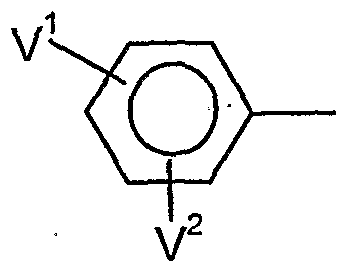
wobei im Falle von Phenyl nur einer der Reste Y oder Z für Phenyl stehen darf,in the case of phenyl, only one of Y or Z may be phenyl,
V^ steht ganz besonders bevorzugt für Wasserstoff, Fluor, Chlor, Brom, Methyl, Ethyl, n- Propyl, iso-Propyl, tert-Butyl, Methoxy, Ethoxy, n-Propoxy, iso-Propoxy, Trifluormethyl oder Trifluormethoxy,V 1 very particularly preferably represents hydrogen, fluorine, chlorine, bromine, methyl, ethyl, n-propyl, isopropyl, tert-butyl, methoxy, ethoxy, n-propoxy, isopropoxy, trifluoromethyl or trifluoromethoxy,
V2 steht ganz besonders bevorzugt für Wasserstoff, Fluor, Chlor, Methyl, Ethyl, n-Propyl, iso- Propyl, Methoxy, Ethoxy oder Trifluormethyl,V 2 very particularly preferably represents hydrogen, fluorine, chlorine, methyl, ethyl, n-propyl, isopropyl, methoxy, ethoxy or trifluoromethyl,
mit der Maßgabe, dass mindestens einer der Reste W oder Z ungleich Wasserstoff sein muss, wenn X und Y für Methyl stehen,with the proviso that at least one of the radicals W or Z must not be hydrogen if X and Y are methyl,
A und B und das Kohlenstoffatom, an dass sie gebunden sind, stehen ganz besonders bevorzugt für ein gegebenenfalls einfach bis zweifach durch Methyl, Ethyl, Propyl, Trifluormethyl,A and B and the carbon atom to which they are attached very particularly preferably represent an optionally mono- or disubstituted by methyl, ethyl, propyl, trifluoromethyl,
Monochlormethyl, Methoxy, Ethoxy, Methoxymethyl oder Ethoxymethyl substituiertes fünf-, sechs- oder siebengliedriges Ketal, welches gegebenenfalls durch ein weiteresMonochloromethyl, methoxy, ethoxy, methoxymethyl or ethoxymethyl substituted five-, six- or seven-membered ketal, which optionally by another
Sauerstoffatom unterbrochen sein kann, D steht ganz besonders bevorzugt für NH (I) oder Sauerstoff (2), ' , .'Oxygen atom can be interrupted, D is very particularly preferably NH (I) or oxygen (2), ',.
Q1 und Q2 stehen ganz besonders bevorzugt für Wasserstoff,Q 1 and Q 2 very particularly preferably represent hydrogen,
G steht ganz besonders bevorzugt für Wasserstoff (a) oder für eine der GruppenG is very particularly preferably hydrogen (a) or one of the groups

in welchenin which
E für ein Metallion oder ein Ammoniumion steht,E is a metal ion or an ammonium ion,
L für Sauerstoff oder Schwefel steht undL stands for oxygen or sulfur and
M für Sauerstoff oder Schwefel steht,M is oxygen or sulfur,
R.1 steht ganz besonders bevorzugt für jeweils gegebenenfalls einfach bis dreifach durch Fluor oder Ghlor substituiertes C1-C10-Alkyl, C2-Cio-Alkenyl, C1-C4-Alkoxy- C1-C2-alkyl, C1-C4-Alkylthio-Ci-C2-alkyl oder für gegebenenfalls einfach durch Fluor, Chlor, Methyl, Ethyl oder Methoxy substituiertes C3-C6-Cycloalkyl,R.1 very particularly preferably represents in each case optionally monosubstituted to trisubstituted by fluorine or chlorine, C 1 -C 10 -alkyl, C 2 -C 10 -alkenyl, C 1 -C 4 -alkoxy-C 1 -C 2 -alkyl, C 1 C 4 -alkylthio-C 1 -C 2 -alkyl or C 3 -C 6 -cycloalkyl which is optionally monosubstituted by fluorine, chlorine, methyl, ethyl or methoxy,
für gegebenenfalls einfach bis zweifach durch Fluor, Chlor, Brom, Cyano, Nitro, Methyl, Ethyl, n-Propyl, i-Propyl, Methoxy, Ethoxy, Trifluormethyl oder Trifluormethoxy sub- stituiertes Phenyl,optionally phenyl monosubstituted or disubstituted by fluorine, chlorine, bromine, cyano, nitro, methyl, ethyl, n-propyl, i-propyl, methoxy, ethoxy, trifluoromethyl or trifluoromethoxy,
für jeweils gegebenenfalls einfach durch Chlor, Brom oder Methyl substituiertes Furanyl, Thienyl oder Pyridyl,each optionally optionally substituted by chlorine, bromine or methyl substituted furanyl, thienyl or pyridyl,
R.2 steht ganz besonders bevorzugt für jeweils gegebenenfalls einfach bis dreifach durch Fluor oder Chlor substituiertes C^-CiQ-Alkyl, C2-C10-Alkenyl oder C1-C4-Alkoxy-C2-C4- alkyl,R.2 very particularly preferably represents in each case optionally mono- to trisubstituted by fluorine or chlorine, C ^ -C Q alkyl, C 2 -C 10 alkenyl or C 1 -C 4 alkoxy-C2-C4 alkyl,
für Cyclopentyl oder Cyclohexyl oder für jeweils gegebenenfalls einfach bis zweifach durch Fluor, Chlor, Cyäno, Nitro, Methyl, Ethyl, Methoxy, Trifluormethyl oder Trifluormethoxy substituiertes Phenyl oder Benzyl,for cyclopentyl or cyclohexyl or represents phenyl or benzyl which is optionally mono- to disubstituted by fluorine, chlorine, cyano, nitro, methyl, ethyl, methoxy, trifluoromethyl or trifluoromethoxy,
R^ steht ganz besonders bevorzugt für jeweils gegebenenfalls einfach bis dreifach durch Fluor oder Chlor substituiertes Methyl, Ethyl, Propyl oder iso-Propyl, oder jeweils gegebenenfalls einfach durch Fluor, Chlor, Brom, Methyl, Ethyl, iso-Propyl, teit-Butyl, Methoxy, Ethoxy, iso-Propoxy, Trifluormethyl, Trifluormethoxy, Cyano oder Nitro substituiertes Phenyl,R 1 very particularly preferably represents in each case optionally mono- to trisubstituted by fluorine or chlorine, methyl, ethyl, propyl or iso-propyl, or in each case optionally simply by fluorine, chlorine, bromine, methyl, ethyl, iso-propyl, teit-butyl, Methoxy, ethoxy, iso-propoxy, trifluoromethyl, trifluoromethoxy, cyano or nitro substituted phenyl,
R.4 und R.5 stehen unabhängig voneinander ganz besonders bevorzugt für C1-C4-Alkoxy oder Cj- C^Alkylthio oder für jeweils gegebenenfalls einfach durch Fluor, Chlor, Brom, Nitro,R.4 and R.5 are each independently very particularly preferably represent C 1 -C 4 alkoxy or C j - C ^ alkylthio, or represents in each case optionally monosubstituted by fluorine, chlorine, bromine, nitro,
Cyano, Methyl, Methoxy, Trifluormethyl oder Trifluormethoxy substituiertes Phenyl, Phenoxy oder Phenylthio,Cyano, methyl, methoxy, trifluoromethyl or trifluoromethoxy substituted phenyl, phenoxy or phenylthio,
R.6 und R? stehen unabhängig voneinander ganz besonders bevorzugt für Wasserstoff, für C1-C4- Alkyl, C3-C<5-Cycloalkyl, Ci-O/j-Alkoxy, C3-C4-Alkenyl oder C1-C4-Alkoxy-C2-C4- alkyl, für jeweils gegebenenfalls einfach bis zweifach durch Fluor, Chlor, Brom, Methyl,R.6 and R? independently of one another very particularly preferably represent hydrogen, C1-C4 alkyl, C 3 -C <5 cycloalkyl, Ci-O / j alkoxy, C3-C 4 alkenyl or C 1 -C 4 -alkoxy-C2 C4-alkyl, in each case optionally once or twice by fluorine, chlorine, bromine, methyl,
Methoxy oder Trifluormethyl substituiertes Phenyl, oder zusammen für einen C5-Cg-Alky- lenrest, in welchem gegebenenfalls eine Methylengruppe durch Sauerstoff oder Schwefel ersetzt ist.Methoxy or trifluoromethyl-substituted phenyl, or together for a C5-Cg-alkylene lenrest in which optionally a methylene group is replaced by oxygen or sulfur.
W steht insbesondere bevorzugt für Wasserstoff, Chlor, Brom, Methyl, Ethyl oder Methoxy,W is particularly preferably hydrogen, chlorine, bromine, methyl, ethyl or methoxy,
X steht insbesondere bevorzugt für Chlor, Brom, Methyl, Ethyl oder Methoxy,X is particularly preferably chlorine, bromine, methyl, ethyl or methoxy,
Y und Z stehen insbesondere bevorzugt unabhängig voneinander für Wasserstoff, Chlor, Brom, Methyl oder für den RestY and Z are particularly preferably independently of one another hydrogen, chlorine, bromine, methyl or the radical
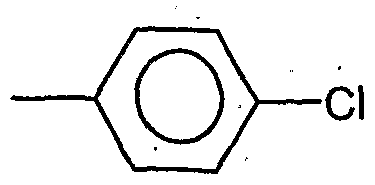
wobei in diesem Falle nur einer der Reste Y oder Z für — (C)) cι stehen darf,in which case only one of the radicals Y or Z may stand for - (C)) cι,
mit der Maßgabe, dass mindestens einer der Reste W oder Z ungleich Wasserstoff sein muss, wenn X und Y für Methyl stehen, A und B und das Kohlenstoffatom, an dass sie gebunden sind, stehen insbesondere bevorzugt für ein gegebenenfalls einfach bis zweifach durch Methyl, Ethyl, Propyl, Monochlormethyl oder Methoxymethyl substituiertes fünf- oder sechsgliedriges Ketal,with the proviso that at least one of the radicals W or Z must not be hydrogen if X and Y are methyl, A and B and the carbon atom to which they are bonded are particularly preferably a five- or six-membered ketal which is optionally mono- to disubstituted by methyl, ethyl, propyl, monochloromethyl or methoxymethyl.
D steht insbesondere bevorzugt für NH (1) oder Sauerstoff (2),D is particularly preferably NH (1) or oxygen (2),
Q1 und Q2 stehen insbesondere bevorzugt für Wasserstoff,Q 1 and Q 2 are particularly preferably hydrogen,
G steht insbesondere bevorzugt für Wasserstoff (a) oder für eine der GruppenG is particularly preferably hydrogen (a) or one of the groups

RI steht insbesondere bevorzugt für Cj-CiQ-Alkyl, C1-C4-Alkoxy-C;[-C2-alkyl, C3-C6- Cycloalkyl,R 1 particularly preferably represents C 1 -C 10 -alkyl, C 1 -C 4 -alkoxy-C 1 -C 2 -alkyl, C 3 -C 6 -cycloalkyl,
für gegebenenfalls einfach durch Chlor substituiertes Phenyl, oder für Thienyl,for optionally monosubstituted by chlorine phenyl, or for thienyl,
R^ steht insbesondere bevorzugt für C \ -C \ Q-Alkyl, C2-C \ Q-Alkenyl, oder für Benzyl,R ^ especially preferably represents C \ -C \ Q alkyl, C2-C \ Q alkenyl, or benzyl,
R^ steht insbesondere bevorzugt für Methyl,R 1 particularly preferably represents methyl,
R^ und R? stehen insbesondere bevorzugt zusammen für einen C5-C(5-Alkylenrest, in welchem gegebenenfalls eine Methylengruppe durch Sauerstoff oder Schwefel ersetzt ist.R ^ and R? are particularly preferably together for a C5-C (5-alkylene radical in which optionally a methylene group is replaced by oxygen or sulfur.
Die oben aufgeführten allgemeinen oder in Vorzugsbereichen aufgeführten Restedefinitionen bzw. Erläuterungen können untereinander, also auch zwischen den jeweiligen Bereichen und Vorzugsbereichen beliebig kombiniert werden. Sie gelten für die Endprodukte sowie für die Vor- und Zwischenprodukte entsprechend.The general or preferred radical definitions or explanations given above can be combined as desired with one another, ie also between the respective ranges and preferred ranges. They apply accordingly to the end products as well as to the precursors and intermediates.
Erfϊndungsgemäß bevorzugt werden die Verbindungen der Formel (I), in welchen eine Kombi- nation der vorstehend als bevorzugt (vorzugsweise) aufgeführten Bedeutungen vorliegt.According to the invention, preference is given to the compounds of the formula (I) in which a combination of the meanings listed above as being preferred (preferred) is present.
Erfϊndungsgemäß besonders bevorzugt werden die Verbindungen der Formel (I), in welchen eine Kombination der vorstehend als besonders bevorzugt aufgeführten Bedeutungen vorliegt.According to the invention, particular preference is given to the compounds of the formula (I) in which a combination of the meanings listed above as being particularly preferred is present.
Erfindungsgemäß ganz besonders bevorzugt werden die Verbindungen der Formel (I), in welchen eine Kombination der vorstehend als ganz besonders bevorzugt aufgeführten Bedeutungen vor- liegt. • Erfmdungsgemäß insbesondere bevorzugt werden die Verbindungen der Formel (I), in welchen eine Kombination der vorstehend als insbesondere bevorzugt aufgeführten Bedeutungen vorliegt.Very particular preference according to the invention is given to the compounds of the formula (I) which contain a combination of the meanings given above as being very particularly preferred. • According to the invention, particular preference is given to the compounds of the formula (I) in which a combination of the meanings given above as being particularly preferred is present.
Hervorgehoben sind Verbindungen der Formel (I) in welchen G für Wasserstoff steht.Emphasis is given to compounds of the formula (I) in which G is hydrogen.
Im Fall der Verbindungen der Formel (1-1) ist der Phenylring hervorgehoben 3-fach substituiert, wobei sich folgende Substitutionsmuster ergeben: 2,4,6-; 2,4,5- oder 2,5,6-Substitution. Außerdem ist im der Fall der Verbindungen der Formel. (I- 1) der Phenylring hervorgehoben 4-fach substituiert, wobei sich folgendes Substitutionsmuster ergibt: 2,4,5,6-Substittution. Im Falle derIn the case of the compounds of the formula (1-1), the phenyl ring is highlighted substituted 3-fold, the following substitution patterns result: 2,4,6-; 2,4,5- or 2,5,6-substitution. In addition, in the case of the compounds of the formula. (I-1) the phenyl ring highlighted 4-fold substituted, resulting in the following substitution pattern: 2,4,5,6-Substitution. In case of
Verbindungen der Formel (I- 1) ist der Phenylring hervorgehoben auch 2-fach (2,5-Postition) substituiert. Im Falle der Verbindungen der Formel (I- 1) ist der Phenylring hervorgehoben auch 1- fach (ortho Postition) substituiert. Die übrigen Substituenten W, X, Y, Z, G, A, B, Q1 und Q2 haben die im Text genannten Definitionen.Compounds of formula (I-1), the phenyl ring is highlighted also substituted 2-fold (2,5-position). In the case of the compounds of the formula (I-1), the phenyl ring is also substituted singly (ortho position). The remaining substituents W, X, Y, Z, G, A, B, Q 1 and Q 2 have the definitions given in the text.
Außerdem steht im Fall der Verbindungen der Formel (1-1), in der der Phenylring in 2,4-Postion substituiert ist, der Substituent G hervorgehoben für die Gruppe (b), aber auch für die Gruppe (c) oder (d) oder (e) oder (f) oder (g). Insbesondere steht G in diesem Fall für die Gruppen (a), (b) oder (c). Die übrigen Substituenten W, X, Y, Z, A, B, Q1 und Q2 haben die im Text genanntenIn addition, in the case of the compounds of the formula (1-1) in which the phenyl ring is substituted in the 2,4-position, the substituent G is highlighted for the group (b) but also for the group (c) or (d) or (e) or (f) or (g). In particular, G in this case stands for the groups (a), (b) or (c). The other substituents W, X, Y, Z, A, B, Q 1 and Q 2 have those mentioned in the text
Definitionen. Weiterhin steht im Fall der Verbindungen der Formel (I- 1), in der der Phenylring in 2,4-Position substituiert ist, die Substituenten A und B hervorgehoben in der 3 '-Position am Spirocyclus. Weiterhin steht im Fall der Verbindungen der Formel (I- 1), in der der Phenylring in 2,4-Position substituiert ist, die Substituenten A und B hervorgehoben in der 4 '-Position am Spirocyclus.Definitions. Furthermore, in the case of the compounds of the formula (I-1) in which the phenyl ring is substituted in the 2,4-position, the substituents A and B are highlighted in the 3 'position on the spirocycle. Furthermore, in the case of the compounds of the formula (I-1) in which the phenyl ring is substituted in the 2,4-position, the substituents A and B are highlighted in the 4 'position on the spirocycle.
Gesättigte oder ungesättigte Kohlenwasserstoffreste wie Alkyl, Alkandiyl oder Alkenyl können, auch in Verbindung mit Heteroatomen, wie z.B. in Alkoxy, soweit möglich, jeweils geradkettig oder verzweigt sein.Saturated or unsaturated hydrocarbon radicals such as alkyl, alkanediyl or alkenyl may also be used in conjunction with heteroatoms, e.g. in alkoxy, as far as possible, in each case straight-chain or branched.
Gegebenenfalls substituierte Reste können, sofern nicht anderes angegeben ist, einfach oder mehr- fach substituiert sein, wobei bei Mehrfachsubstitutionen die Substituenten gleich oder verschieden sein können.Unless otherwise stated, optionally substituted radicals may be monosubstituted or polysubstituted, with multiple substituents the substituents being the same or different.
Im " einzelnen seien außer den bei den Herstellungsbeispielen genannten Verbindungen die folgenden Verbindungen der Formel (I-l-a) genannt: Tabelle 1In the " individual except the compounds mentioned in the preparation examples, the following compounds of formula (Ila) may be mentioned: Table 1

A-B X W Y ZA-B X W Y Z
-O-(CH2)2-O- CH3 H H H-O- (CH 2 ) 2 -O- CH 3 HHH
-O-(CH2)2-O- Br H H H-O- (CH 2 ) 2 -O- Br HHH
-O-(CH2)rO- Cl H H H-O- (CH 2 ) r O-Cl HHH
-O-(CH2)2-O- CF3 H H H-O- (CH 2 ) 2 -O- CF 3 HHH
-O-(CH2)2-O- OCH3 H H H-O- (CH 2 ) 2 -O-OCH 3 HHH
-O-(CH2)2-O- Br H Cl H-O- (CH 2 ) 2 -O- Br H Cl H
-O-(CH2)2-O- Cl H Br H-O- (CH 2 ) 2 -O- Cl H Br H
-O-(CH2)2-O- Cl H Cl H-O- (CH 2 ) 2 -O- Cl H Cl H
-O-(CH2)2-O- Cl H CH3 H-O- (CH 2 ) 2 -O- Cl H CH 3 H
-O-(CH2)2-O- CH3 H Cl H-O- (CH 2 ) 2 -O- CH 3 H Cl H
-O-(CH2)2-O- Cl Cl H H-O- (CH 2 ) 2 -O- Cl Cl HH
-O-(CH2)2-O- Cl OCH3 H H-O- (CH 2 ) 2 -O- Cl OCH 3 HH
-O-(CH2)2-O- Ci CH3 H H-O- (CH 2 ) 2 -O-Ci CH 3 HH
-O-(CH2)2-O- Cl OC2H5 H H-O- (CH 2 ) 2 -O- Cl OC 2 H 5 HH
-O-(CH2)2-O- OCH3 OCH3 H H-O- (CH 2 ) 2 -O-OCH 3 OCH 3 HH
-O-(CH2)2-O- CH3 CH3 H H-O- (CH 2 ) 2 -O- CH 3 CH 3 HH
-O-(CH2)2-O- C2H5 CH3 H H-O- (CH 2 ) 2 -O- C 2 H 5 CH 3 HH
-O-(CH2)2-O- C2H5 C2H5 H H-O- (CH 2 ) 2 -O- C 2 H 5 C 2 H 5 HH
-O-(CH2)2-O- Br CH3 Br H-O- (CH 2 ) 2 -O- Br CH 3 Br H
-O-(CH2)2-O- Cl CH3 Ci H-O- (CH 2 ) 2 -O- Cl CH 3 Ci H
-O-(CH2)2-O- CH3 Br CH3 H-O- (CH 2 ) 2 -O- CH 3 Br CH 3 H
-O-(CH2)2-O- CH3 Cl CH3 H-O- (CH 2 ) 2 -O- CH 3 Cl CH 3 H
-O-(CH2)2-O- OCH3 CH3 CH3 H-O- (CH 2 ) 2 -O-OCH 3 CH 3 CH 3 H
-O-(CH2)2-O- OC2H5 CH3 CH3 H-O- (CH 2 ) 2 -O- OC 2 H 5 CH 3 CH 3 H
-O-(CH2)2-O- OC3H7 CH3 CH3 H-O- (CH 2 ) 2 -O- OC 3 H 7 CH 3 CH 3 H
-O-(CH2)2-O- CH3 CH3 CH3 H-O- (CH 2 ) 2 -O- CH 3 CH 3 CH 3 H
-O-(CH2)2-O- Br Br CH3 H-O- (CH 2 ) 2 -O- Br Br CH 3 H
-O-(CH2)2-O- Cl Cl . CH3 H A-B X W Y-O- (CH 2 ) 2 -O- Cl Cl. CH 3 H AB XWY
-O-(CH2)2-O- CH3 CH3 Br H-O- (CH 2 ) 2 -O- CH 3 CH 3 Br H
-O-(CH2)2,O- OCH3 C2H5 CH3 H-O- (CH 2 ) 2 , O-OCH 3 C 2 H 5 CH 3 H
-O-(CH2)2-O- OC2H5 C2H5 CH3 H-O- (CH 2 ) 2 -O- OC 2 H 5 C 2 H 5 CH 3 H
-O-(CH2)rO- CH3 CH3 . OCH3 H-O- (CH 2 ) rO-CH 3 CH 3 . OCH 3 H
-O-(CH2)2-O- Br . Cl CH3 H-O- (CH 2 ) 2 -O- Br. Cl CH 3 H
-O-(CH2)2-O- Br CH3 Cl H-O- (CH 2 ) 2 -O- Br CH 3 Cl H
-O-(CH2)2-O- Cl CH3 Br H-O- (CH 2 ) 2 -O- Cl CH 3 Br H
-O-(CH2)2-O- CH3 CH3 . Cl H-O- (CH 2 ) 2 -O- CH 3 CH 3 . Cl H
-O-(CH2)2-O- C2H5 CH3 CH3 H-O- (CH 2 ) 2 -O- C 2 H 5 CH 3 CH 3 H
-O-(CH2)2-O- C2H5 C2H5 CH3 H-O- (CH 2 ) 2 -O-C 2 H 5 C 2 H 5 CH 3 H
-O-(CH2)2-O- C2H5 CH3 C2H5 H-O- (CH 2 ) 2 -O-C 2 H 5 CH 3 C 2 H 5 H
-O-(CH2)2-O- C2H5 C2H5 C2H5 H-O- (CH 2 ) 2 -O- C 2 H 5 C 2 H 5 C 2 H 5 H
-O-(CH2)2-O- C2H5 CH3 Cl H-O- (CH 2 ) 2 -O-C 2 H 5 CH 3 Cl H
-O-(CH2)2-O- C2H5 C2H5 Cl H-O- (CH 2 ) 2 -O-C 2 H 5 C 2 H 5 Cl H
-O-(CH2)2-O- C2H5 CH3 Br H-O- (CH 2 ) 2 -O- C 2 H 5 CH 3 Br H
-O-(CH2)2-O- C2H5 C2H5 Br H-O- (CH 2 ) 2 -O- C 2 H 5 C 2 H 5 Br H
-O-(CH2)2-O- C2H5 Cl CH3 H-O- (CH 2 ) 2 -O-C 2 H 5 Cl CH 3 H
-O-(CH2)2-O- C2H5 Br CH3 H-O- (CH 2 ) 2 -O- C 2 H 5 Br CH 3 H
-O-(CH2)2-O- C2H5 Cl Cl H-O- (CH 2 ) 2 -O- C 2 H 5 Cl Cl H
-O-(CH2)2-O- C2H5 Br Br H-O- (CH 2 ) 2 -O- C 2 H 5 Br Br H
-O-(CH2)2-O- C2H5 Cl Br H-O- (CH 2 ) 2 -O- C 2 H 5 Cl Br H
-O-(CH2)2-O- C2H5 Br Cl H-O- (CH 2 ) 2 -O- C 2 H 5 Br Cl H
-O-(CH2)2-O- OCH3 CH3 Cl H-O- (CH 2 ) 2 -O-OCH 3 CH 3 Cl H
-O-(CH2)2-O- OCH3 C2H5 CI H-O- (CH 2 ) 2 -O-OCH 3 C 2 H 5 CI H
-O-(CH2)2-O- OC2H5 CH3. . Cl H-O- (CH 2 ) 2 -O- OC 2 H 5 CH 3 . , Cl H
-O-(CH2)2-O- OC2H5 C2H5 Cl H-O- (CH 2 ) 2 -O- OC 2 H 5 C 2 H 5 Cl H
-O-(CH2)2-O- Cl OCH3 CH3 H-O- (CH 2 ) 2 -O- Cl OCH 3 CH 3 H
-O-(CH2)2-O- Cl OC2H5 CH3 H-O- (CH 2 ) 2 -O- Cl OC 2 H 5 CH 3 H
-O-(CH2)2-O- CH3 CH3 Cl H-O- (CH 2 ) 2 -O- CH 3 CH 3 Cl H
-O-(CH2)2-O, Cl H Cl - Cl-O- (CH 2 ) 2 -O, Cl H Cl - Cl
-O-(CH2)2-O- CH3 H CH3 CH3 -O- (CH 2 ) 2 -O- CH 3 H CH 3 CH 3
-O-(CH2)rO- CH3 H Cl CH3 -O- (CH 2 ) r O-CH 3 H Cl CH 3
-O-(CH2)2-O- Br H Cl CH3 -O- (CH 2 ) 2 -O- Br H Cl CH 3
-O-(CH2)2-O- Br . H CH3 CH3 -O- (CH 2 ) 2 -O- Br. H CH 3 CH 3
-O-(CH2)2-O- Cl H Br . . CH3 . .. . A-B X W . ' • Y-O- (CH 2 ) 2 -O- Cl H Br. , CH 3 . ... AB XW. '• Y
-CKCHz)2-O-. Cl H Cl CH3 -CKCHz) 2 -O-. Cl H Cl CH 3
-O-(CH2)2-O- CH3 H Br CH3 -O- (CH 2 ) 2 -O- CH 3 H Br CH 3
-O-(CH2)2-O- Cl H CH3 CI-O- (CH 2 ) 2 -O- Cl H CH 3 Cl
-CKCHa)2-O- CH3 H H CH3 -CKCHa) 2 -O- CH 3 HH CH 3
-O-(CH2)2-O- Cl . . H H CH3 .-O- (CH 2 ) 2 -O- Cl. , HH CH 3 .
-O-(CH2)2-O- Br H H CH3 -O- (CH 2 ) 2 -O- Br HH CH 3
-O-(CH2)2-O- CH3 H H Cl-O- (CH 2 ) 2 -O- CH 3 HH Cl
-O-(CH2)2-O- CH3 H H Br-O- (CH 2 ) 2 -O- CH 3 HH Br
-O-(CH2)2-O- CH3 CH3 CH3 CH3 -O- (CH 2 ) 2 -O- CH 3 CH 3 CH 3 CH 3
-O-(CH2)2-O- CH3 CH3 CH3 F-O- (CH 2 ) 2 -O- CH 3 CH 3 CH 3 F
-O-(CH2)2-O- CH3 CH3 CH3 Cl-O- (CH 2 ) 2 -O- CH 3 CH 3 CH 3 Cl
-O-(CH2)2-O- CH3 CH3 CH3 Br-O- (CH 2 ) 2 -O- CH 3 CH 3 CH 3 Br
-O-(CH2)2-O- CH3 CH3 H Cl-O- (CH 2 ) 2 -O- CH 3 CH 3 H Cl
-O-(CH2)2-O- CH3 CH3 H Br-O- (CH 2 ) 2 -O- CH 3 CH 3 H Br
-O-(CH2)2-O- Cl Cl H Br-O- (CH 2 ) 2 -O- Cl Cl H Br
-O-(CH2)2-O- CH3 CH3 4-Cl-C6H4 H-O- (CH 2 ) 2 -O- CH 3 CH 3 4 -Cl-C 6 H 4 H
-O-(CH2)2-O- C2H5 CH3 4-Cl-C6H4 H-O- (CH 2 ) 2 -O-C 2 H 5 CH 3 4-Cl-C 6 H 4 H
-O-(CH2)2-O- C2H5 C2H5 4-Cl-C6H4 H-O- (CH 2 ) 2 -O- C 2 H 5 C 2 H 5 4-Cl-C 6 H 4 H
-O-(CH2)2-O- Cl CH3 ' 4-Cl-C6H4 H-O- (CH 2 ) 2 -O- Cl CH 3 '4 -Cl-C 6 H 4 H
-O-(CH2)2-O- Cl C2H5 4-Cl-C6H4 H-O- (CH 2 ) 2 -O- Cl C 2 H 5 4-Cl-C 6 H 4 H
-O-(CH2)2-O- CH3 H H 4-Cl-C6H4 -O- (CH 2 ) 2 -O- CH 3 HH 4-Cl-C 6 H 4
-O-(CH2)2-O- CH3 CH3 H 4-Cl-C6H4 -O- (CH 2 ) 2 -O- CH 3 CH 3 H 4 -Cl-C 6 H 4
-O-(CH2)rO- CH3 H CH3 4-Cl-C6H4 -O- (CH 2 ) r O-CH 3 H CH 3 4 -Cl-C 6 H 4
-O-(CH2)2-O- CH3 CH3 CH3 4-Cl-C6H4 -O- (CH 2 ) 2 -O- CH 3 CH 3 CH 3 4 -Cl-C 6 H 4
-O-(CH2)2-O- Cl H H 4-Cl-C6H4 -O- (CH 2 ) 2 -O-Cl HH 4-Cl-C 6 H 4
-O-(CH2)2-O- J H H H-O- (CH 2 ) 2 -O-YHHH
-O-(CH2)2-O- J H CH3 H-O- (CH 2 ) 2 -O-JH CH 3 H
-O-(CH2)2-O- J CH3 H H-O- (CH 2 ) 2 -O-J CH 3 HH
-O-(CH2)2-O- J C2H5 H H-O- (CH 2 ) 2 -O-JC 2 H 5 HH
-O-(CH2)2-O. CH3 " H H J-O- (CH 2 ) 2 -O. CH 3 " HHJ
-O-(CH2)2-O- CH3 H CH3 J-O- (CH 2 ) 2 -O- CH 3 H CH 3 J
-O-(CH2)2-O- J CH3 CH3 H-O- (CH 2 ) 2 -O-J CH 3 CH 3 H
-O-(CH2)2-O- J C2H5 CH3 H-O- (CH 2 ) 2 -O-JC 2 H 5 CH 3 H
-O-(CH2)2-O- J CH3 Cl H-O- (CH 2 ) 2 -O-J CH 3 Cl H
-O-(CH2)2-O- J C2H5 ci . . H • •" . . A-B X W Y Z ' . ." -O- (CH 2 ) 2 -O- JC 2 H 5 ci. , H • • " . FROM XWYZ ' . , "
-0-(CH2)I-O- J Cl CH3 H-O- (CH 2 ) 1 -O- J Cl CH 3 H
-0-(CHa)2-O- J H CH3 CH3 -O- (CHa) 2 -O-JH CH 3 CH 3
-O-(CH2)rO- CH3 H J H-O- (CH 2 ) r O-CH 3 HJH
-O-(CH2)2-O- C2H5 H - J H-O- (CH 2 ) 2 -O- C 2 H 5 H - JH
-O-(CH2)2-O- CH3 CH3 J H-O- (CH 2 ) 2 -O- CH 3 CH 3 JH
-O-(CH2)2-O- C2H5 CH3 J H-O- (CH 2 ) 2 -O- C 2 H 5 CH 3 JH
-O-(CH2)2-O- C2H5 C2H5 J H-O- (CH 2 ) 2 -O- C 2 H 5 C 2 H 5 JH
-O-(CH2)2-O- Cl CH3 J H-O- (CH 2 ) 2 -O- Cl CH 3 JH
-O-(CH2)2-O- Cl C2H5 J H-O- (CH 2 ) 2 -O- Cl C 2 H 5 JH
-O-(CH2)2-O- CH3 H J CH3 -O- (CH 2 ) 2 -O- CH 3 HJ CH 3
-O-(CH2)2-O- CH3 CH3 H J-O- (CH 2 ) 2 -O- CH 3 CH 3 HJ
-O-(CH2)2-O- J H H CH3 -O- (CH 2 ) 2 -O-JHH CH 3
-O-(CH2)2-O- C2H5 H H H-O- (CH 2 ) 2 -O- C 2 H 5 HHH
Tabelle 2: W. X, Y und Z wie in Tabelle 1 angegebenTable 2: W. X, Y and Z as indicated in Table 1
A-B = 4'-0-CH2-CHCH3-O-AB = 4'-O-CH 2 -CHCH 3 -O-
Tabelle 3: W, X, Y und Z wie in Tabelle 1 angegebenTable 3: W, X, Y and Z as given in Table 1
A-B = 4'-0-CHCH3-CHCH3-O-AB = 4'-O-CHCH 3 -CHCH 3 -O-
Tabelle 4: W, X5 Y und Z wie in Tabelle 1 angegebenTable 4: W, X 5 Y and Z as given in Table 1
A-B = 4'-O-(CH2)3-O-AB = 4'-O- (CH 2 ) 3 -O-
Tabelle 5: W, X, Y und Z wie in Tabelle 1 angegebenTable 5: W, X, Y and Z as given in Table 1
A-B = 4'-O-CHCH3-(CH2)2-O-AB = 4'-O-CHCH 3 - (CH 2 ) 2-O-
Tabelle 6: W, X, Y und Z wie in Tabelle 1 angegebenTable 6: W, X, Y and Z as given in Table 1
A-B = 4'-0-CHCH3-CH2-CHCH3-O-AB = 4'-O-CHCH 3 -CH 2 -CHCH 3 -O-
Tabeüe 7: W, X5 Y und Z wie in Tabelle 1 angegebenTable 7: W, X 5 Y and Z as indicated in Table 1
A-B = -4'0-CH2-C(CH3)2-CH2-0-AB = -4'0-CH 2 -C (CH 3 ) 2 -CH 2 -O-
Tabelle 8: W, X, Y und Z wie in Tabelle 1 angegeben A B ^ 4-—O— CH-CH-CHrO-CH3 Table 8: W, X, Y and Z as given in Table 1 AB 4 -O-CH-CH-CHrO-CH 3
O— .O-.
Tabelle 9: W, X, Y und Z wie in Tabelle 1 angegebenTable 9: W, X, Y and Z as given in Table 1
A-B = 3'-O-(CH2)2-O- . : .AB = 3'-O- (CH 2 ) 2 -O-. : .
Tabelle 10: W, X, Y und Z wie in Tabelle 1 angegebenTable 10: W, X, Y and Z as given in Table 1
5 . A-B = 3 '-0-CH2-CHCH3-O-5. AB = 3'-O-CH 2 -CHCH 3 -O-
Tabelle 11: W, X, Y und Z wie in Tabelle 1 angegebenTable 11: W, X, Y and Z as given in Table 1
A-B = 3'-0-CHCH3-CHCH3-O-AB = 3'-O-CHCH 3 -CHCH 3 -O-
Tabelle 12: W, X, Y und Z wie in Tabelle 1 angegebenTable 12: W, X, Y and Z as given in Table 1
A-B = 3'-O-(CH2)3-O-AB = 3'-O- (CH 2 ) 3 -O-
10 Tabelle 13: W, X, Y und Z wie in Tabelle 1 angegeben10 Table 13: W, X, Y and Z as indicated in Table 1
, A-B = 3'-O-CHCH3-(CH2)2-O-, AB = 3'-O-CHCH 3 - (CH 2 ) 2 -O-
Tabelle 14: W, X, Y und Z wie in Tabelle 1 angegebenTable 14: W, X, Y and Z as given in Table 1
A-B = 3'-0-CHCH3-CH2-CHCH3-O-AB = 3'-O-CHCH 3 -CH 2 -CHCH 3 -O-
Tabelle 15: W, X, Y und Z wie in Tabelle 1 angegebenTable 15: W, X, Y and Z as given in Table 1
15 A-B = 3'-O-CH2-C(CH3)2-CH2-O-15 AB = 3'-O-CH 2 -C (CH 3 ) 2 -CH 2 -O-
Tabelle 16: W, X, Y und Z wie in Tabelle 1 angegebenTable 16: W, X, Y and Z as given in Table 1
3— O— CH^CH-CHJ-O-CH, A-B = 2 | o—3-O-CH 2 CH-CH 2 -O-CH, AB 2 | O-
Im einzelnen seien außer den bei den Herstellungsbeispielen genannten Verbindungen die folgenden Verbindungen der Formel (I-2-a) genannt: Tabelle 17Specifically, in addition to the compounds mentioned in the preparation examples, the following compounds of the formula (I-2-a) may be mentioned: Table 17

A-B X . W Y ZA-B X. W Y Z
-O-(CH2)2-O- CH3 H H H-O- (CH 2 ) 2 -O- CH 3 HHH
-0-(CHz)2-O- Br H H H-0- (CHz) 2 -O- Br HHH
-O-(CH2)2-O- Cl H H H-O- (CH 2 ) 2 -O-Cl HHH
-O-(CH2)2-O- CF3 H H H-O- (CH 2 ) 2 -O- CF 3 HHH
-0-(CHz)2-O- OCH3 H H H-O- (CHz) 2 -O-OCH 3 HHH
-0-(CHz)2-O- Br H Cl H-O- (CHz) 2 -O- Br H Cl H
-O-(CH2)2-O- Cl H Br H-O- (CH 2 ) 2 -O- Cl H Br H
-0-(CHz)2-O- Cl H Cl H-O- (CHz) 2 -O- Cl H Cl H
-O-(CH2)2-O- Cl H CH3 H-O- (CH 2 ) 2 -O- Cl H CH 3 H
-0-(CHz)2-O- CH3 H Cl H-O- (CHz) 2 -O- CH 3 H Cl H
-O-(CH2)2-O- Cl Cl H H-O- (CH 2 ) 2 -O- Cl Cl HH
-0-(CHz)2-O- CI OCH3 H H-O- (CHz) 2 -O-CI OCH 3 HH
-0-(CHz)2-O- Cl CH3 H H-0- (CHz) 2 -O- Cl CH 3 HH
-0-(CHz)2-O- Cl OC2H5 H H-O- (CHz) 2 -O- Cl OC 2 H 5 HH
-0-(CH2)Z-O- OCH3 OCH3 H H-O- (CH 2 ) Z -O-OCH 3 OCH 3 HH
-0-(CH2)Z-O- CH3 CH3 H H-O- (CH 2 ) Z -O- CH 3 CH 3 HH
-O-(CH2)z-O- C2H5 CH3 H H-O- (CH 2 ) z O- C 2 H 5 CH 3 HH
-0-(CHz)2-O- C2H5 C2H5 H H-O- (CHz) 2 -O- C 2 H 5 C 2 H 5 HH
-0-(CHz)2-O- Br CH3 Br H-O- (CHz) 2 -O- Br CH 3 Br H
-O-(CH2)2-O- Cl CH3 Cl H-O- (CH 2 ) 2 -O-Cl CH 3 Cl H
-0-(CHz)2-O- CH3 Br CH3 H-O- (CHz) 2 -O- CH 3 Br CH 3 H
-0-(CHz)2-O- CH3 Cl CH3 H-O- (CHz) 2 -O- CH 3 Cl CH 3 H
-O-(CH2)2-O- OCH3 CH3 CH3 H-O- (CH 2 ) 2 -O-OCH 3 CH 3 CH 3 H
-O-(CH2)2-O- OC2H5 CH3 CH3 H-O- (CH 2 ) 2 -O- OC 2 H 5 CH 3 CH 3 H
-O-(CH2)2-O- OC3H7 CH3 CH3 H-O- (CH 2 ) 2 -O- OC 3 H 7 CH 3 CH 3 H
-0-(CHz)2-O- CH3 CH3 ■ CH3 H-O- (CHz) 2 -O- CH 3 CH 3 ■ CH 3 H
-0-(CHz)2-O- Br Br CH3 H-O- (CHz) 2 -O- Br Br CH 3 H
-0-(CHz)2-O- Cl Cl CH3 H-O- (CHz) 2 -O- Cl Cl CH 3 H
-0-(CH2)Z-O- CH3 CH3 Br H A-B X W-O- (CH 2 ) Z -O- CH 3 CH 3 Br H AB XW
-O-(CH2)2-O- OCH3 C2H5 CH3 H-O- (CH 2 ) 2 -O-OCH 3 C 2 H 5 CH 3 H
-O-(CH2)2-O- OC2H5 C2H5 CH3 H-O- (CH 2 ) 2 -O- OC 2 H 5 C 2 H 5 CH 3 H
-O-(CH2)2-O- CH3 CH3 OCH3 H-O- (CH 2 ) 2 -O- CH 3 CH 3 OCH 3 H
-O-(CH2)2-O- Br Cl CH3 H-O- (CH 2 ) 2 -O- Br Cl CH 3 H
-O-(CH2)2-O- Br CH3 Cl H-O- (CH 2 ) 2 -O- Br CH 3 Cl H
-O-(CH2)2-O- Cl CH3 Br H-O- (CH 2 ) 2 -O- Cl CH 3 Br H
-O-(CH2)rO- CH3 CH3 Cl H-O- (CH 2 ) r O-CH 3 CH 3 Cl H
-O-(CH2)2-O- C2H5 CH3 CH3 H-O- (CH 2 ) 2 -O- C 2 H 5 CH 3 CH 3 H
-O-(CH2)2-O- C2H5 C2H5 CH3 H-O- (CH 2 ) 2 -O-C 2 H 5 C 2 H 5 CH 3 H
-O-(CH2)2-O- C2H5 CH3 C2H5 H-O- (CH 2 ) 2 -O-C 2 H 5 CH 3 C 2 H 5 H
-O-(CH2)2-O- C2H5 C2H5 C2H5 H-O- (CH 2 ) 2 -O- C 2 H 5 C 2 H 5 C 2 H 5 H
-O-(CH2)2-O- C2H5 CH3 Cl H-O- (CH 2 ) 2 -O-C 2 H 5 CH 3 Cl H
-O-(CH2)2-O- C2H5 C2H5 Cl H-O- (CH 2 ) 2 -O-C 2 H 5 C 2 H 5 Cl H
-O-(CH2)rO- C2H5 CH3 Br H-O- (CH 2 ) r O-C 2 H 5 CH 3 Br H
-O-(CH2)2-O- C2H5 C2H5 Br H-O- (CH 2 ) 2 -O- C 2 H 5 C 2 H 5 Br H
-O-(CH2)2-O- C2H5 Cl CH3 H-O- (CH 2 ) 2 -O-C 2 H 5 Cl CH 3 H
-O-(CH2)rO- C2H5 Br CH3 H-O- (CH 2 ) r O-C 2 H 5 Br CH 3 H
-O-(CH2)2-O- C2H5 Cl Cl H-O- (CH 2 ) 2 -O- C 2 H 5 Cl Cl H
-O-(CH2)2-O- C2H5 Br ' Br H-O- (CH 2 ) 2 -O- C 2 H 5 Br ' Br H
-O-(CH2)2-O- C2H5 Cl Br H-O- (CH 2 ) 2 -O- C 2 H 5 Cl Br H
-O-(CH2)2-O- C2H5 Br Cl H-O- (CH 2 ) 2 -O- C 2 H 5 Br Cl H
-O-(CH2)2-O- OCH3 CH3 Cl H-O- (CH 2 ) 2 -O-OCH 3 CH 3 Cl H
-O-(CH2)2-O- OCH3 C2H5 Cl H-O- (CH 2 ) 2 -O-OCH 3 C 2 H 5 Cl H
-O-(CH2)2-O- OC2H5 CH3 Cl H-O- (CH 2 ) 2 -O- OC 2 H 5 CH 3 Cl H
-O-(CH2)2-O- OC2H5 . C2H5 Cl H-O- (CH 2 ) 2 -O- OC 2 H 5 . C 2 H 5 Cl H
-O-(CH2)2-O- Cl OCH3 . CH3 H-O- (CH 2 ) 2 -O- Cl OCH 3 . CH 3 H
-O-(CH2)2-O- Cl OC2H5 CH3 H-O- (CH 2 ) 2 -O- Cl OC 2 H 5 CH 3 H
-O-(CH2)2-O- CH3 CH3 Cl H-O- (CH 2 ) 2 -O- CH 3 CH 3 Cl H
-O-(CH2)2-O- Cl H CI Cl-O- (CH 2 ) 2 -O- Cl H Cl Cl
-O-(CH2)2-O- CH3 H CH3 CH3 -O- (CH 2 ) 2 -O- CH 3 H CH 3 CH 3
-O-(CH2)2-O- CH3 H Cl CH3 -O- (CH 2 ) 2 -O- CH 3 H Cl CH 3
-O-(CH2)2-O- Br H Cl CH3 -O- (CH 2 ) 2 -O- Br H Cl CH 3
-O-(CH2)2-O- Br H CH3 CH3 -O- (CH 2 ) 2 -O- Br H CH 3 CH 3
-O-(CH2)2-O- ci. : H Br . CH3 A-B X W-O- (CH 2 ) 2 -O- ci. : H Br. CH 3 AB XW
-0-(CHz)2-O- Cl H Cl CH3 -O- (CHz) 2 -O- Cl H Cl CH 3
-O-(CH2)2-O- CH3 H Br CH3 -O- (CH 2 ) 2 -O- CH 3 H Br CH 3
-O-(CH2)2-O- Cl H CH3 Cl-O- (CH 2 ) 2 -O- Cl H CH 3 Cl
-O-(CH2)2-O- CH3 H H CH3 -O- (CH 2 ) 2 -O-CH 3 HH CH 3
-O-(CH2)2-O- CI H H ' CH3 -O- (CH 2 ) 2 -O-CI HH ' CH 3
-O-(CH2)2-O- Br H H CH3 -O- (CH 2 ) 2 -O- Br HH CH 3
-O-(CH2)2-O- CH3 H H Cl-O- (CH 2 ) 2 -O- CH 3 HH Cl
-O-(CH2)2-O- CH3 H H Br-O- (CH 2 ) 2 -O- CH 3 HH Br
-O-(CH2)2-O- CH3 CH3 CH3 CH3 -O- (CH 2 ) 2 -O- CH 3 CH 3 CH 3 CH 3
-0-(CHz)2-O- CH3 CH3 CH3 F-O- (CHz) 2 -O- CH 3 CH 3 CH 3 F
-O-(CH2)2-O- CH3 CH3 CH3 Cl-O- (CH 2 ) 2 -O- CH 3 CH 3 CH 3 Cl
-O-(CH2)2-O- CH3 CH3 CH3 Br-O- (CH 2 ) 2 -O- CH 3 CH 3 CH 3 Br
-0-(CHz)2-O- CH3 CH3 H Cl-O- (CHz) 2 -O- CH 3 CH 3 H Cl
-O-(CH2)2-O- CH3 CH3 H Br-O- (CH 2 ) 2 -O- CH 3 CH 3 H Br
-O-(CH2)2-O- Cl Cl H Br-O- (CH 2 ) 2 -O- Cl Cl H Br
-O-(CH2)2-O- CH3 CH3 4-Cl-C6H4 H-O- (CH 2 ) 2 -O- CH 3 CH 3 4 -Cl-C 6 H 4 H
-O-(CH2)2-O- C2H5 CH3 4-CI-C6H4 H-O- (CH 2 ) 2 -O- C 2 H 5 CH 3 4-CI-C 6 H 4 H
-O-(CH2)2-O- C2H5 C2H5 4-Cl-C6H4 H-O- (CH 2 ) 2 -O- C 2 H 5 C 2 H 5 4-Cl-C 6 H 4 H
-O-(CH2)2-O- Cl CH3 4-Cl-C6H4 H-O- (CH 2 ) 2 -O- Cl CH 3 4 -Cl-C 6 H 4 H
-O-(CH2)2-O- Cl C2H5 4-Cl-C6H4 H-O- (CH 2 ) 2 -O- Cl C 2 H 5 4-Cl-C 6 H 4 H
-0-(CHz)2-O- CH3 H H 4-Cl-C6H4 -O- (CHz) 2 -O- CH 3 HH 4-Cl-C 6 H 4
-0-(CHa)2-O- CH3 CH3 H 4-Cl-C6H4 -O- (CHa) 2 -O- CH 3 CH 3 H 4 -Cl-C 6 H 4
-O-(CH2)2-O- CH3 H CH3 4-Cl-C6H4 -O- (CH 2 ) 2 -O- CH 3 H CH 3 4 -Cl-C 6 H 4
-O-(CH2)2-O- CH3 CH3 CH3 4-Cl-C6H4 -O- (CH 2 ) 2 -O- CH 3 CH 3 CH 3 4 -Cl-C 6 H 4
-O-(CH2)2-O- Cl H H 4-Cl-C6H4'-O- (CH 2 ) 2 -O- Cl HH 4-Cl-C 6 H 4 '
-0-(CHz)2-O- J H H H-0- (CHz) 2 -O-YHHH
-0-(CHz)2-O- J H CH3 H-O- (CHz) 2 -O- JH CH 3 H
-O-(CH2)2-O- J CH3 H H-O- (CH 2 ) 2 -O-J CH 3 HH
-O-(CH2)2-O- J C2H5 H H-O- (CH 2 ) 2 -O-JC 2 H 5 HH
-0-(CHz)2-O, CH3 H H J-0- (CHz) 2 -O, CH 3 HHJ
-0-(CHz)2-O- CH3 H CH3 J-O- (CHz) 2 -O- CH 3 H CH 3 J
-O-(CH2)2-O- J CH3 CH3 H-O- (CH 2 ) 2 -O-J CH 3 CH 3 H
-0-(CHz)2-O- J C2H5 CH3 H-O- (CHz) 2 -O-JC 2 H 5 CH 3 H
-0-(CHz)2-O- J CH3 Cl H A-B X W-O- (CHz) 2 -O- J CH 3 Cl H AB XW
-0-(CHa)2-O- J C2H5 Cl H-O- (CHa) 2 -O-JC 2 H 5 Cl H
-O-(CH2)2-O- J Cl CH3 H-O- (CH 2 ) 2 -O- J Cl CH 3 H
-O-(CH2)2-O- J H CH3 CH3 -O- (CH 2 ) 2 -O-JH CH 3 CH 3
-O-(CH2)2-O- CH3 H . J H-O- (CH 2 ) 2 -O- CH 3 H. JH
-0-(CHa)2-O- C2H5 . H J H .-O- (CHa) 2 -O- C 2 H 5 . HJH.
-O-(CH2)2-O- CH3 CH3 J H-O- (CH 2 ) 2 -O- CH 3 CH 3 JH
-O-(CH2)2-O- C2H5 CH3 J H-O- (CH 2 ) 2 -O- C 2 H 5 CH 3 JH
-O-(CH2)2-O- C2H5 C2H5 J H-O- (CH 2 ) 2 -O- C 2 H 5 C 2 H 5 JH
-0-(CHa)2-O- Cl CH3 J H-O- (CHa) 2 -O-Cl CH 3 JH
-0-(CHa)2-O- Cl C2H5 J H-O- (CHa) 2 -O- Cl C 2 H 5 JH
-O-(CH2)2-O- CH3 H J CH3 -O- (CH 2 ) 2 -O- CH 3 HJ CH 3
-O-(CH2)2-O- CH3 CH3 H J-O- (CH 2 ) 2 -O- CH 3 CH 3 HJ
-0-(CHa)2-O- J H H CH3 -O- (CHa) 2 -O-JHH CH 3
Tabelle 18: W, X, Y und Z wie in Tabelle 17 angegebenTable 18: W, X, Y and Z as shown in Table 17
A-B = 4'-0-CH2-CHCH3-O-AB = 4'-O-CH 2 -CHCH 3 -O-
TabeIIe 19: W, X, Y und Z wie in Tabelle 17 angegebenTable 19: W, X, Y and Z are as shown in Table 17
A-B = 4'-0-CHCH3-CHCH3-O-AB = 4'-O-CHCH 3 -CHCH 3 -O-
Tabelle 20: W5 X, Y und Z wie in Tabelle 17 angegebenTable 20: W 5 X, Y and Z as given in Table 17
A-B = 4'-O-(CH2)3-O-AB = 4'-O- (CH 2 ) 3 -O-
Tabelle 21: W, X, Y und Z wie in Tabelle 17 angegebenTable 21: W, X, Y and Z as shown in Table 17
A-B = 4'-O-CHCH3-(CH2)2-O-AB = 4'-O-CHCH 3 - (CH 2 ) 2 -O-
Tabelle 22: W, X, Y und Z wie in Tabelle 17 angegebenTable 22: W, X, Y and Z as shown in Table 17
A-B = 4'-0-CHCH3-CH2-CHCH3-O-AB = 4'-O-CHCH 3 -CH 2 -CHCH 3 -O-
Tabelle 23: W, X, Y und Z wie in Tabelle 17 angegebenTable 23: W, X, Y and Z as indicated in Table 17
A-B = 4'-O-CH2-C(CH3)2-CH2-O-AB = 4'-O-CH 2 -C (CH 3 ) 2 -CH 2 -O-
Tabelle 24: W3 X, Y und Z wie in Tabelle 17 angegeben A B = 41— 0-CHp-CH-CH2-O-CH3 Table 24: W 3 X, Y and Z as given in Table 17 AB = 4 1 -O-CHp-CH-CH 2 -O-CH 3
O—O-
Tabelle 25; W, X, Y und Z wie in Tabelle 17 angegebenTable 25; W, X, Y and Z are as shown in Table 17
A-B - 3'-O-(CH2)2-O-AB - 3'-O- (CH 2 ) 2 -O-
Tabelle 26: W, X, Y und Z wie in Tabelle 17 angegebenTable 26: W, X, Y and Z as indicated in Table 17
A-B = 3'-0-CH2-CHCH3-O-AB = 3'-O-CH 2 -CHCH 3 -O-
Tabelle 27: W, X, Y und Z wie in Tabelle 17 angegebenTable 27: W, X, Y and Z as indicated in Table 17
A-B = 3'-0-CHCH3-CHCH3-O-AB = 3'-O-CHCH 3 -CHCH 3 -O-
TabeIIe 28: W, X, Y und Z wie in Tabelle 17 angegebenTable 28: W, X, Y and Z are as shown in Table 17
A-B = 3'-O-(CH2)3-O-AB = 3'-O- (CH 2 ) 3 -O-
Tabelle 29: W, X, Y und Z wie in Tabelle 17 angegebenTable 29: W, X, Y and Z as shown in Table 17
A-B = 3 '-O-CHCH3-(CH2)2-O-AB = 3'-O-CHCH 3 - (CH 2 ) 2 -O-
Tabelle 30: W, X, Y und Z wie in Tabelle 17 angegebenTable 30: W, X, Y and Z as shown in Table 17
A-B = 3'-0-CHCH3-CH2-CHCH3-O-AB = 3'-O-CHCH 3 -CH 2 -CHCH 3 -O-
Tabelle 31: W, X, Y und Z wie in Tabelle 17 angegebenTable 31: W, X, Y and Z as shown in Table 17
A-B = 3 '-O-CH2-C(CH3)2-CH2-O-AB = 3'-O-CH 2 -C (CH 3 ) 2 -CH 2 -O-
Tabelle 32: W, X, Y und Z wie in Tabelle 17 angegebenTable 32: W, X, Y and Z as indicated in Table 17
3! — o— CH CH_CH -o-CH, A-B = 2 | z 3 3! - o- CH CH _ CH -o-CH, AB = 2 | z 3
O—O-
Bevorzugte Bedeutungen der oben in Zusammenhang mit den die Kulturpflanzen-Verträglichkeit verbessernden Verbindungen („Herbizid-Safenern") der Formeln (Ha), (Hb), (Hc), (Hd) und (He) aufge- führten Gruppen werden im Folgenden definiert.Preferred meanings of the groups listed above in connection with the crop plant compatibility-improving compounds ("herbicidal safeners") of the formulas (Ha), (Hb), (Hc), (Hd) and (He) are defined below ,
m steht bevorzugt für die Zahlen O, I52, 3 oder 4.. . A1 steht bevorzugt für eine der nachstehend skizzierten divaleriten / heterocyclischen Gruppierungenm is preferably the numbers O, I 5 2, 3 or 4 ... A 1 preferably represents one of the divalerite / heterocyclic groupings outlined below
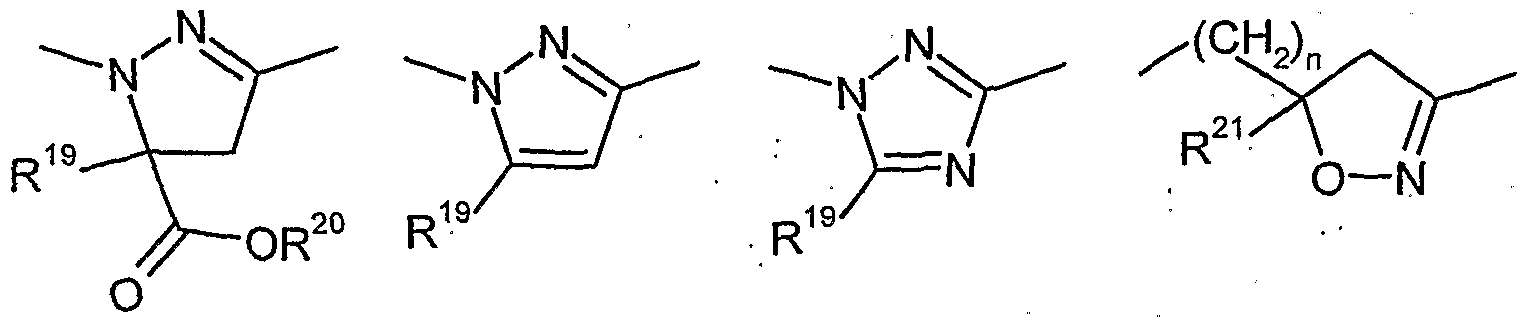
n steht bevorzugt für die Zahlen 0, 1, 2, 3 oder 4.n preferably represents the numbers 0, 1, 2, 3 or 4.
A2 steht bevorzugt für jeweils gegebenenfalls durch Methyl, Ethyl, Methoxycarbonyl oder Ethoxycarbonyl oder AUyloxycarbonyl substituiertes Methylen oder Ethylen.A 2 preferably represents in each case optionally methyl, ethyl, methoxycarbonyl or ethoxycarbonyl or alloxycarbonyl-substituted methylene or ethylene.
R14 steht bevorzugt für Hydroxy, Mercapto, Amino, Methoxy, Ethoxy, n- oder i-Proρoxy, n-, i-, s- oder t-Butoxy, Methylthio, Ethylthio, n- oder i-Proρylthio, n-, i-, s- oder t-Butylthio, Methylamino, Ethylamino, n- oder i-Propylamino, n-, i-, s- oder t-Butylamino, Dimethyl- amino oder Diethylamino.R 14 is preferably hydroxy, mercapto, amino, methoxy, ethoxy, n- or i-propoxy, n-, i-, s- or t-butoxy, methylthio, ethylthio, n- or i-propylthio, n-, i -, s- or t-butylthio, methylamino, ethylamino, n- or i-propylamino, n-, i-, s- or t-butylamino, dimethylamino or diethylamino.
R15 steht bevorzugt für Hydroxy, Mercapto, Amino, Mefhoxy, Ethoxy, n- oder i-Propoxy, n-, i-, s- oder t-Butoxy, 1-Methylhexyloxy, Allyloxy, 1-Allyloxymethyl-ethoxy, Methylthio, Ethylthio, n- oder i-Propylthio, n-, i-, s- oder t-Butylthio, Methylamino, Ethylamino, n- oder i- Propylamino, n-, i-, s- oder t-Butylamino, Dimethylamino oder Diethylamino.R 15 preferably represents hydroxyl, mercapto, amino, mefhoxy, ethoxy, n- or i-propoxy, n-, i-, s- or t-butoxy, 1-methylhexyloxy, allyloxy, 1-allyloxymethyl-ethoxy, methylthio, ethylthio , n- or i-propylthio, n-, i-, s- or t-butylthio, methylamino, ethylamino, n- or i-propylamino, n-, i-, s- or t-butylamino, dimethylamino or diethylamino.
R16 steht bevorzugt für jeweils gegebenenfalls durch Fluor, Chlor und/oder Brom substituiertes Methyl, Ethyl, n- oder i-Propyl.R 16 is preferably in each case optionally substituted by fluorine, chlorine and / or bromine substituted methyl, ethyl, n- or i-propyl.
R17 steht bevorzugt für Wasserstoff, jeweils gegebenenfalls durch Fluor und/oder Chlor substituiertes Methyl, Ethyl, n- oder i-Propyl, n-, i-, s- oder t-Butyl, Propenyl, Butenyl, Propinyl oder Butinyl, Methoxymethyl, Ethoxymethyl, Methoxyethyl, Ethoxyethyl, Dioxolanylmethyl, Furyl, Furylmethyl, Thienyl, Thiazolyl, Piperidinyl, oder gegebenenfalls durch Fluor, Chlor,R 17 is preferably hydrogen, in each case optionally fluorine- and / or chlorine-substituted methyl, ethyl, n- or i-propyl, n-, i-, s- or t-butyl, propenyl, butenyl, propynyl or butynyl, methoxymethyl, Ethoxymethyl, methoxyethyl, ethoxyethyl, dioxolanylmethyl, furyl, furylmethyl, thienyl, thiazolyl, piperidinyl, or optionally fluorine, chlorine,
Methyl, Ethyl, n- oder i-Propyl, n-, i-, s- oder t-Butyl substituiertes Phenyl.Methyl, ethyl, n- or i-propyl, n-, i-, s- or t-butyl substituted phenyl.
R18 steht bevorzugt für Wasserstoff, jeweils gegebenenfalls durch Fluor und/oder Chlor substituiertes Methyl, Ethyl, n- oder i-Propyl, n-, i-, s- oder t-Butyl, Propenyl, Butenyl, Propinyl oder Butinyl, Methoxymethyl, Ethoxymethyl, Methoxyethyl, Ethoxyethyl, Dioxolanylmethyl, Furyl, Furylmethyl, Thienyl, Thiazolyl, Piperidinyl, oder gegebenenfalls durch Fluor, Chlor,R 18 is preferably hydrogen, in each case optionally fluorine- and / or chlorine-substituted methyl, ethyl, n- or i-propyl, n-, i-, s- or t-butyl, propenyl, butenyl, propynyl or butynyl, methoxymethyl, Ethoxymethyl, methoxyethyl, ethoxyethyl, dioxolanylmethyl, furyl, furylmethyl, thienyl, thiazolyl, piperidinyl, or optionally fluorine, chlorine,
Methyl, Ethyl, n- oder i-Propyl, n-, i-, s- oder t-Butyl substituiertes Phenyl, oder zusammen mit Rl 7 für eüien der Reste -CH2-O-CH2-CH2- und -CH2-CH2-O-CH2-CH2-, die gegebenenfalls substituiert sind durch Methyl, Ethyl, Furyl, Phetiyl, einen arinellierten Benzolring oder durch zwei Substituenten, die gemeinsam mit dem C-Atom, an das sie gebunden sind, einen 5- oder 6-gliedrigen Carbocyclus bilden.Methyl, ethyl, n- or i-propyl, n-, i-, s- or t-butyl substituted phenyl, or together with Rl 7 for eüien the radicals -CH 2 -O-CH 2 -CH 2 - and -CH 2 -CH 2 -O-CH 2 -CH 2 -, which optionally substituted by methyl, ethyl, furyl, phytyl, an arylated benzene ring, or by two substituents which together with the carbon atom to which they are attached form a 5- or 6-membered carbocycle.
R19 steht bevorzugt für Wasserstoff, Cyano, Fluor, Chlor, Brom, oder für jeweils gegebenenfalls durch Fluor, Chlor und/oder Brom substituiertes Methyl, Ethyl, n- oder i-Propyl, Cyclo- proρyl,.Cyclobutyl, Cyclopentyl, Cyclohexyi oder Phenyl.R 19 preferably represents hydrogen, cyano, fluorine, chlorine, bromine, or represents in each case optionally substituted by fluorine, chlorine and / or bromine-substituted methyl, ethyl, n- or i-propyl, cyclo proρyl. Cyclobutyl, cyclopentyl, cyclohexyl or phenyl.
R20 steht bevorzugt für Wasserstoff, gegebenenfalls durch Hydroxy, Cyano, Fluor, Chlor, Methoxy, Ethoxy, n- oder i-Propöxy substituiertes Methyl, Ethyl, n- oder i-Propyl, n-, i-, s- oder t-Butyl.R 20 is preferably hydrogen, optionally substituted by hydroxyl, cyano, fluorine, chlorine, methoxy, ethoxy, n- or i-propoxy substituted methyl, ethyl, n- or i-propyl, n-, i-, s- or t- butyl.
R21 steht bevorzugt für Wasserstoff, Cyano, Fluor, Chlor, Brom, oder für jeweils gegebenenfalls durch Fluor, Chlor und/oder Brom substituiertes Methyl, Ethyl, n- oder i-Propyl, n-, i-, s- oder t-Butyl, Cyclopropyl, Cyclobutyl, Cyclopentyl, Cyclohexyi oder Phenyl.R 21 preferably represents hydrogen, cyano, fluorine, chlorine, bromine, or represents in each case optionally fluorine, chlorine and / or bromine-substituted methyl, ethyl, n- or i-propyl, n-, i-, s- or t- Butyl, cyclopropyl, cyclobutyl, cyclopentyl, cyclohexyl or phenyl.
X1 steht bevorzugt für Nitro, Cyano, Fluor, Chlor, Brom, Methyl, Ethyl, n- oder i-Propyl, n-, i-, s- oder t-Butyl, Difluormethyl, Dichlormethyl, Trifluormethyl, Trichlormethyl, Chlordifluor- methyl, Fluordichlormethyl, Methoxy, Ethoxy, n- oder i-Propoxy, Difluormethoxy oder Tri- fluormethoxy.X 1 is preferably nitro, cyano, fluorine, chlorine, bromine, methyl, ethyl, n- or i-propyl, n-, i-, s- or t-butyl, difluoromethyl, dichloromethyl, trifluoromethyl, trichloromethyl, chlorodifluoromethyl , Fluorodichloromethyl, methoxy, ethoxy, n- or i-propoxy, difluoromethoxy or trifluoromethoxy.
X2 steht bevorzugt für Wasserstoff, Nitro, Cyano, Fluor, Chlor, Brom, Methyl, Ethyl, n- oder i- Propyl, n-, i-, s- oder t-Butyl, Difluormethyl, Dichlormethyl, Trifluormethyl, Trichlormethyl, Chlordifluormethyl, Fluordichlormethyl, Methoxy, Ethoxy, n- oder i-Propoxy, Difluor- methoxy oder Trifluormethoxy.X 2 is preferably hydrogen, nitro, cyano, fluorine, chlorine, bromine, methyl, ethyl, n- or i-propyl, n-, i-, s- or t-butyl, difluoromethyl, dichloromethyl, trifluoromethyl, trichloromethyl, chlorodifluoromethyl , Fluorodichloromethyl, methoxy, ethoxy, n- or i-propoxy, difluoromethoxy or trifluoromethoxy.
X3 steht bevorzugt für Wasserstoff, Nitro, Cyano, Fluor, Chlor, Brom, Methyl, Ethyl, n- oder i- Propyl, n-, i-, s- oder t-Butyl, Difluormethyl, Dichlormethyl, Trifluormethyl, Trichlormethyl, Chlordifluormethyl, Fluordichlormethyl, Methoxy, Ethoxy, n- oder i-Propoxy, Difluormethoxy oder Trifluormethoxy.X 3 is preferably hydrogen, nitro, cyano, fluorine, chlorine, bromine, methyl, ethyl, n- or i-propyl, n-, i-, s- or t-butyl, difluoromethyl, dichloromethyl, trifluoromethyl, trichloromethyl, chlorodifluoromethyl , Fluorodichloromethyl, methoxy, ethoxy, n- or i-propoxy, difluoromethoxy or trifluoromethoxy.
t steht bevorzugt für die Zahlen 0, 1, 2, 3 oder 4.t preferably stands for the numbers 0, 1, 2, 3 or 4.
v steht bevorzugt für die Zahlen 0, 1 , 2 oder 3.v preferably represents the numbers 0, 1, 2 or 3.
R22 steht bevorzugt für Wasserstoff, Methyl, Ethyi, n- oder i-Propyl.R 22 is preferably hydrogen, methyl, ethyl, n- or i-propyl.
R23 steht bevorzugt für Wasserstoff, Methyl, E&yl, n- oder i-Propyl. R24 steht bevorzugt für Wasserstoff, jeweils. gegebenenfalls durch Cyano, Fluor; Chlor, Methoxy, Ethoxy, n- oder i-Propoxy substituiertes Methyl, Ethyl, n- oder i-Propyl, n-, i-, s- oder t-Butyl, Methoxy, Ethoxy, n- oder i-Propoxy, n-, i-, s- oder t-Butoxy, Methylthio, Ethylthio, n- oder i- Propylthio, n-, i-, s- oder t-Butylthio, , Methylamino, Ethylamino, n- oder i-Propylamino, n-, i-, s- oder t-Butylamino, Dimethylamino oder Diethylamino, oder jeweils gegebenenfalls durch Cyano, Fluor, Chlor, Brom, Methyl, Ethyl, n- oder i-Propyl substituiertes Cyclopropyl, Cyclobutyl, Cyclopentyl, Cyclohexyl, Cyclopropyloxy, Cyclobutyloxy, Cyclopentyioxy, Cyclohexyloxy, Cyclopropylthio, Cyclobutylthio, Cyclopentylthio, Cyclohexylthio, Cyclo- propylamino, Cyclobutylamino, Cyclopenlylamino oder Cyclohexylamino.R 23 is preferably hydrogen, methyl, E & yl, n- or i-propyl. R 24 is preferably hydrogen, respectively. optionally by cyano, fluorine; Chlorine, methoxy, ethoxy, n- or i-propoxy-substituted methyl, ethyl, n- or i-propyl, n-, i-, s- or t-butyl, methoxy, ethoxy, n- or i-propoxy, n- , i-, s- or t-butoxy, methylthio, ethylthio, n- or i-propylthio, n-, i-, s- or t-butylthio,, methylamino, ethylamino, n- or i-propylamino, n-, i-, s- or t-butylamino, dimethylamino or diethylamino, or in each case optionally substituted by cyano, fluorine, chlorine, bromine, methyl, ethyl, n- or i-propyl, cyclopropyl, cyclobutyl, cyclopentyl, cyclohexyl, cyclopropyloxy, cyclobutyloxy, cyclopentyloxy , Cyclohexyloxy, cyclopropylthio, cyclobutylthio, cyclopentylthio, cyclohexylthio, cyclopropylamino, cyclobutylamino, cyclopenyllamino or cyclohexylamino.
R25 steht bevorzugt für Wasserstoff, jeweils gegebenenfalls durch Cyano, Hydroxy, Fluor, Chlor, Methoxy, Ethoxy, n- oder i-Propoxy substituiertes Methyl, Ethyl, n- oder i-Propyl, n-, i- oder s-Butyl, jeweils gegebenenfalls durch Cyano, Fluor, Chlor oder Brom substituiertes Propenyl, Butenyl, Propinyl oder Butinyl, oder jeweils gegebenenfalls durch Cyano, Fluor, Chlor, Brom, Methyl, Ethyl, n- oder i-Propyl substituiertes Cyclopropyl, Cyclobutyl, Cyclopentyl oder Cyclohexyl.R 25 is preferably hydrogen, in each case optionally cyano, hydroxyl, fluorine, chlorine, methoxy, ethoxy, n- or i-propoxy-substituted methyl, ethyl, n- or i-propyl, n-, i- or s-butyl, in each case optionally substituted by cyano, fluorine, chlorine or bromine substituted propenyl, butenyl, propynyl or butynyl, or in each case optionally substituted by cyano, fluorine, chlorine, bromine, methyl, ethyl, n- or i-propyl, cyclopropyl, cyclobutyl, cyclopentyl or cyclohexyl.
R26 steht bevorzugt für Wasserstoff, jeweils gegebenenfalls durch Cyano, Hydroxy, Fluor, Chlor, Methoxy, Ethoxy, n- oder i-Propoxy substituiertes Methyl, Ethyl, n- oder i-Propyl, n-, i- oder s-Butyl, jeweils gegebenenfalls durch Cyano, Fluor, Chlor oder Brom substituiertes Propenyl, Butenyl, Propinyl oder Butinyl, jeweils gegebenenfalls durch Cyano, Fluor, Chlor, Brom, Methyl, Ethyl, n- oder i-Propyl substituiertes Cyclopropyl, Cyclobutyl, Cyclopentyl oderR 26 is preferably hydrogen, in each case optionally cyano, hydroxyl, fluorine, chlorine, methoxy, ethoxy, n- or i-propoxy-substituted methyl, ethyl, n- or i-propyl, n-, i- or s-butyl, in each case optionally substituted by cyano, fluorine, chlorine or bromine substituted propenyl, butenyl, propynyl or butynyl, in each case optionally substituted by cyano, fluorine, chlorine, bromine, methyl, ethyl, n- or i-propyl, cyclopropyl, cyclobutyl, cyclopentyl or
Cyclohexyl, oder gegebenenfalls durch Nitro, Cyano, Fluor, Chlor, Brom, Methyl, Ethyl, n- oder i-Propyl, n-, i-, s- oder t-Butyl, Trifϊuormethyl, Methoxy, Ethoxy, n- oder i-Propoxy, Di- fluormethoxy oder Trifluormethoxy substituiertes Phenyl, oder zusammen mit R25 für jeweils gegebenenfalls durch Methyl oder Ethyl substituiertes Butan- 1,4-diyl (Trimethylen), Pentan- 1,5-diyL, 1-Oxa-butan- 1,4-diyl oder 3-Oxa-ρentan-l,5-diyl.Cyclohexyl, or optionally by nitro, cyano, fluorine, chlorine, bromine, methyl, ethyl, n- or i-propyl, n-, i-, s- or t-butyl, trifluoromethyl, methoxy, ethoxy, n- or i- Propoxy, di-fluoromethoxy or trifluoromethoxy-substituted phenyl, or together with R 25 for each optionally substituted by methyl or ethyl butane-1,4-diyl (trimethylene), pentane-1,5-diyL, 1-oxa-butan-1, 4-diyl or 3-oxa-pentane-l, 5-diyl.
X4 steht bevorzugt für Nitro, Cyano, Carboxy, Carbamoyl, Formyl, Sulfamoyl, Hydroxy, Amino, Fluor, Chlor, Brom, Methyl, Ethyl, n- oder i-Propyl, n-, i-, s- oder t-Butyl, Trifluormethyl, Methoxy, Ethoxy, n- oder i-Propoxy, Difluormethoxy oder Trifluormethoxy.X 4 is preferably nitro, cyano, carboxy, carbamoyl, formyl, sulfamoyl, hydroxy, amino, fluorine, chlorine, bromine, methyl, ethyl, n- or i-propyl, n-, i-, s- or t-butyl , Trifluoromethyl, methoxy, ethoxy, n- or i-propoxy, difluoromethoxy or trifluoromethoxy.
X5 steht bevorzugt für Nitro, Cyano, Carboxy, Carbamoyl, Formyl, Sulfamoyl, Hydroxy, Amino, Fluor, Chlor, Brom, Methyl, Ethyl, n- oder i-Propyl, n-, i-, s- oder t-Butyl, Trifluormethyl,X 5 is preferably nitro, cyano, carboxy, carbamoyl, formyl, sulfamoyl, hydroxy, amino, fluorine, chlorine, bromine, methyl, ethyl, n- or i-propyl, n-, i-, s- or t-butyl , Trifluoromethyl,
Methoxy, Ethoxy, n- oder i-Propoxy, Difluormethoxy oder Trifluormethoxy.Methoxy, ethoxy, n- or i-propoxy, difluoromethoxy or trifluoromethoxy.
Beispiele für die als erfindungsgemäße Herbizid-Safener ganz besonders bevorzugten Verbindungen der Formel (Ha) sind in der nachstehenden Tabelle aufgeführt. . . ' . . Tabelle Beispiele für die Verbindungen der Formel (Ha)Examples of the herbicidal safeners particularly preferred compounds of the formula (Ha) according to the invention are listed in the table below. , , ' . , Table Examples of the compounds of the formula (Ha)
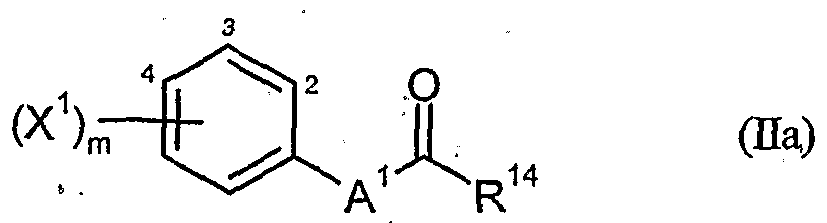

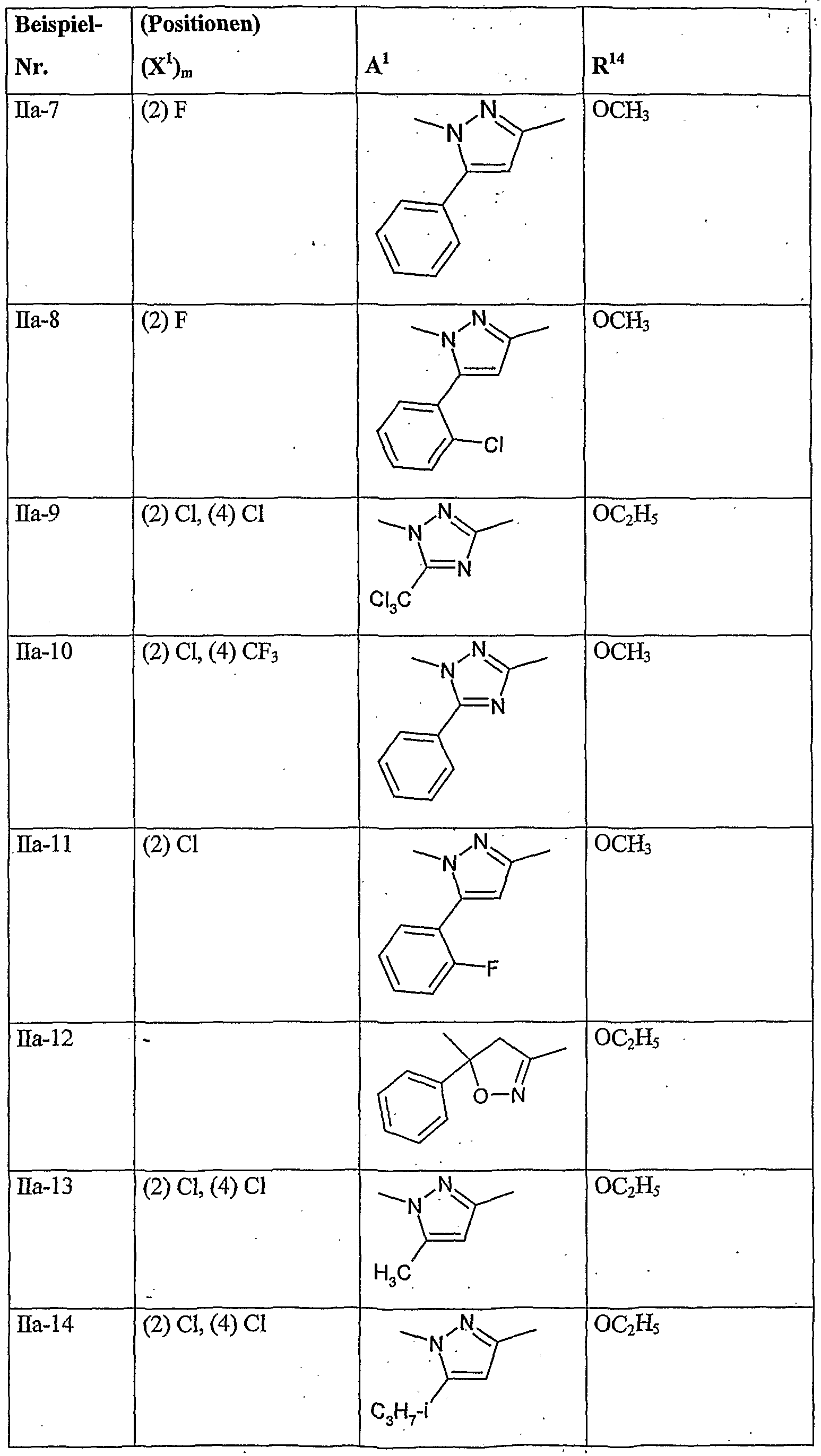

Beispiele für die als erfindungsgemäße Herbizid-Safener ganz besonders bevorzugten Verbindungen der Formel (üb) sind in der nachstehenden Tabelle aufgeführt.Examples of the herbicidal safeners particularly preferred compounds of formula (Ub) according to the invention are listed in the table below.
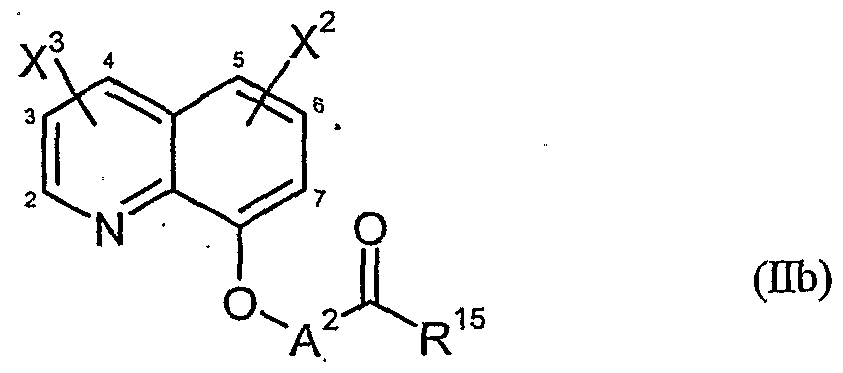
Tabelle Beispiele für die Verbindungen der Formel (Hb)Table Examples of the compounds of the formula (Hb)


Tabelle Beispiele für die Verbindungen der Formel (He)Table Examples of the compounds of the formula (He)
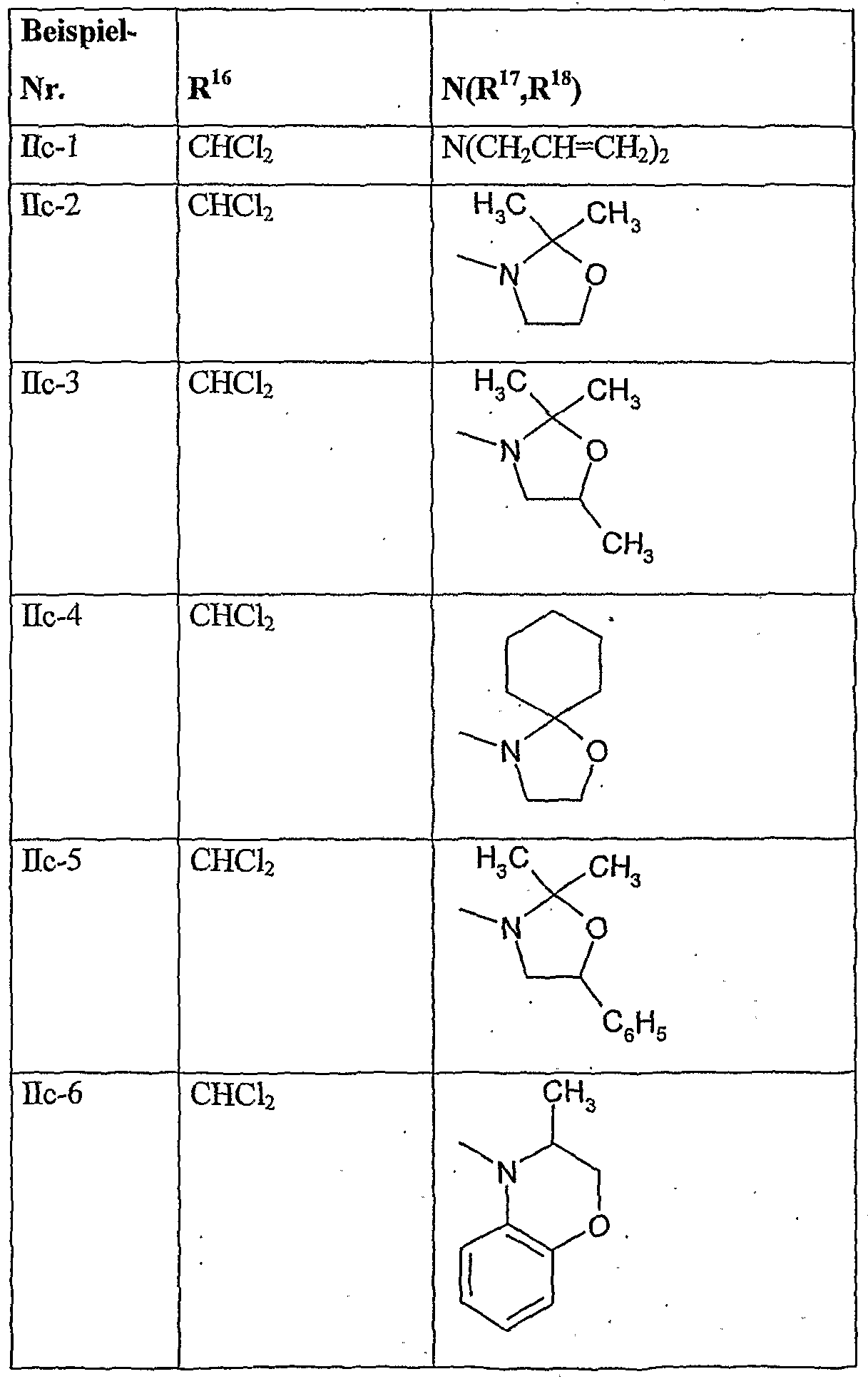
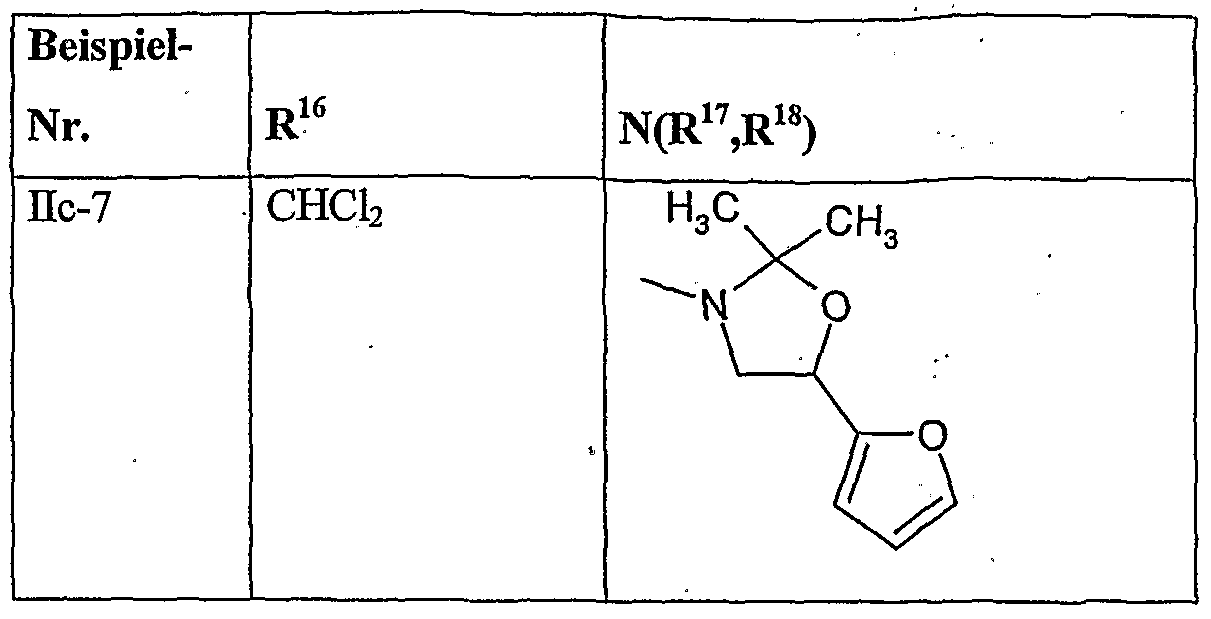
Beispiele für die als erfindungsgemäße Herbizid-Safener ganz besonders bevorzugten Verbindungen der Formel (Hd) sind in der nachstehenden Tabelle aufgeführt.Examples of the herbicidal safeners according to the invention very particularly preferred compounds of formula (Hd) are listed in the table below.
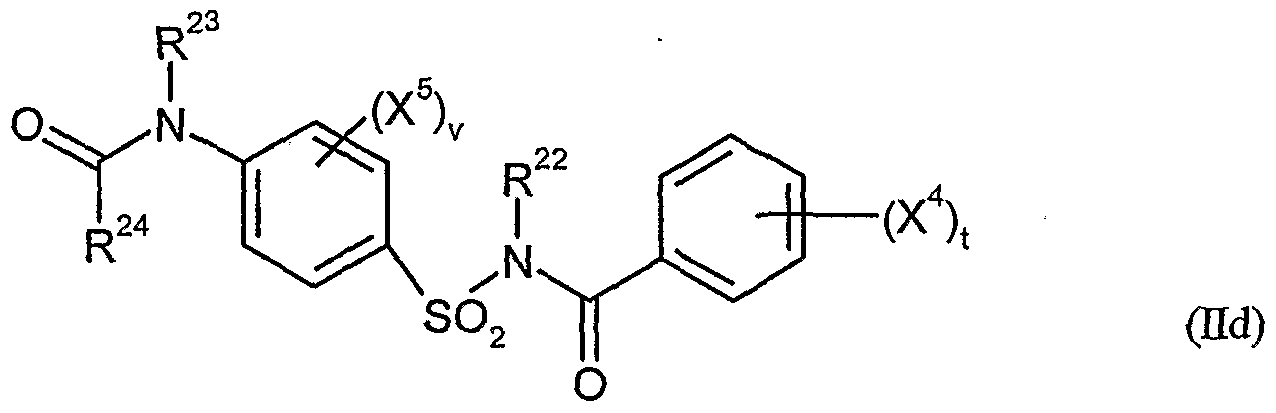
Tabelle Beispiele für die Verbindungen der Formel (Ild)Table Examples of the compounds of the formula (Ild)
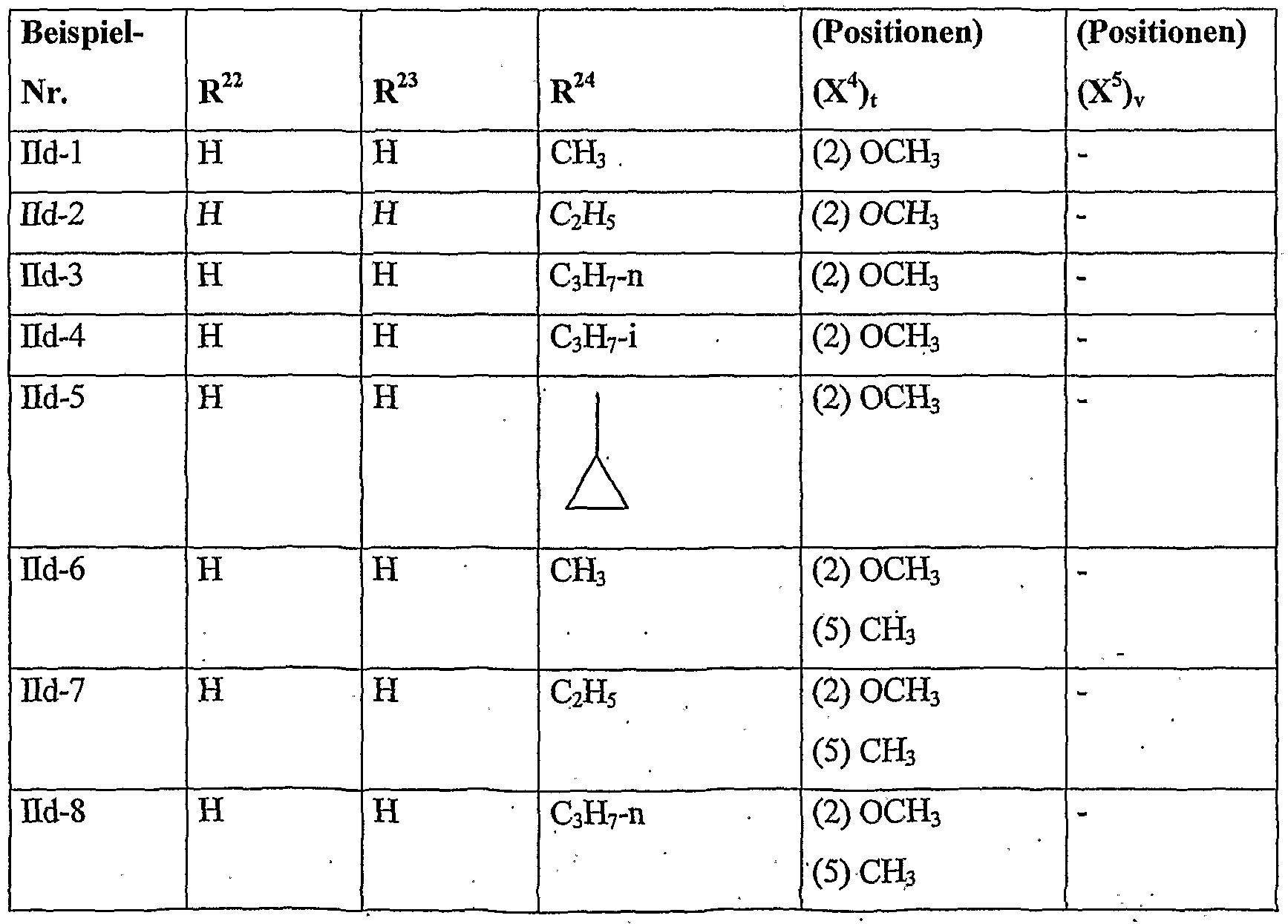
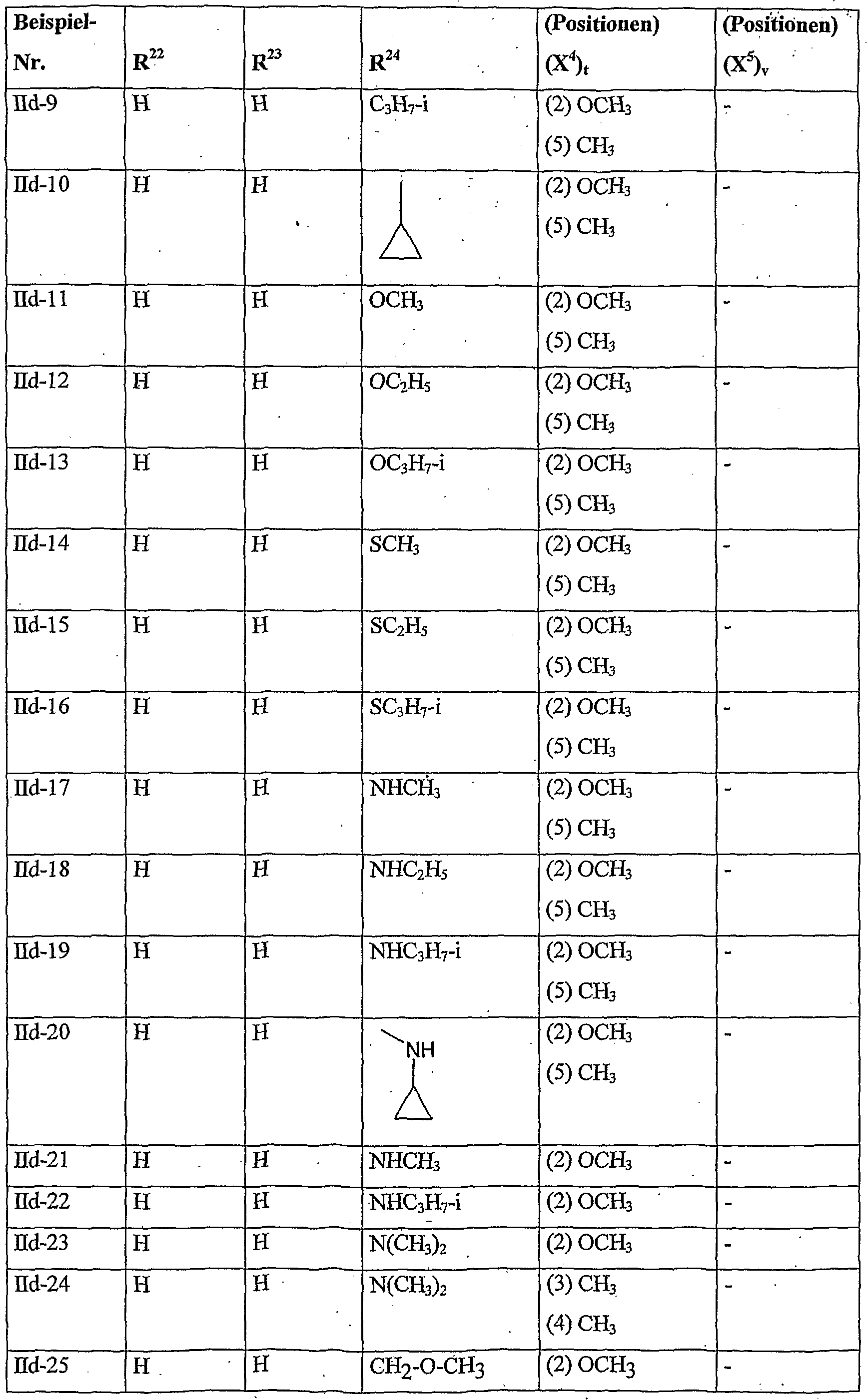
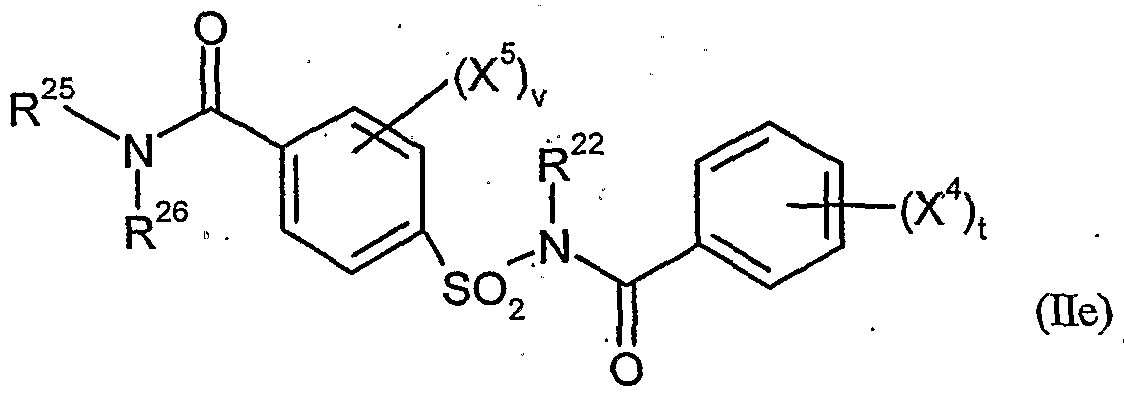
Tabelle Beispiele für die Verbindungen der Formel (He)Table Examples of the compounds of the formula (He)
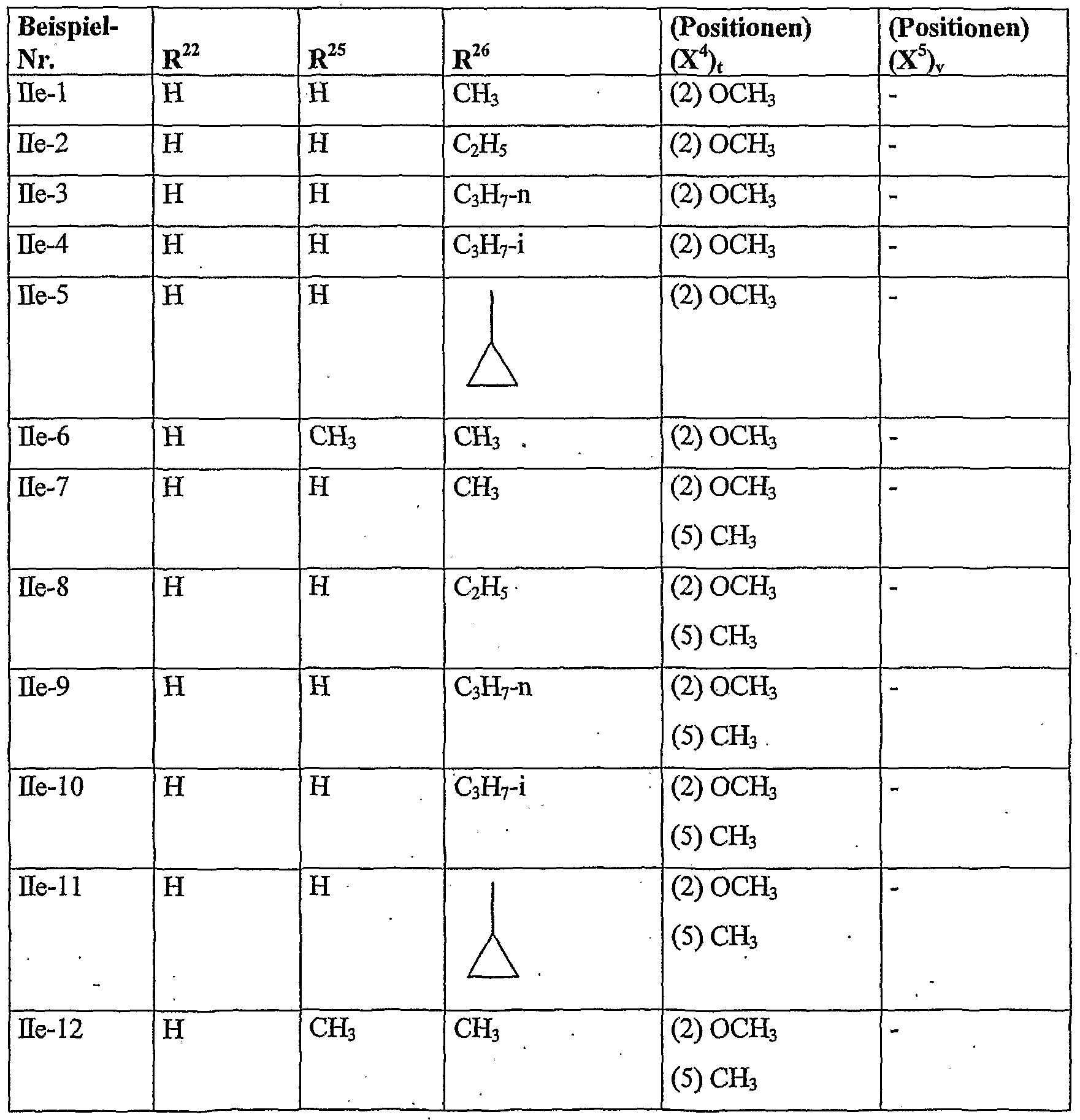
Die als Safener erfindungsgemäß zu verwendenden Verbindungen der allgemeinen Formel (Ha) sind bekannt und/oder können nach an sich bekannten Verfahren hergestellt werden (vgl. WO-A- 91/07874, WO-A-95/07897).The compounds of general formula (Ha) to be used according to the invention as safeners are known and / or can be prepared by processes known per se (cf., WO-A-91/07874, WO-A-95/07897).
Die als Safener erfindungsgemäß zu verwendenden Verbindungen der allgemeinen Formel (Db) sind bekannt und/oder können nach an sich bekannten Verfahren hergestellt werden (vgl. EP-A-191736).The compounds of the general formula (Db) to be used according to the invention as safeners are known and / or can be prepared by processes known per se (cf., EP-A-191736).
Die als Safener erfindungsgemäß zu verwendenden Verbindungen der allgemeinen Formel (IIc) sind bekannt und/oder können nach an sich bekannten Verfahren hergestellt werden (vgl. DE-A-2218097, DE-A-2350547).The compounds of the general formula (IIc) which are to be used according to the invention as safeners are known and / or can be prepared by processes known per se (cf., DE-A-2218097, DE-A-2350547).
Die als Safener erfindungsgemäß zu verwendenden Verbindungen der allgemeinen Formel (Hd) sind bekannt und/oder können nach an sich bekannten Verfahren hergestellt werden (vgl. DE-A- 19621522/US-A-6235680).The compounds of the general formula (Hd) to be used according to the invention as safeners are known and / or can be prepared by processes known per se (cf., DE-A-19621522 / US-A-6235680).
Die als Safener erfindungsgemäß zu verwendenden Verbindungen der allgemeinen Formel (He) sind bekannt und können nach an sich bekannten Verfahren hergestellt werden (vgl. WO-A-99/66795/US- A-6251827).The compounds of general formula (He) which are to be used according to the invention as safeners are known and can be prepared by processes known per se (cf., WO-A-99/66795 / US-A-6251827).
Beispiele für die erfindungsgemäßen selektiv herbiziden Kombinationen aus jeweils einem Wirkstoff der Formel (I) und jeweils einem der oben definierten Safener sind in der nachstehenden Tabelle aufgeführt.Examples of the selective herbicidal combinations according to the invention of in each case one active compound of the formula (I) and in each case one of the safeners defined above are listed in the table below.
Tabelle Beispiele für die erfindungsgemäßen KombinationenTable Examples of the combinations according to the invention


5555


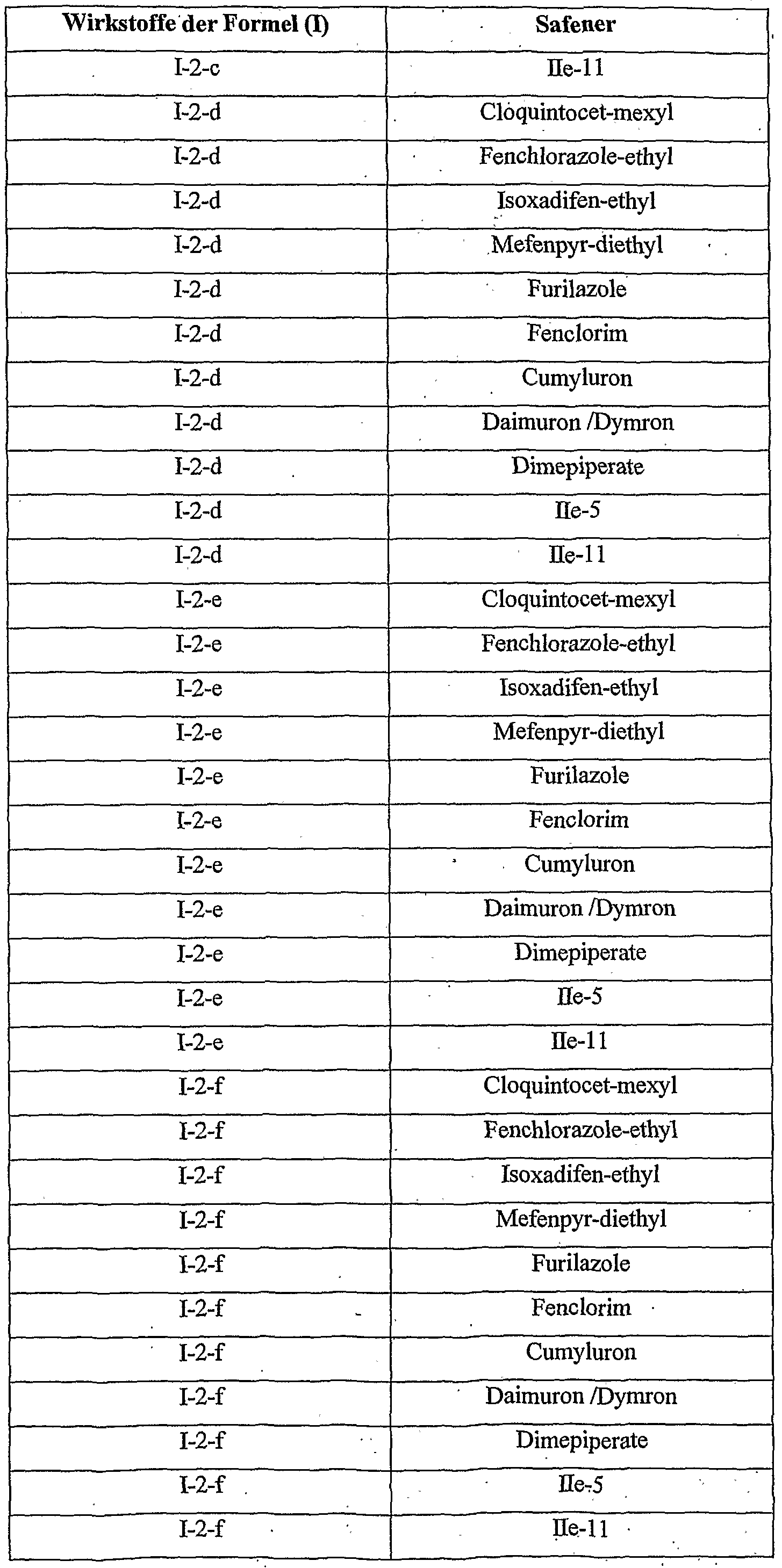
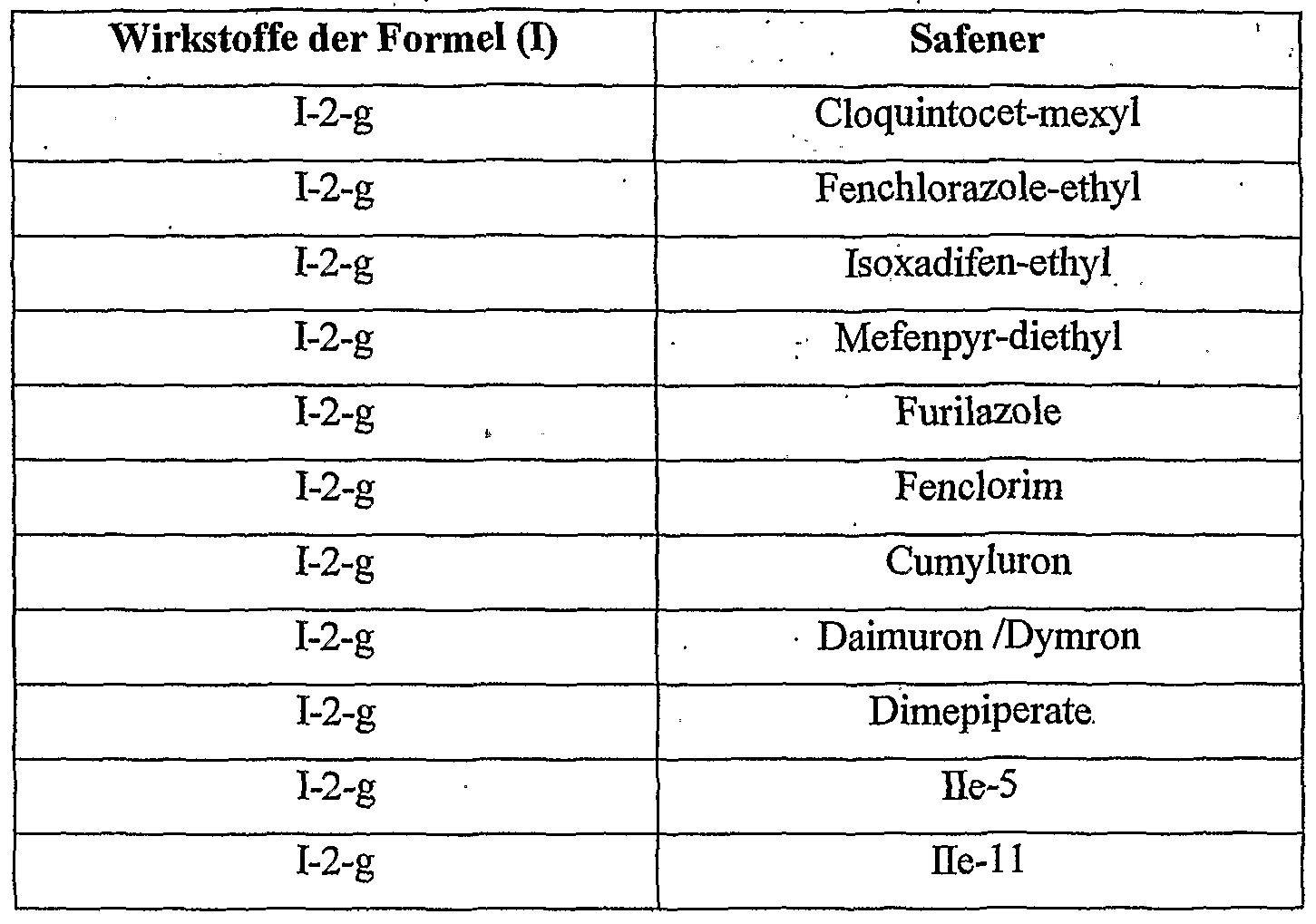
Es wurde nun überraschend gefunden, dass die oben definierten Wirkstoffkombinationen aus Verbindungen der allgemeinen Formel (I) und Safenern (Antidots) aus der oben aufgeführten Gruppe (b1) bei sehr guter Nutzpflanzen-Verträglichkeit eine besonders hohe herbizide Wirksamkeit auf- weisen und in verschiedenen Kulturen, insbesondere in Getreide (vor allem Weizen), aber auch in Soja, Kartoffeln, Mais und Reis zur selektiven Unkrautbekämpfung verwendet werden können.It has now surprisingly been found that the above-defined active compound combinations of compounds of the general formula (I) and safeners (antidotes) from the above-mentioned group (b 1 ) with very good crop tolerance have a particularly high herbicidal activity and in various Cultures, especially in cereals (especially wheat), but also in soy, potatoes, corn and rice for selective weed control can be used.
Dabei ist es als überraschend anzusehen, dass aus einer Vielzahl von bekannten Safenern oder Antidots, die befähigt sind, die schädigende Wirkung eines Herbizids auf die Kulturpflanzen zu ant- agonisieren, gerade die oben aufgeführten Verbindungen der Gruppe (b') geeignet sind, die schädi- gende Wirkung von substituierten cyclischen Ketoenolen auf die Kulturpflanzen annähernd vollständig aufzuheben, ohne dabei die herbizide Wirksamkeit gegenüber den Unkräutern maßgeblich zu beeinträchtigen.It is surprising to note that of a large number of known safeners or antidotes which are capable of antagonizing the harmful effect of a herbicide on the crop plants, it is precisely the compounds of group (b ') listed above which are harmful - Annually almost completely abolish ing effect of substituted cyclic ketoenols on the crop without significantly affecting the herbicidal activity against the weeds.
Hervorgehoben sei hierbei die besonders vorteilhafte Wirkung der besonders und am meisten bevorzugten Kombinationspartner aus der Gruppe (b'), insbesondere hinsichtlich der Schonung von Getreidepflanzen, wie z.B. Weizen, Gerste und Roggen, aber auch Mais und Reis, als Kulturpflanzen.Emphasis should be given to the particularly advantageous effect of the particularly and most preferred combination partners from the group (b '), in particular with regard to the protection of cereal plants, such as. Wheat, barley and rye, but also corn and rice, as crops.
Verwendet man beispielsweise gemäß Verfahren (A) N-[(4-Chlor-2,6-dimethyl)-phenylacetyl]-l- amino-4,4'-propylendioxy-cyclohexancarbonsäureethylester als Ausgangsstoff, so kann der Verlauf des erfindungsgemäßen Verfahrens durch folgendes Reaktionsschema wiedergegeben werden:
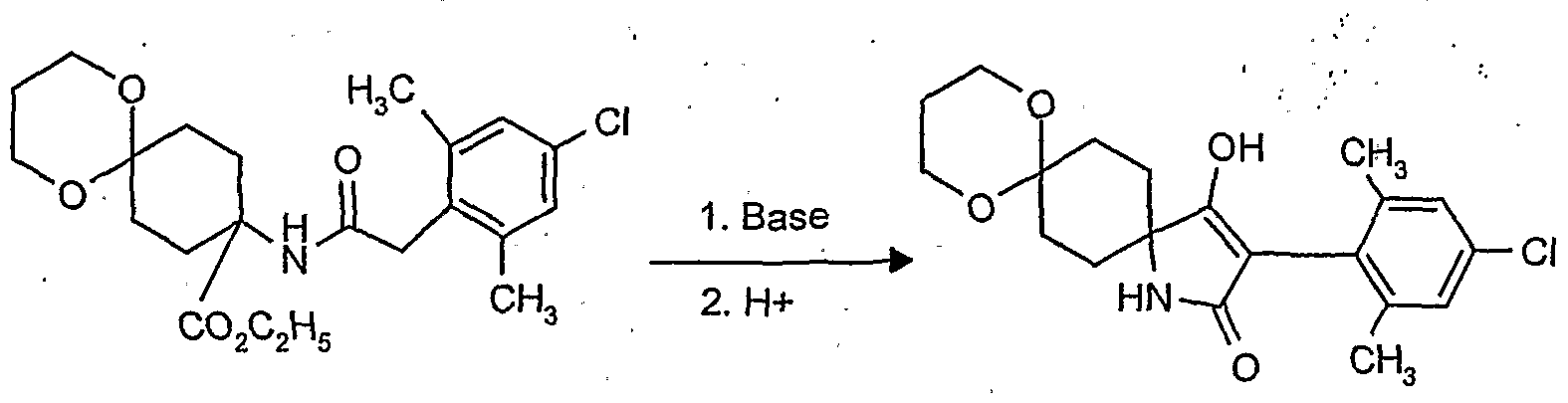
Verwendet man beispielsweise gemäß Verfahren (B) O-[(2-Chlor-6-methyl)-phenylacetyl]-l-hy- droxy-4,4'-ethylendioxy-cyclohexancarbonsäureethylester, so kann der Verlauf des erfindungsgemäßen Verfahrens durch folgendes Reaktionsschema wiedergegeben werden:If, for example, according to process (B), O - [(2-chloro-6-methyl) -phenylacetyl] -l-hydroxy-4,4'-ethylenedioxycyclohexanecarboxylic acid ethyl ester, the course of the process according to the invention can be represented by the following reaction scheme become:
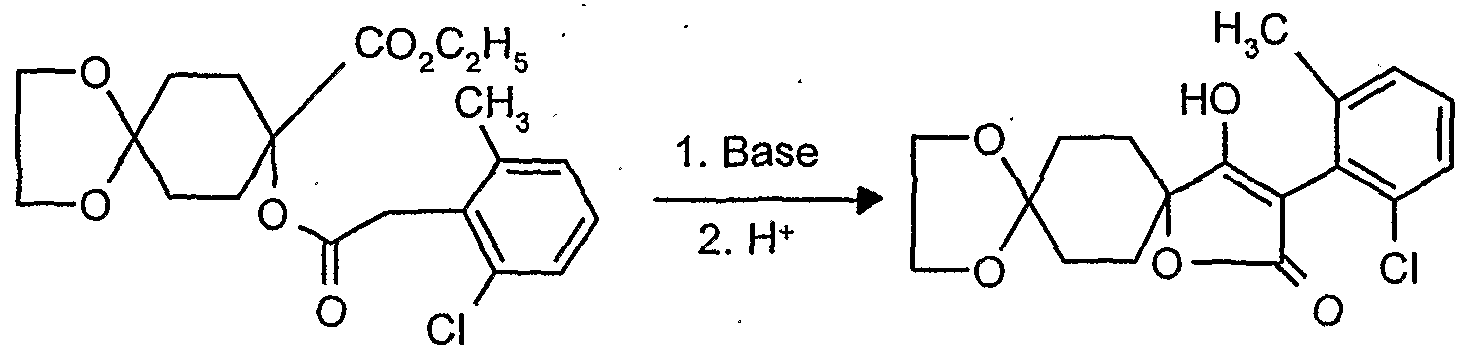
Verwendet man beispielsweise gemäß Verfahren (Ca) 8,8'-Ethylendioxy-3-[(4-chlor-2,6- dimethyl)-phenyl]-l-azaspiro[4,5]decan-2,4-dion und Pivaloylchlorid als Ausgangsstoffe, so kann der Verlauf des erfϊndungsgemäßen Verfahrens durch folgendes Reaktionsschema wiedergegeben werden:For example, using process (Ca), 8,8'-ethylenedioxy-3 - [(4-chloro-2,6-dimethyl) -phenyl] -1-azaspiro [4,5] decane-2,4-dione and pivaloyl chloride as starting materials, the course of the inventive method can be represented by the following reaction scheme:
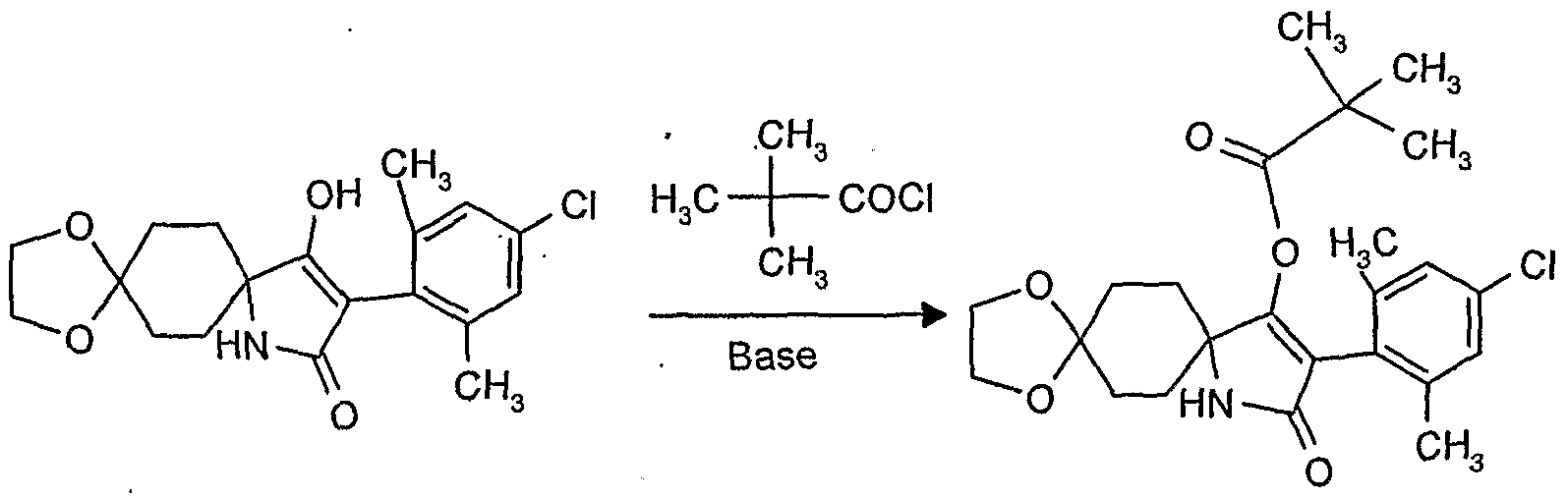
Verwendet man beispielsweise gemäß Verfahren (C) (Variante ß) 8,8'-Propylendioxy-3-[(2,4- dichlor)-phenyl]-l-oxaspiro-[4,5]-decan-2,4-dion und Acetanhydrid als Ausgangsverbindungen, so kann der Verlauf des erfmdungsgemäßeri Verfahrens durch folgendes Reaktionsschema wiedergegeben werden:If, for example, according to process (C) (variant β), 8,8'-propylenedioxy-3 - [(2,4-dichloro) -phenyl] -1-oxaspiro [4,5] -decane-2,4-dione is used and acetic anhydride as starting compounds, the course of the inventive method can be represented by the following reaction scheme:
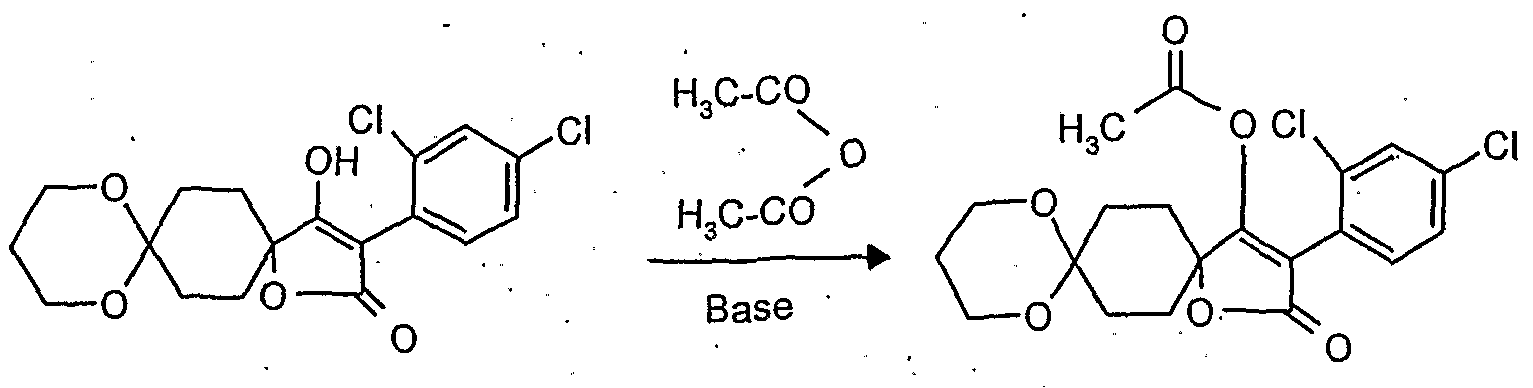

Verwendet man beispielsweise gemäß Verfahren (E) 8,8'-Ethylendioxy-3-[(2,4,6-tritnethyl)-phe- nyl]-l-oxasρiro[4,5]decan-254-dion und Chlormonothioameisensäuremethylester als Ausgangsprodukte, so kann der Reaktionsverlauf folgendermaßen wiedergegeben werden:By way of example, according to process (E), 8,8'-ethylenedioxy-3 - [(2,4,6-triethyl) -phenyl] -l-oxas-piro [4,5] decane-2 5 4-dione and methylchloromonothioformate are used as starting materials, the course of the reaction can be represented as follows:

Verwendet man beispielsweise gemäß Verfahren (F) 8,8'-Propylendioxy-3-[(2,4,6-trimethyl)- phenyl]-l-azaspiro[4,5]decan-2,4-dion und Methansulfonsäurechlorid als Ausgangsprodukt, so kann der Reaktionsverlauf durch folgendes Reaktionsschema wiedergegeben werden:If, for example, according to process (F), 8,8'-propylenedioxy-3 - [(2,4,6-trimethyl) phenyl] -1-azaspiro [4,5] decane-2,4-dione and methanesulfonyl chloride are used as the starting material Thus, the course of the reaction can be represented by the following reaction scheme:

Verwendet man beispielsweise gemäß Verfahren (G) 8,8'-Propylendioxy-3-[(2,4-dichlor-6- methyl)-phenyl]-l-oxaspiro[4,5]decan-2,4-dion und Methanthϊo-phosphonsäurechlorid-(2,2,2-tri- fluorethylester) als Ausgangsprodukte, so kann der Reaktionsverlauf durch folgendes Reaktionsschema wiedergegeben werden:
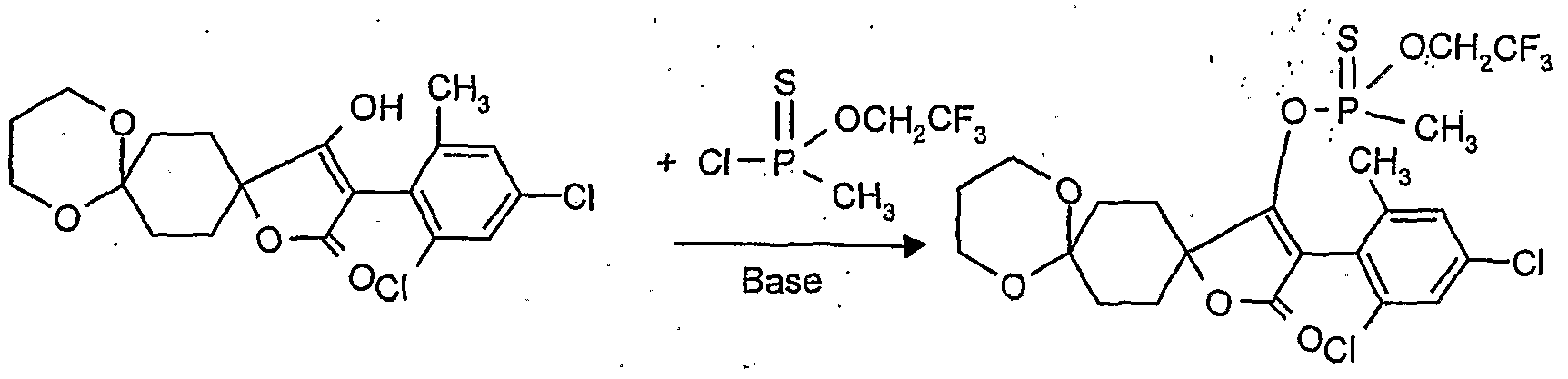
Verwendet man beispielsweise gemäß Verfahren (H) 8,8'-Ethylendioxy-3-[(2,3,4,6-tetramethyl- ρhenyl]-l-azapiro[4,5]decan-2,4-dion und NaOH als Komponenten, so kann der Verlauf des erfindungsgemäßen Verfahrens durch folgendes Reaktionsschema wiedergegeben werden:For example, according to process (H), use is made of 8,8'-ethylenedioxy-3 - [(2,3,4,6-tetramethyl-phenyl) -l-azapiro [4,5] decane-2,4-dione and NaOH Components, the course of the process according to the invention can be represented by the following reaction scheme:

Verwendet man beispielsweise gemäß Verfahren (I) (Variante α) 8,8'-Ethylendioxy-3-[(2,4,5- trimethyl)-phenyl]-l-oxaspiro[4,5]decan-2,4-dion und Ethylisocyanat als Ausgangsprodukte, so kann der Reaktionsverlauf durch folgendes Reaktionsschema wiedergegeben werden;If, for example, according to process (I) (variant α), 8,8'-ethylenedioxy-3 - [(2,4,5-trimethyl) -phenyl] -1-oxaspiro [4,5] decane-2,4-dione is used and ethyl isocyanate as starting materials, the course of the reaction can be represented by the following reaction scheme;

Verwendet man beispielsweise gemäß Verfahren (I) (Variante ß) 8,8'-Ethylendioxy-3-[(2-4,6-tri- methyl)-phenyl]-l-azaspiro[4,5]decan-2,4-dion und Dimethylcarbamidsäurechlorid als Ausgangsprodukte, so kann der Reaktionsverlauf durch folgendes Schema wiedergegeben werden:If, for example, according to process (I) (variant β), 8,8'-ethylenedioxy-3 - [(2-4,6-trimethyl) -phenyl] -1-azaspiro [4,5] decane-2,4 is used -dione and dimethylcarbamoyl chloride as starting materials, the course of the reaction can be represented by the following scheme:
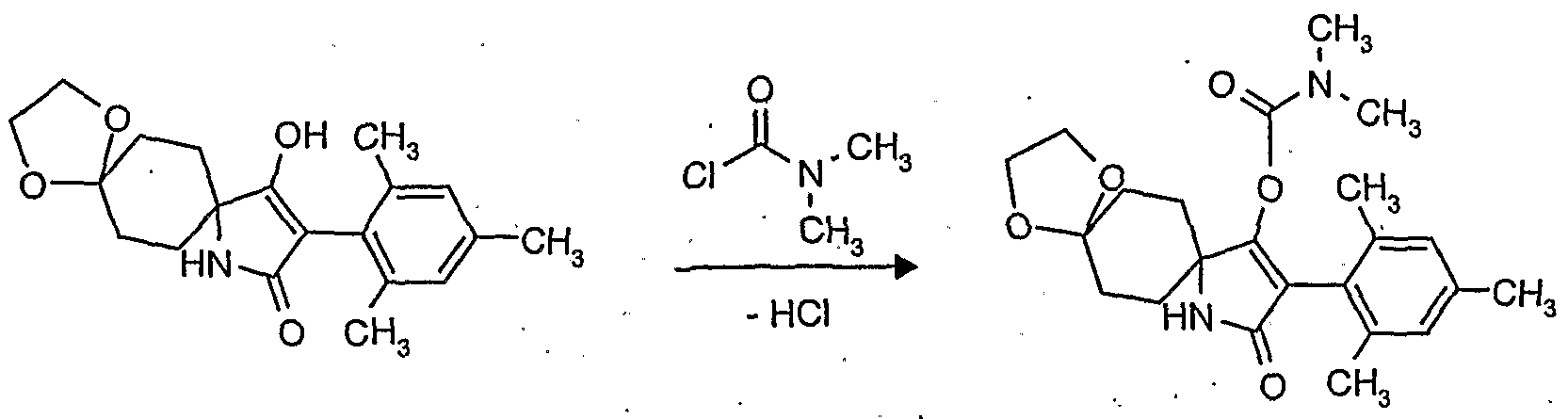

in welcherin which
A, B, QI, Q2, W, X, Y, Z und R^ die oben angegebenen Bedeutungen haben,A, B, QI, Q2, W, X, Y, Z and R ^ have the meanings given above,
sind neu.are new.
Man erhält die Acylaminosäureester der Formel (II) beispielsweise, wenn man Aminosäurederivate der Formel (XVI)The acylamino acid esters of the formula (II) are obtained, for example, if amino acid derivatives of the formula (XVI)

in welcherin which
A, B, Cr und Q2 und R^ die oben angegebene Bedeutung haben,A, B, Cr and Q 2 and R 1 have the abovementioned meaning,
mit substituierten Phenylessigsäurederivaten der Formel (XVII)with substituted phenylacetic acid derivatives of the formula (XVII)

in welcherin which
W, X, Y und Z die oben angegebenen Bedeutungen haben und U für eine durch Carbonsäureaktivierungsreagenzien wie Carbonyldiimidazol, . Carbonyl- diimide (wie z.B. Dicyciohexylcarbondiimid), Phosphorylierungsreagenzien (wie z.B. POCl3, BOP-Cl), Halogenierungsmittel wie z.B. Thionylchlorid, Oxalylchlorid, Phosgen oder Chlorameisensäureester eingeführte Abgangsgruppe steht,W, X, Y and Z have the meanings given above, and U for a by Carbonsäureaktivierungsreagenzien such as carbonyldiimidazole,. Carbonyldiimide (such as Dicyciohexylcarbondiimid), Phosphorylierungsreagenzien (such as POCl 3 , BOP-Cl), halogenating agent such as thionyl chloride, oxalyl chloride, phosgene or chloroformate introduced leaving group,
acyliert (Chem. Reviews 52, 237-416 (1953); Bhattacharya, Indian J. Chem. 6, 341-5, 1968)acylated (Chem. Reviews 52, 237-416 (1953); Bhattacharya, Indian J. Chem. 6, 341-5, 1968).
oder wenn man Acylaminosäuren der Formel (XVHI)or when acylamino acids of the formula (XVHI)
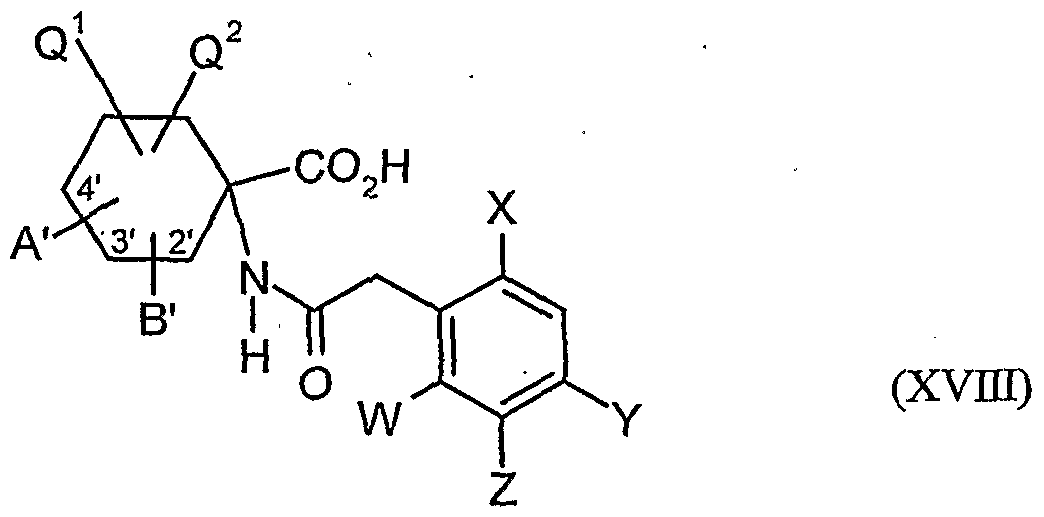
in welcherin which
A, B, Q! , Cp-, W, X, Y und Z die oben angegebenen Bedeutungen haben,A, B, Q! , Cp-, W, X, Y and Z have the meanings given above,
verestert (Chem. Ind. (London) 1568 (196S)).esterified (Chem. Ind. (London) 1568 (196S)).
Die Verbindungen der Formel (XVIII)The compounds of the formula (XVIII)
(XVffl)(XVffl)
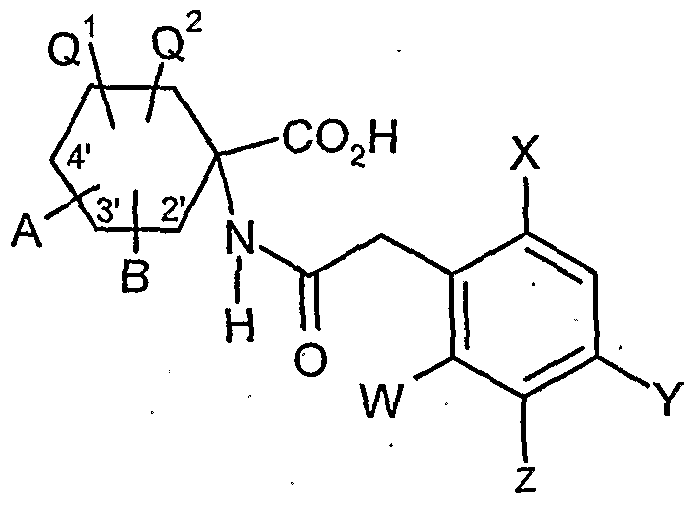
in welcherin which
A, B, Ql, Q2, W5 X, Y und Z die oben angegebenen Bedeutungen haben,A, B, Q1, Q2, W 5, X, Y and Z have the meanings given above,
sind neu.are new.
Man erhält die Verbindungen der Formel (XVDI) beispielsweise, wenn man 1-Aminp-cyclohexan- carbonsäuren der Formel (XIX) . . . .

in welcherin which
A, B, Ql und Q2 die oben angegebenen Bedeutungen habenA, B, Ql and Q 2 have the meanings given above
mit substituierten Phenylessigsäurederivaten der Formel (XVII)with substituted phenylacetic acid derivatives of the formula (XVII)

in welcherin which
U, W, X, Y und Z die oben angegebenen Bedeutungen haben undU, W, X, Y and Z are as defined above and
z.B. nach Schotten-Baumann acyliert (Organikum, VEB Deutscher Verlag der Wissenschaften, Berlin 1977, S. 505). .e.g. after Schotten Baumann acylated (Organikum, VEB German publishing house of the sciences, Berlin 1977, P. 505). ,
Die Verbindungen der Formel (XVII) sind teilweise bekannt und/oder lassen sich nach den bekannten Verfahren in den eingangs zitierten Offenlegungsschriften herstellen.Some of the compounds of the formula (XVII) are known and / or can be prepared by the known processes in the cited Offenlegungsschriften.
Die Verbindungen der Formel (XVI) und (XIX) sind teilweise neu und lassen sich nach bekannten Verfahren darstellen (siehe z.B. Compagnon, Ann. Chim. (Paris) [14] 5, S. 11-22, 23-27 (1970), L. Munday, J. Chem. Soc. 4372 (1961); j.T. Eward, C. Jitrangeri, Can. J. Chem. 53, 3339 (1975).Some of the compounds of the formula (XVI) and (XIX) are novel and can be prepared by known processes (see, for example, Compagnon, Ann. Chim. (Paris) [14] 5, pp. 11-22, 23-27 (1970) , L. Munday, J. Chem. Soc., 4372 (1961), JT Eward, C. Jitrangeri, Can. J. Chem. 53, 3339 (1975).
Weiterhin lassen sich die bei dem obigen Verfahren (A) verwendeten Ausgangsstoffe der Formel (D)
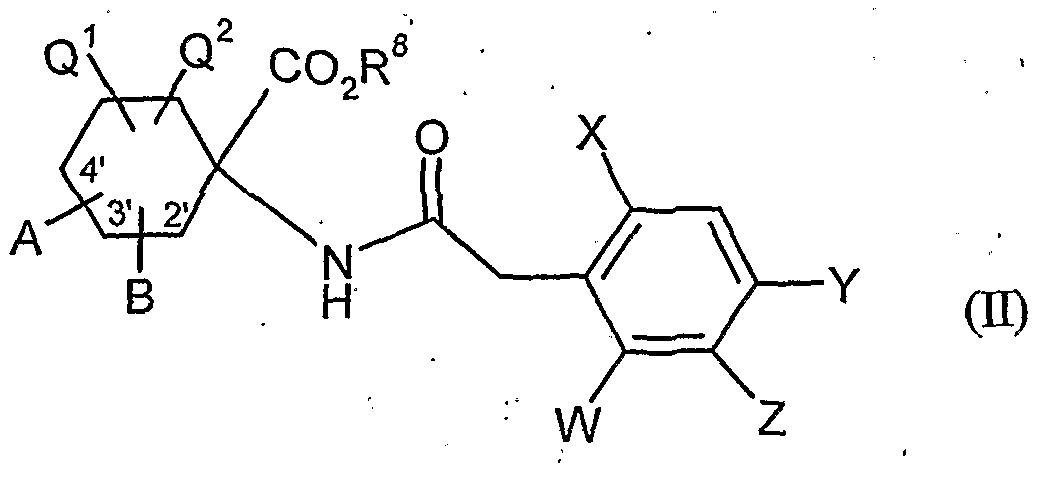
A, B, Q1, Q2, W, X, Y, Z und R8 die oben angegebenen Bedeutungen haben,A, B, Q 1 , Q 2 , W, X, Y, Z and R 8 have the meanings given above,
herstellen, wenn man 1-Amino-cyclohexan-carbonsäurenitrile der Formel (XX)when 1-amino-cyclohexane-carbonitriles of the formula (XX)
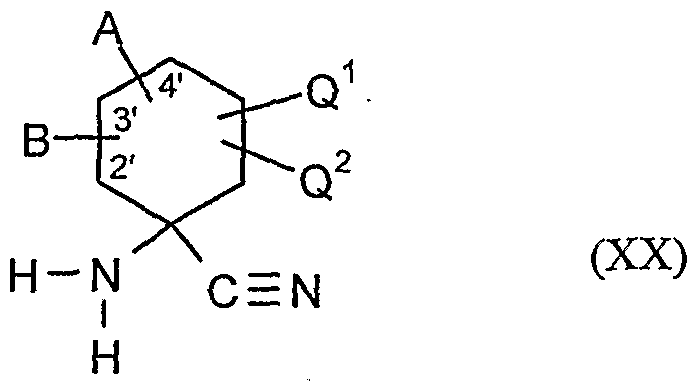
in welcherin which
A, B, Q1 und Q2 die oben angegebenen Bedeutungen haben,A, B, Q 1 and Q 2 have the meanings given above,
mit substituierten Phenylessigsäurederivaten der Formel (XVII)with substituted phenylacetic acid derivatives of the formula (XVII)
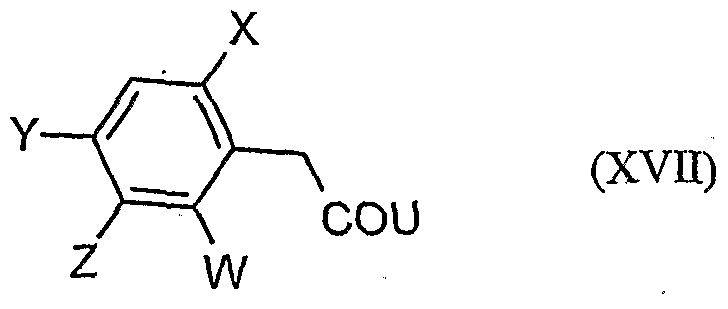
in welcherin which
U, W, X, Y und Z die oben angegebenen Bedeutungen haben, zu Verbindungen der Formel (XXI)U, W, X, Y and Z have the meanings given above, to compounds of the formula (XXI)
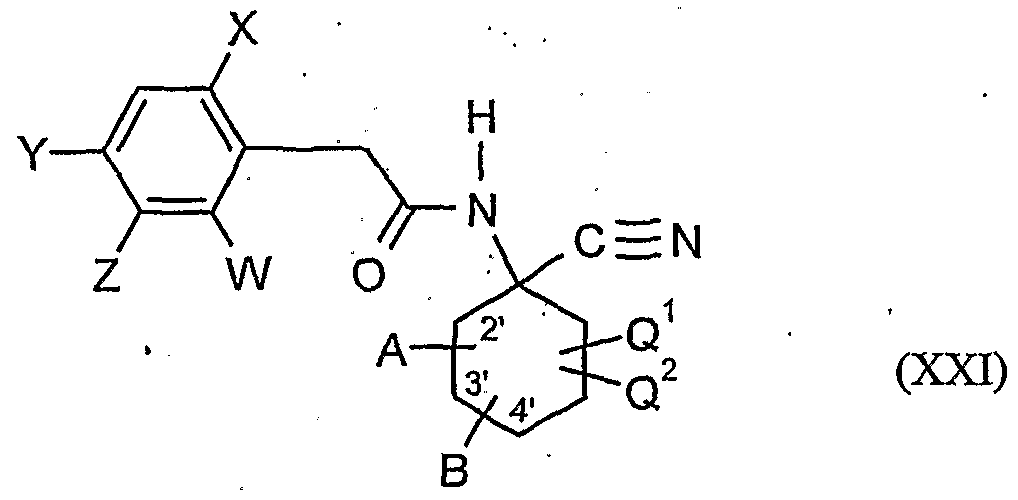
in welcherin which
A, B, Cr, Cr, W, X, Y und Z die oben angegebenen Bedeutungen haben,A, B, Cr, Cr, W, X, Y and Z have the meanings given above,
umsetzt,implements,
und diese anschließend einer sauren Alkoholyse unterwirft.and then subjected to an acidic alcoholysis.
Die Verbindungen der Formel (XXI) sind ebenfalls neu. Die Verbindungen der Formel (XX) sind teilweise neu und lassen sich z.B. wie in EP-A-595 130 beschrieben herstellen.The compounds of formula (XXI) are also new. The compounds of formula (XX) are in part new and can be e.g. as described in EP-A-595 130.
Die bei dem erfindungsgemäßen Verfahren (B) als Ausgangstoffe benötigten Verbindungen der Formel (IH)The compounds of the formula (IH) required as starting materials in process (B) according to the invention
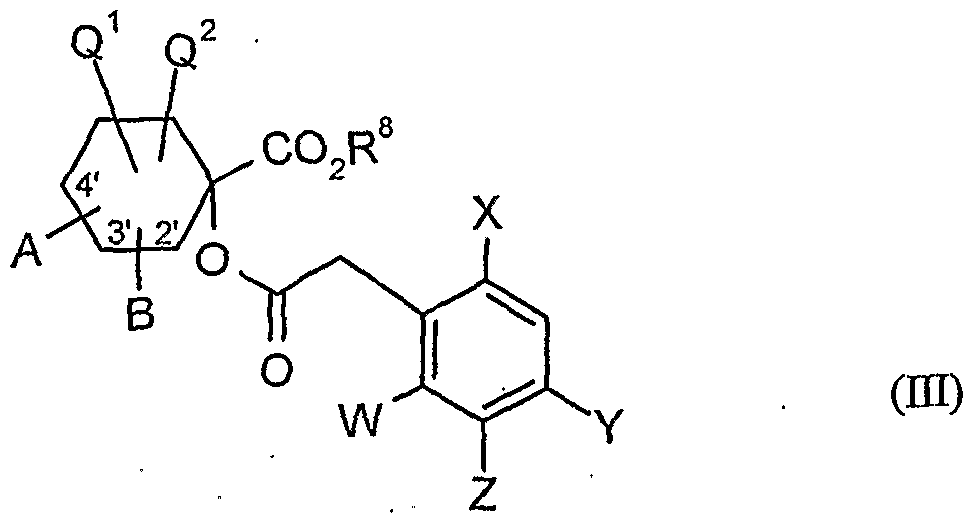
in welcherin which
A, B, Q1, Q2, W, X, Y, Z und R8 die oben angegebenen Bedeutungen haben,A, B, Q 1 , Q 2 , W, X, Y, Z and R 8 have the meanings given above,
sind neu.are new.
Sie lassen sich nach im Prinzip bekannten Methoden in einfacher Weise herstellen.They can be prepared in a simple manner by methods known in principle.
Man erhält die Verbindungen der Formel (HI) beispielsweise, wenn man l-Hydroxy-cyclόhexan-carbonsäureester der Formel (XXH)For example, the compounds of formula (HI) are obtained when 1-Hydroxycyclohexane-carboxylic acid ester of the formula (XXH)
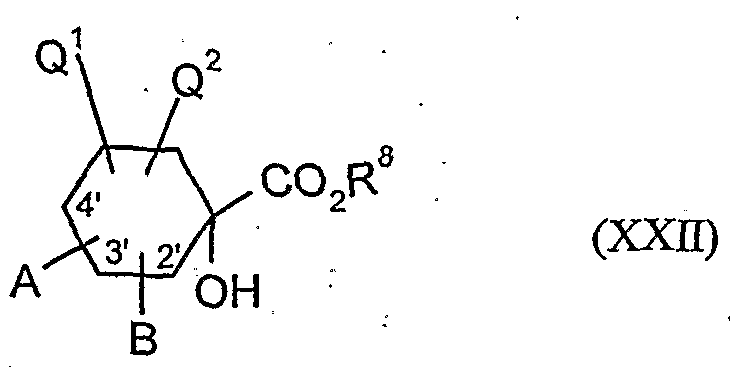
in welcherin which
A, B, CA Q2 und R^ die oben angegebenen Bedeutungen haben,A, B, CA Q 2 and R 1 have the meanings given above,
mit substituierten Phenylessigsäurederivaten der Formel (XVII)with substituted phenylacetic acid derivatives of the formula (XVII)
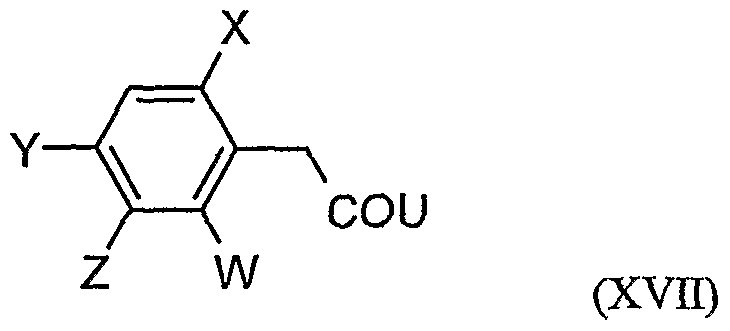
in welcherin which
U, W, X, Y und Z die oben angegebenen Bedeutungen haben,U, W, X, Y and Z have the meanings given above,
acyliert (Chem. Reviews 52, 237-416 (1953)).acylated (Chem. Reviews 52, 237-416 (1953)).
Die l-Hydroxy-S-alkoxy-cyclohexyl-carbonsäureester der Formel (XXII) sind neu. Man erhält sie beispielsweise, indem man substituierte l-Hydroxy-4,4'-alkylidenyldioxy-cyclohexan-carbon- säurenitrile in Gegenwart von Säuren, z.B. nach Pinner mit Alkoholen umsetzt und die entstandenen l-Hydroxy-4-σxo-cylohexancarbonsäureester bekannt aus WO 99/16748 (Bsp. XXI-I) mit Diolen erneut ketalisiert. Das Cyanhydrin erhält man beispielsweise durch Umsetzung von substituierten 4,4'-Alkylidenyldioxy-cyclohexan-l-onen mit Blausäure (s. WO 99/16748).The l-hydroxy-S-alkoxy-cyclohexyl-carboxylic acid esters of the formula (XXII) are new. They are obtained, for example, by reacting substituted 1-hydroxy-4,4'-alkylidenyldioxy-cyclohexane-carbonitriles in the presence of acids, e.g. reacted according to Pinner with alcohols and the resulting l-hydroxy-4-σxo-cylohexancarbonsäureester known from WO 99/16748 (Ex. XXI-I) ketalized again with diols. The cyanohydrin is obtained, for example, by reaction of substituted 4,4'-alkylidenyldioxycyclohexan-1-ones with hydrocyanic acid (see WO 99/16748).
Die zur Durchführung der erfindungsgemäßen Verfahren (C), (D), (E), (F), (G), (H), (I) und (J) außerdem als Ausgangsstoffe benötigten Säurehalogenide der Formel (IV), Carbonsäureanhydride der Formel (V), Chlorameisensäureester oder Chlorameisensäurethioester der Formel (VI), Chlor- monothioameisensäureester oder Chlordithioameisensäureester der Formel (V-I), Sulfonsäure- chloride der Formel (VTS), Phosphorverbindungen der Formel (IX) und Metallhydroxide, Metallalkoxide oder Amine der Formel (X) und (XI) und Isocyanate der Formel (XU) und Carbamid- säurechloride der Formel (XST) und Diole der Formel (XV) sind allgemein bekannte Verbin- düngen der organischen bzw. anorganischen Chemie. Die Verbindungen 4er Formel (XIV) sind teilweise bekannt aus WO 99/16748.For carrying out the processes (C), (D), (E), (F), (G), (H), (I) and (J) also required as starting materials acid halides of the formula (IV), carboxylic anhydrides of Formula (V), chloroformate or chloroformic thioester of the formula (VI), chloro-monothioic acid esters or Chlordithioameisensäureester of formula (VI), sulfonyl chlorides of the formula (VTS), phosphorus compounds of the formula (IX) and metal hydroxides, metal alkoxides or amines of the formula (X ) and (XI) and isocyanates of the formula (XU) and carbamido acid chlorides of the formula (XST) and diols of the formula (XV) are generally known compounds. fertilize organic or inorganic chemistry. The compounds of formula 4 (XIV) are known in part from WO 99/16748.
Die Verbindungen der Formeln (XV1S) sind darüber hinaus aus den eingangs zitierten Patentanmeldungen bekannt und/oder lassen sich nach den dort angegebenen Methoden herstellen.The compounds of the formulas (XV 1 S) are moreover known from the patent applications cited above and / or can be prepared by the methods indicated there.
Das Verfahren (A) ist dadurch gekennzeichnet, dass man Verbindungen der Formel (IT), in welcher A, B, Q1, Q , W, X, Y, Z und R^ die oben angegebenen Bedeutungen haben, in Gegenwart eines Verdünnungsmittels und in Gegenwart einer Base einer intramolekularen Kondensation unterwirft.The process (A) is characterized in that compounds of the formula (IT) in which A, B, Q 1 , Q, W, X, Y, Z and R 1 have the abovementioned meanings, in the presence of a diluent and in the presence of a base of an intramolecular condensation.
Als Verdünnungsmittel können bei dem erfindungsgemäßen Verfahren (A) alle gegenüber den Reaktionsteilnehmein inerten organischen Solventien eingesetzt werden. Vorzugsweise verwend- bar sind Kohlenwasserstoffe, wie Toluol und Xylol, ferner Ether, wie Dibuty lether, Tetrahydro- furan, Dioxan, Glykoldimethylether und Diglykoldimethylether, außerdem polare Lösungsmittel, wie Dimethylsulfoxid, Sulfolan, Dimethylformamid und N-Methyl-pyrrolidon, sowie Alkohole wie Methanol, Ethanol, Propanol, Iso-Propanol, Butanol, Iso-Butanol und tert.-Butanol.Diluents which can be used in the process (A) according to the invention are all inert organic solvents in relation to the reactants. Preference is given to using hydrocarbons, such as toluene and xylene, furthermore ethers, such as dibutyl ether, tetrahydrofuran, dioxane, glycol dimethyl ether and diglycol dimethyl ether, furthermore polar solvents, such as dimethyl sulfoxide, sulfolane, dimethylformamide and N-methylpyrrolidone, and also alcohols, such as methanol , Ethanol, propanol, iso-propanol, butanol, iso-butanol and tert-butanol.
Als Base (Deprotonierungsmittel) können bei der Durchführung des erfindungsgemäßen Ver- fahrens (A) alle üblichen Protonenakzeptoren eingesetzt werden. Vorzugsweise verwendbar sind Alkalimetall- und Erdalkalimetalloxide, -hydroxide und -carbonate, wie Natriumhydroxid, Kaliumhydroxid, Magnesiumoxid, Calciumoxid, Natriumcarbonat, Kaliumcarbonat und Calciumcarbonat, die auch in Gegenwart von Phasentransferkätalysatoren wie z.B. Triethylbenzylammoniumchlorid, Tetrabutylammoniumbromid, Adogen 464 (=Methyltrialkyl(Cg-CiQ)ammoniumchlorid) oder TDA 1 (=Tris-(methoxyethoxyethyl)-amin) eingesetzt werden können. Weiterhin können Alkalimetalle wie Natrium oder Kalium verwendet werden. Ferner sind Alkalimetall- und Erdalkalimetallamide und -hydride, wie Natriumamid, Natriumhydrid und Calciumhydrid, und außerdem auch Alkali- metallalkoholate, wie Natriummethylat, Natriumethylat und Kalium-tert.-butylat einsetzbar.When carrying out the process (A) according to the invention, all customary proton acceptors can be used as the base (deprotonating agent). Preferably used are alkali metal and alkaline earth metal oxides, hydroxides and carbonates such as sodium hydroxide, potassium hydroxide, magnesium oxide, calcium oxide, sodium carbonate, potassium carbonate and calcium carbonate, which are also useful in the presence of phase transfer catalysts such as e.g. Triethylbenzylammonium chloride, tetrabutylammonium bromide, Adogen 464 (= methyltrialkyl (Cg-CiQ) ammonium chloride) or TDA 1 (= tris (methoxyethoxyethyl) amine) can be used. Furthermore, alkali metals such as sodium or potassium can be used. Also suitable are alkali metal and alkaline earth metal amides and hydrides, such as sodium amide, sodium hydride and calcium hydride, and also alkali metal alkoxides, such as sodium methoxide, sodium ethylate and potassium tert-butoxide.
Die Reaktipnstemperatur kann bei der Durchführung des erfindungsgemäßen Verfahrens (A) innerhalb eines größeren Bereiches variiert werden. Im allgemeinen arbeitet man bei Temperaturen zwischen -75°C und 2000C, vorzugsweise zwischen -500C und 1500C.The Reaktipnstemperatur can be varied in carrying out the process (A) according to the invention within a substantial range. In general, one works at temperatures between -75 ° C and 200 0 C, preferably between -50 0 C and 150 0 C.
Das erfindungsgemäße Verfahren (A) wird im allgemeinen unter Normaldruck durchgeführt.The process (A) according to the invention is generally carried out under atmospheric pressure.
Bei der Durchführung des erfindungsgemäßen Verfahrens (A) setzt man die Reaktionskomponente der Formel (H) und die deprotonierende Base im allgemeinen in äquimolaren bis etwa doppelt- äquimolaren Mengen ein. Es ist jedoch auch möglich, die eine oder andere Komponente in einem größeren Überschuss (bis zu 3 MpI) zu verwenden. Das Verfahren (B) ist dadurch gekennzeichnet, dass man Verbindungen der. Formel (IE), in welcher A, B, Q1, Q , W, X, Y, Z und R8 die oben angegebenen Bedeutungen haben, in Gegenwart eines Verdünnungsmittels und in Gegenwart einer Base intramolekular kondensiert.When carrying out the process (A) according to the invention, the reaction component of the formula (H) and the deprotonating base are generally employed in equimolar to about twice-equimolar amounts. However, it is also possible to use one or the other component in a larger excess (up to 3 MpI). The process (B) is characterized in that compounds of the. Formula (IE) in which A, B, Q 1 , Q, W, X, Y, Z and R 8 have the meanings given above, intramolecularly condensed in the presence of a diluent and in the presence of a base.
Als Verdünnungsmittel können bei dem erfϊndungsgemäßen Verfahren (B) alle gegenüber den Reaktionsteilnehmern inerten organischen Solventien eingesetzt werden. Vorzugsweise verwendbar sind Kohlenwasserstoffe, wie Toluol und Xylol, ferner Ether, wie Dibutylether, Tetra- hydrofuran, Dioxan, Glykoldimethylether und Diglykoldimethylether, außerdem polare Lösungsmittel, wie Dimethylsulfoxid, Sulfolan, Dimethylformamid und N-Methyl-pyrrolidon. Weiterhin können Alkohole wie Methanol, Ethanol, Propanol, Iso-Propanol, Butanol, Iso-Butanol und tert.- Butanol eingesetzt werden.Diluents used in process (B) according to the invention are all organic solvents inert to the reactants. Preference is given to using hydrocarbons, such as toluene and xylene, furthermore ethers, such as dibutyl ether, tetrahydrofuran, dioxane, glycol dimethyl ether and diglycol dimethyl ether, as well as polar solvents, such as dimethyl sulfoxide, sulfolane, dimethylformamide and N-methylpyrrolidone. Furthermore, alcohols such as methanol, ethanol, propanol, iso-propanol, butanol, isobutanol and tert-butanol can be used.
Als Base (Deprotonierungsmittel) können bei der Durchführung des erfϊndungsgemäßen Verfahrens (B) alle üblichen Protonenakzeptoren eingesetzt werden. Vorzugsweise verwendbar sind Alkalimetall- und Erdalkalimetalloxide, -hydroxide und -carbonate, wie Natriumhydroxid, Kaliumhydroxid, Magnesiumoxid, Calciumoxid, Natriumcarbonat, Kaliumcarbonat und Calciumcarbonat, die auch in Gegenwart von Phasentransferkatalysatoren wie z.B. Triethylbenzylammoniumchlorid, Tetrabutylammoniumbromid, Adogen 464 (= Methyltrialkyl(Cg-Gio)ammoniumchlorid) oder TDA 1 (= Tris-(methoxyethoxyethyl)-amin) eingesetzt werden können. Weiterhin können Alkalimetalle wie Natrium oder Kalium verwendet werden. Ferner sind Alkalimetall- und Erdalkali- metallamide und -hydride, wie Natriumamid, Natriumhydrid und Calciumhydrid, und außerdem auch Alkalimetallalkoholate, wie Natriummethylat, Natriumethylat und Kalium-tert.-butylat einsetzbar.As base (deprotonating agent), all conventional proton acceptors can be used in carrying out the process (B) according to the invention. Preferably used are alkali metal and alkaline earth metal oxides, hydroxides and carbonates, such as sodium hydroxide, potassium hydroxide, magnesium oxide, calcium oxide, sodium carbonate, potassium carbonate and calcium carbonate, which are also useful in the presence of phase transfer catalysts, e.g. Triethylbenzylammonium chloride, tetrabutylammonium bromide, Adogen 464 (= methyltrialkyl (Cg-Gio) ammonium chloride) or TDA 1 (= tris (methoxyethoxyethyl) amine) can be used. Furthermore, alkali metals such as sodium or potassium can be used. Furthermore, alkali metal and alkaline earth metal amides and hydrides, such as sodium amide, sodium hydride and calcium hydride, and also alkali metal alkoxides, such as sodium methoxide, sodium ethoxide and potassium tert-butoxide can be used.
Die Reaktionstemperatur kann bei der Durchführung des erfmdungsgemäßen Verfahrens (B) innerhalb eines größeren Bereiches variiert werden. Im allgemeinen arbeitet man bei Temperaturen zwischen -750C und 2000C, vorzugsweise zwischen -500C und 15O0C.The reaction temperature can be varied within a substantial range when carrying out the process (B) according to the invention. In general, one works at temperatures between -75 0 C and 200 0 C, preferably between -50 0 C and 15O 0 C.
Das erfϊndungsgemäße Verfahren (B) wird im allgemeinen unter Normaldruck durchgeführt.The erfϊndungsgemäße process (B) is generally carried out under atmospheric pressure.
Bei der Durchführung des erfindungsgemäßen Verfahrens (B) setzt man die Reaktionskomponenten der Formel (EI) und die deprotonierenden Basen im allgemeinen in etwa äquimolaren Mengen ein. Es ist jedoch auch möglich, die eine oder andere Komponente in einem größeren Überschuss (bis zu 3 Mol) zu verwenden.In carrying out the process (B) according to the invention, the reaction components of the formula (EI) and the deprotonating bases are generally employed in approximately equimolar amounts. However, it is also possible to use one or the other component in a larger excess (up to 3 mol).
Das Verfahren (Cα) ist dadurch gekennzeichnet, dass man Verbindungen der Formeln (I-l-a) bis (I-2-a) jeweils mit Carbonsäurehalogentdeα der Formel (IV) gegebenenfalls in Gegenwart eines Verdünnungsmittels und gegebenenfalls in Gegenwart eines Säurebindemittels umsetzt. Als Verdünnungsmittel können bei dem erfindüngsgemäßen Verfahren (Cα) alle gegenüber den Säurehalogeniden inerten Solventien eingesetzt werden. Vorzugsweise verwendbar sind Kohlenwasserstoffe, wie Benzin, Benzol, Toluol, Xylol und Tetralin, ferner Halogenkohlenwasserstoffe, wie Methylenchlorid, Chloroform, Tetrachlorkohlenstoff, Chlorbenzol und o-Dichlorbenzol, außerdem Ketone, wie Aceton und Methylisopropylketon, weiterhin Ether, wie Diethylether, Te- trahydrofuran und Dioxan, darüber hinaus Carbonsäureester, wie Ethylacetat, und auch stark polare Solventien, wie Dimethylformamid, Diniethylsulfoxid und Sulfolan. Wenn die Hydrolysestabilität des Säurehalogenids es zulässt, kann die Umsetzung auch in Gegenwart von Wasser durchgeführt werden.The process (C α ) is characterized in that compounds of the formulas (IIa) to (I-2-a) are each reacted with carboxylic acid halide deα of the formula (IV), if appropriate in the presence of a diluent and if appropriate in the presence of an acid binder. Suitable diluents for the process according to the invention (C α ) are all solvents which are inert to the acid halides. Preference is given to using hydrocarbons, such as benzene, benzene, toluene, xylene and tetralin, furthermore halogenated hydrocarbons, such as methylene chloride, chloroform, carbon tetrachloride, chlorobenzene and o-dichlorobenzene, furthermore ketones, such as acetone and methyl isopropyl ketone, furthermore ethers, such as diethyl ether, tetrahydrofuran and Dioxane, moreover carboxylic acid esters, such as ethyl acetate, and also strongly polar solvents, such as dimethylformamide, Diniethylsulfoxid and sulfolane. If the hydrolytic stability of the acid halide permits it, the reaction may also be carried out in the presence of water.
Als Säurebindemittel kommen bei der Umsetzung nach dem erfindungsgemäßen Verfahren (Cα) alle üblichen Säureakzeptoren in Betracht. Vorzugsweise verwendbar sind tertiäre Amine, wie Triethylamin, Pyridin, Diazabicyclooctan (DABCO), Diazabicycloundecen (DBU), Diazabicyclo- nonen (DBN), Hünig-Base und N,N-Dimethyl-anilin, ferner Erdalkalimetalloxide, wie Magnesium- und Calciumoxid, außerdem Alkali- und Erdalkali-metall-carbonate, wie Natriumcarbonat, Kaliumcarbonat und Calciumcarbonat sowie Alkalihydroxide wie Natriumhydroxid und Kaliumhydroxid.Suitable acid binders in the reaction by the process (C α ) according to the invention are all customary acid acceptors. Preference is given to using tertiary amines, such as triethylamine, pyridine, diazabicyclooctane (DABCO), diazabicycloundecene (DBU), diazabicyclo-nonene (DBN), Hünig base and N, N-dimethylaniline, furthermore alkaline earth metal oxides, such as magnesium and calcium oxide Alkali metal and alkaline earth metal carbonates, such as sodium carbonate, potassium carbonate and calcium carbonate, and alkali metal hydroxides, such as sodium hydroxide and potassium hydroxide.
Die Reaktionstemperatur kann bei dem erfindungsgemäßen Verfahren (Cα) innerhalb eines größeren Bereiches variiert werden. Im allgemeinen arbeitet man bei Temperaturen zwischen -200C und +1500C, vorzugsweise zwischen 00C und 1000C.The reaction temperature can be varied within a relatively wide range in the process according to the invention (C α ). In general, one works at temperatures between -20 0 C and +150 0 C, preferably between 0 0 C and 100 0 C.
Bei der Durchführung des erfindungsgemäßen Verfahrens (Cα) werden die Ausgangsstoffe der Formeln (I-l-a) bis (I-2-a) und das Carbonsäurehalogenid der Formel (IV) im allgemeinen jeweils in angenähert äquivalenten Mengen verwendet. Es ist jedoch auch möglich, das Carbonsäurehalogenid in einem größeren Überschuss (bis zu 5 Mol) einzusetzen. Die Aufarbeitung erfolgt nach üblichen Methoden.When carrying out the process (C α ) according to the invention, the starting materials of the formulas (IIa) to (I-2-a) and the carboxylic acid halide of the formula (IV) are generally each used in approximately equivalent amounts. However, it is also possible to use the carboxylic acid halide in a larger excess (up to 5 moles). The workup is carried out by conventional methods.
Das Verfahren (Cß) ist dadurch gekennzeichnet, dass man Verbindungen der Formeln (I-l-a) bis (I-2-a) jeweils mit Carbonsäureanhydriden der Formel (V) gegebenenfalls in Gegenwart eines Verdünnungsmittels und gegebenenfalls in Gegenwart eines Säurebindemittels umsetzt.The process (Cβ) is characterized in that compounds of the formulas (I-I-a) to (I-2-a) are each reacted with carboxylic anhydrides of the formula (V), if appropriate in the presence of a diluent and if appropriate in the presence of an acid binder.
Als Verdünnungsmittel können bei dem erfindungsgemäßen Verfahren (Cß) vorzugsweise diejenigen Verdünnungsmittel verwendet werden, die auch bei der Verwendung von Säurehalo- geniden vorzugsweise in Betracht kommen. Im übrigen kann auch ein im Überschuss eingesetztes Carbonsäureanhydrid gleichzeitig als Verdünnungsmittel fungieren. Als gegebenenfalls zugesetzte Säurebindemittel kommen beim Verfahren (Cß) vorzugsweise diejenigen Säurebindemittel in Frage, die auch bei der Verwendung von Säurehalogeniden vorzugsweise in Betracht kommen.Diluents which may be used in the process (Cβ) according to the invention are preferably those diluents which are also suitable when using acid halides. Incidentally, an excess carboxylic acid anhydride may also function as a diluent at the same time. Suitable acid binders which may be added in process (Cβ) are preferably those acid binders which are also preferably used when using acid halides.
Die Reaktionstemperatur kann bei dem erfindungsgemäßen Verfahren (Cß) Innerhalb eines größeren Bereiches variiert werden. Im allgemeinen arbeitet man bei Temperaturen zwischen -200C und +15O0C5 vorzugsweise zwischen O0C. und 1000C.The reaction temperature in the process (Cβ) according to the invention can be varied within a relatively wide range. In general, it is carried out at temperatures between -20 0 C and + 15O 0 C 5, preferably between 0 0 C. and 100 0 C.
Bei der Durchführung des erfindungsgemäßen Verfahrens (Cß) werden die Ausgangsstoffe der Formeln (I-l-a) bis (I-2-a) und das Carbonsäureanhydrid der Formel (V) im allgemeinen in jeweils angenähert äquivalenten Mengen verwendet. Es ist jedoch auch möglich, das Carbonsäureanhydrid in einem größeren Überschuss (bis zu 5 Mol) einzusetzen. Die Aufarbeitung erfolgt nach üblichen Methoden.In carrying out the process (Cβ) according to the invention, the starting materials of the formulas (I-I-a) to (I-2-a) and the carboxylic anhydride of the formula (V) are generally used in approximately equivalent amounts. However, it is also possible to use the carboxylic acid anhydride in a larger excess (up to 5 moles). The workup is carried out by conventional methods.
Im allgemeinen geht man so vor, dass man Verdünnungsmittel und im Überschuss vorhandenes Carbonsäureanhydrid sowie die entstehende Carbonsäure durch Destillation oder durch Waschen mit einem organischen Lösungsmittel oder mit Wasser entfernt.In general, diluent and excess carboxylic anhydride and the resulting carboxylic acid are removed by distillation or by washing with an organic solvent or with water.
Das Verfahren (D) ist dadurch gekennzeichnet, dass man Verbindungen der Formeln (I-l-a) bis (I-2-a) jeweils mit Chlorameisensäureestern oder Chlorameisensäurethiolestern der Formel (VI) gegebenenfalls in Gegenwart eines Verdünnungsmittels und gegebenenfalls in Gegenwart eines Säurebindemittels umsetzt.The process (D) is characterized in that compounds of the formulas (I-I-a) to (I-2-a) are reacted in each case with chloroformates or chloroformic thioesters of the formula (VI), if appropriate in the presence of a diluent and if appropriate in the presence of an acid binder.
Als Säurebindemittel kommen bei dem erfindungsgemäßen Verfahren (D) alle üblichen Säure- akzeptoren in Betracht. Vorzugsweise verwendbar sind tertiäre Amine, wie Triethylamin, Pyridin, DABCO, DBU, DBN, Hünig-Base und N,N-Dimethyl-anilin, ferner Erdalkalimetalloxide, wie Magnesium- und Calciumoxid, außerdem Alkali- und Erdalkalimetallcarbonate, wie Natrium- carbonat, Kaliumcarbonat und Calciumcarbonat sowie Alkalihydroxide wie Natriumhydroxid und Kaliumhydroxid.Suitable acid binders in the process (D) according to the invention are all customary acid acceptors. Preference is given to using tertiary amines, such as triethylamine, pyridine, DABCO, DBU, DBN, Hünig base and N, N-dimethylaniline, furthermore alkaline earth metal oxides, such as magnesium and calcium oxide, and also alkali metal and alkaline earth metal carbonates, such as sodium carbonate, potassium carbonate and calcium carbonate and alkali hydroxides such as sodium hydroxide and potassium hydroxide.
Als Verdünnungsmittel können bei dem erfindungsgemäßen Verfahren (D) alle gegenüber den Chlorameisensäureestern bzw. Chlorameisensäurethiolestern inerten Solventien eingesetzt werden. Vorzugsweise" verwendbar sind Kohlenwasserstoffe, wie Benzin, Benzol, Toiuol, Xylol und Tetralin, ferner Halogenkohlenwasserstoffe, wie Methylenchlorid, Chloroform, Tetrachlorkohlenwasserstoff, Chlorbenzol und o-Dichlorbenzol, außerdem Ketone, wie Aceton und Methylisopro- pylketon, weiterhin Ether, wie Diethylether, Tetrahydrofuran und Dioxan, darüber hinaus Carbonsäureester, wie Ethylacetat, außerdem Nitrile wie Acetonitril und auch stark polare Solventien, wie Dimethylformamid, Dimethylsulfoxid und Sulfolan. . . Die Reaktionstemperatur kann bei der Durchführung des erfmdungsgemäßen. Verfahrens (D) innerhalb eines größeren Bereiches variiert werden. Die Reaktionstemperatur liegt im allgemeinen zwischen -200C und +1000C, vorzugsweise zwischen O0C und 500C.Suitable diluents for the process (D) according to the invention are all solvents which are inert to the chloroformic esters or chloroformic thioesters. Preference is given to using hydrocarbons, such as benzene, benzene, toluene, xylene and tetralin, furthermore halogenated hydrocarbons, such as methylene chloride, chloroform, carbon tetrachloride, chlorobenzene and o-dichlorobenzene, furthermore ketones, such as acetone and methyl isopropyl ether, furthermore ethers, such as diethyl ether, tetrahydrofuran and dioxane, moreover carboxylic esters, such as ethyl acetate, and also nitriles, such as acetonitrile, and also strongly polar solvents, such as dimethylformamide, dimethyl sulfoxide and sulfolane. The reaction temperature can in the implementation of the inventive. Method (D) can be varied within a relatively wide range. The reaction temperature is generally between -20 0 C and + 100 0 C, preferably between 0 0 C and 50 0 C.
Das erfϊndungsgemäße Verfahren (D) wird im allgemeinen unter Normaldruck durchgeführt.The erfϊndungsgemäße process (D) is generally carried out under atmospheric pressure.
Bei der Durchführung des erfindungsgemäßen Verfahrens (D) werden die .Ausgangsstoffe der Formeln (I-l-a) bis (I-2-a) und der entsprechende Chlorameisensäureester bzw. Chlorameisen- säurethiolester der Formel (VI) im Allgemeinen jeweils in angenähert äquivalenten Mengen verwendet. Es ist jedoch auch möglich, die eine oder andere Komponente in einem größeren Über- schuss (bis zu 2 Mol) einzusetzen. Die Aufarbeitung erfolgt nach üblichen Methoden. Im allge- meinen geht man so vor, dass man ausgefallene Salze entfernt und das verbleibende Reaktionsgemisch durch Abziehen des Verdünnungsmittels einengt.When carrying out the process (D) according to the invention, the starting materials of the formulas (I-I-a) to (I-2-a) and the corresponding chloroformate or chloroformic thioester of the formula (VI) are generally each used in approximately equivalent amounts. However, it is also possible to use one or the other component in a larger excess (up to 2 mol). The workup is carried out by conventional methods. In general, the procedure is to remove precipitated salts and to concentrate the remaining reaction mixture by stripping off the diluent.
Das erfindungsgemäße Verfahren (E) ist dadurch gekennzeichnet, dass man Verbindungen der Formeln (I-l-a) bis (I-2-a) jeweils mit Verbindungen der Formel (VIT) in Gegenwart eines Verdünnungsmittels und gegebenenfalls in Gegenwart eines Säurebindemittels umsetzt.The process (E) according to the invention is characterized in that compounds of the formulas (I-I-a) to (I-2-a) are each reacted with compounds of the formula (VIT) in the presence of a diluent and optionally in the presence of an acid binder.
Beim Herstellungsverfahren (E) setzt man pro Mol Ausgangsverbindung der Formeln (I-l-a) bis (I-2-a) ca. 1 Mol Chlormonothioameisensäureester bzw. Chlordithioameisensäureester der Formel (VII) bei 0 bis 12O0C, vorzugsweise bei 20 bis 6O0C um.In the preparation process (E) is used per mole of starting compound of the formulas (Ila) to (I-2-a) about 1 mol Chlormonothioameisensäureester or Chlordithioameisensäureester of formula (VII) at 0 to 12O 0 C, preferably at 20 to 60 0 C. around.
Als gegebenenfalls zugesetzte Verdünnungsmittel kommen alle inerten polaren organischen Lösungsmittel in Frage, wie Ether, Amide, Sulfone, Sulfoxide, aber auch Halogenalkane.Suitable optionally added diluents are all inert polar organic solvents, such as ethers, amides, sulfones, sulfoxides, but also haloalkanes.
Vorzugsweise werden Dimethylsulfoxid, Tetrahydrofuran, Dimethylformamid, Essigsäureethyl- ester oder Methylenchlorid eingesetzt.Preference is given to using dimethyl sulfoxide, tetrahydrofuran, dimethylformamide, ethyl acetate or methylene chloride.
Stellt man in einer bevorzugten Ausführungsform durch Zusatz von starken Deprotonierungs- mitteln wie z.B. Natriumhydrid oder Kaliumtertiärbutylat das Enolatsalz der Verbindungen (I-l-a) bis (I-2-a) dar, kann auf den weiteren Zusatz von Säurebindemitteln verzichtet werden.If, in a preferred embodiment, the addition of strong deprotonating agents, e.g. Sodium hydride or potassium tert-butylate the enolate salt of the compounds (I-l-a) to (I-2-a), can be dispensed with the further addition of acid binders.
Als Basen können beim Verfahren (E) alle üblichen Protonenakzeptoren eingesetzt werden. Vorzugsweise verwendbar sind Alkalimetallhydride, Alkalimetallalkoholate, Alkali- oder Erdalkali- metallcarbonate oder -hydrogencarbonate oder. Stickstoffbasen. Genannt seien beispielsweise Natriumhydrid, Natriummethanolat, Natriumhydroxid, Calciumhydroxid, Kaliumcarbonat, Natriumhydrogencarbonat, Triethylamin, Dibenzylamin, Diisopropylamin, Pyridin, Chinolin, Diazabicyclooctan (DABCO), Diazäbicyclononen (DBN)'und Diazabicycloundecen. (DBU). . Die Reaktion kann bei Normaldruck oder unter erhöhtem Druck durchgeführt werden, vorzugs¬ weise wird bei Normaldruck gearbeitet. Die Aufarbeitung geschieht nach üblichen Methoden.The bases used in process (E) are all customary proton acceptors. Preference is given to using alkali metal hydrides, alkali metal alcoholates, alkali metal or alkaline earth metal carbonates or bicarbonates or. Nitrogen bases. Examples include sodium hydride, sodium methoxide, sodium hydroxide, calcium hydroxide, potassium carbonate, sodium hydrogencarbonate, triethylamine, dibenzylamine, diisopropylamine, pyridine, quinoline, diazabicyclooctane (DABCO), Diazäbicyclononen (DBN) 'and diazabicycloundecene were. (DBU). , The reaction can be carried out at atmospheric pressure or under elevated pressure, preferably ¬ works at atmospheric pressure. The workup is done by conventional methods.
Das erfindungsgemäße Verfahren (F) ist dadurch gekennzeichnet, dass man Verbindungen der Formeln (I-l-a) bis (I-2-a) jeweils mit Sulfonsäurechloriden der Formel (VIH) gegebenenfalls in Gegenwart eines Verdünnungsmittels und gegebenenfalls in Gegenwart eines Säurebindemittels umsetzt.The process (F) according to the invention is characterized in that compounds of the formulas (I-I-a) to (I-2-a) are each reacted with sulfonyl chlorides of the formula (VIH), if appropriate in the presence of a diluent and if appropriate in the presence of an acid binder.
Beim Herstellungsverfahren (F) setzt man pro Mol Ausgangsverbindung der Formel (I-l-a) bis (I-2-a) ca. 1 Mol Sulfonsäurechlorid der Formel (Vm) bei -20 bis ISO0C, vorzugsweise bei 0 bis 700C um.In the preparation process (F) is reacted per mole of starting compound of the formula (Ila) to (I-2-a) about 1 mol sulfonic acid chloride of formula (Vm) at -20 to ISO 0 C, preferably at 0 to 70 0 C.
Das Verfahren (F) wird vorzugsweise in Gegenwart eines Verdünnungsmittels durchgeführt.The process (F) is preferably carried out in the presence of a diluent.
Als Verdünnungsmittel kommen alle inerten polaren organischen Lösungsmittel in Frage wie Ether, Amide, Ketone, Carbonsäureester, Nitrile, Sulfone, Sulfoxide oder halogenierte Kohlenwasserstoffe wie Methylenchlorid.Suitable diluents are all inert polar organic solvents such as ethers, amides, ketones, carboxylic acid esters, nitriles, sulfones, sulfoxides or halogenated hydrocarbons such as methylene chloride.
Vorzugsweise werden Dimethylsulfoxid, Tetrahydrofuran, Dimethylformamid, Essigsäureethyl- ester, Methylenchlorid eingesetzt.Preference is given to using dimethyl sulfoxide, tetrahydrofuran, dimethylformamide, ethyl acetate, methylene chloride.
Stellt man in einer bevorzugten Ausfuhrungsform durch Zusatz von starken Deprotonierungs- mitteln (wie z.B. Natriumhydrid oder Kaliumtertiärbutylat) das Enolatsalz der Verbindungen (I-l-a) bis (I-2-a) dar, kann auf den weiteren Zusatz von Säurebindemitteln verzichtet werden.If, in a preferred embodiment, the addition of strong deprotonating agents (such as, for example, sodium hydride or potassium tert-butylate) represents the enolate salt of the compounds (I-I-a) to (I-2-a), the further addition of acid binders can be dispensed with.
Werden Säurebindemittel eingesetzt, so kommen übliche anorganische oder organische Basen in Frage, beispielhaft seien Natriumhydroxid, Natriumcarbonat, Kaliumcarbonat, Pyridin und Triethylamin aufgeführt.If acid binders are used, conventional inorganic or organic bases are suitable; sodium hydroxide, sodium carbonate, potassium carbonate, pyridine and triethylamine may be mentioned by way of example.
Die Reaktion kann bei Normaldruck oder unter erhöhtem Druck durchgeführt werden, vorzugsweise wird bei Normaldruck gearbeitet. Die Aufarbeitung geschieht nach üblichen Methoden.The reaction can be carried out at atmospheric pressure or under elevated pressure, preferably is carried out at atmospheric pressure. The workup is done by conventional methods.
Das erfindungsgemäße Verfahren (G) ist dadurch gekennzeichnet, dass man Verbindungen der Formeln (I-l-a) bis (I-2-a) jeweils mit Phosphorverbindungen der Formel (IX) gegebenenfalls in Gegenwart eines Verdünnungsmittels und gegebenenfalls in Gegenwart eines Säurebindemittels umsetzt.Process (G) according to the invention is characterized in that compounds of the formulas (I-I-a) to (I-2-a) are each reacted with phosphorus compounds of the formula (IX), if appropriate in the presence of a diluent and if appropriate in the presence of an acid binder.
Beim Herstellungsverfahren (G) setzt man zum Erhalt von Verbindungen der Formeln (I-l-e) bis (I-2-e) auf 1 Mol der Verbindungen (I-l-a) bis (I-2-a), 1 bis 2, vorzugsweise I bis 1,3 Mol der Phosphorverbindung der Formel (DC) bei Temperaturen zwischen -4O0C und 1590C, vorzugsweise zwischen -10 und 11O0C um.In preparation process (G), to obtain compounds of the formulas (Ile) to (I-2-e), use is made of 1 mol of the compounds (IIa) to (I-2-a), 1 to 2, preferably I to 1, 3 moles of Phosphorus compound of the formula (DC) at temperatures between -4O 0 C and 159 0 C, preferably between -10 and 11O 0 C to.
Das Verfahren (G) wird vorzugsweise in Gegenwart eines Verdünnungsmittels durchgeführt.The process (G) is preferably carried out in the presence of a diluent.
Als Verdünnungsmittel kommen alle inerten, polaren organischen Lösungsmittel in Frage wie Ether, Carbonsäureester, halogenierte Kohlenwasserstoffe, Ketone, Amide, Nitrile, Sulfone, Sulfoxide etc.Suitable diluents are all inert, polar organic solvents such as ethers, carboxylic esters, halogenated hydrocarbons, ketones, amides, nitriles, sulfones, sulfoxides, etc.
Vorzugsweise werden Acetonitril, Dimethylsulfoxid, Tetrahydrofuran, Dimethylformamid, Methylenchlorid eingesetzt.Preferably, acetonitrile, dimethyl sulfoxide, tetrahydrofuran, dimethylformamide, methylene chloride are used.
Als gegebenenfalls zugesetzte Säurebindemittel kommen übliche anorganische oder organische Basen in Frage wie Hydroxide, Carbonate oder Amine. Beispielhaft seien Natriumhydroxid, Natriumcarbonat, Kaliumcarbonat, Pyridin und Triethylamin aufgeführt.Suitable acid binders which may be added are customary inorganic or organic bases such as hydroxides, carbonates or amines. Exemplary sodium hydroxide, sodium carbonate, potassium carbonate, pyridine and triethylamine are listed.
Die Umsetzung kann bei Normaldruck oder unter erhöhtem Druck durchgeführt werden, vorzugsweise wird bei Normaldruck gearbeitet. Die Aufarbeitung geschieht nach üblichen Methoden der Organischen Chemie. Die Endprodukte werden vorzugsweise durch Kristallisation, chromato- graphische Reinigung oder durch sogenanntes "Andestillieren", d.h. Entfernung der flüchtigen Bestandteile im Vakuum gereinigt.The reaction can be carried out at atmospheric pressure or under elevated pressure, preferably is carried out at atmospheric pressure. The workup is done by conventional methods of organic chemistry. The final products are preferably purified by crystallization, chromatographic purification or by so-called "distillation", i. Removal of volatiles purified in vacuo.
Das Verfahren (H) ist dadurch gekennzeichnet, dass man Verbindungen der Formeln (I-l-a) bis (I-2-a) jeweils mit Metallhydroxiden bzw. Metallalkoxiden der Formel (X) oder Aminen der Formel (XI), gegebenenfalls in Gegenwart eines Verdünnungsmittels, umsetzt.The process (H) is characterized in that compounds of the formulas (IIa) to (I-2-a) are each reacted with metal hydroxides or metal alkoxides of the formula (X) or amines of the formula (XI), if appropriate in the presence of a diluent, implements.
Als Verdünnungsmittel können bei dem erfindungsgemäßen Verfahren (H) vorzugsweise Ether wie Tetrahydrofuran, Dioxan, Diethylether oder aber Alkohole wie Methanol, Ethanol, Iso- propanol, aber auch Wasser eingesetzt werden. Das erfindungsgemäße Verfahren (H) wird im allgemeinen unter Normaldruck durchgeführt. Die Reaktionstemperatur liegt im allgemeinen zwischen -200C und 1000C, vorzugsweise zwischen O0C und 500C.Suitable diluents in the process (H) according to the invention are preferably ethers such as tetrahydrofuran, dioxane, diethyl ether or else alcohols such as methanol, ethanol, isopropanol, but also water. The process (H) according to the invention is generally carried out under atmospheric pressure. The reaction temperature is generally between -20 0 C and 100 0 C, preferably between 0 0 C and 50 0 C.
Das erfϊndungsgemäße Verfahren (I) ist dadurch gekennzeichnet, dass man Verbindungen der Formeln (I-l-a) bis (I-2-a) jeweils mit (Iα): Verbindungen der Formel (XH) gegebenenfalls in Gegenwart eines Verdünnungsmittels und gegebenenfalls in Gegenwart eines Katalysators oder (Iß) mit Verbindungen der Formel (XIH) gegebenenfalls in Gegenwart eines Verdünnungsmittels und gegebenenfalls in Gegenwart eines Säurebindemittels umsetzt. Bei Herstellungsverfahren (Ia) setzt man pro Mol Ausgangsverbindung der Formeln (I-l-a) bis (I-2-a) ca. 1 Mol Isocyanat der Formel (XII) bei 0 bis 1000C, vorzugsweise bei 20 bis 500C um.The process (I) according to the invention is characterized in that compounds of the formulas (IIa) to (I-2-a) are each reacted with (Iα) : compounds of the formula (XH), if appropriate in the presence of a diluent and if appropriate in the presence of a catalyst or (Iβ) is reacted with compounds of the formula (XIH), if appropriate in the presence of a diluent and if appropriate in the presence of an acid binder. In preparation process (Ia), about 1 mol of isocyanate of the formula (XII) is reacted at from 0 to 100 ° C., preferably from 20 to 50 ° C., per mole of starting compound of the formulas (IIa) to (I-2-a).
Das Verfahren (Ia) wird vorzugsweise in Gegenwart eines Verdünnungsmittels durchgeführt.The process (Ia) is preferably carried out in the presence of a diluent.
Als Verdünnungsmittel kommen alle inerten organischen Lösungsmittel in Frage, wie aromatische Kohlenwasserstoffe, halogenierte Kohlenwasserstoffe, Ether, Arnide, Nitrile, Sulfone oder Sulfoxide.Suitable diluents are all inert organic solvents, such as aromatic hydrocarbons, halogenated hydrocarbons, ethers, amides, nitriles, sulfones or sulfoxides.
Gegebenenfalls können Katalysatoren zur Beschleunigung der Reaktion zugesetzt werden. Als Katalysatoren können sehr vorteilhaft zinnorganische Verbindungen, wie z.B. Dibutylzmndilaurat eingesetzt werden.Optionally, catalysts can be added to accelerate the reaction. As catalysts very advantageously organotin compounds, e.g. Dibutylzmndilaurat be used.
Es wird vorzugsweise bei Normaldruck gearbeitet.It is preferably carried out at atmospheric pressure.
Beim Herstellungsverfahren (Iß) setzt man pro Mol Ausgangsverbindung der Formeln (I-l-a) bis (I-2-a) ca. 1 Mol Carbamidsäurechlorid der Formel (XIII) bei 0 bis 15O0C, vorzugsweise bei 20 bis 700C um.In the preparation process (Iβ) is reacted per mole of starting compound of the formulas (Ila) to (I-2-a) about 1 mol of carbamoyl chloride of formula (XIII) at 0 to 15O 0 C, preferably at 20 to 70 0 C.
Als gegebenenfalls zugesetzte Verdünnungsmittel kommen alle inerten polaren organischen Lösungsmittel in Frage wie Ether, Carbonsäureester, Nitrile, Ketone, Amide, Sulfone, Sulfoxide oder halogenierte Kohlenwasserstoffe.Possible diluents which are added are all inert polar organic solvents, such as ethers, carboxylic esters, nitriles, ketones, amides, sulfones, sulfoxides or halogenated hydrocarbons.
Vorzugsweise werden Dimethylsulfoxid, Tetrahydrofuran, Dimethylformamid oder Methylenchlorid eingesetzt.Preference is given to using dimethyl sulfoxide, tetrahydrofuran, dimethylformamide or methylene chloride.
Stellt man in einer bevorzugten Ausführungsform durch Zusatz von starken Deprotonierungs- mittein (wie z.B. Natriumhydrid oder Kaliumtertiärbutylat) das Enolatsalz der Verbindung (I-l-a) bis (I-2-a) dar, kann auf den weiteren Zusatz von Säurebindemitteln verzichtet werden.If, in a preferred embodiment, the addition of strong deprotonating agents (such as, for example, sodium hydride or potassium tert-butylate) represents the enolate salt of the compound (I-I-a) to (I-2-a), the further addition of acid binders can be dispensed with.
Werden Säurebindemittel eingesetzt, so kommen übliche anorganische oder organische Basen in Frage, beispielhaft seien Natriumhydroxid, Natriumcarbonat, Kaliumcarbonat, Triethylamin oder Pyridin genannt.If acid binders are used, customary inorganic or organic bases are suitable, for example sodium hydroxide, sodium carbonate, potassium carbonate, triethylamine or pyridine.
Die Reaktion kann bei Normaldruck oder unter erhöhtem Druck durchgeführt werden, vorzugsweise wird bei Normaldruck gearbeitet. Die Aufarbeitung geschieht nach üblichen Methoden.The reaction can be carried out at atmospheric pressure or under elevated pressure, preferably is carried out at atmospheric pressure. The workup is done by conventional methods.
Beim Herstellungsverfahren (J) setzt man pro Mol der Ausgangs Verbindungen (I-l-a) bis (I-l-g) oder (I-2-a) bis (I-2-g) bis zu 50.MoI Diol der Formel (XVI)5 bevorzugt I bis 10 Mol bei -50 bis 25O0C, bevorzugt 0 bis 1500C, um. ■" . Als Verdünnungsmittel kommen alle inerten, organischen Lösungsmittel in Fragfe wie aromatische Kohlenwasserstoffe, halogenierte Kohlenwasserstoffe Ether, Ester, Amide, Nitrile, Sulfone oder Sulfoxide.In the preparation process (J), up to 50.MoI of the formula (XVI) 5, preferably I to, are employed per mole of the starting compounds (IIa) to (IIg) or (I-2-a) to (I-2-g) 10 moles at -50 to 25O 0 C, preferably 0 to 150 0 C, to. ■ " . Suitable diluents are all inert organic solvents such as aromatic hydrocarbons, halogenated hydrocarbons ethers, esters, amides, nitriles, sulfones or sulfoxides.
Gegebenenfalls können Katalysatoren zur Beschleunigung der Reaktion zugesetzt werden. Als Katalysatoren können sehr vorteilhaft Säuren Wie z.B. p-Toluolsulfonsäure, konz. Schwefelsäure aber auch Lewis-Säuren wie z.B. Bortrifluoretherat eingesetzt werden.Optionally, catalysts can be added to accelerate the reaction. As catalysts, acids such as e.g. p-toluenesulfonic acid, conc. Sulfuric acid but also Lewis acids such. Bortrifluoretherat be used.
Es wird vorzugsweise bei Normaldruck gearbeitet.It is preferably carried out at atmospheric pressure.
Die wasserentziehenden Bedingungen lassen sich sowohl durch azeotrope Entfernung des Wassers als auch durch Zugabe geeigneter wasserentziehender Reagenzien wie z.B. Ameisensäure- orthoester, Dimethoxypropan aber auch Molekularsieb erzielen.The dehydrating conditions can be achieved both by azeotropic removal of the water and by addition of suitable dehydrating reagents, e.g. Formic acid orthoester, dimethoxypropane but also achieve molecular sieve.
Die Aufarbeitung geschieht nach den üblichen Methoden. The workup is done by the usual methods.
Die erfindungsgemäßen Wirkstoffe/Wirkstoffkorabinationen eignen, sich bei guter Pflanzenverträglichkeit, günstiger Warmblütertoxizität und guter Umweltverträglichkeit zum Schutz von Pflanzen und Pflanzenorganen, zur Steigerung der Ernteerträge, Verbesserung der Qualität des Erntegutes und zur Bekämpfung von tierischen Schädlingen, insbesondere Insekten, Spinnentieren, HeI- minthen, Nematoden und Mollusken, die in der Landwirtschaft, im Gartenbau, bei der Tierzucht, in Forsten, in Gärten und Freizeiteinrichtungen, im Vorrats- und Materialschutz sowie auf dem Hygienesektor vorkommen. Sie können vorzugsweise als Pflanzenschutzmittel eingesetzt werden. Sie sind gegen normal sensible und resistente Arten sowie gegen alle oder einzelne Entwicklungs- stadien wirksam. Zu den oben erwähnten Schädlingen gehören:The active compounds / active substance combinations according to the invention are suitable, with good plant compatibility, favorable toxicity to warm-blooded animals and good environmental compatibility, for protecting plants and plant organs, for increasing crop yields, improving the quality of the crop and for controlling animal pests, in particular insects, arachnids, heatminths, Nematodes and molluscs found in agriculture, horticulture, livestock, forestry, gardens and recreational facilities, in the protection of materials and materials and in the hygiene sector. They can preferably be used as crop protection agents. They are effective against normally sensitive and resistant species as well as against all or individual developmental stages. The above mentioned pests include:
Aus der Ordnung der Anoplura (Phthiraptera) z.B. Damalinia spp., Haematopinus spp., Linognathus spp., Pediculus spp., Trichodectes spp.From the order of the Anoplura (Phthiraptera) e.g. Damalinia spp., Haematopinus spp., Linognathus spp., Pediculus spp., Trichodectes spp.
Aus der Klasse der Arachnida z.B. Acarus siro, Aceria sheldoni, . Aculops spp., Acutus spp., Amblyomma spp., Argas spp., Boophilus spp., Brevipalpus spp., Bryobia praetiosa, Chorioptes spp., Dermanyssus gallinae, Eotetranychus spp., Epitrimerus pyri, Eutetranychus spp., Eriophyes spp., Hemitarsonemus spp., Hyalomma spp., Ixodes spp., Latrodectus mactans, Metatetranychus spp., Oligonychus spp., Ornithodoros spp., Panonychus spp., Phyllocoptruta oleivora, Polyphagotarsonemus latus, Psoroptes spp., Rhipicephalus spp., Rhizoglyphus spp., Sarcoptes spp., Scorpio maurus, Sfenotarsonemus spp., Tarsonemus spp., Tetranychus spp., Vasates lycopersici.From the class of arachnids, e.g. Acarus siro, Aceria sheldoni,. Aculops spp., Acutus spp., Amblyomma spp., Argas spp., Boophilus spp., Brevipalpus spp., Bryobia praetiosa, Chorioptes spp., Dermanyssus gallinae, Eotetranychus spp., Epitrimerus pyri, Eutetranychus spp., Eriophyes spp., Hemitarsonemus Spp., Hyalomma spp., Ixodes spp., Latrodectus mactans, Metatetranychus spp., Oligonychus spp., Ornithodoros spp., Panonychus spp., Phyllocoptruta oleivora, Polyphagotarsonemus latus, Psoroptes spp., Rhipicephalus spp., Rhizoglyphus spp., Sarcoptes spp , Scorpio maurus, Sfenotarsonemus spp., Tarsonemus spp., Tetranychus spp., Vasates lycopersici.
Aus der Klasse der Bivalva z.B. Dreissena spp.From the class of bivalva, e.g. Dreissena spp.
Aus der Ordnung der Chilopoda z.B. Geophilus spp., Scutigera spp.From the order of Chilopoda e.g. Geophilus spp., Scutigera spp.
Aus der Ordnung der Coleoptera z.B. Acanthoscelides obtectus, Adoretus spp., Agelastica alni, Agriotes spp., Amphimallon solstitialis, Anobium punctaturn, Anoplophora spp., Anthonomus spp., Anthrenus spp„ Apogonia spp., Atomaria spp., Attagenus spp., Bruchidius obtectus, Bruchus spp., Ceuthorhynchus spp., Cleonus mendicus, Conoderus spp., Cosmopolites spp., Costelytra zea- landica, Curculio spp., Cryptorhynchus lapathi, Dermestes spp., Diabrotica spp., Epilachna spp., Faustinus cubae, Gibbium psylloides, Heteronychus arator, Hylamorpha elegans, Hylotrapes bajulus, Hypera postica, Hypothenemus spp., Lachnosterna consanguinea, Leptinotarsa decemlineata, Lissorhoptrus oryzophilus, Lixus spp., Lyctϋs spp., Meligethes aeneus, Melolontha melolontha, Migdolus spp., Monochamus spp., Naupactus xanthographus, Niptus hololeucus, Oryctes rhinoceros, Oryzaephilus surinamensis, Qtiorrhynchus sulcatus, Oxycetonia jucunda, Phaedon cochleariae, Phyllophaga spp., Popillia japonica, Premnotrypes spp., Psylliodes cliryso- cephala, Ptinus spp., Rhizobius ventralis, Rhizopertha dominica, Sitophilus spp., Sphenophorus spp., Sternechus spp., Symphyletes spp., Tenebrio molitor, Tribolium spp./. Trogode.rma spp., Tychius spp., Xylotrechus spp., Zabrus spp.From the order of the Coleoptera eg Acanthoscelides obtectus, Adoretus spp., Agelastica alni, Agriotes spp., Amphimallon solstitialis, Anobium punctaturn, Anoplophora spp., Anthonomus spp., Anthrenus spp "Apogonia spp., Atomaria spp., Attagenus spp., Bruchidius obtectus, Bruchus spp., Ceuthorhynchus spp., Cleonus mendicus, Conoderus spp., Cosmopolites spp., Costelytra zealandica, Curculio spp., Cryptorhynchus lapathi, Dermestes spp., Diabrotica spp., Epilachna spp., Faustinus cubae, Gibbium psylloides , Heteronychus arator, Hylamorpha elegans, Hylotrapes bajulus, Hypera postica, Hypothenemus spp., Lachnosterna consanguinea, Leptinotarsa decemlineata, Lissorhoptrus oryzophilus, Lixus spp., Lyctos spp., Meligethes aeneus, Melolontha melolontha, Migdolus spp., Monochamus spp., Naupactus xanthographus , Niptus hololeucus, Oryctes rhinoceros, Oryzaephilus surinamensis, Qtiorrhynchus sulcatus, Oxycetonia jucunda, Phaedon cochleariae, Phyllophaga spp., Popillia japonica, Premnotrypes spp., P sylliodes clirysoccephala, Ptinus spp., Rhizobius ventralis, Rhizopertha dominica, Sitophilus spp., Sphenophorus spp., Starchus spp., Symphyletes spp., Tenebrio molitor, Tribolium spp. Trogode.rma spp., Tychius spp., Xylotrechus spp., Zabrus spp.
Aus der Ordnung der Collembola z.B. Onychiurus armatus.From the order of Collembola e.g. Onychiurus armatus.
Aus der Ordnung der Dermaptera z.B. Forficula auricularia.From the order of the Dermaptera e.g. Forficula auricularia.
Aus der Ordnung der Diplopoda z.B. Blaniulus guttulatus.From the order of diplopoda e.g. Blaniulus guttulatus.
Aus der Ordnung der Diptera z.B. Aedes spp., Anopheles spp., Bibio hortulanus, Calliphora eryttvrocephala, Ceratitis capitata, Chrysomyia spp., Cochliomyia spp., Cordylobia anthropophaga, Culex spp., Cuterebra spp., Dacus oleae, Dermatobia hominis, Drosophila spp., Fannia spp., Gastrophilus spp., Hylemyia spp., Hyppobosca spp., Hypoderma spp., Liriomyza spp.. Lucilia spp., Musca spp., "Mezara spp., Oestrus spp., Oscinella ftit, Pegomyia hyoscyami, Phorbia spp., Stomoxys spp., Tabanus spp., Tannia spp., Tipula paludosa.From the order of the Diptera eg Aedes spp., Anopheles spp., Bibio hortulanus, Calliphora eryttvrocephala, Ceratitis capitata, Chrysomyia spp., Cochliomyia spp., Cordylobia anthropophaga, Culex spp., Cuterebra spp., Dacus oleae, Dermatobia hominis, Drosophila spp ., Fannia spp., spp Gastrophilus., Hylemyia spp., Hyppobosca spp., spp Hypoderma., Liriomyza spp .. Lucilia spp., Musca spp., "Mezara spp., oestrus spp., Oscinella ftit, Pegomyia hyoscyami, Phorbia spp., Stomoxys spp., Tabanus spp., Tannia spp., Tipula paludosa.
Aus der Klasse der Gastropoda z.B. Arion spp., Biomphalaria spp., Bulinus spp., Deroceras spp., Galba spp., Lymnaea spp., Oncomelania spp., Succinea spp.From the class Gastropoda, e.g. Arion spp., Biomphalaria spp., Bulinus spp., Deroceras spp., Galba spp., Lymnaea spp., Oncomelania spp., Succinea spp.
Aus der Klasse der Helminthen z.B. Ancylostoma duodenale, Ancylostoma ceylanicum, Acylostoma braziliensis, Ancylostoma spp., Ascaris lubricoides, Ascaris spp., Brugia malayi, Brugia timori, Bunostomum spp., Chabertia spp., Clonorchis spp., Cooperia spp., Dictocoelram spp, Dictyocaulus filaria, Diphyllobothrium latum, Dracunculus medinensis, Echinococcus granulosus, Echinococcus multilocularis, Enterobius vermicularis, Faciola spp., Haemonchus spp., Heterakis spp., Hymenolepis nana, Hyostrongulus spp., Loa Loa, Nematodirus spp., Oesophagostomum spp., Opisthorchis spp., Onchocerca volvulus, Ostertagia spp., Paragonimus spp., Schistosomen spp, Strongyloides fuellebomi, Strotigyloides stercoralis, Stronyloides spp., Taenia saginata, Taenia solium, Trichinella spiralis, Trichinella nativa, Trichinella britovi, Trichinella nelsoni, Trichinella pseudopsiralis, Trichostrongulus spp., Trichuris trichuria, Wuchereria bancrofti.From the class of helminths e.g. Ancylostoma duodenale, Ancylostoma ceylanicum, Acylostoma braziliensis, Ancylostoma spp., Ascaris lubricoides, Ascaris spp., Brugia malayi, Brugia timori, Bunostomum spp., Chabertia spp., Clonorchis spp., Cooperia spp., Dictocoelram spp, Dictyocaulus filaria, Diphyllobothrium latum , Dracunculus medinensis, Echinococcus granulosus, Echinococcus multilocularis, Enterobius vermicularis, Faciola spp., Haemonchus spp., Heterakis spp., Hymenolepis nana, Hyostrongulus spp., Loa Loa, Nematodirus spp., Oesophagostomum spp., Opisthorchis spp., Onchocerca volvulus, Ostertagia spp., Paragonimus spp., Schistosome spp, Strongyloides fuellebomi, Strotigyloides stercoralis, Stronyloides spp., Taenia saginata, Taenia solium, Trichinella spiralis, Trichinella nativa, Trichinella britovi, Trichinella nelsoni, Trichinella pseudopsiralis, Trichostrongulus spp., Trichuris trichuria, Wuchereria bancrofti.
Weiterhin lassen sich Protozoen, wie Eimeria, bekämpfen.Furthermore, protozoa, such as Eimeria, can be combated.
Aus der Ordnung der Heteroptera z.B. Anasa tristis, Antestiopsis spp., Blissus spp., Calocoris spp., Campylomma Hvida, Cavelerius spp., Cimex spp., Creontiades dilutus, Dasynus piperis, Dichelops furcatus, Diconocoris hewetti, Dysdercus spp., Euschistus spp., Eurygaster spp., Heliopeltis spp., Horcias nobilellus, Leptocorisa spp., Leptoglossus phyllopus, Lygus spp., Macropes excavatus, Miridae, Nezara spp., Oebalus spp., Pentomidae, Piesma . quadtata, Piezodorus spp., Psallus seriatus, Pseudäcysta persea, Rhodnius spp., Sahlbergella singularis, Scotinophora spp., Stephanitis nashi, Tibraca spp., Triatoma spp.From the order of Heteroptera eg Anasa tristis, Antestiopsis spp., Blissus spp., Calocoris spp., Campylomma Hvida, Cavelerius spp., Cimex spp., Creontiades dilutus, Dasynus piperis, Dichelops furcatus, Diconocoris hewetti, Dysdercus spp., Euschistus spp , Eurygaster spp., Heliopeltis spp., Horcias nobilellus, Leptocorisa spp., Leptoglossus phyllopus, Lygus spp., Macropes excavatus, Miridae, Nezara spp., Oebalus spp., Pentomidae, Piesma. quadtata, Piezodorus spp., psallus seriatus, Pseudacysta persea, Rhodnius spp., Sahlbergella singularis, Scotinophora spp., Stephanitis nashi, Tibraca spp., Triatoma spp.
Aus der Ordnung der Homoptera z.B. Acyrthosipon spp., Aeneolamia spp., Agonoscena spp., Aleurodes spp., Aleurolobus barodensis, Aleurothrixus spp., Amrasca spp., Anuraphis cardui, Aonidiella spp., Aphanostigma piri, Aphis spp., Arboridia apicalis, Aspidiella spp., Aspidiotus spp., Atanus spp., Aulacorthum solani, Bemisia spp., Brachycaudus helichrysii, Brachycolus spp., Brevicoryne brassicae, Calligypona marginata, Carneocephala fülgida, Ceratovacuna lanigera, Cercopidae, Ceroplastes spp., Chaetosiphon fragaefolii, Chionaspis tegalensis, Chlorita onukii, Chromaphis juglandicola, Chrysomphalus ficus, Cicadulina mbüa, Coccomytilus halli, Coccus spp., Cryptomyzus ribis, Dalbulus spp., Dialeurodes spp., Diaphorina spp., Diaspis spp., Drosicha spp., Dysaphis spp., Dysmicoccus spp., Empoasca spp., Eriosoma spp., Erythroneura spp., Euscelis bilobatus, Geococcus coffeae, Homalodisca coagulata, Hyalopterus arundinis, Icerya spp., Idiocerus spp., Idioscopus spp., Laodelphax striatellus, Lecanium spp., Lepidosaphes spp., Lipaphis erysimi, Macrosiphum spp., Mahanarva fimbriolata, Melanaphis sacchari, Metcalfiella spp., Metopolophium dirhodum, Monellia costalis, Monelliopsis pecanis, Myzus spp., Nasonovia ribisnigri, Nephotettix spp., Nilaparvata lugens, Oncometopia spp., Orthezia praelonga, Parabemisia myricae, Paratrioza spp., Parlatoria spp., Pemphigus spp., Peregrinus maidis, Phenacoccus spp., Phloeomyzus passerinii, Phorodon humuli, Phylloxera spp., Pinnaspis aspidistrae, Planococcus spp., Protopulvinaria pyriformis, Pseudaulacaspis pentagona, Pseudococcus spp., Psylla spp., Pteromalύs spp,, Pyrilla spp., Quadraspidiotus spp., Quesada gigas, Rastrococcus spp., Rhopalosiphum spp., Saissetia spp., Scaphoides titanus, Schizaphis graminum, Selenaspidus articulatus, Sogata spp., Sogatella furcifera, Sogatodes spp., Stictocephala festina, Tenalaphara malayensis, Tinocallis caryaefoliae, Tomaspis spp., Toxoptera spp., Tn- aleurodes vaporariorum, Trioza spp., Typhlocyba spp., Unaspis spp., Viteus vitifolii.From the order of Homoptera e.g. Acyrthosipon spp., Aeneolamia spp., Agonoscena spp., Aleurodes spp., Aleurolobus barodensis, Aleurothrixus spp., Amrasca spp., Anuraphis cardui, Aonidiella spp., Aphanostigma piri, Aphis spp., Arboridia apicalis, Aspidiella spp., Aspidiotus spp , Atanus spp., Aulacorthum solani, Bemisia spp., Brachycaudus helichrysii, Brachycolus spp., Brevicoryne brassicae, Calligypona marginata, Carneocephala fulgida, Ceratovacuna lanigera, Cercopidae, Ceroplastes spp., Chaetosiphon fragaefolii, Chionaspis tegalensis, Chlorita onukii, Chromaphis juglandicola, Chrysomphalus ficus, Cicadulina mbüa, Coccomytilus halli, Coccus spp., Cryptomyzus ribis, Dalbulus spp., Dialeurodes spp., Diaphorina spp., Diaspis spp., Drosicha spp., Dysaphis spp., Dysmicoccus spp., Empoasca spp., Eriosoma spp , Erythroneura spp., Euscelis bilobatus, Geococcus coffeae, Homalodisca coagulata, Hyalopterus arundinis, Icerya spp., Idiocerus spp., Idioscopus spp., Laodelphax striatellus, Lecanium spp., Lepidosaphes spp., Lipaphi s erysimi, Macrosiphum spp., Mahanarva fimbriolata, Melanaphis sacchari, Metcalfiella spp., Metopolophium dirhodum, Monellia costalis, Monelliopsis pecanis, Myzus spp., Nasonovia ribisnigri, Nephotettix spp., Nilaparvata lugens, Oncometopia spp., Orthezia praelonga, Parabemisia myricae, Paratrioza spp., Parlatoria spp., Pemphigus spp., Peregrinus maidis, Phenacoccus spp., Phloeomyzus passerinii, Phorodon humuli, Phylloxera spp., Pinnaspis aspidistrae, Planococcus spp., Protopulvinaria pyriformis, Pseudaulacaspis pentagona, Pseudococcus spp., Psylla spp. Pteromalis spp ,, Pyrilla spp., Quadraspidiotus spp., Quesada gigas, Rastrococcus spp., Rhopalosiphum spp., Saissetia spp., Scaphoides titanus, Schizaphis graminum, Selenaspidus articulatus, Sogata spp., Sogatella furcifera, Sogatodes spp., Stictocephala festina, Tenalaphara malayensis, Tinocallis caryaefoliae, Tomaspis spp., Toxoptera spp., Tnalleurodes vaporariorum, Trioza spp., Typhlocyba spp., Unaspis spp., Viteus vitifolii.
Aus der Ordnung der Hymenoptera z.B. Diprion spp., Hoplocampa spp., Lasius spp., Monomorium pharaonis, Vespa spp.From the order of Hymenoptera e.g. Diprion spp., Hoplocampa spp., Lasius spp., Monomorium pharaonis, Vespa spp.
Aus der Ordnung der Isopoda z.B. Armadillidium vulgäre, Oniscus asellus, Porcellio scaber.From the order of isopods e.g. Armadillidium vulgaris, Oniscus asellus, Porcellio scaber.
Aus der Ordnung der Isoptera z.B. Reticulitermes spp.From the order of Isoptera e.g. Reticulitermes spp.
Aus der Ordnung der Lepidoptera z.B. Acronicta major, Aedia leucomelas, Agrotis spp., Alabama argillacea, Anticarsia spp., Barathra brassicae, Bucculatrix thurberiella, Bupalus piniarius, Cacoecia podana, Capua reticulana, Carpocapsa pomonella, Cheimatobia brumata, Chilo spp., Choristoneura fumiferana, Clysia ambiguella, Cnaphälocerus spp., Earias insulana, Ephestia kuehήiella, Euproctis chrysorrhoea, Euxoa spp., Feltia spp., Galleria mellonella, Helicoverpa spp., Heliothis spp., Hofmanήophila pseudospretella5 Homona magnanitna, Hyponorrieuta padella, La- phygma spp., Lithocolletis blancardella, Lithophane antennata, Loxagrotis albϊcosta, Lymantria spp., Malacosόma neustria, Mamestra brassicae, Mocis repanda, Mythimna separata, Oria spp., Oulema oryzae, Panolis flammea, Pectinophora gossypiella, Phyllocnistis citrella, Pieris spp., Plutella xylostella, Prodenia spp., Pseudaletia spp., Pseudoplusia includens, Pyrausta nubilalis, Spodoptera spp., Thermesia gemmatalis, Tinea pellionella, Tineola bisselliella, Tortrix viridana, Trichoplusia spp.From the order of Lepidoptera, for example, Acronicta major, Aedia leucomelas, Agrotis spp., Alabama argillacea, Anticarsia spp., Barathra brassicae, Bucculatrix thurberiella, Bupalus piniarius, Cacoecia podana, Capua reticulana, Carpocapsa pomonella, Cheimatobia brumata, Chilo spp., Choristoneura fumiferana , Clysia ambiguella, Cnaphaeocerus spp., Earias insulana, Ephestia kuehiella, Euproctis chrysorrhoea, Euxoa spp., Feltia spp., Galleria mellonella, Helicoverpa spp., Heliothis spp., Hofman ophila pseudospretella 5 Homona magnanitna, Hyponorrieuta padella, Lophygma spp., Lithocolletis blancardella, Lithophane antennata, Loxagrotis albϊcosta, Lymantria spp., Malacosόma neustria, Mamestra brassicae, Mocis repanda, Mythimna separata, Oria spp. Oulema oryzae, Panolis flammea, Pectinophora gossypiella, Phyllocnistis citrella, Pieris spp., Plutella xylostella, Prodenia spp., Pseudaletia spp., Pseudoplusia includens, Pyrausta nubilalis, Spodoptera spp., Thermesia gemmatalis, Tinea pellionella, Tineola bisselliella, Tortrix viridana, Trichoplusia spp.
Aus der Ordnung der Orthoptera z.B. Acheta domesticus, Blatta orientalis, Blattella germanica, Gryllotalpa spp., Leucophaea maderae, Locusta spp., Melanoplus spp., Periplaneta americana, Schistocerca gregaria.From the order of Orthoptera e.g. Acheta domesticus, Blatta orientalis, Blattella germanica, Gryllotalpa spp., Leucophaea maderae, Locusta spp., Melanoplus spp., Periplaneta americana, Schistocerca gregaria.
Aus der Ordnung der Siphonaptera z.B. Ceratophyllus spp., Xenopsylla cheopis.From the order of siphonaptera e.g. Ceratophyllus spp., Xenopsylla cheopis.
Aus der Ordnung der Symphyla z.B. Scutigerella Immaculata.From the order of Symphyla e.g. Scutigerella Immaculata.
Aus der Ordnung der Thysanoptera z.B. Baliothrips biformis, Enneothrips flavens, Frankliniella spp., Heliothrips spp., Hercinothrips femoralis, Rhipiphorothrips cruentatus, Scirtothrips spp., Taeniothrips cardamoni, Thrips spp.From the order of Thysanoptera e.g. Baliothrips biformis, Enneothrips flavens, Frankliniella spp., Heliothrips spp., Hercinothrips femoralis, Rhipiphorothrips cruentatus, Scirtothrips spp., Taeniothrips cardamoni, Thrips spp.
Aus der Ordnung der Thysanura z.B. Lepisma saccharina.From the order of Thysanura e.g. Lepisma saccharina.
Zu den pflanzenparasitären Nematoden gehören z.B. Aphelenchoides spp., Bursaphelenchus spp., Ditylenchus dipsaci, Globodera spp., Heterodera spp., Longidorus spp., Meloidogyne spp., Pratylenchus spp., Radopholus similis, Trichodorus spp., Tylenchulus semipenetrans, Xiphinema spp.The plant parasitic nematodes include e.g. Aphelenchoides spp., Bursaphelenchus spp., Ditylenchus dipsaci, Globodera spp., Heterodera spp., Longidorus spp., Meloidogyne spp., Pratylenchus spp., Radopholus similis, Trichodorus spp., Tylenchulus semipenetrans, Xiphinema spp.
Die erfindungsgemäßen Verbindungen/Wirkstoffkombinationen können gegebenenfalls in bestimmten Konzentrationen bzw. Aufwandmengen auch als Herbizide, Safener, Wachstumsregulatoren oder Mittel zur Verbesserung der Pflanzeneigenschaften, oder als Mikrobizide, beispielsweise als Fungizide, Antimykotika, Bakterizide, Virizide (einschließlich Mittel gegen Viroide) oder als Mittel gegen MLO (Mycoplasma-like-organism) und RLO (Rickettsia-like- organism) verwendet werden. Sie lassen sich gegebenenfalls auch als Zwischen- oder Vorprodukte für die Synthese weiterer Wirkstoffe einsetzen.The compounds / active substance combinations according to the invention may optionally also be used in certain concentrations or application rates as herbicides, safeners, growth regulators or agents for improving plant properties, or as microbicides, for example as fungicides, antimycotics, bactericides, viricides (including anti-viral agents) or as agents MLO (Mycoplasma-like-organism) and RLO (Rickettsia-like-organism) are used. If appropriate, they can also be used as intermediates or precursors for the synthesis of further active ingredients.
Erfindungsgemäß können alle Pflanzen und Pflanzenteile behandelt werden. Unter Pflanzen werden hierbei alle Pflanzen und Pflanzenpopulationen verstanden, wie erwünschte und uner- wünschte Wildpflanzen oder Kulturpflanzen (einschließlich natürlich vorkommender Kulturpflanzen). Kulturpflanzen können Pflanzen sein, die durch konventionelle Züchtungs- und Optimierungsmethoden oder durch biotechnologische und gentechnologische Methoden oder Kombinationen dieser Methoden erhalten werden können, einschließlich der transgenen Pflanzen und einschließlich der durch Sortenschutzrechte schützbaren oder nicht schützbaren Pflanzensorten. Unter Pflanzenteilen sollen alle oberirdischen und unterirdischen Teile und Organe der Pflanzen, wie Spross, Blatt, Blüte und Wurzel verstanden werden, wobei beispielhaft Blätter, Nadeln, Stängel, Stämme, Blüten, Fruchtkörper, Früchte und Samen sowie Wurzeln, Knollen und Rhizome aufgeführt werden. Zu den Pflanzenteüen gehört auch Erntegut sowie vegetatives und generatives Vermehrungsmaterial, beispielsweise Stecklinge, Knollen, Rhizome, Ableger und Samen.According to the invention, all plants and parts of plants can be treated. In this context, plants are understood as meaning all plants and plant populations, such as desired and undesired wild plants or crop plants (including naturally occurring crop plants). Crop plants can be plants produced by conventional breeding and Optimization methods or by biotechnological and genetic engineering methods or combinations of these methods can be obtained, including the transgenic plants and including protected by plant breeders' rights or non-protectable plant varieties. Plant parts are to be understood as meaning all aboveground and subterranean parts and organs of the plants, such as shoot, leaf, flower and root, examples of which include leaves, needles, stems, stems, flowers, fruiting bodies, fruits and seeds, and roots, tubers and rhizomes. Crops also include crops as well as vegetative and generative propagation material, such as cuttings, tubers, rhizomes, cuttings and seeds.
Die erfϊndungsgemäße Behandlung der Pflanzen und Pflanzenteile mit den Wirkstoffen/Wirkstoffkombinationen erfolgt direkt oder durch Einwirkung auf deren Umgebung, Lebensraum oder Lagerraum nach den üblichen Behandlungsmethoden, z.B. durch Tauchen, Sprühen, Verdampfen, Vernebeln, Streuen, Aufstreichen, Injizieren und bei Vermehrungsmaterial, insbesondere bei Samen, weiterhin durch ein- oder mehrschichtiges Umhüllen.The erfϊndungsgemäße treatment of the plants and plant parts with the active ingredients / drug combinations is carried out directly or by affecting the environment, habitat or storage space according to the usual treatment methods, e.g. by dipping, spraying, evaporating, atomizing, spreading, spreading, injecting and propagating material, in particular in seeds, further by single or multilayer coating.
Die Wirkstoffe/Wirkstoffkombinationen können in die üblichen Formulierungen überführt werden, wie Lösungen, Emulsionen, Spritzpulver, wasser- und ölbasierte Suspensionen, Pulver, Stäubemittel, Pasten, lösliche Pulver, lösliche Granulate, Streugranulate, Suspensions-Emulsions- Konzentrate, Wirkstoff-imprägnierte Naturstoffe, Wirkstoff-imprägnierte synthetische Stoffe, Düngemittel sowie Feinstverkapselungen in.polymeren Stoffen.The active compounds / active substance combinations can be converted into the customary formulations, such as solutions, emulsions, wettable powders, water- and oil-based suspensions, powders, dusts, pastes, soluble powders, soluble granules, scattering granules, suspension-emulsion concentrates, active substance-impregnated natural products, Active substance-impregnated synthetic substances, fertilizers and very fine encapsulation in.polymeren substances.
Diese Formulierungen werden in bekannter Weise hergestellt, z.B. durch Vermischen der Wirkstoffe/Wirkstoffkombinationen mit Streckmitteln, also flüssigen Lösungsmitteln und/oder festen Trägerstoffen, gegebenenfalls unter Verwendung von oberflächenaktiven Mitteln, also Emulgiermitteln und/oder Dispergiermitteln und/oder schaumerzeugenden Mitteln.These formulations are prepared in a known manner, e.g. by mixing the active compounds / active substance combinations with extenders, ie liquid solvents and / or solid carriers, optionally with the use of surface-active agents, ie emulsifiers and / or dispersants and / or foam-forming agents.
Im Falle der Benutzung von Wasser als Streckmittel können z.B. auch organische Lösungsmittel als Hilfslösungsmittel verwendet werden. Als flüssige Lösungsmittel kommen im wesentlichen inIn the case of using water as an extender, e.g. also organic solvents can be used as auxiliary solvents. As liquid solvents are essentially in
Frage: Aromaten, wie Xylol, Toluol, oder Alkylnaphthaline, chlorierte Aromaten und chlorierte aliphatische Kohlenwasserstoffe, wie Chlorbenzole, Chlorethylene oder Methylenchlorid, alipha- tische Kohlenwasserstoffe, wie Cyclohexan oder Paraffine, z.B. Erdölfräktionen, mineralische und pflanzliche Öle, Alkohole, wie Butanol oder Glykol sowie deren Ether und Ester, Ketone wie Aceton, Methylethylketon, Methylisobutylketori oder Cyolohexanon, stark polare Lösungsmittel, wie Dimethylsulfoxid, sowie Wasser. Als feste Trägerstoffe kommen in Frage:Question: Aromatics, such as xylene, toluene, or alkylnaphthalenes, chlorinated aromatics and chlorinated aliphatic hydrocarbons, such as chlorobenzenes, chloroethylenes or methylene chloride, aliphatic hydrocarbons, such as cyclohexane or paraffins, eg petroleum fractions, mineral and vegetable oils, alcohols, such as butanol or glycol and their ethers and esters, ketones such as acetone, methyl ethyl ketone, methyl isobutyl ketor or cyanohexanone, strongly polar solvents such as dimethyl sulfoxide, and water. Suitable solid carriers are:
z.B. Ammoniumsalze und natürliche Gesteinsmehle, wie Kaoline, Tonerden, Talkum, Kreide, Quarz, Attapulgit, Montmorillonit oder Diatomeenerde und synthetische Gesteinsmehle, wie hochdisperse Kieselsäure, Aluminiumoxid und Silikate, als feste Trägerstoffe für Granulate kom-. men in Frage: z.B. gebrochene und fraktionierte natürliche Gesteine wie Calcit, Marmor, Bims, Sepiolith, Dolomit sowie synthetische Granulate aus anorganischen und organischen Mehlen sowie Granulate aus organischem Material wie. Sägemehl, Kokosnussschalen, Maiskolben und Tabakstängeln; als Emulgier- und/oder schaumerzeugende Mittel kommen in Frage: z.B. nicht- ionogene und anionische Emulgatoren, wie Polyoxyethylen-Fettsäure-Ester, Polyoxyethylen- Fettalkohol-Ether, z.B. Alkylaryl-polyglykolether, Alkylsulfonate, Alkylsulfate, Arylsulfonate sowie Einweißhydrolysate; als Dispergiermittel kommen in Frage: z.B. Lignin-Sulfitablaugen und Methylcellulose.e.g. Ammonium salts and ground natural minerals, such as kaolins, clays, talc, chalk, quartz, attapulgite, montmorillonite or diatomaceous earth and synthetic minerals, such as finely divided silica, alumina and silicates, as solid carriers for granules kom-. in question: e.g. crushed and fractionated natural rocks such as calcite, marble, pumice, sepiolite, dolomite and synthetic granules of inorganic and organic flours and granules of organic material such as. Sawdust, coconut shells, corn cobs and tobacco stalks; suitable emulsifiers and / or foam formers are: e.g. nonionic and anionic emulsifiers, such as polyoxyethylene fatty acid esters, polyoxyethylene fatty alcohol ethers, e.g. Alkylaryl polyglycol ethers, alkylsulfonates, alkyl sulfates, arylsulfonates and protein hydrolysates; suitable dispersants are: e.g. Lignin-sulphite liquors and methylcellulose.
Es können in den Formulierungen Haftmittel wie Carboxymethylcellulose, natürliche und synthetische pulvrige, körnige oder latexförmige Polymere verwendet werden, wie Gummiarabicum, Polyvinylalkohol, Polyvinylacetat, sowie natürliche Phospholipide, wie Kephaline und Lecithine und synthetische Phospholipide. Weitere Additive können mineralische und vegetabile Öle sein.Adhesives such as carboxymethyl cellulose, natural and synthetic powdery, granular or latex polymers such as gum arabic, polyvinyl alcohol, polyvinyl acetate, and natural phospholipids such as cephalins and lecithins and synthetic phospholipids may be used in the formulations. Other additives may be mineral and vegetable oils.
Es können Farbstoffe wie anorganische Pigmente, z.B. Eisenoxid, Titanoxid, Ferrocyanblau und organische Farbstoffe, wie Alizarin-, Azo- und Metallphthalocyaninfarbstoffe und Spurennährstoffe wie Salze von Eisen, Mangan, Bor, Kupfer, Kobalt, Molybdän und Zink verwendet werden.Dyes such as inorganic pigments, e.g. Iron oxide, titanium oxide, ferrocyan blue and organic dyes such as alizarin, azo and metal phthalocyanine dyes and trace nutrients such as salts of iron, manganese, boron, copper, cobalt, molybdenum and zinc.
Die Formulierungen enthalten im Allgemeinen zwischen 0,1 und 95 Gew.-% Wirkstoff, vorzugsweise zwischen 0,5 und 90 %.The formulations generally contain between 0.1 and 95% by weight of active compound, preferably between 0.5 and 90%.
Der erfindungsgemäße Wirkstoff/Wirkstoffkombinationen kann in seinen handelsüblichen Formulierungen sowie in den aus diesen Formulierungen bereiteten Anwendungsformen in Mischung mit anderen Wirkstoffen wie Insektiziden, Lockstoffen, Sterilantien, Bakteriziden, Akariziden, Nematiziden, Fungiziden, wachstumsregulierenden Stoffen, Herbiziden, Safenern, Düngemitteln oder Semiochemicals vorliegen.The active substance / active substance combinations according to the invention can be present in its commercial formulations as well as in the formulations prepared from these formulations in admixture with other active ingredients such as insecticides, attractants, sterilants, bactericides, acaricides, nematicides, fungicides, growth-regulating substances, herbicides, safeners, fertilizers or semiochemicals.
Besonders günstige Mischpartner sind z.B. die folgenden:Particularly favorable mixing partners are e.g. the following:
Fungizide:fungicides:
2-Phenylphenol; 8-Hydroxyquinoüne sulfate; Acibenzolar-S-methyl; Aldimorph; Amidoflumet; Ampropylfos; Ampropylfos-potassium; Andoprim; Annazine; Azaconazole;. Azoxystrobin;2-phenylphenol; 8-hydroxy quinone sulfate; Acibenzolar-S-methyl; aldimorph; amidoflumet; Ampropylfos; Ampropylfos-potassium; andoprim; Annazine; Azaconazole ;. azoxystrobin;
Benalaxyl; Benodanil; B'enomyl; Benthiavalicarb-isopropyl; Benzamacril; Benzamacril-isobύtyl; Bilaήafos; Binäpacryl; Biphenyl; Bitertanol; Blasticidin-S; Bromuconazoϊe; Bupirimate;benalaxyl; Benodanil; B ' enomyl; Benthiavalicarb-isopropyl; Benzamacril; Benzamacril-isobύtyl; Bila ή afos; Binäpacryl; biphenyl; bitertanol; Blasticidin-S; Bromuconazoϊe; Bupirimate;
Buthiobate; Burylamine; Calcium polysulfide; Capsiroycin; Captafol; Captan; Carbendazim;Buthiobate; Burylamine; Calcium polysulfides; Capsiroycin; captafol; captan; carbendazim;
Carboxin; Carproparm'd; Carvone; Chinomethionat; Chlobenthiazone; Chlorfenazole; Chloroneb;carboxin; Carproparm ' d; carvones; chinomethionat; Chlobenthiazone; Chlorfenazole; chloroneb;
Chlorothalonil; Chlozolinate; Clozylacon; Cyazofamid; Cyflufenamid; Cymoxanil; Cyprocon- azole; Cyprodinil; Cyprofuram; Dagger G; Debacarb; Dichlofluanid; Dichlone; Dichlorophen;chlorothalonil; chlozolinate; Clozylacon; cyazofamid; cyflufenamid; cymoxanil; Cyproconazoles; cyprodinil; cyprofuram; Dagger G; debacarb; dichlofluanid; dichlone; dichlorophen;
Diclocymet; Diclomezine; Dicloran; Diethofencarb; Difenoconazole; Diflumetorim; Dimethirimol;diclocymet; Diclomezine; dicloran; diethofencarb; Difenoconazole; diflumetorim; dimethirimol;
Dimethomorph; Dimoxystrobin; Diniconazole; Diniconazole-M; Dinocap; Diphenylamine;dimethomorph; dimoxystrobin; diniconazole; Diniconazole-M; dinocap; diphenylamines;
Dipyrithione; Ditalimfos; Dithianon; Dodine; Drazoxolon; Edifenphos; Epoxiconazole;Dipyrithione; Ditalimfos; dithianon; dodine; Drazoxolon; edifenphos; epoxiconazole;
Ethaboxam; Ethirimol; Etridiazole; Famoxadone; Fenamidone; Fenapanil; Fenarimol; Fenbuconazole; Fenfuram; Fenhexamid; Fenitropan; Fenoxanil; Fenpiclonil; Fenpropidin;ethaboxam; ethirimol; etridiazole; famoxadone; fenamidone; Fenapanil; fenarimol; Fenbuconazole; fenfuram; fenhexamid; Fenitropan; fenoxanil; fenpiclonil; fenpropidin;
Fenpropimorph; Ferbam; Fluazinam; Flubenzimine; Fludioxonil; Flumetover; Flumorph;fenpropimorph; ferbam; fluazinam; Flubenzimine; fludioxonil; flumetover; flumorph;
Fluoromide; Fluoxastrobin; Fluquinconazole; Flurprimidol; Flusilazole; Flusulfamide; Flutolanil;fluoromides; fluoxastrobin; fluquinconazole; flurprimidol; flusilazole; flusulfamide; flutolanil;
Flutriafol; Folpet; Fosetyl-Al; Fosetyl-sodium; Fuberidazole; Furalaxyl; Furametpyr; Furcarbanil;flutriafol; folpet; Fosetyl-Al; Fosetyl-sodium; fuberidazole; furalaxyl; furametpyr; Furcarbanil;
Furmecyclox; Guazatine; Hexachlorobenzene; Hexaconazole; Hymexazol; Imazalil; Imibenconazole; Iminoctadine triacetate; Iminoctadine tris(albesilate); Iodocarb; Ipconazole;Furmecyclox; guazatine; Hexachlorobenzene; hexaconazole; hymexazol; imazalil; Imibenconazole; Iminoctadine triacetate; Iminoctadine tris (albesilate); iodocarb; ipconazole;
Iprobenfos; Iprodione; Iprovalicarb; Irumamycin; Isoprothiolane; Isovaledione; Kasugamycin;iprobenfos; iprodione; iprovalicarb; Irumamycin; isoprothiolane; Isovaledione; kasugamycin;
Kresoxim-methyl; Mancozeb; Maneb; Meferimzone; Mepanipyrim; Mepronil; Metalaxyl;Kresoxim-methyl; mancozeb; maneb; Meferimzone; mepanipyrim; mepronil; metalaxyl;
Mβtalaxyl-M; Metconazole; Methasulfocarb; MethfAiroxam; Metiram; Metominostrobin;Mβtalaxyl-M; metconazole; methasulfocarb; MethfAiroxam; metiram; metominostrobin;
Metsulfovax; Mildiomycin; Myclobutanil; Myclozolin; Natamycin; Nicobifen; Nitrothal- isopropyl; Noviflumuron; Nuarimol; Ofurace; Orysastrobin; Oxadixyl; Oxolinic acid; Oxpocon- azole; Oxy carboxin; Oxyfenthiin; Paclobutrazol; Pefurazoate; Penconazole; Pencycuron;Metsulfovax; mildiomycin; myclobutanil; myclozoline; natamycin; nicobifen; Nitrothal isopropyl; Noviflumuron; nuarimol; ofurace; orysastrobin; oxadixyl; Oxolinic acid; Oxpoconazoles; Oxy carboxy; Oxyfenthiin; paclobutrazol; Pefurazoate; penconazole; pencycuron;
Phosdiphen; Phthalide; Picoxystrobin; Piperalin; Polyoxins; Polyoxorim; Probenazole; Prochloraz;phosdiphen; phthalides; picoxystrobin; piperalin; Polyoxins; Polyoxorim; Probenazole; prochloraz;
Procymidone; Propamocarb; Propanosine-sodium; Propiconazole; Propineb; Proquinazid;procymidone; propamocarb; Propanosine-sodium; propiconazole; propineb; proquinazid;
Prothioconazole; Pyraclostrobin; Pyrazophos; Pyrifenox; Pyrimethanil; Pyroquilon; Pyroxyfur; Pyrrolnitrine; Quinconazole; Quinoxyfen; Quintozene; Simeconazole; Spiroxamine; Sul&r;prothioconazole; pyraclostrobin; Pyrazohos; pyrifenox; pyrimethanil; pyroquilon; Pyroxyfur; Pyrrolnitrine; Quinconazole; quinoxyfen; quintozene; Simeconazole; spiroxamine; Sul &r;
Tebuconazole; Tecloftalam; Tecnazene; Tetcyclacis; Tetraconazole; Thiabendazole; Thicyofen;tebuconazole; tecloftalam; Tecnazene; Tetcyclacis; tetraconazole; thiabendazole; Thicyofen;
Thifluzamide; Thiophanate-methyl; Thiram; Tioxymid; Tolclofos-methyl; Tolylfluanid; Tria- dimefon; Triadimenol; Triazbutil; Triazoxide; Tricyclamide; Tricyclazole; Tridemorph;Thifluzamide; Thiophanate-methyl; thiram; Tioxymid; Tolclofos-methyl; tolylfluanid; Triadimefon; triadimenol; Triazbutil; triazoxide; Tricyclamide; Tricyclazole; tridemorph;
Trifloxystrobin; Triflumizole; Triforine; Triticonazole; Uniconazole; Validamycin A; Vinclozolin; Zineb; Ziram; Zoxamide; (2S)-N-[2-[4-[[3-(4-chlorophenyl)-2-propynyl]oxy]-3-methoxyphenyl]- ethyl]-3-methyl- 2-[(methylsulfonyl)amino]-butanamide; I-(l-näphthalenyl)-lH-ρyrrole-2,5-dione;trifloxystrobin; triflumizole; triforine; triticonazole; Uniconazole; Validamycin A; vinclozolin; Zineb; ziram; zoxamide; (2S) -N- [2- [4 - [[3- (4-chlorophenyl) -2-propynyl] oxy] -3-methoxyphenyl] ethyl] -3-methyl-2 - [(methylsulfonyl) amino] - butanamide; I- (l-näphthalenyl) -lH-ρyrrole-2,5-diones;
2,3J5,6-tetrachloro-4-(methylsulfonyl)-pyridine; 2-amino-4-methyl-N-ρhenyl-5-thiazole- carboxamide; 2-chloro-N-(2,3-dihydro-l , 1 ,3-trimethyl- lH-inden-4-yl)-3-pyridincarboxamide;2,3 J 5,6-tetrachloro-4- (methylsulfonyl) -pyridine; 2-amino-4-methyl-N-phenyl-5-thiazole-carboxamides; 2-chloro-N- (2,3-dihydro-1,1,3-trimethyl-1H-inden-4-yl) -3-pyridinecarboxamide;
3,4,5-trichloro-2,6-pyridinedicarbonitrilβ; Actinovate; eis- l-(4-chloröphenyl)-2-( IH-1, 2,4-triazole- l-yl)-cycloheptanol; methyl U(2,3-dihydro-2,2-dimethyl-lH-mden-l-yi)-lH-imidazόle-5- carboxylate; monopotassilim carbonate; N^ό-methoxy-S-pyridinyty-cyclopropanecarboxamide; N- butyl-8-(l,l-dimethylethyl)-l-oxaspiro[4.53'decan-3-amine; Sodium tetrathiocarbonate; sowie Kupfersalze und -Zubereitungen, wie Bordeaux mixture; Copper hydroxide; Copper naphthenate; Copper oxychloride; Copper sulfate; Cufraneb; Cuprous oxide; Mancopper; Oxine-copper.3,4,5-trichloro-2,6-pyridinedicarbonitrilβ; Actinovate; cis- (4-chlorophenyl) -2- (IH-1,2,4-triazol-1-yl) -cycloheptanol; methyl U (2,3-dihydro-2,2-dimethyl-1H-mden-1-yl) -1H-imidazole-5-carboxylate; monopotassilim carbonates; N ^ ό-methoxy-S-pyridinyty-cyclopropanecarboxamide; N- butyl-8- (l, l-dimethylethyl) -l-oxaspiro [4:53 'decan-3-amine; Sodium tetrathiocarbonate; and copper salts and preparations, such as Bordeaux mixture; Copper hydroxide; Copper naphthenates; Copper oxychloride; Copper sulfate; Cufraneb; Cuprous oxides; mancopper; Oxine-copper.
Bakterizide:bactericides:
Bronopol, Dichlorophen, Nitrapyrin, Nickel-Dimethyldithiocarbamat, Kasugamycin, Octhilinon,Bronopol, dichlorophen, nitrapyrin, nickel dimethyldithiocarbamate, kasugamycin, octhilinone,
Furancarbonsäure, Oxytetracyclin, Probenazol, Streptomycin, Tecloftalam, Kupfeisulfat und andere Kupfer-Zubereitungen.Furancarboxylic acid, oxytetracycline, probenazole, streptomycin, tecloftalam, cupric sulfate and other copper preparations.
Insektizide / Akarizide / Nematizide:Insecticides / acaricides / nematicides:
Acetylcholinesterase (AChE) InhibitorenAcetylcholinesterase (AChE) inhibitors
1.1 Carbamate, zum Beispiel Alanycarb, Aldicarb, Aldoxycarb, Allyxycarb, Aminocarb, Bendiocarb, Ben- furacarb, Bufencarb, Butacarb, Butocarboxim, Butoxycarboxim, Carbaryl, Carbofuran, Carbosulfan, Cloethocarb, Dimetilan, Ethiofencarb, Fenobucarb, Fenothiocarb, Formetanate, Furathiocarb, Isoprocarb, Metam-sodium, Methiocarb, Methomyl, Metolcarb, Oxamyl, Pirirαicarb, Promecarb, Propoxur, Thiodicarb, Thiofanox,1.1 Carbamates, for example alanycarb, aldicarb, aldoxycarb, allyxycarb, aminocarb, bendiocarb, benzuracarb, bufencarb, butacarb, butocarboxime, butoxycarboxim, carbaryl, carbofuran, carbosulfan, cloethocarb, dimetilane, ethiofencarb, fenobucarb, fenothiocarb, formetanate, furathiocarb, isoprocarb , Metam-sodium, Methiocarb, Methomyl, Metolcarb, Oxamyl, Pirirαicarb, Promecarb, Propoxur, Thiodicarb, Thiofanox,
Trimethacarb, XMC, Xylylcarb, TriazamateTrimethacarb, XMC, xylylcarb, triazamates
1.2 Organophosphate, zum Beispiel Acephate, Azamethiphos, Azinphos (-methyl, -ethyl), Bromophos-ethyl, Bromfenvinfos (-methyl), Butathiofos, Cadusafos, Carbophenothion, Chlorethoxyfos, Chlorfenvinphos, Chlormephos, Chlorpyrifos (-methylAethyl), Coumaphos,1.2 Organophosphates, for example acephates, azamethiphos, azinphos (-methyl, -ethyl), bromophos-ethyl, bromfenvinfos (-methyl), butathiofos, cadusafos, carbophenothion, chloroethoxyfos, chlorfenvinphos, chloroforms, chlorpyrifos (-methylethyl), coumaphos,
Cyanofenphos, Cyanophos, Chlorfenvinphos, Demeton-S-methyl, Demeton-S- methylsulphon, Dialifos, Diazinon, Dichlofenthion, Dichlorvos/DDVP, Dicrotophos, Dimethoate, Dimethylvinphos, Dioxabenzofos, Disulfoton, EPN, Ethion, Ethoprophos, Etrimfos, Famphur, Fenamiphos, Fenitrothion, Fensulfothion, Fenthion, Flupyrazofos, Fonofos, Formothion, Fosmethilan, Fosthiazate, Heptenophos, lodofenphos, Iprobenfos,Cyanofenphos, cyanophos, chlorfenvinphos, demeton-S-methyl, demeton-S-methylsulphone, dialifos, diazinon, dichlofenthione, dichlorvos / DDVP, dicrotophos, dimethoates, dimethylvinphos, dioxabenzofos, disulphoton, EPN, ethion, ethoprophos, etrimfos, famphur, fenamiphos, Fenitrothion, Fensulfothion, Fenthion, Flupyrazofos, Fonofos, Formothion, Fosmethilane, Fosthiazate, Heptenophos, iodofenphos, Iprobenfos,
Isazofos, ϊsofenphos, Isopropyl O-salicylate, Isoxathion, Malathion, Mecarbam, Methacrifos, Methamidophos, Methidathion, Mevinphos, . Monocrotophos, Naled, Omethoate, Oxydemeton-methyl, Parathion (-methyl/-ethyl), Phenthoate, Phorate, Phosalone, Phosmet, Phosphamidon, Phosphocarb, Phoxim, Pirimiphos (-methyl/-ethyl), Profenofos, Propaphos, Propetamphos, Prothiofos, Prothoate, Pyraclofos, Pyridaphenthion,Isazofos, ϊsofenphos, isopropyl O-salicylates, isoxathion, malathion, mecarbam, methacrifos, methamidophos, methidathion, mevinphos,. Monocrotophos, Naled, Omethoate, Oxydemeton-methyl, Parathion (-methyl / -ethyl), Phenthoate, Phorate, Phosalone, Phosmet, Phosphamidon, Phosphocarb, Phoxim, Pirimiphos (-methyl / -ethyl), Profenofos, Propaphos, Propetamphos, Prothiofos, Prothoate, Pyraclofos, Pyridaphenthion,
Pyridathioα, Quinalphos, Sebufos, Sulfotep, Sulprofos, Tebupirimfos, Temephos, Terbufos, Tetrachlorvinphos, Thiometon, Triazop'hos, Triclorfon, Vamidothiou Natrium-Kanal-Modulatoren / Spannungsabhängige Natfium-Kanal-B locker 'Pyridathioα, quinalphos, Sebufos, Sulfotep, sulprofos, tebupirimfos, temephos, terbufos, tetrachlorvinphos, thiometon, Triazop 'hos, Triclorfon, Vamidothiou Sodium channel modulators / voltage-dependent natfium channel B loose '
2.1 Pyrethroide, zum Beispiel Acrinathrin, Allethrin (d-cis-trans, d-trans), Beta-Cyfluthrin, Bifenthrin, Bioallethrin, Bioallethrin-S-cyclopentyl-isomer, Bioethanomethrin, Biopermethrin, Bioresmethrin, Chlovaporthrin, Cis-Cypermethrin, Cis-Resmethrin, Cis-Permethrin,2.1 Pyrethroids, for example acrinathrin, allethrin (d-cis-trans, d-trans), beta-cyfluthrin, bifenthrin, bioallethrin, bioallethrin S-cyclopentyl isomer, bioethanomethrin, biopermethrin, bioresmethrin, chlovaporthrin, cis-cypermethrin, cis Resmethrin, cis-permethrin,
Clocythrin, Cycloprothrin, Cyfluthrin, Cyhalothrin, Cypermethrin (alpha-, beta-, theta-, zeta-), Cyphenothrin, Deltamethrin, Empenthrin (lR-isomer), Esfenvalerate, Etofenprox, Fenfluthrin, Fenpropathrin, Fenpyrithrin, Fenvalerate, Flubrocythrinate, Flucythrinate, Flufenprox, Flumethrin, Fluvalinate, Fubfenprox, Gamma-Cyhalothrin, Imiprothrin, Kadethrin, Lambda-Cyhalothrin, Metofluthrin, Permethrin (eis-, trans-), Phenothrin (IR- trans isomer), Prallethrin, Profluthrin, Protrifenbute, Pyresmethrin, Resmethrin, RU 15525, Silafluofen, Tau-Fluvalinate, Tefluthrin, Terallethrin, Tetramethrin (-1R- isomer), Tralomethrin, Transfluthrin, ZXI 8901, Pyrethrins (pyrethrum)Clocythrin, Cycloprothrin, Cyfluthrin, Cyhalothrin, Cypermethrin (alpha-, beta-, theta-, zeta-), Cyphenothrin, Deltamethrin, Empenthrin (IR-isomer), Esfenvalerate, Etofenprox, Fenfluthrin, Fenpropathrin, Fenpyrithrin, Fenvalerate, Flubrocythrinate, Flucythrinate, Flufenprox, Flumethrin, Fluvalinate, Fubfenprox, Gamma-Cyhalothrin, Imiprothrin, Kadethrin, Lambda-Cyhalothrin, Metofluthrin, Permethrin (cis, trans), Phenothrin (IR trans isomer), Prallethrin, Profuthrin, Protrifenbute, Pyresmethrin, Resmethrin, RU 15525, Silafluofen, Tau Fluvalinate, Tefluthrin, Terallethrin, Tetramethrin (-1R- isomer), Tralomethrin, Transfluthrin, ZXI 8901, Pyrethrins (pyrethrum)
DDTDDT
2.2 Oxadiazine,2.2 Oxadiazines,
zum Beispiel Indoxacarbfor example indoxacarb
2.3 Semicarbazone2.3 Semicarbazone
zum Beispiel Metaflumizone (BAS 3201)for example Metaflumizone (BAS 3201)
Acetylcholin-Rezeptor-Agonisten/-AntagonistenAcetylcholine receptor agonists / antagonists
3.1 Chloronicotinyle,3.1 chloronicotinyls,
zum Beispiel Acetamiprid, Clothianidin, Dinotefuran, Imidacloprid, Nitenpyram, Ni- thiazine, Thiacloprid, Thiamethoxamfor example acetamiprid, clothianidin, dinotefuran, imidacloprid, nitenpyram, nithiazines, thiacloprid, thiamethoxam
3.2 Nicotine, Bensuitap, Cartap .3.2 Nicotine, Bensuitap, Cartap.
Acetylcholin-Rezeptor-ModulatorenAcetylcholine receptor modulators
4.1 Spinosyne, zum Beispiel Spinosad4.1 Spinosyns, for example spinosad
GABA-gesteuerte Chlorid-Kanal-Antagonisten 5.1 Organochlorine, zum Beispiel Camphechlor, Chlordane, Endosulfan, Gamma-HCH, HCH, Heptachlor, Lindaüe, MethoxychlorGABA-driven chloride channel antagonists 5.1 organochlorines, for example, camphechlor, chlordane, endosulfan, gamma-HCH, HCH, heptachlor, Lindaüe, methoxychlor
5.2 Fiprole, , zum Beispiel Acetoprole, Ethiprole, Fipronil, Pyrafluprole, Pyriprole, Vaniliprole5.2 Fiproles, for example, acetoprole, ethiprole, fipronil, pyrafluprole, pyriprole, vaniliprole
Chlorid-Kanal-AktivatorenChloride channel activators
6.1 Mectine, zum Beispiel Avermectin, Emamectin, Emamectin-benzoate, Ivermectin, Milbemydn6.1 Mectins, for example avermectin, emamectin, emamectin benzoate, ivermectin, milbemydn
Juvenilhormon-Mimetika, zum Beispiel Diofenolan, Epofenonane, Fenoxycarb, Hydroprene, Kinoprene,Juvenile hormone mimetics, for example, diofenolan, epofenonans, fenoxycarb, hydroprene, kinoprene,
Methoprene, Pyriproxifen, TripreneMethoprene, pyriproxifen, triprene
Ecdysonagonisten/disruptorenEcdysone agonists / disruptors
8.1 Diacylhydrazine, zum Beispiel Chromafenozide, Halofenozide, Methoxyfenozide, Tebufenozide Inhibitoren der Chitinbiosynthese8.1 Diacylhydrazines, for example chromafenozides, halofenozides, methoxyfenozides, tebufenozide inhibitors of chitin biosynthesis
9.1 Benzoylharnstoffe, zum Beispiel Bistrifluron, Chlofluazuron, Diflubenzuron, Fluazuron, Flucycloxuron, FIu- fenoxuron, Hexaflumuron, Lufenuron, Novaluron, Noviflumuron, Penfluron, Teflubenzuron, Triflumuron9.1 Benzoylureas, for example bistrifluron, chlorofluazuron, diflubenzuron, fluazuron, flucycloxuron, fenphenoxuron, hexaflumuron, lufenuron, novaluron, noviflumuron, penfluron, teflubenzuron, triflumuron
9.2 Buprofezin9.2 Buprofezin
9.3 Cyromazine9.3 Cyromazine
Inhibitoren der oxidativen Phosphorylierung, ATP-DisruptorenInhibitors of oxidative phosphorylation, ATP disruptors
10.1 Diafenthiuron10.1 Diafenthiuron
10.2 Organozinnverbindungen, zum Beispiel Azocyclotin, Cyhexatin, Fenbutatin-oxide10.2 Organotin compounds, for example azocyclotin, cyhexatin, fenbutatin oxides
Entkoppler der oxidativen Phoshorylierung durch Unterbrechung des H-Protongradienten 11.1 Pyrrole, ' . ■' zum Beispiel ChlorfenapyrDecoupling of oxidative phosphorylation by interruption of the H proton gradient 11.1 Pyrroles, ' . ■ ' for example Chlorfenapyr
11.2 Dinitrophenole, zum Beispiel Binapacyrl, Dinobuton, Dinocap, DNOC11.2 Dinitrophenols, for example binapacyrl, dinobutone, dinocap, DNOC
ElektronentransportinhϊbitorenElektronentransportinhϊbitoren
12.1 Seite-I-Elektronentransportinhibitoren12.1 Side-I Electron Transport Inhibitors
aus der Gruppe derfrom the group of
METFs, . zum Beispiel Fenazaquin, Fenpyroximate, Pyrimidifen, Pyridaben, Tebufenpyrad, Tolfenpyrad sowieMETFs,. for example Fenazaquin, Fenpyroximate, Pyrimidifen, Pyridaben, Tebufenpyrad, Tolfenpyrad as well
Hydramethylnonhydramethylnon
Dicofoldicofol
12.2 Seite-H-Elektronentransportinhibitoren.12.2 Side-H Electron Transport Inhibitors.
RotenoxveRotenoxve
12.3 Seite-ÜI-Elektronentransportinhibitoren12.3 Site-ÜI Electron Transport Inhibitors
Acequinocyl, FluacrypyrimAcequinocyl, Fluacrypyrim
Mikrobielle Disruptoren der InsektendarmmembranMicrobial disruptors of insect intestinal membrane
Bacillus thuringiensis-StämmeBacillus thuringiensis strains
Inhibitoren der FettsäurebiosyntheseInhibitors of fatty acid biosynthesis
14.1 Tetronsäuren, zum Beispiel Spirodiclofen, Spiromesifen14.1 Tetronic acids, for example spirodiclofen, spiromesifen
14.2 Tetramsäuren, zum Beispiel Spirotetramat14.2 tetramic acids, for example spirotetramat
Carboxamide, zum Beispiel Flonicamid Oktopaminerge Agonisten, ' •' zum Beispiel AmitrazCarboxamides, for example flonicamide Octopaminergic agonists, for example Amitraz
Inhibitoren der Magnesium-stimulierten ATPase,Inhibitors of magnesium-stimulated ATPase,
Propargitepropargite
Ryanodihrezeptor-Effektoren 'Ryanodihreceptor effectors'
18.1 Benzoesäuredicarboxamide, zum Beispiel Flubendiamide18.1 benzoic acid dicarboxamides, for example flubendiamides
18.2 Anthranilamide, zum Beispiel DPX E2 Y4518.2 Anthranilamide, for example DPX E2 Y45
Nereistoxin-Analoge, zum Beispiel Thiocyclam hydrogen Oxalate, Thiosultap-sodiumNereistoxin analogs, for example thiocyclam hydrogen oxalate, thiosultap-sodium
Biologika, Hormone oder PheromoneBiologics, hormones or pheromones
Azadirachtin, Bacillus spec, Beauveria spec, Codlemone, Metarrhizium spec, Paecilomyces spec., Thuήngiensm, Verticillium spec.Azadirachtin, Bacillus spec, Beauveria spp., Codlemone, Metarrhicon spec., Paecilomyces spec., Thuήngiensm, Verticillium spec.
Wirkstoffe mit unbekannten odeϊ nicht spezifischen WirkmechanismenActive ingredients with unknown or non-specific mechanisms of action
21.1 Begasungsmittel, zum Beispiel Aluminium phosphide, Methyl bromide, Sulfuryl fluoride21.1 fumigants, for example aluminum phosphides, methyl bromides, sulfuryl fluorides
21.2 Fraßhemmer, zum Beispiel Cryolite, Flonicamid, Pymetrozine21.2 feed inhibitors, for example cryolites, flonicamide, pymetrozines
21.3 Milbenwachstumsinhibitoren, zum Beispiel Clofentezine, Etoxazole, Hexythiazox21.3 mite growth inhibitors, for example clofentezine, etoxazole, hexythiazox
21.4 Amidoflumet, Benclothiaz, Benzoximate, Bifenazate, Bromopropylate, Buprofezin, Chino- methionat, Chlordimeform, Chlorobenzilate, Chloropicrin, Clothiazoben, Cycloprene, Cyflumetofen, Dicyclanil, Fenoxacrim, Fentrifanil, Flύbenzimine, Flufenerim, Flutenzin, Gossyplure, Hydramethylnone, Japonilure, Metoxadiazone, Petroleum, Piperonyl butoxide, Potassium oleate, Pyridalyl, Sulfluramid, Tetradifon, Tetrasul, Tn- arathene,Verbutin Auch eine Mischung mit anderen bekannten Wirkstoffen, wie Herbiziden, Düngemitteln, Wachstumsregulatoren, Safenern, Semiochemicals, oder auch mit Mitteln zur Verbesserung der Pflanzeneigenschaften ist möglich.21.4 Amidoflumet, benclothiazole, benzoximate, bifenazate, bromopropylate, buprofezin, quinomethionate, chlordimeform, chlorobenzilate, chloropicrin, clothiazoben, cycloprene, cyflumetofen, dicyclanil, fenoxacrim, fentrifanil, flavin, flufenerim, flotenzin, gossyplasty, hydramethylnone, japonilurane, metoxadiazone, petroleum , Piperonyl butoxide, Potassium oleate, Pyralidyl, Sulfluramid, Tetradifon, Tetrasul, Tn-arathene, Verbutin A mixture with other known active ingredients, such as herbicides, fertilizers, growth regulators, safeners, semiochemicals, or with agents for improving the plant properties is possible.
Die erfindungsgemäßen Wirkstoffe/Wirkstoffkombinationen können ferner beim Einsatz als Insektizide in ihren handelsüblichen Formulierungen sowie in den aus diesen Formulierungen bereiteten Anwendungsformen in Mischung mit Synergisten vorliegen. Synergisten sind Verbindungen, durch die die Wirkung der Wirkstoffe gesteigert wird, ohne daß der zugesetzte Synergist selbst aktiv wirksam sein muss.The active compounds / active substance combinations according to the invention can furthermore be present when used as insecticides in their commercial formulations and in the forms of use prepared from these formulations in admixture with synergists. Synergists are compounds that increase the effect of the active ingredients without the added synergist itself having to be active.
Die erfindungsgemäßen Wirkstoffe/Wirkstoffkombinationen können ferner beim Einsatz als Insektizide in ihren handelsüblichen Formulierungen sowie in den aus diesen Formulierungen bereiteten Anwendungsformen in Mischungen mit Hemmstoffen vorliegen, die einen Abbau des Wirkstoffes nach Anwendung in der Umgebung der Pflanze, auf der Oberfläche von Pflanzenteilen oder in pflanzlichen Geweben vermindern.The active compounds / active substance combinations according to the invention can also be present in insecticides in their commercial formulations and in the formulations prepared from these formulations in mixtures with inhibitors, the degradation of the active ingredient after application in the environment of the plant, on the surface of plant parts or in plant Reduce tissue.
Der Wirkstoffgehalt der aus den handelsüblichen Formulierungen bereiteten Anwendungsformen kann in weiten Bereichen variieren. Die Wirkstoffkonzentration der Anwendungsformen kann von 0,00000001 bis zu 95 Gew.-% Wirkstoff, vorzugsweise zwischen 0,0000 ϊ und 1 Gew.-% liegen.The active substance content of the application forms prepared from the commercial formulations can vary within wide ranges. The active ingredient concentration of the use forms may be from 0.00000001 up to 95% by weight of active compound, preferably between 0.0000% and 1% by weight.
Die Anwendung geschieht in einer den Anwendungsformen angepassten üblichen Weise.The application is done in a custom forms adapted to the application forms.
Wie bereits oben erwähnt, können erfindungsgemäß alle Pflanzen und deren Teile behandelt werden. In einer bevorzugten Ausführungsform werden wild vorkommende oder durch konven- tionelle biologische Zuchtmethoden, wie Kreuzung oder Protoplastenfusion erhaltenen Pflanzenarten und Pflanzensorten sowie deren Teile behandelt. In einer weiteren bevorzugten Ausführungsform werden transgene Pflanzen und Pflanzensorten, die durch gentechnologische Methoden gegebenenfalls in Kombination mit konventionellen Methoden erhalten wurden (Genetic Modified Organisms) und deren Teile behandelt. Die Begriffe "Teile" bzw. "Teile von Pflanzen" oder "Pflanzenteile" wurden oben erläutert.As already mentioned above, according to the invention all plants and their parts can be treated. In a preferred embodiment, wild species or plant species obtained by conventional biological breeding methods, such as crossing or protoplast fusion, and plant cultivars and their parts are treated. In a further preferred embodiment, transgenic plants and plant cultivars which have been obtained by genetic engineering methods, if appropriate in combination with conventional methods (Genetically Modified Organisms), and parts thereof are treated. The terms "parts" or "parts of plants" or "plant parts" have been explained above.
Besonders bevorzugt werden erfindungsgemäß Pflanzen der jeweils handelsüblichen oder in Gebrauch befindlichen Pflanzensorten behandelt. Unter Pflanzensorten versteht man Pflanzen mit neuen Eigenschaften ("Traits"), die sowohl durch konventionelle Züchtung, durch Mutagenese oder durch rekombinante DNA-Techniken gezüchtet worden sind. Dies können Sorten, Bio- und Genotypen sein.It is particularly preferred according to the invention to treat plants of the respective commercially available or in use plant cultivars. Plant varieties are understood as meaning plants having new traits which have been bred by conventional breeding, by mutagenesis or by recombinant DNA techniques. These can be varieties, biotypes and genotypes.
Je nach Pflanzenarten bzw. Pflanzensorten, deren Standort und Wachstumsbedingungen (Böden, Klima, Vegetationsperiode, Ernährung) können durch, die 'erfindungsgemäße Behandlung auch überadditive ("synergistische") Effekte auftreten. So sind beispielsweise erniedrigte Aufwandmengen und/oder Erweiterungen des Wirkungsspektrums und/oder eine Verstärkung der Wirkung der erfindungsgemäß verwendbaren Stoffe und Mittel, besseres Pflanzenwachstum, erhöhte Toleranz gegenüber hohen oder niedrigen Temperaturen, erhöhte Toleranz gegen Trockenheit oder gegen Wasser- bzw. Bodensalzgehalt, erhöhte Blühleistung, erleichterte Ernte, Beschleunigung der Reife, höhere Ernteerträge, höhere Qualität und/oder höherer Ernährungswert der Ernteprodukte, höhere Lagerfahigkeit und/oder Bearbeitbarkeit.der Ernteprodukte möglich, die über die eigentlich zu erwartenden Effekte hinausgehen.The 'treatment of the invention can, depending on the plant species or plant cultivars, their location and growth conditions (soils, climate, vegetation period, diet) by, even superadditive ("synergistic") effects occur. Thus, for example, reduced application rates and / or extensions of the spectrum of action and / or an increase in the effect of the substances and agents usable in the invention, better plant growth, increased tolerance to high or low temperatures, increased tolerance to drought or to water or soil salt content, increased flowering power facilitated harvesting, acceleration of ripeness, higher crop yields, higher quality and / or higher nutritional value of the harvested products, higher shelf life and / or machinability of the harvested products, which go beyond the expected effects.
Zu den bevorzugten erfindungsgemäß zu behandelnden transgenen. (gentechnologisch erhaltenen) Pflanzen bzw. Pfϊanzensorten gehören alle Pflanzen, die durch die gentechnologische Modifikation genetisches Material erhielten, welches diesen Pflanzen besondere vorteilhafte wertvolle Eigenschaften ("Traits") verleiht. Beispiele für solche Eigenschaften sind besseres Pflanzenwachstum, erhöhte Toleranz gegenüber hohen oder niedrigen Temperaturen, erhöhte Toleranz gegen Trockenheit oder gegen Wasser- bzw. Bodensalzgehalt, erhöhte Blühleistung, erleichterte Ernte, Beschleunigung der Reife, höhere Ernteerträge, höhere Qualität und/oder höherer Ernährungswert der Ernteprodukte, höhere Lagerfähigkeit und/oder Bearbeitbarkeit der Ernteprodukte. Weitere und besonders hervorgehobene Beispiele für solche Eigenschaften sind eine erhöhte Abwehr der Pflanzen gegen tierische und mikrobielle Schädlinge, wie gegenüber Insekten, Milben, pflanzenpathogenen Pilzen, Bakterien und/oder Viren sowie eine erhöhte Toleranz der Pflanzen gegen bestimmte herbizide Wirkstoffe. Als Beispiele transgener Pflanzen werden die wichtigen Kulturpflanzen, wie Getreide (Weizen, Reis), Mais, Soja, Kartoffel, Zuckerrüben, Tomaten, Erbsen und andere Gemüsesorten, Baumwolle, Tabak, Raps, sowie Obstpflanzen (mit den Früchten Äpfel, Birnen, Zitrusfrüchten und Weintrauben) erwähnt, wobei Mais, Soja, Kartoffel, Baumwolle, Tabak und Raps besonders hervorgehoben werden, Als Eigenschaften ("Traits") werden besonders hervorgehoben die erhöhte Abwehr der Pflanzen gegen Insekten, Spinnentiere, Nematoden und Schnecken durch in den Pflanzen entstehende Toxine, insbesondere solche, die durch das genetische Material aus Bacillus Thuringiensis (z.B. durch die Gene CryΙA(a), CryΙA(b), CryΙA(c), CryllA, CrylDA, CryIIIB2, Cry9c Cry2Ab, Cry3Bb und CrylF sowie deren Kombinationen) in den Pflanzen erzeugt werden (im folgenden "Bt Pflanzen"). Als Eigenschaften ("Traits") werden auch besonders hervorgehoben die erhöhte Abwehr von Pflanzen gegen Pilze, Bakterien und Viren durch Systemische Akquirierte Resistenz (SAR)5 Systemin, Phytoalexine, Elicitoren sowie Resistenzgene und entsprechend exprimierte Proteine und Toxine. Als Eigenschaften ("Traits") werden weiterhin besonders hervorgehoben die erhöhte Toleranz der Pflanzen gegenüber bestimmten herbiziden Wirkstoffen, beispielsweise Imidazolinonen, Sulfonyl- harnstoffen, Glyphosate oder Phosphinotricin (z-B. "PAT"-Gen). Die jeweils die gewünschten Eigenschaften ("Traits") verleihenden Gerie können auch in Kombinationen miteinander in den transgenen Pflanzen vorkommen. Als Beispiele für "Bt Pflanzen" seien Maissorten, Baumwollsorten, Sojasorten und Kartoffelsorten genannt, die unter den Handelsbezeichnungen YIELD GARD® (z.B. Mais, Baumwolle, Soja), KnockOut® (z.B. Mais), StarLink® (z.B. Mais), Bollgard® (Baumwolle), Nucotn® (Baumwolle) und NewLeaf® (Kartoffel) vertrieben werden. Als Beispiele für Herbizid-tolerante Pflanzen seien Maissorten, Baumwollsorten und Sojasorten genannt, die unter den Handelsbezeichnungen Roundup Ready® (Toleranz gegen Glyphosate z.B. Mais, Baumwolle, Soja), Liberty Link® (Toleranz gegen Phosphinotricin, z.B. Raps), IMI® (Toleranz gegen Imidazolinone) und STS® (Toleranz gegen Sulfonylharnstoffe z.B. Mais) vertrieben werden. Als Herbizid- resistente (konventionell auf Herbizid-Toleranz gezüchtete) Pflanzen seien auch die unter der Bezeichnung Clearfield® vertriebenen Sorten (z.B. Mais) erwähnt. Selbstverständlich gelten diese Aussagen auch für in der Zukunft entwickelte bzw. zukünftig auf den Markt kommende Pflanzensorten mit diesen oder zukünftig entwickelten genetischen Eigenschaften ("Traits").Among the preferred according to the invention to be treated transgenic. (genetically engineered) plants or Pfϊanzensorten include all plants that received genetic engineering material through the genetic modification, which gives these plants special beneficial properties ("traits"). Examples of such properties are better plant growth, increased tolerance to high or low temperatures, increased tolerance to dryness or to bottoms salt, increased flowering, easier harvesting, acceleration of ripeness, higher crop yields, higher quality and / or higher nutritional value of the harvested products , higher shelf life and / or workability of the harvested products. Further and particularly emphasized examples of such properties are an increased defense of the plants against animal and microbial pests, as against insects, mites, phytopathogenic fungi, bacteria and / or viruses as well as an increased tolerance of the plants against certain herbicidal active substances. Examples of transgenic plants are the important crops such as cereals (wheat, rice), corn, soybeans, potatoes, sugar beets, tomatoes, peas and other vegetables, cotton, tobacco, oilseed rape and fruit plants (with the fruits apples, pears, citrus fruits and Grapes,), with particular emphasis on maize, soya, potato, cotton, tobacco and oilseed rape. Traits which are particularly emphasized are the increased defense of the plants against insects, arachnids, nematodes and snails by toxins produced in the plants, in particular those produced by the genetic material from Bacillus thuringiensis (eg by the genes CryΙA (a), CryΙA (b), CryΙA (c), CryllA, CrylDA, CryIIIB2, Cry9c Cry2Ab, Cry3Bb and CrylF and their combinations) in the plants be generated (hereinafter "Bt plants"). Traits also highlight the increased resistance of plants to fungi, bacteria and viruses by systemic acquired resistance (SAR) 5 systemin, phytoalexins, elicitors and resistance genes and correspondingly expressed proteins and toxins. Traits which are furthermore particularly emphasized are the increased tolerance of the plants to certain herbicidally active compounds, for example imidazolinones, sulfonylureas, glyphosate or phosphinotricin (eg "PAT" gene). The respectively the desired Traits can also occur in combinations with each other in the transgenic plants. Examples of "Bt plants" are maize varieties, cotton varieties, soybean varieties and potato varieties which are sold under the trade names YIELD GARD® (eg corn, cotton, soya), KnockOut® (eg maize), StarLink® (eg maize), Bollgard® ( Cotton), Nucotn® (cotton) and NewLeaf® (potato). Examples of herbicide-tolerant plants are maize varieties, cotton varieties and soybean varieties, which are sold under the trade names Roundup Ready® (tolerance to glyphosate eg corn, cotton, soy), Liberty Link® (tolerance to phosphinotricin, eg rapeseed), IMI® (tolerance against imidazolinone) and STS® (tolerance to sulfonylureas eg corn). As herbicide-resistant (grown on conventional herbicide tolerance) plants are also sold under the name Clearfield® varieties (eg corn) mentioned. Of course, these statements also apply to future or future marketed plant varieties with these or future developed genetic traits.
Die aufgeführten Pflanzen können besonders vorteilhaft erfindungsgemäß mit den Verbindungen der allgemeinen Formel I bzw. den erfindungsgemäßen Wirkstoffmischungen behandelt werden. Die bei den Wirkstoffen bzw. Mischungen oben angegebenen Vorzugsbereiche gelten auch für die Behandlung dieser Pflanzen. Besonders hervorgehoben sei die Pflanzenbehandlung mit den im vorliegenden Text speziell aufgeführten Verbindungen bzw. Mischungen.The listed plants can be treated particularly advantageously according to the invention with the compounds of the general formula I or the active substance mixtures according to the invention. The preferred ranges given above for the active compounds or mixtures also apply to the treatment of these plants. Particularly emphasized is the plant treatment with the compounds or mixtures specifically mentioned in the present text.
Die erfindungsgemäßen Wirkstoffe/Wirkstoffkombinationen wirken nicht nur gegen Pflanzen-, Hygiene- und Vorratsschädlinge, sondern auch auf dem veterinärmedizinischen Sektor gegen tierische Parasiten (Ekto- und Endoparasiten) wie Schildzecken, Lederzecken, Räudemilben, Laufmilben, Fliegen (stechend und leckend), parasitierende Fliegenlarven, Läuse, Haarlinge, Feder- linge und Flöhe. Zu diesen Parasiten gehören:The active compounds / drug combinations according to the invention not only act against plant, hygiene and storage pests, but also in the veterinary sector against animal parasites (ecto- and endoparasites) such as ticks, leather ticks, mange mites, running mites, flies (stinging and licking), parasitic fly larvae , Lice, hair pieces, feathers and fleas. These parasites include:
Aus der Ordnung der Anoplurida z.B. Haematopinus spp., Linognathus spp., Pedicutus spp., Phtirus spp., Solenopotes spp..From the order of the Anoplurida e.g. Haematopinus spp., Linognathus spp., Pedicutus spp., Phtirus spp., Solenopotes spp.
Aus der Ordnung der Mallophagida und den Unterordnungen Amblycerina sowie Ischnocerina z.B. Trimenopon spp., Menopon spp., Trinoton spp., Bovicola spp., Werneckiella spp., Lepikentron spp., Damalina spp., Trichodectes spp., Felicola spp.. .From the order of Mallophagida and suborders Amblycerina and Ischnocerina, for example. Trimenopon spp., Menopon spp., Trinoton spp., Bovicola spp., Werneckiella spp., Lepikentron spp., Damalina spp., Trichodectes spp., Felicola spp.
Aus der Ordnung Diptera und den Unterordnungen Nematocerina sowie Brachycerina z.B. Aedes spp., Anopheles spp., Culex spp., Simulium spp., Eusimulium spp., Phlebotomus spp., Lutzomyia spp., Culicoides spp., Chrysops spp., Hybomitra spp., Atylotus spp., Tabanus spp., Haematopota spp., Philipomyia spp., Bfaula spp., Musca spp., Hydrotaea spp., Stomoxys spp., Haematobia spp., Morellia spp., Fannia spp., Glossina spp., . Calliphora spp., Lucilia spp., Chrysomyia spp., Wohlfahrtia spp., Sarcophaga spp., Oestrus spp., Hypoderma spp., Gasterophilus spp., Hippobosca spp., Lipopteria spp., Melophagus spp..From the order Diptera and the suborders Nematocerina and Brachycerina eg Aedes spp., Anopheles spp., Culex spp., Simulium spp., Eusimulium spp., Phlebotomus spp., Lutzomyia spp., Culicoides spp., Chrysops spp., Hybomitra spp. , Atylotus spp., Tabanus spp., Haematopota spp., Philipomyia spp., Bfaula spp., Musca spp., Hydrotaea spp., Stomoxys spp., Haematobia spp. Morellia spp., Fannia spp., Glossina spp.,. Calliphora spp., Lucilia spp., Chrysomyia spp., Wohlfahrtia spp., Sarcophaga spp., Oestrus spp., Hypoderma spp., Gasterophilus spp., Hippobosca spp., Lipopteria spp., Melophagus spp.
Aus der Ordnung der Siphonapterida z.B. Pulex spp., Ctenocephalides spp., Xenopsylla spp., Ceratophyllus spp.. :From the order of siphonapterida e.g. Pulex spp., Ctenocephalides spp., Xenopsylla spp., Ceratophyllus spp.
Aus der Ordnung der Heteropterida z.B. Cimex spp., Triatoma spp., Rhodnius spp., Panstrongylus spp..From the order of the heteropterid e.g. Cimex spp., Triatoma spp., Rhodnius spp., Panstrongylus spp.
Aus der Ordnung der Blattarida z.B. Blätta orϊentalis, Periplaneta americana, Blattela germanica, Supella spp..From the order of Blattarida e.g. Blätta orϊentalis, Periplaneta americana, Blattela germanica, Supella spp ..
Aus der Unterklasse der Acari (Acarina) und den Ordnungen der Meta- sowie Mesostigmata z.B. Argas spp., Ornithodorus spp., Otobius spp., Ixodes spp., Amblyomma spp., Boophilus spp., Dermacentor spp., Haemophysalis spp., Hyalomma spp., Rhipicephalus spp., Dermanyssus spp., Raillietia spp., Pneumonyssus spp., Sternostoma spp., Varroa spp..From the subclass of Acari (Acarina) and the orders of Meta and Mesostigmata e.g. Argas spp., Ornithodorus spp., Otobius spp., Ixodes spp., Amblyomma spp., Boophilus spp., Dermacentor spp., Haemophysalis spp., Hyalomma spp., Rhipicephalus spp., Dermanyssus spp., Raillietia spp., Pneumonyssus spp ., Sternostoma spp., Varroa spp.
Aus der Ordnung der Actinedida (Prostigmata) und Acaridida (Astigmata) z.B. Acarapis spp., Chβyletiella spp., Ornithocheyletia spp., Myobia spp., Psorergates spp., Demodex spp., Trombicula spp., Listrophorus spp., Acarus spp., Tyrophagus spp., Caloglyphus spp., Hypodectes spp., Pterolichus spp., Psoroptes spp., Chorioptes spp., Otodectes spp., Sarcoptes spp., TSiotoedres spp., Knemidocoptes spp., Cytodites spp., Laminosioptes spp..From the order of Actinedida (Prostigmata) and Acaridida (Astigmata) e.g. Acarapis spp., Chβyletiella spp., Ornithocheyletia spp., Myobia spp., Psorergates spp., Demodex spp., Trombicula spp., Listrophorus spp., Acarus spp., Tyrophagus spp., Caloglyphus spp., Hypodectes spp., Pterolichus spp , Psoroptes spp., Chorioptes spp., Otodectes spp., Sarcoptes spp., TSiotoedres spp., Knemidocoptes spp., Cytodites spp., Laminosioptes spp.
Die erfindungsgemäßen Wirkstoffe/Wirkstoffkombinationen der Formel (I) eignen sich auch zur Bekämpfung von Arthropoden, die landwirtschaftliche Nutztiere, wie z.B. Rinder, Schafe, Ziegen, Pferde, Schweine, Esel, Kamele, Büffel, Kaninchen, Hühner, Puten, Enten, Gänse, Bienen, sonstige Haustiere wie z.B. Hunde, Katzen, Stubenvögel, Aquarienfische sowie sogenannte Versuchstiere, wie z.B. Hamster, Meerschweinchen, Ratten und Mäuse befallen. Durch die Bekämpfung dieser Arthropoden sollen Todesfälle und Leistungsminderungen (bei Fleisch, Milch, Wolle, Häuten, Eiern, Honig usw.) vermindert werden, so dass durch den Einsatz der erfindungsgemäßen Wirkstoffe eine wirtschaftlichere und einfachere Tierhaltung möglich ist.The active compounds / active substance combinations of the formula (I) according to the invention are also suitable for controlling arthropods which are farm animals, such as e.g. Cattle, sheep, goats, horses, pigs, donkeys, camels, buffaloes, rabbits, chickens, turkeys, ducks, geese, bees, other pets such as e.g. Dogs, cats, caged birds, aquarium fish and so-called experimental animals, such. Hamsters, guinea pigs, rats and mice. By controlling these arthropods deaths and reductions in performance (in meat, milk, wool, hides, eggs, honey, etc.) are reduced, so that a more economical and easier animal husbandry is possible by the use of the active compounds according to the invention.
Die Anwendung der erfindungsgemäßen Wirkstoffe/Wirkstoffkombinationen geschieht im Veterinärsektor und bei der Tierhaltung in bekannter Weise durch enterale Verabreichung in Form von beispielsweise Tabletten, Kapseln, Tränken, Drenchen, Granulaten, Pasten, BoIi, des feed- through- Verfahrens, von Zäpfchen, durch parenterale Verabreichung, wie zum Beispiel durch Injektionen (intramuskulär, subcutan, intravenös, intraperitόnal u.a.), Implantate, durch nasale Applikation, durch dermale Anwendung in Form beispielsweise des . Tauchens oder Badens (Dippen), Spröhens (Spray), Aufgießens (Pour-on und Spot-on), des Waschens', des Einpuderns sowie mit Hilfe von wirkstoffhaltigen Formkörpern, wie Halsbändern, Ohrmarken, Schwanzmarken, Gliedmaßenbändern, Halftern, Markieruήgsvorrichtungen usw.The application of the active compounds / active compound combinations according to the invention takes place in the veterinary sector and animal husbandry in a known manner by enteral administration in the form of, for example, tablets, capsules, infusions, drenches, granules, pastes, boilies, the feedthrough method, suppositories, by parenteral Administration, for example by injections (intramuscular, subcutaneous, intravenous, intraperitoneal, etc.), implants, by nasal administration, dermal application in the form of e.g. Diving or swimming (Dipping), spraying, pouring and spot-on, washing, powdering and with the aid of active substance-containing shaped articles, such as collars, ear tags, tail tags, limb bands, holsters, marking devices, etc.
Bei der Anwendung für Vieh, Geflügel, Haustiere etc. kann man die Wirkstoffe der Formel (I) als Formulierungen (beispielsweise Pulver, Emulsionen, fließfähige Mittel), die die Wirkstoffe in einer Menge von 1 bis 80 Gew.-% enthalten, direkt oder nach 100 bis 10 000-facher Verdünnung anwenden oder sie als chemisches Bad verwenden.In the application for livestock, poultry, pets, etc., the active compounds of the formula (I) can be used as formulations (for example powders, emulsions, flowable agents) which contain the active ingredients in an amount of from 1 to 80% by weight, directly or apply after 100 to 10,000 times dilution or use as a chemical bath.
Außerdem wurde gefunden, daß die erfmdungsgemäßen Verbindungen/Wirkstoffkombinationen eine hohe insektizide Wirkung gegen Insekten zeigen, die technische Materialien zerstören.In addition, it has been found that the inventive compounds / drug combinations show a high insecticidal activity against insects that destroy industrial materials.
Beispielhaft und vorzugsweise - ohne jedoch zu limitieren - seien die folgenden Insekten genannt:By way of example and preferably without limiting however, the following insects are mentioned:
Käfer wie Hylotrupes bajulus, Chlorophorus pilosis, Anobium punctatum, Xestobium rufovillosum, Ptilinus pecticornis, Dendrobium pertinex, Ernobius mollis, Priobium carpini, Lyctus brunneus, Lyctus africanus, Lyctus planicollis, Lyctus linearis, Lyctus pubescens, Trogoxylon aequale, Minthes rugicollis, Xyleborus spec. Tryptodendron spec. Apate monachus, Bostrychus capucins, Heterobostrychus brunneus, Sinoxylon spec. Dinoderus minutus;Beetles such as Hylotrupes bajulus, Chlorophorus pilosis, Anobium punctatum, Xestobium rufovillosum, Ptilinus pecticornis, Dendrobium pertinex, Ernobius mollis, Priobium carpini, Lyctus brunneus, Lyctus africanus, Lyctus planicollis, Lyctus linearis, Lyctus pubescens, Trogoxylon aequale, Minthes rugicollis, Xyleborus spec. Tryptodendron spec. Apate monachus, Bostrychus capucins, Heterobostrychus brunneus, Sinoxylon spec. Dinoderus minutus;
Hautflügler wie Sirex juveocus, Urocerus gigas, Urocerus gigas taignus, Urocerus augur;Hymenoptera such as Sirex juveocus, Urocerus gigas, Urocerus gigas taignus, Urocerus augur;
Termiten wie Kalotermes flavicollis, Crypfotermes brevis, Heterotermes indicola, Reticulitermes flavipes, Reticulitermes santonensis, Reticulitermes lucifugus, Mastotermes darwiniensis, Zootermopsis nevadensis, Coptotermes formosanus;Termites such as Kalotermes flavicollis, Crypfotermes brevis, Heterotermes indicola, Reticulitermes flavipes, Reticulitermes santonensis, Reticulitermes lucifugus, Mastotermes darwiniensis, Zootermopsis nevadensis, Coptotermes formosanus;
Borstenschwänze wie Lepisma saccharina.Bristle tails like Lepisma saccharina.
Unter technischen Materialien sind im vorliegenden Zusammenhang nicht-lebende Materialien zu verstehen, wie vorzugsweise Kunststoffe, Klebstoffe, Leime, Papiere und Kartone, Leder, Holz, Holzverarbeitungsprodukte und Anstrichmittel.Technical materials in the present context are non-living materials, such as preferably plastics, adhesives, glues, papers and cardboard, leather, wood, wood processing products and paints.
Ganz besonders bevorzugt handelt es sich bei dem vor Insektenbefall zu schützenden Material um Holz und Holzverarbeitungsprodukte.Most preferably, the material to be protected from insect attack is wood and woodworking products.
Unter Holz und Holzverarbeitungsprodukten, welche durch das erfindungs gemäße Mittel bzw. dieses enthaltende Mischungen geschützt werden kann, ist beispielhaft zu verstehen:By wood and woodworking products, which can be protected by the fiction, contemporary means or mixtures containing this, is to be understood by way of example:
Bauholz, Holzbalken, Eisenbahnschwellen, Brückenteile, Bootsstege, Holzfahrzeuge, Kisten, Paletten, Container, Telefonmasten, Holzverkleidungen, Holzfenster und -türenλ Sperrholz, Span- platten, Tischlerarbeiten oder Holzprodukte, . die ganz allgemein beim Hausbau oder in der Bautischlerei Verwendung finden.Lumber, wooden beams, railway sleepers, bridge parts, boat jetties, wooden vehicles, crates, pallets, containers, telephone poles, wooden cladding, wooden windows and doors λ plywood, chipboard slabs, carpentry or wood products,. which are generally used in house construction or in joinery.
Die Wirkstoffe können als solche, in Form von Konzentraten oder allgemein üblichen Formulierungen wie Pulver, Granulate, Lösungen, Suspensionen, Emulsionen oder Pasten ange- wendet werden.The active compounds can be used as such, in the form of concentrates or generally customary formulations such as powders, granules, solutions, suspensions, emulsions or pastes.
Die genannten Formulierungen können in an sich bekannter Weise hergestellt werden, z.B. durch Vermischen der Wirkstoffe mit mindestens einem Lösungs- bzw. Verdünnungsmittel, Emulgator, Dispergier- und/oder Binde- oder Fixiermittels, Wasser-Repellent, gegebenenfalls Sikkative und UV-Stabilisatoren und gegebenenfalls Farbstoffen und Pigmenten sowie . weiteren Verarbeitungshilfsmitteln.The formulations mentioned can be prepared in a manner known per se, e.g. by mixing the active compounds with at least one solvent or diluent, emulsifier, dispersing and / or binding or fixing agent, water repellent, optionally siccatives and UV stabilizers and optionally dyes and pigments and. other processing aids.
Die zum Schutz von Holz und Holzwerkstoffen verwendeten Insektiziden Mittel oder Konzentrate enthalten den erfindungsgemäßen Wirkstoff in einer Konzentration von 0,0001 bis 95 Gew.-%, insbesondere 0,001 bis 60 Gew.-%.The insecticidal agents or concentrates used for the protection of wood and wood-based materials contain the active ingredient according to the invention in a concentration of 0.0001 to 95 wt .-%, in particular 0.001 to 60 wt .-%.
Die Menge der eingesetzten Mittel bzw. Konzentrate ist von der Art und dem Vorkommen der Insekten und von dem Medium abhängig. Die optimale Einsatzmenge kann bei der Anwendung jeweils durch Testreihen ermittelt werden. Im Allgemeinen ist es jedoch ausreichend 0,0001 bis 20 Gew.-%, vorzugsweise 0,001 bis 10 Gew.-%, des Wirkstoffs, bezogen auf das zu schützendeThe amount of agents or concentrates used depends on the nature and occurrence of the insects and on the medium. The optimal amount used can be determined in each case by test series. In general, however, it is sufficiently 0.0001 to 20% by weight, preferably 0.001 to 10% by weight, of the active ingredient, based on the one to be protected
Material, einzusetzen.Material to use.
Als Lösungs- und/oder Verdünnungsmittel dient ein organisch-chemisches Lösungsmittel oder Lδsungsmittelgemisch und/oder ein öliges oder ölartiges schwer flüchtiges organisch-chemisches Lösungsmittel oder Lösungsmittelgemisch und/oder ein polares organisch-chemisches Lösungsmittel oder Lösungsmittelgemisch und/oder Wasser und gegebenenfalls einen Emulgator und/oder Netzmittel.The solvent and / or diluent used is an organic-chemical solvent or Lδsungsmittelgemisch and / or an oily or oily high-volatile organic-chemical solvent or solvent mixture and / or a polar organic-chemical solvent or solvent mixture and / or water and optionally an emulsifier and / or wetting agent.
Als organisch-chemische Lösungsmittel werden vorzugsweise ölige oder Ölartige Lösungsmittel mit einer Verdunstungszahl über 35 und einem Flammpunkt oberhalb 3O0C, vorzugsweise oberhalb 450C5 eingesetzt. Als derartige schwerflüchtige, wasserunlösliche, ölige und ölartige Lösungsmittel werden entsprechende Mineralöle oder deren Aromatenfraktionen oder mineralölhaltige Lösungsmittelgemische, vorzugsweise Testbenzin, Petroleum und/oder Alkylbenzol verwendet. Vorteilhaft gelangen Mineralöle mit einem Siedebereich von 170 bis 22O0C, Testbenzin mit einem Siedebereich von 170 bis 2200C, Spindelöl mit einem Siedebereich von 250 bis 35O0C5 Petroleum bzw. Aromaten vom Siedebereich von 160 bis 2800C, Terpentinöl und dgl. zum Einsatz.Organic chemical solvents which are preferably oily or oil-type solvents with an evaporation number of above 35 and a flashpoint above 3O 0 C, preferably above 45 0 C inserted. 5 As such low-volatility, water-insoluble, oily and oily solvents corresponding mineral oils or their aromatic fractions or mineral oil-containing solvent mixtures, preferably white spirit, petroleum and / or alkylbenzene are used. Mineral oils having a boiling range of 170 to 22O 0 C, white spirit having a boiling range of 170 to 220 0 C., spindle oil with a boiling range of 250 to 35O 0 C 5 petroleum or aromatics of boiling range from 160 to 280 0 C, oil of turpentine and Like. For use.
In einer bevorzugten Ausführungsförm werden flüssige aliphatische Kohlenwasserstoffe mit einem Siedebereich von 180 bis 2100C oder hochsiedende Gemische von aromatischen und aliphatischen Kohlenwasserstoffen mit einem Siedebereich von 180 bis 2200C und/oder Spindeöl und/oder Monochlornaphthalin, vorzugsweise α-Monochlornaphthalin, verwendet.In a preferred Ausführungsförm liquid aliphatic hydrocarbons with a boiling range of 180 to 210 0 C or high-boiling mixtures of aromatic and aliphatic hydrocarbons with a boiling range of 180 to 220 0 C and / or spindle oil and / or monochloronaphthalene, preferably α-monochloronaphthalene used.
Die organischen schwerflüchtigen öligen oder ölartigen Lösungsmittel mit einer Verdunstungszahl über 35 und einem Flammpunkt oberhalb 3O0C, vorzugsweise oberhalb 45°C, können teilweise durch leicht oder mittelflüchtige organisch-chemische Lösungsmittel ersetzt weiden, mit der Maßgabe, dass das Lösungsmittelgemisch ebenfalls eine Verdunstungszahl über 35 und einen Flammpunkt oberhalb 3O0C, vorzugsweise oberhalb 450C, aufweist und dass das Insektizid- Fungizid-Gemisch in diesem Lösungsmittelgemisch löslich oder emulgierbar ist.The organic semi-volatile oily or oily solvents having an evaporation number above 35 and a flash point above 30O 0 C, preferably above 45 ° C, can partially replaced by light or medium volatile organic chemical solvents, with the proviso that the solvent mixture also has an evaporation number over 35 and a flashpoint above 3O 0 C, preferably above 45 0 C, and in that the insecticide fungicide mixture is soluble or emulsifiable in this solvent mixture is.
Nach einer bevorzugten Ausfuhrungsform wird ein Teil des organisch-chemischen Lösungsmittel oder Lösungsmittelgemisches oder ein aliphatisches polares organisch-chemisches Lösungsmittel oder Lösungsmittelgemisch ersetzt. Vorzugsweise gelangen Hydroxyl- und/oder Ester- und/oder Ethergruppen enthaltende aliphatische organisch-chemische Lösungsmittel wie beispielsweise Glycolether, Ester oder dgl. zur Anwendung., According to a preferred embodiment, a part of the organic-chemical solvent or solvent mixture or an aliphatic polar organic-chemical solvent or solvent mixture is replaced. Preferably, aliphatic organic chemical solvents containing hydroxyl and / or ester and / or ether groups are used, for example glycol ethers, esters or the like. .
Als organisch-chemische Bindemittel werden im Rahmen der vorliegenden Erfindung die an sich bekannten wasserverdünnbaren und/oder in den eingesetzten organisch-chemischen Lösungsmitteln löslichen oder dispergier- bzw. emulgierbaren Kunstharze und/oder bindende trocknende Öle, insbesondere Bindemittel bestehend aus oder enthaltend ein Acrylatharz, ein Vinylharz, z.B. Polyvinylacetat, Polyesterharz, Polykondensations- oder Polyadditionsharz, Polyurethanharz, Alkydharz bzw. modifiziertes Alkydharz, Phenolharz, Kohlenwasserstoffharz wie Inden- Cumaronharz, Siliconharz, trocknende pflanzliche und/oder trocknende Öle und/oder physikalisch trocknende Bindemittel auf der Basis eines Natur- und/oder Kunstharzes verwendet.In the context of the present invention, organic-chemical binders are the water-dilutable and / or soluble or dispersible or emulsifiable synthetic resins and / or binding drying oils used in the organic-chemical solvents used, in particular binders consisting of or containing an acrylate resin, a vinyl resin, eg Polyvinyl acetate, polyester resin, polycondensation or polyaddition resin, polyurethane resin, alkyd resin or modified alkyd resin, phenolic resin, hydrocarbon resin such as indene Cumaronharz, silicone resin, drying vegetable and / or drying oils and / or physically drying binder based on a natural and / or synthetic resin used.
Das als Bindemittel verwendete Kunstharz kann in Form einer Emulsion, Dispersion oder Lösung, eingesetzt werden. Als Bindemittel können auch Bitumen oder bituminöse Substanzen bis zu 10 Gew.-%, verwendet werden. Zusätzlich, können an .sich bekannte Farbstoffe, Pigmente, wasserabweisende Mittel, Geruchskorrigentien und Inhibitoren bzw. Korrosionsschutzmittel und dgl. eingesetzt werden. Bevorzugt ist gemäß der Erfindung als organisch-chemische Bindemittel mindestens ein Alkydharz bzw. modifiziertes Alkydharz und/oder ein trocknendes pflanzliches Öl im Mittel oder im Konzentrat enthalten. Bevorzugt werden gemäß der Erfindung Alkydharze mit einem Ölgehalt von mehr als 45 Gew.-%, vorzugsweise 50 bis 68 Gew.-%, verwendet.The synthetic resin used as the binder may be used in the form of an emulsion, dispersion or solution. Bitumen or bituminous substances up to 10% by weight can also be used as binders. In addition, dyestuffs, pigments, water repellents, scents and inhibitors or the like and the like can be used. According to the invention, at least one alkyd resin or modified alkyd resin and / or a drying vegetable oil is preferably present as the organic-chemical binder in the middle or in the concentrate. Alkyd resins with an oil content of more than 45% by weight, preferably 50 to 68% by weight, are preferably used according to the invention.
Das erwähnte Bindemittel kann ganz oder teilweise durch ein Fixierungsmittel(gemisch) oder ein Weichmacher(gemisch) ersetzt werden. Diese Zusätze sollen einer Verflüchtigung der Wirkstoffe sowie einer Kristallisation bzw. Ausfallem vorbeugen. Vorzugsweise ersetzen sie 0,01 bis 30 % des Bindemittels (bezogen auf 100 % des eingesetzten Bindemittels).The mentioned binder can be completely or partially replaced by a fixing agent (mixture) or a plasticizer (mixture). These additives are intended to prevent volatilization of the active ingredients and crystallization or failure. Preferably, they replace 0.01 to 30% of the binder (based on 100% of the binder used).
Die Weichmacher stammen aus den chemischen Klassen der Phthalsäureester wie Dibutyl-, Dioctyl- oder Benzylbutylphthalat, Phosphorsäureester wie Tributylphosphat, Adipinsäureester wie Di-(2-ethylhexyl)-adipat, Stearate wie Butylstearat oder Amylstearat, Oleate wie Butyloleat, Glycerinether oder höhermolekulare Glykolether, Glycerinester sowie p-Toluolsulfonsäureester.The plasticizers are derived from the chemical classes of phthalic acid esters such as dibutyl, dioctyl or benzyl butyl phthalate, phosphoric esters such as tributyl phosphate, adipic acid esters such as di (2-ethylhexyl) adipate, stearates such as butyl stearate or amyl stearate, oleates such as butyl oleate, glycerol ethers or higher molecular weight glycol ethers, glycerol esters and p-toluenesulfonic acid ester.
Fixierungsmittel basieren chemisch auf Polyvinylalkylethera wie z.B. Polyvinylmethylether oder Ketonen wie Benzophenon, Ethylenbenzophenon.Fixing agents are chemically based on polyvinyl alkyl ethers such as e.g. Polyvinyl methyl ether or ketones such as benzophenone, ethylene benzophenone.
Als Lösungs- bzw. Verdünnungsmittel kommt insbesondere auch Wasser in Frage, gegebenenfalls in Mischung mit einem oder mehreren der oben genannten organisch-chemischen Lösungs- bzw. Verdünnungsmittel, Emulgatoren und Dispergatoren.Particularly suitable solvents or diluents are also water, optionally in admixture with one or more of the abovementioned organochemical solvents or diluents, emulsifiers and dispersants.
Ein besonders effektiver Holzschutz wird durch großtechnische Imprägnierverfahren, z.B. Vakuum, Doppelvakuum oder Druckverfahren, erzielt.Particularly effective wood protection is provided by large scale impregnation methods, e.g. Vacuum, double vacuum or printing process achieved.
Die anwendungsfertigen Mittel können gegebenenfalls noch weitere Insektizide und gegebenenfalls noch ein oder mehrere Fungizide enthalten.The ready-to-use agents may optionally contain further insecticides and optionally one or more fungicides.
Als zusätzliche Zumischpartner kommen vorzugsweise die in der WO 94/29 268 genannten Insektizide und Fungizide in Frage. Die in diesem Dokument genannten Verbindungen sind ausdrücklicher Bestandteil der vorliegenden Anmeldung.As additional Zumischpartner preferably come in WO 94/29 268 mentioned insecticides and fungicides in question. The compounds mentioned in this document form an integral part of the present application.
Als ganz besonders bevorzugte Zumischpartner können Insektizide, wie Chlorpyriphos, Phoxim, Silafluofm, Alphamethrin, Cyfluthrin, Cypermethrin, Deltamethrin, Permethrin, Imidacloprid, NI- 25, Flufenoxüron, Hexaflumuron, Transfluthrin, Thiacloprid, Methoxypheήoxid, Triflumuron, Chlothianidin, Spinosad, Tefluthrin, sowie Fungizide wie Epoxyconazole, Hexaconazole, Azaconazole, Propiconazole, Tebuconazole, Cyproconazoh, Metconazoh, Imazalil, Dichlorfluanid, Tolylfluanid, 3-Iod-2-propinyl-butylcarb- amat, N-Octyl-isothiazolin-3-on und 4,$-Dichlor-N-octylisothiazolin-3-on, sein.Especially preferred mixing partners which may insecticides such as chlorpyrifos, phoxim, Silafluofm, alphamethrin, cyfluthrin, cypermethrin, deltamethrin, permethrin, imidacloprid, NI-25, Flufenoxüron, hexaflumuron, transfluthrin, thiacloprid, Methoxyphe ή oxide, triflumuron, clothianidine, spinosad, tefluthrin . and fungicides such as epoxyconazoles, hexaconazoles, azaconazoles, propiconazoles, tebuconazoles, cyproconazoh, metconazoh, imazalil, dichlorofluid, tolylfluanid, 3-iodo-2-propynyl-butylcarbamate, N-octylisothiazolin-3-one and 4-dichloro-dichloro N-octylisothiazolin-3-one.
Zugleich können die erfϊndungsgemäßen Verbindungen zum Schutz vor Bewuchs von Gegen- ständen, insbesondere von Schiffskörpern, Sieben, Netzen, Bauwerken, Kaianlagen und Signalanlagen, welche mit See- oder Brackwasser in Verbindung kommen, eingesetzt werden.At the same time, the compounds according to the invention can be used to protect against the growth of objects, in particular hulls, sieves, nets, structures, wharfage systems and signal systems, which come into contact with seawater or brackish water.
Bewuchs durch sessile Oligochaeten, wie Kalkröhrenwürmer sowie durch Muscheln und Arten der Gruppe Ledamorpha (Entenmuscheln), wie verschiedene Lepas- und Scalpellum-Arten, oder durch Arten der Gruppe Balanomorpha (Seepocken), wie Baianus- oder Pollicipes-Species, erhöht den Reibungswiderstand von Schiffen und führt in der Folge durch erhöhten Energieverbrauch und darüber hinaus durch häufige Trockendockaufenthalte zu einer deutlichen Steigerung der Betriebskosten.Growth by sessile Oligochaeten, like Kalkröhrenwmer as well as by shells and kinds of the group Ledamorpha (barnacles), like different Lepas and Scalpellum kinds, or by kinds of the group Balanomorpha (barnacles), like Baianus or Pollicipes species, increases the frictional resistance of As a result of increased energy consumption and, moreover, frequent drydocking periods, the operating costs are significantly increased.
Neben dem Bewuchs durch Algen, beispielsweise Ectocarpus sp. und Ceramium sp., kommt insbesondere dem Bewuchs durch sessile Entomostraken-Gruppen, welche unter dem Namen Cirripedia (Rankenflusskrebse) zusammengefasst werden, besondere Bedeutung zu.In addition to the vegetation by algae, for example Ectocarpus sp. and Ceramium sp., especially the vegetation by sessile Entomostraken groups, which are summarized under the name cirripedia (cirriped crayfish), is of particular importance.
Es wurde nun überraschenderweise gefunden, dass die erfϊndungsgemäßen Verbindungen allein oder in Kombination mit anderen Wirkstoffen, eine hervorragende Antifouling (Antibewuchs)- Wirkung aufweisen.It has now surprisingly been found that the compounds according to the invention, alone or in combination with other active ingredients, have an outstanding antifouling (anti-fouling) action.
Durch Einsatz von erfmdungsgemäßen Verbindungen allein oder in Kombination mit anderen Wirkstoffen, kann auf den Einsatz von Schwermetallen wie z.B. in Bis(trialkylzinn)-sulfiden, Tri-By using compounds according to the invention, alone or in combination with other active ingredients, it is possible to use heavy metals, such as in bis (trialkyltin) sulfides, tri-
«-butylzinnlaurat, Tri-«-butylzinnchlorid, Kupfer(I)-oxid, Triethylzirmchlorid, Tri-π-butyl(2- phenyl-4-chlorphenoxy)-zinn, Tributylzinnoxid, Molybdändisulfid, Antimonoxid, polymerem"-Butyltin laurate, tri -" - butyltin chloride, cuprous oxide, triethylzirm chloride, tri-π-butyl (2-phenyl-4-chlorophenoxy) -tin, tributyltin oxide, molybdenum disulfide, antimony oxide, polymeric
Butyltitanat, Phenyl-(bispyridin)-wismutchlorid, . Tri-n-butylzinnfluorid, Manganethylenbisthio- carbamat, Zinkdimethyldithiocarbamat, Zinkethylenbisthiocarbamat, Zink- und Kupfersalze von 2- Pyridinthiol-1-oxid, Bisdimethyldithiocarbamoylzinkethylenbisthiocarbamat, Zinkoxid, Kupfer(I)- ethylen-bisdithiocarbamat, Kupferthiocyanat, Kupfernaphthenat und Tributylzinnhalogeniden verzichtet werden oder die Konzentration dieser Verbindungen entscheidend reduziert werden.Butyl titanate, phenyl (bispyridine) bismuth chloride,. Tri-n-butyltin fluoride, manganese ethylene bis-thiocarbamate, zinc dimethyldithiocarbamate, zinc ethylene bis-thiocarbamate, zinc and copper salts of 2-pyridinethiol-1-oxide, bisdimethyldithiocarbamoylzinc ethylene bisthiocarbamate, zinc oxide, copper (I) ethylene bisdithiocarbamate, copper thiocyanate, copper naphthenate and tributyltin halides, or the concentration These compounds are decisively reduced.
Die anwendüngsfertigen Antifoulingfarben können gegebenenfalls noch andere Wirkstoffe, vorzugsweise Algizide, Fungizide, Herbizide, Molluskizide bzw. andere Antifouling-Wirkstoffe enthalten.The ready-to-use antifouling paints may optionally contain other active substances, preferably algicides, fungicides, herbicides, molluscicides or other antifouling active ingredients.
Als Kombinationspartner für die erfindungsgemäßen Antifouling-Mittel eignen sich vorzugsweise: _ ?8 . .Suitable combination partners for the antifouling agents according to the invention are preferably: _ ?8th . ,
Algizide wie ' . 'Algicides like ' . '
2-te^.-Butylamino-4-cyclopropylamino-6-methylthio-l,3,5-triazin, Dichlorophen, Diuron, Endothal, . Fentinacetat, Isoproturon, Methabenzthiazuron, Oxyfluorfen, Quinoclamine und Terbutryn;2-tert.-butylamino-4-cyclopropylamino-6-methylthio-1,3,5-triazine, dichlorophene, diuron, endothal,. Fentin acetate, isoproturon, methabenzthiazuron, oxyfluorfen, quinoclamine and terbutryn;
Fungizide wieFungicides like
Benzo[ό]thiophencarbonsäurecyclohexylamid-S,S-dioxid, Dichlofluanid, Fluorfolpet, 3-Iod-2-pro- pinyl-butylcarbamat, Tolylfluanid und Azole wieBenzo [ό] thiophenecarboxylic cyclohexylamide S, S-dioxide, dichlorofluanide, fluoro-folpet, 3-iodo-2-propynyl-butylcarbamate, tolylfluanid and azoles as
Azaconazole, Cyproconazole, Epoxyconazole, Hexaconazole, Metconazole, Propiconazole und Te- buconazole;Azaconazole, cyproconazole, epoxyconazole, hexaconazole, metconazole, propiconazole and terbuconazole;
Molluskizide wieMolluscicides like
Fentinacetat, Metaldehyd, Methiocarb, Niclosamid, Thiodicarb und Trimethacarb, Fe-chelate;Fentin acetate, metaldehyde, methiocarb, niclosamide, thiodicarb and trimethacarb, Fe chelates;
oder herkömmliche Antifouling-Wirkstoffe wieor conventional antifouling agents such as
4,5-Dichlor-2-octyl-4-isothiazolin-3-on, Diiodmethylparatrylsulfon, 2-(N,N-Dimethylthiocarbamo- ylthio)-5-nitrothiazyl, Kalium-, Kupfer-, Natrium- und Zinksalze von 2-Pyridmthiol-l-oxid, Pyridin-triphenylboran, Tetrabutyldistannoxan, 2,3,5,6-Tetrachlor-4-(methylsulfonyl)-pyridin, 2,4,5,6-Tetrachloroisophthalonitril, Tetramethylthiuramdisulfϊd und 2,4,6-Trichlorρhenylmalein- imid.4,5-dichloro-2-octyl-4-isothiazolin-3-one, diiodomethylparatrylsulfone, 2- (N, N-dimethylthiocarbamoylthio) -5-nitrothiazyl, potassium, copper, sodium and zinc salts of 2-pyridomethiol -l-oxide, pyridine-triphenylborane, tetrabutyldistannoxane, 2,3,5,6-tetrachloro-4- (methylsulfonyl) pyridine, 2,4,5,6-tetrachloroisophthalonitrile, tetramethylthiuram disulfide and 2,4,6-trichlorophenylmaleinimide ,
Die verwendeten Antifouling-Mittel enthalten die erfindungsgemäßen Wirkstoff der erfmdungs- gemäßen Verbindungen in einer Konzentration von 0,001 bis 50 Gew.-%, insbesondere von 0,Ql bis 20 Gew.-%.The antifouling agents used contain the active compound of the invention according to the invention in a concentration of 0.001 to 50 wt .-%, in particular from 0, Ql to 20 wt .-%.
Die erfindungsgemäßen Antifouling-Mittel enthalten desweiteren die üblichen Bestandteile wie z.B. in Ungerer, Chem. Ind. 1985, 37, 730-732 und Williams, Antifouling Marine Coatings, Noyes, Park Ridge, 1973 beschrieben.The antifouling agents of the invention further contain the usual ingredients, e.g. in Ungerer, Chem. Ind. 1985, 37, 730-732 and Williams, Antifouling Marine Coatings, Noyes, Park Ridge, 1973.
Antifoulmg-Anstrichmittel enthalten neben den algiziden, fungiziden, moltuskiziden und erfin- dungsgemäßen Insektiziden Wirkstoffen insbesondere Bindemittel.In addition to the algicidal, fungicidal, molecular-toxic and insecticidal insecticides according to the invention, antifouling paints contain active substances, in particular binders.
Beispiele für anerkannte Bindemittel sind Polyvinylchlorid in einem Lösungsmittelsystem, chlorierter Kautschuk in einem Lösungsmittelsystem, Acrylharze in einem Lösungsmittelsystem insbesondere in einem wässrigen System; VinylchloridATnylacetat-Copolymersysteme in Form wässriger Dispersionen oder in Form 1 von organischen Lösungsmittelsystemen, Buta- dien/Styrol/Acrylnitril-Kautschuke, trocknende Öle, wie Leinsamenöl, Harzester oder modifizierte Hartharze in Kombination mit Teer oder Bitumina, Asphalt sowie Epoxyverbindungen, geringe Mengen Chlörkautschuk, chloriertes Polypropylen und Vinylharze.Examples of recognized binders are polyvinyl chloride in a solvent system, chlorinated rubber in a solvent system, acrylic resins in a solvent system, especially in an aqueous system; Vinyl chloride / acrylate copolymer systems in the form aqueous dispersions or in the form 1 of organic solvent systems, butadiene / styrene / acrylonitrile rubbers, drying oils such as linseed oil, rosin esters or modified hard resins in combination with tar or bitumens, asphalt and epoxy compounds, small amounts of chlorinated rubber, chlorinated polypropylene and vinyl resins.
Gegebenenfalls enthalten Anstrichmittel auch anorganische Pigmente, organische Pigmente oder Farbstoffe, welche vorzugsweise in Seewasser unlöslich sind. Ferner können Anstrichmittel Materialien, wie Kolophonium enthalten, um eine gesteuerte Freisetzung der Wirkstoffe zu ermöglichen. Die Anstriche können ferner Weichmacher, die rheologischen Eigenschaften beeinflussende Modifϊzierungsmittel sowie andere herkömmliche Bestandteile enthalten. Auch in Self-Polishing-Antifouling-Systemen können die erfindungsgemäßen Verbindungen oder die oben genannten Mischungen eingearbeitet werden.Optionally, paints also contain inorganic pigments, organic pigments or dyes which are preferably insoluble in seawater. Further, paints may contain materials such as rosin to allow for controlled release of the active ingredients. The paints may also contain plasticizers, rheology-modifying modifiers, as well as other conventional ingredients. Also in self-polishing antifouling systems, the compounds of the invention or the above-mentioned mixtures can be incorporated.
Die Wirkstoffe eignen sich auch zur Bekämpfung, von tierischen Schädlingen, insbesondere von Insekten, Spinnentieren und Milben, die in geschlossenen Räumen, wie beispielsweise Wohnungen, Fabrikhallen, Büros, Fahrzeugkabinen u.a. vorkommen. Sie können zur Bekämpfung dieser Schädlinge allein oder in Kombination mit anderen Wirk- und Hilfsstoffen in Haushaltsinsektizid-Produkten verwendet werden. Sie sind gegen sensible und resistente Arten sowie gegen alle Entwicklungsstadien wirksam. Zu diesen Schädlingen gehören:The active compounds are also suitable for controlling, animal pests, in particular insects, arachnids and mites, in closed rooms, such as apartments, factories, offices, vehicle cabins u.a. occurrence. They can be used to control these pests, alone or in combination with other active ingredients and adjuvants in household insecticide products. They are effective against sensitive and resistant species and against all stages of development. These pests include:
Aus der Ordnung deϊ Scoτpi.omdeaz.B. Buthus occitanus.From the order deϊ Scoτpi.omdeaz.B. Buthus occitanus.
Aus der Ordnung der Acarina z.B. Argas persicus, Argas reflexus, Bryobia ssp., Dermanyssus gallinae, Glyciphagus domesticus, Ornithodorus moubat, Rhipicephalus sanguineus, Trombicula alfreddugesi, Neutrombicula autumnalis, Dermatophagoides pteronissimus, Dermatophagoides forinae.From the order of Acarina e.g. Argas persicus, Argas reflexus, Bryobia ssp., Dermanyssus gallinae, Glyciphagus domesticus, Ornithodorus moubat, Rhipicephalus sanguineus, Trombicula alfreddugesi, Neutrombicula autumnalis, Dermatophagoides pteronissimus, Dermatophagoides forinae.
Aus der Ordnung der Araneae z.B. Aviculariidae, Araneidae.From the order of the Araneae e.g. Aviculariidae, Araneidae.
Aus der Ordnung der Opiliones z.B. Pseudoscorpiones chelifer, Pseudoscorpiones cheiridium, Opiliones phalangium.From the order of Opiliones e.g. Pseudoscorpiones chelifer, Pseudoscorpiones cheiridium, Opiliones phalangium.
Aus der Ordnung der Isopoda z.B. Oniscus asellus, Porcellio scaber.From the order of isopods e.g. Oniscus asellus, Porcellio scaber.
Aus der Ordnung der Diplopoda z.B. Blaniulus guttulatus, Polydesmus spp.From the order of diplopoda e.g. Blaniulus guttulatus, Polydesmus spp.
Aus der Ordnung der Chilopoda z.B. Geophilus spp.From the order of Chilopoda e.g. Geophilus spp.
Aus der Ordnung der. Zygentotna z.B. Ctenolepisma spp., Lepisma saccharina, Lepisniodes inquilinus. , . " . Aus der Ordnung der Blattaria z.B. Blätta orientalies, Blattella germanica; Blattella asahinai, Leucophaea maderae, Panchlora spp., Parcoblatta spp., Periplaneta austrälasiae, Periplaneta americana, Periplaneta brunnea, Periplaneta fuliginosa, Supella longipalpa.From the order of. Zygentotna eg Ctenolepisma spp., Lepisma saccharina, Lepisniodes inquilinus. ,. " . From the order Blattaria eg Blätta orientalies, Blattella germanica; Blattella asahinai, Leucophaea maderae, Panchlora spp., Parcoblatta spp., Periplaneta australesia, Periplaneta americana, Periplaneta brunnea, Periplaneta fuliginosa, Supella longipalpa.
Aus der Ordnung der Saltatoria z.B. Acheta domesticus.From the order of Saltatoria e.g. Acheta domesticus.
Aus der Ordnung der Dermaptera z.B. Forficula auricularia.From the order of the Dermaptera e.g. Forficula auricularia.
Aus der Ordnung der Isoptera z.B. Kalotermes spp., Reticulitermes spp.From the order of Isoptera e.g. Kalotermes spp., Reticulitermes spp.
Aus der Ordnung der Psocoptera z.B.. Lepinatus spp., Liposcelis spp.From the order of Psocoptera, for example, Lepinatus spp., Liposcelis spp.
Aus der Ordnung der Coloptera z.B. Anthrenus spp., Attagenus spp., Dermestes spp., Latheticus oryzae, Necrobia spp., Ptinus spp., Rhizopertha dominica, Sitophilus granarius, Sitophilus oryzae, Sitophilus zeamais, Stegobium paniceum.From the order of Coloptera e.g. Anthrenus spp., Attagenus spp., Dermestes spp., Latheticus oryzae, Necrobia spp., Ptinus spp., Rhizopertha dominica, Sitophilus granarius, Sitophilus oryzae, Sitophilus zeamais, Stegobium paniceum.
Aus der Ordnung der Diptera z.B. Aedes aegypti, Aedes albopictus, Aedes taeniorhynchus, Anopheles spp., Calliphora erythrocephala, Chrysozona pluvialis, Culex quinquefasciatus, Culex pipiens, Culex tarsalis, Drosophila spp., Fannia canicularis, Musca domestica, Phlebotomus spp., Sarcophaga carnaria, Simulium spp., Stomoxys calcitrans, Tipula paludosa.From the order of Diptera e.g. Aedes aegypti, Aedes albopictus, Aedes taeniorhynchus, Anopheles spp., Calliphora erythrocephala, Chrysozona pluvialis, Culex quinquefasciatus, Culex pipiens, Culex tarsalis, Drosophila spp., Fannia canicularis, Musca domestica, Phlebotomus spp., Sarcophaga carnaria, Simulium spp., Stomoxys Calcitrans, Tipula paludosa.
Aus der Ordnung der Lepidoptera z.B. Achroia grisella, Galleria mellonella, Plodia interpunctella, Tinea cloacella, Tinea pellionella, Tineola bjsselliella.From the order of Lepidoptera e.g. Achroia grisella, Galleria mellonella, Plodia interpunctella, Tinea cloacella, Tinea pellionella, Tineola bjsselliella.
Aus der Ordnung der Siphonaptera z.B. Ctenocephalides canis, Ctenocephalides felis, Pulex irritans, Tunga penetrans, Xenopsylla cheopis.From the order of siphonaptera e.g. Ctenocephalides canis, Ctenocephalides felis, Pulex irritans, Tunga penetrans, Xenopsylla cheopis.
Aus der Ordnung der Hymenoptera z.B. Camponotus herculeanus, Lasius fuliginosus, Lasius niger, Lasius umbratus, Monomorium pharaonis, Paravespula spp., Tetramoriran caespitum.From the order of Hymenoptera e.g. Camponotus herculeanus, Lasius fuliginosus, Lasius niger, Lasius umbratus, Monomorium pharaonis, Paravespula spp., Tetramoriran caespitum.
Aus der Ordnung der Anoplura z.B. Pediculus humanus capitis, Pediculus humanus corporis, Phthirus pubis.From the order of the Anoplura e.g. Pediculus humanus capitis, Pediculus humanus corporis, Phthirus pubis.
Aus der Ordnung der Heteroptera z.B. Cimex hemipterus, Cimex lectularius, Rhodinus prolixus, Triatöma infestans.From the order of Heteroptera, e.g. Cimex hemipterus, Cimex lectularius, Rhodinus prolixus, Triatoeum infestans.
Die Anwendung im Bereich der Haushaltsinsektizide erfolgt allein oder in Kombination mit anderen geeigneten Wirkstoffen wie Phosphorsäureestern, Carbamaten, Pyrethroiden, Neonicotinoiden, Wachstumsregulatoren oder Wirkstoffen aus anderen bekannten Insektizidklassen. Die Anwendung erfolgt in Aerosolen, drucklosen Sprühmitteln, z.B. Pump- und Zerstäubersprays, Nebelautomaten, Foggern, Schäumen, Gelen, Verdampferprodukten mit Verdampferplättchen aus Cellulose oder Kunststoff, Flüssigverdampfern, Gel- und Membranverdampfern, propeller- getriebeneri Verdampfern, energielosen, bzw. passiven Verdampfungssystemen, Mottenpapieren, Mottensäckchen und Mottengelen, als Granulate oder Stäube, in Streuködern oder Köderstationen.The application in the field of household insecticides is carried out alone or in combination with other suitable active ingredients such as phosphoric acid esters, carbamates, pyrethroids, neonicotinoids, growth regulators or agents from other known insecticide classes. It is used in aerosols, pressureless sprays, eg pump and atomizer sprays, fog machines, foggers, foams, gels, evaporator products with cellulose or plastic evaporator plates, liquid evaporators, gel and membrane evaporators, propeller-driven evaporators, energy-less or passive evaporation systems, Moth papers, moth sacs and moth gels, as granules or dusts, in litter or bait stations.
Die erfmdungsgemäßen Wirkstoffe/Wirkstoffkombinationen können auch als Defoliants, Desiccants, Krautabtötungsmittel und insbesondere als Unkrautvernichtungsmittel verwendet werden. Unter Unkraut im weitesten Sinne sind alle Pflanzen zu verstehen, die an Orten aufwachsen, wo sie unerwünscht sind. Ob die erfmdungsgemäßen Stoffe als totale oder selektive Herbizide wirken, hängt im wesentlichen von der angewendeten Menge ab.The active compounds / active substance combinations according to the invention can also be used as defoliants, desiccants, haulm killers and in particular as weedkillers. Weeds in the broadest sense are all plants that grow in places where they are undesirable. Whether the substances according to the invention act as total or selective herbicides essentially depends on the amount used.
Die erfindungsgemäßen Wirkstoffe/Wirkstoffkombinationen können z.B. bei den folgenden Pflanzen verwendet werden:The active compounds / active ingredient combinations according to the invention may be e.g. used in the following plants:
Dikotyle Unkräuter der Gattungen: Abutilon, Amaranthus, Ambrosia, Anoda, Anthemis, Aphanes, Atriplex, Bellis, Bidens, Capsella, Carduus, Cassia, Centaurea, Chenopodium, Cirsium, Convolvulus, Datura, Desmodium, Emex, Erysimum, Euphorbia, Galeopsis, Galinsoga, Galium, Hibiscus, Ipomoea, Kochia, Lamiurn, Lepjdium, Lindernia, Matricaria, Mentha, Mercurialis, Mullugo, Myosotis, Papaver, Pharbitis, Plantago, Polygonum, Portulaca, Ranunculus, Raphanus, Rorippa, Rotala, Rumex, Salsola, Senecio, Sesbania, Sida, Sinapis, Solanum, Sonchus, Sphenoclea, Stellaria, Taraxacum, Thlaspi, Trifolium, Urtica, Veronica, Viola, Xanthium.Dicotyledonous weeds of the genera: Abutilon, Amaranthus, Ambrosia, Anoda, Anthemis, Aphanes, Atriplex, Bellis, Bidens, Capsella, Carduus, Cassia, Centaurea, Chenopodium, Cirsium, Convolvulus, Datura, Desmodium, Emex, Erysimum, Euphorbia, Galeopsis, Galinsoga , Galium, Hibiscus, Ipomoea, Kochia, Lamiurn, Lepidium, Lindernia, Matricaria, Mentha, Mercurialis, Mullugo, Myosotis, Papaver, Pharbitis, Plantago, Polygonum, Portulaca, Ranunculus, Raphanus, Rorippa, Rotala, Rumex, Salsola, Senecio, Sesbania , Sida, Sinapis, Solanum, Sonchus, Sphenoclea, Stellaria, Taraxacum, Thlaspi, Trifolium, Urtica, Veronica, Viola, Xanthium.
Dikotyle Kulturen der Gattungen: Arachis, Beta, Brassica, Cucumis, Cucurbita, Helianthus, Daucus, Glycine, Gossypium, Ipomoea, Lactuca, Linum, Lycopersicon, Nicotiana, Phaseolus, Pisum, Solanum, Vicia.Dicotyledonous cultures of the genera: Arachis, Beta, Brassica, Cucumis, Cucurbita, Helianthus, Daucus, Glycine, Gossypium, Ipomoea, Lactuca, Linum, Lycopersicon, Nicotiana, Phaseolus, Pisum, Solanum, Vicia.
Monokotyle Unkräuter der Gattungen: Aegilops, Agropyron, Agrostis, Alopecurus, Apera, Avena, Brachiaria, Bromus, Cenchrus, Commelina, Cynodon, Cyperus, Dactyloctenium, Digitaria, Echinochloa, Eleocharis, Eleusine, Eragrostis, Eriochloa, Festuca, Fimbristylis, Heteranthera, Imperata, Ischaemum, Leptochloa, Lolium, Monochoria, Panicum, Paspalum, Phalaris, Phleum, Poa, Rottboellia, Sagittaria, Scirpus, Setaria, Sorghum.Monocotyledonous weeds of the genera: Aegilops, Agropyron, Agrostis, Alopecurus, Apera, Avena, Brachiaria, Bromus, Cenchrus, Commelina, Cynodon, Cyperus, Dactyloctenium, Digitaria, Echinochloa, Eleocharis, Eleusine, Eragrostis, Eriochloa, Festuca, Fimbristylis, Heteranthera, Imperata , Ishumum, Leptochloa, Lolium, Monochoria, Panicum, Paspalum, Phalaris, Phleum, Poa, Rottboellia, Sagittaria, Scirpus, Setaria, Sorghum.
Monokotyle Kulturen der Gattungen: Allium, Ananas, Asparagus, Avenä, Hordeum, . Oryza, Panicum, Saccharum, Seeale, Sorghum, Triticale, Triticum, Zea.Monocot cultures of the genera: Allium, Pineapple, Asparagus, Avena, Hordeum,. Oryza, Panicum, Saccharum, Seeale, Sorghum, Triticale, Triticum, Zea.
Die Verwendung der erfϊndungsgemäßen Wirkstoffe/Wirkstoffkombinationen ist jedoch keineswegs auf diese Gattungen beschränkt, sondern erstreckt sich in gleicher Weise auch auf andere Pflanzen. . '• . '. ; Die erfmdungsgemäßen Wirkstoffe/Wirkstoffkombinationen eignen sich in Abhängigkeit von der Konzentration zur Totalunkrautbekämpfung, z.B. auf Industrie- und Gleisanlagen und auf Wegen und Plätzen mit und ohne Baumbewuchs. Ebenso können die erfindungsgemäßen Wirkstoffe zur Unkrautbekämpfung in Dauerkulturen, z.B. Forst, Ziergehölz-, Obst-, Wein-, Citrus-, Nuss-, Bananen-, Kaffee-, Tee-, Gummi-, Ölpalm-, Kakao-, Beerenfrucht- und Hopfenanlagen, auf Zier- und Sportrasen und Weideflächen sowie zur selektiven Unkrautbekämpfung in einjährigen Kulturen eingesetzt werden.However, the use of the active compounds / active substance combinations according to the invention is by no means restricted to these genera, but extends in the same way to other plants. , ' •. ' . ; Depending on the concentration, the active compounds / active substance combinations according to the invention are suitable for total weed control, for example on industrial and track systems and on paths and squares with and without tree cover. Likewise, the active compounds according to the invention for weed control in permanent crops, such as forest, ornamental, fruit, wine, citrus, nut, banana, coffee, tea, gum, oil palm, cocoa, berry fruit and hop plants , on ornamental and sports lawns and grazing areas as well as for selective weed control in annual crops.
Die erfindungsgemäßen Verbindungen der Formel (I)/Wirkstoffkombinationen zeigen starke herbizide Wirksamkeit und ein breites Wirkungsspektrum bei Anwendung auf dem Boden und auf oberirdische Pflanzenteile. Sie eignen sich in gewissem Umfang auch zur selektiven Bekämpfung von monokotylen und dikotylen Unkräutern in monokotylen und dikotylen Kulturen, sowohl im Vorauflauf- als auch im Nachauflauf- Verfahren.The compounds of the formula (I) / active compound combinations according to the invention show strong herbicidal activity and a broad spectrum of activity when applied to the soil and above-ground parts of plants. They are also useful, to some extent, for the selective control of monocotyledonous and dicotyledonous weeds in monocotyledonous and dicotyledonous crops, both preemergence and postemergence.
Die erfindungsgemäßen Wirkstoffe/Wirkstoffkombinationen können in bestimmten Konzentrationen bzw. Aufwandmengen auch zur Bekämpfung von tierischen Schädlingen und pilzlichen oder bakteriellen Pflanzenkrankheiten verwendet werden. Sie lassen sich gegebenenfalls auch als Zwischen- oder Vorprodukte für die Synthese weiterer Wirkstoffe einsetzen.The active compounds / active substance combinations according to the invention can also be used in certain concentrations or application rates for controlling animal pests and fungal or bacterial plant diseases. If appropriate, they can also be used as intermediates or precursors for the synthesis of further active ingredients.
Die Wirkstoffe/Wirkstoffkombinationen können in die üblichen Formulierungen übergeführt werden, wie Lösungen, Emulsionen, Spritzpuivet, Suspensionen, Pulver, Stäubemittel, Pasten, lösliche Pulver, Granulate, Suspensions-Emulsions-Konzentrate, Wirkstoff-imprägnierte Natur- und synthetische Stoffe sowie Feinstverkapselungen in polymeren Stoffen.The active compounds / active ingredient combinations can be converted into the customary formulations, such as solutions, emulsions, Spritzpuivet, suspensions, powders, dusts, pastes, soluble powders, granules, suspension emulsion concentrates, drug-impregnated natural and synthetic substances and Feinstverkapselungen in polymeric substances.
Diese Formulierungen werden in bekannter Weise hergestellt, z.B. durch Vermischen der Wirkstoffe mit Streckmitteln, also flüssigen Lösungsmitteln und/oder festen Trägerstoffen, gegebenenfalls unter Verwendung von oberflächenaktiven Mitteln, also Emulgiermitteln und/oder Dispergiermitteln und/oder schaumerzeugenden Mitteln.These formulations are prepared in a known manner, e.g. by mixing the active compounds with extenders, ie liquid solvents and / or solid carriers, if appropriate using surface-active agents, ie emulsifiers and / or dispersants and / or foam-forming agents.
Im Falle der Benutzung von Wasser als Streckmittel können z.B. auch organische Lösungsmittel als Hϊlfslösungsmittel verwendet werden. Als flüssige Lösungsmittel kommen im wesentlichen in Frage: Aromaten, wie Xylol, Toluol, oder Alkylnaphthaline, chlorierte Aromaten und chlorierte aliphatische Kohlenwasserstoffe, wie Chlorbenzole, Chlorethylene oder -Methylenchlorid, alipha- tische Kohlenwasserstoffe, wie Cyclohexan oder Paraffine, z.B. Erdölfraktionen, mineralische und pflanzliche Öle, Alkohole, wie Butanol oder Glykol sowie deren Ether und Ester, Ketone wie Aceton, Methylethylketon, Methylisobutylketon oder Cyclohexanon, stark polare Lösungsmittel, wie Dimethylformamid und Dimethylsulfoxid, sowie Wasser. Als feste Trägerstoffe kommen in Frage: z.B. Ammoniumsalze und natürliche Geäteinsmehle, wie Kaoline, Tonerden, Talkum, Kreide, Quarz, Ättapulgϊt, Montmorillonit oder Diätomeenerde und synthetische Gesteinsmehle, wie hochdisperse Kieselsäure, Aluminiumoxid und Silikate, als feste Trägerstoffe für Granulate kommen in Frage: z.B. gebrochene und fraktionierte natürliche Gesteine wie Calcit, Marmor, Bims, Sepiolith, Dolomit sowie synthetische Granulate aus anorganischen und organischen Mehlen sowie Granulate aus organischem Material wie Sägemehl, Kokosnussschalen, Maiskolben und Tabakstängeln; als Emulgier- und/oder schaumerzeugende Mittel kommen in Frage: z.B. nichtionogene und anionische Emulgatoren, wie Polyoxyethylen- Fettsäure-Ester, Polyoxyethylen-Fettalkohol-Ether, z.B. Alkylarylpolyglykolether, Alkylsulfonate, Alkylsulfate, Arylsulfonate sowie Eiweißhydrolysate; als Dispergiermittel kommen in Frage: z.B. Lignin-Sulfitablaugen und Methylcellulose.In the case of the use of water as extender, for example, organic solvents can also be used as the solvent. Suitable liquid solvents are essentially: aromatics, such as xylene, toluene, or alkylnaphthalenes, chlorinated aromatics and chlorinated aliphatic hydrocarbons, such as chlorobenzenes, chloroethylenes or methylene chloride, aliphatic hydrocarbons, such as cyclohexane or paraffins, for example petroleum fractions, mineral and vegetable Oils, alcohols such as butanol or glycol and their ethers and esters, ketones such as acetone, methyl ethyl ketone, methyl isobutyl ketone or cyclohexanone, strongly polar solvents such as dimethylformamide and dimethyl sulfoxide, and water. Suitable solid carriers are: for example, ammonium salts and natural vegetable wastes, such as kaolins, clays, talc, chalk, quartz, Ättapulgϊt, montmorillonite or dietary earth and synthetic minerals, such as finely divided silica, alumina and silicates, as solid carriers for granules are: eg broken and fractionated natural rocks such as calcite, marble, pumice, sepiolite, dolomite and synthetic granules of inorganic and organic flours and granules of organic material such as sawdust, coconut shells, corn cobs and tobacco stalks; suitable emulsifiers and / or foam formers are: for example nonionic and anionic emulsifiers, such as polyoxyethylene fatty acid esters, polyoxyethylene fatty alcohol ethers, for example alkylaryl polyglycol ethers, alkylsulfonates, alkyl sulfates, arylsulfonates and protein hydrolysates; suitable dispersants are: for example lignin-sulphite liquors and methylcellulose.
Es können in den Formulierungen Haftmittel wie Carboxymethylcellulose, natürliche und synthetische pulvrige, körnige oder latexförmige Polymere verwendet werden, wie Gummiarabicum, Polyyinylalkohol, Polyvinylacetat, sowie natürliche Phospholipide, wie Kephaline und Lecithine und synthetische Phospholipide. Weitere Additive können mineralische und vegetabile Öle sein.Adhesives such as carboxymethylcellulose, natural and synthetic, powdery, granular or latex polymers, such as gum arabic, polyyynyl alcohol, polyvinyl acetate, as well as natural phospholipids such as cephalins and lecithins, and synthetic phospholipids may be used in the formulations. Other additives may be mineral and vegetable oils.
Es können Farbstoffe wie anorganische Pigmente, z.B. Eisenoxid, Titanoxid, Ferrocyanblau und organische Farbstoffe, wie Alizarin-, Azo- und Metauphthalocyaninfarbstoffe und Spuretmähr- stoffe wie Salze von Eisen, Mangan, Bor, Kupfer, Kobalt, Molybdän und Zink verwendet werden.Dyes such as inorganic pigments, e.g. Iron oxide, titanium oxide, ferrocyan blue and organic dyes such as alizarin, azo and Metauphthalocyaninfarbstoffe and trace nutrients such as salts of iron, manganese, boron, copper, cobalt, molybdenum and zinc are used.
Die Formulierungen enthalten im Allgemeinen zwischen 0,1 und 95 Gewichtsprozent Wirkstoff, vorzugsweise zwischen 0,5 und 90 %..The formulations generally contain between 0.1 and 95% by weight of active compound, preferably between 0.5 and 90%.
Die erfindungsgemäßen Wirkstoffe/Wirkstoffkombinationen können als solche oder in ihren Formulierungen auch in Mischung mit bekannten Herbiziden und/oder mit Stoffen, welche die Kulturpflanzen-Verträglichkeit verbessern („Safenern") zur Unkrautbekämpfung verwendet werden, wobei Fertigformulierungen oder Tankmischungen möglich sind. Es sind also auch Mischungen mit Unkrautbekämpfungsmitteln möglich, welche ein oder mehrere bekannte Herbizide und einen Safener enthalten.The active compounds / active substance combinations according to the invention, as such or in their formulations, can also be used in admixture with known herbicides and / or with substances which improve the crop plant compatibility ("safeners") for weed control, whereby ready-to-use formulations or tank mixes are possible Also possible are mixtures with weedkillers containing one or more known herbicides and a safener.
Für die Mischungen kommen bekannte Herbizide infrage, beispielsweiseFor the mixtures are known herbicides in question, for example
Acetochlor, Acifluorfen (-sodium), Aclonifen, Alachlor, Alloxydim (-sodium), Ametryne, Ami- carbazone, Amidochlor, Amidosulfuron, Aminopyralid, Anilofos, Asulam, Atrazine, Azafenidin, Azimsulfuron, Beflubutamid, Benazolin (-ethyl), Benfuresate, Bensulfuron (-methyl), Bentazon, Benzcarbazone, Benzfendizone, Benzobicyclon, Benzofenap, Benzoylprop (-ethyl), Bialaphos, Bi- fenox, Bispyribac (-sodium), Bromobutide, Bromofenoxim, Brömoxynil, Butachlor, Butafenacil (-allyl), Butroxydim, Butylate, Cafenstrole, Caloxydim, Carbetamide, Carferiträzone (-ethyl), Chlomethoxyfen, Chloramben, Chloridazon, Chlorimuron (-ethyl), Chlomitrofen, Chlorsulfuron, Chlortoluron, Cinidon (-ethyl), Cinmethylin, Cinosulfuron, Clefoxydim, Clethodim, Clodinafop (-propargyl), Clomazone, Clomeprop,. Clopyralid, Clopyrasulfuron (-methyl), Cloransulam (-methyl), Cumyluron, Cyanazine, Cybutryne, Cycloate, Cyclosulfamuron, Cycloxydim, Cyhalo- fop (-butyl), 2,4-D, 2,4-DB, Desmedipham, Diallate, Dicamba, pichlorprop (-P), Diclofop (-methyl), Diclosulam, Diethatyl (-ethyl), Difenzoquat, Diflufenican, Diflufenzopyr, Dimefuron, Dimepiperate, Dimβthachlor, Dimethametryn, Dimethenamid, Dimexyflam, Dinitramine, Diphen- amid, Diquat, Dithiopyr, Diuron, Dymron, Epropodan, EPTC, Esprocarb, Ethalfluralin, Ethamet- sulfuron (-methyl), Ethofumesate, Ethoxyfen, Ethoxysulfuron, Etobenzanid, Fenoxaprop (-P-ethyl), Fentrazamide, Flamprop (-isopropyl, -isopropyl-L, -methyl), Flazasulfiiron, Florasulam, Fluazifop (-P-butyl), Fluazolate, Flucarbazone (-sodium), Flufenacet, Flumetsulam, Flumiclorac (-pentyl), Flumioxazin, Flumipropyn, Flumetsulam, Fluometuron, Fluorochloridone, Fluoroglyco- fen (-ethyl), Flupoxam, Flupropacil, Flurpyrsulfuron (-methyl, -sodium), Flurenol (-butyl), Fluridoαe, Fluroxypyr (-butoxypropyl, -meptyl), Flurprimidol, Flurtamone, Fluthiacet (-methyl), Fluthiamide, Fomesafen, Foramsulfuron, Glufosinate (-ammonium), Glyphosate (-isopropyl- ammonium), Halosafen, Haloxyfop (-ethoxyethyl, -P-methyl), Hexazinone, HOK-201, Imaza- methabenz -methyl), Imazamethapyr, ϊmazamox, Imazapic, ϊmazapyr, Imazaquin, Imazethapyr, Imazosulfuron, Iodosulturon (-methyl, -sodium), loxynil, Isopropalin, Isoproturon, Isouron, Isoxa- ben, Isoxachlortole, Isoxaflutole, Isoxapyrifop, KIH 485, Lactofen, Lenacil, Linuron, MCPA, Mecoprop, Mefenacet, Mesosulfurone, Mesotrione, Metamifop, Metamitron, Metazachlor, Metha- benzthiazuron, Metobenzuron, Metobromuron, (alpha-) Metolachlor, Metosulam, Metoxuron, Metribuzin, Metsulftiron (-methyl), Molinate, Monolinuron, Naproanilide, Napropamide, Neburon, Nicosulfuron, Norflurazon, Orbencarb, Orthosulfamuron, Oryzalin, Oxadiargyl, Oxadiazon, Oxa- sulfuron, Oxaziclomefone, Oxyfluorfen, Paraquat, Pelargonsäure, Pendimethalin, Pendralin, Penoxsulam, Pentoxazone, Phenmedipham, Picolinafen, Pinoxaden, Piperophos, Pretilachlor, Primisulfuron (-methyl), Profluazol, Prometryn, Propachlor, Propanil, Propaquizafop, Propiso- chlor, Propoxycarbazone (-sodium), Propyzamide, Prosulfocarb, Prosulfuron, Pyraflufen (-ethyl), Pyrasulfotole, Pyrazogyl, Pyrazolate, Pyrazosulfuron (-ethyl), Pyrazoxyfen, Pyribenzoxim, Pyri- buticarb, Pyridate, Pyridatol, Pyriftalid, Pyriminobac (-methyl), Pyrimisulfan, Pyrithiobac (- sodium), Quinchlorac, Quinmerac, Quinoclaminβ, Quizalöfop (-P-ethyl, -P-tefuryl), Rimsulfuron, Sethoxydim, Simazine, Simetryn, Sulcotrione, Sulfentrazone, Sulfometuron (-methyl), Sulfosate, Sulfosulfuron, Tebutam, Tebuthiuron, Tembotrione, Tepraloxydim, Terbuthylazine, Terbutryn, Thenylchlor, Thiafluamide, Thiazόpyr, Thidiazimin, Thifensulturon (-methyl), Thiobencarb, Tio- carbazil, Topramezone^ Tralkoxydim, Triallate, Triasulfuron, Tribenuroti (-methyl), Triclopyr, Tri- diphane, Trifluralin, Trifloxysulfuron, Triflusulfuron (-methyl),1 Tritosulfuron undAcetochlor, Acifluorfen (-sodium), Aclonifen, Alachlor, Alloxydim (-sodium), Ametryne, Amicarbazone, Amidochlor, Amidosulfuron, Aminopyralid, Anilofos, Asulam, Atrazine, Azafenidine, Azimsulfuron, Beflubutamide, Benazolin (-ethyl), Benfuresate, Bensulfuron (-methyl), Bentazone, Benzcarbazone, Benzfendizone, Benzobicyclone, Benzofenap, Benzoylprop (-ethyl), Bialaphos, Bifenox, Bispyribac (-sodium), Bromobutide, Bromofenoxim, Brömoxynil, Butachlor, Butafenacil (-allyl), butroxydim, butylates, cafenstrols, caloxydim, carbetamides, carferiträzone (-ethyl), Chlomethoxyfen, Chloramben, Chloridazon, Chlorimuron (-ethyl), Chlomitrofen, Chlorsulfuron, Chlortoluron, Cinidon (-ethyl), Cinmethylin, Cinosulfuron, Clefoxydim , Clethodim, clodinafop (-propargyl), clomazone, clomeprop ,. Clopyralid, clopyrasulfuron (-methyl), cloransulam (-methyl), cumyluron, cyanazine, cybutryne, cycloate, cyclosulfamuron, cycloxydim, cyhalofop (-butyl), 2,4-D, 2,4-DB, desmedipham, dialkylates, Dicamba, pichlorprop (-P), diclofop (-methyl), diclosulam, diethatyl (-ethyl), difenzoquat, diflufenican, diflufenzopyr, dimefuron, dimepiperate, dimeththanol, dimethametryn, dimethenamid, dimethylamine, dinitramine, diphenamid, diquat, dithiopyr, Diuron, Dymron, Epropodan, EPTC, Esprocarb, Ethalfluralin, Ethamet- sulfurone (-methyl), Ethofumesate, Ethoxyfen, Ethoxysulfuron, Etobenzanide, Fenoxaprop (-P-ethyl), Fentrazamide, Flamprop (-isopropyl, -isopropyl-L, -methyl ), Flazasulfiiron, florasulam, fluazifop (p-butyl), fluazolates, flucarbazone (-sodium), flufenacet, flumetsulam, flumiclorac (pentyl), flumioxazine, flumipropyne, flumetsulam, fluometuron, fluorochloridone, fluoroglycophen (-ethyl), Flupoxam, flupropacil, flurpyrsulfuron (-methyl, -sodium), flurenol (-butyl), fluridoαe, fluroxypyr ( -butoxypropyl, -meptyl), flurprimidol, flurtamone, fluthiacet (-methyl), fluthiamide, fomesafen, foramsulfuron, glufosinate (-ammonium), glyphosate (-isopropyl-ammonium), halosafen, haloxyfop (-ethoxyethyl, -P-methyl), Hexazinone, HOK-201, imazamethabenz-methyl), imazamethapyr, ϊmazamox, imazapic, ϊmazapyr, imazaquin, imazethapyr, imazosulfuron, iodosulfuron (-methyl, -sodium), loxynil, isopropalin, isoproturon, isourone, isoxaben, isoxachlortole, Isoxaflutole, isoxapyrifop, KIH 485, lactofen, lenacil, linuron, MCPA, mecoprop, mefenacet, mesosulfurones, mesotrione, metamifop, metamitron, metazachlor, methabenzthiazuron, metobenzuron, metobromuron, (alpha) metolachlor, metosulam, metoxuron, metribuzin, metsulftiron (-methyl), Molinates, Monolinuron, Naproanilides, Napropamide, Neburon, Nicosulfuron, Norflurazon, Orbencarb, Orthosulfamuron, Oryzalin, Oxadiargyl, Oxadiazone, Oxa-Sulfurone, Oxaziclomefones, Oxyfluorfen, Paraquat, Pelargonic Acid, Pendimethalin, Pendralin, Penoxsulam, P entoxazone, phenmedipham, picolinafen, pinoxaden, piperophos, pretilachlor, primisulfuron (-methyl), profluazole, prometry, propachlor, propanil, propaquizafop, propisochlor, propoxycarbazone (-sodium), propyzamide, prosulfocarb, prosulfuron, pyraflufen (-ethyl), Pyrasulfotols, pyrazogyl, pyrazolates, pyrazosulfuron (-ethyl), pyrazoxyfen, pyribenzoxime, pyributylarb, pyridates, pyridatol, pyriftalid, pyriminobac (-methyl), pyrimisulfan, pyrithiobac (- sodium), quinchlorac, quinmerac, quinoclaminβ, quizalofop (-P -ethyl, -P-tefuryl), rimsulfuron, sethoxydim, simazine, simetryn, sulcotrione, sulfentrazone, sulfometuron (-methyl), sulfosate, sulfosulfuron, tebutam, tebuthiuron, tembotrione, tepraloxydim, terbuthylazine, terbutryn, thenylchlor, thiafluamide, thiazopyr, thidiazimine , Thifene-culture (-methyl), thiobencarb, tiocar- cazil, topramezone, tralkoxydim, triallate, triasulfuron, tribenuroti (-methyl), triclopyr, tri- diphane, trifluralin, trifloxysulfuron, triflusulfuron (-methyl), 1 tritosulfuron and
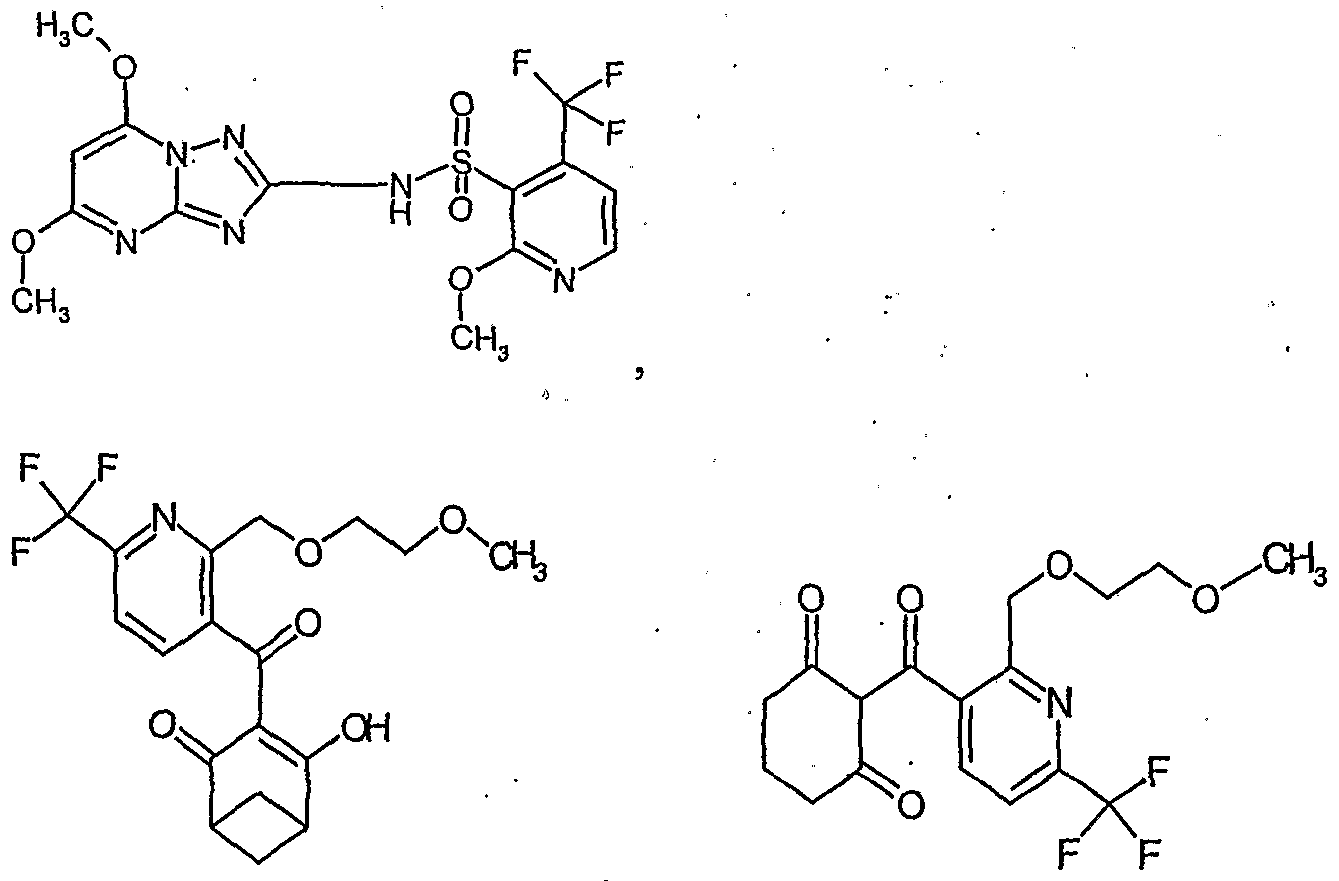
Auch eine Mischung mit anderen bekannten Wirkstoffen, wie Fungiziden, Insektiziden, Akariziden, Nematoziden, Schutzstoffen gegen Vogelfraß, Pflanzennährstoffen und Bodenstruktur- verbesserungsmitteln ist möglich.A mixture with other known active ingredients such as fungicides, insecticides, acaricides, nematocides, bird repellents, plant nutrients and soil conditioners is also possible.
Die Wirkstoffe/Wirkstoffkombinationen können als solche, in Form ihrer Formulierungen oder den daraus durch weiteres Verdünnen bereiteten Anwendungsformen, wie gebrauchsfertige Lösungen, Suspensionen, Emulsionen, Pulver, Pasten und Granulate angewandt werden. Die Anwendung geschieht in üblicher Weise, z.B. durch Gießen, Spritzen, Sprühen, Streuen.The active compounds / active substance combinations can be used as such, in the form of their formulations or the use forms prepared therefrom by further dilution, such as ready-to-use solutions, suspensions, emulsions, powders, pastes and granules. The application is done in the usual way, e.g. by pouring, spraying, spraying, sprinkling.
Die erfindungsgemäßen Wirkstoffe/Wirkstoffkombinationen können sowohl vor als auch nach dem Auflaufen der Pflanzen appliziert werden. Sie können auch vor der Saat in den Boden eingearbeitet werden.The active compounds / active substance combinations according to the invention can be applied both before and after emergence of the plants. They can also be incorporated into the soil before sowing.
Die angewandte Wirkstoffmenge kann in einem größeren Bereich schwanken. Sie hängt im wesentlichen von der Art des gewünschten Effektes ab. Im Allgemeinen liegen die Aufwandmengen zwischen 1 g und 10 kg Wirkstoff pro Hektar Bodenfläche, vorzugsweise zwischen 5 g und 5 kg pro ha.The amount of active ingredient used can vary within a substantial range. It depends essentially on the type of effect desired. In general, the application rates are between 1 g and 10 kg of active ingredient per hectare of soil, preferably between 5 g and 5 kg per ha.
Die erfindungsgemäßen Stoffe/Wirkstoffkombinationen weisen eine starke mikrobizide Wirkung auf und können zur Bekämpfung von unerwünschten Mikroorganismen, wie Fungi und Bakterien, im Pflanzenschutz und im Materialschutz eingesetzt werden.The substances / active substance combinations according to the invention have a strong microbicidal action and can be used for controlling unwanted microorganisms, such as fungi and bacteria, in crop protection and in the protection of materials.
Fungizide lassen sich Pflanzenschutz zur Bekämpfung von Plasmodiophoromycetes, Oomycetes, Chytridiomycetes, Zygomycetes, Ascomycetes, Basidiomycetes und Deuteromycetes einsetzen. Bakterizide lassen sich im Pflanzenschutz zur. Bekämpfung von Pseudomonadaceae, Rhizobiaceae, Enterobacteriaceae, Corynebacteriaceae und Streptpmycetaceae einsetzen.Fungicides can be used for the control of Plasmodiophoromycetes, Oomycetes, Chytridiomycetes, Zygomycetes, Ascomycetes, Basidiomycetes and Deuteromycetes. Bactericides can be used in crop protection. Pseudomonadaceae, Rhizobiaceae, Enterobacteriaceae, Corynebacteriaceae and Streptpmycetaceae.
Beispielhaft aber nicht begrenzend seien einige Erreger von pilzlichen und bakteriellen Erkrankungen, die unter die oben aufgezählten Oberbegriffe fallen, genannt:By way of example but not limitation, some pathogens of fungal and bacterial diseases, which fall under the above-enumerated generic terms, are named:
Xanthomonas-Arten, wie beispielsweise Xanthomonas campestris pv. oryzae;Xanthomonas species, such as Xanthomonas campestris pv. Oryzae;
Pseudomonas-Arten, wie beispielsweise Pseudomonas syringae pv. lachrymans;Pseudomonas species, such as Pseudomonas syringae pv. Lachrymans;
Erwinia-Arten, wie beispielsweise Erwinia amylovora;Erwinia species, such as Erwinia amylovora;
Pythium-Arten, wie beispielsweise Pythium ultimum;Pythium species such as Pythium ultimum;
Phytophthora-Arten, wie beispielsweise Phytophthora infestans;Phytophthora species, such as Phytophthora infestans;
Pseudoperonospora-Arten, wie beispielsweise Pseudoperonospora humuli oderPseudoperonospora species, such as Pseudoperonospora humuli or
Pseudoperonospora cubensis;Pseudoperonospora cubensis;
Plasmopara-Arten, wie beispielsweise Plasmoparaviticola;Plasmopara species, such as Plasmoparaviticola;
Bremia-Arten, wie beispielsweise Bremia lactucae;Bremia species, such as Bremia lactucae;
Peronospora-Arten, wie beispielsweise Peronospora pisi oder P. brassicae;Peronospora species such as Peronospora pisi or P. brassicae;
Erysiphe- Arten, wie beispielsweise Erysiphe graminis;Erysiphe species, such as Erysiphe graminis;
Sphaerotheca-Arten, wie beispielsweise Sphaerotheca fuliginea;Sphaerotheca species, such as Sphaerotheca fuliginea;
Podosphaera-Arten, wie beispielsweise Podosphaera leucotricha;Podosphaera species, such as Podosphaera leucotricha;
Venturia-Arten, wie beispielsweise Venturia inaequalis;Venturia species, such as Venturia inaequalis;
Pyrenophora-Arten, wie beispielsweise Pyrenophora teres oder P. gramineaPyrenophora species, such as, for example, Pyrenophora teres or P. graminea
(Konidienfoπη: Drechsleraj Syn: Helminthosporium);(Konidienfoπη: j Drechslera Syn: Helminthosporium);
Cochliobolus-Arten, wie beispielsweise Cochliobolus sativusCochliobolus species, such as Cochliobolus sativus
(Konidienform: Drechslera, Syn: Helfninthosporium);(Conidia form: Drechslera, Syn: Helfninthosporium);
Uromyces-Arten, wie beispielsweise Uromyces appendiculatus; Puccinia-Arten, wie beispielsweise Puccinia recondita; ' . •Uromyces species, such as Uromyces appendiculatus; Puccinia species, such as Puccinia recondita; '. •
Sclerotinia-Arten, wie beispielsweise Sclerotinia sclerotiorum;Sclerotinia species, such as Sclerotinia sclerotiorum;
Tilletia-Arten, wie beispielsweise Tilletia caries;Tilletia species, such as Tilletia caries;
Ustilago-Arten, wie beispielsweise Ustilago nuda oder Ustilago avenae; ' Ustilago species such as Ustilago nuda or Ustilago avenae; '
Pellicularia-Arten, wie beispielsweise Pellicularia sasakii;Pellicularia species, such as, for example, Pellicularia sasakii;
Pyricularia-Arten, wie beispielsweise Pyricularia oryzae;Pyricularia species, such as Pyricularia oryzae;
Fusarium-Arten, wie beispielsweise Fusarium culmorum;Fusarium species such as Fusarium culmorum;
Bottytis-Arten, wie beispielsweise Botrytis cinerea;Bottytis species such as Botrytis cinerea;
Septoria-Arten, wie beispielsweise Septoria nodorum;Septoria species such as Septoria nodorum;
Leptosphaeria-Arten, wie beispielsweise Leptosphaeria nodorum;Leptosphaeria species, such as Leptosphaeria nodorum;
Cercospora-Arten, wie beispielsweise Cercospora canescens;Cercospora species, such as Cercospora canescens;
Alternaria-Arten, wie beispielsweise Alternaria brassicae;Alternaria species, such as Alternaria brassicae;
Pseudocercosporella-Arten, wie beispielsweise Pseudocercosporella herpotrichoides.Pseudocercosporella species, such as Pseudocercosporella herpotrichoides.
Die erfindungsgemäßen Wirkstoffe/Wirkstoffkombinationen weisen auch eine starke stärkende Wirkung in Pflanzen auf. Sie eignen sich daher zur Mobilisierung pflanzeneigener Abwehrkräfte gegen Befall durch unerwünschte Mikroorganismen.The active compounds / active substance combinations according to the invention also have a strong tonic effect in plants. They are therefore suitable for mobilizing plant-own defenses against attack by unwanted microorganisms.
Unter pflanzenstärkenden (resistenzinduzierenden). Stoffen sind im vorliegenden Zusammenhang solche Substanzen zu verstehen, die in der Lage sind, das Abwehrsystem von Pflanzen so zu stimulieren, dass die behandelten Pflanzen bei nachfolgender Inokolation mit unerwünschten Mikroorgansimen weitgehende Resistenz gegen diese Mirkroorganismen entfalten.Taking plant-strengthening (resistance-inducing). In the present context, substances are substances which are capable of stimulating the defense system of plants in such a way that the treated plants, upon subsequent inoculation with unwanted microorganisms, display extensive resistance to these microorganisms.
Unter unerwünschten Mikroorganismen sind im vorliegenden Fall phytopathogene Pilze, Bakterien und Viren zu verstehen. Die erfmdungsgemäßen Stoffe können also eingesetzt werden, um Pflanzen innerhalb eines gewissen Zeitraumes nach der Behandlung gegen den Befall durch die genannten Schaderreger zu schützen. Der Zeitraum, innerhalb dessen Schutz herbeigeführt wird, erstreckt sich im Allgemeinen von 1 bis 10 Tage, vorzugsweise 1 bis 7 Tage nach der Behandlung der Pflanzen mit den Wirkstoffen. . . . Die gute Pflanzenverträglichkeit der Wirkstoffe/Wirkstoffkombinationen in den zur Bekämpfung von Pflanzenkrankheiten notwendigen Konzentrationen erlaubt eine Behandlung von oberirdischen Pflanzenteilen., von Pflanz- und Saatgut, und des Bodens.Undesirable microorganisms in the present case are phytopathogenic fungi, bacteria and viruses. The inventive materials can therefore be used to protect plants within a certain period of time after treatment against the infestation by the said pathogens. The period within which protection is provided generally extends from 1 to 10 days, preferably 1 to 7 days after the treatment of the plants with the active ingredients. , , , The good plant tolerance of the active compounds / active ingredient combinations in the necessary concentrations for controlling plant diseases allows treatment of aboveground plant parts., Of planting and seed, and the soil.
Die erfindungsgemäßen Wirkstoffe/Wirkstofifkombinationen eignen sich auch zur Steigerung des Ernteertrages. Sie sind außerdem mindertoxisch und weisen eine gute Pflanzenverträglichkeit auf.The active compounds / Wirkstofifkombinationen invention are also suitable for increasing crop yield. They are also low toxicity and have good plant tolerance.
Die erfmdungsgemäßen Wirkstoffe/Wirkstofϊkombinationen können gegebenenfalls in bestimmten Konzentrationen und Aufwandmengen auch als Herbizide, zur Beeinflussung des Pflanzenwachstums, sowie zur Bekämpfung von tierischen Schädlingen verwendet werden. Sie lassen sich gegebenenfalls auch als Zwischen- und Vorprodukte für die Synthese weiterer Wirkstoffe einsetzen.If appropriate, the active compounds / active substance combinations according to the invention can also be used in certain concentrations and application rates as herbicides, for influencing plant growth and for controlling animal pests. If appropriate, they can also be used as intermediates and precursors for the synthesis of other active ingredients.
Im Materialschutz lassen sich die erfindungsgemäßen Stoffe zum Schutz von technischen Materialien gegen Befall und Zerstörung durch unerwünschte Mikroorganismen einsetzen.In the protection of materials, the substances according to the invention can be used to protect industrial materials against infestation and destruction by undesired microorganisms.
Unter technischen Materialien sind im vorliegenden Zusammenhang nichtlebende Materialien zu verstehen, die für die Verwendung in der Technik zubereitet worden sind. Beispielsweise können technische Materialien, die durch erfindungsgemäße Wirkstoffe vor mikrobieller Veränderung oder Zerstörung geschützt werden sollen, Klebstoffe, Leime, Papier und Karton, Textilien, Leder, Holz, Anstrichmittel und Kunststoffartikel, Kühlschmierstoffe und andere Materialien sein, die von Mikroorganismen befallen oder zersetzt werden können, ϊm Rahmen der zu schützenden Materialien seien auch Teile von Produktionsanlagen, beispielsweise Kühlwasserkreisläufe, genannt, die durch Vermehrung von Mikroorganismen beeinträchtigt werden können. Im Rahmen der vorliegenden Erfindung seien als technische Materialien vorzugsweise Klebstoffe, Leime, Papiere und Kartone, Leder, Holz, Anstrichmittel, Kühlschmiermittel und Wärmeübertragungsflüssigkeiten genannt, besonders bevorzugt Holz.Technical materials as used herein mean non-living materials that have been prepared for use in the art. For example, technical materials to be protected from microbial change or destruction by the active compounds of the invention may be adhesives, glues, paper and cardboard, textiles, leather, wood, paints and plastics, coolants, and other materials that may be infested or degraded by microorganisms In the context of the materials to be protected are also parts of production plants, such as cooling water circuits, called, which can be affected by the proliferation of microorganisms. In the context of the present invention, technical materials which may be mentioned are preferably adhesives, glues, papers and cartons, leather, wood, paints, cooling lubricants and heat transfer fluids, particularly preferably wood.
Als Mikroorganismen, die einen Abbau oder eine Veränderung der technischen Materialien bewirken können, seien beispielsweise Bakterien, Pilze, Hefen, Algen und Schleimorganismen genannt. Vorzugsweise wirken die erfindungsgemäßen Wirkstoffe gegen Pilze, insbesondere Schimmelpilze, holzverfärbende und holzzerstörende Pilze (Basidiomyceten) sowie gegen Schleimorganismen und Algen.As microorganisms that can cause degradation or a change in the technical materials, for example, bacteria, fungi, yeasts, algae and mucus organisms may be mentioned. The active compounds according to the invention preferably act against fungi, in particular molds, wood-discolouring and wood-destroying fungi (Basidiomycetes) and against slime organisms and algae.
Es seien beispielsweise Mikroorganismen der folgenden Gattungen genannt:There may be mentioned, for example, microorganisms of the following genera:
Alternaria, wie Altemaria tenuis,Alternaria, like Altemaria tenuis,
Aspergillus, wie Aspergillus niger, Chaetomium, wie Chaetomium globosum, . ' . ■Aspergillus, such as Aspergillus niger, Chaetomium, as Chaetomium globosum,. '. ■
Coniophora, wie Coniophora puetana,Coniophora, like Coniophora puetana,
Lentinus, wie Lentinus tigrinus,Lentinus, like Lentinus tigrinus,
Penicillium, wie Penicillium glaucurα,Penicillium, such as Penicillium glaucurα,
Polyporus, wie Polyporus versicolor,Polyporus, such as Polyporus versicolor,
Aureobasidiuni, wie Aureobasidiutn pullulans,Aureobasidiuni, like Aureobasidiutn pullulans,
Sclerophoma, wie Sclerophoma pityophila,Sclerophoma, such as Sclerophoma pityophila,
Trichoderma, wie Trichoderma viride,Trichoderma, like Trichoderma viride,
Escherichia, wie Escherichia coli,Escherichia, like Escherichia coli,
Pseudomonas, wie Pseudomonas aeruginosa,Pseudomonas, such as Pseudomonas aeruginosa,
Staphylococcus, wie Staphylococcus aureus.Staphylococcus, such as Staphylococcus aureus.
Die Wirkstoffe/Wirkstoffkombinationen können in Abhängigkeit von ihren jeweiligen physikalischen und/oder chemischen Eigenschaften in die üblichen Formulierungen überführt werden, wie Lösungen, Emulsionen, Suspensionen, Pulver, Schäume, Pasten, Granulate, Aerosole, Feinstverkap- seiungen in polymeren Stoffen und in Hüllmassen für Saatgut, sowie ULV-KaIt- und Warmnebel- Formulierungen.Depending on their respective physical and / or chemical properties, the active compounds / active substance combinations can be converted into the customary formulations, such as solutions, emulsions, suspensions, powders, foams, pastes, granules, aerosols, very fine compositions in polymeric substances and in enveloping compositions Seeds, as well as ULV-KaIt and warm mist formulations.
Diese Formulierungen werden in bekannter Weise hergestellt, z.B. durch Vermischen der Wirkstoffe/Wirkstoffkombinationen mit Streckmitteln, also flüssigen Lösungsmitteln, unter Druck stehenden verflüssigten Gasen und/oder festen Trägerstoffen, gegebenenfalls unter Verwendung "von ober- flächenaktiven Mitteln, also Emulgiermitteln und/oder Dispergiermitteln und/oder schaumerzeugenden Mitteln. Im Falle der Benutzung von Wasser als Streckmittel können z.B. auch organische Lösungsmittel als Hilfslösungsmittel verwendet werden. Als flüssige Lösungsmittel kommen im wesentlichen in Frage: Aromaten, wie Xylol, Toluol oder Alkylnaphthaline, chlorierte Aromaten oder chlorierte aliphatische Kohlenwasserstoffe, wie Chlorbenzole, Chlorethylene oder Methylenchlorid, aliphatische Kohlenwasserstoffe, wie Cyclohexan oder Paraffine, z.B. Erdölfraktionen, Alkohole, wie Butanol oder Glycol sowie deren Ether und Ester, Ketone, wie Aceton, Methylethylketon, Methyliso- butylketon oder Cyclohexanon, stark polare Lösungsmittel, wie Dimethylformamid und Dimethyl- sulfoxid, sowie Wasser. Mit verflüssigten gasförmigen Streckmitteln oder Trägerstojffen sind solche Flüssigkeiten gemeint, welche bei normaler Temperatur und unter Normaldruck gasförmig sind, z.B. Aerosol-Treibgase, wie Halogenkohlenwasserstoffe sowie Butan, Propan, Stickstoff und Kohlendioxid. Als feste Trägerstoffe kommen in Frage: z.B. natürliche Gesteinsmehle, wie Kaoline, Tonerden, Talkum, Kreide, Quarz, Attapulgit, Montmorillonit oder Diatomeenerde und synthetische Gesteinsmehle, wie hochdisperse Kieselsäure, Aluminiumoxid und Silikate. Als feste Trägerstoffe für Granulate kommen in Frage: z.B. gebrochene und fraktionierte natürliche Gesteine wie Calcit, Marmor, Bims, Sepiolith, Dolomit sowie synthetische Granulate aus anorganischen und organischen Mehlen sowie Granulate aus organischem Material wie Sägemehl, Kokosnussschalen, Maiskolben und Tabakstängel. Als Emulgier und/oder schaumerzeugende Mittel kommen in Frage: z.B. nicht- ionogene und anionische Emulgatoren, wie Polyoxyethylen-Fettsäureester, Polyoxyethylen-Fettalko- holether, z.B. Alkylarylpolyglycolether, Alkylsulfonate, Alkylsulfate, Arylsulfonate sowie Eiweißhy- drolysate. Als Dispergiermittel kommen in Frage: z.B. Lignin-Sulfitablaugen und Methylcellulose.These formulations are prepared in a known manner, for example by mixing the active compounds / active substance combinations with extenders, ie liquid solvents, liquefied gases under pressure and / or solid carriers, optionally with the use of surface-active agents, ie emulsifiers and / or dispersants and In the case of the use of water as extender, it is also possible to use, for example, organic solvents as auxiliary solvents Suitable liquid solvents are essentially: aromatics, such as xylene, toluene or alkylnaphthalenes, chlorinated aromatics or chlorinated aliphatic hydrocarbons, such as chlorobenzenes , Chloroethylene or methylene chloride, aliphatic hydrocarbons, such as cyclohexane or paraffins, for example petroleum fractions, alcohols, such as butanol or glycol and their ethers and esters, ketones, such as acetone, methyl ethyl ketone, methyl isobutyl ketone or cyclohexanone polar solvents such as dimethylformamide and dimethylsulfoxide, as well as water. With liquefied gaseous extenders or Trägerstojffen are such Liquids are meant which are gaseous at normal temperature and under normal pressure, for example aerosol propellants, such as halogenated hydrocarbons as well as butane, propane, nitrogen and carbon dioxide. Suitable solid carriers are: for example ground natural minerals, such as kaolins, clays, talc, chalk, quartz, attapulgite, montmorillonite or diatomaceous earth, and ground synthetic minerals, such as finely divided silica, alumina and silicates. As solid carriers for granules are: for example, broken and fractionated natural rocks such as calcite, marble, pumice, sepiolite, dolomite and synthetic granules of inorganic and organic flours and granules of organic material such as sawdust, coconut shells, corn cobs and tobacco stems. Suitable emulsifiers and / or foam-formers are: for example nonionic and anionic emulsifiers, such as polyoxyethylene fatty acid esters, polyoxyethylene fatty alcohol ethers, for example alkylaryl polyglycol ethers, alkylsulfonates, alkyl sulfates, arylsulfonates and protein hydrolysates. Suitable dispersants are: for example lignin-sulphite liquors and methylcellulose.
Es können in den Formulierungen Haftmittel wie Carboxymethylcellulose, natürliche und synthetische pulverige, körnige oder latexformige Polymere verwendet werden, wie Gummiarabicum, Polyvinylalkohol, Polyvinylacetat, sowie natürliche Phospholipide, wie Kephaline und Lecithine, und synthetische Phospholipide. Weitere Additive können mineralische und vegetabile Öle sein.Adhesives such as carboxymethyl cellulose, natural and synthetic powdery, granular or latex polymers, such as gum arabic, polyvinyl alcohol, polyvinyl acetate, and natural phospholipids such as cephalins and lecithins, and synthetic phospholipids can be used in the formulations. Other additives may be mineral and vegetable oils.
Es können Farbstoffe wie anorganische Pigmente, z.B. Eisenoxid, Titanoxid, Ferrocyanblau und organische Farbstoffe, wie Alizarin-, Azo- und Metallphthalocyaninfarbstoffe und Spurennährstoffe, wie Salze von Eisen, Mangan, Bor, Kupfer, Kobalt, Molybdän und Zink verwendet werden.Dyes such as inorganic pigments, e.g. Iron oxide, titanium oxide, ferrocyan blue and organic dyes such as alizarin, azo and metal phthalocyanine dyes and trace nutrients such as salts of iron, manganese, boron, copper, cobalt, molybdenum and zinc.
Die Formulierungen enthalten im Allgemeinen zwischen 0,1 und 95 Gewichtsprozent Wirkstoff, vorzugsweise zwischen 0,5 und 90 %.The formulations generally contain between 0.1 and 95% by weight of active ingredient, preferably between 0.5 and 90%.
Die erfindungsgemäßen Wirkstoffe/Wirkstoffkombinationen können als solche oder in ihren Formulierungen auch in Mischung mit bekannten Fungiziden, Bakteriziden, Akariziden, Nematiziden oder Insektiziden verwendet werden, um so z.B. das Wirkungsspektrum zu verbreitern oder Resistenzentwicklungen vorzubeugen. In vielen Fällen erhält man dabei synergistische Effekte, d.h. die Wirksamkeit der Mischung ist größer als die Wirksamkeit der Einzelkomponenten.The active compounds / active substance combinations according to the invention, as such or in their formulations, can also be used in admixture with known fungicides, bactericides, acaricides, nematicides or insecticides, so as to obtain e.g. to broaden the spectrum of action or to prevent development of resistance. In many cases synergistic effects, i. E. the effectiveness of the mixture is greater than the effectiveness of the individual components.
Als Mischpartner kommen zum Beispiel folgende Verbindungen in Frage:Suitable mixing partners are, for example, the following compounds:
Fungizide:fungicides:
2-Phenylphenol; 8-Hydroxyquinolme sulfate; AcibenzoIar-S-methyl; Aldimorph; Amidoflumet; Ampropylfos; Ampropylfos-potassium; Andoprim; Anilazine; Azaconazole; Azoxystrobin;2-phenylphenol; 8-hydroxyquinolium sulfate; AcibenzoIar-S-methyl; aldimorph; amidoflumet; Ampropylfos; Ampropylfos-potassium; andoprim; anilazine; azaconazole; azoxystrobin;
BenalaxyU Benodanil; Benomyl; Benthiavalicarb-isopropyl; Benzamacril; Benzamacril-isobutyl;BenalaxyU Benodanil; benomyl; Benthiavalicarb-isopropyl; Benzamacril; Benzamacril-isobutyl;
■R;iov,*fXc- Uinanacrvl- RinhenvV Bitertanol; Blasticidin-S; Bromuconazόle; Bupirimate; Buthiobate; Butylamine; Calcium polysulfide; Capsimycin; Captafol; Captan; Carbendazim; ■ R ; iov, * fXc-Uinanacrl-RinhenvV Bitertanol; Blasticidin-S; Bromuconazόle; Bupirimate; Buthiobate; butylamine; Calcium polysulfides; capsimycin; captafol; captan; carbendazim;
Carboxin; Carpropamid; Carvone; Chinomethionat; Chlobenthiazone; Chlorfenazole; Chloroneb;carboxin; carpropamid; carvones; chinomethionat; Chlobenthiazone; Chlorfenazole; chloroneb;
Chlorothalonil; Chlozolinate; Clόzylacon; Cyazofamid; Cyflufenamid; Cymoxanil;chlorothalonil; chlozolinate; Clόzylacon; cyazofamid; cyflufenamid; cymoxanil;
Cyproconazole; Cyprodinil; Cyprofαram; Dagget G; Debacarb; Dichlofluanid; Dichlone; Dichlorophen; Diclocymet; Diclomezine; Dicloran; Diethofencarb; Difenoconazole;cyproconazole; cyprodinil; Cyprofαram; Dagget G; debacarb; dichlofluanid; dichlone; dichlorophen; diclocymet; Diclomezine; dicloran; diethofencarb; Difenoconazole;
Diflumetorim; Dimethirimol; 0 Dimethomorph; Dimoxystrobin; Diniconazole; Diniconazole-M;diflumetorim; dimethirimol; 0 dimethomorph; dimoxystrobin; diniconazole; Diniconazole-M;
Dinocap; Diphenylamine; Dipyrithione; Ditalimfos; Dithianon; Dodine; Drazoxolon; Edifenphos;dinocap; diphenylamines; Dipyrithione; Ditalimfos; dithianon; dodine; Drazoxolon; edifenphos;
Epoxiconazolβ; Ethaboxam; Ethirimol; Etridiazole; Famoxadone; Fenamidone; Fenapanil;Epoxiconazolβ; ethaboxam; ethirimol; etridiazole; famoxadone; fenamidone; Fenapanil;
Fenarimol; Fenbuconazole; Fenfuram; Fenhexamid; Fenitropan; Fenoxanil; Fenpiclonil; Fenpropidin; Fenpropimorph; Ferbam; Fluazinam; Flubenzimine; Fludioxonil; Flumetover;fenarimol; Fenbuconazole; fenfuram; fenhexamid; Fenitropan; fenoxanil; fenpiclonil; fenpropidin; fenpropimorph; ferbam; fluazinam; Flubenzimine; fludioxonil; flumetover;
Flumorph; Fluqromide; Fluoxastrobin; Fluquinconazole; Flurprimidol; Fhisilazole; Flusulfamide;flumorph; Fluqromide; fluoxastrobin; fluquinconazole; flurprimidol; Fhisilazole; flusulfamide;
Flutolanil; Flutriafol; Folpet; Fosetyl-Al; Fosetyl-sodium; Fuberidazole; Furalaxyl; Furametpyr;flutolanil; flutriafol; folpet; Fosetyl-Al; Fosetyl-sodium; fuberidazole; furalaxyl; furametpyr;
Furcarbanil; Furmecyclox; Guazatine; Hexachlorobenzene; Hexaconazole; Hymexazol; Imazalil;Furcarbanil; Furmecyclox; guazatine; Hexachlorobenzene; hexaconazole; hymexazol; imazalil;
Imibenconazole; Iminoctadine triacetate; Iminoctadine tris(albesil; Iodocarb; Ipconazole; Iprobenfos; Iprodione; Iprovalicarb; Irumamycin; Isoprothiolane; Isovaledione- Kasugamycin;Imibenconazole; Iminoctadine triacetate; Iminoctadine tris (albesil; iodocarb; ipconazole; Iprobenfos; iprodione; iprovalicarb; irumamycin; isoprothiolane; isovalidione-kasugamycin;
Kresoxim-methyl; Mancozeb; Maneb; Meferimzone; Mepanipyrim; Mepronü; Metalaxyl;Kresoxim-methyl; mancozeb; maneb; Meferimzone; mepanipyrim; Mepronü; metalaxyl;
Metalaxyl-M; Metconazole; Methasulfocarb; Methruroxam; Metiram; Metominostrobin;Metalaxyl-M; metconazole; methasulfocarb; Methruroxam; metiram; metominostrobin;
Metsulfovax; Mildiomycin; Myclobutanil; Myclozolin; Natamycin; Nicobifen; "Nitrotnal- isopropyl; Noviflumuron; Nuarimol; Ofurace; Orysastrobin; Oxadixyl; Oxolinic acid; Oxpoconazole; Oxycarboxin; Oxyfenthiin; Paclobutrazol; Perurazoate; Penconazole; Pencycuron;Metsulfovax; mildiomycin; myclobutanil; myclozoline; natamycin; nicobifen; " Nitrotnalisopropyl; Noviflumuron; Nuarimol; Ofurace; Orysastrobin; Oxadixyl; Oxolinic acid; Oxpoconazole; Oxycarboxin; Oxyfenthiine; Paclobutrazole; Perurazoate; Penconazole; Pencycuron;
Phosdiphen; Phthalide; Picoxystrobin; Piperalin; Polyoxins; Polyoxorim; Probenazole; Prochloraz;phosdiphen; phthalides; picoxystrobin; piperalin; Polyoxins; Polyoxorim; Probenazole; prochloraz;
Procymidone; Propamocarb; Propanosine-sodium; Propiconazole; Propineb; Proquinazid;procymidone; propamocarb; Propanosine-sodium; propiconazole; propineb; proquinazid;
Prothioconazole; Pyraclostrobin; Pyrazophos; Pyrifenox; Pyrimethanil; Pyroquilon; Pyroxyfur;prothioconazole; pyraclostrobin; Pyrazohos; pyrifenox; pyrimethanil; pyroquilon; Pyroxyfur;
Pyrrolnitrine; Quinconazole; Quinoxyfen; Quintozene; Simeconazole; Spiroxamine; Sulfur; Tebuconazole; Tecloftalam; Tecnazene; Tetcyclacis; Tetraconazole; Thiabendazole; Thicyofetv;Pyrrolnitrine; Quinconazole; quinoxyfen; quintozene; Simeconazole; spiroxamine; Sulfur; tebuconazole; tecloftalam; Tecnazene; Tetcyclacis; tetraconazole; thiabendazole; Thicyofetv;
Thifluzamide; Thiophanate-methyl; Thiram; Tioxymid; Tolclofos-methyl; Tolylfluanid;Thifluzamide; Thiophanate-methyl; thiram; Tioxymid; Tolclofos-methyl; tolylfluanid;
Triadimefon; Triadimenol; Triazbutil; Triazoxide; Tricyclamide; Tricyclazole; Tridemorph;triadimefon; triadimenol; Triazbutil; triazoxide; Tricyclamide; Tricyclazole; tridemorph;
Trifloxystrobin; Triflumizole; Triforine; Triticonazole; Uniconazole; Validamycin A; Vinclozolin;trifloxystrobin; triflumizole; triforine; triticonazole; Uniconazole; Validamycin A; vinclozolin;
Zineb; Ziram; Zoxamide; (2S)-N-[2-[4-[[3-(4-chlorophenyl)-2-propynyl]oxy]-3- methoxyphenyl]ethyl]-3-methyl- 2-[(methylsulfonyl)amino]-butanamide; l-(l-naρhthalenyl)-lH- pyrrolβ-2,5-dione; 2,3,5,6-tetrachloro-4-(methylsulfoήyl)-pyridine; 2-amino-4-methyl-N-phenyl-5- thiazolecarboxamide; 2-chloro-N-(2,3-dihydro-l,l,3-trimethyl-lH-inden-4-yl)-3-pyridincarboxam ide ; 3 ,4,5-trichloro-2 ,6-pyridinedicarbonitrile; Actinovate; eis- 1 -(4-chloropheny l)-2-(l H- 1 ,2,4- triazole- 1 -y l)-cycloheptanol; methyl 1 -(2,3 -dihydro-2,2-dimethyl- 1 H-inden- 1 -yl)- 1 H-imidazole-5- carboxylate; monopotassium carbonate; N-Cö-methoxy-S-pyridinyO-cyclopropaneoarboxamide; N- butvl-8-fLl-dimethylethyl)-l-oxaspirof4.51decan-3-amine; Sodium tetrathiocarbonate; . . sowie Kupfersalze und -Zubereitungen, wie Bordeaux mixture; Copper, hydroxide; Copper naphthenate; Copper oxychloride; Copper sulfate; Cufraneb; Cuprous oxide; Mancopper; Oxine- copper.Zineb; ziram; zoxamide; (2S) -N- [2- [4 - [[3- (4-chlorophenyl) -2-propynyl] oxy] -3-methoxyphenyl] ethyl] -3-methyl-2 - [(methylsulfonyl) amino] -butanamide ; 1- (1-naphthalenyl) -1H-pyrrolβ-2,5-diones; 2,3,5,6-tetrachloro-4- (methylsulfoήyl) -pyridine; 2-amino-4-methyl-N-phenyl-5-thiazolecarboxamide; 2-chloro-N- (2,3-dihydro-1,1,3-trimethyl-1H-inden-4-yl) -3-pyridinecarboxam ide; 3, 4,5-trichloro-2, 6-pyridinedicarbonitrile; Actinovate; cis -1- (4-chlorophenyl) -2- (1H-1,2,4-triazole-1-yl) -cycloheptanol; methyl 1 - (2,3-dihydro-2,2-dimethyl-1H-inden-1-yl) -1 H -imidazole-5-carboxylate; monopotassium carbonate; N-COE-methoxy-S-pyridinyO-cyclopropaneoarboxamide; N-but-1-hydroxy-8-dimethyl-dimethyl) -1-oxaspirof4.51decane-3-amine; Sodium tetrathiocarbonate; , , and copper salts and preparations, such as Bordeaux mixture; Copper, hydroxide; Copper naphthenates; Copper oxychloride; Copper sulfate; Cufraneb; Cuprous oxides; mancopper; Oxine-copper.
Bakterizide:bactericides:
Bronopol, Dichlorophen, Nitrapyrin, Mckel-dimethyldithiocarbamat, Kasugamycin, Octhilinon, Furancarbonsäure, Oxytetracyclin, Probenazol, Streptomycin, Tecloftalam, Kupfersulfat und andere Kupfer-Zubereitungen.Bronopol, dichlorophen, nitrapyrin, myche dimethyldithiocarbamate, kasugamycin, octhilinone, furancarboxylic acid, oxytetracycline, probenazole, streptomycin, tecloftalam, copper sulphate and other copper preparations.
Insektizide / Akarizide / Nematizide:Insecticides / acaricides / nematicides:
Abamectin, ABG-9008, Acephate, Acequinocyl, Acetamiprid, Acetoprole, Acrinathrin, AKD- 1022, AKD-3059, AKD-3088, Alanycarb, Aldicarb, Aldoxycarb, Ailethrin, Allethrin lR-isomers5 Alpha-Cypermethrin (Alphamethrin), Amidoflumet, Aminocarb, Amitraz, Avermectin, AZ-60541, Azadirachtin, Azamethiphos, Azinphos-methyl, Azinphos-ethyl, Azocyclotin,Abamectin, ABG-9008, Acephate, Acequinocyl, Acetamipride, Acetoprole, Acrinathrin, AKD-1022, AKD-3059, AKD-3088, Alanycarb, Aldicarb, Aldoxycarb, Ailethrin, Allethrin IR-isomers 5 Alpha Cypermethrin (alpha-methine), Amidoflumet, Aminocarb, amitraz, avermectin, AZ-60541, azadirachtin, azamethiphos, azinphos-methyl, azinphos-ethyl, azocyclotin,
Bacillus popilliae, Baciilus sphaericus, Bacillus subtilis, Bacillus thuringiensis, Bacillus thurin- giensis strain EG-2348, Bacillus thuringiensis strain GC-91, Bacillus thuringiensis strain NCTC- 11821, Baculoviren, Beauveria bassiana, Beauveria tenella, Bendiocarb, Benfuracarb, Bensultap, Benzoximate, Beta-Cyfluthrin, Beta-Cypermethrin, Bifenazate, Bifenthrin, Binapacryl, Bio- allethrin, Bioallethrin-S-cyclopentyl-isomer, Bioethanomethrin, Biopermethrin, Biorestnethrin, Bistrifluron, BPMC, Brofenprox, Bromophos-ethyl, Bromopropylate, Bromfenvinfos (-methyl), BTG-504, BTG-505, Bufencarb, Buprofezin, Butathiofos, Butocarboxim, Butoxycarboxim, Butyl- pyridaben,Bacillus popilliae, Bacillus sphaericus, Bacillus subtilis, Bacillus thuringiensis, Bacillus thurin giensis strain EG-2348, Bacillus thuringiensis strain GC-91, Bacillus thuringiensis strain NCTC-11821, baculoviruses, Beauveria bassiana, Beauveria tenella, Bendiocarb, Benfuracarb, Bensultap, Benzoximate , Beta-Cyfluthrin, Beta-Cypermethrin, Bifenazate, Bifenthrin, Binapacryl, Bio-allethrin, Bioallethrin-S-cyclopentyl-isomer, Bioethanomethrin, Biopermethrin, Biorestnethrin, Bistrifluron, BPMC, Brofenprox, Bromophos-ethyl, Bromopropylate, Bromfenvinfos (-methyl) , BTG-504, BTG-505, Bufencarb, Buprofezin, Butathiofos, Butocarboxim, Butoxycarboxim, Butylpyridaben,
Cadusafos, Camphechlor, Carbaryl, Carbofuran, Carbophenothion, Carbosulfan, Cartap, CGA- 50439, Chinomethionat, Chlordane, Chlordimeform, Chloethocarb, Chlorethoxyfos, Chlorfenapyr, Chlorfenvinphos, Chlorfluazuron, Chlormephos, Chlorobenzilate, Chloropicrin, Chlorproxyfen, Chlorpyrifos-methyl, Chlorpyrifos (-ethyl), Chlovaporthrin, Chromafenozide, Cis-Cypermethrin, Cis-Resmethrin, Cis-Permethrin, Clocythrin, Cloethocarb, Clofentezine, Clothianidin, Clothiazo- ben, Codlemone, Coumaphos, Cyanofenphos, Cyanophos, Cycloprene, Cycloprothrin, Cydia pomonella, Cyfluthrin, Cyhalothrin, Cyhexatin, Cypermethrin, Cyphenothrin (IR-trans-isomer), Cyromazine,Cadusafos, camphechlor, carbaryl, carbofuran, carbophenothione, carbosulfan, cartap, CGA-50439, quinomethionate, chlordane, chlordimeform, chloethocarb, chloroethoxyfos, chlorfenapyr, chlorfenvinphos, chlorofluorazuron, chlormephos, chlorobenzilate, chloropicrin, chlorproxyfen, chlorpyrifos-methyl, chlorpyrifos (-ethyl ), Chlovaporthrin, chromafenozide, cis-cypermethrin, cis-resmethrin, cis-permethrin, clocthrin, cloethocarb, clofentezine, clothianidin, clothiazo, codlemone, coumaphos, cyanofenphos, cyanophos, cycloprene, cycloprothrin, cydia pomonella, cyfluthrin, cyhalothrin, cyhexatin , Cypermethrin, cyphenothrin (IR-trans-isomer), cyromazine,
DDT, Deltamethrin, Demeton-S-methyl, Demeton-S-methylsulphon, Diafenthiuron, Dialifos, Di- azinon, Dichlofenthion, Dichlorvos, Dicpfol, Dicrotophos, Dicyclanil, Diflubenzuron, Dimethoate, Dimethylvinphos, Dinobuton, Dinocap, Dinotefuran, Diofenolan, Disulfoton, . Docusat-sodium, Dofenapyn, DOWCO-439, Eflusilanate, Emamectin, Emamectin-benzoate, Einpenthrin (lR-isomer), Endosulfan, Entomo- pthora spp., EPN, Esfenvalerate, Ethiofencarb, Ethiprole, Ethion, Ethoprophos, Btofenprox, Etox- azole, Etrimfos,DDT, deltamethrin, demeton-S-methyl, demeton-S-methylsulphone, diafenthiuron, dialifos, diacinone, dichlofenthione, dichlorvos, dicpfol, dicrotophos, dicyclanil, diflubenzuron, dimethoates, dimethylvinphos, dinobutone, dinocap, dinotefuran, diofenolane, disulfone, , Docusate-sodium, Dofenapine, DOWCO-439, Eflusilanate, Emamectin, Emamectin benzoate, Einpenthrin (IR isomer), Endosulfan, Entomopthora spp., EPN, Esfenvalerate, Ethiofencarb, Ethiprole, Ethion, Ethoprophos, Btofenprox, Etoxazole, Etrimfos,
Famphur, Fenamiphos, Fenazaquin, Fenbutatin oxide, Fenfluthrin, Fenitrothion, Fenobucarb, Fenothiocarb, Fenoxacrim, Fenoxycarb, Fetipropathrin, Fenpyrad, Fenpyrithrin, Fenpyroximate, Fensulfothion, Fen.tb.ion, Fentrifanü, Fenvaierate, Fipronil, Flonicamid, Fluacrypyrim, Fluazuron, Flubenzimine, Flubrocythrinate, Flucycloxuron, Flucythrinate, Flufenerim, Flufenoxuron, Fiufen- prox, Flumethrin, Flupyrazofos, Flutenzin (Flufenzine), Fluvalinate, Fonofos, Formetanate, Formo- thion, Fosmethilan, Fosthiazate, Fubfenprox (Fluproxyfen), Furathiocarb,Famphur, Fenamiphos, Fenazaquin, Fenbutatin oxide, Fenfluthrin, Fenitrothion, Fenobucarb, Fenothiocarb, Fenoxacrim, Fenoxycarb, Fetipropathrin, Fenpyrad, Fenpyrithrin, Fenpyroximate, Fensulfothion, Fen.tb.ion, Fentrifanu, Fenvaierate, Fipronil, Flonicamid, Fluacrypyrim, Fluazuron, Flubenzimine , Flubrocythrinate, Flucycloxuron, Flucythrinate, Flufenerim, Flufenoxuron, Fiufen- prox, Flumethrin, Flupyrazofos, Flutenzine (Flufenzine), Fluvalinate, Fonofos, Formetanate, Formothion, Fosmethilane, Fosthiazate, Fubfenprox (Fluproxyfen), Furathiocarb,
Gamma-HCH, Gossyplure, Grandlure, Granuloseviren,Gamma-HCH, Gossyplure, Grandlure, Granuloseviruses,
Halfenprox, Halofenozide, HCH, HCN-801, Heptenophos, Hexaflumuron, Hexythiazox, Hydra- methylnone, Hydroprene,Halfenprox, Halofenozide, HCH, HCN-801, Heptenophos, Hexaflumuron, Hexythiazox, Hydra-methylnone, Hydroprene,
IKA-2002, Imidacloprid, Imiprothrin, Indoxacarb, lodofenphos, Iprobenfos, Isazofos, Isofenphos, Isoprocarb, Isoxathion, Ivermectin,IKA-2002, imidacloprid, imiprothrin, indoxacarb, iodofenphos, Iprobenfos, isazofos, isofenphos, isoprocarb, isoxathione, ivermectin,
Japonilure,Japonilure,
Kadethrin, Kernpolyederviren, Kinoprene,Kadethrin, nuclear poly-derviruses, kinoprene,
Lambda-Cyhalothrin, Lindane, Lufenuron,Lambda-Cyhalothrin, Lindane, Lufenuron,
Malathion, Mecarbam, Mesulfenfos, Metaldehyd, Metam-sodium, Methacrifos, Methamidophos, Metharhizium anisopliae, Metharhizium flavoviride, Methidathion, Methiocarb, Methomyl, Methoprene, Methoxychlor, Methoxyfenozide, Metolcarb, Metoxadiazonβ, Mevinphos, Milbe- mectin, Milbemycin, MKI-245, MON-45700, Monocrotophos, Moxidectin, MTI-800,Malathion, mecarbam, mesulfenfos, metaldehyde, metam-sodium, methacrifos, methamidophos, metharhizium anisopliae, metharhizium flavoviride, methidathion, methiocarb, methomyl, methoprene, methoxychlor, methoxyfenozide, metolcarb, metoxadiazonβ, mevinphos, milblectin, milbemycin, MKI-245, MON-45700, monocrotophos, moxidectin, MTI-800,
Naled, NC-104, NC-170, NC-184, NC-194, NC-196, Niclosamide, Nicotine, Nitenpyram, Ni- thiazine, NNI-0001, NNI-0101, NNI-0250, NNI-9768, Novaluron, Noviflumuron,Naled, NC-104, NC-170, NC-184, NC-194, NC-196, Niclosamide, Nicotine, Nitenpyram, Nithiazines, NNI-0001, NNI-0101, NNI-0250, NNI-9768, Novaluron, Noviflumuron,
OK-5101, OK-5201, OK-9601, OK-9602, OK-9701, OK-9802, Qmethoate, Oxamyl, Oxydemeton- methyl,OK-5101, OK-5201, OK-9601, OK-9602, OK-9701, OK-9802, Qmethoate, Oxamyl, Oxydemeton-methyl,
Paecilornyces fumosoroseus, Parathion-methyl, Parathion (-ethyl), Permethrin (eis-, trans-), Petroleum, PH-6045, Phenothrin (lR-trans isomer), Phenthoate, Phorate, Phosalone, Phosmet, Phosphamidon, Phosphöcarb, Phoxim, Piperonyl butoxidfe, Pirimicarb, Pirimiphos-methyl, Pϊrimi- phos-ethyl, Prallethrin, Profenofos, Promecarb, Propaphos, Propargite, Propetarhphos, Propoxur, Prothiofos, Prothoate, Protrifenbute, Pymetrozine, Pyraclofos, Pyresmethrin, Pyrethrum, Pyridaben, Pyridalyl, Pyridaphenthion, Pyridathion, Pyrimidifen, Pyriproxyfen,Paecilornyces fumosoroseus, parathion-methyl, parathion (-ethyl), permethrin (cis-, trans-), petroleum, PH-6045, phenothrin (IR trans isomer), phenthoates, phorates, phosalones, phosmet, phosphamidone, phosphocarb, phoxim, Piperonyl butoxide, pirimicarb, pirimiphos-methyl, pyrimi-ethyl, prallethrin, profenofos, promecarb, propaphos, propargite, propetarphos, propoxur, Prothiofos, prothoates, protrifenebutene, pymetrozines, pyraclofos, pyresmethrin, pyrethrum, pyridaben, pyralidyl, pyridapenthione, pyridathione, pyrimidifen, pyriproxyfen,
Quinalphos,quinalphos,
Resmethrin, RH-5849, Ribavirin, RU-12457, RU-15525,Resmethrin, RH-5849, Ribavirin, RU-12457, RU-15525,
S-421, S-1833, Salithion, Sebufos, SI-0009, Silafluofen, Spinosad, Spirodiclofen, Spiromesifen, Sulfluramid, Sulfotep, Sulprofos, SZI-121,S-421, S-1833, Salithion, Sebufos, SI-0009, Silafluofen, Spinosad, Spirodiclofen, Spiromesifen, Sulfluramid, Sulfotep, Sulprofos, SZI-121,
Tau-Flυvalinate, Tebufenozide, Tebufenpyrad, Tebupirimfos, Teflubenzuron, Tefluthrin, Teme- phos, Temivinphos, Terbam, Terbufos, Tetrachlorvinphos, Tetradifon, Tetramethrin, Tetramethrin (lR-isomer), Tetrasul, Theta-Cypermethrin, Thiacloprid, Thiamethoxam, Thiapronil, Thiatriphos, Thiocyclam hydrogen Oxalate, Thiodicarb, Thiofanox, Thiometon, Thiosultap-sodium, Thuringiensin, Tolfenpyrad, Tralocythrin, Tralomethrin, Transfluthrin, Triarathene, Triazamate, Triazophos, Triazuron, Trichlophenidine, Trichlorfon, Triflumuron, Trimethacarb,Tau flavalenates, tebufenozides, tebufenpyrad, tebupirimfos, teflubenzuron, tefluthrin, temphos, temivinphos, terbam, terbufos, tetrachlorvinphos, tetradifon, tetramethrin, tetramethrin (lR isomer), tetrasul, theta-cypermethrin, thiacloprid, thiamethoxam, thiapronil, thiatriphos , Thiocyclam hydrogen oxalates, thiodicarb, thiofanox, thiometone, thiosultap-sodium, thuringiensin, tolfenpyrad, tralocythrin, tralomethrin, transfluthrin, triarathene, triazamates, triazophos, triazuron, trichlophenidines, trichlorfone, triflumuron, trimethacarb,
Vamidothion, Vaniliprole, Verbutin, Verticillium lecanü,Vamidothion, Vaniliprole, Verbutin, Verticillium lecanü,
WL-108477, WL-40027,WL-108477, WL-40027,
Y1-5201, Υ1-5301, ΥΪ-5302,Y1-5201, Υ1-5301, ΥΪ-5302,
XMC, Xytylcarb,XMC, xytylcarb,
ZA-3274, Zeta-Cypermethrin, Zolaprofos, ZXI-8901,ZA-3274, zeta-cypermethrin, zolaprofos, ZXI-8901,
die Verbindung 3-Methyl-phenyl-propylcarbamat (Tsumacide Z),the compound 3-methyl-phenyl-propylcarbamate (Tsumacide Z),
die Verbindung 3-(5-Chlor-3-pyridinyl)-8-(2,2,2-trifluorethyl)-8-azabicyclo[3.2. l]octan-3- carbonitril (CAS-Reg.-Nr. 185982-80-3) und das entsprechende 3-endo-Isomere (CAS-Reg.-Nr. 185984-60-5) (vgl. WO-96/37494, WO-98/25923),the compound 3- (5-chloro-3-pyridinyl) -8- (2,2,2-trifluoroethyl) -8-azabicyclo [3.2. l] octane-3-carbonitrile (CAS Reg. No. 185982-80-3) and the corresponding 3-endo isomer (CAS Reg. No. 185984-60-5) (see WO-96 / 37494, WO-98/25923),
sowie Präparate, welche insektizid wirksame Pflanzenextrakte, Nematoden, Pilze oder Viren enthalten. . ' and preparations containing insecticidal plant extracts, nematodes, fungi or viruses. , '
Auch eine Mischung mit anderen bekannten Wirkstoffen, wie Herbiziden oder mit Düngemitteln und Wachstumsregulatoren ist möglich.A mixture with other known active substances, such as herbicides or with fertilizers and growth regulators is possible.
Darüber hinaus weisen die erfindungsgemäßen Verbindungen der Formel (iyWirkstoff- kombinationen auch sehr gute antimykotische Wirkungen auf. Sie besitzen ein sehr, breites anti- mykotisches Wirkungsspektrum, insbesondere gegen Dermatophyten und Sprosspilze, Schimmel und diphasische Pilze (z.B. gegen Candida-Spezies wie Candida albicans, Candida glabrata) sowie Epidermophyton floccosum, Aspergillus-Spezies wie Aspergillus niger und Aspergillus fumi- gatus, Trichophyton-Spezies wie Trichophyton mentagrophytes,In addition, the compounds of the formula (I) combination of active compounds according to the invention also have very good antifungal effects. mycotic spectrum of activity, in particular against dermatophytes and yeasts, mold and diphasic fungi (for example against Candida species such as Candida albicans, Candida glabrata) as well as Epidermophyton floccosum, Aspergillus species such as Aspergillus niger and Aspergillus fumigatus, Trichophyton species such as Trichophyton mentagrophytes,
Microsporon-Spezies wie Microsporon canis und audouinii. Die Aufzählung dieser Pilze stellt keinesfalls eine Beschränkung des erfassbaren mykotischen Spektrums dar, sondern hat nur erläuternden Charakter.Microsporon species such as Microsporon canis and audouinii. The list of these fungi is by no means a limitation of the detectable mycotic spectrum, but has only an explanatory character.
Die Wirkstoffe/Wirkstoffkombinationen können als solche, in Form ihrer Formulierungen oder den daraus bereiteten Anwendungsformen, wie gebrauchsfertige Lösungen, Suspensionen, Spritzpulver, Pasten, lösliche Pulver, Stäubemittel und Granulate angewendet werden. Die Anwendung geschieht in üblicher Weise, z.B. durch Gießen, Verspritzen, Versprühen, Verstreuen, Verstäuben, Verschäumen, Bestreichen usw. Es ist ferner möglich, die Wirkstoffe nach dem Ultra-Low- Volume- Verfahren auszubringen oder die Wirkstoffzubereitung oder den Wirkstoff selbst in den Boden zu injizieren. Es kann auch das Saatgut der Pflanzen behandelt werden.The active compounds / active substance combinations can be used as such, in the form of their formulations or the use forms prepared therefrom, such as ready-to-use solutions, suspensions, wettable powders, pastes, soluble powders, dusts and granules. The application is done in the usual way, e.g. by pouring, spraying, spraying, scattering, dusting, foaming, brushing, etc. It is also possible to apply the active ingredients by the ultra-low-volume method or to inject the active ingredient preparation or the active ingredient itself into the soil. It can also be the seed of the plants to be treated.
Beim Einsatz der erfϊndungsgemäßen Wirkstoffe/Wirkstoffkombinationen als Fungizide können die Aufwandmengen je nach Applikationsart innerhalb eines größeren Bereiches variiert werden. Bei der Behandlung von Pflanzenteilen liegen die Aufwandmengen an Wirkstoff im Allgemeinen zwischen 0,1 und 10.000 g/ha, vorzugsweise zwischen 10 und 1.000 g/ha. Bei der Saatgutbehandlung liegen die Aufwandmengen an Wirkstoff im Allgemeinen zwischen 0,001 und 50 g pro Kilogramm Saatgut, vorzugsweise zwischen 0,01 und 10 g pro Kilogramm Saatgut. Bei der Behandlung des Bodens liegen die Aufwandmengen an Wirkstoff im Allgemeinen zwischen 0,1 und 10.000 g/ha, vorzugsweise zwischen 1 und 5.000 g/ha.When using the active compounds / active substance combinations according to the invention as fungicides, the application rates can be varied within a relatively wide range, depending on the mode of administration. In the treatment of parts of plants, the application rates of active ingredient are generally between 0.1 and 10,000 g / ha, preferably between 10 and 1,000 g / ha. In the case of seed treatment, the application rates of active ingredient are generally between 0.001 and 50 g per kilogram of seed, preferably between 0.01 and 10 g per kilogram of seed. In the treatment of the soil, the application rates of active ingredient are generally between 0.1 and 10,000 g / ha, preferably between 1 and 5,000 g / ha.
Die Herstellung und die Verwendung der erfmdungsgemäßen Wirkstoffe/Wirkstoffkombinationen geht aus den nachfolgenden Beispielen hervor. The preparation and the use of the active compounds / active substance combinations according to the invention are evident from the following examples.
HerstellungsbeispielePreparation Examples
Beispiel I-l-a-1Example I-1-a-1
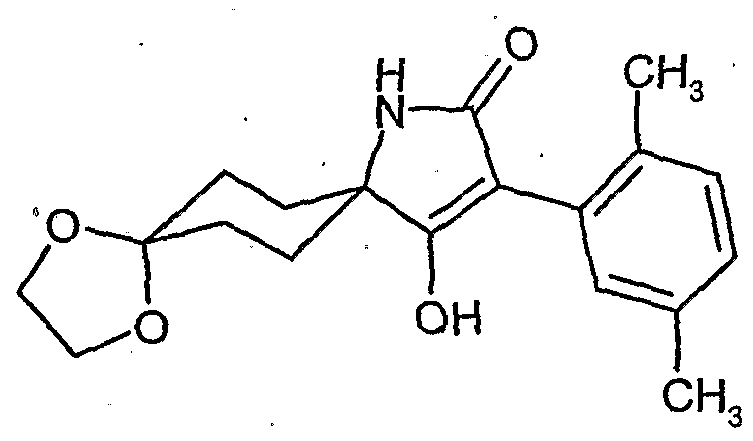
4.88 g (0.042 Mol) Kalium-tert-butylat werden in 13 ml wasserfreiem Dimethylformamid (DMF) 5 vorgelegt und bei 6O0C tropft man 6.82 g gemäß Beispiel II- 1 in 14 ml wasserfreiem DMF zu und rührt bei 8O0C unter dünnschichtchromatographischer Kontrolle.4.88 g (0.042 mol) of potassium tert-butoxide are placed in 13 ml of anhydrous dimethylformamide (DMF) 5 and 6O 0 C is added dropwise to 6.82 g according to Example II- 1 in 14 ml of anhydrous DMF and stirred at 8O 0 C under thin-layer chromatography Control.
Nach Reaktionsende gibt man die Reaktionslösung auf 150 ml Eiswasser und säuert bei 0 bis 100C mit konzentrierter Salzsäure auf pH=2 an, saugt den Niederschlag ab, wäscht mit Eiswasser nach und trocknet anschließend. Es erfolgt säulenchromatographische Reinigung an Kieselgel (Dichlor- 10 methan/Aceton = 5:1).After the reaction, the reaction solution is added to 150 ml of ice water and acidified at 0 to 10 0 C with concentrated hydrochloric acid to pH = 2, the precipitate is filtered off with suction, washed with ice water and then dried. It is purified by column chromatography on silica gel (dichloro-10 methane / acetone = 5: 1).
: Ausbeute: 2,5 g (40 % d. Theorie), Fp. 2330C. Yield: 2.5 g (40% of theory), mp 233 ° C.
Beispiel I-l-a-8Example I-1-a-8
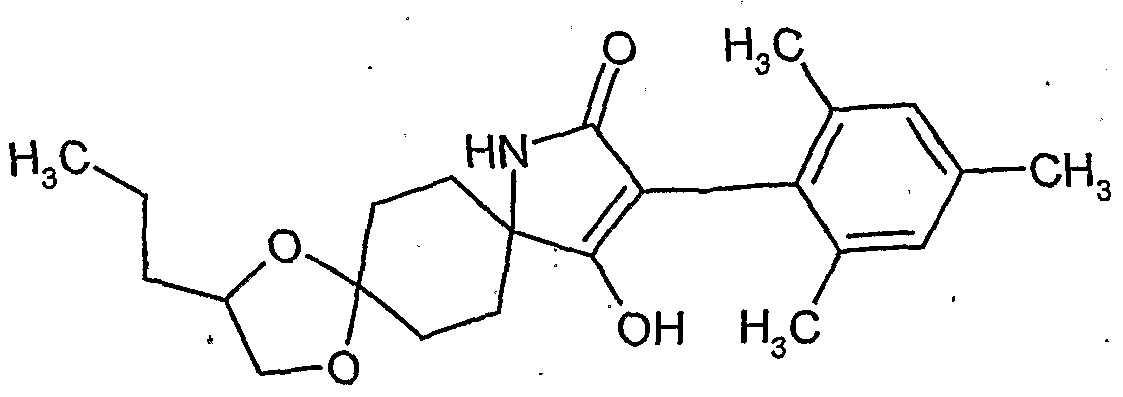
0,644 g (2 mmol) der Verbindung gemäß Beispiel XIV-I -1 werden unter Argon-Schutzgas in 30 ml Xylol vorgelegt, bei Raumtemperatur mit 2.083 g (20 mmol) 1,2-Pentandiol und 0,059 g (0,29 mmol) p-Toluolsulfonsäure versetzt und ca. 0,5 g Mol-Sieb 4 A° (Pulver) zugegeben und drei Tage unter Rückfluss und dünnschichtchromatographischer Kontrolle gerührt.0.644 g (2 mmol) of the compound according to Example XIV-I -1 are introduced under argon protective gas in 30 ml of xylene, at room temperature with 2,083 g (20 mmol) of 1,2-pentanediol and 0.059 g (0.29 mmol) p Toluene sulfonic acid added and about 0.5 g of molecular sieve 4 A ° (powder) was added and stirred for three days under reflux and thin-layer chromatography control.
Nach Reaktionsende wird das Lösungsmittel abdestilliert. Es erfolgt säulenchromatographische Reinigung an Kieselgel (Dichlomethan/Aceton = 5:1).After the end of the reaction, the solvent is distilled off. It is purified by column chromatography on silica gel (dichloromethane / acetone = 5: 1).
Ausbeute: 0,27 g(£ 35 % d. Theorie), Fp. 2730C. Yield: 0.27 g (35% of theory), mp 273 ° C.
In Analogie zu Beispiel (I-l-a-1) und gemäß den allgemeinen Angaben zur Herstellung erhält man folgende Verbindungen der Formel (I- 1-a)In analogy to Example (I-1-a-1) and in accordance with the general information on the preparation, the following compounds of the formula (I-1-a) are obtained:
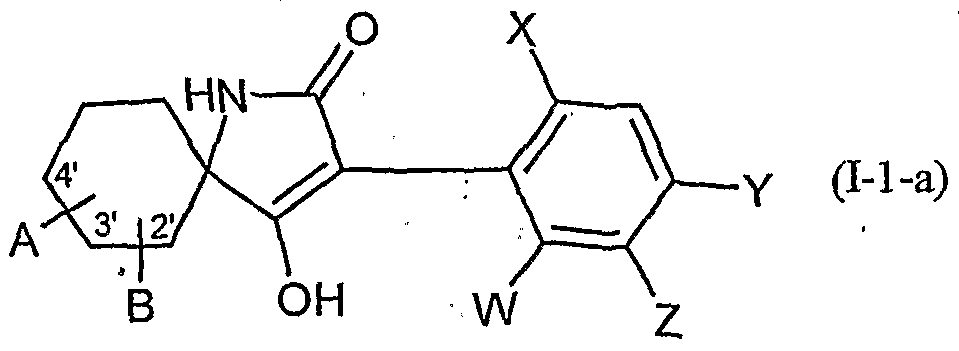
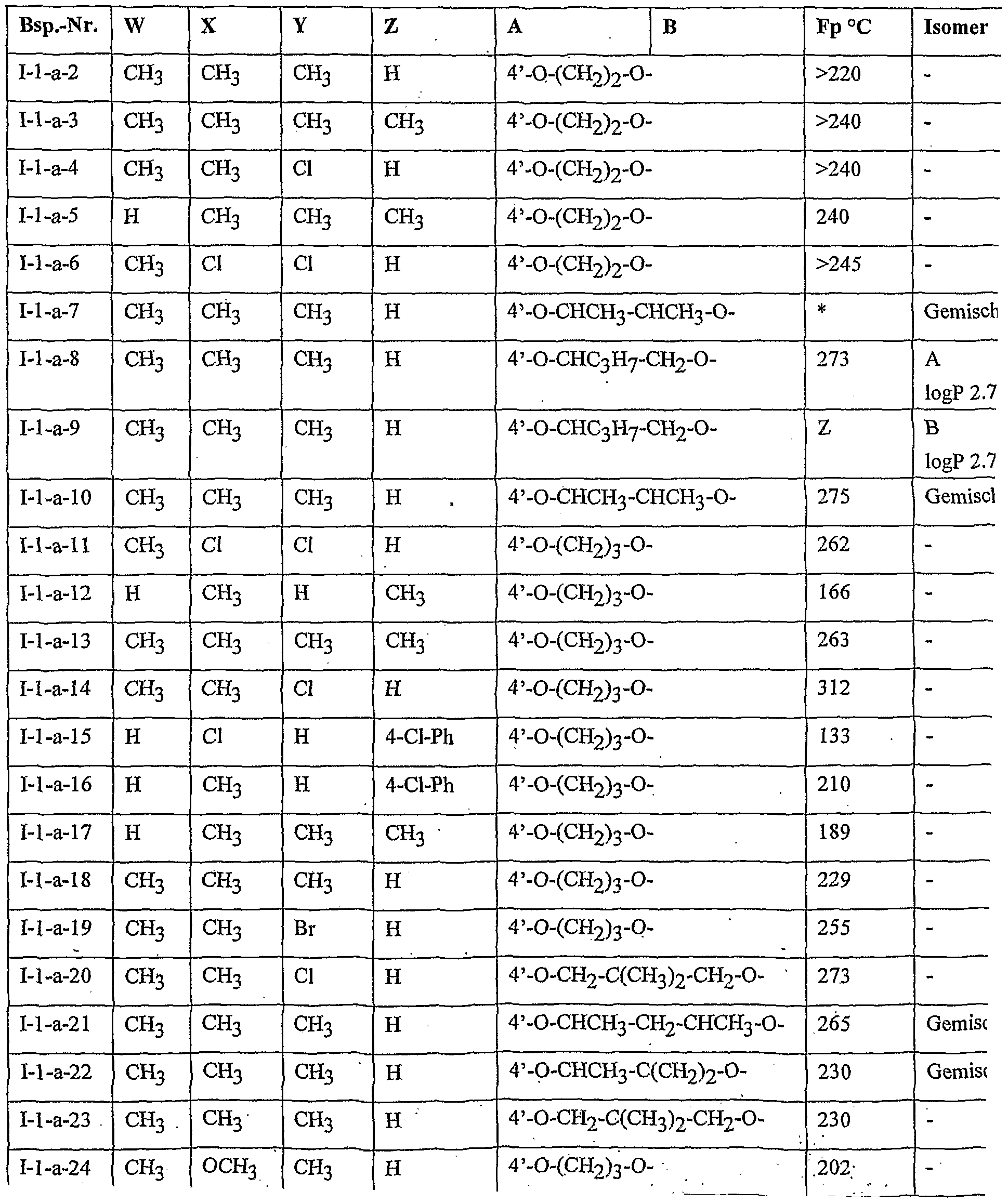
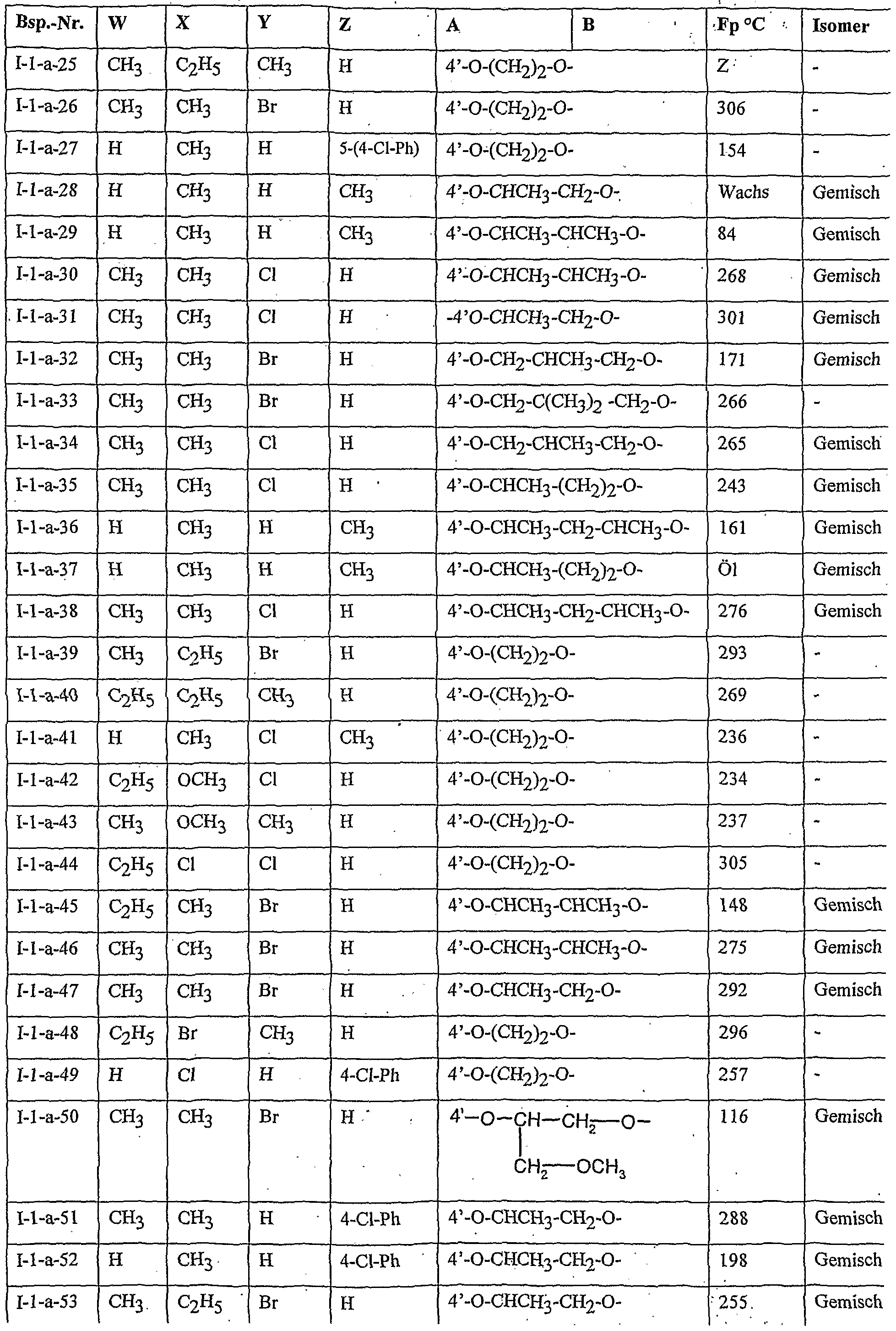
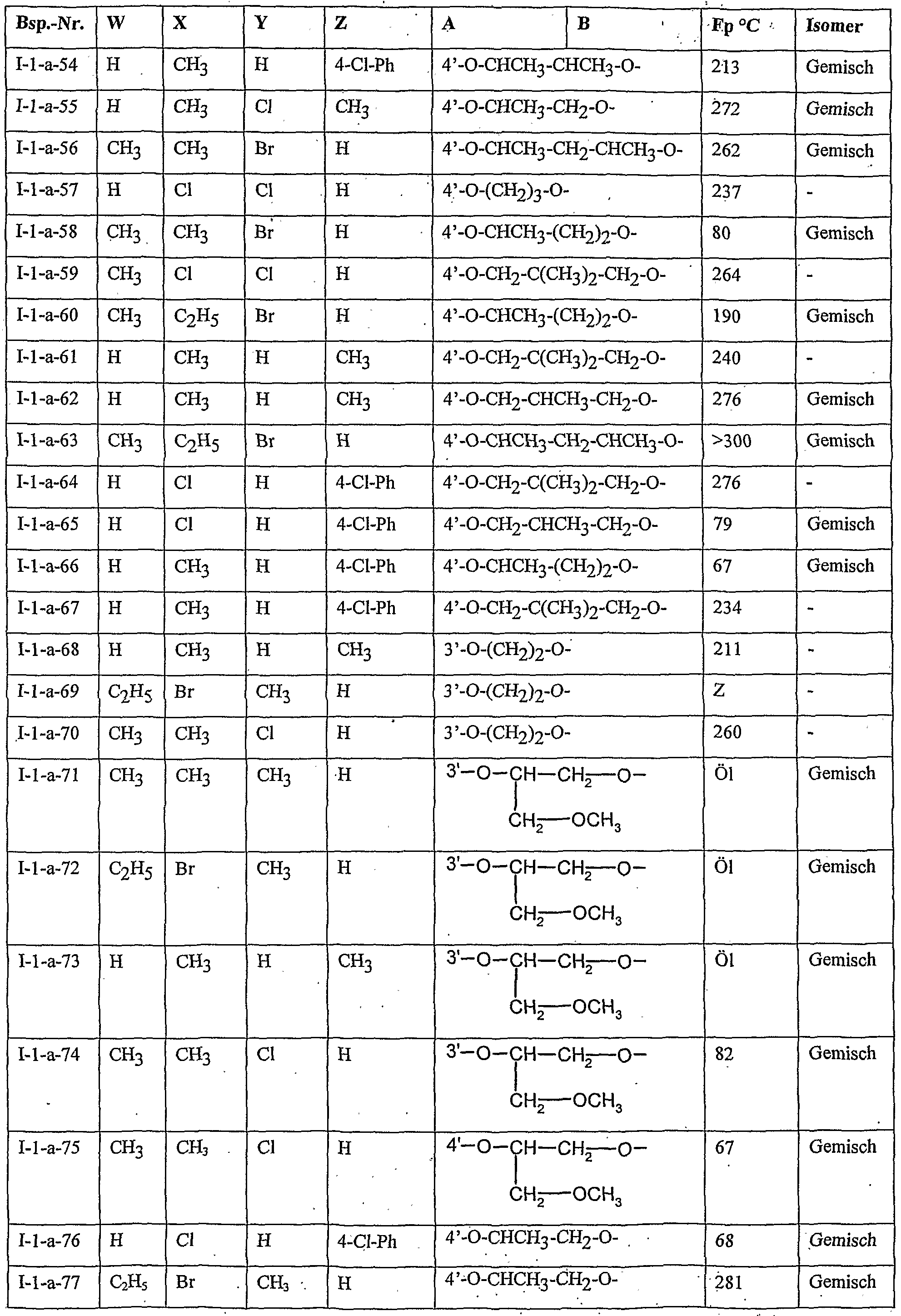

* H-NMR ( 400 MHz, d6-DMSO): δ = 1.05-1.09 (2d, 6H, 2xCHCH3); 4.18-4.23 (m, 2H,1 H-NMR (400 MHz, d 6 -DMSO): δ = 1.05-1.09 (2d, 6H, 2xCHCH 3 ); 4.18-4.23 (m, 2H,
2xCHCH3) ppm Z = Zersetzung2xCHCH 3 ) ppm Z = decomposition

Beispiel I-l-b-1Example I-1-b-1

1.82 g der Verbindung gemäß Beispiel I-l-a-4 werden in 50 ml wasserfreiem Essigsäureethylester und 0,77 ml (5.5 mmol) Triethylamin unter Rückfluss vorgelegt. Man gibt 0,55 ml (0.0055 Mol) Isobuttersäurechlorid in 5 ml wasserfreiem Essigsäureethylester zu und rührt unter Rückfluss.1.82 g of the compound according to Example I-1-a-4 are initially charged in 50 ml of anhydrous ethyl acetate and 0.77 ml (5.5 mmol) of triethylamine under reflux. Add 0.55 ml (0.0055 mol) of isobutyric acid chloride in 5 ml of anhydrous ethyl acetate and stir under reflux.
Nach Abschluss der Reaktion (dünnschichtchromatographische Kontrolle) wird das Lösungsmittel abdestilliert und der Rückstand in Dichlormethan aufgenommen. Man wäscht 2 mal mit 30 ml 0.5 N NaOH, trocknet und destilliert das Lösungsmittel ab.After completion of the reaction (thin-layer chromatography), the solvent is distilled off and the residue taken up in dichloromethane. It is washed twice with 30 ml of 0.5 N NaOH, dried and the solvent is distilled off.
Es erfolgt säulenchromatographische Reinigung an Kieselgel (Dichlormethan/Essigsäureethylester = 3:1).It is purified by column chromatography on silica gel (dichloromethane / ethyl acetate = 3: 1).
Ausbeute: 0,3 g (14 % d. Theorie), Fp. 215°C Yield: 0.3 g (14% of theory), mp 215 ° C
In Analogie zu Beispiel (I-l-b-1) und gemäß den allgemeinen Angaben zur Herstellung erhält man folgende Verbindungen der Formel (I-l-b)In analogy to Example (I-1-b-1) and in accordance with the general information on the preparation, the following compounds of the formula (I-1-b) are obtained

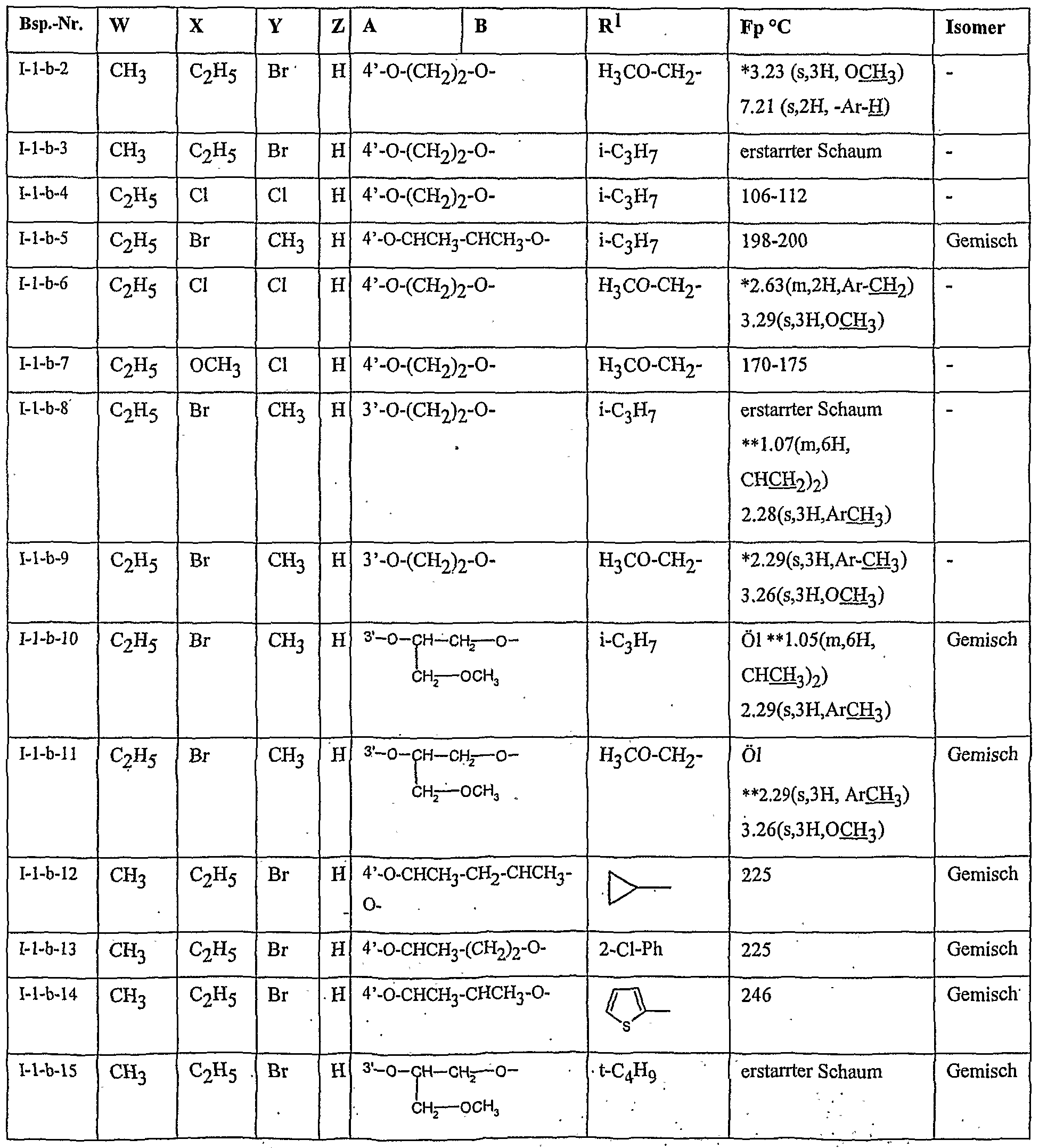
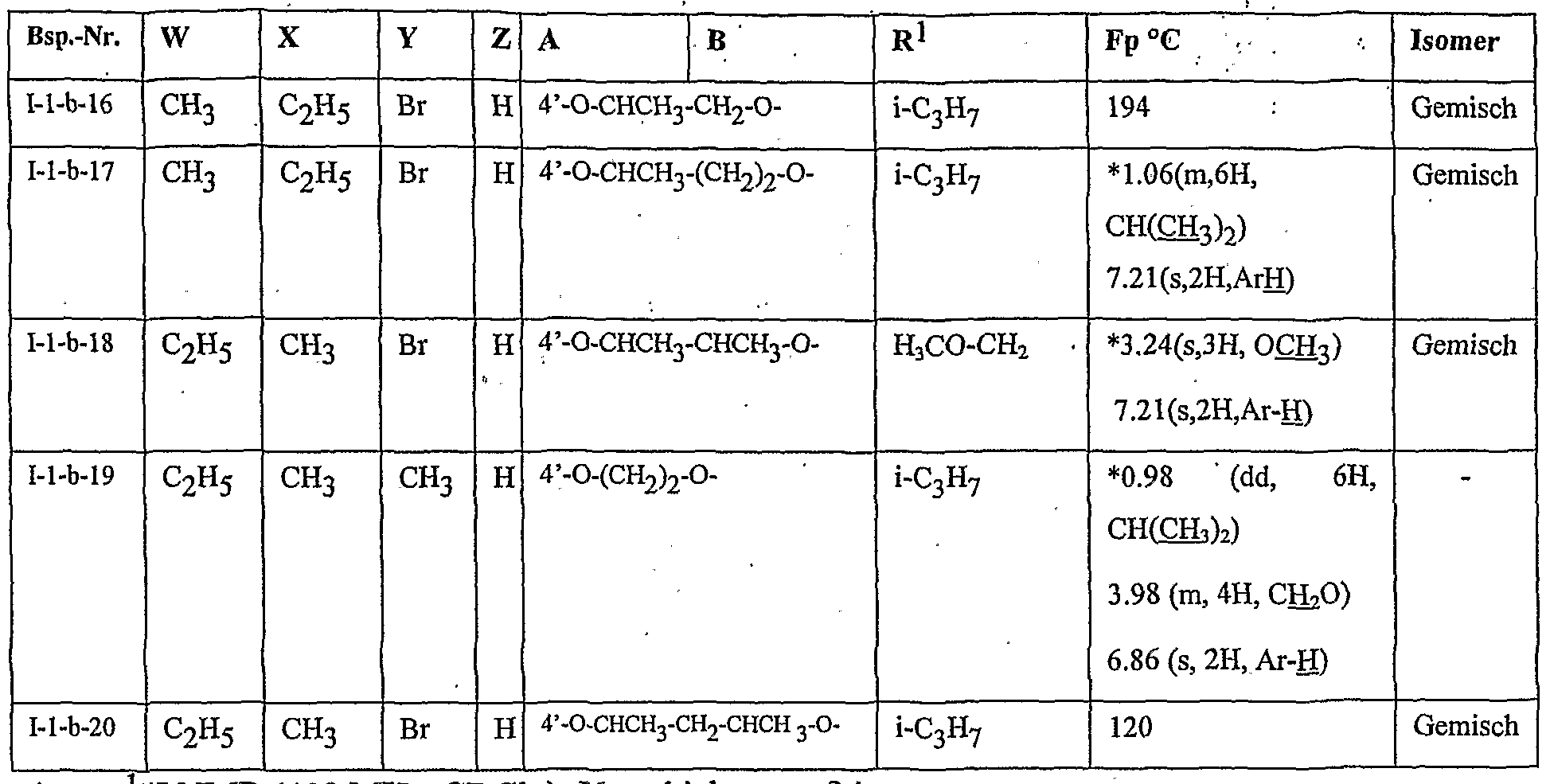
* H-NMR (400 MHz, CDCI3): Verschiebungen δ in ppm ** 1H-NMR (300 MHz, CDCI3): Verschiebungen δ in ppm* H-NMR (400 MHz, CDCl 3): shifts δ in ppm ** 1 H-NMR (300 MHz, CDCl 3): shifts δ in ppm
Beispiel I-l-c-1Example I-1-c-1
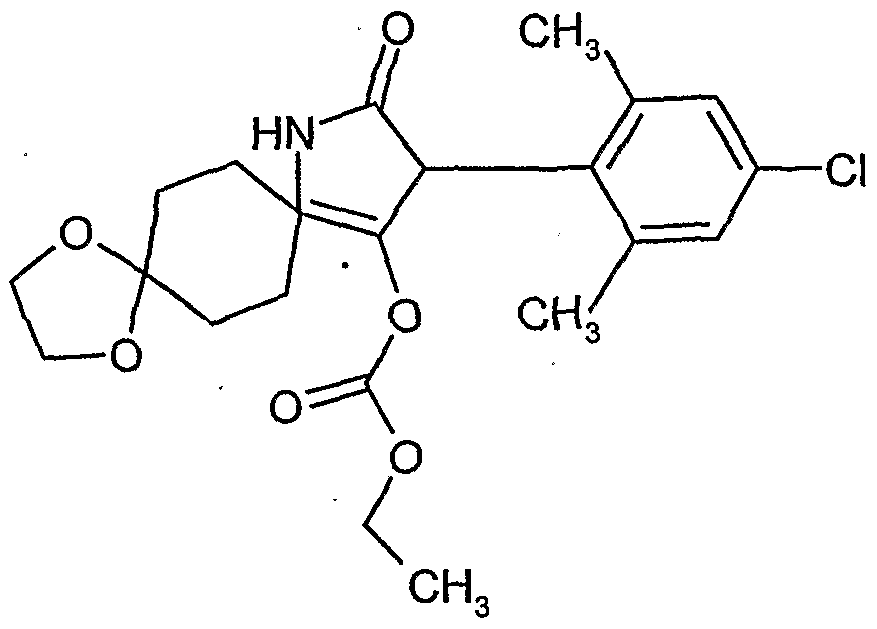
1.82 g der Verbindung gemäß Beispiel I-l-a-4 werden in 30 ml wasserfreiem Dichlormethan und 0.7 ml Triethylamin bei 10 bis 200C gerührt. Man gibt 0.5 ml Chlorameisensäure-ethylester in 2 ml wasserfreiem Dichlormethan hinzu und rührt bei Raumtemperatur.1.82 g of the compound according to Example Ila-4 are stirred in 30 ml of anhydrous dichloromethane and 0.7 ml of triethylamine at 10 to 20 0 C. Add 0.5 ml of ethyl chloroformate in 2 ml of anhydrous dichloromethane and stir at room temperature.
Nach Reaktionsende (dünnschichtchromatographische Kontrolle) wird 2 mal mit 10 ml 0.5 N NaOH gewaschen und über Magnesiumsulfat getrocknet. Das Lösungsmittel wird anschließend abdestilliert.After the end of the reaction (thin-layer chromatography) is washed twice with 10 ml of 0.5 N NaOH and dried over magnesium sulfate. The solvent is then distilled off.
Es erfolgt säulenchromatographische Reinigung an Kieselgel (Dichlormethan/Ethanol = 30:1).It is purified by column chromatography on silica gel (dichloromethane / ethanol = 30: 1).
Ausbeute: 1,15 g (52 % der Theorie), Fp 198°C. ' . In Analogie zu Beispiel (I-l-c-1) und gemäß den allgemeinen Angaben zur Herstellung erhält man folgende Verbindungen der Formel (I-l-c):Yield: 1.15 g (52% of theory), mp 198 ° C. ' . In analogy to Example (Ilc-1) and in accordance with the general information on the preparation, the following compounds of the formula (IIc) are obtained:
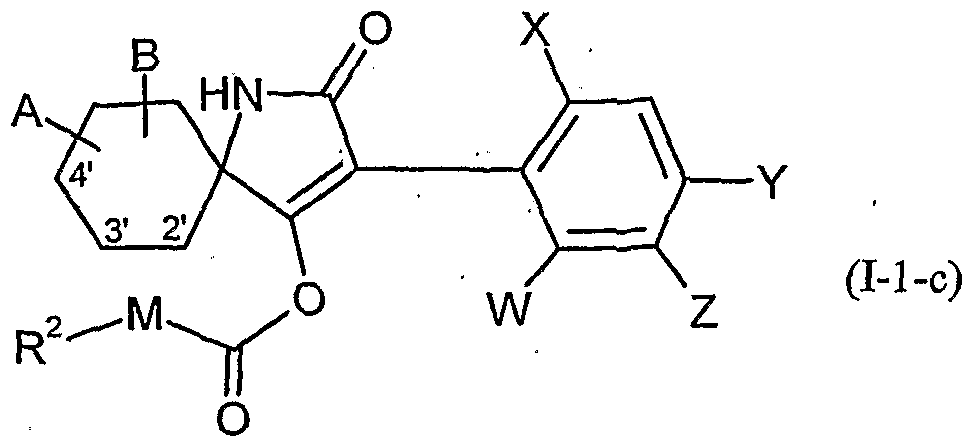

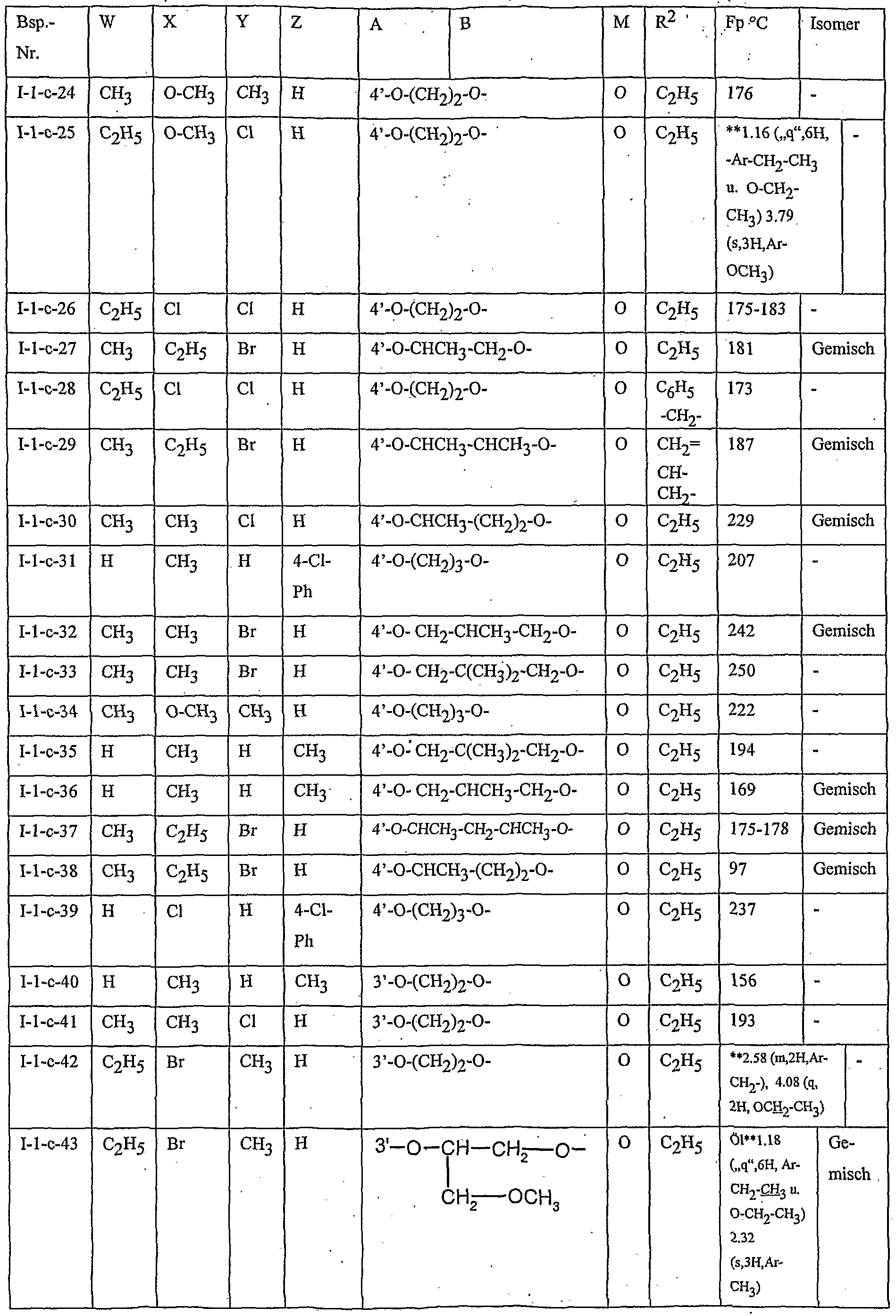


1H-NMR (300 MHz, CDCl3): Verschiebungen δ in ppm 1 H-NMR (300 MHz, CDCl 3 ): shifts δ in ppm
Beispiel I-l-d-1Example I-1-d-1
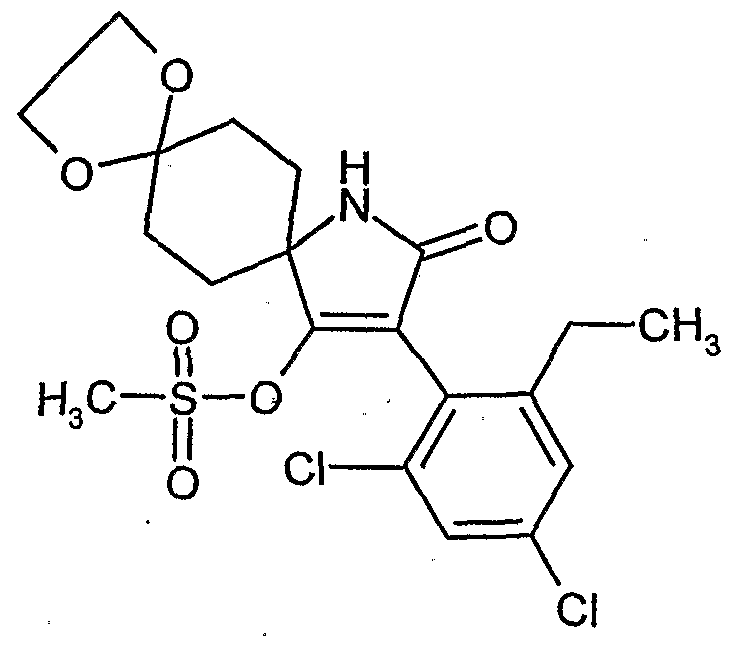
0,159 g der Verbindung gemäß Beispiel I-l-a-44 werden in 10 ml Trichlormethan vorgelegt, bei Raumtemperatur mit 0,098 ml Diisopropylethylamin und 1,5 mg DMAP versetzt, 0,037 ml Methansulfonsäurechlorid zugeben und bei 20 Stunden nachgerührt, mit 5 ml NaCl-Lösung versetzt, ca. 0,5 Stunden bei Raumtemperatur nachgerührt, die organische Phase abgetrennt, mit Natriumsulfat getrocknet und einrotiert. Das erhaltene Rohprodukt wird säulenchromatographisch an Kieselgel mit einem Gradienten n-Heptan/Essigsäureethylester 4:1 nach 0:100 gereinigt.0.159 g of the compound according to Example Ila-44 are initially charged in 10 ml of trichloromethane, admixed at room temperature with 0.098 ml of diisopropylethylamine and 1.5 mg of DMAP, 0.037 ml of methanesulfonyl chloride and stirred at 20 hours, treated with 5 ml of NaCl solution, ca. Stirred for 0.5 hours at room temperature, the organic phase separated, dried with sodium sulfate and concentrated by rotary evaporation. The crude product obtained is purified by column chromatography on silica gel with a gradient of n-heptane / ethyl acetate 4: 1 to 0: 100.
Ausbeute 0,07 g (37 % d. Theorie), Fp.: 2170C. Beispiel I-l-g-1Yield 0.07 g (37% of theory), m.p .: 217 ° C. Example Ilg-1

0,233 g der Verbindung gemäß Beispiel I-l-a-72 werden in 8 ml Chloroform vorgelegt, 0,098 ml Diisopropylethylamin und 1,5 mg DMAP zugegeben, anschließend noch 0,056 ml Morpholin- carbonsäurechlorid hinzugefügt, 20 Stunden bei Raumtemperatur gerührt, mit 5 ml 5 %iger Natriumbicarbonat-Lösung versetzt, 0,5 Stunden nachgerührt, die organische Phase abgetrennt, mit Natriumsulfat getrocknet und einrotiert. Das Rohprodukt wird säulenchromatographisch an Kieselgel mit einem Gradientn n-Heptan/Essigsäureethylester 4:1 nach 0:100 gereinigt.0.233 g of the compound according to Example Ila-72 are initially introduced in 8 ml of chloroform, 0.098 ml of diisopropylethylamine and 1.5 mg of DMAP are added, then another 0.056 ml of morpholine-carboxylic acid chloride are added, stirred for 20 hours at room temperature, with 5 ml of 5% sodium bicarbonate. Solution, stirred for 0.5 hours, the organic phase separated, dried with sodium sulfate and concentrated by rotary evaporation. The crude product is purified by column chromatography on silica gel with a gradient n-heptane / ethyl acetate 4: 1 to 0: 100.
Ausbeute: 0,148 g (64 % d. Theorie), ÖlYield: 0.148 g (64% of theory), oil
1H-NMR (400 MHz, CDCl3): δ = 2.31 (2, 3H, Ar-CH3), 3.1, 3.2 (je m, 2H, CH2O) ppm. 1 H-NMR (400 MHz, CDCl 3): δ = 2.31 (2, 3H, Ar-CH3), 3.1, 3.2 (each m, 2H, CH 2 O) ppm.
Beispiel H-IExample H-I
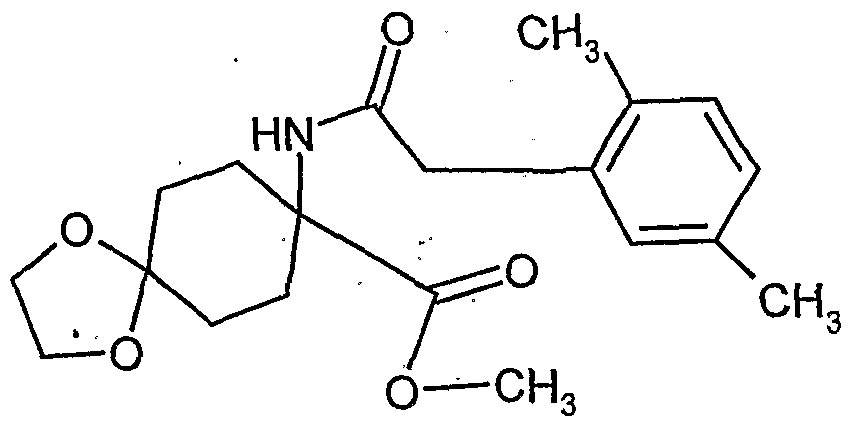
9.56 g l,4-Dioxaspiro[4.5]decan-8-carbonsäure-8-amino-methylester-hydrochlorid werden in 38 ml wasserfreiem Acetonitril vorgelegt und 17.5 g (0.127 Mol) gemahlenes Kaliumcarbonat bei 5 bis 100C zugegeben. Dann tropft man 6.94 g 2,5-Dimethyl-phenylessigsäurechlorid in 10 ml wasserfreiem Acetonitril in 12 Min. zu.9.56 g, 4-dioxaspiro [4.5] decane-8-carboxylic acid 8-amino-methyl ester hydrochloride are placed in 38 ml of anhydrous acetonitrile and 17.5 g (0.127 mol) of ground potassium carbonate at 5 to 10 0 C added. Then added dropwise 6.94 g of 2,5-dimethyl-phenylacetic acid chloride in 10 ml of anhydrous acetonitrile in 12 min.
Man fuhrt 3 h bei Raumtemperatur.It is carried out at room temperature for 3 h.
Die Reaktionslösung gießt man in 250 ml Eiswasser und saugt den Niederschlag ab. Man wäscht mit Wasser nach und nimmt den Niederschlag in Dichlormethan auf, trocknet und destilliert das Lösungsmittel ab. Es erfolgt säulenchromatographische Reinigung an Kieselgel (Dichlormethan/- Essigsäureethylester = 3:1).The reaction solution is poured into 250 ml of ice-water and the precipitate is filtered off with suction. It is washed with water and the precipitate is taken up in dichloromethane, dried and the solvent is distilled off. It is purified by column chromatography on silica gel (dichloromethane / ethyl acetate = 3: 1).
Ausbeute: 6, 82 g (49 % der Theorie), Fp. 1150C. Yield: 6.82 g (49% of theory), mp 115 ° C.
Beispiel (II-2)Example (II-2)
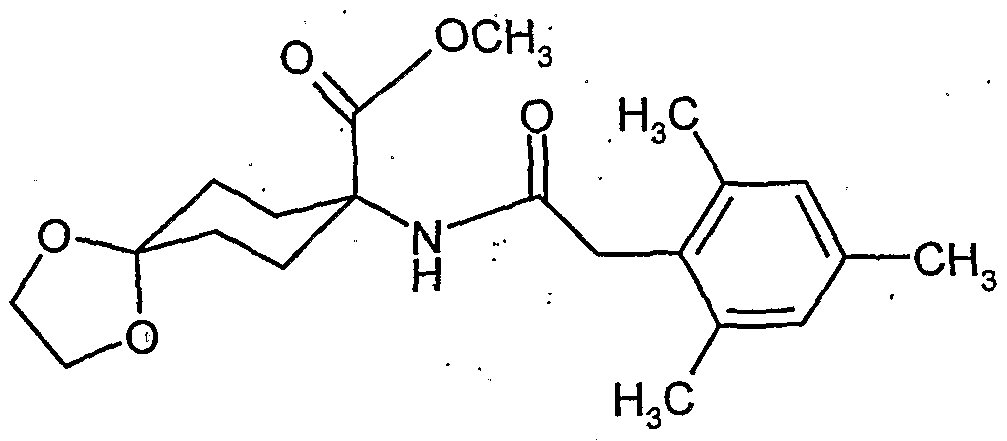
Es werden 154.6 g (1.579 Mol) konz. Schwefelsäure vorgelegt und 107.9 g der Verbindung gemäß Beispiel (XXI-I) in 630 ml Methylenchlorid als Suspension bei einer Innentemperatur von 30 bis 4O0C zugetropft. Man rührt 2 h bei 30 bis 400C und tropft dann 220 ml wasserfreies Methanol zu, dass sich eine Innentemperatur von 4O0C einstellt.There are 154.6 g (1.579 mol) conc. Submitted sulfuric acid and 107.9 g of the compound according to Example (XXI-I) in 630 ml of methylene chloride as a suspension at an internal temperature of 30 to 40 0 C added dropwise. The mixture is stirred for 2 h at 30 to 40 0 C and then added dropwise 220 ml of anhydrous methanol that an internal temperature of 4O 0 C is established.
Man rührt weitere 6 h bei einer Außentemperatur von 40 bis 700C.The mixture is stirred for a further 6 h at an external temperature of 40 to 70 ° C.
Die Reaktionslösung wird auf 1,5 kg Eis gegeben, mit Dichlormethan extrahiert und mit NaHC(V Lösung gewaschen. Man trocknet und destilliert das Lösungsmittel ab.The reaction solution is added to 1.5 kg of ice, extracted with dichloromethane and washed with NaHC (V solution), and the solvent is distilled off.
Es erfolgt säulenchromatographische Reinigung an Kieselgel (Totuol/Essigsäureethy lester = 1:1).It is purified by column chromatography on silica gel (Totuol / Essigsäureethy lester = 1: 1).
Ausbeute: 11,4 g (10 % der Theorie). Yield: 11.4 g (10% of theory).
In Analogie zu den Beispielen (H-I) und (II-2) und gemäß den allgemeinen Angaben zur Herstellung erhält man folgende Verbindungen der Formel (II)In analogy to Examples (H-I) and (II-2) and according to the general information on the preparation, the following compounds of the formula (II)
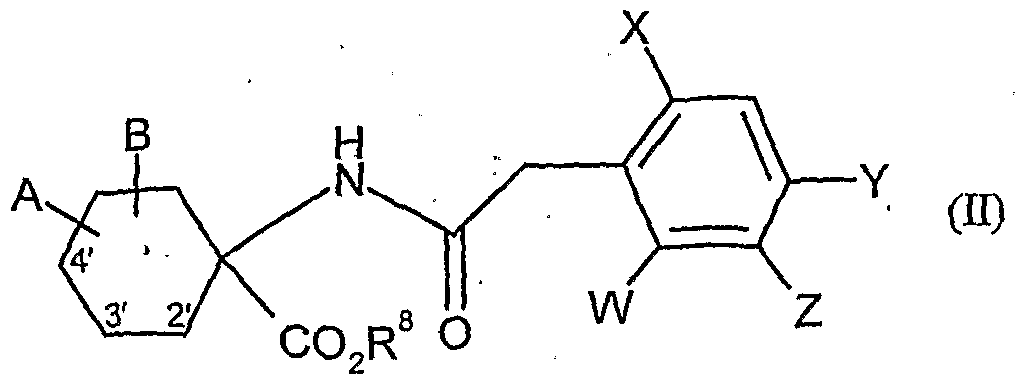
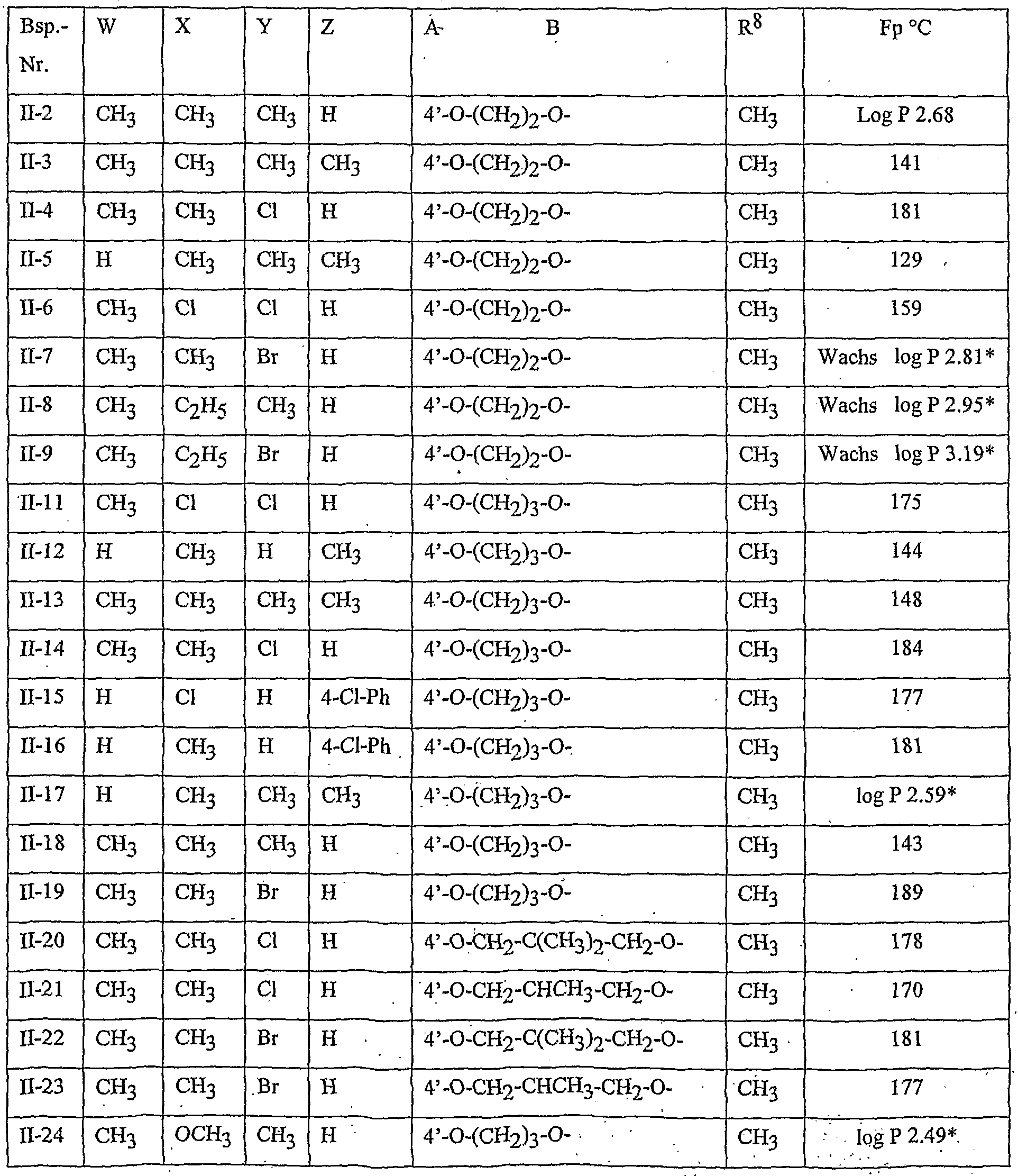
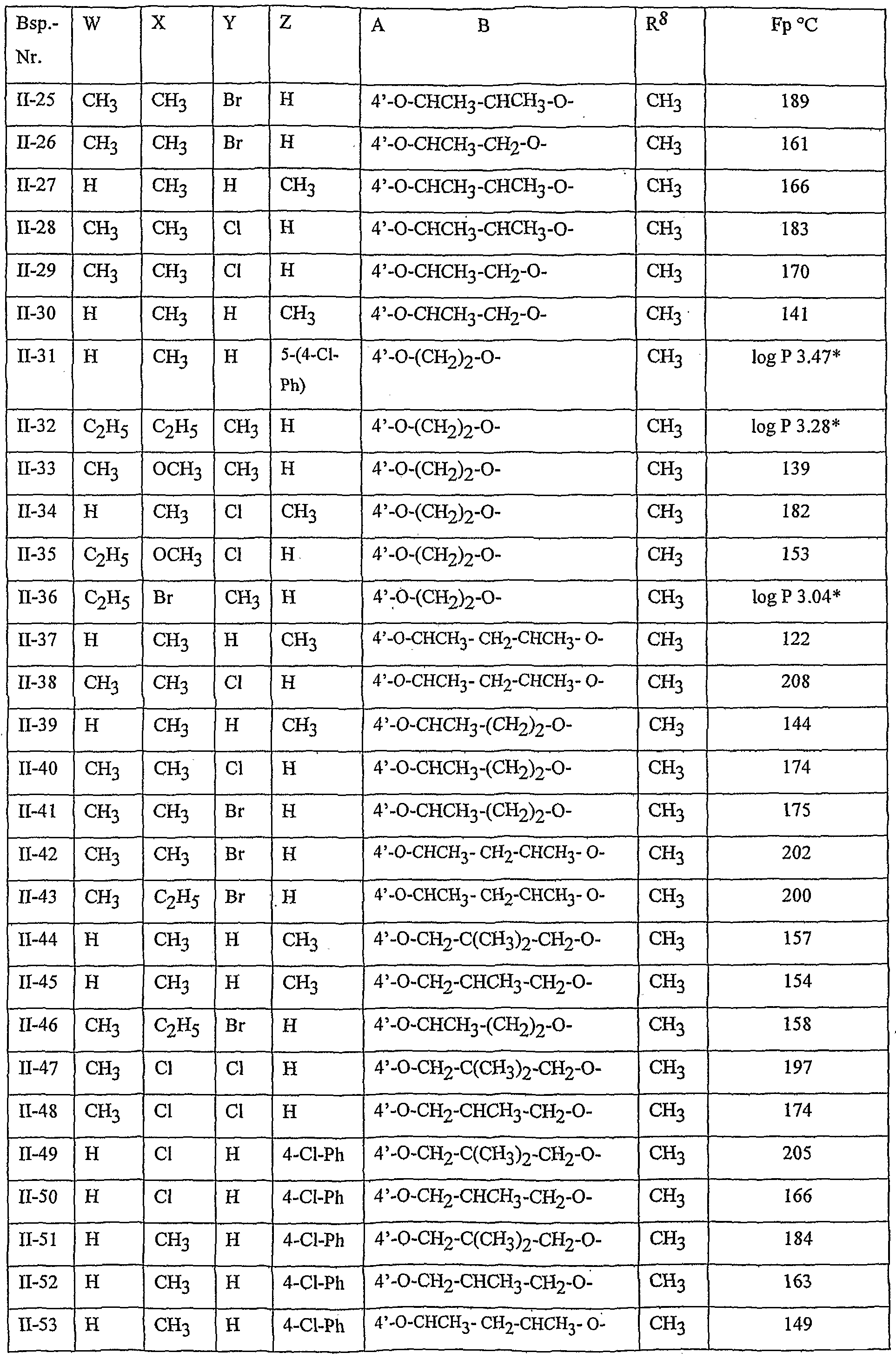
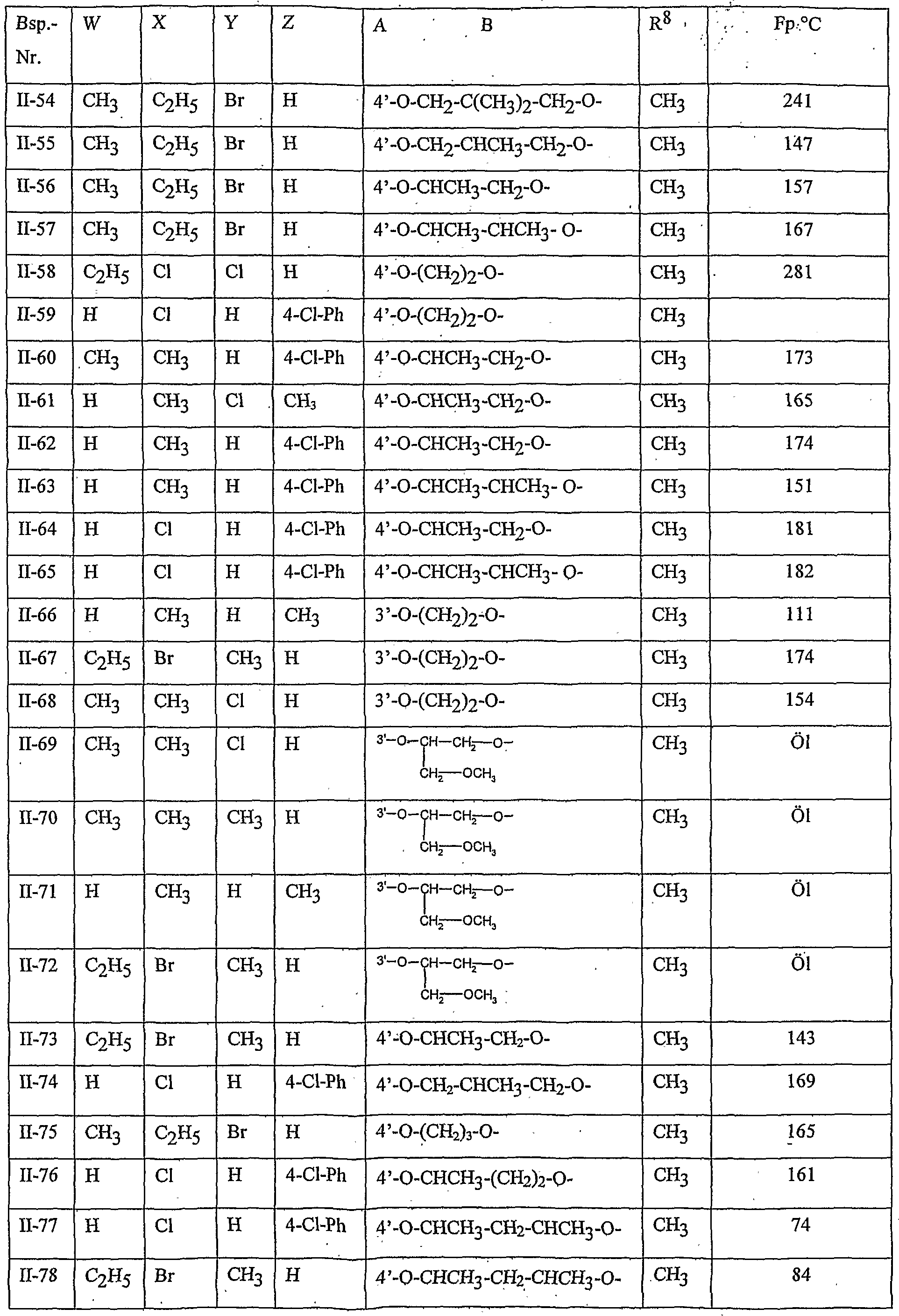
Die Bestimmung erfolgt im sauren Bereich bei pH 2.3 mit 0,1 % wässriger Phosphorsäure und Acetonitril als Eluenten; linearer Gradient von 1Ö % Acetonitril bis 95 % Acetonitril.The determination is carried out in the acidic range at pH 2.3 with 0.1% aqueous phosphoric acid and acetonitrile as eluent; linear gradient from 1% acetonitrile to 95% acetonitrile.
Die Bestimmung mit der LC-MS im sauren Bereich erfolgt bei pH 2,7 mit 0,1 % wässriger Ameisensäure und Acetonitril (enthält 0,1 % Ameisensäure) als Eluenten; linearer Gradient von 10 % Acetonitril bis 95 % Acetonitril. .The determination with the LC-MS in the acidic range is carried out at pH 2.7 with 0.1% aqueous formic acid and acetonitrile (containing 0.1% formic acid) as eluent; linear gradient from 10% acetonitrile to 95% acetonitrile. ,
Die Bestimmung mit der LC-MS im neutralen Bereich erfolgt bei pH 7.8 mit 0,001 molarer wässriger Ammoniumhydrogencarbonat-Lösung und Acetonitril als Eluenten; linearer Gradient von 10 % Acetonitrii bis 95 % Acetonitril.The determination with the LC-MS in the neutral range is carried out at pH 7.8 with 0.001 molar aqueous ammonium bicarbonate solution and acetonitrile as eluent; linear gradient from 10% acetonitrile to 95% acetonitrile.
Die Eichung erfolgt mit unverzweigtem Alkan-2-onen (mit 3 bis 16 Kohlenstoffatomen), deren logP- Werte bekannt sind (Bestimmung der logP- Werte anhand der Retentionszeiten durch lineare Interpolation zwischen zwei aufeinander folgenden Alkanonen).The calibration is carried out with unbranched alkan-2-ones (having 3 to 16 carbon atoms) whose logP values are known (determination of the logP values by retention times by linear interpolation between two consecutive alkanones).
Die lambda-max- Werte wurden an Hand der UV-Spektren von 200 nm bis 400 nm in den Maxima der chromatographischen Signale ermittelt.The lambda max values were determined on the basis of the UV spectra from 200 nm to 400 nm in the maxima of the chromatographic signals.
Beispiel (XXI-I)Example (XXI-I)
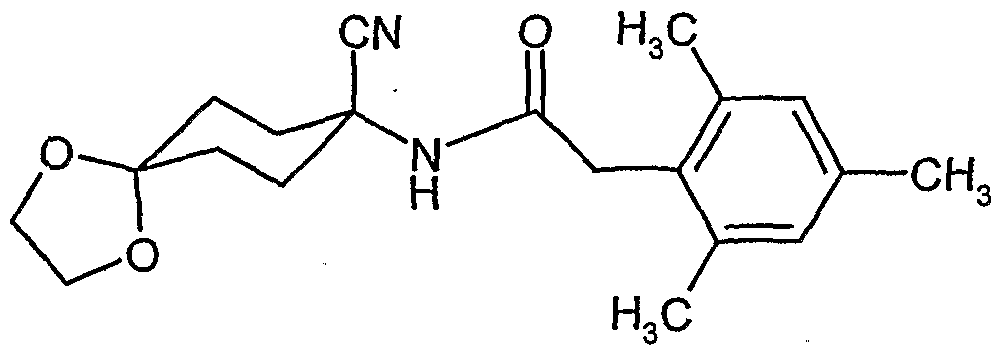
Zu 65 g l,4-Dioxaspiro[4.5]decan-8-amino-8-carbonsäurenitril in 800 ml wasserfreiem Tetra- hydrofuran (THF) gibt man 49.4 ml Triethylamin. Bei 0 bis 100C tropft man 70.2 g Mesitylen- essigsäurechlorid in 80 ml wasserfreiem THF zu.To 65 μl, 4-dioxaspiro [4.5] decane-8-amino-8-carbonitrile in 800 ml of anhydrous tetrahydrofuran (THF) is added 49.4 ml of triethylamine. At 0 in 80 mL of anhydrous THF at 0 to 10 C is added dropwise 70.2 g of mesitylene acid chloride.
Man rührt bei Raumtemperatur.The mixture is stirred at room temperature.
Nach Reaktionsende (dünnschichtchromatographische Kontrolle) rührt man die Reaktionslösung in 1,2 1 Eiswasser ein, gibt 200 ml IN HCl zu und saugt den Niederschlag ab. Dieser wird in Dichlormethan aufgenommen und die Wasserphase abgetrennt. Die organische Phase wird getrocknet, das Lösungsmittel abdestilliert und der Rückstand aus 320 ml Toluql/640 ml n-Hexan umkristallisiert.After the end of the reaction (thin-layer chromatography), the reaction solution is stirred into 1.2 l of ice water, 200 ml of IN HCl are added and the precipitate is filtered off with suction. This is taken up in dichloromethane and the aqueous phase separated. The organic phase becomes dried, the solvent was distilled off and the residue from 320 ml Toluql / 640 ml of n-hexane recrystallized.
Ausbeute: 107,9 g (88 % der Theorie), Fp. >220°C.Yield: 107.9 g (88% of theory), mp> 220 ° C.
Beispiel XIV-1-1Example XIV-1-1
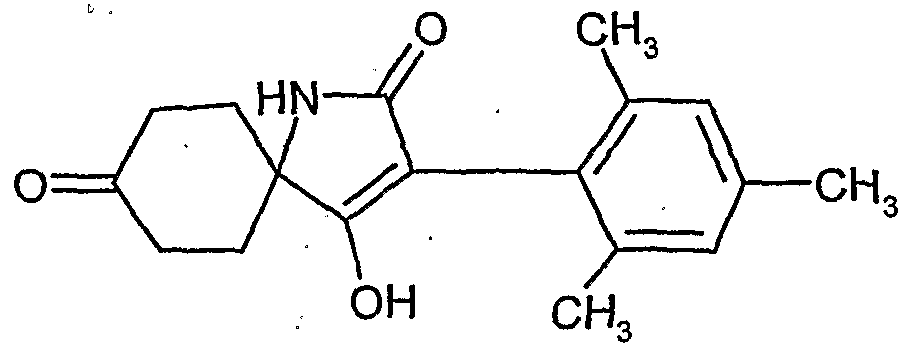
20.6 g der Verbindung gemäß Beispiel I-l-c-2 werden in 24 g halbkonzentrierter Natronlauge und ca. 100 ml Ethanol bei Raumtemperatur eine Stunde unter Argon-Schutzgas gerührt und anschließend das Ethanol abgedampft. Dann wird die Lösung mit Salzsäure angesäuert, alles in Methylenchlorid gelöst, die organische Phase abgetrennt und eingedampft. Der Rückstand wird zwei Stunden bei 600C in 4 N Salzsäure gerührt.20.6 g of the compound according to Example Ilc-2 are stirred in 24 g of half-concentrated sodium hydroxide solution and about 100 ml of ethanol at room temperature for one hour under argon protective gas and then the ethanol evaporated. Then the solution is acidified with hydrochloric acid, all dissolved in methylene chloride, the organic phase separated and evaporated. The residue is stirred for 2 hours at 60 ° C. in 4 N hydrochloric acid.
Der Niederschlag wird abgetrennt und in Essigsäureethylester gerührt.The precipitate is separated and stirred in ethyl acetate.
Ausbeute: 6,67 g; Pp: 293,90CYield: 6.67 g; Pp: 293.9 0 C
Beispiel XVI-IExample XVI-I
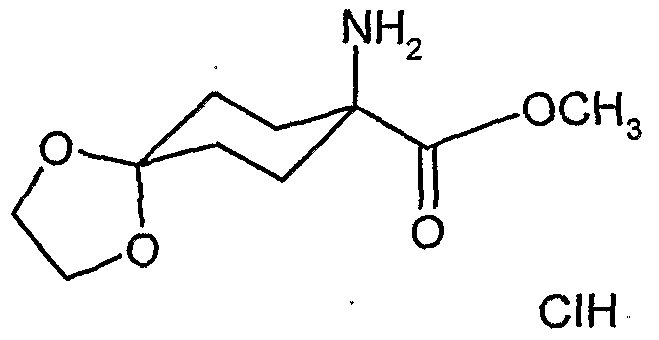
46 g l,4-Dioxa[4.5]decan-8-amino-8-carbonsäure werden in 350 ml wasserfreiem Methanol vorgelegt und bei 0 bis 5°C 32.6 g (0.275 Mol) Thionylchlorid zugetropft. Es wird 30 Min. bei 00C (Suspension) und dann über Nach bei 400C gerührt.46 gl, 4-dioxa [4.5] decane-8-amino-8-carboxylic acid are initially charged in 350 ml of anhydrous methanol and added dropwise at 0 to 5 ° C 32.6 g (0.275 mol) of thionyl chloride. It is 30 min. At 0 0 C (suspension) and then stirred at 40 0 C over.
Man kühlt ab, saugt das Kaliumchlorid ab und destilliert das Lösungsmittel ab. Der Rückstand wird mit MTB-Ether verrieben und abgesaugt.It is cooled, the potassium chloride is filtered off and the solvent is distilled off. The residue is triturated with MTB ether and filtered with suction.
Ausbeute: 48,63 g (83 % der Theorie), Fp: Zersetzung In Analogie zu Beispiel XVI-I erhält man folgende neuen Verbindungen derFormel (XVl)Yield: 48.63 g (83% of theory), mp: decomposition Analogously to Example XVI-I, the following novel compounds of the formula (XVI) are obtained:
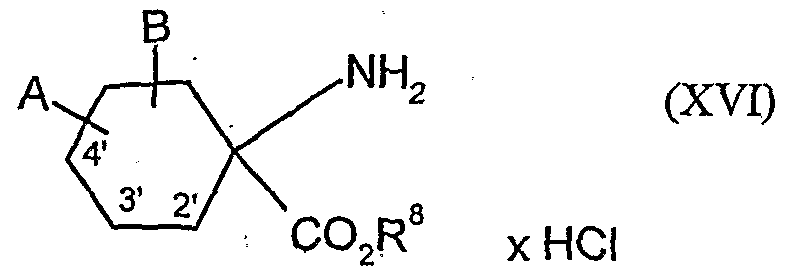

* H-NMR (400 MHz, d6-DMSO): Verschiebung δ in ppm* H NMR (400 MHz, d 6 -DMSO): shift δ in ppm
Die substituierten l,4-Dioxa[4,5]decan-8-amino-8-carbonsäureester und deren Salze der Formel (XVI'), die gegebenenfalls substituierten l,4-Dioxa[4,5]decan-7-amino-7-carbonsäureester und deren Salze der Formel (XVI") und die gegebenenfalls substituierten l,5-Dioxa[5,5]undecan-9- amino-9-carbonsäureester und deren Salze der Formel (XVF"), in welchen als Substituenten die eingangs in der Definition von A, B genannten Substituenten. in Frage kommen, sind neu und Gegenstand der Erfindung: . . . . . .
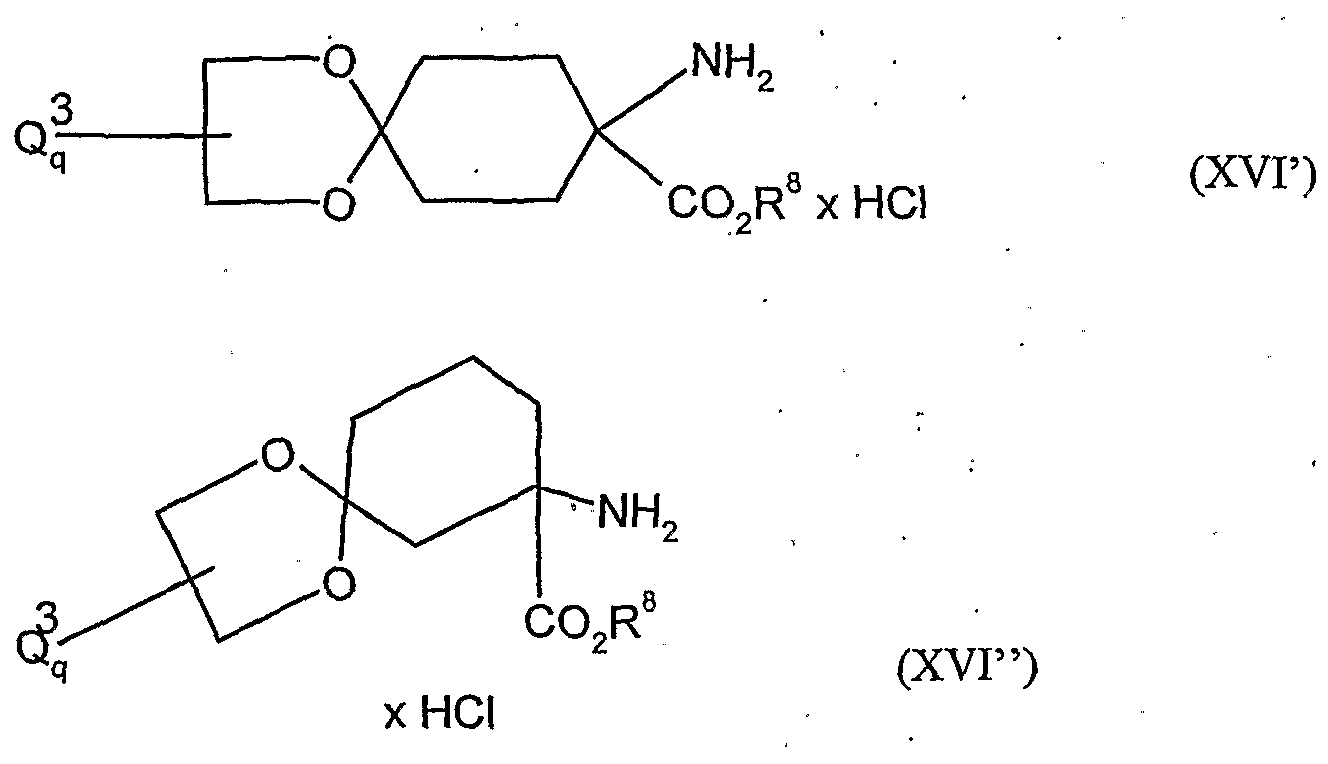

in welcherin which
Q3 für C1-C4-AIlCyI, C^Cs-Halogenalkyl, C1-C4-AIkOXy oder C1-C4-Alkoxy-C1-C2-alkyl steht,Q 3 is C 1 -C 4 -alkyl, C 1 -C 5 -haloalkyl, C 1 -C 4 -alkoxy or C 1 -C 4 -alkoxy-C 1 -C 2 -alkyl,
q für I5 2 oder 3 steht und im Fall der Verbindungen der Formeln (XVI") und (XVF") auch für O stehen kann,q is I5 2 or 3 and may be in the case of the compounds of formulas (XVI ") and (XVF") can also be O,
R8 die oben angegebene Bedeutung hat.R 8 has the meaning given above.
Beispiel XIX-IExample XIX-I
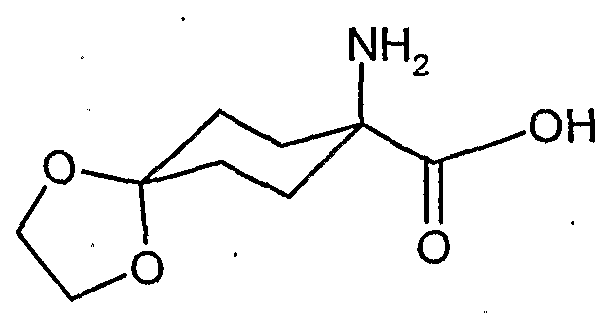
112 g der Verbindung gemäß Beispiel XXIH-8 werden in 710 ml 30 %iger KOH suspendiert und unter Rückfluss unter Stickstoffatmosphäre gerührt. Bei 0 bis 200C mit konz. HCl aus pH 5.2 bis.5.3 ansäuern, absaugen, das Filtrat auf ca. 0,5 1 azeo- trop mit Methanol einengen, Kaliumchlorid absaugen, einrotierten, mit Methanol azeotrop entwässern.112 g of the compound according to Example XXIH-8 are suspended in 710 ml of 30% KOH and stirred under reflux under nitrogen atmosphere. At 0 to 20 0 C with conc. Acidify the mixture from pH 5.2 to 0.5.3, suction, concentrate the filtrate to approx. 0.5 1 azeotrope with methanol, aspirate potassium chloride, evaporate, azeotrope with methanol.
Ausbeute: 46 g (46 % der Theorie).Yield: 46 g (46% of theory).
In Analogie zu Beispiel XIX-I1 erhält man folgende neuen Verbindungen der Formel (XIX)In analogy to Example XIX-I 1 gives the following novel compounds of formula (XIX)
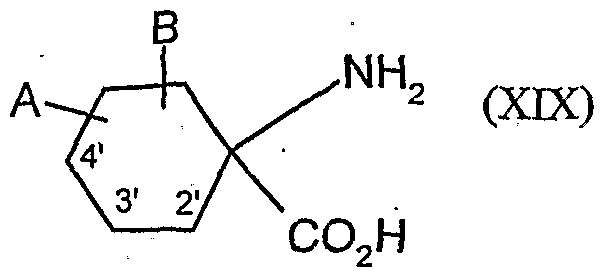
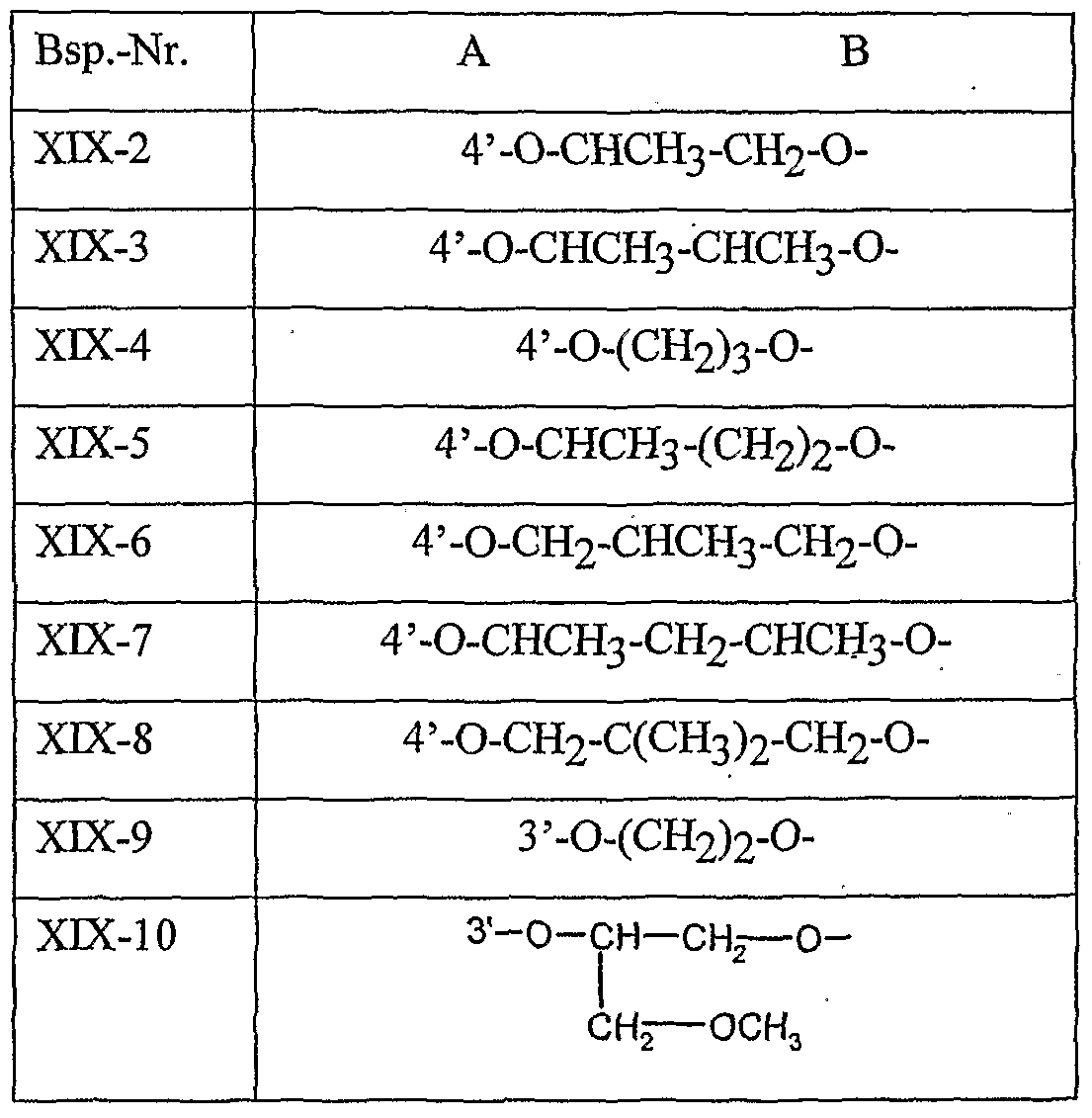
Die Aminosäuren wurden ohne weitere Reinigung direkt in die Veresterung zu den Verbindungen (XVI) umgesetzt. Dort erfolgte die Charakterisierung. Die substituierten l,4-Dioxa[4,5]decan-8- amino-8-carbonsäuren (XIX'), die gegebenenfalls substituierten l,4-Dioxa[4,5]-decan-7-amino-7- carbonsäuren der Formel (XEX") und die gegebenenfalls substituierten l,5-Dioxa[5,5]undecan-9- amino-carbonsäuren der Formel (XIX'"), in welchen als Substituenten die eingangs in der Definition der Reste A, B genannten Substituenten in Frage kommen, sind neu und Gegenstand der Erfindung:
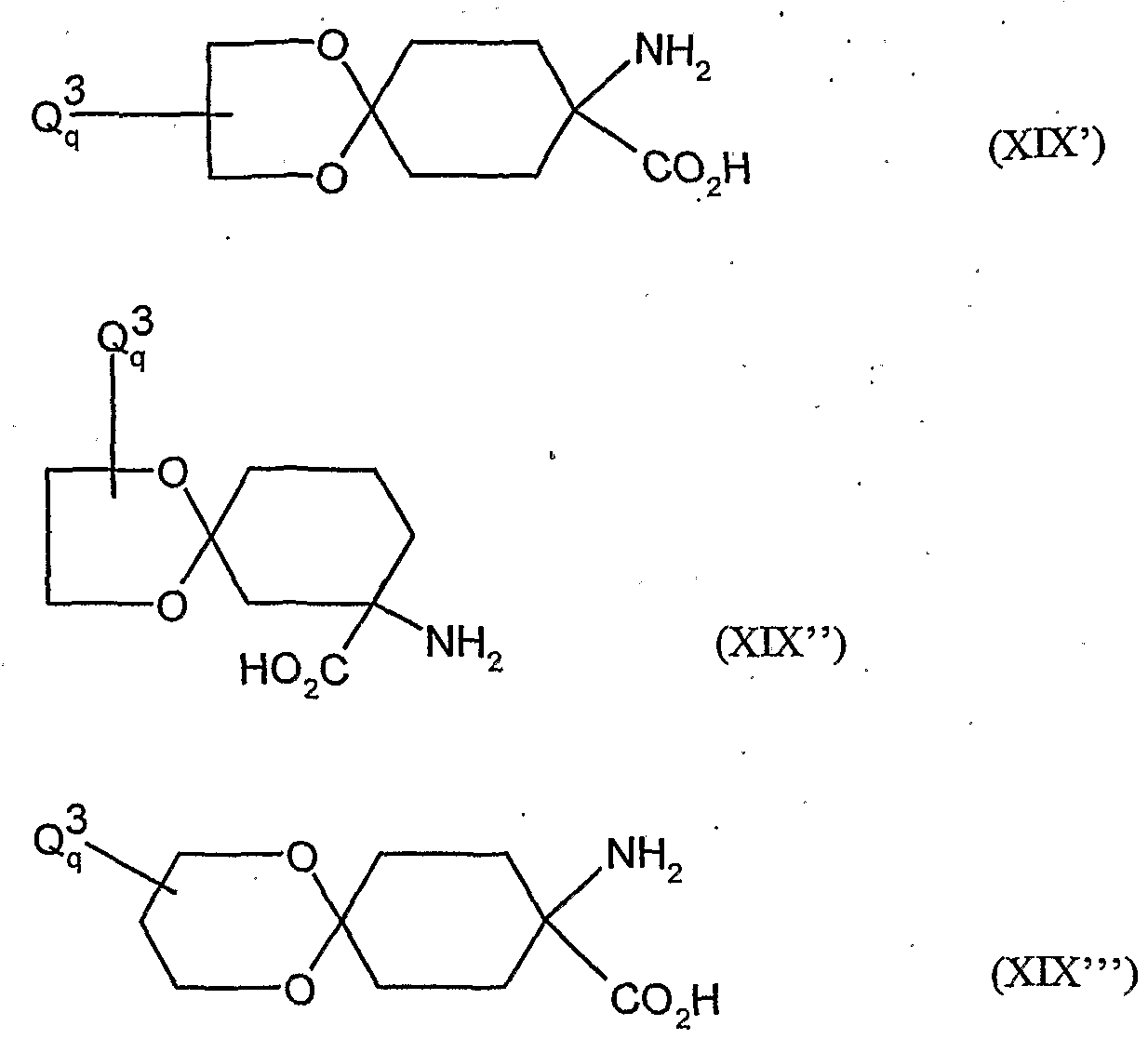
in welcherin which
Q3 die oben genannten Bedeutungen hat undQ3 has the meanings above and
q für 1, 2 oder 3 steht und im Fall der Verbindungen der Formeln (XK") und (XK'") auch für O stehen kann.q is 1, 2 or 3 and in the case of the compounds of the formulas (XK ") and (XK '") may also stand for O.
Beispiel XXIII-IExample XXIII-I

16,4 g (335 mmol) Natriumcyanid und 128,7 g (1339 mmol) Ammoniumcarbonat werden in 600 ml Wasser vorgelegt und bei Raumtemperatur 57 g (335 mmol) l,4-Dioxa[4,5]decan-2-methyl-8- on (XXrV-1) in 30 ml Ethanol gelöst langsam zugetropft.16.4 g (335 mmol) of sodium cyanide and 128.7 g (1339 mmol) of ammonium carbonate are initially charged in 600 ml of water and 57 g (335 mmol) of 1,4-dioxa [4,5] decane-2-methyl- 8-one (XXrV-1) dissolved in 30 ml of ethanol slowly added dropwise.
Man rührt ca. 12 bis 15 Stunden bei 55 bis 6O0C. Auf O0C kühlen, Feststoff absaugen, mit Wasser erneut anschlämmen, absaugen, mit Hexan waschen, trocknen.The mixture is stirred for about 12 to 15 hours at 55 to 60 0 C. Cool to 0 ° C., extract the solid, rinse again with water, suction, wash with hexane, dry.
Ausbeute: 73,6 g (92 % der Theorie). 2 Isomere 1:1.Yield: 73.6 g (92% of theory). 2 isomers 1: 1.
In Analogie zu Beispiel (XXIH-1) erhält man folgende neuen Verbindungen der Formel (XXIH)In analogy to Example (XXIH-1), the following new compounds of the formula (XXIH) are obtained:
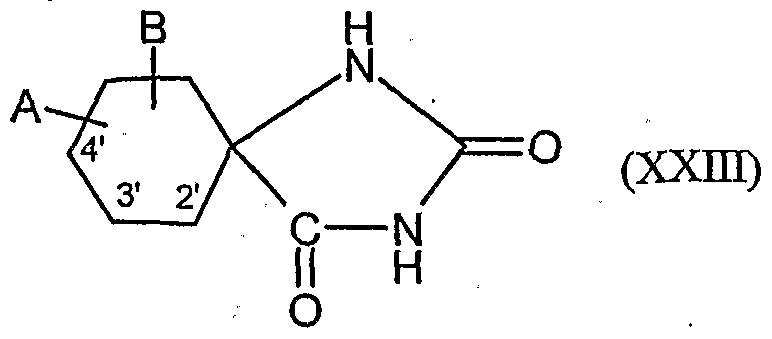
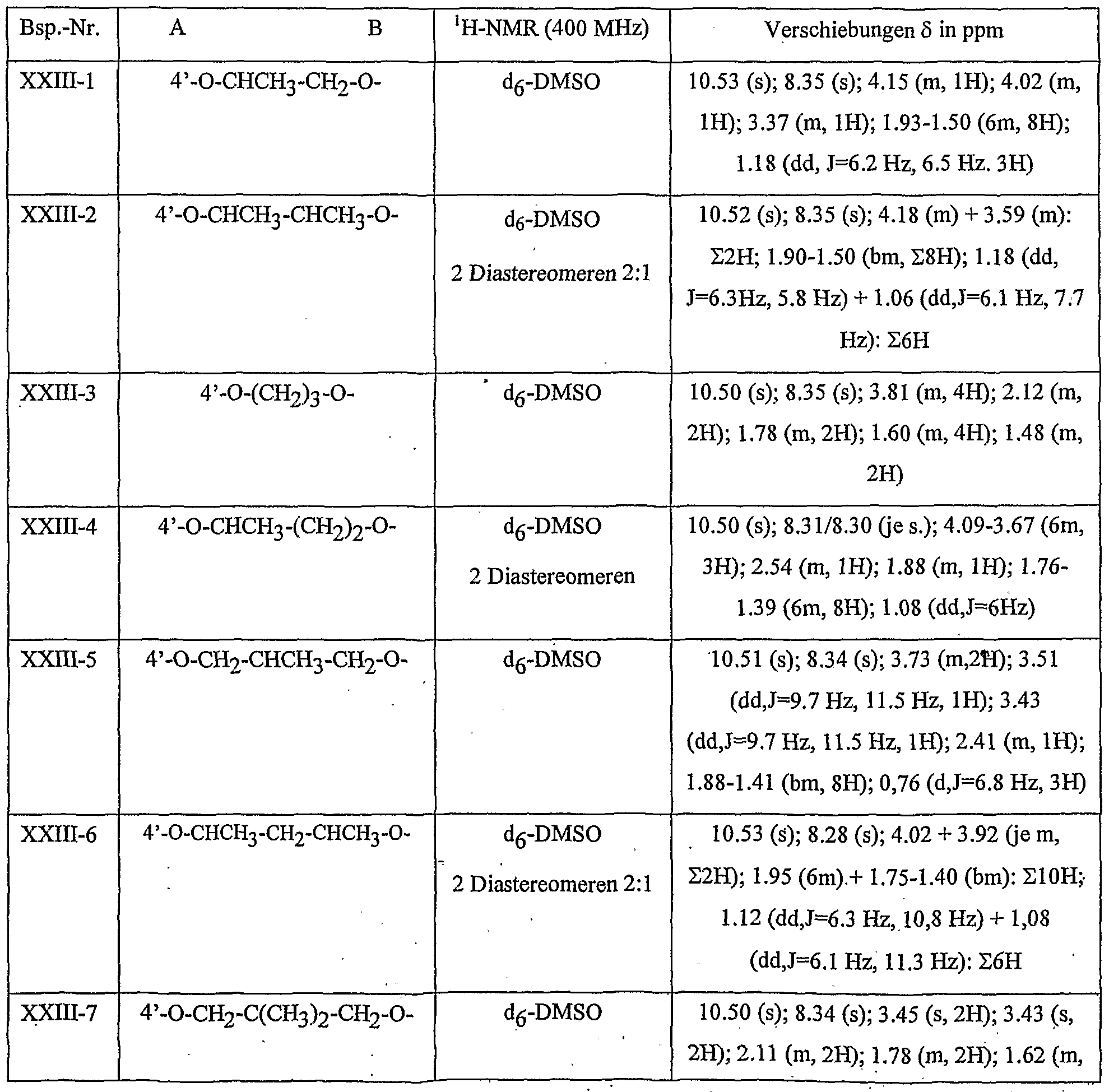
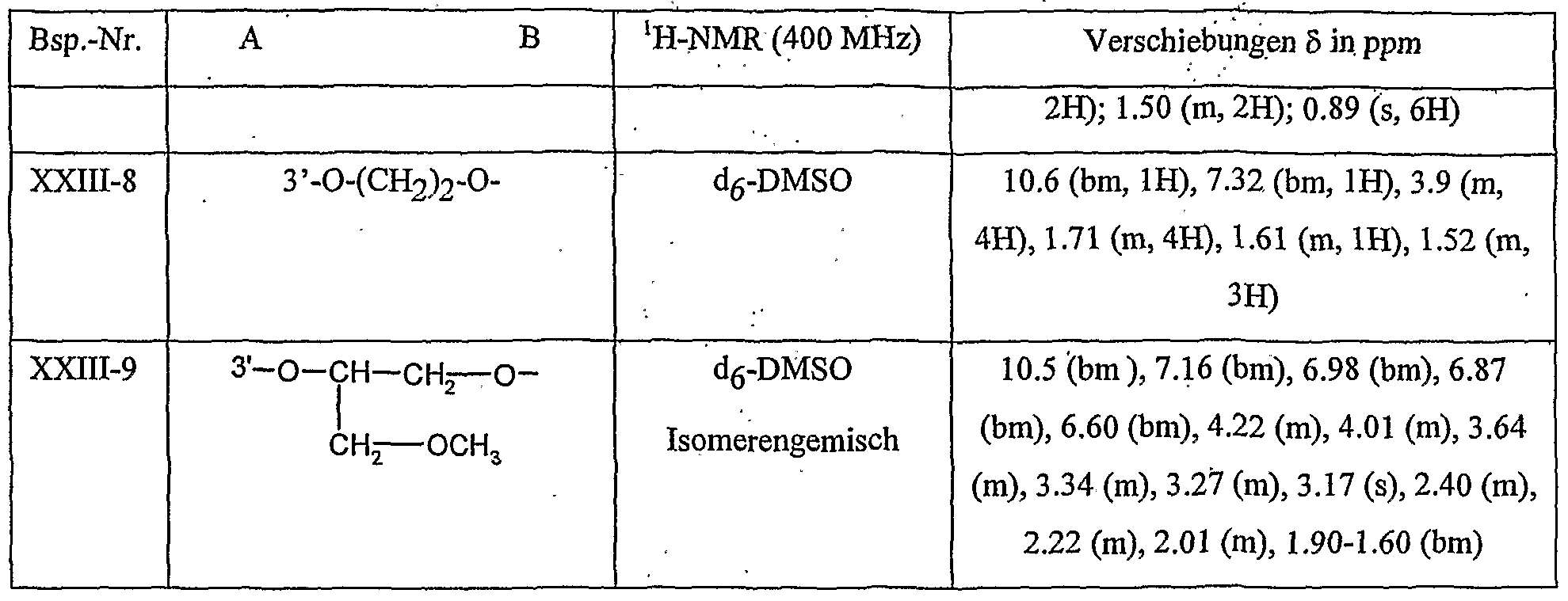
Die Verbindungen der Formeln (XXHI'), (XXm") und (XXIU'")The compounds of the formulas (XXHI '), (XXm ") and (XXIU'")
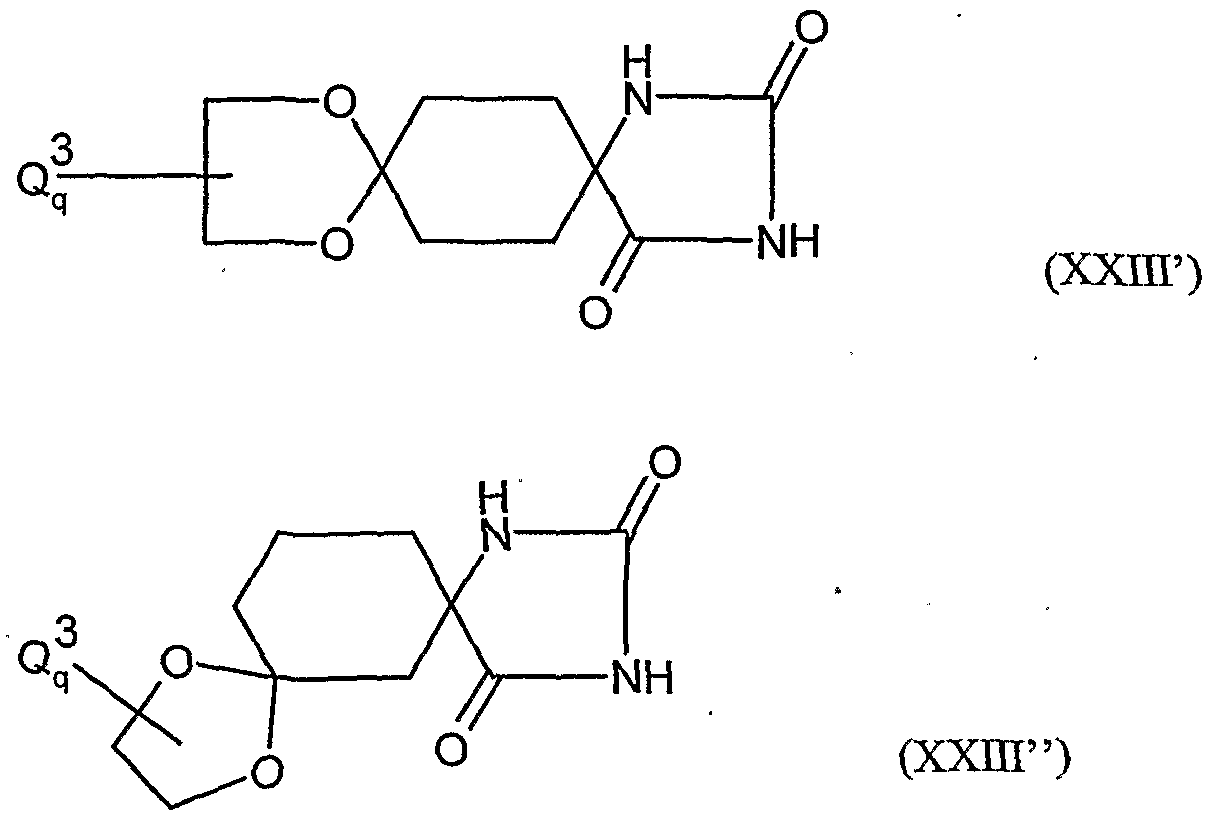
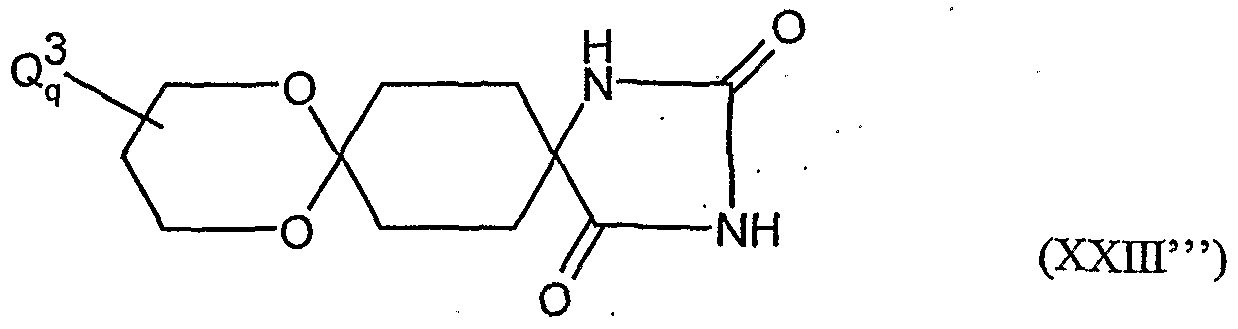
in welcherin which
Q3 die oben genannten Bedeutungen hat undQ 3 has the meanings given above and
q für 1, 2 oder 3 steht und im Fall der Verbindungen der Formel (XXHI") und (XXHI"') auch für 0 stehen kann, sind neu und Gegenstand der Erfindung. Beispiel XXIV-Iq is 1, 2 or 3 and in the case of the compounds of the formula (XXHI ") and (XXHI"') may also stand for 0 are new and subject of the invention. Example XXIV-I
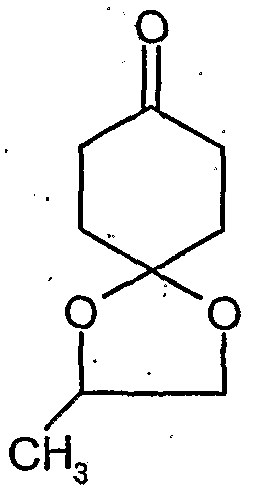
53,7 g (423 mmol) Oxalsäuredichlorid werden in 1000 ml Dichlormethan vorgelegt. Bei -7O0C wird eine Lösung von 60 ml Dimethylsulfoxid in 100 ml Dichlormethan hinzugetropft: und 20 min. nachgerührt. 66 g (385 mmol) l,4-Dioxa[4,5]decan-2-methyl-8-ol werden in 300 ml Dichlormethan gelöst und bei gleicher Temperatur zur Reaktionslösung über 1 h hinzugetropft. 1 Stunde nachrühren, dann das Eisbad herunterfahren und innerhalb von 30 min. auf -4O0C kommen lassen. 30 min. bei dieser Temperatur rühren, dann Triethylamin (140 ml) hinzugeben und auf Raumtemperatur kommen lassen (1 h); und über Nacht rühren lassen.53.7 g (423 mmol) of oxalic acid dichloride are initially charged in 1000 ml of dichloromethane. At -7O 0 C, a solution of 60 ml of dimethyl sulfoxide in 100 ml of dichloromethane is added dropwise: and 20 min. stirred. 66 g (385 mmol) of 1,4-dioxa [4,5] decane-2-methyl-8-ol are dissolved in 300 ml of dichloromethane and added dropwise at the same temperature to the reaction solution over 1 h. Stir for 1 hour, then shut down the ice bath and within 30 min. to come to -4O 0 C. 30 min. stir at this temperature, then add triethylamine (140 ml) and allow to come to room temperature (1 h); and stir overnight.
Es wird mit 500 ml Wasser gequencht und 15 Min. nachgerührt.It is quenched with 500 ml of water and stirred for 15 min.
Die organische Phase wird abgetrennt und die wässrige Lösung 3 x mit 200 ml Dichlormethan extrahiert. Die vereinigten organischen Phasen werden mit Natriumsulfat getrocknet und das Lösungsmittel abdestilliert. Chromatographische Reinigung an Kieselgel, Hexan-Essigester 2:1.The organic phase is separated off and the aqueous solution is extracted 3 times with 200 ml of dichloromethane. The combined organic phases are dried with sodium sulfate and the solvent is distilled off. Chromatographic purification on silica gel, hexane-ethyl acetate 2: 1.
Ausbeute: 58 g (88 % d. Theorie)Yield: 58 g (88% of theory)
1H-NMR (400 MHz, d6-DMSQ): δ = 4.24 (m, IH), 3.46 (t, IH), 4.10 (dd, IH), 2.36 (m, 4H), 1.94 (m, 4H), 1.23 (d, 3H) ppm. 1 H NMR (400 MHz, d 6 -DMSQ): δ = 4.24 (m, IH), 3.46 (t, IH), 4.10 (dd, IH), 2.36 (m, 4H), 1.94 (m, 4H) , 1.23 (d, 3H) ppm.
Beispiel XXIV-7Example XXIV-7
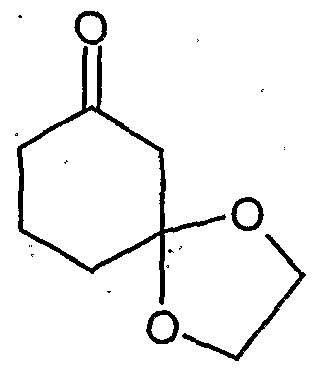
50 g Cyclohexan-l,3-dion, 27,67 g 1,2-Ethandiol, 500 ml Toluol und 0,849 g 4-Toluolsulfon- säuremonohydrat werden zusammengeben und am Wasserabscheider 3 bis 4 h lang unter Rück- fluss gekocht. Das Gemisch wird mit 100 ml ges. NaHCO3-Lösung und 2 x mit ges. NaCl-Lösung gewaschen, getrocknet und einrotiert. Anschließend wird eine fräkt. Destillation im HV (Dest. des Produkts bei 85°C/lmbar bzw. 62-75°C/0,15 mm Hg) durchgerührt.50 g of cyclohexane-l, 3-dione, 27.67 g of 1,2-ethanediol, 500 ml of toluene and 0.849 g of 4-toluenesulfonic acid monohydrate are combined and refluxed on a water separator for 3 to 4 hours. The mixture is washed with 100 ml sat. NaHCO 3 solution and 2 x with sat. NaCl solution, dried and concentrated by rotary evaporation. Subsequently, a fräkt. Distillation in HV (Dest. Of the product at 85 ° C / lmbar or 62-75 ° C / 0.15 mm Hg) stirred.
Ausbeute: 21,9 g (27 % d. Theorie)Yield: 21.9 g (27% of theory)
1H-NMR (400 MHz, CD3CN): δ = 3.9 (m, 4H), 2.52 (s, 2H), 2.27 (m, 2H), 1.87 (m, 2H), 1.79 (m, 2H) ppm. 1 H-NMR (400 MHz, CD 3 CN): δ = 3.9 (m, 4H), 2.52 (s, 2H), 2.27 (m, 2H), 1.87 (m, 2H), 1.79 (m, 2H) ppm ,
In Analogie zu den Beispielen (XXIV-I) und (XXW-7) erhält man folgende neuen Verbindungen der Formel (XXIV)Analogously to Examples (XXIV-I) and (XXW-7), the following novel compounds of the formula (XXIV) are obtained:
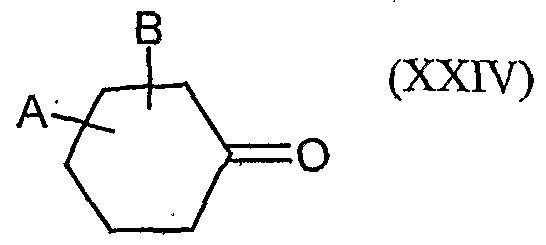
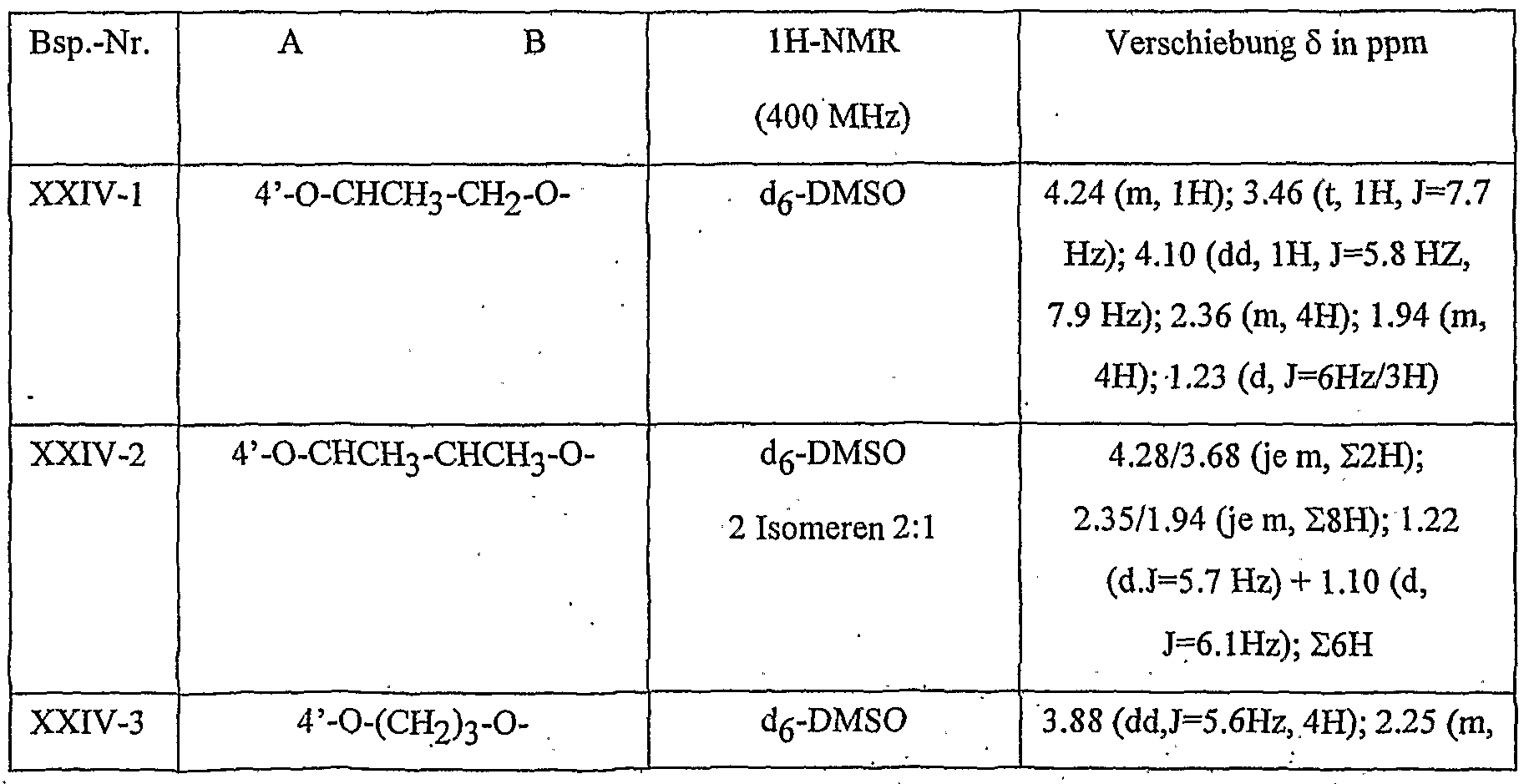

Die Ketone der Formel (XXIV) sind teilweise käuflich, teilweise bekannt (JACS 108, 2691-2699; 1986; JACS 109, 1363-1370, 1987) und teilweise neu.Some of the ketones of formula (XXIV) are commercially available, some are known (JACS 108, 2691-2699, 1986, JACS 109, 1363-1370, 1987) and some are new.
Beispiel XXV-IExample XXV-I

114 g 4-HydroxycycIohexanon und 80 g 1,2 Propandiol (77 ml) und 2 g 4-Toluolsulfonsäure- dihydrat werden in 500 ml Toluol zusammengegeben. Man kocht am Wasserabscheider bis kein Wasser mehr abgeschieden wird. Zur Aufarbeitung gibt man 1 ml Triethylamύv wäscht mit 200 ml Wasser, trocknet und rotiert die Reaktionslösung ein. Der Rückstand (104 g) wird im Vakuum destilliert.114 g of 4-hydroxycyclohexanone and 80 g of 1,2-propanediol (77 ml) and 2 g of 4-toluenesulfonic acid dihydrate are combined in 500 ml of toluene. It is cooked on a water separator until no Water is more deposited. For working up, 1 ml of triethylamine is washed with 200 ml of water, the reaction solution is dried and rotated. The residue (104 g) is distilled in vacuo.
Ausbeute: 76,3 g A 44 % d. TheorieYield: 76.3 g A 44% d. theory
In Analogie zu Beispiel (XXIV-I) erhält man folgende neuen Verbindungen der Formel (XXIV)Analogously to Example (XXIV-I), the following new compounds of the formula (XXIV) are obtained:


Beispiel I-2-a-l •Example I-2-a-1

0,32 g (1,00 mmol) der Verbindung gemäß Beispiel XIV-2-1, 0,62 g (10 mmol) Ethylenglykol und 50 mg 4-Toluolsulfonsäure werden in 15 ml Toluol über Nacht refluxiert.0.32 g (1.00 mmol) of the compound according to Example XIV-2-1, 0.62 g (10 mmol) of ethylene glycol and 50 mg of 4-toluenesulfonic acid are refluxed in 15 ml of toluene overnight.
Zur Aufarbeitung wird abgekühlt, der Feststoff abgesaugt und getrocknet.For working up, the mixture is cooled, the solid is filtered off with suction and dried.
Ausbeute: 0,35 g (96 % der Theorie), Fp. 267°C.Yield: 0.35 g (96% of theory), m.p. 267 ° C.
In Analogie zu Beispiel (I-2-a-l) und gemäß den allgemeinen Angaben zur Herstellung erhält man folgende Verbindungen der Formel (I-2-a):In analogy to Example (I-2-a-1) and in accordance with the general information on the preparation, the following compounds of the formula (I-2-a) are obtained:
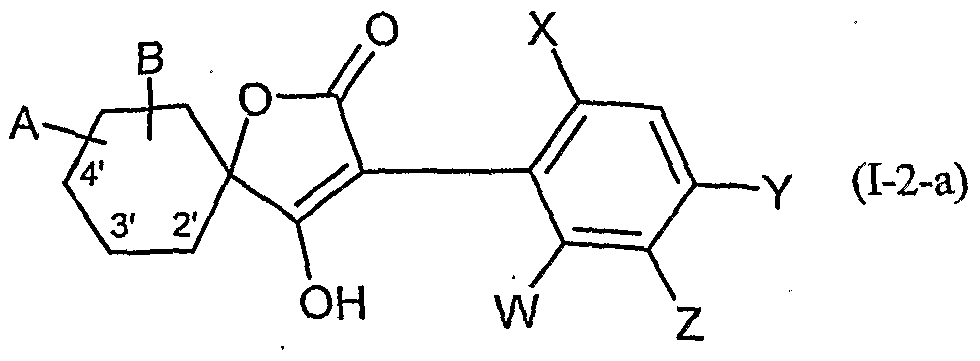
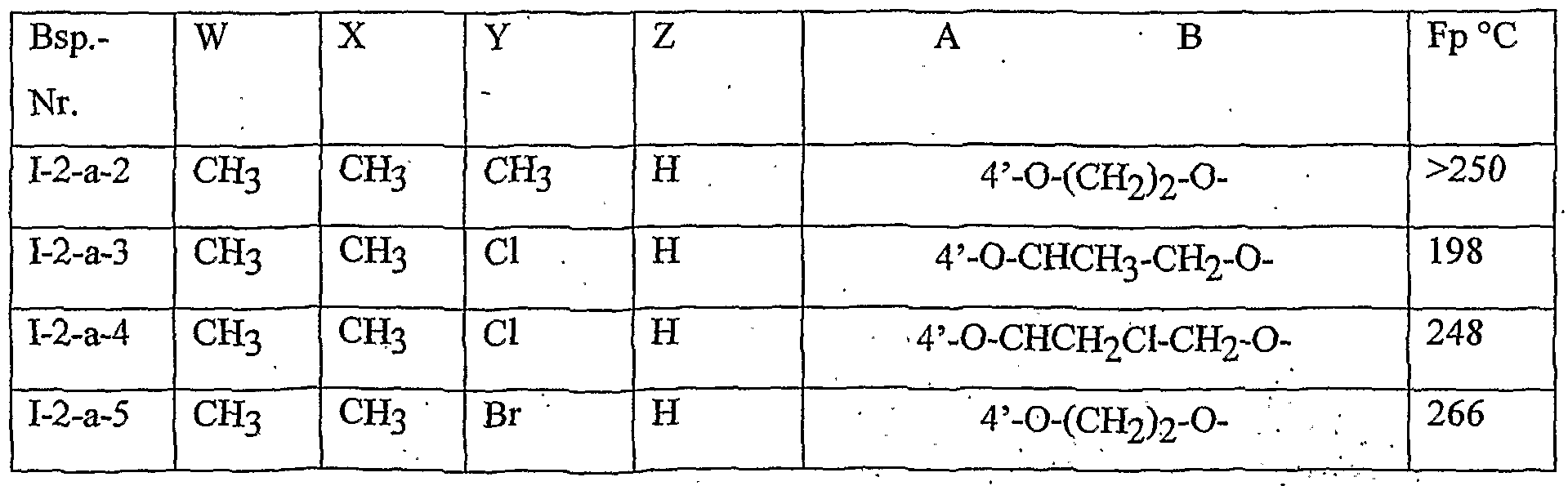


*1H-NMR (400 MHz, d6-DMSO): δ = 2.19 (s, 3H, Ar-CH3), 3.92 (s, 4H5(O-CHr)2), 7.3 (m, IH, Ar-H), 7.4 (m, IH, Ar-H), 7.5 (m, 3H, Ar-H), 7.65 (m, 2H-Ar-H) ppm.* 1 H NMR (400 MHz, d 6 -DMSO): δ = 2.19 (s, 3H, Ar-CH 3 ), 3.92 (s, 4H 5 (O-CHr) 2 ), 7.3 (m, IH, Ar -H), 7.4 (m, IH, Ar-H), 7.5 (m, 3H, Ar-H), 7.65 (m, 2H-Ar-H) ppm.
Beispiel I-2-b-lExample I-2-b-1

0,22 g (0,60 mmol) der Verbindung gemäß Beispiel (I-2-a-l) werden in 10 ml Dichlormethan vorgelegt, 0,067 g (0,66 mmol) Triethylamin zugesetzt, unter Eiskühlung 0,071 g (0,66 mmol) Isobuttersäurechlorid zugetropft und über Nacht bei Raumtemperatur gerührt.0.22 g (0.60 mmol) of the compound according to Example (I-2-al) are introduced into 10 ml of dichloromethane, 0.067 g (0.66 mmol) of triethylamine added, with ice cooling 0.071 g (0.66 mmol) of isobutyric acid chloride added dropwise and stirred overnight at room temperature.
Zur Aufarbeitung wird mit 10 %iger Zitronensäurelösung und gesättigter Natriumhydrogencarbo- natlösung extrahiert, die organische Phase mit Natriumsulfat getrocknet und einrotiert.For work-up, the mixture is extracted with 10% strength citric acid solution and saturated sodium bicarbonate solution, the organic phase is dried using sodium sulfate and concentrated by rotary evaporation.
Ausbeute: 0,22 g (77 % der Theorie), Fp. 1420C In Analogie zu Beispiel (I-2-b-l) und gemäß den allgemeinen Angaben zur Herstellung erhält man folgende Verbindungen der Formel (I-2-b):Yield: 0.22 g (77% of theory), mp 142 ° C. In analogy to Example (I-2-bl) and in accordance with the general information on the preparation, the following compounds of the formula (I-2-b) are obtained:


Beispiel XIV-2-1Example XIV-2-1

4,59 g (40,89 mmol) Kalium-tert-butylat werden in 35 ml Dimethylfbrmamid vorgelegt, eine Lösung von 10,00 g (27,26 mmol) der Verbindung gemäß Beispiel (III-A-1) in 15 ml Dimethyl- formamid unter Eiskühlung bei 0 bis 1O0C zugetropft und über Nacht bei Raumtemperatur gerührt.4.59 g (40.89 mmol) of potassium tert-butoxide are initially charged in 35 ml of dimethylfibramide, a solution of 10.00 g (27.26 mmol) of the compound according to Example (III-A-1) in 15 ml of dimethyl Formamide under ice cooling at 0 to 1O 0 C added dropwise and stirred overnight at room temperature.
Zur Aufarbeitung rotiert man das DMF am Rotationsverdampfer weitgehend ab und verteilt den Rückstand zwischen Wasser und Essigester. Die wässrige Phase wird mit Salzsäure angesäuert, das ausgefallene Produkt abgesaugt, mit Wasser gewaschen und getrocknet.For workup, the DMF is largely rotated on a rotary evaporator and the residue is partitioned between water and ethyl acetate. The aqueous phase is acidified with hydrochloric acid, the precipitated product is filtered off with suction, washed with water and dried.
Die weitere Reinigung erfolgt durch präparative HPLC (Kieselgel RP48, Eluent Acetonitril/- Wasser). Ausbeute: 2,20 g (25 % der Theorie), Fp. 21O0C.Further purification is carried out by preparative HPLC (silica gel RP48, eluent acetonitrile / water). Yield: 2.20 g (25% of theory), mp 21O 0 C.
In Analogie zu Beispiel (XW -2-1) und gemäß den allgemeinen Angaben zur Herstellung von Verbindungen der Formel (XIV-2) in der WO 99/16 748 erhält man folgende Verbindungen der Formel (XrV-2):In analogy to Example (XW -2-1) and in accordance with the general information on the preparation of compounds of the formula (XIV-2) in WO 99/16748, the following compounds of the formula (XrV-2) are obtained:
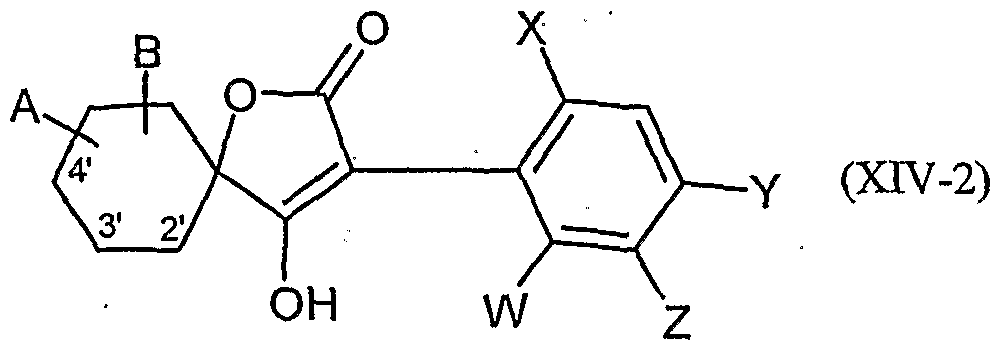
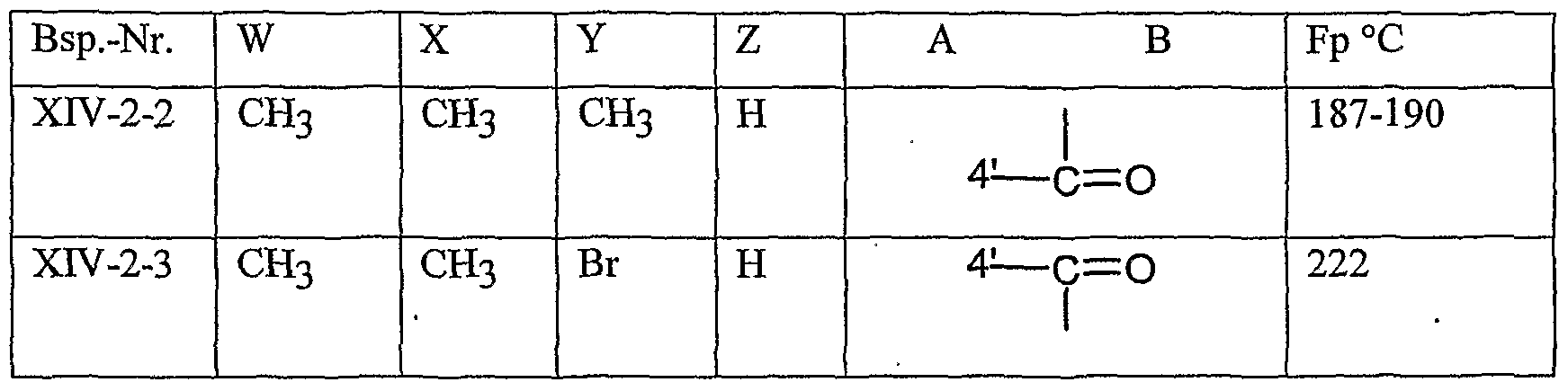
Beispiel III-A-1Example III-A-1
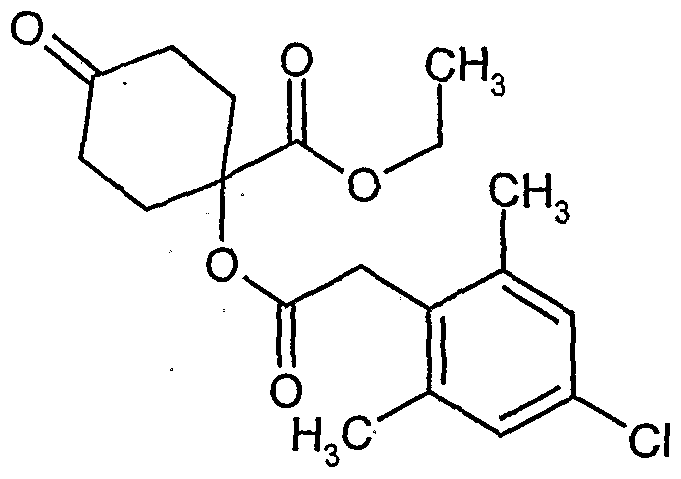
5,00 g (26,85 mmol) 4-Oxo-l-hydroxy-cyclohexancarbonsäure-ethylester und 3,26 g (32,22 mmol) Triethylamin werden in 35 ml Dichlormethan vorgelegt, eine Lösung von 6,41 g (29,53 mmol) 2,6- Dimethyl-4-chlor-phenylessigsäurechlorid in 15 ml Dichlormethan unter Eisbadkühlung bei 0 bis 1O0C zugetropft und über Nacht bei Raumtemperatur gerührt.5.00 g (26.85 mmol) of ethyl 4-oxo-l-hydroxycyclohexanecarboxylate and 3.26 g (32.22 mmol) of triethylamine are initially charged in 35 ml of dichloromethane, a solution of 6.41 g (29, 53 mmol) of 2,6-dimethyl-4-chloro-phenyl-acetic acid chloride in 15 ml of dichloromethane added dropwise with ice bath cooling at 0 to 1O 0 C and stirred overnight at room temperature.
Zur Aufarbeitung wird mit 10 %iger Zitronensäurelösung und gesättigter Natriumhydrogen- carbonatlösung extrahiert, die organische Phase mit Natriumsulfat getrocknet und einrotiert.For work-up, the mixture is extracted with 10% strength citric acid solution and saturated sodium bicarbonate solution, and the organic phase is dried using sodium sulphate and concentrated by rotary evaporation.
Ausbeute: 10,00 g Öl (67 % der Theorie). . . In Analogie zu Beispiel (DI-A-I) und gemäß den allgemeinen Angaben zur Herstellung erhält man folgende Verbindungen der Formel (DI-A):Yield: 10.00 g of oil (67% of theory). , , In analogy to Example (DI-AI) and according to the general information on the preparation, the following compounds of the formula (DI-A) are obtained:
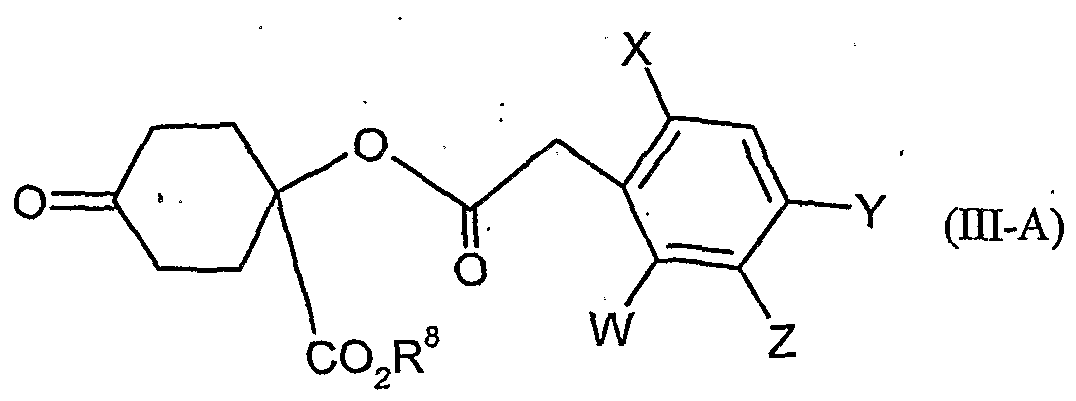

Beispiel AExample A
Myzus persicae -Test (7:1)Myzus persicae test (7: 1)
Lösungsmittel: 7 Gewichtsteile Dimethylformamid Emulgator: 1 Gewichtsteile AlkylarylpolyglykoletherSolvent: 7 parts by weight of dimethylformamide Emulsifier: 1 part by weight of alkylaryl polyglycol ether
Zur Herstellung einer zweckmäßigen Wirkstoffzubereitung vermischt man 1 Gewichtsteil Wirkstoff mit den angegebenen Mengen Lösungsmittel und Emulgator und verdünnt das Konzentrat mit emulgatorhaltigem Wasser auf die gewünschte Konzentration.To prepare a suitable preparation of active compound, 1 part by weight of active compound is mixed with the indicated amounts of solvent and emulsifier, and the concentrate is diluted with emulsifier-containing water to the desired concentration.
Kohlblätter (Brassica oleraceά), die stark von der Grünen Pfirsichblattlaus {Myzus persicae) befallen sind, werden durch Tauchen in die Wirkstoffzubereitung der gewünschten Konzentration behandelt.Cabbage leaves (Brassica oleraceά) which are heavily infested with the green peach aphid {Myzus persicae) are treated by being dipped into the preparation of active compound of the desired concentration.
Nach der gewünschten Zeit wird die Abtötung in % bestimmt. Dabei bedeutet 100 %, dass alle Blattläuse abgetötet wurden; 0 % bedeutet, dass keine Blattläuse abgetötet wurden.After the desired time the kill is determined in%. 100% means that all aphids have been killed; 0% means that no aphids have been killed.
Bei diesem Test zeigen z.B. die folgenden Verbindungen der Herstellungsbeispiele eine Wirkung von > 80 % bei einer Konzentration von 1000 ppm: Bsp. I-l-a-2, Bsp. I-l-a-1, Bsp. I-l-a-3, Bsp. I-l-a-4, Bsp. I-l-b-1, Bsp. I-l-c-3, Bsp. I-l-c-4, Bsp. I-l-c-1. In this test, for example, the following compounds of the preparation examples show an effect of> 80% at a concentration of 1000 ppm: Ex. Ila-2, ex. Ila-1, ex. Ila-3, ex. Ila-4, ex. Ilb -1, ex. Ilc-3, ex. Ilc-4, ex. Ilc-1.
Beispiel B . ■ -. Example B. ■ - .
Aphis gossypii -Test (7:1)Aphis gossypii test (7: 1)
Lösungsmittel: 7 Gewichtsteile DimethylformamidSolvent: 7 parts by weight of dimethylformamide
Emulgator: 1 Gewichtsteile AlkylarylpolyglykoletherEmulsifier: 1 part by weight of alkylaryl polyglycol ether
Zur Herstellung einer zweckmäßigen Wirkstoffzubereitung vermischt man 1 Gewichtsteil Wirkstoff mit den angegebenen Mengen Lösungsmittel und Emulgator und verdünnt das Konzentrat mit emulgatorhaltigem Wasser auf die gewünschte Konzentration.To prepare a suitable preparation of active compound, 1 part by weight of active compound is mixed with the indicated amounts of solvent and emulsifier, and the concentrate is diluted with emulsifier-containing water to the desired concentration.
Baumwollblätter (Gossypium hirsutum), die stark von der Baumwollblattlaus {Aphis gossypii) befallen sind, werden durch Tauchen in die Wirkstoffzubereitung der gewünschten Konzentration behandelt.Cotton leaves (Gossypium hirsutum) which are heavily infested with the cotton aphid {Aphis gossypii) are treated by being dipped into the preparation of active compound of the desired concentration.
Nach der gewünschten Zeit wird die Abtötung in % bestimmt. Dabei bedeutet 100 %, dass alle Blattläuse abgetötet wurden; 0 % bedeutet, dass keine Blattläuse abgetötet wurden.After the desired time the kill is determined in%. 100% means that all aphids have been killed; 0% means that no aphids have been killed.
Bei diesem Test zeigen z. B. die folgenden Verbindungen der Herstellungsbeispiele eine Wirkung von > 80 % bei einer Konzentration von 200 ppm: Bsp. I-l-a-2, Bsp. I-l-a-3, Bsp. I-l-a-4, Bsp. I-l-c-1. In this test, z. For example, the following compounds of the preparation examples an effect of> 80% at a concentration of 200 ppm: Ex. Ila-2, ex. Ila-3, ex. Ila-4, Ex. Ilc-1.
Beispiel C * Example C *
Phaedon cochleariae - Larven -Test (7 : 1 )Phaedon cochleariae - larval test (7: 1)
Lösungsmittel: 7 Gewichtsteile DimethylformamidSolvent: 7 parts by weight of dimethylformamide
Emulgator: 1 Gewichtsteil Alkylarylpolyglykolether t ' Emulsifier: 1 part by weight of alkylaryl polyglycol ether t '
Zur Herstellung einer zweckmäßigen Wirkstoffzubereitung vermischt man 1 Gewichtsteil Wirkstoff mit den angegebenen Mengen Lösungsmittel und Emulgator und verdünnt das Konzentrat mit emulgatorhaltigem Wasser auf die gewünschte Konzentration.To prepare a suitable preparation of active compound, 1 part by weight of active compound is mixed with the indicated amounts of solvent and emulsifier, and the concentrate is diluted with emulsifier-containing water to the desired concentration.
Kohlblätter (Brassica oleracea) werden durch Tauchen in die Wirkstoffzubereitung der gewünschten Konzentration behandelt und mit Larven des Meerrettichblattkäfers {Phaedon cochleariae) besetzt, solange die Blätter noch feucht sind.Cabbage leaves (Brassica oleracea) are treated by being dipped into the preparation of active compound of the desired concentration and are populated with larvae of the horseradish leaf beetle {Phaedon cochleariae) while the leaves are still moist.
Nach der gewünschten Zeit wird die Abtötung in % bestimmt. Dabei bedeutet 100 %, dass alle Käferlarven abgetötet wurden; 0 % bedeutet, dass keine Käferlarven abgetötet wurden.After the desired time the kill is determined in%. 100% means that all beetle larvae have been killed; 0% means that no beetle larvae have been killed.
Bei diesem Test zeigen z. B. die folgenden Verbindungen der Herstellungsbeispiele eine Wirkung von > 90 % bei einer Konzentration von 1000 ppm: Bsp. I-2-a-2, Bsp. I-2-b-2, Bsp. I-l-a-2, Bsp. I-l-a-1, Bsp. I-l-a-3, Bsp. I-l-a-4, Bsp. I-l-c-3, Bsp. I-l-c-4, Bsp. I-l-c-5, Bsp. I-l-b-1, Bsp. I-l-c-1. In this test, z. For example, the following compounds of the preparation examples have an effect of> 90% at a concentration of 1000 ppm: Ex. I-2-a-2, Ex. I-2-b-2, Ex. Ila-2, Ex. 1, ex. Ila-3, ex. Ila-4, ex. Ilc-3, ex. Ilc-4, Ex. Ilc-5, ex. Ilb-1, Ex. Ilc-1.
Beispiel PExample P
Plutella-Test (7:l)Plutella test (7: 1)
Lösungsmittel: 7 Gewichtsteile Dimethylformarnid Emulgator: 1 Gewichtsteil AlkylarylpolyglykoletherSolvent: 7 parts by weight of dimethylformamide Emulsifier: 1 part by weight of alkylaryl polyglycol ether
Zur Herstellung einer zweckmäßigen Wirkstoffzubereitung vermischt man 1 Gewichtsteil Wirkstoff mit den angegebenen Mengen Lösungsmittel und Emulgator und verdünnt das Konzentrat mit emulgatorhaltigem Wasser auf die gewünschte Konzentration.To prepare a suitable preparation of active compound, 1 part by weight of active compound is mixed with the indicated amounts of solvent and emulsifier, and the concentrate is diluted with emulsifier-containing water to the desired concentration.
Kohlblätter (Brassica oleracea) werden durch Tauchen in die Wirkstoffzubereitung der gewünschten Konzentration behandelt und mit Raupen der Kohlschabe (Plutella xylostellä) besetzt, solange die Blätter noch feucht sind.Cabbage leaves (Brassica oleracea) are treated by being dipped into the preparation of active compound of the desired concentration and are populated with caterpillars of the cabbage (Plutella xylostella) while the leaves are still moist.
Nach der gewünschten Zeit wird die Abtötung in % bestimmt. Dabei bedeutet 100 %, dass alle Raupen abgetötet wurden; 0 % bedeutet, dass keine Raupen abgetötet wurden.After the desired time the kill is determined in%. 100% means that all caterpillars have been killed; 0% means that no caterpillars have been killed.
Bei diesem Test zeigen z. B. die folgenden Verbindungen der Herstellungsbeispiele eine Wirkung von 100 % bei einer Konzentration von 1000 ppm: Bsp. I-2-a-2, Bsp. I-2-b-2, Bsp. I-l-a-2. In this test, z. For example, the following compounds of the Preparation Examples have an effect of 100% at a concentration of 1000 ppm: Ex. I-2-a-2, Ex. I-2-b-2, Ex. Ila-2.
Beispiel E . .. . ..Example E. ... ..
Spodoptera f rugiperda-Test (7:1)Spodoptera f rugiperda test (7: 1)
Lösungsmittel: 7 Gewichtsteile DimethylformamidSolvent: 7 parts by weight of dimethylformamide
Emulgator: 1 Gewichtsteile Alkylarylpolyglykolether , ' • ' Emulsifier: 1 part by weight of alkylaryl polyglycol ether, '•'
Zur Herstellung einer zweckmäßigen Wirkstoffzubereitung vermischt man 1 Gewichtsteil Wirkstoff mit den angegebenen Mengen Lösungsmittel und Emulgator und verdünnt das Konzentrat mit emulgatorhaltigem Wasser auf die gewünschte Konzentration.To prepare a suitable preparation of active compound, 1 part by weight of active compound is mixed with the indicated amounts of solvent and emulsifier, and the concentrate is diluted with emulsifier-containing water to the desired concentration.
Kohlblätter {Brassica oleraceά) werden durch Tauchen in die Wirkstoffzubereitung der gewünschten Konzentration behandelt und mit Raupen des Heerwurms (Spodoptera frugiperda) besetzt, solange die Blätter noch feucht sind.Cabbage leaves {Brassica olerace®) are treated by being dipped into the preparation of active compound of the desired concentration and are populated with caterpillars of the armyworm (Spodoptera frugiperda) while the leaves are still moist.
Nach der gewünschten Zeit wird die Abtötung in % bestimmt Dabei bedeutet 100 %, dass alle Raupen abgetötet wurden; 0 % bedeutet, dass keine Raupen abgetötet wurden.After the desired time the kill is determined in%. 100% means that all caterpillars have been killed; 0% means that no caterpillars have been killed.
Bei diesem Test zeigen z.B. die folgenden Verbindungen der Herstellungsbeispiele eine Wirkung von > 85 % bei einer Konzentration von 1000 ppm: Bsp. I-2-a-2, Bsp. I-2-b-2, Bsp. I-l-a-2, Bsp. I- l-a-3, Bsp. I-l-c-3. In this test, for example, the following compounds of the preparation examples show an effect of> 85% at a concentration of 1000 ppm: Ex. I-2-a-2, ex. I-2-b-2, Ex. Ila-2, ex I-1a-3, ex. Ilc-3.
Beispiel FExample F
Nephotettix-Test (7: 1)Nephotettix test (7: 1)
Lösungsmittel: 7 Gewichtsteile DimethylformamidSolvent: 7 parts by weight of dimethylformamide
Emulgator: 1 Gewichtsteil Alkylarylpolyglykolether , ' Emulsifier: 1 part by weight of alkylaryl polyglycol ether, '
Zur Herstellung einer zweckmäßigen Wirkstoffzubereitung vermischt nian 1 Gewichtsteil Wirkstoff mit den angegebenen Mengen Lösungsmittel und Emulgator und verdünnt das Konzentrat mit emulgatorhaltigem Wasser auf die gewünschte Konzentration.To prepare a suitable preparation of active compound, 1 part by weight of active compound is mixed with the stated amounts of solvent and emulsifier, and the concentrate is diluted with emulsifier-containing water to the desired concentration.
Reiskeimlinge {Oryza sativd) werden durch Tauchen in die Wirkstoffzubereitung der gewünschten Konzentration behandelt und mit der Grünen Reiszikade (Nephotettix cincticeps) besetzt, solange die Blätter noch feucht sind.Rice seedlings {Oryza sativd) are treated by being dipped into the preparation of active compound of the desired concentration and are populated with the green rice leafhopper (Nephotettix cincticeps) while the leaves are still moist.
Nach der gewünschten Zeit wird die Abtötung in % bestimmt. Dabei bedeutet 100%, dass alle Zikaden abgetötet wurden; 0% bedeutet, dass keine Zikaden abgetötet wurden.After the desired time the kill is determined in%. 100% means that all cicadas have been killed; 0% means that no cicadas have been killed.
Bei diesem Test zeigen z.B. die folgenden Verbindungen der Herstellungsbeispiele eine Wirkung von 100 % bei einer Konzentration von 1000 ppm: Bsp. I-2-a-2, Bsp. I-2-b-2, Bsp. I-l-a-2. In this test, for example, the following compounds of the preparation examples show an effect of 100% at a concentration of 1000 ppm: Ex. I-2-a-2, Ex. I-2-b-2, ex. Ila-2.
Beispiel G . , . ...Example G. ,. ...
Tetranychus-Test (7:1) (OP-resistent/Tauchbehandlung)Tetranychus test (7: 1) (OP resistant / Dipping treatment)
Lösungsmittel: 7 Gewichtsteile DimethylformamidSolvent: 7 parts by weight of dimethylformamide
Emulgator: 1 Gewichtsteile Alkylarylpolyglykolether . ' Emulsifier: 1 part by weight of alkylaryl polyglycol ether. '
Zur Herstellung einer zweckmäßigen Wirkstoffzubereitung vermischt man 1 Gewichtsteil Wirkstoff mit den angegebenen Mengen Lösungsmittel und Emulgator und verdünnt das Konzentrat mit emulgatorhaltigem Wasser auf die gewünschte Konzentration.To prepare a suitable preparation of active compound, 1 part by weight of active compound is mixed with the indicated amounts of solvent and emulsifier, and the concentrate is diluted with emulsifier-containing water to the desired concentration.
Bohnenpflanzen (Phaseolus vulgaris), die stark von allen Stadien der Gemeinen Spinnmilbe (Tetranychiis urticae) befallen sind, werden in eine Wirkstoffzubereitung der gewünschten Konzentration getaucht.Bean plants (Phaseolus vulgaris) which are heavily infested by all stages of the common spider mite (Tetranychis urticae) are immersed in an active compound preparation of the desired concentration.
Nach der gewünschten Zeit wird die Wirkung in % bestimmt. Dabei bedeutet 100 %, dass alle Spinnmilben abgetötet wurden; 0 % bedeutet, dass keine Spinnmilben abgetötet wurden.After the desired time, the effect is determined in%. 100% means that all spider mites have been killed; 0% means that no spider mites have been killed.
Bei diesem Test zeigen z. B. die folgenden Verbindungen der Herstellungsbeispiele eine Wirkung von > 98 % bei einer Konzentration von 100 ppm: Bsp. I-l-a-1, Bsp. I-l-a-3, Bsp. I-l-a-4, Bsp. I-l-c-4. In this test, z. Example, the following compounds of the preparation examples an effect of> 98% at a concentration of 100 ppm: Ex. Ila-1, ex. Ila-3, ex. Ila-4, ex. Ilc-4.
Beispiel H .. .Example H ...
Meloidogyne-Test (7:1)Meloidogyne test (7: 1)
Lösungsmittel: 7 Gewichtsteile DimethylformamidSolvent: 7 parts by weight of dimethylformamide
Emulgator: 1 Gewichtsteile AlkylarylpolyglykoletherEmulsifier: 1 part by weight of alkylaryl polyglycol ether
5 . ' ' 5. ''
Zur Herstellung einer zweckmäßigen Wirkstoffzubereitung vermischt man 1 Gewichtsteil Wirkstoff mit den angegebenen Mengen Lösungsmittel und Emulgator und verdünnt das Konzentrat mit Wasser auf die gewünschte Konzentration.To prepare a suitable preparation of active compound, 1 part by weight of active compound is mixed with the indicated amounts of solvent and emulsifier, and the concentrate is diluted with water to the desired concentration.
Gefäße werden mit Sand, Wirkstofflösung, Meloidogyne jwcogwϊα-Ei-Larven-Suspension und 10 Salatsamen gefüllt. Die Salatsamen keimen und die Pflänzchen entwickeln sich. An den Wurzeln entwickeln sich die Gallen.Vessels are filled with sand, drug solution, Meloidogyne jwcogwϊα egg larvae suspension and 10 lettuce seeds. The lettuce seeds germinate and the plantlets develop. The galls develop at the roots.
Nach der gewünschten Zeit wird die nematizide Wirkung an Hand der Gallenbildung in % bestimmt. Dabei bedeutet 100 %, dass keine Gallen gefunden wurden; 0 % bedeutet, dass die Zahl der Gallen an.den behandelten Pflanzen der der unbehandelten Kontrolle entspricht.After the desired time, the nematicidal activity is determined by means of bile formation in%. 100% means that no bile was found; 0% means that the number of galls on . the treated plants corresponds to the untreated control.
,15 Bei diesem Test zeigt z. B. die folgende Verbindung der Herstellungsbeispiele eine Wirkung von 95 % bei einer Konzentration von 20 ppm: Bsp. I-l-a-4. , 15 In this test, z. For example, the following compound of Preparation Examples has an effect of 95% at a concentration of 20 ppm: Ex. Ila-4.
Beispiel I , ". .Example I, " .
Myzus persicae -TestMyzus persicae test
Lösungsmittel: 7 Gewichtsteile DimethylformatnidSolvent: 7 parts by weight of dimethylformamide
Emulgator: 2 Gewichtsteile AlkylarylpolyglykoletherEmulsifier: 2 parts by weight of alkylaryl polyglycol ether
Zur Herstellung einer zweckmäßigen Wirkstoffzubereitung vermischt man 1 Gewichtsteil Wirkstoff mit den angegebenen Mengen Lösungsmittel und Emulgator und verdünnt das Konzentrat mit emulgatorhaltigem Wasser auf die gewünschte Konzentration.To prepare a suitable preparation of active compound, 1 part by weight of active compound is mixed with the indicated amounts of solvent and emulsifier, and the concentrate is diluted with emulsifier-containing water to the desired concentration.
Kohlblätter (Brassica oleracea), die stark von der Grünen Pfirsichblattlaus (My∑us persicae) befallen sind, werden durch Tauchen in die Wirkstoffzubereitung der gewünschten Konzentration behandelt.Cabbage leaves (Brassica oleracea) which are heavily infested with the green peach aphid (MyΣus persicae) are treated by being dipped into the preparation of active compound of the desired concentration.
Nach der gewünschten Zeit wird die Abtötung in % bestimmt. Dabei bedeutet 100 %, dass alle Blattläuse abgetötet wurden; 0 % bedeutet, dass keine Blattläuse abgetötet wurden.After the desired time the kill is determined in%. 100% means that all aphids have been killed; 0% means that no aphids have been killed.
Bei diesem Test zeigen z. B. die folgenden Verbindungen der Herstellungsbeispiele eine Wirkung von > 80 % bei einer Konzentration von 100 ppm: Bsp. I-2-a-5, Bsp. I-l-a-11, Bsp. I-l-a-14, Bsp. I-l-a-l2, Bsp. I-l-a-13. In this test, z. For example, the following compounds of the preparation examples have an effect of> 80% at a concentration of 100 ppm: Ex. I-2-a-5, ex. Ila-11, ex. Ila-14, Ex. Ila-l2, ex. ila-13th
Beispiel J ,Example J,
Tetranychus-Test (OP-resistent/Tauchbehandlung)Tetranychus test (surgical-resistant / immersion treatment)
Lösungsmittel: 7 Gewichtsteile DimethylforraamidSolvent: 7 parts by weight of dimethylforraamide
Emulgator: 2 Gewichtsteile Alkylarylpolyglykolether .Emulsifier: 2 parts by weight of alkylaryl polyglycol ether.
Zur Herstellung einer zweckmäßigen Wirkstoffzubereitung vermischt man 1 Gewichtsteil Wirkstoff mit den angegebenen Mengen Lösungsmittel und Emulgator und verdünnt das Konzentrat mit emulgatorhaltigem Wasser auf die gewünschte Konzentration.To prepare a suitable preparation of active compound, 1 part by weight of active compound is mixed with the indicated amounts of solvent and emulsifier, and the concentrate is diluted with emulsifier-containing water to the desired concentration.
Bohnenpflanzen (Phaseolus vulgaris), die stark von allen Stadien der Gemeinen Spinnmilbe {Tetranychus urticae) befallen sind, werden in eine Wirkstoffzubereitung der gewünschten Konzentration getaucht.Bean plants (Phaseolus vulgaris) that are heavily infested by all stages of the common spider mite {Tetranychus urticae) are dipped in an active compound preparation of the desired concentration.
Nach der gewünschten Zeit wird die Wirkung in % bestimmt. Dabei bedeutet 100 %, dass alle Spinnmilben abgetötet wurden; 0 % bedeutet, dass keine Spinnmilben abgetötet wurden.After the desired time, the effect is determined in%. 100% means that all spider mites have been killed; 0% means that no spider mites have been killed.
Bei diesem Test zeigen z. B. die folgende Verbindungen der Herstellungsbeispiele eine Wirkung von > 90 % bei einer Konzentration von 100 ppm: Bsp. I-l-a-11, Bsp. I-l-a-14, Bsp. I-l-a-12, Bsp. I-l-a-21, Bsp. I-l-a-22, Bsp. M-a-9, Bsp. I-l-a-43, Bsp. I-l-a-46, Bsp. I-l-a-53, Bsp. I-l-a-70, Bsp. I-l-c-16, Bsp. I-l-c-20. In this test, z. Ila-11, ex. Ila-14, ex. Ila-12, ex. Ila-21, ex. Ila-22, Ex. Ila-11, ex. Ila-14, Ex. Ila-22, Ex. Ex. Ma-9, ex. Ila-43, ex. Ila-46, ex. Ila-53, ex. Ila-70, Ex Ilc-16, ex. Ilc-20.
Beispiel K - , ' ,' .Example K -, ' , ' .
Meloidogyne-TestMeloidogyne Test
Lösungsmittel: 7 Gewichtsteile DimethylformamidSolvent: 7 parts by weight of dimethylformamide
Emulgator: 2 Gewichtsteile Alkylarylpolyglykolether .Emulsifier: 2 parts by weight of alkylaryl polyglycol ether.
Zur Herstellung einer zweckmäßigen Wirkstoffzubereitung vermischt man 1 Gewichtsteil Wirkstoff mit den angegebenen Mengen Lösungsmittel und Emulgator und verdünnt das Konzentrat mit Wasser auf die gewünschte Konzentration.To prepare a suitable preparation of active compound, 1 part by weight of active compound is mixed with the indicated amounts of solvent and emulsifier, and the concentrate is diluted with water to the desired concentration.
Gefäße werden mit Sand, Wirkstofflösung, Meloidogyne mcogmYα-Ei-Larven-Suspension und Salatsamen gefüllt. Die Salatsamen keimen und die Pflänzchen entwickeln sich. An den Wurzeln entwickeln sich die Gallen.Vessels are filled with sand, drug solution, Meloidogyne mcogmYα egg larvae suspension and lettuce seeds. The lettuce seeds germinate and the plantlets develop. The galls develop at the roots.
Nach der gewünschten Zeit wird die nematizide Wirkung an Hand der Gallenbildung in % bestimmt. Dabei bedeutet 100 %, dass keine Gallen gefunden wurden; 0 % bedeutet, dass die Zahl der Gallen an den behandelten Pflanzen der der unbehandelten Kontrolle entspricht.After the desired time, the nematicidal activity is determined by means of bile formation in%. 100% means that no bile was found; 0% means that the number of bile on the treated plants corresponds to that of the untreated control.
Bei diesem Test zeigt z. B. die folgende Verbindung der Herstellungsbeispiele eine Wirkung von 80 % bei einer Konzentration von 20 ppm: Bsp. I-l-a-12. In this test, z. For example, the following compound of the Preparation Examples has an effect of 80% at a concentration of 20 ppm: Ex. Ila-12.
Beispiel L , Example L ,
ApMs gossypii -TestApM's gossypii test
Lösungsmittel: 7 Gewichtsteile DimethylformamidSolvent: 7 parts by weight of dimethylformamide
Emulgator: 2 Gewichtsteile AlkylarylpolyglykoletherEmulsifier: 2 parts by weight of alkylaryl polyglycol ether
Zur Herstellung einer zweckmäßigen Wirkstoffzubereitung vermischt man 1 Gewichtsteil Wirkstoff mit den angegebenen Mengen Lösungsmittel und Emulgator und verdünnt das Konzentrat mit emulgatorhaltigem Wasser auf die gewünschte Konzentration.To prepare a suitable preparation of active compound, 1 part by weight of active compound is mixed with the indicated amounts of solvent and emulsifier, and the concentrate is diluted with emulsifier-containing water to the desired concentration.
Baumwollblätter (Gossypium hirsutum), die stark von der Baumwollblattlaus (Aphis gossypii) befallen sind, werden durch Tauchen in die Wirkstoffzubereitung der gewünschten Konzentration behandelt.Cotton leaves (Gossypium hirsutum) which are heavily infested with the cotton aphid (Aphis gossypii) are treated by being dipped into the preparation of active compound of the desired concentration.
Nach der gewünschten Zeit wird die Abtötung in % bestimmt. Dabei bedeutet 100 %, dass alle Blattläuse abgetötet wurden; 0 % bedeutet, dass keine Blattläuse abgetötet wurden.After the desired time the kill is determined in%. 100% means that all aphids have been killed; 0% means that no aphids have been killed.
Bei diesem Test zeigen z. B. die folgenden Verbindungen. der Herstellungsbeispiele eine Wirkung von > 80 % bei einer Konzentration von 100 ppm: Bsp. I-l-a-19, Bsp. I-l-a-7, Bsp. I-l-a-14, Bsp. I-l-a-30, Bsp. I-l-a-31, Bsp. I-l-a-38, Bsp. I-l-a-48, Bsp. I-l-a-50, Bsp. I-l-a-53, Bsp. I-l-a-56, Bsp. I-l-a-58, Bsp. I-l-a-63, Bsp. I-l-b-4, Bsp. I-l-c-15, Bsp.I-l-c-19, Bsp.I-l-c-20, Bsp.I-l-c-32, Bsp.I-2-a-5. In this test, z. For example, the following compounds. the preparation examples an effect of> 80% at a concentration of 100 ppm: Ex. Ila-19, ex. Ila-7, ex. Ila-14, ex. Ila-30, ex. Ila-31, Ex. Ila-38 Ila-48, ex. Ila-50, ex. Ila-53, ex. Ila-56, ex. Ila-58, ex. Ila-63, ex. Ilb-4, ex. Ilc-15, ex .Ilc-19, Ex. Ilc-20, Ex. Ilc-32, Ex. I-2-a-5.
Beispiel MExample M
Phaedon cochleariae - Larven -TestPhaedon cochleariae - larval test
Lösungsmittel: 7 Gewichtsteile DimethylformamidSolvent: 7 parts by weight of dimethylformamide
Emulgator: 2 Gewichtsteil AlkylafylpolyglykoletherEmulsifier: 2 parts by weight of alkylaflyl polyglycol ether
Zur Herstellung einer zweckmäßigen Wirkstoffzubereitung vermischt man 1 Gewichtsteil Wirkstoff mit den angegebenen Mengen Lösungsmittel und Emulgator und verdünnt das Konzentrat mit emulgatorhaltigem Wasser auf die gewünschte Konzentration.To prepare a suitable preparation of active compound, 1 part by weight of active compound is mixed with the indicated amounts of solvent and emulsifier, and the concentrate is diluted with emulsifier-containing water to the desired concentration.
Kohlblätter (Brassica oleraceά) werden durch Tauchen in die Wirkstoffzubereitung der gewünschten Konzentration behandelt und mit Larven des Meerrettichblattkäfers {Phaedon cochleariae) besetzt, solange die Blätter noch feucht sind.Cabbage leaves (Brassica oleraceά) are treated by being dipped into the preparation of active compound of the desired concentration and are populated with larvae of the horseradish leaf beetle {Phaedon cochleariae) while the leaves are still moist.
Nach der gewünschten Zeit wird die Abtötung in % bestimmt. Dabei bedeutet 100 %, dass alle Käferlarven abgetötet wurden; 0 % bedeutet, dass keine Käferlarven abgetötet wurden.After the desired time the kill is determined in%. 100% means that all beetle larvae have been killed; 0% means that no beetle larvae have been killed.
Bei diesem Test zeigt z. B. die folgende Verbindung der Herstellungsbeispiele eine Wirkung von 100 % bei einer Konzentration von 100 ppm: Bsp. I-l-a-23. In this test, z. For example, the following compound of the Preparation Examples has an effect of 100% at a concentration of 100 ppm: Ex. Ila-23.
Beispiel N ■ ' ■. • '.Example N ■ ' ■ . • ' .
Phaedon-Test (Spritzbehandlung)Phaedon test (spray treatment)
Lösungsmittel: 78 Gewichtsteile AcetonSolvent: 78 parts by weight of acetone
1,5 Gewichtsteile Dimethyiformamid1.5 parts by weight of dimethylformamide
Emulgator: 0,5 Gewichtsteile AlkylatylpolyglykoletherEmulsifier: 0.5 part by weight of alkylatyl polyglycol ether
Zur Herstellung einer zweckmäßigen Wirkstoffzubereitung vermischt man 1 Gewichtsteil Wirkstoff mit den angegebenen Mengen Lösungsmittel und Emulgator und verdünnt das Konzentrat mit emulgatorhaltigem Wasser auf die gewünschte Konzentration.To prepare a suitable preparation of active compound, 1 part by weight of active compound is mixed with the indicated amounts of solvent and emulsifier, and the concentrate is diluted with emulsifier-containing water to the desired concentration.
Chinakohlblattscheiben (Brassica pekinensis) werden mit einer Wirkstoffzubereitung der gewünschten Konzentration gespritzt und nach dem Abtrocknen mit Larven des Meerrettichblattkäfers (Phaedon cochleariae) besetzt.Chinese cabbage leaf discs (Brassica pekinensis) are sprayed with a preparation of active compound of the desired concentration and, after drying, are populated with larvae of the horseradish leaf beetle (Phaedon cochleariae).
Nach der gewünschten Zeit wird die Wirkung in % bestimmt. Dabei bedeutet 100 %, dass alle Käferlarven abgetötet wurden; 0 % bedeutet, dass keine Käferlarven abgetötet wurden.After the desired time, the effect is determined in%. 100% means that all beetle larvae have been killed; 0% means that no beetle larvae have been killed.
Bei diesem Test zeigen z.B. die folgenden Verbindungen der Herstellungsbeispiele eine Wirkung von > 80 % bei einer Aufwandmenge von 100 g/ha: Bsp. I-l-a-15, Bsp. I-l-c-9, Bsp. I-l-a-21 und eine Wirkung von 100 % bei einer Aufwahdmenge von 500 g/ha: Bsp. I-l-a-18, Bsp. I-l-a-20,In this test, e.g. Ila-15, Ex. Ilc-9, ex. Ila-21 and an effect of ha: Ex. Ila-18, ex. Ila-20,
Bsρ.I-l-a-22, Bsp.I-l-a-8, Bsp.I-l-a-10, Bsp.I-l-a-7, Bsp. I-l-a-9, Bsp. I-l-c-6, Bsp.I-l-a-16, Bsp. I- l-a-24, Bsp. I-l-a-27, Bsp. I-l-a-30, Bsp. I-l-a-31, Bsp. I-l-a-32, Bsp. I-l-a-33, Bsp. I-l-a-34, Bsp.Bsρ.Ila-22, Bsp.Ila-8, Bsp.Ila-10, Bsp.Ila-7, Bsp. Ila-9, Bsp. Ilc-6, Bsp.Ila-16, Bsp. I-la-24, Ila-27, ex. Ila-30, ex. Ila-31, ex. Ila-32, ex. Ila-33, Ex. Ila-34, ex.
I-l-a-38, Bsp. I-l-a-39, Bsp. I-l-a-43, Bsp. I-l-a-455 Bsp. I-l-a-46, Bsp. I-l-a-47, Bsp. I-l-a-49, Bsp. I-l-a-51, Bsp. I-l-a-52, Bsp. I-l-a-53, Bsp. I-l-a-54, Bsp. I-l-a-56, Bsp. I-l-a-61, Bsp.Ila-38, Ex Ila-39, ex. Ila-43, ex. Ila-45 5 ex. Ila-46, ex. Ila-47, Ex. Ila-49, Ex. Ila-51, ex. 52, ex. Ila-53, ex. Ila-54, ex. Ila-56, Ex. Ila-61, ex.
I-l-a-63, Bsp. I-l-a-64, Bsp. I-l-a-65, Bsp. I-l-a-66, Bsp. I-l-a-67, Bsp. I-l-a-68, Bsp. I-l-a-71,I-l-a-63, Ex I-l-a-64, ex I-l-a-65, ex I-l-a-66, ex I-l-a-67, ex I-l-a-68, ex I-l-a-71
Bsp. I-l-c-19, Bsp. I-l-c-31, Bsp. I-l-c-34. Ex. Ilc-19, ex. Ilc-31, ex. Ilc-34.
6 0010896 001089
165165
Beispiel O . .. ..Example O .. ..
Tetranychus-Test COP-resistent/Spritzbehandlung)Tetranychus test COP-resistant / spray treatment)
Lösungsmittel: 78 Gewichtsteile AcetonSolvent: 78 parts by weight of acetone
1,5 Gewichtsteile Dimethylformarnid Emulgator: 0,5 Gewichtsteile Alkylarylpolyglykolether1.5 parts by weight of dimethylformamide emulsifier: 0.5 part by weight of alkylaryl polyglycol ether
Zur Herstellung einer zweckmäßigen Wirkstoffzubereitung vermischt man 1 Gewichtsteil Wirkstoff mit den angegebenen Mengen Lösungsmittel und Emulgator und verdünnt das Konzentrat mit emulgatorhaltigem Wasser auf die gewünschte Konzentration.To prepare a suitable preparation of active compound, 1 part by weight of active compound is mixed with the indicated amounts of solvent and emulsifier, and the concentrate is diluted with emulsifier-containing water to the desired concentration.
Bohnenblattscheiben (Phaseolus vulgaris), die von allen Stadien der Gemeinen Spinnmilbe (Tetranychus urticae) befallen sind, werden mit einer Wirkstoffzubereitung der gewünschten Konzentration gespritzt.Bean leaf discs (Phaseolus vulgaris) infected by all stages of the common spider mite (Tetranychus urticae) are sprayed with an active compound preparation of the desired concentration.
Nach der gewünschten Zeit wird die Wirkung in % bestimmt. Dabei bedeutet 100 %, dass alle Spinnmilben abgetötet wurden; 0 % bedeutet, dass keine Spinnmilben abgetötet wurden.After the desired time, the effect is determined in%. 100% means that all spider mites have been killed; 0% means that no spider mites have been killed.
Bei diesem Test zeigen z. B. die folgenden Verbindungen der Herstellungsbeispiele eine Wirkung von > 80 % bei einer Aufwandmenge von 100 g/ha-. Bsp. I-2-b-l, Bsp. I-l-a-16, Bsp.I-l-a-15, Bsp.I-l-c-9, Bsp.I-l-c-11, Bsp.I-l-a-23, Bsp. I-l-c-6, Bsp. I-l-a-24, Bsp. I-l-a-27 und Bsp. I-l-a-38, Bsp. I-l-a-50, Bsp. I-l-a-58, Bsp. I-l-c-24, Bsp. I-l-c-43. In this test, z. B. the following compounds of the preparation examples an effect of> 80% at a rate of 100 g / ha-. I-2-bl, ex. Ila-16, ex. Ill-15, ex. Illc-9, ex. Illc-11, ex. Ill-23, ex. Ilc-6, Ex. Ila-24, Ila-27 and Ex. Ila-38, ex. Ila-50, ex. Ila-58, ex Ilc-24, ex Ilc-43.
006/001089006/001089
166166
Beispiel P , ' .Example P, '.
Meloidogyne-Test (Spritzbehandlung)Meloidogyne test (spray treatment)
Lösungsmittel: 80 Gewichtsteile AcetonSolvent: 80 parts by weight of acetone
Zur Herstellung einer zweckmäßigen Wirkstoffzubereitung vermischt man 1 Gewichtsteil Wirk- stoff mit der angegebenen Menge Lösungsmittel und verdünnt das Konzentrat mit Wasser auf die gewünschte Konzentration.To prepare a suitable preparation of active compound, 1 part by weight of active compound is mixed with the stated amount of solvent and the concentrate is diluted with water to the desired concentration.
Gefäße werden mit Sand, Wirkstofflösung, Meloidogyne incognita-Ei-Larven-Suspension und Salatsamen gefüllt. Die Salatsamen keimen und die Pflänzchen entwickeln sich. An den Wurzeln entwickeln sich die Gallen.Vessels are filled with sand, drug solution, Meloidogyne incognita egg larvae suspension and lettuce seeds. The lettuce seeds germinate and the plantlets develop. The galls develop at the roots.
Nach der gewünschten Zeit wird die nematizide Wirkung an Hand der Gallenbildung in % bestimmt. Dabei bedeutet 100 %, dass keine Gallen gefunden wurden; 0 % bedeutet, dass die Zahl der Gallen an den behandelten Pflanzen der der unbehandelten Kontrolle entspricht.After the desired time, the nematicidal activity is determined by means of bile formation in%. 100% means that no bile was found; 0% means that the number of bile on the treated plants corresponds to that of the untreated control.
Bei diesem Test zeigt z. B. die folgende Verbindung der Herstellungsbeispiele eine Wirkung von 100 % bei einer Konzentration von 20 ppm: Bsp. ϊ-l-a-15. In this test, z. Example, the following compound of the preparation examples, an effect of 100% at a concentration of 20 ppm: Ex. Ϊ-la-15.
Beispiel O ,Example O,
Myzus-Test (Spritzbehandlung)Myzus test (spray treatment)
Lösungsmittel: 78 Gewichtsteile AcetonSolvent: 78 parts by weight of acetone
1,5 Gewichtsteile Dimethylformamid ■ ' ' 1.5 parts by weight of dimethylformamide ■ "
Emulgator: 0,5 Gewichtsteile ÄlkylarylpolyglykoletherEmulsifier: 0.5 part by weight of alkylaryl polyglycol ether
Zur Herstellung einer zweckmäßigen Wirkstoffzubereitung vermischt man 1 Gewichtsteil Wirkstoff mit den angegebenen Mengen Lösungsmittel und Emulgator und verdünnt das Konzentrat mit emulgatorhaltigem Wasser auf die gewünschte Konzentration.To prepare a suitable preparation of active compound, 1 part by weight of active compound is mixed with the indicated amounts of solvent and emulsifier, and the concentrate is diluted with emulsifier-containing water to the desired concentration.
Chinakohlblattscheiben (Brassica pekinensis), die von allen Stadien der Grünen Pfirsichblattlaus (Myzus persicae) befallen sind, werden mit einer Wirkstoffzubereitung der gewünschten Konzentration gespritzt.Chinese cabbage leaf discs (Brassica pekinensis) infested with all stages of the green peach aphid (Myzus persicae) are sprayed with an active compound preparation of the desired concentration.
Nach der gewünschten Zeit wird die Wirkung in % bestimmt. Dabei bedeutet 100 %, dass alle Blattläuse abgetötet wurden; 0 % bedeutet, dass keine Blattläuse abgetötet wurden.After the desired time, the effect is determined in%. 100% means that all aphids have been killed; 0% means that no aphids have been killed.
Bei diesem Test zeigen z.B. die folgenden Verbindungen der Herstellungsbeispiele eine Wirkung von > 90 % bei einer Aufwandmenge von 500 g/ha: Bsp. I-l-a-18, Bsp. I-l-a-19, Bsp.I-l-c-10, Bsp.I-l-a-20, Bsp.I-l-c-11, Bsρ.I-l-a-23, Bsp. I-l-a-21, Bsp. I-l-a-22, Bsp. I-l-a-8, Bsp. I-l-a-10, Bsp. I-l-a-7, Bsp.I-l-a-9, Bsp.I-l-c-6, Bsp.I-2-a-l, Bsp.I-2-a-3, Bsp. I-2-a-4, Bsp. I-2-a-7, Bsp. I-2-b-l, Bsp.I-2-b-3, Bsp.I-2-b-4, Bsp. I-2-a-5, Bsp. I-l-a-16, Bsp. I-l-a-24, Bsp. I-l-a-26, Bsp. ϊ-1- a-28, Bsp. I-l-a-29, Bsp. I-l-a-30, Bsp. I-l-a-31, Bsp. I-l-a-32, Bsp. I-l-a-33, Bsp. I-l-a-34, Bsp. I- l-a-35, Bsp. I-l-a-36, Bsp. I-l-a-37, Bsp. I-l-a-383 Bsp. I-l-a-39, Bsp. I-l-a-40, Bsp. I-l-a-41, Bsp. I-l-a-42, Bsp. I-l-a-43, Bsp. I-l-a-44, Bsp. I-l-a-45, Bsp. I-l-a-46, Bsp. I-l-a-47, Bsp. I-l-a-48, Bsp. I-l-a-49, Bsp. I-l-a-50, Bsp. I-l-a-51, Bsp. I-l-a-52, Bsp. ϊ-l-a-53, Bsp. I-l-a-54, Bsp. I-l-a-56, Bsp. I-l-a-57, Bsp. I-l-a-58, Bsp. I-l-a-59, Bsp. I-l-a-60, Bsp. I-l-a-61, Bsp. I-l-a-62, Bsp. I-l-a-63, Bsp. I-l-a-64, Bsp. I-l-a-65, Bsp. I-l-a-66, Bsp. I-l-a-67, Bsp. I-l-a-69, Bsp. I-l-a-70, Bsp. I-l-a-71, Bsp. I-l-b-4, Bsp. I-l-b-6, Bsp. I-l-b-7, Bsp. I-l-b-8, Bsp. I-l-b-10, Bsp. I-l-b-11, Bsp. I-l-c-14, Bsp. I-l-c-15, Bsp. I-l-c-16, Bsp. I-l-=c-17, Bsp. I-l-c-18, Bsp. I-l-c-19, Bsp. I-l-c-20, Bsp. I-l-c-21, Bsp. I-l-c-22, Bsp. I-l-c-23, Bsp. I-l-c-24, Bsp. I-l-c-25, Bsp. I-l-c-26, Bsp. I-l-c-30, Bsp. H-c-31, Bsp. I-l-c-32, Bsp. I-l-c-33, Bsp. I-l-c-34, Bsp. I-l-c-35, Bsp. I-l-c-36, Bsp. I-l-c-40, Bsp. H-c-41, Bsp. I-l-c-42, Bsp. I-l-c-43. P2006/001089In this test, for example, the following compounds of the preparation examples show an effect of> 90% at an application rate of 500 g / ha: Ex. Ila-18, ex. Ila-19, Ex. Ilc-10, ex. Ill-20, Ex Ila-21, Ex. Ila-22, ex. Ila-8, ex. Ila-10, Ex. Ila-7, Ex. Ila-9, Ex. Illc I-2-a-7, Ex. I-2-a-7, Ex. I-2-bl, Ex I-2-b-3, Ex. I-2-b-4, Ex. I-2-a-5, ex. Ila-16, Ex. Ila-24, Ex. Ila-26, Ex. Ϊ Ia-29, Ex Ila-30, ex Ila-31, ex Ila-32, ex Ila-33, ex Ila-34, Ex I-la-35 Ila-36, ex. Ila-37, ex. Ila-38 3 ex. Ila-39, ex. Ila-40, Ex. Ila-41, Ex. Ila-42, Ex. Ila-43, ex Ila-44, Ex Ila-45, ex Ila-46, ex Ila-47, ex Ila-48, ex Ila-49, ex Ila-50, ex Ila-51, ex Ila Ila-54, ex. Ila-56, ex. Ila-57, ex. Ila-58, ex. Ila-59, ex. Ila-60, Ex. Ila Ila-63, Ex. Ila-64, ex. Ila-65, ex. Ila-66, ex. Ila-67, ex. Ila-69, Ex. Ila-70 , Ila-71, Ilb-4, ex. Ilb-6, ex. Ilb-7, ex. Ilb-8, ex. Ilb-10, ex. Ilb-11, ex. Ilc-14, ex. Ilc-15, ex. Ilc-16, Example Il- = c-17, Ex Ilc-18, ex Ilc-19, ex Ilc-20, ex Ilc-21, ex Ilc-22, ex Ilc-23, ex Ilc-24, ex Ilc-25, ex Ilc-26, ex Ilc-30, ex. Hc-31, ex Ilc-32, ex Ilc-33, ex Ilc-34, ex Ilc -35, ex. Ilc-36, ex. Ilc-40, ex. Hc-41, ex. Ilc-42, ex. Ilc-43. P2006 / 001089
168168
Beispiel RExample R
Spodoptera frugiperda-Test (Spritzbehandlung)Spodoptera frugiperda test (spray treatment)
Lösungsmittel: 78 Gewichtsteile AcetonSolvent: 78 parts by weight of acetone
1,5 Gewichtsteile Dimethylformamid1.5 parts by weight of dimethylformamide
Emulgator: 0,5 Gewichtsteile AlkylarylpolyglykoletherEmulsifier: 0.5 part by weight of alkylaryl polyglycol ether
Zur Herstellung einer zweckmäßigen Wirkstoffzubereitung vermischt man 1 Gewichtsteil Wirkstoff mit den angegebenen Mengen Lösungsmittel und Emulgator und verdünnt das Konzentrat mit emulgatorhaltigem Wasser auf die gewünschte Konzentration.To prepare a suitable preparation of active compound, 1 part by weight of active compound is mixed with the indicated amounts of solvent and emulsifier, and the concentrate is diluted with emulsifier-containing water to the desired concentration.
Maisblattscheiben (Zea mays) werden mit einer Wirkstoffzubereitung der gewünschten Konzentration gespritzt und nach dem Abtrocknen mit Raupen des Heerwurms (Spodoptera frugiperda) besetzt.Maize leaf discs (Zea mays) are sprayed with an active compound preparation of the desired concentration and, after drying, are infested with caterpillars of the armyworm (Spodoptera frugiperda).
Nach der gewünschten Zeit wird die Wirkung in % bestimmt. Dabei bedeutet 100 %, dass alle Raupen abgetötet wurden; 0 % bedeutet, dtss' keine Raupe abgetötet wurde.After the desired time, the effect is determined in%. 100% means that all caterpillars have been killed; 0% means that no caterpillar has been killed.
Bei diesem Test zeigen z.B. die folgenden Verbindungen der Herstellungsbeispiele eine Wirkung von > 80 % bei einer Aufwandmenge von 500 g/ha: Bsp. I-2-a-7, Bsp. I-l-a-16, Bsp.I-l-a-21, Bsp.I-l-a-22, Bsp.I-l-a-8, Bsp.I-l-a-10, Bsp. I-l-a-27, Bsp. I-l-a-31, Bsp.I-l-a-49, Bsp.I-l-a-51, Bsρ.I-l-a-52, Bsp.I-l-a-54, Bsp.I-l-a-64, Bsp.I-l-a-65, Bsp.I-l-a-66, Bsp.I-l-a-67, Bsp.M-c-16, Bsp.I-l-c-19, Bsp.I-l-c-31, Bsp. Bsp.I-l-c-36, Bsρ.I-l-c-40. In this test, for example, the following compounds of the preparation examples show an effect of> 80% at an application rate of 500 g / ha: Ex. I-2-a-7, ex. Ila-16, Ex. Ila-21, Ex Ila-27, ex. Ila-31, ex. Ila-49, ex. Ill-51, Bsρ.Ila-52, ex. Ila-54 For example, Ex. Ila-64, Ex. Ill-65, Ex. Ill-66, Ex. Ill-67, Ex. Mc-16, Ex. Illc-19, Ex. Illc-31, ex. Ex. Illc-36 , Bsρ.Ilc-40.
Beispiel S ' " ' .Example S ''' .
Myzus persicae -Test (hydroponischeBehandlung)Myzus persicae test (hydroponic treatment)
Lösungsmittel: 7 Gewichtsteile DimethylformamidSolvent: 7 parts by weight of dimethylformamide
Emulgator: 2 Gewichtsteile AlkylarylpolyglykoletherEmulsifier: 2 parts by weight of alkylaryl polyglycol ether
Zur Herstellung einer zweckmäßigen Wirkstoffzubereitung vermischt man 1 Gewichtsteil Wirkstoff mit den angegebenen Mengen Lösungsmittel und Emulgator und verdünnt das Konzentrat mit Wasser auf die gewünschte Konzentration.To prepare a suitable preparation of active compound, 1 part by weight of active compound is mixed with the indicated amounts of solvent and emulsifier, and the concentrate is diluted with water to the desired concentration.
Die Wirkstoffzubereitung wird mit Wasser gemischt. Die angegebene Konzentration bezieht sich auf die Wirkstoffmenge pro Volumeneinheit Wasser (mg/1 = ppm). Man füllt das behandelte Wasser in Gefäße mit einer Erbsenpflanze (Pisum sativum). Nach der gewünschten Zeit wird mit der Grünen Pfirsichblattlaus (Myzus persicae) infiziert.The preparation of active compound is mixed with water. The stated concentration refers to the amount of active substance per unit volume of water (mg / 1 = ppm). The treated water is poured into vessels containing a pea plant (Pisum sativum). After the desired time, the green peach aphid (Myzus persicae) is infected.
Nach der gewünschten Zeit wird die Abtötung in % bestimmt. Dabei bedeutet 100 %, dass alle Blattläuse abgetötet wurden; 0 % bedeutet, dass keine Blattläuse abgetötet wurden.After the desired time the kill is determined in%. 100% means that all aphids have been killed; 0% means that no aphids have been killed.
Bei diesem Test zeigen z.B. die folgende Verbindungen der Herstellungsbeispiele eine Wirkung von > 95 % bei einer Konzentration von 20 ppm: Bsp. I-l-a-23, Bsp. I-l-a-21, Bsp.I-l-a-7,In this test, e.g. the following compounds of the Preparation Examples have an effect of> 95% at a concentration of 20 ppm: Ex. I-1-a-23, Ex. I-1-a-21, Ex. I-1-a-7,
Bsρ.I-l-a-24, Bsp.I-l-a-26, Bsp.I-l-a-30, Bsp. I-l-a-32, Bsp. I-l-a-34, Bsp. I-l-a-35, Bsp. I-l-a-36,Bsρ.I-l-a-24, Ex. I-l-a-26, Ex. I-l-a-30, Ex. I-l-a-32, Ex. I-l-a-34, Ex. I-l-a-35, Ex. I-l-a-36,
Bsp. I-l-a-38, Bsp. I-l-a-39, Bsp. I-l-a-40, Bsp.I-l-a-42, Bsp.I-l-a-43, Bsp.I-l-a-44, Bsp.I-l-a-45,I-I-a-38, Ex I-l-a-39, Ex I-l-a-40, Ex-I-l-a-42, Ex-I-l-a-43, Ex-I-l-a-44, Ex-I-l-a-45,
Bsp.I-l-a-46, Bsp.I-l-a-47, Bsp.I-l-a-48, Bsp.I-l-a-50, Bsp.I-l-a-53, Bsp.I-l-a-56, Bsp.I-l-a-57,Example I-l-a-46, Ex-I-l-a-47, Ex-I-l-a-48, Ex-I-l-a-50, Ex-I-l-a-53, Ex-I-l-a-56, Ex-I-l-a-57,
Bsp.I-l-a-58, Bsp.I-l-a-59, Bsp.I-l-a-69, Bsp.I-l-a-70, Bsp.I-l-a-71, Bsp.I-l-b-4, Bsp.I-l-b-8, Bsp.I-l-b-10, Bsp.I-l-b-11, Bsp.I-l-c-15, Bsp.I-l-c-17, Bsp.I-l-c-19, Bsp.I-l-c-20, Bsp.I-l-c-235 Ex. Ila-58, Ex. Ila-59, Ex. Ill-69, Ex. Ill-70, Ex. Ill-71, Ex-Ilb-4, Ex-Illb-8, Ex-Illb-10, Ex. Ilb-11, Ex. Ilc-15, Ex. Ilc-17, Ex. Ilc-19, Ex. Ilc-20, Ex. Ilc-23 5
Bsp.I-l-c-24, Bsp.I-l-c-25, Bsp.I-l-c-32, Bsp.I-l-c-43. Ex. Ilc-24, Ex. Ilc-25, Ex. Ilc-32, Ex. Ilc-43.
Beispiel T * Example T *
Post-emergence-TestPost-emergence test
Lösungsmittel: 5 Gewichtsteile Aceton Emulgator. 1 Gewichtsteil AlkylärylpolyglykoletherSolvent: 5 parts by weight of acetone emulsifier. 1 part by weight of alkylaryl polyglycol ether
Zur Herstellung einer zweckmäßigen Wirkstoffzubereitung vermischt man 1 Gewichtsteil Wirk- stoff mit der angegebenen Menge Lösungsmittel, gibt die angegebene Menge Emulgator zu und verdünnt das Konzentrat mit Wasser auf die gewünschte Konzentration.To prepare a suitable preparation of active compound, 1 part by weight of active compound is mixed with the stated amount of solvent, the stated amount of emulsifier is added and the concentrate is diluted with water to the desired concentration.
Mit der Wirkstoffzubereitung spritzt man Testpflanzen, welche eine Höhe von 5- 15 cm haben so, dass die jeweils gewünschten Wirkstoffmengen pro Flächeneinheit ausgebracht werden. Die Konzentration der Spritzbrühe wird so gewählt, dass in 1000 1 Wasser/ha die jeweils gewünschten Wirkstoffmengen ausgebracht werden.With the preparation of active compound is injected test plants, which have a height of 5-15 cm so that the particular desired amounts of active ingredient per unit area are applied. The concentration of the spray mixture is chosen so that in each case the desired amounts of active substance are applied in 1000 l water / ha.
Nach drei Wochen wird der Schädigungsgrad der Pflanzen bonitiert in % Schädigung im Vergleich zur Entwicklung der unbehandelten Kontrolle.After three weeks, the degree of damage of the plants is rated in% damage in comparison to the development of the untreated control.
Es bedeutenIt means
0 % == keine Wirkung (wie unbehandelte Kontrolle)0% == no effect (like untreated control)
100 % = totale Vernichtung 100% = total annihilation
Beispiel UExample U
Pre-emergence-Test (Prüfung von Wirkstoffen Herbizide Monheim)Pre-emergence test (testing of active ingredients herbicides Monheim)
Lösungsmittel: 5 Gewichtsteile Aceton Emulgator. 1 Gewichtsteil AlkylärylpolyglykoletherSolvent: 5 parts by weight of acetone emulsifier. 1 part by weight of alkylaryl polyglycol ether
Zur Herstellung einer zweckmäßigen Wirkstoffzubereitung vermischt man 1 Gewichtsteil Wirkstoff mit der angegebenen Menge Lösungsmittel, gibt die angegebene Menge Emulgator zu und verdünnt das Konzentrat mit Wasser auf die gewünschte Konzentration.To prepare a suitable preparation of active compound, 1 part by weight of active compound is mixed with the stated amount of solvent, the indicated amount of emulsifier is added and the concentrate is diluted with water to the desired concentration.
Samen der Testpflanzen werden in normalen Boden ausgesät. Nach ca. 24 Stunden wird der Boden mit der Wirkstoffzubereitung bespritzt so, dass die jeweils gewünschten Wirkstoffmengen pro Flächeneinheit ausgebracht werden. Die Konzentration der Spritzbrühe wird so gewählt, dass in 1000 1 Wasser/ha die jeweils gewünschten Wirkstoffmengen ausgebracht werden.Seeds of the test plants are sown in normal soil. After about 24 hours, the soil is sprayed with the preparation of active compound so that the respective desired amounts of active ingredient per unit area are applied. The concentration of the spray mixture is chosen so that in each case the desired amounts of active substance are applied in 1000 l water / ha.
Nach drei Wochen wird der Schädigungsgrad der Pflanzen bonitiert in % Schädigung im Vergleich zur Entwicklung der unbehandelten Kontrolle.After three weeks, the degree of damage of the plants is rated in% damage in comparison to the development of the untreated control.
Es bedeutenIt means
0 % = keine Wirkung (wie unbehandelte Kontrolle)0% = no effect (like untreated control)
100 % = totale Vernichtung 100% = total annihilation

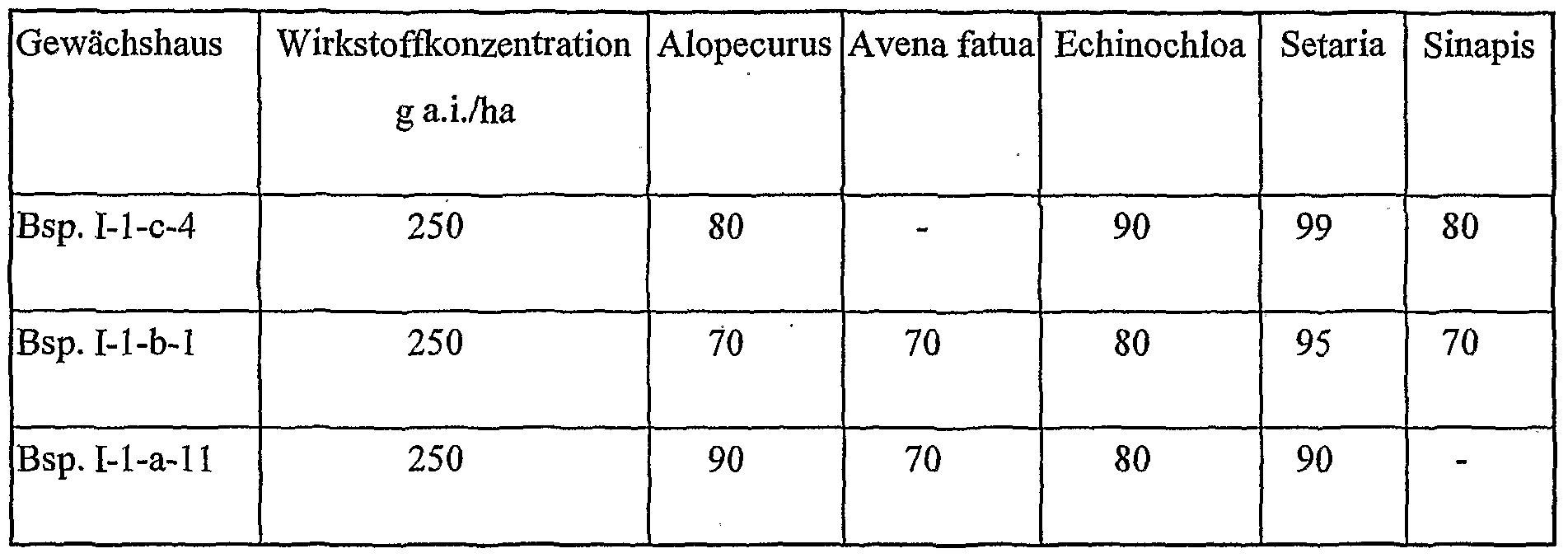
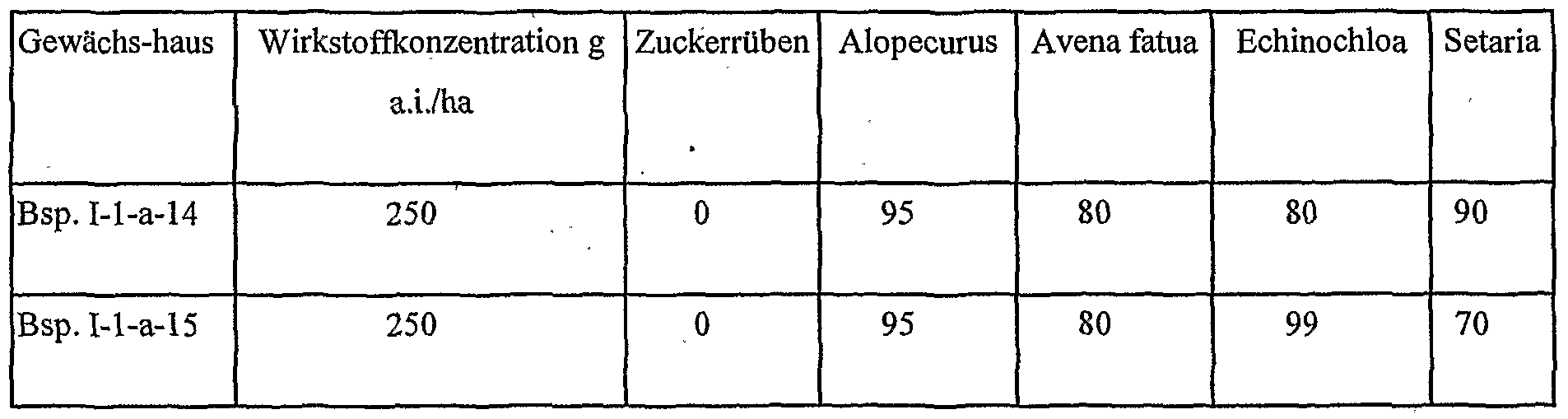

1. Herbizide Wirkung im Vorauflauf1. Pre-emergence herbicidal action
Samen von mono- bzw. dikotylen Unkraut- bzw. Kulturpflanzen werden in Holzfasertöpfen in sandiger Lehmerde ausgelegt und mit Erde abgedeckt. Die in Form von benetzbaren Pulvern (WP) formulierten Testverbindungen werden dann als wässrige Suspension mit einer Wasseraufwandmenge von umgerechnet 600 l/ha unter Zusatz von 0,2% Netzmittel in unterschiedlichen Dosierungen auf die Oberfläche der Abdeckerde appliziert.Seeds of monocotyledonous or dicotyledonous weed or crop plants are laid out in sandy loam in wood fiber pots and covered with soil. The formulated in the form of wettable powders (WP) test compounds are then applied as an aqueous suspension with a water application rate of 600 l / ha with the addition of 0.2% wetting agent in different dosages on the surface of the cover soil.
Nach der Behandlung werden die Töpfe im Gewächshaus aufgestellt und unter guten Wachstumsbedingungen für. die Testpflanzen gehalten. Die visuelle Bonitur der Auflaufschäden an den Versuchspflanzen erfolgt nach einer Versuchszeit von 3 Wochen im Vergleich zu unbehandelten Kontrollen (herbizide Wirkung in Prozent (%): 100% Wirkung = Pflanzen sind abgestorben, 0 % Wirkung = wie Kontrollpflanzen).After the treatment, the pots are placed in the greenhouse and under good growth conditions for. kept the test plants. The visual assessment of the impact damage to the test plants is carried out after a test period of 3 weeks in comparison to untreated controls (herbicidal activity in percent (%): 100% effect = plants are dead, 0% effect = like control plants).
Folgende Verbindungen zeigen neben den zuvor genannten Verbindungen im Vorauflauf mit 320 g/ha a.i. gegen Solium multiflorum und Setaria virichs eine Wirkung von > 80 %: Bsp. I-l-a-24, Bsp. I-l-a-39, Bsp. I-l-a-40, Bsp. I-l-a-42, Bsp. I-l-a-43, Bsp. I-l-a-44, Bsp. I-l-a-45, Bsp. I-l-a- 48, Bsp. I-l-a-69, Bsp. I-l-a-71, Bsp. I-l-b-4, Bsp. I-l-b-5, Bsp. I-l-b-8, Bsp. I-l-b-9, Bsp. I-l-b- 10, Bsp. I-l-c-14, Bsp. I-l-c-15, Bsp. I-l-c-23, Bsp. I-l-c-25, Bsp. I-l-c-42 und Bsp. I-l-c-43.The following compounds in addition to the compounds mentioned in the pre-emergence with 320 g / ha a.i. against Solium multiflorum and Setaria virichs an effect of> 80%: Ex. Ila-24, ex. Ila-39, ex. Ila-40, ex. Ila-42, ex. Ila-43, Ex. Ila-44, ex Ila-45, example Ila- 48, ex Ila-69, ex Ila-71, ex Ilb-4, ex Ilb-5, ex Ilb-8, ex Ilb-9, Ex IIb Ilc-14, ex Ilc-15, ex Ilc-23, ex Ilc-25, ex Ilc-42 and ex Ilc-43.
2. Herbizide Wirkung im Nachauflauf2. Post-emergence herbicidal action
Samen von mono- bzw. dikotylen TJnkraut- bzw. Kulturpflanzen werden in Holzfasertöpfen in sandigem Lehmboden ausgelegt, mit Erde abgedeckt und im Gewächshaus unter gutenSeeds of monocotyledonous or dicotyledonous plants or cultivated plants are laid out in sandy loam in wood fiber pots, covered with soil and grown in a greenhouse under good conditions
Wachstumsbedingungen angezogen. 2-3 Wochen nach der Aussaat werden die Versuchspflanzen im Einblattstadium behandelt. Die als Spritzpulver (WP) formulierten Testverbindungen werden in verschiedenen Dosierungen mit einer Wasseraufwandmenge von umgerechnet 600 l/ha unterGrowth conditions attracted. 2-3 weeks after sowing, the test plants are treated in the single leaf stage. The test compounds formulated as wettable powders (WP) are submerged in various dosages with a water application rate of 600 l / ha
Zusatz von 0,2% Netzmittel auf die grünen Pflanzenteile gesprüht. Nach ca. 3 Wochen Standzeit der Versuchspflanzen im Gewächshaus unter optimalen Wachstumsbedingungen wird die Wirkung der Präparate visuell im Vergleich zu unbehandelten Kontrollen bonitiert (herbizide Wirkung inAddition of 0.2% wetting agent sprayed on the green parts of plants. After about 3 weeks of life of the test plants in the greenhouse under optimal growth conditions, the effect of the preparations is scored visually in comparison to untreated controls (herbicidal activity in
Prozent (%): 100% Wirkung = Pflanzen sind abgestorben, 0 % Wirkung = wie KontroHpflanzen). Percent (%): 100% effect = plants have died, 0% effect = like contra plants).
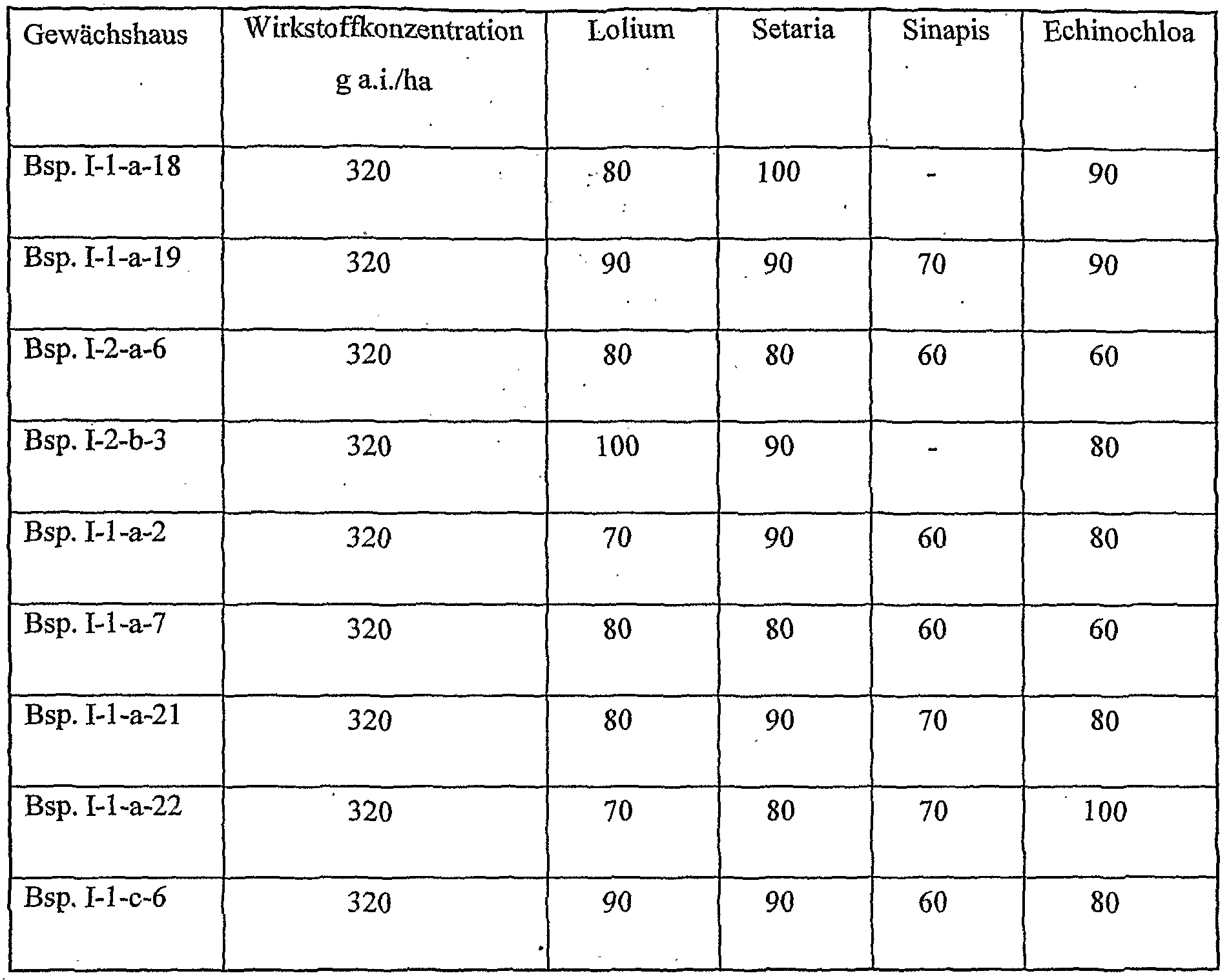

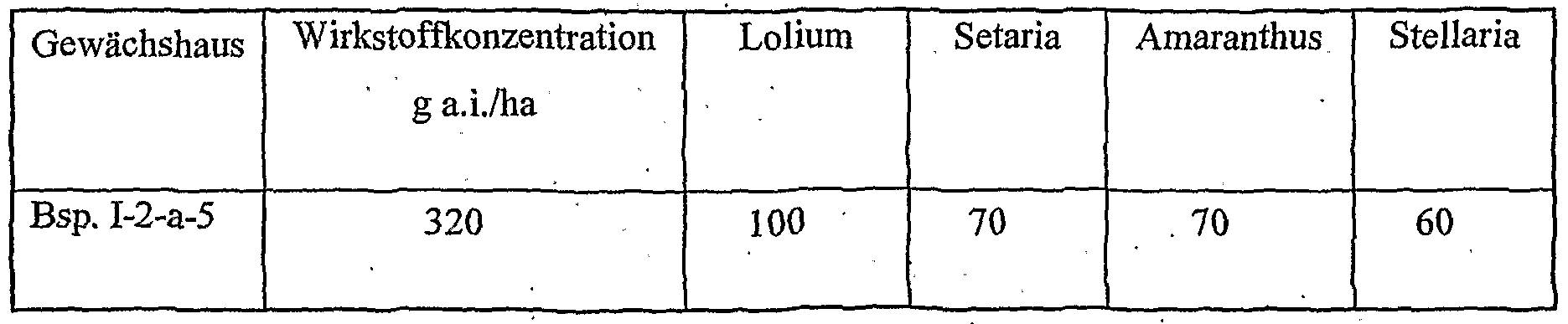
Versuchsbeschreibung für Profiling - VersucheExperiment description for profiling experiments
2. Herbizide Wirkung im Nachauflauf2. Post-emergence herbicidal action
Samen von mono- bzw. dikotylen Unkraut- bzw. Kulturpflanzen werden in Holzfasertöpfen oder in Plastiktöpfen in sandigem Lehmboden ausgelegt, mit Erde abgedeckt und im Gewächshaus, während der Vegetationsperiode auch im Freien außerhalb des Gewächshauses, unter guten Wachstumsbedingungen angezogen. 2 bis 3 Wochen nach der Aussaat werden die Versuchspflanzen im Ein- bis Drei-Blattstadium behandelt. Die als Spritzpulver (WP) oder Flüssigkeit (EC) formulierten Testverbindungen werden in verschiedenen Dosierungen mit einer Wasseraufwand- menge von umgerechnet 300 l/ha unter Zusatz von Netzmittel (0,2 bis 0,3 %) auf die Pflanzen und die Bodenoberfläche gespritzt. 3 bis 4 Wochen nach Behandlung der Versuchspflanzen wird die Wirkung der Präparate visuell im Vergleich zu unbehandelten Kontrollen bonitiert (herbizide Wirkung in Prozent (%): 100 % Wirkung = Pflanzen sind abgestorben, 0 % Wirkung = wie Kontrollpflanzen).Seeds of monocotyledonous or dicotyledonous weed or crop plants are laid out in sandy loam soil in wood fiber pots or in plastic pots, covered with soil and grown in the greenhouse, during the growing season outside in the greenhouse, under good growth conditions. 2 to 3 weeks after sowing, the test plants are treated in the one to three leaf stage. The test compounds formulated as wettable powder (WP) or liquid (EC) are sprayed onto the plants and the soil surface in various dosages with a water consumption of 300 l / ha with the addition of wetting agent (0.2 to 0.3%). 3 to 4 weeks after treatment of the test plants, the effect of the preparations is scored visually in comparison to untreated controls (herbicidal action in percent (%): 100% action = plants are dead, 0% action = like control plants).
Verwendung von Safenern:Use of safeners:
Soll zusätzlich getestet werden, ob Safener die Pflanzenverträglichkeit von Testsubstanzen bei den Kulturpflanzen verbessern können, werden folgende Möglichkeiten für die Anwendung des Sageners verwendet:If it is to be additionally tested whether safeners can improve the plant tolerance of test substances in the crop plants, the following possibilities are used for the application of the saga:
Samen der Kulturpflanzen werden vor der Aussaat mit der Safenersubstanz gebeizt (Angabe der Safenermenge in Prozent bezogen auf das Samengewicht)Seeds of the crop plants are stained with the safener substance before sowing (indication of the amount of safener in percent relative to the seed weight)
Kulturpflanzen werden vor Anwendung der Testsubstanzen mit dem Safener mit einer bestimmten Hektaraufwandmenge gespritzt (üblicherweise 1 Tag vor Anwendung derCrop plants are sprayed before use of the test substances with the safener at a certain hectare application rate (usually 1 day before application of the
Prüfsubstanzen) der Safener wird zusammen mit der Testsubstanz als Tankmischung appliziert (Angabe der Safenermenge in g/ha oder als. Verhältnis zum Herbizid).Test substances) the safener is applied together with the test substance as a tank mix (the amount of safener in g / ha or as. Relation to the herbicide).
Durch Vergleich der Wirkung von Testsubstanzen auf Kulturpflanzen, welche ohne und mit Safener behandelt wurden, kann die Wirkung der Safenersubstanz beurteilt werden. •' .. . Gefäßversuche mit Getreide im Gewächshaus ,By comparing the effect of test substances on crops treated with and without safener, the effect of the sweetener substance can be assessed. • ' ... Vessel experiments with cereals in the greenhouse,
Mefenpyr 1 Tag vor HerbizidapplikationMefenpyr 1 day before herbicide application
Tabelle 1Table 1

Tabelle 2Table 2
28 Ta e nach A likation28 days after application
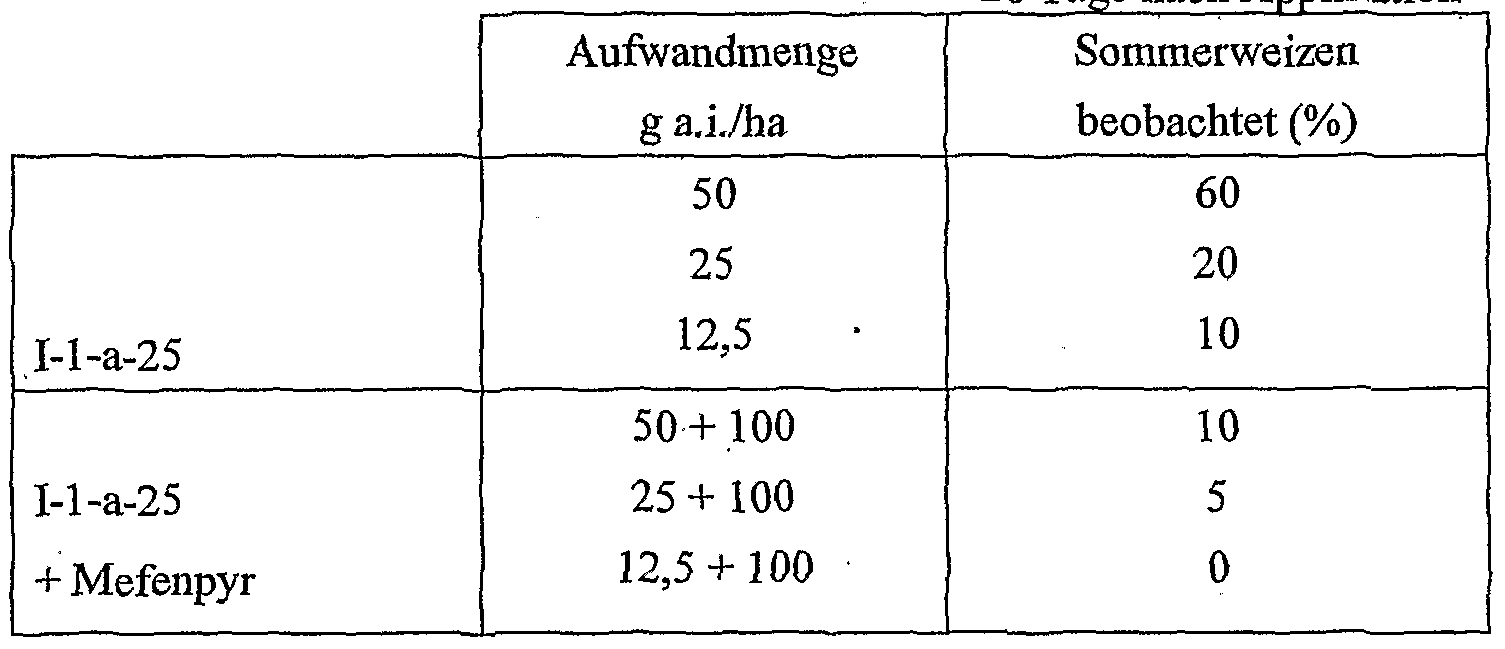
Tabelle 3Table 3
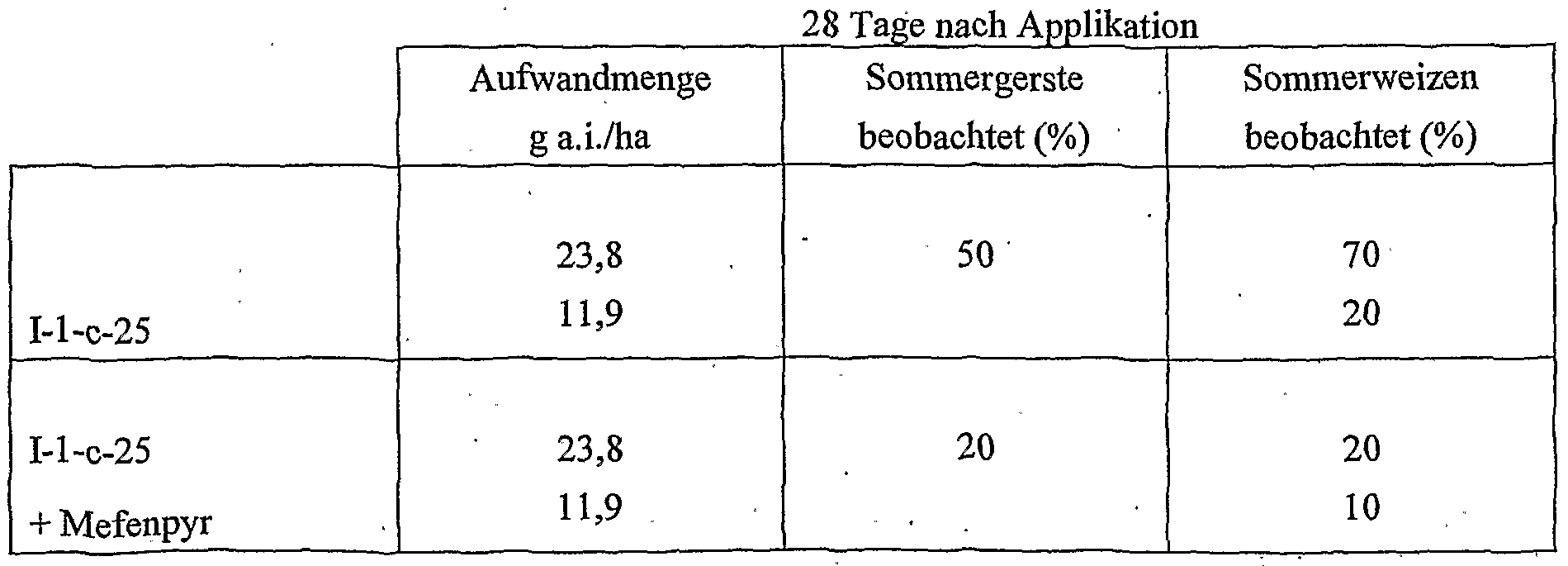
Grenzkonzentrations-Test / Bodeninsekten - Behandlung transgener PflanzenBoundary Concentration Test / Soil Insects - Treatment of transgenic plants
Testinsekt: Diabrotica balteata - Larven im BodenTest insect: Diabrotica balteata - larvae in soil
Lösungsmittel: 7 Gewichtsteile Aceton Emulgator: 1 Gewichtsteil AlkylarylpolyglykoletherSolvent: 7 parts by weight of acetone Emulsifier: 1 part by weight of alkylaryl polyglycol ether
Zur Herstellung einer zweckmäßigen Wirkstoffzubereitung vermischt man 1 Gewichtsteil Wirkstoff mit der angegebenen Menge Lösungsmittel, gibt die angegebene Menge Emulgator zu und verdünnt das Konzentrat mit Wasser auf die gewünschte Konzentration.To prepare a suitable preparation of active compound, 1 part by weight of active compound is mixed with the stated amount of solvent, the indicated amount of emulsifier is added and the concentrate is diluted with water to the desired concentration.
Die Wirkstoffzubereitung wird auf den Boden gegossen. Dabei spielt die Konzentration des Wirk- Stoffs in der Zubereitung praktisch keine Rolle, entscheidend ist allein die Wirkstoffgewichtsmenge pro Volumeneinheit Boden, welche in ppm (mg/1) angegeben wird. Man füllt den Boden in 0,25 1 Töpfe und lässt diese bei 2O0C stehen.The preparation of active compound is poured onto the ground. The concentration of the active substance in the preparation plays virtually no role, the only decisive factor is the amount of active substance per unit volume of soil, which is stated in ppm (mg / l). Fill the soil in 0.25 1 pots and leave them at 2O 0 C stand.
Sofort nach dem Ansatz werden je Topf 5 vorgekeimte Maiskörner der Sorte YIELD GUARDImmediately after the start, 5 pre-germinated maize kernels of the YIELD GUARD variety per pot are taken
(Warenzeichen von Monsanto Comp., USA) gelegt. Nach 2 Tagen werden in den behandelten Boden die entsprechenden Testinsekten gesetzt. Nach weiteren 7 Tagen wird der Wirkungsgrad des Wirkstoffs durch Auszählen der aufgelaufenen Maispflanzen bestimmt (1 Pflanze = 20 %(Trademark of Monsanto Comp., USA). After 2 days the appropriate test insects are placed in the treated soil. After another 7 days, the efficiency of the active ingredient is determined by counting the accumulated maize plants (1 plant = 20%
Wirkung).Effect).
Beispiel XExample X
Heliothis virescens — Test — Behandlung transgener PflanzenHeliothis virescens - test - treatment of transgenic plants
Lösungsmittel: 7 Gewichtsteile AcetonSolvent: 7 parts by weight of acetone
Emulgator: 1 Gewichtsteil AlkylarylpolyglykoletherEmulsifier: 1 part by weight of alkylaryl polyglycol ether
Zur Herstellung einer zweckmäßigen Wirkstoffzubereitung vermischt man 1 Gewichtsteil Wirkstoff mit der angegebenen Menge Lösungsmittel und der angegebenen Menge Emulgator und verdünnt das Konzentrat mit Wasser auf die gewünschte Konzentration.To prepare a suitable preparation of active compound, 1 part by weight of active compound with the stated amount of solvent and the stated amount of emulsifier and the concentrate is diluted with water to the desired concentration.
Sojatriebe (Glycine max) der Sorte Roundup Ready (Warenzeichen der Monsanto Comp. USA) werden durch Tauchen in die Wirkstoffzubereitung der gewünschten Konzentration behandelt und mit der Tabakknospenraupe Heliothis virescens besetzt, solange die Blätter noch feucht sind.Soybean shoots (Glycine max) of the variety Roundup Ready (trademark of Monsanto Comp. USA) are treated by being dipped into the preparation of active compound of the desired concentration and are populated with the tobacco budworm Heliothis virescens while the leaves are still moist.
Nach der gewünschten Zeit wird die Abtötung der Insekten bestimmt. After the desired time, the kill of the insects is determined.
Claims


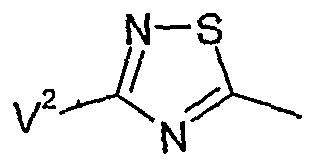


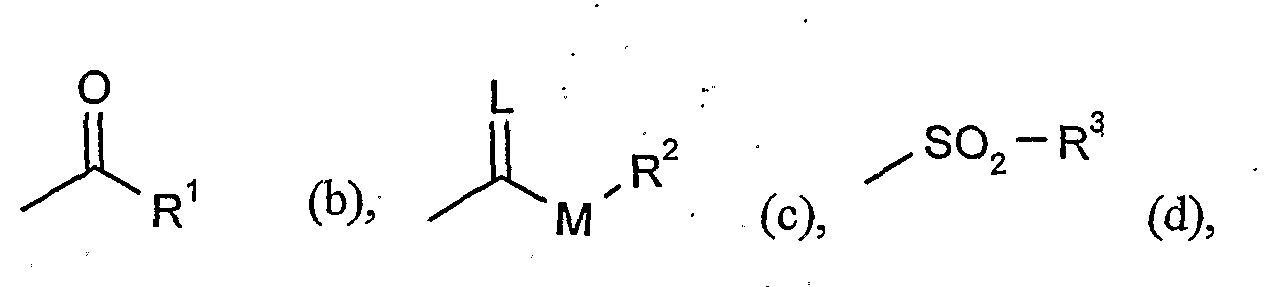
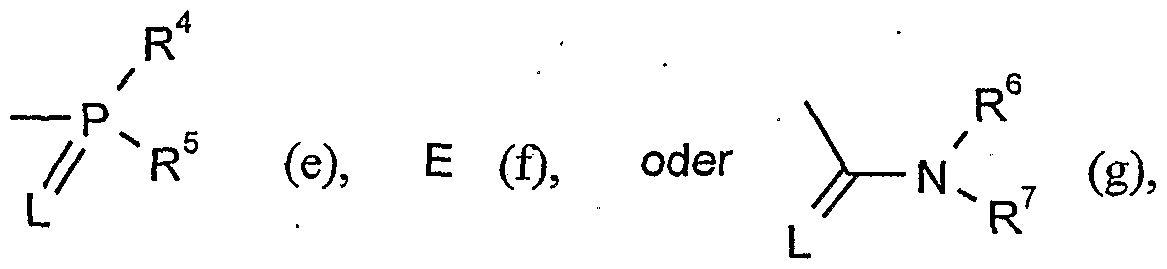
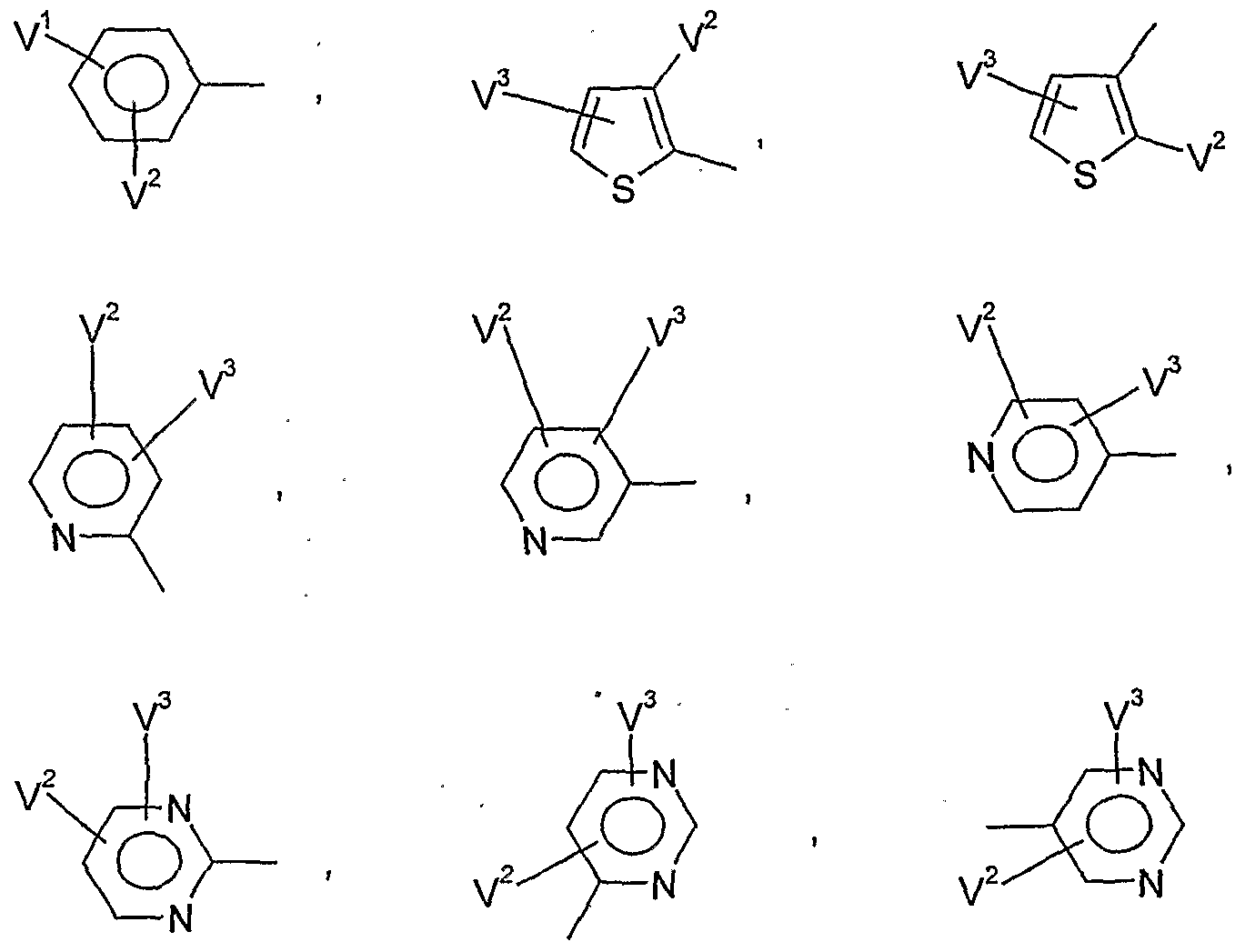

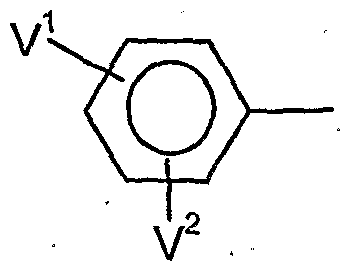



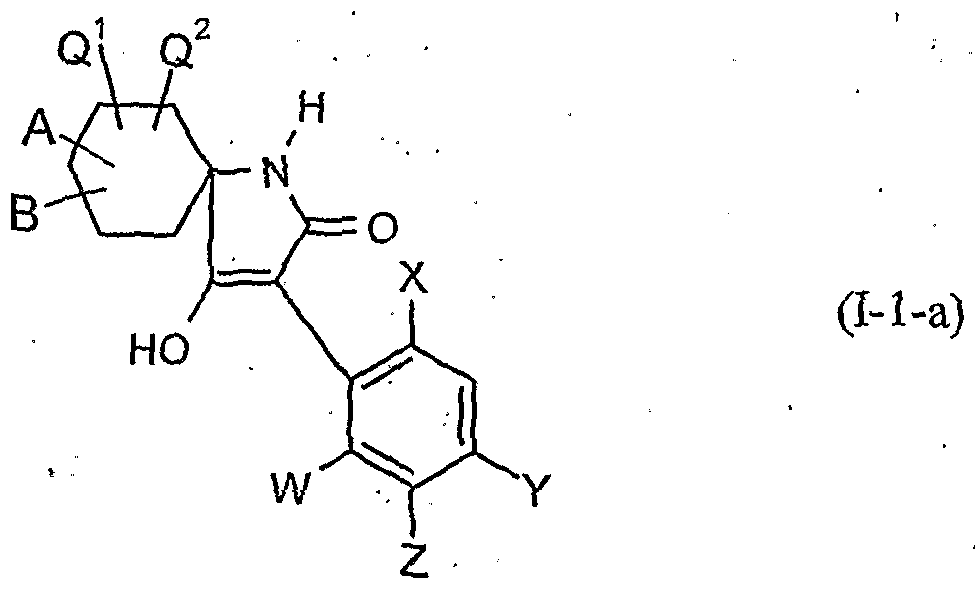
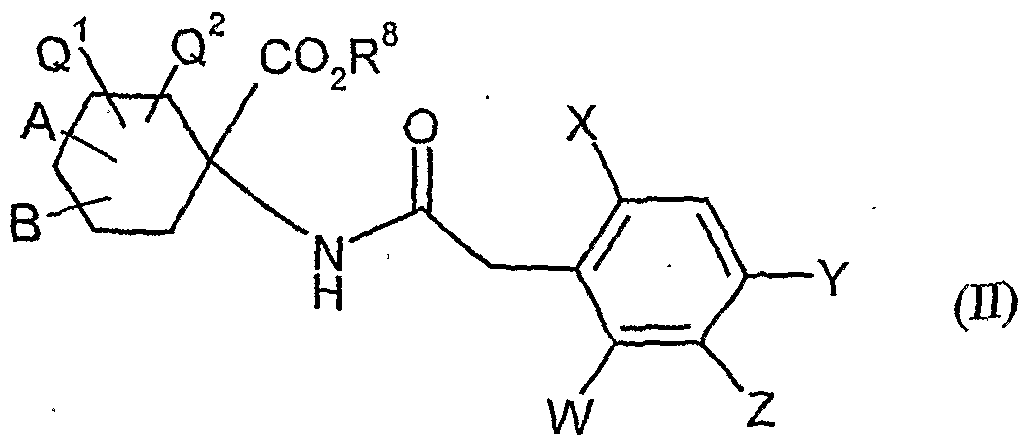

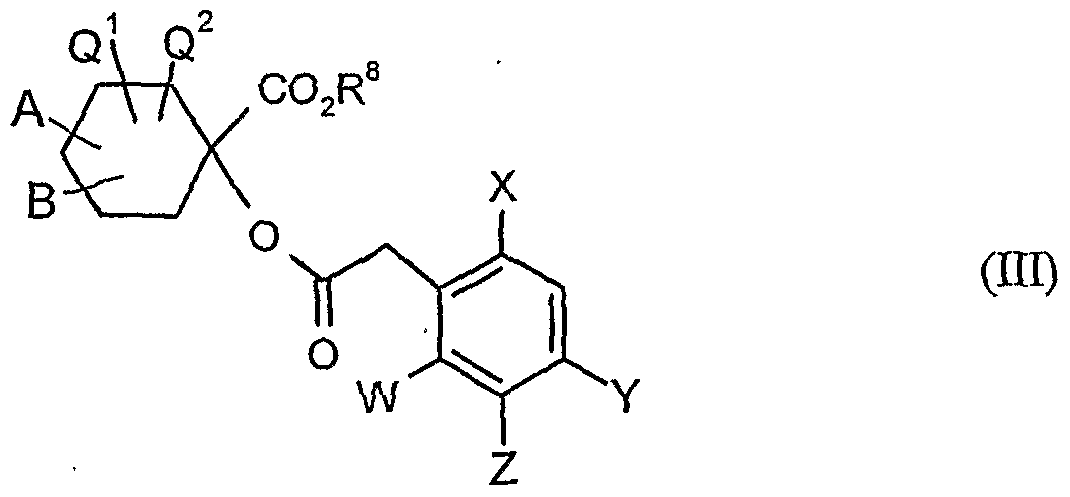
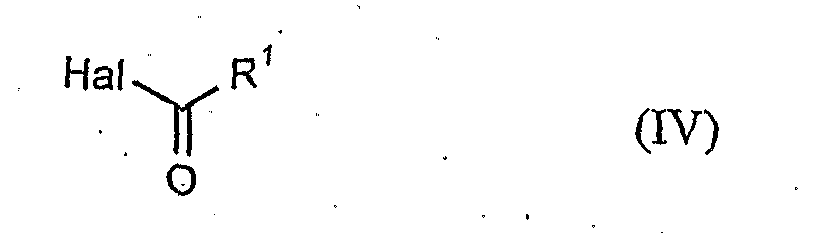

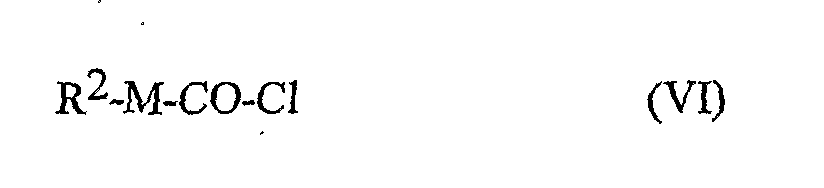
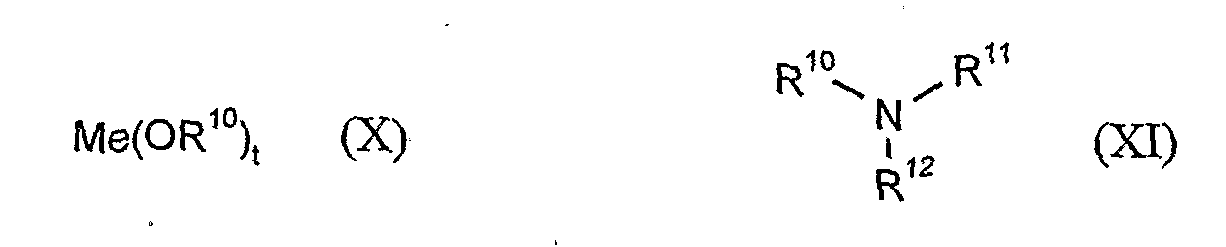
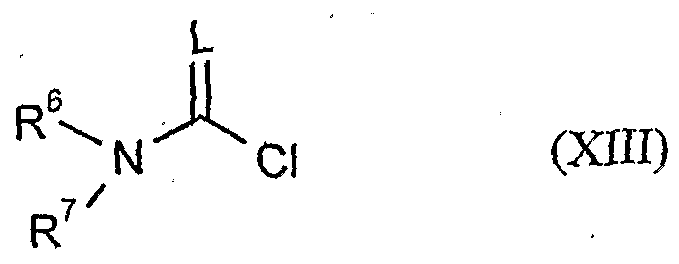


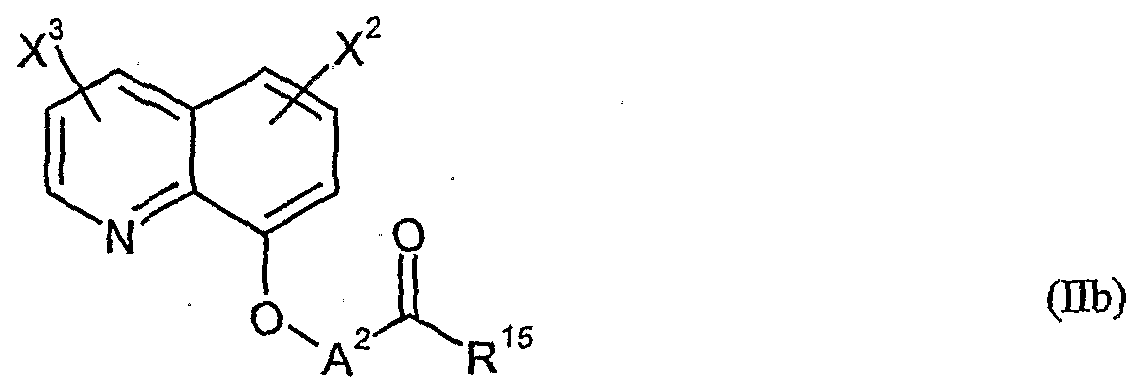
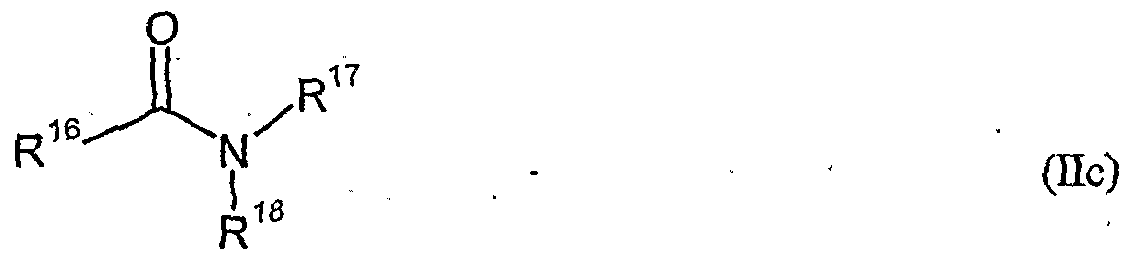


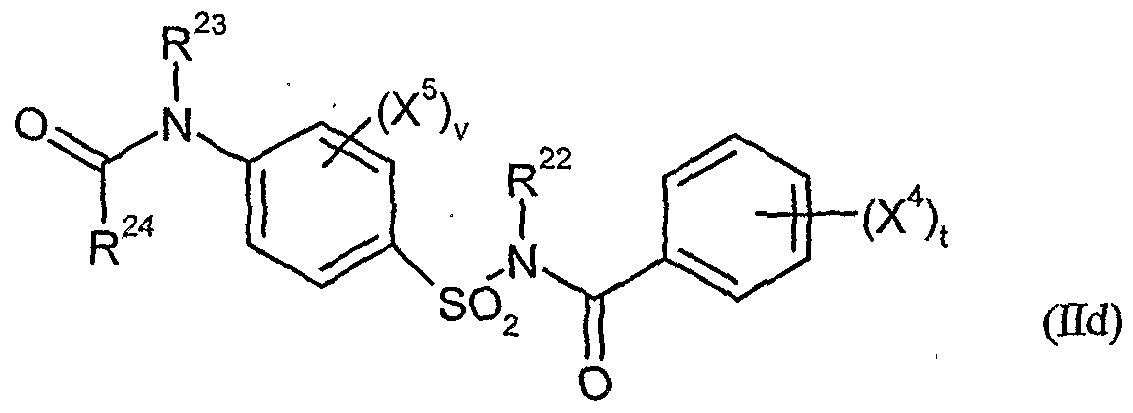


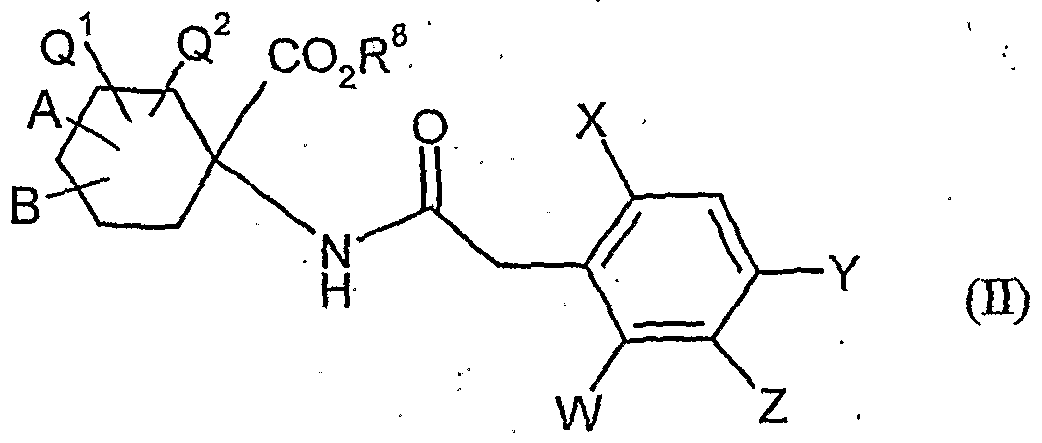
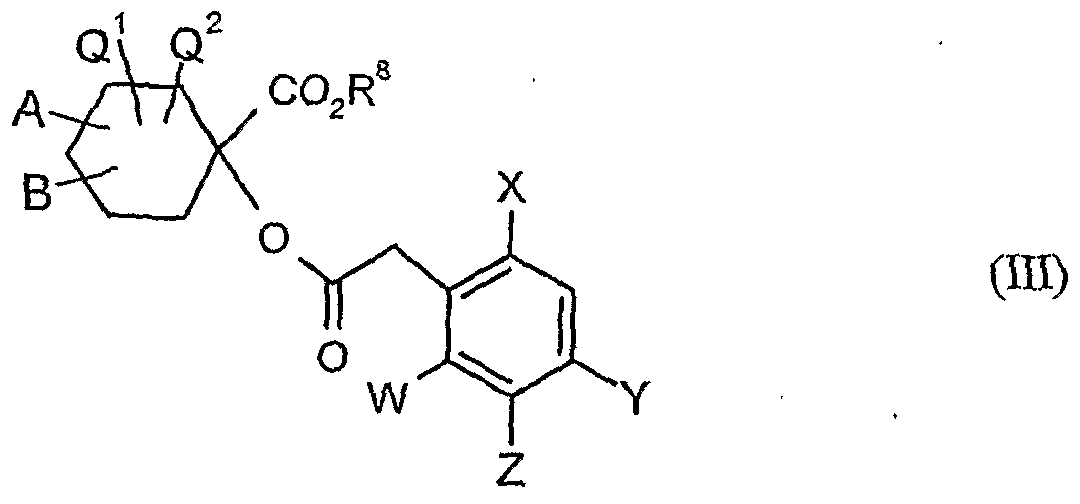

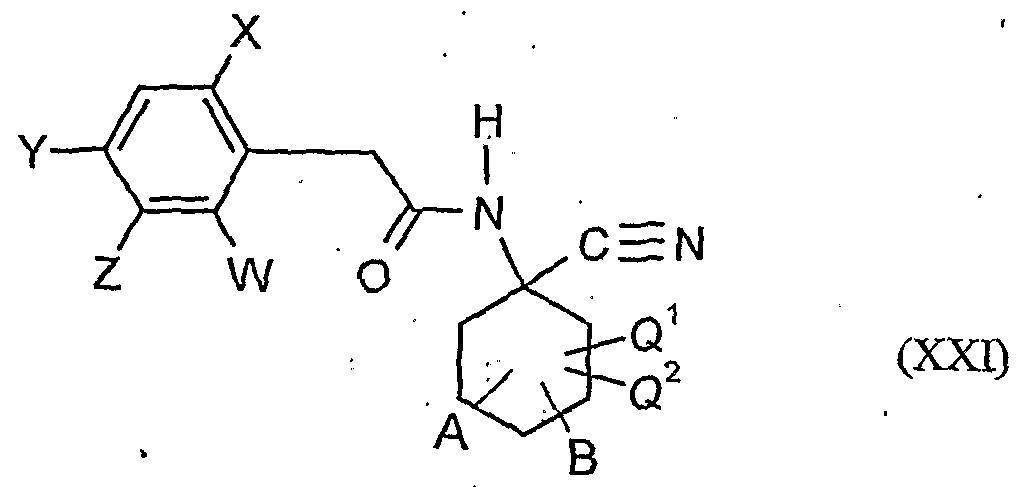
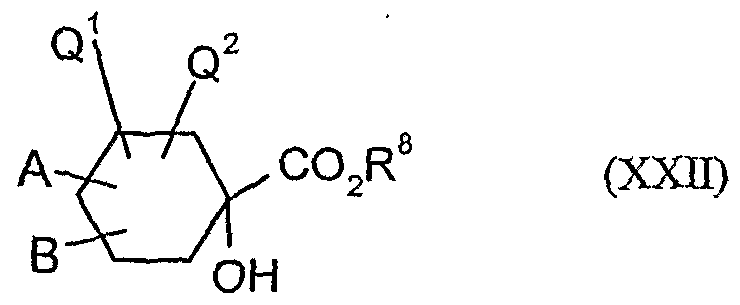


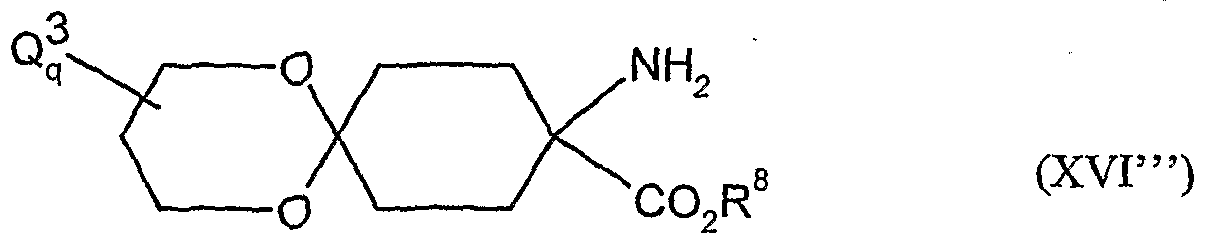


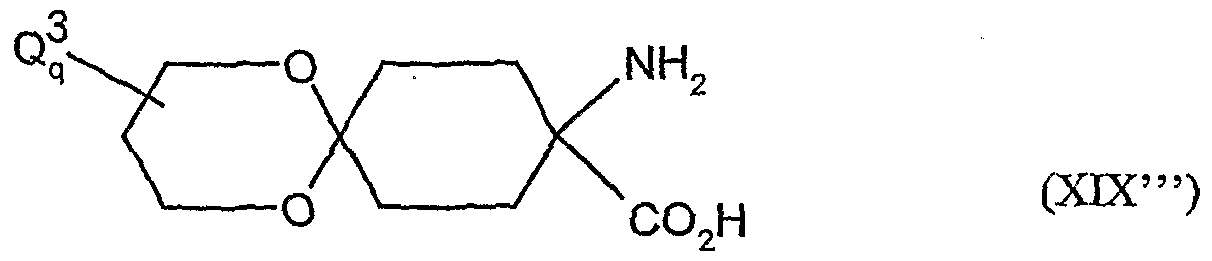
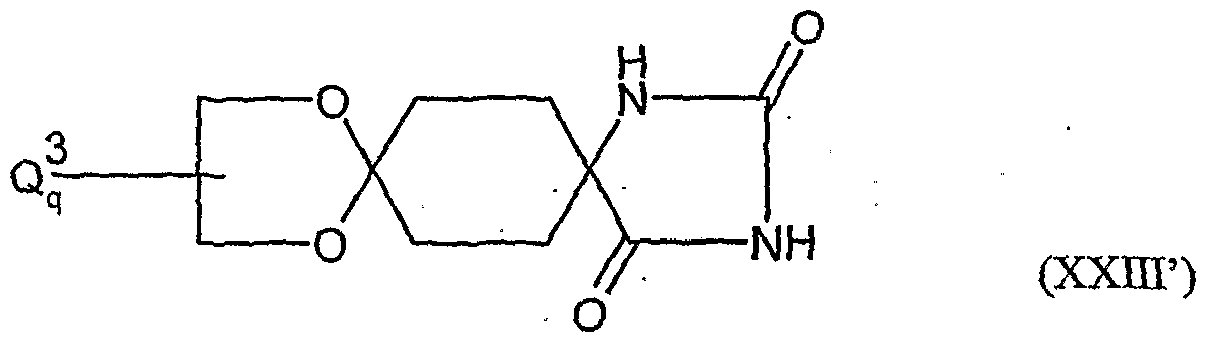
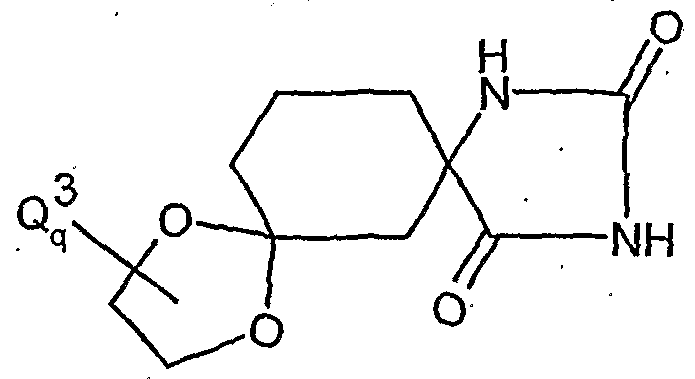


Priority Applications (15)
| Application Number | Priority Date | Filing Date | Title |
|---|---|---|---|
| DK06701829.1T DK1855529T3 (en) | 2005-02-22 | 2006-02-08 | SPIROKETAL-SUBSTITUTED CYCLIC KETOENOLS |
| KR1020077020676A KR101351261B1 (en) | 2005-02-22 | 2006-02-08 | Spiroketal-substituted cyclic ketoenols |
| EA200701772A EA012785B1 (en) | 2005-02-22 | 2006-02-08 | Spiroketal-substituted cyclic ketoenols |
| AP2007004096A AP2007004096A0 (en) | 2005-02-22 | 2006-02-08 | Spiroketal-substituted cyclic ketoenols |
| US11/884,887 US7897543B2 (en) | 2005-02-22 | 2006-02-08 | Spiroketal-substituted cyclic ketoenols |
| MX2007010111A MX2007010111A (en) | 2005-02-22 | 2006-02-08 | Spiroketal-substituted cyclic ketoenols. |
| EP06701829.1A EP1855529B1 (en) | 2005-02-22 | 2006-02-08 | Spiroketal-substituted cyclic ketoenols |
| ES06701829.1T ES2446240T3 (en) | 2005-02-22 | 2006-02-08 | Cyclic ketoenols, substituted with spirocetal |
| CA2597777A CA2597777C (en) | 2005-02-22 | 2006-02-08 | Spiroketal-substituted cyclic ketoenols |
| BRPI0607807A BRPI0607807B1 (en) | 2005-02-22 | 2006-02-08 | spirocetal-substituted cyclic ketoenols, their production process, their uses and their intermediates, agents and their production process, processes for combating parasites, unwanted plant growth and / or unwanted microorganisms |
| JP2007555500A JP5095419B2 (en) | 2005-02-22 | 2006-02-08 | Spiroketal-substituted cyclic ketoenols |
| CN200680012797.0A CN101160049B (en) | 2005-02-22 | 2006-02-08 | Spiroketal substituted cyclic ketoenols |
| AU2006218154A AU2006218154B2 (en) | 2005-02-22 | 2006-02-08 | Spiroketal-substituted cyclic ketoenols |
| IL185253A IL185253A (en) | 2005-02-22 | 2007-08-14 | Spiroketal-substituted cyclic ketoenols, process for their production, compositions comprising them and methods of using them in controlling pests |
| US13/035,293 US20110190493A1 (en) | 2005-02-22 | 2011-02-25 | Spiroketal-Substituted Cyclic Ketoenols |
Applications Claiming Priority (2)
| Application Number | Priority Date | Filing Date | Title |
|---|---|---|---|
| DE102005008021.9 | 2005-02-22 | ||
| DE102005008021A DE102005008021A1 (en) | 2005-02-22 | 2005-02-22 | New spiroketal-substituted cyclic ketoenol compounds used for combating animal parasites, undesired plant growth and/or undesired microorganisms |
Related Child Applications (1)
| Application Number | Title | Priority Date | Filing Date |
|---|---|---|---|
| US13/035,293 Division US20110190493A1 (en) | 2005-02-22 | 2011-02-25 | Spiroketal-Substituted Cyclic Ketoenols |
Publications (2)
| Publication Number | Publication Date |
|---|---|
| WO2006089633A2 true WO2006089633A2 (en) | 2006-08-31 |
| WO2006089633A3 WO2006089633A3 (en) | 2006-11-23 |
Family
ID=36685717
Family Applications (1)
| Application Number | Title | Priority Date | Filing Date |
|---|---|---|---|
| PCT/EP2006/001089 Ceased WO2006089633A2 (en) | 2005-02-22 | 2006-02-08 | Spiroketal-substituted cyclic ketoenols |
Country Status (22)
| Country | Link |
|---|---|
| US (2) | US7897543B2 (en) |
| EP (1) | EP1855529B1 (en) |
| JP (1) | JP5095419B2 (en) |
| KR (1) | KR101351261B1 (en) |
| CN (5) | CN103755716A (en) |
| AP (1) | AP2007004096A0 (en) |
| AR (1) | AR053815A1 (en) |
| AU (1) | AU2006218154B2 (en) |
| BR (1) | BRPI0607807B1 (en) |
| CA (1) | CA2597777C (en) |
| DE (1) | DE102005008021A1 (en) |
| DK (1) | DK1855529T3 (en) |
| EA (1) | EA012785B1 (en) |
| ES (1) | ES2446240T3 (en) |
| IL (1) | IL185253A (en) |
| MA (1) | MA29324B1 (en) |
| MX (1) | MX2007010111A (en) |
| MY (1) | MY163974A (en) |
| TW (2) | TWI475955B (en) |
| UA (1) | UA88949C2 (en) |
| WO (1) | WO2006089633A2 (en) |
| ZA (1) | ZA200706980B (en) |
Cited By (339)
| Publication number | Priority date | Publication date | Assignee | Title |
|---|---|---|---|---|
| WO2007073856A2 (en) | 2005-12-15 | 2007-07-05 | Bayer Cropscience Ag | 3'-alkoxy-spirocyclopentyl-substituted tetramic and tetronic acids |
| WO2007096058A1 (en) | 2006-02-21 | 2007-08-30 | Bayer Cropscience Ag | Cycloalkylphenyl substituted cyclic ketoenols |
| WO2008067911A1 (en) * | 2006-12-04 | 2008-06-12 | Bayer Cropscience Ag | Biphenyl-substituted spirocyclic ketoenols |
| JP2008137915A (en) * | 2006-11-30 | 2008-06-19 | Sankyo Agro Kk | Herbicidal composition |
| DE102007001866A1 (en) | 2007-01-12 | 2008-07-17 | Bayer Cropscience Ag | Spirocyclic tetronic acid derivatives |
| EP2014169A1 (en) | 2007-07-09 | 2009-01-14 | Bayer CropScience AG | Water-soluble concentrates of 3-(2-alkoxy 4-chlorine-6-alkyl-phenyl)-substituted tetramates with their corresponding enols |
| EP2020413A1 (en) * | 2007-08-02 | 2009-02-04 | Bayer CropScience AG | Oxaspirocyclical spiro-substituted tetram and tetron acid derivatives |
| EP2039248A1 (en) * | 2007-09-21 | 2009-03-25 | Bayer CropScience AG | Active agent combinations with insecticide and acaricide properties |
| WO2009039975A1 (en) | 2007-09-25 | 2009-04-02 | Bayer Cropscience Ag | Halogen alkoxy spirocyclic tetramic and tetronic acid derivatives |
| EP2103615A1 (en) | 2008-03-19 | 2009-09-23 | Bayer CropScience AG | 4'4'-Dioxaspiro-spirocyclic substituted tetramates |
| EP2113172A1 (en) | 2008-04-28 | 2009-11-04 | Bayer CropScience AG | Method for improved utilisation of the production potential of transgene plants |
| JP2009538844A (en) * | 2006-06-02 | 2009-11-12 | バイエル・クロツプサイエンス・アクチエンゲゼルシヤフト | Alkoxyalkyl-substituted cyclic ketoenol |
| EP2127522A1 (en) | 2008-05-29 | 2009-12-02 | Bayer CropScience AG | Active-agent combinations with insecticidal and acaricidal properties |
| CN101235023B (en) * | 2008-03-04 | 2010-06-02 | 浙江大学 | A kind of synthetic method of spirodiclofen |
| WO2010086095A1 (en) | 2009-01-29 | 2010-08-05 | Bayer Cropscience Ag | Method for improved utilization of the production potential of transgenic plants introduction |
| WO2010094728A1 (en) | 2009-02-19 | 2010-08-26 | Bayer Cropscience Ag | Pesticide composition comprising a tetrazolyloxime derivative and a fungicide or an insecticide active substance |
| WO2010102758A2 (en) | 2009-03-11 | 2010-09-16 | Bayer Cropscience Ag | Halogenalkylmethylenoxy-phenyl-substituted ketoenols |
| EP2264008A1 (en) | 2009-06-18 | 2010-12-22 | Bayer CropScience AG | Substituted enaminocarbonyl compounds |
| EP2266399A1 (en) | 2006-05-12 | 2010-12-29 | Bayer CropScience AG | Use of tetramic acid derivatives for fighting insects of familiy of leaf beatles (Chrysomelidae) |
| WO2010149370A1 (en) | 2009-06-24 | 2010-12-29 | Bayer Cropscience Ag | Combinations of biological control agents and insecticides |
| WO2011009540A2 (en) | 2009-07-24 | 2011-01-27 | Bayer Cropscience Ag | Pesticidal carboxamides |
| DE102009028001A1 (en) | 2009-07-24 | 2011-01-27 | Bayer Cropscience Ag | Use of an active agent combination (comprising a 3-phenyl-1-aza-spiro(4.5)dec-3-en-2-one compound, and an agent e.g. alanycarb, aldicarb, acephate, camphechlor or chlordane) for combating animal pests e.g. insects, acarids and helminths |
| WO2011020567A1 (en) | 2009-08-20 | 2011-02-24 | Bayer Cropscience Ag | 3-triazolylphenyl-substituted sulfide derivatives for use as acaricides and insecticides |
| WO2011029506A1 (en) | 2009-08-20 | 2011-03-17 | Bayer Cropscience Ag | 3-[1-(3-haloalkyl)-triazolyl]-phenyl-sulfide derivatives for use as acaricides and insecticides |
| WO2011045224A1 (en) | 2009-10-12 | 2011-04-21 | Bayer Cropscience Ag | 1- (pyrid-3-yl) -pyrazole and 1- (pyrimid-5-yl) -pyrazole as pesticide |
| WO2011045240A1 (en) | 2009-10-12 | 2011-04-21 | Bayer Cropscience Ag | Amides and thioamides as pesticides |
| WO2011051151A1 (en) | 2009-10-26 | 2011-05-05 | Bayer Cropscience Ag | Novel solid form of 4-[[(6-chloropyridin-3-yl)methyl](2,2-difluoroethyl)amino]furan-2(5h)-one |
| WO2011051455A1 (en) | 2009-10-30 | 2011-05-05 | Bayer Cropscience Ag | Pesticidal heterocyclic compounds |
| WO2011054436A2 (en) | 2009-10-27 | 2011-05-12 | Bayer Cropscience Ag | Halogenalkyl-substituted amides used as insecticides and acaricides |
| WO2011061156A1 (en) | 2009-11-17 | 2011-05-26 | Bayer Cropscience Ag | Active compound combinations |
| WO2011076724A2 (en) | 2009-12-23 | 2011-06-30 | Bayer Cropscience Ag | Pesticidal compound mixtures |
| WO2011076726A2 (en) | 2009-12-23 | 2011-06-30 | Bayer Cropscience Ag | Pesticidal compound mixtures |
| WO2011076727A2 (en) | 2009-12-23 | 2011-06-30 | Bayer Cropscience Ag | Pesticidal compound mixtures |
| WO2011080044A2 (en) | 2009-12-16 | 2011-07-07 | Bayer Cropscience Ag | Active compound combinations |
| WO2011080211A1 (en) | 2009-12-28 | 2011-07-07 | Bayer Cropscience Ag | Pesticidal arylpyrrolidines |
| WO2010149274A3 (en) * | 2009-06-23 | 2011-07-21 | Bayer Cropscience Aktiengesellschaft | Use of active ingredient combinations having insecticidal properties for controlling pests from the family of stink bugs |
| WO2011092147A1 (en) | 2010-01-29 | 2011-08-04 | Bayer Cropscience Ag | Method to reduce the frequency and/or intensity of blossom-end rot disorder in horticultural crops |
| DE102010008642A1 (en) | 2010-02-15 | 2011-08-18 | Bayer Schering Pharma Aktiengesellschaft, 13353 | New 5'-biphenyl substituted cyclic ketoenol compounds are acetyl-coenzyme A carboxylase 1 inhibitors, useful for treating cancer e.g. breast cancer, pancreatic cancer, renal cell carcinoma, hepatocellular carcinoma and skin tumors |
| WO2011098440A2 (en) | 2010-02-10 | 2011-08-18 | Bayer Cropscience Ag | Biphenyl substituted cyclical keto-enols |
| DE102010008644A1 (en) | 2010-02-15 | 2011-08-18 | Bayer Schering Pharma Aktiengesellschaft, 13353 | Cyclic ketoenols for therapy |
| WO2011098443A1 (en) | 2010-02-10 | 2011-08-18 | Bayer Cropscience Ag | Spiroheterocyclical substituted tetramic acid derivatives |
| DE102010008643A1 (en) | 2010-02-15 | 2011-08-18 | Bayer Schering Pharma Aktiengesellschaft, 13353 | New 5'-biphenyl substituted cyclic ketoenol compounds are acetyl-coenzyme A carboxylase 1 inhibitors, useful for treating cancer e.g. breast cancer, pancreatic cancer, renal cell carcinoma, hepatocellular carcinoma and skin tumor |
| WO2011131623A1 (en) | 2010-04-20 | 2011-10-27 | Bayer Cropscience Ag | Insecticidal and/or herbicidal composition having improved activity on the basis of spiro-heterocyclically substituted tetramic acid derivatives |
| WO2011138285A1 (en) | 2010-05-05 | 2011-11-10 | Bayer Cropscience Ag | Thiazol derivatives as pest control agents |
| CN102241590A (en) * | 2011-05-17 | 2011-11-16 | 永农生物科学有限公司 | Synthetic method of spirocyclic tetronic acid compound key intermediate |
| US8067458B2 (en) | 2006-04-22 | 2011-11-29 | Bayer Cropscience Ag | Alkoxyalkyl-substituted cyclic ketoenols |
| WO2011157663A1 (en) | 2010-06-15 | 2011-12-22 | Bayer Cropscience Ag | Novel ortho-substituted aryl amide derivatives |
| WO2011157778A1 (en) | 2010-06-18 | 2011-12-22 | Bayer Cropscience Ag | Active substance combinations with insecticide and acaricide properties |
| WO2012000902A1 (en) | 2010-06-29 | 2012-01-05 | Bayer Cropscience Ag | Improved insecticidal compositions comprising cyclic carbonylamidines |
| WO2012000896A2 (en) | 2010-06-28 | 2012-01-05 | Bayer Cropscience Ag | Heterocyclic compounds as agents for pest control |
| WO2012001068A2 (en) | 2010-07-02 | 2012-01-05 | Bayer Cropscience Ag | Insecticidal or acaricidal formulations with improved availability on plant surfaces |
| WO2012004326A1 (en) | 2010-07-08 | 2012-01-12 | Bayer Cropscience Ag | Pesticidal pyrroline derivatives |
| WO2012004208A1 (en) | 2010-07-09 | 2012-01-12 | Bayer Cropscience Ag | Anthranilic acid diamide derivative as a pesticide |
| WO2012004293A2 (en) | 2010-07-08 | 2012-01-12 | Bayer Cropscience Ag | Insecticide and fungicide active ingredient combinations |
| WO2012007500A2 (en) | 2010-07-15 | 2012-01-19 | Bayer Cropscience Ag | New heterocyclic compounds as pesticides |
| WO2012010509A2 (en) | 2010-07-20 | 2012-01-26 | Bayer Cropscience Ag | Gel bait for controlling crawling harmful insects |
| EP2422620A1 (en) | 2010-08-26 | 2012-02-29 | Bayer CropScience AG | Insecticidal combinations comprising ethiprole and pymetrozine |
| WO2012028583A1 (en) | 2010-09-03 | 2012-03-08 | Bayer Cropscience Ag | Formulations comprising deltamethrin |
| WO2012035011A1 (en) | 2010-09-15 | 2012-03-22 | Bayer Cropscience Ag | Pesticidal arylpyrrolidines |
| WO2012034957A1 (en) | 2010-09-15 | 2012-03-22 | Bayer Cropscience Ag | Pesticidal pyrroline n-oxide derivatives |
| WO2012038480A2 (en) | 2010-09-22 | 2012-03-29 | Bayer Cropscience Ag | Use of biological or chemical control agents for controlling insects and nematodes in resistant crops |
| WO2012045798A1 (en) | 2010-10-07 | 2012-04-12 | Bayer Cropscience Ag | Fungicide composition comprising a tetrazolyloxime derivative and a thiazolylpiperidine derivative |
| WO2012045680A2 (en) | 2010-10-04 | 2012-04-12 | Bayer Cropscience Ag | Insecticidal and fungicidal active substance combinations |
| WO2012052490A1 (en) | 2010-10-21 | 2012-04-26 | Bayer Cropscience Ag | N-benzyl heterocyclic carboxamides |
| WO2012052412A1 (en) | 2010-10-22 | 2012-04-26 | Bayer Cropscience Ag | Novel heterocyclic compounds as pesticides |
| EP2446742A1 (en) | 2010-10-28 | 2012-05-02 | Bayer CropScience AG | Insecticide or acaricide compositions containing mono- or disaccharides as activity enhancers |
| WO2012059497A1 (en) | 2010-11-02 | 2012-05-10 | Bayer Cropscience Ag | N-hetarylmethyl pyrazolylcarboxamides |
| WO2012065944A1 (en) | 2010-11-15 | 2012-05-24 | Bayer Cropscience Ag | N-aryl pyrazole(thio)carboxamides |
| WO2012072660A1 (en) | 2010-12-01 | 2012-06-07 | Bayer Cropscience Ag | Use of fluopyram for controlling nematodes in crops and for increasing yield |
| WO2012072489A1 (en) | 2010-11-29 | 2012-06-07 | Bayer Cropscience Ag | Alpha,beta-unsaturated imines |
| WO2012076471A1 (en) | 2010-12-09 | 2012-06-14 | Bayer Cropscience Ag | Insecticidal mixtures with improved properties |
| WO2012076470A1 (en) | 2010-12-09 | 2012-06-14 | Bayer Cropscience Ag | Pesticidal mixtures with improved properties |
| DE102010063691A1 (en) | 2010-12-21 | 2012-06-21 | Bayer Animal Health Gmbh | Ectoparasiticidal drug combinations |
| WO2012080188A1 (en) | 2010-12-17 | 2012-06-21 | Bayer Cropscience Ag | Composition containing insecticide-wax particles |
| WO2012082548A2 (en) | 2010-12-15 | 2012-06-21 | Syngenta Participations Ag | Soybean event syht0h2 and compositions and methods for detection thereof |
| US8211931B2 (en) | 2006-06-16 | 2012-07-03 | Bayer Cropscience Ag | Active compound combinations having insecticidal and acaricidal properties |
| WO2012101047A1 (en) | 2011-01-25 | 2012-08-02 | Bayer Cropscience Ag | Method for producing 1-h-pyrrolidine-2,4-dione derivatives |
| DE102011011040A1 (en) | 2011-02-08 | 2012-08-09 | Bayer Pharma Aktiengesellschaft | (5s, 8s) -3- (4'-chloro-3'-fluoro-4-methylbiphenyl-3-yl) -4-hydroxy-8-methoxy-1-azaspiro [4.5] dec-3-en-2- on (compound A) for therapy |
| US8247351B2 (en) | 2005-12-13 | 2012-08-21 | Bayer Cropscience Ag | Insecticidal compositions having improved effect |
| WO2012110518A1 (en) | 2011-02-17 | 2012-08-23 | Bayer Pharma Aktiengesellschaft | Substituted 3-(biphenyl-3-yl)-8,8-difluoro-4-hydroxy-1-azaspiro[4.5]dec-3-en-2-ones for therapy |
| WO2012110464A1 (en) | 2011-02-17 | 2012-08-23 | Bayer Cropscience Ag | Use of sdhi fungicides on conventionally bred asr-tolerant, stem canker resistant and/or frog-eye leaf spot resistant soybean varieties |
| WO2012116960A1 (en) | 2011-03-01 | 2012-09-07 | Bayer Cropscience Ag | 2-acyloxy-pyrrolin-4-ones |
| WO2012120105A1 (en) | 2011-03-10 | 2012-09-13 | Bayer Cropscience Ag | Use of lipochito-oligosaccharide compounds for safeguarding seed safety of treated seeds |
| WO2012119984A1 (en) | 2011-03-09 | 2012-09-13 | Bayer Cropscience Ag | Indolecarboxamides and benzimidazolecarboxamides as insecticides and acaricides |
| WO2012126766A1 (en) | 2011-03-18 | 2012-09-27 | Bayer Cropscience Ag | N-(3-carbamoylphenyl)-1h-pyrazole-5-carboxamide derivatives and the use thereof for controlling animal pests |
| WO2012136751A1 (en) | 2011-04-08 | 2012-10-11 | Basf Se | N-substituted hetero-bicyclic compounds and derivatives for combating animal pests |
| EP2535334A1 (en) | 2011-06-17 | 2012-12-19 | Bayer CropScience AG | Crystalline modifications of penflufen |
| EP2540163A1 (en) | 2011-06-30 | 2013-01-02 | Bayer CropScience AG | Nematocide N-cyclopropyl-sulfonylamide derivatives |
| WO2013010947A2 (en) | 2011-07-15 | 2013-01-24 | Basf Se | Pesticidal methods using substituted 3-pyridyl thiazole compounds and derivatives for combating animal pests ii |
| WO2013014126A1 (en) | 2011-07-26 | 2013-01-31 | Bayer Intellectual Property Gmbh | Etherified lactate esters, method for the production thereof and use thereof for enhancing the effect of plant protecting agents |
| WO2013014227A1 (en) | 2011-07-27 | 2013-01-31 | Bayer Intellectual Property Gmbh | Seed dressing for controlling phytopathogenic fungi |
| DE102011080405A1 (en) | 2011-08-04 | 2013-02-07 | Bayer Pharma AG | New substituted 3-biphenyl-3-yl-8,8-difluoro-4-hydroxy-1-azaspiro(4.5)dec-3-en-2-one derivatives useful for prophylaxis or therapy of tumor diseases comprising breast cancer, prostate cancer, colorectal cancer or non-small cell lung cancer |
| WO2013017600A1 (en) | 2011-08-04 | 2013-02-07 | Bayer Intellectual Property Gmbh | Substituted 3-(biphenyl-3-yl)-4-hydroxy-8-methoxy-1-azaspiro[4.5]dec-3-en-2-one |
| WO2013024008A1 (en) | 2011-08-12 | 2013-02-21 | Basf Se | Aniline type compounds |
| US8389443B2 (en) | 2008-12-02 | 2013-03-05 | Bayer Cropscience Ag | Geminal alkoxy/alkylspirocyclic substituted tetramate derivatives |
| WO2013050433A1 (en) | 2011-10-05 | 2013-04-11 | Bayer Intellectual Property Gmbh | Pesticide preparation and process for producing the same |
| US8420608B2 (en) | 2008-11-14 | 2013-04-16 | Bayer Cropscience Ag | Active substance combinations with insecticides and acaricide properties |
| WO2013079600A1 (en) | 2011-12-02 | 2013-06-06 | Basf Se | Method and system for monitoring crops during storage |
| WO2013079601A1 (en) | 2011-12-02 | 2013-06-06 | Basf Se | Method and system for monitoring crops and/or infestation of crops with harmful organismus during storage |
| EP2604118A1 (en) | 2011-12-15 | 2013-06-19 | Bayer CropScience AG | Active ingredient combinations having insecticidal and acaricidal properties |
| EP2606726A1 (en) | 2011-12-21 | 2013-06-26 | Bayer CropScience AG | N-Arylamidine-substituted trifluoroethylsulfide derivatives as acaricides and insecticides |
| WO2013092868A1 (en) | 2011-12-21 | 2013-06-27 | Basf Se | N-thio-anthranilamide compounds and their use as pesticides |
| WO2013092522A1 (en) | 2011-12-20 | 2013-06-27 | Bayer Intellectual Property Gmbh | Novel insecticidal aromatic amides |
| WO2013092519A1 (en) | 2011-12-19 | 2013-06-27 | Bayer Cropscience Ag | Use of anthranilic acid diamide derivatives for pest control in transgenic crops |
| WO2013092943A1 (en) | 2011-12-23 | 2013-06-27 | Basf Se | Isothiazoline compounds for combating invertebrate pests |
| WO2013107785A1 (en) | 2012-01-21 | 2013-07-25 | Bayer Intellectual Property Gmbh | Use of host defense inducers for controlling bacterial harmful organisms in useful plants |
| WO2013110612A1 (en) | 2012-01-26 | 2013-08-01 | Bayer Intellectual Property Gmbh | Phenyl-substituted ketoenols for controlling fish parasites |
| WO2013113789A1 (en) | 2012-02-02 | 2013-08-08 | Basf Se | N-thio-anthranilamide compounds and their use as pesticides |
| US8507537B2 (en) | 2006-10-25 | 2013-08-13 | Bayer Cropscience Ag | Trifluromethoxyphenyl-substituted tetramic acid derivatives pesticides and/or herbicides |
| WO2013135724A1 (en) | 2012-03-14 | 2013-09-19 | Bayer Intellectual Property Gmbh | Pesticidal arylpyrrolidines |
| WO2013144228A1 (en) | 2012-03-29 | 2013-10-03 | Basf Se | Pesticidal methods using heterocyclic compounds and derivatives for combating animal pests |
| WO2013144213A1 (en) | 2012-03-30 | 2013-10-03 | Basf Se | N-substituted pyridinylidene compounds and derivatives for combating animal pests |
| WO2013144223A1 (en) | 2012-03-30 | 2013-10-03 | Basf Se | N-substituted pyrimidinylidene compounds and derivatives for combating animal pests |
| WO2013149903A1 (en) | 2012-04-03 | 2013-10-10 | Basf Se | N- substituted hetero - bicyclic furanone derivatives for combating animal |
| WO2013150115A1 (en) | 2012-04-05 | 2013-10-10 | Basf Se | N- substituted hetero - bicyclic compounds and derivatives for combating animal pests |
| WO2013149940A1 (en) | 2012-04-02 | 2013-10-10 | Basf Se | Acrylamide compounds for combating invertebrate pests |
| WO2013164295A1 (en) | 2012-05-04 | 2013-11-07 | Basf Se | Substituted pyrazole-containing compounds and their use as pesticides |
| WO2013167633A1 (en) | 2012-05-09 | 2013-11-14 | Basf Se | Acrylamide compounds for combating invertebrate pests |
| WO2013171199A1 (en) | 2012-05-16 | 2013-11-21 | Bayer Cropscience Ag | Insecticidal water-in-oil (w/o) formulation |
| WO2013171201A1 (en) | 2012-05-16 | 2013-11-21 | Bayer Cropscience Ag | Insecticidal oil-in water (o/w) formulation |
| WO2013174645A1 (en) | 2012-05-24 | 2013-11-28 | Basf Se | N-thio-anthranilamide compounds and their use as pesticides |
| WO2013174836A1 (en) | 2012-05-22 | 2013-11-28 | Bayer Cropscience Ag | Active compounds combinations comprising a lipo-chitooligosaccharide derivative and a nematicide, insecticidal or fungicidal compound |
| WO2013186089A2 (en) | 2012-06-14 | 2013-12-19 | Basf Se | Pesticidal methods using substituted 3-pyridyl thiazole compounds and derivatives for combating animal pests |
| WO2014019983A1 (en) | 2012-07-31 | 2014-02-06 | Bayer Cropscience Ag | Compositions comprising a pesticidal terpene mixture and an insecticide |
| WO2014026984A1 (en) | 2012-08-17 | 2014-02-20 | Bayer Cropscience Ag | Azaindole carboxylic acid amides and azaindole thiocarboxylic acid amides for use as insecticides and acaricides |
| WO2014053401A2 (en) | 2012-10-01 | 2014-04-10 | Basf Se | Method of improving plant health |
| WO2014053405A1 (en) | 2012-10-01 | 2014-04-10 | Basf Se | Pesticidally active mixtures comprising anthranilamide compounds |
| WO2014053403A1 (en) | 2012-10-01 | 2014-04-10 | Basf Se | Method of controlling insecticide resistant insects |
| WO2014053395A1 (en) | 2012-10-01 | 2014-04-10 | Basf Se | Use of n-thio-anthranilamide compounds on cultivated plants |
| WO2014053407A1 (en) | 2012-10-01 | 2014-04-10 | Basf Se | N-thio-anthranilamide compounds and their use as pesticides |
| WO2014053404A1 (en) | 2012-10-01 | 2014-04-10 | Basf Se | Pesticidally active mixtures comprising anthranilamide compounds |
| WO2014053450A1 (en) | 2012-10-02 | 2014-04-10 | Bayer Cropscience Ag | Heterocyclic compounds as pesticides |
| WO2014053406A1 (en) | 2012-10-01 | 2014-04-10 | Basf Se | Method of controlling ryanodine-modulator insecticide resistant insects |
| WO2014060381A1 (en) | 2012-10-18 | 2014-04-24 | Bayer Cropscience Ag | Heterocyclic compounds as pesticides |
| WO2014067962A1 (en) | 2012-10-31 | 2014-05-08 | Bayer Cropscience Ag | Novel heterocyclic compounds as pest control agents |
| WO2014072250A1 (en) | 2012-11-06 | 2014-05-15 | Bayer Cropscience Ag | Herbicidal combinations for tolerant soybean cultures |
| WO2014079841A1 (en) | 2012-11-22 | 2014-05-30 | Basf Se | Pesticidal mixtures |
| WO2014079804A1 (en) | 2012-11-22 | 2014-05-30 | Basf Se | Pesticidal mixtures |
| WO2014079764A1 (en) | 2012-11-22 | 2014-05-30 | Basf Se | Pesticidal mixtures |
| WO2014079766A1 (en) | 2012-11-22 | 2014-05-30 | Basf Se | Pesticidal mixtures |
| WO2014079813A1 (en) | 2012-11-23 | 2014-05-30 | Basf Se | Pesticidal mixtures |
| WO2014079773A1 (en) | 2012-11-22 | 2014-05-30 | Basf Se | Pesticidal mixtures |
| WO2014079774A1 (en) | 2012-11-22 | 2014-05-30 | Basf Se | Pesticidal mixtures |
| WO2014079820A1 (en) | 2012-11-22 | 2014-05-30 | Basf Se | Use of anthranilamide compounds for reducing insect-vectored viral infections |
| WO2014079770A1 (en) | 2012-11-22 | 2014-05-30 | Basf Se | Pesticidal mixtures |
| WO2014079814A1 (en) | 2012-11-22 | 2014-05-30 | Basf Se | Pesticidal mixtures |
| WO2014079752A1 (en) | 2012-11-23 | 2014-05-30 | Basf Se | Pesticidal mixtures |
| WO2014079772A1 (en) | 2012-11-22 | 2014-05-30 | Basf Se | Pesticidal mixtures |
| WO2014083088A2 (en) | 2012-11-30 | 2014-06-05 | Bayer Cropscience Ag | Binary fungicidal mixtures |
| WO2014083033A1 (en) | 2012-11-30 | 2014-06-05 | Bayer Cropsience Ag | Binary fungicidal or pesticidal mixture |
| WO2014086759A2 (en) | 2012-12-03 | 2014-06-12 | Bayer Cropscience Ag | Composition comprising biological control agents |
| WO2014086753A2 (en) | 2012-12-03 | 2014-06-12 | Bayer Cropscience Ag | Composition comprising biological control agents |
| WO2014086750A2 (en) | 2012-12-03 | 2014-06-12 | Bayer Cropscience Ag | Composition comprising a biological control agent and an insecticide |
| WO2014086749A2 (en) | 2012-12-03 | 2014-06-12 | Bayer Cropscience Ag | Composition comprising a biological control agent and an insecticide |
| WO2014086758A2 (en) | 2012-12-03 | 2014-06-12 | Bayer Cropscience Ag | Composition comprising a biological control agent and an insecticide |
| WO2014090700A1 (en) | 2012-12-14 | 2014-06-19 | Basf Se | Malononitrile compounds for controlling animal pests |
| WO2014090765A1 (en) | 2012-12-12 | 2014-06-19 | Bayer Cropscience Ag | Use of 1-[2-fluoro-4-methyl-5-(2,2,2-trifluoroethylsulfinyl)phenyl]-5-amino-3-trifluoromethyl)-1 h-1,2,4 tfia zole for controlling nematodes in nematode-resistant crops |
| WO2014096238A1 (en) | 2012-12-21 | 2014-06-26 | Basf Se | Cycloclavine and derivatives thereof for controlling invertebrate pests |
| WO2014095826A1 (en) | 2012-12-18 | 2014-06-26 | Bayer Cropscience Ag | Binary fungicidal and bactericidal combinations |
| WO2014102244A1 (en) | 2012-12-27 | 2014-07-03 | Basf Se | 2-(pyridin-3-yl)-5-hetaryl-thiazole compounds carrying an imine or imine-derived substituent for combating invertebrate pests |
| WO2014124375A1 (en) | 2013-02-11 | 2014-08-14 | Bayer Cropscience Lp | Compositions comprising gougerotin and a biological control agent |
| WO2014124373A1 (en) | 2013-02-11 | 2014-08-14 | Bayer Cropscience Lp | Compositions comprising gougerotin and an insecticide |
| WO2014122083A1 (en) | 2013-02-06 | 2014-08-14 | Bayer Cropscience Ag | Halogen-substituted pyrazol derivatives as pest-control agents |
| US8816097B2 (en) | 2006-07-18 | 2014-08-26 | Bayer Cropscience Ag | Active ingredient combinations having insecticide and acaricide properties |
| WO2014128136A1 (en) | 2013-02-20 | 2014-08-28 | Basf Se | Anthranilamide compounds and their use as pesticides |
| WO2014139897A1 (en) | 2013-03-12 | 2014-09-18 | Bayer Cropscience Ag | Use of dithiine-tetracarboximides for controlling bacterial harmful organisms in useful plants |
| WO2014140111A1 (en) | 2013-03-13 | 2014-09-18 | Bayer Cropscience Ag | Lawn growth-promoting agent and method of using same |
| US8846946B2 (en) | 2008-12-02 | 2014-09-30 | Bayer Cropscience Ag | Germinal alkoxy/alkylspirocyclic substituted tetramate derivatives |
| WO2014170364A1 (en) | 2013-04-19 | 2014-10-23 | Bayer Cropscience Ag | Binary insecticidal or pesticidal mixture |
| WO2014170313A1 (en) | 2013-04-19 | 2014-10-23 | Bayer Cropscience Ag | Active compound combinations having insecticidal properties |
| WO2014170300A1 (en) | 2013-04-19 | 2014-10-23 | Basf Se | N-substituted acyl-imino-pyridine compounds and derivatives for combating animal pests |
| DE202014008418U1 (en) | 2014-02-19 | 2014-11-14 | Clariant International Ltd. | Low foaming agrochemical compositions |
| DE202014008415U1 (en) | 2014-02-19 | 2014-11-25 | Clariant International Ltd. | Aqueous adjuvant composition for increasing the effectiveness of electrolyte active substances |
| WO2014202510A1 (en) | 2013-06-20 | 2014-12-24 | Bayer Cropscience Ag | Aryl sulfide derivatives and aryl sulfoxide derivatives as acaricides and insecticides |
| WO2014202751A1 (en) | 2013-06-21 | 2014-12-24 | Basf Se | Methods for controlling pests in soybean |
| WO2014202505A1 (en) | 2013-06-20 | 2014-12-24 | Bayer Cropscience Ag | Aryl sulfide derivatives and aryl sulfoxide derivatives as acaricides and insecticides |
| WO2015004028A1 (en) | 2013-07-08 | 2015-01-15 | Bayer Cropscience Ag | Six-membered c-n-linked aryl sulfide derivatives and aryl sulfoxide derivatives as pest control agents |
| WO2015007682A1 (en) | 2013-07-15 | 2015-01-22 | Basf Se | Pesticide compounds |
| WO2015040116A1 (en) | 2013-09-19 | 2015-03-26 | Basf Se | N-acylimino heterocyclic compounds |
| US8993782B2 (en) | 2006-12-04 | 2015-03-31 | Bayer Cropscience Ag | Cis-alkoxyspirocyclic biphenyl-substituted tetramic acid derivatives |
| WO2015055757A1 (en) | 2013-10-18 | 2015-04-23 | Basf Se | Use of pesticidal active carboxamide derivative in soil and seed application and treatment methods |
| WO2015055497A1 (en) | 2013-10-16 | 2015-04-23 | Basf Se | Substituted pesticidal pyrazole compounds |
| WO2015091649A1 (en) | 2013-12-18 | 2015-06-25 | Basf Se | N-substituted imino heterocyclic compounds |
| WO2015091645A1 (en) | 2013-12-18 | 2015-06-25 | Basf Se | Azole compounds carrying an imine-derived substituent |
| WO2015101622A1 (en) | 2014-01-03 | 2015-07-09 | Bayer Cropscience Ag | Novel pyrazolyl-heteroarylamides as pesticides |
| WO2015104422A1 (en) | 2014-01-13 | 2015-07-16 | Basf Se | Dihydrothiophene compounds for controlling invertebrate pests |
| DE102014018274A1 (en) | 2014-12-12 | 2015-07-30 | Clariant International Ltd. | Sugar surfactants and their use in agrochemical compositions |
| WO2015160618A1 (en) | 2014-04-16 | 2015-10-22 | Bayer Cropscience Lp | Compositions comprising ningnanmycin and a biological control agent |
| WO2015160620A1 (en) | 2014-04-16 | 2015-10-22 | Bayer Cropscience Lp | Compositions comprising ningnanmycin and an insecticide |
| WO2016001129A1 (en) | 2014-07-01 | 2016-01-07 | Bayer Cropscience Aktiengesellschaft | Improved insecticidal compositions |
| WO2016008830A1 (en) | 2014-07-15 | 2016-01-21 | Bayer Cropscience Aktiengesellschaft | Aryl-triazolyl pyridines as pest control agents |
| DE102014012022A1 (en) | 2014-08-13 | 2016-02-18 | Clariant International Ltd. | Organic ammonium salts of anionic pesticides |
| WO2016071499A1 (en) | 2014-11-06 | 2016-05-12 | Basf Se | 3-pyridyl heterobicyclic compound for controlling invertebrate pests |
| WO2016106063A1 (en) | 2014-12-22 | 2016-06-30 | Bayer Corpscience Lp | Method for using a bacillus subtilis or bacillus pumilus strain to treat or prevent pineapple disease |
| WO2016128261A2 (en) | 2015-02-11 | 2016-08-18 | Basf Se | Pesticidal mixture comprising a pyrazole compound, an insecticide and a fungicide |
| WO2016162371A1 (en) | 2015-04-07 | 2016-10-13 | Basf Agrochemical Products B.V. | Use of an insecticidal carboxamide compound against pests on cultivated plants |
| WO2016198611A1 (en) | 2015-06-11 | 2016-12-15 | Basf Se | N-(thio)acylimino heterocyclic compounds |
| WO2016198613A1 (en) | 2015-06-11 | 2016-12-15 | Basf Se | N-(thio)acylimino compounds |
| WO2017016883A1 (en) | 2015-07-24 | 2017-02-02 | Basf Se | Process for preparation of cyclopentene compounds |
| WO2017093163A1 (en) | 2015-11-30 | 2017-06-08 | Basf Se | Mixtures of cis-jasmone and bacillus amyloliquefaciens |
| EP3178320A1 (en) | 2015-12-11 | 2017-06-14 | Bayer CropScience AG | Liquid fungicide-containing formulations |
| WO2017121699A1 (en) | 2016-01-15 | 2017-07-20 | Bayer Cropscience Aktiengesellschaft | Method for the preparation of substituted 2-aryl-ethanols |
| WO2017153217A1 (en) | 2016-03-09 | 2017-09-14 | Basf Se | Spirocyclic derivatives |
| WO2017153218A1 (en) | 2016-03-11 | 2017-09-14 | Basf Se | Method for controlling pests of plants |
| WO2017167832A1 (en) | 2016-04-01 | 2017-10-05 | Basf Se | Bicyclic compounds |
| WO2017186543A2 (en) | 2016-04-24 | 2017-11-02 | Bayer Cropscience Aktiengesellschaft | Use of fluopyram and/or bacillus subtilis for controlling fusarium wilt in plants of the musaceae family |
| EP3243387A2 (en) | 2012-05-30 | 2017-11-15 | Bayer CropScience Aktiengesellschaft | Compositions comprising a biological control agent and an insecticide |
| WO2017198588A1 (en) | 2016-05-18 | 2017-11-23 | Basf Se | Capsules comprising benzylpropargylethers for use as nitrification inhibitors |
| EP3248465A1 (en) | 2016-05-25 | 2017-11-29 | Bayer CropScience Aktiengesellschaft | Agrochemical formulation based on emulsion polymers |
| WO2018019676A1 (en) | 2016-07-29 | 2018-02-01 | Bayer Cropscience Aktiengesellschaft | Active compound combinations and methods to protect the propagation material of plants |
| WO2018024659A1 (en) | 2016-08-04 | 2018-02-08 | Bayer Cropscience Aktiengesellschaft | Method for producing spiroketal-substituted cyclic ketoenols |
| EP3301092A2 (en) | 2018-01-26 | 2018-04-04 | Bayer CropScience Aktiengesellschaft | Process for the production of spiroketal-substituted phenylacetylamino acid esters and spiroketal-substituted cyclic ketoenols |
| WO2018108671A1 (en) | 2016-12-16 | 2018-06-21 | Basf Se | Pesticidal compounds |
| EP3363289A2 (en) | 2012-05-30 | 2018-08-22 | Bayer CropScience Aktiengesellschaft | Compositions comprising a biological control agent and an insecticide |
| WO2018162312A1 (en) | 2017-03-10 | 2018-09-13 | Basf Se | Spirocyclic derivatives |
| WO2018166855A1 (en) | 2017-03-16 | 2018-09-20 | Basf Se | Heterobicyclic substituted dihydroisoxazoles |
| WO2018177970A1 (en) | 2017-03-31 | 2018-10-04 | Basf Se | Process for preparing chiral 2,3-dihydrothiazolo[3,2-a]pyrimidin-4-ium compounds |
| WO2018177781A1 (en) | 2017-03-28 | 2018-10-04 | Basf Se | Pesticidal compounds |
| WO2018192793A1 (en) | 2017-04-20 | 2018-10-25 | Basf Se | Substituted rhodanine derivatives |
| WO2018197466A1 (en) | 2017-04-26 | 2018-11-01 | Basf Se | Substituted succinimide derivatives as pesticides |
| WO2018206479A1 (en) | 2017-05-10 | 2018-11-15 | Basf Se | Bicyclic pesticidal compounds |
| WO2018210616A1 (en) | 2017-05-15 | 2018-11-22 | Bayer Cropscience Aktiengesellschaft | Process for producing (4-halogeno-2,6-dialkylphenyl)malononitriles |
| US10149477B2 (en) | 2014-10-06 | 2018-12-11 | Basf Se | Substituted pyrimidinium compounds for combating animal pests |
| WO2018224455A1 (en) | 2017-06-07 | 2018-12-13 | Basf Se | Substituted cyclopropyl derivatives |
| EP3415007A1 (en) | 2017-06-12 | 2018-12-19 | Bayer AG | Ptz formulations with low content of desthio |
| WO2018229202A1 (en) | 2017-06-16 | 2018-12-20 | Basf Se | Mesoionic imidazolium compounds and derivatives for combating animal pests |
| WO2018234488A1 (en) | 2017-06-23 | 2018-12-27 | Basf Se | SUBSTITUTED CYCLOPROPYL DERIVATIVES |
| WO2018234202A1 (en) | 2017-06-19 | 2018-12-27 | Basf Se | SUBSTITUTED PYRIMIDINIUM COMPOUNDS AND DERIVATIVES FOR CONTROLLING HARMFUL ANIMALS |
| WO2019042932A1 (en) | 2017-08-31 | 2019-03-07 | Basf Se | Method of controlling rice pests in rice |
| EP3453706A1 (en) | 2017-09-08 | 2019-03-13 | Basf Se | Pesticidal imidazole compounds |
| WO2019072906A1 (en) | 2017-10-13 | 2019-04-18 | Basf Se | Imidazolidine pyrimidinium compounds for combating animal pests |
| WO2019076752A1 (en) | 2017-10-18 | 2019-04-25 | Bayer Aktiengesellschaft | Active compound combinations having insecticidal/acaricidal properties |
| WO2019121143A1 (en) | 2017-12-20 | 2019-06-27 | Basf Se | Substituted cyclopropyl derivatives |
| WO2019121159A1 (en) | 2017-12-21 | 2019-06-27 | Basf Se | Pesticidal compounds |
| WO2019137995A1 (en) | 2018-01-11 | 2019-07-18 | Basf Se | Novel pyridazine compounds for controlling invertebrate pests |
| WO2019145140A1 (en) | 2018-01-09 | 2019-08-01 | Basf Se | Silylethynyl hetaryl compounds as nitrification inhibitors |
| WO2019166560A1 (en) | 2018-02-28 | 2019-09-06 | Basf Se | Use of n-functionalized alkoxy pyrazole compounds as nitrification inhibitors |
| WO2019166558A1 (en) | 2018-02-28 | 2019-09-06 | Basf Se | Use of pyrazole propargyl ethers as nitrification inhibitors |
| WO2019166561A1 (en) | 2018-02-28 | 2019-09-06 | Basf Se | Use of alkoxypyrazoles as nitrification inhibitors |
| WO2019175712A1 (en) | 2018-03-14 | 2019-09-19 | Basf Corporation | New uses for catechol molecules as inhibitors to glutathione s-transferase metabolic pathways |
| WO2019175713A1 (en) | 2018-03-14 | 2019-09-19 | Basf Corporation | New catechol molecules and their use as inhibitors to p450 related metabolic pathways |
| WO2019185413A1 (en) | 2018-03-27 | 2019-10-03 | Basf Se | Pesticidal substituted cyclopropyl derivatives |
| WO2019197623A1 (en) | 2018-04-13 | 2019-10-17 | Bayer Aktiengesellschaft | Active ingredient combinations with insecticidal, fungicidal and acaricidal properties |
| WO2019197618A1 (en) | 2018-04-13 | 2019-10-17 | Bayer Cropscience Aktiengesellschaft | Use of tetramic acid derivatives for controlling specific insects |
| WO2019197652A1 (en) | 2018-04-13 | 2019-10-17 | Bayer Aktiengesellschaft | Solid formulation of insecticidal mixtures |
| WO2019197231A1 (en) | 2018-04-10 | 2019-10-17 | Bayer Aktiengesellschaft | Method for producing spiroketal-substituted cyclic ketoenols |
| WO2019197615A1 (en) | 2018-04-13 | 2019-10-17 | Bayer Aktiengesellschaft | Active ingredient combinations with fungicides, insecticides and acaricidal properties |
| WO2019197637A1 (en) | 2018-04-13 | 2019-10-17 | Bayer Aktiengesellschaft | Highly loaded formulations with insecticides of the ketoenol class for use in drip and drench applications |
| WO2019197616A1 (en) | 2018-04-13 | 2019-10-17 | Bayer Aktiengesellschaft | Use of tetramic acid derivatives for reducing nematode populations |
| WO2019197232A1 (en) | 2018-04-10 | 2019-10-17 | Bayer Aktiengesellschaft | Process for producing 2,6-dialkylphenyl acetic acids |
| WO2019197612A1 (en) | 2018-04-13 | 2019-10-17 | Bayer Cropscience Aktiengesellschaft | Use of tetramic acid derivatives for controlling pests by watering or droplet application |
| WO2019197617A1 (en) | 2018-04-13 | 2019-10-17 | Bayer Cropscience Aktiengesellschaft | Use of tetramic acid derivatives for controlling animal pests by watering, drip application plant hole treatment or furrow application |
| WO2019197620A1 (en) | 2018-04-13 | 2019-10-17 | Bayer Cropscience Aktiengesellschaft | Use of tetramic acid derivatives for controlling specific insects |
| WO2019201842A1 (en) | 2018-04-17 | 2019-10-24 | Bayer Aktiengesellschaft | Method for preparing esters of n-acylated amino acids with acid-labile ketone protective group functions |
| WO2019219529A1 (en) | 2018-05-15 | 2019-11-21 | Basf Se | Mixtures comprising benzpyrimoxan and oxazosulfyl and uses and methods of applying them |
| WO2019224143A1 (en) | 2018-05-24 | 2019-11-28 | Bayer Aktiengesellschaft | Active ingredient combinations with insecticidal, nematicidal and acaricidal properties |
| WO2019224092A1 (en) | 2018-05-22 | 2019-11-28 | Basf Se | Pesticidally active c15-derivatives of ginkgolides |
| WO2020002472A1 (en) | 2018-06-28 | 2020-01-02 | Basf Se | Use of alkynylthiophenes as nitrification inhibitors |
| WO2020020777A1 (en) | 2018-07-23 | 2020-01-30 | Basf Se | Use of substituted 2-thiazolines as nitrification inhibitors |
| WO2020020765A1 (en) | 2018-07-23 | 2020-01-30 | Basf Se | Use of a substituted thiazolidine compound as nitrification inhibitor |
| US10556844B2 (en) | 2015-02-06 | 2020-02-11 | Basf Se | Pyrazole compounds as nitrification inhibitors |
| EP3613736A1 (en) | 2018-08-22 | 2020-02-26 | Basf Se | Substituted glutarimide derivatives |
| WO2020043650A1 (en) | 2018-08-29 | 2020-03-05 | Bayer Aktiengesellschaft | Active compound combinations having insecticidal/acaricidal properties |
| EP3628156A1 (en) | 2018-09-28 | 2020-04-01 | Basf Se | Method for controlling pests of sugarcane, citrus, rapeseed, and potato plants |
| EP3628158A1 (en) | 2018-09-28 | 2020-04-01 | Basf Se | Pesticidal mixture comprising a mesoionic compound and a biopesticide |
| EP3628157A1 (en) | 2018-09-28 | 2020-04-01 | Basf Se | Method of controlling insecticide resistant insects and virus transmission to plants |
| WO2020064492A1 (en) | 2018-09-28 | 2020-04-02 | Basf Se | Method of controlling pests by seed treatment application of a mesoionic compound or mixture thereof |
| EP3643705A1 (en) | 2018-10-24 | 2020-04-29 | Basf Se | Pesticidal compounds |
| WO2020109039A1 (en) | 2018-11-28 | 2020-06-04 | Basf Se | Pesticidal compounds |
| WO2020126980A1 (en) | 2018-12-18 | 2020-06-25 | Bayer Aktiengesellschaft | Active compound combinations having insecticidal/acaricidal properties |
| WO2020126591A1 (en) | 2018-12-18 | 2020-06-25 | Basf Se | Substituted pyrimidinium compounds for combating animal pests |
| EP3696177A1 (en) | 2019-02-12 | 2020-08-19 | Basf Se | Heterocyclic compounds for the control of invertebrate pests |
| EP3701796A1 (en) | 2019-08-08 | 2020-09-02 | Bayer AG | Active compound combinations |
| WO2020178067A1 (en) | 2019-03-01 | 2020-09-10 | Bayer Aktiengesellschaft | Active compound combinations having insecticidal/acaricidal properties |
| US10772324B2 (en) | 2012-11-03 | 2020-09-15 | Clariant International Ltd. | Aqueous adjuvant-compositions |
| WO2020187871A1 (en) | 2019-03-19 | 2020-09-24 | Bayer Aktiengesellschaft | Stabilized thioketone formulations |
| US10813862B2 (en) | 2012-05-30 | 2020-10-27 | Clariant International Ltd. | Use of N-methyl-N-acylglucamines as solubilizers |
| CN111970928A (en) * | 2018-04-13 | 2020-11-20 | 拜耳作物科学股份公司 | Oil-based suspension concentrates |
| WO2020239517A1 (en) | 2019-05-29 | 2020-12-03 | Basf Se | Mesoionic imidazolium compounds and derivatives for combating animal pests |
| US10864275B2 (en) | 2012-05-30 | 2020-12-15 | Clariant International Ltd. | N-methyl-N-acylglucamine-containing composition |
| WO2020254230A1 (en) | 2019-06-15 | 2020-12-24 | Bayer Aktiengesellschaft | Stabilized dithiocarbamate formulations |
| EP3766879A1 (en) | 2019-07-19 | 2021-01-20 | Basf Se | Pesticidal pyrazole derivatives |
| EP3769623A1 (en) | 2019-07-22 | 2021-01-27 | Basf Se | Mesoionic imidazolium compounds and derivatives for combating animal pests |
| US10920080B2 (en) | 2015-10-09 | 2021-02-16 | Clariant International Ltd. | N-Alkyl glucamine-based universal pigment dispersions |
| EP3772955A1 (en) * | 2018-04-13 | 2021-02-17 | Bayer Aktiengesellschaft | Solid formulation of insecticidal mixtures |
| US10961484B2 (en) | 2015-10-09 | 2021-03-30 | Clariant International Ltd. | Compositions comprising sugar amine and fatty acid |
| WO2021130143A1 (en) | 2019-12-23 | 2021-07-01 | Basf Se | Enzyme enhanced root uptake of agrochemical active compound |
| US11053175B2 (en) | 2015-05-12 | 2021-07-06 | Basf Se | Thioether compounds as nitrification inhibitors |
| WO2021170463A1 (en) | 2020-02-28 | 2021-09-02 | BASF Agro B.V. | Methods and uses of a mixture comprising alpha-cypermethrin and dinotefuran for controlling invertebrate pests in turf |
| US11142514B2 (en) | 2015-10-02 | 2021-10-12 | Basf Se | Imino compounds with a 2-chloropyrimidin-5-yl substituent as pest-control agents |
| WO2021219513A1 (en) | 2020-04-28 | 2021-11-04 | Basf Se | Pesticidal compounds |
| EP3909950A1 (en) | 2020-05-13 | 2021-11-17 | Basf Se | Heterocyclic compounds for the control of invertebrate pests |
| US11220603B2 (en) | 2016-05-09 | 2022-01-11 | Clariant International Ltd. | Stabilizers for silicate paints |
| WO2022058522A1 (en) | 2020-09-20 | 2022-03-24 | Bayer Aktiengesellschaft | Stabilization of thioketones on surfaces |
| WO2022167488A1 (en) | 2021-02-02 | 2022-08-11 | Basf Se | Synergistic action of dcd and alkoxypyrazoles as nitrification inhibitors |
| EP4043444A1 (en) | 2021-02-11 | 2022-08-17 | Basf Se | Substituted isoxazoline derivatives |
| WO2022175318A1 (en) | 2021-02-19 | 2022-08-25 | Syngenta Crop Protection Ag | Insect and acarina pest control |
| WO2022175420A1 (en) | 2021-02-19 | 2022-08-25 | Syngenta Crop Protection Ag | Insect and acarina pest control |
| US11425904B2 (en) | 2014-04-23 | 2022-08-30 | Clariant International Ltd. | Use of aqueous drift-reducing compositions |
| WO2022200364A1 (en) | 2021-03-25 | 2022-09-29 | Syngenta Crop Protection Ag | Insect, acarina and nematode pest control |
| WO2022238575A1 (en) | 2021-05-14 | 2022-11-17 | Syngenta Crop Protection Ag | Insect, acarina and nematode pest control |
| WO2022238576A1 (en) | 2021-05-14 | 2022-11-17 | Syngenta Crop Protection Ag | Seed treatment compositions |
| WO2022243521A1 (en) | 2021-05-21 | 2022-11-24 | Basf Se | Use of ethynylpyridine compounds as nitrification inhibitors |
| WO2022243523A1 (en) | 2021-05-21 | 2022-11-24 | Basf Se | Use of an n-functionalized alkoxy pyrazole compound as nitrification inhibitor |
| WO2022268813A1 (en) | 2021-06-24 | 2022-12-29 | Syngenta Crop Protection Ag | Insect, acarina and nematode pest control |
| WO2022268810A1 (en) | 2021-06-21 | 2022-12-29 | Basf Se | Metal-organic frameworks with pyrazole-based building blocks |
| WO2022268815A1 (en) | 2021-06-24 | 2022-12-29 | Syngenta Crop Protection Ag | Insect, acarina and nematode pest control |
| WO2023280999A1 (en) | 2021-07-07 | 2023-01-12 | Syngenta Crop Protection Ag | Insect, acarina and nematode pest control |
| EP4119547A1 (en) | 2021-07-12 | 2023-01-18 | Basf Se | Triazole compounds for the control of invertebrate pests |
| WO2023021136A1 (en) | 2021-08-20 | 2023-02-23 | Syngenta Crop Protection Ag | Method of controlling pests on tea plants |
| EP4140995A1 (en) | 2021-08-27 | 2023-03-01 | Basf Se | Pyrazine compounds for the control of invertebrate pests |
| EP4140986A1 (en) | 2021-08-23 | 2023-03-01 | Basf Se | Pyrazine compounds for the control of invertebrate pests |
| EP4151631A1 (en) | 2021-09-20 | 2023-03-22 | Basf Se | Heterocyclic compounds for the control of invertebrate pests |
| WO2023046853A1 (en) | 2021-09-23 | 2023-03-30 | Syngenta Crop Protection Ag | Insect, acarina and nematode pest control |
| EP4194453A1 (en) | 2021-12-08 | 2023-06-14 | Basf Se | Pyrazine compounds for the control of invertebrate pests |
| WO2023105065A1 (en) | 2021-12-10 | 2023-06-15 | Syngenta Crop Protection Ag | Insect, acarina and nematode pest control |
| WO2023105064A1 (en) | 2021-12-10 | 2023-06-15 | Syngenta Crop Protection Ag | Insect, acarina and nematode pest control |
| EP4198023A1 (en) | 2021-12-16 | 2023-06-21 | Basf Se | Pesticidally active thiosemicarbazone compounds |
| EP4198033A1 (en) | 2021-12-14 | 2023-06-21 | Basf Se | Heterocyclic compounds for the control of invertebrate pests |
| US11700852B2 (en) | 2014-12-19 | 2023-07-18 | Clariant International Ltd | Aqueous electrolyte-containing adjuvant compositions, active ingredient-containing compositions and the use thereof |
| EP4238971A1 (en) | 2022-03-02 | 2023-09-06 | Basf Se | Substituted isoxazoline derivatives |
| WO2023180162A1 (en) | 2022-03-21 | 2023-09-28 | Bayer Aktiengesellschaft | Method for producing ketones |
| WO2023203038A1 (en) | 2022-04-19 | 2023-10-26 | Syngenta Crop Protection Ag | Insect, acarina and nematode pest control |
| WO2023203066A1 (en) | 2022-04-21 | 2023-10-26 | Basf Se | Synergistic action as nitrification inhibitors of dcd oligomers with alkoxypyrazole and its oligomers |
| WO2023208447A1 (en) | 2022-04-25 | 2023-11-02 | Basf Se | An emulsifiable concentrate having a (substituted) benzaldehyde-based solvent system |
| WO2024028243A1 (en) | 2022-08-02 | 2024-02-08 | Basf Se | Pyrazolo pesticidal compounds |
| EP4342885A1 (en) | 2022-09-20 | 2024-03-27 | Basf Se | N-(3-(aminomethyl)-phenyl)-5-(4-phenyl)-5-(trifluoromethyl)-4,5-dihydroisoxazol-3-amine derivatives and similar compounds as pesticides |
| EP4389210A1 (en) | 2022-12-21 | 2024-06-26 | Basf Se | Heteroaryl compounds for the control of invertebrate pests |
| WO2024218261A1 (en) | 2023-04-18 | 2024-10-24 | Syngenta Crop Protection Ag | Method and composition for treating plant propagation materials |
| EP4455137A1 (en) | 2023-04-24 | 2024-10-30 | Basf Se | Pyrimidine compounds for the control of invertebrate pests |
| EP4467535A1 (en) | 2023-05-25 | 2024-11-27 | Basf Se | Lactam pesticidal compounds |
| EP4488273A1 (en) | 2023-07-06 | 2025-01-08 | Basf Se | Triazole compounds for the control of invertebrate pests |
| EP4488270A1 (en) | 2023-07-06 | 2025-01-08 | Basf Se | Triazole compounds for the control of invertebrate pests |
| EP4488269A1 (en) | 2023-07-06 | 2025-01-08 | Basf Se | Triazole compounds for the control of invertebrate pests |
| WO2025117659A1 (en) | 2023-11-29 | 2025-06-05 | Basf Corporation | Insecticide delivery by nanocarriers |
| EP4574819A1 (en) | 2023-12-22 | 2025-06-25 | Basf Se | Diazinone compounds for the control of invertebrate pests |
| WO2025242699A1 (en) | 2024-05-22 | 2025-11-27 | Basf Se | Method for improving rainfastness of an agrochemical active ingredient |
| WO2025257121A1 (en) | 2024-06-12 | 2025-12-18 | Bayer Aktiengesellschaft | Active compound combinations having insecticidal/acaricidal properties |
| WO2025257122A1 (en) | 2024-06-12 | 2025-12-18 | Bayer Aktiengesellschaft | Active compound combinations having insecticidal/acaricidal properties |
Families Citing this family (14)
| Publication number | Priority date | Publication date | Assignee | Title |
|---|---|---|---|---|
| DE102004011006A1 (en) * | 2004-03-06 | 2005-09-22 | Bayer Cropscience Ag | Suspension concentrates based on oil |
| DE102004053192A1 (en) * | 2004-11-04 | 2006-05-11 | Bayer Cropscience Ag | 2-alkoxy-6-alkyl-phenyl substituted spirocyclic tetramic acid derivatives |
| DE102004053191A1 (en) * | 2004-11-04 | 2006-05-11 | Bayer Cropscience Ag | 2,6-diethyl-4-methyl-phenyl substituted tetramic acid derivatives |
| CN101980601A (en) * | 2008-03-27 | 2011-02-23 | 拜耳作物科学公司 | Use of tetronic acid derivatives for fighting insects and red spider mites by watering on the ground, droplet application or immersion application |
| BR122017001863B1 (en) * | 2009-08-05 | 2017-06-27 | Dow Global Technologies Llc | ANTIMICROBIAL COMPOSITION SYNERGISTIC |
| KR20120099396A (en) * | 2009-09-09 | 2012-09-10 | 바이엘 크롭사이언스 아게 | Use of cyclic keto-enols for combating plant pathogenic bacteria |
| PH12014500563A1 (en) * | 2011-09-16 | 2022-05-02 | Bayer Ip Gmbh | Use of 5-phenyl-or 5-benzyl-2 isoxazoline-3 carboxylates for improving plant yield |
| WO2017079719A1 (en) * | 2015-11-06 | 2017-05-11 | Regents Of The University Of Minnesota | Aromatic surfactants |
| US10743535B2 (en) | 2017-08-18 | 2020-08-18 | H&K Solutions Llc | Insecticide for flight-capable pests |
| WO2019197619A1 (en) * | 2018-04-13 | 2019-10-17 | Bayer Cropscience Aktiengesellschaft | Oil-based suspension concentrates |
| TWI861248B (en) * | 2019-10-10 | 2024-11-11 | 德商拜耳廠股份有限公司 | Formulation of insecticides comprising glycol ether solvents |
| KR20220077924A (en) * | 2019-10-10 | 2022-06-09 | 바이엘 악티엔게젤샤프트 | Insecticide formulations comprising propylene carbonate |
| CN114794131A (en) * | 2022-05-23 | 2022-07-29 | 山东中新科农生物科技有限公司 | Acaricidal composition containing Spidoxamat and spirodiclofen |
| CN114931142B (en) * | 2022-05-31 | 2024-06-28 | 山东中新科农生物科技有限公司 | Mite-killing composition and preparation method and application thereof |
Family Cites Families (75)
| Publication number | Priority date | Publication date | Assignee | Title |
|---|---|---|---|---|
| US4021224A (en) | 1971-12-09 | 1977-05-03 | Stauffer Chemical Company | Herbicide compositions |
| US4186130A (en) | 1973-05-02 | 1980-01-29 | Stauffer Chemical Company | N-(haloalkanoyl) oxazolidines |
| MA19709A1 (en) | 1982-02-17 | 1983-10-01 | Ciba Geigy Ag | APPLICATION OF QUINOLEIN DERIVATIVES TO THE PROTECTION OF CULTIVATED PLANTS. |
| EP0094349B1 (en) | 1982-05-07 | 1994-04-06 | Ciba-Geigy Ag | Use of quinoline derivatives for the protection of cultivated plants |
| DE3525205A1 (en) | 1984-09-11 | 1986-03-20 | Hoechst Ag, 6230 Frankfurt | PLANT PROTECTIVE AGENTS BASED ON 1,2,4-TRIAZOLE DERIVATIVES AND NEW DERIVATIVES OF 1,2,4-TRIAZOLE |
| DE3680212D1 (en) | 1985-02-14 | 1991-08-22 | Ciba Geigy Ag | USE OF CHINOLINE DERIVATIVES FOR PROTECTING CROPS. |
| US4925868A (en) | 1986-08-29 | 1990-05-15 | Takeda Chemical Industries, Ltd. | 4-Hydroxy-3-pyrrolin-2-ones and treatment of circulatory disorders therewith |
| DE3633840A1 (en) | 1986-10-04 | 1988-04-14 | Hoechst Ag | PHENYLPYRAZOLIC CARBONIC ACID DERIVATIVES, THEIR PRODUCTION AND USE AS PLANT GROWTH REGULATORS AND SAFENERS |
| DE3808896A1 (en) | 1988-03-17 | 1989-09-28 | Hoechst Ag | PLANT PROTECTION AGENTS BASED ON PYRAZOL CARBON SEA DERIVATIVES |
| DE3817192A1 (en) | 1988-05-20 | 1989-11-30 | Hoechst Ag | PLANT-PROTECTIVE AGENTS CONTAINING 1,2,4-TRIAZOLE DERIVATIVES AND NEW DERIVATIVES OF 1,2,4-TRIAZOLE |
| US4985063A (en) | 1988-08-20 | 1991-01-15 | Bayer Aktiengesellschaft | 3-aryl-pyrrolidine-2,4-diones |
| DE58907411D1 (en) | 1989-01-07 | 1994-05-11 | Bayer Ag | 3-aryl-pyrrolidine-2,4-dione derivatives. |
| DE3929087A1 (en) | 1989-09-01 | 1991-03-07 | Bayer Ag | 3-ARYL-PYRROLIDIN-2,4-DION DERIVATIVES |
| DE4014420A1 (en) | 1989-09-23 | 1991-04-04 | Bayer Ag | 5H-FURAN-2-ON DERIVATIVES |
| DE3939010A1 (en) | 1989-11-25 | 1991-05-29 | Hoechst Ag | ISOXAZOLINE, METHOD FOR THE PRODUCTION THEREOF AND THEIR USE AS A PLANT PROTECTIVE AGENT |
| US5700758A (en) | 1989-11-30 | 1997-12-23 | Hoechst Aktiengesellschaft | Pyrazolines for protecting crop plants against herbicides |
| DE4032090A1 (en) | 1990-02-13 | 1991-08-14 | Bayer Ag | POLYCYCLIC 3-ARYL-PYRROLIDIN-2,4-DION DERIVATIVES |
| DE4107394A1 (en) | 1990-05-10 | 1991-11-14 | Bayer Ag | 1-H-3-ARYL-PYRROLIDIN-2,4-DION DERIVATIVES |
| EP0492366B1 (en) | 1990-12-21 | 1997-03-26 | Hoechst Schering AgrEvo GmbH | New 5-chloroquinolin-8-oxyalkanecarbonic acid derivatives, process for their preparation and their use as antidotes for herbicides |
| US5811374A (en) | 1991-02-07 | 1998-09-22 | Bayer Aktiengesellschaft | 3-aryl-pyrrolidine-2,4-dione derivatives |
| DE4121365A1 (en) | 1991-06-28 | 1993-01-14 | Bayer Ag | SUBSTITUTED 1-H-3-ARYL-PYRROLIDIN-2,4-DION DERIVATIVES |
| DE4216814A1 (en) | 1991-07-16 | 1993-01-21 | Bayer Ag | 3-ARYL-4-HYDROXY- (DELTA) (UP ARROW) 3 (UP ARROW) -DIHYDROFURANONE- AND 3-ARYL-4-HYDROXY- (DELTA) (UP ARROW) 3 (UP ARROW) -DIHYDROTHIOPHENONE DERIVATIVES |
| GB9210393D0 (en) | 1992-05-15 | 1992-07-01 | Merck Sharp & Dohme | Therapeutic agents |
| TW259690B (en) | 1992-08-01 | 1995-10-11 | Hoechst Ag | |
| AU666040B2 (en) | 1992-10-28 | 1996-01-25 | Bayer Aktiengesellschaft | Substituted 1-H-3-aryl-pyrrolidine-2,4-dione derivatives |
| DE4236400A1 (en) | 1992-10-28 | 1994-05-05 | Bayer Ag | N-phenylacetaminonitrile |
| DE4306259A1 (en) | 1993-03-01 | 1994-09-08 | Bayer Ag | Dialkyl-1-H-3- (2,4-dimethylphenyl) pyrrolidine-2,4-diones, their preparation and their use |
| DE4306257A1 (en) | 1993-03-01 | 1994-09-08 | Bayer Ag | Substituted 1-H-3-phenyl-5-cycloalkylpyrrolidin-2,4-diones, their preparation and their use |
| US5407897A (en) | 1993-03-03 | 1995-04-18 | American Cyanamid Company | Method for safening herbicides in crops using substituted benzopyran and tetrahydronaphthalene compounds |
| AU7072694A (en) | 1993-07-05 | 1995-02-06 | Bayer Aktiengesellschaft | Substituted aryl-keto-enolic heterocycles |
| DE4331448A1 (en) | 1993-09-16 | 1995-03-23 | Hoechst Schering Agrevo Gmbh | Substituted isoxazolines, processes for their preparation, compositions containing them and their use as safeners |
| ES2127859T3 (en) | 1993-09-17 | 1999-05-01 | Bayer Ag | DERIVATIVES OF 3-ARIL-4-HIDROXI-3-DIHIDROFURANONA. |
| DE4425617A1 (en) | 1994-01-28 | 1995-08-03 | Bayer Ag | 1-H-3-aryl-pyrrolidine-2,4-dione derivatives |
| DE4431730A1 (en) * | 1994-02-09 | 1995-08-10 | Bayer Ag | Substituted 1H-3-aryl-pyrrolidine-2,4-dione derivatives |
| DE4410420A1 (en) | 1994-03-25 | 1995-09-28 | Bayer Ag | 3-aryl-4-hydroxy-DELTA · 3 · -dihydrothiophenone derivatives |
| EP0754175B1 (en) * | 1994-04-05 | 2003-01-29 | Bayer CropScience AG | Alkoxy-alkyl-substituted 1-h-3-aryl-pyrrolidine-2,4-diones used as herbicides and pesticides |
| ES2190790T3 (en) | 1994-12-23 | 2003-08-16 | Bayer Cropscience Ag | DERIVATIVES OF 3-ARIL-TETRONIC ACID, ITS OBTAINING AND ITS EMPLOYMENT AS PESTICIDE AGENTS. |
| ES2224156T3 (en) | 1995-02-13 | 2005-03-01 | Bayer Cropscience Ag | 1,2-PHENYL-KETOENOLES 1,2-PHENYL- SUBSTITUTED AS HERBICIDES AND PESTICIDES. |
| AU5762696A (en) | 1995-05-09 | 1996-11-29 | Bayer Aktiengesellschaft | Alkyl dihalogenated phenyl-substituted ketoenols useful as p esticides and herbicides |
| GB9510459D0 (en) | 1995-05-24 | 1995-07-19 | Zeneca Ltd | Bicyclic amines |
| US6110872A (en) | 1995-06-28 | 2000-08-29 | Bayer Aktiengesellschaft | 2,4,5-trisubstituted phenylketo-enols for use as pesticides and herbicides |
| EP0835243B1 (en) | 1995-06-30 | 2003-01-29 | Bayer CropScience AG | Dialkyl phenyl halide-substituted keto-enols for use as herbicides and pesticides |
| WO1997036868A1 (en) | 1996-04-02 | 1997-10-09 | Bayer Aktiengesellschaft | Substituted phenyl keto enols as pesticides and herbicides |
| EP0912547B1 (en) | 1996-05-10 | 2005-10-12 | Bayer CropScience AG | New substituted pyridyl keto enols |
| DE19621522A1 (en) | 1996-05-29 | 1997-12-04 | Hoechst Schering Agrevo Gmbh | New N-acylsulfonamides, new mixtures of herbicides and antidots and their use |
| CN100339352C (en) | 1996-08-05 | 2007-09-26 | 拜尔公司 | 2- and 2,5-substituted phenyl ketoenols |
| DE19632126A1 (en) | 1996-08-09 | 1998-02-12 | Bayer Ag | Phenyl-substituted cyclic ketoenols |
| NZ335422A (en) | 1996-11-26 | 2000-10-27 | Zeneca Ltd | 8-azabicyclo[3.2.1]octane-, 8-azabicyclo [3.2.1] oct-6-ene-, 9-azabicyclo[3.3.1]nonane-, 9-aza-3-oxabicyclo[3.3.1]nonane- and 9-aza-3-thiabicyclo[3.3.1]nonane derivatives for use in insecticides |
| US6391912B1 (en) | 1996-12-12 | 2002-05-21 | Bayer Aktiengesellschaft | Substituted phenylketoenols |
| DE19742492A1 (en) * | 1997-09-26 | 1999-04-01 | Bayer Ag | Spirocyclic phenylketoenols |
| DE19742951A1 (en) | 1997-09-29 | 1999-04-15 | Hoechst Schering Agrevo Gmbh | Acylsulfamoylbenzoic acid amides, crop protection agents containing them and process for their preparation |
| DE19749720A1 (en) | 1997-11-11 | 1999-05-12 | Bayer Ag | New substituted phenylketoenols |
| DE19808261A1 (en) | 1998-02-27 | 1999-10-28 | Bayer Ag | Arylphenyl substituted cyclic ketoenols |
| DE19813354A1 (en) | 1998-03-26 | 1999-09-30 | Bayer Ag | Arylphenyl substituted cyclic ketoenols |
| DE19818732A1 (en) | 1998-04-27 | 1999-10-28 | Bayer Ag | New aryl substituted cyclic ketoenol compounds useful for control of insects and as herbicides |
| DE19827855A1 (en) | 1998-06-23 | 1999-12-30 | Hoechst Schering Agrevo Gmbh | Combination of herbicide and safener, useful for selective weed control in cereals, soya or cotton |
| JP2000053670A (en) | 1998-08-10 | 2000-02-22 | Ube Ind Ltd | Alkoxymethylfuranone derivatives and pesticides |
| EP1210333B1 (en) | 1999-09-07 | 2004-11-17 | Syngenta Participations AG | p-Tolyl-heterocycles as herbicides |
| DE19946625A1 (en) | 1999-09-29 | 2001-04-05 | Bayer Ag | Trifluoromethyl substituted spirocyclic ketoenols |
| DE10016544A1 (en) | 2000-04-03 | 2001-10-11 | Bayer Ag | New phenyl-substituted cyclic keto-enol compounds useful e.g. as insecticides, acaricides, nematocides, acaricides, herbicides, ectoparasiticides, antifouling agents or intermediates |
| JP2002205984A (en) * | 2000-05-11 | 2002-07-23 | Sankyo Co Ltd | N-substituted spirodihydropyrrole derivative |
| DE10139465A1 (en) | 2001-08-10 | 2003-02-20 | Bayer Cropscience Ag | Herbicidal composition, especially for selective weed control in crops such as cereals, containing cyclic keto enol derivative herbicide and safener, e.g. cloquintocet-mexyl or mefenpyr-diethyl |
| BR0306957A (en) | 2002-01-22 | 2004-12-14 | Syngenta Participations Ag | Herbicides |
| DE10231333A1 (en) | 2002-07-11 | 2004-01-22 | Bayer Cropscience Ag | Cis-alkoxy-substituted 1-H-pyrrolidine-2,4-dione spirocyclic derivatives |
| DE10239479A1 (en) | 2002-08-28 | 2004-03-04 | Bayer Cropscience Ag | New pyrrole or furan derivative spiro-cyclic ketoenol compounds, useful as pesticides, e.g. insecticides, acaricides, nematocides, ectoparasiticides, fungicides, herbicides or bactericides |
| DE10301804A1 (en) | 2003-01-20 | 2004-07-29 | Bayer Cropscience Ag | New 6-alkyl-2,4-dihalophenyl-substituted tetramic acid derivatives, useful as herbicides and pesticides, especially insecticides, acaricides, nematocides, ectoparasiticides and antifouling agents |
| DE10311300A1 (en) | 2003-03-14 | 2004-09-23 | Bayer Cropscience Ag | New 2-alkoxy-4-halo-6-alkylphenyl-substituted (hetero)cyclic ketoenols, useful as total or selective herbicides and pesticides, e.g. insecticides, acaricides and nematocides for plant protection |
| DE10326386A1 (en) | 2003-06-12 | 2004-12-30 | Bayer Cropscience Ag | N-heterocyclyl-phenyl-substituted cyclic ketoenols |
| DE10351647A1 (en) | 2003-11-05 | 2005-06-09 | Bayer Cropscience Ag | 2-halo-6-alkyl-phenyl substituted tetramic acid derivatives |
| DE10351646A1 (en) | 2003-11-05 | 2005-06-09 | Bayer Cropscience Ag | 2-halo-6-alkyl-phenyl substituted spirocyclic tetramic acid derivatives |
| DE10354628A1 (en) | 2003-11-22 | 2005-06-16 | Bayer Cropscience Ag | 2-ethyl-4,6-dimethylphenyl-substituted tetramic acid derivatives |
| DE10354629A1 (en) | 2003-11-22 | 2005-06-30 | Bayer Cropscience Ag | 2-ethyl-4,6-dimethyl-phenyl substituted spirocyclic tetramic acid derivatives |
| DE102004001433A1 (en) | 2004-01-09 | 2005-08-18 | Bayer Cropscience Ag | cis-alkoxy-spiro-substituted tetramic acid derivatives |
| DE102004014620A1 (en) | 2004-03-25 | 2005-10-06 | Bayer Cropscience Ag | 2,4,6-phenyl-substituted cyclic ketoenols |
| DE102004030753A1 (en) | 2004-06-25 | 2006-01-19 | Bayer Cropscience Ag | 3'-alkoxy spirocyclic tetramic and tri-acids |
-
2005
- 2005-02-22 DE DE102005008021A patent/DE102005008021A1/en not_active Withdrawn
-
2006
- 2006-02-08 KR KR1020077020676A patent/KR101351261B1/en not_active Expired - Lifetime
- 2006-02-08 AU AU2006218154A patent/AU2006218154B2/en not_active Expired
- 2006-02-08 CN CN201410015606.2A patent/CN103755716A/en active Pending
- 2006-02-08 CN CN2010102161743A patent/CN101885719A/en active Pending
- 2006-02-08 EP EP06701829.1A patent/EP1855529B1/en not_active Expired - Lifetime
- 2006-02-08 EA EA200701772A patent/EA012785B1/en unknown
- 2006-02-08 US US11/884,887 patent/US7897543B2/en active Active
- 2006-02-08 JP JP2007555500A patent/JP5095419B2/en not_active Expired - Lifetime
- 2006-02-08 CN CN200680012797.0A patent/CN101160049B/en not_active Expired - Lifetime
- 2006-02-08 CA CA2597777A patent/CA2597777C/en not_active Expired - Lifetime
- 2006-02-08 BR BRPI0607807A patent/BRPI0607807B1/en active IP Right Grant
- 2006-02-08 WO PCT/EP2006/001089 patent/WO2006089633A2/en not_active Ceased
- 2006-02-08 UA UAA200710559A patent/UA88949C2/en unknown
- 2006-02-08 AP AP2007004096A patent/AP2007004096A0/en unknown
- 2006-02-08 CN CN201010216182A patent/CN101863873A/en active Pending
- 2006-02-08 MX MX2007010111A patent/MX2007010111A/en active IP Right Grant
- 2006-02-08 ES ES06701829.1T patent/ES2446240T3/en not_active Expired - Lifetime
- 2006-02-08 DK DK06701829.1T patent/DK1855529T3/en active
- 2006-02-08 CN CN2010102161847A patent/CN101885700A/en active Pending
- 2006-02-21 TW TW102105081A patent/TWI475955B/en active
- 2006-02-21 TW TW095105685A patent/TWI389640B/en active
- 2006-02-22 AR ARP060100639A patent/AR053815A1/en active IP Right Grant
- 2006-02-22 MY MYPI20060757A patent/MY163974A/en unknown
-
2007
- 2007-08-14 IL IL185253A patent/IL185253A/en active IP Right Grant
- 2007-08-17 ZA ZA200706980A patent/ZA200706980B/en unknown
- 2007-09-10 MA MA30206A patent/MA29324B1/en unknown
-
2011
- 2011-02-25 US US13/035,293 patent/US20110190493A1/en not_active Abandoned
Non-Patent Citations (1)
| Title |
|---|
| None |
Cited By (429)
| Publication number | Priority date | Publication date | Assignee | Title |
|---|---|---|---|---|
| US8247351B2 (en) | 2005-12-13 | 2012-08-21 | Bayer Cropscience Ag | Insecticidal compositions having improved effect |
| US8039014B2 (en) | 2005-12-15 | 2011-10-18 | Bayer Cropscience Ag | 3′-alkoxyspirocyclopentyl-substituted tetramic and tetronic acids |
| WO2007073856A2 (en) | 2005-12-15 | 2007-07-05 | Bayer Cropscience Ag | 3'-alkoxy-spirocyclopentyl-substituted tetramic and tetronic acids |
| WO2007096058A1 (en) | 2006-02-21 | 2007-08-30 | Bayer Cropscience Ag | Cycloalkylphenyl substituted cyclic ketoenols |
| EP2186791A1 (en) | 2006-02-21 | 2010-05-19 | Bayer CropScience AG | Cycloalkyl-phenyl-substituted cyclic ketoenoles |
| EP2186805A1 (en) | 2006-02-21 | 2010-05-19 | Bayer CropScience AG | Cycloalkyl-phenyl-substituted cyclic ketoenoles |
| EP2184275A1 (en) | 2006-02-21 | 2010-05-12 | Bayer CropScience AG | Cycloalkyl-phenyl-substituted cyclic ketoenoles |
| US8067458B2 (en) | 2006-04-22 | 2011-11-29 | Bayer Cropscience Ag | Alkoxyalkyl-substituted cyclic ketoenols |
| EP2289318A1 (en) | 2006-05-12 | 2011-03-02 | Bayer CropScience AG | Use of tetramic acid derivatives for fighting insects of familiy of tortrix moths (Tortricidae) |
| EP2289319A1 (en) | 2006-05-12 | 2011-03-02 | Bayer CropScience AG | Use of tetramic acid derivatives for fighting insects of familiy of Tenthredinidae |
| EP2277379A1 (en) | 2006-05-12 | 2011-01-26 | Bayer CropScience AG | Use of tetramic acid derivatives for fighting insects of familiy of fruit flies (Tephritidae) |
| EP2277380A1 (en) | 2006-05-12 | 2011-01-26 | Bayer CropScience AG | Use of tetramic acid derivatives for fighting insects of familiy of weevils (Curculionidae) |
| EP2266399A1 (en) | 2006-05-12 | 2010-12-29 | Bayer CropScience AG | Use of tetramic acid derivatives for fighting insects of familiy of leaf beatles (Chrysomelidae) |
| EP2277377A1 (en) | 2006-05-12 | 2011-01-26 | Bayer CropScience AG | Use of tetramic acid derivatives for fighting insects of familiy of Thripidae |
| EP2289316A1 (en) | 2006-05-12 | 2011-03-02 | Bayer CropScience AG | Use of tetramic acid derivatives for fighting insects of familiy of leaf hoppers (Cicadellidae) |
| EP2289317A1 (en) | 2006-05-12 | 2011-03-02 | Bayer CropScience AG | Use of tetramic acid derivatives for fighting insects of familiy of gall midges (Cecidomyiidae) |
| EP2277378A1 (en) | 2006-05-12 | 2011-01-26 | Bayer CropScience AG | Use of tetramic acid derivatives for fighting insects of familiy of flies (Diptera) |
| JP2009538844A (en) * | 2006-06-02 | 2009-11-12 | バイエル・クロツプサイエンス・アクチエンゲゼルシヤフト | Alkoxyalkyl-substituted cyclic ketoenol |
| US8173697B2 (en) | 2006-06-02 | 2012-05-08 | Bayer Cropscience Ag | Alkoxyalkyl-substituted cyclic keto-enols |
| US8658688B2 (en) | 2006-06-16 | 2014-02-25 | Bayer Cropscience Ag | Active compound combinations having insecticidal and acaricidal properties |
| EP3001905A1 (en) | 2006-06-16 | 2016-04-06 | Bayer Intellectual Property GmbH | Active agent combinations with insecticides and acaricide properties |
| US8211931B2 (en) | 2006-06-16 | 2012-07-03 | Bayer Cropscience Ag | Active compound combinations having insecticidal and acaricidal properties |
| US8816097B2 (en) | 2006-07-18 | 2014-08-26 | Bayer Cropscience Ag | Active ingredient combinations having insecticide and acaricide properties |
| US8507537B2 (en) | 2006-10-25 | 2013-08-13 | Bayer Cropscience Ag | Trifluromethoxyphenyl-substituted tetramic acid derivatives pesticides and/or herbicides |
| JP2008137915A (en) * | 2006-11-30 | 2008-06-19 | Sankyo Agro Kk | Herbicidal composition |
| JP2010511643A (en) * | 2006-12-04 | 2010-04-15 | バイエル・クロツプサイエンス・アクチエンゲゼルシヤフト | Biphenyl substituted spirocyclic ketoenols |
| US9000189B2 (en) | 2006-12-04 | 2015-04-07 | Bayer Cropscience Ag | Biphenyl-substituted spirocyclic ketoenols |
| CN102408326A (en) * | 2006-12-04 | 2012-04-11 | 拜尔农作物科学股份公司 | Biphenyl-substituted spirocyclic ketoenols |
| WO2008067911A1 (en) * | 2006-12-04 | 2008-06-12 | Bayer Cropscience Ag | Biphenyl-substituted spirocyclic ketoenols |
| CN102408326B (en) * | 2006-12-04 | 2014-04-16 | 拜尔农作物科学股份公司 | Biphenyl-substituted spirocyclic ketoenols |
| US8993782B2 (en) | 2006-12-04 | 2015-03-31 | Bayer Cropscience Ag | Cis-alkoxyspirocyclic biphenyl-substituted tetramic acid derivatives |
| US8247579B2 (en) | 2007-01-12 | 2012-08-21 | Bayer Cropscience Ag | Spirocyclic tetronic acid derivatives |
| DE102007001866A1 (en) | 2007-01-12 | 2008-07-17 | Bayer Cropscience Ag | Spirocyclic tetronic acid derivatives |
| EP2014169A1 (en) | 2007-07-09 | 2009-01-14 | Bayer CropScience AG | Water-soluble concentrates of 3-(2-alkoxy 4-chlorine-6-alkyl-phenyl)-substituted tetramates with their corresponding enols |
| WO2009015801A1 (en) | 2007-08-02 | 2009-02-05 | Bayer Cropscience Ag | Oxaspirocyclic spiro-substituted tetramic and tetronic acid derivatives |
| EP2020413A1 (en) * | 2007-08-02 | 2009-02-04 | Bayer CropScience AG | Oxaspirocyclical spiro-substituted tetram and tetron acid derivatives |
| US8859466B2 (en) | 2007-08-02 | 2014-10-14 | Bayer Cropscience Ag | Oxaspirocyclic spiro-substituted tetramic acid and tetronic acid derivatives |
| JP2010535161A (en) * | 2007-08-02 | 2010-11-18 | バイエル・クロツプサイエンス・アクチエンゲゼルシヤフト | Oxaspirocyclic spiro-substituted tetramic acid and tetronic acid derivatives |
| CN101772503B (en) * | 2007-08-02 | 2013-07-03 | 拜尔农作物科学股份公司 | Oxaspirocyclic spiro-substituted tetramic and tetronic acid derivatives |
| WO2009039951A3 (en) * | 2007-09-21 | 2009-12-23 | Bayer Cropscience Ag | Active ingredient combinations having insecticidal and acaricidal properties |
| CN101801196A (en) * | 2007-09-21 | 2010-08-11 | 拜尔农作物科学股份公司 | Active ingredient combinations having insecticidal and acaricidal properties |
| EP2039248A1 (en) * | 2007-09-21 | 2009-03-25 | Bayer CropScience AG | Active agent combinations with insecticide and acaricide properties |
| WO2009039975A1 (en) | 2007-09-25 | 2009-04-02 | Bayer Cropscience Ag | Halogen alkoxy spirocyclic tetramic and tetronic acid derivatives |
| CN101235023B (en) * | 2008-03-04 | 2010-06-02 | 浙江大学 | A kind of synthetic method of spirodiclofen |
| CN101977916A (en) * | 2008-03-19 | 2011-02-16 | 拜耳作物科学公司 | 4'4'-dioxaspiro-spirocyclic substituted tetramates |
| WO2009115262A1 (en) | 2008-03-19 | 2009-09-24 | Bayer Cropscience Ag | 4'4'-dioxaspiro-spirocyclically substituted tetramates |
| EP2103615A1 (en) | 2008-03-19 | 2009-09-23 | Bayer CropScience AG | 4'4'-Dioxaspiro-spirocyclic substituted tetramates |
| US20110039700A1 (en) * | 2008-04-28 | 2011-02-17 | Reiner Fischer | Method for Improved Utilization of the Production Potential of Transgenic Plants Introduction |
| EP2113172A1 (en) | 2008-04-28 | 2009-11-04 | Bayer CropScience AG | Method for improved utilisation of the production potential of transgene plants |
| EP2127522A1 (en) | 2008-05-29 | 2009-12-02 | Bayer CropScience AG | Active-agent combinations with insecticidal and acaricidal properties |
| US8420608B2 (en) | 2008-11-14 | 2013-04-16 | Bayer Cropscience Ag | Active substance combinations with insecticides and acaricide properties |
| US8389443B2 (en) | 2008-12-02 | 2013-03-05 | Bayer Cropscience Ag | Geminal alkoxy/alkylspirocyclic substituted tetramate derivatives |
| US8846946B2 (en) | 2008-12-02 | 2014-09-30 | Bayer Cropscience Ag | Germinal alkoxy/alkylspirocyclic substituted tetramate derivatives |
| WO2010086095A1 (en) | 2009-01-29 | 2010-08-05 | Bayer Cropscience Ag | Method for improved utilization of the production potential of transgenic plants introduction |
| WO2010094728A1 (en) | 2009-02-19 | 2010-08-26 | Bayer Cropscience Ag | Pesticide composition comprising a tetrazolyloxime derivative and a fungicide or an insecticide active substance |
| EP3153503A1 (en) | 2009-03-11 | 2017-04-12 | Bayer Intellectual Property GmbH | Intermediates for halogenoalkylmethylenoxy-phenyl-substituted ketoenols |
| WO2010102758A2 (en) | 2009-03-11 | 2010-09-16 | Bayer Cropscience Ag | Halogenalkylmethylenoxy-phenyl-substituted ketoenols |
| US8343893B2 (en) | 2009-06-18 | 2013-01-01 | Bayer Cropscience Ag | Substituted enaminocarbonyl compounds |
| EP2264008A1 (en) | 2009-06-18 | 2010-12-22 | Bayer CropScience AG | Substituted enaminocarbonyl compounds |
| WO2010145764A1 (en) | 2009-06-18 | 2010-12-23 | Bayer Cropscience Ag | Substituted enamino carbonyl compounds |
| WO2010149274A3 (en) * | 2009-06-23 | 2011-07-21 | Bayer Cropscience Aktiengesellschaft | Use of active ingredient combinations having insecticidal properties for controlling pests from the family of stink bugs |
| EP2269455A1 (en) | 2009-06-24 | 2011-01-05 | Bayer CropScience AG | Combinations of biological control agents and insecticides |
| WO2010149370A1 (en) | 2009-06-24 | 2010-12-29 | Bayer Cropscience Ag | Combinations of biological control agents and insecticides |
| DE102009028001A1 (en) | 2009-07-24 | 2011-01-27 | Bayer Cropscience Ag | Use of an active agent combination (comprising a 3-phenyl-1-aza-spiro(4.5)dec-3-en-2-one compound, and an agent e.g. alanycarb, aldicarb, acephate, camphechlor or chlordane) for combating animal pests e.g. insects, acarids and helminths |
| WO2011009540A2 (en) | 2009-07-24 | 2011-01-27 | Bayer Cropscience Ag | Pesticidal carboxamides |
| WO2011029506A1 (en) | 2009-08-20 | 2011-03-17 | Bayer Cropscience Ag | 3-[1-(3-haloalkyl)-triazolyl]-phenyl-sulfide derivatives for use as acaricides and insecticides |
| WO2011020567A1 (en) | 2009-08-20 | 2011-02-24 | Bayer Cropscience Ag | 3-triazolylphenyl-substituted sulfide derivatives for use as acaricides and insecticides |
| WO2011045240A1 (en) | 2009-10-12 | 2011-04-21 | Bayer Cropscience Ag | Amides and thioamides as pesticides |
| WO2011045224A1 (en) | 2009-10-12 | 2011-04-21 | Bayer Cropscience Ag | 1- (pyrid-3-yl) -pyrazole and 1- (pyrimid-5-yl) -pyrazole as pesticide |
| WO2011051151A1 (en) | 2009-10-26 | 2011-05-05 | Bayer Cropscience Ag | Novel solid form of 4-[[(6-chloropyridin-3-yl)methyl](2,2-difluoroethyl)amino]furan-2(5h)-one |
| WO2011054436A2 (en) | 2009-10-27 | 2011-05-12 | Bayer Cropscience Ag | Halogenalkyl-substituted amides used as insecticides and acaricides |
| WO2011051455A1 (en) | 2009-10-30 | 2011-05-05 | Bayer Cropscience Ag | Pesticidal heterocyclic compounds |
| WO2011061156A1 (en) | 2009-11-17 | 2011-05-26 | Bayer Cropscience Ag | Active compound combinations |
| WO2011080044A2 (en) | 2009-12-16 | 2011-07-07 | Bayer Cropscience Ag | Active compound combinations |
| WO2011076724A2 (en) | 2009-12-23 | 2011-06-30 | Bayer Cropscience Ag | Pesticidal compound mixtures |
| WO2011076726A2 (en) | 2009-12-23 | 2011-06-30 | Bayer Cropscience Ag | Pesticidal compound mixtures |
| WO2011076727A2 (en) | 2009-12-23 | 2011-06-30 | Bayer Cropscience Ag | Pesticidal compound mixtures |
| WO2011080211A1 (en) | 2009-12-28 | 2011-07-07 | Bayer Cropscience Ag | Pesticidal arylpyrrolidines |
| WO2011092147A1 (en) | 2010-01-29 | 2011-08-04 | Bayer Cropscience Ag | Method to reduce the frequency and/or intensity of blossom-end rot disorder in horticultural crops |
| WO2011098443A1 (en) | 2010-02-10 | 2011-08-18 | Bayer Cropscience Ag | Spiroheterocyclical substituted tetramic acid derivatives |
| WO2011098440A2 (en) | 2010-02-10 | 2011-08-18 | Bayer Cropscience Ag | Biphenyl substituted cyclical keto-enols |
| WO2011098433A1 (en) | 2010-02-15 | 2011-08-18 | Bayer Schering Pharma Aktiengesellschaft | Cyclic keto-enols for therapy |
| DE102010008642A1 (en) | 2010-02-15 | 2011-08-18 | Bayer Schering Pharma Aktiengesellschaft, 13353 | New 5'-biphenyl substituted cyclic ketoenol compounds are acetyl-coenzyme A carboxylase 1 inhibitors, useful for treating cancer e.g. breast cancer, pancreatic cancer, renal cell carcinoma, hepatocellular carcinoma and skin tumors |
| DE102010008644A1 (en) | 2010-02-15 | 2011-08-18 | Bayer Schering Pharma Aktiengesellschaft, 13353 | Cyclic ketoenols for therapy |
| DE102010008643A1 (en) | 2010-02-15 | 2011-08-18 | Bayer Schering Pharma Aktiengesellschaft, 13353 | New 5'-biphenyl substituted cyclic ketoenol compounds are acetyl-coenzyme A carboxylase 1 inhibitors, useful for treating cancer e.g. breast cancer, pancreatic cancer, renal cell carcinoma, hepatocellular carcinoma and skin tumor |
| WO2011131623A1 (en) | 2010-04-20 | 2011-10-27 | Bayer Cropscience Ag | Insecticidal and/or herbicidal composition having improved activity on the basis of spiro-heterocyclically substituted tetramic acid derivatives |
| WO2011138285A1 (en) | 2010-05-05 | 2011-11-10 | Bayer Cropscience Ag | Thiazol derivatives as pest control agents |
| US8658800B2 (en) | 2010-06-15 | 2014-02-25 | Bayer Cropscience Ag | Ortho-substituted arylamide derivatives |
| WO2011157663A1 (en) | 2010-06-15 | 2011-12-22 | Bayer Cropscience Ag | Novel ortho-substituted aryl amide derivatives |
| US9968086B2 (en) | 2010-06-18 | 2018-05-15 | Bayer Intellectual Property Gmbh | Active ingredient combinations having insecticidal and acaricidal properties |
| US9198424B2 (en) | 2010-06-18 | 2015-12-01 | Bayer Intellectual Property Gmbh | Active ingredient combinations having insecticidal and acaricidal properties |
| WO2011157778A1 (en) | 2010-06-18 | 2011-12-22 | Bayer Cropscience Ag | Active substance combinations with insecticide and acaricide properties |
| WO2012000896A2 (en) | 2010-06-28 | 2012-01-05 | Bayer Cropscience Ag | Heterocyclic compounds as agents for pest control |
| WO2012000902A1 (en) | 2010-06-29 | 2012-01-05 | Bayer Cropscience Ag | Improved insecticidal compositions comprising cyclic carbonylamidines |
| WO2012001068A2 (en) | 2010-07-02 | 2012-01-05 | Bayer Cropscience Ag | Insecticidal or acaricidal formulations with improved availability on plant surfaces |
| WO2012004326A1 (en) | 2010-07-08 | 2012-01-12 | Bayer Cropscience Ag | Pesticidal pyrroline derivatives |
| WO2012004293A2 (en) | 2010-07-08 | 2012-01-12 | Bayer Cropscience Ag | Insecticide and fungicide active ingredient combinations |
| WO2012004208A1 (en) | 2010-07-09 | 2012-01-12 | Bayer Cropscience Ag | Anthranilic acid diamide derivative as a pesticide |
| US9790202B2 (en) | 2010-07-09 | 2017-10-17 | Bayer Intellectual Property Gmbh | Anthranilamide derivatives as pesticides |
| WO2012007500A2 (en) | 2010-07-15 | 2012-01-19 | Bayer Cropscience Ag | New heterocyclic compounds as pesticides |
| WO2012010509A2 (en) | 2010-07-20 | 2012-01-26 | Bayer Cropscience Ag | Gel bait for controlling crawling harmful insects |
| EP2422620A1 (en) | 2010-08-26 | 2012-02-29 | Bayer CropScience AG | Insecticidal combinations comprising ethiprole and pymetrozine |
| WO2012028583A1 (en) | 2010-09-03 | 2012-03-08 | Bayer Cropscience Ag | Formulations comprising deltamethrin |
| WO2012034957A1 (en) | 2010-09-15 | 2012-03-22 | Bayer Cropscience Ag | Pesticidal pyrroline n-oxide derivatives |
| US9375000B2 (en) | 2010-09-15 | 2016-06-28 | Bayer Intellectual Property Gmbh | Pesticidal arylpyrrolidines |
| WO2012035011A1 (en) | 2010-09-15 | 2012-03-22 | Bayer Cropscience Ag | Pesticidal arylpyrrolidines |
| WO2012038480A2 (en) | 2010-09-22 | 2012-03-29 | Bayer Cropscience Ag | Use of biological or chemical control agents for controlling insects and nematodes in resistant crops |
| WO2012045680A2 (en) | 2010-10-04 | 2012-04-12 | Bayer Cropscience Ag | Insecticidal and fungicidal active substance combinations |
| WO2012045798A1 (en) | 2010-10-07 | 2012-04-12 | Bayer Cropscience Ag | Fungicide composition comprising a tetrazolyloxime derivative and a thiazolylpiperidine derivative |
| WO2012052490A1 (en) | 2010-10-21 | 2012-04-26 | Bayer Cropscience Ag | N-benzyl heterocyclic carboxamides |
| WO2012052412A1 (en) | 2010-10-22 | 2012-04-26 | Bayer Cropscience Ag | Novel heterocyclic compounds as pesticides |
| US9173396B2 (en) | 2010-10-22 | 2015-11-03 | Bayer Intellectual Property Gmbh | Heterocyclic compounds as pesticides |
| EP2446742A1 (en) | 2010-10-28 | 2012-05-02 | Bayer CropScience AG | Insecticide or acaricide compositions containing mono- or disaccharides as activity enhancers |
| WO2012059497A1 (en) | 2010-11-02 | 2012-05-10 | Bayer Cropscience Ag | N-hetarylmethyl pyrazolylcarboxamides |
| WO2012065944A1 (en) | 2010-11-15 | 2012-05-24 | Bayer Cropscience Ag | N-aryl pyrazole(thio)carboxamides |
| US9206137B2 (en) | 2010-11-15 | 2015-12-08 | Bayer Intellectual Property Gmbh | N-Aryl pyrazole(thio)carboxamides |
| US9055743B2 (en) | 2010-11-29 | 2015-06-16 | Bayer Intellectual Property Gmbh | Alpha, beta-unsaturated imines |
| WO2012072489A1 (en) | 2010-11-29 | 2012-06-07 | Bayer Cropscience Ag | Alpha,beta-unsaturated imines |
| WO2012072660A1 (en) | 2010-12-01 | 2012-06-07 | Bayer Cropscience Ag | Use of fluopyram for controlling nematodes in crops and for increasing yield |
| WO2012076471A1 (en) | 2010-12-09 | 2012-06-14 | Bayer Cropscience Ag | Insecticidal mixtures with improved properties |
| WO2012076470A1 (en) | 2010-12-09 | 2012-06-14 | Bayer Cropscience Ag | Pesticidal mixtures with improved properties |
| WO2012082548A2 (en) | 2010-12-15 | 2012-06-21 | Syngenta Participations Ag | Soybean event syht0h2 and compositions and methods for detection thereof |
| WO2012080188A1 (en) | 2010-12-17 | 2012-06-21 | Bayer Cropscience Ag | Composition containing insecticide-wax particles |
| DE102010063691A1 (en) | 2010-12-21 | 2012-06-21 | Bayer Animal Health Gmbh | Ectoparasiticidal drug combinations |
| WO2012084852A2 (en) | 2010-12-21 | 2012-06-28 | Bayer Animal Health Gmbh | Ectoparasiticidal active substance combinations |
| WO2012101047A1 (en) | 2011-01-25 | 2012-08-02 | Bayer Cropscience Ag | Method for producing 1-h-pyrrolidine-2,4-dione derivatives |
| EP3372580A1 (en) | 2011-01-25 | 2018-09-12 | Bayer CropScience Aktiengesellschaft | Method for the preparation of 1-h-pyrrolidin-2,4-dione-derivatives |
| DE102011011040A1 (en) | 2011-02-08 | 2012-08-09 | Bayer Pharma Aktiengesellschaft | (5s, 8s) -3- (4'-chloro-3'-fluoro-4-methylbiphenyl-3-yl) -4-hydroxy-8-methoxy-1-azaspiro [4.5] dec-3-en-2- on (compound A) for therapy |
| WO2012110518A1 (en) | 2011-02-17 | 2012-08-23 | Bayer Pharma Aktiengesellschaft | Substituted 3-(biphenyl-3-yl)-8,8-difluoro-4-hydroxy-1-azaspiro[4.5]dec-3-en-2-ones for therapy |
| WO2012110519A1 (en) | 2011-02-17 | 2012-08-23 | Bayer Cropscience Ag | Substituted 3-(biphenyl-3-yl)-8,8-difluoro-hydroxy-1-azaspiro[4.5]dec-3-en-2-ones for therapy and halogen-substituted spirocyclic ketoenols |
| WO2012110464A1 (en) | 2011-02-17 | 2012-08-23 | Bayer Cropscience Ag | Use of sdhi fungicides on conventionally bred asr-tolerant, stem canker resistant and/or frog-eye leaf spot resistant soybean varieties |
| US8946124B2 (en) | 2011-02-17 | 2015-02-03 | Bayer Intellectual Property Gmbh | Substituted 3-(biphenyl-3-yl)-8,8-difluoro-4-hydroxy-1-azaspiro[4.5]dec-3-en-2-ones for therapy and halogen-substituted spirocyclic ketoenols |
| WO2012116960A1 (en) | 2011-03-01 | 2012-09-07 | Bayer Cropscience Ag | 2-acyloxy-pyrrolin-4-ones |
| US9204640B2 (en) | 2011-03-01 | 2015-12-08 | Bayer Intellectual Property Gmbh | 2-acyloxy-pyrrolin-4-ones |
| US9107411B2 (en) | 2011-03-09 | 2015-08-18 | Bayer Intellectual Property Gmbh | Indolecarboxamides and benzimidazolecarboxamides as insecticides and acaricides |
| WO2012119984A1 (en) | 2011-03-09 | 2012-09-13 | Bayer Cropscience Ag | Indolecarboxamides and benzimidazolecarboxamides as insecticides and acaricides |
| WO2012120105A1 (en) | 2011-03-10 | 2012-09-13 | Bayer Cropscience Ag | Use of lipochito-oligosaccharide compounds for safeguarding seed safety of treated seeds |
| WO2012126766A1 (en) | 2011-03-18 | 2012-09-27 | Bayer Cropscience Ag | N-(3-carbamoylphenyl)-1h-pyrazole-5-carboxamide derivatives and the use thereof for controlling animal pests |
| WO2012136751A1 (en) | 2011-04-08 | 2012-10-11 | Basf Se | N-substituted hetero-bicyclic compounds and derivatives for combating animal pests |
| CN102241590A (en) * | 2011-05-17 | 2011-11-16 | 永农生物科学有限公司 | Synthetic method of spirocyclic tetronic acid compound key intermediate |
| EP2535334A1 (en) | 2011-06-17 | 2012-12-19 | Bayer CropScience AG | Crystalline modifications of penflufen |
| EP2540163A1 (en) | 2011-06-30 | 2013-01-02 | Bayer CropScience AG | Nematocide N-cyclopropyl-sulfonylamide derivatives |
| WO2013010758A1 (en) | 2011-06-30 | 2013-01-24 | Bayer Intellectual Property Gmbh | Nematocide n- cyclopropyl - sulfonylamide derivatives |
| WO2013010947A2 (en) | 2011-07-15 | 2013-01-24 | Basf Se | Pesticidal methods using substituted 3-pyridyl thiazole compounds and derivatives for combating animal pests ii |
| WO2013010946A2 (en) | 2011-07-15 | 2013-01-24 | Basf Se | Pesticidal methods using substituted 3-pyridyl thiazole compounds and derivatives for combating animal pests i |
| WO2013014126A1 (en) | 2011-07-26 | 2013-01-31 | Bayer Intellectual Property Gmbh | Etherified lactate esters, method for the production thereof and use thereof for enhancing the effect of plant protecting agents |
| US9826734B2 (en) | 2011-07-26 | 2017-11-28 | Clariant International Ltd. | Etherified lactate esters, method for the production thereof and use thereof for enhancing the effect of plant protecting agents |
| WO2013014227A1 (en) | 2011-07-27 | 2013-01-31 | Bayer Intellectual Property Gmbh | Seed dressing for controlling phytopathogenic fungi |
| DE102011080406A1 (en) | 2011-08-04 | 2013-02-07 | Bayer Pharma AG | Substituted 3- (biphenyl-3-yl) -4-hydroxy-8-methoxy-1-azaspiro8 [4.5] dec-3-ene-2-ones |
| DE102011080405A1 (en) | 2011-08-04 | 2013-02-07 | Bayer Pharma AG | New substituted 3-biphenyl-3-yl-8,8-difluoro-4-hydroxy-1-azaspiro(4.5)dec-3-en-2-one derivatives useful for prophylaxis or therapy of tumor diseases comprising breast cancer, prostate cancer, colorectal cancer or non-small cell lung cancer |
| WO2013017600A1 (en) | 2011-08-04 | 2013-02-07 | Bayer Intellectual Property Gmbh | Substituted 3-(biphenyl-3-yl)-4-hydroxy-8-methoxy-1-azaspiro[4.5]dec-3-en-2-one |
| WO2013024008A1 (en) | 2011-08-12 | 2013-02-21 | Basf Se | Aniline type compounds |
| WO2013050433A1 (en) | 2011-10-05 | 2013-04-11 | Bayer Intellectual Property Gmbh | Pesticide preparation and process for producing the same |
| WO2013079601A1 (en) | 2011-12-02 | 2013-06-06 | Basf Se | Method and system for monitoring crops and/or infestation of crops with harmful organismus during storage |
| WO2013079600A1 (en) | 2011-12-02 | 2013-06-06 | Basf Se | Method and system for monitoring crops during storage |
| EP2604118A1 (en) | 2011-12-15 | 2013-06-19 | Bayer CropScience AG | Active ingredient combinations having insecticidal and acaricidal properties |
| WO2013087709A1 (en) | 2011-12-15 | 2013-06-20 | Bayer Intellectual Property Gmbh | Active ingredient combinations having insecticidal and acaricidal properties |
| WO2013092519A1 (en) | 2011-12-19 | 2013-06-27 | Bayer Cropscience Ag | Use of anthranilic acid diamide derivatives for pest control in transgenic crops |
| WO2013092522A1 (en) | 2011-12-20 | 2013-06-27 | Bayer Intellectual Property Gmbh | Novel insecticidal aromatic amides |
| WO2013092868A1 (en) | 2011-12-21 | 2013-06-27 | Basf Se | N-thio-anthranilamide compounds and their use as pesticides |
| WO2013092350A1 (en) | 2011-12-21 | 2013-06-27 | Bayer Cropscience Ag | N-arylamidine-substituted trifluoroethyl sulfide derivatives as acaricides and insecticides |
| EP3395171A1 (en) | 2011-12-21 | 2018-10-31 | Bayer CropScience Aktiengesellschaft | N-arylamidine-substituted trifluoroethylsulfide derivatives as acaricides and insecticides |
| EP2606726A1 (en) | 2011-12-21 | 2013-06-26 | Bayer CropScience AG | N-Arylamidine-substituted trifluoroethylsulfide derivatives as acaricides and insecticides |
| WO2013092943A1 (en) | 2011-12-23 | 2013-06-27 | Basf Se | Isothiazoline compounds for combating invertebrate pests |
| WO2013107785A1 (en) | 2012-01-21 | 2013-07-25 | Bayer Intellectual Property Gmbh | Use of host defense inducers for controlling bacterial harmful organisms in useful plants |
| WO2013110612A1 (en) | 2012-01-26 | 2013-08-01 | Bayer Intellectual Property Gmbh | Phenyl-substituted ketoenols for controlling fish parasites |
| WO2013113789A1 (en) | 2012-02-02 | 2013-08-08 | Basf Se | N-thio-anthranilamide compounds and their use as pesticides |
| WO2013135724A1 (en) | 2012-03-14 | 2013-09-19 | Bayer Intellectual Property Gmbh | Pesticidal arylpyrrolidines |
| WO2013144228A1 (en) | 2012-03-29 | 2013-10-03 | Basf Se | Pesticidal methods using heterocyclic compounds and derivatives for combating animal pests |
| WO2013144213A1 (en) | 2012-03-30 | 2013-10-03 | Basf Se | N-substituted pyridinylidene compounds and derivatives for combating animal pests |
| WO2013144223A1 (en) | 2012-03-30 | 2013-10-03 | Basf Se | N-substituted pyrimidinylidene compounds and derivatives for combating animal pests |
| WO2013149940A1 (en) | 2012-04-02 | 2013-10-10 | Basf Se | Acrylamide compounds for combating invertebrate pests |
| WO2013149903A1 (en) | 2012-04-03 | 2013-10-10 | Basf Se | N- substituted hetero - bicyclic furanone derivatives for combating animal |
| WO2013150115A1 (en) | 2012-04-05 | 2013-10-10 | Basf Se | N- substituted hetero - bicyclic compounds and derivatives for combating animal pests |
| WO2013164295A1 (en) | 2012-05-04 | 2013-11-07 | Basf Se | Substituted pyrazole-containing compounds and their use as pesticides |
| WO2013167633A1 (en) | 2012-05-09 | 2013-11-14 | Basf Se | Acrylamide compounds for combating invertebrate pests |
| WO2013171201A1 (en) | 2012-05-16 | 2013-11-21 | Bayer Cropscience Ag | Insecticidal oil-in water (o/w) formulation |
| WO2013171199A1 (en) | 2012-05-16 | 2013-11-21 | Bayer Cropscience Ag | Insecticidal water-in-oil (w/o) formulation |
| WO2013174836A1 (en) | 2012-05-22 | 2013-11-28 | Bayer Cropscience Ag | Active compounds combinations comprising a lipo-chitooligosaccharide derivative and a nematicide, insecticidal or fungicidal compound |
| WO2013174645A1 (en) | 2012-05-24 | 2013-11-28 | Basf Se | N-thio-anthranilamide compounds and their use as pesticides |
| EP3363289A2 (en) | 2012-05-30 | 2018-08-22 | Bayer CropScience Aktiengesellschaft | Compositions comprising a biological control agent and an insecticide |
| EP3243387A2 (en) | 2012-05-30 | 2017-11-15 | Bayer CropScience Aktiengesellschaft | Compositions comprising a biological control agent and an insecticide |
| US10864275B2 (en) | 2012-05-30 | 2020-12-15 | Clariant International Ltd. | N-methyl-N-acylglucamine-containing composition |
| US10813862B2 (en) | 2012-05-30 | 2020-10-27 | Clariant International Ltd. | Use of N-methyl-N-acylglucamines as solubilizers |
| WO2013186089A2 (en) | 2012-06-14 | 2013-12-19 | Basf Se | Pesticidal methods using substituted 3-pyridyl thiazole compounds and derivatives for combating animal pests |
| EP3424322A1 (en) | 2012-07-31 | 2019-01-09 | Bayer CropScience Aktiengesellschaft | Compositions comprising a pesticidal terpene mixture and an insecticide |
| WO2014019983A1 (en) | 2012-07-31 | 2014-02-06 | Bayer Cropscience Ag | Compositions comprising a pesticidal terpene mixture and an insecticide |
| WO2014026984A1 (en) | 2012-08-17 | 2014-02-20 | Bayer Cropscience Ag | Azaindole carboxylic acid amides and azaindole thiocarboxylic acid amides for use as insecticides and acaricides |
| WO2014053405A1 (en) | 2012-10-01 | 2014-04-10 | Basf Se | Pesticidally active mixtures comprising anthranilamide compounds |
| WO2014053401A2 (en) | 2012-10-01 | 2014-04-10 | Basf Se | Method of improving plant health |
| WO2014053403A1 (en) | 2012-10-01 | 2014-04-10 | Basf Se | Method of controlling insecticide resistant insects |
| WO2014053395A1 (en) | 2012-10-01 | 2014-04-10 | Basf Se | Use of n-thio-anthranilamide compounds on cultivated plants |
| WO2014053407A1 (en) | 2012-10-01 | 2014-04-10 | Basf Se | N-thio-anthranilamide compounds and their use as pesticides |
| WO2014053404A1 (en) | 2012-10-01 | 2014-04-10 | Basf Se | Pesticidally active mixtures comprising anthranilamide compounds |
| WO2014053406A1 (en) | 2012-10-01 | 2014-04-10 | Basf Se | Method of controlling ryanodine-modulator insecticide resistant insects |
| WO2014053450A1 (en) | 2012-10-02 | 2014-04-10 | Bayer Cropscience Ag | Heterocyclic compounds as pesticides |
| WO2014060381A1 (en) | 2012-10-18 | 2014-04-24 | Bayer Cropscience Ag | Heterocyclic compounds as pesticides |
| WO2014067962A1 (en) | 2012-10-31 | 2014-05-08 | Bayer Cropscience Ag | Novel heterocyclic compounds as pest control agents |
| US10772324B2 (en) | 2012-11-03 | 2020-09-15 | Clariant International Ltd. | Aqueous adjuvant-compositions |
| EP3369318A1 (en) | 2012-11-06 | 2018-09-05 | Bayer CropScience Aktiengesellschaft | Herbicidal combinations for tolerant soybean cultures |
| WO2014072250A1 (en) | 2012-11-06 | 2014-05-15 | Bayer Cropscience Ag | Herbicidal combinations for tolerant soybean cultures |
| EP3387906A1 (en) | 2012-11-06 | 2018-10-17 | Bayer CropScience Aktiengesellschaft | Herbicidal combinations for tolerant soybean cultures |
| WO2014079773A1 (en) | 2012-11-22 | 2014-05-30 | Basf Se | Pesticidal mixtures |
| WO2014079774A1 (en) | 2012-11-22 | 2014-05-30 | Basf Se | Pesticidal mixtures |
| WO2014079804A1 (en) | 2012-11-22 | 2014-05-30 | Basf Se | Pesticidal mixtures |
| WO2014079772A1 (en) | 2012-11-22 | 2014-05-30 | Basf Se | Pesticidal mixtures |
| WO2014079766A1 (en) | 2012-11-22 | 2014-05-30 | Basf Se | Pesticidal mixtures |
| WO2014079814A1 (en) | 2012-11-22 | 2014-05-30 | Basf Se | Pesticidal mixtures |
| WO2014079764A1 (en) | 2012-11-22 | 2014-05-30 | Basf Se | Pesticidal mixtures |
| WO2014079841A1 (en) | 2012-11-22 | 2014-05-30 | Basf Se | Pesticidal mixtures |
| WO2014079820A1 (en) | 2012-11-22 | 2014-05-30 | Basf Se | Use of anthranilamide compounds for reducing insect-vectored viral infections |
| WO2014079770A1 (en) | 2012-11-22 | 2014-05-30 | Basf Se | Pesticidal mixtures |
| WO2014079813A1 (en) | 2012-11-23 | 2014-05-30 | Basf Se | Pesticidal mixtures |
| WO2014079752A1 (en) | 2012-11-23 | 2014-05-30 | Basf Se | Pesticidal mixtures |
| WO2014083033A1 (en) | 2012-11-30 | 2014-06-05 | Bayer Cropsience Ag | Binary fungicidal or pesticidal mixture |
| WO2014083088A2 (en) | 2012-11-30 | 2014-06-05 | Bayer Cropscience Ag | Binary fungicidal mixtures |
| WO2014086758A2 (en) | 2012-12-03 | 2014-06-12 | Bayer Cropscience Ag | Composition comprising a biological control agent and an insecticide |
| WO2014086759A2 (en) | 2012-12-03 | 2014-06-12 | Bayer Cropscience Ag | Composition comprising biological control agents |
| WO2014086753A2 (en) | 2012-12-03 | 2014-06-12 | Bayer Cropscience Ag | Composition comprising biological control agents |
| WO2014086750A2 (en) | 2012-12-03 | 2014-06-12 | Bayer Cropscience Ag | Composition comprising a biological control agent and an insecticide |
| WO2014086749A2 (en) | 2012-12-03 | 2014-06-12 | Bayer Cropscience Ag | Composition comprising a biological control agent and an insecticide |
| WO2014090765A1 (en) | 2012-12-12 | 2014-06-19 | Bayer Cropscience Ag | Use of 1-[2-fluoro-4-methyl-5-(2,2,2-trifluoroethylsulfinyl)phenyl]-5-amino-3-trifluoromethyl)-1 h-1,2,4 tfia zole for controlling nematodes in nematode-resistant crops |
| US10117430B2 (en) | 2012-12-14 | 2018-11-06 | Basf Se | Malononitrile compounds for controlling animal pests |
| WO2014090700A1 (en) | 2012-12-14 | 2014-06-19 | Basf Se | Malononitrile compounds for controlling animal pests |
| WO2014095826A1 (en) | 2012-12-18 | 2014-06-26 | Bayer Cropscience Ag | Binary fungicidal and bactericidal combinations |
| WO2014096238A1 (en) | 2012-12-21 | 2014-06-26 | Basf Se | Cycloclavine and derivatives thereof for controlling invertebrate pests |
| WO2014102244A1 (en) | 2012-12-27 | 2014-07-03 | Basf Se | 2-(pyridin-3-yl)-5-hetaryl-thiazole compounds carrying an imine or imine-derived substituent for combating invertebrate pests |
| WO2014122083A1 (en) | 2013-02-06 | 2014-08-14 | Bayer Cropscience Ag | Halogen-substituted pyrazol derivatives as pest-control agents |
| WO2014124373A1 (en) | 2013-02-11 | 2014-08-14 | Bayer Cropscience Lp | Compositions comprising gougerotin and an insecticide |
| WO2014124361A1 (en) | 2013-02-11 | 2014-08-14 | Bayer Cropscience Lp | Compositions comprising a streptomyces-based biological control agent and another biological control agent |
| WO2014124375A1 (en) | 2013-02-11 | 2014-08-14 | Bayer Cropscience Lp | Compositions comprising gougerotin and a biological control agent |
| WO2014124379A1 (en) | 2013-02-11 | 2014-08-14 | Bayer Cropscience Lp | Compositions comprising a streptomyces-based biological control agent and an insecticide |
| WO2014128136A1 (en) | 2013-02-20 | 2014-08-28 | Basf Se | Anthranilamide compounds and their use as pesticides |
| WO2014139897A1 (en) | 2013-03-12 | 2014-09-18 | Bayer Cropscience Ag | Use of dithiine-tetracarboximides for controlling bacterial harmful organisms in useful plants |
| WO2014140111A1 (en) | 2013-03-13 | 2014-09-18 | Bayer Cropscience Ag | Lawn growth-promoting agent and method of using same |
| WO2014170364A1 (en) | 2013-04-19 | 2014-10-23 | Bayer Cropscience Ag | Binary insecticidal or pesticidal mixture |
| WO2014170313A1 (en) | 2013-04-19 | 2014-10-23 | Bayer Cropscience Ag | Active compound combinations having insecticidal properties |
| WO2014170300A1 (en) | 2013-04-19 | 2014-10-23 | Basf Se | N-substituted acyl-imino-pyridine compounds and derivatives for combating animal pests |
| WO2014202505A1 (en) | 2013-06-20 | 2014-12-24 | Bayer Cropscience Ag | Aryl sulfide derivatives and aryl sulfoxide derivatives as acaricides and insecticides |
| WO2014202510A1 (en) | 2013-06-20 | 2014-12-24 | Bayer Cropscience Ag | Aryl sulfide derivatives and aryl sulfoxide derivatives as acaricides and insecticides |
| WO2014202751A1 (en) | 2013-06-21 | 2014-12-24 | Basf Se | Methods for controlling pests in soybean |
| WO2015004028A1 (en) | 2013-07-08 | 2015-01-15 | Bayer Cropscience Ag | Six-membered c-n-linked aryl sulfide derivatives and aryl sulfoxide derivatives as pest control agents |
| WO2015007682A1 (en) | 2013-07-15 | 2015-01-22 | Basf Se | Pesticide compounds |
| WO2015040116A1 (en) | 2013-09-19 | 2015-03-26 | Basf Se | N-acylimino heterocyclic compounds |
| WO2015055497A1 (en) | 2013-10-16 | 2015-04-23 | Basf Se | Substituted pesticidal pyrazole compounds |
| WO2015055757A1 (en) | 2013-10-18 | 2015-04-23 | Basf Se | Use of pesticidal active carboxamide derivative in soil and seed application and treatment methods |
| EP3456201A1 (en) | 2013-10-18 | 2019-03-20 | BASF Agrochemical Products B.V. | Use of pesticidal active carboxamide derivative in soil and seed application and treatment meth-ods |
| WO2015091649A1 (en) | 2013-12-18 | 2015-06-25 | Basf Se | N-substituted imino heterocyclic compounds |
| WO2015091645A1 (en) | 2013-12-18 | 2015-06-25 | Basf Se | Azole compounds carrying an imine-derived substituent |
| WO2015101622A1 (en) | 2014-01-03 | 2015-07-09 | Bayer Cropscience Ag | Novel pyrazolyl-heteroarylamides as pesticides |
| WO2015104422A1 (en) | 2014-01-13 | 2015-07-16 | Basf Se | Dihydrothiophene compounds for controlling invertebrate pests |
| DE202014008418U1 (en) | 2014-02-19 | 2014-11-14 | Clariant International Ltd. | Low foaming agrochemical compositions |
| DE202014008415U1 (en) | 2014-02-19 | 2014-11-25 | Clariant International Ltd. | Aqueous adjuvant composition for increasing the effectiveness of electrolyte active substances |
| WO2015160620A1 (en) | 2014-04-16 | 2015-10-22 | Bayer Cropscience Lp | Compositions comprising ningnanmycin and an insecticide |
| WO2015160618A1 (en) | 2014-04-16 | 2015-10-22 | Bayer Cropscience Lp | Compositions comprising ningnanmycin and a biological control agent |
| US11425904B2 (en) | 2014-04-23 | 2022-08-30 | Clariant International Ltd. | Use of aqueous drift-reducing compositions |
| WO2016001129A1 (en) | 2014-07-01 | 2016-01-07 | Bayer Cropscience Aktiengesellschaft | Improved insecticidal compositions |
| WO2016008830A1 (en) | 2014-07-15 | 2016-01-21 | Bayer Cropscience Aktiengesellschaft | Aryl-triazolyl pyridines as pest control agents |
| DE102014012022A1 (en) | 2014-08-13 | 2016-02-18 | Clariant International Ltd. | Organic ammonium salts of anionic pesticides |
| EP3556211A1 (en) | 2014-08-13 | 2019-10-23 | Clariant International Ltd | Organic ammonium salts of anionic pesticides |
| US10149477B2 (en) | 2014-10-06 | 2018-12-11 | Basf Se | Substituted pyrimidinium compounds for combating animal pests |
| WO2016071499A1 (en) | 2014-11-06 | 2016-05-12 | Basf Se | 3-pyridyl heterobicyclic compound for controlling invertebrate pests |
| DE102014018274A1 (en) | 2014-12-12 | 2015-07-30 | Clariant International Ltd. | Sugar surfactants and their use in agrochemical compositions |
| US11700852B2 (en) | 2014-12-19 | 2023-07-18 | Clariant International Ltd | Aqueous electrolyte-containing adjuvant compositions, active ingredient-containing compositions and the use thereof |
| WO2016106063A1 (en) | 2014-12-22 | 2016-06-30 | Bayer Corpscience Lp | Method for using a bacillus subtilis or bacillus pumilus strain to treat or prevent pineapple disease |
| US10556844B2 (en) | 2015-02-06 | 2020-02-11 | Basf Se | Pyrazole compounds as nitrification inhibitors |
| WO2016128261A2 (en) | 2015-02-11 | 2016-08-18 | Basf Se | Pesticidal mixture comprising a pyrazole compound, an insecticide and a fungicide |
| US10701937B2 (en) | 2015-02-11 | 2020-07-07 | Basf Se | Pesticidal mixture comprising a pyrazole compound, an insecticide and a fungicide |
| WO2016162371A1 (en) | 2015-04-07 | 2016-10-13 | Basf Agrochemical Products B.V. | Use of an insecticidal carboxamide compound against pests on cultivated plants |
| US11053175B2 (en) | 2015-05-12 | 2021-07-06 | Basf Se | Thioether compounds as nitrification inhibitors |
| WO2016198613A1 (en) | 2015-06-11 | 2016-12-15 | Basf Se | N-(thio)acylimino compounds |
| WO2016198611A1 (en) | 2015-06-11 | 2016-12-15 | Basf Se | N-(thio)acylimino heterocyclic compounds |
| WO2017016883A1 (en) | 2015-07-24 | 2017-02-02 | Basf Se | Process for preparation of cyclopentene compounds |
| US11142514B2 (en) | 2015-10-02 | 2021-10-12 | Basf Se | Imino compounds with a 2-chloropyrimidin-5-yl substituent as pest-control agents |
| US10920080B2 (en) | 2015-10-09 | 2021-02-16 | Clariant International Ltd. | N-Alkyl glucamine-based universal pigment dispersions |
| US10961484B2 (en) | 2015-10-09 | 2021-03-30 | Clariant International Ltd. | Compositions comprising sugar amine and fatty acid |
| WO2017093163A1 (en) | 2015-11-30 | 2017-06-08 | Basf Se | Mixtures of cis-jasmone and bacillus amyloliquefaciens |
| EP3178320A1 (en) | 2015-12-11 | 2017-06-14 | Bayer CropScience AG | Liquid fungicide-containing formulations |
| WO2017097882A1 (en) | 2015-12-11 | 2017-06-15 | Bayer Cropscience Aktiengesellschaft | Liquid formulations containing prothioconazole |
| WO2017121699A1 (en) | 2016-01-15 | 2017-07-20 | Bayer Cropscience Aktiengesellschaft | Method for the preparation of substituted 2-aryl-ethanols |
| US10519085B2 (en) | 2016-01-15 | 2019-12-31 | Bayer Cropscience Aktiengesellschaft | Process for preparing substituted 2-arylethanols |
| WO2017153217A1 (en) | 2016-03-09 | 2017-09-14 | Basf Se | Spirocyclic derivatives |
| WO2017153218A1 (en) | 2016-03-11 | 2017-09-14 | Basf Se | Method for controlling pests of plants |
| WO2017167832A1 (en) | 2016-04-01 | 2017-10-05 | Basf Se | Bicyclic compounds |
| WO2017186543A2 (en) | 2016-04-24 | 2017-11-02 | Bayer Cropscience Aktiengesellschaft | Use of fluopyram and/or bacillus subtilis for controlling fusarium wilt in plants of the musaceae family |
| US11220603B2 (en) | 2016-05-09 | 2022-01-11 | Clariant International Ltd. | Stabilizers for silicate paints |
| WO2017198588A1 (en) | 2016-05-18 | 2017-11-23 | Basf Se | Capsules comprising benzylpropargylethers for use as nitrification inhibitors |
| EP3248465A1 (en) | 2016-05-25 | 2017-11-29 | Bayer CropScience Aktiengesellschaft | Agrochemical formulation based on emulsion polymers |
| WO2017202684A1 (en) | 2016-05-25 | 2017-11-30 | Bayer Cropscience Aktiengesellschaft | Agrochemical formulation based on emulsion polymers |
| US12108757B2 (en) | 2016-05-25 | 2024-10-08 | Bayer Cropscience Aktiengesellschaft | Agrochemical formulation based on emulsion polymers |
| WO2018019676A1 (en) | 2016-07-29 | 2018-02-01 | Bayer Cropscience Aktiengesellschaft | Active compound combinations and methods to protect the propagation material of plants |
| WO2018024659A1 (en) | 2016-08-04 | 2018-02-08 | Bayer Cropscience Aktiengesellschaft | Method for producing spiroketal-substituted cyclic ketoenols |
| US11220511B2 (en) | 2016-08-04 | 2022-01-11 | Bayer Cropscience Aktiengesellschaft | Process for preparing spiroketal-substituted cyclic ketoenols |
| WO2018108671A1 (en) | 2016-12-16 | 2018-06-21 | Basf Se | Pesticidal compounds |
| WO2018162312A1 (en) | 2017-03-10 | 2018-09-13 | Basf Se | Spirocyclic derivatives |
| WO2018166855A1 (en) | 2017-03-16 | 2018-09-20 | Basf Se | Heterobicyclic substituted dihydroisoxazoles |
| WO2018177781A1 (en) | 2017-03-28 | 2018-10-04 | Basf Se | Pesticidal compounds |
| WO2018177970A1 (en) | 2017-03-31 | 2018-10-04 | Basf Se | Process for preparing chiral 2,3-dihydrothiazolo[3,2-a]pyrimidin-4-ium compounds |
| EP3978504A1 (en) | 2017-03-31 | 2022-04-06 | Basf Se | Chiral 2,3-dihydrothiazolo[3,2-a]pyrimidine derivatives for combating animal pests |
| WO2018192793A1 (en) | 2017-04-20 | 2018-10-25 | Basf Se | Substituted rhodanine derivatives |
| WO2018197466A1 (en) | 2017-04-26 | 2018-11-01 | Basf Se | Substituted succinimide derivatives as pesticides |
| WO2018206479A1 (en) | 2017-05-10 | 2018-11-15 | Basf Se | Bicyclic pesticidal compounds |
| WO2018210616A1 (en) | 2017-05-15 | 2018-11-22 | Bayer Cropscience Aktiengesellschaft | Process for producing (4-halogeno-2,6-dialkylphenyl)malononitriles |
| WO2018224455A1 (en) | 2017-06-07 | 2018-12-13 | Basf Se | Substituted cyclopropyl derivatives |
| WO2018228885A1 (en) | 2017-06-12 | 2018-12-20 | Bayer Aktiengesellschaft | Stabilised formulations containing prothioconazole with a low 2-(1-chlorocyclopropyl)-1-(2-chlorophenyl)-3-(1h-1,2,4-triazol-1-yl)propan-2-ol content |
| EP3415007A1 (en) | 2017-06-12 | 2018-12-19 | Bayer AG | Ptz formulations with low content of desthio |
| WO2018229202A1 (en) | 2017-06-16 | 2018-12-20 | Basf Se | Mesoionic imidazolium compounds and derivatives for combating animal pests |
| WO2018234202A1 (en) | 2017-06-19 | 2018-12-27 | Basf Se | SUBSTITUTED PYRIMIDINIUM COMPOUNDS AND DERIVATIVES FOR CONTROLLING HARMFUL ANIMALS |
| WO2018234488A1 (en) | 2017-06-23 | 2018-12-27 | Basf Se | SUBSTITUTED CYCLOPROPYL DERIVATIVES |
| WO2019043183A1 (en) | 2017-08-31 | 2019-03-07 | Basf Se | Method of controlling rice pests in rice |
| WO2019042932A1 (en) | 2017-08-31 | 2019-03-07 | Basf Se | Method of controlling rice pests in rice |
| EP3453706A1 (en) | 2017-09-08 | 2019-03-13 | Basf Se | Pesticidal imidazole compounds |
| WO2019072906A1 (en) | 2017-10-13 | 2019-04-18 | Basf Se | Imidazolidine pyrimidinium compounds for combating animal pests |
| US11647750B2 (en) | 2017-10-18 | 2023-05-16 | Bayer Aktiengesellschaft | Active compound combinations having insecticidal/acaricidal properties |
| WO2019076752A1 (en) | 2017-10-18 | 2019-04-25 | Bayer Aktiengesellschaft | Active compound combinations having insecticidal/acaricidal properties |
| WO2019121143A1 (en) | 2017-12-20 | 2019-06-27 | Basf Se | Substituted cyclopropyl derivatives |
| WO2019121159A1 (en) | 2017-12-21 | 2019-06-27 | Basf Se | Pesticidal compounds |
| WO2019145140A1 (en) | 2018-01-09 | 2019-08-01 | Basf Se | Silylethynyl hetaryl compounds as nitrification inhibitors |
| WO2019137995A1 (en) | 2018-01-11 | 2019-07-18 | Basf Se | Novel pyridazine compounds for controlling invertebrate pests |
| EP3301092A2 (en) | 2018-01-26 | 2018-04-04 | Bayer CropScience Aktiengesellschaft | Process for the production of spiroketal-substituted phenylacetylamino acid esters and spiroketal-substituted cyclic ketoenols |
| WO2019166558A1 (en) | 2018-02-28 | 2019-09-06 | Basf Se | Use of pyrazole propargyl ethers as nitrification inhibitors |
| WO2019166561A1 (en) | 2018-02-28 | 2019-09-06 | Basf Se | Use of alkoxypyrazoles as nitrification inhibitors |
| WO2019166560A1 (en) | 2018-02-28 | 2019-09-06 | Basf Se | Use of n-functionalized alkoxy pyrazole compounds as nitrification inhibitors |
| WO2019175713A1 (en) | 2018-03-14 | 2019-09-19 | Basf Corporation | New catechol molecules and their use as inhibitors to p450 related metabolic pathways |
| WO2019175712A1 (en) | 2018-03-14 | 2019-09-19 | Basf Corporation | New uses for catechol molecules as inhibitors to glutathione s-transferase metabolic pathways |
| WO2019185413A1 (en) | 2018-03-27 | 2019-10-03 | Basf Se | Pesticidal substituted cyclopropyl derivatives |
| US11691938B2 (en) | 2018-04-10 | 2023-07-04 | Bayer Aktiengesellschaft | Process for preparing 2,6-dialkylphenylacetic acids |
| WO2019197232A1 (en) | 2018-04-10 | 2019-10-17 | Bayer Aktiengesellschaft | Process for producing 2,6-dialkylphenyl acetic acids |
| CN111954667A (en) * | 2018-04-10 | 2020-11-17 | 拜耳公司 | Process for the preparation of spirketal substituted cyclic ketoenols |
| WO2019197231A1 (en) | 2018-04-10 | 2019-10-17 | Bayer Aktiengesellschaft | Method for producing spiroketal-substituted cyclic ketoenols |
| US12006327B2 (en) | 2018-04-10 | 2024-06-11 | Bayer Aktiengesellschaft | Process for preparing substituted cyclohexane amino acid esters and spiroketal-substituted cyclic keto-enols |
| US12089597B2 (en) | 2018-04-13 | 2024-09-17 | Bayer Aktiengesellschaft | Active ingredient combinations with insecticidal, nematicidal and acaricidal properties |
| EP3772955A1 (en) * | 2018-04-13 | 2021-02-17 | Bayer Aktiengesellschaft | Solid formulation of insecticidal mixtures |
| PL448944A1 (en) * | 2018-04-13 | 2024-12-16 | Bayer Aktiengesellschaft | Solid compositions of insecticidal mixtures, method of their preparation, use of the compositions and a composition containing them |
| US12127558B2 (en) | 2018-04-13 | 2024-10-29 | Bayer Aktiengesellschaft | Solid formulation of insecticidal mixtures |
| WO2019197637A1 (en) | 2018-04-13 | 2019-10-17 | Bayer Aktiengesellschaft | Highly loaded formulations with insecticides of the ketoenol class for use in drip and drench applications |
| WO2019197615A1 (en) | 2018-04-13 | 2019-10-17 | Bayer Aktiengesellschaft | Active ingredient combinations with fungicides, insecticides and acaricidal properties |
| EP4670505A2 (en) | 2018-04-13 | 2025-12-31 | Bayer Aktiengesellschaft | Active ingredient combinations with insecticidal, nematicidal and acaricidal properties |
| CN111970928A (en) * | 2018-04-13 | 2020-11-20 | 拜耳作物科学股份公司 | Oil-based suspension concentrates |
| IL277782B2 (en) * | 2018-04-13 | 2023-11-01 | Bayer Cropscience Ag | Use of tetramic acid derivatives for controlling pests by watering or droplet application |
| US12213484B2 (en) | 2018-04-13 | 2025-02-04 | Bayer Aktiengesellschaft | Highly loaded formulations with insecticides of the ketoenol class for use in drip and drench applications |
| WO2019197616A1 (en) | 2018-04-13 | 2019-10-17 | Bayer Aktiengesellschaft | Use of tetramic acid derivatives for reducing nematode populations |
| WO2019197652A1 (en) | 2018-04-13 | 2019-10-17 | Bayer Aktiengesellschaft | Solid formulation of insecticidal mixtures |
| IL277782B1 (en) * | 2018-04-13 | 2023-07-01 | Bayer Cropscience Ag | Use of tetramic acid derivatives for controlling pests by watering or droplet application |
| WO2019197618A1 (en) | 2018-04-13 | 2019-10-17 | Bayer Cropscience Aktiengesellschaft | Use of tetramic acid derivatives for controlling specific insects |
| WO2019197623A1 (en) | 2018-04-13 | 2019-10-17 | Bayer Aktiengesellschaft | Active ingredient combinations with insecticidal, fungicidal and acaricidal properties |
| WO2019197612A1 (en) | 2018-04-13 | 2019-10-17 | Bayer Cropscience Aktiengesellschaft | Use of tetramic acid derivatives for controlling pests by watering or droplet application |
| WO2019197617A1 (en) | 2018-04-13 | 2019-10-17 | Bayer Cropscience Aktiengesellschaft | Use of tetramic acid derivatives for controlling animal pests by watering, drip application plant hole treatment or furrow application |
| WO2019197620A1 (en) | 2018-04-13 | 2019-10-17 | Bayer Cropscience Aktiengesellschaft | Use of tetramic acid derivatives for controlling specific insects |
| US11384061B2 (en) | 2018-04-17 | 2022-07-12 | Bayer Aktiengesellschaft | Process for preparing esters of N-acylated amino acids with acid-labile keto protective group functions |
| WO2019201842A1 (en) | 2018-04-17 | 2019-10-24 | Bayer Aktiengesellschaft | Method for preparing esters of n-acylated amino acids with acid-labile ketone protective group functions |
| WO2019219529A1 (en) | 2018-05-15 | 2019-11-21 | Basf Se | Mixtures comprising benzpyrimoxan and oxazosulfyl and uses and methods of applying them |
| WO2019224092A1 (en) | 2018-05-22 | 2019-11-28 | Basf Se | Pesticidally active c15-derivatives of ginkgolides |
| WO2019224143A1 (en) | 2018-05-24 | 2019-11-28 | Bayer Aktiengesellschaft | Active ingredient combinations with insecticidal, nematicidal and acaricidal properties |
| WO2020002472A1 (en) | 2018-06-28 | 2020-01-02 | Basf Se | Use of alkynylthiophenes as nitrification inhibitors |
| WO2020020765A1 (en) | 2018-07-23 | 2020-01-30 | Basf Se | Use of a substituted thiazolidine compound as nitrification inhibitor |
| WO2020020777A1 (en) | 2018-07-23 | 2020-01-30 | Basf Se | Use of substituted 2-thiazolines as nitrification inhibitors |
| EP3613736A1 (en) | 2018-08-22 | 2020-02-26 | Basf Se | Substituted glutarimide derivatives |
| WO2020043650A1 (en) | 2018-08-29 | 2020-03-05 | Bayer Aktiengesellschaft | Active compound combinations having insecticidal/acaricidal properties |
| WO2020064408A1 (en) | 2018-09-28 | 2020-04-02 | Basf Se | Method of controlling insecticide resistant insects and virus transmission to plants |
| EP3628157A1 (en) | 2018-09-28 | 2020-04-01 | Basf Se | Method of controlling insecticide resistant insects and virus transmission to plants |
| EP3628156A1 (en) | 2018-09-28 | 2020-04-01 | Basf Se | Method for controlling pests of sugarcane, citrus, rapeseed, and potato plants |
| EP3628158A1 (en) | 2018-09-28 | 2020-04-01 | Basf Se | Pesticidal mixture comprising a mesoionic compound and a biopesticide |
| WO2020064492A1 (en) | 2018-09-28 | 2020-04-02 | Basf Se | Method of controlling pests by seed treatment application of a mesoionic compound or mixture thereof |
| WO2020064480A1 (en) | 2018-09-28 | 2020-04-02 | Basf Se | Pesticidal mixture comprising a mesoionic compound and a biopesticide |
| WO2020083733A1 (en) | 2018-10-24 | 2020-04-30 | Basf Se | Pesticidal compounds |
| EP3643705A1 (en) | 2018-10-24 | 2020-04-29 | Basf Se | Pesticidal compounds |
| WO2020109039A1 (en) | 2018-11-28 | 2020-06-04 | Basf Se | Pesticidal compounds |
| WO2020126980A1 (en) | 2018-12-18 | 2020-06-25 | Bayer Aktiengesellschaft | Active compound combinations having insecticidal/acaricidal properties |
| WO2020126591A1 (en) | 2018-12-18 | 2020-06-25 | Basf Se | Substituted pyrimidinium compounds for combating animal pests |
| US12342823B2 (en) | 2018-12-18 | 2025-07-01 | Bayer Aktiengesellschaft | Active compound combinations having insecticidal/acaricidal properties |
| EP3696177A1 (en) | 2019-02-12 | 2020-08-19 | Basf Se | Heterocyclic compounds for the control of invertebrate pests |
| US20220132851A1 (en) * | 2019-03-01 | 2022-05-05 | Bayer Aktiengesellschaft | Active compound combinations having insecticidal/acaricidal properties |
| WO2020178067A1 (en) | 2019-03-01 | 2020-09-10 | Bayer Aktiengesellschaft | Active compound combinations having insecticidal/acaricidal properties |
| WO2020187871A1 (en) | 2019-03-19 | 2020-09-24 | Bayer Aktiengesellschaft | Stabilized thioketone formulations |
| WO2020239517A1 (en) | 2019-05-29 | 2020-12-03 | Basf Se | Mesoionic imidazolium compounds and derivatives for combating animal pests |
| WO2020254230A1 (en) | 2019-06-15 | 2020-12-24 | Bayer Aktiengesellschaft | Stabilized dithiocarbamate formulations |
| WO2021013561A1 (en) | 2019-07-19 | 2021-01-28 | Basf Se | Pesticidal pyrazole and triazole derivatives |
| EP3766879A1 (en) | 2019-07-19 | 2021-01-20 | Basf Se | Pesticidal pyrazole derivatives |
| EP3769623A1 (en) | 2019-07-22 | 2021-01-27 | Basf Se | Mesoionic imidazolium compounds and derivatives for combating animal pests |
| EP3701796A1 (en) | 2019-08-08 | 2020-09-02 | Bayer AG | Active compound combinations |
| WO2021130143A1 (en) | 2019-12-23 | 2021-07-01 | Basf Se | Enzyme enhanced root uptake of agrochemical active compound |
| WO2021170463A1 (en) | 2020-02-28 | 2021-09-02 | BASF Agro B.V. | Methods and uses of a mixture comprising alpha-cypermethrin and dinotefuran for controlling invertebrate pests in turf |
| WO2021219513A1 (en) | 2020-04-28 | 2021-11-04 | Basf Se | Pesticidal compounds |
| EP3909950A1 (en) | 2020-05-13 | 2021-11-17 | Basf Se | Heterocyclic compounds for the control of invertebrate pests |
| WO2022058522A1 (en) | 2020-09-20 | 2022-03-24 | Bayer Aktiengesellschaft | Stabilization of thioketones on surfaces |
| WO2022167488A1 (en) | 2021-02-02 | 2022-08-11 | Basf Se | Synergistic action of dcd and alkoxypyrazoles as nitrification inhibitors |
| EP4043444A1 (en) | 2021-02-11 | 2022-08-17 | Basf Se | Substituted isoxazoline derivatives |
| WO2022175318A1 (en) | 2021-02-19 | 2022-08-25 | Syngenta Crop Protection Ag | Insect and acarina pest control |
| WO2022175420A1 (en) | 2021-02-19 | 2022-08-25 | Syngenta Crop Protection Ag | Insect and acarina pest control |
| WO2022200364A1 (en) | 2021-03-25 | 2022-09-29 | Syngenta Crop Protection Ag | Insect, acarina and nematode pest control |
| WO2022238575A1 (en) | 2021-05-14 | 2022-11-17 | Syngenta Crop Protection Ag | Insect, acarina and nematode pest control |
| WO2022238576A1 (en) | 2021-05-14 | 2022-11-17 | Syngenta Crop Protection Ag | Seed treatment compositions |
| WO2022243521A1 (en) | 2021-05-21 | 2022-11-24 | Basf Se | Use of ethynylpyridine compounds as nitrification inhibitors |
| WO2022243523A1 (en) | 2021-05-21 | 2022-11-24 | Basf Se | Use of an n-functionalized alkoxy pyrazole compound as nitrification inhibitor |
| WO2022268810A1 (en) | 2021-06-21 | 2022-12-29 | Basf Se | Metal-organic frameworks with pyrazole-based building blocks |
| WO2022268813A1 (en) | 2021-06-24 | 2022-12-29 | Syngenta Crop Protection Ag | Insect, acarina and nematode pest control |
| WO2022268815A1 (en) | 2021-06-24 | 2022-12-29 | Syngenta Crop Protection Ag | Insect, acarina and nematode pest control |
| WO2023280999A1 (en) | 2021-07-07 | 2023-01-12 | Syngenta Crop Protection Ag | Insect, acarina and nematode pest control |
| EP4119547A1 (en) | 2021-07-12 | 2023-01-18 | Basf Se | Triazole compounds for the control of invertebrate pests |
| WO2023021136A1 (en) | 2021-08-20 | 2023-02-23 | Syngenta Crop Protection Ag | Method of controlling pests on tea plants |
| EP4140986A1 (en) | 2021-08-23 | 2023-03-01 | Basf Se | Pyrazine compounds for the control of invertebrate pests |
| EP4140995A1 (en) | 2021-08-27 | 2023-03-01 | Basf Se | Pyrazine compounds for the control of invertebrate pests |
| EP4151631A1 (en) | 2021-09-20 | 2023-03-22 | Basf Se | Heterocyclic compounds for the control of invertebrate pests |
| WO2023046853A1 (en) | 2021-09-23 | 2023-03-30 | Syngenta Crop Protection Ag | Insect, acarina and nematode pest control |
| EP4194453A1 (en) | 2021-12-08 | 2023-06-14 | Basf Se | Pyrazine compounds for the control of invertebrate pests |
| WO2023105064A1 (en) | 2021-12-10 | 2023-06-15 | Syngenta Crop Protection Ag | Insect, acarina and nematode pest control |
| WO2023105065A1 (en) | 2021-12-10 | 2023-06-15 | Syngenta Crop Protection Ag | Insect, acarina and nematode pest control |
| EP4198033A1 (en) | 2021-12-14 | 2023-06-21 | Basf Se | Heterocyclic compounds for the control of invertebrate pests |
| EP4198023A1 (en) | 2021-12-16 | 2023-06-21 | Basf Se | Pesticidally active thiosemicarbazone compounds |
| EP4238971A1 (en) | 2022-03-02 | 2023-09-06 | Basf Se | Substituted isoxazoline derivatives |
| WO2023180162A1 (en) | 2022-03-21 | 2023-09-28 | Bayer Aktiengesellschaft | Method for producing ketones |
| WO2023203038A1 (en) | 2022-04-19 | 2023-10-26 | Syngenta Crop Protection Ag | Insect, acarina and nematode pest control |
| WO2023203066A1 (en) | 2022-04-21 | 2023-10-26 | Basf Se | Synergistic action as nitrification inhibitors of dcd oligomers with alkoxypyrazole and its oligomers |
| WO2023208447A1 (en) | 2022-04-25 | 2023-11-02 | Basf Se | An emulsifiable concentrate having a (substituted) benzaldehyde-based solvent system |
| WO2024028243A1 (en) | 2022-08-02 | 2024-02-08 | Basf Se | Pyrazolo pesticidal compounds |
| EP4342885A1 (en) | 2022-09-20 | 2024-03-27 | Basf Se | N-(3-(aminomethyl)-phenyl)-5-(4-phenyl)-5-(trifluoromethyl)-4,5-dihydroisoxazol-3-amine derivatives and similar compounds as pesticides |
| EP4389210A1 (en) | 2022-12-21 | 2024-06-26 | Basf Se | Heteroaryl compounds for the control of invertebrate pests |
| WO2024218261A1 (en) | 2023-04-18 | 2024-10-24 | Syngenta Crop Protection Ag | Method and composition for treating plant propagation materials |
| EP4455137A1 (en) | 2023-04-24 | 2024-10-30 | Basf Se | Pyrimidine compounds for the control of invertebrate pests |
| EP4467535A1 (en) | 2023-05-25 | 2024-11-27 | Basf Se | Lactam pesticidal compounds |
| EP4488269A1 (en) | 2023-07-06 | 2025-01-08 | Basf Se | Triazole compounds for the control of invertebrate pests |
| EP4488270A1 (en) | 2023-07-06 | 2025-01-08 | Basf Se | Triazole compounds for the control of invertebrate pests |
| EP4488273A1 (en) | 2023-07-06 | 2025-01-08 | Basf Se | Triazole compounds for the control of invertebrate pests |
| WO2025117659A1 (en) | 2023-11-29 | 2025-06-05 | Basf Corporation | Insecticide delivery by nanocarriers |
| EP4574819A1 (en) | 2023-12-22 | 2025-06-25 | Basf Se | Diazinone compounds for the control of invertebrate pests |
| WO2025242699A1 (en) | 2024-05-22 | 2025-11-27 | Basf Se | Method for improving rainfastness of an agrochemical active ingredient |
| WO2025257121A1 (en) | 2024-06-12 | 2025-12-18 | Bayer Aktiengesellschaft | Active compound combinations having insecticidal/acaricidal properties |
| WO2025257122A1 (en) | 2024-06-12 | 2025-12-18 | Bayer Aktiengesellschaft | Active compound combinations having insecticidal/acaricidal properties |
Also Published As
Similar Documents
| Publication | Publication Date | Title |
|---|---|---|
| DK1855529T3 (en) | SPIROKETAL-SUBSTITUTED CYCLIC KETOENOLS | |
| CN101495448B (en) | Alkoxyalkyl-substituted cyclic ketoenols | |
| EP1791816B1 (en) | Iodine-phenyl-substituted cyclic cetoenols | |
| EP2013168A1 (en) | Alkoxyalkyl-substituted cyclic ketoenols | |
| DE102005059891A1 (en) | New spiro-cyclopentyl-pyrrole or -furan derivatives, useful as pesticides, herbicides and fungicides, also new intermediates | |
| DE102006007882A1 (en) | New cyclic keto enol derivatives useful for controlling animal pests and/or unwanted plant growth | |
| EP1761490A1 (en) | 3'-alkoxy spirocyclic tetramic and tetronic acids | |
| EP1638957A1 (en) | N-heterocyclyl phenyl-substituted cyclic ketoenols | |
| DE102005059892A1 (en) | New spirocyclic tetramic acid derivatives useful as pesticides, herbicides and/or fungicides | |
| MXPA06015186A (en) | 3'-alkoxy spirocyclic tetramic and tetronic acids | |
| BRPI0712498B1 (en) | Alkoxyalkyl substituted cyclic ketoenols, their application, pesticides and / or herbicides and / or fungicides, their production process, agent, composition and methods of controlling animal pests and / or undesired vegetation and / or fungus, the growth of unwanted plants and of increasing the effectiveness of pesticides and / or herbicides |
Legal Events
| Date | Code | Title | Description |
|---|---|---|---|
| 121 | Ep: the epo has been informed by wipo that ep was designated in this application | ||
| WWE | Wipo information: entry into national phase |
Ref document number: 2006701829 Country of ref document: EP |
|
| WWE | Wipo information: entry into national phase |
Ref document number: 6147/DELNP/2007 Country of ref document: IN |
|
| WWE | Wipo information: entry into national phase |
Ref document number: 185253 Country of ref document: IL |
|
| WWE | Wipo information: entry into national phase |
Ref document number: 2597777 Country of ref document: CA |
|
| WWE | Wipo information: entry into national phase |
Ref document number: MX/a/2007/010111 Country of ref document: MX Ref document number: 2006218154 Country of ref document: AU |
|
| WWE | Wipo information: entry into national phase |
Ref document number: 12007501787 Country of ref document: PH Ref document number: 2007555500 Country of ref document: JP |
|
| WWE | Wipo information: entry into national phase |
Ref document number: 07085915 Country of ref document: CO |
|
| NENP | Non-entry into the national phase |
Ref country code: DE |
|
| WWE | Wipo information: entry into national phase |
Ref document number: 1020077020676 Country of ref document: KR |
|
| ENP | Entry into the national phase |
Ref document number: 2006218154 Country of ref document: AU Date of ref document: 20060208 Kind code of ref document: A |
|
| WWP | Wipo information: published in national office |
Ref document number: 2006218154 Country of ref document: AU |
|
| WWE | Wipo information: entry into national phase |
Ref document number: 1200701922 Country of ref document: VN |
|
| WWE | Wipo information: entry into national phase |
Ref document number: 200701772 Country of ref document: EA |
|
| WWE | Wipo information: entry into national phase |
Ref document number: 200680012797.0 Country of ref document: CN |
|
| WWP | Wipo information: published in national office |
Ref document number: 2006701829 Country of ref document: EP |
|
| WWE | Wipo information: entry into national phase |
Ref document number: 11884887 Country of ref document: US |
|
| ENP | Entry into the national phase |
Ref document number: PI0607807 Country of ref document: BR Kind code of ref document: A2 |