EP3153503A1 - Intermediates for halogenoalkylmethylenoxy-phenyl-substituted ketoenols - Google Patents
Intermediates for halogenoalkylmethylenoxy-phenyl-substituted ketoenols Download PDFInfo
- Publication number
- EP3153503A1 EP3153503A1 EP16193742.0A EP16193742A EP3153503A1 EP 3153503 A1 EP3153503 A1 EP 3153503A1 EP 16193742 A EP16193742 A EP 16193742A EP 3153503 A1 EP3153503 A1 EP 3153503A1
- Authority
- EP
- European Patent Office
- Prior art keywords
- alkyl
- alkoxy
- optionally
- substituted
- oder
- Prior art date
- Legal status (The legal status is an assumption and is not a legal conclusion. Google has not performed a legal analysis and makes no representation as to the accuracy of the status listed.)
- Withdrawn
Links
- 0 BC(*)(C(OS(*)(=O)=O)=C1/C2=C(/*)\C=*(/C)\CC(C)(*)/C=C2/N)SC1=O Chemical compound BC(*)(C(OS(*)(=O)=O)=C1/C2=C(/*)\C=*(/C)\CC(C)(*)/C=C2/N)SC1=O 0.000 description 17
- XFZAQXVVTHMNEL-UHFFFAOYSA-N CC(C)(C(O)=C1c(c(C)c2)c(C)cc2OCC(F)(F)F)OC1=O Chemical compound CC(C)(C(O)=C1c(c(C)c2)c(C)cc2OCC(F)(F)F)OC1=O XFZAQXVVTHMNEL-UHFFFAOYSA-N 0.000 description 1
- IWHKRVPYJLOGAW-UHFFFAOYSA-N CC1OC(C)(C)OC1C Chemical compound CC1OC(C)(C)OC1C IWHKRVPYJLOGAW-UHFFFAOYSA-N 0.000 description 1
- PUMFSENACUALLL-UHFFFAOYSA-N CCOC(C(CCC1)C1C(Cc(c(C)c1)c(C)cc1OCC(F)(F)F)=O)=O Chemical compound CCOC(C(CCC1)C1C(Cc(c(C)c1)c(C)cc1OCC(F)(F)F)=O)=O PUMFSENACUALLL-UHFFFAOYSA-N 0.000 description 1
- IWWANUOOJKFNRO-RRYDVXERSA-N CCO[C@@H](CCC1)CC1/C(/O)=C(\C(N)=O)/c(c(C)c1)c(C)cc1OCC(F)(F)F Chemical compound CCO[C@@H](CCC1)CC1/C(/O)=C(\C(N)=O)/c(c(C)c1)c(C)cc1OCC(F)(F)F IWWANUOOJKFNRO-RRYDVXERSA-N 0.000 description 1
- XHRSRFYXOZTAOB-UHFFFAOYSA-N Cc1c(C(C(C2C3CCC2)=O)=C3O)c(C)cc(OCC(F)(F)F)c1 Chemical compound Cc1c(C(C(C2C3CCC2)=O)=C3O)c(C)cc(OCC(F)(F)F)c1 XHRSRFYXOZTAOB-UHFFFAOYSA-N 0.000 description 1
- YUCHYFKZVJYACX-UHFFFAOYSA-N Cc1cc(Br)cc(C)c1C(C(C1C2CCC1)=O)=C2O Chemical compound Cc1cc(Br)cc(C)c1C(C(C1C2CCC1)=O)=C2O YUCHYFKZVJYACX-UHFFFAOYSA-N 0.000 description 1
- YRHBQJJNCKBCIM-UHFFFAOYSA-N Cc1cc(OCC(F)(F)F)cc(C)c1C(C(NCC12CCCCC1)=O)=C2O Chemical compound Cc1cc(OCC(F)(F)F)cc(C)c1C(C(NCC12CCCCC1)=O)=C2O YRHBQJJNCKBCIM-UHFFFAOYSA-N 0.000 description 1
Classifications
-
- A—HUMAN NECESSITIES
- A01—AGRICULTURE; FORESTRY; ANIMAL HUSBANDRY; HUNTING; TRAPPING; FISHING
- A01N—PRESERVATION OF BODIES OF HUMANS OR ANIMALS OR PLANTS OR PARTS THEREOF; BIOCIDES, e.g. AS DISINFECTANTS, AS PESTICIDES OR AS HERBICIDES; PEST REPELLANTS OR ATTRACTANTS; PLANT GROWTH REGULATORS
- A01N43/00—Biocides, pest repellants or attractants, or plant growth regulators containing heterocyclic compounds
- A01N43/34—Biocides, pest repellants or attractants, or plant growth regulators containing heterocyclic compounds having rings with one nitrogen atom as the only ring hetero atom
- A01N43/36—Biocides, pest repellants or attractants, or plant growth regulators containing heterocyclic compounds having rings with one nitrogen atom as the only ring hetero atom five-membered rings
-
- C—CHEMISTRY; METALLURGY
- C07—ORGANIC CHEMISTRY
- C07C—ACYCLIC OR CARBOCYCLIC COMPOUNDS
- C07C235/00—Carboxylic acid amides, the carbon skeleton of the acid part being further substituted by oxygen atoms
- C07C235/70—Carboxylic acid amides, the carbon skeleton of the acid part being further substituted by oxygen atoms having carbon atoms of carboxamide groups and doubly-bound oxygen atoms bound to the same carbon skeleton
- C07C235/72—Carboxylic acid amides, the carbon skeleton of the acid part being further substituted by oxygen atoms having carbon atoms of carboxamide groups and doubly-bound oxygen atoms bound to the same carbon skeleton with the carbon atoms of the carboxamide groups bound to acyclic carbon atoms
- C07C235/76—Carboxylic acid amides, the carbon skeleton of the acid part being further substituted by oxygen atoms having carbon atoms of carboxamide groups and doubly-bound oxygen atoms bound to the same carbon skeleton with the carbon atoms of the carboxamide groups bound to acyclic carbon atoms of an unsaturated carbon skeleton
- C07C235/78—Carboxylic acid amides, the carbon skeleton of the acid part being further substituted by oxygen atoms having carbon atoms of carboxamide groups and doubly-bound oxygen atoms bound to the same carbon skeleton with the carbon atoms of the carboxamide groups bound to acyclic carbon atoms of an unsaturated carbon skeleton the carbon skeleton containing rings
-
- C—CHEMISTRY; METALLURGY
- C07—ORGANIC CHEMISTRY
- C07C—ACYCLIC OR CARBOCYCLIC COMPOUNDS
- C07C59/00—Compounds having carboxyl groups bound to acyclic carbon atoms and containing any of the groups OH, O—metal, —CHO, keto, ether, groups, groups, or groups
- C07C59/40—Unsaturated compounds
- C07C59/58—Unsaturated compounds containing ether groups, groups, groups, or groups
- C07C59/64—Unsaturated compounds containing ether groups, groups, groups, or groups containing six-membered aromatic rings
-
- A—HUMAN NECESSITIES
- A01—AGRICULTURE; FORESTRY; ANIMAL HUSBANDRY; HUNTING; TRAPPING; FISHING
- A01N—PRESERVATION OF BODIES OF HUMANS OR ANIMALS OR PLANTS OR PARTS THEREOF; BIOCIDES, e.g. AS DISINFECTANTS, AS PESTICIDES OR AS HERBICIDES; PEST REPELLANTS OR ATTRACTANTS; PLANT GROWTH REGULATORS
- A01N43/00—Biocides, pest repellants or attractants, or plant growth regulators containing heterocyclic compounds
- A01N43/34—Biocides, pest repellants or attractants, or plant growth regulators containing heterocyclic compounds having rings with one nitrogen atom as the only ring hetero atom
- A01N43/36—Biocides, pest repellants or attractants, or plant growth regulators containing heterocyclic compounds having rings with one nitrogen atom as the only ring hetero atom five-membered rings
- A01N43/38—Biocides, pest repellants or attractants, or plant growth regulators containing heterocyclic compounds having rings with one nitrogen atom as the only ring hetero atom five-membered rings condensed with carbocyclic rings
-
- A—HUMAN NECESSITIES
- A01—AGRICULTURE; FORESTRY; ANIMAL HUSBANDRY; HUNTING; TRAPPING; FISHING
- A01N—PRESERVATION OF BODIES OF HUMANS OR ANIMALS OR PLANTS OR PARTS THEREOF; BIOCIDES, e.g. AS DISINFECTANTS, AS PESTICIDES OR AS HERBICIDES; PEST REPELLANTS OR ATTRACTANTS; PLANT GROWTH REGULATORS
- A01N43/00—Biocides, pest repellants or attractants, or plant growth regulators containing heterocyclic compounds
- A01N43/90—Biocides, pest repellants or attractants, or plant growth regulators containing heterocyclic compounds having two or more relevant hetero rings, condensed among themselves or with a common carbocyclic ring system
-
- A—HUMAN NECESSITIES
- A01—AGRICULTURE; FORESTRY; ANIMAL HUSBANDRY; HUNTING; TRAPPING; FISHING
- A01N—PRESERVATION OF BODIES OF HUMANS OR ANIMALS OR PLANTS OR PARTS THEREOF; BIOCIDES, e.g. AS DISINFECTANTS, AS PESTICIDES OR AS HERBICIDES; PEST REPELLANTS OR ATTRACTANTS; PLANT GROWTH REGULATORS
- A01N47/00—Biocides, pest repellants or attractants, or plant growth regulators containing organic compounds containing a carbon atom not being member of a ring and having no bond to a carbon or hydrogen atom, e.g. derivatives of carbonic acid
- A01N47/02—Biocides, pest repellants or attractants, or plant growth regulators containing organic compounds containing a carbon atom not being member of a ring and having no bond to a carbon or hydrogen atom, e.g. derivatives of carbonic acid the carbon atom having no bond to a nitrogen atom
- A01N47/06—Biocides, pest repellants or attractants, or plant growth regulators containing organic compounds containing a carbon atom not being member of a ring and having no bond to a carbon or hydrogen atom, e.g. derivatives of carbonic acid the carbon atom having no bond to a nitrogen atom containing —O—CO—O— groups; Thio analogues thereof
-
- C—CHEMISTRY; METALLURGY
- C07—ORGANIC CHEMISTRY
- C07C—ACYCLIC OR CARBOCYCLIC COMPOUNDS
- C07C235/00—Carboxylic acid amides, the carbon skeleton of the acid part being further substituted by oxygen atoms
- C07C235/02—Carboxylic acid amides, the carbon skeleton of the acid part being further substituted by oxygen atoms having carbon atoms of carboxamide groups bound to acyclic carbon atoms and singly-bound oxygen atoms bound to the same carbon skeleton
- C07C235/32—Carboxylic acid amides, the carbon skeleton of the acid part being further substituted by oxygen atoms having carbon atoms of carboxamide groups bound to acyclic carbon atoms and singly-bound oxygen atoms bound to the same carbon skeleton the carbon skeleton containing six-membered aromatic rings
- C07C235/34—Carboxylic acid amides, the carbon skeleton of the acid part being further substituted by oxygen atoms having carbon atoms of carboxamide groups bound to acyclic carbon atoms and singly-bound oxygen atoms bound to the same carbon skeleton the carbon skeleton containing six-membered aromatic rings having the nitrogen atoms of the carboxamide groups bound to hydrogen atoms or to acyclic carbon atoms
-
- C—CHEMISTRY; METALLURGY
- C07—ORGANIC CHEMISTRY
- C07C—ACYCLIC OR CARBOCYCLIC COMPOUNDS
- C07C57/00—Unsaturated compounds having carboxyl groups bound to acyclic carbon atoms
- C07C57/52—Unsaturated compounds having carboxyl groups bound to acyclic carbon atoms containing halogen
- C07C57/58—Unsaturated compounds having carboxyl groups bound to acyclic carbon atoms containing halogen containing six-membered aromatic rings
-
- C—CHEMISTRY; METALLURGY
- C07—ORGANIC CHEMISTRY
- C07C—ACYCLIC OR CARBOCYCLIC COMPOUNDS
- C07C69/00—Esters of carboxylic acids; Esters of carbonic or haloformic acids
- C07C69/66—Esters of carboxylic acids having esterified carboxylic groups bound to acyclic carbon atoms and having any of the groups OH, O—metal, —CHO, keto, ether, acyloxy, groups, groups, or in the acid moiety
- C07C69/73—Esters of carboxylic acids having esterified carboxylic groups bound to acyclic carbon atoms and having any of the groups OH, O—metal, —CHO, keto, ether, acyloxy, groups, groups, or in the acid moiety of unsaturated acids
- C07C69/734—Ethers
-
- C—CHEMISTRY; METALLURGY
- C07—ORGANIC CHEMISTRY
- C07D—HETEROCYCLIC COMPOUNDS
- C07D207/00—Heterocyclic compounds containing five-membered rings not condensed with other rings, with one nitrogen atom as the only ring hetero atom
- C07D207/02—Heterocyclic compounds containing five-membered rings not condensed with other rings, with one nitrogen atom as the only ring hetero atom with only hydrogen or carbon atoms directly attached to the ring nitrogen atom
- C07D207/30—Heterocyclic compounds containing five-membered rings not condensed with other rings, with one nitrogen atom as the only ring hetero atom with only hydrogen or carbon atoms directly attached to the ring nitrogen atom having two double bonds between ring members or between ring members and non-ring members
- C07D207/34—Heterocyclic compounds containing five-membered rings not condensed with other rings, with one nitrogen atom as the only ring hetero atom with only hydrogen or carbon atoms directly attached to the ring nitrogen atom having two double bonds between ring members or between ring members and non-ring members with hetero atoms or with carbon atoms having three bonds to hetero atoms with at the most one bond to halogen, e.g. ester or nitrile radicals, directly attached to ring carbon atoms
- C07D207/36—Oxygen or sulfur atoms
- C07D207/38—2-Pyrrolones
-
- C—CHEMISTRY; METALLURGY
- C07—ORGANIC CHEMISTRY
- C07D—HETEROCYCLIC COMPOUNDS
- C07D209/00—Heterocyclic compounds containing five-membered rings, condensed with other rings, with one nitrogen atom as the only ring hetero atom
- C07D209/02—Heterocyclic compounds containing five-membered rings, condensed with other rings, with one nitrogen atom as the only ring hetero atom condensed with one carbocyclic ring
- C07D209/54—Spiro-condensed
-
- C—CHEMISTRY; METALLURGY
- C07—ORGANIC CHEMISTRY
- C07D—HETEROCYCLIC COMPOUNDS
- C07D307/00—Heterocyclic compounds containing five-membered rings having one oxygen atom as the only ring hetero atom
- C07D307/94—Heterocyclic compounds containing five-membered rings having one oxygen atom as the only ring hetero atom spiro-condensed with carbocyclic rings or ring systems, e.g. griseofulvins
-
- C—CHEMISTRY; METALLURGY
- C07—ORGANIC CHEMISTRY
- C07D—HETEROCYCLIC COMPOUNDS
- C07D487/00—Heterocyclic compounds containing nitrogen atoms as the only ring hetero atoms in the condensed system, not provided for by groups C07D451/00 - C07D477/00
- C07D487/02—Heterocyclic compounds containing nitrogen atoms as the only ring hetero atoms in the condensed system, not provided for by groups C07D451/00 - C07D477/00 in which the condensed system contains two hetero rings
- C07D487/04—Ortho-condensed systems
-
- C—CHEMISTRY; METALLURGY
- C07—ORGANIC CHEMISTRY
- C07D—HETEROCYCLIC COMPOUNDS
- C07D491/00—Heterocyclic compounds containing in the condensed ring system both one or more rings having oxygen atoms as the only ring hetero atoms and one or more rings having nitrogen atoms as the only ring hetero atoms, not provided for by groups C07D451/00 - C07D459/00, C07D463/00, C07D477/00 or C07D489/00
- C07D491/02—Heterocyclic compounds containing in the condensed ring system both one or more rings having oxygen atoms as the only ring hetero atoms and one or more rings having nitrogen atoms as the only ring hetero atoms, not provided for by groups C07D451/00 - C07D459/00, C07D463/00, C07D477/00 or C07D489/00 in which the condensed system contains two hetero rings
- C07D491/10—Spiro-condensed systems
-
- C—CHEMISTRY; METALLURGY
- C07—ORGANIC CHEMISTRY
- C07D—HETEROCYCLIC COMPOUNDS
- C07D491/00—Heterocyclic compounds containing in the condensed ring system both one or more rings having oxygen atoms as the only ring hetero atoms and one or more rings having nitrogen atoms as the only ring hetero atoms, not provided for by groups C07D451/00 - C07D459/00, C07D463/00, C07D477/00 or C07D489/00
- C07D491/02—Heterocyclic compounds containing in the condensed ring system both one or more rings having oxygen atoms as the only ring hetero atoms and one or more rings having nitrogen atoms as the only ring hetero atoms, not provided for by groups C07D451/00 - C07D459/00, C07D463/00, C07D477/00 or C07D489/00 in which the condensed system contains two hetero rings
- C07D491/10—Spiro-condensed systems
- C07D491/107—Spiro-condensed systems with only one oxygen atom as ring hetero atom in the oxygen-containing ring
-
- C—CHEMISTRY; METALLURGY
- C07—ORGANIC CHEMISTRY
- C07D—HETEROCYCLIC COMPOUNDS
- C07D493/00—Heterocyclic compounds containing oxygen atoms as the only ring hetero atoms in the condensed system
- C07D493/02—Heterocyclic compounds containing oxygen atoms as the only ring hetero atoms in the condensed system in which the condensed system contains two hetero rings
- C07D493/10—Spiro-condensed systems
Definitions
- the present invention relates to novel haloalkylmethylenephenyl-substituted ketoenols, to a plurality of processes for their preparation and to their use as pesticides and / or herbicides.
- the invention also relates to selective herbicidal compositions which contain haloalkylmethylene-oxy-phenyl-substituted ketoenols on the one hand and a crop plant-compatibility-improving compound on the other hand.
- the present invention further relates to the enhancement of the action of pesticides containing in particular haloalkylmethylenephenyl-substituted ketoenols, by the addition of ammonium or phosphonium salts and optionally penetration promoters, the corresponding agents, processes for their preparation and their use in crop protection as insecticides and / or Acaricides and / or to prevent unwanted plant growth.
- EP-A-442 073 polycyclic 3-arylpyrrolidine-2,4-dione derivatives
- EP-A-456 063 EP-A-521 334 .
- EP-A-596 298 EP-A-613,884 .
- EP-A-613,885 EP-A-613,885 .
- WO 95/01 971 WO 95/26954 .
- WO 95/20 572 EP-A-0 668 267 .
- WO 96/35 664 WO 97/01 535 .
- WO 97/02 243 WO 97/36868 .
- WO 97/43275 are also known.
- WO 98/05638 WO 98/06721 . WO 98/25928 . WO 99/24437 . WO 99/43649 . WO 99/48869 . WO 99/55673 . WO 01/17972 . WO 01/23354 . WO 01/74770 . WO 03/013249 . WO 03/062244 . WO 2004/007448 . WO 2004/024 688 . WO 04/065366 . WO 04/080962 . WO 04/111042 . WO 05/044791 . WO 05/044796 . WO 05/048710 . WO 05/049569 .
- ketoenols are made WO 99/16748 and (spiro) -keto-substituted N-alkoxy-alkoxy-substituted aryl-pyrrolidinediones JP-A-14 205 984 and Ito M. et al. Bioscience, Biotechnology and Biochemistry 67, 1230-1238, (2003 ) known.
- the addition of safeners to ketoenols is also in principle from the WO 03/013249 known.
- 3-aryl- ⁇ 3 -dihydrofuranone derivatives having herbicidal, acaricidal and insecticidal properties are known from: EP-A-528 156 . EP-A-647 637 . WO 95/26954 . WO 96/20 196 . WO 96/25 395 . WO 96/35 664 . WO 97 // 01 535 . WO 97/02 243 . WO 97/36868 . WO 98 // 05 638 . WO 98/06 721 . WO 99/16748 . WO 98/25 928 . WO 99/43 649 . WO 99/48869 . WO 99/55673 .
- 3-aryl- ⁇ 3 -dihydrothiphen-on derivatives are known from WO 95/26 345 . 96/25 395 . WO 97/01 535 . WO 97/02 243 . WO 97/36868 . WO 98/05638 . WO 98/25928 . WO 99/16748 . WO 99/43649 . WO 99/48869 . WO 99/55673 . WO 01/17972 . WO 01/23354 . WO 01/74770 . WO 03/013249 . WO 04/080 962 . WO 04/111 042 . WO 05/092897 . WO 06/029799 and WO 07/096058 ,
- phenyl-pyrone derivatives unsubstituted in the phenyl ring have already become known (cf. AM Chirazi, T. Kappe and E. Ziegler, Arch. Pharm. 309, 558 (1976 ) and K.-H. Boltze and K. Heidenbluth, Chem. Ber. 91, 2849 ), whereby for these compounds a possible use as pesticides is not specified.
- phenyl ring substituted phenylpyrone derivatives having herbicidal, acaricidal and insecticidal properties are in EP-A-588,137 .
- WO 96/35 664 WO 97/01 535 .
- 4-phenyl-substituted [1.2] oxazine-3,5-diones are the first herbicides in WO 01/17972 described. Furthermore, 4-acyl-substituted [1.2] oxazine-3,5-diones have been described as pesticides, but above all as herbicides and growth regulators, for example in US Pat EP-A-39 48 89 ; WO 92/07837 . US 5,728,831 and as herbicides and pesticides in WO03 / 048138 ,
- the compounds of the formula (I) can be present in different compositions as geometric and / or optical isomers or mixtures of isomers, which can optionally be separated in a customary manner. Both the pure isomers and the isomer mixtures can be used in compositions according to the invention and can be increased in their effect by ammonium or phosphonium salts according to the invention. In the following, for the sake of simplicity, compounds of the formula (I) are always mentioned, although both the pure compounds and optionally also mixtures with different proportions of isomeric compounds are meant.
- the compounds of the formula (I-4) may be in the two isomeric forms of the formulas (I-4-A) and (I-4-B) depending on the position of the substituent G, which is to be expressed by the dashed line in the formula (I-4).
- the compounds of the formulas (I-4-A) and (I-4-B) can be present both as mixtures and in the form of their pure isomers. Mixtures of the compounds of the formulas (I-4-A) and (I-4-B) can optionally be separated in a manner known per se by physical methods, for example by chromatographic methods.
- the compounds of the formula (I-6) may be in the two isomeric forms of the formulas (I-6-A) and (I-6-B) depending on the position of the substituent G, what is to be expressed by the dashed line in the formula (I-6).
- the compounds of the formulas (I-6-A) and (I-6-B) can be present both as mixtures and in the form of their pure isomers. Mixtures of the compounds of the formulas (I-6-A) and (I-6-B) can optionally be separated by physical methods, for example by chromatographic methods.
- the compounds of the formula (I-7) may exist in the two isomeric forms of the formulas (I-7-A) and (I-7-B), respectively, which is indicated by the dashed line in FIG Formula (I-7) should be expressed:
- the compounds of the formulas (I-7-A) or (I-7-B) can be present both as mixtures and in the form of their pure isomers. Mixtures of the compounds of the formulas (I-7-A) and (I-7-B) can optionally be separated by physical methods, for example by chromatographic methods.
- the compounds of the formula (I-8) may be present in the two isomeric formulas (I-8-A) and (I-8-B) depending on the position of the substituent G, what is to be expressed by the dashed line in the formula (I-8).
- the compounds of the formulas (I-8-A) and (I-8-B) can be present both as mixtures and in the form of their pure isomers. Mixtures of the compounds of the formula (I-8-A) and (I-8-B) can optionally be separated in a manner known per se by physical methods, for example by chromatographic methods.
- the compounds of the formula (I-9) may be present in the two isomeric forms of the formulas (I-9-A) and (I-9-B) depending on the position of the substituent G, which is indicated by the broken line in the formula (I-9) should be expressed.
- the compounds of the formulas (I-9-A) and (I-9-B) can be present both as mixtures and in the form of their pure isomers. Mixtures of the compounds of the formulas (I-9-A) and (I-9-B) can optionally be separated in a manner known per se by physical methods, for example by chromatographic methods.
- the compounds of the formula (I-10) may be present in the two isomeric forms of the formulas (I-10-A) and (I-10-B), depending on the position of the substituent G, what is to be expressed by the dashed line in the formula (I-10).
- the compounds of the formulas (I-10-A) and (I-10-B) can be present both as mixtures and in the form of their pure isomers. Mixtures of the compounds of the formulas (I-10-A) and (I-10-B) can optionally be separated in a manner known per se by physical methods, for example by chromatographic methods.
- the compounds of the formula (I-11) may be in the two isomeric forms of the formulas (I-11-A) and (I-11-B) depending on the position of the substituent G, which is represented by the dashed line in the formula (I-11) is to be expressed.
- the compounds of the formulas (I-11-A) and (I-11-B) can be present both as mixtures and in the form of their pure isomers. Mixtures of the compounds of the formulas (I-11-A) and (I-11-B) can optionally be separated in a manner known per se by physical methods, for example by chromatographic methods.
- novel compounds of the formula (I) have very good activity as pesticides, preferably as insecticides, acaricides and / or herbicides.
- crop plant compatibility-improving compound [component (b ')]
- cloquintocet-mexyl, fenchlorazole-ethyl ester, isoxadifen-ethyl, mefenpyr-diethyl, fenclorim, cumyluron, S4-1 and S4-5 are most preferred, with mefenpyr- Diethyl is particularly highlighted.
- Cyprosulfamide (S4-1) is also highlighted.
- Saturated or unsaturated hydrocarbon radicals such as alkyl, alkanediyl or alkenyl can also be straight-chain or branched, as far as possible, also in combination with heteroatoms, for example in alkoxy.
- optionally substituted radicals may be monosubstituted or polysubstituted, with multiple substituents the substituents being the same or different.
- Particularly preferred compounds according to the invention are compounds from the Table 1 mentioned for W, X, Y and Z with the rest combinations for A, B and D mentioned in Tables 2a and 2b in question.
- Table 2a ⁇ / b> A B D CH 3 H H C 9 H 5 H H C 3 H 7 H H H iC 3 H 7 H H C 4 H 9 H H iC 4 H 9 H H H sC 4 H 9 H H tC 4 H 9 H H CH 3 CH 3 H C 9 H 5 CH 3 H C 3 H 7 CH 3 H iC 3 H 7 CH 3 H C 4 H 9 CH 3 H iC 4 H 9 CH 3 H sC 4 H 9 CH 3 H tC 4 H 9 CH 3 H C 9 H 5 C 2 H 5 H C 3 H 7 C 3 H 7 H CH 3 H CH 3 H CH 3 H H H 3 CO-CH 2 - CH 3 H H 5 C 2 O-CH 2 - CH 3 H H 3 CO- (CH 2 ) 2 - CH 3 H H 5 C 2 O- (CH
- Particularly preferred active compounds are compounds with the radical combinations mentioned in Table 1 for W, X, Y and Z and the radical combinations mentioned in Tables 2a and 2b for A, B and D.
- Further preferred compounds according to the invention are compounds comprising the radical combinations for W, X, Y and Z mentioned in Table 1 with the radical combinations for A and B mentioned in Table 3.
- active compounds are preferred compounds having the radical combinations mentioned in Table 1 for W, X, Y and Z and the radical combinations mentioned in Table 3 for A and B.
- ammonium sulfate as a formulation aid for certain drugs and Applications described ( WO 92/16108 ), but it serves to stabilize the formulation, not to increase the effect.
- the present invention thus relates to the use of ammonium or phosphonium salts to increase the efficacy of plant protection products which contain herbicidal and / or insecticidal and / or acaricidal active haloalkylmethylenoxy-phenyl-substituted ketoenols of the formula (I) as active ingredient.
- the invention also relates to compositions which contain herbicidal and / or acaricidal and / or insecticidally active haloalkylmethylene-oxy-phenyl-substituted ketoenols of the formula (I) and the activity-enhancing ammonium or phosphonium salts, both formulated active ingredients and ready-to-use agents (spray liquors).
- the invention further relates to the use of these agents for controlling noxious insects and / or spider mites and / or undesired plant growth.
- the compounds of the formula (I) have a broad insecticidal and / or acaricidal and / or herbicidal action, but the action and / or plant tolerance leaves something to be desired in detail.
- the active compounds can be used in the compositions according to the invention in a wide concentration range.
- concentration of the active ingredients in the formulation is usually 0.1-50 wt .-%.
- Penetration promoter means that any compound which is suitable in the test for cuticle penetration ( Baur et al., 1997, Pesticide Science 51, 131-152 ) acts as a penetration promoter.
- ammonium and phosphonium salts of the formula (III ') can be used in a broad concentration range to increase the effect of pesticides Ketoenols are used.
- the ammonium or phosphonium salts in the ready-to-use crop protection agent are used in a concentration of 0.5 to 80 mmol / l, preferably 0.75 to 37.5 mmol / l, particularly preferably 1.5 to 25 mmol / l.
- the ammonium and / or phosphonium salt concentration in the formulation is selected to be in the specified general, preferred or most preferred ranges after dilution of the formulation to the desired drug concentration.
- the concentration of the salt in the formulation is usually 1-50 wt .-%.
- a penetration promoter is added to the crop protection agents to increase the effect. It can be described as completely surprising that even in these cases an even greater increase in activity can be observed.
- the present invention thus also relates to the use of a combination of penetrants and ammonium and / or phosphonium salts to increase the efficacy of plant protection products containing insecticidal and / or acaricidal and / or herbicidally active haloalkylmethylenoxy-phenyl-substituted ketoenols of the formula (I) as active ingredient .
- the invention also relates to compositions which contain herbicidal and / or acaricidal and / or insecticidally active haloalkylmethyleneoxy-phenyl-substituted ketoenols of the formula (I), penetrants and ammonium and / or phosphonium salts, both formulated active ingredients and ready-to-use agents (spray liquors ).
- the invention further relates to the use of these agents for controlling noxious insects and / or spider mites and / or undesired plant growth.
- Suitable penetration promoters in the present context are all those substances which are usually used to improve the penetration of agrochemical active substances into plants.
- Penetration promoters are defined in this context by the fact that they can penetrate from the aqueous spray mixture and / or from the spray coating in the cuticle of the plant and thereby increase the material mobility (mobility) of active ingredients in the cuticle.
- the in the literature Baur et al., 1997, Pesticide Science 51, 131-152 ) method can be used to determine this property.
- alkanol alkoxylates are generally defined by the above formulas. These substances are mixtures of substances of the specified type with different chain lengths. For the indices, therefore, average values are calculated, which can also differ from whole numbers.
- alkanol alkoxylates of the formulas given are known and are sometimes available commercially or can be prepared by known methods (cf. WO 98/35 553 . WO 00/35 278 and EP-A 0 681 865 ).
- Suitable penetration promoters are substances which promote the availability of the compounds of the formula (I) in the spray coating. These include, for example, mineral or vegetable oils. Suitable oils are all mineral or vegetable, optionally modified, oils which can usually be used in agrochemical compositions. Examples include sunflower oil, rapeseed oil, olive oil, castor oil, rapeseed oil, corn kernel oil, cottonseed oil and soybean oil or the esters of said oils. Rape oil, sunflower oil and their methyl or ethyl esters are preferred.
- the concentration of penetration promoter can be varied within a wide range in the agents according to the invention.
- a formulated crop protection agent it is generally from 1 to 95% by weight, preferably from 1 to 55% by weight, more preferably from 15 to 40% by weight.
- the concentration is generally between 0.1 and 10 g / l, preferably between 0.5 and 5 g / l.
- Plant protection agents according to the invention may also contain further components, for example surfactants or dispersing aids or emulsifiers.
- Suitable nonionic surfactants or dispersing agents are all substances of this type which can usually be used in agrochemical compositions.
- polyethylene oxide-polypropylene oxide block copolymers polyethylene glycol ethers of linear alcohols, reaction products of fatty acids with ethylene oxide and / or propylene oxide, furthermore polyvinyl alcohol, polyvinylpyrrolidone, copolymers of polyvinyl alcohol and polyvinylpyrrolidone and copolymers of (meth) acrylic acid and (meth) acrylic acid esters, furthermore alkylethoxylates and Alkylarylethoxylates which may optionally be phosphated and optionally neutralized with bases, wherein sorbitol ethoxylates may be mentioned by way of example, as well as polyoxyalkyleneamine derivatives.
- Suitable anionic surfactants are all substances of this type conventionally usable in agrochemical compositions. Preference is given to alkali metal and alkaline earth metal salts of alkylsulfonic acids or alkylarylsulfonic acids.
- anionic surfactants or dispersing aids are salts of polystyrenesulfonic acids which are sparingly soluble in vegetable oil, salts of polyvinylsulfonic acids, salts of naphthalenesulfonic acid-formaldehyde condensation products, salts of condensation products from naphthalenesulfonic acid, phenolsulfonic acid and formaldehyde and salts of lignosulfonic acid.
- Suitable additives which may be present in the formulations according to the invention are emulsifiers, foam-inhibiting agents, preservatives, antioxidants, dyes and inert fillers.
- Preferred emulsifiers are ethoxylated nonylphenols, reaction products of alkylphenols with ethylene oxide and / or propylene oxide, ethoxylated arylalkylphenols, furthermore ethoxylated and propoxylated arylalkylphenols, and sulfated or phosphated arylalkyl ethoxylates or ethoxy-propoxylates, sorbitan derivatives such as polyethylene oxide sorbitan fatty acid esters and sorbitan Fatty acid esters, may be mentioned as examples.
- reaction scheme If, for example, according to process (O) 3- (2,6-dimethyl-4-trifluoroethoxyphenyl) -5,5-pentamethylene-pyrrolidine-2,4-dione and methanesulfonyl chloride as starting material, the reaction can be represented by the following reaction scheme become:
- the compounds of formula (XXVIII) are new. They can be prepared by methods known in principle (see, for example, H. Henecka, Houben-Weyl, Methods of Organic Chemistry, Vol. 8, pp. 467-469 (1952 )) WO 97/02243 . WO 99/43699 or are generated in situ with the reagents listed above.
- phenylacetic acid esters of the formula (XXXV-a) are in principle, for example, from disclosures WO 96/35 664 . WO 97/02243 . WO 97/01535 . WO 98/05638 and DE-A-10 301 804 known and can be prepared by the methods described therein.
- benzylthio-carboxylic acid halides of the formula (XXXVI) are known in some cases and / or can be prepared by known processes ( J. Antibiotics (1983), 26, 1589 ).
- the substituted phenylmalonic acids of the formula (XXXVII) are new. They can be prepared in a simple manner by known processes (cf., for example Organikum, VEB German publishing house of the sciences, Berlin 1977, S. 517 ff . EP-A-528 156 . WO 96/35 664 . WO 97/02 243 . WO 97/01535 . WO 97/36868 and WO 98/05638 ).
- the compounds of the formulas (XL) and (XLI-a) are partially known compounds of organic chemistry and / or can be prepared in a simple manner by methods known in principle.
- the compounds of the formula (XLIV) are known in some cases and / or can be prepared by known processes.
- the carbazates of the formula (XLV) are partly commercially available and partly known compounds or can be prepared by methods of organic chemistry which are known in principle.
- acylamino acid esters of the formula (XIII) are obtained, for example, if amino acid derivatives of the formula (XLVI) are obtained.
- A, B, Q 1 , Q 2 , R 8 and D have the meanings given above, with substituted hetarylacetic acid derivatives of the formula (XXVIII) in which W, X, Y, Z and U 2 have the abovementioned meaning acylated ( Chem. Reviews 52, 237-416 (1953 ); Bhattacharya, Indian J. Chem.
- the compounds of the formula (XLVII) are obtained when ⁇ -amino acids of the formula (XLVIII) in which A, B, Q 1 , Q 2 and D have the meanings given above, with substituted phenylacetic acid derivatives of the formula (XXVIII) in which W, X, Y, Z and U 2 have the meanings given above for example, acylated according to Schotten-Baumann ( Organikum, VEB German publishing house of the sciences, Berlin 1977, P. 505 ).
- acylhydroxycarboxylic esters of the formula (XIV) are obtained, for example, by reacting hydroxycarboxylic acid esters of the formula (XLIX) in which A, B, Q 1 , Q 2 and R 8 have the meanings given above, with substituted phenylacetic acid derivatives of the formula (XXVIII) in which W, X, Y, Z and U 2 have the meanings given above acylated (see Preparation Examples of the formula (II)).
- the compounds of formula (XLIX) are partially made WO 01/98288 are known or can be prepared by methods known in principle, for example by Reformatskij synthesis ( Organikum, VEB German publishing house of the sciences, Berlin 1990, 18. Aufl., S. 501 ff .)
- acylhydroxylamino acid esters of the formula (XV) are obtained, for example, if amino acid derivatives of the formula (I) in which A, B, R 8 and D have the meanings given above, with substituted phenylacetic acid derivatives of the formula (XXVIII) in which W, X, Y, Z and U 2 have the meanings given above acylated ( Chem. Reviews 52, 237-416 (1953 ); Bhattacharya, Indian J. Chem. 6, 341-5, 1968 ).
- hydroxylamino acid esters of the formula (L) required as starting materials for the preparation of compounds of the formula (II) in which A, B, and R 8 have the abovementioned meaning are partially new and can be prepared by known processes ( NA Porter et. al. J. Org. Chem. 63 5547 (1998 ) WO 03/048138 ).
- hydroxylamino acid esters of the formula (L) are obtained.
- A, B and R 8 have the abovementioned meaning when N-hydroxyphthalimide of the formula (LI) with a haloalkyl ester of the formula (LII) in which A, B and R 8 have the meaning given above and Hal is chlorine, bromine or iodine, preferably bromine is O-alkoxyphthalimides of the formula (LIII), in which A, B and R 8 have the abovementioned meaning, reacted and subsequently releases the compounds of formula (L), for example by hydrazinolysis.
- the compounds of the formulas (LII) and (LI) are likewise known and can be prepared by known processes ( NA Porter et. al. J. Org. Chem. 63, 5547-5554, 1998 ).
- the compounds of formula (LIV) are partially commercially available, some known and can be prepared by known methods.
- the compounds of the formula (LVI) are partly commercially available, in some cases known and can be prepared by known processes.
- acid halides of the formula (XVI), carboxylic anhydrides of Formula (XVII), chloroformate or chloroformic thioester of the formula (XVIII), ChlormonothioameisenLitereester or Chlordithioameisenhoffreester of formula (XIX), sulfonyl chlorides of the formula (XX), phosphorus compounds of the formula (XXI) and metal hydroxides, metal alkoxides or amines of the formula (XXII) and (XXIII ) and isocyanates of the formula (XXIV) and carbamoyl chlorides of the formula (XXV) and haloalkanols of the formula (XXVI) are generally known compounds of organic or inorganic chemistry.
- the compounds of formulas (I-1 '- I-11') can be prepared analogously to the described processes A to R and are partially new.
- the compounds of the formula (I-1'-a) are novel and can be prepared according to process A.
- the phenylacetic acids of the formula (XXXI ') required for the preparation of the compounds of the formula (I-1'-a) in which W, X, Y and Z 'have the meanings given above are partially new.
- Process (A) is characterized in that compounds of the formula (II) in which A, B, D, W, X, Y, Z and R 8 have the meanings given above are subjected to an intramolecular condensation in the presence of a base ,
- Suitable diluents in process (A) according to the invention are all inert organic solvents.
- hydrocarbons such as toluene and xylene
- furthermore ethers such as dibutyl ether, tetrahydrofuran, dioxane, glycol dimethyl ether and diglycol dimethyl ether
- furthermore polar solvents such as dimethyl sulfoxide, sulfolane, dimethylformamide and N-methylpyrrolidone
- alcohols such as methanol, ethanol, propanol, Iso-propanol, butanol, iso-butanol and tert-butanol.
- alkali metals such as sodium or potassium can be used.
- alkali metal and alkaline earth metal amides and hydrides such as sodium amide, sodium hydride and calcium hydride, and also alkali metal alkoxides, such as sodium methoxide, sodium ethoxide and potassium tert-butoxide can be used.
- reaction temperatures can be varied within a substantial range when carrying out the process (A) according to the invention. In general, one works at temperatures between 0 ° C and 250 ° C, preferably between 50 ° C and 150 ° C.
- the process (A) according to the invention is generally carried out under atmospheric pressure.
- reaction components of the formula (II) and the deprotonating bases are generally employed in approximately double equimolar amounts. However, it is also possible to use one or the other component in a larger excess (up to 3 mol).
- Process (B) is characterized in that compounds of the formula (III) in which A, B, W, X, Y, Z and R 8 have the meanings given above, in the presence of a diluent and in the presence of an intramolecular base Subject to condensation.
- Suitable diluents for process (B) according to the invention are all inert organic solvents.
- hydrocarbons such as toluene and xylene
- ethers such as dibutyl ether, tetrahydrofuran, dioxane, glycol dimethyl ether and diglycol dimethyl ether
- polar solvents such as dimethyl sulfoxide, sulfolane, dimethylformamide and N-methylpyrrolidone.
- alcohols such as methanol, ethanol, propanol, isopropanol, butanol, isobutanol and tert-butanol can be used.
- all conventional proton acceptors can be used in carrying out the process (B) according to the invention.
- alkali metals such as sodium or potassium can be used.
- alkali metal and alkaline earth metal amides and hydrides such as sodium amide, sodium hydride and calcium hydride, and also alkali metal alkoxides, such as sodium methoxide, sodium ethoxide and potassium tert-butoxide can be used.
- reaction temperatures can be varied within a relatively wide range. In general, one works at temperatures between 0 ° C and 250 ° C, preferably between 50 ° C and 150 ° C.
- the process (B) according to the invention is generally carried out under atmospheric pressure.
- reaction components of the formula (III) and the deprotonating bases are generally employed in approximately equimolar amounts. However, it is also possible to use one or the other component in a larger excess (up to 3 mol).
- the process (C) is characterized in that compounds of the formula (IV) in which A, B, V, W, X, Y, Z and R 8 have the abovementioned meaning, in the presence of an acid and optionally in the presence of a Diluent intramolecularly cyclized.
- Suitable diluents for the process (C) according to the invention are all inert organic solvents.
- hydrocarbons such as toluene and xylene
- halogenated hydrocarbons such as dichloromethane, chloroform, ethylene chloride, chlorobenzene, dichlorobenzene, and also polar solvents, such as dimethyl sulfoxide, sulfolane, dimethylformamide and N-methylpyrrolidone.
- alcohols such as methanol, ethanol, propanol, isopropanol, butanol, isobutanol, tert-butanol can be used.
- the acid used can serve as a diluent.
- the acid used in the process (C) according to the invention are all customary inorganic and organic acids, e.g. Hydrohalic acids, sulfuric acid, alkyl, aryl and haloalkylsulfonic acids, especially halogenated alkylcarboxylic acids such as e.g. Trifluoroacetic acid.
- Hydrohalic acids e.g. Hydrohalic acids, sulfuric acid, alkyl, aryl and haloalkylsulfonic acids, especially halogenated alkylcarboxylic acids such as e.g. Trifluoroacetic acid.
- reaction temperatures can be varied within a substantial range when carrying out the process (C) according to the invention. In general, one works at temperatures between 0 ° C and 250 ° C, preferably between 50 ° C and 150 ° C.
- the process (C) according to the invention is generally carried out under atmospheric pressure.
- reaction components of the formula (IV) and the acid are added, e.g. in equimolar amounts.
- the acid it may also be possible to use the acid as a solvent or as a catalyst.
- the process (D) according to the invention is characterized in that carbonyl compounds of the formula (V) or their enol ethers of the formula (V-a) are reacted with ketene acid halides of the formula (VI) in the presence of a diluent and if appropriate in the presence of an acid acceptor.
- Suitable diluents in process (D) according to the invention are all inert organic solvents.
- optionally halogenated hydrocarbons such as toluene, xylene, mesitylene, chlorobenzene and dichlorobenzene
- furthermore ethers such as dibutyl ether, glycol dimethyl ether, diglycol dimethyl ether and diphenyl ether
- furthermore polar solvents such as dimethyl sulfoxide, sulfolane, dimethylformamide or N-methyl-pyrrolidone.
- Acid acceptors which can be used in carrying out process variant (D) according to the invention are all customary acid acceptors.
- tertiary amines such as triethylamine, pyridine, diazabicyclooctane (DABCO), diazabicycloundecane (DBU), diazabicyclononene (DBN), Hünig base and N, N-dimethylaniline.
- DABCO diazabicyclooctane
- DBU diazabicycloundecane
- DBN diazabicyclononene
- Hünig base N, N-dimethylaniline.
- reaction temperatures can be varied within a relatively wide range. Conveniently, one works at temperatures between 0 ° C and 250 ° C, preferably between 50 ° C and 220 ° C.
- the process (D) according to the invention is expediently carried out under atmospheric pressure.
- the reaction components of the formulas (V) and (VI) in which A, D, W, X, Y and Z have the abovementioned meanings and Hal is halogen and, if appropriate, the Acid acceptors generally in approximately equimolar amounts.
- the process (E) according to the invention is characterized in that thioamides of the formula (VII) with ketene acid halides of the formula (VI) in the presence of a diluent and optionally in the presence of an acid acceptor.
- Suitable diluents for process variant (E) according to the invention are all inert organic solvents. Preference is given to using hydrocarbons, such as toluene and xylene, furthermore ethers, such as dibutyl ether, glycol dimethyl ether and diglycol dimethyl ether, as well as polar solvents, such as dimethyl sulfoxide, sulfolane, dimethylformamide and N-methylpyrrolidone.
- hydrocarbons such as toluene and xylene
- ethers such as dibutyl ether, glycol dimethyl ether and diglycol dimethyl ether
- polar solvents such as dimethyl sulfoxide, sulfolane, dimethylformamide and N-methylpyrrolidone.
- Acid acceptors which can be used in carrying out the process (E) according to the invention are all customary acid acceptors.
- tertiary amines such as triethylamine, pyridine, diazabicyclooctane (DABCO), diazabicycloundecane (DBU), diazabicyclononene (DBN), Hünig base and N, N-dimethylaniline.
- DABCO diazabicyclooctane
- DBU diazabicycloundecane
- DBN diazabicyclononene
- Hünig base N, N-dimethylaniline.
- reaction temperatures can be varied within a relatively wide range. Conveniently, one works at temperatures between 0 ° C and 250 ° C, preferably between 20 ° C and 220 ° C.
- the process (E) according to the invention is expediently carried out under atmospheric pressure.
- Hal represents halogen and optionally the acid acceptors in general in about equimolar amounts.
- the process (F) is characterized in that compounds of the formula (VIII) in which A, B, Q 1 , Q 2 , W, X, Y, Z and R 8 have the abovementioned meaning, in the presence of a base subjected to an intramolecular condensation.
- Suitable diluents in the process (F) according to the invention are all organic solvents which are inert to the reactants.
- hydrocarbons such as toluene and xylene
- ethers such as dibutyl ether, tetrahydrofuran, dioxane, glycol dimethyl ether and diglycol dimethyl ether
- polar solvents such as collidine, dimethyl sulfoxide, sulfolane, dimethylformamide and N-methylpyrrolidone.
- alcohols such as methanol, ethanol, propanol, isopropanol, butanol, isobutanol, tert-butanol can be used.
- Suitable bases (deprotonating agents) for carrying out the process (F) according to the invention are all customary proton acceptors. Preference is given to using alkali metal and alkaline earth metal oxides, hydroxides and carbonates, such as sodium hydroxide, potassium hydroxide, magnesium oxide, calcium oxide, sodium carbonate, potassium carbonate and calcium carbonate, which also in the presence of phase transfer catalysts such as triethylbenzylammonium chloride, tetrabutylammonium bromide, Adogen 464 (methyltrialkyl (C 8 -C 10 ) ammonium chloride) or TDA 1 (tris (methoxyethoxyethyl) amine) can be used.
- alkali metal and alkaline earth metal oxides, hydroxides and carbonates such as sodium hydroxide, potassium hydroxide, magnesium oxide, calcium oxide, sodium carbonate, potassium carbonate and calcium carbonate, which also in the presence of phase transfer catalysts such as triethylbenzylammonium
- alkali metals such as sodium or potassium can be used.
- alkali metal and alkaline earth metal amides and hydrides such as sodium amide, sodium hydride and calcium hydride, and also alkali metal alkoxides, such as sodium methoxide, sodium ethoxide and potassium tert-butoxide can be used.
- reaction temperatures can be varied within a substantial range when carrying out the process (F) according to the invention. In general, temperatures between -75 ° C and 250 ° C, preferably between -50 ° C and 150 ° C.
- the process (F) according to the invention is generally carried out under atmospheric pressure.
- reaction components of the formula (VIII) and the deprotonating bases are generally employed in approximately equimolar amounts. However, it is also possible to use one or the other component in a larger excess (up to 3 mol).
- the process (G) is characterized in that compounds of the formula (IX) in which A, B, Q 5 , Q 6 , U, W, X, Y, Z and R 8 have the abovementioned meaning, in the presence of bases subjected to an intramolecular condensation.
- Suitable diluents in the process (G) according to the invention are all organic solvents which are inert to the reactants.
- hydrocarbons such as toluene and xylene
- ethers such as dibutyl ether, tetrahydrofuran, dioxane, glycol dimethyl ether and diglycol dimethyl ether
- polar solvents such as dimethyl sulfoxide, sulfolane, dimethylformamide and N-methylpyrrolidone.
- alcohols such as methanol, ethanol, propanol, isopropanol, butanol, isobutanol, tert-butanol can be used.
- Suitable bases (deprotonating agents) for carrying out the process (G) according to the invention are all customary proton acceptors.
- alkali metal and alkaline earth metal oxides, hydroxides and carbonates such as sodium hydroxide, potassium hydroxide, magnesium oxide, calcium oxide, sodium carbonate, potassium carbonate and calcium carbonate, which are also in the presence of phase transfer catalysts such as triethylbenzylammonium chloride, tetrabutylammonium bromide, Adogen 464 (methyltrialkyl (C 8 -C 10 ) ammonium chloride) or TDA 1 (tris (tris) methoxyethoxyethyl) amine) can be used.
- alkali metals such as sodium or potassium can be used.
- alkali metal and alkaline earth metal amides and hydrides such as sodium amide, sodium hydride and calcium hydride
- alkali metal alkoxides such as sodium methoxide, sodium ethoxide and potassium tert-butoxide
- reaction temperatures can be varied within a relatively wide range. In general, one works at temperatures between 0 ° C and 250 ° C, preferably between 50 ° C and 150 ° C.
- the process (G) according to the invention is generally carried out under atmospheric pressure.
- reaction components of the formula (IX) and the deprotonating bases are generally employed in approximately equimolar amounts. However, it is also possible to use one or the other component in a larger excess (up to 3 mol).
- the process (H- ⁇ ) according to the invention is characterized in that hydrazines of the formula (X) or salts of these compounds are reacted with ketene acid halides of the formula (VI) in the presence of a diluent and if appropriate in the presence of an acid acceptor.
- Suitable diluents for the process (H- ⁇ ) according to the invention are all inert organic solvents.
- optionally chlorinated hydrocarbons such as, for example, mesitylene, chlorobenzene and dichlorobenzene, toluene, xylene
- furthermore ethers such as dibutyl ether, glycol dimethyl ether, diglycol dimethyl ether and diphenylethane
- furthermore polar solvents such as dimethyl sulfoxide,
- Acid acceptors which can be used in carrying out the process variant (H- ⁇ ) according to the invention are all customary acid acceptors.
- tertiary amines such as triethylamine, pyridine, diazabicyclooctane (DABCO), diazabicycloundecane (DBU), diazabicyclononene (DBN), Hünig base and N, N-dimethylaniline.
- DABCO diazabicyclooctane
- DBU diazabicycloundecane
- DBN diazabicyclononene
- Hünig base N, N-dimethylaniline.
- reaction temperatures can be varied within a relatively wide range. Conveniently, one works at temperatures between 0 ° C and 250 ° C, preferably between 50 ° C and 220 ° C.
- Hal is halogen
- the process (H- ⁇ ) is characterized in that hydrazines of the formula (X) or salts of this compound in which A and D have the meanings given above, with malonic esters or malonic acid amides of the formula (XI) in which U 1 , W, X, Y, Z and R 8 have the abovementioned meaning, in the presence of a base of a condensation.
- Suitable diluents for the process (H- ⁇ ) according to the invention are all inert organic solvents.
- optionally halogenated hydrocarbons such as toluene, xylene, mesitylene, chlorobenzene and dichlorobenzene
- furthermore ethers such as dibutyl ether, tetrahydrofuran, dioxane, diphenyl ether, glycol dimethyl ether and diglycol dimethyl ether
- furthermore polar solvents such as dimethyl sulfoxide, sulfolane, dimethylformamide, dimethylacetamide and N-methyl -pyrrolidone
- alcohols such as methanol, ethanol, propanol, iso-propanol, butanol, isobutanol and tert-butanol.
- all conventional proton acceptors can be used in carrying out the process (H- ⁇ ) according to the invention.
- alkali metals such as sodium or potassium can be used.
- alkali metal and alkaline earth metal amides and hydrides such as sodium amide, sodium hydride and calcium hydride, and also alkali metal alkoxides, such as sodium methoxide, sodium ethoxide and potassium tert-butoxide can be used.
- tertiary amines such as triethylamine, pyridine, diazabicyclooctane (DABCO), diazabicycloundecane (DBU), diazabicyclononene (DBN), Hünig base and N, N-dimethylaniline.
- DABCO diazabicyclooctane
- DBU diazabicycloundecane
- DBN diazabicyclononene
- Hünig base N, N-dimethylaniline.
- reaction temperatures can be varied within a relatively wide range. In general, temperatures between 0 ° C and 280 ° C, preferably between 50 ° C and 180 ° C.
- the process (H- ⁇ ) according to the invention is generally carried out under atmospheric pressure.
- reaction components of the formulas (XI) and (X) are generally employed in approximately equimolar amounts. However, it is also possible to use one or the other component in a larger excess (up to 3 mol).
- Suitable diluents for the process (H- ⁇ ) according to the invention are all inert organic solvents. Preference is given to using hydrocarbons, such as toluene and xylene, furthermore ethers, such as dibutyl ether, tetrahydrofuran, dioxane, glycol dimethyl ether and diglycol dimethyl ether, furthermore polar solvents, such as dimethyl sulfoxide, sulfolane, dimethylformamide and N-methylpyrrolidone, and also alcohols, such as methanol, ethanol, propanol, Iso-propanol, butanol, iso-butanol and tert-butanol.
- hydrocarbons such as toluene and xylene
- ethers such as dibutyl ether, tetrahydrofuran, dioxane, glycol dimethyl ether and diglycol dimethyl ether
- furthermore polar solvents such
- all conventional proton acceptors can be used in carrying out the process (H- ⁇ ) according to the invention.
- alkali metals such as sodium or potassium can be used.
- alkali metal and alkaline earth metal amides and hydrides such as sodium amide, sodium hydride and calcium hydride, and also alkali metal alkoxides, such as sodium methoxide, sodium ethoxide and potassium tert-butoxide can be used.
- reaction temperatures can in carrying out the process according to the invention (H- ⁇ ) can be varied within a wider range. In general, one works at temperatures between 0 ° C and 250 ° C, preferably between 50 ° C and 150 ° C.
- the process (H- ⁇ ) according to the invention is generally carried out under atmospheric pressure.
- reaction components of the formula (XII) and the deprotonating bases are generally employed in approximately twice the equimolar amounts. However, it is also possible to use one or the other component in a larger excess (up to 3 mol).
- Process (I) is characterized in that compounds of the formula (XIII) in which A, B, D, Q 1 , Q 2 , W, X, Y, Z and R 8 have the meanings given above, in the presence a base subjected to an intramolecular condensation.
- Suitable diluents for the process (I) according to the invention are all inert organic solvents. Preference is given to using hydrocarbons, such as toluene and xylene, furthermore ethers, such as dibutyl ether, tetrahydrofuran, dioxane, glycol dimethyl ether and diglycol dimethyl ether, furthermore polar solvents, such as dimethyl sulfoxide, sulfolane, dimethylformamide, dimethylacetamide and N-methylpyrrolidone, and also alcohols, such as methanol, ethanol, Propanol, iso-propanol, butanol, iso-butanol and tert-butanol.
- hydrocarbons such as toluene and xylene
- ethers such as dibutyl ether, tetrahydrofuran, dioxane, glycol dimethyl ether and diglycol dimethyl ether
- all conventional proton acceptors can be used in carrying out the process (I) according to the invention.
- alkali metals such as sodium or potassium can be used.
- alkali metal and alkaline earth metal amides and hydrides such as sodium amide, sodium hydride and calcium hydride, and also alkali metal alkoxides, such as sodium methoxide, sodium ethoxide and potassium tert-butoxide can be used.
- reaction temperatures can be varied within a substantial range when carrying out the process (I) according to the invention. In general, one works at temperatures between -80 ° C and 180 ° C, preferably between -50 ° C and 120 ° C.
- the process (I) according to the invention is generally carried out under atmospheric pressure.
- reaction components of the formula (XIII) and the deprotonating bases are generally employed in approximately twice the equimolar amounts. However, it is also possible to use one or the other component in a larger excess (up to 3 mol).
- Process (J) is characterized in that compounds of the formula (XIV) in which A, B, Q 1 , Q 2 , W, X, Y, Z and R 8 have the meanings given above, in the presence of a base subjected to an intramolecular condensation.
- Suitable diluents for the process (J) according to the invention are all inert organic solvents. Preference is given to using hydrocarbons, such as toluene and xylene, furthermore ethers, such as dibutyl ether, tetrahydrofuran, dioxane, glycol dimethyl ether and diglycol dimethyl ether, furthermore polar solvents, such as dimethyl sulfoxide, sulfolane, dimethylformamide and N-methylpyrrolidone, and also alcohols, such as methanol, ethanol, propanol, iso-propanol, butanol, iso-butanol and tert-butanol.
- hydrocarbons such as toluene and xylene
- ethers such as dibutyl ether, tetrahydrofuran, dioxane, glycol dimethyl ether and diglycol dimethyl ether
- furthermore polar solvents such as dimethyl
- alkali metals such as sodium or potassium can be used.
- alkali metal and alkaline earth metal amides and hydrides such as sodium amide, sodium hydride and calcium hydride, and also alkali metal alkoxides, such as sodium methoxide, sodium ethoxide and potassium tert-butoxide can be used.
- reaction temperatures can be varied within a substantial range when carrying out process (J) according to the invention. In general, one works at temperatures between 0 ° C and 250 ° C, preferably between 50 ° C and 150 ° C.
- the process (J) according to the invention is generally carried out under atmospheric pressure.
- reaction components of the formula (XIV) and the deprotonating bases are generally employed in approximately twice the equimolar amounts. However, it is also possible to use one or the other component in a larger excess (up to 3 mol).
- the process (K) is characterized by subjecting compounds of the formula (XV) in which A, B, D, W, X, Y, Z and R 8 have the meanings given above to an intramolecular condensation in the presence of a base ,
- Suitable diluents for the process (K) according to the invention are all inert organic solvents. Preference is given to using hydrocarbons, such as toluene and xylene, furthermore ethers, such as dibutyl ether, tetrahydrofuran, dioxane, glycol dimethyl ether and diglycol dimethyl ether, furthermore polar solvents, such as dimethyl sulfoxide, sulfolane, dimethylformamide and N-methylpyrrolidone, and also alcohols, such as methanol, ethanol, propanol, Iso-propanol, butanol, iso-butanol and tert-butanol.
- hydrocarbons such as toluene and xylene
- ethers such as dibutyl ether, tetrahydrofuran, dioxane, glycol dimethyl ether and diglycol dimethyl ether
- furthermore polar solvents such as di
- all conventional proton acceptors can be used in carrying out the process (K) according to the invention.
- alkali metals such as sodium or potassium can be used.
- alkali metal and alkaline earth metal amides and hydrides such as sodium amide, sodium hydride and calcium hydride, and also alkali metal alkoxides, such as sodium methoxide, sodium ethoxide and potassium tert-butoxide can be used.
- reaction temperatures can be varied within a substantial range when carrying out the process (K) according to the invention. In general, temperatures between -78 ° C and 250 ° C, preferably between 0 ° C and 150 ° C.
- the process (K) according to the invention is generally carried out under atmospheric pressure.
- reaction components of the formula (XV) and the deprotonating bases are generally employed in approximately twice the equimolar amounts. However, it is also possible to use one or the other component in a larger excess (up to 3 mol).
- the process (L- ⁇ ) is characterized in that compounds of the formulas (I-1-a) to (I-11-a) are each reacted with carboxylic acid halides of the formula (XVI), if appropriate in the presence of a diluent and if appropriate in the presence of an acid binder implements.
- Suitable diluents in the process (L- ⁇ ) according to the invention are all solvents which are inert to the acid halides.
- hydrocarbons such as benzene, benzene, toluene, xylene and tetralin
- furthermore halogenated hydrocarbons such as methylene chloride, chloroform, carbon tetrachloride, chlorobenzene and o-dichlorobenzene
- ketones such as acetone and methyl isopropyl ketone
- furthermore ethers such as diethyl ether, tetrahydrofuran and dioxane
- carboxylic acid esters such as ethyl acetate
- highly polar solvents such as dimethyl sulfoxide and sulfolane.
- Suitable acid binders in the reaction by the process (L- ⁇ ) according to the invention are all customary acid acceptors.
- tertiary amines such as triethylamine, pyridine, diazabicyclooctane (DABCO), diazabicycloundecene (DBU), diazabicyclononene (DBN), Hünig base and N, N-
- reaction temperatures can be varied within a relatively wide range in the process (L- ⁇ ) according to the invention. In general, one works at temperatures between -20 ° C and + 150 ° C, preferably between 0 ° C and 100 ° C.
- the starting materials of the formulas (I-1-a) to (I-11-a) and the carboxylic acid halide of the formula (XVI) are generally each used in approximately equivalent amounts. However, it is also possible to use the carboxylic acid halide in a larger excess (up to 5 moles). The workup is carried out by conventional methods.
- the process (L- ⁇ ) is characterized in that compounds of the formulas (I-1-a) to (I-11-a) are reacted with carboxylic anhydrides of the formula (XVII), if appropriate in the presence of a diluent and if appropriate in the presence of an acid binder ,
- Diluents which may be used in the process (L- ⁇ ) according to the invention are preferably those diluents which are also preferred when using acid halides.
- an excess carboxylic acid anhydride may also function as a diluent at the same time.
- Suitable acid binders which may be added in the process (L- ⁇ ) are preferably those acid binders which are also suitable when using acid halides preferably be considered.
- reaction temperatures can be varied within a relatively wide range in the process (L- ⁇ ) according to the invention. In general, temperatures between -20 ° C and + 150 ° C, preferably between 0 ° C and 100 ° C.
- the starting materials of the formulas (I-1-a) to (I-11-a) and the carboxylic anhydride of the formula (XVII) are generally used in approximately equivalent amounts. However, it is also possible to use the carboxylic acid anhydride in a larger excess (up to 5 moles). The workup is carried out by conventional methods.
- diluent and excess carboxylic anhydride and the resulting carboxylic acid are removed by distillation or by washing with an organic solvent or with water.
- the process (M) is characterized in that compounds of the formulas (I-1-a) to (I-11-a) are each reacted with chloroformates or chloroformic thioesters of the formula (XVIII), if appropriate in the presence of a diluent and if appropriate in the presence of an acid binder implements.
- Suitable acid binders in the reaction according to the process (M) according to the invention are all customary acid acceptors.
- tertiary amines such as triethylamine, pyridine, DABCO, DBU, DBA, Hünig base and N, N-dimethylaniline
- alkaline earth metal oxides such as magnesium and calcium oxide
- alkali metal and alkaline earth metal carbonates such as sodium carbonate, potassium carbonate and calcium carbonate and alkali hydroxides such as sodium hydroxide and potassium hydroxide
- Suitable diluents for the process (M) according to the invention are all solvents which are inert to the chloroformic esters or chloroformic thioesters.
- hydrocarbons such as benzene, benzene, toluene, xylene and tetralin
- halogenated hydrocarbons such as methylene chloride, chloroform, carbon tetrachloride, chlorobenzene and o-dichlorobenzene
- ketones such as acetone and methyl isopropyl ketone
- furthermore ethers such as diethyl ether, tetrahydrofuran and dioxane
- carboxylic acid esters such as ethyl acetate
- highly polar solvents such as dimethyl sulfoxide and sulfolane.
- reaction temperatures can be used when carrying out the process (M) according to the invention. be varied within a wider range.
- the reaction temperatures are generally between -20 ° C and + 100 ° C, preferably between 0 ° C and 50 ° C.
- the process (M) according to the invention is generally carried out under normal pressure.
- the starting materials of the formulas (I-1-a) to (I-11-a) and the corresponding chloroformic acid ester or chloroformic thioester of the formula (XVIII) are generally each used in approximately equivalent amounts. However, it is also possible to use one or the other component in a larger excess (up to 2 mol).
- the workup is carried out by conventional methods. In general, the procedure is to remove precipitated salts and to narrow the remaining reaction mixture by stripping off the diluent.
- the process (N) according to the invention is characterized in that compounds of the formulas (I-1-a) to (I-11-a) are each reacted with compounds of the formula (XIX) in the presence of a diluent and optionally in the presence of an acid binder.
- Suitable optionally added diluents are all inert polar organic solvents, such as ethers, amides, sulfones, sulfoxides, but also haloalkanes.
- the addition of strong deprotonating agents e.g. Sodium hydride or potassium tert-butylate, the enolate salt of the compounds (I-1-a) to (I-11-a)
- strong deprotonating agents e.g. Sodium hydride or potassium tert-butylate
- the enolate salt of the compounds (I-1-a) to (I-11-a) can be dispensed with the further addition of acid binders.
- customary inorganic or organic bases are suitable, for example sodium hydroxide, sodium carbonate, potassium carbonate, pyridine, triethylamine.
- the reaction can be carried out at atmospheric pressure or under elevated pressure, preferably is carried out at atmospheric pressure.
- the workup is done by conventional methods.
- the process (O) according to the invention is characterized in that compounds of the formulas (I-1-a) to (I-11-a) are each reacted with sulfonyl chlorides of the formula (XX), if appropriate in the presence of a diluent and if appropriate in the presence of an acid binder ,
- Possible diluents which are added are all inert polar organic solvents, such as ethers, amides, nitriles, sulfones, sulfoxides or halogenated hydrocarbons, such as methylene chloride.
- the enolate salt of the compounds (I-1-a) to (I-11-a) is prepared by adding strong deprotonating agents (such as, for example, sodium hydride or potassium tertiary butylate), the further addition of acid binders can be dispensed with.
- strong deprotonating agents such as, for example, sodium hydride or potassium tertiary butylate
- customary inorganic or organic bases are suitable, for example sodium hydroxide, sodium carbonate, potassium carbonate, pyridine, triethylamine.
- the reaction can be carried out at atmospheric pressure or under elevated pressure, preferably is carried out at atmospheric pressure.
- the workup is done by conventional methods.
- Process (P) according to the invention is characterized in that compounds of the formulas (I-1-a) to (I-11-a) are each reacted with phosphorus compounds of the formula (XXI), if appropriate in the presence of a diluent and if appropriate in the presence of an acid binder ,
- Optionally added diluents are all inert, polar organic solvents such as ethers, amides, nitriles, alcohols, sulfides, sulfones, sulfoxides, etc.
- polar organic solvents such as ethers, amides, nitriles, alcohols, sulfides, sulfones, sulfoxides, etc.
- acetonitrile, dimethyl sulfoxide, tetrahydrofuran, dimethylformamide, methylene chloride are used.
- Suitable acid binders which may be added are customary inorganic or organic bases such as hydroxides, carbonates or amines. Examples include sodium hydroxide, sodium carbonate, potassium carbonate, pyridine, triethylamine listed.
- the reaction can be carried out at atmospheric pressure or under elevated pressure, preferably is carried out at atmospheric pressure.
- the workup is done by conventional methods of organic chemistry.
- the purification of the resulting end products is preferably carried out by crystallization, chromatographic purification or by so-called “undistillation", i. Removal of volatiles in vacuo.
- the process (Q) is characterized in that compounds of the formulas (I-1-a) to (I-11-a) with metal hydroxides or metal alkoxides of the formula (XXII) or amines of the formula (XXII), if appropriate in the presence a diluent, reacted.
- Suitable diluents in the process (Q) according to the invention are preferably ethers such as tetrahydrofuran, dioxane, diethyl ether or else alcohols such as methanol, ethanol, isopropanol, but also water.
- the process (Q) according to the invention is generally carried out under normal pressure.
- the reaction temperatures are generally between -20 ° C and 100 ° C, preferably between 0 ° C and 50 ° C.
- the process (R) according to the invention is characterized in that compounds of the formulas (I-1-a) to (I-11-a) each with (R- ⁇ ) compounds of the formula (XXIV), if appropriate in the presence of a diluent and optionally in the presence of a catalyst or (R- ⁇ ) with compounds of the formula (XXV), if appropriate in the presence of a diluent and if appropriate in the presence of an acid binder.
- Suitable diluents added are all inert organic solvents, such as ethers, amides, nitriles, sulfones, sulfoxides.
- catalysts can be added to accelerate the reaction.
- organotin compounds e.g. Dibutyltin dilaurate can be used. It is preferably carried out at atmospheric pressure.
- Suitable diluents added are all inert polar organic solvents such as ethers, amides, sulfones, sulfoxides or halogenated hydrocarbons.
- the enolate salt of the compound (I-1-a) to (I-11-a) can be dispensed with the further addition of acid binders.
- strong deprotonating agents such as sodium hydride or potassium tertiarybutylate
- customary inorganic or organic bases are suitable, for example sodium hydroxide, sodium carbonate, potassium carbonate, triethylamine or pyridine.
- the reaction can be carried out at atmospheric pressure or under elevated pressure, preferably is carried out at atmospheric pressure.
- the workup is done by conventional methods.
- the process (S) is characterized in that compounds of the formulas (I-1 ') to (I-11') in which A, B, D, G, Q 1 , Q 2 , U, Q 5 , Q 6 , W, X and Y have the abovementioned meanings and Z 'preferably represents bromine or iodine, with alcohols of the formula ZOH in which Z has the meaning indicated above, in the presence of a base and a Cu (I) salt (eg CuBr or CuJ).
- a base and a Cu (I) salt eg CuBr or CuJ
- Suitable diluents in the process (S) according to the invention are all organic solvents which are inert to the reactants.
- hydrocarbons such as toluene and xylene
- furthermore ethers such as dibutyl ether, tetrahydrofuran, dioxane, glycol dimethyl ether and diglycol dimethyl ether
- furthermore polar solvents such as collidine, dimethyl sulfoxide, sulfolane, dimethylformamide, dimethylacetamide and N-methyl-pyrrolidone
- esters such as methyl acetate, ethyl acetate
- Propylacetat and alcohols of the formula WOH such as methanol, ethanol, propanol, iso-propanol, butanol and iso-butanol.
- all conventional proton acceptors can be used in carrying out the process (S) according to the invention.
- alkali metals such as sodium or potassium.
- alkali metal and alkaline earth metal amides and hydrides such as sodium amide, sodium hydride and calcium hydride, and preferably also alkali metal alcoholates, such as sodium methoxide, sodium ethylate, sodium isopropylate, sodium tert-butoxide and potassium tert-butoxide.
- reaction temperature can be varied within a relatively wide range. In general, one works at temperatures between 0 ° C and 250 ° C, preferably between 50 ° C and 150 ° C.
- the process (S) according to the invention is generally carried out under atmospheric pressure.
- the reaction component of the formula (I-1 ') to (I-11') is generally reacted with excesses of the alcohols ZOH and the bases up to 20 mol, preferably from 3 to 5 mol.
- the copper I salts are usually used catalytically; 0.001 to 0.5 mol, preferably 0.01 to 0.2 mol. However, it is also possible to use this equimolar.
- Gastropoda e.g. Arion spp., Biomphalaria spp., Bulinus spp., Deroceras spp., Galba spp., Lymnaea spp., Oncomelania spp., Pomacea spp., Succinea spp.
- Rhizoglyphus spp. Sarcoptes spp., Scorpio maurus, Stenotarsonemus spp., Tarsonemus spp., Tetranychus spp., Vaejovis spp., Vasates lycopersici.
- Zygentoma e.g. Lepisma saccharina, Thermobia domestica.
- Orthoptera e.g. Acheta domesticus, Blatta orientalis, Blattella germanica, Dichroplus spp., Gryllotalpa spp., Leucophaea maderae, Locusta spp., Melanoplus spp., Periplaneta spp., Pulex irritans, Schistocerca gregaria, Supella longipalpa.
- Psallus spp. Pseudacysta persea, Rhodnius spp., Sahlbergella singularis, Scaptocoris castanea, Scotinophora spp., Stephanitis nashi, Tibraca spp., Triatoma spp.
- Anoplura e.g. Damalinia spp., Haematopinus spp., Linognathus spp., Pediculus spp., Ptirus pubis, Trichodectes spp.
- Diaspis spp. Drosicha spp., Dysaphis spp., Dysmicoccus spp., Empoasca spp., Eriosoma spp., Erythroneura spp., Euscelis bilobatus, Ferrisia spp., Geococcus coffeae, Hieroglyphus spp., Homalodisca coagulata, Hyalopterus arundinis, Icerya Spp., Idiocerus spp., Idioscopus spp., Laodelphax striatellus, Lecanium spp., Lepidosaphes spp., Lipaphis erysimi, Macrosiphum spp., Mahanarva spp., Melanaphis sacchari, Metcalfiella spp., Metopolop monodia costalis, Monelliopsis pecanis, Myzus spppp.
- Curculio spp. Curculio spp., Cryptorhynchus lapathi, Cylindrocopturus spp., Dermestes spp., Diabrotica spp., Dichocrocis spp., Diloboderus spp., Epilachna spp., Epitrix spp., Faustinus spp., Gibbium psylloides, Hellula and alis, Heteronychus arator, Heteronyx spp , Hylamorpha elegans, Hylotrupes bajulus, Hypera postica, Hypothenemus spp., Lachnosterna consanguinea, Lema spp., Leptinotarsa decemlineata, Leucoptera spp., Lissorhoptrus oryzophilus, Lixus spp., Luperodes spp., Lyctus spp., Megascelis
- Hymenoptera e.g. Acromyrmex spp., Athalia spp., Atta spp., Diprion spp., Hoplocampa spp., Lasius spp., Monomorium pharaonis, Solenopsis invicta, Tapinoma spp., Vespa spp.
- Cochliomyia spp. Contarinia spp., Cordylobia anthropophaga, Culex spp., Culicoides spp., Culiseta spp., Cuterebra spp., Dacus oleae, Dasyneura Spp., Delia spp., Dermatobia hominis, Drosophila spp., Echinocnemus spp., Fannia spp., Gasterophilus spp., Glossina spp., Haematopota spp., Hydrellia spp., Hylemyia spp., Hyppobosca spp., Hypoderma spp.
- Thysanoptera e.g. Anaphothrips obscurus, Baliothrips biformis, Drepanothris reuteri, Enneothrips flavens, Frankliniella spp., Heliothrips spp., Hercinothrips femoralis, Rhipiphorothrips cruentatus, Scirtothrips spp., Taeniothrips cardamoni, Thrips spp.
- Anaphothrips obscurus e.g. Anaphothrips obscurus, Baliothrips biformis, Drepanothris reuteri, Enneothrips flavens, Frankliniella spp., Heliothrips spp., Hercinothrips femoralis, Rhipiphorothrips cruentatus, Scirtothrips spp., Taeniothrips cardamoni, Thrips spp.
- siphonaptera e.g. Ceratophyllus spp., Ctenocephalides spp., Tunga penetrans, Xenopsylla cheopis.
- helminths and nematodes as animal parasites, e.g. from the class of helminths e.g. Ancylostoma duodenale, Ancylostoma ceylanicum, Acylostoma braziliensis, Ancylostoma spp., Ascaris spp., Brugia malayi, Brugia timori, Bunostomum spp., Chabertia spp., Clonorchis spp., Cooperia spp., Dicrocoelium spp, Dictyocaulus filaria, Diphyllobothrium latum, Dracunculus medinensis Echinococcus granulosus, Echinococcus multilocularis, Enterobius vermicularis, Faciola spp., Haemonchus spp., Heterakis spp., Hymenolepis nana
- nematodes as plant pests e.g. Aphelenchoides spp., Bursaphelenchus spp., Ditylenchus spp., Globodera spp., Heterodera spp., Longidorus spp., Meloidogyne spp., Pratylenchus spp., Radopholus similis, Trichodorus spp., Tylenchulus semipenetrans, Xiphinema spp.
- Aphelenchoides spp. Bursaphelenchus spp., Ditylenchus spp., Globodera spp., Heterodera spp., Longidorus spp., Meloidogyne spp., Pratylenchus spp., Radopholus similis, Trichodorus spp., Tylenchulus semipenetrans, Xiphinema
- the compounds according to the invention may also be used in certain concentrations or application rates as herbicides, safeners, growth regulators or agents for improving plant properties, or as microbicides, for example as fungicides, antimycotics, bactericides, viricides (including anti-viral agents) or as anti-MLO agents ( Mycoplasma-like-organism) and RLO (Rickettsia-like-organism). she may also be used as intermediates or precursors for the synthesis of other active ingredients.
- plants and parts of plants can be treated.
- plants are understood as meaning all plants and plant populations, such as desired and undesired wild plants or crop plants (including naturally occurring crop plants).
- Crop plants can be plants which can be obtained by conventional breeding and optimization methods or by biotechnological and genetic engineering methods or combinations of these methods, including the transgenic plants and including the plant varieties which can or can not be protected by plant breeders' rights.
- Plant parts are to be understood as meaning all aboveground and underground parts and organs of the plants, such as shoot, leaf, flower and root, by way of example leaves, needles, stems, stems, flowers, fruiting bodies, fruits and seeds and roots, tubers and rhizomes.
- the plant parts also include crops and vegetative and generative propagation material, such as cuttings, tubers, rhizomes, offshoots and seeds.
- the treatment according to the invention of the plants and plant parts with the active ingredients is carried out directly or by acting on their environment, habitat or storage space according to the usual treatment methods, e.g. by dipping, spraying, evaporating, atomizing, spreading, brushing, injecting and in propagating material, in particular in seeds, further by single or multilayer coating.
- the active compounds can be converted into the customary formulations, such as solutions, emulsions, wettable powders, water- and oil-based suspensions, powders, dusts, pastes, soluble powders, soluble granules, scattering granules, suspension-emulsion concentrates, active substance-impregnated natural products, active ingredient Impregnated synthetic materials, fertilizers and Feinstverkapselitch in polymeric materials.
- solutions emulsions, wettable powders, water- and oil-based suspensions, powders, dusts, pastes, soluble powders, soluble granules, scattering granules, suspension-emulsion concentrates, active substance-impregnated natural products, active ingredient Impregnated synthetic materials, fertilizers and Feinstverkapselitch in polymeric materials.
- formulations are prepared in a known manner, e.g. by mixing the active compounds with extenders, ie liquid solvents and / or solid carriers, if appropriate using surface-active agents, ie emulsifiers and / or dispersants and / or foam-forming agents.
- extenders ie liquid solvents and / or solid carriers
- surface-active agents ie emulsifiers and / or dispersants and / or foam-forming agents.
- Adjuvants which can be used are those which are suitable for imparting special properties to the composition itself and / or preparations derived therefrom (for example spray mixtures, seed dressing), such as certain technical properties and / or special properties biological properties.
- Typical auxiliaries are: extenders, solvents and carriers.
- polar and non-polar organic chemical liquids e.g. from the classes of aromatic and non-aromatic hydrocarbons (such as paraffins, alkylbenzenes, alkylnaphthalenes, chlorobenzenes), alcohols and polyols (which may also be substituted, etherified and / or esterified), ketones (such as acetone, cyclohexanone), Esters (including fats and oils) and (poly) ethers, simple and substituted amines, amides, lactams (such as N-alkylpyrrolidones) and lactones, sulfones and sulfoxides (such as dimethyl sulfoxide).
- aromatic and non-aromatic hydrocarbons such as paraffins, alkylbenzenes, alkylnaphthalenes, chlorobenzenes
- alcohols and polyols which may also be substituted, etherified and / or esterified
- ketones such
- Suitable liquid solvents are essentially: aromatics, such as xylene, toluene, or alkylnaphthalenes, chlorinated aromatics and chlorinated aliphatic hydrocarbons, such as chlorobenzenes, chloroethylenes or methylene chloride, aliphatic hydrocarbons, such as cyclohexane or paraffins, e.g.
- Petroleum fractions mineral and vegetable oils, alcohols such as butanol or glycol and their ethers and esters, ketones such as acetone, methyl ethyl ketone, methyl isobutyl ketone or cyclohexanone, strongly polar solvents such as dimethyl sulfoxide, and water.
- the carrier means a natural or synthetic, organic or inorganic substance which may be solid or liquid, with which the active ingredients are mixed or combined for better applicability, in particular for application to plants or plant parts.
- the solid or liquid carrier is generally inert and should be useful in agriculture.
- Adhesives such as carboxymethyl cellulose, natural and synthetic powdery, granular or latex polymers such as gum arabic, polyvinyl alcohol, polyvinyl acetate, and natural phospholipids such as cephalins and lecithins and synthetic phospholipids may be used in the formulations.
- Dyes such as inorganic pigments, e.g. Iron oxide, titanium oxide, ferrocyan blue and organic dyes such as alizarin, azo and metal phthalocyanine dyes and trace nutrients such as salts of iron, manganese, boron, copper, cobalt, molybdenum and zinc.
- inorganic pigments e.g. Iron oxide, titanium oxide, ferrocyan blue and organic dyes such as alizarin, azo and metal phthalocyanine dyes and trace nutrients such as salts of iron, manganese, boron, copper, cobalt, molybdenum and zinc.
- additives may be fragrances, mineral or vegetable optionally modified oils, waxes and nutrients (also trace nutrients), such as salts of iron, manganese, boron, copper, cobalt, molybdenum and zinc.
- Stabilizers such as cold stabilizers, preservatives, antioxidants, light stabilizers or other chemical and / or physical stability-improving agents may also be present.
- the formulations generally contain between 0.01 and 98% by weight of active ingredient, preferably between 0.5 and 90%.
- the active ingredient according to the invention may be present in its commercial formulations as well as in the formulations prepared from these formulations in admixture with other active ingredients such as insecticides, attractants, sterilants, bactericides, acaricides, nematicides, fungicides, growth regulators, herbicides, safeners, fertilizers or semiochemicals.
- active ingredients such as insecticides, attractants, sterilants, bactericides, acaricides, nematicides, fungicides, growth regulators, herbicides, safeners, fertilizers or semiochemicals.
- the active compounds according to the invention can furthermore be present in the form of insecticides in their commercial formulations and in the formulations prepared from these formulations in admixture with synergists.
- Synergists are compounds that increase the effect of the active ingredients without the added synergist itself having to be active.
- the active compounds according to the invention may furthermore, when used as insecticides in their commercial formulations and in the forms of use prepared from these formulations, be present in mixtures with inhibitors which reduce degradation of the active ingredient after application in the environment of the plant, on the surface of plant parts or in plant tissues ,
- the active substance content of the application forms prepared from the commercial formulations can vary within wide ranges.
- the active ingredient concentration of the use forms may be from 0.00000001 up to 95% by weight of active compound, preferably between 0.00001 and 1% by weight.
- the application is done in a custom forms adapted to the application.
- Trimenopon spp. Menopon spp., Trinoton spp., Bovicola spp., Werneckiella spp., Lepikentron spp., Damalina spp., Trichodectes spp., Felicola spp.
- Nematocerina and Brachycerina eg Aedes spp., Anopheles spp., Culex spp., Simulium spp., Eusimulium spp., Phlebotomus spp., Lutzomyia spp., Culicoides spp., Chrysops spp., Hybomitra spp.
- Atylotus spp. Tabanus spp., Haematopota spp., Philipomyia spp., Braula spp., Musca spp., Hydrotaea spp., Stomoxys spp., Haematobia spp., Morellia spp., Fannia spp., Glossina spp., Calliphora spp., Lucilia spp., Chrysomyia spp., Wohlfahrtia spp., Sarcophaga spp., Oestrus spp., Hypoderma spp., Gasterophilus spp., Hippobosca spp., Lipoptena spp., Melophagus spp.
- siphonaptrida e.g. Pulex spp., Ctenocephalides spp., Xenopsylla spp., Ceratophyllus spp.
- heteropterid e.g. Cimex spp., Triatoma spp., Rhodnius spp., Panstrongylus spp.
- Actinedida Prostigmata
- Acaridida e.g. Acarapis spp., Cheyletiella spp., Ornitrocheyletia spp., Myobia spp., Psorergates spp., Demodex spp., Trombicula spp., Listrophorus spp., Acarus spp., Tyrophagus spp., Caloglyphus spp., Hypodectes spp., Pterolichus spp , Psoroptes spp., Chorioptes spp., Otodectes spp., Sarcoptes spp., Notoedres spp., Knemidocoptes spp., Cytodites spp., Laminosioptes spp.
- the active compounds of the formula (I) according to the invention are also suitable for controlling arthropods which are farm animals, such as e.g. Cattle, sheep, goats, horses, pigs, donkeys, camels, buffaloes, rabbits, chickens, turkeys, ducks, geese, bees, other pets such as e.g. Dogs, cats, caged birds, aquarium fish and so-called experimental animals, such. Hamsters, guinea pigs, rats and mice.
- arthropods are farm animals, such as e.g. Cattle, sheep, goats, horses, pigs, donkeys, camels, buffaloes, rabbits, chickens, turkeys, ducks, geese, bees, other pets such as e.g. Dogs, cats, caged birds, aquarium fish and so-called experimental animals, such. Hamsters, guinea pigs, rats and mice.
- the use of the active compounds according to the invention is carried out in the veterinary sector and in animal husbandry in a known manner by enteral administration in the form of, for example, tablets, capsules, infusions, drenches, granules, pastes, boluses, the feed-through procedure, suppositories, by parenteral administration, as by injections (intramuscular, subcutaneous, intravenous, intraperitoneal, etc.), implants, by nasal application, by dermal application in the form of, for example, diving or bathing (dipping), spraying, pouring (pour-on and spot-on ), washing, powdering and with the help of active substance-containing moldings, such as collars, ear tags, tail marks, limb bands, holsters, marking devices, etc.
- enteral administration in the form of, for example, tablets, capsules, infusions, drenches, granules, pastes, boluses, the feed-through procedure, suppositories
- parenteral administration as
- the active compounds of the formula (I) can be used as formulations (for example powders, emulsions, flowable agents) which contain the active ingredients in an amount of from 1 to 80% by weight, directly or apply after 100 to 10,000 times dilution or use as a chemical bath.
- formulations for example powders, emulsions, flowable agents
- the compounds according to the invention have a high insecticidal activity against insects which destroy industrial materials.
- insects such as Hylotrupes bajulus, Chlorophorus pilosis, Anobium punctatum, Xestobium rufovillosum, Ptilinus pecticornis, Dendrobium pertinex, Ernobius mollis, Priobium carpini, Lyctus brunneus, Lyctus africanus, Lyctus planicollis, Lyctus linearis, Lyctus pubescens, Trogoxylon aequale, Minthes rugicollis, Xyleborus spec. Tryptodendron spec. Apate monachus, Bostrychus capucins, Heterobostrychus brunneus, Sinoxylon spec. Dinoderus minutus;
- Hymenoptera such as Sirex juvencus, Urocerus gigas, Urocerus gigas taignus, Urocerus augur;
- Termites such as Kalotermes flavicollis, Cryptotermes brevis, Heterotermes indicola, Reticulitermes flavipes, Reticulitermes santonensis, Reticulitermes lucifugus, Mastotermes darwiniensis, Zootermopsis nevadensis, Coptotermes formosanus;
- Non-living materials such as preferably plastics, adhesives, glues, papers and cardboard, leather, wood, wood processing products and paints.
- the ready-to-use agents may optionally contain further insecticides and optionally one or more fungicides.
- the compounds according to the invention can be used to protect against fouling of objects, in particular hulls, sieves, nets, structures, quay systems and signal systems, which come into contact with seawater or brackish water. Furthermore, the compounds according to the invention can be used alone or in combinations with other active substances as antifouling agents.
- Acarina e.g. Argas persicus, Argas reflexus, Bryobia ssp., Dermanyssus gallinae, Glyciphagus domesticus, Ornithodorus moubat, Rhipicephalus sanguineus, Trombicula alfreddugesi, Neutrombicula autumnalis, Dermatophagoides pteronissimus, Dermatophagoides forinae.
- Opiliones e.g. Pseudoscorpiones chelifer, Pseudoscorpiones cheiridium, Opiliones phalangium.
- Zygentoma e.g. Ctenolepisma spp., Lepisma saccharina, Lepismodes inquilinus.
- Diptera e.g. Aedes aegypti, Aedes albopictus, Aedes taeniorhynchus, Anopheles spp., Calliphora erythrocephala, Chrysozona pluvialis, Culex quinquefasciatus, Culex pipiens, Culex tarsalis, Drosophila spp., Fannia canicularis, Musca domestica, Phlebotomus spp., Sarcophaga carnaria, Simulium spp., Stomoxys Calcitrans, Tipula paludosa.
- Lepidoptera e.g. Achroia grisella, Galleria mellonella, Plodia interpunctella, Tinea cloacella, Tinea pellionella, Tineola bisselliella.
- Ctenocephalides canis Ctenocephalides felis, Pulex irritans, Tunga penetrans, Xenopsylla cheopis.
- Hymenoptera e.g. Camponotus herculeanus, Lasius fuliginosus, Lasius niger, Lasius umbratus, Monomorium pharaonis, Paravespula spp., Tetramorium caespitum.
- Heteroptera e.g. Cimex hemipterus, Cimex lectularius, Rhodinus prolixus, Triatoma infestans.
- Application is in aerosols, non-pressurized sprays, e.g. Pump and atomizer sprays, fog machines, foggers, foams, gels, evaporator products with cellulose or plastic evaporator plates, liquid evaporators, gel and membrane evaporators, propeller evaporators, energy-less or passive evaporation systems, moth papers, moth cushions and moth gels, as granules or dusts, in litter or bait stations.
- Pump and atomizer sprays e.g. Pump and atomizer sprays, fog machines, foggers, foams, gels, evaporator products with cellulose or plastic evaporator plates, liquid evaporators, gel and membrane evaporators, propeller evaporators, energy-less or passive evaporation systems, moth papers, moth cushions and moth gels, as granules or dusts, in litter or bait stations.
- the compounds of the formula (I) (active compounds) according to the invention have excellent herbicidal activity against a broad spectrum of economically important monocotyledonous and dicotyledonous harmful plants. Also difficult to combat perennial harmful plants that expel from rhizomes, rhizomes or other permanent organs, by the active ingredients well recorded.
- the amount of active ingredient used can vary within a substantial range. It depends essentially on the type of effect desired. In general, the application rates are between 1 g and 10 kg of active ingredient per hectare of soil, preferably between 5 g and 5 kg per ha.
- the advantageous effect of the crop plant compatibility of the active compound combinations according to the invention is particularly pronounced in certain concentration ratios.
- the weight ratios of the active ingredients in the drug combinations can be varied in relatively large ranges.
- 1 part by weight of active compound of the formula (I) accounts for 0.001 to 1000 parts by weight, preferably 0.01 to 100 parts by weight, particularly preferably 0.05 to 20 parts by weight of one of the above (b ') mentioned, the crops compatibility-improving compounds (antidotes / safener).
- the active compound combinations according to the invention are generally used in the form of ready-to-use formulations.
- the active substances contained in the active ingredient combinations can also be mixed in individual formulations in the application, i. in the form of tank mixes are used.
- plant-compatible mineral or vegetable oils for example the commercial product "Rako Binol”
- ammonium salts such as e.g. Ammonium sulfate or ammonium thiocyanate.
- novel drug combinations can be used as such, in the form of their formulations or the use forms prepared therefrom by further dilution, such as ready-to-use solutions, suspensions, emulsions, powders, pastes and granules.
- the application is done in the usual way, e.g. by pouring, spraying, spraying, dusts or spreading.
- the application rates of the active compound combinations according to the invention can be varied within a certain range; they hang u.a. weather and soil factors. In general, the application rates are between 0.001 and 5 kg per ha, preferably between 0.005 and 2 kg per ha, more preferably between 0.01 and 0.5 kg per ha.
- the safeners to be used according to the invention can be used for pretreatment of the seed of the crop (seed dressing) or introduced into the seed furrow before sowing or applied separately before the herbicide or together be applied with the herbicide before or after draining the plants.
- the important crops such as cereals (wheat, barley, rice), corn, soybean, potato, cotton, oilseed rape, beets, sugarcane and fruit plants (with the fruits apples, pears, citrus fruits and grapes) are mentioned, with cereals Corn, soybean, potato, cotton and oilseed rape are particularly noteworthy.
- plants are understood as meaning all plants and plant populations, such as desired and undesired wild plants or crop plants (including naturally occurring crop plants).
- Crop plants can be plants which can be obtained by conventional breeding and optimization methods or by biotechnological and genetic engineering methods or combinations of these methods, including the transgenic plants and including the plant varieties which can or can not be protected by plant breeders' rights.
- Plant parts are to be understood as meaning all aboveground and underground parts and organs of the plants, such as shoot, leaf, flower and root, by way of example leaves, needles, stems, stems, flowers, fruiting bodies, fruits and seeds and roots, tubers and rhizomes.
- the plant parts also include crops and vegetative and generative propagation material, such as cuttings, tubers, rhizomes, offshoots and seeds.
- the treatment according to the invention of the plants and plant parts with the active ingredients is carried out directly or by acting on their environment, habitat or storage space according to the usual treatment methods, e.g. by dipping, spraying, evaporating, atomizing, spreading, brushing, injecting and in propagating material, in particular in seeds, further by single or multilayer coating.
- the present invention therefore also provides a method for controlling undesirable plants or for regulating the growth of plants, preferably in plant crops, wherein one or more compounds of the invention are applied to the plants (eg harmful plants such as monocotyledonous or dicotyledonous weeds or undesired crop plants), the seeds (eg grains, seeds or vegetative propagules such as tubers or sprout parts with buds) or the area on which the plants grow (eg the acreage) are applied.
- the compounds according to the invention can be applied, for example, in pre-sowing (optionally also by incorporation into the soil), pre-emergence or postemergence process. Specifically, some representatives of the monocotyledonous and dicotyledonous weed flora may be mentioned, which can be controlled by the compounds of the invention without the.
- Naming a restriction to be made to certain species.
- the listed plants can be treated particularly advantageously according to the invention with the compounds of the general formula I or the active substance mixtures according to the invention.
- the preferred ranges given above for the active compounds or mixtures also apply to the treatment of these plants.
- Particularly emphasized is the plant treatment with the compounds or mixtures specifically mentioned in the present text.
- the compounds according to the invention are applied to the surface of the earth before germination, then either the emergence of the weed seedlings is completely prevented or the weeds grow up to the cotyledon stage, but then cease their growth and finally die off completely after a lapse of three to four weeks.
- the compounds according to the invention have excellent herbicidal activity against monocotyledonous and dicotyledonous weeds, crops of economically important crops, eg dicotyledonous crops of the genera Arachis, Beta, Brassica, Cucumis, Cucurbita, Helianthus, Daucus, Glycine, Gossypium, Ipomoea, Lactuca, Linum, Lycopersicon, Miscanthus, Nicotiana, Phaseolus, Pisum, Solanum, Vicia, or monocotylic cultures of the genera Allium, Pineapple, Asparagus, Avena, Hordeum, Oryza, Panicum, Saccharum, Secale, Sorghum, Triticale, Triticum, Zea, depending on the structure of the respective compound of the invention and their application rate only insignificantly or not at all damaged.
- the present compounds are very well suited for the selective control of undesired plant growth in crops such as agricultural crops or ornamental plants.
- the compounds according to the invention (depending on their respective structure and the applied application rate) have excellent growth-regulatory properties in crop plants. They regulate the plant's metabolism and can thus be used to specifically influence plant constituents and facilitate harvesting, such as be used by triggering desiccation and stunted growth. Furthermore, they are also suitable for the general control and inhibition of undesirable vegetative growth, without killing the plants. Inhibition of vegetative growth plays an important role in many monocotyledonous and dicotyledonous crops, since, for example, storage formation can thereby be reduced or completely prevented.
- plants and their parts can be treated.
- wild-type or plant species obtained by conventional biological breeding methods such as crossing or protoplast fusion
- plant cultivars and their parts are treated.
- transgenic plants and plant cultivars obtained by genetic engineering if appropriate in combination with conventional methods (Genetically Modified Organisms), and parts thereof are treated.
- the terms "parts” or “parts of plants” or “plant parts” have been explained above.
- Plant varieties are understood as meaning plants having new traits which have been bred by conventional breeding, by mutagenesis or by recombinant DNA techniques. These can be varieties, biotypes and genotypes.
- the treatment according to the invention may also give rise to superadditive ("synergistic") effects.
- superadditive for example, reduced application rates and / or enhancements of the activity spectrum and / or enhancement of the action of the substances and compositions which can be used according to the invention, better plant growth, are increased Tolerance to high or low temperatures, increased tolerance to dryness or to bottoms, increased flowering, easier harvesting, acceleration of ripeness, higher crop yields, higher quality and / or higher nutritional value of the harvested products, higher shelf life and / or workability of the harvested products possible, which go beyond the expected effects.
- the active compounds can also be used for controlling harmful plants in crops of known or yet to be developed genetically modified plants.
- the transgenic plants are usually characterized by particular advantageous properties, for example, by resistance to certain pesticides, especially certain herbicides, resistance to plant diseases or pathogens of plant diseases such as certain insects, nematodes or microorganisms such as fungi, bacteria or viruses.
- Other special properties concern e.g. the crop in terms of quantity, quality, shelf life, composition and special ingredients.
- transgenic plants with increased starch content or altered quality of the starch or those with other fatty acid composition of the crop are known.
- Other particular properties may include tolerance or resistance to abiotic stressors, e.g. Heat, cold, drought, salt and ultraviolet radiation are present.
- the active compounds can also be used in transgenic plants which are characterized by higher yields, eg. B. distinguished by improved photosynthetic performance or improved nutrient absorption can be used.
- cereals such as wheat, barley, rye, oats, millet, rice, manioc and maize or also crops of sugar beet, cotton, soya, rapeseed, potato, tomato, pea and other vegetables.
- the compounds of the formula (I) can be used as herbicides in crops which are resistant to the phytotoxic effects of the herbicides or have been made genetically resistant.
- nucleic acid molecules can be introduced into plasmids that allow mutagenesis or sequence alteration by recombination of DNA sequences.
- base exchanges can be made, partial sequences removed or natural or synthetic sequences added.
- adapters or linkers can be attached to the fragments, see eg Sambrook et al., 1989, Molecular Cloning, A Laboratory Manual, 2nd Edition Cold Spring Harbor Laboratory Press, Cold Spring Harbor, NY ; or Winnacker "Genes and Clones", VCH Weinheim 2nd edition 1996
- the production of plant cells having a reduced activity of a gene product can be achieved, for example, by the expression of at least one corresponding antisense RNA, a sense RNA to obtain a cosuppression effect, or the expression of at least one appropriately engineered ribozyme which specifically cleaves transcripts of the above gene product.
- DNA molecules may be used which comprise the entire coding sequence of a gene product, including any flanking sequences that may be present, as well as DNA molecules which comprise only parts of the coding sequence, which parts must be long enough to be present in the cells to cause an antisense effect. It is also possible to use DNA sequences which have a high degree of homology to the coding sequences of a gene product, but are not completely identical.
- the synthesized protein may be located in any compartment of the plant cell.
- the coding region can be linked to DNA sequences that ensure localization in a particular compartment.
- sequences are known to the person skilled in the art (see, for example Braun et al., EMBO J. 11 (1992), 3219-3227 ; Wolter et al., Proc. Natl. Acad. Sci. USA 85 (1988), 846-850 ; Sonnewald et al., Plant J. 1 (1991), 95-106 ).
- the expression of the nucleic acid molecules can also take place in the organelles of the plant cells.
- the transgenic plant cells can be regenerated to whole plants by known techniques.
- the transgenic plants can in principle be plants of any one Plant species, ie, both monocotyledonous and dicotyledonous plants.
- the invention therefore also relates to the use of the compounds of the formula (I) according to the invention as herbicides for controlling harmful plants in transgenic crop plants.
- the compounds of the invention in the form of wettable powders, emulsifiable concentrates, sprayable solutions, dusts or granules in the usual Preparations are applied.
- the invention therefore also relates to herbicidal and plant growth-regulating agents which contain the compounds according to the invention.
- the compounds according to the invention can be formulated in various ways, depending on which biological and / or chemical-physical parameters are predetermined. Possible formulation options are, for example: wettable powder (WP), water-soluble powders (SP), water-soluble concentrates, emulsifiable concentrates (EC), emulsions (EW), such as oil-in-water and water-in-oil emulsions, sprayable solutions , Suspension concentrates (SC), oil or water based dispersions, oil miscible solutions, capsule suspensions (CS), dusts (DP), mordants, granules for litter and soil application, granules (GR) in the form of micro, spray, elevator and adsorption granules, water-dispersible granules (WG), water-soluble granules (SG), ULV formulations, microcapsules and waxes.
- WP wettable powder
- SP water-soluble powders
- EC emulsifiable concentrates
- Injectable powders are preparations which are uniformly dispersible in water and contain surfactants of the ionic and / or nonionic type (wetting agents, dispersants), for example polyoxyethylated alkylphenols, polyoxethylated fatty alcohols, polyoxethylated fatty amines, fatty alcohol polyglycol ether sulfates, alkanesulfonates, alkylbenzenesulfonates, sodium lignosulfonate , 2,2'-dinaphthylmethane-6,6'-disulfonic acid Sodium, dibutylnaphthalene-sulfonic acid sodium or oleoylmethyltaurine acid.
- the herbicidal active compounds are finely ground, for example, in customary apparatus such as hammer mills, blower mills and air-jet mills and mixed simultaneously or subsequently with the formulation auxiliaries.
- Emulsifiable concentrates are prepared by dissolving the active ingredient in an organic solvent, e.g. Butanol, cyclohexanone, dimethylformamide, xylene or higher-boiling aromatics or hydrocarbons or mixtures of organic solvents with the addition of one or more surfactants of ionic and / or nonionic type (emulsifiers).
- organic solvent e.g. Butanol, cyclohexanone, dimethylformamide, xylene or higher-boiling aromatics or hydrocarbons or mixtures of organic solvents.
- alkylarylsulfonic acid calcium salts such as calcium dodecylbenzenesulfonate or nonionic emulsifiers
- fatty acid polyglycol esters alkylaryl polyglycol ethers, fatty alcohol polyglycol ethers, propylene oxide-ethylene oxide condensation products, alkyl polyethers, sorbitan esters such as e.g. Sorbitan fatty acid esters or polyoxethylenesorbitan esters such as e.g. Polyoxyethylene.
- Dusts are obtained by milling the active ingredient with finely divided solids, e.g. Talc, natural clays such as kaolin, bentonite and pyrophyllite, or diatomaceous earth.
- finely divided solids e.g. Talc, natural clays such as kaolin, bentonite and pyrophyllite, or diatomaceous earth.
- Suspension concentrates may be water or oil based. They can be prepared, for example, by wet grinding using commercially available bead mills and, if appropriate, addition of surfactants, as described, for example, in US Pat. are already listed above for the other formulation types.
- Emulsions e.g. Oil-in-water (EW) emulsions may be prepared, for example, by means of stirrers, colloid mills and / or static mixers using aqueous organic solvents and optionally surfactants such as those described e.g. listed above for the other formulation types.
- EW Oil-in-water
- Granules can either be prepared by atomizing the active ingredient on adsorptive, granulated inert material or by applying active substance concentrates by means of adhesives, e.g. Polyvinyl alcohol, polyacrylic acid sodium or mineral oils, on the surface of carriers such as sand, kaolinites or granulated inert material. It is also possible to granulate suitable active ingredients in the manner customary for the production of fertilizer granules, if desired in admixture with fertilizers.
- adhesives e.g. Polyvinyl alcohol, polyacrylic acid sodium or mineral oils
- Water-dispersible granules are generally prepared by the usual methods such as spray drying, fluidized bed granulation, plate granulation, mixing with high-speed mixers and extrusion without solid inert material.
- the agrochemical preparations generally contain from 0.1 to 99% by weight, in particular from 0.1 to 95% by weight, of compounds according to the invention.
- the drug concentration is e.g. about 10 to 90 wt .-%, the balance to 100 wt .-% consists of conventional formulation ingredients.
- the active ingredient concentration may be about 1 to 90, preferably 5 to 80 wt .-%.
- Dust-like formulations contain 1 to 30 wt .-% of active ingredient, preferably usually 5 to 20 wt .-% of active ingredient, sprayable solutions contain about 0.05 to 80, preferably 2 to 50 wt .-% of active ingredient.
- the active ingredient content depends, in part, on whether the active compound is liquid or solid and which granulating aids, fillers, etc. are used.
- the content of active ingredient is, for example, between 1 and 95% by weight, preferably between 10 and 80% by weight.
- the active substance formulations mentioned optionally contain the customary adhesion, wetting, dispersing, emulsifying, penetrating, preserving, antifreeze and solvent, fillers, carriers and dyes, antifoams, evaporation inhibitors and the pH and the Viscosity-influencing agent.
- the treatment method of the invention is preferably used on genetically modified organisms such as plants or plant parts.
- transgenic plants are plants in which a heterologous gene has been stably integrated into the genome.
- heterologous gene essentially refers to a gene which is provided or assembled outside the plant and which, when introduced into the nuclear genome, chloroplast genome or hypochondriacal genome, imparts new or improved agronomic or other properties to the transformed plant Expressing protein or polypeptide or that it is downregulating or shutting down another gene present in the plant or other genes present in the plant (for example by antisense technology, cosuppression technology or RNAi technology [RNA Interference]).
- a heterologous gene present in the genome is also referred to as a transgene.
- a transgene defined by its specific presence in the plant genome is referred to as a transformation or transgenic event.
- the treatment according to the invention can also lead to superadditive (“synergistic”) effects.
- the following effects are possible, which go beyond the expected effects: reduced application rates and / or extended spectrum of action and / or increased efficacy of the active ingredients and compositions that can be used according to the invention, better plant growth, increased tolerance to high or low Temperatures, increased tolerance to drought or water or soil salinity, increased flowering, harvest relief, ripening, higher yields, larger fruits, greater plant height, intense green color of the leaf, earlier flowering, higher quality and / or higher nutritional value of the harvested products, higher sugar concentration in the fruits, better storage and / or processability of the harvested products.
- the active compound combinations according to the invention can also exert a strengthening effect on plants. They are therefore suitable for mobilizing the plant defense system against attack by undesirable phytopathogenic fungi and / or microorganisms and / or viruses. This may optionally be one of the reasons for the increased effectiveness of the combinations according to the invention, for example against fungi.
- Plant-strengthening (resistance-inducing) substances in the present context should also mean those substances or combinations of substances which are able to stimulate the plant defense system such that the treated plants, when subsequently inoculated with undesirable phytopathogenic fungi and / or microorganisms and / or viruses a considerable degree of resistance to these unwanted phytopathogenic fungi and / or microorganisms and / or viruses.
- phytopathogenic fungi, bacteria and viruses are understood to be undesirable phytopathogenic fungi and / or microorganisms and / or viruses.
- the substances according to the invention can therefore be employed for the protection of plants against attack by the mentioned pathogens within a certain period of time after the treatment.
- the period of time over which a protective effect is achieved generally extends from 1 to 10 days, preferably 1 to 7 days, after the treatment of the plants with the active substances.
- Plants which are further preferably treated according to the invention are resistant to one or more biotic stress factors, i. H. These plants have an improved defense against animal and microbial pests such as nematodes, insects, mites, phytopathogenic fungi, bacteria, viruses and / or viroids.
- Abiotic stress conditions may include, for example, drought, cold and heat conditions, osmotic stress, waterlogging, increased soil salinity, increased exposure to minerals, ozone conditions, high light conditions, limited availability of nitrogen nutrients, limited availability of phosphorous nutrients, or avoidance of shade.
- Plants and plant varieties which can also be treated according to the invention are those plants which are characterized by increased yield properties.
- An increased yield can in these plants z. B. based on improved plant physiology, improved plant growth and improved plant development, such as water efficiency, water retention efficiency, improved nitrogen utilization, increased carbon assimilation, improved photosynthesis, increased germination and accelerated Abreife.
- the yield may be further influenced by improved plant architecture (under stress and non-stress conditions), including early flowering, flowering control for hybrid seed production, seedling vigor, plant size, internode count and spacing, root growth, seed size, fruit size, Pod size, pod or ear number, number of seeds per pod or ear, seed mass, increased seed filling, reduced seed drop, reduced pod popping and stability.
- Other yield-related traits include seed composition such as carbohydrate content, protein content, oil content and composition, nutritional value, reduction of nontoxic compounds, improved processability, and improved shelf life.
- Plants which can be treated according to the invention are hybrid plants which already express the properties of heterosis or hybrid effect, which generally leads to higher yield, higher vigor, better health and better resistance to biotic and abiotic stress factors.
- Such plants are typically produced by crossing an inbred male sterile parental line (the female crossover partner) with another inbred male fertile parent line (the male crossbred partner).
- the hybrid seed is typically harvested from the male sterile plants and sold to propagators.
- Pollen sterile plants can sometimes (for example in the case of corn) by Entfahnen (ie mechanical removal of male genitalia or male flowers); however, it is more common for male sterility to be due to genetic determinants in the plant genome.
- a particularly favorable means for the production of male sterile plants is in WO 89/10396
- a ribonuclease such as a barnase is selectively expressed in the tapetum cells in the stamens.
- the fertility can then be restorated by expression of a ribonuclease inhibitor such as barstar in the tapetum cells.
- Plants or plant varieties obtained by methods of plant biotechnology, such as genetic engineering which can be treated according to the invention are herbicide-tolerant plants, i. H. Plants tolerant to one or more given herbicides. Such plants can be obtained either by genetic transformation or by selection of plants containing a mutation conferring such herbicide tolerance.
- Herbicide-tolerant plants are, for example, glyphosate-tolerant plants, ie plants that have been tolerated to the herbicide glyphosate or its salts.
- glyphosate-tolerant plants can be obtained by transforming the plant with a gene encoding the enzyme 5-enolpyruvylshikimate-3-phosphate synthase (EPSPS).
- EPSPS 5-enolpyruvylshikimate-3-phosphate synthase
- EPSPS 5-enolpyruvylshikimate-3-phosphate synthase
- EPSPS genes are the AroA gene (mutant CT7) of the bacterium Salmonella typhimurium, the CP4 gene of the bacterium Agrobacterium sp .
- Glyphosate-tolerant plants can also be obtained by expressing a gene encoding a glyphosate oxidoreductase enzyme. Glyphosate-tolerant plants can also be obtained by expressing a gene encoding a glyphosate acetyltransferase enzyme. Glyphosate-tolerant plants can also be obtained by selecting plants that naturally select mutations of the genes mentioned above.
- herbicide-resistant plants are, for example, plants which have been tolerated to herbicides which inhibit the enzyme glutamine synthase, such as bialaphos, phosphinotricin or glufosinate.
- Such plants can be obtained by expressing an enzyme which detoxifies the herbicide or a mutant of the enzyme glutamine synthase, which is resistant to inhibition.
- an effective detoxifying enzyme is, for example, an enzyme encoding a phosphinotricin acetyltransferase (such as the bar or pat protein from Streptomyces species). Plants expressing an exogenous phosphinotricin acetyltransferase have been described.
- hydroxyphenylpyruvate dioxygenase HPPD
- the hydroxyphenylpyruvate dioxygenases are enzymes that catalyze the reaction in which para-hydroxyphenylpyruvate (HPP) is converted to homogentisate.
- Plants tolerant to HPPD inhibitors can be transformed with a gene encoding a naturally occurring resistant HPPD enzyme or a gene encoding a mutant HPPD enzyme.
- Tolerance to HPPD inhibitors can also be achieved by transforming plants with genes encoding certain enzymes that allow the formation of homogentisate despite inhibition of the native HPPD enzyme by the HPPD inhibitor.
- the tolerance of plants to HPPD inhibitors can also be improved by transforming plants with a gene coding for a prephenate dehydrogenase enzyme in addition to a gene coding for an HPPD-tolerant enzyme.
- ALS inhibitors include sulfonylurea, imidazolinone, triazolopyrimidines, pyrimidinyloxy (thio) benzoates and / or sulfonylaminocarbonyltriazolinone herbicides.
- ALS also known as acetohydroxy acid synthase, AHAS
- AHAS acetohydroxy acid synthase
- herbicide-resistant plants are plants that tolerate ACCase inhibitors have been made.
- plants tolerant to imidazolinone and / or sulfonylurea can be obtained by induced mutagenesis, selection in cell cultures in the presence of the herbicide or by mutation breeding.
- Plants or plant varieties obtained by plant biotechnology methods such as genetic engineering which can also be treated according to the invention are insect-resistant transgenic plants, i. Plants that have been made resistant to attack by certain target insects. Such plants can be obtained by genetic transformation or by selection of plants containing a mutation conferring such insect resistance.
- insect-resistant transgenic plants in the present context also include any plant comprising a combination of genes encoding the proteins of any of the above classes 1 to 8.
- an insect-resistant plant contains more than one transgene encoding a protein of any one of the above 1 to 8 in order to extend the spectrum of the corresponding target insect species or to delay the development of resistance of the insects to the plants by use different proteins which are insecticidal for the same target insect species, but have a different mode of action, such as binding to different receptor binding sites in the insect.
- transgenic plants which can be treated according to the invention are plants with one or more genes coding for one or more toxins, the transgenic plants offered under the following commercial names: YIELD GARD® (for example maize, cotton, Soybeans), KnockOut® (for example corn), BiteGard® (for example maize), BT-Xtra® (for example corn), StarLink® (for example maize), Bollgard® (cotton), Nucotn® (cotton), Nucotn 33B® (cotton), NatureGard® (for example corn), Protecta® and NewLeaf® (potato).
- YIELD GARD® for example maize, cotton, Soybeans
- KnockOut® for example corn
- BiteGard® for example maize
- BT-Xtra® for example corn
- StarLink® for example maize
- Bollgard® cotton
- Nucotn® cotton
- Nucotn 33B® cotton
- NatureGard® for example corn
- Protecta® and NewLeaf® pot
- Herbicide-tolerant crops to be mentioned are, for example, corn, cotton and soybean varieties sold under the following tradenames: Roundup Ready® (glyphosate tolerance, for example corn, cotton, soybean), Liberty Link® (phosphinotricin tolerance, for example rapeseed) , IMI® (imidazolinone tolerance) and SCS® (sylphonylurea tolerance), for example corn.
- Herbicide-resistant plants (plants traditionally grown for herbicide tolerance) to be mentioned include the varieties sold under the name Clearfield® (for example corn).
- transgenic plants that can be treated according to the invention are plants that contain transformation events, or a combination of transformation events, and that are listed, for example, in the files of various national or regional authorities (see, for example, http: // /gmoinfo.jrc.it/gmp_browse.aspx and http://www.agbios.com/dbase.php).
- active ingredients or “compounds” always also includes the active ingredient combinations mentioned here.
- Example (I-1-b-2) Analogously to Example (I-1-b-1), Example (I-1-b-2) is obtained. Mp 198-199 ° C
- phenylacetic acids of the formula (XXXI ') required for the preparation of the compound (I-1'-a) are obtained, for example. by bromination in glacial acetic acid.
- the DMF 2 is removed by rotary evaporation, the residue is stirred in water, the alk. Extracted phase with methyl t-butyl ether, the aqueous phase acidified with hydrochloric acid, extracted with dichloromethane, dried, filtered off and concentrated. The crude product is purified by chromatography on silica gel (eluent ethyl acetate / cyclohexane).
- Example I-2-a-1 56 mg (0.16 mmol) of Example I-2-a-1 are initially charged in 10 ml of dichloromethane, at room temperature 18 mg (0.18 mmol) of triethylamine are added, at 0-10 ° C., 21 mg (0, 17 mmol) pivaloyl chloride was added dropwise and stirred for 1 h at room temperature.
- Example (I-2-b-1), logP (HCOOH) 4.69 1 H NMR (d 6 -DMSO): ⁇ 1.10 (s, 9H), 1.80-2.20 (m, 8H), 2.15 (s, 3H), 4.65 (m, 2H), 6.75 (m, 1H), 7.00 (m, 1H), 7.20 (m, 1H) ppm.
- the compound of formula (I-6'-a-1) used to prepare the compound of formula (I-6-a-1) is novel and can be prepared according to process F:
- Example (I-6-a-1) 69 mg (0.2 mmol) of the compound according to Example (I-6-a-1) is dissolved in 5 ml of dichloromethane and used with 24 mg (0.22 mmol) of ethyl chloroformate and 62 mg (0.6 mmol) of triethylamine. Leave for 30 minutes at room temperature. It is concentrated and purified by preparative HPLC (RP-18, gradient acetonitrile / water (1% trifluoroacetic acid)).
- Example I-8-a-4 0.05 g of the compound according to Example I-8-a-4 are dissolved under nitrogen atmosphere in 1 ml of dichloromethane. Subsequently, 17 mg of 2,2-dimethylpropanoyl chloride and 17 mg of triethylamine are added and stirred overnight at room temperature.
- inventive compound I-8-a-4 are dissolved in 5 ml of dichloromethane and treated with 0.187 g of ethyl chloroformate and 0.206 g of triethylamine. The mixture is stirred for 18 h at room temperature and 10 ml of water are added. After separating off the aqueous phase via an extraction cartridge, the mixture is concentrated and purified by preparative HPLC (RP-18, gradient acetonitrile / water (1% trifluoroacetic acid) to give 0.03 g of compound I-8-c-1 according to the invention.
- preparative HPLC RP-18, gradient acetonitrile / water (1% trifluoroacetic acid
- the mixture is concentrated, the residue is combined with water and shaken out several times with diethyl ether, the ether phase is dried, filtered off and concentrated by evaporation:
- the aqueous phase is acidified with hydrochloric acid and extracted several times with dichloromethane, the org.Phase is dried and concentrated by rotary evaporation:
- the determination is carried out in the acidic range at pH 2.3 with 0.1% aqueous phosphoric acid and acetonitrile as eluent; linear gradient from 10% acetonitrile to 95% acetonitrile.
- the determination with the LC-MS in the acidic range is carried out at pH 2.7 with 0.1% aqueous formic acid and acetonitrile (containing 0.1% formic acid) as eluent; linear gradient from 10% acetonitrile to 95% acetonitrile.
- the determination with the LC-MS in the neutral range is carried out at pH 7.8 with 0.001 molar aqueous ammonium bicarbonate solution and acetonitrile as eluent; linear gradient from 10% acetonitrile to 95% acetonitrile.
- the calibration is carried out with unbranched alkan-2-ones (with 3 to 16 carbon atoms) whose logP values are known (determination of the logP values by means of the retention times by linear interpolation between two consecutive alkanones).
- the lambda max values were determined on the basis of the UV spectra from 200 nm to 400 nm in the maxima of the chromatographic signals.
- Solvent 78 Parts by weight of acetone 1.5 Parts by weight of dimethylformamide emulsifier: 0.5 Parts by weight of alkylaryl polyglycol ether
- active compound 1 part by weight of active compound is mixed with the indicated amounts of solvent and emulsifier, and the concentrate is diluted with emulsifier-containing water to the desired concentration.
- Chinese cabbage leaf discs Brassica pekinensis ) infested with all stages of the green peach aphid ( Myzus persicae ) are sprayed with an active compound preparation of the desired concentration.
- the effect is determined in%. 100% means that all aphids have been killed; 0% means that no aphids have been killed.
- Solvent 78.0 Parts by weight of acetone 1.5 Parts by weight of dimethylformamide emulsifier: 0.5 Parts by weight of alkylaryl polyglycol ether
- active compound 1 part by weight of active compound is mixed with the indicated amounts of solvent and emulsifier, and the concentrate is diluted with emulsifier-containing water to the desired concentration.
- Chinese cabbage leaf discs (Brassica pekinensis) are sprayed with a preparation of active compound of the desired concentration and, after drying, are populated with larvae of the horseradish leaf beetle (Phaedon cochleariae) .
- the effect is determined in%. 100% means that all beetle larvae have been killed; 0% means that no beetle larvae have been killed.
- Solvent 78.0 Parts by weight of acetone 1.5 Parts by weight of dimethylformamide emulsifier: 0.5 Parts by weight of alkylaryl polyglycol ether
- active compound 1 part by weight of active compound is mixed with the indicated amounts of solvent and emulsifier, and the concentrate is diluted with emulsifier-containing water to the desired concentration.
- Bean leaf discs Phaseolus vulgaris infected by all stages of the common spider mite (Tetranychus urticae) are sprayed with an active compound preparation of the desired concentration.
- the effect is determined in%. 100% means that all spider mites have been killed; 0% means that no spider mites have been killed.
- Solvent 78.0 Parts by weight of acetone 1.5 Parts by weight of dimethylformamide emulsifier: 0.5 Parts by weight of alkylaryl polyglycol ether
- active compound 1 part by weight of active compound is mixed with the indicated amounts of solvent and emulsifier, and the concentrate is diluted with emulsifier-containing water to the desired concentration.
- Maize leaf discs ( Zea mays ) are sprayed with an active compound preparation of the desired concentration and, after drying, are infested with caterpillars of the armyworm ( Spodoptera frugiperda ).
- the effect is determined in%. 100% means that all caterpillars have been killed; 0% means that no caterpillar has been killed.
- Solvent 78.0 Parts by weight of acetone 1.5 Parts by weight of dimethylformamide emulsifier: 0.5 Parts by weight of alkylaryl polyglycol ether
- active compound 1 part by weight of active compound is mixed with the indicated amounts of solvent and emulsifier, and the concentrate is diluted with water to the desired concentration.
- Vessels are filled with sand, drug solution, Meloidogyne incognita egg larvae suspension and lettuce seed.
- the lettuce seeds germinate and the plantlets develop.
- the galls develop at the roots.
- the nematicidal activity is determined by means of bile formation in%. 100% means that no bile was found; 0% means that the number of bile on the treated plants corresponds to that of the untreated control.
- Vessels containing horsemeat treated with the preparation of active compound of the desired concentration are infested with Lucilia cuprina larvae.
- the kill is determined in%. 100% means that all larvae have been killed; 0% means that no larvae have been killed.
- Boophilus microplus test (BOOPMI injection)
- active compound 1 part by weight of active compound is mixed with the stated amount of solvent and the concentrate is diluted with water to the desired concentration.
- the drug solution is injected into the abdomen (Boophilus microplus) , the animals are transferred to trays and stored in an air-conditioned room. The effect control takes place on storage of fertile eggs.
- the effect is determined in%. 100% means that no ticks have laid fertile eggs.
- Myzus persicae test Solvent 7 Parts by weight of dimethylformamide emulsifier: 1 Part by weight of alkylaryl polyglycol ether
- active compound 1 part by weight of active compound is mixed with the indicated amounts of solvent and emulsifier, and the concentrate is diluted with water to the desired concentration.
- ammonium or phosphonium salts and penetrants rapeseed oil methyl ester 500 EW
- they are added to the spray mixture in each case in a concentration of 1000 ppm.
- Paprika plants Capsicum annuum ) which are heavily infested with the green peach aphid ( Myzus persicae ) are treated by drip-wet spraying with the preparation of active compound in the desired concentration. After the desired time the kill is determined in%. 100% means that all animals have been killed; 0% means that no animals were killed.
- Solvent 7 Parts by weight of dimethylformamide emulsifier: 1 Parts by weight of alkylaryl polyglycol ether
- active compound 1 part by weight of active compound is mixed with the indicated amounts of solvent and emulsifier, and the concentrate is diluted with emulsifier-containing water to the desired concentration.
- emulsifier-containing water 1 part by weight of active compound is mixed with the indicated amounts of solvent and emulsifier, and the concentrate is diluted with emulsifier-containing water to the desired concentration.
- ammonium or phosphonium salts and penetration promoters rapeseed oil methyl esters 500 EW
- they are added to the spray mixture in each case in a concentration of 1000 ppm.
- Cotton plants ( Gossypium hirsutum ) heavily infested with the cotton aphid ( Aphis gossypii ) are treated by drip-wet spraying with the preparation of active compound of the desired concentration.
- Test compounds formulated in the form of wettable powders (WP) are then applied to the surface of the cover soil as an aqueous suspension having a water application rate of 600 1 / ha with the addition of 0.2% wetting agent in different dosages.
- the following compounds show in addition to the aforementioned compounds in pre-emergence with 80 g / ha a.i. against Alopecurus myosuroides, Echinocloa crus-galli, Lolium multiflorum and Setaria viridis an effect of ⁇ 80%: I-1-a-1, I-1-a-2, I-1-a-3, I-1-a -4, I-1-A-5, I-1-A-8, I-1-A-17, I-1-A-18, I-1-A-21, I-1-A-25 , I-1-b-1, I-1-c-1, I-1-c-4, I-1-c-5.
- test plants are laid out in sandy loam soil in wood fiber pots, covered with soil and grown in the greenhouse under good growth conditions. 2-3 weeks after sowing, the test plants are treated in the single leaf stage.
- the test compounds formulated as wettable powders (WP) are sprayed onto the green plant parts in various dosages with a water application rate of 600 l / ha with the addition of 0.2% wetting agent.
- WP wettable powders
- the following post-emergence compounds at 80 g / ha have an effect of ⁇ 80% against Alopecurus myosuroides, Avena fatua, Echinocloa crus-galli, Lolium multiflorum, Setaria viridis and Veronica persica: I-1-a-4, I-1-a-5, I-1-a-6, I-1-a-8, I-1-a-17, I-1-a-18, I-1-a-19, I- 1-a-25, I-1-a-26, I-1-a-34, I-1-a-39, I-1-b-1, I-1-b-2, I-1 c-4, I-1-c-5, I-2-a-5.
- the following post-emergence compounds at 80 g / ha have an effect of ⁇ 80% against Alopecurus myosuroides, Avena fatua, Echinocloa crus-galli, Lolium multiflorum and Setaria viridis: I-1-a-1, I-1 -a-3, I-1-a-7, I-1-a-9, I-1-a-14, I-1-a-35, I-1-a-37, I-1-a -38, I-1-a-40, I-1-a-41, I-1-c-1, I-8-a-1, I-8-c-1, I-8-c-3 , I-8-c-5.
Landscapes
- Organic Chemistry (AREA)
- Chemical & Material Sciences (AREA)
- Life Sciences & Earth Sciences (AREA)
- Dentistry (AREA)
- Environmental Sciences (AREA)
- Engineering & Computer Science (AREA)
- Plant Pathology (AREA)
- General Health & Medical Sciences (AREA)
- Wood Science & Technology (AREA)
- Zoology (AREA)
- Health & Medical Sciences (AREA)
- Pest Control & Pesticides (AREA)
- Agronomy & Crop Science (AREA)
- Agricultural Chemicals And Associated Chemicals (AREA)
- Organic Low-Molecular-Weight Compounds And Preparation Thereof (AREA)
- Pharmaceuticals Containing Other Organic And Inorganic Compounds (AREA)
- Nitrogen Condensed Heterocyclic Rings (AREA)
- Heterocyclic Carbon Compounds Containing A Hetero Ring Having Oxygen Or Sulfur (AREA)
- Indole Compounds (AREA)
- Pyrane Compounds (AREA)
- Furan Compounds (AREA)
- Nitrogen And Oxygen Or Sulfur-Condensed Heterocyclic Ring Systems (AREA)
- Plural Heterocyclic Compounds (AREA)
- Acyclic And Carbocyclic Compounds In Medicinal Compositions (AREA)
Abstract
Die Erfindung betrifft neue Zwischenprodukte der Formeln (I-1'-a) and (XXXI') zur Herstellung der Verbindungen der Formel (I): in welchen Z eine Halogenalkoxy gruppe und Z' Brom oder Jod bedeuten. Die Verbindungen der Formel (I) werden als Schädlingsbekämpfungsmittel und/oder Herbizide verwendet.The invention relates to novel intermediates of the formulas (I-1'-a) and (XXXI ') for the preparation of the compounds of the formula (I): in which Z is a halogenoalkoxy group and Z 'is bromine or iodine. The compounds of the formula (I) are used as pesticides and / or herbicides.
Description
Die vorliegende Erfindung betrifft neue Halogenalkylmethylenoxy-phenyl-substituierte Ketoenole, mehrere Verfahren zu ihrer Herstellung und ihre Verwendung als Schädlingsbekämpfungsmittel und/oder Herbizide. Auch Gegenstand der Erfindung sind selektiv herbizide Mittel, die Halogenalkylmethylenoxy-phenyl-substituierte Ketoenole einerseits und eine die Kulturpflanzen-verträglichkeit verbessernde Verbindung andererseits enthalten.The present invention relates to novel haloalkylmethylenephenyl-substituted ketoenols, to a plurality of processes for their preparation and to their use as pesticides and / or herbicides. The invention also relates to selective herbicidal compositions which contain haloalkylmethylene-oxy-phenyl-substituted ketoenols on the one hand and a crop plant-compatibility-improving compound on the other hand.
Die vorliegende Erfindung betrifft weiterhin die Steigerung der Wirkung von Pflanzenschutzmitteln enthaltend insbesondere Halogenalkylmethylenoxy-phenyl-substituierte Ketoenole, durch die Zugabe von Ammonium- oder Phosphoniumsalzen und gegebenenfalls Penetrationsförderern, die entsprechenden Mittel, Verfahren zur ihrer Herstellung und ihre Anwendung im Pflanzenschutz als Insektizide und/oder Akarizide und/oder zur Verhinderung von unerwünschtem Pflanzenwuchs.The present invention further relates to the enhancement of the action of pesticides containing in particular haloalkylmethylenephenyl-substituted ketoenols, by the addition of ammonium or phosphonium salts and optionally penetration promoters, the corresponding agents, processes for their preparation and their use in crop protection as insecticides and / or Acaricides and / or to prevent unwanted plant growth.
Von 3-Acyl-pyrrolidin-2,4-dionen sind pharmazeutische Eigenschaften vorbeschrieben (
In
Weiterhin bekannt sind polycyclische 3-Arylpyrrolidin-2,4-dion-Derivate (
Es ist bekannt, dass bestimmte substituierte Δ3-Dihydrofuran-2-on-Derivate herbizide Eigenschaften besitzen (vgl.
Auch 3-Aryl-Δ3-dihydrothiphen-on-Derivate sind bekannt aus
Bestimmte, im Phenylring unsubstituierte Phenyl-pyron-Derivate sind bereits bekannt geworden (vgl.
Bestimmte, im Phenylring unsubstituierte 5-Phenyl-1,3-thiazin-Derivate sind bereits bekannt geworden (vgl.
Es ist bekannt, dass bestimmte substituierte 2-Arylcyclopentandione, herbizide, insektizide und akarizide Eigenschaften besitzen (vgl. z.B.
Es ist bekannt, dass bestimmte substituierte 2-Arylcyclohexandione herbizide, insektizide und akarizide Eigenschaften besitzen (
Es ist bekannt, dass bestimmte substituierte 4-Aryl-pyrazolidin-3,5-dione akarizide, insektizide und herbizide Eigenschaften besitzen (vgl. z.B.
Es ist bekannt, dass bestimmte Tetrahydropyridone herbizide Eigenschaften besitzen (
Es ist bekannt, dass bestimmte 5,6-Dihydropyron-Derivate als Proteaseinhibitoren antivirale Eigenschaften haben (
4-Phenylsubstituierte [1.2]-Oxazin-3,5-dione sind als Herbizide erstmalig in
Die herbizide und/oder akarizide und/oder insektizide Wirksamkeit und/oder Wirkungsbreite und/oder die Pflanzenverträglichkeit der bekannten Verbindungen, insbesondere gegenüber Kulturpflanzen, ist jedoch nicht immer ausreichend.However, the herbicidal and / or acaricidal and / or insecticidal activity and / or activity and / or the plant tolerance of the known compounds, in particular to crops, is not always sufficient.
Es wurden nun neue Verbindungen der Formel (I) gefunden
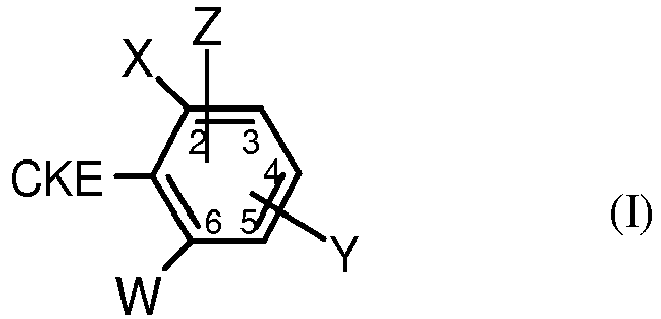
- W
- für Wasserstoff, Alkyl, Halogen, Halogenalkyl, Alkoxy oder Halogenalkoxy steht,
- X
- für Alkyl, Alkenyl, Alkinyl, Halogen, Alkoxy, Halogenalkyl, Halogenalkoxy oder Cyano steht,
- Y
- für Wasserstoff, Alkyl, Alkoxy oder Halogen steht,
- Z
- für eine Gruppe
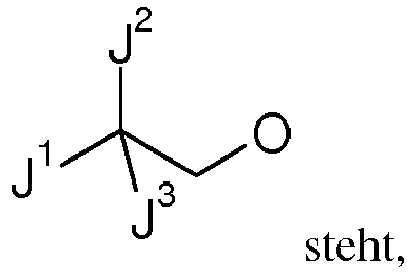
- W
- represents hydrogen, alkyl, halogen, haloalkyl, alkoxy or haloalkoxy,
- X
- represents alkyl, alkenyl, alkynyl, halogen, alkoxy, haloalkyl, haloalkoxy or cyano,
- Y
- represents hydrogen, alkyl, alkoxy or halogen,
- Z
- for a group
CKE für eine der Gruppen
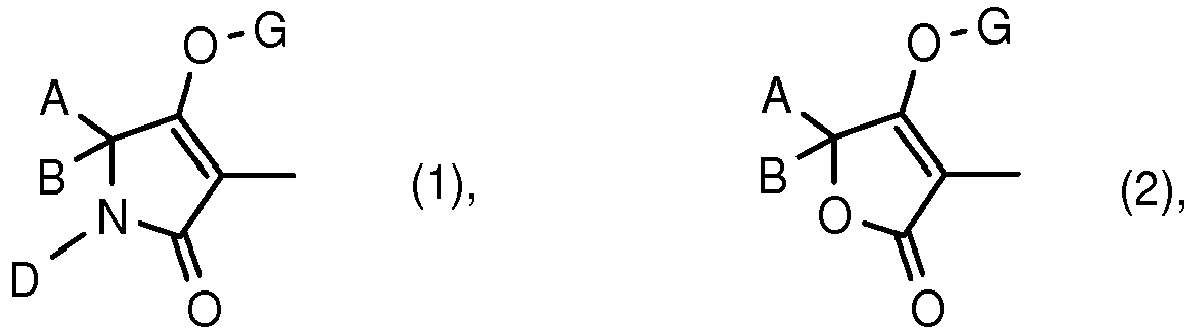

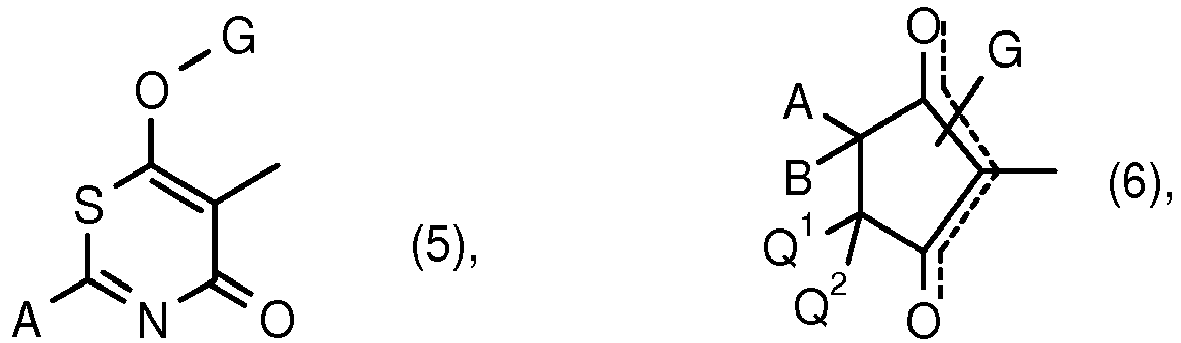

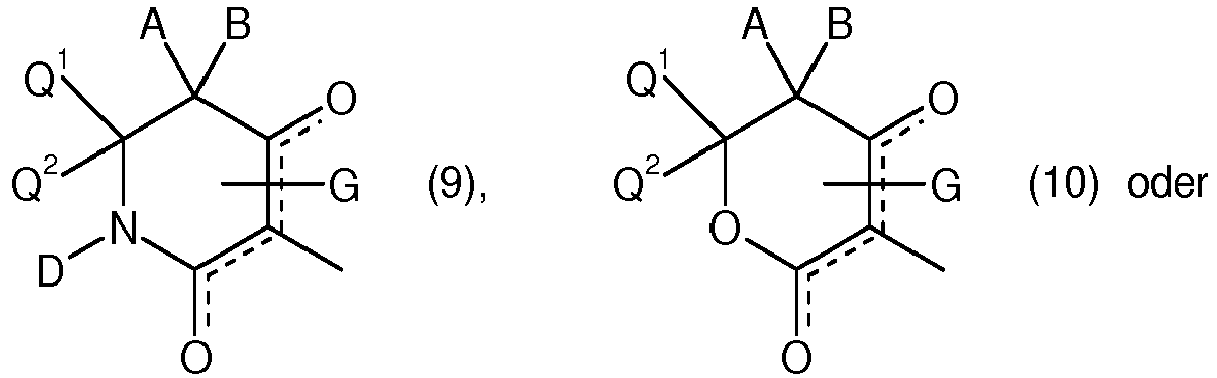

- U
- für -S-, -S(O)-, -S(O)2-, -O-,
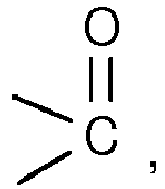

- A
- für Wasserstoff, für jeweils gegebenenfalls durch Halogen substituiertes Alkyl, Alkenyl, Alkoxyalkyl, Alkylthioalkyl, gesättigtes oder ungesättigtes, gegebenenfalls substituiertes Cycloalkyl, in welchem gegebenenfalls mindestens ein Ringatom durch ein Heteroatom ersetzt ist, oder jeweils gegebenenfalls durch Halogen, Alkyl, Halogenalkyl, Alkoxy, Halogenalkoxy, Cyano oder Nitro substituiertes Aryl, Arylalkyl oder Hetaryl steht,
- B
- für Wasserstoff, Alkyl oder Alkoxyalkyl steht, oder
- A und B
- gemeinsam mit dem Kohlenstoffatom an das sie gebunden sind für einen gesättigten oder ungesättigten, gegebenenfalls mindestens ein Heteroatom enthaltenden unsubstituierten oder substituierten Cyclus stehen,
- D
- für Wasserstoff oder einen gegebenenfalls substituierten Rest aus der Reihe Alkyl, Alkenyl, Alkinyl, Alkoxyalkyl, gesättigtes oder ungesättigtes Cycloalkyl, in welchem gegebenenfalls eines oder mehrere Ringglieder durch Heteroatome ersetzt sind, für jeweils gegebenenfalls substituiertes Arylalkyl, Aryl, Hetarylalkyl
- A und D
- gemeinsam mit den Atomen an die sie gebunden sind für einen gesättigten oder ungesättigten und gegebenenfalls mindestens ein (im Falle CKE=8 und 11 ein weiteres) Heteroatom enthaltenden, im A,D-Teil unsubstituierten oder substituierten Cyclus stehen, oder
- A und Q1
- gemeinsam für jeweils gegebenenfalls substituiertes Alkandiyl oder Alkendiyl stehen welche gegebenenfalls durch mindestens ein Heteroatom,
eine

oder, - B und Q2
- gemeinsam mit den Atomen, an die sie gebunden sind, für einen gesättigten oder ungesättigten und gegebenenfalls mindestens ein Heteroatom enthaltenden, im B, Q2-Teil unsubstituierten oder substituierten Cyclus stehen, oder
- D und Q1
- gemeinsam mit den Atomen, an die sie gebunden sind, für einen gesättigten oder ungesättigten und gegebenenfalls mindestens ein Heteroatom enthaltenden, im D, Q1-Teil unsubstituierten oder substituierten Cyclus stehen,
- Q1
- für Wasserstoff, Alkyl, Alkoxyalkyl, gegebenenfalls substituiertes Cycloalkyl, worin gegebenenfalls eine Methylengruppe durch Sauerstoff oder Schwefel ersetzt ist oder für gegebenenfalls substituiertes Phenyl steht,
- Q2 Q4 Q5 und Q6
- unabhängig voneinander für Wasserstoff oder Alkyl stehen,
- Q3
- für Wasserstoff, für jeweils gegebenenfalls substituiertes Alkyl, Alkoxy, Alkylthio, Alkoxyalkyl, Alkylthioalkyl, gegebenenfalls substituiertes Cycloalkyl, worin gegebenenfalls eine oder zwei Methylengruppen durch Sauerstoff oder Schwefel ersetzt sind oder für gegebenenfalls substituiertes Phenyl steht, oder
- Q1 und Q2
- gemeinsam mit dem Kohlenstoffatom, an das sie gebunden sind, für einen gegebenenfalls ein Heteroatom enthaltenden unsubstituierten oder substituierten Cyclus stehen, oder
- Q3 und Q4
- gemeinsam mit dem Kohlenstoffatom, an das sie gebunden sind, für einen gesättigten oder ungesättigten, gegebenenfalls mindestens ein Heteroatom enthaltenden unsubstituierten oder substituierten Cyclus stehen, oder
- A und Q3
- gemeinsam mit dem Kohlenstoffatom, an das sie gebunden sind, für einen gesättigten oder ungesättigten, gegebenenfalls mindestens ein Heteroatom enthaltenden unsubstituierten oder substituierten Cyclus stehen, oder
- A und Q5
- gemeinsam mit dem Kohlenstoffatom, an das sie gebunden sind, für einen gesättigten oder ungesättigten, gegebenenfalls mindestens ein Heteroatom enthaltenden unsubstituierten oder substituierten Cyclus stehen,
- G
- für Wasserstoff (a) oder für eine der Gruppen

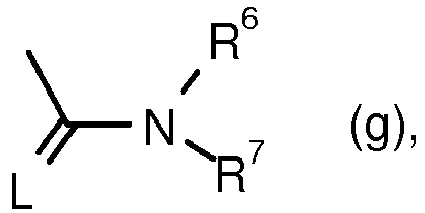
- E
- für ein Metallionäquivalent oder ein Ammoniumion steht,
- L
- für Sauerstoff oder Schwefel steht,
- M
- für Sauerstoff oder Schwefel steht,
- R1
- für jeweils gegebenenfalls durch Halogen substituiertes Alkyl, Alkenyl, Alkoxyalkyl, Alkylthioalkyl, Polyalkoxyalkyl oder für gegebenenfalls durch Halogen, Alkyl oder Alkoxy substituiertes Cycloalkyl, das durch mindestens ein Heteroatom unterbrochen sein kann, für jeweils gegebenenfalls substituiertes Phenyl, Phenylalkyl, Hetaryl, Phenoxyalkyl oder Hetaryloxyalkyl steht,
- R2
- für jeweils gegebenenfalls durch Halogen substituiertes Alkyl, Alkenyl, Alkoxyalkyl, Polyalkoxyalkyl oder für jeweils gegebenenfalls substituiertes Cycloalkyl, Phenyl oder Benzyl steht,
- R3, R4 und R5
- unabhängig voneinander für jeweils gegebenenfalls durch Halogen substituiertes Alkyl, Alkoxy, Alkylamino, Dialkylamino, Alkylthio, Alkenylthio, Cycloalkylthio oder für jeweils gegebenenfalls substituiertes Phenyl, Benzyl, Phenoxy oder Phenylthio stehen,
- R6 und R7
- unabhängig voneinander für Wasserstoff, für jeweils gegebenenfalls durch Halogen substituiertes Alkyl, Cycloalkyl, Alkenyl, Alkoxy, Alkoxyalkyl, für gegebenenfalls substituiertes Phenyl, für gegebenenfalls substituiertes Benzyl stehen, oder gemeinsam mit dem N-Atom, an das sie gebunden sind, für einen gegebenenfalls durch Sauerstoff oder Schwefel unterbrochenen Cyclus stehen.
- U
- for -S-, -S (O) -, -S (O) 2 -, -O-,
- A
- is hydrogen, in each case optionally halogen-substituted alkyl, alkenyl, alkoxyalkyl, alkylthioalkyl, saturated or unsaturated, optionally substituted cycloalkyl in which optionally at least one ring atom is replaced by a heteroatom, or in each case optionally by halogen, alkyl, haloalkyl, alkoxy, haloalkoxy , Cyano or nitro substituted aryl, arylalkyl or hetaryl,
- B
- is hydrogen, alkyl or alkoxyalkyl, or
- A and B
- together with the carbon atom to which they are bonded represent a saturated or unsaturated unsubstituted or substituted cycle, optionally containing at least one heteroatom,
- D
- is hydrogen or an optionally substituted radical from the series alkyl, alkenyl, alkynyl, alkoxyalkyl, saturated or unsaturated cycloalkyl in which optionally one or more ring members are replaced by heteroatoms, in each case optionally substituted arylalkyl, aryl, hetarylalkyl
- A and D
- together with the atoms to which they are attached represent a saturated or unsaturated and optionally at least one (in the case of CKE = 8 and 11 another) heteroatom-containing, unsubstituted or substituted in the A, D-part cycle, or
- A and Q 1
- together for each optionally substituted alkanediyl or alkenediyl which are optionally substituted by at least one heteroatom,
a
or, - B and Q 2
- together with the atoms to which they are attached, represent a saturated or unsaturated and optionally at least one heteroatom-containing cycle which is unsubstituted or substituted in the B, Q 2 part, or
- D and Q 1
- together with the atoms to which they are bonded, represent a saturated or unsaturated and optionally at least one heteroatom-containing cycle which is unsubstituted or substituted in the D, Q 1 part,
- Q 1
- is hydrogen, alkyl, alkoxyalkyl, optionally substituted cycloalkyl, in which optionally a methylene group is replaced by oxygen or sulfur or represents optionally substituted phenyl,
- Q 2 Q 4 Q 5 and Q 6
- independently of one another represent hydrogen or alkyl,
- Q 3
- is hydrogen, in each case optionally substituted alkyl, alkoxy, alkylthio, alkoxyalkyl, alkylthioalkyl, optionally substituted cycloalkyl, in which optionally one or two methylene groups are replaced by oxygen or sulfur or represents optionally substituted phenyl, or
- Q 1 and Q 2
- together with the carbon atom to which they are attached represent an unsubstituted or substituted cycle optionally containing a heteroatom, or
- Q 3 and Q 4
- together with the carbon atom to which they are attached, for a saturated or unsubstituted or optionally unsubstituted or substituted cyclus containing at least one heteroatom, or
- A and Q 3
- together with the carbon atom to which they are attached represent a saturated or unsaturated unsubstituted or substituted cycle optionally containing at least one heteroatom, or
- A and Q 5
- together with the carbon atom to which they are attached represent a saturated or unsaturated unsubstituted or substituted cycle optionally containing at least one heteroatom,
- G
- for hydrogen (a) or for one of the groups
- e
- represents a metal ion equivalent or an ammonium ion,
- L
- stands for oxygen or sulfur,
- M
- stands for oxygen or sulfur,
- R 1
- in each case optionally halogen-substituted alkyl, alkenyl, alkoxyalkyl, alkylthioalkyl, polyalkoxyalkyl or optionally substituted by halogen, alkyl or alkoxy-substituted cycloalkyl which may be interrupted by at least one heteroatom, is in each case optionally substituted phenyl, phenylalkyl, hetaryl, phenoxyalkyl or hetaryloxyalkyl .
- R 2
- represents in each case optionally halogen-substituted alkyl, alkenyl, alkoxyalkyl, polyalkoxyalkyl or in each case optionally substituted cycloalkyl, phenyl or benzyl,
- R 3 , R 4 and R 5
- independently of one another are each optionally halogen-substituted alkyl, alkoxy, alkylamino, dialkylamino, alkylthio, alkenylthio, cycloalkylthio or in each case optionally substituted phenyl, benzyl, phenoxy or phenylthio,
- R 6 and R 7
- independently of one another represent hydrogen, in each case optionally halogen-substituted alkyl, cycloalkyl, alkenyl, alkoxy, alkoxyalkyl, optionally substituted phenyl, optionally substituted benzyl, or together with the N-atom to which they are bonded, optionally substituted with Oxygen or sulfur interrupted cycle.
Die Verbindungen der Formel (I) können, auch in Abhängigkeit von der Art der Substituenten, als geometrische und/oder optische Isomere oder Isomerengemische, in unterschiedlicher Zusammensetzung vorliegen, die gegebenenfalls in üblicher Art und Weise getrennt werden können. Sowohl die reinen Isomeren als auch die Isomerengemische sind in erfindungsgemäßen Mitteln einsetzbar und lassen sich in ihrer Wirkung durch erfindungsgemäße Ammonium- oder Phosphoniumsalze steigern. Im folgenden wird der Einfachheit halber stets von Verbindungen der Formel (I) gesprochen, obwohl sowohl die reinen Verbindungen als gegebenenfalls auch Gemische mit unterschiedlichen Anteilen an isomeren Verbindungen gemeint sind.Depending on the nature of the substituents, the compounds of the formula (I) can be present in different compositions as geometric and / or optical isomers or mixtures of isomers, which can optionally be separated in a customary manner. Both the pure isomers and the isomer mixtures can be used in compositions according to the invention and can be increased in their effect by ammonium or phosphonium salts according to the invention. In the following, for the sake of simplicity, compounds of the formula (I) are always mentioned, although both the pure compounds and optionally also mixtures with different proportions of isomeric compounds are meant.
Unter Einbeziehung der Bedeutungen (1) bis (11) der Gruppe CKE ergeben sich folgende hauptsächliche Strukturen (I-1) bis (I-11):

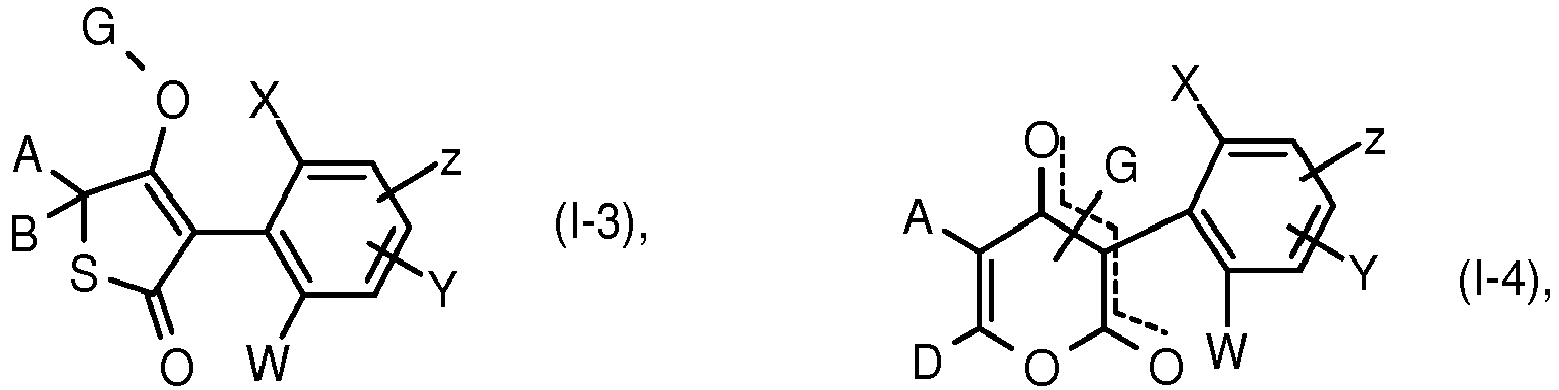

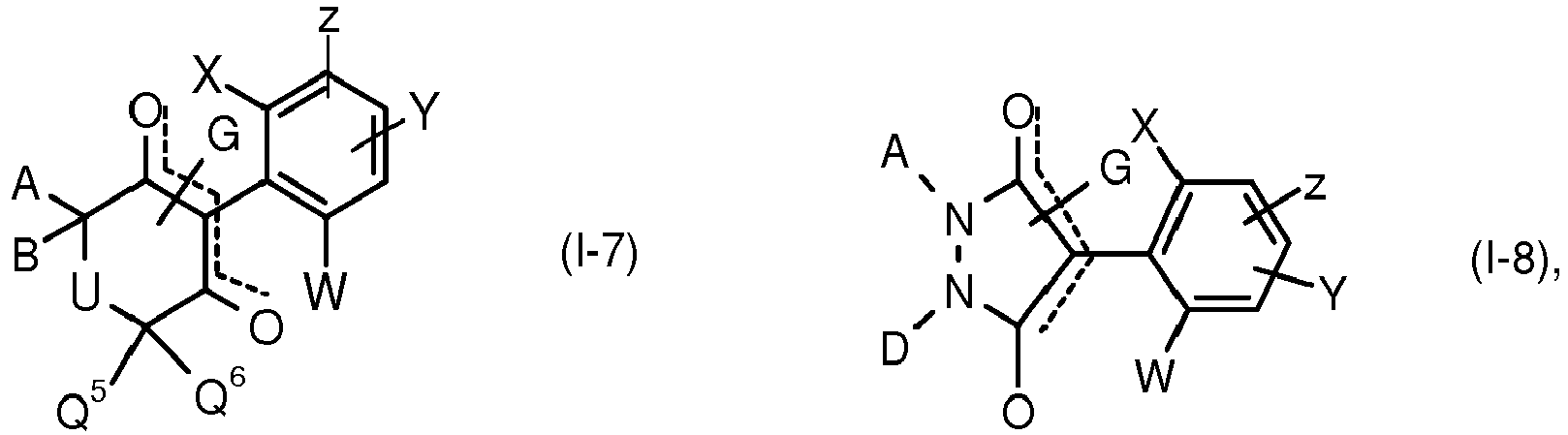

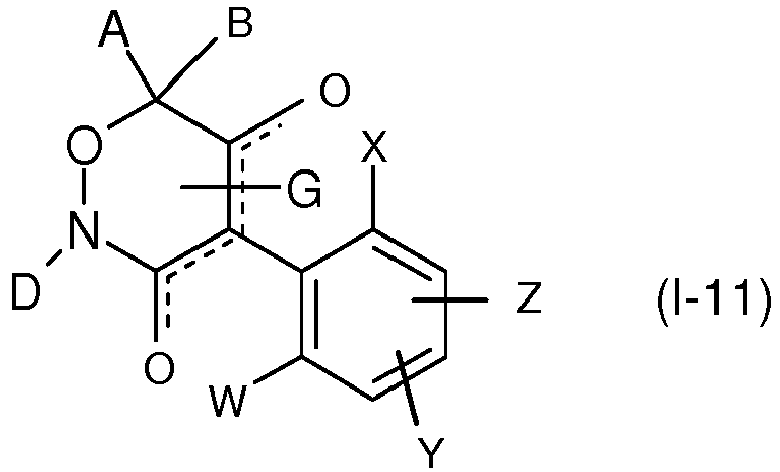
A, B, D, G, Q1, Q2, Q5, Q6 U, W, X, Y und Z die oben angegebene Bedeutung haben.Including the meanings (1) to (11) of the group CKE, the following main structures (I-1) to (I-11) result:
A, B, D, G, Q 1 , Q 2 , Q 5 , Q 6 are U, W, X, Y and Z are as defined above.
Unter Einbeziehung der verschiedenen Bedeutungen (a), (b), (c), (d), (e), (f) und (g) der Gruppe G ergeben sich folgende hauptsächliche Strukturen (I-1-a) bis (I-1-g), wenn CKE für die Gruppe (1) steht,

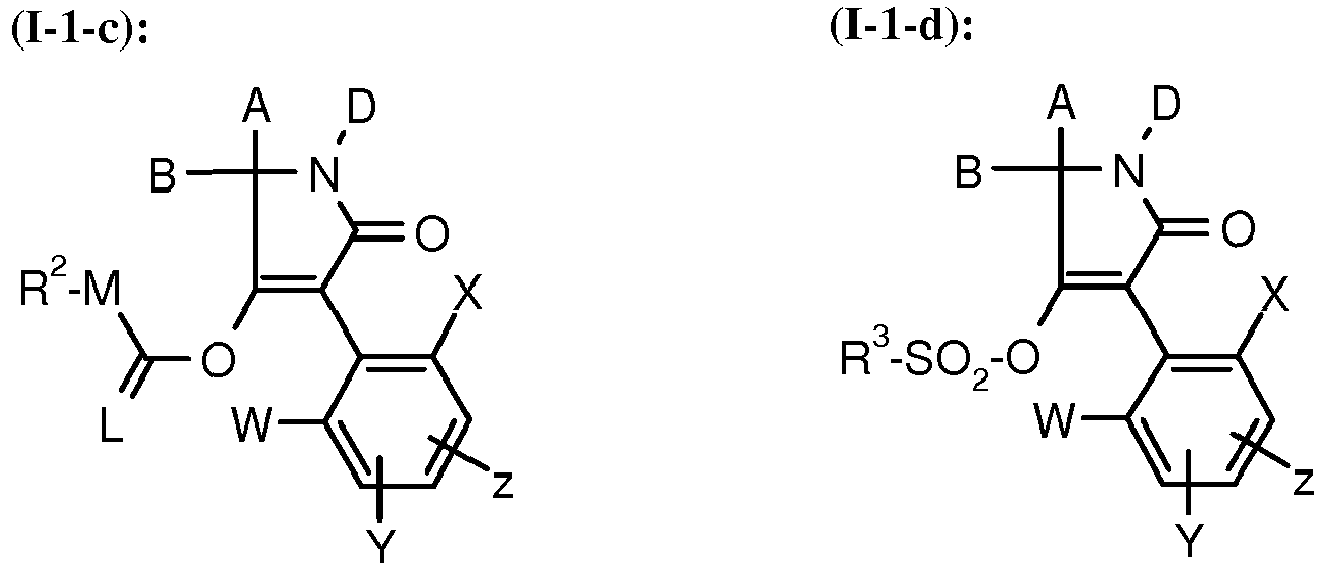
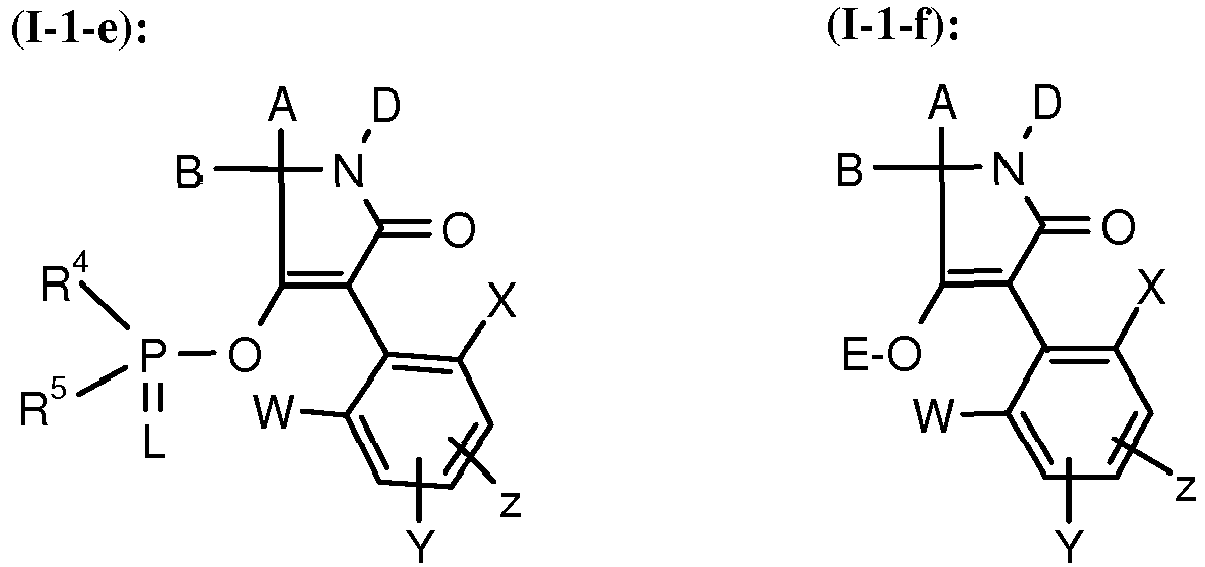
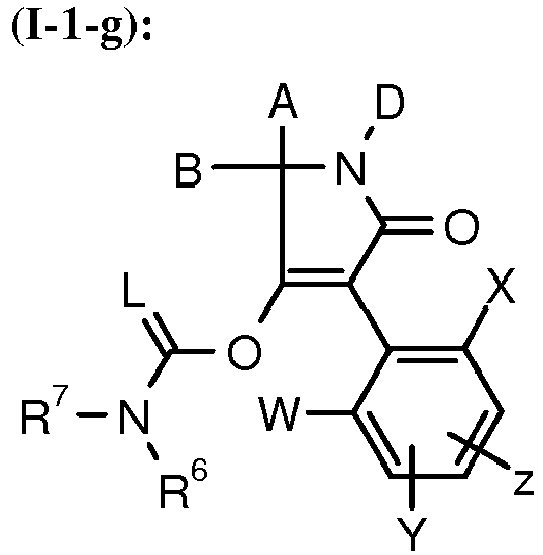
A, B, D, E, L, M, W, X, Y, Z, R1, R2, R3, R4, R5, R6 und R7 die oben angegebenen Bedeutungen besitzen.Taking into account the various meanings (a), (b), (c), (d), (e), (f) and (g) of the group G, the following main structures (I-1-a) to (I -1-g), if CKE stands for the group (1),
A, B, D, E, L, M, W, X, Y, Z, R 1 , R 2 , R 3 , R 4 , R 5 , R 6 and R 7 have the meanings given above.
Unter Einbeziehung der verschiedenen Bedeutungen (a), (b), (c), (d), (e), (f) und (g) der Gruppe G ergeben sich folgende hauptsächliche Strukturen (I-2-a) bis (I-2-g), wenn CKE für die Gruppe (2) steht,

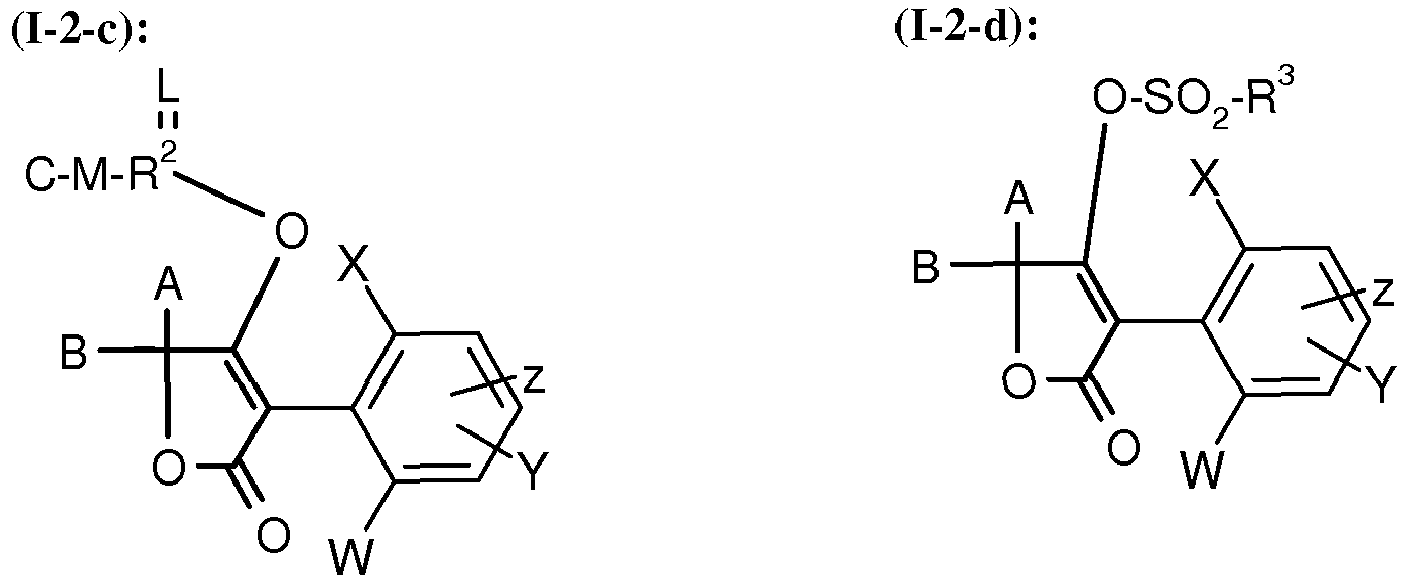

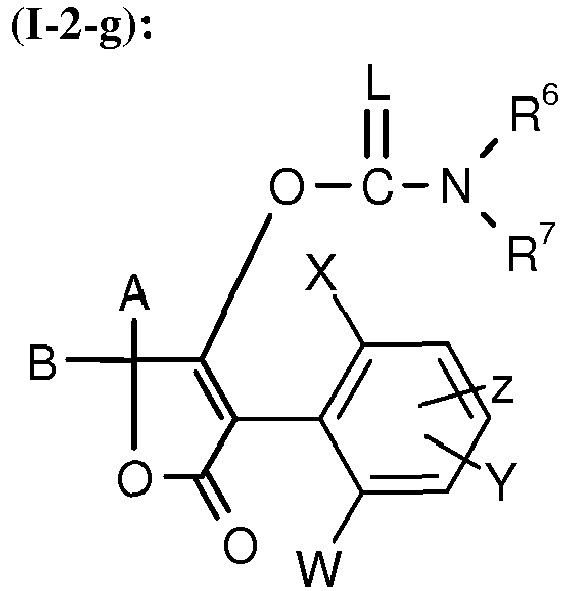
A, B, E, L, M, W, X, Y, Z, R1, R2, R3, R4, R5, R6 und R7 die oben angegebene Bedeutung haben.Taking into account the various meanings (a), (b), (c), (d), (e), (f) and (g) of the group G, the following main structures (I-2-a) to (I -2-g), if CKE stands for the group (2),
A, B, E, L, M, W, X, Y, Z, R 1 , R 2 , R 3 , R 4 , R 5 , R 6 and R 7 have the abovementioned meaning.
Unter Einbeziehung der verschiedenen Bedeutungen (a), (b), (c), (d), (e), (f) und (g) der Gruppe G ergeben sich folgende hauptsächliche Strukturen (I-3-a) bis (I-3-g), wenn CKE für die Gruppe (3) steht,
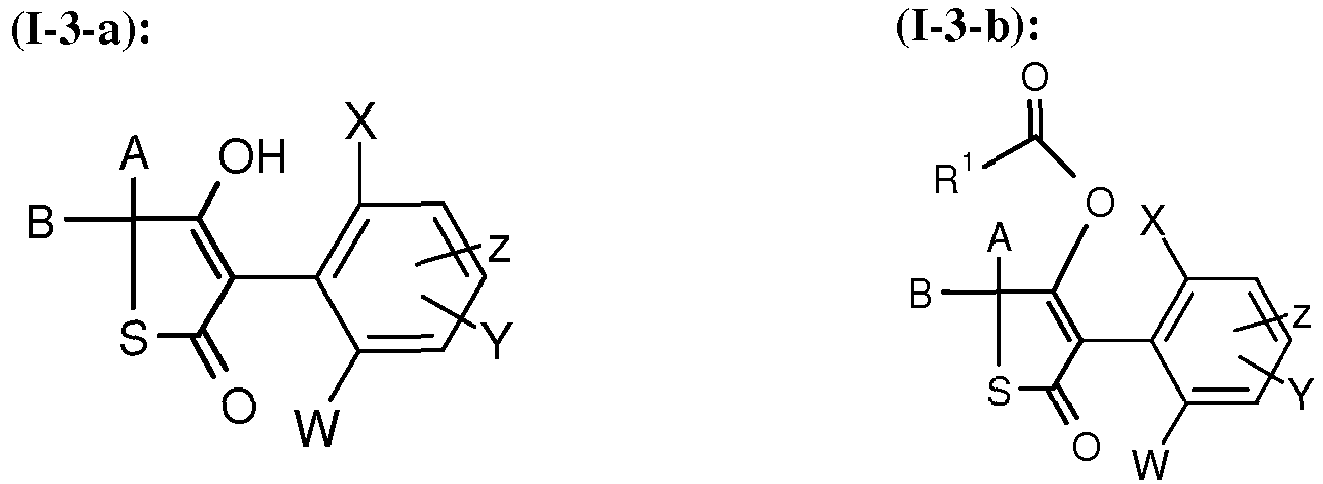
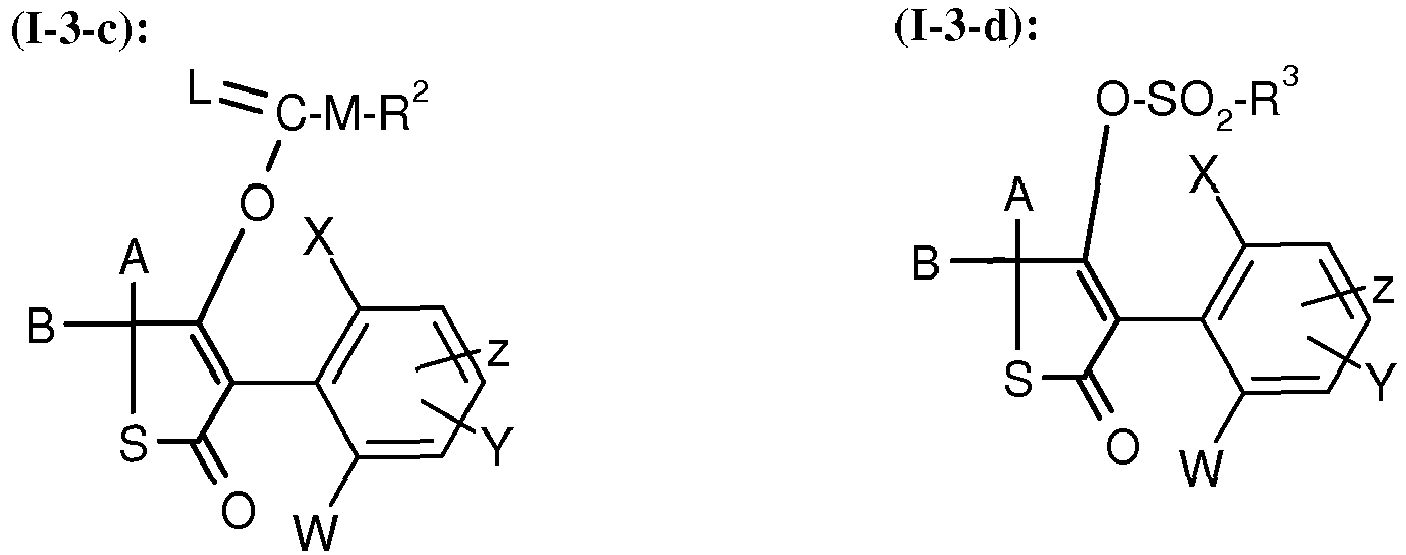
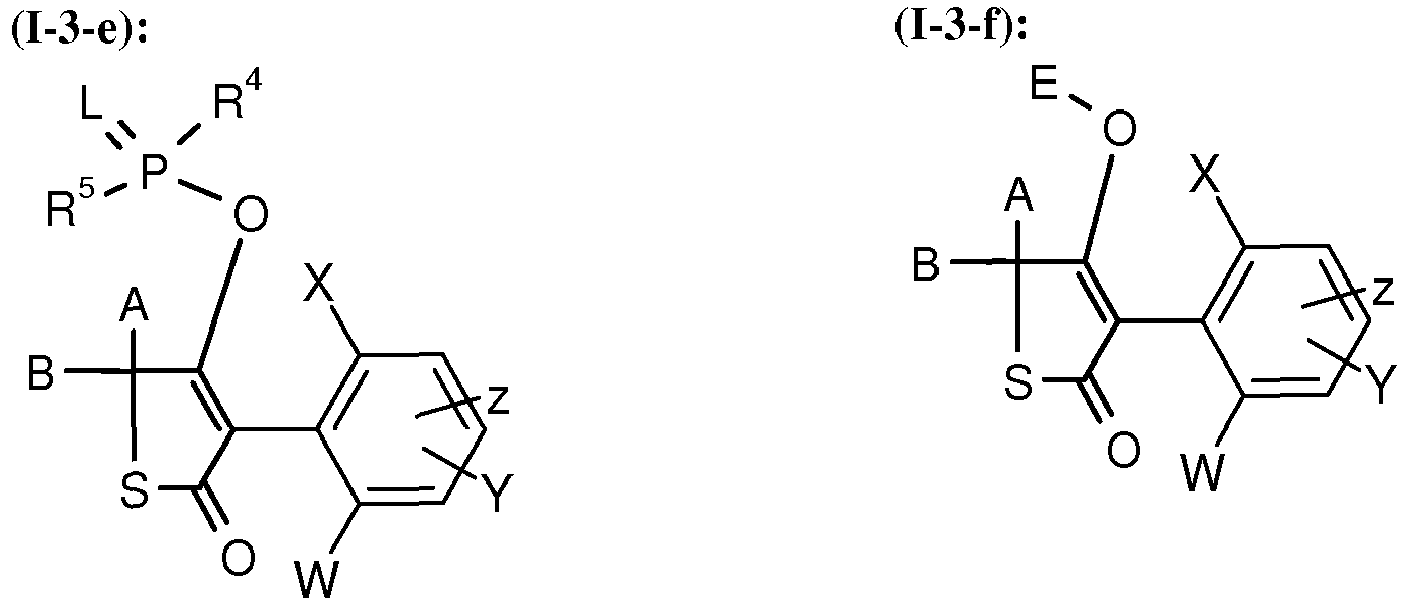
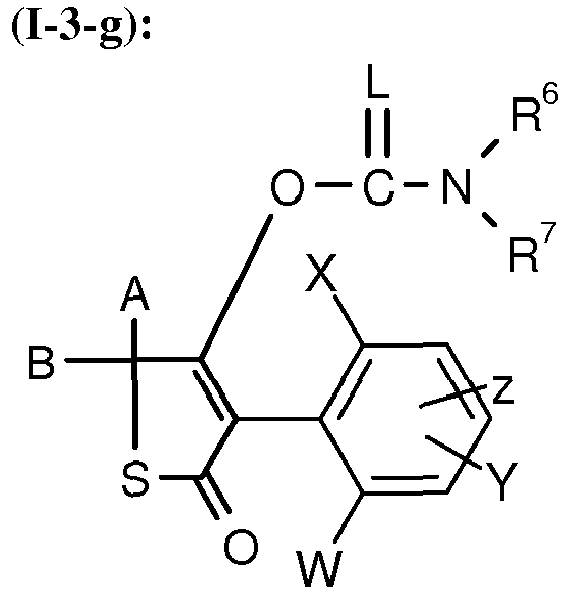
A, B, E, L, M, W, X, Y, Z, R1, R2, R3, R4, R5, R6 und R7 die oben angegebenen Bedeutung besitzen.Including the various meanings (a), (b), (c), (d), (e), (f) and (g) of the group G, the following main structures (I-3-a) to (I -3-g), if CKE stands for the group (3),
A, B, E, L, M, W, X, Y, Z, R 1 , R 2 , R 3 , R 4 , R 5 , R 6 and R 7 have the meaning given above.
Die Verbindungen der Formel (I-4) können in Abhängigkeit von der Stellung des Substituenten G in den zwei isomeren Formen der Formeln (I-4-A) und (I-4-B) vorliegen,
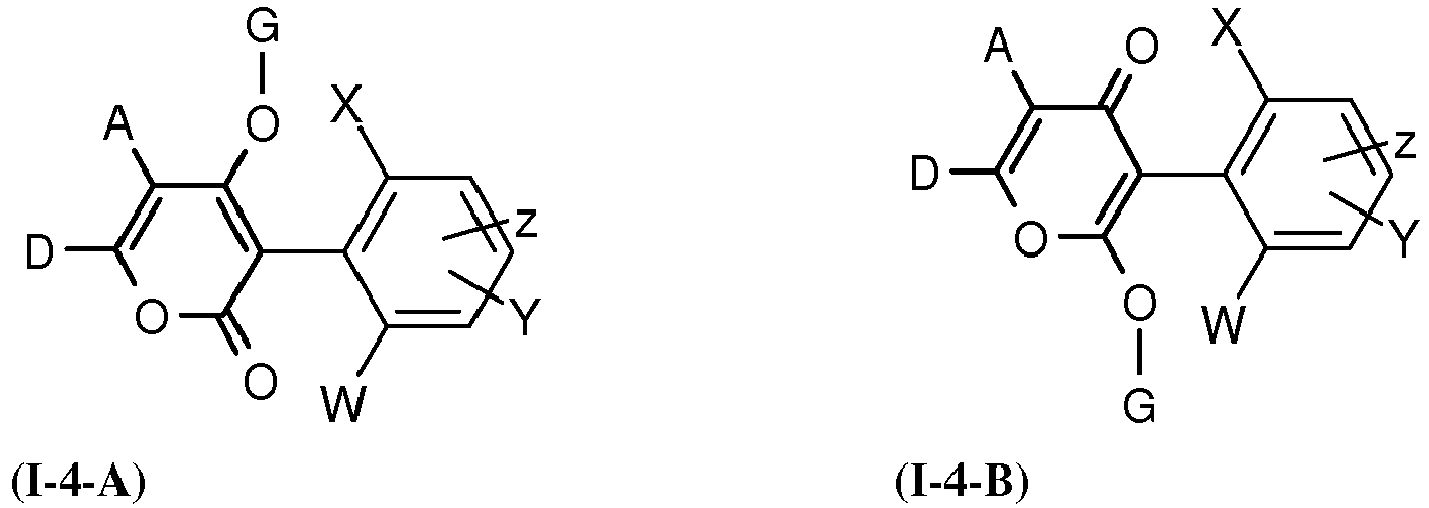
Die Verbindungen der Formeln (I-4-A) und (I-4-B) können sowohl als Gemische als auch in Form ihrer reinen Isomeren vorliegen. Gemische der Verbindungen der Formeln (I-4-A) und (I-4-B) lassen sich gegebenenfalls in an sich bekannter Weise durch physikalische Methoden trennen, beispielsweise durch chromatographische Methoden.The compounds of the formulas (I-4-A) and (I-4-B) can be present both as mixtures and in the form of their pure isomers. Mixtures of the compounds of the formulas (I-4-A) and (I-4-B) can optionally be separated in a manner known per se by physical methods, for example by chromatographic methods.
Aus Gründen der besseren Übersichtlichkeit wird im folgenden jeweils nur eines der möglichen Isomeren aufgeführt. Das schließt nicht aus, dass die Verbindungen gegebenenfalls in Form der Isomerengemische oder in der jeweils anderen isomeren Form vorliegen können.For reasons of clarity, only one of the possible isomers will be listed below. This does not exclude that the compounds may optionally be present in the form of the isomer mixtures or in the other isomeric form.
Unter Einbeziehung der verschiedenen Bedeutungen (a), (b), (c), (d), (e), (f) und (g) der Gruppe G ergeben sich folgende hauptsächliche Strukturen (I-4-a) bis (I-4-g), wenn CKE für die Gruppe (4) steht,


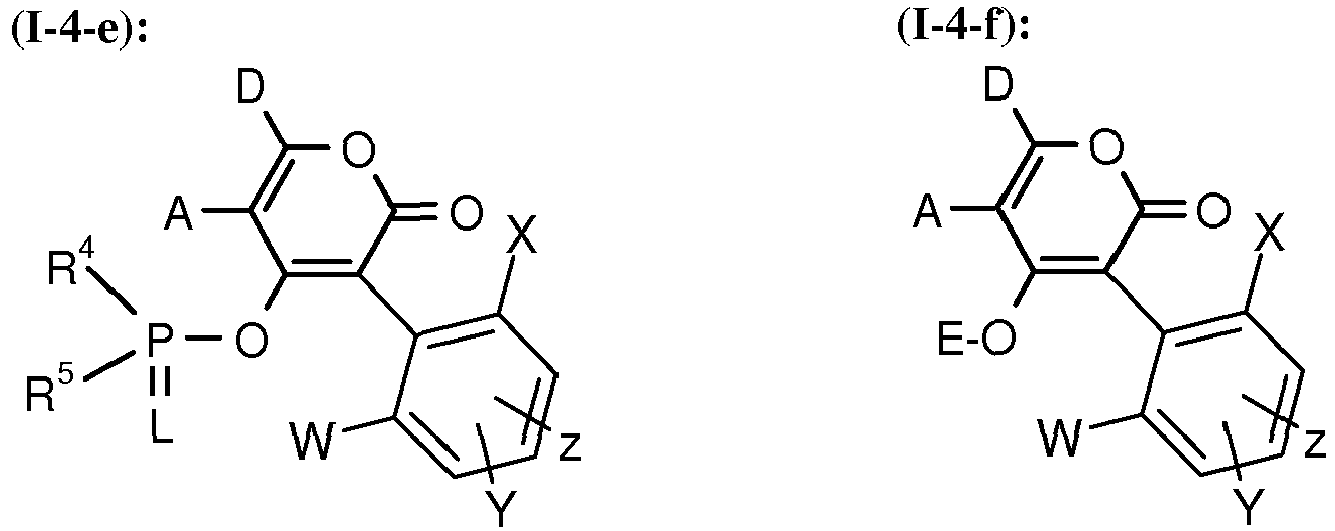

A, D, E, L, M, W, X, Y, Z, R1, R2, R3, R4, R5, R6 und R7 die oben angegebenen Bedeutungen besitzen.Including the various meanings (a), (b), (c), (d), (e), (f) and (g) of the group G, the following main structures (I-4-a) to (I -4-g), if CKE stands for group (4),
A, D, E, L, M, W, X, Y, Z, R 1 , R 2 , R 3 , R 4 , R 5 , R 6 and R 7 have the meanings given above.
Unter Einbeziehung der verschiedenen Bedeutungen (a), (b), (c), (d), (e), (f) und (g) der Gruppe G ergeben sich folgende hauptsächliche Strukturen (I-5-a) bis (I-5-g), wenn CKE für die Gruppe (5) steht,
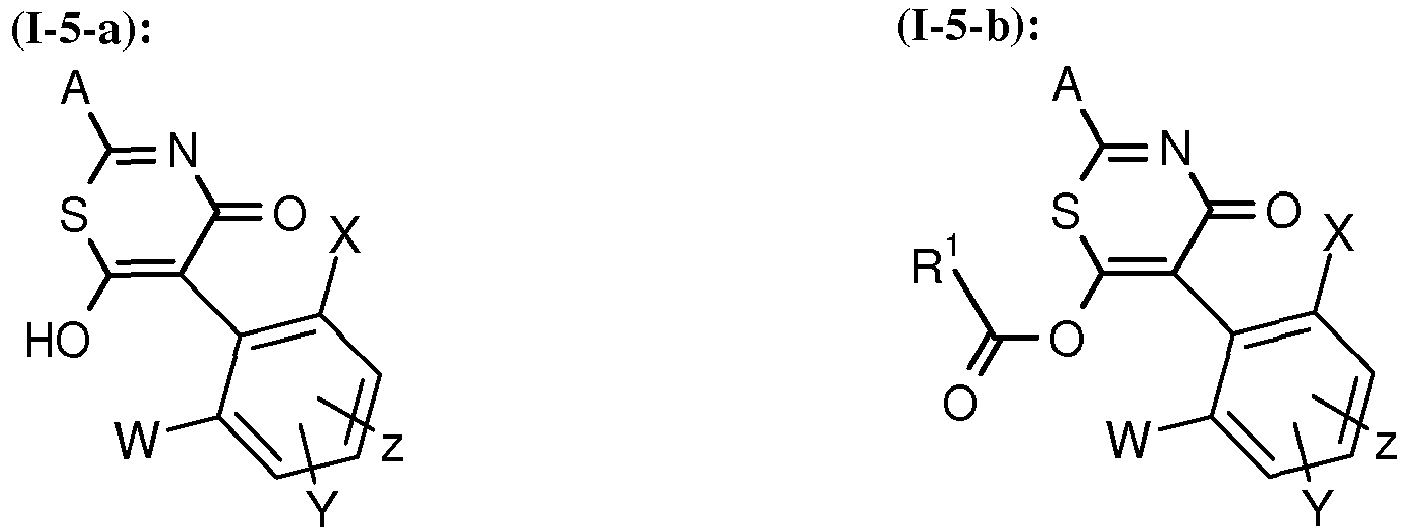


A, E, L, M, W, X, Y, Z, R1, R2, R3, R4, R5, R6 und R7 die oben angegebenen Bedeutungen besitzen.Including the various meanings (a), (b), (c), (d), (e), (f) and (g) of the group G, the following main structures (I-5-a) to (I -5-g), if CKE stands for the group (5),
A, E, L, M, W, X, Y, Z, R 1 , R 2 , R 3 , R 4 , R 5 , R 6 and R 7 have the meanings given above.
Die Verbindungen der Formel (I-6) können in Abhängigkeit von der Stellung des Substituenten G in den zwei isomeren Formen der Formeln (I-6-A) und (I-6-B) vorliegen,

Die Verbindungen der Formeln (I-6-A) und (I-6-B) können sowohl als Gemische als auch in Form ihrer reinen Isomeren vorliegen. Gemische der Verbindungen der Formeln (I-6-A) und (I-6-B) lassen sich gegebenenfalls durch physikalische Methoden trennen, beispielsweise durch chromatographische Methoden.The compounds of the formulas (I-6-A) and (I-6-B) can be present both as mixtures and in the form of their pure isomers. Mixtures of the compounds of the formulas (I-6-A) and (I-6-B) can optionally be separated by physical methods, for example by chromatographic methods.
Aus Gründen der besseren Übersichtlichkeit wird im folgenden jeweils nur eines der möglichen Isomeren aufgeführt. Das schließt nicht aus, dass die Verbindungen gegebenenfalls in Form der Isomerengemische oder in der jeweils anderen isomeren Form vorliegen können.For reasons of clarity, only one of the possible isomers will be listed below. This does not exclude that the compounds may optionally be present in the form of the isomer mixtures or in the other isomeric form.
Unter Einbeziehung der verschiedenen Bedeutungen (a), (b), (c), (d), (e), (f) und (g) der Gruppe G ergeben sich folgende hauptsächlichen Strukturen (I-6-a) bis (I-6-g), wenn CKE für die Gruppe (6) steht,
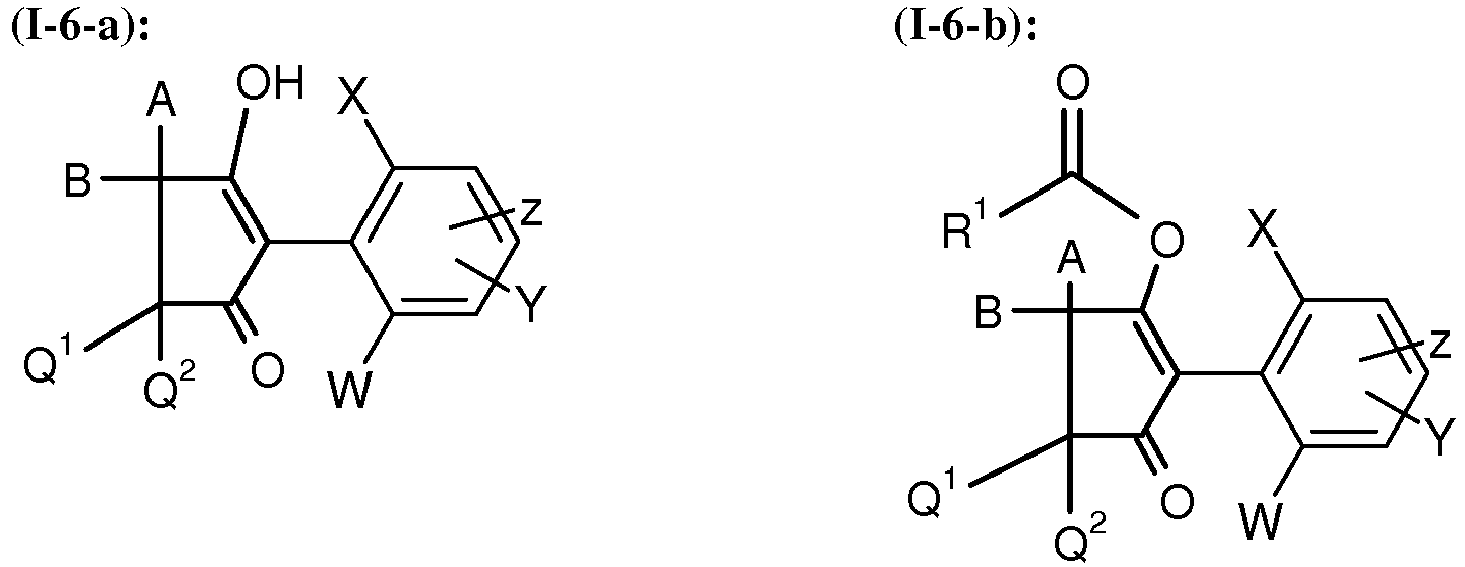
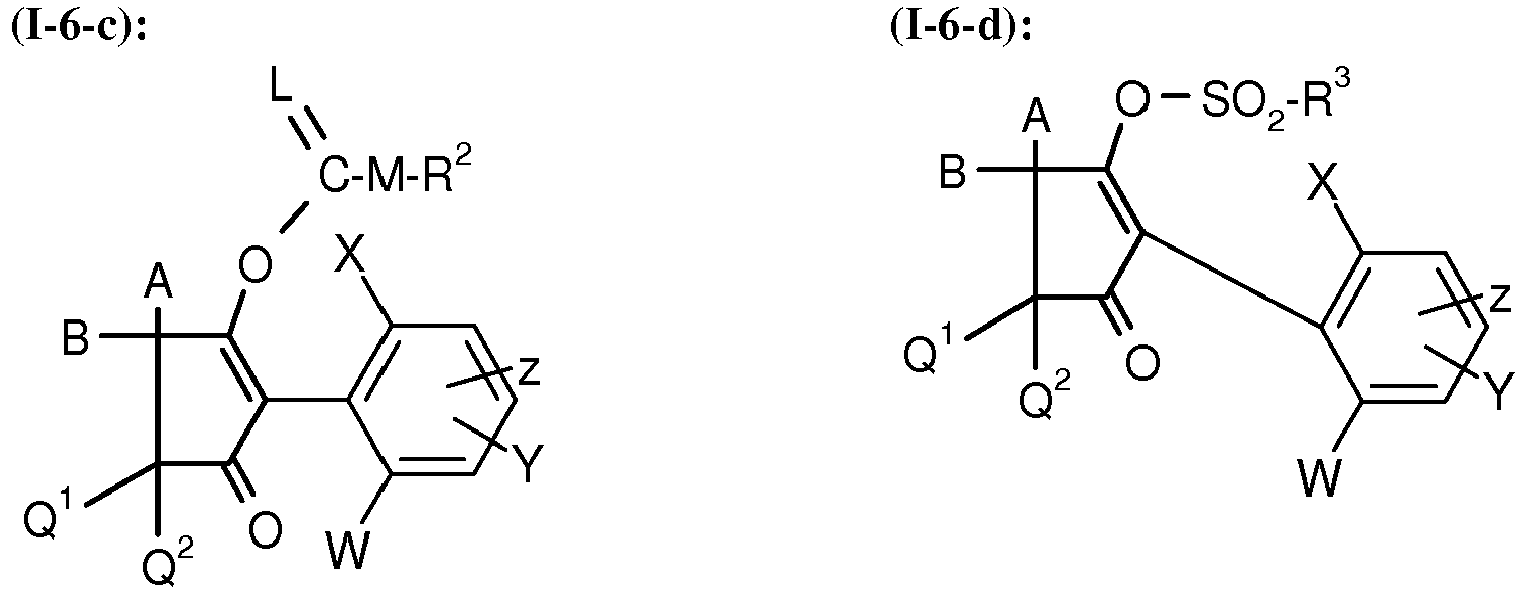
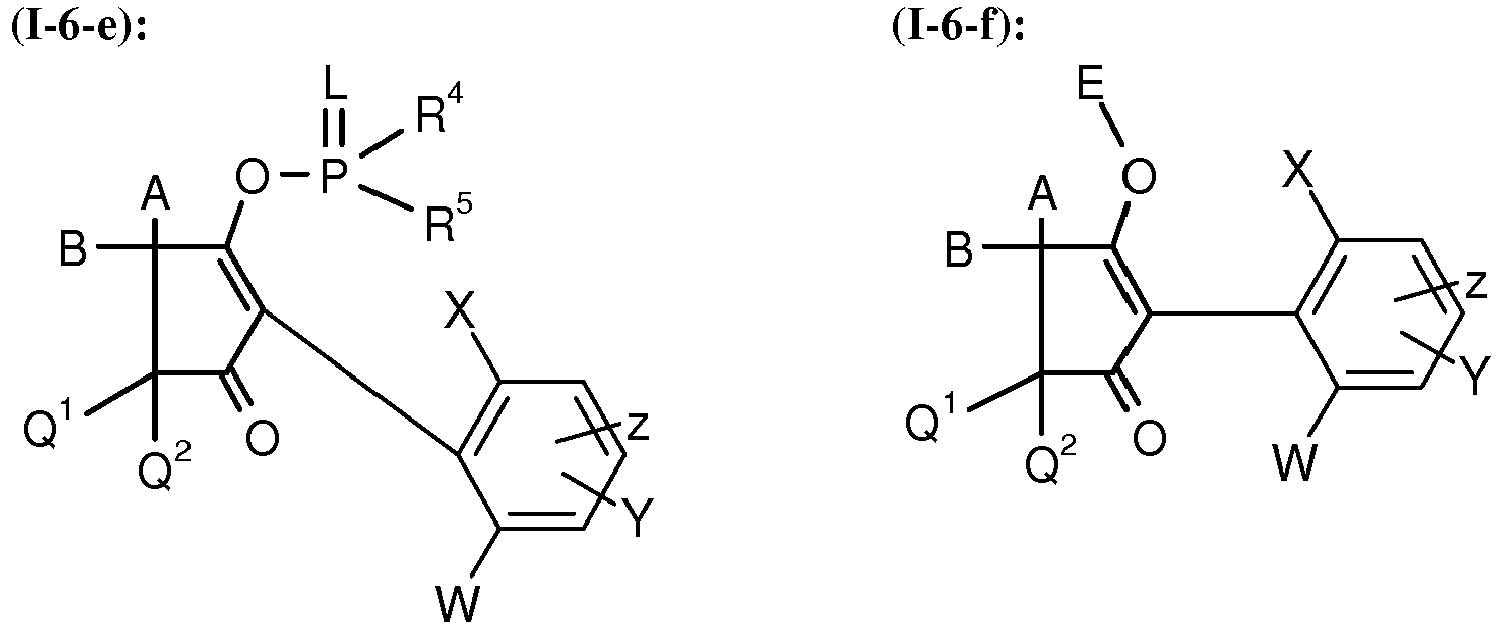

A, B, Q1, Q2, E, L, M, W, X, Y, Z, R1, R2, R3, R4, R5, R6 und R7 die oben angegebenen Bedeutungen besitzen.Including the various meanings (a), (b), (c), (d), (e), (f) and (g) of the group G, the following main structures (I-6-a) to (I -6-g), if CKE stands for the group (6),
A, B, Q 1 , Q 2 , E, L, M, W, X, Y, Z, R 1 , R 2 , R 3 , R 4 , R 5 , R 6 and R 7 have the meanings given above.
Die Verbindungen der Formel (I-7) können in Abhängigkeit von der Stellung des Substituenten G in den zwei isomeren Formen der Formeln (I-7-A) bzw. (I-7-B) vorliegen, was durch die gestrichelte Linie in der Formel (I-7) zum Ausdruck gebracht werden soll:

Die Verbindungen der Formeln (I-7-A) bzw. (I-7-B) können sowohl als Gemische als auch in Form ihrer reinen Isomeren vorliegen. Gemische der Verbindungen der Formeln (I-7-A) und (I-7-B) lassen sich gegebenenfalls durch physikalische Methoden trennen, beispielsweise durch chromatographische Methoden.The compounds of the formulas (I-7-A) or (I-7-B) can be present both as mixtures and in the form of their pure isomers. Mixtures of the compounds of the formulas (I-7-A) and (I-7-B) can optionally be separated by physical methods, for example by chromatographic methods.
Aus Gründen der besseren Übersichtlichkeit wird im folgenden jeweils nur eines der möglichen Isomeren aufgeführt. Das schließt ein, dass die betreffende Verbindung gegebenenfalls als Isomerengemisch oder in der jeweils anderen isomeren Form vorliegen kann.For reasons of clarity, only one of the possible isomers will be listed below. This includes that the compound in question may optionally be present as a mixture of isomers or in the other isomeric form.
Unter Einbeziehung der verschiedenen Bedeutungen (a), (b), (c), (d), (e), (f) und (g) der Gruppe G ergeben sich folgende hauptsächlichen Strukturen (I-7-a) bis (I-7-g), wenn CKE für die Gruppe (7) steht,

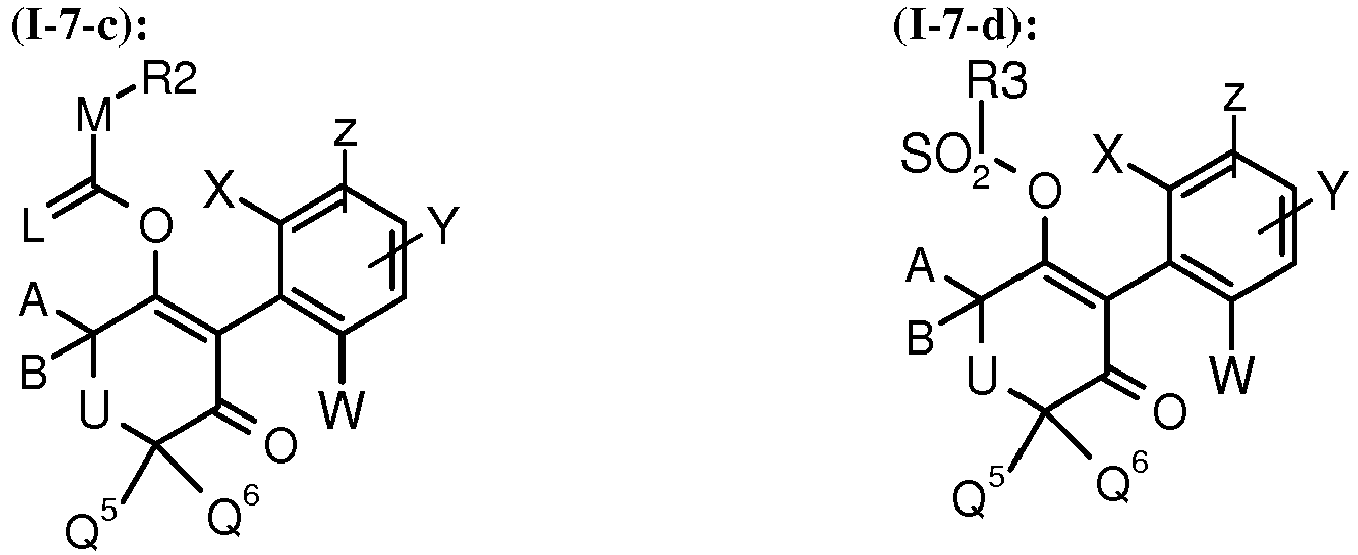
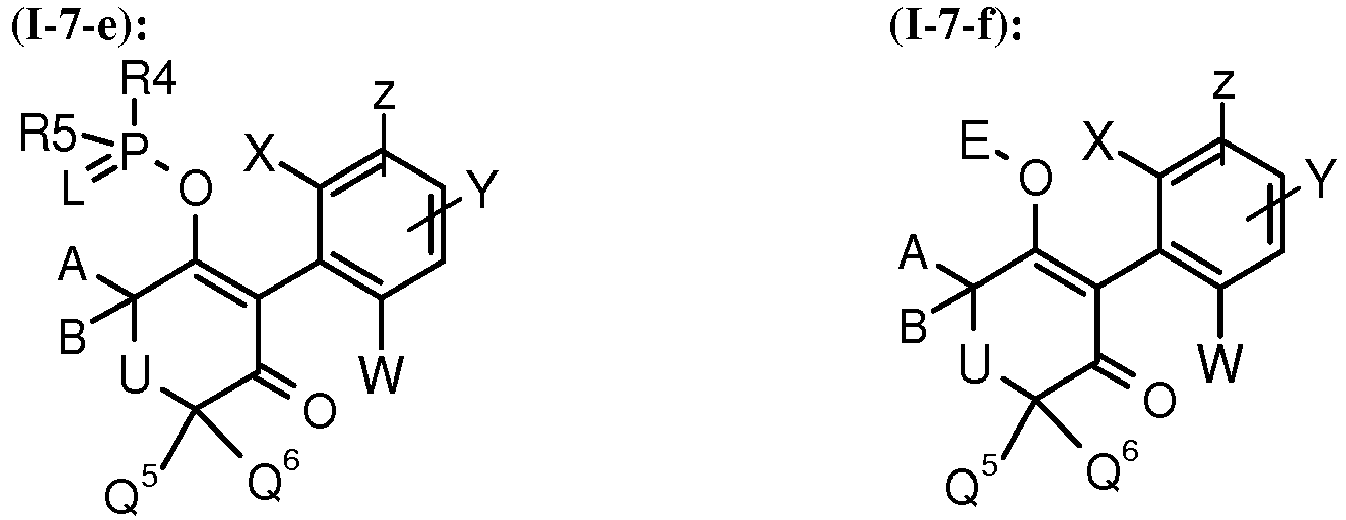
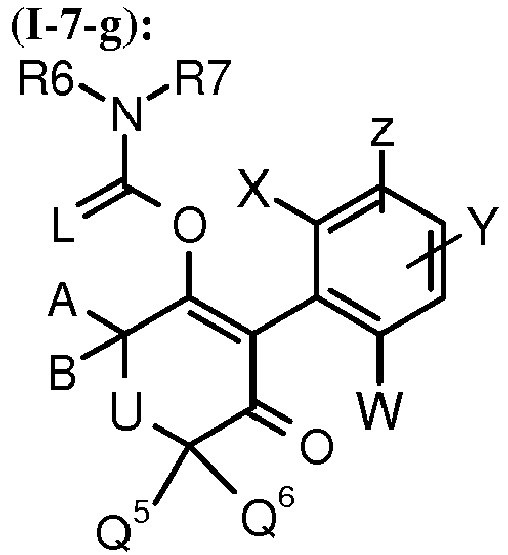
A, B, E, L, M, Q5, Q6, U, W, X, Y, Z, R1, R2, R3, R4, R5, R6 und R7 die oben angegebenen Bedeutungen besitzen.Including the various meanings (a), (b), (c), (d), (e), (f) and (g) of the group G, the following main structures (I-7-a) to (I -7-g), if CKE stands for the group (7),
A, B, E, L, M, Q 5 , Q 6 , U, W, X, Y, Z, R 1 , R 2 , R 3 , R 4 , R 5 , R 6 and R 7 are as defined above have.
Die Verbindungen der Formel (I-8) können in Abhängigkeit von der Stellung des Substituenten G in den zwei isomeren Formeln (I-8-A) und (I-8-B) vorliegen,

Die Verbindungen der Formeln (I-8-A) und (I-8-B) können sowohl als Gemische als auch in Form ihrer reinen Isomeren vorliegen. Gemische der Verbindungen der Formel (I-8-A) und (I-8-B) lassen sich gegebenenfalls in an sich bekannter Weise durch physikalische Methoden trennen, beispielsweise durch chromatographische Methoden.The compounds of the formulas (I-8-A) and (I-8-B) can be present both as mixtures and in the form of their pure isomers. Mixtures of the compounds of the formula (I-8-A) and (I-8-B) can optionally be separated in a manner known per se by physical methods, for example by chromatographic methods.
Aus Gründen der besseren Übersichtlichkeit wird im folgenden jeweils nur eines der möglichen Isomeren aufgeführt. Das schließt nicht aus, dass die Verbindungen gegebenenfalls in Form der Isomerengemische oder in der jeweils anderen isomeren Form vorliegen können.For reasons of clarity, only one of the possible isomers will be listed below. This does not exclude that the compounds may optionally be present in the form of the isomer mixtures or in the other isomeric form.
Unter Einbeziehung der verschiedenen Bedeutungen (a), (b), (c), (d), (e), (f) und (g) der Gruppe G ergeben sich folgende hauptsächliche Strukturen (I-8-a) (bis (I-8-g), wenn CKE für die Gruppe (8) steht,

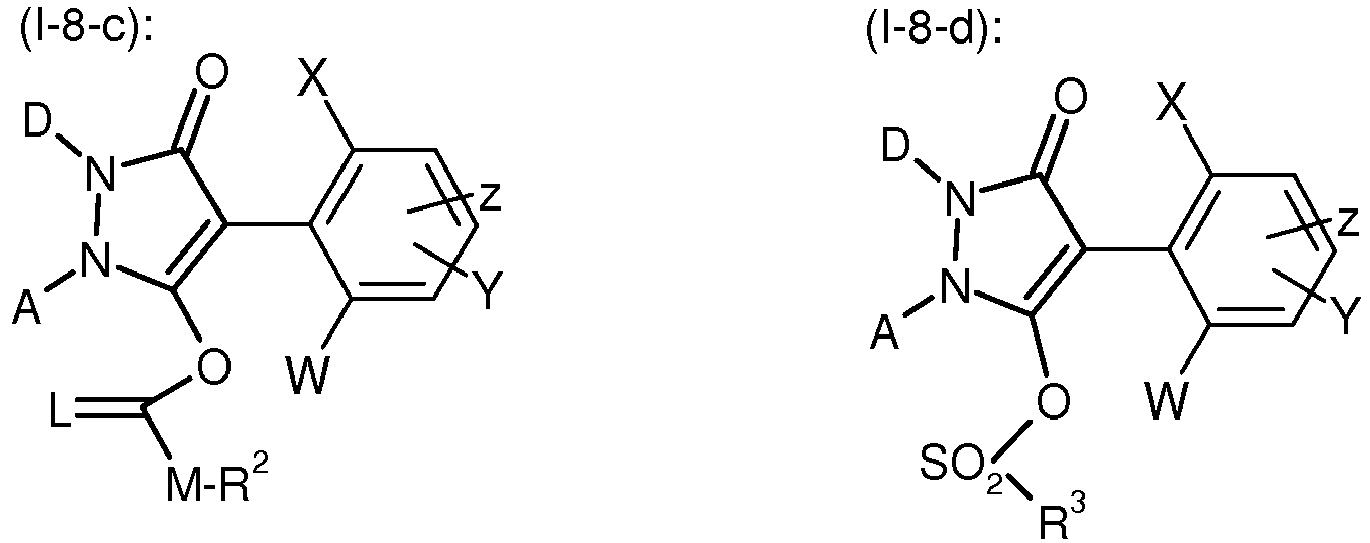
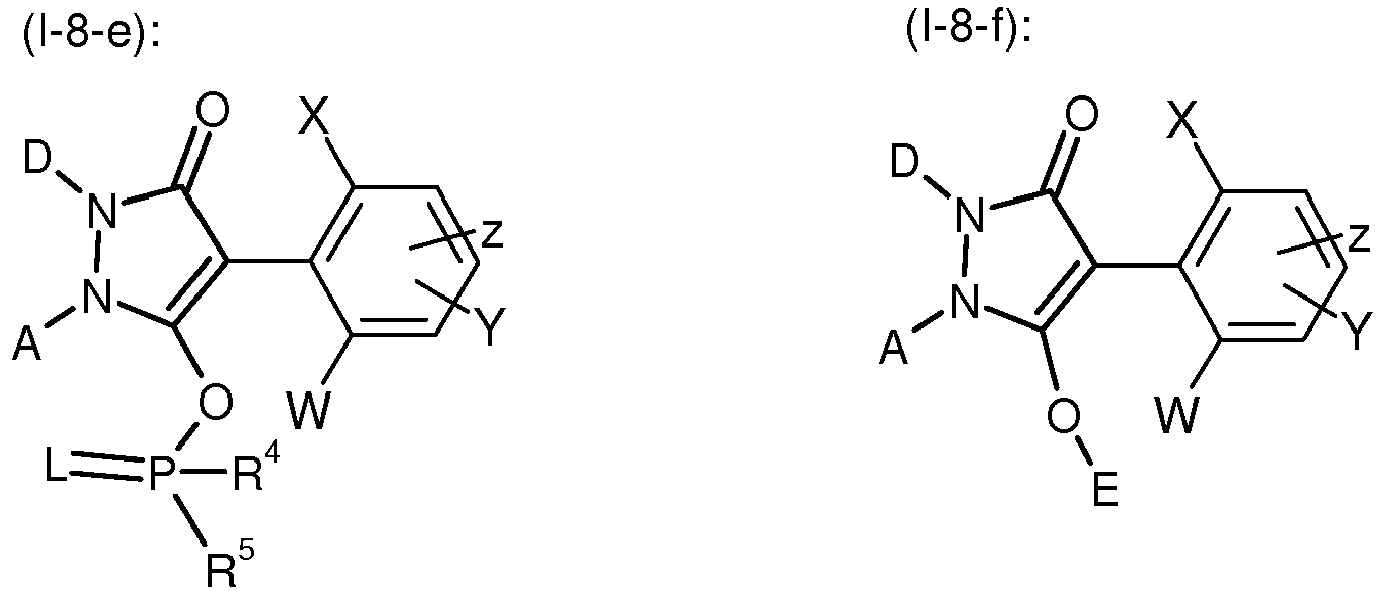
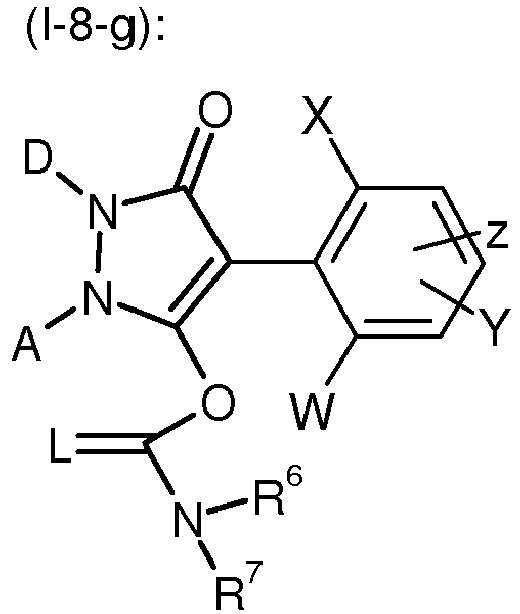
A, D, E, L, M, W, X, Y, Z, R1, R2, R3, R4, R5, R6 und R7 die oben angegebenen Bedeutungen besitzen.Including the different meanings (a), (b), (c), (d), (e), (f) and (g) of group G, the following main structures (I-8-a) result (bis ( I-8-g), if CKE stands for the group (8),
A, D, E, L, M, W, X, Y, Z, R 1 , R 2 , R 3 , R 4 , R 5 , R 6 and R 7 have the meanings given above.
Die Verbindungen der Formel (I-9) können in Abhängigkeit von der Stellung des Substituenten G in den zwei isomeren Formen der Formeln (I-9-A) und (I-9-B) vorliegen, was durch die gestrichelte Linie in der Formel (I-9) zum Ausdruck gebracht werden soll.
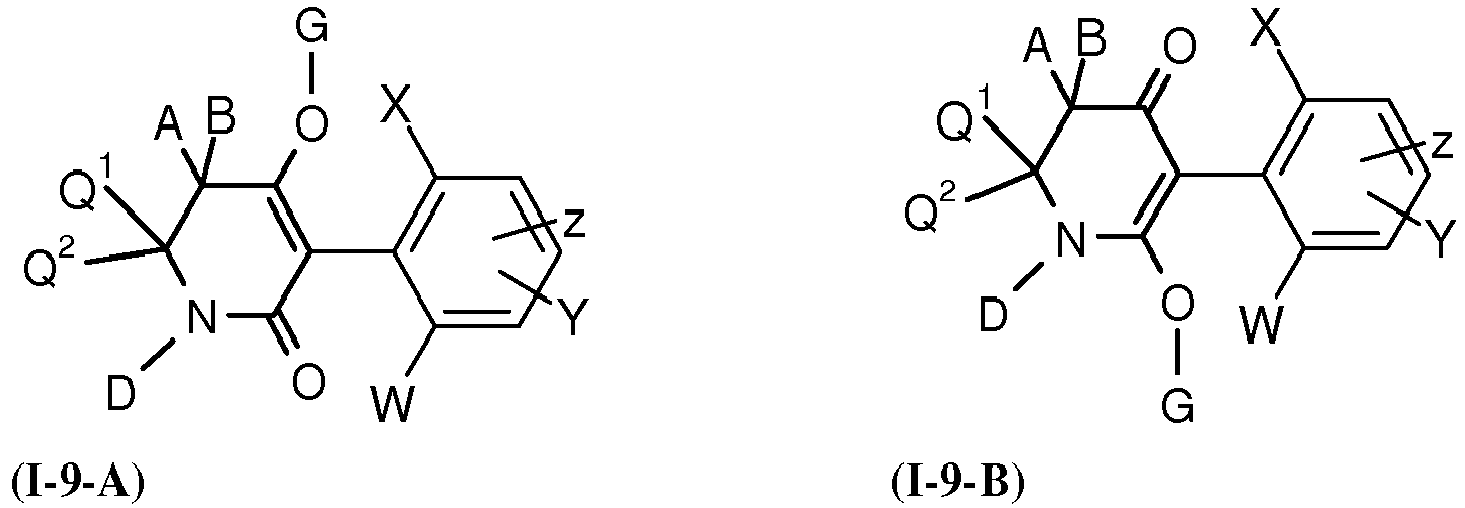
Die Verbindungen der Formeln (I-9-A) und (I-9-B) können sowohl als Gemische als auch in Form ihrer reinen Isomeren vorliegen. Gemische der Verbindungen der Formeln (I-9-A) und (I-9-B) lassen sich gegebenenfalls in an sich bekannter Weise durch physikalische Methoden trennen, beispielsweise durch chromatographische Methoden.The compounds of the formulas (I-9-A) and (I-9-B) can be present both as mixtures and in the form of their pure isomers. Mixtures of the compounds of the formulas (I-9-A) and (I-9-B) can optionally be separated in a manner known per se by physical methods, for example by chromatographic methods.
Aus Gründen der besseren Übersichtlichkeit wird im folgenden jeweils nur eines der möglichen Isomeren aufgeführt. Das schließt nicht aus, dass die Verbindungen gegebenenfalls in Form der Isomerengemische oder in der jeweils anderen isomeren Form vorliegen können.For reasons of clarity, only one of the possible isomers will be listed below. This does not exclude that the compounds may optionally be present in the form of the isomer mixtures or in the other isomeric form.
Unter Einbeziehung der verschiedenen Bedeutungen (a), (b), (c), (d), (e), (f) und (g) der Gruppe G ergeben sich folgende hauptsächliche Strukturen (I-9-a) bis (I-9-g), wenn CKE für die Gruppe (9) steht,
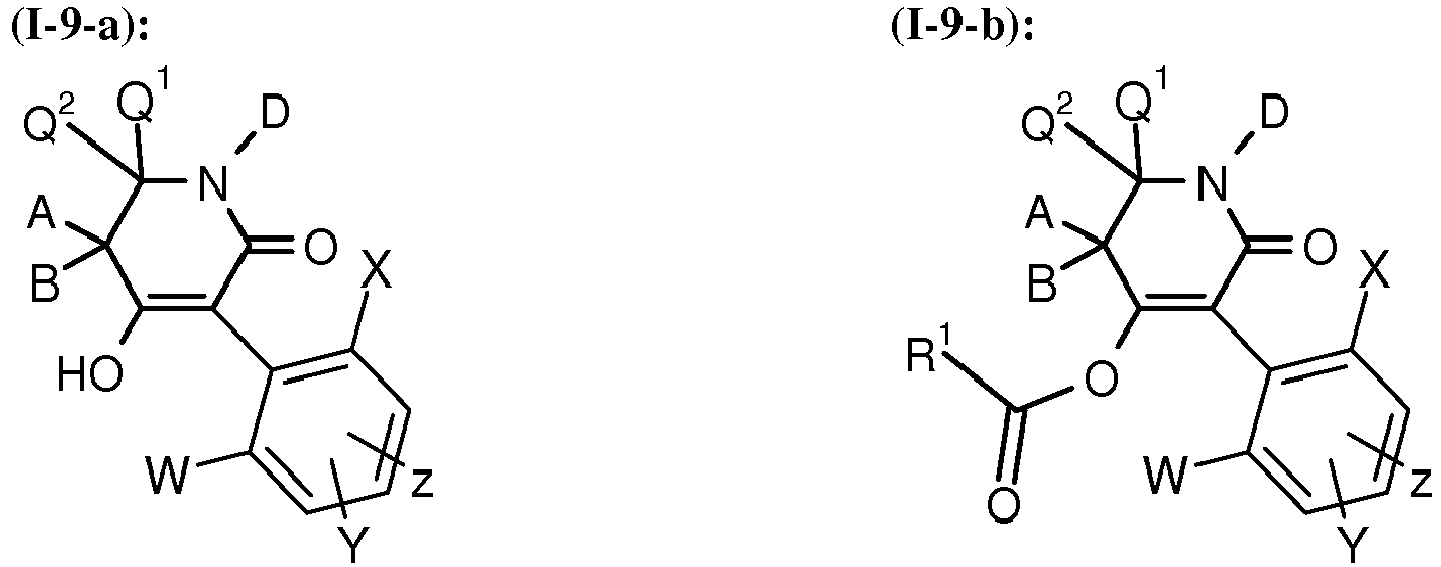
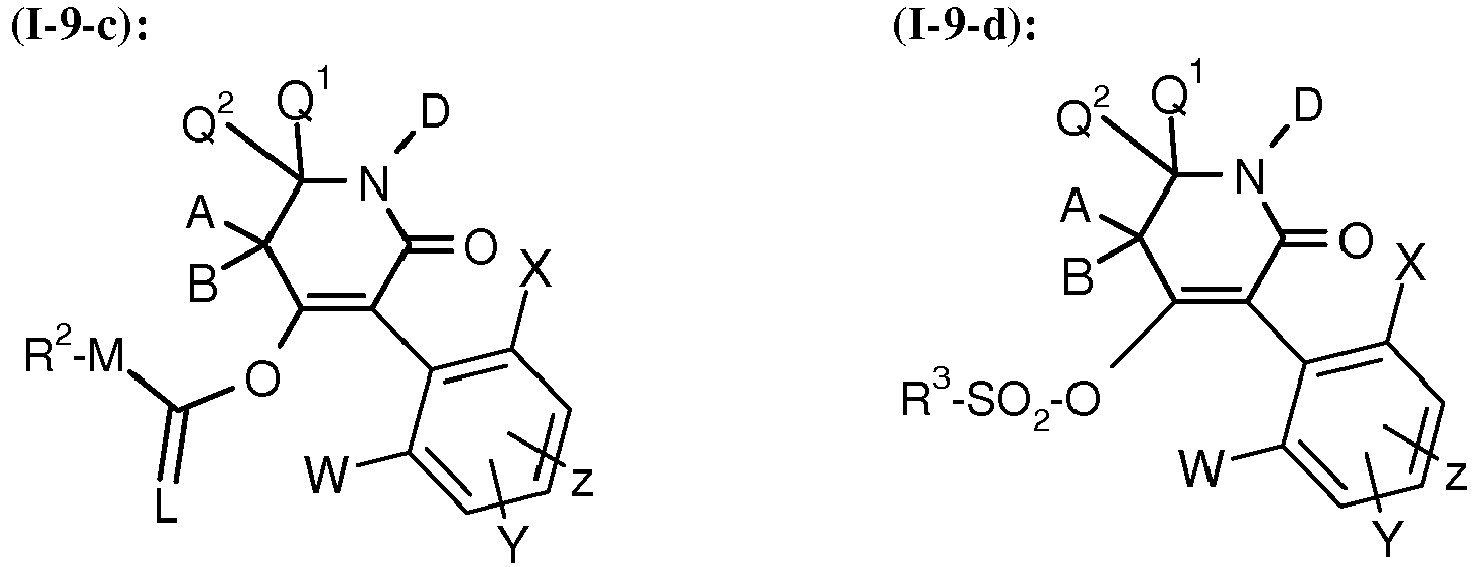


A, B, D, E, L, M, Q1, Q2, W, X, Y, Z, R1, R2, R3, R4, R5, R6 und R7 die oben angegebenen Bedeutungen besitzen.Including the various meanings (a), (b), (c), (d), (e), (f) and (g) of the group G, the following main structures (I-9-a) to (I -9-g), if CKE stands for the group (9),
A, B, D, E, L, M, Q 1 , Q 2 , W, X, Y, Z, R 1 , R 2 , R 3 , R 4 , R 5 , R 6 and R 7 are as defined above have.
Die Verbindungen der Formel (I-10) können in Abhängigkeit von der Stellung des Substituenten G in den zwei isomeren Formen der Formeln (I-10-A) und (I-10-B) vorliegen,

Die Verbindungen der Formeln (I-10-A) und (I-10-B) können sowohl als Gemische als auch in Form ihrer reinen Isomeren vorliegen. Gemische der Verbindungen der Formeln (I-10-A) und (I-10-B) lassen sich gegebenenfalls in an sich bekannter Weise durch physikalische Methoden trennen, beispielsweise durch chromatographische Methoden.The compounds of the formulas (I-10-A) and (I-10-B) can be present both as mixtures and in the form of their pure isomers. Mixtures of the compounds of the formulas (I-10-A) and (I-10-B) can optionally be separated in a manner known per se by physical methods, for example by chromatographic methods.
Aus Gründen der besseren Übersichtlichkeit wird im folgenden jeweils nur eines der möglichen Isomeren aufgeführt. Das schließt nicht aus, dass die Verbindungen gegebenenfalls in Form der Isomerengemische oder in der jeweils anderen isomeren Form vorliegen können.For reasons of clarity, only one of the possible isomers will be listed below. This does not exclude that the compounds may optionally be present in the form of the isomer mixtures or in the other isomeric form.
Unter Einbeziehung der verschiedenen Bedeutungen (a), (b), (c), (d), (e), (f) und (g) der Gruppe G ergeben sich folgende hauptsächliche Strukturen (I-10-a) bis (I-10-g), wenn CKE für die Gruppe (10) steht,
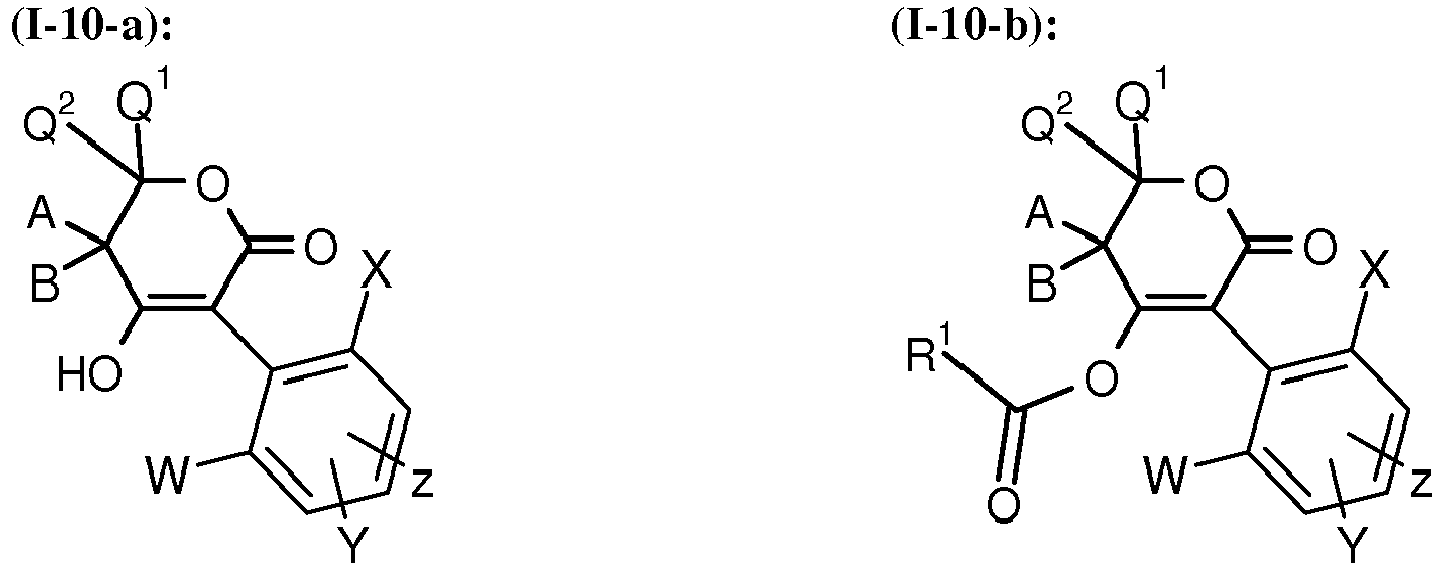
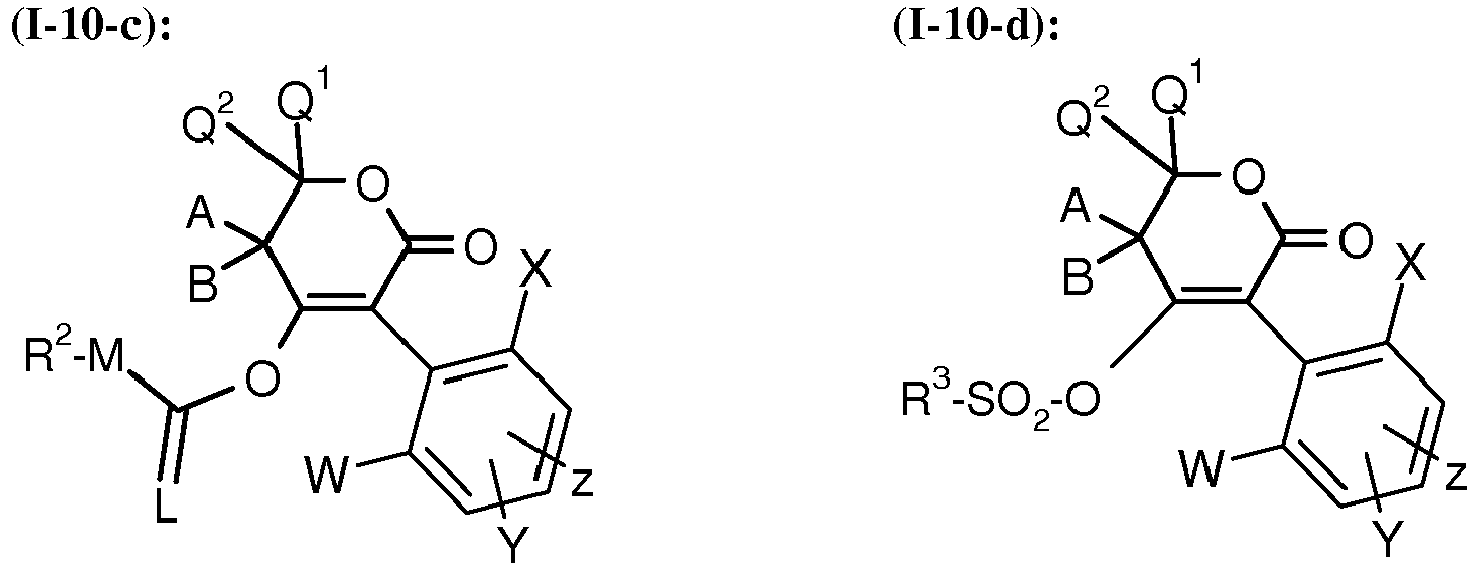
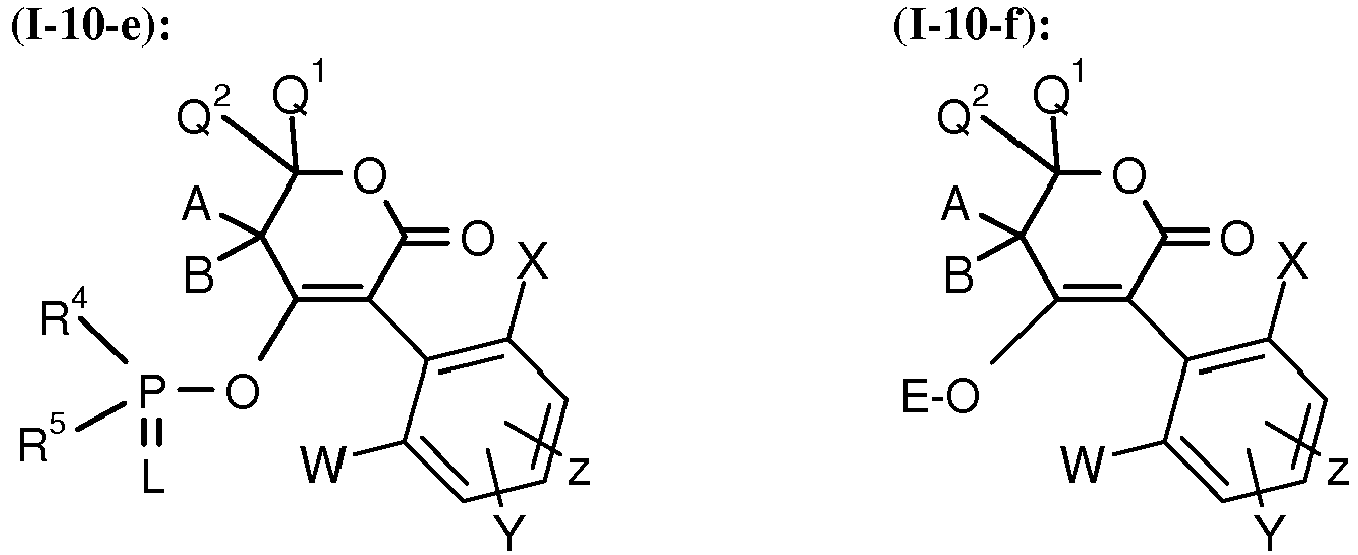
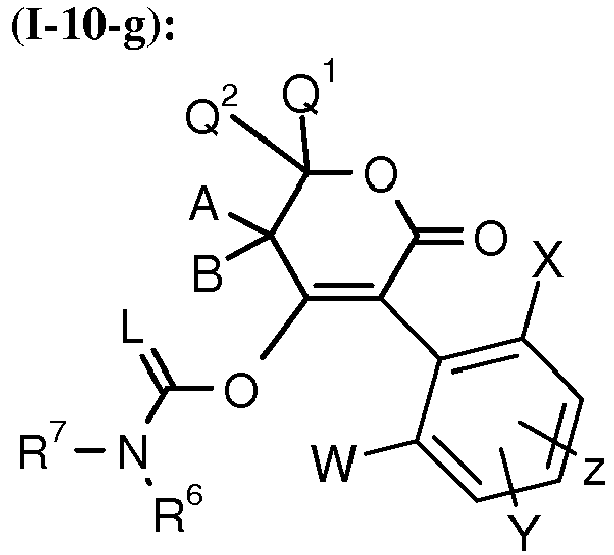
A, B, E, L, M, Q1, Q2, W, X, Y, Z, R1, R2, R3, R4, R5, R6 und R7 die oben angegebenen Bedeutungen besitzen.Including the various meanings (a), (b), (c), (d), (e), (f) and (g) of the group G, the following main structures (I-10-a) to (I -10-g), if CKE stands for the group (10),
A, B, E, L, M, Q 1 , Q 2 , W, X, Y, Z, R 1 , R 2 , R 3 , R 4 , R 5 , R 6 and R 7 have the meanings given above.
Die Verbindungen der Formel (I-11) können in Abhängigkeit von der Stellung des Substituenten G in den zwei isomeren Formen der Formeln (I-11-A) und (I-11-B) vorliegen, was durch die gestrichelte Linie in der Formel (I-11) zum Ausdruck gebracht werden soll.
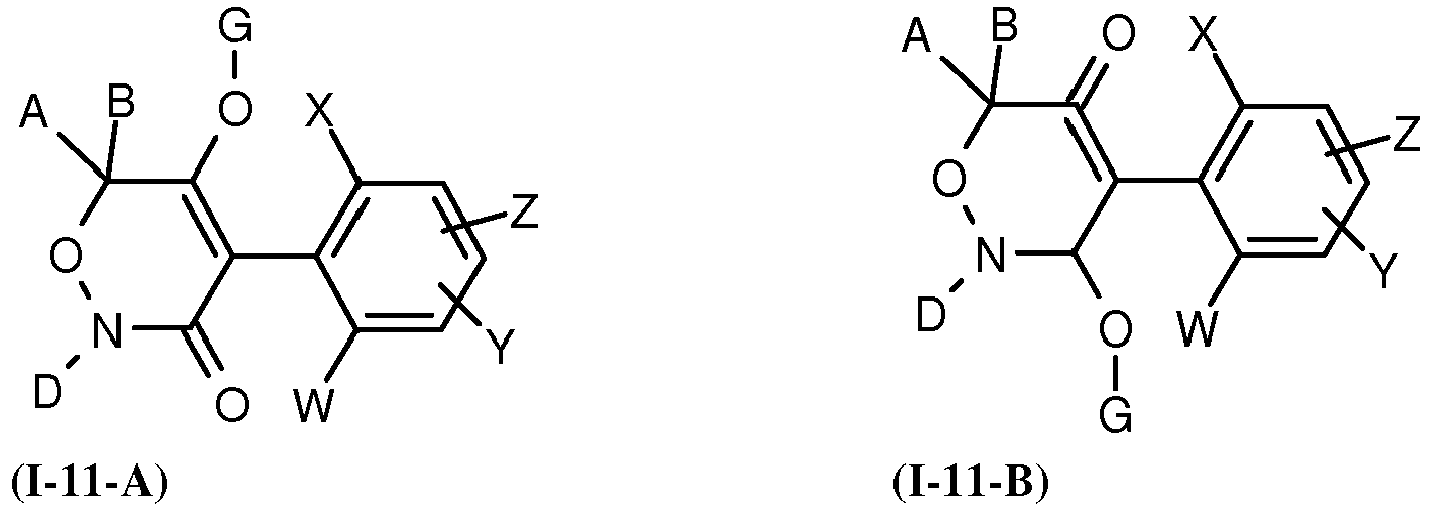
Die Verbindungen der Formeln (I-11-A) und (I-11-B) können sowohl als Gemische als auch in Form ihrer reinen Isomeren vorliegen. Gemische der Verbindungen der Formeln (I-11-A) und (I-11-B) lassen sich gegebenenfalls in an sich bekannter Weise durch physikalische Methoden trennen, beispielsweise durch chromatographische Methoden.The compounds of the formulas (I-11-A) and (I-11-B) can be present both as mixtures and in the form of their pure isomers. Mixtures of the compounds of the formulas (I-11-A) and (I-11-B) can optionally be separated in a manner known per se by physical methods, for example by chromatographic methods.
Aus Gründen der besseren Übersichtlichkeit wird im folgenden jeweils nur eines der möglichen Isomeren aufgeführt. Das schließt nicht aus, dass die Verbindungen gegebenenfalls in Form der Isomerengemische oder in der jeweils anderen isomeren Form vorliegen können.For reasons of clarity, only one of the possible isomers will be listed below. This does not exclude that the compounds may optionally be present in the form of the isomer mixtures or in the other isomeric form.
Unter Einbeziehung der verschiedenen Bedeutungen (a), (b), (c), (d), (e), (f) und (g) der Gruppe G ergeben sich folgende hauptsächliche Strukturen (I-11-a) bis (I-11-g), wenn CKE für die Gruppe (11) steht,


A, B, D, E, L, M, W, X, Y, Z, R1, R2, R3, R4, R5, R6 und R7 die oben angegebenen Bedeutungen besitzen.Taking into account the various meanings (a), (b), (c), (d), (e), (f) and (g) of the group G, the following main structures (I-11-a) to (I -11-g), if CKE stands for the group (11),
A, B, D, E, L, M, W, X, Y, Z, R 1 , R 2 , R 3 , R 4 , R 5 , R 6 and R 7 have the meanings given above.
Weiterhin wurde gefunden, dass man die neuen Verbindungen der Formel (I) nach einem der im folgenden beschriebenen Verfahren erhält:
- (A) Man erhält substituierte 3-Phenylpyrrolidin-2,4-dione bzw. deren Enole der Formel (I-1-a)

- A, B, D, W, X, Y und Z die oben angegebenen Bedeutungen haben,
wenn man
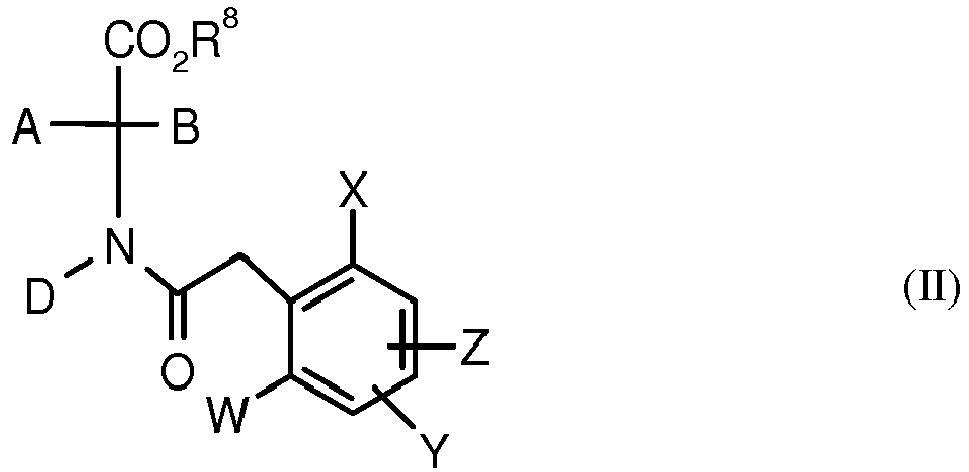
- A, B, D, W, X, Y und Z die oben angegebenen Bedeutungen haben,
und - R8 für Alkyl (bevorzugt C1-C6-Alkyl) steht,
- A, B, D, W, X, Y und Z die oben angegebenen Bedeutungen haben,
- (B) Außerdem wurde gefunden, dass man substituierte 3-Phenyl-4-hydroxy-A3-dihydrofuranon-Derivate der Formel (I-2-a)

- A, B, W, X, Y und Z die oben angegebenen Bedeutungen haben,
erhält, wenn man
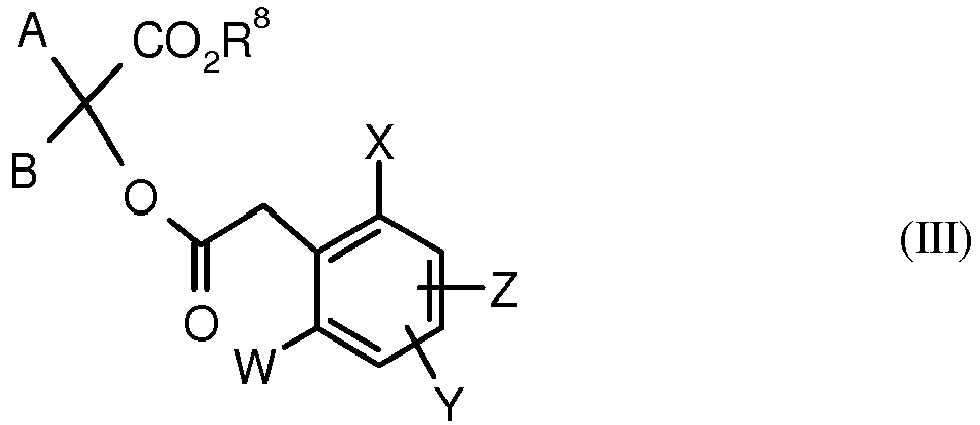
- A, B, W, X, Y, Z und R8 die oben angegebenen Bedeutungen haben,
- A, B, W, X, Y und Z die oben angegebenen Bedeutungen haben,
- (C) Weiterhin wurde gefunden, dass man substituierte 3-Phenyl-4-hydroxy-Δ3-dihydrothiophenon-Derivate der Formel (I-3-a)
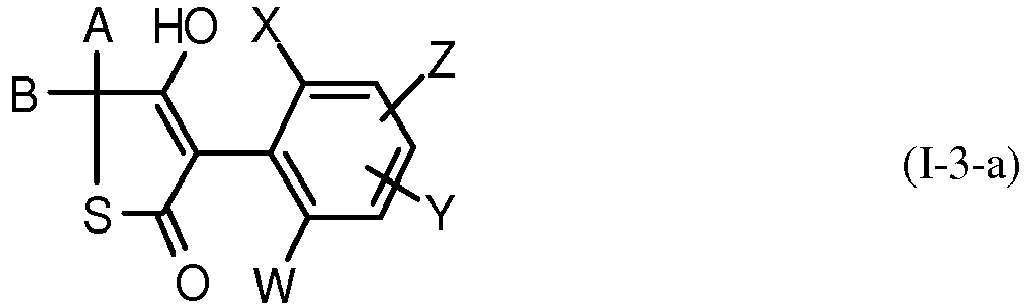
- A, B, W, X, Y und Z die oben angegebenen Bedeutungen haben,
erhält, wenn man
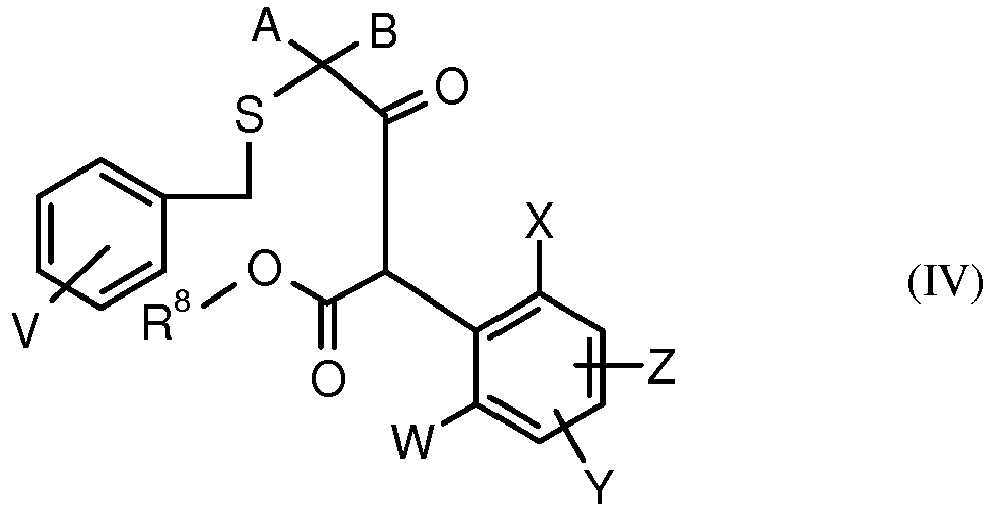
- A, B, W, X, Y, Z und R8 die oben angegebenen Bedeutungen haben und
- V für Wasserstoff, Halogen, Alkyl (bevorzugt C1-C6-Alkyl) oder Alkoxy (bevorzugt C1-C8-Alkoxy) steht,
- A, B, W, X, Y und Z die oben angegebenen Bedeutungen haben,
- (D) Weiterhin wurde gefunden, dass man die neuen substituierten 3-Phenylpyron-Derivate der Formel (I-4-a)

- A, D, W, X, Y und Z die oben angegebenen Bedeutungen haben,
erhält, wenn man
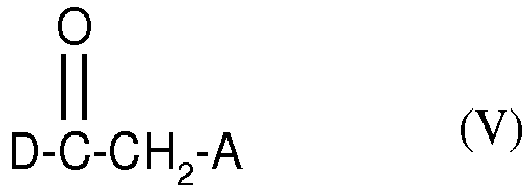
- A und D die oben angegebenen Bedeutungen haben,

- A, D und R8 die oben angegebene Bedeutung haben,

- W, X, Y und Z die oben angegebenen Bedeutungen haben und
- Hal für Halogen (vorzugsweise für Chlor oder Brom) steht,
gegebenenfalls in Gegenwart eines Verdünnungsmittels und gegebenenfalls in Gegenwart eines Säureakzeptors umsetzt.
- A, D, W, X, Y und Z die oben angegebenen Bedeutungen haben,
- (E) dass man die neuen substituierten Phenyl-1,3-thiazin-Derivate der Formel (I-5-a)

A,W, X, Y und Z die oben angegebene Bedeutung haben, erhält, wenn man Thioamide der Formel (VII)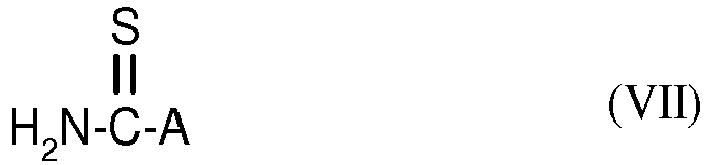
- A die oben angegebene Bedeutung hat,

- Hal, W, X, Y und Z die oben angegebenen Bedeutungen haben,
gegebenenfalls in Gegenwart eines Verdünnungsmittels und gegebenenfalls in Gegenwart eines Säureakzeptors umsetzt.
- (F) dass man Verbindungen der Formel (I-6-a)
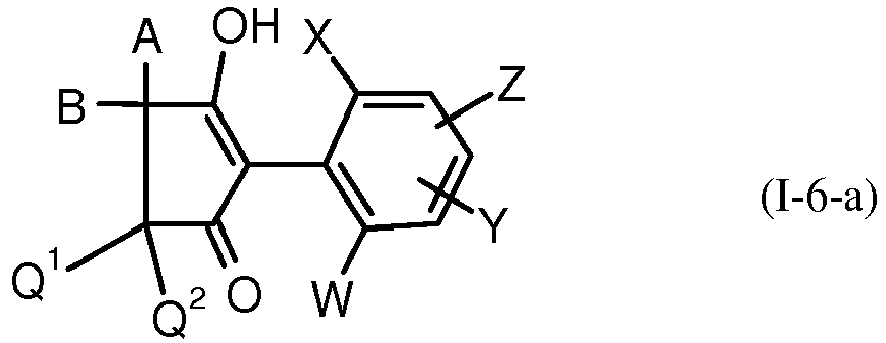
- A, B, Q1, Q2, W, X, Y und Z die oben angegebene Bedeutung haben,

- A, B, Q1, Q2, W, X, Y und Z die oben angegebene Bedeutung haben, und
- R8 für Alkyl (insbesondere C1-C8-Alkyl) steht,
gegebenenfalls in Gegenwart eines Verdünnungsmittels und in Gegenwart einer Base intramolekular cyclisiert.
- (G) dass man Verbindungen der Formel (I-7-a)
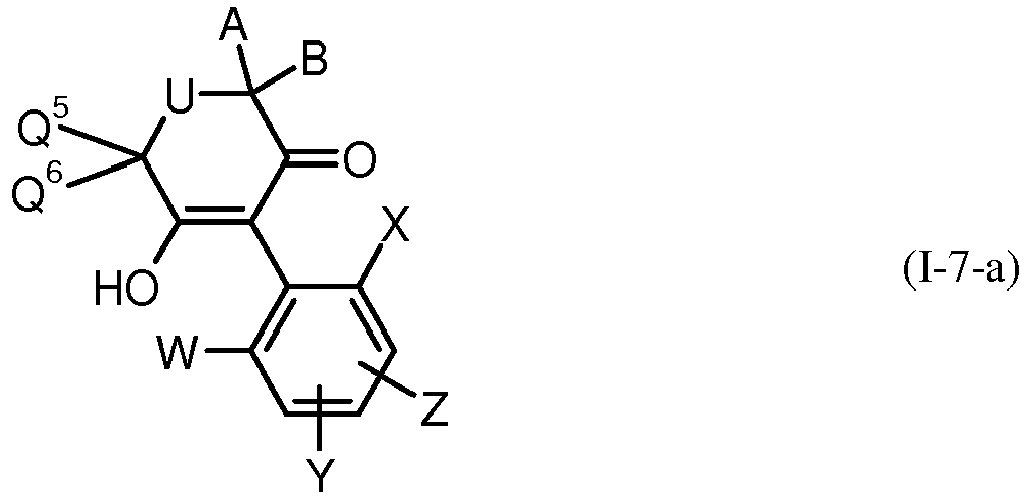
- A, B, Q5, Q6, U, W, X, Y und Z die oben angegebene Bedeutung haben,
erhält, wenn man
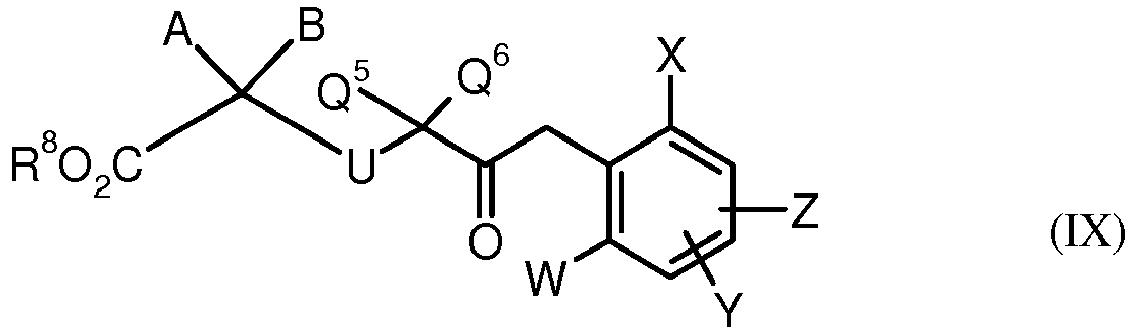
- A, B, Q5, Q6, U, W, X, Y und Z die oben angegebene Bedeutung haben und
- R8 für Alkyl (bevorzugt C1-C6-Alkyl) steht,
- A, B, Q5, Q6, U, W, X, Y und Z die oben angegebene Bedeutung haben,
- (H) Weiterhin wurde gefunden, dass man die Verbindungen der Formel (I-8-a)

- A, D, W, X, Y und Z die oben angegebenen Bedeutungen haben, erhält, wenn man
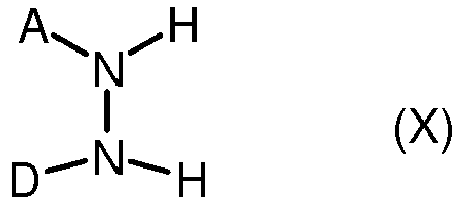
- A und D die oben angegebene Bedeutung haben,
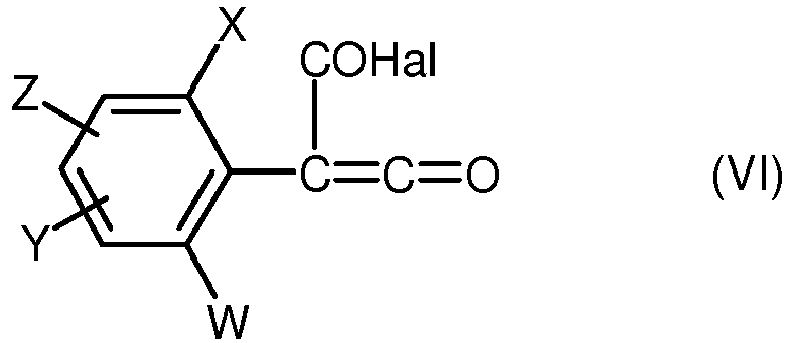
- Hal, W, X, Y und Z die oben angegebenen Bedeutungen haben,
- gegebenenfalls in Gegenwart eines Verdünnungsmittels und gegebenenfalls in Gegenwart eines Säureakzeptors umsetzt, oder
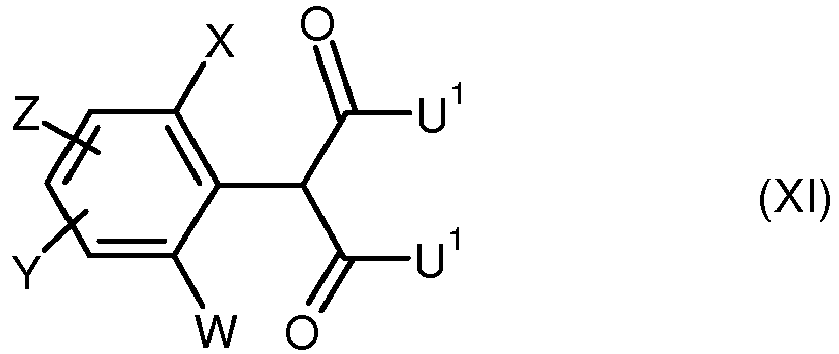
- W, X, Y und Z die oben angegebene Bedeutung haben,
- und U1 für NH2 oder O-R8 steht, wobei R8 die oben genannte Bedeutung hat,

- A, D, W, X, Y, Z und R8 die oben angegebene Bedeutung haben,
gegebenenfalls in Gegenwart eines Verdünnungsmittels und gegebenenfalls in Gegenwart einer Base umsetzt.
- (I) Man erhält substituierte Tetrahydropyridin-2,4-dione bzw. deren Enole der Formel (I-9-a)

- A, B, D, Q1, Q2, W, X, Y und Z die oben angegebenen Bedeutungen haben,
wenn man

- A, B, D, Q1, Q2, W, X, Y und Z die oben angegebenen Bedeutungen haben, und
- R8 für Alkyl (bevorzugt C1-C6-Alkyl) steht, in Gegenwart eines Verdünnungsmittels und in Gegenwart einer Base intramolekular kondensiert.
- A, B, D, Q1, Q2, W, X, Y und Z die oben angegebenen Bedeutungen haben,
- (J) dass man substituierte 5,6-Dihydropyrone der Formel (I-10-a) erhält

- A, B, Q1, Q2, W, X, Y und Z die oben angegebene Bedeutungen haben, wenn man
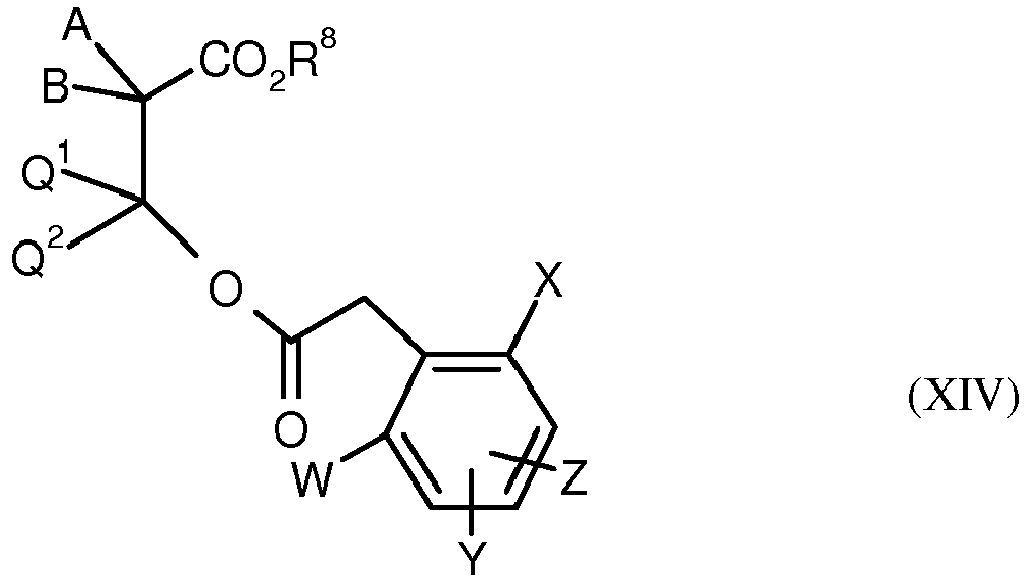
- A, B, Q1, Q2, W, X, Y und Z die oben angegebenen Bedeutungen haben, und
- R8 für Alkyl (bevorzugt C1-C6-Alkyl) steht,
gegebenenfalls in Gegenwart eines Verdünnungsmittels und gegebenenfalls in Gegenwart einer Base umsetzt.
- (K) Man erhält substituierte Oxazin-3,5-dione bzw. deren Enole der Formel (I-11-a)
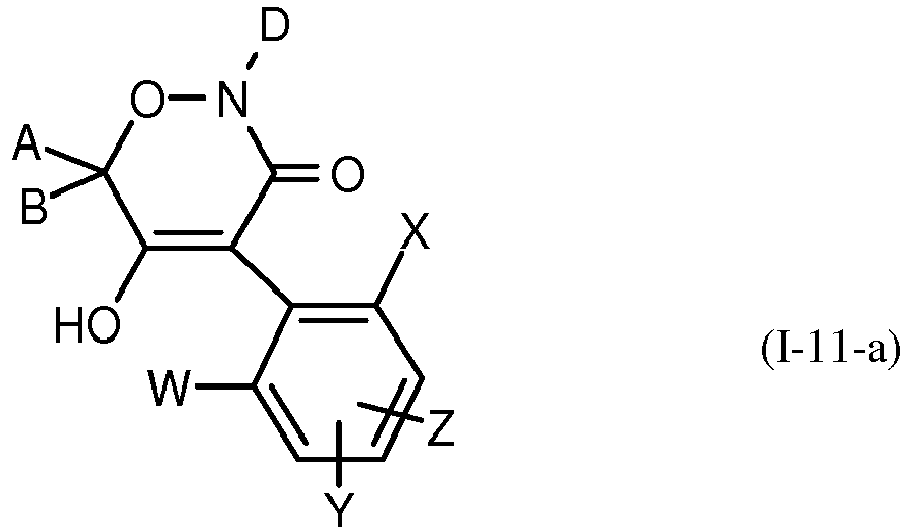
- A, B, D, W, X, Y und Z die oben angegebenen Bedeutungen haben,
wenn man - N-Acylaminosäureester der Formel (XV)
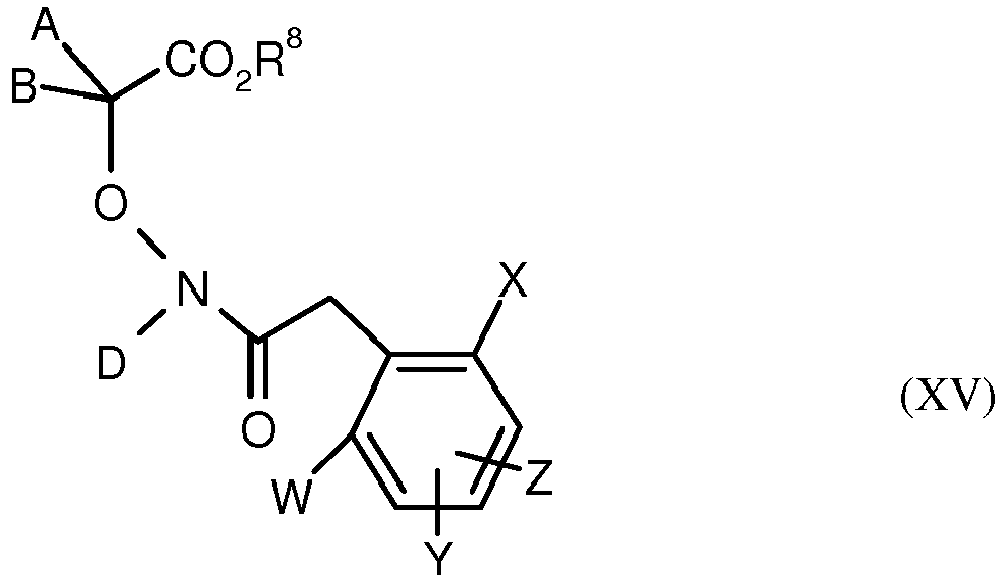
- A, B, D, W, X, Y und Z die oben angegebenen Bedeutungen haben, und
- R8 für Alkyl (bevorzugt C1-C6-Alkyl) steht,
- A, B, D, W, X, Y und Z die oben angegebenen Bedeutungen haben,
- (L) dass man die Verbindungen der oben gezeigten Formeln (I-1-b) bis (I-11-b), in welchen A, B, D, Q1, Q2, Q5, Q6 R1 U W, X, Y und Z die oben angegebenen Bedeutungen haben, erhält, wenn man Verbindungen der oben gezeigten Formeln (I-1-a) bis (I-11-a), in welchen A, B, D, Q1, Q2, Q5, Q6 U, W, X, Y und Z die oben angegebenen Bedeutungen haben, jeweils
(α) mit Säurehalogeniden der Formel (XVI)
- R1 die oben angegebene Bedeutung hat und
- Hal für Halogen (insbesondere Chlor oder Brom) steht
oder
R1-CO-O-CO-R1 (XVII)
in welcher- R1 die oben angegebene Bedeutung hat,
gegebenenfalls in Gegenwart eines Verdünnungsmittels und gegebenenfalls in Gegenwart eines Säurebindemittels umsetzt;
- (M) dass man die Verbindungen der oben gezeigten Formeln (I-1-c) bis (I-11-c), in welchen A, B, D, Q1, Q2, Q5, Q6, R2, M, U, W, X, Y und Z die oben angegebenen Bedeutungen haben und L für Sauerstoff steht, erhält, wenn man Verbindungen der oben gezeigten Formeln (I-1-a) bis (I-11-a), in welchen A, B, D, Q1, Q2, Q5, Q6 U, W, X, Y und Z die oben angegebenen Bedeutungen haben, jeweils
mit Chlorameisensäureestern oder Chlorameisensäurethiolestern der Formel (XVIII)
R2-M-CO-Cl (XVIII)
in welcher- R2, und M die oben angegebenen Bedeutungen haben,
gegebenenfalls in Gegenwart eines Verdünnungsmittels und gegebenenfalls in Gegenwart eines Säurebindemittels umsetzt;
- R2, und M die oben angegebenen Bedeutungen haben,
- (N) dass man Verbindungen der oben gezeigten Formeln (I-1-c) bis (I-11-c), in welchen A, B, D, Q1, Q2, Q5, Q6, R2, M, U, W, X, Y und Z die oben angegebenen Bedeutungen haben und L für Schwefel steht, erhält, wenn man Verbindungen der oben gezeigten Formeln (I-1-a) bis (I-11-a), in welchen A, B, D, Q1, Q2, Q5, Q6, U W, X, Y und Z die oben angegebenen Bedeutungen haben, jeweils
mit Chlormonothioameisensäureestern oder Chlordithioameisensäureestern der Formel (XIX)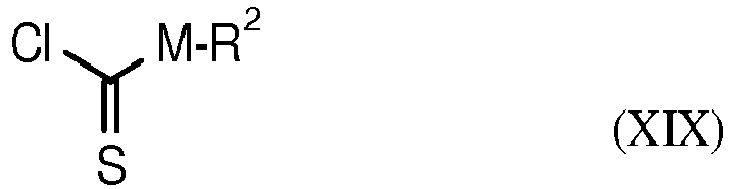
- M und R2 die oben angegebenen Bedeutungen haben,
gegebenenfalls in Gegenwart eines Verdünnungsmittels und gegebenenfalls in Gegenwart eines Säurebindemittels umsetzt
und
- M und R2 die oben angegebenen Bedeutungen haben,
- (O) dass man Verbindungen der oben gezeigten Formeln (I-1-d) bis (I-11-d), in welchen A, B, D, Q1, Q2, Q5, Q6, R3, U, W, X, Y und Z die oben angegebenen Bedeutungen haben, erhält, wenn man Verbindungen der oben gezeigten Formeln (I-1-a) bis (I-11-a), in welchen A, B, D, Q1, Q2, Q5, Q6, U, W, X, Y und Z die oben angegebenen Bedeutungen haben, jeweils
mit Sulfonsäurechloriden der Formel (XX)
R3-SO2-Cl (XX)
in welcher- R3 die oben angegebene Bedeutung hat,
gegebenenfalls in Gegenwart eines Verdünnungsmittels und gegebenenfalls in Gegenwart eines Säurebindemittels umsetzt,
- R3 die oben angegebene Bedeutung hat,
- (P) dass man Verbindungen der oben gezeigten Formeln (I-1-e) bis (I-11-e), in welchen A, B, D, L, Q1, Q2, Q5, Q6, R4, R5, U, W, X, Y und Z die oben angegebenen Bedeutungen haben, erhält, wenn man Verbindungen der oben gezeigten Formeln (I-1-a) bis (I-11-a), in welchen A, B, D, Q1, Q2, Q5, Q6, U, W, X, Y und Z die oben angegebenen Bedeutungen haben, jeweils
mit Phosphorverbindungen der Formel (XXI)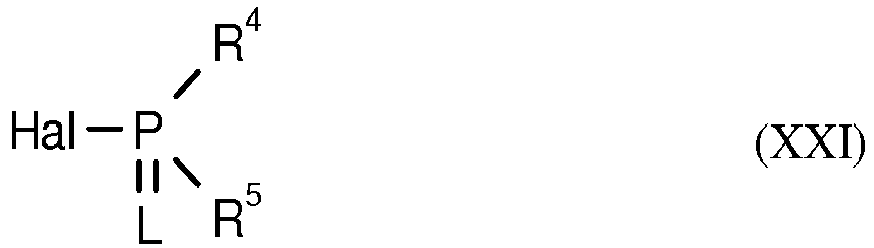
- L, R4 und R5 die oben angegebenen Bedeutungen haben und
- Hal für Halogen (insbesondere Chlor oder Brom) steht,
gegebenenfalls in Gegenwart eines Verdünnungsmittels und gegebenenfalls in Gegenwart eines Säurebindemittels umsetzt,
- (Q) dass man Verbindungen der oben gezeigten Formeln (I-1-f) bis (I-11-f), in welchen A, B, D, E, Q1, Q2, Q5, Q6, U, W, X, Y und Z die oben angegebenen Bedeutungen haben, erhält, wenn man Verbindungen der Formeln (I-1-a) bis (I-11-a), in welchen A, B, D, Q1, Q2, Q5, Q6, U, W, X, Y und Z die oben angegebenen Bedeutungen haben, jeweils
mit Metallverbindungen oder Aminen der Formeln (XXII) oder (XXIII)
Me(OR10)t (XXII)

- Me für ein ein- oder zweiwertiges Metall (bevorzugt ein Alkali- oder Erdalkalimetall wie Lithium, Natrium, Kalium, Magnesium oder Calcium), oder für ein Ammoniumion
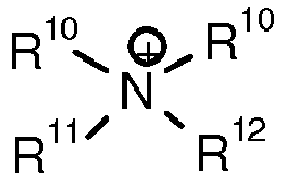
- t für die Zahl 1 oder 2 und
- R10, R11, R12 unabhängig voneinander für Wasserstoff oder Alkyl (bevorzugt C1-C8-Alkyl) stehen,
gegebenenfalls in Gegenwart eines Verdünnungsmittels umsetzt,
- Me für ein ein- oder zweiwertiges Metall (bevorzugt ein Alkali- oder Erdalkalimetall wie Lithium, Natrium, Kalium, Magnesium oder Calcium), oder für ein Ammoniumion
- (R) dass man Verbindungen der oben gezeigten Formeln (I-1-g) bis (I-11-g), in welchen A, B, D, L, Q1, Q2, Q5, Q6, R6, R7, U, W, X, Y und Z die oben angegebenen Bedeutungen haben, erhält, wenn man Verbindungen der oben gezeigten Formeln (I-1-a) bis (I-11-a), in welchen A, B, D, Q1, Q2, Q5, Q6, U, W, X, Y und Z die oben angegebenen Bedeutungen haben, jeweils
- (α) mit Isocyanaten oder Isothiocyanaten der Formel (XXIV)
R6-N=C=L (XXIV)
in welcher- R6 und L die oben angegebenen Bedeutungen haben,
gegebenenfalls in Gegenwart eines Verdünnungsmittels und gegebenenfalls in Gegenwart eines Katalysators umsetzt oder
- R6 und L die oben angegebenen Bedeutungen haben,
- (β) mit Carbamidsäurechloriden oder Thiocarbamidsäurechloriden der Formel (XXV)
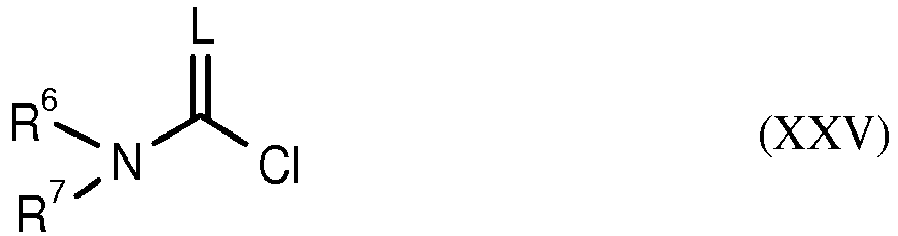
- L, R6 und R7 die oben angegebenen Bedeutungen haben,
gegebenenfalls in Gegenwart eines Verdünnungsmittels und gegebenenfalls in Gegenwart eines Säurebindemittels, umsetzt,
- L, R6 und R7 die oben angegebenen Bedeutungen haben,
- (α) mit Isocyanaten oder Isothiocyanaten der Formel (XXIV)
- (S) dass man Verbindungen der oben gezeigten Formeln (I-1-a) bis (I-11-g), in welchen A, B, D, G, Q1, Q2, Q5, Q6, U, W, X, Y und Z die oben angegebene Bedeutung haben, erhält, wenn man in Verbindungen der Formeln (I-1') bis (I-11'), in welchen A, B, D, G, Q1, Q2, Q5, Q6, U, W, X, und Y die oben genannte Bedeutung haben und Z' bevorzugt für Brom oder Iod steht
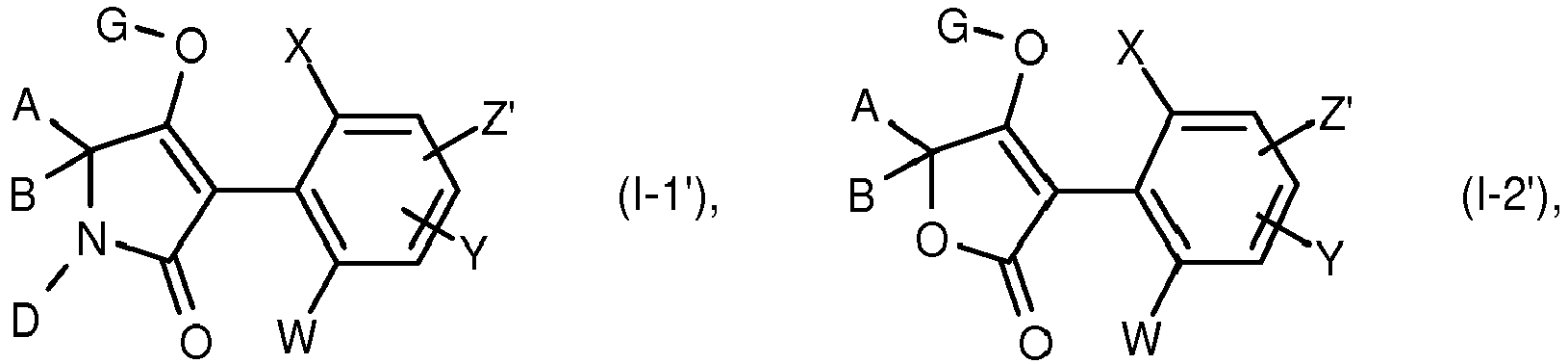

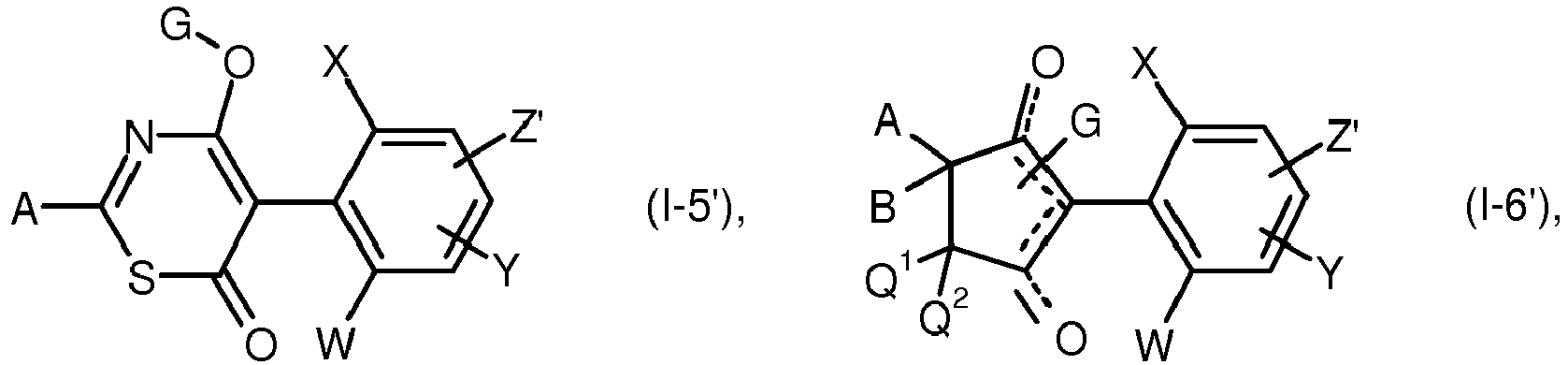

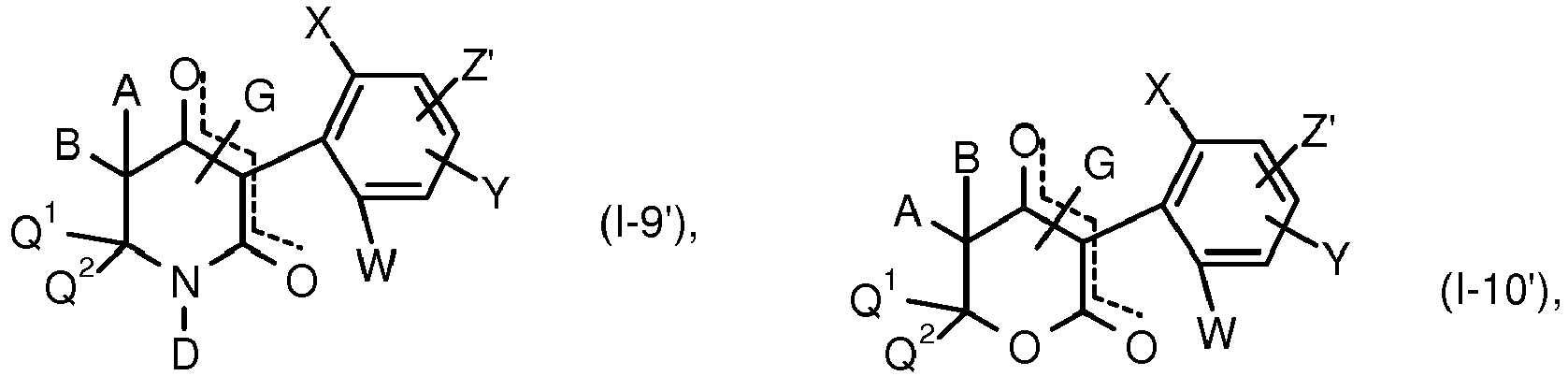

Z-OH (XXVI)
in Gegenwart eines Lösungsmittels in Gegenwart eines Kupfersalzes (z. B. Cu-I-J) und in Gegenwart einer Base (z.B. Kalium-tert.-butylat, Natriumhydrid) das Brom- oder Jodatom austauscht.
- (A) Substituted 3-phenylpyrrolidine-2,4-diones or their enols of the formula (I-1-a) are obtained
- A, B, D, W, X, Y and Z have the meanings given above,
if
- A, B, D, W, X, Y and Z have the meanings given above,
and - R 8 is alkyl (preferably C 1 -C 6 -alkyl),
- A, B, D, W, X, Y and Z have the meanings given above,
- (B) Further, it has been found that substituted 3-phenyl-4-hydroxy-A 3 -dihydrofuranone derivatives of the formula (I-2-a)
- A, B, W, X, Y and Z have the meanings given above,
if you get
- A, B, W, X, Y, Z and R 8 have the meanings given above,
- A, B, W, X, Y and Z have the meanings given above,
- (C) Further, it has been found that substituted 3-phenyl-4-hydroxy-Δ 3 -dihydrothiophenone derivatives of the formula (I-3-a)
- A, B, W, X, Y and Z have the meanings given above,
if you get
- A, B, W, X, Y, Z and R 8 have the meanings given above and
- V is hydrogen, halogen, alkyl (preferably C 1 -C 6 -alkyl) or alkoxy (preferably C 1 -C 8 -alkoxy),
- A, B, W, X, Y and Z have the meanings given above,
- (D) Furthermore, it has been found that the novel substituted 3-phenylpyrone derivatives of the formula (I-4-a)
- A, D, W, X, Y and Z have the meanings given above,
if you get
- A and D have the meanings given above,
- A, D and R 8 are as defined above,
- W, X, Y and Z have the meanings given above, and
- Hal is halogen (preferably chlorine or bromine),
if appropriate in the presence of a diluent and if appropriate in the presence of an acid acceptor.
- A, D, W, X, Y and Z have the meanings given above,
- (E) that the novel substituted phenyl-1,3-thiazine derivatives of the formula (I-5-a)
A, W, X, Y and Z are as defined above, obtained when thioamides of the formula (VII)- A has the meaning given above,
- Hal, W, X, Y and Z have the meanings given above,
if appropriate in the presence of a diluent and if appropriate in the presence of an acid acceptor.
- (F) that compounds of the formula (I-6-a)
- A, B, Q 1 , Q 2 , W, X, Y and Z are as defined above,
- A, B, Q 1 , Q 2 , W, X, Y and Z are as defined above, and
- R 8 is alkyl (in particular C 1 -C 8 -alkyl),
optionally in the presence of a diluent and in the presence of a base intramolecular cyclization.
- (G) that compounds of the formula (I-7-a)
- A, B, Q 5, Q 6, U, W, X, Y and Z have the abovementioned meaning,
if you get
- A, B, Q 5 , Q 6 , U, W, X, Y and Z are as defined above and
- R 8 is alkyl (preferably C 1 -C 6 -alkyl),
- A, B, Q 5, Q 6, U, W, X, Y and Z have the abovementioned meaning,
- (H) Furthermore, it has been found that the compounds of the formula (I-8-a)
- A, D, W, X, Y and Z have the meanings given above, obtained when
- A and D have the abovementioned meaning,
- Hal, W, X, Y and Z have the meanings given above,
- if appropriate in the presence of a diluent and if appropriate in the presence of an acid acceptor, or
- W, X, Y and Z are as defined above,
- and U 1 is NH 2 or OR 8 , where R 8 has the abovementioned meaning,
- A, D, W, X, Y, Z and R 8 are as defined above,
if appropriate in the presence of a diluent and if appropriate in the presence of a base.
- (I) Substituted tetrahydropyridine-2,4-diones or their enols of the formula (I-9-a) are obtained
- A, B, D, Q 1 , Q 2 , W, X, Y and Z have the meanings given above,
if
- A, B, D, Q 1 , Q 2 , W, X, Y and Z have the meanings given above, and
- R 8 is alkyl (preferably C 1 -C 6 -alkyl), in the presence of a diluent and in the presence of a base intramolecularly condensed.
- A, B, D, Q 1 , Q 2 , W, X, Y and Z have the meanings given above,
- (J) to obtain substituted 5,6-dihydropyrones of the formula (I-10-a)
- A, B, Q 1 , Q 2 , W, X, Y and Z have the meanings given above, if
- A, B, Q 1 , Q 2 , W, X, Y and Z have the meanings given above, and
- R 8 is alkyl (preferably C 1 -C 6 -alkyl),
optionally in the presence of a diluent and optionally in the presence a base.
- (K) Substituted oxazine-3,5-diones or their enols of the formula (I-11-a) are obtained
- A, B, D, W, X, Y and Z have the meanings given above,
if - N-acylamino acid esters of the formula (XV)
- A, B, D, W, X, Y and Z have the meanings given above, and
- R 8 is alkyl (preferably C 1 -C 6 -alkyl),
- A, B, D, W, X, Y and Z have the meanings given above,
- (L) that the compounds of the formulas (I-1-b) to (I-11-b) shown above, in which A, B, D, Q 1 , Q 2 , Q 5 , Q 6 R 1 UW, X, Y and Z have the meanings given above, is obtained when compounds of the above-shown formulas (I-1-a) to (I-11-a), in which A, B, D, Q 1 , Q 2 , Q 5 , Q 6 U, W, X, Y and Z have the meanings given above, respectively
(α) with acid halides of the formula (XVI)- R 1 has the meaning given above and
- Hal is halogen (especially chlorine or bromine)
or
R 1 -CO-O-CO-R 1 (XVII)
in which- R 1 has the meaning given above,
if appropriate in the presence of a diluent and if appropriate in the presence of an acid binder;
- (M) that the compounds of the formulas (I-1-c) to (I-11-c) shown above, in which A, B, D, Q 1 , Q 2 , Q 5 , Q 6 , R 2 , M, U, W, X, Y and Z have the meanings given above and L is oxygen, to obtain compounds of the above-shown formulas (I-1-a) to (I-11-a), in which A , B, D, Q 1 , Q 2 , Q 5 , Q 6, U, W, X, Y and Z have the meanings given above, respectively
with chloroformates or chloroformic thioesters of the formula (XVIII)
R 2 -M -CO-Cl (XVIII)
in which- R 2 , and M have the meanings given above,
if appropriate in the presence of a diluent and if appropriate in the presence of an acid binder;
- R 2 , and M have the meanings given above,
- (N) that compounds of the above-shown formulas (I-1-c) to (I-11-c) in which A, B, D, Q 1 , Q 2 , Q 5 , Q 6 , R 2 , M , U, W, X, Y and Z have the meanings given above and L is sulfur, obtained when compounds of the above-shown formulas (I-1-a) to (I-11-a), in which A, B, D, Q 1 , Q 2 , Q 5 , Q 6 , UW, X, Y and Z have the meanings given above, respectively
with chloromonothioic acid esters or chlorodithioic acid esters of the formula (XIX)- M and R 2 have the meanings given above,
if appropriate in the presence of a diluent and if appropriate in the presence of an acid binder
and
- M and R 2 have the meanings given above,
- (O) that compounds of the above-shown formulas (I-1-d) to (I-11-d) in which A, B, D, Q 1 , Q 2 , Q 5 , Q 6 , R 3 , U , W, X, Y and Z have the meanings given above, when compounds of the above-shown formulas (I-1-a) to (I-11-a), in which A, B, D, Q 1 , Q 2 , Q 5 , Q 6 , U, W, X, Y and Z have the meanings given above, respectively
with sulfonyl chlorides of the formula (XX)
R 3 -SO 2 -Cl (XX)
in which- R 3 has the meaning given above,
if appropriate in the presence of a diluent and if appropriate in the presence of an acid binder,
- R 3 has the meaning given above,
- (P) that compounds of the above-shown formulas (I-1-e) to (I-11-e) in which A, B, D, L, Q 1 , Q 2 , Q 5 , Q 6 , R 4 , R 5 , U, W, X, Y and Z have the meanings given above, when compounds of the above-shown formulas (I-1-a) to (I-11-a), in which A, B, D, Q 1 , Q 2 , Q 5 , Q 6 , U, W, X, Y and Z have the meanings given above, respectively
with phosphorus compounds of the formula (XXI)- L, R 4 and R 5 have the meanings given above, and
- Hal is halogen (especially chlorine or bromine),
if appropriate in the presence of a diluent and if appropriate in the presence of an acid binder,
- (Q) that compounds of the above-shown formulas (I-1-f) to (I-11-f) in which A, B, D, E, Q 1 , Q 2 , Q 5 , Q 6 , U, W, X, Y and Z have the meanings given above, when compounds of the formulas (I-1-a) to (I-11-a), in which A, B, D, Q 1 , Q 2 , Q 5 , Q 6 , U, W, X, Y and Z have the meanings given above, respectively
with metal compounds or amines of the formulas (XXII) or (XXIII)
Me (OR 10 ) t (XXII)
- Me for a monovalent or divalent metal (preferably an alkali or alkaline earth metal such as lithium, sodium, potassium, magnesium or calcium), or for a ammonium
- t for the number 1 or 2 and
- R 10 , R 11 , R 12 independently of one another represent hydrogen or alkyl (preferably C 1 -C 8 -alkyl),
if appropriate in the presence of a diluent,
- Me for a monovalent or divalent metal (preferably an alkali or alkaline earth metal such as lithium, sodium, potassium, magnesium or calcium), or for a ammonium
- (R) that compounds of the formulas (I-1-g) to (I-11-g) shown above, in which A, B, D, L, Q 1 , Q 2 , Q 5 , Q 6 , R 6 , R 7 , U, W, X, Y and Z have the meanings given above, when compounds of the above-shown formulas (I-1-a) to (I-11-a), in which A, B, D, Q 1 , Q 2 , Q 5 , Q 6 , U, W, X, Y and Z have the meanings given above, respectively
- (α) with isocyanates or isothiocyanates of the formula (XXIV)
R 6 -N = C = L (XXIV)
in which- R 6 and L have the meanings given above,
if appropriate in the presence of a diluent and if appropriate in the presence of a catalyst or
- R 6 and L have the meanings given above,
- (β) with carbamoyl chlorides or thiocarbamic acid chlorides of the formula (XXV)
- L, R 6 and R 7 have the meanings given above,
if appropriate in the presence of a diluent and if appropriate in the presence of an acid binder,
- L, R 6 and R 7 have the meanings given above,
- (α) with isocyanates or isothiocyanates of the formula (XXIV)
- (S) that compounds of the formulas (I-1-a) to (I-11-g) shown above in which A, B, D, G, Q 1 , Q 2 , Q 5 , Q 6 , U, W, X, Y and Z have the abovementioned meaning, obtained in compounds of the formulas (I-1 ') to (I-11'), in which A, B, D, G, Q 1 , Q 2 , Q 5 , Q 6 , U, W, X, and Y have the abovementioned meaning and Z 'is preferably bromine or iodine
Z-OH (XXVI)
in the presence of a solvent in the presence of a copper salt (eg., Cu-IJ) and in the presence of a base (eg, potassium tert-butoxide, sodium hydride) exchanges the bromine or iodine atom.
Weiterhin wurde gefunden, dass die neuen Verbindungen der Formel (I) eine sehr gute Wirksamkeit als Schädlingsbekämpfungsmittel, vorzugsweise als Insektizide, Akarizide und/oder Herbizide aufweisen.Furthermore, it has been found that the novel compounds of the formula (I) have very good activity as pesticides, preferably as insecticides, acaricides and / or herbicides.
Überraschenderweise wurde nun auch gefunden, dass bestimmte Halogenalkylmethylenoxy-phenylsubstituierte Ketoenole bei gemeinsamer Anwendung mit den im weiteren beschriebenen, die Kulturpflanzen-Verträglichkeit verbessernden Verbindungen (Safenern/Antidots) ausgesprochen gut die Schädigung der Kulturpflanzen verhindern und besonders vorteilhaft als breit wirksame Kombinationspräparate zur selektiven Bekämpfung von unerwünschten Pflanzen in Nutzpflanzenkulturen, wie z.B. in Getreide aber auch Mais, Raps, Soja und Reis, verwendet werden können.Surprisingly, it has now also been found that certain haloalkylmethylenephenyl-substituted ketoenols, when used together with the compounds (safeners / antidotes) which improve the crop plants compatibility, very well prevent the damage to the crop plants and are particularly advantageous as broadly effective combination preparations for the selective control of unwanted plants in crops, such as in corn but also maize, oilseed rape, soya and rice can be used.
Gegenstand der Erfindung sind auch selektiv-herbizide Mittel enthaltend einen wirksamen Gehalt an einer Wirkstoffkombination umfassend als Komponenten
- a') mindestens eine Verbindung der Formel (I), in welcher CKE, W, X, Y und Z die oben angegebene Bedeutung haben
und - (b') zumindest eine die Kulturpflanzen-Verträglichkeit verbessernde Verbindung (Safener).
- a ') at least one compound of the formula (I) in which CKE, W, X, Y and Z have the abovementioned meaning
and - (B ') at least one crop plant compatibility-improving compound (safener).
Die Safener sind vorzugsweise ausgewählt aus der Gruppe bestehend aus:
- S1) Verbindungen der Formel (S1),
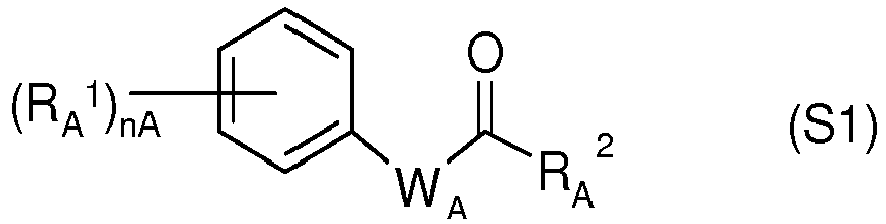
- nA
- ist eine natürliche Zahl von 0 bis 5, vorzugsweise 0 bis 3;
- RA 1
- ist Halogen, (C1-C4)Alkyl, (C1-C4)Alkoxy, Nitro oder (C1-C4)Haloalkyl;
- WA
- ist ein unsubstituierter oder substituierter divalenter heterocyclischer Rest aus der Gruppe der teilungesättigten oder aromatischen Fünfring-Heterocyclen mit 1 bis 3 Heteroringatomen aus der Gruppe N und O, wobei mindestens ein N-Atom und höchstens ein O-Atom im Ring enthalten ist, vorzugsweise ein Rest aus der Gruppe (WA 1) bis (WA 4),

- mA
- ist 0 oder 1;
- RA 2
- ist ORA 3, SRA 3 oder NRA 3RA 4 oder ein gesättigter oder ungesättigter 3- bis 7-gliedriger Heterocyclus mit mindestens einem N-Atom und bis zu 3 Heteroatomen, vorzugsweise aus der Gruppe O und S, der über das N-Atom mit der Carbonylgruppe in (S1) verbunden ist und unsubstituiert oder durch Reste aus der Gruppe (C1-C4)Alkyl, (C1-C4)Alkoxy oder gegebenenfalls substituiertes Phenyl substituiert ist, vorzugsweise ein Rest der Formel ORA 3, NHRA 4 oder N(CH3)2, insbesondere der Formel ORA 3;
- RA 3
- ist Wasserstoff oder ein unsubstituierter oder substituierter aliphatischer Kohlenwasserstoffrest, vorzugsweise mit insgesamt 1 bis 18 C-Atomen;
- RA 4
- ist Wasserstoff, (C1-C6)Alkyl, (C1-C6)Alkoxy oder substituiertes oder unsubstituiertes Phenyl;
- RA 5
- ist H, (C1-C8)Alkyl, (C1-C8)Haloalkyl, (C1-C4)Alkoxy(C1-C8)Alkyl, Cyano oder COORA 9, worin RA 9 Wasserstoff, (C1-C8)Alkyl, (C1-C8)Haloalkyl, (C1-C4)Alkoxy-(C1-C4)alkyl, (C1-C6)Hydroxyalkyl, (C3-C12)Cycloalkyl oder Tri-(C1-C4)-alkyl-silyl ist;
- RA 6, RA 7, RA 8
- sind gleich oder verschieden Wasserstoff, (C1-C8)Alkyl, (C1-C8)Haloalkyl, (C3-C12)Cycloalkyl oder substituiertes oder unsubstituiertes Phenyl;
- a) Verbindungen vom Typ der Dichlorphenylpyrazolin-3-carbonsäure (S1a), vorzugsweise Verbindungen wie 1-(2,4-Dichlorphenyl)-5-ethoxycarbonyl)-5-methyl-2-pyrazolin-3-carbonsäure, 1-(2,4-Dichlorphenyl)-5-ethoxycarbonyl)-5-methyl-2-pyrazolin-3-carbonsäureethylester (S1-1) ("Mefenpyrdiethyl"), und verwandte Verbindungen, wie sie in der
WO-A-91/07874 - b) Derivate der Dichlorphenylpyrazolcarbonsäure (S1b), vorzugsweise Verbindungen wie 1-(2,4-Dichlorphenyl)-5-methyl-pyrazol-3-carbonsäureethylester (S1-2), 1-(2,4-Dichlorphenyl)-5-isopropyl-pyrazol-3-carbonsäureethylester (S1-3), 1-(2,4-Dichlorphenyl)-5-(1,1-dimethyl-ethyl)pyrazol-3-carbonsäureethyl-ester (S1-4) und verwandte Verbindungen, wie sie in
EP-A-333 131 EP-A-269 806 - c) Derivate der 1,5-Diphenylpyrazol-3-carbonsäure (S1c), vorzugsweise Verbindungen wie 1-(2,4-Dichlorphenyl)-5-phenylpyrazol-3-carbonsäureethylester (S1-5), 1-(2-Chlorphenyl)-5-phenylpyrazol-3-carbonsäuremethylester (S1-6) und verwandte Verbindungen wie sie beispielsweise in der
EP-A-268554 - d) Verbindungen vom Typ der Triazolcarbonsäuren (S1d), vorzugsweise Verbindungen wie Fenchlorazol(-ethylester), d.h. 1-(2,4-Dichlorphenyl)-5-richlormethyl-(1H)-1,2,4-triazol-3-carbonsäureethylester (S1-7), und verwandte Verbindungen wie sie in
EP-A-174 562 EP-A-346 620 - e) Verbindungen vom Typ der 5-Benzyl- oder 5-Phenyl-2-isoxazolin-3- carbonsäure oder der 5,5-Diphenyl-2-isoxazolin-3-carbonsäure (S1e), vorzugsweise Verbindungen wie 5-(2,4-Dichlorbenzyl)-2-isoxazolin-3-carbonsäureethylester (S1-8) oder 5-Phenyl-2-isoxazolin-3-carbonsäureethylester (S1-9) und verwandte Verbindungen, wie sie in
WO-A-91/08202 WO-A-95/07897
- S2) Chinolinderivate der Formel (S2),
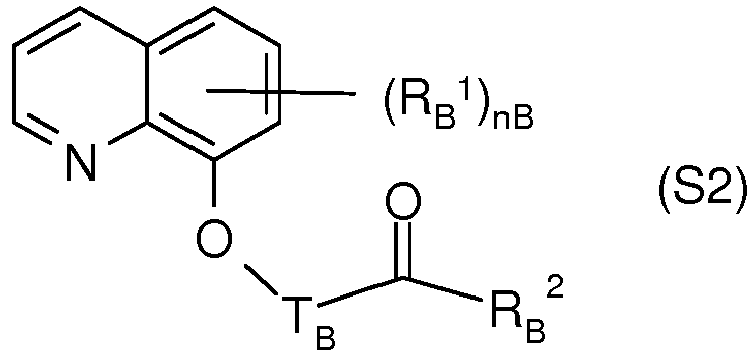
- RB 1
- ist Halogen, (C1-C4)Alkyl, (C1-C4)Alkoxy, Nitro oder (C1-C4)Haloalkyl;
- nB
- ist eine natürliche Zahl von 0 bis 5, vorzugsweise 0 bis 3;
- RB 2
- ist ORB 3, SRB 3 oder NRB 3RB 4 oder ein gesättigter oder ungesättigter 3- bis 7-gliedriger Heterocyclus mit mindestens einem N-Atom und bis zu 3 Heteroatomen, vorzugsweise aus der Gruppe O und S, der über das N-Atom mit der Carbonylgruppe in (S2) verbunden ist und unsubstituiert oder durch Reste aus der Gruppe (C1-C4)Alkyl, (C1-C4)Alkoxy oder gegebenenfalls substituiertes Phenyl substituiert ist, vorzugsweise ein Rest der Formel ORB 3, NHRB 4 oder N(CH3)2, insbesondere der Formel ORB 3;
- RB 3
- ist Wasserstoff oder ein unsubstituierter oder substituierter aliphatischer Kohlenwasserstoffrest, vorzugsweise mit insgesamt 1 bis 18 C-Atomen;
- RB 4
- ist Wasserstoff, (C1-C6)Alkyl, (C1-C6)Alkoxy oder substituiertes oder unsubstituiertes Phenyl;
- TB
- ist eine (C1 oder C2)-Alkandiylkette, die unsubstituiert oder mit einem oder zwei (C1-C4)Alkylresten oder mit [(C1-C3)-Alkoxy]-carbonyl substituiert ist;
- a) Verbindungen vom Typ der 8-Chinolinoxyessigsäure (S2a), vorzugsweise (5-Chlor-8-chinolinoxy)essigsäure-(1-methylhexyl)ester ("Cloquintocet-mexyl") (S2-1), (5-Chlor-8-chinolinoxy)essigsäure-(1,3-dimethyl-but-1-yl)ester (S2-2), (5-Chlor-8-chinolinoxy)essigsäure-4-allyloxy-butylester (S2-3), (5-Chlor-8-chinolinoxy)essigsäure-1-allyloxy-prop-2-ylester (S2-4), (5-Chlor-8-chinolinoxy)essigsäureethylester (S2-5), (5-Chlor-8-chinolinoxy)essigsäuremethylester (S2-6), (5-Chlor-8-chinolinoxy)essigsäureallylester (S2-7), (5-Chlor-8-chinolinoxy)essigsäure-2-(2-propyliden-iminoxy)-1-ethylester (S2-8), (5-Chlor-8-chinolinoxy)essigsäure-2-oxo-prop-1-ylester (S2-9) und verwandte Verbindungen, wie sie in
EP-A-86 750 EP-A-94 349 EP-A-191 736 EP-A-0 492 366 WO-A-2002/34048 - b) Verbindungen vom Typ der (5-Chlor-8-chinolinoxy)malonsäure (S2b), vorzugsweise Verbindungen wie (5-Chlor-8-chinolinoxy)malonsäurediethylester, (5-Chlor-8-chinolinoxy)malonsäurediallylester, (5-Chlor-8-chinolinoxy)malonsäure-methyl-ethylester und verwandte Verbindungen, wie sie in
EP-A-0 582 198
- S3) Verbindungen der Formel (S3)
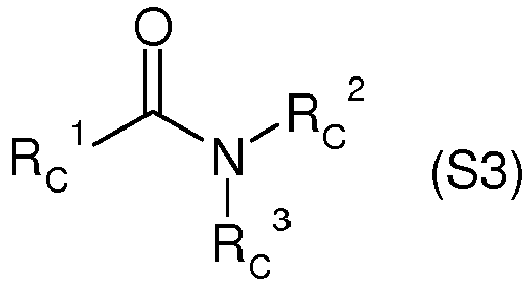
- RC 1 ist (C1-C4)Alkyl, (C1-C4)Haloalkyl, (C2-C4)Alkenyl, (C2-C4)Haloalkenyl, (C3-C7)Cycloalkyl, vorzugsweise Dichlormethyl;
- RC 2, RC 3 sind gleich oder verschieden Wasserstoff, (C1-C4)Alkyl, (C2-C4)Alkenyl, (C2-C4)Alkinyl, (C1-C4)Haloalkyl, (C2-C4)Haloalkenyl, (C1-C4)Alkylcarbamoyl-(C1-C4)alkyl, (C2-C4)Alkenylcarbamoyl-(C1-C4)alkyl, (C1-C4)Alkoxy-(C1-C4)alkyl, Dioxolanyl-(C1-C4)alkyl, Thiazolyl, Furyl, Furylalkyl, Thienyl, Piperidyl, substituiertes oder unsubstituiertes Phenyl, oder RC 2 und RC 3 bilden zusammen einen substituierten oder unsubstituierten heterocyclischen Ring, vorzugsweise einen Oxazolidin-, Thiazolidin-, Piperidin-, Morpholin-, Hexahydropyrimidin- oder Benzoxazinring;
- Wirkstoffe vom Typ der Dichloracetamide, die häufig als Vorauflaufsafener (bodenwirksame Safener) angewendet werden, wie z. B.
- "Dichlormid" (N,N-Diallyl-2,2-dichloracetamid) (S3-1),
- "R-29148" (3-Dichloracetyl-2,2,5-trimethyl-1,3-oxazolidin) der Firma Stauffer (S3-2),
- "R-28725" (3-Dichloracetyl-2,2,-dimethyl-1,3-oxazolidin) der Firma Stauffer (S3-3),
- "Benoxacor" (4-Dichloracetyl-3,4-dihydro-3-methyl-2H-1,4-benzoxazin) (S3-4),
- "PPG-1292" (N-Allyl-N-[(1,3-dioxolan-2-yl)-methyl]-dichloracetamid) der Firma PPG Industries (S3-5),
- "DKA-24" (N-Allyl-N-[(allylaminocarbonyl)methyl]-dichloracetamid) der Firma Sagro-Chem (S3-6),
- "AD-67" oder "MON 4660" (3-Dichloracetyl-1-oxa-3-aza-spiro[4,5]decan) der Firma Nitrokemia bzw. Monsanto (S3-7),
- "TI-35" (1-Dichloracetyl-azepan) der Firma TRI-Chemical RT (S3-8),
- "Diclonon" (Dicyclonon) oder "BAS145138" oder "LAB145138" (S3-9)
- (3-Dichloracetyl-2,5,5-trimethyl-1,3-diazabicyclo[4.3.0]nonan) der Firma BASF, "Furilazol" oder "MON 13900" ((RS)-3-Dichloracetyl-5-(2-furyl)-2,2-dimethyloxazolidin) (S3-10); sowie dessen (R)-Isomer (S3-11).
- S4) N-Acylsulfonamide der Formel (S4) und ihre Salze,

- XD
- ist CH oder N;
- RD 1
- ist CO-NRD 5RD 6 oder NHCO-RD 7;
- RD 2
- ist Halogen, (C1-C4)Haloalkyl, (C1-C4)Haloalkoxy, Nitro, (C1-C4)Alkyl, (C1-C4)Alkoxy, (C1-C4)Alkylsulfonyl, (C1-C4)Alkoxycarbonyl oder (C1-C4)Alkylcarbonyl;
- RD 3
- ist Wasserstoff, (C1-C4)Alkyl, (C2-C4)Alkenyl oder (C2-C4)Alkinyl;
- RD 4
- ist Halogen, Nitro, (C1-C4)Alkyl, (C1-C4)Haloalkyl, (C1-C4)Haloalkoxy, (C3-C6)Cycloalkyl, Phenyl, (C1-C4)Alkoxy, Cyano, (C1-C4)Alkylthio, (C1-C4)Alkylsulfinyl, (C1-C4)Alkylsulfonyl, (C1-C4)Alkoxycarbonyl oder (C1-C4)Alkylcarbonyl;
- RD 5
- ist Wasserstoff, (C1-C6)Alkyl, (C3-C6)Cycloalkyl, (C2-C6)Alkenyl, (C2-C6)Alkinyl, (C5-C6)Cycloalkenyl, Phenyl oder 3- bis 6-gliedriges Heterocyclyl enthaltend vD Heteroatome aus der Gruppe Stickstoff, Sauerstoff und Schwefel, wobei die sieben letztgenannten Reste durch vD Substituenten aus der Gruppe Halogen, (C1-C6)Alkoxy, (C1-C6)Haloalkoxy, (C1-C2)Alkylsulfinyl, (C1-C2)Alkylsulfonyl, (C3-C6)Cycloalkyl, (C1-C4)Alkoxycarbonyl, (C1-C4)Alkylcarbonyl und Phenyl und im Falle cyclischer Reste auch (C1-C4) Alkyl und (C1-C4)Haloalkyl substituiert sind;
- RD 6
- ist Wasserstoff, (C1-C6)Alkyl, (C2-C6)Alkenyl oder (C2-C6)Alkinyl, wobei die drei letztgenannten Reste durch vD Reste aus der Gruppe Halogen, Hydroxy, (C1-C4)Alkyl, (C1-C4)Alkoxy und (C1-C4)Alkylthio substituiert sind, oder
- RD 5 und RD 6
- gemeinsam mit dem sie tragenden Stickstoffatom einen Pyrrolidinyl- oder Piperidinyl-Rest bilden;
- RD 7
- ist Wasserstoff, (C1-C4)Alkylamino, Di-(C1-C4)alkylamino, (C1-C6)Alkyl, (C3-C6)Cycloalkyl, wobei die 2 letztgenannten Reste durch vD Substituenten aus der Gruppe Halogen, (C1-C4)Alkoxy, (C1-C6)Haloalkoxy und (C1-C4)Alkylthio und im Falle cyclischer Reste auch (C1-C4)Alkyl und (C1-C4)Haloalkyl substituiert sind;
- nD
- ist 0, 1 oder 2;
- mD
- ist 1 oder 2;
- vD
- ist 0, 1, 2 oder 3;
WO-A-97/45016 
- RD 7
- (C1-C6)Alkyl, (C3-C6)Cycloalkyl, wobei die 2 letztgenannten Reste durch vD Substituenten aus der Gruppe Halogen, (C1-C4)Alkoxy, (C1-C6)Haloalkoxy und (C1-C4)Alkylthio und im Falle cyclischer Reste auch (C1-C4)Alkyl und (C1-C4)Haloalkyl substituiert sind;
- RD 4
- Halogen, (C1-C4)Alkyl, (C1-C4)Alkoxy, CF3;
- mD
- 1 oder 2;
- vD
- ist 0, 1, 2 oder 3 bedeutet;
Acylsulfamoylbenzoesäureamide, z.B. der nachfolgenden Formel (S4b), die z.B. bekannt sind ausWO-A-99/16744 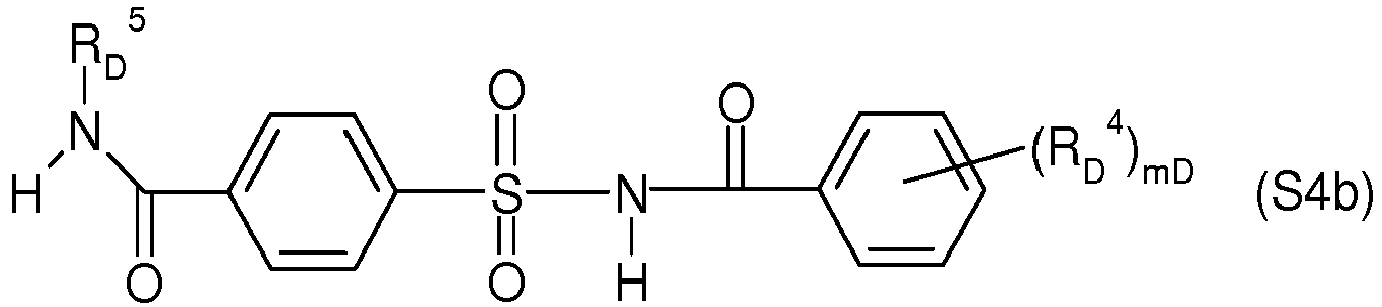
- z.B. solche worin
- RD 5 = Cyclopropyl und (RD 4) = 2-OMe ist ("Cyprosulfamide", S4-1),
- RD 5 = Cyclopropyl und (RD 4) = 5-Cl-2-OMe ist (S4-2),
- RD 5 = Ethyl und (RD 4) = 2-OMe ist (S4-3),
- RD 5 = Isopropyl und (RD 4) = 5-Cl-2-OMe ist (S4-4) und
- RD 5 = Isopropyl und (RD 4) = 2-OMe ist (S4-5)
Verbindungen vom Typ der N-Acylsulfamoylphenylharnstoffe der Formel (S4c), die z.B. bekannt sind aus derEP-A-365484 
- RD 8 und RD 9
- unabhängig voneinander Wasserstoff, (C1-C8)Alkyl, (C3-C8)Cycloalkyl, (C3-C6)Alkenyl, (C3-C6)Alkinyl,
- RD 4
- Halogen, (C1-C4)Alkyl, (C1-C4)Alkoxy, CF3
- mD
- 1 oder 2 bedeutet;
- 1-[4-(N-2-Methoxybenzoylsulfamoyl)phenyl]-3-methylharnstoff,
- 1-[4-(N-2-Methoxybenzoylsulfamoyl)phenyl]-3,3-dimethylharnstoff,
- 1-[4-(N-4,5-Dimethylbenzoylsulfamoyl)phenyl]-3-methylharnstoff.
- S5) Wirkstoffe aus der Klasse der Hydroxyaromaten und der aromatisch-aliphatischen Carbonsäurederivate (S5), z.B.
3,4,5-Triacetoxybenzoesäureethylester, 3,5-Dimethoxy-4-hydroxybenzoesäure, 3,5-Dihydroxybenzoesäure, 4-Hydroxysalicylsäure, 4-Fluorsalicyclsäure, 2-Hydroxyzimtsäure, 1,2-Dihydro-2-oxo-6-trifluoromethylpyridin-3-carboxamid, 2,4-Dichlorzimtsäure, wie sie in derWO-A-2004/084631 WO-A-2005/015994 WO-A-2005/016001 - S6) Wirkstoffe aus der Klasse der 1,2-Dihydrochinoxalin-2-one (S6), z.B. 1-Methyl-3-(2-thienyl)-1,2-dihydrochinoxalin-2-on, 1-Methyl-3-(2-thienyl)-1,2-dihydrochinoxalin-2-thion, 1-(2-Aminoethyl)-3-(2-thienyl)-1,2-dihydro-chinoxalin-2-on-hydrochlorid, 1-[2-(Diethylamino)ethyl]-6,7-dimethyl-3-thiophen-2-ylchinoxalin-2(1H)-on, 1-(2-Methylsulfonylaminoethyl)-3-(2-thienyl)-1,2-dihydro-chinoxalin-2-on, wie sie in der
WO-A-2005/112630 - S7) Verbindungen der Formel (S7),wie sie in der
WO-A-1998/38856 
- RE 1, RE 2
- sind unabhängig voneinander Halogen, (C1-C4)Alkyl, (C1-C4)Alkoxy, (C1-C4)Haloalkyl, (C1-C4)Alkylamino, Di-(C1-C4)Alkylamino, Nitro;
- AE
- ist COORE 3 oder COSRE 4
- RE 3, RE 4
- sind unabhängig voneinander Wasserstoff, (C1-C4)Alkyl, (C2-C6)Alkenyl, (C2-C4)Alkinyl, Cyanoalkyl, (C1-C4)Haloalkyl, Phenyl, Nitrophenyl, Benzyl, Halobenzyl, Pyridinylalkyl und Alkylammonium,
- nE 1
- ist 0 oder 1
- nE 2, nE 3
- sind unabhängig voneinander 0, 1 oder 2,
- Diphenylmethoxyessigsäure,
- Diphenylmethoxyessigsäureethylester,
- Diphenylmethoxyessigsäuremethylester (
CAS-Reg.Nr. 41858-19-9
- S8) Verbindungen der Formel (S8),wie sie in der
WO-A-98/27049 
- XF
- CH oder N,
- nF
- für den Fall, dass XF=N ist, eine ganze Zahl von 0 bis 4 und für den Fall, dass XF=CH ist, eine ganze Zahl von 0 bis 5 ,
- RF 1
- Halogen, (C1-C4)Alkyl, (C1-C4)Haloalkyl, (C1-C4)Alkoxy, (C1-C4)Haloalkoxy, Nitro, (C1-C4)Alkylthio, (C1-C4)-Alkylsulfonyl, (C1-C4)Alkoxycarbonyl, ggf. substituiertes. Phenyl, ggf. substituiertes Phenoxy,
- RF 2
- Wasserstoff oder (C1-C4)Alkyl
- RF 3
- Wasserstoff, (C1-C8)Alkyl, (C2-C4)Alkenyl, (C2-C4)Alkinyl, oder Aryl, wobei jeder der vorgenannten C-haltigen Reste unsubstituiert oder durch einen oder mehrere, vorzugsweise bis zu drei gleiche oder verschiedene Reste aus der Gruppe, bestehend aus Halogen und Alkoxy substituiert ist;bedeuten, oder deren Salze,
- XF
- CH,
- nF
- eine ganze Zahl von 0 bis 2 ,
- RF 1
- Halogen, (C1-C4)Alkyl, (C1-C4)Haloalkyl, (C1-C4)Alkoxy, (C1-C4)Haloalkoxy,
- RF 2
- Wasserstoff oder (C1-C4)Alkyl,
- RF 3
- Wasserstoff, (C1-C8)Alkyl, (C2-C4)Alkenyl, (C2-C4)Alkinyl, oder Aryl, wobei jeder der vorgenannten C-haltigen Reste unsubstituiert oder durch einen oder mehrere, vorzugsweise bis zu drei gleiche oder verschiedene Reste aus der Gruppe, bestehend aus Halogen und Alkoxy substituiert ist, bedeuten, oder deren Salze.
- S9) Wirkstoffe aus der Klasse der 3-(5-Tetrazolylcarbonyl)-2-chinolone (S9), z.B. 1,2-Dihydro-4-hydroxy-1-ethyl-3-(5-tetrazolylcarbonyl)-2-chinolon (
CAS-Reg.Nr. 219479-18-2 CAS-Reg.Nr. 95855-00-8 WO-A-1999/000020 - S10) Verbindungen der Formeln (S10a) oder (S10b)
wie sie in derWO-A-2007/023719 WO-A-2007/023764 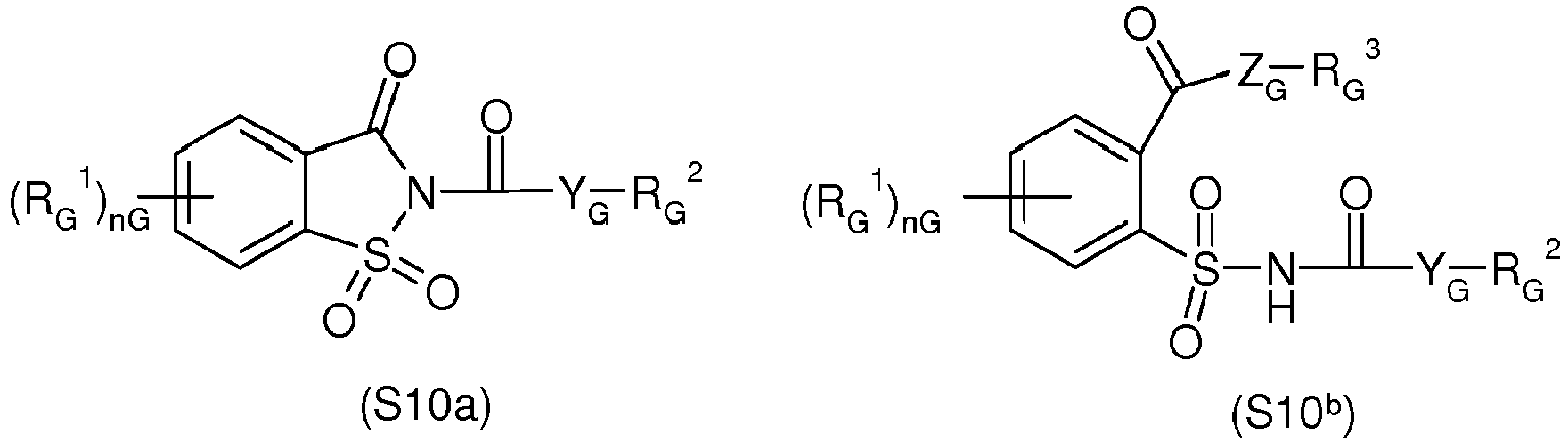
- RG 1
- Halogen, (C1-C4)Alkyl, Methoxy, Nitro, Cyano, CF3, OCF3
- YG, ZG
- unabhängig voneinander O oder S,
- nG
- eine ganze Zahl von 0 bis 4,
- RG 1
- (C1-C16)Alkyl, (C2-C6)Alkenyl, (C3-C6)Cycloalkyl, Aryl; Benzyl, Halogenbenzyl,
- RG 3
- Wasserstoff oder (C1-C6)Alkyl bedeutet.
- S11) Wirkstoffe vom Typ der Oxyimino-Verbindungen (S11), die als Saatbeizmittel bekannt sind, wie z. B. "Oxabetrinil" ((Z)-1,3-Dioxolan--ylmethoxyimino-(phenyl)acetonitril) (S11-1), das als Saatbeiz-Safener für Hirse gegen Schäden von Metolachlor bekannt ist,
"Fluxofenim" (1-(4-Chlorphenyl)-2,2,2-trifluor-1-ethanon-O-(1,3-dioxolan-2-ylmethyl)-oxim) (S11-2), das als Saatbeiz-Safener für Hirse gegen Schäden von Metolachlor bekannt ist, und
"Cyometrinil" oder "CGA-43089" ((Z)-Cyanomethoxyimino(phenyl)acetonitril) (S11-3), das als Saatbeiz-Safener für Hirse gegen Schäden von Metolachlor bekannt ist. - S12) Wirkstoffe aus der Klasse der Isothiochromanone (S12), wie z.B. Methyl-[(3-oxo-1H-2-benzothiopyran-4(3H)-yliden)methoxy]acetate (
CAS-Reg.Nr. 205121-04-6 WO-A-1998/13361 - S13) Eine oder mehrere Verbindungen aus Gruppe (S13):
- "Naphthalic anhydrid" (1,8-Naphthalindicarbonsäureanhydrid) (S13-1), das als Saatbeiz-Safener für Mais gegen Schäden von Thiocarbamatherbiziden bekannt ist,
- "Fenclorim" (4,6-Dichlor-2-phenylpyrimidin) (S13-2), das als Safener für Pretilachlor in gesätem Reis bekannt ist,
- "Flurazole" (Benzyl-2-chlor-4-trifluormethyl-1,3-thiazol-5-carboxylat) (S13-3), das als Saatbeiz-Safener für Hirse gegen Schäden von Alachlor und Metolachlor bekannt ist,
- "CL 304415" (
CAS-Reg.Nr. 31541-57-8 - "MG 191" (
CAS-Reg.Nr. 96420-72-3 - "MG-838" (
CAS-Reg.Nr. 133993-74-5 - "Disulfoton" (O,O-Diethyl S-2-ethylthioethyl phosphordithioat) (S13-7),
- "Dietholate" (O,O-Diethyl-O-phenylphosphorotioat) (S13-8),
- "Mephenate" (4-Chlorphenyl-methylcarbamat) (S13-9).
- S14) Wirkstoffe, die neben einer herbiziden Wirkung gegen Schadpflanzen auch Safenerwirkung an Kulturpflanzen wie Reis aufweisen, wie z. B. "Dimepiperate" oder "MY-93" (S-1-Methyl-1-phenylethyl-piperidin-1-carbothioat), das als Safener für Reis gegen Schäden des Herbizids Molinate bekannt ist,
"Daimuron" oder "SK 23" (1-(1-Methyl-1-phenylethyl)-3-p-tolyl-harnstoff), das als Safener für Reis gegen Schäden des Herbizids Imazosulfuron bekannt ist,
"Cumyluron" = "JC-940" (3-(2-Chlorphenylmethyl)-1-(1-methyl-1-phenyl-ethyl)harnstoff, sieheJP-A-60087254
"Methoxyphenon" oder "NK 049" (3,3'-Dimethyl-4-methoxy-benzophenon), das als Safener für Reis gegen Schäden einiger Herbizide bekannt ist,
"CSB" (1-Brom-4-(chlormethylsulfonyl)benzol) von Kumiai, (CAS-Reg.Nr. 54091-06-4 - S15) Wirkstoffe, die vorrangig als Herbizide eingesetzt werden, jedoch auch Safenerwirkung auf Kulturpflanzen aufweisen, z.B.
- (2,4-Dichlorphenoxy)essigsäure (2,4-D),
- (4-Chlorphenoxy)essigsäure,
- (R,S)-2-(4-Chlor-o-tolyloxy)propionsäure (Mecoprop),
- 4-(2,4-Dichlorphenoxy)buttersäure (2,4-DB),
- (4-Chlor-o-tolyloxy)essigsäure (MCPA),
- 4-(4-Chlor-o-tolyloxy)buttersäure,
- 4-(4-Chlorphenoxy)buttersäure,
- 3,6-Dichlor-2-methoxybenzoesäure (Dicamba),
- 1-(Ethoxycarbonyl)ethyl-3,6-dichlor-2-methoxybenzoat (Lactidichlor-ethyl).
- S1) compounds of the formula (S1),
- n A
- is a natural number of 0 to 5, preferably 0 to 3;
- R A 1
- is halogen, (C 1 -C 4 ) alkyl, (C 1 -C 4 ) alkoxy, nitro or (C 1 -C 4 ) haloalkyl;
- W A
- is an unsubstituted or substituted divalent heterocyclic radical selected from the group consisting of the monounsaturated or aromatic five-membered heterocycles having 1 to 3 hetero ring atoms from the group N and O, at least one N atom and at most one O atom being present in the ring, preferably a radical from the group (W A 1 ) to (W A 4 ),
- m A
- is 0 or 1;
- R A 2
- is OR A 3 , SR A 3 or NR A 3 R A 4 or a saturated or unsaturated 3- to 7-membered heterocycle having at least one N-atom and up to 3 heteroatoms, preferably from the group O and S, via the N atom is connected to the carbonyl group in (S1) and is unsubstituted or substituted by radicals from the group (C 1 -C 4 ) alkyl, (C 1 -C 4 ) alkoxy or optionally substituted phenyl, preferably a radical of the formula OR A 3 , NHR A 4 or N (CH 3 ) 2 , in particular of the formula OR A 3 ;
- R A 3
- is hydrogen or an unsubstituted or substituted aliphatic hydrocarbon radical, preferably having a total of 1 to 18 carbon atoms;
- R A 4
- is hydrogen, (C 1 -C 6 ) alkyl, (C 1 -C 6 ) alkoxy or substituted or unsubstituted phenyl;
- R A 5
- is H, (C 1 -C 8 ) alkyl, (C 1 -C 8 ) haloalkyl, (C 1 -C 4 ) alkoxy (C 1 -C 8 ) alkyl, cyano or COOR A 9 , wherein R A 9 is hydrogen, (C 1 -C 8 ) alkyl, (C 1 -C 8 ) haloalkyl, (C 1 -C 4 ) alkoxy (C 1 -C 4 ) alkyl, (C 1 -C 6 ) hydroxyalkyl, (C 3 -C 12 ) is cycloalkyl or tri (C 1 -C 4 ) alkylsilyl;
- R A 6 , R A 7 , R A 8
- are identical or different hydrogen, (C 1 -C 8 ) alkyl, (C 1 -C 8 ) haloalkyl, (C 3 -C 12 ) cycloalkyl or substituted or unsubstituted phenyl;
- a) compounds of the type dichlorophenylpyrazoline-3-carboxylic acid (S1 a ), preferably compounds such as 1- (2,4-dichlorophenyl) -5-ethoxycarbonyl) -5-methyl-2-pyrazoline-3-carboxylic acid, 1- (2 , 4-dichlorophenyl) -5-ethoxycarbonyl) -5-methyl-2-pyrazoline-3-carboxylic acid ethyl ester (S1-1) ("Mefenpyrdiethyl"), and related compounds as described in the
WO-A-91/07874 - b) dichlorophenylpyrazolecarboxylic acid derivatives (S1 b), preferably compounds such as ethyl 1- (2,4-dichlorophenyl) -5-methyl-pyrazole-3-carboxylate (S1-2), 1- (2,4-dichlorophenyl) -5- isopropyl-pyrazole-3-carboxylic acid ethyl ester (S1-3), 1- (2,4-dichlorophenyl) -5- (1,1-dimethyl-ethyl) -pyrazole-3-carboxylic acid ethyl ester (S1-4) and related compounds, as they are in
EP-A-333,131 EP-A-269806 - c () derivatives of the 1,5-diphenylpyrazole-3-carboxylic acid S1 c), preferably compounds such as ethyl 1- (2,4-dichlorophenyl) -5-phenylpyrazole-3-carboxylate (S1-5), 1- (2-chlorophenyl ) -5-phenylpyrazole-3-carboxylic acid methyl ester (S1-6) and related compounds as described for example in the
EP-A-268554 - d) compounds of the type of triazolecarboxylic acids (S1 d ), preferably compounds such as fenchlorazole (ethyl ester), ie 1- (2,4-dichlorophenyl) -5-richlormethyl- (1H) -1,2,4-triazole-3-one Carboxylic acid ethyl ester (S1-7), and related compounds as in
EP-A-174 562 EP-A-346 620 - e) compounds of the 5-benzyl- or 5-phenyl-2-isoxazoline-3-carboxylic acid type or the 5,5-diphenyl-2-isoxazoline-3-carboxylic acid (S1 e), preferably compounds such as ethyl 5- (2,4-dichlorobenzyl) -2-isoxazoline-3-carboxylate (S1-8) or 5-phenyl- 2-isoxazoline-3-carboxylic acid ethyl ester (S1-9) and related compounds as described in U.S. Pat
WO-A-91/08202 WO-A-95/07897
- S2) quinoline derivatives of the formula (S2)
- R B 1
- is halogen, (C 1 -C 4 ) alkyl, (C 1 -C 4 ) alkoxy, nitro or (C 1 -C 4 ) haloalkyl;
- n B
- is a natural number of 0 to 5, preferably 0 to 3;
- R B 2
- is OR B 3 , SR B 3 or NR B 3 R B 4 or a saturated or unsaturated 3- to 7-membered heterocycle having at least one N atom and up to 3 heteroatoms, preferably from the group O and S, via the N atom is connected to the carbonyl group in (S2) and is unsubstituted or substituted by radicals from the group (C 1 -C 4 ) alkyl, (C 1 -C 4 ) alkoxy or optionally substituted phenyl, preferably a radical of the formula OR B 3 , NHR B 4 or N (CH 3 ) 2 , in particular of the formula OR B 3 ;
- R B 3
- is hydrogen or an unsubstituted or substituted aliphatic hydrocarbon radical, preferably having a total of 1 to 18 carbon atoms;
- R B 4
- is hydrogen, (C 1 -C 6 ) alkyl, (C 1 -C 6 ) alkoxy or substituted or unsubstituted phenyl;
- T B
- is a (C 1 or C 2 ) alkanediyl chain which is unsubstituted or substituted by one or two (C 1 -C 4 ) alkyl radicals or by [(C 1 -C 3 ) alkoxy] carbonyl;
- a) compounds of the 8-quinolinoxyacetic acid type (S2 a ), preferably (5-chloro-8-quinolinoxy) acetic acid (1-methylhexyl) ester ("cloquintocet-mexyl") (S2-1), (5-chloro 8-quinolinoxy) acetic acid (1,3-dimethyl-but-1-yl) ester (S2-2), (5-chloro-8-quinolinoxy) acetic acid 4-allyloxy-butyl ester (S2-3), (5 Chloro-8-quinolinoxy) acetic acid 1-allyloxy-prop-2-yl ester (S2-4), (5-chloro-8-quinolinoxy) acetic acid ethyl ester (S2-5), (5-chloro-8-quinolinoxy) acetic acid methyl ester (S2-6), (5-chloro-8-quinolinoxy) allyl acetate (S2-7), (5-chloro-8-quinolinoxy) acetic acid 2- (2-propylidene-iminoxy) -1-ethyl ester (S2-8 ), (5-chloro-8-quinolinoxy) acetic acid 2-oxo-prop-1-yl ester (S2-9) and related compounds as described in U.S. Pat
EP-A-86,750 EP-A-94 349 EP-A-191 736 EP-A-0 492 366 WO-A-2002/34048 - b) compounds of the (5-chloro-8-quinolinoxy) malonic acid type (S2 b ), preferably compounds such as diethyl (5-chloro-8-quinolinoxy) malonate, (5-chloro-8-quinolinoxy) malonic acid, (5-chloro -8-quinolinoxy) malonic acid methyl ethyl ester and related compounds as described in U.S. Pat
EP-A-0 582 198
- S3) compounds of the formula (S3)
- R C 1 is (C 1 -C 4 ) alkyl, (C 1 -C 4 ) haloalkyl, (C 2 -C 4 ) alkenyl, (C 2 -C 4 ) haloalkenyl, (C 3 -C 7 ) cycloalkyl, preferably dichloromethyl;
- R C 2 , R C 3 are identical or different hydrogen, (C 1 -C 4 ) alkyl, (C 2 -C 4 ) alkenyl, (C 2 -C 4 ) alkynyl, (C 1 -C 4 ) haloalkyl, ( C 2 -C 4 ) haloalkenyl, (C 1 -C 4 ) alkylcarbamoyl (C 1 -C 4 ) alkyl, (C 2 -C 4 ) alkenylcarbamoyl (C 1 -C 4 ) alkyl, (C 1 -C 4 ) Alkoxy- (C 1 -C 4 ) alkyl, dioxolanyl- (C 1 -C 4 ) alkyl, thiazolyl, furyl, furylalkyl, thienyl, piperidyl, substituted or unsubstituted phenyl, or R C 2 and R C 3 together form a substituted one or unsubstituted heterocyclic ring, preferably an oxazolidine, thiazolidine, piperidine, morpholine, hexahydropyrimidine or benzoxazine ring;
- Active substances of the dichloroacetamide type, which are often used as pre-emergence safeners (soil-active safeners), such as. B.
- "Dichloromid" (N, N-diallyl-2,2-dichloroacetamide) (S3-1),
- "R-29148" (3-dichloroacetyl-2,2,5-trimethyl-1,3-oxazolidine) from Stauffer (S3-2),
- "R-28725" (3-dichloroacetyl-2,2, -dimethyl-1,3-oxazolidine) from Stauffer (S3-3),
- "Benoxacor" (4-dichloroacetyl-3,4-dihydro-3-methyl-2H-1,4-benzoxazine) (S3-4),
- "PPG-1292" (N-allyl-N - [(1,3-dioxolan-2-yl) -methyl] -dichloroacetamide) from PPG Industries (S3-5),
- "DKA-24" (N-allyl-N - [(allylaminocarbonyl) methyl] -dichloroacetamide) from Sagro-Chem (S3-6),
- "AD-67" or "MON 4660" (3-dichloroacetyl-1-oxa-3-aza-spiro [4,5] decane) from Nitrokemia or Monsanto (S3-7),
- "TI-35" (1-dichloroacetyl-azepane) from TRI-Chemical RT (S3-8),
- "Diclonone" (dicyclonone) or "BAS145138" or "LAB145138" (S3-9)
- (3-dichloroacetyl-2,5,5-trimethyl-1,3-diazabicyclo [4.3.0] nonane) from BASF, "furilazole" or "MON 13900" ((RS) -3-dichloroacetyl-5- (2 -furyl) -2,2-dimethyloxazolidine) (S3-10); and its (R) isomer (S3-11).
- S4) N-acylsulfonamides of the formula (S4) and their salts,
- X D
- is CH or N;
- R D 1
- is CO-NR D 5 R D 6 or NHCO-R D 7 ;
- R D 2
- is halogen, (C 1 -C 4 ) haloalkyl, (C 1 -C 4 ) haloalkoxy, nitro, (C 1 -C 4 ) alkyl, (C 1 -C 4 ) alkoxy, (C 1 -C 4 ) alkylsulfonyl, (C 1 -C 4 ) alkoxycarbonyl or (C 1 -C 4 ) alkylcarbonyl;
- R D 3
- is hydrogen, (C 1 -C 4 ) alkyl, (C 2 -C 4 ) alkenyl or (C 2 -C 4 ) alkynyl;
- R D 4
- is halogen, nitro, (C 1 -C 4 ) alkyl, (C 1 -C 4 ) haloalkyl, (C 1 -C 4 ) haloalkoxy, (C 3 -C 6 ) cycloalkyl, phenyl, (C 1 -C 4 ) Alkoxy, cyano, (C 1 -C 4 ) alkylthio, (C 1 -C 4 ) alkylsulfinyl, (C 1 -C 4 ) alkylsulfonyl, (C 1 -C 4 ) alkoxycarbonyl or (C 1 -C 4 ) alkylcarbonyl;
- R D 5
- is hydrogen, (C 1 -C 6 ) alkyl, (C 3 -C 6 ) cycloalkyl, (C 2 -C 6 ) alkenyl, (C 2 -C 6 ) alkynyl, (C 5 -C 6 ) cycloalkenyl, phenyl or 3- to 6-membered heterocyclyl containing v D heteroatoms from the group consisting of nitrogen, oxygen and sulfur, where the seven latter radicals are represented by v D substituents from the group consisting of halogen, (C 1 -C 6 ) alkoxy, (C 1 -C 6 ) Haloalkoxy, (C 1 -C 2 ) alkylsulfinyl, (C 1 -C 2 ) alkylsulfonyl, (C 3 -C 6 ) cycloalkyl, (C 1 -C 4 ) alkoxycarbonyl, (C 1 -C 4 ) alkylcarbonyl and phenyl and im Cyclic radicals are also substituted by (C 1 -C 4 ) alkyl and (C 1 -C 4 ) haloalkyl;
- R D 6
- is hydrogen, (C 1 -C 6 ) alkyl, (C 2 -C 6 ) alkenyl or (C 2 -C 6 ) alkynyl, where the three latter radicals are represented by v D radicals from the group halogen, hydroxy, (C 1 -) C 4 ) alkyl, (C 1 -C 4 ) alkoxy and (C 1 -C 4 ) alkylthio are substituted, or
- R D 5 and R D 6
- together with the nitrogen atom carrying them form a pyrrolidinyl or piperidinyl radical;
- R D 7
- is hydrogen, (C 1 -C 4 ) alkylamino, di (C 1 -C 4 ) alkylamino, (C 1 -C 6 ) alkyl, (C 3 -C 6 ) cycloalkyl, where the 2 last-mentioned radicals are substituted by v D substituents from the group halogen, (C 1 -C 4 ) alkoxy, (C 1 -C 6 ) haloalkoxy and (C 1 -C 4 ) alkylthio and in the case of cyclic radicals also (C 1 -C 4 ) alkyl and (C 1 - C 4 ) haloalkyl are substituted;
- n D
- is 0, 1 or 2;
- m D
- is 1 or 2;
- v D
- is 0, 1, 2 or 3;
WO 97/45016 - R D 7
- (C 1 -C 6 ) alkyl, (C 3 -C 6 ) cycloalkyl, where the 2 last-mentioned radicals by v D substituents selected from the group consisting of halogen, (C 1 -C 4 ) alkoxy, (C 1 -C 6 ) haloalkoxy and (C 1 -C 4 ) alkylthio and in the case of cyclic radicals also (C 1 -C 4 ) alkyl and (C 1 -C 4 ) haloalkyl are substituted;
- R D 4
- Halogen, (C 1 -C 4 ) alkyl, (C 1 -C 4 ) alkoxy, CF 3 ;
- m D
- 1 or 2;
- v D
- is 0, 1, 2 or 3;
Acylsulfamoylbenzoesäureamide, for example, the following formula (S4 b ), for example, are known fromWO-A-99/16744 - eg those in which
- R D 5 = cyclopropyl and (R D 4 ) = 2-OMe ("Cyprosulfamide", S4-1),
- R D 5 = cyclopropyl and (R D 4 ) = 5-Cl-2-OMe is (S4-2),
- R D 5 = ethyl and (R D 4 ) = 2-OMe is (S4-3),
- R D 5 = isopropyl and (R D 4 ) = 5-Cl-2-OMe is (S4-4) and
- R D 5 = isopropyl and (R D 4 ) = 2-OMe is (S4-5)
Compounds of the type of N-acylsulfamoylphenylureas of the formula (S4 c ) which are known, for example, fromEP-A-365484 - R D 8 and R D 9
- independently of one another hydrogen, (C 1 -C 8 ) alkyl, (C 3 -C 8 ) cycloalkyl, (C 3 -C 6 ) alkenyl, (C 3 -C 6 ) alkynyl,
- R D 4
- Halogen, (C 1 -C 4 ) alkyl, (C 1 -C 4 ) alkoxy, CF 3
- m D
- 1 or 2;
- 1- [4- (N-2-Methoxybenzoylsulfamoyl) phenyl] -3-methyl-urea,
- 1- [4- (N-2-Methoxybenzoylsulfamoyl) phenyl] -3,3-dimethylurea,
- 1- [4- (N-4,5-Dimethylbenzoylsulfamoyl) phenyl] -3-methyl-urea.
- S5) Active substances from the class of hydroxyaromatics and the aromatic-aliphatic carboxylic acid derivatives (S5), eg
3,4,5-triacetoxybenzoic acid ethyl ester, 3,5-dimethoxy-4-hydroxybenzoic acid, 3,5-dihydroxybenzoic acid, 4-hydroxysalicylic acid, 4-fluorosalicyclic acid, 2-hydroxycinnamic acid, 1,2-dihydro-2-oxo-6-trifluoromethylpyridine 3-carboxamide, 2,4-dichlorocinnamic acid, as described in theWO-A-2004/084631 WO-A-2005/015994 WO-A-2005/016001 - S6) active compounds from the class of 1,2-dihydroquinoxaline-2-ones (S6), for example 1-methyl-3- (2-thienyl) -1,2-dihydroquinoxalin-2-one, 1-methyl-3- (S6) 2-thienyl) -1,2-dihydroquinoxaline-2-thione, 1- (2-aminoethyl) -3- (2-thienyl) -1,2-dihydroquinoxaline-2-one hydrochloride, 1- [2- (Diethylamino) ethyl] -6,7-dimethyl-3-thiophen-2-ylquinoxaline-2 (1H) -one, 1- (2-methylsulfonylaminoethyl) -3- (2-thienyl) -1,2-dihydroquinoxaline -2-on, as in the
WO 2005/112630 - S7) compounds of the formula (S7), as described in the
WO-A-1998/38856 - R E 1 , R E 2
- are each independently halogen, (C 1 -C 4 ) alkyl, (C 1 -C 4 ) alkoxy, (C 1 -C 4 ) haloalkyl, (C 1 -C 4 ) alkylamino, di- (C 1 -C 4 ) Alkylamino, nitro;
- A E
- is COOR E 3 or COSR E 4
- R E 3 , R E 4
- are independently hydrogen, (C 1 -C 4 ) alkyl, (C 2 -C 6 ) alkenyl, (C 2 -C 4 ) alkynyl, cyanoalkyl, (C 1 -C 4 ) haloalkyl, phenyl, nitrophenyl, benzyl, halobenzyl , Pyridinylalkyl and alkylammonium,
- n E 1
- is 0 or 1
- n E 2 , n E 3
- are independently 0, 1 or 2,
- diphenylmethoxy,
- Diphenylmethoxyessigsäureethylester,
- Methyl diphenylmethoxyacetate (
CAS-Reg.Nr. 41858-19-9
- S8) compounds of the formula (S8) as described in the
WO-A-98/27049 - X F
- CH or N,
- n F
- for the case that X F = N, an integer from 0 to 4 and for the case that X F = CH, an integer from 0 to 5,
- R F 1
- Halogen, (C 1 -C 4 ) alkyl, (C 1 -C 4 ) haloalkyl, (C 1 -C 4 ) alkoxy, (C 1 -C 4 ) haloalkoxy, nitro, (C 1 -C 4 ) alkylthio, ( C 1 -C 4 ) alkylsulfonyl, (C 1 -C 4 ) alkoxycarbonyl, optionally substituted. Phenyl, optionally substituted phenoxy,
- R F 2
- Hydrogen or (C 1 -C 4 ) alkyl
- R F 3
- Hydrogen, (C 1 -C 8 ) alkyl, (C 2 -C 4 ) alkenyl, (C 2 -C 4 ) alkynyl, or aryl, wherein each of the aforementioned C-containing radicals unsubstituted or by one or more, preferably up to three identical or different radicals from the group consisting of halogen and alkoxy are substituted, or their salts,
- X F
- CH,
- n F
- an integer from 0 to 2,
- R F 1
- Halogen, (C 1 -C 4 ) alkyl, (C 1 -C 4 ) haloalkyl, (C 1 -C 4 ) alkoxy, (C 1 -C 4 ) haloalkoxy,
- R F 2
- Hydrogen or (C 1 -C 4 ) alkyl,
- R F 3
- Hydrogen, (C 1 -C 8 ) alkyl, (C 2 -C 4 ) alkenyl, (C 2 -C 4 ) alkynyl, or aryl, wherein each of the aforementioned C-containing radicals unsubstituted or by one or more, preferably up to three identical or different radicals from the group consisting of halogen and alkoxy substituted, mean, or their salts.
- S9) active compounds from the class of 3- (5-tetrazolylcarbonyl) -2-quinolones (S9), for example 1,2-dihydro-4-hydroxy-1-ethyl-3- (5-tetrazolylcarbonyl) -2-quinolone (
CAS-Reg.Nr. 219479-18-2 CAS-Reg.Nr. 95855-00-8 WO-A-1999/000020 - S10) Compounds of the formulas (S10 a ) or (S10 b )
as they are in theWO-A-2007/023719 WO-A-2007/023764 - R G 1
- Halogen, (C 1 -C 4 ) alkyl, methoxy, nitro, cyano, CF 3 , OCF 3
- Y G , Z G
- independently of one another O or S,
- n G
- an integer from 0 to 4,
- R G 1
- (C 1 -C 16 ) alkyl, (C 2 -C 6 ) alkenyl, (C 3 -C 6 ) cycloalkyl, aryl; Benzyl, halobenzyl,
- R G 3
- Is hydrogen or (C 1 -C 6 ) alkyl.
- S11) Active substances of the type of oxyimino compounds (S11) used as seed dressings are known, such. "Oxabetrinil" ((Z) -1,3-dioxolan-ylmethoxyimino- (phenyl) acetonitrile) (S11-1), which is known as a seed safener for millet against damage by metolachlor,
"Fluxofenim" (1- (4-chlorophenyl) -2,2,2-trifluoro-1-ethanone-O- (1,3-dioxolan-2-ylmethyl) oxime) (S11-2) which was used as seed dressing Safener for millet is known against damage from metolachlor, and
"Cyometrinil" or "CGA-43089" ((Z) -cyanomethoxyimino (phenyl) acetonitrile) (S11-3), which is known as a seed dressing safener for millet against damage by metolachlor. - S12) active substances from the class of the isothiochromanones (S12), such as, for example, methyl - [(3-oxo-1H-2-benzothiopyran-4 (3H) -ylidene) methoxy] acetate (
CAS-Reg.Nr. 205121-04-6 WO-A-1998/13361 - S13) One or more compounds from group (S13):
- "Naphthalene anhydride" (1,8-naphthalenedicarboxylic anhydride) (S13-1), which is known as a seed safener for corn against damage by thiocarbamate herbicides.
- "Fenclorim" (4,6-dichloro-2-phenylpyrimidine) (S13-2), which is known as a safener for pretilachlor in seeded rice,
- "Flurazole" (benzyl-2-chloro-4-trifluoromethyl-1,3-thiazole-5-carboxylate) (S13-3), which is known as a seeder-safener for millet against damage by alachlor and metolachlor,
- "CL 304415" (
CAS-Reg.Nr. 31541-57-8 - "MG 191" (
CAS-Reg.Nr. 96420-72-3 - "MG-838" (
CAS-Reg.Nr. 133993-74-5 - "Disulfonone" (O, O-diethyl S-2-ethylthioethyl phosphorodithioate) (S13-7),
- "Dietholate" (O, O-diethyl-O-phenyl phosphorotioate) (S13-8),
- "Mephenate" (4-chlorophenyl methylcarbamate) (S13-9).
- S14) active substances, in addition to a herbicidal activity against harmful plants and safener action on crop plants such as rice, such as. "Dimepiperate" or "MY-93" (S-1-methyl-1-phenylethyl-piperidine-1-carbothioate), which is known as a safener for rice against damage by the herbicide Molinate,
"Daimuron" or "SK 23" (1- (1-methyl-1-phenylethyl) -3-p-tolyl-urea) known as safener for rice against damage of the herbicide imazosulfuron,
"Cumyluron" = "JC-940" (3- (2-chlorophenylmethyl) -1- (1-methyl-1-phenylethyl) urea, seeJP-A-60087254
"Methoxyphenone" or "NK 049"(3,3'-dimethyl-4-methoxy-benzophenone), which is known as safener for rice against damage of some herbicides,
"COD" (1-bromo-4- (chloromethylsulfonyl) benzene) from Kumiai, (CAS-Reg.Nr. 54091-06-4 - S15) active substances, which are used primarily as herbicides, but also safener action on crop plants, eg
- (2,4-dichlorophenoxy) acetic acid (2,4-D),
- (4-chlorophenoxy) acetic acid,
- (R, S) -2- (4-chloro-o-tolyloxy) propionic acid (mecoprop),
- 4- (2,4-dichlorophenoxy) butyric acid (2,4-DB),
- (4-chloro-o-tolyloxy) acetic acid (MCPA),
- 4- (4-chloro-o-tolyloxy) butyric acid,
- 4- (4-chlorophenoxy) butyric acid,
- 3,6-dichloro-2-methoxybenzoic acid (Dicamba),
- 1- (ethoxycarbonyl) ethyl 3,6-dichloro-2-methoxybenzoate (lactidichloroethyl).
Als die die Kulturpflanzen-Verträglichkeit verbessernde Verbindung [Komponente (b')] sind Cloquintocet-mexyl, Fenchlorazol-ethylester, Isoxadifen-ethyl, Mefenpyr-diethyl, Fenclorim, Cumyluron, S4-1 und S4-5 am meisten bevorzugt, wobei Mefenpyr-diethyl besonders hervorgehoben ist. Cyprosulfamide (S4-1) ist ebenfalls hervorgehoben.As the crop plant compatibility-improving compound [component (b ')], cloquintocet-mexyl, fenchlorazole-ethyl ester, isoxadifen-ethyl, mefenpyr-diethyl, fenclorim, cumyluron, S4-1 and S4-5 are most preferred, with mefenpyr- Diethyl is particularly highlighted. Cyprosulfamide (S4-1) is also highlighted.
Es wurde nun überraschend gefunden, dass die oben definierten Wirkstoffkombinationen aus Verbindungen der allgemeinen Formel (I) und Safenern (Antidots) aus der oben aufgeführten Gruppe (b') bei sehr guter Nutzpflanzen-Verträglichkeit eine besonders hohe herbizide Wirksamkeit aufweisen und in verschiedenen Kulturen, insbesondere in Getreide (vor allem Weizen), aber auch in Soja, Kartoffeln, Mais und Reis zur selektiven Unkrautbekämpfung verwendet werden können.It has now surprisingly been found that the above-defined active compound combinations of compounds of the general formula (I) and safeners (antidotes) from the above-mentioned group (b ') with very good crop tolerance have a particularly high herbicidal activity and in different crops, In particular, in cereals (especially wheat), but also in soy, potatoes, corn and rice for selective weed control can be used.
Dabei ist es als überraschend anzusehen, dass aus einer Vielzahl von bekannten Safenern oder Antidots, die befähigt sind, die schädigende Wirkung eines Herbizids auf die Kulturpflanzen zu antagonisieren, gerade die oben aufgeführten Verbindungen der Gruppe (b') geeignet sind, die schädigende Wirkung von Verbindungen der Formel (I) auf die Kulturpflanzen annähernd vollständig aufzuheben, ohne dabei die herbizide Wirksamkeit gegenüber den Unkräutern maßgeblich zu beeinträchtigen.It is to be regarded as surprising that from a variety of known safeners or antidotes which are capable of antagonizing the harmful effect of a herbicide on the crop, especially the compounds of group (b ') listed above, the damaging effect of Compounds of formula (I) on the crops almost completely cancel, without affecting the herbicidal activity against the weeds significantly.
Hervorgehoben sei hierbei die besonders vorteilhafte Wirkung der besonders und am meisten bevorzugten Kombinationspartner aus der Gruppe (b'), insbesondere hinsichtlich der Schonung von Getreidepflanzen, wie z.B. Weizen, Gerste und Roggen, aber auch Mais und Reis, als Kulturpflanzen.Emphasis should be given to the particularly advantageous effect of the particularly and most preferred combination partners from the group (b '), in particular with regard to the protection of cereal plants, such as. Wheat, barley and rye, but also corn and rice, as crops.
Die erfindungsgemäßen Verbindungen sind durch die Formel (I) allgemein definiert. Bevorzugte Substituenten bzw. Bereiche der in der oben und nachstehend erwähnten Formeln aufgeführten Reste werden im Folgenden erläutert:
- W
- steht bevorzugt für Wasserstoff, C1-C6-Alkyl, Halogen, C1-C6-Alkoxy, C1-C4-Halogen-alkyl oder C1-C4-Halogenalkoxy,
- X
- steht bevorzugt für Halogen, C1-C6-Alkyl, C2-C6-Alkenyl, C2-C6-Alkinyl, C1-C6-Alkoxy, C1-C4-Halogenalkyl, C1-C4-Halogenalkoxy oder Cyano,
- Y
- steht bevorzugt für Wasserstoff, Halogen, C1-C6-Alkyl, oder C1-C6-Alkoxy,
- Z
- steht bevorzugt für eine Gruppe
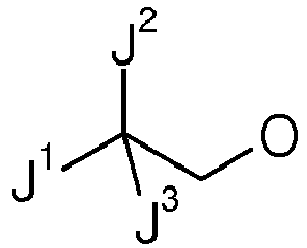
- W
- R 1 preferably represents hydrogen, C 1 -C 6 -alkyl, halogen, C 1 -C 6 -alkoxy, C 1 -C 4 -haloalkyl or C 1 -C 4 -haloalkoxy,
- X
- is preferably halogen, C 1 -C 6 -alkyl, C 2 -C 6 -alkenyl, C 2 -C 6 -alkynyl, C 1 -C 6 -alkoxy, C 1 -C 4 -haloalkyl, C 1 -C 4 Haloalkoxy or cyano,
- Y
- is preferably hydrogen, halogen, C 1 -C 6 -alkyl, or C 1 -C 6 -alkoxy,
- Z
- is preferably a group
CKE steht bevorzugt für eine der Gruppen


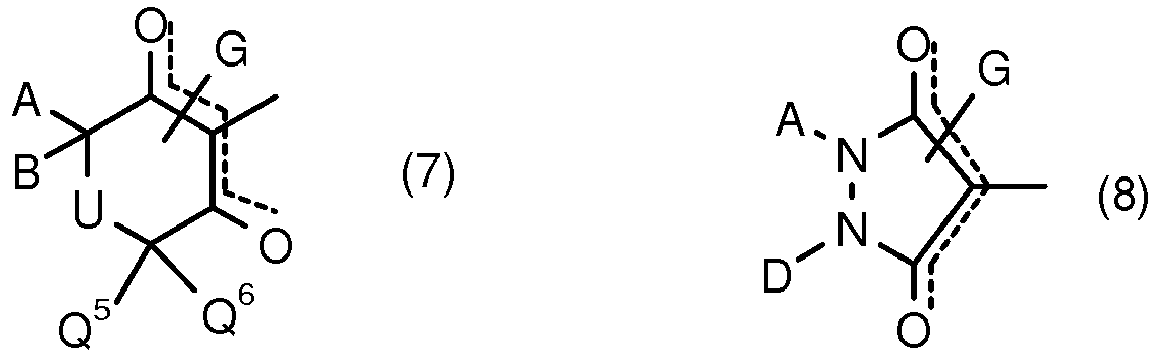
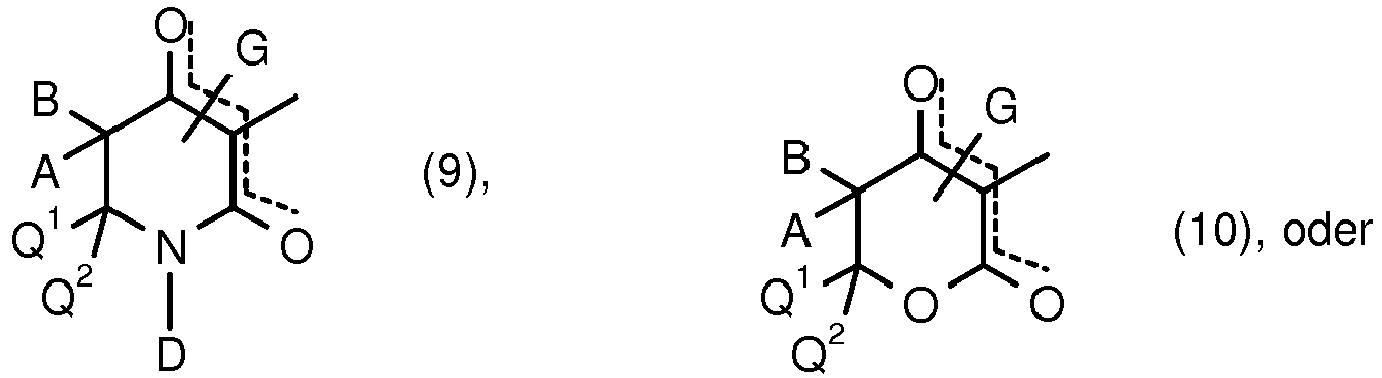

- U
- steht bevorzugt für -S-, -S(O)-, -S(O)2-, -O-,

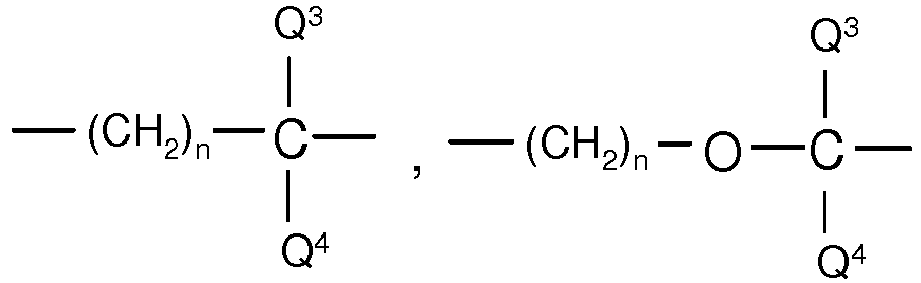
- A
- steht bevorzugt für Wasserstoff oder jeweils gegebenenfalls durch Halogen substituiertes C1-C12-Alkyl, C3-C8-Alkenyl, C1-C10-Alkoxy-C1-C8-alkyl, C1-C10-Alkylthio-C1-C6-alkyl, gegebenenfalls durch Halogen, C1-C6-Alkyl oder C1-C6-Alkoxy substituiertes C3-C8-Cycloalkyl, in welchem gegebenenfalls ein oder zwei nicht direkt benachbarte Ring-glieder durch Sauerstoff und/oder Schwefel ersetzt sind oder für jeweils gegebenenfalls durch Halogen, C1-C6-Alkyl, C1-C6-Halogenalkyl, C1-C6-Alkoxy, C1-C6-Halogen-alkoxy, Cyano oder Nitro substituiertes Phenyl, Naphthyl, Hetaryl mit 5 bis 6 Ringatomen (beispielsweise Furanyl, Pyridyl, Imidazolyl, Triazolyl, Pyrazolyl, Pyrimidyl, Thiazolyl oder Thienyl), Phenyl-C1-C6-alkyl oder Naphthyl-C1-C6-alkyl,
- B
- steht bevorzugt für Wasserstoff, C1-C12-Alkyl oder C1-C8-Alkoxy-C1-C6-alkyl oder
- A, B
- und das Kohlenstoffatom an das sie gebunden sind, stehen bevorzugt für gesättigtes C3-C10-Cycloalkyl oder ungesättigtes C5-C10-Cycloalkyl, worin gegebenenfalls ein Ringglied durch Stickstoff, Sauerstoff oder Schwefel ersetzt ist und welche gegebenenfalls einfach oder zweifach durch C1-C8-Alkyl, C1-C8-Alkoxy, C3-C8-Alkenyloxy, C1-C6-Alkoxy-C1-C6-Alkyl, C3-C6-Cycloalkyl-C1-C2-alkoxy, C3-C10-Cycloalkyl, C1-C8-Halogenalkyl, C2-C6-Halogenalkoxy, C1-C6-Alkoxy-C1-C4-alkoxy substituiert sind, wobei die zuvor genannten Reste auch als N-Substituenten in Frage kommen, oder
- A, B
- und das Kohlenstoffatom, an das sie gebunden sind, stehen bevorzugt für C3-C6-Cyclo-alkyl, welches durch eine gegebenenfalls ein oder zwei nicht direkt benachbarte Sauerstoff- und/oder Schwefelatome enthaltende gegebenenfalls durch C1-C4-Alkyl substituierte Alkylendiyl- oder durch eine Alkylendioxyl- oder durch eine Alkylendithioyl-Gruppe substituiert ist, die mit dem Kohlenstoffatom, an das sie gebunden ist, einen weiteren fünf- bis achtgliedrigen Ring bildet oder
- A, B
- und das Kohlenstoffatom, an das sie gebunden sind, stehen bevorzugt für C3-C8-Cyclo-alkyl oder C5-C8-Cycloalkenyl, in welchen zwei Substituenten gemeinsam mit den Kohlenstoffatomen, an die sie gebunden sind, für jeweils gegebenenfalls durch C1-C6-Alkyl, C1-C6-Alkoxy oder Halogen substituiertes C2-C6-Alkandiyl, C2-C6-Alkendiyl oder C4-C6-Alkandiendiyl stehen, worin gegebenenfalls eine Methylengruppe durch Sauerstoff oder Schwefel ersetzt ist,
- D
- steht bevorzugt für Wasserstoff, jeweils gegebenenfalls durch Halogen substituiertes C1-C12-Alkyl, C3-C8-Alkenyl, C3-C8-Alkinyl, C1-C10-Alkoxy-C1-C8-alkyl, gegebenenfalls durch Halogen, C1-C4-Alkyl, C1-C4-Alkoxy oder C1-C4-Halogenalkyl substituiertes C3-C8-Cycloalkyl, in welchem gegebenenfalls ein Ringglied durch Sauerstoff oder Schwefel ersetzt ist oder jeweils gegebenenfalls durch Halogen, C1-C6-Alkyl, C1-C6-Halogenalkyl, C1-C6-Alkoxy, C1-C6-Halogenalkoxy, Cyano oder Nitro substituiertes Phenyl, Hetaryl mit 5 oder 6 Ringatomen (beispielsweise Furanyl, Imidazolyl, Pyridyl, Thiazolyl, Pyrazolyl, Pyrimidyl, Pyrrolyl, Thienyl oder Triazolyl), Phenyl-C1-C6-alkyl oder Hetaryl-C1-C6-alkyl mit 5 oder 6 Ringatomen (beispielsweise Furanyl, Imidazolyl, Pyridyl, Thiazolyl, Pyrazolyl, Pyrimidyl, Pyrrolyl, Thienyl oder Triazolyl) oder
- A und D
- stehen gemeinsam bevorzugt für jeweils gegebenenfalls substituiertes C3-C6-Alkandiyl oder C3-C6-Alkendiyl, worin gegebenenfalls eine Methylengruppe durch eine Carbonylgruppe, Sauerstoff oder Schwefel ersetzt ist und
- Halogen, Hydroxy, Mercapto oder jeweils gegebenenfalls durch Halogen substituiertes C1-C10-Alkyl, C1-C6-Alkoxy, C1-C6-Alkylthio, C3-C7-Cycloalkyl, Phenyl oder Benzyloxy, oder eine weitere C3-C6-Alkandiylgruppierung, C3-C6-Alkendiylgruppierung oder eine Butadienylgruppierung, die gegebenenfalls durch C1-C6-Alkyl substituiert ist oder in der gegebenenfalls zwei benachbarte Substituenten mit den Kohlenstoffatomen, an die sie gebunden sind, einen weiteren gesättigten oder ungesättigten Cyclus mit 5 oder 6 Ringatomen bilden (im Fall der Verbindung der Formel (I-1) stehen A und D dann gemeinsam mit den Atomen, an die sie gebunden sind beispielsweise für die weiter unten genannten Gruppen AD-1 bis AD-10), der Sauerstoff oder Schwefel enthalten kann, oder worin gegebenenfalls eine der folgenden Gruppen
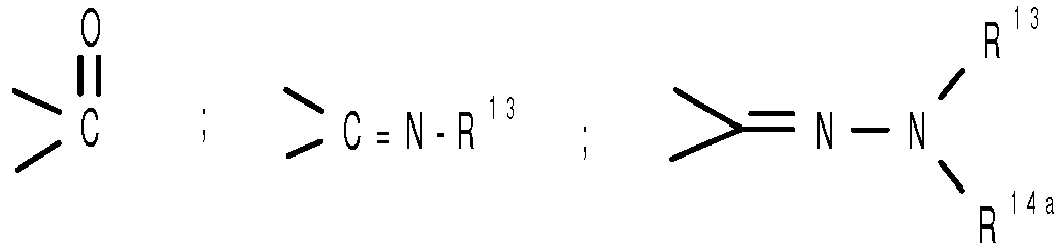

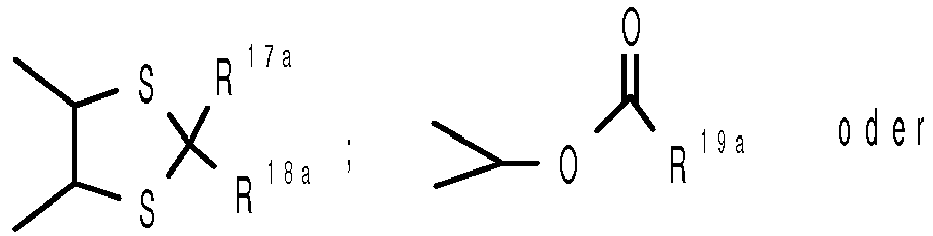

- A und Q1 stehen bevorzugt gemeinsam mit den Kohlenstoffatomen, an die sie gebunden sind, für jeweils gegebenenfalls einfach oder zweifach, gleich oder verschieden durch Halogen, Hydroxy, durch jeweils gegebenenfalls einfach bis dreifach, gleich oder verschieden durch Halogen substituiertes C1-C10-Alkyl, C1-C8-Alkenyl, C1-C6-Alkoxy, C1-C6-Alkylthio, C3-C7-Cycloalkyl oder durch jeweils gegebenenfalls einfach bis dreifach, gleich oder verschieden durch Halogen, C1-C6-Alkyl oder C1-C6-Alkoxy substituiertes Benzyloxy oder Phenyl substituiertes C3-C6-Alkandiyl oder C4-C6-Alkendiyl, welches außerdem gegebenenfalls eine der nachstehenden Gruppen


- B und Q2 stehen gemeinsam bevorzugt für gegebenenfalls durch C1-C2-Alkyl substituiertes C1-C3-Alkandiyl, welches gegebenenfalls durch Sauerstoff unterbrochen sein kann, oder
- D und Q1 stehen gemeinsam bevorzugt für gegebenenfalls einfach oder zweifach, gleich oder verschieden durch C1-C4-Alkyl, C1-C4-Alkoxy substituiertes C3-C6-Alkandiyl, oder
- Q1 steht bevorzugt für Wasserstoff, C1-C6-Alkyl, C1-C6-Alkoxy-C1-C2-alkyl, gegebenenfalls durch Fluor, Chlor, C1-C4-Alkyl, C1-C2-Halogenalkyl oder C1-C4-Alkoxy substituiertes C3-C8-Cycloalkyl, worin gegebenenfalls eine Methylengruppe durch Sauerstoff oder Schwefel ersetzt ist oder gegebenenfalls durch Halogen, C1-C4-Alkyl, C1-C4-Alkoxy, C1-C2-Halogenalkyl, C1-C2-Halogenalkoxy, Cyano oder Nitro substituiertes Phenyl,
- Q2 Q4 Q5 und Q6 stehen unabhängig voneinander bevorzugt für Wasserstoff oder C1-C4-Alkyl,
- Q3 steht bevorzugt für Wasserstoff, C1-C6-Alkyl, C1-C6-Alkoxy, C1-C6-Alkylthio, C1-C6-Alkoxy-C1-C2-alkyl, C1-C6-Alkylthio-C1-C2-alkyl, gegebenenfalls durch C1-C4-Alkyl oder C1-C4-Alkoxy substituiertes C3-C8-Cycloalkyl, worin gegebenenfalls eine oder zwei Methylengruppen durch Sauerstoff oder Schwefel ersetzt sind oder gegebenenfalls durch Halogen, C1-C4-Alkyl, C1-C4-Alkoxy, C1-C2-Halogenalkyl, C1-C2-Halogenalkoxy, Cyano oder Nitro substituiertes Phenyl, oder
- Q1 und Q2 stehen bevorzugt mit dem Kohlenstoffatom, an das sie gebunden sind, für gegebenenfalls durch C1-C6-Alkyl, C1-C6-Alkoxy oder C1-C2-Halogenalkyl substituierten C3-C7-Ring, in welchem gegebenenfalls ein Ringglied durch Sauerstoff oder Schwefel ersetzt ist,
- Q3 und Q4 stehen bevorzugt gemeinsam mit dem Kohlenstoffatom, an das sie gebunden sind, für einen gegebenenfalls durch C1-C4-Alkyl, C1-C4-Alkoxy oder C1-C2-Halogenalkyl substituierten gesättigten oder ungesättigten C3-C7-Ring, in welchem gegebenenfalls ein oder zwei Ringglieder durch Sauerstoff oder Schwefel ersetzt sind,
- A und Q3 stehen bevorzugt gemeinsam mit den Kohlenstoffatomen, an die sie gebunden sind, für einen gesättigten oder ungesättigten, gegebenenfalls durch C1-C4-Alkyl, C1-C4-Alkoxy oder C1-C2-Halogenalkyl substituierten C3-C7-Ring, in welchem gegebenenfalls ein oder zwei Ringglieder durch Sauerstoff oder Schwefel ersetzt sind,
- A und Q5 stehen bevorzugt gemeinsam mit den Kohlenstoffatomen, an die sie gebunden sind, für einen gesättigten oder ungesättigten, gegebenenfalls durch C1-C4-Alkyl, C1-C4-Alkoxy oder C1-C2-Halogenalkyl substituierten C3-C7-Ring, in welchem gegebenenfalls ein Ringglied durch Sauerstoff oder Schwefel ersetzt ist,
- A und Q1 stehen bevorzugt gemeinsam mit den Kohlenstoffatomen, an die sie gebunden sind, für jeweils gegebenenfalls einfach oder zweifach, gleich oder verschieden durch Halogen, Hydroxy, durch jeweils gegebenenfalls einfach bis dreifach, gleich oder verschieden durch Halogen substituiertes C1-C10-Alkyl, C1-C8-Alkenyl, C1-C6-Alkoxy, C1-C6-Alkylthio, C3-C7-Cycloalkyl oder durch jeweils gegebenenfalls einfach bis dreifach, gleich oder verschieden durch Halogen, C1-C6-Alkyl oder C1-C6-Alkoxy substituiertes Benzyloxy oder Phenyl substituiertes C3-C6-Alkandiyl oder C4-C6-Alkendiyl, welches außerdem gegebenenfalls eine der nachstehenden Gruppen
- G steht bevorzugt für Wasserstoff (a) oder für eine der Gruppen

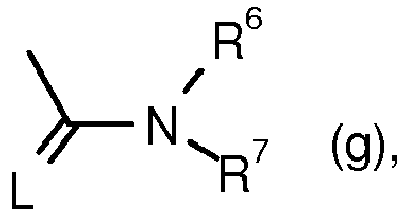
- E
- für ein Metallionäquivalent oder ein Ammoniumion steht,
- L
- für Sauerstoff oder Schwefel steht und
- M
- für Sauerstoff oder Schwefel steht.
- R1 steht bevorzugt für jeweils gegebenenfalls durch Halogen substituiertes C1-C20-Alkyl, C2-C20-Alkenyl, C1-C8-Alkoxy-C1-C8-alkyl, C1-C8-Alkylthio-C1-C8-alkyl, Poly-C1-C8-alkoxy-C1-C8-alkyl oder gegebenenfalls durch Halogen, C1-C6-Alkyl oder C1-C6-Alkoxy substituiertes C3-C8-Cycloalkyl, in welchem gegebenenfalls ein oder mehrere (bevorzugt nicht mehr als zwei) nicht direkt benachbarte Ringglieder durch Sauerstoff und/oder Schwefel ersetzt sind,
für gegebenenfalls durch Halogen, Cyano, Nitro, C1-C6-Alkyl, C1-C6-Alkoxy, C1-C6-Halogenalkyl, C1-C6-Halogenalkoxy, C1-C6-Alkylthio oder C1-C6-Alkylsulfonyl substituiertes Phenyl,
für gegebenenfalls durch Halogen, Nitro, Cyano, C1-C6-Alkyl, C1-C6-Alkoxy, C1-C6-Halogenalkyl oder C1-C6-Halogenalkoxy substituiertes Phenyl-C1-C6-alkyl,
für gegebenenfalls durch Halogen oder C1-C6-Alkyl substituiertes 5- oder 6-gliedriges Hetaryl (beispielsweise Pyrazolyl, Thiazolyl, Pyridyl, Pyrimidyl, Furanyl oder Thienyl),
für gegebenenfalls durch Halogen oder C1-C6-Alkyl substituiertes Phenoxy-C1-C6-alkyl oder
für gegebenenfalls durch Halogen, Amino oder C1-C6-Alkyl substituiertes 5- oder 6-gliedriges Hetaryloxy-C1-C6-alkyl (beispielsweise Pyridyloxy-C1-C6-alkyl, Pyrimidyloxy-C1-C6-alkyl oder Thiazolyloxy-C1-C6-alkyl), - R2 steht bevorzugt für jeweils gegebenenfalls durch Halogen substituiertes C1-C20-Alkyl, C2-C20-Alkenyl, C1-C8-Alkoxy-C2-C8-alkyl, Poly-C1-C8-alkoxy-C2-C8-alkyl,
für gegebenenfalls durch Halogen, C1-C6-Alkyl oder C1-C6-Alkoxy substituiertes C3-C8-Cycloalkyl oder
für jeweils gegebenenfalls durch Halogen, Cyano, Nitro, C1-C6-Alkyl, C1-C6-Alkoxy, C1-C6-Halogenalkyl oder C1-C6-Halogenalkoxy substituiertes Phenyl oder Benzyl, - R3 steht bevorzugt für gegebenenfalls durch Halogen substituiertes C1-C8-Alkyl oder für jeweils gegebenenfalls durch Halogen, C1-C6-Alkyl, C1-C6-Alkoxy, C1-C4-Halogenalkyl, C1-C4-Halogenalkoxy, Cyano oder Nitro substituiertes Phenyl oder Benzyl,
- R4 und R5 stehen bevorzugt unabhängig voneinander für jeweils gegebenenfalls durch Halogen substituiertes C1-C8-Alkyl, C1-C8-Alkoxy, C1-C8-Alkylamino, Di-(C1-C8-alkyl)amino, C1-C8-Alkylthio, C2-C8-Alkenylthio, C3-C7-Cycloalkylthio oder für jeweils gegebenenfalls durch Halogen, Nitro, Cyano, C1-C4-Alkoxy, C1-C4-Halogenalkoxy, C1-C4-Alkylthio, C1-C4-Halogenalkylthio, C1-C4-Alkyl oder C1-C4-Halogenalkyl substituiertes Phenyl, Phenoxy oder Phenylthio,
- R6 und R7 stehen unabhängig voneinander bevorzugt für Wasserstoff, für jeweils gegebenenfalls durch Halogen substituiertes C1-C8-Alkyl, C3-C8-Cycloalkyl, C1-C8-Alkoxy, C3-C8-Alkenyl, C1-C8-Alkoxy-C1-C8-alkyl, für gegebenenfalls durch Halogen, C1-C8-Halogenalkyl, C1-C8-Alkyl oder C1-C8-Alkoxy substituiertes Phenyl, gegebenenfalls durch Halogen, C1-C8-Alkyl, C1-C8-Halogenalkyl oder C1-C8-Alkoxy substituiertes Benzyl oder zusammen für einen gegebenenfalls durch C1-C4-Alkyl substituierten C3-C6-Alkylenrest, in welchem gegebenenfalls ein Kohlenstoffatom durch Sauerstoff oder Schwefel ersetzt ist,
- R13 steht bevorzugt für Wasserstoff, für jeweils gegebenenfalls durch Halogen substituiertes C1-C8-Alkyl oder C1-C8-Alkoxy (nur im Fall der C=N-R13-Gruppe), für gegebenenfalls durch Halogen, C1-C4-Alkyl oder C1-C4-Alkoxy substituiertes C3-C8-Cycloalkyl, in welchem gegebenenfalls eine Methylengruppe durch Sauerstoff oder Schwefel ersetzt ist, oder für jeweils gegebenenfalls durch Halogen, C1-C6-Alkyl, C1-C6-Alkoxy, C1-C4-Halogenalkyl, C1-C4-Halogenalkoxy, Nitro oder Cyano substituiertes Phenyl, Phenyl-C1-C4-alkyl, Hetaryl-C1-C4-alkyl, oder nur im Fall der C=N-R13-Gruppe für Phenyl-C1-C4-alkoxy oder Hetaryl-C1-C4-alkoxy,
- R14a steht bevorzugt für Wasserstoff oder C1-C8-Alkyl oder
- R13 und R14a stehen gemeinsam bevorzugt für gegebenenfalls durch C1-C4-Alkyl substituiertes C4-C6-Alkandiyl, welches gegebenenfalls durch Sauerstoff oder Schwefel unterbrochen sein kann,
- R15a und R16a sind gleich oder verschieden und stehen bevorzugt für C1-C6-Alkyl oder
- R15a und R16a stehen gemeinsam bevorzugt für einen C2-C4-Alkandiylrest oder C4-Alkandiylrest, der gegebenenfalls durch C1-C6-Alkyl, C1-C6-Halogenalkyl oder durch gegebenenfalls durch Halogen, C1-C6-Alkyl, C1-C4-Halogenalkyl, C1-C6-Alkoxy, C1-C4-Halogenalkoxy, Nitro oder Cyano substituiertes Phenyl substituiert ist,
- R17a und R18a stehen unabhängig voneinander bevorzugt für Wasserstoff, für gegebenenfalls durch Halogen substituiertes C1-C8-Alkyl oder für gegebenenfalls durch Halogen, C1-C6-Alkyl, C1-C6-Alkoxy, C1-C4-Halogenalkyl, C1-C4-Halogenalkoxy, Nitro oder Cyano substituiertes Phenyl oder
- R17a und R18a stehen gemeinsam mit dem Kohlenstoffatom, an das sie gebunden sind, bevorzugt für eine Carbonylgruppe oder für gegebenenfalls durch Halogen, C1-C4-Alkyl oder C1-C4-Alkoxy substituiertes C5-C7-Cycloalkyl, in dem gegebenenfalls eine Methylengruppe durch Sauerstoff oder Schwefel ersetzt ist,
- R19a und R20a stehen unabhängig voneinander bevorzugt für C1-C10-Alkyl, C2-C10-Alkenyl, C1-C10-Alkoxy, C1-C10-Alkylamino, C3-C10-Alkenylamino, Di-(C1-C10-alkyl)amino oder Di-(C3-C10-alkenyl)amino.
- U
- preferably represents -S-, -S (O) -, -S (O) 2 -, -O-,
- A
- is preferably hydrogen or in each case optionally halogen-substituted C 1 -C 12 -alkyl, C 3 -C 8 -alkenyl, C 1 -C 10 -alkoxy-C 1 -C 8 -alkyl, C 1 -C 10 -alkylthio- C 1 -C 6 -alkyl, optionally substituted by halogen, C 1 -C 6 -alkyl or C 1 -C 6 -alkoxy-substituted C 3 -C 8 -cycloalkyl, in which optionally one or two non-directly adjacent ring members by oxygen and / or sulfur are substituted or are each optionally substituted by halogen, C 1 -C 6 alkyl, C 1 -C 6 haloalkyl, C 1 -C 6 alkoxy, C 1 -C 6 haloalkoxy, cyano or nitro substituted phenyl, naphthyl, hetaryl having 5 to 6 ring atoms (for example furanyl, pyridyl, imidazolyl, triazolyl, pyrazolyl, pyrimidyl, thiazolyl or thienyl), phenyl-C 1 -C 6 -alkyl or naphthyl-C 1 -C 6 -alkyl,
- B
- is preferably hydrogen, C 1 -C 12 -alkyl or C 1 -C 8 -alkoxy-C 1 -C 6 -alkyl or
- A, B
- and the carbon atom to which they are attached are preferably saturated C 3 -C 10 -cycloalkyl or unsaturated C 5 -C 10 -cycloalkyl in which, where appropriate, a ring member is replaced by nitrogen, oxygen or sulfur and which are optionally mono- or disubstituted by C C 1 -C 8 -alkyl, C 1 -C 8 -alkoxy, C 3 -C 8 -alkenyloxy, C 1 -C 6 -alkoxy-C 1 -C 6 -alkyl, C 3 -C 6 -cycloalkyl-C 1 - C 2 -C alkoxy, C 3 -C 10 cycloalkyl, C 1 -C 8 haloalkyl, C 2 -C 6 haloalkoxy, C 1 -C 6 alkoxy-C 1 -C 4 alkoxy are substituted, the above mentioned radicals also come as N-substituents in question, or
- A, B
- and the carbon atom to which they are attached are preferably C 3 -C 6 -cycloalkyl which is optionally substituted by C 1 -C 4 -alkyl optionally containing one or two oxygen and / or sulfur atoms which are not directly adjacent to one another Alkylendiyl- or by an alkylenedioxy or by an alkylenedithioyl group which forms with the carbon atom to which it is bonded forms another five- to eight-membered ring, or
- A, B
- and the carbon atom to which they are attached are preferably C 3 -C 8 -cycloalkyl or C 5 -C 8 -cycloalkenyl in which two substituents together with the carbon atoms to which they are attached are each optionally substituted by C 1 -C 6 -alkyl, C 1 -C 6 -alkoxy or halogen-substituted C 2 -C 6 -alkanediyl, C 2 -C 6 -alkenediyl or C 4 -C 6 -alkandienediyl, in which optionally a methylene group is represented by oxygen or Sulfur is replaced,
- D
- is preferably hydrogen, in each case optionally halogen-substituted C 1 -C 12 -alkyl, C 3 -C 8 -alkenyl, C 3 -C 8 -alkynyl, C 1 -C 10 -alkoxy-C 1 -C 8 -alkyl, optionally C 3 -C 8 -cycloalkyl which is substituted by halogen, C 1 -C 4 -alkyl, C 1 -C 4 -alkoxy or C 1 -C 4 -haloalkyl and in which optionally a ring member is replaced by oxygen or sulfur or in each case optionally phenyl substituted by halogen, C 1 -C 6 -alkyl, C 1 -C 6 -haloalkyl, C 1 -C 6 -alkoxy, C 1 -C 6 -haloalkoxy, cyano or nitro, hetaryl having 5 or 6 ring atoms (for example furanyl , Imidazolyl, pyridyl, thiazolyl, pyrazolyl, pyrimidyl, pyrrolyl, thienyl or triazolyl), phenyl-C 1 -C 6 -alkyl or hetaryl-C 1 -C 6 -alkyl having 5 or 6 ring atoms (for example furanyl, imidazolyl, pyridyl, Thiazolyl, pyrazolyl, pyrimidyl, pyrrolyl, thienyl or triazolyl) or
- A and D
- together are preferably each optionally substituted C 3 -C 6 -alkanediyl or C 3 -C 6 -alkenediyl, wherein optionally a methylene group is replaced by a carbonyl group, oxygen or sulfur, and
- Halogen, hydroxy, mercapto or in each case optionally substituted by halogen C 1 -C 10 alkyl, C 1 -C 6 alkoxy, C 1 -C 6 alkylthio, C 3 -C 7 cycloalkyl, phenyl or benzyloxy, or another C 3 -C 6 -Alkandiylgruppierung, C 3 -C 6 -Alkendiylgruppierung or a Butadienylgruppierung, which is optionally substituted by C 1 -C 6 alkyl or in which optionally two adjacent substituents with the carbon atoms to which they are attached, another form saturated or unsaturated cycle with 5 or 6 ring atoms (in the case of the compound of formula (I-1) A and D then together with the atoms to which they are attached, for example, for groups AD-1 to AD-10 mentioned below, which may contain oxygen or sulfur, or in which optionally one of the following groups
- A and Q 1 are preferably taken together with the carbon atoms to which they are attached, each optionally mono- or disubstituted by identical or different halo, hydroxy, by each optionally mono- to trisubstituted by identical or different halogen-substituted C 1 -C 10 -Alkyl, C 1 -C 8 -alkenyl, C 1 -C 6 -alkoxy, C 1 -C 6 -alkylthio, C 3 -C 7 -cycloalkyl or by in each case optionally monosubstituted to trisubstituted, identical or different, by halogen, C 1 C 6 alkyl or C 1 -C 6 alkoxy-substituted benzyloxy or phenyl-substituted C 3 -C 6 alkanediyl or C 4 -C 6 alkylenediyl, which also optionally has one of the following groups
- B and Q 2 together are preferably C 1 -C 3 -alkanediyl optionally substituted by C 1 -C 2 -alkyl, which may optionally be interrupted by oxygen, or
- D and Q 1 together preferably represent optionally mono- or disubstituted by identical or different C 1 -C 4 -alkyl, C 1 -C 4 -alkoxy-substituted C 3 -C 6 -alkanediyl, or
- Q 1 is preferably hydrogen, C 1 -C 6 -alkyl, C 1 -C 6 -alkoxy-C 1 -C 2 -alkyl, optionally substituted by fluorine, chlorine, C 1 -C 4 -alkyl, C 1 -C 2 -Haloalkyl or C 1 -C 4 -alkoxy-substituted C 3 -C 8 -cycloalkyl in which, where appropriate, a methylene group is replaced by oxygen or sulfur or optionally by halogen, C 1 -C 4 -alkyl, C 1 -C 4 -alkoxy, C 1 -C 2 -haloalkyl, C 1 -C 2 -haloalkoxy, cyano or nitro-substituted phenyl,
- Q 2 Q 4 Q 5 and Q 6 independently of one another preferably represent hydrogen or C 1 -C 4 -alkyl,
- Q 3 is preferably hydrogen, C 1 -C 6 -alkyl, C 1 -C 6 -alkoxy, C 1 -C 6 -alkylthio, C 1 -C 6 -alkoxy-C 1 -C 2 -alkyl, C 1 - C 6 -alkylthio-C 1 -C 2 -alkyl, optionally C 1 -C 4 -alkyl or C 1 -C 4 -alkoxy-substituted C 3 -C 8 -cycloalkyl, in which optionally one or two methylene groups are replaced by oxygen or sulfur are phenyl optionally substituted by halogen, C 1 -C 4 alkyl, C 1 -C 4 alkoxy, C 1 -C 2 haloalkyl, C 1 -C 2 haloalkoxy, cyano or nitro, or
- Q 1 and Q 2 are preferably taken together with the carbon atom to which they are attached optionally C 1 -C 6 -alkyl, C 1 -C 6 -alkoxy or C 1 -C 2 -haloalkyl-substituted C 3 -C 7 ring in which optionally one ring member is replaced by oxygen or sulfur,
- Q 3 and Q 4 are preferably taken together with the carbon atom to which they are attached, for a saturated or unsaturated C optionally substituted by C 1 -C 4 alkyl, C 1 -C 4 alkoxy or C 1 -C 2 haloalkyl 3 -C 7 ring in which one or two ring members are optionally replaced by oxygen or sulfur,
- A and Q 3 are preferably taken together with the carbon atoms to which they are attached, for a saturated or unsaturated C, optionally substituted by C 1 -C 4 alkyl, C 1 -C 4 alkoxy or C 1 -C 2 haloalkyl 3 -C 7 ring in which one or two ring members are optionally replaced by oxygen or sulfur,
- A and Q 5 together with the carbon atoms to which they are attached are preferably a saturated or unsaturated C, optionally substituted by C 1 -C 4 -alkyl, C 1 -C 4 -alkoxy or C 1 -C 2 -haloalkyl 3 -C 7 ring, in which optionally a ring member is replaced by oxygen or sulfur,
- A and Q 1 are preferably taken together with the carbon atoms to which they are attached, each optionally mono- or disubstituted by identical or different halo, hydroxy, by each optionally mono- to trisubstituted by identical or different halogen-substituted C 1 -C 10 -Alkyl, C 1 -C 8 -alkenyl, C 1 -C 6 -alkoxy, C 1 -C 6 -alkylthio, C 3 -C 7 -cycloalkyl or by in each case optionally monosubstituted to trisubstituted, identical or different, by halogen, C 1 C 6 alkyl or C 1 -C 6 alkoxy-substituted benzyloxy or phenyl-substituted C 3 -C 6 alkanediyl or C 4 -C 6 alkylenediyl, which also optionally has one of the following groups
- G is preferably hydrogen (a) or one of the groups
- e
- represents a metal ion equivalent or an ammonium ion,
- L
- stands for oxygen or sulfur and
- M
- stands for oxygen or sulfur.
- R 1 preferably represents in each case optionally halogen-substituted C 1 -C 20 -alkyl, C 2 -C 20 -alkenyl, C 1 -C 8 -alkoxy-C 1 -C 8 -alkyl, C 1 -C 8 -alkylthio C 1 -C 8 -alkyl, poly-C 1 -C 8 -alkoxy-C 1 -C 8 -alkyl or optionally halogen-, C 1 -C 6 alkyl or C 1 -C 6 -alkoxy-substituted C 3 -C 8 -cycloalkyl, in which optionally one or more (preferred not more than two) not directly adjacent ring members are replaced by oxygen and / or sulfur,
is optionally substituted by halogen, cyano, nitro, C 1 -C 6 alkyl, C 1 -C 6 alkoxy, C 1 -C 6 haloalkyl, C 1 -C 6 haloalkoxy, C 1 -C 6 alkylthio or C C 1 -C 6 -alkylsulfonyl-substituted phenyl,
optionally substituted by halogen, nitro, cyano, C 1 -C 6 -alkyl, C 1 -C 6 -alkoxy, C 1 -C 6 -haloalkyl or C 1 -C 6 -haloalkoxy-substituted phenyl-C 1 -C 6 -alkyl .
optionally substituted by halogen or C 1 -C 6 alkyl 5- or 6-membered hetaryl (for example, pyrazolyl, thiazolyl, pyridyl, pyrimidyl, furanyl or thienyl),
optionally substituted by halogen or C 1 -C 6 alkyl-substituted phenoxy-C 1 -C 6 alkyl or
optionally substituted by halogen, amino or C 1 -C 6 -alkyl-substituted 5- or 6-membered hetaryloxy-C 1 -C 6 -alkyl (for example pyridyloxy-C 1 -C 6 -alkyl, pyrimidyloxy-C 1 -C 6 - alkyl or thiazolyloxy-C 1 -C 6 -alkyl), - R 2 preferably represents in each case optionally halogen-substituted C 1 -C 20 -alkyl, C 2 -C 20 -alkenyl, C 1 -C 8 -alkoxy-C 2 -C 8 -alkyl, poly-C 1 -C 8 - alkoxy-C 2 -C 8 -alkyl,
C 3 -C 8 -cycloalkyl optionally substituted by halogen, C 1 -C 6 -alkyl or C 1 -C 6 -alkoxy or
in each case optionally halogen, cyano, nitro, C 1 -C 6 -alkyl, C 1 -C 6 -alkoxy, C 1 -C 6 -haloalkyl or C 1 -C 6 -haloalkoxy-substituted phenyl or benzyl, - R 3 is preferably C 1 -C 8 -alkyl which may be substituted by halogen or is in each case optionally halogen, C 1 -C 6 -alkyl, C 1 -C 6 -alkoxy, C 1 -C 4 -haloalkyl, C 1 - C 4 haloalkoxy, cyano or nitro substituted phenyl or benzyl,
- R 4 and R 5 are preferably each independently of the other each optionally halogen-substituted C 1 -C 8 -alkyl, C 1 -C 8 -alkoxy, C 1 -C 8 -alkylamino, di- (C 1 -C 8 -alkyl) amino, C 1 -C 8 -alkylthio, C 2 -C 8 -alkenylthio, C 3 -C 7 -cycloalkylthio or in each case optionally by halogen, nitro, cyano, C 1 -C 4 -alkoxy, C 1 -C 4 - Haloalkoxy, C 1 -C 4 -alkylthio, C 1 -C 4 -haloalkylthio, C 1 -C 4 -alkyl or C 1 -C 4 -haloalkyl-substituted phenyl, phenoxy or phenylthio,
- R 6 and R 7 independently of one another preferably represent hydrogen, in each case optionally halogen-substituted C 1 -C 8 -alkyl, C 3 -C 8 -cycloalkyl, C 1 -C 8 -alkoxy, C 3 -C 8 -alkenyl, C 1 -C 8 -alkoxy-C 1 -C 8 -alkyl, phenyl optionally substituted by halogen, C 1 -C 8 -haloalkyl, C 1 -C 8 -alkyl or C 1 -C 8 -alkoxy, optionally by halogen , C 1 -C 8 alkyl, C 1 -C 8 haloalkyl or C 1 -C 8 -alkoxy-substituted benzyl or together represent an optionally C 1 -C 4 alkyl-substituted C 3 -C 6 -alkylene radical in which optionally a carbon atom is replaced by oxygen or sulfur,
- R 13 preferably represents hydrogen, in each case optionally halogen-substituted C 1 -C 8 -alkyl or C 1 -C 8 -alkoxy (only in the case of the C =NR 13 group), optionally represented by halogen, C 1 -C 4- alkyl or C 1 -C 4 -alkoxy-substituted C 3 -C 8 -cycloalkyl in which optionally a methylene group is replaced by oxygen or sulfur, or for in each case optionally halogen, C 1 -C 6 -alkyl, C 1 - C 6 alkoxy, C 1 -C 4 haloalkyl, C 1 -C 4 haloalkoxy, nitro or cyano-substituted phenyl, phenyl-C 1 -C 4 alkyl, hetaryl-C 1 -C 4 alkyl, or only in Case of the C = NR 13 group for phenyl-C 1 -C 4 -alkoxy or hetaryl-C 1 -C 4 -alkoxy,
- R 14a is preferably hydrogen or C 1 -C 8 -alkyl or
- R 13 and R 14a together are preferably C 1 -C 4 -alkyl-substituted C 4 -C 6 -alkanediyl, which may optionally be interrupted by oxygen or sulfur,
- R 15a and R 16a are the same or different and are preferably C 1 -C 6 -alkyl or
- R 15a and R 16a together are preferably a C 2 -C 4 -alkanediyl radical or C 4 -alkanediyl radical, which is optionally substituted by C 1 -C 6 -alkyl, C 1 -C 6 -haloalkyl or by halogen, where appropriate C 1 - C 6 alkyl, C 1 -C 4 haloalkyl, C 1 -C 6 alkoxy, C 1 -C 4 haloalkoxy, nitro or cyano substituted phenyl,
- R 17a and R 18a are each, independently of one another, preferably hydrogen, C 1 -C 8 -alkyl optionally substituted by halogen or optionally halogen, C 1 -C 6 -alkyl, C 1 -C 6 -alkoxy, C 1 -C 4 -haloalkyl, C 1 -C 4 -haloalkoxy, nitro or cyano-substituted phenyl or
- R 17a and R 18a together with the carbon atom to which they are attached are preferably a carbonyl group or optionally halogen, C 1 -C 4 -alkyl or C 1 -C 4 -alkoxy substituted C 5 -C 7 -cycloalkyl in which optionally a methylene group is replaced by oxygen or sulfur,
- R 19a and R 20a are each, independently of one another, preferably C 1 -C 10 -alkyl, C 2 -C 10 -alkenyl, C 1 -C 10 -alkoxy, C 1 -C 10 -alkylamino, C 3 -C 10 -alkenylamino, Di (C 1 -C 10 alkyl) amino or di (C 3 -C 10 alkenyl) amino.
In den als bevorzugt genannten Restedefinitionen steht Halogen für Fluor, Chlor, Brom und Jod, insbesondere für Fluor, Chlor und Brom.
- W
- steht besonders bevorzugt für Wasserstoff, Fluor, Chlor, Brom, C1-C4-Alkyl, C1-C4-Alkoxy, C1-C2-Halogenalkyl oder C1-C2-Halogenalkoxy,
- X
- steht besonders bevorzugt für Chlor, Brom, Iod, C1-C4-Alkyl, C2-C4-Alkenyl, C2-C4-Alkinyl, C1-C4-Alkoxy, C1-C2-Halogenalkyl, C1-C2-Halogenalkoxy oder Cyano,
- Y
- steht besonders bevorzugt für Wasserstoff, Methyl, Ethyl, Fluor, Chlor, Brom, Iod, Methoxy oder Ethoxy,
- Z
- steht besonders bevorzugt für die Gruppe
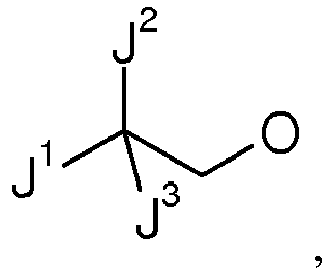
- CKE
- steht besonders bevorzugt für eine der Gruppen

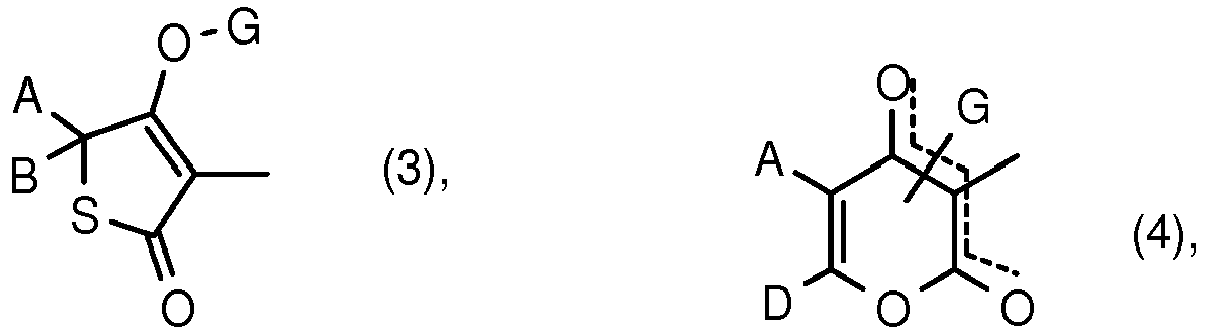


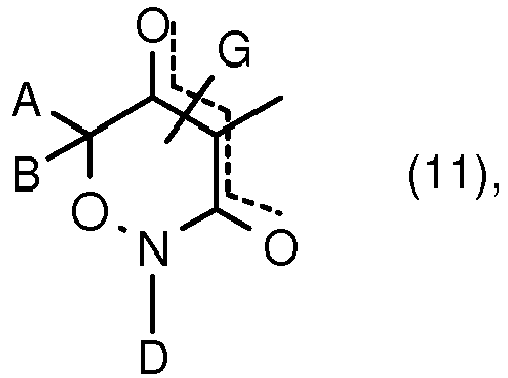
- U
- steht besonders bevorzugt für -CH2-, -CH2-CH2-, -O- oder

- A
- steht besonders bevorzugt für Wasserstoff, jeweils gegebenenfalls einfach bis dreifach durch Fluor oder Chlor substituiertes C1-C6-Alkyl, C1-C4-Alkoxy-C1-C2-alkyl, gegebenenfalls einfach bis zweifach durch C1-C2-Alkyl oder C1-C2-Alkoxy substituiertes und gegebenenfalls durch ein Sauerstoffatom unterbrochenes C3-C6-Cycloalkyl oder (jedoch nicht im Fall der Verbindungen der Formeln (I-3), (I-4), (I-6), (I-7), (I-9), (I-10) und (I-11)) jeweils gegebenenfalls einfach bis zweifach durch Fluor, Chlor, Brom, C1-C4-Alkyl, C1-C2-Halogenalkyl, C1-C4-Alkoxy, C1-C2-Halogenalkoxy, Cyano oder Nitro substituiertes Phenyl, Pyridyl oder Benzyl,
- B
- steht besonders bevorzugt für Wasserstoff, C1-C4-Alkyl oder C1-C2-Alkoxyl-C1-C2-alkyl oder
- A, B
- und das Kohlenstoffatom an das sie gebunden sind, stehen besonders bevorzugt für gesättigtes oder ungesättigtes C3-C7-Cycloalkyl, worin gegebenenfalls ein Ringglied durch Stickstoff, Sauerstoff oder Schwefel ersetzt ist und welches gegebenenfalls einfach bis zweifach durch C1-C6-Alkyl, C1-C4-Alkoxy-C1-C2-alkyl, Trifluormethyl, C1-C6-Alkoxy, C3-C6-Alkenyloxy, Trifluorethoxy, C1-C3-Alkoxy-C1-C3-alkoxy oder C3-C6-Cycloalkylmethoxy substituiert ist, wobei die zuvor genannten Reste auch als N-Substituenten in Frage kommen, mit der Maßgabe, dass dann Q3 besonders bevorzugt für Wasserstoff oder Methyl steht oder
- A, B
- und das Kohlenstoffatom, an das sie gebunden sind, stehen besonders bevorzugt für C5-C6-Cycloalkyl, welches durch eine gegebenenfalls ein oder zwei nicht direkt benachbarte Sauerstoff- oder Schwefelatome enthaltende gegebenenfalls durch Methyl oder Ethyl substituierte Alkylendiyl- oder durch eine Alkylendioxyl- oder durch eine Alkylendithiol-Gruppe substituiert ist, die mit dem Kohlenstoffatom, an das sie gebunden ist, einen weiteren fünf- oder sechsgliedrigen Ring bildet mit der Maßgabe, dass dann Q3 besonders bevorzugt für Wasserstoff oder Methyl steht, oder
- A, B
- und das Kohlenstoffatom, an das sie gebunden sind, stehen besonders bevorzugt für C3-C6-Cycloalkyl oder C5-C6-Cycloalkenyl, in welchen zwei Substituenten gemeinsam mit den Kohlenstoffatomen, an die sie gebunden sind, für jeweils gegebenenfalls durch C1-C2-Alkyl oder C1-C2-Alkoxy substituiertes C2-C4-Alkandiyl, C2-C4-Alkendiyl oder Butadiendiyl stehen, mit der Maßgabe, dass dann Q3 besonders bevorzugt für Wasserstoff oder Methyl steht,
- D
- steht besonders bevorzugt für Wasserstoff, für jeweils gegebenenfalls einfach bis dreifach durch Fluor substituiertes C1-C6-Alkyl, C3-C6-Alkenyl, C1-C4-Alkoxy-C1-C3-alkyl, für gegebenenfalls einfach bis zweifach durch C1-C4-Alkyl, C1-C4-Alkoxy oder C1-C2-Halogenalkyl substituiertes C3-C6-Cycloalkyl, in welchem gegebenenfalls eine Methylengruppe durch Sauerstoff ersetzt ist oder (nur im Fall der Verbindungen der Formeln (I-4)) für jeweils gegebenenfalls einfach bis zweifach durch Fluor, Chlor, Brom, C1-C4-Alkyl, C1-C4-Halogenalkyl, C1-C4-Alkoxy oder C1-C4-Halogenalkoxy substituiertes Phenyl oder Pyridyl, oder
- A und D
- stehen gemeinsam besonders bevorzugt für gegebenenfalls einfach bis zweifach substituiertes C3-C5-Alkandiyl, in welchem eine Methylengruppe durch eine Carbonylgruppe (nicht jedoch im Fall der Verbindungen der Formel (I-11)), Sauerstoff oder Schwefel ersetzt sein kann, wobei als Substituenten C1-C2-Alkyl oder C1-C2-Alkoxy in Frage kommen oder
- A und D
- stehen (im Fall der Verbindungen der Formel (I-1)) gemeinsam mit den Atomen, an die sie gebunden sind, für eine der Gruppen AD-1 bis AD-10:

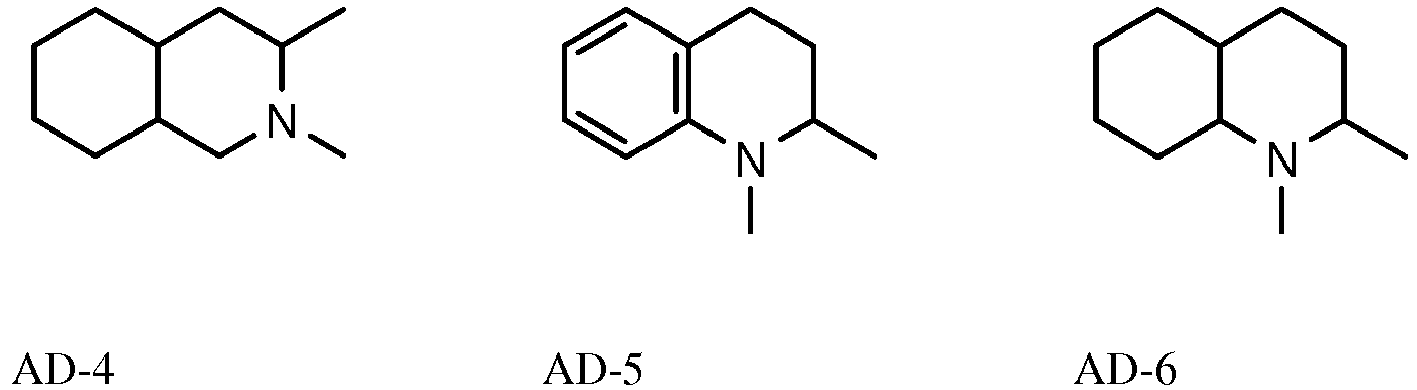
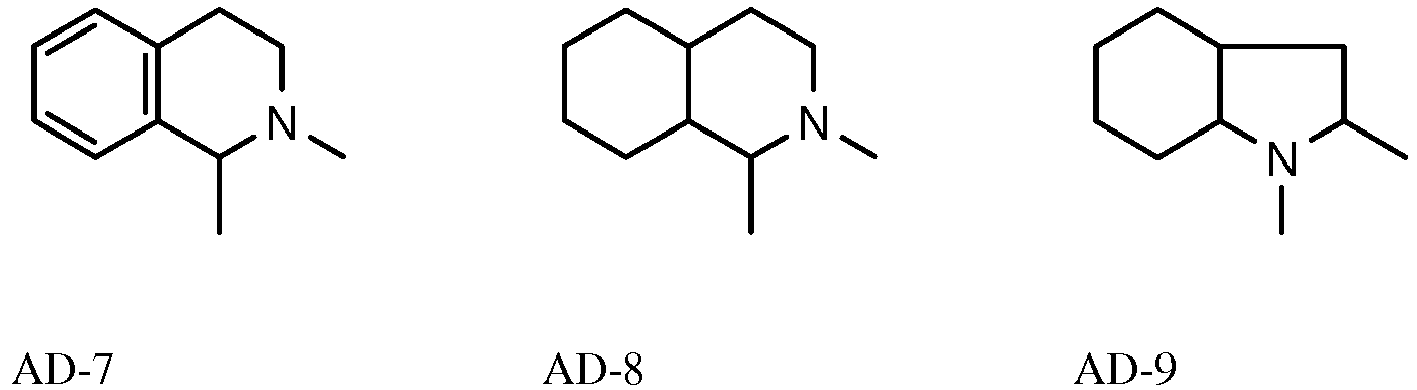
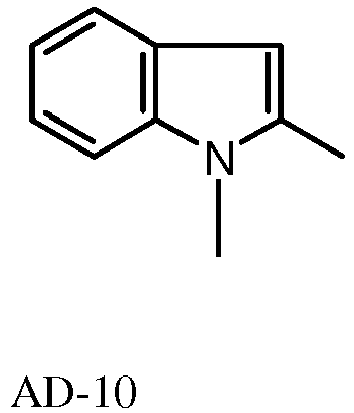
A und D stehen gemeinsam besonders bevorzugt für C3-C5-Alkandiyl, welches gegebenenfalls durch eine mit zwei nicht direkt benachbarten Sauerstoffatomen enthaltende gegebenenfalls einfach bis vierfach durch C1-C4-Alkyl oder C1-C3-Alkoxy-C1-C2-Alkyl substituierte Alkylendioxyl-Gruppe substituiert ist, wobei ein weiterer 5- oder 6-Ring gebildet wird, oder
- A und Q1 stehen gemeinsam besonders bevorzugt für gegebenenfalls einfach oder zweifach, gleich oder verschieden durch C1-C2-Alkyl oder C1-C2-Alkoxy substituiertes C3-C4-Alkandiyl, welches gegebenenfalls die nachfolgende Gruppe enthält:
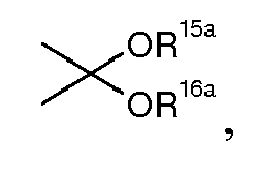
- R15a und R16a gleich oder verschieden besonders bevorzugt für Methyl oder Ethyl stehen, oder
- R15a und R16a gemeinsam besonders bevorzugt für einen C2-C4-Alkandiyl- oder C4-Alkendiylrest stehen, der gegebenenfalls durch Methyl oder Ethyl substituiert ist, oder
- B und Q2 stehen gemeinsam besonders bevorzugt für -CH2-, -CH2-CH2- -CH2-CH2-CH2-, oder -CH2-O-CH2-, oder
- D und Q1 stehen gemeinsam besonders bevorzugt für C3-C4-Alkandiyl, oder
- Q1 steht besonders bevorzugt für Wasserstoff, C1-C4-Alkyl, C1-C4-Alkoxy-C1-C2-alkyl, oder gegebenenfalls durch Methyl oder Methoxy substituiertes C3-C6-Cycloalkyl, worin gegebenenfalls eine Methylengruppe durch Sauerstoff ersetzt ist,
- Q2 steht besonders bevorzugt für Wasserstoff, Methyl oder Ethyl,
- Q4 Q5 und Q6 stehen besonders bevorzugt unabhängig voneinander für Wasserstoff oder C1-C3-Alkyl,
- Q3 steht besonders bevorzugt für Wasserstoff, C1-C4-Alkyl, C1-C4-Alkoxy, oder für gegebenenfalls einfach bis zweifach durch Methyl oder Methoxy substituiertes gegebenenfalls durch ein Sauerstoffatom unterbrochenes C3-C6-Cycloalkyl, oder
- Q1 und Q2 stehen besonders bevorzugt mit dem Kohlenstoff, an das sie gebunden sind, für gegebenenfalls durch Methyl oder Methoxy substituiertes C3-C6-Cycloalkyl, worin gegebenenfalls eine Methylengruppe durch Sauerstoff ersetzt ist, mit der Maßgabe, dass dann A und B besonders bevorzugt unabhängig voneinander für Wasserstoff oder Methyl stehen, oder
- Q3 und Q4 stehen besonders bevorzugt gemeinsam mit dem Kohlenstoff, an das sie gebunden sind, für einen gegebenenfalls durch C1-C2-Alkyl oder C1-C2-Alkoxy substituierten gesättigten C5-C6-Ring, in welchem gegebenenfalls ein oder zwei Ringglieder durch Sauerstoff oder Schwefel ersetzt sind, mit der Maßgabe, dass dann A besonders bevorzugt für Wasserstoff oder Methyl steht, oder
- A und Q3 stehen besonders bevorzugt gemeinsam mit dem Kohlenstoff, an das sie gebunden sind, für einen gegebenenfalls durch C1-C2-Alkyl oder C1-C2-Alkoxy substituierten gesättigten C5-C6-Ring, in welchem gegebenenfalls ein Ringglied durch Sauerstoff oder Schwefel ersetzt ist, mit der Maßgabe, dass dann B, Q4, Q5 und Q6 besonders bevorzugt unabhängig voneinander für Wasserstoff oder Methyl stehen, oder
- A und Q5 stehen besonders bevorzugt gemeinsam mit den Kohlenstoffatomen, an die sie gebunden sind, für einen gegebenenfalls durch C1-C2-Alkyl oder C1-C2-Alkoxy substituierten gesättigten oder ungesättigten C5-C6-Ring, mit der Maßgabe, dass dann B, Q3, Q4 und Q6 besonders bevorzugt unabhängig voneinenander für Wasserstoff oder Methyl stehen,
- G steht besonders bevorzugt für Wasserstoff (a) oder für eine der Gruppen

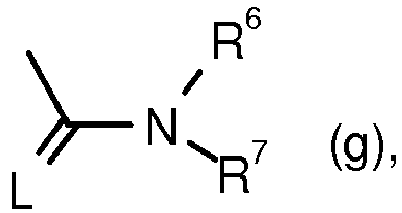
in welchen- E
- für ein Metallionäquivalent oder ein Ammoniumion steht,
- L
- für Sauerstoff oder Schwefel steht und
- M
- für Sauerstoff oder Schwefel steht,
- R1
- steht besonders bevorzugt für jeweils gegebenenfalls einfach bis dreifach durch Fluor oder Chlor substituiertes C1-C8-Alkyl, C2-C8-Alkenyl, C1-C4-Alkoxy-C1-C2-alkyl, C1-C4-Alkylthio-C1-C2-alkyl oder gegebenenfalls einfach bis zweifach durch Fluor, Chlor, C1-C2-Alkyl oder C1-C2-Alkoxy substituiertes C3-C6-Cycloalkyl, in welchem gegebenenfalls ein oder zwei nicht direkt benachbarte Ringglieder durch Sauerstoff ersetzt sind,
für gegebenenfalls einfach bis zweifach durch Fluor, Chlor, Brom, Cyano, Nitro, C1-C4-Alkyl, C1-C4-Alkoxy, C1-C2-Halogenalkyl oder C1-C2-Halogenalkoxy substituiertes Phenyl, - R2
- steht besonders bevorzugt für jeweils gegebenenfalls einfach bis dreifach durch Fluor substituiertes C1-C8-Alkyl, C2-C8-Alkenyl oder C1-C4-Alkoxy-C2-C4-alkyl,
für gegebenenfalls einfach durch C1-C2-Alkyl oder C1-C2-Alkoxy substituiertes C3-C6-Cycloalkyl oder
für jeweils gegebenenfalls einfach bis zweifach durch Fluor, Chlor, Brom, Cyano, Nitro, C1-C4-Alkyl, C1-C3-Alkoxy, Trifluormethyl oder Trifluormethoxy substituiertes Phenyl oder Benzyl, - R3
- steht besonders bevorzugt für gegebenenfalls einfach bis dreifach durch Fluor substituiertes C1-C6-Alkyl oder für gegebenenfalls einfach durch Fluor, Chlor, Brom, C1-C4-Alkyl, C1-C4-Alkoxy, Trifluormethyl, Trifluormethoxy, Cyano oder Nitro substituiertes Phenyl,
- R4
- steht besonders bevorzugt für C1-C6-Alkyl, C1-C6-Alkoxy, C1-C6-Alkylamino, Di-(C1-C6-alkyl)amino, C1-C6-Alkylthio, C3-C4-Alkenylthio, C3-C6-Cycloalkylthio oder für jeweils gegebenenfalls einfach durch Fluor, Chlor, Brom, Nitro, Cyano, C1-C3-Alkoxy, C1-C3-Halogenalkoxy, C1-C3-Alkylthio, C1-C3-Halogenalkylthio, C1-C3-Alkyl oder Trifluormethyl substituiertes Phenyl, Phenoxy oder Phenylthio,
- R5
- steht besonders bevorzugt für C1-C6-Alkoxy oder C1-C6-Alkylthio,
- R6
- steht besonders bevorzugt für Wasserstoff, C1-C6-Alkyl, C3-C6-Cycloalkyl, C1-C6-Alkoxy, C3-C6-Alkenyl, C1-C6-Alkoxy-C1-C4-alkyl, für gegebenenfalls einfach durch Fluor, Chlor, Brom, Trifluormethyl, C1-C4-Alkyl oder C1-C4-Alkoxy substituiertes Phenyl, für gegebenenfalls einfach durch Fluor, Chlor, Brom, C1-C4-Alkyl, Trifluormethyl oder C1-C4-Alkoxy substituiertes Benzyl,
- R7
- steht besonders bevorzugt für C1-C6-Alkyl, C3-C6-Alkenyl oder C1-C6-Alkoxy-C1-C4-alkyl,
- R6 und R7
- stehen besonders bevorzugt zusammen für einen gegebenenfalls durch Methyl oder
Ethyl substituierten C4-C5-Alkylenrest, in welchem gegebenenfalls eine Methylengruppe durch Sauerstoff oder Schwefel ersetzt ist.
- W
- particularly preferably represents hydrogen, fluorine, chlorine, bromine, C 1 -C 4 -alkyl, C 1 -C 4 -alkoxy, C 1 -C 2 -haloalkyl or C 1 -C 2 -haloalkoxy,
- X
- particularly preferably represents chlorine, bromine, iodine, C 1 -C 4 alkyl, C 2 -C 4 alkenyl, C 2 -C 4 alkynyl, C 1 -C 4 alkoxy, C 1 -C 2 haloalkyl, C 1 -C 2 haloalkoxy or cyano,
- Y
- particularly preferably represents hydrogen, methyl, ethyl, fluorine, chlorine, bromine, iodine, methoxy or ethoxy,
- Z
- is particularly preferred for the group
- CKE
- is particularly preferably one of the groups
- U
- is particularly preferably -CH 2 -, -CH 2 -CH 2 -, -O- or
- A
- particularly preferably represents hydrogen, in each case optionally monosubstituted to trisubstituted by fluorine or chlorine, C 1 -C 6 -alkyl, C 1 -C 4 -alkoxy-C 1 -C 2 -alkyl, optionally mono- to disubstituted by C 1 -C 2 -Alkyl or C 1 -C 2 -alkoxy-substituted and optionally interrupted by an oxygen atom C 3 -C 6 -cycloalkyl or (however not in the case of the compounds of the formulas (I-3), (I-4), (I-6), (I-7), (I-9), (I-10) and (I-11)), respectively optionally mono- to disubstituted by fluorine, chlorine, bromine, C 1 -C 4 -alkyl, C 1 -C 2 -haloalkyl, C 1 -C 4 -alkoxy, C 1 -C 2 -haloalkoxy, cyano or nitro-substituted phenyl, pyridyl or benzyl,
- B
- is particularly preferably hydrogen, C 1 -C 4 -alkyl or C 1 -C 2 -alkoxyl-C 1 -C 2 -alkyl or
- A, B
- and the carbon atom to which they are attached are particularly preferably saturated or unsaturated C 3 -C 7 -cycloalkyl, in which optionally one ring member is replaced by nitrogen, oxygen or sulfur and which is optionally mono- to disubstituted by C 1 -C 6 -alkyl , C 1 -C 4 -alkoxy-C 1 -C 2 -alkyl, trifluoromethyl, C 1 -C 6 -alkoxy, C 3 -C 6 -alkenyloxy, trifluoroethoxy, C 1 -C 3 -alkoxy-C 1 -C 3 -alkoxy or C 3 -C 6 -cycloalkylmethoxy is substituted, wherein the aforementioned radicals also come as N-substituents in question, with the proviso that then Q 3 is particularly preferably hydrogen or methyl or
- A, B
- and the carbon atom to which they are attached are particularly preferably C 5 -C 6 -cycloalkyl which is represented by an optionally one or two alkylenediyl radicals which are unsubstituted or substituted by methyl or ethyl and which are not directly adjacent to oxygen or sulfur atoms. or is substituted by an alkylenedithiol group which forms, with the carbon atom to which it is bonded, another five- or six-membered ring with the proviso that Q 3 is particularly preferably hydrogen or methyl, or
- A, B
- and the carbon atom to which they are attached are particularly preferably C 3 -C 6 -cycloalkyl or C 5 -C 6 -cycloalkenyl, in which two substituents together with the carbon atoms to which they are attached are each optionally substituted by C 1 -C 2 alkyl or C 1 -C 2 -alkoxy-substituted C 2 -C 4 -alkanediyl, C 2 -C 4 -alkenediyl or butadienediyl radicals, with the proviso that Q 3 particularly preferably represents hydrogen or methyl,
- D
- is particularly preferably hydrogen, each optionally optionally mono- to trisubstituted by fluorine-substituted C 1 -C 6 alkyl, C 3 -C 6 alkenyl, C 1 -C 4 alkoxy-C 1 -C 3 alkyl, for optionally simple up to two times by C 1 -C 4 alkyl, C 1 -C 4 alkoxy or C 1 -C 2 haloalkyl-substituted C 3 -C 6 cycloalkyl, in which optionally a methylene group is replaced by oxygen or (only in the case of Compounds of the formulas (I-4)), in each case optionally mono- to disubstituted by fluorine, chlorine, bromine, C 1 -C 4 -alkyl, C 1 -C 4 -haloalkyl, C 1 -C 4 -alkoxy or C 1 -C 4 -haloalkoxy-substituted phenyl or pyridyl, or
- A and D
- together are particularly preferably together for optionally mono- to disubstituted C 3 -C 5 -alkanediyl in which a methylene group by a carbonyl group (but not in the case of the compounds of formula (I-11)), oxygen or sulfur may be replaced, wherein Substituents C 1 -C 2 alkyl or C 1 -C 2 alkoxy come into question or
- A and D
- (in the case of the compounds of the formula (I-1)) together with the atoms to which they are attached, for one of the groups AD-1 to AD-10:
A and D together particularly preferably represent C 3 -C 5 -alkanediyl which is optionally substituted by one to two not directly adjacent oxygen atoms, optionally containing one to four times by C 1 -C 4 alkyl or C 1 -C 3 alkoxy-C 1 -C 2 alkyl substituted alkylenedioxy group is substituted to form another 5- or 6-ring, or
- A and Q 1 together are particularly preferably C 3 -C 4 -alkanediyl optionally mono- or disubstituted by identical or different C 1 -C 2 -alkyl or C 1 -C 2 -alkoxy and optionally containing the following group:
- R 15a and R 16a are the same or different and particularly preferably represent methyl or ethyl, or
- R 15a and R 16a together are particularly preferably a C 2 -C 4 -alkanediyl or C 4 -alkenediyl radical, which is optionally substituted by methyl or ethyl, or
- B and Q 2 together are particularly preferably -CH 2 -, -CH 2 -CH 2 - -CH 2 -CH 2 -CH 2 -, or -CH 2 -O-CH 2 -, or
- D and Q 1 together are particularly preferably C 3 -C 4 alkanediyl, or
- Q 1 particularly preferably represents hydrogen, C 1 -C 4 -alkyl, C 1 -C 4 -alkoxy-C 1 -C 2 -alkyl, or optionally C 3 -C 6 -cycloalkyl which is substituted by methyl or methoxy, where appropriate one Methylene group is replaced by oxygen,
- Q 2 particularly preferably represents hydrogen, methyl or ethyl,
- Q 4 Q 5 and Q 6 particularly preferably independently of one another represent hydrogen or C 1 -C 3 -alkyl,
- Q 3 particularly preferably represents hydrogen, C 1 -C 4 -alkyl, C 1 -C 4 -alkoxy, or represents optionally mono- to disubstituted by methyl or methoxy optionally interrupted by an oxygen atom interrupted C 3 -C 6 -cycloalkyl, or
- Q 1 and Q 2 are particularly preferably the carbon to which they are attached, optionally substituted by methyl or methoxy C 3 -C 6 -cycloalkyl, wherein optionally a methylene group is replaced by oxygen, with the proviso that then A and B particularly preferably independently of one another represent hydrogen or methyl, or
- Q 3 and Q 4 are particularly preferably taken together with the carbon to which they are attached, for a saturated C 5 -C 6 ring optionally substituted by C 1 -C 2 alkyl or C 1 -C 2 alkoxy, in which optionally one or two ring members are replaced by oxygen or sulfur, with the proviso that A is then particularly preferably hydrogen or methyl, or
- A and Q 3 are particularly preferably together with the carbon to which they are attached, for a saturated by C 1 -C 2 alkyl or C 1 -C 2 alkoxy-substituted saturated C 5 -C 6 ring, in which optionally a ring member is replaced by oxygen or sulfur, with the proviso that then B, Q 4 , Q 5 and Q 6 more preferably independently of one another are hydrogen or methyl, or
- A and Q 5 are particularly preferably taken together with the carbon atoms to which they are attached, for a saturated or unsaturated C 5 -C 6 ring optionally substituted by C 1 -C 2 -alkyl or C 1 -C 2 -alkoxy with the proviso that then B, Q 3 , Q 4 and Q 6 particularly preferably independently of one another represent hydrogen or methyl,
- G is particularly preferably hydrogen (a) or one of the groups
in which- e
- represents a metal ion equivalent or an ammonium ion,
- L
- stands for oxygen or sulfur and
- M
- stands for oxygen or sulfur,
- R 1
- particularly preferably represents in each case optionally mono- to trisubstituted by fluorine or chlorine-substituted C 1 -C 8 -alkyl, C 2 -C 8 -alkenyl, C 1 -C 4 -alkoxy-C 1 -C 2 -alkyl, C 1 -C 4- alkylthio-C 1 -C 2 -alkyl or optionally once or twice by fluorine, chlorine, C 1 -C 2 -alkyl or C 1 -C 2 -alkoxy-substituted C 3 -C 6 -cycloalkyl in which optionally one or two non-directly adjacent ring members are replaced by oxygen,
phenyl optionally substituted once to twice by fluorine, chlorine, bromine, cyano, nitro, C 1 -C 4 alkyl, C 1 -C 4 alkoxy, C 1 -C 2 haloalkyl or C 1 -C 2 haloalkoxy, - R 2
- particularly preferably represents in each case optionally mono- to trisubstituted by fluorine-substituted C 1 -C 8 -alkyl, C 2 -C 8 -alkenyl or C 1 -C 4 -alkoxy-C 2 -C 4 -alkyl,
for optionally monosubstituted by C 1 -C 2 alkyl or C 1 -C 2 alkoxy substituted C 3 -C 6 cycloalkyl or
in each case optionally mono- to disubstituted by fluorine, chlorine, bromine, cyano, nitro, C 1 -C 4 -alkyl, C 1 -C 3 -alkoxy, trifluoromethyl or trifluoromethoxy-substituted phenyl or benzyl, - R 3
- particularly preferably represents optionally mono- to trisubstituted by fluorine-substituted C 1 -C 6 -alkyl or optionally simply by fluorine, chlorine, bromine, C 1 -C 4 -alkyl, C 1 -C 4 -alkoxy, trifluoromethyl, trifluoromethoxy, cyano or nitro substituted phenyl,
- R 4
- is particularly preferably C 1 -C 6 alkyl, C 1 -C 6 alkoxy, C 1 -C 6 alkylamino, di (C 1 -C 6 alkyl) amino, C 1 -C 6 alkylthio, C C 3 -C 4 -alkenylthio, C 3 -C 6 -cycloalkylthio or, if appropriate, in each case simply by fluorine, chlorine, bromine, nitro, cyano, C 1 -C 3 -alkoxy, C 1 -C 3 -haloalkoxy, C 1 -C 3- alkylthio, C 1 -C 3 -haloalkylthio, C 1 -C 3 -alkyl or trifluoromethyl-substituted phenyl, phenoxy or phenylthio,
- R 5
- particularly preferably represents C 1 -C 6 -alkoxy or C 1 -C 6 -alkylthio,
- R 6
- particularly preferably represents hydrogen, C 1 -C 6 -alkyl, C 3 -C 6 -cycloalkyl, C 1 -C 6 -alkoxy, C 3 -C 6 -alkenyl, C 1 -C 6 -alkoxy-C 1 -C 4 -alkyl, phenyl optionally substituted by fluorine, chlorine, bromine, trifluoromethyl, C 1 -C 4 -alkyl or C 1 -C 4 -alkoxy, optionally substituted by fluorine, chlorine, bromine, C 1 -C 4 - Alkyl, trifluoromethyl or C 1 -C 4 -alkoxy-substituted benzyl,
- R 7
- particularly preferably represents C 1 -C 6 -alkyl, C 3 -C 6 -alkenyl or C 1 -C 6 -alkoxy-C 1 -C 4 -alkyl,
- R 6 and R 7
- particularly preferably together represent an optionally methyl or
Ethyl-substituted C 4 -C 5 -alkylene radical in which optionally a methylene group is replaced by oxygen or sulfur.
In den als besonders bevorzugt genannten Restedefinitionen steht Halogen für Fluor, Chlor und Brom, insbesondere für Fluor und Chlor.
- W
- steht ganz besonders bevorzugt für Wasserstoff, Chlor, Methyl oder Ethyl,
- X
- steht ganz besonders bevorzugt für Chlor, Methyl, Ethyl, Methoxy oder Ethoxy,
- Y
- steht ganz besonders bevorzugt für Wasserstoff, Methyl oder Chlor,
- Z
- steht ganz besonders bevorzugt für die Gruppe
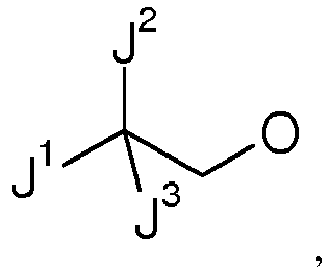
- CKE
- steht ganz besonders bevorzugt für eine der Gruppen
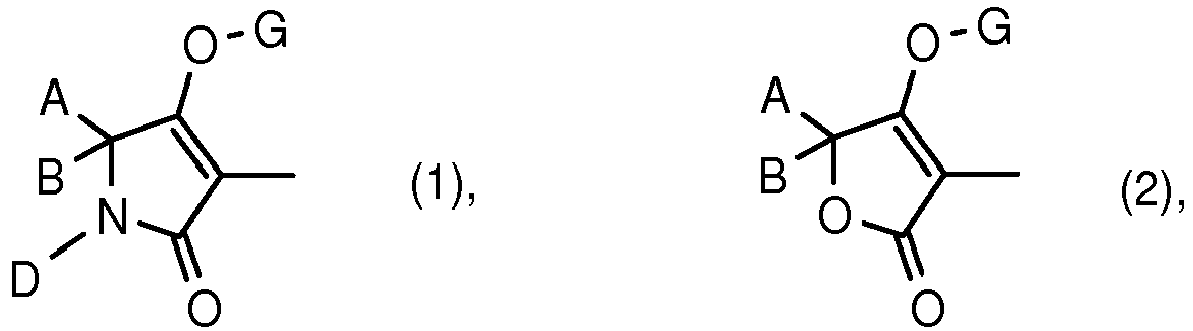
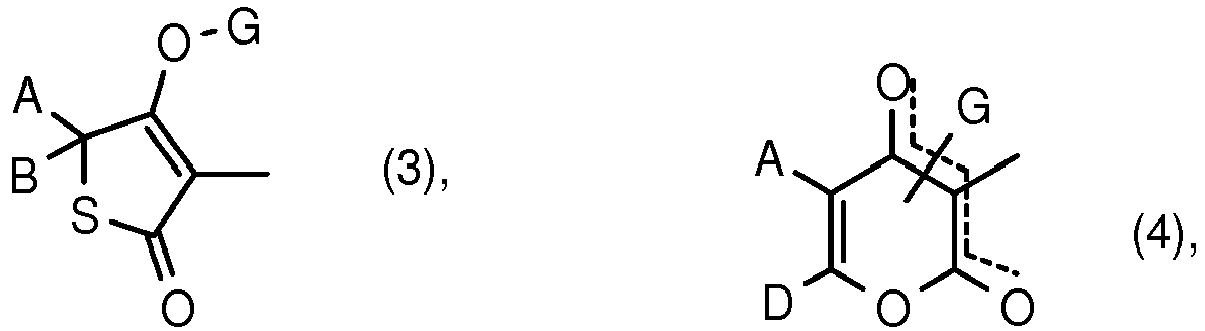


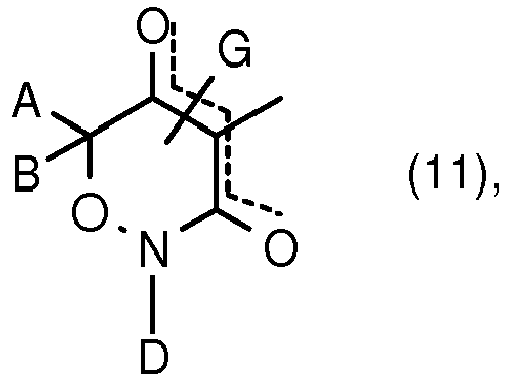
- U
- steht ganz besonders bevorzugt für -CH2-, -CH2-CH2-, -O- oder

- A
- steht ganz besonders bevorzugt für Wasserstoff, jeweils gegebenenfalls einfach bis dreifach durch Fluor substituiertes C1-C4-Alkyl oder C1-C2-Alkoxy-C1-C2-alkyl, für Cyclopropyl, Cyclopentyl oder Cyclohexyl und im Fall der Verbindungen der Formel (I-5) für gegebenenfalls einfach bis zweifach durch Fluor, Chlor, Brom, Methyl, Ethyl, n-Propyl, iso-Propyl, Methoxy, Ethoxy, Trifluormethyl, Trifluormethoxy, Cyano oder Nitro substituiertes Phenyl,
- B
- steht ganz besonders bevorzugt für Wasserstoff, Methyl oder Ethyl oder
- A, B
- und das Kohlenstoffatom an das sie gebunden sind, stehen ganz besonders bevorzugt für gesättigtes C5-C6-Cycloalkyl, in welchem gegebenenfalls ein Ringglied durch Stickstoff, Sauerstoff oder Schwefel ersetzt ist und welches gegebenenfalls einfach oder zweifach durch Methyl, Ethyl, Methoxymethyl, Ethoxymethyl, Methoxyethyl, Ethoxyethyl, Trifluormethyl, Methoxy, Ethoxy, Propoxy, Butoxy, Methoxyethoxy, Ethoxyethoxy, Allyloxy, Trifluorethoxy oder Cyclopropylmethoxy substituiert ist, wobei die zuvor genannten Reste auch als N-Substituenten in Frage kommen, mit der Maßgabe, dass dann Q3 ganz besonders bevorzugt für Wasserstoff steht oder
- A, B
- und das Kohlenstoffatom, an das sie gebunden sind, stehen ganz besonders bevorzugt für C6-Cycloalkyl, welches gegebenenfalls durch eine gegebenenfalls durch ein Sauerstoffatom unterbrochene Alkylidendiyl-Gruppe oder durch eine mit zwei nicht direkt benachbarten Sauerstoffatomen enthaltende Alkylendioxy-Gruppe substituiert ist, wobei ein weiter 5- oder 6-Ring gebildet wird (der einfach oder zweifach durch Methyl substituiert sein kann) mit der Maßgabe, dass dann Q3 ganz besonders bevorzugt für Wasserstoff steht oder
- A, B
- und das Kohlenstoffatom, an das sie gebunden sind, stehen ganz besonders bevorzugt für C5-C6-Cycloalkyl oder C5-C6-Cycloalkenyl, worin zwei Substituenten gemeinsam mit den Kohlenstoffatomen, an die sie gebunden sind, für C2-C4-Alkandiyl oder C2-C4-Alkendiyl oder Butadiendiyl stehen, mit der Maßgabe, dass dann Q3 ganz besonders bevorzugt für Wasserstoff steht,
- D
- steht ganz besonders bevorzugt für Wasserstoff, für jeweils gegebenenfalls einfach bis dreifach durch Fluor substituiertes C1-C4-Alkyl, C3-C4-Alkenyl, C1-C4-Alkoxy-C1-C3-alkyl, für Cyclopropyl, Cyclopentyl oder Cyclohexyl oder (im Fall der Verbindungen der Formeln (I-4)) für jeweils gegebenenfalls einfach durch Fluor, Chlor, Methyl, Ethyl, n-Propyl, iso-Propyl, Methoxy, Ethoxy oder Trifluormethyl substituiertes Phenyl oder Pyridyl,
- A und D stehen gemeinsam ganz besonders bevorzugt für gegebenenfalls einfach durch Methyl oder Methoxy substituiertes C3-C5-Alkandiyl, worin gegebenenfalls ein Kohlenstoffatom durch eine Carbonylgruppe (nicht jedoch im Fall der Verbindung der Formel (I-11)), Sauerstoff oder Schwefel ersetzt ist oder für die Gruppe AD-1 steht, oder
- A und D stehen gemeinsam ganz besonders bevorzugt für C3-C5-Alkandiyl, welches gegebenenfalls durch eine mit zwei nicht direkt benachbarten Sauerstoffatomen enthaltende gegebenenfalls einfach bis zweifach durch C1-C2-Alkyl substituierte Alkylendioxyl-Gruppe substituiert ist, wobei ein weiterer 5- Ring gebildet wird, oder
- A und Q1 stehen gemeinsam ganz besonders bevorzugt für gegebenenfalls einfach oder zweifach durch Methyl oder Methoxy substituiertes C3-C4-Alkandiyl, welches gegebenenfalls die nachfolgende Gruppe enthält:

- B und Q2 stehen gemeinsam ganz besonders bevorzugt für -CH2-CH2-CH2-, oder -CH2-O-CH2-, oder
- D und Q1 stehen gemeinsam ganz besonders bevorzugt für C3-C4-Alkandiyl oder
- Q1 steht ganz besonders bevorzugt für Wasserstoff, Methyl, Ethyl, Propyl, iso-Propyl, Cyclopropyl, Cyclopentyl oder Cyclohexyl,
- Q2 steht ganz besonders bevorzugt für Wasserstoff, Methyl oder Ethyl,
- Q4 Q5 und Q6 stehen ganz besonders bevorzugt unabhängig voneinander für Wasserstoff oder Methyl,
- Q3 steht ganz besonders bevorzugt für Wasserstoff, Methyl, Ethyl, Propyl, Methoxy oder Ethoxy, oder für gegebenenfalls einfach durch Methyl oder Methoxy substituiertes gegebenenfalls durch ein Sauerstoffatom unterbrochenes C3-C6-Cycloalkyl, oder
- Q1 und Q2 stehen ganz besonders bevorzugt mit dem Kohlenstoffatom, an das sie gebunden sind, für gegebenenfalls durch Methyl oder Methoxy substituiertes C5-C6-Cycloalkyl worin gegebenenfalls eine Methylengruppe durch Sauerstoff ersetzt ist, mit der Maßgabe, dass A und B für Wasserstoff stehen, oder
- Q3 und Q4 stehen ganz besonders bevorzugt gemeinsam mit dem Kohlenstoff, an den sie gebunden sind, für einen gegebenenfalls einfach durch Methyl oder Methoxy substituierten gegebenenfalls durch ein Sauerstoffatom unterbrochenen, gesättigten C5-C6-Ring, mit der Maßgabe, dass dann A, B, Q5 und Q6 ganz besonders bevorzugt für Wasserstoff stehen,
- G steht ganz besonders bevorzugt für Wasserstoff (a) oder für eine der Gruppen
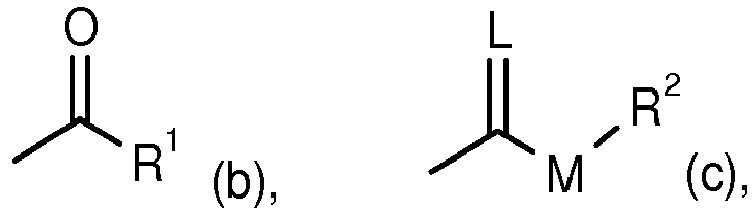
in welchen- L
- für Sauerstoff oder Schwefel steht,
- M
- für Sauerstoff oder Schwefel steht und
- E
- für ein Metallionäquivalent oder ein Ammoniumion steht,
- R1
- steht ganz besonders bevorzugt für jeweils gegebenenfalls einfach durch Chlor substituiertes C1-C6-Alkyl, C2-C6-Alkenyl, C1-C2-Alkoxy-C1-alkyl, C1-C2-Alkylthio-C1-alkyl oder jeweils gegebenenfalls einfach durch Fluor, Chlor, Methyl oder Methoxy substituiertes Cyclopropyl oder Cyclohexyl,
für gegebenenfalls einfach durch Fluor, Chlor, Brom, Cyano, Nitro, Methyl, Methoxy, Trifluormethyl oder Trifluormethoxy substituiertes Phenyl, - R2
- steht ganz besonders bevorzugt für jeweils gegebenenfalls einfach durch Fluor substituiertes C1-C8-Alkyl, C2-C6-Alkenyl oder C1-C4-Alkoxy-C2-C3-alkyl, Phenyl oder Benzyl,
- R3
- steht ganz besonders bevorzugt für C1-C8-Alkyl.
- W
- steht insbesondere bevorzugt für Wasserstoff, Methyl oder Ethyl,
- X
- steht insbesondere bevorzugt für Chlor, Methyl oder Ethyl,
- Y
- steht insbesondere bevorzugt für Wasserstoff,
- Z
- steht insbesondere bevorzugt für OCH2-CF3 in der 3-Position,
- Z
- steht insbesondere bevorzugt auch für OCH2-CF3 in der 4-Position,
- Z
- steht insbesondere bevorzugt ebenso für OCH2-CF3 in der 5-Position,
- CKE
- steht insbesondere bevorzugt für eine der Gruppen
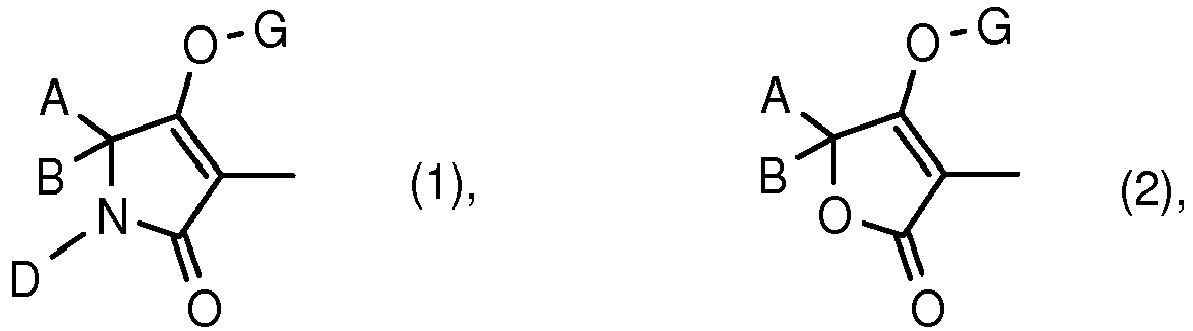
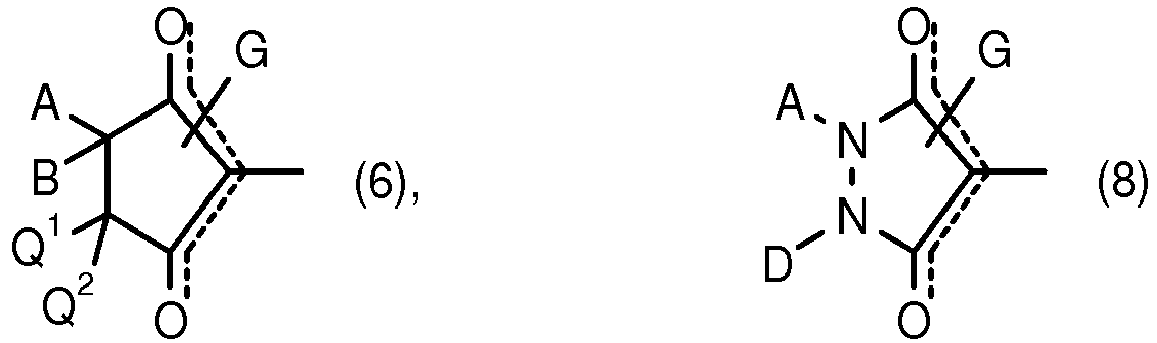
- A steht insbesondere bevorzugt für Methyl oder Ethyl,
- B steht insbesondere bevorzugt für Wasserstoff oder Methyl,
- A, B und das Kohlenstoffatom an das sie gebunden sind, stehen insbesondere bevorzugt für gesättigtes C5-C6-Cycloalkyl, in welchem gegebenenfalls ein Ringglied durch Sauerstoff ersetzt ist und welches gegebenenfalls einfach oder zweifach durch Methyl, Ethyl, Methoxymethyl, Methoxy, Ethoxy, Propoxy, Butoxy, Trifluorethoxy substituiert ist, oder
- A, B und das Kohlenstoffatom, an das sie gebunden sind, stehen ganz besonders bevorzugt für C6-Cycloalkyl, welches gegebenenfalls durch eine mit zwei nicht direkt benachbarten Sauerstoffatomen enthaltende Alkylendioxyl-Gruppe substituiert ist, wobei ein weiterer 5- oder 6-Ring gebildet wird, der einfach oder zweifach durch Methyl substituiert sein kann,
- D steht insbesondere bevorzugt für Wasserstoff, oder
- A und D stehen gemeinsam insbesondere bevorzugt für C3-C5-Alkandiyl, worin gegebenenfalls ein Kohlenstoffatom durch Sauerstoff ersetzt ist oder
- A und D stehen gemeinsam insbesondere bevorzugt für C3-C5-Alkandiyl, welches gegebenenfalls durch eine mit zwei nicht direkt benachbarten Sauerstoffatomen enthaltende gegebenenfalls einfach bis zweifach durch Methyl substituierte Alkylendioxyl-Gruppe substituiert ist, wobei ein weiterer 5- Ring gebildet wird, (hervorgehoben stehen A und D gemeinsam für C3-C5-Alkandiyl, welches gegebenenfalls durch eine mit zwei nicht direkt benachbarten Sauerstoffatomen enthaltende Alkylendioxy-Gruppe substituiert ist, wobei ein weiterer 5- Ring gebildet wird), oder
- A und Q1 stehen gemeinsam insbesondere bevorzugt für C3-C4-Alkandiyl,
- Q2 steht insbesondere bevorzugt für Wasserstoff,
- G steht insbesondere bevorzugt für Wasserstoff (a) oder für eine der Gruppen
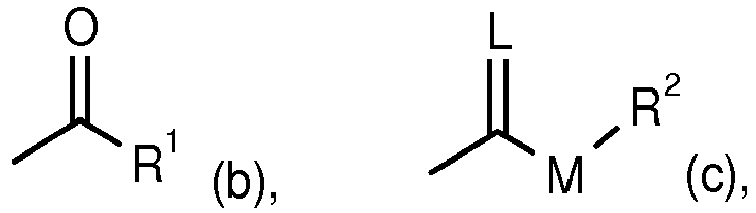
- L
- für Sauerstoff steht,
- M
- für Sauerstoff steht,
- R1
- steht insbesondere bevorzugt für C1-C6-Alkyl,
- R2
- steht insbesondere bevorzugt für C1-C6-Alkyl.
- W
- very particularly preferably represents hydrogen, chlorine, methyl or ethyl,
- X
- very particularly preferably represents chlorine, methyl, ethyl, methoxy or ethoxy,
- Y
- very particularly preferably represents hydrogen, methyl or chlorine,
- Z
- is most particularly preferred for the group
- CKE
- most preferably represents one of the groups
- U
- is very particularly preferably -CH 2 -, -CH 2 -CH 2 -, -O- or
- A
- very particularly preferably represents hydrogen, in each case optionally mono- to trisubstituted by fluorine-substituted C 1 -C 4 -alkyl or C 1 -C 2 -alkoxy-C 1 -C 2 -alkyl, for cyclopropyl, cyclopentyl or cyclohexyl and in the case of the compounds of the formula (I-5) phenyl which is optionally mono- to disubstituted by fluorine, chlorine, bromine, methyl, ethyl, n-propyl, isopropyl, methoxy, ethoxy, trifluoromethyl, trifluoromethoxy, cyano or nitro,
- B
- is very particularly preferably hydrogen, methyl or ethyl or
- A, B
- and the carbon atom to which they are attached very particularly preferably represent saturated C 5 -C 6 -cycloalkyl in which, where appropriate, a ring member is replaced by nitrogen, oxygen or sulfur and which is optionally mono- or disubstituted by methyl, ethyl, methoxymethyl, ethoxymethyl , Methoxyethyl, ethoxyethyl, trifluoromethyl, methoxy, ethoxy, propoxy, butoxy, methoxyethoxy, ethoxyethoxy, allyloxy, trifluoroethoxy or cyclopropylmethoxy, the above being substituted mentioned radicals also come as N-substituents in question, with the proviso that then Q 3 is very particularly preferably hydrogen or
- A, B
- and the carbon atom to which they are attached are very particularly preferably C 6 -cycloalkyl which is optionally substituted by an alkylidenediyl group which is optionally interrupted by an oxygen atom or by an alkylenedioxy group containing two oxygen atoms which are not directly adjacent, wherein further 5- or 6-ring is formed (which may be monosubstituted or disubstituted by methyl) with the proviso that then Q 3 is very particularly preferably hydrogen or
- A, B
- and the carbon atom to which they are attached are most preferably C 5 -C 6 cycloalkyl or C 5 -C 6 cycloalkenyl wherein two substituents together with the carbon atoms to which they are attached are C 2 -C 4 -alkanediyl or C 2 -C 4 -alkenediyl or butadienediyl radicals, with the proviso that Q 3 very particularly preferably represents hydrogen,
- D
- very particularly preferably represents hydrogen, in each case optionally mono- to trisubstituted by fluorine-substituted C 1 -C 4 -alkyl, C 3 -C 4 -alkenyl, C 1 -C 4 -alkoxy-C 1 -C 3 -alkyl, for cyclopropyl , Cyclopentyl or cyclohexyl or (in the case of the compounds of formulas (I-4)) each optionally substituted by fluorine, chlorine, methyl, ethyl, n-propyl, iso-propyl, methoxy, ethoxy or trifluoromethyl-substituted phenyl or pyridyl,
- A and D together are most particularly preferably C 3 -C 5 -alkanediyl optionally substituted by methyl or methoxy, wherein optionally a carbon atom is represented by a carbonyl group (but not in the case of the compound of formula (I-11)), oxygen or sulfur replaced or is the group AD-1, or
- A and D together are very particularly preferably C 3 -C 5 -alkanediyl which is optionally substituted by an alkylenedioxy group optionally substituted once or twice by C 1 -C 2 -alkyl which is optionally substituted once or twice by two oxygen atoms which are not directly adjacent, with another 5- ring is formed, or
- A and Q 1 together are very particularly preferably C 3 -C 4 -alkanediyl which is optionally monosubstituted or disubstituted by methyl or methoxy and which may optionally be substituted by methyl or methoxy following group contains:
- B and Q 2 together are very particularly preferably -CH 2 -CH 2 -CH 2 -, or -CH 2 -O-CH 2 -, or
- D and Q 1 together are very particularly preferably C 3 -C 4 alkanediyl or
- Q 1 very particularly preferably represents hydrogen, methyl, ethyl, propyl, isopropyl, cyclopropyl, cyclopentyl or cyclohexyl,
- Q 2 very particularly preferably represents hydrogen, methyl or ethyl,
- Q 4 Q 5 and Q 6 very particularly preferably independently of one another represent hydrogen or methyl,
- Q 3 very particularly preferably represents hydrogen, methyl, ethyl, propyl, methoxy or ethoxy, or represents optionally monosubstituted by methyl or methoxy optionally interrupted by an oxygen atom C 3 -C 6 -cycloalkyl, or
- Q 1 and Q 2 are most preferably the carbon atom to which they are attached for C 5 -C 6 cycloalkyl optionally substituted by methyl or methoxy, wherein optionally a methylene group is replaced by oxygen, provided that A and B stand for hydrogen, or
- Q 3 and Q 4 are very particularly preferably taken together with the carbon to which they are attached, for an optionally substituted by methyl or methoxy optionally interrupted by an oxygen atom, saturated C 5 -C 6 ring, with the proviso that then A, B, Q 5 and Q 6 most preferably represent hydrogen,
- G is very particularly preferably hydrogen (a) or one of the groups
in which- L
- stands for oxygen or sulfur,
- M
- stands for oxygen or sulfur and
- e
- represents a metal ion equivalent or an ammonium ion,
- R 1
- very particularly preferably represents in each case optionally monosubstituted by chlorine C 1 -C 6 -alkyl, C 2 -C 6 -alkenyl, C 1 -C 2 -alkoxy-C 1 -alkyl, C 1 -C 2 -alkylthio-C 1 alkyl or in each case optionally monosubstituted by fluorine, chlorine, methyl or methoxy substituted cyclopropyl or cyclohexyl,
optionally substituted by fluorine, chlorine, bromine, cyano, nitro, methyl, methoxy, trifluoromethyl or trifluoromethoxy phenyl, - R 2
- is very particularly preferably in each case optionally monosubstituted by fluorine, C 1 -C 8 -alkyl, C 2 -C 6 -alkenyl or C 1 -C 4 -alkoxy-C 2 -C 3 -alkyl, phenyl or benzyl,
- R 3
- is very particularly preferably C 1 -C 8 -alkyl.
- W
- is particularly preferably hydrogen, methyl or ethyl,
- X
- is particularly preferably chlorine, methyl or ethyl,
- Y
- is particularly preferably hydrogen,
- Z
- is particularly preferably OCH 2 -CF 3 in the 3-position,
- Z
- is particularly preferably also OCH 2 -CF 3 in the 4-position,
- Z
- particularly preferably also represents OCH 2 -CF 3 in the 5-position,
- CKE
- is particularly preferably one of the groups
- A particularly preferably represents methyl or ethyl,
- B is particularly preferably hydrogen or methyl,
- A, B and the carbon atom to which they are attached are particularly preferably saturated C 5 -C 6 -cycloalkyl, in which optionally one ring member is replaced by oxygen and which is optionally mono- or disubstituted by methyl, ethyl, methoxymethyl, methoxy, ethoxy , Propoxy, butoxy, trifluoroethoxy, or
- A, B and the carbon atom to which they are attached are very particularly preferably C 6 -cycloalkyl, which is optionally substituted by an alkylenedioxy group containing two oxygen atoms which are not directly adjacent, forming a further 5- or 6-membered ring which may be monosubstituted or disubstituted by methyl,
- D is particularly preferably hydrogen, or
- A and D together are particularly preferably C 3 -C 5 alkanediyl, wherein optionally one carbon atom is replaced by oxygen or
- A and D together are particularly preferably C 3 -C 5 -alkanediyl which is optionally substituted by an alkylenedioxy group optionally substituted once or twice by methyl with two oxygen atoms not directly adjacent to one another, whereby a further 5- ring is formed, ( A and D together are C 3 -C 5 -alkanediyl, which is optionally substituted by an alkylenedioxy group containing two oxygen atoms not directly adjacent to form another 5-ring), or
- A and Q 1 together are particularly preferably C 3 -C 4 alkanediyl,
- Q 2 is particularly preferably hydrogen,
- G is particularly preferably hydrogen (a) or one of the groups
- L
- stands for oxygen,
- M
- stands for oxygen,
- R 1
- is particularly preferably C 1 -C 6 -alkyl,
- R 2
- is particularly preferably C 1 -C 6 -alkyl.
Die oben aufgeführten allgemeinen oder in Vorzugsbereichen aufgeführten Restedefinitionen bzw. Erläuterungen können untereinander, also auch zwischen den jeweiligen Bereichen und Vorzugsbereichen beliebig kombiniert werden. Sie gelten für die Endprodukte sowie für die Vor- und Zwischenprodukte entsprechend.The general or preferred radical definitions or explanations given above can be combined as desired with one another, ie also between the respective ranges and preferred ranges. They apply accordingly to the end products as well as to the precursors and intermediates.
Erfindungsgemäß bevorzugt werden die Verbindungen der Formel (I), in welchen eine Kombination der vorstehend als bevorzugt (vorzugsweise) aufgeführten Bedeutungen vorliegt.Preference according to the invention is given to the compounds of the formula (I) which contain a combination of the meanings listed above as being preferred (preferred).
Erfindungsgemäß besonders bevorzugt werden die Verbindungen der Formel (I), in welchen eine Kombination der vorstehend als besonders bevorzugt aufgeführten Bedeutungen vorliegt.Particular preference according to the invention is given to the compounds of the formula (I) in which a combination of the meanings listed above as being particularly preferred is present.
Erfindungsgemäß ganz besonders bevorzugt werden die Verbindungen der Formel (I), in welchen eine Kombination der vorstehend als ganz besonders bevorzugt aufgeführten Bedeutungen vorliegt.Very particular preference according to the invention is given to the compounds of the formula (I) which contain a combination of the meanings given above as being very particularly preferred.
Erfindungsgemäß insbesondere bevorzugt werden die Verbindungen der Formel (I), in welchen eine Kombination der vorstehend als insbesondere bevorzugt aufgeführten Bedeutungen vorliegt.Especially preferred according to the invention are the compounds of the formula (I) which contain a combination of the meanings given above as being particularly preferred.
Hervorgehoben sind Verbindungen der Formel (I) in welchen G für Wasserstoff steht.Emphasis is given to compounds of the formula (I) in which G is hydrogen.
Gesättigte oder ungesättigte Kohlenwasserstoffreste wie Alkyl, Alkandiyl oder Alkenyl können, auch in Verbindung mit Heteroatomen, wie z.B. in Alkoxy, soweit möglich, jeweils geradkettig oder verzweigt sein.Saturated or unsaturated hydrocarbon radicals such as alkyl, alkanediyl or alkenyl can also be straight-chain or branched, as far as possible, also in combination with heteroatoms, for example in alkoxy.
Gegebenenfalls substituierte Reste können, sofern nicht anderes angegeben ist, einfach oder mehrfach substituiert sein, wobei bei Mehrfachsubstitutionen die Substituenten gleich oder verschieden sein können.Unless otherwise specified, optionally substituted radicals may be monosubstituted or polysubstituted, with multiple substituents the substituents being the same or different.
Im Einzelnen seien außer bei den Beispielen genannten Verbindungen die folgenden Verbindungen mit Z = OCH2-CF3 genannt:

Als erfindungsgemäße Wirkstoffe kommen insbesondere bevorzugt Verbindungen aus den in Tabelle 1 genannten Restekombinationen für W, X, Y und Z mit den in Tabellen 2a und 2b genannten Restekombinationen für A, B und D in Frage.
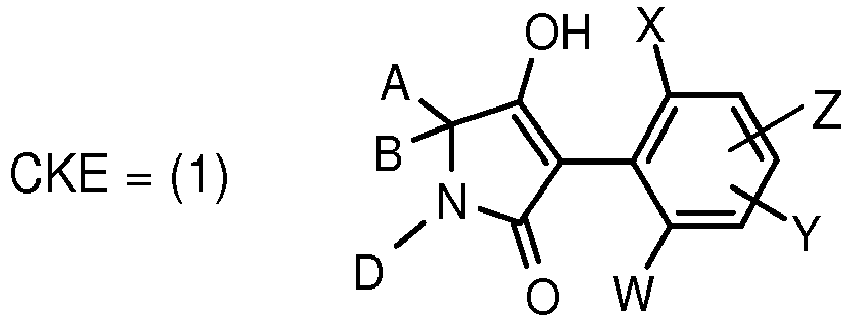


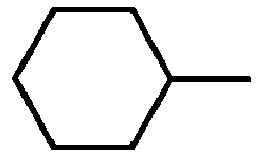
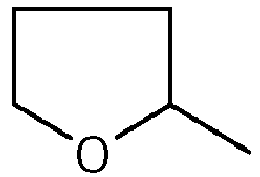
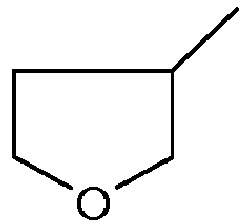
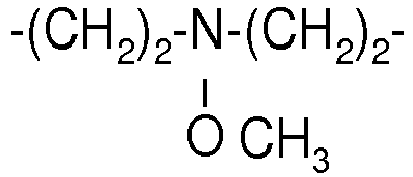

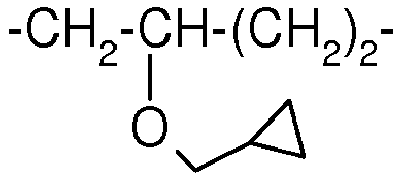
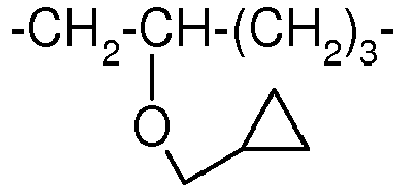
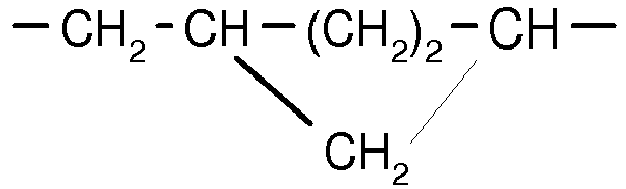


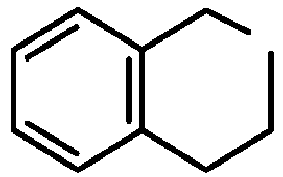
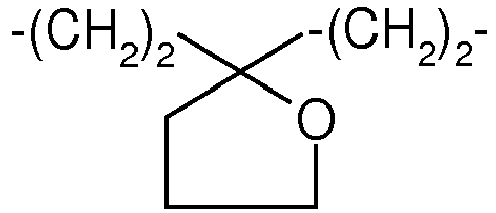

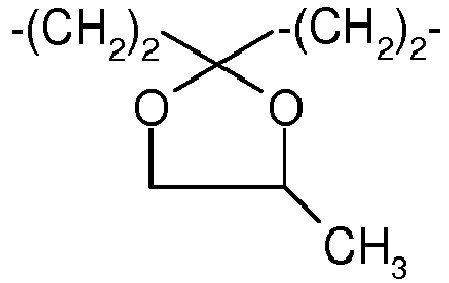
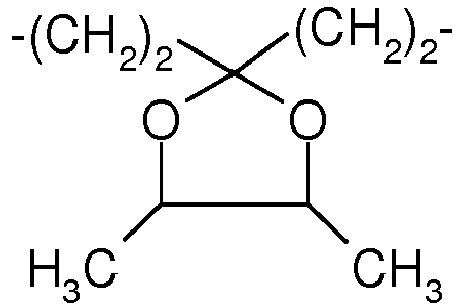


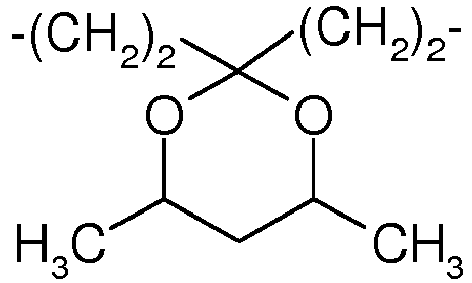
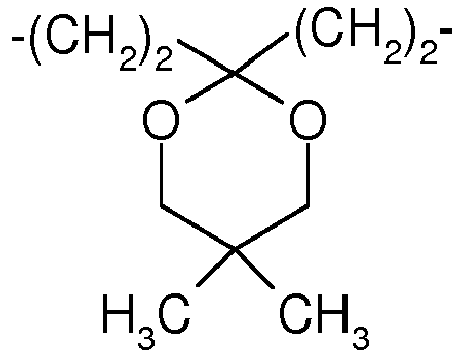


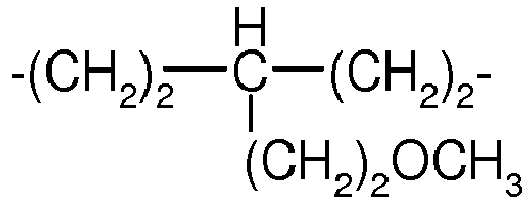
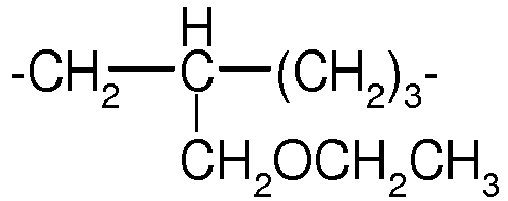


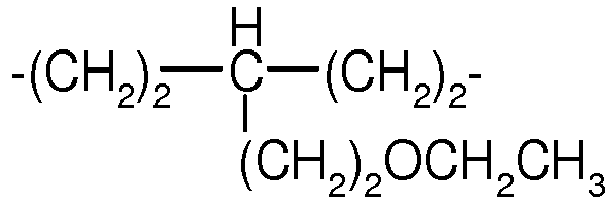

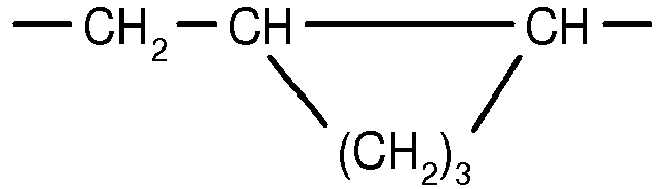


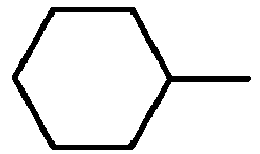


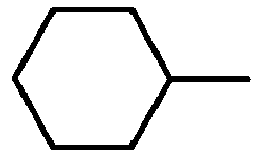
Als Wirkstoffe hervorgehoben werden insbesonders bevorzugte Verbindungen mit den in Tabelle 1 genannten Restekombinationen für W, X, Y und Z und den in den Tabellen 2a und 2b für A, B und D genannten Restekombinationen.Particularly preferred active compounds are compounds with the radical combinations mentioned in Table 1 for W, X, Y and Z and the radical combinations mentioned in Tables 2a and 2b for A, B and D.
Als erfindungsgemäße Wirkstoffe kommen weiterhin insbesonders bevorzugt Verbindungen aus mit den in Tabelle 1 genannten Restekombinationen für W, X, Y und Z mit den in Tabelle 3 genannten Restekombinationen für A und B in Frage.
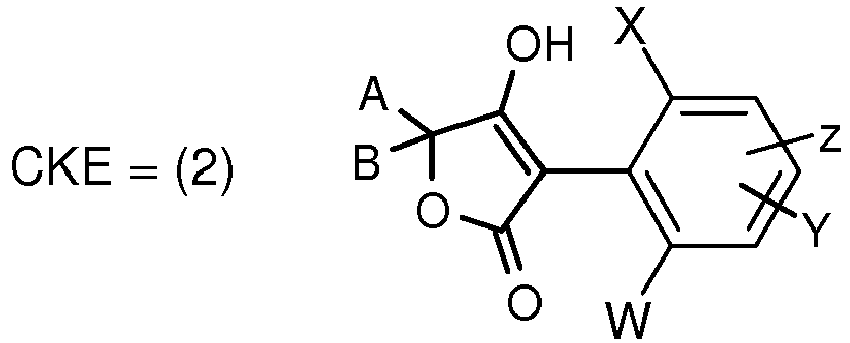


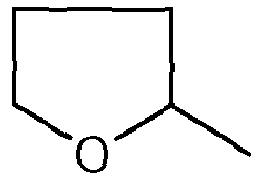


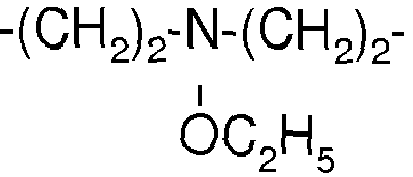
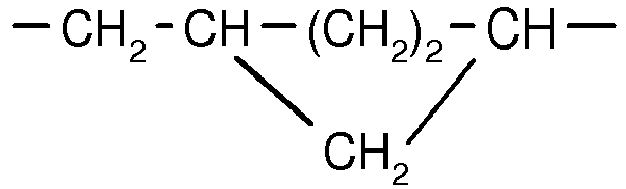
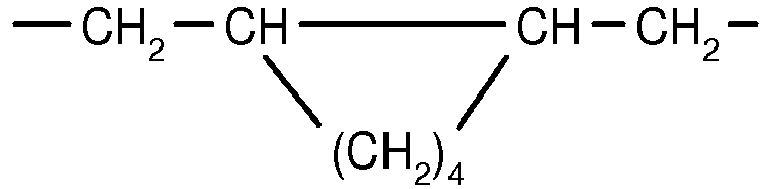
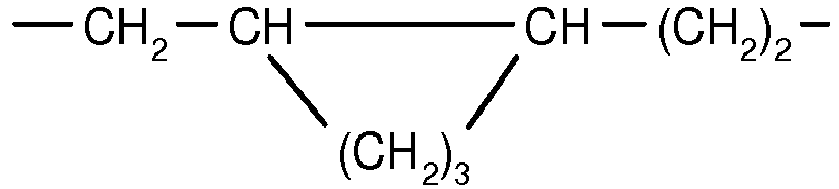
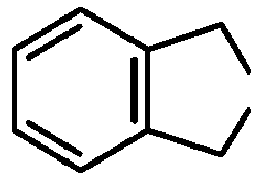

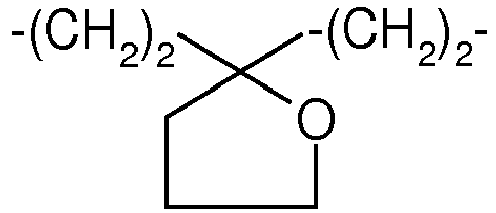

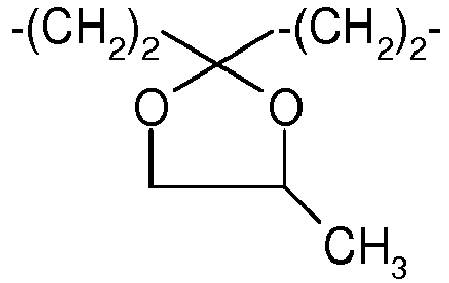
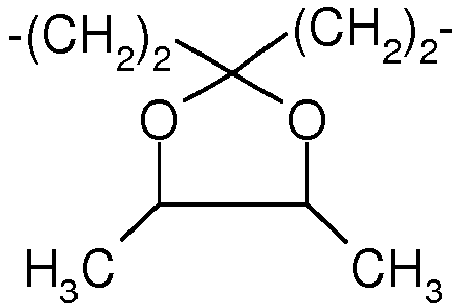
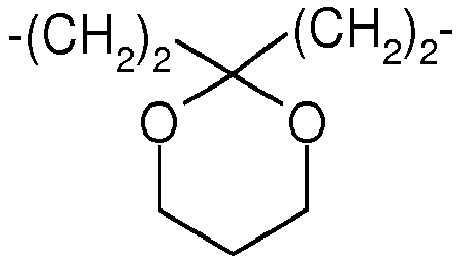

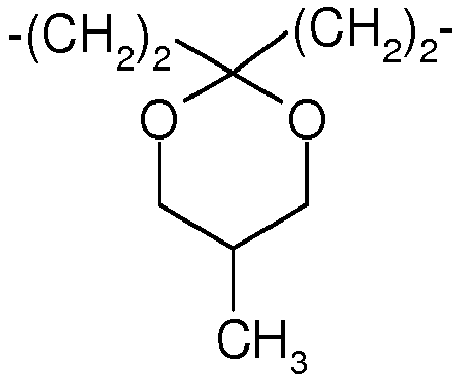
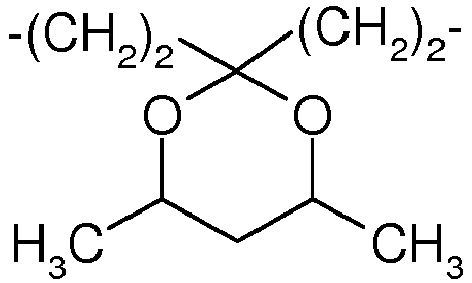


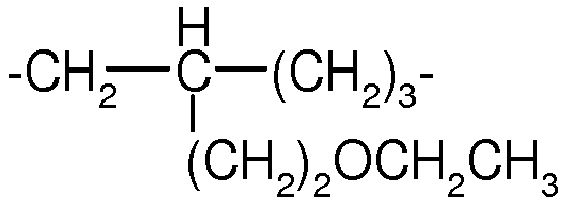
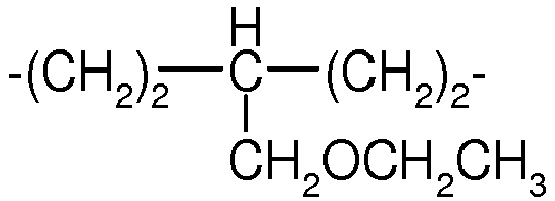
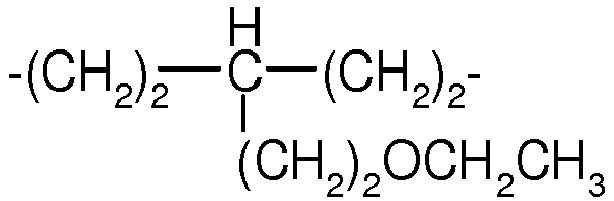
Als Wirkstoffe hervorgehoben werden insbesondere bevorzugte Verbindungen mit den in Tabelle 1 genannten Restekombinationen für W, X, Y und Z und den in Tabelle 3 für A und B genannten Restekombinationen.Particularly noteworthy as active compounds are preferred compounds having the radical combinations mentioned in Table 1 for W, X, Y and Z and the radical combinations mentioned in Table 3 for A and B.
In der Literatur wurde bereits beschrieben, dass sich die Wirkung verschiedener Wirkstoffe durch Zugabe von Ammoniumsalzen steigern lässt. Dabei handelt es sich jedoch um als Detergens wirkende Salze (z.B.
Auch der Einsatz von Ammoniumsulfat als Formulierhilfsmittel ist für bestimmte Wirkstoffe und Anwendungen beschrieben (
Es wurde nun ebenfalls überraschend gefunden, dass sich die Wirkung von Insektiziden und/oder Akariziden und/oder Herbiziden aus der Klasse der Halogenalkylmethylenoxy-phenyl-substituierte Ketoenole der Formel (I) durch den Zusatz von Ammonium- oder Phosphoniumsalzen zur Anwendungslösung oder durch den Einbau dieser Salze in eine Formulierung enthaltend der Halogenalkylmethylenoxy-phenyl-substituierte Ketoenole der Formel (I) deutlich steigern lässt. Gegenstand der vorliegenden Erfindung ist also die Verwendung von Ammonium- oder Phosphoniumsalzen zur Wirkungssteigerung von Pflanzenschutzmitteln, die herbizid und/oder insektizid und/oder akarizid wirksame der Halogenalkylmethylenoxy-phenyl-substituierte Ketoenole der Formel (I) als Wirkstoff enthalten. Gegenstand der Erfindung sind ebenfalls Mittel, die herbizid und/oder akarizid und/oder insektizid wirksame Halogenalkylmethylenoxy-phenyl-substituierte Ketoenole der Formel (I) und die Wirkung steigernde Ammonium- oder Phosphoniumsalze enthalten und zwar sowohl formulierte Wirkstoffe als auch anwendungsfertige Mittel (Spritzbrühen). Gegenstand der Erfindung ist schließlich weiterhin die Verwendung dieser Mittel zur Bekämpfung von Schadinsekten und/oder Spinnmilben und/oder unerwünschten Pflanzenwuchs.It has now also been found, surprisingly, that the effect of insecticides and / or acaricides and / or herbicides from the class of the haloalkylmethyleneoxy-phenyl-substituted ketoenols of the formula (I) by the addition of ammonium or phosphonium salts to the application solution or by the incorporation of these salts in a formulation containing the haloalkylmethylenoxy-phenyl-substituted ketoenols of the formula (I) can be significantly increased. The present invention thus relates to the use of ammonium or phosphonium salts to increase the efficacy of plant protection products which contain herbicidal and / or insecticidal and / or acaricidal active haloalkylmethylenoxy-phenyl-substituted ketoenols of the formula (I) as active ingredient. The invention also relates to compositions which contain herbicidal and / or acaricidal and / or insecticidally active haloalkylmethylene-oxy-phenyl-substituted ketoenols of the formula (I) and the activity-enhancing ammonium or phosphonium salts, both formulated active ingredients and ready-to-use agents (spray liquors). , Finally, the invention further relates to the use of these agents for controlling noxious insects and / or spider mites and / or undesired plant growth.
Die Verbindungen der Formel (I) besitzen eine breite insektizide und/oder akarizide und/oder herbizide Wirkung, die Wirkung und/oder Pflanzenverträglichkeit lässt im Einzelnen aber zu wünschen übrig.The compounds of the formula (I) have a broad insecticidal and / or acaricidal and / or herbicidal action, but the action and / or plant tolerance leaves something to be desired in detail.
Die Wirkstoffe können in den erfindungsgemäßen Zusammensetzungen in einem breiten Konzentrationsbereich eingesetzt werden. Die Konzentration der Wirkstoffe in der Formulierung beträgt dabei üblicherweise 0,1 - 50 Gew.-%.The active compounds can be used in the compositions according to the invention in a wide concentration range. The concentration of the active ingredients in the formulation is usually 0.1-50 wt .-%.
Ammonium- und Phosphoniumsalze, die erfindungsgemäß die Wirkung von Pflanzenschutzmitteln enthaltend Fettsäure-Biosynthese-Inhibitoren steigern, werden durch Formel (III') definiert

- D für Stickstoff oder Phosphor steht,
- D bevorzugt für Stickstoff steht,
- R26, R27, R28 und R29 unabhängig voneinander für Wasserstoff oder jeweils gegebenenfalls substituiertes C1-C8-Alkyl oder einfach oder mehrfach ungesättigtes, gegebenenfalls substituiertes C1-C8-Alkylen stehen, wobei die Substituenten aus Halogen, Nitro und Cyano ausgewählt sein können,
- R26, R27, R28 und R29 bevorzugt unabhängig voneinander für Wasserstoff oder jeweils gegebenenfalls substituiertes C1-C4-Alkyl stehen, wobei die Substituenten aus Halogen, Nitro und Cyano ausgewählt sein können,
R26 , R27 , R28 und R29 besonders bevorzugt unabhängig voneinander für Wasserstoff, Methyl, Ethyl, n-Propyl, i-Propyl, n-Butyl, i-Butyl, s-Butyl oder t-Butyl stehen, - R26, R27, R28 und R29 ganz besonders bevorzugt für Wasserstoff stehen,
- n für 1, 2, 3 oder 4 steht,
- n bevorzugt für 1 oder 2 steht,
- R30 für ein anorganisches oder organisches Anion steht,
- R30 bevorzugt für Hydrogencarbonat, Tetraborat, Fluorid, Bromid, Jodid, Chlorid, Monohydrogenphosphat, Dihydrogenphosphat, Hydrogensulfat, Tartrat, Sulfat, Nitrat, Thiosulfat, Thiocyanat, Formiat, Laktat, Acetat, Propionat, Butyrat, Pentanoat oder Oxalat steht,
- R30 besonders bevorzugt für Laktat, Sulfat, Nitrat, Thiosulfat, Thiocyanat, Oxalat oder Formiat steht,
- R30 ganz besonders bevorzugt für Sulfat steht.
- D is nitrogen or phosphorus,
- D is preferably nitrogen,
- R 26 , R 27 , R 28 and R 29 independently of one another represent hydrogen or in each case optionally substituted C 1 -C 8 -alkyl or mono- or polyunsaturated, optionally substituted C 1 -C 8 -alkylene, the substituents being halogen, nitro and cyano can be selected
- R 26 , R 27 , R 28 and R 29 preferably independently of one another represent hydrogen or in each case optionally substituted C 1 -C 4 -alkyl, where the substituents can be selected from halogen, nitro and cyano,
R 26 , R 27 , R 28 and R 29 more preferably independently of one another are hydrogen, methyl, ethyl, n-propyl, isopropyl, n-butyl, isobutyl, s-butyl or t-butyl, - R 26 , R 27 , R 28 and R 29 most preferably represent hydrogen,
- n is 1, 2, 3 or 4,
- n is preferably 1 or 2,
- R 30 is an inorganic or organic anion,
- R 30 is preferably hydrogencarbonate, tetraborate, fluoride, bromide, iodide, chloride, monohydrogenphosphate, dihydrogenphosphate, hydrogensulphate, tartrate, sulphate, nitrate, thiosulphate, thiocyanate, formate, lactate, acetate, propionate, butyrate, pentanoate or oxalate,
- R 30 particularly preferably represents lactate, sulfate, nitrate, thiosulphate, thiocyanate, oxalate or formate,
- R 30 very particularly preferably represents sulfate.
Erfindungsgemäß hervorgehobene Kombinationen von Wirkstoff, Salz und Penetrationsförderer sind in folgender Tabelle aufgeführt. "Penetrationsförderer gemäß Test" bedeutet dabei, dass jede Verbindung geeignet ist, die in dem Test für die Kutikelpenetration (
Die Ammonium- und Phosphoniumsalze der Formel (III') können in einem breiten Konzentrationsbereich zur Steigerung der Wirkung von Pflanzenschutzmitteln enthaltend Ketoenole eingesetzt werden. Im Allgemeinen werden die Ammonium- oder Phosphoniumsalze im anwendungsfertigen Pflanzenschutzmittel in einer Konzentration von 0,5 bis 80 mmol/l, bevorzugt 0,75 bis 37,5 mmol/l, besonders bevorzugt 1,5 bis 25 mmol/l eingesetzt. Im Fall eines formulierten Produktes wird die Ammonium- und/oder Phosphoniumsalzkonzentration in der Formulierung so gewählt, dass sie nach Verdünnung der Formulierung auf die gewünschte Wirkstoffkonzentration in diesen angegebenen allgemeinen, bevorzugten oder besonders bevorzugten Bereichen liegt. Die Konzentration des Salzes in der Formulierung beträgt dabei üblicherweise 1 - 50 Gew.-%.The ammonium and phosphonium salts of the formula (III ') can be used in a broad concentration range to increase the effect of pesticides Ketoenols are used. In general, the ammonium or phosphonium salts in the ready-to-use crop protection agent are used in a concentration of 0.5 to 80 mmol / l, preferably 0.75 to 37.5 mmol / l, particularly preferably 1.5 to 25 mmol / l. In the case of a formulated product, the ammonium and / or phosphonium salt concentration in the formulation is selected to be in the specified general, preferred or most preferred ranges after dilution of the formulation to the desired drug concentration. The concentration of the salt in the formulation is usually 1-50 wt .-%.
In einer bevorzugten Ausführungsform der Erfindung wird den Pflanzenschutzmitteln zur Wirkungssteigerung nicht nur ein Ammonium- und/oder Phosphoniumsalz, sondern zusätzlich ein Penetrationsförderer zugegeben. Es ist als völlig überraschend zu bezeichnen, dass selbst in diesen Fällen eine noch weiter gehende Wirkungssteigerung zu beobachten ist. Gegenstand der vorliegenden Erfindung ist also ebenfalls die Verwendung einer Kombination von Penetrationsförderer und Ammonium- und/oder Phosphoniumsalzen zur Wirkungssteigerung von Pflanzenschutzmitteln, die insektizid und/oder akarizid und/oder herbizid wirksame Halogenalkylmethylenoxy-phenyl-substituierte Ketoenole der Formel (I) als Wirkstoff enthalten. Gegenstand der Erfindung sind ebenfalls Mittel, die herbizid und/oder akarizid und/oder insektizid wirksame Halogenalkylmethylenoxy-phenyl-substituierte Ketoenole der Formel (I), Penetrationsförderer und Ammonium- und/oder Phosphoniumsalze enthalten und zwar sowohl formulierte Wirkstoffe als auch anwendungsfertige Mittel (Spritzbrühen). Gegenstand der Erfindung ist schließlich weiterhin die Verwendung dieser Mittel zur Bekämpfung von Schadinsekten und/oder Spinnmilben und/oder unerwünschten Pflanzenwuchs.In a preferred embodiment of the invention, not only an ammonium and / or phosphonium salt, but additionally a penetration promoter is added to the crop protection agents to increase the effect. It can be described as completely surprising that even in these cases an even greater increase in activity can be observed. The present invention thus also relates to the use of a combination of penetrants and ammonium and / or phosphonium salts to increase the efficacy of plant protection products containing insecticidal and / or acaricidal and / or herbicidally active haloalkylmethylenoxy-phenyl-substituted ketoenols of the formula (I) as active ingredient , The invention also relates to compositions which contain herbicidal and / or acaricidal and / or insecticidally active haloalkylmethyleneoxy-phenyl-substituted ketoenols of the formula (I), penetrants and ammonium and / or phosphonium salts, both formulated active ingredients and ready-to-use agents (spray liquors ). Finally, the invention further relates to the use of these agents for controlling noxious insects and / or spider mites and / or undesired plant growth.
Als Penetrationsförderer kommen im vorliegenden Zusammenhang alle diejenigen Substanzen in Betracht, die üblicherweise eingesetzt werden, um das Eindringen von agrochemischen Wirkstoffen in Pflanzen zu verbessern. Penetrationsförderer werden in diesem Zusammenhang dadurch definiert, dass sie aus der wässrigen Spritzbrühe und/oder aus dem Spritzbelag in die Kutikula der Pflanze eindringen und dadurch die Stoffbeweglichkeit (Mobilität) von Wirkstoffen in der Kutikula erhöhen können. Die in der Literatur (
Als Penetrationsförderer kommen beispielsweise Alkanol-alkoxylate in Betracht. Erfindungsgemäße Penetrationsförderer sind Alkanol-alkoxylate der Formel (IV')
R-O-(-AO)v-R' (IV')
in welcher
- R
- für geradkettiges oder verzweigtes Alkyl mit 4 bis 20 Kohlenstoffatomen steht,
- R'
- für Wasserstoff, Methyl, Ethyl, n-Propyl, i-Propyl, n-Butyl, i-Butyl, t-Butyl, n-Pentyl oder n-Hexyl steht,
- AO
- für einen Ethylenoxid-Rest, einen Propylenoxid-Rest, einen Butylenoxid-Rest oder für Gemische aus Ethylenoxid- und Propylenoxid-Resten oder Butylenoxid-Resten steht und
- v
- für Zahlen von 2 bis 30 steht.
RO - (- AO) v -R '(IV')
in which
- R
- represents straight-chain or branched alkyl having 4 to 20 carbon atoms,
- R '
- is hydrogen, methyl, ethyl, n-propyl, i-propyl, n-butyl, i-butyl, t-butyl, n-pentyl or n-hexyl,
- AO
- is an ethylene oxide radical, a propylene oxide radical, a butylene oxide radical or mixtures of ethylene oxide and propylene oxide radicals or butylene oxide radicals and
- v
- stands for numbers from 2 to 30.
Eine bevorzugte Gruppe von Penetrationsförderern sind Alkanolalkoxylate der Formel
R-O-(-EO-)n-R' (IV'-a)
in welcher
- R
- die oben angegebene Bedeutung hat,
- R'
- die oben angegebene Bedeutung hat,
- EO
- für -CH2-CH2-O- steht und
- n
- für Zahlen von 2 bis 20 steht.
RO - (- EO-) n -R '(IV'-a)
in which
- R
- has the meaning given above,
- R '
- has the meaning given above,
- EO
- stands for -CH 2 -CH 2 -O- and
- n
- stands for numbers from 2 to 20.
Eine weitere bevorzugte Gruppe von Penetrationsförderern sind Alkanol-alkoxylate der Formel
R-O-(-EO-)p-(-PO-)q-R' (IV'-b)
in welcher
- R
- die oben angegebene Bedeutung hat,
- R'
- die oben angegebene Bedeutung hat,
- EO
- für -CH2-CH2-O- steht,
- PO
- für
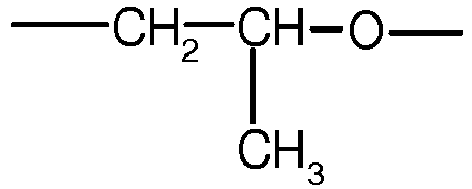
- p
- für Zahlen von 1 bis 10 steht und
- q
- für Zahlen von 1 bis 10 steht.
RO - (- EO-) p - (- PO-) q -R '(IV'-b)
in which
- R
- has the meaning given above,
- R '
- has the meaning given above,
- EO
- represents -CH 2 -CH 2 -O-,
- PO
- For
- p
- stands for numbers from 1 to 10 and
- q
- stands for numbers from 1 to 10.
Eine weitere bevorzugte Gruppe von Penetrationsförderern sind Alkanol-Alkoxylate der Formel
R-O-(-PO-)r-(EO-)s-R' (IV'-c)
in welcher
- R
- die oben angegebene Bedeutung hat,
- R'
- die oben angegebene Bedeutung hat,
- EO
- für -CH2-CH2-O- steht,
- PO
- für

- r
- für Zahlen von 1 bis 10 steht und
- s
- für Zahlen von 1 bis 10 steht.
RO - (- PO-) r - (EO-) s -R '(IV'-c)
in which
- R
- has the meaning given above,
- R '
- has the meaning given above,
- EO
- represents -CH 2 -CH 2 -O-,
- PO
- For
- r
- stands for numbers from 1 to 10 and
- s
- stands for numbers from 1 to 10.
Eine weitere bevorzugte Gruppe von Penetrationsförderern sind Alkanol-alkoxylate der Formel
R-O-(-EO-)p-(-BO-)q-R' (IV'-d)
in welcher
- R und R' die oben angegebenen Bedeutungen haben,
- EO
- für -CH2-CH2-O- steht,
- BO
- für
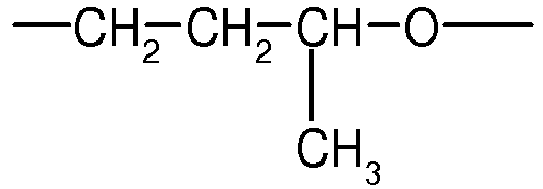
- p
- für Zahlen von 1 bis 10 steht und
- q
- für Zahlen von 1 bis 10 steht.
RO - (- EO-) p - (- BO-) q -R '(IV'-d)
in which
- R and R 'have the meanings given above,
- EO
- represents -CH 2 -CH 2 -O-,
- BO
- For
- p
- stands for numbers from 1 to 10 and
- q
- stands for numbers from 1 to 10.
Eine weitere bevorzugte Gruppe von Penetrationsförderern sind Alkanol-alkoxylate der Formel
R-O-(-BO-)r-(-EO-)s-R' (IV'-e)
in welcher
- R und R'
- die oben angegebenen Bedeutungen haben,
- BO
- für
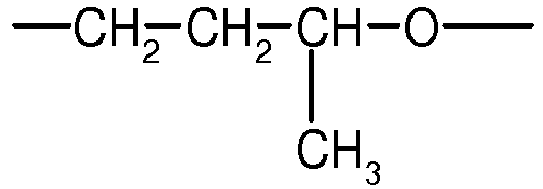
- EO
- für -CH2-CH2-O- steht,
- r
- für Zahlen von 1 bis 10 steht und
- s
- für Zahlen von 1 bis 10 steht.
RO - (- BO-) r - (- EO-) s -R '(IV'-e)
in which
- R and R '
- have the meanings given above,
- BO
- For
- EO
- represents -CH 2 -CH 2 -O-,
- r
- stands for numbers from 1 to 10 and
- s
- stands for numbers from 1 to 10.
Eine weitere bevorzugte Gruppe von Penetrationsförderern sind Alkanol-Alkoxylate der Formel
CH3-(CH2)t-CH2-O-(-CH2-CH2-O-)u-R' (IV'-f)
in welcher
- R'
- die oben angegebene Bedeutung hat,
- t
- für Zahlen von 8 bis 13 steht
- u
- für Zahlen von 6 bis 17 steht.
CH 3 - (CH 2 ) t -CH 2 -O - (- CH 2 -CH 2 -O-) u -R '(IV'-f)
in which
- R '
- has the meaning given above,
- t
- stands for numbers from 8 to 13
- u
- stands for numbers from 6 to 17.
In den zuvor angegebenen Formeln steht
- R
- vorzugsweise für Butyl, i-Butyl, n-Pentyl, i-Pentyl, Neopentyl, n-Hexyl, i-Hexyl, n-Octyl, i-Octyl, 2-Ethyl-hexyl, Nonyl, i-Nonyl, Decyl, n-Dodecyl, i-Dodecyl, Lauryl, Myristyl, i-Tridecyl, Trimethyl-nonyl, Palmityl, Stearyl oder Eicosyl.
- R
- preferably butyl, i-butyl, n-pentyl, i-pentyl, neo-pentyl, n-hexyl, i-hexyl, n-octyl, i-octyl, 2-ethyl-hexyl, nonyl, i-nonyl, decyl, n- Dodecyl, i-dodecyl, lauryl, myristyl, i-tridecyl, trimethyl-nonyl, palmityl, stearyl or eicosyl.
Als Beispiel für ein Alkanol-Alkoxylat der Formel (IV-c) sei 2-Ethyl-hexyl-alkoxylat der Formel

- EO
- für -CH2-CH2-O- steht,
- PO
- für
- EO
- represents -CH 2 -CH 2 -O-,
- PO
- For
Als Beispiel für ein Alkanol-Alkoxylat der Formel (IV-d) sei die Formel
CH3-(CH2)10-O-(-EO-)6-(-BO-)2-CH3 (IV'-d-1)
in welcher
- EO
- für -CH2-CH2-O- steht,
- BO
- für

CH 3 - (CH 2 ) 10 -O - (- EO-) 6 - (- BO-) 2 -CH 3 (IV'-d-1)
in which
- EO
- represents -CH 2 -CH 2 -O-,
- BO
- For
Besonders bevorzugte Alkanol-Alkoxylate der Formel (IV'-f) sind Verbindungen dieser Formel, in denen
- t
- für Zahlen von 9 bis 12 und
- u
- für Zahlen von 7 bis 9
- t
- for numbers from 9 to 12 and
- u
- for numbers from 7 to 9
Ganz besonders bevorzugt genannt sei Alkanol-Alkoxylat der Formel (IV'-f-1)
CH3-(CH2)t-CH2-O-(-CH2-CH2-O-)u-H (IV'-f-1)
in welcher
- t
- für den Durchschnittswert 10,5 steht und
- u
- für den Durchschnittswert 8,4 steht.
CH 3 - (CH 2 ) t -CH 2 -O - (- CH 2 -CH 2 -O-) u -H (IV'-f-1)
in which
- t
- stands for the average 10.5 and
- u
- for the average value is 8.4.
Die Alkanol-Alkoxylate sind durch die obigen Formeln allgemein definiert. Bei diesen Substanzen handelt es sich um Gemische von Stoffen des angegebenen Typs mit unterschiedlichen Kettenlängen. Für die Indices errechnen sich deshalb Durchschnittswerte, die auch von ganzen Zahlen abweichen können.The alkanol alkoxylates are generally defined by the above formulas. These substances are mixtures of substances of the specified type with different chain lengths. For the indices, therefore, average values are calculated, which can also differ from whole numbers.
Die Alkanol-Alkoxylate der angegebenen Formeln sind bekannt und sind teilweise kommerziell erhältlich oder lassen sich nach bekannten Methoden herstellen (vgl.
Als Penetrationsförderer kommen beispielsweise auch Substanzen in Betracht, die die Verfügbarkeit der Verbindungen der Formel (I) im Spritzbelag fördern. Dazu gehören beispielsweise mineralische oder vegetabile Öle. Als Öle kommen alle üblicherweise in agrochemischen Mitteln einsetzbaren mineralischen oder vegetabilen - gegebenenfalls modifizierte - Öle in Frage. Beispielhaft genannt seien Sonnenblumenöl, Rapsöl, Olivenöl, Rizinusöl, Rüböl, Maiskernöl, Baumwollsaatöl und Sojabohnenöl oder die Ester der genannten Öle. Bevorzugt sind Rapsöl, Sonnenblumenöl und deren Methyl- oder Ethylester.Examples of suitable penetration promoters are substances which promote the availability of the compounds of the formula (I) in the spray coating. These include, for example, mineral or vegetable oils. Suitable oils are all mineral or vegetable, optionally modified, oils which can usually be used in agrochemical compositions. Examples include sunflower oil, rapeseed oil, olive oil, castor oil, rapeseed oil, corn kernel oil, cottonseed oil and soybean oil or the esters of said oils. Rape oil, sunflower oil and their methyl or ethyl esters are preferred.
Die Konzentration an Penetrationsförderer kann in den erfindungsgemäßen Mitteln in einem weiten Bereich variiert werden. Bei einem formulierten Pflanzenschutzmittel liegt sie im allgemeinen bei 1 bis 95 Gew.-%, bevorzugt bei 1 bis 55 Gew.-%, besonders bevorzugt bei 15 - 40 Gew.-%. In den anwendungsfertigen Mitteln (Spritzbrühen) liegen die Konzentration im allgemeinen zwischen 0,1 und 10 g/l, bevorzugt zwischen 0,5 und 5 g/l.The concentration of penetration promoter can be varied within a wide range in the agents according to the invention. In the case of a formulated crop protection agent, it is generally from 1 to 95% by weight, preferably from 1 to 55% by weight, more preferably from 15 to 40% by weight. In the ready-to-use agents (spray liquors), the concentration is generally between 0.1 and 10 g / l, preferably between 0.5 and 5 g / l.
Erfindungsgemäße Pflanzenschutzmittel können auch weitere Komponente, beispielsweise Tenside bzw. Dispergierhilfsmittel oder Emulgatoren enthalten.Plant protection agents according to the invention may also contain further components, for example surfactants or dispersing aids or emulsifiers.
Als nicht-ionische Tenside bzw. Dispergierhilfsmittel kommen alle üblicherweise in agrochemischen Mitteln einsetzbaren Stoffe dieses Typs in Betracht. Vorzugsweise genannt seien Polyethylenoxid-polypropylenoxid-Blockcopolymere, Polyethylenglykolether von linearen Alkoholen, Umsetzungsprodukte von Fettsäuren mit Ethylenoxid und/oder Propylenoxid, ferner Polyvinylalkohol, Polyvinylpyrrolidon, Mischpolymerisate aus Polyvinylalkohol und Polyvinylpyrrolidon sowie Copolymerisate aus (Meth)acrylsäure und (Meth)acrylsäureestern, weiterhin Alkylethoxylate und Alkylarylethoxylate, die gegebenenfalls phosphatiert und gegebenenfalls mit Basen neutralisiert sein können, wobei Sorbitolethoxylate beispielhaft genannt seien, sowie Polyoxyalkylenamin-Derivate.Suitable nonionic surfactants or dispersing agents are all substances of this type which can usually be used in agrochemical compositions. Preferably mentioned are polyethylene oxide-polypropylene oxide block copolymers, polyethylene glycol ethers of linear alcohols, reaction products of fatty acids with ethylene oxide and / or propylene oxide, furthermore polyvinyl alcohol, polyvinylpyrrolidone, copolymers of polyvinyl alcohol and polyvinylpyrrolidone and copolymers of (meth) acrylic acid and (meth) acrylic acid esters, furthermore alkylethoxylates and Alkylarylethoxylates which may optionally be phosphated and optionally neutralized with bases, wherein sorbitol ethoxylates may be mentioned by way of example, as well as polyoxyalkyleneamine derivatives.
Als anionische Tenside kommen alle üblicherweise in agrochemischen Mitteln einsetzbaren Substanzen dieses Typs in Frage. Bevorzugt sind Alkalimetall- und Erdalkalimetall-Salze von Alkylsulfonsäuren oder Alkylarylsulfonsäuren.Suitable anionic surfactants are all substances of this type conventionally usable in agrochemical compositions. Preference is given to alkali metal and alkaline earth metal salts of alkylsulfonic acids or alkylarylsulfonic acids.
Eine weitere bevorzugte Gruppe von anionischen Tensiden bzw. Dispergierhilfsmitteln sind in Pflanzenöl wenig lösliche Salze von Polystyrolsulfonsäuren, Salze von Polyvinylsulfonsäuren, Salze von Naphthalinsulfonsäure-Formaldehyd-Kondensationsprodukten, Salze von Kondensationsprodukten aus Naphthalinsulfonsäure, Phenolsulfonsäure und Formaldehyd sowie Salze von Ligninsulfonsäure.Another preferred group of anionic surfactants or dispersing aids are salts of polystyrenesulfonic acids which are sparingly soluble in vegetable oil, salts of polyvinylsulfonic acids, salts of naphthalenesulfonic acid-formaldehyde condensation products, salts of condensation products from naphthalenesulfonic acid, phenolsulfonic acid and formaldehyde and salts of lignosulfonic acid.
Als Zusatzstoffe, die in den erfindungsgemäßen Formulierungen enthalten sein können, kommen Emulgatoren, schaumhemmende Mittel, Konservierungsmittel, Antioxydantien, Farbstoffe und inerte Füllmaterialien in Betracht.Suitable additives which may be present in the formulations according to the invention are emulsifiers, foam-inhibiting agents, preservatives, antioxidants, dyes and inert fillers.
Bevorzugte Emulgatoren sind ethoxylierte Nonylphenole, Umsetzungsprodukte von Alkylphenolen mit Ethylenoxid und/oder Propylenoxid, ethoxylierte Arylalkylphenole, weiterhin ethoxylierte und propoxylierte Arylalkylphenole, sowie sulfatierte oder phosphatierte Arylalkylethoxylate bzw. -ethoxy-propoxylate, wobei Sorbitan-Derivate, wie Polyethylenoxid-Sorbitan-Fettsäureester und Sorbitan-Fettsäureester, beispielhaft genannt seien.Preferred emulsifiers are ethoxylated nonylphenols, reaction products of alkylphenols with ethylene oxide and / or propylene oxide, ethoxylated arylalkylphenols, furthermore ethoxylated and propoxylated arylalkylphenols, and sulfated or phosphated arylalkyl ethoxylates or ethoxy-propoxylates, sorbitan derivatives such as polyethylene oxide sorbitan fatty acid esters and sorbitan Fatty acid esters, may be mentioned as examples.
Verwendet man beispielsweise gemäß Verfahren (A) N-(2,6-Dimethyl-4-trifluorethoxy-phenylacetyl)-1-amino-cyclohexan-carbonsäureethylester als Ausgangsstoff, so kann der Verlauf des erfindungsgemäßen Verfahrens durch folgendes Reaktionsschema wiedergegeben werden:
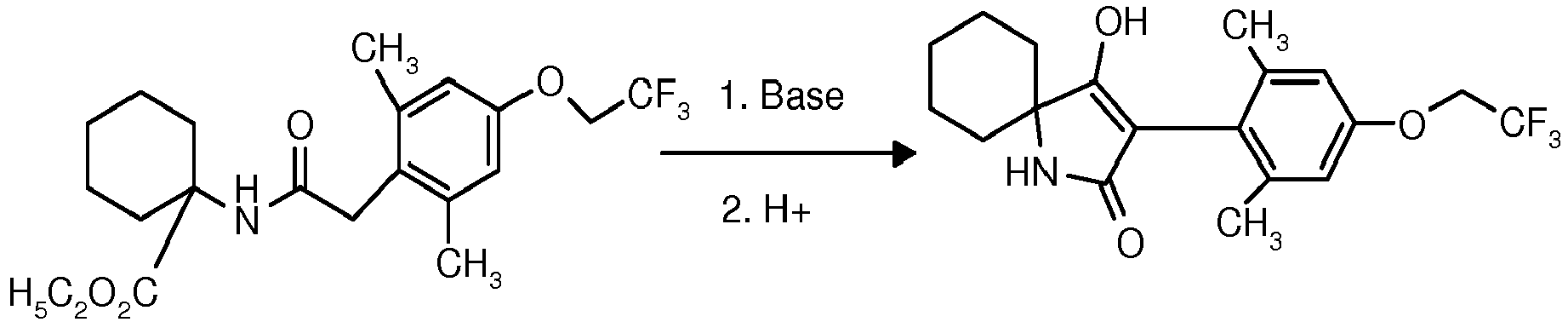
Verwendet man beispielsweise gemäß Verfahren (B) O-(2,6-Dimethyl-4-trifluorethoxy-phenylacetyl)-2-hydroxyisobuttersäureethylester, so kann der Verlauf des erfindungsgemäßen Verfahrens durch folgendes Reaktionsschema wiedergegeben werden:

Verwendet man beispielsweise gemäß Verfahren (C) 2-(2,6-Dimethyl-4-trifluorethoxy-phenyl)-4-(4-methoxy)-benzylmercapto-4-methyl-3-oxo-valeriansäure-ethylester, so kann der Verlauf des erfindungsgemäßen Verfahrens durch folgendes Reaktionsschema wiedergegeben werden:
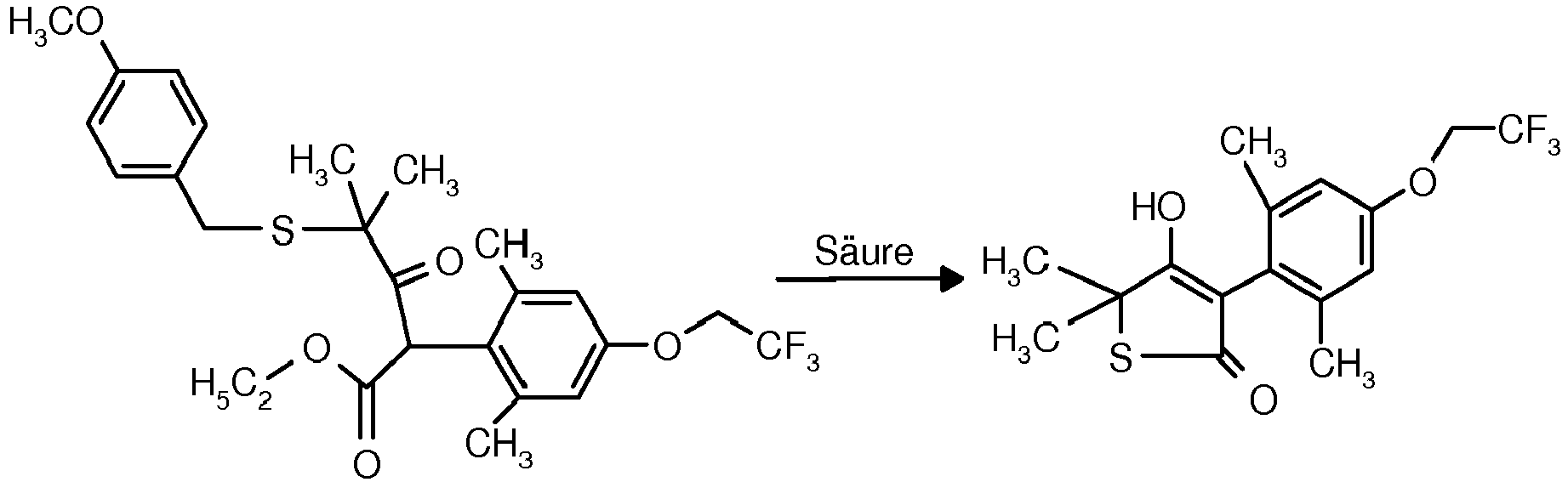
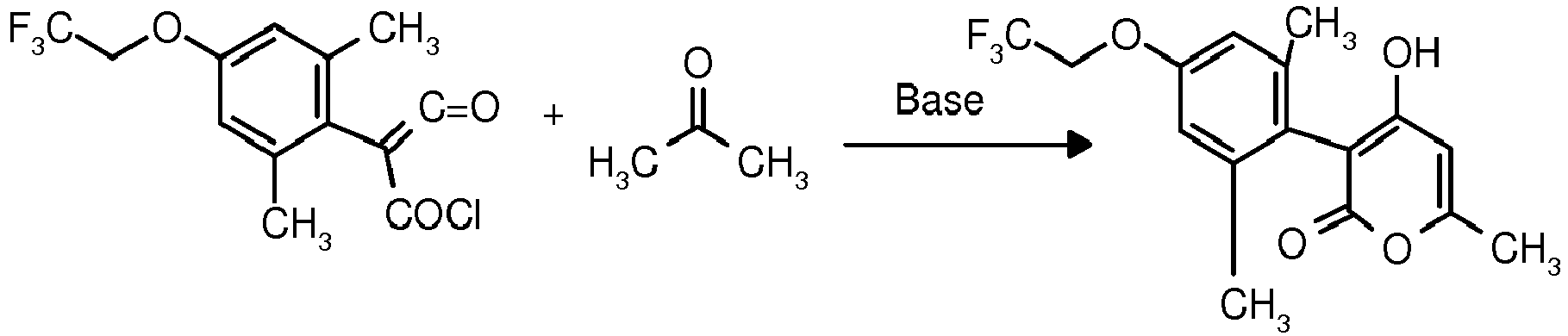
Verwendet man beispielsweise gemäß Verfahren (E) (Chlorcarbonyl)-2-(2,6-Dimethyl-4-trifluorethoxy-phenyl)-keten und Thiobenzamid als Ausgangsverbindungen, so kann der Verlauf des erfindungsgemäßen Verfahrens durch das folgende Reaktionsschema wiedergegeben werden:

Verwendet man beispielsweise gemäß Verfahren (F) 5-(2,6-Dimethyl-4-trifluorethoxy-phenyl)-2,3-trimethylen-4-oxo-valeriansäureethylester, so kann der Verlauf des erfindungsgemäßen Verfahrens durch folgendes Reaktionsschema wiedergegeben werden:

Verwendet man beispielsweise gemäß Verfahren (G) 6-[(2,6-Dimethyl-4-trifluorethoxy-)-phenyl]-2-dimethyl-5-oxo-hexansäure-ethylester, so kann der Verlauf des erfindungsgemäßen Verfahrens durch folgendes Reaktionsschema wiedergegeben werden:
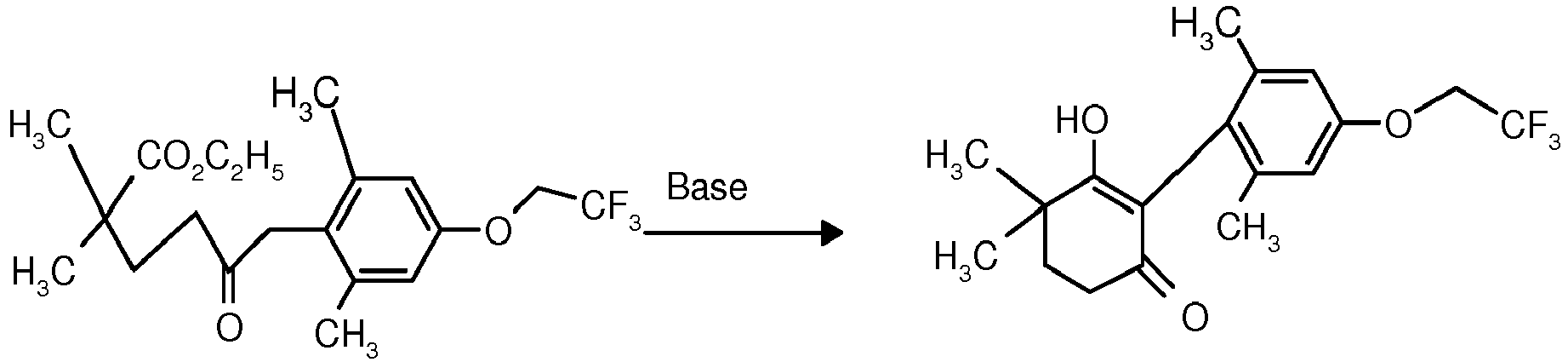
Verwendet man beispielsweise gemäß Verfahren (Hα) Hexahydropyridazin und (Chlorcarbonyl)-2-[(2,6-dimethyl-4-trifluorethoxy-)-phenyl]-keten als Ausgangsverbindungen, so kann der Reaktionsverlauf des erfindungsgemäßen Verfahrens durch folgendes Reaktionsschema wiedergegeben werden:
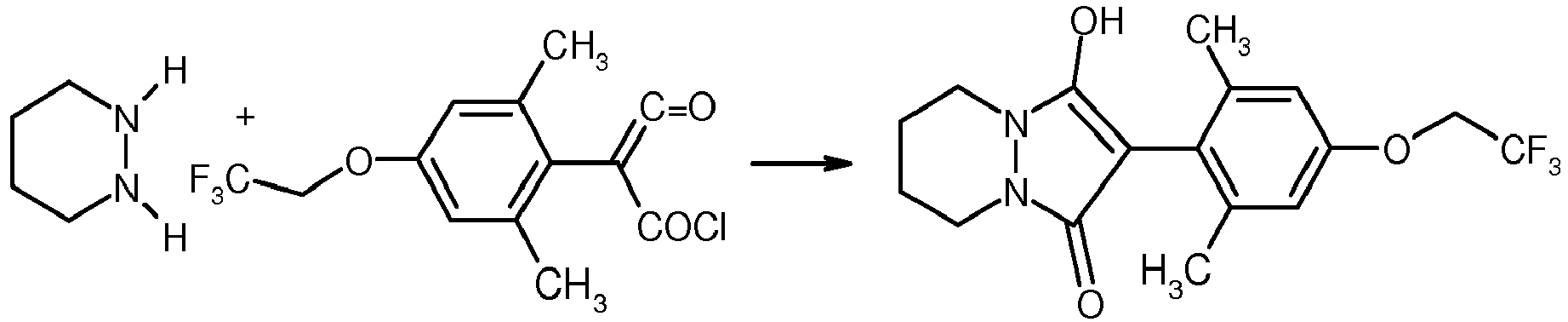
Verwendet man beispielsweise gemäß Verfahren (Hβ) Hexahydropyridazin und 2-(2,6-Dimethyl-4-trifluorethoxy-)-phenylmalonsäuredimethylester als Ausgangsprodukte, so kann der Verlauf des erfindungsgemäßen Verfahrens durch folgendes Reaktionsschema wiedergegeben werden:

Verwendet man beispielsweise gemäß Verfahren (Hγ) 1-Ethoxycarbonyl-2-[(2,6-dimethyl-4-trifluorethoxy)-phenylacetyl]-hexahydropyridazin als Ausgangsprodukt, so kann der Reaktionsverlauf durch folgendes Schema wiedergegeben werden:
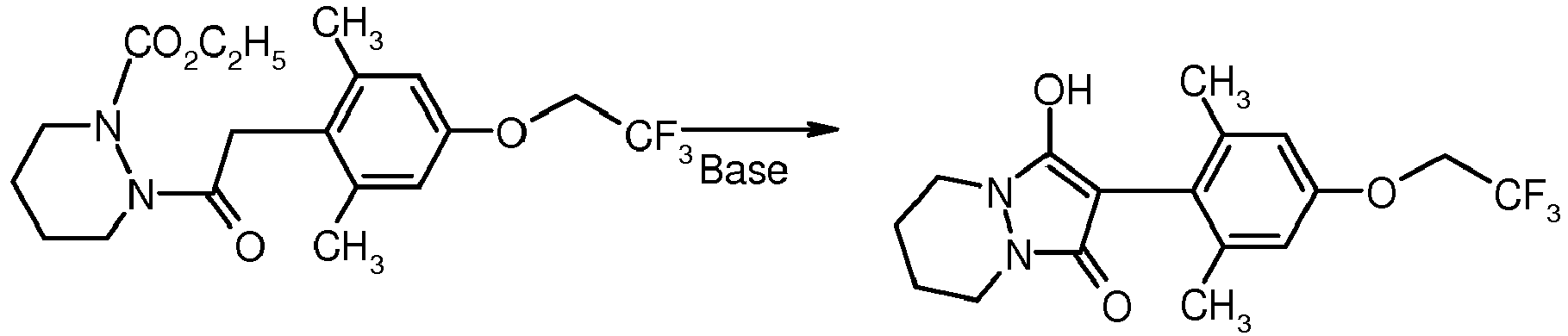
Verwendet man beispielsweise gemäß Verfahren (I) N-(2,6-Dimethyl-4-trifluorethoxy-phenylacetyl)-1-aminomethyl-cyclohexan-carbonsäureethylester als Ausgangsstoff, so kann der Verlauf des erfindungsgemäßen Verfahrens durch folgendes Reaktionsschema wiedergegeben werden:
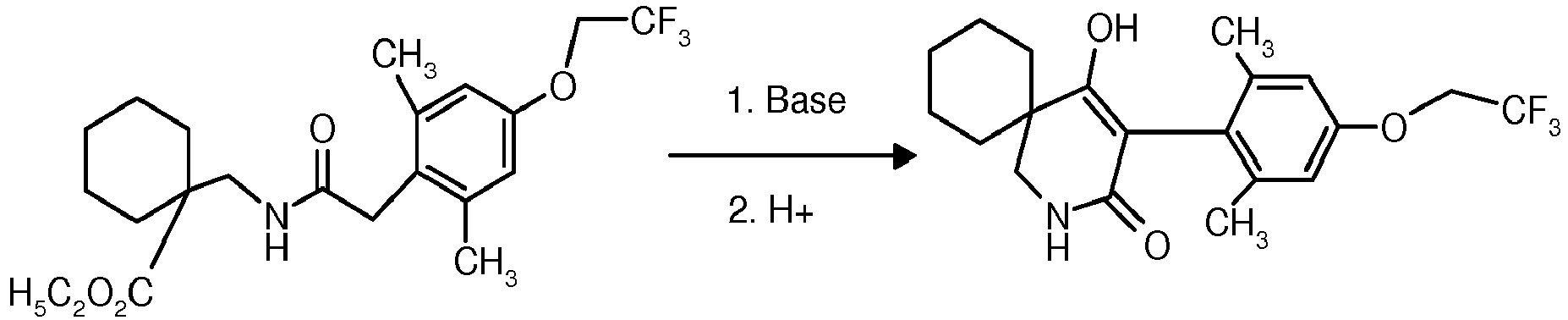
Verwendet man beispielsweise gemäß Verfahren (J) O-(2,6-Dimethyl-4-trifluorethoxy-phenylacetyl)-3-hydroxy-2,2-dimethyl-propion-säureethylester, so kann der Verlauf des erfindungsgemäßen Verfahrens durch folgendes Reaktionsschema wiedergegeben werden:
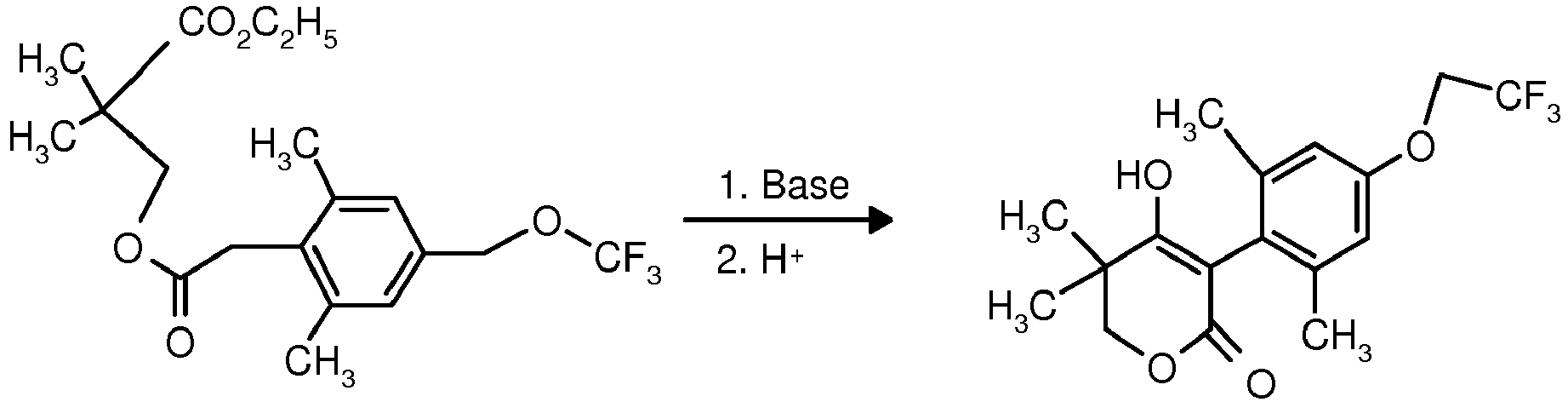
Verwendet man gemäß Verfahren (K) N-Methyl-N-[(2,6-Dimethyl-4-trifluorethoxy)-phenyl-acetyl]-1-amino-oxy-cyclopentan-carbonsäureethylester als Ausgangsstoff, so kann der Verlauf des erfindungsgemäßen Verfahrens durch folgendes Reaktionsschema wiedergegeben werden:
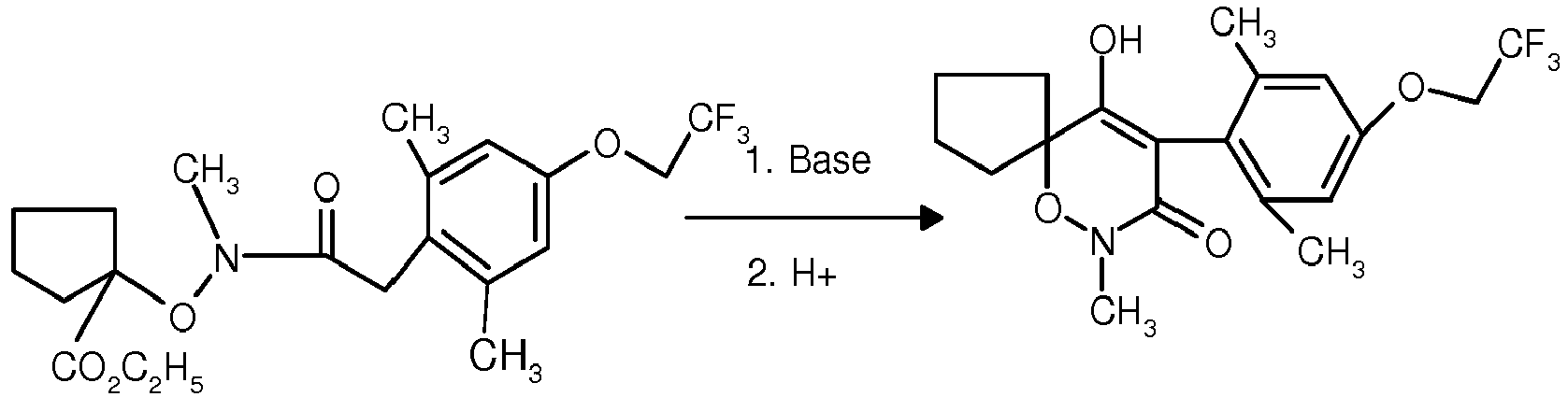
Verwendet man beispielsweise gemäß Verfahren (Lα) 3-(2-Methyl-4-trifluorethoxy-6-ethyl-phenyl)-5,5-dimethylpyrrolidin-2,4-dion und Pivaloylchlorid als Ausgangsstoffe, so kann der Verlauf des erfindungsgemäßen Verfahrens durch folgendes Reaktionsschema wiedergegeben werden:
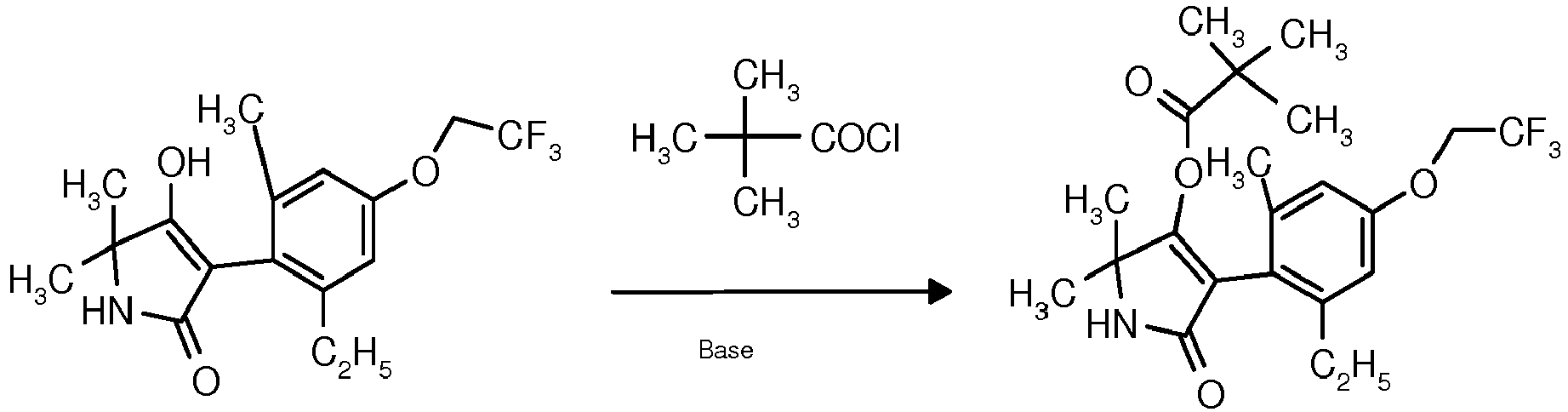
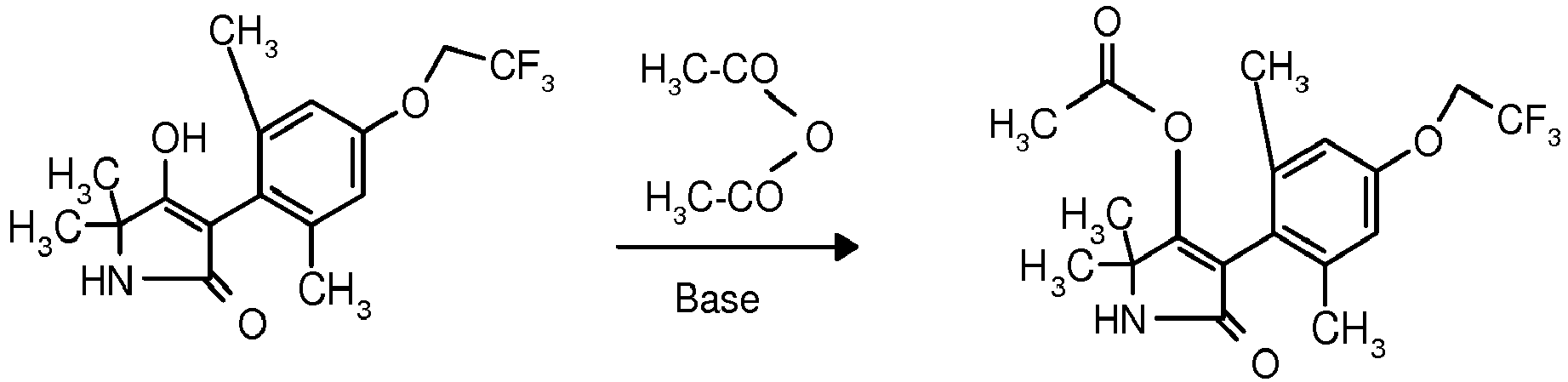
Verwendet man beispielsweise gemäß Verfahren (M) 8-[(2,6-Dimethyl-4-trifluorethoxy)-phenyl]-1-aza-bicyclo-(4,3,01,6)-nonan-7,9-dion und Chlorameisensäureethylester als Ausgangsverbindungen, so kann der Verlauf des erfindungsgemäßen Verfahrens durch folgendes Reaktionsschema wiedergegeben werden:

Verwendet man beispielsweise gemäß Verfahren (N), 3-(2,6-Dimethyl-4-trifluorethoxy-phenyl)-4-hydroxy-5-methyl-6-(phenyl)-pyron und Chlormonothioameisensäuremethylester als Ausgangsprodukte, so kann der Reaktionsverlauf folgendermaßen wiedergegeben werden:

Verwendet man beispielsweise gemäß Verfahren (O) 3-(2,6-Dimethyl-4-trifluorethoxy-phenyl)-5,5-pentamethylen-pyrrolidin-2,4-dion und Methansulfonsäurechlorid als Ausgangsprodukt, so kann der Reaktionsverlauf durch folgendes Reaktionsschema wiedergegeben werden:

Verwendet man beispielsweise gemäß Verfahren (P) 3-(2,6-Dimethyl-4-trifluorethoxy-phenyl)-4-hydroxy-5,5-dimethyl-pyrrolidin-2,4-dion und Methanthio-phosphonsäurechlorid-(2,2,2-trifluor-ethylester) als Ausgangsprodukte, so kann der Reaktionsverlauf durch folgendes Reaktionsschema wiedergegeben werden:

Verwendet man beispielsweise gemäß Verfahren (Q) 3-(2-Ethyl-4-trifluorethoxy-6-methyl-phenyl]-5-cyclopropyl-5-methyl-pyrrolidin-2,4-dion und NaOH als Komponenten, so kann der Verlauf des erfindungsgemäßen Verfahrens durch folgendes Reaktionsschema wiedergegeben werden:

Verwendet man beispielsweise gemäß Verfahren (R) Variante α 3-(2,6-Dimethyl-4-trifluorethoxy-phenyl)-4-hydroxy-5,5-tetramethylen-Δ3-dihydro-furan-2-on und Ethylisocyanat als Ausgangsprodukte, so kann der Reaktionsverlauf durch folgendes Reaktionsschema wiedergegeben werden:
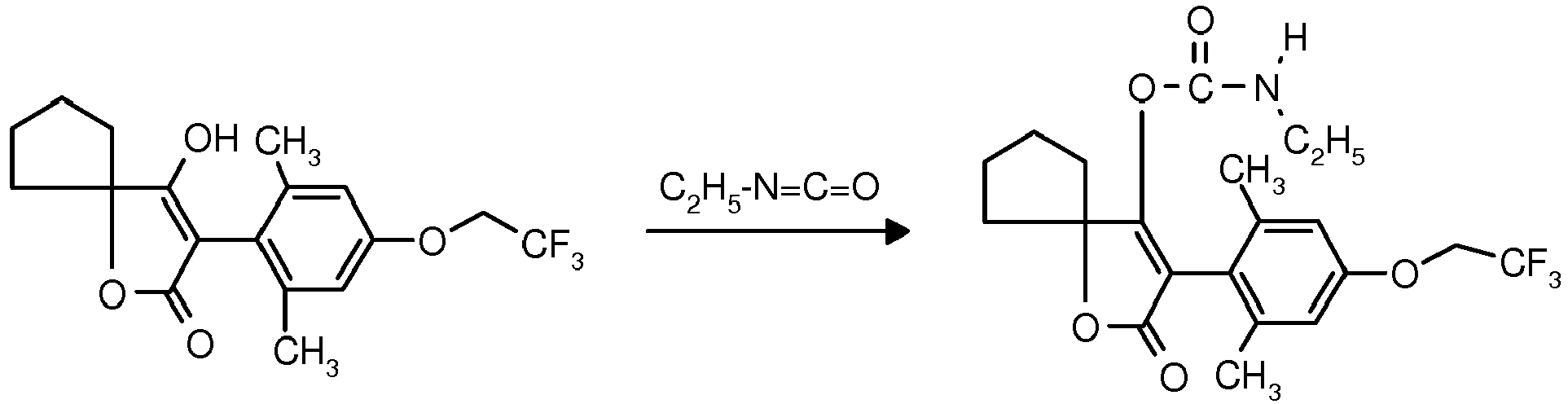
Verwendet man beispielsweise gemäß Verfahren (R) Variante ß 3-(2-Methyl-4-trifluorethoxy-6-ethyl-phenyl)-5-methyl-pyrrolidin-2,4-dion und Dimethylcarbamidsäurechlorid als Ausgangsprodukte, so kann der Reaktionsverlauf durch folgendes Schema wiedergegeben werden:
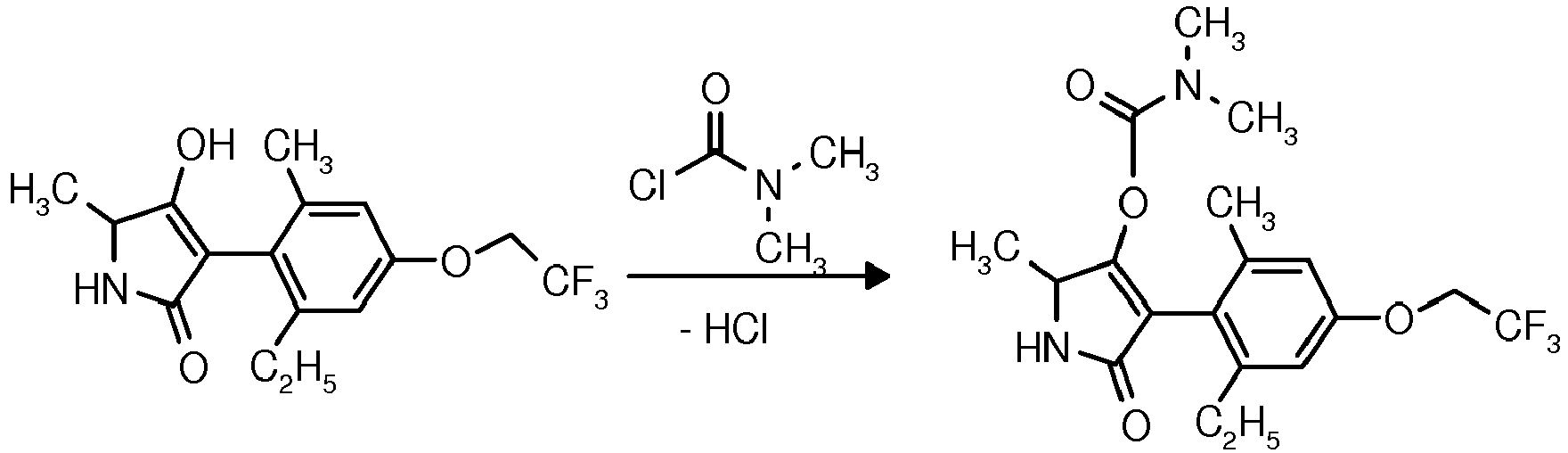
Verwendet man beispielsweise gemäß Verfahren (S) 3-(4-Brom-2,6-dimethyl-phenyl)-5,5-di-methyl-pyrrolidin-2,4-dion und Trifluorethanol als Ausgangsstoffe, so kann der Reaktionsverlauf durch folgendes Schema wiedergegeben werden:

Die beim erfindungsgemäßen Verfahren (a) als Ausgangsstoffe benötigten Verbindungen der Formel (II)
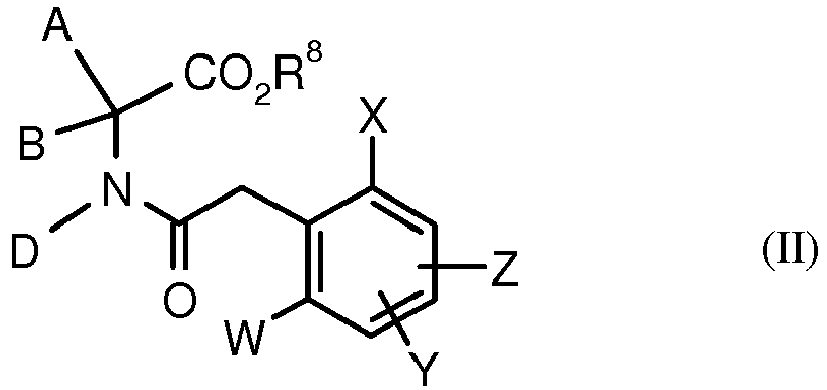
- A, B, D, W X, Y, Z und R8 die oben angegebenen Bedeutungen haben,
sind neu.
- A, B, D, WX, Y, Z and R 8 have the meanings given above,
are new.
Man erhält die Acylaminosäureester der Formel (II) beispielsweise, wenn man Aminosäurederivate der Formel (XXVII)
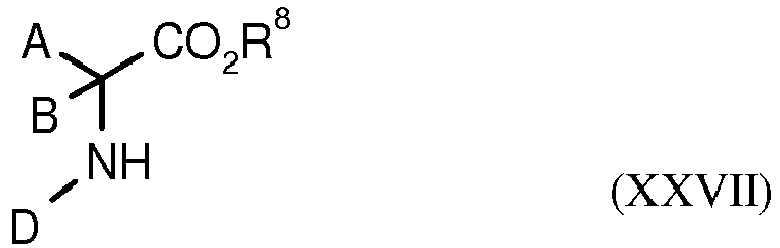
- A, B, R8 und D die oben angegebenen Bedeutungen haben,

- W, X, Y und Z die oben angegebenen Bedeutungen haben und
- U2 für eine durch Carbonsäureaktivierungsreagenzien wie Carbonyldiimidazol, Carbonyldiimide (wie z.B. Dicyclohexylcarbondiimid), Phosphorylierungsreagenzen (wie z.B. POCl3, BOP-Cl), Halogenierungsmittel z.B. Thionylchlorid, Oxalylchlorid, Phosgen oder Chlorameisensäsureester eingeführte Abgangsgruppe steht,
oder wenn man Acylaminosäuren der Formel (XXIX)
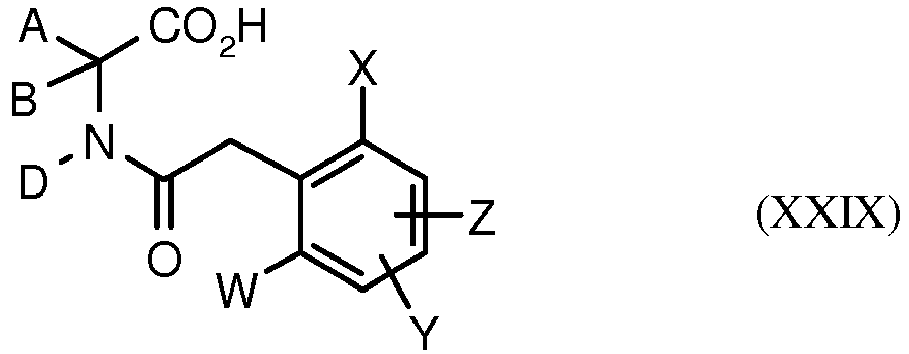
- A, B, D, W, X, Y und Z die oben angegebenen Bedeutungen haben,
verestert (Chem. Ind. (London) 1568 (1968
- A, B, R 8 and D have the meanings given above,
- W, X, Y and Z have the meanings given above, and
- U 2 is a leaving group introduced by carboxylic acid activating reagents such as carbonyldiimidazole, carbonyldiimides (such as dicyclohexylcarbondiimide), phosphorylating reagents (such as POCl 3 , BOP-Cl), halogenating agents such as thionyl chloride, oxalyl chloride, phosgene or chloroformic acid esters,
or when acylamino acids of the formula (XXIX)
- A, B, D, W, X, Y and Z have the meanings given above,
esterified (Chem. Ind. (London) 1568 (1968
Die Verbindungen der Formel (XXIX)
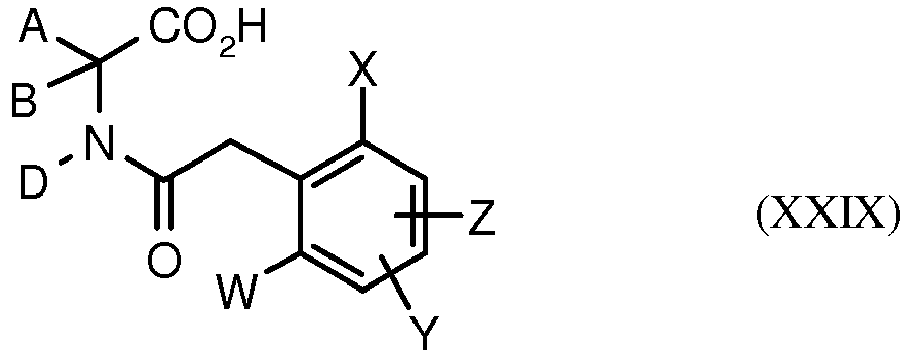
- A, B, D, W, X, Y und Z die oben angegebenen Bedeutungen haben,
sind neu.
- A, B, D, W, X, Y and Z have the meanings given above,
are new.
Man erhält die Verbindungen der Formel (XXIX), wenn man Aminosäuren der Formel (XXX)
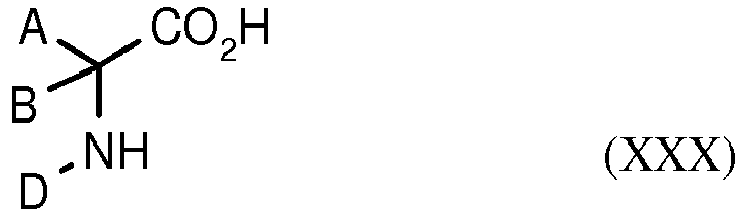
- A, B und D die oben angegebenen Bedeutungen haben,
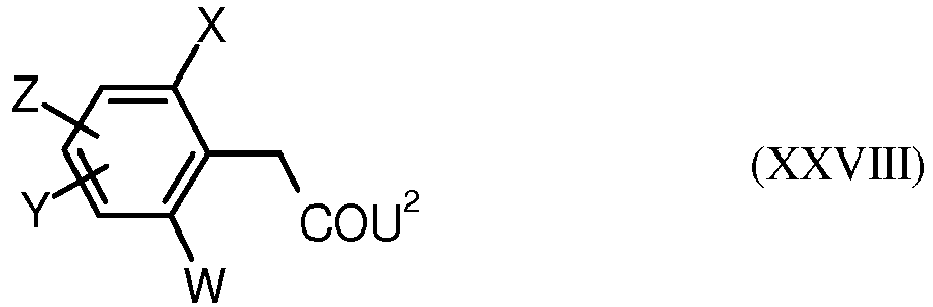
- W, X, Y und Z die oben angegebenen Bedeutungen haben und
- U2 die oben angegebene Bedeutung hat,
- A, B and D have the meanings given above,
- W, X, Y and Z have the meanings given above, and
- U 2 has the meaning given above,
Die Verbindungen der Formel (XXVIII) sind neu. Sie lassen sich nach im Prinzip bekannten Verfahren darstellen (s. z.B. H.
Man erhält die Verbindungen der Formel (XXVIII) beispielsweise, indem man substituierte Phenylessigsäuren der Formel (XXXI)
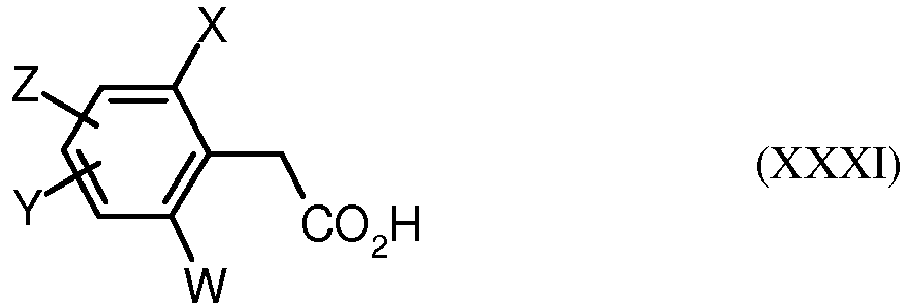
- W, X, Y und Z die oben angegebene Bedeutung haben,
- mit Halogenierungsmitteln (z.B. Thionylchlorid, Thionylbromid, Oxalylchlorid, Phosgen, Phosphortrichlorid, Phosphortribromid oder Phosphorpentachlorid), Phosphonylierungsreagenzien wie (z.B. POCl3, BOP-Cl), Carbonyldiimidazol, Carbonyldiimide (z.B. Dicyclohexylcarbonyldiimid) gegebenenfalls in Gegenwart eines Verdünnungsmittels (z.B. gegebenenfalls chlorierten aliphatischen oder aromatischen Kohlenwasserstoffen wie Toluol oder Methylenchlorid oder Ethern, z.B. Tetrahydrofuran, Dioxan, Methyl-tert.-butylether) bei Temperaturen von -20°C bis 150°C, bevorzugt von -10°C bis 100°C, umsetzt.
- W, X, Y and Z are as defined above,
- with halogenating agents (for example thionyl chloride, thionyl bromide, oxalyl chloride, phosgene, phosphorus trichloride, phosphorus tribromide or phosphorus pentachloride), Phosphonylierungsreagenzien such as (eg POCl 3 , BOP-Cl), carbonyldiimidazole, carbonyldiimides (eg Dicyclohexylcarbonyldiimid) optionally in the presence of a diluent (eg, optionally chlorinated aliphatic or aromatic Hydrocarbons such as toluene or methylene chloride or ethers, for example tetrahydrofuran, dioxane, methyl tert-butyl ether) at temperatures from -20 ° C to 150 ° C, preferably from -10 ° C to 100 ° C, reacted.
Die Verbindungen der Formel (XXVII) und (XXX) sind teilweise aus der eingangs zitierten Patentliteratur bekannt und/oder lassen sich nach bekannten Verfahren darstellen (siehe z.B.
Die substituierten cyclischen Aminocarbonsäuren der Formel (XXX), in der A und B einen Ring bilden, sind im Allgemeinen nach der Bucherer-Bergs-Synthese oder nach der Strecker-Synthese erhältlich und fallen dabei jeweils in unterschiedlichen Isomerenformen an. So erhält man unter den Bedingungen der Bucherer-Bergs-Synthese vorwiegend die Isomeren (im folgenden der Einfachheit halber als ß bezeichnet), in welchen die Reste R und die Carboxylgruppe äquatorial stehen, während nach den Bedingungen der Strecker-Synthese vorwiegend die Isomeren (im folgenden der Einfachheit halber als α bezeichnet) anfallen, bei denen die Aminogruppe und die Reste R äquatorial stehen.


- A, B, D, W, X, Y, Z und R8 die oben angegebenen Bedeutungen haben, herstellen, wenn man Aminonitrile der Formel (XXXII)
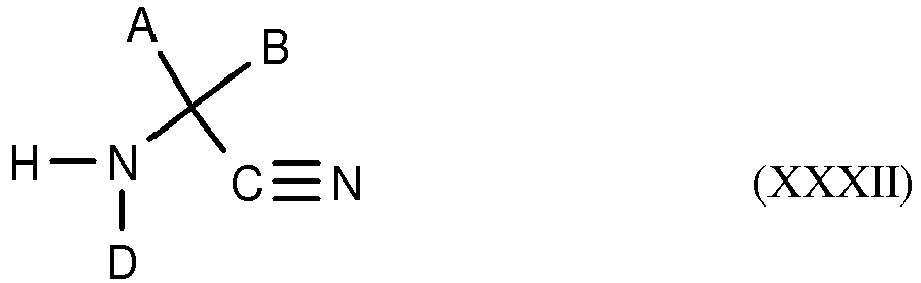
- A, B und D die oben angegebenen Bedeutungen haben,
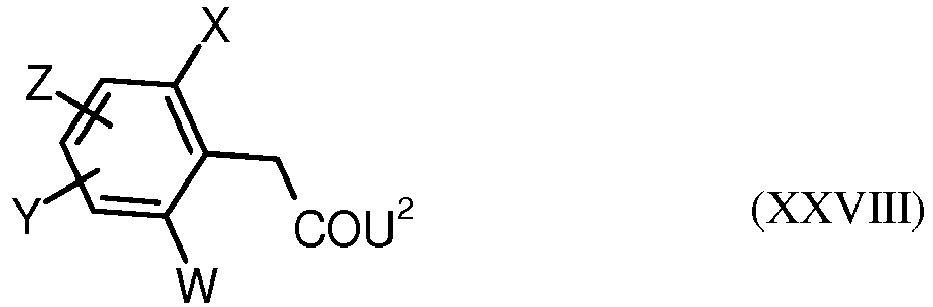
- W, X, Y, Z und U2 die oben angegebenen Bedeutungen haben,
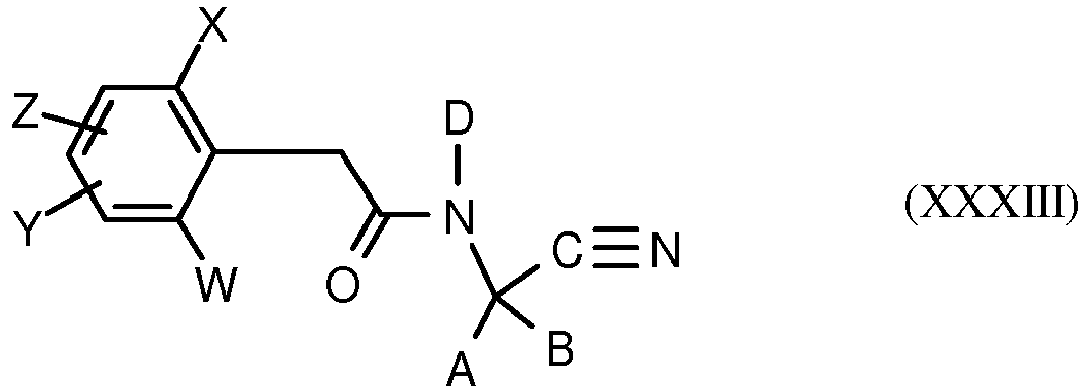
- A, B, D, W, X, Y und Z die oben angegebenen Bedeutungen haben,
umsetzt,
- A, B, D, W, X, Y, Z and R 8 have the abovementioned meanings, when aminonitriles of the formula (XXXII)
- A, B and D have the meanings given above,
- W, X, Y, Z and U 2 have the meanings given above,
- A, B, D, W, X, Y and Z have the meanings given above,
implements,
Die Verbindungen der Formel (XXXIII) sind ebenfalls neu.The compounds of formula (XXXIII) are also new.
Die bei dem erfindungsgemäßen Verfahren (B) als Ausgangstoffe benötigten Verbindungen der Formel (III)

- A, B, W, X, Y, Z und R8 die oben angegebenen Bedeutungen haben,
sind neu.
- A, B, W, X, Y, Z and R 8 have the meanings given above,
are new.
Sie lassen sich nach im Prinzip bekannten Methoden herstellen.They can be prepared by methods known in principle.
So erhält man die Verbindungen der Formel (III) beispielsweise, wenn man 2-Hydroxycarbonsäureester der Formel (XXXIV-A)

- A, B und R8 die oben angegebenen Bedeutungen haben,
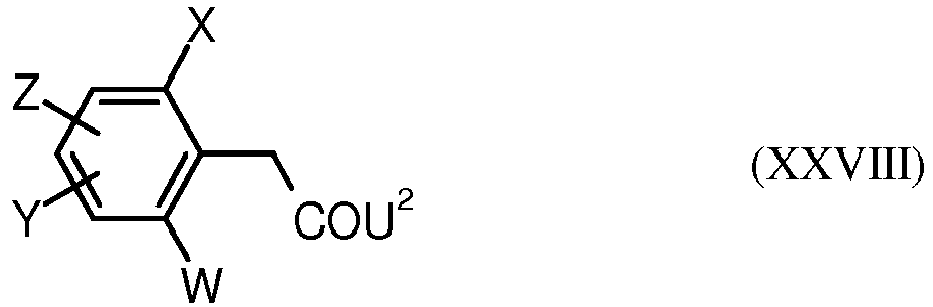
- W, X, Y, Z und U2 die oben angegebenen Bedeutungen haben,
acyliert (Chem. Reviews 52, 237-416 (1953
- A, B and R 8 have the meanings given above,
- W, X, Y, Z and U 2 have the meanings given above,
acylated (Chem. Reviews 52, 237-416 (1953
Weiterhin erhält man Verbindungen der Formel (III), wenn man substituierte Phenylessigsäuren der Formel (XXXI)

- W, X, Y und Z die oben angegebenen Bedeutungen haben,
- mit α-Halogencarbonsäureestern der Formel (XXXIV-B)
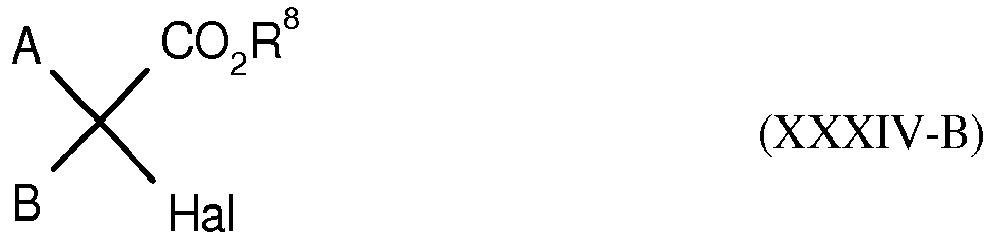
- A, B und R8 die oben angegebenen Bedeutungen haben und
- Hal für Chlor oder Brom steht,
- W, X, Y and Z have the meanings given above,
- with α-halocarboxylic acid esters of the formula (XXXIV-B)
- A, B and R 8 have the meanings given above and
- Hal is chlorine or bromine,
Die Verbindungen der Formel (XXXIV-A) sind teilweise käuflich oder aus den eingangs erwähnten Offenbarungen bekannt.The compounds of the formula (XXXIV-A) are partially commercially available or known from the disclosures mentioned above.
Die Verbindungen der Formel (XXXIV-B) sind käuflich.The compounds of the formula (XXXIV-B) are commercially available.
Die Verbindungen der Formel (XXXI) sind neu.The compounds of formula (XXXI) are new.
Beispielsweise erhält man die Verbindungen der Formel (XXXI),
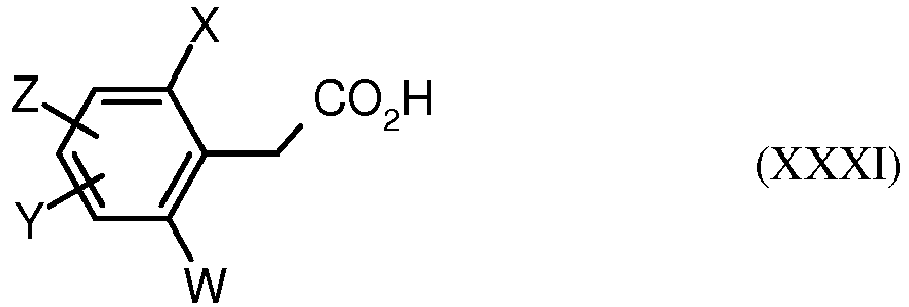
- W, X, Y und Z die oben angegebenen Bedeutungen haben,
wenn man Phenylessigsäureester der Formel (XXXV)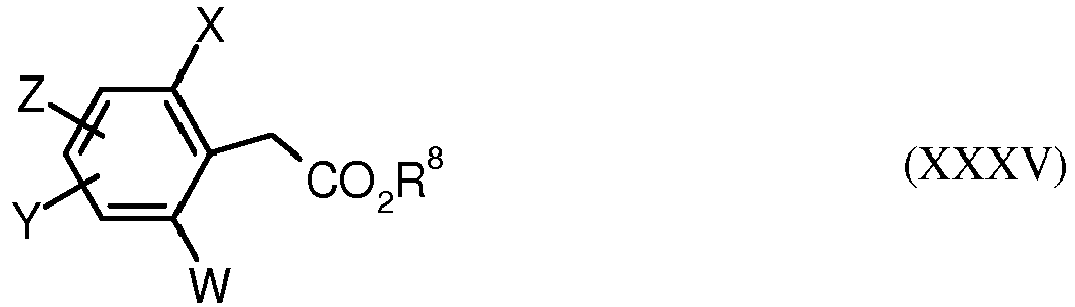
- W, X, Y, Z und R8 die oben angegebene Bedeutung haben,
- W, X, Y and Z have the meanings given above,
when phenylacetic esters of the formula (XXXV)- W, X, Y, Z and R 8 have the abovementioned meaning,
Die Verbindungen der Formel (XXXV) sind neu.The compounds of formula (XXXV) are new.
Die Verbindungen der Formel (XXXV)
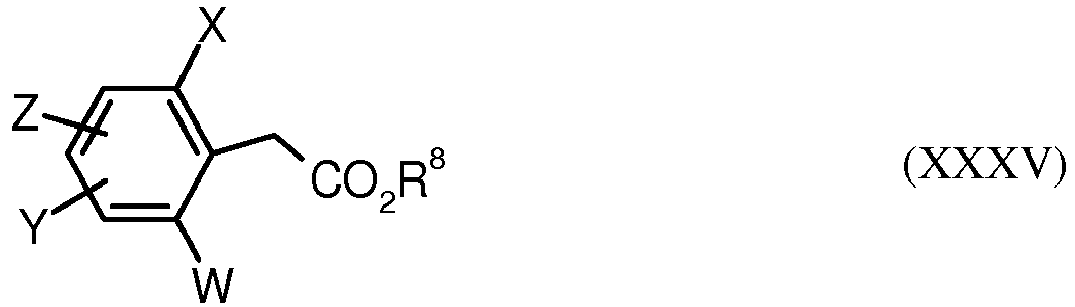
- W, X, Y, Z und R8 die oben angegebene Bedeutung haben, erhält man nach dem in den Beispielen beschriebenen Verfahren analog dem Verfahren (S),
- wenn man Phenylessigsäureester der Formel (XXXV-a)
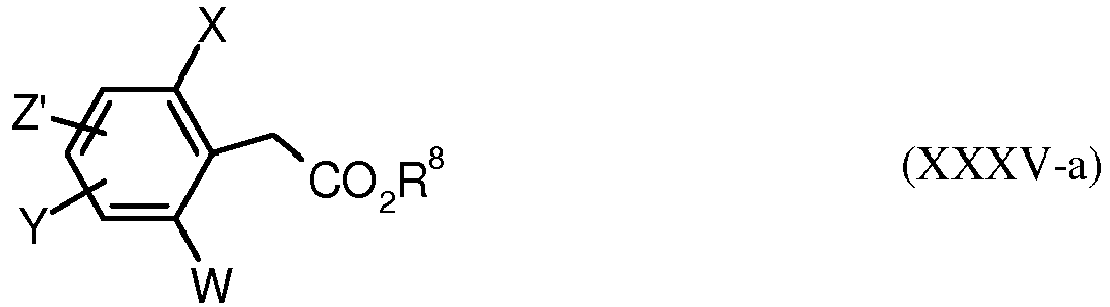
- R8, W, X und Y die oben angegebene Bedeutung haben und Z' für Brom oder Iod steht,
- in Gegenwart von Halogenalkylalkoholen z.B. Trifluorethanol in Gegenwart einer Base und gegebenenfalls in Gegenwart eines Kupfersalzes (bevorzugt Cu-I-J) umsetzt.
- W, X, Y, Z and R 8 have the abovementioned meanings are obtained by the process described in the Examples analogously to process (S),
- when phenylacetic esters of the formula (XXXV-a)
- R 8, W, X and Y have the meaning given above and Z 'is bromine or iodine,
- In the presence of haloalkyl alcohols, for example, trifluoroethanol in the presence of a base and optionally in the presence of a copper salt (preferably Cu-IJ).
Die Phenylessigsäureester der Formel (XXXV-a) sind prinzipiell beispielsweise aus den Offenlegungen
Die bei dem obigen Verfahren (C) als Ausgangsstoffe benötigten Verbindungen der Formel (IV)

- A, B, V, W, X, Y, Z und R8 die oben angegebenen Bedeutungen haben, sind neu.
- A, B, V, W, X, Y, Z and R 8 have the meanings given above are new.
Sie lassen sich nach im Prinzip bekannten Methoden herstellen.They can be prepared by methods known in principle.
Man erhält die Verbindungen der Formel (IV) beispielsweise, wenn man substituierte Phenylessigsäureester der Formel (XXXV)

- W, X, Y, Z und R8 die oben angegebenen Bedeutungen haben,
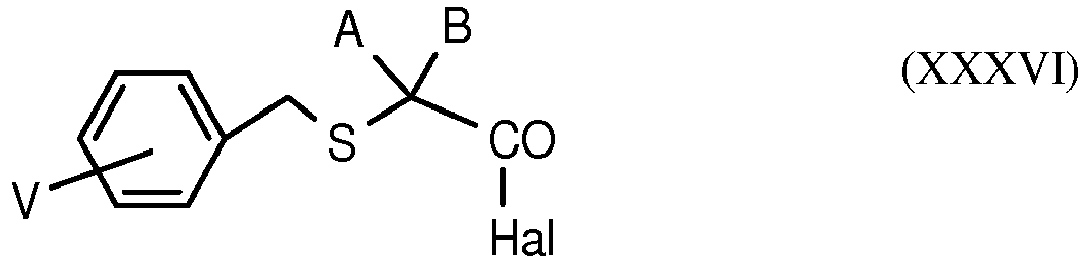
- A, B und V die oben angegebenen Bedeutungen haben und
- Hal für Halogen (insbesondere Chlor oder Brom) steht,
- W, X, Y, Z and R 8 have the meanings given above,
- A, B and V have the meanings given above and
- Hal is halogen (especially chlorine or bromine),
Die Benzylthio-carbonsäurehalogenide der Formel (XXXVI) sind teilweise bekannt und/oder lassen sich nach bekannten Verfahren herstellen (
Die bei den obigen Verfahren (D), (E) und (H-α) als Ausgangsstoffe benötigten Halogencarbonylketene der Formel (VI) sind neu. Sie lassen sich nach im Prinzip bekannten Methoden herstellen (vgl. beispielsweise 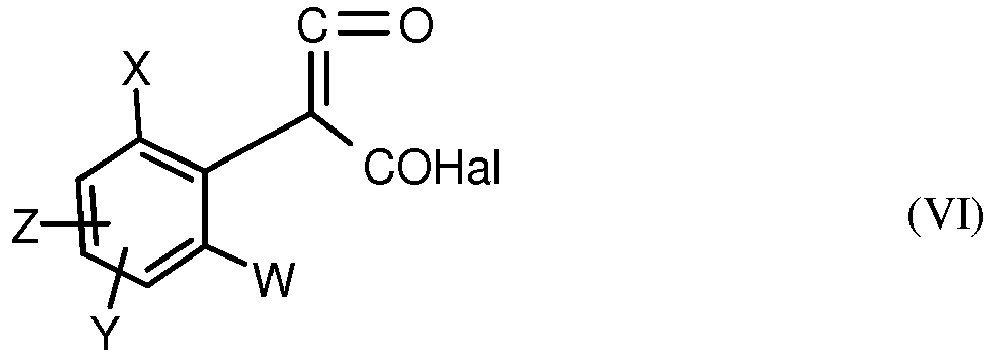
- W, X, Y und Z die oben angegebenen Bedeutungen haben und
- Hal für Chlor oder Brom steht,
substituierte Phenylmalonsäuren der Formel (XXXVII)

- W, X, Y und Z die oben angegebenen Bedeutungen haben,
- mit Säurehalogeniden, wie beispielsweise Thionylchlorid, Phosphor(V)chlorid, Phosphor(III)-chlorid, Oxalylchlorid, Phosgen oder Thionylbromid gegebenenfalls in Gegenwart von Katalysatoren, wie beispielsweise Dimethylformamid, Methyl-Stearylformamid oder Triphenylphosphin und gegebenenfalls in Gegenwart von Basen wie z.B. Pyridin oder Triethylamin, umsetzt.
- W, X, Y and Z have the meanings given above, and
- Hal is chlorine or bromine,
substituted phenylmalonic acids of the formula (XXXVII)
- W, X, Y and Z have the meanings given above,
- with acid halides such as thionyl chloride, phosphorus (V) chloride, phosphorus (III) chloride, oxalyl chloride, phosgene or thionyl bromide optionally in the presence of catalysts such as dimethylformamide, methyl-stearylformamide or triphenylphosphine and optionally in the presence of bases such as pyridine or Triethylamine, reacted.
Die substituierten Phenylmalonsäuren der Formel (XXXVII) sind neu. Sie lassen sich in einfacher Weise nach bekannten Verfahren herstellen (vgl. z.B.
So erhält man Phenylmalonsäuren der Formel (XXXVII)
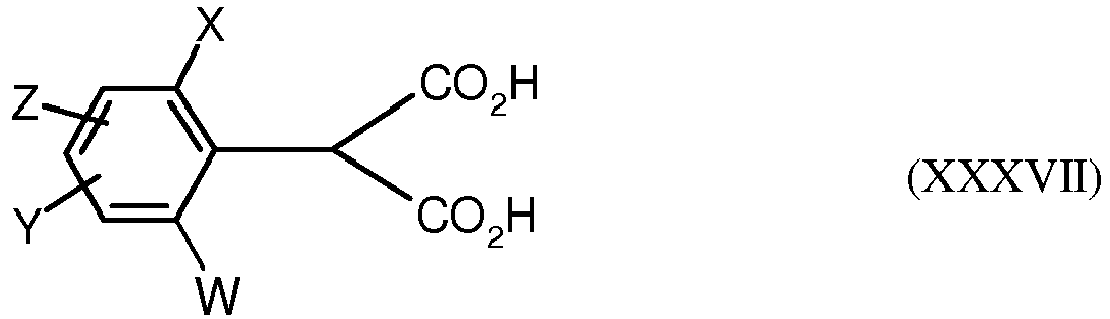
- W, X, Y und Z die oben angegebenen Bedeutungen haben,
- wenn man Phenylmalonsäureester der Formel (XI)
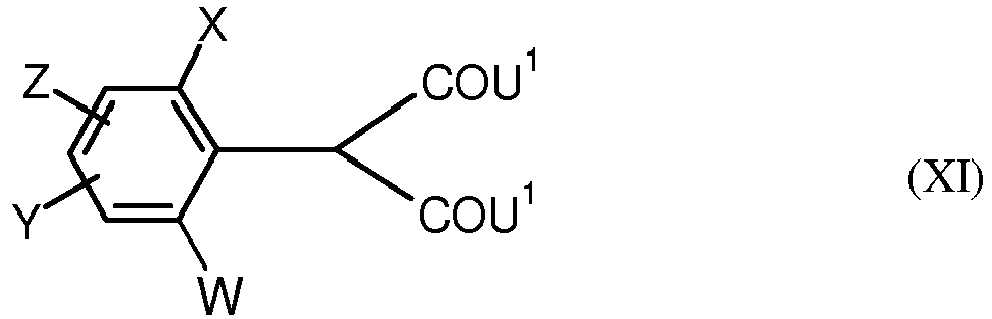
- W, X, Y und Z die oben angegebene Bedeutung haben,
- und U1 für OR8 steht,
zunächst in Gegenwart einer Base und einem Lösungsmittel verseift und anschließend vorsichtig ansäuert (s. beispielsweiseEP-A-528 156 WO 96/35 664 WO 97/02 243
- W, X, Y and Z have the meanings given above,
- when phenylmalonic esters of the formula (XI)
- W, X, Y and Z are as defined above,
- and U 1 is OR 8 ,
first saponified in the presence of a base and a solvent and then carefully acidified (see, for exampleEP-A-528 156 WO 96/35 664 WO 97/02 243
Die Malonsäureester der Formel (XI)

- W, X, Y und Z die oben angegebene Bedeutung haben,
- und U1 für OR8 steht,
sind neu.The malonic acid esters of the formula (XI)
- W, X, Y and Z are as defined above,
- and U 1 is OR 8 ,
are new.
Sie lassen sich nach allgemein bekannten Methoden der Organischen Chemie darstellen (vgl. z.B.
Die für das erfindungsgemäße Verfahren (D) als Ausgangsstoffe benötigten Carbonylverbindungen der Formel (V)
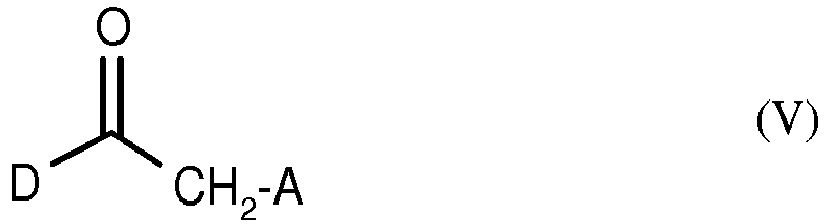
- A und D die oben angegebenen Bedeutungen haben,

- A, D und R8 die oben angegebenen Bedeutungen haben, sind käufliche, allgemeine bekannte oder nach bekannten Verfahren zugängliche Verbindungen.
- A and D have the meanings given above,
- A, D and R 8 have the meanings given above, are commercially available, commonly known or accessible by known methods compounds.
Die prinzipielle Herstellung der zur Durchführung des erfindungsgemäßen Verfahrens (E) als Ausgangsstoffe benötigten Ketensäurechloride der Formel (VI) wurden bereits im Zusammenhang bei dem Verfahren D beschrieben. Die zur Durchführung des erfindungsgemäßen Verfahrens (E) benötigten Thioamide der Formel (VII)

- A die oben angegebene Bedeutung hat,
- A has the meaning given above,
Die bei dem obigen Verfahren (F) als Ausgangsstoffe benötigten Verbindungen der Formel (VIII)
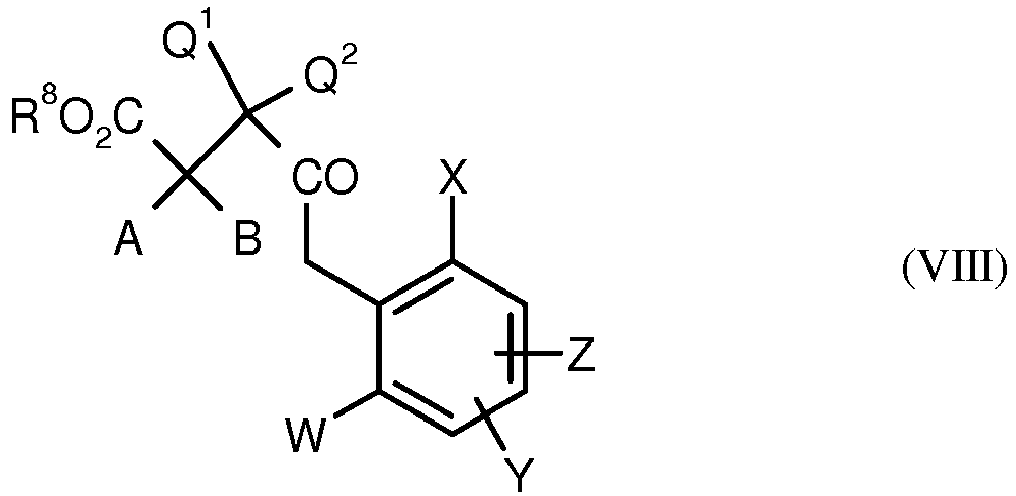
- A, B, Q1, Q2, W, X, Y, Z und R8 die oben angegebene Bedeutung haben, sind neu.
- A, B, Q 1 , Q 2 , W, X, Y, Z and R 8 are as defined above are novel.
Sie lassen sich nach im Prinzip bekannten Methoden herstellen.They can be prepared by methods known in principle.
Man erhält die 5-Aryl-4-ketocarbonsäureester der Formel (VIII) beispielsweise, wenn man 5-Aryl-4-ketocarbonsäuren der Formel (XXXVIII)
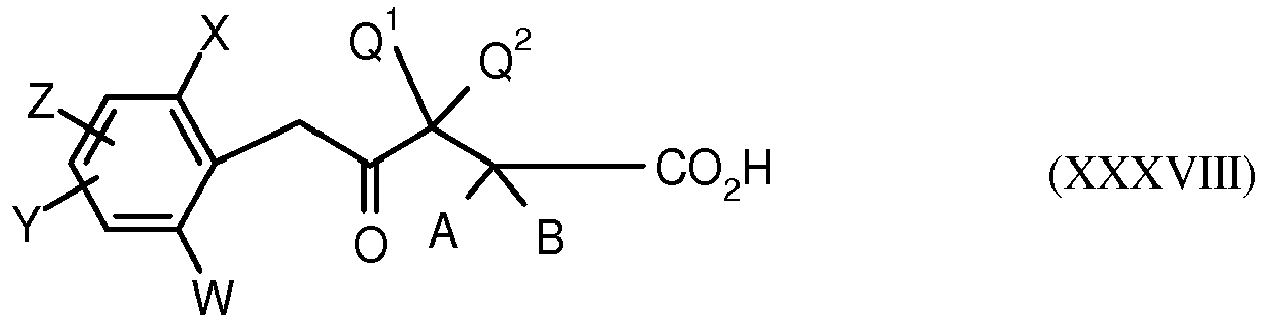
- W, X, Y, Z, A, B, Q1 und Q2 die oben angegebene Bedeutung haben,
- W, X, Y, Z, A, B, Q 1 and Q 2 are as defined above,
Die 5-Aryl-4-ketocarbonsäuren der Formel (XXXVIII)

- A, B, Q1, Q2, W, X, Y und Z die oben angegebene Bedeutung haben,
- sind neu, lassen sich aber nach im Prinzip bekannten Methoden herstellen (
WO 96/01 798 WO 97/14667 WO 98/39281
- A, B, Q 1 , Q 2 , W, X, Y and Z are as defined above,
- are new, but can be prepared by methods known in principle (
WO 96/01 798 WO 97/14667 WO 98/39281
Man erhält die 5-Aryl-4-ketocarbonsäuren der Formel (XXXVIII) beispielsweise, wenn man 2-Phenyl-3-oxo-adipinsäureester der Formel (XXXIX)

- A, B, Q1, Q2, W, X, Y und Z die oben angegebene Bedeutung haben und
- R8 und R8' für Alkyl (insbesondere C1-C8-Alkyl) stehen und bei Einsatz der Verbindung der Formel (XLI-a) R8 für Wasserstoff steht,
- A, B, Q 1 , Q 2 , W, X, Y and Z are as defined above and
- R 8 and R 8 'are alkyl (in particular C 1 -C 8 -alkyl) and when using the compound of the formula (XLI-a) R 8 is hydrogen,
Die Verbindungen der Formel (XXXIX)
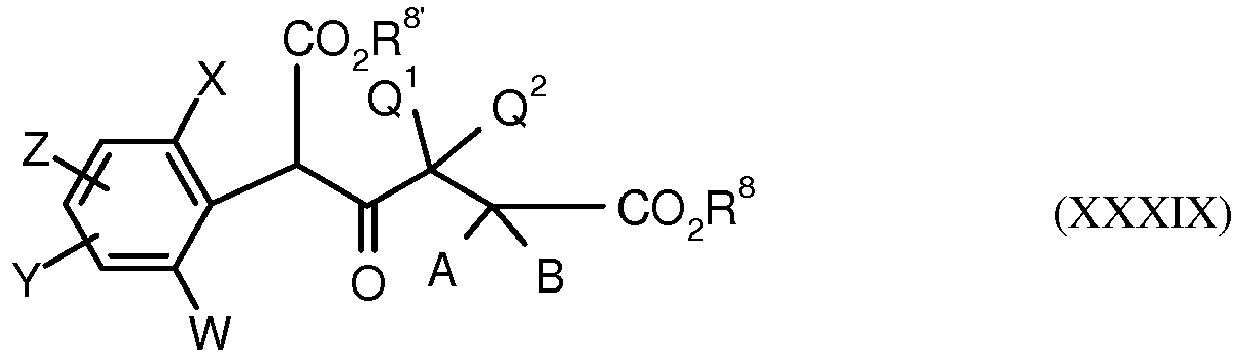
- A, B, Q1, Q2, W, X, Y, Z, R8 und R8' die oben angegebene Bedeutung haben und bei Einsatz der Verbindung der Formel (XLI-a) R8 für Wasserstoff steht
- A, B, Q 1 , Q 2 , W, X, Y, Z, R 8 and R 8 'have the abovementioned meaning and when using the compound of formula (XLI-a) R 8 is hydrogen
Man erhält die Verbindungen der Formel (XXXIX) beispielsweise,
wenn man Dicarbonsäurehalbesterchloride der Formel (XL),
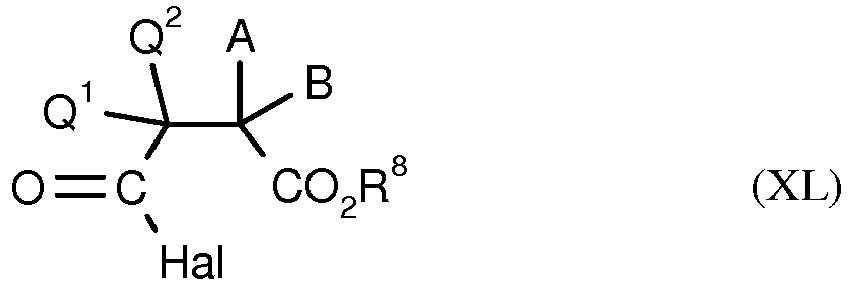
- A, B, Q1, Q2 und R8 die oben angegebene Bedeutung haben und
- Hal für Chlor oder Brom steht,
- oder Carbonsäureanhydride der Formel (XLI-a)

- A, B, Q1 und Q2 die oben angegebene Bedeutung haben,

- W, X, Y, Z und R8 die oben angegebene Bedeutung haben,
M.S. Chambers, E. J. Thomas, D.J. Williams, J. Chem. Soc. Chem. Commun., (1987), 1228
when dicarboxylic acid half-chlorides of the formula (XL),
- A, B, Q 1 , Q 2 and R 8 have the abovementioned meaning and
- Hal is chlorine or bromine,
- or carboxylic acid anhydrides of the formula (XLI-a)
- A, B, Q 1 and Q 2 are as defined above,
- W, X, Y, Z and R 8 have the abovementioned meaning,
MS Chambers, EJ Thomas, DJ Williams, J. Chem. Soc. Chem. Commun., (1987), 1228
Die Verbindungen der Formeln (XL) und (XLI-a) sind teilweise bekannte Verbindungen der Organischen Chemie und/oder lassen sich nach im Prinzip bekannten Methoden in einfacher Weise herstellen.The compounds of the formulas (XL) and (XLI-a) are partially known compounds of organic chemistry and / or can be prepared in a simple manner by methods known in principle.
Die bei dem obigen Verfahren (G) als Ausgangsstoffe benötigten Verbindungen der Formel (IX)

- A, B, Q5, Q6, U, W, X, Y, Z und R8 die oben angegebene Bedeutung haben,
- A, B, Q 5 , Q 6 , U, W, X, Y, Z and R 8 are as defined above,
Sie lassen sich nach im Prinzip bekannten Methoden herstellen.They can be prepared by methods known in principle.
Man erhält die 6-Aryl-5-ketocarbonsäureester der Formel (IX) beispielsweise, wenn man 6-Aryl-5-ketocarbonsäuren der Formel (XLII)
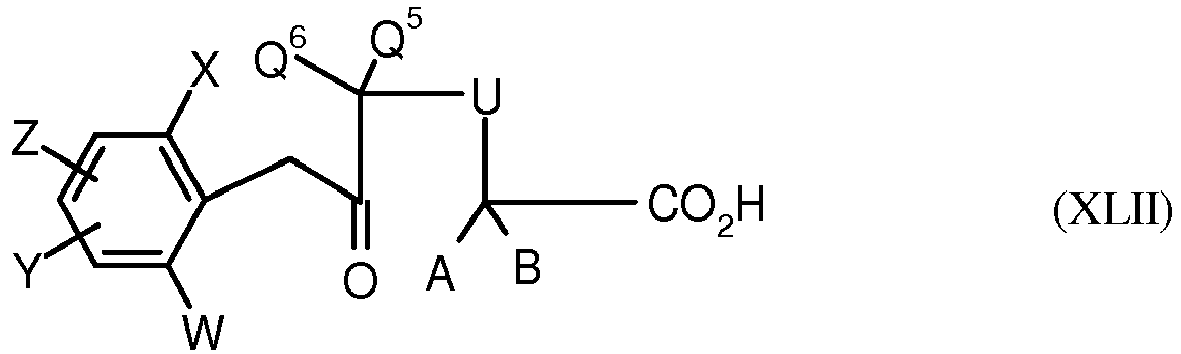
- A, B, Q5, Q6, U, W, X, Y und Z die oben angegebene Bedeutung haben,
- A, B, Q 5, Q 6, U, W, X, Y and Z have the abovementioned meaning,
Die 6-Aryl-5-ketocarbonsäuren der Formel (XLII)
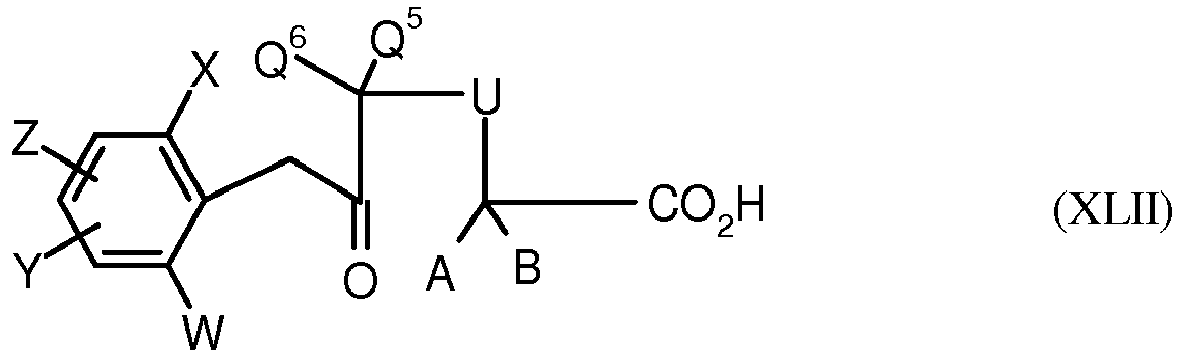
- A, B, Q5, Q6, U, W, X, Y und Z die oben angegebene Bedeutung haben,
substituierte 2-Phenyl-3-oxo-heptandisäureester der Formel (XLIII)

- A, B, Q5, Q6, U, W, X und Z die oben angegebene Bedeutung haben und
- R8 und R8' für Alkyl (bevorzugt C1-C6-Alkyl), stehen, und
gegebenenfalls in Gegenwart eines Verdünnungsmittels und gegebenenfalls in Gegenwart einer Base oder Säure verseift und decarboxyliert (vgl. z.B.
- A, B, Q 5, Q 6, U, W, X, Y and Z have the abovementioned meaning,
substituted 2-phenyl-3-oxo-heptanedioic esters of the formula (XLIII)
- A, B, Q 5 , Q 6 , U, W, X and Z have the abovementioned meaning and
- R 8 and R 8 'are alkyl (preferably C 1 -C 6 alkyl), and
if appropriate saponified and decarboxylated in the presence of a diluent and if appropriate in the presence of a base or acid (cf., for example, US Pat
Die Verbindungen der Formel (XLIII)

- A, B, Q5, Q6, U, W, X, Y, Z, R8 und R8' die oben angegebene Bedeutung haben,
sind neu und erhältlich,
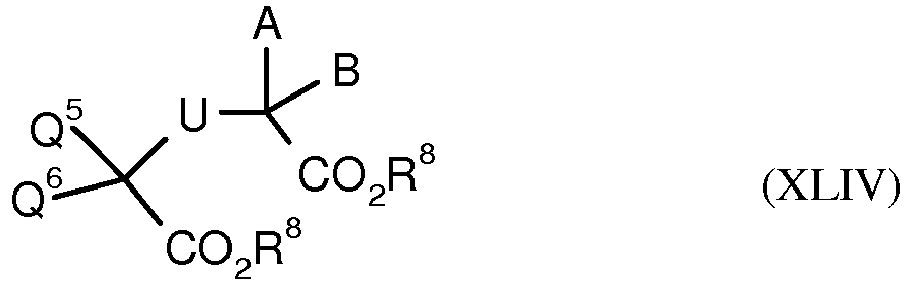
- A, B, Q5, Q6, U und R8 die oben angegebene Bedeutung haben,
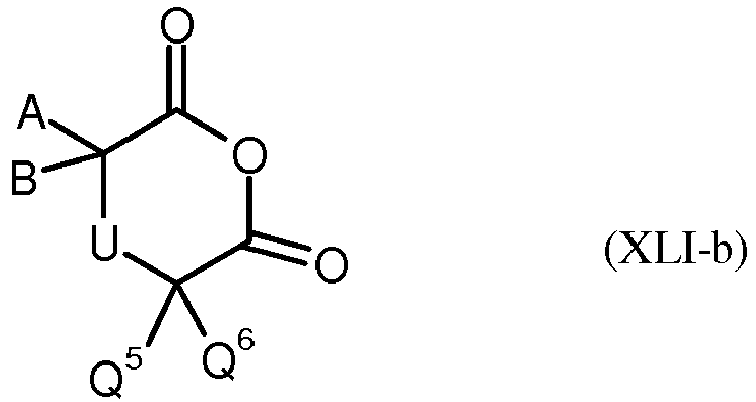
mit einem substituierten Phenylessigsäureester der Formel (XXXV)
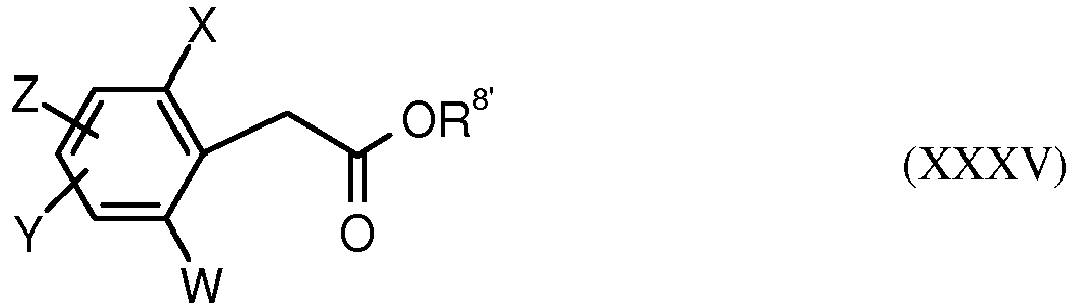
- W, X, Y, Z und R8 die oben angegebene Bedeutung haben,
in Gegenwart eines Verdünnungsmittels und in Gegenwart einer Base kondensiert.
- A, B, Q 5 , Q 6 , U, W, X, Y, Z, R 8 and R 8 'have the abovementioned meaning,
are new and available,
- A, B, Q 5 , Q 6 , U and R 8 are as defined above,
with a substituted phenylacetic acid ester of the formula (XXXV)
- W, X, Y, Z and R 8 have the abovementioned meaning,
condensed in the presence of a diluent and in the presence of a base.
Die Verbindungen der Formel (XLIV) sind teilweise bekannt und/oder lassen sich nach bekannten Verfahren darstellen.The compounds of the formula (XLIV) are known in some cases and / or can be prepared by known processes.
Die für das erfindungsgemäße Verfahren (H-α) und (H-ß) als Ausgangsstoffe benötigten Hydrazine der Formel (X)
A-NH-NH-D (X)
in welcher
- A und D die oben angegebenen Bedeutungen haben,
sind teilweise bekannt und/oder nach literaturbekannten Methoden herstellbar (vgl. beispielsweiseLiebigs Ann. Chem. 585, 6 (1954 Reaktionen der organischen Synthese, C. Ferri, Seite 212, 513; Georg Thieme Verlag Stuttgart, 1978 Liebigs Ann. Chem. 443, 242 (1925 Chem. Ber. 98, 2551 (1965 EP-A-508 126 WO 92/16510 WO 99/47 525 WO 01/17 972
A-NH-NH-D (X)
in which
- A and D have the meanings given above,
are partially known and / or produced by literature methods (see, for exampleLiebigs Ann Chem. 585, 6 (1954 Reactions of Organic Synthesis, C. Ferri, pages 212, 513; Georg Thieme Verlag Stuttgart, 1978 Liebigs Ann Chem. 443, 242 (1925 Chem. Ber. 98, 2551 (1965 EP-A-508 126 WO 92/16510 WO 99/47 525 WO 01/17972
Die für das erfindungsgemäße Verfahren (H-γ) benötigten Verbindungen der Formel (XII)

- A, D, W, X, Y, Z und R8 die oben angegebene Bedeutung haben,
sind neu.
- A, D, W, X, Y, Z and R 8 are as defined above,
are new.
Man erhält die Acylcarbazate der Formel (XII) beispielsweise, wenn man Carbazate der Formel (XLV)
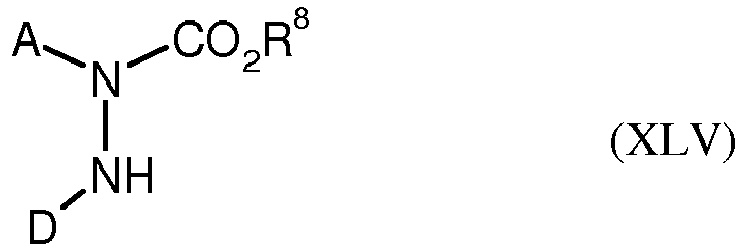
- A, R8 und D die oben angegebenen Bedeutungen haben,
mit substituierten Phenylessigsäurederivaten der Formel (XXVIII)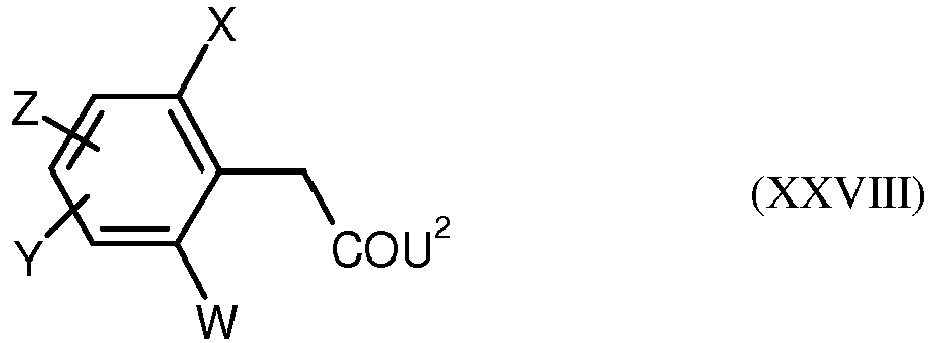
- W, X, Y, Z, und U2 die oben angegebenen Bedeutungen haben
acyliert (Chem. Reviews 52, 237-416 (1953 Bhattacharya, Indian J. Chem. 6, 341-5, 1968
- W, X, Y, Z, und U2 die oben angegebenen Bedeutungen haben
- A, R 8 and D have the meanings given above,
with substituted phenylacetic acid derivatives of the formula (XXVIII)- W, X, Y, Z, and U 2 have the meanings given above
acylated (Chem. Reviews 52, 237-416 (1953 Bhattacharya, Indian J. Chem. 6, 341-5, 1968
- W, X, Y, Z, and U 2 have the meanings given above
Die Carbazate der Formel (XLV) sind teilweise käufliche und teilweise bekannte Verbindungen oder lassen sich nach im Prinzip bekannten Verfahren der organischen Chemie herstellen.The carbazates of the formula (XLV) are partly commercially available and partly known compounds or can be prepared by methods of organic chemistry which are known in principle.
Die Verbindungen der Formel (XXVIII) wurden bereits bei den Vorstufen für das Verfahren (A) und (B) beschrieben.The compounds of the formula (XXVIII) have already been described in the precursors for the process (A) and (B).
Die beim erfindungsgemäßen Verfahren (I) als Ausgangsstoffe benötigten Verbindungen der Formel (XIII)

A, B, D, Q1, Q2, W, X, Y, Z und R8 die oben angegebenen Bedeutungen haben, sind neu.The compounds of the formula (XIII) required as starting materials in process (I) according to the invention
A, B, D, Q 1 , Q 2 , W, X, Y, Z and R 8 have the meanings given above are new.
Man erhält die Acylaminosäureester der Formel (XIII) beispielsweise, wenn man Aminosäurederivate der Formel (XLVI)
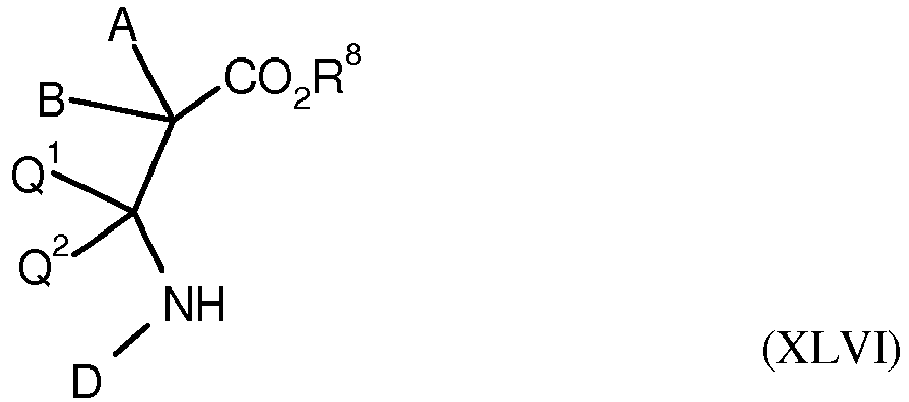
A, B, Q1, Q2, R8 und D die oben angegebenen Bedeutungen haben,
mit substituierten Hetarylessigsäurederivaten der Formel (XXVIII)
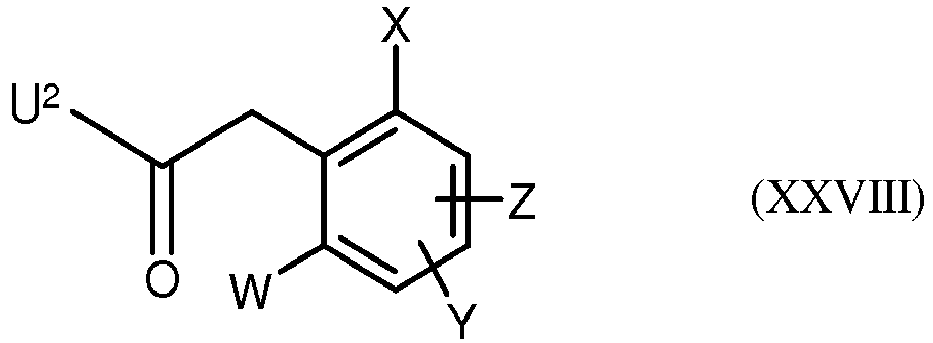
W, X, Y, Z und U2 die oben angegebene Bedeutung haben
acyliert (
A, B, D, Q1, Q2, W, X, Y und Z die oben angegebenen Bedeutungen haben, verestert (
A, B, Q 1 , Q 2 , R 8 and D have the meanings given above,
with substituted hetarylacetic acid derivatives of the formula (XXVIII)
W, X, Y, Z and U 2 have the abovementioned meaning
acylated (
A, B, D, Q 1 , Q 2 , W, X, Y and Z have the meanings given above, esterified (
Die Verbindungen der Formel (XLVII)

A, B, D, Q1, Q2, W, X, Y und Z die oben angegebenen Bedeutungen haben, sind neu.The compounds of the formula (XLVII)
A, B, D, Q 1 , Q 2 , W, X, Y and Z have the meanings given above, are new.
Man erhält die Verbindungen der Formel (XLVII), wenn man ß-Aminosäuren der Formel (XLVIII)
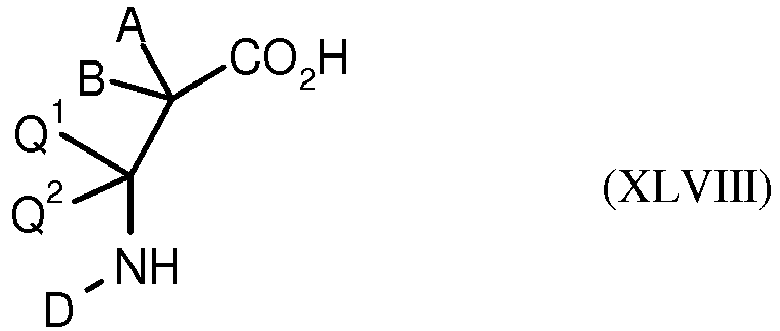
A, B, Q1, Q2 und D die oben angegebenen Bedeutungen haben,
mit substituierten Phenylessigsäurederivaten der Formel (XXVIII)
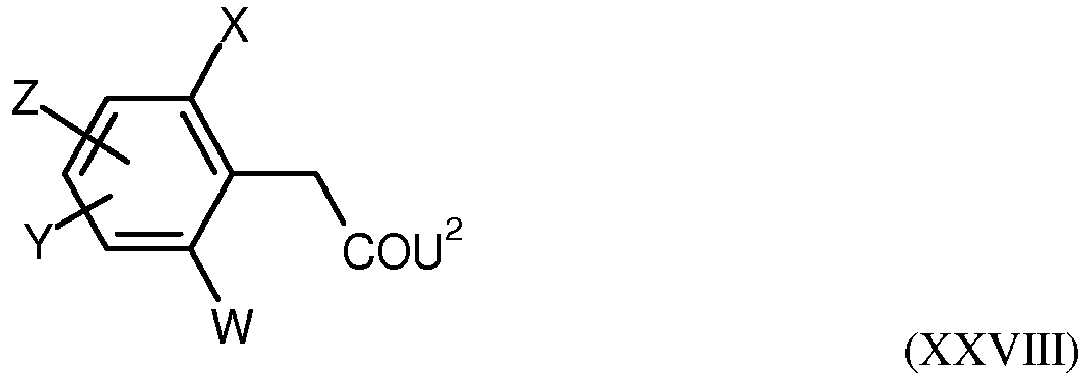
W, X, Y, Z und U2 die oben angegebenen Bedeutungen haben
beispielsweise nach Schotten-Baumann acyliert (
A, B, Q 1 , Q 2 and D have the meanings given above,
with substituted phenylacetic acid derivatives of the formula (XXVIII)
W, X, Y, Z and U 2 have the meanings given above
for example, acylated according to Schotten-Baumann (
Die Verbindungen der Formel (XLVI) und (XLVIII) sind teilweise aus
Die beim erfindungsgemäßen Verfahren (J) als Ausgangsstoffe benötigten Verbindungen der Formel (XIV)
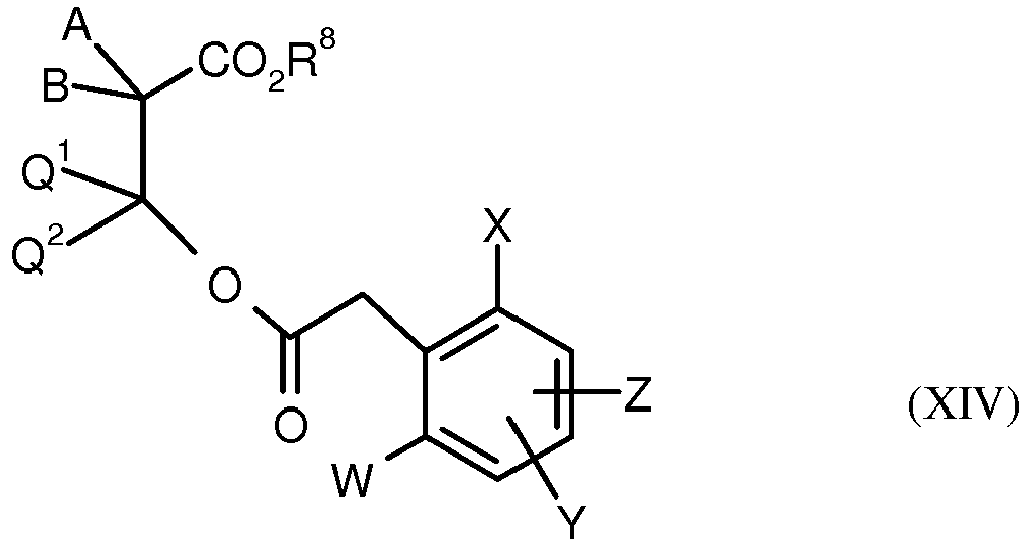
A, B, Q1, Q2, W, X, Y, Z und R8 die oben angegebenen Bedeutungen haben, sind neu.The compounds of the formula (XIV) required as starting materials in process (J) according to the invention
A, B, Q 1 , Q 2 , W, X, Y, Z and R 8 have the meanings given above are new.
Man erhält die Acylhydroxycarbonsäureester der Formel (XIV) beispielsweise, wenn man Hydroxycarbonsäureester der Formel (XLIX)
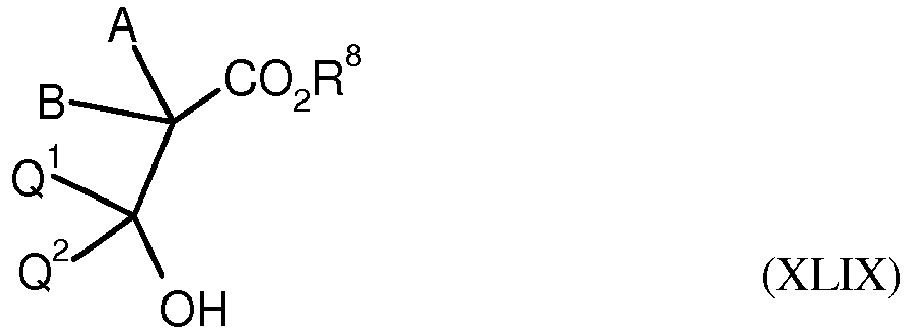
A, B, Q1, Q2 und R8 die oben angegebenen Bedeutungen haben,
mit substituierten Phenylessigsäurederivaten der Formel (XXVIII)
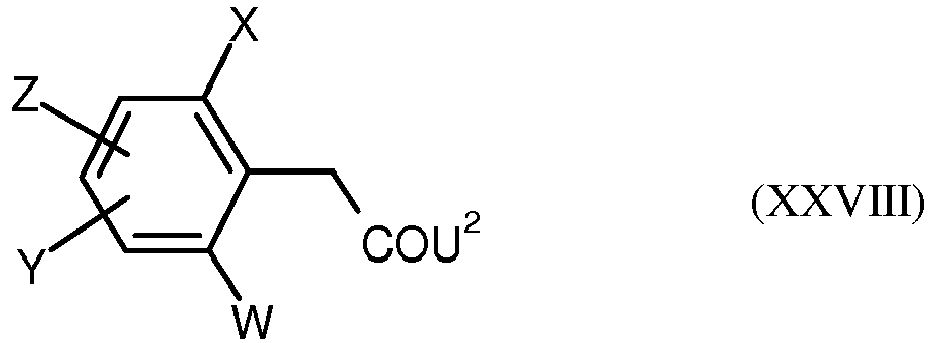
W, X, Y, Z und U2 die oben angegebenen Bedeutungen haben acyliert (s. Herstellungsbeispiele der Formel (II)).The acylhydroxycarboxylic esters of the formula (XIV) are obtained, for example, by reacting hydroxycarboxylic acid esters of the formula (XLIX)
A, B, Q 1 , Q 2 and R 8 have the meanings given above,
with substituted phenylacetic acid derivatives of the formula (XXVIII)
W, X, Y, Z and U 2 have the meanings given above acylated (see Preparation Examples of the formula (II)).
Die Verbindungen der Formel (XLIX) sind teilweise aus
Die beim erfindungsgemäßen Verfahren (K) als Ausgangsstoffe benötigten Verbindungen der Formel (XV)
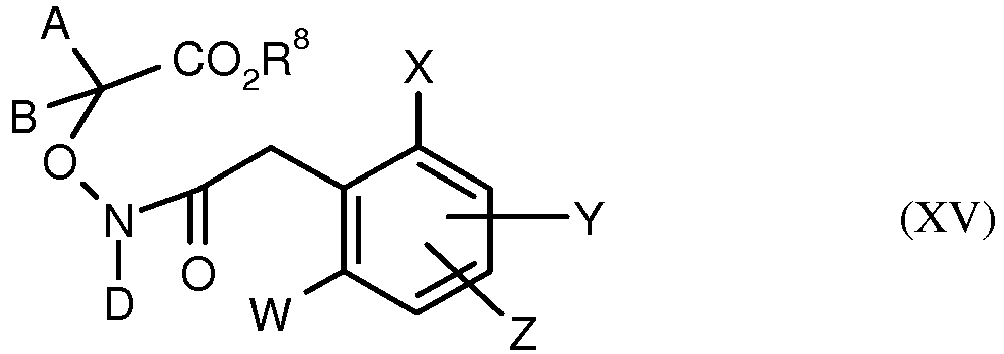
A, B, D, W, X, Y, Z und R8 die oben angegebenen Bedeutungen haben, sind neu.The compounds of the formula (XV) required as starting materials in process (K) according to the invention
A, B, D, W, X, Y, Z and R 8 have the meanings given above are new.
Man erhält die Acylhydroxylaminosäureester der Formel (XV) beispielsweise, wenn man Aminosäurederivate der Formel (L)
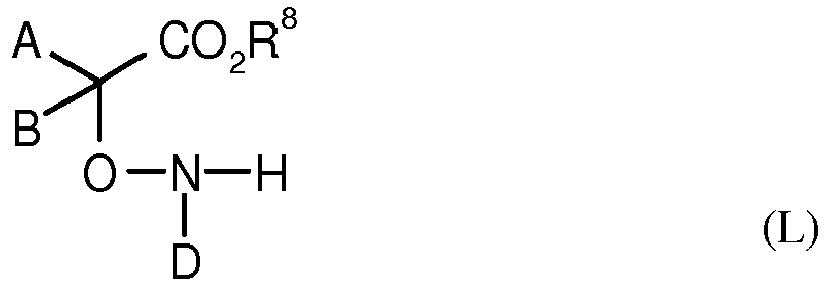
A, B, R8 und D die oben angegebenen Bedeutungen haben,
mit substituierten Phenylessigsäurederivaten der Formel (XXVIII)

W, X, Y, Z und U2 die oben angegebenen Bedeutungen haben
acyliert (
A, B, R 8 and D have the meanings given above,
with substituted phenylacetic acid derivatives of the formula (XXVIII)
W, X, Y, Z and U 2 have the meanings given above
acylated (
Die zur Herstellung von Verbindungen der Formel (II) als Ausgangsstoffe benötigten Hydroxylaminosäureester der Formel (L)

A, B, und R8 die oben angegebene Bedeutung haben sind teilweise neu und lassen sich nach bekannten Verfahren herstellen (
A, B, and R 8 have the abovementioned meaning are partially new and can be prepared by known processes (
So erhält man beispielsweise Hydroxylaminosäureester der Formel (L)
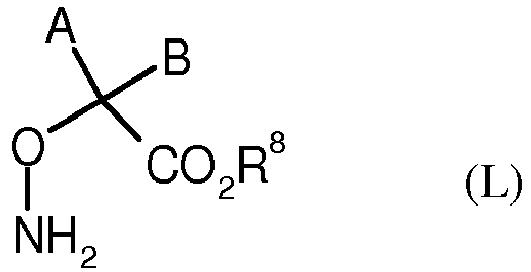
A, B und R8 die oben angegebene Bedeutung haben, wenn man N-Hydroxyphthalimid der Formel (LI)
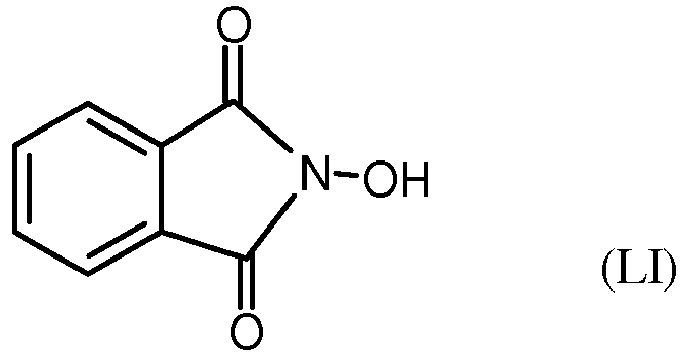
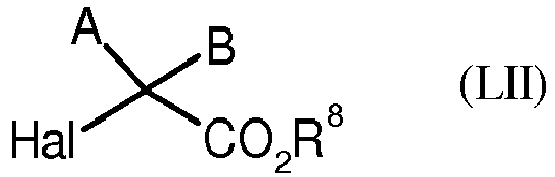
A, B und R8 die oben angegebenen Bedeutung haben und
Hal für Chlor, Brom oder Jod, bevorzugt für Brom steht zu O-Alkoxyphthalimiden der Formel (LIII),

A, B und R8 die oben angegebene Bedeutung haben,
umsetzt und daraus anschließend die Verbindungen der Formel (L) beispielsweise durch Hydrazinolyse freisetzt.Thus, for example, hydroxylamino acid esters of the formula (L) are obtained.
A, B and R 8 have the abovementioned meaning when N-hydroxyphthalimide of the formula (LI)
A, B and R 8 have the meaning given above and
Hal is chlorine, bromine or iodine, preferably bromine is O-alkoxyphthalimides of the formula (LIII),
A, B and R 8 have the abovementioned meaning,
reacted and subsequently releases the compounds of formula (L), for example by hydrazinolysis.
Die Verbindungen der Formeln (LII) und (LI) sind ebenfalls bekannt und lassen sich nach bekannten Verfahren herstellen (
Weiterhin erhält man beispielsweise Acylhydroxylaminosäureester der Formel (XV)
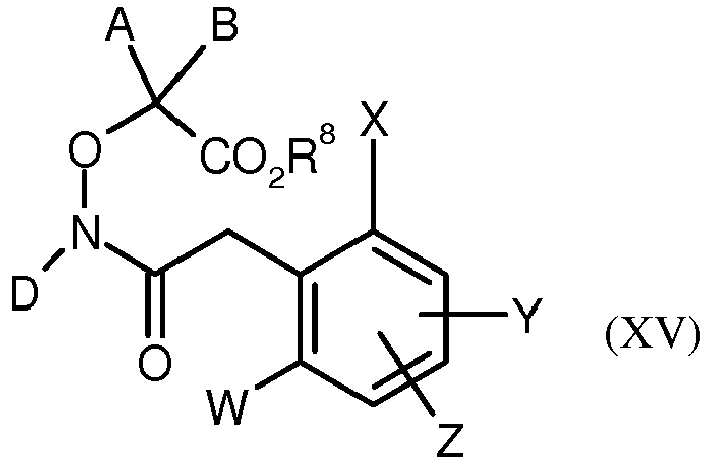
- A, B, D, W, X, Y, Z und R8 die oben angegebene Bedeutung haben
- D jedoch bevorzugt ungleich Wasserstoff steht,

W, X, Y, Z und U2 die oben angegebene Bedeutung haben
mit Hydroxylaminen der Formel (LIV)

D die oben angegebene Bedeutung hat, jedoch bevorzugt ungleich Wasserstoff steht zu Verbindungen der Formel (LV)
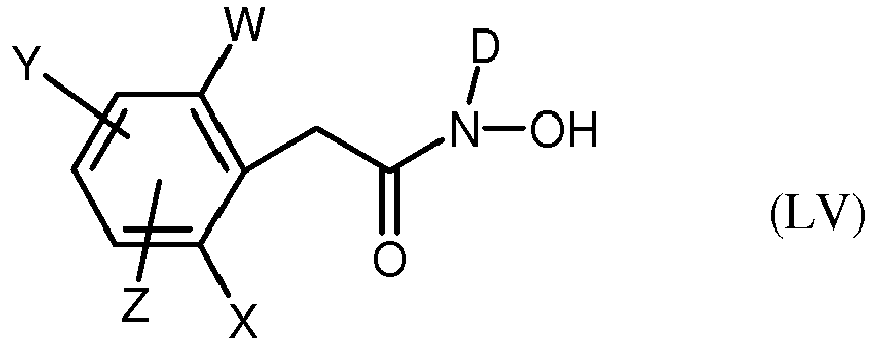
D, W, X, Y und Z die oben angegebene Bedeutung haben,
umsetzt und diese mit Halogenalkylester der Formel (LII),

A, B und R8 die oben angegebene Bedeutung haben und
Hal für Chlor, Brom und Jod, bevorzugt für Brom steht, zu Verbindungen der Formel (XV) alkyliert (
- A, B, D, W, X, Y, Z and R 8 are as defined above
- D, however, is preferably not equal to hydrogen,
W, X, Y, Z and U 2 have the abovementioned meaning
with hydroxylamines of the formula (LIV)
D has the abovementioned meaning, but preferably not equal to hydrogen, compounds of the formula (LV)
D, W, X, Y and Z are as defined above,
and reacted with haloalkyl esters of the formula (LII),
A, B and R 8 are as defined above and
Hal is chlorine, bromine and iodine, preferably bromine, alkylated to compounds of formula (XV) (
Die Verbindungen der Formel (LIV) sind teilweise käuflich, teilweise bekannt und lassen sich nach bekannten Verfahren herstellen.The compounds of formula (LIV) are partially commercially available, some known and can be prepared by known methods.
Außerdem erhält man Verbindungen der Formel (XV), worin D ungleich Wasserstoff ist, wenn man Verbindungen der Formel (XV-a)
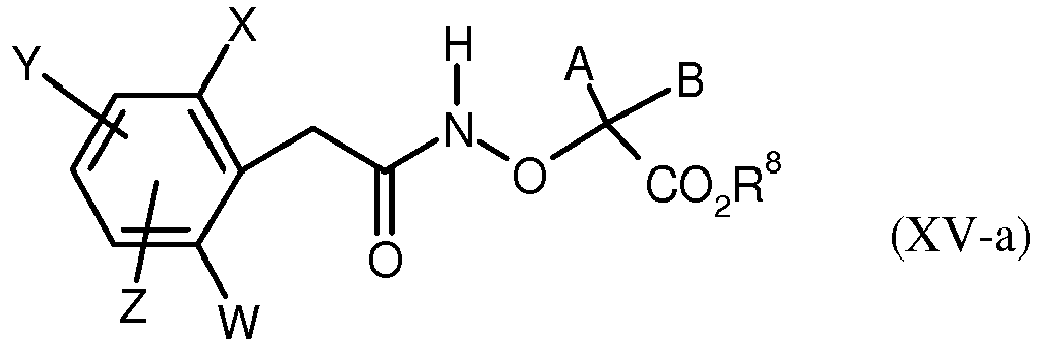
A, B, W, X, Y, Z und R8 die oben angegebene Bedeutung haben
mit Verbindungen der Formel (LVI)
D-LG (LVI)
in welcher
- D die oben angegebene Bedeutung hat, jedoch ungleich Wasserstoff steht und
- LG für eine Fluchtgruppe steht wie beispielsweise Chlor, Brom, Jod, Mesylat, Tosylat oder Triflat steht
A, B, W, X, Y, Z and R 8 are as defined above
with compounds of the formula (LVI)
D-LG (LVI)
in which
- D has the abovementioned meaning, but is not hydrogen and
- LG stands for a leaving group such as chlorine, bromine, iodine, mesylate, tosylate or triflate
Die Verbindungen der Formel (LVI) sind teilweise käuflich, teilweise bekannt und nach bekannten Verfahren herstellbar.The compounds of the formula (LVI) are partly commercially available, in some cases known and can be prepared by known processes.
Die Verbindungen der Formeln (LIII) und (LV) sind bekannt und entsprechend der eingangs zitierten Literatur herstellbar.The compounds of formulas (LIII) and (LV) are known and can be prepared according to the literature cited above.
Die zur Durchführung der erfindungsgemäßen Verfahren (L), (M), (N), (O), (P), (Q), (R) und (S) außerdem als Ausgangsstoffe benötigten Säurehalogenide der Formel (XVI), Carbonsäureanhydride der Formel (XVII), Chlorameisensäureester oder Chlorameisensäurethioester der Formel (XVIII), Chlormonothioameisensäureester oder Chlordithioameisensäureester der Formel (XIX), Sulfonsäurechloride der Formel (XX), Phosphorverbindungen der Formel (XXI) und Metallhydroxide, Metallalkoxide oder Amine der Formel (XXII) und (XXIII) und Isocyanate der Formel (XXIV) und Carbamidsäurechloride der Formel (XXV) sowie Halogenalkanole der Formel (XXVI) sind allgemein bekannte Verbindungen der Organischen bzw. Anorganischen Chemie.For carrying out the processes (L), (M), (N), (O), (P), (Q), (R) and (S) also required as starting materials acid halides of the formula (XVI), carboxylic anhydrides of Formula (XVII), chloroformate or chloroformic thioester of the formula (XVIII), Chlormonothioameisensäureester or Chlordithioameisensäureester of formula (XIX), sulfonyl chlorides of the formula (XX), phosphorus compounds of the formula (XXI) and metal hydroxides, metal alkoxides or amines of the formula (XXII) and (XXIII ) and isocyanates of the formula (XXIV) and carbamoyl chlorides of the formula (XXV) and haloalkanols of the formula (XXVI) are generally known compounds of organic or inorganic chemistry.
Die Verbindungen der Formeln (V), (VII), (X), (XXVII), (XXX), (XXXII), (XXXIV-A), (XXXIV-B), (XXXVI), (XL), (XLI-a), (XLI-b), (XLIV), (XLV), (XLVI), (XLVIII), (XLIX), (LI), (LII), (LIV) und (LVI) sind darüber hinaus aus den eingangs zitierten Patentanmeldungen bekannt und/oder lassen sich nach den dort angegebenen Methoden herstellen.Compounds of formulas (V), (VII), (X), (XXVII), (XXX), (XXXII), (XXXIV-A), (XXXIV-B), (XXXVI), (XL), (XLI -a), (XLI-b), (XLIV), (XLV), (XLVI), (XLVIII), (XLIX), (LI), (LII), (LIV) and (LVI) are also from the patent applications cited above and / or can be prepared according to the methods specified therein.
Die Verbindungen der Formeln (I-1' - I-11') lassen sich analog den beschriebenen Verfahren A bis R herstellen und sind teilweise neu. Die Verbindungen der Formel (I-1'-a) sind neu und lassen sich gemäß Verfahren A herstellen. Die zur Herstellung der Verbindungen der Formel (I-1'-a) benötigten Phenylessigsäuren der Formel (XXXI')
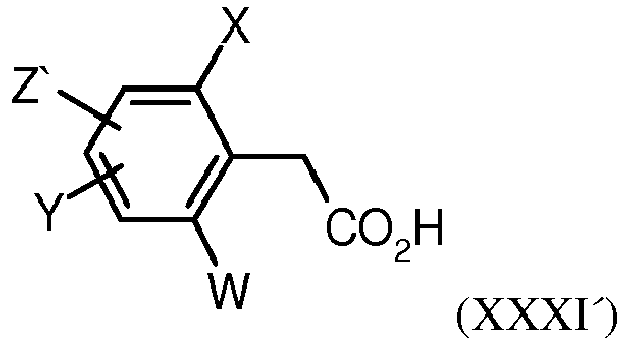
Das Verfahren (A) ist dadurch gekennzeichnet, dass man Verbindungen der Formel (II), in welcher A, B, D, W, X, Y, Z und R8 die oben angegebenen Bedeutungen haben, in Gegenwart einer Base einer intramolekularen Kondensation unterwirft.Process (A) is characterized in that compounds of the formula (II) in which A, B, D, W, X, Y, Z and R 8 have the meanings given above are subjected to an intramolecular condensation in the presence of a base ,
Als Verdünnungsmittel können bei dem erfindungsgemäßen Verfahren (A) alle inerten organischen Solventien eingesetzt werden. Vorzugsweise verwendbar sind Kohlenwasserstoffe, wie Toluol und Xylol, ferner Ether, wie Dibutylether, Tetrahydrofuran, Dioxan, Glykoldimethylether und Diglykoldimethylether, außerdem polare Lösungsmittel, wie Dimethylsulfoxid, Sulfolan, Dimethylformamid und N-Methyl-pyrrolidon, sowie Alkohole wie Methanol, Ethanol, Propanol, Iso-Propanol, Butanol, Iso-Butanol und tert.-Butanol.Suitable diluents in process (A) according to the invention are all inert organic solvents. Preference is given to using hydrocarbons, such as toluene and xylene, furthermore ethers, such as dibutyl ether, tetrahydrofuran, dioxane, glycol dimethyl ether and diglycol dimethyl ether, furthermore polar solvents, such as dimethyl sulfoxide, sulfolane, dimethylformamide and N-methylpyrrolidone, and also alcohols, such as methanol, ethanol, propanol, Iso-propanol, butanol, iso-butanol and tert-butanol.
Als Base (Deprotonierungsmittel) können bei der Durchführung des erfindungsgemäßen Verfahrens (A) alle üblichen Protonenakzeptoren eingesetzt werden. Vorzugsweise verwendbar sind Alkalimetall- und Erdalkalimetalloxide, -hydroxide und -carbonate, wie Natriumhydroxid, Kaliumhydroxid, Magnesiumoxid, Calciumoxid, Natriumcarbonat, Kaliumcarbonat und Calciumcarbonat, die auch in Gegenwart von Phasentransferkatalysatoren wie z.B. Triethylbenzylammoniumchlorid, Tetrabutylammoniumbromid, Adogen 464 (= Methyltrialkyl(C8-C10)ammoniumchlorid) oder TDA 1 (= Tris-(methoxyethoxyethyl)-amin) eingesetzt werden können. Weiterhin können Alkalimetalle wie Natrium oder Kalium verwendet werden. Ferner sind Alkalimetall- und Erdalkalimetallamide und -hydride, wie Natriumamid, Natriumhydrid und Calciumhydrid, und außerdem auch Alkalimetallalkoholate, wie Natrium-methylat, Natrium-ethylat und Kalium-tert.-butylat einsetzbar.As the base (deprotonating agent) in carrying out the process (A) according to the invention all conventional proton acceptors can be used. Preference is given to using alkali metal and alkaline earth metal oxides, hydroxides and carbonates, such as sodium hydroxide, potassium hydroxide, magnesium oxide, calcium oxide, sodium carbonate, potassium carbonate and calcium carbonate, which are also available in the presence of phase transfer catalysts such as, for example, triethylbenzylammonium chloride, tetrabutylammonium bromide, Adogen 464 (= methyltrialkyl (C 8 - C 10 ) ammonium chloride) or TDA 1 (= tris (methoxyethoxyethyl) amine) can be used. Furthermore, alkali metals such as sodium or potassium can be used. Furthermore, alkali metal and alkaline earth metal amides and hydrides, such as sodium amide, sodium hydride and calcium hydride, and also alkali metal alkoxides, such as sodium methoxide, sodium ethoxide and potassium tert-butoxide can be used.
Die Reaktionstemperaturen können bei der Durchführung des erfindungsgemäßen Verfahrens (A) innerhalb eines größeren Bereiches variiert werden. Im Allgemeinen arbeitet man bei Temperaturen zwischen 0°C und 250°C, vorzugsweise zwischen 50°C und 150°C.The reaction temperatures can be varied within a substantial range when carrying out the process (A) according to the invention. In general, one works at temperatures between 0 ° C and 250 ° C, preferably between 50 ° C and 150 ° C.
Das erfindungsgemäße Verfahren (A) wird im Allgemeinen unter Normaldruck durchgeführt.The process (A) according to the invention is generally carried out under atmospheric pressure.
Bei der Durchführung des erfindungsgemäßen Verfahrens (A) setzt man die Reaktionskomponenten der Formel (II) und die deprotonierenden Basen im Allgemeinen in etwa doppeläquimolaren Mengen ein. Es ist jedoch auch möglich, die eine oder andere Komponente in einem größeren Überschuss (bis zu 3 Mol) zu verwenden.In carrying out the process (A) according to the invention, the reaction components of the formula (II) and the deprotonating bases are generally employed in approximately double equimolar amounts. However, it is also possible to use one or the other component in a larger excess (up to 3 mol).
Das Verfahren (B) ist dadurch gekennzeichnet, dass Verbindungen der Formel (III), in welcher A, B, W, X, Y, Z und R8 die oben angegebenen Bedeutungen haben, in Gegenwart eines Verdünnungsmittels und in Gegenwart einer Base einer intramolekularen Kondensation unterwirft.Process (B) is characterized in that compounds of the formula (III) in which A, B, W, X, Y, Z and R 8 have the meanings given above, in the presence of a diluent and in the presence of an intramolecular base Subject to condensation.
Als Verdünnungsmittel können bei dem erfindungsgemäßen Verfahren (B) alle inerten organischen Solventien eingesetzt werden. Vorzugsweise verwendbar sind Kohlenwasserstoffe, wie Toluol und Xylol, ferner Ether, wie Dibutylether, Tetrahydrofuran, Dioxan, Glykoldimethylether und Diglykoldimethylether, außerdem polare Lösungsmittel, wie Dimethylsulfoxid, Sulfolan, Dimethylformamid und N-Methyl-pyrrolidon. Weiterhin können Alkohole wie Methanol, Ethanol, Propanol, Iso-Propanol, Butanol, Iso-Butanol und tert.-Butanol eingesetzt werden.Suitable diluents for process (B) according to the invention are all inert organic solvents. Preference is given to using hydrocarbons, such as toluene and xylene, furthermore ethers, such as dibutyl ether, tetrahydrofuran, dioxane, glycol dimethyl ether and diglycol dimethyl ether, as well as polar solvents, such as dimethyl sulfoxide, sulfolane, dimethylformamide and N-methylpyrrolidone. Furthermore, alcohols such as methanol, ethanol, propanol, isopropanol, butanol, isobutanol and tert-butanol can be used.
Als Base (Deprotonierungsmittel) können bei der Durchführung des erfindungsgemäßen Verfahrens (B) alle üblichen Protonenakzeptoren eingesetzt werden. Vorzugsweise verwendbar sind Alkalimetall- und Erdalkalimetalloxide, -hydroxide und -carbonate, wie Natriumhydroxid, Kaliumhydroxid, Magnesiumoxid, Calciumoxid, Natriumcarbonat, Kaliumcarbonat und Calciumcarbonat, die auch in Gegenwart von Phasentransferkatalysatoren wie z.B. Triethylbenzylammoniumchlorid, Tetrabutylammoniumbromid, Adogen 464 (= Methyltrialkyl(C8-C10)ammoniumchlorid) oder TDA 1 (= Tris-(methoxyethoxyethyl)-amin) eingesetzt werden können. Weiterhin können Alkalimetalle wie Natrium oder Kalium verwendet werden. Ferner sind Alkalimetall- und Erdalkalimetallamide und -hydride, wie Natriumamid, Natriumhydrid und Calciumhydrid, und außerdem auch Alkalimetallalkoholate, wie Natrium-methylat, Natrium-ethylat und Kalium-tert.-butylat einsetzbar.As the base (deprotonating agent), all conventional proton acceptors can be used in carrying out the process (B) according to the invention. Preference is given to using alkali metal and alkaline earth metal oxides, hydroxides and carbonates, such as sodium hydroxide, potassium hydroxide, magnesium oxide, calcium oxide, sodium carbonate, potassium carbonate and calcium carbonate, which can also be used in the presence of phase transfer catalysts such as triethylbenzylammonium chloride, tetrabutylammonium bromide, Adogen 464 (= methyltrialkyl (C 8 -C 10 ) ammonium chloride) or TDA 1 (= tris (methoxyethoxyethyl) amine). Furthermore, alkali metals such as sodium or potassium can be used. Furthermore, alkali metal and alkaline earth metal amides and hydrides, such as sodium amide, sodium hydride and calcium hydride, and also alkali metal alkoxides, such as sodium methoxide, sodium ethoxide and potassium tert-butoxide can be used.
Die Reaktionstemperaturen können bei der Durchführung des erfindungsgemäßen Verfahrens (B) innerhalb eines größeren Bereiches variiert werden. Im Allgemeinen arbeitet man bei Temperaturen zwischen 0°C und 250°C, vorzugsweise zwischen 50°C und 150°C.When carrying out the process (B) according to the invention, the reaction temperatures can be varied within a relatively wide range. In general, one works at temperatures between 0 ° C and 250 ° C, preferably between 50 ° C and 150 ° C.
Das erfindungsgemäße Verfahren (B) wird im Allgemeinen unter Normaldruck durchgeführt.The process (B) according to the invention is generally carried out under atmospheric pressure.
Bei der Durchführung des erfindungsgemäßen Verfahrens (B) setzt man die Reaktionskomponenten der Formel (III) und die deprotonierenden Basen im Allgemeinen in etwa äquimolaren Mengen ein. Es ist jedoch auch möglich, die eine oder andere Komponente in einem größeren Überschuss (bis zu 3 Mol) zu verwenden.In carrying out the process (B) according to the invention, the reaction components of the formula (III) and the deprotonating bases are generally employed in approximately equimolar amounts. However, it is also possible to use one or the other component in a larger excess (up to 3 mol).
Das Verfahren (C) ist dadurch gekennzeichnet, dass man Verbindungen der Formel (IV) in welcher A, B, V, W, X, Y, Z und R8 die oben angegebene Bedeutung haben, in Gegenwart einer Säure und gegebenenfalls in Gegenwart eines Verdünnungsmittels intramolekular cyclisiert.The process (C) is characterized in that compounds of the formula (IV) in which A, B, V, W, X, Y, Z and R 8 have the abovementioned meaning, in the presence of an acid and optionally in the presence of a Diluent intramolecularly cyclized.
Als Verdünnungsmittel können bei dem erfindungsgemäßen Verfahren (C) alle inerten organischen Solventien eingesetzt werden. Vorzugsweise verwendbar sind Kohlenwasserstoffe, wie Toluol und Xylol, ferner halogenierte Kohlenwasserstoffe wie Dichlormethan, Chloroform, Ethylenchlorid, Chlorbenzol, Dichlorbenzol, außerdem polare Lösungsmittel, wie Dimethylsulfoxid, Sulfolan, Dimethylformamid und N-Methyl-pyrrolidon. Weiterhin können Alkohole wie Methanol, Ethanol, Propanol, iso-Propanol, Butanol, Isobutanol, tert.-Butanol eingesetzt werden.Suitable diluents for the process (C) according to the invention are all inert organic solvents. Preference is given to using hydrocarbons, such as toluene and xylene, furthermore halogenated hydrocarbons, such as dichloromethane, chloroform, ethylene chloride, chlorobenzene, dichlorobenzene, and also polar solvents, such as dimethyl sulfoxide, sulfolane, dimethylformamide and N-methylpyrrolidone. Furthermore, alcohols such as methanol, ethanol, propanol, isopropanol, butanol, isobutanol, tert-butanol can be used.
Gegebenenfalls kann auch die eingesetzte Säure als Verdünnungsmittel dienen.Optionally, the acid used can serve as a diluent.
Als Säure können bei dem erfindungsgemäßen Verfahren (C) alle üblichen anorganischen und organischen Säuren eingesetzt werden wie z.B. Halogenwasserstoffsäuren, Schwefelsäure, Alkyl-, Aryl- und Haloalkylsulfonsäuren, insbesondere halogenierte Alkylcarbonsäuren wie z.B. Trifluoressigsäure.The acid used in the process (C) according to the invention are all customary inorganic and organic acids, e.g. Hydrohalic acids, sulfuric acid, alkyl, aryl and haloalkylsulfonic acids, especially halogenated alkylcarboxylic acids such as e.g. Trifluoroacetic acid.
Die Reaktionstemperaturen können bei der Durchführung des erfindungsgemäßen Verfahrens (C) innerhalb eines größeren Bereiches variiert werden. Im Allgemeinen arbeitet man bei Temperaturen zwischen 0°C und 250°C, vorzugsweise zwischen 50°C und 150°C.The reaction temperatures can be varied within a substantial range when carrying out the process (C) according to the invention. In general, one works at temperatures between 0 ° C and 250 ° C, preferably between 50 ° C and 150 ° C.
Das erfindungsgemäße Verfahren (C) wird im Allgemeinen unter Normaldruck durchgeführt.The process (C) according to the invention is generally carried out under atmospheric pressure.
Bei der Durchführung des erfindungsgemäßen Verfahrens (C) setzt man die Reaktionskomponenten der Formeln (IV) und die Säure z.B. in äquimolaren Mengen ein. Es ist jedoch gegebenenfalls auch möglich, die Säure als Lösungsmittel oder als Katalysator zu verwenden.In carrying out the process (C) according to the invention, the reaction components of the formula (IV) and the acid are added, e.g. in equimolar amounts. However, it may also be possible to use the acid as a solvent or as a catalyst.
Das erfindungsgemäße Verfahren (D) ist dadurch gekennzeichnet, dass man Carbonylverbindungen der Formel (V) oder deren Enolether der Formel (V-a) mit Ketensäurehalogeniden der Formel (VI) in Gegenwart eines Verdünnungsmittels und gegebenenfalls in Gegenwart eines Säureakzeptors umsetzt.The process (D) according to the invention is characterized in that carbonyl compounds of the formula (V) or their enol ethers of the formula (V-a) are reacted with ketene acid halides of the formula (VI) in the presence of a diluent and if appropriate in the presence of an acid acceptor.
Als Verdünnungsmittel können bei dem erfindungsgemäßen Verfahren (D) alle inerten organischen Solventien eingesetzt werden. Vorzugsweise verwendbar sind gegebenenfalls halogenierte Kohlenwasserstoffe, wie Toluol, Xylol, Mesitylen, Chlorbenzol und Dichlorbenzol, ferner Ether, wie Dibutylether, Glykoldimethylether Diglykoldimethylether und Diphenylether, außerdem polare Lösungsmittel, wie Dimethylsulfoxid, Sulfolan, Dimethylformamid oder N-Methyl-pyrrolidon.Suitable diluents in process (D) according to the invention are all inert organic solvents. Preference is given to using optionally halogenated hydrocarbons, such as toluene, xylene, mesitylene, chlorobenzene and dichlorobenzene, furthermore ethers, such as dibutyl ether, glycol dimethyl ether, diglycol dimethyl ether and diphenyl ether, furthermore polar solvents, such as dimethyl sulfoxide, sulfolane, dimethylformamide or N-methyl-pyrrolidone.
Als Säureakzeptoren können bei der Durchführung der erfindungsgemäßen Verfahrensvariante (D) alle üblichen Säureakzeptoren verwendet werden.Acid acceptors which can be used in carrying out process variant (D) according to the invention are all customary acid acceptors.
Vorzugsweise verwendbar sind tertiäre Amine, wie Triethylamin, Pyridin, Diazabicyclooctan (DABCO), Diazabicycloundecan (DBU), Diazabicyclononen (DBN), Hünig-Base und N,N-Dimethyl-anilin.Preference is given to using tertiary amines, such as triethylamine, pyridine, diazabicyclooctane (DABCO), diazabicycloundecane (DBU), diazabicyclononene (DBN), Hünig base and N, N-dimethylaniline.
Die Reaktionstemperaturen können bei der Durchführung der erfindungsgemäßen Verfahrensvariante (D) innerhalb eines größeren Bereiches variiert werden. Zweckmäßigerweise arbeitet man bei Temperaturen zwischen 0°C und 250°C, vorzugsweise zwischen 50°C und 220°C.When carrying out process variant (D) according to the invention, the reaction temperatures can be varied within a relatively wide range. Conveniently, one works at temperatures between 0 ° C and 250 ° C, preferably between 50 ° C and 220 ° C.
Das erfindungsgemäße Verfahren (D) wird zweckmäßigerweise unter Normaldruck durchgeführt.The process (D) according to the invention is expediently carried out under atmospheric pressure.
Bei der Durchführung des erfindungsgemäßen Verfahrens (D) setzt man die Reaktionskomponenten der Formeln (V) und (VI), in welchen A, D, W, X, Y und Z die oben angegebenen Bedeutungen haben und Hal für Halogen steht, und gegebenenfalls die Säureakzeptoren im Allgemeinen in etwa äquimolaren Mengen ein. Es ist jedoch auch möglich, die eine oder andere Komponente in einem größeren Überschuss (bis zu 5 Mol) zu verwenden.In carrying out the process (D) according to the invention, the reaction components of the formulas (V) and (VI) in which A, D, W, X, Y and Z have the abovementioned meanings and Hal is halogen, and, if appropriate, the Acid acceptors generally in approximately equimolar amounts. However, it is also possible to use one or the other component in a larger excess (up to 5 mol).
Das erfindungsgemäße Verfahren (E) ist dadurch gekennzeichnet, dass man Thioamide der Formel (VII) mit Ketensäurehalogeniden der Formel (VI) in Gegenwart eines Verdünnungsmittels und gegebenenfalls in Gegenwart eines Säureakzeptors umsetzt.The process (E) according to the invention is characterized in that thioamides of the formula (VII) with ketene acid halides of the formula (VI) in the presence of a diluent and optionally in the presence of an acid acceptor.
Als Verdünnungsmittel können bei der erfindungsgemäßen Verfahrensvariante (E) alle inerten organischen Solventien eingesetzt werden. Vorzugsweise verwendbar sind Kohlenwasserstoffe, wie Toluol und Xylol, ferner Ether, wie Dibutylether, Glykoldimethylether und Diglykoldimethylether, außerdem polare Lösungsmittel, wie Dimethylsulfoxid, Sulfolan, Dimethylformamid und N-Methyl-pyrrolidon.Suitable diluents for process variant (E) according to the invention are all inert organic solvents. Preference is given to using hydrocarbons, such as toluene and xylene, furthermore ethers, such as dibutyl ether, glycol dimethyl ether and diglycol dimethyl ether, as well as polar solvents, such as dimethyl sulfoxide, sulfolane, dimethylformamide and N-methylpyrrolidone.
Als Säureakzeptoren können bei der Durchführung des erfindungsgemäßen Verfahrens (E) alle üblichen Säureakzeptoren verwendet werden.Acid acceptors which can be used in carrying out the process (E) according to the invention are all customary acid acceptors.
Vorzugsweise verwendbar sind tertiäre Amine, wie Triethylamin, Pyridin, Diazabicyclooctan (DABCO), Diazabicycloundecan (DBU), Diazabicyclononen (DBN), Hünig-Base und N,N-Dimethyl-anilin.Preference is given to using tertiary amines, such as triethylamine, pyridine, diazabicyclooctane (DABCO), diazabicycloundecane (DBU), diazabicyclononene (DBN), Hünig base and N, N-dimethylaniline.
Die Reaktionstemperaturen können bei der Durchführung des erfindungsgemäßen Verfahrens (E) innerhalb eines größeren Bereiches variiert werden. Zweckmäßigerweise arbeitet man bei Temperaturen zwischen 0°C und 250°C, vorzugsweise zwischen 20°C und 220°C.When carrying out the process (E) according to the invention, the reaction temperatures can be varied within a relatively wide range. Conveniently, one works at temperatures between 0 ° C and 250 ° C, preferably between 20 ° C and 220 ° C.
Das erfindungsgemäße Verfahren (E) wird zweckmäßigerweise unter Normaldruck durchgeführt.The process (E) according to the invention is expediently carried out under atmospheric pressure.
Bei der Durchführung des erfindungsgemäßen Verfahrens (E) setzt man die Reaktionskomponenten der Formeln (VII) und (VI), in welchen A, W, X, Y und Z die oben angegebenen Bedeutungen haben und Hal für Halogen steht und gegebenenfalls die Säureakzeptoren im Allgemeinen in etwa äquimolaren Mengen ein. Es ist jedoch auch möglich, die eine oder andere Komponente in einem größeren Überschuss (bis zu 5 Mol) zu verwenden.In carrying out the process (E) according to the invention, the reaction components of the formulas (VII) and (VI) in which A, W, X, Y and Z have the abovementioned meanings and Hal represents halogen and optionally the acid acceptors in general in about equimolar amounts. However, it is also possible to use one or the other component in a larger excess (up to 5 mol).
Das Verfahren (F) ist dadurch gekennzeichnet, dass man Verbindungen der Formel (VIII), in welcher A, B, Q1, Q2, W, X, Y, Z und R8 die oben angegebene Bedeutung haben, in Gegenwart einer Base einer intramolekularen Kondensation unterwirft.The process (F) is characterized in that compounds of the formula (VIII) in which A, B, Q 1 , Q 2 , W, X, Y, Z and R 8 have the abovementioned meaning, in the presence of a base subjected to an intramolecular condensation.
Als Verdünnungsmittel können bei dem erfindungsgemäßen Verfahren (F) alle gegenüber den Reaktionsteilnehmern inerten organischen Solventien eingesetzt werden. Vorzugsweise verwendbar sind Kohlenwasserstoffe, wie Toluol und Xylol, ferner Ether, wie Dibutylether, Tetrahydrofuran, Dioxan, Glykoldimethylether und Diglykoldimethylether, außerdem polare Lösungsmittel, wie Collidin, Dimethylsulfoxid, Sulfolan, Dimethylformamid und N-Methyl-pyrrolidon. Weiterhin können Alkohole wie Methanol, Ethanol, Propanol, iso-Propanol, Butanol, Isobutanol, tert.-Butanol eingesetzt werden.Suitable diluents in the process (F) according to the invention are all organic solvents which are inert to the reactants. Preference is given to using hydrocarbons, such as toluene and xylene, furthermore ethers, such as dibutyl ether, tetrahydrofuran, dioxane, glycol dimethyl ether and diglycol dimethyl ether, as well as polar solvents, such as collidine, dimethyl sulfoxide, sulfolane, dimethylformamide and N-methylpyrrolidone. Furthermore, alcohols such as methanol, ethanol, propanol, isopropanol, butanol, isobutanol, tert-butanol can be used.
Als Basen (Deprotonierungsmittel) können bei der Durchführung des erfindungsgemäßen Verfahrens (F) alle üblichen Protonenakzeptoren eingesetzt werden. Vorzugsweise verwendbar sind Alkalimetall- und Erdalkalimetalloxide, -hydroxide und -carbonate, wie Natriumhydroxid, Kaliumhydroxid, Magnesiumoxid, Calciumoxid, Natriumcarbonat, Kaliumcarbonat und Calciumcarbonat, die auch in Gegenwart von Phasentransferkatalysatoren wie z.B. Triethylbenzylammoniumchlorid, Tetrabutylammoniumbromid, Adogen 464 (Methyltrialkyl(C8-C10)ammoniumchlorid) oder TDA 1 (Tris-(methoxyethoxyethyl)-amin) eingesetzt werden können. Weiterhin können Alkalimetalle wie Natrium oder Kalium verwendet werden. Ferner sind Alkalimetall- und Erdalkalimetallamide und -hydride, wie Natriumamid, Natriumhydrid und Calciumhydrid, und außerdem auch Alkalimetall-alkoholate, wie Natrium-methylat, Natrium-ethylat und Kalium-tert.-butylat einsetzbar.Suitable bases (deprotonating agents) for carrying out the process (F) according to the invention are all customary proton acceptors. Preference is given to using alkali metal and alkaline earth metal oxides, hydroxides and carbonates, such as sodium hydroxide, potassium hydroxide, magnesium oxide, calcium oxide, sodium carbonate, potassium carbonate and calcium carbonate, which also in the presence of phase transfer catalysts such as triethylbenzylammonium chloride, tetrabutylammonium bromide, Adogen 464 (methyltrialkyl (C 8 -C 10 ) ammonium chloride) or TDA 1 (tris (methoxyethoxyethyl) amine) can be used. Furthermore, alkali metals such as sodium or potassium can be used. Furthermore, alkali metal and alkaline earth metal amides and hydrides, such as sodium amide, sodium hydride and calcium hydride, and also alkali metal alkoxides, such as sodium methoxide, sodium ethoxide and potassium tert-butoxide can be used.
Die Reaktionstemperaturen können bei der Durchführung des erfindungsgemäßen Verfahrens (F) innerhalb eines größeren Bereiches variiert werden. Im Allgemeinen arbeitet man bei Temperaturen zwischen -75°C und 250°C, vorzugsweise zwischen -50°C und 150°C.The reaction temperatures can be varied within a substantial range when carrying out the process (F) according to the invention. In general, temperatures between -75 ° C and 250 ° C, preferably between -50 ° C and 150 ° C.
Das erfindungsgemäße Verfahren (F) wird im Allgemeinen unter Normaldruck durchgeführt.The process (F) according to the invention is generally carried out under atmospheric pressure.
Bei der Durchführung des erfindungsgemäßen Verfahrens (F) setzt man die Reaktionskomponenten der Formel (VIII) und die deprotonierenden Basen im Allgemeinen in etwa äquimolaren Mengen ein. Es ist jedoch auch möglich, die eine oder andere Komponente in einem größeren Überschuss (bis zu 3 Mol) zu verwenden.When carrying out the process (F) according to the invention, the reaction components of the formula (VIII) and the deprotonating bases are generally employed in approximately equimolar amounts. However, it is also possible to use one or the other component in a larger excess (up to 3 mol).
Das Verfahren (G) ist dadurch gekennzeichnet, dass man Verbindungen der Formel (IX), in welcher A, B, Q5, Q6, U, W, X, Y, Z und R8 die oben angegebene Bedeutung haben, in Gegenwart von Basen einer intramolekularen Kondensation unterwirft.The process (G) is characterized in that compounds of the formula (IX) in which A, B, Q 5 , Q 6 , U, W, X, Y, Z and R 8 have the abovementioned meaning, in the presence of bases subjected to an intramolecular condensation.
Als Verdünnungsmittel können bei dem erfindungsgemäßen Verfahren (G) alle gegenüber den Reaktionsteilnehmern inerten organischen Solventien eingesetzt werden. Vorzugsweise verwendbar sind Kohlenwasserstoffe, wie Toluol und Xylol, ferner Ether, wie Dibutylether, Tetrahydrofuran, Dioxan, Glykoldimethylether und Diglykoldimethylether, außerdem polare Lösungsmittel, wie Dimethylsulfoxid, Sulfolan, Dimethylformamid und N-Methyl-pyrrolidon. Weiterhin können Alkohole wie Methanol, Ethanol, Propanol, iso-Propanol, Butanol, Isobutanol, tert.-Butanol eingesetzt werden.Suitable diluents in the process (G) according to the invention are all organic solvents which are inert to the reactants. Preference is given to using hydrocarbons, such as toluene and xylene, furthermore ethers, such as dibutyl ether, tetrahydrofuran, dioxane, glycol dimethyl ether and diglycol dimethyl ether, as well as polar solvents, such as dimethyl sulfoxide, sulfolane, dimethylformamide and N-methylpyrrolidone. Furthermore, alcohols such as methanol, ethanol, propanol, isopropanol, butanol, isobutanol, tert-butanol can be used.
Als Basen (Deprotonierungsmittel) können bei der Durchführung des erfindungsgemäßen Verfahrens (G) alle üblichen Protonenakzeptoren eingesetzt werden.Suitable bases (deprotonating agents) for carrying out the process (G) according to the invention are all customary proton acceptors.
Vorzugsweise verwendbar sind Alkalimetall- und Erdalkalimetalloxide, -hydroxide und -carbonate, wie Natriumhydroxid, Kaliumhydroxid, Magnesiumoxid, Calciumoxid, Natriumcarbonat, Kaliumcarbonat und Calciumcarbonat, die auch in Gegenwart von Phasentransferkatalysatoren wie z.B. Triethylbenzylammoniumchlorid, Tetrabutylammoniumbromid, Adogen 464 (Methyltrialkyl(C8-C10)ammoniumchlorid) oder TDA 1 (Tris-(methoxyethoxyethyl)-amin) eingesetzt werden können. Weiterhin können Alkalimetalle wie Natrium oder Kalium verwendet werden. Ferner sind Alkalimetall- und Erdalkalimetallamide und -hydride, wie Natriumamid, Natriumhydrid und Calciumhydrid, und außerdem auch Alkalimetall-alkoholate, wie Natrium-methylat, Natrium-ethylat und Kalium-tert.-butylat einsetzbar.Preferably usable are alkali metal and alkaline earth metal oxides, hydroxides and carbonates, such as sodium hydroxide, potassium hydroxide, magnesium oxide, calcium oxide, sodium carbonate, potassium carbonate and calcium carbonate, which are also in the presence of phase transfer catalysts such as triethylbenzylammonium chloride, tetrabutylammonium bromide, Adogen 464 (methyltrialkyl (C 8 -C 10 ) ammonium chloride) or TDA 1 (tris (tris) methoxyethoxyethyl) amine) can be used. Furthermore, alkali metals such as sodium or potassium can be used. Furthermore, alkali metal and alkaline earth metal amides and hydrides, such as sodium amide, sodium hydride and calcium hydride, and also alkali metal alkoxides, such as sodium methoxide, sodium ethoxide and potassium tert-butoxide can be used.
Die Reaktionstemperaturen können bei der Durchführung des erfindungsgemäßen Verfahrens (G) innerhalb eines größeren Bereiches variiert werden. Im Allgemeinen arbeitet man bei Temperaturen zwischen 0°C und 250°C, vorzugsweise zwischen 50°C und 150°C.When carrying out the process (G) according to the invention, the reaction temperatures can be varied within a relatively wide range. In general, one works at temperatures between 0 ° C and 250 ° C, preferably between 50 ° C and 150 ° C.
Das erfindungsgemäße Verfahren (G) wird im Allgemeinen unter Normaldruck durchgeführt.The process (G) according to the invention is generally carried out under atmospheric pressure.
Bei der Durchführung des erfindungsgemäßen Verfahrens (G) setzt man die Reaktionskomponenten der Formel (IX) und die deprotonierenden Basen im Allgemeinen in etwa äquimolaren Mengen ein. Es ist jedoch auch möglich, die eine oder andere Komponente in einem größeren Überschuss (bis zu 3 Mol) zu verwenden.In carrying out the process (G) according to the invention, the reaction components of the formula (IX) and the deprotonating bases are generally employed in approximately equimolar amounts. However, it is also possible to use one or the other component in a larger excess (up to 3 mol).
Das erfindungsgemäße Verfahren (H-α) ist dadurch gekennzeichnet, dass man Hydrazine der Formel (X) oder Salze dieser Verbindungen mit Ketensäurehalogeniden der Formel (VI) in Gegenwart eines Verdünnungsmittels und gegebenenfalls in Gegenwart eines Säureakzeptors umsetzt.The process (H-α) according to the invention is characterized in that hydrazines of the formula (X) or salts of these compounds are reacted with ketene acid halides of the formula (VI) in the presence of a diluent and if appropriate in the presence of an acid acceptor.
Als Verdünnungsmittel können bei dem erfindungsgemäßen Verfahren (H-α) alle inerten organischen Solventien eingesetzt werden. Vorzugsweise verwendbar sind gegebenenfalls chlorierte Kohlenwasserstoffe, wie beispielsweise Mesitylen, Chlorbenzol und Dichlorbenzol, Toluol, Xylol, ferner Ether, wie Dibutylether, Glykoldimethylether, Diglykoldimethylether und Diphenylethan, außerdem polare Lösungsmittel, wie Dimethylsulfoxid, Sulfolan, Dimethylformamid oder N-Methyl-pyrrolidon.Suitable diluents for the process (H-α) according to the invention are all inert organic solvents. Preference is given to using optionally chlorinated hydrocarbons, such as, for example, mesitylene, chlorobenzene and dichlorobenzene, toluene, xylene, furthermore ethers, such as dibutyl ether, glycol dimethyl ether, diglycol dimethyl ether and diphenylethane, furthermore polar solvents, such as dimethyl sulfoxide, sulfolane, dimethylformamide or N-methylpyrrolidone.
Als Säureakzeptoren können bei der Durchführung der erfindungsgemäßen Verfahrensvariante (H-α) alle üblichen Säureakzeptoren verwendet werden.Acid acceptors which can be used in carrying out the process variant (H-α) according to the invention are all customary acid acceptors.
Vorzugsweise verwendbar sind tertiäre Amine, wie Triethylamin, Pyridin, Diazabicyclooctan (DABCO), Diazabicycloundecan (DBU), Diazabicyclononen (DBN), Hünig-Base und N,N-Dimethyl-anilin.Preference is given to using tertiary amines, such as triethylamine, pyridine, diazabicyclooctane (DABCO), diazabicycloundecane (DBU), diazabicyclononene (DBN), Hünig base and N, N-dimethylaniline.
Die Reaktionstemperaturen können bei der Durchführung der erfindungsgemäßen Verfahrensvariante (H-α) innerhalb eines größeren Bereiches variiert werden. Zweckmäßigerweise arbeitet man bei Temperaturen zwischen 0°C und 250°C, vorzugsweise zwischen 50°C und 220°C.When carrying out the process variant (H-α) according to the invention, the reaction temperatures can be varied within a relatively wide range. Conveniently, one works at temperatures between 0 ° C and 250 ° C, preferably between 50 ° C and 220 ° C.
Das erfindungsgemäße Verfahren (H-α) wird zweckmäßigerweise unter Normaldruck durchgeführt.The process (H-α) according to the invention is expediently carried out under atmospheric pressure.
Bei der Durchführung des erfindungsgemäßen Verfahrens (H-α) setzt man die Reaktionskomponenten der Formeln (VI) und (X), in welchen A, D, W, X, Y und Z die oben angegebenen Bedeutungen haben und Hal für Halogen steht, und gegebenenfalls die Säureakzeptoren im Allgemeinen in etwa äquimolaren Mengen ein. Es ist jedoch auch möglich, die eine oder andere Komponente in einem größeren Überschuss (bis zu 5 Mol) zu verwenden.In carrying out the process (H-α) according to the invention, the reaction components of the formulas (VI) and (X) in which A, D, W, X, Y and Z have the abovementioned meanings and Hal is halogen, and optionally the acid acceptors generally in approximately equimolar amounts. However, it is also possible to use one or the other component in a larger excess (up to 5 mol).
Das Verfahren (H-ß) ist dadurch gekennzeichnet, dass man Hydrazine der Formel (X) oder Salze dieser Verbindung, in welcher A und D die oben angegebenen Bedeutungen haben, mit Malonestern oder Malonsäureamiden der Formel (XI), in welcher U1, W, X, Y, Z und R8 die oben angegebene Bedeutung haben, in Gegenwart einer Base einer Kondensation unterwirft.The process (H-β) is characterized in that hydrazines of the formula (X) or salts of this compound in which A and D have the meanings given above, with malonic esters or malonic acid amides of the formula (XI) in which U 1 , W, X, Y, Z and R 8 have the abovementioned meaning, in the presence of a base of a condensation.
Als Verdünnungsmittel können bei dem erfindungsgemäßen Verfahren (H-ß) alle inerten organischen Solventien eingesetzt werden. Vorzugsweise verwendbar sind gegebenenfalls halogenierte Kohlenwasserstoffe, wie Toluol, Xylol, Mesitylen, Chlorbenzol und Dichlorbenzol, ferner Ether, wie Dibutylether, Tetrahydrofuran, Dioxan, Diphenylether, Glykoldimethylether und Diglykoldimethylether, außerdem polare Lösungsmittel, wie Dimethylsulfoxid, Sulfolan, Dimethylformamid, Dimethylacetamid und N-Methyl-pyrrolidon, sowie Alkohole wie Methanol, Ethanol, Propanol, Iso-Propanol, Butanol, Iso-Butanol und tert.-Butanol.Suitable diluents for the process (H-β) according to the invention are all inert organic solvents. Preference is given to using optionally halogenated hydrocarbons, such as toluene, xylene, mesitylene, chlorobenzene and dichlorobenzene, furthermore ethers, such as dibutyl ether, tetrahydrofuran, dioxane, diphenyl ether, glycol dimethyl ether and diglycol dimethyl ether, furthermore polar solvents, such as dimethyl sulfoxide, sulfolane, dimethylformamide, dimethylacetamide and N-methyl -pyrrolidone, and alcohols such as methanol, ethanol, propanol, iso-propanol, butanol, isobutanol and tert-butanol.
Als Base (Deprotonierungsmittel) können bei der Durchführung des erfindungsgemäßen Verfahrens (H-ß) alle üblichen Protonenakzeptoren eingesetzt werden. Vorzugsweise verwendbar sind Alkalimetall- und Erdalkalimetalloxide, -hydroxide und -carbonate, wie Natriumhydroxid, Kaliumhydroxid, Magnesiumoxid, Calciumoxid, Natriumcarbonat, Kaliumcarbonat und Calciumcarbonat, die auch in Gegenwart von Phasentransferkatalysatoren wie z.B. Triethylbenzylammoniumchlorid, Tetrabutylammoniumbromid, Adogen 464 (= Methyltrialkyl(C8-C10)ammoniumchlorid) oder TDA 1 (= Tris-(methoxyethoxyethyl)-amin) eingesetzt werden können. Weiterhin können Alkalimetalle wie Natrium oder Kalium verwendet werden. Ferner sind Alkalimetall- und Erdalkalimetallamide und -hydride, wie Natriumamid, Natriumhydrid und Calciumhydrid, und außerdem auch Alkalimetallalkoholate, wie Natrium-methylat, Natrium-ethylat und Kalium-tert.-butylat einsetzbar.As the base (deprotonating agent), all conventional proton acceptors can be used in carrying out the process (H-β) according to the invention. Preference is given to using alkali metal and alkaline earth metal oxides, hydroxides and carbonates, such as sodium hydroxide, potassium hydroxide, magnesium oxide, calcium oxide, sodium carbonate, potassium carbonate and calcium carbonate, which are also available in the presence of phase transfer catalysts such as, for example, triethylbenzylammonium chloride, tetrabutylammonium bromide, Adogen 464 (= methyltrialkyl (C 8 - C 10 ) ammonium chloride) or TDA 1 (= tris (methoxyethoxyethyl) amine) can be used. Furthermore, alkali metals such as sodium or potassium can be used. Furthermore, alkali metal and alkaline earth metal amides and hydrides, such as sodium amide, sodium hydride and calcium hydride, and also alkali metal alkoxides, such as sodium methoxide, sodium ethoxide and potassium tert-butoxide can be used.
Verwendbar sind auch tertiäre Amine, wie Triethylamin, Pyridin, Diazabicyclooctan (DABCO), Diazabicycloundecan (DBU), Diazabicyclononen (DBN), Hünig-Base und N,N-Dimethyl-anilin.It is also possible to use tertiary amines, such as triethylamine, pyridine, diazabicyclooctane (DABCO), diazabicycloundecane (DBU), diazabicyclononene (DBN), Hünig base and N, N-dimethylaniline.
Die Reaktionstemperaturen können bei der Durchführung des erfindungsgemäßen Verfahrens (H-ß) innerhalb eines größeren Bereiches variiert werden. Im Allgemeinen arbeitet man bei Temperaturen zwischen 0°C und 280°C, vorzugsweise zwischen 50°C und 180°C.When carrying out the process (H-β) according to the invention, the reaction temperatures can be varied within a relatively wide range. In general, temperatures between 0 ° C and 280 ° C, preferably between 50 ° C and 180 ° C.
Das erfindungsgemäße Verfahren (H-ß) wird im Allgemeinen unter Normaldruck durchgeführt.The process (H-β) according to the invention is generally carried out under atmospheric pressure.
Bei der Durchführung des erfindungsgemäßen Verfahrens (H-ß) setzt man die Reaktionskomponenten der Formeln (XI) und (X) im Allgemeinen in etwa äquimolaren Mengen ein. Es ist jedoch auch möglich, die eine oder andere Komponente in einem größeren Überschuss (bis zu 3 mol) zu verwenden.When carrying out the process (H-β) according to the invention, the reaction components of the formulas (XI) and (X) are generally employed in approximately equimolar amounts. However, it is also possible to use one or the other component in a larger excess (up to 3 mol).
Das Verfahren (H-γ) ist dadurch gekennzeichnet, dass man Verbindungen der Formel (XII), in welcher A, D, W, X, Y, Z und R8 die oben angegebenen Bedeutungen haben, in Gegenwart einer Base einer intramolekularen Kondensation unterwirft.The process (H-γ) is characterized in that compounds of the formula (XII) in which A, D, W, X, Y, Z and R 8 have the meanings given above are subjected to an intramolecular condensation in the presence of a base ,
Als Verdünnungsmittel können bei dem erfindungsgemäßen Verfahren (H-γ) alle inerten organischen Solventien eingesetzt werden. Vorzugsweise verwendbar sind Kohlenwasserstoffe, wie Toluol und Xylol, ferner Ether, wie Dibutylether, Tetrahydrofuran, Dioxan, Glykoldimethylether und Diglykoldimethylether, außerdem polare Lösungsmittel, wie Dimethylsulfoxid, Sulfolan, Dimethylformamid und N-Methyl-pyrrolidon, sowie Alkohole wie Methanol, Ethanol, Propanol, Iso-Propanol, Butanol, Iso-Butanol und tert.-Butanol.Suitable diluents for the process (H-γ) according to the invention are all inert organic solvents. Preference is given to using hydrocarbons, such as toluene and xylene, furthermore ethers, such as dibutyl ether, tetrahydrofuran, dioxane, glycol dimethyl ether and diglycol dimethyl ether, furthermore polar solvents, such as dimethyl sulfoxide, sulfolane, dimethylformamide and N-methylpyrrolidone, and also alcohols, such as methanol, ethanol, propanol, Iso-propanol, butanol, iso-butanol and tert-butanol.
Als Base (Deprotonierungsmittel) können bei der Durchführung des erfindungsgemäßen Verfahrens (H-γ) alle üblichen Protonenakzeptoren eingesetzt werden. Vorzugsweise verwendbar sind Alkalimetall- und Erdalkalimetalloxide, -hydroxide und -carbonate, wie Natriumhydroxid, Kaliumhydroxid, Magnesiumoxid, Calciumoxid, Natriumcarbonat, Kaliumcarbonat und Calciumcarbonat, die auch in Gegenwart von Phasentransferkatalysatoren wie z.B. Triethylbenzylammoniumchlorid, Tetrabutylammoniumbromid, Adogen 464 (= Methyltrialkyl(C8-C10)ammoniumchlorid) oder TDA 1 (= Tris-(methoxyethoxyethyl)-amin) eingesetzt werden können. Weiterhin können Alkalimetalle wie Natrium oder Kalium verwendet werden. Ferner sind Alkalimetall- und Erdalkalimetallamide und -hydride, wie Natriumamid, Natriumhydrid und Calciumhydrid, und außerdem auch Alkalimetallalkoholate, wie Natrium-methylat, Natrium-ethylat und Kalium-tert.-butylat einsetzbar.As the base (deprotonating agent), all conventional proton acceptors can be used in carrying out the process (H-γ) according to the invention. Preference is given to using alkali metal and alkaline earth metal oxides, hydroxides and carbonates, such as sodium hydroxide, potassium hydroxide, magnesium oxide, calcium oxide, sodium carbonate, potassium carbonate and calcium carbonate, which are also available in the presence of phase transfer catalysts such as, for example, triethylbenzylammonium chloride, tetrabutylammonium bromide, Adogen 464 (= methyltrialkyl (C 8 - C 10 ) ammonium chloride) or TDA 1 (= tris (methoxyethoxyethyl) amine) can be used. Furthermore, alkali metals such as sodium or potassium can be used. Furthermore, alkali metal and alkaline earth metal amides and hydrides, such as sodium amide, sodium hydride and calcium hydride, and also alkali metal alkoxides, such as sodium methoxide, sodium ethoxide and potassium tert-butoxide can be used.
Die Reaktionstemperaturen können bei der Durchführung des erfindungsgemäßen Verfahrens (H-γ) innerhalb eines größeren Bereiches variiert werden. Im Allgemeinen arbeitet man bei Temperaturen zwischen 0°C und 250°C, vorzugsweise zwischen 50°C und 150°C.The reaction temperatures can in carrying out the process according to the invention (H-γ) can be varied within a wider range. In general, one works at temperatures between 0 ° C and 250 ° C, preferably between 50 ° C and 150 ° C.
Das erfindungsgemäße Verfahren (H-γ) wird im Allgemeinen unter Normaldruck durchgeführt.The process (H-γ) according to the invention is generally carried out under atmospheric pressure.
Bei der Durchführung des erfindungsgemäßen Verfahrens (H-γ) setzt man die Reaktionskomponenten der Formel (XII) und die deprotonierenden Basen im Allgemeinen in etwa doppeltäquimolaren Mengen ein. Es ist jedoch auch möglich, die eine oder andere Komponente in einem größeren Überschuss (bis zu 3 Mol) zu verwenden.When carrying out the process (H-γ) according to the invention, the reaction components of the formula (XII) and the deprotonating bases are generally employed in approximately twice the equimolar amounts. However, it is also possible to use one or the other component in a larger excess (up to 3 mol).
Das Verfahren (I) ist dadurch gekennzeichnet, dass man Verbindungen der Formel (XIII), in welcher A, B, D, Q1, Q2, W, X, Y, Z und R8 die oben angegebenen Bedeutungen haben, in Gegenwart einer Base einer intramolekularen Kondensation unterwirft.Process (I) is characterized in that compounds of the formula (XIII) in which A, B, D, Q 1 , Q 2 , W, X, Y, Z and R 8 have the meanings given above, in the presence a base subjected to an intramolecular condensation.
Als Verdünnungsmittel können bei dem erfindungsgemäßen Verfahren (I) alle inerten organischen Solventien eingesetzt werden. Vorzugsweise verwendbar sind Kohlenwasserstoffe, wie Toluol und Xylol, ferner Ether, wie Dibutylether, Tetrahydrofuran, Dioxan, Glykoldimethylether und Diglykoldimethylether, außerdem polare Lösungsmittel, wie Dimethylsulfoxid, Sulfolan, Dimethylformamid, Dimethylacetamid und N-Methyl-pyrrolidon, sowie Alkohole wie Methanol, Ethanol, Propanol, Iso-Propanol, Butanol, Iso-Butanol und tert.-Butanol.Suitable diluents for the process (I) according to the invention are all inert organic solvents. Preference is given to using hydrocarbons, such as toluene and xylene, furthermore ethers, such as dibutyl ether, tetrahydrofuran, dioxane, glycol dimethyl ether and diglycol dimethyl ether, furthermore polar solvents, such as dimethyl sulfoxide, sulfolane, dimethylformamide, dimethylacetamide and N-methylpyrrolidone, and also alcohols, such as methanol, ethanol, Propanol, iso-propanol, butanol, iso-butanol and tert-butanol.
Als Base (Deprotonierungsmittel) können bei der Durchführung des erfindungsgemäßen Verfahrens (I) alle üblichen Protonenakzeptoren eingesetzt werden. Vorzugsweise verwendbar sind Alkalimetall- und Erdalkalimetalloxide, -hydroxide und -carbonate, wie Natriumhydroxid, Kaliumhydroxid, Magnesiumoxid, Calciumoxid, Natriumcarbonat, Kaliumcarbonat und Calciumcarbonat, die auch in Gegenwart von Phasentransferkatalysatoren wie z.B. Triethylbenzylammoniumchlorid, Tetrabutylammoniumbromid, Adogen 464 (= Methyltrialkyl(C8-C10)ammoniumchlorid) oder TDA 1 (= Tris-(methoxyethoxyethyl)-amin) eingesetzt werden können. Weiterhin können Alkalimetalle wie Natrium oder Kalium verwendet werden. Ferner sind Alkalimetall- und Erdalkalimetallamide und -hydride, wie Natriumamid, Natriumhydrid und Calciumhydrid, und außerdem auch Alkalimetallalkoholate, wie Natrium-methylat, Natrium-ethylat und Kalium-tert.-butylat einsetzbar.As the base (deprotonating agent), all conventional proton acceptors can be used in carrying out the process (I) according to the invention. Preference is given to using alkali metal and alkaline earth metal oxides, hydroxides and carbonates, such as sodium hydroxide, potassium hydroxide, magnesium oxide, calcium oxide, sodium carbonate, potassium carbonate and calcium carbonate, which are also available in the presence of phase transfer catalysts such as, for example, triethylbenzylammonium chloride, tetrabutylammonium bromide, Adogen 464 (= methyltrialkyl (C 8 - C 10 ) ammonium chloride) or TDA 1 (= tris (methoxyethoxyethyl) amine) can be used. Furthermore, alkali metals such as sodium or potassium can be used. Furthermore, alkali metal and alkaline earth metal amides and hydrides, such as sodium amide, sodium hydride and calcium hydride, and also alkali metal alkoxides, such as sodium methoxide, sodium ethoxide and potassium tert-butoxide can be used.
Die Reaktionstemperaturen können bei der Durchführung des erfindungsgemäßen Verfahrens (I) innerhalb eines größeren Bereiches variiert werden. Im allgemeinen arbeitet man bei Temperaturen zwischen -80°C und 180°C, vorzugsweise zwischen -50°C und 120°C.The reaction temperatures can be varied within a substantial range when carrying out the process (I) according to the invention. In general, one works at temperatures between -80 ° C and 180 ° C, preferably between -50 ° C and 120 ° C.
Das erfindungsgemäße Verfahren (I) wird im allgemeinen unter Normaldruck durchgeführt.The process (I) according to the invention is generally carried out under atmospheric pressure.
Bei der Durchführung des erfindungsgemäßen Verfahrens (I) setzt man die Reaktionskomponenten der Formel (XIII) und die deprotonierenden Basen im allgemeinen in etwa doppeltäquimolaren Mengen ein. Es ist jedoch auch möglich, die eine oder andere Komponente in einem größeren Überschuss (bis zu 3 Mol) zu verwenden.In carrying out the process (I) according to the invention, the reaction components of the formula (XIII) and the deprotonating bases are generally employed in approximately twice the equimolar amounts. However, it is also possible to use one or the other component in a larger excess (up to 3 mol).
Das Verfahren (J) ist dadurch gekennzeichnet, dass man Verbindungen der Formel (XIV), in welcher A, B, Q1, Q2, W, X, Y, Z und R8 die oben angegebenen Bedeutungen haben, in Gegenwart einer Base einer intramolekularen Kondensation unterwirft.Process (J) is characterized in that compounds of the formula (XIV) in which A, B, Q 1 , Q 2 , W, X, Y, Z and R 8 have the meanings given above, in the presence of a base subjected to an intramolecular condensation.
Als Verdünnungsmittel können bei dem erfindungsgemäßen Verfahren (J) alle inerten organischen Solventien eingesetzt werden. Vorzugsweise verwendbar sind Kohlenwasserstoffe, wie Toluol und Xylol, ferner Ether, wie Dibutylether, Tetrahydrofuran, Dioxan, Glykoldimethylether und Diglykoldimethylether, außerdem polare Lösungsmittel, wie Dimethylsulfoxid, Sulfolan, Dimethylformamid und N-Methyl-pyrrolidon, sowie Alkohole wie Methanol, Ethanol, Propanol, iso-Propanol, Butanol, iso-Butanol und tert-Butanol.Suitable diluents for the process (J) according to the invention are all inert organic solvents. Preference is given to using hydrocarbons, such as toluene and xylene, furthermore ethers, such as dibutyl ether, tetrahydrofuran, dioxane, glycol dimethyl ether and diglycol dimethyl ether, furthermore polar solvents, such as dimethyl sulfoxide, sulfolane, dimethylformamide and N-methylpyrrolidone, and also alcohols, such as methanol, ethanol, propanol, iso-propanol, butanol, iso-butanol and tert-butanol.
Als Base (Deprotonierungsmittel) können bei der Durchführung des erfindungsgemäßen Verfahrens (J) alle üblichen Protonenakzeptoren eingesetzt werden. Vorzugsweise verwendbar sind Alkalimetall- und Erdalkalimetalloxide, -hydroxide und -carbonate, wie Natriumhydroxid, Kaliumhydroxid, Magnesiumoxid, Calciumoxid, Natriumcarbonat, Kaliumcarbonat und Calciumcarbonat, die auch in Gegenwart von Phasentransferkatalysatoren wie z.B. Triethylbenzylammoniumchlorid, Tetrabutylammoniumbromid, Adogen 464 (= Methyltrialkyl(C8-C10)ammoniumchlorid) oder TDA 1 (= Tris-(methoxyethoxyethyl)-amin) eingesetzt werden können. Weiterhin können Alkalimetalle wie Natrium oder Kalium verwendet werden. Ferner sind Alkalimetall- und Erdalkalimetallamide und -hydride, wie Natriumamid, Natriumhydrid und Calciumhydrid, und außerdem auch Alkalimetallalkoholate, wie Natrium-methylat, Natrium-ethylat und Kalium-tert-butylat einsetzbar.As the base (deprotonating agent) all conventional proton acceptors can be used in carrying out the process (J) according to the invention. Preference is given to using alkali metal and alkaline earth metal oxides, hydroxides and carbonates, such as sodium hydroxide, potassium hydroxide, magnesium oxide, calcium oxide, sodium carbonate, potassium carbonate and calcium carbonate, which are also available in the presence of phase transfer catalysts such as, for example, triethylbenzylammonium chloride, tetrabutylammonium bromide, Adogen 464 (= methyltrialkyl (C 8 - C 10 ) ammonium chloride) or TDA 1 (= tris (methoxyethoxyethyl) amine) can be used. Furthermore, alkali metals such as sodium or potassium can be used. Furthermore, alkali metal and alkaline earth metal amides and hydrides, such as sodium amide, sodium hydride and calcium hydride, and also alkali metal alkoxides, such as sodium methoxide, sodium ethoxide and potassium tert-butoxide can be used.
Die Reaktionstemperaturen können bei der Durchführung des erfindungsgemäßen Verfahrens (J) innerhalb eines größeren Bereiches variiert werden. Im allgemeinen arbeitet man bei Temperaturen zwischen 0°C und 250°C, vorzugsweise zwischen 50°C und 150°C.The reaction temperatures can be varied within a substantial range when carrying out process (J) according to the invention. In general, one works at temperatures between 0 ° C and 250 ° C, preferably between 50 ° C and 150 ° C.
Das erfindungsgemäße Verfahren (J) wird im allgemeinen unter Normaldruck durchgeführt.The process (J) according to the invention is generally carried out under atmospheric pressure.
Bei der Durchführung des erfindungsgemäßen Verfahrens (J) setzt man die Reaktionskomponenten der Formel (XIV) und die deprotonierenden Basen im allgemeinen in etwa doppeltäquimolaren Mengen ein. Es ist jedoch auch möglich, die eine oder andere Komponente in einem größeren Überschuss (bis zu 3 Mol) zu verwenden.When carrying out the process (J) according to the invention, the reaction components of the formula (XIV) and the deprotonating bases are generally employed in approximately twice the equimolar amounts. However, it is also possible to use one or the other component in a larger excess (up to 3 mol).
Das Verfahren (K) ist dadurch gekennzeichnet, dass man Verbindungen der Formel (XV), in welcher A, B, D, W, X, Y, Z und R8 die oben angegebenen Bedeutungen haben, in Gegenwart einer Base einer intramolekularen Kondensation unterwirft.The process (K) is characterized by subjecting compounds of the formula (XV) in which A, B, D, W, X, Y, Z and R 8 have the meanings given above to an intramolecular condensation in the presence of a base ,
Als Verdünnungsmittel können bei dem erfindungsgemäßen Verfahren (K) alle inerten organischen Solventien eingesetzt werden. Vorzugsweise verwendbar sind Kohlenwasserstoffe, wie Toluol und Xylol, ferner Ether, wie Dibutylether, Tetrahydrofuran, Dioxan, Glykoldimethylether und Diglykoldimethylether, außerdem polare Lösungsmittel, wie Dimethylsulfoxid, Sulfolan, Dimethylformamid und N-Methyl-pyrrolidon, sowie Alkohole wie Methanol, Ethanol, Propanol, Iso-Propanol, Butanol, Iso-Butanol und tert.-Butanol.Suitable diluents for the process (K) according to the invention are all inert organic solvents. Preference is given to using hydrocarbons, such as toluene and xylene, furthermore ethers, such as dibutyl ether, tetrahydrofuran, dioxane, glycol dimethyl ether and diglycol dimethyl ether, furthermore polar solvents, such as dimethyl sulfoxide, sulfolane, dimethylformamide and N-methylpyrrolidone, and also alcohols, such as methanol, ethanol, propanol, Iso-propanol, butanol, iso-butanol and tert-butanol.
Als Base (Deprotonierungsmittel) können bei der Durchführung des erfindungsgemäßen Verfahrens (K) alle üblichen Protonenakzeptoren eingesetzt werden. Vorzugsweise verwendbar sind Alkalimetall- und Erdalkalimetalloxide, -hydroxide und -carbonate, wie Natriumhydroxid, Kaliumhydroxid, Magnesiumoxid, Calciumoxid, Natriumcarbonat, Kaliumcarbonat und Calciumcarbonat, die auch in Gegenwart von Phasentransferkatalysatoren wie z.B. Triethylbenzylammoniumchlorid, Tetrabutylammoniumbromid, Adogen 464 (= Methyltrialkyl(C8-C10)ammoniumchlorid) oder TDA 1 (= Tris-(methoxyethoxyethyl)-amin) eingesetzt werden können. Weiterhin können Alkalimetalle wie Natrium oder Kalium verwendet werden. Ferner sind Alkalimetall- und Erdalkalimetallamide und -hydride, wie Natriumamid, Natriumhydrid und Calciumhydrid, und außerdem auch Alkalimetallalkoholate, wie Natrium-methylat, Natrium-ethylat und Kalium-tert.-butylat einsetzbar.As the base (deprotonating agent), all conventional proton acceptors can be used in carrying out the process (K) according to the invention. Preference is given to using alkali metal and alkaline earth metal oxides, hydroxides and carbonates, such as sodium hydroxide, potassium hydroxide, magnesium oxide, calcium oxide, sodium carbonate, potassium carbonate and calcium carbonate, which are also available in the presence of phase transfer catalysts such as, for example, triethylbenzylammonium chloride, tetrabutylammonium bromide, Adogen 464 (= methyltrialkyl (C 8 - C 10 ) ammonium chloride) or TDA 1 (= tris (methoxyethoxyethyl) amine) can be used. Furthermore, alkali metals such as sodium or potassium can be used. Furthermore, alkali metal and alkaline earth metal amides and hydrides, such as sodium amide, sodium hydride and calcium hydride, and also alkali metal alkoxides, such as sodium methoxide, sodium ethoxide and potassium tert-butoxide can be used.
Die Reaktionstemperaturen können bei der Durchführung des erfindungsgemäßen Verfahrens (K) innerhalb eines größeren Bereiches variiert werden. Im Allgemeinen arbeitet man bei Temperaturen zwischen -78°C und 250°C, vorzugsweise zwischen 0°C und 150°C.The reaction temperatures can be varied within a substantial range when carrying out the process (K) according to the invention. In general, temperatures between -78 ° C and 250 ° C, preferably between 0 ° C and 150 ° C.
Das erfindungsgemäße Verfahren (K) wird im Allgemeinen unter Normaldruck durchgeführt.The process (K) according to the invention is generally carried out under atmospheric pressure.
Bei der Durchführung des erfindungsgemäßen Verfahrens (K) setzt man die Reaktionskomponenten der Formel (XV) und die deprotonierenden Basen im Allgemeinen in etwa doppeltäquimolaren Mengen ein. Es ist jedoch auch möglich, die eine oder andere Komponente in einem größeren Überschuss (bis zu 3 Mol) zu verwenden.When carrying out the process (K) according to the invention, the reaction components of the formula (XV) and the deprotonating bases are generally employed in approximately twice the equimolar amounts. However, it is also possible to use one or the other component in a larger excess (up to 3 mol).
Das Verfahren (L-α) ist dadurch gekennzeichnet, dass man Verbindungen der Formeln (I-1-a) bis (I-11-a) jeweils mit Carbonsäurehalogeniden der Formel (XVI) gegebenenfalls in Gegenwart eines Verdünnungsmittels und gegebenenfalls in Gegenwart eines Säurebindemittels umsetzt.The process (L-α) is characterized in that compounds of the formulas (I-1-a) to (I-11-a) are each reacted with carboxylic acid halides of the formula (XVI), if appropriate in the presence of a diluent and if appropriate in the presence of an acid binder implements.
Als Verdünnungsmittel können bei dem erfindungsgemäßen Verfahren (L-α) alle gegenüber den Säurehalogeniden inerten Solventien eingesetzt werden. Vorzugsweise verwendbar sind Kohlenwasserstoffe, wie Benzin, Benzol, Toluol, Xylol und Tetralin, ferner Halogenkohlenwasserstoffe, wie Methylenchlorid, Chloroform, Tetrachlorkohlenstoff, Chlorbenzol und o-Dichlorbenzol, außerdem Ketone, wie Aceton und Methylisopropylketon, weiterhin Ether, wie Diethylether, Tetrahydrofuran und Dioxan, darüber hinaus Carbonsäureester, wie Ethylacetat, und auch stark polare Solventien, wie Dimethylsulfoxid und Sulfolan. Wenn die Hydrolysestabilität des Säurehalogenids es zulässt, kann die Umsetzung auch in Gegenwart von Wasser durchgeführt werden.Suitable diluents in the process (L-α) according to the invention are all solvents which are inert to the acid halides. Preference is given to using hydrocarbons, such as benzene, benzene, toluene, xylene and tetralin, furthermore halogenated hydrocarbons, such as methylene chloride, chloroform, carbon tetrachloride, chlorobenzene and o-dichlorobenzene, furthermore ketones, such as acetone and methyl isopropyl ketone, furthermore ethers, such as diethyl ether, tetrahydrofuran and dioxane, in addition, carboxylic acid esters, such as ethyl acetate, and also highly polar solvents, such as dimethyl sulfoxide and sulfolane. If the hydrolytic stability of the acid halide permits it, the reaction may also be carried out in the presence of water.
Als Säurebindemittel kommen bei der Umsetzung nach dem erfindungsgemäßen Verfahren (L-α) alle üblichen Säureakzeptoren in Betracht. Vorzugsweise verwendbar sind tertiäre Amine, wie Triethylamin, Pyridin, Diazabicyclooctan (DABCO), Diazabicycloundecen (DBU), Diazabicyclononen (DBN), Hünig-Base und N,N-Dimethyl-anilin, ferner Erdalkalimetalloxide, wie Magnesium- und Calciumoxid, außerdem Alkali- und Erdalkali-metall-carbonate, wie Natriumcarbonat, Kaliumcarbonat und Calciumcarbonat sowie Alkalihydroxide wie Natriumhydroxid und Kaliumhydroxid.Suitable acid binders in the reaction by the process (L-α) according to the invention are all customary acid acceptors. Preference is given to using tertiary amines, such as triethylamine, pyridine, diazabicyclooctane (DABCO), diazabicycloundecene (DBU), diazabicyclononene (DBN), Hünig base and N, N-dimethylaniline, furthermore alkaline earth metal oxides, such as magnesium and calcium oxide, and also alkali metal and alkaline earth metal carbonates such as sodium carbonate, potassium carbonate and calcium carbonate, and alkali hydroxides such as sodium hydroxide and potassium hydroxide.
Die Reaktionstemperaturen können bei dem erfindungsgemäßen Verfahren (L-α) innerhalb eines größeren Bereiches variiert werden. Im Allgemeinen arbeitet man bei Temperaturen zwischen-20°C und +150°C, vorzugsweise zwischen 0°C und 100°C.The reaction temperatures can be varied within a relatively wide range in the process (L-α) according to the invention. In general, one works at temperatures between -20 ° C and + 150 ° C, preferably between 0 ° C and 100 ° C.
Bei der Durchführung des erfindungsgemäßen Verfahrens (L-α) werden die Ausgangsstoffe der Formeln (I-1-a) bis (I-11-a) und das Carbonsäurehalogenid der Formel (XVI) im Allgemeinen jeweils in angenähert äquivalenten Mengen verwendet. Es ist jedoch auch möglich, das Carbonsäurehalogenid in einem größeren Überschuss (bis zu 5 Mol) einzusetzen. Die Aufarbeitung erfolgt nach üblichen Methoden.In carrying out the process (L-α) according to the invention, the starting materials of the formulas (I-1-a) to (I-11-a) and the carboxylic acid halide of the formula (XVI) are generally each used in approximately equivalent amounts. However, it is also possible to use the carboxylic acid halide in a larger excess (up to 5 moles). The workup is carried out by conventional methods.
Das Verfahren (L-ß) ist dadurch gekennzeichnet, dass man Verbindungen der Formeln (I-1-a) bis (I-11-a) mit Carbonsäureanhydriden der Formel (XVII) gegebenenfalls in Gegenwart eines Verdünnungsmittels und gegebenenfalls in Gegenwart eines Säurebindemittels umsetzt.The process (L-β) is characterized in that compounds of the formulas (I-1-a) to (I-11-a) are reacted with carboxylic anhydrides of the formula (XVII), if appropriate in the presence of a diluent and if appropriate in the presence of an acid binder ,
Als Verdünnungsmittel können bei dem erfindungsgemäßen Verfahren (L-ß) vorzugsweise diejenigen Verdünnungsmittel verwendet werden, die auch bei der Verwendung von Säurehalogeniden vorzugsweise in Betracht kommen. Im übrigen kann auch ein im Überschuss eingesetztes Carbonsäureanhydrid gleichzeitig als Verdünnungsmittel fungieren.Diluents which may be used in the process (L-β) according to the invention are preferably those diluents which are also preferred when using acid halides. Incidentally, an excess carboxylic acid anhydride may also function as a diluent at the same time.
Als gegebenenfalls zugesetzte Säurebindemittel kommen beim Verfahren (L-ß) vorzugsweise diejenigen Säurebindemittel in Frage, die auch bei der Verwendung von Säurehalogeniden vorzugsweise in Betracht kommen.Suitable acid binders which may be added in the process (L-β) are preferably those acid binders which are also suitable when using acid halides preferably be considered.
Die Reaktionstemperaturen können bei dem erfindungsgemäßen Verfahren (L-ß) innerhalb eines größeren Bereiches variiert werden. Im Allgemeinen arbeitet man bei Temperaturen zwischen -20°C und +150°C, vorzugsweise zwischen 0°C und 100°C.The reaction temperatures can be varied within a relatively wide range in the process (L-β) according to the invention. In general, temperatures between -20 ° C and + 150 ° C, preferably between 0 ° C and 100 ° C.
Bei der Durchführung des erfindungsgemäßen Verfahrens (L-ß) werden die Ausgangsstoffe der Formeln (I-1-a) bis (I-11-a) und das Carbonsäureanhydrid der Formel (XVII) im Allgemeinen in jeweils angenähert äquivalenten Mengen verwendet. Es ist jedoch auch möglich, das Carbonsäureanhydrid in einem größeren Überschuss (bis zu 5 Mol) einzusetzen. Die Aufarbeitung erfolgt nach üblichen Methoden.In carrying out the process (L-β) according to the invention, the starting materials of the formulas (I-1-a) to (I-11-a) and the carboxylic anhydride of the formula (XVII) are generally used in approximately equivalent amounts. However, it is also possible to use the carboxylic acid anhydride in a larger excess (up to 5 moles). The workup is carried out by conventional methods.
Im Allgemeinen geht man so vor, dass man Verdünnungsmittel und im Überschuss vorhandenes Carbonsäureanhydrid sowie die entstehende Carbonsäure durch Destillation oder durch Waschen mit einem organischen Lösungsmittel oder mit Wasser entfernt.In general, diluent and excess carboxylic anhydride and the resulting carboxylic acid are removed by distillation or by washing with an organic solvent or with water.
Das Verfahren (M) ist dadurch gekennzeichnet, dass man Verbindungen der Formeln (I-1-a) bis (I-11-a) jeweils mit Chlorameisensäureestern oder Chlorameisensäurethiolestern der Formel (XVIII) gegebenenfalls in Gegenwart eines Verdünnungsmittels und gegebenenfalls in Gegenwart eines Säurebindemittels umsetzt.The process (M) is characterized in that compounds of the formulas (I-1-a) to (I-11-a) are each reacted with chloroformates or chloroformic thioesters of the formula (XVIII), if appropriate in the presence of a diluent and if appropriate in the presence of an acid binder implements.
Als Säurebindemittel kommen bei der Umsetzung nach dem erfindungsgemäßen Verfahren (M) alle üblichen Säureakzeptoren in Betracht. Vorzugsweise verwendbar sind tertiäre Amine, wie Triethylamin, Pyridin, DABCO, DBU, DBA, Hünig-Base und N,N-Dimethyl-anilin, ferner Erdalkalimetalloxide, wie Magnesium- und Calciumoxid, außerdem Alkali- und Erdalkalimetallcarbonate, wie Natriumcarbonat, Kaliumcarbonat und Calciumcarbonat sowie Alkalihydroxide wie Natriumhydroxid und Kaliumhydroxid.Suitable acid binders in the reaction according to the process (M) according to the invention are all customary acid acceptors. Preference is given to using tertiary amines, such as triethylamine, pyridine, DABCO, DBU, DBA, Hünig base and N, N-dimethylaniline, furthermore alkaline earth metal oxides, such as magnesium and calcium oxide, and also alkali metal and alkaline earth metal carbonates, such as sodium carbonate, potassium carbonate and calcium carbonate and alkali hydroxides such as sodium hydroxide and potassium hydroxide.
Als Verdünnungsmittel können bei dem erfindungsgemäßen Verfahren (M) alle gegenüber den Chlorameisensäureestern bzw. Chlorameisensäurethiolestern inerten Solventien eingesetzt werden. Vorzugsweise verwendbar sind Kohlenwasserstoffe, wie Benzin, Benzol, Toluol, Xylol und Tetralin, ferner Halogenkohlenwasserstoffe, wie Methylenchlorid, Chloroform, Tetrachlorkohlenwasserstoff, Chlorbenzol und o-Dichlorbenzol, außerdem Ketone, wie Aceton und Methylisopropylketon, weiterhin Ether, wie Diethylether, Tetrahydrofuran und Dioxan, darüber hinaus Carbonsäureester, wie Ethylacetat, und auch stark polare Solventien, wie Dimethylsulfoxid und Sulfolan.Suitable diluents for the process (M) according to the invention are all solvents which are inert to the chloroformic esters or chloroformic thioesters. Preference is given to using hydrocarbons, such as benzene, benzene, toluene, xylene and tetralin, furthermore halogenated hydrocarbons, such as methylene chloride, chloroform, carbon tetrachloride, chlorobenzene and o-dichlorobenzene, furthermore ketones, such as acetone and methyl isopropyl ketone, furthermore ethers, such as diethyl ether, tetrahydrofuran and dioxane, in addition, carboxylic acid esters, such as ethyl acetate, and also highly polar solvents, such as dimethyl sulfoxide and sulfolane.
Die Reaktionstemperaturen können bei der Durchführung des erfindungsgemäßen Verfahrens (M) innerhalb eines größeren Bereiches variiert werden. Arbeitet man in Gegenwart eines Verdünnungsmittels und eines Säurebindemittels, so liegen die Reaktionstemperaturen im Allgemeinen zwischen -20°C und +100°C, vorzugsweise zwischen 0°C und 50°C.The reaction temperatures can be used when carrying out the process (M) according to the invention. be varied within a wider range. Working in the presence of a diluent and an acid binder, the reaction temperatures are generally between -20 ° C and + 100 ° C, preferably between 0 ° C and 50 ° C.
Das erfindungsgemäße Verfahren (M) wird im Allgemeinen unter Normaldruck durchgeführt.The process (M) according to the invention is generally carried out under normal pressure.
Bei der Durchführung des erfindungsgemäßen Verfahrens (M) werden die Ausgangsstoffe der Formeln (I-1-a) bis (I-11-a) und der entsprechende Chlorameisensäureester bzw. Chlorameisensäurethiolester der Formel (XVIII) im Allgemeinen jeweils in angenähert äquivalenten Mengen verwendet. Es ist jedoch auch möglich, die eine oder andere Komponente in einem größeren Überschuss (bis zu 2 Mol) einzusetzen. Die Aufarbeitung erfolgt nach üblichen Methoden. Im Allgemeinen geht man so vor, dass man ausgefallene Salze entfernt und das verbleibende Reaktionsgemisch durch Abziehen des Verdünnungsmittels einengt.When carrying out the process (M) according to the invention, the starting materials of the formulas (I-1-a) to (I-11-a) and the corresponding chloroformic acid ester or chloroformic thioester of the formula (XVIII) are generally each used in approximately equivalent amounts. However, it is also possible to use one or the other component in a larger excess (up to 2 mol). The workup is carried out by conventional methods. In general, the procedure is to remove precipitated salts and to narrow the remaining reaction mixture by stripping off the diluent.
Das erfindungsgemäße Verfahren (N) ist dadurch gekennzeichnet, dass man Verbindungen der Formeln (I-1-a) bis (I-11-a) jeweils mit Verbindungen der Formel (XIX) in Gegenwart eines Verdünnungsmittels und gegebenenfalls in Gegenwart eines Säurebindemittels umsetzt.The process (N) according to the invention is characterized in that compounds of the formulas (I-1-a) to (I-11-a) are each reacted with compounds of the formula (XIX) in the presence of a diluent and optionally in the presence of an acid binder.
Beim Herstellungsverfahren (N) setzt man pro Mol Ausgangsverbindung der Formeln (I-1-a) bis (I-11-a) ca. 1 Mol Chlormonothioameisensäureester bzw. Chlordithioameisensäureester der Formel (XIX) bei 0 bis 120°C, vorzugsweise bei 20 bis 60°C um.In preparation process (N), about 1 mol of chloromonothioformic acid ester or chlorodithioic acid esters of the formula (XIX) is added at 0 to 120 ° C., preferably at 20, per mole of starting compound of the formulas (I-1-a) to (I-11-a) up to 60 ° C.
Als gegebenenfalls zugesetzte Verdünnungsmittel kommen alle inerten polaren organischen Lösungsmittel in Frage, wie Ether, Amide, Sulfone, Sulfoxide, aber auch Halogenalkane.Suitable optionally added diluents are all inert polar organic solvents, such as ethers, amides, sulfones, sulfoxides, but also haloalkanes.
Vorzugsweise werden Dimethylsulfoxid, Tetrahydrofuran, Dimethylformamid oder Methylenchlorid eingesetzt.Preference is given to using dimethyl sulfoxide, tetrahydrofuran, dimethylformamide or methylene chloride.
Stellt man in einer bevorzugten Ausführungsform durch Zusatz von starken Deprotonierungsmitteln wie z.B. Natriumhydrid oder Kaliumtertiärbutylat das Enolatsalz der Verbindungen (I-1-a) bis (I-11-a) dar, kann auf den weiteren Zusatz von Säurebindemitteln verzichtet werden.If, in a preferred embodiment, the addition of strong deprotonating agents, e.g. Sodium hydride or potassium tert-butylate, the enolate salt of the compounds (I-1-a) to (I-11-a), can be dispensed with the further addition of acid binders.
Werden Säurebindemittel eingesetzt, so kommen übliche anorganische oder organische Basen in Frage, beispielhaft seien Natriumhydroxid, Natriumcarbonat, Kaliumcarbonat, Pyridin, Triethylamin aufgeführt.If acid binders are used, customary inorganic or organic bases are suitable, for example sodium hydroxide, sodium carbonate, potassium carbonate, pyridine, triethylamine.
Die Reaktion kann bei Normaldruck oder unter erhöhtem Druck durchgeführt werden, vorzugsweise wird bei Normaldruck gearbeitet. Die Aufarbeitung geschieht nach üblichen Methoden.The reaction can be carried out at atmospheric pressure or under elevated pressure, preferably is carried out at atmospheric pressure. The workup is done by conventional methods.
Das erfindungsgemäße Verfahren (O) ist dadurch gekennzeichnet, dass man Verbindungen der Formeln (I-1-a) bis (I-11-a) jeweils mit Sulfonsäurechloriden der Formel (XX) gegebenenfalls in Gegenwart eines Verdünnungsmittels und gegebenenfalls in Gegenwart eines Säurebindemittels umsetzt.The process (O) according to the invention is characterized in that compounds of the formulas (I-1-a) to (I-11-a) are each reacted with sulfonyl chlorides of the formula (XX), if appropriate in the presence of a diluent and if appropriate in the presence of an acid binder ,
Beim Herstellungsverfahren (O) setzt man pro Mol Ausgangsverbindung der Formel (I-1-a bis I-11-a) ca. 1 Mol Sulfonsäurechlorid der Formel (XX) bei -20 bis 150°C, vorzugsweise bei 20 bis 70°C um.In preparation process (O), about 1 mol of sulfonyl chloride of the formula (XX) is added per mole of starting compound of the formula (I-1-a to I-11-a) at -20 to 150 ° C., preferably at 20 to 70 ° C. around.
Als gegebenenfalls zugesetzte Verdünnungsmittel kommen alle inerten polaren organischen Lösungsmittel in Frage wie Ether, Amide, Nitrile, Sulfone, Sulfoxide oder halogenierte Kohlenwasserstoffe wie Methylenchlorid.Possible diluents which are added are all inert polar organic solvents, such as ethers, amides, nitriles, sulfones, sulfoxides or halogenated hydrocarbons, such as methylene chloride.
Vorzugsweise werden Dimethylsulfoxid, Tetrahydrofuran, Dimethylformamid, Methylenchlorid eingesetzt.Preference is given to using dimethyl sulfoxide, tetrahydrofuran, dimethylformamide, methylene chloride.
Stellt man in einer bevorzugten Ausführungsform durch Zusatz von starken Deprotonierungsmitteln (wie z.B. Natriumhydrid oder Kaliumtertiärbutylat) das Enolatsalz der Verbindungen (I-1-a) bis (I-11-a) dar, kann auf den weiteren Zusatz von Säurebindemitteln verzichtet werden.If, in a preferred embodiment, the enolate salt of the compounds (I-1-a) to (I-11-a) is prepared by adding strong deprotonating agents (such as, for example, sodium hydride or potassium tertiary butylate), the further addition of acid binders can be dispensed with.
Werden Säurebindemittel eingesetzt, so kommen übliche anorganische oder organische Basen in Frage, beispielhaft seien Natriumhydroxid, Natriumcarbonat, Kaliumcarbonat, Pyridin, Triethylamin aufgeführt.If acid binders are used, customary inorganic or organic bases are suitable, for example sodium hydroxide, sodium carbonate, potassium carbonate, pyridine, triethylamine.
Die Reaktion kann bei Normaldruck oder unter erhöhtem Druck durchgeführt werden, vorzugsweise wird bei Normaldruck gearbeitet. Die Aufarbeitung geschieht nach üblichen Methoden.The reaction can be carried out at atmospheric pressure or under elevated pressure, preferably is carried out at atmospheric pressure. The workup is done by conventional methods.
Das erfindungsgemäße Verfahren (P) ist dadurch gekennzeichnet, dass man Verbindungen der Formeln (I-1-a) bis (I-11-a) jeweils mit Phosphorverbindungen der Formel (XXI) gegebenenfalls in Gegenwart eines Verdünnungsmittels und gegebenenfalls in Gegenwart eines Säurebindemittels umsetzt.Process (P) according to the invention is characterized in that compounds of the formulas (I-1-a) to (I-11-a) are each reacted with phosphorus compounds of the formula (XXI), if appropriate in the presence of a diluent and if appropriate in the presence of an acid binder ,
Beim Herstellungsverfahren (P) setzt man zum Erhalt von Verbindungen der Formeln (I-1-e) bis (I-11-e) auf 1 Mol der Verbindungen (I-1-a) bis (I-11-a), 1 bis 2, vorzugsweise 1 bis 1,3 Mol der Phosphorverbindung der Formel (XXI) bei Temperaturen zwischen -40°C und 150°C, vorzugsweise zwischen -10 und 110°C um.In preparation process (P), to obtain compounds of formulas (I-1-e) to (I-11-e), 1 mole of compounds (I-1-a) to (I-11-a), 1 to 2, preferably 1 to 1.3 mol of the phosphorus compound of the formula (XXI) at temperatures between -40 ° C and 150 ° C, preferably between -10 and 110 ° C to.
Als gegebenenfalls zugesetzte Verdünnungsmittel kommen alle inerten, polaren organischen Lösungsmittel in Frage wie Ether, Amide, Nitrile, Alkohole, Sulfide, Sulfone, Sulfoxide etc. Vorzugsweise werden Acetonitril, Dimethylsulfoxid, Tetrahydrofuran, Dimethylformamid, Methylenchlorid eingesetzt.Optionally added diluents are all inert, polar organic solvents such as ethers, amides, nitriles, alcohols, sulfides, sulfones, sulfoxides, etc. Preferably, acetonitrile, dimethyl sulfoxide, tetrahydrofuran, dimethylformamide, methylene chloride are used.
Als gegebenenfalls zugesetzte Säurebindemittel kommen übliche anorganische oder organische Basen in Frage wie Hydroxide, Carbonate oder Amine. Beispielhaft seien Natriumhydroxid, Natriumcarbonat, Kaliumcarbonat, Pyridin, Triethylamin aufgeführt.Suitable acid binders which may be added are customary inorganic or organic bases such as hydroxides, carbonates or amines. Examples include sodium hydroxide, sodium carbonate, potassium carbonate, pyridine, triethylamine listed.
Die Umsetzung kann bei Normaldruck oder unter erhöhtem Druck durchgeführt werden, vorzugsweise wird bei Normaldruck gearbeitet. Die Aufarbeitung geschieht nach üblichen Methoden der organischen Chemie. Die Reinigung der anfallenden Endprodukte geschieht vorzugsweise durch Kristallisation, chromatographische Reinigung oder durch sogenanntes "Andestillieren", d.h. Entfernung der flüchtigen Bestandteile im Vakuum.The reaction can be carried out at atmospheric pressure or under elevated pressure, preferably is carried out at atmospheric pressure. The workup is done by conventional methods of organic chemistry. The purification of the resulting end products is preferably carried out by crystallization, chromatographic purification or by so-called "undistillation", i. Removal of volatiles in vacuo.
Das Verfahren (Q) ist dadurch gekennzeichnet, dass man Verbindungen der Formeln (I-1-a) bis (I-11-a) mit Metallhydroxiden bzw. Metallalkoxiden der Formel (XXII) oder Aminen der Formel (XXII), gegebenenfalls in Gegenwart eines Verdünnungsmittels, umsetzt.The process (Q) is characterized in that compounds of the formulas (I-1-a) to (I-11-a) with metal hydroxides or metal alkoxides of the formula (XXII) or amines of the formula (XXII), if appropriate in the presence a diluent, reacted.
Als Verdünnungsmittel können bei dem erfindungsgemäßen Verfahren (Q) vorzugsweise Ether wie Tetrahydrofuran, Dioxan, Diethylether oder aber Alkohole wie Methanol, Ethanol, Iso-propanol, aber auch Wasser eingesetzt werden.Suitable diluents in the process (Q) according to the invention are preferably ethers such as tetrahydrofuran, dioxane, diethyl ether or else alcohols such as methanol, ethanol, isopropanol, but also water.
Das erfindungsgemäße Verfahren (Q) wird im Allgemeinen unter Normaldruck durchgeführt.The process (Q) according to the invention is generally carried out under normal pressure.
Die Reaktionstemperaturen liegen im Allgemeinen zwischen -20°C und 100°C, vorzugsweise zwischen 0°C und 50°C.The reaction temperatures are generally between -20 ° C and 100 ° C, preferably between 0 ° C and 50 ° C.
Das erfindungsgemäße Verfahren (R) ist dadurch gekennzeichnet, dass man Verbindungen der Formeln (I-1-a) bis (I-11-a) jeweils mit (R-α) Verbindungen der Formel (XXIV) gegebenenfalls in Gegenwart eines Verdünnungsmittels und gegebenenfalls in Gegenwart eines Katalysators oder (R-ß) mit Verbindungen der Formel (XXV) gegebenenfalls in Gegenwart eines Verdünnungsmittels und gegebenenfalls in Gegenwart eines Säurebindemittels umsetzt.The process (R) according to the invention is characterized in that compounds of the formulas (I-1-a) to (I-11-a) each with (R-α) compounds of the formula (XXIV), if appropriate in the presence of a diluent and optionally in the presence of a catalyst or (R-β) with compounds of the formula (XXV), if appropriate in the presence of a diluent and if appropriate in the presence of an acid binder.
Bei Herstellungsverfahren (R-α) setzt man pro Mol Ausgangsverbindung der Formeln (I-1-a) bis (I-11-a) ca. 1 Mol Isocyanat der Formel (XXIV) bei 0 bis 100°C, vorzugsweise bei 20 bis 50°C um.In preparation process (R-α), about 1 mol of isocyanate of the formula (XXIV) is added per mole of starting compound of the formulas (I-1-a) to (I-11-a) at 0 to 100 ° C., preferably at 20 to 50 ° C around.
Als gegebenenfalls zugesetzte Verdünnungsmittel kommen alle inerten organischen Lösungsmittel in Frage, wie Ether, Amide, Nitrile, Sulfone, Sulfoxide.Suitable diluents added are all inert organic solvents, such as ethers, amides, nitriles, sulfones, sulfoxides.
Gegebenenfalls können Katalysatoren zur Beschleunigung der Reaktion zugesetzt werden. Als Katalysatoren können sehr vorteilhaft zinnorganische Verbindungen, wie z.B. Dibutylzinndilaurat eingesetzt werden. Es wird vorzugsweise bei Normaldruck gearbeitet.Optionally, catalysts can be added to accelerate the reaction. As catalysts very advantageously organotin compounds, e.g. Dibutyltin dilaurate can be used. It is preferably carried out at atmospheric pressure.
Beim Herstellungsverfahren (R-ß) setzt man pro Mol Ausgangsverbindung der Formeln (I-1-a) bis (I-11-a) ca. 1 Mol Carbamidsäurechlorid der Formel (XXV) bei -20 bis 150°C, vorzugsweise bei 0 bis 70°C um.In the preparation process (R-β), about 1 mol of carbamoyl chloride of the formula (XXV) is added at -20 to 150 ° C., preferably at 0, per mole of starting compound of the formulas (I-1-a) to (I-11-a) up to 70 ° C.
Als gegebenenfalls zugesetzte Verdünnungsmittel kommen alle inerten polaren organischen Lösungsmittel in Frage wie Ether, Amide, Sulfone, Sulfoxide oder halogenierte Kohlenwasserstoffe.Suitable diluents added are all inert polar organic solvents such as ethers, amides, sulfones, sulfoxides or halogenated hydrocarbons.
Vorzugsweise werden Dimethylsulfoxid, Tetrahydrofuran, Dimethylformamid oder Methylenchlorid eingesetzt.Preference is given to using dimethyl sulfoxide, tetrahydrofuran, dimethylformamide or methylene chloride.
Stellt man in einer bevorzugten Ausführungsform durch Zusatz von starken Deprotonierungsmitteln (wie z.B. Natriumhydrid oder Kaliumtertiärbutylat) das Enolatsalz der Verbindung (I-1-a) bis (I-11-a) dar, kann auf den weiteren Zusatz von Säurebindemitteln verzichtet werden.In a preferred embodiment, by adding strong deprotonating agents (such as sodium hydride or potassium tertiarybutylate), the enolate salt of the compound (I-1-a) to (I-11-a) can be dispensed with the further addition of acid binders.
Werden Säurebindemittel eingesetzt, so kommen übliche anorganische oder organische Basen in Frage, beispielhaft seien Natriumhydroxid, Natriumcarbonat, Kaliumcarbonat, Triethylamin oder Pyridin genannt.If acid binders are used, customary inorganic or organic bases are suitable, for example sodium hydroxide, sodium carbonate, potassium carbonate, triethylamine or pyridine.
Die Reaktion kann bei Normaldruck oder unter erhöhtem Druck durchgeführt werden, vorzugsweise wird bei Normaldruck gearbeitet. Die Aufarbeitung geschieht nach üblichen Methoden.The reaction can be carried out at atmospheric pressure or under elevated pressure, preferably is carried out at atmospheric pressure. The workup is done by conventional methods.
Das Verfahren (S) ist dadurch gekennzeichnet, dass man Verbindungen der Formeln (I-1') bis (I-11'), in welchen A, B, D, G, Q1, Q2, U, Q5, Q6, W, X und Y die oben angegebenen Bedeutungen haben und Z' bevorzugt für Brom oder Jod steht, mit Alkoholen der Formel ZOH, in welcher Z die oben angegebene Bedeutung hat, in Gegenwart einer Base und eines Cu-(I)-Salzes (z.B. CuBr oder CuJ) umsetzt.The process (S) is characterized in that compounds of the formulas (I-1 ') to (I-11') in which A, B, D, G, Q 1 , Q 2 , U, Q 5 , Q 6 , W, X and Y have the abovementioned meanings and Z 'preferably represents bromine or iodine, with alcohols of the formula ZOH in which Z has the meaning indicated above, in the presence of a base and a Cu (I) salt (eg CuBr or CuJ).
Als Verdünnungsmittel können bei dem erfindungsgemäßen Verfahren (S) alle gegenüber den Reaktionsteilnehmern inerten organischen Solventien eingesetzt werden. Vorzugsweise verwendbar sind Kohlenwasserstoffe, wie Toluol und Xylol, ferner Ether, wie Dibutylether, Tetrahydrofuran, Dioxan, Glykoldimethylether und Diglykoldimethylether, außerdem polare Lösungsmittel, wie Collidin, Dimethylsulfoxid, Sulfolan, Dimethylformamid, Dimethylacetamid und N-Methyl-pyrrolidon, Ester wie Methylacetat, Ethylacetat, Propylacetat sowie Alkohole der Formel WOH wie z.B. Methanol, Ethanol, Propanol, Iso-Propanol, Butanol und Iso-Butanol.Suitable diluents in the process (S) according to the invention are all organic solvents which are inert to the reactants. Preference is given to using hydrocarbons, such as toluene and xylene, furthermore ethers, such as dibutyl ether, tetrahydrofuran, dioxane, glycol dimethyl ether and diglycol dimethyl ether, furthermore polar solvents, such as collidine, dimethyl sulfoxide, sulfolane, dimethylformamide, dimethylacetamide and N-methyl-pyrrolidone, esters, such as methyl acetate, ethyl acetate , Propylacetat and alcohols of the formula WOH such as methanol, ethanol, propanol, iso-propanol, butanol and iso-butanol.
Als Base (Deprotonierungsmittel) können bei der Durchführung des erfindungsgemäßen Verfahrens (S) alle üblichen Protonenakzeptoren eingesetzt werden. Vorzugsweise verwendbar sind Alkalimetalle wie Natrium oder Kalium. Ferner sind Alkalimetall- und Erdalkalimetallamide und -hydride, wie Natriumamid, Natriumhydrid und Calciumhydrid, und bevorzugt auch Alkalimetallalkoholate, wie Natriummethylat, Natriumethylat, Natriumisopropylat, Natrium-tert.-butylat und Kalium-tert.-butylat einsetzbar.As the base (deprotonating agent), all conventional proton acceptors can be used in carrying out the process (S) according to the invention. Preferably used are alkali metals such as sodium or potassium. Also suitable are alkali metal and alkaline earth metal amides and hydrides, such as sodium amide, sodium hydride and calcium hydride, and preferably also alkali metal alcoholates, such as sodium methoxide, sodium ethylate, sodium isopropylate, sodium tert-butoxide and potassium tert-butoxide.
Die Reaktionstemperatur kann bei der Durchführung des erfindungsgemäßen Verfahrens (S) innerhalb eines größeren Bereiches variiert werden. Im Allgemeinen arbeitet man bei Temperaturen zwischen 0°C und 250°C, vorzugsweise zwischen 50°C und 150°C.When carrying out the process (S) according to the invention, the reaction temperature can be varied within a relatively wide range. In general, one works at temperatures between 0 ° C and 250 ° C, preferably between 50 ° C and 150 ° C.
Das erfindungsgemäße Verfahren (S) wird im Allgemeinen unter Normaldruck durchgeführt.The process (S) according to the invention is generally carried out under atmospheric pressure.
Bei der Durchführung des erfindungsgemäßen Verfahrens (S) setzt man die Reaktionskomponente der Formel (I-1') bis (I-11') im Allgemeinen mit Überschüssen der Alkohole ZOH und der Basen bis zu 20 Mol, bevorzugt 3 bis 5 Mol um. Die Kupfer-I-Salze werden in der Regel katalytisch eingesetzt; 0,001 bis 0,5 Mol, bevorzugt 0,01 bis 0,2 Mol. Es ist jedoch auch möglich diese äquimolar einzusetzen.When carrying out the process (S) according to the invention, the reaction component of the formula (I-1 ') to (I-11') is generally reacted with excesses of the alcohols ZOH and the bases up to 20 mol, preferably from 3 to 5 mol. The copper I salts are usually used catalytically; 0.001 to 0.5 mol, preferably 0.01 to 0.2 mol. However, it is also possible to use this equimolar.
Die erfindungsgemäßen Wirkstoffe eignen sich bei guter Pflanzenverträglichkeit, günstiger Warmblütertoxizität und guter Umweltverträglichkeit zum Schutz von Pflanzen und Pflanzenorganen, zur Steigerung der Ernteerträge, Verbesserung der Qualität des Erntegutes und zur Bekämpfung von tierischen Schädlingen, insbesondere Insekten, Spinnentieren, Helminthen, Nematoden und Mollusken, die in der Landwirtschaft, im Gartenbau, bei der Tierzucht, in Forsten, in Gärten und Freizeiteinrichtungen, im Vorrats- und Materialschutz sowie auf dem Hygienesektor vorkommen. Sie können vorzugsweise als Pflanzenschutzmittel eingesetzt werden. Sie sind gegen normal sensible und resistente Arten sowie gegen alle oder einzelne Entwicklungsstadien wirksam. Zu den oben erwähnten Schädlingen gehören:
- Aus dem Stamm Mollusca z.B. aus der Klasse der Lamellibranchiata z.B. Dreissena spp.
- From the tribe Mollusca eg from the class of the Lamellibranchiata eg Dreissena spp.
Aus der Klasse der Gastropoda z.B. Arion spp., Biomphalaria spp., Bulinus spp., Deroceras spp., Galba spp., Lymnaea spp., Oncomelania spp., Pomacea spp., Succinea spp..From the class Gastropoda, e.g. Arion spp., Biomphalaria spp., Bulinus spp., Deroceras spp., Galba spp., Lymnaea spp., Oncomelania spp., Pomacea spp., Succinea spp.
Aus dem Stamm Arthropoda z.B. aus der Ordnung der Isopoda z.B. Armadillidium vulgare, Oniscus asellus, Porcellio scaber.From the strain Arthropoda e.g. from the order of isopods, e.g. Armadillidium vulgare, Oniscus asellus, Porcellio scaber.
Aus der Klasse der Arachnida z.B. Acarus spp., Aceria sheldoni, Aculops spp., Aculus spp., Amblyomma spp., Amphitetranychus viennensis, Argas spp., Boophilus spp., Brevipalpus spp., Bryobia praetiosa, Centruroides spp., Chorioptes spp., Dermanyssus gallinae, Dermatophagoides pteronyssius, Dermatophagoides farinae, Dermacentor spp., Eotetranychus spp., Epitrimerus pyri, Eutetranychus spp., Eriophyes spp., Halotydeus destructor, Hemitarsonemus spp., Hyalomma spp., Ixodes spp., Latrodectus spp., Loxosceles spp., Metatetranychus spp., Nuphersa spp., Oligonychus spp., Ornithodorus spp., Ornithonyssus spp., Panonychus spp., Phyllocoptruta oleivora, Polyphagotarsonemus latus, Psoroptes spp., Rhipicephalus spp., Rhizoglyphus spp., Sarcoptes spp., Scorpio maurus, Stenotarsonemus spp., Tarsonemus spp., Tetranychus spp., Vaejovis spp., Vasates lycopersici.From the class of the Arachnida eg Acarus spp., Aceria sheldoni, Aculops spp., Aculus spp., Amblyomma spp., Amphitetranychus viennensis, Argas spp., Boophilus spp., Brevipalpus spp., Bryobia praetiosa, Centruroides spp., Chorioptes spp., Dermanyssus gallinae, Dermatophagoides pteronyssius, Dermatophagoides farinae, Dermacentor spp., Eotetranychus spp., Epitrimerus pyri, Eutetranychus spp., Eriophyes spp., Halotydeus destructor, Hemitarsonemus spp., Hyalomma spp. Ixodes spp., Latrodectus spp., Loxosceles spp., Metatetranychus spp., Nuphersa spp., Oligonychus spp., Ornithodorus spp., Ornithonyssus spp., Panonychus spp., Phyllocoptruta oleivora, Polyphagotarsonemus latus, Psoroptes spp., Rhipicephalus spp. Rhizoglyphus spp., Sarcoptes spp., Scorpio maurus, Stenotarsonemus spp., Tarsonemus spp., Tetranychus spp., Vaejovis spp., Vasates lycopersici.
Aus der Ordnung der Symphyla z.B. Scutigerella spp..From the order of Symphyla e.g. Scutigerella spp ..
Aus der Ordnung der Chilopoda z.B. Geophilus spp., Scutigera spp..From the order of Chilopoda e.g. Geophilus spp., Scutigera spp.
Aus der Ordnung der Collembola z.B. Onychiurus armatus.From the order of Collembola e.g. Onychiurus armatus.
Aus der Ordnung der Diplopoda z.B. Blaniulus guttulatus.From the order of diplopoda e.g. Blaniulus guttulatus.
Aus der Ordnung der Zygentoma z.B. Lepisma saccharina, Thermobia domestica.From the order of Zygentoma e.g. Lepisma saccharina, Thermobia domestica.
Aus der Ordnung der Orthoptera z.B. Acheta domesticus, Blatta orientalis, Blattella germanica, Dichroplus spp., Gryllotalpa spp., Leucophaea maderae, Locusta spp., Melanoplus spp., Periplaneta spp., Pulex irritans, Schistocerca gregaria, Supella longipalpa.From the order of Orthoptera e.g. Acheta domesticus, Blatta orientalis, Blattella germanica, Dichroplus spp., Gryllotalpa spp., Leucophaea maderae, Locusta spp., Melanoplus spp., Periplaneta spp., Pulex irritans, Schistocerca gregaria, Supella longipalpa.
Aus der Ordnung der Isoptera z.B. Coptotermes spp., Cornitermes cumulans, Cryptotermes spp., Incisitermes spp., Microtermes obesi, Odontotermes spp., Reticulitermes spp.,From the order of Isoptera e.g. Coptotermes spp., Cornitermes cumulans, Cryptotermes spp., Incisitermes spp., Microtermes obesi, Odontotermes spp., Reticulitermes spp.,
Aus der Ordnung der Heteroptera z.B. Anasa tristis, Antestiopsis spp., Boisea spp., Blissus spp., Calocoris spp., Campylomma livida, Cavelerius spp., Cimex lectularius, Collaria spp., Creontiades dilutus, Dasynus piperis, Dichelops furcatus, Diconocoris hewetti, Dysdercus spp., Euschistus spp., Eurygaster spp., Heliopeltis spp., Horcias nobilellus, Leptocorisa spp., Leptoglossus phyllopus, Lygus spp., Macropes excavatus, Miridae, Monalonion atratum, Nezara spp., Oebalus spp., Pentomidae, Piesma quadrata, Piezodorus spp., Psallus spp., Pseudacysta persea, Rhodnius spp., Sahlbergella singularis, Scaptocoris castanea, Scotinophora spp., Stephanitis nashi, Tibraca spp., Triatoma spp.From the order of Heteroptera, e.g. Anasa tristis, Antestiopsis spp., Boisea spp., Blissus spp., Calocoris spp., Campylomma livida, Cavelerius spp., Cimex lectularius, Collaria spp., Creontiades dilutus, Dasynus piperis, Dichelops furcatus, Diconocoris hewetti, Dysdercus spp., Eustistus spp., Eurygaster spp., Heliopeltis spp., Horcias nobilellus, Leptocorisa spp., Leptoglossus phyllopus, Lygus spp., Macropes excavatus, Miridae, Monalonion atratum, Nezara spp., Oebalus spp., Pentomidae, Piesma quadrata, Piezodorus spp. Psallus spp., Pseudacysta persea, Rhodnius spp., Sahlbergella singularis, Scaptocoris castanea, Scotinophora spp., Stephanitis nashi, Tibraca spp., Triatoma spp.
Aus der Ordnung der Anoplura (Phthiraptera) z.B. Damalinia spp., Haematopinus spp., Linognathus spp., Pediculus spp., Ptirus pubis, Trichodectes spp..From the order of the Anoplura (Phthiraptera) e.g. Damalinia spp., Haematopinus spp., Linognathus spp., Pediculus spp., Ptirus pubis, Trichodectes spp.
Aus der Ordnung der Homoptera z.B. Acyrthosipon spp., Acrogonia spp., Aeneolamia spp., Agonoscena spp., Aleurodes spp., Aleurolobus barodensis, Aleurothrixus spp., Amrasca spp., Anuraphis cardui, Aonidiella spp., Aphanostigma piri, Aphis spp., Arboridia apicalis, Aspidiella spp., Aspidiotus spp., Atanus spp., Aulacorthum solani, Bemisia spp., Brachycaudus helichrysii, Brachycolus spp., Brevicoryne brassicae, Calligypona marginata, Carneocephala fulgida, Ceratovacuna lanigera, Cercopidae, Ceroplastes spp., Chaetosiphon fragaefolii, Chionaspis tegalensis, Chlorita onukii, Chromaphis juglandicola, Chrysomphalus ficus, Cicadulina mbila, Coccomytilus halli, Coccus spp., Cryptomyzus ribis, Dalbulus spp., Dialeurodes spp., Diaphorina spp., Diaspis spp., Drosicha spp., Dysaphis spp., Dysmicoccus spp., Empoasca spp., Eriosoma spp., Erythroneura spp., Euscelis bilobatus, Ferrisia spp., Geococcus coffeae, Hieroglyphus spp., Homalodisca coagulata, Hyalopterus arundinis, Icerya spp., Idiocerus spp., Idioscopus spp., Laodelphax striatellus, Lecanium spp., Lepidosaphes spp., Lipaphis erysimi, Macrosiphum spp., Mahanarva spp., Melanaphis sacchari, Metcalfiella spp., Metopolophium dirhodum, Monellia costalis, Monelliopsis pecanis, Myzus spp., Nasonovia ribisnigri, Nephotettix spp., Nilaparvata lugens, Oncometopia spp., Orthezia praelonga, Parabemisia myricae, Paratrioza spp., Parlatoria spp., Pemphigus spp., Peregrinus maidis, Phenacoccus spp., Phloeomyzus passerinii, Phorodon humuli, Phylloxera spp., Pinnaspis aspidistrae, Planococcus spp., Protopulvinaria pyriformis, Pseudaulacaspis pentagona, Pseudococcus spp., Psylla spp., Pteromalus spp., Pyrilla spp., Quadraspidiotus spp., Quesada gigas, Rastrococcus spp., Rhopalosiphum spp., Saissetia spp., Scaphoides titanus, Schizaphis graminum, Selenaspidus articulatus, Sogata spp., Sogatella furcifera, Sogatodes spp., Stictocephala festina, Tenalaphara malayensis, Tinocallis caryaefoliae, Tomaspis spp., Toxoptera spp., Trialeurodes spp., Trioza spp., Typhlocyba spp., Unaspis spp., Viteus vitifolii, Zygina spp..From the order of Homoptera eg Acyrthosipon spp., Acrogonia spp., Aeneolamia spp., Agonoscena spp., Aleurodes spp., Aleurolobus barodensis, Aleurothrixus spp., Amrasca spp., Anuraphis cardui, Aonidiella spp., Aphanostigma piri, Aphis spp., Arboridia apicalis, Aspidiella spp., Aspidiotus spp., Atanus spp., Aulacorthum solani, Bemisia spp., Brachycaudus helichrysii, Brachycolus spp., Brevicoryne brassicae, Calligypona marginata, Carneocephala fulgida, Ceratovacuna lanigera, Cercopidae, Ceroplastes spp., Chaetosiphon fragaefolii, Chionaspis tegalensis, Chlorita onukii, Chromaphis juglandicola, Chrysomphalus ficus, Cicadulina mbila, Coccomytilus halli, Coccus spp., Cryptomyzus ribis, Dalbulus spp., Dialeurodes spp., Diaphorina spp. , Diaspis spp., Drosicha spp., Dysaphis spp., Dysmicoccus spp., Empoasca spp., Eriosoma spp., Erythroneura spp., Euscelis bilobatus, Ferrisia spp., Geococcus coffeae, Hieroglyphus spp., Homalodisca coagulata, Hyalopterus arundinis, Icerya Spp., Idiocerus spp., Idioscopus spp., Laodelphax striatellus, Lecanium spp., Lepidosaphes spp., Lipaphis erysimi, Macrosiphum spp., Mahanarva spp., Melanaphis sacchari, Metcalfiella spp., Metopolop monodia costalis, Monelliopsis pecanis, Myzus spp., Nasonovia ribisnigri, Nephotettix spp., Nilaparvata lugens, Oncometopia spp., Orthezia praelonga, Parabemisia myricae, Paratrioza spp., Parlatoria spp., Pemphigus spp., Peregrinus maidis, Phenacoccus spp , Phloeomyzus passerinii, Phorodon humuli, Phylloxera spp., Pinnaspis aspidistrae, Planococcus spp., Protopulvinaria pyriformis, Pseudaulacaspis pentagona, Pseudococcus spp., Psylla spp., Pteromalus spp., Pyrilla spp., Quadraspidiotus spp., Quesada gigas, Rastrococcus spp , Rhopalosiphum spp., Saissetia spp., Scaphoides titanus, Schizaphis graminum, Selenaspidus articulatus, Sogata spp., Sogatella furcifera, Sogatodes spp., Stictocephala festina, Tenalaphara malayensis, Tinocallis caryaefoliae, Tomaspis spp., Toxoptera spp., Trialeurodes spp. , Trioza spp., Typhlocyba spp., Unaspis spp., Viteus vitifolii, Zygina spp.
Aus der Ordnung der Coleoptera z.B. Acalymma vittatum, Acanthoscelides obtectus, Adoretus spp., Agelastica alni, Agriotes spp., Alphitobius diaperinus, Amphimallon solstitialis, Anobium punctatum, Anoplophora spp., Anthonomus spp., Anthrenus spp., Apion spp., Apogonia spp., Atomaria spp., Attagenus spp., Bruchidius obtectus, Bruchus spp., Cassida spp., Cerotoma trifurcata, Ceutorrhynchus spp., Chaetocnema spp., Cleonus mendicus, Conoderus spp., Cosmopolites spp., Costelytra zealandica, Ctenicera spp., Curculio spp., Cryptorhynchus lapathi, Cylindrocopturus spp., Dermestes spp., Diabrotica spp., Dichocrocis spp., Diloboderus spp., Epilachna spp., Epitrix spp., Faustinus spp., Gibbium psylloides, Hellula undalis, Heteronychus arator, Heteronyx spp., Hylamorpha elegans, Hylotrupes bajulus, Hypera postica, Hypothenemus spp., Lachnosterna consanguinea, Lema spp., Leptinotarsa decemlineata, Leucoptera spp., Lissorhoptrus oryzophilus, Lixus spp., Luperodes spp., Lyctus spp., Megascelis spp., Melanotus spp., Meligethes aeneus, Melolontha spp., Migdolus spp., Monochamus spp., Naupactus xanthographus, Niptus hololeucus, Oryctes rhinoceros, Oryzaephilus surinamensis, Oryzaphagus oryzae, Otiorrhynchus spp., Oxycetonia jucunda, Phaedon cochleariae, Phyllophaga spp., Phyllotreta spp., Popillia japonica, Premnotrypes spp., Prostephanus truncatus, Psylliodes spp., Ptinus spp., Rhizobius ventralis, Rhizopertha dominica, Sitophilus spp., Sphenophorus spp., Stegobium paniceum, Sternechus spp., Symphyletes spp., Tanymecus spp., Tenebrio molitor, Tribolium spp., Trogoderma spp., Tychius spp., Xylotrechus spp., Zabrus spp..From the order Coleoptera eg Acalymma vittatum, Acanthoscelides obtectus, Adoretus spp., Agelastica alni, Agriotes spp., Alphitobius diaperinus, Amphimallon solstitialis, Anobium punctatum, Anoplophora spp., Anthonomus spp., Anthrenus spp., Apion spp., Apogonia spp , Atomaria spp., Attagenus spp., Bruchidius obtectus, Bruchus spp., Cassida spp., Cerotoma trifurcata, Ceutorrhynchus spp., Chaetocnema spp., Cleonus mendicus, Conoderus spp., Cosmopolites spp., Costelytra zealandica, Ctenicera spp. Curculio spp., Cryptorhynchus lapathi, Cylindrocopturus spp., Dermestes spp., Diabrotica spp., Dichocrocis spp., Diloboderus spp., Epilachna spp., Epitrix spp., Faustinus spp., Gibbium psylloides, Hellula and alis, Heteronychus arator, Heteronyx spp , Hylamorpha elegans, Hylotrupes bajulus, Hypera postica, Hypothenemus spp., Lachnosterna consanguinea, Lema spp., Leptinotarsa decemlineata, Leucoptera spp., Lissorhoptrus oryzophilus, Lixus spp., Luperodes spp., Lyctus spp., Megascelis spp., Me lanotus spp., Meligethes aeneus, Melolontha spp., Migdolus spp., Monochamus spp., Naupactus xanthographus, Niptus hololeucus, Oryctes rhinoceros, Oryzaephilus surinamensis, Oryzaphagus oryzae, Otiorrhynchus spp., Oxycetonia jucunda, Phaedon cochleariae, Phyllophaga spp., Phyllotreta spp ., Popillia japonica, Premnotrypes spp., Prostephanus truncatus, Psylliodes spp., Ptinus spp., Rhizobius ventralis, Rhizopertha dominica, Sitophilus spp., Sphenophorus spp., Stegobium paniceum, Starchus spp., Symphyletes spp., Tanymecus spp., Tenebrio molitor, Tribolium spp., Trogoderma spp., Tychius spp., Xylotrechus spp., Zabrus spp.
Aus der Ordnung der Hymenoptera z.B. Acromyrmex spp., Athalia spp., Atta spp., Diprion spp., Hoplocampa spp., Lasius spp., Monomorium pharaonis, Solenopsis invicta, Tapinoma spp., Vespa spp..From the order of Hymenoptera e.g. Acromyrmex spp., Athalia spp., Atta spp., Diprion spp., Hoplocampa spp., Lasius spp., Monomorium pharaonis, Solenopsis invicta, Tapinoma spp., Vespa spp.
Aus der Ordnung der Lepidoptera z.B. Acronicta major, Adoxophyes spp., Aedia leucomelas, Agrotis spp., Alabama spp., Amyelois transitella, Anarsia spp., Anticarsia spp., Argyroploce spp., Barathra brassicae, Borbo cinnara, Bucculatrix thurberiella, Bupalus piniarius, Busseola spp., Cacoecia spp., Caloptilia theivora, Capua reticulana, Carpocapsa pomonella, Carposina niponensis, Cheimatobia brumata, Chilo spp., Choristoneura spp., Clysia ambiguella, Cnaphalocerus spp., Cnephasia spp., Conopomorpha spp., Conotrachelus spp., Copitarsia spp., Cydia spp., Dalaca noctuides, Diaphania spp., Diatraea saccharalis, Earias spp., Ecdytolopha aurantium, Elasmopalpus lignosellus, Eldana saccharina, Ephestia spp., Epinotia spp., Epiphyas postvittana, Etiella spp., Eulia spp., Eupoecilia ambiguella, Euproctis spp., Euxoa spp., Feltia spp., Galleria mellonella, Gracillaria spp., Grapholitha spp., Hedylepta spp., Helicoverpa spp., Heliothis spp., Hofmannophila pseudospretella, Homoeosoma spp., Homona spp., Hyponomeuta padella, Kakivoria flavofasciata, Laphygma spp., Laspeyresia molesta, Leucinodes orbonalis, Leucoptera spp., Lithocolletis spp., Lithophane antennata, Lobesia spp., Loxagrotis albicosta, Lymantria spp., Lyonetia spp., Malacosoma neustria, Maruca testulalis, Mamestra brassicae, Mocis spp., Mythimna separata, Nymphula spp., Oiketicus spp., Oria spp., Orthaga spp., Ostrinia spp., Oulema oryzae, Panolis flammea, Parnara spp., Pectinophora spp., Perileucoptera spp., Phthorimaea spp., Phyllocnistis citrella, Phyllonorycter spp., Pieris spp., Platynota stultana, Plodia interpunctella, Plusia spp., Plutella xylostella, Prays spp., Prodenia spp., Protoparce spp., Pseudaletia spp., Pseudoplusia includens, Pyrausta nubilalis, Rachiplusia nu, Schoenobius spp., Scirpophaga spp., Scotia segetum, Sesamia spp., Sparganothis spp., Spodoptera spp., Stathmopoda spp., Stomopteryx subsecivella, Synanthedon spp., Tecia solanivora, Thermesia gemmatalis, Tinea pellionella, Tineola bisselliella, Tortrix spp., Trichophaga tapetzella, Trichoplusia spp., Tuta absoluta, Virachola spp..From the order of Lepidoptera e.g. Acronicta major, Adoxophyes spp., Aedia leucomelas, Agrotis spp., Alabama spp., Amyelois transitella, Anarsia spp., Anticarsia spp., Argyroploce spp., Barathra brassicae, Borbo cinnara, Bucculatrix thurberiella, Bupalus piniarius, Busseola spp., Cacoecia spp., Caloptilia theivora, Capua reticulana, Carpocapsa pomonella, Carposina niponensis, Cheimatobia brumata, Chilo spp., Choristoneura spp., Clysia ambiguella, Cnaphalocerus spp., Cnephasia spp., Conopomorpha spp., Conotrachelus spp., Copitarsia spp., Cydia Spp., Dalaca noctuides, Diaphania spp., Diatraea saccharalis, Earias spp., Ecdytolopha aurantium, Elasmopalpus lignosellus, Eldana saccharina, Ephestia spp., Epinotia spp., Epiphyas postvittana, Etiella spp., Eulia spp., Eupoecilia ambiguella, Euproctis spp , Euxoa spp., Feltia spp., Galleria mellonella, Gracillaria spp., Grapholitha spp., Hedylepta spp., Helicoverpa spp., Heliothis spp., Hofmannophila pseudospretella, Homoeosoma spp., Homona spp., Hyponomeuta padella, Kakivoria fl avofasciata, Laphygma spp., Laspeyresia molesta, Leucinodes orbonalis, Leucoptera spp., Lithocolletis spp., Lithophane antennata, Lobesia spp., Loxagrotis albicosta, Lymantria spp., Lyonetia spp., Malacosoma neustria, Maruca testulalis, Mamestra brassicae, Mocis spp. , Mythimna separata, Nymphula spp., Oiketicus spp., Oria spp., Orthaga spp., Ostrinia spp., Oulema oryzae, Panolis flammea, Parnara spp., Pectinophora spp., Perileucoptera spp., Phthorimaea spp., Phyllocnistis citrella, Phyllonorycter Spp., Pieris spp., Platynota stultana, Plodia interpunctella, Plusia spp., Plutella xylostella, Prays spp., Prodenia spp., Protoparce spp., Pseudaletia spp., Pseudoplusia includens, Pyrausta nubilalis, Rachiplusia nu, Schoenobius spp., Scirpophaga spp., Scotia segetum, Sesamia spp., Sparganothis spp., Spodoptera spp., Stathmopoda spp., Stomopteryx subsecivella, Synanthedon spp., Tecia solanivora, Thermesia gemmatalis, Tinea pellionella, Tineola bisselliella, Tortrix spp., Trichophaga tapetzell a, Trichoplusia spp., Tuta absoluta, Virachola spp.
Aus der Ordnung der Diptera z.B. Aedes spp., Agromyza spp., Anastrepha spp., Anopheles spp., Asphondylia spp., Bactrocera spp., Bibio hortulanus, Calliphora erythrocephala, Ceratitis capitata, Chironomus spp., Chrysomyia spp., Chrysops spp., Cochliomyia spp., Contarinia spp., Cordylobia anthropophaga, Culex spp., Culicoides spp., Culiseta spp., Cuterebra spp., Dacus oleae, Dasyneura spp., Delia spp., Dermatobia hominis, Drosophila spp., Echinocnemus spp., Fannia spp., Gasterophilus spp., Glossina spp., Haematopota spp., Hydrellia spp., Hylemyia spp., Hyppobosca spp., Hypoderma spp., Liriomyza spp.. Lucilia spp., Lutzomia spp., Mansonia spp., Musca spp., Nezara spp., Oestrus spp., Oscinella frit, Pegomyia spp., Phlebotomus spp., Phorbia spp., Phormia spp., Prodiplosis spp., Psila rosae, Rhagoletis spp., Sarcophaga spp., Simulium spp, Stomoxys spp., Tabanus spp., Tannia spp., Tetanops spp., Tipula spp..From the order of Diptera eg Aedes spp., Agromyza spp., Anastrepha spp., Anopheles spp., Asphondylia spp., Bactrocera spp., Bibio hortulanus, Calliphora erythrocephala, Ceratitis capitata, Chironomus spp., Chrysomyia spp., Chrysops spp. , Cochliomyia spp., Contarinia spp., Cordylobia anthropophaga, Culex spp., Culicoides spp., Culiseta spp., Cuterebra spp., Dacus oleae, Dasyneura Spp., Delia spp., Dermatobia hominis, Drosophila spp., Echinocnemus spp., Fannia spp., Gasterophilus spp., Glossina spp., Haematopota spp., Hydrellia spp., Hylemyia spp., Hyppobosca spp., Hypoderma spp. Liriomyza spp. Lucilia spp., Lutzomia spp., Mansonia spp., Musca spp., Nezara spp., Oestrus spp., Oscinella frit, Pegomyia spp., Phlebotomus spp., Phorbia spp., Phormia spp., Prodiplosis spp. , Psila rosae, Rhagoletis spp., Sarcophaga spp., Simulium spp, Stomoxys spp., Tabanus spp., Tannia spp., Tetanops spp., Tipula spp.
Aus der Ordnung der Thysanoptera z.B. Anaphothrips obscurus, Baliothrips biformis, Drepanothris reuteri, Enneothrips flavens, Frankliniella spp., Heliothrips spp., Hercinothrips femoralis, Rhipiphorothrips cruentatus, Scirtothrips spp., Taeniothrips cardamoni, Thrips spp..From the order of Thysanoptera e.g. Anaphothrips obscurus, Baliothrips biformis, Drepanothris reuteri, Enneothrips flavens, Frankliniella spp., Heliothrips spp., Hercinothrips femoralis, Rhipiphorothrips cruentatus, Scirtothrips spp., Taeniothrips cardamoni, Thrips spp.
Aus der Ordnung der Siphonaptera z.B. Ceratophyllus spp., Ctenocephalides spp., Tunga penetrans, Xenopsylla cheopis.From the order of siphonaptera e.g. Ceratophyllus spp., Ctenocephalides spp., Tunga penetrans, Xenopsylla cheopis.
Aus dem Stämmen der Plathelminthen und Nematoden als Tierparasiten z.B. aus der Klasse der Helminthen z.B. Ancylostoma duodenale, Ancylostoma ceylanicum, Acylostoma braziliensis, Ancylostoma spp., Ascaris spp., Brugia malayi, Brugia timori, Bunostomum spp., Chabertia spp., Clonorchis spp., Cooperia spp., Dicrocoelium spp, Dictyocaulus filaria, Diphyllobothrium latum, Dracunculus medinensis, Echinococcus granulosus, Echinococcus multilocularis, Enterobius vermicularis, Faciola spp., Haemonchus spp., Heterakis spp., Hymenolepis nana, Hyostrongulus spp., Loa Loa, Nematodirus spp., Oesophagostomum spp., Opisthorchis spp., Onchocerca volvulus, Ostertagia spp., Paragonimus spp., Schistosomen spp, Strongyloides fuelleborni, Strongyloides stercoralis, Stronyloides spp., Taenia saginata, Taenia solium, Trichinella spiralis, Trichinella nativa, Trichinella britovi, Trichinella nelsoni, Trichinella pseudopsiralis, Trichostrongulus spp., Trichuris trichuria, Wuchereria bancrofti.From the stems of the plathelminths and nematodes as animal parasites, e.g. from the class of helminths e.g. Ancylostoma duodenale, Ancylostoma ceylanicum, Acylostoma braziliensis, Ancylostoma spp., Ascaris spp., Brugia malayi, Brugia timori, Bunostomum spp., Chabertia spp., Clonorchis spp., Cooperia spp., Dicrocoelium spp, Dictyocaulus filaria, Diphyllobothrium latum, Dracunculus medinensis Echinococcus granulosus, Echinococcus multilocularis, Enterobius vermicularis, Faciola spp., Haemonchus spp., Heterakis spp., Hymenolepis nana, Hyostrongulus spp., Loa Loa, Nematodirus spp., Oesophagostomum spp., Opisthorchis spp., Onchocerca volvulus, Ostertagia spp. , Paragonimus spp., Schistosomen spp, Strongyloides fuelleborni, Strongyloides stercoralis, Stronyloides spp., Taenia saginata, Taenia solium, Trichinella spiralis, Trichinella nativa, Trichinella britovi, Trichinella nelsoni, Trichinella pseudopsiralis, Trichostrongulus spp., Trichuris trichuria, Wuchereria bancrofti.
Aus dem Stamm der Nematoden als Pflanzenschädlinge z.B. Aphelenchoides spp., Bursaphelenchus spp., Ditylenchus spp., Globodera spp., Heterodera spp., Longidorus spp., Meloidogyne spp., Pratylenchus spp., Radopholus similis, Trichodorus spp., Tylenchulus semipenetrans, Xiphinema spp..From the strain of nematodes as plant pests e.g. Aphelenchoides spp., Bursaphelenchus spp., Ditylenchus spp., Globodera spp., Heterodera spp., Longidorus spp., Meloidogyne spp., Pratylenchus spp., Radopholus similis, Trichodorus spp., Tylenchulus semipenetrans, Xiphinema spp.
Aus dem Subphylum der Protozoa z.B. Eimeria.From the subphylum of protozoa e.g. Eimeria.
Die erfindungsgemäßen Verbindungen können gegebenenfalls in bestimmten Konzentrationen bzw. Aufwandmengen auch als Herbizide, Safener, Wachstumsregulatoren oder Mittel zur Verbesserung der Pflanzeneigenschaften, oder als Mikrobizide, beispielsweise als Fungizide, Antimykotika, Bakterizide, Virizide (einschließlich Mittel gegen Viroide) oder als Mittel gegen MLO (Mycoplasma-like-organism) und RLO (Rickettsia-like-organism) verwendet werden. Sie lassen sich gegebenenfalls auch als Zwischen- oder Vorprodukte für die Synthese weiterer Wirkstoffe einsetzen.If appropriate, the compounds according to the invention may also be used in certain concentrations or application rates as herbicides, safeners, growth regulators or agents for improving plant properties, or as microbicides, for example as fungicides, antimycotics, bactericides, viricides (including anti-viral agents) or as anti-MLO agents ( Mycoplasma-like-organism) and RLO (Rickettsia-like-organism). she may also be used as intermediates or precursors for the synthesis of other active ingredients.
Erfindungsgemäß können alle Pflanzen und Pflanzenteile behandelt werden. Unter Pflanzen werden hierbei alle Pflanzen und Pflanzenpopulationen verstanden, wie erwünschte und unerwünschte Wildpflanzen oder Kulturpflanzen (einschließlich natürlich vorkommender Kulturpflanzen). Kulturpflanzen können Pflanzen sein, die durch konventionelle Züchtungs- und Optimierungsmethoden oder durch biotechnologische und gentechnologische Methoden oder Kombinationen dieser Methoden erhalten werden können, einschließlich der transgenen Pflanzen und einschließlich der durch Sortenschutzrechte schützbaren oder nicht schützbaren Pflanzensorten. Unter Pflanzenteilen sollen alle oberirdischen und unterirdischen Teile und Organe der Pflanzen, wie Sproß, Blatt, Blüte und Wurzel verstanden werden, wobei beispielhaft Blätter, Nadeln, Stengel, Stämme, Blüten, Fruchtkörper, Früchte und Saatgut sowie Wurzeln, Knollen und Rhizome aufgeführt werden. Zu den Pflanzenteilen gehört auch Erntegut sowie vegetatives und generatives Vermehrungsmaterial, beispielsweise Stecklinge, Knollen, Rhizome, Ableger und Saatgut.According to the invention, all plants and parts of plants can be treated. In this context, plants are understood as meaning all plants and plant populations, such as desired and undesired wild plants or crop plants (including naturally occurring crop plants). Crop plants can be plants which can be obtained by conventional breeding and optimization methods or by biotechnological and genetic engineering methods or combinations of these methods, including the transgenic plants and including the plant varieties which can or can not be protected by plant breeders' rights. Plant parts are to be understood as meaning all aboveground and underground parts and organs of the plants, such as shoot, leaf, flower and root, by way of example leaves, needles, stems, stems, flowers, fruiting bodies, fruits and seeds and roots, tubers and rhizomes. The plant parts also include crops and vegetative and generative propagation material, such as cuttings, tubers, rhizomes, offshoots and seeds.
Die erfindungsgemäße Behandlung der Pflanzen und Pflanzenteile mit den Wirkstoffen erfolgt direkt oder durch Einwirkung auf deren Umgebung, Lebensraum oder Lagerraum nach den üblichen Behandlungsmethoden, z.B. durch Tauchen, Sprühen, Verdampfen, Vernebeln, Streuen, Aufstreichen, Injizieren und bei Vermehrungsmaterial, insbesondere bei Saatgut, weiterhin durch ein- oder mehrschichtiges Umhüllen.The treatment according to the invention of the plants and plant parts with the active ingredients is carried out directly or by acting on their environment, habitat or storage space according to the usual treatment methods, e.g. by dipping, spraying, evaporating, atomizing, spreading, brushing, injecting and in propagating material, in particular in seeds, further by single or multilayer coating.
Die Wirkstoffe können in die üblichen Formulierungen überführt werden, wie Lösungen, Emulsionen, Spritzpulver, wasser- und ölbasierte Suspensionen, Pulver, Stäubemittel, Pasten, lösliche Pulver, lösliche Granulate, Streugranulate, Suspensions-Emulsions-Konzentrate, Wirkstoff-imprägnierte Naturstoffe, Wirkstoff-imprägnierte synthetische Stoffe, Düngemittel sowie Feinstverkapselungen in polymeren Stoffen.The active compounds can be converted into the customary formulations, such as solutions, emulsions, wettable powders, water- and oil-based suspensions, powders, dusts, pastes, soluble powders, soluble granules, scattering granules, suspension-emulsion concentrates, active substance-impregnated natural products, active ingredient Impregnated synthetic materials, fertilizers and Feinstverkapselungen in polymeric materials.
Diese Formulierungen werden in bekannter Weise hergestellt, z.B. durch Vermischen der Wirkstoffe mit Streckmitteln, also flüssigen Lösungsmitteln und/oder festen Trägerstoffen, gegebenenfalls unter Verwendung von oberflächenaktiven Mitteln, also Emulgiermitteln und/oder Dispergiermitteln und/oder schaumerzeugenden Mitteln. Die Herstellung der Formulierungen erfolgt entweder in geeigneten Anlagen oder auch vor oder während der Anwendung.These formulations are prepared in a known manner, e.g. by mixing the active compounds with extenders, ie liquid solvents and / or solid carriers, if appropriate using surface-active agents, ie emulsifiers and / or dispersants and / or foam-forming agents. The preparation of the formulations is carried out either in suitable systems or before or during use.
Als Hilfsstoffe können solche Stoffe Verwendung finden, die geeignet sind, dem Mittel selbst oder und/oder davon abgeleitete Zubereitungen (z.B. Spritzbrühen, Saatgutbeizen) besondere Eigenschaften zu verleihen, wie bestimmte technische Eigenschaften und/oder auch besondere biologische Eigenschaften. Als typische Hilfsmittel kommen in Frage: Streckmittel, Lösemittel und Trägerstoffe.Adjuvants which can be used are those which are suitable for imparting special properties to the composition itself and / or preparations derived therefrom (for example spray mixtures, seed dressing), such as certain technical properties and / or special properties biological properties. Typical auxiliaries are: extenders, solvents and carriers.
Als Streckmittel eignen sich z.B. Wasser, polare und unpolare organische chemische Flüssigkeiten z.B. aus den Klassen der aromatischen und nicht-aromatischen Kohlenwasserstoffe (wie Paraffine, Alkylbenzole, Alkylnaphthaline, Chlorbenzole), der Alkohole und Polyole (die ggf. auch substituiert, verethert und/oder verestert sein können), der Ketone (wie Aceton, Cyclohexanon), Ester (auch Fette und Öle) und (poly-)Ether, der einfachen und substituierten Amine, Amide, Lactame (wie N-Alkylpyrrolidone) und Lactone, der Sulfone und Sulfoxide (wie Dimethylsysulfoxid).As extender, e.g. Water, polar and non-polar organic chemical liquids e.g. from the classes of aromatic and non-aromatic hydrocarbons (such as paraffins, alkylbenzenes, alkylnaphthalenes, chlorobenzenes), alcohols and polyols (which may also be substituted, etherified and / or esterified), ketones (such as acetone, cyclohexanone), Esters (including fats and oils) and (poly) ethers, simple and substituted amines, amides, lactams (such as N-alkylpyrrolidones) and lactones, sulfones and sulfoxides (such as dimethyl sulfoxide).
Im Falle der Benutzung von Wasser als Streckmittel können z.B. auch organische Lösemittel als Hilfslösungsmittel verwendet werden. Als flüssige Lösemittel kommen im wesentlichen in Frage: Aromaten, wie Xylol, Toluol, oder Alkylnaphthaline, chlorierte Aromaten und chlorierte aliphatische Kohlenwasserstoffe, wie Chlorbenzole, Chlorethylene oder Methylenchlorid, aliphatische Kohlenwasserstoffe, wie Cyclohexan oder Paraffine, z.B. Erdölfraktionen, mineralische und pflanzliche Öle, Alkohole, wie Butanol oder Glykol sowie deren Ether und Ester, Ketone wie Aceton, Methylethylketon, Methylisobutylketon oder Cyclohexanon, stark polare Lösungsmittel, wie Dimethylsulfoxid, sowie Wasser.In the case of using water as an extender, e.g. also organic solvents can be used as auxiliary solvent. Suitable liquid solvents are essentially: aromatics, such as xylene, toluene, or alkylnaphthalenes, chlorinated aromatics and chlorinated aliphatic hydrocarbons, such as chlorobenzenes, chloroethylenes or methylene chloride, aliphatic hydrocarbons, such as cyclohexane or paraffins, e.g. Petroleum fractions, mineral and vegetable oils, alcohols such as butanol or glycol and their ethers and esters, ketones such as acetone, methyl ethyl ketone, methyl isobutyl ketone or cyclohexanone, strongly polar solvents such as dimethyl sulfoxide, and water.
Erfindungsgemäß bedeutet Trägerstoff eine natürliche oder synthetische, organische oder anorganische Substanz, welcher fest oder flüssig sein kann, mit welchen die Wirkstoffe zur besseren Anwendbarkeit, insbesondere zum Aufbringen auf Pflanzen oder Pflanzenteile, gemischt oder verbunden sind. Der feste oder flüssige Trägerstoff ist im Allgemeinen inert und sollte in der Landwirtschaft verwendbar sein.According to the invention, the carrier means a natural or synthetic, organic or inorganic substance which may be solid or liquid, with which the active ingredients are mixed or combined for better applicability, in particular for application to plants or plant parts. The solid or liquid carrier is generally inert and should be useful in agriculture.
Als feste Trägerstoffe kommen in Frage:
- z.B. Ammoniumsalze und natürliche Gesteinsmehle, wie Kaoline, Tonerden, Talkum, Kreide, Quarz, Attapulgit, Montmorillonit oder Diatomeenerde und synthetische Gesteinsmehle, wie hochdisperse Kieselsäure, Aluminiumoxid und Silikate, als feste Trägerstoffe für Granulate kommen in Frage: z.B. gebrochene und fraktionierte natürliche Gesteine wie Calcit, Marmor, Bims, Sepiolith, Dolomit sowie synthetische Granulate aus anorganischen und organischen Mehlen sowie Granulate aus organischem Material wie Papier, Sägemehl, Kokosnußschalen, Maiskolben und Tabakstengeln; als Emulgier- und/oder schaumerzeugende Mittel kommen in Frage: z.B. nichtionogene und anionische Emulgatoren, wie Polyoxyethylen-Fettsäure-Ester, Polyoxyethylen-Fettalkohol-Ether, z.B. Alkylaryl-polyglykolether, Alkylsulfonate, Alkylsulfate, Arylsulfonate sowie Eiweißhydrolysate; als Dispergiermittel kommen in Frage nicht-ionische und/oder ionische Stoffe, z.B. aus den Klassen der Alkohol-POE- und/oder POP-Ether, Säure- und/oder POP- POE-Ester, Alkyl-Aryl- und/oder POP- POE-Ether, Fett- und/oder POP- POE-Addukte, POE- und/oder POP-Polyol Derivate, POE- und/oder POP-Sorbitan- oder-Zucker-Addukte, Alky- oder Aryl-Sulfate, Sulfonate und Phosphate oder die entsprechenden PO-Ether-Addukte. Ferner geeignete Oligo- oder Polymere, z.B. ausgehend von vinylischen Monomeren, von Acrylsäure, aus EO und/oder PO allein oder in Verbindung mit z.B. (poly-) Alkoholen oder (poly-) Aminen. Ferner können Einsatz finden Lignin und seine Sulfonsäure-Derivate, einfache und modifizierte Cellulosen, aromatische und/oder aliphatische Sulfonsäuren sowie deren Addukte mit Formaldehyd.
- For example, ammonium salts and ground natural minerals, such as kaolins, clays, talc, chalk, quartz, attapulgite, montmorillonite or diatomaceous earth and synthetic minerals, such as finely divided silica, alumina and silicates, as solid carriers for granules in question: eg broken and fractionated natural rocks such Calcite, marble, pumice, sepiolite, dolomite and synthetic granules of inorganic and organic flours and granules of organic material such as paper, sawdust, coconut shells, corn cobs and tobacco stalks; suitable emulsifiers and / or foam formers are: for example nonionic and anionic emulsifiers, such as polyoxyethylene fatty acid esters, polyoxyethylene fatty alcohol ethers, for example alkylaryl polyglycol ethers, alkylsulfonates, alkyl sulfates, arylsulfonates and protein hydrolysates; suitable dispersants are nonionic and / or ionic Substances, for example from the classes of alcohol POE and / or POP ethers, acid and / or POP-POE esters, alkyl-aryl and / or POP-POE ethers, fatty and / or POP-POE Adducts, POE and / or POP polyol derivatives, POE and / or POP sorbitol or sugar adducts, alkyl or aryl sulfates, sulfonates and phosphates or the corresponding PO ether adducts. Further suitable oligo- or polymers, for example starting from vinylic monomers, from acrylic acid, from EO and / or PO alone or in combination with, for example, (poly) alcohols or (poly) amines. Furthermore, find use lignin and its sulfonic acid derivatives, simple and modified celluloses, aromatic and / or aliphatic sulfonic acids and their adducts with formaldehyde.
Es können in den Formulierungen Haftmittel wie Carboxymethylcellulose, natürliche und synthetische pulvrige, körnige oder latexförmige Polymere verwendet werden, wie Gummiarabicum, Polyvinylalkohol, Polyvinylacetat, sowie natürliche Phospholipide, wie Kephaline und Lecithine und synthetische Phospholipide.Adhesives such as carboxymethyl cellulose, natural and synthetic powdery, granular or latex polymers such as gum arabic, polyvinyl alcohol, polyvinyl acetate, and natural phospholipids such as cephalins and lecithins and synthetic phospholipids may be used in the formulations.
Es können Farbstoffe wie anorganische Pigmente, z.B. Eisenoxid, Titanoxid, Ferrocyanblau und organische Farbstoffe, wie Alizarin-, Azo- und Metallphthalocyaninfarbstoffe und Spurennährstoffe wie Salze von Eisen, Mangan, Bor, Kupfer, Kobalt, Molybdän und Zink verwendet werden.Dyes such as inorganic pigments, e.g. Iron oxide, titanium oxide, ferrocyan blue and organic dyes such as alizarin, azo and metal phthalocyanine dyes and trace nutrients such as salts of iron, manganese, boron, copper, cobalt, molybdenum and zinc.
Weitere Additive können Duftstoffe, mineralische oder vegetabile gegebenenfalls modifizierte Öle, Wachse und Nährstoffe (auch Spurennährstoffe), wie Salze von Eisen, Mangan, Bor, Kupfer, Kobalt, Molybdän und Zink sein.Other additives may be fragrances, mineral or vegetable optionally modified oils, waxes and nutrients (also trace nutrients), such as salts of iron, manganese, boron, copper, cobalt, molybdenum and zinc.
Weiterhin enthalten sein können Stabilisatoren wie Kältestabilisatoren, Konservierungsmittel, Oxidationsschutzmittel, Lichtschutzmittel oder andere die chemische und / oder physikalische Stabilität verbessernde Mittel.Stabilizers such as cold stabilizers, preservatives, antioxidants, light stabilizers or other chemical and / or physical stability-improving agents may also be present.
Die Formulierungen enthalten im allgemeinen zwischen 0,01 und 98 Gew.-% Wirkstoff, vorzugsweise zwischen 0,5 und 90 %.The formulations generally contain between 0.01 and 98% by weight of active ingredient, preferably between 0.5 and 90%.
Der erfindungsgemäße Wirkstoff kann in seinen handelsüblichen Formulierungen sowie in den aus diesen Formulierungen bereiteten Anwendungsformen in Mischung mit anderen Wirkstoffen wie Insektiziden, Lockstoffen, Sterilantien, Bakteriziden, Akariziden, Nematiziden, Fungiziden, wachstumsregulierenden Stoffen, Herbiziden, Safenern, Düngemitteln oder Semiochemicals vorliegen.The active ingredient according to the invention may be present in its commercial formulations as well as in the formulations prepared from these formulations in admixture with other active ingredients such as insecticides, attractants, sterilants, bactericides, acaricides, nematicides, fungicides, growth regulators, herbicides, safeners, fertilizers or semiochemicals.
Auch eine Mischung mit anderen bekannten Wirkstoffen, wie Herbiziden, Düngemitteln,Also a mixture with other known active substances, such as herbicides, fertilizers,
Wachstumsregulatoren, Safenern, Semiochemicals, oder auch mit Mitteln zur Verbesserung der Pflanzeneigenschaften ist möglich.Growth regulators, safeners, semiochemicals, or with agents for improving the plant properties is possible.
Die erfindungsgemäßen Wirkstoffe können ferner beim Einsatz als Insektizide in ihren handelsüblichen Formulierungen sowie in den aus diesen Formulierungen bereiteten Anwendungsformen in Mischung mit Synergisten vorliegen. Synergisten sind Verbindungen, durch die die Wirkung der Wirkstoffe gesteigert wird, ohne dass der zugesetzte Synergist selbst aktiv wirksam sein muß.The active compounds according to the invention can furthermore be present in the form of insecticides in their commercial formulations and in the formulations prepared from these formulations in admixture with synergists. Synergists are compounds that increase the effect of the active ingredients without the added synergist itself having to be active.
Die erfindungsgemäßen Wirkstoffe können ferner beim Einsatz als Insektizide in ihren handelsüblichen Formulierungen sowie in den aus diesen Formulierungen bereiteten Anwendungsformen in Mischungen mit Hemmstoffen vorliegen, die einen Abbau des Wirkstoffes nach Anwendung in der Umgebung der Pflanze, auf der Oberfläche von Pflanzenteilen oder in pflanzlichen Geweben vermindern.The active compounds according to the invention may furthermore, when used as insecticides in their commercial formulations and in the forms of use prepared from these formulations, be present in mixtures with inhibitors which reduce degradation of the active ingredient after application in the environment of the plant, on the surface of plant parts or in plant tissues ,
Der Wirkstoffgehalt der aus den handelsüblichen Formulierungen bereiteten Anwendungsformen kann in weiten Bereichen variieren. Die Wirkstoffkonzentration der Anwendungsformen kann von 0,00000001 bis zu 95 Gew.-% Wirkstoff, vorzugsweise zwischen 0,00001 und 1 Gew.-% liegen.The active substance content of the application forms prepared from the commercial formulations can vary within wide ranges. The active ingredient concentration of the use forms may be from 0.00000001 up to 95% by weight of active compound, preferably between 0.00001 and 1% by weight.
Die Anwendung geschieht in einer den Anwendungsformen angepaßten üblichen Weise.The application is done in a custom forms adapted to the application.
Die erfindungsgemäßen Wirkstoffe wirken nicht nur gegen Pflanzen-, Hygiene- und Vorratsschädlinge, sondern auch auf dem veterinärmedizinischen Sektor gegen tierische Parasiten (Ekto- und Endoparasiten) wie Schildzecken, Lederzecken, Räudemilben, Laufmilben, Fliegen (stechend und leckend), parasitierende Fliegenlarven, Läuse, Haarlinge, Federlinge und Flöhe. Zu diesen Parasiten gehören:
- Aus der Ordnung der Anoplurida z.B. Haematopinus spp., Linognathus spp., Pediculus spp., Phtirus spp., Solenopotes spp.
- From the order of the Anoplurida eg Haematopinus spp., Linognathus spp., Pediculus spp., Phtirus spp., Solenopotes spp.
Aus der Ordnung der Mallophagida und den Unterordnungen Amblycerina sowie Ischnocerina z.B. Trimenopon spp., Menopon spp., Trinoton spp., Bovicola spp., Werneckiella spp., Lepikentron spp., Damalina spp., Trichodectes spp., Felicola spp.From the order of Mallophagida and suborders Amblycerina and Ischnocerina, for example. Trimenopon spp., Menopon spp., Trinoton spp., Bovicola spp., Werneckiella spp., Lepikentron spp., Damalina spp., Trichodectes spp., Felicola spp.
Aus der Ordnung Diptera und den Unterordnungen Nematocerina sowie Brachycerina z.B. Aedes spp., Anopheles spp., Culex spp., Simulium spp., Eusimulium spp., Phlebotomus spp., Lutzomyia spp., Culicoides spp., Chrysops spp., Hybomitra spp., Atylotus spp., Tabanus spp., Haematopota spp., Philipomyia spp., Braula spp., Musca spp., Hydrotaea spp., Stomoxys spp., Haematobia spp., Morellia spp., Fannia spp., Glossina spp., Calliphora spp., Lucilia spp., Chrysomyia spp., Wohlfahrtia spp., Sarcophaga spp., Oestrus spp., Hypoderma spp., Gasterophilus spp., Hippobosca spp., Lipoptena spp., Melophagus spp.From the order Diptera and the suborders Nematocerina and Brachycerina eg Aedes spp., Anopheles spp., Culex spp., Simulium spp., Eusimulium spp., Phlebotomus spp., Lutzomyia spp., Culicoides spp., Chrysops spp., Hybomitra spp. , Atylotus spp., Tabanus spp., Haematopota spp., Philipomyia spp., Braula spp., Musca spp., Hydrotaea spp., Stomoxys spp., Haematobia spp., Morellia spp., Fannia spp., Glossina spp., Calliphora spp., Lucilia spp., Chrysomyia spp., Wohlfahrtia spp., Sarcophaga spp., Oestrus spp., Hypoderma spp., Gasterophilus spp., Hippobosca spp., Lipoptena spp., Melophagus spp.
Aus der Ordnung der Siphonapterida z.B. Pulex spp., Ctenocephalides spp., Xenopsylla spp., Ceratophyllus spp.From the order of siphonapterida e.g. Pulex spp., Ctenocephalides spp., Xenopsylla spp., Ceratophyllus spp.
Aus der Ordnung der Heteropterida z.B. Cimex spp., Triatoma spp., Rhodnius spp., Panstrongylus spp.From the order of the heteropterid e.g. Cimex spp., Triatoma spp., Rhodnius spp., Panstrongylus spp.
Aus der Ordnung der Blattarida z.B. Blatta orientalis, Periplaneta americana, Blattela germanica, Supella spp.From the order of Blattarida e.g. Blatta orientalis, Periplaneta americana, Blattela germanica, Supella spp.
Aus der Unterklasse der Acari (Acarina) und den Ordnungen der Meta- sowie Mesostigmata z.B. Argas spp., Ornithodorus spp., Otobius spp., Ixodes spp., Amblyomma spp., Boophilus spp., Dermacentor spp., Haemophysalis spp., Hyalomma spp., Rhipicephalus spp., Dermanyssus spp., Raillietia spp., Pneumonyssus spp., Sternostoma spp., Varroa spp.From the subclass of Acari (Acarina) and the orders of Meta and Mesostigmata e.g. Argas spp., Ornithodorus spp., Otobius spp., Ixodes spp., Amblyomma spp., Boophilus spp., Dermacentor spp., Haemophysalis spp., Hyalomma spp., Rhipicephalus spp., Dermanyssus spp., Raillietia spp., Pneumonyssus spp ., Sternostoma spp., Varroa spp.
Aus der Ordnung der Actinedida (Prostigmata) und Acaridida (Astigmata) z.B. Acarapis spp., Cheyletiella spp., Ornithocheyletia spp., Myobia spp., Psorergates spp., Demodex spp., Trombicula spp., Listrophorus spp., Acarus spp., Tyrophagus spp., Caloglyphus spp., Hypodectes spp., Pterolichus spp., Psoroptes spp., Chorioptes spp., Otodectes spp., Sarcoptes spp., Notoedres spp., Knemidocoptes spp., Cytodites spp., Laminosioptes spp.From the order of Actinedida (Prostigmata) and Acaridida (Astigmata) e.g. Acarapis spp., Cheyletiella spp., Ornithocheyletia spp., Myobia spp., Psorergates spp., Demodex spp., Trombicula spp., Listrophorus spp., Acarus spp., Tyrophagus spp., Caloglyphus spp., Hypodectes spp., Pterolichus spp , Psoroptes spp., Chorioptes spp., Otodectes spp., Sarcoptes spp., Notoedres spp., Knemidocoptes spp., Cytodites spp., Laminosioptes spp.
Die erfindungsgemäßen Wirkstoffe der Formel (I) eignen sich auch zur Bekämpfung von Arthropoden, die landwirtschaftliche Nutztiere, wie z.B. Rinder, Schafe, Ziegen, Pferde, Schweine, Esel, Kamele, Büffel, Kaninchen, Hühner, Puten, Enten, Gänse, Bienen, sonstige Haustiere wie z.B. Hunde, Katzen, Stubenvögel, Aquarienfische sowie sogenannte Versuchstiere, wie z.B. Hamster, Meerschweinchen, Ratten und Mäuse befallen. Durch die Bekämpfung dieser Arthropoden sollen Todesfälle und Leistungsminderungen (bei Fleisch, Milch, Wolle, Häuten, Eiern, Honig usw.) vermindert werden, so dass durch den Einsatz der erfindungsgemäßen Wirkstoffe eine wirtschaftlichere und einfachere Tierhaltung möglich ist.The active compounds of the formula (I) according to the invention are also suitable for controlling arthropods which are farm animals, such as e.g. Cattle, sheep, goats, horses, pigs, donkeys, camels, buffaloes, rabbits, chickens, turkeys, ducks, geese, bees, other pets such as e.g. Dogs, cats, caged birds, aquarium fish and so-called experimental animals, such. Hamsters, guinea pigs, rats and mice. By controlling these arthropods deaths and reductions in performance (in meat, milk, wool, hides, eggs, honey, etc.) are reduced, so that a more economical and easier animal husbandry is possible by the use of the active compounds according to the invention.
Die Anwendung der erfindungsgemäßen Wirkstoffe geschieht im Veterinärsektor und bei der Tierhaltung in bekannter Weise durch enterale Verabreichung in Form von beispielsweise Tabletten, Kapseln, Tränken, Drenchen, Granulaten, Pasten, Boli, des feed-through-Verfahrens, von Zäpfchen, durch parenterale Verabreichung, wie zum Beispiel durch Injektionen (intramuskulär, subcutan, intravenös, intraperitonal u.a.), Implantate, durch nasale Applikation, durch dermale Anwendung in Form beispielsweise des Tauchens oder Badens (Dippen), Sprühens (Spray), Aufgießens (Pour-on und Spot-on), des Waschens, des Einpuderns sowie mit Hilfe von wirkstoffhaltigen Formkörpern, wie Halsbändern, Ohrmarken, Schwanzmarken, Gliedmaßenbändern, Halftern, Markierungsvorrichtungen usw.The use of the active compounds according to the invention is carried out in the veterinary sector and in animal husbandry in a known manner by enteral administration in the form of, for example, tablets, capsules, infusions, drenches, granules, pastes, boluses, the feed-through procedure, suppositories, by parenteral administration, as by injections (intramuscular, subcutaneous, intravenous, intraperitoneal, etc.), implants, by nasal application, by dermal application in the form of, for example, diving or bathing (dipping), spraying, pouring (pour-on and spot-on ), washing, powdering and with the help of active substance-containing moldings, such as collars, ear tags, tail marks, limb bands, holsters, marking devices, etc.
Bei der Anwendung für Vieh, Geflügel, Haustiere etc. kann man die Wirkstoffe der Formel (I) als Formulierungen (beispielsweise Pulver, Emulsionen, fließfähige Mittel), die die Wirkstoffe in einer Menge von 1 bis 80 Gew.-% enthalten, direkt oder nach 100 bis 10 000-facher Verdünnung anwenden oder sie als chemisches Bad verwenden.In the application for livestock, poultry, pets, etc., the active compounds of the formula (I) can be used as formulations (for example powders, emulsions, flowable agents) which contain the active ingredients in an amount of from 1 to 80% by weight, directly or apply after 100 to 10,000 times dilution or use as a chemical bath.
Außerdem wurde gefunden, dass die erfindungsgemäßen Verbindungen eine hohe insektizide Wirkung gegen Insekten zeigen, die technische Materialien zerstören.In addition, it has been found that the compounds according to the invention have a high insecticidal activity against insects which destroy industrial materials.
Beispielhaft und vorzugsweise - ohne jedoch zu limitieren - seien die folgenden Insekten genannt: Käfer wie Hylotrupes bajulus, Chlorophorus pilosis, Anobium punctatum, Xestobium rufovillosum, Ptilinus pecticornis, Dendrobium pertinex, Ernobius mollis, Priobium carpini, Lyctus brunneus, Lyctus africanus, Lyctus planicollis, Lyctus linearis, Lyctus pubescens, Trogoxylon aequale, Minthes rugicollis, Xyleborus spec. Tryptodendron spec. Apate monachus, Bostrychus capucins, Heterobostrychus brunneus, Sinoxylon spec. Dinoderus minutus;By way of example, and preferably without limitation, the following insects may be mentioned: beetles such as Hylotrupes bajulus, Chlorophorus pilosis, Anobium punctatum, Xestobium rufovillosum, Ptilinus pecticornis, Dendrobium pertinex, Ernobius mollis, Priobium carpini, Lyctus brunneus, Lyctus africanus, Lyctus planicollis, Lyctus linearis, Lyctus pubescens, Trogoxylon aequale, Minthes rugicollis, Xyleborus spec. Tryptodendron spec. Apate monachus, Bostrychus capucins, Heterobostrychus brunneus, Sinoxylon spec. Dinoderus minutus;
Hautflügler wie Sirex juvencus, Urocerus gigas, Urocerus gigas taignus, Urocerus augur;Hymenoptera such as Sirex juvencus, Urocerus gigas, Urocerus gigas taignus, Urocerus augur;
Termiten wie Kalotermes flavicollis, Cryptotermes brevis, Heterotermes indicola, Reticulitermes flavipes, Reticulitermes santonensis, Reticulitermes lucifugus, Mastotermes darwiniensis, Zootermopsis nevadensis, Coptotermes formosanus;Termites such as Kalotermes flavicollis, Cryptotermes brevis, Heterotermes indicola, Reticulitermes flavipes, Reticulitermes santonensis, Reticulitermes lucifugus, Mastotermes darwiniensis, Zootermopsis nevadensis, Coptotermes formosanus;
Borstenschwänze wie Lepisma saccharina.Bristle tails like Lepisma saccharina.
Unter technischen Materialien sind im vorliegenden Zusammenhang nicht-lebende Materialien zu verstehen, wie vorzugsweise Kunststoffe, Klebstoffe, Leime, Papiere und Kartone, Leder, Holz, Holzverarbeitungsprodukte und Anstrichmittel.Technical materials in the present context are non-living materials, such as preferably plastics, adhesives, glues, papers and cardboard, leather, wood, wood processing products and paints.
Die anwendungsfertigen Mittel können gegebenenfalls noch weitere Insektizide und gegebenenfalls noch ein oder mehrere Fungizide enthalten.The ready-to-use agents may optionally contain further insecticides and optionally one or more fungicides.
Hinsichtlich möglicher zusätzlicher Zumischpartner sei auf die oben genannten Insektizide und Fungizide verwiesen.With regard to possible additional admixing partners, reference is made to the above-mentioned insecticides and fungicides.
Zugleich können die erfindungsgemäßen Verbindungen zum Schutz vor Bewuchs von Gegenständen, insbesondere von Schiffskörpern, Sieben, Netzen, Bauwerken, Kaianlagen und Signalanlagen, welche mit See- oder Brackwasser in Verbindung kommen, eingesetzt werden. Weiter können die erfindungsgemäßen Verbindungen allein oder in Kombinationen mit anderen Wirkstoffen als Antifouling-Mittel eingesetzt werden.At the same time, the compounds according to the invention can be used to protect against fouling of objects, in particular hulls, sieves, nets, structures, quay systems and signal systems, which come into contact with seawater or brackish water. Furthermore, the compounds according to the invention can be used alone or in combinations with other active substances as antifouling agents.
Die Wirkstoffe eignen sich auch zur Bekämpfung von tierischen Schädlingen im Haushalts-, Hygiene- und Vorratsschutz, insbesondere von Insekten, Spinnentieren und Milben, die in geschlossenen Räumen, wie beispielsweise Wohnungen, Fabrikhallen, Büros, Fahrzeugkabinen u.ä. vorkommen. Sie können zur Bekämpfung dieser Schädlinge allein oder in Kombination mit anderen Wirk- und Hilfsstoffen in Haushaltsinsektizid-Produkten verwendet werden. Sie sind gegen sensible und resistente Arten sowie gegen alle Entwicklungsstadien wirksam. Zu diesen Schädlingen gehören:
- Aus der Ordnung der Scorpionidea z.B. Buthus occitanus.
- From the order of Scorpionidea eg Buthus occitanus.
Aus der Ordnung der Acarina z.B. Argas persicus, Argas reflexus, Bryobia ssp., Dermanyssus gallinae, Glyciphagus domesticus, Ornithodorus moubat, Rhipicephalus sanguineus, Trombicula alfreddugesi, Neutrombicula autumnalis, Dermatophagoides pteronissimus, Dermatophagoides forinae.From the order of Acarina e.g. Argas persicus, Argas reflexus, Bryobia ssp., Dermanyssus gallinae, Glyciphagus domesticus, Ornithodorus moubat, Rhipicephalus sanguineus, Trombicula alfreddugesi, Neutrombicula autumnalis, Dermatophagoides pteronissimus, Dermatophagoides forinae.
Aus der Ordnung der Araneae z.B. Aviculariidae, Araneidae.From the order of the Araneae e.g. Aviculariidae, Araneidae.
Aus der Ordnung der Opiliones z.B. Pseudoscorpiones chelifer, Pseudoscorpiones cheiridium, Opiliones phalangium.From the order of Opiliones e.g. Pseudoscorpiones chelifer, Pseudoscorpiones cheiridium, Opiliones phalangium.
Aus der Ordnung der Isopoda z.B. Oniscus asellus, Porcellio scaber.From the order of isopods e.g. Oniscus asellus, Porcellio scaber.
Aus der Ordnung der Diplopoda z.B. Blaniulus guttulatus, Polydesmus spp.From the order of diplopoda e.g. Blaniulus guttulatus, Polydesmus spp.
Aus der Ordnung der Chilopoda z.B. Geophilus spp.From the order of Chilopoda e.g. Geophilus spp.
Aus der Ordnung der Zygentoma z.B. Ctenolepisma spp., Lepisma saccharina, Lepismodes inquilinus.From the order of Zygentoma e.g. Ctenolepisma spp., Lepisma saccharina, Lepismodes inquilinus.
Aus der Ordnung der Blattaria z.B. Blatta orientalies, Blattella germanica, Blattella asahinai, Leucophaea maderae, Panchlora spp., Parcoblatta spp., Periplaneta australasiae, Periplaneta americana, Periplaneta brunnea, Periplaneta fuliginosa, Supella longipalpa.From the order of the Blattaria e.g. Blatta orientalies, Blattella germanica, Blattella asahinai, Leucophaea maderae, Panchlora spp., Parcoblatta spp., Periplaneta australasiae, Periplaneta americana, Periplaneta brunnea, Periplaneta fuliginosa, Supella longipalpa.
Aus der Ordnung der Saltatoria z.B. Acheta domesticus.From the order of Saltatoria e.g. Acheta domesticus.
Aus der Ordnung der Dermaptera z.B. Forficula auricularia.From the order of the Dermaptera e.g. Forficula auricularia.
Aus der Ordnung der Isoptera z.B. Kalotermes spp., Reticulitermes spp.From the order of the Isoptera eg Kalotermes spp., Reticulitermes spp.
Aus der Ordnung der Psocoptera z.B. Lepinatus spp., Liposcelis spp.From the order of Psocoptera e.g. Lepinatus spp., Liposcelis spp.
Aus der Ordnung der Coleoptera z.B. Anthrenus spp., Attagenus spp., Dermestes spp., Latheticus oryzae, Necrobia spp., Ptinus spp., Rhizopertha dominica, Sitophilus granarius, Sitophilus oryzae, Sitophilus zeamais, Stegobium paniceum.From the order of Coleoptera e.g. Anthrenus spp., Attagenus spp., Dermestes spp., Latheticus oryzae, Necrobia spp., Ptinus spp., Rhizopertha dominica, Sitophilus granarius, Sitophilus oryzae, Sitophilus zeamais, Stegobium paniceum.
Aus der Ordnung der Diptera z.B. Aedes aegypti, Aedes albopictus, Aedes taeniorhynchus, Anopheles spp., Calliphora erythrocephala, Chrysozona pluvialis, Culex quinquefasciatus, Culex pipiens, Culex tarsalis, Drosophila spp., Fannia canicularis, Musca domestica, Phlebotomus spp., Sarcophaga carnaria, Simulium spp., Stomoxys calcitrans, Tipula paludosa.From the order of Diptera e.g. Aedes aegypti, Aedes albopictus, Aedes taeniorhynchus, Anopheles spp., Calliphora erythrocephala, Chrysozona pluvialis, Culex quinquefasciatus, Culex pipiens, Culex tarsalis, Drosophila spp., Fannia canicularis, Musca domestica, Phlebotomus spp., Sarcophaga carnaria, Simulium spp., Stomoxys Calcitrans, Tipula paludosa.
Aus der Ordnung der Lepidoptera z.B. Achroia grisella, Galleria mellonella, Plodia interpunctella, Tinea cloacella, Tinea pellionella, Tineola bisselliella.From the order of Lepidoptera e.g. Achroia grisella, Galleria mellonella, Plodia interpunctella, Tinea cloacella, Tinea pellionella, Tineola bisselliella.
Aus der Ordnung der Siphonaptera z.B. Ctenocephalides canis, Ctenocephalides felis, Pulex irritans, Tunga penetrans, Xenopsylla cheopis.From the order of siphonaptera e.g. Ctenocephalides canis, Ctenocephalides felis, Pulex irritans, Tunga penetrans, Xenopsylla cheopis.
Aus der Ordnung der Hymenoptera z.B. Camponotus herculeanus, Lasius fuliginosus, Lasius niger, Lasius umbratus, Monomorium pharaonis, Paravespula spp., Tetramorium caespitum.From the order of Hymenoptera e.g. Camponotus herculeanus, Lasius fuliginosus, Lasius niger, Lasius umbratus, Monomorium pharaonis, Paravespula spp., Tetramorium caespitum.
Aus der Ordnung der Anoplura z.B. Pediculus humanus capitis, Pediculus humanus corporis, Pemphigus spp., Phylloera vastatrix, Phthirus pubis.From the order of the Anoplura e.g. Pediculus humanus capitis, Pediculus humanus corporis, Pemphigus spp., Phylloera vastatrix, Phthirus pubis.
Aus der Ordnung der Heteroptera z.B. Cimex hemipterus, Cimex lectularius, Rhodinus prolixus, Triatoma infestans.From the order of Heteroptera, e.g. Cimex hemipterus, Cimex lectularius, Rhodinus prolixus, Triatoma infestans.
Die Anwendung im Bereich der Haushaltsinsektizide erfolgt allein oder in Kombination mit anderen geeigneten Wirkstoffen wie Phosphorsäureestern, Carbamaten, Pyrethroiden, Neonicotinoiden, Wachstumsregulatoren oder Wirkstoffen aus anderen bekannten Insektizidklassen.The application in the field of household insecticides is carried out alone or in combination with other suitable active ingredients such as phosphoric acid esters, carbamates, pyrethroids, neonicotinoids, growth regulators or agents from other known insecticide classes.
Die Anwendung erfolgt in Aerosolen, drucklosen Sprühmitteln, z.B. Pump- und Zerstäubersprays, Nebelautomaten, Foggern, Schäumen, Gelen, Verdampferprodukten mit Verdampferplättchen aus Cellulose oder Kunststoff, Flüssigverdampfern, Gel- und Membranverdampfern, propeller Verdampfern, energielosen bzw. passiven Verdampfungssystemen, Mottenpapieren, Mottensäckchen und Mottengelen, als Granulate oder Stäube, in Streuködern oder Köderstationen.Application is in aerosols, non-pressurized sprays, e.g. Pump and atomizer sprays, fog machines, foggers, foams, gels, evaporator products with cellulose or plastic evaporator plates, liquid evaporators, gel and membrane evaporators, propeller evaporators, energy-less or passive evaporation systems, moth papers, moth cushions and moth gels, as granules or dusts, in litter or bait stations.
Die erfindungsgemäßen Verbindungen der Formel (I) (Wirkstoffe) weisen eine ausgezeichnete herbizide Wirksamkeit gegen ein breites Spektrum wirtschaftlich wichtiger mono- und dikotyler annueller Schadpflanzen auf. Auch schwer bekämpfbare perennierende Schadpflanzen, die aus Rhizomen, Wurzelstöcken oder anderen Dauerorganen austreiben, werden durch die Wirkstoffe gut erfaßt.The compounds of the formula (I) (active compounds) according to the invention have excellent herbicidal activity against a broad spectrum of economically important monocotyledonous and dicotyledonous harmful plants. Also difficult to combat perennial harmful plants that expel from rhizomes, rhizomes or other permanent organs, by the active ingredients well recorded.
Die angewandte Wirkstoffmenge kann in einem größeren Bereich schwanken. Sie hängt im wesentlichen von der Art des gewünschten Effektes ab. Im Allgemeinen liegen die Aufwandmengen zwischen 1 g und 10 kg Wirkstoff pro Hektar Bodenfläche, vorzugsweise zwischen 5 g und 5 kg pro ha.The amount of active ingredient used can vary within a substantial range. It depends essentially on the type of effect desired. In general, the application rates are between 1 g and 10 kg of active ingredient per hectare of soil, preferably between 5 g and 5 kg per ha.
Der vorteilhafte Effekt der Kulturpflanzen-Verträglichkeit der erfindungsgemäßen Wirkstoffkombinationen ist bei bestimmten Konzentrationsverhältnissen besonders stark ausgeprägt. Jedoch können die Gewichtsverhältnisse der Wirkstoffe in den Wirkstoffkombinationen in relativ großen Bereichen variiert werden. Im allgemeinen entfallen auf 1 Gewichtsteil Wirkstoff der Formel (I) 0,001 bis 1000 Gewichtsteile, vorzugsweise 0,01 bis 100 Gewichtsteile, besonders bevorzugt 0,05 bis 20 Gewichtsteile einer der oben unter (b') genannten, die Kulturpflanzen Verträglichkeit verbessernden Verbindungen (Antidots/Safener).The advantageous effect of the crop plant compatibility of the active compound combinations according to the invention is particularly pronounced in certain concentration ratios. However, the weight ratios of the active ingredients in the drug combinations can be varied in relatively large ranges. In general, 1 part by weight of active compound of the formula (I) accounts for 0.001 to 1000 parts by weight, preferably 0.01 to 100 parts by weight, particularly preferably 0.05 to 20 parts by weight of one of the above (b ') mentioned, the crops compatibility-improving compounds (antidotes / safener).
Die erfindungsgemäßen Wirkstoffkombinationen werden im allgemeinen in Form von Fertigformulierungen zur Anwendung gebracht. Die in den Wirkstoffkombinationen enthaltenen Wirkstoffe können aber auch in Einzelformulierungen bei der Anwendung gemischt, d.h. in Form von Tankmischungen zur Anwendung gebracht werden.The active compound combinations according to the invention are generally used in the form of ready-to-use formulations. However, the active substances contained in the active ingredient combinations can also be mixed in individual formulations in the application, i. in the form of tank mixes are used.
Für bestimmte Anwendungszwecke, insbesondere im Nachauflauf-Verfahren, kann es ferner vorteilhaft sein, in die Formulierungen als weitere Zusatzstoffe pflanzenverträgliche mineralische oder vegetabilische Öle (z.B. das Handelspräparat "Rako Binol") oder Ammoniumsalze wie z.B. Ammoniumsulfat oder Ammoniumrhodanid aufzunehmen.For certain applications, in particular postemergence, it may also be advantageous to include in the formulations as further additives plant-compatible mineral or vegetable oils (for example the commercial product "Rako Binol") or ammonium salts such as e.g. Ammonium sulfate or ammonium thiocyanate.
Die neuen Wirkstoffkombinationen können als solche, in Form ihrer Formulierungen oder der daraus durch weiteres Verdünnen bereiteten Anwendungsformen, wie gebrauchsfertige Lösungen, Suspensionen, Emulsionen, Pulver, Pasten und Granulate angewandt werden. Die Anwendung geschieht in üblicher Weise, z.B. durch Gießen, Spritzen, Sprühen, Stäuben oder Streuen.The novel drug combinations can be used as such, in the form of their formulations or the use forms prepared therefrom by further dilution, such as ready-to-use solutions, suspensions, emulsions, powders, pastes and granules. The application is done in the usual way, e.g. by pouring, spraying, spraying, dusts or spreading.
Die Aufwandmengen der erfindungsgemäßen Wirkstoffkombinationen können in einem gewissen Bereich variiert werden; sie hängen u.a. vom Wetter und von den Bodenfaktoren ab. Im allgemeinen liegen die Aufwandmengen zwischen 0,001 und 5 kg pro ha, vorzugsweise zwischen 0,005 und 2 kg pro ha, besonders bevorzugt zwischen 0,01 und 0,5 kg pro ha.The application rates of the active compound combinations according to the invention can be varied within a certain range; they hang u.a. weather and soil factors. In general, the application rates are between 0.001 and 5 kg per ha, preferably between 0.005 and 2 kg per ha, more preferably between 0.01 and 0.5 kg per ha.
Die erfindungsgemäß einzusetzenden Safener können je nach ihren Eigenschaften zur Vorbehandlung des Saatgutes der Kulturpflanze (Beizung der Samen) verwendet werden oder vor der Saat in die Saatfurchen eingebracht oder vor dem Herbizid separat angewendet werden oder zusammen mit dem Herbizid vor oder nach dem Ablaufen der Pflanzen angewendet werden.Depending on their properties, the safeners to be used according to the invention can be used for pretreatment of the seed of the crop (seed dressing) or introduced into the seed furrow before sowing or applied separately before the herbicide or together be applied with the herbicide before or after draining the plants.
Als Beispiele der Pflanzen werden die wichtigen Kulturpflanzen, wie Getreide (Weizen, Gerste, Reis), Mais, Soja, Kartoffel, Baumwolle, Raps, Rüben, Zuckerrohr sowie Obstpflanzen (mit den Früchten Äpfel, Birnen, Zitrusfrüchten und Weintrauben) erwähnt, wobei Getreide, Mais, Soja, Kartoffel, Baumwolle und Raps besonders hervorgehoben werden.As examples of the plants, the important crops such as cereals (wheat, barley, rice), corn, soybean, potato, cotton, oilseed rape, beets, sugarcane and fruit plants (with the fruits apples, pears, citrus fruits and grapes) are mentioned, with cereals Corn, soybean, potato, cotton and oilseed rape are particularly noteworthy.
Mit den erfindungsgemäßen Wirkstoffen können alle Pflanzen und Pflanzenteile behandelt werden. Unter Pflanzen werden hierbei alle Pflanzen und Pflanzenpopulationen verstanden, wie erwünschte und unerwünschte Wildpflanzen oder Kulturpflanzen (einschließlich natürlich vorkommender Kulturpflanzen). Kulturpflanzen können Pflanzen sein, die durch konventionelle Züchtungs- und Optimierungsmethoden oder durch biotechnologische und gentechnologische Methoden oder Kombinationen dieser Methoden erhalten werden können, einschließlich der transgenen Pflanzen und einschließlich der durch Sortenschutzrechte schützbaren oder nicht schützbaren Pflanzensorten. Unter Pflanzenteilen sollen alle oberirdischen und unterirdischen Teile und Organe der Pflanzen, wie Sproß, Blatt, Blüte und Wurzel verstanden werden, wobei beispielhaft Blätter, Nadeln, Stengel, Stämme, Blüten, Fruchtkörper, Früchte und Saatgut sowie Wurzeln, Knollen und Rhizome aufgeführt werden. Zu den Pflanzenteilen gehört auch Erntegut sowie vegetatives und generatives Vermehrungsmaterial, beispielsweise Stecklinge, Knollen, Rhizome, Ableger und Saatgut.With the active compounds according to the invention all plants and parts of plants can be treated. In this context, plants are understood as meaning all plants and plant populations, such as desired and undesired wild plants or crop plants (including naturally occurring crop plants). Crop plants can be plants which can be obtained by conventional breeding and optimization methods or by biotechnological and genetic engineering methods or combinations of these methods, including the transgenic plants and including the plant varieties which can or can not be protected by plant breeders' rights. Plant parts are to be understood as meaning all aboveground and underground parts and organs of the plants, such as shoot, leaf, flower and root, by way of example leaves, needles, stems, stems, flowers, fruiting bodies, fruits and seeds and roots, tubers and rhizomes. The plant parts also include crops and vegetative and generative propagation material, such as cuttings, tubers, rhizomes, offshoots and seeds.
Die erfindungsgemäße Behandlung der Pflanzen und Pflanzenteile mit den Wirkstoffen erfolgt direkt oder durch Einwirkung auf deren Umgebung, Lebensraum oder Lagerraum nach den üblichen Behandlungsmethoden, z.B. durch Tauchen, Sprühen, Verdampfen, Vernebeln, Streuen, Aufstreichen, Injizieren und bei Vermehrungsmaterial, insbesondere bei Saatgut, weiterhin durch ein- oder mehrschichtiges Umhüllen.The treatment according to the invention of the plants and plant parts with the active ingredients is carried out directly or by acting on their environment, habitat or storage space according to the usual treatment methods, e.g. by dipping, spraying, evaporating, atomizing, spreading, brushing, injecting and in propagating material, in particular in seeds, further by single or multilayer coating.
Gegenstand der vorliegenden Erfindung ist daher auch ein Verfahren zur Bekämpfung von unerwünschten Pflanzen oder zur Wachstumsregulierung von Pflanzen, vorzugsweise in Pflanzenkulturen, worin eine oder mehrere erfindungsgemäße Verbindung(en) auf die Pflanzen (z.B. Schadpflanzen wie mono- oder dikotyle Unkräuter oder unerwünschte Kulturpflanzen), das Saatgut (z.B. Körner, Samen oder vegetative Vermehrungsorgane wie Knollen oder Sprossteile mit Knospen) oder die Fläche, auf der die Pflanzen wachsen (z.B. die Anbaufläche), ausgebracht werden. Dabei können die erfindungsgemäßen Verbindungen z.B. im Vorsaat- (ggf. auch durch Einarbeitung in den Boden), Vorauflauf- oder Nachauflaufverfahren ausgebracht werden. Im einzelnen seien beispielhaft einige Vertreter der mono- und dikotylen Unkrautflora genannt, die durch die die erfindungsgemäßen Verbindungen kontrolliert werden können, ohne dass durch die Nennung eine Beschränkung auf bestimmte Arten erfolgen soll.The present invention therefore also provides a method for controlling undesirable plants or for regulating the growth of plants, preferably in plant crops, wherein one or more compounds of the invention are applied to the plants (eg harmful plants such as monocotyledonous or dicotyledonous weeds or undesired crop plants), the seeds (eg grains, seeds or vegetative propagules such as tubers or sprout parts with buds) or the area on which the plants grow (eg the acreage) are applied. The compounds according to the invention can be applied, for example, in pre-sowing (optionally also by incorporation into the soil), pre-emergence or postemergence process. Specifically, some representatives of the monocotyledonous and dicotyledonous weed flora may be mentioned, which can be controlled by the compounds of the invention without the. By the Naming a restriction to be made to certain species.
Monokotyle Schadpflanzen der Gattungen: Aegilops, Agropyron, Agrostis, Alopecurus, Apera, Avena, Brachiaria, Bromus, Cenchrus, Commelina, Cynodon, Cyperus, Dactyloctenium, Digitaria, Echinochloa, Eleocharis, Eleusine, Eragrostis, Eriochloa, Festuca, Fimbristylis, Heteranthera, Imperata, Ischaemum, Leptochloa, Lolium, Monochoria, Panicum, Paspalum, Phalaris, Phleum, Poa, Rottboellia, Sagittaria, Scirpus, Setaria, Sorghum. Monocotyledonous weeds of the genera: Aegilops, Agropyron, Agrostis, Alopecurus, Apera, Avena, Brachiaria, Bromus, Cenchrus, Commelina, Cynodon, Cyperus, Dactyloctenium, Digitaria, Echinochloa, Eleocharis, Eleusine, Eragrostis, Eriochloa, Festuca, Fimbristylis, Heteranthera, Imperata , Ishumum, Leptochloa, Lolium, Monochoria, Panicum, Paspalum, Phalaris, Phleum, Poa, Rottboellia, Sagittaria, Scirpus, Setaria, Sorghum.
Dikotyle Unkräuter der Gattungen: Abutilon, Amaranthus, Ambrosia, Anoda, Anthemis, Aphanes, Artemisia, Atriplex, Bellis, Bidens, Capsella, Carduus, Cassia, Centaurea, Chenopodium, Cirsium, Convolvulus, Datura, Desmodium, Emex, Erysimum, Euphorbia, Galeopsis, Galinsoga, Galium, Hibiscus, Ipomoea, Kochia, Lamium, Lepidium, Lindernia, Matricaria, Mentha, Mercurialis, Mullugo, Myosotis, Papaver, Pharbitis, Plantago, Polygonum, Portulaca, Ranunculus, Raphanus, Rorippa, Rotala, Rumex, Salsola, Senecio, Sesbania, Sida, Sinapis, Solanum, Sonchus, Sphenoclea, Stellaria, Taraxacum, Thlaspi, Trifolium, Urtica, Veronica, Viola, Xanthium. Dicotyledonous weeds of the genera: Abutilon, Amaranthus, Ambrosia, Anoda, Anthemis, Aphanes, Artemisia, Atriplex, Bellis, Bidens, Capsella, Carduus, Cassia, Centaurea, Chenopodium, Cirsium, Convolvulus, Datura, Desmodium, Emex, Erysimum, Euphorbia, Galeopsis Galinsoga Galium Hibiscus Ipomoea Kochia Lamium Lepidium Lindernia Matricaria Mentha Mercurialis Mullugo Myosotis Papaver Pharbitis Plantago Polygonum Portulaca Ranunculus Raphanus Rorippa Rotala Rumex , Sesbania, Sida, Sinapis, Solanum, Sonchus, Sphenoclea, Stellaria, Taraxacum, Thlaspi, Trifolium, Urtica, Veronica, Viola, Xanthium.
Die aufgeführten Pflanzen können besonders vorteilhaft erfindungsgemäß mit den Verbindungen der allgemeinen Formel I bzw. den erfindungsgemäßen Wirkstoffmischungen behandelt werden. Die bei den Wirkstoffen bzw. Mischungen oben angegebenen Vorzugsbereiche gelten auch für die Behandlung dieser Pflanzen. Besonders hervorgehoben sei die Pflanzenbehandlung mit den im vorliegenden Text speziell aufgeführten Verbindungen bzw. Mischungen.The listed plants can be treated particularly advantageously according to the invention with the compounds of the general formula I or the active substance mixtures according to the invention. The preferred ranges given above for the active compounds or mixtures also apply to the treatment of these plants. Particularly emphasized is the plant treatment with the compounds or mixtures specifically mentioned in the present text.
Werden die erfindungsgemäßen Verbindungen vor dem Keimen auf die Erdoberfläche appliziert, so wird entweder das Auflaufen der Unkrautkeimlinge vollständig verhindert oder die Unkräuter wachsen bis zum Keimblattstadium heran, stellen jedoch dann ihr Wachstum ein und sterben schließlich nach Ablauf von drei bis vier Wochen vollkommen ab.If the compounds according to the invention are applied to the surface of the earth before germination, then either the emergence of the weed seedlings is completely prevented or the weeds grow up to the cotyledon stage, but then cease their growth and finally die off completely after a lapse of three to four weeks.
Bei Applikation der Wirkstoffe auf die grünen Pflanzenteile im Nachauflaufverfahren tritt nach der Behandlung Wachstumsstop ein und die Schadpflanzen bleiben in dem zum Applikationszeitpunkt vorhandenen Wachstumsstadium stehen oder sterben nach einer gewissen Zeit ganz ab, so dass auf diese Weise eine für die Kulturpflanzen schädliche Unkrautkonkurrenz sehr früh und nachhaltig beseitigt wird.When the active ingredients are applied to the green parts of the plants postemergence, growth stops after the treatment and the harmful plants remain in the growth stage existing at the time of application or die completely after a certain time, so that a weed competition harmful to the crop plants takes place very early and sustainably eliminated.
Obgleich die erfindungsgemäßen Verbindungen eine ausgezeichnete herbizide Aktivität gegenüber mono- und dikotylen Unkräutern aufweisen, werden Kulturpflanzen wirtschaftlich bedeutender Kulturen z.B. dikotyler Kulturen der Gattungen Arachis, Beta, Brassica, Cucumis, Cucurbita, Helianthus, Daucus, Glycine, Gossypium, Ipomoea, Lactuca, Linum, Lycopersicon, Miscanthus, Nicotiana, Phaseolus, Pisum, Solanum, Vicia, oder monokotyler Kulturen der Gattungen Allium, Ananas, Asparagus, Avena, Hordeum, Oryza, Panicum, Saccharum, Secale, Sorghum, Triticale, Triticum, Zea, abhängig von der Struktur der jeweiligen erfindungsgemäßen Verbindung und deren Aufwandmenge nur unwesentlich oder gar nicht geschädigt. Die vorliegenden Verbindungen eignen sich aus diesen Gründen sehr gut zur selektiven Bekämpfung von unerwünschtem Pflanzenwuchs in Pflanzenkulturen wie landwirtschaftlichen Nutzpflanzungen oder Zierpflanzungen.Although the compounds according to the invention have excellent herbicidal activity against monocotyledonous and dicotyledonous weeds, crops of economically important crops, eg dicotyledonous crops of the genera Arachis, Beta, Brassica, Cucumis, Cucurbita, Helianthus, Daucus, Glycine, Gossypium, Ipomoea, Lactuca, Linum, Lycopersicon, Miscanthus, Nicotiana, Phaseolus, Pisum, Solanum, Vicia, or monocotylic cultures of the genera Allium, Pineapple, Asparagus, Avena, Hordeum, Oryza, Panicum, Saccharum, Secale, Sorghum, Triticale, Triticum, Zea, depending on the structure of the respective compound of the invention and their application rate only insignificantly or not at all damaged. For these reasons, the present compounds are very well suited for the selective control of undesired plant growth in crops such as agricultural crops or ornamental plants.
Darüberhinaus weisen die erfindungsgemäßen Verbindungen (abhängig von ihrer jeweiligen Struktur und der ausgebrachten Aufwandmenge) hervorragende wachstumsregulatorische Eigenschaften bei Kulturpflanzen auf. Sie greifen regulierend in den pflanzeneigenen Stoffwechsel ein und können damit zur gezielten Beeinflussung von Pflanzeninhaltsstoffen und zur Ernteerleichterung wie z.B. durch Auslösen von Desikkation und Wuchsstauchung eingesetzt werden. Desweiteren eignen sie sich auch zur generellen Steuerung und Hemmung von unerwünschtem vegetativen Wachstum, ohne dabei die Pflanzen abzutöten. Eine Hemmung des vegetativen Wachstums spielt bei vielen mono- und dikotylen Kulturen eine große Rolle, da beispielsweise die Lagerbildung hierdurch verringert oder völlig verhindert werden kann.In addition, the compounds according to the invention (depending on their respective structure and the applied application rate) have excellent growth-regulatory properties in crop plants. They regulate the plant's metabolism and can thus be used to specifically influence plant constituents and facilitate harvesting, such as be used by triggering desiccation and stunted growth. Furthermore, they are also suitable for the general control and inhibition of undesirable vegetative growth, without killing the plants. Inhibition of vegetative growth plays an important role in many monocotyledonous and dicotyledonous crops, since, for example, storage formation can thereby be reduced or completely prevented.
Wie bereits oben erwähnt, können erfindungsgemäß alle Pflanzen und deren Teile behandelt werden. In einer bevorzugten Ausführungsform werden wild vorkommende oder durch konventionelle biologische Zuchtmethoden, wie Kreuzung oder Protoplastenfusion erhaltenen Pflanzenarten und Pflanzensorten sowie deren Teile behandelt. In einer weiteren bevorzugten Ausführungsform werden transgene Pflanzen und Pflanzensorten, die durch gentechnologische Methoden gegebenenfalls in Kombination mit konventionellen Methoden erhalten wurden (Genetically Modified Organisms) und deren Teile behandelt. Die Begriffe "Teile" bzw. "Teile von Pflanzen" oder "Pflanzenteile" wurden oben erläutert.As already mentioned above, according to the invention all plants and their parts can be treated. In a preferred embodiment, wild-type or plant species obtained by conventional biological breeding methods, such as crossing or protoplast fusion, and plant cultivars and their parts are treated. In a further preferred embodiment, transgenic plants and plant cultivars obtained by genetic engineering, if appropriate in combination with conventional methods (Genetically Modified Organisms), and parts thereof are treated. The terms "parts" or "parts of plants" or "plant parts" have been explained above.
Besonders bevorzugt werden erfindungsgemäß Pflanzen der jeweils handelsüblichen oder in Gebrauch befindlichen Pflanzensorten behandelt. Unter Pflanzensorten versteht man Pflanzen mit neuen Eigenschaften ("Traits"), die sowohl durch konventionelle Züchtung, durch Mutagenese oder durch rekombinante DNA-Techniken gezüchtet worden sind. Dies können Sorten, Bio- und Genotypen sein.It is particularly preferred according to the invention to treat plants of the respective commercially available or in use plant cultivars. Plant varieties are understood as meaning plants having new traits which have been bred by conventional breeding, by mutagenesis or by recombinant DNA techniques. These can be varieties, biotypes and genotypes.
Je nach Pflanzenarten bzw. Pflanzensorten, deren Standort und Wachstumsbedingungen (Böden, Klima, Vegetationsperiode, Ernährung) können durch die erfindungsgemäße Behandlung auch überadditive ("synergistische") Effekte auftreten. So sind beispielsweise erniedrigte Aufwandmengen und/oder Erweiterungen des Wirkungsspektrums und/oder eine Verstärkung der Wirkung der erfindungsgemäß verwendbaren Stoffe und Mittel, besseres Pflanzenwachstum, erhöhte Toleranz gegenüber hohen oder niedrigen Temperaturen, erhöhte Toleranz gegen Trockenheit oder gegen Wasser- bzw. Bodensalzgehalt, erhöhte Blühleistung, erleichterte Ernte, Beschleunigung der Reife, höhere Ernteerträge, höhere Qualität und/oder höherer Ernährungswert der Ernteprodukte, höhere Lagerfähigkeit und/oder Bearbeitbarkeit der Ernteprodukte möglich, die über die eigentlich zu erwartenden Effekte hinausgehen.Depending on the plant species or plant cultivars, their location and growth conditions (soils, climate, vegetation period, diet), the treatment according to the invention may also give rise to superadditive ("synergistic") effects. Thus, for example, reduced application rates and / or enhancements of the activity spectrum and / or enhancement of the action of the substances and compositions which can be used according to the invention, better plant growth, are increased Tolerance to high or low temperatures, increased tolerance to dryness or to bottoms, increased flowering, easier harvesting, acceleration of ripeness, higher crop yields, higher quality and / or higher nutritional value of the harvested products, higher shelf life and / or workability of the harvested products possible, which go beyond the expected effects.
Aufgrund ihrer herbiziden und pflanzenwachstumsregulatorischen Eigenschaften können die Wirkstoffe auch zur Bekämpfung von Schadpflanzen in Kulturen von bekannten oder noch zu entwickelnden gentechnisch veränderten Pflanzen eingesetzt werden. Die transgenen Pflanzen zeichnen sich in der Regel durch besondere vorteilhafte Eigenschaften aus, beispielsweise durch Resistenzen gegenüber bestimmten Pestiziden, vor allem bestimmten Herbiziden, Resistenzen gegenüber Pflanzenkrankheiten oder Erregern von Pflanzenkrankheiten wie bestimmten Insekten, Nematoden oder Mikroorganismen wie Pilzen, Bakterien oder Viren. Andere besondere Eigenschaften betreffen z.B. das Erntegut hinsichtlich Menge, Qualität, Lagerfähigkeit, Zusammensetzung und spezieller Inhaltsstoffe. So sind transgene Pflanzen mit erhöhtem Stärkegehalt oder veränderter Qualität der Stärke oder solche mit anderer Fettsäurezusammensetzung des Ernteguts bekannt. Weitere besondere Eigenschaften können in einer Toleranz oder Resistenz gegen abiotische Stressoren z.B. Hitze, Kälte, Trockenheit, Salz und ultraviolette Strahlung liegen. Die Wirkstoffe können auch in transgenen Pflanzen, die sich durch höhere Erträge , z. B. durch eine verbesserte Photosyntheseleistung oder verbesserte Nährstoffaufnahme auszeichnen, eingesetzt werden.Due to their herbicidal and plant growth regulatory properties, the active compounds can also be used for controlling harmful plants in crops of known or yet to be developed genetically modified plants. The transgenic plants are usually characterized by particular advantageous properties, for example, by resistance to certain pesticides, especially certain herbicides, resistance to plant diseases or pathogens of plant diseases such as certain insects, nematodes or microorganisms such as fungi, bacteria or viruses. Other special properties concern e.g. the crop in terms of quantity, quality, shelf life, composition and special ingredients. Thus, transgenic plants with increased starch content or altered quality of the starch or those with other fatty acid composition of the crop are known. Other particular properties may include tolerance or resistance to abiotic stressors, e.g. Heat, cold, drought, salt and ultraviolet radiation are present. The active compounds can also be used in transgenic plants which are characterized by higher yields, eg. B. distinguished by improved photosynthetic performance or improved nutrient absorption can be used.
Bevorzugt ist die Anwendung der erfindungsgemäßen Verbindungen der Formel (I) oder deren Salze in wirtschaftlich bedeutenden transgenen Kulturen von Nutz-und Zierpflanzen, z.B. von Getreide wie Weizen, Gerste, Roggen, Hafer, Hirse, Reis, Maniok und Mais oder auch Kulturen von Zuckerrübe, Baumwolle, Soja, Raps, Kartoffel, Tomate, Erbse und anderen Gemüsesorten.Preference is given to the use of the compounds of the formula (I) according to the invention or their salts in economically important transgenic crops of useful and ornamental plants, e.g. of cereals such as wheat, barley, rye, oats, millet, rice, manioc and maize or also crops of sugar beet, cotton, soya, rapeseed, potato, tomato, pea and other vegetables.
Vorzugsweise können die Verbindungen der Formel (I) als Herbizide in Nutzpflanzenkulturen eingesetzt werden, welche gegenüber den phytotoxischen Wirkungen der Herbizide resistent sind bzw. gentechnisch resistent gemacht worden sind.Preferably, the compounds of the formula (I) can be used as herbicides in crops which are resistant to the phytotoxic effects of the herbicides or have been made genetically resistant.
Herkömmliche Wege zur Herstellung neuer Pflanzen, die im Vergleich zu bisher vorkommenden Pflanzen modifizierte Eigenschaften aufweisen, bestehen beispielsweise in klassischen Züchtungsverfahren und der Erzeugung von Mutanten. Alternativ können neue Pflanzen mit veränderten Eigenschaften mit Hilfe gentechnischer Verfahren erzeugt werden (siehe z.B.
- gentechnische Veränderungen von Kulturpflanzen zwecks Modifikation der in den Pflanzen synthetisierten Stärke (z.B.
WO 92/011376 A WO 92/014827 A WO 91/019806 A - transgene Kulturpflanzen, welche gegen bestimmte Herbizide vom Typ Glufosinate (vgl. z.B.
EP 0242236 A EP 0242246 A WO 92/000377 A EP 0257993 A US 5,013,659 - transgene Kulturpflanzen, beispielsweise Baumwolle, mit der Fähigkeit Bacillus thuringiensis-Toxine (Bt-Toxine) zu produzieren, welche die Pflanzen gegen bestimmte Schädlinge resistent machen (
EP 0142924 A EP 0193259 A - transgene Kulturpflanzen mit modifizierter Fettsäurezusammensetzung (
WO 91/013972 A - Gentechnisch veränderte Pflanzen, die neue Insektenresistenzen, z. B. basierend auf der Expression von Toxinen aus Photorhabdus, Xenorhabdus Symbionten aus entomopathogenen Nematoden und Toxinen aus Spinnen, Skorpionen, Ameisen, parasitischen Wespen aufweisen.
- gentechnisch veränderte Kulturpflanzen mit neuen Inhalts- oder Sekundärstoffen z. B. neuen Phytoalexinen, die eine erhöhte Krankheitsresistenz verursachen (
EP 0309862 A EP 0464461 A - gentechnisch veränderte Pflanzen mit reduzierter Photorespiration, die höhere Erträge und höhere Stresstoleranz aufweisen (
EP 0305398 A - transgene Kulturpflanzen, die pharmazeutisch oder diagnostisch wichtige Proteine produzieren ("molecular pharming")
- transgene Kulturpflanzen, die sich durch höhere Erträge oder bessere Qualitat auszeichnen
- Transgene Kulturpflanzen, die sich durch erhöhte Toleranzen gegen abiotische und biotische Stressoren auszeichnen
- transgene Kulturpflanzen die sich durch eine Kombinationen z.B. der o. g. neuen Eigenschaften auszeichnen ("gene stacking")
- genetic modification of crops for the purpose of modification of crops synthesized starch (eg
WO 92/011376 A WO 92/014827 A WO 91/019806 A - transgenic crops which are resistant to certain glufosinate-type herbicides (cf.
EP 0242236 A EP 0242246 A WO 92/000377 A EP 0257993 A US 5,013,659 - Transgenic crops, such as cotton, capable of producing Bacillus thuringiensis toxins (Bt toxins) which render plants resistant to certain pests (
EP 0142924 A EP 0193259A - Transgenic crops with modified fatty acid composition (
WO 91/013972 A - Genetically modified plants, the new insect resistance, z. B. based on the expression of toxins from Photorhabdus, Xenorhabdus symbionts from entomopathogenic nematodes and toxins from spiders, scorpions, ants, parasitic wasps have.
- genetically modified crops with new content or secondary substances z. B. new phytoalexins causing increased disease resistance (
EP 0309862 A EP 0464461 A - genetically modified plants with reduced photorespiration, which have higher yields and higher stress tolerance (
EP 0305398 A - transgenic crops that produce pharmaceutically or diagnostically important proteins ("molecular pharming")
- Transgenic crops that are characterized by higher yields or better quality
- Transgenic crops characterized by increased tolerances against abiotic and biotic stressors
- transgenic crops characterized by a combination of eg the above-mentioned new properties ("gene stacking")
Zahlreiche molekularbiologische Techniken, mit denen neue transgene Pflanzen mit veränderten Eigenschaften hergestellt werden können, sind im Prinzip bekannt; siehe z.B.
Für derartige gentechnische Manipulationen können Nucleinsäuremoleküle in Plasmide eingebracht werden, die eine Mutagenese oder eine Sequenzveränderung durch Rekombination von DNA-Sequenzen erlauben. Mit Hilfe von Standardverfahren können z.B. Basenaustausche vorgenommen, Teilsequenzen entfernt oder natürliche oder synthetische Sequenzen hinzugefügt werden. Für die Verbindung der DNA-Fragmente untereinander können an die Fragmente Adaptoren oder Linker angesetzt werden, siehe z.B.
Die Herstellung von Pflanzenzellen mit einer verringerten Aktivität eines Genprodukts kann beispielsweise erzielt werden durch die Expression mindestens einer entsprechenden antisense-RNA, einer sense-RNA zur Erzielung eines Cosuppressionseffektes oder die Expression mindestens eines entsprechend konstruierten Ribozyms, das spezifisch Transkripte des obengenannten Genprodukts spaltet.The production of plant cells having a reduced activity of a gene product can be achieved, for example, by the expression of at least one corresponding antisense RNA, a sense RNA to obtain a cosuppression effect, or the expression of at least one appropriately engineered ribozyme which specifically cleaves transcripts of the above gene product.
Hierzu können zum einen DNA-Moleküle verwendet werden, die die gesamte codierende Sequenz eines Genprodukts einschließlich eventuell vorhandener flankierender Sequenzen umfassen, als auch DNA-Moleküle, die nur Teile der codierenden Sequenz umfassen, wobei diese Teile lang genug sein müssen, um in den Zellen einen antisense-Effekt zu bewirken. Möglich ist auch die Verwendung von DNA-Sequenzen, die einen hohen Grad an Homologie zu den codiereden Sequenzen eines Genprodukts aufweisen, aber nicht vollkommen identisch sind.For this purpose, DNA molecules may be used which comprise the entire coding sequence of a gene product, including any flanking sequences that may be present, as well as DNA molecules which comprise only parts of the coding sequence, which parts must be long enough to be present in the cells to cause an antisense effect. It is also possible to use DNA sequences which have a high degree of homology to the coding sequences of a gene product, but are not completely identical.
Bei der Expression von Nucleinsäuremolekülen in Pflanzen kann das synthetisierte Protein in jedem beliebigen Kompartiment der pflanzlichen Zelle lokalisiert sein. Um aber die Lokalisation in einem bestimmten Kompartiment zu erreichen, kann z.B. die codierende Region mit DNA-Sequenzen verknüpft werden, die die Lokalisierung in einem bestimmten Kompartiment gewährleisten. Derartige Sequenzen sind dem Fachmann bekannt (siehe beispielsweise
Die transgenen Pflanzenzellen können nach bekannten Techniken zu ganzen Pflanzen regeneriert werden. Bei den transgenen Pflanzen kann es sich prinzipiell um Pflanzen jeder beliebigen Pflanzenspezies handeln, d.h., sowohl monokotyle als auch dikotyle Pflanzen.The transgenic plant cells can be regenerated to whole plants by known techniques. The transgenic plants can in principle be plants of any one Plant species, ie, both monocotyledonous and dicotyledonous plants.
So sind transgene Pflanzen erhältlich, die veränderte Eigenschaften durch Überexpression, Suppression oder Inhibierung homologer (= natürlicher) Gene oder Gensequenzen oder Expression heterologer (= fremder) Gene oder Gensequenzen aufweisen.Thus, transgenic plants are available which have altered properties by overexpression, suppression or inhibition of homologous (= natural) genes or gene sequences or expression of heterologous (= foreign) genes or gene sequences.
Vorzugsweise können die erfindungsgemäßen Verbindungen (I) in transgenen Kulturen eingesetzt werden, welche gegen Wuchsstoffe, wie z.B. 2,4 D, Dicamba oder gegen Herbizide, die essentielle Pflanzenenzyme, z.B. Acetyl CoA Carboxylasen, Acetolactatsynthasen (ALS), EPSP Synthasen, Glutaminsynthasen (GS) oder Hydoxyphenylpyruvat Dioxygenasen (HPPD) hemmen, respektive gegen Herbizide aus der Gruppe der FOPs, Sulfonylharnstoffe, der Glyphosate, Glufosinate oder Benzoylisoxazole und analogen Wirkstoffe, oder gegen beliebige Kombinationen dieser Wirkstoffe, resistent sind.
- Besonders bevorzugt können die erfindungsgemäßen Verbindungen in transgenen Kulturpflanzen eingesetzt werden, die gegen eine Kombination von Glyphosaten und Glufosinaten, Glyphosaten und Sulfonylharnstoffen oder Imidazolinonen resistent sind. Ganz besonders bevorzugt können die erfindungsgemäßen Verbindungen in transgenen Kulturpflanzen wie z. B. Mais oder Soja mit dem Handelsnamen oder der Bezeichnung Optimum™ GAT™ (Glyphosate ALS Tolerant) eingesetzt werden. Des weiteren und besonders bevorzugt können die erfindungsgemäßen Verbindungen in transgenen Pflanzen, die gegen synthetische Auxine (z. B 2,4 D) mit "HRAC mode of action Class O" und Aryloxy-phenoxy Propionate (fops) mit "HRAC mode of action Class A" resistent sind (z. B. DHT, Dow Agroscience Herbicide Tolerance Trait) eingesetzt werden.
- The compounds according to the invention can particularly preferably be used in transgenic crop plants which are resistant to a combination of glyphosates and glufosinates, glyphosates and sulfonylureas or imidazolinones. Most preferably, the compounds of the invention in transgenic crops such. As corn or soybean with the trade name or the name Optimum ™ GAT ™ (Glyphosate ALS Tolerant) are used. Furthermore, and particularly preferably, the compounds according to the invention can be used in transgenic plants resistant to synthetic auxins (eg 2,4 D) with "HRAC mode of action class O" and aryloxy-phenoxy propionates (fops) with "HRAC mode of action class A "resistant (eg DHT, Dow Agroscience Herbicide Tolerance Trait) are used.
Bei der Anwendung der erfindungsgemäßen Wirkstoffe in transgenen Kulturen treten neben den in anderen Kulturen zu beobachtenden Wirkungen gegenüber Schadpflanzen oftmals Wirkungen auf, die für die Applikation in der jeweiligen transgenen Kultur spezifisch sind, beispielsweise ein verändertes oder speziell erweitertes Unkrautspektrum, das bekämpft werden kann, veränderte Aufwandmengen, die für die Applikation eingesetzt werden können, vorzugsweise gute Kombinierbarkeit mit den Herbiziden, gegenüber denen die transgene Kultur resistent ist, sowie Beeinflussung von Wuchs und Ertrag der transgenen Kulturpflanzen.In the application of the active compounds according to the invention in transgenic crops, in addition to the effects observed in other crops on harmful plants, effects which are specific for the application in the respective transgenic crop often occur, for example a modified or specially extended weed spectrum which can be controlled Application rates that can be used for the application, preferably good combinability with the herbicides to which the transgenic culture is resistant, and influencing growth and yield of the transgenic crops.
Gegenstand der Erfindung ist deshalb auch die Verwendung der erfindungsgemäßen Verbindungen der Formel (I) als Herbizide zur Bekämpfung von Schadpflanzen in transgenen Kulturpflanzen.The invention therefore also relates to the use of the compounds of the formula (I) according to the invention as herbicides for controlling harmful plants in transgenic crop plants.
Die erfindungsgemäßen Verbindungen können in Form von Spritzpulvern, emulgierbaren Konzentraten, versprühbaren Lösungen, Stäubemitteln oder Granulaten in den üblichen Zubereitungen angewendet werden. Gegenstand der Erfindung sind deshalb auch herbizide und pflanzenwachstumsregulierende Mittel, welche die erfindungsgemäßen Verbindungen enthalten.The compounds of the invention in the form of wettable powders, emulsifiable concentrates, sprayable solutions, dusts or granules in the usual Preparations are applied. The invention therefore also relates to herbicidal and plant growth-regulating agents which contain the compounds according to the invention.
Die erfindungsgemäßen Verbindungen können auf verschiedene Art formuliert werden, je nachdem welche biologischen und/oder chemisch-physikalischen Parameter vorgegeben sind. Als Formulierungsmöglichkeiten kommen beispielsweise in Frage: Spritzpulver (WP), wasserlösliche Pulver (SP), wasserlösliche Konzentrate, emulgierbare Konzentrate (EC), Emulsionen (EW), wie Öl-in-Wasser- und Wasser-in-Öl-Emulsionen, versprühbare Lösungen, Suspensionskonzentrate (SC), Dispersionen auf Öl- oder Wasserbasis, ölmischbare Lösungen, Kapselsuspensionen (CS), Stäubemittel (DP), Beizmittel, Granulate für die Streu- und Bodenapplikation, Granulate (GR) in Form von Mikro-, Sprüh-, Aufzugs- und Adsorptionsgranulaten, wasserdispergierbare Granulate (WG), wasserlösliche Granulate (SG), ULV-Formulierungen, Mikrokapseln und Wachse.The compounds according to the invention can be formulated in various ways, depending on which biological and / or chemical-physical parameters are predetermined. Possible formulation options are, for example: wettable powder (WP), water-soluble powders (SP), water-soluble concentrates, emulsifiable concentrates (EC), emulsions (EW), such as oil-in-water and water-in-oil emulsions, sprayable solutions , Suspension concentrates (SC), oil or water based dispersions, oil miscible solutions, capsule suspensions (CS), dusts (DP), mordants, granules for litter and soil application, granules (GR) in the form of micro, spray, elevator and adsorption granules, water-dispersible granules (WG), water-soluble granules (SG), ULV formulations, microcapsules and waxes.
Diese einzelnen Formulierungstypen sind im Prinzip bekannt und werden beispielsweise beschrieben in:
Die notwendigen Formulierungshilfsmittel wie Inertmaterialien, Tenside, Lösungsmittel und weitere Zusatzstoffe sind ebenfalls bekannt und werden beispielsweise beschrieben in:
Auf der Basis dieser Formulierungen lassen sich auch Kombinationen mit anderen pestizid wirksamen Stoffen, wie z.B. Insektiziden, Akariziden, Herbiziden, Fungiziden, sowie mit Safenern, Düngemitteln und/oder Wachstumsregulatoren herstellen, z.B. in Form einer Fertigformulierung oder als Tankmix.On the basis of these formulations, combinations with other pesticidally active substances, e.g. Insecticides, acaricides, herbicides, fungicides, as well as with safeners, fertilizers and / or growth regulators, e.g. in the form of a ready-made formulation or as a tank mix.
Spritzpulver sind in Wasser gleichmäßig dispergierbare Präparate, die neben dem Wirkstoff außer einem Verdünnungs- oder Inertstoff noch Tenside ionischer und/oder nichtionischer Art (Netzmittel, Dispergiermittel), z.B. polyoxyethylierte Alkylphenole, polyoxethylierte Fettalkohole, polyoxethylierte Fettamine, Fettalkoholpolyglykolethersulfate, Alkansulfonate, Alkylbenzolsulfonate, ligninsulfonsaures Natrium, 2,2'-dinaphthylmethan-6,6'-disulfonsaures Natrium, dibutylnaphthalin-sulfonsaures Natrium oder auch oleoylmethyltaurinsaures Natrium enthalten. Zur Herstellung der Spritzpulver werden die herbiziden Wirkstoffe beispielsweise in üblichen Apparaturen wie Hammermühlen, Gebläsemühlen und Luftstrahlmühlen feingemahlen und gleichzeitig oder anschließend mit den Formulierungshilfsmitteln vermischt.Injectable powders are preparations which are uniformly dispersible in water and contain surfactants of the ionic and / or nonionic type (wetting agents, dispersants), for example polyoxyethylated alkylphenols, polyoxethylated fatty alcohols, polyoxethylated fatty amines, fatty alcohol polyglycol ether sulfates, alkanesulfonates, alkylbenzenesulfonates, sodium lignosulfonate , 2,2'-dinaphthylmethane-6,6'-disulfonic acid Sodium, dibutylnaphthalene-sulfonic acid sodium or oleoylmethyltaurine acid. To prepare the wettable powders, the herbicidal active compounds are finely ground, for example, in customary apparatus such as hammer mills, blower mills and air-jet mills and mixed simultaneously or subsequently with the formulation auxiliaries.
Emulgierbare Konzentrate werden durch Auflösen des Wirkstoffes in einem organischen Lösungsmittel z.B. Butanol, Cyclohexanon, Dimethylformamid, Xylol oder auch höhersiedenden Aromaten oder Kohlenwasserstoffen oder Mischungen der organischen Lösungsmittel unter Zusatz von einem oder mehreren Tensiden ionischer und/oder nichtionischer Art (Emulgatoren) hergestellt. Als Emulgatoren können beispielsweise verwendet werden: Alkylarylsulfonsaure Calzium-Salze wie Ca-Dodecylbenzolsulfonat oder nichtionische Emulgatoren wie Fettsäurepolyglykolester, Alkylarylpolyglykolether, Fettalkoholpolyglykolether, Propylenoxid-Ethylenoxid-Kondensationsprodukte, Alkylpolyether, Sorbitanester wie z.B. Sorbitanfettsäureester oder Polyoxethylensorbitanester wie z.B. Polyoxyethylensorbitanfettsäureester.Emulsifiable concentrates are prepared by dissolving the active ingredient in an organic solvent, e.g. Butanol, cyclohexanone, dimethylformamide, xylene or higher-boiling aromatics or hydrocarbons or mixtures of organic solvents with the addition of one or more surfactants of ionic and / or nonionic type (emulsifiers). Examples of emulsifiers which can be used are: alkylarylsulfonic acid calcium salts such as calcium dodecylbenzenesulfonate or nonionic emulsifiers such as fatty acid polyglycol esters, alkylaryl polyglycol ethers, fatty alcohol polyglycol ethers, propylene oxide-ethylene oxide condensation products, alkyl polyethers, sorbitan esters such as e.g. Sorbitan fatty acid esters or polyoxethylenesorbitan esters such as e.g. Polyoxyethylene.
Stäubemittel erhält man durch Vermahlen des Wirkstoffes mit fein verteilten festen Stoffen, z.B. Talkum, natürlichen Tonen, wie Kaolin, Bentonit und Pyrophyllit, oder Diatomeenerde.Dusts are obtained by milling the active ingredient with finely divided solids, e.g. Talc, natural clays such as kaolin, bentonite and pyrophyllite, or diatomaceous earth.
Suspensionskonzentrate können auf Wasser- oder Ölbasis sein. Sie können beispielsweise durch Naß-Vermahlung mittels handelsüblicher Perlmühlen und gegebenenfalls Zusatz von Tensiden, wie sie z.B. oben bei den anderen Formulierungstypen bereits aufgeführt sind, hergestellt werden.Suspension concentrates may be water or oil based. They can be prepared, for example, by wet grinding using commercially available bead mills and, if appropriate, addition of surfactants, as described, for example, in US Pat. are already listed above for the other formulation types.
Emulsionen, z.B. Öl-in-Wasser-Emulsionen (EW), lassen sich beispielsweise mittels Rührern, Kolloidmühlen und/oder statischen Mischern unter Verwendung von wäßrigen organischen Lösungsmitteln und gegebenenfalls Tensiden, wie sie z.B. oben bei den anderen Formulierungstypen bereits aufgeführt sind, herstellen.Emulsions, e.g. Oil-in-water (EW) emulsions may be prepared, for example, by means of stirrers, colloid mills and / or static mixers using aqueous organic solvents and optionally surfactants such as those described e.g. listed above for the other formulation types.
Granulate können entweder durch Verdüsen des Wirkstoffes auf adsorptionsfähiges, granuliertes Inertmaterial hergestellt werden oder durch Aufbringen von Wirkstoffkonzentraten mittels Klebemitteln, z.B. Polyvinylalkohol, polyacrylsaurem Natrium oder auch Mineralölen, auf die Oberfläche von Trägerstoffen wie Sand, Kaolinite oder von granuliertem Inertmaterial. Auch können geeignete Wirkstoffe in der für die Herstellung von Düngemittelgranulaten üblichen Weise - gewünschtenfalls in Mischung mit Düngemitteln - granuliert werden.Granules can either be prepared by atomizing the active ingredient on adsorptive, granulated inert material or by applying active substance concentrates by means of adhesives, e.g. Polyvinyl alcohol, polyacrylic acid sodium or mineral oils, on the surface of carriers such as sand, kaolinites or granulated inert material. It is also possible to granulate suitable active ingredients in the manner customary for the production of fertilizer granules, if desired in admixture with fertilizers.
Wasserdispergierbare Granulate werden in der Regel nach den üblichen Verfahren wie Sprühtrocknung, Wirbelbett-Granulierung, Teller-Granulierung, Mischung mit Hochgeschwindigkeitsmischern und Extrusion ohne festes Inertmaterial hergestellt.Water-dispersible granules are generally prepared by the usual methods such as spray drying, fluidized bed granulation, plate granulation, mixing with high-speed mixers and extrusion without solid inert material.
Zur Herstellung von Teller-, Fließbett-, Extruder- und Sprühgranulate siehe z.B.
Für weitere Einzelheiten zur Formulierung von Pflanzenschutzmitteln siehe z.B.
Die agrochemischen Zubereitungen enthalten in der Regel 0.1 bis 99 Gew.-%, insbesondere 0.1 bis 95 Gew.-%, erfindungsgemäße Verbindungen.The agrochemical preparations generally contain from 0.1 to 99% by weight, in particular from 0.1 to 95% by weight, of compounds according to the invention.
In Spritzpulvern beträgt die Wirkstoffkonzentration z.B. etwa 10 bis 90 Gew.-%, der Rest zu 100 Gew.-% besteht aus üblichen Formulierungsbestandteilen. Bei emulgierbaren Konzentraten kann die Wirkstoffkonzentration etwa 1 bis 90, vorzugsweise 5 bis 80 Gew.-% betragen. Staubförmige Formulierungen enthalten 1 bis 30 Gew.-% Wirkstoff, vorzugsweise meistens 5 bis 20 Gew.-% an Wirkstoff, versprühbare Lösungen enthalten etwa 0.05 bis 80, vorzugsweise 2 bis 50 Gew.-% Wirkstoff. Bei wasserdispergierbaren Granulaten hängt der Wirkstoffgehalt zum Teil davon ab, ob die wirksame Verbindung flüssig oder fest vorliegt und welche Granulierhilfsmittel, Füllstoffe usw. verwendet werden. Bei den in Wasser dispergierbaren Granulaten liegt der Gehalt an Wirkstoff beispielsweise zwischen 1 und 95 Gew.-%, vorzugsweise zwischen 10 und 80 Gew.-%.In wettable powders, the drug concentration is e.g. about 10 to 90 wt .-%, the balance to 100 wt .-% consists of conventional formulation ingredients. For emulsifiable concentrates, the active ingredient concentration may be about 1 to 90, preferably 5 to 80 wt .-%. Dust-like formulations contain 1 to 30 wt .-% of active ingredient, preferably usually 5 to 20 wt .-% of active ingredient, sprayable solutions contain about 0.05 to 80, preferably 2 to 50 wt .-% of active ingredient. In the case of water-dispersible granules, the active ingredient content depends, in part, on whether the active compound is liquid or solid and which granulating aids, fillers, etc. are used. In the case of the water-dispersible granules, the content of active ingredient is, for example, between 1 and 95% by weight, preferably between 10 and 80% by weight.
Daneben enthalten die genannten Wirkstofformulierungen gegebenenfalls die jeweils üblichen Haft-, Netz-, Dispergier-, Emulgier-, Penetrations-, Konservierungs-, Frostschutz- und Lösungsmittel, Füll-, Träger- und Farbstoffe, Entschäumer, Verdunstungshemmer und den pH-Wert und die Viskosität beeinflussende Mittel.In addition, the active substance formulations mentioned optionally contain the customary adhesion, wetting, dispersing, emulsifying, penetrating, preserving, antifreeze and solvent, fillers, carriers and dyes, antifoams, evaporation inhibitors and the pH and the Viscosity-influencing agent.
Das erfindungsgemäße Behandlungsverfahren wird vorzugsweise auf genetisch modifizierten Organismen, wie beispielsweise Pflanzen oder Pflanzenteile, verwendet.The treatment method of the invention is preferably used on genetically modified organisms such as plants or plant parts.
Genetisch modifizierte Pflanzen, sogenannte transgene Pflanzen, sind Pflanzen, bei denen ein heterologes Gen stabil in das Genom integriert worden ist.Genetically modified plants, so-called transgenic plants, are plants in which a heterologous gene has been stably integrated into the genome.
Der Begriff "heterologes Gen" bedeutet im wesentlichen ein Gen, das außerhalb der Pflanze bereitgestellt oder assembliert wird und das bei Einführung in das Zellkerngenom, das Chloroplastengenom oder das Hypochondriengenom der transformierten Pflanze dadurch neue oder verbesserte agronomische oder sonstige Eigenschaften verleiht, daß es ein interessierendes Protein oder Polypeptid exprimiert oder daß es ein anderes Gen, das in der Pflanze vorliegt bzw. andere Gene, die in der Pflanze vorliegen, herunterreguliert oder abschaltet (zum Beispiel mittels Antisense-Technologie, Cosuppressionstechnologie oder RNAi-Technologie [RNA Interference]). Ein heterologes Gen, das im Genom vorliegt, wird ebenfalls als Transgen bezeichnet. Ein Transgen, das durch sein spezifisches Vorliegen im Pflanzengenom definiert ist, wird als Transformations- bzw. transgenes Event bezeichnet.The term "heterologous gene" essentially refers to a gene which is provided or assembled outside the plant and which, when introduced into the nuclear genome, chloroplast genome or hypochondriacal genome, imparts new or improved agronomic or other properties to the transformed plant Expressing protein or polypeptide or that it is downregulating or shutting down another gene present in the plant or other genes present in the plant (for example by antisense technology, cosuppression technology or RNAi technology [RNA Interference]). A heterologous gene present in the genome is also referred to as a transgene. A transgene defined by its specific presence in the plant genome is referred to as a transformation or transgenic event.
In Abhängigkeit von den Pflanzenarten oder Pflanzensorten, ihrem Standort und ihren Wachstumsbedingungen (Böden, Klima, Vegetationsperiode, Ernährung) kann die erfindungsgemäße Behandlung auch zu überadditiven ("synergistischen") Effekten führen. So sind zum Beispiel die folgenden Effekte möglich, die über die eigentlich zu erwartenden Effekte hinausgehen: verringerte Aufwandmengen und/oder erweitertes Wirkungsspektrum und/oder erhöhte Wirksamkeit der Wirkstoffe und Zusammensetzungen, die erfindungsgemäß eingesetzt werden können, besseres Pflanzenwachstum, erhöhte Toleranz gegenüber hohen oder niedrigen Temperaturen, erhöhte Toleranz gegenüber Trockenheit oder Wasser- oder Bodensalzgehalt, erhöhte Blühleistung, Ernteerleichterung, Reifebeschleunigung, höhere Erträge, größere Früchte, größere Pflanzenhöhe, intensiver grüne Farbe des Blatts, frühere Blüte, höhere Qualität und/oder höherer Nährwert der Ernteprodukte, höhere Zuckerkonzentration in den Früchten, bessere Lagerfähigkeit und/oder Verarbeitbarkeit der Ernteprodukte.Depending on the plant species or plant cultivars, their location and their growth conditions (soils, climate, vegetation period, diet), the treatment according to the invention can also lead to superadditive ("synergistic") effects. Thus, for example, the following effects are possible, which go beyond the expected effects: reduced application rates and / or extended spectrum of action and / or increased efficacy of the active ingredients and compositions that can be used according to the invention, better plant growth, increased tolerance to high or low Temperatures, increased tolerance to drought or water or soil salinity, increased flowering, harvest relief, ripening, higher yields, larger fruits, greater plant height, intense green color of the leaf, earlier flowering, higher quality and / or higher nutritional value of the harvested products, higher sugar concentration in the fruits, better storage and / or processability of the harvested products.
In gewissen Aufwandmengen können die erfindungsgemäßen Wirkstoffkombinationen auch eine stärkende Wirkung auf Pflanzen ausüben. Sie eignen sich daher für die Mobilisierung des pflanzlichen Abwehrsystems gegen Angriff durch unerwünschte phytopathogene Pilze und/oder Mikroorganismen und/oder Viren. Dies kann gegebenenfalls einer der Gründe für die erhöhte Wirksamkeit der erfindungsgemäßen Kombinationen sein, zum Beispiel gegen Pilze. Pflanzenstärkende (resistenzinduzierende) Substanzen sollen im vorliegenden Zusammenhang auch solche Substanzen oder Substanzkombinationen bedeuten, die fähig sind, das pflanzliche Abwehrsystem so zu stimulieren, daß die behandelten Pflanzen, wenn sie im Anschluß daran mit unerwünschten phytopathogenen Pilzen und/oder Mikroorganismen und/oder Viren inokkuliert werde, einen beträchtlichen Resistenzgrad gegen diese unerwünschten phytopathogenen Pilze und/oder Mikroorganismen und/oder Viren aufweisen. Im vorliegenden Fall versteht man unter unerwünschten phytopathogenen Pilzen und/oder Mikroorganismen und/oder Viren phytopathogene Pilze, Bakterien und Viren. Die erfindungsgemäßen Substanzen lassen sich daher zum Schutz von Pflanzen gegen Angriff durch die erwähnten Pathogene innerhalb eines gewissen Zeitraums nach der Behandlung einsetzen. Der Zeitraum, über den eine Schutzwirkung erzielt wird, erstreckt sich im allgemeinen von 1 bis 10 Tagen, vorzugsweise 1 bis 7 Tagen, nach der Behandlung der Pflanzen mit den Wirkstoffen.At certain application rates, the active compound combinations according to the invention can also exert a strengthening effect on plants. They are therefore suitable for mobilizing the plant defense system against attack by undesirable phytopathogenic fungi and / or microorganisms and / or viruses. This may optionally be one of the reasons for the increased effectiveness of the combinations according to the invention, for example against fungi. Plant-strengthening (resistance-inducing) substances in the present context should also mean those substances or combinations of substances which are able to stimulate the plant defense system such that the treated plants, when subsequently inoculated with undesirable phytopathogenic fungi and / or microorganisms and / or viruses a considerable degree of resistance to these unwanted phytopathogenic fungi and / or microorganisms and / or viruses. In the present case, phytopathogenic fungi, bacteria and viruses are understood to be undesirable phytopathogenic fungi and / or microorganisms and / or viruses. The substances according to the invention can therefore be employed for the protection of plants against attack by the mentioned pathogens within a certain period of time after the treatment. The period of time over which a protective effect is achieved generally extends from 1 to 10 days, preferably 1 to 7 days, after the treatment of the plants with the active substances.
Pflanzen, die weiterhin vorzugsweise erfindungsgemäß behandelt werden, sind gegen einen oder mehrere biotische Streßfaktoren resistent, d. h. diese Pflanzen weisen eine verbesserte Abwehr gegen tierische und mikrobielle Schädlinge wie Nematoden, Insekten, Milben, phytopathogene Pilze, Bakterien, Viren und/oder Viroide auf.Plants which are further preferably treated according to the invention are resistant to one or more biotic stress factors, i. H. These plants have an improved defense against animal and microbial pests such as nematodes, insects, mites, phytopathogenic fungi, bacteria, viruses and / or viroids.
Neben den vorgenannten Pflanzen und Pflanzensorten, können auch solche erfindungsgemäß behandelt werden, die gegen einen oder mehrere abiotische Streßfaktoren widerstandsfähig sind.In addition to the aforementioned plants and plant varieties, those which are resistant to one or more abiotic stress factors may also be treated according to the invention.
Zu den abiotischen Streßbedingungen können zum Beispiel Dürre, Kälte- und Hitzebedingungen, osmotischer Streß, Staunässe, erhöhter Bodensalzgehalt, erhöhtes Ausgesetztsein an Mineralien, Ozonbedingungen, Starklichtbedingungen, beschränkte Verfügbarkeit von Stickstoffnährstoffen, beschränkte Verfügbarkeit von Phosphornährstoffen oder Vermeidung von Schatten zählen.Abiotic stress conditions may include, for example, drought, cold and heat conditions, osmotic stress, waterlogging, increased soil salinity, increased exposure to minerals, ozone conditions, high light conditions, limited availability of nitrogen nutrients, limited availability of phosphorous nutrients, or avoidance of shade.
Pflanzen und Pflanzensorten, die ebenfalls erfindungsgemäß behandelt werden können, sind solche Pflanzen, die durch erhöhte Ertragseigenschaften gekennzeichnet sind. Ein erhöhter Ertrag kann bei diesen Pflanzen z. B. auf verbesserter Pflanzenphysiologie, verbessertem Pflanzenwuchs und verbesserter Pflanzenentwicklung, wie Wasserverwertungseffizienz, Wasserhalteeffizienz, verbesserter Stickstoffverwertung, erhöhter Kohlenstoffassimilation, verbesserter Photosynthese, verstärkter Keimkraft und beschleunigter Abreife beruhen. Der Ertrag kann weiterhin durch eine verbesserte Pflanzenarchitektur (unter Streß- und nicht-Streß-Bedingungen) beeinflußt werden, darunter frühe Blüte, Kontrolle der Blüte für die Produktion von Hybridsaatgut, Keimpflanzenwüchsigkeit, Pflanzengröße, Internodienzahl und -abstand, Wurzelwachstum, Samengröße, Fruchtgröße, Schotengröße, Schoten- oder Ährenzahl, Anzahl der Samen pro Schote oder Ähre, Samenmasse, verstärkte Samenfüllung, verringerter Samenausfall, verringertes Schotenplatzen sowie Standfestigkeit. Zu weiteren Ertragsmerkmalen zählen Samenzusammensetzung wie Kohlenhydratgehalt, Proteingehalt, Ölgehalt und Ölzusammensetzung, Nährwert, Verringerung der nährwidrigen Verbindungen, verbesserte Verarbeitbarkeit und verbesserte Lagerfähigkeit.Plants and plant varieties which can also be treated according to the invention are those plants which are characterized by increased yield properties. An increased yield can in these plants z. B. based on improved plant physiology, improved plant growth and improved plant development, such as water efficiency, water retention efficiency, improved nitrogen utilization, increased carbon assimilation, improved photosynthesis, increased germination and accelerated Abreife. The yield may be further influenced by improved plant architecture (under stress and non-stress conditions), including early flowering, flowering control for hybrid seed production, seedling vigor, plant size, internode count and spacing, root growth, seed size, fruit size, Pod size, pod or ear number, number of seeds per pod or ear, seed mass, increased seed filling, reduced seed drop, reduced pod popping and stability. Other yield-related traits include seed composition such as carbohydrate content, protein content, oil content and composition, nutritional value, reduction of nontoxic compounds, improved processability, and improved shelf life.
Pflanzen, die erfindungsgemäß behandelt werden können, sind Hybridpflanzen, die bereits die Eigenschaften der Heterosis bzw. des Hybrideffekts exprimieren, was im allgemeinen zu höherem Ertrag, höherer Wüchsigkeit, besserer Gesundheit und besserer Resistenz gegen biotische und abiotische Streßfaktoren führt. Solche Pflanzen werden typischerweise dadurch erzeugt, daß man eine ingezüchtete pollensterile Elternlinie (den weiblichen Kreuzungspartner) mit einer anderen ingezüchteten pollenfertilen Elternlinie (dem männlichen Kreuzungspartner) kreuzt. Das Hybridsaatgut wird typischerweise von den pollensterilen Pflanzen geerntet und an Vermehrer verkauft. Pollensterile Pflanzen können manchmal (z. B. beim Mais) durch Entfahnen (d. h. mechanischem Entfernen der männlichen Geschlechtsorgane bzw. der männlichen Blüten), produziert werden; es ist jedoch üblicher, daß die Pollensterilität auf genetischen Determinanten im Pflanzengenom beruht. In diesem Fall, insbesondere dann, wenn es sich bei dem gewünschten Produkt, da man von den Hybridpflanzen ernten will, um die Samen handelt, ist es üblicherweise günstig, sicherzustellen, daß die Pollenfertilität in Hybridpflanzen, die die für die Pollensterilität verantwortlichen genetischen Determinanten enthalten, völlig restoriert wird. Dies kann erreicht werden, indem sichergestellt wird, daß die männlichen Kreuzungspartner entsprechende Fertilitätsrestorergene besitzen, die in der Lage sind, die Pollenfertilität in Hybridpflanzen, die die genetischen Determinanten, die für die Pollensterilität verantwortlich sind, enthalten, zu restorieren. Genetische Determinanten für Pollensterilität können im Cytoplasma lokalisiert sein. Beispiele für cytoplasmatische Pollensterilität (CMS) wurden zum Beispiel für Brassica-Arten beschrieben. Genetische Determinanten für Pollensterilität können jedoch auch im Zellkerngenom lokalisiert sein. Pollensterile Pflanzen können auch mit Methoden der pflanzlichen Biotechnologie, wie Gentechnik, erhalten werden. Ein besonders günstiges Mittel zur Erzeugung von pollensterilen Pflanzen ist in
Pflanzen oder Pflanzensorten (die mit Methoden der Pflanzenbiotechnologie, wie der Gentechnik, erhalten werden), die erfindungsgemäß behandelt werden können, sind herbizidtolerante Pflanzen, d. h. Pflanzen, die gegenüber einem oder mehreren vorgegebenen Herbiziden tolerant gemacht worden sind. Solche Pflanzen können entweder durch genetische Transformation oder durch Selektion von Pflanzen, die eine Mutation enthalten, die solch eine Herbizidtoleranz verleiht, erhalten werden.Plants or plant varieties (obtained by methods of plant biotechnology, such as genetic engineering) which can be treated according to the invention are herbicide-tolerant plants, i. H. Plants tolerant to one or more given herbicides. Such plants can be obtained either by genetic transformation or by selection of plants containing a mutation conferring such herbicide tolerance.
Herbizidtolerante Pflanzen sind zum Beispiel glyphosatetolerante Pflanzen, d. h. Pflanzen, die gegenüber dem Herbizid Glyphosate oder dessen Salzen tolerant gemacht worden sind. So können zum Beispiel glyphosatetolerante Pflanzen durch Transformation der Pflanze mit einem Gen, das für das Enzym 5-Enolpyruvylshikimat-3-phosphatsynthase (EPSPS) kodiert, erhalten werden. Beispiele für solche EPSPS-Gene sind das AroA-Gen (Mutante CT7) des Bakterium Salmonella typhimurium, das CP4-Gen des Bakteriums Agrobacterium sp., die Gene, die für eine EPSPS aus der Petunie, für eine EPSPS aus der Tomate oder für eine EPSPS aus Eleusine kodieren. Es kann sich auch um eine mutierte EPSPS handeln. Glyphosatetolerante Pflanzen können auch dadurch erhalten werden, daß man ein Gen exprimiert, das für ein Glyphosate-Oxidoreduktase-Enzym kodiert. Glyphosatetolerante Pflanzen können auch dadurch erhalten werden, daß man ein Gen exprimiert, das für ein Glyphosate-acetyltransferase-Enzym kodiert. Glyphosatetolerante Pflanzen können auch dadurch erhalten werden, daß man Pflanzen, die natürlich vorkommende Mutationen der oben erwähnten Gene selektiert.Herbicide-tolerant plants are, for example, glyphosate-tolerant plants, ie plants that have been tolerated to the herbicide glyphosate or its salts. Thus, for example, glyphosate-tolerant plants can be obtained by transforming the plant with a gene encoding the enzyme 5-enolpyruvylshikimate-3-phosphate synthase (EPSPS). Examples of such EPSPS genes are the AroA gene (mutant CT7) of the bacterium Salmonella typhimurium, the CP4 gene of the bacterium Agrobacterium sp ., The genes for a EPSPS from the petunia, for a EPSPS from the tomato or for a Encoding EPSPS from Eleusine. It can also be a mutated EPSPS. Glyphosate-tolerant plants can also be obtained by expressing a gene encoding a glyphosate oxidoreductase enzyme. Glyphosate-tolerant plants can also be obtained by expressing a gene encoding a glyphosate acetyltransferase enzyme. Glyphosate-tolerant plants can also be obtained by selecting plants that naturally select mutations of the genes mentioned above.
Sonstige herbizidresistente Pflanzen sind zum Beispiel Pflanzen, die gegenüber Herbiziden, die das Enzym Glutaminsynthase hemmen, wie Bialaphos, Phosphinotricin oder Glufosinate, tolerant gemacht worden sind. Solche Pflanzen können dadurch erhalten werden, daß man ein Enzym exprimiert, das das Herbizid oder eine Mutante des Enzyms Glutaminsynthase, das gegenüber Hemmung resistent ist, entgiftet. Solch ein wirksames entgiftendes Enzym ist zum Beispiel ein Enzym, das für ein Phosphinotricin-acetyltransferase kodiert (wie zum Beispiel das bar- oder pat-Protein aus Streptomyces-Arten). Pflanzen, die eine exogene Phosphinotricin-acetyltransferase exprimieren, sind beschrieben.Other herbicide-resistant plants are, for example, plants which have been tolerated to herbicides which inhibit the enzyme glutamine synthase, such as bialaphos, phosphinotricin or glufosinate. Such plants can be obtained by expressing an enzyme which detoxifies the herbicide or a mutant of the enzyme glutamine synthase, which is resistant to inhibition. Such an effective detoxifying enzyme is, for example, an enzyme encoding a phosphinotricin acetyltransferase (such as the bar or pat protein from Streptomyces species). Plants expressing an exogenous phosphinotricin acetyltransferase have been described.
Weitere herbizidtolerante Pflanzen sind auch Pflanzen, die gegenüber den Herbiziden, die das Enzym Hydroxyphenylpyruvatdioxygenase (HPPD) hemmen, tolerant gemacht worden sind. Bei den Hydroxyphenylpyruvatdioxygenasen handelt es sich um Enzyme, die die Reaktion, in der para-Hydroxyphenylpyruvat (HPP) zu Homogentisat umgesetzt wird, katalysieren. Pflanzen, die gegenüber HPPD-Hemmern tolerant sind, können mit einem Gen, das für ein natürlich vorkommendes resistentes HPPD-Enzym kodiert, oder einem Gen, das für ein mutiertes HPPD-Enzym kodiert, transformiert werden. Eine Toleranz gegenüber HPPD-Hemmern kann auch dadurch erzielt werden, daß man Pflanzen mit Genen transformiert, die für gewisse Enzyme kodieren, die die Bildung von Homogentisat trotz Hemmung des nativen HPPD-Enzyms durch den HPPD-Hemmer ermöglichen. Die Toleranz von Pflanzen gegenüber HPPD-Hemmern kann auch dadurch verbessert werden, daß man Pflanzen zusätzlich zu einem Gen, das für ein HPPDtolerantes Enzym kodiert, mit einem Gen transformiert, das für ein Prephenatdehydrogenase-Enzym kodiert.Further herbicide-tolerant plants are also plants tolerant to the herbicides which inhibit the enzyme hydroxyphenylpyruvate dioxygenase (HPPD). The hydroxyphenylpyruvate dioxygenases are enzymes that catalyze the reaction in which para-hydroxyphenylpyruvate (HPP) is converted to homogentisate. Plants tolerant to HPPD inhibitors can be transformed with a gene encoding a naturally occurring resistant HPPD enzyme or a gene encoding a mutant HPPD enzyme. Tolerance to HPPD inhibitors can also be achieved by transforming plants with genes encoding certain enzymes that allow the formation of homogentisate despite inhibition of the native HPPD enzyme by the HPPD inhibitor. The tolerance of plants to HPPD inhibitors can also be improved by transforming plants with a gene coding for a prephenate dehydrogenase enzyme in addition to a gene coding for an HPPD-tolerant enzyme.
Weitere herbizidresistente Pflanzen sind Pflanzen, die gegenüber Acetolactatsynthase (ALS)-Hemmern tolerant gemacht worden sind. Zu bekannten ALS-Hemmern zählen zum Beispiel Sulfonylharnstoff, Imidazolinon, Triazolopyrimidine, Pyrimidinyloxy(thio)benzoate und/oder Sulfonylaminocarbonyltriazolinon-Herbizide. Es ist bekannt, daß verschiedene Mutationen im Enzym ALS (auch als Acetohydroxysäure-Synthase, AHAS, bekannt) eine Toleranz gegenüber unterschiedlichen Herbiziden bzw. Gruppen von Herbiziden verleihen. Die Herstellung von sulfonylharnstofftoleranten Pflanzen und imidazolinontoleranten Pflanzen ist in der internationalen Veröffentlichung
Weitere herbizidresistente Pflanzen sind Pflanzen, die gegenüber ACCase-Hemmern tolerant gemacht worden sind.Other herbicide-resistant plants are plants that tolerate ACCase inhibitors have been made.
Weitere Pflanzen, die gegenüber Imidazolinon und/oder Sulfonylharnstoff tolerant sind, können durch induzierte Mutagenese, Selektion in Zellkulturen in Gegenwart des Herbizids oder durch Mutationszüchtung erhalten werden.Other plants tolerant to imidazolinone and / or sulfonylurea can be obtained by induced mutagenesis, selection in cell cultures in the presence of the herbicide or by mutation breeding.
Pflanzen oder Pflanzensorten (die nach Methoden der pflanzlichen Biotechnologie, wie der Gentechnik, erhalten wurden), die ebenfalls erfindungsgemäß behandelt werden können, sind insektenresistente transgene Pflanzen, d.h. Pflanzen, die gegen Befall mit gewissen Zielinsekten resistent gemacht wurden. Solche Pflanzen können durch genetische Transformation oder durch Selektion von Pflanzen, die eine Mutation enthalten, die solch eine Insektenresistenz verleiht, erhalten werden.Plants or plant varieties (obtained by plant biotechnology methods such as genetic engineering) which can also be treated according to the invention are insect-resistant transgenic plants, i. Plants that have been made resistant to attack by certain target insects. Such plants can be obtained by genetic transformation or by selection of plants containing a mutation conferring such insect resistance.
Der Begriff "insektenresistente transgene Pflanze" umfaßt im vorliegenden Zusammenhang jegliche Pflanze, die mindestens ein Transgen enthält, das eine Kodiersequenz umfaßt, die für folgendes kodiert:
- 1) ein insektizides Kristallprotein aus Bacillus thuringiensis oder einen insektiziden Teil davon, wie die insektiziden Kristallproteine, die online bei: http://www.lifesci.sussex.ac.uk/Home/Neil_CrickmoreBt/ beschrieben sind, zusammengestellt wurden, oder insektizide Teile davon, z.B. Proteine der Cry-Proteinklassen Cry1Ab, Cry1Ac, Cry1F, Cry2Ab, Cry3Ae oder Cry3Bb oder insektizide Teile davon; oder
- 2) ein Kristallprotein aus Bacillus thuringiensis oder einen Teil davon, der in Gegenwart eines zweiten, anderen Kristallproteins als Bacillus thuringiensis oder eines Teils davon insektizid wirkt, wie das binäre Toxin, das aus den Kristallproteinen Cy34 und Cy35 besteht; oder
- 3) ein insektizides Hybridprotein, das Teile von zwei unterschiedlichen insektiziden Kristallproteinen aus Bacillus thuringiensis umfaßt, wie zum Beispiel ein Hybrid aus den Proteinen von 1) oben oder ein Hybrid aus den Proteinen von 2) oben, z. B. das Protein Cry1A.105, das von dem Mais-Event MON98034 produziert wird (
WO 2007/027777 - 4) ein Protein gemäß einem der Punkte 1) bis 3) oben, in dem einige, insbesondere 1 bis 10, Aminosäuren durch eine andere Aminosäure ersetzt wurden, um eine höhere insektizide Wirksamkeit gegenüber einer Zielinsektenart zu erzielen und/oder um das Spektrum der entsprechenden Zielinsektenarten zu erweitern und/oder wegen Veränderungen, die in die Kodier- DNA während der Klonierung oder Transformation induziert wurden, wie das Protein Cry3Bb1 in Mais-Events MON863 oder MON88017 oder das Protein Cry3A im Mais-Event MIR 604;
- 5) ein insektizides sezerniertes Protein aus Bacillus thuringiensis oder Bacillus cereus oder einen insektiziden Teil davon, wie die vegetativ wirkenden insektentoxischen Proteine (vegetative insekticidal proteins, VIP), die unter http://www.lifesci.sussex.ac.uk/Home/Neil_Crickmore/Bt/vip.html angeführt sind, z. B. Proteine der Proteinklasse VIP3Aa; oder
- 6) ein sezerniertes Protein aus Bacillus thuringiensis oder Bacillus cereus, das in Gegenwart eines zweiten sezernierten Proteins aus Bacillus thuringiensis oder B. cereus insektizid wirkt, wie das binäre Toxin, das aus den Proteinen VIP1A und VIP2A besteht.
- 7) ein insektizides Hybridprotein, das Teile von verschiedenen sezernierten Proteinen von Bacillus thuringiensis oder Bacillus cereus umfaßt, wie ein Hybrid der Proteine von 1) oder ein Hybrid der Proteine von 2) oben; oder
- 8) ein Protein gemäß einem der Punkte 1) bis 3) oben, in dem einige, insbesondere 1 bis 10, Aminosäuren durch eine andere Aminosäure ersetzt wurden, um eine höhere insektizide Wirksamkeit gegenüber einer Zielinsektenart zu erzielen und/oder um das Spektrum der entsprechenden Zielinsektenarten zu erweitern und/oder wegen Veränderungen, die in die Kodier- DNA während der Klonierung oder Transformation induziert wurden (wobei die Kodierung für ein insektizides Protein erhalten bleibt), wie das Protein VIP3Aa im Baumwoll-Event COT 102.
- 1) an insecticidal crystal protein from Bacillus thuringiensis or an insecticidal part thereof, such as the insecticidal crystal proteins described online at: http://www.lifesci.sussex.ac.uk/Home/Neil_CrickmoreBt/ , or insecticidal parts thereof, eg proteins of the Cry protein classes Cry1Ab, Cry1Ac, Cry1F, Cry2Ab, Cry3Ae or Cry3Bb or insecticidal parts thereof; or
- 2) a Bacillus thuringiensis crystal protein or a part thereof which is insecticidal in the presence of a second crystal protein other than Bacillus thuringiensis or a part thereof, such as the binary toxin consisting of the crystal proteins Cy34 and Cy35; or
- 3) an insecticidal hybrid protein comprising parts of two different insecticidal crystal proteins from Bacillus thuringiensis , such as a hybrid of the proteins of 1) above or a hybrid of the proteins of 2) above, e.g. For example, the protein Cry1A.105 produced by the corn event MON98034 (
WO 2007/027777 - 4) a protein according to any of items 1) to 3) above, in which some, in particular 1 to 10, amino acids have been replaced by another amino acid in order to achieve a higher insecticidal activity against a target insect species and / or the spectrum of the corresponding Target insect species and / or due to changes in the coding DNA during cloning or transformation such as the protein Cry3Bb1 in maize events MON863 or MON88017 or the protein Cry3A in the maize event MIR 604;
- 5) an insecticidal secreted protein from Bacillus thuringiensis or Bacillus cereus or an insecticidal part thereof, such as the vegetative insecticidal proteins (VIPs) available at http://www.lifesci.sussex.ac.uk/home/ Neil_Crickmore / Bt / vip.html are cited, e.g. B. Proteins of protein class VIP3Aa; or
- 6) a secreted protein from Bacillus thuringiensis or Bacillus cereus which is insecticidal in the presence of a second secreted protein from Bacillus thuringiensis or B. cereus , such as the binary toxin consisting of the proteins VIP1A and VIP2A.
- 7) a hybrid insecticidal protein comprising parts of various secreted proteins of Bacillus thuringiensis or Bacillus cereus , such as a hybrid of the proteins of 1) or a hybrid of the proteins of 2) above; or
- 8) a protein according to any one of items 1) to 3) above, in which some, in particular 1 to 10, amino acids have been replaced by another amino acid in order to achieve a higher insecticidal activity against a target insect species and / or the spectrum of the corresponding To expand target insect species and / or due to alterations induced in the coding DNA during cloning or transformation (preserving coding for an insecticidal protein) such as protein VIP3Aa in cotton event COT 102.
Natürlich zählt zu den insektenresistenten transgenen Pflanzen im vorliegenden Zusammenhang auch jegliche Pflanze, die eine Kombination von Genen umfaßt, die für die Proteine von einer der oben genannten Klassen 1 bis 8 kodieren. In einer Ausführungsform enthält eine insektenresistente Pflanze mehr als ein Transgen, das für ein Protein nach einer der oben genannten 1 bis 8 kodiert, um das Spektrum der entsprechenden Zielinsektenarten zu erweitern oder um die Entwicklung einer Resistenz der Insekten gegen die Pflanzen dadurch hinauszuzögern, daß man verschiedene Proteine einsetzt, die für dieselbe Zielinsektenart insektizid sind, jedoch eine unterschiedliche Wirkungsweise, wie Bindung an unterschiedliche Rezeptorbindungsstellen im Insekt, aufweisen.Of course, insect-resistant transgenic plants in the present context also include any plant comprising a combination of genes encoding the proteins of any of the above classes 1 to 8. In one embodiment, an insect-resistant plant contains more than one transgene encoding a protein of any one of the above 1 to 8 in order to extend the spectrum of the corresponding target insect species or to delay the development of resistance of the insects to the plants by use different proteins which are insecticidal for the same target insect species, but have a different mode of action, such as binding to different receptor binding sites in the insect.
Pflanzen oder Pflanzensorten (die nach Methoden der pflanzlichen Biotechnologie, wie der Gentechnik, erhalten wurden), die ebenfalls erfindungsgemäß behandelt werden können, sind gegenüber abiotischen Streßfaktoren tolerant. Solche Pflanzen können durch genetische Transformation oder durch Selektion von Pflanzen, die eine Mutation enthalten, die solch eine Streßresistenz verleiht, erhalten werden. Zu besonders nützlichen Pflanzen mit Streßtoleranz zählen folgende:
- a. Pflanzen, die ein Transgen enthalten, das die Expression und/oder Aktivität des Gens für die Poly(ADP-ribose)polymerase (PARP) in den Pflanzenzellen oder Pflanzen zu reduzieren vermag.
- b. Pflanzen, die ein streßtoleranzförderndes Transgen enthalten, das die Expression und/oder Aktivität der für PARG kodierenden Gene der Pflanzen oder Pflanzenzellen zu reduzieren vermag;
- c. Pflanzen, die ein streßtoleranzförderndes Transgen enthalten, das für ein in Pflanzen funktionelles Enzym des Nicotinamidadenindinukleotid-Salvage-Biosynthesewegs kodiert, darunter Nicotinamidase,
Nicotinatphosphoribosyltransferase,
Nicotinsäuremononukleotidadenyltransferase,
Nicotinamidadenindinukleotidsynthetase oder
Nicotinamidphosphoribosyltransferase.
- a. Plants containing a transgene capable of reducing the expression and / or activity of the poly (ADP-ribose) polymerase (PARP) gene in the plant cells or plants.
- b. Plants containing a stress tolerance-enhancing transgene capable of reducing the expression and / or activity of the PARG-encoding genes of the plants or plant cells;
- c. Plants containing a stress tolerance-enhancing transgene encoding a plant-functional enzyme of the nicotinamide adenine dinucleotide salvage biosynthetic pathway, including nicotinamidase,
Nicotinatphosphoribosyltransferase,
Nicotinsäuremononukleotidadenyltransferase,
Nicotinamide adenine dinucleotide synthetase or
Nicotinamide.
Pflanzen oder Pflanzensorten (die nach Methoden der pflanzlichen Biotechnologie, wie der Gentechnik, erhalten wurden), die ebenfalls erfindungsgemäß behandelt werden können, weisen eine veränderte Menge, Qualität und/oder Lagerfähigkeit des Ernteprodukts und/oder veränderte Eigenschaften von bestimmten Bestandteilen des Ernteprodukts auf, wie zum Beispiel:
- 1) Transgene Pflanzen, die eine modifizierte Stärke synthetisieren, die bezüglich ihrer chemisch-physikalischen Eigenschaften, insbesondere des Amylosegehalts oder des Amylose/Amylopektin-Verhältnisses, des Verzweigungsgrads, der durchschnittlichen Kettenlänge, der Verteilung der Seitenketten, des Viskositätsverhaltens, der Gelfestigkeit, der Stärkekorngröße und/oder Stärkekornmorphologie im Vergleich mit der synthetisierten Stärke in Wildtyppflanzenzellen oder -pflanzen verändert ist, so daß sich diese modifizierte Stärke besser für bestimmte Anwendungen eignet.
- 2) Transgene Pflanzen, die Nichtstärkekohlenhydratpolymere synthetisieren, oder Nichtstärkekohlenhydratpolymere, deren Eigenschaften im Vergleich zu Wildtyppflanzen ohne genetische Modifikation verändert sind. Beispiele sind Pflanzen, die Polyfructose, insbesondere des Inulin- und Levantyps, produzieren, Pflanzen, die alpha-1,4-Glucane produzieren, Pflanzen, die alpha-1,6-verzweigte alpha-1,4-Glucane produzieren und Pflanzen, die Alternan produzieren.
- 3) Transgene Pflanzen, die Hyaluronan produzieren.
- 1) Transgenic plants that synthesize a modified starch, with respect to their physicochemical properties, in particular the amylose content or the amylose / amylopectin ratio, the degree of branching, the average chain length, the distribution of side chains, the viscosity behavior, the gel strength, the starch grain size and / or starch grain morphology is altered in comparison to the synthesized starch in wild-type plant cells or plants, so that this modified starch is better suited for certain applications.
- 2) Transgenic plants that synthesize non-starch carbohydrate polymers or non-starch carbohydrate polymers whose properties are altered compared to wild-type plants without genetic modification. Examples are plants that produce polyfructose, particularly of the inulin and levan type, plants that produce alpha-1,4-glucans, plants that produce alpha-1,6-branched alpha-1,4-glucans, and plants that produce Produce alternan.
- 3) Transgenic plants that produce hyaluronan.
Pflanzen oder Pflanzensorten (die nach Methoden der pflanzlichen Biotechnologie, wie der Gentechnik, erhalten wurden), die ebenfalls erfindungsgemäß behandelt werden können, sind Pflanzen wie Baumwollpflanzen mit veränderten Fasereigenschaften. Solche Pflanzen können durch genetische Transformation oder durch Selektion von Pflanzen, die eine Mutation enthalten, die solche veränderten Fasereigenschaften verleiht, erhalten werden; dazu zählen:
- a) Pflanzen wie Baumwollpflanzen, die eine veränderte Form von Cellulosesynthasegenen enthalten,
- b) Pflanzen wie Baumwollpflanzen, die eine veränderte Form von rsw2- oder rsw3-homologen Nukleinsäuren enthalten;
- c) Pflanzen wie Baumwollpflanzen mit einer erhöhten Expression der Saccharosephosphatsynthase;
- d) Pflanzen wie Baumwollpflanzen mit einer erhöhten Expression der Saccharosesynthase;
- e) Pflanzen wie Baumwollpflanzen bei denen der Zeitpunkt der Durchlaßsteuerung der Plasmodesmen an der Basis der Faserzelle verändert ist, z. B. durch Herunterregulieren der faserselektiven β-1,3-Glucanase;
- f) Pflanzen wie Baumwollpflanzen mit Fasern mit veränderter Reaktivität, z. B. durch Expression des N-Acetylglucosamintransferasegens, darunter auch nodC, und von Chitinsynthasegenen.
- a) plants such as cotton plants containing an altered form of cellulose synthase genes,
- b) plants, such as cotton plants, containing an altered form of rsw2 or rsw3 homologous nucleic acids;
- c) plants such as cotton plants having increased expression of sucrose phosphate synthase;
- d) plants such as cotton plants with increased expression of sucrose synthase;
- e) plants such as cotton plants in which the timing of the passage control of the Plasmodesmen is changed at the base of the fiber cell, z. By down-regulating the fiber-selective β-1,3-glucanase;
- f) plants such as cotton plants with modified reactivity fibers, e.g. By expression of the N-acetylglucosamine transferase gene, including nodC, and chitin synthase genes.
Pflanzen oder Pflanzensorten (die nach Methoden der pflanzlichen Biotechnologie, wie der Gentechnik, erhalten wurden), die ebenfalls erfindungsgemäß behandelt werden können, sind Pflanzen wie Raps oder verwandte Brassica-Pflanzen mit veränderten Eigenschaften der Ölzusammensetzung. Solche Pflanzen können durch genetische Transformation oder durch Selektion von Pflanzen, die eine Mutation enthalten, die solche veränderten Öleigenschaften verleiht, erhalten werden; dazu zählen:
- a) Pflanzen wie Rapspflanzen, die Öl mit einem hohen Ölsäuregehalt produziere;
- b) Pflanzen wie Rapspflanzen, die Öl mit einem niedrigen Linolensäuregehalt produzieren.
- c) Pflanzen wie Rapspflanzen, die Öl mit einem niedrigen gesättigten Fettsäuregehalt produzieren.
- a) plants, such as oilseed rape plants, which produce oil of high oleic acid content;
- b) plants such as oilseed rape plants, which produce oil with a low linolenic acid content.
- c) plants such as rape plants, the oil with a low saturated Produce fatty acid content.
Besonders nützliche transgene Pflanzen, die erfindungsgemäß behandelt werden können, sind Pflanzen mit einem oder mehreren Genen, die für ein oder mehrere Toxine kodieren, sind die transgenen Pflanzen, die unter den folgenden Handelsbezeichnungen angeboten werden: YIELD GARD® (zum Beispiel Mais, Baumwolle, Sojabohnen), KnockOut® (zum Beispiel Mais), BiteGard® (zum Beispiel Mais), BT-Xtra® (zum Beispiel Mais), StarLink® (zum Beispiel Mais), Bollgard® (Baumwolle), Nucotn® (Baumwolle), Nucotn 33B® (Baumwolle), NatureGard® (zum Beispiel Mais), Protecta® und NewLeaf® (Kartoffel). Herbizidtolerante Pflanzen, die zu erwähnen sind, sind zum Beispiel Maissorten, Baumwollsorten und Sojabohnensorten, die unter den folgenden Handelsbezeichnungen angeboten werden: Roundup Ready® (Glyphosatetoleranz, zum Beispiel Mais, Baumwolle, Sojabohne), Liberty Link® (Phosphinotricintoleranz, zum Beispiel Raps), IMI® (Imidazolinontoleranz) und SCS® (Sylfonylharnstofftoleranz), zum Beispiel Mais. Zu den herbizidresistenten Pflanzen (traditionell auf Herbizidtoleranz gezüchtete Pflanzen), die zu erwähnen sind, zählen die unter der Bezeichnung Clearfield® angebotenen Sorten (zum Beispiel Mais).Particularly useful transgenic plants which can be treated according to the invention are plants with one or more genes coding for one or more toxins, the transgenic plants offered under the following commercial names: YIELD GARD® (for example maize, cotton, Soybeans), KnockOut® (for example corn), BiteGard® (for example maize), BT-Xtra® (for example corn), StarLink® (for example maize), Bollgard® (cotton), Nucotn® (cotton), Nucotn 33B® (cotton), NatureGard® (for example corn), Protecta® and NewLeaf® (potato). Herbicide-tolerant crops to be mentioned are, for example, corn, cotton and soybean varieties sold under the following tradenames: Roundup Ready® (glyphosate tolerance, for example corn, cotton, soybean), Liberty Link® (phosphinotricin tolerance, for example rapeseed) , IMI® (imidazolinone tolerance) and SCS® (sylphonylurea tolerance), for example corn. Herbicide-resistant plants (plants traditionally grown for herbicide tolerance) to be mentioned include the varieties sold under the name Clearfield® (for example corn).
Besonders nützliche transgene Pflanzen, die erfindungsgemäß behandelt werden können, sind Pflanzen, die Transformations-Events, oder eine Kombination von Transformations-Events, enthalten und die zum Beispiel in den Dateien von verschiedenen nationalen oder regionalen Behörden angeführt sind (siehe zum Beispiel http://gmoinfo.jrc.it/gmp_browse.aspx und http://www.agbios.com/dbase.php).Particularly useful transgenic plants that can be treated according to the invention are plants that contain transformation events, or a combination of transformation events, and that are listed, for example, in the files of various national or regional authorities (see, for example, http: // /gmoinfo.jrc.it/gmp_browse.aspx and http://www.agbios.com/dbase.php).
Die Bezeichnung "Wirkstoffe" bzw. "Verbindungen" schließt immer auch die hier genannten Wirkstoffkombinationen mit ein.The term "active ingredients" or "compounds" always also includes the active ingredient combinations mentioned here.

0.41 g (0.58 mmol) der Verbindung gemäß Beispiel II-1-a-1 werden in einer Lösung von 2 ml DMF zu einer Lösung von 5 ml DMF und 164 mg (2.5 eq) Kalium-t-butylat innerhalb von 30 min bei Raumtemperatur zugetropft und für 18 h bei dieser Temperatur gerührt. Man stellt den Ansatz mit 1N Salzsäure auf pH = 1 und filtriert den erhaltenen Rückstand ab. Nach säulenchromatographischer Reinigung (RP-Silicagel Gradient Acetonitril / Wasser) erhält man das erfindungsgemäße Produkt (I-1-a-1) = 200 mg (38 % d. Theorie).
1H-NMR (400 MHz, d6-DMSO): δ = 6.75 (s, 2H, Ar-H), 4.70 (q, 2H, CH 2 -CF3), 3.57 (m, 1H, CH-OCH2), 3,45 (m, 2H, OCH2CH3) 2.08 (d, 3H, Ar CH3), 1.98 (m), 1.70 (m), 1.29 (m, zusammen 8 H, Cyclohexyl), 1.10 (t, 3H, CH3) ppm.0.41 g (0.58 mmol) of the compound according to Example II-1-a-1 are dissolved in a solution of 2 ml of DMF to a solution of 5 ml of DMF and 164 mg (2.5 eq) of potassium t-butoxide within 30 min at room temperature added dropwise and stirred for 18 h at this temperature. The batch is adjusted to pH = 1 with 1N hydrochloric acid and the residue obtained is filtered off. After purification by column chromatography (RP-silica gel gradient acetonitrile / water) the product according to the invention (I-1-a-1) = 200 mg (38% of theory) is obtained.
1 H-NMR (400 MHz, d 6 -DMSO): δ = 6.75 (s, 2H, Ar-H), 4.70 (q, 2H, C H 2 -CF 3 ), 3.57 (m, 1H, C H) OCH 2 ), 3.45 (m, 2H, OCH 2 CH 3 ) 2.08 (d, 3H, Ar CH 3 ), 1.98 (m), 1.70 (m), 1.29 (m, together 8 H, cyclohexyl), 1.10 (t, 3H, CH 3) ppm.
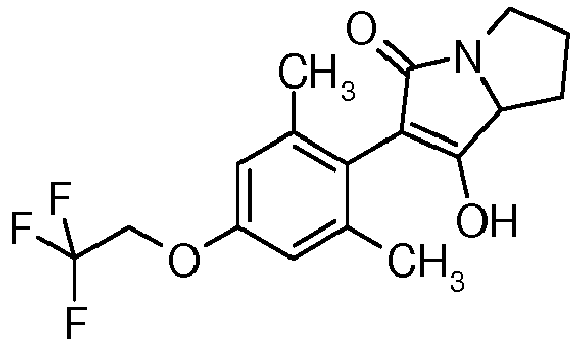
0.5 g (1.55 mmol) der Verbindung (I-1-a-1') (generisch bekannt aus
In Analogie zu Beispiel (I-1-a-1) und Beispiel (I-1-a-2) sowie gemäß den allgemeinen Angaben zur Herstellung erhält man folgende Verbindungen der Formel (I-1-a):
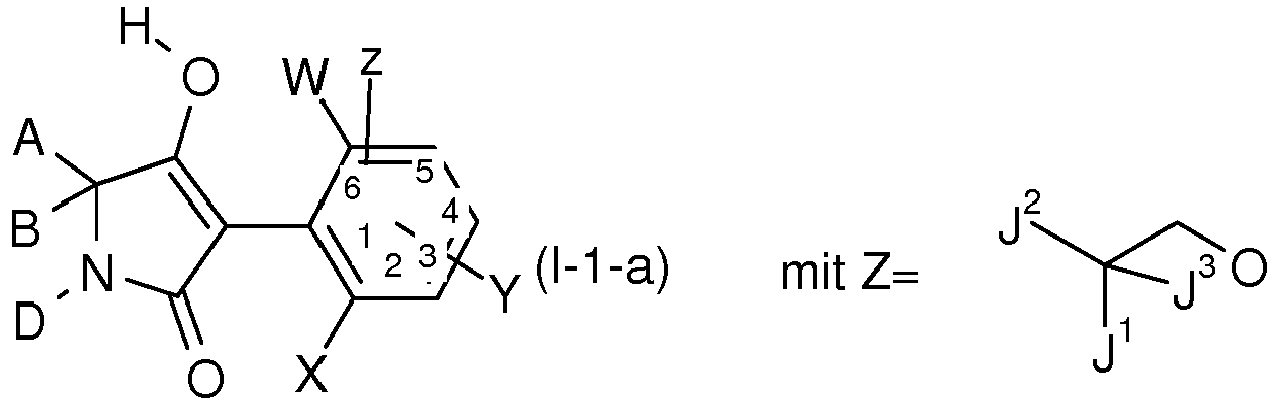
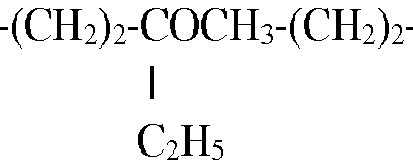
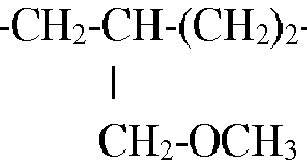
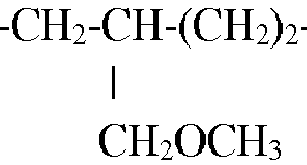
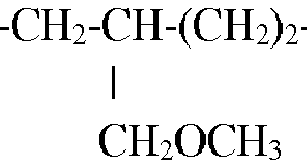
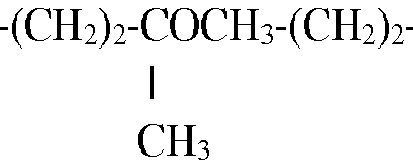
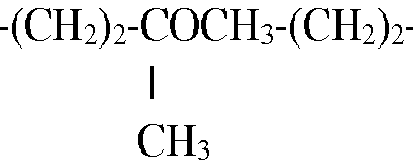
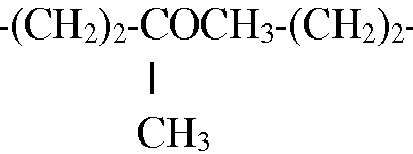


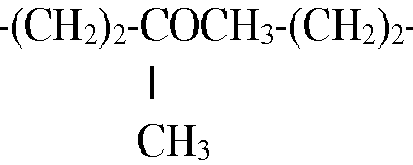
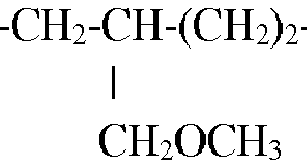
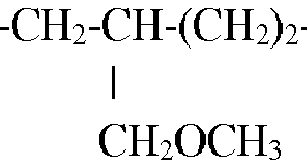
b) 1H-NMR (600 MHz, d6-DMSO): δ = 1.12 (t,3H,CH2 CH 3 ), 1.43-1.64 (3m,3H), 2.21-2.25 (m,1H), 2.34-2.36 (cm,1H), 3.32-3.45 (2m,4H,OCH 2 -CH3,O-CH2), 4.66-4.70 (q,2H,OCH 2 CF3), 6.75 (d,1H,ArH), 6.88-6.90 (m,1H,ArH), 7.14-7.15 (d,1H,ArH), 7.79 (sbr,1H,NH)
c) 1H-NMR (400 MHz, d6-DMSO): δ = 1.11 (t,3H,CH2-CH 3 ), 1.47-1.49 (m,1H), 1.59-1.68 (m,1H), 2.09 (s,3H,Ar-CH 3 ), 3.32-3.36 (cm,2H,OCH 2 ), 3.41-3.47 (q,2H,OCH 2 -CH3), 4.59-4.66 (q,2H,O-CH 2 -CF3), 6.75 (d,1H,ArH), 6.86-6.89 (m,1H,ArH), 7.12-7.14 (d,1H,ArH), 7.69 (s,br,1H,NH)
d) 1H-NMR (400 MHz, CDCl3): δ = 3.42 (dd,2H,OCH3), 4.32 (m,2H,OCH 2CF3)
e) 1H-NMR (400 MHz, CDCl3): δ = 3.52 (dd,2H,OCH3), 4.32 (m,2H,OCH 2 CF3)
b) 1 H NMR (600 MHz, d 6 -DMSO): δ = 1.12 (t, 3H, CH 2 CH 3 ), 1.43-1.64 (3m, 3H), 2.21-2.25 (m, 1H), 2.34- 2.36 (cm, 1H), 3.32-3.45 (2m, 4H, O CH 2 - CH 3 , O-CH 2 ), 4.66-4.70 (q, 2H, O CH 2 CF 3 ), 6.75 (d, 1H, ArH , 6.88-6.90 (m, 1H, ArH), 7.14-7.15 (d, 1H, ArH), 7.79 (sbr, 1H, NH)
c) 1 H-NMR (400 MHz, d 6 -DMSO): δ = 1.11 (t, 3H, CH 2 - CH 3), 1:47 to 1:49 (m, 1H), 1.59-1.68 (m, 1H), 2:09 (s, 3H, Ar- CH 3 ), 3.32-3.36 (cm, 2H, O CH 2 ), 3.41-3.47 (q, 2H, O CH 2 -CH 3 ), 4.59-4.66 (q, 2H, O). CH 2 -CF 3 ), 6.75 (d, 1H, ArH), 6.86-6.89 (m, 1H, ArH), 7.12-7.14 (d, 1H, ArH), 7.69 (s, br, 1H, NH)
d) 1 H NMR (400 MHz, CDCl 3 ): δ = 3.42 (dd, 2H, OCH 3 ), 4.32 (m, 2H, O CH 2 CF 3 )
e) 1 H NMR (400 MHz, CDCl 3 ): δ = 3.52 (dd, 2H, OCH 3 ), 4.32 (m, 2H, O CH 2 CF 3 )
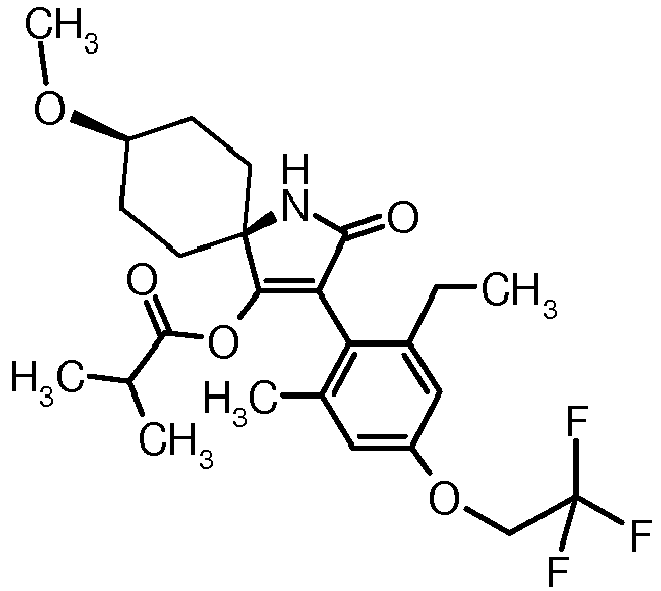
0.15 g (0.36 mmol) der Verbindung gemäß Beispiel (I-1-a-3) werden mit 0.44 g (1.2 eq) Triethylamin sowie 1.5 mg DMAP in 8ml EtOAc1) vorgelegt und 10min bei 50°C gerührt, Anschließend tropft man 0.043 g (1.1 eq) Isobuttersäurechlorid in 2ml EtOAc1) über 20min zu und läßt anschließend 6h bei 50°C und anschließend über Nacht bei RT rühren. Man versetzt mit 10ml Natriumhydrogencarbonat-Lösung, trennt die organische Phase ab, reextrahiert die wässrige Phase mit 20 ml EtOAc1), trocknet die vereingten org. Phasen mit Natriumsulfat. Der nach dem Einengen verbleibende Rückstand wird in einer Mischung von EtOAc1) und n-Heptan aufgenommen und erneut abfiltriert. Man erhält so 0.07 g an erfindungsgemäßer Verbindung (I-1-b-1) = 40 % d. Theorie.
1H-NMR (400 MHz, CDCl3): δ = 6.61 (pseudo d, 2H, Aryl-H), 6.37 (s, 1H, NH), 4.35 (q, 2H, CH 2 -CF3), 3.37 (s, 3H, OCH3), 3.24 (m, 1H, CH-OCH3), 2.51 (m, 3H, CH2-Ar und CH(CH3)2), 2.20. (s, 3H, ArylCH3), 2.19, 1.79, 1.38 (je m, zusammen 8 H Cyclohexyl), 1.13 (t, 3H, Aryl CH2CH3), 1.00 (dd, 6H, (CH3)2)ppm.
1)Essigsäureethylester0.15 g (0.36 mmol) of the compound according to Example (I-1-a-3) are charged with 0.44 g (1.2 eq) of triethylamine and 1.5 mg of DMAP in 8 ml EtOAc 1) and stirred for 10 min at 50 ° C, then added dropwise 0.043 g (1.1 eq) isobutyric acid chloride in 2 ml EtOAc 1) over 20 min and then allowed to stir for 6 h at 50 ° C and then at RT overnight. It is mixed with 10 ml of sodium bicarbonate solution, the organic phase is separated off, the aqueous phase is reextracted with 20 ml EtOAc 1) , the combined org. Phases with sodium sulfate. The residue remaining after concentration is taken up in a mixture of EtOAc 1) and n-heptane and filtered off again. This gives 0.07 g of inventive compound (I-1-b-1) = 40% d. Theory.
1 H-NMR (400 MHz, CDCl 3 ): δ = 6.61 (pseudo d, 2H, aryl-H), 6.37 (s, 1H, NH), 4.35 (q, 2H, C H 2 -CF 3 ), 3.37 (s, 3H, OCH 3 ), 3.24 (m, 1H, C H -OCH 3 ), 2.51 (m, 3H, CH 2 -Ar and CH (CH 3 ) 2 ), 2.20. (s, 3H, aryl CH 3 ), 2.19, 1.79, 1.38 (each m, together 8H cyclohexyl), 1.13 (t, 3H, aryl CH 2 CH 3 ), 1.00 (dd, 6H, (CH 3 ) 2 ) ppm ,
1) ethyl acetate
In Analogie zu Beispiel (I-1-b-1) erhält man Beispiel (I-1-b-2)
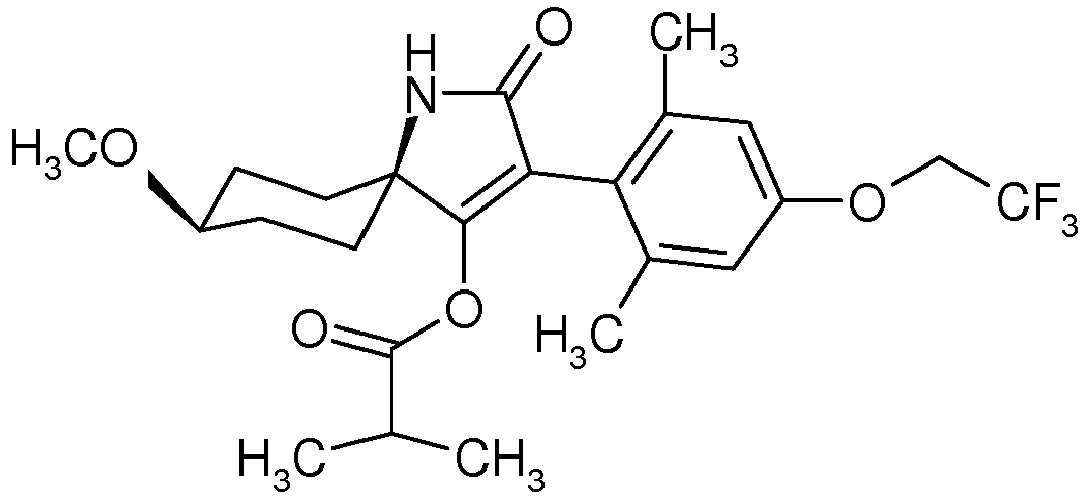
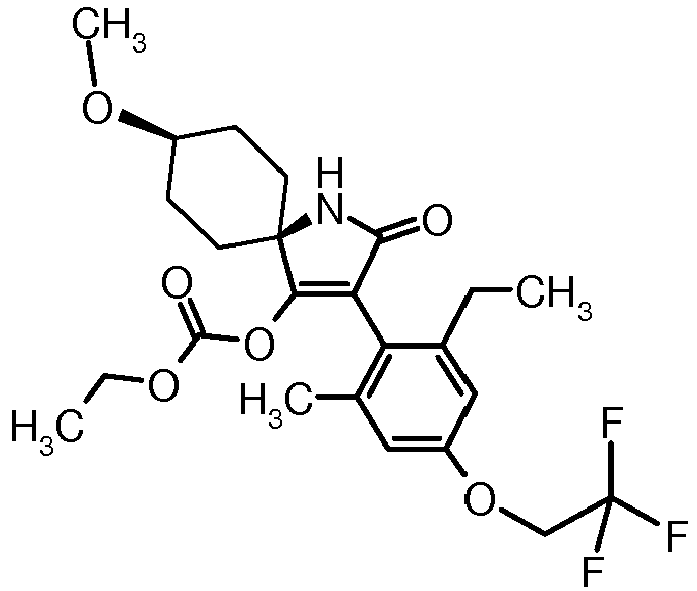
0.15 g (0.36 mmol) der Verbindung gemäß Beispiel (I-1-a-3) werden mit 0.44 g (1.2 eq) Triethylamin in 8ml Dichlormethan vorgelegt und 5 min bei RT gerührt. Anschließend tropft man 0.043 g (1.1 eq) Chlorameisensäureethylester über 20min zu und läßt anschließend über Nacht bei RT rühren. Man versetzt mit 5ml 10% Natriumcarbonat-Lsg, trennt die organische Phase ab und trocknet. Der nach dem Einengen verbleibende Rückstand wurde säulenchromatographisch (Silicagel, Gradient EtOAc1)/n-Heptan) gereinigt. Man erhält so 0.12 g = 68 % d. Theorie an erfindungsgemäßer Verbindung (I-1-c-1).
1H-NMR (400 MHz, CDCl3): δ = 6.66 (pseudo d, 2H, Aryl-H), 6.37 (s, 1H, NH), 4.34 (q, 2H, CH 2 -CF3), 4.01 (q, 2H, OCH2CH3), 3.40 (s, 3H, OCH3), 3.25 (m, 1H, CH-OCH3), 2.49 (m, 2H, CH2-Ar), 2.21 (s, 3H, ArylCH3), 2.22, 1.96, 1.75, 1.40 (je m, zusammen 8 H Cyclohexyl), 1.13 (m, 6H, Aryl CH2CH3 und OCH2CH3) ppm.0.15 g (0.36 mmol) of the compound according to Example (I-1-a-3) are charged with 0.44 g (1.2 eq) of triethylamine in 8 ml of dichloromethane and stirred at RT for 5 min. Then added dropwise 0.043 g (1.1 eq) of ethyl chloroformate over 20min and then allowed to stir at RT overnight. It is mixed with 5 ml of 10% sodium carbonate solution, the organic phase is separated off and dried. The residue remaining after concentration was purified by column chromatography (silica gel, gradient EtOAc 1) / n-heptane). This gives 0.12 g = 68% d. Theory of compound of the invention (I-1-c-1).
1 H-NMR (400 MHz, CDCl 3 ): δ = 6.66 (pseudo d, 2H, aryl-H), 6.37 (s, 1H, NH), 4.34 (q, 2H, C H 2 -CF 3 ), 4.01 ( q, 2H, OCH 2 CH 3 ), 3.40 (s, 3H, OCH 3 ), 3.25 (m, 1H, C H -OCH 3 ), 2.49 (m, 2H, CH 2 -Ar), 2.21 (s, 3H , Aryl CH 3 ), 2.22, 1.96, 1.75, 1.40 (each m, together 8H cyclohexyl), 1.13 (m, 6H, aryl CH 2 CH 3, and OCH 2 CH 3 ) ppm.
In Analogie zu Beispiel (I-1-c-1) sowie gemäß den allgemeinen Angaben zur Herstellung erhält man folgende Verbindungen der Formel (I-1-c):
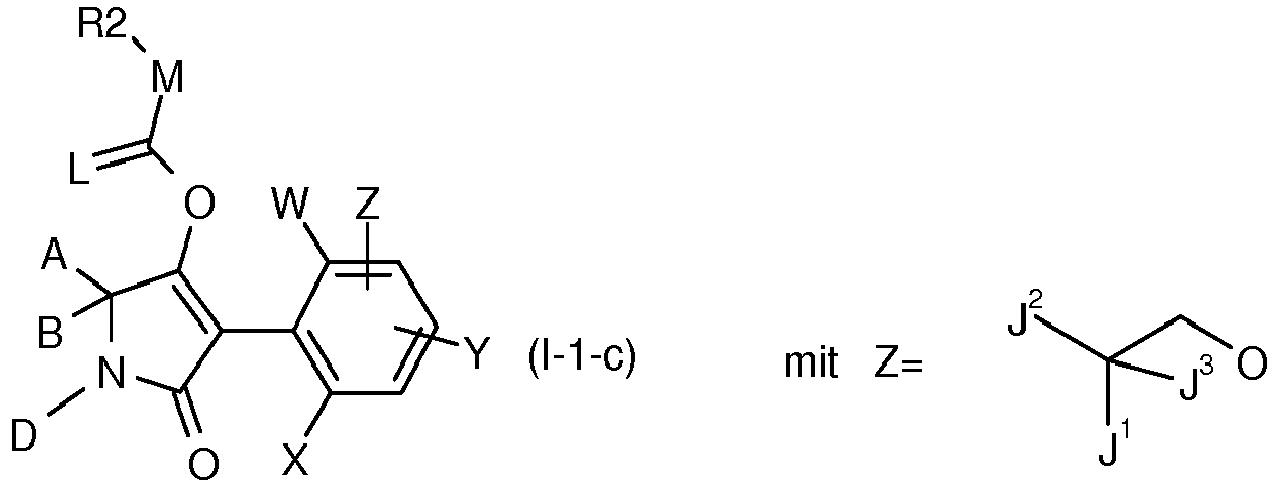

1.5 g (5.7 mmol) der Verbindung gemäß Beispiel (XXXI-1) werden mit 3.4 g (5eq) Thionylchlorid und einem Tropfen DMF versetzt. Man erhitzt bis zum Ende der Gasentwicklung unter Rückfluss zum Sieden, engt anschließend die Reaktionslösung ein und versetzt sie mit 4 ml Dichlormethan (Lösung 1). 1.5 g (1.1 eq) trans-3-Ethoxy-1-amino-cyclohexancarbonsäure-methylester sowie 0.7 g (1.2 eq) Triethylamin werden in 50 ml Dichlormethan gelöst und Lösung 1 innerhalb von 1 h zugetropft. Nach 18 h Rühren wird mit 10 ml Wasser versetzt, die organische Phase abgetrennt, eingeengt und säulenchromatographisch gereinigt. Man erhält 0.56 g = (23% d. Theorie) von Beispiel II-a-1.
1H-NMR (400 MHz, CDCl3): δ = 4.36 (q, 2H, CH2-CF3), 3.71 (s, 3H, OCH3), 3.40 (m, 2H, CH-OCH2) ppm.1.5 g (5.7 mmol) of the compound according to Example (XXXI-1) are mixed with 3.4 g (5 eq) of thionyl chloride and one drop of DMF. It is refluxed until the evolution of gas has ceased, then the reaction solution is concentrated and combined with 4 ml of dichloromethane (solution 1). 1.5 g (1.1 eq) of methyl trans-3-ethoxy-1-amino-cyclohexanecarboxylate and 0.7 g (1.2 eq) of triethylamine are dissolved in 50 ml of dichloromethane and solution 1 is added dropwise within 1 h. After stirring for 18 h, 10 ml of water are added, the organic phase is separated off, concentrated by evaporation and purified by column chromatography. This gives 0.56 g = (23% of theory) of Example II-a-1.
1 H-NMR (400 MHz, CDCl 3 ): δ = 4.36 (q, 2H, CH 2 -CF 3 ), 3.71 (s, 3H, OCH 3 ), 3.40 (m, 2H, CH-OCH 2 ) ppm.
In Analogie zu Beispiel (II-1) und gemäß den allgemeinen Angaben zur Herstellung erhält man folgende Verbindungen der Formel (II):

Folgende Verbindungen der Formel (I-1'-a), die zur Herstellung von Verbindungen der Formel (I-1-a) verwendet wurden, sind neu und lassen sich gemäß Verfahren A herstellen:
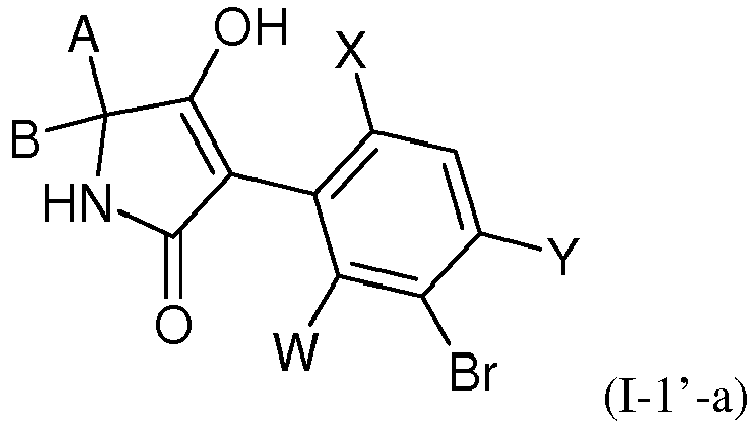
Die zur Herstellung der Verbindung (I-1'-a) benötigten Phenylessigsäuren der Formel (XXXI') erhält man z.B. durch Bromierung in Eisessig.The phenylacetic acids of the formula (XXXI ') required for the preparation of the compound (I-1'-a) are obtained, for example. by bromination in glacial acetic acid.
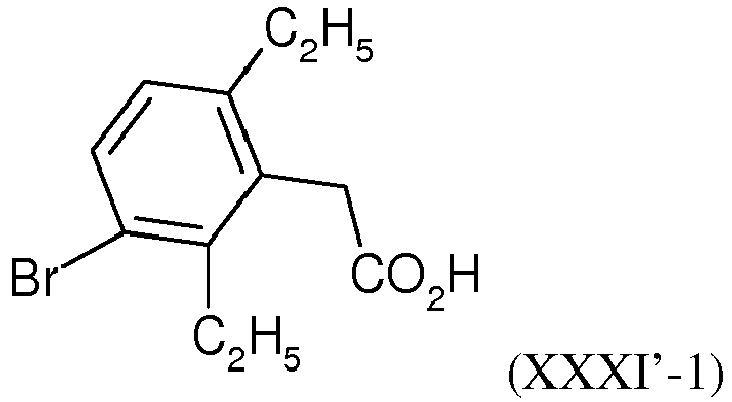
3.85 g (20 mmol) 2,6-Diethyl-phenylessigsäure werden in 40 ml Eisessig vorgelegt. Bei 10°C - 15°C werden 3.2 g (20 mmol) Brom in 12 ml Eisessig in ca. 40 Min. zugetropft. Nach ca. 2 Stunden werden erneut 1.1 g Brom in 4 ml Eisessig zugegeben und über Nacht bei Raumtemperatur nachgerührt. Nach Abdampfen des Eisessigs im Vakuum wird der Rückstand in 40 ml 2 N Natronlauge aufgenommen, mit MTB-Ether gewaschen, die wässrige Phase sauergestellt, mit Dichlormethan extrahiert, getrocknet und im Vakuum eingedampft.
Man erhält 4.3 g (72 % d. Theorie) der Verbindung (XXXI'-1).
1H-NMR (400 MHz, d6-DMSO): δ =1.08, 1.12 (2t, je 3H,CH2-CH 3), 2.54-2.60 (q,2H,CH 2CH3), 2.76-2.81 (q,2H,CH 2CH3), 3.70 (s,2H,CH 2CO), 6.98, 7.41 (2d,je 1H,Ar-H) ppm.3.85 g (20 mmol) of 2,6-diethyl-phenylacetic acid are introduced into 40 ml of glacial acetic acid. At 10 ° C - 15 ° C, 3.2 g (20 mmol) of bromine in 12 ml of glacial acetic acid are added dropwise in about 40 min. After about 2 hours again 1.1 g of bromine in 4 ml of glacial acetic acid are added and stirred overnight at room temperature. After evaporation of the glacial acetic acid in vacuo, the residue is taken up in 40 ml of 2N sodium hydroxide solution, washed with MTB ether, the aqueous phase is acidified, extracted with dichloromethane, dried and evaporated in vacuo.
This gives 4.3 g (72% of theory) of the compound (XXXI'-1).
1 H NMR (400 MHz, d 6 -DMSO): δ = 1.08, 1.12 (2t, 3H each, CH 2 - CH 3 ), 2.54-2.60 (q, 2H, CH 2 CH 3 ), 2.76-2.81 ( q, 2H, CH 2 CH 3 ), 3.70 (s, 2H, CH 2 CO), 6.98, 7.41 (2d, each 1H, Ar-H) ppm.
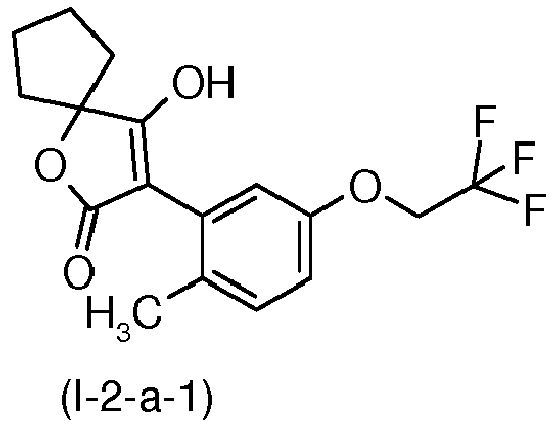
1,36g (34 mmol) Natriumhydrid(60%ig) werden in 30ml THF vorgelegt und 3,10g (31 mmol) Trifluorethanol zugetropft, nach Beendigung der Gasentwicklung werden 6,48g (34 mmol) Kupfer(I)iodid zugesetzt, eine Lösung von 2,00g (6,18 mmol) (I-2-a-1') (generisch bekannt aus
Zur Aufarbeitung wird der abgekühlte Ansatz mit Wasser versetzt, mit verd. HCl angesäuert, mit Ether und Essigester ausgeschüttelt, die org. Phase getrocknet, abfiltriert und eingeengt.
Man erhält 1,57g (70% d.Th.) des Beispiels (I-2-a-1); logP (HCOOH) 2,59
1H-NMR (CD3CN): δ = 1.80-2.20 (m, 8H), 2,15 (s,3H), 3.35 (m, 2H), 7.15 (m,1H), 7,30 (m, 1H), 7.35 (m, 1H) ppm.For workup, the cooled mixture is mixed with water, acidified with dil. HCl, shaken out with ether and ethyl acetate, the org. Dried phase, filtered off and concentrated.
This gives 1.57 g (70% of theory) of the example (I-2-a-1); logP (HCOOH) 2.59
1 H NMR (CD 3 CN): δ = 1.80-2.20 (m, 8H), 2.15 (s, 3H), 3.35 (m, 2H), 7.15 (m, 1H), 7.30 (m, 1H ), 7.35 (m, 1H) ppm.

0,294g (2,62 mmol) Kalium-t-butylat werden in 7 ml DMF2) vorgelegt, auf 0°C gekühlt, eine Lösung von 0,732g (1,75 mmol) des Beispiels (III-1) in 3 ml DMF2) bei 0 - 10°C zugetropft und über Nacht bei Raumtemperatur gerührt.0.244 g (2.62 mmol) of potassium t-butoxide are introduced into 7 ml of DMF 2) , cooled to 0 ° C., a solution of 0.732 g (1.75 mmol) of Example (III-1) in 3 ml of DMF 2) was added dropwise at 0 - 10 ° C and stirred overnight at room temperature.
Zur Aufarbeitung wird das DMF2) abrotiert, der Rückstand in Wasser verrührt, die alk. Phase mit Methyl-t-butylether extrahiert, die wäßrige Phase mit Salzsäure angesäuert, mit Dichlormethan extrahiert, getrocknet, abfiltriert und eingeengt. Das Rohprodukt wird mittels Chromatographie an Kieselgel (Eluent Essigester/Cyclohexan) gereinigt.
2) Dimethylformamid
0,416g (57% d.Th.) des Beispiels (I-2-a-1), logP (HCOOH) 2,45
1H-NMR (d6-DMSO): δ = 1.50 (m, 2H), 2.10 (s, 6H), 2.20 (m, 2H), 3.65 (m, 2H), 3.95 (m, 2H), 6.80 (s, 2H) ppm.For workup, the DMF 2) is removed by rotary evaporation, the residue is stirred in water, the alk. Extracted phase with methyl t-butyl ether, the aqueous phase acidified with hydrochloric acid, extracted with dichloromethane, dried, filtered off and concentrated. The crude product is purified by chromatography on silica gel (eluent ethyl acetate / cyclohexane).
2) dimethylformamide
0.416 g (57% of theory) of the example (I-2-a-1), logP (HCOOH) 2.45
1 H NMR (d 6 -DMSO): δ = 1.50 (m, 2H), 2.10 (s, 6H), 2.20 (m, 2H), 3.65 (m, 2H), 3.95 (m, 2H), 6.80 (s , 2H) ppm.
In Analogie zu den Beispielen (I-2-a-1) und (I-2-a-2) und gemäß den allgemeinen Angaben zur Herstellung erhält man folgende Verbindungen der Formel (I-2-a)
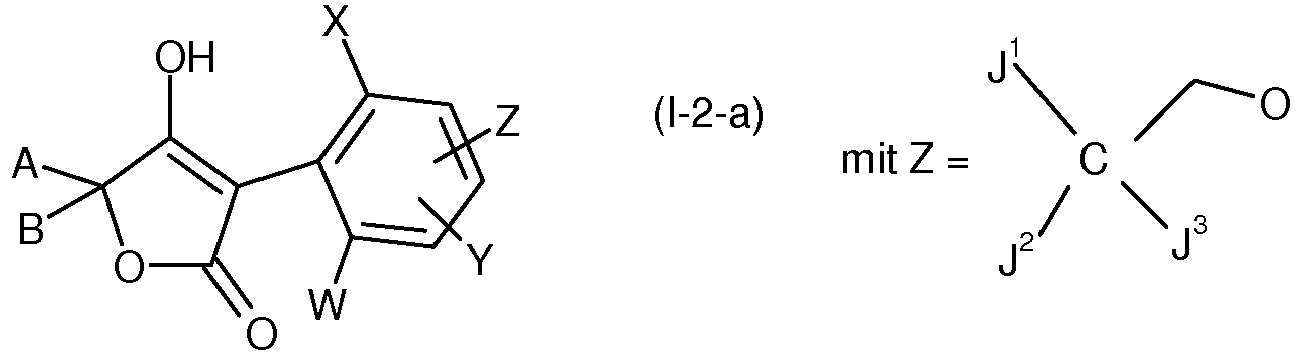
- a)1H-NMR(d6-DMSO): δ = 1,50 (m,2H), 1,65 (m,2H), 2,05 (m,4H), 2,10 (s,3H), 3,25 (m, 1H), 3,30 (s, 3H), 4,65 (m, 2H), 6,80 (m, 1H), 6,95 (m, 1H), 7,15 (m, 1H) ppm.
- b) 1H-NMR(d6-DMSO): δ = 1,40 (m,2H), 1,70 (m,2H), 1,95 (m,2H), 2,10 (s,3H), 2,15 (m, 2H), 3,30 (s, 3H), 3,50 (m, 1H), 4,65 (m, 2H), 6,80 (m, 1H), 6,95 (m, 1H), 7,15 (m, 1H) ppm.
- c) 1H-NMR(d6-DMSO): δ = 1,45 (m,2H), 1,65 (m,2H), 2,00 (m,4H), 2,05 (s,3H), 3,20 (m, 1H), 3,28 (s, 3H), 4,65 (m, 2H), 6,75 (m, 2H) ppm.
- d) 1H-NMR(d6-DMSO): δ = 1,41 (m,2H), 1,75 (m,2H), 1,95 (m,2H), 2,06 (s,3H), 2,15 (m, 2H), 3,25 (s, 3H), 3,52 (m, 1H), 4,65 (m, 2H), 6,75 (m, 2H) ppm.
- a) 1H-NMR (d 6 -DMSO): δ = 1.50 (m, 2H), 1.65 (m, 2H), 2.05 (m, 4H), 2.10 (s, 3H), 3.25 (m, 1H), 3.30 (s, 3H), 4.65 (m, 2H), 6.80 (m, 1H), 6.95 (m, 1H), 7.15 (m , 1H) ppm.
- b) 1 H NMR (d 6 -DMSO): δ = 1.40 (m, 2H), 1.70 (m, 2H), 1.95 (m, 2H), 2.10 (s, 3H), 2.15 (m, 2H), 3.30 (s, 3H), 3.50 (m, 1H), 4.65 (m, 2H), 6.80 (m, 1H), 6.95 (m , 1H), 7.15 (m, 1H) ppm.
- c) 1 H NMR (d 6 -DMSO): δ = 1.45 (m, 2H), 1.65 (m, 2H), 2.00 (m, 4H), 2.05 (s, 3H), 3.20 (m, 1H), 3.28 (s, 3H), 4.65 (m, 2H), 6.75 (m, 2H) ppm.
- d) 1 H NMR (d 6 -DMSO): δ = 1.41 (m, 2H), 1.75 (m, 2H), 1.95 (m, 2H), 2.06 (s, 3H), 2.15 (m, 2H), 3.25 (s, 3H), 3.52 (m, 1H), 4.65 (m, 2H), 6.75 (m, 2H) ppm.
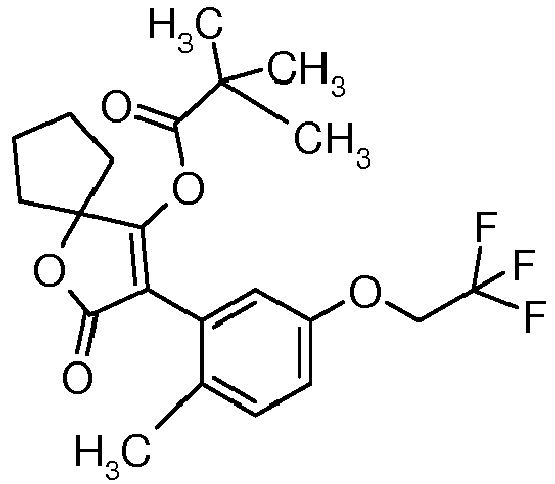
56 mg (0,16 mmol) des Beispiels I-2-a-1 werden in 10 ml Dichlormethan vorgelegt, bei Raumtemperatur werden 18 mg (0,18 mmol) Triethylamin zugegeben, bei 0-10°C werden 21 mg (0,17 mmol) Pivaloylchlorid zugetropft und 1h bei Raumtemperatur verrührt.56 mg (0.16 mmol) of Example I-2-a-1 are initially charged in 10 ml of dichloromethane, at room temperature 18 mg (0.18 mmol) of triethylamine are added, at 0-10 ° C., 21 mg (0, 17 mmol) pivaloyl chloride was added dropwise and stirred for 1 h at room temperature.
Zur Aufarbeitung wird der Ansatz mit verd. Citronensäure und 5%iger NaOH ausgeschüttelt, die org. Phase getrocknet und eingeengt.
Man erhält 61 mg (83% d.Th.) des Beispiels (I-2-b-1), logP (HCOOH) 4,69
1H-NMR (d6-DMSO): δ = 1.10 (s, 9H), 1.80-2.20 (m, 8H), 2.15 (s,3H), 4,65 (m, 2H), 6,75 (m,1H), 7,00 (m, 1H), 7.20 (m, 1H) ppm.For workup, the batch is extracted by shaking with dilute citric acid and 5% NaOH, the org. Dried phase and concentrated.
This gives 61 mg (83% of theory) of Example (I-2-b-1), logP (HCOOH) 4.69
1 H NMR (d 6 -DMSO): δ = 1.10 (s, 9H), 1.80-2.20 (m, 8H), 2.15 (s, 3H), 4.65 (m, 2H), 6.75 (m, 1H), 7.00 (m, 1H), 7.20 (m, 1H) ppm.

0,621g (3,56 mmol) 1-Hydroxy-tetrahydropyran-carbonsäure-ethylester und 1,00g (3,56 mmol) 2,6-Dimethyl-4-trifluorethoxy-phenylessigsäurechlorid werden in 20ml Toluol 12h unter Rückfluß gekocht.0.621 g (3.56 mmol) of ethyl 1-hydroxytetrahydropyrancarboxylate and 1.00 g (3.56 mmol) of 2,6-dimethyl-4-trifluoroethoxyphenylacetic acid chloride are refluxed in 20 ml of toluene for 12 hours.
Zur Aufarbeitung wird das Toluol abrotiert, der Rückstand zwischen Methyl-t-butylether und 5% Natronlauge verteilt, die org.Phase getrocknet und eingeeengt.
Man erhält 0,732g (47% d.Th.) der Verbindung (III-1), logP (HCOOH) 3,78
1H-NMR (d6-DMSO): δ = 1,15 (m, 3H), 1,80-2.00 (m, 4H), 2,25 (s, 6H), 3.40-3.70 (m, 4H), 4.05 (m, 2H), 4.65 (m, 2H), 6.75 (m, 2H) ppm.For workup, the toluene is removed by rotary evaporation, the residue is partitioned between methyl t-butyl ether and 5% sodium hydroxide solution, and the organic phase is dried and concentrated.
This gives 0.732 g (47% of theory) of the compound (III-1), logP (HCOOH) 3.78
1 H NMR (d 6 -DMSO): δ = 1.15 (m, 3H), 1.80-2.00 (m, 4H), 2.25 (s, 6H), 3.40-3.70 (m, 4H), 4.05 (m, 2H), 4.65 (m, 2H), 6.75 (m, 2H) ppm.

300 mg (0.934 mmol) der Verbindung gemäß Beispiel (I-6'-a-1) wird in 5 ml Collidin gelöst und mit 702 mg (6.26 mmol) Kalium-tert.-butylat versetzt (Lösung 1). In einem separaten Kolben werden 178 mg (0.934 mmol) Kupfer-I-jodid, 841 mg (8.4 mmol) Trifluorethanol und 210 mg (1.87 mmol) Kalium-tert.-butylat in 5 ml Collidin gelöst. Dazu wird Lösung 1 getropft, das Gefäß mit 2 ml DMF nachgespült und die Reaktionsmischung 1 Stunde bei 145 °C in der Mikrowelle gerührt. Das Lösungsmittel wird im Vakuum abgezogen, der Rückstand in Wasser aufgenommen und über Celite filtriert. Zu dem Filtrat werden 10 ml Ammoniumchloridlösung hinzugegeben und mit 2 N Salzsäure angesäuert. Der dabei ausgefallene Feststoff wird abgesaugt und getrocknet.
Ausbeute: 185 mg (58 % d. Theorie)
1H-NMR, (400MHz, CDCl3): 1.38-1.48 (m, 1H), 1.70 (mc, 3H), 2.05 und 2.10 (je s, je 3H), 3.15 (mc, 2H), 4.31 (q, 2H), 6.65 (s, 2H) ppm.300 mg (0.934 mmol) of the compound according to Example (I-6'-a-1) is dissolved in 5 ml of collidine and combined with 702 mg (6.26 mmol) of potassium tert-butoxide (solution 1). In a separate flask, 178 mg (0.934 mmol) of cuprous iodide, 841 mg (8.4 mmol) of trifluoroethanol and 210 mg (1.87 mmol) of potassium tert-butoxide are dissolved in 5 ml of collidine. Solution 1 is added dropwise, the vessel is rinsed with 2 ml of DMF and the reaction mixture is stirred for 1 hour at 145 ° C. in the microwave. The solvent is removed in vacuo, the residue taken up in water and filtered through Celite. To the filtrate is added 10 ml of ammonium chloride solution and acidified with 2N hydrochloric acid. The precipitated solid is filtered off with suction and dried.
Yield: 185 mg (58% of theory)
1 H-NMR, (400MHz, CDCl 3 ): 1.38-1.48 (m, 1H), 1.70 (mc, 3H), 2.05 and 2.10 (each s, 3H each), 3.15 (mc, 2H), 4.31 (q, 2H), 6.65 (s, 2H) ppm.
Die Verbindung der Formel (I-6'-a-1), die zur Herstellung der Verbindung der Formel (I-6-a-1) verwendet wird ist neu und lässt sich gemäß Verfahren F herstellen:The compound of formula (I-6'-a-1) used to prepare the compound of formula (I-6-a-1) is novel and can be prepared according to process F:
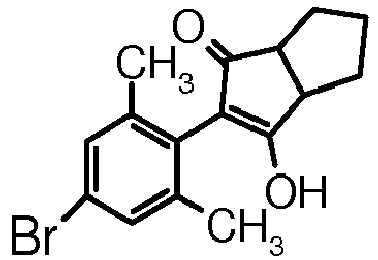
1H-NMR (400MHz, CDCl3): 1.43 (mc,1H), 1.68 (mc. 3H), 2.08 und 2.11 (je s, je 3H), 2.98 und 3.28 (je mc, je 1H), 7.18 (s, 2H) ppm. 1 H NMR (400MHz, CDCl 3 ): 1.43 (mc, 1H), 1.68 (m.c. 3H), 2.08 and 2.11 (each s, 3H each), 2.98 and 3.28 (each mc, 1H each), 7.18 (s , 2H) ppm.
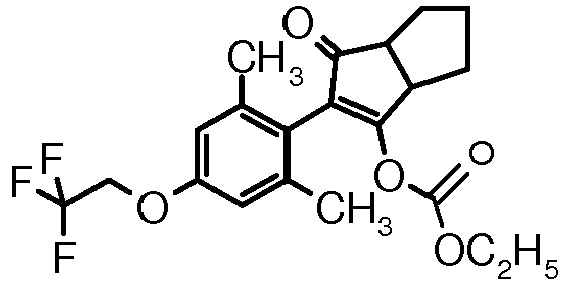
69 mg (0.2 mmol) der Verbindung gemäß Beispiel (I-6-a-1) wird in 5 ml Dichlormethan gelöst und mit 24 mg (0.22 mmol) Chlorameisensäureethylester sowie 62 mg (0.6 mmol) Triethylamin vesetzt. Man lässt 30 Minuten bei Raumtemperatur. Es wird eingeengt und mittels präperativer HPLC (RP-18, Gradient Acetonitril/Wasser (1 % Trifluroessigsäure)) aufgereinigt.
Ausbeute: 57 mg
1H-NMR (400 MHz CDCl3): 1.21 (t, 3H), 1.50 (mc, 1H), 1.65 - 1.88 (m, 3H), 1.94 (mc, 1H), 2.06 und 2.09 (je s, je 3 H), 3.11 und 3.80 (je mc, je 1H), 4.12 (mc, 2H), 4.30 (q, 2H), 6.62 (s, 2H) ppm.69 mg (0.2 mmol) of the compound according to Example (I-6-a-1) is dissolved in 5 ml of dichloromethane and used with 24 mg (0.22 mmol) of ethyl chloroformate and 62 mg (0.6 mmol) of triethylamine. Leave for 30 minutes at room temperature. It is concentrated and purified by preparative HPLC (RP-18, gradient acetonitrile / water (1% trifluoroacetic acid)).
Yield: 57 mg
1 H-NMR (400 MHz CDCl 3 ): 1.21 (t, 3H), 1.50 (mc, 1H), 1.65-1.88 (m, 3H), 1.94 (mc, 1H), 2.06 and 2.09 (each s, each 3 H), 3.11 and 3.80 (each mc, 1H each), 4.12 (mc, 2H), 4.30 (q, 2H), 6.62 (s, 2H) ppm.

0.3 g 8-(4-Brom-2,6-diethylphenyl)-9-hydroxy-1,2,4,5-tetrahydro-7H-pyrazolo[1,2-d][1,4,5]oxa-diazepin-7-on (bekannt aus
Anschließend werden 150 mg Kupfer(I)iodid, 0.69 g 2,2,2-Trifluorethanol sowie 6,7eq(0,591g) Kalium-t-Butylat in 5ml Collidin unter Stickstoffatmosphäre suspendiert. Man gibt Lsg.1 hinzu und läßt unter Mikrowellenbedigungen 1h bei 145°C rühren.Subsequently, 150 mg of copper (I) iodide, 0.69 g of 2,2,2-trifluoroethanol and 6.7 eq (0.591 g) of potassium t-butylate are suspended in 5 ml of collidine under a nitrogen atmosphere. Add Lsg.1 and stir under microwave conditions for 1 h at 145 ° C.
Das Lösungsmittel wird unter vermindertem Druck entfernt und der vebliebene Rückstand in Wasser aufgenommen. Der verbleibende Rückstand wird abfiltriert und die Muttterlauge mit In Salzsäure auf pH=1 gestellt. Nach Extraktion mit Ethylacetat, trocknen mit Natriumsulfat wird eingeengt und man erhält 0.275 g an erfindungsgemäßer Verbindung I-8-a-1.The solvent is removed under reduced pressure and the remaining residue taken up in water. The remaining residue is filtered off and the mother liquor is adjusted to pH = 1 with 1N hydrochloric acid. After extraction with ethyl acetate, drying with sodium sulfate is concentrated and 0.275 g of compound I-8-a-1 according to the invention are obtained.
In Analogie zu Beispiel (I-8-a-1) und gemäß den allgemeinen Angaben zur Herstellung erhält man folgende Verbindungen der Formel (I-8-a)
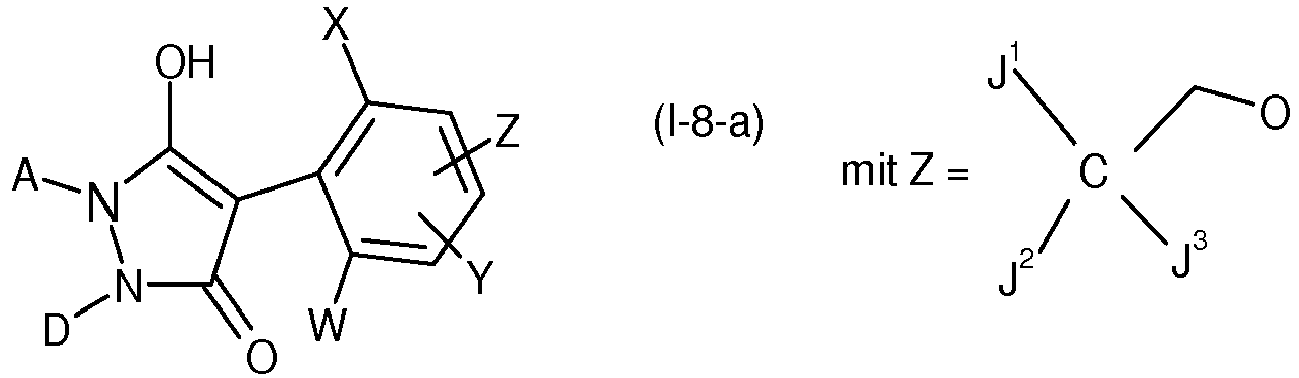
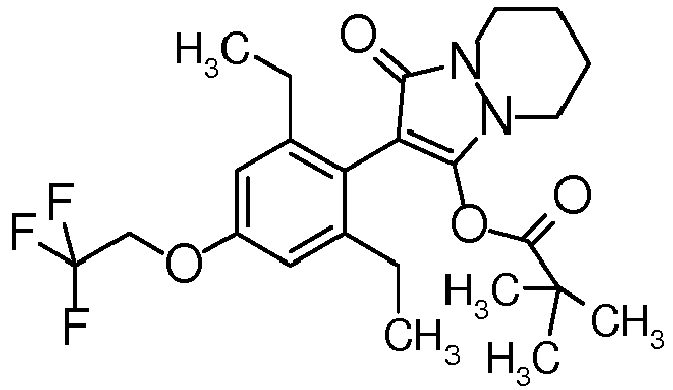
0.05 g der Verbindung gemäß Beispiel I-8-a-4 werden unter Stickstoffatmosphäre in 1 ml Dichlormethan gelöst. Anschließend werden 17 mg 2,2-Dimethylpropanoylchlorid und 17 mg Triethylamin zugegeben und über Nacht bei Raumtemperatur gerührt.0.05 g of the compound according to Example I-8-a-4 are dissolved under nitrogen atmosphere in 1 ml of dichloromethane. Subsequently, 17 mg of 2,2-dimethylpropanoyl chloride and 17 mg of triethylamine are added and stirred overnight at room temperature.
Der Ansatz wird auf 5 ml Wasser gegeben und die Phasen über eine Extraktionskartusche getrennt. Die organische Phase wird eingeengt und anschließend der Rückstand mit reversed Phase HPLC-Chromatographie (Gradient Acetonitril/Wasser 0.05%TFA) aufgereinigt. Man erhält so 0.024 g an erfindungsgemäßer Verbindung I-8-b-1.
1H-NMR (400MHz, CDCl3): 6.67 (s, 2H, Ar-H), 4.32 (q, 2H, OCH2CF3), 1.92 (m, 4H, CH2), 1.05 (s, 9H, t-Bu)The batch is added to 5 ml of water and the phases are separated via an extraction cartridge. The organic phase is concentrated and then the residue is purified by reversed phase HPLC chromatography (gradient acetonitrile / water 0.05% TFA). This gives 0.024 g of inventive compound I-8-b-1.
1 H-NMR (400 MHz, CDCl 3 ): 6.67 (s, 2H, Ar-H), 4.32 (q, 2H, OCH 2 CF 3 ), 1.92 (m, 4H, CH 2 ), 1.05 (s, 9H, t-Bu)
In Analogie zu Beispiel (I-8-b-1) und gemäß den allgemeinen Angaben zur Herstellung erhält man folgende Verbindungen der Formel (I-8-b)

b) 1H-NMR (400MHz, CDCl3): 6,67 und 6.62 (je d, 1H, Ar-H), 4.32 (q, 2H, OCH2CF3), 2.47 (m, 1H, C H (CH3)2)
c) 1H-NMR (400MHz, CDCl3): 6,67 und 6.62 (je d, 1H, Ar-H), 4.32 (q, 2H, OCH2CF3), 1.92 (m, 4H, CH2), 1.09 (d, 9H, t-Bu)
d) 1H-NMR (400MHz, CDCl3): 6.62 (s, 2H, Ar-H), 4.32 (q, 2H, OCH2CF3), 1.92 (m, 4H, CH2), 1.05 (d, 6H, CH(CH 3 )2)
e) 1H-NMR (400MHz, CDCl3): 6.62 (s, 2H, Ar-H), 4.32 (q, 2H, OCH2CF3), 3.88 (m, 4H, CH2-N), 1.08 (s, 9H, t-Bu)
f) 1H-NMR (400MHz, CDCl3): 6.64 (s, 2H, Ar-H), 4.32 (q, 2H, OCH2CF3), 3.87 (m, 4H, CH2-N), 1.02 (d, 9H, CH(CH 3 )2)
b) 1 H-NMR (400 MHz, CDCl 3 ): 6.67 and 6.62 (each d, 1H, Ar-H), 4.32 (q, 2H, OCH 2 CF 3 ), 2.47 (m, 1H, C H ( CH 3 ) 2 )
c) 1 H-NMR (400 MHz, CDCl 3 ): 6.67 and 6.62 (each d, 1H, Ar-H), 4.32 (q, 2H, OCH 2 CF 3 ), 1.92 (m, 4H, CH 2 ) , 1.09 (d, 9H, t-Bu)
d) 1 H-NMR (400 MHz, CDCl 3 ): 6.62 (s, 2H, Ar-H), 4.32 (q, 2H, OCH 2 CF 3 ), 1.92 (m, 4H, CH 2 ), 1.05 (d, 6H, CH (C H 3) 2)
e) 1 H-NMR (400 MHz, CDCl 3 ): 6.62 (s, 2H, Ar-H), 4.32 (q, 2H, OCH 2 CF 3 ), 3.88 (m, 4H, CH 2 -N), 1.08 ( s, 9H, t-Bu)
f) 1 H-NMR (400 MHz, CDCl 3 ): 6.64 (s, 2H, Ar-H), 4.32 (q, 2H, OCH 2 CF 3 ), 3.87 (m, 4H, CH 2 -N), 1.02 ( d, 9H, CH (C H 3) 2)
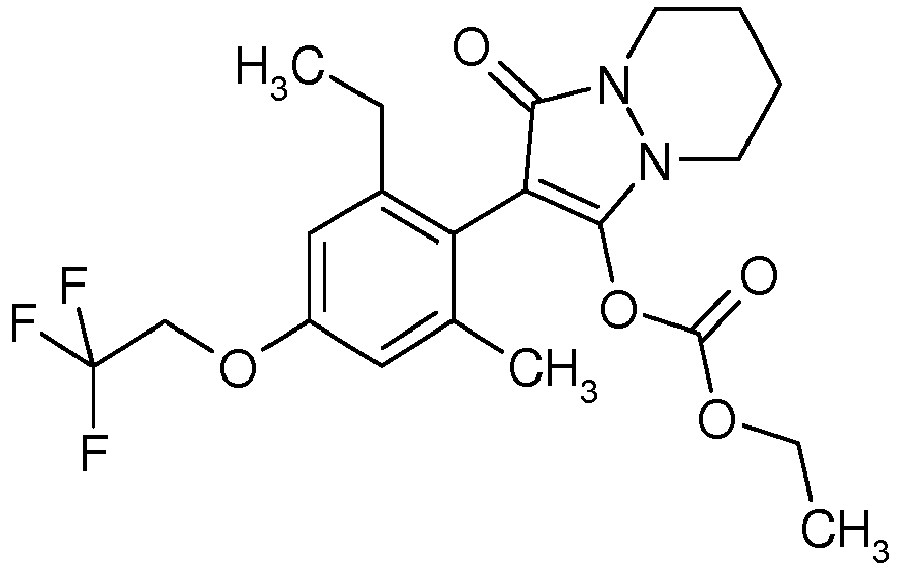
0.58 g an erfindungsgemäßer Verbindung I-8-a-4 werden in 5 ml Dichlormethan gelöst und mit 0.187 g Chlorameisensäureethylester sowie 0.206 g Triethylamin versetzt. Man läßt 18 h bei Raumtemperautr rühren und gibt 10 ml Wasser hinzu. Nach Abtrennung der wässrigen Phase über eine Extraktionskartusche, wird eingeengt und mittels präparativer HPLC (RP-18, Gradient Acetonitril/ Wasser (1% Trifluroessigsäure) aufgereinigt. Man erhält so 0.03 g an erfindungsgemäßer Verbindung I-8-c-1.0.58 g of inventive compound I-8-a-4 are dissolved in 5 ml of dichloromethane and treated with 0.187 g of ethyl chloroformate and 0.206 g of triethylamine. The mixture is stirred for 18 h at room temperature and 10 ml of water are added. After separating off the aqueous phase via an extraction cartridge, the mixture is concentrated and purified by preparative HPLC (RP-18, gradient acetonitrile / water (1% trifluoroacetic acid) to give 0.03 g of compound I-8-c-1 according to the invention.
In Analogie zu Beispiel (I-8-c-1) und gemäß den allgemeinen Angaben zur Herstellung erhält man folgende Verbindungen der Formel (I-8-c)

b) 1H-NMR (400 MHz CDCl3): 6.70 (d, 1H, Ar-H) 6.65 (d, 1H, Ar-H), 4.32 (m, 2H, CF3-CH2), 4.16 (m, 2H, CH2-OC(=O))
c) 1H-NMR (400 MHz CDCl3): 6.68 (d, 2H, Ar-H), 4.32 (m, 2H, CF3-CH2), 4.14 (m, 2H, CH2-OC(=O))
d) 1H-NMR (400 MHz CDCl3): 6.68 (d, 2H, Ar-H), 4.34 (m, 2H, CF3-CH2), 4.16 (m, 2H, CH2-OC(=O))
e) 1H-NMR (400 MHz CDCl3): 6.68 (d, 2H, Ar-H), 4.30 (m, 2H, CF3-CH2), 4.17 (m, 2H, CH2-OC(=O))
f) 1H-NMR (400 MHz CDCl3): 6.65 (d, 2H, Ar-H), 4.32 (m, 2H, CF3-CH2), 4.16 (m, 2H, CH2-OC(=O))
b) 1 H-NMR (400 MHz CDCl3): 6.70 (d, 1H, Ar-H,) 6.65 (d, 1H, Ar-H,), 4:32 (m, 2H, CF 3 CH 2), 4.16 (m , 2H, CH 2 -OC (= O))
c) 1 H NMR (400 MHz CDCl 3 ): 6.68 (d, 2H, Ar-H), 4.32 (m, 2H, CF 3 -CH 2 ), 4.14 (m, 2H, CH 2 -OC (= O ))
d) 1 H-NMR (400 MHz CDCl 3 ): 6.68 (d, 2H, Ar-H), 4.34 (m, 2H, CF 3 -CH 2 ), 4.16 (m, 2H, CH 2 -OC (= O ))
e) 1 H NMR (400 MHz CDCl 3 ): 6.68 (d, 2H, Ar-H), 4.30 (m, 2H, CF 3 -CH 2 ), 4.17 (m, 2H, CH 2 -OC (= O ))
f) 1 H NMR (400 MHz CDCl 3 ): 6.65 (d, 2H, Ar-H), 4.32 (m, 2H, CF 3 -CH 2 ), 4.16 (m, 2H, CH 2 -OC (= O ))

18,05g (451 mmol) Natriumhydrid werden in 500ml DMF vorgelegt, 41,05g (410 mmol) Trifluorethanol zugetropft, nach Beendigung der Gasentwicklung werden 15,63g (82 mmol) Kupfer(I)iodid zugesetzt, eine Lösung von 21,10g (82 mmol) des 2,6-Dimethyl-4-bromphenylessigsäuremethylesters in 100ml DMF langsam zugetropft und 2,5h am Rückfluß gekocht.18.05 g (451 mmol) of sodium hydride are initially charged in 500 ml of DMF, 41.05 g (410 mmol) of trifluoroethanol are added dropwise, after completion of the gas evolution 15.63 g (82 mmol) of copper (I) iodide are added, a solution of 21.10 g ( 82 mmol) of the 2,6-dimethyl-4-bromophenylacetic acid methyl ester in 100 ml of DMF is slowly added dropwise and boiled for 2.5 h at reflux.
Zur Aufarbeitung wird der Ansatz eingeengt, der Rückstand mit Wasser versetzt und mehrfach mit Diethylether ausgeschüttelt, die Etherphase wird getrocknet, abfiltriert und eingeengt:For workup, the mixture is concentrated, the residue is combined with water and shaken out several times with diethyl ether, the ether phase is dried, filtered off and concentrated by evaporation:
Die wässrige Phase wird mit Salzsäure angesäuert und mehrfach mit Dichlormethan extrahiert, die org.Phase wird getrocknet und einrotiert:The aqueous phase is acidified with hydrochloric acid and extracted several times with dichloromethane, the org.Phase is dried and concentrated by rotary evaporation:
Die 12,73g 2,6-Dimethyl-4-trifluorethoxy-phenylessigsäure-N,N-dimethylamid werden 36h in einer Lösung aus 58g Kaliumhydroxid in 165ml Methanol und 43 ml Wasser gekocht. Zur Aufarbeitung wird das Methanol abrotiert, der Rückstand zwischen Wasser und Dichlormethan verteilt, die wässrige Phase mit Salzsäure angesäuert und die ausgefallenen Kristalle abgesaugt und getrocknet. Auf diese Weise erhält man weitere 11,6 g der Phenylessigsäure (XXXI-1).
Gesamtausbeute: 19,3 g (90% d.Th.) 2,6-Dimethyl-4-trifluorethoxy-phenylessigsäure (XXXI-1)
1H-NMR (d6-DMSO): δ = 2,25 (s, 6H), 3,50 (s,2H), 4,60 (m,2H), 6,75 (s,2H) ppm.
logP (HCOOH) 2,51.The 12.73 g of 2,6-dimethyl-4-trifluoroethoxyphenylacetic acid N, N-dimethylamide are boiled for 36 hours in a solution of 58 g of potassium hydroxide in 165 ml of methanol and 43 ml of water. For workup, the methanol is removed by rotary evaporation, the residue is partitioned between water and dichloromethane, the aqueous phase is acidified with hydrochloric acid and the precipitated crystals are filtered off with suction and dried. This gives another 11.6 g of phenylacetic acid (XXXI-1).
Total yield: 19.3 g (90% of theory) of 2,6-dimethyl-4-trifluoroethoxyphenylacetic acid (XXXI-1)
1 H NMR (d 6 -DMSO): δ = 2.25 (s, 6H), 3.50 (s, 2H), 4.60 (m, 2H), 6.75 (s, 2H) ppm.
log P (HCOOH) 2.51.
Die Bestimmung der in den voran stehenden Tabellen und Herstellungsbeispielen angegebenen logP-Werte erfolgt gemäß EEC-Directive 79/831 Annex V.A8 durch HPLC (High Performance Liquid Chromatography) an einer Phasenumkehrsäule (C 18). Temperatur: 43°C.The determination of the logP values given in the preceding Tables and Preparation Examples is carried out according to EEC Directive 79/831 Annex V.A8 by HPLC (High Performance Liquid Chromatography) on a phase inversion column (C 18). Temperature: 43 ° C.
Die Bestimmung erfolgt im sauren Bereich bei pH 2.3 mit 0,1 % wässriger Phosphorsäure und Acetonitril als Eluenten; linearer Gradient von 10 % Acetonitril bis 95 % Acetonitril.The determination is carried out in the acidic range at pH 2.3 with 0.1% aqueous phosphoric acid and acetonitrile as eluent; linear gradient from 10% acetonitrile to 95% acetonitrile.
Die Bestimmung mit der LC-MS im sauren Bereich erfolgt bei pH 2,7 mit 0,1 % wässriger Ameisensäure und Acetonitril (enthält 0,1 % Ameisensäure) als Eluenten; linearer Gradient von 10 % Acetonitril bis 95 % Acetonitril.The determination with the LC-MS in the acidic range is carried out at pH 2.7 with 0.1% aqueous formic acid and acetonitrile (containing 0.1% formic acid) as eluent; linear gradient from 10% acetonitrile to 95% acetonitrile.
Die Bestimmung mit der LC-MS im neutralen Bereich erfolgt bei pH 7,8 mit 0,001 molarer wässriger Ammoniumhydrogencarbonat-Lösung und Acetonitril als Eluenten; linearer Gradient von 10 % Acetonitril bis 95 % Acetonitril.The determination with the LC-MS in the neutral range is carried out at pH 7.8 with 0.001 molar aqueous ammonium bicarbonate solution and acetonitrile as eluent; linear gradient from 10% acetonitrile to 95% acetonitrile.
Die Eichung erfolgt mit unverzweigtem Alkan-2-onen (mit 3 bis 16 Kohlenstoffatomen), deren logP-Werte bekannte sind (Bestimmung der logP-Werte anhand der Retentionszeiten durch lineare Interpolation zwischen zwei aufeinander folgenden Alkanonen).The calibration is carried out with unbranched alkan-2-ones (with 3 to 16 carbon atoms) whose logP values are known (determination of the logP values by means of the retention times by linear interpolation between two consecutive alkanones).
Die lambda-max-Werte wurden an Hand der UV-Spektren von 200 nm bis 400 nm in den Maxima der chromatographischen Signale ermittelt.The lambda max values were determined on the basis of the UV spectra from 200 nm to 400 nm in the maxima of the chromatographic signals.
Zur Herstellung einer zweckmäßigen Wirkstoffzubereitung vermischt man 1 Gewichtsteil Wirkstoff mit den angegebenen Mengen Lösungsmittel und Emulgator und verdünnt das Konzentrat mit emulgatorhaltigem Wasser auf die gewünschte Konzentration.To prepare a suitable preparation of active compound, 1 part by weight of active compound is mixed with the indicated amounts of solvent and emulsifier, and the concentrate is diluted with emulsifier-containing water to the desired concentration.
Chinakohlblattscheiben (Brassica pekinensis), die von allen Stadien der Grünen Pfirsichblattlaus (Myzus persicae) befallen sind, werden mit einer Wirkstoffzubereitung der gewünschten Konzentration gespritzt.Chinese cabbage leaf discs ( Brassica pekinensis ) infested with all stages of the green peach aphid ( Myzus persicae ) are sprayed with an active compound preparation of the desired concentration.
Nach der gewünschten Zeit wird die Wirkung in % bestimmt. Dabei bedeutet 100 %, dass alle Blattläuse abgetötet wurden; 0 % bedeutet, dass keine Blattläuse abgetötet wurden.After the desired time, the effect is determined in%. 100% means that all aphids have been killed; 0% means that no aphids have been killed.
Bei diesem Test zeigen z. B. die folgenden Verbindungen der Herstellungsbeispiele Wirkung von ≥ 80 % bei einer Aufwandmenge von 500 g/ha :
- Bsp Nr : I-1-a-1, I-1-a-3, I-1-a-4, I-1-a-5, I-1-a-6, I-1-a-7, I-1-a-8, I-1-a-10, I-1-a-12, I-1-a-13, I-1-a-14, I-1-a-15, I-1-a-17, I-1-a-18, I-1-a-19, I-1-a-23, I-1-a-24, I-1-a-25, I-1-a-26, I-1-a-27, I-1-a-28, I-1-a-29, I-1-a-30, I-1-a-31, I-1-a-32, I-1-a-33, I-1-a-34,I-1-a-35, I-1-a-36, I-1-a-37, I-1-a-38, I-1-a-39, I-1-a-40, I-1-a-41,I-1-a-42, I-1-a-43, I-1-a-44, I-1-a-45, I-1-a-46, I-1-a-48, I-1-b-1, I-1-c-1, I-1-c-2, I-1-c-3, I-1-c-4, I-1-c-5, I-1-c-6, I-2-a-1, I-2-a-2, I-2-a-3, I-2-a-4, I-2-a-5, I-2-a-6, I-8-a-2, I-8-b-3, I-8-b-5
- Ex. No. I-1-a-1, I-1-a-3, I-1-a-4, I-1-a-5, I-1-a-6, I-1-a-7 , I-1-a-8, I-1-a-10, I-1-a-12, I-1-a-13, I-1-a-14, I-1-a-15, I -1-a-17, I-1-a-18, I-1-a-19, I-1-a-23, I-1-a-24, I-1-a-25, I-1 -a-26, I-1-a-27, I-1-a-28, I-1-a-29, I-1-a-30, I-1-a-31, I-1-a -32, I-1-a-33, I-1-a-34, I-1-a-35, I-1-a-36, I-1-a-37, I-1-a-38 , I-1-a-39, I-1-a-40, I-1-a-41, I-1-a-42, I-1-a-43, I-1-a-44, I -1-a-45, I-1-a-46, I-1-a-48, I-1-b-1, I-1-c-1, I-1-c-2, I-1 -c-3, I-1-c-4, I-1-c-5, I-1-c-6, I-2-a-1, I-2-a-2, I-2-a -3, I-2-a-4, I-2-a-5, I-2-a-6, 1-8-a-2, 1-8-b-3, 1-8-b-5
Bei diesem Test zeigen z. B. die folgenden Verbindungen der Herstellungsbeispiele Wirkung von ≥ 80 % bei einer Aufwandmenge von 100 g/ha :
- Bsp Nr: I-1-a-20
- Ex. No. I-1-a-20
Zur Herstellung einer zweckmäßigen Wirkstoffzubereitung vermischt man 1 Gewichtsteil Wirkstoff mit den angegebenen Mengen Lösungsmittel und Emulgator und verdünnt das Konzentrat mit emulgatorhaltigem Wasser auf die gewünschte Konzentration.To prepare a suitable preparation of active compound, 1 part by weight of active compound is mixed with the indicated amounts of solvent and emulsifier, and the concentrate is diluted with emulsifier-containing water to the desired concentration.
Chinakohlblattscheiben (Brassica pekinensis) werden mit einer Wirkstoffzubereitung der gewünschten Konzentration gespritzt und nach dem Abtrocknen mit Larven des Meerrettichblattkäfers (Phaedon cochleariae) besetzt.Chinese cabbage leaf discs (Brassica pekinensis) are sprayed with a preparation of active compound of the desired concentration and, after drying, are populated with larvae of the horseradish leaf beetle (Phaedon cochleariae) .
Nach der gewünschten Zeit wird die Wirkung in % bestimmt. Dabei bedeutet 100 %, dass alle Käferlarven abgetötet wurden; 0 % bedeutet, dass keine Käferlarven abgetötet wurden.After the desired time, the effect is determined in%. 100% means that all beetle larvae have been killed; 0% means that no beetle larvae have been killed.
Bei diesem Test zeigen z. B. die folgenden Verbindungen der Herstellungsbeispiele Wirkung von ≥ 80 % bei einer Aufwandmenge von 500 g/ha :
- Bsp Nr.: I-1-a-1, I-1-a-3, I-1-a-8, I-1-a-11, I-1-a-13, I-1-a-14, I-1-a-15, I-1-a-16, I-1-a-18, I-1-a-19, I-1-a-21, I-1-a-23, I-1-a-27, I-1-a-28, I-1-a-30, I-1-a-31, I-1-a-32, I-1-a-33, I-1-c-6, I-2-a-5
- Ex. No. I-1-a-1, I-1-a-3, I-1-a-8, I-1-a-11, I-1-a-13, I-1-a 14, I-1-a-15, I-1-a-16, I-1-a-18, I-1-a-19, I-1-a-21, I-1-a-23, I-1-a-27, I-1-a-28, I-1-a-30, I-1-a-31, I-1-a-32, I-1-a-33, I- 1-c-6, I-2-a-5
Zur Herstellung einer zweckmäßigen Wirkstoffzubereitung vermischt man 1 Gewichtsteil Wirkstoff mit den angegebenen Mengen Lösungsmittel und Emulgator und verdünnt das Konzentrat mit emulgatorhaltigem Wasser auf die gewünschte Konzentration.To prepare a suitable preparation of active compound, 1 part by weight of active compound is mixed with the indicated amounts of solvent and emulsifier, and the concentrate is diluted with emulsifier-containing water to the desired concentration.
Bohnenblattscheiben (Phaseolus vulgaris), die von allen Stadien der Gemeinen Spinnmilbe (Tetranychus urticae) befallen sind, werden mit einer Wirkstoffzubereitung der gewünschten Konzentration gespritzt.Bean leaf discs (Phaseolus vulgaris) infected by all stages of the common spider mite (Tetranychus urticae) are sprayed with an active compound preparation of the desired concentration.
Nach der gewünschten Zeit wird die Wirkung in % bestimmt. Dabei bedeutet 100 %, dass alle Spinnmilben abgetötet wurden; 0 % bedeutet, dass keine Spinnmilben abgetötet wurden.After the desired time, the effect is determined in%. 100% means that all spider mites have been killed; 0% means that no spider mites have been killed.
Bei diesem Test zeigen z. B. die folgenden Verbindungen der Herstellungsbeispiele Wirkung von ≥ 80 % bei einer Aufwandmenge von 100 g/ha :
- BspNr.: I-1-a-4, I-1-a-5, I-1-a-6, I-1-a-7, I-1-a-8, I-1-a-10, I-1-a-14, I-1-a-17, I-1-a-2, I-1-a-25, I-1-a-26, I-1-a-28, I-1-a-3, I-1-a-30, I-1-a-31, I-1-a-32, I-1-b-1, I-1-c-1, I-1-c-2, I-1-c-3, I-1-c-4, I-1-c-5, I-1-c-6, I-2-a-5, I-2-a-6, I-2-b-1, I-8-c-1, I-8-a-2, I-8-b-3, I-8-b-5
- Example: I-1-a-4, I-1-a-5, I-1-a-6, I-1-a-7, I-1-a-8, I-1-a-10 , I-1-a-14, I-1-a-17, I-1-a-2, I-1-a-25, I-1-a-26, I-1-a-28, I -1-a-3, I-1-a-30, I-1-a-31, I-1-a-32, I-1-b-1, I-1-c-1, I-1 -c-2, I-1-c-3, I-1-c-4, I-1-c-5, I-1-c-6, I-2-a-5, I-2-a -6, I-2-b-1, 1-8-c-1, 1-8-a-2, 1-8-b-3, 1-8-b-5
Bei diesem Test zeigen z. B. die folgenden Verbindungen der Herstellungsbeispiele Wirkung von ≥ 80 % bei einer Aufwandmenge von 20 g/ha :
- Bsp Nr.: I-1-a-16, I-1-a-19
- Ex # I-1-a-16, I-1-a-19
Zur Herstellung einer zweckmäßigen Wirkstoffzubereitung vermischt man 1 Gewichtsteil Wirkstoff mit den angegebenen Mengen Lösungsmittel und Emulgator und verdünnt das Konzentrat mit emulgatorhaltigem Wasser auf die gewünschte Konzentration.To prepare a suitable preparation of active compound, 1 part by weight of active compound is mixed with the indicated amounts of solvent and emulsifier, and the concentrate is diluted with emulsifier-containing water to the desired concentration.
Maisblattscheiben (Zea mays) werden mit einer Wirkstoffzubereitung der gewünschten Konzentration gespritzt und nach dem Abtrocknen mit Raupen des Heerwurms (Spodoptera frugiperda) besetzt.Maize leaf discs ( Zea mays ) are sprayed with an active compound preparation of the desired concentration and, after drying, are infested with caterpillars of the armyworm ( Spodoptera frugiperda ).
Nach der gewünschten Zeit wird die Wirkung in % bestimmt. Dabei bedeutet 100 %, dass alle Raupen abgetötet wurden; 0 % bedeutet, dass keine Raupe abgetötet wurde.After the desired time, the effect is determined in%. 100% means that all caterpillars have been killed; 0% means that no caterpillar has been killed.
Bei diesem Test zeigen z. B. die folgenden Verbindungen der Herstellungsbeispiele Wirkung von ≥ 80 % bei einer Aufwandmenge von 500 g/ha :
- Bsp Nr .: I-1-a-27, I-1-a-28, I-1-a-32, I-1-a-36, I-1-a-39, I-1-c-1
- Ex. No. I-1-a-27, I-1-a-28, I-1-a-32, I-1-a-36, I-1-a-39, I-1-c- 1
Zur Herstellung einer zweckmäßigen Wirkstoffzubereitung vermischt man 1 Gewichtsteil Wirkstoff mit den angegebenen Mengen Lösungsmittel und Emulgator und verdünnt das Konzentrat mit Wasser auf die gewünschte Konzentration.To prepare a suitable preparation of active compound, 1 part by weight of active compound is mixed with the indicated amounts of solvent and emulsifier, and the concentrate is diluted with water to the desired concentration.
Gefäße werden mit Sand, Wirkstofflösung, Meloidogyne incognita-Ei-Larvensuspension und Salatsamen gefüllt. Die Salatsamen keimen und die Pflänzchen entwickeln sich. An den Wurzeln entwickeln sich die Gallen.Vessels are filled with sand, drug solution, Meloidogyne incognita egg larvae suspension and lettuce seed. The lettuce seeds germinate and the plantlets develop. The galls develop at the roots.
Nach der gewünschten Zeit wird die nematizide Wirkung an Hand der Gallenbildung in % bestimmt. Dabei bedeutet 100 %, dass keine Gallen gefunden wurden; 0 % bedeutet, dass die Zahl der Gallen an den behandelten Pflanzen der der unbehandelten Kontrolle entspricht.After the desired time, the nematicidal activity is determined by means of bile formation in%. 100% means that no bile was found; 0% means that the number of bile on the treated plants corresponds to that of the untreated control.
Bei diesem Test zeigen z. B. die folgenden Verbindungen der Herstellungsbeispiele Wirkung von ≥ 80 % bei einer Aufwandmenge von 20 ppm :
- Bsp Nr.: I-1-a-25, I-1-c-6
- Ex # I-1-a-25, I-1-c-6
Zur Herstellung einer zweckmäßigen Wirkstoffzubereitung vermischt man 1 Gewichtsteil Wirkstoff mit der angegebenen Menge Lösungsmittel und verdünnt das Konzentrat mit Wasser auf die gewünschte Konzentration.To prepare a suitable preparation of active compound, 1 part by weight of active compound is mixed with the stated amount of solvent and the concentrate is diluted with water to the desired concentration.
Gefäße, die Pferdefleisch enthalten, das mit der Wirkstoffzubereitung der gewünschten Konzentration behandelt wurde, werden mit Lucilia cuprina Larven besetzt.Vessels containing horsemeat treated with the preparation of active compound of the desired concentration are infested with Lucilia cuprina larvae.
Nach der gewünschten Zeit wird die Abtötung in % bestimmt. Dabei bedeutet 100 %, dass alle Larven abgetötet wurden; 0 % bedeutet, dass keine Larven abgetötet wurden.After the desired time the kill is determined in%. 100% means that all larvae have been killed; 0% means that no larvae have been killed.
Bei diesem Test zeigen z. B. die folgenden Verbindungen der Herstellungsbeispiele Wirkung von ≥ 80 % bei einer Aufwandmenge von 100 ppm :
- BspNr. : I-1-a-25, I-1-a-3, I-2-a-5, I-2-a-6
- BspNr. : I-1-a-25, I-1-a-3, I-2-a-5, I-2-a-6
Zur Herstellung einer zweckmäßigen Wirkstoffzubereitung vermischt man 1 Gewichtsteil Wirkstoff mit der angegebenen Menge Lösungsmittel und verdünnt das Konzentrat mit Wasser auf die gewünschte Konzentration. Die Wirkstofflösung wird in das Abdomen (Boophilus microplus) injiziert, die Tiere werden in Schalen überführt und in einem klimatisierten Raum aufbewahrt. Die Wirkungskontrolle erfolgt auf Ablage fertiler Eier.To prepare a suitable preparation of active compound, 1 part by weight of active compound is mixed with the stated amount of solvent and the concentrate is diluted with water to the desired concentration. The drug solution is injected into the abdomen (Boophilus microplus) , the animals are transferred to trays and stored in an air-conditioned room. The effect control takes place on storage of fertile eggs.
Nach der gewünschten Zeit wird die Wirkung in % bestimmt. Dabei bedeutet 100%, dass keine Zecke fertile Eier gelegt hat.After the desired time, the effect is determined in%. 100% means that no ticks have laid fertile eggs.
Bei diesem Test zeigen z. B. die folgenden Verbindungen der Herstellungsbeispiele Wirkung von ≥ 80 % bei einer Aufwandmenge von 20 ppm :
- Bsp Nr.: I-1-a-25, I-1-a-3, I-1-a-7, I-1-c-4, I-1-c-5, I-2-a-5, I-2-a-6
- Ex. No. I-1-a-25, I-1-a-3, I-1-a-7, I-1-c-4, I-1-c-5, I-2-a, 5, I-2-a-6
Zur Herstellung einer zweckmäßigen Wirkstoffzubereitung vermischt man 1 Gewichtsteil Wirkstoff mit den angegebenen Mengen Lösungsmittel und Emulgator und verdünnt das Konzentrat mit Wasser auf die gewünschte Konzentration. Für die Anwendung mit Ammonium- oder Phosphoniumsalzen und Penetrationsförderer (Rapsölmethylester 500 EW) werden diese jeweils in einerKonzen-tration von 1000 ppm der Spritzbrühe hinzugegeben.To prepare a suitable preparation of active compound, 1 part by weight of active compound is mixed with the indicated amounts of solvent and emulsifier, and the concentrate is diluted with water to the desired concentration. For application with ammonium or phosphonium salts and penetrants (rapeseed oil methyl ester 500 EW), they are added to the spray mixture in each case in a concentration of 1000 ppm.
Paprikapflanzen (Capsicum annuum), die stark von der Grünen Pfirsichblattlaus (Myzus persicae) befallen sind, werden durch Tropfnassspritzung mit der Wirkstoffzubereitung in der gewünschten Konzentration behandelt. Nach der gewünschten Zeit wird die Abtötung in % bestimmt. Dabei bedeutet 100 %, dass alle Tiere abgetötet wurden; 0 % bedeutet, dass keine Tiere abgetötet wurden.
nach 6 Tagen
after 6 days
Zur Herstellung einer zweckmäßigen Wirkstoffzubereitung vermischt man 1 Gewichtsteil Wirkstoff mit den angegebenen Mengen Lösungsmittel und Emulgator und verdünnt das Konzentrat mit emulgatorhaltigem Wasser auf die gewünschte Konzentration. Für die Anwendung mit Ammonium- oder Phosphoniumsalzen und Penetrationsförderern (Rapsölmethylestern 500 EW) werden diese jeweils in einerKonzentration von 1000 ppm der Spritzbrühe hinzugegeben.To prepare a suitable preparation of active compound, 1 part by weight of active compound is mixed with the indicated amounts of solvent and emulsifier, and the concentrate is diluted with emulsifier-containing water to the desired concentration. For use with ammonium or phosphonium salts and penetration promoters (rapeseed oil methyl esters 500 EW), they are added to the spray mixture in each case in a concentration of 1000 ppm.
Baumwollpflanzen (Gossypium hirsutum), die stark von der Baumwollblattlaus (Aphis gossypii) befallen sind, werden durch Tropfnassspritzung mit der Wirkstoffzubereitung der gewünschten Konzentration behandelt.Cotton plants ( Gossypium hirsutum ) heavily infested with the cotton aphid ( Aphis gossypii ) are treated by drip-wet spraying with the preparation of active compound of the desired concentration.
Nach der gewünschten Zeit wird die Abtötung in % bestimmt. Dabei bedeutet 100 %, dass alle Blattläuse abgetötet wurden; 0 % bedeutet, dass keine Blattläuse abgetötet wurden.
nach 6 Tagen
after 6 days
Samen von mono- bzw. dikotylen Unkraut- bzw. Kulturpflanzen werden in Holzfasertöpfen in sandiger Lehmerde ausgelegt und mit Erde abgedeckt. Die in Form von benetzbaren Pulvern (WP) formulierten Testverbindungen werden dann als wässrige Suspension mit einer Wasseraufwandmenge von umgerechnet 600 1/ha unter Zusatz von 0,2% Netzmittel in unterschiedlichen Dosierungen auf die Oberfläche der Abdeckerde appliziert.Seeds of monocotyledonous or dicotyledonous weed or crop plants are laid out in sandy loam in wood fiber pots and covered with soil. The test compounds formulated in the form of wettable powders (WP) are then applied to the surface of the cover soil as an aqueous suspension having a water application rate of 600 1 / ha with the addition of 0.2% wetting agent in different dosages.
Nach der Behandlung werden die Töpfe im Gewächshaus aufgestellt und unter guten Wachstumsbedingungen für die Testpflanzen gehalten. Die visuelle Bonitur der Auflaufschäden an den Versuchspflanzen erfolgt nach einer Versuchszeit von ca. 3 Wochen im Vergleich zu unbehandelten Kontrollen (herbizide Wirkung in Prozent: 100% Wirkung = Pflanzen sind abgestorben, 0 % Wirkung = wie Kontrollpflanzen).After treatment, the pots are placed in the greenhouse and kept under good growth conditions for the test plants. The visual assessment of the impact damage to the test plants is carried out after a trial period of about 3 weeks in comparison to untreated controls (herbicidal action in percent: 100% effect = plants are dead, 0% effect = like control plants).
Folgende Verbindungen zeigen neben den zuvor genannten Verbindungen im Vorauflauf mit 320 g/ha a.i. gegen Alopecurus myosuroides, Echinocloa crus-galli, Lolium multiflorum und Setaria viridis eine Wirkung von ≥ 80 %: I-1-a-6, I-1-a-7, I-1-a-9, I-1-a-12, I-1-a-13, I-1-a-14, I-1-a-16, I-1-a-19, I-1-a-22, I-1-a-33, I-1-a-34, I-1-a-35, I-1-a-37, I-1-a-38, I-1-a-39, I-1-a-40, I-1-a-41, I-1-b-2, I-1-c-2, I-1-c-3, I-1-c-6, I-2-a-5.The following compounds in addition to the compounds mentioned in the pre-emergence with 320 g / ha a.i. against Alopecurus myosuroides, Echinocloa crus-galli, Lolium multiflorum and Setaria viridis an effect of ≥ 80%: I-1-a-6, I-1-a-7, I-1-a-9, I-1-a -12, I-1-a-13, I-1-a-14, I-1-a-16, I-1-a-19, I-1-a-22, I-1-a-33 , I-1-a-34, I-1-a-35, I-1-a-37, I-1-a-38, I-1-a-39, I-1-a-40, I -1-a-41, I-1-b-2, I-1-c-2, I-1-c-3, I-1-c-6, I-2-a-5.
Folgende Verbindungen zeigen neben den zuvor genannten Verbindungen im Vorauflauf mit 80 g/ha a.i. gegen Alopecurus myosuroides, Echinocloa crus-galli, Lolium multiflorum und Setaria viridis eine Wirkung von ≥ 80 %: I-1-a-1, I-1-a-2, I-1-a-3, I-1-a-4, I-1-a-5, I-1-a-8, I-1-a-17, I-1-a-18, I-1-a-21, I-1-a-25, I-1-b-1, I-1-c-1, I-1-c-4, I-1-c-5.The following compounds show in addition to the aforementioned compounds in pre-emergence with 80 g / ha a.i. against Alopecurus myosuroides, Echinocloa crus-galli, Lolium multiflorum and Setaria viridis an effect of ≥ 80%: I-1-a-1, I-1-a-2, I-1-a-3, I-1-a -4, I-1-A-5, I-1-A-8, I-1-A-17, I-1-A-18, I-1-A-21, I-1-A-25 , I-1-b-1, I-1-c-1, I-1-c-4, I-1-c-5.
Samen von mono- bzw. dikotylen Unkraut- bzw. Kulturpflanzen werden in Holzfasertöpfen in sandigem Lehmboden ausgelegt, mit Erde abgedeckt und im Gewächshaus unter guten Wachstumsbedingungen angezogen. 2-3 Wochen nach der Aussaat werden die Versuchspflanzen im Einblattstadium behandelt. Die als Spritzpulver (WP) formulierten Testverbindungen werden in verschiedenen Dosierungen mit einer Wasseraufwandmenge von umgerechnet 600 l/ha unter Zusatz von 0,2% Netzmittel auf die grünen Pflanzenteile gesprüht. Nach ca. 3 Wochen Standzeit der Versuchspflanzen im Gewächshaus unter optimalen Wachstumsbedingungen wird die Wirkung der Präparate visuell im Vergleich zu unbehandelten Kontrollen bonitiert (herbizide Wirkung in Prozent: 100% Wirkung = Pflanzen sind abgestorben, 0 % Wirkung = wie Kontrollpflanzen).Seeds of monocotyledonous or dicotyledonous crops are laid out in sandy loam soil in wood fiber pots, covered with soil and grown in the greenhouse under good growth conditions. 2-3 weeks after sowing, the test plants are treated in the single leaf stage. The test compounds formulated as wettable powders (WP) are sprayed onto the green plant parts in various dosages with a water application rate of 600 l / ha with the addition of 0.2% wetting agent. After about 3 weeks of life of the test plants in the greenhouse under optimal growth conditions, the effect of the preparations is scored visually in comparison to untreated controls (herbicidal action in percent: 100% effect = plants have died, 0% effect = like control plants).
Neben den zuvor genannten Verbindungen zeigen folgende Verbindungen im Nachauflauf mit 80 g/ha gegen Alopecurus myosuroides, Avena fatua, Echinocloa crus-galli, Lolium multiflorum, Setaria viridis und Veronica persica eine Wirkung von ≥ 80%: I-1-a-4, I-1-a-5, I-1-a-6, I-1-a-8, I-1-a-17, I-1-a-18, I-1-a-19, I-1-a-25, I-1-a-26, I-1-a-34, I-1-a-39, I-1-b-1, I-1-b-2, I-1-c-4, I-1-c-5, I-2-a-5.In addition to the compounds mentioned above, the following post-emergence compounds at 80 g / ha have an effect of ≥ 80% against Alopecurus myosuroides, Avena fatua, Echinocloa crus-galli, Lolium multiflorum, Setaria viridis and Veronica persica: I-1-a-4, I-1-a-5, I-1-a-6, I-1-a-8, I-1-a-17, I-1-a-18, I-1-a-19, I- 1-a-25, I-1-a-26, I-1-a-34, I-1-a-39, I-1-b-1, I-1-b-2, I-1 c-4, I-1-c-5, I-2-a-5.
Neben den zuvor genannten Verbindungen zeigen folgende Verbindungen im Nachauflauf mit 80 g/ha gegen Alopecurus myosuroides, Avena fatua, Echinocloa crus-galli, Lolium multiflorum und Setaria viridis eine Wirkung von ≥ 80%: I-1-a-1, I-1-a-3, I-1-a-7, I-1-a-9, I-1-a-14, I-1-a-35, I-1-a-37, I-1-a-38, I-1-a-40, I-1-a-41, I-1-c-1, I-8-a-1, I-8-c-1, I-8-c-3, I-8-c-5.In addition to the compounds mentioned above, the following post-emergence compounds at 80 g / ha have an effect of ≥80% against Alopecurus myosuroides, Avena fatua, Echinocloa crus-galli, Lolium multiflorum and Setaria viridis: I-1-a-1, I-1 -a-3, I-1-a-7, I-1-a-9, I-1-a-14, I-1-a-35, I-1-a-37, I-1-a -38, I-1-a-40, I-1-a-41, I-1-c-1, I-8-a-1, I-8-c-1, I-8-c-3 , I-8-c-5.
Soll zusätzlich getestet werden, ob Safener die Pflanzenverträglichkeit von Testsubstanzen bei den Kulturpflanzen verbessern können, werden folgende Möglichkeiten für die Anwendung des Safeners verwendet:
- Samen der Kulturpflanzen werden vor der Aussaat mit der Safenersubstanz gebeizt (Angabe der Safenermenge in Prozent bezogen auf das Samengewicht)
- Kulturpflanzen werden vor Anwendung der Testsubstanzen mit dem Safener mit einer bestimmten Hektaraufwandmenge gespritzt (üblicherweise 1 Tag vor Anwendung der Prüfsubstanzen)
- der Safener wird zusammen mit der Testsubstanz als Tankmischung appliziert (Angabe der Safenermenge in g/ha oder als Verhältnis zum Herbizid).
- Seeds of the crop plants are stained with the safener substance before sowing (indication of the amount of safener in percent relative to the seed weight)
- Crop plants are sprayed before application of the test substances with the safener at a certain hectare application rate (usually 1 day before application of the test substances)
- the safener is applied together with the test substance as a tank mixture (indication of the amount of safener in g / ha or as a ratio to the herbicide).

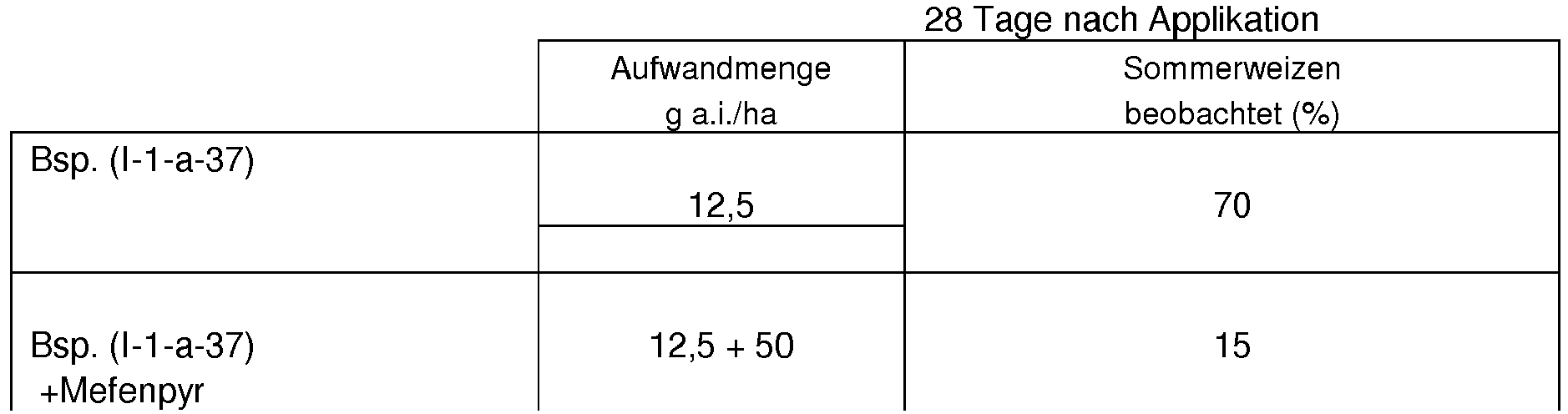
Claims (6)

W für Wasserstoff, C1-C6-Alkyl, Halogen, C1-C6-Alkoxy, C1-C4-Halogenalkyl oder C1-C4-Halogenalkoxy steht,
X für Halogen, C1-C6-Alkyl, C2-C6-Alkenyl, C2-C6-Alkinyl, C1-C6-Alkoxy, C1-C4-Halogenalkyl, C1-C4-Halogenalkoxy oder Cyano steht,
Y für Wasserstoff, Halogen, C1-C6-Alkyl, oder C1-C6-Alkoxy steht,
Z' für Brom oder Jod steht,
A für Wasserstoff oder jeweils gegebenenfalls durch Halogen substituiertes C1-C12-Alkyl, C3-C8-Alkenyl, C1-C10-Alkoxy-C1-C8-alkyl, C1-C10-Alkylthio-C1-C6-alkyl, gegebenenfalls durch Halogen, C1-C6-Alkyl oder C1-C6-Alkoxy substituiertes C3-C8-Cycloalkyl, in welchem gegebenenfalls ein oder zwei nicht direkt benachbarte Ringglieder durch Sauerstoff und/oder Schwefel ersetzt sind oder für jeweils gegebenenfalls durch Halogen, C1-C6-Alkyl, C1-C6-Halogenalkyl, C1-C6-Alkoxy, C1-C6-Halogenalkoxy, Cyano oder Nitro substituiertes Phenyl, Naphthyl, Hetaryl mit 5 bis 6 Ringatomen, Phenyl-C1-C6-alkyl oder Naphthyl-C1-C6-alkyl steht,
B für Wasserstoff, C1-C12-Alkyl oder C1-C8-Alkoxy-C1-C6-alkyl steht oder
A, B und das Kohlenstoffatom an das sie gebunden sind, für gesättigtes C3-C10-Cycloalkyl oder ungesättigtes C5-C10-Cycloalkyl, worin gegebenenfalls ein Ringglied durch Stickstoff, Sauerstoff oder Schwefel ersetzt ist und welche gegebenenfalls einfach oder zweifach durch C1-C8-Alkyl, C1-C8-Alkoxy, C3-C8-Alkenyloxy, C1-C6-Alkoxy-C1-C6-Alkyl, C3-C6-Cycloalkyl-C1-C2-alkoxy, C3-C10-Cycloalkyl, C1-C8-Halogenalkyl, C2-C6-Halogenalkoxy, C1-C6-Alkoxy-C1-C4-alkoxy substituiert sind, wobei die zuvor genannten Reste auch als N-Substituenten in Frage kommen, oder
A, B und das Kohlenstoffatom, an das sie gebunden sind, für C3-C6-Cycloalkyl, welches durch eine gegebenenfalls ein oder zwei nicht direkt benachbarte Sauerstoff- und/oder Schwefelatome enthaltende gegebenenfalls durch C1-C4-Alkyl substituierte Alkylendiyl- oder durch eine Alkylendioxy- oder durch eine Alkylendithioyl-Gruppe substituiert ist, die mit dem Kohlenstoffatom, an das sie gebunden ist, einen weiteren fünfbis achtgliedrigen Ring bildet oder
A, B und das Kohlenstoffatom, an das sie gebunden sind, für C3-C8-Cycloalkyl oder C5-C8-Cycloalkenyl stehen, in welchen zwei Substituenten gemeinsam mit den Kohlenstoffatomen, an die sie gebunden sind, für jeweils gegebenenfalls durch C1-C6-Alkyl, C1-C6-Alkoxy oder Halogen substituiertes C2-C6-Alkandiyl, C2-C6-Alkendiyl oder C4-C6-Alkandiendiyl stehen, worin gegebenenfalls eine Methylengruppe durch Sauerstoff oder Schwefel ersetzt ist,
D für Wasserstoff, jeweils gegebenenfalls durch Halogen substituiertes C1-C12-Alkyl, C3-C8-Alkenyl, C3-C8-Alkinyl, C1-C10-Alkoxy-C1-C8-alkyl, gegebenenfalls durch Halogen, C1-C4-Alkyl, C1-C4-Alkoxy oder C1-C4-Halogenalkyl substituiertes C3-C8-Cycloalkyl, in welchem gegebenenfalls ein Ringglied durch Sauerstoff oder Schwefel ersetzt ist oder jeweils gegebenenfalls durch Halogen, C1-C6-Alkyl, C1-C6-Halogenalkyl, C1-C6-Alkoxy, C1-C6-Halogenalkoxy, Cyano oder Nitro substituiertes Phenyl, Hetaryl mit 5 oder 6 Ringatomen, Phenyl-C1-C6-alkyl oder Hetaryl-C1-C6-alkyl mit 5 oder 6 Ringatomen steht oder
A und D gemeinsam für jeweils gegebenenfalls substituiertes C3-C6-Alkandiyl oder C3-C6-Alkendiyl stehen, worin gegebenenfalls eine Methylengruppe durch eine Carbonylgruppe, Sauerstoff oder Schwefel ersetzt ist und
wobei als Substituenten jeweils in Frage kommen:
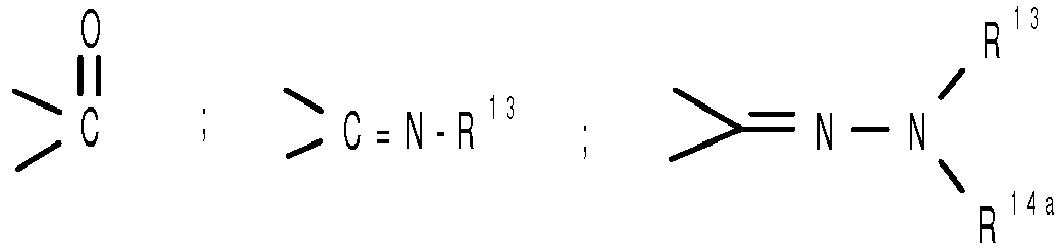
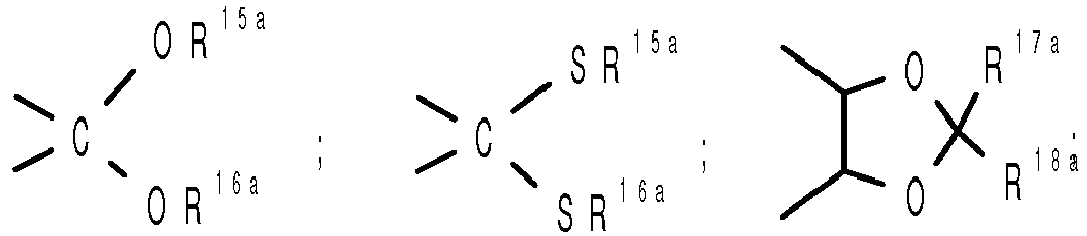
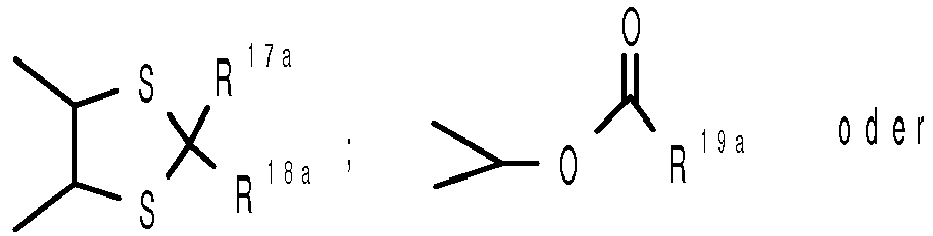
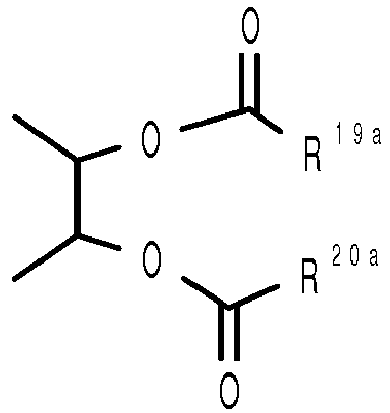
W is hydrogen, C 1 -C 6 -alkyl, halogen, C 1 -C 6 -alkoxy, C 1 -C 4 -haloalkyl or C 1 -C 4 -haloalkoxy,
X is halogen, C 1 -C 6 -alkyl, C 2 -C 6 -alkenyl, C 2 -C 6 -alkynyl, C 1 -C 6 -alkoxy, C 1 -C 4 -haloalkyl, C 1 -C 4 - Haloalkoxy or cyano,
Y is hydrogen, halogen, C 1 -C 6 -alkyl, or C 1 -C 6 -alkoxy,
Z 'is bromine or iodine,
A represents hydrogen or in each case optionally halogen-substituted C 1 -C 12 -alkyl, C 3 -C 8 -alkenyl, C 1 -C 10 -alkoxy-C 1 -C 8 -alkyl, C 1 -C 10 -alkylthio-C 1 -C 6 alkyl, optionally substituted by halogen, C 1 -C 6 alkyl or C 1 -C 6 -alkoxy-substituted C 3 -C 8 -cycloalkyl in which optionally one or two not directly adjacent ring members are replaced by oxygen and / or Phenyl, naphthyl, substituted by halogen, C 1 -C 6 -alkyl, C 1 -C 6 -haloalkyl, C 1 -C 6 -alkoxy, C 1 -C 6 -haloalkoxy, cyano or nitro, Hetaryl having 5 to 6 ring atoms, phenyl-C 1 -C 6 -alkyl or naphthyl-C 1 -C 6 -alkyl,
B is hydrogen, C 1 -C 12 -alkyl or C 1 -C 8 -alkoxy-C 1 -C 6 -alkyl or
A, B and the carbon atom to which they are attached, for saturated C 3 -C 10 -cycloalkyl or unsaturated C 5 -C 10 -cycloalkyl, wherein optionally one ring member is replaced by nitrogen, oxygen or sulfur and which optionally mono- or disubstituted by C 1 -C 8 -alkyl, C 1 -C 8 -alkoxy, C 3 -C 8 -alkenyloxy, C 1 -C 6 -alkoxy-C 1 -C 6 -alkyl, C 3 -C 6 -cycloalkyl-C 1 -C 2 -alkoxy, C 3 -C 10 -cycloalkyl, C 1 -C 8 -haloalkyl, C 2 -C 6 -haloalkoxy, C 1 -C 6 -alkoxy-C 1 -C 4 -alkoxy are substituted, wherein the previously mentioned radicals also come as N-substituents in question, or
A, B and the carbon atom to which they are attached, for C 3 -C 6 -cycloalkyl, which by an optionally one or two not directly adjacent oxygen and / or sulfur atoms optionally substituted by C 1 -C 4 alkyl substituted alkylenediyl or is substituted by an alkylenedioxy or by an alkylenedithioyl group which forms a further five to eight membered ring with the carbon atom to which it is attached or
A, B and the carbon atom to which they are attached are C 3 -C 8 -cycloalkyl or C 5 -C 8 -cycloalkenyl in which two substituents together with the carbon atoms to which they are attached are each optionally substituted by C 1 -C 6 -alkyl, C 1 -C 6 -alkoxy or halogen-substituted C 2 -C 6 -alkanediyl, C 2 -C 6 -alkenediyl or C 4 -C 6 -alkandienediyl, in which optionally a methylene group is represented by oxygen or Sulfur is replaced,
D represents hydrogen, in each case optionally halogen-substituted C 1 -C 12 -alkyl, C 3 -C 8 -alkenyl, C 3 -C 8 -alkynyl, C 1 -C 10 -alkoxy-C 1 -C 8 -alkyl, optionally C 3 -C 8 -cycloalkyl which is substituted by halogen, C 1 -C 4 -alkyl, C 1 -C 4 -alkoxy or C 1 -C 4 -haloalkyl and in which optionally a ring member is replaced by oxygen or sulfur or in each case optionally by Halogen, C 1 -C 6 -alkyl, C 1 -C 6 -haloalkyl, C 1 -C 6 -alkoxy, C 1 -C 6 -haloalkoxy, cyano or nitro-substituted phenyl, hetaryl having 5 or 6 ring atoms, phenyl-C C 1 -C 6 -alkyl or hetaryl-C 1 -C 6 -alkyl having 5 or 6 ring atoms or
A and D together are each optionally substituted C 3 -C 6 -alkanediyl or C 3 -C 6 -alkenediyl, wherein optionally a methylene group is replaced by a carbonyl group, oxygen or sulfur, and
where as substituents in each case come into question:
W für Wasserstoff, Fluor, Chlor, Brom, C1-C4-Alkyl, C1-C4-Alkoxy, C1-C2-Halogenalkyl oder C1-C2-Halogenalkoxy steht,
X für Chlor, Brom, Iod, C1-C4-Alkyl, C2-C4-Alkenyl, C2-C4-Alkinyl, C1-C4-Alkoxy, C1-C2-Halogenalkyl, C1-C2-Halogenalkoxy oder Cyano steht,
Y für Wasserstoff, Methyl, Ethyl, Fluor, Chlor, Brom, Iod, Methoxy oder Ethoxy steht,
Z' für Brom oder Jod steht,
A für Wasserstoff, jeweils gegebenenfalls einfach bis dreifach durch Fluor oder Chlor substituiertes C1-C6-Alkyl, C1-C4-Alkoxy-C1-C2-alkyl, gegebenenfalls einfach bis zweifach durch C1-C2-Alkyl oder C1-C2-Alkoxy substituiertes und gegebenenfalls durch ein Sauerstoffatom unterbrochenes C3-C6-Cycloalkyl oder jeweils gegebenenfalls einfach bis zweifach durch Fluor, Chlor, Brom, C1-C4-Alkyl, C1-C2-Halogenalkyl, C1-C4-Alkoxy, C1-C2-Halogenalkoxy, Cyano oder Nitro substituiertes Phenyl, Pyridyl oder Benzyl steht,
B für Wasserstoff, C1-C4-Alkyl oder C1-C2-Alkoxy-C1-C2-alkyl steht oder
A, B und das Kohlenstoffatom an das sie gebunden sind, für gesättigtes oder ungesättigtes C3-C7-Cycloalkyl, worin gegebenenfalls ein Ringglied durch Stickstoff, Sauerstoff oder Schwefel ersetzt ist und welches gegebenenfalls einfach bis zweifach durch C1-C6-Alkyl, C1-C4-Alkoxy-C1-C2-alkyl, Trifluormethyl, C1-C6-Alkoxy, C3-C6-Alkenyloxy, Trifluorethoxy, C1-C3-Alkoxy-C1-C3-alkoxy oder C3-C6-Cycloalkylmethoxy substituiert ist, wobei die zuvor genannten Reste auch als N-Substituenten in Frage kommen, mit der Maßgabe, dass dann Q3 für Wasserstoff oder Methyl steht oder
A, B und das Kohlenstoffatom, an das sie gebunden sind, für C5-C6-Cycloalkyl, welches durch eine gegebenenfalls ein oder zwei nicht direkt benachbarte Sauerstoff- oder Schwefelatome enthaltende gegebenenfalls durch Methyl oder Ethyl substituierte Alkylendiyl- oder durch eine Alkylendioxy- oder durch eine Alkylendithiol-Gruppe substituiert ist, die mit dem Kohlenstoffatom, an das sie gebunden ist, einen weiteren fünf- oder sechsgliedrigen Ring bildet mit der Maßgabe, dass dann Q3 für Wasserstoff oder Methyl steht, oder
A, B und das Kohlenstoffatom, an das sie gebunden sind, für C3-C6-Cycloalkyl oder C5-C6-Cycloalkenyl stehen, in welchen zwei Substituenten gemeinsam mit den Kohlenstoffatomen, an die sie gebunden sind, für jeweils gegebenenfalls durch C1-C2-Alkyl oder C1-C2-Alkoxy substituiertes C2-C4-Alkandiyl, C2-C4-Alkendiyl oder Butadiendiyl stehen, mit der Maßgabe, dass dann Q3 für Wasserstoff oder Methyl steht,
D für Wasserstoff, für jeweils gegebenenfalls einfach bis dreifach durch Fluor substituiertes C1-C6-Alkyl, C3-C6-Alkenyl, C1-C4-Alkoxy-C1-C3-alkyl, für gegebenenfalls einfach bis zweifach durch C1-C4-Alkyl, C1-C4-Alkoxy oder C1-C2-Halogenalkyl substituiertes C3-C6-Cycloalkyl, in welchem gegebenenfalls eine Methylengruppe durch Sauerstoff ersetzt ist oder
A und D gemeinsam für gegebenenfalls einfach bis zweifach substituiertes C3-C5-Alkandiyl stehen, in welchem eine Methylengruppe durch eine Carbonylgruppe, Sauerstoff oder Schwefel ersetzt sein kann, wobei als Substituenten C1-C2-Alkyl oder C1-C2-Alkoxy in Frage kommen oder
A und D gemeinsam mit den Atomen, an die sie gebunden sind, für eine der Gruppen AD-1 bis AD-10 stehen:


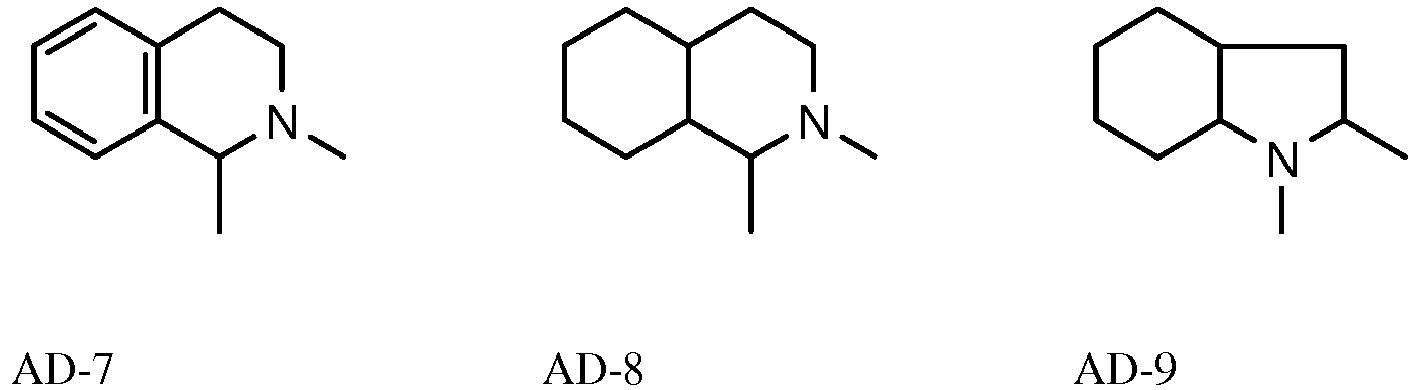
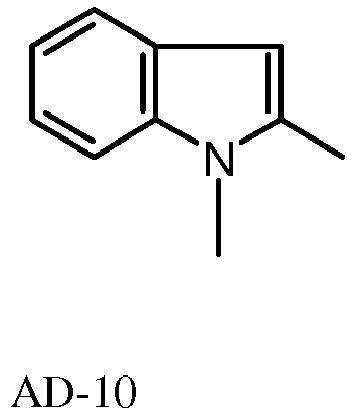
A und D gemeinsam für C3-C5-Alkandiyl stehen, welches gegebenenfalls durch eine zwei nicht direkt benachbarten Sauerstoffatomen enthaltende gegebenenfalls einfach bis vierfach durch C1-C4-Alkyl oder C1-C3-Alkoxy-C1-C2-alkyl substituierte Alkylendioxy-Gruppe substituiert ist, wobei ein weiterer 5- oder 6-Ring gebildet wird.Compounds of formula (I ') according to claim 1, in which
W represents hydrogen, fluorine, chlorine, bromine, C 1 -C 4 -alkyl, C 1 -C 4 -alkoxy, C 1 -C 2 -haloalkyl or C 1 -C 2 -haloalkoxy,
X is chlorine, bromine, iodine, C 1 -C 4 -alkyl, C 2 -C 4 -alkenyl, C 2 -C 4 -alkynyl, C 1 -C 4 -alkoxy, C 1 -C 2 -haloalkyl, C 1 C 2 haloalkoxy or cyano,
Y is hydrogen, methyl, ethyl, fluorine, chlorine, bromine, iodine, methoxy or ethoxy,
Z 'is bromine or iodine,
A is hydrogen, in each case optionally mono- to trisubstituted by fluorine or chlorine, C 1 -C 6 -alkyl, C 1 -C 4 -alkoxy-C 1 -C 2 -alkyl, optionally mono- to disubstituted by C 1 -C 2 -alkyl or C 1 -C 2 -alkoxy-substituted and optionally interrupted by an oxygen atom, C 3 -C 6 -cycloalkyl or in each case optionally mono- to disubstituted by fluorine, chlorine, bromine, C 1 -C 4 -alkyl, C 1 -C 2 -haloalkyl , C 1 -C 4 alkoxy, C 1 -C 2 haloalkoxy, cyano or nitro substituted phenyl, pyridyl or benzyl,
B is hydrogen, C 1 -C 4 -alkyl or C 1 -C 2 -alkoxy-C 1 -C 2 -alkyl or
A, B and the carbon atom to which they are attached, for saturated or unsaturated C 3 -C 7 cycloalkyl, wherein optionally one ring member is replaced by nitrogen, oxygen or sulfur and which optionally once to twice by C 1 -C 6 alkyl , C 1 -C 4 -alkoxy-C 1 -C 2 -alkyl, trifluoromethyl, C 1 -C 6 -alkoxy, C 3 -C 6 -alkenyloxy, trifluoroethoxy, C 1 -C 3 -alkoxy-C 1 -C 3 -alkoxy or C 3 -C 6 -cycloalkylmethoxy is substituted, wherein the aforementioned radicals also come as N-substituents in question, with the proviso that then Q 3 is hydrogen or methyl or
A, B and the carbon atom to which they are bonded, for C 5 -C 6 -cycloalkyl, which by an optionally one or two not directly adjacent oxygen or sulfur atoms containing optionally substituted by methyl or ethyl alkylenediyl or by an alkylenedioxy or is substituted by an alkylenedithiol group which forms, with the carbon atom to which it is bonded, another five- or six-membered ring with the proviso that Q 3 is then hydrogen or methyl, or
A, B and the carbon atom to which they are attached are C 3 -C 6 -cycloalkyl or C 5 -C 6 -cycloalkenyl, in which two substituents together with the carbon atoms to which they are attached are each optionally substituted by C 1 -C 2 -alkyl or C 1 -C 2 -alkoxy are substituted C 2 -C 4 -alkanediyl, C 2 -C 4 -alkendiyl or butadiendiyl, with the proviso that Q 3 is then hydrogen or methyl,
D represents hydrogen, in each case optionally mono- to trisubstituted by fluorine-substituted C 1 -C 6 -alkyl, C 3 -C 6 -alkenyl, C 1 -C 4 -alkoxy-C 1 -C 3 -alkyl, optionally optionally once or twice C 3 -C 6 -cycloalkyl which is substituted by C 1 -C 4 -alkyl, C 1 -C 4 -alkoxy or C 1 -C 2 -haloalkyl and in which optionally one methylene group is replaced by oxygen or
A and D together are optionally mono- to disubstituted C 3 -C 5 -alkanediyl, in which a methylene group may be replaced by a carbonyl group, oxygen or sulfur, where as substituents C 1 -C 2 alkyl or C 1 -C 2 Alkoxy come into question or
A and D, together with the atoms to which they are attached, stand for one of the groups AD-1 to AD-10:
A and D together are C 3 -C 5 -alkanediyl which may optionally be substituted by a non-directly adjacent oxygen atoms containing optionally one to four times by C 1 -C 4 alkyl or C 1 -C 3 alkoxy-C 1 -C 2 Substituted alkylene-substituted alkylenedioxy group, wherein another 5- or 6-membered ring is formed.
W für Wasserstoff, Chlor, Methyl oder Ethyl steht,
X für Chlor, Methyl, Ethyl, Methoxy oder Ethoxy steht,
Y für Wasserstoff, Methyl oder Chlor steht,
Z' für Brom oder Jod steht,
A für Wasserstoff, jeweils gegebenenfalls einfach bis dreifach durch Fluor substituiertes C1-C4-Alkyl oder C1-C2-Alkoxy-C1-C2-alkyl, für Cyclopropyl, Cyclopentyl oder Cyclohexyl,
B für Wasserstoff, Methyl oder Ethyl steht oder
A, B und das Kohlenstoffatom an das sie gebunden sind, für gesättigtes C5-C6-Cycloalkyl, in welchem gegebenenfalls ein Ringglied durch Stickstoff, Sauerstoff oder Schwefel ersetzt ist und welches gegebenenfalls einfach oder zweifach durch Methyl, Ethyl, Methoxymethyl, Ethoxymethyl, Methoxyethyl, Ethoxyethyl, Trifluormethyl, Methoxy, Ethoxy, Propoxy, Butoxy, Methoxyethoxy, Ethoxyethoxy, Allyloxy, Trifluorethoxy oder Cyclopropylmethoxy substituiert ist, wobei die zuvor genannten Reste auch als N-Substituenten in Frage kommen, mit der Maßgabe, dass dann Q3 für Wasserstoff steht oder
A, B und das Kohlenstoffatom, an das sie gebunden sind für C6-Cycloalkyl, welches gegebenenfalls durch eine gegebenenfalls durch ein Sauerstoffatom unterbrochene Alkylidendiyl-Gruppe oder durch eine mit zwei nicht direkt benachbarten Sauerstoffatomen enthaltende Alkylendioxy-Gruppe substituiert ist, wobei ein weiter 5- oder 6-Ring gebildet wird (der einfach oder zweifach durch Methyl substituiert sein kann) mit der Maßgabe, dass dann Q3 für Wasserstoff steht oder
A, B und das Kohlenstoffatom, an das sie gebunden sind, für C5-C6-Cycloalkyl oder C5-C6-Cycloalkenyl stehen, worin zwei Substituenten gemeinsam mit den Kohlenstoffatomen, an die sie gebunden sind, für C2-C4-Alkandiyl oder C2-C4-Alkendiyl oder Butadiendiyl stehen, mit der Maßgabe, dass dann Q3 für Wasserstoff steht,
D für Wasserstoff, für jeweils gegebenenfalls einfach bis dreifach durch Fluor substituiertes C1-C4-Alkyl, C3-C4-Alkenyl, C1-C4-Alkoxy-C1-C3-alkyl, für Cyclopropyl, Cyclopentyl oder Cyclohexyl oder
A und D gemeinsam für gegebenenfalls einfach durch Methyl oder Methoxy substituiertes C3-C5-Alkandiyl stehen, worin gegebenenfalls ein Kohlenstoffatom durch eine Carbonylgruppe, Sauerstoff oder Schwefel ersetzt ist oder für die Gruppe AD-1 steht, oder A und D gemeinsam für C3-C5-Alkandiyl stehen, welches gegebenenfalls durch eine mit zwei nicht direkt benachbarten Sauerstoffatomen enthaltende gegebenenfalls einfach bis zweifach durch C1-C2-Alkyl substituierte Alkylendioxy-Gruppe substituiert ist, wobei ein weiterer 5- Ring gebildet wird.Compounds of formula (I ') according to claim 1, in which
W is hydrogen, chlorine, methyl or ethyl,
X is chlorine, methyl, ethyl, methoxy or ethoxy,
Y is hydrogen, methyl or chlorine,
Z 'is bromine or iodine,
A is hydrogen, in each case optionally mono- to trisubstituted by fluorine-substituted C 1 -C 4 -alkyl or C 1 -C 2 -alkoxy-C 1 -C 2 -alkyl, for cyclopropyl, cyclopentyl or cyclohexyl,
B is hydrogen, methyl or ethyl or
A, B and the carbon atom to which they are bonded, saturated C 5 -C 6 -cycloalkyl in which optionally a ring member is replaced by nitrogen, oxygen or sulfur and which may optionally be mono- or disubstituted by methyl, ethyl, methoxymethyl, ethoxymethyl, Methoxyethyl, ethoxyethyl, trifluoromethyl, methoxy, ethoxy, propoxy, butoxy, methoxyethoxy, ethoxyethoxy, allyloxy, trifluoroethoxy or cyclopropylmethoxy substituted, wherein the aforementioned radicals are also suitable as N-substituents, with the proviso that then Q 3 is hydrogen stands or
A, B and the carbon atom to which they are attached are substituted by C 6 -cycloalkyl which is optionally substituted by an alkylidene diyl group which is optionally interrupted by an oxygen atom or by an alkylenedioxy group containing two oxygen atoms which are not directly adjacent, a further or 6-ring is formed (which may be monosubstituted or disubstituted by methyl) with the proviso that then Q 3 is hydrogen or
A, B and the carbon atom to which they are attached are C 5 -C 6 -cycloalkyl or C 5 -C 6 -cycloalkenyl, in which two substituents together with the carbon atoms to which they are attached are C 2 -C 4 alkanediyl or C 2 -C 4 alkenediyl or butadienediyl, with the proviso that then Q 3 is hydrogen,
D is hydrogen, each optionally mono- to trisubstituted by fluorine-substituted C 1 -C 4 alkyl, C 3 -C 4 alkenyl, C 1 -C 4 alkoxy-C 1 -C 3 alkyl, cyclopropyl, cyclopentyl or Cyclohexyl or
A and D together are C 3 -C 5 -alkanediyl optionally substituted by methyl or methoxy, in which optionally one carbon atom is replaced by a carbonyl group, oxygen or sulfur or is the group AD-1, or A and D together are C 3 -C 5 alkanediyl which is optionally substituted by an alkylenedioxy group optionally substituted once or twice by C 1 -C 2 alkyl with two oxygen atoms which are not directly adjacent, another 5-ring is formed.
W für Wasserstoff, Methyl oder Ethyl steht,
X für Chlor, Methyl oder Ethyl steht,
Y für Wasserstoff steht,
Z' für Brom oder Jod steht,
A für Methyl oder Ethyl steht,
B für Wasserstoff oder Methyl steht,
A, B und das Kohlenstoffatom an das sie gebunden sind, für gesättigtes C5-C6-Cycloalkyl, in welchem gegebenenfalls ein Ringglied durch Sauerstoff ersetzt ist und welches gegebenenfalls einfach oder zweifach durch Methyl, Ethyl, Methoxymethyl, Methoxy, Ethoxy, Propoxy, Butoxy, Trifluorethoxy substituiert ist, oder
A, B und das Kohlenstoffatom, an das sie gebunden sind, für C6-Cycloalkyl stehen, welches gegebenenfalls durch eine mit zwei nicht direkt benachbarten Sauerstoffatomen enthaltende Alkylendioxy-Gruppe substituiert ist, wobei ein weiterer 5- oder 6-Ring gebildet wird, der einfach oder zweifach durch Methyl substituiert sein kann,
D für Wasserstoff steht, oder
A und D gemeinsam für C3-C5-Alkandiyl stehen, worin gegebenenfalls ein Kohlenstoffatom durch Sauerstoff ersetzt ist, oder
A und D gemeinsam für C3-C5-Alkandiyl stehen, welches gegebenenfalls durch eine mit zwei nicht direkt benachbarten Sauerstoffatomen enthaltende gegebenenfalls einfach bis zweifach durch Methyl substituierte Alkylendioxy-Gruppe substituiert ist, wobei ein weiterer 5- Ring gebildet wird.Compounds of formula (I ') according to claim 1, in which
W is hydrogen, methyl or ethyl,
X is chlorine, methyl or ethyl,
Y is hydrogen,
Z 'is bromine or iodine,
A is methyl or ethyl,
B is hydrogen or methyl,
A, B and the carbon atom to which they are bonded, saturated C 5 -C 6 -cycloalkyl in which optionally one ring member is replaced by oxygen and which may optionally be mono- or disubstituted by methyl, ethyl, methoxymethyl, methoxy, ethoxy, propoxy, Butoxy, trifluoroethoxy is substituted, or
A, B and the carbon atom to which they are attached are C 6 -cycloalkyl which is optionally substituted by an alkylenedioxy group containing two non-directly adjacent oxygen atoms to form a further 5- or 6-membered ring; may be monosubstituted or disubstituted by methyl,
D is hydrogen, or
A and D together represent C 3 -C 5 alkanediyl, wherein optionally a carbon atom is replaced by oxygen, or
A and D together are C 3 -C 5 alkanediyl, which is optionally substituted by an alkylenedioxy group which is optionally monosubstituted to disubstituted by methyl and which contains two oxygen atoms which are not directly adjacent, a further 5- ring being formed.
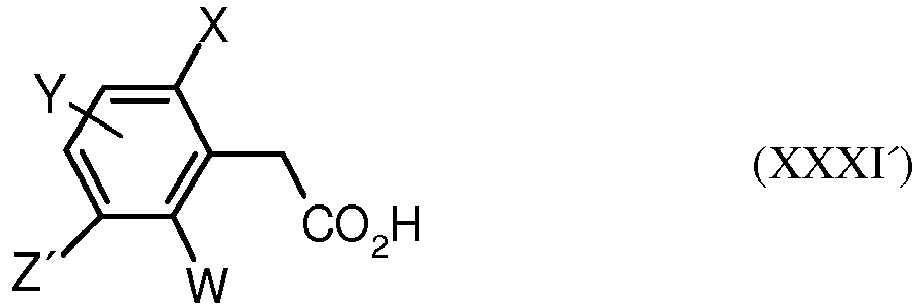
Applications Claiming Priority (2)
| Application Number | Priority Date | Filing Date | Title |
|---|---|---|---|
| EP09154888 | 2009-03-11 | ||
| EP10708924.5A EP2406216B1 (en) | 2009-03-11 | 2010-03-05 | Halogenalkylmethylenoxy-phenyl-substituted ketoenols |
Related Parent Applications (2)
| Application Number | Title | Priority Date | Filing Date |
|---|---|---|---|
| EP10708924.5A Division-Into EP2406216B1 (en) | 2009-03-11 | 2010-03-05 | Halogenalkylmethylenoxy-phenyl-substituted ketoenols |
| EP10708924.5A Division EP2406216B1 (en) | 2009-03-11 | 2010-03-05 | Halogenalkylmethylenoxy-phenyl-substituted ketoenols |
Publications (1)
| Publication Number | Publication Date |
|---|---|
| EP3153503A1 true EP3153503A1 (en) | 2017-04-12 |
Family
ID=41228842
Family Applications (2)
| Application Number | Title | Priority Date | Filing Date |
|---|---|---|---|
| EP16193742.0A Withdrawn EP3153503A1 (en) | 2009-03-11 | 2010-03-05 | Intermediates for halogenoalkylmethylenoxy-phenyl-substituted ketoenols |
| EP10708924.5A Not-in-force EP2406216B1 (en) | 2009-03-11 | 2010-03-05 | Halogenalkylmethylenoxy-phenyl-substituted ketoenols |
Family Applications After (1)
| Application Number | Title | Priority Date | Filing Date |
|---|---|---|---|
| EP10708924.5A Not-in-force EP2406216B1 (en) | 2009-03-11 | 2010-03-05 | Halogenalkylmethylenoxy-phenyl-substituted ketoenols |
Country Status (15)
| Country | Link |
|---|---|
| US (2) | US8518985B2 (en) |
| EP (2) | EP3153503A1 (en) |
| JP (1) | JP5840955B2 (en) |
| KR (1) | KR101703633B1 (en) |
| CN (2) | CN103641709B (en) |
| AR (1) | AR075848A1 (en) |
| AU (1) | AU2010223535B2 (en) |
| BR (1) | BRPI1008949B1 (en) |
| CA (1) | CA2754847C (en) |
| EA (1) | EA024266B1 (en) |
| ES (1) | ES2632567T3 (en) |
| HU (1) | HUE035166T2 (en) |
| MX (2) | MX2011009188A (en) |
| PL (1) | PL2406216T3 (en) |
| WO (1) | WO2010102758A2 (en) |
Families Citing this family (40)
| Publication number | Priority date | Publication date | Assignee | Title |
|---|---|---|---|---|
| AU2010223535B2 (en) | 2009-03-11 | 2015-09-10 | Bayer Intellectual Property Gmbh | Halogenalkylmethylenoxy-phenyl-substituted ketoenols |
| KR20120099396A (en) * | 2009-09-09 | 2012-09-10 | 바이엘 크롭사이언스 아게 | Use of cyclic keto-enols for combating plant pathogenic bacteria |
| EP2534147B1 (en) | 2010-02-10 | 2015-06-17 | Bayer Intellectual Property GmbH | Spiroheterocyclic-substituted tetramic acid derivatives |
| WO2011098440A2 (en) | 2010-02-10 | 2011-08-18 | Bayer Cropscience Ag | Biphenyl substituted cyclical keto-enols |
| DE102010008644A1 (en) | 2010-02-15 | 2011-08-18 | Bayer Schering Pharma Aktiengesellschaft, 13353 | Cyclic ketoenols for therapy |
| WO2011131623A1 (en) | 2010-04-20 | 2011-10-27 | Bayer Cropscience Ag | Insecticidal and/or herbicidal composition having improved activity on the basis of spiro-heterocyclically substituted tetramic acid derivatives |
| BR112013010810A2 (en) * | 2010-11-02 | 2016-08-09 | Bayer Ip Gmbh | phenyl substituted bicycloocteno-1,3-dione derivatives. |
| MX343856B (en) | 2011-01-25 | 2016-11-25 | Bayer Ip Gmbh | Method for producing 1-h-pyrrolidine-2,4-dione derivatives. |
| DE102011011040A1 (en) | 2011-02-08 | 2012-08-09 | Bayer Pharma Aktiengesellschaft | (5s, 8s) -3- (4'-chloro-3'-fluoro-4-methylbiphenyl-3-yl) -4-hydroxy-8-methoxy-1-azaspiro [4.5] dec-3-en-2- on (compound A) for therapy |
| WO2012110519A1 (en) | 2011-02-17 | 2012-08-23 | Bayer Cropscience Ag | Substituted 3-(biphenyl-3-yl)-8,8-difluoro-hydroxy-1-azaspiro[4.5]dec-3-en-2-ones for therapy and halogen-substituted spirocyclic ketoenols |
| DE102011080405A1 (en) | 2011-08-04 | 2013-02-07 | Bayer Pharma AG | New substituted 3-biphenyl-3-yl-8,8-difluoro-4-hydroxy-1-azaspiro(4.5)dec-3-en-2-one derivatives useful for prophylaxis or therapy of tumor diseases comprising breast cancer, prostate cancer, colorectal cancer or non-small cell lung cancer |
| WO2012116960A1 (en) | 2011-03-01 | 2012-09-07 | Bayer Cropscience Ag | 2-acyloxy-pyrrolin-4-ones |
| MX339188B (en) | 2011-03-11 | 2016-05-13 | Bayer Ip Gmbh | Cis-alkoxy-substituted spirocyclic 1-h-pyrrolidine-2,4-dione derivatives. |
| JP5878816B2 (en) * | 2011-05-12 | 2016-03-08 | 住友化学株式会社 | Method for producing particles |
| DE102011080406A1 (en) | 2011-08-04 | 2013-02-07 | Bayer Pharma AG | Substituted 3- (biphenyl-3-yl) -4-hydroxy-8-methoxy-1-azaspiro8 [4.5] dec-3-ene-2-ones |
| ES2642195T3 (en) | 2013-04-19 | 2017-11-15 | Syngenta Limited | Compounds 2- (substituted phenyl) cyclopentan-1,3-dionic active as herbicides and their derivatives |
| GB201310047D0 (en) | 2013-06-05 | 2013-07-17 | Syngenta Ltd | Compounds |
| RU2608369C2 (en) * | 2014-03-31 | 2017-01-18 | Кей Эм Ю Ко., Лтд. | Outer wall materials connection structure |
| KR102336926B1 (en) | 2014-10-06 | 2021-12-08 | 버텍스 파마슈티칼스 인코포레이티드 | Modulators of cystic fibrosis transmembrane conductance regulator |
| KR20180019209A (en) * | 2015-06-22 | 2018-02-23 | 바이엘 크롭사이언스 악티엔게젤샤프트 | Novel alkynyl-substituted 3-phenylpyrrolidine-2,4-diones and their use as herbicides |
| DK3402775T5 (en) | 2016-01-15 | 2021-09-27 | Bayer Cropscience Ag | PROCEDURE FOR MAKING 2- (4-CHLORO-2,6-DIMETHYLPHENYL) ETHANOL |
| EP3436446B1 (en) | 2016-03-31 | 2023-06-07 | Vertex Pharmaceuticals Incorporated | Modulators of cystic fibrosis transmembrane conductance regulator |
| JP2019513773A (en) * | 2016-04-14 | 2019-05-30 | バイエル・クロップサイエンス・アクチェンゲゼルシャフト | Cyclized 3-phenyltetramic acid derivatives having herbicidal effect |
| UA124708C2 (en) | 2016-09-30 | 2021-11-03 | Вертекс Фармасьютікалз Інкорпорейтед | MODULATOR OF THE MUSCULAR FISCOSE REGULATOR OF TRANSMEMBRANE CONDUCTANCE, PHARMACEUTICAL COMPOSITIONS, METHODS OF TREATMENT AND METHOD OF OBTAINING THE MODULATOR |
| AU2017371200B2 (en) | 2016-12-09 | 2021-05-06 | Vertex Pharmaceuticals Incorporated | Modulator of cystic fibrosis transmembrane conductance regulator, pharmaceutical compositions, methods of treatment, and process for making the modulator |
| MA54105A (en) | 2017-06-08 | 2021-09-15 | Vertex Pharma | CYSTIC FIBROSIS TREATMENT METHODS |
| MA49631A (en) | 2017-07-17 | 2020-05-27 | Vertex Pharma | CYSTIC FIBROSIS TREATMENT METHODS |
| KR102606188B1 (en) | 2017-08-02 | 2023-11-23 | 버텍스 파마슈티칼스 인코포레이티드 | Process for producing pyrrolidine compounds |
| US10654829B2 (en) | 2017-10-19 | 2020-05-19 | Vertex Pharmaceuticals Incorporated | Crystalline forms and compositions of CFTR modulators |
| US11465985B2 (en) | 2017-12-08 | 2022-10-11 | Vertex Pharmaceuticals Incorporated | Processes for making modulators of cystic fibrosis transmembrane conductance regulator |
| TWI810243B (en) | 2018-02-05 | 2023-08-01 | 美商維泰克斯製藥公司 | Pharmaceutical compositions for treating cystic fibrosis |
| WO2019197652A1 (en) | 2018-04-13 | 2019-10-17 | Bayer Aktiengesellschaft | Solid formulation of insecticidal mixtures |
| WO2019197617A1 (en) | 2018-04-13 | 2019-10-17 | Bayer Cropscience Aktiengesellschaft | Use of tetramic acid derivatives for controlling animal pests by watering, drip application plant hole treatment or furrow application |
| US11414439B2 (en) | 2018-04-13 | 2022-08-16 | Vertex Pharmaceuticals Incorporated | Modulators of cystic fibrosis transmembrane conductance regulator, pharmaceutical compositions, methods of treatment, and process for making the modulator |
| WO2019197620A1 (en) | 2018-04-13 | 2019-10-17 | Bayer Cropscience Aktiengesellschaft | Use of tetramic acid derivatives for controlling specific insects |
| MX2020010794A (en) | 2018-04-13 | 2020-10-28 | Bayer Cropscience Ag | Use of tetramic acid derivatives for controlling specific insects. |
| MX2020010686A (en) | 2018-04-13 | 2020-11-06 | Bayer Cropscience Ag | USE OF DERIVATIVES OF TETRAMIC ACID FOR THE CONTROL OF PESTS BY IRRIGATION OR APPLICATION OF DROPS. |
| AR115088A1 (en) | 2018-05-15 | 2020-11-25 | Bayer Ag | SPIROCICLOHEXYLPIRROLIN-2-ONAS AND ITS USE AS HERBICIDES |
| CN110946128A (en) * | 2019-12-14 | 2020-04-03 | 北京美汐朗洁环保科技有限公司 | Process for killing cockroaches and preventing cockroaches |
| CN111454286B (en) * | 2020-05-09 | 2023-08-08 | 合肥工业大学 | Synthesis method of difluoro alkenyl boron compound |
Citations (201)
| Publication number | Priority date | Publication date | Assignee | Title |
|---|---|---|---|---|
| US2842476A (en) | 1953-04-23 | 1958-07-08 | Mclaughlin Gormley King Co | Insecticidal compositions |
| DE1945703A1 (en) | 1968-10-23 | 1970-07-02 | Pfizer & Co C | Process for the preparation of aryl chlorocarbonyl ketenes |
| DE2361084A1 (en) | 1972-12-12 | 1974-06-20 | Union Carbide Corp | SUBSTITUTED 3-HYDROXYINDONE AND AGENTS CONTAINING IT |
| DE2813341A1 (en) | 1977-03-28 | 1978-10-05 | Union Carbide Corp | NEW 2-ARYL-CYCLOHEXAN-1-ONE, OXYGENATED IN THREE POSITIONS, THEIR PRODUCTION AND THE PRODUCTS CONTAINED |
| US4175135A (en) | 1978-07-18 | 1979-11-20 | Union Carbide Corporation | Method of controlling acarina ectoparasites on warmblooded animals by orally administering to the animal an ectoparasitically effective amount of a 2-aryl-1,3-cyclohexanedione compound, and alkali metal salts, ammonium salts and enol esters thereof |
| US4256657A (en) | 1977-03-28 | 1981-03-17 | Union Carbide Corporation | Method of preparing 2-aryl-1,3-cyclohexanedione compounds |
| US4256658A (en) | 1977-03-28 | 1981-03-17 | Union Carbide Corporation | Method of preparing 2-aryl-1,3-cyclohexanedione compounds |
| US4256659A (en) | 1977-03-28 | 1981-03-17 | Union Carbide Corporation | Method of preparing 2-aryl-1,3-cyclohexanedione compounds |
| US4257858A (en) | 1977-03-28 | 1981-03-24 | Union Carbide Corporation | Photochemical method for producing biocidal 2-aryl-1,3-cyclohexanedione compounds |
| US4283348A (en) | 1978-09-22 | 1981-08-11 | Union Carbide Corporation | Method of preparing 2-aryl-3-cyclopentanedione compounds |
| EP0036106A2 (en) | 1980-03-04 | 1981-09-23 | Hoechst Aktiengesellschaft | Synergistic mixtures of phosphinothricine |
| US4303669A (en) | 1980-03-25 | 1981-12-01 | Union Carbide Corporation | Hybrid 1,3-dione-carbamate compounds |
| US4338122A (en) | 1979-09-26 | 1982-07-06 | Union Carbide Corporation | Biocidal 2-aryl-1,3-cyclopentanedione compounds and alkali metal and ammonium salts thereof |
| US4351666A (en) | 1980-06-27 | 1982-09-28 | Union Carbide Corporation | Enol derivatives of 2-aryl-1,3-cyclohexanedione compound as sugar enhancer for plants |
| EP0086750A2 (en) | 1982-02-17 | 1983-08-24 | Ciba-Geigy Ag | Use of quinoline derivatives in the protection of crop plants |
| US4409153A (en) | 1980-03-28 | 1983-10-11 | Union Carbide Corporation | O-(2-Aryl-3-oxo-1-cyclohexenyl) phosphates |
| EP0094349A2 (en) | 1982-05-07 | 1983-11-16 | Ciba-Geigy Ag | Use of quinoline derivatives for the protection of cultivated plants |
| US4436666A (en) | 1978-09-22 | 1984-03-13 | Union Carbide Corporation | Biocidal enol derivatives of 2-aryl-1,3-cycloalkanedione compounds |
| EP0131624A1 (en) | 1983-01-17 | 1985-01-23 | Monsanto Co | PLASMIDES FOR TRANSFORMING PLANT CELLS. |
| JPS6087254A (en) | 1983-10-19 | 1985-05-16 | Japan Carlit Co Ltd:The | Novel urea compound and herbicide containing the same |
| EP0142924A2 (en) | 1983-09-26 | 1985-05-29 | Mycogen Plant Science, Inc. | Insect resistant plants |
| US4526723A (en) | 1978-09-27 | 1985-07-02 | Union Carbide Corporation | Biocidal enol esters of non-ortho substituted 2-aryl-1-3-cycloalkanedione compounds |
| US4551547A (en) | 1980-11-10 | 1985-11-05 | Union Carbide Corporation | Biocidal 2-aryl-1, 3-cyclopentanedione enol ester compounds |
| EP0174562A2 (en) | 1984-09-11 | 1986-03-19 | Hoechst Aktiengesellschaft | Plant protecting agents based on 1,2,4 - triazole derivatives as well as 1,2,4-triazole derivatives |
| EP0191736A2 (en) | 1985-02-14 | 1986-08-20 | Ciba-Geigy Ag | Use of quinoline derivatives for the protection of crop plants |
| EP0193259A1 (en) | 1985-01-18 | 1986-09-03 | Plant Genetic Systems N.V. | Modifying plants by genetic engineering to combat or control insects |
| US4613617A (en) | 1981-06-26 | 1986-09-23 | Union Carbide Corporation | Synergistic insecticidal compositions containing dione esters |
| US4632698A (en) | 1983-09-02 | 1986-12-30 | Union Carbide Corporation | Biocidal 2-aryl-1,3-cyclopentanedione enol ester compounds |
| US4659372A (en) | 1977-03-28 | 1987-04-21 | Union Carbide Corporation | Biocidal 2-aryl-1,3-cyclohexanedione enol ester compounds |
| EP0221044A1 (en) | 1985-10-25 | 1987-05-06 | Monsanto Company | Novel plant vectors |
| EP0242236A1 (en) | 1986-03-11 | 1987-10-21 | Plant Genetic Systems N.V. | Plant cells resistant to glutamine synthetase inhibitors, made by genetic engineering |
| FR2600494A1 (en) | 1986-06-27 | 1987-12-31 | Kao Corp | SYNERGISTIC AGENT FOR A BIOCIDE, BIOCIDE COMPOSITION CONTAINING THE SAME, AND METHOD FOR STRENGTHENING A BIOCID |
| EP0257993A2 (en) | 1986-08-26 | 1988-03-02 | E.I. Du Pont De Nemours And Company | Nucleic acid fragment encoding herbicide resistant plant acetolactate synthase |
| EP0262399A2 (en) | 1986-08-29 | 1988-04-06 | Takeda Chemical Industries, Ltd. | Cyclic enol derivatives, production and use thereof |
| EP0268554A2 (en) | 1986-10-22 | 1988-05-25 | Ciba-Geigy Ag | 1,5-Diphenyl pyrazole-3-carbonic-acid derivatives for the protection of cultured plants |
| EP0269806A1 (en) | 1986-10-04 | 1988-06-08 | Hoechst Aktiengesellschaft | Phenylpyrazole carbonic acid derivatives, their preparation and use as plant growth regulators and antidotes |
| EP0305398A1 (en) | 1986-05-01 | 1989-03-08 | Honeywell Inc | CONNECTING ARRANGEMENT FOR MULTIPLE INTEGRATED CIRCUITS. |
| EP0309862A1 (en) | 1987-09-30 | 1989-04-05 | Bayer Ag | Stilbene synthase gene |
| US4844734A (en) | 1986-07-14 | 1989-07-04 | Kao Corporation | Process for the preparation of granular pesticide |
| EP0333131A1 (en) | 1988-03-17 | 1989-09-20 | Hoechst Aktiengesellschaft | Plant protective agent based on pyrazolecarboxylic acid derivatives |
| WO1989010396A1 (en) | 1988-04-28 | 1989-11-02 | Plant Genetic Systems N.V. | Plants with modified stamen cells |
| EP0346620A1 (en) | 1988-05-20 | 1989-12-20 | Hoechst Aktiengesellschaft | Plant protection agents containing 1,2,4-triazole derivatives, and the 1,2,4-triazole derivatives |
| EP0355599A1 (en) | 1988-08-20 | 1990-02-28 | Bayer Ag | 3-Aryl-pyrrolidine-2,4-diones |
| EP0365484A1 (en) | 1988-10-20 | 1990-04-25 | Ciba-Geigy Ag | Sulfamoyl phenyl ureas |
| EP0377893A2 (en) | 1989-01-07 | 1990-07-18 | Bayer Ag | 3-Aryl-pyrrolidine-2,4-dione derivatives |
| EP0394889A2 (en) | 1989-04-25 | 1990-10-31 | Sandoz Ag | Heterocyclic diones as pesticides and plant growth regulators |
| EP0415211A2 (en) | 1989-09-01 | 1991-03-06 | Bayer Ag | 3-Aryl-pyrrolidin-2,4-dione derivatives |
| DE4014420A1 (en) | 1989-09-23 | 1991-04-04 | Bayer Ag | 5H-FURAN-2-ON DERIVATIVES |
| US5013659A (en) | 1987-07-27 | 1991-05-07 | E. I. Du Pont De Nemours And Company | Nucleic acid fragment encoding herbicide resistant plant acetolactate synthase |
| WO1991007874A1 (en) | 1989-11-30 | 1991-06-13 | Hoechst Aktiengesellschaft | Pyrazolines for the protection of crops against herbicides |
| WO1991008202A1 (en) | 1989-11-25 | 1991-06-13 | Hoechst Aktiengesellschaft | Isoxazolines, method of preparation thereof, and their use as plant-protection agents |
| EP0442073A2 (en) | 1990-02-13 | 1991-08-21 | Bayer Ag | Polycyclic 3-aryl-pyrrolidine-2,4-dione derivatives |
| EP0442077A2 (en) | 1990-02-14 | 1991-08-21 | Bayer Ag | 3-Aryl-pyrrolidine-2,4-dione derivatives as insecticides and herbicides |
| WO1991013972A1 (en) | 1990-03-16 | 1991-09-19 | Calgene, Inc. | Plant desaturases - compositions and uses |
| EP0453086A2 (en) | 1990-04-16 | 1991-10-23 | Kao Corporation | Biocide activator |
| EP0456063A2 (en) | 1990-05-10 | 1991-11-13 | Bayer Ag | 1-H-3-aryl-pyrrolidin-2,4-dion-derivatives |
| WO1991019806A1 (en) | 1990-06-18 | 1991-12-26 | Monsanto Company | Increased starch content in plants |
| EP0464461A2 (en) | 1990-06-29 | 1992-01-08 | Bayer Ag | Stilbensynthase gene of grapevine |
| WO1992000377A1 (en) | 1990-06-25 | 1992-01-09 | Monsanto Company | Glyphosate tolerant plants |
| WO1992007837A1 (en) | 1990-10-25 | 1992-05-14 | Sandoz Ltd. | Heterocyclic dione derivatives as pesticides and plant growth regulators |
| EP0492366A2 (en) | 1990-12-21 | 1992-07-01 | Hoechst Schering AgrEvo GmbH | New 5-chloroquinolin-8-oxyalkanecarbonic acid derivatives, process for their preparation and their use as antidotes for herbicides |
| WO1992011376A1 (en) | 1990-12-21 | 1992-07-09 | Amylogene Hb | Genetically engineered modification of potato to form amylopectin-type starch |
| WO1992014827A1 (en) | 1991-02-13 | 1992-09-03 | Institut Für Genbiologische Forschung Berlin Gmbh | Plasmids containing dna-sequences that cause changes in the carbohydrate concentration and the carbohydrate composition in plants, as well as plant cells and plants containing these plasmids |
| WO1992016510A1 (en) | 1991-03-19 | 1992-10-01 | Ciba-Geigy Ag | Novel herbicidally, acaricidally and insecticidally active compounds |
| WO1992016108A1 (en) | 1991-03-25 | 1992-10-01 | Valent U.S.A. Corporation | Chemically stable granules containing insecticidal phosphoroamidothioates |
| EP0508126A1 (en) | 1991-03-21 | 1992-10-14 | Bayer Ag | 3-Hydroxy-4-aryl-5-oxo-pyrazolin derivatives |
| EP0521334A1 (en) | 1991-06-28 | 1993-01-07 | Bayer Ag | Substituted 1-H-3-aryl-pyrrolidin-2,4-dione derivatives |
| EP0528156A1 (en) | 1991-07-16 | 1993-02-24 | Bayer Ag | 3-Aryl-4-hydroxy-delta3-dihydrofuranone and 3-aryl-4-hydroxy-delta3-dihydrothiophenone derivatives |
| GB2266888A (en) | 1992-05-15 | 1993-11-17 | Merck Sharp & Dohme | Tetramic acid derivatives |
| EP0582198A2 (en) | 1992-08-01 | 1994-02-09 | Hoechst Schering AgrEvo GmbH | Substituted (hetero-)aryle compounds, process for their preparation, those containing compositions and their use as safeners |
| EP0588137A1 (en) | 1992-09-10 | 1994-03-23 | Bayer Ag | 3-Aryl-2-pyranone derivatives |
| EP0596298A2 (en) | 1992-10-28 | 1994-05-11 | Bayer Ag | 5-Spirosubstituted 1-H-3-aryl-pyrrolidin-2,4-dione derivatives as herbicides, insecticides and acaricides |
| WO1994014785A1 (en) | 1992-12-23 | 1994-07-07 | Bayer Aktiengesellschaft | 5-aryl-1,3-thiazine derivatives, manufacture thereof and use as pesticides |
| EP0613885A2 (en) | 1993-03-01 | 1994-09-07 | Bayer Ag | Subsituted 1-H-3-phenyl-5-cycloalkyl-pyrrolidin-2,4-diones, their preparation and their use as parasiticides and herbicides |
| EP0613884A2 (en) | 1993-03-01 | 1994-09-07 | Bayer Ag | Dialkyl-1-H-3(2,4-dimethylphenyl)-pyrrolidin-2,4-diones, their preparation and their use as parasiticides and herbicides |
| WO1995001971A1 (en) | 1993-07-05 | 1995-01-19 | Bayer Aktiengesellschaft | Substituted aryl-keto-enolic heterocycles |
| WO1995007897A1 (en) | 1993-09-16 | 1995-03-23 | Hoechst Schering Agrevo Gmbh | Substituted isoxazolines, process for producing them, agents containing them and their use as safeners |
| EP0647637A1 (en) | 1993-09-17 | 1995-04-12 | Bayer Ag | 3-Aryl-4-hydroxy-3-dihydrofuranone derivatives |
| WO1995014012A1 (en) | 1993-11-19 | 1995-05-26 | Parke, Davis & Company | 5,6-dihydropyrone derivatives as protease inhibitors and antiviral agents |
| WO1995017817A1 (en) | 1993-12-28 | 1995-07-06 | Kao Corporation | Enhancer composition for agricultural chemicals and agricultural chemical composition |
| EP0664081A2 (en) | 1994-01-20 | 1995-07-26 | Hoechst Schering AgrEvo GmbH | Synergistic combinations of ammonium salts |
| WO1995020572A1 (en) | 1994-01-28 | 1995-08-03 | Bayer Aktiengesellschaft | 1-h-3-arylpyrrolidine-2,4-dione derivatives as pest-control agents |
| EP0668267A1 (en) | 1994-02-09 | 1995-08-23 | Bayer Ag | Substituted 1H-3-aryl-pyrrolidine-2,4-dione derivatives |
| WO1995026345A1 (en) | 1994-03-25 | 1995-10-05 | Bayer Aktiengesellschaft | 3-aryl-4-hydroxy-δ3-dihydrothiophenone derivatives |
| WO1995026954A1 (en) | 1994-04-05 | 1995-10-12 | Bayer Aktiengesellschaft | Alkoxy-alkyl-substituted 1-h-3-aryl-pyrrolidine-2,4-diones used as herbicides and pesticides |
| US5462912A (en) | 1991-10-09 | 1995-10-31 | Kao Corporation | Agricultural chemical composition enhancer comprising quaternary di(polyoxyalkylene) ammonium alkyl sulfates |
| EP0681865A2 (en) | 1994-05-09 | 1995-11-15 | Bayer Ag | Low foam surfactant and use thereof |
| WO1996001798A1 (en) | 1994-07-07 | 1996-01-25 | Bayer Aktiengesellschaft | 2-aryl cyclopentane-1,3-dione derivatives |
| JPH0832530A (en) | 1994-07-15 | 1996-02-02 | Sony Corp | Data broadcasting system and data receiving device |
| WO1996003366A1 (en) | 1994-07-21 | 1996-02-08 | Bayer Aktiengesellschaft | 2-(2,4,6-trimethyl phenyl)cyclopentane-1,3-dione derivatives |
| WO1996011574A1 (en) | 1994-10-17 | 1996-04-25 | Novartis Ag | Herbicidal compositions |
| WO1996020196A1 (en) | 1994-12-23 | 1996-07-04 | Bayer Aktiengesellschaft | 3-aryl-tetronic acid derivatives, the production thereof and the use thereof as anti-parasitic agents |
| WO1996021652A1 (en) | 1995-01-13 | 1996-07-18 | Novartis Ag | 4-aryl- and 4-heteroaryl -5-oxopyrazoline derivatives having pesticidal properties |
| US5538937A (en) | 1992-11-13 | 1996-07-23 | Hasebe; Keiko | Agricultural chemical composition comprising quaternary ammonium enhancers |
| WO1996025395A1 (en) | 1995-02-13 | 1996-08-22 | Bayer Aktiengesellschaft | 2-phenyl-substituted heterocyclic 1,3-ketonols as herbicides and pesticides |
| WO1996033270A1 (en) | 1995-04-20 | 1996-10-24 | American Cyanamid Company | Structure-based designed herbicide resistant products |
| WO1996035664A1 (en) | 1995-05-09 | 1996-11-14 | Bayer Aktiengesellschaft | Alkyl dihalogenated phenyl-substituted ketoenols useful as pesticides and herbicides |
| WO1997001535A1 (en) | 1995-06-28 | 1997-01-16 | Bayer Aktiengesellschaft | 2,4,5-trisubstituted phenylketo-enols for use as pesticides and herbicides |
| WO1997002243A1 (en) | 1995-06-30 | 1997-01-23 | Bayer Aktiengesellschaft | Dialkyl phenyl halide-substituted keto-enols for use as herbicides and pesticides |
| WO1997014667A1 (en) | 1995-10-13 | 1997-04-24 | Bayer Aktiengesellschaft | Cyclopentane-1,3-dione derivatives |
| WO1997016436A1 (en) | 1995-10-27 | 1997-05-09 | Bayer Aktiengesellschaft | 3-aryl-5-halogen-pyrone derivatives as pest control agents |
| WO1997019941A1 (en) | 1995-11-29 | 1997-06-05 | Bayer Aktiengesellschaft | Oxymethoxy-3-aryl-pyrone derivatives |
| WO1997036868A1 (en) | 1996-04-02 | 1997-10-09 | Bayer Aktiengesellschaft | Substituted phenyl keto enols as pesticides and herbicides |
| WO1997043275A2 (en) | 1996-05-10 | 1997-11-20 | Bayer Aktiengesellschaft | New substituted pyridyl keto enols |
| WO1997045016A1 (en) | 1996-05-29 | 1997-12-04 | Hoechst Schering Agrevo Gmbh | Novel n-acyl sulphonamides, novel mixtures of herbicides and antidotes and their use |
| WO1998005638A2 (en) | 1996-08-05 | 1998-02-12 | Bayer Aktiengesellschaft | 2- and 2,5-substituted phenylketoenols |
| WO1998006721A1 (en) | 1996-08-09 | 1998-02-19 | Bayer Aktiengesellschaft | Phenyl-substituted cyclic ketoenol |
| US5728831A (en) | 1989-04-25 | 1998-03-17 | Sandoz Ltd. | Process for preparing oxazines |
| WO1998013361A1 (en) | 1996-09-26 | 1998-04-02 | Novartis Ag | Herbicidal composition |
| WO1998025928A1 (en) | 1996-12-12 | 1998-06-18 | Bayer Aktiengesellschaft | Substituted phenylketoenols and their use as pesticides and herbicides |
| WO1998027049A1 (en) | 1996-12-19 | 1998-06-25 | Hoechst Schering Agrevo Gmbh | Novel 2-fluoroacrylic acid derivatives, novel mixtures of herbicides and antidotes and the use thereof |
| WO1998035553A1 (en) | 1997-02-14 | 1998-08-20 | Imperial Chemical Industries Plc | Agrochemical surfactant compositions |
| WO1998038856A1 (en) | 1997-03-04 | 1998-09-11 | Zeneca Limited | Compositions for safening rice against acetochlor |
| WO1998039281A1 (en) | 1997-03-03 | 1998-09-11 | Bayer Aktiengesellschaft | 2-arylcyclopentan-1,3-diones |
| WO1999000020A1 (en) | 1997-06-27 | 1999-01-07 | Hoechst Schering Agrevo Gmbh | 3-(5-tetrazolyl carbonyl)-2-quinolones and products for protecting useful plants containing the same |
| WO1999016748A1 (en) | 1997-09-26 | 1999-04-08 | Bayer Aktiengesellschaft | Utilizing spirocyclic phenyl keto-enols as pesticides and herbicides |
| WO1999016744A1 (en) | 1997-09-29 | 1999-04-08 | Aventis Cropscience Gmbh | Acylsulfamoyl benzoic acid amides, plant protection agents containing said acylsulfamoyl benzoic acid amides, and method for producing the same |
| WO1999024437A1 (en) | 1997-11-11 | 1999-05-20 | Bayer Aktiengesellschaft | Novel substituted phenyl keto enols |
| JPH11152273A (en) | 1997-11-19 | 1999-06-08 | Otsuka Chem Co Ltd | Six-membered cyclic dione derivative containing nitrogen |
| WO1999043649A1 (en) | 1998-02-27 | 1999-09-02 | Bayer Aktiengesellschaft | Arylphenyl-substituted cyclic keto-enols |
| WO1999043699A1 (en) | 1998-02-26 | 1999-09-02 | Aventis Pharma S.A. | Streptogramin derivatives, preparation method and compositions containing same |
| WO1999047525A1 (en) | 1998-03-13 | 1999-09-23 | Novartis Ag | Herbicidally active 3-hydroxy-4-aryl-5-oxopyrazoline derivatives |
| WO1999048869A1 (en) | 1998-03-26 | 1999-09-30 | Bayer Aktiengesellschaft | Aryl phenyl substituted cyclic ketoenols |
| WO1999055673A1 (en) | 1998-04-27 | 1999-11-04 | Bayer Aktiengesellschaft | Arylphenyl-substituted cyclic keto enols |
| JP2000053670A (en) | 1998-08-10 | 2000-02-22 | Ube Ind Ltd | Alkoxymethylfuranone derivatives and pesticides |
| WO2000035278A1 (en) | 1998-12-16 | 2000-06-22 | Bayer Aktiengesellschaft | Agrochemical formulations |
| WO2001017351A1 (en) | 1999-09-07 | 2001-03-15 | Syngenta Participations Ag | Herbicidal composition |
| WO2001017352A1 (en) | 1999-09-07 | 2001-03-15 | Syngenta Participations Ag | Herbicide agent |
| WO2001017353A1 (en) | 1999-09-07 | 2001-03-15 | Syngenta Participations Ag | Herbicidal composition |
| WO2001017973A2 (en) | 1999-09-07 | 2001-03-15 | Syngenta Participations Ag | Novel herbicides |
| WO2001017972A2 (en) | 1999-09-07 | 2001-03-15 | Syngenta Participations Ag | Novel herbicides |
| WO2001023354A2 (en) | 1999-09-29 | 2001-04-05 | Bayer Aktiengesellschaft | Trifluoromethyl-substituted spirocyclic ketoenols and use thereof as pesticides and herbicides |
| WO2001074770A1 (en) | 2000-04-03 | 2001-10-11 | Bayer Cropscience Ag | C2 phenyl-substituted cyclic keto-enols used as pesticides and herbicides |
| WO2001079204A1 (en) | 2000-04-18 | 2001-10-25 | Bayer Cropscience Ag | Phenyl substituted 4-hydroxy tetrahydropyridone |
| WO2001098288A1 (en) | 2000-06-19 | 2001-12-27 | Bayer Cropscience Ag | Phenyl-substituted 5,6-dihydropyrone derivatives for use as pesticides and herbicides |
| WO2002034048A1 (en) | 2000-10-23 | 2002-05-02 | Syngenta Participations Ag | Agrochemical compositions with quinoline safeners |
| JP2002205984A (en) | 2000-05-11 | 2002-07-23 | Sankyo Co Ltd | N-substituted spirodihydropyrrole derivative |
| WO2003013249A1 (en) | 2001-08-10 | 2003-02-20 | Bayer Cropscience Ag | Selective herbicides based on substituted cyclic keto-enols and safeners |
| WO2003028466A2 (en) | 2001-09-27 | 2003-04-10 | Syngenta Participations Ag | Herbicidal composition |
| WO2003048138A1 (en) | 2001-12-06 | 2003-06-12 | Bayer Cropscience Aktiengesellschaft | [1.2]-oxazin-3,5-diones |
| WO2003062244A1 (en) | 2002-01-22 | 2003-07-31 | Syngenta Participations Ag | Phenyl substituted heterocyclic compounds useful as herbicides |
| US6645914B1 (en) | 2002-05-01 | 2003-11-11 | Ndsu-Research Foundation | Surfactant-ammonium sulfate adjuvant composition for enhancing efficacy of herbicides |
| US20030224939A1 (en) | 2002-05-31 | 2003-12-04 | David Miles | Adjuvant for pesticides |
| WO2004007448A1 (en) | 2002-07-11 | 2004-01-22 | Bayer Cropscience Aktiengesellschaft | Cis-alkoxy-substituted spirocyclic 1-h-pyrrolidine-2,4-dione derivatives serving as pesticides |
| WO2004024688A1 (en) | 2002-08-28 | 2004-03-25 | Bayer Cropscience Aktiengesellschaft | Substituted spirocyclic ketoenols |
| DE10301804A1 (en) | 2003-01-20 | 2004-07-29 | Bayer Cropscience Ag | New 6-alkyl-2,4-dihalophenyl-substituted tetramic acid derivatives, useful as herbicides and pesticides, especially insecticides, acaricides, nematocides, ectoparasiticides and antifouling agents |
| WO2004069773A1 (en) * | 2003-02-07 | 2004-08-19 | Merck Frosst Canada Ltd. | Irreversible caspase-3 inhibitors as active site probes |
| WO2004080962A1 (en) | 2003-03-14 | 2004-09-23 | Bayer Cropscience Aktiengesellschaft | 2,4,6-phenyl substituted cyclic ketoenols |
| WO2004084631A1 (en) | 2003-03-26 | 2004-10-07 | Bayer Cropscience Gmbh | Use of aromatic hydroxy compounds as safeners |
| WO2004111042A1 (en) | 2003-06-12 | 2004-12-23 | Bayer Cropscience Aktiengesellschaft | N-heterocyclyl phenyl-substituted cyclic ketoenols |
| US20050009880A1 (en) | 2002-09-12 | 2005-01-13 | Cottrell Ian W. | High concentration topical insecticide containing insect growth regulator |
| WO2005005428A1 (en) | 2003-07-14 | 2005-01-20 | Bayer Cropscience Aktiengesellschaft | Hetaryl-substituted pyrazolidindione derivatives with pesticidal characteristics |
| WO2005015994A1 (en) | 2003-08-05 | 2005-02-24 | Bayer Cropscience Gmbh | Use of aromatic compounds as safeners |
| WO2005016001A1 (en) | 2003-08-05 | 2005-02-24 | Bayer Cropscience Gmbh | Safener based on aromatic-aliphatic carboxylic acid derivatives |
| WO2005016873A2 (en) | 2003-08-14 | 2005-02-24 | Bayer Cropscience Aktiengesellschaft | 4-biphenylsubstituted pyrazolidin-3,5-dione derivatives |
| US20050096386A1 (en) | 2003-11-03 | 2005-05-05 | Cottrell Ian W. | High concentration topical insecticide containing insect growth regulator |
| WO2005044796A1 (en) | 2003-11-05 | 2005-05-19 | Bayer Cropscience Aktiengesellschaft | 2-halogen-6-alkyl-phenyl substituted spirocyclic tetramic acid derivatives |
| WO2005044791A2 (en) | 2003-11-05 | 2005-05-19 | Bayer Cropscience Aktiengesellschaft | 2-halogen-6-alkyl-phenyl-substituted tetramic acid derivatives |
| WO2005049569A1 (en) | 2003-11-22 | 2005-06-02 | Bayer Cropscience Aktiengesellschaft | 2-ethyl-4,6-dimethyl-phenyl-substituted spirocyclic tetramic acid derivatives |
| WO2005048710A1 (en) | 2003-11-22 | 2005-06-02 | Bayer Cropscience Aktiengesellschaft | 2-ethyl-4,6-dimethyl-phenyl-substituted tetramic acid derivatives as pest control agents and/or herbicides |
| WO2005066125A1 (en) | 2004-01-09 | 2005-07-21 | Bayer Cropscience Ag | Cis-alkoxyspiro-substituted tetramic acid derivatives |
| WO2005084441A2 (en) * | 2004-03-06 | 2005-09-15 | Bayer Cropscience Ag | Oil-based suspension concentrates |
| WO2005092897A2 (en) | 2004-03-25 | 2005-10-06 | Bayer Cropscience Ag | 2,4,6-phenylsubstituted cyclic ketoenoles |
| WO2005112630A1 (en) | 2004-05-12 | 2005-12-01 | Bayer Cropscience Gmbh | Quinoxalin-2-one derivatives crop protection agents comprising the same and method for production and use therof |
| WO2006000355A1 (en) | 2004-06-25 | 2006-01-05 | Bayer Cropscience Aktiengesellschaft | 3'-alkoxy spirocyclic tetramic and tetronic acids |
| WO2006008111A1 (en) * | 2004-07-20 | 2006-01-26 | Bayer Cropscience Ag | Selective insecticides based on substituted, cyclic keto-enols and safeners |
| WO2006024411A2 (en) | 2004-08-27 | 2006-03-09 | Bayer Cropscience Gmbh | Herbicide combinations comprising special ketoenoles |
| WO2006029799A1 (en) | 2004-09-16 | 2006-03-23 | Bayer Cropscience Ag | Iodine-phenyl-substituted cyclic cetoenols |
| WO2006056281A1 (en) | 2004-11-04 | 2006-06-01 | Bayer Cropscience Ag | 2-alkoxy-6-alkyl-phenyl-substituted spirocyclic tetramic acid derivatives |
| WO2006056282A1 (en) | 2004-11-04 | 2006-06-01 | Bayer Cropscience Ag | 2,6-diethyl-4-methyl-phenyl-substituted tetramic acid derivatives |
| WO2006089633A2 (en) | 2005-02-22 | 2006-08-31 | Bayer Cropscience Ag | Spiroketal-substituted cyclic ketoenols |
| WO2007009658A1 (en) | 2005-07-16 | 2007-01-25 | Clariant Finance (Bvi) Limited | Nanoparticles of alumina and oxides of elements of main groups i and ii of the periodic table, and their preparation |
| WO2007023719A1 (en) | 2005-08-22 | 2007-03-01 | Kumiai Chemical Industry Co., Ltd. | Agent for reducing chemical injury and herbicide composition with reduced chemical injury |
| WO2007023764A1 (en) | 2005-08-26 | 2007-03-01 | Kumiai Chemical Industry Co., Ltd. | Agent for reduction of harmful effect of herbicide and herbicide composition having reduced harmful effect |
| WO2007024782A2 (en) | 2005-08-24 | 2007-03-01 | Pioneer Hi-Bred International, Inc. | Compositions providing tolerance to multiple herbicides and methods of use thereof |
| WO2007027777A2 (en) | 2005-08-31 | 2007-03-08 | Monsanto Technology Llc | Nucleotide sequences encoding insecticidal proteins |
| WO2007048545A2 (en) | 2005-10-27 | 2007-05-03 | Bayer Cropscience Ag | Alkoxyalkyl spirocyclic tetramic acids and tetronic acids |
| WO2007068428A2 (en) | 2005-12-13 | 2007-06-21 | Bayer Cropscience Ag | Insecticidal compositions containing phenyl-substituted cyclic ketoenols |
| WO2007068427A2 (en) | 2005-12-13 | 2007-06-21 | Bayer Cropscience Ag | Herbicidal compositions having improved effect |
| DE102005059892A1 (en) | 2005-12-15 | 2007-06-28 | Bayer Cropscience Ag | New spirocyclic tetramic acid derivatives useful as pesticides, herbicides and/or fungicides |
| WO2007073856A2 (en) | 2005-12-15 | 2007-07-05 | Bayer Cropscience Ag | 3'-alkoxy-spirocyclopentyl-substituted tetramic and tetronic acids |
| WO2007080066A2 (en) | 2006-01-07 | 2007-07-19 | Bayer Cropscience Ag | 2,4,6-trialkylphenyl substituted cyclopentane-1,3-dione |
| WO2007096058A1 (en) | 2006-02-21 | 2007-08-30 | Bayer Cropscience Ag | Cycloalkylphenyl substituted cyclic ketoenols |
| WO2007121868A1 (en) | 2006-04-22 | 2007-11-01 | Bayer Cropscience Ag | Alkoxyalkyl-substituted cyclic ketoenols |
| WO2007140881A1 (en) | 2006-06-02 | 2007-12-13 | Bayer Cropscience Ag | Alkoxyalkyl-substituted cyclic keto-enols |
| WO2008067873A1 (en) | 2006-10-25 | 2008-06-12 | Bayer Cropscience Ag | Trifluoromethoxyphenyl-substituted tetramic acid derivatives as pesticides and/or herbicides |
| WO2008067911A1 (en) | 2006-12-04 | 2008-06-12 | Bayer Cropscience Ag | Biphenyl-substituted spirocyclic ketoenols |
| WO2008067910A1 (en) | 2006-12-04 | 2008-06-12 | Bayer Cropscience Ag | Cis-alkoxyspirocyclic biphenyl-substituted tetramic acid derivatives |
| WO2008071918A1 (en) * | 2006-12-12 | 2008-06-19 | Syngenta Limited | Pyrido-pyrazine derivatives useful as herbicidal compounds |
| WO2008071405A1 (en) | 2006-12-14 | 2008-06-19 | Syngenta Participations Ag | 4-phenyl-pyrane-3,5-diones, 4-phenyl-thiopyrane-3,5-diones and cyclohexanetriones as novel herbicides |
| WO2008083950A2 (en) | 2007-01-12 | 2008-07-17 | Bayer Cropscience Ag | Spirocyclic tetronic acid derivatives |
| WO2008110307A1 (en) | 2007-03-09 | 2008-09-18 | Syngenta Participations Ag | 2-aryl-5-heterocyclyl-cyclohexane-1,3-dione compounds and their use as herbicides |
| WO2008110308A2 (en) | 2007-03-09 | 2008-09-18 | Syngenta Participations Ag | Novel herbicides |
| WO2008138551A2 (en) | 2007-05-16 | 2008-11-20 | Bayer Cropscience Ag | 3-(2-alkoxy-phenyl)-substituted tetramates |
| WO2008145336A1 (en) | 2007-05-29 | 2008-12-04 | Syngenta Limited | Herbicidally active bicyclic 1,3-dione compounds |
| WO2009015801A1 (en) | 2007-08-02 | 2009-02-05 | Bayer Cropscience Ag | Oxaspirocyclic spiro-substituted tetramic and tetronic acid derivatives |
| WO2009019015A1 (en) | 2007-08-09 | 2009-02-12 | Syngenta Limited | Novel herbicides |
| WO2009019005A2 (en) | 2007-08-08 | 2009-02-12 | Syngenta Limited | Novel herbicides |
| WO2009039975A1 (en) | 2007-09-25 | 2009-04-02 | Bayer Cropscience Ag | Halogen alkoxy spirocyclic tetramic and tetronic acid derivatives |
| WO2009049851A1 (en) | 2007-10-15 | 2009-04-23 | Syngenta Participations Ag | Spiroheterocyclic pyrrolidine dione derivatives useful as pesticides |
| WO2009115262A1 (en) | 2008-03-19 | 2009-09-24 | Bayer Cropscience Ag | 4'4'-dioxaspiro-spirocyclically substituted tetramates |
Family Cites Families (31)
| Publication number | Priority date | Publication date | Assignee | Title |
|---|---|---|---|---|
| US3541809A (en) * | 1969-03-06 | 1970-11-24 | Gen Motors Corp | Universal joint cage |
| US4209532A (en) * | 1977-03-28 | 1980-06-24 | Union Carbide Corporation | Biocidal 2-aryl-1,3-cyclohexane dione compounds and alkali metal and ammonium salts thereof |
| US4256723A (en) * | 1979-05-03 | 1981-03-17 | Cities Service Company | Process for preparing precipitated red iron oxides |
| JPS6087254U (en) | 1983-11-18 | 1985-06-15 | セイレイ工業株式会社 | Bucket support structure of power carrier with bucket |
| US5689046A (en) | 1987-09-30 | 1997-11-18 | Bayer Aktiengesellschaft | Stilbene synthase gene |
| US5215570A (en) | 1988-10-20 | 1993-06-01 | Ciba-Geigy Corporation | Sulfamoylphenylureas |
| US5700758A (en) | 1989-11-30 | 1997-12-23 | Hoechst Aktiengesellschaft | Pyrazolines for protecting crop plants against herbicides |
| US5811374A (en) | 1991-02-07 | 1998-09-22 | Bayer Aktiengesellschaft | 3-aryl-pyrrolidine-2,4-dione derivatives |
| MX9200956A (en) * | 1991-03-06 | 1993-09-01 | Hoechst Ag | BENZOILCICLOHEXANODIONAS SUBSTITUTED WITH HALOALCOXI IN QUALITY OF HERBICITY AND REGULATORS OF PLANT GROWTH |
| US5256658A (en) * | 1993-01-15 | 1993-10-26 | Ortho Pharmaceutical Corporation | Angiotensin II inhibitors |
| DK0729461T3 (en) * | 1993-11-19 | 2000-05-01 | Du Pont | Fungicidal cyclic amides |
| WO1995018795A1 (en) * | 1994-01-07 | 1995-07-13 | Dowelanco | N-(4-pyrimidinyl)amide pesticides |
| KR19990021835A (en) * | 1995-05-31 | 1999-03-25 | 오노다 마사요시 | Condensed benzodiazepineone derivatives and pharmaceutical compositions thereof |
| US6515184B1 (en) | 1995-10-13 | 2003-02-04 | Bayer Aktiengesellschaft | Cyclopentane-1,3-dione derivatives, herbicidal and pesticidal compositions containing them, methods of using them to combat pests and weeds and process for the preparation thereof |
| US5726348A (en) | 1996-06-25 | 1998-03-10 | United Technologies Corporation | Process for precisely closing off cooling holes of an airfoil |
| US5870539A (en) | 1996-07-01 | 1999-02-09 | Sun Microsystems, Inc. | Method for generalized windows application install testing for use with an automated test tool |
| US5968938A (en) * | 1997-06-18 | 1999-10-19 | Merck & Co., Inc. | Piperazine oxytocin receptor antagonists |
| US6090805A (en) * | 1997-06-18 | 2000-07-18 | Merck & Co., Inc. | Tocolytic oxytocin receptor antagonists |
| AU4315700A (en) | 1999-05-11 | 2000-11-21 | Nippon Kayaku Co. Ltd. | N-substituted dihydropyrrole derivatives |
| WO2002024704A1 (en) * | 2000-09-22 | 2002-03-28 | Syngenta Participations Ag | Novel herbicides |
| CA2460789C (en) | 2001-09-18 | 2011-06-21 | Ishihara Sangyo Kaisha, Ltd. | Acid amide derivatives, process for their production and pesticides containing them |
| ATE374753T1 (en) * | 2001-12-21 | 2007-10-15 | Vernalis Cambridge Ltd | 3-(2,4)DIHYDROXYPHENYL-4-PHENYLPYRAZOLES AND THEIR MEDICAL USE |
| DE10201239A1 (en) | 2002-01-15 | 2003-07-24 | Bayer Cropscience Ag | Use of 3-arylphenyl-substituted cyclic ketoenol compounds as protectants for plants or materials, e.g. plastics, adhesives, paper, paints, lubricants, textiles and wood, against fungal, algal, viral and/or bacterial attack |
| EP1367127A1 (en) | 2002-05-27 | 2003-12-03 | Bayer CropScience AG | A method for production of plants with suppressed photorespiration and improved CO2 fixation |
| JP2008538199A (en) * | 2005-01-26 | 2008-10-16 | メリアル リミテッド | Substituted thioethers as pesticides. |
| WO2008121066A1 (en) * | 2007-03-30 | 2008-10-09 | Astrazeneca Ab | Novel tricyclic spiropiperidines or spiropyrrolidines and their use as modulators of chemokine receptors |
| WO2008121065A1 (en) * | 2007-03-30 | 2008-10-09 | Astrazeneca Ab | Novel pyrrolidine derivatives as antagonists of the chemokine receptor |
| PL2222657T3 (en) | 2007-12-13 | 2013-03-29 | Syngenta Ltd | Pyrandiones, thiopyrandiones and cyclohexantriones having herbicidal properties |
| CN102264226B (en) | 2008-10-10 | 2015-12-16 | 拜耳知识产权有限责任公司 | Bicyclooctane-1, the 3-derovatives of phenyl-replacement |
| US8389443B2 (en) | 2008-12-02 | 2013-03-05 | Bayer Cropscience Ag | Geminal alkoxy/alkylspirocyclic substituted tetramate derivatives |
| AU2010223535B2 (en) | 2009-03-11 | 2015-09-10 | Bayer Intellectual Property Gmbh | Halogenalkylmethylenoxy-phenyl-substituted ketoenols |
-
2010
- 2010-03-05 AU AU2010223535A patent/AU2010223535B2/en not_active Ceased
- 2010-03-05 HU HUE10708924A patent/HUE035166T2/en unknown
- 2010-03-05 EP EP16193742.0A patent/EP3153503A1/en not_active Withdrawn
- 2010-03-05 PL PL10708924T patent/PL2406216T3/en unknown
- 2010-03-05 EA EA201190190A patent/EA024266B1/en not_active IP Right Cessation
- 2010-03-05 CN CN201310556920.7A patent/CN103641709B/en not_active Expired - Fee Related
- 2010-03-05 CN CN201080011864.3A patent/CN102348684B/en not_active Expired - Fee Related
- 2010-03-05 KR KR1020117023789A patent/KR101703633B1/en not_active Expired - Fee Related
- 2010-03-05 EP EP10708924.5A patent/EP2406216B1/en not_active Not-in-force
- 2010-03-05 JP JP2011553331A patent/JP5840955B2/en not_active Expired - Fee Related
- 2010-03-05 CA CA2754847A patent/CA2754847C/en not_active Expired - Fee Related
- 2010-03-05 WO PCT/EP2010/001392 patent/WO2010102758A2/en not_active Ceased
- 2010-03-05 MX MX2011009188A patent/MX2011009188A/en active IP Right Grant
- 2010-03-05 BR BRPI1008949-7A patent/BRPI1008949B1/en not_active IP Right Cessation
- 2010-03-05 ES ES10708924.5T patent/ES2632567T3/en active Active
- 2010-03-05 MX MX2013011965A patent/MX338802B/en unknown
- 2010-03-08 AR ARP100100694A patent/AR075848A1/en active IP Right Grant
- 2010-03-11 US US12/659,536 patent/US8518985B2/en not_active Expired - Fee Related
-
2013
- 2013-07-22 US US13/947,447 patent/US9045390B2/en not_active Expired - Fee Related
Patent Citations (203)
| Publication number | Priority date | Publication date | Assignee | Title |
|---|---|---|---|---|
| US2842476A (en) | 1953-04-23 | 1958-07-08 | Mclaughlin Gormley King Co | Insecticidal compositions |
| DE1945703A1 (en) | 1968-10-23 | 1970-07-02 | Pfizer & Co C | Process for the preparation of aryl chlorocarbonyl ketenes |
| DE2361084A1 (en) | 1972-12-12 | 1974-06-20 | Union Carbide Corp | SUBSTITUTED 3-HYDROXYINDONE AND AGENTS CONTAINING IT |
| US4256658A (en) | 1977-03-28 | 1981-03-17 | Union Carbide Corporation | Method of preparing 2-aryl-1,3-cyclohexanedione compounds |
| US4256657A (en) | 1977-03-28 | 1981-03-17 | Union Carbide Corporation | Method of preparing 2-aryl-1,3-cyclohexanedione compounds |
| US4256659A (en) | 1977-03-28 | 1981-03-17 | Union Carbide Corporation | Method of preparing 2-aryl-1,3-cyclohexanedione compounds |
| US4257858A (en) | 1977-03-28 | 1981-03-24 | Union Carbide Corporation | Photochemical method for producing biocidal 2-aryl-1,3-cyclohexanedione compounds |
| US4659372A (en) | 1977-03-28 | 1987-04-21 | Union Carbide Corporation | Biocidal 2-aryl-1,3-cyclohexanedione enol ester compounds |
| DE2813341A1 (en) | 1977-03-28 | 1978-10-05 | Union Carbide Corp | NEW 2-ARYL-CYCLOHEXAN-1-ONE, OXYGENATED IN THREE POSITIONS, THEIR PRODUCTION AND THE PRODUCTS CONTAINED |
| US4175135A (en) | 1978-07-18 | 1979-11-20 | Union Carbide Corporation | Method of controlling acarina ectoparasites on warmblooded animals by orally administering to the animal an ectoparasitically effective amount of a 2-aryl-1,3-cyclohexanedione compound, and alkali metal salts, ammonium salts and enol esters thereof |
| US4436666A (en) | 1978-09-22 | 1984-03-13 | Union Carbide Corporation | Biocidal enol derivatives of 2-aryl-1,3-cycloalkanedione compounds |
| US4283348A (en) | 1978-09-22 | 1981-08-11 | Union Carbide Corporation | Method of preparing 2-aryl-3-cyclopentanedione compounds |
| US4526723A (en) | 1978-09-27 | 1985-07-02 | Union Carbide Corporation | Biocidal enol esters of non-ortho substituted 2-aryl-1-3-cycloalkanedione compounds |
| US4338122A (en) | 1979-09-26 | 1982-07-06 | Union Carbide Corporation | Biocidal 2-aryl-1,3-cyclopentanedione compounds and alkali metal and ammonium salts thereof |
| EP0036106A2 (en) | 1980-03-04 | 1981-09-23 | Hoechst Aktiengesellschaft | Synergistic mixtures of phosphinothricine |
| US4303669A (en) | 1980-03-25 | 1981-12-01 | Union Carbide Corporation | Hybrid 1,3-dione-carbamate compounds |
| US4409153A (en) | 1980-03-28 | 1983-10-11 | Union Carbide Corporation | O-(2-Aryl-3-oxo-1-cyclohexenyl) phosphates |
| US4351666A (en) | 1980-06-27 | 1982-09-28 | Union Carbide Corporation | Enol derivatives of 2-aryl-1,3-cyclohexanedione compound as sugar enhancer for plants |
| US4551547A (en) | 1980-11-10 | 1985-11-05 | Union Carbide Corporation | Biocidal 2-aryl-1, 3-cyclopentanedione enol ester compounds |
| US4613617A (en) | 1981-06-26 | 1986-09-23 | Union Carbide Corporation | Synergistic insecticidal compositions containing dione esters |
| EP0086750A2 (en) | 1982-02-17 | 1983-08-24 | Ciba-Geigy Ag | Use of quinoline derivatives in the protection of crop plants |
| EP0094349A2 (en) | 1982-05-07 | 1983-11-16 | Ciba-Geigy Ag | Use of quinoline derivatives for the protection of cultivated plants |
| EP0131624A1 (en) | 1983-01-17 | 1985-01-23 | Monsanto Co | PLASMIDES FOR TRANSFORMING PLANT CELLS. |
| US4632698A (en) | 1983-09-02 | 1986-12-30 | Union Carbide Corporation | Biocidal 2-aryl-1,3-cyclopentanedione enol ester compounds |
| EP0142924A2 (en) | 1983-09-26 | 1985-05-29 | Mycogen Plant Science, Inc. | Insect resistant plants |
| JPS6087254A (en) | 1983-10-19 | 1985-05-16 | Japan Carlit Co Ltd:The | Novel urea compound and herbicide containing the same |
| EP0174562A2 (en) | 1984-09-11 | 1986-03-19 | Hoechst Aktiengesellschaft | Plant protecting agents based on 1,2,4 - triazole derivatives as well as 1,2,4-triazole derivatives |
| EP0193259A1 (en) | 1985-01-18 | 1986-09-03 | Plant Genetic Systems N.V. | Modifying plants by genetic engineering to combat or control insects |
| EP0191736A2 (en) | 1985-02-14 | 1986-08-20 | Ciba-Geigy Ag | Use of quinoline derivatives for the protection of crop plants |
| EP0221044A1 (en) | 1985-10-25 | 1987-05-06 | Monsanto Company | Novel plant vectors |
| EP0242236A1 (en) | 1986-03-11 | 1987-10-21 | Plant Genetic Systems N.V. | Plant cells resistant to glutamine synthetase inhibitors, made by genetic engineering |
| EP0242246A1 (en) | 1986-03-11 | 1987-10-21 | Plant Genetic Systems N.V. | Plant cells resistant to glutamine synthetase inhibitors, made by genetic engineering |
| EP0305398A1 (en) | 1986-05-01 | 1989-03-08 | Honeywell Inc | CONNECTING ARRANGEMENT FOR MULTIPLE INTEGRATED CIRCUITS. |
| FR2600494A1 (en) | 1986-06-27 | 1987-12-31 | Kao Corp | SYNERGISTIC AGENT FOR A BIOCIDE, BIOCIDE COMPOSITION CONTAINING THE SAME, AND METHOD FOR STRENGTHENING A BIOCID |
| US4844734A (en) | 1986-07-14 | 1989-07-04 | Kao Corporation | Process for the preparation of granular pesticide |
| EP0257993A2 (en) | 1986-08-26 | 1988-03-02 | E.I. Du Pont De Nemours And Company | Nucleic acid fragment encoding herbicide resistant plant acetolactate synthase |
| EP0262399A2 (en) | 1986-08-29 | 1988-04-06 | Takeda Chemical Industries, Ltd. | Cyclic enol derivatives, production and use thereof |
| EP0269806A1 (en) | 1986-10-04 | 1988-06-08 | Hoechst Aktiengesellschaft | Phenylpyrazole carbonic acid derivatives, their preparation and use as plant growth regulators and antidotes |
| EP0268554A2 (en) | 1986-10-22 | 1988-05-25 | Ciba-Geigy Ag | 1,5-Diphenyl pyrazole-3-carbonic-acid derivatives for the protection of cultured plants |
| US5013659A (en) | 1987-07-27 | 1991-05-07 | E. I. Du Pont De Nemours And Company | Nucleic acid fragment encoding herbicide resistant plant acetolactate synthase |
| EP0309862A1 (en) | 1987-09-30 | 1989-04-05 | Bayer Ag | Stilbene synthase gene |
| EP0333131A1 (en) | 1988-03-17 | 1989-09-20 | Hoechst Aktiengesellschaft | Plant protective agent based on pyrazolecarboxylic acid derivatives |
| WO1989010396A1 (en) | 1988-04-28 | 1989-11-02 | Plant Genetic Systems N.V. | Plants with modified stamen cells |
| EP0346620A1 (en) | 1988-05-20 | 1989-12-20 | Hoechst Aktiengesellschaft | Plant protection agents containing 1,2,4-triazole derivatives, and the 1,2,4-triazole derivatives |
| EP0355599A1 (en) | 1988-08-20 | 1990-02-28 | Bayer Ag | 3-Aryl-pyrrolidine-2,4-diones |
| EP0365484A1 (en) | 1988-10-20 | 1990-04-25 | Ciba-Geigy Ag | Sulfamoyl phenyl ureas |
| EP0377893A2 (en) | 1989-01-07 | 1990-07-18 | Bayer Ag | 3-Aryl-pyrrolidine-2,4-dione derivatives |
| EP0394889A2 (en) | 1989-04-25 | 1990-10-31 | Sandoz Ag | Heterocyclic diones as pesticides and plant growth regulators |
| US5728831A (en) | 1989-04-25 | 1998-03-17 | Sandoz Ltd. | Process for preparing oxazines |
| EP0415211A2 (en) | 1989-09-01 | 1991-03-06 | Bayer Ag | 3-Aryl-pyrrolidin-2,4-dione derivatives |
| DE4014420A1 (en) | 1989-09-23 | 1991-04-04 | Bayer Ag | 5H-FURAN-2-ON DERIVATIVES |
| WO1991008202A1 (en) | 1989-11-25 | 1991-06-13 | Hoechst Aktiengesellschaft | Isoxazolines, method of preparation thereof, and their use as plant-protection agents |
| WO1991007874A1 (en) | 1989-11-30 | 1991-06-13 | Hoechst Aktiengesellschaft | Pyrazolines for the protection of crops against herbicides |
| EP0442073A2 (en) | 1990-02-13 | 1991-08-21 | Bayer Ag | Polycyclic 3-aryl-pyrrolidine-2,4-dione derivatives |
| EP0442077A2 (en) | 1990-02-14 | 1991-08-21 | Bayer Ag | 3-Aryl-pyrrolidine-2,4-dione derivatives as insecticides and herbicides |
| WO1991013972A1 (en) | 1990-03-16 | 1991-09-19 | Calgene, Inc. | Plant desaturases - compositions and uses |
| EP0453086A2 (en) | 1990-04-16 | 1991-10-23 | Kao Corporation | Biocide activator |
| EP0456063A2 (en) | 1990-05-10 | 1991-11-13 | Bayer Ag | 1-H-3-aryl-pyrrolidin-2,4-dion-derivatives |
| WO1991019806A1 (en) | 1990-06-18 | 1991-12-26 | Monsanto Company | Increased starch content in plants |
| WO1992000377A1 (en) | 1990-06-25 | 1992-01-09 | Monsanto Company | Glyphosate tolerant plants |
| EP0464461A2 (en) | 1990-06-29 | 1992-01-08 | Bayer Ag | Stilbensynthase gene of grapevine |
| WO1992007837A1 (en) | 1990-10-25 | 1992-05-14 | Sandoz Ltd. | Heterocyclic dione derivatives as pesticides and plant growth regulators |
| EP0492366A2 (en) | 1990-12-21 | 1992-07-01 | Hoechst Schering AgrEvo GmbH | New 5-chloroquinolin-8-oxyalkanecarbonic acid derivatives, process for their preparation and their use as antidotes for herbicides |
| WO1992011376A1 (en) | 1990-12-21 | 1992-07-09 | Amylogene Hb | Genetically engineered modification of potato to form amylopectin-type starch |
| WO1992014827A1 (en) | 1991-02-13 | 1992-09-03 | Institut Für Genbiologische Forschung Berlin Gmbh | Plasmids containing dna-sequences that cause changes in the carbohydrate concentration and the carbohydrate composition in plants, as well as plant cells and plants containing these plasmids |
| WO1992016510A1 (en) | 1991-03-19 | 1992-10-01 | Ciba-Geigy Ag | Novel herbicidally, acaricidally and insecticidally active compounds |
| EP0508126A1 (en) | 1991-03-21 | 1992-10-14 | Bayer Ag | 3-Hydroxy-4-aryl-5-oxo-pyrazolin derivatives |
| WO1992016108A1 (en) | 1991-03-25 | 1992-10-01 | Valent U.S.A. Corporation | Chemically stable granules containing insecticidal phosphoroamidothioates |
| EP0521334A1 (en) | 1991-06-28 | 1993-01-07 | Bayer Ag | Substituted 1-H-3-aryl-pyrrolidin-2,4-dione derivatives |
| EP0528156A1 (en) | 1991-07-16 | 1993-02-24 | Bayer Ag | 3-Aryl-4-hydroxy-delta3-dihydrofuranone and 3-aryl-4-hydroxy-delta3-dihydrothiophenone derivatives |
| US5462912A (en) | 1991-10-09 | 1995-10-31 | Kao Corporation | Agricultural chemical composition enhancer comprising quaternary di(polyoxyalkylene) ammonium alkyl sulfates |
| GB2266888A (en) | 1992-05-15 | 1993-11-17 | Merck Sharp & Dohme | Tetramic acid derivatives |
| EP0582198A2 (en) | 1992-08-01 | 1994-02-09 | Hoechst Schering AgrEvo GmbH | Substituted (hetero-)aryle compounds, process for their preparation, those containing compositions and their use as safeners |
| EP0588137A1 (en) | 1992-09-10 | 1994-03-23 | Bayer Ag | 3-Aryl-2-pyranone derivatives |
| EP0596298A2 (en) | 1992-10-28 | 1994-05-11 | Bayer Ag | 5-Spirosubstituted 1-H-3-aryl-pyrrolidin-2,4-dione derivatives as herbicides, insecticides and acaricides |
| US5538937A (en) | 1992-11-13 | 1996-07-23 | Hasebe; Keiko | Agricultural chemical composition comprising quaternary ammonium enhancers |
| WO1994014785A1 (en) | 1992-12-23 | 1994-07-07 | Bayer Aktiengesellschaft | 5-aryl-1,3-thiazine derivatives, manufacture thereof and use as pesticides |
| EP0613884A2 (en) | 1993-03-01 | 1994-09-07 | Bayer Ag | Dialkyl-1-H-3(2,4-dimethylphenyl)-pyrrolidin-2,4-diones, their preparation and their use as parasiticides and herbicides |
| EP0613885A2 (en) | 1993-03-01 | 1994-09-07 | Bayer Ag | Subsituted 1-H-3-phenyl-5-cycloalkyl-pyrrolidin-2,4-diones, their preparation and their use as parasiticides and herbicides |
| WO1995001971A1 (en) | 1993-07-05 | 1995-01-19 | Bayer Aktiengesellschaft | Substituted aryl-keto-enolic heterocycles |
| WO1995007897A1 (en) | 1993-09-16 | 1995-03-23 | Hoechst Schering Agrevo Gmbh | Substituted isoxazolines, process for producing them, agents containing them and their use as safeners |
| EP0647637A1 (en) | 1993-09-17 | 1995-04-12 | Bayer Ag | 3-Aryl-4-hydroxy-3-dihydrofuranone derivatives |
| WO1995014012A1 (en) | 1993-11-19 | 1995-05-26 | Parke, Davis & Company | 5,6-dihydropyrone derivatives as protease inhibitors and antiviral agents |
| WO1995017817A1 (en) | 1993-12-28 | 1995-07-06 | Kao Corporation | Enhancer composition for agricultural chemicals and agricultural chemical composition |
| EP0664081A2 (en) | 1994-01-20 | 1995-07-26 | Hoechst Schering AgrEvo GmbH | Synergistic combinations of ammonium salts |
| WO1995020572A1 (en) | 1994-01-28 | 1995-08-03 | Bayer Aktiengesellschaft | 1-h-3-arylpyrrolidine-2,4-dione derivatives as pest-control agents |
| EP0668267A1 (en) | 1994-02-09 | 1995-08-23 | Bayer Ag | Substituted 1H-3-aryl-pyrrolidine-2,4-dione derivatives |
| WO1995026345A1 (en) | 1994-03-25 | 1995-10-05 | Bayer Aktiengesellschaft | 3-aryl-4-hydroxy-δ3-dihydrothiophenone derivatives |
| WO1995026954A1 (en) | 1994-04-05 | 1995-10-12 | Bayer Aktiengesellschaft | Alkoxy-alkyl-substituted 1-h-3-aryl-pyrrolidine-2,4-diones used as herbicides and pesticides |
| EP0681865A2 (en) | 1994-05-09 | 1995-11-15 | Bayer Ag | Low foam surfactant and use thereof |
| WO1996001798A1 (en) | 1994-07-07 | 1996-01-25 | Bayer Aktiengesellschaft | 2-aryl cyclopentane-1,3-dione derivatives |
| JPH0832530A (en) | 1994-07-15 | 1996-02-02 | Sony Corp | Data broadcasting system and data receiving device |
| WO1996003366A1 (en) | 1994-07-21 | 1996-02-08 | Bayer Aktiengesellschaft | 2-(2,4,6-trimethyl phenyl)cyclopentane-1,3-dione derivatives |
| WO1996011574A1 (en) | 1994-10-17 | 1996-04-25 | Novartis Ag | Herbicidal compositions |
| WO1996020196A1 (en) | 1994-12-23 | 1996-07-04 | Bayer Aktiengesellschaft | 3-aryl-tetronic acid derivatives, the production thereof and the use thereof as anti-parasitic agents |
| WO1996021652A1 (en) | 1995-01-13 | 1996-07-18 | Novartis Ag | 4-aryl- and 4-heteroaryl -5-oxopyrazoline derivatives having pesticidal properties |
| WO1996025395A1 (en) | 1995-02-13 | 1996-08-22 | Bayer Aktiengesellschaft | 2-phenyl-substituted heterocyclic 1,3-ketonols as herbicides and pesticides |
| WO1996033270A1 (en) | 1995-04-20 | 1996-10-24 | American Cyanamid Company | Structure-based designed herbicide resistant products |
| WO1996035664A1 (en) | 1995-05-09 | 1996-11-14 | Bayer Aktiengesellschaft | Alkyl dihalogenated phenyl-substituted ketoenols useful as pesticides and herbicides |
| WO1997001535A1 (en) | 1995-06-28 | 1997-01-16 | Bayer Aktiengesellschaft | 2,4,5-trisubstituted phenylketo-enols for use as pesticides and herbicides |
| WO1997002243A1 (en) | 1995-06-30 | 1997-01-23 | Bayer Aktiengesellschaft | Dialkyl phenyl halide-substituted keto-enols for use as herbicides and pesticides |
| WO1997014667A1 (en) | 1995-10-13 | 1997-04-24 | Bayer Aktiengesellschaft | Cyclopentane-1,3-dione derivatives |
| WO1997016436A1 (en) | 1995-10-27 | 1997-05-09 | Bayer Aktiengesellschaft | 3-aryl-5-halogen-pyrone derivatives as pest control agents |
| WO1997019941A1 (en) | 1995-11-29 | 1997-06-05 | Bayer Aktiengesellschaft | Oxymethoxy-3-aryl-pyrone derivatives |
| WO1997036868A1 (en) | 1996-04-02 | 1997-10-09 | Bayer Aktiengesellschaft | Substituted phenyl keto enols as pesticides and herbicides |
| WO1997043275A2 (en) | 1996-05-10 | 1997-11-20 | Bayer Aktiengesellschaft | New substituted pyridyl keto enols |
| WO1997045016A1 (en) | 1996-05-29 | 1997-12-04 | Hoechst Schering Agrevo Gmbh | Novel n-acyl sulphonamides, novel mixtures of herbicides and antidotes and their use |
| WO1998005638A2 (en) | 1996-08-05 | 1998-02-12 | Bayer Aktiengesellschaft | 2- and 2,5-substituted phenylketoenols |
| WO1998006721A1 (en) | 1996-08-09 | 1998-02-19 | Bayer Aktiengesellschaft | Phenyl-substituted cyclic ketoenol |
| WO1998013361A1 (en) | 1996-09-26 | 1998-04-02 | Novartis Ag | Herbicidal composition |
| WO1998025928A1 (en) | 1996-12-12 | 1998-06-18 | Bayer Aktiengesellschaft | Substituted phenylketoenols and their use as pesticides and herbicides |
| WO1998027049A1 (en) | 1996-12-19 | 1998-06-25 | Hoechst Schering Agrevo Gmbh | Novel 2-fluoroacrylic acid derivatives, novel mixtures of herbicides and antidotes and the use thereof |
| WO1998035553A1 (en) | 1997-02-14 | 1998-08-20 | Imperial Chemical Industries Plc | Agrochemical surfactant compositions |
| WO1998039281A1 (en) | 1997-03-03 | 1998-09-11 | Bayer Aktiengesellschaft | 2-arylcyclopentan-1,3-diones |
| WO1998038856A1 (en) | 1997-03-04 | 1998-09-11 | Zeneca Limited | Compositions for safening rice against acetochlor |
| WO1999000020A1 (en) | 1997-06-27 | 1999-01-07 | Hoechst Schering Agrevo Gmbh | 3-(5-tetrazolyl carbonyl)-2-quinolones and products for protecting useful plants containing the same |
| WO1999016748A1 (en) | 1997-09-26 | 1999-04-08 | Bayer Aktiengesellschaft | Utilizing spirocyclic phenyl keto-enols as pesticides and herbicides |
| WO1999016744A1 (en) | 1997-09-29 | 1999-04-08 | Aventis Cropscience Gmbh | Acylsulfamoyl benzoic acid amides, plant protection agents containing said acylsulfamoyl benzoic acid amides, and method for producing the same |
| WO1999024437A1 (en) | 1997-11-11 | 1999-05-20 | Bayer Aktiengesellschaft | Novel substituted phenyl keto enols |
| JPH11152273A (en) | 1997-11-19 | 1999-06-08 | Otsuka Chem Co Ltd | Six-membered cyclic dione derivative containing nitrogen |
| WO1999043699A1 (en) | 1998-02-26 | 1999-09-02 | Aventis Pharma S.A. | Streptogramin derivatives, preparation method and compositions containing same |
| WO1999043649A1 (en) | 1998-02-27 | 1999-09-02 | Bayer Aktiengesellschaft | Arylphenyl-substituted cyclic keto-enols |
| WO1999047525A1 (en) | 1998-03-13 | 1999-09-23 | Novartis Ag | Herbicidally active 3-hydroxy-4-aryl-5-oxopyrazoline derivatives |
| WO1999048869A1 (en) | 1998-03-26 | 1999-09-30 | Bayer Aktiengesellschaft | Aryl phenyl substituted cyclic ketoenols |
| WO1999055673A1 (en) | 1998-04-27 | 1999-11-04 | Bayer Aktiengesellschaft | Arylphenyl-substituted cyclic keto enols |
| JP2000053670A (en) | 1998-08-10 | 2000-02-22 | Ube Ind Ltd | Alkoxymethylfuranone derivatives and pesticides |
| WO2000035278A1 (en) | 1998-12-16 | 2000-06-22 | Bayer Aktiengesellschaft | Agrochemical formulations |
| WO2001017351A1 (en) | 1999-09-07 | 2001-03-15 | Syngenta Participations Ag | Herbicidal composition |
| WO2001017352A1 (en) | 1999-09-07 | 2001-03-15 | Syngenta Participations Ag | Herbicide agent |
| WO2001017353A1 (en) | 1999-09-07 | 2001-03-15 | Syngenta Participations Ag | Herbicidal composition |
| WO2001017973A2 (en) | 1999-09-07 | 2001-03-15 | Syngenta Participations Ag | Novel herbicides |
| WO2001017972A2 (en) | 1999-09-07 | 2001-03-15 | Syngenta Participations Ag | Novel herbicides |
| WO2001023354A2 (en) | 1999-09-29 | 2001-04-05 | Bayer Aktiengesellschaft | Trifluoromethyl-substituted spirocyclic ketoenols and use thereof as pesticides and herbicides |
| WO2001074770A1 (en) | 2000-04-03 | 2001-10-11 | Bayer Cropscience Ag | C2 phenyl-substituted cyclic keto-enols used as pesticides and herbicides |
| WO2001079204A1 (en) | 2000-04-18 | 2001-10-25 | Bayer Cropscience Ag | Phenyl substituted 4-hydroxy tetrahydropyridone |
| JP2002205984A (en) | 2000-05-11 | 2002-07-23 | Sankyo Co Ltd | N-substituted spirodihydropyrrole derivative |
| WO2001098288A1 (en) | 2000-06-19 | 2001-12-27 | Bayer Cropscience Ag | Phenyl-substituted 5,6-dihydropyrone derivatives for use as pesticides and herbicides |
| WO2002034048A1 (en) | 2000-10-23 | 2002-05-02 | Syngenta Participations Ag | Agrochemical compositions with quinoline safeners |
| WO2003013249A1 (en) | 2001-08-10 | 2003-02-20 | Bayer Cropscience Ag | Selective herbicides based on substituted cyclic keto-enols and safeners |
| WO2003028466A2 (en) | 2001-09-27 | 2003-04-10 | Syngenta Participations Ag | Herbicidal composition |
| WO2003048138A1 (en) | 2001-12-06 | 2003-06-12 | Bayer Cropscience Aktiengesellschaft | [1.2]-oxazin-3,5-diones |
| WO2003062244A1 (en) | 2002-01-22 | 2003-07-31 | Syngenta Participations Ag | Phenyl substituted heterocyclic compounds useful as herbicides |
| US6645914B1 (en) | 2002-05-01 | 2003-11-11 | Ndsu-Research Foundation | Surfactant-ammonium sulfate adjuvant composition for enhancing efficacy of herbicides |
| US20030224939A1 (en) | 2002-05-31 | 2003-12-04 | David Miles | Adjuvant for pesticides |
| WO2004007448A1 (en) | 2002-07-11 | 2004-01-22 | Bayer Cropscience Aktiengesellschaft | Cis-alkoxy-substituted spirocyclic 1-h-pyrrolidine-2,4-dione derivatives serving as pesticides |
| WO2004024688A1 (en) | 2002-08-28 | 2004-03-25 | Bayer Cropscience Aktiengesellschaft | Substituted spirocyclic ketoenols |
| US20050009880A1 (en) | 2002-09-12 | 2005-01-13 | Cottrell Ian W. | High concentration topical insecticide containing insect growth regulator |
| DE10301804A1 (en) | 2003-01-20 | 2004-07-29 | Bayer Cropscience Ag | New 6-alkyl-2,4-dihalophenyl-substituted tetramic acid derivatives, useful as herbicides and pesticides, especially insecticides, acaricides, nematocides, ectoparasiticides and antifouling agents |
| WO2004065366A1 (en) | 2003-01-20 | 2004-08-05 | Bayer Cropscience Aktiengesellschaft | 2.4-dihalogen-6-(c2-c3-alkyl)-phenyl substituted tetramic acid derivatives |
| WO2004069773A1 (en) * | 2003-02-07 | 2004-08-19 | Merck Frosst Canada Ltd. | Irreversible caspase-3 inhibitors as active site probes |
| WO2004080962A1 (en) | 2003-03-14 | 2004-09-23 | Bayer Cropscience Aktiengesellschaft | 2,4,6-phenyl substituted cyclic ketoenols |
| WO2004084631A1 (en) | 2003-03-26 | 2004-10-07 | Bayer Cropscience Gmbh | Use of aromatic hydroxy compounds as safeners |
| WO2004111042A1 (en) | 2003-06-12 | 2004-12-23 | Bayer Cropscience Aktiengesellschaft | N-heterocyclyl phenyl-substituted cyclic ketoenols |
| WO2005005428A1 (en) | 2003-07-14 | 2005-01-20 | Bayer Cropscience Aktiengesellschaft | Hetaryl-substituted pyrazolidindione derivatives with pesticidal characteristics |
| WO2005015994A1 (en) | 2003-08-05 | 2005-02-24 | Bayer Cropscience Gmbh | Use of aromatic compounds as safeners |
| WO2005016001A1 (en) | 2003-08-05 | 2005-02-24 | Bayer Cropscience Gmbh | Safener based on aromatic-aliphatic carboxylic acid derivatives |
| WO2005016873A2 (en) | 2003-08-14 | 2005-02-24 | Bayer Cropscience Aktiengesellschaft | 4-biphenylsubstituted pyrazolidin-3,5-dione derivatives |
| US20050096386A1 (en) | 2003-11-03 | 2005-05-05 | Cottrell Ian W. | High concentration topical insecticide containing insect growth regulator |
| WO2005044796A1 (en) | 2003-11-05 | 2005-05-19 | Bayer Cropscience Aktiengesellschaft | 2-halogen-6-alkyl-phenyl substituted spirocyclic tetramic acid derivatives |
| WO2005044791A2 (en) | 2003-11-05 | 2005-05-19 | Bayer Cropscience Aktiengesellschaft | 2-halogen-6-alkyl-phenyl-substituted tetramic acid derivatives |
| WO2005049569A1 (en) | 2003-11-22 | 2005-06-02 | Bayer Cropscience Aktiengesellschaft | 2-ethyl-4,6-dimethyl-phenyl-substituted spirocyclic tetramic acid derivatives |
| WO2005048710A1 (en) | 2003-11-22 | 2005-06-02 | Bayer Cropscience Aktiengesellschaft | 2-ethyl-4,6-dimethyl-phenyl-substituted tetramic acid derivatives as pest control agents and/or herbicides |
| WO2005066125A1 (en) | 2004-01-09 | 2005-07-21 | Bayer Cropscience Ag | Cis-alkoxyspiro-substituted tetramic acid derivatives |
| WO2005084441A2 (en) * | 2004-03-06 | 2005-09-15 | Bayer Cropscience Ag | Oil-based suspension concentrates |
| WO2005092897A2 (en) | 2004-03-25 | 2005-10-06 | Bayer Cropscience Ag | 2,4,6-phenylsubstituted cyclic ketoenoles |
| WO2005112630A1 (en) | 2004-05-12 | 2005-12-01 | Bayer Cropscience Gmbh | Quinoxalin-2-one derivatives crop protection agents comprising the same and method for production and use therof |
| WO2006000355A1 (en) | 2004-06-25 | 2006-01-05 | Bayer Cropscience Aktiengesellschaft | 3'-alkoxy spirocyclic tetramic and tetronic acids |
| WO2006008111A1 (en) * | 2004-07-20 | 2006-01-26 | Bayer Cropscience Ag | Selective insecticides based on substituted, cyclic keto-enols and safeners |
| WO2006024411A2 (en) | 2004-08-27 | 2006-03-09 | Bayer Cropscience Gmbh | Herbicide combinations comprising special ketoenoles |
| WO2006029799A1 (en) | 2004-09-16 | 2006-03-23 | Bayer Cropscience Ag | Iodine-phenyl-substituted cyclic cetoenols |
| WO2006056281A1 (en) | 2004-11-04 | 2006-06-01 | Bayer Cropscience Ag | 2-alkoxy-6-alkyl-phenyl-substituted spirocyclic tetramic acid derivatives |
| WO2006056282A1 (en) | 2004-11-04 | 2006-06-01 | Bayer Cropscience Ag | 2,6-diethyl-4-methyl-phenyl-substituted tetramic acid derivatives |
| WO2006089633A2 (en) | 2005-02-22 | 2006-08-31 | Bayer Cropscience Ag | Spiroketal-substituted cyclic ketoenols |
| WO2007009658A1 (en) | 2005-07-16 | 2007-01-25 | Clariant Finance (Bvi) Limited | Nanoparticles of alumina and oxides of elements of main groups i and ii of the periodic table, and their preparation |
| WO2007023719A1 (en) | 2005-08-22 | 2007-03-01 | Kumiai Chemical Industry Co., Ltd. | Agent for reducing chemical injury and herbicide composition with reduced chemical injury |
| WO2007024782A2 (en) | 2005-08-24 | 2007-03-01 | Pioneer Hi-Bred International, Inc. | Compositions providing tolerance to multiple herbicides and methods of use thereof |
| WO2007023764A1 (en) | 2005-08-26 | 2007-03-01 | Kumiai Chemical Industry Co., Ltd. | Agent for reduction of harmful effect of herbicide and herbicide composition having reduced harmful effect |
| WO2007027777A2 (en) | 2005-08-31 | 2007-03-08 | Monsanto Technology Llc | Nucleotide sequences encoding insecticidal proteins |
| WO2007048545A2 (en) | 2005-10-27 | 2007-05-03 | Bayer Cropscience Ag | Alkoxyalkyl spirocyclic tetramic acids and tetronic acids |
| WO2007068428A2 (en) | 2005-12-13 | 2007-06-21 | Bayer Cropscience Ag | Insecticidal compositions containing phenyl-substituted cyclic ketoenols |
| WO2007068427A2 (en) | 2005-12-13 | 2007-06-21 | Bayer Cropscience Ag | Herbicidal compositions having improved effect |
| DE102005059892A1 (en) | 2005-12-15 | 2007-06-28 | Bayer Cropscience Ag | New spirocyclic tetramic acid derivatives useful as pesticides, herbicides and/or fungicides |
| WO2007073856A2 (en) | 2005-12-15 | 2007-07-05 | Bayer Cropscience Ag | 3'-alkoxy-spirocyclopentyl-substituted tetramic and tetronic acids |
| WO2007080066A2 (en) | 2006-01-07 | 2007-07-19 | Bayer Cropscience Ag | 2,4,6-trialkylphenyl substituted cyclopentane-1,3-dione |
| WO2007096058A1 (en) | 2006-02-21 | 2007-08-30 | Bayer Cropscience Ag | Cycloalkylphenyl substituted cyclic ketoenols |
| WO2007121868A1 (en) | 2006-04-22 | 2007-11-01 | Bayer Cropscience Ag | Alkoxyalkyl-substituted cyclic ketoenols |
| WO2007140881A1 (en) | 2006-06-02 | 2007-12-13 | Bayer Cropscience Ag | Alkoxyalkyl-substituted cyclic keto-enols |
| WO2008067873A1 (en) | 2006-10-25 | 2008-06-12 | Bayer Cropscience Ag | Trifluoromethoxyphenyl-substituted tetramic acid derivatives as pesticides and/or herbicides |
| WO2008067911A1 (en) | 2006-12-04 | 2008-06-12 | Bayer Cropscience Ag | Biphenyl-substituted spirocyclic ketoenols |
| WO2008067910A1 (en) | 2006-12-04 | 2008-06-12 | Bayer Cropscience Ag | Cis-alkoxyspirocyclic biphenyl-substituted tetramic acid derivatives |
| WO2008071918A1 (en) * | 2006-12-12 | 2008-06-19 | Syngenta Limited | Pyrido-pyrazine derivatives useful as herbicidal compounds |
| WO2008071405A1 (en) | 2006-12-14 | 2008-06-19 | Syngenta Participations Ag | 4-phenyl-pyrane-3,5-diones, 4-phenyl-thiopyrane-3,5-diones and cyclohexanetriones as novel herbicides |
| WO2008083950A2 (en) | 2007-01-12 | 2008-07-17 | Bayer Cropscience Ag | Spirocyclic tetronic acid derivatives |
| WO2008110307A1 (en) | 2007-03-09 | 2008-09-18 | Syngenta Participations Ag | 2-aryl-5-heterocyclyl-cyclohexane-1,3-dione compounds and their use as herbicides |
| WO2008110308A2 (en) | 2007-03-09 | 2008-09-18 | Syngenta Participations Ag | Novel herbicides |
| WO2008138551A2 (en) | 2007-05-16 | 2008-11-20 | Bayer Cropscience Ag | 3-(2-alkoxy-phenyl)-substituted tetramates |
| WO2008145336A1 (en) | 2007-05-29 | 2008-12-04 | Syngenta Limited | Herbicidally active bicyclic 1,3-dione compounds |
| WO2009015801A1 (en) | 2007-08-02 | 2009-02-05 | Bayer Cropscience Ag | Oxaspirocyclic spiro-substituted tetramic and tetronic acid derivatives |
| WO2009019005A2 (en) | 2007-08-08 | 2009-02-12 | Syngenta Limited | Novel herbicides |
| WO2009019015A1 (en) | 2007-08-09 | 2009-02-12 | Syngenta Limited | Novel herbicides |
| WO2009039975A1 (en) | 2007-09-25 | 2009-04-02 | Bayer Cropscience Ag | Halogen alkoxy spirocyclic tetramic and tetronic acid derivatives |
| WO2009049851A1 (en) | 2007-10-15 | 2009-04-23 | Syngenta Participations Ag | Spiroheterocyclic pyrrolidine dione derivatives useful as pesticides |
| WO2009115262A1 (en) | 2008-03-19 | 2009-09-24 | Bayer Cropscience Ag | 4'4'-dioxaspiro-spirocyclically substituted tetramates |
Non-Patent Citations (62)
| Title |
|---|
| "Gene Transfer to Plants, Springer Lab Manual", 1995, SPRINGER VERLAG BERLIN |
| "Organikum", 1977, pages: 499 |
| "Organikum", 1977, pages: 519 - 521 |
| "Organikum", 1977, VEB DEUTSCHER VERLAG DER WISSENSCHAFTEN, pages: 505 |
| "Organikum", 1977, VEB DEUTSCHER VERLAG DER WISSENSCHAFTEN, pages: 517 FF |
| "Organikum", 1977, VEB DEUTSCHER VERLAG DER WISSENSCHAFTEN, pages: 587 FF |
| "Organikum", 1990, VEB DEUTSCHER VERLAG DER WISSENSCHAFTEN, pages: 501 FF |
| "Perry's Chemical Engineer's Handbook", 1973, MCGRAW-HILL, pages: 8 - 57 |
| "Spray-Drying Handbook", 1979, G. GOODWIN LTD. |
| A.M. CHIRAZI; T. KAPPE; E. ZIEGLER, ARCH. PHARM., vol. 309, 1976, pages 558 |
| BAUR ET AL., PESTICIDE SCIENCE, vol. 51, 1997, pages 131 - 152 |
| BHATTACHARYA, INDIAN J. CHEM., vol. 6, 1968, pages 341 - 345 |
| BRAUN ET AL., EMBO J., vol. 11, 1992, pages 3219 - 3227 |
| C. FERRI: "Reaktionen der organischen Synthese", 1978, GEORG THIEME VERLAG, pages: 212,513 |
| C. MARSDEN: "Solvents Guide", 1963, INTERSCIENCE |
| CHEM. BER., vol. 98, 1965, pages 2551 |
| CHEM. IND. (LONDON, 1968, pages 1568 |
| CHEM. REVIEWS, vol. 52, 1953, pages 237 - 416 |
| CHRISTOU, TRENDS IN PLANT SCIENCE, vol. 1, 1996, pages 423 - 431 |
| COMPAGNON, MIOCQUE ANN. CHIM. (PARIS, vol. 5, no. 14, 1970, pages 11 - 22,23-27 |
| E. ZIEGLER; E. STEINER, MONATSH, vol. 95, 1964, pages 147 |
| E.K. RYO, BULL. KOREAN CHEM. SOC., vol. 20, 1999, pages 965 |
| EDWARDS ET AL., J. CHEM. SOC. S, 1967, pages 405 - 409 |
| ERNEST E. LEWIS ET AL: "3,5-Dimethyl-, 2-ethyl-5-methyl-, and 3-ethyl-5-methyl-phenanthrene. A contribution to the abnormal selenium dehydrogenation of strophanthidin", THE JOURNAL OF ORGANIC CHEMISTRY, vol. 5, no. 3, 1940, pages 290 - 299, XP055344528, ISSN: 0022-3263, DOI: 10.1021/jo01209a011 * |
| G.C. KLINGMAN: "Weed Control as a Science", 1961, JOHN WILEY AND SONS, INC., pages: 81 - 96 |
| H. HENECKA: "Methoden der Organischen Chemie", vol. 8, 1952, HOUBEN-WEYL, pages: 467 - 469 |
| ITO M. ET AL., BIOSCIENCE, BIOTECHNOLOGY AND BIOCHEMISTRY, vol. 67, 2003, pages 1230 - 1238 |
| J. ANTIBIOTICS, vol. 26, 1983, pages 1589 |
| J. ECONOMIC ENTOMOLOGY, vol. 66, 1973, pages 584 |
| J.D. FREYER; S.A. EVANS: "Weed Control Handbook", 1968, BLACKWELL SCIENTIFIC PUBLICATIONS, pages: 101 - 103 |
| J.E. BROWNING: "Agglomeration", 1967, CHEMICAL AND ENGINEERING, pages: 147 FF |
| J.T. EWARD; C. JITRANGERI, CAN. J. CHEM., vol. 53, 1975, pages 3339 |
| K. MARTENS: "Spray Drying", 1979, G. GOODWIN LTD |
| K.-H. BOLTZE; K. HEIDENBLUTH, CHEM. BER., vol. 91, pages 2849 |
| KAPPE ET AL., ARCH. PHARM., vol. 309, 1976, pages 558 - 564 |
| L. MUNDAY, J. CHEM. SOC., 1961, pages 4372 |
| LIEBIGS ANN. CHEM., vol. 443, 1925, pages 242 |
| LIEBIGS ANN. CHEM., vol. 585, 1954, pages 6 |
| M.S. CHAMBERS; E. J. THOMAS; D.J. WILLIAMS, J. CHEM. SOC. CHEM. COMMUN., 1987, pages 1228 |
| M.S. CHAMBERS; E.J. THOMAS; D.J. WILLIAMS, J. CHEM. SOC. CHEM. COMMUN., 1987, pages 1228 |
| MCCUTCHEON'S: "Detergents and Emulsifiers Annual", MC PUBL. CORP. |
| MICKLEFIELD ET AL., TETRAHEDRON, 1992, pages 7519 - 7526 |
| N.A. PORTER, J. ORG. CHEM., vol. 63, 1998, pages 5547 |
| N.A. PORTER, J. ORG. CHEM., vol. 63, 1998, pages 5547 - 5554 |
| OLPHEN: "Introduction to Clay Colloid Chemistry", J. WILEY & SONS |
| ORG. PREP. PROCED. INT., vol. 7, no. 4, 1975, pages 155 - 158 |
| R. KETCHAM; T. KAPPE; E. ZIEGLER, J. HETEROCYCL. CHEM., vol. 10, 1973, pages 223 |
| S. SUZUKI ET AL., CHEM. PHARM. BULL., vol. 15, 1967, pages 1120 |
| SAMBROOK ET AL.: "Molecular Cloning, A Laboratory Manual", 1989, COLD SPRING HARBOR LABORATORY PRESS |
| SCHMIERER; H. MILDENBERGER, LIEBIGS ANN. CHEM., 1985, pages 1095 |
| SCHÖNFELDT: "Grenzflächenaktive Äthylenoxidaddukte", 1976, WISS. VERLAGSGESELL. |
| SISLEY; WOOD: "Encyclopedia of Surface Active Agents", 1964, CHEM. PUBL. CO. INC. |
| SONNEWALD ET AL., PLANT J., vol. 1, 1991, pages 95 - 106 |
| TETRAHEDRON LETT., vol. 27, 1986, pages 2763 |
| WADE VAN VALKENBURG: "Pesticide Formulations", 1973, MARCEL DEKKER |
| WATKINS: "Handbook of Insecticide Dust Diluents and Carriers", DARLAND BOOKS |
| WHEELER, T.N., J. ORG. CHEM., vol. 44, 1979, pages 4906 |
| WHITE, J.D.; BRENNER, J.B; DEINSDALE, M. J., J. AMER. CHEM. SOC., vol. 93, 1971, pages 281 - 282 |
| WINNACKER: "Gene und Klone", 1996, VCH WEINHEIM |
| WINNACKER-KÜCHLER: "Chemische Technologie", vol. 7, 1986, C. HANSER VERLAG |
| WOLTER ET AL., PROC. NATL. ACAD. SCI. USA, vol. 85, 1988, pages 846 - 850 |
| Z. BUDESÍNSKÝ ET AL: "Über die Synthese von Äthylestern und Amiden substituierter 1,3-Dihydroxynaphthalin-2-carbonsäuren", COLLECTION OF CZECHOSLOVAK CHEMICAL COMMUNICATIONS, vol. 23, no. 6, 1958, pages 1066 - 1071, XP055344055, ISSN: 0010-0765, ISBN: 978-80-86241-25-8, DOI: 10.1135/cccc19581066 * |
Also Published As
| Publication number | Publication date |
|---|---|
| BRPI1008949A2 (en) | 2015-09-01 |
| EP2406216B1 (en) | 2017-04-19 |
| WO2010102758A2 (en) | 2010-09-16 |
| US9045390B2 (en) | 2015-06-02 |
| ES2632567T3 (en) | 2017-09-14 |
| EA201190190A1 (en) | 2012-02-28 |
| CN103641709B (en) | 2017-08-25 |
| JP5840955B2 (en) | 2016-01-06 |
| JP2012520242A (en) | 2012-09-06 |
| MX338802B (en) | 2016-05-02 |
| EA024266B1 (en) | 2016-09-30 |
| US8518985B2 (en) | 2013-08-27 |
| US20140213813A9 (en) | 2014-07-31 |
| KR101703633B1 (en) | 2017-02-07 |
| HUE035166T2 (en) | 2018-05-02 |
| MX2011009188A (en) | 2011-09-26 |
| KR20110132591A (en) | 2011-12-08 |
| CA2754847C (en) | 2017-07-11 |
| BRPI1008949A8 (en) | 2016-05-03 |
| PL2406216T3 (en) | 2017-09-29 |
| BRPI1008949B1 (en) | 2018-07-10 |
| AU2010223535A1 (en) | 2011-09-22 |
| CA2754847A1 (en) | 2010-09-16 |
| AR075848A1 (en) | 2011-05-04 |
| CN102348684A (en) | 2012-02-08 |
| AU2010223535B2 (en) | 2015-09-10 |
| US20140031577A1 (en) | 2014-01-30 |
| CN103641709A (en) | 2014-03-19 |
| EP2406216A2 (en) | 2012-01-18 |
| CN102348684B (en) | 2014-11-12 |
| WO2010102758A3 (en) | 2011-01-20 |
| US20100311593A1 (en) | 2010-12-09 |
Similar Documents
| Publication | Publication Date | Title |
|---|---|---|
| EP2406216B1 (en) | Halogenalkylmethylenoxy-phenyl-substituted ketoenols | |
| EP2373619B1 (en) | Geminal alkoxy/alkylspirocyclic substituted tetramic acid derivates | |
| EP2742030B1 (en) | 1,2,4-triazolyl-substituted ketoenols for use in plant protection | |
| EP2534133B1 (en) | Biphenyl substituted cyclical keto-enols | |
| EP2432785B1 (en) | Herbicidal spiroheterocyclic tetronic acid derivatives | |
| US8846946B2 (en) | Germinal alkoxy/alkylspirocyclic substituted tetramate derivatives |
Legal Events
| Date | Code | Title | Description |
|---|---|---|---|
| PUAI | Public reference made under article 153(3) epc to a published international application that has entered the european phase |
Free format text: ORIGINAL CODE: 0009012 |
|
| STAA | Information on the status of an ep patent application or granted ep patent |
Free format text: STATUS: THE APPLICATION HAS BEEN PUBLISHED |
|
| AC | Divisional application: reference to earlier application |
Ref document number: 2406216 Country of ref document: EP Kind code of ref document: P |
|
| AK | Designated contracting states |
Kind code of ref document: A1 Designated state(s): AT BE BG CH CY CZ DE DK EE ES FI FR GB GR HR HU IE IS IT LI LT LU LV MC MK MT NL NO PL PT RO SE SI SK SM TR |
|
| STAA | Information on the status of an ep patent application or granted ep patent |
Free format text: STATUS: THE APPLICATION IS DEEMED TO BE WITHDRAWN |
|
| 18D | Application deemed to be withdrawn |
Effective date: 20171013 |