WO2016128261A2 - Pesticidal mixture comprising a pyrazole compound, an insecticide and a fungicide - Google Patents
Pesticidal mixture comprising a pyrazole compound, an insecticide and a fungicide Download PDFInfo
- Publication number
- WO2016128261A2 WO2016128261A2 PCT/EP2016/052218 EP2016052218W WO2016128261A2 WO 2016128261 A2 WO2016128261 A2 WO 2016128261A2 EP 2016052218 W EP2016052218 W EP 2016052218W WO 2016128261 A2 WO2016128261 A2 WO 2016128261A2
- Authority
- WO
- WIPO (PCT)
- Prior art keywords
- methyl
- iii
- phenyl
- spp
- chloro
- Prior art date
- Legal status (The legal status is an assumption and is not a legal conclusion. Google has not performed a legal analysis and makes no representation as to the accuracy of the status listed.)
- Ceased
Links
Classifications
-
- A—HUMAN NECESSITIES
- A01—AGRICULTURE; FORESTRY; ANIMAL HUSBANDRY; HUNTING; TRAPPING; FISHING
- A01N—PRESERVATION OF BODIES OF HUMANS OR ANIMALS OR PLANTS OR PARTS THEREOF; BIOCIDES, e.g. AS DISINFECTANTS, AS PESTICIDES OR AS HERBICIDES; PEST REPELLANTS OR ATTRACTANTS; PLANT GROWTH REGULATORS
- A01N43/00—Biocides, pest repellants or attractants, or plant growth regulators containing heterocyclic compounds
- A01N43/48—Biocides, pest repellants or attractants, or plant growth regulators containing heterocyclic compounds having rings with two nitrogen atoms as the only ring hetero atoms
- A01N43/58—1,2-Diazines; Hydrogenated 1,2-diazines
Definitions
- Pesticidal mixture comprising a pyrazole compound, an insecticide and a fungicide
- the present invention relates to the use of a pesticidal mixture PM for protecting a plant selected from wheat, maize, barley, oat, rye, rice, soybean, cotton, sugarbeet, rape- seed, and potato, the plant propagation material thereof, or soil or water, in which said plants are growing, against the attack or infestation by invertebrate pests and/or phytopathogenic harmful fungi, wherein the pesticidal mixture comprises as active components
- R 1 is H, Ci-C 2 -alkyl, or Ci-C 2 -alkoxy-Ci-C 2 -alkyl;
- R 2 is CH3, or halomethyl
- R 3 is CN, Ci-Ce-alkyl, Ci-C 6 -haloalkyl, Ci-C 2 -alkoxy-Ci-C 2 -alkyl, C 2 -C 6 -alkenyl and C 2 -C 6 -al- kynyl, C3-C6-cycloalkyl, Cs-Ce-cycloalkenyl, Ci-C6-alkoxy, wherein the C-atoms are unsubsti- tuted, or partially or fully substituted by R a ;
- R a is halogen, CN, Ci-C 2 -alkyl, Ci-C 2 -haloalkyl, Ci-C4-alkoxy, Ci-C 2 -haloalkoxy;
- R 4 is Ci-C4-alkyl, or a group mentioned for R 3 ;
- R 3 and R 4 may together form Cs-Ce-cycloalkyl, which is unsubstituted, or partially or fully substituted by R a ;
- R 5 is H, or a group mentioned for R 4 ;
- M.1 Acetylcholine esterase (AChE) inhibitors from the class of: M.1 A carbamates, for example aldicarb, alanycarb, bendiocarb, benfuracarb, butocarboxim, butoxycarboxim, carbaryl, carbo- furan, carbosulfan, ethiofencarb, fenobucarb, formetanate, furathiocarb, isoprocarb, methio- carb, methomyl, metolcarb, oxamyl, pirimicarb, propoxur, thiodicarb, thiofanox, trimethacarb, XMC, xylylcarb and triazamate; or from the class of M.1 B organophosphates, for example acephate, azamethiphos, azinphos-ethyl, azinphosmethyl, cadusafos, chlorethoxyfos, chlor-
- GABA-gated chloride channel antagonists such as: M.2A cyclodiene organochlorine compounds, as for example endosulfan or chlordane; or M.2B fiproles (phenylpyrazoles), as for example ethiprole, fipronil, flufiprole, pyrafluprole and pyriprole;
- M.3 Sodium channel modulators from the class of M.3A pyrethroids for example acrinathrin, allethrin, d-cis-trans allethrin, d-trans allethrin, bifenthrin, bioallethrin, bioallethrin S-cylclopen- tenyl, bioresmethrin, cycloprothrin, cyfluthrin, beta-cyfluthrin, cyhalothrin, lambda-cyhalothrin, gamma-cyhalothrin, cypermethrin, alpha-cypermethrin, beta-cypermethrin, theta-cypermethrin, zeta-cypermethrin, cyphenothrin, deltamethrin, empenthrin, esfenvalerate, etofenprox, fenpro
- M.4 Nicotinic acetylcholine receptor agonists from the class of M.4A neonicotinoids, for example acetamiprid, clothianidin, cycloxaprid, dinotefuran, imidacloprid, nitenpyram, thia- cloprid and thiamethoxam; or the compounds M.4A.2: (2E-)-1 -[(6-Chloropyridin-3-yl)methyl]- N'-nitro-2-pentylidenehydrazinecarboximidamide; or M4.A.3: 1 -[(6-Chloropyridin-3-yl)methyl]- 7-methyl-8-nitro-5-propoxy-1 ,2,3,5,6,7-hexahydroimidazo[1 ,2-a]pyridine; or from the class M.4B nicotine;
- M.6 Chloride channel activators from the class of avermectins and milbemycins, for example abamectin, emamectin benzoate, ivermectin, lepimectin or milbemectin;
- M.7 Juvenile hormone mimics such as M.7A juvenile hormone analogues as hydroprene, ki- noprene and methoprene; or others as M.7B fenoxycarb or M.7C pyriproxyfen;
- M.8 miscellaneous non-specific (multi-site) inhibitors for example M.8A alkyl halides as methyl bromide and other alkyl halides, or M.8B chloropicrin, or M.8C sulfuryl fluoride, or M.8D borax, or M.8E tartar emetic;
- M.9 Selective homopteran feeding blockers for example M.9B pymetrozine, or M.9C flonic- amid;
- M.10 Mite growth inhibitors for example M.10A clofentezine, hexythiazox and diflovidazin, or M.10B etoxazole;
- M.1 1 Microbial disruptors of insect midgut membranes, for example bacillus thuringiensis or bacillus sphaericus and the insecticdal proteins they produce such as bacillus thuringiensis subsp. israelensis, bacillus sphaericus, bacillus thuringiensis subsp. aizawai, bacillus thuringiensis subsp. kurstakiand bacillus thuringiensis subsp. tenebrionis, or the Bt crop proteins: CrylAb, CrylAc, Cryl Fa, Cry2Ab, mCry3A, Cry3Ab, Cry3Bb and Cry34/35Ab1 ;
- M.12 Inhibitors of mitochondrial ATP synthase for example M.12A diafenthiuron, or M.12B or- ganotin miticides such as azocyclotin, cyhexatin or fenbutatin oxide, or M.12C propargite, or M.12D tetradifon;
- M.13 Uncouplers of oxidative phosphorylation via disruption of the proton gradient for example chlorfenapyr, DNOC or sulfluramid
- M.14 Nicotinic acetylcholine receptor (nAChR) channel blockers for example nereistoxin analogues as bensultap, cartap hydrochloride, thiocyclam, or thiosultap sodium
- nAChR Nicotinic acetylcholine receptor
- benzoylureas as for example bistriflu- ron, chlorfluazuron, diflubenzuron, flucycloxuron, flufenoxuron, hexaflumuron, lufenuron, no- valuron, noviflumuron, teflubenzuron or triflumuron;
- M.16 Inhibitors of the chitin biosynthesis type 1 as for example buprofezin;
- Ecdyson receptor agonists such as diacylhydrazines, for example methoxyfenozide, tebufenozide, halofenozide, fufenozide or chromafenozide;
- Octopamin receptor agonists as for example amitraz
- M.20 Mitochondrial complex III electron transport inhibitors for example M.20A hydramethyl- non, or M.20B acequinocyl, or M.20C fluacrypyrim;
- M.21 Mitochondrial complex I electron transport inhibitors for example M.21 A METI acaricides and insecticides such as fenazaquin, fenpyroximate, pyrimidifen, pyridaben, tebufenpyrad or tolfenpyrad, or M.21 B rotenone;
- M.22 Voltage-dependent sodium channel blockers for example M.22A indoxacarb, or M.22B metaflumizone, or M.22B.1 : 2-[2-(4-Cyanophenyl)-1 -[3-(trifluoromethyl)phenyl]ethylidene]-N- [4-(difluoromethoxy)phenyl]-hydrazinecarboxamide or M.22B.2: N-(3-Chloro-2-methylphenyl)- 2-[(4-chlorophenyl)[4-[methyl(methylsulfonyl)amino]phenyl]methylene]-hydrazinecarboxamide; M.23 Inhibitors of the of acetyl CoA carboxylase, such as Tetronic and Tetramic acid derivatives, for example spirodiclofen, spiromesifen or spirotetramat;
- M.24 Mitochondrial complex IV electron transport inhibitors for example M.24A phosphine such as aluminium phosphide, calcium phosphide, phosphine or zinc phosphide, or M.24B cyanide;
- Mitochondrial complex II electron transport inhibitors such as beta-ketonitrile derivatives, for example cyenopyrafen or cyflumetofen;
- M.28 Ryanodine receptor-modulators from the class of diamides, as for example flubendia- mide, chlorantraniliprole (rynaxypyr®), cyantraniliprole (cyazypyr®), tetraniliprole, or the phthalamide compounds M.28.1 : (R)-3-Chlor-N1- ⁇ 2-methyl-4-[1 ,2,2,2 -tetrafluor-1-(trifluor- methyl)ethyl]phenyl ⁇ -N2-(1-methyl-2-methylsulfonylethyl)phthalamid and M.28.2: (S)-3-Chlor- N 1 - ⁇ 2-methyl-4-[1 , 2,2,2 -tetrafluor-1-(trifluormethyl)ethyl]phenyl ⁇ -N2-(1-methyl-2-methylsulfo- nylethyl)phthalamid, or the compound M.28.3: 3-bromo-N- ⁇
- insecticidal active compounds of unknown or uncertain mode of action as for example afidopyropen, afoxolaner, azadirachtin, amidoflumet, benzoximate, bifenazate, broflanilide, bromopropylate, chinomethionat, cryolite, cyhalodiamide, dicloromezotiaz, dicofol, flufenerim, flometoquin, fluensulfone, fluhexafon, fluopyram, flupyradifurone, fluralaner, metoxadiazone, piperonyl butoxide, pyflubumide, pyridalyl, pyrifluquinazon, sulfoxaflor, tioxazafen, triflume- zopyrim, or
- M.29.6a (E/Z)-N-[1 -[(6-chloro-3-pyridyl)methyl]-2-pyridylidene]-2,2,2- trifluoro-acetamide
- M.29.6b (E/Z)-N-[1-[(6-chloro-5-fluoro-3-pyridyl)methyl]-2-pyridylidene]- 2,2,2-trifluoro-acetamide
- M.29.6c (E/Z)-2,2,2-trifluoro-N-[1-[(6-fluoro-3-pyridyl)methyl]-2-pyri- dylidene]acetamide
- M.29.6d (E/Z)-N-[1-[(6-bromo-3-pyridyl)methyl]-2-pyr
- M.29.10 5-[3-[2,6-dichloro-4-(3,3-dichloroallyloxy)phenoxy]propoxy]-1 H-pyrazole; or a compound selected from the group of M.29.1 1 , wherein the compound is selected from
- Inhibitors of complex III at Q 0 site e. g. strobilurins: azoxystrobin (A.1 .1 ), coumethoxy- strobin (A.1.2), coumoxystrobin (A.1 .3), dimoxystrobin (A.1 .4), enestroburin (A.1 .5), fenamin- strobin (A.1.6), fenoxystrobin/flufenoxystrobin (A.1.7), fluoxastrobin (A.1.8), kresoxim-methyl (A.1.9), mandestrobin (A.1.10), metominostrobin (A.1.1 1 ), orysastrobin (A.1.12), picoxystrobin (A.1.13), pyraclostrobin (A.1.14), pyrametostrobin (A.1.15), pyraoxystrobin (A.1.16), trifloxy- strobin (A.1.17), 2-(2-(3-(2,6-
- inhibitors of complex III at Qi site cyazofamid (A.2.1 ), amisulbrom (A.2.2), [(3S,6S,7R,8R)- 8-benzyl-3-[(3-acetoxy-4-methoxy-pyridine-2-carbonyl)amino]-6-methyl-4,9-dioxo-1 ,5-diox- onan-7-yl] 2-methylpropanoate (A.2.3), [(3S,6S,7R,8R)-8-benzyl-3-[[3-(acetoxymethoxy)-4- methoxy-pyridine-2-carbonyl]amino]-6-methyl-4,9-dioxo-1 ,5-dioxonan-7-yl] 2-methylpropanoate (A.2.4), [(3S,6S,7R,8R)-8-benzyl-3-[(3-isobutoxycarbonyloxy-4-methoxy-pyridine-2-car- bon
- inhibitors of complex II e. g. carboxamides: benodanil (A.3.1 ), benzovindiflupyr (A.3.2), bixafen (A.3.3), boscalid (A.3.4), carboxin (A.3.5), fenfuram (A.3.6), fluopyram (A.3.7), flutolanil (A.3.8), fluxapyroxad (A.3.9), furametpyr (A.3.10), isofetamid (A.3.1 1 ), isopyrazam (A.3.12), mepronil (A.3.13), oxycarboxin (A.3.14), penflufen (A.3.14), penthiopyrad (A.3.15), sedaxane (A.3.16), tecloftalam (A.3.17), thifluzamide (A.3.18), N-(4'-trifluoromethylthiobiphenyl-2-yl)- 3-difluoromethyl-1 -methyl-1 H-pyrazole
- respiration inhibitors e. g. complex I, uncouplers: diflumetorim (A.4.1 ), (5,8-difluoro- quinazolin-4-yl)- ⁇ 2-[2-fluoro-4-(4-trifluoromethylpyridin-2-yloxy)-phenyl]-ethyl ⁇ -amine (A.4.2); nitrophenyl derivates: binapacryl (A.4.3), dinobuton (A.4.4), dinocap (A.4.5), fluazinam (A.4.6); ferimzone (A.4.7); organometal compounds: fentin salts, such as fentin-acetate (A.4.8), fentin chloride (A.4.9) or fentin hydroxide (A.4.10); ametoctradin (A.4.1 1 ); and silthiofam (A.4.12);
- fentin salts such as fentin-acetate (A.4.8), fentin chloride (A.
- C14 demethylase inhibitors (DMI fungicides): triazoles: azaconazole (B.1 .1 ), bitertanol (B.1.2), bromuconazole (B.1.3), cyproconazole (B.1.4), difenoconazole (B.1 .5), diniconazole (B.1.6), diniconazole-M (B.1.7), epoxiconazole (B.1.8), fenbuconazole (B.1 .9), fluquinconazole (B.1.10), flusilazole (B.1 .1 1 ), flutriafol (B.1 .12), hexaconazole (B.1 .13), imibenconazole (B.1.14), ipconazole (B.1.15), metconazole (B.1.17), myclobutanil (B.1 .18), oxpoconazole (B.1.19), paclobut
- Delta 14-reductase inhibitors aldimorph (B.2.1 ), dodemorph (B.2.2), dodemorph-acetate (B.2.3), fenpropimorph (B.2.4), tridemorph (B.2.5), fenpropidin (B.2.6), piperalin (B.2.7), spirox- amine (B.2.8);
- phenylamides or acyl amino acid fungicides benalaxyl (C.1 .1 ), benalaxyl-M (C.1.2), kiral- axyl (C.1 .3), metalaxyl (C.1.4), metalaxyl-M (mefenoxam, C.1.5), ofurace (C.1 .6), oxadixyl (C.1 .7);
- hymexazole C.2.1
- octhilinone C.2.2
- oxolinic acid C.2.3
- bupirimate C.2.4
- 5-fluorocytosine C.2.5
- 5-fluoro-2-(p-tolylmethoxy)pyrimidin-4-amine C.2.6
- 5-fluoro-2-(4- fluorophenylmethoxy)pyrimidin-4-amine C.2.7
- tubulin inhibitors such as benzimidazoles, thiophanates: benomyl (D1.1 ), carbendazim (D1 .2), fuberidazole (D1.3), thiabendazole (D1 .4), thiophanate-methyl (D1.5); triazolopyrim- idines: 5-chloro-7-(4-methylpiperidin-1 -yl)-6-(2,4,6-trifluorophenyl)-[1 ,2,4]triazolo[1 ,5-a]pyrimi- dine (D1.6); other cell division inhibitors: diethofencarb (D2.1 ), ethaboxam (D2.2), pencycuron (D2.3), fluopicolide (D2.4), zoxamide (D2.5), metrafenone (D2.6), pyriofenone (D2.7);
- methionine synthesis inhibitors anilino-pyrimidines: cyprodinil (E.1 .1 ), mepanipyrim (E.1.2), pyrimethanil (E.1 .3);
- blasticidin-S (E.2.1 ), kasugamycin (E.2.2), kasugamycin hy- drochloride-hydrate (E.2.3), mildiomycin (E.2.4), streptomycin (E.2.5), oxytetracyclin (E.2.6), polyoxine (E.2.7), validamycin A (E.2.8);
- fluoroimid F.1 .1
- iprodione F.1 .2
- procymidone F.1.3
- vinclozolin F.1.4
- fenpiclonil F.1 .5
- fludioxonil F.1.6
- G protein inhibitors quinoxyfen (F.2.1 );
- Phospholipid biosynthesis inhibitors edifenphos (G.1 .1 ), iprobenfos (G.1.2), pyrazophos (G.1.3), isoprothiolane (G.1.4);
- lipid peroxidation dicloran (G.2.1 ), quintozene (G.2.2), tecnazene (G.2.3), tolclofos-methyl (G.2.4), biphenyl (G.2.5), chloroneb (G.2.6), etridiazole (G.2.7);
- phospholipid biosynthesis and cell wall deposition dimethomorph (G.3.1 ), flumorph (G.3.2), mandipropamid (G.3.3), pyrimorph (G.3.4), benthiavalicarb (G.3.5), iprovalicarb (G.3.6), valifenalate (G.3.7) and N-(1-(1-(4-cyano-phenyl)ethanesulfonyl)-but-2-yl) carbamic acid-(4-fluorophenyl) ester (G.3.8);
- inorganic active substances Bordeaux mixture (H.1.1 ), copper acetate (H.1.2), copper hy- droxide (H.1 .3), copper oxychloride (H.1.4), basic copper sulfate (H.1.5), sulfur (H.1 .6);
- thio- and dithiocarbamates ferbam (H.2.1 ), mancozeb (H.2.2), maneb (H.2.3), metam (H.2.4), metiram (H.2.5), propineb (H.2.6), thiram (H.2.7), zineb (H.2.8), ziram (H.2.9);
- organochlorine compounds e. g. phthalimides, sulfamides, chloronitriles: anilazine (H.3.1 ), chlorothalonil (H.3.2), captafol (H.3.3), captan (H.3.4), folpet (H.3.5), dichlofluanid (H.3.6), dichlorophen (H.3.7), hexachlorobenzene (H.3.8), pentachlorphenole (H.3.9) and its salts, phthalide (H.3.10), tolylfluanid (H.3.1 1 ), N-(4-chloro-2-nitro-phenyl)-N-ethyl-4-methyl- benzenesulfonamide (H.3.12);
- organochlorine compounds e. g. phthalimides, sulfamides, chloronitriles
- guanidines and others guanidine (H.4.1 ), dodine (H.4.2), dodine free base (H.4.3), guaza- tine (H.4.4), guazatine-acetate (H.4.5), iminoctadine (H.4.6), iminoctadine-triacetate (H.4.7), iminoctadine-tris(albesilate) (H.4.8), dithianon (H.4.9), 2,6-dimethyl-1 H,5H-[1 ,4]dithiino[2,3- c:5,6-c']dipyrrole-1 ,3,5,7(2H,6H)-tetraone (H.4.10);
- melanin synthesis inhibitors pyroquilon (1.2.1 ), tricyclazole (I.2.2), carpropamid (1.2.3), di- cyclomet (I.2.4), fenoxanil (I.2.5);
- bronopol K.1 .1
- chinomethionat K.1.2
- cyflufenamid K.1.3
- cymoxanil K.1.4
- dazomet K.1.5
- debacarb K.1 .6
- diclomezine K.1 .7
- difenzoquat K.1.8
- difenzoquat-methylsulfate K.1.9
- diphenylamin K.1 .10
- fenpyrazamine K.1.1 1
- flumetover K.1.12
- flusulfamide K.1.13
- flutianil K.1.14)
- methasulfocarb K.1 .15
- nitrapyrin K.1 .16
- nitrothal-isopropyl K.1.18
- oxathiapiprolin K.1 .19
- tolprocarb K.1.20
- oxin-copper K.1 .21
- component 1 ) and component 2) are present in a weight ratio from 1000:1 to 1 :1000
- component 1 ) and component 3) are present in a weight ratio from 1000:1 to 1 :1000
- component 2) and 3) are present in a weight ratio from 1000:1 to 1 :1000.
- simultaneous (that is joint or separate) application of the three components 1 ), 2), and 3) of the pesticidal mixture PM or successive application (that is immediately one after another and thereby creating the mixture "in situ" on the desired location, as e.g. the plant) of the three components 1 ), 2), and 3) of the pesticidal mixture PM of the invention allows enhanced control of pests and fungi compared to the control rates that are possible with the individual compounds. Therefore, the term "pesticidal mixture PM" as used herein is intended to include also combinations.
- the present invention relates to a seed treatment composition comprising the pesticidal mixture PM and at least one auxiliary. Furthermore, the present invention relates to seeds comprising the pesticidal mixture PM or the above defined seed treatment composition thereof in an amount of from 0.01 g to 10000 g per 100 kg of seeds.
- the present invention relates to a method for controlling invertebrate pests and/or phytopathogenic harmful fungi on a plant selected from wheat, maize, barley, oat, rye, rice, soybean, cotton, sugarbeet, rapeseed, and potato comprising contacting the plant or the plant propagation material thereof; the pest or its food supply, habitat or breeding ground; and/or the fungi or their habitat, with an effective amount of the pesticidal mixture PM of the invention or the seed treatment composition thereof.
- the present invention relates to the following pesticidal mixtures:
- Pesticidal mixture A which comprises as active components
- component A1 ) and component A2) are present in a total weight ratio of from 1000:1 to 1 :1000.
- Pesticidal mixture B which comprises as active components
- component B1 ) and component B2) are present in a total weight ratio of from 1000:1 to 1 :1000.
- Pesticidal mixture C which comprises as active components
- component C1 ) and component C2) are present in a total weight ratio of from 1000:1 to 1 :1000.
- Pesticidal mixture D which comprises as active components
- component D1 ) and component D2) are present in a total weight ratio of from 1000:1 to 1 :1000.
- Pesticidal mixture E which comprises as active components
- E1 at least one active compound of formula I as defined above; and E2) 8-chloro-N-[2-chloro-5-methoxyphenyl)sulfonyl]-6-trifluoromethyl)-imidazo[1 ,2-a]pyridine-2- carboxamide (common name: fluazaindolizine); M29.8
- component E1 ) and component E2) are present in a total weight ratio of from 1000:1 to 1 :1000.
- Pesticidal mixture F which comprises as active components
- component F1 ) and component F2) are present in a total weight ratio of from 1000:1 to 1 :1000.
- the pesticidal mixture A is a binary mixture.
- the pesticidal mixture B is a binary mixture.
- the pesticidal mixture C is a binary mixture.
- the pesticidal mixture D is a binary mixture.
- the pesticidal mixture E is a binary mixture.
- the pesticidal mixture F is a binary mixture.
- the present invention also relates to the following seed treatment compositions:
- a seed treatment composition comprising the pesticidal mixture A and at least one auxiliary.
- a seed treatment composition comprising the pesticidal mixture B and at least one auxiliary.
- a seed treatment composition comprising the pesticidal mixture C and at least one auxiliary.
- a seed treatment composition comprising the pesticidal mixture D and at least one auxiliary.
- a seed treatment composition comprising the pesticidal mixture E and at least one auxiliary.
- a seed treatment composition comprising the pesticidal mixture F and at least one auxiliary.
- the present invention relates to the following seeds:
- Seeds comprising the pesticidal mixture A or the above defined seed treatment composition thereof in an amount of from 0.01 g to 10000 g per 100 kg of seeds.
- Seeds comprising the pesticidal mixture B or the above defined seed treatment composition thereof in an amount of from 0.01 g to 10000 g per 100 kg of seeds, or
- Seeds comprising the pesticidal mixture C or the above defined seed treatment composition thereof in an amount of from 0.01 g to 10000 g per 100 kg of seeds.
- Seeds comprising the pesticidal mixture D or the above defined seed treatment composition thereof in an amount of from 0.01 g to 10000 g per 100 kg of seeds.
- Seeds comprising the pesticidal mixture E or the above defined seed treatment composition thereof in an amount of from 0.01 g to 10000 g per 100 kg of seeds.
- Seeds comprising the pesticidal mixture F or the above defined seed treatment composition thereof in an amount of from 0.01 g to 10000 g per 100 kg of seeds.
- the present invention relates to the following methods.
- a method for controlling invertebrate pests on a plant comprising contacting the plant or the plant propagation material; the pest or its food supply, habitat or breeding ground;, with an effective amount of the pesticidal mixture A or the above defined seed treatment composition thereof.
- a method for controlling invertebrate pests on a plant comprising contacting the plant or the plant propagation material; the pest or its food supply, habitat or breeding ground; and/ their habitat, with an effective amount of the pesticidal mixture B or the above defined seed treatment composition thereof.
- a method for controlling invertebrate pests and on a plant comprising contacting the plant or the plant propagation material; the pest or its food supply, habitat or breeding ground; and/ or their habitat, with an effective amount of the pesticidal mixture C or the above defined seed treatment composition thereof.
- a method for controlling invertebrate pests and/ on a plant comprising contacting the plant or the plant propagation material; the pest or its food supply, habitat or breeding ground; and/ or their habitat, with an effective amount of the pesticidal mixture D or the above defined seed treatment composition thereof.
- a method for controlling invertebrate pests and on a plant comprising contacting the plant or the plant propagation material; the pest or its food supply, habitat or breeding ground; and/ i or their habitat, with an effective amount of the pesticidal mixture E or the above defined seed treatment composition thereof.
- a method for controlling invertebrate pests and on a plant comprising contacting the plant or the plant propagation material; the pest or its food supply, habitat or breeding ground; and or their habitat, with an effective amount of the pesticidal mixture F or the above defined seed treatment composition thereof.
- Invertebrate pests and in particular insects, arachnids and nematodes destroy growing and harvested crops and attack wooden dwelling and commercial structures, thereby causing large economic loss to the food supply and to property. Accordingly, there is an ongoing need for pesticides and pesticidal mixtures for combating invertebrate pests.
- N-(het)arylamides derived from pyrazole carboxylic acids which are described e.g. in WO2010/034737, WO2012/084670, WO2012/143317, and WO2015/055497 are particularly useful for combating pests.
- pest infestation is often accompanied by infesta- tion with harmful fungi, so that it is often not only required that the pesticidal mixtures are suitable for pest control, but also that they are suitable for controling harmful fungi.
- row crops selected from wheat, maize, barley, oat, rye, rice, soybean, cotton, sugar- beet, rapeseed, and potato which are of particular commercial importance, are highly vulnerable in terms of the attack or infestation by certain invertebrate pests and pythopathogenic harmful fungi.
- invertebrate pests for the above row crops include aphids, diptera, leafhopper, thrips, and whitefly, preferably aphids and/or thrips.
- Important harmful fungi include Pythium sp., Fusarium sp., Rhizoctonia sp., Ustilago sp., Tilletia sp., Michrodochium sp., Gaeumannomyces graminis, Aphanomyces cochlioides, Sclerotinia sp., and Phoma sp., preferably Pythium sp., Fusarium sp., Ustilago sp., Tilletia sp., Michrodochium sp., Gaeumannomyces graminis, Aphan- omyces cochlioides, Sclerotinia sp., and Phoma sp., more preferably Pythium
- a pesticidal mixture which has insecticidal activity against the above listed pests, and at the same time fungicidal activity against the above listed fungi. It is therefore an object of the present invention to provide pesticidal mixtures, which are suitable for protecting a plant selected from wheat, maize, barley, oat, rye, rice, soybean, cotton, sugarbeet, rapeseed, and potato against the harmful effects of the above listed pests and fungi.
- pesticidal mixtures and seed treatment compositions comprising said pesticidal mixtures, which are suitable for protecting the plant propagation material, in particular the seeds, and the plant roots and shoots of the plant from attack and infestation by harmful pests and/or fungi. It is particularly desired to provide pesticidal mixtures and seed treatment compositions, which not only have activity against pests and/or fungi in the soil, which threaten the seeds and the roots of the plant, but which also ensure protection against foliar pests and/or fungi as defined above, when applied to the seeds only, e.g.
- pesticidal mixtures and seed treatment compositions which are suitable for protecting the shoots of a plant, in particular a plant selected from wheat, maize, barley, oat, rye, rice, soybean, cotton, sugar- beet, rapeseed, and potato, against harmful foliar pests and/or fungi as defined above, when applied to the seeds only.
- the definitions regarding the compound of formula I apply to the pesticidal mixture PM of the invention as well as for the pesticidal mixtures A, B, C, D, E, and F.
- the term "compound(s) of formula I" or “compound(s) according to the invention” comprises the compound(s) as defined herein as well as a stereoisomer, salt, tautomer or N-oxide thereof.
- the term “compound(s) of the present invention” is to be understood as equivalent to the term “compound(s) according to the invention”, therefore also comprising a stereoisomer, salt, tauto- mer or N-oxide thereof.
- stereoisomers encompasses both optical isomers, such as enantiomers or dia- stereomers, the latter existing due to more than one center of chirality in the molecule, as well as geometrical isomers (cis/trans isomers).
- the compounds of formula I may have one or more cen- ters of chirality, in which case they are present as mixtures of enantiomers or diastereomers.
- One center of chirality is the carbon atom carrying radicals R 3 , R 4 and R 5 .
- the invention provides both the pure enantiomers or diastereomers and their mixtures and the use according to the invention of the pure enantiomers or diastereomers of the compound I or its mixtures.
- Suitable compounds of the formula I also include all possible geometrical stereoisomers (cis/trans isomers) and mixtures thereof.
- N-oxide relates to a form of compounds I in which at least one nitrogen atom is present in oxidized form (as NO).
- the compounds of of the formula I may be amorphous or may exist in one ore more different crystalline states (polymorphs) which may have a different macroscopic properties such as sta- bility or show different biological properties such as activities.
- the present invention includes both amorphous and crystalline compounds of the formula I, mixtures of different crystalline states of the respective compound I, as well as amorphous or crystalline salts thereof.
- Salts of the compounds of the formula I are preferably agriculturally acceptable salts. They can be formed in a customary method, e.g. by reacting the compound with an acid of the anion in question if the compound of formula I has a basic functionality or by reacting an acidic compound of formula I with a suitable base.
- Suitable agriculturally acceptable salts are especially the salts of those cations or the acid addition salts of those acids whose cations and anions, respectively, do not have any adverse effect on the action of the compounds according to the present invention.
- Suitable cations are in particular the ions of the alkali metals, preferably lithium, sodium and potassium, of the alkaline earth metals, preferably calcium, magnesium and barium, and of the transition metals, preferably manganese, copper, zinc and iron, and also ammonium (NH 4 + ) and substituted ammonium in which one to four of the hydrogen atoms are replaced by CrC 4 -alkyl, CrC 4 -hydroxyalkyl, CrC 4 -alkoxy, Ci-C 4 -alkoxy-Ci-C 4 -alkyl, hydroxy-Ci-C 4 -alkoxy-Ci-C 4 -alkyl, phenyl or benzyl.
- substituted ammonium ions comprise methylammonium, isoprop- ylammonium, dimethylammonium, diisopropylammonium, trimethylammonium, tetramethyl- ammonium, tetraethylammonium, tetrabutylammonium, 2-hydroxyethylammonium, 2-(2-hydrox- yethoxy)ethylammonium, bis(2-hydroxyethyl)ammonium, benzyltrimethylammonium and benzl- triethylammonium, furthermore phosphonium ions, sulfonium ions, preferably tri(Ci-C 4 -alkyl)sul- fonium, and sulfoxonium ions, preferably tri(Ci-C 4 -alkyl)sulfoxonium.
- Anions of useful acid addition salts are primarily chloride, bromide, fluoride, hydrogen sulfate, sulfate, dihydrogen phosphate, hydrogen phosphate, phosphate, nitrate, hydrogen carbonate, carbonate, hexafluorosilicate, hexafluorophosphate, benzoate, and the anions of Ci-C4-alkanoic acids, preferably formate, acetate, propionate and butyrate. They can be formed by reacting a compound of formulae I with an acid of the corresponding anion, preferably of hydrochloric acid, hydrobromic acid, sulfuric acid, phosphoric acid or nitric acid.
- the organic moieties mentioned in the above definitions of the variables are - like the term halogen - collective terms for individual listings of the individual group members.
- the prefix C n -C m indicates in each case the possible number of carbon atoms in the group.
- the insecticides II as listed above under component 2) of the pesticidal mixture PM as groups M.1 to M.29, which are described by common names, are commercially available and may be found in The Pesticide Manual, 16th Edition, C. MacBean, British Crop Protection Council (2013) among other publications.
- the online Pesticide Manual is updated regularly and is ac- cessible through http://bcpcdata.com/pesticide-manual.html.
- Another online data base for pesticides providing the ISO common names is http://www.alanwood.net/pesticides.
- the M.4 neonicotinoid cycloxaprid is known from WO2010/069266 and WO201 1/069456
- the neonicotinoid M.4A.2 also named as guadipyr
- the neonicotinoid M.4A.3 (approved as paichongding in China) is known from WO2007/101369.
- the metaflumizone analogue M.22B.1 is described in CN10171577 and the analogue M.22B.2 in CN102126994.
- the phthalamides M.28.1 and M.28.2 are known from WO2007/101540.
- the anthranilamide M.28.3 is described in WO2005/077934.
- the hydrazide M.28.4 is described in WO2007/043677.
- the anthranilamide ⁇ .28.5 ⁇ ) is described in WO201 1/085575, M.28.5j) in WO2008/134969, M.28.5k) in US201 1/046186 and M.28.5I) in WO2012/034403.
- the diamides M.28.6 and M.28.7 can be found in CN102613183.
- the spiroketal-substituted cyclic ketoenol M.29.3 is known from WO2006/089633 and the biphenyl-substituted spirocyclic ketoenol M.29.4 from WO2008/06791 1 .
- the triazoylphenylsulfide M.29.5 is described in WO2006/043635, and biological control agents on the basis of bacillus firmus are described in WO2009/124707.
- the compounds M.29.6a) to ⁇ .29.6 ⁇ ) listed under M.29.6 are described in WO2012/029672, and M.29.6j) and M.29.6k) in WO2013/129688.
- the nematicide M.29.8 is known from
- the isoxazoline M.29.9.a) is described in WO2013/050317.
- the isoxazoline M.29.9. b) is described in WO2014/126208.
- the pyridalyl-type analogue M.29.10 is known from WO2010/060379.
- the carboxamides broflanilide and M.29.1 1 .b) to M.29.1 1.h) are described in WO2010/018714, and the carboxamides ⁇ .29.1 1 ⁇ ) to M.29.1 1.p) in WO2010/127926.
- the pyri- dylthiazoles M.29.12.a) to M.29.12.C) are known from WO2010/006713, M.29.12.d) and
- ⁇ .29.12. ⁇ are known from WO2012/000896, and M.29.12. ⁇ ) to M.29.12.m) from
- the fungicides III as listed above under component 3) of the pesticidal mixture PM as groups A) to K), which are described by common names, are commercially available and may be found in the database http://www.alanwood.net/pesticides.
- the fungicides described by lUPAC nomenclature, their preparation and their pesticidal activity is also known (cf. Can. J. Plant Sci.
- the mixing partners of the pesticidal mixture A, B, C, D, E, and F of the present invention are commercially available and may be found in The Pesticide Manual, 16th Edition, C. MacBean, British Crop Protection Council (2013), or in the online version thereof http://bcpcdata.com/pes- ticide-manual.html, or in the database http://www.alanwood.net/pesticides. Furthermore, the following references are cited in connection with the mixing partners: The mixing partner tioxa- zafen of the pesticidal mixture A of the present invention is described in WO2009/023721 .
- the mixing partner tetraniliprole of the pesticidal mixture B of the present invention is described in WO2007/144100 and WO2010/069502.
- the mixing partner broflanilide of the pesticidal mixture C of the present invention is described in WO2010/018714.
- the mixing partner cyhalodiamide of the pesticidal mixture D of the present invention is described in WO2012/034472.
- R 1 is H, CH3, C2H5, or CH2OCH3, preferably CH3, or C2H5.
- R 2 is CH3.
- R 3 is Ci-C6-alkyl, Ci-C6-haloalkyl, C 3 -C6-cycloalkyl, wherein the C-atoms may be unsubstituted, or partially or fully substituted by halogen, or CN.
- R 3 is CH 3 , C2H5, CH(CH 3 ) 2 , CH2CH2CH3, CF 3 , CHFCH3, cyclopro- pyl, wherein the ring is substituted by halogen, or CN.
- R 3 is CH 3 , CH(CH 3 ) 2 , CF 3 , CHFCH3, 1-CN-c-C 3 H 4 .
- R 4 is Ci-C4-alkyl, preferably CH3.
- R 3 and R 4 together form Cs-Ce-cycloalkyl, wherein the C-atoms may be unsubstituted, or partially or fully substituted by halogen, or CN.
- R 5 is H.
- R 5 is H
- R 4 is CH 3 .
- R 1 is CH 3 or C2H5
- R 2 is CH 3
- R 5 is H
- R 4 is CH 3
- R 3 is selected from CH3, CH(CH 3 ) 2 , CF 3 , CHFCH3, and 1-CN-c-C 3 H 4 .
- the compound of formula I is a compound of formula IA as depicted below, wherein R 2 is CH3 and R 5 is H.
- R 1 is H, CH3, C2H5, or
- R 3 is CH 3 , C2H5, CH(CH 3 )2, CH2CH2CH3, CF 3 , CHFCH 3 , cyclopropyl, wherein the ring is substituted by halogen, or CN, and that R 4 is Ci-C4-alkyl, or that R 3 and R 4 together form Cs-Ce-cycloalkyl, which is unsubstituted, or partially or fully substituted by halogen, or CN.
- Particularly preferred compounds of formula I are compounds of formula IA, wherein the variables R 1 , R 3 , and R 4 correspond to one row of table I below. Said compounds are referred to as compounds 1-1 to 1-18 in accordance with each row of table I.
- a preferred embodiment of the invention are pesticidal mixtures wherein component 1 ) is the compound of formula IA, wherein R 1 is CH3, R 3 is CH(CH3)2, and R 4 is CH3 (compound I-3).
- a preferred embodiment of the invention are pesticidal mixtures wherein component 1 ) is the compound of formula IA, wherein R 1 is C2H5, R 3 is CH(CH3)2, and R 4 is CH3 (compound I-9).
- component 1 is the compound of formula IA, wherein R 1 is C2H5, R 3 is I -CN-C-C3H4, and R 4 is CH3 (compound 1-10).
- R 1 is C2H5
- R 3 is I -CN-C-C3H4
- R 4 is CH3
- the compounds I-2, I-3, I-4, I-5, I-8, I-9, 1-10, 1-1 1 , 1-14, 1-15, 1-16, 1-17 it is to be understood, as explained above, that the compounds may be present in two enantiomeric forms, which are all understood to be encompassed by the present invention, either in isolated form or as a mixture.
- the pesticidal mixture PM of the invention comprises a component 2), which is at least one insecticide II selected from the groups M.1 to M.29 as defined above, and a component 3), which is at least one fungicide III selected from the groups A) to K) as defined above.
- a component 2) which is at least one insecticide II selected from the groups M.1 to M.29 as defined above
- a component 3 which is at least one fungicide III selected from the groups A) to K) as defined above.
- Preferred insecticides II and fungicides III as components 2) and 3) of the pesticidal mixtures PM, respectively, are defined hereinafter.
- components 2) and 3) are to be understood as preferred on their own as well as preferably in combination with each other, and in combination with the preferred embodiments of the compounds of formula I, i.e. component 1 ) of the pesticidal mixture PM, and in combination with the uses of the pesticidal mixtures PM as defined herein, the seed treatment compositions of the pesticidal mixtures PM as defined herein, the seeds comprising the the pesticidal mixtures PM or the seed treatment compositions thereof as defined herein, and the methods of applying the pesticidal mixtures PM or the seed treatment compositions thereof as defined herein.
- component 2) is selected from the group consisting of fipronil, clothi- anidin, thiamethoxam, acetamiprid, dinotefuran, imidacloprid, thiacloprid, sulfoxaflor, methio- carb, tefluthrin, bifenthrin, cypermethrin, alphacypermethrin, spinosad, cyantraniliprole, chlorantraniliprole, triflumezopyrim, flupyradifurone, tetraniliprole, abamectin, thiodicarb, and ti- oxazafen.
- component 2) is selected from the group consisting of fipronil, clo- thianidin, thiamethoxam, acetamiprid, dinotefuran, imidacloprid, tefluthrin, bifenthrin, cypermethrin, alphacypermethrin, cyantraniliprole, chlorantraniliprole, abamectin, and thiodicarb.
- component 3) is selected from the group consisting of azoxystrobina- zoxystrobin, trifloxystrobin, picoxystrobin, pyraclostrobin, fenamidone, sedaxane, penthiopyrad, penflufen, fluopyram, fluxapyroxad, boscalid, oxathiapiprolin, metalaxyl, metalaxyl-M, ethaboxam, dimethomorph, cyproconazole, difenoconazole, prothioconazole, flutriafol, thia- bendazole, ipconazole, tebuconazole, triadimenol, prochloraz, fluquinconazole, triticonazole, flu- dioxonil, carboxin, silthiofarm, ziram,
- component 3) is selected from the group consisting of azoxystrobi- solooxystrobin, trifloxystrobin, pyraclostrobin, sedaxane, penflufen, fluopyram, fluxapyroxad, boscalid, oxathiapiprolin, metalaxyl, metalaxyl-M, ethaboxam, dimethomorph, difenoconazole, prothioconazole, thiabendazole, ipconazole, tebuconazole, prochloraz, fluquinconazole, triticonazole, fludioxonil, silthiofarm, thiophanate methyl, and fluazinam.
- Preferred pesticidal mixtures PM for use according to the invention and as contained in the seed treatment compositions and the seeds of the invention, and as applied in the method of the invention are defined hereinafter.
- the pesticidal mixture PM of the present invention comprises at least one compound of formula I as component 1 ), which is selected from the compounds 1-1 , I-2, I-3, I-4, I-5, I-6, I-7, I-8, I-9, 1-10, 1-1 1 , 1-12, 1-13, 1-14, 1-15, 1-16, 1-17, and 1-18 as defined above.
- the pesticidal mixture PM of the present invention comprises at least one insecticide II, which is selected from the insecticides as defined in the following table II as component 2).
- the insecticides II as listed in table II are in the following referred to as insecticides 11-1 to II-24 in accordance with each row of table II.
- the pesticidal mixture PM of the present invention comprises at least one fungicide I II which is selected from the fungicides as defined in the following table II I as component 3).
- the fungicides I II as listed in table I I I are in the following referred to as fungicides 111-1 to 111 -33 in accordance with each row of table I I I.
- the pesticidal mixture PM of the present invention comprises a compound of formula I , which is selected from the compounds 1-1 to 1-18, as component 1 ), and an insecti- cide I I selected from the insecticides 11-1 to I I-24 as component 2), preferably from the insecticides 11-1 to I I-20 , particularly fipronil 11-1 , and a fungicide I II selected from the fungicides 111-1 to 111 -33 as component 3), preferably pyraclostrobin II I-4.
- Pesticidal mixtures PM which comprise compound 1-1 , and in which the combination of components 2) and 3) corresponds in each case to the combination of an insecticide I I with a fungicide I I I according to one row of Table A
- Pesticidal mixtures PM which comprise compound I-2, and in which the combination of components 2) and 3) corresponds in each case to the combination of an insecticide I I with a fungicide I I I according to one row of Table A
- Pesticidal mixtures PM which comprise compound I-3, and in which the combination of components 2) and 3) corresponds in each case to the combination of an insecticide I I with a fungicide I I I according to one row of Table A
- Pesticidal mixtures PM which comprise compound 1-5, and in which the combination of components 2) and 3) corresponds in each case to the combination of an insecticide II with a fungicide III according to one row of Table A
- Pesticidal mixtures PM which comprise compound 1-6, and in which the combination of components 2) and 3) corresponds in each case to the combination of an insecticide II with a fungicide III according to one row of Table A
- Pesticidal mixtures PM which comprise compound I-7, and in which the combination of components 2) and 3) corresponds in each case to the combination of an insecticide II with a fungicide III according to one row of Table A
- Pesticidal mixtures PM which comprise compound I-8, and in which the combination of components 2) and 3) corresponds in each case to the combination of an insecticide II with a fungicide III according to one row of Table A
- Pesticidal mixtures PM which comprise compound I-9, and in which the combination of components 2) and 3) corresponds in each case to the combination of an insecticide II with a fungicide III according to one row of Table A
- Pesticidal mixtures PM which comprise compound 1-10, and in which the combina- tion of components 2) and 3) corresponds in each case to the combination of an insecticide II with a fungicide III according to one row of Table A
- Pesticidal mixtures PM which comprise compound 1-1 1 , and in which the combination of components 2) and 3) corresponds in each case to the combination of an insecticide II with a fungicide III according to one row of Table A
- Pesticidal mixtures PM which comprise compound 1-12, and in which the combination of components 2) and 3) corresponds in each case to the combination of an insecticide II with a fungicide III according to one row of Table A
- Pesticidal mixtures PM which comprise compound 1-13, and in which the combination of components 2) and 3) corresponds in each case to the combination of an insecticide II with a fungicide III according to one row of Table A
- Pesticidal mixtures PM which comprise compound 1-14, and in which the combination of components 2) and 3) corresponds in each case to the combination of an insecticide II with a fungicide III according to one row of Table A
- Pesticidal mixtures PM which comprise compound 1-15, and in which the combina- tion of components 2) and 3) corresponds in each case to the combination of an insecticide II with a fungicide III according to one row of Table A
- Pesticidal mixtures PM which comprise compound 1-16, and in which the combination of components 2) and 3) corresponds in each case to the combination of an insecticide II with a fungicide III according to one row of Table A
- Pesticidal mixtures PM which comprise compound 1-17, and in which the combination of components 2) and 3) corresponds in each case to the combination of an insecticide II with a fungicide III according to one row of Table A
- the components 1), 2) and 3) are preferably present in the following ratios.
- component 1) and component 2) are present in a weight ratio from 100:1 to 1:100, and component 1) and component 3) are present in a weight ratio from 100:1 to 1:100, and component 2) and component 3) are present in a weight ratio from 100:1 to 1:100.
- component 1) and component 2) are present in a weight ratio from 10:1 to 1:10, and component 1) and component 3) are present in a weight ratio from 10:1 to 1:10, and component 2) and component 3) are present in a weight ratio from 10:1 to 1:10.
- an excess of component 1 ) compared to the combination of components 2) and 3) is present, so that the weight ratio of component 1 ) to the combination of components 2) and 3 is from 1000:1 to 2:1 , preferably from 100:1 to 2:1 , more preferably from 10:1 to 2:1.
- components 2) and 3) are present in similar amounts, e.g. in a weight ratio of from 2:1 to 1 :2, preferably 1 :1 .5 to 1.5:1.
- an excess of the the combination of components 2) and 3) compared to component 1 ) is present, so that the weight ratio of the combination of components 2) and 3 to component 1 ) is from 1000:1 to 2:1 , preferably from 100:1 to 2:1 , more preferably from 10:1 to 2:1.
- components 2) and 3) are present in similar amounts, e.g. in a weight ratio of from 2:1 to 1 :2, preferably 1 :1 .5 to 1.5:1.
- components 1 ), 2), and 3) are present in amounts, which provide a synergistically effect in terms of the insecticidal and/or fungicidal activity.
- Preferred ratios of component 1 ) to component 2) to component 3) include (1 -10):(1 -10):(1 - 10), e.g. 1 ( ⁇ 0.5):10( ⁇ 0.5):10( ⁇ 0.5), 10( ⁇ 0.5):1 ( ⁇ 0.5):1 ( ⁇ 0.5), or 1 ( ⁇ 0.5):10( ⁇ 0.5):1 ( ⁇ 0.5), 1 ( ⁇ 0.5):1 ( ⁇ 0.5):10( ⁇ 0.5), or 1 ( ⁇ 0.5):2( ⁇ 0.5):2( ⁇ 0.5), 2( ⁇ 0.5):1 ( ⁇ 0.5):1 ( ⁇ 0.5), or 1 ( ⁇ 0.5):2( ⁇ 0.5):1 ( ⁇ 0.5), 1 ( ⁇ 0.5):1 ( ⁇ 0.5):2( ⁇ 0.5).
- the pesticidal mixtures PM of the invention are suitable for use for protecting a plant selected from wheat, maize, barley, oat, rye, rice, soybean, cotton, sugarbeet, rapeseed, and potato against the attack or infestation by invertebrate pests and/or pythopathogenic fungi.
- the pests and fungi as defined below are of particular relevance.
- the plants are protected against attack or infestation of both, pests and fungi.
- invertebrate pests, pythopatogenic harmful fungi and plants in connection with the use of the pesticidal mixtures PM of the invention are to be understood as preferred on their own as well as preferably in combination with each other, and in combination with the preferred embodiments of the pesticidal mixture PM of the invention as defined above.
- the invertebrate pests are selected from the group consisting of aphids (P-1 ), diptera (P-2), leafhopper (P-3), thrips (P-4), whitefly (P-5), and combinations thereof.
- the invertebrate pests are selected from the group consisting of aphids (P-1 ), diptera (P-2), leafhopper (P-3), and combinations thereof.
- the invertebrate pests are aphids (P-1 ), thrips P-4) or a combination thereof.
- the invertebrate pests are aphids (P-1 ).
- the invertebrate pests are thrips (P-4).
- the phytopathogenic harmful fungi are selected from the group consisting of Pythium sp. (S-1 ), Fusarium sp. (S-2), Rhizoctonia sp. (S-3), Ustilago sp. (S-4), Tilletia sp. (S- 5), Michrodochium sp. (S-6), Gaeumannomyces graminis (S-7), Aphanomyces cochlioides (S- 8), Sclerotinia sp. (S-9), Phoma sp. (S-10), and combinations thereof, and are preferably selected from the group consisting of Pythium sp. (S-1 ), Fusarium sp.
- S-2 Ustilago sp.
- S-4 Til- letia sp.
- S-5 Michrodochium sp.
- S-6 Gaeumannomyces graminis
- S-7 Gaeumannomyces graminis
- S-8 Sclerotinia sp.
- S-9 Phoma sp.
- S-10 and combinations thereof, and are more preferably Pythium sp. (S-1 ), Fusarium sp. (S-2), or Phoma sp. (S-10), or combinations thereof and are particularly preferably Phoma sp. (S-10).
- Preferred Pythium species include P. ultimum and P. aphanidermatum.
- Preferred Fusarium species include F. graminearum, F. culmorum, F. oxysporum, F. solani, F. tucumaniae, F. brasiliense, and F. verticillioides.
- Rhizoctonia species include R. solani, and R. cerealis.
- Ustilgao species include U. nuda, U. avaenae, and U. maydis.
- Tilletia species include T. tritici, and T. controversa.
- Preferred Michrodochium species include Michrodochium nivale.
- Preferred Sclerotinia species include S. sclerotiorum, S. rolfsii, and S. sclerotiorum.
- Preferred Phoma species include Phoma lingam and P. betae.
- Phytopathogenic harmful fungi which are of particular relevance in connection with potato (C-7), are selected from the group consisting of Phytophthora infestans, Alternaria solani, Rhizoctonia solani, Spongospora subterranea, Fusarium coeruleum, Synchytrium endobioticum, Helminthosporium solani, Fusarium oxysporum, and Colletotrichum coccodes.
- phytopathogenic harmful fungi which are of particular relevance in connection with soybean (C-3), additionally include Phakopsora pachyrhizi and P. meibomiae (soybean rust).
- preferred phytopathogenic harmful fungi in connection with soybean preferably include S-1 , S-2, S- 3, Phakopsora pachyrhizi, and P. meibomiae, in particular, S-1 , S-2, Phakopsora pachyrhizi, and P. meibomiae.
- the plant is selected from wheat (C-1 a), maize (C-1 b), barley (C-1 c), oat (C-1 d), rye (C-1 e), rice (C-2), soybean (C-3), cotton (C-4), sugarbeet (C-5), rapeseed (C-6), and potato (C-7).
- the plant is a cereal selected from wheat (C-1 a), maize (C-1 b), barley (C-1 c), oat (C-1 d), and rye (C-1 e), and is preferably a cereal selected from maize (C-1 b), barley (C-1 c), oat (C-1 d), and rye (C-1 e).
- the plant is soybean (C-3) or cotton (C-4).
- the plant is wheat (C-1 a). In another particularly preferred embodiment, the plant is maize (C-1 b). In another particularly preferred embodiment, the plant is barley (C-1 c). In another particularly preferred embodiment, the plant is oat (C-1 d). In another particularly preferred embodiment, the plant is rye (C-1 e). In another particularly preferred embodiment, the plant is rice (C-2). In another particularly preferred embodiment, the plant is soybean (C-3). In another particularly preferred embodiment, the plant is cotton (C-4). In another particularly preferred embodiment, the plant is sugarbeet (C-5). In another particularly preferred embodiment, the plant is rapeseed (C-6). In another particularly preferred embodi- ment, the plant is potato (C-7).
- the present invention also relates in one embodiment to the use of the pesticidal mixtures PM of the invention for the protection of cotton against thrips (P-4) and preferably also against the harmful fungi S-1 and S-2. Furthermore, the present invention relates in one embodiment to the use of the pesticidal mixtures PM of the invention for the protection of soybean against thrips (P-4) and preferably also against at least one of the harmful fungi selected from S-1 , S-2, Phakopsora pachyrhizi, and P. meibomiae (soybean rust).
- the present invention relates to the use of the pesticidal mixtures PM of the invention for the protection of soybean against thrips (P-4) and preferably also against at least one of the harmful fungi selected from S-1 , and S-2.
- the present invention relates to the use of the pesticidal mixtures PM of the invention for the protection of soybean against thrips (P-4) and preferably also against at least one of the harmful fungi selected from Phakopsora pachyrhizi, and P. meibomiae (soybean rust).
- the phytopathogenic fungus is Phakopsora pachyrhizi.
- the phytopathogenic fungus is P. meibomiae (soybean rust).
- the present invention also relates in one embodiment to the use of the pesticidal mixtures PM of the invention for the protection of cereals selected from C-1 a, C-1 b, C-1 c, C-1 d, and C-1 e, preferably from C-1 b, C-1 c, C-1 d, and C-1 e against aphids (P-1 ) and preferably also against at least one of the harmful fungi selected from S-1 , S-2, S-4, S-5, S-6, and S-7.
- aphids and leafhoppers are of particular relevance on potatoes.
- potatoes are particularly susceptible to phytopathogenic harmful fungi including Phytophthora infestans, Alternaria solani, Rhizoctonia solani, Spongospora subterranea, Fusarium coeruleum, Synchytrium endobioticum, Helminthosporium solani, Fusarium ox- ysporum, and Colletotrichum coccodes.
- the present invention also relates in one embodiment to the use of the pesticidal mixtures PM of the present invention for the protection of potatoes against aphids and/or leafhoppers and against one or more phytopathogenic harmful fungi selected from the group consisting of Phytophthora infestans, Alternaria solani, Rhizoctonia solani, Spongospora subterranea, Fusarium coeruleum, Synchytrium endobioticum, Hel- minthosporium solani, Fusarium oxysporum, and Colletotrichum coccodes.
- the phytopathogenic fungis is Phytophthora infestans.
- the phytopathogenic fungus is Alternaria solani. In another preferred embodiment of said use, the phytopathogenic fungus is Rhizoctonia solani. In another preferred embodiment of said use, the phytopathogenic fungus is Spongospora subterranea.
- the phytopathogenic fungus is Fusarium co- eruleum.
- the phytopathogenic fungus is Synchytrium en- dobioticum.
- the phytopathogenic fungus is Helmin- thosporium solani.
- the phytopathogenic fungus is Fusarium ox- ysporum.
- the phytopathogenic fungus is Colletotrichum coccodes.
- pesticidal mixtures PM of the present invention are suitable for the above uses in connection with potatoes, but also binary mixtures comprising a com- pound of formula I as defined above and a fungicide III as defined above.
- the present invention also relates to a seed treatment composition
- a seed treatment composition comprising a pesticidal mixture PM of the invention, in particular any one of the pesticidal mixtures listed in Tables 1 to 18, and at least one auxiliary, wherein the auxiliary is preferably se- lected from the group consisting of surfactants, antifreezing agents, binders, and pigments, and is particularly preferably a surfactant or a binder.
- the seed treatment composition of the pesticidal mixture PM is in the form of a flowable concentrate FS, a solution LS, a powder for dry treatment DS, a water dispersible powder for slurry treatment WS, a water-soluble powder SS, an emulsion ES or EC, or a gel formulation, and is preferably in the form of a flowable concentrate FS.
- the sead treatment compositions of the pesticidal mixtures PM are suitable for the same uses as defined above, with particular preference to the uses defined in tables U1 , U2, and V.
- sead treatment compositions of the pesticidal mixtures PM may be applied in the method for controlling invertebrate pests and pythopathogenic harmful fungi as defined be- low.
- the present invention also relates to seeds comprising a pesticidal mixture PM of the invention, in particular any one of the pesticidal mixtures listed in Tables 1 to 18, or a seed treatment composition thereof in an amount of from 0.01 g to 10000 g per 100 kg of seeds.
- the amount per 100 kg seeds is based on the weight of the pesticidal mixture PM irrespective of whether it is referred to the pesticidal mixture PM or the seed treatment composition thereof.
- Preferred seeds are seeds selected from wheat, maize, barley, oat, rye, rice, soybean, cotton, sugarbeet, rapeseed, and potato, in particular from wheat, maize, barley, soybean, cotton, and rapeseed.
- the present invention also relates to a method for controlling invertebrate pests and/or phytopathogenic harmful fungi on a plant selected from wheat, maize, barley, oat, rye, rice, soybean, cotton, sugarbeet, rapeseed, and potato comprising contacting the plant or the plant propagation material; the pest or its food supply, habitat or breeding ground; and/or the fungi or their habitat, with an effective amount of a pesticidal mixture PM as defined above, in particular any one of the pesticidal mixtures of Tables 1 to 18, or a seed treatment composition thereof.
- a pesticidal mixture PM as defined above, in particular any one of the pesticidal mixtures of Tables 1 to 18, or a seed treatment composition thereof.
- the method is suitable for both, controlling invertebrate pests and pythopathogenic harmful fungi.
- Furthemore preference is given to plants, pests, and fungi as defined above, and in particular to the plant-pest-fungi correlations provided in the rows of tables U1 , U2, and V.
- the pesticidal mixtures A, B, C, D, E, and F are described hereinafter.
- the present invention therefore relates to a pesticidal mixture A, which comprises as component A1 ) at least one compound of formula I, which is selected from the compounds 1-1 to 1-18, and as component A2) tioxazafen.
- pesticidal mixtures A according to one row of the following table MA and being ref- ered to as pesticidal mixtures A-MA-1 to A-MA-18 are preferred.
- Preferred weight ratio ranges of component A1 ) to component A2) are in the range of from 100:1 to 1 :100, more preferably 10:1 to 1 :10, e.g. from 2:1 to 1 :2. It can be preferred that an excess of component A1 ) compared to component A2) is used. It can also be preferred that an excess of component A2) compared to component A1 ) is used. In principal, the amounts of component A1 ) and A2) are selected as such that a synergistic effect in terms of the insecticidal activity can be observed.
- the pesticidal mixtures A are binary mixtures, which means that the mixtures do not comprise a further pesticidally active compound.
- the pesticidal mixtures A may comprise one further pesticide in addition to components A1 ) and A2).
- a pesticidal mixture A comprises a further pescticide
- said pesticide is preferably not a Ryanodine receptor-modulator from the class of diamide compounds.
- said further pesticide is not an anthranilamide compound.
- said further pesticide is not a compound selected from M.28.5a) N-[4,6-dichloro-2-[(diethyl-lambda-4-sulfanylidene)carbamoyl]- phenyl]-2-(3-chloro-2-pyridyl)-5-(trifluoromethyl)pyrazole-3-carboxamide; M.28.5b) N-[4-chloro- 2-[(diethyl-lambda-4-sulfanylidene)carbamoyl]-6-methyl-phenyl]-2-(3-chloro-2-pyridyl)-5-(trifluo- romethyl)pyrazole-3-carboxamide; M.28.5c) N-[4-chloro-2-[(di-2-propyl-lambda-4-sulfanyli- dene)carbamoyl]-6-methyl-phenyl]-2-(3-chloro
- the present invention relates to a pesticidal mixture B, which comprises as component B1 ) at least one compound of formula I, which is selected from the compounds 1-1 to 1-18, and as component B2) tetraniliprole.
- pesticidal mixtures B according to one row of the following table MB and being referred to as pesticidal mixtures B-MB-1 to B-MB-18 are preferred.
- Preferred weight ratio ranges of component B1 ) to component B2) are in the range of from 100:1 to 1 :100, more preferably 10:1 to 1 :10, e.g. from 2:1 to 1 :2. It can be preferred that an excess of component B1 ) compared to component B2) is used. It can also be preferred that an excess of component B2) compared to component B1 ) is used. Preferably, the amounts of component B1 ) and B2) are selected as such that a synergistic effect in terms of the insecticidal activity can be observed.
- the pesticidal mixtures B are binary mixtures, which means that the mixtures do not comprise a further pesticidally active compound.
- the pesticidal mixtures B may comprise one further pesticide in addition to components B1 ) and B2).
- a pesticidal mixture B comprises a further pescticide
- said pesticide is preferably not a Ryanodine receptor-modulator from the class of diamide compounds.
- said further pesticide is not an anthranilamide compound.
- said further pesticide is not a compound selected from M.28.5a) N-[4,6-dichloro-2-[(diethyl-lambda-4-sulfanylidene)carbamoyl]- phenyl]-2-(3-chloro-2-pyridyl)-5-(trifluoromethyl)pyrazole-3-carboxamide; M.28.5b) N-[4-chloro- 2-[(diethyl-lambda-4-sulfanylidene)carbamoyl]-6-methyl-phenyl]-2-(3-chloro-2-pyridyl)-5-(trifluo- romethyl)pyrazole-3-carboxamide; M.28.5c) N-[4-chloro-2-[(di-2-propyl-lambda-4-sulfanyli- dene)carbamoyl]-6-methyl-phenyl]-2-(3-chloro
- the present invention relates to a pesticidal mixture C, which comprises as component C1 ) at least one compound of formula I, which is selected from the compounds 1-1 to 1-18, and as component C2) broflanilide.
- pesticidal mixtures C according to one row of the following table MC and being re- ferred to as pesticidal mixtures C-MC-1 to C-MC-18 are preferred.
- Preferred weight ratio ranges of component C1 ) to component C2) are in the range of from 100:1 to 1 :100, more preferably 10:1 to 1 :10, e.g. from 2:1 to 1 :2. It can be preferred that an excess of component C1 ) compared to component C2) is used. It can also be preferred that an excess of component C2) compared to component C1 ) is used. Preferably, the amounts of component C1 ) and C2) are selected as such that a synergistic effect in terms of the insecticidal activity can be observed.
- the pesticidal mixtures C are binary mixtures.
- the pesticidal mixtures C in particular the pesticidal mixtures C-MC-1 to C-MC-18, may comprise one further pesticide in addition to components C1 ) and C2).
- the pesticidal mixtures C may in one embodiment additionally comprise at least one fungicide III as defined above in table III, i.e. at least one fungicide III selected from the fungicides 111-1 to III-33.
- the invention relates to mixtures C-MC-1 , which additionally comprise at least one fungicide selected from the fungicides 111-1 to III-33, the individual mixtures being referred to as C-MC-1 -111-1 to C-MC-1-III-33.
- the invention relates to mixtures C-MC-2, which additionally comprise at least one fungicide selected from the fungicides 111-1 to 111 -33 , the individual mixtures being referred to as C-MC-2-III-1 to C-MC-2-III-33.
- the invention relates to mixtures C-MC-3, which additionally comprise at least one fungicide selected from the fungicides 111-1 to 111 -33 , the individual mixtures being referred to as C-MC-3-III-1 to C-MC-3-III-33.
- the invention relates to mixtures C-MC-4, which additionally comprise at least one fungicide selected from the fungicides 111-1 to 111 -33 , the individual mixtures being referred to as C-MC-4-III-1 to C-MC-4-III-33.
- the invention relates to mixtures C-MC-5, which additionally comprise at least one fungicide selected from the fungicides 111-1 to 111 -33 , the individual mixtures being referred to as C-MC-5-III-1 to C-MC-5-III-33.
- the invention relates to mixtures C-MC-6, which additionally comprise at least one fungicide selected from the fungicides 111-1 to 111 -33 , the individual mixtures being referred to as C-MC-6-III-1 to C-MC-6-III-33.
- the invention relates to mixtures C-MC-7, which additionally comprise at least one fungicide selected from the fungicides 111-1 to 111 -33 , the individual mixtures being referred to as C-MC-7-III-1 to C-MC-7-III-33.
- the invention relates to mixtures C-MC-8, which additionally comprise at least one fungicide selected from the fungicides 111-1 to 111 -33 , the individual mixtures being referred to as C-MC-8-III-1 to C-MC-8-III-33.
- the invention relates to mixtures C-MC-9, which additionally comprise at least one fungicide selected from the fungicides 111-1 to 111 -33 , the individual mixtures being referred to as C-MC-9-III-1 to C-MC-9-III-33.
- the invention relates to mixtures C-MC-10, which additionally comprise at least one fungicide selected from the fungicides 111-1 to III-33, the individual mixtures be- ing referred to as C-MC-10-111-1 to C-MC-10-III-33.
- the invention relates to mixtures C-MC-1 1 , which additionally comprise at least one fungicide selected from the fungicides 111-1 to III-33, the individual mixtures being referred to as C-MC-1 1-111-1 to C-MC-1 1 -111-33.
- the invention relates to mixtures C-MC-12, which additionally com- prise at least one fungicide selected from the fungicides 111-1 to III-33, the individual mixtures being referred to as C-MC-12-III-1 to C-MC-12-III-33.
- the invention relates to mixtures C-MC-13, which additionally comprise at least one fungicide selected from the fungicides 111-1 to III-33, the individual mixtures being referred to as C-MC-13-111-1 to C-MC-13-III-33.
- the invention relates to mixtures C-MC-14, which additionally comprise at least one fungicide selected from the fungicides 111-1 to III-33, the individual mixtures being referred to as C-MC-14-III-1 to C-MC-14-III-33.
- the invention relates to mixtures C-MC-15, which additionally comprise at least one fungicide selected from the fungicides 111-1 to III-33, the individual mixtures being referred to as C-MC-15-111-1 to C-MC-15-III-33.
- the invention relates to mixtures C-MC-16, which additionally com- prise at least one fungicide selected from the fungicides 111-1 to III-33, the individual mixtures being referred to as C-MC-16-111-1 to C-MC-16-III-33.
- the invention relates to mixtures C-MC-17, which additionally comprise at least one fungicide selected from the fungicides 111-1 to III-33, the individual mixtures being referred to as C-MC-17-111-1 to C-MC-17-III-33.
- the invention relates to mixtures C-MC-18, which additionally comprise at least one fungicide selected from the fungicides 111-1 to III-33, the individual mixtures being referred to as C-MC-18-111-1 to C-MC-18-III-33.
- pesticidal mixtures C in particular the pesticidal mixtures C-MC-1 to C-MC- 18, may in one embodiment additionally comprise at least one insecticide II as defined above in table II, i.e. at least one insecticide II selected from the insecticides 11-1 to II-20, or 11-21 to II-24.
- the invention relates to mixtures C-MC-1 , which additionally comprise at least one insecticide selected from insecticides 11-1 to II-20, or 11-21 to II-24, the individual mixtures being referred to as C-MC-1-II-1 to C-MC-1 -II-20, and C-MC-1-II-21 to C-MC-1-II-24, resp.
- the invention relates to mixtures C-MC-2, which additionally comprise at least one insecticide selected from insecticides 11-1 to II-20, or 11-21 to II-24, the individual mixtures being referred to as C-MC-2-II-1 to C-MC-2-II-20, and C-MC-2-II-21 to C-MC-2-II-24, resp.
- the invention relates to mixtures C-MC-3, which additionally comprise at least one insecticide selected from insecticides 11-1 to II-20, or 11-21 to II-24, the individual mix- tures being referred to as C-MC-3-II-1 to C-MC-3-II-20, and C-MC-3-II-21 to C-MC-3-II-24, resp.
- the invention relates to mixtures C-MC-4, which additionally comprise at least one insecticide selected from insecticides 11-1 to II-20, or 11-21 to II-24, the individual mixtures being referred to as C-MC-4-II-1 to C-MC-4-II-20, and C-MC-4-II-21 to C-MC-4-II-24, resp.
- the invention relates to mixtures C-MC-5, which additionally comprise at least one insecticide selected from insecticides 11-1 to II-20, or 11-21 to II-24, the individual mixtures being referred to as C-MC-5-II-1 to C-MC-5-II-20, and C-MC-5-II-21 to C-MC-5-II-24, resp.
- the invention relates to mixtures C-MC-6, which additionally comprise at least one insecticide selected from insecticides 11-1 to II-20, or 11-21 to II-24, the individual mixtures being referred to as C-MC-6-II-1 to C-MC-6-II-20, and C-MC-6-II-21 to C-MC-6-II-24, resp.
- the invention relates to mixtures C-MC-7, which additionally comprise at least one insecticide selected from insecticides 11-1 to II-20, or 11-21 to II-24, the individual mixtures being referred to as C-MC-7-II-1 to C-MC-7-II-20, and C-MC-7-II-21 to C-MC-7-II-24, resp.
- the invention relates to mixtures C-MC-8, which additionally comprise at least one insecticide selected from insecticides 11-1 to II-20, or 11-21 to II-24, the individual mix- tures being referred to as C-MC-8-II-1 to C-MC-8-II-20, and C-MC-8-II-21 to C-MC-8-II-24, resp.
- the invention relates to mixtures C-MC-9, which additionally comprise at least one insecticide selected from insecticides 11-1 to II-20, or 11-21 to II-24, the individual mixtures being referred to as C-MC-9-II-1 to C-MC-9-II-20, and C-MC-9-II-21 to C-MC-9-II-24, resp.
- the invention relates to mixtures C-MC-10, which additionally comprise at least one insecticide selected from insecticides 11-1 to II-20, or 11-21 to II-24, the individual mixtures being referred to as C-MC-10-11-1 to C-MC-10-II-20, and C-MC-10-11-21 to C-MC-10-II-24, resp.
- the invention relates to mixtures C-MC-1 1 , which additionally comprise at least one insecticide selected from insecticides 11-1 to II-20, or 11-21 to II-24, the individual mix- tures being referred to as C-MC-12-11-1 to C-MC-1 1 -11-20, and C-MC-1 1 -11-21 to C-MC-1 1-11-24, resp.
- the invention relates to mixtures C-MC-12, which additionally comprise at least one insecticide selected from insecticides 11-1 to II-20, or 11-21 to II-24, the individual mixtures being referred to as C-MC-12-11-1 to C-MC-12-II-20, and C-MC-12-11-21 to C-MC-12-II-24, resp.
- the invention relates to mixtures C-MC-13, which additionally comprise at least one insecticide selected from insecticides 11-1 to II-20, or 11-21 to II-24, the individual mixtures being referred to as C-MC-13-11-1 to C-MC-13-II-20, and C-MC-13-11-21 to C-MC-13-II-24, resp.
- the invention relates to mixtures C-MC-14, which additionally comprise at least one insecticide selected from insecticides 11-1 to II-20, or 11-21 to II-24, the individual mixtures being referred to as C-MC-14-11-1 to C-MC-14-II-20, and C-MC-14-11-21 to C-MC-14-II-24, resp.
- the invention relates to mixtures C-MC-15, which additionally comprise at least one insecticide selected from insecticides 11-1 to II-20, or 11-21 to II-24, the individual mixtures being referred to as C-MC-15-11-1 to C-MC-15-II-20, and C-MC-15-11-21 to C-MC-15-II-24, resp.
- the invention relates to mixtures C-MC-16, which additionally comprise at least one insecticide selected from insecticides 11-1 to II-20, or 11-21 to II-24, the individual mix- tures being referred to as C-MC-16-11-1 to C-MC-16-II-20, and C-MC-16-11-21 to C-MC-16-II-24, resp.
- the invention relates to mixtures C-MC-17, which additionally comprise at least one insecticide selected from insecticides 11-1 to II-20, or 11-21 to II-24, the individual mixtures being referred to as C-MC-17-11-1 to C-MC-17-II-20, and C-MC-17-11-21 to C-MC-17-II-24, resp.
- the invention relates to mixtures C-MC-18, which additionally comprise at least one insecticide selected from insecticides 11-1 to II-20, or 11-21 to II-24, the individual mixtures being referred to as C-MC-18-11-1 to C-MC-18-II-20, and C-MC-18-11-21 to C-MC-18-II-24, resp.
- methods, seed treatment compositions, and seeds in connection with the above defined mixtures A, B, C, D, E, and F reference is made to the preferred embodiments defined in connection with the pesticidal mixtures PM, in particular the preferences in terms of pests, fungi and plants, especially the preferences provided in tables U1 , U2, and V.
- pesticidal mixture PM as well as pesticidal mixtures A, B, C, D, E, and F
- the following embodiments are additionally preferred.
- these terms are intended to refer to each pesticidal mixture PM, A, B, C, D, E, and F individually.
- the mixtures of the present invention may be combined and applied in agriculture in mixture with other active ingredients, for example with other pesticides, insecticides, nematicides, fungicides, herbicides, safeners, fertilizers such as ammonium nitrate, urea, potash, and superphosphate, phytotoxicants and plant growth regulators.
- active ingredients for example with other pesticides, insecticides, nematicides, fungicides, herbicides, safeners, fertilizers such as ammonium nitrate, urea, potash, and superphosphate, phytotoxicants and plant growth regulators.
- the invention also relates to agrochemical compositions comprising an auxiliary and at least one mixture of the present invention.
- An agrochemical composition comprises a pesticidally effective amount of a mixture of the present invention.
- the term "pesticidally effective amount” is defined below.
- compositions of the present invention can be converted into customary types of agro-chemical compositions, e. g. solutions, emulsions, suspensions, dusts, powders, pastes, granules, pressings, capsules, and mixtures thereof.
- composition types are suspensions (e.g. SC, OD, FS), emulsifiable concentrates (e.g. EC), emulsions (e.g. EW, EO, ES, ME), capsules (e.g. CS, ZC), pastes, pastilles, wettable powders or dusts (e.g. WP, SP, WS, DP, DS), pressings (e.g.
- compositions types are defined in the "Catalogue of pesticide formulation types and international coding system", Technical Mono-graph No. 2, 6th Ed. May 2008, CropLife International.
- compositions are prepared in a known manner, such as described by Mollet and Grube- mann, Formulation technology, Wiley VCH, Weinheim, 2001 ; or Knowles, New developments in crop protection product formulation, Agrow Reports DS243, T&F Informa, London, 2005.
- auxiliaries are solvents, liquid carriers, solid carriers or fillers, surfactants, dispersants, emulsifiers, wetters, adjuvants, solubilizers, penetration enhancers, protec- tive colloids, adhesion agents, thickeners, humectants, repellents, attractants, feeding stimulants, compatibilizers, bactericides, anti-freezing agents, anti-foaming agents, colorants, tackifi- ers and binders.
- Suitable solvents and liquid carriers are water and organic solvents, such as mineral oil fractions of medium to high boiling point, e.g.
- kerosene diesel oil
- oils of vegetable or animal origin aliphatic, cyclic and aromatic hydrocarbons, e. g. toluene, paraffin, tetrahydronaphthalene, alkylated naphthalenes; alcohols, e.g. ethanol, propanol, butanol, benzylalcohol, cyclo-'hexanol; glycols; DMSO; ketones, e.g. cyclohexanone; esters, e.g. lactates, carbonates, fatty acid esters, gamma-butyrolactone; fatty acids; phosphonates; amines; amides, e.g. N-methylpyrrolidone, fatty acid dimethylamides; and mixtures thereof.
- ketones e.g. cyclohexanone
- esters e.g. lactates, carbonates, fatty acid esters, gamma-butyrolact
- Suitable solid carriers or fillers are mineral earths, e.g. silicates, silica gels, talc, kaolins, limestone, lime, chalk, clays, dolomite, diatomaceous earth, bentonite, calcium sulfate, magnesium sulfate, magnesium oxide; polysaccharide powders, e.g. cellulose, starch; fertilizers, e.g. ammonium sulfate, ammonium phosphate, ammonium nitrate, ureas; products of vegetable origin, e.g. cereal meal, tree bark meal, wood meal, nutshell meal, and mixtures thereof.
- mineral earths e.g. silicates, silica gels, talc, kaolins, limestone, lime, chalk, clays, dolomite, diatomaceous earth, bentonite, calcium sulfate, magnesium sulfate, magnesium oxide
- polysaccharide powders e.g. cellulose, starch
- Suitable surfactants are surface-active compounds, such as anionic, cationic, nonionic and amphoteric surfactants, block polymers, polyelectrolytes, and mixtures thereof. Such surfactants can be used as emusifier, dispersant, solubilizer, wetter, penetration enhancer, protective colloid, or adjuvant. Examples of surfactants are listed in McCutcheon's, Vol.1 : Emulsifiers & Detergents, McCutcheon's Directories, Glen Rock, USA, 2008 (International Ed. or North American Ed.).
- Suitable anionic surfactants are alkali, alkaline earth or ammonium salts of sulfonates, sul- fates, phosphates, carboxylates, and mixtures thereof.
- sulfonates are alkylaryl-sul- fonates, diphenylsulfonates, alpha-olefin sulfonates, lignine sulfonates, sulfonates of fatty acids and oils, sulfonates of ethoxylated alkylphenols, sulfonates of alkoxylated arylphenols, sulfonates of condensed naphthalenes, sulfonates of dodecyl- and tridecylbenzenes, sulfonates of naphthalenes and alkyhnaphthalenes, sulfosucci nates or sulfosuccinamates.
- Examples of sul- fates are sulfates of fatty acids and oils, of ethoxylated alkylphenols, of alcohols, of ethox-ylated alcohols, or of fatty acid esters.
- Examples of phosphates are phosphate esters.
- Exam-pies of carboxylates are alkyl carboxylates, and carboxylated alcohol or alkylphenol eth-oxylates.
- Suitable nonionic surfactants are alkoxylates, N-subsituted fatty acid amides, amine oxides, esters, sugar-based surfactants, polymeric surfactants, and mixtures thereof.
- alkoxylates are compounds such as alcohols, alkylphenols, amines, amides, arylphenols, fatty acids or fatty acid esters which have been alkoxylated with 1 to 50 equivalents.
- Ethylene oxide and/or propylene oxide may be employed for the alkoxylation, preferably ethylene oxide.
- N-subsititued fatty acid amides are fatty acid glucamides or fatty acid alkanolamides.
- esters are fatty acid esters, glycerol esters or monoglycerides.
- sugar- based surfactants are sorbitans, ethoxylated sorbitans, sucrose and glucose esters or alkylpoly- glucosides.
- polymeric surfactants are homo- or copolymers of vinylpyrrolidone, vi- nylalcohols, or vinylacetate.
- Suitable cationic surfactants are quaternary surfactants, for example quaternary ammonium compounds with one or two hydrophobic groups, or salts of long-chain primary amines.
- Suitable amphoteric surfactants are alkylbetains and imidazolines.
- Suitable block polymers are block polymers of the A-B or A-B-A type comprising blocks of polyethylene oxide and polypropylene ox- ide, or of the A-B-C type comprising alkanol, polyethylene oxide and polypropylene oxide.
- Suitable polyelectrolytes are polyacids or polybases. Examples of polyacids are alkali salts of poly- acrylic acid or polyacid comb polymers. Examples of polybases are polyvinylamines or polyeth- yleneamines.
- Suitable adjuvants are compounds, which have a neglectable or even no pesticidal activity themselves, and which improve the biological performance of the mixtures of the present invention on the target.
- examples are surfactants, mineral or vegetable oils, and other auxilaries. Further examples are listed by Knowles, Adjuvants and additives, Agrow Reports DS256, T&F In- forma UK, 2006, chapter 5.
- Suitable thickeners are polysaccharides (e.g. xanthan gum, carboxymethylcellulose), anorganic clays (organically modified or unmodified), polycarboxylates, and silicates.
- Suitable bactericides are bronopol and isothiazolinone derivatives such as alkylisothiazoli- nones and benzisothiazolinones.
- Suitable anti-freezing agents are ethylene glycol, propylene glycol, urea and glycerin.
- Suitable anti-foaming agents are silicones, long chain alcohols, and salts of fatty acids.
- Suitable colorants are pigments of low water solubility and water- soluble dyes.
- examples are inorganic colorants (e.g. iron oxide, titan oxide, iron hexacyanofer- rate) and organic colorants (e.g. alizarin-, azo- and phthalocyanine colorants).
- Suitable tackifiers or binders are polyvinylpyrrolidone, polyvinylacetates, polyvinyl alcohols, polyacrylates, biological or synthetic waxes, and cellulose ethers.
- composition types and their preparation are:
- 10-60 wt% of the mixture according to the invention and 5-15 wt% wetting agent e.g. alcohol alkoxylates
- a wetting agent e.g. alcohol alkoxylates
- the active substance dissolves upon dilution with water.
- dispersant e.g. polyvinylpyrrolidone
- organic solvent e.g. cyclohexanone
- emulsifiers e.g. calcium do- decylbenzenesulfonate and castor oil ethoxylate
- water-insoluble organic solvent e.g. aromatic hydrocarbon
- Emulsions (EW, EO, ES)
- emulsifiers e.g. calcium do- decylbenzenesulfonate and castor oil ethoxylate
- 20-40 wt% water-insoluble organic solvent e.g. aromatic hydrocarbon
- 20-60 wt% of the mixture according to the invention are comminuted with addition of 2-10 wt% dispersants and wetting agents (e.g. sodium lignosulfonate and alcohol ethoxylate), 0,1 -2 wt% thickener (e.g. xanthan gum) and up to 100 wt% water to give a fine active substance suspension. Dilution with water gives a stable suspension of the active substance.
- dispersants and wetting agents e.g. sodium lignosulfonate and alcohol ethoxylate
- 0,1 -2 wt% thickener e.g. xanthan gum
- 50-80 wt% of the mixture according to the invention are ground finely with addition of up to 100 wt% dispersants and wetting agents (e.g. sodium lignosulfonate and alcohol ethoxylate) and prepared as water-dispersible or water-soluble granules by means of technical appliances (e. g. extrusion, spray tower, fluidized bed). Dilution with water gives a stable dispersion or solution of the active substance.
- dispersants and wetting agents e.g. sodium lignosulfonate and alcohol ethoxylate
- 50-80 wt% of the mixture according to the invention are ground in a rotor-stator mill with ad-di- tion of 1 -5 wt% dispersants (e.g. sodium lignosulfonate), 1 -3 wt% wetting agents (e.g. alcohol ethoxylate) and up to 100 wt% solid carrier, e.g. silica gel. Dilution with water gives a stable dispersion or solution of the active substance.
- 1 wt% dispersants e.g. sodium lignosulfonate
- 1 wt% wetting agents e.g. alcohol ethoxylate
- solid carrier e.g. silica gel
- wt% of the mixture according to the invention are comminuted with addition of 3-10 wt% dispersants (e.g. sodium lignosulfonate), 1 -5 wt% thickener (e.g. car- boxymethylcellulose) and up to 100 wt% water to give a fine suspension of the active substance. Dilution with water gives a stable suspension of the active substance.
- dispersants e.g. sodium lignosulfonate
- 1 -5 wt% thickener e.g. car- boxymethylcellulose
- 5-20 wt% of the mixture according to the invention are added to 5-30 wt% organic solvent blend (e.g. fatty acid dimethylamide and cyclohexanone), 10-25 wt% surfactant blend (e.g. alkohol ethoxylate and arylphenol ethoxylate), and water up to 100 %.
- organic solvent blend e.g. fatty acid dimethylamide and cyclohexanone
- surfactant blend e.g. alkohol ethoxylate and arylphenol ethoxylate
- An oil phase comprising 5-50 wt% of the mixture according to the invention, 0-40 wt% water insoluble organic solvent (e.g. aromatic hydrocarbon), 2-15 wt% acrylic monomers (e.g. methyl- methacrylate, methacrylic acid and a di- or triacrylate) are dispersed into an aqueous solution of a protective colloid (e.g. polyvinyl alcohol). Radical polymerization initiated by a radi-cal initiator results in the formation of poly(meth)acrylate microcapsules.
- an oil phase comprising 5-50 wt% of the mixture according to the invention, 0-40 wt% water insolu-ble organic solvent (e.g.
- an isocyanate monomer e.g. diphenylme-thene-4,4'- diisocyanatae
- a protective colloid e.g. polyvinyl alcohol
- the addition of a polyamine results in the for-mation of a pol- yurea microcapsule.
- the monomers amount to 1-10 wt%. The wt% relate to the total CS composition.
- Dustable powders (DP, DS)
- 1 -10 wt% of a the mixture according to the invention are ground finely and mixed intimately with up to 100 wt% solid carrier, e.g. finely divided kaolin.
- 0.5-30 wt% of the mixture according to the invention is ground finely and associated with up to 100 wt% solid carrier (e.g. silicate).
- Granulation is achieved by extrusion, spray-drying or the flu- idized bed.
- 1-50 wt% of the mixture according to the invention are dissolved in up to 100 wt% organic sol- vent, e.g. aromatic hydrocarbon.
- compositions types i) to xiii) may optionally comprise further auxiliaries, such as 0.1 -1 wt% bactericides, 5-15 wt% anti-freezing agents, 0.1 -1 wt% anti-foaming agents, and 0.1 -1 wt% colorants.
- auxiliaries such as 0.1 -1 wt% bactericides, 5-15 wt% anti-freezing agents, 0.1 -1 wt% anti-foaming agents, and 0.1 -1 wt% colorants.
- the agrochemical compositions generally comprise between 0.01 and 95%, preferably be- tween 0.1 and 90%, and most preferably between 0.5 and 75%, by weight of active substance.
- the active substances are employed in a purity of from 90% to 100%, preferably from 95% to 100% (according to NMR spectrum).
- oils, wetters, adjuvants, fertilizer, or micronutrients, and other pesticides may be added to the active substances or the compositions cormprising them as premix or, if appropriate not until immediately prior to use (tank mix).
- pesticides e.g. herbicides, insecticides, fungicides, growth regulators, safeners
- These agents can be admixed with the compositions according to the invention in a weight ratio of 1 :100 to 100:1 , preferably 1 :10 to 10:1 .
- the user applies the composition according to the invention usually from a predosage de-vice, a knapsack sprayer, a spray tank, a spray plane, or an irrigation system.
- the agrochem- ical composition is made up with water, buffer, and/or further auxiliaries to the desired application concentration and the ready-to-use spray liquor or the agrochemical composition according to the invention is thus obtained.
- 20 to 2000 liters, preferably 50 to 400 liters, of the ready-to-use spray liquor are applied per hectare of agricultural useful area.
- composition according to the in- vention such as parts of a kit or parts of a binary or ternary mixture may be mixed by the user himself in a spray tank and further auxiliaries may be added, if appropriate.
- either individual components of the composition according to the invention or partially premixed components, e.g. components comprising mixtures of the present invention, may be mixed by the user in a spray tank and further auxiliaries and additives may be added, if appropriate.
- either individual components of the composition according to the invention or partially premixed components, e. g. components comprising mixtures of the present invention can be applied jointly (e.g. after tank mix) or consecutively.
- the mixtures of the present invention are suitable for use in protecting crops, plants, plant propagation materials, such as seeds, or soil or water, in which the plants are growing, from attack or infestation by animal pests. Therefore, the present invention also relates to a plant protection method, which comprises contacting crops, plants, plant propagation materials, such as seeds, or soil or water, in which the plants are growing, to be protected from attack or infesta- tion by animal pests, with a pesticidally effective amount of a mixture of the present invention.
- the mixtures of the present invention are also suitable for use in combating or controlling animal pests. Therefore, the present invention also relates to a method of combating or controlling animal pests, which comprises contacting the animal pests, their habitat, breeding ground, or food supply, or the crops, plants, plant propagation materials, such as seeds, or soil, or the area, material or environment in which the animal pests are growing or may grow, with a pesti- cidally effective amount of a mixture of the present invention.
- the mixtures of the present invention are effective through both contact and ingestion. Furthermore, the mixtures of the present invention can be applied to any and all developmental stages, such as egg, larva, pupa, and adult.
- the mixtures of the present invention can be applied as such or in form of compositions comprising them as defined above. Furthermore, the mixtures of the present invention can be ap- plied together with a mixing partner as defined above or in form of compositions comprising said mixtures as defined above.
- the components of said mixture can be applied simultaneously, jointly or separately, or in succession, that is immediately one after another and thereby creating the mixture "in situ" on the desired location, e.g. the plant, the sequence, in the case of separate application, generally not having any effect on the result of the control measures.
- the application can be carried out both before and after the infestation of the crops, plants, plant propagation materials, such as seeds, soil, or the area, material or environment by the pests.
- Suitable application methods include inter alia soil treatment, seed treatment, in furrow application, and foliar application.
- Soil treatment methods include drenching the soil, drip irrigation (drip application onto the soil), dipping roots, tubers or bulbs, or soil injection.
- Seed treatment techniques include seed dressing, seed coating, seed dusting, seed soaking, and seed pelleting.
- furrow applications typically include the steps of making a furrow in cultivated land, seeding the furrow with seeds, applying the pesticidally active mixture to the furrow, and closing the furrow.
- Foliar application refers to the application of the pesticidally active mixture to plant foli- age, e.g. through spray equipment.
- pheromones for specific crops and pests are known to a skilled person and publicly available from databases of pheromones and semiochemicals, such as
- the term "contacting” includes both direct contact (applying the mixtures/compositions directly on the animal pest or plant - typically to the foliage, stem or roots of the plant) and indirect contact (applying the mixtures/compositions to the locus, i.e. habitat, breeding ground, plant, seed, soil, area, material or environment in which a pest is growing or may grow, of the animal pest or plant).
- animal pest includes arthropods, gastropods, and nematodes.
- Preferred animal pests according to the invention are arthropods, preferably insects and arachnids, in particular insects.
- Insects, which are of particular relevance for crops, are typically referred to as crop insect pests.
- crop refers to both, growing and harvested crops.
- plant includes cereals, e.g. durum and other wheat, rye, barley, triticale, oats, rice, or maize (fodder maize and sugar maize / sweet and field corn); beet, e.g. sugar beet or fodder beet; fruits, such as pomes, stone fruits or soft fruits, e.g.
- iceberg lettuce chicory, cabbage, asparagus, cabbages, carrots, onions, garlic, leeks, tomatoes, potatoes, cucurbits or sweet peppers; lauraceous plants, such as avocados, cinnamon or camphor; energy and raw material plants, such as corn, soybean, rapeseed, sugar cane or oil palm; tobacco; nuts, e.g. walnuts; pistachios; coffee; tea; bananas; vines (table grapes and grape juice grape vines); hop; sweet leaf (also called Stevia); natural rubber plants or ornamental and forestry plants, such as flowers (e.g.
- Preferred plants include potatoes sugar beets, tobacco, wheat, rye, barley, oats, rice, corn, cotton, soybeans, rapeseed, legumes, sunflowers, coffee or sugar cane; fruits; vines; ornamentals; or vegetables, such as cucumbers, tomatoes, beans or squashes.
- plant is to be understood as including wild type plants and plants, which have been modified by either conventional breeding, or mutagenesis or genetic engineering, or by a combination thereof.
- Plants which have been modified by mutagenesis or genetic engineering, and are of particular commercial importance, include alfalfa, rapeseed (e.g. oilseed rape), bean, carnation, chicory, cotton, eggplant, eucalyptus, flax, lentil, maize, melon, papaya, petunia, plum, poplar, potato, rice, soybean, squash, sugar beet, sugarcane, sunflower, sweet pepper, tobacco, tomato, and cereals (e.g. wheat), in particular maize, soybean, cotton, wheat, and rice.
- rapeseed e.g. oilseed rape
- bean carnation
- chicory cotton
- eggplant eucalyptus
- flax flax
- lentil eucalyptus
- melon melon
- papaya petunia
- plum poplar
- potato rice
- soybean zucchini
- sugar beet sugarcane
- sunflower sweet pepper
- sweet pepper tobacco, tomato
- the one or more mutagenized or integrated genes are preferably selected from pat, epsps, crylAb, bar, cry1 Fa2, crylAc, cry34Ab1 , cry35AB1 , cry3A, cryF, cry1 F, mcry3a, cry2Ab2, cry3Bb1 , cry1A.105, dfr, barnase, vip3Aa20, barstar, als, bxn, bp40, asnl , and ppo5.
- the mutagenesis or integration of the one or more genes is performed in order to improve certain properties of the plant.
- Such properties include abiotic stress tolerance, altered growth/yield, disease resistance, herbicide tolerance, insect resistance, modified product quality, and pollination control.
- herbicide tolerance e.g. imidazolinone tolerance, glyphosate tolerance, or glufosinate tolerance
- mutagenesis for example Clearfield® oilseed rape being tolerant to imidazoli- nones, e.g. imazamox.
- genetic engineering methods have been used to render plants, such as soybean, cotton, corn, beets and oil seed rape, tolerant to herbicides, such as glyphosate and glufosinate, some of which are commercially available under the trade names RoundupReady® (glyphosate) and LibertyLink® (glufosinate).
- herbicides such as glyphosate and glufosinate, some of which are commercially available under the trade names RoundupReady® (glyphosate) and LibertyLink® (glufosinate).
- glyphosate and glufosinate some of which are commercially available under the trade names RoundupReady® (glyphosate) and LibertyLink® (glufosinate).
- herbicides such as glyphosate and glufosinate
- RoundupReady® glyphosate
- LibertyLink® glufosinate
- insect resistance is of importance, in particular lepidopteran insect resistance and coleopteran insect resistance.
- Plants may be modified by mutagenesis or genetic engineering either in terms of one property (singular traits) or in terms of a combination of properties (stacked traits). Stacked traits, e.g. the combination of herbicide tolerance and insect resistance, are of increasing importance.
- plant propagation material refers to all the generative parts of the plant such as seeds and vegetative plant material such as cuttings and tubers (e.g. potatoes), which can be used for the multiplication of the plant. This includes seeds, roots, fruits, tubers, bulbs, rhizomes, shoots, sprouts and other parts of plants. Seedlings and young plants, which are to be transplanted after germination or after emergence from soil, may also be included. These plant propagation materials may be treated prophylactically with a plant protection mixture either at or before planting or transplanting.
- seed embraces seeds and plant propagules of all kinds including but not limited to true seeds, seed pieces, suckers, corms, bulbs, fruit, tubers, grains, cuttings, cut shoots and the like, and means in a preferred embodiment true seeds.
- pesticidally effective amount means the amount of active ingredient needed to achieve an observable effect on growth, including the effects of necrosis, death, retardation, prevention, and removal, destruction, or otherwise diminishing the occurrence and activity of the target organism.
- the pesticidally effective amount can vary for the various mixtures/compositions used in the invention.
- a pesticidally effective amount of the compositions will also vary according to the prevailing conditions such as desired pesticidal effect and duration, weather, tar- get species, locus, mode of application, and the like.
- the quantity of active ingredient ranges from 0.0001 to 500 g per 100 m 2 , preferably from 0.001 to 20 g per 100 m 2 .
- the rate of application of the active in- gredients of this invention may be in the range of 0.0001 g to 4000 g per hectare, e.g. from 1 g to 2 kg per hectare or from 1 g to 750 g per hectare, desirably from 1 g to 100 g per hectare, more desirably from 10 g to 50 g per hectare, e.g., 10 to 20 g per hectare, 20 to 30 g per hectare, 30 to 40 g per hectare, or 40 to 50 g per hectare.
- the mixtures of the present invention are particularly suitable for use in the treatment of seeds in order to protect the seeds from insect pests, in particular from soil-living insect pests, and the resulting seedling's roots and shoots against soil pests and foliar insects.
- the present invention therefore also relates to a method for the protection of seeds from insects, in particular from soil insects, and of the seedling's roots and shoots from insects, in particular from soil and foliar insects, said method comprising treating the seeds before sowing and/or after pregermination with a mixture of the present invention.
- the protection of the seedling's roots and shoots is preferred. More preferred is the protection of seedling's shoots from piercing and sucking insects, chewing insects and nematodes.
- seed treatment comprises all suitable seed treatment techniques known in the art, such as seed dressing, seed coating, seed dusting, seed soaking, seed pelleting, and in-furrow application methods.
- seed treatment application of the active mixture is carried out by spraying or by dusting the seeds before sowing of the plants and before emergence of the plants.
- the present invention also comprises seeds coated with or containing the active mixture.
- coated with and/or containing generally signifies that the active ingredient is for the most part on the surface of the propagation product at the time of application, although a greater or lesser part of the ingredient may penetrate into the propagation product, depending on the method of application. When the said propagation product is (re)planted, it may absorb the active ingredient.
- Suitable seed is for example seed of cereals, root crops, oil crops, vegetables, spices, ornamentals, for example seed of durum and other wheat, barley, oats, rye, maize (fodder maize and sugar maize / sweet and field corn), soybeans, oil crops, crucifers, cotton, sunflowers, ba- nanas, rice, oilseed rape, turnip rape, sugarbeet, fodder beet, eggplants, potatoes, grass, lawn, turf, fodder grass, tomatoes, leeks, pumpkin/squash, cabbage, iceberg lettuce, pepper, cucumbers, melons, Brassica species, melons, beans, peas, garlic, onions, carrots, tuberous plants such as potatoes, sugar cane, tobacco, grapes, petunias, geranium/pelargoniums, pansies and impatiens.
- the active mixture may also be used for the treatment of seeds from plants, which have been modified by mutagenisis or genetic engineering, and which e.g. tolerate the action of herbicides or fungicides or insecticides. Such modified plants have been described in detail above.
- Conventional seed treatment formulations include for example flowable concentrates FS, solu- tions LS, suspoemulsions (SE), powders for dry treatment DS, water dispersible powders for slurry treatment WS, water-soluble powders SS and emulsion ES and EC and gel formulation GF. These formulations can be applied to the seed diluted or undiluted. Application to the seeds is carried out before sowing, either directly on the seeds or after having pregerminated the latter. Preferably, the formulations are applied such that germination is not included.
- the active substance concentrations in ready-to-use formulations are preferably from 0.01 to 60% by weight, more preferably from 0.1 to 40 % by weight.
- a FS formulation is used for seed treatment.
- a FS formulation may comprise 1-800 g/l of active ingredient, 1-200 g/l Surfactant, 0 to 200 g/l antifreezing agent, 0 to 400 g/l of binder, 0 to 200 g/l of a pigment and up to 1 liter of a solvent, preferably water.
- Especially preferred FS formulations of the mixtures of the present invention for seed treatment usually comprise from 0.1 to 80% by weight (1 to 800 g/l) of the active ingredient, from 0.1 to 20 % by weight (1 to 200 g/l) of at least one surfactant, e.g.
- the application rates of the mixtures of the invention are generally from 0.1 g to 10 kg per 100 kg of seed, preferably from 1 g to 5 kg per 100 kg of seed, more preferably from 1 g to 1000 g per 100 kg of seed and in particular from 1 g to 200 g per 100 kg of seed, e.g. from 1 g to 100 g or from 5 g to 100 g per 100 kg of seed.
- the invention therefore also relates to seed comprising a mixture of the present invention, or an agriculturally useful salt thereof, as defined herein.
- the amount of the mixture of the present invention or the agriculturally useful salt thereof will in general vary from 0.1 g to 10 kg per 100 kg of seed, preferably from 1 g to 5 kg per 100 kg of seed, in particular from 1 g to 1000 g per 100 kg of seed. For specific crops such as lettuce the rate can be higher.
- the mixtures of the present invention may also be used for improving the health of a plant.
- the present invention also relates to a method for improving plant health by treating a plant, plant propagation material and/or the locus where the plant is growing or is to grow with an effective and non-phytotoxic amount of a mixture of the present invention.
- an effective and non-phytotoxic amount means that the mixture is used in a quantity which allows to obtain the desired effect but which does not give rise to any phytotoxic symptom on the treated plant or on the plant grown from the treated propagule or treated soil.
- plant and “plant propagation material” are defined above.
- Plant health is defined as a condition of the plant and/or its products which is determined by several aspects alone or in combination with each other such as yield (for example increased biomass and/or increased content of valuable ingredients), quality (for example improved content or composition of certain ingredients or shelf life), plant vigour (for example improved plant growth and/or greener leaves ("greening effect"), tolerance to abiotic (for example drought) and/or biotic stress (for example disease) and production efficiency (for example, harvesting efficiency, processability).
- yield for example increased biomass and/or increased content of valuable ingredients
- quality for example improved content or composition of certain ingredients or shelf life
- plant vigour for example improved plant growth and/or greener leaves ("greening effect")
- tolerance to abiotic for example drought
- biotic stress for example disease
- production efficiency for example, harvesting efficiency, processability
- the above identified indicators for the health condition of a plant may be interdependent and may result from each other.
- Each indicator is defined in the art and can be determined by methods known to a skilled person.
- mixtures of the invention are also suitable for use against non-crop insect pests.
- mixtures of the present invention can be used as bait composition, gel, general insect spray, aerosol, as ultra-low volume application and bed net (impregnated or surface applied).
- drenching and rodding methods can be used.
- non-crop insect pest refers to pests, which are particularly relevant for non-crop targets, such as ants, termites, wasps, flies, ticks, mosquitos, crickets, or cockroaches.
- the bait can be a liquid, a solid or a semisolid preparation (e.g. a gel).
- the bait employed in the composition is a product, which is sufficiently attractive to incite insects such as ants, termites, wasps, flies, mosquitos, crickets etc. or cockroaches to eat it.
- the attractiveness can be manipulated by using feeding stimulants or sex pheromones.
- Food stimulants are chosen, for example, but not exclusively, from animal and/or plant proteins (meat-, fish- or blood meal, insect parts, egg yolk), from fats and oils of animal and/or plant origin, or mono-, oligo- or polyor- ganosaccharides, especially from sucrose, lactose, fructose, dextrose, glucose, starch, pectin or even molasses or honey. Fresh or decaying parts of fruits, crops, plants, animals, insects or specific parts thereof can also serve as a feeding stimulant. Sex pheromones are known to be more insect specific. Specific pheromones are described in the literature (e.g. http://www.phero- base.com), and are known to those skilled in the art.
- the typical content of active ingredient is from 0.001 weight % to 15 weight %, desirably from 0.001 weight % to 5% weight % of active mixture.
- Formulations of the mixtures of the present invention as aerosols are highly suitable for the non-professional user for controlling pests such as flies, fleas, ticks, mosquitos or cockroaches.
- Aerosol recipes are preferably composed of the active mixture, solvents, furthermore auxiliaries such as emulsifiers, perfume oils, if appropriate stabilizers, and, if required, propellants.
- the oil spray formulations differ from the aerosol recipes in that no propellants are used.
- the content of active ingredient is from 0.001 to 80 weights %, preferably from 0.01 to 50 weight % and most preferably from 0.01 to 15 weight %.
- mixtures of the present invention and its respective compositions can also be used in mosquito and fumigating coils, smoke cartridges, vaporizer plates or long-term vaporizers and also in moth papers, moth pads or other heat-independent vaporizer systems.
- Methods to control infectious diseases transmitted by insects e.g. malaria, dengue and yellow fever, lymphatic filariasis, and leishmaniasis
- insects e.g. malaria, dengue and yellow fever, lymphatic filariasis, and leishmaniasis
- Methods to control infectious diseases transmitted by insects also comprise treating surfaces of huts and houses, air spraying and impregnation of curtains, tents, clothing items, bed nets, tsetse-fly trap or the like.
- Insecticidal compositions for application to fibers, fabric, knitgoods, nonwovens, netting material or foils and tarpaulins preferably comprise a mixture including the insecticide, optionally a repellent and at least one binder.
- the mixtures of the present invention and its compositions can be used for protecting wooden materials such as trees, board fences, sleepers, frames, artistic artifacts, etc. and buildings, but also construction materials, furniture, leathers, fibers, vinyl articles, electric wires and cables etc. from ants and/or termites, and for controlling ants and termites from doing harm to crops or human being (e.g. when the pests invade into houses and public facilities).
- Customary application rates in the protection of materials are, for example, from 0.001 g to
- Insecticidal compositions for use in the impregnation of materials typically contain from 0.001 to 95 weight %, preferably from 0.1 to 45 weight %, and more preferably from 1 to 25 weight % of at least one repellent and/or insecticide.
- the mixtures of the present invention are especially suitable for efficiently combating animal pests such as arthropods, gastropods and nematodes including but not limited to:
- insects from the order of Lepidoptera for example Achroia grisella, Acleris spp. such as A. fim- briana, A. gloverana, A. variana; Acrolepiopsis assectella, Acronicta major, Adoxophyes spp. such as A. cyrtosema, A. orana; Aedia leucomelas, Agrotis spp. such as A. exclamationis, A. fucosa, A. ipsilon, A. orthogoma, A. segetum, A.
- Argyresthia conjugella Argyroploce spp., Argyrotaenia spp.
- A. velutinana Athetis mindara, Austroasca vi- ridigrisea, Autographa gamma, Autographa nigrisigna, Barathra brassicae, Bedel/la spp., Bon- agota salubricola, Borbo cinnara, Bucculatrix thurberiella, Bupalus pin/a r/ ' us, Busseo/a spp., Cacoecia spp. such as C. murinana, C.
- Cactobiastis cactorum Cadra cauteiia, Caiingo braziliensis, Caloptilis theivora, Capua reticulana, Carposina spp. such as C. niponensis, C. sa- sakii; Cephus spp., Chaetocnema aridula, Cheimatobia brumata, C ? spp. such as C. Indicus, C. suppressalis, C. partellus; Choreutis pariana, Choristoneura spp. such as C. conflictana, C. fumiferana, C longicellana, C murinana, C occidentalis, C.
- latiferreana Dalaca noctuides, Datana integerrima, Dasychira pinicola, Dendrolimus spp. such as D. pini, D. spectabilis, D. sibiricus; Desmia funeralis, Diaphania spp. such as D. nitidalis, D. hyalinata; Diatraea grandiosella, Diatraea saccharalis, Diphthera festiva, Earias spp. such as E. insulana, E.
- kuehniella kuehniella; Epinotia aporema, Epiphyas postvittana, Erannis tiliaria, Erionota thrax, Etie/ia spp., Eu/ia spp., Eupoecilia ambiguella, Euproctis chrysorrhoea, Euxoa spp., Evetria bouliana, Faronta albilinea, Feltia spp. such as F. subterranean; Galleria mellonella, Gracillaria spp., Grapholita spp. such as G. funebrana, G. molesta, G.
- H. armigera Heliothis armigera
- H. zea Heliothis zea
- Heliothis spp. such as H. assulta, H. subflexa, H. virescens
- Hellula spp. such as H. undalis, H.
- Mamestra spp. such as M. brassicae, M. configurata; Mamstra brassicae, Manduca spp. such as M. quinquemaculata, M. sexta; Ma- rasmia spp, Marmara spp., Maruca testulalis, Megalopyge lanata, Melanchra picta, Melanitis leda, Mods spp. such as M. lapites, M.
- operculella Phyllocnistis citrella, Phyl- lonorycter spp. such as P. blancardella, P. crataegella, P. issikii, P. ringoniella; Pieris spp. such as P. brassicae, P. rapae, P. napi; Pilocrocis tripunctata, Plathypena scabra, Platynota spp. such as P. flavedana, P. idaeusalis, P.
- Trichophaga tapetzella Trichoplusia spp. such as T. ni
- Udea spp. such as U. rubigalis, U. rubigalis
- Virachola spp. Yponomeuta padella, and Zeiraphera canadensis
- Udea spp. such as U. rubigalis, U. rubigalis
- Virachola spp. Yponomeuta padella, and Zeiraphera canadensis
- insects from the order of Coleoptera for example Acalymma vittatum, Acanthoscehdes obtec- tus, Adoretus spp., Agelastica alni, Agrilus spp. such as A. anxius, A. planipennis, A. sinuatus; Agriotes spp. such as A. fuscicollis, A. lineatus, A. obscurus; Alphitobius diaperinus, Amphimal- lus solstitialis, Anisandrus dispar, Anisoplia austriaca, Anobium punctatum, Anomala corpu- lenta, Anomala rufocuprea, Anoplophora spp. such as A.
- Anthonomus spp. such as A. eugenii, A. grandis, A. pomorum; Anthrenus spp., Aphthona euphoridae, Apion spp., Apo- gonia spp., Athous haemorrhoidalis, Atomaria spp. such as A. linearis; Attagenus spp., Aula- cophora femora/is, Blastophagus piniperda, Blitophaga undata, Bruchidius obtectus, Bruchus spp. such as B. lentis, B. pisorum, B.
- C vespertinus such as C vespertinus; Conotracheius nenuphar, Cosmopolites pp., Costelytra zealandica, Crioceris a spa rag i, Cryptolestes ferrugineus, Cryptorhynchus lapathi, Ctenicera spp. such as C destructor; Curculio spp., Cylindrocopturus spp., Cyclocephala spp., Dactylispa balyi, Dectes texanus, Derm estes spp., Diabrotica spp. such as D. undecimpunctata, D. speciosa, D. longicornis, D. semipunctata, D.
- Di- aprepes abbreviates, Dichocrocis spp., Dicladispa armigera, Diloboderus abderus, Diocalandra frumenti (Diocalandra stigmaticoiiis), Enaphalodes rufuius, Epilachna spp. such as E. varivestis, E. vigintioctomaculata; Epitrix spp. such as E. hirtipennis, E.
- hypomeces squamosus Hypothenemus spp., Ips typographus, Lachnosterna consanguinea, Lasioderma serricorne, Latheticus oryzae, Lath- ridius spp., Lema spp. such as L. bilineata, L. melanopus; Leptinotarsa spp. such as L. decem- lineata; Leptispa pygmaea, Limonius californicus, Lissorhoptrus oryzophilus, Lixus spp., Lu- perodes spp., Lyctus spp. such as L.
- Trogoderma spp. Tychius spp.
- Xylotrech us spp. such as X. pyrrhoderus
- Za- brus spp. such as Z. tenebrioides
- insects from the order of Diptera for example Aedes spp. such as A. aegypti, A. albopictus, A. vexans; Anastrepha ludens, Anopheles spp. such as A. albimanus, A. crucians, A. freeborni, A. gambiae, A. leucosphyrus, A. maculipennis, A. minimus, A. quadrimaculatus, A. sinensis; Bac- trocera invadens, Bibio hortulanus, Calliphora erythrocephala, Calliphora vicina, Ceratitis capi- tata, Chrysomyia spp. such as C.
- Aedes spp. such as A. aegypti, A. albopictus, A. vexans
- Anastrepha ludens Anopheles spp.
- A. albimanus such as A.
- G. intestinalis such as G. intestinalis; Geomyza tipunctata, Glossina spp. such as G fusci- pes, G morsitans, G pa/pa/is, G. tachinoides; Haematobia irritans, Haplodiplosis equestris, Hippelates spp., Hylemyia spp. such as H. platura; Hypoderma spp. such as H. lineata; Hyppo- bosca spp., Hydrellia philippina, Leptoconops torrens, Liriomyza spp. such as L. sativae, L. trifo- lii; Lucilia spp. such as L.
- caprina L. cuprina, L. sericata
- Lycoria pectoralis Mansonia titillanus, Mayetiola spp.
- Musca spp. such as M. autumnalis, M. domestica
- Mus- cina stabulans Oestrus spp.
- Opomyza florum Oscinella spp.
- Phlebotomus argentipes Phorbia spp.
- P. anti- qua P. brassicae, P.
- insects from the order of Thysanoptera for example, Basothrips biformis, Dichromothrips cor- betti, Dichromothrips ssp., Echinothrips americanus, Enneothrips flavens, Frankliniella spp. such as F. fusca, F. occidentalis, F. tritici; Heliothrips spp., Hercinothrips femora/is, Kakothrips spp., Microcephalothrips abdominalis, Neohydatothrips samayunkur, Pezothrips kellyanus, Rhipiphorothrips cruentatus, Scirtothrips spp. such as S.
- insects from the order of Hemiptera for example, Acizzia jamatonica, Acrosternum spp. such as A. hilare; Acyrthosipon spp. such as A. onobrychis, A. pisum; Adelges laricis, Adelges tsu- gae, Adelphocoris spp., such as A. rapidus, A.
- Brachycolus spp. Brachycorynella asparagi, Brevicoryne brassicae, Cacopsylla spp. such as C. fulgu ralis, C pyricola (Psylla piri); Calligypona margin ata, Calocoris spp., Campylomma livida, Capitophorus horn/, Carneocephala fulgida, Cavelerius spp., Ceraplastes spp., Ceratovacuna lanigera, Ceroplastes ceriferus, Cerosipha gossypii, Chaetosiphon fragaefolii, Chionaspis te- galensis, Chlorita onukii, Chromaphis juglandicola, Chrysomphalus ficus, Cicadulina mbila, Ci- mexspp.
- C. fulgu ralis C pyri
- Diaspis spp. such as D. bromeliae; Dichelops furcatus, Diconocoris hewetti, Dora/is spp., Dreyfus/a nordmann/anae, Dreyfus/a piceae, Drosicha spp., Dysaphis spp. such as D. plantaginea, D. pyri, D. radicola; Dysaulacorthum pseudosolani, Dysdercus spp. such as D. cingulatus, D. intermedius; Dysmicoccus spp., Edessa spp., Geocoris spp., Em- poasca spp. such as E.
- Nezara spp. such as N. viridula; Niiaparvata lugens, Nysius huttoni, Oebalus spp. such as O.
- Psylla spp. such as P. mail
- Pteroma/us spp. Pu/v/nar/a amygda/i, Pyrilla spp.
- Quadraspidiotus spp. such as Q. perniciosus
- Quesada gigas Rastrococcus spp., Reduvius senilis, Rhizoecus americanus, Rhodnius spp., Rhopalomyzus ascalonicus
- T. accerra, T. perditor Tibraca spp., Tomaspis spp., Toxoptera spp. such as T. au- rantii; Trialeurodes spp. such as T. abutilonea, T. ricini, T. vaporariorum; Triatoma spp., Trioza spp., Typhlocyba pp., Unaspis spp. such as U. citri, U. yanonensis; and Viteus vitifolii,
- sexdens A. texana, Bombus spp., B rachy my rmex spp., Camponotus spp.
- C. florida- nus C. pennsylvanicus, C. modoc
- Cardiocondyla nuda Chalibion sp, Crematogaster spp., Dasymutilla occidentalis, Diprion spp., Dolichovespula maculata, Dory my rmex spp., Dryocos- mus kuriphilus, Formica spp., Hoplocampa spp. such as H. minuta, H.
- testudinea Iridomyrmex humilis, Lasius spp. such as L. niger, Linepithema humile, Liometopum spp., Leptocybe invasa, Monomorium spp. such as M. pharaonis, Monomorium, Nylandria fulva, Pachycondyla chinen- sis, Paratrechina longicornis, Para vespu/a spp., such as P. germanica, P. pennsylvanica, P. vul- garis; Pheidole spp. such as P. megacephala; Pogonomyrmex spp. such as P. barbatus, P.
- Insects from the order Orthoptera for example Acheta domesticus, Calliptamus italicus, Chor- toicetes termini fera, Ceuthophilus spp., Diastrammena asynamora, Dociostaurus maroccanus, Gryllotalpa spp. such as G. africana, G. gryllotalpa; Gryllus spp., Hieroglyphus daganensis, Kraussaria angulifera, Locusta spp. such as L. migratoria, L. pardalina; Melanoplus spp. such as M. bivittatus, M. femurrubrum, M. mexicanus, M. sanguinipes, M.
- Pests from the Class Arachnida for example Acari,e.g. of the families Argasidae, Ixodidae and Sarcoptidae, such as Amblyomma spp. (e.g. A. americanum, A. variegatum, A. maculatum), Ar- gas spp. such as A. persicu), Boophilus spp. such as B. annulatus, B. decoloratus, B. mi- croplus, Dermacentor spp. such as D.siivarum, D. andersoni, D. variabilis, Hyalomma spp. such as H. truncatum, Ixodes spp. such as /. ricinus, I. rubicundus, I. scapularis, I. holocyclus, I.
- Amblyomma spp. e.g. A. americanum, A. variegatum, A. maculatum
- pacificus Rhipicephalus sanguineus, Ornithodorus spp. such as O. moubata, O. hermsi, O. tu- ricata, Ornithonyssus bacoti, Otobius megnini, Dermanyssus gallinae, Psoroptes spp. such as P. ovis, Rhipicephalus spp. such as R. sanguineus, R. appendiculatus, Rhipicephalus everts/, Rh/zog/yphus spp., Sarcoptes spp. such asS. Scabiei, and Family Eriophyidae including Acer/a spp. such as A.
- Steneotarsonemus spinki Family Tenuipalpidae including Brevi- palpus spp. such as B. phoenicis; Family Tetranychidae including Eotetranychus spp., Eute- tranych us spp., O/igonych us spp., Petrobia latens, Tetranychus spp. such as T. cinnabarinus, T. evansi, T. kanzawai, T, pacificus, T. phaseulus, T. telarius and T. urticae; Bryobia praet/osa; Panonychus spp. such as P. ulmi, P.
- O/igonych us spp. such as O. pratensis, O. perseae, Vasates lycopersici, Raoiella indica, /3 ⁇ 4/77/7y Carpoglyphidae including Carpoglyphus spp.; Penthaleidae spp.
- Ha/otydeus destructor Family Demodicidae with species such as Demodexspp.; Family Trombicidea including Trombicula spp.; Family Macro- nyssidae including Ornothonyssus spp.; Family Pyemotidae including Pyemotes tritici, Tyropha- gus putrescentiae; Family Acaridae including Acarus siro; Family Araneida including Latrodec- tus mactans, Teg en aria agrestis, Chiracanthium sp, Lycosa sp Achaearanea tepidariorum and Loxosceles rec/usa;
- Pests from the Phylum Nematoda for example, plant parasitic nematodes such as root-knot nematodes, Meloidogyne spp. such as M. hapla, M. incognita, M. javanica; cyst-forming nematodes, Globodera spp. such as G. rostochiensis; Heterodera spp. such as H. avenae, H. gly- cines, H. schachtii, H. trifolii; Seed gall nematodes, Anguina spp:, Stem and foliar nematodes, Aphelenchoides spp. such as A.
- Criconemoides spp. such as Criconemoides informis; Mesocriconema spp.; Stem and bulb nematodes, Ditylenchus spp. such as D. destructor, D.
- brachyurus P. neglec- tus, P. penetrans, P. curvitatus, P. goodeyi; Burrowing nematodes, Radopholus spp. such as R. similis; Rhadopholus spp.; Rhodopholus spp.; Reniform nematodes, Rotylench us spp. such as R. robustus, R. reniformis; Scutellonema spp.; Stubby-root nematode, Trichodorus spp. such as T. obtusus, T. primitivus; Paratrichodorus spp. such as P.
- Stunt nematodes Tylencho- rhynchus spp. such as T. claytoni, T. dub/us
- Citrus nematodes Tylenchulus spp. such as T. semipenetrans
- Dagger nematodes Xiphinema spp.
- other plant parasitic nematode species such as T. claytoni, T. dub/us
- Insects from the order Isoptera for example Calotermes flavicollis, Coptotermes spp. such as C. formosanus, C. gestroi, C. acinaciformis; Cornitermes cumulans, Cry ptotermes spp. such as C. brevis, C. cavifrons; Globitermes sulfureus, Heterotermes spp. such as H. aureus, H. longi- ceps, H. tenuis; Leucotermes flavipes, Odontotermes spp., I ncisitermes spp. such as /. minor, I. Snyder, Marginitermes hubbardi, Ma stotermes spp. such as M.
- Neocapritermes spp. such as N. opacus, N. parvus
- Neotermes spp. Procornitermes spp.
- Zootermopsis spp. such as Z. angusticollis, Z. nevadensis
- Reticulitermes spp. such as R. hesperus, R. tibialis, R. speratus, R. flavipes, R. grassei, R. lucifugus, R. santonensis, R. virgin icus
- Blat- tella spp. such as B.
- Thysanura for example Lepisma saccharina, Ctenoiepisma urbana, and Thermobia domestica
- Pests from the class Chilopoda for example Geophilus spp., Scutigera spp. such as Scutigera co/eoptrata;
- Pests from the class Diplopoda for example B/an/ ' u/us guttu/atus, Ju/us spp., Narceus spp., Pests from the class Symphyla for example Scutigerella immaculata,
- Onychiurus spp. such as Onychiurus armatus, Pests from the order Isopoda evexample, Armadillidium vulgare, Oniscus asellus, Porcellio scaber,
- Insects from the order Phthiraptera for example Damalinia spp., Pediculus spp. such as Pe- diculus humanus capitis, Pediculus humanus corporis, Pediculus humanus humanus; Pthirus pubis, Haematopinus spp. such as Haematopinus eurysternus, Haematopinus sui ,
- Linognathus spp. such as Linognathus vituli; Bovicola bovis, Menopon gallinae, Menacanthus stramineus and Solenopotes capillatus, Trichodectes spp.,
- Examples of further pest species which may be controlled by mixtures of the invention include: from the Phylum Mollusca, class Bivalvia, for example, Dreissena spp.; class Gastropoda, for example, Arion spp., Biomphalaria spp., Bulinus spp., Deroceras spp., Ga/ba spp., Lymnaea spp., Oncomelania spp., Pomacea canaliclata, Succinea spp.; from the class of the helminths, for example, Ancylostoma duodenale, Ancylostoma ceyianicum, Acyiostoma braziiiensis, Ancylostoma spp., Ascaris lubricoides, Ascaris spp., Brugia malayi, Brugia timori, Bunostomum spp., Chabertia spp., Clonorchis spp
- Haemonchus contortus such as Haemonchus contortus; Heterakis spp., Hymenolepis nana, Hyostrongulus spp., Loa Loa, Nematodirus spp., Oesoph- agostomum spp., Opisthorch is spp., Onchocerca volvulus, Ostertagia spp., Paragonimus spp., Schistosomen spp., Strongyloides fuelleborni, Strongyloides stercora lis, Stronyloides spp., Taenia saginata, Taenia solium, Trichinella spiralis, Trichinella nativa, Trichinella britovi, Trichi- nella nelsoni, Trichinella pseudopsiralis, Trichostrongulus spp., Trichuris trichuria, Wuchereria bancrofti.
- the mixtures of the present inventon are particularly suitable for controlling the following plant diseases: Albugo spp. (white rust) on ornamentals, vegetables (e. g. A Candida) and sunflowers (e. g. A. tragopogonis); Alternaria spp. (Alternaria leaf spot) on vegetables, rape (A brass/cola or brassi- cae), sugar beets (A tenuis), fruits, rice, soybeans, potatoes (e. g. A so/an/ or A. alternata), tomatoes (e. g. A solani or A alternata) and wheat; Aphanomyces spp. on sugar beets and vege- tables; Ascoc/7/te spp.
- Albugo spp. white rust
- vegetables e. g. A Candida
- sunflowers e. g. A. tragopogonis
- Alternaria spp. Alternaria leaf spot
- rape A brass/cola or brassi-
- Botrytis cinerea (teleomorph: Botryotinia fuckeliana. grey mold) on fruits and berries (e. g. strawberries), vegetables (e. g. lettuce, carrots, celery and cabbages), rape, flowers, vines, forestry plants and wheat; Bremia lactucae (downy mildew) on lettuce; Ceratocystis (syn. Ophiostoma) spp. (rot or wilt) on broad-leaved trees and evergreens, e. g. C. ulmi (Dutch elm disease) on elms; Cercospora spp. (Cercospora leaf spots) on corn (e. g.
- Gray leaf spot C. zeae-maydis
- rice sugar beets (e. g. C. bet/cola), sugar cane, vegetables, coffee, soybeans (e. g. C. sojina or C. kikuchii) and rice
- Cladosporium spp. on tomatoes e. g. C. fulvum: leaf mold
- cereals e. g. C. herbarum (black ear) on wheat
- Cochliobolus anamorph: Helminthosporium of Bipolaris
- spp. (leaf spots) on corn (C. carbonum), cereals (e. g. C.
- phaseolorum (damping off) on soybeans; Drechslera (s n. Helminthosporium, teleomorph: Pyr- enophora) spp. on corn, cereals, such as barley (e. g. D. teres, net blotch) and wheat (e. g. D. tritici-repentis. tan spot), rice and turf; Esca (dieback, apoplexy) on vines, caused by Formiti- poria (syn. Phellinus) punctata, F.
- Phaeomoniella chlamydospora (earlier Phaeo- acremonium chlamydosporum), Phaeoacremonium aleophilum and/or Botryosphaeria obtusa
- E. pis/ such as cucurbits (e. g. E. c/choracearum), cabbages, rape (e. g. E. cruciferarum); Eutypa lata (Eutypa canker or dieback, anamorph: Cytosporina lata, syn. Libertella blepharis) on fruit trees, vines and ornamental woods; Exserohilum (syn. Helminthosporium) spp. on corn (e. g. E. turcicum); Fusarium (teleomorph: Gibberella) spp. (wilt, root or stem rot) on various plants, such as F. gra- minearum or F.
- cucurbits e. g. E. c/choracearum
- cabbages rape (e. g. E. cruciferarum)
- Eutypa lata Eutypa canker or dieback, anamorph: Cytosporina lata,
- Bakanae disease Glomerella cingulata on vines, pome fruits and other plants and G. gossypiion cotton; Grainstaining complex on rice; Guignardia bidwellii ' (black rot) on vines; Gymnosporangium spp. on rosaceous plants and junipers, e. g. G sabinae (rust) on pears; Helminthosporium spp. (syn. Drechslera, teleomorph: Cochiioboius) on corn, cereals and rice; Hemileia spp., e. g. H.
- fructigena (bloom and twig blight, brown rot) on stone fruits and other rosaceous plants
- Mycosphaerella spp. on cereals, bananas, soft fruits and ground nuts, such as e. g. M. graminicola (anamorph: Septoria tritici, Septoria blotch) on wheat or M. fijiensis (black Sigatoka disease) on bananas
- Peronospora spp. downy mildew) on cabbage (e. g. P. brassicae), rape (e. g. P. parasitica), onions (e. g. P. destructor), tobacco ⁇ P. tabacina) and soybeans (e. g. P. manshurica);
- Phakopsora pachyrhizi and P. meibomiae (soybean rust) on soybeans; Phialophora spp. e. g. on vines (e. g. P. tracheiphila and P. tetraspora) and soybeans (e. g. P. gregata: stem rot); Phoma lingam (root and stem rot) on rape and cabbage and P. betae (root rot, leaf spot and damping-off) on sugar beets; Phomopsis spp. on sunflowers, vines (e. g. P. viticola: can and leaf spot) and soybeans (e. g. stem rot: P.
- phaseoli, teleomorph Diaporthe phaseolorum
- Phy- soderma maydis brown spots
- Phytophthora spp. wilt, root, leaf, fruit and stem root
- paprika and cucurbits e. g. P. capsicl
- soybeans e. g. P.
- Plasmodiophora brassicae club root
- Plasmopara spp. e. g. P. viticola (grapevine downy mildew) on vines and P. ha/stediion sunflowers
- Podosphaera spp. powdery mildew
- hum/lion hop Pseudopezicu/a tracheiphila (red fire disease or .rotbrenner', anamorph: Phialophora) on vines; Puccinia spp. (rusts) on various plants, e. g. P. triticina (brown or leaf rust), P. striiformis (stripe or yellow rust), P. horde/ (dwarf rust), P. graminis (stem or black rust) or P. recondita (brown or leaf rust) on cereals, such as e. g. wheat, barley or rye, P. kuehnii (orange rust) on sugar cane and P.
- Puccinia spp. rusts
- P. triticina brown or leaf rust
- P. striiformis stripe or yellow rust
- P. horde/ dwarf rust
- P. graminis
- Pyrenophora anamorph: Drechslera
- tritici-repentis tan spot
- P. teres net blotch
- Pyricularia spp. e. g. P. oryzae (teleomorph: Magnaporthe grisea, rice blast) on rice and P. grisea on turf and cereals
- Pythium spp. (damping-off) on turf, rice, corn, wheat, cotton, rape, sunflowers, soybeans, sugar beets, vegetables and various other plants (e. g. P. ultimum or P. aphanidermatum); Ramularia spp., e. g. R.
- collo-cygni Roso-cygni (Ramularia leaf spots, Physiological leaf spots) on barley and R. bet/cola on sugar beets; Rh/zocton/a spp. on cotton, rice, potatoes, turf, corn, rape, potatoes, sugar beets, vegetables and various other plants, e. g. R. so/ani (root and stem rot) on soybeans, R. so/an/ (sheath blight) on rice or R.
- deformans leaf curl disease
- T. pruni plum pocket
- plums Thielaviopsis spp. (black root rot) on tobacco, pome fruits, vegetables, soybeans and cotton, e. g. T. basicola (syn. Chalara elegans); Tilletia spp. (common bunt or stinking smut) on cereals, such as e. g. T. tritici(syn. T. caries, wheat bunt) and T. controversa (dwarf bunt) on wheat; Typhula incarnata (grey snow mold) on barley or wheat; Urocystis spp., e. g. U.
- occulta stem smut
- Uromyces spp. rust
- vegetables such as beans (e. g. U. appendiculatus, syn. U. phaseoli) and sugar beets (e. g. U. betae)
- Ustilago spp. loose smut) on cereals (e. g. U. nuda and U. avaenae), corn (e. g. U. maydis. corn smut) and sugar cane
- Venturis spp. scab
- apples e. g. V. inaequalis
- pears Verticillium spp. (wilt) on various plants, such as fruits and ornamentals, vines, soft fruits, vegetables and field crops, e. g. V. dahliae o strawberries, rape, potatoes and tomatoes.
- Synergism can be described as an interaction where the combined effect of two or more compounds is greater than the sum of the individual effects of each of the compounds.
- the pres- ence of a synergistic effect in terms of percent control or efficiacy, between two mixing partners (X and Y) can be calculated using the Colby equation (Colby, S. R., 1967, Calculating Synergistic and Antagonistic Responses in Herbicide Combinations, Weeds, 15, 20-22):
- the active compounds were formulated in 50:50 (vohvol) acetone:water.
- the test solution was prepared at the day of use. Potted cowpea plants colonized with 100 - 150 aphids of various stages were sprayed after the pest population had been recorded. Population reduction was assessed after 24, 72, and 120 hours.
- the active compounds were formulated in cyclohexanone as a 10,0000 ppm solution supplied in 1.3 ml ABgene® tubes. These tubes were inserted into an automated electrostatic sprayer equipped with an atomizing nozzle and they served as stock solutions for which lower dilutions were made in 50% acetone: 50% water (v/v). A nonionic surfactant (Kinetic®) was included in the solution at a volume of 0.01 % (v/v).
- Cotton plants at the cotyledon stage were infested with aphids prior to treatment by placing a heavily infested leaf from the main aphid colony on top of each cotyledon. Aphids were allowed to transfer overnight to accomplish an infestation of 80-100 aphids per plant and the host leaf was removed. The infested plants were then sprayed by an automated electrostatic plant sprayer equipped with an atomizing spray nozzle. The plants were dried in the sprayer fume hood, removed from the sprayer, and then maintained in a growth room under fluorescent lighting in a 24-hr photoperiod at 25°C and 20-40% relative humidity. Aphid mortality on the treated plants, relative to mortality on untreated control plants, was determined after 5 days.
- the active compounds were formulated in cyclohexanone as a 10,0000 ppm solution supplied in 1.3 ml ABgene® tubes. These tubes were inserted into an automated electrostatic sprayer equipped with an atomizing nozzle and they served as stock solutions for which lower dilutions were made in 50% acetone: 50% water (v/v). A nonionic surfactant (Kinetic®) was included in the solution at a volume of 0.01 % (v/v).
- Cotton plants at the cotyledon stage were sprayed by an automated electrostatic plant sprayer equipped with an atomizing spray nozzle. The plants were dried in the sprayer fume hood and then removed from the sprayer. Each pot was placed into a plastic cup and 10 to 12 whitefly adults (approximately 3-5 days old) were introduced. The insects were collected using an aspirator and 0.6 cm, nontoxic Tygon® tubing (R-3603) connected to a barrier pipette tip. The tip, containing the collected insects, was then gently inserted into the soil containing the treated plant, allowing insects to crawl out of the tip to reach the foliage for feeding.
- Cups were covered with a reusable screened lid (150-micron mesh polyester screen PeCap from Tetko, Inc.). Test plants were maintained in a growth room at 25°C and 20-40% relative humidity for 3 days, avoiding direct exposure to fluorescent light (24 hour photoperiod) to prevent trapping of heat inside the cup. Mortality was assessed 3 days after treatment, compared to untreated control plants.
- B.4 Vetch aphid (Megoura viciae)
- the active compounds were formulated in 1 :3 (vohvol) DMSO : water with different concentrations of formulated compounds.
- Bean leaf disks were placed into microtiterplates filled with 0.8% agar-agar and 2.5 ppm OPUSTM. The leaf disks were sprayed with 2.5 ⁇ of the test solution and 5 to 8 adult aphids were placed into the microtiter plates which were then closed and kept at 23 ⁇ 1 °C and 50 ⁇ 5% relative humidity under fluorescent light for 6 days. Mortality was assessed on the basis of vital, reproduced aphids. Aphid mortality and fecundity was then visually assessed.
- the active compounds were formulated in cyclohexanone as a 10,0000 ppm solution supplied in 1.3 ml ABgene® tubes. These tubes were inserted into an automated electrostatic sprayer equipped with an atomizing nozzle and they served as stock solutions for which lower dilutions were made in 50% acetone: 50% water (v/v). A nonionic surfactant (Kinetic®) was included in the solution at a volume of 0.01 % (v/v).
- Bell pepper plants at the first true-leaf stage were infested prior to treatment by placing heavily infested leaves from the main colony on top of the treatment plants. Aphids were allowed to transfer overnight to accomplish an infestation of 30-50 aphids per plant and the host leaves were removed. The infested plants were then sprayed by an automated electrostatic plant sprayer equipped with an atomizing spray nozzle. The plants were dried in the sprayer fume hood, removed, and then maintained in a growth room under fluorescent lighting in a 24 hour photoperiod at 25°C and 20-40% relative humidity. Aphid mortality on the treated plants, relative to mortality on untreated control plants, was determined after 5 days.
- Rice seedlings were cleaned and washed 24 hours before spraying.
- the active compounds were formulated in 50:50 acetone: water and 0.1 % vol/vol surfactant (EL 620) was added.
- Potted rice seedlings were sprayed with 5 ml test solution, air dried, placed in cages and inoculated with 10 adults. Treated rice plants were kept at 28-29°C and relative humidity of 50-60%. Percent mortality was recorded after 72 hours.
- the active compounds were formulated as a 50:50 (vohvol) acetone:water solution.
- Surfactant Alkamuls EL 620
- Vanda orchids petals were cleaned, washed and air dried prior to spraying. Petals were dipped into the test solution for 3 seconds, air dried, placed inside a resealable plastic and inoculated with 20 adults. The treated petals were kept inside the holding room at 28-29 °C and relative humidity of 50-60%. Percent mortality was recorded after 72 hours.
- B.9 Rice green leafhopper Nephotettix virescens
- Rice seedlings were cleaned and washed 24 hours before spraying.
- the active corn-pounds were formulated in 50:50 acetone: water, and 0.1 % vol/vol surfactant (EL 620) was added.
- EL 620 0.1 % vol/vol surfactant
- Pot- ted rice seedlings were sprayed with 5 ml test solution, air dried, placed in cages and inoculated with 10 adults. Treated rice plants were kept at 28-29°C and relative humidity of 50-60%. Percent mortality was recorded after 72 hours.
- Test 1 Control of vetch aphid
- test unit For evaluating control of vetch aphid (Megoura viciae) through contact or systemic means the test unit consisted of 24-well-microtiter plates containing broad bean leaf disks.
- the compounds or mixtures were formulated using a solution containing 75% water and 25% Dimethylsulfoxide (DMSO). Different concentrations of formulated compounds or mixtures were sprayed onto the leaf disks at 2.5 ⁇ , using a custom built micro atomizer, at two replications. For experimental mixtures in these tests identical volumes of both mixing partners at the desired concentrations respectively, were mixed together.
- DMSO Dimethylsulfoxide
- the leaf disks were air-dried and 5 - 8 adult aphids placed on the leaf disks inside the microtiter plate wells. The aphids were then allowed to suck on the treated leaf disks and incubated at 23 + 1 °C, 50 + 5 % relative humidity (RH) for 5 days. Aphid mortality and fe- cundity was then visually assessed.
- test unit consisted of 96-well-microtiter plates containing liquid artificial diet under an artificial mem- brane.
- the compounds or mixtures were formulated using a solution containing 75% water and 25% DMSO. Different concentrations of formulated compounds or mixtures were pipetted into the aphid diet, using a custom built pipetter, at two replications.
- test unit For evaluating control of boll weevil (Anthonomus grandis) the test unit consisted of 24-well-microtiter plates containing an insect diet and 20-30 A. grandis eggs.
- the compounds or mixtures were formulated using a solution containing 75% water and 25% DMSO. Different concentrations of formulated compounds or mixtures were sprayed onto the insect diet at 20 ⁇ , using a custom built micro atomizer, at two replications.
- test unit For evaluating control of Mediterranean fruitfly (Ceratitis capitata) the test unit consisted of 96- well-microtiter plates containing an insect diet and 50-80 C. capitata eggs.
- the compounds or mixtures were formulated using a solution containing 75% water and 25% DMSO. Different concentrations of formulated compounds or mixtures were sprayed onto the insect diet at 5 ⁇ , using a custom built micro atomizer, at two replications.
- test unit For evaluating control of tobacco budworm (Heliothis virescens) the test unit consisted of 96- well-microtiter plates containing an insect diet and 15-25 H. virescens eggs.
- the compounds or mixtures were formulated using a solution containing 75% water and 25% DMSO. Different concentrations of formulated compounds or mixtures were sprayed onto the insect diet at 10 ⁇ , using a custom built micro atomizer, at two replications.
- microtiter plates were incubated at 28 + 1 °C, 80 + 5 % RH for 5 days. Egg and larval mortality was then visually assessed.
- the active compounds were formulated separately as a stock solution having a concentration of 10000 ppm in dimethyl sulfoxide.
- the measured parameters were compared to the growth of the active compound-free control variant (100%) and the fungus-free and active compound-free blank value to determine the relative growth in % of the pathogens in the respective active compounds. These percentages were converted into efficacies.
- Test 6 Activity against the grey mold Botrytis cinerea in the microtiterplate test
- the stock solutions were mixed according to the ratio, pipetted onto a micro titer plate (MTP) and diluted with water to the stated concentrations.
- MTP micro titer plate
- a spore suspension of Botrci cinerea in an aqueous biomalt solution was then added.
- the plates were placed in a water vapor-saturated chamber at a temperature of 18°C. Using an absorption photometer, the MTPs were measured at 405 nm 7 days after the inoculation.
- Test 7 Activity against rice blast Pyricularia oryzae in the microtiterplate test
- the stock solutions were mixed according to the ratio, pipetted onto a micro titer plate (MTP) and diluted with water to the stated concentrations.
- MTP micro titer plate
- a spore suspension of Pyricularia oryzae in an aqueous biomalt solution was then added.
- the plates were placed in a water vapor-saturated chamber at a temperature of 18°C. Using an absorption photometer, the MTPs were measured at 405 nm 7 days after the inoculation.
- Test 8 Activity against early blight on tomatoes caused by Alternaria solani
- Microtest the active compounds were formulated separately as a stock solution having a concentration of 10000 ppm in dimethyl sulfoxide.
- the stock solutions were mixed according to the ratio, pipetted onto a micro titer plate (MTP) and diluted with water to the stated concentrations.
- MTP micro titer plate
- a spore suspension of Alternaria solani in an aqueous biomalt solution was then added.
- the plates were placed in a water vapor-saturated chamber at a temperature of 18°C. Using an absorption photometer, the MTPs were measured at 405 nm 7 days after the inoculation.
Landscapes
- Life Sciences & Earth Sciences (AREA)
- Agronomy & Crop Science (AREA)
- Pest Control & Pesticides (AREA)
- Plant Pathology (AREA)
- Health & Medical Sciences (AREA)
- Engineering & Computer Science (AREA)
- Dentistry (AREA)
- General Health & Medical Sciences (AREA)
- Wood Science & Technology (AREA)
- Zoology (AREA)
- Environmental Sciences (AREA)
- Agricultural Chemicals And Associated Chemicals (AREA)
Abstract
Description
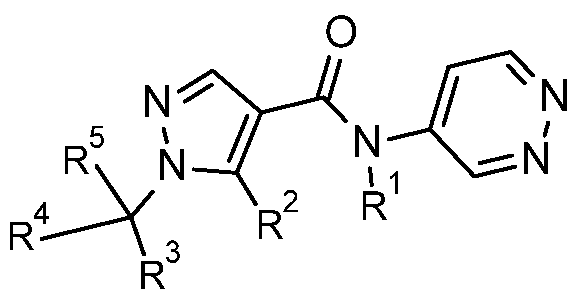


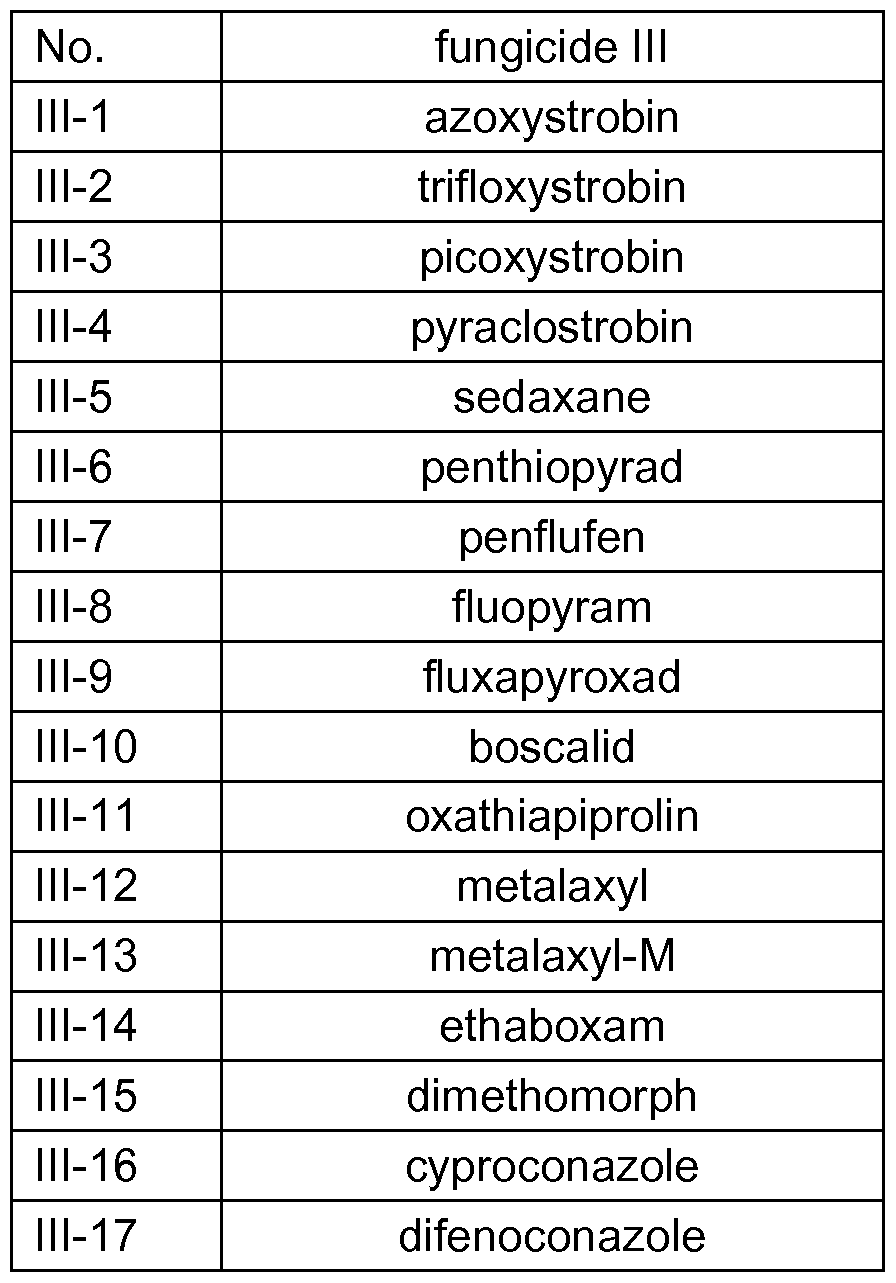
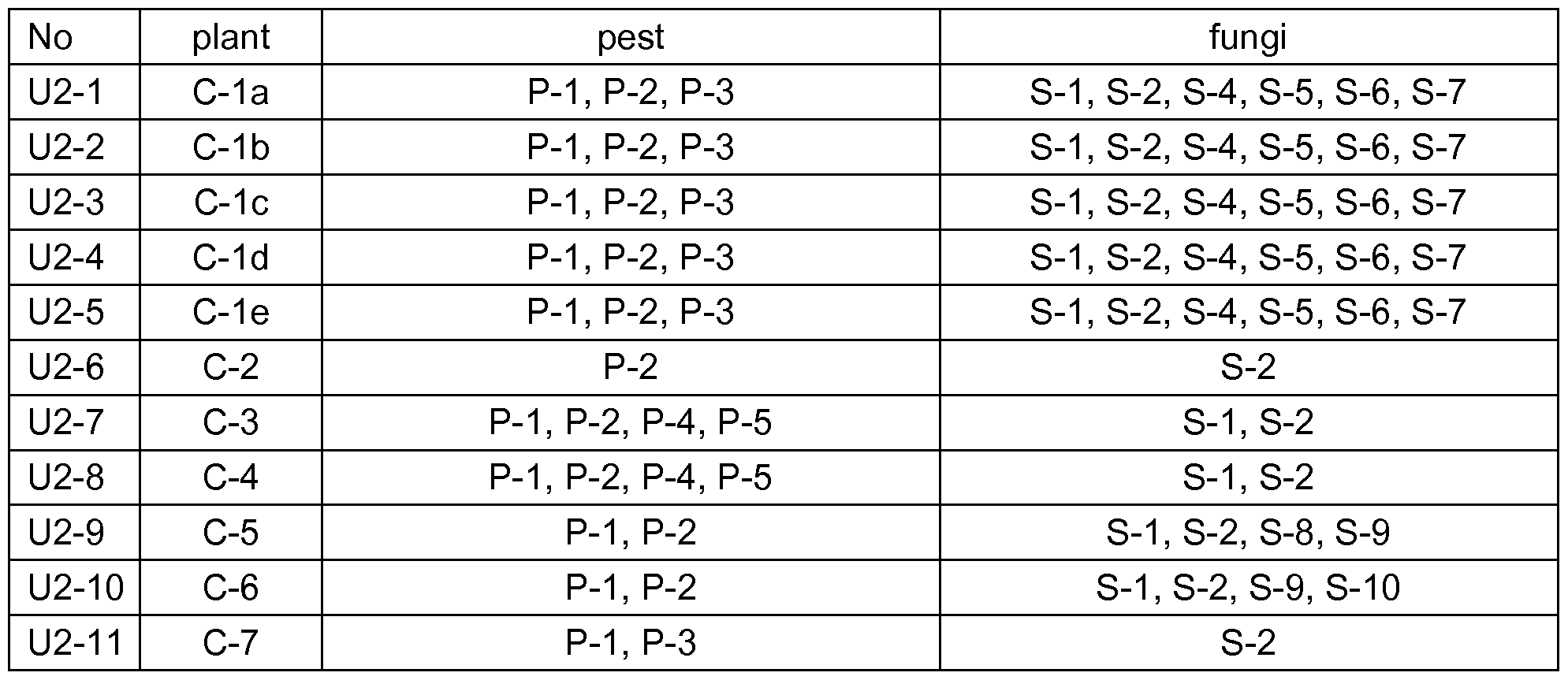


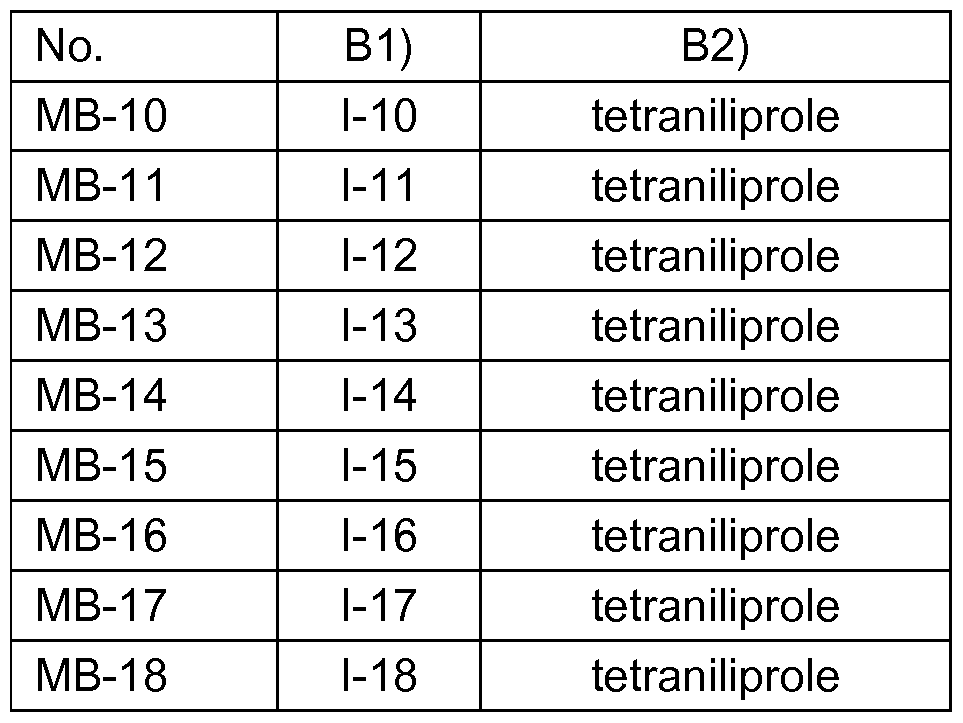

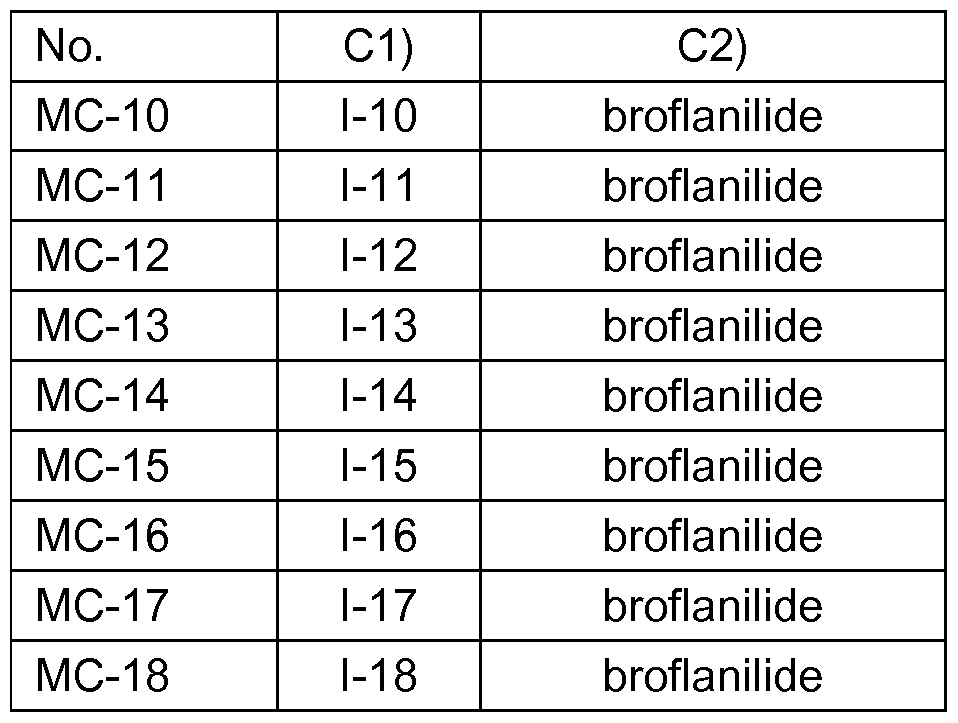
Claims
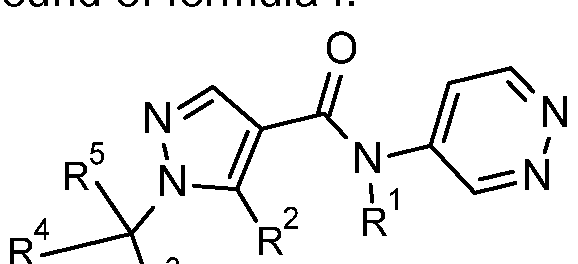

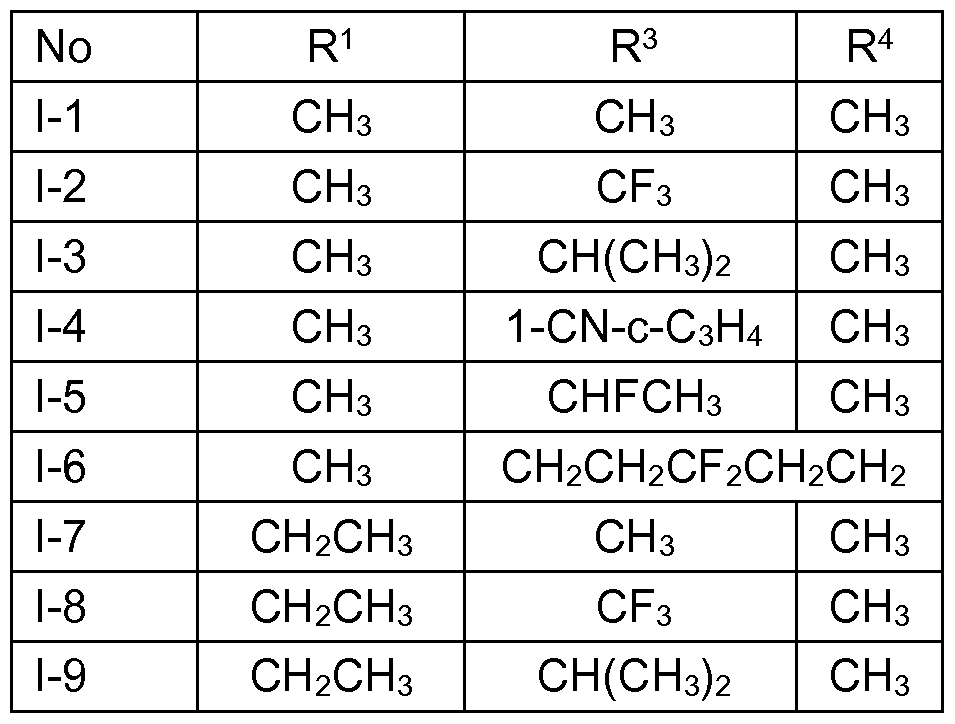

Priority Applications (10)
| Application Number | Priority Date | Filing Date | Title |
|---|---|---|---|
| MX2017010401A MX2017010401A (en) | 2015-02-11 | 2016-02-03 | Pesticidal mixture comprising a pyrazole compound, an insecticide and a fungicide. |
| BR112017015061-1A BR112017015061B1 (en) | 2015-02-11 | 2016-02-03 | PESTICIDE MIXTURE COMPRISING AN ACTIVE COMPOUND OF FORMULA IA AND BROFLANILIDE |
| EP16702567.5A EP3255990B1 (en) | 2015-02-11 | 2016-02-03 | Pesticidal mixture comprising a pyrazole compound, an insecticide and a fungicide |
| US15/550,191 US10701937B2 (en) | 2015-02-11 | 2016-02-03 | Pesticidal mixture comprising a pyrazole compound, an insecticide and a fungicide |
| AU2016218096A AU2016218096B2 (en) | 2015-02-11 | 2016-02-03 | Pesticidal mixture comprising a pyrazole compound, an insecticide and a fungicide |
| ES16702567T ES2820320T3 (en) | 2015-02-11 | 2016-02-03 | Pesticide mixture comprising a pyrazole compound, an insecticide and a fungicide |
| CR20170413A CR20170413A (en) | 2015-02-11 | 2016-02-03 | PESTICIDE MIXTURE THAT INCLUDES A PIRAZOL COMPOUND, AN INSECTICIDE AND A FUNGICIDE |
| CA2975183A CA2975183A1 (en) | 2015-02-11 | 2016-02-03 | Pesticidal mixture comprising a pyrazole compound, an insecticide and a fungicide |
| AU2020201830A AU2020201830C1 (en) | 2015-02-11 | 2020-03-12 | Pesticidal mixture comprising a pyrazole compound and an insecticide |
| US16/920,892 US20200352166A1 (en) | 2015-02-11 | 2020-07-06 | Pesticidal mixture comprising a pyrazole compound and an insecticide |
Applications Claiming Priority (2)
| Application Number | Priority Date | Filing Date | Title |
|---|---|---|---|
| EP15154717.1 | 2015-02-11 | ||
| EP15154717 | 2015-02-11 |
Related Child Applications (2)
| Application Number | Title | Priority Date | Filing Date |
|---|---|---|---|
| US15/550,191 A-371-Of-International US10701937B2 (en) | 2015-02-11 | 2016-02-03 | Pesticidal mixture comprising a pyrazole compound, an insecticide and a fungicide |
| US16/920,892 Continuation US20200352166A1 (en) | 2015-02-11 | 2020-07-06 | Pesticidal mixture comprising a pyrazole compound and an insecticide |
Publications (2)
| Publication Number | Publication Date |
|---|---|
| WO2016128261A2 true WO2016128261A2 (en) | 2016-08-18 |
| WO2016128261A3 WO2016128261A3 (en) | 2016-10-27 |
Family
ID=52469657
Family Applications (1)
| Application Number | Title | Priority Date | Filing Date |
|---|---|---|---|
| PCT/EP2016/052218 Ceased WO2016128261A2 (en) | 2015-02-11 | 2016-02-03 | Pesticidal mixture comprising a pyrazole compound, an insecticide and a fungicide |
Country Status (9)
| Country | Link |
|---|---|
| US (2) | US10701937B2 (en) |
| EP (1) | EP3255990B1 (en) |
| AU (2) | AU2016218096B2 (en) |
| BR (1) | BR112017015061B1 (en) |
| CA (2) | CA2975183A1 (en) |
| CR (1) | CR20170413A (en) |
| ES (1) | ES2820320T3 (en) |
| MX (2) | MX2017010401A (en) |
| WO (1) | WO2016128261A2 (en) |
Cited By (19)
| Publication number | Priority date | Publication date | Assignee | Title |
|---|---|---|---|---|
| CN106857560A (en) * | 2017-03-13 | 2017-06-20 | 佛山市盈辉作物科学有限公司 | A kind of new nematicide and its application |
| CN106879606A (en) * | 2017-04-17 | 2017-06-23 | 佛山市普尔玛农化有限公司 | It is a kind of to kill line composition containing Tioxazafen and fluorine thiophene worm sulfone |
| CN107155670A (en) * | 2017-06-03 | 2017-09-15 | 广东中迅农科股份有限公司 | It is a kind of to strengthen the method for root system of plant |
| EP3286180A1 (en) * | 2015-04-22 | 2018-02-28 | Basf Se | Molluscicide and bait composition comprising a molluscicide |
| EP3329777A1 (en) | 2016-11-30 | 2018-06-06 | Basf Se | Pesticidal mixtures |
| CN108849863A (en) * | 2018-06-22 | 2018-11-23 | 河北联兴佳垚农业科技有限公司 | Degerming medical fluid for gemmule yulan root |
| CN110199989A (en) * | 2019-07-09 | 2019-09-06 | 青岛润农化工有限公司 | A kind of composition pesticide and its preparation method and application containing Biphenthrin and fluorobenzene pyrrole bacterium amine |
| US10513498B2 (en) | 2014-07-31 | 2019-12-24 | Basf Se | Process for preparing pyrazoles |
| US10512267B2 (en) | 2013-07-08 | 2019-12-24 | BASF Agro, B.V. | Compositions comprising a triazole compound and a biopesticide |
| US10519122B2 (en) | 2013-01-09 | 2019-12-31 | BASF Agro B.V. | Process for the preparation of substituted oxiranes and triazoles |
| US10526264B2 (en) | 2016-07-07 | 2020-01-07 | Basf Se | Oxy-cope rearrangement for the manufacture of insecticidal cyclopentene compounds |
| US10584102B2 (en) | 2015-05-11 | 2020-03-10 | Basf Se | Process for preparing 4-amino-pyridazines |
| US10743535B2 (en) | 2017-08-18 | 2020-08-18 | H&K Solutions Llc | Insecticide for flight-capable pests |
| WO2020169414A1 (en) * | 2019-02-20 | 2020-08-27 | Basf Se | Pesticidal mixtures comprising a pyrazole compound |
| US10961226B2 (en) | 2016-11-04 | 2021-03-30 | Basf Se | Process for purification of pyrazolpyridazines |
| US20220259176A1 (en) * | 2018-06-08 | 2022-08-18 | Corteva Agriscience Llc | Molecule having pesticidal utility, and compositions, and processes, related thereto |
| WO2023152045A1 (en) | 2022-02-11 | 2023-08-17 | Basf Se | Use of dimpropyridaz for reducing viral and bacterial transmission |
| WO2024161019A1 (en) | 2023-02-03 | 2024-08-08 | Basf Se | Use of dimpropyridaz for reducing or preventing bacterial transmission |
| WO2025146655A1 (en) * | 2024-01-03 | 2025-07-10 | Khurana Kanika | Ternary composition comprising fipronil, spinosad and pyriproxyfen |
Families Citing this family (4)
| Publication number | Priority date | Publication date | Assignee | Title |
|---|---|---|---|---|
| WO2022249204A1 (en) * | 2021-05-27 | 2022-12-01 | Rajdhani Petrochemicals Private Limited | Synergistic oil dispersion agrochemical composition containing spinetoram |
| CN113584077B (en) * | 2021-08-31 | 2023-09-15 | 西南大学 | Silencing vector for silencing the key pathogenic gene CsGPA1 of Calicidium mulberry and its application and method |
| CN113584076B (en) * | 2021-08-31 | 2023-09-15 | 西南大学 | Silencing vector for silencing of G protein beta subunit encoding gene CsG beta 2 of phellinus linteus, application and method thereof |
| CN114403151B (en) * | 2022-02-14 | 2023-12-08 | 山东垄喜植物有限公司 | Insecticidal composition containing oxazin and pyrethroid |
Citations (102)
| Publication number | Priority date | Publication date | Assignee | Title |
|---|---|---|---|---|
| US3296272A (en) | 1965-04-01 | 1967-01-03 | Dow Chemical Co | Sulfinyl- and sulfonylpyridines |
| US3325503A (en) | 1965-02-18 | 1967-06-13 | Diamond Alkali Co | Polychloro derivatives of mono- and dicyano pyridines and a method for their preparation |
| EP0141317A2 (en) | 1983-10-21 | 1985-05-15 | BASF Aktiengesellschaft | 7-Amino-azolo[1,5-a]pyrimidines and fungicides containing them |
| EP0152031A2 (en) | 1984-02-03 | 1985-08-21 | Shionogi & Co., Ltd. | Azolyl cycloalkanol derivatives and agricultural fungicides |
| EP0226917A1 (en) | 1985-12-20 | 1987-07-01 | BASF Aktiengesellschaft | Acrylic acid esters and fungicides containing these compounds |
| EP0243970A1 (en) | 1986-05-02 | 1987-11-04 | Stauffer Chemical Company | Fungicidal pyridyl imidates |
| EP0256503A2 (en) | 1986-08-12 | 1988-02-24 | Mitsubishi Kasei Corporation | Pyridinecarboxamide derivatives and their use as fungicide |
| EP0428941A1 (en) | 1989-11-10 | 1991-05-29 | Agro-Kanesho Co., Ltd. | Hexahydrotriazine compounds and insecticides |
| EP0532022A1 (en) | 1991-09-13 | 1993-03-17 | Ube Industries, Ltd. | Acrylate compound, preparation process thereof and fungicide using the same |
| DE19650197A1 (en) | 1996-12-04 | 1998-06-10 | Bayer Ag | 3-thiocarbamoylpyrazole derivatives |
| WO1998046608A1 (en) | 1997-04-14 | 1998-10-22 | American Cyanamid Company | Fungicidal trifluoromethylalkylamino-triazolopyrimidines |
| WO1999014187A1 (en) | 1997-09-18 | 1999-03-25 | Basf Aktiengesellschaft | Benzamidoxim derivatives, intermediate products and methods for preparing and using them as fungicides |
| WO1999024413A2 (en) | 1997-11-12 | 1999-05-20 | Bayer Aktiengesellschaft | Isothiazole carboxylic acid amides and the application thereof in order to protect plants |
| WO1999027783A1 (en) | 1997-12-04 | 1999-06-10 | Dow Agrosciences Llc | Fungicidal compositions and methods, and compounds and methods for the preparation thereof |
| WO2000029404A1 (en) | 1998-11-17 | 2000-05-25 | Kumiai Chemical Industry Co., Ltd. | Pyrimidinylbenzimidazole and triazinylbenzimidazole derivatives and agricultura/horticultural bactericides |
| WO2000046148A1 (en) | 1999-02-02 | 2000-08-10 | Sintokogio, Ltd. | Silica gel carrying titanium oxide photocatalyst in high concentration and method for preparation thereof |
| EP1028125A1 (en) | 1998-11-30 | 2000-08-16 | Isagro Ricerca S.r.l. | Dipeptide compounds having fungicidal activity and their agronomic use |
| EP1035122A1 (en) | 1999-03-11 | 2000-09-13 | Rohm And Haas Company | Heterocyclic subsituted isoxazolidines and their use as fungicides |
| WO2000065913A1 (en) | 1999-04-28 | 2000-11-09 | Takeda Chemical Industries, Ltd. | Sulfonamide derivatives |
| DE10021412A1 (en) | 1999-12-13 | 2001-06-21 | Bayer Ag | Fungicidal active ingredient combinations |
| WO2001054501A2 (en) | 2000-01-25 | 2001-08-02 | Syngenta Participations Ag | Herbicidal composition |
| EP1122244A1 (en) | 2000-02-04 | 2001-08-08 | Sumitomo Chemical Company, Limited | Uracil compounds and their use |
| WO2001056358A2 (en) | 2000-01-28 | 2001-08-09 | Rohm And Haas Company | Enhanced propertied pesticides |
| WO2002022583A2 (en) | 2000-09-18 | 2002-03-21 | E. I. Du Pont De Nemours And Company | Pyridinyl amides and imides for use as fungicides |
| EP1201648A1 (en) | 1999-08-05 | 2002-05-02 | Kumiai Chemical Industry Co., Ltd. | Carbamate derivatives and agricultural/horticultural bactericides |
| WO2002040431A2 (en) | 2000-11-17 | 2002-05-23 | Dow Agrosciences Llc | Compounds having fungicidal activity and processes to make and use same |
| JP2002316902A (en) | 2001-04-20 | 2002-10-31 | Sumitomo Chem Co Ltd | Plant disease control agent composition |
| WO2003010149A1 (en) | 2001-07-25 | 2003-02-06 | Bayer Cropscience Ag | Pyrazolylcarboxanilides as fungicides |
| WO2003011853A1 (en) | 2001-07-30 | 2003-02-13 | Dow Agrosciences Llc | 6-aryl-4-aminopicolinates and their use as herbicides |
| WO2003014103A1 (en) | 2001-08-03 | 2003-02-20 | Bayer Cropscience S.A. | Iodobenzopyran-4-one derivatives having fungicidal activity |
| WO2003016286A1 (en) | 2001-08-17 | 2003-02-27 | Sankyo Agro Company, Limited | 3-phenoxy-4-pyridazinol derivative and herbicide composition containing the same |
| WO2003016303A1 (en) | 2001-08-20 | 2003-02-27 | Dainippon Ink And Chemicals, Inc. | Tetrazoyl oxime derivative and agricultural chemical containing the same as active ingredient |
| WO2003053145A1 (en) | 2001-12-21 | 2003-07-03 | Nissan Chemical Industries, Ltd. | Bactericidal composition |
| WO2003061388A1 (en) | 2002-01-18 | 2003-07-31 | Sumitomo Chemical Takeda Agro Company, Limited | Fused heterocyclic sulfonylurea compound, herbicide containing the same, and method of controlling weed with the same |
| WO2003066609A1 (en) | 2002-02-04 | 2003-08-14 | Bayer Cropscience Aktiengesellschaft | Disubstituted thiazolyl carboxanilides and their use as microbicides |
| WO2003074491A1 (en) | 2002-03-05 | 2003-09-12 | Syngenta Participations Ag | O-cyclopropyl-carboxanilides and their use as fungicides |
| WO2004049804A2 (en) | 2002-11-29 | 2004-06-17 | Syngenta Participations Ag | Fungicidal combinations for crop potection |
| WO2004083193A1 (en) | 2003-03-17 | 2004-09-30 | Sumitomo Chemical Company, Limited | Amide compound and bactericide composition containing the same |
| WO2005063721A1 (en) | 2003-12-19 | 2005-07-14 | E.I. Dupont De Nemours And Company | Herbicidal pyrimidines |
| WO2005077934A1 (en) | 2004-02-18 | 2005-08-25 | Ishihara Sangyo Kaisha, Ltd. | Anthranilamides, process for the production thereof, and pest controllers containing the same |
| WO2005087772A1 (en) | 2004-03-10 | 2005-09-22 | Basf Aktiengesellschaft | 5,6-dialkyl-7-amino-triazolopyrimidines, method for their production, their use for controlling pathogenic fungi and agents containing said compounds |
| WO2005087773A1 (en) | 2004-03-10 | 2005-09-22 | Basf Aktiengesellschaft | 5,6-dialkyl-7-amino-triazolopyrimidines, method for their production, their use for controlling pathogenic fungi and agents containing said compounds |
| WO2005120234A2 (en) | 2004-06-03 | 2005-12-22 | E.I. Dupont De Nemours And Company | Fungicidal mixtures of amidinylphenyl compounds |
| WO2005123689A1 (en) | 2004-06-18 | 2005-12-29 | Basf Aktiengesellschaft | 1-methyl-3-trifluoromethyl-pyrazole-4-carboxylic acid (ortho-phenyl)-anilides and to use thereof as fungicide |
| WO2005123690A1 (en) | 2004-06-18 | 2005-12-29 | Basf Aktiengesellschaft | 1-methyl-3-difluoromethyl-pyrazol-4-carbonic acid-(ortho-phenyl)-anilides, and use thereof as a fungicide |
| WO2006015866A1 (en) | 2004-08-12 | 2006-02-16 | Syngenta Participations Ag | Method for protecting useful plants or plant propagation material |
| WO2006043635A1 (en) | 2004-10-20 | 2006-04-27 | Kumiai Chemical Industry Co., Ltd. | 3-triazolylphenyl sulfide derivative and insecticide/acaricide/nematicide containing the same as active ingredient |
| WO2006087343A1 (en) | 2005-02-16 | 2006-08-24 | Basf Aktiengesellschaft | Pyrazole carboxylic acid anilides, method for the production thereof and agents containing them for controlling pathogenic fungi |
| WO2006087325A1 (en) | 2005-02-16 | 2006-08-24 | Basf Aktiengesellschaft | 5-alkoxyalkyl-6-alkyl-7-amino-azolopyrimidines, method for their production, their use for controlling pathogenic fungi and agents containing said substances |
| WO2006089633A2 (en) | 2005-02-22 | 2006-08-31 | Bayer Cropscience Ag | Spiroketal-substituted cyclic ketoenols |
| DE102005009458A1 (en) | 2005-03-02 | 2006-09-07 | Bayer Cropscience Ag | pyrazolylcarboxanilides |
| WO2007006670A1 (en) | 2005-07-07 | 2007-01-18 | Basf Aktiengesellschaft | N-thio-anthranilamid compounds and their use as pesticides |
| WO2007043677A1 (en) | 2005-10-14 | 2007-04-19 | Sumitomo Chemical Company, Limited | Hydrazide compound and pesticidal use of the same |
| WO2007082098A2 (en) | 2006-01-13 | 2007-07-19 | Dow Agrosciences Llc | 6-(poly-substituted aryl)-4-aminopicolinates and their use as herbicides |
| WO2007090624A2 (en) | 2006-02-09 | 2007-08-16 | Syngenta Participations Ag | A method of protecting a plant propagation material, a plant, and/or plant organs |
| WO2007101369A1 (en) | 2006-03-09 | 2007-09-13 | East China University Of Science And Technology | Preparation method and use of compounds having high biocidal activities |
| WO2007101540A1 (en) | 2006-03-06 | 2007-09-13 | Bayer Cropscience Ag | Combinations of active ingredients with insecticidal properties |
| WO2007144100A1 (en) | 2006-06-13 | 2007-12-21 | Bayer Cropscience Ag | Anthranilic acid diamide derivative with hetero-aromatic and hetero-cyclic substituents |
| WO2008067911A1 (en) | 2006-12-04 | 2008-06-12 | Bayer Cropscience Ag | Biphenyl-substituted spirocyclic ketoenols |
| WO2008134969A1 (en) | 2007-04-30 | 2008-11-13 | Sinochem Corporation | Benzamide compounds and applications thereof |
| WO2009023721A1 (en) | 2007-08-13 | 2009-02-19 | Divergence, Inc. | Compositions and methods for controlling nematodes |
| WO2009090181A2 (en) | 2008-01-15 | 2009-07-23 | Bayer Cropscience Sa | Pesticide composition comprising a tetrazolyloxime derivative and a fungicide or an insecticide active substance |
| WO2009124707A2 (en) | 2008-04-07 | 2009-10-15 | Bayer Cropscience Ag | Combinations of biological control agents and insecticides or fungicides |
| WO2010006713A2 (en) | 2008-07-17 | 2010-01-21 | Bayer Cropscience Ag | Heterocyclic compounds used as pesticides |
| WO2010018714A1 (en) | 2008-08-13 | 2010-02-18 | 三井化学アグロ株式会社 | Amide derivative, pest control agent containing the amide derivative and use of the pest control agent |
| WO2010034737A1 (en) | 2008-09-24 | 2010-04-01 | Basf Se | Pyrazole compounds for controlling invertebrate pests |
| CN101715777A (en) | 2010-01-12 | 2010-06-02 | 惠州市中迅化工有限公司 | Pesticide composition containing ethirimol and thiophanate-methyl, and application thereof |
| WO2010060379A1 (en) | 2008-11-28 | 2010-06-03 | 中国中化集团公司 | Ether compounds with nitrogen-containing 5-member heterocycle and the uses thereof |
| WO2010069882A1 (en) | 2008-12-17 | 2010-06-24 | Syngenta Participations Ag | Isoxazole derivatives for use as fungicides |
| WO2010069502A2 (en) | 2008-12-18 | 2010-06-24 | Bayer Cropscience Ag | Tetrazole substituted anthranilic acid amides as pesticides |
| WO2010069266A1 (en) | 2008-12-19 | 2010-06-24 | 华东理工大学 | Heterocyclic nitrogenous or oxygenous compounds with insecticidal activity formed from dialdehydes and their preparation and uses thereof |
| WO2010127926A1 (en) | 2009-05-06 | 2010-11-11 | Syngenta Participations Ag | 4 -cyano- 3 -benzoylamino-n- phenyl-benzamides for use in pest control |
| WO2010129497A1 (en) | 2009-05-05 | 2010-11-11 | Dow Agrosciences Llc | Pesticidal compositions |
| US20110046186A1 (en) | 2008-07-07 | 2011-02-24 | Bin Li | 1-Substituted Pyridyl-Pyrazolyl Amide Compounds and Uses Thereof |
| WO2011028657A1 (en) | 2009-09-01 | 2011-03-10 | Dow Agrosciences Llc | Synergistic fungicidal compositions containing a 5-fluoropyrimidine derivative for fungal control in cereals |
| WO2011069456A1 (en) | 2009-12-09 | 2011-06-16 | 华东理工大学 | Divalent and oxabridged heterocyclic neonicotinoid compounds and preparation methods thereof |
| WO2011077514A1 (en) | 2009-12-22 | 2011-06-30 | 三井化学アグロ株式会社 | Plant disease control composition and method for controlling plant diseases by applying the composition |
| CN102126994A (en) | 2010-01-19 | 2011-07-20 | 中化蓝天集团有限公司 | Benzophenone hydrazone derivative and preparation method and application thereof |
| WO2011085575A1 (en) | 2010-01-15 | 2011-07-21 | 江苏省农药研究所股份有限公司 | Ortho-heterocyclyl formanilide compounds, their synthesis methods and use |
| WO2011135833A1 (en) | 2010-04-28 | 2011-11-03 | Sumitomo Chemical Company, Limited | Plant disease control composition and its use |
| WO2012000896A2 (en) | 2010-06-28 | 2012-01-05 | Bayer Cropscience Ag | Heterocyclic compounds as agents for pest control |
| WO2012029672A1 (en) | 2010-08-31 | 2012-03-08 | Meiji Seikaファルマ株式会社 | Noxious organism control agent |
| WO2012034472A1 (en) | 2010-09-13 | 2012-03-22 | 中化蓝天集团有限公司 | Cyano benzenedicarboxamide compounds, preparing methods and as agricultural insecticides uses thereof |
| WO2012034403A1 (en) | 2010-09-14 | 2012-03-22 | 中化蓝天集团有限公司 | Fluoromethoxypyrazole anthranilamide compounds, synthesization methods and uses thereof |
| WO2012084670A1 (en) | 2010-12-20 | 2012-06-28 | Basf Se | Pesticidal active mixtures comprising pyrazole compounds |
| CN102613183A (en) | 2012-03-07 | 2012-08-01 | 中化蓝天集团有限公司 | Insecticide |
| WO2012143317A1 (en) | 2011-04-21 | 2012-10-26 | Basf Se | Novel pesticidal pyrazole compounds |
| WO2012168188A1 (en) | 2011-06-07 | 2012-12-13 | Bayer Intellectual Property Gmbh | Active compound combinations |
| WO2013003977A1 (en) | 2011-07-01 | 2013-01-10 | 合肥星宇化学有限责任公司 | Compound of 2,5-disubstituted-3-nitroimino-1,2,4-triazoline and preparation method and use as pesticide thereof |
| WO2013024009A1 (en) | 2011-08-12 | 2013-02-21 | Basf Se | N-thio-anthranilamide compounds and their use as pesticides |
| WO2013024010A1 (en) | 2011-08-12 | 2013-02-21 | Basf Se | N-thio-anthranilamide compounds and their use as pesticides |
| WO2013047441A1 (en) | 2011-09-26 | 2013-04-04 | 日本曹達株式会社 | Agricultural and horticultural bactericide composition |
| WO2013047749A1 (en) | 2011-09-29 | 2013-04-04 | 三井化学アグロ株式会社 | Production method for 4, 4-difluoro-3,4-dihydroisoquinoline derivative |
| WO2013050317A1 (en) | 2011-10-03 | 2013-04-11 | Syngenta Limited | Polymorphs of an isoxazoline derivative |
| WO2013055584A1 (en) | 2011-10-13 | 2013-04-18 | E. I. Du Pont De Nemours And Company | Solid forms of nematocidal sulfonamides |
| WO2013092224A1 (en) | 2011-12-21 | 2013-06-27 | Basf Se | Use of strobilurin type compounds for combating phytopathogenic fungi resistant to qo inhibitors |
| WO2013127704A1 (en) | 2012-02-27 | 2013-09-06 | Bayer Intellectual Property Gmbh | Active compound combinations containing a thiazoylisoxazoline and a fungicide |
| WO2013129688A1 (en) | 2012-02-29 | 2013-09-06 | Meiji Seika Pharma Co., Ltd. | Pest control composition including novel iminopyridine derivative |
| WO2013162072A1 (en) | 2012-04-27 | 2013-10-31 | Sumitomo Chemical Company, Limited | Tetrazolinone compounds and its use as pesticides |
| WO2013189801A1 (en) | 2012-06-20 | 2013-12-27 | Basf Se | Pyrazole compound and pesticidal mixtures comprising a pyrazole compound |
| WO2014126208A1 (en) | 2013-02-14 | 2014-08-21 | 日産化学工業株式会社 | Crystalline polymorph of isoxazoline-substituted benzamide compound, and method for producing same |
| WO2015055497A1 (en) | 2013-10-16 | 2015-04-23 | Basf Se | Substituted pesticidal pyrazole compounds |
Family Cites Families (35)
| Publication number | Priority date | Publication date | Assignee | Title |
|---|---|---|---|---|
| AU2006285613B2 (en) * | 2005-09-02 | 2011-11-17 | Nissan Chemical Corporation | Isoxazoline-substituted benzamide compound and harmful organism-controlling agent |
| BRPI0918022B1 (en) * | 2008-08-13 | 2017-12-26 | Mitsui Cheminicals Agro, Inc | METHOD FOR THE PRODUCTION OF AMIDA DERIVATIVES |
| PT2516426E (en) | 2009-12-21 | 2015-12-01 | Bayer Cropscience Ag | Bis(difluormethyl)pyrazoles used as fungicides |
| BR112013019667B1 (en) | 2011-02-01 | 2019-07-02 | Bayer Intellectual Property Gmbh | Heteroaryl piperidine and piperazine derivatives, their uses, composition, compound and composition production processes, method for the control of harmful phytopathogenic fungi |
| EP2623496A1 (en) | 2012-02-01 | 2013-08-07 | Bayer CropScience AG | Method for producing 3,5-bis(fluoralkyl)-pyrazol-4-carboxylic acid derivatives and 3,5-bis(fluoralkyl)-pyrazoles |
| UA118254C2 (en) | 2012-12-04 | 2018-12-26 | Монсанто Текнолоджи Ллс | NEMATOCIDAL WATER COMPOSITIONS OF SUSPENSION CONCENTRATE |
| WO2015036379A1 (en) | 2013-09-13 | 2015-03-19 | Bayer Cropscience Ag | Fungicidal compositions containing thiazolylisoxazoline fungicide and biological fungicide |
| TWI652014B (en) | 2013-09-13 | 2019-03-01 | 美商艾佛艾姆希公司 | Heterocyclic substituted bicycloazole insecticide |
| MX384980B (en) | 2013-10-18 | 2025-03-14 | Basf Agrochemical Products Bv | AGRICULTURAL MIXTURES COMPRISING CARBOXAMIDE COMPOUNDS. |
| CN106061254B (en) | 2013-10-18 | 2019-04-05 | 巴斯夫农业化学品有限公司 | Use of pesticide active carboxamide derivatives in soil and seed application and treatment methods |
| UA120040C2 (en) | 2013-10-18 | 2019-09-25 | Басф Агрокемікал Продактс Б.В. | INSECTICIDALLY ACTIVE MIXTURES CONTAINING A CARBOXAMIDE COMPOUND |
| US20170188581A1 (en) | 2014-03-27 | 2017-07-06 | Bayer Cropscience Aktiengesellschaft | Insecticidal and nematocidal active ingredient combinations |
| WO2015180983A1 (en) | 2014-05-27 | 2015-12-03 | Basf Se | Mixtures comprising nitrogen-fixing bacteria and biopesticides and chemical pesticides |
| WO2015180985A1 (en) | 2014-05-27 | 2015-12-03 | Basf Se | Ternary mixtures comprising biopesticides and oomycetes fungicides and sdhi fungicides |
| WO2015180999A1 (en) | 2014-05-27 | 2015-12-03 | Basf Se | Ternary mixtures comprising biopesticides and sdhi fungicides and azole-type fungicides |
| WO2015180987A1 (en) | 2014-05-27 | 2015-12-03 | Basf Se | Ternary mixtures comprising biopesticides and oomycetes fungicides and qol or phenylpyrrole fungicides |
| WO2015181009A1 (en) | 2014-05-27 | 2015-12-03 | Basf Se | Ternary mixtures comprising biopesticides and qoi fungicides and sdhi fungicides |
| WO2015181008A1 (en) | 2014-05-27 | 2015-12-03 | Basf Se | Ternary mixtures comprising biopesticides and chemical fungicides and chemical insecticides |
| WO2015189080A1 (en) | 2014-06-12 | 2015-12-17 | Basf Se | Pesticidally active mixtures |
| TW201603707A (en) | 2014-06-24 | 2016-02-01 | 陶氏農業科學公司 | Molecules having certain pesticidal utilities, and intermediates, compositions, and processes related thereto |
| EA201892682A1 (en) | 2014-06-25 | 2019-04-30 | Басф Агро Б.В. | PESTICIDAL COMPOSITIONS |
| TW201625564A (en) | 2014-07-23 | 2016-07-16 | 陶氏農業科學公司 | Molecules with certain insecticidal effects and related intermediates, compositions and methods (2) |
| TWI670012B (en) | 2014-07-28 | 2019-09-01 | 美商陶氏農業科學公司 | Molecules having certain pesticidal utilities, and intermediates, compositions, and processes related thereto |
| US10111433B2 (en) | 2014-07-31 | 2018-10-30 | Syngenta Participations Ag | Fungicidal compositions |
| WO2016034618A1 (en) | 2014-09-02 | 2016-03-10 | Basf Se | Aqueous pesticide microemulsion |
| WO2016034615A1 (en) | 2014-09-02 | 2016-03-10 | BASF Agro B.V. | Aqueous insecticide formulation containing hyperbranched polymer |
| ES2815650T3 (en) | 2014-09-05 | 2021-03-30 | Basf Corp | Food storage system comprising a container and an adsorbent material, and a procedure to extend the commercial life of a product |
| CN104521989B (en) | 2014-12-18 | 2016-08-17 | 广西田园生化股份有限公司 | Containing methylsulfonyl bacterium azoles and the complex composition of acid amide fungicides and preparation |
| CN104488896B (en) | 2014-12-18 | 2016-08-24 | 广西田园生化股份有限公司 | Containing methylsulfonyl bacterium azoles and the complex composition of methoxy acrylic bactericide and preparation |
| CN104488900B (en) | 2014-12-18 | 2017-09-05 | 广西田园生化股份有限公司 | A kind of complex composition of the azoles of bacterium containing methylsulfonyl and anabasine insecticide |
| WO2016128240A1 (en) | 2015-02-11 | 2016-08-18 | Basf Se | Pesticidal mixture comprising a pyrazole compound and two fungicides |
| WO2016128239A1 (en) | 2015-02-11 | 2016-08-18 | Basf Se | Pesticidal mixture comprising a pyrazole compound and a biopesticide |
| WO2017060349A1 (en) | 2015-10-07 | 2017-04-13 | Basf Se | Hollow wax capsules with reduced carbon dioxide release for attracting soil-dwelling pests |
| AU2017250534B2 (en) | 2016-04-11 | 2021-11-11 | Basf Se | Pesticidally active mixtures of tioxazafen |
| CN105994301A (en) | 2016-07-08 | 2016-10-12 | 广东中迅农科股份有限公司 | Pesticide composition containing fluopyram |
-
2016
- 2016-02-03 EP EP16702567.5A patent/EP3255990B1/en active Active
- 2016-02-03 US US15/550,191 patent/US10701937B2/en active Active
- 2016-02-03 CA CA2975183A patent/CA2975183A1/en active Pending
- 2016-02-03 BR BR112017015061-1A patent/BR112017015061B1/en active IP Right Grant
- 2016-02-03 CR CR20170413A patent/CR20170413A/en unknown
- 2016-02-03 ES ES16702567T patent/ES2820320T3/en active Active
- 2016-02-03 MX MX2017010401A patent/MX2017010401A/en unknown
- 2016-02-03 AU AU2016218096A patent/AU2016218096B2/en not_active Expired - Fee Related
- 2016-02-03 CA CA3170386A patent/CA3170386A1/en active Pending
- 2016-02-03 WO PCT/EP2016/052218 patent/WO2016128261A2/en not_active Ceased
-
2017
- 2017-08-11 MX MX2022011008A patent/MX2022011008A/en unknown
-
2020
- 2020-03-12 AU AU2020201830A patent/AU2020201830C1/en active Active
- 2020-07-06 US US16/920,892 patent/US20200352166A1/en not_active Abandoned
Patent Citations (102)
| Publication number | Priority date | Publication date | Assignee | Title |
|---|---|---|---|---|
| US3325503A (en) | 1965-02-18 | 1967-06-13 | Diamond Alkali Co | Polychloro derivatives of mono- and dicyano pyridines and a method for their preparation |
| US3296272A (en) | 1965-04-01 | 1967-01-03 | Dow Chemical Co | Sulfinyl- and sulfonylpyridines |
| EP0141317A2 (en) | 1983-10-21 | 1985-05-15 | BASF Aktiengesellschaft | 7-Amino-azolo[1,5-a]pyrimidines and fungicides containing them |
| EP0152031A2 (en) | 1984-02-03 | 1985-08-21 | Shionogi & Co., Ltd. | Azolyl cycloalkanol derivatives and agricultural fungicides |
| EP0226917A1 (en) | 1985-12-20 | 1987-07-01 | BASF Aktiengesellschaft | Acrylic acid esters and fungicides containing these compounds |
| EP0243970A1 (en) | 1986-05-02 | 1987-11-04 | Stauffer Chemical Company | Fungicidal pyridyl imidates |
| EP0256503A2 (en) | 1986-08-12 | 1988-02-24 | Mitsubishi Kasei Corporation | Pyridinecarboxamide derivatives and their use as fungicide |
| EP0428941A1 (en) | 1989-11-10 | 1991-05-29 | Agro-Kanesho Co., Ltd. | Hexahydrotriazine compounds and insecticides |
| EP0532022A1 (en) | 1991-09-13 | 1993-03-17 | Ube Industries, Ltd. | Acrylate compound, preparation process thereof and fungicide using the same |
| DE19650197A1 (en) | 1996-12-04 | 1998-06-10 | Bayer Ag | 3-thiocarbamoylpyrazole derivatives |
| WO1998046608A1 (en) | 1997-04-14 | 1998-10-22 | American Cyanamid Company | Fungicidal trifluoromethylalkylamino-triazolopyrimidines |
| WO1999014187A1 (en) | 1997-09-18 | 1999-03-25 | Basf Aktiengesellschaft | Benzamidoxim derivatives, intermediate products and methods for preparing and using them as fungicides |
| WO1999024413A2 (en) | 1997-11-12 | 1999-05-20 | Bayer Aktiengesellschaft | Isothiazole carboxylic acid amides and the application thereof in order to protect plants |
| WO1999027783A1 (en) | 1997-12-04 | 1999-06-10 | Dow Agrosciences Llc | Fungicidal compositions and methods, and compounds and methods for the preparation thereof |
| WO2000029404A1 (en) | 1998-11-17 | 2000-05-25 | Kumiai Chemical Industry Co., Ltd. | Pyrimidinylbenzimidazole and triazinylbenzimidazole derivatives and agricultura/horticultural bactericides |
| EP1028125A1 (en) | 1998-11-30 | 2000-08-16 | Isagro Ricerca S.r.l. | Dipeptide compounds having fungicidal activity and their agronomic use |
| WO2000046148A1 (en) | 1999-02-02 | 2000-08-10 | Sintokogio, Ltd. | Silica gel carrying titanium oxide photocatalyst in high concentration and method for preparation thereof |
| EP1035122A1 (en) | 1999-03-11 | 2000-09-13 | Rohm And Haas Company | Heterocyclic subsituted isoxazolidines and their use as fungicides |
| WO2000065913A1 (en) | 1999-04-28 | 2000-11-09 | Takeda Chemical Industries, Ltd. | Sulfonamide derivatives |
| EP1201648A1 (en) | 1999-08-05 | 2002-05-02 | Kumiai Chemical Industry Co., Ltd. | Carbamate derivatives and agricultural/horticultural bactericides |
| DE10021412A1 (en) | 1999-12-13 | 2001-06-21 | Bayer Ag | Fungicidal active ingredient combinations |
| WO2001054501A2 (en) | 2000-01-25 | 2001-08-02 | Syngenta Participations Ag | Herbicidal composition |
| WO2001056358A2 (en) | 2000-01-28 | 2001-08-09 | Rohm And Haas Company | Enhanced propertied pesticides |
| EP1122244A1 (en) | 2000-02-04 | 2001-08-08 | Sumitomo Chemical Company, Limited | Uracil compounds and their use |
| WO2002022583A2 (en) | 2000-09-18 | 2002-03-21 | E. I. Du Pont De Nemours And Company | Pyridinyl amides and imides for use as fungicides |
| WO2002040431A2 (en) | 2000-11-17 | 2002-05-23 | Dow Agrosciences Llc | Compounds having fungicidal activity and processes to make and use same |
| JP2002316902A (en) | 2001-04-20 | 2002-10-31 | Sumitomo Chem Co Ltd | Plant disease control agent composition |
| WO2003010149A1 (en) | 2001-07-25 | 2003-02-06 | Bayer Cropscience Ag | Pyrazolylcarboxanilides as fungicides |
| WO2003011853A1 (en) | 2001-07-30 | 2003-02-13 | Dow Agrosciences Llc | 6-aryl-4-aminopicolinates and their use as herbicides |
| WO2003014103A1 (en) | 2001-08-03 | 2003-02-20 | Bayer Cropscience S.A. | Iodobenzopyran-4-one derivatives having fungicidal activity |
| WO2003016286A1 (en) | 2001-08-17 | 2003-02-27 | Sankyo Agro Company, Limited | 3-phenoxy-4-pyridazinol derivative and herbicide composition containing the same |
| WO2003016303A1 (en) | 2001-08-20 | 2003-02-27 | Dainippon Ink And Chemicals, Inc. | Tetrazoyl oxime derivative and agricultural chemical containing the same as active ingredient |
| WO2003053145A1 (en) | 2001-12-21 | 2003-07-03 | Nissan Chemical Industries, Ltd. | Bactericidal composition |
| WO2003061388A1 (en) | 2002-01-18 | 2003-07-31 | Sumitomo Chemical Takeda Agro Company, Limited | Fused heterocyclic sulfonylurea compound, herbicide containing the same, and method of controlling weed with the same |
| WO2003066609A1 (en) | 2002-02-04 | 2003-08-14 | Bayer Cropscience Aktiengesellschaft | Disubstituted thiazolyl carboxanilides and their use as microbicides |
| WO2003074491A1 (en) | 2002-03-05 | 2003-09-12 | Syngenta Participations Ag | O-cyclopropyl-carboxanilides and their use as fungicides |
| WO2004049804A2 (en) | 2002-11-29 | 2004-06-17 | Syngenta Participations Ag | Fungicidal combinations for crop potection |
| WO2004083193A1 (en) | 2003-03-17 | 2004-09-30 | Sumitomo Chemical Company, Limited | Amide compound and bactericide composition containing the same |
| WO2005063721A1 (en) | 2003-12-19 | 2005-07-14 | E.I. Dupont De Nemours And Company | Herbicidal pyrimidines |
| WO2005077934A1 (en) | 2004-02-18 | 2005-08-25 | Ishihara Sangyo Kaisha, Ltd. | Anthranilamides, process for the production thereof, and pest controllers containing the same |
| WO2005087772A1 (en) | 2004-03-10 | 2005-09-22 | Basf Aktiengesellschaft | 5,6-dialkyl-7-amino-triazolopyrimidines, method for their production, their use for controlling pathogenic fungi and agents containing said compounds |
| WO2005087773A1 (en) | 2004-03-10 | 2005-09-22 | Basf Aktiengesellschaft | 5,6-dialkyl-7-amino-triazolopyrimidines, method for their production, their use for controlling pathogenic fungi and agents containing said compounds |
| WO2005120234A2 (en) | 2004-06-03 | 2005-12-22 | E.I. Dupont De Nemours And Company | Fungicidal mixtures of amidinylphenyl compounds |
| WO2005123689A1 (en) | 2004-06-18 | 2005-12-29 | Basf Aktiengesellschaft | 1-methyl-3-trifluoromethyl-pyrazole-4-carboxylic acid (ortho-phenyl)-anilides and to use thereof as fungicide |
| WO2005123690A1 (en) | 2004-06-18 | 2005-12-29 | Basf Aktiengesellschaft | 1-methyl-3-difluoromethyl-pyrazol-4-carbonic acid-(ortho-phenyl)-anilides, and use thereof as a fungicide |
| WO2006015866A1 (en) | 2004-08-12 | 2006-02-16 | Syngenta Participations Ag | Method for protecting useful plants or plant propagation material |
| WO2006043635A1 (en) | 2004-10-20 | 2006-04-27 | Kumiai Chemical Industry Co., Ltd. | 3-triazolylphenyl sulfide derivative and insecticide/acaricide/nematicide containing the same as active ingredient |
| WO2006087343A1 (en) | 2005-02-16 | 2006-08-24 | Basf Aktiengesellschaft | Pyrazole carboxylic acid anilides, method for the production thereof and agents containing them for controlling pathogenic fungi |
| WO2006087325A1 (en) | 2005-02-16 | 2006-08-24 | Basf Aktiengesellschaft | 5-alkoxyalkyl-6-alkyl-7-amino-azolopyrimidines, method for their production, their use for controlling pathogenic fungi and agents containing said substances |
| WO2006089633A2 (en) | 2005-02-22 | 2006-08-31 | Bayer Cropscience Ag | Spiroketal-substituted cyclic ketoenols |
| DE102005009458A1 (en) | 2005-03-02 | 2006-09-07 | Bayer Cropscience Ag | pyrazolylcarboxanilides |
| WO2007006670A1 (en) | 2005-07-07 | 2007-01-18 | Basf Aktiengesellschaft | N-thio-anthranilamid compounds and their use as pesticides |
| WO2007043677A1 (en) | 2005-10-14 | 2007-04-19 | Sumitomo Chemical Company, Limited | Hydrazide compound and pesticidal use of the same |
| WO2007082098A2 (en) | 2006-01-13 | 2007-07-19 | Dow Agrosciences Llc | 6-(poly-substituted aryl)-4-aminopicolinates and their use as herbicides |
| WO2007090624A2 (en) | 2006-02-09 | 2007-08-16 | Syngenta Participations Ag | A method of protecting a plant propagation material, a plant, and/or plant organs |
| WO2007101540A1 (en) | 2006-03-06 | 2007-09-13 | Bayer Cropscience Ag | Combinations of active ingredients with insecticidal properties |
| WO2007101369A1 (en) | 2006-03-09 | 2007-09-13 | East China University Of Science And Technology | Preparation method and use of compounds having high biocidal activities |
| WO2007144100A1 (en) | 2006-06-13 | 2007-12-21 | Bayer Cropscience Ag | Anthranilic acid diamide derivative with hetero-aromatic and hetero-cyclic substituents |
| WO2008067911A1 (en) | 2006-12-04 | 2008-06-12 | Bayer Cropscience Ag | Biphenyl-substituted spirocyclic ketoenols |
| WO2008134969A1 (en) | 2007-04-30 | 2008-11-13 | Sinochem Corporation | Benzamide compounds and applications thereof |
| WO2009023721A1 (en) | 2007-08-13 | 2009-02-19 | Divergence, Inc. | Compositions and methods for controlling nematodes |
| WO2009090181A2 (en) | 2008-01-15 | 2009-07-23 | Bayer Cropscience Sa | Pesticide composition comprising a tetrazolyloxime derivative and a fungicide or an insecticide active substance |
| WO2009124707A2 (en) | 2008-04-07 | 2009-10-15 | Bayer Cropscience Ag | Combinations of biological control agents and insecticides or fungicides |
| US20110046186A1 (en) | 2008-07-07 | 2011-02-24 | Bin Li | 1-Substituted Pyridyl-Pyrazolyl Amide Compounds and Uses Thereof |
| WO2010006713A2 (en) | 2008-07-17 | 2010-01-21 | Bayer Cropscience Ag | Heterocyclic compounds used as pesticides |
| WO2010018714A1 (en) | 2008-08-13 | 2010-02-18 | 三井化学アグロ株式会社 | Amide derivative, pest control agent containing the amide derivative and use of the pest control agent |
| WO2010034737A1 (en) | 2008-09-24 | 2010-04-01 | Basf Se | Pyrazole compounds for controlling invertebrate pests |
| WO2010060379A1 (en) | 2008-11-28 | 2010-06-03 | 中国中化集团公司 | Ether compounds with nitrogen-containing 5-member heterocycle and the uses thereof |
| WO2010069882A1 (en) | 2008-12-17 | 2010-06-24 | Syngenta Participations Ag | Isoxazole derivatives for use as fungicides |
| WO2010069502A2 (en) | 2008-12-18 | 2010-06-24 | Bayer Cropscience Ag | Tetrazole substituted anthranilic acid amides as pesticides |
| WO2010069266A1 (en) | 2008-12-19 | 2010-06-24 | 华东理工大学 | Heterocyclic nitrogenous or oxygenous compounds with insecticidal activity formed from dialdehydes and their preparation and uses thereof |
| WO2010129497A1 (en) | 2009-05-05 | 2010-11-11 | Dow Agrosciences Llc | Pesticidal compositions |
| WO2010127926A1 (en) | 2009-05-06 | 2010-11-11 | Syngenta Participations Ag | 4 -cyano- 3 -benzoylamino-n- phenyl-benzamides for use in pest control |
| WO2011028657A1 (en) | 2009-09-01 | 2011-03-10 | Dow Agrosciences Llc | Synergistic fungicidal compositions containing a 5-fluoropyrimidine derivative for fungal control in cereals |
| WO2011069456A1 (en) | 2009-12-09 | 2011-06-16 | 华东理工大学 | Divalent and oxabridged heterocyclic neonicotinoid compounds and preparation methods thereof |
| WO2011077514A1 (en) | 2009-12-22 | 2011-06-30 | 三井化学アグロ株式会社 | Plant disease control composition and method for controlling plant diseases by applying the composition |
| CN101715777A (en) | 2010-01-12 | 2010-06-02 | 惠州市中迅化工有限公司 | Pesticide composition containing ethirimol and thiophanate-methyl, and application thereof |
| WO2011085575A1 (en) | 2010-01-15 | 2011-07-21 | 江苏省农药研究所股份有限公司 | Ortho-heterocyclyl formanilide compounds, their synthesis methods and use |
| CN102126994A (en) | 2010-01-19 | 2011-07-20 | 中化蓝天集团有限公司 | Benzophenone hydrazone derivative and preparation method and application thereof |
| WO2011135833A1 (en) | 2010-04-28 | 2011-11-03 | Sumitomo Chemical Company, Limited | Plant disease control composition and its use |
| WO2012000896A2 (en) | 2010-06-28 | 2012-01-05 | Bayer Cropscience Ag | Heterocyclic compounds as agents for pest control |
| WO2012029672A1 (en) | 2010-08-31 | 2012-03-08 | Meiji Seikaファルマ株式会社 | Noxious organism control agent |
| WO2012034472A1 (en) | 2010-09-13 | 2012-03-22 | 中化蓝天集团有限公司 | Cyano benzenedicarboxamide compounds, preparing methods and as agricultural insecticides uses thereof |
| WO2012034403A1 (en) | 2010-09-14 | 2012-03-22 | 中化蓝天集团有限公司 | Fluoromethoxypyrazole anthranilamide compounds, synthesization methods and uses thereof |
| WO2012084670A1 (en) | 2010-12-20 | 2012-06-28 | Basf Se | Pesticidal active mixtures comprising pyrazole compounds |
| WO2012143317A1 (en) | 2011-04-21 | 2012-10-26 | Basf Se | Novel pesticidal pyrazole compounds |
| WO2012168188A1 (en) | 2011-06-07 | 2012-12-13 | Bayer Intellectual Property Gmbh | Active compound combinations |
| WO2013003977A1 (en) | 2011-07-01 | 2013-01-10 | 合肥星宇化学有限责任公司 | Compound of 2,5-disubstituted-3-nitroimino-1,2,4-triazoline and preparation method and use as pesticide thereof |
| WO2013024009A1 (en) | 2011-08-12 | 2013-02-21 | Basf Se | N-thio-anthranilamide compounds and their use as pesticides |
| WO2013024010A1 (en) | 2011-08-12 | 2013-02-21 | Basf Se | N-thio-anthranilamide compounds and their use as pesticides |
| WO2013047441A1 (en) | 2011-09-26 | 2013-04-04 | 日本曹達株式会社 | Agricultural and horticultural bactericide composition |
| WO2013047749A1 (en) | 2011-09-29 | 2013-04-04 | 三井化学アグロ株式会社 | Production method for 4, 4-difluoro-3,4-dihydroisoquinoline derivative |
| WO2013050317A1 (en) | 2011-10-03 | 2013-04-11 | Syngenta Limited | Polymorphs of an isoxazoline derivative |
| WO2013055584A1 (en) | 2011-10-13 | 2013-04-18 | E. I. Du Pont De Nemours And Company | Solid forms of nematocidal sulfonamides |
| WO2013092224A1 (en) | 2011-12-21 | 2013-06-27 | Basf Se | Use of strobilurin type compounds for combating phytopathogenic fungi resistant to qo inhibitors |
| WO2013127704A1 (en) | 2012-02-27 | 2013-09-06 | Bayer Intellectual Property Gmbh | Active compound combinations containing a thiazoylisoxazoline and a fungicide |
| WO2013129688A1 (en) | 2012-02-29 | 2013-09-06 | Meiji Seika Pharma Co., Ltd. | Pest control composition including novel iminopyridine derivative |
| CN102613183A (en) | 2012-03-07 | 2012-08-01 | 中化蓝天集团有限公司 | Insecticide |
| WO2013162072A1 (en) | 2012-04-27 | 2013-10-31 | Sumitomo Chemical Company, Limited | Tetrazolinone compounds and its use as pesticides |
| WO2013189801A1 (en) | 2012-06-20 | 2013-12-27 | Basf Se | Pyrazole compound and pesticidal mixtures comprising a pyrazole compound |
| WO2014126208A1 (en) | 2013-02-14 | 2014-08-21 | 日産化学工業株式会社 | Crystalline polymorph of isoxazoline-substituted benzamide compound, and method for producing same |
| WO2015055497A1 (en) | 2013-10-16 | 2015-04-23 | Basf Se | Substituted pesticidal pyrazole compounds |
Non-Patent Citations (9)
Cited By (31)
| Publication number | Priority date | Publication date | Assignee | Title |
|---|---|---|---|---|
| US10519122B2 (en) | 2013-01-09 | 2019-12-31 | BASF Agro B.V. | Process for the preparation of substituted oxiranes and triazoles |
| US10981883B2 (en) | 2013-01-09 | 2021-04-20 | BASF Agro B.V. | Process for the preparation of substituted oxiranes and triazoles |
| US10512267B2 (en) | 2013-07-08 | 2019-12-24 | BASF Agro, B.V. | Compositions comprising a triazole compound and a biopesticide |
| US10513498B2 (en) | 2014-07-31 | 2019-12-24 | Basf Se | Process for preparing pyrazoles |
| EP3286180A1 (en) * | 2015-04-22 | 2018-02-28 | Basf Se | Molluscicide and bait composition comprising a molluscicide |
| US12162841B2 (en) | 2015-05-11 | 2024-12-10 | Basf Se | Process for preparing 4-amino-pyridazines |
| US11046656B2 (en) | 2015-05-11 | 2021-06-29 | Basf Se | Process for preparing 4-amino-pyridazines |
| US10584102B2 (en) | 2015-05-11 | 2020-03-10 | Basf Se | Process for preparing 4-amino-pyridazines |
| US10526264B2 (en) | 2016-07-07 | 2020-01-07 | Basf Se | Oxy-cope rearrangement for the manufacture of insecticidal cyclopentene compounds |
| US10961226B2 (en) | 2016-11-04 | 2021-03-30 | Basf Se | Process for purification of pyrazolpyridazines |
| EP3329777A1 (en) | 2016-11-30 | 2018-06-06 | Basf Se | Pesticidal mixtures |
| CN106857560A (en) * | 2017-03-13 | 2017-06-20 | 佛山市盈辉作物科学有限公司 | A kind of new nematicide and its application |
| CN106879606A (en) * | 2017-04-17 | 2017-06-23 | 佛山市普尔玛农化有限公司 | It is a kind of to kill line composition containing Tioxazafen and fluorine thiophene worm sulfone |
| CN107155670A (en) * | 2017-06-03 | 2017-09-15 | 广东中迅农科股份有限公司 | It is a kind of to strengthen the method for root system of plant |
| US10743535B2 (en) | 2017-08-18 | 2020-08-18 | H&K Solutions Llc | Insecticide for flight-capable pests |
| US20220259176A1 (en) * | 2018-06-08 | 2022-08-18 | Corteva Agriscience Llc | Molecule having pesticidal utility, and compositions, and processes, related thereto |
| US11691961B2 (en) * | 2018-06-08 | 2023-07-04 | Corteva Agriscience Llc | Molecule having pesticidal utility, and compositions, and processes, related thereto |
| US11939313B2 (en) | 2018-06-08 | 2024-03-26 | Corteva Agriscience Llc | Molecule having pesticidal utility, and compositions, and processes, related thereto |
| CN108849863A (en) * | 2018-06-22 | 2018-11-23 | 河北联兴佳垚农业科技有限公司 | Degerming medical fluid for gemmule yulan root |
| CN113453555B (en) * | 2019-02-20 | 2023-08-08 | 巴斯夫欧洲公司 | Pesticide mixtures containing pyrazole compounds |
| US20220125050A1 (en) * | 2019-02-20 | 2022-04-28 | Basf Se | Pesticidal mixtures comprising a pyrazole compound |
| WO2020169414A1 (en) * | 2019-02-20 | 2020-08-27 | Basf Se | Pesticidal mixtures comprising a pyrazole compound |
| JP2022521234A (en) * | 2019-02-20 | 2022-04-06 | ビーエーエスエフ ソシエタス・ヨーロピア | Pesticide mixture containing pyrazole compound |
| JP7570339B2 (en) | 2019-02-20 | 2024-10-21 | ビーエーエスエフ ソシエタス・ヨーロピア | Pesticide mixtures containing pyrazole compounds |
| CN113453555A (en) * | 2019-02-20 | 2021-09-28 | 巴斯夫欧洲公司 | Pesticidal mixtures comprising pyrazole compounds |
| US12342821B2 (en) * | 2019-02-20 | 2025-07-01 | Basf Se | Pesticidal mixtures comprising a pyrazole compound |
| AU2020226609B2 (en) * | 2019-02-20 | 2025-07-24 | Basf Se | Pesticidal mixtures comprising a pyrazole compound |
| CN110199989A (en) * | 2019-07-09 | 2019-09-06 | 青岛润农化工有限公司 | A kind of composition pesticide and its preparation method and application containing Biphenthrin and fluorobenzene pyrrole bacterium amine |
| WO2023152045A1 (en) | 2022-02-11 | 2023-08-17 | Basf Se | Use of dimpropyridaz for reducing viral and bacterial transmission |
| WO2024161019A1 (en) | 2023-02-03 | 2024-08-08 | Basf Se | Use of dimpropyridaz for reducing or preventing bacterial transmission |
| WO2025146655A1 (en) * | 2024-01-03 | 2025-07-10 | Khurana Kanika | Ternary composition comprising fipronil, spinosad and pyriproxyfen |
Also Published As
| Publication number | Publication date |
|---|---|
| US20200352166A1 (en) | 2020-11-12 |
| WO2016128261A3 (en) | 2016-10-27 |
| EP3255990A2 (en) | 2017-12-20 |
| US10701937B2 (en) | 2020-07-07 |
| MX2022011008A (en) | 2022-10-07 |
| AU2016218096A1 (en) | 2017-08-03 |
| BR112017015061A2 (en) | 2018-03-20 |
| EP3255990B1 (en) | 2020-06-24 |
| US20180271095A1 (en) | 2018-09-27 |
| AU2020201830A1 (en) | 2020-04-02 |
| BR112017015061B1 (en) | 2022-09-27 |
| MX2017010401A (en) | 2017-12-07 |
| AU2020201830C1 (en) | 2021-04-01 |
| CA3170386A1 (en) | 2016-08-18 |
| ES2820320T3 (en) | 2021-04-20 |
| CA2975183A1 (en) | 2016-08-18 |
| AU2020201830B2 (en) | 2020-11-05 |
| CR20170413A (en) | 2018-02-06 |
| AU2016218096B2 (en) | 2020-02-20 |
Similar Documents
| Publication | Publication Date | Title |
|---|---|---|
| AU2020201830B2 (en) | Pesticidal mixture comprising a pyrazole compound and an insecticide | |
| US11570992B2 (en) | Bicyclic compounds | |
| US20150250173A1 (en) | Pesticidally active mixtures comprising anthranilamide compounds | |
| US20180368404A1 (en) | 3-pyridyl heterobicyclic compound for controlling invertebrate pests | |
| CN116234444A (en) | Insecticidally active mixtures containing thietaneoxy compounds, their oxides or their salts | |
| WO2016128240A1 (en) | Pesticidal mixture comprising a pyrazole compound and two fungicides | |
| AU2013326644A1 (en) | Pesticidally active mixtures comprising anthranilamide compounds | |
| US20150250172A1 (en) | Use of anthranilamide compounds in soil and seed treatment application methods | |
| US20150250174A1 (en) | Use of n-thio-anthranilamide compounds on cultivated plants | |
| US20150237858A1 (en) | Method of controlling ryanodine-modulator insecticide resistant insects | |
| WO2014053403A1 (en) | Method of controlling insecticide resistant insects | |
| WO2017178917A1 (en) | Pesticidally active mixtures of tioxazafen | |
| WO2014079820A1 (en) | Use of anthranilamide compounds for reducing insect-vectored viral infections | |
| BR112021009395A2 (en) | substituted pyrimidinium compounds, compounds of formula (I), methods for protecting crops, for combating, controlling, preventing or protecting, non-therapeutic method for treating animals, seed and uses of compounds of formula (i) | |
| CN109068655B (en) | Pesticidal active mixtures of tioxazafen |
Legal Events
| Date | Code | Title | Description |
|---|---|---|---|
| 121 | Ep: the epo has been informed by wipo that ep was designated in this application |
Ref document number: 16702567 Country of ref document: EP Kind code of ref document: A2 |
|
| REEP | Request for entry into the european phase |
Ref document number: 2016702567 Country of ref document: EP |
|
| WWE | Wipo information: entry into national phase |
Ref document number: 122022012178 Country of ref document: BR |
|
| ENP | Entry into the national phase |
Ref document number: 2975183 Country of ref document: CA |
|
| ENP | Entry into the national phase |
Ref document number: 2016218096 Country of ref document: AU Date of ref document: 20160203 Kind code of ref document: A |
|
| WWE | Wipo information: entry into national phase |
Ref document number: 15550191 Country of ref document: US |
|
| WWE | Wipo information: entry into national phase |
Ref document number: MX/A/2017/010401 Country of ref document: MX |
|
| NENP | Non-entry into the national phase |
Ref country code: DE |
|
| WWE | Wipo information: entry into national phase |
Ref document number: CR2017-000413 Country of ref document: CR |
|
| REG | Reference to national code |
Ref country code: BR Ref legal event code: B01A Ref document number: 112017015061 Country of ref document: BR |
|
| ENP | Entry into the national phase |
Ref document number: 112017015061 Country of ref document: BR Kind code of ref document: A2 Effective date: 20170713 |