PYRIDINE COMPOUNDS AS FUNGICIDES
Description
The present invention relates to novel pyridine compounds and the N-oxides and the salts thereof, and to the use and methods for combating phytopathogenic fungi and to seeds coated with at least one such compound. The invention also relates to processes for preparing these compounds and to compositions comprising at least one compound I.
In many cases, in particular at low application rates, the fungicidal activity of the known fungicidal compounds is unsatisfactory. Based on this, it was an object of the present invention to provide compounds having improved activity and/or a broader activity spectrum against phytopathogenic harmful fungi.
Surprisingly, this objective is achieved by the use of the inventive pyridine compounds of formula I having favorable fungicidal activity against phytopathogenic fungi.
Accordingly, the present invention relates to the com ounds of the formula I
R1 is CH3;
R3 is selected from H, halogen, OH, CN, N02, SH, NH2, NH(Ci-C4-alkyl), N(C C4-alkyl)2, NH-S02-R31, Ci-C6-alkyl, C2-C6-alkenyl, C2-C6-alkynyl, Ci-C6-alkoxy, C3-C6-cycloalkyl, five- or six-membered heteroaryl and aryl; wherein the heteroaryl contains one, two or three heteroatoms selected from N, O and S; wherein
R31 is selected Ci-C4-alkyl, Ci-C4-halogenalkyl, aryl or heteroaryl that is unsubstituted or substituted by 1 , 2, 3, 4 or 5 substituents R311 independently selected from Ci-C4- alkyl;
and wherein the aliphatic moieties of R3 are unsubstituted or substituted with identical or different groups R3a which independently of one another are selected from:
R3a halogen, OH, CN, Ci-C6-alkoxy, C3-C6-cycloalkyl, C3-C6-halogencycloalkyl, Ci-C4- halogenalkoxy, Ci-C6-alkylthio, phenyland phenoxy, wherein the phenyl and phe- noxy group is unsubstituted or carries 1 , 2, 3, 4 or 5 substituents R31a selected from the group consisting of halogen, OH, Ci-C4-alkyl, Ci-C4-halogenalkyl, Ci-C4-alkoxy and Ci-C4-halogenalkoxy;
and wherein the cycloalkyi, heteroaryl and aryl moieties of R3 are unsubstituted or substituted with 1 , 2, 3, 4, 5 or up to the maximum number of identical or different groups R3b which independently of one another are selected from:
R3b halogen, OH , CN , Ci-C4-alkyl, Ci-C4-alkoxy, Ci-C4-halogenalkyl, C3-C6-cycloalkyl, C3-C6-halogencycloalkyl, Ci-C4-halogenalkoxy and Ci-C6-alkylthio;
R4 is selected from H , halogen, OH , CN , N02, SH , N H2, N H(Ci-C4-alkyl), N(Ci-C4-alkyl)2, N H- S02-R41 , d-Ce-alkyl, C2-C6-alkenyl, C2-C6-alkynyl, C C6-alkoxy, C3-C6-cycloalkyl, five- or six-membered heteroaryl and aryl; wherein the heteroaryl contains one, two or three het- eroatoms selected from N , O and S; wherein
R41 is selected Ci-C4-alkyl, Ci-C4-halogenalkyl, aryl or heteroaryl that is unsubstituted or substituted by 1 , 2, 3, 4 or 5 substituents R41 1 independently selected from Ci-C4- alkyl;
and wherein the aliphatic moieties of R4 are unsubstituted or substituted with identical or different groups R4a which independently of one another are selected from:
R4a halogen, OH , CN , CrC6-alkoxy, C3-C6-cycloalkyl, C3-C6-halogencycloalkyl, Ci-C4- halogenalkoxy, Ci-C6-alkylthio, phenyland phenoxy, wherein the phenyl and phe- noxy group is unsubstituted or carries 1 , 2, 3, 4 or 5 substituents R41 a selected from the group consisting of halogen, OH , Ci-C4-alkyl, Ci-C4-halogenalkyl, Ci-C4-alkoxy and Ci-C4-halogenalkoxy;
and wherein the cycloalkyi, heteroaryl and aryl moieties of R4 are unsubstituted or substituted with 1 , 2, 3, 4, 5 or up to the maximum number of identical or different groups R4b which independently of one another are selected from:
R4b halogen, OH , CN , C C4-alkyl, C C4-alkoxy, Ci-C4-halogenalkyl, C3-C6-cycloalkyl, C3-C6-halogencycloalkyl, Ci-C4-halogenalkoxy and Ci-C6-alkylthio;
Y is O or S(0)n wherein
n is 0, 1 or 2;
Q1 is selected from Ci-C6-alkyl, C2-C6-alkenyl, C2-C6-alkynyl, C3-C6-cycloalkyl, five- or six- membered heteroaryl and aryl; wherein the heteroaryl contains one, two or three het- eroatoms selected from N , O and S;
wherein the aliphatic moieties of Q1 are unsubstituted or substituted with identical or different groups Q1a which independently of one another are selected from:
Q1a halogen, OH , CN , Ci-C6-alkoxy, C3-C6-cycloalkyl, C3-C6-halogencycloalkyl, Ci-C4- halogenalkoxy, Ci-C6-alkylthio, phenyl and phenoxy, wherein the phenyl and phenoxy group is unsubstituted or carries 1 , 2, 3, 4 or 5 substituents Q11a selected from the group consisting of halogen, OH , Ci-C4-alkyl, Ci-C4-halogenalkyl, Ci-C4-alkoxy and Ci-C4-halogenalkoxy;
wherein the cycloalkyi, heteroaryl and aryl moieties of Q1 are unsubstituted or substituted with 1 , 2, 3, 4, 5 or up to the maximum number of identical or different groups Q1b which independently of one another are selected from:
Q1b halogen, OH, CN, Ci-C4-alkyl, Ci-C4-alkoxy, Ci-C4-halogenalkyl, C3-C6-cycloalkyl, C3-C6-halogencycloalkyl, Ci-C4-halogenalkoxy and Ci-C6-alkylthio;
Q2 is selected from H, Ci-C6-alkyl, C2-C6-alkenyl, C2-C6-alkynyl, C3-C6-cycloalkyl, five- or six-membered heteroaryl and aryl; wherein the heteroaryl contains one, two or three heteroatoms selected from N, O and S;
wherein the aliphatic moieties of Q2 are unsubstituted or substituted with identical or different groups Q2a which independently of one another are selected from:
Q2a halogen, OH, CN, Ci-C6-alkoxy, C3-C6-cycloalkyl, C3-C6-halogencycloalkyl, Ci-C4- halogenalkoxy, Ci-C6-alkylthio, phenyl and phenoxy, wherein the phenyl and phe- noxy group is unsubstituted or substituted with 1 , 2, 3, 4 or 5 substituents Q12 selected from the group consisting of halogen, OH, Ci-C4-alkyl, Ci-C4-halogenalkyl, Ci-C4-alkoxy and Ci-C4-halogenalkoxy;
wherein the cycloalkyl, heteroaryl and aryl moieties of Q2 are unsubstituted or substituted with 1 , 2, 3, 4, 5 or up to the maximum number of identical or different groups Q2b which independently of one another are selected from:
Q2b halogen, OH, CN, C C4-alkyl, C C4-alkoxy, d-C4-halogenalkyl, C3-C6- cycloalkyl, C3-C6-halogencycloalkyl, Ci-C4-halogenalkoxy and Ci-C6-alkylthio;
Q1 and Q2 together with the carbon atoms to which they are bound form a three- to seven- membered saturated or partially unsaturated ring, wherein the ring may further contain 1 , 2, 3 or 4 heteroatoms selected from N-RN, O and S
wherein RN is selected from H, Ci-C4-alkyl and S02RQ; wherein
RQ is selected from Ci-C4-alkyl, Ci-C4-halogenalkyl, unsubstituted aryl or heteroaryl that is substituted by 1 , 2, 3, 4 or 5 substituents RQ1 independently selected from Ci-C4-alkyl;
and wherein S may be in the form of its oxide SO or SO2; and wherein in each case one or two CH2 groups of the carbo- or heterocycle may be replaced by a group independently selected from C(=0) and C(=S); and wherein the ring is unsubstituted or substituted with 1 , 2, 3, 4, 5 or up to the maximum number of identical or different groups R2R which independently of one another are selected from:
QQR halogen, OH, CN, C C4-alkyl, C C4-alkoxy, Ci-C4-halogenalkyl, C3-C6-cycloalkyl, C3-C6-halogencycloalkyl, Ci-C4-halogenalkoxy and Ci-C6-alkylthio;
Q3 is selected from H, Ci-C6-alkyl, C2-C6-alkenyl, C2-C6-alkynyl, C3-C6-cycloalkyl, five- or six-membered heteroaryl and aryl; wherein the heteroaryl contains one, two or three heteroatoms selected from N, O and S;
wherein the aliphatic moieties of Q3 are unsubstituted or substituted with identical or different groups Q3a which independently of one another are selected from:
Q3a halogen, OH, CN, Ci-C6-alkoxy, C3-C6-cycloalkyl, C3-C6-
halogencycloalkyl, Ci-C4-halogenalkoxy, Ci-C6-alkylthio, phenyl, phenoxy and five- to ten-membered heterocycle, heteroaryl, heterocycloxy, heteryloxy; wherein the heterocycle or heteroaryl contains one, two or three heteroatoms selected from N, O and S; wherein the phenyl, phenoxy, heterocycle and het- eroaryl groups are unsubstituted or substituted with 1 , 2, 3, 4 or 5 substituents
Q13a selected from the group consisting of halogen, OH, Ci-C4-alkyl, C1-C4- halogenalkyl, Ci-C4-alkoxy, Ci-C4-halogenalkoxy, CR'=NOR"; phenyl, phenoxy and five- to ten-membered heterocycle and heteroaryl; wherein the heterocycle or heteroaryl contains one, two or three heteroatoms selected from N, O and S; and wherein the phenyl, phenoxy, heterocycle and heteroaryl groups are unsubstituted or substituted with 1 , 2, 3, 4 or 5 substituents Q113a selected from the group consisting of halogen, OH, Ci-C4-alkyl, C1-C4- halogenalkyl, Ci-C4-alkoxy, CN, CR -NOR" and Ci-C4-halogenalkoxy;
wherein the cycloalkyl, heteroaryl and aryl moieties of Q3 are unsubstituted or substituted with 1 , 2, 3, 4, 5 or up to the maximum number of identical or different groups Q3b which independently of one another are selected from:
Q3b halogen, OH, CN, Ci-C6-alkoxy, C3-C6-cycloalkyl, C3-C6- halogencycloalkyl, Ci-C4-halogenalkoxy, Ci-C6-alkylthio, phenyl, phenoxy and five- to ten-membered heterocycle, heteroaryl, heterocycloxy, heteryloxy; wherein the heterocycle or heteroaryl contains one, two or three heteroatoms selected from N, O and S; wherein the phenyl, phenoxy, heterocycle and heteroaryl groups are unsubstituted or substituted with 1 , 2, 3, 4 or 5 substituents Q13b selected from the group consisting of halogen, OH, Ci-C4-alkyl, C1-C4- halogenalkyl, Ci-C4-alkoxy, Ci-C4-halogenalkoxy, CR'=NOR"; phenyl, phe- noxy and five- to ten-membered heterocycle and heteroaryl; wherein the heterocycle or heteroaryl contains one, two or three heteroatoms selected from N, O and S; and wherein the phenyl, phenoxy, heterocycle and heteroaryl groups are unsubstituted or substituted with 1 , 2, 3, 4 or 5 substituents Q113b selected from the group consisting of halogen, OH, Ci-C4-alkyl, Ci-C4-halogenalkyl, Ci- C4-alkoxy, CN, CR -NOR" and Ci-C4-halogenalkoxy;
and wherein R' and R" are independently unsubstituted or substituted by R'" which is independently selected from halogen, OH, CN, NO2, SH, NH2, NH(Ci- C4-alkyl), N(Ci-C4-alkyl)2, Ci-C6-alkyl, Ci-C6-halogenalkyl, C2-C6-alkenyl, C2- C6-halogenalkenyl, C2-C6-alkynyl, C2-C6-halogenalkynyl, Ci-C6-alkoxy, C1-C6- halogenalkoxy, C3-C6-cycloalkyl, C3-C6-halogencycloalkyl and phenyl;
W is O or S;
X1 is selected from H, halogen, OH, CN, Ci-C4-alkyl, Ci-C4-alkoxy, Ci-C4-halogenalkyl, C3- C6-cycloalkyl, C3-C6-halogencycloalkyl, Ci-C4-halogenalkoxy and Ci-C6-alkylthio;
X2 is selected from H, halogen, OH, CN, Ci-C4-alkyl, Ci-C4-alkoxy, Ci-C4-halogenalkyl, C3- C6-cycloalkyl, C3-C6-halogencycloalkyl, Ci-C4-halogenalkoxy and Ci-C6-alkylthio;
X3 is selected from H, halogen, OH, CN , Ci-C4-alkyl, Ci-C4-alkoxy, Ci-C4-halogenalkyl, C3- C6-cycloalkyl, C3-C6-halogencycloalkyl, Ci-C4-halogenalkoxy and Ci-C6-alkylthio;
with the proviso that if
X1 , X2 and X3 is H
Q3 is not H and CH3.
and the N-oxides and the agriculturally acceptable salts thereof.
Compounds of type I can be prepared by reacting compounds of type I I with a suitable electro- phile Q3-LG in an organic solvent and in the presence of a base at temperatures between -20 and 100 °C, most preferably between 0 and 40 °C. LG represents a suitable leaving group, preferabl a halogen or a sulfonate.
Alternatively compounds I can be accessed by reating compounds of type I I* with reagents
Q3-W-H in the presence of a base using conditions already described for the reaction of compounds II with rea ents of type Q3-LG yielding compounds I .
Compounds of type I I may be accessed as described for example in JP2010/202530 or An- gewandte Chemie, International Edition, 45(35), 5803-5807; 2006 and as outlined below. Compounds of type I II (where Hal is a halogen, most preferably Br or I) can be metallated by treatment with an appropriate organometallic reagent [M] in an ethereal solvent at low temperatures Preferably, an organolithium or organomagnesium compound is used and the reaction is best performed in TH F and between -78 °C and 0 °C. The intermediary organometallic species can
be trapped with (thio)carbonyl compounds of type IV to furnish compounds of type II after aqueous workup.
To access compounds of type Ilia, it may be preferred to react compounds V in a nucleophilic aromatic substitution with compounds of type Via which are either commercially available or can be prepared following procedures that are obvious to a person skilled in the art. LG represents a suitable leaving group, with special preference given to fluoride (for precedents see e.g.
WO2007/1 17381 , WO2012/037782, or Bioorganic & Medicinal Chemistry, 21 (4), 979-992; 2013). The reaction is best carried out at temperatures between 0 and 100 °C, preferably between room temperature and 80 °C. Furthermore, it may be appropriate to perform the reaction in an organic solvent, preferably, but not limited to DMF or NMP and in the presence of a base, preferably, but not limited to potassium carbonate or sodium hydride.
Ilia
Alternatively compounds Ilia can be synthesized reacting compounds V* and Via* applying conditions already described for the reaction of compounds V with compounds Via
Ilia
II
Alternatively, compounds II can be prepared by reacting compounds of type 1Mb with an appro- propriate organometallic reagent [M]-Q2, for example, but not limited to a suitable hydride or an organo lithium species or a Grignard reagent, at low temperatures in an organic solvent. Com-
pounds of type Illb may be accessible in a similar way as described above and referenced e.g. in WO201 1/081 174. It may be preferred to react compounds V in a nucleophilic aromatic substitution with compounds of type VIb which are either commercially available or can be prepared following procedures that are obvious to a person skilled in the art. LG represents a suitable leaving group, with special preference given to fluoride. The reaction conditions are preferably chosen as outlined for the preparation of compounds of type Ilia.
Illb Compounds Illb can be synthesized in an alternative was by reacting compounds V* with compounds VIb* under reaction conditions described for the reaction of Compounds V with compounds VIb.
Illb
Compounds of type V can be prepared from nitro compounds of type VII in a two-step sequence that has been previously described (for examples see Journal of Medicinal Chemistry, 35(20), 3667-71 ; 1992, WO2005/123668, or US20060293364). The first step seeks to achieve a chemoselective reduction of the nitro group to its amino congener by employing a suitable reducing agent, such as iron, zinc, or hydrogen in the presence of a transition metal catalyst such as palladium. Preferably, the reduction is performed in an organic solvent, more preferably in an alcoholic solvent, if appropriate at elevated temperatures and/or increased pressure. The respective amino compounds can be transformed into compounds of type V through a Sandmeyer
reaction by reacting them first with a suitable nitrite source at low temperatures, preferably but not limited to sodium nitrite or t-BuONO. For the preparation of compounds in which Y is oxygen, the intermediary diazonium salt may be treated with a suitable acid, for example but not limited to HCI or HBF4. It may be appropriate to increase the temperature upon addition of the acid. Compounds in which Y is S can be accessed by reacting said diazonium salt with a suitable sulfur source, preferably a alkali xanthate such as potassium xanthate, followed by base- mediated cleavage of the thioester. A precedent can be found for example in Journal of Medicinal Chemistry, 36(8 953-66; 1993.
A person skilled in the art will realize that compounds of type VII are either commercially available or be able to prepare said compounds following standard procedures.
The N-oxides may be prepared from the inventive compounds according to conventional oxidation methods, e. g. by treating compounds I with an organic peracid such as metachloroper- benzoic acid (cf. WO 03/64572 or J. Med. Chem. 38(1 1 ), 1892-903, 1995); or with inorganic oxidizing agents such as hydrogen peroxide (cf. J. Heterocyc. Chem. 18(7), 1305-8, 1981 ) or oxone (cf. J. Am. Chem. Soc. 123(25), 5962-5973, 2001 ). The oxidation may lead to pure mono-N-oxides or to a mixture of different N-oxides, which can be separated by conventional methods such as chromatography.
If the synthesis yields mixtures of isomers, a separation is generally not necessarily required since in some cases the individual isomers can be interconverted during work-up for use or during application (e. g. under the action of light, acids or bases). Such conversions may also take place after use, e. g. in the treatment of plants in the treated plant, or in the harmful fungus to be controlled.
In the following, the intermediate compounds are further described. A skilled person will readily understand that the preferences for the substituents, also in particular the ones given in the tables below for the respective substituents, given herein in connection with compounds I apply for the intermediates accordingly. Thereby, the substituents in each case have independently of each other or more preferably in combination the meanings as defined herein.
In the definitions of the variables given above, collective terms are used which are generally representative for the substituents in question. The term "Cn-Cm" indicates the number of carbon atoms possible in each case in the substituent or substituent moiety in question.
The term "halogen" refers to fluorine, chlorine, bromine and iodine.
The term "CrC6-alkyl" refers to a straight-chained or branched saturated hydrocarbon group having 1 to 6 carbon atoms, e.g. methyl, ethyl, propyl, 1-methylethyl, butyl, 1 -methylpropyl, 2- methylpropyl, 1 ,1 -dimethylethyl, pentyl, 1 -methylbutyl, 2-methylbutyl, 3-methylbutyl,
2.2- dimethylpropyl, 1-ethylpropyl, 1 ,1 -dimethylpropyl, 1 ,2-dimethylpropyl, hexyl, 1-methylpentyl, 2-methylpentyl, 3-methylpentyl, 4-methylpentyl, 1 ,1-dimethylbutyl, 1 ,2-dimethylbutyl,
1.3- dimethylbutyl, 2,2-dimethylbutyl, 2,3-dimethylbutyl, 3,3-dimethylbutyl, 1-ethylbutyl,
2- ethylbutyl, 1 ,1 ,2-tri methyl propyl, 1 ,2,2-trimethylpropyl, 1 -ethyl-1 -methylpropyl and 1 -ethyl-2- methylpropyl. Likewise, the term "C2-C4-alkyl" refers to a straight-chained or branched alkyl group having 2 to 4 carbon atoms, such as ethyl, propyl (n-propyl), 1-methylethyl (iso-propoyl), butyl, 1 -methylpropyl (sec-butyl), 2-methylpropyl (iso-butyl), 1 ,1 -dimethylethyl (tert. -butyl).
The term "CrC6-halogenalkyl" refers to an alkyl group having 1 or 6 carbon atoms as defined above, wherein some or all of the hydrogen atoms in these groups may be replaced by halogen atoms as mentioned above. Examples are "Ci-C2-halogenalkyl" groups such as chloromethyl, bromomethyl, dichloromethyl, trichloromethyl, fluoromethyl, difluoromethyl, trifluoromethyl, chlorofluoromethyl, dichlorofluoromethyl, chlorodifluoromethyl, 1-chloroethyl, 1 -bromoethyl, 1 - fluoroethyl, 2-fluoroethyl, 2,2-difluoroethyl, 2,2,2-trifluoroethyl, 2-chloro-2-fluoroethyl, 2-chloro- 2,2-difluoroethyl, 2,2-dichloro-2-fluoroethyl, 2,2,2-trichloroethyl or pentafluoroethyl.
The term "CrC6-hydroxyalkyl" refers to an alkyl group having 1 or 6 carbon atoms as defined above, wherein some or all of the hydrogen atoms in these groups may be replaced by OH groups.
The term "Ci-C4-alkoxy-Ci-C4-alkyl" refers to alkyl having 1 to 4 carbon atoms (as defined above), wherein one hydrogen atom of the alkyl radical is replaced by a Ci-C4-alkoxy group (as defined above). Likewise, the term "Ci-C6-alkoxy-Ci-C4-alkyl" refers to alkyl having 1 to 4 carbon atoms (as defined above), wherein one hydrogen atom of the alkyl radical is replaced by a Ci-C6-alkoxy group (as defined above).
The term "C2-C6-alkenyl" refers to a straight-chain or branched unsaturated hydrocarbon radical having 2 to 6 carbon atoms and a double bond in any position. Examples are "C2-C4-alkenyl" groups, such as ethenyl, 1 -propenyl, 2-propenyl (allyl), 1 -methylethenyl, 1 -butenyl, 2-butenyl,
3- butenyl, 1-methyl-1 -propenyl, 2-methyl-1 -propenyl, 1 -methyl-2-propenyl, 2-methyl-2-propenyl.
The term "C2-C6-alkynyl" refers to a straight-chain or branched unsaturated hydrocarbon radical having 2 to 6 carbon atoms and containing at least one triple bond. Examples are "C2-C4- alkynyl" groups, such as ethynyl, prop-1 -ynyl, prop-2-ynyl (propargyl), but-1 -ynyl, but-2-ynyl, but-3-ynyl, 1 -methyl-prop-2-ynyl.
The term "CrC6-alkoxy" refers to a straight-chain or branched alkyl group having 1 to 6 carbon atoms which is bonded via an oxygen, at any position in the alkyl group. Examples are "C1-C4- alkoxy" groups, such as methoxy, ethoxy, n-propoxy, 1-methylethoxy, butoxy, 1 - methyhpropoxy, 2-methylpropoxy or 1 ,1 -dimethylethoxy.
The term "Ci-C6-halogenalkoxy" refers to a Ci-C6-alkoxy radical as defined above, wherein some or all of the hydrogen atoms in these groups may be replaced by halogen atoms as mentioned above. Examples are "Ci-C4-halogenalkoxy" groups, such as OCH2F, OCHF2, OCF3, OCH2CI, OCHCI2, OCCI3, chlorofluoromethoxy, dichlorofluoromethoxy, chlorodifluoromethoxy, 2-fluoroethoxy, 2-chloroethoxy, 2-bromoethoxy, 2-iodoethoxy, 2,2-difluoroethoxy, 2,2,2-tri- fluoroethoxy, 2-chloro-2-fluoroethoxy, 2-chloro-2,2-difluoroethoxy, 2,2-dichloro-2-fluoroethoxy, 2,2,2-trichloro-,ethoxy, OC2F5, 2-fluoropropoxy, 3-fluoropropoxy, 2,2-difluoropropoxy,
2,3-difluoro-,propoxy, 2 chloropropoxy, 3-chloropropoxy, 2,3-dichloropropoxy, 2-bro- mo-'propoxy, 3 bromopropoxy, 3,3,3-trifluoropropoxy, 3,3,3-trichloropropoxy, OCH2-C2F5, OCF2-C2F5, 1-fluoromethyl-2-fluoroethoxy, 1 -chloromethyl-2-chloroethoxy, 1 -bromomethyl-2- bromo-Othoxy, 4-fluorobutoxy, 4-chlorobutoxy, 4-bromobutoxy or nonafluorobutoxy.
The term "C2-C6-alkenyloxy" refers to a straight-chain or branched alkenyl group having 2 to 6 carbon atoms which is bonded via an oxygen, at any position in the alkenyl group. Examples are "C2-C4-alkenyloxy" groups.
The term "C2-C6-alkynyloxy" refers to a straight-chain or branched alkynyl group having 2 to 6 carbon atoms which is bonded via an oxygen, at any position in the alkynyl group. Examples are "C2-C4-alkynyloxy" groups.
The term "C3-C6-cycloalkyl" refers to monocyclic saturated hydrocarbon radicals having 3 to 6 carbon ring members, such as cyclopropyl, cyclobutyl, cyclopentyl, cyclohexyl. Accordingly, a saturated three-, four-, five-, six-, seven-, eight-, nine or ten-membered carbocyclyl or carbocycle is a "C3-Cio-cycloalkyl".
The term "C3-C6-cycloalkenyl" refers to a monocyclic partially unsaturated 3-, 4- 5- or 6- membered carbocycle having 3 to 6 carbon ring members and at least one double bond, such as cyclopentenyl, cyclopentadienyl, cyclohexadienyl. Accordingly, a partially unsaturated three-, four-, five-, six-, seven-, eight-, nine or ten-membered carbocyclyl or carbocycle is a "C3-C10- cycloalkenyl".
The term "C3-C6-cycloalkynyl" refers to a monocyclic partially unsaturated 3-, 4- 5- or 6- membered carbocycle having 3 to 6 carbon ring members and at least one triple bond.
The term "Ci-Ce-alkylthio" as used herein refers to straight-chain or branched alkyl groups having 1 to 6 carbon atoms (as defined above) bonded via a sulfur atom. Accordingly, the term "Ci- C6-halogenalkylthio" as used herein refers to straight-chain or branched halogenalkyi group hav- ing 1 to 6 carbon atoms (as defined above) bonded through a sulfur atom, at any position in the halogenalkyi group.
The term "C(=0)-Ci-C6-alkyl" refers to a radical which is attached through the carbon atom of the group C(=0) as indicated by the number valence of the carbon atom. The number of valence of carbon is 4, that of nitrogen is 3. Likewise the following terms are to be construed: NH(Ci-C4-alkyl), N(Ci-C4-alkyl)2, NH(C3-C6-cycloalkyl), N(C3-C6-cycloalkyl)2, C(=0)-N H(Ci-C6- alkyl), C(=0)-N(Ci-C6-alkyl)2.
The term "saturated or partially unsaturated three-, four-, five-, six-, seven-, eight-, nine or ten- membered heterocyclyl or heterocycle, wherein the heterocyclyl or heterocycle contains 1 , 2, 3 or 4 heteroatoms selected from N, O and S" is to be understood as meaning both saturated and partially unsaturated heterocycles, wherein the ring member atoms of the heterocycle include besides carbon atoms 1 , 2, 3 or 4 heteroatoms independently selected from the group of O, N and S. For example:
a 3- or 4-membered saturated heterocycle which contains 1 or 2 heteroatoms from the group consisting of O, N and S as ring members such as oxirane, aziridine, thiirane, oxetane, azet- idine, thiethane, [1 ,2]dioxetane, [1 ,2]dithietane, [1 ,2]diazetidine; and
a 5- or 6-membered saturated or partially unsaturated heterocycle which contains 1 , 2 or 3 het- eroatoms from the group consisting of O, N and S as ring members such as 2-tetrahydrofuranyl, 3-tetrahydrofuranyl, 2-tetrahydrothienyl, 3-tetrahydrothienyl, 2-pyrrolidinyl, 3-pyrrolidinyl, 3-isoxazolidinyl, 4-isoxazolidinyl, 5-isoxazolidinyl, 3-isothiazolidinyl, 4-isothiazolidinyl,
5-isothiazolidinyl, 3-pyrazolidinyl, 4-pyrazolidinyl, 5-pyrazolidinyl, 2-oxazolidinyl, 4-oxazolidinyl, 5-oxazolidinyl, 2-thiazolidinyl, 4-thiazolidinyl, 5-thiazolidinyl, 2-imidazolidinyl, 4-imidazolidinyl, 1 ,2,4-oxadiazolidin-3-yl, 1 ,2,4-oxadiazolidin-5-yl, 1 ,2,4-thiadiazolidin-3-yl, 1 ,2,4-thiadiazolidin-5- yl, 1 ,2,4-triazolidin-3-yl, 1 ,3,4-oxadiazolidin-2-yl, 1 ,3,4-thiadiazolidin-2-yl, 1 ,3,4-triazolidin-2-yl, 2,3-dihydrofur-2-yl, 2,3-dihydrofur-3-yl, 2,4-dihydrofur-2-yl, 2,4-dihydrofur-3-yl, 2,3-dihydrothien- 2-yl, 2,3-dihydrothien-3-yl, 2,4-dihydrothien-2-yl, 2,4-dihydrothien-3-yl, 2-pyrrolin-2-yl, 2-pyrrolin-
3- yl, 3-pyrrolin-2-yl, 3-pyrrolin-3-yl, 2-isoxazolin-3-yl, 3-isoxazolin-3-yl, 4-isoxazolin-3-yl, 2- isoxazolin-4-yl, 3-isoxazolin-4-yl, 4-isoxazolin-4-yl, 2-isoxazolin-5-yl, 3-isoxazolin-5-yl,
4- isoxazolin-5-yl, 2-isothiazolin-3-yl, 3-isothiazolin-3-yl, 4-isothiazolin-3-yl, 2-isothiazolin-4-yl, 3- isothiazolin-4-yl, 4-isoth iazoli n-4-y 1 , 2-isothiazolin-5-yl, 3-isothiazolin-5-yl, 4-isoth iazoli n-5-y 1 , 2,3- dihydropyrazol-1-yl, 2,3-dihydropyrazol-2-yl, 2,3-dihydropyrazol-3-yl, 2,3-dihydropyrazol-4-yl, 2,3-dihydropyrazol-5-yl, 3,4-dihydropyrazol-1-yl, 3,4-dihydropyrazol-3-yl, 3,4-dihydropyrazol-4- yl, 3,4-dihydropyrazol-5-yl, 4,5-dihydropyrazol-1-yl, 4,5-dihydropyrazol-3-yl, 4,5-dihydropyrazol- 4-yl, 4,5-dihydropyrazol-5-yl, 2,3-dihydrooxazol-2-yl, 2,3-dihydrooxazol-3-yl, 2,3-dihydrooxazol- 4-yl, 2,3-dihydrooxazol-5-yl, 3,4-dihydrooxazol-2-yl, 3,4-dihydrooxazol-3-yl, 3,4-dihydrooxazol-4- yl, 3,4-dihydrooxazol-5-yl, 3,4-dihydrooxazol-2-yl, 3,4-dihydrooxazol-3-yl, 3,4-dihydrooxazol-4- yl, 2-piperidinyl, 3-piperidinyl, 4-piperidinyl, 1 ,3-dioxan-5-yl, 2-tetrahydropyranyl, 4- tetrahydropyranyl, 2-tetrahydrothienyl, 3-hexahydropyridazinyl, 4-hexahydropyridazinyl, 2-hexahydropyrimidinyl, 4-hexahydropyrimidinyl, 5-hexahydropyrimidinyl, 2-piperazinyl, 1 ,3,5- hexahydrotriazin-2-yl and 1 ,2,4-hexahydrotriazin-3-yl and also the corresponding -ylidene radi- cals; and
a 7-membered saturated or partially unsaturated heterocycle such as tetra- and hexahydroaze- pinyl, such as 2,3,4,5-tetrahydro[1 H]azepin-1-,-2-,-3-,-4-,-5-,-6- or-7-yl, 3,4,5,6-tetra- hydro[2H]azepin-2-,-3-,-4-,-5-,-6- or-7-yl, 2,3,4,7-tetrahydro[1 H]azepin-1 -,-2-,-3-,-4-,-5-,-6- or-7- yl, 2,3,6,7-tetrahydro[1 H]azepin-1 -,-2-,-3-,-4-,-5-,-6- or-7-yl, hexahydroazepin-1 -,-2-,-3- or-4-yl, tetra- and hexahydrooxepinyl such as 2,3,4,5-tetrahydro[1 H]oxepin-2-,-3-,-4-,-5-,-6- or-7-yl,
2,3,4,7-tetrahydro[1 H]oxepin-2-,-3-,-4-,-5-,-6- or-7-yl, 2,3,6,7-tetrahydro[1 H]oxepin-2-, -3-,-4-,-5- ,-6- or-7-yl, hexahydroazepin-1 -,-2-,-3- or-4-yl, tetra- and hexahydro-1 ,3-diazepinyl, tetra- and hexahydro-1 ,4-diazepinyl, tetra- and hexahydro-1 ,3-oxazepinyl, tetra- and hexahydro-1 ,4- oxazepinyl, tetra- and hexahydro-1 , 3-dioxepinyl, tetra- and hexahydro-1 ,4-dioxepinyl and the corresponding -ylidene radicals.
The term "5-or 6-membered heteroaryl" refers to aromatic ring systems incuding besides carbon atoms, 1 , 2, 3 or 4 heteroatoms independently selected from the group consisting of N, O and S, for example,
a 5-membered heteroaryl such as pyrrol-1-yl, pyrrol-2-yl, pyrrol-3-yl, thien-2-yl, thien-3-yl, furan- 2-yl, furan-3-yl, pyrazol-1-yl, pyrazol-3-yl, pyrazol-4-yl, pyrazol-5-yl, imidazol-1 -yl, imidazol-2-yl, imidazol-4-yl, imidazol-5-yl, oxazol-2-yl, oxazol-4-yl, oxazol-5-yl, isoxazol-3-yl, isoxazol-4-yl, isoxazol-5-yl, thiazol-2-yl, thiazol-4-yl, thiazol-5-yl, isothiazol-3-yl, isothiazol-4-yl, isothiazol-5-yl,
1 ,2,4-triazolyl-1 -yl, 1 ,2,4-triazol-3-yl 1 ,2,4-triazol-5-yl, 1 ,2,4-oxadiazol-3-yl, 1 ,2,4-oxadiazol-5-yl and 1 ,2,4-thiadiazol-3-yl, 1 ,2,4-thiadiazol-5-yl; or
a 6-membered heteroaryl, such as pyridin-2-yl, pyridin-3-yl, pyridin-4-yl, pyridazin-3-yl, pyri- dazin-4-yl, pyrimidin-2-yl, pyrimidin-4-yl, pyrimidin-5-yl, pyrazin-2-yl and 1 ,3,5-triazin-2-yl and 1 ,2,4-triazin-3-yl.
Agriculturally acceptable salts of the inventive compounds encompass especially the salts of those cations or the acid addition salts of those acids whose cations and anions, respectively, have no adverse effect on the fungicidal action of said compounds. Suitable cations are thus in particular the ions of the alkali metals, preferably sodium and potassium, of the alkaline earth metals, preferably calcium, magnesium and barium, of the transition metals, preferably manganese, copper, zinc and iron, and also the ammonium ion which, if desired, may carry one to four Ci-C4-alkyl substituents and/or one phenyl or benzyl substituent, preferably diisopropylammoni- um, tetramethylammonium, tetrabutylammonium, trimethylbenzylammonium, furthermore phos- phonium ions, sulfonium ions, preferably tri(Ci-C4-alkyl)sulfonium, and sulfoxonium ions, prefer- ably tri(Ci-C4-alkyl)sulfoxonium. Anions of useful acid addition salts are primarily chloride, bromide, fluoride, hydrogensulfate, sulfate, dihydrogenphosphate, hydrogenphosphate, phosphate, nitrate, bicarbonate, carbonate, hexafluorosilicate, hexafluorophosphate, benzoate, and the anions of Ci-C4-alkanoic acids, preferably formate, acetate, propionate and butyrate. They can be formed by reacting such inventive compound with an acid of the corresponding anion, prefera- bly of hydrochloric acid, hydrobromic acid, sulfuric acid, phosphoric acid or nitric acid.
The inventive compounds can be present in atropisomers arising from restricted rotation about a single bond of asymmetric groups. They also form part of the subject matter of the present invention.
Depending on the substitution pattern, the compounds of formula I and their N-oxides may have one or more centers of chirality, in which case they are present as pure enantiomers or pure diastereomers or as enantiomer or diastereomer mixtures. Both, the pure enantiomers or dia- stereomers and their mixtures are subject matter of the present invention.
In the following, particular embodiments of the inventive compounds are described. Therein, specific meanings of the respective substituents are further detained, wherein the meanings are in each case on their own but also in any combination with one another, particular embodiments of the present invention.
Furthermore, in respect of the variables, generally, the embodiments of the compounds I also apply to the intermediates.
R1 according to the invention is CH3.
R2 according to the invention is CH3.
R3 according to the invention is in each case independently selected from H, halogen, OH , CN, N02, SR31 , N H2, NH(Ci-C4-alkyl), N(Ci-C4-alkyl)2, NH-SO2-R31, d-Ce-alkyl, C2-C6-alkenyl, C2-C6- alkynyl, Ci-C6-alkoxy, C3-C6-cycloalkyl, five- or six-membered heteroaryl and aryl; wherein the heteroaryl contains one, two or three heteroatoms selected from N, O and S; wherein R31 is selected from Ci-C4-alkyl, Ci-C4-halogenalkyl, aryl or heteroaryl that is unsubstituted or substituted by 1 , 2, 3, 4 or 5 substituents R311 independently selected from Ci-C4-alkyl; and
wherein the aliphatic moieties of R3 are unsubstituted or substituted with identical or different groups R3a which independently of one another are selected from:
R3a halogen, OH, CN, Ci-C6-alkoxy, C3-C6-cycloalkyl, C3-C6-halogencycloalkyl, C1-C4- halogenalkoxy, Ci-C6-alkylthio, phenyl and phenoxy, wherein the phenyl and phenoxy group is unsubstituted or carries 1 , 2, 3, 4 or 5 substituents R31a selected from the group consisting of halogen, OH, Ci-C4-alkyl, Ci-C4-halogenalkyl, Ci-C4-alkoxy and Ci-C4-halogenalkoxy; and wherein the cycloalkyi, heteroaryl and aryl moieties of R3 are unsubstituted or substituted with 1 , 2, 3, 4, 5 or up to the maximum number of identical or different groups R3b which independently of one another are selected from:
R3b halogen, OH, CN, Ci-C4-alkyl, Ci-C4-alkoxy, Ci-C4-halogenalkyl, C3-C6-cycloalkyl, C3-C6- halogencycloalkyl, Ci-C4-halogenalkoxy and Ci-C6-alkylthio.
According to one specific embodiment, R3 is H.
According to one specific embodiment, R3 is halogen, in particular Br, F or CI, more specifically F or CI.
According to a further specific embodiment, R3 is CN.
According to a further specific embodiment R3 is NH2, NH(Ci-C4-alkyl), N(CrC4-alkyl)2 or NH- SO2-R31 , wherein R31 is Ci-C4-alkyl, Ci-C4-halogenalkyl, unsubstituted aryl or aryl that is substituted by one, two, three, four or five substituents R311 independently selected from Ci-C4-alkyl.
According to a further specific embodiment, R3 is Ci-C6-alkyl, in particular Ci-C4-alkyl, such as CH3.
According to a further specific embodiment, R3 is Ci-C6-halogenalkyl, in particular C1-C4- halogenalkyl, such as CF3, CHF2, CH2F, CCI3, CHCI2 or CH2CI.
According to still a further embodiment, R3 is C2-C6-alkenyl or C2-C6-halogenalkenyl, in particular C2-C4-alkenyl or C2-C4-halogenalkenyl, such as CH=CH2.
According to still a further embodiment, R3 is C2-C6-alkynyl or C2-C6-halogenalkynyl, in particular C2-C4-alkynyl or C2-C4-halogenalkynyl, such as C CH.
According to a further specific embodiment, R3 is Ci-C6-alkoxy, in particular Ci-C4-alkoxy, more specifically Ci-C2-alkoxy such as OCH3 or OCH2CH3.
According to a further specific embodiment, R3 is Ci-C6-halogenalkoxy, in particular C1-C4- halogenalkoxy, more specifically Ci-C2-halogenalkoxy such as OCF3, OCHF2, OCH2F, OCCI3, OCHCI2 or OCH2CI, in particular OCF3, OCHF2, OCCI3 or OCHCI2.
According to a further specific embodiment R3 is C3-C6-cycloalkyl, in particular cyclopropyl.
In a further specific embodiment, R3 is C3-C6-cycloalkyl, for example cyclopropyl, substituted by one, two, three or up to the maximum possible number of identical or different groups R1b as defined and preferably herein.
According to a specific embodiment R3 is C3-C6-halogencycloalkyl. In a special embodiment R1 is fully or partially halogenated cyclopropyl.
According to still a further specific embodiment, R3 is unsubstituted aryl or aryl that is
substituted by one, two, three or four R3b, as defined herein. In particular, R3 is unsubstituted
phenyl or phenyl that is substituted by one, two, three or four R3b, as defined herein.
According to still a further specific embodiment, R3 is unsubstituted 5- or 6-membered heteroaryl. According to still a further embodiment, R3 is 5- or 6-membered heteroaryl that is substituted by one, two or three R3b, as defined herein.
According to one further embodiment R3 is in each case independently selected from H, halogen, OH, CN, N02, SR31, NH2, NH(Ci-C4-alkyl), N(Ci-C4-alkyl)2, NH-SO2-R31 , Ci-C6-alkyl, C2-C6- alkenyl, C2-C6-alkynyl, Ci-C6-alkoxy and C3-C6-cycloalkyl; wherein the aliphatic moieties of R3 are not further substituted or carry one, two, three, four or five identical or different groups R3a as defined below and wherein the cycloalkyl moieties of R3 are not further substituted or carry one, two, three, four or five identical or different groups R3b as defined below.
According to a further embodiment, R3 is independently selected from H, halogen, OH, C1-C6- alkyl, Ci-C6-halogenalkyl, Ci-C6-alkoxy and Ci-C6-halogenalkoxy, in particular independently selected from F, CI, Br, CN, OH, Ci-C4-alkyl, Ci-C4-halogenalkyl, Ci-C4-alkoxy and Ci-C4- halogenalkoxy.
R3a are the possible substituents for the aliphatic moieties of R3.
R3a according to the invention is independently selected from halogen, OH, CN , Ci-C6-alkoxy, C3-C6-cycloalkyl, C3-C6-halogencycloalkyl, Ci-C4-halogenalkoxy, Ci-C6-alkylthio and phenoxy, wherein the phenyl group is unsubstituted or carries one, two, three, four or five substituents R31a selected from the group consisting of halogen, OH, Ci-C4-alkyl, Ci-C4-halogenalkyl, Ci-C4- alkoxy and Ci-C4-halogenalkoxy, in particular selected from halogen, Ci-C2-alkyl, C1-C2- halogenalkyl, Ci-C2-alkoxy and Ci-C2-halogenalkoxy, more specifically selected from halogen, such as F, CI and Br.
According to one embodiment R3a is independently selected from halogen, OH, CN , C1-C2- alkoxy, C3-C6-cycloalkyl, C3-C6-halogencycloalkyl and Ci-C2-halogenalkoxy. Specifically, R3a is independently selected from F, CI, OH, CN, Ci-C2-alkoxy, cyclopropyl, 1-F-cyclopropyl, 1 -CI- cyclopropyl and Ci-C2-halogenalkoxy.
According to one particular embodiment R3a is independently selected from halogen, such as F, CI, Br and I , more specifically F, CI and Br.
According to a further embodiment, R3a is independently selected from OH , C3-C6-cycloalkyl, C3- C6-halogencycloalkyl and Ci-C2-halogenalkoxy. Specifically, R3a is independently selected from OH, cyclopropyl and Ci-C2-halogenalkoxy.
R3b are the possible substituents for the cycloalkyl, heteroaryl and aryl moieties of R3.
R3b according to the invention is independently selected from halogen, OH, CN , Ci-C4-alkyl, Ci- C4-alkoxy, Ci-C4-halogenalkyl, C3-C6-cycloalkyl, C3-C6-halogencycloalkyl and Ci-C4- halogenalkoxy.
According to one embodiment thereof R3b is independently selected from halogen, CN, C1-C2- alkyl, Ci-C2-alkoxy, Ci-C2-halogenalkyl, C3-C6-cycloalkyl, C3-C6-halogencycloalkyl and C1-C2- halogenalkoxy. Specifically, R3b is independently selected from F, CI, OH, CN, CH3, OCH3, cyclopropyl, 1-F-cyclopropyl, 1-CI-cyclopropyl and halogenmethoxy.
According to a further embodiment thereof R3b is independently selected from Ci-C2-alkyl, Ci- C2-alkoxy, Ci-C2-halogenalkyl, C3-C6-cycloalkyl, C3-C6-halogencycloalkyl and C1-C2- halogenalkoxy. Specifically, R3b is independently selected from OH, CH3, OCH3, cyclopropyl, 1 - F-cyclopropyl, 1 -CI-cyclopropyl and halogenmethoxy, more specifically independently selected from OH, CH3, OCH3, cyclopropyl, 1 -F-cyclopropyl, 1-CI-cyclopropyl and OCH F2.
R4 according to the invention is in each case independently selected from H, halogen, OH, CN, N02, SR4 , NH2, NH(CrC4-alkyl), N(C C4-alkyl)2, NH-SO2-R41, C C6-alkyl, C2-C6-alkenyl, C2-C6- alkynyl, Ci-C6-alkoxy, C3-C6-cycloalkyl, five- or six-membered heteroaryl and aryl; wherein the heteroaryl contains one, two or three heteroatoms selected from N, O and S; wherein R41 is selected from Ci-C4-alkyl, Ci-C4-halogenalkyl, aryl or heteroaryl that is unsubstituted or substituted by 1 , 2, 3, 4 or 5 substituents R411 independently selected from Ci-C4-alkyl; and
wherein the aliphatic moieties of R4 are unsubstituted or substituted with identical or different groups R4a which independently of one another are selected from:
R4a halogen, OH, CN, Ci-Ce-alkoxy, Cs-Ce-cycloalkyl, Cs-Ce-halogencycloalkyl, C1-C4- halogenalkoxy, Ci-C6-alkylthio, phenyl and phenoxy, wherein the phenyl and phenoxy group is unsubstituted or carries 1 , 2, 3, 4 or 5 substituents R41a selected from the group consisting of halogen, OH, Ci-C4-alkyl, Ci-C4-halogenalkyl, Ci-C4-alkoxy and Ci-C4-halogenalkoxy; and wherein the cycloalkyi, heteroaryl and aryl moieties of R4 are unsubstituted or substituted with 1 , 2, 3, 4, 5 or up to the maximum number of identical or different groups R4b which independently of one another are selected from:
R4b halogen, OH, CN, Ci-C4-alkyl, Ci-C4-alkoxy, Ci-C4-halogenalkyl, C3-C6-cycloalkyl, Cs-Ce- halogencycloalkyl, Ci-C4-halogenalkoxy and Ci-C6-alkylthio.
According to one specific embodiment, R4 is H.
According to one specific embodiment, R4 is halogen, in particular Br, F or CI, more specifically F or CI.
According to a further specific embodiment, R4 is CN.
According to a further specific embodiment R4 is NH2, NH(Ci-C4-alkyl), N(Ci-C4-alkyl)2 or NH- SO2-R41 , wherein R41 is Ci-C4-alkyl, Ci-C4-halogenalkyl, unsubstituted aryl or aryl that is substi- tuted by one, two, three, four or five substituents R411 independently selected from Ci-C4-alkyl.
According to a further specific embodiment, R4 is Ci-C6-alkyl, in particular Ci-C4-alkyl, such as CH3.
According to a further specific embodiment, R4 is Ci-C6-halogenalkyl, in particular C1-C4- halogenalkyl, such as CF3, CHF2, CH2F, CCI3, CHCI2 or CH2CI.
According to still a further embodiment, R4 is C2-C6-alkenyl or C2-C6-halogenalkenyl, in particular C2-C4-alkenyl or C2-C4-halogenalkenyl, such as CH=CH2.
According to still a further embodiment, R4 is C2-C6-alkynyl or C2-C6-halogenalkynyl, in particular C2-C4-alkynyl or C2-C4-halogenalkynyl, such as C CH.
According to a further specific embodiment, R4 is Ci-C6-alkoxy, in particular CrC4-alkoxy, more specifically CrC2-alkoxy such as OCH3 or OCH2CH3.
According to a further specific embodiment, R4 is Ci-C6-halogenalkoxy, in particular C1-C4- halogenalkoxy, more specifically Ci-C2-halogenalkoxy such as OCF3, OCH F2, OCH2F, OCC , OCHCI2 or OCH2CI, in particular OCF3, OCHF2, OCC or OCHCI2.
According to a further specific embodiment R4 is C3-C6-cycloalkyl, in particular cyclopropyl. In a further specific embodiment, R4 is C3-C6-cycloalkyl, for example cyclopropyl, substituted by one, two, three or up to the maximum possible number of identical or different groups R1b as defined and preferably herein.
According to a specific embodiment R4 is C3-C6-halogencycloalkyl. In a special embodiment R1 is fully or partially halogenated cyclopropyl.
According to still a further specific embodiment, R4 is unsubstituted aryl or aryl that is substituted by one, two, three or four R4b, as defined herein. In particular, R4 is unsubstituted phenyl or phenyl that is substituted by one, two, three or four R4b, as defined herein.
According to still a further specific embodiment, R4 is unsubstituted 5- or 6-membered heteroaryl. According to still a further embodiment, R4 is 5- or 6-membered heteroaryl that is substituted by one, two or three R4b, as defined herein.
According to one further embodiment R4 is in each case independently selected from H, halogen, OH, CN, N02, SR4 NH2, NH(Ci-C4-alkyl), N(Ci-C4-alkyl)2, NH-SO2-R41, Ci-C6-alkyl, C2-C6- alkenyl, C2-C6-alkynyl, Ci-C6-alkoxy and C3-C6-cycloalkyl; wherein the aliphatic moieties of R4 are not further substituted or carry one, two, three, four or five identical or different groups R4a as defined below and wherein the cycloalkyl moieties of R4 are not further substituted or carry one, two, three, four or five identical or different groups R4b as defined below.
According to a further embodiment, R4 is independently selected from H, halogen, OH, C1-C6- alkyl, Ci-C6-halogenalkyl, Ci-C6-alkoxy and Ci-C6-halogenalkoxy, in particular independently selected from F, CI, Br, CN, OH, CrC4-alkyl, CrC4-halogenalkyl, CrC4-alkoxy and C1-C4- halogenalkoxy.
R4a are the possible substituents for the aliphatic moieties of R4.
R4a according to the invention is independently selected from halogen, OH, CN, Ci-C6-alkoxy, C3-C6-cycloalkyl, C3-C6-halogencycloalkyl, Ci-C4-halogenalkoxy, Ci-C6-alkylthio and phenoxy, wherein the phenyl group is unsubstituted or carries one, two, three, four or five substituents R41a selected from the group consisting of halogen, OH, Ci-C4-alkyl, Ci-C4-halogenalkyl, C1-C4- alkoxy and Ci-C4-halogenalkoxy, in particular selected from halogen, Ci-C2-alkyl, C1-C2- halogenalkyl, Ci-C2-alkoxy and Ci-C2-halogenalkoxy, more specifically selected from halogen, such as F, CI and Br.
According to one embodiment R4a is independently selected from halogen, OH, CN, C1-C2- alkoxy, C3-C6-cycloalkyl, C3-C6-halogencycloalkyl and Ci-C2-halogenalkoxy. Specifically, R4a is independently selected from F, CI, OH, CN, Ci-C2-alkoxy, cyclopropyl, 1-F-cyclopropyl, 1 -CI- cyclopropyl and Ci-C2-halogenalkoxy.
According to one particular embodiment R4a is independently selected from halogen, such as F, CI, Br and I, more specifically F, CI and Br.
According to a further embodiment, R4a is independently selected from OH , C3-C6-cycloalkyl, C3- C6-halogencycloalkyl and Ci-C2-halogenalkoxy. Specifically, R4a is independently selected from OH, cyclopropyl and Ci-C2-halogenalkoxy.
R4b are the possible substituents for the cycloalkyi, heteroaryl and aryl moieties of R4.
R4b according to the invention is independently selected from halogen, OH, CN , Ci-C4-alkyl, Ci- C4-alkoxy, Ci-C4-halogenalkyl, C3-C6-cycloalkyl, C3-C6-halogencycloalkyl and C1-C4- halogenalkoxy.
According to one embodiment thereof R4b is independently selected from halogen, CN, C1-C2- alkyl, Ci-C2-alkoxy, Ci-C2-halogenalkyl, C3-C6-cycloalkyl, C3-C6-halogencycloalkyl and C1-C2- halogenalkoxy. Specifically, R4b is independently selected from F, CI, OH, CN, CH3, OCH3, cyclopropyl, 1-F-cyclopropyl, 1-CI-cyclopropyl and halogenmethoxy.
According to a further embodiment thereof R4b is independently selected from Ci-C2-alkyl, Ci- C2-alkoxy, Ci-C2-halogenalkyl, C3-C6-cycloalkyl, C3-C6-halogencycloalkyl and C1-C2- halogenalkoxy. Specifically, R4b is independently selected from OH, CH3, OCH3, cyclopropyl, 1 - F-cyclopropyl, 1 -CI-cyclopropyl and halogenmethoxy, more specifically independently selected from OH, CH3, OCH3, cyclopropyl, 1 -F-cyclopropyl, 1-CI-cyclopropyl and OCH F2.
Y according to the invention is O.
According to a further embodiment thereof Y is S.
According to a further embodiment thereof Y is S(O).
According to a further embodiment thereof Y is S(0)2.
Q1 according to the invention is in each case independently selected from Ci-C6-alkyl, C2-C6- alkenyl, C2-C6-alkynyl, C3-C6-cycloalkyl, five- or six-membered heteroaryl and aryl; wherein the heteroaryl contains one, two or three heteroatoms selected from N, O and S; and
wherein the aliphatic moieties of Q1 are unsubstituted or substituted with identical or different groups Q1a which independently of one another are selected from:
Q1a halogen, OH, CN, Ci-C6-alkoxy, C3-C6-cycloalkyl, C3-C6-halogencycloalkyl, C1-C4- halogenalkoxy, Ci-C6-alkylthio, phenyl and phenoxy, wherein the phenyl and phenoxy group is unsubstituted or carries 1 , 2, 3, 4 or 5 substituents Q11a selected from the group consisting of halogen, OH, Ci-C4-alkyl, Ci-C4-halogenalkyl, Ci-C4-alkoxy and C1-C4- halogenalkoxy; and
wherein the cycloalkyi, heteroaryl and aryl moieties of Q1 are unsubstituted or substituted with 1 , 2, 3, 4, 5 or up to the maximum number of identical or different groups Q1b which independently of one another are selected from:
Q1 halogen, OH, CN, Ci-C4-alkyl, Ci-C4-alkoxy, Ci-C4-halogenalkyl, C3-C6-cycloalkyl, C3-C6- halogencycloalkyl, Ci-C4-halogenalkoxy and Ci-C6-alkylthio.
According to a further specific embodiment, Q1 is Ci-C6-alkyl, in particular Ci-C4-alkyl, such as CH3.
According to a further specific embodiment, Q1 is Ci-C6-alkyl, in particular Ci-alkyl, substituted by phenyl which is unsubstitituted.
According to a further specific embodiment, Q1 is Ci-C6-alkyl, in particular Ci-alkyl, substituted by phenyl which carries 1 , 2 or 3 halogen.
According to a further specific embodiment, Q1 is Ci-C6-alkyl, in particular Ci-alkyl, substituted by phenyl which carries 1 , 2 or 3 Ci-C4-alkoxy groups.
According to a further specific embodiment, Q1 is Ci-C6-alkyl, in particular Ci-alkyl, substituted by phenyl which carries 1 , 2 or 3 Ci-C4-alkyl groups.
According to a further specific embodiment, Q1 is Ci-C6-alkyl, in particular Ci-alkyl, substituted by phenyl which carries 1 , 2 or 3 Ci-C4-halogenalkyl groups.
According to a further specific embodiment, Q1 is Ci-C6-halogenalkyl, in particular C1-C4- halogenalkyl, such as CF3, CHF2, CH2F, CCI3, CHCI2 or CH2CI.
According to still a further embodiment, Q1 is C2-C6-alkenyl or C2-C6-halogenalkenyl, in particular C2-C4-alkenyl or C2-C4-halogenalkenyl, such as CH=CH2.
According to still a further embodiment, Q1 is C2-C6-alkynyl or C2-C6-halogenalkynyl, in particular C2-C4-alkynyl or C2-C4-halogenalkynyl, such as C CH.
According to a further specific embodiment Q1 is C3-C6-cycloalkyl, in particular cyclopropyl.
In a further specific embodiment, Q1 is C3-C6-cycloalkyl, for example cyclopropyl, substituted by one, two, three or up to the maximum possible number of identical or different groups Q1b as defined and preferably herein.
According to a specific embodiment Q1 is C3-C6-halogencycloalkyl. In a special embodiment Q1 is fully or partially halogenated cyclopropyl.
According to still a further specific embodiment, Q1 is unsubstituted aryl or aryl that is
substituted by one, two, three or four Q1b, as defined herein. In particular, Q1 is unsubstituted phenyl or phenyl that is substituted by one, two, three or four Q1b, as defined herein.
According to still a further specific embodiment, Q1 is unsubstituted 5- or 6-membered heteroaryl. According to still a further embodiment, Q1 is 5- or 6-membered heteroaryl that is substituted by one, two or three Q1b, as defined herein.
According to one further embodiment Q1 according to the invention is in each case independently selected from Ci-C6-alkyl, C2-C6-alkenyl, C2-C6-alkynyl, C3-C6-cycloalkyl, five- or six- membered heteroaryl and aryl; wherein the heteroaryl contains one, two or three heteroatoms selected from N, O and S; wherein Q1a is selected from halogen, Ci-C6-alkoxy, Cs-Ce- halogencycloalkyl, phenyl that is unsubstituted or substituted by 1 , 2, 3, 4 or 5 substituents Q11a independently selected from Ci-C4-alkyl; and
wherein the aliphatic moieties of Q1 are unsubstituted or substituted with identical or different groups Q1a as defined below and wherein the cycloalkyl moieties of Q1 are not further substitut- ed or carry one, two, three, four or five identical or different groups Q1b as defined below.
According to a further embodiment, Q1 is independently selected from halogen, OH, Ci-C6-alkyl, Ci-C6-halogenalkyl, Ci-C6-alkoxy and Ci-C6-halogenalkoxy, in particular independently selected from F, CI, Br, CN, OH, Ci-C4-alkyl, Ci-C4-halogenalkyl, Ci-C4-alkoxy and Ci-C4-halogenalkoxy.
Q1a are the possible substituents for the aliphatic moieties of Q1.
Q1a according to the invention is independently selected from halogen, Ci-C6-alkoxy, C3-C6- halogencycloalkyl, phenoxy and phenyl, wherein the phenyl and phenoxy groups are unsubsti- tuted or carries one, two, three, four or five substituents R11a selected from the group consisting of halogen, OH, Ci-C4-alkyl, Ci-C4-halogenalkyl, Ci-C4-alkoxy and Ci-C4-halogenalkoxy, in par- ticular selected from halogen, Ci-C2-alkyl, Ci-C2-halogenalkyl, Ci-C2-alkoxy and C1-C2- halogenalkoxy, more specifically selected from halogen, such as F, CI and Br.
According to one embodiment Q1a is independently selected from halogen, OH, CN, C1-C2- alkoxy, C3-C6-cycloalkyl, C3-C6-halogencycloalkyl and Ci-C2-halogenalkoxy. Specifically, Q1a is independently selected from F, CI, OH, CN, Ci-C2-alkoxy, cyclopropyl, 1 -F-cyclopropyl, 1-CI- cyclopropyl and Ci-C2-halogenalkoxy.
According to one particular embodiment Q1a is independently selected from halogen, such as F, CI, Br and I, more specifically F, CI and Br.
According to a further embodiment, Q1a is independently selected from OH, C3-C6-cycloalkyl, C3-C6-halogencycloalkyl and Ci-C2-halogenalkoxy. Specifically, Q1a is independently selected from OH , cyclopropyl and Ci-C2-halogenalkoxy.
Q1 b are the possible substituents for the cycloalkyl, heteroaryl and aryl moieties of Q1.
Q1 b according to the invention is independently selected from halogen, OH, CN, Ci-C4-alkyl, Ci- C4-alkoxy, Ci-C4-halogenalkyl, C3-C6-cycloalkyl, C3-C6-halogencycloalkyl and C1-C4- halogenalkoxy.
According to one embodiment thereof Q1 b is independently selected from halogen, CN, C1-C2- alkyl, Ci-C2-alkoxy, Ci-C2-halogenalkyl, C3-C6-cycloalkyl, C3-C6-halogencycloalkyl and C1-C2- halogenalkoxy. Specifically, Q1 b is independently selected from F, CI, OH, CN, CH3, OCH3, cyclopropyl, 1 -F-cyclopropyl, 1-CI-cyclopropyl and halogenmethoxy.
According to a further embodiment thereof Q1 b is independently selected from Ci-C2-alkyl, Ci- C2-alkoxy, Ci-C2-halogenalkyl, C3-C6-cycloalkyl, C3-C6-halogencycloalkyl and C1-C2- halogenalkoxy. Specifically, Q1 b is independently selected from OH , CH3, OCH3, cyclopropyl, 1- F-cyclopropyl, 1-CI-cyclopropyl and halogenmethoxy, more specifically independently selected from OH, CH3, OCH3, cyclopropyl, 1 -F-cyclopropyl, 1-CI-cyclopropyl and OCH F2.
Q2 according to the invention is in each case independently selected from H, Ci-C6-alkyl, C2-C6- alkenyl, C2-C6-alkynyl, C3-C6-cycloalkyl, five- or six-membered heteroaryl and aryl; wherein the heteroaryl contains one, two or three heteroatoms selected from N, O and S; and
wherein the aliphatic moieties of Q2 are unsubstituted or substituted with identical or different groups Q2a which independently of one another are selected from:
Q2a halogen, OH, CN, Ci-C6-alkoxy, C3-C6-cycloalkyl, C3-C6-halogencycloalkyl, C1-C4- halogenalkoxy, Ci-C6-alkylthio, phenyl and phenoxy, wherein the phenyl and phenoxy group is unsubstituted or carries 1 , 2, 3, 4 or 5 substituents Q11a selected from the group consisting of halogen, OH, Ci-C4-alkyl, Ci-C4-halogenalkyl, Ci-C4-alkoxy and C1-C4- halogenalkoxy; and
wherein the cycloalkyl, heteroaryl and aryl moieties of Q2 are unsubstituted or substituted with 1 , 2, 3, 4, 5 or up to the maximum number of identical or different groups Q2b which independently of one another are selected from:
Q2b halogen, OH, CN, Ci-C4-alkyl, Ci-C4-alkoxy, Ci-C4-halogenalkyl, C3-C6-cycloalkyl, C3-C6- halogencycloalkyl, Ci-C4-halogenalkoxy and Ci-C6-alkylthio.
According to a further specific embodiment, Q2 is H.
According to a further specific embodiment, Q2 is Ci-C6-alkyl, in particular Ci-C4-alkyl, such as CH3.
According to a further specific embodiment, Q2 is Ci-C6-alkyl, in particular Ci-alkyl, substituted by phenyl which is unsubstitituted.
According to a further specific embodiment, Q2 is Ci-C6-alkyl, in particular Ci-alkyl, substituted by phenyl which carries 1 , 2 or 3 halogen.
According to a further specific embodiment, Q2 is Ci-C6-alkyl, in particular Ci-alkyl, substituted by phenyl which carries 1 , 2 or 3 Ci-C4-alkoxy groups.
According to a further specific embodiment, Q2 is Ci-C6-alkyl, in particular Ci-alkyl, substituted by phenyl which carries 1 , 2 or 3 Ci-C4-alkyl groups.
According to a further specific embodiment, Q2 is Ci-C6-alkyl, in particular Ci-alkyl, substituted by phenyl which carries 1 , 2 or 3 Ci-C4-halogenalkyl groups.
According to a further specific embodiment, Q2 is Ci-C6-halogenalkyl, in particular C1-C4- halogenalkyl, such as CF3, CHF2, CH2F, CCI3, CHCI2 or CH2CI.
According to still a further embodiment, Q2 is C2-C6-alkenyl or C2-C6-halogenalkenyl, in particular C2-C4-alkenyl or C2-C4-halogenalkenyl, such as CH=CH2.
According to still a further embodiment, Q2 is C2-C6-alkynyl or C2-C6-halogenalkynyl, in particular C2-C4-alkynyl or C2-C4-halogenalkynyl, such as C CH.
According to a further specific embodiment Q2 is C3-C6-cycloalkyl, in particular cyclopropyl.
In a further specific embodiment, Q2 is C3-C6-cycloalkyl, for example cyclopropyl, substituted by one, two, three or up to the maximum possible number of identical or different groups Q2b as defined and preferably herein.
According to a specific embodiment Q2 is C3-C6-halogencycloalkyl. In a special embodiment Q1
is fully or partially halogenated cyclopropyl.
According to still a further specific embodiment, Q2 is unsubstituted aryl or aryl that is substituted by one, two, three or four Q2b, as defined herein. In particular, Q2 is unsubstituted phenyl or phenyl that is substituted by one, two, three or four Q2b, as defined herein.
According to still a further specific embodiment, Q2 is unsubstituted 5- or 6-membered heteroaryl. According to still a further embodiment, Q2 is 5- or 6-membered heteroaryl that is substituted by one, two or three Q2b, as defined herein.
According to one further embodiment Q2 according to the invention is in each case independently selected from Ci-C6-alkyl, C2-C6-alkenyl, C2-C6-alkynyl, C3-C6-cycloalkyl, five- or six- membered heteroaryl and aryl; wherein the heteroaryl contains one, two or three heteroatoms selected from N, O and S; and
wherein the aliphatic moieties of Q2 are unsubstituted or substituted with identical or different groups Q2a as defined below and wherein the cycloalkyl moieties of Q2 are not further substituted or carry one, two, three, four or five identical or different groups Q2b as defined below.
According to a further embodiment, Q2 is independently selected from halogen, OH, Ci-C6-alkyl, Ci-C6-halogenalkyl, Ci-C6-alkoxy and Ci-C6-halogenalkoxy, in particular independently selected from F, CI, Br, CN, OH, Ci-C4-alkyl, Ci-C4-halogenalkyl, Ci-C4-alkoxy and Ci-C4-halogenalkoxy.
Q2a are the possible substituents for the aliphatic moieties of Q2.
Q2a according to the invention is independently selected from halogen, OH, CN, Ci-C6-alkoxy, C3-C6-cycloalkyl, C3-C6-halogencycloalkyl, Ci-C4-halogenalkoxy, Ci-C6-alkylthio and phenoxy, wherein the phenyl group is unsubstituted or carries one, two, three, four or five substituents Q2a selected from the group consisting of halogen, OH, Ci-C4-alkyl, Ci-C4-halogenalkyl, C1-C4- alkoxy and Ci-C4-halogenalkoxy, in particular selected from halogen, Ci-C2-alkyl, C1-C2- halogenalkyl, Ci-C2-alkoxy and Ci-C2-halogenalkoxy, more specifically selected from halogen, such as F, CI and Br.
According to one embodiment Q2a is independently selected from halogen, OH, CN, C1-C2- alkoxy, C3-C6-cycloalkyl, C3-C6-halogencycloalkyl and Ci-C2-halogenalkoxy. Specifically, Q2a is independently selected from F, CI, OH, CN, Ci-C2-alkoxy, cyclopropyl, 1-F-cyclopropyl, 1 -CI- cyclopropyl and Ci-C2-halogenalkoxy.
According to one particular embodiment Q2a is independently selected from halogen, such as F, CI, Br and I, more specifically F, CI and Br.
According to a further embodiment, Q2a is independently selected from OH, C3-C6-cycloalkyl, C3-C6-halogencycloalkyl and Ci-C2-halogenalkoxy. Specifically, Q2a is independently selected from OH, cyclopropyl and Ci-C2-halogenalkoxy.
Q2b are the possible substituents for the cycloalkyl, heteroaryl and aryl moieties of Q2.
Q2b according to the invention is independently selected from halogen, OH, CN, Ci-C4-alkyl, Ci- C4-alkoxy, Ci-C4-halogenalkyl, C3-C6-cycloalkyl, C3-C6-halogencycloalkyl and C1-C4- halogenalkoxy.
According to one embodiment thereof Q2b is independently selected from halogen, CN, C1-C2-
alkyl, Ci-C2-alkoxy, Ci-C2-halogenalkyl, C3-C6-cycloalkyl, C3-C6-halogencycloalkyl and C1-C2- halogenalkoxy. Specifically, Q2b is independently selected from F, CI, OH, CN, CH3, OCH3, cyclopropyl, 1-F-cyclopropyl, 1-CI-cyclopropyl and halogenmethoxy.
According to a further embodiment thereof Q2b is independently selected from Ci-C2-alkyl, Ci- C2-alkoxy, Ci-C2-halogenalkyl, C3-C6-cycloalkyl, C3-C6-halogencycloalkyl and C1-C2- halogenalkoxy. Specifically, Q2b is independently selected from OH, CH3, OCH3, cyclopropyl, 1- F-cyclopropyl, 1 -CI-cyclopropyl and halogenmethoxy, more specifically independently selected from OH, CH3, OCH3, cyclopropyl, 1 -F-cyclopropyl, 1-CI-cyclopropyl and OCHF2.
Q1 and Q2 according to the present invention form, together with the carbon atom to which they are bound a three- to seven- membered saturated or partially unsaturated carbo- or heterocy- cle, wherein the ring may further contain 1 , 2, 3 or 4 heteroatoms selected from N-RN, O and S, wherein RN is selected from H, Ci-C4-alkyl and S02 Q; wherein
RQ is selected from Ci-C4-alkyl, Ci-C4-halogenalkyl, unsubstituted aryl or heteroaryl that is substituted by 1 , 2, 3, 4 or 5 substituents RQ1 independently selected from Ci-C4-alkyl; and wherein S may be in the form of its oxide SO or SO2; and wherein in each case one or two CH2 groups of the carbo- or heterocycle may be replaced by a group independently selected from C(=0) and C(=S);
and wherein the ring is unsubstituted or substituted with 1 , 2, 3, 4, 5 or up to the maximum number of identical or different groups RQR which independently of one another are selected from:
QQR halogen, OH, CN, Ci-C4-alkyl, Ci-C4-alkoxy, Ci-C4-halogenalkyl, C3-C6-cycloalkyl, C3-C6- halogencycloalkyl, Ci-C4-halogenalkoxy and Ci-C6-alkylthio.
According to one embodiment, the carbocycle formed by Q1 and Q2 is saturated.
According to a further embodiment, the carbocycle formed by Q1 and Q2 is a saturated unsubsti- tuted or substituted carbocycle. According to one embodiment, this saturated carbocycle is unsubstituted. According to a further embodiment, the saturated carbocycle carries one, two, three or four substituents QQR. In one further particular embodiment, said carbocycle is cyclopropane. In one further particular embodiment, said carbocycle is cyclobutane. In one further particular embodiment, said carbocycle is cyclohexane. In one further particular embodiment, said carbo- cycle is cyclopentane. In one further particular embodiment, said carbocycle is cyclopropane substituted by halogene or Ci-C4-alkyl. In one further particular embodiment, said carbocycle is cyclobutane substituted by halogene or Ci-C4-alkyl. In one further particular embodiment, said carbocycle is cyclohexane substituted by halogene or Ci-C4-alkyl. In one further particular embodiment, said carbocycle is cyclopentane substituted by halogene or Ci-C4-alkyl.
According to a further embodiment, the unsubstituted or substituted and saturated or partially unsaturated heterocycle is three-, four-, five- or six-membered and contains one, two or three, more particularly one or two, heteroatoms selected from NH, NRN, O, S, S(=0) and S(=0)2, wherein RN is as defined above or preferably selected from Ci-C2-alkyl, Ci-C2-halogenalkyl and S02Ph, wherein Ph is unsubstituted phenyl or phenyl that is substituted by one Ci-C2-alkyl. In one further particular embodiment, said heterocycle is four- or six-membered.
According to a further embodiment, the heterocycle formed by Q1 and Q2 contains one, two or
three, more specifically one or two, heteroatoms selected from NH and NRN, wherein RN is as defined and preferably defined below, more particularly selected from Ci-C2-alkyl, C1-C2- halogenalkyl and S02Ph, wherein Ph is unsubstituted phenyl or phenyl that is substituted by one methyl. In one embodiment thereof, it contains one or two heteroatoms NH, in particular one NH. In another embodiment, it contains one or two heteroatoms N RN, in particular one NRN, wherein RN in each case is as defined and preferably defined above.
According to a further embodiment, the heterocycle formed by Q1 and Q2 contains one, two or three, more specifically one or two, in particular one, heteroatom(s) selected from S, S(=0) and S(=0)2. In one embodiment thereof, it contains one or two heteroatoms S, in particular one S. In another embodiment, it contains one or two heteroatoms S(=0), in particular one S(=0). In still another embodiment, it contains one or two heteroatoms S(=0)2, in particular one S(=0)2.
According to a further embodiment, the heterocycle formed by Q1 and Q2 contains one or two heteroatoms O. In one embodiment thereof, it contains one heteroatom O. In another embodiment, it contains two heteroatoms O.
According to a further embodiment, the heterocycle formed by Q1 and Q2 is unsubstituted, i.e. it does not carry any substituent QQR. According to a further embodiment, it carries one, two, three or four QQR.
According to one particular embodiment, Q1 and Q2 together form a 4-membered saturated heterocycle which contains 1 or 2 heteroatoms, in particular 1 heteroatom, from the group consist- ing of NH, NRN, O, S, S(=0) and S(=0)2, as ring members, wherein RN is defined and preferably defined above. In one embodiment, the heterocycle contains one O as heteroatom. For example, the formed heterocycle is oxetane. According to one embodiment thereof, the heterocycle is unsubstituted, i.e. it does not carry any substituent QQR. According to a further embodiment, it carries one, two, three or four QQR.
According to a further particular embodiment, Q1 and Q2 together form a 5-membered saturated heterocycle which contains 1 , 2 or 3, in particular 1 or 2, heteroatoms from the group consisting of NH, NRN, O, S, S(=0) and S(=0)2, as ring members, wherein RN is as defined and preferably defined above. According to one embodiment thereof, the heterocycle is unsubstituted, i.e. it does not carry any substituent QQR. According to a further embodiment, it carries one, two, three or four Q«R.
According to a further particular embodiment, Q1 and Q2 together form a 6-membered saturated heterocycle which contains 1 , 2 or 3, in particular 1 or 2, heteroatoms from the group consisting of NH, NRN, O, S, S(=0) and S(=0)2, as ring members, wherein RN is as defined and preferably defined below. According to one embodiment thereof, the heterocycle is unsubstituted, i.e. it does not carry any substituent QQR. According to a further embodiment, it carries one, two, three or four QQR. According to one specific embodiment thereof, said 6-membered saturated heterocycle contains 1 or 2 heteroatoms selected from NH and NRN. According to a further specific embodiment thereof, said 6-membered saturated heterocycle contains 1 or 2 heteroatoms O. According to a further specific embodiment thereof, said 6-membered saturated heterocycle contains 1 or 2 heteroatoms selected from S, S(=0) and S(=0)2. According to one embodiment thereof, the respective 6-membered heterocycle is unsubstituted , i.e. it does not carry any
substituent QQR. According to a further embodiment, it carries one, two, three or four QQR.
QQR are the possible substituents for the heterocycle formed by Q1 and Q2 and are independently selected from halogen, OH, CN, NO2, SH, NH2, Ci-Ce-alkyl, d-Ce-halogenalkyl, d-Ce-alkoxy, Ci-C6-halogenalkoxy, Ci-C6-alkylthio, Ci-C6-halogenalkylthio, Ci-C4-alkoxy-Ci-C4-alkyl, phenyl and phenoxy, wherein the phenyl groups are unsubstituted or carry one, two, three, four or five substituents QQR selected from the group consisting of halogen, OH, Ci-C4-alkyl, C1-C4- halogenalkyl, Ci-C4-alkoxy and Ci-C4-halogenalkoxy; and wherein in each case one or two CH2 groups of the carbo- or heterocycle may be replaced by a group independently selected from C(=0) and C(=S).
In one preferred embodiment, QQR is in each case independently selected from halogen, OH, CN, SH, Ci-C6-alkyl, Ci-C6-halogenalkyl, Ci-C6-alkoxy, Ci-C6-halogenalkoxy and C1-C6- alkylthio. In one further preferred embodiment, QQR is in each case independently selected from halogen, Ci-C6-alkyl and Ci-C6-halogenalkyl. In one further particular embodiment, QQR is in each case independently selected from Ci-C6-alkyl, such as methyl and ethyl.
RN is the substituent of the heteroatom NRN that is contained in the heterocycle formed by Q2 and Q3 in some of the inventive compounds. RN is selected from Ci-C4-alkyl, Ci-C4-halogenalk and S02Ph, wherein Ph is unsubstituted phenyl or phenyl that is substituted by one, two or three substituents selected from Ci-C4-alkyl. In one preferred embodiment, RN is in each case independently selected from Ci-C2-alkyl, Ci-C2-halogenalkyl and S02Ph, wherein Ph is unsub- stituted phenyl or phenyl that is substituted by one methyl substituents. In one particular embodiment, RN is in each case independently selected from Ci-C2-alkyl, more particularly methyl. In one particular embodiment, RN is in each case independently selected from S02Ph, wherein Ph is unsubstituted phenyl or phenyl that is substituted by one methyl.
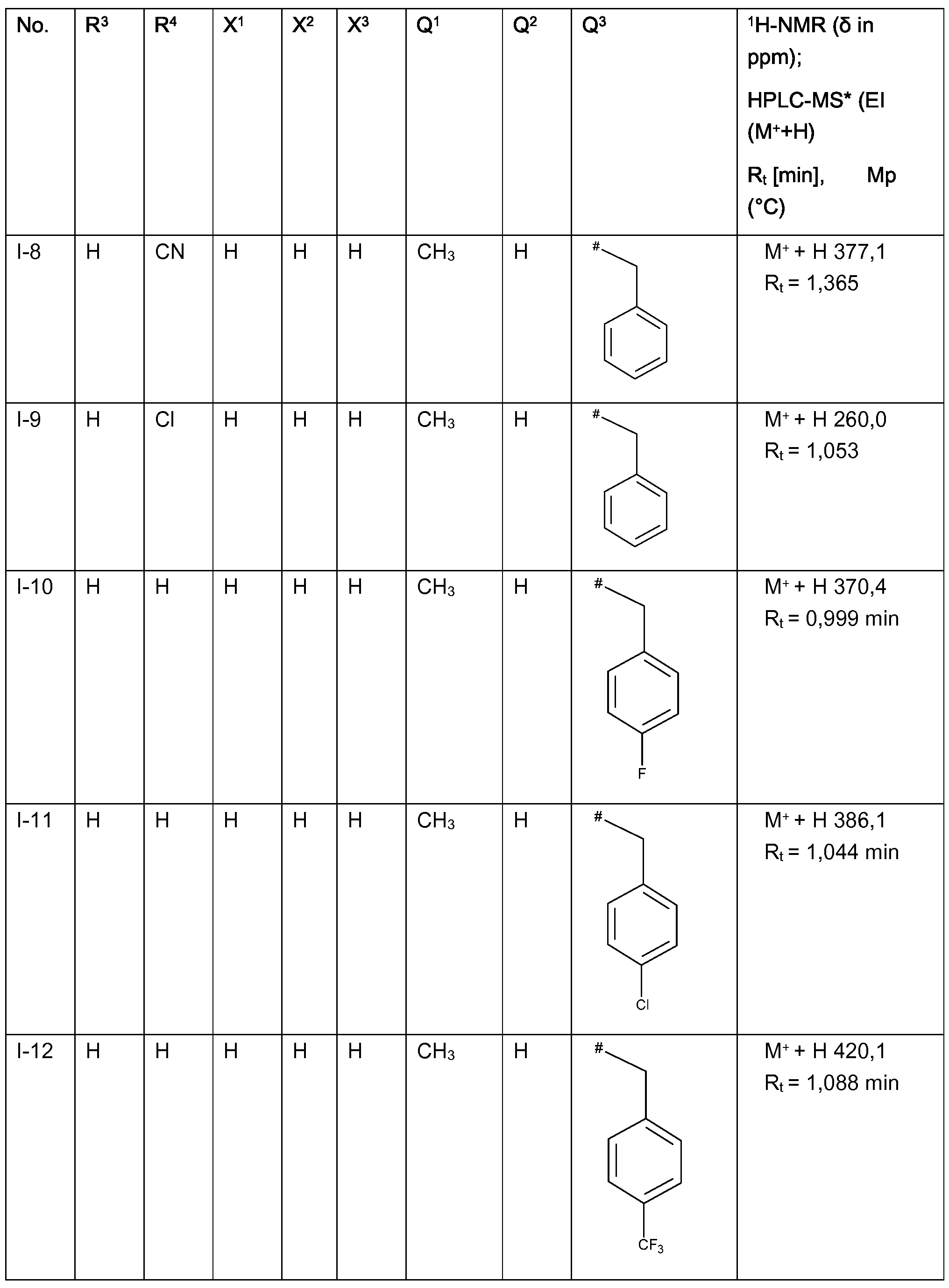
Particularly preferred embodiments of the heterocycles formed Q1 and Q2 and according to the invention are in Table P1 below, wherein each line of lines P3-1 to P3-15 corresponds to one particular embodiment of the invention, wherein P3-1 to P3-15 are also in any combination with one another a preferred embodiment of the present invention. The carbon atom, to which Q1 and Q2 are bound is marked with # in the drawings.
Table P1 :
is selected from H, Ci-C6-alkyl, C2-C6-alkenyl, C2-C6-alkynyl, C3-C6-cycloalkyl, five- or six- membered heteroaryl and aryl; wherein the heteroaryl contains one, two or three het- eroatoms selected from N, O and S;
wherein the aliphatic moieties of Q3 are unsubstituted or substituted with identical or different groups Q3a which independently of one another are selected from:
Q3a halogen, OH, CN, Ci-C6-alkoxy, C3-C6-cycloalkyl, C3-C6- halogencycloalkyl, Ci-C4-halogenalkoxy, Ci-C6-alkylthio, phenyl, phenoxy and five- to ten-membered heterocycle, heteroaryl, heterocycloxy, heteryloxy; wherein the heterocycle or heteroaryl contains one, two or three heteroatoms selected from N , O and S; wherein the phenyl, phenoxy, heterocycle and heteroaryl groups are unsubstituted or substituted with 1 , 2, 3, 4 or 5 substituents Q13a selected from the group consisting of halogen, OH, CrC4-alkyl, C1-C4- halogenalkyl, Ci-C4-alkoxy, Ci-C4-halogenalkoxy, CR'=NOR"; phenyl, phenoxy and five- to ten-membered heterocycle and heteroaryl; wherein the heterocycle or heteroaryl contains one, two or three heteroatoms selected from N, O and S; and wherein the phenyl, phenoxy, heterocycle and heteroaryl groups are unsubstituted or substituted with 1 , 2, 3, 4 or 5 substituents Q113a selected from the group consisting of halogen, OH, Ci-C4-alkyl, C1-C4- halogenalkyl, Ci-C4-alkoxy, CN, CR -NOR" and d-C4-halogenalkoxy;
wherein the cycloalkyl, heteroaryl and aryl moieties of Q3 are unsubstituted or substituted with 1 , 2, 3, 4, 5 or up to the maximum number of identical or different groups Q3b which independently of one another are selected from:
Q3b halogen, OH, CN, Ci-C6-alkoxy, C3-C6-cycloalkyl, C3-C6- halogencycloalkyl, Ci-C4-halogenalkoxy, Ci-C6-alkylthio, phenyl, phenoxy and five- to ten-membered heterocycle, heteroaryl, heterocycloxy, heteryloxy; wherein the heterocycle or heteroaryl contains one, two or three heteroatoms selected from N, O and S; wherein the phenyl, phenoxy, heterocycle and heteroaryl groups are unsubstituted or substituted with 1 , 2, 3, 4 or 5 substituents
Q13b selected from the group consisting of halogen, OH, Ci-C4-alkyl, C1-C4- halogenalkyl, Ci-C4-alkoxy, Ci-C4-halogenalkoxy, CR'=NOR"; phenyl, phe- noxy and five- to ten-membered heterocycle and heteroaryl; wherein the het- erocycle or heteroaryl contains one, two or three heteroatoms selected from N, O and S; and wherein the phenyl, phenoxy, heterocycle and heteroaryl groups are unsubstituted or substituted with 1 , 2, 3, 4 or 5 substituents Q113b selected from the group consisting of halogen, OH, Ci-C4-alkyl, Ci-C4-halogenalkyl, Ci- C4-alkoxy, CN, CR -NOR" and Ci-C4-halogenalkoxy;
and wherein R' and R" are independently unsubstituted or substituted by R'" which is independently selected from halogen, OH, CN, NO2, SH , NH2, NH(Ci- C4-alkyl), N(Ci-C4-alkyl)2, Ci-C6-alkyl, d-Ce-halogenalkyl, C2-C6-alkenyl, C2- C6-halogenalkenyl, C2-C6-alkynyl, C2-C6-halogenalkynyl, Ci-C6-alkoxy, C1-C6- halogenalkoxy, C3-C6-cycloalkyl, C3-C6-halogencycloalkyl and phenyl. According to a further specific embodiment, Q3 is H.
According to a further specific embodiment, Q3 is Ci-C6-alkyl, in particular Ci-C4-alkyl, such as
CH3.
According to a further specific embodiment, Q3 is Ci-C6-alkyl, in particular Ci-alkyl, substituted by phenyl which is unsubstitituted.
According to a further specific embodiment, Q3 is Ci-C6-alkyl, in particular Ci-alkyl, substituted by phenyl which carries 1 , 2 or 3 halogen.
According to a further specific embodiment, Q3 is Ci-C6-alkyl, in particular Ci-alkyl, substituted by phenyl which carries 1 , 2 or 3 Ci-C4-alkoxy groups.
According to a further specific embodiment, Q3 is Ci-C6-alkyl, in particular Ci-alkyl, substituted by phenyl which carries 1 , 2 or 3 Ci-C4-alkyl groups.
According to a further specific embodiment, Q3 is Ci-C6-alkyl, in particular Ci-alkyl, substituted by phenyl which carries 1 , 2 or 3 Ci-C4-halogenalkyl groups.
According to a further specific embodiment, Q3 is Ci-C6-alkyl, in particular Ci-alkyl, substituted by phenyl which carries a further phenyl group which can be unsubstituted or substituted by halogen or Ci-C4-alkyl. In one embodiment the phenyl is attached to phenyl directly. In one further embodiment the phenyl is attached to the phenyl via O.
According to a further specific embodiment, Q3 is Ci-C6-alkyl, in particular Ci-alkyl, substituted by phenoxy which carries a phenyl group which can be unsubstituted or substituted by halogen or Ci-C4-alkyl. In one embodiment the phenyl is attached to phenoxy directly. In one further em- bodiment the phenyl is attached to the phenyl via O.
According to a further specific embodiment of formula I, Q3 is Ci-C6-alkyl, especially CH2 subsitited by a 5-membered saturated heteroaryl which contains 1 , 2 or 3, in particular 1 or 2, heteroatoms from the group consisting of N, O and S as ring members.
According to a further specific embodiment of formula I, Q3 is Ci-C6-alkyl, especially CH2
subsitited by a 5-membered saturated heteroaryl which contains one N as ring member.
According to one embodiment thereof, the heteroaryl is unsubstituted, i.e. it does not carry any substituent Q13a. According to still another embodiment of formula I , it is substituted by Q13a.
According to a further specific embodiment of formula I , Q3 is Ci-C6-alkyl, especially Chb subsitited by a 5-membered saturated heteroaryl which contains two N as ring members.
According to one embodiment thereof, the heteroaryl is unsubstituted, i.e. it does not carry any substituent Q13a. According to still another embodiment of formula I , it is substituted by Q13a.
According to a further specific embodiment of formula I , Q3 is Ci-C6-alkyl, especially Chb subsitited by a 5-membered saturated heteroaryl which contains three N as ring members. According to one embodiment thereof, the heteroaryl is unsubstituted, i.e. it does not carry any substituent Q13a. According to still another embodiment of formula I , it is substituted by Q13a. According to one specific embodiment thereof, said 5-membered saturated heterocycle contains 1 or 2, in particular 1 , heteroatom(s) O.
According to a further specific embodiment of formula I , Q3 is Ci-C6-alkyl, especially Chb subsitited by a 5-membered saturated heteroaryl which contains one S as ring member.
According to one embodiment thereof, the heteroaryl is unsubstituted, i.e. it does not carry any substituent Q13a. According to still another embodiment of formula I , it is substituted by Q13a.
According to a further specific embodiment of formula I , Q3 is Ci-C6-alkyl, especially CH2 subsitited by a 5-membered saturated heteroaryl which contains one S and one N as ring mem- bers. According to one embodiment thereof, the heteroaryl is unsubstituted, i.e. it does not carry any substituent Q13a. According to still another embodiment of formula I, it is substituted by Q13a.
According to a further specific embodiment of formula I , Q3 is Ci-C6-alkyl, especially Chb subsitited by a 5-membered saturated heteroaryl which contains one S and two N as ring members. According to one embodiment thereof, the heteroaryl is unsubstituted, i.e. it does not carry any substituent Q13a. According to still another embodiment of formula I, it is substituted by Q13a.
According to a further specific embodiment of formula I , Q3 is Ci-C6-alkyl, especially CH2 subsitited by a 5-membered saturated heteroaryl which contains one oxygen and one N as ring members. According to one embodiment thereof, the heteroaryl is unsubstituted, i.e. it does not carry any substituent Q13a. According to still another embodiment of formula I , it is substituted by Q13a.
According to a further specific embodiment of formula I , Q3 is Ci-C6-alkyl, especially Chb subsitited by a 5-membered saturated heteroaryl which contains one oxygen and two N as ring members. According to one embodiment thereof, the heteroaryl is unsubstituted, i.e. it does not carry any substituent Q13a. According to still another embodiment of formula I , it is substituted by Q 3a.
According to a further specific embodiment of formula I , Q3 is Ci-C6-alkyl, especially Chb subsitited by a 6-membered saturated heteroaryl which contains 1 , 2 or 3, in particular 1 or 2, heteroatoms from the group consisting of N, O and S as ring members. According to one embodiment thereof, the heteroaryl is unsubstituted, i.e. it does not carry any substituent Q13a. According to still another embodiment of formula I , it is substituted by Q13a.
According to a further specific embodiment of formula I, Q3 is CrC6-alkyl, especially CH2 subsitited by a 6-membered saturated heteroaryl which one N as ring member. According to one embodiment thereof, the heteroaryl is unsubstituted, i.e. it does not carry any substituent Q13a. According to still another embodiment of formula I, it is substituted by Q13a.
According to a further specific embodiment of formula I, Q3 is Ci-C6-alkyl, especially Chb subsitited by a 6-membered saturated heteroaryl which two N as ring members. According to one embodiment thereof, the heteroaryl is unsubstituted, i.e. it does not carry any substituent Q13a. According to still another embodiment of formula I, it is substituted by Q13a.
According to a further specific embodiment of formula I, Q3 is Ci-C6-alkyl, especially CH2 subsitited by a 10-membered saturated heteroaryl which contains 1 , 2 or 3, in particular 1 or 2, heteroatoms from the group consisting of N, O and S as ring members. According to one embodiment thereof, the heteroaryl is unsubstituted, i.e. it does not carry any substituent Q13a. According to still another embodiment of formula I, it is substituted by Q13a. According to one specific embodiment thereof, said 10-membered saturated heterocycle contains 1 or 2, in par- ticular 1 , heteroatom(s) N.
According to a further specific embodiment of formula I, Q3 is Ci-C6-alkyl, especially Chb subsitited by a 10-membered saturated heteroaryl which one N as ring members. According to one embodiment thereof, the heteroaryl is unsubstituted, i.e. it does not carry any substituent Q13a. According to still another embodiment of formula I, it is substituted by Q13a.
According to still another embodiment of formula I, Q3 is Chb substituted by a 5-membered heteroaryl such as pyrrol-1-yl, pyrrol-2-yl, pyrrol-3-yl, thien-2-yl, thien-3-yl, furan-2-yl, furan-3-yl, pyrazol-1-yl, pyrazol-3-yl, pyrazol-4-yl, pyrazol-5-yl, imidazol-1 -yl, imidazol-2-yl, imidazol-4-yl, imidazol-5-yl, oxazol-2-yl, oxazol-4-yl, oxazol-5-yl, isoxazol-3-yl, isoxazol-4-yl, isoxazol-5-yl, thiazol-2-yl, thiazol-4-yl, thiazol-5-yl, isothiazol-3-yl, isothiazol-4-yl, isothiazol-5-yl, 1 ,2,4-triazolyl- 1-yl, 1 ,2,4-triazol-3-yl 1 ,2,4-triazol-5-yl, 1 ,2,4-oxadiazol-3-yl, 1 ,2,4-oxadiazol-5-yl and 1 ,2,4- thiadiazol-3-yl, 1 ,2,4-thiadiazol-5-yl.
According to still another embodiment of formula I, Q3 is Chb substituted by a 6-membered heteroaryl, such as pyridin-2-yl, pyridin-3-yl, pyridin-4-yl, pyridazin-3-yl, pyridazin-4-yl, pyrimidin-2- yl, pyrimidin-4-yl, pyrimidin-5-yl, pyrazin-2-yl and 1 ,3,5-triazin-2-yl and 1 ,2,4-triazin-3-yl.
According to a further specific embodiment, Q3 is Ci-C6-alkyl, in particular CH(CH3), substituted by phenyl which is unsubstitituted.
According to a further specific embodiment, Q3 is Ci-C6-alkyl, in particular CH(CH3), substituted by phenyl which carries 1 , 2 or 3 halogen.
According to a further specific embodiment, Q3 is Ci-C6-alkyl, in particular CH(CH3), substituted by phenyl which carries 1 , 2 or 3 Ci-C4-alkoxy groups.
According to a further specific embodiment, Q3 is Ci-C6-alkyl, in particular CH(CH3), substituted by phenyl which carries 1 , 2 or 3 Ci-C4-alkyl groups.
According to a further specific embodiment, Q3 is Ci-C6-alkyl, in particular CH(CH3), substituted by phenyl which carries 1 , 2 or 3 Ci-C4-halogenalkyl groups.
According to a further specific embodiment, Q3 is Ci-C6-halogenalkyl, in particular C1-C4-
halogenalkyl, such as CF3, CHF2, CH2F, CCI3, CHCI2 or CH2CI.
According to still a further embodiment, Q3 is C2-C6-alkenyl or C2-C6-halogenalkenyl, in particular C2-C4-alkenyl or C2-C4-halogenalkenyl, such as CH=CH2.
According to still a further embodiment, Q3 is C2-C6-alkynyl or C2-C6-halogenalkynyl, in particular C2-C4-alkynyl or C2-C4-halogenalkynyl, such as C CH.
According to a further specific embodiment Q3 is C3-C6-cycloalkyl, in particular cyclopropyl.
In a further specific embodiment, Q3 is C3-C6-cycloalkyl, for example cyclopropyl, substituted by one, two, three or up to the maximum possible number of identical or different groups Q1 b as defined and preferably herein.
According to a specific embodiment Q3 is C3-C6-halogencycloalkyl. In a special embodiment Q1 is fully or partially halogenated cyclopropyl.
According to still a further specific embodiment, Q3 is unsubstituted aryl or aryl that is
substituted by one, two, three or four Q3b, as defined herein. In particular, Q3 is unsubstituted phenyl or phenyl that is substituted by one, two, three or four Q3b, as defined herein.
According to still a further specific embodiment, Q3 is unsubstituted 5- or 6-membered heteroaryl. According to still a further embodiment, Q3 is 5- or 6-membered heteroaryl that is substituted by one, two or three Q3b, as defined herein.
According to a further specific embodiment, Q3 is Ci-C6-alkyl, in particular Ci-alkyl, substituted by phenyl which carries a further phenyl group which can be unsubstituted or substituted by halogen or Ci-C4-alkyl. In one embodiment the phenyl is attached to phenyl directly. In one further embodiment the phenyl is attached to the phenyl via O.
According to a further specific embodiment, Q3 is Ci-C6-alkyl, in particular Ci-alkyl, substituted by phenoxy which carries a phenyl group which can be unsubstituted or substituted by halogen or Ci-C4-alkyl. In one embodiment the phenyl is attached to phenoxy directly. In one further em- bodiment the phenyl is attached to the phenyl via O.
According to a further specific embodiment of formula I , Q3 is Ci-C6-alkyl, especially CH2 subsitited by a 5-membered saturated heteroaryl which contains 1 , 2 or 3, in particular 1 or 2, heteroatoms from the group consisting of N, O and S as ring members.
According to a further specific embodiment of formula I , Q3 is Ci-C6-alkyl, especially CH2 subsitited by a 5-membered saturated heteroaryl which contains one N as ring member.
According to one embodiment thereof, the heteroaryl is unsubstituted, i.e. it does not carry any substituent Q13b. According to still another embodiment of formula I , it is substituted by Q13b.
According to a further specific embodiment of formula I , Q3 is Ci-C6-alkyl, especially CH2 subsitited by a 5-membered saturated heteroaryl which contains two N as ring members.
According to one embodiment thereof, the heteroaryl is unsubstituted, i.e. it does not carry any substituent Q13b. According to still another embodiment of formula I , it is substituted by Q13b.
According to a further specific embodiment of formula I , Q3 is Ci-C6-alkyl, especially CH2 subsitited by a 5-membered saturated heteroaryl which contains three N as ring members. According to one embodiment thereof, the heteroaryl is unsubstituted, i.e. it does not carry any
substituent Q13b. According to still another embodiment of formula I , it is substituted by Q13b. According to one specific embodiment thereof, said 5-membered saturated heterocycle contains 1 or 2, in particular 1 , heteroatom(s) O.
According to a further specific embodiment of formula I , Q3 is Ci-C6-alkyl, especially Chb subsitited by a 5-membered saturated heteroaryl which contains one S as ring member.
According to one embodiment thereof, the heteroaryl is unsubstituted, i.e. it does not carry any substituent Q13b. According to still another embodiment of formula I , it is substituted by Q13b.
According to a further specific embodiment of formula I , Q3 is Ci-C6-alkyl, especially Chb subsitited by a 5-membered saturated heteroaryl which contains one S and one N as ring mem- bers. According to one embodiment thereof, the heteroaryl is unsubstituted, i.e. it does not carry any substituent Q13b. According to still another embodiment of formula I, it is substituted by Q13b.
According to a further specific embodiment of formula I , Q3 is Ci-C6-alkyl, especially Chb subsitited by a 5-membered saturated heteroaryl which contains one S and two N as ring members. According to one embodiment thereof, the heteroaryl is unsubstituted, i.e. it does not carry any substituent Q13b. According to still another embodiment of formula I, it is substituted by Q13b.
According to a further specific embodiment of formula I , Q3 is Ci-C6-alkyl, especially Chb subsitited by a 5-membered saturated heteroaryl which contains one oxygen and one N as ring members. According to one embodiment thereof, the heteroaryl is unsubstituted, i.e. it does not carry any substituent Q13b. According to still another embodiment of formula I , it is substituted by Q13 .
According to a further specific embodiment of formula I , Q3 is Ci-C6-alkyl, especially Chb subsitited by a 5-membered saturated heteroaryl which contains one oxygen and two N as ring members. According to one embodiment thereof, the heteroaryl is unsubstituted, i.e. it does not carry any substituent Q13b. According to still another embodiment of formula I , it is substituted by Q13 .
According to a further specific embodiment of formula I , Q3 is Ci-C6-alkyl, especially CH2 subsitited by a 6-membered saturated heteroaryl which contains 1 , 2 or 3, in particular 1 or 2, heteroatoms from the group consisting of N, O and S as ring members. According to one embodiment thereof, the heteroaryl is unsubstituted, i.e. it does not carry any substituent Q13b. According to still another embodiment of formula I , it is substituted by Q13b.
According to a further specific embodiment of formula I , Q3 is Ci-C6-alkyl, especially Chb subsitited by a 6-membered saturated heteroaryl which one N as ring member. According to one embodiment thereof, the heteroaryl is unsubstituted, i.e. it does not carry any substituent Q13b. According to still another embodiment of formula I , it is substituted by Q13b.
According to a further specific embodiment of formula I , Q3 is Ci-C6-alkyl, especially Chb subsitited by a 6-membered saturated heteroaryl which two N as ring members. According to one embodiment thereof, the heteroaryl is unsubstituted, i.e. it does not carry any substituent Q13b. According to still another embodiment of formula I , it is substituted by Q13b.
According to a further specific embodiment of formula I , Q3 is Ci-C6-alkyl, especially Chb subsitited by a 10-membered saturated heteroaryl which contains 1 , 2 or 3, in particular 1 or 2,
heteroatoms from the group consisting of N, O and S as ring members. According to one embodiment thereof, the heteroaryl is unsubstituted, i.e. it does not carry any substituent Q13b. According to still another embodiment of formula I, it is substituted by Q13b. According to one specific embodiment thereof, said 10-membered saturated heterocycle contains 1 or 2, in par- ticular 1 , heteroatom(s) N.
According to a further specific embodiment of formula I, Q3 is Ci-C6-alkyl, especially Chb subsitited by a 10-membered saturated heteroaryl which one N as ring members. According to one embodiment thereof, the heteroaryl is unsubstituted, i.e. it does not carry any substituent Q13b. According to still another embodiment of formula I, it is substituted by Q13b.
According to still another embodiment of formula I, Q3 is CH2 substituted by a 5-membered heteroaryl such as pyrrol-1-yl, pyrrol-2-yl, pyrrol-3-yl, thien-2-yl, thien-3-yl, furan-2-yl, furan-3-yl, pyrazol-1-yl, pyrazol-3-yl, pyrazol-4-yl, pyrazol-5-yl, imidazol-1 -yl, imidazol-2-yl, imidazol-4-yl, imidazol-5-yl, oxazol-2-yl, oxazol-4-yl, oxazol-5-yl, isoxazol-3-yl, isoxazol-4-yl, isoxazol-5-yl, thiazol-2-yl, thiazol-4-yl, thiazol-5-yl, isothiazol-3-yl, isothiazol-4-yl, isothiazol-5-yl, 1 ,2,4-triazolyl- 1-yl, 1 ,2,4-triazol-3-yl 1 ,2,4-triazol-5-yl, 1 ,2,4-oxadiazol-3-yl, 1 ,2,4-oxadiazol-5-yl and 1 ,2,4- thiadiazol-3-yl, 1 ,2,4-thiadiazol-5-yl.
According to still another embodiment of formula I, Q3 is CH2 substituted by a 6-membered heteroaryl, such as pyridin-2-yl, pyridin-3-yl, pyridin-4-yl, pyridazin-3-yl, pyridazin-4-yl, pyrimidin-2- yl, pyrimidin-4-yl, pyrimidin-5-yl, pyrazin-2-yl and 1 ,3,5-triazin-2-yl and 1 ,2,4-triazin-3-yl. bbQ3a are the possible substituents for the aliphatic moieties of OA
Q3a according to the invention is independently selected from halogen, OH, CN, Ci-C6-alkoxy, C3-C6-cycloalkyl, C3-C6-halogencycloalkyl, Ci-C4-halogenalkoxy, Ci-C6-alkylthio, phenyl, phe- noxy and five- to ten-membered heterocycle, heteroaryl, heterocycloxy, heteryloxy; wherein the heterocycle or heteroaryl contains one, two or three heteroatoms selected from N, O and S; wherein the phenyl, phenoxy, heterocycle and heteroaryl groups are unsubstituted or substituted with 1 , 2, 3, 4 or 5 substituents Q13a selected from the group consisting of halogen, OH, Ci- C4-alkyl, Ci-C4-halogenalkyl, Ci-C4-alkoxy, Ci-C4-halogenalkoxy, CR -NOR"; phenyl, phenoxy and five- to ten-membered heterocycle and heteroaryl; wherein the heterocycle or heteroaryl contains one, two or three heteroatoms selected from N, O and S; and wherein the phenyl, phenoxy, heterocycle and heteroaryl groups are unsubstituted or substituted with 1 , 2, 3, 4 or 5 substituents Q113a selected from the group consisting of halogen, OH, Ci-C4-alkyl, C1-C4- halogenalkyl, C C4-alkoxy, CN, CR -NOR" and Ci-C4-halogenalkoxy. In particular Q3a is selected from halogen, Ci-C2-alkyl, Ci-C2-halogenalkyl, Ci-C2-alkoxy and Ci- C2-halogenalkoxy, phenyl, phenoxy and five- to ten-membered heterocycle and heteroaryl.According to one embodiment Q3a is independently selected from halogen, OH, CN, Ci-C2-alkoxy, C3-C6-cycloalkyl, C3-C6-halogencycloalkyl and Ci-C2-halogenalkoxy. Specifically, Q3a is independently selected from F, CI, OH, CN, Ci-C2-alkoxy, cyclopropyl, 1-F-cyclopropyl, 1 - CI-cyclopropyl,Ci-C2-halogenalkoxy, phenyl and five- to ten-membered heterocycle and heteroaryl.
According to one particular embodiment Q3a is independently selected from halogen, such as F, CI, Br and I, more specifically F, CI and Br.
According to a further embodiment, Q3a is independently selected from OH, C3-C6-cycloalkyl, C3-C6-halogencycloalkyl, Ci-C2-halogenalkoxy, phenyl and five- to ten-membered heterocycle and heteroaryl. Specifically, Q3a is independently selected from OH, cyclopropyl and C1-C2- halogenalkoxy.
According to one embodiment Q3a is independently selected from halogen, OH, CN, C1-C2- alkoxy, C3-C6-cycloalkyl, C3-C6-halogencycloalkyl and Ci-C2-halogenalkoxy. Specifically, Q3a is independently selected from F, CI, OH, CN, Ci-C2-alkoxy, cyclopropyl, 1 -F-cyclopropyl, 1-CI- cyclopropyl, Ci-C2-halogenalkoxy, phenyl, five- and sex-membered heteroaryl.
According to one embodiment Q3a is independently selected from halogen, OH, CN, C1-C2- alkoxy, C3-C6-cycloalkyl, C3-C6-halogencycloalkyl, Ci-C2-halogenalkoxy, phenyl and five- to ten- membered heterocycle and heteroaryl. Specifically, Q3a is independently selected from F, CI, OH, CN, Ci-C2-alkoxy, cyclopropyl, 1 -F-cyclopropyl, 1 -CI-cyclopropyl, Ci-C2-halogenalkoxy, phenyl, five- and sex-membered heteroaryl.
In the embodiments in which Q3a phenyl, phenoxy, heterocycle and heteroaryl groups, these groups are unsubstituted or substituted with 1 , 2, 3, 4 or 5 substituents Q13a selected from the group consisting of halogen, OH, Ci-C4-alkyl, Ci-C4-halogenalkyl, Ci-C4-alkoxy, C1-C4- halogenalkoxy; phenyl, phenoxy and five- to ten-membered heterocycle and heteroaryl; wherein the heterocycle or heteroaryl contains one, two or three heteroatoms selected from N, O and S; and wherein the phenyl, phenoxy, heterocycle and heteroaryl groups can be attached directly to Q3a or via O; and wherein the phenyl, phenoxy, heterocycle and heteroaryl groups are unsubstituted or substituted with 1 , 2, 3, 4 or 5 substituents Q113a selected from the group consisting of halogen, OH, Ci-C4-alkyl, Ci-C4-halogenalkyl, Ci-C4-alkoxy and Ci-C4-halogenalkoxy.
Q3b are the possible substituents for the cycloalkyl, heteroaryl and aryl moieties of Q3.
Q3b according to the invention is independently selected from halogen, OH, CN, Ci-C4-alkyl, Ci- C4-alkoxy, Ci-C4-halogenalkyl, C3-C6-cycloalkyl, C3-C6-halogencycloalkyl and C1-C4- halogenalkoxy.
According to one embodiment thereof Q3b is independently selected from halogen, CN, C1-C2- alkyl, Ci-C2-alkoxy, Ci-C2-halogenalkyl, C3-C6-cycloalkyl, C3-C6-halogencycloalkyl and C1-C2- halogenalkoxy. Specifically, Q3b is independently selected from F, CI, OH, CN, CH3, OCH3, cyclopropyl, 1-F-cyclopropyl, 1-CI-cyclopropyl and halogenmethoxy.
According to a further embodiment thereof Q3b is independently selected from Ci-C2-alkyl, Ci- C2-alkoxy, Ci-C2-halogenalkyl, C3-C6-cycloalkyl, C3-C6-halogencycloalkyl and C1-C2- halogenalkoxy. Specifically, Q3b is independently selected from OH, CH3, OCH3, cyclopropyl, 1- F-cyclopropyl, 1 -CI-cyclopropyl and halogenmethoxy, more specifically independently selected from OH, CH3, OCH3, cyclopropyl, 1 -F-cyclopropyl, 1-CI-cyclopropyl and OCH F2.
Particularly preferred embodiments of Q3 according to the invention are in Table P4 below, wherein each line of lines Q3-1 to Q3-180 corresponds to one particular embodiment of the in-
vention, wherein Q3-1 to Q3-180 are also in any combination with one another a preferred embodiment of the present invention. The connection point to the W group, to which Q3 is bound is marked with "#" in the drawings. Table Q3:
According to one embodiment of the invention W is O.
According to one further embodiment of the invention W is S.
X1 according to the invention is is in each case independently selected from H, halogen, OH, CN, Ci-C4-alkyl, Ci-C4-alkoxy, Ci-C4-halogenalkyl, C3-C6-cycloalkyl, C3-C6-halogencycloalkyl, Ci-C4-halogenalkoxy and Ci-C6-alkylthio.
X1 according to the invention is in each case independently selected from H, halogen, CN, Ci- C4-alkyl, Ci-C4-halogenalkyl.
According to one specific embodiment, X1 ist H.
According to a further specific embodiment X1 is halogen, in particular Br, F or CI, more specifically F or CI.
According to a further specific embodiment, X1 is CN.
According to a further specific embodiment, X1 is Ci-C6-alkyl, in particular Ci-C4-alkyl, such as CHs.
According to a further specific embodiment, X1 is Ci-C6-alkoxy, in particular Ci-C4-alkoxy, more specifically Ci-C2-alkoxy such as OCH3 or OCH2CH3.
According to a further specific embodiment, X1 is Ci-C6-halogenalkyl, in particular C1-C4- halogenalkyl, such as CF3, CHF2, CH2F, CCI3, CHCI2 or CH2CI.
According to a further specific embodiment X1 is C3-C6-cycloalkyl, in particular cyclopropyl.
In a further specific embodiment, X1 is C3-C6-cycloalkyl, for example cyclopropyl, substituted by one, two, three or up to the maximum possible number of identical or different groups R1b as defined and preferably herein.
According to a specific embodiment X1 is C3-C6-halogencycloalkyl. In a special embodiment R1 is fully or partially halogenated cyclopropyl.
According to a further specific embodiment, X1 is Ci-C6-halogenalkoxy, in particular C1-C4- halogenalkoxy, more specifically Ci-C2-halogenalkoxy such as OCF3, OCHF2, OCH2F, OCCI3, OCHCI2 or OCH2CI, in particular OCF3, OCHF2, OCCI3 or OCHCI2.
According to a further specific embodiment, X1 is selected from H, F, CI, CN, CH3, CF3'.
X2 according to the invention is is in each case independently selected from H, halogen, OH, CN, Ci-C4-alkyl, Ci-C4-alkoxy, Ci-C4-halogenalkyl, C3-C6-cycloalkyl, C3-C6-halogencycloalkyl, Ci-C4-halogenalkoxy and Ci-C6-alkylthio.
X2 according to the invention is in each case independently selected from H, halogen, CN, Ci- C4-alkyl, Ci-C4-halogenalkyl.
According to one specific embodiment, X2 ist H.
According to a further specific embodiment X2 is halogen, in particular Br, F or CI, more specifically F or CI.
According to a further specific embodiment, X2 is CN.
According to a further specific embodiment, X2 is Ci-C6-alkyl, in particular Ci-C4-alkyl, such as CH3.
According to a further specific embodiment, X2 is Ci-C6-alkoxy, in particular Ci-C4-alkoxy, more specifically Ci-C2-alkoxy such as OCH3 or OCH2CH3.
According to a further specific embodiment, X2 is Ci-C6-halogenalkyl, in particular C1-C4- halogenalkyl, such as CF3, CHF2, CH2F, CCI3, CHCI2 or CH2CI.
According to a further specific embodiment X2 is C3-C6-cycloalkyl, in particular cyclopropyl.
In a further specific embodiment, X2 is C3-C6-cycloalkyl, for example cyclopropyl, substituted by one, two, three or up to the maximum possible number of identical or different groups R1b as defined and preferably herein.
According to a specific embodiment X2 is C3-C6-halogencycloalkyl. In a special embodiment R1 is fully or partially halogenated cyclopropyl.
According to a further specific embodiment, X2 is Ci-C6-halogenalkoxy, in particular C1-C4- halogenalkoxy, more specifically Ci-C2-halogenalkoxy such as OCF3, OCHF2, OCH2F, OCC , OCHCI2 or OCH2CI, in particular OCF3, OCHF2, OCCb or OCHCI2.
According to a further specific embodiment, X1 is selected from H, F, CI, CN, CH3, CF3'.
X3 according to the invention is is in each case independently selected from H, halogen, OH, CN, Ci-C4-alkyl, Ci-C4-alkoxy, Ci-C4-halogenalkyl, C3-C6-cycloalkyl, C3-C6-halogencycloalkyl, Ci-C4-halogenalkoxy and Ci-C6-alkylthio.
X3 according to the invention is in each case independently selected from H, halogen, CN, Ci- C4-alkyl, Ci-C4-halogenalkyl.
According to one specific embodiment, X3 ist H.
According to a further specific embodiment X3 is halogen, in particular Br, F or CI, more specifically F or CI.
According to a further specific embodiment, X3 is CN.
According to a further specific embodiment, X3 is Ci-C6-alkyl, in particular Ci-C4-alkyl, such as CH3.
According to a further specific embodiment, X3 is Ci-C6-alkoxy, in particular Ci-C4-alkoxy, more specifically Ci-C2-alkoxy such as OCH3 or OCH2CH3.
According to a further specific embodiment, X3 is Ci-C6-halogenalkyl, in particular C1-C4- halogenalkyl, such as CF3, CHF2, CH2F, CCI3, CHCI2 or CH2CI.
According to a further specific embodiment X3 is C3-C6-cycloalkyl, in particular cyclopropyl.
In a further specific embodiment, X3 is C3-C6-cycloalkyl, for example cyclopropyl, substituted by one, two, three or up to the maximum possible number of identical or different groups R1b as defined and preferably herein.
According to a specific embodiment X3 is C3-C6-halogencycloalkyl. In a special embodiment R1 is fully or partially halogenated cyclopropyl.
According to a further specific embodiment, X3 is Ci-C6-halogenalkoxy, in particular C1-C4- halogenalkoxy, more specifically Ci-C2-halogenalkoxy such as OCF3, OCHF2, OCH2F, OCCI3, OCHCI2 or OCH2CI, in particular OCF3, OCHF2, OCCb or OCHCI2.
According to a further specific embodiment, X
3 is selected from H, F, CI, CN, CH
3,
According to the invention if
X , X2 and X3 is H
Q3 is not H and CH3.
In a one specific embodiment if
Preferred embodiments of the present invention are the following compounds I.A, I.B, I.C, I.D, I.E, I.F, I.Gand I.H In these formulae, the substituents R1 R2, R3, R4, Q3 X and n are inde- endently as defined or preferably defined herein:
I.G I.H
Preferred embodiments of the present invention are the following compounds I.A-1 to I.A-6, I.B- 1 to I.B-6, I.C-1 to I.C-6, I.D-1 to I.D-6, I.E-1 to I.E-6, I.F-1 to I.F-6, I.G-1 to I.G-6, I.H-1 to I.H-6. In these formulae, the substituents R1,R2, R3, R4, Q3 X and n are independently as defined or preferably defined herein:
I.G-1 I.H-1
I.G-2 I.H-2
I.G-3 I.H-3
I.G-4 I.H-4
I.G-5 I.H-5
In particular with a view to their use, according to one embodiment, preference is given to the compounds of the formula I.A-1 to I.A-6, I.B-1 to I.B-6, I.C-1 to I.C-6, I.D-1 to I.D-6, I.E-1 to I.E- 6, I.F-1 to I.F-6, I.G-1 to I.G-6 and I.H-1 to I.H-6 that are compiled in the Tables 1 a to 41 a. Each of the groups mentioned for a substituent in the tables is furthermore per se, independently of the combination in which it is mentioned, a particularly preferred aspect of the substituent in question.
Table 1 a
Compounds of the formula I.A-1 , I.B-1 , I.C-1 , I.D-1 , I.E-1 , I.F-1 , I.G-1 , I.H-1 ; I.A-2, I.B-2, I.C-2, I.D-2, I.E-2, I.F-2, I.G-2, I-H.2; I.A-3, I.B-3, I.C-3, I.D-3, I.E-3, I.F-3, I.G-3, l-H.3;I.A-4, I.B-4, I.C- 4, I.D-4, I.E-4, I.F-4, I.G-4, I-H.4; I.A-5, I.B-5, I.C-5, I.D-5, I.E-5, I.F-5, I.G-5, I-H.5; I.A-6, I.B-6, I.C-6, I.D-6, I.E-6, I.F-6, I.G-6, I-H.6;
in which Q3 is as defined in line X-1 of Table X and the meaning for the combination of X1, X2, X3 and R3 for each individual compound corresponds in each case to one line of Table A
(compounds I. A-1. X-1. A-1 to I. A-1 .X-1 .A-750; compounds I.B-1 .X-1.A-1 to I. B-1 .X-1 .A-750; compounds I.C-1.X-1.A-1 to I.C-1.X-1.A-750; compounds I.D-1 .X-1 .A-1 to I.D-1.X-1.A-750; compounds I.E-1 .X-1 .A-1 to I.E-1 .X-1 .A-750; compounds I.F-1 .X-1 .A-1 to I.F-1. X-1. A-750; compounds I.G-1.X-1.A-1 to I. G-1. X-1. A-750; compounds I.H-1.X-1.A-1 to I. H-1 .X-1 .A-750;
compounds I.A-2.X-1 .A-1 to I.A-2.X-1 .A-750; compounds I.B-2.X-1 .A-1 to I.B-2.X-1 .A-750; compounds I.C-2.X-1.A-1 to I.C-2.X-1.A-750; compounds I.D-2.X-1 .A-1 to I.D-2.X-1.A-750; compounds I.E-2.X-1 .A-1 to I.E-2.X-1 .A-750; compounds I.F-2.X-1 .A-1 to I.F-2.X-1.A-750; com- pounds I.G-2.X-1.A-1 to I.G-2.X-1.A-750; compounds I.H-2.X-1.A-1 to I.H-2.X-1 .A-750;
compounds I.A-3.X-1 .A-1 to I.A-3.X-1 .A-750; compounds I.B-3.X-1 .A-1 to I.B-3.X-1 .A-750; compounds I.C-3.X-1.A-1 to I.C-3.X-1.A-750; compounds I.D-3.X-1 .A-1 to I.D-3.X-1.A-750; compounds I.E-3.X-1 .A-1 to I.E-3.X-1 .A-750; compounds I.F-3.X-1 .A-1 to I.F-3.X-1.A-750; compounds I.G-3.X-1.A-1 to I.G-3.X-1.A-750; compounds I.H-3.X-1.A-1 to I.H-3.X-1 .A-750;
compounds I.A-4.X-1 .A-1 to I.A-4.X-1 .A-750; compounds I.B-4.X-1 .A-1 to I.B-4.X-1 .A-750; compounds I.C-4.X-1.A-1 to I.C-4.X-1.A-750; compounds I.D-4.X-1 .A-1 to I.D-4.X-1.A-750; compounds I.E-4.X-1 .A-1 to I.E-4.X-1 .A-750; compounds I.F-4.X-1 .A-1 to I.F-4.X-1.A-750; compounds I.G-4.X-1.A-1 to I.G-4.X-1.A-750; compounds I.H-4.X-1.A-1 to I.H-4.X-1 .A-750;
compounds I.A-5.X-1 .A-1 to I.A-5.X-1 .A-750; compounds I.B-5.X-1 .A-1 to I.B-5.X-1 .A-750; compounds I.C-5.X-1.A-1 to I.C-5.X-1.A-750; compounds I.D-5.X-1 .A-1 to I.D-5.X-1.A-750; compounds I.E-5.X-1 .A-1 to I.E-5.X-1 .A-750; compounds I.F-5.X-1 .A-1 to I.F-5.X-1.A-750; compounds I.G-5.X-1.A-1 to I.G-5.X-1.A-750; compounds I.H-5.X-1.A-1 to I.H-5.X-1 .A-750;
compounds I.A-6.X-1 .A-1 to I.A-6.X-1 .A-750; compounds I.B-6.X-1 .A-1 to I.B-6.X-1 .A-750; compounds I.C-6.X-1.A-1 to I.C-6.X-1.A-750; compounds I.D-6.X-1 .A-1 to I.D-6.X-1.A-750; compounds I.E-6.X-1 .A-1 to I.E-6.X-1 .A-750; compounds I.F-6.X-1 .A-1 to I.F-6.X-1.A-750; compounds I.G-6.X-1.A-1 to I.G-6.X-1.A-750; compounds I.H-6.X-1.A-1 to I.H-6.X-1 .A-750).
Table 2a
Compounds of the formula I.A-1 , I. B-1 , I.C-1 , I.D-1 , I.E-1 , I.F-1 , I. G-1 , I. H-1 ; I.A-2, I.B-2, I.C-2, I.D-2, I.E-2, I.F-2, I.G-2, I-H.2; I.A-3, I.B-3, I.C-3, I.D-3, I.E-3, I.F-3, I.G-3, l-H.3;I.A-4, I.B-4, I.C- 4, I.D-4, I.E-4, I.F-4, I.G-4, I-H.4; I.A-5, I.B-5, I.C-5, I.D-5, I.E-5, I.F-5, I.G-5, I-H.5; I.A-6, I.B-6, I.C-6, I.D-6, I.E-6, I.F-6, I.G-6, I-H.6;
in which Q3 is as defined in line X-2 of Table X and the meaning for the combination of X1, X2, X3 and R3 for each individual compound corresponds in each case to one line of Table A
(compounds I.A-1.X-2.A-1 to I.A-1 .X-2.A-750; compounds I. B-1 .X-2.A-1 to I. B-1 .X-2.A-750; compounds I.C-1.X-2.A-1 to I.C-1.X-2.A-750; compounds I.D-1 .X-2.A-1 to I.D-1.X-2.A-750; compounds I.E-1 .X-2.A-1 to I.E-1 .X-2.A-750; compounds I.F-1 .X-2.A-1 to I.F-1.X-2.A-750; compounds I.G-1.X-2.A-1 to I.G-1.X-2.A-750; compounds I.H-1.X-2.A-1 to I. H-1 .X-2.A-750;
compounds I.A-2.X-2.A-1 to I.A-2. X-2.A-750; compounds I.B-2.X-2.A-1 to I.B-2.X-2.A-750; compounds I.C-2.X-2.A-1 to I.C-2.X-2.A-750; compounds I.D-2.X-2.A-1 to I.D-2.X-2.A-750;
compounds I.E-2.X-2.A-1 to I.E-2.X-2.A-750; compounds I.F-2.X-2.A-1 to I.F-2.X-2.A-750; compounds I.G-2.X-2.A-1 to I.G-2.X-2.A-750; compounds I.H-2.X-2.A-1 to I.H-2.X-2.A-750;
compounds I.A-3.X-2.A-1 to I.A-3.X-2.A-750; compounds I.B-3.X-2.A-1 to I.B-3.X-2.A-750; compounds I.C-3.X-2.A-1 to I.C-3.X-2.A-750; compounds I.D-3.X-2.A-1 to I.D-3.X-2.A-750; compounds I.E-3.X-2.A-1 to I.E-3.X-2.A-750; compounds I.F-3.X-2.A-1 to I.F-3.X-2.A-750; compounds I.G-3.X-2.A-1 to I.G-3.X-2.A-750; compounds I.H-3.X-2.A-1 to I.H-3.X-2.A-750;
compounds I.A-4.X-2.A-1 to I.A-4.X-2.A-750; compounds I.B-4.X-2.A-1 to I.B-4.X-2.A-750; compounds I.C-4.X-2.A-1 to I.C-4.X-2.A-750; compounds I.D-4.X-2.A-1 to I.D-4.X-2.A-750; compounds I.E-4.X-2.A-1 to I.E-4.X-2.A-750; compounds I.F-4.X-2.A-1 to I.F-4.X-2.A-750; com- pounds I.G-4.X-2.A-1 to I.G-4.X-2.A-750; compounds I.H-4.X-2.A-1 to I.H-4.X-2.A-750;
compounds I.A-5.X-2.A-1 to I.A-5.X-2.A-750; compounds I.B-5.X-2.A-1 to I.B-5.X-2.A-750; compounds I.C-5.X-2.A-1 to I.C-5.X-2.A-750; compounds I.D-5.X-2.A-1 to I.D-5.X-2.A-750; compounds I.E-5.X-2.A-1 to I.E-5.X-2.A-750; compounds I.F-5.X-2.A-1 to I.F-5.X-2.A-750; compounds I.G-5.X-2.A-1 to I.G-5.X-2.A-750; compounds I.H-5.X-2.A-1 to I.H-5.X-2.A-750;
compounds I.A-6.X-2.A-1 to I.A-6.X-2.A-750; compounds I.B-6.X-2.A-1 to I.B-6.X-2.A-750; compounds I.C-6.X-2.A-1 to I.C-6.X-2.A-750; compounds I.D-6.X-2.A-1 to I.D-6.X-2.A-750; compounds I.E-6.X-2.A-1 to I.E-6.X-2.A-750; compounds I.F-6.X-2.A-1 to I.F-6.X-2.A-750; compounds I.G-6.X-2.A-1 to I.G-6.X-2.A-750; compounds I.H-6.X-2.A-1 to I.H-6.X-2.A-750).
Table 3a
Compounds of the formula I.A-1 , I.B-1 , I.C-1 , I.D-1 , I.E-1 , I.F-1 , I.G-1 , I.H-1 ; I.A-2, I.B-2, I.C-2, I.D-2, I.E-2, I.F-2, I.G-2, I-H.2; I.A-3, I.B-3, I.C-3, I.D-3, I.E-3, I.F-3, I.G-3, l-H.3;I.A-4, I.B-4, I.C- 4, I.D-4, I.E-4, I.F-4, I.G-4, I-H.4; I.A-5, I.B-5, I.C-5, I.D-5, I.E-5, I.F-5, I.G-5, I-H.5; I.A-6, I.B-6, I.C-6, I.D-6, I.E-6, I.F-6, I.G-6, I-H.6;
in which Q3 is as defined in line X-3 of Table X and the meaning for the combination of X1, X2, X3 and R3 for each individual compound corresponds in each case to one line of Table A
(compounds I.A-1.X-3.A-1 to I.A-1 .X-3.A-750; compounds I.B-1 .X-3.A-1 to I.B-1 .X-3.A-750; compounds I.C-1.X-3.A-1 to I.C-1.X-3.A-750; compounds I.D-1 .X-3.A-1 to I.D-1.X-3.A-750; compounds I.E-1 .X-3.A-1 to I.E-1 .X-3.A-750; compounds I.F-1 .X-3.A-1 to I.F-1.X-3.A-750; compounds I.G-1.X-3.A-1 to I.G-1.X-3.A-750; compounds I.H-1.X-3.A-1 to I.H-1 .X-3.A-750;
compounds I.A-2.X-3.A-1 to I.A-2. X-3.A-750; compounds I.B-2.X-3.A-1 to I.B-2.X-3.A-750; compounds I.C-2.X-3.A-1 to I.C-2.X-3.A-750; compounds I.D-2.X-3.A-1 to I.D-2.X-3.A-750; compounds I.E-2.X-3.A-1 to I.E-2. X-3.A-750; compounds I.F-2.X-3.A-1 to I.F-2.X-3.A-750; compounds I.G-2.X-3.A-1 to I.G-2.X-3.A-750; compounds I.H-2.X-3.A-1 to I. H-2. X-3.A-750;
compounds I.A-3.X-3.A-1 to I.A-3. X-3.A-750; compounds I.B-3.X-3.A-1 to I.B-3.X-3.A-750; compounds I.C-3.X-3.A-1 to I.C-3.X-3.A-750; compounds I.D-3.X-3.A-1 to I.D-3.X-3.A-750; compounds I.E-3.X-3.A-1 to I.E-3. X-3.A-750; compounds I.F-3.X-3.A-1 to I.F-3.X-3.A-750; compounds I.G-3.X-3.A-1 to I.G-3.X-3.A-750; compounds I.H-3.X-3.A-1 to I. H-3. X-3.A-750;
compounds I.A-4.X-3.A-1 to I. A-4. X-3.A-750; compounds I.B-4.X-3.A-1 to I.B-4.X-3.A-750; compounds I.C-4.X-3.A-1 to I.C-4.X-3.A-750; compounds I.D-4.X-3.A-1 to I.D-4.X-3.A-750;
compounds I.E-4.X-3.A-1 to I.E-4.X-3.A-750; compounds I.F-4.X-3.A-1 to I.F-4.X-3.A-750; compounds I.G-4.X-3.A-1 to I.G-4.X-3.A-750; compounds I.H-4.X-3.A-1 to I.H-4.X-3.A-750;
compounds I.A-5.X-3.A-1 to I.A-5.X-3.A-750; compounds I.B-5.X-3.A-1 to I.B-5.X-3.A-750; compounds I.C-5.X-3.A-1 to I.C-5.X-3.A-750; compounds I.D-5.X-3.A-1 to I.D-5.X-3.A-750; compounds I.E-5.X-3.A-1 to I.E-5.X-3.A-750; compounds I.F-5.X-3.A-1 to I.F-5.X-3.A-750; compounds I.G-5.X-3.A-1 to I.G-5.X-3.A-750; compounds I.H-5.X-3.A-1 to I.H-5.X-3.A-750;
compounds I.A-6.X-3.A-1 to I.A-6.X-3.A-750; compounds I.B-6.X-3.A-1 to I.B-6.X-3.A-750; compounds I.C-6.X-3.A-1 to I.C-6.X-3.A-750; compounds I.D-6.X-3.A-1 to I.D-6.X-3.A-750; compounds I.E-6.X-3.A-1 to I.E-6.X-3.A-750; compounds I.F-6.X-3.A-1 to I.F-6.X-3.A-750; com- pounds I.G-6.X-3.A-1 to I.G-6.X-3.A-750; compounds I.H-6.X-3.A-1 to I.H-6.X-3.A-750).
Table 4a
Compounds of the formula I.A-1 , I.B-1 , I.C-1 , I.D-1 , I.E-1 , I.F-1 , I.G-1 , I.H-1 ; I.A-2, I.B-2, I.C-2, I.D-2, I.E-2, I.F-2, I.G-2, I-H.2; I.A-3, I.B-3, I.C-3, I.D-3, I.E-3, I.F-3, I.G-3, l-H.3;I.A-4, I.B-4, I.C- 4, I.D-4, I.E-4, I.F-4, I.G-4, I-H.4; I.A-5, I.B-5, I.C-5, I.D-5, I.E-5, I.F-5, I.G-5, I-H.5; I.A-6, I.B-6, I.C-6, I.D-6, I.E-6, I.F-6, I.G-6, I-H.6;
in which Q3 is as defined in line X-4 of Table X and the meaning for the combination of X1, X2, X3 and R3 for each individual compound corresponds in each case to one line of Table A
(compounds I.A-1.X-4.A-1 to I.A-1 .X-4.A-750; compounds I.B-1 .X-4.A-1 to I.B-1 . X-4.A-750; compounds I.C-1.X-4.A-1 to I.C-1.X-4.A-750; compounds I.D-1 .X-4.A-1 to I.D-1.X-4.A-750; compounds I.E-1 .X-4.A-1 to I.E-1 .X-4.A-750; compounds I.F-1 .X-4.A-1 to I.F-1.X-4.A-750; compounds I.G-1.X-4.A-1 to I.G-1.X-4.A-750; compounds I.H-1.X-4.A-1 to I.H-1 .X-4.A-750;
compounds I.A-2.X-4.A-1 to I.A-2. X-4.A-750; compounds I.B-2.X-4.A-1 to I.B-2.X-4.A-750; compounds I.C-2.X-4.A-1 to I.C-2.X-4.A-750; compounds I.D-2.X-4.A-1 to I.D-2.X-4.A-750; compounds I.E-2.X-4.A-1 to I.E-2. X-4.A-750; compounds I.F-2.X-4.A-1 to I.F-2.X-4.A-750; com- pounds I.G-2.X-4.A-1 to I.G-2.X-4.A-750; compounds I.H-2.X-4.A-1 to I. H-2. X-4.A-750;
compounds I.A-3.X-4.A-1 to I.A-3. X-4.A-750; compounds I.B-3.X-4.A-1 to I.B-3.X-4.A-750; compounds I.C-3.X-4.A-1 to I.C-3.X-4.A-750; compounds I.D-3.X-4.A-1 to I.D-3.X-4.A-750; compounds I.E-3.X-4.A-1 to I.E-3. X-4.A-750; compounds I.F-3.X-4.A-1 to I.F-3.X-4.A-750; compounds I.G-3.X-4.A-1 to I.G-3.X-4.A-750; compounds I.H-3.X-4.A-1 to I. H-3. X-4.A-750;
compounds I.A-4.X-4.A-1 to I. A-4. X-4.A-750; compounds I.B-4.X-4.A-1 to I.B-4.X-4.A-750; compounds I.C-4.X-4.A-1 to I.C-4.X-4.A-750; compounds I.D-4.X-4.A-1 to I.D-4.X-4.A-750; compounds I.E-4.X-4.A-1 to I.E-4. X-4.A-750; compounds I.F-4.X-4.A-1 to I.F-4.X-4.A-750; compounds I.G-4.X-4.A-1 to I.G-4.X-4.A-750; compounds I.H-4.X-4.A-1 to I. H-4. X-4.A-750;
compounds I.A-5.X-4.A-1 to I.A-5. X-4.A-750; compounds I.B-5.X-4.A-1 to I.B-5.X-4.A-750; compounds I.C-5.X-4.A-1 to I.C-5.X-4.A-750; compounds I.D-5.X-4.A-1 to I.D-5.X-4.A-750; compounds I.E-5.X-4.A-1 to I.E-5. X-4.A-750; compounds I.F-5.X-4.A-1 to I.F-5.X-4.A-750; compounds I.G-5.X-4.A-1 to I.G-5.X-4.A-750; compounds I.H-5.X-4.A-1 to I. H-5. X-4.A-750;
compounds I.A-6.X-4.A-1 to I.A-6. X-4.A-750; compounds I.B-6.X-4.A-1 to I.B-6.X-4.A-750; compounds I.C-6.X-4.A-1 to I.C-6.X-4.A-750; compounds I.D-6.X-4.A-1 to I.D-6.X-4.A-750;
compounds I.E-6.X-4.A-1 to I.E-6.X-4.A-750; compounds I.F-6.X-4.A-1 to I.F-6.X-4.A-750; compounds I.G-6.X-4.A-1 to I.G-6.X-4.A-750; compounds I.H-6.X-4.A-1 to I.H-6.X-4.A-750).
Table 5a
Compounds of the formula I.A-1 , I.B-1 , I.C-1 , I.D-1 , I.E-1 , I.F-1 , I.G-1 , I.H-1 ; I.A-2, I.B-2, I.C-2, I.D-2, I.E-2, I.F-2, I.G-2, I-H.2; I.A-3, I.B-3, I.C-3, I.D-3, I.E-3, I.F-3, I.G-3, l-H.3;I.A-4, I.B-4, I.C- 4, I.D-4, I.E-4, I.F-4, I.G-4, I-H.4; I.A-5, I.B-5, I.C-5, I.D-5, I.E-5, I.F-5, I.G-5, I-H.5; I.A-6, I.B-6, I.C-6, I.D-6, I.E-6, I.F-6, I.G-6, I-H.6;
in which Q3 is as defined in line X-5 of Table X and the meaning for the combination of X1, X2, X3 and R3 for each individual compound corresponds in each case to one line of Table A (compounds I.A-1.X-5.A-1 to I.A-1 .X-5.A-750; compounds I.B-1 .X-5.A-1 to I.B-1 .X-5.A-750; compounds I.C-1.X-5.A-1 to I.C-1.X-5.A-750; compounds I.D-1 .X-5.A-1 to I.D-1.X-5.A-750; compounds I.E-1 .X-5.A-1 to I.E-1 .X-5.A-750; compounds I.F-1 .X-5.A-1 to I.F-1.X-5.A-750; compounds I.G-1.X-5.A-1 to I.G-1.X-5.A-750; compounds I.H-1.X-5.A-1 to I.H-1 .X-5.A-750;
compounds I.A-2.X-5.A-1 to I.A-2. X-5.A-750; compounds I.B-2.X-5.A-1 to I.B-2.X-5.A-750; compounds I.C-2.X-5.A-1 to I.C-2.X-5.A-750; compounds I.D-2.X-5.A-1 to I.D-2.X-5.A-750; compounds I.E-2.X-5.A-1 to I.E-2. X-5.A-750; compounds I.F-2.X-5.A-1 to I.F-2.X-5.A-750; compounds I.G-2.X-5.A-1 to I.G-2.X-5.A-750; compounds I.H-2.X-5.A-1 to I. H-2. X-5.A-750;
compounds I.A-3.X-5.A-1 to I.A-3. X-5.A-750; compounds I.B-3.X-5.A-1 to I.B-3.X-5.A-750; compounds I.C-3.X-5.A-1 to I.C-3.X-5.A-750; compounds I.D-3.X-5.A-1 to I.D-3.X-5.A-750; compounds I.E-3.X-5.A-1 to I.E-3. X-5.A-750; compounds I.F-3.X-5.A-1 to I.F-3.X-5.A-750; compounds I.G-3.X-5.A-1 to I.G-3.X-5.A-750; compounds I.H-3.X-5.A-1 to I. H-3. X-5.A-750;
compounds I.A-4.X-5.A-1 to I. A-4. X-5.A-750; compounds I.B-4.X-5.A-1 to I.B-4.X-5.A-750; compounds I.C-4.X-5.A-1 to I.C-4.X-5.A-750; compounds I.D-4.X-5.A-1 to I.D-4.X-5.A-750; compounds I.E-4.X-5.A-1 to I.E-4. X-5.A-750; compounds I.F-4.X-5.A-1 to I.F-4.X-5.A-750; com- pounds I.G-4.X-5.A-1 to I.G-4.X-5.A-750; compounds I.H-4.X-5.A-1 to I. H-4. X-5.A-750;
compounds I.A-5.X-5.A-1 to I.A-5. X-5.A-750; compounds I.B-5.X-5.A-1 to I.B-5.X-5.A-750; compounds I.C-5.X-5.A-1 to I.C-5.X-5.A-750; compounds I.D-5.X-5.A-1 to I.D-5.X-5.A-750; compounds I.E-5.X-5.A-1 to I.E-5. X-5.A-750; compounds I.F-5.X-5.A-1 to I.F-5.X-5.A-750; compounds I.G-5.X-5.A-1 to I.G-5.X-5.A-750; compounds I.H-5.X-5.A-1 to I. H-5. X-5.A-750;
compounds I.A-6.X-5.A-1 to I.A-6. X-5.A-750; compounds I.B-6.X-5.A-1 to I.B-6.X-5.A-750; compounds I.C-6.X-5.A-1 to I.C-6.X-5.A-750; compounds I.D-6.X-5.A-1 to I.D-6.X-5.A-750; compounds I.E-6.X-5.A-1 to I.E-6. X-5.A-750; compounds I.F-6.X-5.A-1 to I.F-6.X-5.A-750; compounds I.G-6.X-5.A-1 to I.G-6.X-5.A-750; compounds I.H-6.X-5.A-1 to I.H-6.X-5.A-750).
Table 6a
Compounds of the formula I.A-1 , I.B-1 , I.C-1 , I.D-1 , I.E-1 , I.F-1 , I.G-1 , I.H-1 ; I.A-2, I.B-2, I.C-2, I.D-2, I.E-2, I.F-2, I.G-2, I-H.2; I.A-3, I.B-3, I.C-3, I.D-3, I.E-3, I.F-3, I.G-3, l-H.3;I.A-4, I.B-4, I.C- 4, I.D-4, I.E-4, I.F-4, I.G-4, I-H.4; I.A-5, I.B-5, I.C-5, I.D-5, I.E-5, I.F-5, I.G-5, I-H.5; I.A-6, I.B-6, I.C-6, I.D-6, I.E-6, I.F-6, I.G-6, I-H.6;
in which Q3 is as defined in line X-6 of Table X and the meaning for the combination of X1, X2,
X3 and R3 for each individual compound corresponds in each case to one line of Table A
(compounds I.A-1.X-6.A-1 to I.A-1 .X-6.A-750; compounds I.B-1 .X-6.A-1 to I.B-1 .X-6.A-750; compounds I.C-1.X-6.A-1 to I.C-1.X-6.A-750; compounds I.D-1 .X-6.A-1 to I.D-1.X-6.A-750; compounds I.E-1 .X-6.A-1 to I.E-1 .X-6.A-750; compounds I.F-1 .X-6.A-1 to I.F-1.X-6.A-750; com- pounds I.G-1.X-6.A-1 to I.G-1.X-6.A-750; compounds I.H-1.X-6.A-1 to I.H-1 .X-6.A-750;
compounds I.A-2.X-6.A-1 to I.A-2.X-6.A-750; compounds I.B-2.X-6.A-1 to I.B-2.X-6.A-750; compounds I.C-2.X-6.A-1 to I.C-2.X-6.A-750; compounds I.D-2.X-6.A-1 to I.D-2.X-6.A-750; compounds I.E-2.X-6.A-1 to I.E-2.X-6.A-750; compounds I.F-2.X-6.A-1 to I.F-2.X-6.A-750; compounds I.G-2.X-6.A-1 to I.G-2.X-6.A-750; compounds I.H-2.X-6.A-1 to I.H-2.X-6.A-750;
compounds I.A-3.X-6.A-1 to I.A-3.X-6.A-750; compounds I.B-3.X-6.A-1 to I.B-3.X-6.A-750; compounds I.C-3.X-6.A-1 to I.C-3.X-6.A-750; compounds I.D-3.X-6.A-1 to I.D-3.X-6.A-750; compounds I.E-3.X-6.A-1 to I.E-3.X-6.A-750; compounds I.F-3.X-6.A-1 to I.F-3.X-6.A-750; compounds I.G-3.X-6.A-1 to I.G-3.X-6.A-750; compounds I.H-3.X-6.A-1 to I.H-3.X-6.A-750;
compounds I.A-4.X-6.A-1 to I.A-4.X-6.A-750; compounds I.B-4.X-6.A-1 to I.B-4.X-6.A-750; compounds I.C-4.X-6.A-1 to I.C-4.X-6.A-750; compounds I.D-4.X-6.A-1 to I.D-4.X-6.A-750; compounds I.E-4.X-6.A-1 to I.E-4.X-6.A-750; compounds I.F-4.X-6.A-1 to I.F-4.X-6.A-750; compounds I.G-4.X-6.A-1 to I.G-4.X-6.A-750; compounds I.H-4.X-6.A-1 to I.H-4.X-6.A-750;
compounds I.A-5.X-6.A-1 to I.A-5.X-6.A-750; compounds I.B-5.X-6.A-1 to I.B-5.X-6.A-750; compounds I.C-5.X-6.A-1 to I.C-5.X-6.A-750; compounds I.D-5.X-6.A-1 to I.D-5.X-6.A-750; compounds I.E-5.X-6.A-1 to I.E-5.X-6.A-750; compounds I.F-5.X-6.A-1 to I.F-5.X-6.A-750; compounds I.G-5.X-6.A-1 to I.G-5.X-6.A-750; compounds I.H-5.X-6.A-1 to I.H-5.X-6.A-750;
compounds I.A-6.X-6.A-1 to I.A-6.X-6.A-750; compounds I.B-6.X-6.A-1 to I.B-6.X-6.A-750; compounds I.C-6.X-6.A-1 to I.C-6.X-6.A-750; compounds I.D-6.X-6.A-1 to I.D-6.X-6.A-750; compounds I.E-6.X-6.A-1 to I.E-6.X-6.A-750; compounds I.F-6.X-6.A-1 to I.F-6.X-6.A-750; com- pounds I.G-6.X-6.A-1 to I.G-6.X-6.A-750; compounds I.H-6.X-6.A-1 to I.H-6.X-6.A-750).
Table 7a
Compounds of the formula I.A-1 , I.B-1 , I.C-1 , I.D-1 , I.E-1 , I.F-1 , I.G-1 , I.H-1 ; I.A-2, I.B-2, I.C-2, I.D-2, I.E-2, I.F-2, I.G-2, I-H.2; I.A-3, I.B-3, I.C-3, I.D-3, I.E-3, I.F-3, I.G-3, l-H.3;I.A-4, I.B-4, I.C- 4, I.D-4, I.E-4, I.F-4, I.G-4, I-H.4; I.A-5, I.B-5, I.C-5, I.D-5, I.E-5, I.F-5, I.G-5, I-H.5; I.A-6, I.B-6, I.C-6, I.D-6, I.E-6, I.F-6, I.G-6, I-H.6;
in which Q3 is as defined in line X-7 of Table X and the meaning for the combination of X1, X2, X3 and R3 for each individual compound corresponds in each case to one line of Table A
(compounds I.A-1.X-7.A-1 to I.A-1 . X-7.A-750; compounds I.B-1 .X-7.A-1 to I.B-1 . X-7.A-750; compounds I.C-1.X-7.A-1 to I.C-1.X-7.A-750; compounds I.D-1 .X-7.A-1 to I.D-1.X-7.A-750; compounds I.E-1 .X-7.A-1 to I.E-1 .X-7.A-750; compounds I.F-1 .X-7.A-1 to I.F-1.X-7.A-750; compounds I.G-1.X-7.A-1 to I.G-1.X-7.A-750; compounds I.H-1.X-7.A-1 to I.H-1 .X-7.A-750;
compounds I.A-2.X-7.A-1 to I.A-2. X-7.A-750; compounds I.B-2.X-7.A-1 to I.B-2.X-7.A-750; compounds I.C-2.X-7.A-1 to I.C-2.X-7.A-750; compounds I.D-2.X-7.A-1 to I.D-2.X-7.A-750; compounds I.E-2.X-7.A-1 to I.E-2. X-7.A-750; compounds I.F-2.X-7.A-1 to I.F-2.X-7.A-750; com-
pounds I.G-2.X-7.A-1 to I.G-2.X-7.A-750; compounds I.H-2.X-7.A-1 to I.H-2.X-7.A-750;
compounds I.A-3.X-7.A-1 to I.A-3.X-7.A-750; compounds I.B-3.X-7.A-1 to I.B-3.X-7.A-750; compounds I.C-3.X-7.A-1 to I.C-3.X-7.A-750; compounds I.D-3.X-7.A-1 to I.D-3.X-7.A-750; compounds I.E-3.X-7.A-1 to I.E-3.X-7.A-750; compounds I.F-3.X-7.A-1 to I.F-3.X-7.A-750; com- pounds I.G-3.X-7.A-1 to I.G-3.X-7.A-750; compounds I.H-3.X-7.A-1 to I.H-3.X-7.A-750;
compounds I.A-4.X-7.A-1 to I.A-4.X-7.A-750; compounds I.B-4.X-7.A-1 to I.B-4.X-7.A-750; compounds I.C-4.X-7.A-1 to I.C-4.X-7.A-750; compounds I.D-4.X-7.A-1 to I.D-4.X-7.A-750; compounds I.E-4.X-7.A-1 to I.E-4.X-7.A-750; compounds I.F-4.X-7.A-1 to I.F-4.X-7.A-750; compounds I.G-4.X-7.A-1 to I.G-4.X-7.A-750; compounds I.H-4.X-7.A-1 to I.H-4.X-7.A-750;
compounds I.A-5.X-7.A-1 to I.A-5.X-7.A-750; compounds I.B-5.X-7.A-1 to I.B-5.X-7.A-750; compounds I.C-5.X-7.A-1 to I.C-5.X-7.A-750; compounds I.D-5.X-7.A-1 to I.D-5.X-7.A-750; compounds I.E-5.X-7.A-1 to I.E-5.X-7.A-750; compounds I.F-5.X-7.A-1 to I.F-5.X-7.A-750; compounds I.G-5.X-7.A-1 to I.G-5.X-7.A-750; compounds I.H-5.X-7.A-1 to I.H-5.X-7.A-750;
compounds I.A-6.X-7.A-1 to I.A-6.X-7.A-750; compounds I.B-6.X-7.A-1 to I.B-6.X-7.A-750; compounds I.C-6.X-7.A-1 to I.C-6.X-7.A-750; compounds I.D-6.X-7.A-1 to I.D-6.X-7.A-750; compounds I.E-6.X-7.A-1 to I.E-6.X-7.A-750; compounds I.F-6.X-7.A-1 to I.F-6.X-7.A-750; compounds I.G-6.X-7.A-1 to I.G-6.X-7.A-750; compounds I.H-6.X-7.A-1 to I.H-6.X-7.A-750).
Table 8a
Compounds of the formula I.A-1 , I.B-1 , I.C-1 , I.D-1 , I.E-1 , I.F-1 , I.G-1 , I.H-1 ; I.A-2, I.B-2, I.C-2, I.D-2, I.E-2, I.F-2, I.G-2, I-H.2; I.A-3, I.B-3, I.C-3, I.D-3, I.E-3, I.F-3, I.G-3, l-H.3;I.A-4, I.B-4, I.C- 4, I.D-4, I.E-4, I.F-4, I.G-4, I-H.4; I.A-5, I.B-5, I.C-5, I.D-5, I.E-5, I.F-5, I.G-5, I-H.5; I.A-6, I.B-6, I.C-6, I.D-6, I.E-6, I.F-6, I.G-6, I-H.6;
in which Q3 is as defined in line X-8 of Table X and the meaning for the combination of X1, X2, X3 and R3 for each individual compound corresponds in each case to one line of Table A (compounds I.A-1.X-8.A-1 to I.A-1 .X-8.A-750; compounds I.B-1 .X-8.A-1 to I.B-1 .X-8.A-750; compounds I.C-1.X-8.A-1 to I.C-1.X-8.A-750; compounds I.D-1 .X-8.A-1 to I.D-1.X-8.A-750; compounds I.E-1 .X-8.A-1 to I.E-1 .X-8.A-750; compounds I.F-1 .X-8.A-1 to I.F-1.X-8.A-750; compounds I.G-1.X-8.A-1 to I.G-1.X-8.A-750; compounds I.H-1.X-8.A-1 to I.H-1 .X-8.A-750;
compounds I.A-2.X-8.A-1 to I.A-2. X-8.A-750; compounds I.B-2.X-8.A-1 to I.B-2.X-8.A-750; compounds I.C-2.X-8.A-1 to I.C-2.X-8.A-750; compounds I.D-2.X-8.A-1 to I.D-2.X-8.A-750; compounds I.E-2.X-8.A-1 to I.E-2. X-8.A-750; compounds I.F-2.X-8.A-1 to I.F-2.X-8.A-750; compounds I.G-2.X-8.A-1 to I.G-2.X-8.A-750; compounds I.H-2.X-8.A-1 to I. H-2. X-8.A-750;
compounds I.A-3.X-8.A-1 to I.A-3. X-8.A-750; compounds I.B-3.X-8.A-1 to I.B-3.X-8.A-750; compounds I.C-3.X-8.A-1 to I.C-3.X-8.A-750; compounds I.D-3.X-8.A-1 to I.D-3.X-8.A-750; compounds I.E-3.X-8.A-1 to I.E-3. X-8.A-750; compounds I.F-3.X-8.A-1 to I.F-3.X-8.A-750; compounds I.G-3.X-8.A-1 to I.G-3.X-8.A-750; compounds I.H-3.X-8.A-1 to I. H-3. X-8.A-750;
compounds I.A-4.X-8.A-1 to I. A-4. X-8.A-750; compounds I.B-4.X-8.A-1 to I.B-4.X-8.A-750; compounds I.C-4.X-8.A-1 to I.C-4.X-8.A-750; compounds I.D-4.X-8.A-1 to I.D-4.X-8.A-750; compounds I.E-4.X-8.A-1 to I.E-4. X-8.A-750; compounds I.F-4.X-8.A-1 to I.F-4.X-8.A-750; com-
pounds I.G-4.X-8.A-1 to I.G-4.X-8.A-750; compounds I.H-4.X-8.A-1 to I.H-4.X-8.A-750;
compounds I.A-5.X-8.A-1 to I.A-5.X-8.A-750; compounds I.B-5.X-8.A-1 to I.B-5.X-8.A-750; compounds I.C-5.X-8.A-1 to I.C-5.X-8.A-750; compounds I.D-5.X-8.A-1 to I.D-5.X-8.A-750; compounds I.E-5.X-8.A-1 to I.E-5.X-8.A-750; compounds I.F-5.X-8.A-1 to I.F-5.X-8.A-750; com- pounds I.G-5.X-8.A-1 to I.G-5.X-8.A-750; compounds I.H-5.X-8.A-1 to I.H-5.X-8.A-750;
compounds I.A-6.X-8.A-1 to I.A-6.X-8.A-750; compounds I.B-6.X-8.A-1 to I.B-6.X-8.A-750; compounds I.C-6.X-8.A-1 to I.C-6.X-8.A-750; compounds I.D-6.X-8.A-1 to I.D-6.X-8.A-750; compounds I.E-6.X-8.A-1 to I.E-6.X-8.A-750; compounds I.F-6.X-8.A-1 to I.F-6.X-8.A-750; compounds I.G-6.X-8.A-1 to I.G-6.X-8.A-750; compounds I.H-6.X-8.A-1 to I.H-6.X-8.A-750).
Table 9a
Compounds of the formula I.A-1 , I.B-1 , I.C-1 , I.D-1 , I.E-1 , I.F-1 , I.G-1 , I.H-1 ; I.A-2, I.B-2, I.C-2, I.D-2, I.E-2, I.F-2, I.G-2, I-H.2; I.A-3, I.B-3, I.C-3, I.D-3, I.E-3, I.F-3, I.G-3, l-H.3;I.A-4, I.B-4, I.C- 4, I.D-4, I.E-4, I.F-4, I.G-4, I-H.4; I.A-5, I.B-5, I.C-5, I.D-5, I.E-5, I.F-5, I.G-5, I-H.5; I.A-6, I.B-6, I.C-6, I.D-6, I.E-6, I.F-6, I.G-6, I-H.6;
in which Q3 is as defined in line X-9 of Table X and the meaning for the combination of X1, X2, X3 and R3 for each individual compound corresponds in each case to one line of Table A
(compounds I.A-1.X-9.A-1 to I.A-1 .X-9.A-750; compounds I.B-1 .X-9.A-1 to I.B-1 .X-9.A-750; compounds I.C-1.X-9.A-1 to I.C-1.X-9.A-750; compounds I.D-1 .X-9.A-1 to I.D-1.X-9.A-750; compounds I.E-1 .X-9.A-1 to I.E-1 .X-9.A-750; compounds I.F-1 .X-9.A-1 to I.F-1.X-9.A-750; com- pounds I.G-1.X-9.A-1 to I.G-1.X-9.A-750; compounds I.H-1.X-9.A-1 to I.H-1 .X-9.A-750;
compounds I.A-2.X-9.A-1 to I.A-2. X-9.A-750; compounds I.B-2.X-9.A-1 to I.B-2.X-9.A-750; compounds I.C-2.X-9.A-1 to I.C-2.X-9.A-750; compounds I.D-2.X-9.A-1 to I.D-2.X-9.A-750; compounds I.E-2.X-9.A-1 to I.E-2. X-9.A-750; compounds I.F-2.X-9.A-1 to I.F-2.X-9.A-750; compounds I.G-2.X-9.A-1 to I.G-2.X-9.A-750; compounds I.H-2.X-9.A-1 to I. H-2. X-9.A-750;
compounds I.A-3.X-9.A-1 to I.A-3. X-9.A-750; compounds I.B-3.X-9.A-1 to I.B-3.X-9.A-750; compounds I.C-3.X-9.A-1 to I.C-3.X-9.A-750; compounds I.D-3.X-9.A-1 to I.D-3.X-9.A-750; compounds I.E-3.X-9.A-1 to I.E-3. X-9.A-750; compounds I.F-3.X-9.A-1 to I.F-3.X-9.A-750; compounds I.G-3.X-9.A-1 to I.G-3.X-9.A-750; compounds I.H-3.X-9.A-1 to I. H-3. X-9.A-750;
compounds I.A-4.X-9.A-1 to I. A-4. X-9.A-750; compounds I.B-4.X-9.A-1 to I.B-4.X-9.A-750; compounds I.C-4.X-9.A-1 to I.C-4.X-9.A-750; compounds I.D-4.X-9.A-1 to I.D-4.X-9.A-750; compounds I.E-4.X-9.A-1 to I.E-4. X-9.A-750; compounds I.F-4.X-9.A-1 to I.F-4.X-9.A-750; compounds I.G-4.X-9.A-1 to I.G-4.X-9.A-750; compounds I.H-4.X-9.A-1 to I. H-4. X-9.A-750;
compounds I.A-5.X-9.A-1 to I.A-5. X-9.A-750; compounds I.B-5.X-9.A-1 to I.B-5.X-9.A-750; compounds I.C-5.X-9.A-1 to I.C-5.X-9.A-750; compounds I.D-5.X-9.A-1 to I.D-5.X-9.A-750; compounds I.E-5.X-9.A-1 to I.E-5. X-9.A-750; compounds I.F-5.X-9.A-1 to I.F-5.X-9.A-750; compounds I.G-5.X-9.A-1 to I.G-5.X-9.A-750; compounds I.H-5.X-9.A-1 to I. H-5. X-9.A-750;
compounds I.A-6.X-9.A-1 to I.A-6. X-9.A-750; compounds I.B-6.X-9.A-1 to I.B-6.X-9.A-750; compounds I.C-6.X-9.A-1 to I.C-6.X-9.A-750; compounds I.D-6.X-9.A-1 to I.D-6.X-9.A-750; compounds I.E-6.X-9.A-1 to I.E-6. X-9.A-750; compounds I.F-6.X-9.A-1 to I.F-6.X-9.A-750; com-
pounds I.G-6.X-9.A-1 to I.G-6.X-9.A-750; compounds I.H-6.X-9.A-1 to I.H-6.X-9.A-750).
Table 10a
Compounds of the formula I.A-1 , I.B-1 , I.C-1 , I.D-1 , I.E-1 , I.F-1 , I.G-1 , I.H-1 ; I.A-2, I.B-2, I.C-2, I.D-2, I.E-2, I.F-2, I.G-2, I-H.2; I.A-3, I.B-3, I.C-3, I.D-3, I.E-3, I.F-3, I.G-3, l-H.3;I.A-4, I.B-4, I.C- 4, I.D-4, I.E-4, I.F-4, I.G-4, I-H.4; I.A-5, I.B-5, I.C-5, I.D-5, I.E-5, I.F-5, I.G-5, I-H.5; I.A-6, I.B-6, I.C-6, I.D-6, I.E-6, I.F-6, I.G-6, I-H.6;
in which Q3 is as defined in line X-10 of Table X and the meaning for the combination of X1, X2, X3 and R3 for each individual compound corresponds in each case to one line of Table A
(compounds I.A-1.X-10.A-1 to I.A-1.X-10.A-750; compounds I.B-1.X-10.A-1 to I.B-1 .X-10.A-750; compounds I.C-1.X-10.A-1 to I.C-1.X-10.A-750; compounds I.D-1 .X-10.A-1 to I.D-1 .X-10.A-750; compounds I.E-1 .X-10.A-1 to I.E-1.X-10.A-750; compounds I.F-1 .X-10.A-1 to I.F-1 .X-10.A-750; compounds I.G-1 .X-10.A-1 to I.G-1.X-10.A-750; compounds I.H-1 .X-10.A-1 to I.H-1 .X-10.A-750; compounds I.A-2.X-10.A-1 to I.A-2.X-10.A-750; compounds I.B-2.X-10.A-1 to I.B-2.X-10.A-750; compounds I.C-2.X-10.A-1 to I.C-2.X-10.A-750; compounds I.D-2.X-10.A-1 to I.D-2.X-10.A-750; compounds I.E-2.X-10.A-1 to I.E-2.X-10.A-750; compounds I.F-2.X-10.A-1 to I.F-2.X-10.A-750; compounds I.G-2.X-10.A-1 to I.G-2.X-10.A-750; compounds I.H-2.X-10.A-1 to I.H-2.X-10.A-750; compounds I.A-3.X-10.A-1 to I.A-3.X-10.A-750; compounds I.B-3.X-10.A-1 to I.B-3.X-10.A-750; compounds I.C-3.X-10.A-1 to I.C-3.X-10.A-750; compounds I.D-3.X-10.A-1 to I.D-3.X-10.A-750; compounds I.E-3.X-10.A-1 to I.E-3.X-10.A-750; compounds I.F-3.X-10.A-1 to I.F-3.X-10.A-750; compounds I.G-3.X-10.A-1 to I.G-3.X-10.A-750; compounds I.H-3.X-10.A-1 to I.H-3.X-10.A-750; compounds I.A-4.X-10.A-1 to I.A-4.X-10.A-750; compounds I.B-4.X-10.A-1 to I.B-4.X-10.A-750; compounds I.C-4.X-10.A-1 to I.C-4.X-10.A-750; compounds I.D-4.X-10.A-1 to I.D-4.X-10.A-750; compounds I.E-4.X-10.A-1 to I.E-4.X-10.A-750; compounds I.F-4.X-10.A-1 to I.F-4.X-10.A-750; compounds I.G-4.X-10.A-1 to I.G-4.X-10.A-750; compounds I.H-4.X-10.A-1 to I.H-4.X-10.A-750; compounds I.A-5.X-10.A-1 to I.A-5.X-10.A-750; compounds I.B-5.X-10.A-1 to I.B-5.X-10.A-750; compounds I.C-5.X-10.A-1 to I.C-5.X-10.A-750; compounds I.D-5.X-10.A-1 to I.D-5.X-10.A-750; compounds I.E-5.X-10.A-1 to I.E-5.X-10.A-750; compounds I.F-5.X-10.A-1 to I.F-5.X-10.A-750; compounds I.G-5.X-10.A-1 to I.G-5.X-10.A-750; compounds I.H-5.X-10.A-1 to I.H-5.X-10.A-750; compounds I.A-6.X-10.A-1 to I.A-6.X-10.A-750; compounds I.B-6.X-10.A-1 to I.B-6.X-10.A-750; compounds I.C-6.X-10.A-1 to I.C-6.X-10.A-750; compounds I.D-6.X-10.A-1 to I.D-6.X-10.A-750; compounds I.E-6.X-10.A-1 to I.E-6.X-10.A-750; compounds I.F-6.X-10.A-1 to I.F-6.X-10.A-750; compounds I.G-6.X-10.A-1 to I.G-6.X-10.A-750; compounds I.H-6.X-10.A-1 to I.H-6.X-10.A- 750).
Table 1 1 a
Compounds of the formula I.A-1 , I.B-1 , I.C-1 , I.D-1 , I.E-1 , I.F-1 , I.G-1 , I.H-1 ; I.A-2, I.B-2, I.C-2, I.D-2, I.E-2, I.F-2, I.G-2, I-H.2; I.A-3, I.B-3, I.C-3, I.D-3, I.E-3, I.F-3, I.G-3, l-H.3;I.A-4, I.B-4, I.C- 4, I.D-4, I.E-4, I.F-4, I.G-4, I-H.4; I.A-5, I.B-5, I.C-5, I.D-5, I.E-5, I.F-5, I.G-5, I-H.5; I.A-6, I.B-6, I.C-6, I.D-6, I.E-6, I.F-6, I.G-6, I-H.6;
in which Q3 is as defined in line X-1 1 of Table X and the meaning for the combination of X1, X2,
X3 and R3 for each individual compound corresponds in each case to one line of Table A
(compounds I.A-1.X-1 1 .A-1 to I.A-1.X-1 1 .A-750; compounds I.B-1.X-1 1.A-1 to I.B-1 .X-1 1. A-750; compounds I.C-1.X-1 1 .A-1 to I.C-1.X-1 1 . A-750; compounds I.D-1 .X-1 1 .A-1 to I.D-1 .X-1 1. A-750; compounds I.E-1 .X-1 1.A-1 to I.E-1.X-1 1 .A-750; compounds I.F-1 .X-1 1 .A-1 to I.F-1 .X-1 1. A-750; compounds I.G-1 .X-1 1. A-1 to I.G-1. X-1 1 . A-750; compounds I.H-1 .X-1 1 . A-1 to I.H-1 .X-1 1. A-750; compounds I.A-2.X-1 1.A-1 to I.A-2.X-1 1 .A-750; compounds I.B-2.X-1 1.A-1 to I.B-2.X-1 1. A-750; compounds I.C-2.X-1 1 .A-1 to I.C-2.X-1 1 .A-750; compounds I.D-2.X-1 1 .A-1 to I.D-2.X-1 1. A-750; compounds I.E-2.X-1 1.A-1 to I.E-2.X-1 1 .A-750; compounds I.F-2.X-1 1 .A-1 to I.F-2.X-1 1. A-750; compounds I.G-2.X-1 1.A-1 to I.G-2.X-1 1. A-750; compounds I.H-2.X-1 1.A-1 to I.H-2.X-1 1. A-750; compounds I.A-3.X-1 1.A-1 to I.A-3.X-1 1 .A-750; compounds I.B-3.X-1 1.A-1 to I.B-3.X-1 1. A-750; compounds I.C-3.X-1 1 .A-1 to I.C-3.X-1 1 .A-750; compounds I.D-3.X-1 1 .A-1 to I.D-3.X-1 1. A-750; compounds I.E-3.X-1 1.A-1 to I.E-3.X-1 1 .A-750; compounds I.F-3.X-1 1 .A-1 to I.F-3.X-1 1. A-750; compounds I.G-3.X-1 1.A-1 to I.G-3.X-1 1 .A-750; compounds I.H-3.X-1 1 .A-1 to I.H-3.X-1 1. A-750; compounds I.A-4.X-1 1.A-1 to I.A-4.X-1 1 .A-750; compounds I.B-4.X-1 1.A-1 to I.B-4.X-1 1. A-750; compounds I.C-4.X-1 1 .A-1 to I.C-4.X-1 1 .A-750; compounds I.D-4.X-1 1 .A-1 to I.D-4.X-1 1. A-750; compounds I.E-4.X-1 1.A-1 to I.E-4.X-1 1 .A-750; compounds I.F-4.X-1 1 .A-1 to I.F-4.X-1 1. A-750; compounds I.G-4.X-1 1.A-1 to I.G-4.X-1 1 .A-750; compounds I.H-4.X-1 1 .A-1 to I.H-4.X-1 1. A-750; compounds I.A-5.X-1 1.A-1 to I.A-5.X-11. A-750; compounds I.B-5.X-1 1.A-1 to I.B-5.X-1 1. A-750; compounds I.C-5.X-1 1 .A-1 to I.C-5.X-1 1 .A-750; compounds I.D-5.X-1 1 .A-1 to I.D-5.X-1 1. A-750; compounds I.E-5.X-1 1.A-1 to I.E-5.X-1 1 .A-750; compounds I.F-5.X-1 1 .A-1 to I.F-5.X-1 1. A-750; compounds I.G-5.X-1 1.A-1 to I.G-5.X-1 1 .A-750; compounds I.H-5.X-1 1 .A-1 to I.H-5.X-1 1. A-750; compounds I.A-6.X-1 1.A-1 to I.A-6.X-1 1 .A-750; compounds I.B-6.X-1 1.A-1 to I.B-6.X-1 1. A-750; compounds I.C-6.X-1 1 .A-1 to I.C-6.X-1 1 .A-750; compounds I.D-6.X-1 1 .A-1 to I.D-6.X-1 1. A-750; compounds I.E-6.X-1 1.A-1 to I.E-6.X-1 1 .A-750; compounds I.F-6.X-1 1 .A-1 to I.F-6.X-1 1. A-750; compounds I.G-6.X-1 1.A-1 to I.G-6.X-1 1 .A-750; compounds I.H-6.X-1 1 .A-1 to I.H-6.X-1 1.A- 750).
Table 12a
Compounds of the formula I.A-1 , I.B-1 , I.C-1 , I.D-1 , I.E-1 , I.F-1 , I.G-1 , I.H-1 ; I.A-2, I.B-2, I.C-2, I.D-2, I.E-2, I.F-2, I.G-2, I-H.2; I.A-3, I.B-3, I.C-3, I.D-3, I.E-3, I.F-3, I.G-3, l-H.3;I.A-4, I.B-4, I.C- 4, I.D-4, I.E-4, I.F-4, I.G-4, I-H.4; I.A-5, I.B-5, I.C-5, I.D-5, I.E-5, I.F-5, I.G-5, I-H.5; I.A-6, I.B-6, I.C-6, I.D-6, I.E-6, I.F-6, I.G-6, I-H.6;
in which Q3 is as defined in line X-12 of Table X and the meaning for the combination of X1, X2, X3 and R3 for each individual compound corresponds in each case to one line of Table A
(compounds I.A-1.X-12.A-1 to I. A-1. X-12. A-750; compounds I.B-1.X-12.A-1 to I.B-1 .X-12.A-750; compounds I.C-1.X-12.A-1 to I.C-1. X-12. A-750; compounds I.D-1 .X-12.A-1 to I.D-1 .X-12.A-750; compounds I.E-1 .X-12.A-1 to I.E-1. X-12. A-750; compounds I.F-1 .X-12.A-1 to I.F-1 .X-12.A-750; compounds I.G-1 .X-12.A-1 to I.G-1.X-12.A-750; compounds I.H-1 .X-12.A-1 to I.H-1 .X-12.A-750; compounds I.A-2.X-12.A-1 to I.A-2.X-12.A-750; compounds I.B-2.X-12.A-1 to I.B-2.X-12.A-750; compounds I.C-2.X-12.A-1 to I.C-2.X-12.A-750; compounds I.D-2.X-12.A-1 to I.D-2.X-12.A-750;
compounds I.E-2.X-12.A-1 to I.E-2.X-12.A-750; compounds I.F-2.X-12.A-1 to I.F-2.X-12.A-750; compounds I.G-2.X-12.A-1 to I.G-2.X-12.A-750; compounds I.H-2.X-12.A-1 to I.H-2.X-12.A-750; compounds I.A-3.X-12.A-1 to I.A-3.X-12.A-750; compounds I.B-3.X-12.A-1 to I.B-3.X-12.A-750; compounds I.C-3.X-12.A-1 to I.C-3.X-12.A-750; compounds I.D-3.X-12.A-1 to I.D-3.X-12.A-750; compounds I.E-3.X-12.A-1 to I.E-3.X-12.A-750; compounds I.F-3.X-12.A-1 to I.F-3.X-12.A-750; compounds I.G-3.X-12.A-1 to I.G-3.X-12.A-750; compounds I.H-3.X-12.A-1 to I.H-3.X-12.A-750; compounds I.A-4.X-12.A-1 to I.A-4.X-12.A-750; compounds I.B-4.X-12.A-1 to I.B-4.X-12.A-750; compounds I.C-4.X-12.A-1 to I.C-4.X-12.A-750; compounds I.D-4.X-12.A-1 to I.D-4.X-12.A-750; compounds I.E-4.X-12.A-1 to I.E-4.X-12.A-750; compounds I.F-4.X-12.A-1 to I.F-4.X-12.A-750; compounds I.G-4.X-12.A-1 to I.G-4.X-12.A-750; compounds I.H-4.X-12.A-1 to I.H-4.X-12.A-750; compounds I.A-5.X-12.A-1 to I.A-5.X-12.A-750; compounds I.B-5.X-12.A-1 to I.B-5.X-12.A-750; compounds I.C-5.X-12.A-1 to I.C-5.X-12.A-750; compounds I.D-5.X-12.A-1 to I.D-5.X-12.A-750; compounds I.E-5.X-12.A-1 to I.E-5.X-12.A-750; compounds I.F-5.X-12.A-1 to I.F-5.X-12.A-750; compounds I.G-5.X-12.A-1 to I.G-5.X-12.A-750; compounds I.H-5.X-12.A-1 to I.H-5.X-12.A-750; compounds I.A-6.X-12.A-1 to I.A-6.X-12.A-750; compounds I.B-6.X-12.A-1 to I.B-6.X-12.A-750; compounds I.C-6.X-12.A-1 to I.C-6.X-12.A-750; compounds I.D-6.X-12.A-1 to I.D-6.X-12.A-750; compounds I.E-6.X-12.A-1 to I.E-6.X-12.A-750; compounds I.F-6.X-12.A-1 to I.F-6.X-12.A-750; compounds I.G-6.X-12.A-1 to I.G-6.X-12.A-750; compounds I.H-6.X-12.A-1 to I.H-6.X-12.A- 750).
Table 13a
Compounds of the formula I.A-1 , I.B-1 , I.C-1 , I.D-1 , I.E-1 , I.F-1 , I.G-1 , I.H-1 ; I.A-2, I.B-2, I.C-2, I.D-2, I.E-2, I.F-2, I.G-2, I-H.2; I.A-3, I.B-3, I.C-3, I.D-3, I.E-3, I.F-3, I.G-3, l-H.3;I.A-4, I.B-4, I.C- 4, I.D-4, I.E-4, I.F-4, I.G-4, I-H.4; I.A-5, I.B-5, I.C-5, I.D-5, I.E-5, I.F-5, I.G-5, I-H.5; I.A-6, I.B-6, I.C-6, I.D-6, I.E-6, I.F-6, I.G-6, I-H.6;
in which Q3 is as defined in line X-13 of Table X and the meaning for the combination of X1, X2, X3 and R3 for each individual compound corresponds in each case to one line of Table A
(compounds I.A-1.X-13.A-1 to I.A-1.X-13.A-750; compounds I.B-1.X-13.A-1 to I.B-1 .X-13.A-750; compounds I.C-1.X-13.A-1 to I.C-1.X-13.A-750; compounds I.D-1 .X-13.A-1 to I.D-1 .X-13.A-750; compounds I.E-1.X-13.A-1 to I.E-1. X-13.A-750; compounds I.F-1.X-13.A-1 to I.F-1.X-13.A-750; compounds I.G-1 .X-13.A-1 to I.G-1.X-13.A-750; compounds I.H-1 .X-13.A-1 to I.H-1 .X-13.A-750; compounds I.A-2.X-13.A-1 to I.A-2.X-13.A-750; compounds I.B-2.X-13.A-1 to I.B-2.X-13.A-750; compounds I.C-2.X-13.A-1 to I.C-2.X-13.A-750; compounds I.D-2.X-13.A-1 to I.D-2.X-13.A-750; compounds I.E-2.X-13.A-1 to I.E-2.X-13.A-750; compounds I.F-2.X-13.A-1 to I.F-2.X-13.A-750; compounds I.G-2.X-13.A-1 to I.G-2.X-13.A-750; compounds I.H-2.X-13.A-1 to I.H-2.X-13.A-750; compounds I.A-3.X-13.A-1 to I.A-3.X-13.A-750; compounds I.B-3.X-13.A-1 to I.B-3.X-13.A-750; compounds I.C-3.X-13.A-1 to I.C-3.X-13.A-750; compounds I.D-3.X-13.A-1 to I.D-3.X-13.A-750; compounds I.E-3.X-13.A-1 to I.E-3.X-13.A-750; compounds I.F-3.X-13.A-1 to I.F-3.X-13.A-750; compounds I.G-3.X-13.A-1 to I.G-3.X-13.A-750; compounds I.H-3.X-13.A-1 to I.H-3.X-13.A-750; compounds I.A-4.X-13.A-1 to I.A-4.X-13.A-750; compounds I.B-4.X-13.A-1 to I.B-4.X-13.A-750;
compounds I.C-4.X-13.A-1 to I.C-4.X-13.A-750; compounds I.D-4.X-13.A-1 to I.D-4.X-13.A-750; compounds I.E-4.X-13.A-1 to I.E-4.X-13.A-750; compounds I.F-4.X-13.A-1 to I.F-4.X-13.A-750; compounds I.G-4.X-13.A-1 to I.G-4.X-13.A-750; compounds I.H-4.X-13.A-1 to I.H-4.X-13.A-750; compounds I.A-5.X-13.A-1 to I.A-5.X-13.A-750; compounds I.B-5.X-13.A-1 to I.B-5.X-13.A-750; compounds I.C-5.X-13.A-1 to I.C-5.X-13.A-750; compounds I.D-5.X-13.A-1 to I.D-5.X-13.A-750; compounds I.E-5.X-13.A-1 to I.E-5.X-13.A-750; compounds I.F-5.X-13.A-1 to I.F-5.X-13.A-750; compounds I.G-5.X-13.A-1 to I.G-5.X-13.A-750; compounds I.H-5.X-13.A-1 to I.H-5.X-13.A-750; compounds I.A-6.X-13.A-1 to I.A-6.X-13.A-750; compounds I.B-6.X-13.A-1 to I.B-6.X-13.A-750; compounds I.C-6.X-13.A-1 to I.C-6.X-13.A-750; compounds I.D-6.X-13.A-1 to I.D-6.X-13.A-750; compounds I.E-6.X-13.A-1 to I.E-6.X-13.A-750; compounds I.F-6.X-13.A-1 to I.F-6.X-13.A-750; compounds I.G-6.X-13.A-1 to I.G-6.X-13.A-750; compounds I.H-6.X-13.A-1 to I.H-6.X-13.A- 750).
Table 14a
Compounds of the formula I.A-1 , I.B-1 , I.C-1 , I.D-1 , I.E-1 , I.F-1 , I.G-1 , I.H-1 ; I.A-2, I.B-2, I.C-2, I.D-2, I.E-2, I.F-2, I.G-2, I-H.2; I.A-3, I.B-3, I.C-3, I.D-3, I.E-3, I.F-3, I.G-3, l-H.3;I.A-4, I.B-4, I.C- 4, I.D-4, I.E-4, I.F-4, I.G-4, I-H.4; I.A-5, I.B-5, I.C-5, I.D-5, I.E-5, I.F-5, I.G-5, I-H.5; I.A-6, I.B-6, I.C-6, I.D-6, I.E-6, I.F-6, I.G-6, I-H.6;
in which Q3 is as defined in line X-14 of Table X and the meaning for the combination of X1, X2, X3 and R3 for each individual compound corresponds in each case to one line of Table A
(compounds I.A-1. X-14.A-1 to I.A-1. X-14.A-750; compounds I.B-1.X-14.A-1 to I.B-1.X-14.A-750; compounds I.C-1.X-14.A-1 to I.C-1.X-14.A-750; compounds I.D-1 .X-14.A-1 to I.D-1 .X-14.A-750; compounds I.E-1 .X-14.A-1 to I.E-1.X-14.A-750; compounds I.F-1 .X-14.A-1 to I.F-1 .X-14.A-750; compounds I.G-1 .X-14.A-1 to I.G-1.X-14.A-750; compounds I.H-1 .X-14.A-1 to I.H-1 .X-14.A-750; compounds I.A-2.X-14.A-1 to I.A-2.X-14.A-750; compounds I.B-2.X-14.A-1 to I.B-2.X-14.A-750; compounds I.C-2.X-14.A-1 to I.C-2.X-14.A-750; compounds I.D-2.X-14.A-1 to I.D-2.X-14.A-750; compounds I.E-2.X-14.A-1 to I.E-2.X-14.A-750; compounds I.F-2.X-14.A-1 to I.F-2.X-14.A-750; compounds I.G-2.X-14.A-1 to I.G-2.X-14.A-750; compounds I.H-2.X-14.A-1 to I.H-2.X-14.A-750; compounds I.A-3.X-14.A-1 to I.A-3.X-14.A-750; compounds I.B-3.X-14.A-1 to I.B-3.X-14.A-750; compounds I.C-3.X-14.A-1 to I.C-3.X-14.A-750; compounds I.D-3.X-14.A-1 to I.D-3.X-14.A-750; compounds I.E-3.X-14.A-1 to I.E-3.X-14.A-750; compounds I.F-3.X-14.A-1 to I.F-3.X-14.A-750; compounds I.G-3.X-14.A-1 to I.G-3.X-14.A-750; compounds I.H-3.X-14.A-1 to I.H-3.X-14.A-750; compounds I.A-4.X-14.A-1 to I.A-4.X-14.A-750; compounds I.B-4.X-14.A-1 to I.B-4.X-14.A-750; compounds I.C-4.X-14.A-1 to I.C-4.X-14.A-750; compounds I.D-4.X-14.A-1 to I.D-4.X-14.A-750; compounds I.E-4.X-14.A-1 to I.E-4.X-14.A-750; compounds I.F-4.X-14.A-1 to I.F-4.X-14.A-750; compounds I.G-4.X-14.A-1 to I.G-4.X-14.A-750; compounds I.H-4.X-14.A-1 to I.H-4.X-14.A-750; compounds I.A-5.X-14.A-1 to I.A-5.X-14.A-750; compounds I.B-5.X-14.A-1 to I.B-5.X-14.A-750; compounds I.C-5.X-14.A-1 to I.C-5.X-14.A-750; compounds I.D-5.X-14.A-1 to I.D-5.X-14.A-750; compounds I.E-5.X-14.A-1 to I.E-5.X-14.A-750; compounds I.F-5.X-14.A-1 to I.F-5.X-14.A-750; compounds I.G-5.X-14.A-1 to I.G-5.X-14.A-750; compounds I.H-5.X-14.A-1 to I.H-5.X-14.A-750;
compounds I.A-6.X-14.A-1 to I.A-6.X-14.A-750; compounds I.B-6.X-14.A-1 to I.B-6.X-14.A-750; compounds I.C-6.X-14.A-1 to I.C-6.X-14.A-750; compounds I.D-6.X-14.A-1 to I.D-6.X-14.A-750; compounds I.E-6.X-14.A-1 to I.E-6.X-14.A-750; compounds I.F-6.X-14.A-1 to I.F-6.X-14.A-750; compounds I.G-6.X-14.A-1 to I.G-6.X-14.A-750; compounds I.H-6.X-14.A-1 to I.H-6.X-14.A- 750).
Table 15a
Compounds of the formula I.A-1 , I.B-1 , I.C-1 , I.D-1 , I.E-1 , I.F-1 , I.G-1 , I.H-1 ; I.A-2, I.B-2, I.C-2, I.D-2, I.E-2, I.F-2, I.G-2, I-H.2; I.A-3, I.B-3, I.C-3, I.D-3, I.E-3, I.F-3, I.G-3, l-H.3;I.A-4, I.B-4, I.C- 4, I.D-4, I.E-4, I.F-4, I.G-4, I-H.4; I.A-5, I.B-5, I.C-5, I.D-5, I.E-5, I.F-5, I.G-5, I-H.5; I.A-6, I.B-6, I.C-6, I.D-6, I.E-6, I.F-6, I.G-6, I-H.6;
in which Q3 is as defined in line X-15 of Table X and the meaning for the combination of X1, X2, X3 and R3 for each individual compound corresponds in each case to one line of Table A
(compounds I.A-1. X-15.A-1 to I.A-1. X-15.A-750; compounds I.B-1.X-15.A-1 to I.B-1.X-15.A-750; compounds I.C-1.X-15.A-1 to I.C-1.X-15.A-750; compounds I.D-1 .X-15.A-1 to I.D-1 .X-15.A-750; compounds I.E-1 .X-15.A-1 to I.E-1.X-15.A-750; compounds I.F-1 .X-15.A-1 to I.F-1 .X-15.A-750; compounds I.G-1 .X-15.A-1 to I.G-1.X-15.A-750; compounds I.H-1 .X-15.A-1 to I.H-1 .X-15.A-750; compounds I.A-2.X-15.A-1 to I.A-2.X-15.A-750; compounds I.B-2.X-15.A-1 to I.B-2.X-15.A-750; compounds I.C-2.X-15.A-1 to I.C-2.X-15.A-750; compounds I.D-2.X-15.A-1 to I.D-2.X-15.A-750; compounds I.E-2.X-15.A-1 to I.E-2.X-15.A-750; compounds I.F-2.X-15.A-1 to I.F-2.X-15.A-750; compounds I.G-2.X-15.A-1 to I.G-2.X-15.A-750; compounds I.H-2.X-15.A-1 to I.H-2.X-15.A-750; compounds I.A-3.X-15.A-1 to I.A-3.X-15.A-750; compounds I.B-3.X-15.A-1 to I.B-3.X-15.A-750; compounds I.C-3.X-15.A-1 to I.C-3.X-15.A-750; compounds I.D-3.X-15.A-1 to I.D-3.X-15.A-750; compounds I.E-3.X-15.A-1 to I.E-3.X-15.A-750; compounds I.F-3.X-15.A-1 to I.F-3.X-15.A-750; compounds I.G-3.X-15.A-1 to I.G-3.X-15.A-750; compounds I.H-3.X-15.A-1 to I.H-3.X-15.A-750; compounds I.A-4.X-15.A-1 to I.A-4.X-15.A-750; compounds I.B-4.X-15.A-1 to I.B-4.X-15.A-750; compounds I.C-4.X-15.A-1 to I.C-4.X-15.A-750; compounds I.D-4.X-15.A-1 to I.D-4.X-15.A-750; compounds I.E-4.X-15.A-1 to I.E-4.X-15.A-750; compounds I.F-4.X-15.A-1 to I.F-4.X-15.A-750; compounds I.G-4.X-15.A-1 to I.G-4.X-15.A-750; compounds I.H-4.X-15.A-1 to I.H-4.X-15.A-750; compounds I.A-5.X-15.A-1 to I.A-5.X-15.A-750; compounds I.B-5.X-15.A-1 to I.B-5.X-15.A-750; compounds I.C-5.X-15.A-1 to I.C-5.X-15.A-750; compounds I.D-5.X-15.A-1 to I.D-5.X-15.A-750; compounds I.E-5.X-15.A-1 to I.E-5.X-15.A-750; compounds I.F-5.X-15.A-1 to I.F-5.X-15.A-750; compounds I.G-5.X-15.A-1 to I.G-5.X-15.A-750; compounds I.H-5.X-15.A-1 to I.H-5.X-15.A-750; compounds I.A-6.X-15.A-1 to I.A-6.X-15.A-750; compounds I.B-6.X-15.A-1 to I.B-6.X-15.A-750; compounds I.C-6.X-15.A-1 to I.C-6.X-15.A-750; compounds I.D-6.X-15.A-1 to I.D-6.X-15.A-750; compounds I.E-6.X-15.A-1 to I.E-6.X-15.A-750; compounds I.F-6.X-15.A-1 to I.F-6.X-15.A-750; compounds I.G-6.X-15.A-1 to I.G-6.X-15.A-750; compounds I.H-6.X-15.A-1 to I.H-6.X-15.A- 750).
Table 16a
Compounds of the formula I.A-1 , I.B-1 , I.C-1 , I.D-1 , I.E-1 , I.F-1 , I.G-1 , I.H-1 ; I.A-2, I.B-2, I.C-2,
I.D-2, I.E-2, I.F-2, I.G-2, I-H.2; I.A-3, I.B-3, I.C-3, I.D-3, I.E-3, I.F-3, I.G-3, l-H.3;I.A-4, I.B-4, I.C- 4, I.D-4, I.E-4, I.F-4, I.G-4, I-H.4; I.A-5, I.B-5, I.C-5, I.D-5, I.E-5, I.F-5, I.G-5, I-H.5; I.A-6, I.B-6, I.C-6, I.D-6, I.E-6, I.F-6, I.G-6, I-H.6;
in which Q3 is as defined in line X-16 of Table X and the meaning for the combination of X1, X2, X3 and R3 for each individual compound corresponds in each case to one line of Table A
(compounds I.A-1.X-16.A-1 to I.A-1.X-16.A-750; compounds I.B-1.X-16.A-1 to I.B-1 .X-16.A-750; compounds I.C-1.X-16.A-1 to I.C-1.X-16.A-750; compounds I.D-1 .X-16.A-1 to I.D-1 .X-16.A-750; compounds I.E-1.X-16.A-1 to I.E-1.X-16.A-750; compounds I.F-1.X-16.A-1 to I.F-1.X-16.A-750; compounds I.G-1 .X-16.A-1 to I.G-1.X-16.A-750; compounds I.H-1 .X-16.A-1 to I.H-1 .X-16.A-750; compounds I.A-2.X-16.A-1 to I.A-2.X-16.A-750; compounds I.B-2.X-16.A-1 to I.B-2.X-16.A-750; compounds I.C-2.X-16.A-1 to I.C-2.X-16.A-750; compounds I.D-2.X-16.A-1 to I.D-2.X-16.A-750; compounds I.E-2.X-16.A-1 to I.E-2.X-16.A-750; compounds I.F-2.X-16.A-1 to I.F-2.X-16.A-750; compounds I.G-2.X-16.A-1 to I.G-2.X-16.A-750; compounds I.H-2.X-16.A-1 to I.H-2.X-16.A-750; compounds I.A-3.X-16.A-1 to I.A-3.X-16.A-750; compounds I.B-3.X-16.A-1 to I.B-3.X-16.A-750; compounds I.C-3.X-16.A-1 to I.C-3.X-16.A-750; compounds I.D-3.X-16.A-1 to I.D-3.X-16.A-750; compounds I.E-3.X-16.A-1 to I.E-3.X-16.A-750; compounds I.F-3.X-16.A-1 to I.F-3.X-16.A-750; compounds I.G-3.X-16.A-1 to I.G-3.X-16.A-750; compounds I.H-3.X-16.A-1 to I.H-3.X-16.A-750; compounds I.A-4.X-16.A-1 to I.A-4.X-16.A-750; compounds I.B-4.X-16.A-1 to I.B-4.X-16.A-750; compounds I.C-4.X-16.A-1 to I.C-4.X-16.A-750; compounds I.D-4.X-16.A-1 to I.D-4.X-16.A-750; compounds I.E-4.X-16.A-1 to I.E-4.X-16.A-750; compounds I.F-4.X-16.A-1 to I.F-4.X-16.A-750; compounds I.G-4.X-16.A-1 to I.G-4.X-16.A-750; compounds I.H-4.X-16.A-1 to I.H-4.X-16.A-750; compounds I.A-5.X-16.A-1 to I.A-5.X-16.A-750; compounds I.B-5.X-16.A-1 to I.B-5.X-16.A-750; compounds I.C-5.X-16.A-1 to I.C-5.X-16.A-750; compounds I.D-5.X-16.A-1 to I.D-5.X-16.A-750; compounds I.E-5.X-16.A-1 to I.E-5.X-16.A-750; compounds I.F-5.X-16.A-1 to I.F-5.X-16.A-750; compounds I.G-5.X-16.A-1 to I.G-5.X-16.A-750; compounds I.H-5.X-16.A-1 to I.H-5.X-16.A-750; compounds I.A-6.X-16.A-1 to I.A-6.X-16.A-750; compounds I.B-6.X-16.A-1 to I.B-6.X-16.A-750; compounds I.C-6.X-16.A-1 to I.C-6.X-16.A-750; compounds I.D-6.X-16.A-1 to I.D-6.X-16.A-750; compounds I.E-6.X-16.A-1 to I.E-6.X-16.A-750; compounds I.F-6.X-16.A-1 to I.F-6.X-16.A-750; compounds I.G-6.X-16.A-1 to I.G-6.X-16.A-750; compounds I.H-6.X-16.A-1 to I.H-6.X-16.A- 750).
Table 17a
Compounds of the formula I.A-1 , I.B-1 , I.C-1 , I.D-1 , 1.E-1 , I.F-1 , I.G-1 , I.H-1 ; I.A-2, I.B-2, 1.C-2, I.D-2, I.E-2, I.F-2, I.G-2, I-H.2; I.A-3, I.B-3, I.C-3, I.D-3, I.E-3, I.F-3, I.G-3, l-H.3;I.A-4, I.B-4, I.C- 4, I.D-4, I.E-4, I.F-4, I.G-4, I-H.4; I.A-5, I.B-5, I.C-5, I.D-5, I.E-5, I.F-5, I.G-5, I-H.5; I.A-6, I.B-6, I.C-6, I.D-6, I.E-6, I.F-6, I.G-6, I-H.6;
in which Q3 is as defined in line X-17 of Table X and the meaning for the combination of X1, X2, X3 and R3 for each individual compound corresponds in each case to one line of Table A
(compounds I.A-1.X-17.A-1 to I.A-1.X-17.A-750; compounds I.B-1.X-17.A-1 to I.B-1 .X-17.A-750; compounds I.C-1.X-17.A-1 to I.C-1.X-17.A-750; compounds I.D-1 .X-17.A-1 to I.D-1 .X-17.A-750;
compounds I.E-1 .X-17.A-1 to I.E-1.X-17.A-750; compounds I.F-1 .X-17.A-1 to I.F-1 .X-17.A-750; compounds I.G-1 .X-17.A-1 to I.G-1.X-17.A-750; compounds I.H-1 .X-17.A-1 to I.H-1 .X-17.A-750; compounds I.A-2.X-17.A-1 to I.A-2.X-17.A-750; compounds I.B-2.X-17.A-1 to I.B-2.X-17.A-750; compounds I.C-2.X-17.A-1 to I.C-2.X-17.A-750; compounds I.D-2.X-17.A-1 to I.D-2.X-17.A-750; compounds I.E-2.X-17.A-1 to I.E-2.X-17.A-750; compounds I.F-2.X-17.A-1 to I.F-2.X-17.A-750; compounds I.G-2.X-17.A-1 to I.G-2.X-17.A-750; compounds I.H-2.X-17.A-1 to I.H-2.X-17.A-750; compounds I.A-3.X-17.A-1 to I.A-3.X-17.A-750; compounds I.B-3.X-17.A-1 to I.B-3.X-17.A-750; compounds I.C-3.X-17.A-1 to I.C-3.X-17.A-750; compounds I.D-3.X-17.A-1 to I.D-3.X-17.A-750; compounds I.E-3.X-17.A-1 to I.E-3.X-17.A-750; compounds I.F-3.X-17.A-1 to I.F-3.X-17.A-750; compounds I.G-3.X-17.A-1 to I.G-3.X-17.A-750; compounds I.H-3.X-17.A-1 to I.H-3.X-17.A-750; compounds I.A-4.X-17.A-1 to I.A-4.X-17.A-750; compounds I.B-4.X-17.A-1 to I.B-4.X-17.A-750; compounds I.C-4.X-17.A-1 to I.C-4.X-17.A-750; compounds I.D-4.X-17.A-1 to I.D-4.X-17.A-750; compounds I.E-4.X-17.A-1 to I.E-4.X-17.A-750; compounds I.F-4.X-17.A-1 to I.F-4.X-17.A-750; compounds I.G-4.X-17.A-1 to I.G-4.X-17.A-750; compounds I.H-4.X-17.A-1 to I.H-4.X-17.A-750; compounds I.A-5.X-17.A-1 to I.A-5.X-17.A-750; compounds I.B-5.X-17.A-1 to I.B-5.X-17.A-750; compounds I.C-5.X-17.A-1 to I.C-5.X-17.A-750; compounds I.D-5.X-17.A-1 to I.D-5.X-17.A-750; compounds I.E-5.X-17.A-1 to I.E-5.X-17.A-750; compounds I.F-5.X-17.A-1 to I.F-5.X-17.A-750; compounds I.G-5.X-17.A-1 to I.G-5.X-17.A-750; compounds I.H-5.X-17.A-1 to I.H-5.X-17.A-750; compounds I.A-6.X-17.A-1 to I.A-6.X-17.A-750; compounds I.B-6.X-17.A-1 to I.B-6.X-17.A-750; compounds I.C-6.X-17.A-1 to I.C-6.X-17.A-750; compounds I.D-6.X-17.A-1 to I.D-6.X-17.A-750; compounds I.E-6.X-17.A-1 to I.E-6.X-17.A-750; compounds I.F-6.X-17.A-1 to I.F-6.X-17.A-750; compounds I.G-6.X-17.A-1 to I.G-6.X-17.A-750; compounds I.H-6.X-17.A-1 to I.H-6.X-17.A- 750).
Table 18a
Compounds of the formula I.A-1 , I.B-1 , I.C-1 , I.D-1 , I.E-1 , I.F-1 , I.G-1 , I.H-1 ; I.A-2, I.B-2, I.C-2, I.D-2, I.E-2, I.F-2, I.G-2, I-H.2; I.A-3, I.B-3, I.C-3, I.D-3, I.E-3, I.F-3, I.G-3, l-H.3;I.A-4, I.B-4, I.C- 4, I.D-4, I.E-4, I.F-4, I.G-4, I-H.4; I.A-5, I.B-5, I.C-5, I.D-5, I.E-5, I.F-5, I.G-5, I-H.5; I.A-6, I.B-6, I.C-6, I.D-6, I.E-6, I.F-6, I.G-6, I-H.6;
in which Q3 is as defined in line X-18 of Table X and the meaning for the combination of X1, X2, X3 and R3 for each individual compound corresponds in each case to one line of Table A
(compounds I.A-1.X-18.A-1 to I.A-1.X-18.A-750; compounds I.B-1.X-18.A-1 to I.B-1 .X-18.A-750; compounds I.C-1.X-18.A-1 to I.C-1.X-18.A-750; compounds I.D-1 .X-18.A-1 to I.D-1 .X-18.A-750; compounds I.E-1 .X-18.A-1 to I.E-1.X-18.A-750; compounds I.F-1 .X-18.A-1 to I.F-1 .X-18.A-750; compounds I.G-1.X-18.A-1 to I.G-1.X-18.A-750; compounds I.H-1.X-18.A-1 to I.H-1.X-18.A-750; compounds I.A-2.X-18.A-1 to I.A-2.X-18.A-750; compounds I.B-2.X-18.A-1 to I.B-2.X-18.A-750; compounds I.C-2.X-18.A-1 to I.C-2.X-18.A-750; compounds I.D-2.X-18.A-1 to I.D-2.X-18.A-750; compounds I.E-2.X-18.A-1 to I.E-2.X-18.A-750; compounds I.F-2.X-18.A-1 to I.F-2.X-18.A-750; compounds I.G-2.X-18.A-1 to I.G-2.X-18.A-750; compounds I.H-2.X-18.A-1 to I.H-2.X-18.A-750; compounds I.A-3.X-18.A-1 to I.A-3.X-18.A-750; compounds I.B-3.X-18.A-1 to I.B-3.X-18.A-750;
compounds I.C-3.X-18.A-1 to I.C-3.X-18.A-750; compounds I.D-3.X-18.A-1 to I.D-3.X-18.A-750; compounds I.E-3.X-18.A-1 to I.E-3.X-18.A-750; compounds I.F-3.X-18.A-1 to I.F-3.X-18.A-750; compounds I.G-3.X-18.A-1 to I.G-3.X-18.A-750; compounds I.H-3.X-18.A-1 to I.H-3.X-18.A-750; compounds I.A-4.X-18.A-1 to I.A-4.X-18.A-750; compounds I.B-4.X-18.A-1 to I.B-4.X-18.A-750; compounds I.C-4.X-18.A-1 to I.C-4.X-18.A-750; compounds I.D-4.X-18.A-1 to I.D-4.X-18.A-750; compounds I.E-4.X-18.A-1 to I.E-4.X-18.A-750; compounds I.F-4.X-18.A-1 to I.F-4.X-18.A-750; compounds I.G-4.X-18.A-1 to I.G-4.X-18.A-750; compounds I.H-4.X-18.A-1 to I.H-4.X-18.A-750; compounds I.A-5.X-18.A-1 to I.A-5.X-18.A-750; compounds I.B-5.X-18.A-1 to I.B-5.X-18.A-750; compounds I.C-5.X-18.A-1 to I.C-5.X-18.A-750; compounds I.D-5.X-18.A-1 to I.D-5.X-18.A-750; compounds I.E-5.X-18.A-1 to I.E-5.X-18.A-750; compounds I.F-5.X-18.A-1 to I.F-5.X-18.A-750; compounds I.G-5.X-18.A-1 to I.G-5.X-18.A-750; compounds I.H-5.X-18.A-1 to I.H-5.X-18.A-750; compounds I.A-6.X-18.A-1 to I.A-6.X-18.A-750; compounds I.B-6.X-18.A-1 to I.B-6.X-18.A-750; compounds I.C-6.X-18.A-1 to I.C-6.X-18.A-750; compounds I.D-6.X-18.A-1 to I.D-6.X-18.A-750; compounds I.E-6.X-18.A-1 to I.E-6.X-18.A-750; compounds I.F-6.X-18.A-1 to I.F-6.X-18.A-750; compounds I.G-6.X-18.A-1 to I.G-6.X-18.A-750; compounds I.H-6.X-18.A-1 to I.H-6.X-18.A- 750).
Table 19a
Compounds of the formula I.A-1 , I.B-1 , I.C-1 , I.D-1 , I.E-1 , I.F-1 , I.G-1 , I.H-1 ; I.A-2, I.B-2, I.C-2, I.D-2, I.E-2, I.F-2, I.G-2, I-H.2; I.A-3, I.B-3, I.C-3, I.D-3, I.E-3, I.F-3, I.G-3, l-H.3;I.A-4, I.B-4, I.C- 4, I.D-4, I.E-4, I.F-4, I.G-4, I-H.4; I.A-5, I.B-5, I.C-5, I.D-5, I.E-5, I.F-5, I.G-5, I-H.5; I.A-6, I.B-6, I.C-6, I.D-6, I.E-6, I.F-6, I.G-6, I-H.6;
in which Q3 is as defined in line X-19 of Table X and the meaning for the combination of X1, X2, X3 and R3 for each individual compound corresponds in each case to one line of Table A
(compounds I.A-1. X-19.A-1 to I.A-1. X-19.A-750; compounds I.B-1.X-19.A-1 to I.B-1.X-19.A-750; compounds I.C-1.X-19.A-1 to I.C-1.X-19.A-750; compounds I.D-1 .X-19.A-1 to I.D-1 .X-19.A-750; compounds I.E-1 .X-19.A-1 to I.E-1.X-19.A-750; compounds I.F-1 .X-19.A-1 to I.F-1 .X-19.A-750; compounds I.G-1 .X-19.A-1 to I.G-1.X-19.A-750; compounds I.H-1 .X-19.A-1 to I.H-1 .X-19.A-750; compounds I.A-2.X-19.A-1 to I.A-2.X-19.A-750; compounds I.B-2.X-19.A-1 to I.B-2.X-19.A-750; compounds I.C-2.X-19.A-1 to I.C-2.X-19.A-750; compounds I.D-2.X-19.A-1 to I.D-2.X-19.A-750; compounds I.E-2.X-19.A-1 to I.E-2.X-19.A-750; compounds I.F-2.X-19.A-1 to I.F-2.X-19.A-750; compounds I.G-2.X-19.A-1 to I.G-2.X-19.A-750; compounds I.H-2.X-19.A-1 to I.H-2.X-19.A-750; compounds I.A-3.X-19.A-1 to I.A-3.X-19.A-750; compounds I.B-3.X-19.A-1 to I.B-3.X-19.A-750; compounds I.C-3.X-19.A-1 to I.C-3.X-19.A-750; compounds I.D-3.X-19.A-1 to I.D-3.X-19.A-750; compounds I.E-3.X-19.A-1 to I.E-3.X-19.A-750; compounds I.F-3.X-19.A-1 to I.F-3.X-19.A-750; compounds I.G-3.X-19.A-1 to I.G-3.X-19.A-750; compounds I.H-3.X-19.A-1 to I.H-3.X-19.A-750; compounds I.A-4.X-19.A-1 to I.A-4.X-19.A-750; compounds I.B-4.X-19.A-1 to I.B-4.X-19.A-750; compounds I.C-4.X-19.A-1 to I.C-4.X-19.A-750; compounds I.D-4.X-19.A-1 to I.D-4.X-19.A-750; compounds I.E-4.X-19.A-1 to I.E-4.X-19.A-750; compounds I.F-4.X-19.A-1 to I.F-4.X-19.A-750; compounds I.G-4.X-19.A-1 to I.G-4.X-19.A-750; compounds I.H-4.X-19.A-1 to I.H-4.X-19.A-750;
compounds I.A-5.X-19.A-1 to I.A-5.X-19.A-750; compounds I.B-5.X-19.A-1 to I.B-5.X-19.A-750; compounds I.C-5.X-19.A-1 to I.C-5.X-19.A-750; compounds I.D-5.X-19.A-1 to I.D-5.X-19.A-750; compounds I.E-5.X-19.A-1 to I.E-5.X-19.A-750; compounds I.F-5.X-19.A-1 to I.F-5.X-19.A-750; compounds I.G-5.X-19.A-1 to I.G-5.X-19.A-750; compounds I.H-5.X-19.A-1 to I.H-5.X-19.A-750; compounds I.A-6.X-19.A-1 to I.A-6.X-19.A-750; compounds I.B-6.X-19.A-1 to I.B-6.X-19.A-750; compounds I.C-6.X-19.A-1 to I.C-6.X-19.A-750; compounds I.D-6.X-19.A-1 to I.D-6.X-19.A-750; compounds I.E-6.X-19.A-1 to I.E-6.X-19.A-750; compounds I.F-6.X-19.A-1 to I.F-6.X-19.A-750; compounds I.G-6.X-19.A-1 to I.G-6.X-19.A-750; compounds I.H-6.X-19.A-1 to I.H-6.X-19.A- 750).
Table 20a
Compounds of the formula I.A-1 , I.B-1 , I.C-1 , I.D-1 , I.E-1 , I.F-1 , I.G-1 , I.H-1 ; I.A-2, I.B-2, I.C-2, I.D-2, I.E-2, I.F-2, I.G-2, I-H.2; I.A-3, I.B-3, I.C-3, I.D-3, I.E-3, I.F-3, I.G-3, l-H.3;I.A-4, I.B-4, I.C- 4, I.D-4, I.E-4, I.F-4, I.G-4, I-H.4; I.A-5, I.B-5, I.C-5, I.D-5, I.E-5, I.F-5, I.G-5, I-H.5; I.A-6, I.B-6, I.C-6, I.D-6, I.E-6, I.F-6, I.G-6, I-H.6;
in which Q3 is as defined in line X-20 of Table X and the meaning for the combination of X1, X2, X3 and R3 for each individual compound corresponds in each case to one line of Table A
(compounds I.A-1.X-20.A-1 to I.A-1.X-20.A-750; compounds I.B-1.X-20.A-1 to I.B-1 .X-20.A-750; compounds I.C-1.X-20.A-1 to I.C-1. X-20. A-750; compounds I.D-1.X-20.A-1 to I.D-1.X-20.A-750; compounds I.E-1 .X-20.A-1 to I.E-1. X-20. A-750; compounds I.F-1 .X-20.A-1 to I.F-1 .X-20.A-750; compounds I.G-1 .X-20.A-1 to I.G-1.X-20.A-750; compounds I.H-1 .X-20.A-1 to I.H-1 .X-20.A-750; compounds I.A-2.X-20.A-1 to I.A-2.X-20.A-750; compounds I.B-2.X-20.A-1 to I.B-2.X-20.A-750; compounds I.C-2.X-20.A-1 to I.C-2.X-20.A-750; compounds I.D-2.X-20.A-1 to I.D-2.X-20.A-750; compounds I.E-2.X-20.A-1 to I.E-2.X-20.A-750; compounds I.F-2.X-20.A-1 to I.F-2.X-20.A-750; compounds I.G-2.X-20.A-1 to I.G-2.X-20.A-750; compounds I.H-2.X-20.A-1 to I.H-2.X-20.A-750; compounds I.A-3.X-20.A-1 to I.A-3.X-20.A-750; compounds I.B-3.X-20.A-1 to I.B-3.X-20.A-750; compounds I.C-3.X-20.A-1 to I.C-3.X-20.A-750; compounds I.D-3.X-20.A-1 to I.D-3.X-20.A-750; compounds I.E-3. X-20. A- 1 to I.E-3.X-20.A-750; compounds I.F-3.X-20.A-1 to I.F-3.X-20.A-750; compounds I.G-3.X-20.A-1 to I.G-3.X-20.A-750; compounds I.H-3.X-20.A-1 to I.H-3.X-20.A-750; compounds I.A-4.X-20.A-1 to I.A-4.X-20.A-750; compounds I.B-4.X-20.A-1 to I.B-4.X-20.A-750; compounds I.C-4.X-20.A-1 to I.C-4.X-20.A-750; compounds I.D-4.X-20.A-1 to I.D-4.X-20.A-750; compounds I.E-4.X-20.A-1 to I.E-4.X-20.A-750; compounds I.F-4.X-20.A-1 to I.F-4.X-20.A-750; compounds I.G-4.X-20.A-1 to I.G-4.X-20.A-750; compounds I.H-4.X-20.A-1 to I.H-4.X-20.A-750; compounds I.A-5.X-20.A-1 to I.A-5.X-20.A-750; compounds I.B-5.X-20.A-1 to I.B-5.X-20.A-750; compounds I.C-5.X-20.A-1 to I.C-5.X-20.A-750; compounds I.D-5.X-20.A-1 to I.D-5.X-20.A-750; compounds I.E-5.X-20.A-1 to I.E-5.X-20.A-750; compounds I.F-5.X-20.A-1 to I.F-5.X-20.A-750; compounds I.G-5.X-20.A-1 to I.G-5.X-20.A-750; compounds I.H-5.X-20.A-1 to I.H-5.X-20.A-750; compounds I.A-6.X-20.A-1 to I.A-6.X-20.A-750; compounds I.B-6.X-20.A-1 to I.B-6.X-20.A-750; compounds I.C-6.X-20.A-1 to I.C-6.X-20.A-750; compounds I.D-6.X-20.A-1 to I.D-6.X-20.A-750; compounds I.E-6.X-20.A-1 to I.E-6.X-20.A-750; compounds I.F-6.X-20.A-1 to I.F-6.X-20.A-750; compounds I.G-6.X-20.A-1 to I.G-6.X-20.A-750; compounds I.H-6.X-20.A-1 to I.H-6.X-20.A-
750).
Table 21 a
Compounds of the formula I.A-1 , I.B-1 , I.C-1 , I.D-1 , I.E-1 , I.F-1 , I.G-1 , I.H-1 ; I.A-2, I.B-2, I.C-2, I.D-2, I.E-2, I.F-2, I.G-2, I-H.2; I.A-3, I.B-3, I.C-3, I.D-3, I.E-3, I.F-3, I.G-3, l-H.3;I.A-4, I.B-4, I.C- 4, I.D-4, I.E-4, I.F-4, I.G-4, I-H.4; I.A-5, I.B-5, I.C-5, I.D-5, I.E-5, I.F-5, I.G-5, I-H.5; I.A-6, I.B-6, I.C-6, I.D-6, I.E-6, I.F-6, I.G-6, I-H.6;
in which Q3 is as defined in line X-21 of Table X and the meaning for the combination of X1, X2, X3 and R3 for each individual compound corresponds in each case to one line of Table A
(compounds I. A-1. X-21 . A-1 to I. A-1. X-21 . A-750; compounds I.B-1.X-21. A-1 to I.B-1 .X-21. A-750; compounds I.C-1.X-21 . A-1 to I.C-1. X-21 . A-750; compounds I.D-1 .X-21 .A-1 to I.D-1 .X-21. A-750; compounds I.E-1 .X-21. A-1 to I.E-1. X-21 . A-750; compounds I.F-1 .X-21 .A-1 to I.F-1 .X-21. A-750; compounds I.G-1 .X-21. A-1 to I.G-1. X-21 . A-750; compounds I.H-1 .X-21 .A-1 to I.H-1 .X-21. A-750; compounds I.A-2.X-21.A-1 to I.A-2.X-21 .A-750; compounds I.B-2.X-21.A-1 to I.B-2.X-21. A-750; compounds I.C-2.X-21 .A-1 to I.C-2.X-21 A-750; compounds I.D-2.X-21 .A-1 to I.D-2.X-21. A-750; compounds I.E-2.X-21.A-1 to I.E-2.X-21 .A-750; compounds I.F-2.X-21 .A-1 to I.F-2.X-21. A-750; compounds I.G-2.X-21.A-1 to I.G-2.X-21 .A-750; compounds I.H-2.X-21 .A-1 to I.H-2.X-21. A-750; compounds I.A-3.X-21.A-1 to I.A-3.X-21 .A-750; compounds I.B-3.X-21.A-1 to I.B-3.X-21. A-750; compounds I.C-3.X-21 .A-1 to I.C-3.X-21 .A-750; compounds I.D-3.X-21 .A-1 to I.D-3.X-21. A-750; compounds I.E-3.X-21.A-1 to I.E-3.X-21 .A-750; compounds I.F-3.X-21 .A-1 to I.F-3.X-21. A-750; compounds I.G-3.X-21.A-1 to I.G-3.X-21.A-750; compounds I.H-3.X-21.A-1 to I.H-3.X-21.A-750; compounds I.A-4.X-21.A-1 to I.A-4.X-21 .A-750; compounds I.B-4.X-21.A-1 to I.B-4.X-21. A-750; compounds I.C-4.X-21 .A-1 to I.C-4.X-21 .A-750; compounds I.D-4.X-21 .A-1 to I.D-4.X-21. A-750; compounds I.E-4.X-21.A-1 to I.E-4.X-21 .A-750; compounds I.F-4.X-21 .A-1 to I.F-4.X-21. A-750; compounds I.G-4.X-21.A-1 to I.G-4.X-21 .A-750; compounds I.H-4.X-21 .A-1 to I.H-4.X-21. A-750; compounds I.A-5.X-21.A-1 to I.A-5.X-21. A-750; compounds I.B-5.X-21.A-1 to I.B-5.X-21. A-750; compounds I.C-5.X-21 .A-1 to I.C-5.X-21 .A-750; compounds I.D-5.X-21 .A-1 to I.D-5.X-21. A-750; compounds I.E-5.X-21.A-1 to I.E-5.X-21 .A-750; compounds I.F-5.X-21 .A-1 to I.F-5.X-21. A-750; compounds I.G-5.X-21.A-1 to I.G-5.X-21 .A-750; compounds I.H-5.X-21 .A-1 to I.H-5.X-21. A-750; compounds I.A-6.X-21.A-1 to I.A-6.X-21 .A-750; compounds I.B-6.X-21.A-1 to I.B-6.X-21. A-750; compounds I.C-6.X-21.A-1 to I.C-6.X-21.A-750; compounds I.D-6. X-21. A-1 to I. D-6. X-21. A-750; compounds I.E-6.X-21.A-1 to I.E-6.X-21 .A-750; compounds I.F-6.X-21 .A-1 to I.F-6.X-21. A-750; compounds I.G-6.X-21.A-1 to I.G-6.X-21 .A-750; compounds I.H-6.X-21 .A-1 to I.H-6.X-21.A- 750).
Table 22a
Compounds of the formula I.A-1 , I.B-1 , I.C-1 , I.D-1 , I.E-1 , I.F-1 , I.G-1 , I.H-1 ; I.A-2, I.B-2, I.C-2, I.D-2, I.E-2, I.F-2, I.G-2, I-H.2; I.A-3, I.B-3, I.C-3, I.D-3, I.E-3, I.F-3, I.G-3, l-H.3;I.A-4, I.B-4, I.C- 4, I.D-4, I.E-4, I.F-4, I.G-4, I-H.4; I.A-5, I.B-5, I.C-5, I.D-5, I.E-5, I.F-5, I.G-5, I-H.5; I.A-6, I.B-6, I.C-6, I.D-6, I.E-6, I.F-6, I.G-6, I-H.6;
in which Q3 is as defined in line X-22 of Table X and the meaning for the combination of X1, X2,
X3 and R3 for each individual compound corresponds in each case to one line of Table A
(compounds I.A-1.X-22.A-1 to I.A-1.X-22.A-750; compounds I.B-1.X-22.A-1 to I.B-1 .X-22.A-750; compounds I.C-1.X-22.A-1 to I.C-1.X-22.A-750; compounds I.D-1 .X-22.A-1 to I.D-1 .X-22.A-750; compounds I.E-1 .X-22.A-1 to I.E-1.X-22.A-750; compounds I.F-1 .X-22.A-1 to I.F-1 .X-22.A-750; compounds I.G-1.X-22.A-1 to I.G-1.X-22.A-750; compounds I.H-1.X-22.A-1 to I.H-1.X-22.A-750; compounds I.A-2.X-22.A-1 to I.A-2.X-22.A-750; compounds I.B-2.X-22.A-1 to I.B-2.X-22.A-750; compounds I.C-2.X-22.A-1 to I.C-2.X-22.A-750; compounds I.D-2.X-22.A-1 to I.D-2.X-22.A-750; compounds I.E-2.X-22.A-1 to I.E-2.X-22.A-750; compounds I.F-2.X-22.A-1 to I.F-2.X-22.A-750; compounds I.G-2.X-22.A-1 to I.G-2.X-22.A-750; compounds I.H-2.X-22.A-1 to I.H-2.X-22.A-750; compounds I.A-3.X-22.A-1 to I.A-3.X-22.A-750; compounds I.B-3.X-22.A-1 to I.B-3.X-22.A-750; compounds I.C-3.X-22.A-1 to I.C-3.X-22.A-750; compounds I.D-3.X-22.A-1 to I.D-3.X-22.A-750; compounds I.E-3.X-22.A-1 to I.E-3.X-22.A-750; compounds I.F-3.X-22.A-1 to I.F-3.X-22.A-750; compounds I.G-3.X-22.A-1 to I.G-3.X-22.A-750; compounds I.H-3.X-22.A-1 to I.H-3.X-22.A-750; compounds I.A-4.X-22.A-1 to I.A-4.X-22.A-750; compounds I.B-4.X-22.A-1 to I.B-4.X-22.A-750; compounds I.C-4.X-22.A-1 to I.C-4.X-22.A-750; compounds I.D-4.X-22.A-1 to I.D-4.X-22.A-750; compounds I.E-4.X-22.A-1 to I.E-4.X-22.A-750; compounds I.F-4.X-22.A-1 to I.F-4.X-22.A-750; compounds I.G-4.X-22.A-1 to I.G-4.X-22.A-750; compounds I.H-4.X-22.A-1 to I.H-4.X-22.A-750; compounds I.A-5.X-22.A-1 to I.A-5.X-22.A-750; compounds I.B-5.X-22.A-1 to I.B-5.X-22.A-750; compounds I.C-5.X-22.A-1 to I.C-5.X-22.A-750; compounds I.D-5.X-22.A-1 to I.D-5.X-22.A-750; compounds I.E-5.X-22.A-1 to I.E-5.X-22.A-750; compounds I.F-5.X-22.A-1 to I.F-5.X-22.A-750; compounds I.G-5.X-22.A-1 to I.G-5.X-22.A-750; compounds I.H-5.X-22.A-1 to I.H-5.X-22.A-750; compounds I.A-6.X-22.A-1 to I.A-6.X-22.A-750; compounds I.B-6.X-22.A-1 to I.B-6.X-22.A-750; compounds I.C-6.X-22.A-1 to I.C-6.X-22.A-750; compounds I.D-6.X-22.A-1 to I.D-6.X-22.A-750; compounds I.E-6.X-22.A-1 to I.E-6.X-22.A-750; compounds I.F-6.X-22.A-1 to I.F-6.X-22.A-750; compounds I.G-6.X-22.A-1 to I.G-6.X-22.A-750; compounds I.H-6.X-22.A-1 to I.H-6.X-22.A- 750).
Table 23a
Compounds of the formula I.A-1 , I.B-1 , I.C-1 , I.D-1 , I.E-1 , I.F-1 , I.G-1 , I.H-1 ; I.A-2, I.B-2, I.C-2, I.D-2, I.E-2, I.F-2, I.G-2, I-H.2; I.A-3, I.B-3, I.C-3, I.D-3, I.E-3, I.F-3, I.G-3, l-H.3;I.A-4, I.B-4, I.C- 4, I.D-4, I.E-4, I.F-4, I.G-4, I-H.4; I.A-5, I.B-5, I.C-5, I.D-5, I.E-5, I.F-5, I.G-5, I-H.5; I.A-6, I.B-6, I.C-6, I.D-6, I.E-6, I.F-6, I.G-6, I-H.6;
in which Q3 is as defined in line X-23 of Table X and the meaning for the combination of X1, X2, X3 and R3 for each individual compound corresponds in each case to one line of Table A
(compounds I.A-1.X-23.A-1 to I.A-1.X-23.A-750; compounds I.B-1.X-23.A-1 to I.B-1 .X-23.A-750; compounds I.C-1.X-23.A-1 to I.C-1.X-23.A-750; compounds I.D-1 .X-23.A-1 to I.D-1 .X-23.A-750; compounds I.E-1 .X-23.A-1 to I.E-1. X-23. A-750; compounds I.F-1 .X-23.A-1 to I.F-1 .X-23.A-750; compounds I.G-1 .X-23.A-1 to I.G-1.X-23.A-750; compounds I.H-1 .X-23.A-1 to I.H-1 .X-23.A-750; compounds I.A-2.X-23.A-1 to I.A-2.X-23.A-750; compounds I.B-2.X-23.A-1 to I.B-2.X-23.A-750; compounds I.C-2.X-23.A-1 to I.C-2.X-23.A-750; compounds I.D-2.X-23.A-1 to I.D-2.X-23.A-750;
compounds I.E-2.X-23.A-1 to I.E-2.X-23.A-750; compounds I.F-2.X-23.A-1 to I.F-2.X-23.A-750; compounds I.G-2.X-23.A-1 to I.G-2.X-23.A-750; compounds I.H-2.X-23.A-1 to I.H-2.X-23.A-750; compounds I.A-3.X-23.A-1 to I.A-3.X-23.A-750; compounds I.B-3.X-23.A-1 to I.B-3.X-23.A-750; compounds I.C-3.X-23.A-1 to I.C-3.X-23.A-750; compounds I.D-3.X-23.A-1 to I.D-3.X-23.A-750; compounds I.E-3.X-23.A-1 to I.E-3.X-23.A-750; compounds I.F-3.X-23.A-1 to I.F-3.X-23.A-750; compounds I.G-3.X-23.A-1 to I.G-3.X-23.A-750; compounds I.H-3.X-23.A-1 to I.H-3.X-23.A-750; compounds I.A-4.X-23.A-1 to I.A-4.X-23.A-750; compounds I.B-4.X-23.A-1 to I.B-4.X-23.A-750; compounds I.C-4.X-23.A-1 to I.C-4.X-23.A-750; compounds I.D-4.X-23.A-1 to I.D-4.X-23.A-750; compounds I.E-4.X-23.A-1 to I.E-4.X-23.A-750; compounds I.F-4.X-23.A-1 to I.F-4.X-23.A-750; compounds I.G-4.X-23.A-1 to I.G-4.X-23.A-750; compounds I.H-4.X-23.A-1 to I.H-4.X-23.A-750; compounds I.A-5.X-23.A-1 to I.A-5.X-23.A-750; compounds I.B-5.X-23.A-1 to I.B-5.X-23.A-750; compounds I.C-5.X-23.A-1 to I.C-5.X-23.A-750; compounds I.D-5.X-23.A-1 to I.D-5.X-23.A-750; compounds I.E-5.X-23.A-1 to I.E-5.X-23.A-750; compounds I.F-5.X-23.A-1 to I.F-5.X-23.A-750; compounds I.G-5.X-23.A-1 to I.G-5.X-23.A-750; compounds I.H-5.X-23.A-1 to I.H-5.X-23.A-750; compounds I.A-6.X-23.A-1 to I.A-6.X-23.A-750; compounds I.B-6.X-23.A-1 to I.B-6.X-23.A-750; compounds I.C-6.X-23.A-1 to I.C-6.X-23.A-750; compounds I.D-6.X-23.A-1 to I.D-6.X-23.A-750; compounds I.E-6.X-23.A-1 to I.E-6.X-23.A-750; compounds I.F-6.X-23.A-1 to I.F-6.X-23.A-750; compounds I.G-6.X-23.A-1 to I.G-6.X-23.A-750; compounds I.H-6.X-23.A-1 to I.H-6.X-23.A- 750).
Table 24a
Compounds of the formula I.A-1 , I.B-1 , I.C-1 , I.D-1 , I.E-1 , I.F-1 , I.G-1 , I.H-1 ; I.A-2, I.B-2, I.C-2, I.D-2, I.E-2, I.F-2, I.G-2, I-H.2; I.A-3, I.B-3, I.C-3, I.D-3, I.E-3, I.F-3, I.G-3, l-H.3;I.A-4, I.B-4, I.C- 4, I.D-4, I.E-4, I.F-4, I.G-4, I-H.4; I.A-5, I.B-5, I.C-5, I.D-5, I.E-5, I.F-5, I.G-5, I-H.5; I.A-6, I.B-6, I.C-6, I.D-6, I.E-6, I.F-6, I.G-6, I-H.6;
in which Q3 is as defined in line X-24 of Table X and the meaning for the combination of X1, X2, X3 and R3 for each individual compound corresponds in each case to one line of Table A
(compounds I.A-1. X-24.A-1 to I.A-1. X-24.A-750; compounds I.B-1.X-24.A-1 to I.B-1.X-24.A-750; compounds I.C-1.X-24.A-1 to I.C-1. X-24.A-750; compounds I.D-1 . X-24.A-1 to I.D-1 .X-24.A-750; compounds I.E-1 .X-24.A-1 to I.E-1. X-24.A-750; compounds I.F-1 .X-24.A-1 to I.F-1 .X-24.A-750; compounds I.G-1 .X-24.A-1 to I.G-1. X-24.A-750; compounds I.H-1 .X-24.A-1 to I.H-1 .X-24.A-750; compounds I.A-2.X-24.A-1 to I.A-2.X-24.A-750; compounds I.B-2.X-24.A-1 to I.B-2.X-24.A-750; compounds I.C-2.X-24.A-1 to I.C-2.X-24.A-750; compounds I.D-2.X-24.A-1 to I.D-2.X-24.A-750; compounds I.E-2.X-24.A-1 to I.E-2.X-24.A-750; compounds I.F-2.X-24.A-1 to I.F-2.X-24.A-750; compounds I.G-2.X-24.A-1 to I.G-2.X-24.A-750; compounds I.H-2.X-24.A-1 to I.H-2.X-24.A-750; compounds I.A-3.X-24.A-1 to I.A-3.X-24.A-750; compounds I.B-3.X-24.A-1 to I.B-3.X-24.A-750; compounds I.C-3.X-24.A-1 to I.C-3.X-24.A-750; compounds I.D-3. X-24.A-1 to I.D-3.X-24.A-750; compounds I.E-3.X-24.A-1 to I.E-3.X-24.A-750; compounds I.F-3.X-24.A-1 to I.F-3.X-24.A-750; compounds I.G-3.X-24.A-1 to I.G-3.X-24.A-750; compounds I.H-3.X-24.A-1 to I.H-3.X-24.A-750; compounds I.A-4.X-24.A-1 to I.A-4.X-24.A-750; compounds I.B-4.X-24.A-1 to I.B-4.X-24.A-750;
compounds I.C-4.X-24.A-1 to I.C-4.X-24.A-750; compounds I.D-4.X-24.A-1 to I.D-4.X-24.A-750; compounds I.E-4.X-24.A-1 to I.E-4.X-24.A-750; compounds I.F-4.X-24.A-1 to I.F-4.X-24.A-750; compounds I.G-4.X-24.A-1 to I.G-4.X-24.A-750; compounds I.H-4.X-24.A-1 to I.H-4.X-24.A-750; compounds I.A-5.X-24.A-1 to I.A-5.X-24.A-750; compounds I.B-5.X-24.A-1 to I.B-5.X-24.A-750; compounds I.C-5.X-24.A-1 to I.C-5.X-24.A-750; compounds I.D-5.X-24.A-1 to I.D-5.X-24.A-750; compounds I.E-5.X-24.A-1 to I.E-5.X-24.A-750; compounds I.F-5.X-24.A-1 to I.F-5.X-24.A-750; compounds I.G-5.X-24.A-1 to I.G-5.X-24.A-750; compounds I.H-5.X-24.A-1 to I.H-5.X-24.A-750; compounds I.A-6.X-24.A-1 to I.A-6.X-24.A-750; compounds I.B-6.X-24.A-1 to I.B-6.X-24.A-750; compounds I.C-6.X-24.A-1 to I.C-6.X-24.A-750; compounds I.D-6.X-24.A-1 to I.D-6.X-24.A-750; compounds I.E-6.X-24.A-1 to I.E-6.X-24.A-750; compounds I.F-6.X-24.A-1 to I.F-6.X-24.A-750; compounds I.G-6.X-24.A-1 to I.G-6.X-24.A-750; compounds I.H-6.X-24.A-1 to I.H-6.X-24.A- 750).
Table 25a
Compounds of the formula I.A-1 , I.B-1 , I.C-1 , I.D-1 , I.E-1 , I.F-1 , I.G-1 , I.H-1 ; I.A-2, I.B-2, I.C-2, I.D-2, I.E-2, I.F-2, I.G-2, I-H.2; I.A-3, I.B-3, I.C-3, I.D-3, I.E-3, I.F-3, I.G-3, l-H.3;I.A-4, I.B-4, I.C- 4, I.D-4, I.E-4, I.F-4, I.G-4, I-H.4; I.A-5, I.B-5, I.C-5, I.D-5, I.E-5, I.F-5, I.G-5, I-H.5; I.A-6, I.B-6, I.C-6, I.D-6, I.E-6, I.F-6, I.G-6, I-H.6;
in which Q3 is as defined in line X-25 of Table X and the meaning for the combination of X1, X2, X3 and R3 for each individual compound corresponds in each case to one line of Table A
(compounds I.A-1.X-25.A-1 to I.A-1.X-25.A-750; compounds I.B-1.X-25.A-1 to I.B-1 .X-25.A-750; compounds I.C-1.X-25.A-1 to I.C-1. X-25. A-750; compounds I.D-1 .X-25.A-1 to I.D-1 .X-25.A-750; compounds I.E-1 .X-25.A-1 to I.E-1. X-25. A-750; compounds I.F-1 .X-25.A-1 to I.F-1 .X-25.A-750; compounds I.G-1 .X-25.A-1 to I.G-1.X-25.A-750; compounds I.H-1 .X-25.A-1 to I.H-1 .X-25.A-750; compounds I.A-2.X-25.A-1 to I.A-2.X-25.A-750; compounds I.B-2.X-25.A-1 to I.B-2.X-25.A-750; compounds I.C-2.X-25.A-1 to I.C-2.X-25.A-750; compounds I.D-2.X-25.A-1 to I.D-2.X-25.A-750; compounds I.E-2.X-25.A-1 to I.E-2.X-25.A-750; compounds I.F-2.X-25.A-1 to I.F-2.X-25.A-750; compounds I.G-2.X-25.A-1 to I.G-2.X-25.A-750; compounds I.H-2.X-25.A-1 to I.H-2.X-25.A-750; compounds I.A-3.X-25.A-1 to I.A-3.X-25.A-750; compounds I.B-3.X-25.A-1 to I.B-3.X-25.A-750; compounds I.C-3.X-25.A-1 to I.C-3.X-25.A-750; compounds I.D-3.X-25.A-1 to I.D-3.X-25.A-750; compounds I.E-3.X-25.A-1 to I.E-3.X-25.A-750; compounds I.F-3.X-25.A-1 to I.F-3.X-25.A-750; compounds I.G-3.X-25.A-1 to I.G-3.X-25.A-750; compounds I.H-3.X-25.A-1 to I.H-3.X-25.A-750; compounds I.A-4.X-25.A-1 to I.A-4.X-25.A-750; compounds I.B-4.X-25.A-1 to I.B-4.X-25.A-750; compounds I.C-4.X-25.A-1 to I.C-4.X-25.A-750; compounds I.D-4.X-25.A-1 to I.D-4.X-25.A-750; compounds I.E-4.X-25.A-1 to I.E-4.X-25.A-750; compounds I.F-4.X-25.A-1 to I.F-4.X-25.A-750; compounds I.G-4.X-25.A-1 to I.G-4.X-25.A-750; compounds I.H-4.X-25.A-1 to I.H-4.X-25.A-750; compounds I.A-5.X-25.A-1 to I.A-5.X-25.A-750; compounds I.B-5.X-25.A-1 to I.B-5.X-25.A-750; compounds I.C-5.X-25.A-1 to I.C-5.X-25.A-750; compounds I.D-5.X-25.A-1 to I.D-5.X-25.A-750; compounds I.E-5.X-25.A-1 to I.E-5.X-25.A-750; compounds I.F-5.X-25.A-1 to I.F-5.X-25.A-750; compounds I.G-5.X-25.A-1 to I.G-5.X-25.A-750; compounds I.H-5.X-25.A-1 to I.H-5.X-25.A-750;
compounds I.A-6.X-25.A-1 to I.A-6.X-25.A-750; compounds I.B-6.X-25.A-1 to I.B-6.X-25.A-750; compounds I.C-6.X-25.A-1 to I.C-6.X-25.A-750; compounds I.D-6.X-25.A-1 to I.D-6.X-25.A-750; compounds I.E-6.X-25.A-1 to I.E-6.X-25.A-750; compounds I.F-6.X-25.A-1 to I.F-6.X-25.A-750; compounds I.G-6.X-25.A-1 to I.G-6.X-25.A-750; compounds I.H-6.X-25.A-1 to I.H-6.X-25.A- 750).
Table 26a
Compounds of the formula I.A-1 , I.B-1 , I.C-1 , I.D-1 , I.E-1 , I.F-1 , I.G-1 , I.H-1 ; I.A-2, I.B-2, I.C-2, I.D-2, I.E-2, I.F-2, I.G-2, I-H.2; I.A-3, I.B-3, I.C-3, I.D-3, I.E-3, I.F-3, I.G-3, l-H.3;I.A-4, I.B-4, I.C- 4, I.D-4, I.E-4, I.F-4, I.G-4, I-H.4; I.A-5, I.B-5, I.C-5, I.D-5, I.E-5, I.F-5, I.G-5, I-H.5; I.A-6, I.B-6, I.C-6, I.D-6, I.E-6, I.F-6, I.G-6, I-H.6;
in which Q3 is as defined in line X-26 of Table X and the meaning for the combination of X1, X2, X3 and R3 for each individual compound corresponds in each case to one line of Table A
(compounds I.A-1. X-26.A-1 to I.A-1.X-26.A-750; compounds I.B-1.X-26.A-1 to I.B-1 .X-26.A-750; compounds I.C-1.X-26.A-1 to I.C-1. X-26. A-750; compounds I.D-1 .X-26.A-1 to I.D-1 .X-26.A-750; compounds I.E-1 .X-26.A-1 to I.E-1. X-26. A-750; compounds I.F-1 .X-26.A-1 to I.F-1 .X-26.A-750; compounds I.G-1 .X-26.A-1 to I.G-1.X-26.A-750; compounds I.H-1 .X-26.A-1 to I.H-1 .X-26.A-750; compounds I.A-2.X-26.A-1 to I.A-2.X-26.A-750; compounds I.B-2.X-26.A-1 to I.B-2.X-26.A-750; compounds I.C-2.X-26.A-1 to I.C-2.X-26.A-750; compounds I.D-2.X-26.A-1 to I.D-2.X-26.A-750; compounds I.E-2.X-26.A-1 to I.E-2.X-26.A-750; compounds I.F-2.X-26.A-1 to I.F-2.X-26.A-750; compounds I.G-2.X-26.A-1 to I.G-2.X-26.A-750; compounds I.H-2.X-26.A-1 to I.H-2.X-26.A-750; compounds I.A-3.X-26.A-1 to I.A-3.X-26.A-750; compounds I.B-3.X-26.A-1 to I.B-3.X-26.A-750; compounds I.C-3.X-26.A-1 to I.C-3.X-26.A-750; compounds I.D-3.X-26.A-1 to I.D-3.X-26.A-750; compounds I.E-3.X-26.A-1 to I.E-3.X-26.A-750; compounds I.F-3.X-26.A-1 to I.F-3.X-26.A-750; compounds I.G-3.X-26.A-1 to I.G-3.X-26.A-750; compounds I.H-3.X-26.A-1 to I.H-3.X-26.A-750; compounds I.A-4.X-26.A-1 to I.A-4.X-26.A-750; compounds I.B-4.X-26.A-1 to I.B-4.X-26.A-750; compounds I.C-4.X-26.A-1 to I.C-4.X-26.A-750; compounds I.D-4.X-26.A-1 to I.D-4.X-26.A-750; compounds I.E-4.X-26.A-1 to I.E-4.X-26.A-750; compounds I.F-4.X-26.A-1 to I.F-4.X-26.A-750; compounds I.G-4.X-26.A-1 to I.G-4.X-26.A-750; compounds I.H-4.X-26.A-1 to I.H-4.X-26.A-750; compounds I.A-5.X-26.A-1 to I.A-5.X-26.A-750; compounds I.B-5.X-26.A-1 to I.B-5.X-26.A-750; compounds I.C-5.X-26.A-1 to I.C-5.X-26.A-750; compounds I.D-5.X-26.A-1 to I.D-5.X-26.A-750; compounds I.E-5.X-26.A-1 to I.E-5.X-26.A-750; compounds I.F-5.X-26.A-1 to I.F-5.X-26.A-750; compounds I.G-5.X-26.A-1 to I.G-5.X-26.A-750; compounds I.H-5.X-26.A-1 to I.H-5.X-26.A-750; compounds I.A-6.X-26.A-1 to I.A-6.X-26.A-750; compounds I.B-6.X-26.A-1 to I.B-6.X-26.A-750; compounds I.C-6.X-26.A-1 to I.C-6.X-26.A-750; compounds I.D-6.X-26.A-1 to I.D-6.X-26.A-750; compounds I.E-6.X-26.A-1 to I.E-6.X-26.A-750; compounds I.F-6.X-26.A-1 to I.F-6.X-26.A-750; compounds I.G-6.X-26.A-1 to I.G-6.X-26.A-750; compounds I.H-6.X-26.A-1 to I.H-6.X-26.A- 750).
Table 27a
Compounds of the formula I.A-1 , I.B-1 , I.C-1 , I.D-1 , I.E-1 , I.F-1 , I.G-1 , I.H-1 ; I.A-2, I.B-2, I.C-2,
I.D-2, I.E-2, I.F-2, I.G-2, I-H.2; I.A-3, I.B-3, I.C-3, I.D-3, I.E-3, I.F-3, I.G-3, l-H.3;I.A-4, I.B-4, I.C- 4, I.D-4, I.E-4, I.F-4, I.G-4, I-H.4; I.A-5, I.B-5, I.C-5, I.D-5, I.E-5, I.F-5, I.G-5, I-H.5; I.A-6, I.B-6, I.C-6, I.D-6, I.E-6, I.F-6, I.G-6, I-H.6;
in which Q3 is as defined in line X-27 of Table X and the meaning for the combination of X1, X2, X3 and R3 for each individual compound corresponds in each case to one line of Table A
(compounds I.A-1.X-27.A-1 to I.A-1.X-27.A-750; compounds I.B-1.X-27.A-1 to I.B-1 .X-27.A-750; compounds I.C-1.X-27.A-1 to I.C-1.X-27.A-750; compounds I.D-1 .X-27.A-1 to I.D-1 .X-27.A-750; compounds I.E-1 .X-27.A-1 to I.E-1.X-27.A-750; compounds I.F-1 .X-27.A-1 to I.F-1 .X-27.A-750; compounds I.G-1 .X-27.A-1 to I.G-1.X-27.A-750; compounds I.H-1 .X-27.A-1 to I.H-1 .X-27.A-750; compounds I.A-2.X-27.A-1 to I.A-2.X-27.A-750; compounds I.B-2.X-27.A-1 to I.B-2.X-27.A-750; compounds I.C-2.X-27.A-1 to I.C-2.X-27.A-750; compounds I.D-2.X-27.A-1 to I.D-2.X-27.A-750; compounds I.E-2.X-27.A-1 to I.E-2.X-27.A-750; compounds I.F-2.X-27.A-1 to I.F-2.X-27.A-750; compounds I.G-2.X-27.A-1 to I.G-2.X-27.A-750; compounds I.H-2.X-27.A-1 to I.H-2.X-27.A-750; compounds I.A-3.X-27.A-1 to I.A-3.X-27.A-750; compounds I.B-3.X-27.A-1 to I.B-3.X-27.A-750; compounds I.C-3.X-27.A-1 to I.C-3.X-27.A-750; compounds I.D-3.X-27.A-1 to I.D-3.X-27.A-750; compounds I.E-3.X-27.A-1 to I.E-3.X-27.A-750; compounds I.F-3.X-27.A-1 to I.F-3.X-27.A-750; compounds I.G-3.X-27.A-1 to I.G-3.X-27.A-750; compounds I.H-3.X-27.A-1 to I.H-3.X-27.A-750; compounds I.A-4.X-27.A-1 to I.A-4.X-27.A-750; compounds I.B-4.X-27.A-1 to I.B-4.X-27.A-750; compounds I.C-4.X-27.A-1 to I.C-4.X-27.A-750; compounds I.D-4.X-27.A-1 to I.D-4.X-27.A-750; compounds I.E-4.X-27.A-1 to I.E-4.X-27.A-750; compounds I.F-4.X-27.A-1 to I.F-4.X-27.A-750; compounds I.G-4.X-27.A-1 to I.G-4.X-27.A-750; compounds I.H-4.X-27.A-1 to I.H-4.X-27.A-750; compounds I.A-5.X-27.A-1 to I.A-5.X-27.A-750; compounds I.B-5.X-27.A-1 to I.B-5.X-27.A-750; compounds I.C-5.X-27.A-1 to I.C-5.X-27.A-750; compounds I.D-5.X-27.A-1 to I.D-5.X-27.A-750; compounds I.E-5.X-27.A-1 to I.E-5.X-27.A-750; compounds I.F-5.X-27.A-1 to I.F-5.X-27.A-750; compounds I.G-5.X-27.A-1 to I.G-5.X-27.A-750; compounds I.H-5.X-27.A-1 to I.H-5.X-27.A-750; compounds I.A-6.X-27.A-1 to I.A-6.X-27.A-750; compounds I.B-6.X-27.A-1 to I.B-6.X-27.A-750; compounds I.C-6.X-27.A-1 to I.C-6.X-27.A-750; compounds I.D-6.X-27.A-1 to I.D-6.X-27.A-750; compounds I.E-6.X-27.A-1 to I.E-6.X-27.A-750; compounds I.F-6.X-27.A-1 to I.F-6.X-27.A-750; compounds I.G-6.X-27.A-1 to I.G-6.X-27.A-750; compounds I.H-6.X-27.A-1 to I.H-6.X-27.A- 750).
Table 28a
Compounds of the formula I.A-1 , I.B-1 , I.C-1 , I.D-1 , I.E-1 , I.F-1 , I.G-1 , I.H-1 ; I.A-2, I.B-2, I.C-2, I.D-2, I.E-2, I.F-2, I.G-2, I-H.2; I.A-3, I.B-3, I.C-3, I.D-3, I.E-3, I.F-3, I.G-3, l-H.3;I.A-4, I.B-4, I.C- 4, I.D-4, I.E-4, I.F-4, I.G-4, I-H.4; I.A-5, I.B-5, I.C-5, I.D-5, I.E-5, I.F-5, I.G-5, I-H.5; I.A-6, I.B-6, I.C-6, I.D-6, I.E-6, I.F-6, I.G-6, I-H.6;
in which Q3 is as defined in line X-28 of Table X and the meaning for the combination of X1, X2, X3 and R3 for each individual compound corresponds in each case to one line of Table A
(compounds I.A-1.X-28.A-1 to I.A-1.X-28.A-750; compounds I.B-1.X-28.A-1 to I.B-1 .X-28.A-750; compounds I.C-1.X-28.A-1 to I.C-1. X-28. A-750; compounds I.D-1 .X-28.A-1 to I.D-1 .X-28.A-750;
compounds I.E-1 .X-28.A-1 to I.E-1.X-28.A-750; compounds I.F-1 .X-28.A-1 to I.F-1 .X-28.A-750; compounds I.G-1 .X-28.A-1 to I.G-1.X-28.A-750; compounds I.H-1 .X-28.A-1 to I.H-1 .X-28.A-750; compounds I.A-2.X-28.A-1 to I.A-2.X-28.A-750; compounds I.B-2.X-28.A-1 to I.B-2.X-28.A-750; compounds I.C-2.X-28.A-1 to I.C-2.X-28.A-750; compounds I.D-2.X-28.A-1 to I.D-2.X-28.A-750; compounds I.E-2.X-28.A-1 to I.E-2.X-28.A-750; compounds I.F-2.X-28.A-1 to I.F-2.X-28.A-750; compounds I.G-2.X-28.A-1 to I.G-2.X-28.A-750; compounds I.H-2.X-28.A-1 to I.H-2.X-28.A-750; compounds I.A-3.X-28.A-1 to I.A-3.X-28.A-750; compounds I.B-3.X-28.A-1 to I.B-3.X-28.A-750; compounds I.C-3.X-28.A-1 to I.C-3.X-28.A-750; compounds I.D-3.X-28.A-1 to I.D-3.X-28.A-750; compounds I.E-3.X-28.A-1 to I.E-3.X-28.A-750; compounds I.F-3.X-28.A-1 to I.F-3.X-28.A-750; compounds I.G-3.X-28.A-1 to I.G-3.X-28.A-750; compounds I.H-3.X-28.A-1 to I.H-3.X-28.A-750; compounds I.A-4.X-28.A-1 to I.A-4.X-28.A-750; compounds I.B-4.X-28.A-1 to I.B-4.X-28.A-750; compounds I.C-4.X-28.A-1 to I.C-4.X-28.A-750; compounds I.D-4.X-28.A-1 to I.D-4.X-28.A-750; compounds I.E-4.X-28.A-1 to I.E-4.X-28.A-750; compounds I.F-4.X-28.A-1 to I.F-4.X-28.A-750; compounds I.G-4.X-28.A-1 to I.G-4.X-28.A-750; compounds I.H-4.X-28.A-1 to I.H-4.X-28.A-750; compounds I.A-5.X-28.A-1 to I.A-5.X-28.A-750; compounds I.B-5.X-28.A-1 to I.B-5.X-28.A-750; compounds I.C-5.X-28.A-1 to I.C-5.X-28.A-750; compounds I.D-5.X-28.A-1 to I.D-5.X-28.A-750; compounds I.E-5.X-28.A-1 to I.E-5.X-28.A-750; compounds I.F-5.X-28.A-1 to I.F-5.X-28.A-750; compounds I.G-5.X-28.A-1 to I.G-5.X-28.A-750; compounds I.H-5.X-28.A-1 to I.H-5.X-28.A-750; compounds I.A-6.X-28.A-1 to I.A-6.X-28.A-750; compounds I.B-6.X-28.A-1 to I.B-6.X-28.A-750; compounds I.C-6.X-28.A-1 to I.C-6.X-28.A-750; compounds I.D-6.X-28.A-1 to I.D-6.X-28.A-750; compounds I.E-6.X-28.A-1 to I.E-6.X-28.A-750; compounds I.F-6.X-28.A-1 to I.F-6.X-28.A-750; compounds I.G-6.X-28.A-1 to I.G-6.X-28.A-750; compounds I.H-6.X-28.A-1 to I.H-6.X-28.A- 750).
Table 29a
Compounds of the formula I.A-1 , I.B-1 , I.C-1 , I.D-1 , I.E-1 , I.F-1 , I.G-1 , I.H-1 ; I.A-2, I.B-2, I.C-2, I.D-2, I.E-2, I.F-2, I.G-2, I-H.2; I.A-3, I.B-3, I.C-3, I.D-3, I.E-3, I.F-3, I.G-3, l-H.3;I.A-4, I.B-4, I.C- 4, I.D-4, I.E-4, I.F-4, I.G-4, I-H.4; I.A-5, I.B-5, I.C-5, I.D-5, I.E-5, I.F-5, I.G-5, I-H.5; I.A-6, I.B-6, I.C-6, I.D-6, I.E-6, I.F-6, I.G-6, I-H.6;
in which Q3 is as defined in line X-29 of Table X and the meaning for the combination of X1, X2, X3 and R3 for each individual compound corresponds in each case to one line of Table A
(compounds I.A-1.X-29.A-1 to I.A-1.X-29.A-750; compounds I.B-1.X-29.A-1 to I.B-1 .X-29.A-750; compounds I.C-1.X-29.A-1 to I.C-1. X-29. A-750; compounds I.D-1 .X-29.A-1 to I.D-1 .X-29.A-750; compounds I.E-1 .X-29.A-1 to I.E-1. X-29. A-750; compounds I.F-1 .X-29.A-1 to I.F-1 .X-29.A-750; compounds I.G-1 .X-29.A-1 to I.G-1.X-29.A-750; compounds I.H-1 .X-29.A-1 to I.H-1 .X-29.A-750; compounds I.A-2.X-29.A-1 to I.A-2.X-29.A-750; compounds I.B-2.X-29.A-1 to I.B-2.X-29.A-750; compounds I.C-2.X-29.A-1 to I.C-2.X-29.A-750; compounds I.D-2.X-29.A-1 to I.D-2.X-29.A-750; compounds I.E-2.X-29.A-1 to I.E-2.X-29.A-750; compounds I.F-2.X-29.A-1 to I.F-2.X-29.A-750; compounds I.G-2.X-29.A-1 to I.G-2.X-29.A-750; compounds I.H-2.X-29.A-1 to I.H-2.X-29.A-750; compounds I.A-3.X-29.A-1 to I.A-3.X-29.A-750; compounds I.B-3.X-29.A-1 to I.B-3.X-29.A-750;
compounds I.C-3.X-29.A-1 to I.C-3.X-29.A-750; compounds I.D-3.X-29.A-1 to I.D-3.X-29.A-750; compounds I.E-3.X-29.A-1 to I.E-3.X-29.A-750; compounds I.F-3.X-29.A-1 to I.F-3.X-29.A-750; compounds I.G-3.X-29.A-1 to I.G-3.X-29.A-750; compounds I.H-3.X-29.A-1 to I.H-3.X-29.A-750; compounds I.A-4.X-29.A-1 to I.A-4.X-29.A-750; compounds I.B-4.X-29.A-1 to I.B-4.X-29.A-750; compounds I.C-4.X-29.A-1 to I.C-4.X-29.A-750; compounds I.D-4.X-29.A-1 to I.D-4.X-29.A-750; compounds I.E-4.X-29.A-1 to I.E-4.X-29.A-750; compounds I.F-4.X-29.A-1 to I.F-4.X-29.A-750; compounds I.G-4.X-29.A-1 to I.G-4.X-29.A-750; compounds I.H-4.X-29.A-1 to I.H-4.X-29.A-750; compounds I.A-5.X-29.A-1 to I.A-5.X-29.A-750; compounds I.B-5.X-29.A-1 to I.B-5.X-29.A-750; compounds I.C-5.X-29.A-1 to I.C-5.X-29.A-750; compounds I.D-5.X-29.A-1 to I.D-5.X-29.A-750; compounds I.E-5.X-29.A-1 to I.E-5.X-29.A-750; compounds I.F-5.X-29.A-1 to I.F-5.X-29.A-750; compounds I.G-5.X-29.A-1 to I.G-5.X-29.A-750; compounds I.H-5.X-29.A-1 to I.H-5.X-29.A-750; compounds I.A-6.X-29.A-1 to I.A-6.X-29.A-750; compounds I.B-6.X-29.A-1 to I.B-6.X-29.A-750; compounds I.C-6.X-29.A-1 to I.C-6.X-29.A-750; compounds I.D-6.X-29.A-1 to I.D-6.X-29.A-750; compounds I.E-6.X-29.A-1 to I.E-6.X-29.A-750; compounds I.F-6.X-29.A-1 to I.F-6.X-29.A-750; compounds I.G-6.X-29.A-1 to I.G-6.X-29.A-750; compounds I.H-6.X-29.A-1 to I.H-6.X-29.A- 750).
Table 30a
Compounds of the formula I.A-1 , I.B-1 , I.C-1 , I.D-1 , I.E-1 , I.F-1 , I.G-1 , I.H-1 ; I.A-2, I.B-2, I.C-2, I.D-2, I.E-2, I.F-2, I.G-2, I-H.2; I.A-3, I.B-3, I.C-3, I.D-3, I.E-3, I.F-3, I.G-3, l-H.3;I.A-4, I.B-4, I.C- 4, I.D-4, I.E-4, I.F-4, I.G-4, I-H.4; I.A-5, I.B-5, I.C-5, I.D-5, I.E-5, I.F-5, I.G-5, I-H.5; I.A-6, I.B-6, I.C-6, I.D-6, I.E-6, I.F-6, I.G-6, I-H.6;
in which Q3 is as defined in line X-30 of Table X and the meaning for the combination of X1, X2, X3 and R3 for each individual compound corresponds in each case to one line of Table A
(compounds I.A-1.X-30.A-1 to I.A-1.X-30.A-750; compounds I.B-1.X-30.A-1 to I.B-1 .X-30.A-750; compounds I.C-1.X-30.A-1 to I.C-1.X-30.A-750; compounds I.D-1 .X-30.A-1 to I.D-1 .X-30.A-750; compounds I.E-1 .X-30.A-1 to I.E-1. X-30. A-750; compounds I.F-1 .X-30.A-1 to I.F-1 .X-30.A-750; compounds I.G-1.X-30.A-1 to I.G-1. X-30.A-750; compounds I.H-1.X-30.A-1 to I.H-1.X-30.A-750; compounds I.A-2.X-30.A-1 to I.A-2.X-30.A-750; compounds I.B-2.X-30.A-1 to I.B-2.X-30.A-750; compounds I.C-2.X-30.A-1 to I.C-2.X-30.A-750; compounds I.D-2.X-30.A-1 to I.D-2.X-30.A-750; compounds I.E-2.X-30.A-1 to I.E-2.X-30.A-750; compounds I.F-2.X-30.A-1 to I.F-2.X-30.A-750; compounds I.G-2.X-30.A-1 to I.G-2.X-30.A-750; compounds I.H-2.X-30.A-1 to I.H-2.X-30.A-750; compounds I.A-3.X-30.A-1 to I.A-3.X-30.A-750; compounds I.B-3.X-30.A-1 to I.B-3.X-30.A-750; compounds I.C-3.X-30.A-1 to I.C-3.X-30.A-750; compounds I.D-3.X-30.A-1 to I.D-3.X-30.A-750; compounds I.E-3.X-30.A-1 to I.E-3.X-30.A-750; compounds I.F-3.X-30.A-1 to I.F-3.X-30.A-750; compounds I.G-3.X-30.A-1 to I.G-3.X-30.A-750; compounds I.H-3.X-30.A-1 to I.H-3.X-30.A-750; compounds I.A-4.X-30.A-1 to I.A-4.X-30.A-750; compounds I.B-4.X-30.A-1 to I.B-4.X-30.A-750; compounds I.C-4.X-30.A-1 to I.C-4.X-30.A-750; compounds I.D-4.X-30.A-1 to I.D-4.X-30.A-750; compounds I.E-4.X-30.A-1 to I.E-4.X-30.A-750; compounds I.F-4.X-30.A-1 to I.F-4.X-30.A-750; compounds I.G-4.X-30.A-1 to I.G-4.X-30.A-750; compounds I.H-4.X-30.A-1 to I.H-4.X-30.A-750;
compounds I.A-5.X-30.A-1 to I.A-5.X-30.A-750; compounds I.B-5.X-30.A-1 to I.B-5.X-30.A-750; compounds I.C-5.X-30.A-1 to I.C-5.X-30.A-750; compounds I.D-5.X-30.A-1 to I.D-5.X-30.A-750; compounds I.E-5.X-30.A-1 to I.E-5.X-30.A-750; compounds I.F-5.X-30.A-1 to I.F-5.X-30.A-750; compounds I.G-5.X-30.A-1 to I.G-5.X-30.A-750; compounds I.H-5.X-30.A-1 to I.H-5.X-30.A-750; compounds I.A-6.X-30.A-1 to I.A-6.X-30.A-750; compounds I.B-6.X-30.A-1 to I.B-6.X-30.A-750; compounds I.C-6.X-30.A-1 to I.C-6.X-30.A-750; compounds I.D-6.X-30.A-1 to I.D-6.X-30.A-750; compounds I.E-6.X-30.A-1 to I.E-6.X-30.A-750; compounds I.F-6.X-30.A-1 to I.F-6.X-30.A-750; compounds I.G-6.X-30.A-1 to I.G-6.X-30.A-750; compounds I.H-6.X-30.A-1 to I.H-6.X-30.A- 750).
Table 31 a
Compounds of the formula I.A-1 , I.B-1 , I.C-1 , I.D-1 , I.E-1 , I.F-1 , I.G-1 , I.H-1 ; I.A-2, I.B-2, I.C-2, I.D-2, I.E-2, I.F-2, I.G-2, I-H.2; I.A-3, I.B-3, I.C-3, I.D-3, I.E-3, I.F-3, I.G-3, l-H.3;I.A-4, I.B-4, I.C- 4, I.D-4, I.E-4, I.F-4, I.G-4, I-H.4; I.A-5, I.B-5, I.C-5, I.D-5, I.E-5, I.F-5, I.G-5, I-H.5; I.A-6, I.B-6, I.C-6, I.D-6, I.E-6, I.F-6, I.G-6, I-H.6;
in which Q3 is as defined in line X-31 of Table X and the meaning for the combination of X1, X2, X3 and R3 for each individual compound corresponds in each case to one line of Table A
(compounds I. A-1. X-31 . A-1 to I. A-1. X-31 . A-750; compounds I.B-1.X-31. A-1 to I.B-1 .X-31. A-750; compounds I.C-1.X-31 . A-1 to I.C-1. X-31 . A-750; compounds I.D-1 .X-31 .A-1 to I.D-1 .X-31. A-750; compounds I.E-1 .X-31. A-1 to I.E-1. X-31 . A-750; compounds I.F-1 .X-31 .A-1 to I.F-1 .X-31. A-750; compounds I.G-1 .X-31. A-1 to I.G-1. X-31 . A-750; compounds I.H-1 .X-31 .A-1 to I.H-1.X-31. A-750; compounds I.A-2.X-31.A-1 to I.A-2.X-31 .A-750; compounds I.B-2.X-31.A-1 to I.B-2.X-31. A-750; compounds I.C-2.X-31 .A-1 to I.C-2.X-31 .A-750; compounds I.D-2.X-31 .A-1 to I.D-2.X-31. A-750; compounds I.E-2.X-31.A-1 to I.E-2.X-31 .A-750; compounds I.F-2.X-31 .A-1 to I.F-2.X-31. A-750; compounds I.G-2.X-31.A-1 to I.G-2.X-31 .A-750; compounds I.H-2.X-31 .A-1 to I.H-2.X-31. A-750; compounds I.A-3.X-31.A-1 to I.A-3.X-31 .A-750; compounds I.B-3.X-31.A-1 to I.B-3.X-31. A-750; compounds I.C-3.X-31 .A-1 to I.C-3.X-31 .A-750; compounds I.D-3.X-31 .A-1 to I.D-3.X-31. A-750; compounds I.E-3.X-31.A-1 to I.E-3.X-31 .A-750; compounds I.F-3.X-31 .A-1 to I.F-3.X-31. A-750; compounds I.G-3.X-31.A-1 to I.G-3.X-31 .A-750; compounds I.H-3.X-31 .A-1 to I.H-3.X-31. A-750; compounds I.A-4.X-31.A-1 to I.A-4.X-31 .A-750; compounds I.B-4.X-31.A-1 to I.B-4.X-31. A-750; compounds I.C-4.X-31 .A-1 to I.C-4.X-31 .A-750; compounds I.D-4.X-31 .A-1 to I.D-4.X-31. A-750; compounds I.E-4.X-31.A-1 to I.E-4.X-31 .A-750; compounds I.F-4.X-31 .A-1 to I.F-4.X-31. A-750; compounds I.G-4.X-31.A-1 to I.G-4.X-31 .A-750; compounds I.H-4.X-31 .A-1 to I.H-4.X-31. A-750; compounds I.A-5.X-31.A-1 to I.A-5.X-31 .A-750; compounds I.B-5.X-31.A-1 to I.B-5.X-31. A-750; compounds I.C-5.X-31 .A-1 to I.C-5.X-31 .A-750; compounds I.D-5.X-31 .A-1 to I.D-5.X-31. A-750; compounds I.E-5.X-31.A-1 to I.E-5.X-31 .A-750; compounds I.F-5.X-31 .A-1 to I.F-5.X-31. A-750; compounds I.G-5.X-31.A-1 to I.G-5.X-31 .A-750; compounds I.H-5.X-31 .A-1 to I.H-5.X-31. A-750; compounds I.A-6.X-31.A-1 to I.A-6.X-31. A-750; compounds I.B-6.X-31.A-1 to I.B-6.X-31. A-750; compounds I.C-6.X-31 .A-1 to I.C-6.X-31 .A-750; compounds I.D-6.X-31 .A-1 to I.D-6.X-31. A-750; compounds I.E-6.X-31.A-1 to I.E-6.X-31 .A-750; compounds I.F-6.X-31 .A-1 to I.F-6.X-31. A-750; compounds I.G-6.X-31.A-1 to I.G-6.X-31 .A-750; compounds I.H-6.X-31 .A-1 to I.H-6.X-31.A-
750).
Table 32a
Compounds of the formula I.A-1 , I.B-1 , I.C-1 , I.D-1 , I.E-1 , I.F-1 , I.G-1 , I.H-1 ; I.A-2, I.B-2, I.C-2, I.D-2, I.E-2, I.F-2, I.G-2, I-H.2; I.A-3, I.B-3, I.C-3, I.D-3, I.E-3, I.F-3, I.G-3, l-H.3;I.A-4, I.B-4, I.C- 4, I.D-4, I.E-4, I.F-4, I.G-4, I-H.4; I.A-5, I.B-5, I.C-5, I.D-5, I.E-5, I.F-5, I.G-5, I-H.5; I.A-6, I.B-6, I.C-6, I.D-6, I.E-6, I.F-6, I.G-6, I-H.6;
in which Q3 is as defined in line X-32 of Table X and the meaning for the combination of X1, X2, X3 and R3 for each individual compound corresponds in each case to one line of Table A
(compounds I.A-1. X-32.A-1 to I.A-1.X-32.A-750; compounds I.B-1.X-32.A-1 to I.B-1 .X-32.A-750; compounds I.C-1.X-32.A-1 to I.C-1. X-32. A-750; compounds I.D-1 .X-32.A-1 to I.D-1 .X-32.A-750; compounds I.E-1 .X-32.A-1 to I.E-1. X-32.A-750; compounds I.F-1 .X-32.A-1 to I.F-1 .X-32.A-750; compounds I.G-1 .X-32.A-1 to I.G-1.X-32.A-750; compounds I.H-1 .X-32.A-1 to I.H-1 .X-32.A-750; compounds I.A-2.X-32.A-1 to I.A-2.X-32.A-750; compounds I.B-2.X-32.A-1 to I.B-2.X-32.A-750; compounds I.C-2.X-32.A-1 to I.C-2.X-32.A-750; compounds I.D-2.X-32.A-1 to I.D-2.X-32.A-750; compounds I.E-2.X-32.A-1 to I.E-2.X-32.A-750; compounds I.F-2.X-32.A-1 to I.F-2.X-32.A-750; compounds I.G-2.X-32.A-1 to I.G-2.X-32.A-750; compounds I.H-2.X-32.A-1 to I.H-2.X-32.A-750; compounds I.A-3.X-32.A-1 to I.A-3.X-32.A-750; compounds I.B-3.X-32.A-1 to I.B-3.X-32.A-750; compounds I.C-3.X-32.A-1 to I.C-3.X-32.A-750; compounds I.D-3.X-32.A-1 to I.D-3.X-32.A-750; compounds I.E-3.X-32.A-1 to I.E-3.X-32.A-750; compounds I.F-3.X-32.A-1 to I.F-3.X-32.A-750; compounds I.G-3.X-32.A-1 to I.G-3.X-32.A-750; compounds I.H-3.X-32.A-1 to I.H-3.X-32.A-750; compounds I.A-4.X-32.A-1 to I.A-4.X-32.A-750; compounds I.B-4.X-32.A-1 to I.B-4.X-32.A-750; compounds I.C-4.X-32.A-1 to I.C-4.X-32.A-750; compounds I.D-4.X-32.A-1 to I.D-4.X-32.A-750; compounds I.E-4.X-32.A-1 to I.E-4.X-32.A-750; compounds I.F-4.X-32.A-1 to I.F-4.X-32.A-750; compounds I.G-4.X-32.A-1 to I.G-4.X-32.A-750; compounds I.H-4.X-32.A-1 to I.H-4.X-32.A-750; compounds I.A-5.X-32.A-1 to I.A-5.X-32.A-750; compounds I.B-5.X-32.A-1 to I.B-5.X-32.A-750; compounds I.C-5.X-32.A-1 to I.C-5.X-32.A-750; compounds I.D-5.X-32.A-1 to I.D-5.X-32.A-750; compounds I.E-5.X-32.A-1 to I.E-5.X-32.A-750; compounds I.F-5.X-32.A-1 to I.F-5.X-32.A-750; compounds I.G-5.X-32.A-1 to I.G-5.X-32.A-750; compounds I.H-5.X-32.A-1 to I.H-5.X-32.A-750; compounds I.A-6.X-32.A-1 to I.A-6.X-32.A-750; compounds I.B-6.X-32.A-1 to I.B-6.X-32.A-750; compounds I.C-6.X-32.A-1 to I.C-6.X-32.A-750; compounds I.D-6.X-32.A-1 to I.D-6.X-32.A-750; compounds I.E-6.X-32.A-1 to I.E-6.X-32.A-750; compounds I.F-6.X-32.A-1 to I.F-6.X-32.A-750; compounds I.G-6.X-32.A-1 to I.G-6.X-32.A-750; compounds I.H-6.X-32.A-1 to I.H-6.X-32.A- 750).
Table 33a
Compounds of the formula I.A-1 , I.B-1 , I.C-1 , I.D-1 , I.E-1 , I.F-1 , I.G-1 , I.H-1 ; I.A-2, I.B-2, I.C-2, I.D-2, I.E-2, I.F-2, I.G-2, I-H.2; I.A-3, I.B-3, I.C-3, I.D-3, I.E-3, I.F-3, I.G-3, l-H.3;I.A-4, I.B-4, I.C- 4, I.D-4, I.E-4, I.F-4, I.G-4, I-H.4; I.A-5, I.B-5, I.C-5, I.D-5, I.E-5, I.F-5, I.G-5, I-H.5; I.A-6, I.B-6, I.C-6, I.D-6, I.E-6, I.F-6, I.G-6, I-H.6;
in which Q3 is as defined in line X-33 of Table X and the meaning for the combination of X1, X2,
X3 and R3 for each individual compound corresponds in each case to one line of Table A
(compounds I.A-1.X-33.A-1 to I.A-1.X-33.A-750; compounds I.B-1.X-33.A-1 to I.B-1 .X-33.A-750; compounds I.C-1.X-33.A-1 to I.C-1.X-33.A-750; compounds I.D-1.X-33.A-1 to I.D-1.X-33.A-750; compounds I.E-1 .X-33.A-1 to I.E-1.X-33.A-750; compounds I.F-1 .X-33.A-1 to I.F-1 .X-33.A-750; compounds I.G-1 .X-33.A-1 to I.G-1.X-33.A-750; compounds I.H-1 .X-33.A-1 to I.H-1 .X-33.A-750; compounds I.A-2.X-33.A-1 to I.A-2.X-33.A-750; compounds I.B-2.X-33.A-1 to I.B-2.X-33.A-750; compounds I.C-2.X-33.A-1 to I.C-2.X-33.A-750; compounds I.D-2.X-33.A-1 to I.D-2.X-33.A-750; compounds I.E-2.X-33.A-1 to I.E-2.X-33.A-750; compounds I.F-2.X-33.A-1 to I.F-2.X-33.A-750; compounds I.G-2.X-33.A-1 to I.G-2.X-33.A-750; compounds I.H-2.X-33.A-1 to I.H-2.X-33.A-750; compounds I.A-3.X-33.A-1 to I.A-3.X-33.A-750; compounds I.B-3.X-33.A-1 to I.B-3.X-33.A-750; compounds I.C-3.X-33.A-1 to I.C-3.X-33.A-750; compounds I.D-3.X-33.A-1 to I.D-3.X-33.A-750; compounds I.E-3.X-33.A-1 to I.E-3.X-33.A-750; compounds I.F-3.X-33.A-1 to I.F-3.X-33.A-750; compounds I.G-3.X-33.A-1 to I.G-3.X-33.A-750; compounds I.H-3.X-33.A-1 to I.H-3.X-33.A-750; compounds I.A-4.X-33.A-1 to I.A-4.X-33.A-750; compounds I.B-4.X-33.A-1 to I.B-4.X-33.A-750; compounds I.C-4.X-33.A-1 to I.C-4.X-33.A-750; compounds I.D-4.X-33.A-1 to I.D-4.X-33.A-750; compounds I.E-4.X-33.A-1 to I.E-4.X-33.A-750; compounds I.F-4.X-33.A-1 to I.F-4.X-33.A-750; compounds I.G-4.X-33.A-1 to I.G-4.X-33.A-750; compounds I.H-4.X-33.A-1 to I.H-4.X-33.A-750; compounds I.A-5.X-33.A-1 to I.A-5.X-33.A-750; compounds I.B-5.X-33.A-1 to I.B-5.X-33.A-750; compounds I.C-5.X-33.A-1 to I.C-5.X-33.A-750; compounds I.D-5.X-33.A-1 to I.D-5.X-33.A-750; compounds I.E-5.X-33.A-1 to I.E-5.X-33.A-750; compounds I.F-5.X-33.A-1 to I.F-5.X-33.A-750; compounds I.G-5.X-33.A-1 to I.G-5.X-33.A-750; compounds I.H-5.X-33.A-1 to I.H-5.X-33.A-750; compounds I.A-6.X-33.A-1 to I.A-6.X-33.A-750; compounds I.B-6.X-33.A-1 to I.B-6.X-33.A-750; compounds I.C-6.X-33.A-1 to I.C-6.X-33.A-750; compounds I.D-6.X-33.A-1 to I.D-6.X-33.A-750; compounds I.E-6.X-33.A-1 to I.E-6.X-33.A-750; compounds I.F-6.X-33.A-1 to I.F-6.X-33.A-750; compounds I.G-6.X-33.A-1 to I.G-6.X-33.A-750; compounds I.H-6.X-33.A-1 to I.H-6.X-33.A- 750).
Table 34a
Compounds of the formula I.A-1 , I.B-1 , I.C-1 , I.D-1 , I.E-1 , I.F-1 , I.G-1 , I.H-1 ; I.A-2, I.B-2, I.C-2, I.D-2, I.E-2, I.F-2, I.G-2, I-H.2; I.A-3, I.B-3, I.C-3, I.D-3, I.E-3, I.F-3, I.G-3, l-H.3;I.A-4, I.B-4, I.C- 4, I.D-4, I.E-4, I.F-4, I.G-4, I-H.4; I.A-5, I.B-5, I.C-5, I.D-5, I.E-5, I.F-5, I.G-5, I-H.5; I.A-6, I.B-6, I.C-6, I.D-6, I.E-6, I.F-6, I.G-6, I-H.6;
in which Q3 is as defined in line X-34 of Table X and the meaning for the combination of X1, X2, X3 and R3 for each individual compound corresponds in each case to one line of Table A
(compounds I.A-1. X-34.A-1 to I.A-1.X-34.A-750; compounds I.B-1.X-34.A-1 to I.B-1 .X-34.A-750; compounds I.C-1.X-34.A-1 to I.C-1.X-34.A-750; compounds I.D-1 .X-34.A-1 to I.D-1 .X-34.A-750; compounds I.E-1 .X-34.A-1 to I.E-1.X-34.A-750; compounds I.F-1 .X-34.A-1 to I.F-1 .X-34.A-750; compounds I.G-1.X-34.A-1 to I.G-1. X-34. A-750; compounds I.H-1. X-34. A-1 to I.H-1.X-34.A-750; compounds I.A-2.X-34.A-1 to I.A-2.X-34.A-750; compounds I.B-2.X-34.A-1 to I.B-2.X-34.A-750; compounds I.C-2.X-34.A-1 to I.C-2.X-34.A-750; compounds I.D-2.X-34.A-1 to I.D-2.X-34.A-750;
compounds I.E-2.X-34.A-1 to I.E-2.X-34.A-750; compounds I.F-2.X-34.A-1 to I.F-2.X-34.A-750; compounds I.G-2.X-34.A-1 to I.G-2.X-34.A-750; compounds I.H-2.X-34.A-1 to I.H-2.X-34.A-750; compounds I.A-3.X-34.A-1 to I.A-3.X-34.A-750; compounds I.B-3.X-34.A-1 to I.B-3.X-34.A-750; compounds I.C-3.X-34.A-1 to I.C-3.X-34.A-750; compounds I.D-3.X-34.A-1 to I.D-3.X-34.A-750; compounds I.E-3.X-34.A-1 to I.E-3.X-34.A-750; compounds I.F-3.X-34.A-1 to I.F-3.X-34.A-750; compounds I.G-3.X-34.A-1 to I.G-3.X-34.A-750; compounds I.H-3.X-34.A-1 to I.H-3.X-34.A-750; compounds I.A-4.X-34.A-1 to I.A-4.X-34.A-750; compounds I.B-4.X-34.A-1 to I.B-4.X-34.A-750; compounds I.C-4.X-34.A-1 to I.C-4.X-34.A-750; compounds I.D-4.X-34.A-1 to I.D-4.X-34.A-750; compounds I.E-4.X-34.A-1 to I.E-4.X-34.A-750; compounds I.F-4.X-34.A-1 to I.F-4.X-34.A-750; compounds I.G-4.X-34.A-1 to I.G-4.X-34.A-750; compounds I.H-4.X-34.A-1 to I.H-4.X-34.A-750; compounds I.A-5.X-34.A-1 to I.A-5.X-34.A-750; compounds I.B-5.X-34.A-1 to I.B-5.X-34.A-750; compounds I.C-5.X-34.A-1 to I.C-5.X-34.A-750; compounds I.D-5.X-34.A-1 to I.D-5.X-34.A-750; compounds I.E-5.X-34.A-1 to I.E-5.X-34.A-750; compounds I.F-5.X-34.A-1 to I.F-5.X-34.A-750; compounds I.G-5.X-34.A-1 to I.G-5.X-34.A-750; compounds I.H-5.X-34.A-1 to I.H-5.X-34.A-750; compounds I.A-6.X-34.A-1 to I.A-6.X-34.A-750; compounds I.B-6.X-34.A-1 to I.B-6.X-34.A-750; compounds I.C-6.X-34.A-1 to I.C-6.X-34.A-750; compounds I.D-6.X-34.A-1 to I.D-6.X-34.A-750; compounds I.E-6.X-34.A-1 to I.E-6.X-34.A-750; compounds I.F-6.X-34.A-1 to I.F-6.X-34.A-750; compounds I.G-6.X-34.A-1 to I.G-6.X-34.A-750; compounds I.H-6.X-34.A-1 to I.H-6.X-34.A- 750).
Table 35a
Compounds of the formula I.A-1 , I.B-1 , I.C-1 , I.D-1 , I.E-1 , I.F-1 , I.G-1 , I.H-1 ; I.A-2, I.B-2, I.C-2, I.D-2, I.E-2, I.F-2, I.G-2, I-H.2; I.A-3, I.B-3, I.C-3, I.D-3, I.E-3, I.F-3, I.G-3, l-H.3;I.A-4, I.B-4, I.C- 4, I.D-4, I.E-4, I.F-4, I.G-4, I-H.4; I.A-5, I.B-5, I.C-5, I.D-5, I.E-5, I.F-5, I.G-5, I-H.5; I.A-6, I.B-6, I.C-6, I.D-6, I.E-6, I.F-6, I.G-6, I-H.6;
in which Q3 is as defined in line X-35 of Table X and the meaning for the combination of X1, X2, X3 and R3 for each individual compound corresponds in each case to one line of Table A
(compounds I.A-1.X-35.A-1 to I.A-1.X-35.A-750; compounds I.B-1.X-35.A-1 to I.B-1 .X-35.A-750; compounds I.C-1.X-35.A-1 to I.C-1. X-35. A-750; compounds I.D-1 .X-35.A-1 to I.D-1 .X-35.A-750; compounds I.E-1.X-35.A-1 to I.E-1. X-35. A-750; compounds I.F-1.X-35.A-1 to I.F-1.X-35. A-750; compounds I.G-1 .X-35.A-1 to I.G-1.X-35.A-750; compounds I.H-1 .X-35.A-1 to I.H-1 .X-35.A-750; compounds I.A-2.X-35.A-1 to I.A-2.X-35.A-750; compounds I.B-2.X-35.A-1 to I.B-2.X-35.A-750; compounds I.C-2.X-35.A-1 to I.C-2.X-35.A-750; compounds I.D-2.X-35.A-1 to I.D-2.X-35.A-750; compounds I.E-2.X-35.A-1 to I.E-2.X-35.A-750; compounds I.F-2.X-35.A-1 to I.F-2.X-35.A-750; compounds I.G-2.X-35.A-1 to I.G-2.X-35.A-750; compounds I.H-2.X-35.A-1 to I.H-2.X-35.A-750; compounds I.A-3.X-35.A-1 to I.A-3.X-35.A-750; compounds I.B-3.X-35.A-1 to I.B-3.X-35.A-750; compounds I.C-3.X-35.A-1 to I.C-3.X-35.A-750; compounds I.D-3.X-35.A-1 to I.D-3.X-35.A-750; compounds I.E-3.X-35.A-1 to I.E-3.X-35.A-750; compounds I.F-3.X-35.A-1 to I.F-3.X-35.A-750; compounds I.G-3.X-35.A-1 to I.G-3.X-35.A-750; compounds I.H-3.X-35.A-1 to I.H-3.X-35.A-750; compounds I.A-4.X-35.A-1 to I.A-4.X-35.A-750; compounds I.B-4.X-35.A-1 to I.B-4.X-35.A-750;
compounds I.C-4.X-35.A-1 to I.C-4.X-35.A-750; compounds I.D-4.X-35.A-1 to I.D-4.X-35.A-750; compounds I.E-4.X-35.A-1 to I.E-4.X-35.A-750; compounds I.F-4.X-35.A-1 to I.F-4.X-35.A-750; compounds I.G-4.X-35.A-1 to I.G-4.X-35.A-750; compounds I.H-4.X-35.A-1 to I.H-4.X-35.A-750; compounds I.A-5.X-35.A-1 to I.A-5.X-35.A-750; compounds I.B-5.X-35.A-1 to I.B-5.X-35.A-750; compounds I.C-5.X-35.A-1 to I.C-5.X-35.A-750; compounds I.D-5.X-35.A-1 to I.D-5.X-35.A-750; compounds I.E-5.X-35.A-1 to I.E-5.X-35.A-750; compounds I.F-5.X-35.A-1 to I.F-5.X-35.A-750; compounds I.G-5.X-35.A-1 to I.G-5.X-35.A-750; compounds I.H-5.X-35.A-1 to I.H-5.X-35.A-750; compounds I.A-6.X-35.A-1 to I.A-6.X-35.A-750; compounds I.B-6.X-35.A-1 to I.B-6.X-35.A-750; compounds I.C-6.X-35.A-1 to I.C-6.X-35.A-750; compounds I.D-6.X-35.A-1 to I.D-6.X-35.A-750; compounds I.E-6.X-35.A-1 to I.E-6.X-35.A-750; compounds I.F-6.X-35.A-1 to I.F-6.X-35.A-750; compounds I.G-6.X-35.A-1 to I.G-6.X-35.A-750; compounds I.H-6.X-35.A-1 to I.H-6.X-35.A- 750).
Table 36a
Compounds of the formula I.A-1 , I.B-1 , I.C-1 , I.D-1 , I.E-1 , I.F-1 , I.G-1 , I.H-1 ; I.A-2, I.B-2, I.C-2, I.D-2, I.E-2, I.F-2, I.G-2, I-H.2; I.A-3, I.B-3, I.C-3, I.D-3, I.E-3, I.F-3, I.G-3, l-H.3;I.A-4, I.B-4, I.C- 4, I.D-4, I.E-4, I.F-4, I.G-4, I-H.4; I.A-5, I.B-5, I.C-5, I.D-5, I.E-5, I.F-5, I.G-5, I-H.5; I.A-6, I.B-6, I.C-6, I.D-6, I.E-6, I.F-6, I.G-6, I-H.6;
in which Q3 is as defined in line X-36 of Table X and the meaning for the combination of X1, X2, X3 and R3 for each individual compound corresponds in each case to one line of Table A
(compounds I.A-1.X-36.A-1 to I.A-1.X-36.A-750; compounds I.B-1.X-36.A-1 to I.B-1 .X-36.A-750; compounds I.C-1.X-36.A-1 to I.C-1. X-36. A-750; compounds I.D-1 .X-36.A-1 to I.D-1 .X-36.A-750; compounds I.E-1 .X-36.A-1 to I.E-1. X-36. A-750; compounds I.F-1 .X-36.A-1 to I.F-1 .X-36.A-750; compounds I.G-1 .X-36.A-1 to I.G-1.X-36.A-750; compounds I.H-1 .X-36.A-1 to I.H-1 .X-36.A-750; compounds I.A-2.X-36.A-1 to I.A-2.X-36.A-750; compounds I.B-2.X-36.A-1 to I.B-2.X-36.A-750; compounds I.C-2.X-36.A-1 to I.C-2.X-36.A-750; compounds I.D-2.X-36.A-1 to I.D-2.X-36.A-750; compounds I.E-2.X-36.A-1 to I.E-2.X-36.A-750; compounds I.F-2.X-36.A-1 to I.F-2.X-36.A-750; compounds I.G-2.X-36.A-1 to I.G-2.X-36.A-750; compounds I.H-2.X-36.A-1 to I.H-2.X-36.A-750; compounds I.A-3.X-36.A-1 to I.A-3.X-36.A-750; compounds I.B-3.X-36.A-1 to I.B-3.X-36.A-750; compounds I.C-3.X-36.A-1 to I.C-3.X-36.A-750; compounds I.D-3.X-36.A-1 to I.D-3.X-36.A-750; compounds I.E-3.X-36.A-1 to I.E-3.X-36.A-750; compounds I.F-3.X-36.A-1 to I.F-3.X-36.A-750; compounds I.G-3.X-36.A-1 to I.G-3.X-36.A-750; compounds I.H-3.X-36.A-1 to I.H-3.X-36.A-750; compounds I.A-4.X-36.A-1 to I.A-4.X-36.A-750; compounds I.B-4.X-36.A-1 to I.B-4.X-36.A-750; compounds I.C-4.X-36.A-1 to I.C-4.X-36.A-750; compounds I.D-4.X-36.A-1 to I.D-4.X-36.A-750; compounds I.E-4.X-36.A-1 to I.E-4.X-36.A-750; compounds I.F-4.X-36.A-1 to I.F-4.X-36.A-750; compounds I.G-4.X-36.A-1 to I.G-4.X-36.A-750; compounds I.H-4.X-36.A-1 to I.H-4.X-36.A-750; compounds I.A-5.X-36.A-1 to I.A-5.X-36.A-750; compounds I.B-5.X-36.A-1 to I.B-5.X-36.A-750; compounds I.C-5.X-36.A-1 to I.C-5.X-36.A-750; compounds I.D-5.X-36.A-1 to I.D-5.X-36.A-750; compounds I.E-5.X-36.A-1 to I.E-5.X-36.A-750; compounds I.F-5.X-36.A-1 to I.F-5.X-36.A-750; compounds I.G-5.X-36.A-1 to I.G-5.X-36.A-750; compounds I.H-5.X-36.A-1 to I.H-5.X-36.A-750;
compounds I.A-6.X-36.A-1 to I.A-6.X-36.A-750; compounds I.B-6.X-36.A-1 to I.B-6.X-36.A-750; compounds I.C-6.X-36.A-1 to I.C-6.X-36.A-750; compounds I.D-6.X-36.A-1 to I.D-6.X-36.A-750; compounds I.E-6.X-36.A-1 to I.E-6.X-36.A-750; compounds I.F-6.X-36.A-1 to I.F-6.X-36.A-750; compounds I.G-6.X-36.A-1 to I.G-6.X-36.A-750; compounds I.H-6.X-36.A-1 to I.H-6.X-36.A- 750).
Table 37a
Compounds of the formula I.A-1 , I.B-1 , I.C-1 , I.D-1 , I.E-1 , I.F-1 , I.G-1 , I.H-1 ; I.A-2, I.B-2, I.C-2, I.D-2, I.E-2, I.F-2, I.G-2, I-H.2; I.A-3, I.B-3, I.C-3, I.D-3, I.E-3, I.F-3, I.G-3, l-H.3;I.A-4, I.B-4, I.C- 4, I.D-4, I.E-4, I.F-4, I.G-4, I-H.4; I.A-5, I.B-5, I.C-5, I.D-5, I.E-5, I.F-5, I.G-5, I-H.5; I.A-6, I.B-6, I.C-6, I.D-6, I.E-6, I.F-6, I.G-6, I-H.6;
in which Q3 is as defined in line X-37 of Table X and the meaning for the combination of X1, X2, X3 and R3 for each individual compound corresponds in each case to one line of Table A
(compounds I.A-1. X-37.A-1 to I.A-1. X-37.A-750; compounds I.B-1.X-37.A-1 to I.B-1 .X-37.A-750; compounds I.C-1.X-37.A-1 to I.C-1. X-37. A-750; compounds I.D-1 .X-37.A-1 to I.D-1 .X-37.A-750; compounds I.E-1 .X-37.A-1 to I.E-1. X-37. A-750; compounds I.F-1 .X-37.A-1 to I.F-1 .X-37.A-750; compounds I.G-1.X-37.A-1 to I.G-1. X-37.A-750; compounds I.H-1.X-37.A-1 to I.H-1.X-37.A-750; compounds I.A-2.X-37.A-1 to I.A-2.X-37.A-750; compounds I.B-2.X-37.A-1 to I.B-2.X-37.A-750; compounds I.C-2.X-37.A-1 to I.C-2.X-37.A-750; compounds I.D-2.X-37.A-1 to I.D-2.X-37.A-750; compounds I.E-2.X-37.A-1 to I.E-2.X-37.A-750; compounds I.F-2.X-37.A-1 to I.F-2.X-37.A-750; compounds I.G-2.X-37.A-1 to I.G-2.X-37.A-750; compounds I.H-2.X-37.A-1 to I.H-2.X-37.A-750; compounds I.A-3.X-37.A-1 to I.A-3.X-37.A-750; compounds I.B-3.X-37.A-1 to I.B-3.X-37.A-750; compounds I.C-3.X-37.A-1 to I.C-3.X-37.A-750; compounds I.D-3.X-37.A-1 to I.D-3.X-37.A-750; compounds I.E-3.X-37.A-1 to I.E-3.X-37.A-750; compounds I.F-3.X-37.A-1 to I.F-3.X-37.A-750; compounds I.G-3.X-37.A-1 to I.G-3.X-37.A-750; compounds I.H-3.X-37.A-1 to I.H-3.X-37.A-750; compounds I.A-4.X-37.A-1 to I.A-4.X-37.A-750; compounds I.B-4.X-37.A-1 to I.B-4.X-37.A-750; compounds I.C-4.X-37.A-1 to I.C-4.X-37.A-750; compounds I.D-4.X-37.A-1 to I.D-4.X-37.A-750; compounds I.E-4.X-37.A-1 to I.E-4.X-37.A-750; compounds I.F-4.X-37.A-1 to I.F-4.X-37.A-750; compounds I.G-4.X-37.A-1 to I.G-4.X-37.A-750; compounds I.H-4.X-37.A-1 to I.H-4.X-37.A-750; compounds I.A-5.X-37.A-1 to I.A-5.X-37.A-750; compounds I.B-5.X-37.A-1 to I.B-5.X-37.A-750; compounds I.C-5.X-37.A-1 to I.C-5.X-37.A-750; compounds I.D-5.X-37.A-1 to I.D-5.X-37.A-750; compounds I.E-5.X-37.A-1 to I.E-5.X-37.A-750; compounds I.F-5.X-37.A-1 to I.F-5.X-37.A-750; compounds I.G-5.X-37.A-1 to I.G-5.X-37.A-750; compounds I.H-5.X-37.A-1 to I.H-5.X-37.A-750; compounds I.A-6.X-37.A-1 to I.A-6.X-37.A-750; compounds I.B-6.X-37.A-1 to I.B-6.X-37.A-750; compounds I.C-6.X-37.A-1 to I.C-6.X-37.A-750; compounds I.D-6.X-37.A-1 to I.D-6.X-37.A-750; compounds I.E-6.X-37.A-1 to I.E-6.X-37.A-750; compounds I.F-6.X-37.A-1 to I.F-6.X-37.A-750; compounds I.G-6.X-37.A-1 to I.G-6.X-37.A-750; compounds I.H-6.X-37.A-1 to I.H-6.X-37.A- 750).
Table 38a
Compounds of the formula I.A-1 , I.B-1 , I.C-1 , I.D-1 , I.E-1 , I.F-1 , I.G-1 , I.H-1 ; I.A-2, I.B-2, I.C-2,
I.D-2, I.E-2, I.F-2, I.G-2, I-H.2; I.A-3, I.B-3, I.C-3, I.D-3, I.E-3, I.F-3, I.G-3, l-H.3;I.A-4, I.B-4, I.C- 4, I.D-4, I.E-4, I.F-4, I.G-4, I-H.4; I.A-5, I.B-5, I.C-5, I.D-5, I.E-5, I.F-5, I.G-5, I-H.5; I.A-6, I.B-6, I.C-6, I.D-6, I.E-6, I.F-6, I.G-6, I-H.6;
in which Q3 is as defined in line X-38 of Table X and the meaning for the combination of X1, X2, X3 and R3 for each individual compound corresponds in each case to one line of Table A
(compounds I.A-1.X-38.A-1 to I.A-1.X-38.A-750; compounds I.B-1.X-38.A-1 to I.B-1 .X-38.A-750; compounds I.C-1.X-38.A-1 to I.C-1.X-38.A-750; compounds I.D-1 .X-38.A-1 to I.D-1 .X-38.A-750; compounds I.E-1 .X-38.A-1 to I.E-1.X-38.A-750; compounds I.F-1 .X-38.A-1 to I.F-1 .X-38.A-750; compounds I.G-1 .X-38.A-1 to I.G-1.X-38.A-750; compounds I.H-1 .X-38.A-1 to I.H-1 .X-38.A-750; compounds I.A-2.X-38.A-1 to I.A-2.X-38.A-750; compounds I.B-2.X-38.A-1 to I.B-2.X-38.A-750; compounds I.C-2.X-38.A-1 to I.C-2.X-38.A-750; compounds I.D-2.X-38.A-1 to I.D-2.X-38.A-750; compounds I.E-2.X-38.A-1 to I.E-2.X-38.A-750; compounds I.F-2.X-38.A-1 to I.F-2.X-38.A-750; compounds I.G-2.X-38.A-1 to I.G-2.X-38.A-750; compounds I.H-2.X-38.A-1 to I.H-2.X-38.A-750; compounds I.A-3.X-38.A-1 to I.A-3.X-38.A-750; compounds I.B-3.X-38.A-1 to I.B-3.X-38.A-750; compounds I.C-3.X-38.A-1 to I.C-3.X-38.A-750; compounds I.D-3. X-38. A- 1 to I.D-3.X-38.A-750; compounds I.E-3.X-38.A-1 to I.E-3.X-38.A-750; compounds I.F-3.X-38.A-1 to I.F-3.X-38.A-750; compounds I.G-3.X-38.A-1 to I.G-3.X-38.A-750; compounds I.H-3.X-38.A-1 to I.H-3.X-38.A-750; compounds I.A-4.X-38.A-1 to I.A-4.X-38.A-750; compounds I.B-4.X-38.A-1 to I.B-4.X-38.A-750; compounds I.C-4.X-38.A-1 to I.C-4.X-38.A-750; compounds I.D-4.X-38.A-1 to I.D-4.X-38.A-750; compounds I.E-4.X-38.A-1 to I.E-4.X-38.A-750; compounds I.F-4.X-38.A-1 to I.F-4.X-38.A-750; compounds I.G-4.X-38.A-1 to I.G-4.X-38.A-750; compounds I.H-4.X-38.A-1 to I.H-4.X-38.A-750; compounds I.A-5.X-38.A-1 to I.A-5.X-38.A-750; compounds I.B-5.X-38.A-1 to I.B-5.X-38.A-750; compounds I.C-5.X-38.A-1 to I.C-5.X-38.A-750; compounds I.D-5.X-38.A-1 to I.D-5.X-38.A-750; compounds I.E-5.X-38.A-1 to I.E-5.X-38.A-750; compounds I.F-5.X-38.A-1 to I.F-5.X-38.A-750; compounds I.G-5.X-38.A-1 to I.G-5.X-38.A-750; compounds I.H-5.X-38.A-1 to I.H-5.X-38.A-750; compounds I.A-6.X-38.A-1 to I.A-6.X-38.A-750; compounds I.B-6.X-38.A-1 to I.B-6.X-38.A-750; compounds I.C-6.X-38.A-1 to I.C-6.X-38.A-750; compounds I.D-6.X-38.A-1 to I.D-6.X-38.A-750; compounds I.E-6.X-38.A-1 to I.E-6.X-38.A-750; compounds I.F-6.X-38.A-1 to I.F-6.X-38.A-750; compounds I.G-6.X-38.A-1 to I.G-6.X-38.A-750; compounds I.H-6.X-38.A-1 to I.H-6.X-38.A- 750).
Table 39a
Compounds of the formula I.A-1 , I.B-1 , I.C-1 , I.D-1 , I.E-1 , I.F-1 , I.G-1 , I.H-1 ; I.A-2, I.B-2, I.C-2, I.D-2, I.E-2, I.F-2, I.G-2, I-H.2; I.A-3, I.B-3, I.C-3, I.D-3, I.E-3, I.F-3, I.G-3, l-H.3;I.A-4, I.B-4, I.C- 4, I.D-4, I.E-4, I.F-4, I.G-4, I-H.4; I.A-5, I.B-5, I.C-5, I.D-5, I.E-5, I.F-5, I.G-5, I-H.5; I.A-6, I.B-6, I.C-6, I.D-6, I.E-6, I.F-6, I.G-6, I-H.6;
in which Q3 is as defined in line X-39 of Table X and the meaning for the combination of X1, X2, X3 and R3 for each individual compound corresponds in each case to one line of Table A
(compounds I.A-1.X-39.A-1 to I.A-1.X-39.A-750; compounds I.B-1.X-39.A-1 to I.B-1 .X-39.A-750; compounds I.C-1.X-39.A-1 to I.C-1. X-39. A-750; compounds I.D-1 .X-39.A-1 to I.D-1 .X-39.A-750;
compounds I.E-1 .X-39.A-1 to I.E-1.X-39.A-750; compounds I.F-1 .X-39.A-1 to I.F-1 .X-39.A-750; compounds I.G-1 .X-39.A-1 to I.G-1.X-39.A-750; compounds I.H-1 .X-39.A-1 to I.H-1 .X-39.A-750; compounds I.A-2.X-39.A-1 to I.A-2.X-39.A-750; compounds I.B-2.X-39.A-1 to I.B-2.X-39.A-750; compounds I.C-2.X-39.A-1 to I.C-2.X-39.A-750; compounds I.D-2.X-39.A-1 to I.D-2.X-39.A-750; compounds I.E-2.X-39.A-1 to I.E-2.X-39.A-750; compounds I.F-2.X-39.A-1 to I.F-2.X-39.A-750; compounds I.G-2.X-39.A-1 to I.G-2.X-39.A-750; compounds I.H-2.X-39.A-1 to I.H-2.X-39.A-750; compounds I.A-3.X-39.A-1 to I.A-3.X-39.A-750; compounds I.B-3.X-39.A-1 to I.B-3.X-39.A-750; compounds I.C-3.X-39.A-1 to I.C-3.X-39.A-750; compounds I.D-3.X-39.A-1 to I.D-3.X-39.A-750; compounds I.E-3.X-39.A-1 to I.E-3.X-39.A-750; compounds I.F-3.X-39.A-1 to I.F-3.X-39.A-750; compounds I.G-3.X-39.A-1 to I.G-3.X-39.A-750; compounds I.H-3.X-39.A-1 to I.H-3.X-39.A-750; compounds I.A-4.X-39.A-1 to I.A-4.X-39.A-750; compounds I.B-4.X-39.A-1 to I.B-4.X-39.A-750; compounds I.C-4.X-39.A-1 to I.C-4.X-39.A-750; compounds I.D-4.X-39.A-1 to I.D-4.X-39.A-750; compounds I.E-4.X-39.A-1 to I.E-4.X-39.A-750; compounds I.F-4.X-39.A-1 to I.F-4.X-39.A-750; compounds I.G-4.X-39.A-1 to I.G-4.X-39.A-750; compounds I.H-4.X-39.A-1 to I.H-4.X-39.A-750; compounds I.A-5.X-39.A-1 to I.A-5.X-39.A-750; compounds I.B-5.X-39.A-1 to I.B-5.X-39.A-750; compounds I.C-5.X-39.A-1 to I.C-5.X-39.A-750; compounds I.D-5.X-39.A-1 to I.D-5.X-39.A-750; compounds I.E-5.X-39.A-1 to I.E-5.X-39.A-750; compounds I.F-5.X-39.A-1 to I.F-5.X-39.A-750; compounds I.G-5.X-39.A-1 to I.G-5.X-39.A-750; compounds I.H-5.X-39.A-1 to I.H-5.X-39.A-750; compounds I.A-6.X-39.A-1 to I.A-6.X-39.A-750; compounds I.B-6.X-39.A-1 to I.B-6.X-39.A-750; compounds I.C-6.X-39.A-1 to I.C-6.X-39.A-750; compounds I.D-6.X-39.A-1 to I.D-6.X-39.A-750; compounds I.E-6.X-39.A-1 to I.E-6.X-39.A-750; compounds I.F-6.X-39.A-1 to I.F-6.X-39.A-750; compounds I.G-6.X-39.A-1 to I.G-6.X-39.A-750; compounds I.H-6.X-39.A-1 to I.H-6.X-39.A- 750).
Table 40a
Compounds of the formula I.A-1 , I.B-1 , I.C-1 , I.D-1 , I.E-1 , I.F-1 , I.G-1 , I.H-1 ; I.A-2, I.B-2, I.C-2, I.D-2, I.E-2, I.F-2, I.G-2, I-H.2; I.A-3, I.B-3, I.C-3, I.D-3, I.E-3, I.F-3, I.G-3, l-H.3;I.A-4, I.B-4, I.C- 4, I.D-4, I.E-4, I.F-4, I.G-4, I-H.4; I.A-5, I.B-5, I.C-5, I.D-5, I.E-5, I.F-5, I.G-5, I-H.5; I.A-6, I.B-6, I.C-6, I.D-6, I.E-6, I.F-6, I.G-6, I-H.6;
in which Q3 is as defined in line X-40 of Table X and the meaning for the combination of X1, X2, X3 and R3 for each individual compound corresponds in each case to one line of Table A
(compounds I.A-1. X-40.A-1 to I.A-1. X-40.A-750; compounds I.B-1.X-40.A-1 to I.B-1.X-40.A-750; compounds I.C-1.X-40.A-1 to I.C-1. X-40. A-750; compounds I.D-1 .X-40.A-1 to I.D-1 .X-40.A-750; compounds I.E-1 .X-40.A-1 to I.E-1. X-40. A-750; compounds I.F-1 .X-40.A-1 to I.F-1 .X-40.A-750; compounds I.G-1 .X-40.A-1 to I.G-1.X-40.A-750; compounds I.H-1 .X-40.A-1 to I.H-1 .X-40.A-750; compounds I.A-2.X-40.A-1 to I.A-2.X-40.A-750; compounds I.B-2.X-40.A-1 to I.B-2.X-40.A-750; compounds I.C-2.X-40.A-1 to I.C-2.X-40.A-750; compounds I.D-2.X-40.A-1 to I.D-2.X-40.A-750; compounds I.E-2.X-40.A-1 to I.E-2.X-40.A-750; compounds I.F-2.X-40.A-1 to I.F-2.X-40.A-750; compounds I.G-2.X-40.A-1 to I.G-2.X-40.A-750; compounds I.H-2.X-40.A-1 to I.H-2.X-40.A-750; compounds I.A-3.X-40.A-1 to I.A-3.X-40.A-750; compounds I.B-3.X-40.A-1 to I.B-3.X-40.A-750;
compounds I.C-3.X-40.A-1 to I.C-3.X-40.A-750; compounds I.D-3.X-40.A-1 to I.D-3.X-40.A-750; compounds I.E-3.X-40.A-1 to I.E-3.X-40.A-750; compounds I.F-3.X-40.A-1 to I.F-3.X-40.A-750; compounds I.G-3.X-40.A-1 to I.G-3.X-40.A-750; compounds I.H-3.X-40.A-1 to I.H-3.X-40.A-750; compounds I.A-4.X-40.A-1 to I.A-4.X-40.A-750; compounds I.B-4.X-40.A-1 to I.B-4.X-40.A-750; compounds I.C-4.X-40.A-1 to I.C-4.X-40.A-750; compounds I.D-4.X-40.A-1 to I.D-4.X-40.A-750; compounds I.E-4.X-40.A-1 to I.E-4.X-40.A-750; compounds I.F-4.X-40.A-1 to I.F-4.X-40.A-750; compounds I.G-4.X-40.A-1 to I.G-4.X-40.A-750; compounds I.H-4.X-40.A-1 to I.H-4.X-40.A-750; compounds I.A-5.X-40.A-1 to I.A-5.X-40.A-750; compounds I.B-5.X-40.A-1 to I.B-5.X-40.A-750; compounds I.C-5.X-40.A-1 to I.C-5.X-40.A-750; compounds I.D-5.X-40.A-1 to I.D-5.X-40.A-750; compounds I.E-5.X-40.A-1 to I.E-5.X-40.A-750; compounds I.F-5.X-40.A-1 to I.F-5.X-40.A-750; compounds I.G-5.X-40.A-1 to I.G-5.X-40.A-750; compounds I.H-5.X-40.A-1 to I.H-5.X-40.A-750; compounds I.A-6.X-40.A-1 to I.A-6.X-40.A-750; compounds I.B-6.X-40.A-1 to I.B-6.X-40.A-750; compounds I.C-6.X-40.A-1 to I.C-6.X-40.A-750; compounds I.D-6.X-40.A-1 to I.D-6.X-40.A-750; compounds I.E-6.X-40.A-1 to I.E-6.X-40.A-750; compounds I.F-6.X-40.A-1 to I.F-6.X-40.A-750; compounds I.G-6.X-40.A-1 to I.G-6.X-40.A-750; compounds I.H-6.X-40.A-1 to I.H-6.X-40.A- 750).
Table 41 a
Compounds of the formula I.A-1 , I.B-1 , I.C-1 , I.D-1 , I.E-1 , I.F-1 , I.G-1 , I.H-1 ; I.A-2, I.B-2, I.C-2, I.D-2, I.E-2, I.F-2, I.G-2, I-H.2; I.A-3, I.B-3, I.C-3, I.D-3, I.E-3, I.F-3, I.G-3, l-H.3;I.A-4, I.B-4, I.C- 4, I.D-4, I.E-4, I.F-4, I.G-4, I-H.4; I.A-5, I.B-5, I.C-5, I.D-5, I.E-5, I.F-5, I.G-5, I-H.5; I.A-6, I.B-6, I.C-6, I.D-6, I.E-6, I.F-6, I.G-6, I-H.6;
in which Q3 is as defined in line X-41 of Table X and the meaning for the combination of X1, X2, X3 and R3 for each individual compound corresponds in each case to one line of Table A
(compounds I. A- 1. X-41. A- 1 to I.A-1. X-41. A-750; compounds I.B-1. X-41. A-1 to I.B-1.X-41. A-750; compounds I.C-1.X-41 . A-1 to I.C-1. X-41 . A-750; compounds I.D-1 .X-41 .A-1 to I.D-1 .X-41. A-750; compounds I.E-1 .X-41. A-1 to I.E-1. X-41 . A-750; compounds I.F-1 .X-41 .A-1 to I.F-1 .X-41. A-750; compounds I.G-1 .X-41. A-1 to I.G-1. X-41 . A-750; compounds I.H-1 .X-41 .A-1 to I.H-1 .X-41. A-750; compounds I.A-2.X-41.A-1 to I.A-2.X-41 .A-750; compounds I.B-2.X-41.A-1 to I.B-2. X-41. A-750; compounds I.C-2.X-41 .A-1 to I.C-2.X-41 .A-750; compounds I.D-2.X-41 .A-1 to I.D-2.X-41. A-750; compounds I.E-2.X-41.A-1 to I.E-2.X-41 .A-750; compounds I.F-2.X-41 .A-1 to I.F-2.X-41. A-750; compounds I.G-2.X-41.A-1 to I.G-2.X-41 .A-750; compounds I.H-2.X-41 .A-1 to I.H-2.X-41. A-750; compounds I.A-3.X-41.A-1 to I.A-3.X-41 A-750; compounds I.B-3.X-41.A-1 to I.B-3.X-41. A-750; compounds I.C-3.X-41 .A-1 to I.C-3.X-41 .A-750; compounds I.D-3.X-41 .A-1 to I.D-3.X-41. A-750; compounds I.E-3.X-41.A-1 to I.E-3.X-41 .A-750; compounds I.F-3.X-41 .A-1 to I.F-3.X-41.A-750; compounds I.G-3.X-41.A-1 to I.G-3.X-41 .A-750; compounds I.H-3.X-41 .A-1 to I.H-3.X-41. A-750; compounds I.A-4.X-41.A-1 to I.A-4.X-41 A-750; compounds I.B-4.X-41.A-1 to I.B-4.X-41. A-750; compounds I.C-4.X-41.A-1 to I.C-4.X-41.A-750; compounds I.D-4.X-41.A-1 to I.D-4.X-41. A-750; compounds I.E-4.X-41.A-1 to I.E-4.X-41 .A-750; compounds I.F-4.X-41 .A-1 to I.F-4.X-41. A-750; compounds I.G-4.X-41.A-1 to I.G-4.X-41 .A-750; compounds I.H-4.X-41 .A-1 to I.H-4.X-41.A-750;
compounds I.A-5.X-41.A-1 to I.A-5.X-41 .A-750; compounds I.B-5.X-41.A-1 to I.B-5.X-41.A-750; compounds I.C-5.X-41 .A-1 to I.C-5.X-41 .A-750; compounds I.D-5.X-41 .A-1 to I.D-5.X-41.A-750; compounds I.E-5.X-41.A-1 to I.E-5.X-41 .A-750; compounds I.F-5.X-41 .A-1 to I.F-5.X-41.A-750; compounds I.G-5.X-41.A-1 to I.G-5.X-41 .A-750; compounds I.H-5.X-41 .A-1 to I.H-5.X-41.A-750; compounds I.A-6.X-41.A-1 to I.A-6.X-41 .A-750; compounds I.B-6.X-41.A-1 to I.B-6.X-41.A-750; compounds I.C-6.X-41 .A-1 to I.C-6.X-41 .A-750; compounds I.D-6.X-41 .A-1 to I.D-6.X-41.A-750; compounds I.E-6.X-41.A-1 to I.E-6.X-41 .A-750; compounds I.F-6.X-41 .A-1 to I.F-6.X-41.A-750; compounds I.G-6.X-41.A-1 to I.G-6.X-41 .A-750; compounds I.H-6.X-41 .A-1 to I.H-6.X-41.A- 750).
Table X
Table A
Line X1 X2 X3 R3 A-37 F CI F H
A-1 H H H H A-38 CI CI F H
A-2 F H H H A-39 CFs CI F H
A-3 CI H H H A-40 CN CI F H
A-4 CFs H H H A-41 H CFs F H
A-5 CN H H H A-42 F CFs F H
A-6 H F H H A-43 CI CFs F H
A-7 F F H H A-44 CFs CFs F H
A-8 CI F H H A-45 CN CFs F H
A-9 CFs F H H A-46 H CN F H
A-10 CN F H H A-47 F CN F H
A-1 1 H CI H H A-48 CI CN F H
A-12 F CI H H A-49 CFs CN F H
A-13 CI CI H H A-50 CN CN F H
A-14 CFs CI H H A-51 H H CI H
A-15 CN CI H H A-52 F H CI H
A-16 H CFs H H A-53 CI H CI H
A-17 F CFs H H A-54 CFs H CI H
A-18 CI CFs H H A-55 CN H CI H
A-19 CFs CFs H H A-56 H F CI H
A-20 CN CFs H H A-57 F F CI H
A-21 H CN H H A-58 CI F CI H
A-22 F CN H H A-59 CFs F CI H
A-23 CI CN H H A-60 CN F CI H
A-24 CFs CN H H A-61 H CI CI H
A-25 CN CN H H A-62 F CI CI H
A-26 H H F H A-63 CI CI CI H
A-27 F H F H A-64 CFs CI CI H
A-28 CI H F H A-65 CN CI CI H
A-29 CFs H F H A-66 H CFs CI H
A-30 CN H F H A-67 F CFs CI H
A-31 H F F H A-68 CI CFs CI H
A-32 F F F H A-69 CFs CFs CI H
A-33 CI F F H A-70 CN CFs CI H
A-34 CFs F F H A-71 H CN CI H
A-35 CN F F H A-72 F CN CI H
A-36 H CI F H A-73 CI CN CI H
A-74 CF3 CN CI H A-1 16 H CFs CN H
A-75 CN CN CI H A-1 17 F CFs CN H
A-76 H H CFs H A-1 18 CI CFs CN H
A-77 F H CFs H A-1 19 CFs CFs CN H
A-78 CI H CFs H A-120 CN CFs CN H
A-79 CFs H CFs H A-121 H CN CN H
A-80 CN H CFs H A-122 F CN CN H
A-81 H F CFs H A-123 CI CN CN H
A-82 F F CFs H A-124 CFs CN CN H
A-83 CI F CFs H A-125 CN CN CN H
A-84 CFs F CFs H A-126 H H H F
A-85 CN F CFs H A-127 F H H F
A-86 H CI CFs H A-128 CI H H F
A-87 F CI CFs H A-129 CFs H H F
A-88 CI CI CFs H A-130 CN H H F
A-89 CFs CI CFs H A-131 H F H F
A-90 CN CI CFs H A-132 F F H F
A-91 H CFs CFs H A-133 CI F H F
A-92 F CFs CFs H A-134 CFs F H F
A-93 CI CFs CFs H A-135 CN F H F
A-94 CFs CFs CFs H A-136 H CI H F
A-95 CN CFs CFs H A-137 F CI H F
A-96 H CN CFs H A-138 CI CI H F
A-97 F CN CFs H A-139 CFs CI H F
A-98 CI CN CFs H A-140 CN CI H F
A-99 CFs CN CFs H A-141 H CFs H F
A- 100 CN CN CFs H A-142 F CFs H F
A-101 H H CN H A-143 CI CFs H F
A- 102 F H CN H A-144 CFs CFs H F
A- 103 CI H CN H A-145 CN CFs H F
A- 104 CFs H CN H A-146 H CN H F
A- 105 CN H CN H A-147 F CN H F
A- 106 H F CN H A-148 CI CN H F
A- 107 F F CN H A-149 CFs CN H F
A- 108 CI F CN H A-150 CN CN H F
A- 109 CFs F CN H A-151 H H F F
A-1 10 CN F CN H A-152 F H F F
A-1 1 1 H CI CN H A-153 CI H F F
A-1 12 F CI CN H A-154 CFs H F F
A-1 13 CI CI CN H A-155 CN H F F
A-1 14 CFs CI CN H A-156 H F F F
A-1 15 CN CI CN H A-157 F F F F
A- 158 CI F F F A-200 CN CN CI F
A- 159 CFs F F F A-201 H H CFs F
A- 160 CN F F F A-202 F H CFs F
A-161 H CI F F A-203 CI H CFs F
A- 162 F CI F F A-204 CFs H CFs F
A- 163 CI CI F F A-205 CN H CFs F
A- 164 CFs CI F F A-206 H F CFs F
A- 165 CN CI F F A-207 F F CFs F
A- 166 H CFs F F A-208 CI F CFs F
A- 167 F CFs F F A-209 CFs F CFs F
A- 168 CI CFs F F A-210 CN F CFs F
A- 169 CFs CFs F F A-21 1 H CI CFs F
A- 170 CN CFs F F A-212 F CI CFs F
A-171 H CN F F A-213 CI CI CFs F
A- 172 F CN F F A-214 CFs CI CFs F
A- 173 CI CN F F A-215 CN CI CFs F
A- 174 CFs CN F F A-216 H CFs CFs F
A- 175 CN CN F F A-217 F CFs CFs F
A- 176 H H CI F A-218 CI CFs CFs F
A- 177 F H CI F A-219 CFs CFs CFs F
A- 178 CI H CI F A-220 CN CFs CFs F
A- 179 CFs H CI F A-221 H CN CFs F
A- 180 CN H CI F A-222 F CN CFs F
A-181 H F CI F A-223 CI CN CFs F
A- 182 F F CI F A-224 CFs CN CFs F
A- 183 CI F CI F A-225 CN CN CFs F
A- 184 CFs F CI F A-226 H H CN F
A- 185 CN F CI F A-227 F H CN F
A- 186 H CI CI F A-228 CI H CN F
A- 187 F CI CI F A-229 CFs H CN F
A- 188 CI CI CI F A-230 CN H CN F
A- 189 CFs CI CI F A-231 H F CN F
A- 190 CN CI CI F A-232 F F CN F
A-191 H CFs CI F A-233 CI F CN F
A- 192 F CFs CI F A-234 CFs F CN F
A- 193 CI CFs CI F A-235 CN F CN F
A- 194 CFs CFs CI F A-236 H CI CN F
A- 195 CN CFs CI F A-237 F CI CN F
A- 196 H CN CI F A-238 CI CI CN F
A- 197 F CN CI F A-239 CFs CI CN F
A- 198 CI CN CI F A-240 CN CI CN F
A- 199 CFs CN CI F A-241 H CFs CN F
A-242 F CFs CN F A-284 CFs F F CI
A-243 CI CFs CN F A-285 CN F F CI
A-244 CFs CFs CN F A-286 H CI F CI
A-245 CN CFs CN F A-287 F CI F CI
A-246 H CN CN F A-288 CI CI F CI
A-247 F CN CN F A-289 CFs CI F CI
A-248 CI CN CN F A-290 CN CI F CI
A-249 CFs CN CN F A-291 H CFs F CI
A-250 CN CN CN F A-292 F CFs F CI
A-251 H H H CI A-293 CI CFs F CI
A-252 F H H CI A-294 CFs CFs F CI
A-253 CI H H CI A-295 CN CFs F CI
A-254 CFs H H CI A-296 H CN F CI
A-255 CN H H CI A-297 F CN F CI
A-256 H F H CI A-298 CI CN F CI
A-257 F F H CI A-299 CFs CN F CI
A-258 CI F H CI A-300 CN CN F CI
A-259 CFs F H CI A-301 H H CI CI
A-260 CN F H CI A-302 F H CI CI
A-261 H CI H CI A-303 CI H CI CI
A-262 F CI H CI A-304 CFs H CI CI
A-263 CI CI H CI A-305 CN H CI CI
A-264 CFs CI H CI A-306 H F CI CI
A-265 CN CI H CI A-307 F F CI CI
A-266 H CFs H CI A-308 CI F CI CI
A-267 F CFs H CI A-309 CFs F CI CI
A-268 CI CFs H CI A-310 CN F CI CI
A-269 CFs CFs H CI A-31 1 H CI CI CI
A-270 CN CFs H CI A-312 F CI CI CI
A-271 H CN H CI A-313 CI CI CI CI
A-272 F CN H CI A-314 CFs CI CI CI
A-273 CI CN H CI A-315 CN CI CI CI
A-274 CFs CN H CI A-316 H CFs CI CI
A-275 CN CN H CI A-317 F CFs CI CI
A-276 H H F CI A-318 CI CFs CI CI
A-277 F H F CI A-319 CFs CFs CI CI
A-278 CI H F CI A-320 CN CFs CI CI
A-279 CFs H F CI A-321 H CN CI CI
A-280 CN H F CI A-322 F CN CI CI
A-281 H F F CI A-323 CI CN CI CI
A-282 F F F CI A-324 CFs CN CI CI
A-283 CI F F CI A-325 CN CN CI CI
A-326 H H CFs CI A-368 CI CFs CN CI
A-327 F H CFs CI A-369 CFs CFs CN CI
A-328 CI H CFs CI A-370 CN CFs CN CI
A-329 CFs H CFs CI A-371 H CN CN CI
A-330 CN H CFs CI A-372 F CN CN CI
A-331 H F CFs CI A-373 CI CN CN CI
A-332 F F CFs CI A-374 CFs CN CN CI
A-333 CI F CFs CI A-375 CN CN CN CI
A-334 CFs F CFs CI A-376 H H H Br
A-335 CN F CFs CI A-377 F H H Br
A-336 H CI CFs CI A-378 CI H H Br
A-337 F CI CFs CI A-379 CFs H H Br
A-338 CI CI CFs CI A-380 CN H H Br
A-339 CFs CI CFs CI A-381 H F H Br
A-340 CN CI CFs CI A-382 F F H Br
A-341 H CFs CFs CI A-383 CI F H Br
A-342 F CFs CFs CI A-384 CFs F H Br
A-343 CI CFs CFs CI A-385 CN F H Br
A-344 CFs CFs CFs CI A-386 H CI H Br
A-345 CN CFs CFs CI A-387 F CI H Br
A-346 H CN CFs CI A-388 CI CI H Br
A-347 F CN CFs CI A-389 CFs CI H Br
A-348 CI CN CFs CI A-390 CN CI H Br
A-349 CFs CN CFs CI A-391 H CFs H Br
A-350 CN CN CFs CI A-392 F CFs H Br
A-351 H H CN CI A-393 CI CFs H Br
A-352 F H CN CI A-394 CFs CFs H Br
A-353 CI H CN CI A-395 CN CFs H Br
A-354 CFs H CN CI A-396 H CN H Br
A-355 CN H CN CI A-397 F CN H Br
A-356 H F CN CI A-398 CI CN H Br
A-357 F F CN CI A-399 CFs CN H Br
A-358 CI F CN CI A-400 CN CN H Br
A-359 CFs F CN CI A-401 H H F Br
A-360 CN F CN CI A-402 F H F Br
A-361 H CI CN CI A-403 CI H F Br
A-362 F CI CN CI A-404 CFs H F Br
A-363 CI CI CN CI A-405 CN H F Br
A-364 CFs CI CN CI A-406 H F F Br
A-365 CN CI CN CI A-407 F F F Br
A-366 H CFs CN CI A-408 CI F F Br
A-367 F CFs CN CI A-409 CFs F F Br
A-410 CN F F Br A-452 F H CFs Br
A-41 1 H CI F Br A-453 CI H CFs Br
A-412 F CI F Br A-454 CFs H CFs Br
A-413 CI CI F Br A-455 CN H CFs Br
A-414 CFs CI F Br A-456 H F CFs Br
A-415 CN CI F Br A-457 F F CFs Br
A-416 H CFs F Br A-458 CI F CFs Br
A-417 F CFs F Br A-459 CFs F CFs Br
A-418 CI CFs F Br A-460 CN F CFs Br
A-419 CFs CFs F Br A-461 H CI CFs Br
A-420 CN CFs F Br A-462 F CI CFs Br
A-421 H CN F Br A-463 CI CI CFs Br
A-422 F CN F Br A-464 CFs CI CFs Br
A-423 CI CN F Br A-465 CN CI CFs Br
A-424 CFs CN F Br A-466 H CFs CFs Br
A-425 CN CN F Br A-467 F CFs CFs Br
A-426 H H CI Br A-468 CI CFs CFs Br
A-427 F H CI Br A-469 CFs CFs CFs Br
A-428 CI H CI Br A-470 CN CFs CFs Br
A-429 CFs H CI Br A-471 H CN CFs Br
A-430 CN H CI Br A-472 F CN CFs Br
A-431 H F CI Br A-473 CI CN CFs Br
A-432 F F CI Br A-474 CFs CN CFs Br
A-433 CI F CI Br A-475 CN CN CFs Br
A-434 CFs F CI Br A-476 H H CN Br
A-435 CN F CI Br A-477 F H CN Br
A-436 H CI CI Br A-478 CI H CN Br
A-437 F CI CI Br A-479 CFs H CN Br
A-438 CI CI CI Br A-480 CN H CN Br
A-439 CFs CI CI Br A-481 H F CN Br
A-440 CN CI CI Br A-482 F F CN Br
A-441 H CFs CI Br A-483 CI F CN Br
A-442 F CFs CI Br A-484 CFs F CN Br
A-443 CI CFs CI Br A-485 CN F CN Br
A-444 CFs CFs CI Br A-486 H CI CN Br
A-445 CN CFs CI Br A-487 F CI CN Br
A-446 H CN CI Br A-488 CI CI CN Br
A-447 F CN CI Br A-489 CFs CI CN Br
A-448 CI CN CI Br A-490 CN CI CN Br
A-449 CFs CN CI Br A-491 H CFs CN Br
A-450 CN CN CI Br A-492 F CFs CN Br
A-451 H H CFs Br A-493 CI CFs CN Br
A-494 CF3 CFs CN Br A-536 H CI F CHs
A-495 CN CFs CN Br A-537 F CI F CHs
A-496 H CN CN Br A-538 CI CI F CHs
A-497 F CN CN Br A-539 CFs CI F CHs
A-498 CI CN CN Br A-540 CN CI F CHs
A-499 CFs CN CN Br A-541 H CFs F CHs
A-500 CN CN CN Br A-542 F CFs F CHs
A-501 H H H CHs A-543 CI CFs F CHs
A-502 F H H CHs A-544 CFs CFs F CHs
A-503 CI H H CHs A-545 CN CFs F CHs
A-504 CFs H H CHs A-546 H CN F CHs
A-505 CN H H CHs A-547 F CN F CHs
A-506 H F H CHs A-548 CI CN F CHs
A-507 F F H CHs A-549 CFs CN F CHs
A-508 CI F H CHs A-550 CN CN F CHs
A-509 CFs F H CHs A-551 H H CI CHs
A-510 CN F H CHs A-552 F H CI CHs
A-51 1 H CI H CHs A-553 CI H CI CHs
A-512 F CI H CHs A-554 CFs H CI CHs
A-513 CI CI H CHs A-555 CN H CI CHs
A-514 CFs CI H CHs A-556 H F CI CHs
A-515 CN CI H CHs A-557 F F CI CHs
A-516 H CFs H CHs A-558 CI F CI CHs
A-517 F CFs H CHs A-559 CFs F CI CHs
A-518 CI CFs H CHs A-560 CN F CI CHs
A-519 CFs CFs H CHs A-561 H CI CI CHs
A-520 CN CFs H CHs A-562 F CI CI CHs
A-521 H CN H CHs A-563 CI CI CI CHs
A-522 F CN H CHs A-564 CFs CI CI CHs
A-523 CI CN H CHs A-565 CN CI CI CHs
A-524 CFs CN H CHs A-566 H CFs CI CHs
A-525 CN CN H CHs A-567 F CFs CI CHs
A-526 H H F CHs A-568 CI CFs CI CHs
A-527 F H F CHs A-569 CFs CFs CI CHs
A-528 CI H F CHs A-570 CN CFs CI CHs
A-529 CFs H F CHs A-571 H CN CI CHs
A-530 CN H F CHs A-572 F CN CI CHs
A-531 H F F CHs A-573 CI CN CI CHs
A-532 F F F CHs A-574 CFs CN CI CHs
A-533 CI F F CHs A-575 CN CN CI CHs
A-534 CFs F F CHs A-576 H H CFs CHs
A-535 CN F F CHs A-577 F H CFs CHs
A-578 CI H CFs CHs A-620 CN CFs CN CHs
A-579 CFs H CFs CHs A-621 H CN CN CHs
A-580 CN H CFs CHs A-622 F CN CN CHs
A-581 H F CFs CHs A-623 CI CN CN CHs
A-582 F F CFs CHs A-624 CFs CN CN CHs
A-583 CI F CFs CHs A-625 CN CN CN CHs
A-584 CFs F CFs CHs A-626 H H H CN
A-585 CN F CFs CHs A-627 F H H CN
A-586 H CI CFs CHs A-628 CI H H CN
A-587 F CI CFs CHs A-629 CFs H H CN
A-588 CI CI CFs CHs A-630 CN H H CN
A-589 CFs CI CFs CHs A-631 H F H CN
A-590 CN CI CFs CHs A-632 F F H CN
A-591 H CFs CFs CHs A-633 CI F H CN
A-592 F CFs CFs CHs A-634 CFs F H CN
A-593 CI CFs CFs CHs A-635 CN F H CN
A-594 CFs CFs CFs CHs A-636 H CI H CN
A-595 CN CFs CFs CHs A-637 F CI H CN
A-596 H CN CFs CHs A-638 CI CI H CN
A-597 F CN CFs CHs A-639 CFs CI H CN
A-598 CI CN CFs CHs A-640 CN CI H CN
A-599 CFs CN CFs CHs A-641 H CFs H CN
A-600 CN CN CFs CHs A-642 F CFs H CN
A-601 H H CN CHs A-643 CI CFs H CN
A-602 F H CN CHs A-644 CFs CFs H CN
A-603 CI H CN CHs A-645 CN CFs H CN
A-604 CFs H CN CHs A-646 H CN H CN
A-605 CN H CN CHs A-647 F CN H CN
A-606 H F CN CHs A-648 CI CN H CN
A-607 F F CN CHs A-649 CFs CN H CN
A-608 CI F CN CHs A-650 CN CN H CN
A-609 CFs F CN CHs A-651 H H F CN
A-610 CN F CN CHs A-652 F H F CN
A-61 1 H CI CN CHs A-653 CI H F CN
A-612 F CI CN CHs A-654 CFs H F CN
A-613 CI CI CN CHs A-655 CN H F CN
A-614 CFs CI CN CHs A-656 H F F CN
A-615 CN CI CN CHs A-657 F F F CN
A-616 H CFs CN CHs A-658 CI F F CN
A-617 F CFs CN CHs A-659 CFs F F CN
A-618 CI CFs CN CHs A-660 CN F F CN
A-619 CFs CFs CN CHs A-661 H CI F CN
A-662 F CI F CN A-704 CFs H CFs CN
A-663 CI CI F CN A-705 CN H CFs CN
A-664 CFs CI F CN A-706 H F CFs CN
A-665 CN CI F CN A-707 F F CFs CN
A-666 H CFs F CN A-708 CI F CFs CN
A-667 F CFs F CN A-709 CFs F CFs CN
A-668 CI CFs F CN A-710 CN F CFs CN
A-669 CFs CFs F CN A-71 1 H CI CFs CN
A-670 CN CFs F CN A-712 F CI CFs CN
A-671 H CN F CN A-713 CI CI CFs CN
A-672 F CN F CN A-714 CFs CI CFs CN
A-673 CI CN F CN A-715 CN CI CFs CN
A-674 CFs CN F CN A-716 H CFs CFs CN
A-675 CN CN F CN A-717 F CFs CFs CN
A-676 H H CI CN A-718 CI CFs CFs CN
A-677 F H CI CN A-719 CFs CFs CFs CN
A-678 CI H CI CN A-720 CN CFs CFs CN
A-679 CFs H CI CN A-721 H CN CFs CN
A-680 CN H CI CN A-722 F CN CFs CN
A-681 H F CI CN A-723 CI CN CFs CN
A-682 F F CI CN A-724 CFs CN CFs CN
A-683 CI F CI CN A-725 CN CN CFs CN
A-684 CFs F CI CN A-726 H H CN CN
A-685 CN F CI CN A-727 F H CN CN
A-686 H CI CI CN A-728 CI H CN CN
A-687 F CI CI CN A-729 CFs H CN CN
A-688 CI CI CI CN A-730 CN H CN CN
A-689 CFs CI CI CN A-731 H F CN CN
A-690 CN CI CI CN A-732 F F CN CN
A-691 H CFs CI CN A-733 CI F CN CN
A-692 F CFs CI CN A-734 CFs F CN CN
A-693 CI CFs CI CN A-735 CN F CN CN
A-694 CFs CFs CI CN A-736 H CI CN CN
A-695 CN CFs CI CN A-737 F CI CN CN
A-696 H CN CI CN A-738 CI CI CN CN
A-697 F CN CI CN A-739 CFs CI CN CN
A-698 CI CN CI CN A-740 CN CI CN CN
A-699 CFs CN CI CN A-741 H CFs CN CN
A-700 CN CN CI CN A-742 F CFs CN CN
A-701 H H CFs CN A-743 CI CFs CN CN
A-702 F H CFs CN A-744 CFs CFs CN CN
A-703 CI H CFs CN A-745 CN CFs CN CN
The compounds of the formula I and the compositions according to the invention, respectively, are suitable as fungicides. They are distinguished by an outstanding effectiveness against a broad spectrum of phytopathogenic fungi, including soil-borne fungi, which derive especially from the following classes or are closely related to any of them: Ascomycota (Ascomycetes), for example, but not limited to the genus Cocholiobolus, Colletotrichum, Fusarium, Microdochium, Penicillium, Phoma, Magnaporte, Zymoseptoria, and Pseudocercosporella; Basdiomycota (Ba- sidiomycetes), for example, but not limited to the genus Phakospora, Puccinia, Rhizoctonia, Sphacelotheca, Tilletia, Typhula, and Ustilago; Chytridiomycota (Chytridiomycetes), for exam- pie, but not limited to the genus Chytridiales, and Synchytrium; Deuteromycetes (syn. Fungi imperfecti), for example, but not limited to the genus Ascochyta, Diplodia, Erysiphe, Fusarium, Phomopsis, and Pyrenophora; Peronosporomycetes (syn. Oomycetes), for example but not limited to the genus Peronospora, Pythium, Phytophthora; Plasmodiophoromycetes, for example but not limited to the genus Plasmodiophora; Zygomycetes, for example, but not limited to the genus Rhizopus.
The compounds I and the compositions according to the invention are particularly important in the control of a multitude of phytopathogenic fungi on various cultivated plants, such as cereals, e. g. wheat, rye, barley, triticale, oats or rice; beet, e. g. sugar beet or fodder beet; fruits, such as pomes, stone fruits or soft fruits, e. g. apples, pears, plums, peaches, almonds, cherries, strawberries, raspberries, blackberries or gooseberries; leguminous plants, such as lentils, peas, alfalfa or soybeans; oil plants, such as rape, mustard, olives, sunflowers, coconut, cocoa beans, castor oil plants, oil palms, ground nuts or soybeans; cucurbits, such as squashes, cucumber or melons; fiber plants, such as cotton, flax, hemp or jute; citrus fruit, such as oranges, lemons, grapefruits or mandarins; vegetables, such as spinach, lettuce, asparagus, cabbages, carrots, onions, tomatoes, potatoes, cucurbits or paprika; lauraceous plants, such as avocados, cinnamon or camphor; energy and raw material plants, such as corn, soybean, rape, sugar cane or oil palm; corn; tobacco; nuts; coffee; tea; bananas; vines (table grapes and grape juice grape vines); hop; turf; sweet leaf (also called Stevia); natural rubber plants or ornamental and forestry plants, such as flowers, shrubs, broad-leaved trees or evergreens, e. g. conifers; and on the plant propagation material, such as seeds, and the crop material of these plants; Preferably, compounds of the formula I and compositions thereof, respectively, are used for controlling a multitude of fungi on field crops, such as potatoes, sugar beets, tobacco, wheat, rye, barley, oats, rice, corn, cotton, soybeans, rape, legumes, sunflowers, coffee or sugar cane; fruits; vines; ornamentals; or vegetables, such as cucumbers, tomatoes, beans, carots or squashes. Particularly the compounds of the formula I and the compositions according to the invention are important in the control of phytopathogenic fungi on soybeans, cereals and corn and on the plant propagation material, such as seeds, and the crop material of these crops.
The term "plant propagation material" is to be understood to denote all the generative parts of the plant such as seeds and vegetative plant material such as cuttings and tubers (e. g. pota-
toes), which can be used for the multiplication of the plant. This includes seeds, roots, fruits, tubers, bulbs, rhizomes, shoots, sprouts and other parts of plants, including seedlings and young plants, which are to be transplanted after germination or after emergence from soil.
These young plants may also be protected before transplantation by a total or partial treatment by immersion or pouring.
Preferably, treatment of plant propagation materials with compounds I and compositions thereof, respectively, is used for controlling a multitude of fungi on cereals, such as wheat, rye, barley and oats; rice, corn, cotton and soybeans.
The term "cultivated plants" is to be understood as including plants which have been modified by breeding, mutagenesis or genetic engineering including but not limiting to agricultural biotech products on the market or in development (cf. http://cera-gmc.org/, see GM crop database therein). Genetically modified plants are plants, which genetic material has been so modified by the use of recombinant DNA techniques that under natural circumstances cannot readily be obtained by cross breeding, mutations or natural recombination. Typically, one or more genes have been integrated into the genetic material of a genetically modified plant in order to improve certain properties of the plant. Such genetic modifications also include but are not limited to targeted post-translational modification of protein(s), oligo- or polypeptides e. g. by glycosylation or polymer additions such as prenylated, acetylated or farnesylated moieties or PEG moieties.
Plants that have been modified by breeding, mutagenesis or genetic engineering, e. g. have been rendered tolerant to applications of specific classes of herbicides, such as auxin herbicides such as dicamba or 2,4-D; bleacher herbicides such as hydroxylphenylpyruvate dioxy- genase (HPPD) inhibitors or phytoene desaturase (PDS) inhibitors; acetolactate synthase (ALS) inhibitors such as sulfonyl ureas or imidazolinones; enolpyruvylshikimate-3-phosphate synthase (EPSPS) inhibitors, such as glyphosate; glutamine synthetase (GS) inhibitors such as glufosinate; protoporphyrinogen-IX oxidase inhibitors; lipid biosynthesis inhibitors such as acetyl CoA carboxylase (ACCase) inhibitors; or oxynil (i. e. bromoxynil or ioxynil) herbicides as a result of conventional methods of breeding or genetic engineering. Furthermore, plants have been made resistant to multiple classes of herbicides through multiple genetic modifications, such as resistance to both glyphosate and glufosinate or to both glyphosate and a herbicide from anoth- er class such as ALS inhibitors, HPPD inhibitors, auxin herbicides, or ACCase inhibitors. These herbicide resistance technologies are e. g. described in Pest Managem. Sci. 61 , 2005, 246; 61 , 2005, 258; 61 , 2005, 277; 61 , 2005, 269; 61 , 2005, 286; 64, 2008, 326; 64, 2008, 332; Weed Sci. 57, 2009, 108; Austral. J. Agricult. Res. 58, 2007, 708; Science 316, 2007, 1 185; and references quoted therein. Several cultivated plants have been rendered tolerant to herbicides by conventional methods of breeding (mutagenesis), e. g. Clearfield® summer rape (Canola, BASF SE, Germany) being tolerant to imidazolinones, e. g. imazamox, or ExpressSun® sunflowers (DuPont, USA) being tolerant to sulfonyl ureas, e. g. tribenuron. Genetic engineering methods have been used to render cultivated plants such as soybean, cotton, corn, beets and rape, tolerant to herbicides such as glyphosate and glufosinate, some of which are commercially availa- ble under the trade names RoundupReady® (glyphosate-tolerant, Monsanto, U.S.A.), Cul- tivance® (imidazolinone tolerant, BASF SE, Germany) and LibertyLink® (glufosinate-tolerant, Bayer CropScience, Germany).
Furthermore, plants are also covered that are by the use of recombinant DNA techniques capable to synthesize one or more insecticidal proteins, especially those known from the bacterial genus Bacillus, particularly from Bacillus thuringiensis, such as δ-endotoxins, e. g. CrylA(b), CrylA(c), CrylF, CrylF(a2), CryllA(b), CrylllA, CrylllB(bl ) or Cry9c; vegetative insecticidal pro- teins (VIP), e. g. VIP1 , VIP2, VIP3 or VIP3A; insecticidal proteins of bacteria colonizing nematodes, e. g. Photorhabdus spp. or Xenorhabdus spp.; toxins produced by animals, such as scorpion toxins, arachnid toxins, wasp toxins, or other insect-specific neurotoxins; toxins produced by fungi, such Streptomycetes toxins, plant lectins, such as pea or barley lectins; agglutinins; proteinase inhibitors, such as trypsin inhibitors, serine protease inhibitors, patatin, cystatin or papain inhibitors; ribosome-inactivating proteins (RIP), such as ricin, maize-RIP, abrin, luffin, saporin or bryodin; steroid metabolism enzymes, such as 3-hydroxysteroid oxidase, ecdyster- oid-IDP-glycosyl-transferase, cholesterol oxidases, ecdysone inhibitors or HMG-CoA-reductase; ion channel blockers, such as blockers of sodium or calcium channels; juvenile hormone esterase; diuretic hormone receptors (helicokinin receptors); stilbene synthase, bibenzyl synthase, chitinases or glucanases. In the context of the present invention these insecticidal proteins or toxins are to be understood expressly also as pre-toxins, hybrid proteins, truncated or otherwise modified proteins. Hybrid proteins are characterized by a new combination of protein domains, (see, e. g. WO 02/015701 ). Further examples of such toxins or genetically modified plants capable of synthesizing such toxins are disclosed, e. g., in EP-A 374 753, WO 93/007278, WO 95/34656, EP-A 427 529, EP-A 451 878, WO 03/18810 und WO 03/52073. The methods for producing such genetically modified plants are generally known to the person skilled in the art and are described, e. g. in the publications mentioned above. These insecticidal proteins contained in the genetically modified plants impart to the plants producing these proteins tolerance to harmful pests from all taxonomic groups of arthropods, especially to beetles (Coelop- tera), two-winged insects (Diptera), and moths (Lepidoptera) and to nematodes (Nematoda). Genetically modified plants capable to synthesize one or more insecticidal proteins are, e. g., described in the publications mentioned above, and some of which are commercially available such as YieldGard® (corn cultivars producing the Cry1 Ab toxin), YieldGard® Plus (corn cultivars producing CrylAb and Cry3Bb1 toxins), Starlink® (corn cultivars producing the Cry9c toxin), Herculex® RW (corn cultivars producing Cry34Ab1 , Cry35Ab1 and the enzyme phosphinothri- cin-N-acetyltransferase [PAT]); NuCOTN® 33B (cotton cultivars producing the Cry1 Ac toxin), Bollgard® I (cotton cultivars producing the CrylAc toxin), Bollgard® II (cotton cultivars producing CrylAc and Cry2Ab2 toxins); VIPCOT® (cotton cultivars producing a VIP-toxin); NewLeaf® (potato cultivars producing the Cry3A toxin); Bt-Xtra®, NatureGard®, KnockOut®, BiteGard®, Pro- tecta®, Bt1 1 (e. g. Agrisure® CB) and Bt176 from Syngenta Seeds SAS, France, (corn cultivars producing the CrylAb toxin and PAT enyzme), MIR604 from Syngenta Seeds SAS, France (corn cultivars producing a modified version of the Cry3A toxin, c.f. WO 03/018810), MON 863 from Monsanto Europe S.A., Belgium (corn cultivars producing the Cry3Bb1 toxin), IPC 531 from Monsanto Europe S.A., Belgium (cotton cultivars producing a modified version of the CrylAc toxin) and 1507 from Pioneer Overseas Corporation, Belgium (corn cultivars producing the Cry1 F toxin and PAT enzyme).
Furthermore, plants are also covered that are by the use of recombinant DNA techniques capable to synthesize one or more proteins to increase the resistance or tolerance of those plants
to bacterial, viral or fungal pathogens. Examples of such proteins are the so-called "pathogene- sis-related proteins" (PR proteins, see, e. g. EP-A 392 225), plant disease resistance genes (e. g. potato cultivars, which express resistance genes acting against Phytophthora infestans derived from the Mexican wild potato Solanum bulbocastanum) or T4-lysozym (e. g. potato culti- vars capable of synthesizing these proteins with increased resistance against bacteria such as Erwinia amylvora). The methods for producing such genetically modified plants are generally known to the person skilled in the art and are described, e. g. in the publications mentioned above.
Furthermore, plants are also covered that are by the use of recombinant DNA techniques ca- pable to synthesize one or more proteins to increase the productivity (e. g. bio mass production, grain yield, starch content, oil content or protein content), tolerance to drought, salinity or other growth-limiting environmental factors or tolerance to pests and fungal, bacterial or viral pathogens of those plants.
Furthermore, plants are also covered that contain by the use of recombinant DNA techniques a modified amount of substances of content or new substances of content, specifically to improve human or animal nutrition, e. g. oil crops that produce health-promoting long-chain ome- ga-3 fatty acids or unsaturated omega-9 fatty acids (e. g. Nexera® rape, DOW Agro Sciences, Canada).
Furthermore, plants are also covered that contain by the use of recombinant DNA techniques a modified amount of substances of content or new substances of content, specifically to improve raw material production, e. g. potatoes that produce increased amounts of amylopectin (e. g. Amflora® potato, BASF SE, Germany).
The compounds I and compositions thereof, respectively, are particularly suitable for controlling the following plant diseases:
Albugo spp. (white rust) on ornamentals, vegetables (e. g. A. Candida) and sunflowers (e. g. A. tragopogonis); Alternaria spp. (Alternaria leaf spot) on vegetables, rape (A. brassico/a or brassi- cae), sugar beets (A tenuis), fruits, rice, soybeans, potatoes (e. g. A. so/an/ or A. a/ternata), tomatoes (e. g. A. so/anior A. a/ternata) and wheat; Aphanomyces spp. on sugar beets and vegetables; Ascochyta spp. on cereals and vegetables, e. g. A. /r/f/c/(anthracnose) on wheat and A. horde/ on barley; Bipolar/s and Drechslera spp. (teleomorph: Cochliobolus spp.), e. g. Southern leaf blight (D. mayd/sj or Northern leaf blight (B. zeicoia) on corn, e. g. spot blotch (B. sorokiniana) on cereals and e. g. B. oryzae on rice and turfs; Blumeria (formerly Erysiphe) graminis (powdery mildew) on cereals (e. g. on wheat or barley); Botrytis cinerea (teleomorph: Botryotinia fucke/iana: grey mold) on fruits and berries (e. g. strawberries), vegetables (e. g. lettuce, carrots, celery and cabbages), rape, flowers, vines, forestry plants and wheat; Brem/a lactucae (downy mildew) on lettuce; Ceratocystis (syn. Ophiostoma) spp. (rot or wilt) on broad- leaved trees and evergreens, e. g. C. ί///77/' (Dutch elm disease) on elms; Cercospora spp. (Cer- cospora leaf spots) on corn (e. g. Gray leaf spot: C. zeae-maydis), rice, sugar beets (e. g. C. bet/cola), sugar cane, vegetables, coffee, soybeans (e. g. C. sojina or C. kikuchii) and rice; Cladosporium spp. on tomatoes (e. g. C. fulvurrr. leaf mold) and cereals, e. g. C. herbarum
(black ear) on wheat; Claviceps purpurea (ergot) on cereals; Cochliobolus (anamorph: Helmin- thosporium of Bipolaris) spp. (leaf spots) on corn (C. carbonum), cereals (e. g. C. sativus, ana-
morph: B. sorokiniana) and rice (e. g. C. miyabeanus, anamorph: H. oryzae); Colletotrichum (teleomorph: Giomereiia) spp. (anthracnose) on cotton (e. g. C. gossypil), corn (e. g. C. gramini- <%>/#/Anthracnose stalk rot), soft fruits, potatoes (e. g. C. coccodes. black dot), beans (e. g. C. lindemuthianum) and soybeans (e. g. C. truncatum or C. gloeosporioides); Corticium spp., e. g. C. sasakii (sheath blight) on rice; Corynespora cassiicola (leaf spots) on soybeans and ornamentals; Cycloconium spp., e. g. C. oleaginum on olive trees; Cylindrocarpon spp. (e. g. fruit tree canker or young vine decline, teleomorph: Nectria o Neonectria spp.) on fruit trees, vines (e. g. C. liriodendri, teleomorph: Neonectria liriodendri. Black Foot Disease) and ornamentals; Dematophora (teleomorph: Rosellinia) necatrix (root and stem rot) on soybeans; Diaporthe spp., e. g. D. phaseolorum (damping off) on soybeans; Drechslera (syn. Helminthosporium, teleomorph: Pyrenophora) spp. on corn, cereals, such as barley (e. g. D. teres, net blotch) and wheat (e. g. D. tritici-repentis. tan spot), rice and turf; Esca (dieback, apoplexy) on vines, caused by Formitiporia (syn. Phellinus) punctata, F. mediterranea, Phaeomoniella chlamydospora (earlier Phaeoacremonium chlamydosporum), Phaeoacremonium aleophilum and/or Botryosphaeria obtusa, Elsinoe spp. on pome fruits (E. pyn), soft fruits (E. veneta: anthracnose) and vines (E. ampe/ina: anthracnose); Entyloma oryzae (leaf smut) on rice; Epicoccum spp. (black mold) on wheat; Erysiphe spp. (powdery mildew) on sugar beets {E. betae), vegetables (e. g. E. pis/), such as cucurbits (e. g. E. cichoracearum), cabbages, rape (e. g. E. cruciferarum); Eutypa lata (Eutypa canker or dieback, anamorph: Cytosporina lata, syn. Libertella blepharis) on fruit trees, vines and ornamental woods; Exserohilum (syn. Helminthosporium) spp. on corn (e. g. E. turci- cum); Fusarium (teleomorph: Gibberella) spp. (wilt, root or stem rot) on various plants, such as F. graminearum or F. culmorum (root rot, scab or head blight) on cereals (e. g. wheat or barley), F. oxysporum on tomatoes, F. so/ani( sp. glycines now syn. F. virguliforme ) and F. tucumani- ae and F. brasiliense each causing sudden death syndrome on soybeans, and F. verticillioides on corn; Gaeumannomyces graminis (take-all) on cereals (e. g. wheat or barley) and corn; Gibberella soo. on cereals (e. g. G. zeae) and rice (e. g. G. fujikuror. Bakanae disease); Giomereiia cingulata on vines, pome fruits and other plants and G gossypil on cotton; Grainstaining complex on rice; G 'uignardia bidwellii (black rot) on vines; Gymnosporangium spp. on rosaceous plants and junipers, e. g. G. sabinae (rust) on pears; Helminthosporium spp. (syn. Drechslera, teleomorph: Cochiioboius) on corn, cereals and rice; Hemileia spp., e. g. H. vastatrix (coffee leaf rust) on coffee; Isariopsis clavispora (syn. Cladosporium vitis) on vines; Macrophomina phaseolina (syn. phaseo/ή (root and stem rot) on soybeans and cotton; Microdochium (syn. Fusarium) nivale (pink snow mold) on cereals (e. g. wheat or barley); Microsphaera diffusa (powdery mildew) on soybeans; Monilinia spp., e. g. M. laxa, M. fructicola and M. fructigena (bloom and twig blight, brown rot) on stone fruits and other rosaceous plants; Mycosphaerella spp. on cereals, bananas, soft fruits and ground nuts, such as e. g. M. graminicola (anamorph: Septoria tritici, Septoria blotch) on wheat or M. fijiensis (black Sigatoka disease) on bananas; Peronospora spp. (downy mildew) on cabbage (e. g. P. brassicae), rape (e. g. P. parasitica), onions (e. g. P. destructor), tobacco {P. tabacina) and soybeans (e. g. P. manshurica);
Phakopsora pachyrhizi and P. meibomiae (soybean rust) on soybeans; Phia/ophora spp. e. g. on vines (e. g. P. tracheiphi/a and P. tetraspora) and soybeans (e. g. P. gregata: stem rot); Phoma lingam (root and stem rot) on rape and cabbage and P. betae (root rot, leaf spot and damping-off) on sugar beets; Phomopsis spp. on sunflowers, vines (e. g. P. viticola: can and
leaf spot) and soybeans (e. g. stem rot: P. phaseoli, teleomorph: Diaporthe phaseolorum); Phy- soderma maydis (brown spots) on corn; Phytophthora spp. (wilt, root, leaf, fruit and stem root) on various plants, such as paprika and cucurbits (e. g. P. capsici), soybeans (e. g. P.
megasperma, syn. P. sojae), potatoes and tomatoes (e. g. P. infestans: late blight) and broad- leaved trees (e. g. P. ramorurrr. sudden oak death); Plasmodiophora brassicae (club root) on cabbage, rape, radish and other plants; P/asmopara spp., e. g. P. viticola (grapevine downy mildew) on vines and P. ha/sted/ion sunflowers; Podosphaera spp. (powdery mildew) on rosaceous plants, hop, pome and soft fruits, e. g. P. leucotricha on apples; Polymyxa spp., e. g. on cereals, such as barley and wheat (P. graminis) and sugar beets {P. betae) and thereby trans- mitted viral diseases; Pseudocercosporella herpotrichoides (eyespot, teleomorph: Tapes/a yal- lundae) on cereals, e. g. wheat or barley; Pseudoperonospora (downy mildew) on various plants, e. g. P. cubens/s on cucurbits or P. hum/// on hop; Pseudopezicula tracheiphila (red fire disease or .rotbrenner', anamorph: Phialophora) on vines; Puccinia spp. (rusts) on various plants, e. g. P. triticina (brown or leaf rust), P. striiformis (stripe or yellow rust), P. horde/' (dwarf rust), P. graminis (stem or black rust) or P. recondita (brown or leaf rust) on cereals, such as e. g. wheat, barley or rye, P. kuehnii (orange rust) on sugar cane and P. asparagio asparagus; Pyrenophora (anamorph: Drechslera) tritici-repentis (tan spot) on wheat or P. teres (net blotch) on barley; Pyricularia spp., e. g. P. oryzae (teleomorph: Magnaporthe grisea, rice blast) on rice and P. grisea on turf and cereals; Pythium spp. (damping-off) on turf, rice, corn, wheat, cotton, rape, sunflowers, soybeans, sugar beets, vegetables and various other plants (e. g. P. ultimum or P. aphanidermatum); Ramularia spp., e. g. R. collo-cygni (Ramularia leaf spots, Physiological leaf spots) on barley and R. beticola on sugar beets; Rhizoctonia spp. on cotton, rice, potatoes, turf, corn, rape, potatoes, sugar beets, vegetables and various other plants, e. g. R. solani (root and stem rot) on soybeans, R. solani (sheath blight) on rice or R. cerealis (Rhizoctonia spring blight) on wheat or barley; Rhizopus sto/on/fer (b\ack mold, soft rot) on strawberries, carrots, cabbage, vines and tomatoes; Rhynchosporium secalis (scald) on barley, rye and triticale; Sa- rocladium oryzae and S. attenuatum (sheath rot) on rice; Sclerotinia spp. (stem rot or white mold) on vegetables and field crops, such as rape, sunflowers (e. g. S. sclerotiorum) and soybeans (e. g. S. ro/fs/ior S. sclerotiorum); Septoria spp. on various plants, e. g. S. glycines (brown spot) on soybeans, S. tritici (Septoria blotch) on wheat and S. (syn. Stagonospora) no- dorum (Stagonospora blotch) on cereals; Uncinula (syn. Erysiphe) necator (powdery mildew, anamorph: Oidium tucker!) on vines; Setospaeria spp. (leaf blight) on corn (e. g. S. turcicum, syn. Helminthosporium turcicum) and turf; Sphacelotheca spp. (smut) on corn, (e. g. S. reiliana: head smut), sorghum und sugar cane; Sphaerotheca fuliginea (powdery mildew) on cucurbits; Spongospora subterranea (powdery scab) on potatoes and thereby transmitted viral diseases; Stagonospora spp. on cereals, e. g. S. nodorum (Stagonospora blotch, teleomorph: Lepto- sphaeria [syn. Phaeosphaer/a] nodorum) on wheat; Synchytrium endobioticum on potatoes (potato wart disease); Taphrina spp., e. g. T. deformans (leaf curl disease) on peaches and T. pruni (plum pocket) on plums; Thielaviopsis spp. (black root rot) on tobacco, pome fruits, vegetables, soybeans and cotton, e. g. T. basicola (syn. Chalara elegans); Tilletia spp. (common bunt or stinking smut) on cereals, such as e. g. T. tritici(syn. T. caries, wheat bunt) and T. controversa (dwarf bunt) on wheat; Typhula incarnata (grey snow mold) on barley or wheat; Urocystis spp., e. g. U. occulta (stem smut) on rye; Uromyces spp. (rust) on vegetables, such as beans (e. g. U.
appendiculatus, syn. U. phaseoll) and sugar beets (e. g. U. betae); Ustilago spp. (loose smut) on cereals (e. g. U. nuda and U. avaenae), corn (e. g. U. maydis. corn smut) and sugar cane; Venturis spp. (scab) on apples (e. g. V. inaequalis) and pears; and Verticillium spp. (wilt) on various plants, such as fruits and ornamentals, vines, soft fruits, vegetables and field crops, e. g. V dahliae o strawberries, rape, potatoes and tomatoes.
. The compounds I and compositions thereof, respectively, are also suitable for controlling harmful fungi in the protection of stored products or harvest and in the protection of materials.
The term "protection of materials" is to be understood to denote the protection of technical and non-living materials, such as adhesives, glues, wood, paper and paperboard, textiles, leather, paint dispersions, plastics, cooling lubricants, fiber or fabrics, against the infestation and destruction by harmful microorganisms, such as fungi and bacteria. As to the protection of wood and other materials, the particular attention is paid to the following harmful fungi: Ascomycetes such as Ophiostoma pp., Ceratocystis spp., Aureobasidium pullulans, Sclerophoma spp., Chaetomium spp., Humicola spp., Petriella spp., Trichurus spp:, Basidiomycetes such as Coni- ophora spp., Coriolus spp., Gloeophyllum spp., Lentinus spp., Pleurotus spp., Poria spp., Ser- pu/a spp. and Tyromyces spp., Deuteromycetes such as Aspergillus spp., Cladosporium spp., PeniciHium spp., Trichoderma spp., Alternaria spp., Paecilomyces spp. and Zygomycetes such as Mucorspp., and in addition in the protection of stored products and harvest the following yeast fungi are worthy of note: Candida spp. and Saccharomyces cerevisae.
The method of treatment according to the invention can also be used in the field of protecting stored products or harvest against attack of fungi and microorganisms. According to the present invention, the term "stored products" is understood to denote natural substances of plant or animal origin and their processed forms, which have been taken from the natural life cycle and for which long-term protection is desired. Stored products of crop plant origin, such as plants or parts thereof, for example stalks, leafs, tubers, seeds, fruits or grains, can be protected in the freshly harvested state or in processed form, such as pre-dried, moistened, comminuted, ground, pressed or roasted, which process is also known as post-harvest treatment. Also falling under the definition of stored products is timber, whether in the form of crude timber, such as construction timber, electricity pylons and barriers, or in the form of finished articles, such as furniture or objects made from wood. Stored products of animal origin are hides, leather, furs, hairs and the like. The combinations according the present invention can prevent disadvantageous effects such as decay, discoloration or mold. Preferably "stored products" is understood to denote natural substances of plant origin and their processed forms, more preferably fruits and their processed forms, such as pomes, stone fruits, soft fruits and citrus fruits and their pro- cessed forms.
The compounds I and compositions thereof, respectively, may be used for improving the health of a plant. The invention also relates to a method for improving plant health by treating a plant, its propagation material and/or the locus where the plant is growing or is to grow with an effective amount of compounds I and compositions thereof, respectively.
The term "plant health" is to be understood to denote a condition of the plant and/or its products which is determined by several indicators alone or in combination with each other such as yield (e. g. increased biomass and/or increased content of valuable ingredients), plant vigor
(e. g. improved plant growth and/or greener leaves ("greening effect")), quality (e. g. improved content or composition of certain ingredients) and tolerance to abiotic and/or biotic stress. The above identified indicators for the health condition of a plant may be interdependent or may result from each other.
The compounds of formula I can be present in different crystal modifications whose biological activity may differ. They are likewise subject matter of the present invention.
The compounds I are employed as such or in form of compositions by treating the fungi or the plants, plant propagation materials, such as seeds, soil, surfaces, materials or rooms to be protected from fungal attack with a fungicidally effective amount of the active substances. The ap- plication can be carried out both before and after the infection of the plants, plant propagation materials, such as seeds, soil, surfaces, materials or rooms by the fungi.
Plant propagation materials may be treated with compounds I as such or a composition comprising at least one compound I prophylactically either at or before planting or transplanting.
The invention also relates to agrochemical compositions comprising an auxiliary and at least one compound I according to the invention.
An agrochemical composition comprises a fungicidally effective amount of a compound I. The term "effective amount" denotes an amount of the composition or of the compounds I, which is sufficient for controlling harmful fungi on cultivated plants or in the protection of materials and which does not result in a substantial damage to the treated plants. Such an amount can vary in a broad range and is dependent on various factors, such as the fungal species to be controlled, the treated cultivated plant or material, the climatic conditions and the specific compound I used.
The compounds I, their N-oxides and salts can be converted into customary types of agrochemical compositions, e. g. solutions, emulsions, suspensions, dusts, powders, pastes, gran- ules, pressings, capsules, and mixtures thereof. Examples for composition types are suspensions (e. g. SC, OD, FS), emulsifiable concentrates (e. g. EC), emulsions (e. g. EW, EO, ES, ME), capsules (e. g. CS, ZC), pastes, pastilles, wettable powders or dusts (e. g. WP, SP, WS, DP, DS), pressings (e. g. BR, TB, DT), granules (e. g. WG, SG, GR, FG, GG, MG), insecticidal articles (e. g. LN), as well as gel formulations for the treatment of plant propagation materials such as seeds (e. g. GF). These and further compositions types are defined in the "Catalogue of pesticide formulation types and international coding system", Technical Monograph No. 2, 6th Ed. May 2008, CropLife International.
The compositions are prepared in a known manner, such as described by Mollet and Grube- mann, Formulation technology, Wiley VCH, Weinheim, 2001 ; or Knowles, New developments in crop protection product formulation, Agrow Reports DS243, T&F Informa, London, 2005.
Suitable auxiliaries are solvents, liquid carriers, solid carriers or fillers, surfactants, disper- sants, emulsifiers, wetters, adjuvants, solubilizers, penetration enhancers, protective colloids, adhesion agents, thickeners, humectants, repellents, attractants, feeding stimulants, compatibil- izers, bactericides, anti-freezing agents, anti-foaming agents, colorants, tackifiers and binders. Suitable solvents and liquid carriers are water and organic solvents, such as mineral oil frac-
tions of medium to high boiling point, e. g. kerosene, diesel oil; oils of vegetable or animal origin; aliphatic, cyclic and aromatic hydrocarbons, e. g. toluene, paraffin, tetrahydronaphthalene, alkylated naphthalenes; alcohols, e. g. ethanol, propanol, butanol, benzyl alcohol, cyclohexanol; glycols; DMSO; ketones, e. g. cyclohexanone; esters, e. g. lactates, carbonates, fatty acid es- ters, gamma-butyrolactone; fatty acids; phosphonates; amines; amides, e. g. N-methyl pyrroli- done, fatty acid dimethyl amides; and mixtures thereof.
Suitable solid carriers or fillers are mineral earths, e. g. silicates, silica gels, talc, kaolins, limestone, lime, chalk, clays, dolomite, diatomaceous earth, bentonite, calcium sulfate, magnesium sulfate, magnesium oxide; polysaccharides, e. g. cellulose, starch; fertilizers, e. g. ammonium sulfate, ammonium phosphate, ammonium nitrate, ureas; products of vegetable origin, e. g. cereal meal, tree bark meal, wood meal, nutshell meal, and mixtures thereof.
Suitable surfactants are surface-active compounds, such as anionic, cationic, nonionic and amphoteric surfactants, block polymers, polyelectrolytes, and mixtures thereof. Such surfactants can be used as emulsifier, dispersant, solubilizer, wetter, penetration enhancer, protective col- loid, or adjuvant. Examples of surfactants are listed in McCutcheon's, Vol.1 : Emulsifiers & Detergents, McCutcheon's Directories, Glen Rock, USA, 2008 (International Ed. or North American Ed.).
Suitable anionic surfactants are alkali, alkaline earth or ammonium salts of sulfonates, sulfates, phosphates, carboxylates, and mixtures thereof. Examples of sulfonates are alkylaryl sul- fonates, diphenyl sulfonates, alpha-olefin sulfonates, lignin sulfonates, sulfonates of fatty acids and oils, sulfonates of ethoxylated alkylphenols, sulfonates of alkoxylated arylphenols, sulfonates of condensed naphthalenes, sulfonates of dodecyl- and tridecylbenzenes, sulfonates of naphthalenes and alkyl naphthalenes, sulfosuccinates or sulfosuccinamates. Examples of sulfates are sulfates of fatty acids and oils, of ethoxylated alkylphenols, of alcohols, of ethoxylated alcohols, or of fatty acid esters. Examples of phosphates are phosphate esters. Examples of carboxylates are alkyl carboxylates, and carboxylated alcohol or alkylphenol ethoxylates.
Suitable nonionic surfactants are alkoxylates, N-substituted fatty acid amides, amine oxides, esters, sugar-based surfactants, polymeric surfactants, and mixtures thereof. Examples of alkoxylates are compounds such as alcohols, alkylphenols, amines, amides, arylphenols, fatty acids or fatty acid esters which have been alkoxylated with 1 to 50 equivalents. Ethylene oxide and/or propylene oxide may be employed for the alkoxylation, preferably ethylene oxide. Examples of N-substituted fatty acid amides are fatty acid glucamides or fatty acid alkanolamides. Examples of esters are fatty acid esters, glycerol esters or monoglycerides. Examples of sugar- based surfactants are sorbitans, ethoxylated sorbitans, sucrose and glucose esters or al- kylpolyglucosides. Examples of polymeric surfactants are home- or copolymers of vinyl pyrroli- done, vinyl alcohols, or vinyl acetate.
Suitable cationic surfactants are quaternary surfactants, for example quaternary ammonium compounds with one or two hydrophobic groups, or salts of long-chain primary amines. Suitable amphoteric surfactants are alkylbetains and imidazolines. Suitable block polymers are block polymers of the A-B or A-B-A type comprising blocks of polyethylene oxide and polypropylene oxide, or of the A-B-C type comprising alkanol, polyethylene oxide and polypropylene oxide. Suitable polyelectrolytes are polyacids or polybases. Examples of polyacids are alkali salts of
polyacrylic acid or polyacid comb polymers. Examples of polybases are polyvinyl amines or polyethylene amines.
Suitable adjuvants are compounds, which have a negligible or even no pesticidal activity themselves, and which improve the biological performance of the compound I on the target. Examples are surfactants, mineral or vegetable oils, and other auxiliaries. Further examples are listed by Knowles, Adjuvants and additives, Agrow Reports DS256, T&F Informa UK, 2006, chapter 5.
Suitable thickeners are polysaccharides (e. g. xanthan gum, carboxymethyl cellulose), inorganic clays (organically modified or unmodified), polycarboxylates, and silicates.
Suitable bactericides are bronopol and isothiazolinone derivatives such as alkyliso- thiazolinones and benzisothiazolinones.
Suitable anti-freezing agents are ethylene glycol, propylene glycol, urea and glycerin.
Suitable anti-foaming agents are silicones, long chain alcohols, and salts of fatty acids.
Suitable colorants (e. g. in red, blue, or green) are pigments of low water solubility and water- soluble dyes. Examples are inorganic colorants (e. g. iron oxide, titan oxide, iron hexacyanofer- rate) and organic colorants (e. g. alizarin-, azo- and phthalocyanine colorants).
Suitable tackifiers or binders are polyvinyl pyrrolidones, polyvinyl acetates, polyvinyl alcohols, polyacrylates, biological or synthetic waxes, and cellulose ethers. Examples for composition types and their preparation are:
i) Water-soluble concentrates (SL, LS)
10-60 wt% of a compound I and 5-15 wt% wetting agent (e. g. alcohol alkoxylates) are dissolved in water and/or in a water-soluble solvent (e. g. alcohols) ad 100 wt%. The active substance dissolves upon dilution with water.
ii) Dispersible concentrates (DC)
5-25 wt% of a compound I and 1 -10 wt% dispersant (e. g. polyvinyl pyrrolidone) are dissolved in organic solvent (e. g. cyclohexanone) ad 100 wt%. Dilution with water gives a dispersion. iii) Emulsifiable concentrates (EC)
15-70 wt% of a compound I and 5-10 wt% emulsifiers (e. g. calcium dodecylbenzenesulfonate and castor oil ethoxylate) are dissolved in water-insoluble organic solvent (e. g. aromatic hydrocarbon) ad 100 wt%. Dilution with water gives an emulsion.
iv) Emulsions (EW, EO, ES)
5-40 wt% of a compound I and 1-10 wt% emulsifiers (e. g. calcium dodecylbenzenesulfonate and castor oil ethoxylate) are dissolved in 20-40 wt% water-insoluble organic solvent (e. g. aro- matic hydrocarbon). This mixture is introduced into water ad 100 wt% by means of an emulsifying machine and made into a homogeneous emulsion. Dilution with water gives an emulsion. v) Suspensions (SC, OD, FS)
In an agitated ball mill, 20-60 wt% of a compound I are comminuted with addition of 2-10 wt% dispersants and wetting agents (e. g. sodium lignosulfonate and alcohol ethoxylate), 0.1 -2 wt% thickener (e. g. xanthan gum) and water ad 100 wt% to give a fine active substance suspension. Dilution with water gives a stable suspension of the active substance. For FS type composition up to 40 wt% binder (e. g. polyvinyl alcohol) is added.
vi) Water-dispersible granules and water-soluble granules (WG, SG)
50-80 wt% of a compound I are ground finely with addition of dispersants and wetting agents (e. g. sodium lignosulfonate and alcohol ethoxylate) ad 100 wt% and prepared as water- dispersible or water-soluble granules by means of technical appliances (e. g. extrusion, spray tower, fluidized bed). Dilution with water gives a stable dispersion or solution of the active substance.
vii) Water-dispersible powders and water-soluble powders (WP, SP, WS)
50-80 wt% of a compound I are ground in a rotor-stator mill with addition of 1 -5 wt% dispersants (e. g. sodium lignosulfonate), 1 -3 wt% wetting agents (e. g. alcohol ethoxylate) and solid carrier (e. g. silica gel) ad 100 wt%. Dilution with water gives a stable dispersion or solution of the active substance.
viii) Gel (GW, GF)
In an agitated ball mill, 5-25 wt% of a compound I are comminuted with addition of 3-10 wt% dispersants (e. g. sodium lignosulfonate), 1 -5 wt% thickener (e. g. carboxymethyl cellulose) and water ad 100 wt% to give a fine suspension of the active substance. Dilution with water gives a stable suspension of the active substance.
ix) Microemulsion (ME)
5-20 wt% of a compound I are added to 5-30 wt% organic solvent blend (e. g. fatty acid dimethyl amide and cyclohexanone), 10-25 wt% surfactant blend (e. g. alcohol ethoxylate and ar- ylphenol ethoxylate), and water ad 100 %. This mixture is stirred for 1 h to produce spontaneously a thermodynamically stable microemulsion.
x) Microcapsules (CS)
An oil phase comprising 5-50 wt% of a compound I, 0-40 wt% water insoluble organic solvent (e. g. aromatic hydrocarbon), 2-15 wt% acrylic monomers (e. g. methylmethacrylate, methacrylic acid and a di- or triacrylate) are dispersed into an aqueous solution of a protective colloid (e. g. polyvinyl alcohol). Radical polymerization results in the formation of poly(meth)acrylate microcapsules. Alternatively, an oil phase comprising 5-50 wt% of a compound I according to the invention, 0-40 wt% water insoluble organic solvent (e. g. aromatic hydrocarbon), and an isocya- nate monomer (e. g. diphenylmethene-4,4'-diisocyanatae) are dispersed into an aqueous solu- tion of a protective colloid (e. g. polyvinyl alcohol). The addition of a polyamine (e. g. hexameth- ylenediamine) results in the formation of polyurea microcapsules. The monomers amount to 1 - 10 wt%. The wt% relate to the total CS composition.
xi) Dustable powders (DP, DS)
1-10 wt% of a compound I are ground finely and mixed intimately with solid carrier (e. g. finely
divided kaolin) ad 100 wt%.
xii) Granules (GR, FG)
0.5-30 wt% of a compound I is ground finely and associated with solid carrier (e. g. silicate) ad 100 wt%. Granulation is achieved by extrusion, spray-drying or fluidized bed.
xiii) Ultra-low volume liquids (UL)
1-50 wt% of a compound I are dissolved in organic solvent (e. g. aromatic hydrocarbon) ad 100 wt%.
The compositions types i) to xiii) may optionally comprise further auxiliaries, such as 0.1 -1 wt% bactericides, 5-15 wt% anti-freezing agents, 0.1-1 wt% anti-foaming agents, and 0.1-1 wt% colorants.
The agrochemical compositions generally comprise between 0.01 and 95%, preferably between 0.1 and 90%, and in particular between 0.5 and 75%, by weight of active substance. The active substances are employed in a purity of from 90% to 100%, preferably from 95% to 100% (according to NMR spectrum).
For the purposes of treatment of plant propagation materials, particularly seeds, solutions for seed treatment (LS), Suspoemulsions (SE), flowable concentrates (FS), powders for dry treatment (DS), water-dispersible powders for slurry treatment (WS), water-soluble powders (SS), emulsions (ES), emulsifiable concentrates (EC), and gels (GF) are usually employed. The com- positions in question give, after two-to-tenfold dilution, active substance concentrations of from 0.01 to 60% by weight, preferably from 0.1 to 40%, in the ready-to-use preparations. Application can be carried out before or during sowing. Methods for applying compound I and compositions thereof, respectively, onto plant propagation material, especially seeds, include dressing, coating, pelleting, dusting, and soaking as well as in-furrow application methods. Preferably, com- pound I or the compositions thereof, respectively, are applied on to the plant propagation material by a method such that germination is not induced, e. g. by seed dressing, pelleting, coating and dusting.
When employed in plant protection, the amounts of active substances applied are, depending on the kind of effect desired, from 0.001 to 2 kg per ha, preferably from 0.005 to 2 kg per ha, more preferably from 0.05 to 0.9 kg per ha, and in particular from 0.1 to 0.75 kg per ha.
In treatment of plant propagation materials such as seeds, e. g. by dusting, coating or drenching seed, amounts of active substance of from 0.1 to 1000 g, preferably from 1 to 1000 g, more preferably from 1 to 100 g and most preferably from 5 to 100 g, per 100 kilogram of plant prop- agation material (preferably seeds) are generally required.
When used in the protection of materials or stored products, the amount of active substance applied depends on the kind of application area and on the desired effect. Amounts customarily applied in the protection of materials are 0.001 g to 2 kg, preferably 0.005 g to 1 kg, of active substance per cubic meter of treated material.
Various types of oils, wetters, adjuvants, fertilizer, or micronutrients, and further pesticides (e. g. herbicides, insecticides, fungicides, growth regulators, safeners, biopesticides) may be added to the active substances or the compositions comprising them as premix or, if appropriate not until immediately prior to use (tank mix). These agents can be admixed with the compositions according to the invention in a weight ratio of 1 :100 to 100:1 , preferably 1 :10 to 10:1.
A pesticide is generally a chemical or biological agent (such as pestidal active ingredient, compound, composition, virus, bacterium, antimicrobial or disinfectant) that through its effect deters, incapacitates, kills or otherwise discourages pests. Target pests can include insects, plant pathogens, weeds, mollusks, birds, mammals, fish, nematodes (roundworms), and mi- crobes that destroy property, cause nuisance, spread disease or are vectors for disease. The term "pesticide" includes also plant growth regulators that alter the expected growth, flowering, or reproduction rate of plants; defoliants that cause leaves or other foliage to drop from a plant, usually to facilitate harvest; desiccants that promote drying of living tissues, such as unwanted plant tops; plant activators that activate plant physiology for defense of against certain pests; safeners that reduce unwanted herbicidal action of pesticides on crop plants; and plant growth promoters that affect plant physiology e.g. to increase plant growth, biomass, yield or any other quality parameter of the harvestable goods of a crop plant.
The user applies the composition according to the invention usually from a predosage device, a knapsack sprayer, a spray tank, a spray plane, or an irrigation system. Usually, the agrochem- ical composition is made up with water, buffer, and/or further auxiliaries to the desired application concentration and the ready-to-use spray liquor or the agrochemical composition according to the invention is thus obtained. Usually, 20 to 2000 liters, preferably 50 to 400 liters, of the ready-to-use spray liquor are applied per hectare of agricultural useful area.
According to one embodiment, individual components of the composition according to the in- vention such as parts of a kit or parts of a binary or ternary mixture may be mixed by the user himself in a spray tank or any other kind of vessel used for applications (e. g. seed treater drums, seed pelleting machinery, knapsack sprayer) and further auxiliaries may be added, if appropriate.
Consequently, one embodiment of the invention is a kit for preparing a usable pesticidal com- position, the kit comprising a) a composition comprising component 1 ) as defined herein and at least one auxiliary; and b) a composition comprising component 2) as defined herein and at least one auxiliary; and optionally c) a composition comprising at least one auxiliary and optionally a further active component 3) as defined herein.
Mixing the compounds I or the compositions comprising them in the use form as fungicides with other fungicides results in many cases in an expansion of the fungicidal spectrum of activity being obtained or in a prevention of fungicide resistance development. Furthermore, in many cases, synergistic effects are obtained.
The following list of pesticides II, or component 2) (e. g. pesticidally-active substances), in conjunction with which the compounds I can be used, is intended to illustrate the possible com- binations but does not limit them:
Respiration inhibitors
Inhibitors of complex III at Q0 site (e. g. strobilurins): azoxystrobin (A.1 .1 ), coumeth- oxystrobin (A.1.2), coumoxystrobin (A.1 .3), dimoxystrobin (A.1.4), enestroburin (A.1.5), fenaminstrobin (A.1 .6), fenoxystrobin/flufenoxystrobin (A.1.7), fluoxastrobin (A.1 .8), kresox- im-methyl (A.1 .9), mandestrobin (A.1.10), metominostrobin (A.1.1 1 ), orysastrobin (A.1.12), picoxystrobin (A.1 .13), pyraclostrobin (A.1.14), pyrametostrobin (A.1.15), pyraoxystrobin
(A.1 .16), trifloxystrobin (A.1 .17), 2-(2-(3-(2,6-dichlorophenyl)-1 -methyl-allylideneaminooxy- methyl)-phenyl)-2-methoxyimino-N-methyl-acetamide (A.1 .18), pyribencarb (A.1 .19), triclopyricarb/chlorodincarb (A.1 .20), famoxadone (A.1.21 ), fenamidone (A.1.21 ), methyl-ΛΑ [2-[(1 ,4-dimethyl-5-phenyl-pyrazol-3-yl)oxylmethyl]phenyl]-N-methoxy-carbamate (A.1.22), 1 -[3-chloro-2-[[1 -(4-chlorophenyl)pyrazol-3-yl]oxymethyl]phenyl]-4-methyl-tetrazol-5-one instead of 1 -[3-chloro-2-[[[1 -(4-chlorophenyl)-1 H-pyrazol-3-yl]oxy]methyl]phenyl]-1 ,4-dihydro-
4- methyl-5H-tetrazol-5-one (A.1 .23), (Z,2E)-5-[1 -(2,4-dichlorophenyl)-1 H-pyrazol-3-yl]oxy-2- (methoxyimino)-N,3-dimethyl-pent-3-enamide (A.1 .24), (Z,2E)-5-[1 -(4-chlorophenyl)-1 H- pyrazol-3-yl]oxy-2-(methoxyimino)-N,3-dimethyl-pent-3-enamide (A.1.25), (Z,2E)-5-[1-(4- chloro-2-fluoro-phenyl)pyrazol-3-yl]oxy-2-methoxyimino-N,3-dimethyl-pent-3-enamide
(A.1 .28), 1-[3-bromo-2-[[1-(4-chlorophenyl)pyrazol-3-yl]oxymethyl]phenyl]-4-methyl-tetrazol-
5- one (A.1.27),
1-[2-[[1-(4-chk)rophenyl)pyrazol-3-yl]oxymethyl]-3-methyl-phenyl]-4-methyl-tetrazol-5-one (A.1 .28), 1 -[2-[[1-(4-chlorophenyl)pyrazol-3-yl]oxymethyl]-3-fluoro-phenyl]-4-methyl-tetrazol- 5-one (A.1.29), 1-[2-[[1-(2,4-dichlorophenyl)pyrazol-3-yl]oxymethyl]-3-fluoro-phenyl]-4- methyl-tetrazol-5-one (A.1.30), 1-[2-[[4-(4-chlorophenyl)thiazol-2-yl]oxymethyl]-3-methyl- phenyl]-4-methyl-tetrazol-5-one (A.1 .31 ), 1 -[3-chlorc>2-[[4-(p-tolyl)thiazol-2- yl]oxymethyl]phenyl]-4-methyl-tetrazol-5-one (A.1 .32), 1 -[3-cyclopropyl-2-[[2-methyl-4-( 1 - methylpyrazol-3-yl)phenoxy]methyl]phenyl]-4-methyl-tetrazol-5-one (A.1.33);
- inhibitors of complex III at Q, site: cyazofamid (A.2.1 ), amisulbrom (A.2.2),
[(3S,6S,7R,8R)-8-benzyl-3-[(3-acetoxy-4-methoxy-pyridine-2-carbonyl)amino]-6-methyl-4,9- dioxo-1 ,5-dioxonan-7-yl] 2-methylpropanoate (A.2.3), [(3S,6S,7R,8R)-8-benzyl-3-[[3-(acet- oxymethoxy)-4-methoxy-pyridine-2-carbonyl]amino]-6-methyl-4,9-dioxo-1 ,5-dioxonan-7-yl] 2-methylpropanoate (A.2.4), [(3S,6S,7R,8R)-8-benzyl-3-[(3-isobutoxycarbonyloxy-4-meth- oxy-pyridine-2-carbonyl)amino]-6-methyl-4,9-dioxo-1 ,5-dioxonan-7-yl] 2-methylpropanoate (A.2.5), [(3S,6S,7R,8R)-8-benzyl-3-[[3-(1 ,3-benzodioxol-5-ylmethoxy)-4-methoxy-pyridine-2- carbonyl]amino]-6-methyl-4,9-dioxo-1 ,5-dioxonan-7-yl] 2-methylpropanoate (A.2.6);
(3S,6S,7R,8R)-3-[[(3-hydroxy-4-methoxy-2-pyridinyl)carbonyl]amino]-6-methyl-4,9-dioxo-8- (phenylmethyl)-1 ,5-dioxonan-7-yl 2-methylpropanoate (A.2.7), (3S,6S,7R,8R)-8-benzyl-3-[3- [(isobutyryloxy)methoxy]-4-methoxypicolinamido]-6-methyl-4,9-dioxo-1 ,5-dioxonan-7-yl iso- butyrate (A.2.8);
inhibitors of complex II (e. g. carboxamides): benodanil (A.3.1 ), benzovindiflupyr (A.3.2), bixafen (A.3.3), boscalid (A.3.4), carboxin (A.3.5), fenfuram (A.3.6), fluopyram (A.3.7), flutolanil (A.3.8), fluxapyroxad (A.3.9), furametpyr (A.3.10), isofetamid (A.3.1 1 ), iso- pyrazam (A.3.12), mepronil (A.3.13), oxycarboxin (A.3.14), penflufen (A.3.14), penthiopyrad (A.3.15), sedaxane (A.3.16), tecloftalam (A.3.17), thifluzamide (A.3.18), N-(4'- trifluoromethylthiobiphenyl-2-yl)-3-difluoromethyl-1-methyl-1 H-pyrazole-4-carboxamide
(A.3.19), N-(2-(1 ,3,3-trimethyl-butyl)-phenyl)-1 ,3-dimethyl-5-fluoro-1 H-pyrazole- 4-carboxamide (A.3.20), 3-(difluoromethyl)-1 -methyl-N-(1 ,1 ,3-trimethylindan-4-yl)pyrazole-4- carboxamide (A.3.21 ), 3-(trifluoromethyl)-1 -methyl-N-(1 ,1 ,3-trimethylindan-4-yl)pyrazole-4- carboxamide (A.3.22), 1 ,3-dimethyl-N-(1 ,1 ,3-trimethylindan-4-yl)pyrazole-4-carboxamide (A.3.23), 3-(trifluoromethyl)-1 ,5-dimethyl-N-(1 ,1 ,3-trimethylindan-4-yl)pyrazole-4- carboxamide (A.3.24), 1 ,3,5-trimethyl-N-(1 ,1 ,3-trimethylindan-4-yl)pyrazole-4-carboxamide (A.3.25), N-(7-fluoro-1 ,1 ,3-trimethyl-indan-4-yl)-1 ,3-dimethyl-pyrazole-4-carboxamide (A.3.26), N-[2-(2,4-dichlorophenyl)-2-methoxy-1-methyl-ethyl]-3-(difluoromethyl)-1-methyl- pyrazole-4-carboxamide (A.3.27);
- other respiration inhibitors (e. g. complex I, uncouplers): diflumetorim (A.4.1 ), (5,8- difluoroquinazolin-4-yl)-{2-[2-fluoro-4-(4-trifluoromethylpyridin-2-yloxy)-phenyl]-ethyl}-amine (A.4.2); nitrophenyl derivates: binapacryl (A.4.3), dinobuton (A.4.4), dinocap (A.4.5), fluazi- nam (A.4.6); ferimzone (A.4.7); organometal compounds: fentin salts, such as fentin-acetate (A.4.8), fentin chloride (A.4.9) or fentin hydroxide (A.4.10); ametoctradin (A.4.1 1 ); and silthi- ofam (A.4.12);
B) Sterol biosynthesis inhibitors (SBI fungicides)
C14 demethylase inhibitors (DMI fungicides): triazoles: azaconazole (B.1 .1 ), biterta- nol (B.1.2), bromuconazole (B.1.3), cyproconazole (B.1 .4), difenoconazole (B.1.5), dinicona- zole (B.1.6), diniconazole-M (B.1 .7), epoxiconazole (B.1.8), fenbuconazole (B.1.9), fluquin- conazole (B.1.10), flusilazole (B.1 .1 1 ), flutriafol (B.1.12), hexaconazole (B.1.13), imiben- conazole (B.1.14), ipconazole (B.1 .15), metconazole (B.1 .17), myclobutanil (B.1 .18), oxpoconazole (B.1 .19), paclobutrazole (B.1.20), penconazole (B.1 .21 ), propiconazole (B.1.22), prothioconazole (B.1 .23), simeconazole (B.1.24), tebuconazole (B.1.25), tetracon- azole (B.1 .26), triadimefon (B.1.27), triadimenol (B.1 .28), triticonazole (B.1 .29), uniconazole (B.1.30), 1-[reA(2^3 )-3-(2-chlorophenyl)-2-(2,4-difluorophenyl)-oxiranylmethyl]-5-thio- cyanato-1 H-[1 ,2,4]triazolo (B.1 .31 ), 2-[reA(2^3 )-3-(2-chlorophenyl)-2-(2,4-difluorophenyl)- oxiranylmethyl]-2H-[1 ,2,4]triazole-3-thiol (B.1 .32), 2-[2-chloro-4-(4-chlorophenoxy)phenyl]- 1 -(1 ,2,4-triazol-1 -yl)pentan-2-ol (B.1 .33), 1 -[4-(4-chlorophenoxy)-2-(trifluoromethyl)phenyl]- 1 -cyclopropyl-2-(1 ,2,4-triazol-1-yl)ethanol (B.1 .34), 2-[4-(4-chlorophenoxy)-2-(trifluorometh- yl)phenyl]-1-(1 ,2,4-triazol-1 -yl)butan-2-ol (B.1.35), 2-[2-chloro-4-(4-chlorophenoxy)phenyl]-1- (1 ,2,4-triazol-1 -yl)butan-2-ol (B.1.36), 2-[4-(4-chlorophenoxy)-2-(trifluoromethyl)phenyl]-3- methyl-1-(1 ,2,4-triazol-1 -yl)butan-2-ol (B.1.37), 2-[4-(4-chlorophenoxy)-2-(trifluoromethyl)- phenyl]-1 -(1 ,2,4-triazol-1-yl)propan-2-ol (B.1 .38), 2-[2-chloro-4-(4-chlorophenoxy)phenyl]-3- methyl-1-(1 ,2,4-triazol-1 -yl)butan-2-ol (B.1.39), 2-[4-(4-chlorophenoxy)-2-(trifluoromethyl)- phenyl]-1 -(1 ,2,4-triazol-1-yl)pentan-2-ol (B.1.40), 2-[4-(4-fluorophenoxy)-2-(trifluoromethyl)- phenyl]-1 -(1 ,2,4-triazol-1-yl)propan-2-ol (B.1 .41 ), 2-[2-chloro-4-(4-chlorophenoxy)phenyl]-1 - (1 ,2,4-triazol-1 -yl)pent-3-yn-2-ol (B.1.51 ); imidazoles: imazalil (B.1.42), pefurazoate (B.1 .43), prochloraz (B.1 .44), triflumizol (B.1.45); pyrimidines, pyridines and piperazines: fenarimol (B.1.46), nuarimol (B.1.47), pyrifenox (B.1.48), triforine (B.1 .49), [3-(4-chloro-2-fluoro- phenyl)-5-(2,4-difluorophenyl)isoxazol-4-yl]-(3-pyridyl)methanol (B.1.50);
Delta 14-reductase inhibitors: aldimorph (B.2.1 ), dodemorph (B.2.2), dodemorph- acetate (B.2.3), fenpropimorph (B.2.4), tridemorph (B.2.5), fenpropidin (B.2.6), piperalin
(B.2.7), spiroxamine (B.2.8);
Inhibitors of 3-keto reductase: fenhexamid (B.3.1 );
C) Nucleic acid synthesis inhibitors
phenylamides or acyl amino acid fungicides: benalaxyl (C.1 .1 ), benalaxyl-M (C.1.2), kiralaxyl (C.1 .3), metalaxyl (C.1 .4), metalaxyl-M (mefenoxam, C.1 .5), ofurace (C.1.6), oxa- dixyl (C.1.7);
others: hymexazole (C.2.1 ), octhilinone (C.2.2), oxolinic acid (C.2.3), bupirimate (C.2.4), 5-fluorocytosine (C.2.5), 5-fluoro-2-(p-tolylmethoxy)pyrimidin-4-amine (C.2.6), 5- fluoro-2-(4-fluorophenylmethoxy)pyrimidin-4-amine (C.2.7);
D) Inhibitors of cell division and cytoskeleton
tubulin inhibitors, such as benzimidazoles, thiophanates: benomyl (D1.1 ), car- bendazim (D1.2), fuberidazole (D1 .3), thiabendazole (D1.4), thiophanate-methyl (D1 .5); tria- zolopyrimidines: 5-chloro-7-(4-methylpiperidin-1-yl)-6-(2,4,6-trifluorophenyl)-[1 ,2,4]tri- azolo[1 ,5-a]pyrimidine (D1 .6);
other cell division inhibitors: diethofencarb (D2.1 ), ethaboxam (D2.2), pencycuron (D2.3), fluopicolide (D2.4), zoxamide (D2.5), metrafenone (D2.6), pyriofenone (D2.7);
E) Inhibitors of amino acid and protein synthesis
methionine synthesis inhibitors (anilino-pyrimidines): cyprodinil (E.1 .1 ), mepanipyrim (E.1.2), pyrimethanil (E.1 .3);
protein synthesis inhibitors: blasticidin-S (E.2.1 ), kasugamycin (E.2.2), kasugamycin hydrochloride-hydrate (E.2.3), mildiomycin (E.2.4), streptomycin (E.2.5), oxytetracyclin (E.2.6), polyoxine (E.2.7), validamycin A (E.2.8);
F) Signal transduction inhibitors
MAP / histidine kinase inhibitors: fluoroimid (F.1 .1 ), iprodione (F.1 .2), procymidone (F.1 .3), vinclozolin (F.1 .4), fenpiclonil (F.1.5), fludioxonil (F.1.6);
G protein inhibitors: quinoxyfen (F.2.1 );
G) Lipid and membrane synthesis inhibitors
Phospholipid biosynthesis inhibitors: edifenphos (G.1 .1 ), iprobenfos (G.1.2), pyrazo- phos (G.1.3), isoprothiolane (G.1.4);
lipid peroxidation: dicloran (G.2.1 ), quintozene (G.2.2), tecnazene (G.2.3), tolclofos- methyl (G.2.4), biphenyl (G.2.5), chloroneb (G.2.6), etridiazole (G.2.7);
phospholipid biosynthesis and cell wall deposition: dimethomorph (G.3.1 ), flumorph (G.3.2), mandipropamid (G.3.3), pyrimorph (G.3.4), benthiavalicarb (G.3.5), iprovalicarb (G.3.6), valifenalate (G.3.7) and N-(1 -(1 -(4-cyano-phenyl)ethanesulfonyl)-but-2-yl) carbamic acid-(4-fluorophenyl) ester (G.3.8);
compounds affecting cell membrane permeability and fatty acides: propamocarb
(G.4.1 );
fatty acid amide hydrolase inhibitors: oxathiapiprolin (G.5.1 ), 2-{3-[2-(1 -{[3,5-bis(di- fluoromethyl-1 H-pyrazol-1-yl]acetyl}piperidin-4-yl)-1 ,3-thiazol-4-yl]-4,5-dihydro-1 ,2-oxazol-5- yl}phenyl methanesulfonate (G.5.2), 2-{3-[2-(1-{[3,5-bis(difluoromethyl)-1 H-pyrazol-1 - yl]acetyl}piperidin-4-yl) 1 ,3-thiazol-4-yl]-4,5-dihydro-1 ,2-oxazol-5-yl}-3-chlorophenyl me- thanesulfonate (G.5.3);
H) Inhibitors with Multi Site Action
inorganic active substances: Bordeaux mixture (H.1.1 ), copper acetate (H.1.2), copper hydroxide (H.1.3), copper oxychloride (H.1.4), basic copper sulfate (H.1 .5), sulfur (H.1 .6);
- thio- and dithiocarbamates: ferbam (H.2.1 ), mancozeb (H.2.2), maneb (H.2.3), metam (H.2.4), metiram (H.2.5), propineb (H.2.6), thiram (H.2.7), zineb (H.2.8), ziram (H.2.9);
organochlorine compounds (e. g. phthalimides, sulfamides, chloronitriles): anilazine (H.3.1 ), chlorothalonil (H.3.2), captafol (H.3.3), captan (H.3.4), folpet (H.3.5), dichlofluanid (H.3.6), dichlorophen (H.3.7), hexachlorobenzene (H.3.8), pentachlorphenole (H.3.9) and its salts, phthalide (H.3.10), tolylfluanid (H.3.1 1 ), N-(4-chloro-2-nitro-phenyl)-N-ethyl-4-methyl- benzenesulfonamide (H.3.12);
guanidines and others: guanidine (H.4.1 ), dodine (H.4.2), dodine free base (H.4.3), guazatine (H.4.4), guazatine-acetate (H.4.5), iminoctadine (H.4.6), iminoctadine-triacetate (H.4.7), iminoctadine-tris(albesilate) (H.4.8), dithianon (H.4.9), 2,6-dimethyl-1 H,5H- [1 ,4]dithiino[2,3-c:5,6-c']dipyrrole-1 ,3,5,7(2H,6H)-tetraone (H.4.10);
I) Cell wall synthesis inhibitors
inhibitors of glucan synthesis: validamycin (1.1.1 ), polyoxin B (1.1 .2);
melanin synthesis inhibitors: pyroquilon (1.2.1 ), tricyclazole (I.2.2), carpropamid (I.2.3), dicyclomet (I.2.4), fenoxanil (I.2.5);
J) Plant defence inducers
acibenzolar-S-methyl (J.1.1 ), probenazole (J.1 .2), isotianil (J.1 .3), tiadinil (J.1 .4), prohexadione-calcium (J.1 .5); phosphonates: fosetyl (J.1 .6), fosetyl-aluminum (J.1.7), phosphorous acid and its salts (J.1.8), potassium or sodium bicarbonate (J.1 .9);
K) Unknown mode of action
bronopol (K.1 .1 ), chinomethionat (K.1.2), cyflufenamid (K.1.3), cymoxanil (K.1.4), dazomet (K.1 .5), debacarb (K.1.6), diclomezine (K.1 .7), difenzoquat (K.1.8), difenzoquat- methylsulfate (K.1 .9), diphenylamin (K.1 .10), fenpyrazamine (K.1.1 1 ), flumetover (K.1.12), flusulfamide (K.1.13), flutianil (K.1.14), methasulfocarb (K.1 .15), nitrapyrin (K.1 .16), nitrothal- isopropyl (K.1.18), oxathiapiprolin (K.1 .19), tolprocarb (K.1 .20), oxin-copper (K.1 .21 ), pro- quinazid (K.1.22), tebufloquin (K.1 .23), tecloftalam (K.1 .24), triazoxide (K.1 .25), 2-butoxy-6- iodo-3-propylchromen-4-one (K.1.26), 2-[3,5-bis(difluoromethyl)-1 H-pyrazol-1 -yl]-1-[4-(4-{5- [2-(prop-2-yn-1 -yloxy)phenyl]-4,5-dihydro-1 ,2-oxazol-3-yl}-1 ,3-thiazol-2-yl)piperidin-1 -yljetha- none (K.1 .27), 2-[3,5-bis(difluoromethyl)-1 H-pyrazol-1 -yl]-1-[4-(4-{5-[2-fluoro-6-(prop-2-yn-1 -
yloxy)phenyl]-4,5-dihydro-1 ,2-oxazol-3-yl}-1 ,3-thiazol-2-yl)piperidin-1-yl]ethanone (K.1.28),
2- [3,5-bis(difluoromethyl)-1 H-pyrazol-1-yl]-1-[4-(4-{5-[2-chloro-6-(prop-2-yn-1-yloxy)phenyl]- 4,5-dihydro-1 ,2-oxazol-3-yl}-1 ,3-thiazol-2-yl)piperidin-1 -yl]ethanone (K.1.29), N-(cyclo- propylmethoxyimino-(6-difluoro-methoxy-2,3-difluoro-phenyl)-methyl)-2-pheny^ acetamide (K.1.30), N'-(4-(4-chloro-3-trifluoromethyl-phenoxy)-2,5-dimethyl-phenyl)-N-ethyl-N-methyl formamidine (K.1.31 ), N'-(4-(4-fluoro-3-trifluoromethyl-phenoxy)-2,5-dimethyl-phenyl)-N- ethyl-N-methyl formamidine (K.1 .32), N'-(2-methyl-5-trifluoromethyl-4-(3-trimethylsilanyl- propoxy)-phenyl)-N-ethyl-N-methyl formamidine (K.1.33), N'-(5-difluoromethyl-2-methyl-4-(3- trimethylsilanyl-propoxy)-phenyl)-N-ethyl-N-methyl formamidine (K.1 .34), methoxy-acetic ac- id 6-tert-butyl-8-fluoro-2,3-dimethyl-quinolin-4-yl ester (K.1 .35), 3-[5-(4-methylphenyl)-2,3- dimethyl-isoxazolidin-3-yl]-pyridine (K.1 .36), 3-[5-(4-chloro-phenyl)-2,3-dimethyl-isoxazolidin-
3- yl]-pyridine (pyrisoxazole) (K.1 .37), N-(6-methoxy-pyridin-3-yl) cyclopropanecarboxylic acid amide (K.1 .38), 5-chloro-1-(4,6-dimethoxy-pyrimidin-2-yl)-2-methyl-1 H-benzoimidazole (K.1.39), 2-(4-chloro-phenyl)-N-[4-(3,4-dimethoxy-phenyl)-isoxazol-5-yl]-2-prop-2-ynyloxy- acetamide, ethyl (Z)-3-amino-2-cyano-3-phenyl-prop-2-enoate (K.1 .40), picarbutrazox
(K.1.41 ), pentyl N-[6-[[(Z)-[(1-methyltetrazol-5-yl)-phenyl-methylene]amino]oxymethyl]-2- pyridyl]carbamate (K.1.42), 2-[2-[(7,8-difluoro-2-methyl-3-quinolyl)oxy]-6-fluoro- phenyl]propan-2-ol (K.1 .43), 2-[2-fluoro-6-[(8-fluoro-2-methyl-3-quinolyl)oxy]phen-yl]propan- 2-o\ (K.1 .44), 3-(5-fluoro-3,3,4,4-tetramethyl-3,4-dihydroisoquinolin-1-yl)quinoline (K.1 .45), 3- (4,4-difluoro-3,3-dimethyl-3,4-dihydroisoquinolin-1 -yl)quinoline (K.1.46), 3-(4,4,5-trifluoro- 3,3-dimethyl-3,4-dihydroisoquinolin-1 -yl)quinoline (K.1.47), 9-fluoro-2,2-dimethyl-5-(3- quinolyl)-3H-1 ,4-benzoxazepine (K.1 .48);
M) Growth regulators
abscisic acid (M.1.1 ), amidochlor, ancymidol, 6-benzylaminopurine, brassinolide, butralin, chlormequat, chlormequat chloride, choline chloride, cyclanilide, daminozide, dikegulac, dime- thipin, 2,6-dimethylpuridine, ethephon, flumetralin, flurprimidol, fluthiacet, forchlorfenuron, gib- berellic acid, inabenfide, indole-3-acetic acid , maleic hydrazide, mefluidide, mepiquat, mepiquat chloride, naphthaleneacetic acid, N-6-benzyladenine, paclobutrazol, prohexadione, prohexadi- one-calcium, prohydrojasmon, thidiazuron, triapenthenol, tributyl phosphorotrithioate,
2,3,5-tri-iodobenzoic acid , trinexapac-ethyl and uniconazole;
N) Herbicides
acetamides: acetochlor (N.1 .1 ), alachlor, butachlor, dimethachlor, dimethenamid (N.1 .2), flufenacet (N.1 .3), mefenacet (N.1 .4), metolachlor (N.1.5), metazachlor (N.1.6), napropamide, naproanilide, pethoxamid, pretilachlor, propachlor, thenylchlor;
- amino acid derivatives: bilanafos, glyphosate (N.2.1 ), glufosinate (N.2.2), sulfosate
(N.2.3);
aryloxyphenoxypropionates: clodinafop (N.3.1 ), cyhalofop-butyl, fenoxaprop (N.3.2), fluazifop (N.3.3), haloxyfop (N.3.4), metamifop, propaquizafop, quizalofop, quizalofop-P- tefuryl;
Bipyridyls: diquat, paraquat (N.4.1 );
(thio)carbamates: asulam, butylate, carbetamide, desmedipham, dimepiperate, ep-
tarn (EPTC), esprocarb, molinate, orbencarb, phenmedipham (N.5.1 ), prosulfocarb, pyributi- carb, thiobencarb, triallate;
cyclohexanediones: butroxydim, clethodim (N.6.1 ), cycloxydim (N.6.2), profoxydim (N.6.3), sethoxydim (N.6.4), tepraloxydim (N.6.5), tralkoxydim;
- dinitroanilines: benfluralin, ethalfluralin, oryzalin, pendimethalin (N.7.1 ), prodiamine
(N.7.2), trifluralin (N.7.3);
diphenyl ethers: acifluorfen (N.8.1 ), aclonifen, bifenox, diclofop, ethoxyfen, fomesafen, lactofen, oxyfluorfen;
hydroxybenzonitriles: bomoxynil (N.9.1 ), dichlobenil, ioxynil;
- imidazolinones: imazamethabenz, imazamox (N.10.1 ), imazapic (N.10.2), imazapyr
(N.10.3), imazaquin (N.10.4), imazethapyr (N.10.5);
phenoxy acetic acids: clomeprop, 2,4-dichlorophenoxyacetic acid (2,4-D) (N.1 1.1 ), 2,4-DB, dichlorprop, MCPA, MCPA-thioethyl, MCPB, Mecoprop;
pyrazines: chloridazon (N.1 1.1 ), flufenpyr-ethyl, fluthiacet, norflurazon, pyridate; - pyridines: aminopyralid, clopyralid (N.12.1 ), diflufenican, dithiopyr, fluridone, fluroxy- pyr (N.12.2), picloram (N.12.3), picolinafen (N.12.4), thiazopyr;
sulfonyl ureas: amidosulfuron, azimsulfuron, bensulfuron (N.13.1 ), chlorimuron-ethyl (N.13.2), chlorsulfuron, cinosulfuron, cyclosulfamuron (N.13.3), ethoxysulfuron, flazasulfu- ron, flucetosulfuron, flupyrsulfuron, foramsulfuron, halosulfuron, imazosulfuron, iodosulfuron (N.13.4), mesosulfuron (N.13.5), metazosulfuron, metsulfuron-methyl (N.13.6), nicosulfuron (N.13.7), oxasulfuron, primisulfuron, prosulfuron, pyrazosulfuron, rimsulfuron (N.13.8), sul- fometuron, sulfosulfuron, thifensulfuron, triasulfuron, tribenuron, trifloxysulfuron, triflusulfuron (N.13.9), tritosulfuron, 1 -((2-chloro-6-propyl-imidazo[1 ,2-b]pyridazin-3-yl)sulfonyl)-3-(4,6- d i m eth oxy-py ri midin-2-yl)urea;
- triazines: ametryn, atrazine (N.14.1 ), cyanazine, dimethametryn, ethiozin, hexazi- none (N.14.2), metamitron, metribuzin, prometryn, simazine, terbuthylazine, terbutryn, tria- ziflam, trifludimoxazin (N14.3);
ureas: chlorotoluron, daimuron, diuron (N.15.1 ), fluometuron, isoproturon, linuron, methabenzthiazuron, tebuthiuron;
- other acetolactate synthase inhibitors: bispyribac-sodium, cloransulam-methyl, di- closulam, florasulam (N.16.1 ), flucarbazone, flumetsulam, metosulam, ortho-sulfamuron, pe- noxsulam, propoxycarbazone, pyribambenz-propyl, pyribenzoxim, pyriftalid, pyriminobac- methyl, pyrimisulfan, pyrithiobac, pyroxasulfone (N.16.2), pyroxsulam;
others: amicarbazone, aminotriazole, anilofos, beflubutamid, benazolin, bencarba- zone,benfluresate, benzofenap, bentazone (N.17.1 ), benzobicyclon, bicyclopyrone, broma- cil, bromobutide, butafenacil, butamifos, cafenstrole, carfentrazone, cinidon-ethyl (N.17.2), chlorthal, cinmethylin (N.17.3), clomazone (N.17.4), cumyluron, cyprosulfamide, dicamba (N.17.5), difenzoquat, diflufenzopyr (N.17.6), Drechslera monoceras, endothal,
ethofumesate, etobenzanid, fenoxasulfone, fentrazamide, flumiclorac-pentyl, flumioxazin,
flupoxam, flurochloridone, flurtamone, indanofan, isoxaben, isoxaflutole, lenacil, propanil, propyzamide, quinclorac (N.17.7), quinmerac (N.17.8), mesotrione (N.17.9), methyl arsonic acid, naptalam, oxadiargyl, oxadiazon, oxaziclomefone, pentoxazone, pinoxaden, pyraclonil, pyraflufen-ethyl, pyrasulfotole, pyrazoxyfen, pyrazolynate, quinoclamine, saflufenacil (N.17.10), sulcotrione (N.17.1 1 ), sulfentrazone, terbacil, tefuryltrione, tembotrione, thien- carbazone, topramezone (N.17.12), (3-[2-chloro-4-fluoro-5-(3-methyl-2,6-dioxo-4- trifluoromethyl-3,6-dihydro-2H-pyrimidin-1 -yl)-phenoxy]-pyridin-2-yloxy)-acetic acid ethyl ester, 6-amino-5-chloro-2-cyclopropyl-pyrimidine-4-carboxylic acid methyl ester, 6-chloro-3-(2- cyclopropyl-6-methyl-phenoxy)-pyridazin-4-ol, 4-amino-3-chloro-6-(4-chloro-phenyl)-5-fluoro- pyridine-2-carboxylic acid, 4-amino-3-chloro-6-(4-chloro-2-fluoro-3-methoxy-phenyl)- pyridine-2-carboxylic acid methyl ester, and 4-amino-3-chloro-6-(4-chloro-3-dimethylamino- 2-fluoro-phenyl)-pyridine-2-carboxylic acid methyl ester;
O) Insecticides
organo(thio)phosphates: acephate (0.1.1 ), azamethiphos (0.1 .2), azinphos-methyl (0.1.3), chlorpyrifos (0.1.4), chlorpyrifos-methyl (0.1 .5), chlorfenvinphos (0.1 .6), diazinon (0.1.7), dichlorvos (0.1 .8), dicrotophos (0.1 .9), dimethoate (0.1 .10), disulfoton (0.1.1 1 ), ethion (0.1.12), fenitrothion (0.1 .13), fenthion (0.1.14), isoxathion (0.1.15), malathion (0.1.16), methamidophos (0.1 .17), methidathion (0.1.18), methyl-parathion (0.1.19), mevinphos (0.1 .20), monocrotophos (0.1.21 ), oxydemeton-methyl (0.1 .22), paraoxon (0.1.23), parathion (0.1 .24), phenthoate (0.1.25), phosalone (0.1.26), phosmet (0.1.27), phosphamidon (0.1 .28), phorate (0.1.29), phoxim (0.1.30), pirimiphos-methyl (0.1 .31 ), profenofos (0.1.32), prothiofos (0.1.33), sulprophos (0.1 .34), tetrachlorvinphos (0.1 .35), terbufos (0.1 .36), triazophos (0.1.37), trichlorfon (0.1 .38);
carbamates: alanycarb (0.2.1 ), aldicarb (0.2.2), bendiocarb (0.2.3), benfuracarb (0.2.4), carbaryl (0.2.5), carbofuran (0.2.6), carbosulfan (0.2.7), fenoxycarb (0.2.8), furathiocarb (0.2.9), methiocarb (0.2.10), methomyl (0.2.1 1 ), oxamyl (0.2.12), pirimicarb (0.2.13), propoxur (0.2.14), thiodicarb (0.2.15), triazamate (0.2.16);
pyrethroids: allethrin (0.3.1 ), bifenthrin (0.3.2), cyfluthrin (0.3.3), cyhalothrin (0.3.4), cyphenothrin (0.3.5), cypermethrin (0.3.6), alpha-cypermethrin (0.3.7), beta- cypermethrin (0.3.8), zeta-cypermethrin (0.3.9), deltamethrin (0.3.10), esfenvalerate (0.3.1 1 ), etofenprox (0.3.1 1 ), fenpropathrin (0.3.12), fenvalerate (0.3.13), imiprothrin (0.3.14), lambda-cyhalothrin (0.3.15), permethrin (0.3.16), prallethrin (0.3.17), pyrethrin I and II (0.3.18), resmethrin (0.3.19), silafluofen (O.3.20), tau-fluvalinate (0.3.21 ), tefluthrin (0.3.22), tetramethrin (0.3.23), tralomethrin (0.3.24), transfluthrin (0.3.25), profluthrin (0.3.26), dimefluthrin (0.3.27);
insect growth regulators: a) chitin synthesis inhibitors: benzoylureas: chlorfluazuron (0.4.1 ), cyramazin (0.4.2), diflubenzuron (0.4.3), flucycloxuron (0.4.4), flufenoxuron (0.4.5), hexaflumuron (0.4.6), lufenuron (0.4.7), novaluron (0.4.8), teflubenzuron (0.4.9), triflumuron (0.4.10); buprofezin (0.4.1 1 ), diofenolan (0.4.12), hexythiazox (0.4.13), etox- azole (0.4.14), clofentazine (0.4.15); b) ecdysone antagonists: halofenozide (0.4.16), methoxyfenozide (0.4.17), tebufenozide (0.4.18), azadirachtin (0.4.19); c) juvenoids:
pyriproxyfen (O.4.20), methoprene (0.4.21 ), fenoxycarb (0.4.22); d) lipid biosynthesis inhibi-
tors: spirodiclofen (0.4.23), spiromesifen (0.4.24), spirotetramat (0.4.24);
nicotinic receptor agonists/antagonists compounds: clothianidin (0.5.1 ), dinotefuran (0.5.2), flupyradifurone (0.5.3), imidacloprid (0.5.4), thiamethoxam (0.5.5), nitenpyram (0.5.6), acetamiprid (0.5.7), thiacloprid (0.5.8), 1-2-chloro-thiazol-5-ylmethyl)-2-nitrimino- 3,5-dimethyl-[1 ,3,5]triazinane (0.5.9);
GABA antagonist compounds: endosulfan (0.6.19, ethiprole (0.6.2), fipronil (0.6.3), vaniliprole (0.6.4), pyrafluprole (0.6.5), pyriprole (0.6.6), 5-amino-1-(2,6-dichloro-4-methyl- phenyl)-4-sulfinamoyl-1 H-pyrazole-3-carbothioic acid amide (0.6.7);
macrocyclic lactone insecticides: abamectin (0.7.1 ), emamectin (0.7.2), milbemec- tin (0.7.3), lepimectin (0.7.4), spinosad (0.7.5), spinetoram (0.7.6);
mitochondrial electron transport inhibitor (METI) I acaricides: fenazaquin (0.8.1 ), pyridaben (0.8.2), tebufenpyrad (0.8.3), tolfenpyrad (0.8.4), flufenerim (0.8.5);
METI II and III compounds: acequinocyl (0.9.1 ), fluacyprim (0.9.2), hydramethylnon
(0.9.3);
- Uncouplers: chlorfenapyr (O.10.1 );
oxidative phosphorylation inhibitors: cyhexatin (0.1 1.1 ), diafenthiuron (0.1 1 .2), fenbutatin oxide (0.1 1 .3), propargite (0.1 1.4);
moulting disruptor compounds: cryomazine (0.12.1 );
mixed function oxidase inhibitors: piperonyl butoxide (0.13.1 );
- sodium channel blockers: indoxacarb (0.14.1 ), metaflumizone (0.14.2);
ryanodine receptor inhibitors: chlorantraniliprole (0.15.1 ), cyantraniliprole (0.15.2), flubendiamide (0.15.3), N-[4,6-dichloro-2-[(diethyl-lambda-4-sulfanylidene)carbamoyl]- phenyl]-2-(3-chloro-2-pyridyl)-5-(trifluoromethyl)pyrazole-3-carboxamide (0.15.4); N-[4- chloro-2-[(diethyl-lambda-4-sulfanylidene)carbamoyl]-6-methyl-phenyl]-2-(3-chloro-2-pyridyl)- 5-(trifluoromethyl)pyrazole-3-carboxamide (0.15.5); N-[4-chloro-2-[(di-2-propyl-lambda-4- sulfanylidene)carbamoyl]-6-methyl-phenyl]-2-(3-chloro-2-pyridyl)-5-(trifluoromethyl)pyrazole- 3-carboxamide (0.15.6); N-[4,6-dichloro-2-[(di-2-propyl-lambda-4-sulfanylidene)carbamoyl]- phenyl]-2-(3-chloro-2-pyridyl)-5-(trifluoromethyl)pyrazole-3-carboxamide (0.15.7); N-[4,6-di- chloro-2-[(diethyl-lambda-4-sulfanylidene)carbamoyl]-phenyl]-2-(3-chloro-2-pyridyl)-5-(di- fluoromethyl)pyrazole-3-carboxamide (0.15.8); N-[4,6-dibromo-2-[(di-2-propyl-lambda-4-sul- fanylidene)carbamoyl]-phenyl]-2-(3-chloro-2-pyridyl)-5-(trifluoromethyl)pyrazole-3-carbox- amide (0.15.9); N-[4-chloro-2-[(di-2-propyl-lambda-4-sulfanylidene)carbamoyl]-6-cyano- phenyl]-2-(3-chloro-2-pyridyl)-5-(trifluoromethyl)pyrazole-3-carboxamide (0.15.10); N-[4,6- dibromo-2-[(diethyl-lambda-4-sulfanylidene)carbamoyl]-phenyl]-2-(3-chloro-2-pyridyl)-5-(tri- fluoromethyl)pyrazole-3-carboxamide (0.15.1 1 );
others: benclothiaz (0.16.1 ), bifenazate (0.16.2), artap (0.16.3), flonicamid
(0.16.4), pyridalyl (0.16.5), pymetrozine (0.16.6), sulfur (0.16.7), thiocyclam (0.16.8), cye- nopyrafen (0.16.9), flupyrazofos (0.16.10), cyflumetofen (0.16.1 1 ), amidoflumet (0.16.12), imicyafos (0.16.13), bistrifluron (0.16.14), pyrifluquinazon (0.16.15) and
1 , 1 '-[(3S,4R,4aR,6S,6aS, 12R, 12aS, 12bS)-4-[[(2-cyclopropylacetyl)oxy]methyl]- 1 ,3,4,4a,5,6,6a 2 2a 2b-decahydro-12-hydroxy^,6a 2l>trimethyl-1 1-oxo-9-(3-pyridinyl)- 21-1,1 1 H-naphtho[2,1-b]pyrano[3,4-e]pyran-3,6-diyl] cyclopropaneacetic acid ester (0.16.16). The active substances referred to as component 2, their preparation and their activity e. g. against harmful fungi is known (cf.: http://www.alanwood.net/pesticides/); these substances are commercially available. The compounds described by lUPAC nomenclature, their preparation and their pesticidal activity are also known (cf. Can. J. Plant Sci. 48(6), 587-94, 1968; EP-A 141 317; EP-A 152 031 ; EP-A 226 917; EP-A 243 970; EP-A 256 503; EP-A 428 941 ; EP- A 532 022; EP-A 1 028 125; EP-A 1 035 122; EP-A 1 201 648; EP-A 1 122 244,
JP 2002316902; DE 19650197; DE 10021412; DE 102005009458; US 3,296,272;
US 3,325,503; WO 98/46608; WO 99/14187; WO 99/24413; WO 99/27783; WO 00/29404; WO 00/46148; WO 00/65913; WO 01/54501 ; WO 01/56358; WO 02/22583; WO 02/40431 ; WO 03/10149; WO 03/1 1853; WO 03/14103; WO 03/16286; WO 03/53145; WO 03/61388; WO 03/66609; WO 03/74491 ; WO 04/49804; WO 04/83193; WO 05/120234; WO 05/123689; WO 05/123690; WO 05/63721 ; WO 05/87772; WO 05/87773; WO 06/15866; WO 06/87325; WO 06/87343; WO 07/82098; WO 07/90624, WO 1 1/028657, WO2012/168188, WO
2007/006670, WO 201 1/77514; W013/047749, WO 10/069882, WO 13/047441 , WO 03/16303, WO 09/90181 , WO 13/007767, WO 13/010862, WO 13/127704, WO 13/024009,
WO 13/024010 and WO 13/047441 , WO 13/162072, WO 13/092224, WO 1 1/135833).
The present invention furthermore relates to agrochemical mixtures comprising at least one compound I (component 1 ) and at least one further active substance useful for plant protection, e. g. selected from the groups A) to O) (component 2), in particular one further fungicide, e. g. one or more fungicide from the groups A) to K), as described above, and if desired one suitable solvent or solid carrier. Those mixtures are of particular interest, since many of them at the same application rate show higher efficiencies against harmful fungi. Furthermore, combating harmful fungi with a mixture of compounds I and at least one fungicide from groups A) to K), as described above, is more efficient than combating those fungi with individual compounds I or individual fungicides from groups A) to K).
By applying compounds I together with at least one active substance from groups A) to O) a synergistic effect can be obtained, i.e. more than simple addition of the individual effects is obtained (synergistic mixtures).
This can be obtained by applying the compounds I and at least one further active substance simultaneously, either jointly (e. g. as tank-mix) or seperately, or in succession, wherein the time interval between the individual applications is selected to ensure that the active substance applied first still occurs at the site of action in a sufficient amount at the time of application of the further active substance(s). The order of application is not essential for working of the present invention.
When applying compound I and a pesticide II sequentially the time between both applications may vary e. g. between 2 hours to 7 days. Also a broader range is possible ranging from 0.25
hour to 30 days, preferably from 0.5 hour to 14 days, particularly from 1 hour to 7 days or from 1.5 hours to 5 days, even more preferred from 2 hours to 1 day.
In the binary mixtures and compositions according to the invention the weight ratio of the component 1) and the component 2) generally depends on the properties of the active compo- nents used, usually it is in the range of from 1:100 to 100:1, regularly in the range of from 1:50 to 50:1, preferably in the range of from 1:20 to 20:1, more preferably in the range of from 1:10 to 10:1, even more preferably in the range of from 1:4 to 4:1 and in particular in the range of from 1:2 to 2:1.
According to a further embodiment of the binary mixtures and compositions thereof, the weight ratio of the component 1) and the component 2) usually is in the range of from 1000:1 to 1:1, often in the range of from 100: 1 to 1:1, regularly in the range of from 50:1 to 1:1, preferably in the range of from 20:1 to 1:1, more preferably in the range of from 10:1 to 1:1, even more preferably in the range of from 4:1 to 1:1 and in particular in the range of from 2:1 to 1:1.
According to a further embodiment of the binary mixtures and compositions thereof, the weight ratio of the component 1) and the component 2) usually is in the range of from 1:1 to 1:1000, often in the range of from 1:1 to 1:100, regularly in the range of from 1:1 to 1:50, preferably in the range of from 1:1 to 1:20, more preferably in the range of from 1:1 to 1:10, even more preferably in the range of from 1:1 to 1 :4 and in particular in the range of from 1:1 to 1 :2.
In the ternary mixtures, i.e. compositions according to the invention comprising the component 1) and component 2) and a compound III (component 3), the weight ratio of component 1) and component 2) depends on the properties of the active substances used, usually it is in the range of from 1:100 to 100:1, regularly in the range of from 1:50 to 50:1, preferably in the range of from 1:20 to 20:1, more preferably in the range of from 1:10 to 10:1 and in particular in the range of from 1 :4 to 4:1 , and the weight ratio of component 1 ) and component 3) usually it is in the range of from 1:100 to 100:1, regularly in the range of from 1:50 to 50:1, preferably in the range of from 1:20 to 20:1, more preferably in the range of from 1:10 to 10:1 and in particular in the range of from 1:4 to 4:1.
Any further active components are, if desired, added in a ratio of from 20:1 to 1 :20 to the component 1).
These ratios are also suitable for inventive mixtures applied by seed treatment.
Preference is also given to mixtures comprising as component 2) at least one active substance selected from group A), which is particularly selected from (A.1.1), (A.1.4), (A.1.8), (A.1.9), (A.1.12), (A.1.13), (A.1.14), (A.1.17), (A.1.19), (A.1.21), (A.2.1), (A.2.2), (A.2.8), (A.3.2), (A.3.3), (A.3.4), (A.3.7), (A.3.8), (A.3.9), (A.3.12), (A.3.14), (A.3.15), (A.3.16), (A.3.19), (A.3.20), (A.3.21), (A.3.22), (A.3.23), (A.3.24), (A.3.25), (A.3.26), (A.3.27); (A.4.5), (A.4.6), (A.4.8), (A.4.9), (A.4.11), (A.1.23), (A.1.24), (A.1.25), (A.1.26), (A.1.27), (A.1.28), (A.1.29), (A.1.30), (A.1.31), (A.1.32), and (A.1.33).
Preference is given to mixtures comprising as component 2) at least one active substance selected from group B), which is particularly selected from (B.1.4), (B.1.5), diniconazole (B.1.6),
(B.1 .8), (B.1 .10), (B.1 .1 1 ), (B.1.12), (B.1 .17), (B.1.18), (B.1 .21 ), (B.1.22), (B.1.23), (B.1.25), (B.1 .26), (B.1.27), (B.1 .28), (B.1.29), uni (B.1.31 ), (B.1 .32), (B.1 .33), (B.1.34), (B.1 .35), (B.1.36), (B.1 .37), (B.1.38), (B.1.39), (B.1 .40), (B.1.41 ), (B.1 .42), (B.1.44), (B.1 .46), (B.1.49) and (B.1.50; (B.2.2), (B.2.4), (B.2.5), (B.2.6), piperalin (B.2.7), (B.2.8); and (B.3.1 ).
Preference is given to mixtures comprising as component 2) at least one active substance selected from group C), which is particularly selected from (C.1 .4), C.1 .5), (C.1.6), and (C.2.4).
Preference is given to mixtures comprising as component 2) at least one active substance selected from group D), which is particularly selected from (D1 .1 ), (D1 .2), (D1.4), (D1.5); (D2.2), (D2.4), (D2.5), (D2.6) and (D2.7);
Preference is also given to mixtures comprising as component 2) at least one active substance selected from group E), which is particularly selected from (E.1.1 ), (E.1.2), and (E.1.3);
Preference is also given to mixtures comprising as component 2) at least one active substance selected from group F), which is particularly selected from (F.1 .2), (F.1.4), (F.1 .5), (F.1.6) and (F.2.1 ).
Preference is also given to mixtures as component 2) at least one active substance selected from group G), which is particularly selected from (G.3.1 ), (G.3.2), (G.3.3), (G.3.4), (G.3.5), (G.3.6), (G.4.1 ) and (G.5.1 ).
Preference is also given to mixtures comprising as component 2) at least one active substance selected from group H), which is and particularly selected from (H.1 .2), (H.1.3), copper oxychloride (H.1.4), (H.1 .5), (H.1.6); (H.2.2), (H.2.5), (H.2.7), (H.3.2), (H.3.3), (H.3.4), (H.3.5), (H.3.6), (H.3.12); (H.4.2), (H.4.6), dithianon (H.4.9) and (H.4.10).
Preference is also given to mixtures comprising as component 2) at least one active substance selected from group I), which is particularly selected from (1.2.3) and (1.2.5).
Preference is also given to mixtures comprising as component 2) at least one active sub- stance selected from group J), which is particularly selected from (J.1 .1 ), (J.1.2), (J.1 .3), (J.1 .4), (J.1 .6), (J.1.7), (J.1 .8) and (J.1.9).
Preference is also given to mixtures comprising as component 2) at least one active substance selected from group K), which is particularly selected from (K.1.4), (K.1.5), (K.1.8), (K.1 .12), (K.1.14), (K.1 .15), (K.1.19) and(K.1.22).
Accordingly, the present invention furthermore relates to mixtures comprising one compound of the formula I (component 1 ) and one pesticide II (component 2), wherein pesticide II is selected from the column "Co. 2" of the lines B-1 to B-580 of Table B.
A further embodiment relates to the mixtures B-1 to B-580 listed in Table B, where a row of Table B corresponds in each case to a fungicidal mixture comprising as active components one of the in the present specification individualized compounds of formula I, i.e. compounds 1-1 to I- 890 as defined in table A (component 1 in column "Co.1 ") and the respective pesticide II from groups A) to O) (component 2) stated in the row in question.
Another embodiment relates to the mixtures B-1 to B-580 listed in Table B, where a row of Table B corresponds in each case to a fungicidal mixture comprising as active components one of
the compounds Ex-1 to Ex-7 of formula I as defined below in table I (component 1 in column "Co.1 ") and the respective pesticide II from groups A) to O) (component 2) stated in the row in question.
Preferably, the compositions described in Table B comprise the active components in syner- gistically effective amounts.
Table B: Mixtures comprising as active components one indiviualized compound of the fomula I (in column Co. 1 ), in particular compounds 1-1 to I-890 as defined in table A, or more particularly compounds Ex-1 to Ex-7, as defined below in table I, and as component 2) (in column Co. 2) one pesticide from groups A) to O) [which is coded e. g. as (A.1 .1 ) for azoxystrobin as defined abovel.
Mixt. Co. Co. 2 Mixt. Co. Co. 2 Mixt. Co. Co. 2
1 1 1
B-1 (I) (A.1 .1 ) B-21 (I) (A.1 .21 ) B-41 (I) (A.2.8)
B-2 (I) (A.1 .2) B-22 (I) (A.1 .22) B-42 (I) (A.3.1 )
B-3 (I) (A.1 .3) B-23 (I) (A.1 .23) B-43 (I) (A.3.2)
B-4 (I) (A.1 .4) B-24 (I) (A.1 .24) B-44 (I) (A.3.3)
B-5 (I) (A.1 .5) B-25 (I) (A.1 .25) B-45 (I) (A.3.4)
B-6 (I) (A.1 .6) B-26 (I) (A.1 .26) B-46 (I) (A.3.5)
B-7 (I) (A.1 .7) B-27 (I) (A.1 .27) B-47 (I) (A.3.6)
B-8 (I) (A.1 .8) B-28 (I) (A.1 .28) B-48 (I) (A.3.7)
B-9 (I) (A.1 .9) B-29 (I) (A.1 .29) B-49 (I) (A.3.8)
B-10 (I) (A.1.10) B-30 (I) (A.1 .30) B-50 (I) (A.3.9)
B-1 1 (I) (A.1.1 1 ) B-31 (I) (A.1 .31 ) B-51 (I) (A.3.10)
B-12 (I) (A.1.12) B-32 (I) (A.1 .32) B-52 (I) (A.3.1 1 )
B-13 (I) (A.1.13) B-33 (I) (A.1 .33) B-53 (I) (A.3.12)
B-14 (I) (A.1.14) B-34 (I) (A.2.1 ) B-54 (I) (A.3.13)
B-15 (I) (A.1.15) B-35 (I) (A.2.2) B-55 (I) (A.3.14)
B-16 (I) (A.1.16) B-36 (I) (A.2.3) B-56 (I) (A.3.15)
B-17 (I) (A.1.17) B-37 (I) (A.2.4) B-57 (I) (A.3.16)
B-18 (I) (A.1.18) B-38 (I) (A.2.5) B-58 (I) (A.3.17)
B-19 (I) (A.1.19) B-39 (I) (A.2.6) B-59 (I) (A.3.18)
B-20 (I) (A.1.20) B-40 (I) (A.2.7) B-60 (I) (A.3.19)
Mixt. Co. Co.2 Mixt. Co. Co.2 Mixt. Co. Co.2 1 1 1
B-61 (I) (A.3.20) B-90 (I) (B.1.10) B-119 (I) (B.1.39)
B-62 (I) (A.3.21) B-91 (I) (B.1.11) B-120 (I) (B.1.40)
B-63 (I) (A.3.22) B-92 (I) (B.1.12) B-121 (I) (B.1.41)
B-64 (I) (A.3.23) B-93 (I) (B.1.13) B-122 (I) (B.1.42)
B-65 (I) (A.3.24) B-94 (I) (B.1.14) B-123 (I) (B.1.43)
B-66 (I) (A.3.25) B-95 (I) (B.1.15) B-124 (I) (B.1.44)
B-67 (I) (A.3.26) B-96 (I) (B.1.16) B-125 (I) (B.1.45)
B-68 (I) (A.3.27) B-97 (I) (B.1.17) B-126 (I) (B.1.46)
B-69 (I) (A.4.1) B-98 (I) (B.1.18) B-127 (I) (B.1.47)
B-70 (I) (A.4.2) B-99 (I) (B.1.19) B-128 (I) (B.1.48)
B-71 (I) (A.4.3) B-100 (I) (B.1.20) B-129 (I) (B.1.49)
B-72 (I) (A.4.4) B-101 (I) (B.1.21) B-130 (I) (B.1.50)
B-73 (I) (A.4.5) B-102 (I) (B.1.22) B-131 (I) (B.1.51)
B-74 (I) (A.4.6) B-103 (I) (B.1.23) B-132 (I) (B.2.1)
B-75 (I) (A.4.7) B-104 (I) (B.1.24) B-133 (I) (B.2.2)
B-76 (I) (A.4.8) B-105 (I) (B.1.25) B-134 (I) (B.2.3)
B-77 (I) (A.4.9) B-106 (I) (B.1.26) B-135 (I) (B.2.4)
B-78 (I) (A.4.10) B-107 (I) (B.1.27) B-136 (I) (B.2.5)
B-79 (I) (A.4.11) B-108 (I) (B.1.28) B-137 (I) (B.2.6)
B-80 (I) (A.4.12) B-109 (I) (B.1.29) B-138 (I) (B.2.7)
B-81 (I) (B.1.1) B-110 (I) (B.1.30) B-139 (I) (B.2.8)
B-82 (I) (B.1.2) B-111 (I) (B.1.31) B-140 (I) (B.3.1)
B-83 (I) (B.1.3) B-112 (I) (B.1.32) B-141 (I) (C.1.1)
B-84 (I) (B.1.4) B-113 (I) (B.1.33) B-142 (I) (C.1.2)
B-85 (I) (B.1.5) B-114 (I) (B.1.34) B-143 (I) (C.1.3)
B-86 (I) (B.1.6) B-115 (I) (B.1.35) B-144 (I) (C.1.4)
B-87 (I) (B.1.7) B-116 (I) (B.1.36) B-145 (I) (C.1.5)
B-88 (I) (B.1.8) B-117 (I) (B.1.37) B-146 (I) (C.1.6)
B-89 (I) (B.1.9) B-118 (I) (B.1.38) B-147 (I) (C.1.7)
Mixt. Co. Co.2 Mixt. Co. Co.2 Mixt. Co. Co.2 1 1 1
B-148 (I) (C.2.1) B-177 (I) (E.2.7) B-206 (I) (G.5.1)
B-149 (I) (C.2.2) B-178 (I) (E.2.8) B-207 (I) (G.5.2)
B-150 (I) (C.2.3) B-179 (I) (F.1.1) B-208 (I) (G.5.3)
B-151 (I) (C.2.4) B-180 (I) (F.1.2) B-209 (I) (H.1.1)
B-152 (I) (C.2.5) B-181 (I) (F.1.3) B-210 (I) (H.1.2)
B-153 (I) (C.2.6) B-182 (I) (F.1.4) B-211 (I) (H.1.3)
B-154 (I) (C.2.7) B-183 (I) (F.1.5) B-212 (I) (H.1.4)
B-155 (I) (D.1.1) B-184 (I) (F.1.6) B-213 (I) (H.1.5)
B-156 (I) (D.1.2) B-185 (I) (F.2.1) B-214 (I) (H.1.6)
B-157 (I) (D.1.3) B-186 (I) (G.1.1) B-215 (I) (H.2.1)
B-158 (I) (D.1.4) B-187 (I) (G.1.2) B-216 (I) (H.2.2)
B-159 (I) (D.1.5) B-188 (I) (G.1.3) B-217 (I) (H.2.3)
B-160 (I) (D.1.6) B-189 (I) (G.1.4) B-218 (I) (H.2.4)
B-161 (I) (D.2.1) B-190 (I) (G.2.1) B-219 (I) (H.2.5)
B-162 (I) (D.2.2) B-191 (I) (G.2.2) B-220 (I) (H.2.6)
B-163 (I) (D.2.3) B-192 (I) (G.2.3) B-221 (I) (H.2.7)
B-164 (I) (D.2.4) B-193 (I) (G.2.4) B-222 (I) (H.2.8)
B-165 (I) (D.2.5) B-194 (I) (G.2.5) B-223 (I) (H.2.9)
B-166 (I) (D.2.6) B-195 (I) (G.2.6) B-224 (I) (H.3.1)
B-167 (I) (D.2.7) B-196 (I) (G.2.7) B-225 (I) (H.3.2)
B-168 (I) (E.1.1) B-197 (I) (G.3.1) B-226 (I) (H.3.3)
B-169 (I) (E.1.2) B-198 (I) (G.3.2) B-227 (I) (H.3.4)
B-170 (I) (E.1.3) B-199 (I) (G.3.3) B-228 (I) (H.3.5)
B-171 (I) (E.2.1) B-200 (I) (G.3.4) B-229 (I) (H.3.6)
B-172 (I) (E.2.2) B-201 (I) (G.3.5) B-230 (I) (H.3.7)
B-173 (I) (E.2.3) B-202 (I) (G.3.6) B-231 (I) (H.3.8)
B-174 (I) (E.2.4) B-203 (I) (G.3.7) B-232 (I) (H.3.9)
B-175 (I) (E.2.5) B-204 (I) (G.3.8) B-233 (I) (H.3.10)
B-176 (I) (E.2.6) B-205 (I) (G.4.1) B-234 (I) (H.3.11)
Mixt. Co. Co.2 Mixt. Co. Co.2 Mixt. Co. Co.2 1 1 1
B-235 (I) (H.4.1) B-264 (I) (K.1.4) B-293 (I) (K.1.33)
B-236 (I) (H.4.2) B-265 (I) (K.1.5) B-294 (I) (K.1.34)
B-237 (I) (H.4.3) B-266 (I) (K.1.6) B-295 (I) (K.1.35)
B-238 (I) (H.4.4) B-267 (I) (K.1.7) B-296 (I) (K.1.36)
B-239 (I) (H.4.5) B-268 (I) (K.1.8) B-297 (I) (K.1.37)
B-240 (I) (H.4.6) B-269 (I) (K.1.9) B-298 (I) (K.1.38)
B-241 (I) (H.4.7) B-270 (I) (K.1.10) B-299 (I) (K.1.39)
B-242 (I) (H.4.8) B-271 (I) (K.1.11) B-300 (I) (K.1.40)
B-243 (I) (H.4.9) B-272 (I) (K.1.12) B-301 (I) (K.1.41)
B-244 (I) (H.4.10) B-273 (I) (K.1.13) B-302 (I) (K.1.42)
B-245 (I) (1.1.1) B-274 (I) (K.1.14) B-303 (I) (K.1.43)
B-246 (I) (1.1.2) B-275 (I) (K.1.15) B-304 (I) (K.1.44)
B-247 (I) (1.2.1) B-276 (I) (K.1.16) B-305 (I) (K.1.45)
B-248 (I) (I.2.2) B-277 (I) (K.1.17) B-306 (I) (K.1.46)
B-249 (I) (I.2.3) B-278 (I) (K.1.18) B-307 (I) (K.1.47)
B-250 (I) (I.2.4) B-279 (I) (K.1.19) B-308 (I) (K.1.48)
B-251 (I) (I.2.5) B-280 (I) (K.1.20) B-309 (I) (M.1.1)
B-252 (I) (J.1.1) B-281 (I) (K.1.21) B-310 (I) (M.1.2)
B-253 (I) (J.1.2) B-282 (I) (K.1.22) B-311 (I) (M.1.3)
B-254 (I) (J.1.3) B-283 (I) (K.1.23) B-312 (I) (M.1.4)
B-255 (I) (J.1.4) B-284 (I) (K.1.24) B-313 (I) (M.1.5)
B-256 (I) (J.1.5) B-285 (I) (K.1.25) B-314 (I) (M.1.6)
B-257 (I) (J.1.6) B-286 (I) (K.1.26) B-315 (I) (M.1.7)
B-258 (I) (J.1.7) B-287 (I) (K.1.27) B-316 (I) (M.1.8)
B-259 (I) (J.1.8) B-288 (I) (K.1.28) B-317 (I) (M.1.9)
B-260 (I) (J.1.9) B-289 (I) (K.1.29) B-318 (I) (M.1.10)
B-261 (I) (K.1.1) B-290 (I) (K.1.30) B-319 (I) (M.1.11)
B-262 (I) (K.1.2) B-291 (I) (K.1.31) B-320 (I) (M.1.12)
B-263 (I) (K.1.3) B-292 (I) (K.1.32) B-321 (I) (M.1.13)
Mixt. Co. Co.2 Mixt. Co. Co.2 Mixt. Co. Co.2 1 1 1
B-322 (I) (M.1.14) B-351 (I) (M.1.43) B-380 (I) (N.7.3)
B-323 (I) (M.1.15) B-352 (I) (M.1.44) B-381 (I) (N.8.1)
B-324 (I) (M.1.16) B-353 (I) (M.1.45) B-382 (I) (N.9.1)
B-325 (I) (M.1.17) B-354 (I) (M.1.46) B-383 (I) (N.10.1)
B-326 (I) (M.1.18) B-355 (I) (M.1.47) B-384 (I) (N.10.2)
B-327 (I) (M.1.19) B-356 (I) (M.1.48) B-385 (I) (N.10.3)
B-328 (I) (M.1.20) B-357 (I) (M.1.49) B-386 (I) (N.10.4)
B-329 (I) (M.1.21) B-358 (I) (M.1.50) B-387 (I) (N.10.5)
B-330 (I) (M.1.22) B-359 (I) (N.1.1) B-388 (I) (N.11.1)
B-331 (I) (M.1.23) B-360 (I) (N.1.2) B-389 (I) (N.12.1)
B-332 (I) (M.1.24) B-361 (I) (N.1.3) B-390 (I) (N.12.2)
B-333 (I) (M.1.25) B-362 (I) (N.1.4) B-391 (I) (N.12.3)
B-334 (I) (M.1.26) B-363 (I) (N.1.5) B-392 (I) (N.12.4)
B-335 (I) (M.1.27) B-364 (I) (N.2.1) B-393 (I) (N.13.1)
B-336 (I) (M.1.28) B-365 (I) (N.2.2) B-394 (I) (N.13.2)
B-337 (I) (M.1.29) B-366 (I) (N.2.3) B-395 (I) (N.13.3)
B-338 (I) (M.1.30) B-367 (I) (N.3.1) B-396 (I) (N.13.4)
B-339 (I) (M.1.31) B-368 (I) (N.3.2) B-397 (I) (N.13.5)
B-340 (I) (M.1.32) B-369 (I) (N.3.3) B-398 (I) (N.13.6)
B-341 (I) (M.1.33) B-370 (I) (N.3.4) B-399 (I) (N.13.7)
B-342 (I) (M.1.34) B-371 (I) (N.4.1) B-400 (I) (N.13.8)
B-343 (I) (M.1.35) B-372 (I) (N.5.1) B-401 (I) (N.13.9)
B-344 (I) (M.1.36) B-373 (I) (N.6.1) B-402 (I) (N.14.1)
B-345 (I) (M.1.37) B-374 (I) (N.6.2) B-403 (I) (N.14.2)
B-346 (I) (M.1.38) B-375 (I) (N.6.3) B-404 (I) (N.14.3)
B-347 (I) (M.1.39) B-376 (I) (N.6.4) B-405 (I) (N.15.1)
B-348 (I) (M.1.40) B-377 (I) (N.6.5) B-406 (I) (N.16.1)
B-349 (I) (M.1.41) B-378 (I) (N.7.1) B-407 (I) (N.16.2)
B-350 (I) (M.1.42) B-379 (I) (N.7.2) B-408 (I) (N.17.1)
Mixt. Co. Co. 2 Mixt. Co. Co. 2 Mixt. Co. Co. 2 1 1 1
B-409 (I) (N.17.2) B-438 (I) (0.1.19) B-467 (I) (0.2.10)
B-410 (I) (N.17.3) B-439 (I) (0.1.20) B-468 (I) (0.2.1 1 )
B-41 1 (I) (N.17.4) B-440 (I) (0.1.21 ) B-469 (I) (0.2.12)
B-412 (I) (N.17.5) B-441 (I) (0.1.22) B-470 (I) (0.2.13)
B-413 (I) (N.17.6) B-442 (I) (0.1.23) B-471 (I) (0.2.14)
B-414 (I) (N.17.7) B-443 (I) (0.1.24) B-472 (I) (0.2.15)
B-415 (I) (N.17.8) B-444 (I) (0.1.25) B-473 (I) (0.2.16)
B-416 (I) (N.17.9) B-445 (I) (0.1.26) B-474 (I) (0.3.1 )
B-417 (I) (N.17.10) B-446 (I) (0.1.27) B-475 (I) (0.3.2)
B-418 (I) (N.17.1 1 ) B-447 (I) (0.1.28) B-476 (I) (0.3.3)
B-419 (I) (N.17.12) B-448 (I) (0.1.29) B-477 (I) (0.3.4)
B-420 (I) (0.1.1 ) B-449 (I) (0.1.30) B-478 (I) (0.3.5)
B-421 (I) (0.1.2) B-450 (I) (0.1.31 ) B-479 (I) (0.3.6)
B-422 (I) (0.1.3) B-451 (I) (0.1.32) B-480 (I) (0.3.7)
B-423 (I) (0.1.4) B-452 (I) (0.1.33) B-481 (I) (0.3.8)
B-424 (I) (0.1.5) B-453 (I) (0.1.34) B-482 (I) (0.3.9)
B-425 (I) (0.1.6) B-454 (I) (0.1.35) B-483 (I) (0.3.10)
B-426 (I) (0.1.7) B-455 (I) (0.1.36) B-484 (I) (0.3.1 1 )
B-427 (I) (0.1.8) B-456 (I) (0.1.37) B-485 (I) (0.3.12)
B-428 (I) (0.1.9) B-457 (I) (0.1.38) B-486 (I) (0.3.13)
B-429 (I) (0.1 .10) B-458 (I) (0.2.1 ) B-487 (I) (0.3.14)
B-430 (I) (0.1 .1 1 ) B-459 (I) (0.2.2) B-488 (I) (0.3.15)
B-431 (I) (0.1 .12) B-460 (I) (0.2.3) B-489 (I) (0.3.16)
B-432 (I) (0.1 .13) B-461 (I) (0.2.4) B-490 (I) (0.3.17)
B-433 (I) (0.1 .14) B-462 (I) (0.2.5) B-491 (I) (0.3.18)
B-434 (I) (0.1 .15) B-463 (I) (0.2.6) B-492 (I) (0.3.19)
B-435 (I) (0.1 .16) B-464 (I) (0.2.7) B-493 (I) (O.3.20)
B-436 (I) (0.1 .17) B-465 (I) (0.2.8) B-494 (I) (0.3.21 )
B-437 (I) (0.1 .18) B-466 (I) (0.2.9) B-495 (I) (0.3.22)
Mixt. Co. Co. 2 Mixt. Co. Co. 2 Mixt. Co. Co. 2 1 1 1
B-496 (I) (0.3.23) B-525 (I) (0.5.1 ) B-554 (I) (0.9.3)
B-497 (I) (0.3.24) B-526 (I) (0.5.2) B-555 (I) (O.10.1 )
B-498 (I) (0.3.25) B-527 (I) (0.5.3) B-556 (I) (0.1 1.1 )
B-499 (I) (0.3.26) B-528 (I) (0.5.4) B-557 (I) (0.1 1.2)
B-500 (I) (0.3.27) B-529 (I) (0.5.5) B-558 (I) (0.1 1.3)
B-501 (I) (0.4.1 ) B-530 (I) (0.5.6) B-559 (I) (0.1 1.4)
B-502 (I) (0.4.2) B-531 (I) (0.5.7) B-560 (I) (0.12.1 )
B-503 (I) (0.4.3) B-532 (I) (0.5.8) B-561 (I) (0.13.1 )
B-504 (I) (0.4.4) B-533 (I) (0.5.9) B-562 (I) (0.14.1 )
B-505 (I) (0.4.5) B-534 (I) (0.6.1 ) B-563 (I) (0.14.2)
B-506 (I) (0.4.6) B-535 (I) (0.6.2) B-564 (I) (0.15.1 )
B-507 (I) (0.4.7) B-536 (I) (0.6.3) B-565 (I) (0.15.2)
B-508 (I) (0.4.8) B-537 (I) (0.6.4) B-566 (I) (0.15.3)
B-509 (I) (0.4.9) B-538 (I) (0.6.5) B-567 (I) (0.15.4)
B-510 (I) (0.4.10) B-539 (I) (0.6.6) B-568 (I) (0.15.5)
B-51 1 (I) (0.4.1 1 ) B-540 (I) (0.6.7) B-569 (I) (0.15.6)
B-512 (I) (0.4.12) B-541 (I) (0.7.1 ) B-570 (I) (0.15.7)
B-513 (I) (0.4.13) B-542 (I) (0.7.2) B-571 (I) (0.15.8)
B-514 (I) (0.4.14) B-543 (I) (0.7.3) B-572 (I) (0.15.9)
B-515 (I) (0.4.15) B-544 (I) (0.7.4) B-573 (I) (0.15.10)
B-516 (I) (0.4.16) B-545 (I) (0.7.5) B-574 (I) (0.15.1 1 )
B-517 (I) (0.4.17) B-546 (I) (0.7.6) B-575 (I) (0.16.1 )
B-518 (I) (0.4.18) B-547 (I) (0.8.1 ) B-576 (I) (0.16.2)
B-519 (I) (0.4.19) B-548 (I) (0.8.2) B-577 (I) (0.16.3)
B-520 (I) (O.4.20) B-549 (I) (0.8.3) B-578 (I) (0.16.4)
B-521 (I) (0.4.21 ) B-550 (I) (0.8.4) B-579 (I) (0.16.5)
B-522 (I) (0.4.22) B-551 (I) (0.8.5) B-580 (I) (0.16.6)
B-523 (I) (0.4.23) B-552 (I) (0.9.1 )
B-524 (I) (0.4.24) B-553 (I) (0.9.2)
The mixtures of active substances can be prepared as compositions comprising besides the active ingredients at least one inert ingredient (auxiliary) by usual means, e. g. by the means given for the compositions of compounds I.
Concerning usual ingredients of such compositions reference is made to the explanations given for the compositions containing compounds I.
I. Synthesis examples:
1.1 Preparation of 1-[2-[(5,6-dimethyl-3-pyridyl)oxy]-6-fluoro-phenyl]ethanone
To a solution of 5,6-dimethyl-3-hydroxypyridine (3.00 g, 1.0 eq; prepared as described in Journal of Medicinal Chemistry, 36(2), 249-55; 1993) in NMP (100 ml.) was added potassium carbonate (7.40 g, 2.2 eq) and the mixture was stirred at rt for 15 minutes. It was added 2,6- difluoroacetophenon (4.14 g, 1.1 eq) and the mixture was warmed to 100 °C and stirred overnight. After cooling to ambient temperature, water was added and the product was extracted into MTBE. The combined organic extracts were washed with water and brine, successively, and dried over Na2S04. Removal of the solvent under reduced pressure afforded a residue that was further purified by column chromatography. The title compound was isolated as light brown oil (1 .40 g, 44%).
tR = 0.749 min; 1H NMR (400 MHz, CDCI3, 298 K): δ [ppm] = 8.12 (s, 1 H), 7.30-7.25 (m, 1 H), 7.10 (s, 1 H), 6.88 (t, 1 H), 6.60 (d, 1 H), 2.57 (s, 3H), 2.45 (s, 3H), 2.25 (s, 3H).
1.2 Preparation of 1-[2-[(5,6-dimethyl-3-pyridyl)oxy]-6-fluoro-phenyl]ethanol
A cold (0 °C) solution of the ketone obtained from above (200 mg, 1.0 eq) in MeOH (6 mL) was treated with sodium borohydride (15.0 mg, 0.5 eq) and stirred for 1 h at this temperature. When HPLC indicated complete conversion, the reaction was quenched by careful addition of water and the product was extracted into MTBE. The organic extracts were combined, washed with water and dried over Na2S04. The solvent was removed under reduced pressure and purification of the crude product yielded the title compound as colorless oil (190 mg, 96%).
tR = 0.707 min; H NMR (400 MHz, CDCI3, 298 K): δ [ppm] = 8.18 (s, 1 H), 7.20-7.10 (m, 2H), 6.85 (t, 1 H), 6.55 (d, 1 H), 5.30 (m, 1 H), 2.50 (s, 3H), 2.25 (s, 3H), 1.62 (d, 3H).
1.3 Preparation of 5-[3-fluoro-2-[1-(m-tolylmethoxy)ethyl]phenoxy]-2,3-dimethyl-pyridine
The alcohol prepared as described above (150 mg, 1.0 eq) was dissolved in NMP (4 mL) and cooled to 0 °C before NaH (25.7 mg, 60% suspension in mineral oil, 1.1 eq) was added and the mixture slowly warmed to rt. After 0.5 h, 3-methylbenzyl chloride (88.8 mg, 1.1 eq) was added and stirring was continued overnight, before the reaction was quenched with water. The aque- ous layer was extracted with MTBE and the combined organic extracts were washed with brine, dried over Na2S04 and freed from solvent under reduced pressure. Purification of the crude product by column chromatography afforded the title compound as yellow oil (75.0 mg, 32.2%). tR = 1.056 min; H NMR (400 MHz, CDCI3, 298 K): δ [ppm] = 8.10 (s, 1 H), 7.25-7.02 (m, 5H), 6.97 (s, 1 H), 6.90 (t, 1 H), 6.62 (d, 1 H), 5.10 (m, 1 H), 4.65 (d, 1 H), 4.42 (d, 1 H), 4.30 (d, 1 H), 2.45 (s, 3H), 2.38 (s, 3H), 2.22 (s, 3H), 1 .62 (d, 3H).
With due modification of the starting compounds, the procedures shown in the synthesis examples below were used to obtain further compounds I . The resulting compounds, together with physical data, are listed in Table I below.
Table I :
# means conntection to O atom.
No. R
3 R
4 X
1 X
2 X
3 Q
1 Q
2 Q
3 1H-NMR(5 in ppm);
HPLC-MS* (El (M++H)
Rt [min], Mp (°C)
I-28 H CH3 H H H CHa H M++ H 384,0
Rt= 1,004 min
I-29 H H H H CHa H M++ H 387,9
Rt= 1,01 min
I-30 H H H H H CF3 H M++ H 424,1
1-31 H H H H CHa H M++ H 388,1
Rt= 1,041 min
I-32 H H H H CHa H CHa M++ H 294,1
Rt= 0,849 min
+
1.0
II. Biological trials
Microtest
The active compounds were formulated separately as a stock solution having a concentration of 10000 ppm in dimethyl sulfoxide.
Example 1 - Activity against the grey mold Botrytis cinema in the microtiterplate test
The stock solutions were mixed according to the ratio, pipetted onto a micro titer plate (MTP) and diluted with water to the stated concentrations. A spore suspension of Botrci cinerea in a DOB medium solution was then added. The plates were placed in a water vapor-saturated chamber at a temperature of 18°C. Using an absorption photometer, the MTPs were measured at 405 nm 9 days after the inoculation. In this test, the samples which had been treated with 31 ppm of the active substance from examples I-5, 1-10, 1-1 1 , 1-12, 1-13, 1-14, 1-17, 1-18, I-20, I-22, I-26, I-27, I-29, I-30 and I-37 respectively, showed up to at most 19 % growth of the pathogen.
Example 2 - Activity against rice blast Pynculana oryzae in the microtiterplate test
The stock solutions were mixed according to the ratio, pipetted onto a micro titer plate (MTP) and diluted with water to the stated concentrations. A spore suspension of Pyricularia oryzae in a DOB medium solution was then added. The plates were placed in a water vapor-saturated chamber at a temperature of 18°C. Using an absorption photometer, the MTPs were measured at 405 nm 9 days after the inoculation.
In this test, the samples which had been treated with 31 ppm of the active substance from I-2, I- 5, I-6, I-7, I-8, I-9, 1-10, 1-1 1 , 1-12, 1-13, 1-14, 1-15, 1-16, 1-17, 1-18, 1-19, I-20, 1-21 , I-22, I-23, I-24, I-25, I-26, I-27, I-28, I-29, I-30, 1-31 , I-33, I-34, I-35, I-36 and I-37 respectively, showed up to at most 6 % growth of the pathogen.
Example 3 - Activity against leaf blotch on wheat caused by Septoria tritici
The stock solutions were mixed according to the ratio, pipetted onto a micro titer plate (MTP) and diluted with water to the stated concentrations. A spore suspension of Septoria tritici Ίη a DOB medium solution was then added. The plates were placed in a water vapor-saturated chamber at a temperature of 18°C. Using an absorption photometer, the MTPs were measured at 405 nm 9 days after the inoculation.
In this test, the samples which had been treated with 31 ppm of the active substance from examples I-25, I-30 and I-37 respectively, showed up to at most 19 % growth of the pathogen.
Example 4 - Activity against early blight caused by Alternaria solani
The stock solutions were mixed according to the ratio, pipetted onto a micro titer plate (MTP) and diluted with water to the stated concentrations. A spore suspension of Alternaria solani'm a DOB medium solution was then added. The plates were placed in a water vapor-saturated chamber at a temperature of 18°C. Using an absorption photometer, the MTPs were measured at 405 nm 9 days after the inoculation.
In this test, the samples which had been treated with 31 ppm of the active substance from examples I-2, I-5, I-6, I-7, I-9, 1-10, 1-1 1 , 1-12, 1-13, 1-14, 1-15, 1-16, 1-17, 1-18, 1-19, I-20, 1-21 , I-22, I-23, I-24, I-25, I-26, I-27, I-28, I-29, I-30, 1-31 , I-32, I-33, I-34, I-35, I-36 and I-37 respectively, showed up to at most 17 % growth of the pathogen.
Example 5 - Activity against wheat leaf spots caused by Leptosphaeria nodorum
The stock solutions were mixed according to the ratio, pipetted onto a micro titer plate (MTP) and diluted with water to the stated concentrations. A spore suspension of Leptosphaeria nodorum in a DOB medium solution was then added. The plates were placed in a water vapor- saturated chamber at a temperature of 18°C. Using an absorption photometer, the MTPs were measured at 405 nm 9 days after the inoculation. In this test, the samples which had been treated with 31 ppm of the active substance from examples 1-17, 1-18, 1-19, I-23, I-24, I-28 I-30, I-36 and I-37 respectively, showed up to at most 20 % growth of the pathogen.
The measured parameters were compared to the growth of the active compound-free control variant (100%) and the fungus-free and active compound-free blank value to determine the relative growth in % of the pathogens in the respective active compounds.
III. Comparative Examples Microtest
The active compounds were formulated separately as a stock solution having a concentration of 10000 ppm in dimethyl sulfoxide.
Example 1 - Activity against the grey mold Botrytis cinema in the microtiterplate test
The stock solutions were mixed according to the ratio, pipetted onto a micro titer plate (MTP) and diluted with water to the stated concentrations. A spore suspension of Botrci cinerea in a DOB medium solution was then added. The plates were placed in a water vapor-saturated chamber at a temperature of 18°C. Using an absorption photometer, the MTPs were measured at 405 nm 9 days after the inoculation.
Example 2 - Activity against wheat leaf spots caused by Leptosphaeria nodorum
The stock solutions were mixed according to the ratio, pipetted onto a micro titer plate (MTP) and diluted with water to the stated concentrations. A spore suspension of Leptosphaeria nodorum in a DOB medium solution was then added. The plates were placed in a water vapor- saturated chamber at a temperature of 18°C. Using an absorption photometer, the MTPs were measured at 405 nm 9 days after the inoculation.