EP2311112B1 - Elektronische vorrichtung enthaltend metallkomplexe mit isonitrilliganden - Google Patents
Elektronische vorrichtung enthaltend metallkomplexe mit isonitrilliganden Download PDFInfo
- Publication number
- EP2311112B1 EP2311112B1 EP09777051A EP09777051A EP2311112B1 EP 2311112 B1 EP2311112 B1 EP 2311112B1 EP 09777051 A EP09777051 A EP 09777051A EP 09777051 A EP09777051 A EP 09777051A EP 2311112 B1 EP2311112 B1 EP 2311112B1
- Authority
- EP
- European Patent Office
- Prior art keywords
- atoms
- group
- organic
- formula
- radicals
- Prior art date
- Legal status (The legal status is an assumption and is not a legal conclusion. Google has not performed a legal analysis and makes no representation as to the accuracy of the status listed.)
- Not-in-force
Links
- 239000003446 ligand Substances 0.000 title claims abstract description 108
- 229910052751 metal Inorganic materials 0.000 title claims abstract description 50
- 239000002184 metal Substances 0.000 title claims abstract description 50
- 150000002527 isonitriles Chemical class 0.000 title claims abstract description 29
- 125000003118 aryl group Chemical group 0.000 claims description 50
- -1 5-cyclopentadienyl Chemical group 0.000 claims description 47
- 150000001875 compounds Chemical class 0.000 claims description 41
- 125000004432 carbon atom Chemical group C* 0.000 claims description 31
- 229910052799 carbon Inorganic materials 0.000 claims description 25
- 239000011159 matrix material Substances 0.000 claims description 21
- 229910052757 nitrogen Inorganic materials 0.000 claims description 21
- UHOVQNZJYSORNB-UHFFFAOYSA-N benzene Substances C1=CC=CC=C1 UHOVQNZJYSORNB-UHFFFAOYSA-N 0.000 claims description 20
- 229910052760 oxygen Inorganic materials 0.000 claims description 20
- 229910052717 sulfur Inorganic materials 0.000 claims description 19
- 125000001424 substituent group Chemical group 0.000 claims description 18
- WFKWXMTUELFFGS-UHFFFAOYSA-N tungsten Chemical compound [W] WFKWXMTUELFFGS-UHFFFAOYSA-N 0.000 claims description 18
- XFXPMWWXUTWYJX-UHFFFAOYSA-N isonitrile group Chemical group N#[C-] XFXPMWWXUTWYJX-UHFFFAOYSA-N 0.000 claims description 15
- 125000004429 atom Chemical group 0.000 claims description 14
- 125000004122 cyclic group Chemical group 0.000 claims description 14
- 239000000463 material Substances 0.000 claims description 14
- 239000000243 solution Substances 0.000 claims description 14
- ZOKXTWBITQBERF-UHFFFAOYSA-N Molybdenum Chemical compound [Mo] ZOKXTWBITQBERF-UHFFFAOYSA-N 0.000 claims description 11
- 230000007935 neutral effect Effects 0.000 claims description 11
- 125000001931 aliphatic group Chemical group 0.000 claims description 10
- 125000000217 alkyl group Chemical group 0.000 claims description 10
- 125000004435 hydrogen atom Chemical group [H]* 0.000 claims description 10
- 238000000034 method Methods 0.000 claims description 10
- 229910052698 phosphorus Inorganic materials 0.000 claims description 10
- BASFCYQUMIYNBI-UHFFFAOYSA-N platinum Chemical compound [Pt] BASFCYQUMIYNBI-UHFFFAOYSA-N 0.000 claims description 10
- 125000003342 alkenyl group Chemical group 0.000 claims description 9
- 229910052750 molybdenum Inorganic materials 0.000 claims description 9
- 239000011733 molybdenum Substances 0.000 claims description 9
- 125000000304 alkynyl group Chemical group 0.000 claims description 8
- 125000004433 nitrogen atom Chemical group N* 0.000 claims description 8
- PXHVJJICTQNCMI-UHFFFAOYSA-N Nickel Chemical compound [Ni] PXHVJJICTQNCMI-UHFFFAOYSA-N 0.000 claims description 7
- 239000011651 chromium Substances 0.000 claims description 7
- 125000006165 cyclic alkyl group Chemical group 0.000 claims description 7
- 229910052739 hydrogen Inorganic materials 0.000 claims description 7
- 125000002950 monocyclic group Chemical group 0.000 claims description 7
- 230000008569 process Effects 0.000 claims description 7
- 239000010931 gold Substances 0.000 claims description 6
- 239000000203 mixture Substances 0.000 claims description 6
- 229910052721 tungsten Inorganic materials 0.000 claims description 6
- 239000010937 tungsten Substances 0.000 claims description 6
- 125000003545 alkoxy group Chemical group 0.000 claims description 5
- 229910052785 arsenic Inorganic materials 0.000 claims description 5
- 239000010949 copper Substances 0.000 claims description 5
- 238000002347 injection Methods 0.000 claims description 5
- 239000007924 injection Substances 0.000 claims description 5
- 229910052741 iridium Inorganic materials 0.000 claims description 5
- GKOZUEZYRPOHIO-UHFFFAOYSA-N iridium atom Chemical compound [Ir] GKOZUEZYRPOHIO-UHFFFAOYSA-N 0.000 claims description 5
- HZVOZRGWRWCICA-UHFFFAOYSA-N methanediyl Chemical group [CH2] HZVOZRGWRWCICA-UHFFFAOYSA-N 0.000 claims description 5
- 125000003367 polycyclic group Chemical group 0.000 claims description 5
- 238000007639 printing Methods 0.000 claims description 5
- 239000010948 rhodium Substances 0.000 claims description 5
- 125000005309 thioalkoxy group Chemical group 0.000 claims description 5
- 229910052723 transition metal Inorganic materials 0.000 claims description 5
- MWUXSHHQAYIFBG-UHFFFAOYSA-N Nitric oxide Chemical compound O=[N] MWUXSHHQAYIFBG-UHFFFAOYSA-N 0.000 claims description 4
- KJTLSVCANCCWHF-UHFFFAOYSA-N Ruthenium Chemical compound [Ru] KJTLSVCANCCWHF-UHFFFAOYSA-N 0.000 claims description 4
- 125000002947 alkylene group Chemical group 0.000 claims description 4
- 150000007942 carboxylates Chemical class 0.000 claims description 4
- 150000004696 coordination complex Chemical class 0.000 claims description 4
- PCHJSUWPFVWCPO-UHFFFAOYSA-N gold Chemical compound [Au] PCHJSUWPFVWCPO-UHFFFAOYSA-N 0.000 claims description 4
- 229910052737 gold Inorganic materials 0.000 claims description 4
- 238000004519 manufacturing process Methods 0.000 claims description 4
- 229910052762 osmium Inorganic materials 0.000 claims description 4
- SYQBFIAQOQZEGI-UHFFFAOYSA-N osmium atom Chemical compound [Os] SYQBFIAQOQZEGI-UHFFFAOYSA-N 0.000 claims description 4
- 229910052697 platinum Inorganic materials 0.000 claims description 4
- 229910052702 rhenium Inorganic materials 0.000 claims description 4
- WUAPFZMCVAUBPE-UHFFFAOYSA-N rhenium atom Chemical compound [Re] WUAPFZMCVAUBPE-UHFFFAOYSA-N 0.000 claims description 4
- 229910052707 ruthenium Inorganic materials 0.000 claims description 4
- 150000003624 transition metals Chemical class 0.000 claims description 4
- 150000004820 halides Chemical class 0.000 claims description 3
- 239000003960 organic solvent Substances 0.000 claims description 3
- 150000002902 organometallic compounds Chemical class 0.000 claims description 3
- 229910052957 realgar Inorganic materials 0.000 claims description 3
- 229910052711 selenium Inorganic materials 0.000 claims description 3
- IPRROFRGPQGDOX-UHFFFAOYSA-K 1,2,3,4,5-pentamethylcyclopenta-1,3-diene;trichlorotitanium Chemical group Cl[Ti](Cl)Cl.CC=1C(C)=C(C)[C-](C)C=1C IPRROFRGPQGDOX-UHFFFAOYSA-K 0.000 claims description 2
- LPHIYKWSEYTCLW-UHFFFAOYSA-N 1h-azaborole Chemical class N1B=CC=C1 LPHIYKWSEYTCLW-UHFFFAOYSA-N 0.000 claims description 2
- KXDHJXZQYSOELW-UHFFFAOYSA-N Carbamic acid Chemical class NC(O)=O KXDHJXZQYSOELW-UHFFFAOYSA-N 0.000 claims description 2
- 239000004215 Carbon black (E152) Substances 0.000 claims description 2
- UGFAIRIUMAVXCW-UHFFFAOYSA-N Carbon monoxide Chemical compound [O+]#[C-] UGFAIRIUMAVXCW-UHFFFAOYSA-N 0.000 claims description 2
- VYZAMTAEIAYCRO-UHFFFAOYSA-N Chromium Chemical compound [Cr] VYZAMTAEIAYCRO-UHFFFAOYSA-N 0.000 claims description 2
- RYGMFSIKBFXOCR-UHFFFAOYSA-N Copper Chemical compound [Cu] RYGMFSIKBFXOCR-UHFFFAOYSA-N 0.000 claims description 2
- 125000000520 N-substituted aminocarbonyl group Chemical group [*]NC(=O)* 0.000 claims description 2
- BQCADISMDOOEFD-UHFFFAOYSA-N Silver Chemical compound [Ag] BQCADISMDOOEFD-UHFFFAOYSA-N 0.000 claims description 2
- ZMZDMBWJUHKJPS-UHFFFAOYSA-M Thiocyanate anion Chemical compound [S-]C#N ZMZDMBWJUHKJPS-UHFFFAOYSA-M 0.000 claims description 2
- 150000001408 amides Chemical class 0.000 claims description 2
- 150000001412 amines Chemical class 0.000 claims description 2
- 150000004982 aromatic amines Chemical class 0.000 claims description 2
- 239000002635 aromatic organic solvent Substances 0.000 claims description 2
- RBFQJDQYXXHULB-UHFFFAOYSA-N arsane Chemical class [AsH3] RBFQJDQYXXHULB-UHFFFAOYSA-N 0.000 claims description 2
- 125000000732 arylene group Chemical group 0.000 claims description 2
- 125000004104 aryloxy group Chemical group 0.000 claims description 2
- 150000001540 azides Chemical class 0.000 claims description 2
- 239000004305 biphenyl Substances 0.000 claims description 2
- 150000001642 boronic acid derivatives Chemical class 0.000 claims description 2
- 229910002091 carbon monoxide Inorganic materials 0.000 claims description 2
- 239000012159 carrier gas Substances 0.000 claims description 2
- 229910052804 chromium Inorganic materials 0.000 claims description 2
- 229910052802 copper Inorganic materials 0.000 claims description 2
- XLJMAIOERFSOGZ-UHFFFAOYSA-M cyanate Chemical compound [O-]C#N XLJMAIOERFSOGZ-UHFFFAOYSA-M 0.000 claims description 2
- 150000004985 diamines Chemical class 0.000 claims description 2
- 150000004662 dithiols Chemical class 0.000 claims description 2
- 150000002148 esters Chemical class 0.000 claims description 2
- 230000005669 field effect Effects 0.000 claims description 2
- 125000005549 heteroarylene group Chemical group 0.000 claims description 2
- 125000005553 heteroaryloxy group Chemical group 0.000 claims description 2
- 125000000623 heterocyclic group Chemical group 0.000 claims description 2
- 230000005525 hole transport Effects 0.000 claims description 2
- 150000004678 hydrides Chemical class 0.000 claims description 2
- 229930195733 hydrocarbon Natural products 0.000 claims description 2
- 125000002312 hydrocarbylidene group Chemical group 0.000 claims description 2
- ZMZDMBWJUHKJPS-UHFFFAOYSA-N hydrogen thiocyanate Natural products SC#N ZMZDMBWJUHKJPS-UHFFFAOYSA-N 0.000 claims description 2
- 150000002466 imines Chemical class 0.000 claims description 2
- 239000012948 isocyanate Substances 0.000 claims description 2
- 150000002513 isocyanates Chemical class 0.000 claims description 2
- 150000002540 isothiocyanates Chemical class 0.000 claims description 2
- 150000002576 ketones Chemical class 0.000 claims description 2
- 150000001247 metal acetylides Chemical class 0.000 claims description 2
- 229910052759 nickel Inorganic materials 0.000 claims description 2
- 230000003287 optical effect Effects 0.000 claims description 2
- 150000002894 organic compounds Chemical class 0.000 claims description 2
- XSXHWVKGUXMUQE-UHFFFAOYSA-N osmium dioxide Inorganic materials O=[Os]=O XSXHWVKGUXMUQE-UHFFFAOYSA-N 0.000 claims description 2
- MPQXHAGKBWFSNV-UHFFFAOYSA-N oxidophosphanium Chemical class [PH3]=O MPQXHAGKBWFSNV-UHFFFAOYSA-N 0.000 claims description 2
- 150000003003 phosphines Chemical class 0.000 claims description 2
- AQSJGOWTSHOLKH-UHFFFAOYSA-N phosphite(3-) Chemical class [O-]P([O-])[O-] AQSJGOWTSHOLKH-UHFFFAOYSA-N 0.000 claims description 2
- 108091008695 photoreceptors Proteins 0.000 claims description 2
- 238000010791 quenching Methods 0.000 claims description 2
- 229910052703 rhodium Inorganic materials 0.000 claims description 2
- MHOVAHRLVXNVSD-UHFFFAOYSA-N rhodium atom Chemical compound [Rh] MHOVAHRLVXNVSD-UHFFFAOYSA-N 0.000 claims description 2
- 150000004756 silanes Chemical class 0.000 claims description 2
- 229910052709 silver Inorganic materials 0.000 claims description 2
- 239000004332 silver Substances 0.000 claims description 2
- OUULRIDHGPHMNQ-UHFFFAOYSA-N stibane Chemical class [SbH3] OUULRIDHGPHMNQ-UHFFFAOYSA-N 0.000 claims description 2
- 238000000859 sublimation Methods 0.000 claims description 2
- 230000008022 sublimation Effects 0.000 claims description 2
- 238000005092 sublimation method Methods 0.000 claims description 2
- 150000003457 sulfones Chemical class 0.000 claims description 2
- 150000003462 sulfoxides Chemical class 0.000 claims description 2
- 239000010409 thin film Substances 0.000 claims description 2
- 238000001947 vapour-phase growth Methods 0.000 claims description 2
- 229910052727 yttrium Inorganic materials 0.000 claims description 2
- 125000000325 methylidene group Chemical group [H]C([H])=* 0.000 claims 4
- 125000000129 anionic group Chemical group 0.000 claims 1
- 125000000609 carbazolyl group Chemical class C1(=CC=CC=2C3=CC=CC=C3NC12)* 0.000 claims 1
- 125000004986 diarylamino group Chemical group 0.000 claims 1
- 125000005240 diheteroarylamino group Chemical group 0.000 claims 1
- 238000009472 formulation Methods 0.000 claims 1
- 239000010410 layer Substances 0.000 description 37
- 150000003254 radicals Chemical class 0.000 description 28
- YXFVVABEGXRONW-UHFFFAOYSA-N Toluene Chemical compound CC1=CC=CC=C1 YXFVVABEGXRONW-UHFFFAOYSA-N 0.000 description 23
- JUJWROOIHBZHMG-UHFFFAOYSA-N Pyridine Chemical compound C1=CC=NC=C1 JUJWROOIHBZHMG-UHFFFAOYSA-N 0.000 description 11
- 0 CCC(CC)(C#*c1c(C(C)C)cccc1C(C)C)O Chemical compound CCC(CC)(C#*c1c(C(C)C)cccc1C(C)C)O 0.000 description 10
- LFQSCWFLJHTTHZ-UHFFFAOYSA-N Ethanol Chemical compound CCO LFQSCWFLJHTTHZ-UHFFFAOYSA-N 0.000 description 8
- 125000001072 heteroaryl group Chemical group 0.000 description 8
- 230000006872 improvement Effects 0.000 description 8
- RCIBIGQXGCBBCT-UHFFFAOYSA-N phenyl isocyanide Chemical compound [C-]#[N+]C1=CC=CC=C1 RCIBIGQXGCBBCT-UHFFFAOYSA-N 0.000 description 8
- MVPPADPHJFYWMZ-UHFFFAOYSA-N chlorobenzene Chemical compound ClC1=CC=CC=C1 MVPPADPHJFYWMZ-UHFFFAOYSA-N 0.000 description 7
- HOXINJBQVZWYGZ-UHFFFAOYSA-N fenbutatin oxide Chemical compound C=1C=CC=CC=1C(C)(C)C[Sn](O[Sn](CC(C)(C)C=1C=CC=CC=1)(CC(C)(C)C=1C=CC=CC=1)CC(C)(C)C=1C=CC=CC=1)(CC(C)(C)C=1C=CC=CC=1)CC(C)(C)C1=CC=CC=C1 HOXINJBQVZWYGZ-UHFFFAOYSA-N 0.000 description 7
- 238000004020 luminiscence type Methods 0.000 description 7
- 229920001609 Poly(3,4-ethylenedioxythiophene) Polymers 0.000 description 6
- SMWDFEZZVXVKRB-UHFFFAOYSA-N Quinoline Chemical compound N1=CC=CC2=CC=CC=C21 SMWDFEZZVXVKRB-UHFFFAOYSA-N 0.000 description 6
- 125000005842 heteroatom Chemical group 0.000 description 6
- 230000003647 oxidation Effects 0.000 description 5
- 238000007254 oxidation reaction Methods 0.000 description 5
- UMJSCPRVCHMLSP-UHFFFAOYSA-N pyridine Natural products COC1=CC=CN=C1 UMJSCPRVCHMLSP-UHFFFAOYSA-N 0.000 description 5
- IMNFDUFMRHMDMM-UHFFFAOYSA-N N-Heptane Chemical compound CCCCCCC IMNFDUFMRHMDMM-UHFFFAOYSA-N 0.000 description 4
- UFWIBTONFRDIAS-UHFFFAOYSA-N Naphthalene Chemical compound C1=CC=CC2=CC=CC=C21 UFWIBTONFRDIAS-UHFFFAOYSA-N 0.000 description 4
- KYQCOXFCLRTKLS-UHFFFAOYSA-N Pyrazine Chemical compound C1=CN=CC=N1 KYQCOXFCLRTKLS-UHFFFAOYSA-N 0.000 description 4
- YTPLMLYBLZKORZ-UHFFFAOYSA-N Thiophene Chemical compound C=1C=CSC=1 YTPLMLYBLZKORZ-UHFFFAOYSA-N 0.000 description 4
- 239000007983 Tris buffer Substances 0.000 description 4
- MWPLVEDNUUSJAV-UHFFFAOYSA-N anthracene Chemical compound C1=CC=CC2=CC3=CC=CC=C3C=C21 MWPLVEDNUUSJAV-UHFFFAOYSA-N 0.000 description 4
- 230000000903 blocking effect Effects 0.000 description 4
- AWJUIBRHMBBTKR-UHFFFAOYSA-N isoquinoline Chemical compound C1=NC=CC2=CC=CC=C21 AWJUIBRHMBBTKR-UHFFFAOYSA-N 0.000 description 4
- 150000002739 metals Chemical class 0.000 description 4
- 125000002524 organometallic group Chemical group 0.000 description 4
- HBEQXAKJSGXAIQ-UHFFFAOYSA-N oxopalladium Chemical compound [Pd]=O HBEQXAKJSGXAIQ-UHFFFAOYSA-N 0.000 description 4
- YNPNZTXNASCQKK-UHFFFAOYSA-N phenanthrene Chemical compound C1=CC=C2C3=CC=CC=C3C=CC2=C1 YNPNZTXNASCQKK-UHFFFAOYSA-N 0.000 description 4
- 150000003057 platinum Chemical class 0.000 description 4
- 238000005160 1H NMR spectroscopy Methods 0.000 description 3
- YMWUJEATGCHHMB-UHFFFAOYSA-N Dichloromethane Chemical compound ClCCl YMWUJEATGCHHMB-UHFFFAOYSA-N 0.000 description 3
- RTZKZFJDLAIYFH-UHFFFAOYSA-N Diethyl ether Chemical compound CCOCC RTZKZFJDLAIYFH-UHFFFAOYSA-N 0.000 description 3
- LYCAIKOWRPUZTN-UHFFFAOYSA-N Ethylene glycol Chemical compound OCCO LYCAIKOWRPUZTN-UHFFFAOYSA-N 0.000 description 3
- PCNDJXKNXGMECE-UHFFFAOYSA-N Phenazine Natural products C1=CC=CC2=NC3=CC=CC=C3N=C21 PCNDJXKNXGMECE-UHFFFAOYSA-N 0.000 description 3
- CZPWVGJYEJSRLH-UHFFFAOYSA-N Pyrimidine Chemical compound C1=CN=CN=C1 CZPWVGJYEJSRLH-UHFFFAOYSA-N 0.000 description 3
- RWRDLPDLKQPQOW-UHFFFAOYSA-N Pyrrolidine Chemical compound C1CCNC1 RWRDLPDLKQPQOW-UHFFFAOYSA-N 0.000 description 3
- ZMANZCXQSJIPKH-UHFFFAOYSA-N Triethylamine Chemical compound CCN(CC)CC ZMANZCXQSJIPKH-UHFFFAOYSA-N 0.000 description 3
- 230000015572 biosynthetic process Effects 0.000 description 3
- 238000001816 cooling Methods 0.000 description 3
- 125000001495 ethyl group Chemical group [H]C([H])([H])C([H])([H])* 0.000 description 3
- GVEPBJHOBDJJJI-UHFFFAOYSA-N fluoranthrene Natural products C1=CC(C2=CC=CC=C22)=C3C2=CC=CC3=C1 GVEPBJHOBDJJJI-UHFFFAOYSA-N 0.000 description 3
- RAXXELZNTBOGNW-UHFFFAOYSA-N imidazole Natural products C1=CNC=N1 RAXXELZNTBOGNW-UHFFFAOYSA-N 0.000 description 3
- 150000002503 iridium Chemical class 0.000 description 3
- 238000010992 reflux Methods 0.000 description 3
- 238000003786 synthesis reaction Methods 0.000 description 3
- JYEUMXHLPRZUAT-UHFFFAOYSA-N 1,2,3-triazine Chemical compound C1=CN=NN=C1 JYEUMXHLPRZUAT-UHFFFAOYSA-N 0.000 description 2
- FCEHBMOGCRZNNI-UHFFFAOYSA-N 1-benzothiophene Chemical compound C1=CC=C2SC=CC2=C1 FCEHBMOGCRZNNI-UHFFFAOYSA-N 0.000 description 2
- WJFKNYWRSNBZNX-UHFFFAOYSA-N 10H-phenothiazine Chemical compound C1=CC=C2NC3=CC=CC=C3SC2=C1 WJFKNYWRSNBZNX-UHFFFAOYSA-N 0.000 description 2
- TZMSYXZUNZXBOL-UHFFFAOYSA-N 10H-phenoxazine Chemical compound C1=CC=C2NC3=CC=CC=C3OC2=C1 TZMSYXZUNZXBOL-UHFFFAOYSA-N 0.000 description 2
- VQGHOUODWALEFC-UHFFFAOYSA-N 2-phenylpyridine Chemical compound C1=CC=CC=C1C1=CC=CC=N1 VQGHOUODWALEFC-UHFFFAOYSA-N 0.000 description 2
- FSEXLNMNADBYJU-UHFFFAOYSA-N 2-phenylquinoline Chemical compound C1=CC=CC=C1C1=CC=C(C=CC=C2)C2=N1 FSEXLNMNADBYJU-UHFFFAOYSA-N 0.000 description 2
- KDCGOANMDULRCW-UHFFFAOYSA-N 7H-purine Chemical compound N1=CNC2=NC=NC2=C1 KDCGOANMDULRCW-UHFFFAOYSA-N 0.000 description 2
- UJOBWOGCFQCDNV-UHFFFAOYSA-N 9H-carbazole Chemical compound C1=CC=C2C3=CC=CC=C3NC2=C1 UJOBWOGCFQCDNV-UHFFFAOYSA-N 0.000 description 2
- XKRFYHLGVUSROY-UHFFFAOYSA-N Argon Chemical compound [Ar] XKRFYHLGVUSROY-UHFFFAOYSA-N 0.000 description 2
- ROFVEXUMMXZLPA-UHFFFAOYSA-N Bipyridyl Chemical compound N1=CC=CC=C1C1=CC=CC=N1 ROFVEXUMMXZLPA-UHFFFAOYSA-N 0.000 description 2
- YLQBMQCUIZJEEH-UHFFFAOYSA-N Furan Chemical compound C=1C=COC=1 YLQBMQCUIZJEEH-UHFFFAOYSA-N 0.000 description 2
- DHMQDGOQFOQNFH-UHFFFAOYSA-N Glycine Chemical compound NCC(O)=O DHMQDGOQFOQNFH-UHFFFAOYSA-N 0.000 description 2
- SIKJAQJRHWYJAI-UHFFFAOYSA-N Indole Chemical compound C1=CC=C2NC=CC2=C1 SIKJAQJRHWYJAI-UHFFFAOYSA-N 0.000 description 2
- YNAVUWVOSKDBBP-UHFFFAOYSA-N Morpholine Chemical compound C1COCCN1 YNAVUWVOSKDBBP-UHFFFAOYSA-N 0.000 description 2
- FFDGPVCHZBVARC-UHFFFAOYSA-N N,N-dimethylglycine Chemical compound CN(C)CC(O)=O FFDGPVCHZBVARC-UHFFFAOYSA-N 0.000 description 2
- CTBCGPDGIWWKAV-UHFFFAOYSA-N Nc(cccc1)c1-c1cc(-c(cccc2)c2N)cc(-c(cccc2)c2N)c1 Chemical compound Nc(cccc1)c1-c1cc(-c(cccc2)c2N)cc(-c(cccc2)c2N)c1 CTBCGPDGIWWKAV-UHFFFAOYSA-N 0.000 description 2
- HCHLTNDFXIOVAQ-BCDXTJNWSA-N Nc1c([C@H](C[C@@H](C2)c3ccccc3N)C[C@H]2c(cccc2)c2N)cccc1 Chemical compound Nc1c([C@H](C[C@@H](C2)c3ccccc3N)C[C@H]2c(cccc2)c2N)cccc1 HCHLTNDFXIOVAQ-BCDXTJNWSA-N 0.000 description 2
- 229920000144 PEDOT:PSS Polymers 0.000 description 2
- XYFCBTPGUUZFHI-UHFFFAOYSA-N Phosphine Chemical compound P XYFCBTPGUUZFHI-UHFFFAOYSA-N 0.000 description 2
- WTKZEGDFNFYCGP-UHFFFAOYSA-N Pyrazole Chemical compound C=1C=NNC=1 WTKZEGDFNFYCGP-UHFFFAOYSA-N 0.000 description 2
- KAESVJOAVNADME-UHFFFAOYSA-N Pyrrole Chemical compound C=1C=CNC=1 KAESVJOAVNADME-UHFFFAOYSA-N 0.000 description 2
- VYPSYNLAJGMNEJ-UHFFFAOYSA-N Silicium dioxide Chemical compound O=[Si]=O VYPSYNLAJGMNEJ-UHFFFAOYSA-N 0.000 description 2
- DGEZNRSVGBDHLK-UHFFFAOYSA-N [1,10]phenanthroline Chemical compound C1=CN=C2C3=NC=CC=C3C=CC2=C1 DGEZNRSVGBDHLK-UHFFFAOYSA-N 0.000 description 2
- YRKCREAYFQTBPV-UHFFFAOYSA-N acetylacetone Chemical compound CC(=O)CC(C)=O YRKCREAYFQTBPV-UHFFFAOYSA-N 0.000 description 2
- DZBUGLKDJFMEHC-UHFFFAOYSA-N acridine Chemical compound C1=CC=CC2=CC3=CC=CC=C3N=C21 DZBUGLKDJFMEHC-UHFFFAOYSA-N 0.000 description 2
- 239000012298 atmosphere Substances 0.000 description 2
- IOJUPLGTWVMSFF-UHFFFAOYSA-N benzothiazole Chemical compound C1=CC=C2SC=NC2=C1 IOJUPLGTWVMSFF-UHFFFAOYSA-N 0.000 description 2
- 239000003054 catalyst Substances 0.000 description 2
- 238000006243 chemical reaction Methods 0.000 description 2
- 239000003795 chemical substances by application Substances 0.000 description 2
- WDECIBYCCFPHNR-UHFFFAOYSA-N chrysene Chemical compound C1=CC=CC2=CC=C3C4=CC=CC=C4C=CC3=C21 WDECIBYCCFPHNR-UHFFFAOYSA-N 0.000 description 2
- TXCDCPKCNAJMEE-UHFFFAOYSA-N dibenzofuran Chemical compound C1=CC=C2C3=CC=CC=C3OC2=C1 TXCDCPKCNAJMEE-UHFFFAOYSA-N 0.000 description 2
- IYYZUPMFVPLQIF-UHFFFAOYSA-N dibenzothiophene Chemical compound C1=CC=C2C3=CC=CC=C3SC2=C1 IYYZUPMFVPLQIF-UHFFFAOYSA-N 0.000 description 2
- ZUOUZKKEUPVFJK-UHFFFAOYSA-N diphenyl Chemical compound C1=CC=CC=C1C1=CC=CC=C1 ZUOUZKKEUPVFJK-UHFFFAOYSA-N 0.000 description 2
- GPAYUJZHTULNBE-UHFFFAOYSA-N diphenylphosphine Chemical compound C=1C=CC=CC=1PC1=CC=CC=C1 GPAYUJZHTULNBE-UHFFFAOYSA-N 0.000 description 2
- 238000007429 general method Methods 0.000 description 2
- 239000011261 inert gas Substances 0.000 description 2
- 238000007641 inkjet printing Methods 0.000 description 2
- VNWKTOKETHGBQD-UHFFFAOYSA-N methane Chemical compound C VNWKTOKETHGBQD-UHFFFAOYSA-N 0.000 description 2
- NFHFRUOZVGFOOS-UHFFFAOYSA-N palladium;triphenylphosphane Chemical compound [Pd].C1=CC=CC=C1P(C=1C=CC=CC=1)C1=CC=CC=C1.C1=CC=CC=C1P(C=1C=CC=CC=1)C1=CC=CC=C1.C1=CC=CC=C1P(C=1C=CC=CC=1)C1=CC=CC=C1.C1=CC=CC=C1P(C=1C=CC=CC=1)C1=CC=CC=C1 NFHFRUOZVGFOOS-UHFFFAOYSA-N 0.000 description 2
- RDOWQLZANAYVLL-UHFFFAOYSA-N phenanthridine Chemical compound C1=CC=C2C3=CC=CC=C3C=NC2=C1 RDOWQLZANAYVLL-UHFFFAOYSA-N 0.000 description 2
- 229950000688 phenothiazine Drugs 0.000 description 2
- SIOXPEMLGUPBBT-UHFFFAOYSA-N picolinic acid Chemical compound OC(=O)C1=CC=CC=N1 SIOXPEMLGUPBBT-UHFFFAOYSA-N 0.000 description 2
- 238000002360 preparation method Methods 0.000 description 2
- YPFDHNVEDLHUCE-UHFFFAOYSA-N propane-1,3-diol Chemical compound OCCCO YPFDHNVEDLHUCE-UHFFFAOYSA-N 0.000 description 2
- BBEAQIROQSPTKN-UHFFFAOYSA-N pyrene Chemical compound C1=CC=C2C=CC3=CC=CC4=CC=C1C2=C43 BBEAQIROQSPTKN-UHFFFAOYSA-N 0.000 description 2
- PBMFSQRYOILNGV-UHFFFAOYSA-N pyridazine Chemical compound C1=CC=NN=C1 PBMFSQRYOILNGV-UHFFFAOYSA-N 0.000 description 2
- XSCHRSMBECNVNS-UHFFFAOYSA-N quinoxaline Chemical compound N1=CC=NC2=CC=CC=C21 XSCHRSMBECNVNS-UHFFFAOYSA-N 0.000 description 2
- 239000000741 silica gel Substances 0.000 description 2
- 229910002027 silica gel Inorganic materials 0.000 description 2
- 239000007787 solid Substances 0.000 description 2
- 239000002904 solvent Substances 0.000 description 2
- 238000004528 spin coating Methods 0.000 description 2
- 238000003756 stirring Methods 0.000 description 2
- 238000006467 substitution reaction Methods 0.000 description 2
- 229930192474 thiophene Natural products 0.000 description 2
- GETQZCLCWQTVFV-UHFFFAOYSA-N trimethylamine Chemical compound CN(C)C GETQZCLCWQTVFV-UHFFFAOYSA-N 0.000 description 2
- HTDIUWINAKAPER-UHFFFAOYSA-N trimethylarsine Chemical compound C[As](C)C HTDIUWINAKAPER-UHFFFAOYSA-N 0.000 description 2
- YWWDBCBWQNCYNR-UHFFFAOYSA-N trimethylphosphine Chemical compound CP(C)C YWWDBCBWQNCYNR-UHFFFAOYSA-N 0.000 description 2
- RIOQSEWOXXDEQQ-UHFFFAOYSA-N triphenylphosphine Chemical compound C1=CC=CC=C1P(C=1C=CC=CC=1)C1=CC=CC=C1 RIOQSEWOXXDEQQ-UHFFFAOYSA-N 0.000 description 2
- BWHDROKFUHTORW-UHFFFAOYSA-N tritert-butylphosphane Chemical compound CC(C)(C)P(C(C)(C)C)C(C)(C)C BWHDROKFUHTORW-UHFFFAOYSA-N 0.000 description 2
- 150000003657 tungsten Chemical class 0.000 description 2
- XLYOFNOQVPJJNP-UHFFFAOYSA-N water Chemical compound O XLYOFNOQVPJJNP-UHFFFAOYSA-N 0.000 description 2
- NMFOJQOMUJFKND-BYPYZUCNSA-N (2S)-2-[bis(methylamino)amino]propanoic acid Chemical compound CNN(NC)[C@@H](C)C(O)=O NMFOJQOMUJFKND-BYPYZUCNSA-N 0.000 description 1
- 125000000008 (C1-C10) alkyl group Chemical group 0.000 description 1
- 125000003837 (C1-C20) alkyl group Chemical group 0.000 description 1
- 125000004178 (C1-C4) alkyl group Chemical group 0.000 description 1
- ICPSWZFVWAPUKF-UHFFFAOYSA-N 1,1'-spirobi[fluorene] Chemical compound C1=CC=C2C=C3C4(C=5C(C6=CC=CC=C6C=5)=CC=C4)C=CC=C3C2=C1 ICPSWZFVWAPUKF-UHFFFAOYSA-N 0.000 description 1
- XGCDBGRZEKYHNV-UHFFFAOYSA-N 1,1-bis(diphenylphosphino)methane Chemical compound C=1C=CC=CC=1P(C=1C=CC=CC=1)CP(C=1C=CC=CC=1)C1=CC=CC=C1 XGCDBGRZEKYHNV-UHFFFAOYSA-N 0.000 description 1
- HQDYNFWTFJFEPR-UHFFFAOYSA-N 1,2,3,3a-tetrahydropyrene Chemical compound C1=C2CCCC(C=C3)C2=C2C3=CC=CC2=C1 HQDYNFWTFJFEPR-UHFFFAOYSA-N 0.000 description 1
- ZFXBERJDEUDDMX-UHFFFAOYSA-N 1,2,3,5-tetrazine Chemical compound C1=NC=NN=N1 ZFXBERJDEUDDMX-UHFFFAOYSA-N 0.000 description 1
- FNQJDLTXOVEEFB-UHFFFAOYSA-N 1,2,3-benzothiadiazole Chemical compound C1=CC=C2SN=NC2=C1 FNQJDLTXOVEEFB-UHFFFAOYSA-N 0.000 description 1
- UGUHFDPGDQDVGX-UHFFFAOYSA-N 1,2,3-thiadiazole Chemical compound C1=CSN=N1 UGUHFDPGDQDVGX-UHFFFAOYSA-N 0.000 description 1
- HTJMXYRLEDBSLT-UHFFFAOYSA-N 1,2,4,5-tetrazine Chemical compound C1=NN=CN=N1 HTJMXYRLEDBSLT-UHFFFAOYSA-N 0.000 description 1
- BBVIDBNAYOIXOE-UHFFFAOYSA-N 1,2,4-oxadiazole Chemical compound C=1N=CON=1 BBVIDBNAYOIXOE-UHFFFAOYSA-N 0.000 description 1
- YGTAZGSLCXNBQL-UHFFFAOYSA-N 1,2,4-thiadiazole Chemical compound C=1N=CSN=1 YGTAZGSLCXNBQL-UHFFFAOYSA-N 0.000 description 1
- FYADHXFMURLYQI-UHFFFAOYSA-N 1,2,4-triazine Chemical compound C1=CN=NC=N1 FYADHXFMURLYQI-UHFFFAOYSA-N 0.000 description 1
- UDGKZGLPXCRRAM-UHFFFAOYSA-N 1,2,5-thiadiazole Chemical compound C=1C=NSN=1 UDGKZGLPXCRRAM-UHFFFAOYSA-N 0.000 description 1
- UUSUFQUCLACDTA-UHFFFAOYSA-N 1,2-dihydropyrene Chemical compound C1=CC=C2C=CC3=CCCC4=CC=C1C2=C43 UUSUFQUCLACDTA-UHFFFAOYSA-N 0.000 description 1
- FKASFBLJDCHBNZ-UHFFFAOYSA-N 1,3,4-oxadiazole Chemical compound C1=NN=CO1 FKASFBLJDCHBNZ-UHFFFAOYSA-N 0.000 description 1
- MBIZXFATKUQOOA-UHFFFAOYSA-N 1,3,4-thiadiazole Chemical compound C1=NN=CS1 MBIZXFATKUQOOA-UHFFFAOYSA-N 0.000 description 1
- JIHQDMXYYFUGFV-UHFFFAOYSA-N 1,3,5-triazine Chemical compound C1=NC=NC=N1 JIHQDMXYYFUGFV-UHFFFAOYSA-N 0.000 description 1
- JTBCCXURHCRKGM-UHFFFAOYSA-N 1,3,5-tritert-butyl-2-isocyanobenzene Chemical compound CC(C)(C)C1=CC(C(C)(C)C)=C([N+]#[C-])C(C(C)(C)C)=C1 JTBCCXURHCRKGM-UHFFFAOYSA-N 0.000 description 1
- YJTKZCDBKVTVBY-UHFFFAOYSA-N 1,3-Diphenylbenzene Chemical group C1=CC=CC=C1C1=CC=CC(C=2C=CC=CC=2)=C1 YJTKZCDBKVTVBY-UHFFFAOYSA-N 0.000 description 1
- BCMCBBGGLRIHSE-UHFFFAOYSA-N 1,3-benzoxazole Chemical compound C1=CC=C2OC=NC2=C1 BCMCBBGGLRIHSE-UHFFFAOYSA-N 0.000 description 1
- PEHNACFAWCPESX-UHFFFAOYSA-N 1,3-ditert-butyl-2-isocyanobenzene Chemical compound CC(C)(C)C1=CC=CC(C(C)(C)C)=C1[N+]#[C-] PEHNACFAWCPESX-UHFFFAOYSA-N 0.000 description 1
- HNFHVPDEAVTSAR-UHFFFAOYSA-N 1,5-diphenylpentane-2,4-dione Chemical compound C=1C=CC=CC=1CC(=O)CC(=O)CC1=CC=CC=C1 HNFHVPDEAVTSAR-UHFFFAOYSA-N 0.000 description 1
- FLBAYUMRQUHISI-UHFFFAOYSA-N 1,8-naphthyridine Chemical compound N1=CC=CC2=CC=CN=C21 FLBAYUMRQUHISI-UHFFFAOYSA-N 0.000 description 1
- LPUCHTNHUHOTRY-UHFFFAOYSA-N 1-(3-bicyclo[2.2.1]heptanyl)ethanamine Chemical compound C1CC2C(C(N)C)CC1C2 LPUCHTNHUHOTRY-UHFFFAOYSA-N 0.000 description 1
- DBGSRZSKGVSXRK-UHFFFAOYSA-N 1-[2-[5-[2-(2,3-dihydro-1H-inden-2-ylamino)pyrimidin-5-yl]-1,3,4-oxadiazol-2-yl]acetyl]-3,6-dihydro-2H-pyridine-4-carboxylic acid Chemical compound C1C(CC2=CC=CC=C12)NC1=NC=C(C=N1)C1=NN=C(O1)CC(=O)N1CCC(=CC1)C(=O)O DBGSRZSKGVSXRK-UHFFFAOYSA-N 0.000 description 1
- KHMYIIPFUJCUEK-UHFFFAOYSA-N 1-diethylphosphanylethyl(diethyl)phosphane Chemical compound CCP(CC)C(C)P(CC)CC KHMYIIPFUJCUEK-UHFFFAOYSA-N 0.000 description 1
- TZBZZWBYDXSQTP-UHFFFAOYSA-N 1-dimethylphosphanylethyl(dimethyl)phosphane Chemical compound CP(C)C(C)P(C)C TZBZZWBYDXSQTP-UHFFFAOYSA-N 0.000 description 1
- UAXNXOMKCGKNCI-UHFFFAOYSA-N 1-diphenylphosphanylethyl(diphenyl)phosphane Chemical compound C=1C=CC=CC=1P(C=1C=CC=CC=1)C(C)P(C=1C=CC=CC=1)C1=CC=CC=C1 UAXNXOMKCGKNCI-UHFFFAOYSA-N 0.000 description 1
- BLMBNEVGYRXFNA-UHFFFAOYSA-N 1-methoxy-2,3-dimethylbenzene Chemical compound COC1=CC=CC(C)=C1C BLMBNEVGYRXFNA-UHFFFAOYSA-N 0.000 description 1
- JUXXCHAGQCBNTI-UHFFFAOYSA-N 1-n,1-n,2-n,2-n-tetramethylpropane-1,2-diamine Chemical compound CN(C)C(C)CN(C)C JUXXCHAGQCBNTI-UHFFFAOYSA-N 0.000 description 1
- CVBUKMMMRLOKQR-UHFFFAOYSA-N 1-phenylbutane-1,3-dione Chemical compound CC(=O)CC(=O)C1=CC=CC=C1 CVBUKMMMRLOKQR-UHFFFAOYSA-N 0.000 description 1
- LPCWDYWZIWDTCV-UHFFFAOYSA-N 1-phenylisoquinoline Chemical compound C1=CC=CC=C1C1=NC=CC2=CC=CC=C12 LPCWDYWZIWDTCV-UHFFFAOYSA-N 0.000 description 1
- QWENRTYMTSOGBR-UHFFFAOYSA-N 1H-1,2,3-Triazole Chemical compound C=1C=NNN=1 QWENRTYMTSOGBR-UHFFFAOYSA-N 0.000 description 1
- HYZJCKYKOHLVJF-UHFFFAOYSA-N 1H-benzimidazole Chemical compound C1=CC=C2NC=NC2=C1 HYZJCKYKOHLVJF-UHFFFAOYSA-N 0.000 description 1
- BAXOFTOLAUCFNW-UHFFFAOYSA-N 1H-indazole Chemical compound C1=CC=C2C=NNC2=C1 BAXOFTOLAUCFNW-UHFFFAOYSA-N 0.000 description 1
- USYCQABRSUEURP-UHFFFAOYSA-N 1h-benzo[f]benzimidazole Chemical compound C1=CC=C2C=C(NC=N3)C3=CC2=C1 USYCQABRSUEURP-UHFFFAOYSA-N 0.000 description 1
- JUUZQMUWOVDZSD-UHFFFAOYSA-N 1h-imidazole;pyrazine Chemical compound C1=CNC=N1.C1=CN=CC=N1 JUUZQMUWOVDZSD-UHFFFAOYSA-N 0.000 description 1
- IGHOZKDBCCFNNC-UHFFFAOYSA-N 1h-imidazole;quinoxaline Chemical compound C1=CNC=N1.N1=CC=NC2=CC=CC=C21 IGHOZKDBCCFNNC-UHFFFAOYSA-N 0.000 description 1
- 125000004206 2,2,2-trifluoroethyl group Chemical group [H]C([H])(*)C(F)(F)F 0.000 description 1
- PFRPMHBYYJIARU-UHFFFAOYSA-N 2,3-diazatetracyclo[6.6.2.04,16.011,15]hexadeca-1(14),2,4,6,8(16),9,11(15),12-octaene Chemical compound C1=CC=C2N=NC3=CC=CC4=CC=C1C2=C43 PFRPMHBYYJIARU-UHFFFAOYSA-N 0.000 description 1
- VEPOHXYIFQMVHW-XOZOLZJESA-N 2,3-dihydroxybutanedioic acid (2S,3S)-3,4-dimethyl-2-phenylmorpholine Chemical compound OC(C(O)C(O)=O)C(O)=O.C[C@H]1[C@@H](OCCN1C)c1ccccc1 VEPOHXYIFQMVHW-XOZOLZJESA-N 0.000 description 1
- JFJNVIPVOCESGZ-UHFFFAOYSA-N 2,3-dipyridin-2-ylpyridine Chemical compound N1=CC=CC=C1C1=CC=CN=C1C1=CC=CC=N1 JFJNVIPVOCESGZ-UHFFFAOYSA-N 0.000 description 1
- UXGVMFHEKMGWMA-UHFFFAOYSA-N 2-benzofuran Chemical compound C1=CC=CC2=COC=C21 UXGVMFHEKMGWMA-UHFFFAOYSA-N 0.000 description 1
- LYTMVABTDYMBQK-UHFFFAOYSA-N 2-benzothiophene Chemical compound C1=CC=CC2=CSC=C21 LYTMVABTDYMBQK-UHFFFAOYSA-N 0.000 description 1
- TXSVGHNFJXCOOD-UHFFFAOYSA-N 2-diethylphosphanylpropan-2-yl(diethyl)phosphane Chemical compound C(C)P(CC)C(C)(C)P(CC)CC TXSVGHNFJXCOOD-UHFFFAOYSA-N 0.000 description 1
- BUOTXFKBFYRTHP-UHFFFAOYSA-N 2-dimethylphosphanylpropan-2-yl(dimethyl)phosphane Chemical compound CP(C)C(C)(C)P(C)C BUOTXFKBFYRTHP-UHFFFAOYSA-N 0.000 description 1
- LRLQQERNMXHASR-UHFFFAOYSA-N 2-diphenylphosphanylpropan-2-yl(diphenyl)phosphane Chemical compound C=1C=CC=CC=1P(C=1C=CC=CC=1)C(C)(C)P(C=1C=CC=CC=1)C1=CC=CC=C1 LRLQQERNMXHASR-UHFFFAOYSA-N 0.000 description 1
- PNLRXQFLTHXBIT-UHFFFAOYSA-N 2-isocyano-1,3,5-trimethylbenzene Chemical compound CC1=CC(C)=C([N+]#[C-])C(C)=C1 PNLRXQFLTHXBIT-UHFFFAOYSA-N 0.000 description 1
- AAPXKKZEPJFEEX-UHFFFAOYSA-N 2-isocyano-1,3-di(propan-2-yl)benzene Chemical compound CC(C)C1=CC=CC(C(C)C)=C1[N+]#[C-] AAPXKKZEPJFEEX-UHFFFAOYSA-N 0.000 description 1
- DNJLFZHMJDSJFN-UHFFFAOYSA-N 2-isocyano-1,3-dimethylbenzene Chemical compound CC1=CC=CC(C)=C1[N+]#[C-] DNJLFZHMJDSJFN-UHFFFAOYSA-N 0.000 description 1
- MJZUMMKYWBNKIP-UHFFFAOYSA-N 2-isocyanopropane Chemical compound CC(C)[N+]#[C-] MJZUMMKYWBNKIP-UHFFFAOYSA-N 0.000 description 1
- 125000004493 2-methylbut-1-yl group Chemical group CC(C*)CC 0.000 description 1
- 125000005916 2-methylpentyl group Chemical group 0.000 description 1
- IMBXXKBLDOWGPI-UHFFFAOYSA-N 2-n,3-n-bis(2,6-ditert-butylphenyl)butane-2,3-diimine Chemical compound CC(C)(C)C=1C=CC=C(C(C)(C)C)C=1N=C(C)C(C)=NC1=C(C(C)(C)C)C=CC=C1C(C)(C)C IMBXXKBLDOWGPI-UHFFFAOYSA-N 0.000 description 1
- KJMMITFGLXLELL-UHFFFAOYSA-N 2-n,3-n-bis(2-methylphenyl)butane-2,3-diimine Chemical compound C=1C=CC=C(C)C=1N=C(C)C(C)=NC1=CC=CC=C1C KJMMITFGLXLELL-UHFFFAOYSA-N 0.000 description 1
- YUFQUBWPYIPRHZ-UHFFFAOYSA-N 2-n,3-n-bis[2,6-di(propan-2-yl)phenyl]butane-2,3-diimine Chemical compound CC(C)C1=CC=CC(C(C)C)=C1N=C(C)C(C)=NC1=C(C(C)C)C=CC=C1C(C)C YUFQUBWPYIPRHZ-UHFFFAOYSA-N 0.000 description 1
- YVZSYWSEFSXJMH-UHFFFAOYSA-N 2-n,3-n-diethylbutane-2,3-diimine Chemical compound CCN=C(C)C(C)=NCC YVZSYWSEFSXJMH-UHFFFAOYSA-N 0.000 description 1
- QTGRLXCDAWOXPD-UHFFFAOYSA-N 2-n,3-n-dimethylbutane-2,3-diimine Chemical compound CN=C(C)C(C)=NC QTGRLXCDAWOXPD-UHFFFAOYSA-N 0.000 description 1
- KLYTUKWIWXAUFO-UHFFFAOYSA-N 2-n,3-n-diphenylbutane-2,3-diimine Chemical compound C=1C=CC=CC=1N=C(C)C(C)=NC1=CC=CC=C1 KLYTUKWIWXAUFO-UHFFFAOYSA-N 0.000 description 1
- OAQWHMYUSBYPOV-UHFFFAOYSA-N 2-n,3-n-ditert-butylbutane-2,3-diimine Chemical compound CC(C)(C)N=C(C)C(C)=NC(C)(C)C OAQWHMYUSBYPOV-UHFFFAOYSA-N 0.000 description 1
- VLRSADZEDXVUPG-UHFFFAOYSA-N 2-naphthalen-1-ylpyridine Chemical compound N1=CC=CC=C1C1=CC=CC2=CC=CC=C12 VLRSADZEDXVUPG-UHFFFAOYSA-N 0.000 description 1
- VHMICKWLTGFITH-UHFFFAOYSA-N 2H-isoindole Chemical compound C1=CC=CC2=CNC=C21 VHMICKWLTGFITH-UHFFFAOYSA-N 0.000 description 1
- AIFYREJNHNDUKL-UHFFFAOYSA-N 3-diethylphosphanylbutan-2-yl(diethyl)phosphane Chemical compound C(C)P(CC)C(C)C(C)P(CC)CC AIFYREJNHNDUKL-UHFFFAOYSA-N 0.000 description 1
- IHHLNYBLQYXGAO-UHFFFAOYSA-N 3-dimethylphosphanylbutan-2-yl(dimethyl)phosphane Chemical compound CP(C)C(C(C)P(C)C)C IHHLNYBLQYXGAO-UHFFFAOYSA-N 0.000 description 1
- FWXAUDSWDBGCMN-UHFFFAOYSA-N 3-diphenylphosphanylbutan-2-yl(diphenyl)phosphane Chemical compound C=1C=CC=CC=1P(C=1C=CC=CC=1)C(C)C(C)P(C=1C=CC=CC=1)C1=CC=CC=C1 FWXAUDSWDBGCMN-UHFFFAOYSA-N 0.000 description 1
- CPDDXQJCPYHULE-UHFFFAOYSA-N 4,5,14,16-tetrazapentacyclo[9.7.1.12,6.015,19.010,20]icosa-1(18),2,4,6,8,10(20),11(19),12,14,16-decaene Chemical group C1=CC(C2=CC=CC=3C2=C2C=NN=3)=C3C2=CC=NC3=N1 CPDDXQJCPYHULE-UHFFFAOYSA-N 0.000 description 1
- NSPMIYGKQJPBQR-UHFFFAOYSA-N 4H-1,2,4-triazole Chemical compound C=1N=CNN=1 NSPMIYGKQJPBQR-UHFFFAOYSA-N 0.000 description 1
- IUKNPBPXZUWMNO-UHFFFAOYSA-N 5,12-diazatetracyclo[6.6.2.04,16.011,15]hexadeca-1(15),2,4,6,8(16),9,11,13-octaene Chemical compound N1=CC=C2C=CC3=NC=CC4=CC=C1C2=C43 IUKNPBPXZUWMNO-UHFFFAOYSA-N 0.000 description 1
- NHWJSCHQRMCCAD-UHFFFAOYSA-N 5,14-diazatetracyclo[6.6.2.04,16.011,15]hexadeca-1(14),2,4,6,8(16),9,11(15),12-octaene Chemical compound C1=CN=C2C=CC3=NC=CC4=CC=C1C2=C43 NHWJSCHQRMCCAD-UHFFFAOYSA-N 0.000 description 1
- PODJSIAAYWCBDV-UHFFFAOYSA-N 5,6-diazatetracyclo[6.6.2.04,16.011,15]hexadeca-1(14),2,4(16),5,7,9,11(15),12-octaene Chemical compound C1=NN=C2C=CC3=CC=CC4=CC=C1C2=C43 PODJSIAAYWCBDV-UHFFFAOYSA-N 0.000 description 1
- KJCRNHQXMXUTEB-UHFFFAOYSA-N 69637-93-0 Chemical compound C1=CC=C2N=C(N=C3NC=4C(=CC=CC=4)NC3=N3)C3=NC2=C1 KJCRNHQXMXUTEB-UHFFFAOYSA-N 0.000 description 1
- SNFCXVRWFNAHQX-UHFFFAOYSA-N 9,9'-spirobi[fluorene] Chemical compound C12=CC=CC=C2C2=CC=CC=C2C21C1=CC=CC=C1C1=CC=CC=C21 SNFCXVRWFNAHQX-UHFFFAOYSA-N 0.000 description 1
- BPMFPOGUJAAYHL-UHFFFAOYSA-N 9H-Pyrido[2,3-b]indole Chemical compound C1=CC=C2C3=CC=CC=C3NC2=N1 BPMFPOGUJAAYHL-UHFFFAOYSA-N 0.000 description 1
- QTBSBXVTEAMEQO-UHFFFAOYSA-M Acetate Chemical compound CC([O-])=O QTBSBXVTEAMEQO-UHFFFAOYSA-M 0.000 description 1
- 239000005964 Acibenzolar-S-methyl Substances 0.000 description 1
- FMMWHPNWAFZXNH-UHFFFAOYSA-N Benz[a]pyrene Chemical compound C1=C2C3=CC=CC=C3C=C(C=C3)C2=C2C3=CC=CC2=C1 FMMWHPNWAFZXNH-UHFFFAOYSA-N 0.000 description 1
- KHNYNFUTFKJLDD-UHFFFAOYSA-N Benzo[j]fluoranthene Chemical compound C1=CC(C=2C3=CC=CC=C3C=CC=22)=C3C2=CC=CC3=C1 KHNYNFUTFKJLDD-UHFFFAOYSA-N 0.000 description 1
- ZPIPUFJBRZFYKJ-UHFFFAOYSA-N C1=NC=C2C=CC3=CN=CC4=CC=C1C2=C34 Chemical compound C1=NC=C2C=CC3=CN=CC4=CC=C1C2=C34 ZPIPUFJBRZFYKJ-UHFFFAOYSA-N 0.000 description 1
- SPTNTFSSZUDXEG-AATRIKPKSA-N CC/C=[N+](\CC)/[O-] Chemical compound CC/C=[N+](\CC)/[O-] SPTNTFSSZUDXEG-AATRIKPKSA-N 0.000 description 1
- OTMSDBZUPAUEDD-UHFFFAOYSA-N Ethane Chemical compound CC OTMSDBZUPAUEDD-UHFFFAOYSA-N 0.000 description 1
- VGGSQFUCUMXWEO-UHFFFAOYSA-N Ethene Chemical class C=C VGGSQFUCUMXWEO-UHFFFAOYSA-N 0.000 description 1
- PIICEJLVQHRZGT-UHFFFAOYSA-N Ethylenediamine Chemical compound NCCN PIICEJLVQHRZGT-UHFFFAOYSA-N 0.000 description 1
- 239000004471 Glycine Substances 0.000 description 1
- 101000801643 Homo sapiens Retinal-specific phospholipid-transporting ATPase ABCA4 Proteins 0.000 description 1
- QNAYBMKLOCPYGJ-REOHCLBHSA-N L-alanine Chemical compound C[C@H](N)C(O)=O QNAYBMKLOCPYGJ-REOHCLBHSA-N 0.000 description 1
- KWYHDKDOAIKMQN-UHFFFAOYSA-N N,N,N',N'-tetramethylethylenediamine Chemical compound CN(C)CCN(C)C KWYHDKDOAIKMQN-UHFFFAOYSA-N 0.000 description 1
- 238000005481 NMR spectroscopy Methods 0.000 description 1
- ZCQWOFVYLHDMMC-UHFFFAOYSA-N Oxazole Chemical compound C1=COC=N1 ZCQWOFVYLHDMMC-UHFFFAOYSA-N 0.000 description 1
- XBDQKXXYIPTUBI-UHFFFAOYSA-M Propionate Chemical compound CCC([O-])=O XBDQKXXYIPTUBI-UHFFFAOYSA-M 0.000 description 1
- 102100033617 Retinal-specific phospholipid-transporting ATPase ABCA4 Human genes 0.000 description 1
- PJANXHGTPQOBST-VAWYXSNFSA-N Stilbene Natural products C=1C=CC=CC=1/C=C/C1=CC=CC=C1 PJANXHGTPQOBST-VAWYXSNFSA-N 0.000 description 1
- DKGAVHZHDRPRBM-UHFFFAOYSA-N Tert-Butanol Chemical compound CC(C)(C)O DKGAVHZHDRPRBM-UHFFFAOYSA-N 0.000 description 1
- DPOPAJRDYZGTIR-UHFFFAOYSA-N Tetrazine Chemical compound C1=CN=NN=N1 DPOPAJRDYZGTIR-UHFFFAOYSA-N 0.000 description 1
- FZWLAAWBMGSTSO-UHFFFAOYSA-N Thiazole Chemical compound C1=CSC=N1 FZWLAAWBMGSTSO-UHFFFAOYSA-N 0.000 description 1
- DTQVDTLACAAQTR-UHFFFAOYSA-M Trifluoroacetate Chemical compound [O-]C(=O)C(F)(F)F DTQVDTLACAAQTR-UHFFFAOYSA-M 0.000 description 1
- MYFJSXYRIFHFKJ-UHFFFAOYSA-N [Mo+6].N#[C-].N#[C-].N#[C-].N#[C-].N#[C-].N#[C-] Chemical compound [Mo+6].N#[C-].N#[C-].N#[C-].N#[C-].N#[C-].N#[C-] MYFJSXYRIFHFKJ-UHFFFAOYSA-N 0.000 description 1
- WGFVDRKQQVINRI-UHFFFAOYSA-N [W]C1=CC=CC=CC1 Chemical compound [W]C1=CC=CC=CC1 WGFVDRKQQVINRI-UHFFFAOYSA-N 0.000 description 1
- VGRJHHLDEYYRNF-UHFFFAOYSA-N ac1lasce Chemical compound C1C2=CC=CC=C2C(C=2C3=CC=CC=C3CC=22)=C1C1=C2CC2=CC=CC=C21 VGRJHHLDEYYRNF-UHFFFAOYSA-N 0.000 description 1
- 235000004279 alanine Nutrition 0.000 description 1
- 125000006193 alkinyl group Chemical group 0.000 description 1
- HSFWRNGVRCDJHI-UHFFFAOYSA-N alpha-acetylene Natural products C#C HSFWRNGVRCDJHI-UHFFFAOYSA-N 0.000 description 1
- 229910052782 aluminium Inorganic materials 0.000 description 1
- XAGFODPZIPBFFR-UHFFFAOYSA-N aluminium Chemical compound [Al] XAGFODPZIPBFFR-UHFFFAOYSA-N 0.000 description 1
- PNEYBMLMFCGWSK-UHFFFAOYSA-N aluminium oxide Inorganic materials [O-2].[O-2].[O-2].[Al+3].[Al+3] PNEYBMLMFCGWSK-UHFFFAOYSA-N 0.000 description 1
- GUNJVIDCYZYFGV-UHFFFAOYSA-K antimony trifluoride Chemical compound F[Sb](F)F GUNJVIDCYZYFGV-UHFFFAOYSA-K 0.000 description 1
- 229910052786 argon Inorganic materials 0.000 description 1
- 229910052788 barium Inorganic materials 0.000 description 1
- DSAJWYNOEDNPEQ-UHFFFAOYSA-N barium atom Chemical compound [Ba] DSAJWYNOEDNPEQ-UHFFFAOYSA-N 0.000 description 1
- RFRXIWQYSOIBDI-UHFFFAOYSA-N benzarone Chemical compound CCC=1OC2=CC=CC=C2C=1C(=O)C1=CC=C(O)C=C1 RFRXIWQYSOIBDI-UHFFFAOYSA-N 0.000 description 1
- WMUIZUWOEIQJEH-UHFFFAOYSA-N benzo[e][1,3]benzoxazole Chemical compound C1=CC=C2C(N=CO3)=C3C=CC2=C1 WMUIZUWOEIQJEH-UHFFFAOYSA-N 0.000 description 1
- WPYMKLBDIGXBTP-UHFFFAOYSA-N benzoic acid Chemical compound OC(=O)C1=CC=CC=C1 WPYMKLBDIGXBTP-UHFFFAOYSA-N 0.000 description 1
- QRUDEWIWKLJBPS-UHFFFAOYSA-N benzotriazole Chemical compound C1=CC=C2N[N][N]C2=C1 QRUDEWIWKLJBPS-UHFFFAOYSA-N 0.000 description 1
- 239000012964 benzotriazole Substances 0.000 description 1
- 125000002619 bicyclic group Chemical group 0.000 description 1
- 235000010290 biphenyl Nutrition 0.000 description 1
- 125000002529 biphenylenyl group Chemical group C1(=CC=CC=2C3=CC=CC=C3C12)* 0.000 description 1
- 239000000872 buffer Substances 0.000 description 1
- 239000001273 butane Substances 0.000 description 1
- 125000004369 butenyl group Chemical group C(=CCC)* 0.000 description 1
- 125000000480 butynyl group Chemical group [*]C#CC([H])([H])C([H])([H])[H] 0.000 description 1
- 150000001716 carbazoles Chemical class 0.000 description 1
- FQNHWXHRAUXLFU-UHFFFAOYSA-N carbon monoxide;tungsten Chemical group [W].[O+]#[C-].[O+]#[C-].[O+]#[C-].[O+]#[C-].[O+]#[C-].[O+]#[C-] FQNHWXHRAUXLFU-UHFFFAOYSA-N 0.000 description 1
- 125000002915 carbonyl group Chemical group [*:2]C([*:1])=O 0.000 description 1
- 238000012512 characterization method Methods 0.000 description 1
- 239000003153 chemical reaction reagent Substances 0.000 description 1
- WCZVZNOTHYJIEI-UHFFFAOYSA-N cinnoline Chemical compound N1=NC=CC2=CC=CC=C21 WCZVZNOTHYJIEI-UHFFFAOYSA-N 0.000 description 1
- 229940126214 compound 3 Drugs 0.000 description 1
- 238000010276 construction Methods 0.000 description 1
- 125000004093 cyano group Chemical group *C#N 0.000 description 1
- 125000001162 cycloheptenyl group Chemical group C1(=CCCCCC1)* 0.000 description 1
- 125000000582 cycloheptyl group Chemical group [H]C1([H])C([H])([H])C([H])([H])C([H])([H])C([H])(*)C([H])([H])C1([H])[H] 0.000 description 1
- 125000000596 cyclohexenyl group Chemical group C1(=CCCCC1)* 0.000 description 1
- 125000000113 cyclohexyl group Chemical group [H]C1([H])C([H])([H])C([H])([H])C([H])(*)C([H])([H])C1([H])[H] 0.000 description 1
- XYZMOVWWVXBHDP-UHFFFAOYSA-N cyclohexyl isocyanide Chemical compound [C-]#[N+]C1CCCCC1 XYZMOVWWVXBHDP-UHFFFAOYSA-N 0.000 description 1
- 125000000522 cyclooctenyl group Chemical group C1(=CCCCCCC1)* 0.000 description 1
- 125000000640 cyclooctyl group Chemical group [H]C1([H])C([H])([H])C([H])([H])C([H])([H])C([H])(*)C([H])([H])C([H])([H])C1([H])[H] 0.000 description 1
- 125000002433 cyclopentenyl group Chemical group C1(=CCCC1)* 0.000 description 1
- 125000001511 cyclopentyl group Chemical group [H]C1([H])C([H])([H])C([H])([H])C([H])(*)C1([H])[H] 0.000 description 1
- 238000000151 deposition Methods 0.000 description 1
- 230000006866 deterioration Effects 0.000 description 1
- 150000001987 diarylethers Chemical class 0.000 description 1
- NZZIMKJIVMHWJC-UHFFFAOYSA-N dibenzoylmethane Chemical compound C=1C=CC=CC=1C(=O)CC(=O)C1=CC=CC=C1 NZZIMKJIVMHWJC-UHFFFAOYSA-N 0.000 description 1
- UZBQIPPOMKBLAS-UHFFFAOYSA-N diethylazanide Chemical compound CC[N-]CC UZBQIPPOMKBLAS-UHFFFAOYSA-N 0.000 description 1
- YPKCXURFKBPRAY-UHFFFAOYSA-N diethylphosphanylmethyl(diethyl)phosphane Chemical compound CCP(CC)CP(CC)CC YPKCXURFKBPRAY-UHFFFAOYSA-N 0.000 description 1
- XXPBFNVKTVJZKF-UHFFFAOYSA-N dihydrophenanthrene Natural products C1=CC=C2CCC3=CC=CC=C3C2=C1 XXPBFNVKTVJZKF-UHFFFAOYSA-N 0.000 description 1
- UAOMVDZJSHZZME-UHFFFAOYSA-N diisopropylamine Chemical compound CC(C)NC(C)C UAOMVDZJSHZZME-UHFFFAOYSA-N 0.000 description 1
- QKIUAMUSENSFQQ-UHFFFAOYSA-N dimethylazanide Chemical compound C[N-]C QKIUAMUSENSFQQ-UHFFFAOYSA-N 0.000 description 1
- 108700003601 dimethylglycine Proteins 0.000 description 1
- MRNJHNUEBDGNEL-UHFFFAOYSA-N dimethylphosphanylmethyl(dimethyl)phosphane Chemical compound CP(C)CP(C)C MRNJHNUEBDGNEL-UHFFFAOYSA-N 0.000 description 1
- 239000006185 dispersion Substances 0.000 description 1
- CANPJTMVPQIKCB-UHFFFAOYSA-N ditert-butyl(1-ditert-butylphosphanylethyl)phosphane Chemical compound CC(C)(C)P(C(C)(C)C)C(C)P(C(C)(C)C)C(C)(C)C CANPJTMVPQIKCB-UHFFFAOYSA-N 0.000 description 1
- UUQWCUBMMBBIGK-UHFFFAOYSA-N ditert-butyl(3-ditert-butylphosphanylbutan-2-yl)phosphane Chemical compound CC(C)(C)P(C(C)(C)C)C(C)C(C)P(C(C)(C)C)C(C)(C)C UUQWCUBMMBBIGK-UHFFFAOYSA-N 0.000 description 1
- WBMJFMFJCWPAIT-UHFFFAOYSA-N ditert-butyl(ditert-butylphosphanylmethyl)phosphane Chemical compound CC(C)(C)P(C(C)(C)C)CP(C(C)(C)C)C(C)(C)C WBMJFMFJCWPAIT-UHFFFAOYSA-N 0.000 description 1
- 239000002019 doping agent Substances 0.000 description 1
- 230000000694 effects Effects 0.000 description 1
- DNJIEGIFACGWOD-UHFFFAOYSA-N ethanethiol Chemical compound CCS DNJIEGIFACGWOD-UHFFFAOYSA-N 0.000 description 1
- HHFAWKCIHAUFRX-UHFFFAOYSA-N ethoxide Chemical compound CC[O-] HHFAWKCIHAUFRX-UHFFFAOYSA-N 0.000 description 1
- XYIBRDXRRQCHLP-UHFFFAOYSA-N ethyl acetoacetate Chemical compound CCOC(=O)CC(C)=O XYIBRDXRRQCHLP-UHFFFAOYSA-N 0.000 description 1
- 125000002534 ethynyl group Chemical group [H]C#C* 0.000 description 1
- 230000005281 excited state Effects 0.000 description 1
- RMBPEFMHABBEKP-UHFFFAOYSA-N fluorene Chemical compound C1=CC=C2C3=C[CH]C=CC3=CC2=C1 RMBPEFMHABBEKP-UHFFFAOYSA-N 0.000 description 1
- JKFAIQOWCVVSKC-UHFFFAOYSA-N furazan Chemical compound C=1C=NON=1 JKFAIQOWCVVSKC-UHFFFAOYSA-N 0.000 description 1
- JVZRCNQLWOELDU-UHFFFAOYSA-N gamma-Phenylpyridine Natural products C1=CC=CC=C1C1=CC=NC=C1 JVZRCNQLWOELDU-UHFFFAOYSA-N 0.000 description 1
- 125000006038 hexenyl group Chemical group 0.000 description 1
- 125000004051 hexyl group Chemical group [H]C([H])([H])C([H])([H])C([H])([H])C([H])([H])C([H])([H])C([H])([H])* 0.000 description 1
- 125000005980 hexynyl group Chemical group 0.000 description 1
- RHYDJSYLYBUSEY-UHFFFAOYSA-N imidazol-1-yloxyboronic acid Chemical compound OB(O)On1ccnc1 RHYDJSYLYBUSEY-UHFFFAOYSA-N 0.000 description 1
- JBFYUZGYRGXSFL-UHFFFAOYSA-N imidazolide Chemical compound C1=C[N-]C=N1 JBFYUZGYRGXSFL-UHFFFAOYSA-N 0.000 description 1
- PZOUSPYUWWUPPK-UHFFFAOYSA-N indole Natural products CC1=CC=CC2=C1C=CN2 PZOUSPYUWWUPPK-UHFFFAOYSA-N 0.000 description 1
- RKJUIXBNRJVNHR-UHFFFAOYSA-N indolenine Natural products C1=CC=C2CC=NC2=C1 RKJUIXBNRJVNHR-UHFFFAOYSA-N 0.000 description 1
- HOBCFUWDNJPFHB-UHFFFAOYSA-N indolizine Chemical compound C1=CC=CN2C=CC=C21 HOBCFUWDNJPFHB-UHFFFAOYSA-N 0.000 description 1
- VVVPGLRKXQSQSZ-UHFFFAOYSA-N indolo[3,2-c]carbazole Chemical class C1=CC=CC2=NC3=C4C5=CC=CC=C5N=C4C=CC3=C21 VVVPGLRKXQSQSZ-UHFFFAOYSA-N 0.000 description 1
- 229960005544 indolocarbazole Drugs 0.000 description 1
- 229910010272 inorganic material Inorganic materials 0.000 description 1
- 239000011147 inorganic material Substances 0.000 description 1
- 230000003993 interaction Effects 0.000 description 1
- 239000011229 interlayer Substances 0.000 description 1
- ZLTPDFXIESTBQG-UHFFFAOYSA-N isothiazole Chemical compound C=1C=NSC=1 ZLTPDFXIESTBQG-UHFFFAOYSA-N 0.000 description 1
- CTAPFRYPJLPFDF-UHFFFAOYSA-N isoxazole Chemical compound C=1C=NOC=1 CTAPFRYPJLPFDF-UHFFFAOYSA-N 0.000 description 1
- 239000008204 material by function Substances 0.000 description 1
- 230000007246 mechanism Effects 0.000 description 1
- 229910001507 metal halide Inorganic materials 0.000 description 1
- 229910021645 metal ion Inorganic materials 0.000 description 1
- LSDPWZHWYPCBBB-UHFFFAOYSA-M methanethiolate Chemical compound [S-]C LSDPWZHWYPCBBB-UHFFFAOYSA-M 0.000 description 1
- NBTOZLQBSIZIKS-UHFFFAOYSA-N methoxide Chemical compound [O-]C NBTOZLQBSIZIKS-UHFFFAOYSA-N 0.000 description 1
- XPRDLFNPXBBFOP-UHFFFAOYSA-N n,n'-bis(2,6-ditert-butylphenyl)ethane-1,2-diimine Chemical compound CC(C)(C)C1=CC=CC(C(C)(C)C)=C1N=CC=NC1=C(C(C)(C)C)C=CC=C1C(C)(C)C XPRDLFNPXBBFOP-UHFFFAOYSA-N 0.000 description 1
- DNQDRIBUHNACIY-UHFFFAOYSA-N n,n'-bis(2-methylphenyl)ethane-1,2-diimine Chemical compound CC1=CC=CC=C1N=CC=NC1=CC=CC=C1C DNQDRIBUHNACIY-UHFFFAOYSA-N 0.000 description 1
- JWVIIGXMTONOFR-UHFFFAOYSA-N n,n'-bis[2,6-di(propan-2-yl)phenyl]ethane-1,2-diimine Chemical compound CC(C)C1=CC=CC(C(C)C)=C1N=CC=NC1=C(C(C)C)C=CC=C1C(C)C JWVIIGXMTONOFR-UHFFFAOYSA-N 0.000 description 1
- DTJSYSWZBHHPJA-UHFFFAOYSA-N n,n'-di(propan-2-yl)ethane-1,2-diimine Chemical compound CC(C)N=CC=NC(C)C DTJSYSWZBHHPJA-UHFFFAOYSA-N 0.000 description 1
- FVHYOVFCJQRHGS-UHFFFAOYSA-N n,n'-diethylethane-1,2-diimine Chemical compound CCN=CC=NCC FVHYOVFCJQRHGS-UHFFFAOYSA-N 0.000 description 1
- YRHYXWGIOLWSEI-UHFFFAOYSA-N n,n'-dimethylethane-1,2-diimine Chemical compound CN=CC=NC YRHYXWGIOLWSEI-UHFFFAOYSA-N 0.000 description 1
- QAHVEIHCWHKZET-UHFFFAOYSA-N n,n'-diphenylethane-1,2-diimine Chemical compound C=1C=CC=CC=1N=CC=NC1=CC=CC=C1 QAHVEIHCWHKZET-UHFFFAOYSA-N 0.000 description 1
- 229940078490 n,n-dimethylglycine Drugs 0.000 description 1
- HLGUAVMAMZECCK-UHFFFAOYSA-N n-(2-methylphenyl)-1-pyridin-2-ylethanimine Chemical compound C=1C=CC=NC=1C(C)=NC1=CC=CC=C1C HLGUAVMAMZECCK-UHFFFAOYSA-N 0.000 description 1
- SFMJNHNUOVADRW-UHFFFAOYSA-N n-[5-[9-[4-(methanesulfonamido)phenyl]-2-oxobenzo[h][1,6]naphthyridin-1-yl]-2-methylphenyl]prop-2-enamide Chemical compound C1=C(NC(=O)C=C)C(C)=CC=C1N1C(=O)C=CC2=C1C1=CC(C=3C=CC(NS(C)(=O)=O)=CC=3)=CC=C1N=C2 SFMJNHNUOVADRW-UHFFFAOYSA-N 0.000 description 1
- IJDNQMDRQITEOD-UHFFFAOYSA-N n-butane Chemical compound CCCC IJDNQMDRQITEOD-UHFFFAOYSA-N 0.000 description 1
- DABHMSHNJTUDIQ-UHFFFAOYSA-N n-ethyl-1-pyridin-2-ylethanimine Chemical compound CCN=C(C)C1=CC=CC=N1 DABHMSHNJTUDIQ-UHFFFAOYSA-N 0.000 description 1
- IHOSZVRZVKLCSX-UHFFFAOYSA-N n-methyl-1-pyridin-2-ylethanimine Chemical compound CN=C(C)C1=CC=CC=N1 IHOSZVRZVKLCSX-UHFFFAOYSA-N 0.000 description 1
- OFBQJSOFQDEBGM-UHFFFAOYSA-N n-pentane Natural products CCCCC OFBQJSOFQDEBGM-UHFFFAOYSA-N 0.000 description 1
- KTEGCLYRYOBFEB-UHFFFAOYSA-N n-propan-2-yl-1-pyridin-2-ylethanimine Chemical compound CC(C)N=C(C)C1=CC=CC=N1 KTEGCLYRYOBFEB-UHFFFAOYSA-N 0.000 description 1
- PEQAWYOTEKRNSA-UHFFFAOYSA-N n-tert-butyl-1-pyridin-2-ylethanimine Chemical compound CC(C)(C)N=C(C)C1=CC=CC=N1 PEQAWYOTEKRNSA-UHFFFAOYSA-N 0.000 description 1
- 125000001624 naphthyl group Chemical group 0.000 description 1
- NIHNNTQXNPWCJQ-UHFFFAOYSA-N o-biphenylenemethane Natural products C1=CC=C2CC3=CC=CC=C3C2=C1 NIHNNTQXNPWCJQ-UHFFFAOYSA-N 0.000 description 1
- 125000004365 octenyl group Chemical group C(=CCCCCCC)* 0.000 description 1
- 125000005069 octynyl group Chemical group [H]C([H])([H])C([H])([H])C([H])([H])C([H])([H])C([H])([H])C([H])([H])C#C* 0.000 description 1
- 238000007645 offset printing Methods 0.000 description 1
- 239000011368 organic material Substances 0.000 description 1
- WCPAKWJPBJAGKN-UHFFFAOYSA-N oxadiazole Chemical compound C1=CON=N1 WCPAKWJPBJAGKN-UHFFFAOYSA-N 0.000 description 1
- 125000004430 oxygen atom Chemical group O* 0.000 description 1
- MUJIDPITZJWBSW-UHFFFAOYSA-N palladium(2+) Chemical compound [Pd+2] MUJIDPITZJWBSW-UHFFFAOYSA-N 0.000 description 1
- SLIUAWYAILUBJU-UHFFFAOYSA-N pentacene Chemical compound C1=CC=CC2=CC3=CC4=CC5=CC=CC=C5C=C4C=C3C=C21 SLIUAWYAILUBJU-UHFFFAOYSA-N 0.000 description 1
- 125000006340 pentafluoro ethyl group Chemical group FC(F)(F)C(F)(F)* 0.000 description 1
- 125000002255 pentenyl group Chemical group C(=CCCC)* 0.000 description 1
- 125000005981 pentynyl group Chemical group 0.000 description 1
- 125000002080 perylenyl group Chemical group C1(=CC=C2C=CC=C3C4=CC=CC5=CC=CC(C1=C23)=C45)* 0.000 description 1
- CSHWQDPOILHKBI-UHFFFAOYSA-N peryrene Natural products C1=CC(C2=CC=CC=3C2=C2C=CC=3)=C3C2=CC=CC3=C1 CSHWQDPOILHKBI-UHFFFAOYSA-N 0.000 description 1
- ISWSIDIOOBJBQZ-UHFFFAOYSA-M phenolate Chemical compound [O-]C1=CC=CC=C1 ISWSIDIOOBJBQZ-UHFFFAOYSA-M 0.000 description 1
- 229940031826 phenolate Drugs 0.000 description 1
- 125000001997 phenyl group Chemical group [H]C1=C([H])C([H])=C(*)C([H])=C1[H] 0.000 description 1
- 229910000073 phosphorus hydride Inorganic materials 0.000 description 1
- WKFBZNUBXWCCHG-UHFFFAOYSA-N phosphorus trifluoride Chemical compound FP(F)F WKFBZNUBXWCCHG-UHFFFAOYSA-N 0.000 description 1
- 230000000704 physical effect Effects 0.000 description 1
- 239000010970 precious metal Substances 0.000 description 1
- 239000002243 precursor Substances 0.000 description 1
- BDERNNFJNOPAEC-UHFFFAOYSA-N propan-1-ol Chemical compound CCCO BDERNNFJNOPAEC-UHFFFAOYSA-N 0.000 description 1
- OGHBATFHNDZKSO-UHFFFAOYSA-N propan-2-olate Chemical compound CC(C)[O-] OGHBATFHNDZKSO-UHFFFAOYSA-N 0.000 description 1
- SUVIGLJNEAMWEG-UHFFFAOYSA-N propane-1-thiol Chemical compound CCCS SUVIGLJNEAMWEG-UHFFFAOYSA-N 0.000 description 1
- KJRCEJOSASVSRA-UHFFFAOYSA-N propane-2-thiol Chemical compound CC(C)S KJRCEJOSASVSRA-UHFFFAOYSA-N 0.000 description 1
- 125000004368 propenyl group Chemical group C(=CC)* 0.000 description 1
- AOHJOMMDDJHIJH-UHFFFAOYSA-N propylenediamine Chemical compound CC(N)CN AOHJOMMDDJHIJH-UHFFFAOYSA-N 0.000 description 1
- 125000002568 propynyl group Chemical group [*]C#CC([H])([H])[H] 0.000 description 1
- CPNGPNLZQNNVQM-UHFFFAOYSA-N pteridine Chemical compound N1=CN=CC2=NC=CN=C21 CPNGPNLZQNNVQM-UHFFFAOYSA-N 0.000 description 1
- VLRICFVOGGIMKK-UHFFFAOYSA-N pyrazol-1-yloxyboronic acid Chemical compound OB(O)ON1C=CC=N1 VLRICFVOGGIMKK-UHFFFAOYSA-N 0.000 description 1
- GDISDVBCNPLSDU-UHFFFAOYSA-N pyrido[2,3-g]quinoline Chemical compound C1=CC=NC2=CC3=CC=CN=C3C=C21 GDISDVBCNPLSDU-UHFFFAOYSA-N 0.000 description 1
- LOAUVZALPPNFOQ-UHFFFAOYSA-N quinaldic acid Chemical compound C1=CC=CC2=NC(C(=O)O)=CC=C21 LOAUVZALPPNFOQ-UHFFFAOYSA-N 0.000 description 1
- JWVCLYRUEFBMGU-UHFFFAOYSA-N quinazoline Chemical compound N1=CN=CC2=CC=CC=C21 JWVCLYRUEFBMGU-UHFFFAOYSA-N 0.000 description 1
- 150000003839 salts Chemical class 0.000 description 1
- 229920006395 saturated elastomer Polymers 0.000 description 1
- 238000007650 screen-printing Methods 0.000 description 1
- 239000004065 semiconductor Substances 0.000 description 1
- 125000003808 silyl group Chemical group [H][Si]([H])([H])[*] 0.000 description 1
- PJANXHGTPQOBST-UHFFFAOYSA-N stilbene Chemical compound C=1C=CC=CC=1C=CC1=CC=CC=C1 PJANXHGTPQOBST-UHFFFAOYSA-N 0.000 description 1
- 235000021286 stilbenes Nutrition 0.000 description 1
- 239000000758 substrate Substances 0.000 description 1
- 239000000725 suspension Substances 0.000 description 1
- 125000006836 terphenylene group Chemical group 0.000 description 1
- FAGLEPBREOXSAC-UHFFFAOYSA-N tert-butyl isocyanide Chemical compound CC(C)(C)[N+]#[C-] FAGLEPBREOXSAC-UHFFFAOYSA-N 0.000 description 1
- UTLODFUDVKXUIW-UHFFFAOYSA-N tert-butyl(2-tert-butylphosphanylpropan-2-yl)phosphane Chemical compound C(C)(C)(C)PC(C)(C)PC(C)(C)C UTLODFUDVKXUIW-UHFFFAOYSA-N 0.000 description 1
- 125000001973 tert-pentyl group Chemical group [H]C([H])([H])C([H])([H])C(*)(C([H])([H])[H])C([H])([H])[H] 0.000 description 1
- IFLREYGFSNHWGE-UHFFFAOYSA-N tetracene Chemical compound C1=CC=CC2=CC3=CC4=CC=CC=C4C=C3C=C21 IFLREYGFSNHWGE-UHFFFAOYSA-N 0.000 description 1
- 150000003536 tetrazoles Chemical class 0.000 description 1
- 238000001931 thermography Methods 0.000 description 1
- 238000010023 transfer printing Methods 0.000 description 1
- 230000007704 transition Effects 0.000 description 1
- 125000005259 triarylamine group Chemical group 0.000 description 1
- 150000003918 triazines Chemical class 0.000 description 1
- PMZLFYBZWYRRAZ-UHFFFAOYSA-N tricyclohexylarsane Chemical compound C1CCCCC1[As](C1CCCCC1)C1CCCCC1 PMZLFYBZWYRRAZ-UHFFFAOYSA-N 0.000 description 1
- WLPUWLXVBWGYMZ-UHFFFAOYSA-N tricyclohexylphosphine Chemical compound C1CCCCC1P(C1CCCCC1)C1CCCCC1 WLPUWLXVBWGYMZ-UHFFFAOYSA-N 0.000 description 1
- AVYPTBDUFIEJDP-UHFFFAOYSA-N tricyclohexylstibane Chemical compound C1CCCCC1[Sb](C1CCCCC1)C1CCCCC1 AVYPTBDUFIEJDP-UHFFFAOYSA-N 0.000 description 1
- BDZBKCUKTQZUTL-UHFFFAOYSA-N triethyl phosphite Chemical compound CCOP(OCC)OCC BDZBKCUKTQZUTL-UHFFFAOYSA-N 0.000 description 1
- 125000002023 trifluoromethyl group Chemical group FC(F)(F)* 0.000 description 1
- LKHQVUSYAMWNQZ-UHFFFAOYSA-N trifluoromethylisocyanide Chemical compound FC(F)(F)[N+]#[C-] LKHQVUSYAMWNQZ-UHFFFAOYSA-N 0.000 description 1
- CYTQBVOFDCPGCX-UHFFFAOYSA-N trimethyl phosphite Chemical compound COP(OC)OC CYTQBVOFDCPGCX-UHFFFAOYSA-N 0.000 description 1
- PORFVJURJXKREL-UHFFFAOYSA-N trimethylstibine Chemical compound C[Sb](C)C PORFVJURJXKREL-UHFFFAOYSA-N 0.000 description 1
- BPLUKJNHPBNVQL-UHFFFAOYSA-N triphenylarsine Chemical compound C1=CC=CC=C1[As](C=1C=CC=CC=1)C1=CC=CC=C1 BPLUKJNHPBNVQL-UHFFFAOYSA-N 0.000 description 1
- HVYVMSPIJIWUNA-UHFFFAOYSA-N triphenylstibine Chemical compound C1=CC=CC=C1[Sb](C=1C=CC=CC=1)C1=CC=CC=C1 HVYVMSPIJIWUNA-UHFFFAOYSA-N 0.000 description 1
- QZBJYTDDWVXFDF-UHFFFAOYSA-N tris(2,3,4,5,6-pentafluorophenyl)arsane Chemical compound FC1=C(F)C(F)=C(F)C(F)=C1[As](C=1C(=C(F)C(F)=C(F)C=1F)F)C1=C(F)C(F)=C(F)C(F)=C1F QZBJYTDDWVXFDF-UHFFFAOYSA-N 0.000 description 1
- FQLSDFNKTNBQLC-UHFFFAOYSA-N tris(2,3,4,5,6-pentafluorophenyl)phosphane Chemical compound FC1=C(F)C(F)=C(F)C(F)=C1P(C=1C(=C(F)C(F)=C(F)C=1F)F)C1=C(F)C(F)=C(F)C(F)=C1F FQLSDFNKTNBQLC-UHFFFAOYSA-N 0.000 description 1
- QYWFCUVQKBNIRJ-UHFFFAOYSA-N tris(2,3,4,5,6-pentafluorophenyl)stibane Chemical compound FC1=C(F)C(F)=C(F)C(F)=C1[Sb](C=1C(=C(F)C(F)=C(F)C=1F)F)C1=C(F)C(F)=C(F)C(F)=C1F QYWFCUVQKBNIRJ-UHFFFAOYSA-N 0.000 description 1
- YSPBORFVJLIOMX-UHFFFAOYSA-N tritert-butylarsane Chemical compound CC(C)(C)[As](C(C)(C)C)C(C)(C)C YSPBORFVJLIOMX-UHFFFAOYSA-N 0.000 description 1
- NZJQTVDLVPHKGY-UHFFFAOYSA-N tritert-butylstibane Chemical compound CC(C)(C)[Sb](C(C)(C)C)C(C)(C)C NZJQTVDLVPHKGY-UHFFFAOYSA-N 0.000 description 1
- YGPLLMPPZRUGTJ-UHFFFAOYSA-N truxene Chemical compound C1C2=CC=CC=C2C(C2=C3C4=CC=CC=C4C2)=C1C1=C3CC2=CC=CC=C21 YGPLLMPPZRUGTJ-UHFFFAOYSA-N 0.000 description 1
- 150000003658 tungsten compounds Chemical class 0.000 description 1
- 238000002061 vacuum sublimation Methods 0.000 description 1
- 125000000391 vinyl group Chemical group [H]C([*])=C([H])[H] 0.000 description 1
- 150000003751 zinc Chemical class 0.000 description 1
Classifications
-
- C—CHEMISTRY; METALLURGY
- C09—DYES; PAINTS; POLISHES; NATURAL RESINS; ADHESIVES; COMPOSITIONS NOT OTHERWISE PROVIDED FOR; APPLICATIONS OF MATERIALS NOT OTHERWISE PROVIDED FOR
- C09K—MATERIALS FOR MISCELLANEOUS APPLICATIONS, NOT PROVIDED FOR ELSEWHERE
- C09K11/00—Luminescent, e.g. electroluminescent, chemiluminescent materials
- C09K11/06—Luminescent, e.g. electroluminescent, chemiluminescent materials containing organic luminescent materials
-
- C—CHEMISTRY; METALLURGY
- C09—DYES; PAINTS; POLISHES; NATURAL RESINS; ADHESIVES; COMPOSITIONS NOT OTHERWISE PROVIDED FOR; APPLICATIONS OF MATERIALS NOT OTHERWISE PROVIDED FOR
- C09B—ORGANIC DYES OR CLOSELY-RELATED COMPOUNDS FOR PRODUCING DYES, e.g. PIGMENTS; MORDANTS; LAKES
- C09B57/00—Other synthetic dyes of known constitution
- C09B57/10—Metal complexes of organic compounds not being dyes in uncomplexed form
-
- H—ELECTRICITY
- H10—SEMICONDUCTOR DEVICES; ELECTRIC SOLID-STATE DEVICES NOT OTHERWISE PROVIDED FOR
- H10K—ORGANIC ELECTRIC SOLID-STATE DEVICES
- H10K50/00—Organic light-emitting devices
- H10K50/10—OLEDs or polymer light-emitting diodes [PLED]
- H10K50/11—OLEDs or polymer light-emitting diodes [PLED] characterised by the electroluminescent [EL] layers
-
- H—ELECTRICITY
- H10—SEMICONDUCTOR DEVICES; ELECTRIC SOLID-STATE DEVICES NOT OTHERWISE PROVIDED FOR
- H10K—ORGANIC ELECTRIC SOLID-STATE DEVICES
- H10K85/00—Organic materials used in the body or electrodes of devices covered by this subclass
- H10K85/30—Coordination compounds
- H10K85/341—Transition metal complexes, e.g. Ru(II)polypyridine complexes
-
- H—ELECTRICITY
- H10—SEMICONDUCTOR DEVICES; ELECTRIC SOLID-STATE DEVICES NOT OTHERWISE PROVIDED FOR
- H10K—ORGANIC ELECTRIC SOLID-STATE DEVICES
- H10K85/00—Organic materials used in the body or electrodes of devices covered by this subclass
- H10K85/30—Coordination compounds
- H10K85/341—Transition metal complexes, e.g. Ru(II)polypyridine complexes
- H10K85/342—Transition metal complexes, e.g. Ru(II)polypyridine complexes comprising iridium
-
- H—ELECTRICITY
- H10—SEMICONDUCTOR DEVICES; ELECTRIC SOLID-STATE DEVICES NOT OTHERWISE PROVIDED FOR
- H10K—ORGANIC ELECTRIC SOLID-STATE DEVICES
- H10K85/00—Organic materials used in the body or electrodes of devices covered by this subclass
- H10K85/30—Coordination compounds
- H10K85/341—Transition metal complexes, e.g. Ru(II)polypyridine complexes
- H10K85/344—Transition metal complexes, e.g. Ru(II)polypyridine complexes comprising ruthenium
-
- H—ELECTRICITY
- H10—SEMICONDUCTOR DEVICES; ELECTRIC SOLID-STATE DEVICES NOT OTHERWISE PROVIDED FOR
- H10K—ORGANIC ELECTRIC SOLID-STATE DEVICES
- H10K85/00—Organic materials used in the body or electrodes of devices covered by this subclass
- H10K85/30—Coordination compounds
- H10K85/341—Transition metal complexes, e.g. Ru(II)polypyridine complexes
- H10K85/348—Transition metal complexes, e.g. Ru(II)polypyridine complexes comprising osmium
-
- H—ELECTRICITY
- H10—SEMICONDUCTOR DEVICES; ELECTRIC SOLID-STATE DEVICES NOT OTHERWISE PROVIDED FOR
- H10K—ORGANIC ELECTRIC SOLID-STATE DEVICES
- H10K85/00—Organic materials used in the body or electrodes of devices covered by this subclass
- H10K85/30—Coordination compounds
- H10K85/371—Metal complexes comprising a group IB metal element, e.g. comprising copper, gold or silver
-
- H—ELECTRICITY
- H10—SEMICONDUCTOR DEVICES; ELECTRIC SOLID-STATE DEVICES NOT OTHERWISE PROVIDED FOR
- H10K—ORGANIC ELECTRIC SOLID-STATE DEVICES
- H10K85/00—Organic materials used in the body or electrodes of devices covered by this subclass
- H10K85/30—Coordination compounds
- H10K85/381—Metal complexes comprising a group IIB metal element, e.g. comprising cadmium, mercury or zinc
-
- H—ELECTRICITY
- H10—SEMICONDUCTOR DEVICES; ELECTRIC SOLID-STATE DEVICES NOT OTHERWISE PROVIDED FOR
- H10K—ORGANIC ELECTRIC SOLID-STATE DEVICES
- H10K85/00—Organic materials used in the body or electrodes of devices covered by this subclass
- H10K85/60—Organic compounds having low molecular weight
- H10K85/631—Amine compounds having at least two aryl rest on at least one amine-nitrogen atom, e.g. triphenylamine
-
- H—ELECTRICITY
- H10—SEMICONDUCTOR DEVICES; ELECTRIC SOLID-STATE DEVICES NOT OTHERWISE PROVIDED FOR
- H10K—ORGANIC ELECTRIC SOLID-STATE DEVICES
- H10K85/00—Organic materials used in the body or electrodes of devices covered by this subclass
- H10K85/60—Organic compounds having low molecular weight
- H10K85/631—Amine compounds having at least two aryl rest on at least one amine-nitrogen atom, e.g. triphenylamine
- H10K85/633—Amine compounds having at least two aryl rest on at least one amine-nitrogen atom, e.g. triphenylamine comprising polycyclic condensed aromatic hydrocarbons as substituents on the nitrogen atom
-
- Y—GENERAL TAGGING OF NEW TECHNOLOGICAL DEVELOPMENTS; GENERAL TAGGING OF CROSS-SECTIONAL TECHNOLOGIES SPANNING OVER SEVERAL SECTIONS OF THE IPC; TECHNICAL SUBJECTS COVERED BY FORMER USPC CROSS-REFERENCE ART COLLECTIONS [XRACs] AND DIGESTS
- Y02—TECHNOLOGIES OR APPLICATIONS FOR MITIGATION OR ADAPTATION AGAINST CLIMATE CHANGE
- Y02E—REDUCTION OF GREENHOUSE GAS [GHG] EMISSIONS, RELATED TO ENERGY GENERATION, TRANSMISSION OR DISTRIBUTION
- Y02E10/00—Energy generation through renewable energy sources
- Y02E10/50—Photovoltaic [PV] energy
- Y02E10/549—Organic PV cells
Definitions
- OLEDs organic electroluminescent devices
- OLEDs organic electroluminescent devices
- US Pat US 4539507 US 5151629 .
- EP 0676461 and WO 98/27136 described.
- organometallic complexes that show phosphorescence instead of fluorescence MA Baldo et al., Appl. Phys. Lett. 1999, 75, 4-6 .
- organometallic compounds for quantum mechanical reasons, up to four times energy and power efficiency is possible using organometallic compounds as phosphorescence emitters. In general, however, there is still room for improvement in OLEDs that show triplet emission.
- iridium complexes or platinum complexes are usually used in phosphorescent OLEDs as triplet emitters.
- An improvement of these OLEDs could be achieved by using metal complexes with polypodal ligands or cryptates, whereby the complexes have a higher thermal stability, which leads to a longer lifetime of the OLEDs ( WO 04/081017 . WO 05/113563 . WO 06/008069 ).
- still further improvements of the complexes are required to achieve, in particular, improvements in the efficiency and lifetime of electroluminescent devices containing these complexes.
- the phosphorescence lifetimes of iridium complexes at room temperature are usually of the order of 0.5 to 5 .mu.s and of platinum complexes of the order of 3 to 30 .mu.s. This can lead to problems, in particular in the case of passive matrix control of organic electroluminescent devices, since saturation of the excited state is produced by the high brightnesses required thereby, so that the efficiency drops sharply when the brightness is high. Further improvements are needed in this area.
- the object of the present invention is therefore to provide novel electronic devices containing metal complexes as emitters, which phosphoresce red, orange, yellow, green or blue and which lead to improvements here.
- organic electroluminescent devices comprising the metal complexes described in more detail, which contain isonitrile ligands, achieve this object and lead to significant improvements in the organic electroluminescent device, in particular with regard to operating life and high-brightness efficiency.
- Organic electroluminescent devices containing these complexes are therefore the subject of the present invention.
- WO 2005/086251 neutral electron-rich metal complexes known as dopant for doping an organic semiconducting matrix material, in particular dinuclear complexes with metal-metal bond.
- the indices x and y are chosen such that the coordination number on the metal M as a whole is 5 or 6, depending on the metal. It is generally known that metal coordination compounds have different coordination numbers depending on the metal atom chosen and on the oxidation state of the metal atom, ie bind a different number of ligands. Since the preferred coordination numbers of metals or metal ions in different oxidation states belong to the general expertise of those skilled in the field of organometallic chemistry or coordination chemistry, it is easy for the skilled person, depending on the metal and its oxidation state and the exact structure of the ligand L to use an appropriate number of ligands and thus to choose the indexes x and y suitable.
- An electronic device is understood to mean a device which contains anode, cathode and at least one layer, this layer containing at least one organic or organometallic compound.
- the electronic device according to the invention thus contains anode, cathode and at least one layer which contains at least one compound of the above-mentioned formula (1).
- Laser containing in at least one layer at least one compound according to the above-mentioned formula (1). Particularly preferred are organic electroluminescent devices.
- the ligand is either monodentate when R represents a monovalent group, or it is bidentate when R represents a divalent group linking either two isonitrile groups or an isonitrile group and the ligand L, or it is tridentate when R is a trivalent group representing the isonitrile groups and optionally the ligand L linked together.
- Higher-rate ligands are also possible if L already represents, for example, a bidentate or tridentate ligand.
- An aryl group for the purposes of this invention contains 6 to 40 carbon atoms;
- a heteroaryl group contains 2 to 40 C atoms and at least one heteroatom, with the proviso that the sum of C atoms and heteroatoms gives at least 5.
- the heteroatoms are preferably selected from N, O and / or S.
- aryl group or heteroaryl either a simple aromatic cycle, ie benzene, or a simple heteroaromatic cycle, for example pyridine, pyrimidine, thiophene, etc., or a fused aryl or heteroaryl group, for example naphthalene, anthracene, phenanthrene, quinoline, isoquinoline, etc., understood.
- a cyclic carbene in the sense of this invention is a cyclic group which binds to the metal via a neutral carbon atom.
- the cyclic group may be saturated or unsaturated.
- Arduengo carbenes ie those carbenes, in which two nitrogen atoms are bonded to the carbene C atom, are preferred here.
- a five-membered arduengo carbene or another unsaturated five-membered carbene is also regarded as an aryl group in the context of this invention.
- An aromatic ring system in the sense of this invention contains 6 to 60 carbon atoms in the ring system.
- a heteroaromatic ring system in the sense of this invention contains 2 to 60 C atoms and at least one heteroatom in the ring system, with the proviso that the sum of C atoms and Heteroatoms at least 5 results.
- the heteroatoms are preferably selected from N, O and / or S.
- An aromatic or heteroaromatic ring system in the sense of this invention is to be understood as meaning a system which does not necessarily contain only aryl or heteroaryl groups but in which also several aryl or heteroaryl groups a non-aromatic moiety (preferably less than 10% of the atoms other than H), such as e.g. B.
- an sp 3 - or sp 2 -hybridized C, N or O atom or a carbonyl group may be interrupted.
- systems such as 9,9'-spirobifluorene, 9,9-diarylfluorene, triarylamine, diaryl ethers, stilbene, etc. are to be understood as aromatic ring systems in the context of this invention, and also systems in which two or more aryl groups, for example by a linear or cyclic alkyl, alkenyl or alkynyl group or interrupted by a silyl group.
- a cyclic alkyl, alkenyl, alkynyl, alkoxy or thioalkoxy group is understood as meaning a monocyclic, a bicyclic or a polycyclic group.
- a C 1 - to C 40 -alkoxy group is preferably understood as meaning methoxy, trifluoromethoxy, ethoxy, n- propoxy, i -propoxy, n- butoxy, i- butoxy, s- butoxy, t -butoxy or 2-methylbutoxy.
- M is a pentacoordinated or hexacoordinated transition metal, more preferably selected from the group consisting of chromium, molybdenum, tungsten, rhenium, ruthenium, osmium, rhodium, iridium, nickel, platinum, Copper, silver and gold, in particular molybdenum, tungsten, rhenium, ruthenium, osmium, iridium, platinum and gold.
- the metals can be present in different oxidation states.
- M is a pentacoordinated metal and the subscript x is 3 or 5. In another preferred embodiment of the invention, M is a hexacoordinated metal and the subscript x is 3, 4 or 6.
- one or more of the isonitrile ligands are monodentate ligands.
- the substituent R at each occurrence is identical or different and is a monovalent aromatic or heteroaromatic ring system having 5 to 20 aromatic ring atoms, which may be substituted by one or more radicals R 1 .
- Examples of monodentate isonitrile ligands are aliphatic isonitriles, such as. For example, methylisononitrile, trifluoromethylisonitrile, iso- propylisonitrile, tert-butylisonitrile, cyclohexylisonitrile or adamantyl isonitrile, or aromatic isonitriles, such as. Phenylisonitrile, mesitylisonitrile, 2,6-dimethylphenylisonitrile, 2,6-di-iso-propylphenylisonitrile or 2,6-di-tert-butylphenylisonitrile. Preference is given to aromatic isonitriles.
- R is an aromatic or heteroaromatic ring system
- this is preferably substituted at at least one position ortho to the isonitrile group, more preferably at both positions ortho to the isonitrile group by substituents R 1 other than H, in particular by alkyl groups.
- the radicals R on the isonitrile groups can also be linked to one another and thus together with the metal M form a ring system.
- two radicals R can be linked to one another, so that these are bidentate isonitrile ligands.
- three radicals R can be linked to one another, so that these are tridentate isonitrile ligands.
- the education is quite analogous tetradentate, pentadentate, and hexadentate ligands are possible.
- the ligand L can bind to the radical R on the isonitrile ligand and form a ring system together with the metal M, so that bidentate ligands are obtained which coordinate via one isonitrile group and another group.
- the formation of tri-, tetra-, pentadventic and hexadentate ligands from the radicals R 1 on the ligand L and the radicals R on the isonitrile is possible.
- the substituents R form together and / or together with the ligand L a chain-shaped, branched or mono- or polycyclic, aliphatic, aromatic and / or benzoannellated structure and thus have polydentate or polypodalen ligand character.
- the bridge length in the ligands of the formula (2) or (3) is preferably between 6 and 12 atoms.
- the bridge length is understood to be the number of atoms in the two groups Y and in the groups V and Z, respectively, which represent the direct connection between the isonitrile groups or between the isonitrile group and the ligand group L.
- the bridge length is between 7 and 10 atoms, very particularly preferably between 7 and 9 atoms.
- Suitable ligands are those in FE Hahn et al., J. Organomet. Chem. 1994, 467, 103-111 . FE Hahn et al., J. Organomet. Chem. 1991, 410, C9-C12 . FE Hahn et al., Angew. Chem. 1992, 104, 1218-1221 . FE Hahn et al., Angew. Chem. 1991, 103, 213-215 . FE Hahn et al., Organometallics 1994, 13, 3002-3008 and Hahn et al., Organometallics 1992, 11, 84-90 disclosed polypodal isonitrile ligands.
- Examples of particularly preferred ligands of the formula (2) and (3) are the ligands of the formulas (18) to (28) depicted below, which may each be substituted by one or more radicals R 1 :
- the metal M is pentacoordinated and the compound according to formula (1) contains a tridentate ligand of the formula (2) and a bidentate ligand of the formula (3).
- the metal M is hexacoordinated and the compound according to formula (1) contains either two tridentate ligands of the formula (2) or three bidentate ligands of the formula (3).
- ligand groups L are described as they occur in formula (1).
- the ligand groups L in the ligands of the formula (2) and (3) can also be selected, these then being bonded to the group Y.
- the ligands L are preferably neutral, monoanionic, dianionic or trianionic ligands, particularly preferably neutral or monoanionic ligands. They may be monodentate, but are preferably bidentate or tridentate, so preferably have two or three coordination sites.
- the ligands L can also be bonded to the radical R. Preferred embodiments are the ligands of the formula (2) and (3) listed above. In ligands of the formula (2) and (3), L is preferably a monodentate or bidentate ligand.
- Preferred neutral, monodentate ligands L are selected from carbon monoxide, nitric oxide, amines, such as.
- amines such as.
- trifluorophosphine trimethylphosphine, tricyclohexylphosphine, tri- tert- butylphosphine, triphenylphosphine, tris (pentafluorophenyl) phosphine, phosphites, such as.
- trimethyl phosphite, triethyl phosphite, arsines such as. Trifluorarsin, trimethylarsine, tricyclohexylarsine, tri- tert -butylarsine, triphenylarsine, tris (pentafluorophenyl) arsine, stibines, such as. Trifluorostibine, trimethylstibine, tricyclohexylstibine, tri-tert-butylstibine, triphenylstibine, tris (pentafluorophenyl) stibine, nitrogen-containing heterocycles, such as. As pyridine, pyridazine, pyrazine, pyrimidine, triazine, and carbenes, in particular Arduengo carbenes.
- Preferred monoanionic, monodentate ligands L are selected from hydride, deuteride, the halides F, Cl, Br and I, alkyl acetylides, such as. As methyl-C ⁇ C - , tert-butyl-C ⁇ C - , arylacetylidene, such as. B. Phenyl-C ⁇ C -, Cyanide, azide, cyanate, isocyanate, thiocyanate, isothiocyanate, aliphatic or aromatic alcoholates, such as.
- dimethylamide, diethylamide, di-iso -propylamid, morpholide, carboxylates such.
- Phenyl, naphthyl, and anionic nitrogen-containing heterocycles such as pyrrolidine, imidazolide, pyrazolide.
- the alkyl groups in these groups are preferably C 1 -C 20 -alkyl groups, particularly preferably C 1 -C 10 -alkyl groups, very particularly preferably C 1 -C 4 -alkyl groups.
- An aryl group is also understood to mean heteroaryl groups. These groups are as defined above.
- Preferred neutral or mono- or dianionic bidentate or higher-dendent ligands L are selected from diamines, such as. Ethylenediamine, N, N, N ', N'-tetramethylethylenediamine, propylenediamine, N, N, N', N'-tetramethylpropylenediamine, cis- or trans -diaminocyclohexane, cis- or trans-N, N, N ', N '-Tetramethyldiaminocyclohexan, imines, such as. B.
- diamines such as. Ethylenediamine, N, N, N ', N'-tetramethylethylenediamine, propylenediamine, N, N, N', N'-tetramethylpropylenediamine, cis- or trans -diaminocyclohexane, cis- or trans-N, N, N ', N
- B bis (diphenylphosphino) methane, bis (diphenylphosphino) ethane, bis (diphenylphosphino) propane, bis (diphenylphosphino) butane, bis (dimethylphosphino) methane, bis (dimethylphosphino) ethane, bis (dimethylphosphino) propane, bis (dimethylphosphino ) butane, bis (diethylphosphino) methane, bis (diethylphosphino) ethane, bis (diethylphosphino) propane, bis (diethylphosphino) butane, bis (di- tert- butylphosphino) methane, bis (di- tert- butylphosphino) ethane , Bis ( tert- butylphosphino) propane, bis ( di-tert- butylphosphino) butane,
- acetylacetone For example, acetylacetone, benzoylacetone, 1,5-diphenylacetylacetone, dibenzoylmethane, bis (1,1,1-trifluoroacetyl) methane, 3-ketonates derived from 3-keto esters, such as.
- ethyl acetoacetate carboxylates derived from aminocarboxylic acids, such as.
- pyridine-2-carboxylic acid quinoline-2-carboxylic acid, glycine, N, N-dimethylglycine, alanine, N, N-dimethylaminoalanine, salicyliminates derived from salicylimines, such as.
- dialcoholates derived from dialcohols, such as.
- ethylene glycol 1,3-propylene glycol and dithiolates derived from dithiols, such as. For example, 1,2-ethylenedithiol, 1,3-propylenedithiol.
- Preferred tridentate ligands are borates of nitrogen-containing heterocycles, such as. As tetrakis (1-imidazolyl) borate and tetrakis (1-pyrazolyl) borate.
- bidentate monoanionic ligands L which have a cyclometallated five-membered or six-membered ring with at least one metal-carbon bond with the metal, in particular a cyclometallated five-membered ring.
- ligands such as are generally used in the field of phosphorescent metal complexes for organic electroluminescent devices, ie ligands of the type phenylpyridine, naphthylpyridine, phenylquinoline, phenylisoquinoline, etc., which may each be substituted by one or more radicals R 1 .
- ligand L A number of such ligands are known to those skilled in the field of phosphorescent electroluminescent devices, and without further inventive step, they can select further such ligands as ligand L for compounds according to formula (1).
- the combination is particularly suitable for this two groups as represented by the following formulas (29) to (56), wherein one group bonds via a neutral nitrogen atom or a carbene atom and binds the other group via a negatively charged carbon atom or a negatively charged nitrogen atom.
- the ligand L can then be formed from the groups of formulas (29) to (56) by each of these groups bind to each other at the position indicated by #. The position at which the groups coordinate to the metal are indicated by *.
- ligands of the formula (2) or (3) it is also possible for some of these groups to be bonded as ligand L to the group Y of the ligand.
- X is the same or different every occurrence for CR 1 or N, provided that a maximum of three symbols X in each group stand for N.
- a maximum of two symbols X in each group stand for N more preferably, at most one symbol X in each group stands for N, very particularly preferably all symbols X stand for CR 1 .
- preferred ligands L are ⁇ 5 -cyclopentadienyl, ⁇ 5 -pentamethylcyclopentadienyl, ⁇ 6 -benzene or ⁇ 7 -cycloheptatrienyl, which in each case may be substituted by one or more radicals R 1 .
- Also preferred ligands L are 1,3,5-cis-cyclohexane derivatives, in particular of the formula (57), 1,1,1-tri (methylene) methane derivatives, in particular of the formula (58) and 1,1,1-trisubstituted methanes, in particular of the formulas (59) and (60), wherein in the formulas in each case the coordination to the metal M is represented, R 1 has the abovementioned meaning and A, identically or differently on each occurrence, stands for O -, P (R 1) 2 or N (-, S -, COO R 1 ) 2 stands.
- the representation of the isonitrile complexes may, for. B. by substitution reaction. Metal complexes with the isonitrile ligands, if appropriate in the presence of a catalyst, are converted to the desired isonitrile complexes. In this way, z. B. starting from molybdenum or tungsten hexacarbonyl or molybdenum or tungsten olefin-carbonyl complex tri-, tetra-, penta- and Hexaisonitril-molybdenum or tungsten compounds accessible. This type of reaction is suitable both for the reaction of monodentate and polydentate isonitrile ligands. As catalyst, palladium (II) oxide can be added ( Albers et al., J.
- metal salts with isonitrile ligands can be converted to isonitrile metal halides and the halide ligands in these subsequently replaced by other mono- or polydentate ligands.
- IrCl 3 (R-NC) 3 IrCl 3 + 3L - ⁇ (R-NC) 3 IrL 3 + 3Cl -
- Both the isonitrile ligand and the ligand L may be monodentate or polydentate.
- Examples of preferred compounds of the formula (1) are the structures (1) to (98) depicted below.
- Active components are generally the organic or inorganic materials incorporated between the anode and cathode, for example, charge injection, charge transport or charge blocking materials, but especially emission materials and matrix materials.
- the compounds according to the invention exhibit particularly good properties, in particular as emission material in organic electroluminescent devices.
- a preferred embodiment of the invention are therefore organic electroluminescent devices.
- the organic electroluminescent device includes cathode, anode and at least one emitting layer. In addition to these layers, they may also contain further layers, for example one or more hole injection layers, hole transport layers, hole blocking layers, electron transport layers, electron injection layers, exciton blocking layers, charge generation layers and / or organic or inorganic p / n junctions. Likewise, interlayers may be introduced between two emitting layers which, for example, have an exciton-blocking function and / or control the charge balance in the electroluminescent device. It should be noted, however, that not necessarily each of these layers must be present. In this case, the organic electroluminescent device may contain an emitting layer, or it may contain a plurality of emitting layers.
- emission layers are present, they preferably have a total of a plurality of emission maxima between 380 nm and 750 nm, so that overall white emission results, ie in the emitting layers different emitting compounds are used, which can fluoresce or phosphoresce.
- emission layers preferably have a total of a plurality of emission maxima between 380 nm and 750 nm, so that overall white emission results, ie in the emitting layers different emitting compounds are used, which can fluoresce or phosphoresce.
- Particular preference is given to three-layer systems, the three layers showing blue, green and orange or red emission (for the basic structure see, for example, US Pat. WO 05/011013 ) or systems which have more than three emitting layers.
- the organic electronic device contains the compound according to formula (1) or the above-mentioned preferred embodiments as an emitting compound in one or more emitting layers.
- the compound of the formula (1) When the compound of the formula (1) is used as an emitting compound in an emitting layer, it is preferably used in combination with one or more matrix materials.
- the mixture of the compound according to formula (1) and the matrix material contains between 1 and 99% by volume, preferably between 2 and 90% by volume, more preferably between 3 and 40% by volume, in particular between 5 and 15% by volume .-% of the compound according to formula (1) based on the total mixture of emitter and matrix material. Accordingly, the mixture contains between 99 and 1% by volume, preferably between 98 and 10% by volume, more preferably between 97 and 60% by volume, in particular between 95 and 85% by volume of the matrix material, based on the total mixture Emitter and matrix material.
- Preferred matrix materials are CBP (N, N-biscarbazolylbiphenyl), carbazole derivatives (e.g. WO 05/039246 . US 2005/0069729 . JP 2004/288381 . EP 1205527 or WO 08/086851 , Azacarbazoles (eg according to EP 1617710 . EP 1617711 . EP 1731584 .
- an organic electroluminescent device characterized in that one or more layers with a Sublimation method to be coated.
- the materials are vapor-deposited in vacuum sublimation systems at an initial pressure of less than 10 -5 mbar, preferably less than 10 -6 mbar.
- an organic electroluminescent device characterized in that one or more layers are coated with the OVPD (Organic Vapor Phase Deposition) method or with the aid of a carrier gas sublimation.
- the materials are applied at a pressure between 10 -5 mbar and 1 bar.
- OVJP Organic Vapor Jet Printing
- the materials are applied directly through a nozzle and thus structured (eg. MS Arnold et al., Appl. Phys. Lett. 2008, 92, 053301 ).
- an organic electroluminescent device characterized in that one or more layers of solution, such. B. by spin coating, or with any printing process, such. B. screen printing, flexographic printing or offset printing, but particularly preferably LITI (Light Induced Thermal Imaging, thermal transfer printing) or ink-jet printing (ink jet printing) can be produced.
- LITI Light Induced Thermal Imaging, thermal transfer printing
- ink-jet printing ink jet printing
- soluble compounds are necessary, which are obtained for example by suitable substitution.
- the organic electroluminescent device may also be fabricated as a hybrid system by applying one or more layers of solution and depositing one or more other layers. Since the compounds of the formula (1) generally have a high solubility in organic solvents, these compounds can be well processed from solution. Thus, for example, it is possible to apply an emitting layer containing a compound of formula (1) and a solution matrix material and then vacuum evaporate a hole blocking layer and / or an electron transport layer.
- Metal complexes containing the ligands of formula (27) and / or (28) listed above are novel and are therefore also an object of the present invention.
- Another object of the invention are therefore metal complexes of the formula (1 '), (L) y M- [C ⁇ NR] x formula (1 ') where the symbols and indices used have the abovementioned meanings and at least one of the isonitrile ligands is selected from ligands of the formula (27) or (28), which may in each case also be substituted by one or more radicals R 1 :
- solutions of the compounds of formula (1 ') are required.
- Another object of the invention are therefore solutions containing at least one compound of formula (1 ') and at least one organic solvent, preferably selected from the class of aromatic organic solvents, for. B. dimethylanisole.
- Yet another object of the invention are ligands of the above-depicted formulas (27) and (28), which may each be substituted by one or more radicals R 1 .
- Electroluminescent devices with passive matrix control are not accompanied by a deterioration of the other electronic properties.
- Hexakis (phenyl isonitrile) molybdenum (0) (Example 1), hexakis (phenyl isonitrile) tungsten (0) (Example 2) and hexakis (2,4,6-tri-tert-butylphenyl isonitrile) tungsten (0) (Example 3) can after Albers et al., J. Chem. Edu. 1986, 63 (5), 444 . Coville et al., Inorg. Chim. Acta 1982, 65, L7-L8 , respectively. Yamamoto et al., J. Organomet. Chem. 1985, 282, 191 getting produced. The compounds are recrystallized several times from toluene / ethanol (1: 2 - 1: 1). The purities thus obtained are typically> 99.8% by 1 H NMR.
- 1,3,5-tris (1-isocyano-phen-2-yl) benzene is obtained from 1,3,5-tris (1-amino-phen-2-yl) benzene [923027-14-9] FE Hahn et al., J. Organomet. Chem. 467, 130, 1994 shown.
- the metal complexes of the formula (1) with isonitrile ligands have a significantly lower luminescence lifetime than iridium or platinum complexes, as are generally used according to the prior art in OLEDs.
- these complexes are particularly suitable for use in electroluminescent devices with passive matrix control.
- LEDs are carried out according to the general method outlined below. Of course, this has to be adapted in individual cases to the respective circumstances (eg layer thickness variation in order to achieve optimum efficiency or color).
- PLEDs polymeric light-emitting diodes
- the compounds according to the invention are dissolved together with the listed matrix materials or Matrixmareialkombinationen in toluene or chlorobenzene.
- the typical solids content of such solutions is between 10 and 25 g / L, if, as here, the typical for a device layer thickness of 80 nm is to be achieved by spin coating.
- the matrix materials used are the following compounds:
- ITO substrates and the material for the so-called buffer layer are commercially available (ITO from Technoprint and others, PEDOT: PPS as aqueous dispersion Clevios Baytron P from H. C. Starck).
- the emission layer is spin-coated in an inert gas atmosphere, in this case argon, and baked at 120 ° C. for 10 minutes. Finally, a cathode of barium and aluminum is evaporated in vacuo.
- the solution-processed devices are characterized by default, the OLED examples mentioned were not optimized.
Landscapes
- Chemical & Material Sciences (AREA)
- Engineering & Computer Science (AREA)
- Materials Engineering (AREA)
- Inorganic Chemistry (AREA)
- Crystallography & Structural Chemistry (AREA)
- Organic Chemistry (AREA)
- Physics & Mathematics (AREA)
- Spectroscopy & Molecular Physics (AREA)
- Optics & Photonics (AREA)
- Electroluminescent Light Sources (AREA)
- Photovoltaic Devices (AREA)
Description
- Der Aufbau organischer Elektrolumineszenzvorrichtungen (OLEDs), in denen organische Halbleiter als funktionelle Materialien eingesetzt werden, ist beispielsweise in
US 4539507 ,US 5151629 ,EP 0676461 undWO 98/27136 - Gemäß dem Stand der Technik werden in phosphoreszierenden OLEDs als Triplettemitter meist Iridiumkomplexe bzw. Platinkomplexe eingesetzt. Eine Verbesserung dieser OLEDs konnte dadurch erzielt werden, dass Metallkomplexe mit polypodalem Liganden bzw. Kryptate eingesetzt wurden, wodurch die Komplexe eine höhere thermische Stabilität aufweisen, was zu einer höheren Lebensdauer der OLEDs führt (
WO 04/081017 WO 05/113563 WO 06/008069 - Auch die Verwendung von Wolframkomplexen in OLEDs wurde bereits in der Literatur beschrieben (
JP 2006/303315 - Eine Eigenschaft von phosphoreszierenden Metallkomplexen, wie sie gemäß dem Stand der Technik eingesetzt werden, sind die im Vergleich zu fluoreszierenden Verbindungen sehr langen Lumineszenzlebensdauern. So liegen die Phosphoreszenzlebensdauern von Iridiumkomplexen bei Raumtemperatur üblicherweise in der Größenordnung von 0.5 bis 5 µs und von Platinkomplexen in der Größenordnung von 3 bis 30 µs. Insbesondere bei Passiv-Matrix-Ansteuerung von organischen Elektrolumineszenzvorrichtungen kann dies zu Problemen führen, da durch die dabei benötigten hohen Helligkeiten eine Sättigung des angeregten Zustands erzeugt wird, so dass bei hoher Helligkeit die Effizienz stark abfällt. In diesem Bereich sind somit weitere Verbesserungen erforderlich.
- Aufgabe der vorliegenden Erfindung ist daher die Bereitstellung neuer elektronischer Vorrichtungen enthaltend Metallkomplexe als Emitter, welche rot, orange, gelb, grün oder blau phosphoreszieren und welche hier zu Verbesserungen führen.
- Überraschend wurde gefunden, dass organische Elektrolumineszenzvorrichtungen enthaltend die näher beschriebenen Metallkomplexe, welche Isonitrilliganden enthalten, diese Aufgabe lösen und zu deutlichen Verbesserungen der organischen Elektrolumineszenzvorrichtung führen, insbesondere hinsichtlich der operativen Lebensdauer und der Effizienz bei hoher Helligkeit. Organische Elektrolumineszenzvorrichtungen, welche diese Komplexe enthalten, sind daher der Gegenstand der vorliegenden Erfindung.
- Stand der Technik sind organische Elektrolumineszenzvorrichtungen, die tetrakoodinierte Metallkomplexe mit Isonitrilliganden enthalten (
WO 08/003464 - Aus der
WO 2005/086251 sind neutrale elektronenreiche Metallkomplexe als Dotand zur Dotierung eines organischen halbleitenden Matrixmaterials bekannt, insbesondere dinukleare Komplexe mit Metall-Metall-Bindung. - Die Synthese eines Wolfram-Hexaisonitrilkomplexes mit monodentaten Isonitrilliganden ist in Y. Yamamoto et al, J. Organomet. Chem., 1985, 282, 191-200; M. O. Albers et al., J. Chem. Edu., 1986, 63(5), 444-447; und N. J. Coville, 1982, 65, L7-L8 beschrieben. Anwendungen dieses Komplexes, insbesondere Anwendungen in elektronischen Vorrichtungen sind nicht offenbart.
- Auch hexakoordinierte Metallkomplexe mit polydentaten Isonitrilliganden sind in der Literatur bekannt (z. B. F. E. Hahn et al., J. Organomet. Chem. 1994, 467, 103-111; F. E. Hahn et al., J. Organomet. Chem. 1991, 410, C9-C12; F. E. Hahn et al., Angew. Chem. 1992, 104, 1218-1221; F. E. Hahn et al., Angew. Chem. 1991, 103, 213-215). Mit diesen Komplexen wurden jedoch nur allgemeine strukturchemische Untersuchungen durchgeführt. Die Anwendung derartiger Komplexe in organischen Elektrolumineszenzvorrichtungen ist nicht offenbart.
- Weiterhin sind Metallkomplexe mit tridentaten Cyanoliganden bekannt (D. T. Plummer et al., Inorganic Chemistry 1983, 22, 3492-3497). Die Anwendung derartiger Komplexe in organischen Elektrolumineszenzvorrichtungen ist nicht offenbart.
- Gegenstand der Erfindung sind somit elektronische Vorrichtungen, enthaltend mindestens einen Metallkomplex gemäß Formel (1),
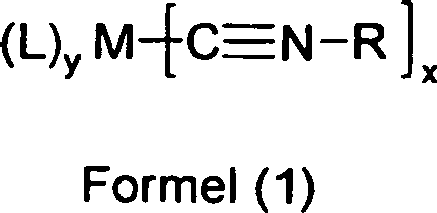
wobei für die verwendeten Symbole und Indizes gilt: - M
- ist ein penta- oder hexakoordiniertes Übergangsmetall;
- L
- ist bei jedem Auftreten gleich oder verschieden ein mono-, bi- oder tridentater Ligand, der an das Metall M bindet und der durch einen oder mehrere Reste R1 substituiert sein kann; dabei kann der Ligand L auch an den Rest R der Isonitrilgruppe gebunden sein;
- R
- ist bei jedem Auftreten gleich oder verschieden ein organischer Substituent mit 1 bis 60 C-Atomen, der durch einen oder mehrere Substituenten R1 substituiert sein kann; dabei können mehrere Reste R auch miteinander verknüpft sein und dadurch einen mehrzähnigen Liganden bilden; außerdem kann der Rest R auch mit dem Liganden L verknüpft sein;
- R1
- ist bei jedem Auftreten gleich oder verschieden H, D, F, Cl, Br, I, N(R2)2, CN, NO2, Si(R2)3, B(OR2)2, C(=O)R2, P(=O)(R2)2, S(=O)R2, S(=O)2R2, OSO2R2, eine geradkettige Alkyl-, Alkoxy- oder Thioalkoxygruppe mit 1 bis 40 C-Atomen oder eine geradkettige Alkenyl- oder Alkinylgruppe mit 2 bis 40 C-Atomen oder eine verzweigte oder cyclische Alkyl-, Alkenyl-, Alkinyl-, Alkoxy- oder Thioalkoxygruppe mit 3 bis 40 C-Atomen, die jeweils mit einem oder mehreren Resten R2 substituiert sein kann, wobei eine oder mehrere bevorzugt nicht benachbarte CH2-Gruppen durch R2C=CR2, C=C, Si(R2)2 Ge(R2)2, Sn(R2)2, C=O, C=S, C=Se, C=NR2, P(=O)(R2), SO, SO2, NR2, O, S oder CONR2 ersetzt sein können und wobei ein oder mehrere H-Atome durch D, F, Cl, Br, I, CN oder NO2 ersetzt sein können, oder ein aromatisches oder heteroaromatisches Ringsystem mit 5 bis 60 aromatischen Ringatomen, das jeweils durch einen oder mehrere Reste R2 substituiert sein kann, oder eine Aryloxy- oder Heteroaryloxygruppe mit 5 bis 60 aromatischen Ringatomen, die durch einen oder mehrere Reste R2 substituiert sein kann, oder eine Diarylaminogruppe, Diheteroarylaminogruppe oder Arylheteroarylaminogruppe mit 10 bis 40 aromatischen Ringatomen, welche durch einen oder mehrere Reste R2 substituiert sein kann, oder eine Kombination dieser Systeme; dabei können zwei oder mehrere Substituenten R1 auch miteinander ein mono- oder polycyclisches aliphatisches, aromatisches und/oder benzoannelliertes Ringsystem bilden;
- R2
- ist bei jedem Auftreten gleich oder verschieden H, D, F oder ein aliphatischer, aromatischer und/oder heteroaromatischer Kohlenwasserstoffrest mit 1 bis 20 C-Atomen, in dem auch ein oder mehrere H-Atome durch D oder F ersetzt sein können; dabei können zwei oder mehrere Substituenten R2 auch miteinander ein mono- oder polycyclisches, aliphatisches oder aromatisches Ringsystem bilden;
- x
- ist 3, 4, 5 oder 6;
- y
- ist 0, 1, 2 oder 3 mit der Maßgabe, dass eine Koordinationszahl am Metall von 5 oder 6 erreicht wird.
- Die Indizes x und y werden so gewählt, dass die Koordinationszahl am Metall M insgesamt, je nach Metall, 5 oder 6 beträgt. Es ist generell bekannt, dass Metallkoordinationsverbindungen abhängig vom gewählten Metallatom und von der Oxidationsstufe des Metallsatoms unterschiedliche Koordinationszahlen aufweisen, also eine unterschiedliche Anzahl von Liganden binden. Da die bevorzugten Koordinationszahlen von Metallen bzw. Metallionen in verschiedenen Oxidationsstufen zum allgemeinen Fachwissen des Fachmanns auf dem Gebiet der metallorganischen Chemie bzw. der Koordinationschemie gehören, ist es für den Fachmann ein Leichtes, je nach Metall und dessen Oxidationsstufe und je nach genauer Struktur des Liganden L eine geeignete Anzahl Liganden zu verwenden und somit die Indizes x und y geeignet zu wählen.
- Unter einer elektronischen Vorrichtung wird eine Vorrichtung verstanden, welche Anode, Kathode und mindestens eine Schicht enthält, wobei diese Schicht mindestens eine organische bzw. metallorganische Verbindung enthält. Die erfindungsgemäße elektronische Vorrichtung enthält also Anode, Kathode und mindestens eine Schicht, welche mindestens eine Verbindung der oben aufgeführten Formel (1) enthält. Dabei sind bevorzugte elektronische Vorrichtungen ausgewählt aus der Gruppe bestehend aus organischen Elektrolumineszenzvorrichtungen (= organischen Leuchtdioden, OLEDs, PLEDs), organischen integrierten Schaltungen (O-ICs), organischen Feld-Effekt-Transistoren (O-FETs), organischen Dünnfilmtransistoren (O-TFTs), organischen lichtemittierenden Transistoren (O-LETs), organischen Solarzellen (O-SCs), organischen optischen Detektoren, organischen Photorezeptoren, organischen Feld-Quench-Devices (O-FQDs), lichtemittierenden elektrochemischen Zellen (LECs) oder organischen Laserdioden (O-Laser), enthaltend in mindestens einer Schicht mindestens eine Verbindung gemäß der oben aufgeführten Formel (1). Besonders bevorzugt sind organische Elektrolumineszenzvorrichtungen.
- Die Liganden vom Typ C≡N-R sind Isonitrile (= Isocyanide), welche über ein Kohlenstoffatom an das Metall koordinieren. Dabei ist der Ligand entweder monodentat, wenn R eine monovalente Gruppe darstellt, oder er ist bidentat, wenn R eine bivalente Gruppe darstellt, die entweder zwei Isonitrilgruppen oder eine Isonitrilgruppe und den Liganden L miteinander verknüpft, oder er ist tridentat, wenn R eine trivalente Gruppe darstellt, die die Isonitrilgruppen und gegebenenfalls den Liganden L miteinander verknüpft. Höherdentate Liganden sind ebenfalls möglich, wenn L bereits beispielsweise einen bidentaten oder tridentaten Liganden darstellt.
- Eine Arylgruppe im Sinne dieser Erfindung enthält 6 bis 40 C-Atome; eine Heteroarylgruppe im Sinne dieser Erfindung enthält 2 bis 40 C-Atome und mindestens ein Heteroatom, mit der Maßgabe, dass die Summe aus C-Atomen und Heteroatomen mindestens 5 ergibt. Die Heteroatome sind bevorzugt ausgewählt aus N, O und/oder S. Dabei wird unter einer Arylgruppe bzw. Heteroarylgruppe entweder ein einfacher aromatischer Cyclus, also Benzol, bzw. ein einfacher heteroaromatischer Cyclus, beispielsweise Pyridin, Pyrimidin, Thiophen, etc., oder eine kondensierte Aryl- oder Heteroarylgruppe, beispielsweise Naphthalin, Anthracen, Phenanthren, Chinolin, Isochinolin, etc., verstanden. Ein cyclisches Carben im Sinne dieser Erfindung ist eine cyclische Gruppe, welche über ein neutrales C-Atom an das Metall bindet. Dabei kann die cyclische Gruppe gesättigt oder ungesättigt sein. Bevorzugt sind hierbei Arduengo-Carbene, also solche Carbene, bei welchen an das Carben-C-Atom zwei Stickstoffatome gebunden sind. Dabei wird ein Fünfring-Arduengo-Carben bzw. ein anderes ungesättigtes Fünfring-Carben ebenfalls als eine Arylgruppe im Sinne dieser Erfindung angesehen.
- Ein aromatisches Ringsystem im Sinne dieser Erfindung enthält 6 bis 60 C-Atome im Ringsystem. Ein heteroaromatisches Ringsystem im Sinne dieser Erfindung enthält 2 bis 60 C-Atome und mindestens ein Heteroatom im Ringsystem, mit der Maßgabe, dass die Summe aus C-Atomen und Heteroatomen mindestens 5 ergibt. Die Heteroatome sind bevorzugt ausgewählt aus N, O und/oder S. Unter einem aromatischen oder heteroaromatischen Ringsystem im Sinne dieser Erfindung soll ein System verstanden werden, das nicht notwendigerweise nur Aryl- oder Heteroarylgruppen enthält, sondern in dem auch mehrere Aryl- oder Heteroarylgruppen durch eine nicht-aromatische Einheit (bevorzugt weniger als 10 % der von H verschiedenen Atome), wie z. B. ein sp3- oder sp2-hybridisiertes C-, N- oder O-Atom oder eine Carbonylgruppe, unterbrochen sein können. So sollen beispielsweise auch Systeme wie 9,9'-Spirobifluoren, 9,9-Diarylfluoren, Triarylamin, Diarylether, Stilben, etc. als aromatische Ringsysteme im Sinne dieser Erfindung verstanden werden, und ebenso Systeme, in denen zwei oder mehrere Arylgruppen beispielsweise durch eine lineare oder cyclische Alkyl-, Alkenyl oder Alkinylgruppe oder durch eine Silylgruppe unterbrochen sind.
- Unter einer cyclischen Alkyl-, Alkenyl, Alkinyl, Alkoxy- oder Thioalkoxygruppe im Sinne dieser Erfindung wird eine monocyclische, eine bicyclische oder eine polycyclische Gruppe verstanden.
- Im Rahmen der vorliegenden Erfindung werden unter einer C1- bis C40-Alkylgruppe, in der auch einzelne H-Atome oder CH2-Gruppen durch die oben genannten Gruppen substituiert sein können, bevorzugt die Reste Methyl, Ethyl, n-Propyl, i-Propyl, n-Butyl, i-Butyl, s-Butyl, t-Butyl, 2-Methylbutyl, n-Pentyl, s-Pentyl, tert-Pentyl, 2-Pentyl, Cyclopentyl, n-Hexyl, s-Hexyl, tert-Hexyl, 2-Hexyl, 3-Hexyl, Cyclohexyl, 2-Methylpentyl, n-Heptyl, 2-Heptyl, 3-Heptyl, 4-Heptyl, Cycloheptyl, 1-Methylcyclohexyl, n-Octyl, 2-Ethylhexyl, Cyclooctyl, 1-Bicyclo[2,2,2]octyl, 2-Bicyclo[2,2,2]octyl, 2-(2,6-Dimethyl)octyl, 3-(3,7-Dimethyl)octyl, Trifluormethyl, Pentafluorethyl, 2,2,2-Trifluorethyl, Ethenyl, Propenyl, Butenyl, Pentenyl, Cyclopentenyl, Hexenyl, Cyclohexenyl, Heptenyl, Cycloheptenyl, Octenyl, Cyclooctenyl, Ethinyl, Propinyl, Butinyl, Pentinyl, Hexinyl, Heptinyl oder Octinyl verstanden. Unter einer C1- bis C40-Alkoxygruppe werden bevorzugt Methoxy, Trifluormethoxy, Ethoxy, n-Propoxy, i-Propoxy, n-Butoxy, i-Butoxy, s-Butoxy, t-Butoxy oder 2-Methylbutoxy verstanden. Unter einem aromatischen oder heteroaromatischen Ringsystem mit 5 - 60 aromatischen Ringatomen, welches noch jeweils mit den oben genannten Resten R substituiert sein kann und welches über beliebige Positionen am Aromaten bzw. Heteroaromaten verknüpft sein kann, werden insbesondere Gruppen verstanden, die abgeleitet sind von Benzol, Naphthalin, Anthracen, Phenanthren, Pyren, Chrysen, Perylen, Fluoranthen, Benzfluoranthen, Naphthacen, Pentacen, Benzpyren, Biphenyl, Biphenylen, Terphenyl, Terphenylen, Fluoren, Spirobifluoren, Dihydrophenanthren, Dihydropyren, Tetrahydropyren, cis- oder trans-Indenofluoren, cis- oder trans-Monobenzoindenofluoren, cis- oder trans-Dibenzoindenofluoren, Truxen, Isotruxen, Spirotruxen, Spiroisotruxen, Furan, Benzofuran, Isobenzofuran, Dibenzofuran, Thiophen, Benzothiophen, Isobenzothiophen, Dibenzothiophen, Pyrrol, Indol, Isoindol, Carbazol, Pyridin, Chinolin, Isochinolin, Acridin, Phenanthridin, Benzo-5,6-chinolin, Benzo-6,7-chinolin, Benzo-7,8-chinolin, Phenothiazin, Phenoxazin, Pyrazol, Indazol, Imidazol, Benzimidazol, Naphthimidazol, Phenanthrimidazol, Pyridimidazol, Pyrazinimidazol, Chinoxalinimidazol, Oxazol, Benzoxazol, Naphthoxazol, Anthroxazol, Phenanthroxazol, Isoxazol, 1,2-Thiazol, 1,3-Thiazol, Benzothiazol, Pyridazin, Benzopyridazin, Pyrimidin, Benzpyrimidin, Chinoxalin, 1,5-Diazaanthracen, 2,7-Diazapyren, 2,3-Diazapyren, 1,6-Diazapyren, 1,8-Diazapyren, 4, 5-Diazapyren, 4,5,9,10-Tetraazaperylen, Pyrazin, Phenazin, Phenoxazin, Phenothiazin, Fluorubin, Naphthyridin, Azacarbazol, Benzocarbolin, Phenanthrolin, 1,2,3-Triazol, 1,2,4-Triazol, Benzotriazol, 1,2,3-Oxadiazol, 1,2,4-Oxadiazol, 1,2,5-Oxadiazol, 1,3,4-Oxadiazol, 1,2,3-Thiadiazol, 1,2,4-Thiadiazol, 1,2,5-Thiadiazol, 1,3,4-Thiadiazol, 1,3,5-Triazin, 1,2,4-Triazin, 1,2,3-Triazin, Tetrazol, 1,2,4,5-Tetrazin, 1,2,3,4-Tetrazin, 1,2,3,5-Tetrazin, Purin, Pteridin, Indolizin und Benzothiadiazol.
- Im Folgenden werden die Ausführungsformen der Verbindung gemäß Formel (1) beschrieben, wie sie bevorzugt in der elektronischen Vorrichtung verwendet werden.
- Bevorzugt sind Verbindungen gemäß Formel (1), dadurch gekennzeichnet, dass diese nicht geladen, d. h. elektrisch neutral, sind. Dies wird auf einfache Weise dadurch erreicht, dass die Ladung der Liganden L und des Restes R am Isonitrilliganden so gewählt wird, dass sie die Ladung des komplexierten Metallatoms M kompensiert.
- Bevorzugt sind weiterhin Verbindungen gemäß Formel (1), dadurch gekennzeichnet, dass die Summe der Valenzelektronen um das Metallatom in fünfach koordinierten Komplexen 16 und in sechsfach koordinierten Komplexen 18 beträgt. Diese Bevorzugung ist durch die besondere Stabilität dieser Metallkomplexe begründet (siehe z. B. Elschenbroich, Salzer, Organometallchemie, Teubner Studienbücher, Stuttgart 1993).
- Bevorzugt sind Verbindungen gemäß Formel (1), in denen M für ein pentakoordiniertes oder für ein hexakoordiniertes Übergangsmetall steht, besonders bevorzugt ausgewählt aus der Gruppe bestehend aus Chrom, Molybdän, Wolfram, Rhenium, Ruthenium, Osmium, Rhodium, Iridium, Nickel, Platin, Kupfer, Silber und Gold, insbesondere Molybdän, Wolfram, Rhenium, Ruthenium, Osmium, Iridium, Platin und Gold. Die Metalle können dabei in verschiedenen Oxidationsstufen vorliegen. Bevorzugt sind dabei die oben genannten Metalle in den Oxidationsstufen Cr(O), Cr(II), Cr(III), Cr(IV), Cr(VI), Mo(O), Mo(II), Mo(III), Mo(IV), W(O), W(II), W(III), W(IV), Re(I), Re(II), Re(III), Re(IV), Ru(II), Ru(III), Os(II), Os(III), Os(IV), Rh(I), Rh(III), Ir(I), Ir(III), Ir(IV), Ni(0), Ni(II), Ni(IV), Pt(IV), Cu(I), Cu(II), Cu(III), Ag(II), Au(III) und Au(V); ganz besonders bevorzugt sind Mo(0), W(0), Re(I), Ru(II), Os(II), Rh(III), Ir(III) und Pt(IV).
- In einer bevorzugten Ausführungsform der Erfindung ist M ein pentakoordiniertes Metall und der Index x steht für 3 oder 5. In einer weiteren bevorzugten Ausführungsform der Erfindung ist M ein hexakoordiniertes Metall und der Index x steht für 3, 4 oder 6.
- In einer Ausführungsform der Erfindung sind ein oder mehrere der Isonitrilliganden monodentate Liganden. In diesem Fall steht der Substituent R bevorzugt gleich oder verschieden bei jedem Auftreten für eine geradkettige Alkylgruppe mit 1 bis 20 C-Atomen oder eine verzweigte oder cyclische Alkylgruppe mit 3 bis 20 C-Atomen, die jeweils mit einem oder mehreren Resten R1 substituiert sein kann, wobei eine oder mehrere nicht benachbarte CH2-Gruppen durch R1C=CR1, C=C, Si(R1)2, Ge(R1)2, Sn(R1)2, C=O, C=S, C=Se, C=NR1, P(=O)(R1), SO, SO2, NR1, O, S oder CONR1 ersetzt sein können und wobei ein oder mehrere H-Atome durch D, F, Cl, Br, I, CN oder NO2 ersetzt sein können, oder für ein monovalentes aromatisches oder heteroaromatisches Ringsystem mit 5 bis 40 aromatischen Ringatomen, das jeweils durch einen oder mehrere Reste R1 substituiert sein kann, oder für eine Kombination dieser Systeme. Besonders bevorzugt steht der Substituent R, wenn der Isonitrilligand ein monodentater Ligand ist, bei jedem Auftreten gleich oder verschieden für eine geradkettige Alkylgruppe mit 1 bis 10 C-Atomen oder eine verzweigte oder cyclische Alkylgruppe mit 3 bis 10 C-Atomen, die jeweils mit einem oder mehreren Resten R1 substituiert sein kann, wobei eine oder mehrere nicht benachbarte CH2-Gruppen durch R1C=CR1, C=C, C=O, C=S oder O ersetzt sein können und wobei ein oder mehrere H-Atome durch D, F oder CN ersetzt sein können, oder für ein monovalentes aromatisches oder heteroaromatisches Ringsystem mit 5 bis 20 aromatischen Ringatomen, das jeweils durch einen oder mehrere Reste R1 substituiert sein kann, oder für eine Kombination dieser Systeme. In einer ganz besonders bevorzugten Ausführungsform der Erfindung ist der Substituent R bei jedem Auftreten gleich oder verschieden ein monovalentes aromatisches oder heteroaromatisches Ringsystem mit 5 bis 20 aromatischen Ringatomen, das jeweils durch einen oder mehrere Reste R1 substituiert sein kann.
- Beispiele für monodentate isonitrilliganden sind aliphatische Isonitrile, wie z. B. Methylisonitril, Trifluormethylisonitril, iso-Propylisonitril, tert-Butylisonitril, Cyclohexylisonitril oder Adamantylisonitril, oder aromatische Isonitrile, wie z. B. Phenylisonitril, Mesitylisonitril, 2,6-Dimethylphenylisonitril, 2,6-Di-iso-propylphenylisonitril oder 2,6-Di-tert-butylphenylisonitril. Bevorzugt sind aromatische Isonitrile. Wenn R für ein aromatisches oder heteroaromatisches Ringsystem steht, dann ist dieses bevorzugt an mindestens einer Position orthoständig zur Isonitrilgruppe, besonders bevorzugt an beiden Positionen orthoständig zur Isonitrilgruppe durch Substituenten R1 ungleich H substituiert, insbesondere durch Alkylgruppen.
- Die Reste R an den Isonitrilgruppen können auch miteinander verknüpft sein und so zusammen mit dem Metall M ein Ringsystem bilden. So können zwei Reste R miteinander verknüpft sein, so dass es sich hier um zweizähnige (bidentate) Isonitrilliganden handelt. Ebenso können drei Reste R miteinander verknüpft sein, so dass es sich hier um dreizähnige (tridentate) Isonitrilliganden handelt. Ebenso ist ganz analog die Bildung von vierzähnigen (tetradentaten), fünfzähnigen (pentadentaten) und sechszähnigen (hexadentaten) Liganden möglich. Ebenso kann der Ligand L an den Rest R am Isonitrilliganden binden und so zusammen mit dem Metall M ein Ringsystem bilden, so dass man zweizähnige Liganden erhält, welche über eine Isonitrilgruppe und eine weitere Gruppe koordinieren. Ganz analog ist die Bildung drei-, vier-, fünf- und sechszähniger Liganden aus den Resten R1 am Liganden L und den Resten R am Isonitril möglich.
- In einer bevorzugten Ausführungsform der Erfindung bilden die Substituenten R miteinander und/oder zusammen mit dem Liganden L eine kettenförmige, verzweigte oder mono- oder polycyclische, aliphatische, aromatische und/oder benzoannellierte Struktur und besitzen damit mehrzähnigen bzw. polypodalen Ligandencharakter.
- Bevorzugte mehrzähnige Isonitrilliganden, wie sie in Komplexen der Formel (1) verwendet werden können, weisen eine Struktur gemäß Formel (2) oder Formel (3) auf,
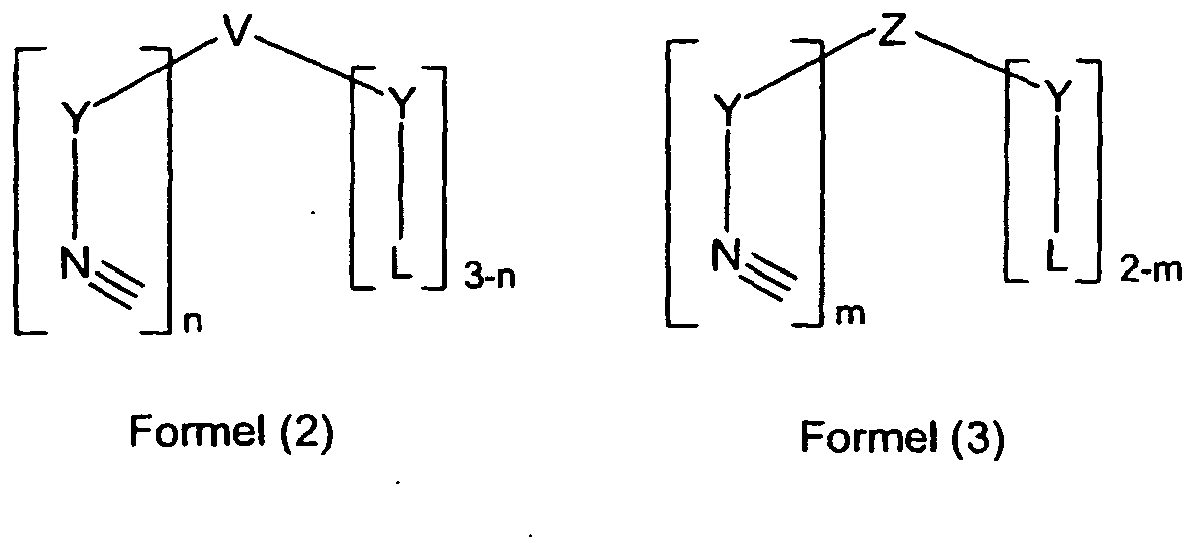
- Y
- ist bei jedem Auftreten gleich oder verschieden eine Einfachbindung, O, S, N(R1), C=O, eine geradkettige Alkylengruppe mit 1 bis 6 C-Atomen oder eine verzweigte oder cyclische Alkylengruppe mit 3 bis 6 C-Atomen, die jeweils mit einem oder mehreren Resten R1 substituiert sein kann, wobei eine oder mehrere nicht benachbarte CH2-Gruppen durch R1C=CR1, NR1, Si(R1)2, O oder S ersetzt sein können und wobei ein oder mehrere H-Atome durch D, F, Cl, Br, I, CN oder NO2 ersetzt sein können, oder eine Arylen- oder Heteroarylengruppe mit 5 bis 20 aromatischen Ringatomen, welche mit einem oder mehreren Resten R1 substituiert sein kann, oder eine Kombination dieser Systeme;
- V
- ist B, B(R1), CR1, CO-, CN(R1)2, SiR1, N, NO, N(R1)+, P, P(R1)+, PO, PS, As, As(R1)+, AsO, S+, Se+, oder eine Einheit gemäß Formel (4) bis (7),
- Z
- ist BR1, B(R1)2 -, C(R1)2, C(=O), Si(R1)2, NR1, PR1, P(R1)2 +, PO(R1), PS(R1), AsR1, AsO(R1), AsS, O, S, Se, oder eine Einheit gemäß Formel (8) bis (17),
- n
- ist 1, 2 oder 3, bevorzugt 2 oder 3;
- m
- ist 1 oder 2, bevorzugt 2.
- Dabei beträgt die Brückenlänge in den Liganden der Formel (2) bzw. (3) bevorzugt zwischen 6 und 12 Atomen. Unter der Brückenlänge wird die Anzahl der Atome in den beiden Gruppen Y und in der Gruppe V bzw. Z verstanden, die die direkte Verbindung zwischen den Isonitrilgruppen bzw. zwischen der Isonitrilgruppe und der Ligandengruppe L darstellen. Besonders bevorzugt beträgt die Brückenlänge zwischen 7 und 10 Atomen, ganz besonders bevorzugt zwischen 7 und 9 Atomen.
- Beispiele für geeignete Liganden sind die in F. E. Hahn et al., J. Organomet. Chem. 1994, 467, 103-111, F. E. Hahn et al., J. Organomet. Chem. 1991, 410, C9-C12, F. E. Hahn et al., Angew. Chem. 1992, 104, 1218-1221, F. E. Hahn et al., Angew. Chem. 1991, 103, 213-215, F. E. Hahn et al., Organometallics 1994, 13, 3002-3008 und F. E. Hahn et al., Organometallics 1992, 11, 84-90 offenbarten polypodalen Isonitrilliganden.
- Beispiele für besonders bevorzugte Liganden der Formel (2) und (3) sind die im Folgenden abgebildeten Liganden der Formeln (18) bis (28), welche jeweils durch einen oder mehrere Reste R1 substituiert sein können:

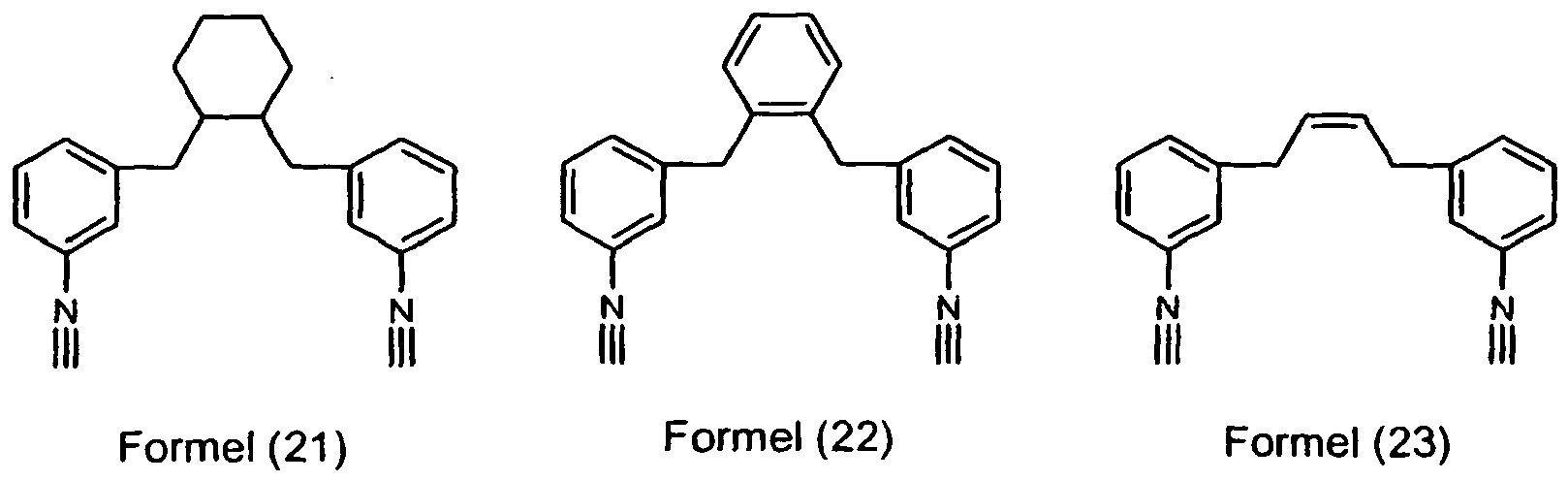


- In einer bevorzugten Ausführungsform der Erfindung ist das Metall M pentakoordiniert und die Verbindung gemäß Formel (1) enthält einen tridentaten Liganden der Formel (2) und einen bidentaten Liganden der Formel (3).
- In einer weiteren bevorzugten Ausführungsform der Erfindung ist das Metall M hexakoordiniert und die Verbindung gemäß Formel (1) enthält entweder zwei tridentate Liganden der Formel (2) oder drei bidentate Liganden der Formel (3).
- Im Folgenden werden bevorzugte Liganden L beschrieben, wie sie in Formel (1) vorkommen. Entsprechend können auch die Ligandengruppen L in den Liganden der Formel (2) und (3) gewählt sein, wobei diese dann an die Gruppe Y gebunden sind.
- Die Liganden L sind bevorzugt neutrale, monoanionische, dianionische oder trianionische Liganden, besonders bevorzugt neutrale oder monoanionische Liganden. Sie können monodentat sein, sind aber bevorzugt bidentat oder tridentat, weisen also bevorzugt zwei oder drei Koordinationsstellen auf. Die Liganden L können auch an den Rest R gebunden sein. Bevorzugte Ausführungsformen sind dabei die oben aufgeführten Liganden der Formel (2) und (3). In Liganden der Formel (2) und (3) ist L bevorzugt ein monodentater oder bidentater Ligand.
- Bevorzugte neutrale, monodentate Liganden L sind ausgewählt aus Kohlenmonoxid, Stickstoffmonoxid, Aminen, wie z. B. Trimethylamin, Triethylamin, Morpholin, Phosphinen, insbesondere Halogenphosphinen, Trialkylphophinen, Triarylphosphinen oder Alkylarylphosphinen, wie z. B. Trifluorphosphin, Trimethylphosphin, Tricyclohexylphosphin, Tri-tert-butylphosphin, Triphenylphosphin, Tris(pentafluorphenyl)phosphin, Phosphiten, wie z. B. Trimethylphosphit, Triethylphosphit, Arsinen, wie z. B. Trifluorarsin, Trimethylarsin, Tricyclohexylarsin, Tri-tert-butylarsin, Triphenylarsin, Tris(pentafluorphenyl)arsin, Stibinen, wie z. B. Trifluorstibin, Trimethylstibin, Tricyclohexylstibin, Tri-tert-butylstibin, Triphenylstibin, Tris(pentafluorphenyl)stibin, stickstoffhaltigen Heterocyclen, wie z. B. Pyridin, Pyridazin, Pyrazin, Pyrimidin, Triazin, und Carbenen, insbesondere Arduengo-Carbenen.
- Bevorzugte monoanionische, monodentate Liganden L sind ausgewählt aus Hydrid, Deuterid, den Halogeniden F, Cl, Br und I, Alkylacetyliden, wie z. B. Methyl-C≡C-, tert-Butyl-C≡C-, Arylacetyliden, wie z. B. Phenyl-C≡C-, Cyanid, Azid, Cyanat, Isocyanat, Thiocyanat, Isothiocyanat, aliphatischen oder aromatischen Alkoholaten, wie z. B. Methanolat, Ethanolat, Propanolat, iso-Propanolat, tert-Butylat, Phenolat, aliphatischen oder aromatischen Thioalkoholaten, wie z. B. Methanthiolat, Ethanthiolat, Propanthiolat, iso-Propanthiolat, tert-Thiobutylat, Thiophenolat, Amiden, wie z. B. Dimethylamid, Diethylamid, Di-iso-propylamid, Morpholid, Carboxylaten, wie z. B. Acetat, Trifluoracetat, Propionat, Benzoat, Arylgruppen, wie z. B. Phenyl, Naphthyl, und anionischen, stickstoffhaltigen Heterocyclen, wie Pyrrolid, Imidazolid, Pyrazolid. Dabei sind die Alkylgruppen in diesen Gruppen bevorzugt C1-C20-Alkylgruppen, besonders bevorzugt C1-C10-Alkylgruppen, ganz besonders bevorzugt C1-C4-Alkylgruppen. Unter einer Arylgruppe werden auch Heteroarylgruppen verstanden. Diese Gruppen sind wie oben definiert.
- Bevorzugte di- bzw. trianionische Liganden sind O2-, S2-, Carbide, welche zu einer Koordination der Form R-C≡M führen, und Nitrene, welche zu einer Koordination der Form R-N=M führen, wobei R allgemein für einen Substituenten steht, oder N3-.
- Bevorzugte neutrale oder mono- oder dianionische bidentate oder höherdentate Liganden L sind ausgewählt aus Diaminen, wie z. B. Ethylendiamin, N,N,N',N'-Tetramethylethylendiamin, Propylendiamin, N,N,N',N'-Tetramethylpropylendiamin, cis- oder trans-Diaminocyclohexan, cis- oder trans-N,N,N',N'-Tetramethyldiaminocyclohexan, Iminen, wie z. B. 2-[(1-(Phenylimino)ethyl]pyridin, 2-[1-(2-Methylphenylimino)ethyl]pyridin, 2-[1-(2,6-Di-iso-propylphenylimino)ethyl]pyridin, 2-[1-(Methylimino)ethyl]pyridin, 2-[1-(Ethylimino)ethyl]pyridin, 2-[1-(iso-Propylimino)ethyl]pyridin, 2-[1-(tert-Butylimino)ethyl]pyridin, Diiminen, wie z. B. 1,2-Bis(methylimino)ethan, 1,2-Bis(ethylimino)ethan, 1,2-Bis(iso-propylimino)ethan, 1,2-Bis(tert-butyl-imino)ethan, 2,3-Bis(methylimino)butan, 2,3-Bis(ethylimino)butan, 2,3-Bis-(iso-propylimino)butan, 2,3-Bis(tert-butylimino)butan, 1,2-Bis(phenylimino)-ethan, 1,2-Bis(2-methylphenylimino)ethan, 1,2-Bis(2,6-di-iso-propylphenyl-imino)ethan, 1,2-Bis(2,6-di-tert-butylphenylimino)ethan, 2,3-Bis(phenyl-imino)butan, 2,3-Bis(2-methylphenylimino)butan, 2,3-Bis(2,6-di-iso-propyl-phenylimino)butan, 2,3-Bis(2,6-di-tert-butylphenylimino)butan, Heterocyclen enthaltend zwei Stickstoffatome, wie z. B. 2,2'-Bipyridin, o-Phenanthrolin, Diphosphinen, wie z. B. Bis-(diphenylphosphino)methan, Bis-(diphenylphosphino)ethan, Bis(diphenylphosphino)propan, Bis-(diphenylphosphino)butan, Bis(dimethylphosphino)methan, Bis(dimethylphosphino)ethan, Bis(dimethylphosphino)propan, Bis(dimethylphosphino)butan, Bis(diethylphosphino)methan, Bis(diethylphosphino)ethan, Bis(diethylphosphino)propan, Bis(diethyl-phosphino)butan, Bis(di-tert-butylphosphino)methan, Bis(di-tert-butyl-phosphino)ethan, Bis(tert-butylphosphino)propan, Bis(di-tert-butylphosphino)butan, 1,3-Diketonaten abgeleitet von 1,3-Diketonen, wie z. B. Acetylaceton, Benzoylaceton, 1,5-Diphenylacetylaceton, Dibenzoylmethan, Bis(1,1,1-trifluoracetyl)methan, 3-Ketonaten abgeleitet von 3-Ketoestern, wie z. B. Acetessigsäureethylester, Carboxylate, abgeleitet von Aminocarbonsäuren, wie z. B. Pyridin-2-carbonsäure, Chinolin-2-carbonsäure, Glycin, N,N-Dimethylglycin, Alanin, N,N-Dimethylaminoalanin, Salicyliminaten abgeleitet von Salicyliminen, wie z. B. Methylsalicylimin, Ethylsalicylimin, Phenylsalicylimin, Dialkoholaten abgeleitet von Dialkoholen, wie z. B. Ethylenglykol, 1,3-Propylenglykol und Dithiolaten abgeleitet von Dithiolen, wie z. B. 1,2-Ethylendithiol, 1,3-Propylendithiol.
- Bevorzugte tridentate Liganden sind Borate stickstoffhaltiger Heterocyclen, wie z. B. Tetrakis(1-imidazolyl)borat und Tetrakis(1-pyrazolyl)borat.
- Bevorzugt sind weiterhin bidentate monoanionische Liganden L, welche mit dem Metall einen cyclometallierten Fünfring oder Sechsring mit mindestens einer Metall-Kohlenstoff-Bindung aufweisen, insbesondere einen cyclometallierten Fünfring. Dies sind insbesondere Liganden, wie sie allgemein im Gebiet der phosphoreszierenden Metallkomplexe für organische Elektrolumineszenzvorrichtungen verwendet werden, also Liganden vom Typ Phenylpyridin, Naphthylpyridin, Phenylchinolin, Phenylisochinolin, etc., welche jeweils durch einen oder mehrere Reste R1 substituiert sein können. Dem Fachmann auf dem Gebiet der phosphoreszierenden Elektrolumineszenzvorrichtungen ist eine Vielzahl derartiger Liganden bekannt, und er kann ohne erfinderisches Zutun weitere derartige Liganden als Ligand L für Verbindungen gemäß Formel (1) auswählen. Generell eignet sich dafür besonders die Kombination aus zwei Gruppen, wie sie durch die folgenden Formeln (29) bis (56) dargestellt sind, wobei eine Gruppe über ein neutrales Stickstoffatom oder ein Carbenatom bindet und die andere Gruppe über ein negativ geladenes Kohlenstoffatom oder ein negativ geladenes Stickstoffatom bindet. Der Ligand L kann dann aus den Gruppen der Formeln (29) bis (56) gebildet werden, indem diese Gruppen jeweils an der durch # gekennzeichneten Position aneinander binden. Die Position, an der die Gruppen an das Metall koordinieren, sind durch * gekennzeichnet. In Liganden der Formel (2) oder (3) können auch einzelne dieser Gruppen als Ligand L an die Gruppe Y des Liganden gebunden sein.

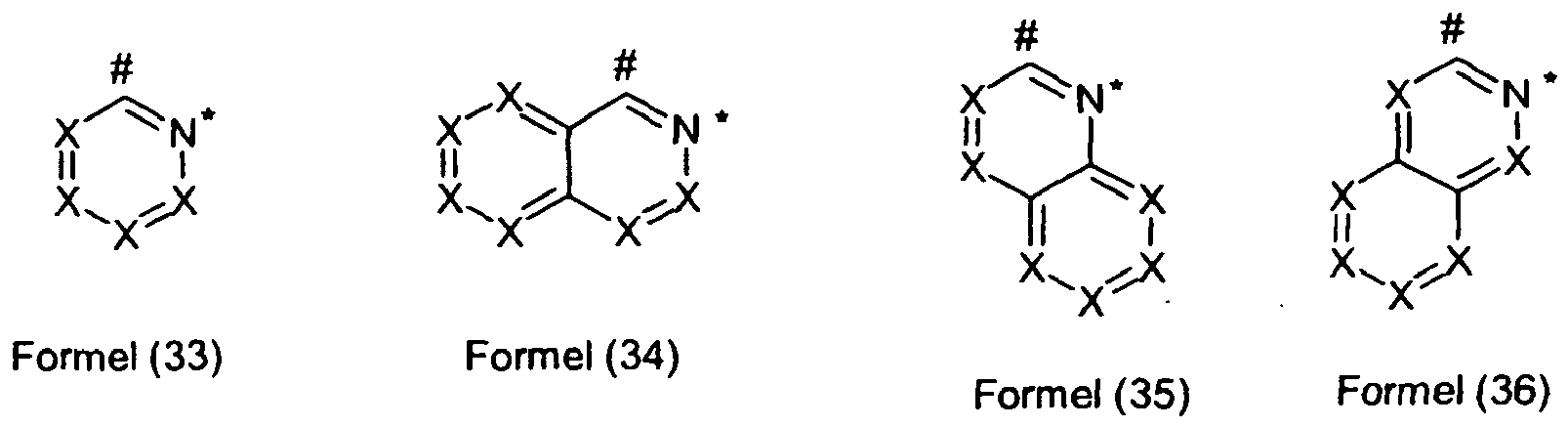


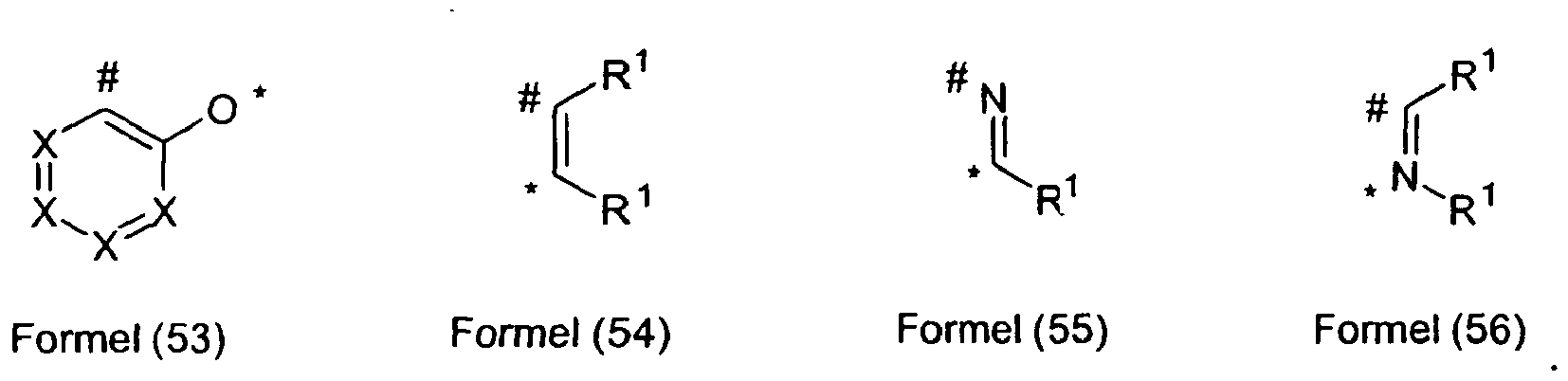
- Dabei haben die verwendeten Symbole dieselbe Bedeutung, wie oben beschrieben, und X steht gleich oder verschieden bei jedem Auftreten für CR1 oder N mit der Maßgabe, dass maximal drei Symbole X in jeder Gruppe für N stehen. Bevorzugt stehen maximal zwei Symbole X in jeder Gruppe für N, besonders bevorzugt steht maximal ein Symbol X in jeder Gruppe für N, ganz besonders bevorzugt stehen alle Symbole X für CR1.
- Ebenfalls bevorzugte Liganden L sind η5-Cyclopentadienyl, η5-Pentamethylcyclopentadienyl, η6 -Benzol oder η7-Cycloheptatrienyl, welche jeweils durch einen oder mehrere Reste R1 substituiert sein können.
- Ebenfalls bevorzugte Liganden L sind 1,3,5-cis-Cyclohexanderivate, insbesondere der Formel (57), 1,1,1-Tri(methylen)methanderivate, insbesondere der Formel (58) und 1,1,1-trisubstituierte Methane, insbesondere der Formel (59) und (60),

- Die Darstellung der Isonitrilkomplexe kann z. B. durch Substitutionsreaktion erfolgen. Dabei werden Metallkomplexe mit den Isonitrilliganden, gegebenenfalls in Gegenwart eines Katalysators, zu den gewünschten Isonitrilkomplexen umgesetzt. Auf diesem Wege sind z. B. ausgehend von Molybdän- bzw. Wolframhexacarbonyl oder Molybdän- bzw. Wolframolefin-carbonylkomplexen Tri-, Tetra-, Penta- und Hexaisonitril-Molybdän bzw. Wolfram-Verbindungen zugänglich. Dieser Reaktionstyp eignet sich sowohl zur Umsetzung von einzähnigen als auch mehrzähnigen Isonitrilliganden. Als Katalysator kann Palladium(II)oxid zugesetzt werden (Albers et al., J. Chem. Edu. 1986, 63(5), 444; Coville et al. Inorg. Chim. Acta 1982, 65, L7-L8; Yamamoto et al., J. Organomet. Chem. 1985, 282, 191, Hahn et al., Organometallics 1994, 13, 3002; F. Hahn et al., Organometallics 1992, 11, 84).

- Daneben können Metallsalze mit Isonitrilliganden zu Isonitril-Metallhalogeniden umgesetzt werden und die Halogenidliganden in diesen anschließend gegen andere ein- oder mehrzähnige Liganden ausgetauscht werden.
IrCl3 + R-NC → (R-NC)3IrCl3
(R-NC)3IrCl3 + 3L- → (R-NC)3IrL3 + 3Cl-
- Dabei können sowohl der Isonitrilligand als auch der Ligand L ein- oder mehrzähnig sein.
- Beispiele für bevorzugte Verbindungen gemäß Formel (1) sind die im Folgenden abgebildeten Strukturen (1) bis (98).


(1) (2) (3) 
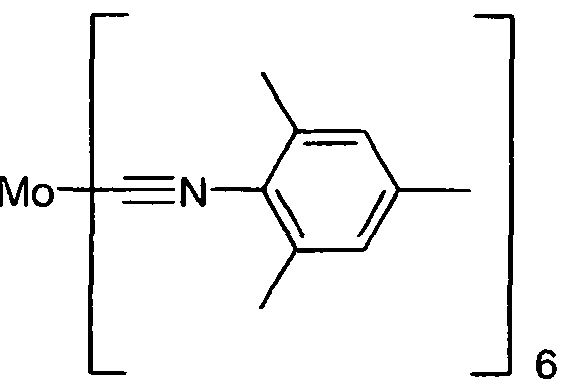
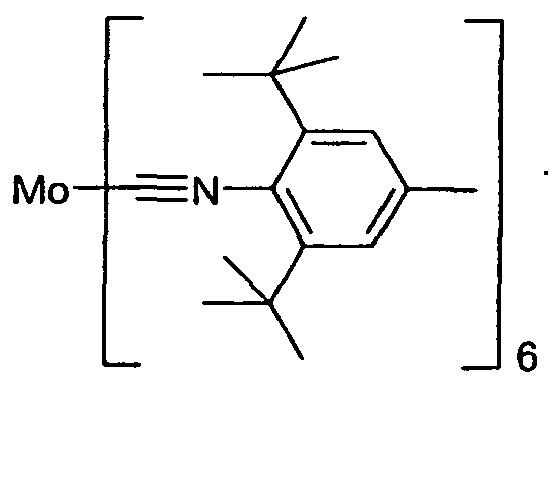
(4) (5) (6) 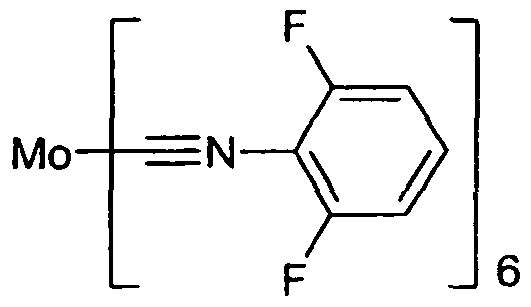

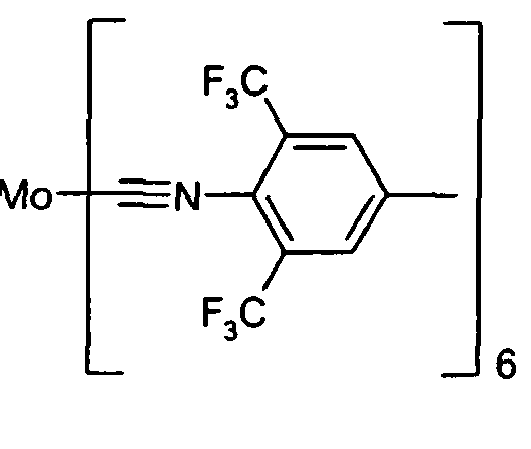
(7) (8) (9) 

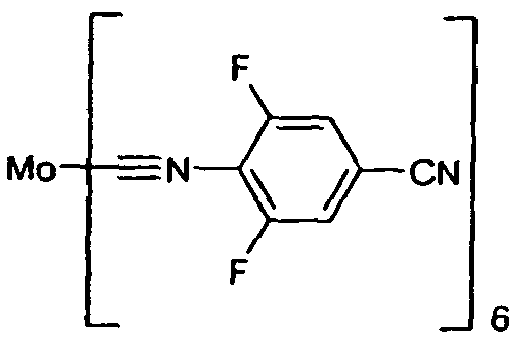
(10) (11) (12) 


(13) (14) (15) 
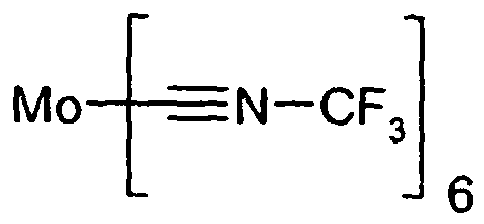

(16) (17) (18) 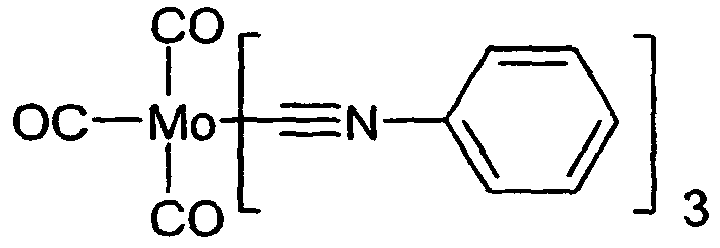

(19) (20) 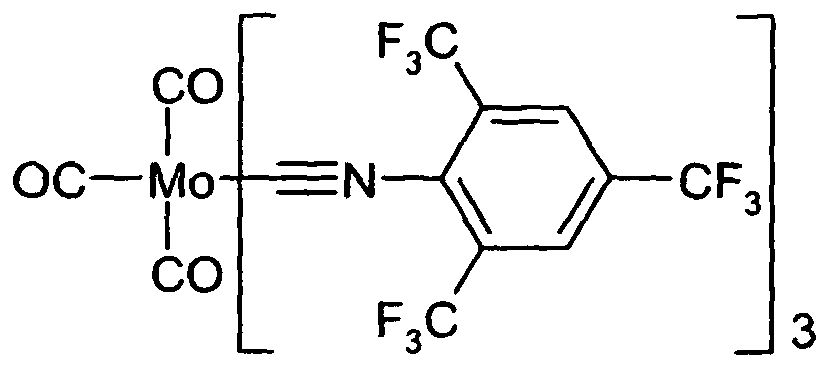

(21) (22) 

(23) (24) 
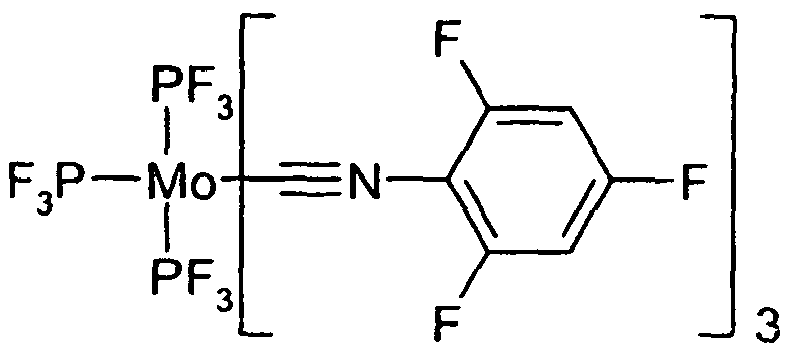
(25) (26) 
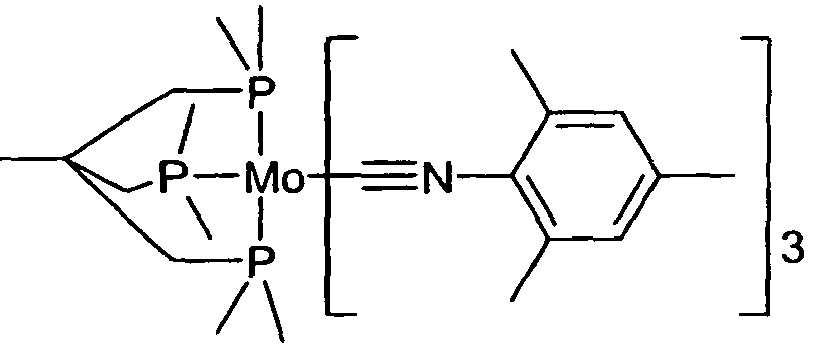
(27) (28) 
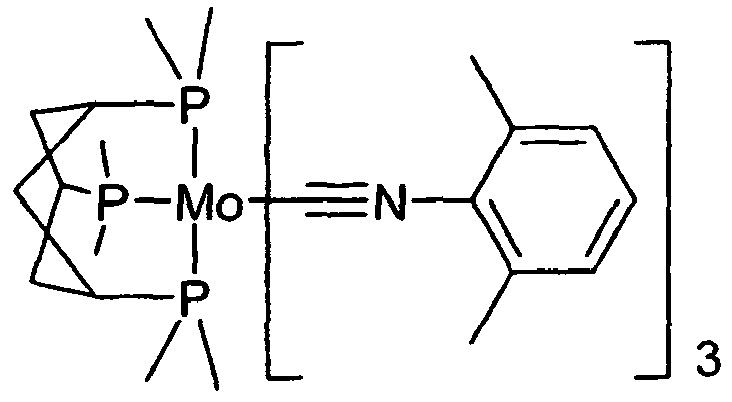
(29) (30) 

(31) (32) 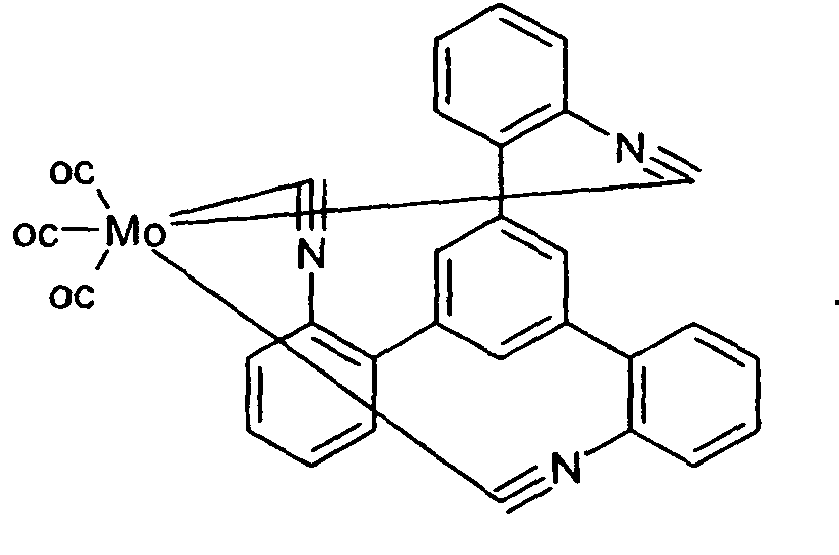

(33) (34) 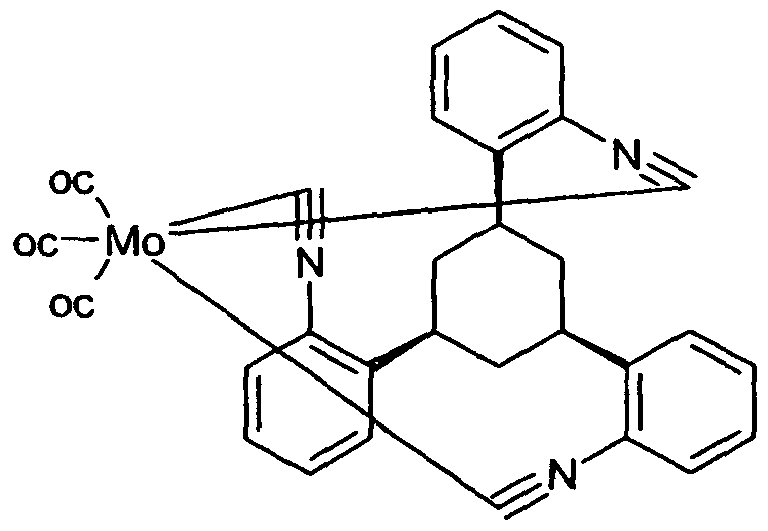

(35) (36) 
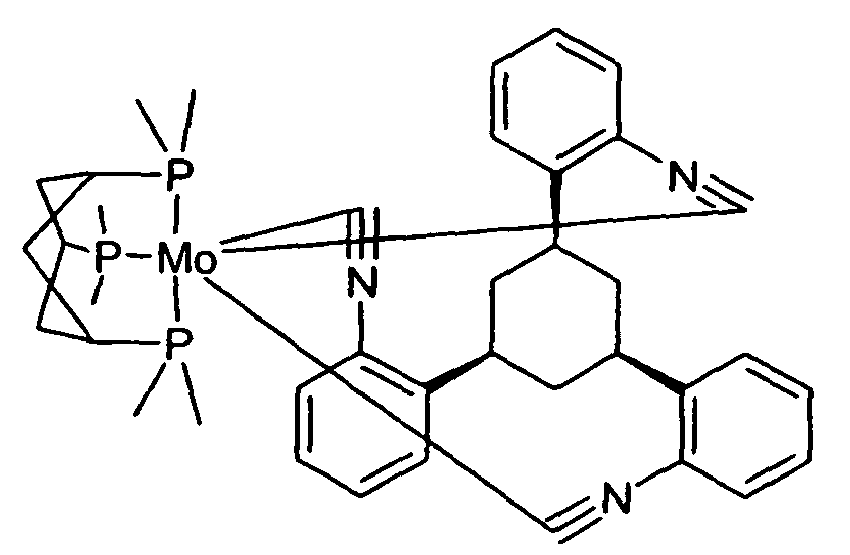
(37) (38) 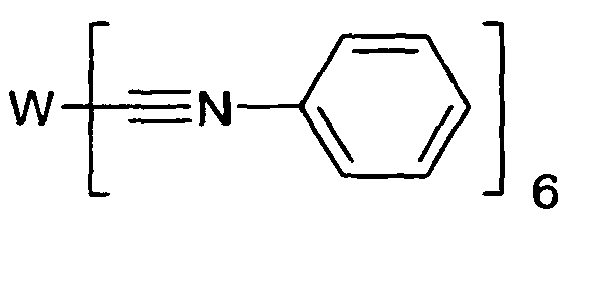
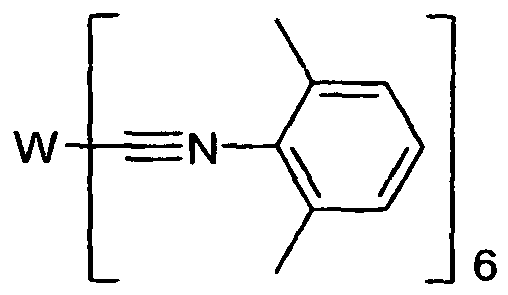
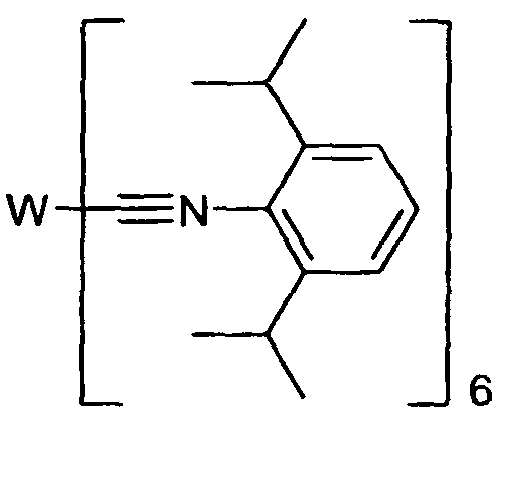
(39) (40) (41) 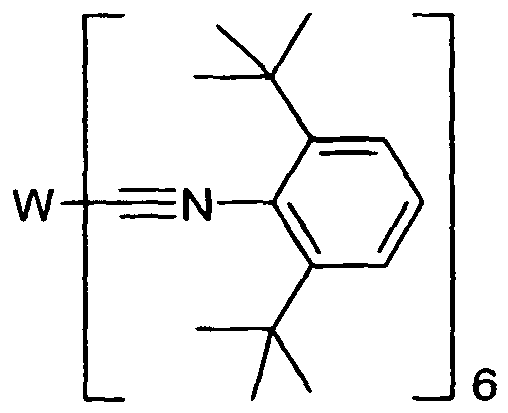
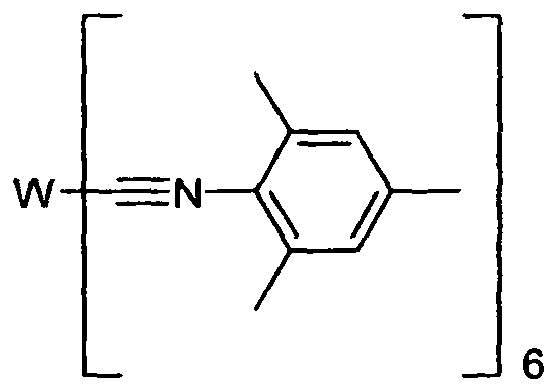

(42) (43) (44) 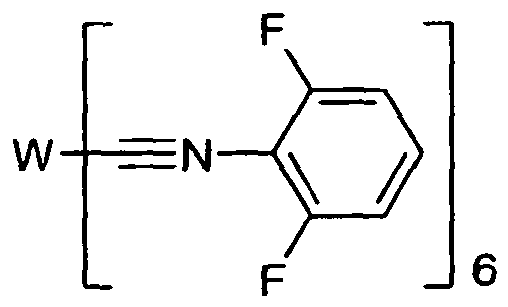
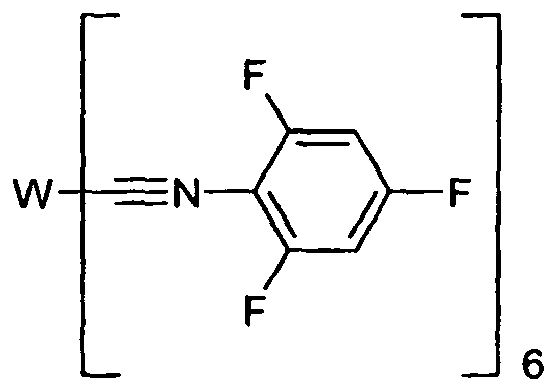

(45) (46) (47) 


(48) (49) (50) 
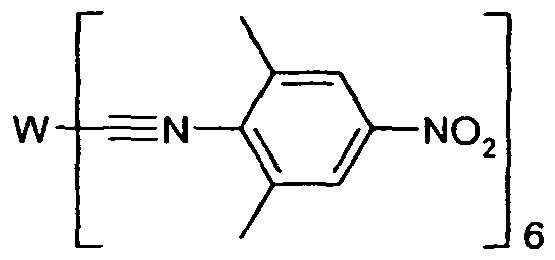

(51) (52) (53) 


(54) (55) (56) 
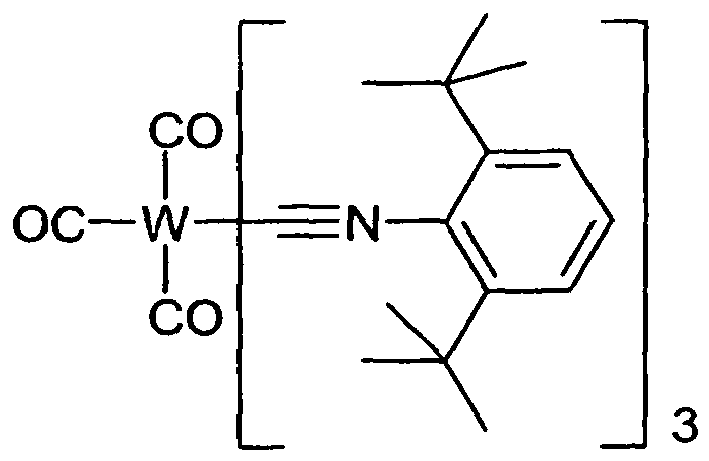
(57) (58) 

(59) (60) 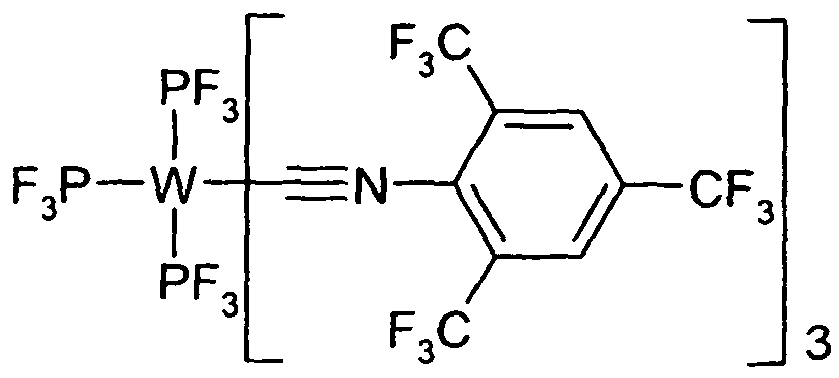
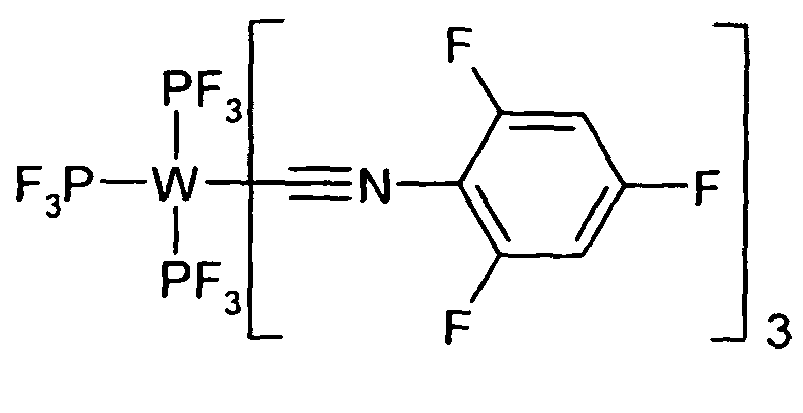
(61) (62) 

(63) (64) 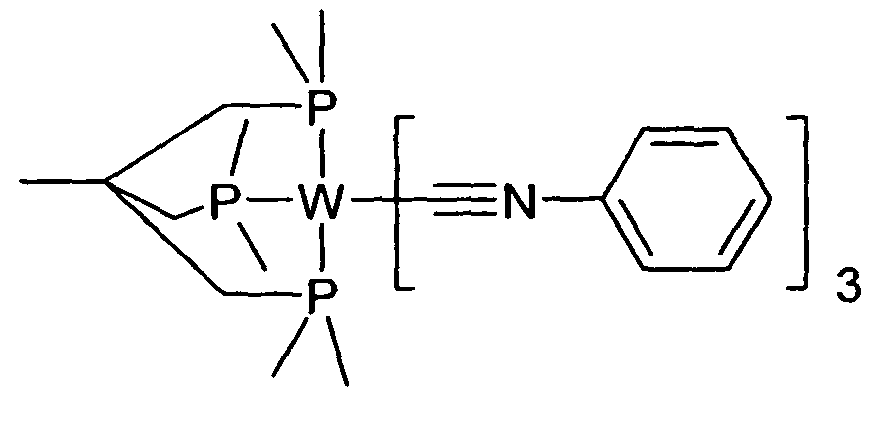

(65) (66) 

(67) (68) 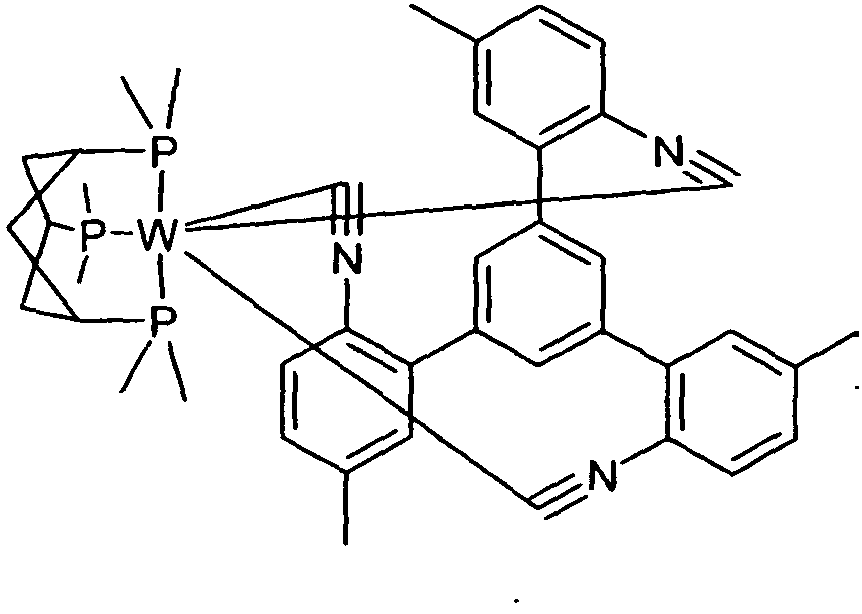

(69) (70) 
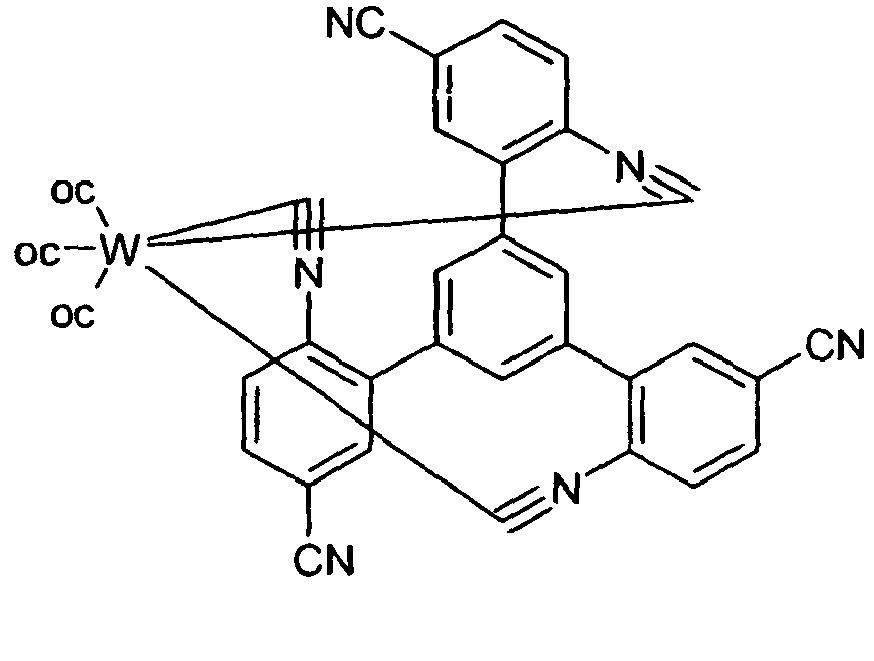
(71) (72) 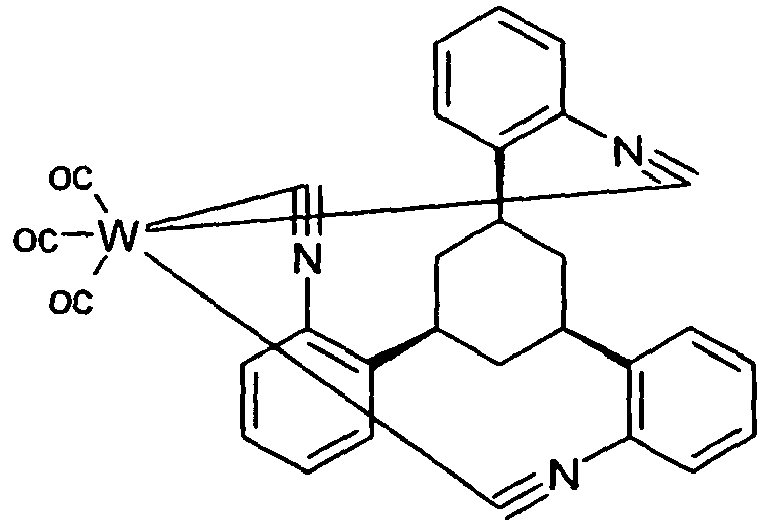

(73) (74) 

(75) (76) 
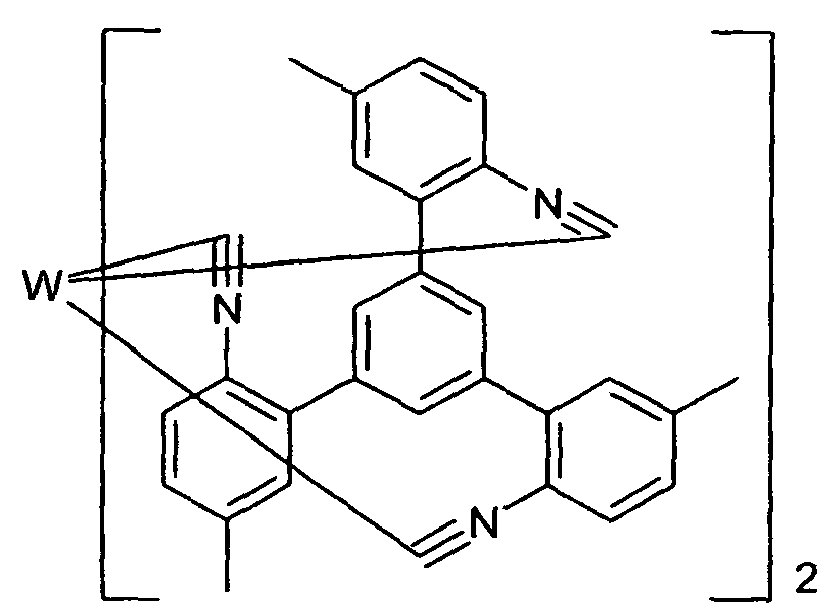
(77) (78) 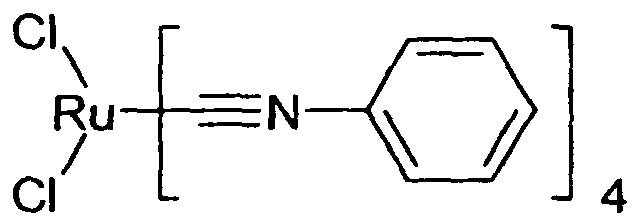
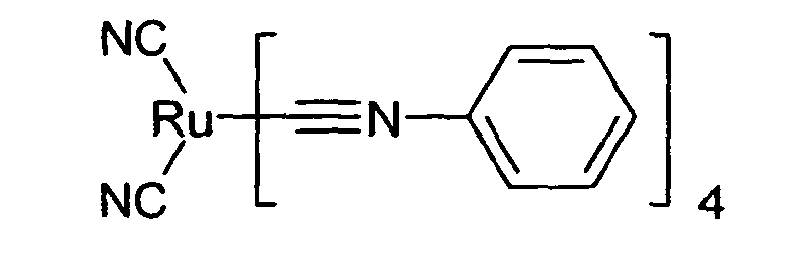
(79) (80) 

(81) (82) 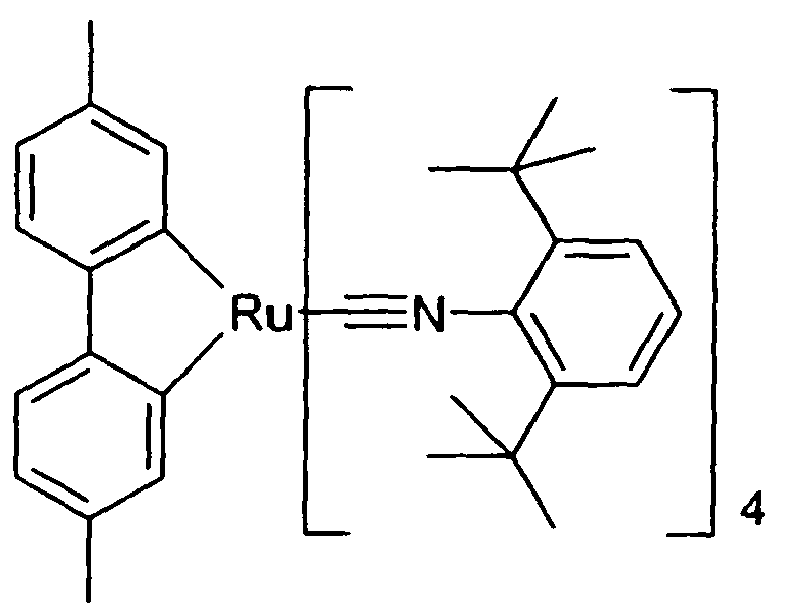
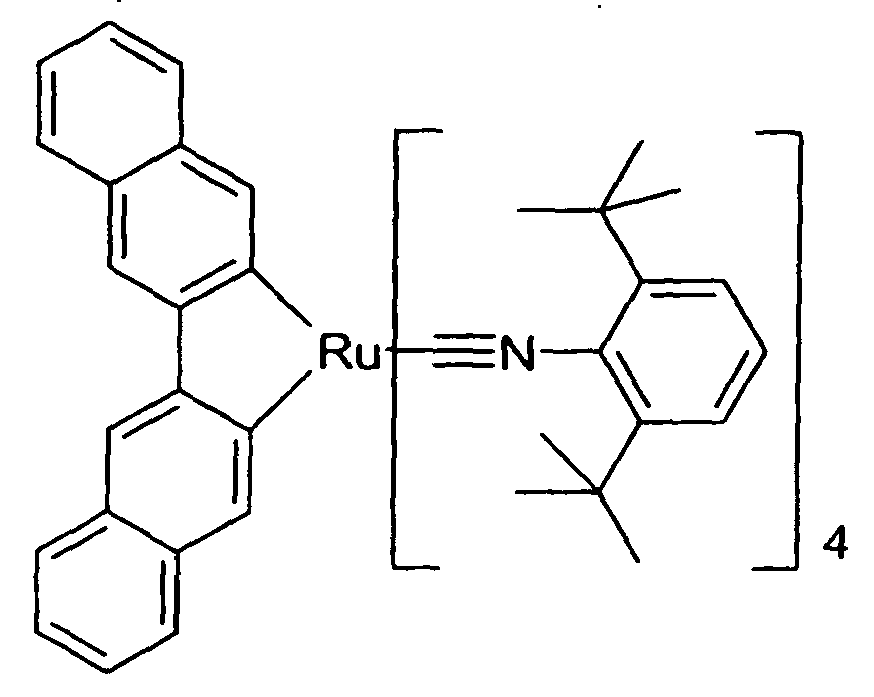
(83) (84) 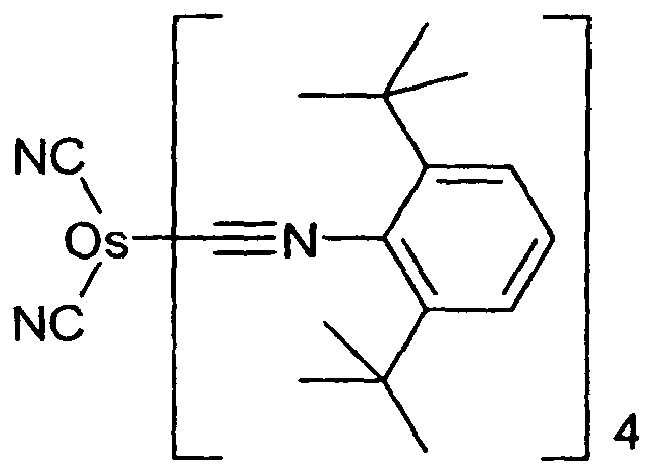

(85) (86) 

(87) (88) 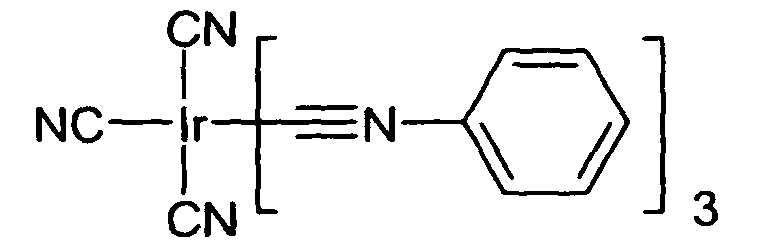
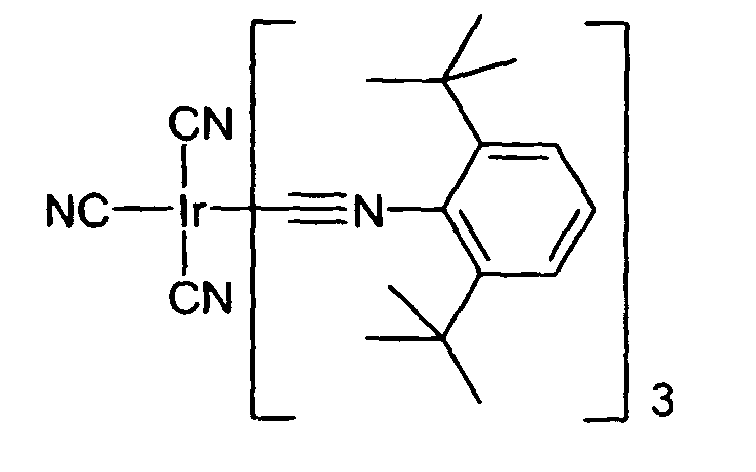
(89) (90) 

(91) (92) 

(93) (94) 

(95) (96) 

(97) (98) - Die oben beschriebenen Komplexe gemäß Formel (1) bzw. die oben aufgeführten bevorzugten Ausführungsformen werden in der elektronischen Vorrichtung als aktive Komponente verwendet. Aktive Komponenten sind generell die organischen oder anorganischen Materialien, welche zwischen Anode und Kathode eingebracht sind, beispielsweise Ladungsinjektions-, Ladungstransport- oder Ladungsblockiermaterialien, insbesondere aber Emissionsmaterialien und Matrixmaterialien. Für diese Funktionen zeigen die erfindungsgemäßen Verbindungen besonders gute Eigenschaften, insbesondere als Emissionsmaterial in organischen Elektrolumineszenzvorrichtungen. Eine bevorzugte Ausführungsform der Erfindung sind daher organische Elektrolumineszenzvorrichtungen.
- Die organische Elektrolumineszenzvorrichtung enthält Kathode, Anode und mindestens eine emittierende Schicht. Außer diesen Schichten kann sie noch weitere Schichten enthalten, beispielsweise jeweils eine oder mehrere Lochinjektionsschichten, Lochtransportschichten, Lochblockierschichten, Elektronentransportschichten, Elektroneninjektionsschichten, Exzitonenblockierschichten, Ladungserzeugungsschichten und/oder organische oder anorganische p/n-Übergänge. Ebenso können zwischen zwei emittierende Schichten Interlayers eingebracht sein, welche beispielsweise eine Exzitonen-blockierende Funktion aufweisen und/oder die Ladungsbalance in der Elektrolumineszenzvorrichtung steuern. Es sei aber darauf hingewiesen, dass nicht notwendigerweise jede dieser Schichten vorhanden sein muss. Dabei kann die organische Elektrolumineszenzvorrichtung eine emittierende Schicht enthalten, oder sie kann mehrere emittierende Schichten enthalten. Wenn mehrere Emissionsschichten vorhanden sind, weisen diese bevorzugt insgesamt mehrere Emissionsmaxima zwischen 380 nm und 750 nm auf, so dass insgesamt weiße Emission resultiert, d. h. in den emittierenden Schichten werden verschiedene emittierende Verbindungen verwendet, die fluoreszieren oder phosphoreszieren können. Insbesondere bevorzugt sind Dreischichtsysteme, wobei die drei Schichten blaue, grüne und orange oder rote Emission zeigen (für den prinzipiellen Aufbau siehe z. B.
WO 05/011013 - In einer bevorzugten Ausführungsform der Erfindung enthält die organische elektronische Vorrichtung die Verbindung gemäß Formel (1) bzw. die oben aufgeführten bevorzugten Ausführungsformen als emittierende Verbindung in einer oder mehreren emittierenden Schichten.
- Wenn die Verbindung gemäß Formel (1) als emittierende Verbindung in einer emittierenden Schicht eingesetzt wird, wird sie bevorzugt in Kombination mit einem oder mehreren Matrixmaterialien eingesetzt. Die Mischung aus der Verbindung gemäß Formel (1) und dem Matrixmaterial enthält zwischen 1 und 99 Vol.-%, vorzugsweise zwischen 2 und 90 Vol.-%, besonders bevorzugt zwischen 3 und 40 Vol.-%, insbesondere zwischen 5 und 15 Vol.-% der Verbindung gemäß Formel (1) bezogen auf die Gesamtmischung aus Emitter und Matrixmaterial. Entsprechend enthält die Mischung zwischen 99 und 1 Vol.-%, vorzugsweise zwischen 98 und 10 Vol.-%, besonders bevorzugt zwischen 97 und 60 Vol.-%, insbesondere zwischen 95 und 85 Vol.-% des Matrixmaterials bezogen auf die Gesamtmischung aus Emitter und Matrixmaterial.
- Bevorzugte Matrixmaterialien sind CBP (N,N-Biscarbazolylbiphenyl), Carbazolderivate (z. B. gemäß
WO 05/039246 US 2005/0069729 ,JP 2004/288381 EP 1205527 oderWO 08/086851 EP 1617710 ,EP 1617711 ,EP 1731584 ,JP 2005/347160 WO 04/093207 DE 102008033943.1 ), Phosphinoxide, Sulfoxide und Sulfone (z. B. gemäßWO 05/003253 US 2005/0069729 ), bipolare Matrixmaterialien (z. B. gemäßWO 07/137725 WO 05/111172 DE 102008017591.9 ), Azaborole, Boronester (z. B. gemäßWO 06/117052 WO 07/063754 WO 08/056746 WO 07/063754 DE 102008036982.9 ), Zinkkomplexe (EP 652273 DE 102007053771.0 ). - Weiterhin bevorzugt ist eine organische Elektrolumineszenzvorrichtung, dadurch gekennzeichnet, dass eine oder mehrere Schichten mit einem Sublimationsverfahren beschichtet werden. Dabei werden die Materialien in Vakuum-Sublimationsanlagen bei einem Anfangsdruck kleiner 10-5 mbar, bevorzugt kleiner 10-6 mbar aufgedampft.
- Bevorzugt ist ebenfalls eine organische Elektrolumineszenzvorrichtung, dadurch gekennzeichnet, dass eine oder mehrere Schichten mit dem OVPD (Organic Vapour Phase Deposition) Verfahren oder mit Hilfe einer Trägergassublimation beschichtet werden. Dabei werden die Materialien bei einem Druck zwischen 10-5 mbar und 1 bar aufgebracht. Ein Spezialfall dieses Verfahrens ist das OVJP (Organic Vapour Jet Printing) Verfahren, bei dem die Materialien direkt durch eine Düse aufgebracht und so strukturiert werden (z. B. M. S. Arnold et al., Appl. Phys. Lett. 2008, 92, 053301).
- Weiterhin bevorzugt ist eine organische Elektrolumineszenzvorrichtung, dadurch gekennzeichnet, dass eine oder mehrere Schichten aus Lösung, wie z. B. durch Spincoating, oder mit einem beliebigen Druckverfahren, wie z. B. Siebdruck, Flexodruck oder Offsetdruck, besonders bevorzugt aber LITI (Light Induced Thermal Imaging, Thermotransferdruck) oder Ink-Jet Druck (Tintenstrahldruck), hergestellt werden. Hierfür sind lösliche Verbindungen nötig, welche beispielsweise durch geeignete Substitution erhalten werden.
- Die organische Elektrolumineszenzvorrichtung kann auch als Hybridsystem hergestellt werden, indem eine oder mehrere Schichten aus Lösung aufgebracht werden und eine oder mehrere andere Schichten aufgedampft werden. Da die Verbindungen gemäß Formel (1) im Allgemeinen eine hohe Löslichkeit in organischen Lösemitteln aufweisen, können diese Verbindungen gut aus Lösung verarbeitet werden. So ist es beispielsweise möglich, eine emittierende Schicht enthaltend eine Verbindung gemäß Formel (1) und ein Matrixmaterial aus Lösung aufzubringen und darauf eine Lochblockierschicht und/oder eine Elektronentransportschicht im Vakuum aufzudampfen.
- Diese Verfahren sind dem Fachmann generell bekannt und können von ihm ohne Probleme auf organische Elektrolumineszenzvorrichtungen enthaltend Verbindungen gemäß Formel (1) bzw. die oben aufgeführten bevorzugten Ausführungsformen angewandt werden.
- Metallkomplexe, welche die oben aufgeführten Liganden der Formel (27) und/oder (28) enthalten, sind neu und sind daher ebenfalls ein Gegenstand der vorliegenden Erfindung.
- Ein weiterer Gegenstand der Erfindung sind daher Metallkomplexe der Formel (1'),
(L)y M-[C≡N-R]x Formel (1')
wobei die verwendeten Symbole und Indizes die oben genannten Bedeutungen haben und mindestens einer der Isonitrilliganden ausgewählt ist aus Liganden der Formel (27) oder (28), welcher jeweils auch durch einen oder mehrere Reste R1 substituiert sein kann: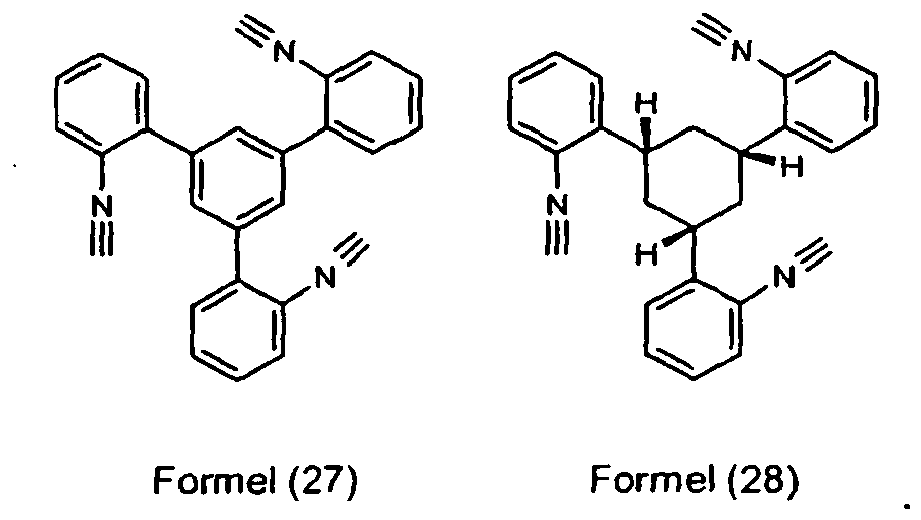
- Dabei gelten in Komplexen der Formel (1') für die Auswahl der Metalle und gegebenenfalls vorhandener weiterer Liganden dieselben Bevorzugungen, wie oben beschrieben.
- Für das Aufbringen aus Lösung sind Lösungen der Verbindungen gemäß Formel (1') erforderlich. Weiterer Gegenstand der Erfindung sind daher Lösungen enthaltend mindestens eine Verbindung gemäß Formel (1') und mindestens ein organisches Lösungsmittel, bevorzugt ausgewählt aus der Klasse der aromatischen organischen Lösungsmittel, z. B. Dimethylanisol. Nochmals ein weiterer Gegenstand der Erfindung sind Liganden der oben abgebildeten Formeln (27) und (28), welche jeweils durch einen oder mehrere Reste R1 substituiert sein können.
- Die erfindungsgemäßen elektronischen Vorrichtungen, insbesondere organische Elektrolumineszenzvorrichtungen, zeichnen sich durch folgende überraschende Vorteile gegenüber dem Stand der Technik aus:
- 1. Organische Elektrolumineszenzvorrichtungen enthaltend Verbindungen gemäß Formel (1) als emittierende Materialien weisen eine exzellente Lebensdauer auf.
- 2. Organische Elektrolumineszenzvorrichtungen enthaltend Verbindungen gemäß Formel (1) als emittierende Materialien weisen eine hervorragende Effizienz auf.
- 3. Die Lumineszenzlebensdauer vieler Verbindungen gemäß Formel (1) bei Raumtemperatur liegt im Bereich von weniger als 100 ns und ist damit um mehr als eine Größenordnung geringer als die Lumineszenzlebensdauer von Iridiumkomplexen oder Platinkomplexen, wie sie gemäß dem Stand der Technik in organischen Elektrolumineszenzvorrichtungen eingesetzt werden. Daher eignen sich die Verbindungen gemäß Formel (1) insbesondere auch zum Einsatz in organischen
- Elektrolumineszenzvorrichtungen mit Passiv-Matrix-Ansteuerung. Diese oben genannten Vorteile gehen nicht mit einer Verschlechterung der weiteren elektronischen Eigenschaften einher.
- Die Erfindung wird durch die nachfolgenden Beispiele näher erläutert, ohne sie dadurch einschränken zu wollen. Der Fachmann kann aus den Schilderungen ohne erfinderisches Zutun weitere erfindungsgemäße elektronische Vorrichtungen herstellen.
- Die nachfolgenden Synthesen werden, sofern nicht anders angegeben, unter einer Schutzgasatmosphäre in getrockneten Lösungsmitteln durchgeführt. Die Lösungsmittel und Reagenzien können von ALDRICH bzw. ABCR bezogen werden.
- Hexakis(phenylisonitril)molybdän(0) (Beispiel 1), Hexakis(phenylisonitril)-wolfram(0) (Beispiel 2) und Hexakis(2,4,6-tri-tert-butylphenylisonitril)-wolfram(0) (Beispiel 3) können nach Albers et al., J. Chem. Edu. 1986, 63(5), 444, Coville et al., Inorg. Chim. Acta 1982, 65, L7-L8, bzw. Yamamoto et al., J. Organomet. Chem. 1985, 282, 191 hergestellt werden. Die Verbindungen werden mehrfach aus Toluol / Ethanol (1:2 - 1:1) umkristallisiert. Die so erzielten Reinheiten betragen typischerweise > 99.8 % nach 1H-NMR.
-

- Eine Suspension von 8,2 g [10 mmol] Tricarbonyl[cis,cis-1,3,5-cyclohexan-triyltris[diphenylphosphin]-P,P',P"]-molybdän (0), [156999-20-1] in 100 ml Toluol wird mit 3,6 g (35 mmol) Phenylisonitril und 50 mg Palladium(II)oxid versetzt und anschließend 60 h unter Rückfluss gerührt. Nach Erkalten wird vom Palladium(II)oxid über Kieselgel abfiltriert, die rote Lösung wird im Vakuum auf ca. 10 ml eingeengt und dann mit 50 ml Ethanol versetzt. Nach 12 h Rühren wird der FS abgesaugt, und zweimal aus Toluol / Ethanol umkristallisiert. Ausbeute: 4,3 g, (4,1 mmol), 41,3 %, Reinheit n. 1H-NMR ca. 99,7 %.
- Analog zu Beispiel 4 wurden die in Tabelle aufgeführten Komplexe aus den entsprechenden Vorstufen dargestellt.
Bsp. Vorstufe Produkt Ausbeute 5 

38.4% 6 

41,3% 7 
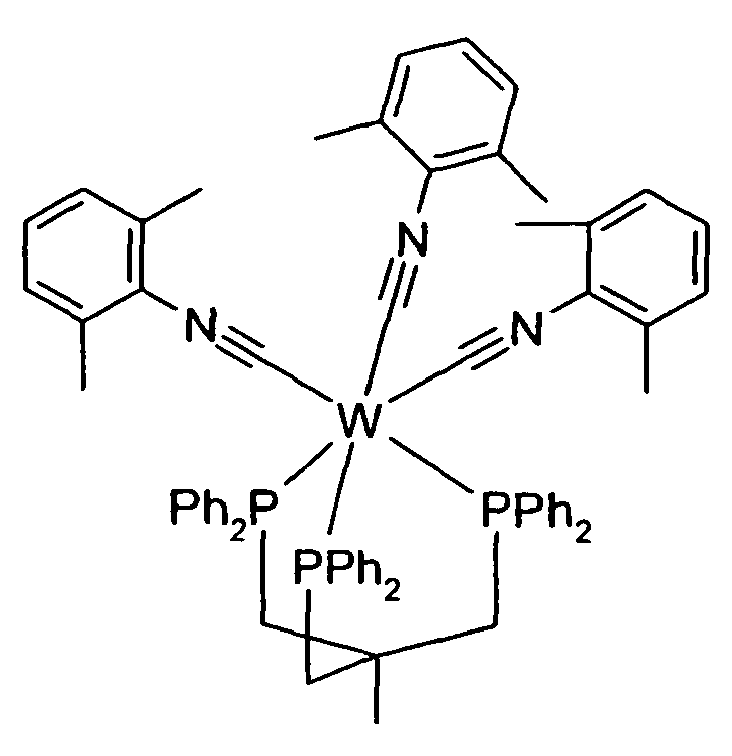
34,5% -

- 1,3,5-Tris(1-isocyano-phen-2-yl)benzol wird aus 1,3,5-Tris(1-amino-phen-2-yl)benzol [923027-14-9] nach F.E. Hahn et al., J. Organomet. Chem. 467, 130, 1994 dargestellt.
- Eine Lösung von 2,6 g [10 mmol] Molybdänhexacarbonyl in 100 ml Toluol wird mit 8,0 g (21 mmol) 1,3,5-Tris(1-isocyanophen-2-yl)benzol und 50 mg Palladium(II)oxid versetzt und anschließend 60 h unter Rückfluss gerührt. Nach Erkalten wird vom Palladium(II)oxid über Kieselgel abfiltriert, die rote Lösung wird im Vakuum auf ca. 10 ml eingeengt und dann mit 50 ml Ethanol versetzt. Nach 12 h Rühren wird der FS abgesaugt, und dann an Aluminiumoxid, neutral, Aktivitätsstufe 4, mit Dichlormethan - Diethylether 1:5 chromatographiert. Ausbeute: 6,1 g, (7.1 mmol), 71.0 %, Reinheit n. 1H-NMR ca. 99,9 %.
-

- Eine Lösung von 3,6 g [10 mmol] Cycloheptatrienyl-wolfram-tricarbonyl in 100 ml Toluol wird mit 4,2 g (11 mmol) 1,3,5-Tris(1-isocyanophen-2-yl)benzol versetzt und anschließend 5 h unter Rückfluss gerührt. Nach Erkalten wird im Vakuum auf ca. 10 ml eingeengt und dann mit 50 ml Heptan versetzt, der ausgefallene Feststoff wird abgesaugt, dreimal mit 50 ml Heptan gewaschen und zweimal aus Chlorbenzol umkristallisiert. Ausbeute: 4,8 g, (7,4 mmol), 73,9 %, Reinheit n. 1H-NMR ca. 99,9 %.
- Die Isonitrilkomplexe weisen die folgenden Lumineszenzlebensdauern bei Raumtemperatur auf (nach: K. Mann et al., J. Am. Chem. Soc. 1977, 99(1),306):
- Hexakis(phenylisonitril)molybdän(0) (Beispiel 1) = 43 ns;
- Hexakis(phenylisonitril)wolfram(0) (Beispiel 2) = 83 ns.
- Hieraus lässt sich deutlich erkennen, dass die Metallkomplexe der Formel (1) mit Isonitrilliganden eine deutlich geringere Lumineszenzlebensdauer aufweisen als Iridium- oder Platinkomplexe, wie sie gemäß dem Stand der Technik meist in OLEDs verwendet werden. Damit eignen sich diese Komplexe insbesondere auch zur Anwendung in Elektrolumineszenzvorrichtungen mit Passiv-Matrix-Ansteuerung.
- Die Herstellung von LEDs erfolgt nach dem im Folgenden skizzierten allgemeinen Verfahren. Dieses muss natürlich im Einzelfall auf die jeweiligen Gegebenheiten (z. B. Schichtdickenvariation, um optimale Effizienz bzw. Farbe zu erreichen) angepasst werden.
- Die Herstellung solcher Bauteile lehnt sich an die Herstellung polymerer Leuchtdioden (PLEDs) an, die in der Literatur bereits vielfach beschrieben ist (z.B. in der
WO 2004/037887 A2 ). Im vorliegenden Fall werden die erfindungsgemäßen Verbindungen zusammen mit den auf geführten Matrixmaterialien oder Matrixmareialkombinationen in Toluol bzw. Chlorbenzol gelöst. Der typische Feststoffgehalt solcher Lösungen liegt zwischen 10 und 25 g/L, wenn, wie hier, die für eine Device typische Schichtdicke von 80 nm mittels Spincoating erzielt werden soll. - Als Matrixmaterialen werden folgende Verbindungen verwendet:
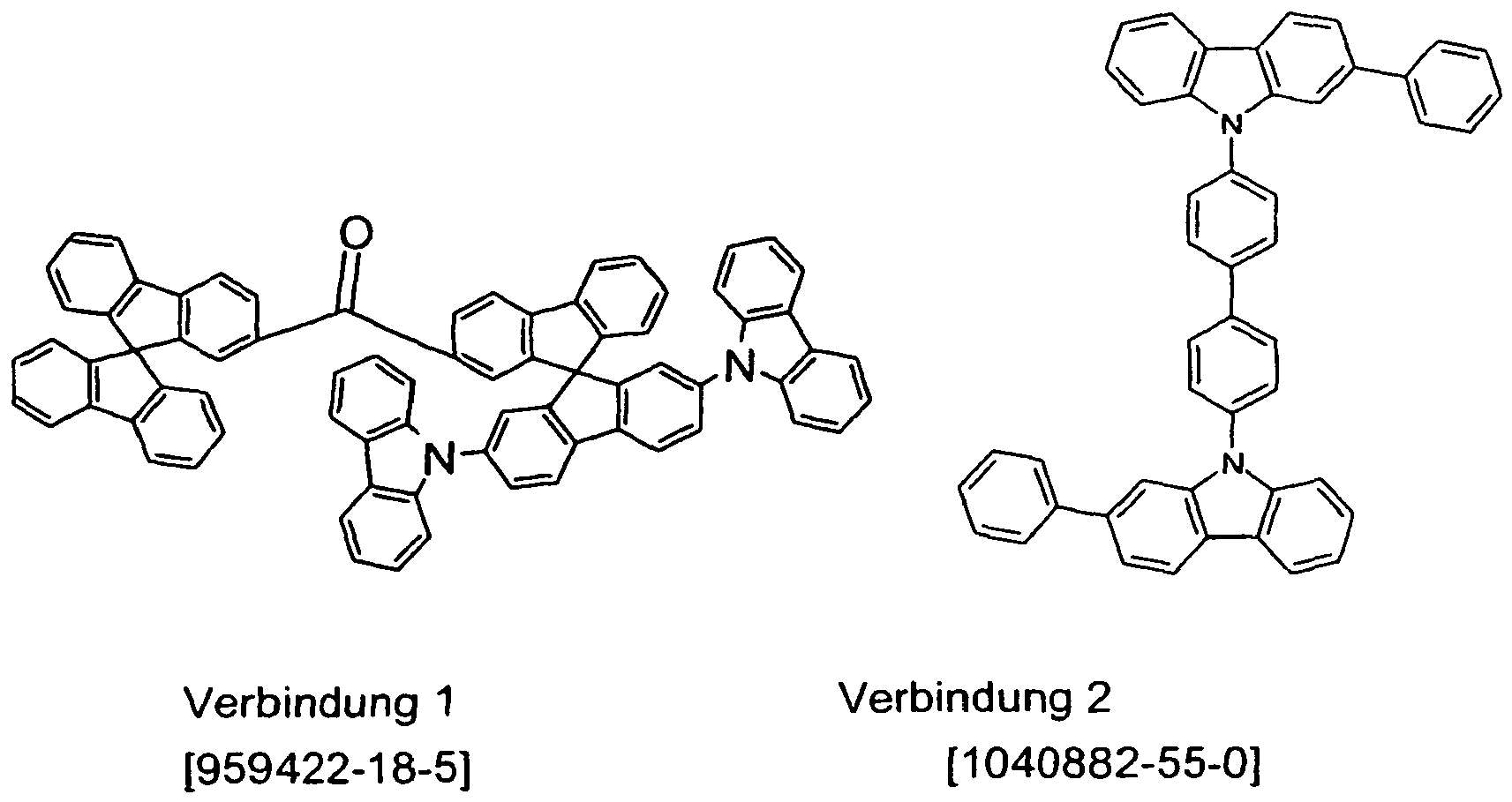

- Analog dem o. g. allgemeinen Verfahren werden OLEDs mit folgendem Aufbau erzeugt:
- PEDOT
- 20 nm (aus Wasser aufgeschleudert; PEDOT bezogen von BAYER AG; Poly-[3,4-ethylendioxy-2,5-thiophen])
- Matrix + Emitter
- 80 nm, 5 Gew.-% Emitterkonzentration (aus Toluol oder Chlorbenzol aufgeschleudert),
- Ba / Ag
- 10 nm Ba / 150 nm Ag als Kathode.
- Strukturierte ITO-Substrate und das Material für die sogenannte Pufferschicht (PEDOT, eigentlich PEDOT:PSS) sind käuflich erhältlich (ITO von Technoprint und anderen, PEDOT:PPS als wässrige Dispersion Clevios Baytron P von H.C. Starck). Die Emissionsschicht wird in einer Inertgasatmosphäre, im vorliegenden Fall Argon, aufgeschleudert und 10 min bei 120°C ausgeheizt. Zuletzt wird eine Kathode aus Barium und Aluminium im Vakuum aufgedampft. Die lösungsprozessierten Devices werden standardmäßig charakterisiert, die genannten OLED-Beispiele wurden nicht optimiert.
- In Tabelle sind die Effizienz und die Spannung bei 500 cd / m2 sowie die Farbe aufgeführt.
Bsp. Matrix Emitter Effizienz [cd/A] Spannung M Farbe CIE x / y 12 PVK* 1,4 6,1 0,70 / 0,28 Beispiel 1 13 Verbindung 1 2,6 5,7 0,69 / 0,31 Beispiel 1 14 Verbindung 2 4,0 5,4 0,68 / 0,32 Beispiel 6 15 Verbindung 2 3,7 5,5 0,69/0,31 Beispiel 8 16 Verb. 2 (30 Gew.-%) 4,9 5,1 0,66/0,33 Verb. 3 (65 Gew.-%) Beispiel 4 **PVK: Mw = 1,100,000 g / mol bezogen von Aldrich


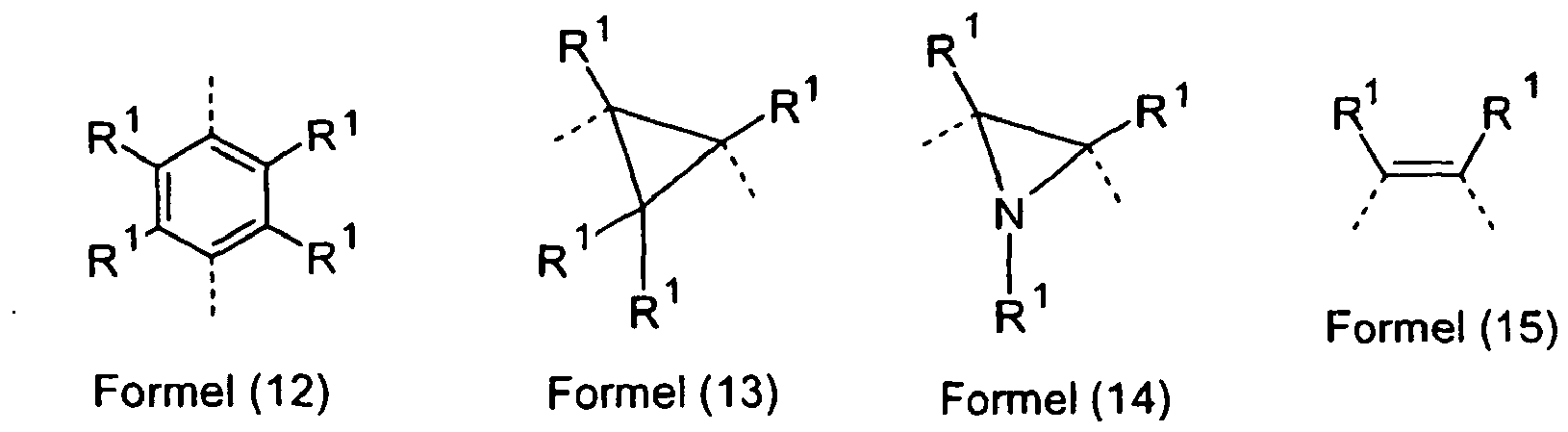
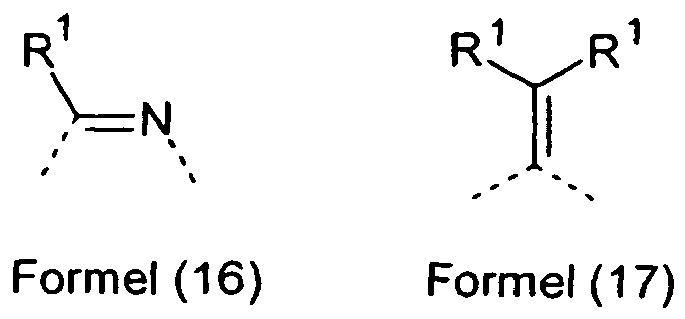
Claims (16)
- Elektronische Vorrichtung, enthaltend mindestens einen Metallkomplex gemäß Formel (1),
(L)y M-[C≡N-R]x Formel (1)
wobei für die verwendeten Symbole und Indizes gilt:M ist ein penta- oder hexakoordiniertes Übergangsmetall;L ist bei jedem Auftreten gleich oder verschieden ein mono-, bi-, oder tridentater Ligand, der an das Metall M bindet und der durch einen oder mehrere Reste R1 substituiert sein kann; dabei kann der Ligand L auch an den Rest R der Isonitrilgruppe gebunden sein;R ist bei jedem Auftreten gleich oder verschieden ein organischer Substituent mit 1 bis 60 C-Atomen, der durch einen oder mehrere Substituenten R1 substituiert sein kann; dabei können mehrere Reste R auch miteinander verknüpft sein und dadurch einen mehrzähnigen Liganden bilden; außerdem kann der Rest R auch mit dem Liganden L verknüpft sein;R1 ist bei jedem Auftreten gleich oder verschieden H, D, F, Cl, Br, I, N(R2)2, CN, NO2, Si(R2)3, B(OR2)2, C(=O)R2, P(=O)(R2)2, S(=O)R2, S(=O)2R2, OSO2R2, eine geradkettige Alkyl-, Alkoxy- oder Thioalkoxygruppe mit 1 bis 40 C-Atomen oder eine geradkettige Alkenyl- oder Alkinylgruppe mit 2 bis 40 C-Atomen oder eine verzweigte oder cyclische Alkyl-, Alkenyl-, Alkinyl-, Alkoxy- oder Thioalkoxygruppe mit 3 bis 40 C-Atomen, die jeweils mit einem oder mehreren Resten R2 substituiert sein kann, wobei eine oder mehrere bevorzugt nicht benachbarte CH2-Gruppen durch R2C=CR2, C=C, Si(R2)2, Ge(R2)2, Sn(R2)2, C=O, C=S, C=Se, C=NR2, P(=O)(R2), SO, SO2, NR2, O, S oder CONR2 ersetzt sein können und wobei ein oder mehrere H-Atome durch D, F, Cl, Br, I, CN oder NO2 ersetzt sein können, oder ein aromatisches oder heteroaromatisches Ringsystem mit 5 bis 60 aromatischen Ringatomen, das jeweils durch einen oder mehrere Reste R2 substituiert sein kann, oder eine Aryloxy- oder Heteroaryloxygruppe mit 5 bis 60 aromatischen Ringatomen, die durch einen oder mehrere Reste R2 substituiert sein kann, oder eine Diarylaminogruppe, Diheteroarylaminogruppe oder Arylheteroarylaminogruppe mit 10 bis 40 aromatischen Ringatomen, welche durch einen oder mehrere Reste R2 substituiert sein kann, oder eine Kombination dieser Systeme; dabei können zwei oder mehrere Substituenten R1 auch miteinander ein mono- oder polycyclisches aliphatisches, aromatisches und/oder benzoannelliertes Ringsystem bilden;R2 ist bei jedem Auftreten gleich oder verschieden H, D, F oder ein aliphatischer, aromatischer und/oder heteroaromatischer Kohlenwasserstoffrest mit 1 bis 20 C-Atomen, in dem auch ein oder mehrere H-Atome durch D oder F ersetzt sein können; dabei können zwei oder mehrere Substituenten R2 auch miteinander ein mono- oder polycyclisches, aliphatisches oder aromatisches Ringsystem bilden;x ist 3, 4, 5 oder 6;y ist 0, 1, 2 oder 3 mit der Maßgabe, dass eine Koordinationszahl am Metall von 5 oder 6 erreicht wird. - Elektronische Vorrichtung nach Anspruch 1, enthaltend Anode, Kathode und mindestens eine Schicht, wobei diese Schicht mindestens eine organische bzw. metallorganische Verbindung enthält, wobei die organische elektronische Vorrichtung ausgewählt ist aus der Gruppe bestehend aus organischen Elektrolumineszenzvorrichtungen (= organischen Leuchtdioden, OLEDs, PLEDs), organischen integrierten Schaltungen (O-ICs), organischen Feld-Effekt-Transistoren (O-FETs), organischen Dünnfilmtransistoren (O-TFTs), organischen lichtemittierenden Transistoren (O-LETs), organischen Solarzellen (O-SCs), organischen optischen Detektoren, organischen Photorezeptoren, organischen Feld-Quench-Devices (O-FQDs), lichtemittierenden elektrochemischen Zellen (LECs) oder organischen Laserdioden (O-Laser), insbesondere organische Elektrolumineszenzvorrichtungen.
- Elektronische Vorrichtung nach Anspruch 1 oder 2, dadurch gekennzeichnet, dass die Verbindungen gemäß Formel (1) nicht geladen, d. h. elektrisch neutral, sind.
- Elektronische Vorrichtung nach einem oder mehreren der Ansprüche 1 bis 3, dadurch gekennzeichnet, dass in Verbindungen gemäß Formel (1) M für ein pentakoordiniertes oder für ein hexakoordiniertes Übergangsmetall steht, ausgewählt aus der Gruppe bestehend aus Chrom, Molybdän, Wolfram, Rhenium, Ruthenium, Osmium, Rhodium, Iridium, Nickel, Platin, Kupfer, Silber und Gold, insbesondere Molybdän, Wolfram, Rhenium, Ruthenium, Osmium, Iridium, Platin und Gold.
- Elektronische Vorrichtung nach einem oder mehreren der Ansprüche 1 bis 4, dadurch gekennzeichnet, dass ein oder mehrere der Isonitrilliganden monodentate Liganden sind, wobei der Substituent R gleich oder verschieden bei jedem Auftreten für eine geradkettige Alkylgruppe mit 1 bis 40 C-Atomen oder eine geradkettige Alkenyl- oder Alkinylgruppe mit 2 bis 40 C-Atomen oder eine verzweigte oder cyclische Alkyl, Alkenyl- oder Alkinylgruppe mit 3 bis 40 C-Atomen, die jeweils mit einem oder mehreren Resten R1 substituiert sein kann, wobei eine oder mehrere bevorzugt nicht benachbarte CH2-Gruppen durch R1C=CR1, C=C, Si(R1)2, Ge(R1)2, Sn(R1)2, C=O, C=S, C=Se, C=NR1, P(=O)(R1), SO, SO2, NR1, O, S oder CONR1 ersetzt sein können und wobei ein oder mehrere H-Atome durch D, F, Cl, Br, I, CN oder NO2 ersetzt sein können, oder für ein monovalentes aromatisches oder heteroaromatisches Ringsystem mit 5 bis 60 aromatischen Ringatomen, das jeweils durch einen oder mehrere Reste R1 substituiert sein kann, oder für eine Kombination dieser Systeme steht.
- Elektronische Vorrichtung nach einem oder mehreren der Ansprüche 1 bis 5, dadurch gekennzeichnet, dass die Substituenten R miteinander und/oder zusammen mit dem Liganden L eine kettenförmige, verzweigte oder mono- oder polycyclische, aliphatische, aromatische und/oder benzoannellierte Struktur bilden und die Liganden damit mehrzähnigen bzw. polypodalen Ligandencharakter aufweisen.
- Elektronische Vorrichtung nach einem oder mehreren der Ansprüche 1 bis 6, dadurch gekennzeichnet, dass der Metallkomplex einen oder mehrere Isonitrilliganden mit einer Struktur gemäß Formel (2) oder Formel (3) enthält,
 Y ist bei jedem Auftreten gleich oder verschieden eine Einfachbindung, O, S, N(R1), C=O, eine geradkettige Alkylengruppe mit 1 bis 6 C-Atomen oder eine verzweigte oder cyclische Alkylengruppe mit 3 bis 6 C-Atomen, die jeweils mit einem oder mehreren Resten R1 substituiert sein kann, wobei eine oder mehrere nicht benachbarte CH2-Gruppen durch R1C=CR1, NR1, Si(R1)2, O oder S ersetzt sein können und wobei ein oder mehrere H-Atome durch D, F, Cl, Br, I, CN oder NO2 ersetzt sein können, oder eine Arylen- oder Heteroarylengruppe mit 5 bis 20 aromatischen Ringatomen, welche mit einem oder mehreren Resten R1 substituiert sein kann, oder eine Kombination dieser Systeme;V ist B, B(R1)-, CR1, CO-, CN(R1)2, SiR1, N, NO, N(R1)+, P, P(R1)+, PO, PS, As, As(R1)+, AsO, S+, Se+, oder eine Einheit gemäß Formel (4), (5), (6) oder (7),
 Z ist BR1, B(R1)2 -, C(R1)2, C(=O), Si(R1)2, NR1, PR1, P(R1)2 +, PO(R1), PS(R1), AsR1, AsO(R1), AsS, O, S, Se, oder eine Einheit gemäß Formel (8) bis (17),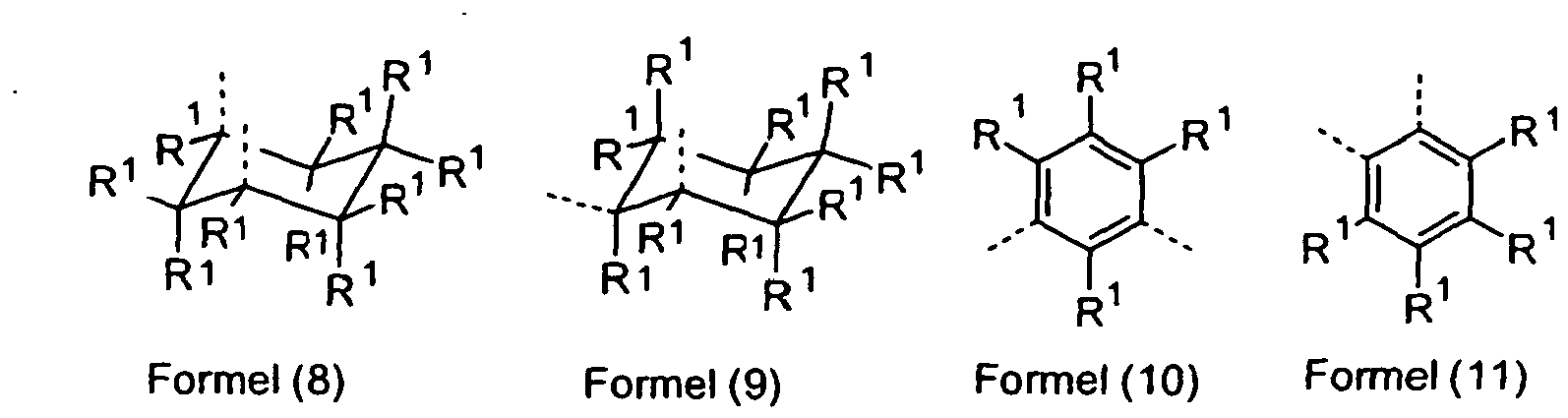
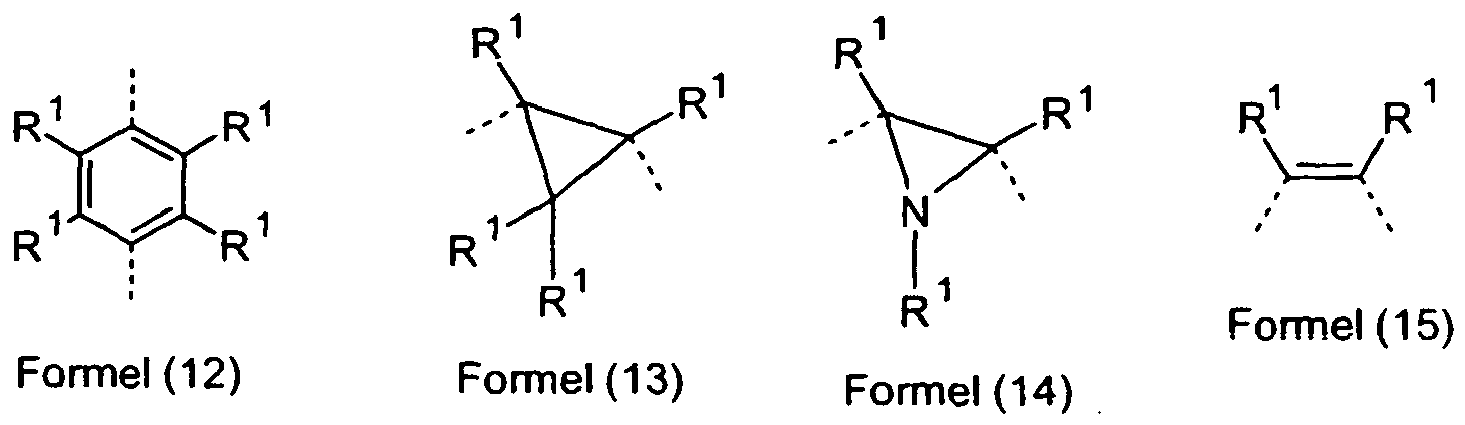
 n ist 1, 2 oder 3, bevorzugt 2 oder 3;m ist 1 oder 2, bevorzugt 2.
 - Elektronische Vorrichtung nach Anspruch 7, dadurch gekennzeichnet, dass die Anzahl der Atome in den beiden Gruppen Y und in der Gruppe V bzw. Z, die die direkte Verbindung zwischen den Isonitrilgruppen bzw. zwischen der Isonitrilgruppe und der Ligandengruppe L darstellt, zwischen 6 und 12 Atomen, bevorzugt zwischen 7 und 10 Atomen, besonders bevorzugt zwischen 7 und 9 Atomen beträgt.
- Elektronische Vorrichtung nach Anspruch 7 oder 8, dadurch gekennzeichnet, dass die Liganden ausgewählt sind aus Liganden der Formeln (18) bis (28), welche jeweils durch einen oder mehrere Reste R1 substituiert sein können:


- Elektronische Vorrichtung nach einem oder mehreren der Ansprüche 1 bis 9, dadurch gekennzeichnet, dass die Liganden L ausgewählt sind aus Kohlenmonoxid, Stickstoffmonoxid, Aminen, Phosphinen, Phosphiten, Arsinen, Stibinen, stickstoffhaltigen Heterocyclen, Carbenen, Hydrid, Deuterid, den Halogeniden F, Cl, Br und I, Alkylacetyliden, Arylacetyliden, Cyanid, Azid, Cyanat, Isocyanat, Thiocyanat, Isothiocyanat, aliphatischen oder aromatischen Alkoholaten, aliphatischen oder aromatischen Thioalkoholaten, Amiden, Carboxylaten, Arylgruppen, anionischen, stickstoffhaltigen Heterocyclen, O2-, S2-, Carbide, welche zu einer Koordination der Form R-C≡M führen, und Nitrene, welche zu einer Koordination der Form R-N=M führen, wobei R allgemein für einen Substituenten steht, oder N3-, Diaminen, Iminen, Diminen, Heterocyclen enthaltend zwei Stickstoffatome, Diphosphinen, 1,3-Diketonaten abgeleitet von 1,3-Diketonen, 3-Ketonaten abgeleitet von 3-Ketoestern, Carboxylaten abgeleitet von Aminocarbonsäuren, Salicyliminaten abgeleitet von Salicyliminen, Dialkoholaten abgeleitet von Dialkoholen, Dithiolaten abgeleitet von Dithiolen, Borate stickstoffhaltiger Heterocyclen, η5-Cyclopentadienyl, η5-Pentamethylcyclopentadienyl, η6-Benzol oder η7-Cycloheptatrienyl, welche jeweils durch einen oder mehrere Reste R1 substituiert sein können, oder dass der Ligand L ein bidentater monoanionischer Ligand ist, welcher mit dem Metall einen cyclometallierten Fünfring oder Sechsring mit mindestens einer Metall-Kohlenstoff-Bindung aufweist, insbesondere eine Kombination aus zwei Gruppen, wie sie durch die Formeln (29) bis (56) dargestellt sind, wobei eine Gruppe über ein neutrales Stickstoffatom oder ein Carbenatom bindet und die andere Gruppe über ein negativ geladenes Kohlenstoffatom oder ein negativ geladenes Stickstoffatom bindet, wobei der Ligand L dann aus den Gruppen der Formeln (29) bis (56) gebildet wird, indem diese Gruppen jeweils an der durch # gekennzeichneten Position aneinander binden, und die Position, an der die Gruppen an das Metall koordinieren, durch * gekennzeichnet ist:


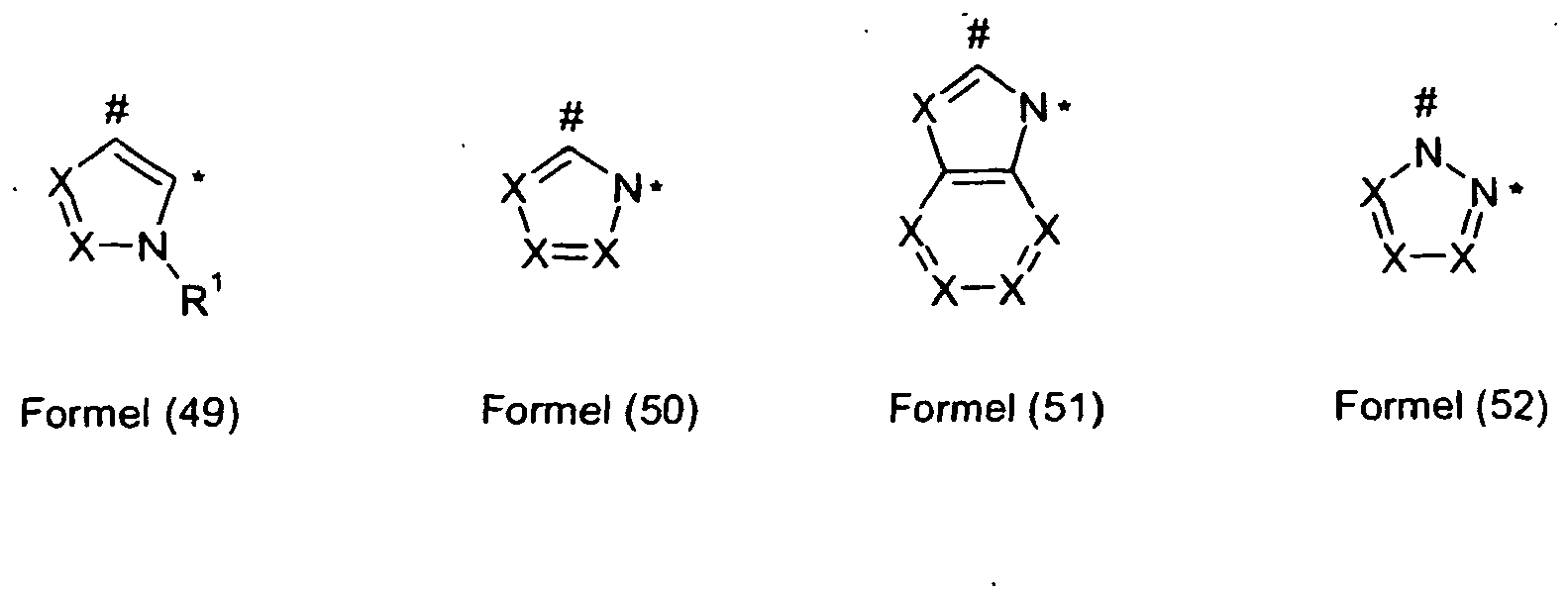
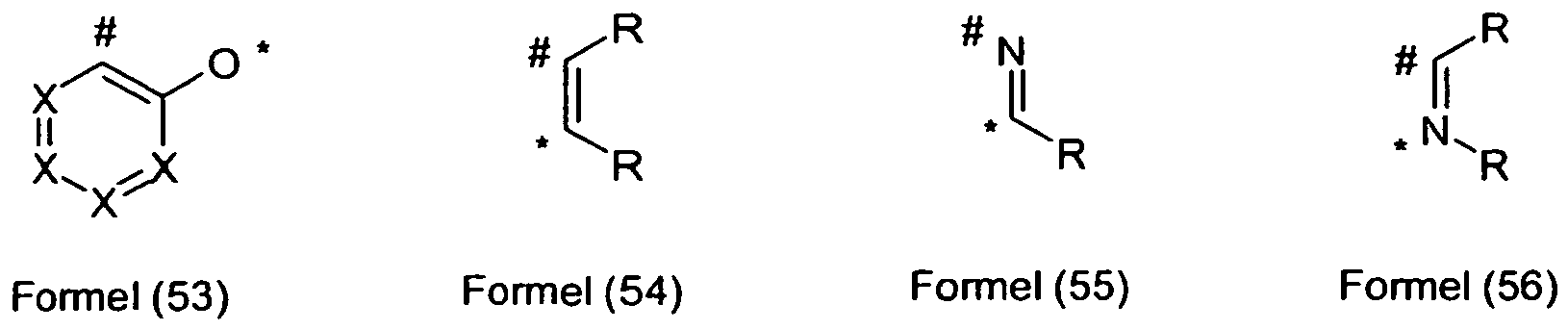
oder dass der Ligand L ein 1,3,5-cis-Cyclohexanderivat, insbesondere der Formel (57), ein 1,1,1-Tri(methylen)methanderivat, insbesondere der Formel (58) und ein 1,1,1-trisubstituiertes Methan, insbesondere der Formel (59) und (60) ist,
- Organische Elektrolumineszenzvorrichtung nach einem oder mehreren der Ansprüche 1 bis 10, enthaltend Kathode, Anode und eine oder mehrere emittierende Schichten und außerdem optional jeweils eine oder mehrere Lochinjektionsschichten, Lochtransportschichten, Lochblockierschichten, Elektronentransportschichten, Elektroneninjektionsschichten, Exzitonenblockierschichten, Ladungserzeugungsschichten und/oder organische oder anorganische p/n-Übergänge, dadurch gekennzeichnet, dass die Verbindung gemäß Formel (1) als Emissionsmaterial in einer emittierenden Schicht eingesetzt wird.
- Organische Elektrolumineszenzvorrichtung nach einem oder mehreren der Ansprüche 1 bis 11, dadurch gekennzeichnet, dass die Verbindung gemäß Formel (1) in einer emittierenden Schicht in Kombination mit einem oder mehreren Matrixmaterialien eingesetzt wird, insbesondere ausgewählt aus CBP (N,N-Biscarbazolylbiphenyl), Carbazolderivaten, Azacarbazolen, Ketonen, Phosphinoxiden, Sulfoxiden, Sulfonen, Oligophenylenen, aromatischen Aminen, bipolaren Matrixmaterialien, Silanen, 9,9-Diarylfluorenderivaten, Azaborolen oder Boronestern.
- Verfahren zur Herstellung einer elektronischen Vorrichtung nach einem oder mehreren der Ansprüche 1 bis 12, dadurch gekennzeichnet, dass eine oder mehrere Schichten mit einem Sublimationsverfahren beschichtet werden und/oder dass eine oder mehrere Schichten mit dem OVPD (Organic Vapour Phase Deposition) Verfahren oder mit Hilfe einer Trägergassublimation beschichtet werden oder mit dem OVJP (Organic Vapour Jet Printing) Verfahren beschichtet werden und/oder dass eine oder mehrere Schichten aus Lösung oder mit einem Druckverfahren hergestellt werden.
- Verbindung der Formel (1'),
(L)y M-[C≡N-R]x Formel (1')
wobei die verwendeten Symbole und Indizes die in Anspruch 1 genannten Bedeutungen haben und mindestens einer der Isonitrilliganden ausgewählt ist aus Liganden der Formel (27) oder (28), welcher jeweils auch durch einen oder mehrere Reste R1 substituiert sein kann: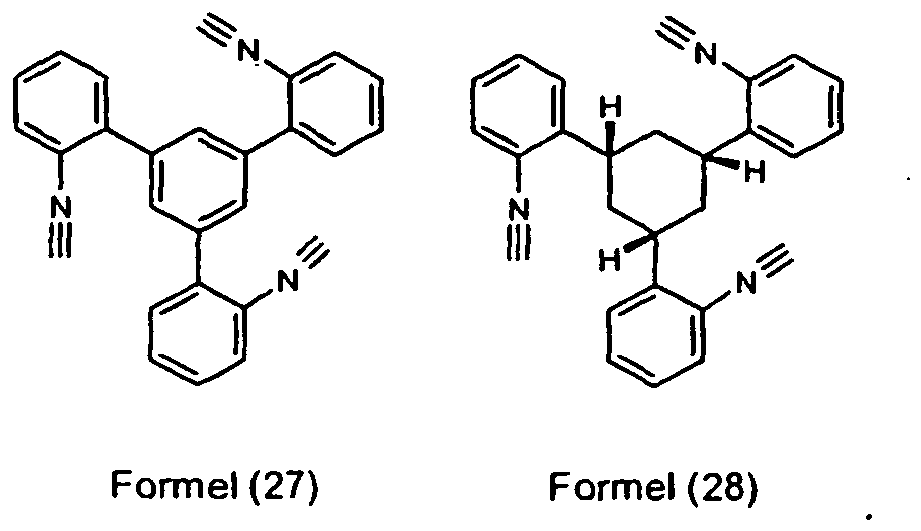
- Verbindung der Formel (27) und (28), welche jeweils durch einen oder mehrere Reste R1 substituiert sein können, wobei R1 die in Anspruch 1 genannte Bedeutung hat:

- Lösung oder Formulierung enthaltend mindestens eine Verbindung gemäß Formel (1') sowie mindestens ein organisches Lösungsmittel, bevorzugt ausgewählt aus der Klasse der aromatischen organischen Lösungsmittel.
Applications Claiming Priority (2)
| Application Number | Priority Date | Filing Date | Title |
|---|---|---|---|
| DE102008036247A DE102008036247A1 (de) | 2008-08-04 | 2008-08-04 | Elektronische Vorrichtungen enthaltend Metallkomplexe |
| PCT/EP2009/004955 WO2010015307A1 (de) | 2008-08-04 | 2009-07-08 | Elektronische vorrichtung enthaltend metallkomplexe mit isonitrilliganden |
Publications (2)
| Publication Number | Publication Date |
|---|---|
| EP2311112A1 EP2311112A1 (de) | 2011-04-20 |
| EP2311112B1 true EP2311112B1 (de) | 2012-03-14 |
Family
ID=41050415
Family Applications (1)
| Application Number | Title | Priority Date | Filing Date |
|---|---|---|---|
| EP09777051A Not-in-force EP2311112B1 (de) | 2008-08-04 | 2009-07-08 | Elektronische vorrichtung enthaltend metallkomplexe mit isonitrilliganden |
Country Status (9)
| Country | Link |
|---|---|
| US (1) | US8691400B2 (de) |
| EP (1) | EP2311112B1 (de) |
| JP (1) | JP5746028B2 (de) |
| KR (1) | KR101658679B1 (de) |
| CN (1) | CN102077380B (de) |
| AT (1) | ATE549752T1 (de) |
| DE (1) | DE102008036247A1 (de) |
| TW (1) | TW201022400A (de) |
| WO (1) | WO2010015307A1 (de) |
Families Citing this family (214)
| Publication number | Priority date | Publication date | Assignee | Title |
|---|---|---|---|---|
| DE102009053644B4 (de) | 2009-11-17 | 2019-07-04 | Merck Patent Gmbh | Materialien für organische Elektrolumineszenzvorrichtungen |
| DE102009053836A1 (de) | 2009-11-18 | 2011-05-26 | Merck Patent Gmbh | Materialien für organische Elektrolumineszenzvorrichtungen |
| DE102010004803A1 (de) | 2010-01-16 | 2011-07-21 | Merck Patent GmbH, 64293 | Materialien für organische Elektrolumineszenzvorrichtungen |
| US9373807B2 (en) * | 2010-03-11 | 2016-06-21 | Merck Patent Gmbh | Radiative fibers |
| DE102010024897A1 (de) | 2010-06-24 | 2011-12-29 | Merck Patent Gmbh | Materialien für organische Elektrolumineszenzvorrichtungen |
| DE102010027319A1 (de) * | 2010-07-16 | 2012-01-19 | Merck Patent Gmbh | Metallkomplexe |
| DE102010045405A1 (de) | 2010-09-15 | 2012-03-15 | Merck Patent Gmbh | Materialien für organische Elektrolumineszenzvorrichtungen |
| DE102010048497A1 (de) * | 2010-10-14 | 2012-04-19 | Merck Patent Gmbh | Formulierungen für organische Elektrolumineszenzvorrichtungen |
| CN103228647B (zh) | 2010-11-24 | 2017-02-15 | 默克专利有限公司 | 用于有机电致发光器件的材料 |
| KR101979469B1 (ko) | 2011-04-18 | 2019-05-16 | 메르크 파텐트 게엠베하 | 유기 전계발광 소자용 재료 |
| CN103619986B (zh) | 2011-06-03 | 2017-02-08 | 默克专利有限公司 | 有机电致发光器件 |
| CN102336775B (zh) * | 2011-07-15 | 2013-11-06 | 华中师范大学 | 双异氰桥链双金化合物的制造方法与应用 |
| CA2849087A1 (en) | 2011-09-21 | 2013-03-28 | Merck Patent Gmbh | Carbazole derivatives for organic electroluminescent devices |
| EP2768808B1 (de) | 2011-10-20 | 2017-11-15 | Merck Patent GmbH | Materialien für organische elektrolumineszenzvorrichtungen |
| KR102357439B1 (ko) | 2012-02-14 | 2022-02-08 | 메르크 파텐트 게엠베하 | 유기 전계발광 소자용 스피로비플루오렌 화합물 |
| CN104471020B (zh) | 2012-07-10 | 2017-03-08 | 默克专利有限公司 | 用于有机电致发光器件的材料 |
| KR102125199B1 (ko) | 2012-07-23 | 2020-06-22 | 메르크 파텐트 게엠베하 | 유기 전계발광 소자용 재료 |
| US8530685B1 (en) | 2012-07-30 | 2013-09-10 | General Electric Company | Monodentate gold ethynyl complexes |
| WO2014023388A1 (de) | 2012-08-10 | 2014-02-13 | Merck Patent Gmbh | Materialien für organische elektrolumineszenzvorrichtungen |
| EP2923391A1 (de) | 2012-11-20 | 2015-09-30 | Merck Patent GmbH | Formulierung in hochreinem l?sungsmittel zur herstellung elektronischer vorrichtungen |
| US10745430B2 (en) * | 2014-03-13 | 2020-08-18 | Merck Patent Gmbh | Molybdenum silylcyclopentadienyl and silylallyl complexes and use thereof in thin film deposition |
| EP3140302B1 (de) | 2014-05-05 | 2019-08-21 | Merck Patent GmbH | Materialien für organische elektrolumineszenzvorrichtungen |
| WO2016086885A1 (zh) | 2014-12-04 | 2016-06-09 | 广州华睿光电材料有限公司 | 氘化的有机化合物、包含该化合物的混合物、组合物及有机电子器件 |
| EP3229288B1 (de) | 2014-12-04 | 2019-05-01 | Guangzhou Chinaray Optoelectronic Materials Ltd. | Polymer und mischung, formulierung und organische elektronische vorrichtung damit, und monomer davon |
| US10510967B2 (en) | 2014-12-11 | 2019-12-17 | Guangzhou Chinaray Optoelectronic Materials Ltd. | Organic compound, and mixture, formulation and organic device comprising the same |
| CN107108862B (zh) | 2015-01-13 | 2019-08-02 | 广州华睿光电材料有限公司 | 含乙炔基交联基团的共轭聚合物、包含其的混合物、组合物、有机电子器件及其应用 |
| KR102235612B1 (ko) | 2015-01-29 | 2021-04-02 | 삼성전자주식회사 | 일-함수 금속을 갖는 반도체 소자 및 그 형성 방법 |
| US20180219156A1 (en) | 2015-07-22 | 2018-08-02 | Merck Patent Gmbh | Materials for organic electroluminescent devices |
| WO2017016632A1 (en) | 2015-07-29 | 2017-02-02 | Merck Patent Gmbh | Materials for organic electroluminescent devices |
| JP6862420B2 (ja) | 2015-08-13 | 2021-04-21 | メルク パテント ゲーエムベーハー | ヘキサメチルインダン |
| CN108291103B (zh) | 2015-11-12 | 2021-12-07 | 广州华睿光电材料有限公司 | 印刷组合物、包含其的电子器件及功能材料薄膜的制备方法 |
| CN108137634B (zh) | 2015-12-04 | 2020-11-20 | 广州华睿光电材料有限公司 | 一种金属有机配合物及其在电子器件中的应用 |
| KR102851400B1 (ko) | 2016-03-03 | 2025-08-29 | 메르크 파텐트 게엠베하 | 유기 전계 발광 장치용 재료 |
| TWI745361B (zh) | 2016-03-17 | 2021-11-11 | 德商麥克專利有限公司 | 具有螺聯茀結構之化合物 |
| CN108884087A (zh) | 2016-04-11 | 2018-11-23 | 默克专利有限公司 | 包含二苯并呋喃和/或二苯并噻吩结构的杂环化合物 |
| WO2017186760A1 (en) | 2016-04-29 | 2017-11-02 | Merck Patent Gmbh | Materials for organic electroluminescent devices |
| US12486230B2 (en) | 2016-06-03 | 2025-12-02 | Merck Patent Gmbh | Materials for organic electroluminescent devices |
| US11447464B2 (en) | 2016-09-14 | 2022-09-20 | Merck Patent Gmbh | Compounds with spirobifluorene-structures |
| TW201827425A (zh) | 2016-09-14 | 2018-08-01 | 德商麥克專利有限公司 | 具有咔唑結構之化合物 |
| TWI766884B (zh) | 2016-09-30 | 2022-06-11 | 德商麥克專利有限公司 | 具有二氮雜二苯并呋喃或二氮雜二苯并噻吩結構的化合物、其製法及其用途 |
| US20200028091A1 (en) | 2016-09-30 | 2020-01-23 | Merck Patent Gmbh | Carbazoles with diazadibenzofurane or diazadibenzothiophene structures |
| JP7073388B2 (ja) | 2016-11-08 | 2022-05-23 | メルク パテント ゲーエムベーハー | 電子デバイスのための化合物 |
| US11345687B2 (en) | 2016-11-09 | 2022-05-31 | Merck Patent Gmbh | Materials for organic electroluminescent devices |
| TWI756292B (zh) | 2016-11-14 | 2022-03-01 | 德商麥克專利有限公司 | 具有受體基團與供體基團之化合物 |
| EP3541890B1 (de) | 2016-11-17 | 2020-10-28 | Merck Patent GmbH | Materialien für organische elektrolumineszente vorrichtungen |
| US11239428B2 (en) | 2016-11-23 | 2022-02-01 | Guangzhou Chinaray Optoelectronic Materials Ltd. | Boron-containing organic compound and applications thereof, organic mixture, and organic electronic device |
| WO2018095389A1 (zh) | 2016-11-23 | 2018-05-31 | 广州华睿光电材料有限公司 | 含氮稠杂环的化合物及其应用 |
| WO2018095395A1 (zh) | 2016-11-23 | 2018-05-31 | 广州华睿光电材料有限公司 | 高聚物、包含其的混合物、组合物和有机电子器件以及用于聚合的单体 |
| CN109790194B (zh) | 2016-11-23 | 2021-07-23 | 广州华睿光电材料有限公司 | 金属有机配合物、高聚物、组合物及有机电子器件 |
| US20190378991A1 (en) | 2016-11-23 | 2019-12-12 | Guangzhou Chinaray Optoelectronic Materials Ltd. | Organic mixture, composition, and organic electronic component |
| CN109790407B (zh) | 2016-11-23 | 2021-12-07 | 广州华睿光电材料有限公司 | 印刷油墨组合物及其制备方法和用途 |
| WO2018095388A1 (zh) | 2016-11-23 | 2018-05-31 | 广州华睿光电材料有限公司 | 有机化合物 |
| TW201829385A (zh) | 2016-11-30 | 2018-08-16 | 德商麥克專利有限公司 | 具有戊內醯胺結構之化合物 |
| TW201831468A (zh) | 2016-12-05 | 2018-09-01 | 德商麥克專利有限公司 | 含氮的雜環化合物 |
| EP3548486B1 (de) | 2016-12-05 | 2021-10-27 | Merck Patent GmbH | Materialien für organische elektrolumineszenzvorrichtungen |
| KR20190086028A (ko) | 2016-12-05 | 2019-07-19 | 메르크 파텐트 게엠베하 | 유기 전계발광 디바이스용 재료 |
| EP3553152B1 (de) | 2016-12-08 | 2021-02-17 | Guangzhou Chinaray Optoelectronic Materials Ltd. | Mischung, zusammensetzung und organische elektronische vorrichtung |
| CN109790118A (zh) | 2016-12-13 | 2019-05-21 | 广州华睿光电材料有限公司 | 共轭聚合物及其在有机电子器件的应用 |
| US11289654B2 (en) | 2016-12-22 | 2022-03-29 | Guangzhou Chinaray Optoelectronic Materials Ltd. | Polymers containing furanyl crosslinkable groups and uses thereof |
| CN109792003B (zh) | 2016-12-22 | 2020-10-16 | 广州华睿光电材料有限公司 | 基于狄尔斯-阿尔德反应的可交联聚合物及其在有机电子器件中的应用 |
| KR102504432B1 (ko) | 2016-12-22 | 2023-02-27 | 메르크 파텐트 게엠베하 | 적어도 2종의 유기-기능성 화합물을 포함하는 혼합물 |
| WO2018127465A1 (de) | 2017-01-04 | 2018-07-12 | Merck Patent Gmbh | Materialien für organische elektrolumineszenzvorrichtungen |
| TW201833300A (zh) | 2017-01-25 | 2018-09-16 | 德商麥克專利有限公司 | 咔唑衍生物 |
| US11407766B2 (en) | 2017-01-30 | 2022-08-09 | Merck Patent Gmbh | Materials for organic electroluminescent devices |
| TW201835075A (zh) | 2017-02-14 | 2018-10-01 | 德商麥克專利有限公司 | 用於有機電致發光裝置之材料 |
| TW201843143A (zh) | 2017-03-13 | 2018-12-16 | 德商麥克專利有限公司 | 含有芳基胺結構之化合物 |
| JP7155142B2 (ja) | 2017-03-15 | 2022-10-18 | メルク パテント ゲーエムベーハー | 有機エレクトロルミネッセントデバイス用の材料 |
| US10672998B2 (en) * | 2017-03-23 | 2020-06-02 | Universal Display Corporation | Organic electroluminescent materials and devices |
| WO2018189134A1 (de) | 2017-04-13 | 2018-10-18 | Merck Patent Gmbh | Zusammensetzung für organische elektronische vorrichtungen |
| KR102592390B1 (ko) | 2017-05-11 | 2023-10-20 | 메르크 파텐트 게엠베하 | 유기 전계발광 디바이스용 카르바졸계 바디피스 |
| EP3621970B1 (de) | 2017-05-11 | 2021-01-13 | Merck Patent GmbH | Bororganische komplexe für organische elektrolumineszente vorrichtungen |
| JP2020520970A (ja) | 2017-05-22 | 2020-07-16 | メルク パテント ゲーエムベーハー | 電子デバイス用六環性ヘテロ芳香族化合物 |
| US11767299B2 (en) | 2017-06-23 | 2023-09-26 | Merck Patent Gmbh | Materials for organic electroluminescent devices |
| CN110785415A (zh) | 2017-07-05 | 2020-02-11 | 默克专利有限公司 | 用于有机电子器件的组合物 |
| WO2019007867A1 (de) | 2017-07-05 | 2019-01-10 | Merck Patent Gmbh | Zusammensetzung für organische elektronische vorrichtungen |
| TWI776926B (zh) * | 2017-07-25 | 2022-09-11 | 德商麥克專利有限公司 | 金屬錯合物 |
| CN111065640B (zh) | 2017-09-12 | 2023-04-18 | 默克专利有限公司 | 用于有机电致发光器件的材料 |
| KR102671945B1 (ko) | 2017-10-06 | 2024-06-03 | 메르크 파텐트 게엠베하 | 유기 전계발광 디바이스용 재료 |
| KR102653073B1 (ko) | 2017-10-24 | 2024-03-29 | 메르크 파텐트 게엠베하 | 유기 전계발광 디바이스용 재료 |
| TWI785142B (zh) | 2017-11-14 | 2022-12-01 | 德商麥克專利有限公司 | 用於有機電子裝置之組成物 |
| WO2019114608A1 (zh) | 2017-12-14 | 2019-06-20 | 广州华睿光电材料有限公司 | 过渡金属配合物、聚合物、混合物、组合物及其应用 |
| WO2019114764A1 (zh) | 2017-12-14 | 2019-06-20 | 广州华睿光电材料有限公司 | 一种有机金属配合物,包含其的聚合物、混合物和组合物,及其在电子器件中的应用 |
| WO2019114668A1 (zh) | 2017-12-14 | 2019-06-20 | 广州华睿光电材料有限公司 | 一种过渡金属配合物材料及其在电子器件的应用 |
| TW201938562A (zh) | 2017-12-19 | 2019-10-01 | 德商麥克專利有限公司 | 雜環化合物 |
| KR20200100699A (ko) | 2017-12-20 | 2020-08-26 | 메르크 파텐트 게엠베하 | 헤테로방향족 화합물 |
| US11680059B2 (en) | 2017-12-21 | 2023-06-20 | Guangzhou Chinaray Optoelectronic Materials Ltd. | Organic mixture and application thereof in organic electronic devices |
| TWI811290B (zh) | 2018-01-25 | 2023-08-11 | 德商麥克專利有限公司 | 用於有機電致發光裝置的材料 |
| US20210020843A1 (en) | 2018-03-16 | 2021-01-21 | Merck Patent Gmbh | Materials for organic electroluminescent devices |
| EP3802520A1 (de) | 2018-05-30 | 2021-04-14 | Merck Patent GmbH | Zusammensetzung für organische elektronische vorrichtungen |
| JP7322075B2 (ja) | 2018-06-07 | 2023-08-07 | メルク パテント ゲーエムベーハー | 有機エレクトロルミネッセンスデバイス |
| WO2020011686A1 (de) | 2018-07-09 | 2020-01-16 | Merck Patent Gmbh | Materialien für organische elektrolumineszenzvorrichtungen |
| EP3823958B1 (de) | 2018-07-20 | 2023-08-23 | Merck Patent GmbH | Materialien für organische elektrolumineszente vorrichtungen |
| JP7459065B2 (ja) | 2018-09-12 | 2024-04-01 | メルク パテント ゲーエムベーハー | 有機エレクトロルミネッセンスデバイス用の材料 |
| TWI826522B (zh) | 2018-09-12 | 2023-12-21 | 德商麥克專利有限公司 | 電致發光裝置 |
| TW202030902A (zh) | 2018-09-12 | 2020-08-16 | 德商麥克專利有限公司 | 電致發光裝置 |
| WO2020064662A2 (de) | 2018-09-27 | 2020-04-02 | Merck Patent Gmbh | Verfahren zur herstellung von sterisch gehinderten stickstoffhaltigen heteroaromatischen verbindungen |
| US12178124B2 (en) | 2018-09-27 | 2024-12-24 | Merck Kgaa | Compounds that can be used in an organic electronic device as active compounds |
| EP3877369A1 (de) | 2018-11-05 | 2021-09-15 | Merck Patent GmbH | In einer organischen elektronischen vorrichtung einsetzbare verbindungen |
| KR20210089205A (ko) | 2018-11-06 | 2021-07-15 | 메르크 파텐트 게엠베하 | Oled 용 유기 전계 발광 재료로서 5,6-디페닐-5,6-디히드로디벤즈[c,e][1,2]아자포스포린 및 6-페닐-6h-디벤조[c,e][1,2]티아진-5,5-디옥사이드 유도체 및 유사한 화합물 |
| WO2020099349A1 (de) | 2018-11-14 | 2020-05-22 | Merck Patent Gmbh | Zur herstellung einer organischen elektronischen vorrichtung einsetzbare verbindungen |
| CN113195500B (zh) | 2018-11-15 | 2024-05-17 | 默克专利有限公司 | 用于有机电致发光器件的材料 |
| TW202039493A (zh) | 2018-12-19 | 2020-11-01 | 德商麥克專利有限公司 | 用於有機電致發光裝置之材料 |
| KR102853461B1 (ko) | 2019-01-16 | 2025-09-02 | 메르크 파텐트 게엠베하 | 유기 전계발광 디바이스용 재료 |
| TW202035345A (zh) | 2019-01-17 | 2020-10-01 | 德商麥克專利有限公司 | 用於有機電致發光裝置之材料 |
| US20230080974A1 (en) | 2019-02-18 | 2023-03-16 | Merck Patent Gmbh | Composition for organic electronic devices |
| US20220127286A1 (en) | 2019-03-04 | 2022-04-28 | Merck Patent Gmbh | Ligands for nano-sized materials |
| US20220162205A1 (en) | 2019-03-12 | 2022-05-26 | Merck Patent Gmbh | Materials for organic electroluminescent devices |
| KR20210141593A (ko) | 2019-03-20 | 2021-11-23 | 메르크 파텐트 게엠베하 | 유기 전계 발광 디바이스용 재료 |
| WO2020193447A1 (de) | 2019-03-25 | 2020-10-01 | Merck Patent Gmbh | Materialien für organische elektrolumineszenzvorrichtungen |
| WO2020208051A1 (en) | 2019-04-11 | 2020-10-15 | Merck Patent Gmbh | Materials for organic electroluminescent devices |
| WO2021013775A1 (de) | 2019-07-22 | 2021-01-28 | Merck Patent Gmbh | Verfahren zur herstellung ortho-metallierter metallverbindungen |
| CN114222738B (zh) | 2019-08-26 | 2024-05-17 | 默克专利有限公司 | 用于有机电致发光器件的材料 |
| US12108665B2 (en) | 2019-09-02 | 2024-10-01 | Merck Kgaa | Materials for organic electroluminescent devices |
| TW202122558A (zh) | 2019-09-03 | 2021-06-16 | 德商麥克專利有限公司 | 用於有機電致發光裝置之材料 |
| EP4031546A1 (de) | 2019-09-16 | 2022-07-27 | Merck Patent GmbH | Materialien für organische elektrolumineszente vorrichtungen |
| CN114342103B (zh) | 2019-09-19 | 2025-12-23 | 默克专利有限公司 | 两种主体材料的混合物和包含所述混合物的有机电致发光器件 |
| CN114401945A (zh) | 2019-09-20 | 2022-04-26 | 默克专利有限公司 | 作为用于电子器件的材料的迫位缩合杂环化合物 |
| WO2021078710A1 (en) | 2019-10-22 | 2021-04-29 | Merck Patent Gmbh | Materials for organic electroluminescent devices |
| WO2021078831A1 (de) | 2019-10-25 | 2021-04-29 | Merck Patent Gmbh | In einer organischen elektronischen vorrichtung einsetzbare verbindungen |
| TW202130783A (zh) | 2019-11-04 | 2021-08-16 | 德商麥克專利有限公司 | 有機電致發光裝置 |
| CN114641482A (zh) | 2019-11-04 | 2022-06-17 | 默克专利有限公司 | 用于有机电致发光器件的材料 |
| TW202134252A (zh) | 2019-11-12 | 2021-09-16 | 德商麥克專利有限公司 | 有機電致發光裝置用材料 |
| TW202136181A (zh) | 2019-12-04 | 2021-10-01 | 德商麥克專利有限公司 | 有機電致發光裝置用的材料 |
| TW202136471A (zh) | 2019-12-17 | 2021-10-01 | 德商麥克專利有限公司 | 有機電致發光裝置用的材料 |
| JP7620631B2 (ja) | 2019-12-18 | 2025-01-23 | メルク パテント ゲゼルシャフト ミット ベシュレンクテル ハフツング | 有機エレクトロルミネッセンス素子のための芳香族化合物 |
| KR20220116008A (ko) | 2019-12-19 | 2022-08-19 | 메르크 파텐트 게엠베하 | 유기 전계 발광 디바이스용 다환 화합물 |
| CN115052865A (zh) | 2020-01-29 | 2022-09-13 | 默克专利有限公司 | 苯并咪唑衍生物 |
| EP4110884B1 (de) | 2020-02-25 | 2024-11-20 | Merck Patent GmbH | Verwendung von heterocyclischen verbindungen in einer organischen elektronischen vorrichtung |
| WO2021175706A1 (de) | 2020-03-02 | 2021-09-10 | Merck Patent Gmbh | Verwendung von sulfonverbindungen in einer organischen elektronischen vorrichtung |
| KR20220151192A (ko) | 2020-03-11 | 2022-11-14 | 메르크 파텐트 게엠베하 | 유기 전계 발광 장치 |
| TW202146625A (zh) | 2020-03-11 | 2021-12-16 | 德商麥克專利有限公司 | 有機電致發光裝置 |
| KR20220154751A (ko) | 2020-03-17 | 2022-11-22 | 메르크 파텐트 게엠베하 | 유기 전계 발광 디바이스용 복소환 화합물 |
| WO2021185712A1 (de) | 2020-03-17 | 2021-09-23 | Merck Patent Gmbh | Heteroaromatische verbindungen für organische elektrolumineszenzvorrichtungen |
| EP4126884B1 (de) | 2020-03-23 | 2025-07-09 | Merck Patent GmbH | Materialien für organische elektrolumineszenzvorrichtungen |
| KR20220158017A (ko) | 2020-03-24 | 2022-11-29 | 메르크 파텐트 게엠베하 | 전자 디바이스용 재료 |
| US20230157171A1 (en) | 2020-03-26 | 2023-05-18 | Merck Patent Gmbh | Cyclic compounds for organic electroluminescent devices |
| WO2021198213A1 (de) | 2020-04-02 | 2021-10-07 | Merck Patent Gmbh | Materialien für organische elektrolumineszenzvorrichtungen |
| US20230183269A1 (en) | 2020-04-06 | 2023-06-15 | Merck Patent Gmbh | Polycyclic compounds for organic electroluminescent devices |
| US20230255106A1 (en) | 2020-05-29 | 2023-08-10 | Merck Patent Gmbh | Organic electroluminescent apparatus |
| CN115916794A (zh) | 2020-06-29 | 2023-04-04 | 默克专利有限公司 | 用于有机电致发光器件的杂环化合物 |
| JP2023531470A (ja) | 2020-06-29 | 2023-07-24 | メルク パテント ゲゼルシャフト ミット ベシュレンクテル ハフツング | 有機エレクトロルミネッセンス素子のためのヘテロ芳香族化合物 |
| EP4192832A1 (de) | 2020-08-06 | 2023-06-14 | Merck Patent GmbH | Materialien für organische elektrolumineszenzvorrichtungen |
| EP4196486B1 (de) | 2020-08-13 | 2025-07-09 | UDC Ireland Limited | Metallkomplexe |
| US12433160B2 (en) | 2020-08-18 | 2025-09-30 | Merck Patent Gmbh | Materials for organic electroluminescent devices |
| EP4200289A1 (de) | 2020-08-19 | 2023-06-28 | Merck Patent GmbH | Materialien für organische elektrolumineszenzvorrichtungen |
| CN116368957A (zh) * | 2020-09-18 | 2023-06-30 | 三星显示有限公司 | 有机电致发光器件 |
| TW202222748A (zh) | 2020-09-30 | 2022-06-16 | 德商麥克專利有限公司 | 用於結構化有機電致發光裝置的功能層之化合物 |
| TW202229215A (zh) | 2020-09-30 | 2022-08-01 | 德商麥克專利有限公司 | 用於有機電致發光裝置功能層之結構化的化合物 |
| EP4229145B1 (de) | 2020-10-16 | 2025-07-23 | Merck Patent GmbH | Verbindungen mit heteroatomen für organische elektrolumineszenzvorrichtungen |
| US20230389423A1 (en) | 2020-10-16 | 2023-11-30 | Merck Patent Gmbh | Heterocyclic compounds for organic electroluminescent devices |
| EP4244228A1 (de) | 2020-11-10 | 2023-09-20 | Merck Patent GmbH | Schwefelhaltige verbindungen für organische elektrolumineszenzvorrichtungen |
| KR20230116023A (ko) | 2020-12-02 | 2023-08-03 | 메르크 파텐트 게엠베하 | 유기 전계 발광 디바이스용 복소환 화합물 |
| WO2022122682A2 (de) | 2020-12-10 | 2022-06-16 | Merck Patent Gmbh | Materialien für organische elektrolumineszenzvorrichtungen |
| EP4263746B1 (de) | 2020-12-18 | 2025-10-01 | Merck Patent GmbH | Stickstoffhaltige heteroaromaten für organische elektrolumineszenzvorrichtungen |
| US20240124769A1 (en) | 2020-12-18 | 2024-04-18 | Merck Patent Gmbh | Nitrogenous compounds for organic electroluminescent devices |
| KR20230122094A (ko) | 2020-12-18 | 2023-08-22 | 메르크 파텐트 게엠베하 | Oled에 사용하기 위한 청색 형광 방출체로서의 인돌로[3.2.1-jk]카르바졸-6-카르보니트릴유도체 |
| EP4274827A1 (de) | 2021-01-05 | 2023-11-15 | Merck Patent GmbH | Materialien für organische elektrolumineszenzvorrichtungen |
| CN116745296A (zh) | 2021-01-13 | 2023-09-12 | 浙江光昊光电科技有限公司 | 一种有机化合物、组合物及其在有机电子器件中的应用 |
| WO2022157343A1 (de) | 2021-01-25 | 2022-07-28 | Merck Patent Gmbh | Stickstoffhaltige verbindungen für organische elektrolumineszenzvorrichtungen |
| US20240188429A1 (en) | 2021-03-02 | 2024-06-06 | Merck Patent Gmbh | Compounds for organic electroluminescent devices |
| KR20230158657A (ko) | 2021-03-18 | 2023-11-21 | 메르크 파텐트 게엠베하 | 유기 전계 발광 디바이스용 헤테로방향족 화합물 |
| CN117279902A (zh) | 2021-04-29 | 2023-12-22 | 默克专利有限公司 | 用于有机电致发光器件的材料 |
| KR20240005782A (ko) | 2021-04-29 | 2024-01-12 | 메르크 파텐트 게엠베하 | 유기 전계 발광 디바이스용 재료 |
| WO2022229234A1 (de) | 2021-04-30 | 2022-11-03 | Merck Patent Gmbh | Stickstoffhaltige, heterocyclische verbindungen für organische elektrolumineszenzvorrichtungen |
| CN117355364A (zh) | 2021-05-21 | 2024-01-05 | 默克专利有限公司 | 用于连续纯化至少一种功能材料的方法和用于连续纯化至少一种功能材料的装置 |
| DE112022003409A5 (de) | 2021-07-06 | 2024-05-23 | MERCK Patent Gesellschaft mit beschränkter Haftung | Materialien für organische elektrolumineszenzvorrichtungen |
| CN117917983A (zh) | 2021-09-13 | 2024-04-23 | 默克专利有限公司 | 有机电致发光器件的材料 |
| WO2023041454A1 (de) | 2021-09-14 | 2023-03-23 | Merck Patent Gmbh | Borhaltige, heterocyclische verbindungen für organische elektrolumineszenzvorrichtungen |
| KR20240075872A (ko) | 2021-09-28 | 2024-05-29 | 메르크 파텐트 게엠베하 | 전자 디바이스용 재료 |
| WO2023052313A1 (de) | 2021-09-28 | 2023-04-06 | Merck Patent Gmbh | Materialien für elektronische vorrichtungen |
| KR20240075888A (ko) | 2021-09-28 | 2024-05-29 | 메르크 파텐트 게엠베하 | 전자 디바이스용 재료 |
| WO2023052275A1 (de) | 2021-09-28 | 2023-04-06 | Merck Patent Gmbh | Materialien für elektronische vorrichtungen |
| CN118159623A (zh) | 2021-10-27 | 2024-06-07 | 默克专利有限公司 | 用于有机电致发光器件的含硼和氮的杂环化合物 |
| EP4437814A1 (de) | 2021-11-25 | 2024-10-02 | Merck Patent GmbH | Materialien für elektronische vorrichtungen |
| WO2023099543A1 (en) | 2021-11-30 | 2023-06-08 | Merck Patent Gmbh | Compounds having fluorene structures |
| EP4448527A1 (de) | 2021-12-13 | 2024-10-23 | Merck Patent GmbH | Materialien für organische elektrolumineszenzvorrichtungen |
| KR20240128020A (ko) | 2021-12-21 | 2024-08-23 | 메르크 파텐트 게엠베하 | 중수소화 유기 화합물의 제조 방법 |
| KR20240127395A (ko) | 2021-12-21 | 2024-08-22 | 메르크 파텐트 게엠베하 | 전자 디바이스 |
| EP4453128A1 (de) | 2021-12-21 | 2024-10-30 | Merck Patent GmbH | Elektronische vorrichtungen |
| US20250163035A1 (en) | 2022-02-09 | 2025-05-22 | Merck Patent Gmbh | Materials for organic electroluminescent devices |
| US20250160204A1 (en) | 2022-02-14 | 2025-05-15 | Merck Patent Gmbh | Materials for electronic devices |
| CN118696106A (zh) | 2022-02-23 | 2024-09-24 | 默克专利有限公司 | 用于有机电致发光器件的含氮杂环化合物 |
| EP4482843A1 (de) | 2022-02-23 | 2025-01-01 | Merck Patent GmbH | Aromatische heterocyclen für organische elektrolumineszenzvorrichtungen |
| EP4519383B1 (de) | 2022-05-06 | 2026-01-14 | Merck Patent GmbH | Cyclische verbindungen für organische elektrolumineszenzvorrichtungen |
| EP4526279A1 (de) | 2022-05-18 | 2025-03-26 | Merck Patent GmbH | Verfahren zur herstellung von deuterierten organischen verbindungen |
| EP4544888A1 (de) | 2022-06-24 | 2025-04-30 | Merck Patent GmbH | Zusammensetzung für organische elektronische vorrichtungen |
| EP4544889A1 (de) | 2022-06-24 | 2025-04-30 | Merck Patent GmbH | Zusammensetzung für organische elektronische vorrichtungen |
| KR20250037489A (ko) | 2022-07-11 | 2025-03-17 | 메르크 파텐트 게엠베하 | 전자 디바이스용 재료 |
| WO2024033282A1 (en) | 2022-08-09 | 2024-02-15 | Merck Patent Gmbh | Materials for organic electroluminescent devices |
| WO2024061948A1 (de) | 2022-09-22 | 2024-03-28 | Merck Patent Gmbh | Stickstoffenthaltende heterocyclen für organische elektrolumineszenzvorrichtungen |
| CN119894856A (zh) | 2022-09-22 | 2025-04-25 | 默克专利有限公司 | 用于有机电致发光器件的含氮化合物 |
| CN120152954A (zh) | 2022-11-01 | 2025-06-13 | 默克专利有限公司 | 用于有机电致发光器件的含氮杂环化合物 |
| WO2024105066A1 (en) | 2022-11-17 | 2024-05-23 | Merck Patent Gmbh | Materials for organic electroluminescent devices |
| WO2024132993A1 (de) | 2022-12-19 | 2024-06-27 | Merck Patent Gmbh | Materialien für elektronische vorrichtungen |
| TW202438505A (zh) | 2022-12-19 | 2024-10-01 | 德商麥克專利有限公司 | 有機電致發光裝置之材料 |
| WO2024133048A1 (en) | 2022-12-20 | 2024-06-27 | Merck Patent Gmbh | Method for preparing deuterated aromatic compounds |
| WO2024149694A1 (de) | 2023-01-10 | 2024-07-18 | Merck Patent Gmbh | Stickstoffhaltige heterocyclen für organische elektrolumineszenzvorrichtungen |
| CN120569385A (zh) | 2023-01-17 | 2025-08-29 | 默克专利有限公司 | 用于有机电致发光器件的杂环化合物 |
| WO2024184050A1 (de) | 2023-03-07 | 2024-09-12 | Merck Patent Gmbh | Cyclische stickstoffverbindungen für organische elektrolumineszenzvorrichtungen |
| EP4683925A1 (de) | 2023-03-20 | 2026-01-28 | Merck Patent GmbH | Materialien für organische elektrolumineszenzvorrichtungen |
| WO2024218109A1 (de) | 2023-04-20 | 2024-10-24 | Merck Patent Gmbh | Materialien für elektronische vorrichtungen |
| WO2024240725A1 (de) | 2023-05-25 | 2024-11-28 | Merck Patent Gmbh | Tris[1,2,4]triazolo[1,5-a:1',5'-c:1'',5''-e][1,3,5]triazin-derivate zur verwendung in organischen elektrolumineszenzvorrichtungen |
| EP4486099A1 (de) | 2023-06-30 | 2025-01-01 | Merck Patent GmbH | Verbindungen für organische elektrolumineszenzvorrichtungen |
| WO2025021855A1 (de) | 2023-07-27 | 2025-01-30 | Merck Patent Gmbh | Materialien für organische lichtemittierende vorrichtungen und organische sensoren |
| WO2025045842A1 (de) | 2023-08-30 | 2025-03-06 | Merck Patent Gmbh | Materialien für organische lichtemittierende vorrichtungen |
| WO2025045843A1 (de) | 2023-08-30 | 2025-03-06 | Merck Patent Gmbh | Materialien für organische lichtemittierende vorrichtungen |
| WO2025045851A1 (de) | 2023-08-30 | 2025-03-06 | Merck Patent Gmbh | Materialien für organische lichtemittierende vorrichtungen |
| WO2025109056A1 (de) | 2023-11-24 | 2025-05-30 | Merck Patent Gmbh | Sauerstoffenthaltende heterocyclen für organische elektrolumineszenzvorrichtungen |
| WO2025132551A1 (de) | 2023-12-22 | 2025-06-26 | Merck Patent Gmbh | Materialien für elektronische vorrichtungen |
| WO2025181044A1 (de) | 2024-02-29 | 2025-09-04 | Merck Patent Gmbh | Stickstoffenthaltende verbindungen für organische elektrolumineszenzvorrichtungen |
| WO2025181097A1 (de) | 2024-02-29 | 2025-09-04 | Merck Patent Gmbh | Stickstoffenthaltende heterocyclen für organische elektrolumineszenzvorrichtungen |
| WO2025181124A1 (de) | 2024-03-01 | 2025-09-04 | Merck Patent Gmbh | Materialien für organische elektrolumineszenzvorrichtungen |
| WO2026008710A1 (de) | 2024-07-05 | 2026-01-08 | Merck Patent Gmbh | Cyclische siliciumverbindungen für organische elektrolumineszenzvorrichtungen |
| WO2026022016A1 (de) | 2024-07-22 | 2026-01-29 | Merck Patent Gmbh | Materialien für organische lichtemittierende vorrichtungen |
Family Cites Families (43)
| Publication number | Priority date | Publication date | Assignee | Title |
|---|---|---|---|---|
| US4539507A (en) | 1983-03-25 | 1985-09-03 | Eastman Kodak Company | Organic electroluminescent devices having improved power conversion efficiencies |
| CA1293729C (en) * | 1985-08-05 | 1991-12-31 | Alan Purdom Carpenter Jr | Metal-isonitrile adducts for preparing radionuclide complexes |
| US5151629A (en) | 1991-08-01 | 1992-09-29 | Eastman Kodak Company | Blue emitting internal junction organic electroluminescent device (I) |
| JPH07133483A (ja) | 1993-11-09 | 1995-05-23 | Shinko Electric Ind Co Ltd | El素子用有機発光材料及びel素子 |
| EP0676461B1 (de) | 1994-04-07 | 2002-08-14 | Covion Organic Semiconductors GmbH | Spiroverbindungen und ihre Verwendung als Elektrolumineszenzmaterialien |
| DE19652261A1 (de) * | 1996-12-16 | 1998-06-18 | Hoechst Ag | Arylsubstituierte Poly(p-arylenvinylene), Verfahren zur Herstellung und deren Verwendung in Elektroluminszenzbauelementen |
| JP4352512B2 (ja) * | 1998-12-10 | 2009-10-28 | 東ソー株式会社 | エチレンの三量化触媒及びそれを用いたエチレンの三量化方法 |
| US6660410B2 (en) | 2000-03-27 | 2003-12-09 | Idemitsu Kosan Co., Ltd. | Organic electroluminescence element |
| US6893743B2 (en) * | 2000-10-04 | 2005-05-17 | Mitsubishi Chemical Corporation | Organic electroluminescent device |
| JP3812730B2 (ja) * | 2001-02-01 | 2006-08-23 | 富士写真フイルム株式会社 | 遷移金属錯体及び発光素子 |
| JP3988915B2 (ja) * | 2001-02-09 | 2007-10-10 | 富士フイルム株式会社 | 遷移金属錯体及びそれからなる発光素子用材料、並びに発光素子 |
| JP4215145B2 (ja) * | 2001-02-21 | 2009-01-28 | 富士フイルム株式会社 | 発光素子用材料及び発光素子 |
| US7166368B2 (en) * | 2001-11-07 | 2007-01-23 | E. I. Du Pont De Nemours And Company | Electroluminescent platinum compounds and devices made with such compounds |
| DE10249723A1 (de) | 2002-10-25 | 2004-05-06 | Covion Organic Semiconductors Gmbh | Arylamin-Einheiten enthaltende konjugierte Polymere, deren Darstellung und Verwendung |
| DE10310887A1 (de) * | 2003-03-11 | 2004-09-30 | Covion Organic Semiconductors Gmbh | Matallkomplexe |
| JP4411851B2 (ja) | 2003-03-19 | 2010-02-10 | コニカミノルタホールディングス株式会社 | 有機エレクトロルミネッセンス素子 |
| JP5318347B2 (ja) | 2003-04-15 | 2013-10-16 | メルク パテント ゲーエムベーハー | 発光可能な、マトリックス材料と有機半導体との混合物、その使用、ならびに前記混合物を含む電子部品 |
| EP2236579B1 (de) | 2003-04-23 | 2014-04-09 | Konica Minolta Holdings, Inc. | Organische Electrolumineszenz-Einrichtung und -Anzeigevorrichtung |
| KR101105619B1 (ko) | 2003-07-07 | 2012-01-18 | 메르크 파텐트 게엠베하 | 유기 방출형 반도체 및 매트릭스 물질의 혼합물, 이들의용도 및 상기 물질을 함유하는 전자 부품 |
| DE10333232A1 (de) * | 2003-07-21 | 2007-10-11 | Merck Patent Gmbh | Organisches Elektrolumineszenzelement |
| US7795801B2 (en) | 2003-09-30 | 2010-09-14 | Konica Minolta Holdings, Inc. | Organic electroluminescent element, illuminator, display and compound |
| DE102004010954A1 (de) * | 2004-03-03 | 2005-10-06 | Novaled Gmbh | Verwendung eines Metallkomplexes als n-Dotand für ein organisches halbleitendes Matrixmaterial, organisches Halbleitermaterial und elektronisches Bauteil |
| US7790890B2 (en) | 2004-03-31 | 2010-09-07 | Konica Minolta Holdings, Inc. | Organic electroluminescence element material, organic electroluminescence element, display device and illumination device |
| DE102004023277A1 (de) * | 2004-05-11 | 2005-12-01 | Covion Organic Semiconductors Gmbh | Neue Materialmischungen für die Elektrolumineszenz |
| WO2005113704A2 (en) * | 2004-05-18 | 2005-12-01 | The University Of Southern California | Luminescent compounds with carbene ligands |
| US7825249B2 (en) * | 2004-05-19 | 2010-11-02 | Merck Patent Gmbh | Metal complexes |
| JP4862248B2 (ja) | 2004-06-04 | 2012-01-25 | コニカミノルタホールディングス株式会社 | 有機エレクトロルミネッセンス素子、照明装置及び表示装置 |
| DE102004034517A1 (de) * | 2004-07-16 | 2006-02-16 | Covion Organic Semiconductors Gmbh | Metallkomplexe |
| KR101030011B1 (ko) * | 2004-08-28 | 2011-04-20 | 삼성모바일디스플레이주식회사 | 시클로메탈화 전이금속 착물 및 이를 이용한 유기 전계발광 소자 |
| JP5124942B2 (ja) * | 2005-01-14 | 2013-01-23 | 住友化学株式会社 | 金属錯体および素子 |
| JP2006303315A (ja) | 2005-04-22 | 2006-11-02 | Fuji Photo Film Co Ltd | 有機電界発光素子 |
| CN101171320B (zh) * | 2005-05-03 | 2013-04-10 | 默克专利有限公司 | 有机电致发光器件 |
| WO2007018067A1 (ja) | 2005-08-05 | 2007-02-15 | Idemitsu Kosan Co., Ltd. | 遷移金属錯体化合物及びそれを用いた有機エレクトロルミネッセンス素子 |
| EP1956022B1 (de) | 2005-12-01 | 2012-07-25 | Nippon Steel Chemical Co., Ltd. | Verbindung für organisches elektrolumineszentes element und organisches elektrolumineszentes element |
| JPWO2007069542A1 (ja) * | 2005-12-15 | 2009-05-21 | 出光興産株式会社 | 遷移金属錯体化合物及びそれを用いた有機エレクトロルミネッセンス素子 |
| DE102006025777A1 (de) | 2006-05-31 | 2007-12-06 | Merck Patent Gmbh | Neue Materialien für organische Elektrolumineszenzvorrichtungen |
| DE102006030860A1 (de) | 2006-07-04 | 2008-01-10 | Universität Regensburg | Oligomere von Isonitril-Metallkomplexen als Triplett-Emitter für OLED-Anwendungen |
| US8062769B2 (en) * | 2006-11-09 | 2011-11-22 | Nippon Steel Chemical Co., Ltd. | Indolocarbazole compound for use in organic electroluminescent device and organic electroluminescent device |
| DE102007002714A1 (de) | 2007-01-18 | 2008-07-31 | Merck Patent Gmbh | Neue Materialien für organische Elektrolumineszenzvorrichtungen |
| DE102007053771A1 (de) * | 2007-11-12 | 2009-05-14 | Merck Patent Gmbh | Organische Elektrolumineszenzvorrichtungen |
| DE102008017591A1 (de) | 2008-04-07 | 2009-10-08 | Merck Patent Gmbh | Neue Materialien für organische Elektrolumineszenzvorrichtungen |
| DE102008033943A1 (de) | 2008-07-18 | 2010-01-21 | Merck Patent Gmbh | Neue Materialien für organische Elektrolumineszenzvorrichtungen |
| DE102008036982A1 (de) | 2008-08-08 | 2010-02-11 | Merck Patent Gmbh | Organische Elektrolumineszenzvorrichtung |
-
2008
- 2008-08-04 DE DE102008036247A patent/DE102008036247A1/de not_active Withdrawn
-
2009
- 2009-07-08 WO PCT/EP2009/004955 patent/WO2010015307A1/de not_active Ceased
- 2009-07-08 AT AT09777051T patent/ATE549752T1/de active
- 2009-07-08 US US13/001,640 patent/US8691400B2/en not_active Expired - Fee Related
- 2009-07-08 CN CN200980125432.2A patent/CN102077380B/zh active Active
- 2009-07-08 JP JP2011521449A patent/JP5746028B2/ja not_active Expired - Fee Related
- 2009-07-08 KR KR1020107028298A patent/KR101658679B1/ko not_active Expired - Fee Related
- 2009-07-08 EP EP09777051A patent/EP2311112B1/de not_active Not-in-force
- 2009-07-31 TW TW098125913A patent/TW201022400A/zh unknown
Non-Patent Citations (1)
| Title |
|---|
| DANIEL T PLUMMER ET AL: "Synthesis of chelating bidentate and tridentate cyano ligands and their complexes with Group VII metal carbonyls", INORGANIC CHEMISTRY, vol. 22, no. 24, 1 November 1983 (1983-11-01), pages 3492 - 3497, XP055002921, DOI: 10.1021/ic00166a003 * |
Also Published As
| Publication number | Publication date |
|---|---|
| KR101658679B1 (ko) | 2016-09-21 |
| TW201022400A (en) | 2010-06-16 |
| US20110101327A1 (en) | 2011-05-05 |
| EP2311112A1 (de) | 2011-04-20 |
| KR20110053924A (ko) | 2011-05-24 |
| JP2011530180A (ja) | 2011-12-15 |
| DE102008036247A1 (de) | 2010-02-11 |
| JP5746028B2 (ja) | 2015-07-08 |
| ATE549752T1 (de) | 2012-03-15 |
| CN102077380B (zh) | 2012-12-12 |
| CN102077380A (zh) | 2011-05-25 |
| US8691400B2 (en) | 2014-04-08 |
| WO2010015307A1 (de) | 2010-02-11 |
Similar Documents
| Publication | Publication Date | Title |
|---|---|---|
| EP2311112B1 (de) | Elektronische vorrichtung enthaltend metallkomplexe mit isonitrilliganden | |
| EP2294160B1 (de) | Elektronische vorrichtung enthaltend metallkomplexe | |
| EP2297275B1 (de) | Organische elektrolumineszenzvorrichtung | |
| DE112011102366B4 (de) | Metallkomplexe | |
| EP3046927B1 (de) | Polycyclische phenyl-pyridin iridiumkomplexe und derivate davon für oled | |
| DE112010003663B4 (de) | Metallkomplexe | |
| EP2906575B1 (de) | Metallkomplexe | |
| DE112010004049B4 (de) | Metallkomplexe | |
| EP2173757B1 (de) | Lumineszierende metallkomplexe für organische elektronische vorrichtungen | |
| DE102009007038A1 (de) | Metallkomplexe | |
| WO2012007088A1 (de) | Metallkomplexe | |
| WO2010099852A1 (de) | Metallkomplexe mit azaborol-liganden und elektronische vorrichtung damit | |
| DE102010027316A1 (de) | Metallkomplexe | |
| EP3328872B1 (de) | Elektrolumineszierende überbrückte metallkomplexe zur verwendung in elektronischen vorrichtungen | |
| DE102012020167A1 (de) | Metallkomplexe | |
| EP2984093B1 (de) | Metallkomplexe und ihre verwendung in elektronischen vorrichtungen | |
| WO2014044347A1 (de) | Metallkomplexe | |
| DE102012021650A1 (de) | Metallkomplexe | |
| DE102015006708A1 (de) | Metallkomplexe | |
| DE102012007810A1 (de) | Organische Elektrolumineszenzvorrichtung | |
| DE102014012818A1 (de) | Metallkomplexe | |
| DE102015013381A1 (de) | Metallkomplexe | |
| DE102015016016A1 (de) | Metallkomplexe |
Legal Events
| Date | Code | Title | Description |
|---|---|---|---|
| PUAI | Public reference made under article 153(3) epc to a published international application that has entered the european phase |
Free format text: ORIGINAL CODE: 0009012 |
|
| 17P | Request for examination filed |
Effective date: 20101113 |
|
| AK | Designated contracting states |
Kind code of ref document: A1 Designated state(s): AT BE BG CH CY CZ DE DK EE ES FI FR GB GR HR HU IE IS IT LI LT LU LV MC MK MT NL NO PL PT RO SE SI SK SM TR |
|
| AX | Request for extension of the european patent |
Extension state: AL BA RS |
|
| 17Q | First examination report despatched |
Effective date: 20110721 |
|
| GRAP | Despatch of communication of intention to grant a patent |
Free format text: ORIGINAL CODE: EPIDOSNIGR1 |
|
| DAX | Request for extension of the european patent (deleted) | ||
| GRAS | Grant fee paid |
Free format text: ORIGINAL CODE: EPIDOSNIGR3 |
|
| GRAA | (expected) grant |
Free format text: ORIGINAL CODE: 0009210 |
|
| AK | Designated contracting states |
Kind code of ref document: B1 Designated state(s): AT BE BG CH CY CZ DE DK EE ES FI FR GB GR HR HU IE IS IT LI LT LU LV MC MK MT NL NO PL PT RO SE SI SK SM TR |
|
| REG | Reference to a national code |
Ref country code: GB Ref legal event code: FG4D Free format text: NOT ENGLISH |
|
| REG | Reference to a national code |
Ref country code: CH Ref legal event code: EP Ref country code: AT Ref legal event code: REF Ref document number: 549752 Country of ref document: AT Kind code of ref document: T Effective date: 20120315 |
|
| REG | Reference to a national code |
Ref country code: IE Ref legal event code: FG4D Free format text: LANGUAGE OF EP DOCUMENT: GERMAN |
|
| REG | Reference to a national code |
Ref country code: DE Ref legal event code: R096 Ref document number: 502009003039 Country of ref document: DE Effective date: 20120510 |
|
| REG | Reference to a national code |
Ref country code: NL Ref legal event code: VDEP Effective date: 20120314 |
|
| PG25 | Lapsed in a contracting state [announced via postgrant information from national office to epo] |
Ref country code: NO Free format text: LAPSE BECAUSE OF FAILURE TO SUBMIT A TRANSLATION OF THE DESCRIPTION OR TO PAY THE FEE WITHIN THE PRESCRIBED TIME-LIMIT Effective date: 20120614 Ref country code: HR Free format text: LAPSE BECAUSE OF FAILURE TO SUBMIT A TRANSLATION OF THE DESCRIPTION OR TO PAY THE FEE WITHIN THE PRESCRIBED TIME-LIMIT Effective date: 20120314 Ref country code: LT Free format text: LAPSE BECAUSE OF FAILURE TO SUBMIT A TRANSLATION OF THE DESCRIPTION OR TO PAY THE FEE WITHIN THE PRESCRIBED TIME-LIMIT Effective date: 20120314 |
|
| LTIE | Lt: invalidation of european patent or patent extension |
Effective date: 20120314 |
|
| PG25 | Lapsed in a contracting state [announced via postgrant information from national office to epo] |
Ref country code: GR Free format text: LAPSE BECAUSE OF FAILURE TO SUBMIT A TRANSLATION OF THE DESCRIPTION OR TO PAY THE FEE WITHIN THE PRESCRIBED TIME-LIMIT Effective date: 20120615 Ref country code: LV Free format text: LAPSE BECAUSE OF FAILURE TO SUBMIT A TRANSLATION OF THE DESCRIPTION OR TO PAY THE FEE WITHIN THE PRESCRIBED TIME-LIMIT Effective date: 20120314 Ref country code: FI Free format text: LAPSE BECAUSE OF FAILURE TO SUBMIT A TRANSLATION OF THE DESCRIPTION OR TO PAY THE FEE WITHIN THE PRESCRIBED TIME-LIMIT Effective date: 20120314 |
|
| PG25 | Lapsed in a contracting state [announced via postgrant information from national office to epo] |
Ref country code: CY Free format text: LAPSE BECAUSE OF FAILURE TO SUBMIT A TRANSLATION OF THE DESCRIPTION OR TO PAY THE FEE WITHIN THE PRESCRIBED TIME-LIMIT Effective date: 20120314 |
|
| PG25 | Lapsed in a contracting state [announced via postgrant information from national office to epo] |
Ref country code: PL Free format text: LAPSE BECAUSE OF FAILURE TO SUBMIT A TRANSLATION OF THE DESCRIPTION OR TO PAY THE FEE WITHIN THE PRESCRIBED TIME-LIMIT Effective date: 20120314 Ref country code: SE Free format text: LAPSE BECAUSE OF FAILURE TO SUBMIT A TRANSLATION OF THE DESCRIPTION OR TO PAY THE FEE WITHIN THE PRESCRIBED TIME-LIMIT Effective date: 20120314 Ref country code: SI Free format text: LAPSE BECAUSE OF FAILURE TO SUBMIT A TRANSLATION OF THE DESCRIPTION OR TO PAY THE FEE WITHIN THE PRESCRIBED TIME-LIMIT Effective date: 20120314 Ref country code: RO Free format text: LAPSE BECAUSE OF FAILURE TO SUBMIT A TRANSLATION OF THE DESCRIPTION OR TO PAY THE FEE WITHIN THE PRESCRIBED TIME-LIMIT Effective date: 20120314 Ref country code: EE Free format text: LAPSE BECAUSE OF FAILURE TO SUBMIT A TRANSLATION OF THE DESCRIPTION OR TO PAY THE FEE WITHIN THE PRESCRIBED TIME-LIMIT Effective date: 20120314 Ref country code: CZ Free format text: LAPSE BECAUSE OF FAILURE TO SUBMIT A TRANSLATION OF THE DESCRIPTION OR TO PAY THE FEE WITHIN THE PRESCRIBED TIME-LIMIT Effective date: 20120314 Ref country code: IS Free format text: LAPSE BECAUSE OF FAILURE TO SUBMIT A TRANSLATION OF THE DESCRIPTION OR TO PAY THE FEE WITHIN THE PRESCRIBED TIME-LIMIT Effective date: 20120714 |
|
| PG25 | Lapsed in a contracting state [announced via postgrant information from national office to epo] |
Ref country code: PT Free format text: LAPSE BECAUSE OF FAILURE TO SUBMIT A TRANSLATION OF THE DESCRIPTION OR TO PAY THE FEE WITHIN THE PRESCRIBED TIME-LIMIT Effective date: 20120716 Ref country code: SK Free format text: LAPSE BECAUSE OF FAILURE TO SUBMIT A TRANSLATION OF THE DESCRIPTION OR TO PAY THE FEE WITHIN THE PRESCRIBED TIME-LIMIT Effective date: 20120314 |
|
| PLBE | No opposition filed within time limit |
Free format text: ORIGINAL CODE: 0009261 |
|
| STAA | Information on the status of an ep patent application or granted ep patent |
Free format text: STATUS: NO OPPOSITION FILED WITHIN TIME LIMIT |
|
| BERE | Be: lapsed |
Owner name: MERCK PATENT G.M.B.H. Effective date: 20120731 |
|
| PG25 | Lapsed in a contracting state [announced via postgrant information from national office to epo] |
Ref country code: DK Free format text: LAPSE BECAUSE OF FAILURE TO SUBMIT A TRANSLATION OF THE DESCRIPTION OR TO PAY THE FEE WITHIN THE PRESCRIBED TIME-LIMIT Effective date: 20120314 Ref country code: NL Free format text: LAPSE BECAUSE OF FAILURE TO SUBMIT A TRANSLATION OF THE DESCRIPTION OR TO PAY THE FEE WITHIN THE PRESCRIBED TIME-LIMIT Effective date: 20120314 |
|
| 26N | No opposition filed |
Effective date: 20121217 |
|
| PG25 | Lapsed in a contracting state [announced via postgrant information from national office to epo] |
Ref country code: MC Free format text: LAPSE BECAUSE OF NON-PAYMENT OF DUE FEES Effective date: 20120731 Ref country code: MK Free format text: LAPSE BECAUSE OF FAILURE TO SUBMIT A TRANSLATION OF THE DESCRIPTION OR TO PAY THE FEE WITHIN THE PRESCRIBED TIME-LIMIT Effective date: 20120314 Ref country code: IT Free format text: LAPSE BECAUSE OF FAILURE TO SUBMIT A TRANSLATION OF THE DESCRIPTION OR TO PAY THE FEE WITHIN THE PRESCRIBED TIME-LIMIT Effective date: 20120314 |
|
| REG | Reference to a national code |
Ref country code: DE Ref legal event code: R097 Ref document number: 502009003039 Country of ref document: DE Effective date: 20121217 |
|
| REG | Reference to a national code |
Ref country code: FR Ref legal event code: ST Effective date: 20130329 |
|
| PG25 | Lapsed in a contracting state [announced via postgrant information from national office to epo] |
Ref country code: ES Free format text: LAPSE BECAUSE OF FAILURE TO SUBMIT A TRANSLATION OF THE DESCRIPTION OR TO PAY THE FEE WITHIN THE PRESCRIBED TIME-LIMIT Effective date: 20120625 Ref country code: FR Free format text: LAPSE BECAUSE OF NON-PAYMENT OF DUE FEES Effective date: 20120731 |
|
| REG | Reference to a national code |
Ref country code: IE Ref legal event code: MM4A |
|
| PG25 | Lapsed in a contracting state [announced via postgrant information from national office to epo] |
Ref country code: BE Free format text: LAPSE BECAUSE OF NON-PAYMENT OF DUE FEES Effective date: 20120731 |
|
| PG25 | Lapsed in a contracting state [announced via postgrant information from national office to epo] |
Ref country code: BG Free format text: LAPSE BECAUSE OF FAILURE TO SUBMIT A TRANSLATION OF THE DESCRIPTION OR TO PAY THE FEE WITHIN THE PRESCRIBED TIME-LIMIT Effective date: 20120614 Ref country code: MT Free format text: LAPSE BECAUSE OF FAILURE TO SUBMIT A TRANSLATION OF THE DESCRIPTION OR TO PAY THE FEE WITHIN THE PRESCRIBED TIME-LIMIT Effective date: 20120314 Ref country code: IE Free format text: LAPSE BECAUSE OF NON-PAYMENT OF DUE FEES Effective date: 20120708 |
|
| REG | Reference to a national code |
Ref country code: CH Ref legal event code: PL |
|
| GBPC | Gb: european patent ceased through non-payment of renewal fee |
Effective date: 20130708 |
|
| PG25 | Lapsed in a contracting state [announced via postgrant information from national office to epo] |
Ref country code: CH Free format text: LAPSE BECAUSE OF NON-PAYMENT OF DUE FEES Effective date: 20130731 Ref country code: LI Free format text: LAPSE BECAUSE OF NON-PAYMENT OF DUE FEES Effective date: 20130731 Ref country code: GB Free format text: LAPSE BECAUSE OF NON-PAYMENT OF DUE FEES Effective date: 20130708 Ref country code: TR Free format text: LAPSE BECAUSE OF FAILURE TO SUBMIT A TRANSLATION OF THE DESCRIPTION OR TO PAY THE FEE WITHIN THE PRESCRIBED TIME-LIMIT Effective date: 20120314 |
|
| PG25 | Lapsed in a contracting state [announced via postgrant information from national office to epo] |
Ref country code: SM Free format text: LAPSE BECAUSE OF FAILURE TO SUBMIT A TRANSLATION OF THE DESCRIPTION OR TO PAY THE FEE WITHIN THE PRESCRIBED TIME-LIMIT Effective date: 20120314 Ref country code: LU Free format text: LAPSE BECAUSE OF NON-PAYMENT OF DUE FEES Effective date: 20120708 |
|
| PG25 | Lapsed in a contracting state [announced via postgrant information from national office to epo] |
Ref country code: HU Free format text: LAPSE BECAUSE OF FAILURE TO SUBMIT A TRANSLATION OF THE DESCRIPTION OR TO PAY THE FEE WITHIN THE PRESCRIBED TIME-LIMIT Effective date: 20090708 |
|
| REG | Reference to a national code |
Ref country code: AT Ref legal event code: MM01 Ref document number: 549752 Country of ref document: AT Kind code of ref document: T Effective date: 20140708 |
|
| PG25 | Lapsed in a contracting state [announced via postgrant information from national office to epo] |
Ref country code: AT Free format text: LAPSE BECAUSE OF NON-PAYMENT OF DUE FEES Effective date: 20140708 |
|
| PGFP | Annual fee paid to national office [announced via postgrant information from national office to epo] |
Ref country code: DE Payment date: 20200624 Year of fee payment: 12 |
|
| REG | Reference to a national code |
Ref country code: DE Ref legal event code: R119 Ref document number: 502009003039 Country of ref document: DE |
|
| PG25 | Lapsed in a contracting state [announced via postgrant information from national office to epo] |
Ref country code: DE Free format text: LAPSE BECAUSE OF NON-PAYMENT OF DUE FEES Effective date: 20220201 |