DE69710712T3 - REVERSIBLE INHIBITORS OF TYROSINE KINASEN - Google Patents
REVERSIBLE INHIBITORS OF TYROSINE KINASEN Download PDFInfo
- Publication number
- DE69710712T3 DE69710712T3 DE69710712T DE69710712T DE69710712T3 DE 69710712 T3 DE69710712 T3 DE 69710712T3 DE 69710712 T DE69710712 T DE 69710712T DE 69710712 T DE69710712 T DE 69710712T DE 69710712 T3 DE69710712 T3 DE 69710712T3
- Authority
- DE
- Germany
- Prior art keywords
- alkyl
- phenylamino
- amide
- quinazolin
- pyrido
- Prior art date
- Legal status (The legal status is an assumption and is not a legal conclusion. Google has not performed a legal analysis and makes no representation as to the accuracy of the status listed.)
- Expired - Lifetime
Links
- 0 CNc1c(cc(C=CC[*-]2)c2c2)c2ncn1 Chemical compound CNc1c(cc(C=CC[*-]2)c2c2)c2ncn1 0.000 description 2
Classifications
-
- C—CHEMISTRY; METALLURGY
- C07—ORGANIC CHEMISTRY
- C07D—HETEROCYCLIC COMPOUNDS
- C07D231/00—Heterocyclic compounds containing 1,2-diazole or hydrogenated 1,2-diazole rings
- C07D231/02—Heterocyclic compounds containing 1,2-diazole or hydrogenated 1,2-diazole rings not condensed with other rings
- C07D231/10—Heterocyclic compounds containing 1,2-diazole or hydrogenated 1,2-diazole rings not condensed with other rings having two or three double bonds between ring members or between ring members and non-ring members
- C07D231/12—Heterocyclic compounds containing 1,2-diazole or hydrogenated 1,2-diazole rings not condensed with other rings having two or three double bonds between ring members or between ring members and non-ring members with only hydrogen atoms, hydrocarbon or substituted hydrocarbon radicals, directly attached to ring carbon atoms
-
- A—HUMAN NECESSITIES
- A61—MEDICAL OR VETERINARY SCIENCE; HYGIENE
- A61P—SPECIFIC THERAPEUTIC ACTIVITY OF CHEMICAL COMPOUNDS OR MEDICINAL PREPARATIONS
- A61P15/00—Drugs for genital or sexual disorders; Contraceptives
-
- A—HUMAN NECESSITIES
- A61—MEDICAL OR VETERINARY SCIENCE; HYGIENE
- A61P—SPECIFIC THERAPEUTIC ACTIVITY OF CHEMICAL COMPOUNDS OR MEDICINAL PREPARATIONS
- A61P17/00—Drugs for dermatological disorders
- A61P17/06—Antipsoriatics
-
- A—HUMAN NECESSITIES
- A61—MEDICAL OR VETERINARY SCIENCE; HYGIENE
- A61P—SPECIFIC THERAPEUTIC ACTIVITY OF CHEMICAL COMPOUNDS OR MEDICINAL PREPARATIONS
- A61P25/00—Drugs for disorders of the nervous system
-
- A—HUMAN NECESSITIES
- A61—MEDICAL OR VETERINARY SCIENCE; HYGIENE
- A61P—SPECIFIC THERAPEUTIC ACTIVITY OF CHEMICAL COMPOUNDS OR MEDICINAL PREPARATIONS
- A61P35/00—Antineoplastic agents
-
- A—HUMAN NECESSITIES
- A61—MEDICAL OR VETERINARY SCIENCE; HYGIENE
- A61P—SPECIFIC THERAPEUTIC ACTIVITY OF CHEMICAL COMPOUNDS OR MEDICINAL PREPARATIONS
- A61P43/00—Drugs for specific purposes, not provided for in groups A61P1/00-A61P41/00
-
- A—HUMAN NECESSITIES
- A61—MEDICAL OR VETERINARY SCIENCE; HYGIENE
- A61P—SPECIFIC THERAPEUTIC ACTIVITY OF CHEMICAL COMPOUNDS OR MEDICINAL PREPARATIONS
- A61P9/00—Drugs for disorders of the cardiovascular system
- A61P9/10—Drugs for disorders of the cardiovascular system for treating ischaemic or atherosclerotic diseases, e.g. antianginal drugs, coronary vasodilators, drugs for myocardial infarction, retinopathy, cerebrovascula insufficiency, renal arteriosclerosis
-
- C—CHEMISTRY; METALLURGY
- C07—ORGANIC CHEMISTRY
- C07D—HETEROCYCLIC COMPOUNDS
- C07D233/00—Heterocyclic compounds containing 1,3-diazole or hydrogenated 1,3-diazole rings, not condensed with other rings
- C07D233/54—Heterocyclic compounds containing 1,3-diazole or hydrogenated 1,3-diazole rings, not condensed with other rings having two double bonds between ring members or between ring members and non-ring members
- C07D233/56—Heterocyclic compounds containing 1,3-diazole or hydrogenated 1,3-diazole rings, not condensed with other rings having two double bonds between ring members or between ring members and non-ring members with only hydrogen atoms or radicals containing only hydrogen and carbon atoms, attached to ring carbon atoms
-
- C—CHEMISTRY; METALLURGY
- C07—ORGANIC CHEMISTRY
- C07D—HETEROCYCLIC COMPOUNDS
- C07D239/00—Heterocyclic compounds containing 1,3-diazine or hydrogenated 1,3-diazine rings
- C07D239/70—Heterocyclic compounds containing 1,3-diazine or hydrogenated 1,3-diazine rings condensed with carbocyclic rings or ring systems
- C07D239/72—Quinazolines; Hydrogenated quinazolines
- C07D239/86—Quinazolines; Hydrogenated quinazolines with hetero atoms directly attached in position 4
- C07D239/94—Nitrogen atoms
-
- C—CHEMISTRY; METALLURGY
- C07—ORGANIC CHEMISTRY
- C07D—HETEROCYCLIC COMPOUNDS
- C07D249/00—Heterocyclic compounds containing five-membered rings having three nitrogen atoms as the only ring hetero atoms
- C07D249/02—Heterocyclic compounds containing five-membered rings having three nitrogen atoms as the only ring hetero atoms not condensed with other rings
- C07D249/08—1,2,4-Triazoles; Hydrogenated 1,2,4-triazoles
-
- C—CHEMISTRY; METALLURGY
- C07—ORGANIC CHEMISTRY
- C07D—HETEROCYCLIC COMPOUNDS
- C07D403/00—Heterocyclic compounds containing two or more hetero rings, having nitrogen atoms as the only ring hetero atoms, not provided for by group C07D401/00
- C07D403/02—Heterocyclic compounds containing two or more hetero rings, having nitrogen atoms as the only ring hetero atoms, not provided for by group C07D401/00 containing two hetero rings
- C07D403/04—Heterocyclic compounds containing two or more hetero rings, having nitrogen atoms as the only ring hetero atoms, not provided for by group C07D401/00 containing two hetero rings directly linked by a ring-member-to-ring-member bond
-
- C—CHEMISTRY; METALLURGY
- C07—ORGANIC CHEMISTRY
- C07D—HETEROCYCLIC COMPOUNDS
- C07D471/00—Heterocyclic compounds containing nitrogen atoms as the only ring hetero atoms in the condensed system, at least one ring being a six-membered ring with one nitrogen atom, not provided for by groups C07D451/00 - C07D463/00
- C07D471/02—Heterocyclic compounds containing nitrogen atoms as the only ring hetero atoms in the condensed system, at least one ring being a six-membered ring with one nitrogen atom, not provided for by groups C07D451/00 - C07D463/00 in which the condensed system contains two hetero rings
- C07D471/04—Ortho-condensed systems
-
- C—CHEMISTRY; METALLURGY
- C07—ORGANIC CHEMISTRY
- C07D—HETEROCYCLIC COMPOUNDS
- C07D487/00—Heterocyclic compounds containing nitrogen atoms as the only ring hetero atoms in the condensed system, not provided for by groups C07D451/00 - C07D477/00
- C07D487/02—Heterocyclic compounds containing nitrogen atoms as the only ring hetero atoms in the condensed system, not provided for by groups C07D451/00 - C07D477/00 in which the condensed system contains two hetero rings
- C07D487/04—Ortho-condensed systems
-
- C—CHEMISTRY; METALLURGY
- C07—ORGANIC CHEMISTRY
- C07D—HETEROCYCLIC COMPOUNDS
- C07D495/00—Heterocyclic compounds containing in the condensed system at least one hetero ring having sulfur atoms as the only ring hetero atoms
- C07D495/02—Heterocyclic compounds containing in the condensed system at least one hetero ring having sulfur atoms as the only ring hetero atoms in which the condensed system contains two hetero rings
- C07D495/04—Ortho-condensed systems
-
- C—CHEMISTRY; METALLURGY
- C07—ORGANIC CHEMISTRY
- C07F—ACYCLIC, CARBOCYCLIC OR HETEROCYCLIC COMPOUNDS CONTAINING ELEMENTS OTHER THAN CARBON, HYDROGEN, HALOGEN, OXYGEN, NITROGEN, SULFUR, SELENIUM OR TELLURIUM
- C07F9/00—Compounds containing elements of Groups 5 or 15 of the Periodic Table
- C07F9/02—Phosphorus compounds
- C07F9/547—Heterocyclic compounds, e.g. containing phosphorus as a ring hetero atom
- C07F9/6561—Heterocyclic compounds, e.g. containing phosphorus as a ring hetero atom containing systems of two or more relevant hetero rings condensed among themselves or condensed with a common carbocyclic ring or ring system, with or without other non-condensed hetero rings
Landscapes
- Chemical & Material Sciences (AREA)
- Organic Chemistry (AREA)
- Health & Medical Sciences (AREA)
- General Health & Medical Sciences (AREA)
- Life Sciences & Earth Sciences (AREA)
- Medicinal Chemistry (AREA)
- Nuclear Medicine, Radiotherapy & Molecular Imaging (AREA)
- Pharmacology & Pharmacy (AREA)
- Animal Behavior & Ethology (AREA)
- General Chemical & Material Sciences (AREA)
- Public Health (AREA)
- Veterinary Medicine (AREA)
- Engineering & Computer Science (AREA)
- Bioinformatics & Cheminformatics (AREA)
- Chemical Kinetics & Catalysis (AREA)
- Biochemistry (AREA)
- Molecular Biology (AREA)
- Vascular Medicine (AREA)
- Reproductive Health (AREA)
- Biomedical Technology (AREA)
- Neurology (AREA)
- Neurosurgery (AREA)
- Dermatology (AREA)
- Endocrinology (AREA)
- Heart & Thoracic Surgery (AREA)
- Cardiology (AREA)
- Urology & Nephrology (AREA)
- Pharmaceuticals Containing Other Organic And Inorganic Compounds (AREA)
- Nitrogen Condensed Heterocyclic Rings (AREA)
- Medicines That Contain Protein Lipid Enzymes And Other Medicines (AREA)
- Acyclic And Carbocyclic Compounds In Medicinal Compositions (AREA)
- Heterocyclic Carbon Compounds Containing A Hetero Ring Having Oxygen Or Sulfur (AREA)
- Enzymes And Modification Thereof (AREA)
Abstract
Description
GEBIET DER ERFINDUNGFIELD OF THE INVENTION
Die vorliegende Erfindung betrifft Verbindungen, die irreversible Inhibitoren von Tyrosinkinasen sind. Diese Erfindung betrifft auch ein Verfahren zur Behandlung von Krebs, Atherosklerose, Restenose, Endometriose und Psoriasis sowie eine pharmazeutische Zusammensetzung, die eine Verbindung, die ein irreversibler Inhibitor von Tyrosinkinasen ist, umfasst.The The present invention relates to compounds which are irreversible inhibitors of tyrosine kinases. This invention also relates to a method for the treatment of cancer, atherosclerosis, restenosis, endometriosis and psoriasis, and a pharmaceutical composition containing a Compound that is an irreversible inhibitor of tyrosine kinases, includes.
HINTERGRUND DER ERFINDUNGBACKGROUND OF THE INVENTION
Krebs wurde als eine Krankheit des intrazellulären Signalisierungssystems oder Signalübertragungsmechanismus angesehen. Zellen erhalten Anweisungen von vielen extrazellulären Quellen, die sie anweisen, entweder zu proliferieren oder nicht zu proliferieren. Der Zweck des Signalübertragungssystems ist, diese und andere Signale an der Zelloberfläche zu empfangen, sie in die Zelle zu bringen und dann die Signale zum Kern, dem Cytoskelett und den Transport- und Proteinsyntheseeinrichtungen weiterzuleiten.cancer was considered a disease of the intracellular signaling system or signal transmission mechanism considered. Cells receive instructions from many extracellular sources, which instruct them to either proliferate or not to proliferate. The purpose of the signal transmission system is to receive these and other signals on the cell surface, they in the To bring cell and then the signals to the nucleus, the cytoskeleton and forward the transport and protein synthesis facilities.
Die häufigste Ursache von Krebs ist eine Reihe von Defekten entweder in diesen Proteinen, wenn sie mutiert sind, oder bei der Regulation der Menge des Proteins in der Zelle derart, dass es über- oder unterproduziert wird. Am häufigsten bestehen Schlüsselschädigungen in der Zelle, die zu einem konstitutiven Zustand führen, wodurch der Zellkern ein Signal zur Proliferation empfängt, wenn dieses Signal tatsächlich nicht vorhanden ist. Dies kann durch eine Vielzahl von Mechanismen erfolgen. Manchmal kann die Zelle mit der Produktion eines authentischen Wachstumsfaktors für ihre eigenen Rezeptoren beginnen, wenn sie dies nicht tun sollte, der sogen. Mechanismus der autokrinen Schleife. Mutationen der Zelloberflächenrezeptoren, die üblicherweise in die Zelle mittels Tyrosinkinasen signalisieren, können zur Aktivierung der Kinase in Abwesenheit eines Liganden und zum Weiterleiten eines Signals, das nicht wirklich da ist, führen. Alternativ können viele Oberflächenkinasen auf der Zelloberfläche überexprimiert werden, was zu einer ungeeignet starken Reaktion auf ein schwaches Signal führt. Es gibt viele Ebenen im Inneren der Zelle, an denen eine Mutation oder Überexpression zu dem gleichen in der Zelle auftretenden falschen Signal führen kann, und es gibt viele Arten von Signalisierungsdefekten, die an Krebs beteiligt sind. Die vorliegende Erfindung berührt Krebsarten, die von den drei eben beschriebenen Mechanismen gefördert werden und an denen Zelloberflächenrezeptoren der Tyrosinkinasefamilie von Epidermiswachstumsfaktorrezeptoren (EGFR) beteiligt sind. Diese Familie besteht aus dem EGF-Rezeptor (auch als Erb-B1 bekannt), dem Erb-B2-Rezeptor und dessen konstitutiv aktiver Onkoproteinmutante Neu, dem Erb-B3-Rezeptor und dem Erb-B4-Rezeptor. Außerdem können andere biologische Prozesse, die durch Mitglieder der EGF-Familie von Rezeptoren gefördert werden, ebenfalls durch die im folgenden beschriebenen Verbindungen der Erfindung behandelt werden.The common Cause of cancer is a series of defects either in these Proteins, if they are mutated, or in the regulation of the amount of the protein in the cell such that it is over or underproduced. Most frequently there are key damages in the cell, which leads to a constitutive state, causing the nucleus receives a signal for proliferation when this signal is not actually is available. This can be done by a variety of mechanisms. Sometimes the cell can produce an authentic growth factor for your own receptors start, if they should not do that absorbed. Mechanism of the autocrine loop. Mutations of the cell surface receptors, the usual into the cell by means of tyrosine kinases, can Activation of the kinase in the absence of a ligand and forwarding a signal that is not really there. Alternatively, many surface kinases overexpressed on the cell surface become an inappropriate strong reaction to a weak one Signal leads. There are many levels inside the cell that have a mutation or overexpression can lead to the same false signal occurring in the cell, And there are many types of signaling defects that are linked to cancer involved. The present invention is concerned with cancers of the three just described mechanisms are promoted and at which cell surface receptors of the tyrosine kinase family of epidermal growth factor receptors (EGFR). This family consists of the EGF receptor (also known as Erb-B1), the Erb-B2 receptor and its constitutive active oncoprotein mutant Neu, the Erb-B3 receptor and the Erb-B4 receptor. Furthermore can other biological processes by members of the EGF family promoted by receptors be, also by the compounds described below of the invention.
Der EGFR besitzt als seine zwei wichtigsten Liganden den Epidermiswachstumsfaktor (EGF) und den Transformationswachstumsfaktor alpha (TGFalpha). Die Rezeptoren scheinen bei erwachsenen Menschen nur geringe Funktionen zu besitzen, sind jedoch offensichtlich in den Krankheitsprozess eines großen Teils aller Krebsarten, insbesondere bei Darm- und Brustkrebs involviert. Die nahe verwandten Erb-B2, Erb-B3- und Erb-B4-Rezeptoren besitzen einer Familie von Heregulinen als ihre Hauptliganden und es wurde eindeutig gezeigt, dass eine Rezeptorüberexpression und -mutation der Hauptrisikofaktor bei Brustkrebs mit schlechter Prognose ist. Außerdem wurde gezeigt, dass alle vier Mitglieder dieser Familie von Rezeptoren heterodimere Signalisierungskomplexe mit anderen Mitgliedern der Familie bilden können und dass dies zu einer synergistischen Transformationskapazität führen kann, wenn mehr als ein Mitglied der Familie bei Bösartigkeit überexprimiert wird. Es wurde gezeigt, dass die Überexpression von mehr als einem Familienmitglied bei humanen bösartigen Erkrankungen relativ häufig ist.Of the EGFR has epidermal growth factor as its two major ligands (EGF) and the transformational growth factor alpha (TGFalpha). The Receptors seem to have few functions in adult humans however, are obviously in the disease process a big one Part of all cancers, especially in colon and breast cancer involved. The roundabouts related Erb-B2, Erb-B3- and Erb B4 receptors have a family of heregulins as their major ligands and it has been clearly demonstrated that receptor overexpression and mutation the main risk factor in breast cancer with poor prognosis is. Furthermore It was shown that all four members of this family of receptors heterodimeric signaling complexes with other members of the Family can form and that this can lead to a synergistic transformation capacity, when more than one member of the family is over-expressed in malignancy. It was demonstrated that overexpression of more than one family member in human malignant Diseases relatively common is.
Außer Krebs ist Restenose ebenfalls eine Krankheit, bei der eine unerwünschte zelluläre Proliferation erfolgt. Die Restenose umfasst die Proliferation von Zellen der glatten Gefäßmuskulatur, Restenose ist ein mit Koronarangioplastik und anderen medizinischen Verfahren verbundenes klinisches Hauptproblem. Restenose tritt im allgemeinen innerhalb von etwa 0 bis 6 Monaten bei etwa 30% bis 50% der Patienten, die sich einer Ballonangioplastik zur Öffnung von verstopften Koronararterien im Zuge einer Behandlung einer Herzerkrankung aufgrund von verschlossenen Arterien unterziehen, auf. Die entstandene Restenose verursacht eine wesentliche Patientenmorbidität und Gesundheitskosten.Except cancer Restenosis is also a disease that causes unwanted cellular proliferation. Restenosis includes the proliferation of vascular smooth muscle cells, Restenosis is one with coronary angioplasty and other medical Procedures associated major clinical problem. Restenosis occurs in general within about 0 to 6 months at about 30% up 50% of patients undergoing balloon angioplasty to open clogged coronary arteries in the course of treatment of heart disease due to occluded arteries, on. The resulting Restenosis causes significant patient morbidity and health costs.
Der Prozess des Restenose wird durch eine Verletzung des Blutgefäßes einschleßlich von Arterien und Venen unter anschließender Freisetzung thromogener, vasoaktiver und mitogener Faktoren ausgelöst. Eine Endothel- und tiefe Gefäßverletzung führt zu Plättchenaggregation, Thrombusbildung, Entzündung und Aktivierung von Makrophagen und Zellen der glatten Muskulatur. Diese Ereignisse induzieren die Produktion und Freisetzung von Wachstumsfaktoren und Cytokinen, die wiederum ihre eigene Synthese und Freisetzung aus Targetzellen fördern. Daher wird ein sich selbst fortsetzender Prozess, der Wachstumsfaktoren, wie EGF, Blutplättchenwachstumsfatkor (PDGF) oder Fibroblastenwachstumsfaktor (FGF) umfasst, initiert. Daher wäre es günstig, irreversible Inhibitoren der Signalübertragungspfade, insbesondere von Tyrosinkinasen, wie EGF, RDGF, FGF oder src-Tyrosinkinasen, zu besitzen.The process of restenosis is triggered by injury to the blood vessel, including arteries and veins, with subsequent release of thrombogenic, vasoactive, and mitogenic factors. An endothelial and deep vascular injury leads to platelet aggregation, thrombus formation, inflammation and Activation of macrophages and smooth muscle cells. These events induce the production and release of growth factors and cytokines, which in turn promote their own synthesis and release from target cells. Therefore, a self-sustaining process involving growth factors such as EGF, platelet-derived growth factor (PDGF) or fibroblast growth factor (FGF) is initiated. Therefore, it would be beneficial to have irreversible signal transduction pathway inhibitors, particularly tyrosine kinases such as EGF, RDGF, FGF or src tyrosine kinases.
Die proliferative Hauterkrankung Psoriasis besitzt derzeit keine gute Behandlungsmöglichkeit. Sie wird häufig durch Antikrebsmittel, wie Methotrexat, die sehr schwere Nebenwirkungen aufweisen und die mit den toxizitätsbegrenzten Dosen, die verwendet werden müssen, nicht sehr effektiv sind, behandelt. Es wird angenommen, dass TGF-alpha der Hauptwachstumsfaktor, der bei Psoriasis überproduziert wird, ist, da 50% der transgenen Mäuse, die TGF-alpha überexprimieren, Psoriasis entwickeln. Dies legt nahe, dass ein guter Inhibitor der EGFR-Signalisierung als Antipsoriasismittel vorzugsweise, jedoch nicht notwendigerweise durch topische Dosierung verwendet werden könnte.The Psoriasis does not currently have a good proliferative skin disease Treatment option. She becomes common by anticancer drugs, such as methotrexate, which have very serious side effects and those with the toxicity-limited doses that are used Need to become, not very effective, treated. It is believed that TGF-alpha The main growth factor that is overproduced in psoriasis is because 50% of the transgenic mice, overexpressing TGF-alpha, Develop psoriasis. This suggests that a good inhibitor of EGFR signaling as antipsoriasis agent preferably, however not necessarily be used by topical dosing could.
Es ist besonders vorteilhaft, irreversible Tyrosinkinaseinhibitoren im Vergleich zu reversiblen Inhibitoren zu haben, da irreversible Inhibitoren bei einer langdauernden Unterdrückung der Tyrosinkinase, die nur durch die normale Rezeptorneusyntheserate, auch als Umsatzrate bezeichnet, begrenzt ist, verwendet werden können.It is particularly advantageous, irreversible tyrosine kinase inhibitors compared to reversible inhibitors as irreversible Inhibitors of long-term suppression of tyrosine kinase, the only by the normal receptor reuse rate, also as turnover rate is designated, limited, can be used.
Weitere Information hinsichtlich der Rolle von src-Tyrosinkinasen in biologischen Prozessen in bezug auf Krebs und Restenose findet sich in den folgenden Dokumenten, die hier alle durch Inbezugnahme aufgenommen sind.
- C. W. Benjamin und D. A. Jones, Platelet-Derived Growth Factor Stimulates Growth Factor Receptor Binding Protein-2 Association With Src In Vascular Smooth Muscle Cells, JBC, 1994; 269: 30911–30916.
- M. Kovalenko et al., Selective Platelet-Derived Growth Factor Receptor Kinase Blockers Reverse Cis-transformation, Cancer Res, 1994; 54: 6106–6114.
- R. S. Schwartz et al., The Restenosis Paradigm Revisted: An Alternative Proposal for Cellular Mechanisms, J. Am. Coll. Cardiol., 1992; 20: 1284–1293.
- P. Libby et al., Cascade Model for Restenosis – A Special Case of Atherosclerosis Progression, Circulation, 1992; 86: 47–52.
- CW Benjamin and DA Jones, Platelet-Derived Growth Factor Stimulates Growth Factor Receptor Binding Protein-2 Association With Src In Vascular Smooth Muscle Cells, JBC, 1994; 269: 30911-30916.
- M. Kovalenko et al., Selective Platelet-Derived Growth Factor Receptor Kinase Blocker's Reverse Cis Transformation, Cancer Res, 1994; 54: 6106-6114.
- RS Schwartz et al., The Restenosis Paradigm Revisted: An Alternative Proposal for Cellular Mechanisms, J. Am. Coll. Cardiol., 1992; 20: 1284-1293.
- P. Libby et al., Cascade Model for Restenosis - A Special Case of Atherosclerosis Progression, Circulation, 1992; 86: 47-52.
Weitere Informationen hinsichtlich der Rolle von EGF-Tyrosinkinasen in biologischen Prozessen in Bezug auf Krebs und Restenose finden sich in dem folgenden Dokument, das hier durch Inbezugnahme aufgenommen ist.
- Jonathan Blay und Morley D. Hollenberg, Heterologous Regulation of EGF Receptor Function In Cultured Aortic Smooth Muscle Cells, Eur J Pharmacol, Mol Pharmacol Sect, 1989; 172(1): 1–7.
- Jonathan Blay and Morley D. Hollenberg, Heterologous Regulation of EGF Receptor Function in Cultured Aortic Smooth Muscle Cells, Eur J Pharmacol, Mol Pharmacol Sect, 1989; 172 (1): 1-7.
Informationen, die zeigen, dass Antikörper gegenüber EGF oder EGFR In-vivo-Antitumoraktität zeigen, finden sich in den folgenden Dokumenten, die hier durch Inbezugnahme aufgenommen sind.
- H. Modjtahedi, S. Eccles, G. Box, J. Styles, C. Dean, Immunotherapy Of Human Tumour Xenografts Overexpressing The EGF Recezptor With Rat Antibodies That Block Growth Factor-Rezeptor Interaction, Br J Cancer, 1993; 67: 254–261.
- H. Kurachi, K. I. Morishige, K. Amemiya, H. Adachi, K. Hirota, A. Miyake, O. Tanizawa, Importance Of Transforming Growth Factor Alpha/Epidermal Growth Factor Receptor Autocrine Growth Mechanism In An Ovarian Cancer Cell Line In Vivo, Cancer Res, 1991; 51: 5956–5959.
- H. Masui, T. Moroyama, J. Mendelsohn, Mechanism Of Antitumor Activity In Mice For Anti-Epidermal Growth Factor Receptor Monoclonal Antibodies With Different Isotypes, Cancer Res, 1986; 46: 5592–5598.
- U. Rodeck, M. Herlyn, D. Herlyn, C. Molthoff, B. Atkinson, M. Varello, Z. Steplewski, H. Koprowski, Tumor Growth Modulation By A Monoclonal Antibody To The Epidermal Growth Factor Receptor: Immunologically Mediated And Effector Cell-Independent Effects, Cancer Res, 1987; 47: 3692–3696.
- E. Guan, T. Zhou, J. Wang, P. Huang; W. Tang, M. Zhao, Y. Chef, Y. Sun, Growth Inhibition Of Human Nasopharyngeal Carcinoma In Athymic Mice By Anti-Epidermal Growth Factor Receptor Monoclonal Antibodies, Internat J Cell Clon, 1989; 7: 242–256.
- H. Masui, T. Kawamoto, J. D. Sato, B. Wolf, G. Sato, J. Mendelsohn, Growth Inhibition Of Human Tumor Cells In Athymic Mice By Anti-Epidermal Growth Factor Receptor Monoclonal Antibodies, Cancer Res, 1984; 44: 1002–1007.
- H. Modjtahedi, S. Eccles, G. Box, J. Styles, C. Dean, Immunotherapy Of Human Tumor Xenografts Overexpressing The EGF Recepptor With Rat Antibodies That Block Growth Factor Receptor Interaction, Br J Cancer, 1993; 67: 254-261.
- H. Kurachi, KI Morishige, K. Amemiya, H. Adachi, K. Hirota, A. Miyake, O. Tanizawa, Importance Of Transforming Growth Factor Alpha / Epidermal Growth Factor Receptor Autocrine Growth Mechanism In An Ovarian Cancer Cell Line In Vivo, Cancer Res, 1991; 51: 5956-5959.
- H. Masui, T. Moroyama, J. Mendelsohn, Mechanism Of Antitumor Activity In Mice For Anti-Epidermal Growth Factor Receptor Monoclonal Antibodies With Different Isotypes, Cancer Res, 1986; 46: 5592-5598.
- U. Rodeck, M. Herlyn, D. Herlyn, C. Molthoff, B. Atkinson, M. Varello, Z. Steplewski, H. Koprowski, Tumor Growth Modulation By A Monoclonal Antibody To The Epidermal Growth Factor Receptor: Immunologically Mediated And Effector Cell-Independent Effects, Cancer Res, 1987; 47: 3692-3696.
- E. Guan, T. Zhou, J. Wang, P. Huang; W. Tang, M. Zhao, Y. Boss, Y. Sun, Growth Inhibition of Human Nasopharyngeal Carcinoma in Athymic Mice by Anti-Epidermal Growth Factor Receptor Monoclonal Antibodies, J Clone Boarding, 1989; 7: 242-256.
- H. Masui, T. Kawamoto, JD Sato, B. Wolf, G. Sato, J. Mendelsohn, Growth Inhibition Of Human Tumor Cells In Athymic Mice By Anti-Epidermal Growth Factor Receptor Monoclonal Antibodies, Cancer Res, 1984; 44: 1002-1007.
Außerdem zeigen die folgenden Dokumente die Antitumor-aktivität von Proteintyrosinkinaseinhibitoren. Die Dokumente sind hier durch Inbezugnahme aufgenommen.
- E. Buchdunger, U. Trinks, H. Mett, U. Regenass, M. Muller, T. Meyer, E. McGlynn, L. A. Pinna, P. Traxler, N. B. Lydon, 4,5-Dianilinophthalimide: A Protein Tyrosine Kinase Inhibitor With Selectivity For The Epidermal Growth Factor Receptor Signal Transduction Pathway And Potent In Vivo Antitumor Activity, Proc Natl Acad Sci USA, 1994; 91: 2334–2338.
- E. Buchdunger, H. Mett, U. Trinks, U. Regenass, M. Muller, T. Meyer, P. Beilstein, B. Wirz, P. Schneider,
- P. Traxler; N. Lydon, 4,5-Bis(4-Fluoranilino)Phthalimide: A Selective Inhibitor Of The Epidermal Growth Factor Receptor Signal Transduction Pathway with Potent In vivo Mdd Antitumor Activity, Clinical Cancer Research, 1995; 1: 813–821.
- E. Buchdunger, U. Trinks, H. Mett, U. Regenass, M. Muller, T. Meyer, E. McGlynn, LA Pinna, P. Traxler, NB Lydon, 4,5-dianilinophthalimide: A Protein Tyrosine Kinase Inhibitor With Selectivity for the Epidermal Growth Factor Receptor Signal Transduction Pathway and Potent In Vivo Antitumor Activity, Proc Natl Acad Sci USA, 1994; 91: 2334-2338.
- E. Buchdunger, H. Mett, U. Trinks, U. Regenass, M. Muller, T. Meyer, P. Beilstein, B. Wirz, P. Schneider,
- P. Traxler; N. Lydon, 4,5-Bis (4-Fluoroanilino) Phthalimide: A Selective Inhibitor of the Epidermal Growth Factor Receptor Signal Transduction Pathway with Potent In Vivo Mdd Antitumor Activity, Clinical Cancer Research, 1995; 1: 813-821.
Verbindungen,
die reversible Inhibitoren von Tyrosinkinasen sind, wurden in
Die vorliegend offenbarten Verbindungen, die von den in den im vorhergehenden angegebenen Dokumenten beschriebenen Tyrosinkinaseinhibitoren strukturmäßig verschieden sind, sind irreversible Inhibitoren von Tyrosinkinasen.The in the presently disclosed compounds, from those in the preceding tyrosine kinase inhibitors described structurally different are irreversible inhibitors of tyrosine kinases.
ZUSAMMENFASSUNG DER ERFINDUNGSUMMARY OF THE INVENTION
Durch
die vorliegende Erfindung erfolgt die Bereitstellung von Verbindungen
der Formel I 


mit der Maßgabe, dass
X nicht Wasserstoff, Hydroxy oder C1-C6-Alkoxy sein kann, wenn
- (i) p 0 ist und
- (ii) Y -NH-CO-F1 ist, worin F1 -C≡C-S1 oder -C(R1*)=CHR5* ist, worin S1 Wasserstoff, C1-C6-Alkyl, Phenyl, Carboxy, -1-Oxo(C1-C6)alkyl oder (C1-C6)Alkyloxycarbonyl ist; R1* Wasserstoff oder C1-C6-Alkyl ist; R5* Wasserstoff, C1-C6-Alkyl, Carboxy, C1-C6-Alkoxycarbonyl, Phenyl, -1-Oxo(C1-C6)alkyl, -CH=CH2 oder -CH=CH-(C1-C6)Alkyl ist und
- (iii) alle von Z1, Z2 und Z3 ausgewählt sind aus der Gruppe, bestehend aus Wasserstoff, Halogen, C1-C6-Alkyl, C1-C6-Alkoxy, Nitro, Trifluormethyl, Hydroxy, -NH2, Cyano und C1-C6-Alkoxycarbonyl;
R2, R3 und R4 unabhängig voneinander Wasserstoff, C1-C6-Alkyl, -(CH2)n-N-Piperidinyl, -(CH2)n-N-Piperazinyl, -(CH2)n-N1-Piperazinyl[N4-(C1-C6)alkyl], -(CH2)-N-Pyrrolidyl, -(CH2)n-Pyridinyl, -(CH2)n-N-Imidazoyl, -(CH2)n-Imidazoyl, -(CH2)n-N-Morpholino, -(CH2)n-N-Thiomorpholino, -(CH2)n-N-Hexahydroazepin oder substituiertes C1-C6-Alkyl, wobei die Substituenten aus -OH, -NH2 oder

Z1, Z2 oder Z3 unabhängig voneinander Wasserstoff, Halogen, C1-C6-Alkyl, C3-C8-Cycloalkyl, C1-C6-Alkoxy, C3-C8- Cycloalkoxy, Nitro, C1-C6-Perfluoralkyl, Hydroxy, C1-C6-Acyloxy, -NH2, -NH(C1-C6-Alkyl), -N(C1-C6-Alkyl)2 , -NH(C3-C8-Cycloalkyl), -N(C3-C8-Cycloalkyl)2, Hydroxymethyl, C1-C6-Acyl, Cyano, Azido, C1-C6-Thioalkyl, C1-C6-Sulfinylalkyl, C1-C6-Sulfonylalkyl, C3-C8-Thiocycloalkyl, C3-C8-Sulfinylcycloalkyl, C3-C8-Sulfonylcycloalkyl, Mercapto, C1-C6-Alkoxycarbonyl, C3-C8-Cycloalkoxycarbonyl, C2-C4-Alkenyl, C4-C8-Cycloalkenyl oder C2-C4-Alkinyl bedeuten; und
R5 Wasserstoff, Halogen, C1-C6-Perfluoralkyl, 1,1-Difluor(C1-C6)alkyl, C1-C6-Alkyl, -(CH2)n-N-Piperidinyl, -(CH2)n-Piperazinyl, -(CH2)n-Piperazinyl[N4-(C1-C6)alkyl], -(CH2)n-N-Pyrrolidyl, -(CH2)n-Pyridinyl, -(CH2)n-N-Imidazoyl, -(CH2)n-N-Morpholino, -(CH2)n-N-Thiomorpholino,

R6 Wasserstoff oder C1-C6-Alkyl bedeutet; und
R13 Wasserstoff oder Halogen bedeutet,
n gleich 1–4 ist, p gleich 0 oder 1 ist,
und der pharmazeutisch akzeptablen Salze derselben.The present invention provides compounds of the formula I
with the proviso that X can not be hydrogen, hydroxy or C 1 -C 6 alkoxy when
- (i) p is 0 and
- (ii) Y is -NH-CO-F1, wherein F1 is -C≡CS 1 or -C (R 1 *) = CHR 5 *, wherein S 1 is hydrogen, C 1 -C 6 alkyl, phenyl, carboxy, 1-oxo (C 1 -C 6 ) alkyl or (C 1 -C 6 ) alkyloxycarbonyl; R 1 * is hydrogen or C 1 -C 6 alkyl; R 5 * is hydrogen, C 1 -C 6 -alkyl, carboxy, C 1 -C 6 -alkoxycarbonyl, phenyl, -1-oxo (C 1 -C 6 ) -alkyl, -CH = CH 2 or -CH = CH- ( C 1 -C 6 ) is alkyl and
- (iii) all of Z 1 , Z 2 and Z 3 are selected from the group consisting of hydrogen, halogen, C 1 -C 6 alkyl, C 1 -C 6 alkoxy, nitro, trifluoromethyl, hydroxy, -NH 2 , Cyano and C 1 -C 6 alkoxycarbonyl;
R 2 , R 3 and R 4 independently of one another are hydrogen, C 1 -C 6 -alkyl, - (CH 2 ) n -N-piperidinyl, - (CH 2 ) n -N-piperazinyl, - (CH 2 ) n -N 1- piperazinyl [N 4 - (C 1 -C 6 ) alkyl], - (CH 2 ) -N-pyrrolidyl, - (CH 2 ) n -pyridinyl, - (CH 2 ) n -N-imidazoyl, - (CH 2 ) n -imidazoyl, - (CH 2 ) n -N-morpholino, - (CH 2 ) n -N-thiomorpholino, - (CH 2 ) n -N-hexahydroazepine or substituted C 1 -C 6 -alkyl, wherein the Substituents from -OH, -NH 2 or
Z 1 , Z 2 or Z 3 independently of one another are hydrogen, halogen, C 1 -C 6 -alkyl, C 3 -C 8 -cycloalkyl, C 1 -C 6 -alkoxy, C 3 -C 8 -cycloalkoxy, nitro, C 1 -C 6 perfluoroalkyl, hydroxy, C 1 -C 6 acyloxy, -NH 2 , -NH (C 1 -C 6 alkyl), -N (C 1 -C 6 alkyl) 2 , -NH (C 3 -C 8 -cycloalkyl), -N (C 3 -C 8 -cycloalkyl) 2 , hydroxymethyl, C 1 -C 6 -acyl, cyano, azido, C 1 -C 6 -thioalkyl, C 1 -C 6 -sulfinylalkyl, C 1 -C 6 sulfonylalkyl, C 3 -C 8 thiocycloalkyl, C 3 -C 8 sulfinylcycloalkyl, C 3 -C 8 sulfonylcycloalkyl, mercapto, C 1 -C 6 alkoxycarbonyl, C 3 -C 8 cycloalkoxycarbonyl, C 2 -C 4 alkenyl, C 4 -C 8 cycloalkenyl or C 2 -C 4 alkynyl; and
R 5 is hydrogen, halogen, C 1 -C 6 perfluoroalkyl, 1,1-difluoro (C 1 -C 6 ) alkyl, C 1 -C 6 alkyl, - (CH 2 ) n -N-piperidinyl, - (CH 2 ) n- piperazinyl, - (CH 2 ) n -piperazinyl [N 4 - (C 1 -C 6 ) alkyl], - (CH 2 ) n -N-pyrrolidyl, - (CH 2 ) n -pyridinyl, - ( CH 2 ) n -N-imidazoyl, - (CH 2 ) n -N-morpholino, - (CH 2 ) n -N-thiomorpholino,
R 6 is hydrogen or C 1 -C 6 alkyl; and
R 13 is hydrogen or halogen,
n is 1-4, p is 0 or 1,
and the pharmaceutically acceptable salts thereof.
In einer zweckmäßigen Ausführungsform der Verbindung der Formel I sind Z1 und Z2 Wasserstoff und Z3 ein Halogen.In an expedient embodiment of the compound of the formula I, Z 1 and Z 2 are hydrogen and Z 3 is a halogen.
In einer bevorzugten Ausführungsform der Verbindungen der Formel I ist Z3 Brom.In a preferred embodiment of the compounds of the formula I, Z 3 is bromine.
In einer weiteren bevorzugten Ausführungsform der Verbindungen der Formel I befindet sich das Brom an der 3- oder Meta-Position des Phenylrings.In a further preferred embodiment Of the compounds of formula I, the bromine is at the 3 or meta position of the phenyl ring.
In einer weiteren zweckmäßigen Ausführungsform ist Z1 Wasserstoff, Z2 gleich F und Z3 gleich Cl.In a further expedient embodiment, Z 1 is hydrogen, Z 2 is F and Z 3 is Cl.
In einer weiteren bevorzugten Ausführungsform ist Z1 Wasserstoff, Z2 gleich F und Z3 Cl, wobei Z2 sich an der 4-Position und Z3 sich an der 3-Position des Phenylrings befindet.In another preferred embodiment Z 1 is hydrogen, Z 2 is F and Z 3 is Cl, where Z 2 is at the 4-position and Z 3 is at the 3-position of the phenyl ring.
In
einer weiteren zweckmäßigen Ausführungsform
der Verbindungen der Formel I ist X

In
einer anderen zweckmäßigen Ausführungsform
der Verbindungen der Formel I ist Y -D-E-F und -D-E-F ist 
In
einer anderen zweckmäßigen Ausführungsform
der Verbindungen der Formel I ist X -D-E-F und -D-E-F ist 
In einer anderen zweckmäßigen Ausführungsform der Verbindungen der Formel I ist R2 Wasserstoff.In another expedient embodiment of the compounds of the formula I, R 2 is hydrogen.
In einer anderen zweckmäßigen Ausführungsform der Verbindungen der Formel I ist Y -D-E-F und X ist -O(CH2)n-Morpholino.In another convenient embodiment of the compounds of formula I, Y is -DEF and X is -O (CH 2 ) n -Morpholino.
In einer anderen zweckmäßigen Ausführungsform der Verbindungen der Formel I ist R5 Carboxy, (C1-C6-Alkyl)oxycarbonyl oder C1-C6-Alkyl.In another expedient embodiment of the compounds of the formula I, R 5 is carboxy, (C 1 -C 6 -alkyl) oxycarbonyl or C 1 -C 6 -alkyl.
In einer anderen zweckmäßigen Ausführungsform der Verbindungen der Formel I ist Y -D-E-F und X ist -O(CH2)n-Morpholino.In another convenient embodiment of the compounds of formula I, Y is -DEF and X is -O (CH 2 ) n -Morpholino.
In einer anderen zweckmäßigen Ausführungsform der Verbindungen der Formel I ist Y -D-E-F und X ist -O(CH2)n-N1-Piperazinyl[N4-(C1-C6)alkyl].In another convenient embodiment of the compounds of formula I, Y is -DEF and X is -O (CH 2 ) n -N 1 -piperazinyl [N 4 - (C 1 -C 6 ) alkyl].
In einer anderen zweckmäßigen Ausführungsform der Verbindungen der Formel I ist Y -D-E-F und X ist -O(CH2)n-Imidazoyl.In another expedient embodiment of the compounds of the formula I, Y is -DEF and X is -O (CH 2 ) n -imidazoyl.
In
einer anderen Ausführungsform
liefert die vorliegende Erfindung Verbindungen der Formel II 

p gleich 0 oder
1 ist;
X -D-E-F und Y -SR4, -OR4, -NHR3 oder Wasserstoff
bedeutet
oder X -SR4, -OR4,
-NHR3 oder Wasserstoff und Y -D-E-F bedeutet; 


wobei, wenn
E für


R1 Wasserstoff,
Halogen oder C1-C6-Alkyl
bedeutet;
R2, R3 und
R4 unabhängig
voneinander Wasserstoff, C1-C6-Alkyl, -(CH2)n-N-Piperidinyl,
-(CH2)n-N-Piperazinyl, -(CH2)n-N1-Piperazinyl[N4-(C1-C6)alkyl],
-(CH2)n-N-Pyrrolidyl,
-(CH2)n-Pyridinyl,
-(CH2)n-N-Imidazoyl, -(CH2)n-Imidazoyl, -(CH2)n-N-Morpholino,
-(CH2)n-N-Thiomorpholino,
-(CH2)n-N-Hexahydroazepin
oder substituiertes C1-C6-Alkyl,
wobei die Substituenten aus -OH, -NH2 oder 
E1, E2 und
E3 unabhängig
voneinander Halogen, C1-C6-Alkyl,
C3-C8-Cycloalkyl,
C1-C6-Alkoxy, C3-C8-Cycloalkoxy,
Nitro, C1-C6-Perfluoralkyl,
Hydroxy, C1-C6-Acyloxy,
-NH2, -NH(C1-C6-Alkyl), -N(C1-C6-Alkyl)2, -NH(C3-C8-Cycloalkyl),
-N(C3-C8-Cycloalkyl)2, Hydroxymethyl, C1-C6-Acyl, Cyano, Azido, C1-C6-Thioalkyl, C1-C6-Sulfinylalkyl, C1-C6-Sulfonylalkyl, C3-C8-Thiocycloalkyl, C3-C8-Sulfinylcycloalkyl, C3-C8-Sulfonylcycloalkyl, Mercapto, C1-C6-Alkoxycarbonyl,
C3-C8-Cycloalkoxycarbonyl,
C2-C4-Alkenyl, C4-C8-Cycloalkenyl
oder C2-C4-Alkinyl
bedeuten; und
R5 Wasserstoff, Halogen,
C1-C6-Perfluoralkyl,
1,1-Difluor(C1-C6)alkyl,
C1-C6-Alkyl, -(CH2)n-N-Piperidinyl, -(CH2)n-Piperazinyl,
-(CH2)n-Piperazinyl[N4-(C1-C6)alkyl],
-(CH2)n-N-Pyrrolidyl,
-(CH2)n-Pyridinyl,
-(CH2)n-N-Imidazoyl,
-(CH2)n-N-Morpholino,
-(CH2)n-N-Thiomorpholino,
n gleich 1–4 ist,
und
die pharmazeutisch akzeptablen Salze derselben.In another embodiment, the present invention provides compounds of formula II
p is 0 or 1;
X is -DEF and Y is -SR 4 , -OR 4 , -NHR 3 or hydrogen
or X is -SR 4 , -OR 4 , -NHR 3 or hydrogen and Y is -DEF;
where, if E for
R 1 is hydrogen, halogen or C 1 -C 6 alkyl;
R 2 , R 3 and R 4 independently of one another are hydrogen, C 1 -C 6 -alkyl, - (CH 2 ) n -N-piperidinyl, - (CH 2 ) n -N-piperazinyl, - (CH 2 ) n -N 1- piperazinyl [N 4 - (C 1 -C 6 ) alkyl], - (CH 2 ) n -N-pyrrolidyl, - (CH 2 ) n -pyridinyl, - (CH 2 ) n -N-imidazoyl, - ( CH 2 ) n -imidazoyl, - (CH 2 ) n -N-morpholino, - (CH 2 ) n -N-thiomorpholino, - (CH 2 ) n -N-hexahydroazepine or substituted C 1 -C 6 -alkyl, wherein the substituents of -OH, -NH 2 or
E 1 , E 2 and E 3, independently of one another, are halogen, C 1 -C 6 -alkyl, C 3 -C 8 -cycloalkyl, C 1 -C 6 -alkoxy, C 3 -C 8 -cycloalkoxy, nitro, C 1 -C 6 perfluoroalkyl, hydroxy, C 1 -C 6 acyloxy, -NH 2 , -NH (C 1 -C 6 -alkyl), -N (C 1 -C 6 -alkyl) 2 , -NH (C 3 -C 8 -cycloalkyl), -N (C 3 -C 8 -cycloalkyl) 2 , hydroxymethyl, C 1 -C 6 -acyl, cyano, azido, C 1 -C 6 -thioalkyl, C 1 -C 6 -sulfinylalkyl, C 1 -C 6 sulfonylalkyl, C 3 -C 8 thiocycloalkyl, C 3 -C 8 sulfinylcycloalkyl, C 3 -C 8 sulfonylcycloalkyl, mercapto, C 1 -C 6 alkoxycarbonyl, C 3 -C 8 cycloalkoxycarbonyl, C 2 -C 4 alkenyl, C 4 -C 8 cycloalkenyl or C 2 -C 4 alkynyl; and
R 5 is hydrogen, halogen, C 1 -C 6 perfluoroalkyl, 1,1-difluoro (C 1 -C 6 ) alkyl, C 1 -C 6 alkyl, - (CH 2 ) n -N-piperidinyl, - (CH 2 ) n- piperazinyl, - (CH 2 ) n -piperazinyl [N 4 - (C 1 -C 6 ) alkyl], - (CH 2 ) n -N-pyrrolidyl, - (CH 2 ) n -pyridinyl, - ( CH 2 ) n -N-imidazoyl, - (CH 2 ) n -N-morpholino, - (CH 2 ) n -N-thiomorpholino,
n is 1-4,
and the pharmaceutically acceptable salts thereof.
In einer zweckmäßigen Ausführungsform der Verbindungen der Formel II sind E1 und E2 Wasserstoff und E3 ein Halogen.In an expedient embodiment of the compounds of the formula II, E 1 and E 2 are hydrogen and E 3 is a halogen.
In einer bevorzugten Ausführungsform der Verbindungen der Formel II ist das Halogen Brom.In a preferred embodiment the compounds of formula II is the halogen bromine.
In einer weiteren bevorzugten Ausführungsform der Verbindungen der Formel II befindet sich das Brom an der 3- oder meta-Position des Phenylrings.In a further preferred embodiment of the compounds of formula II, the bromine is at the 3 or meta position of the phenyl ring.
In einer weiteren bevorzugten Ausführungsform ist E1 Wasserstoff, E2 Chlor und E3 Fluor.In a further preferred embodiment, E 1 is hydrogen, E 2 is chlorine and E 3 is fluorine.
In
einer weiteren Ausführungsform
stellt die Erfindung Verbindungen der Formel II bereit,
worin
Q 
where Q
In
einer weiteren Ausführungsform
liefert die vorliegende Erfindung Verbindungen der Formel III 

p
gleich 0 oder 1 ist;
X -D-E-F und Y -SR4,
-OR4, -NHR3 oder
Wasserstoff bedeutet oder X -SR4, -OR4, -NHR3 oder Wasserstoff
und Y -D-E-F bedeutet; 


wobei, wenn
E für


R1 Wasserstoff,
Halogen oder C1-C6-Alkyl
bedeutet;
R2, R3 und
R4 unabhängig
voneinander Wasserstoff, C1-C6-Alkyl, -(CH2)n-N-Piperadinyl,
-(CH2)n-N-Piperazinyl, -(CH2)n-N1-Piperazinyl[N4-(C1-C6)alkyl],
-(CH2)n-N-Pyrrolidyl,
-(CH2)n-Pyridinyl,
-(CH2)n-N-Imidazoyl, -(CH2)n-Imidazoyl, -(CH2)n-N-Morpholino,
-(CH2)n-N-Thiomorpholino,
-(CH2)n-N-Hexahydroazepin
oder substituiertes C1-C6-Alkyl,
wobei die Substituenten aus -OH, -NH2 oder
E1, E2 oder
E3 unabhängig
voneinander Halogen, C1-C6-Alkyl,
C3-C8-Cycloalkyl,
C1-C6-Alkoxy, C3-C8-Cycloalkoxy,
Nitro, C1-C6-Perfluoralkyl,
Hydroxy, C1-C6-Acyloxy,
-NH2, -NH(C1-C6-Alkyl), -N(C1-C6-Alkyl)2, -NH(C3-C8-Cycloalkyl),
-N(C3-C8-Cycloalkyl)2, Hydroxymethyl, C1-C6-Acyl, Cyano, Azido, C1-C6-Thioalkyl, C1-C6-Sulfinylalkyl, C1-C6-Sulfonylalkyl, C3-C8-Thiocycloalkyl, C3-C8-Sulfinylcycloalkyl, C3-C8-Sulfonylcycloalkyl,
Mercapto, C1-C6-Alkoxycarbonyl,
C3-C8-Cycloalkoxycarbonyl,
C2-C4-Alkenyl, C4-C8-Cycloalkenyl
oder C2-C4-Alkinyl
bedeuten; und
R5 Wasserstoff, Halogen,
C1-C6-Perfluoralkyl,
1,1-Difluor(C1-C6)alkyl,
C1-C6-Alkyl, -(CH2)n-N-Piperidinyl, -(CH2)n-Piperazinyl,
-(CH2)n-Piperazinyl[N4-(C1-C6)alkyl],
-(CH2)n-N-Pyrrolidyl,
-(CH2)n-Pyridinyl,
-(CH2)n-N-Imidazoyl,
-(CH2)n-N-Morpholino,
-(CH2)n-N-Thiomorpholino,
jede C1-C6-Alkylgruppe
mit -OH, -NH2 oder -NAB mit A und B gleich
der obigen Definition, substituiert sein kann, bedeutet;
R6 Wasserstoff oder C1-C6-Alkyl bedeutet; und
n gleich 1–4 ist,
p gleich 0 oder 1 ist,
und die pharmazeutisch akzeptablen Salze
derselben.In a further embodiment, the present invention provides compounds of formula III
p is 0 or 1;
X is -DEF and Y is -SR 4 , -OR 4 , -NHR 3 or is hydrogen or X is -SR 4 , -OR 4 , -NHR 3 or hydrogen and Y is -DEF;
where, if E for
R 1 is hydrogen, halogen or C 1 -C 6 alkyl;
R 2 , R 3 and R 4 independently of one another are hydrogen, C 1 -C 6 -alkyl, - (CH 2 ) n -N-piperadinyl, - (CH 2 ) n -N-piperazinyl, - (CH 2 ) n -N 1- piperazinyl [N 4 - (C 1 -C 6 ) alkyl], - (CH 2 ) n -N-pyrrolidyl, - (CH 2 ) n -pyridinyl, - (CH 2 ) n -N-imidazoyl, - ( CH 2 ) n -imidazoyl, - (CH 2 ) n -N-morpholino, - (CH 2 ) n -N-thiomorpholino, - (CH 2 ) n -N-hexahydroazepine or substituted C 1 -C 6 -alkyl, wherein the substituents of -OH, -NH 2 or
E 1 , E 2 or E 3 are independently halogen, C 1 -C 6 alkyl, C 3 -C 8 cycloalkyl, C 1 -C 6 alkoxy, C 3 -C 8 cycloalk oxy, nitro, C 1 -C 6 perfluoroalkyl, hydroxy, C 1 -C 6 acyloxy, -NH 2 , -NH (C 1 -C 6 alkyl), -N (C 1 -C 6 alkyl) 2 , -NH (C 3 -C 8 -cycloalkyl), -N (C 3 -C 8 -cycloalkyl) 2 , hydroxymethyl, C 1 -C 6 -acyl, cyano, azido, C 1 -C 6 -thioalkyl, C 1 -C 6 sulfinylalkyl, C 1 -C 6 sulfonylalkyl, C 3 -C 8 thiocycloalkyl, C 3 -C 8 sulfinylcycloalkyl, C 3 -C 8 sulfonylcycloalkyl, mercapto, C 1 -C 6 alkoxycarbonyl, C 3 C 8 -Cycloalkoxycarbonyl, C 2 -C 4 alkenyl, C 4 -C 8 cycloalkenyl or C 2 -C 4 alkynyl; and
R 5 is hydrogen, halogen, C 1 -C 6 perfluoroalkyl, 1,1-difluoro (C 1 -C 6 ) alkyl, C 1 -C 6 alkyl, - (CH 2 ) n -N-piperidinyl, - (CH 2 ) n- piperazinyl, - (CH 2 ) n -piperazinyl [N 4 - (C 1 -C 6 ) alkyl], - (CH 2 ) n -N-pyrrolidyl, - (CH 2 ) n -pyridinyl, - ( CH 2 ) n -N-imidazoyl, - (CH 2 ) n -N-morpholino, - (CH 2 ) n -N-thiomorpholino,
each C 1 -C 6 alkyl group may be substituted with -OH, -NH 2 or -NAB with A and B equal to the definition above;
R 6 is hydrogen or C 1 -C 6 alkyl; and
n is 1-4, p is 0 or 1,
and the pharmaceutically acceptable salts thereof.
In
einer weiteren zweckmäßigen Ausführungsform
der Verbindungen der Formel III ist Q 
In
einer weiteren zweckmäßigen Ausführungsform
der Verbindungen der Formel III ist Q 
In
einer weiteren zweckmäßigen Ausführungsform
der Verbindungen der Formel III ist X 
In einer weiteren zweckmäßigen Ausführungsform der Verbindungen der Formel III sind E1 und E2 Wasserstoff und E3 Brom.In a further expedient embodiment of the compounds of the formula III, E 1 and E 2 are hydrogen and E 3 is bromine.
In einer weiteren zweckmäßigen Ausführungsform der Verbindungen der Formel III ist E1 Wasserstoff, E2 Chlor und E3 Fluor.In a further expedient embodiment of the compounds of the formula III, E 1 is hydrogen, E 2 is chlorine and E 3 is fluorine.
In
einer weiteren zweckmäßigen Ausführungsform
der Verbindungen der Formel III ist X 
In einer weiteren zweckmäßigen Ausführungsform ist Q ein 6-substituiertes Benzothieno[3,2-d]pyrmid-4-yl.In a further advantageous embodiment Q is a 6-substituted benzothieno [3,2-d] pyrmid-4-yl.
Durch die vorliegende Erfindung erfolgt auch die Bereitstellung einer pharmazeutischen Zusammensetzung, die eine Verbindung der Formel I, II oder III und einen pharmazeutisch akzeptablen Träger umfasst.By The present invention is also the provision of a pharmaceutical composition containing a compound of the formula I, II or III and a pharmaceutically acceptable carrier.
Die vorliegende Erfindung liefert auch die Verwendung einer Verbindung der Formel I, II oder III zur Herstellung einer pharmazeutischen Zusammensetzung zur Behandlung von Krebs.The The present invention also provides the use of a compound of the formula I, II or III for the preparation of a pharmaceutical Composition for the treatment of cancer.
Die vorliegende Erfindung liefert auch die Verwendung einer Verbindung der Formel I, II oder III zur Herstellung einer pharmazeutischen Zusammensetzung zur Behandlung oder Verhinderung von Restenose.The The present invention also provides the use of a compound of the formula I, II or III for the preparation of a pharmaceutical Composition for the treatment or prevention of restenosis.
Die vorliegende Erfindung liefert auch die Verwendung einer Verbindung der Formel I, II oder III zur Herstellung einer pharmazeutischen Zusammensetzung zur Behandlung von Psoriasis.The The present invention also provides the use of a compound of the formula I, II or III for the preparation of a pharmaceutical Composition for the treatment of psoriasis.
Die vorliegende Erfindung liefert auch die Verwendung einer Verbindung der Formel I, II oder III zur Herstellung einer pharmazeutischen Zusammensetzung zur Behandlung von Atherosklerose.The The present invention also provides the use of a compound of the formula I, II or III for the preparation of a pharmaceutical Composition for the treatment of atherosclerosis.
Die vorliegende Erfindung liefert auch die Verwendung einer Verbindung der Formel I, II oder III zur Herstellung einer pharmazeutischen Zusammensetzung zur Behandlung von Endometriose.The The present invention also provides the use of a compound of the formula I, II or III for the preparation of a pharmaceutical Composition for the treatment of endometriosis.
Die vorliegende Erfindung liefert auch die Verwendung einer Verbindung der Formel I, II oder III zur Herstellung einer pharmazeutischen Zusammensetzung zur irreversiblen Hemmung von Tyrosinkinasen.The The present invention also provides the use of a compound of the formula I, II or III for the preparation of a pharmaceutical Composition for the irreversible inhibition of tyrosine kinases.
Durch
die vorliegende Erfindung erfolgt die Bereitstellung der folgenden
Verbindungen:
N-[4-(3-Bromphenylamino)-pyrido[4,3-d]pyrimidin-7-yl]-N-(3-morpholin-4-yl-propyl)-acrylamid;
N-[4-(3-Bromphenylamino)-pyrido[4,3-d]pyrimidin-6-yl]-N-(3-morpholin-4-yl-propyl)-acrylamid;
N-[4-(3-Bromphenylamino)-chinazolin-7-yl]-acrylamid;
N-[4-[(3-Bromphenyl)amino]-chinazolin-7-yl]-N-[3-morpholinopropyl]acrylamid;
3-[4-(3-Bromphenylamino)-chinazolin-7-yl-carbamoyl]-acrylsäure;
3-[4-(3-Bromphenylamino)-chinazolin-7-yl-carbamoyl]-acrylsäureethylester;
But-2-ensäure-[4-(3-bromphenylamino)-chinazolin-7-yl]-amid;
N-[4-(3-Bromphenylamino)-6-(3-morpholin-4-yl-propylamino)-chinazolin-7-yl]-acrylamid;
N-[4-(3-Methylphenylamino)-chinazolin-7-yl]-acrylamid;
N-[4-(3-Chlorphenylamino)-chinazolin-7-yl]-acrylamid;
N-[4-(3-Bromphenylamino)-chinazolin-7-yl]-methacrylamid;
N-[4-(3-Bromphenylamino)-chinazolin-7-yl]-ethenylsulfonamid;
N-[4-[(3-Chlorphenyl)amino]-chinazolin-6-yl]-acrylamid;
N-[4-[(3-Methylphenyl)amino]-chinazolin-6-yl]-acrylamid;
N-[4-[(3-(Trifluormethyl)phenyl)amino]-chinazolin-6-yl]-acrylamid;
N-[4-[(3-Bromphenyl)amino]-7-[3-(4-morpholino)-propoxy]-chinazolin-6-yl]-acrylamid;
N-[4-[(3-Methylphenyl)amino]-7-[3-(4-morpholino)-propoxy]-chinazolin-6-yl]acrylamid;
N-[4-[(3-Methylphenyl)amino]-7-[3-(4,N-methyl-1,N-piperazino)-propoxy]-chinazolin-6-yl]acrylamid;
N-[4-[(3-Bromphenyl)amino]-7-[3-(4,N-methyl-1,N-piperazino)-propoxy]-chinazolin-6-yl]acrylamid;
N-[4-[(3-Bromphenyl)amino]-7-[3-(1,N-imidazyl)-propoxy]-chinazolin-6-yl]acrylamid;
N-[4-[(3-Bromphenyl)amino]-7-[4-(N,N-dimethylamino)butoxy]-chinazolin-6-yl]acrylamid;
N-[4-[(3-Bromphenyl)amino]-chinazolin-6-yl]-N-[3-morpholinopropyl]acrylamid;
N-[4-[(3-Bromphenyl)amino]-chinazolin-7-yl]ethenylsulfonamid;
N-[4-[(3-Bromphenyl)amino]-chinazolin-6-yl]-4,4,4-trifluor-E-but-2-enamid;
N-[4-[(3-Bromphenyl)amino]-chinazolin-6-yl]propinamid;
N-[4-(3-Bromphenylamino)-pyrido[4,3-d]pyrimidin-7-yl]acrylamid;
N-[4-(3-Bromphenylamino)-pyrido[3,4-d]pyrimidin-6-yl]acrylamid;
N-[4-(3-Methylphenylamino)-pyrido[3,4-d]pyrimidin-6-yl]acrylamid;
N-[4-(3-Bromphenylamino)-pyrido[3,4-d]pyrimidin-6-yl]N-methylacrylamid;
N-[4-(3-Bromphenylamino)-pyrido[3,4-d]pyrimidin-6-yl]methacrylamid;
N-[4-(3-Bromphenylamino)-pyrido[3,4-d]pyrimidin-6-yl]ethenylsulfonamid;
N-[4-(3-Bromphenylamino)-pyrido[3,2-d]pyrimidin-6-yl]acrylamid;
N-[4-(3-Bromphenylamino)-benzo[b]thieno[3,2-d]pyrimidin-8-yl]acrylamid;
N-[4-(3-Bromphenylamino)-benzo[b]thieno[3,2-d]pyrimidin-6-yl]acrylamid;
N-[4-(3-Bromphenylamino)-benzo[b]thieno[3,2-d]pyrimidin-7-yl]acrylamid;
N-[4-[(3-Bromphenyl)amino]chinazolin-6-yl]buta-2,3-dienamid;
N-[4-[(3-Bromphenyl)amino]chinazolin-6-yl]-E,4-oxopent-2-enamid;
N-[4-(3-Bromphenylamino)-pyrido[3,4-d]pyrimidin-6-yl]penta-2,4-dienamid;
N-[4-(3-Bromphenylamino)-pyrido[3,4-d]pyrimidin-6-yl]-N-(2-(N,N-dimethylamino)ethyl)acrylamid;
N-[4-(3-Bromphenylamino)-pyrido[3,4-d]pyrimidin-6-yl]-E-but-2-enamid;
N-[4-(3-Bromphenylamino)-pyrido[3,4-d]pyrimidin-6-yl]zimtsäureamid;
N-[4-(3-Bromphenylamino)-pyrido[3,4-d]pyrimidin-6-yl]-E,3-chloracrylamid;
N-[4-(3-Bromphenylamino)-pyrido[3,4-d]pyrimidin-6-yl]propinamid;
N-[4-[(3-Bromphenyl)amino]-chinazolin-6-yl]-E,4-(3-(N,N-dimethylamino)propoxy-4-oxobut-2-enamid-tristrifluoracetat;
N-[4-[(3-Bromphenyl)amino]-chinazolin-6-yl]-E,4-(3-(N,N-dimethylamino)propylamino-4-oxobut-2-enamid;
[4-[(3-Bromphenyl)amino]-6-(ethensulfonyl)pyrido[3,4-d]pyrimidin;
1-[4-(3-Bromphenylamino)-chinazolin-6-yl]pyrrol-2,5-dion;
1-[4-(3-Bromphenylamino)-ohinazolin-6-yl]-prop-2-en-1-on;
Acrylsäure-4-(3-bromphenylamino)-chinazolin-6-yl-ester;
Methyl-N-[4-[(3-bromphenyl)amino]-P-ethenyl-pyrido[3,4-d]-pyrimidin-6-yl]phosphonamidat;
Acrylsäure-4-(3-bromphenylamino)-chinazolin-7-yl-ester;
1-[4-(3-Bromphenylamino)-chinazolin-6-yl]-but-3-en-2-on;
Acrylsäure-4-(3-chlor-4-fluorphenylamino)-7-methoxychinazolin-6-yl-ester;
N-[4-[(3-Bromphenylamino)-7-(3-morpholin-4-yl-propoxy)-pyrido[3,2-d]-pyrimidin-6-yl]-acrylamid;
Penta-2,3-diensäure-[4-(3-bromphenylamino)-chinazolin-6-yl]-amid;
Propa-1,2-dien-1-sulfonsäure-[4-(3-bromphenylamino)-chinazolin-6-yl]-amid;
Methyl-N-[4-[(3-bromphenyl)amino]-6-chinazolinyl)-P-(1,2-propadienyl)phosphonamidat;
N-[1-(3-Bromphenylamino)-9H-2,4,9-triaza-fluoren-7-yl]-acrylamid;
N-[4-(3-Bromphenylamino)-9H-1,3,9-triaza--fluoren-6-yl]-acrylamid;
N-[4-(3-Chlor-4-fluorphenylamino)-chinazolin-6-yl]-acrylamid;
N-(4-Phenylmethylamino-chinazolin-6-yl)-acrylamid;
(S)
-N-[4-(1-Phenylethylamino)-chinazolin-6-yl]-acrylamid;
(R)
-N-[4-(1-Phenylethylamino)-chinazolin-6-yl]-acrylamid;
But-2-ensäure-[4-(3-chlor-4-fluorphenylamino)-chinazolin-6-yl]-amid-(3-dimethylaminopropyl)-amid;
N-[4-(3-Chlor-4-fluorphenylamino)-pyrido[3,4-d]pyrimidin-6-yl]-acrylamid;
N-[4-(3-Chlor-4-fluorphenylamino)-pyrido[3,4-d]pyrimidin-6-yl]-N-methyl-acrylamid;
But-2-endisäure-[4-(3-chlor-4-fluorphenylamino)-pyrido[3,4-d]pyrimidin-6-yl]-amid-(3-dimethylamino-propyl)-amid;
But-2-endisäure-[4-(3-chlor-4-fluorphenylamino)-pyrido[3,4-d]pyrimidin-6-yl]-amid-(3-imidazol-1-yl-propyl)-amid;
4,4-Difluor-8-morpholin-4-yl-oct-2-ensäure-[4-(3-chlor-4-fluorphenylamino)-pyrido[3,4-d]pyrimidin-6-yl]-amid;
8-Dimethylamino-4,4-difluor-oct-2-ensäure-[4-(3-chlor-4-fluorphenylamino)-pyrido[3,4-d]pyrimidin-6-yl]-amid;
7-Dimethylamino-4,4-difluor-hept-2-ensäure-[4-(3-chlor-4-fluorphenylamino)-pyrido[3,4-d]pyrimidin-6-yl]-amid;
4,4-Difluor-7-morpholin-4-yl-hept-2-ensäure-[4-(3-chlor-4-fluorphenylamino)-pyrido[3,4-d]pyrimidin-6-yl]-amid;
6-Dimethylamino-hex-2-insäure-[4-(3-chlor-4-fluorphenylamino)-pyrido[3,4-d]pyrimidin-6-yl]-amid;
6-Morpholin-4-yl-hex-2-insäure-[4-(3-chlor-4-fluorphenylamino)-pyrido[3,4-d]pyrimidin-6-yl]-amid;
7-Dimethylamino-hept-2-insäure-[4-(3-chlor-4-fluorphenylamino)-pyrido[3,4-d]pyrimidin-6-yl]-amid;
7-Morpholin-4-yl-hept-2-insäure-[4-(3-chlor-4-fluorphenylamino)-pyrido[3,4-d]pyrimidin-6-yl]-amid;
5-Dimethylamino-pent-2-insäure-[4-(3-chlor-4-fluorphenylamino)-pyrido[3,4-d]pyrimidin-6-yl]-amid;
5-Morpholin-4-yl-pent-2-insäure-[4-(3-chlor-4-fluorphenylamino)-pyrido[3,4-d]pyrimidin-6-yl]-amid;
5-Imidazol-1-yl-pent-2-insäure-[4-(3-chlor-4-fluorphenylamino)-pyrido[3,4-d]pyrimidin-6-yl]-amid;
5-(4-Methyl-piperazin-1-yl-pent-2-insäure-[4-(3-chlor-4-fluorphenylamino)-pyrido[3,4-d]pyrimidin-6-yl]-amid;
4-[4-(3-Chlor-4-fluorphenylamino)-pyrido[3,4-d]pyrimidin-6-ylcarbamoyl]-but-3-ensäure-2-(4-methylpiperazin-1-yl)-ethylester;
4-[4-(3-Chlor-4-fluorphenylamino)-pyrido[3,4-d]pyrimidin-6-ylcarbamoyl]-but-3-ensäure-2-(imidazol-1-yl)-ethylester;
Pent-2-endisäure-1-{[4-(3-chlor-4-fluorphenylamino)-pyrido[3,4-d]pyrimidin-6-yl]-amid}-5-[(3-morpholin-4-yl-propyl)-amid];
Pent-2-endisäure-1-{[4-(3-chlor-4-fluorphenylamino)-pyrido[3,4-d]pyrimidin-6-yl]-amid}-5-[(3-diethylaminopropyl)-amid];
4-[4-(3-Chlor-4-fluorphenylamino)-pyrido[3,4-d]pyrimidin-6-ylcarbamoyl]-but-3-ensäure-2-morpholin-4-yl-ethylester;
Pent-2-endisäure-1-{[4-(3-chlor-4-fluorphenylamino)-pyrido[3,4-d]pyrimidin-6-yl]-amid}-5-[(3-4-methylpiperazin-1-yl)-propyl]-amid};
(3-Chlor-4-fluorphenyl)-{6-[2-(3-dimethylamino-propoxy)-ethensulfonyl]-pyrido[3,4-d]pyrimidin-4-yl}-amin;
(3-Chlor-4-fluorphenyl)-(6-{2-[4-(4-methylpiperazin-1-yl)-butylamino]-ethensulfonyl}-pyrido[3,4-d]pyrimidin-4-yl}-amin;
(3-Chlor-4-fluorphenyl)-[6-(5-morpholin-4-yl-pent-1-en-1-sulfonyl)-pyrido[3,4-d]pyrimidin-4-yl]-amin;
(3-Chlor-4-fluorphenyl)-[6-ethensulfinyl-pyrido-[3,4-d]pyrimidin-4-yl]-amin;
3-[4-(1-Phenyl-ethylamino)-chinazolin-6-ylcarbamoyl]-acrylsäure-2-morpholin-4-yl-ethylester;
But-2-endisäure-(4-imidazol-1-yl-butyl)-amid-[4-(1-phenylethylamino)-chinazolin-6-yl]-amid;
4-[4-(1-Phenyl-ethylamino)-chinazolin-6-ylcarbamoyl]-but-3-ensäure-3-diethylamino-propylester;
Pent-2-endisäure-5-{[2-(4-methyl-piperazin-1-yl)-ethyl]-amid}-1-{[4-(1-phenyl-ethylamino)-chinazolin-6-yl]-amid};
4,4-Difluor-7-morpholin-4-yl-hept-2-ensäure-[4-(1-phenyl-ethylamino)-chinazolin-6-yl]-amid;
7-Dimethylamino-4,4-difluor-hept-2-ensäure-[4-(1-phenyl-ethylamino)-chinazolin-6-yl]-amid;
7-Imidazol-1-yl-hept-2-insäure-[4-(1-phenyl-ethylamino)-chinazolin-6-yl]-amid;
6-Dimethylamino-hex-2-insäure-[4-(1-phenyl-ethylamino)-chinazolin-6-yl]-amid;
But-2-endisäure-[4-(3-bromphenylamino)-pyrido-[3,4-d]-pyrimidin-6-yl}-amid-(3-dimethylamino-propyl)-amid;
But-2-endisäure-[4-(3-bromphenylamino)-pyrido-[3,4-d]-pyrimidin-8-yl]-amid-(3-imidazol-1-yl-propyl)-amid;
4,4-Difluor-8-morpholin-4-yl-oct-2-ensäure-[4-(3-bromphenylamino)-pyrido-[3,4-d]-pyrimidin-6-yl]-amid;
8-Dimethylamino-4,4-difluor-oct-2-ensäure-[4-(3-bromphenylamino)-pyrido-[3,4-d]-pyrimidin-6-yl]-amid;
7-Dimethylamino-4,4-difluor-hept-2-ensäure-[4-(3-bromphenylamino)-pyrido[3,4-d]pyrimidin-6-yl]-amid;
4,4-Difluor-7-morpholin-4-yl-hept-2-ensäure-[4-(3-bromphenylamino)-pyrido[3,4-d]pyrimidin-6-yl]-amid;
6-Dimethylamino-hex-2-insäure-[4-(3-brom-phenylamino)-pyrido[3,4-d]pyrimidin-6-yl]-amid;
6-Morpholin-4-yl-hex-2-insäure-[4-(3-brom-phenylamino)-pyrido[3,4-a]pyrimidin-6-yl]-amid;
7-Dimethylamino-hept-2-insäure-[4-(3-brom-phenylamino)-pyrido[3,4-d]pyrimidin-6-yl]-amid;
7-Morpholin-4-yl-hept-2-insäure-[4-(3-brom-phenylamino)-pyrido[3,4-d]pyrimidin-6-yl]-amid;
5-Dimethylamino-pent-2-insäure-[4-(3-brom-phenylamino)-pyrido[3,4-d]pyrimidin-6-yl]-amid;
5-Morpholin-4-yl-pent-2-insäure-[4-(3-brom-phenylamino)-pyrido[3,4-d]pyrimidin-6-yl]-amid;
5-Imidazol-1-yl-pent-2-insäure-[4-(3-brom-phenylamino)-pyrido[3,4-d]pyrimidin-6-yl]-amid;
5-(4-Methyl-piperazin-1-yl)-pent-2-insäure-[4-(3-brom-phenylamino)-pyrido[3,4-d]pyrimidin-6-yl]-amid;
4-[4-(3-Brom-phenylamino)-pyrido[3,4-d]pyrimidin-6-yl-carbamoyl]-but-3-ensäure-2-(4-methyl-piperazin-1-yl)-ethylester;
4-[4-(3-Brom-phenylamino)-pyrido[3,4-d]pyrimidin-6-yl-carbamoyl]-but-3-ensäure-2-imidazol-1-yl-ethylester;
Pent-2-endisäure-1-{[4-(3-brom-phenylamino)-pyrido[3,4-d]-pyrimidin-6-yl]-amid}-5-[(3-morpholin-4-yl-propyl)-amid];
Pent-2-endisäure-1-{[4-(3-brom-phenylamino)-pyrido[3,4-d]-pyrimidin-6-yl]-amid}-5-[(3-diethylamino-propyl)-amid];
4-[4-(3-Brom-phenylamino)-pyrido[3,4-d]pyrimidin-6-yl-carbamoyl]-but-3-ensäure-2-morpholin-4-yl-ethylester;
Pent-2-endisäure-1-{[4-(3-brom-phenylamino)-pyrido[3,4-d]-pyrimidin-6-yl]-amid}-5-{[3-(4-methyl-piperazin-1-yl)-propyl]-amid};
(3-Bromphenyl)-{6-[2-(3-dimethylamino-propoxy)-ethensulfonyl]-pyrido[3,4-d]pyrimidin-4-yl}-amin;
(3-Bromphenyl)-(6-{2-[4-(4-methylpiperazin-1-yl)-butylamino]-ethensulfonyl]-pyrido[3,4-d]pyrimidin-4-yl}-amin;
(3-Bromphenyl)-[6-(5-morpholin-4-yl-pent-1-en-1-sulfonyl]-pyrido[3,4-d]pyrimidin-4-yl}-amin;
(3-Bromphenyl)-(6-ethensulfinyl-pyrido[3,4-d]pyrimidin-4-yl)-amin;
But-2-endisäure-[4-(3-chlor-4-fluorphenylamino)-chinazolin-6-yl]-amid-(3-dimethylamino-propyl)-amid;
But-2-endisäure-[4-(3-chlor-4-fluorphenylamino)-chinazolin-6-yl]-amid-(3-imidazol-1-yl-propyl)-amid;
4,4-Difluor-8-morpholin-4-yl-oct-2-ensäure-[4-(3-chlor-4-fluorphenylamino)-chinazolin-6-yl]-amid;
8-Dimethylamino-4,4-difluor-oct-2-ensäure-[4-(3-chlor-4-fluorphenylamino)-chinazolin-6-yl]-amid;
7-Dimethylamino-4,4-difluor-hept-2-ensäure-[4-(3-chlor-4-fluorphenylamino)-chinazolin-6-yl]-amid;
4,4-Difluor-7-morpholin-4-yl-hept-2-ensäure-[4-(3-chlor-4-fluorphenylamino)-chinazolin-6-yl]-amid;
6-Dimethylamino-hex-2-insäure-[4-(3-chlor-4-fluorphenylamino)-chinazolin-6-yl]-amid;
6-Morpholin-4-yl-hex-2-insäure-[4-(3-chlor-4-fluorphenylamino)-chinazolin-6-yl]-amid;
7-Dimethylamino-hept-2-insäure-[4-(3-chlor-4-fluorphenylamino)-chinazolin-6-yl]-amid;
7-Morpholin-4-yl-hept-2-insäure-[4-(3-chlor-4-fluorphenylamino)-chinazolin-6-yl]-amid;
5-Dimethylamino-pent-2-insäure-[4-(3-chlor-4-fluorphenylamino)-chinazolin-6-yl]-amid;
5-Morpholin-4-yl-pent-2-insäure-[4-(3-chlor-4-fluorphenylamino)-chinazolin-6-yl]-amid;
5-Imidazol-1-yl-pent-2-insäure-[4-(3-chlor-4-fluorphenylamino)-chinazolin-6-yl]-amid;
5-(4-Methyl-piperazin-1-yl)-pent-2-insäure-[4-(3-chlor-4-fluorphenylamino)-chinazolin-6-yl]-amid;
Pent-2-endisäure-1-{[4-(3-chlor-4-fluorphenylamino)-chinazolin-6-yl]-amid}-5-[(3-morpholin-4-yl-propyl)-amid];
Pent-2-endisäure-1-{[4-(3-chlor-4-fluorphenylamino)-chinazolin-6-yl]-amid}-5-[(3-diethylamino-propyl)-amid];
4-[4-(3-Chlor-4-fluorphenylamino)-chinazolin-6-yl-carbamoyl]-but-3-ensäure-2-morpholin-4-yl-ethylester;
Pent-2-endisäure-1-{[4-(3-chlor-4-fluorphenylamino)-chinazolin-6-yl]-amid}-5-{[3-(4-methyl-piperazin-1-yl)-propyl]-amid};
(3-Chlor-4-fluorphenyl)-{6-[2-(3-dimethylamino-propoxy)-ethensulfonyl]-chinazolin-4-yl}-amin;
(3-Chlor-4-fluorphenyl)-(6-{2-[4-(4-methyl-piperazin-1-yl)-butylamino]-ethensulfonyl}-chinazolin-4-yl}-amin;
But-2-endisäure-[4-(3-bromphenylamino)-chinazolin-6-yl]-amid-(3-dimethylamino-propyl)-amid;
But-2-endisäure-[4-(3-bromphenylamino)-chinazolin-6-yl]-amid-(3-imidazol-1-yl-propyl)-amid;
4,4-Difluor-8-morpholin-4-yl-oct-2-ensäure-[4-(3-bromphenylamino)-chinazolin-6-yl]-amid;
8-Dimethylamino-4,4-difluor-oct-2-ensäure-[4-(3-bromphenylamino)-chinazolin-6-yl]-amid;
7-Dimethylamino-4,4-difluor-hept-2-ensäure-[4-(3-bromphenylamino)-chinazolin-6-yl]-amid;
4,4-Difluor-7-morpholin-4-yl-hept-2-ensäure-[4-(3-bromphenylamino)-chinazolin-6-yl]-amid;
6-Dimethylamino-hex-2-insäure-[4-(3-bromphenylamino)-chinazolin-6-yl]-amid;
6-Morpholin-4-yl-hex-2-insäure-[4-(3-bromphenylamino)-chinazolin-6-yl]-amid;
7-Dimethylamino-hept-2-insäure-[4-(3-bromphenylamino)-chinazolin-6-yl]-amid;
7-Morpholin-4-yl-hept-2-insäure-[4-(3-bromphenylamino)-chinazolin-6-yl]-amid;
5-Dimethylamino-pent-2-insäure-[4-(3-bromphenylamino)-chinazolin-6-yl]-amid;
5-Morpholin-4-yl-pent-2-insäure-[4-(3-bromphenylamino)-chinazolin-6-yl]-amid;
5-Imidazol-1-yl-pent-2-insäure-[4-(3-bromphenylamino)-chinazolin-6-yl]-amid;
5-(4-Methyl-piperazin-1-yl)-pent-2-insäure-[4-(3-bromphenylamino)-chinazolin-6-yl]-amid;
4-[4-(3-Bromphenylamino)-chinazolin-6-ylcarbamoyl]-but-3-ensäure-2-(4-methylpiperazin-1-yl)-ethylester;
4-[4-(3-Bromphenylamino)-chinazolin-6-ylcarbamoyl]-but-3-ensäure-2-imidazol-1-yl-ethylester;
Pent-2-endisäure-1-{[4-(3-bromphenylamino)-chinazolin-6-yl]-amid}-5-[(3-morpholin-4-yl-propyl)-amid];
Pent-2-endisäure-1-{[4-(3-bromphenylamino)-chinazolin-6-yl]-amid}-5-[(3-diethylamino-propyl)-amid];
4-[4-(3-Bromphenylamino)-chinazolin-6-ylcarbamoyl]-but-3-ensäure-2-morpholin-4-yl-ethylester;
Pent-2-endisäure-1-{[4-(3-bromphenylamino)-chinazolin-6-yl]-amid}-5-{[3-(4-methyl-piperazin-1-yl)-propyl}-amid];
3-[4-(1-Phenylethylamino)-pyrido[3,4-d]pyrimidin-6-yl-carbamoyl]-acrylsäure-2-morpholin-4-yl-ethylester;
But-2-endisäure-(4-imidazol-1-yl-butyl)-amid-[4-(1-phenylethylamino)-pyrido[3,4-d]pyrimidin-6-yl]-amid;
4-[4-(1-Phenylethylamino)-pyrido[3,4-d]pyrimidin-6-yl-carbamoyl]-but-3-ensäure-3-diethylamino-propylester;
Pent-2-endisäure-5-{[2-(4-methylpiperazin-1-yl)-ethyl]-amid}-1-{[4-(1-phenylethylamino)-pyrido[3,4-d]pyrimidin-6-yl]-amid};
4,4-Difluor-7-morpholin-4-yl-hept-2-ensäure-[4-(1-phenylethylamino)-pyrido[3,4-d]pyrimidin-6-yl]-amid;
7-Dimethylamino-4,4-difluor-hept-2-ensäure-[4-(1-phenylethylamino)-pyrido[3,4-d]pyrimidin-6-yl]-amid;
7-Imidazol-1-yl-hept-2-insäure-[4-(1-phenyl-ethylamino)-pyrido[3,4-d]pyrimidin-6-yl]-amid;
6-Dimethylamino-hex-2-insäure[4-(1-phenyl-ethylamino)-pyrido[3,4-d]pyrimidin-6-yl]-amid;
N-[4-[3-(Bromphenyl)amino]-5-fluor-7-[3-(4-morpholino)propoxy)-chinazolin-6-yl]acrylamid;
und
N-[4-[(3-(Chlor-4-fluorphenyl)amino]-5-fluor-7-(1,N-imidazoyl)propoxy)chinazolin-6-yl]acrylamid.The present invention provides the following compounds:
N- [4- (3-Bromo-phenylamino) -pyrido [4,3-d] pyrimidin-7-yl] -N- (3-morpholin-4-yl-propyl) -acrylamide;
N- [4- (3-Bromo-phenylamino) -pyrido [4,3-d] pyrimidin-6-yl] -N- (3-morpholin-4-yl-propyl) -acrylamide;
N- [4- (3-Bromo-phenylamino) -quinazolin-7-yl] -acrylamide;
N- [4 - [(3-bromophenyl) amino] quinazolin-7-yl] acrylamide -N- [3-morpholinopropyl];
3- [4- (3-Bromo-phenylamino) -quinazolin-7-yl-carbamoyl] -acrylic acid;
3- [4- (3-Bromo-phenylamino) -quinazolin-7-yl-carbamoyl] -acrylic acid ethyl ester;
But-2-enoic acid [4- (3-bromo-phenylamino) -quinazolin-7-yl] -amide;
N- [4- (3-Bromo-phenylamino) -6- (3-morpholin-4-yl-propylamino) -quinazolin-7-yl] -acrylamide;
N- [4- (3-methylphenylamino) -quinazolin-7-yl] -acrylamide;
N- [4- (3-chloro-phenylamino) -quinazolin-7-yl] -acrylamide;
N- [4- (3-Bromo-phenylamino) -quinazolin-7-yl] methacrylamide;
N- [4- (3-Bromo-phenylamino) -quinazolin-7-yl] -ethenylsulfonamid;
N- [4 - [(3-chlorophenyl) amino] quinazolin-6-yl] -acrylamide;
N- [4 - [(3-Methylphenyl) amino] quinazolin-6-yl] -acrylamide;
N- [4 - [(3- (trifluoromethyl) phenyl) amino] quinazolin-6-yl] -acrylamide;
N- [4 - [(3-bromophenyl) amino] -7- [3- (4-morpholino) propoxy] quinazolin-6-yl] -acrylamide;
N- [4 - [(3-Methylphenyl) amino] -7- [3- (4-morpholino) propoxy] quinazolin-6-yl] acrylamide;
N- [4 - [(3-Methylphenyl) amino] -7- [3- (4, N-methyl-1, N-piperazino) propoxy] quinazolin-6-yl] acrylamide;
N- [4 - [(3-bromophenyl) amino] -7- [3- (4, N-methyl-1, N-piperazino) propoxy] quinazolin-6-yl] acrylamide;
N- [4 - [(3-bromophenyl) amino] -7- [3- (1, N-imidazyl) propoxy] quinazolin-6-yl] acrylamide;
N- [4 - [(3-bromophenyl) amino] -7- [4- (N, N-dimethylamino) butoxy] quinazolin-6-yl] acrylamide;
N- [4 - [(3-bromophenyl) amino] quinazolin-6-yl] -N- [3-morpholinopropyl] acrylamide;
N- [4 - [(3-bromophenyl) amino] quinazolin-7-yl] ethenylsulfonamid;
N- [4 - [(3-bromophenyl) amino] quinazolin-6-yl] -4,4,4-trifluoro-E-but-2-enamide;
N- [4 - [(3-bromophenyl) amino] quinazolin-6-yl] propinamid;
N- [4- (3-Bromo-phenylamino) -pyrido [4,3-d] pyrimidin-7-yl] acrylamide;
N- [4- (3-Bromo-phenylamino) -pyrido [3,4-d] pyrimidin-6-yl] acrylamide;
N- [4- (3-methylphenylamino) -pyrido [3,4-d] pyrimidin-6-yl] acrylamide;
N- [4- (3-Bromo-phenylamino) -pyrido [3,4-d] pyrimidin-6-yl] N-methyl acrylamide;
N- [4- (3-Bromo-phenylamino) -pyrido [3,4-d] pyrimidin-6-yl] methacrylamide;
N- [4- (3-Bromo-phenylamino) -pyrido [3,4-d] pyrimidin-6-yl] ethenylsulfonamid;
N- [4- (3-Bromo-phenylamino) -pyrido [3,2-d] pyrimidin-6-yl] acrylamide;
N- [4- (3-Bromo-phenylamino) -benzo [b] thieno [3,2-d] pyrimidin-8-yl] acrylamide;
N- [4- (3-Bromo-phenylamino) -benzo [b] thieno [3,2-d] pyrimidin-6-yl] acrylamide;
N- [4- (3-Bromo-phenylamino) -benzo [b] thieno [3,2-d] pyrimidin-7-yl] acrylamide;
N- [4 - [(3-bromophenyl) amino] quinazolin-6-yl] buta-2,3-dienamide;
N- [4 - [(3-bromophenyl) amino] quinazolin-6-yl] -E, 4-oxopent-2-enamide;
N- [4- (3-Bromo-phenylamino) -pyrido [3,4-d] pyrimidin-6-yl] penta-2,4-dienamide;
N- [4- (3-Bromo-phenylamino) -pyrido [3,4-d] pyrimidin-6-yl] -N- (2- (N, N-dimethylamino) ethyl) acrylamide;
N- [4- (3-Bromo-phenylamino) -pyrido [3,4-d] pyrimidin-6-yl] -E-but-2-enamide;
N- [4- (3-Bromo-phenylamino) -pyrido [3,4-d] pyrimidin-6-yl] cinnamide;
N- [4- (3-Bromo-phenylamino) -pyrido [3,4-d] pyrimidin-6-yl] -E, 3-chloro acrylamide;
N- [4- (3-Bromo-phenylamino) -pyrido [3,4-d] pyrimidin-6-yl] propinamid;
N- [4 - [(3-bromophenyl) amino] quinazolin-6-yl] -E, 4- (3- (N, N-dimethylamino) propoxy-4-oxobut-2-enamide-tristrifluoracetat;
N- [4 - [(3-bromophenyl) amino] quinazolin-6-yl] -E, 4- (3- (N, N-dimethylamino) propylamino-4-oxobut-2-enamide;
[4 - [(3-bromophenyl) amino] -6- (ethenesulfonyl) pyrido [3,4-d] pyrimidine;
1- [4- (3-Bromo-phenylamino) -quinazolin-6-yl] -pyrrole-2,5-dione;
1- [4- (3-Bromo-phenylamino) -ohinazolin-6-yl] -prop-2-en-1-one;
Acrylic acid 4- (3-bromo-phenylamino) -quinazolin-6-yl ester;
Methyl-N- [4 - [(3-bromophenyl) amino] -P-ethenyl-pyrido [3,4-d] pyrimidin-6-yl] phosphonamidate;
Acrylic acid 4- (3-bromo-phenylamino) -quinazolin-7-yl-ester;
1- [4- (3-Bromo-phenylamino) -quinazolin-6-yl] -but-3-en-2-one;
Acrylic acid 4- (3-chloro-4-fluoro-phenylamino) -7-methoxyquinazoline-6-yl ester;
N- [4 - [(3-Bromo-phenylamino) -7- (3-morpholin-4-yl-propoxy) -pyrido [3,2-d] pyrimidin-6-yl] -acrylamide;
Penta-2,3-diensäure- [4- (3-bromo-phenylamino) -quinazolin-6-yl] -amide;
Propa-1,2-diene-1-sulfonic acid [4- (3-bromo-phenylamino) -quinazolin-6-yl] -amide;
Methyl-N- [4 - 1,2-propadienyl) phosphonamidate [(3-bromophenyl) amino] -6-quinazolinyl) -P- (
N- [1- (3-Bromo-phenylamino) -9H-2,4,9-triaza-fluoren-7-yl] -acrylamide;
N- [4- (3-Bromo-phenylamino) -9H-1,3,9-triaza - fluoren-6-yl] -acrylamide;
N- [4- (3-chloro-4-fluoro-phenylamino) -quinazolin-6-yl] -acrylamide;
N- (4-phenylmethylamino-quinazolin-6-yl) -acrylamide;
(S) -N- [4- (1-phenylethylamino) -quinazolin-6-yl] -acrylamide;
(R) -N- [4- (1-phenylethylamino) -quinazolin-6-yl] -acrylamide;
But-2-enoic acid [4- (3-chloro-4-fluoro-phenylamino) -quinazolin-6-yl] -amid- (3-dimethylaminopropyl) -amide;
N- [4- (3-chloro-4-fluoro-phenylamino) -pyrido [3,4-d] pyrimidin-6-yl] -acrylamide;
N- [4- (3-chloro-4-fluoro-phenylamino) -pyrido [3,4-d] pyrimidin-6-yl] -N-methyl-acrylamide;
But-2-endisäure- [4- (3-chloro-4-fluoro-phenylamino) -pyrido [3,4-d] pyrimidin-6-yl] -amid- (3-dimethylamino-propyl) -amide;
But-2-endisäure- [4- (3-chloro-4-fluoro-phenylamino) -pyrido [3,4-d] pyrimidin-6-yl] -amid- (3-imidazol-1-yl-propyl) -amide;
4,4-Difluoro-8-morpholin-4-yl-oct-2-enoic acid [4- (3-chloro-4-fluoro-phenylamino) -pyrido [3,4-d] pyrimidin-6-yl] -amide;
8-Dimethylamino-4,4-difluoro-oct-2-enoic acid [4- (3-chloro-4-fluoro-phenylamino) -pyrido [3,4-d] pyrimidin-6-yl] -amide;
7-Dimethylamino-4,4-difluoro-hept-2-enoic acid [4- (3-chloro-4-fluoro-phenylamino) -pyrido [3,4-d] pyrimidin-6-yl] -amide;
4,4-Difluoro-7-morpholin-4-yl-hept-2-enoic acid [4- (3-chloro-4-fluoro-phenylamino) -pyrido [3,4-d] pyrimidin-6-yl] -amide;
6-Dimethylamino-hex-2-ynoic Acid [4- (3-chloro-4-fluoro-phenylamino) -pyrido [3,4-d] pyrimidin-6-yl] -amide;
6-morpholin-4-yl-hex-2-ynoic Acid [4- (3-chloro-4-fluoro-phenylamino) -pyrido [3,4-d] pyrimidin-6-yl] -amide;
7-Dimethylamino-hept-2-ynoic Acid [4- (3-chloro-4-fluoro-phenylamino) -pyrido [3,4-d] pyrimidin-6-yl] -amide;
7-morpholin-4-yl-hept-2-ynoic Acid [4- (3-chloro-4-fluoro-phenylamino) -pyrido [3,4-d] pyrimidin-6-yl] -amide;
5-Dimethylamino-pent-2-ynoic Acid [4- (3-chloro-4-fluoro-phenylamino) -pyrido [3,4-d] pyrimidin-6-yl] -amide;
5-morpholin-4-yl-pent-2-ynoic Acid [4- (3-chloro-4-fluoro-phenylamino) -pyrido [3,4-d] pyrimidin-6-yl] -amide;
5-imidazol-1-yl-pent-2-ynoic Acid [4- (3-chloro-4-fluoro-phenylamino) -pyrido [3,4-d] pyrimidin-6-yl] -amide;
5- (4-methyl-piperazin-1-yl-pent-2-ynoic Acid [4- (3-chloro-4-fluoro-phenylamino) -pyrido [3,4-d] pyrimidin-6-yl] -amide;
4- [4- (3-chloro-4-fluoro-phenylamino) -pyrido [3,4-d] pyrimidin-6-ylcarbamoyl] -but-3-enoic acid 2- (4-methylpiperazin-1-yl) -ethyl ester;
4- [4- (3-chloro-4-fluoro-phenylamino) -pyrido [3,4-d] pyrimidin-6-ylcarbamoyl] -but-3-enoic acid 2- (imidazol-1-yl) -ethyl ester;
Pent-2-enedioic acid 1 - {[4- (3-chloro-4-fluoro-phenylamino) -pyrido [3,4-d] pyrimidin-6-yl] -amide} -5 - [(3-morpholin-4- yl-propyl) -amide];
Pent-2-enedioic acid 1 - {[4- (3-chloro-4-fluoro-phenylamino) -pyrido [3,4-d] pyrimidin-6-yl] -amide} -5 - [(3-diethylaminopro propyl) -amide];
4- [4- (3-chloro-4-fluoro-phenylamino) -pyrido [3,4-d] pyrimidin-6-ylcarbamoyl] -but-3-enoic acid 2-morpholin-4-yl-ethyl ester;
Pent-2-enedioic acid 1 - {[4- (3-chloro-4-fluoro-phenylamino) -pyrido [3,4-d] pyrimidin-6-yl] -amide} -5 - [(3-4-methylpiperazin- 1-yl) -propyl] -amide};
(3-chloro-4-fluoro-phenyl) - {6- [2- (3-dimethylamino-propoxy) -ethensulfonyl] pyrido [3,4-d] pyrimidin-4-yl} -amine;
(3-chloro-4-fluorophenyl) - (6- {2- [4- (4-methylpiperazin-1-yl) butylamino] -ethensulfonyl} -pyrido [3,4-d] pyrimidin-4-yl} - amine;
(3-chloro-4-fluorophenyl) - [6- (5-morpholin-4-yl-pent-1-en-1-sulfonyl) -pyrido [3,4-d] pyrimidin-4-yl] -amine;
(3-chloro-4-fluorophenyl) - [6-ethensulfinyl-pyrido [3,4-d] pyrimidin-4-yl] -amine;
3- [4- (1-Phenyl-ethylamino) -quinazolin-6-ylcarbamoyl] -acrylic acid 2-morpholin-4-yl-ethyl ester;
But-2-endisäure- (4-imidazol-1-yl-butyl) -amid- [4- (1-phenylethylamino) -quinazolin-6-yl] -amide;
4- [4- (1-Phenyl-ethylamino) -quinazolin-6-ylcarbamoyl] -but-3-enoic acid 3-diethylamino-propyl ester;
Pent-2-enedioic acid 5 - {[2- (4-methyl-piperazin-1-yl) -ethyl] -amide} -1 - {[4- (1-phenyl-ethylamino) -quinazolin-6-yl] -amide};
4,4-Difluoro-7-morpholin-4-yl-hept-2-enoic acid [4- (1-phenyl-ethylamino) -quinazolin-6-yl] -amide;
7-Dimethylamino-4,4-difluoro-hept-2-enoic acid [4- (1-phenyl-ethylamino) -quinazolin-6-yl] -amide;
7-imidazol-1-yl-hept-2-ynoic Acid [4- (1-phenyl-ethylamino) -quinazolin-6-yl] -amide;
6-Dimethylamino-hex-2-ynoic Acid [4- (1-phenyl-ethylamino) -quinazolin-6-yl] -amide;
But-2-endisäure- [4- (3-bromo-phenylamino) -pyrido [3,4-d] pyrimidin-6-yl} -amid- (3-dimethylamino-propyl) -amide;
But-2-endisäure- [4- (3-bromo-phenylamino) -pyrido [3,4-d] pyrimidin-8-yl] -amid- (3-imidazol-1-yl-propyl) -amide;
4,4-Difluoro-8-morpholin-4-yl-oct-2-enoic acid [4- (3-bromo-phenylamino) -pyrido [3,4-d] pyrimidin-6-yl] -amide;
8-Dimethylamino-4,4-difluoro-oct-2-enoic acid [4- (3-bromo-phenylamino) -pyrido [3,4-d] pyrimidin-6-yl] -amide;
7-Dimethylamino-4,4-difluoro-hept-2-enoic acid [4- (3-bromo-phenylamino) -pyrido [3,4-d] pyrimidin-6-yl] -amide;
4,4-Difluoro-7-morpholin-4-yl-hept-2-enoic acid [4- (3-bromo-phenylamino) -pyrido [3,4-d] pyrimidin-6-yl] -amide;
6-Dimethylamino-hex-2-ynoic Acid [4- (3-bromo-phenylamino) -pyrido [3,4-d] pyrimidin-6-yl] -amide;
6-morpholin-4-yl-hex-2-ynoic Acid [4- (3-bromo-phenylamino) -pyrido [3,4-a] pyrimidin-6-yl] -amide;
7-Dimethylamino-hept-2-ynoic Acid [4- (3-bromo-phenylamino) -pyrido [3,4-d] pyrimidin-6-yl] -amide;
7-morpholin-4-yl-hept-2-ynoic Acid [4- (3-bromo-phenylamino) -pyrido [3,4-d] pyrimidin-6-yl] -amide;
5-Dimethylamino-pent-2-ynoic Acid [4- (3-bromo-phenylamino) -pyrido [3,4-d] pyrimidin-6-yl] -amide;
5-morpholin-4-yl-pent-2-ynoic Acid [4- (3-bromo-phenylamino) -pyrido [3,4-d] pyrimidin-6-yl] -amide;
5-imidazol-1-yl-pent-2-ynoic Acid [4- (3-bromo-phenylamino) -pyrido [3,4-d] pyrimidin-6-yl] -amide;
5- (4-methyl-piperazin-1-yl) pent-2-ynoic Acid [4- (3-bromo-phenylamino) -pyrido [3,4-d] pyrimidin-6-yl] -amide;
4- [4- (3-bromo-phenylamino) -pyrido [3,4-d] pyrimidin-6-yl-carbamoyl] -but-3-enoic acid 2- (4-methyl-piperazin-1-yl) - ethyl ester;
4- [4- (3-bromo-phenylamino) -pyrido [3,4-d] pyrimidin-6-yl-carbamoyl] -but-3-enoic acid 2-imidazol-1-yl-ethyl ester;
Pent-2-enedioic acid 1 - {[4- (3-bromo-phenylamino) -pyrido [3,4-d] pyrimidin-6-yl] -amide} -5 - [(3-morpholin-4-yl propyl) -amide];
Pent-2-enedioic acid 1 - {[4- (3-bromo-phenylamino) -pyrido [3,4-d] pyrimidin-6-yl] -amide} -5 - [(3-diethylamino-propyl) - amide];
4- [4- (3-bromo-phenylamino) -pyrido [3,4-d] pyrimidin-6-yl-carbamoyl] -but-3-enoic acid 2-morpholin-4-yl-ethyl ester;
Pent-2-enedioic acid 1 - {[4- (3-bromo-phenylamino) -pyrido [3,4-d] pyrimidin-6-yl] -amide} -5 - {[3- (4-methyl- piperazin-1-yl) -propyl] -amide};
(3-Bromo-phenyl) - {6- [2- (3-dimethylamino-propoxy) -ethensulfonyl] pyrido [3,4-d] pyrimidin-4-yl} -amine;
(3-bromophenyl) - (6- {2- [4- (4-methylpiperazin-1-yl) butylamino] -ethensulfonyl] pyrido [3,4-d] pyrimidin-4-yl} -amine;
(3-bromophenyl) - [6- (5-morpholin-4-yl-pent-1-en-1-sulfonyl] pyrido [3,4-d] pyrimidin-4-yl} -amine;
(3-bromophenyl) - (6-ethensulfinyl-pyrido [3,4-d] pyrimidin-4-yl) -amine;
But-2-endisäure- [4- (3-chloro-4-fluoro-phenylamino) -quinazolin-6-yl] -amid- (3-dimethylamino-propyl) -amide;
But-2-endisäure- [4- (3-chloro-4-fluoro-phenylamino) -quinazolin-6-yl] -amid- (3-imidazol-1-yl-propyl) -amide;
4,4-Difluoro-8-morpholin-4-yl-oct-2-enoic acid [4- (3-chloro-4-fluoro-phenylamino) -quinazolin-6-yl] -amide;
8-Dimethylamino-4,4-difluoro-oct-2-enoic acid [4- (3-chloro-4-fluoro-phenylamino) -quinazolin-6-yl] -amide;
7-Dimethylamino-4,4-difluoro-hept-2-enoic acid [4- (3-chloro-4-fluoro-phenylamino) -quinazolin-6-yl] -amide;
4,4-Difluoro-7-morpholin-4-yl-hept-2-enoic acid [4- (3-chloro-4-fluoro-phenylamino) -quinazolin-6-yl] -amide;
6-Dimethylamino-hex-2-ynoic Acid [4- (3-chloro-4-fluoro-phenylamino) -quinazolin-6-yl] -amide;
6-morpholin-4-yl-hex-2-ynoic Acid [4- (3-chloro-4-fluoro-phenylamino) -quinazolin-6-yl] -amide;
7-Dimethylamino-hept-2-ynoic Acid [4- (3-chloro-4-fluoro-phenylamino) -quinazolin-6-yl] -amide;
7-morpholin-4-yl-hept-2-ynoic Acid [4- (3-chloro-4-fluoro-phenylamino) -quinazolin-6-yl] -amide;
5-Dimethylamino-pent-2-ynoic Acid [4- (3-chloro-4-fluoro-phenylamino) -quinazolin-6-yl] -amide;
5-morpholin-4-yl-pent-2-ynoic Acid [4- (3-chloro-4-fluoro-phenylamino) -quinazolin-6-yl] -amide;
5-imidazol-1-yl-pent-2-ynoic Acid [4- (3-chloro-4-fluoro-phenylamino) -quinazolin-6-yl] -amide;
5- (4-methyl-piperazin-1-yl) pent-2-ynoic Acid [4- (3-chloro-4-fluoro-phenylamino) -quinazolin-6-yl] -amide;
Pent-2-enedioic acid 1 - {[4- (3-chloro-4-fluoro-phenylamino) -quinazolin-6-yl] -amide} -5 - [(3-morpholin-4-yl-propyl) -amide];
Pent-2-enedioic acid 1 - {[4- (3-chloro-4-fluoro-phenylamino) -quinazolin-6-yl] -amide} -5 - [(3-diethylamino-propyl) -amide];
4- [4- (3-chloro-4-fluoro-phenylamino) -quinazolin-6-yl-carbamoyl] -but-3-enoic acid 2-morpholin-4-yl-ethyl ester;
Pent-2-enedioic acid 1 - {[4- (3-chloro-4-fluoro-phenylamino) -quinazolin-6-yl] -amide} -5 - {[3- (4-methyl-piperazin-1-yl) - propyl] -amide};
(3-chloro-4-fluoro-phenyl) - {6- [2- (3-dimethylamino-propoxy) -ethensulfonyl] quinazolin-4-yl} -amine;
(3-chloro-4-fluorophenyl) - (6- {2- [4- (4-methyl-piperazin-1-yl) butylamino] -ethensulfonyl} quinazolin-4-yl} -amine;
But-2-endisäure- [4- (3-bromo-phenylamino) -quinazolin-6-yl] -amid- (3-dimethylamino-propyl) -amide;
But-2-endisäure- [4- (3-bromo-phenylamino) -quinazolin-6-yl] -amid- (3-imidazol-1-yl-propyl) -amide;
4,4-Difluoro-8-morpholin-4-yl-oct-2-enoic acid [4- (3-bromo-phenylamino) -quinazolin-6-yl] -amide;
8-Dimethylamino-4,4-difluoro-oct-2-enoic acid [4- (3-bromo-phenylamino) -quinazolin-6-yl] -amide;
7-Dimethylamino-4,4-difluoro-hept-2-enoic acid [4- (3-bromo-phenylamino) -quinazolin-6-yl] -amide;
4,4-Difluoro-7-morpholin-4-yl-hept-2-enoic acid [4- (3-bromo-phenylamino) -quinazolin-6-yl] -amide;
6-Dimethylamino-hex-2-ynoic Acid [4- (3-bromo-phenylamino) -quinazolin-6-yl] -amide;
6-morpholin-4-yl-hex-2-ynoic Acid [4- (3-bromo-phenylamino) -quinazolin-6-yl] -amide;
7-Dimethylamino-hept-2-ynoic Acid [4- (3-bromo-phenylamino) -quinazolin-6-yl] -amide;
7-morpholin-4-yl-hept-2-ynoic Acid [4- (3-bromo-phenylamino) -quinazolin-6-yl] -amide;
5-Dimethylamino-pent-2-ynoic Acid [4- (3-bromo-phenylamino) -quinazolin-6-yl] -amide;
5-morpholin-4-yl-pent-2-ynoic Acid [4- (3-bromo-phenylamino) -quinazolin-6-yl] -amide;
5-imidazol-1-yl-pent-2-ynoic Acid [4- (3-bromo-phenylamino) -quinazolin-6-yl] -amide;
5- (4-methyl-piperazin-1-yl) pent-2-ynoic Acid [4- (3-bromo-phenylamino) -quinazolin-6-yl] -amide;
4- [4- (3-Bromo-phenylamino) -quinazolin-6-ylcarbamoyl] -but-3-enoic acid 2- (4-methylpiperazin-1-yl) -ethyl ester;
4- [4- (3-Bromo-phenylamino) -quinazolin-6-ylcarbamoyl] -but-3-enoic acid 2-imidazol-1-yl-ethyl ester;
Pent-2-enedioic acid 1 - {[4- (3-bromo-phenylamino) -quinazolin-6-yl] -amide} -5 - [(3-morpholin-4-yl-propyl) -amide];
Pent-2-enedioic acid 1 - {[4- (3-bromo-phenylamino) -quinazolin-6-yl] -amide} -5 - [(3-diethylamino-propyl) -amide];
4- [4- (3-Bromo-phenylamino) -quinazolin-6-ylcarbamoyl] -but-3-enoic acid 2-morpholin-4-yl-ethyl ester;
Pent-2-enedioic acid 1 - {[4- (3-bromo-phenylamino) -quinazolin-6-yl] -amide} -5 - {[3- (4-methyl-piperazin-1-yl) -propyl} -amide ];
3- [4- (1-phenylethylamino) -pyrido [3,4-d] pyrimidin-6-yl-carbamoyl] -acrylic acid 2-morpholin-4-yl-ethyl ester;
But-2-endisäure- (4-imidazol-1-yl-butyl) -amid- [4- (1-phenylethylamino) -pyrido [3,4-d] pyrimidin-6-yl] -amide;
4- [4- (1-phenylethylamino) -pyrido [3,4-d] pyrimidin-6-yl-carbamoyl] -but-3-enoic acid 3-diethylamino-propyl ester;
Pent-2-enedioic acid 5 - {[2- (4-methylpiperazin-1-yl) -ethyl] -amide} -1 - {[4- (1-phenylethylamino) -pyrido [3,4-d] pyrimidine 6-yl] -amide};
4,4-Difluoro-7-morpholin-4-yl-hept-2-enoic acid [4- (1-phenylethylamino) -pyrido [3,4-d] pyrimidin-6-yl] -amide;
7-Dimethylamino-4,4-difluoro-hept-2-enoic acid [4- (1-phenylethylamino) -pyrido [3,4-d] pyrimidin-6-yl] -amide;
7-imidazol-1-yl-hept-2-ynoic Acid [4- (1-phenyl-ethylamino) -pyrido [3,4-d] pyrimidin-6-yl] -amide;
6-Dimethylamino-hex-2-ynoic acid [4- (1-phenyl-ethylamino) -pyrido [3,4-d] pyrimidin-6-yl] -amide;
N- [4- [3- (Bromophenyl) amino] -5-fluoro-7- [3- (4-morpholino) propoxy) -quinazolin-6-yl] acrylamide; and
N- [4 - [(3- (Chloro-4-fluorophenyl) amino] -5-fluoro-7- (1, N-imidazoyl) propoxy) quinazolin-6-yl] acrylamide.
DETAILLIERTE BESCHREIBUNG DER ERFINDUNGDETAILED DESCRIPTION OF THE INVENTION
Durch
die vorliegende Erfindung erfolgt die Bereitstellung von Verbindungen
der Formel I 


wobei, wenn
E für


mit der Maßgabe, dass
X nicht Wasserstoff, Hydroxy oder C1-C6-Alkoxy sein kann, wenn
- (i) p 0 ist und
- (ii) Y -NH-CO-Fl ist, worin F1 -C≡C-S1 oder -C(R1*)=CHR5* ist, worin S1 Wasserstoff, C1-C6-Alkyl, Phenyl, Carboxy, -1-Oxo(C1-C6)alkyl oder (C1-C6)Alkyloxycarbonyl ist; R1* Wasserstoff oder C1-C6-Alkyl ist; R5* Wasserstoff, C1-C6-Alkyl, Carboxy, C1-C6-Alkoxycarbonyl, Phenyl, -1-Oxo(C1-C6)alkyl, -CH=CH2 oder -CH=CH-(C1-C6)Alkyl ist und
- (iii) alle von Z1, Z2 und Z3 ausgewählt sind aus der Gruppe, bestehend aus Wasserstoff, Halogen, C1-C6-Alkyl, C1-C6-Alkoxy, Nitro, Trifluormethyl, Hydroxy, -NH2, Cyano und C1-C6-Alkoxycarbonyl;
R2, R3 und R4 unabhängig voneinander Wasserstoff, C1-C6-Alkyl, -(CH2)n-N-Piperidinyl, -(CH2)n-N-Piperazinyl, -(CH2)n-N1-Piperazinyl[N4-(C1-C6)alkyl], -(CH2)n-N-Pyrrolidyl, -(CH2)n-Pyridinyl, -(CH2)n-N-Imidazoyl, -(CH2)n-Imidazoyl, -(CH2)n-N-Morpholino, -(CH2)n-N-Thiomorpholino, -(CH2)n-N-Hexahydroazepin oder substituiertes C1-C6-Alkyl, wobei die Substituenten aus -OH, -NH2 oder

Z1, Z2 oder Z3 unabhängig voneinander Wasserstoff, Halogen, C1-C6-Alkyl, C3-C8-Cycloalkyl, C1-C6-Alkoxy, C3-C8-Cycloalkoxy, Nitro, C1-C6-Perfluoralkyl, Hydroxy, C1-C6-Acyloxy, -NH2, -NH(C1-C6-Alkyl), -N(C1-C6-Alkyl)2, -NH(C3-C8-Cycloalkyl), -N(C3-C8-Cycloalkyl)2, Hydroxymethyl, C1-C6-Acyl, Cyano, Azido, C1-C6-Thioalkyl, C1-C6-Sulfinylalkyl, C1-C6-Sulfonylalkyl, C3-C8-Thiocycloalkyl, C3-C8-Sulfinylcycloalkyl, C3-C8-Sulfonylcycloalkyl, Mercapto, C1-C6-Alkoxycarbonyl, C3-C8-Cycloalkoxycarbonyl, C2-C4-Alkenyl, C4-C8-Cycloalkenyl oder C2-C4-Alkinyl bedeuten; und
R5 Wasserstoff, Halogen, C1-C6-Perfluoralkyl, 1,1-Difluor(C1-C6)alkyl, C1-C6-Alkyl, -(CH2)n-N-Piperidinyl, -(CH2)n-Piperazinyl, -(CH2)n-Piperazinyl[N4-(C1-C6)alkyl), -(CH2)n-N-Pyrrolidyl, -(CH2)n-Pyridinyl, -(CH2)n-N-Imidazoyl, -(CH2)n-N-Morpholino, -(CH2)n-N-Thiomorpholino,

R6 Wasserstoff oder C1-C6-Alkyl bedeutet; und
R13 Wasserstoff oder Halogen bedeutet,
n gleich 1–4 ist, p gleich 0 oder 1 ist,
und der pharmazeutisch akzeptablen Salze derselben.The present invention provides compounds of the formula I
where, if E for
with the proviso that X can not be hydrogen, hydroxy or C 1 -C 6 alkoxy when
- (i) p is 0 and
- (ii) Y is -NH-CO-Fl, wherein F1 is -C≡CS 1 or -C (R 1 *) = CHR 5 *, wherein S 1 is hydrogen, C 1 -C 6 -alkyl, phenyl, carboxy, 1-oxo (C 1 -C 6 ) alkyl or (C 1 -C 6 ) alkyloxycarbonyl; R 1 * is hydrogen or C 1 -C 6 alkyl; R 5 * is hydrogen, C 1 -C 6 -alkyl, carboxy, C 1 -C 6 -alkoxycarbonyl, phenyl, -1-oxo (C 1 -C 6 ) -alkyl, -CH = CH 2 or -CH = CH- ( C 1 -C 6 ) is alkyl and
- (iii) all of Z 1 , Z 2 and Z 3 are selected from the group consisting of hydrogen, halogen, C 1 -C 6 alkyl, C 1 -C 6 alkoxy, nitro, trifluoromethyl, hydroxy, -NH 2 , Cyano and C 1 -C 6 alkoxycarbonyl;
R 2 , R 3 and R 4 independently of one another are hydrogen, C 1 -C 6 -alkyl, - (CH 2 ) n -N-piperidinyl, - (CH 2 ) n -N-piperazinyl, - (CH 2 ) n -N 1- piperazinyl [N 4 - (C 1 -C 6 ) alkyl], - (CH 2 ) n -N-pyrrolidyl, - (CH 2 ) n -pyridinyl, - (CH 2 ) n -N-imidazoyl, - ( CH 2 ) n -imidazoyl, - (CH 2 ) n -N-morpholino, - (CH 2 ) n -N-thiomorpholino, - (CH 2 ) n -N-hexahydroazepine or substituted C 1 -C 6 -alkyl, wherein the substituents of -OH, -NH 2 or
Z 1 , Z 2 or Z 3 independently of one another are hydrogen, halogen, C 1 -C 6 -alkyl, C 3 -C 8 -cycloalkyl, C 1 -C 6 -alkoxy, C 3 -C 8 -cycloalkoxy, nitro, C 1 -C 6 perfluoroalkyl, hydroxy, C 1 -C 6 acyloxy, -NH 2 , -NH (C 1 -C 6 alkyl), -N (C 1 -C 6 alkyl) 2 , -NH (C 3 -C 8 -cycloalkyl), -N (C 3 -C 8 -cycloalkyl) 2 , hydroxymethyl, C 1 -C 6 -acyl, cyano, azido, C 1 -C 6 -thioalkyl, C 1 -C 6 -sulfinylalkyl, C 1 -C 6 sulfonylalkyl, C 3 -C 8 thiocycloalkyl, C 3 -C 8 sulfinylcycloalkyl, C 3 -C 8 sulfonylcycloalkyl, mercapto, C 1 -C 6 alkoxycarbonyl, C 3 -C 8 cycloalkoxycarbonyl, C 2 -C 4 alkenyl, C 4 -C 8 cycloalkenyl or C 2 -C 4 alkynyl; and
R 5 is hydrogen, halogen, C 1 -C 6 perfluoroalkyl, 1,1-difluoro (C 1 -C 6 ) alkyl, C 1 -C 6 alkyl, - (CH 2 ) n -N-piperidinyl, - (CH 2 ) n- piperazinyl, - (CH 2 ) n -piperazinyl [N 4 - (C 1 -C 6 ) alkyl], - (CH 2 ) n -N-pyrrolidyl, - (CH 2 ) n -pyridinyl, - ( CH 2 ) n -N-imidazoyl, - (CH 2 ) n -N-morpholino, - (CH 2 ) n -N-thiomorpholino,
R 6 is hydrogen or C 1 -C 6 alkyl; and
R 13 is hydrogen or halogen,
n is 1-4, p is 0 or 1,
and the pharmaceutically acceptable salts thereof.
In
einer anderen Ausführungsform
erfolgt durch die vorliegende Erfindung auch die Bereitstellung
von Verbindungen mit der Formel II 
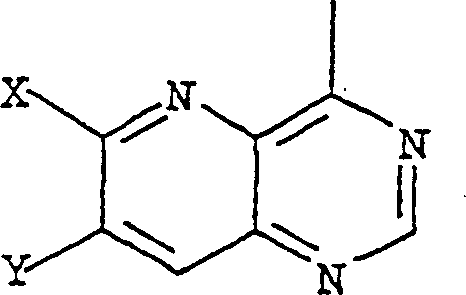
p gleich 0 oder
1 ist;
X -D-E-F und Y -SR4, -OR4, -NHR3 oder Wasserstoff
bedeutet oder X -SR4, -OR4,
-NHR3 oder Wasserstoff und Y -D-E-F bedeutet; 


wobei, wenn
E für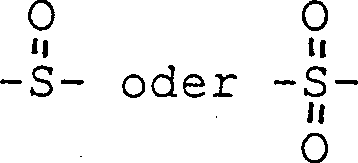


R1 Wasserstoff,
Halogen oder C1-C6-Alkyl
bedeutet;
R2, R3 und
R4 unabhängig
voneinander Wasserstoff, C1-C6-Alkyl, -(CH2)n-N-Piperidinyl,
-(CH2)n-N-Piperazinyl, -(CH2)n-N1-Piperazinyl[N4-(C1-C6)alkyl],
-(CH2)n-N-Pyrrolidyl,
-(CH2)n-Pyridinyl,
-(CH2)n-N-Imidazoyl, -(CH2)n-Imidazoyl, -(CH2)n-N-Morpholino,
-(CH2)n-N-Thiomorpholino,
-(CH2)n-N-Hexahydroazepin
oder substituiertes C1-C6-Alkyl,
wobei die Substituenten aus -OH, -NH2 oder 
R5 Wasserstoff, Halogen,
C1-C6-Perfluoralkyl,
1,1-Difluor(C1-C6)alkyl,
C1-C6-Alkyl, -(CH2)n-N-Piperidinyl, -(CH2)n-Piperazinyl,
-(CH2)n-Piperazinyl[N4-(C1-C6)alkyl],
-(CH2)n-N-Pyrrolidyl,
-(CH2)n-Pyridinyl,
-(CH2)n-N-Imidazoyl,
-(CH2)n-N-Morpholino,
-(CH2)n-N-Thiomorpholino,
R6 Wasserstoff oder C1-C6-Alkyl bedeutet; und
n gleich 1–4 ist,
und
der pharmazeutisch akzeptablen Salze derselben.In another embodiment, the present invention also provides the provision of compounds of the formula II
p is 0 or 1;
X is -DEF and Y is -SR 4 , -OR 4 , -NHR 3 or is hydrogen or X is -SR 4 , -OR 4 , -NHR 3 or hydrogen and Y is -DEF;
where, if E for
R 1 is hydrogen, halogen or C 1 -C 6 alkyl;
R 2 , R 3 and R 4 independently of one another are hydrogen, C 1 -C 6 -alkyl, - (CH 2 ) n -N-piperidinyl, - (CH 2 ) n -N-piperazinyl, - (CH 2 ) n -N 1- piperazinyl [N 4 - (C 1 -C 6 ) alkyl], - (CH 2 ) n -N-pyrrolidyl, - (CH 2 ) n -pyridinyl, - (CH 2 ) n -N-imidazoyl, - ( CH 2 ) n -imidazoyl, - (CH 2 ) n -N-morpholino, - (CH 2 ) n -N-thiomorpholino, - (CH 2 ) n -N-hexahydroazepine or substituted C 1 -C 6 -alkyl, wherein the substituents of -OH, -NH 2 or
R 5 is hydrogen, halogen, C 1 -C 6 perfluoroalkyl, 1,1-difluoro (C 1 -C 6 ) alkyl, C 1 -C 6 alkyl, - (CH 2 ) n -N-piperidinyl, - (CH 2 ) n- piperazinyl, - (CH 2 ) n -piperazinyl [N 4 - (C 1 -C 6 ) alkyl], - (CH 2 ) n -N-pyrrolidyl, - (CH 2 ) n -pyridinyl, - ( CH 2 ) n -N-imidazoyl, - (CH 2 ) n -N-morpholino, - (CH 2 ) n -N-thiomorpholino,
R 6 is hydrogen or C 1 -C 6 alkyl; and
n is 1-4,
and the pharmaceutically acceptable salts thereof.
In einer weiteren Ausführungsform stellt die Erfindung die Verbindungen von Anspruch 22 bereit.In a further embodiment the invention provides the compounds of claim 22.
In
einer weiteren Ausführungsform
erfolgt durch die vorliegende Erfindung die Bereitstellung von Verbindungen
mit der Formel III 

p
gleich 0 oder 1 ist;
X -D-E-F und Y -SR4,
-OR4, -NHR3 oder
Wasserstoff bedeutet oder X -SR4, -OR4, -NHR3 oder Wasserstoff
und Y -D-E-F bedeutet; 


wobei, wenn
E für


R1 Wasserstoff,
Halogen oder C1-C6-Alkyl
bedeutet;
R2, R3 und
R4 unabhängig
voneinander Wasserstoff, C1-C6-Alkyl, -(CH2)n-N-Piperidinyl,
-(CH2)n-N-Piperazinyl, -(CH2)n-N1-Piperazinyl[N4-(C1-C6)alkyl],
-(CH2)n-N-Pyrrolidyl,
-(CH2)n-Pyridinyl,
-(CH2)n-N-Imidazoyl, -(CH2)n-Imidazoyl, -(CH2)n-N-Morpholino,
-(CH2)n-N-Thiomorpholino,
-(CH2)n-N-Hexahydroazepin
oder substituiertes C1-C6-Alkyl,
wobei die Substituenten aus -OH, -NH2 oder
E1, E2 oder
E3 unabhängig
voneinander Halogen, C1-C6-Alkyl,
C3-C8-Cycloalkyl,
C1-C6-Alkoxy, C3-C8-Cycloalkoxy,
Nitro, C1-C6-Perfluoralkyl,
Hydroxy, C1-C6-Acyloxy,
-NH2, -NH(C1-C6-Alkyl), -N(C1-C6-Alkyl)2, -NH(C3-C8-Cycloalkyl),
-N(C3-C8-Cycloalkyl)2, Hydroxymethyl, C1-C6-Acyl, Cyano, Azido, C1-C6-Thioalkyl, C1-C6-Sulfinylalkyl, C1-C6-Sulfonylalkyl, C3-C8-Thiocycloalkyl, C3-C8-Sulfinylcycloalkyl, C3-C8-Sulfonylcycloalkyl,
Mercapto, C1-C6-Alkoxycarbonyl,
C3-C8-Cycloalkoxycarbonyl,
C2-C4-Alkenyl, C4-C8-Cycloalkenyl
oder C2-C4-Alkinyl
bedeuten; und
R5 Wasserstoff, Halogen,
C1-C6-Perfluoralkyl,
1,1-Difluor(C1-C6)alkyl,
C1-C6-Alkyl, -(CH2)n-N-Piperidinyl, -(CH2)n-Piperazinyl,
-(CH2)n-Piperazinyl[N4-(C1-C6)alkyl],
-(CH2)n-N-Pyrrolidyl,
-(CH2)n-Pyridinyl,
-(CH2)n-N-Imidazoyl,
-(CH2)n-N-Morpholino,
-(CH2)n-N-Thiomorpholino,
jede C1-C6-Alkylgruppe
mit -OH, -NH2 oder -NAB mit A und B gleich
der obigen Definition substituiert sein kann, bedeutet;
R6 Wasserstoff oder C1-C6-Alkyl bedeutet; und
n gleich 1–4 ist,
und
der pharmazeutisch akzeptablen Salze derselben.In a further embodiment, the present invention provides compounds of the formula III
p is 0 or 1;
X is -DEF and Y is -SR 4 , -OR 4 , -NHR 3 or is hydrogen or X is -SR 4 , -OR 4 , -NHR 3 or hydrogen and Y is -DEF;
where, if E for
R 1 is hydrogen, halogen or C 1 -C 6 alkyl;
R 2 , R 3 and R 4 independently of one another are hydrogen, C 1 -C 6 -alkyl, - (CH 2 ) n -N-piperidinyl, - (CH 2 ) n -N-piperazinyl, - (CH 2 ) n -N 1- piperazinyl [N 4 - (C 1 -C 6 ) alkyl], - (CH 2 ) n -N-pyrrolidyl, - (CH 2 ) n -pyridinyl, - (CH 2 ) n -N-imidazoyl, - ( CH 2 ) n -imidazoyl, - (CH 2 ) n -N-morpholino, - (CH 2 ) n -N-thiomorpholino, - (CH 2 ) n -N-hexahydroazepine or substituted C 1 -C 6 -alkyl, wherein the substituents of -OH, -NH 2 or
E 1 , E 2 or E 3, independently of one another, are halogen, C 1 -C 6 -alkyl, C 3 -C 8 -cycloalkyl, C 1 -C 6 -alkoxy, C 3 -C 8 -cycloalkoxy, nitro, C 1 -C 6 perfluoroalkyl, hydroxy, C 1 -C 6 acyloxy, -NH 2 , -NH (C 1 -C 6 -alkyl), -N (C 1 -C 6 -alkyl) 2 , -NH (C 3 -C 8 -cycloalkyl), -N (C 3 -C 8 -cycloalkyl) 2 , hydroxymethyl, C 1 -C 6 -acyl, cyano, azido, C 1 -C 6 -thioalkyl, C 1 - C 6 sulfinylalkyl, C 1 -C 6 sulfonylalkyl, C 3 -C 8 thiocycloalkyl, C 3 -C 8 sulfinylcycloalkyl, C 3 -C 8 sulfonylcycloalkyl, mercapto, C 1 -C 6 alkoxycarbonyl, C 3 - C 8 -cycloalkoxycarbonyl, C 2 -C 4 -alkenyl, C 4 -C 8 -cycloalkenyl or C 2 -C 4 -alkynyl; and
R 5 is hydrogen, halogen, C 1 -C 6 perfluoroalkyl, 1,1-difluoro (C 1 -C 6 ) alkyl, C 1 -C 6 alkyl, - (CH 2 ) n -N-piperidinyl, - (CH 2 ) n- piperazinyl, - (CH 2 ) n -piperazinyl [N 4 - (C 1 -C 6 ) alkyl], - (CH 2 ) n -N-pyrrolidyl, - (CH 2 ) n -pyridinyl, - ( CH 2 ) n -N-imidazoyl, - (CH 2 ) n -N-morpholino, - (CH 2 ) n -N-thiomorpholino,
each C 1 -C 6 alkyl group may be substituted by -OH, -NH 2 or -NAB with A and B as defined above;
R 6 is hydrogen or C 1 -C 6 alkyl; and
n is 1-4,
and the pharmaceutically acceptable salts thereof.
Der Ausdruck ”Alkyl” bedeutet einen gerad- oder verzweigtkettigen Kohlenwasserstoff. Repräsentative Beispiele für Alkylgruppen sind Methyl, Ethyl, Propyl, Isopropyl, Isobutyl, Butyl, tert.-Butyl, sek.-Butyl, Pentyl und Hexyl.Of the Term "alkyl" a straight or branched chain hydrocarbon. Representative examples for alkyl groups are methyl, ethyl, propyl, isopropyl, isobutyl, butyl, tert-butyl, sec-butyl, pentyl and hexyl.
Der Ausdruck ”Alkoxy” bedeutet eine an ein Sauerstoffatom gebundene Alkylgruppe. Repräsentative Beispiele für Alkoxygruppen umfassen Methoxy, Ethoxy, tert.-Butoxy, Propoxy und Isobutoxy.Of the Term "alkoxy" an alkyl group bonded to an oxygen atom. Representative examples for alkoxy groups include methoxy, ethoxy, tert-butoxy, propoxy and isobutoxy.
Der Ausdruck ”Halogen” umfasst Chlor, Fluor, Brom und Iod.Of the Term "halogen" Chlorine, fluorine, bromine and iodine.
Der Ausdruck ”Alkenyl” bedeutet einen gerad- oder verzweigtkettigen Kohlenwasserstoff mit einer oder mehreren Kohlenstoff-Kohlenstoff-Doppelbindungen.Of the Term "alkenyl" a straight or branched chain hydrocarbon with one or multiple carbon-carbon double bonds.
Der Ausdruck ”Cycloalkyl” bedeutet einen cyclischen Kohlenwasserstoff. Beispiele für Cycloalkylgruppen umfassen Cyclopropyl, Cyclobutyl, Cyclopentyl und Cyclohexyl.Of the Term "cycloalkyl" means a cyclic hydrocarbon. Examples of cycloalkyl groups include Cyclopropyl, cyclobutyl, cyclopentyl and cyclohexyl.
Der Ausdruck ”Cycloalkoxy” bedeutet eine an ein Sauerstoffatom gebundene Cycloalkylgruppe.Of the Term "cycloalkoxy" a cycloalkyl group bonded to an oxygen atom.
Der Ausdruck ”Perfluoralkyl” bedeutet eine Alkylgruppe, in der alle Wasserstoffatome durch Fluoratome ersetzt wurden.Of the Term "perfluoroalkyl" an alkyl group in which all hydrogen atoms are represented by fluorine atoms have been replaced.
Der Ausdruck ”Acyl” bedeutet eine von einer organischen Säure durch Entfernen der Hydroxygruppe (-OH) abgeleitete Gruppe.Of the Term "acyl" one of an organic acid by removal of the hydroxy group (-OH) derived group.
Der Ausdruck ”Acyloxy” bedeutet eine an ein Sauerstoffatom gebundene Acylgruppe.Of the Expression "acyloxy" means an acyl group bonded to an oxygen atom.
Der Ausdruck ”Thioalkyl” bedeutet eine an ein Schwefelatom gebundene Alkylgruppe.Of the Term "thioalkyl" means an alkyl group bonded to a sulfur atom.
Der Ausdruck ”Sulfinylalkyl” bedeutet eine an eine Alkylgruppe gebundene Sulfinylgruppe.Of the Term "sulfinylalkyl" means a sulfinyl group bonded to an alkyl group.
Der Ausdruck ”Sulfonylalkyl” bedeutet eine an eine Alkylgruppe gebundene Sulfonylgruppe.Of the Term "sulfonylalkyl" a sulfonyl group attached to an alkyl group.
Der Ausdruck ”Thiocycloalkyl” bedeutet eine an ein Schwefelatom gebundene Cycloalkylgruppe.Of the Term "thiocycloalkyl" means a cycloalkyl group bonded to a sulfur atom.
Der Ausdruck ”Sulfinylcycloalkyl” bedeutet eine an eine Cycloalkylgruppe gebundene Sulfinylgruppe.Of the Term "sulfinylcycloalkyl" a sulfinyl group bonded to a cycloalkyl group.
Der Ausdruck ”Sulfonylcycloalkyl” bedeutet eine an eine Cycloalkylgruppe gebundenen Sulfonylgruppe.Of the Term "sulfonylcycloalkyl" a sulfonyl group bonded to a cycloalkyl group.
Der Ausdruck ”Mercapto” bedeutet eine -SH-Gruppe.Of the Term "mercapto" means a -SH group.
Der Ausdruck ”Alkoxycarbonyl” bedeutet eine an eine Carbonylgruppe gebundene Alkoxygruppe.Of the Term "alkoxycarbonyl" an alkoxy group attached to a carbonyl group.
Der Ausdruck ”Cycloalkoxycarbonyl” bedeutet eine an eine Carbonylgruppe gebundene Cycloalkoxygruppe.Of the Term "cycloalkoxycarbonyl" a cycloalkoxy group attached to a carbonyl group.
Der Ausdruck ”Cycloalkenyl” bedeutet einen cyclischen Kohlenwasserstoff, der eine oder mehrere Kohlenstoff-Kohlenstoff-Doppelbindungen enthält.Of the Term "cycloalkenyl" a cyclic hydrocarbon containing one or more carbon-carbon double bonds contains.
Der Ausdruck ”Alkinyl” bedeutet einen Kohlenwasserstoff mit einer oder mehreren Kohlenstoff-Kohlenstoff-Dreifachbindungen.Of the Term "alkynyl" a hydrocarbon having one or more carbon-carbon triple bonds.
Beispiele für monocyclische Heteroarylgruppen umfassen, ohne auf diese beschänkt zu sein, Pyridyl, Thienyl und Imidazoyl.Examples for monocyclic Heteroaryl groups include, but are not limited to, pyridyl, thienyl and imidazoyl.
Das Symbol ”–” bedeutet eine kovalente Bindung.The Symbol "-" means a covalent bond.
Die Verbindungen der Formeln I, II und III sind irreversible Inhibitoren von Tyrosinkinasen, insbesondere EGF-Tyrosinkinasen. Eine therapeutisch wirksame Menge der Verbindungen der Formel I, II oder III kann einem Patienten, der Krebs hat, oder einem Patienten, der eine Restenose oder ein Risiko für die Bildung einer Restenose hat, oder einem Patienten mit Psoriasis, Atherosklerose oder Endometriose verabreicht werden. Ein Fachmann besitzt ohne weiteres die Fähigkeit, Patienten mit Krebs, Restenose, Psoriasis, Atherosklerose oder Endometriose und Patienten mit einem Risiko zur Entwicklung einer Restenose zu identifizieren. Der Ausdruck ”Patient” bedeutet Lebewesen, wie Hunde, Katzen, Kühe, Schafe und er umfasst auch Menschen.The Compounds of formulas I, II and III are irreversible inhibitors of tyrosine kinases, in particular EGF tyrosine kinases. A therapeutically effective Amount of the compounds of the formula I, II or III can be given to a patient the cancer has, or a patient who has restenosis or a Risk for has the formation of restenosis, or a patient with psoriasis, Atherosclerosis or endometriosis are administered. A specialist has the ability to Patients with cancer, restenosis, psoriasis, atherosclerosis or endometriosis and patients at risk for developing restenosis identify. The term "patient" means Living things, such as dogs, cats, cows, Sheep and he also includes humans.
Die Verbindungen gemäß der vorliegenden Erfindung können an Menschen und Tiere entweder oral, rektal, parenteral (intravenös, intramuskulär oder subkutan), intracisternal, intravaginal, intraperitoneal, intravesikulär, lokal (Pulver, Salben oder Tropfen) oder als Mund- oder Nasenspray verabreicht werden. Die Verbindungen können allein oder als Teil einer pharmazeutischen Zusammensetzung, die pharmazeutisch akzeptable Streckmittel umfasst, verabreicht werden. Es ist anzumerken, dass mehr als eine Verbindung der Formel I, II, III entweder gleichzeitig oder nacheinander verabreicht werden können.The Compounds according to the present invention Invention can to humans and animals either orally, rectally, parenterally (intravenously, intramuscularly or subcutaneously), intracisternal, intravaginal, intraperitoneal, intravesicular, local (Powder, ointments or drops) or administered as oral or nasal spray become. The connections can alone or as part of a pharmaceutical composition containing pharmaceutically acceptable excipients. It should be noted that more than one compound of formula I, II, III can be administered either simultaneously or sequentially.
Zur parenteralen Injektion geeignete Zusammensetzungen können physiologisch akzeptable sterile wässrige oder nicht-wässrige Lösungen, Dispersionen, Suspensionen oder Emulsionen und sterile Pulver zur Wiederherstellung zu sterilen injizierbaren Lösungen oder Dispersionen umfassen. Beispiele für geeignete wässrige und nicht-wässrige Träger, Verdünnungsmittel, Lösemittel oder Vehikel umfassen Wasser, Ethanol, Polyole (Propylenglykol, Polyethylenglykol, Glycerin u. dgl.), geeignete Mischungen derselben, pflanzliche Öle (wie Olivenöl) und injizierbare organische Ester, wie Ethyloleat. Eine entsprechende Fluidität kann beispielsweise durch die Verwendung eines Überzugs, wie Lecithin, durch die Beibehaltung der erforderlichen Teilchengröße im Falle von Dispersionen und durch die Verwendung von Netzmitteln beibehalten werden.to parenteral injection suitable compositions may be physiological acceptable sterile aqueous or non-aqueous Solutions, Dispersions, suspensions or emulsions and sterile powders for recovery to sterile injectable solutions or dispersions. Examples of suitable aqueous and non-aqueous Carrier, Diluents, solvent or vehicles include water, ethanol, polyols (propylene glycol, Polyethylene glycol, glycerol u. Like.), Suitable mixtures thereof, vegetable oils (such as Olive oil) and injectable organic esters, such as ethyl oleate. A corresponding fluidity For example, by the use of a coating such as lecithin, by maintaining the required particle size in the case of dispersions and maintained by the use of wetting agents.
Diese Zusammensetzungen können auch Hilfsstoffe, wie Konservierungsmittel, Feuchthaltemittel, Emulgatoren und Dispersionsmittel enthalten. Eine Verhinderung der Einwirkung von Mikroorganismen kann durch verschiedene antibakterielle und Antipilzmittel, beispielsweise Parabene, Chlorbutanol, Phenol, Sorbinsäure u. dgl. sichergestellt werden. Es kann auch günstig sein, isotonische Mittel, beispielsweise Zucker, Natriumchlorid u. dgl. einzuarbeiten. Eine verlängerte Absorption der injizierbaren pharmazeutischen Form kann durch die Verwendung von die Absorption verzögernden Mitteln, beispielsweise Aluminiummonostearat und Gelatine, bewirkt werden.These Compositions can also adjuvants, such as preservatives, humectants, emulsifiers and dispersing agents. A prevention of the impact of microorganisms can be caused by various antibacterial and Antifungal agents, for example, parabens, chlorobutanol, phenol, sorbic acid, and the like. like. be ensured. It may also be beneficial, isotonic agents, for example, sugars, sodium chloride and. to incorporate. A extended Absorption of the injectable pharmaceutical form can be achieved by the Use of absorption delaying agents, for example Aluminum monostearate and gelatin, are effected.
Feste Dosierungsformen zur oralen Verabreichung umfassen Kapseln, Tabletten, Pillen, Pulver und Granulate. In diesen festen Dosierungsformen ist die aktive Verbindung mit mindestens einem inerten üblichen Streckmittel (oder Träger), wie Natriumcitrat oder Dicalciumphosphat, oder
- (a) Füllstoffen oder Streckmitteln, beispielsweise Stärkearten, Lactose, Saccharose, Glucose, Mannit und Kieselsäure;
- (b) Bindemitteln, wie beispielsweise Carboxymethylcellulose, Alignaten, Gelatine, Polyvinylpyrrolidon, Saccharose und Akaziengummi;
- (c) Feuchthaltemitteln, wie beispielsweise Glycerin;
- (d) den Zerfall fördernden Mitteln, wie beispielsweise Agar-Agar, Calciumcarbonat, Kartoffel- oder Tapiokastärke, Alginsäure, bestimmten komplexen Silicaten und Natriumcarbonat;
- (e) Lösungsverzögerungsmitteln, wie beispielsweise Paraffin;
- (f) Absorptionsbeschleuniger, wie beispielsweise quaternären Ammoniumverbindungen;
- (g) Benetzungsmitteln, beispielsweise Cetylalkohol und Glycerinmonostearat;
- (h) Adsorptionsmitteln, beispielsweise Kaolin und Bentonit; und
- (i) Gleitmitteln, beispielsweise Talkum, Calciumstearat, Magnesiumstearat, festen Polyethylenglykolen, Natriumlaurylsulfat oder Gemische derselben,
- (a) fillers or extenders, for example, starches, lactose, sucrose, glucose, mannitol and silicic acid;
- (b) binders such as carboxymethyl cellulose, alignates, gelatin, polyvinylpyrrolidone, sucrose and acacia;
- (c) humectants, such as glycerol;
- (d) disintegrants, such as agar-agar, calcium carbonate, potato or tapioca starch, alginic acid, certain complex silicates, and sodium carbonate;
- (e) solution delaying agents, such as paraffin;
- (f) absorption accelerators, such as quaternary ammonium compounds;
- (g) wetting agents, for example cetyl alcohol and glycerol monostearate;
- (h) adsorbents, for example, kaolin and bentonite; and
- (i) lubricants, for example talc, calcium stearate, magnesium stearate, solid polyethylene glycols, sodium lauryl sulfate or mixtures thereof,
Feste Zusammensetzungen eines ähnlichen Typs können auch als Füllstoffe in weich- und hartgefüllten Gelatinekapseln unter Verwendung von Streckmitteln, wie Lactose oder Milchzucker sowie Polyethylenglykolen mit hohem Molekulargewicht u. dgl. verwendet werden.firm Compositions of a similar Type can also as fillers in soft and hard-filled Gelatin capsules using diluents, such as lactose or lactose and high molecular weight polyethylene glycols u. Like. Be used.
Feste Dosierungsformen, wie Tabletten, Dragees, Kapseln, Pillen und Granulate können mit Überzügen und Hüllen, wie enterischen Überzügen und anderen einschlägig bekannten, hergestellt werden. Sie können Opazifizierungsmittel enthalten und können auch von einer solchen Zusammensetzung sein, dass sie die aktive Verbindung oder die aktiven Verbindungen in einem bestimmten Teil des Verdauungstrakts auf verzögerte Weise freisetzen. Beispiele für verwendbare Einbettungszusammensetzungen sind polymere Substanzen und Wachse. Die aktiven Verbindungen können gegebenenfalls auch in mikroverkapselter Form mit einem oder mehreren der im vorhergehenden genannten Streckmittel vorliegen.firm Dosage forms such as tablets, dragees, capsules, pills and granules can with coatings and shells like enteric coatings and others relevant known to be produced. They can be opacifiers contain and can also be of such a composition that they are the active ones Connection or the active connections in a particular part of the digestive tract on delayed Free way. examples for Useful encapsulant compositions are polymeric substances and waxes. The active compounds may optionally also be in microencapsulated form with one or more of the foregoing present extender.
Flüssige Dosierungsformen zur oralen Verabreichung umfassen pharmazeutisch akzeptable Emulsionen, Lösungen, Suspensionen, Sirupe und Elixiere. Zusätzlich zu den aktiven Verbindungen können die flüssigen Dosierungsformen inerte Verdünnungsmittel, die üblicherweise einschlägig verwendet werden, wie Wasser oder andere Lösemittel, Solubilsierungsmittel und Emulgatoren, beispielsweise Ethylalkohol, Isopropylalkohol, Ethylcarbonat, Ethylacetat, Benzylalkohol, Benzylbenzoat, Propylenglykol, 1,3-Butylenglykol, Dimethylformamid, Öle, insbesondere Baumwollöl, Erdnußöl, Maiskeimöl, Olivenöl, Rizinusöl und Sesamöl, Glycerin, Tetrahydrofurfurylalkohol, Polyethylenglykole und Fettsäureester von Sorbit oder Gemische dieser Substanzen u. dgl. enthalten.Liquid dosage forms for oral administration include pharmaceutically acceptable emulsions, Solutions, Suspensions, syrups and elixirs. In addition to the active compounds can the liquid ones Dosage forms inert diluents, the usual relevant used, such as water or other solvents, solubilizer and emulsifiers, for example ethyl alcohol, isopropyl alcohol, Ethyl carbonate, ethyl acetate, benzyl alcohol, benzyl benzoate, propylene glycol, 1,3-butylene glycol, dimethylformamide, oils, in particular cottonseed oil, peanut oil, corn oil, olive oil, castor oil and sesame oil, glycerol, tetrahydrofurfuryl alcohol, Polyethylene glycols and fatty acid esters of sorbitol or mixtures of these substances u. Like. Included.
Neben diesen inerten Verdünnungsmitteln kann die Zusammensetzung auch Hilfsstoffe, wie Benetzungsmittel, Emul gatoren und Suspendiermittel, Süßungsmittel, Geschmacksstoffe und Duftstoffe umfassen.Next these inert diluents the composition may also contain excipients, such as wetting agents, Emulsifiers and suspending agents, sweeteners, flavorings and fragrances.
Suspensionen können zusätzlich zu den aktiven Verbindungen Suspendiermittel, beispielsweise ethoxylierte Isostearylalkohole, Polyoxyethylensorbit und Sorbitanester, mikrokristalline Cellulose, Aluminiummetahydroxid, Bentonit, Agar-Agar und Tragant oder Gemische dieser Substanzen u. dgl. enthalten.suspensions can additionally to the active compounds suspending agents, for example ethoxylated Isostearyl alcohols, polyoxyethylene sorbitol and sorbitan esters, microcrystalline Cellulose, aluminum metahydroxide, bentonite, agar-agar and tragacanth or mixtures of these substances u. Like. Included.
Zusammensetzungen für rektale Verabreichungen sind vorzugsweise Suppositorien, die durch Vermischen der Verbindungen gemäß der vorliegenden Erfindung mit geeigneten nicht-reizenden Streckmitteln oder Trägern, wie Kakaobutter, Polyethylenglykol, oder einem Suppositoriumwachs, hergestellt werden können, die bei normalen Temperaturen fest, jedoch bei Körpertemperatur flüssig sind und deshalb im Rektum oder der Scheidenhöhle schmelzen und die aktive Verbindung freisetzen.compositions for rectal Administerments are preferably suppositories obtained by mixing the compounds according to the present invention Invention with suitable non-irritating diluents or carriers, such as Cocoa butter, polyethylene glycol, or a suppository wax can be which are solid at normal temperatures but liquid at body temperature and therefore in the rectum or vaginal cavity melt and the active Release the connection.
Dosierungsformen zur topischen Verabreichung einer Verbindung dieser Erfindung umfassen Salben, Pulver, Sprays und Inhalationsmittel. Die aktive Verbindung wird unter sterilen Bedingungen mit einem physiologisch akzeptablen Träger und etwaigen Konservierungsmitteln, Puffern oder Treibmitteln nach Bedarf gemischt. Ophthalmologische Formulierungen, Augensalben, Pulver und Lösungen werden ebenfalls als unter den Umfang dieser Erfindung fallend angesehen.dosage forms for topical administration of a compound of this invention Ointments, powders, sprays and inhalants. The active compound is used under sterile conditions with a physiologically acceptable carrier and any preservatives, buffers or propellants Mixed needs. Ophthalmic formulations, eye ointments, Powders and solutions are also considered to fall within the scope of this invention.
Der hier verwendete Ausdruck ”pharmazeutisch akzeptable Salze” bezeichnet die Carboxylatsalze, Aminosäureadditionssalze der Verbindungen gemäß der Erfindung, die im Rahmen einer gründlichen medizinischen Beurteilung zur Verwendung in Kontakt mit den Geweben von Patienten ohne eine unpassende Toxizität, Reizung, allergische Reaktion u. dgl. entsprechend einem vernünftigen Nutzen/Risiko-Verhältnis geeignet und für den geplanten Zweck wirksam sind, sowie, wo dies möglich ist, die zwitterionischen Formen der erfindungsgemäßen Verbindungen. Der Ausdruck ”Salze” bezeichnet die relativ nicht-toxischen, anorganischen und organischen Säureadditionssalze von Verbindungen der vorliegenden Erfindung. Diese Salze können in situ während der endgültigen Isolierung und Reinigung der Verbindungen oder durch ge trennte Reaktion der gereinigten Verbindung in der Form der freien Base mit einer geeigneten organischen oder anorganischen Säure und Isolieren des auf diese Weise gebildeten Salzes hergestellt werden. Repräsentative Salze umfassen das Hydrobromid, Hydrochlorid, Sulfat, Bisulfat, Nitrat, Acetat, Oxalat, Valerat, Oleat, Palmitat, Stearat, Laurat, Borat, Benzoat, Lactat, Phosphat, Tosylat, Citrat, Maleat, Fumarat, Succinat, Tartrat, Naphthylat, Mesylat, Glucoheptonat, Lactobionat und Laruylsulfonat und dergleichen. Diese können Kationen auf der Basis der Alkali- und Erdalkalimetalle, wie Natrium, Lithium, Kalium, Calcium, Magnesium und dergleichen, sowie nicht-toxische Ammonium-, quaternäre Ammonium- und Aminkationen einschließlich von, jedoch nicht darauf beschränkt, Ammonium, Tetramethylammonium, Tetraethylammonium, Methylamin, Dimethylamin, Trimethylamin, Triethylamin, Ethylamin und dergleichen umfassen (s. beispielsweise S. M. Berge et al., ”Pharmaceutical Salts”, J. Pharm. Sci. 1977; 66: 1–19, das hier durch Inbezugnahme aufgenommen ist).As used herein, the term "pharmaceutically acceptable salts" refers to the carboxylate salts, amino acid addition salts of the compounds of the invention used in a thorough medical evaluation for use in contact with the tissues of patients without inappropriate toxicity, irritation, allergic reaction, and the like. Like. Suitable for a reasonable benefit / risk ratio and effective for the intended purpose, and, where possible, the zwitterionic forms of the compounds of the invention. The term "salts" refers to the relatively non-toxic, inorganic and organic acid addition salts of compounds of the present invention. These salts can be prepared in situ during the final isolation and purification of the compounds or by separate reaction of the purified compound in the free base form with a suitable organic or inorganic acid and isolating the salt so formed. Representative salts include the hydrobromide, hydrochloride, sulphate, bisulphate, nitrate, acetate, oxalate, valerate, oleate, palmitate, stearate, laurate, borate, benzoate, lactate, phosphate, tosylate, citrate, maleate, fumarate, succinate, tartrate, naphthylate, mesylate, Glucoheptonate, lactobionate and laruylsulfonate and the like. These may include cations based on the alkali and alkaline earth metals, such as sodium, lithium, potassium, calcium, magnesium and the like, as well as non-toxic ammonium, quaternary ammonium and amine cations including, but not limited to, ammonium, tetramethylammonium, tetraethylammonium Methylamine, dimethylamine, trimethylamine, triethylamine, ethylamine, and the like (see, for example, SM Berge et al., Pharmaceutical Salts, J. Pharm. Sci. 1977; 66: 1-19, incorporated herein by reference).
Die Verbindungen gemäß der vorliegenden Erfindung können an einen Patienten in Dosismengen im Bereich von etwa 0,1 bis etwa 1000 mg pro Tag verabreicht werden. Für einen normalen erwachsenen Menschen mit einem Körpergewicht von etwa 70 kg ist eine Dosierung im Bereich von etwa 0,01 bis etwa 100 mg/kg Körpergewicht pro Tag ausreichend. Die verwendete spezielle Dosierung kann jedoch variieren. Beispielsweise kann die Dosierung von einer Anzahl von Faktoren, die die Bedürfnisse des Patienten, die Schwere der zu behandelnden Störung und die pharmakologische Aktivität der verwendeten Verbindung umfassen, abhängen. Die Bestimmung der optimalen Dosierungen für einen speziellen Patienten ist einem Fachmann geläufig.The Compounds according to the present invention Invention can to a patient in dosages ranging from about 0.1 to about Be administered 1000 mg per day. For a normal adult People with a body weight of about 70 kg is a dosage in the range of about 0.01 to about 100 mg / kg body weight sufficient per day. However, the specific dosage used can vary. For example, the dosage of a number of Factors that meet the needs of the patient, the severity of the disorder to be treated and the pharmacological activity include the compound used. The determination of the optimal Dosages for a special patient is familiar to a person skilled in the art.
Die Verbindungen der vorliegenden Erfindung können aufgrund des Vorliegens von asymmetrischen Zentren in den Verbindungen in unterschiedlichen stereoisomeren Formen vorliegen. Alle stereoisomeren Formen der Verbindungen sowie Gemische derselben einschließlich von racemischen Gemischen sollen einen Teil der vorliegenden Erfindung bilden.The Compounds of the present invention may be present due to the presence of asymmetric centers in the compounds in different stereoisomeric forms. All stereoisomeric forms of Compounds and mixtures thereof including racemic mixtures are intended to form part of the present invention.
Außerdem können die Verbindungen der vorliegenden Erfindung in nicht-solvatisierten sowie solvatisierten Formen mit pharmazeutisch akzeptablen Lösemitteln, wie Wasser, Ethanol und dergleichen existieren. Im allgemeinen werden. die solvatisierten Formen als äquivalent zu den nicht-solvatisierten Formen für die Zwecke der vorliegenden Erfindung betrachtet.In addition, the Compounds of the present invention in non-solvated as well as solvated forms with pharmaceutically acceptable solvents, such as water, ethanol and the like exist. In general, be. the solvated forms as equivalent to the non-solvated ones Shapes for considered the purposes of the present invention.
Die Verbindungen der Formel I, II oder III sollen entweder synthetisch hergestellt oder biologisch hergestellt werden.The Compounds of formula I, II or III are intended to be either synthetic produced or biologically produced.
Die folgenden Beispiele erläutern spezielle Ausführungsformen der Erfindung und sie sollen die Beschreibung einschließlich der Ansprüche in keinster Weise beschränken.The explain the following examples special embodiments the invention and they are the description including the claims in no way limit.
Beispiele, die mit einem Stern markiert sind, werden lediglich zum Vergleich und/oder zu Referenzzwecken angeführt.examples which are marked with a star, are only for comparison and / or for reference purposes.
ALLGEMEINE SYNTHESESCHEMATAGENERAL SYNTHESIS SCHEMES
Amingebundene alkylierende Michael-Akzeptor-SeitenkettenAminated alkylating Michael acceptor side chains
Das
Amin wird entweder durch eine Säure
in Gegenwart eines Kopplungsmittels, wie EDAC, oder durch ein Säurechlorid
acyliert. Das Amin kann wiederum durch Reduktion der entsprechenden
Nitroverbindung, Ersetzen eines Halogens durch ein Amin- oder Ammoniakäquivalent
oder im Falle von Pyrido[4,3-d]pyrimidinen durch direkten Einbau
während
der Synthese hergestellt werden. 2-Halogenalkylsulfonylhalogenide bilden
Vinylsulfonamide, wenn sie mit dem Arylamin und überschüssiger tert.-Aminbase behandelt
werden. 
C/N bedeutet, dass an dieser Stelle entweder ein Kohlenstoff- oder Stickstoffatom vorhanden ist.C / N means that at this point either a carbon or nitrogen atom is available.
--- bedeutet eine Bindung oder keine Bindung.--- means a bond or no bond.
Sauerstoffgebundene alkylierende Michael-Akzeptor-SeitenkettenOxygen-bound alkylating Michael acceptor side chains
Die
Hydroxylgruppe wird entweder durch eine Säure in Gegenwart eines Kopplungsmittels,
wie EDAC, oder durch ein Säurechlorid
acyliert. Die Hydroxylverbindung kann wiederum durch Spaltung des
entsprechenden Methylethers hergestellt werden. 3-Methylthioalkansäure oder
deren Chloride können
zur Acylierung des Sauerstoffs mit anschließender S-Alkylierung oder Oxidation
und basischer oder thermischen Eliminierung verwendet werden. 
Ar und R bezeichnen eine Arylgruppe und R bezeichnet hier beispielsweise eine organische Gruppe.Ar and R denotes an aryl group and R denotes here, for example an organic group.
Kohlenstoffgebundene alkylierende Michael-Akzeptor-SeitenkettenCarbon-bonded alkylating Michael acceptor side chains
Eine Stille- oder Suzuki-Kopplung kann zur Kopplung der Seitenkette an einen entsprechend substituierten Chinazolin/Pyridopyrimidin/Pyrimidinopyrimidin/Tricyclus verwendet werden. Diese können wiederum als Arylhalogenide durch einschlägig bekannte Verfahren oder als Aryltriflate durch Trifluormethansulfonierung der oben beschriebenen Hydroxylverbindungen, als Arylstannane durch Reaktion der im vorhergehenden genannten Triflate mit Hexamethyldistannan oder als Arylborsäuren durch Umwandlung von Aryliodiden in arylorganometallische Verbindungen und eine anschließende Behandlung mit Boratestern und Hydrolyse hergestellt werden. Alternativ können Aryliodide in die Arylzinkspezies umgewandelt und mit aktivierten Halogeniden gekoppelt werden.A Stille or Suzuki coupling can be used to couple the side chain to an appropriately substituted quinazoline / pyridopyrimidine / pyrimidinopyrimidine / tricycle. These in turn can be prepared as aryl halides by processes known in the art or as aryl triflates by trifluoromethanesulfonation of the hydroxyl compounds described above, as aryl stannanes by reaction of the aforementioned triflates with hexamethyl distannane or as arylboronic acids by conversion of aryl iodides to aryl organometallic compounds and subsequent treatment with borate esters and hydrolysis are prepared. Alternatively, aryl iodides can be converted to the aryl zinc species and coupled with activated halides.
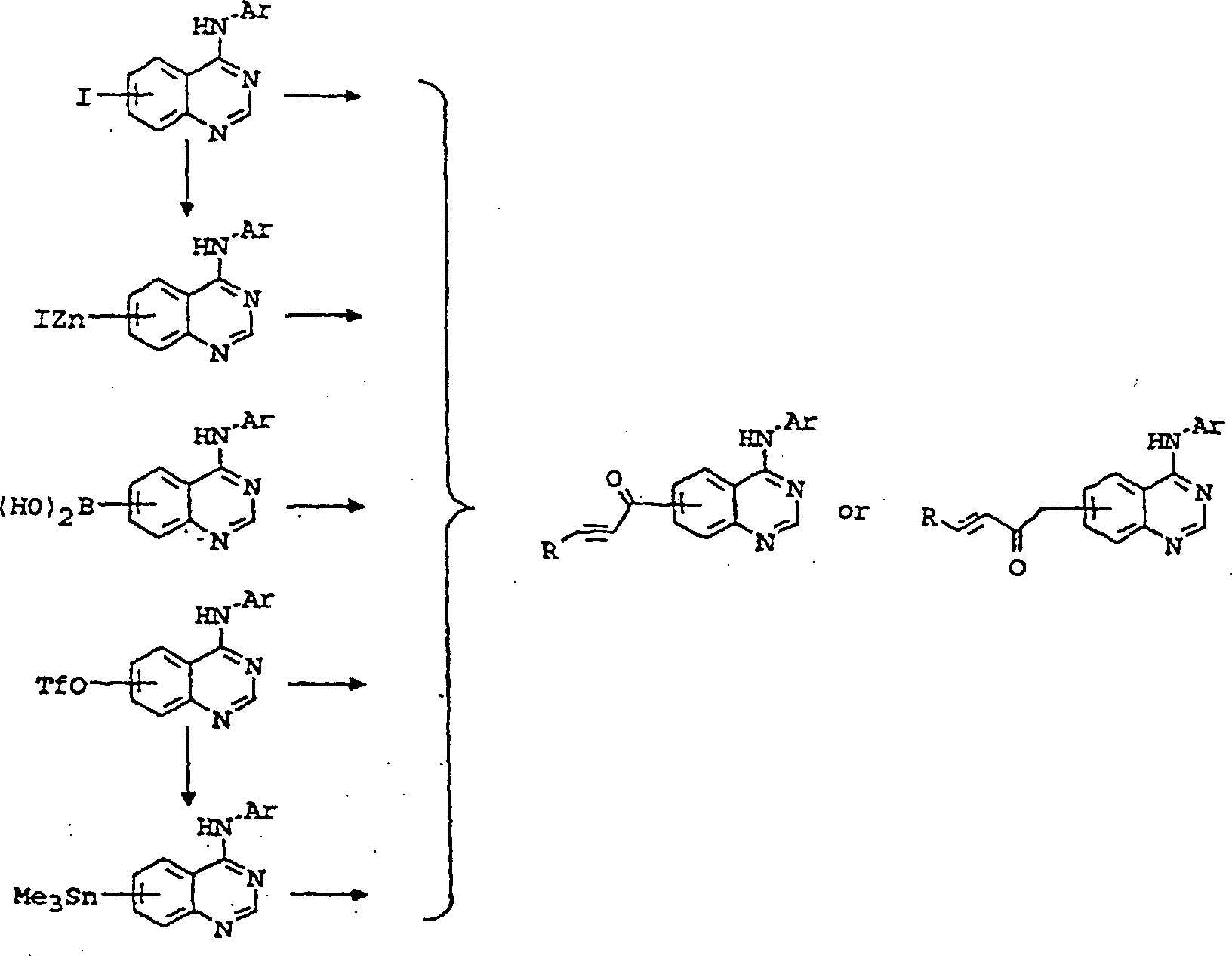
Schwefelgebundene alkylierende Michael-Akzeptor-SeitenkettenSulfur-bonded alkylating Michael acceptor side chains
Aktivierte Halogenide in Pyridopyrimidinen und Pyrimidinopyrimidinen können durch geeignete 2-Hydroxythiolate ausgetauscht werden und diese können wiederum zu Sulfonen oxidiert werden und Wasser kann dann durch Behandlung mit Mesylchlorid und mehreren Äquivalenten einer Base entfernt werden. Bei Chinazolinen und den beanspruchten Tricyclen kann entweder ein aktiviertes Halogen, insbesondere Fluor, in der gerade beschriebenen Reaktionsfolge für Pyridopyrimidine verwendet werden oder ein Aryliodidvorläufer kann metallisiert, mit Schwefel oder einer geeigneten elektrophilen Schwefelvorläuferverbindung gequencht und das entstandene Arylthiol dann zur Öffnung eines terminalen Epoxids verwendet werden, wobei ein 2-Hydroxythioether erhalten wird, der durch Oxidation und Wasserentfernung, wie im vorhergehenden beschrieben, in ein Vinylsulfon umgewandelt werden kann.activated Halides in pyridopyrimidines and pyrimidinopyrimidines can by suitable 2-hydroxythiolates can be exchanged and these in turn can be oxidized to sulfones and water can then be treated with mesyl chloride and several equivalents removed from a base. For quinazolines and the claimed Tricyclene can either be an activated halogen, in particular fluorine, used in the reaction sequence just described for pyridopyrimidines or an aryl iodide precursor can be metallized with sulfur or a suitable electrophilic Sulfur precursor compound quenched and the resulting arylthiol then to the opening of a be used with terminal epoxide, wherein a 2-hydroxythioether obtained by oxidation and water removal, as in described above, are converted into a vinylsulfone can.

Hydrazingebundene alkylierende Michael-Akzeptor-SeitenkettenHydrazine-bound alkylating Michael acceptor side chains
Aktivierte Halogenide in Pyridopyrimidinen und Pyrimidinopyrimidinen und entsprechend substituierte Chinazoline können durch ein (N-Alkyl)hydrazin ausgetauscht werden. Alternativ kann ein Aminoderivat des gewünschten Ringkerns diazotiert und anschließend zum Hydrazin reduziert werden. Der entfernt gelegene Stickstoff des Hydrazins kann dann nach einem Fachmann bekannten Verfahren acyliert, sulfonyliert oder phosphoryliert werden.activated Halides in pyridopyrimidines and pyrimidinopyrimidines and accordingly substituted quinazolines can be replaced by a (N-alkyl) hydrazine. Alternatively, you can an amino derivative of the desired Ring nucleus diazotized and then reduced to hydrazine become. The remote nitrogen of the hydrazine can then acylated, sulfonylated or phosphorylated according to methods known to a person skilled in the art become.

Hydroxylamino-O-gebundene alkylierende Michael-Akzeptor-SeitenkettenHydroxylamino-O-linked alkylating Michael acceptor side chains
Alkylierte Halogenide in Pyridopyrimidinen und Pyrimidinopyrimidinen und entsprechend substituierte Chinazoline können durch ein passend O-geschütztes (N-Alkyl)hydroxylamin ausgetauscht werden. Alternativ kann ein Nitroderivat des gewünschten Ringkerns synthetisiert und anschließend unter entsprechend milden reduzierenden Bedingungen zum Hydroxylamin reduziert werden. Der Sauerstoff des Hydroxylamins kann dann nach einem Fachmann bekannten Verfahren acyliert, sulfonyliert oder phosphoryliert werden.alkylated Halides in pyridopyrimidines and pyrimidinopyrimidines and accordingly substituted quinazolines can through an appropriately O-protected (N-alkyl) hydroxylamine are exchanged. Alternatively, a nitro derivative of the desired Ring core synthesized and then under correspondingly mild reducing Conditions are reduced to the hydroxylamine. The oxygen of the Hydroxylamine can then be known to one skilled in the art acylated, sulfonylated or phosphorylated.

Methylenamino-N-gebundene alkylierende Michael-Akzeptor-SeitenkettenMethyleneamino-N-linked alkylating Michael acceptor side chains
Alkylierte Halogenide in Pyridopyrimidinen und Pyrimidinopyrimidinen und entsprechend substituierte Chinazoline können durch Cyanid, vorzugsweise in Gegenwart einer Kupfer- oder Nickelsalzkatalyse ausgetauscht werden. Alternativ kann ein Aminoderivat des gewünschten Ringkerns diazotiert und anschließend wie im vorhergehenden beschrieben in das Nitril umgewandelt werden. In einigen Fällen kann die Nitrilfunktionalität bereits früher in der Synthese entweder als solche oder über eine Carbonsäure oder einen Aldehyd, die beide von einem Fachmann ohne weiteres in Nitrilverbindungen umgewandelt werden können, in den Heterocyclus eingebaut werden. Auf die Reduktion des Nitrils zu einem Methylenamin folgt eine Stickstoffacylierung, -sulfonylierung oder -phosphorylierung nach einem Fachmann bekannten Verfahren.alkylated Halides in pyridopyrimidines and pyrimidinopyrimidines and accordingly substituted quinazolines can by cyanide, preferably in the presence of a copper or nickel salt catalysis be replaced. Alternatively, an amino derivative of the desired Toroid diazotized and then as in the previous be converted into the nitrile described. In some cases the nitrile functionality earlier in the synthesis either as such or via a carboxylic acid or an aldehyde, both readily by a skilled person in nitrile compounds can be converted be incorporated into the heterocycle. On the reduction of the nitrile a methylene amine is followed by a nitrogen acylation, sulfonylation or phosphorylation according to methods known to a person skilled in the art.

Methylenoxy-O-gebundene alkylierende Michael-Akzeptor-SeitenkettenMethyleneoxy-O-linked alkylating Michael acceptor side chains
Hydroxymethylverbindungen können in entsprechende Heterocyclen auf vielen, einem Fachmann bekannten Wegen eingebaut werden. Beispielsweise können Iodchinazoline in einer Heck-Reaktion carbonyliert und anschließend mit NaBH4 zu dem gewünschten Vorläufer reduziert werden. Aminopyridopyrimidine können diazotiert, in das Nitril umgewandelt, partiell zu einem Imin reduziert, hydrolysiert werden und der erhaltene Aldehyd kann zu Hydroxymethyl reduziert werden. Der Sauerstoff des Hydroxymethyls kann dann nach einem Fachmann bekannten Verfahren acyliert, sulfonyliert oder phosphoryliert werden.Hydroxymethyl compounds can be incorporated into corresponding heterocycles in many ways known to those skilled in the art. For example, iodoquinazolines can be carbonylated in a Heck reaction and subsequently reduced with NaBH 4 to the desired precursor. Aminopyridopyrimidines can be diazotized, converted to the nitrile, partially reduced to an imine, hydrolyzed, and the resulting aldehyde reduced to hydroxymethyl. The oxygen of the hydroxymethyl can then be acylated, sulfonylated or phosphorylated according to methods known to a person skilled in the art.

Ethanogebundene alkylierende Michael-Akzeptor-SeitenkettenEthano-bonded alkylating Michael acceptor side chains
Eine Michael-Addition eines Cuprats, das über ein Organozinkat von einem Iodchinazolin hergeleitet wurde, an ein Divinylketon oder ein entsprechend einfach maskiertes Derivat und die gegebenenfalls anschließende Demaskierung der zweiten ungesättigten Funktionalität ergibt Verbindungen des gewünschten Typs. Von Pyridopyrimidinen oder Pyrimidopyrimidinen, wie im vorhergehenden beschrieben, abgeleitete Aldehyde, können zu den gewünschten Verbindungen durch eine breite Vielzahl von Verfahren, beispielsweise das eine angegebene, von einem Fachmann in homologer Weise zu den gewünschten Verbindungen umgesetzt werden.A Michael addition of a cupcake that has an organozincate of one Iodoquinazoline, divinyl ketone or equivalent simply masked derivative and optionally subsequent unmasking the second unsaturated functionality gives connections of the desired Type. Of pyridopyrimidines or pyrimidopyrimidines, as above described, derived aldehydes, may be desired Compounds by a wide variety of methods, for example the one specified by a skilled person in a homologous manner to the desired Connections are implemented.

Aminomethyl-C-gebundene alkylierende Michael-Akzeptor-SeitenkettenAminomethyl-C-linked alkylating Michael acceptor side chains
Aminoheterocyclen der in dieser Anmeldung beschriebenen Art können nach einem Fachmann bekannten Verfahren durch verschiedene doppelbindungsmaskierte Äquivalente von 1-Brombut-3-en-2-on und eine anschließende Demaskierung der Nichtsättigung alkyliert werden.aminoheterocycles The type described in this application can be known to one skilled in the art Method by various double-bond masked equivalents of 1-bromobut-3-en-2-one and subsequent unmasking of unsaturation be alkylated.

Hydroxymethyl-C-gebundene alkylierende Michael-Akzeptor- SeitenkettenHydroxymethyl-C-bonded alkylating Michael acceptor side chains
Hydroxyheterocyclen, die wie im vorhergehenden beschrieben aus Methoxyheterocyclen hergestellt wurden, können nach einem Fachmann bekannten Verfahren durch verschiedene doppelbindungsmaskierte Äquivalente von 1-Brombut-3-en-2-on und eine anschließende Demaskierung der Nichtsättigung alkyliert werden. Alternativ kann die Alkylierung des Phenols mit Chloressigsäure und die anschließende Umwandlung zu einem Acylchlorid und eine Stille-Kopplung des Acylhalogenids mit einem entsprechenden Alkenylstannan erreicht werden.hydroxyheterocycles, which were prepared from methoxy heterocycles as described above, can methods known to those skilled in the art by various double-bond masked equivalents of 1-bromobut-3-en-2-one and a subsequent one Unmasking the unsaturation be alkylated. Alternatively, the alkylation of the phenol with chloroacetate and the subsequent one Conversion to an acyl chloride and a Stille coupling of the acyl halide can be achieved with a corresponding Alkenylstannan.

Thiomethyl-C-gebundene alkylierende Michael-Akzeptor-SeitenkettenThiomethyl-C-linked alkylating Michael acceptor side chains
Entsprechende Mercaptoheterocyclen, die durch Ersetzen von aktivierten Halogeniden am heteroaromatischen Ring hergestellt wurden, können nach einem Fachmann bekannten Verfahren durch verschiedene doppelbindungsmaskierte Äquivalente von 1-Brombut-3-en-2-on und eine anschließende Demaskierung der Nichtsättigung alkyliert werden. Alternativ kann die Alkylierung des Thiols mit Chloressigsäure und eine anschließende Umwandlung zu einem Acylchlorid und Stille-Kopplung des Acylhalogenids mit einem entsprechenden Alkenylstannan erreicht werden.Appropriate Mercaptoheterocycles by replacing activated halides can be produced on the heteroaromatic ring, according to one skilled in the art Method by various double-bond masked equivalents of 1-bromobut-3-en-2-one and subsequent unmasking of unsaturation be alkylated. Alternatively, the alkylation of the thiol with chloroacetate and a subsequent one Conversion to an acyl chloride and Stille coupling of the acyl halide can be achieved with a corresponding Alkenylstannan.

BEISPIEL 1EXAMPLE 1
N-[4-(3-Brom-phenylamino)-pyrido[4,3-d]pyrimidin-7-yl]-N-(3-morpholin-4-yl-propyl)-acrylamidN- [4- (3-bromo-phenylamino) -pyrido [4,3-d] pyrimidin-7-yl] -N- (3-morpholin-4-yl-propyl) -acrylamide
ALLGEMEINES VERFAHREN A:GENERAL PROCEDURE A:
N-[4-(3-Brom-phenylamino)-pyrido[4,3-d]pyrimidin-7-yl]-N-(3-morpholin-4-yl-propyl)-acrylamid kann nach einem Fachmann vertrauten Verfahren durch Acylierung von 7-Amino-4-[(3-bromphenyl)amino]-pyrido[4,3-d]pyrimidin [J Med Chem, 1995: 3780] hergestellt werden. Beispielsweise kann eine Acylierung mit Acrylsäure durch die Verwendung eines Standardkondensationsmittels, wie 1-(3-Dimethylaminopropyl)-3-ethylcarbodiimid·HCl (EDAC) oder durch die Verwendung von Acryloylchlorid und einer tertiären Base, wie Diisopropylethylamin, als Säurefänger erreicht werden.N- [4- (3-bromo-phenylamino) -pyrido [4,3-d] pyrimidin-7-yl] -N- (3-morpholin-4-yl-propyl) -acrylamide may be familiar to a person skilled in the art by acylation of 7-amino-4 - [(3-bromophenyl) amino] -pyrido [4,3-d] pyrimidine [J Med Chem, 1995: 3780]. For example, can an acylation with acrylic acid by the use of a standard condensing agent such as 1- (3-dimethylaminopropyl) -3-ethylcarbodiimide.HCl (EDAC) or by the use of acryloyl chloride and a tertiary base, such as Diisopropylethylamine, achieved as an acid scavenger become.
Die N-Alkylierung der Acrylamide kann dann nach einem Fachmann vertrauten Verfahren erreicht werden. Beispielsweise ergibt die Umwandlung des Amids in dessen Monoanion durch Behandlung mit Standardreagenzien, wie Natriumhydrid, und die anschließende Substitution mit einem entsprechenden Halogenid, wie N-(3-Chlorpropyl)morpholin oder N-(4-Chlorbutyl)morpholin, das gewünschte alkylierte Amid.The N-alkylation of the acrylamides can then be achieved by methods familiar to one skilled in the art. For example, conversion of the amide into its monoanion results by treatment with standard reagents, such as sodium hydride, and subsequent substitution with a corresponding halide, such as N- (3-chloropropyl) morpholine or N- (4-chlorobutyl) morpholine, the desired alkylated amide.
ALLGEMEINES VERFAHREN B:GENERAL PROCEDURE B:
Alternativ
kann N-[4-(3-Brom-phenylamino)-pyrido[4,3-d]pyrimidin-7-yl]-N-(3-morpholin-4-yl-propyl)-acrylamid
durch Behandlung von 7-Fluor-4-[(3-Bromphenyl)amino]pyrido[4,3-d]pyrimidin
mit N-(3-Aminopropyl)morpholin in Dimethylsulfoxid und anschließende Acylierung
mit Acrylsäure
und einem Kopplungsreagens, wie 1-(3-Dimethylaminopropyl)-3-ethylcarbodiimid·HCl (EDAC)
oder Acryloylchlorid und einer tertiären Base, wie Diisopropylethylamin,
gemäß einem
Fachmann vertrauten Verfahren hergestellt werden. Siehe beispielsweise
BEISPIEL 2EXAMPLE 2
N-[4-(3-Brom-phenylamino)-pyrido[3,4-d]pyrimidin-6-yl]-N-(3-morpholin-4-yl-propyl)-acrylamidN- [4- (3-bromo-phenylamino) -pyrido [3,4-d] pyrimidin-6-yl] -N- (3-morpholin-4-yl-propyl) -acrylamide
Zu
einer gerührten
Lösung
von 4-[(3-Bromphenyl)amino]-6-[(3-morpholinopropyl)amino]pyrido[3,4-d]pyrimidin
(400 mg, 0,90 mmol) (hergestellt aus 4-[(3-Bromphenyl)amino]-6-fluorpyrido[3,4-d]pyrimidin und
3-Morpholinoprop-1-ylamin), DMAP (40 mg) und Et3N
(Überschuss,
2,0 ml) bei 0°C
unter N2 wurde Acryloylchlorid (1,2 mol-äq, 1,08
mmol, 89 μl)
zugegeben. Nach 1-stündigem
Rühren
wurden weitere zwei Portionen Säurechlorid
(jeweils 89 μl)
während
der nächsten
2 h gegeben und die Reaktion wurde dann 1 h lang bei 20°C gerührt, mit
Wasser verdünnt
und mit EtOAc extrahiert. Die vereinigten organischen Extrakte wurden
mit Kochsalzlösung
gewaschen, über
wasserfreiem Na2SO4 getrocknet
und unter vermindertem Druck eingeengt, bevor sie auf Silicagel
unter Elution mit MeOH/EtOAc (1:9) bis MeOH/EtOAc (1:5) chromatographiert
wurden, wobei N-[4-[(3-Bromphenyl)amino]-pyrido [3,4-d]pyrimidin-6-yl]-N-(3-morpholinopropyl]-acrylamid]
(142 mg, 32%) als cremefarbenes Pulver erhalten wurde.
Fp (CH2Cl2/Hexan) 178–180°C.
1H-NMR [(CD3)2SO]: δ 10,15
(s, 1H, NH) 9,15 (s, 1H, aromatisch), 8,80 (s, 1H, aromatisch),
8,47 (s, 1H, aromatisch), 8,21 (br. s, 1H, H-2'), 7,92 (br. d, J = 7,6 Hz, 1H, H-6'), 7,41 (t, J = 8,0
Hz, 1H, H-5'), 7,37
(dt, J = 8,1 Hz, J = 1,6 Hz, J = 1,6 Hz, 1H, H-4'), 6,25 (m, 2H, CH2CHCO,
CH2CHCO), 5,66 (m, 1H, CH2CHCO),
3,98 (t, J = 7,5 Hz, 2H, CH2NRCO), 3,46
(t, J = 4,5 Hz, 4H, Morpholinomethylen), 2,29 (t, J = 7,1 Hz, 2H, CH2CH2CH2NRCO),
2,24 (br. s, 4H, Morpholinomethylen), 1,73 (Quintett, J = 7,2 Hz,
2H, CH2CH2CH2).
13C-NMR: δ 164,84,
156,69, 155,80, 151,83, 150,05, 143,01, 140,02, 130,51, 129,27,
127,88, 126,76, 124,32, 121,19, 120,82, 113,02, 66,02 (×2), 55,05,
53,02 (×2),
45,85, 24,63.
Elementaranalyse berechnet für C23H25BrN6O2·H2O erfordert:
C, 53,6; H, 5,3; N, 16,3%.
Gefunden:
C, 53,8; H, 5,0; N, 16,3%.To a stirred solution of 4 - [(3-bromophenyl) amino] -6 - [(3-morpholinopropyl) amino] pyrido [3,4-d] pyrimidine (400 mg, 0.90 mmol) (prepared from 4- [ (3-bromophenyl) amino] -6-fluoropyrido [3,4-d] pyrimidine and 3-morpholinoprop-1-ylamine), DMAP (40 mg) and Et 3 N (excess, 2.0 mL) at 0 ° C Acryloyl chloride (1.2 mol eq, 1.08 mmol, 89 μl) was added under N 2 . After stirring for 1 h, an additional two portions of acid chloride (89 μl each) were added over the next 2 h and the reaction was then stirred at 20 ° C for 1 h, diluted with water and extracted with EtOAc. The combined organic extracts were washed with brine, dried over anhydrous Na 2 SO 4 and concentrated under reduced pressure before being chromatographed on silica gel eluting with MeOH / EtOAc (1: 9) to MeOH / EtOAc (1: 5) N- [4 - [(3-bromophenyl) amino] pyrido [3,4-d] pyrimidin-6-yl] -N- (3-morpholinopropyl) -acrylamide] (142 mg, 32%) as a cream colored powder has been.
Fp (CH 2 Cl 2 / hexane) 178-180 ° C.
1 H-NMR [(CD 3 ) 2 SO]: δ 10.15 (s, 1H, NH) 9.15 (s, 1H, aromatic), 8.80 (s, 1H, aromatic), 8.47 ( s, 1H, aromatic), 8.21 (br.s, 1H, H-2 '), 7.92 (br d, J = 7.6 Hz, 1H, H-6'), 7.41 ( t, J = 8.0 Hz, 1H, H-5 '), 7.37 (dt, J = 8.1 Hz, J = 1.6 Hz, J = 1.6 Hz, 1H, H-4' ), 6.25 (m, 2H, CH 2 CHCO, CH 2 CHCO), 5.66 (m, 1H, CH 2 CHCO), 3.98 (t, J = 7.5Hz, 2H, CH 2 NRCO ), 3.46 (t, J = 4.5Hz, 4H, morpholinomethylene), 2.29 (t, J = 7.1Hz, 2H, CH 2 CH 2 CH 2 NRCO), 2.24 (br. s, 4H, morpholinomethylene), 1.73 (quintet, J = 7.2 Hz, 2H, CH 2 CH 2 CH 2 ).
13 C-NMR: δ 164.84, 156.69, 155.80, 151.83, 150.05, 143.01, 140.02, 130.51, 129.27, 127.88, 126.76, 124.32, 121.19, 120.82, 113.02, 66.02 (x 2), 55.05, 53.02 (x 2), 45.85, 24.63.
Elemental analysis calculated for C 23 H 25 BrN 6 O 2 .H 2 O requires:
C, 53.6; H, 5.3; N, 16.3%.
Found: C, 53.8; H, 5.0; N, 16.3%.
BEISPIEL 3EXAMPLE 3
N-[4-(3-Brom-phenylamino)-chinazolin-7-yl]acrylamidN- [4- (3-bromo-phenylamino) -quinazolin-7-yl] acrylamide
Zu
einer eiskalten Lösung
von 0,158 g (0,5 mM) 7-Amino-4-(3-bromanilino)-chinazolin
[J Med Chem, 1995: 3482] und 0,108 g Acrylsäure in 5,0 ml trockenem Dimethylformamid
(DMF) wurden 0,288 g 1-(3-Dimethylaminopropyl)-3-ethylcarbodiimid·HCl (EDAC)
gegeben. Nach 5-minütigem
Rühren
wurde das Gemisch eine Lösung
und das Eisbad wurde entfernt. Das Reaktionsgemisch wurde weitere
3 h lang bei Raumtemperatur gerührt.
Das Reaktionsgemisch wurde dann in ein Gemisch aus Eis und Wasser
gegossen und durch die Zugabe einer gesättigten Natriumbicarbonatlösung basisch
gemacht. Dieses wässrige
Gemisch wird dreimal mit Ethylacetat extrahiert und die gepoolten
Extrakte wurden über
Magnesiumsulfat getrocknet. Die Lösung wurde filtriert und unter
Vakuum eingeengt, wobei ein hellgelber Feststoff erhalten wurde.
Der Feststoff wurde in 100 ml Methanol gelöst, filtriert und unter Vakuum
auf etwa 10 ml eingeengt. Der Feststoff, der aus der Lösung ausfiel,
wurde gewonnen und unter Vakuum bei 80°C getrocknet, wobei 50 mg N-[4-(3-Bromphenylamino)-chinazolin-7-yl]acrylamid
erhalten wurden.
Fp > 265°C.
Chemische
Ionisierung: m/e 369.
1H-NMR (D6-Dimethylsulfoxid): δ 5,86 (dd, 1H, J = 10,1, J =
1,9), 6,36 (dd, 1H, J = 17,0, J = 1,9), 6,51 (dd, 1H, J = 16,9,
J = 10,1), 7,30 (m, 1H), 7,36 (t, 1H, J = 8,1), 7,92 (dd, 1H, J
= 9,2, J = 2,2), 7,9 (d, 1H, J = 8,0), 8,25 (dd, 1H, J = 3,6, J
= 1,9), 8,50 (d, 1H, J = 8,9), 8,61 (s, 1H), 9,79 (s, 1H, -NH),
10,61 (s, 1H, -NH).
Elementaranalyse berechnet für C17H13BrN4O:
C,
55,30; H, 3,55; N, 15,17.
Gefunden: C, 55,49; H, 3,63; N, 15,26.To an ice-cold solution of 0.158 g (0.5 mM) of 7-amino-4- (3-bromoanilino) quinazoline [J Med Chem, 1995: 3482] and 0.108 g of acrylic acid in 5.0 ml of dry dimethylformamide (DMF) 0.288 g of 1- (3-dimethylaminopropyl) -3-ethylcarbodiimide.HCl (EDAC). After stirring for 5 minutes, the mixture became a solution and the ice bath was removed. The reaction mixture was stirred for an additional 3 hours at room temperature. The reaction mixture was then poured into a mixture of ice and water and basified by the addition of a saturated sodium bicarbonate solution. This aqueous mixture is extracted three times with ethyl acetate, and the pooled extracts are dried over magnesium sulfate. The solution was filtered and concentrated in vacuo to give a light yellow solid. The solid was dissolved in 100 ml of methanol, filtered and concentrated under vacuum to about 10 ml. The solid which precipitated out of the solution was collected and dried under vacuum at 80 ° C to give 50 mg of N- [4- (3-bromophenylamino) quinazolin-7-yl] acrylamide.
Mp> 265 ° C.
Chemical ionization: m / e 369.
1 H-NMR (D 6 -dimethylsulfoxide): δ 5.86 (dd, 1H, J = 10.1, J = 1.9), 6.36 (dd, 1H, J = 17.0, J = 1 , 9), 6.51 (dd, 1H, J = 16.9, J = 10.1), 7.30 (m, 1H), 7.36 (t, 1H, J = 8.1), 7 , 92 (dd, 1H, J = 9.2, J = 2.2), 7.9 (d, 1H, J = 8.0), 8.25 (dd, 1H, J = 3.6, J = 1.9), 8.50 (d, 1H, J = 8.9), 8.61 (s, 1H), 9.79 (s, 1H, -NH), 10.61 (s, 1H, -NH).
Elemental analysis calculated for C 17 H 13 BrN 4 O:
C, 55.30; H, 3.55; N, 15:17.
Found: C, 55.49; H, 3.63; N, 15.26.
BEISPIEL 4EXAMPLE 4
N-[4-[(3-Bromphenyl)amino]-chinazolin-7-yl]-N-[3-morpholinopropyl]acrylamidN- [4 - [(3-bromophenyl) amino] quinazolin-7-yl] -N- [3-morpholinopropyl] acrylamide
Zu
einer Lösung
von [4-[(3-Bromphenyl)amino]-7-fluorchinazolin
(0,60 g, 1,89 mmol) in Dimethylsulfoxid (DMSO) (10 ml) wurde 4-(3-Aminopropyl)morpholin
(7,54 mmol, 1,10 ml) gegeben. Das Reaktionsgemisch wurde 26 h auf
110°C erhitzt
und anschließend
mit Wasser verdünnt,
durch die Zugabe von gesättigter NaHCO3-Lösung
basisch gemacht und anschließend
mit EtOAc extrahiert. Die vereinigten organischen Extrakte wurden
mit Kochsalzlösung
gewaschen, über
wasserfreiem Na2SO4 getrocknet
und unter Vakuum eingeengt. Eine Säulenchromatographie auf Aluminiumoxid
der Reinheit III mit Gradientenelution von EtOAc bis EtOAc/MeOH
(98:2) und anschließendes
Umkristallisieren aus EtOAc/Hexan ergaben 4-[(3-Bromphenyl)amino]-7-(3-morpholinopropyl]-amino]chinazolin
(0,65 g, 78%) als cremefarbene Kristalle.
Fp 162–162,5°C.
1H-NMR [(CD3)2SO, 200 MHz]: δ 9,41 (s, 1H, NH), 8,43 (s,
1H, H-2), 8,24 (br. s, 1H, H-2'),
8,18 (d, J = 9,2 Hz, 1H, H-5), 7,87 (br. d, J = 8, 1 Hz, 1H, H-6'), 7,35–7,18 (m,
2H, H-4', 5'), 6,88 (dd, J =
1,9 Hz, J = 9,1 Hz, 1H, H-6'),
6,65 (t, J = 5,3 Hz, 1H, CH2NH), 6,62 (br.
s, 1H, H-8), 3,60 (t, J = 4,6 Hz, 4H, Morpholinomethylen), 3,19 (dt,
J = 6,4 Hz, J = 6,4 Hz, J = 5,8 Hz, 1H, CH2CH2NH), 2,43–2,33 (m, 6H, Mor pholinomethylen, CH2CH2CH2NH),
1,75 (Quintett, J = 6,8 Hz, 1H, CH2CH2CH2).
13C-NMR: δ 156,56,
154,27, 152,41, 152,32, 141,60, 130,15, 124,90, 123,41, 123,31,
121,06, 119,87, 116,51, 105,68, 102,21, 66,13 (×2), 55,81, 53,31 (×2), 40,46,
25,14.To a solution of [4 - [(3-bromophenyl) amino] -7-fluoroquinazoline (0.60 g, 1.89 mmol) in dimethyl sulfoxide (DMSO) (10 mL) was added 4- (3-aminopropyl) morpholine (7 , 54 mmol, 1.10 ml). The reaction mixture was heated at 110 ° C for 26 h and then diluted with water, basified by the addition of saturated NaHCO 3 solution and then extracted with EtOAc. The combined organic extracts were washed with brine, dried over anhydrous Na 2 SO 4 and concentrated in vacuo. Column chromatography on purity III alumina with gradient elution of EtOAc to EtOAc / MeOH (98: 2) followed by recrystallization from EtOAc / hexane gave 4 - [(3-bromophenyl) amino] -7- (3-morpholinopropyl] amino] quinazoline (0.65 g, 78%) as cream-colored crystals.
Mp 162-162.5 ° C.
1 H-NMR [(CD 3 ) 2 SO, 200 MHz]: δ 9.41 (s, 1H, NH), 8.43 (s, 1H, H-2), 8.24 (br. S, 1H , H-2 '), 8.18 (d, J = 9.2 Hz, 1H, H-5), 7.87 (br d, J = 8, 1 Hz, 1H, H-6'), 7.35-7.18 (m, 2H, H-4 ', 5'), 6.88 (dd, J = 1.9Hz, J = 9.1Hz, 1H, H-6 '), 6 , 65 (t, J = 5.3Hz, 1H, CH 2 NH), 6.62 (brs s, 1H, H-8), 3.60 (t, J = 4.6Hz, 4H, morpholinomethylene ), 3.19 (dt, J = 6.4 Hz, J = 6.4 Hz, J = 5.8 Hz, 1H, CH 2 CH 2 NH), 2.43-2.33 (m, 6H, Morpholinomethylene, CH 2 CH 2 CH 2 NH), 1.75 (quintet, J = 6.8 Hz, 1H, CH 2 CH 2 CH 2 ).
13 C-NMR: δ 156.56, 154.27, 152.41, 152.32, 141.60, 130.15, 124.90, 123.41, 123.31, 121.06, 119.87, 116.51, 105.68, 102.21, 66.13 (x 2), 55.81, 53.31 (x 2), 40.46, 25.14.
Zu
einer Lösung
des obigen 4-[(3-Bromphenyl)amino]-7-[(3-morpholinopropyl)-amino]-chinazolins (0,10
g, 0,230 mmol) in trockenem DMF (5,0 ml) unter N2 wurden
Acrylsäure
(0,565 mmol, 39 μl),
Et3N (100 μl) und 1-(3-Dimethylaminopropyl)-3-ethylcarbodiimidhydrochlorid
(EDCI·HCl)
(0,565 mmol, 108 mg) gegeben, das Reaktionsgemisch wurde bei Raumtemperatur
4 Tage lang gerührt,
wobei weitere Acrylsäure
(409 μl), Triethylamin
Et3N (100 μl) und EDCI·HCl (100 mg) jeden Tag zugesetzt
wurden. Das DMF wurde dann unter Vakuum entfernt und der entstandene
Rückstand
wurde mit gesättigter
NaHCO3-Lösung
verdünnt
und mit EtOAc extrahiert. Die vereinigten organischen Extrakte wurden
mit Kochsalzlösung
gewaschen, über
wasserfreiem Na2SO4 getrocknet
und unter vermindertem Druck eingeengt. Eine Säulenchromatographie auf Silicagel mit
Gradientenelution von MeOH/EtOAc/CH2Cl2 (1:4:5) bis MeOH/EtOAc/CH2Cl2 (2:4:4) ergab bei höherem Rf-Wert N-[4-[(3-Bromphenyl)amino]chinozolin-7-yl]-N-[3-morpholinopropyl]acrylamid
(39 mg, 35%) als weißes
Pulver.
Fp (EtOAc/Hexan) 86–88°C (Zers.).
1H-NMR
[(CD3)2SO, 100 MHz]: δ 9,96 (s,
1H, NH), 8,68 (s, 1H, H-2), 8,63 (d, J = 8,7 Hz, 1H, H-5), 8,23
(br. s, 1H, H-2'),
7,91 (dt, J = 7,3 Hz, J = 2,0 Hz, J = 2,0 Hz, 1H, H-6'), 7,68–7,58 (m,
2H, aromatisch), 7,42–7,31
(m, 2H, aromatisch), 6,18 (m; 2H, CH2CHCO,
CH2CHCO), 5,63 (dd, J = 2,0 Hz, J = 10,0
Hz, 1H, CH2CHCO), 3,90 (t, J = 7,1 Hz, 2H,
CH2CH2CH2NCO), 3,51 (t, J = 4,3 Hz, 4H, Morpholinomethylen),
2,50 (br. s, 2H, CH2CH2CH2NCO), 2,28 (br. s, 4H, Morpholinomethylen),
1,67 (Quintett, J = 6,5 Hz, 2H, CH2CH2CH2).
Bei niedrigerem
Rf-Wert: Zurückgewonnenes Ausgangsmaterial,
4-[(3-Bromphenyl)amino]-7-[(3-morpholinopropyl)-amino]chinazolin
(34%), das mit einer authentischen Probe identisch ist.To a solution of the above 4 - [(3-bromophenyl) amino] -7 - [(3-morpholinopropyl) amino] quinazoline (0.10 g, 0.230 mmol) in dry DMF (5.0 mL) under N 2 Acrylic acid (0.565 mmol, 39 μl), Et 3 N (100 μl) and 1- (3-dimethylaminopropyl) -3-ethylcarbodiimide hydrochloride (EDCI.HCl) (0.565 mmol, 108 mg) were added, the reaction mixture was allowed to stand at room temperature for 4 days for a while, adding more acrylic acid (409 μl), triethylamine Et 3 N (100 μl) and EDCI · HCl (100 mg) each day. The DMF was then removed under vacuum and the resulting residue was diluted with saturated NaHCO 3 solution and extracted with EtOAc. The combined organic extracts were washed with brine, dried over anhydrous Na 2 SO 4 and concentrated under reduced pressure. Column chromatography on silica gel with gradient elution from MeOH / EtOAc / CH 2 Cl 2 (1: 4: 5) to MeOH / EtOAc / CH 2 Cl 2 (2: 4: 4) gave higher R f values of N- [4-]. [(3-Bromophenyl) amino] quinolin-7-yl] - N - [3-morpholinopropyl] acrylamide (39 mg, 35%) as a white powder.
Mp (EtOAc / hexane) 86-88 ° C (dec.).
1 H-NMR [(CD 3 ) 2 SO, 100 MHz]: δ 9.96 (s, 1H, NH), 8.68 (s, 1H, H-2), 8.63 (d, J = 8 , 7Hz, 1H, H-5), 8.23 (brs s, 1H, H-2 '), 7.91 (dt, J = 7.3Hz, J = 2.0Hz, J = 2 , 0Hz, 1H, H-6 '), 7.68-7.58 (m, 2H, aromatic), 7.42-7.31 (m, 2H, aromatic), 6.18 (m, 2H, CH 2 CHCO, CH 2 CHCO), 5.63 (dd, J = 2.0 Hz, J = 10.0 Hz, 1H, CH 2 CHCO), 3.90 (t, J = 7.1 Hz, 2H , CH 2 CH 2 CH 2 NCO), 3.51 (t, J = 4.3 Hz, 4H, morpholinomethylene), 2.50 (br, s, 2H, CH 2 CH 2 CH 2 NCO), 2.28 (br s, 4H, morpholinomethylene), 1.67 (quintet, J = 6.5 Hz, 2H, CH 2 CH 2 CH 2 ).
At lower R f value: recovered starting material, 4 - [(3-bromophenyl) amino] -7 - [(3-morpholinopropyl) -amino] quinazoline (34%), which is identical to an authentic sample.
BEISPIEL 5EXAMPLE 5
3-[4-(3-Brom-phenylamino)-chinozolin-7-ylcarbamoyl]acrylsäure3- [4- (3-bromo-phenylamino) -chinozolin-7-ylcarbamoyl] acrylic acid
Zu
einer 5°C-Lösung von
0,158 g 7-Amino-4-(3-bromanilino)-chinazolin (J Med Chem, 1995:
3482) in 10 ml Tetrahydrofuran wurden 0,059 g Maleinsäureanhydrid
gegeben. Die kalte Lösung
wurde 15 min lang gerührt
und danach wurde das Eisbad entfernt. Das Reaktionsgemisch wurde
auf Raumtemperatur erwärmt,
wo es weitere 15 h lang gerührt
wurde. Die Suspension wurde unter Rückflußkühlung 30 min lang erhitzt und
anschließend
bei Raumtemperatur weitere 15 h lang gerührt. Weitere 0,059 g Maleinsäureanhydrid
und 20 ml Tetrahydrofuran wurden zugegeben und das Reaktionsgemisch
wurde weitere 2 h lang unter Rückflußkühlung erhitzt.
Nach weiteren 15 h bei Raumtemperatur wurde das Reaktionsgemisch
15 h lang unter Rückflußkühlung erhitzt.
Das Reaktionsgemisch wurde filtriert und der hell-lohfarbene Feststoff
wurde zunächst
aus Dimethylformamid und dann ein zweites Mal aus Methanol umkristallisiert,
wobei 0,036 g des gewünschten
Produkts erhalten wurden.
1H-NMR [(CD3)2SO]: δ 12,95 (br.
s, 1H, Austausch mit D2O), 11,04 (br. s,
1H, Austausch mit D2O), 9,81 (br. s, 1H,
Austausch mit D2O), 8,62 (s, 1H), 8,49 (d,
J = 9,2 Hz, 1H), 8,24 (s, 1H), 8,17 (d, J = 1,7 Hz, 1H), 7,90 (d, J
= 8,4 Hz, 1H), 7,78 (d, J = 9,2 Hz, 1H), 7,36 (t, J = 8,1 Hz, 1H),
7,30 (dd,. J = 1 Hz, 9 Hz, 1H), 6,50 (d, J = 12,1 Hz, 1H), 6,37
(d, J = 11,8 Hz, 1H);
CIMS m/z (relative %): 411,3 (95), 412,3
(23), 413,3 (100), 414,3 (21).
Elementaranalyse berechnet für C18H13BrN4O3:
C, 52,32; H, 3,17; N, 13,56.
Gefunden:
C, 52,57; H, 3,51; N, 13,16.To a 5 ° C solution of 0.158 g of 7-amino-4- (3-bromoanilino) quinazoline (J Med Chem, 1995: 3482) in 10 ml of tetrahydrofuran was added 0.059 g of maleic anhydride. The cold solution was stirred for 15 minutes and then the ice bath was removed. The reaction mixture was warmed to room temperature, where it was stirred for another 15 h. The suspension was heated under reflux for 30 minutes and then stirred at room temperature for a further 15 hours. An additional 0.059 g of maleic anhydride and 20 ml of tetrahydrofuran were added and the reaction mixture was refluxed for an additional 2 hours. After a further 15 h at room temperature, the reaction mixture was refluxed for 15 h. The reaction mixture was filtered and the light tan solid was recrystallized first from dimethylformamide and then a second time from methanol to give 0.036 g of the desired product.
1 H-NMR [(CD 3 ) 2 SO]: δ 12.95 (br.s, 1H, exchange with D 2 O), 11.04 (br.s, 1H, exchange with D 2 O), 9, 81 (br s, 1H, D 2 O exchange), 8.62 (s, 1H), 8.49 (d, J = 9.2Hz, 1H), 8.24 (s, 1H), 8 , 17 (d, J = 1.7 Hz, 1H), 7.90 (d, J = 8.4 Hz, 1H), 7.78 (d, J = 9.2 Hz, 1H), 7.36 (t, J = 8.1 Hz, 1H), 7.30 (dd, J = 1 Hz, 9 Hz, 1H), 6.50 (d, J = 12.1 Hz, 1H), 6.37 (d, J = 11.8 Hz, 1H);
CIMS m / z (relative%): 411.3 (95), 412.3 (23), 413.3 (100), 414.3 (21).
Elemental analysis calculated for C 18 H 13 BrN 4 O 3 :
C, 52.32; H, 3:17; N, 13.56.
Found: C, 52.57; H, 3.51; N, 13,16.
BEISPIEL 6EXAMPLE 6
3-[4-(3-Brom-phenylamino)-chinozolin-7-ylcarbamoyl]acrylsäureethylester3- [4- (3-bromo-phenylamino) -chinozolin-7-ylcarbamoyl] acrylic acid ethyl ester
Zu
einer eiskalten Lösung
von 0,158 g 7-Amino-4-(3-bromanilino)-chinazolin
und 0,216 g Monoethylfumarat in 3 ml trockenem Dimethylformamid
wurden 0,288 g 1-(3-Dimethylaminopropyl)-3-ethyl-carbodiimid·HCl (EDAC)
gegeben. 7-Amino-4-(3-bromanilino)-chinazolin kann nach Fachleuten bekannten
Verfahren hergestellt werden. Siehe beispielsweise J Med Chem, 1995:
3482, das hier durch Bezugnahme aufgenommen ist. Nach 5-minütigem Rühren bei
5°C wurde
das Eisbad entfernt und das Reaktionsgemisch wurde sich auf Raumtemperatur
erwärmen
gelassen, wo es 15 h lang gerührt
wurde. Das Reaktionsgemisch wurde in kaltes Wasser gegossen und
die Suspension wurde durch die Zugabe einer gesättigten Natriumbicarbonatlösung basisch
gemacht. Der entstandene Feststoff wurde durch Filtration gewonnen,
mit Wasser gewaschen und dann aus 50 ml Ethanol umkristallisiert,
wobei 0,052 g des gewünschten
Produkts erhalten wurden.
Fp > 260°C.
1H-NMR [(CD3)2SO]: δ 10,99
(br. s, 1H, Austausch mit D2O), 9,82 (br.
s, 1H, Austausch mit D2O), 8,62 (s, 1H), 8,52
(d, J = 8,9 Hz, 1H), 8,24 (s, 2H), 7,90 (d, J = 8,2 Hz, 1H), 7,81
(dd, J = 1,7 Hz, 8,9 Hz, 1H), 7,34 (m, 2H), 7,26 (d, J = 15,7 Hz,
1H), 6,79 (d, J = 15,4 Hz, 1H), 3,33 (q, J = 7,0 Hz, 14,2 Hz, 2H),
1,28 (t, J = 7,0 Hz, 3H);
CIMS m/z (relative %): 440 (19%),
441 (100), 442 (37), 443 (78).
Elementaranalyse berechnet für C20H17BrN4O3:
C, 54,44; H, 3,88; N, 12,70; Br,
18,11.
Gefunden: C, 54,32; H, 3,85; N, 12,76; Br, 17,89.To an ice-cold solution of 0.158 g of 7-amino-4- (3-bromoanilino) quinazoline and 0.216 g of monoethyl fumarate in 3 ml of dry dimethylformamide was added 0.288 g of 1- (3-dimethylaminopropyl) -3-ethyl-carbodiimide.HCl (EDAC). given. 7-Amino-4- (3-bromoanilino) quinazoline can be prepared by methods known to those skilled in the art. See, for example, J Med Chem, 1995: 3482, incorporated herein by reference. After stirring for 5 minutes at 5 ° C, the ice bath was removed and the reaction mixture was allowed to warm to room temperature, where it was stirred for 15 h. The reaction mixture was poured into cold water and the suspension was basified by the addition of a saturated sodium bicarbonate solution. The resulting solid was collected by filtration, washed with water and then recrystallized from 50 ml of ethanol to give 0.052 g of the desired product.
Mp> 260 ° C.
1 H-NMR [(CD 3 ) 2 SO]: δ 10.99 (br.s, 1H, exchange with D 2 O), 9.82 (br.s, 1H, exchange with D 2 O), 8, 62 (s, 1H), 8.52 (d, J = 8.9 Hz, 1H), 8.24 (s, 2H), 7.90 (d, J = 8.2 Hz, 1H), 7, 81 (dd, J = 1.7 Hz, 8.9 Hz, 1H), 7.34 (m, 2H), 7.26 (d, J = 15.7 Hz, 1H), 6.79 (d, J = 15.4 Hz, 1H), 3.33 (q, J = 7.0 Hz, 14.2 Hz, 2H), 1.28 (t, J = 7.0 Hz, 3H);
CIMS m / z (relative%): 440 (19%), 441 (100), 442 (37), 443 (78).
Elemental analysis calculated for C 20 H 17 BrN 4 O 3 :
C, 54.44; H, 3.88; N, 12.70; Br, 18.11.
Found: C, 54.32; H, 3.85; N, 12,76; Br, 17.89.
BEISPIEL 7*EXAMPLE 7 *
N-(3-Brom-phenyl)-chinazolin-4-yl-aminN- (3-bromo-phenyl) -quinazolin-4-yl-amine
N-(3-Brom-phenyl)-chinazolin-4-yl-amin wurde gemäß einschlägig bekannten Verfahren hergestellt. Siehe beispielsweise J Med Chem, 1995; 38(18): 3482–3487.N- (3-bromo-phenyl) -quinazolin-4-yl-amine became known in the art Process produced. See, for example, J Med Chem, 1995; 38 (18): From 3482 to 3487.
BEISPIEL 8*EXAMPLE 8 *
4-(3-Brom-phenylamino)-6,7-dimethoxychinazolin4- (3-bromo-phenylamino) -6,7-dimethoxyquinazoline
4-(3-Brom-phenylamino)-6,7-dimethoxychinazolin
wird gemäß einschlägig bekannten
Verfahren synthetisiert. Siehe beispielsweise die
BEISPIEL 9EXAMPLE 9
But-2-ensäure-[4-(3-brom-phenylamino)-chinazolin-7-yl]-amidBut-2-enoic acid [4- (3-bromo-phenylamino) -quinazolin-7-yl] -amide
Zu
einer eiskalten Lösung
von 0,158 g 7-Amino-4-(3-bromanilino)-chinazolin
(J Med Chem, 1985: 3482) in 5 ml Tetrahydrofuran wurde tropfenweise
eine Lösung
von 0,105 g Crotonsäurechlorid
in 5 ml Tetrahydrofuran gegeben. Nach der Beendigung der Zugabe
wurde das Eisbad entfernt und das Reaktionsgemisch bei Raumtemperatur
15 h lang gerührt.
Das Reaktionsgemisch wurde filtriert, wobei der gelbe Feststoff
entfernt wurde, der mit Tetrahydrofuran gewaschen und aus 20 ml
siedendem Methanol umkristallisiert wurde, wobei 0,060 g des gewünschten
Produkts erhalten wurde.
Fp > 250°C.
1H-NMR [(CD3)2SO]: δ 11,44
(br s, 1H, Austausch mit D2O), 11,04 (s,
1H, Austausch mit D2O), 8,92 (s, 1H), 8,78
(d, J = 9,2 Hz, 1H), 8,52 (d, J = 1,9 Hz, 1H), 8,05 (t, J = 1,8
Hz, 1H), 7,91 (dd, J = 2,1 Hz, 9,3 Hz, 1, 7,76 (m, 1H), 7,52 (m,
1H), 7,45 (t, J = 8,0 Hz, 1H), 6,70 (m, 1H), 6,28 (dd, J = 1,7 Hz,
15,1 Hz, 1H), 1,92 (dd, J = 1,6 Hz, 6,9 Hz, 3H);
CIMS: 382
(21), 383 (100), 384 (34), 385 (64).
Elementaranalyse berechnet
für C18H15BrN4O·1HCl·0,5H2O:
C, 50,43; H, 4,00; N, 13,07; Br,
18,64; Cl, 8,27.
Gefunden: C, 50,71; H, 4,00; N, 12,98; Br,
18,93; Cl, 7,51.To an ice-cold solution of 0.158 g of 7-amino-4- (3-bromoanilino) quinazoline (J Med Chem, 1985: 3482) in 5 ml of tetrahydrofuran was added dropwise a solution of 0.105 g of crotonic chloride in 5 ml of tetrahydrofuran. After completion of the addition, the ice bath was removed and the reaction stirred at room temperature for 15 h. The reaction mixture was filtered to remove the yellow solid, which was washed with tetrahydrofuran and recrystallized from 20 ml of boiling methanol to give 0.060 g of the desired product.
Mp> 250 ° C.
1 H-NMR [(CD 3 ) 2 SO]: δ 11.44 (br s, 1H, exchange with D 2 O), 11.04 (s, 1H, exchange with D 2 O), 8.92 (s , 1H), 8.78 (d, J = 9.2Hz, 1H), 8.52 (d, J = 1.9Hz, 1H), 8.05 (t, J = 1.8Hz, 1H ), 7.91 (dd, J = 2.1 Hz, 9.3 Hz, 1.77.76 (m, 1H), 7.52 (m, 1H), 7.45 (t, J = 8, 0 Hz, 1H), 6.70 (m, 1H), 6.28 (dd, J = 1.7 Hz, 15.1 Hz, 1H), 1.92 (dd, J = 1.6 Hz, 6 , 9 Hz, 3H);
CIMS: 382 (21), 383 (100), 384 (34), 385 (64).
Elemental analysis calculated for C 18 H 15 BrN 4 O · 1HCl · 0.5H 2 O:
C, 50.43; H, 4.00; N, 13.07; Br, 18.64; Cl, 8:27.
Found: C, 50.71; H, 4.00; N, 12,98; Br, 18.93; Cl, 7.51.
BEISPIEL 10EXAMPLE 10
N-[4-(3-Brom-phenylamino)-6-(3-morpholin-4-yl-propylamino)chinazolin-7-yl]-acrylamidN- [4- (3-bromo-phenylamino) -6- (3-morpholin-4-yl-propylamino) -quinazolin-7-yl] -acrylamide
Die Behandlung von 6-Chlor-7-nitrochinazolin-4-on (Aust J Chem, 1995; 48: 227–232) mit Thionylchlorid oder POCl3 ergibt das 4,6-Dichlor-7-nitrochinazolin. Die Reaktion mit 3-Bromanilin ergibt ein Gemisch von 4-(3-Bromphenylamino)-6-chlor-7-nitrochinazolin und 4-Chlor-6-(3-bromphenylamino)-7-nitrochinazolin, die durch Säulenchromatographie getrennt werden. Die Behandlung des gewünschten 4-(3-Bromphenylamino)-6-chlor-7-nitrochinazolins mit N-(3-Aminopropyl)-morpholin und die anschließende Reduktion der Nitrofunktionalität mit beispielsweise Eisen in Essigsäure ergibt 7-Amino-4-(3-brom-phenylamino)-6-(3-morpholin-4-yl- propylamino)-chinazolin. Die Acylierung zur Bildung des Acrylamids wird gemäß dem Verfahren von Beispiel 3 erreicht.Treatment of 6-chloro-7-nitroquinazolin-4-one (Aust J Chem, 1995; 48: 227-232) with thionyl chloride or POCl 3 gives the 4,6-dichloro-7-nitroquinazoline. The reaction with 3-bromoaniline gives a mixture of 4- (3-bromophenylamino) -6-chloro-7-nitroquinazoline and 4-chloro-6- (3-bromophenylamino) -7-nitroquinazoline, which are separated by column chromatography. Treatment of the desired 4- (3-bromophenylamino) -6-chloro-7-nitroquinazoline with N- (3-aminopropyl) -morpholine and subsequent reduction of the nitrofunctionality with, for example, iron in acetic acid gives 7-amino-4- (3- bromophenylamino) -6- (3-morpholin-4-yl-propylamino) -quinazoline. Acylation to form the acrylamide is accomplished according to the method of Example 3.
BEISPIEL 11*EXAMPLE 11 *
N-[4-[(3-Bromphenyl)amino]chinazolin-6-yl]acrylamidN- [4 - [(3-bromophenyl) amino] quinazolin-6-yl] acrylamide
Zu
einer Lösung
von 6-Amino-[4-[(3-bromphenyl)amino]chinazolin (2,0 g, 6,35 mmol)
in trockenem DMF (20 ml) unter N2 wure Acrylsäure (12,7
mmol, 0,87 ml) gegeben. Die entstandene Lösung wurde auf 0°C gekühlt und
1-(3-Dimethylaminopropyl)-3-ethylcarbodiimidhydrochlorid (EDCI·HCl) (7,62
mmol, 1,46 g) wurde zugegeben. Das Reaktionsgemisch wurde 15 min
bei 0°C
gerührt
und anschließend
sich auf Raumtemperatur erwärmen
gelassen und weitere 2 h lang gerührt, wonach weitere Acrylsäure (0,30
ml) und EDCI·HCl
(0,30 g) zugegeben wurden. Nach weiteren 2 h – die Reaktion war nach TLC
vollständig – wurde
Lösemittel
unter vermindertem Druck entfernt und der entstandene Rückstand
wurde mit gesättigter
NaHCO3-Lösung
verdünnt und
wiederholt mit EtOAc extrahiert. Die vereinigten organischen Extrakte
wurden mit Kochsalzlösung
gewaschen, über
wasserfreiem Na2SO4 getrocknet
und unter vermindertem Druck eingeengt. Die Säulenchromatographie auf Aluminiumoxid
einer Reinheit III unter Elution mit EtOAc/MeOH (95:5) und die anschließende Umkristallisation
aus EtOAc/Hexan ergaben einen schwammigen weißen Feststoff, der nach mehreren
Stunden unter Hochvakuum N-[4-[(3-Bromphenyl)amino]chinazolin-6-yl]acrylamid
(1,06 g, 45%) als cremefarbenes Pulver ergab.
Fp 258–261°C.
1H-NMR [(CD3)2SO, 200 MHz]: δ 10,51 (s, 1H, CONH), 9,93 (s,
1H, NH), 8,83 (br. s, 1H, H-5), 8,59 (s, 1H, H-2), 8,18 (br s, 1H,
H-2'), 7,94–7,78 (m,
3H, H-6', 8, 5'), 7,40–7,27 (m,
2H, H-7, 4'), 6,54
(dd, J = 9,8 Hz, J = 17,0 Hz, 1H, CH2CHCO),
6,36 (dd, J = 2,1 Hz, J = 16,9 Hz, 1H, CH2CHCO),
5,85 (dd, J = 2,0 Hz, J = 9,7 Hz, 1H, CH2CHCO).
Massenspektrum
(CI): 371 (95, 81BrMH+),
370 (53, 81BrM+),
369 (100, 79BrMH+),
368 (33, 79BrM+).
Elementaranalyse
berechnet für
C17H13BrN4O erfordert:
C, 55,30; H, 3,55; N,
15,17%.
Gefunden: C, 55,19; H, 3,34; N, 14,88%.To a solution of 6-amino- [4 - [(3-bromophenyl) amino] quinazoline (2.0 g, 6.35 mmol) in dry DMF (20 mL) under N 2 -wure acrylic acid (12.7 mmol, 0 , 87 ml). The resulting solution was cooled to 0 ° C and 1- (3-dimethylaminopropyl) -3-ethylcarbodiimide hydrochloride (EDCI.HCl) (7.62 mmol, 1.46 g) was added. The reaction mixture was stirred at 0 ° C for 15 min, then allowed to warm to room temperature and stirred for a further 2 h, after which time more acrylic acid (0.30 mL) and EDCI · HCl (0.30 g) were added. After a further 2 h - the reaction was complete after TLC - solvent was removed under reduced pressure and the resulting residue was diluted with saturated NaHCO 3 solution and extracted repeatedly with EtOAc. The combined organic extracts were washed with brine, dried over anhydrous Na 2 SO 4 and concentrated under reduced pressure. Column chromatography on alumina of III purity eluting with EtOAc / MeOH (95: 5) followed by recrystallization from EtOAc / hexane gave a spongy white solid which after several hours under high vacuum reduced N- [4 - [(3-bromophenyl) amino ] quinazolin-6-yl] acrylamide (1.06 g, 45%) as an off-white powder.
Mp 258-261 ° C.
1 H-NMR [(CD 3 ) 2 SO, 200 MHz]: δ 10.51 (s, 1H, CONH), 9.93 (s, 1H, NH), 8.83 (br. S, 1H, H -5), 8.59 (s, 1H, H-2), 8.18 (br s, 1H, H-2 '), 7.94-7.78 (m, 3H, H-6', 8 , 5 '), 7.40-7.27 (m, 2H, H-7, 4'), 6.54 (dd, J = 9.8 Hz, J = 17.0 Hz, 1H, CH 2 CHCO ), 6.36 (dd, J = 2.1 Hz, J = 16.9 Hz, 1H, CH 2 CHCO), 5.85 (dd, J = 2.0 Hz, J = 9.7 Hz, 1H , CH 2 CHCO).
Mass spectrum (CI): 371 (95, 81 BrMH + ), 370 (53, 81 BrM + ), 369 (100, 79 BrMH + ), 368 (33, 79 BrM + ).
Elemental analysis calculated for C 17 H 13 BrN 4 O requires:
C, 55.30; H, 3.55; N, 15.17%.
Found: C, 55.19; H, 3.34; N, 14.88%.
BEISPIEL 12*EXAMPLE 12 *
N-[4-(N,N-Dimethylamino)-chinazolin-6-yl]acrylamidN- [4- (N, N-Dimethylamino) -quinazolin-6-yl] acrylamide
Eine
Suspension von 6-Nitrochinazolon (3,50 g, 18,5 mmol) in purem SOCl2 (30 ml), das zwei Tropfen DMF enthielt,
wurde 3 h lang unter Rückflußkühlung erhitzt,
bis sie klar wurde. Das überschüssige SOCl2 wurde unter vermindertem Druck entfernt
und trockenes Benzol wurde zugegeben und anschließend unter
vermindertem Druck abgedampft, um alle Spuren von SOCl2 zu
entfernen. Das entstandene rohe 4-Chlor-6-nitrochinazolin wurde in trockenem
CH2Cl2 (50 ml) gelöst und mit
gesättigter
Na2CO3-Lösung (×2) gewaschen,
un diese Lösung
wurde dann zu einer Lösung
von 4-Amino-2-brom-N,N-dimethylbenzylamin
(20,3 mmol, 4,64 g) in i-PrOH (60 ml), die Et3N
(Überschuss,
7,0 ml) enthielt, gegeben. Das entstandene Reaktionsgemisch wurde 3
h lang unter Rückflußkühlung erhitzt
und anschließend
unter vermindertem Druck eingeengt, mit Wasser verdünnt und
mit EtOAc extrahiert. Die vereinigten organischen Extrakte wurden über wasserfreiem
Na2SO4 getrocknet,
unter vermindertem Druck eingeengt und auf Silicagel unter Elution
mit CH2Cl2/EtOAc
(1:1) bis MeOH/CH2Cl2/EtOAc
(2:9:9) chromatographiert, wobei 4-N,N-Dimethylamino-6-nitrochinazolin
(2,56 g, 64%) als gelbe Kristalle erhalten wurden. Fp (CH2Cl2) 131–133°C.
1H-NMR [(CD3)2SO], (400 MHz): δ 9,02 (d, J = 2,4 Hz, 1H, H-5),
8,59 (s, 1H, H-2), 8,47 (dd, J = 2,5 Hz, J = 9,2 Hz, 1H, H-7), 7,85
(d, J = 9,2 Hz, 1H, H-8), 3,46 (s, 6H, N(CH3)2).A suspension of 6-nitroquinazolone (3.50 g, 18.5 mmol) in pure SOCl 2 (30 mL) containing two drops of DMF was refluxed for 3 hours until it became clear. Excess SOCl 2 was removed under reduced pressure and dry benzene was added and then evaporated under reduced pressure to remove any traces of SOCl 2 . The resulting crude 4-chloro-6-nitroquinazoline was dissolved in dry CH 2 Cl 2 (50 ml) and washed with saturated Na 2 CO 3 solution (× 2), and this solution was then added to a solution of 4-amino- Add 2-bromo-N, N-dimethylbenzylamine (20.3 mmol, 4.64 g) in i-PrOH (60 mL) containing Et 3 N (excess, 7.0 mL). The resulting reaction mixture was refluxed for 3 hours and then concentrated under reduced pressure, diluted with water and extracted with EtOAc. The combined organic extracts were dried over anhydrous Na 2 SO 4 , concentrated under reduced pressure and purified on silica gel eluting with CH 2 Cl 2 / EtOAc (1: 1) to MeOH / CH 2 Cl 2 / EtOAc (2: 9: 9). chromatographed to give 4-N, N-dimethylamino-6-nitroquinazoline (2.56 g, 64%) as yellow crystals. Fp (CH 2 Cl 2 ) 131-133 ° C.
1 H-NMR [(CD 3 ) 2 SO], (400 MHz): δ 9.02 (d, J = 2.4 Hz, 1H, H-5), 8.59 (s, 1H, H-2 ), 8.47 (dd, J = 2.5 Hz, J = 9.2 Hz, 1H, H-7), 7.85 (d, J = 9.2 Hz, 1H, H-8), 3 , 46 (s, 6H, N (CH 3 ) 2 ).
Weitere
Elution ergab 2-Brom-N,N-dimethyl-4-(6-nitrochinazolin-4-yl)benzylamin (0,62
g, 8%) als gelbes Pulver. Fp (CH2Cl2) 198–200°C.
1H-NMR [(CD3)2SO], (400 MHz): δ 10,47 (br. s, 1H, NH), 9,66
(d, J = 2,4 Hz, 1H, H-5), 8,77 (s, 1H, H-2), 8,57 (dd, J = 9,2 Hz,
J = 2,5 Hz, 1H, H-7), 8,21 (d, J = 2,0 Hz, 1H, H-2'), 7,95 (d, J = 9,1
Hz, 1H, H-8), 7,91 (dd, J = 8,4 Hz, 1H, H-6'), 7,49 (d, J 8,5 Hz, 1H, H-5'), 3,46 (s, 2H, CH2N(CH3)2),
2,22 (s, 6H, N(CH3)2).
Elementaranalyse
berechnet für
C17H16BrN5O2·1,5H2O erfordert:
C, 47,6; H, 4,5; N, 16,3%.
Gefunden:
C, 47,7; H, 4,2; N, 15,7Further elution gave 2-bromo-N, N-dimethyl-4- (6-nitroquinazolin-4-yl) benzylamine (0.62 g, 8%) as a yellow powder. Fp (CH 2 Cl 2 ) 198-200 ° C.
1 H-NMR [(CD 3 ) 2 SO], (400 MHz): δ 10.47 (br.s, 1H, NH), 9.66 (d, J = 2.4 Hz, 1H, H-5 ), 8.77 (s, 1H, H-2), 8.57 (dd, J = 9.2Hz, J = 2.5Hz, 1H, H-7), 8.21 (d, J = 2.0 Hz, 1H, H-2 '), 7.95 (d, J = 9.1 Hz, 1H, H-8), 7.91 (dd, J = 8.4 Hz, 1H, H- 6 '), 7.49 (d, J 8.5 Hz, 1H, H-5'), 3.46 (s, 2H, CH 2 N (CH 3 ) 2 ), 2.22 (s, 6H, N (CH 3 ) 2 ).
Elemental analysis calculated for C 17 H 16 BrN 5 O 2 .1.5H 2 O requires:
C, 47.6; H, 4.5; N, 16.3%.
Found: C, 47.7; H, 4,2; N, 15.7
Zu
einer refluxierenden Lösung
des obigen 4-N,N-Dimethylamino-6-nitrochinazolinamins (1,20 g, 5,50 mmol)
in EtOH/H2O (1:1, 90 ml), die Eisessig (4,0
ml) enthielt, wurde frisch gewaschenes (1 N HCl, anschließend destilliertes
H2O) Eisenpulver (4 mol-äq., 1,24 g) in Portionen gegeben.
Identische Reaktionsmaßnahmen
und Aufarbeitung wie oben ergaben nach der Chromatographie auf Silicagel
unter Elution mit CH2Cl2/EtOAc
(1:1) bis MeOH/CH2Cl2/EtOAc
(1:4:5) 4-N,N-Dimethylamino-6-aminochinazolin
(0,87 g, 84%) als blaßbraunes
Pulver.
Fp (Dihydrochloridsalz aus MeOH/Et2O)
258–261°C.
1H-NMR (Dihydrochloridsalz), [(CD3)2SO), (400 MHz): δ 14,8 (br.
s, 1H, NH+), 8,65 (s, 1H, H-2), 7,79 (m,
2H, H-5, H-8), 7,57 (dd, J = 2,1 Hz, J = 8,9 Hz, 1H, H-7), 5,70
(br. s, 3H, NH3 +),
3,55 (s, 6H, N(CH3)2).To a refluxing solution of the above 4-N, N-dimethylamino-6-nitroquinazolinamine (1.20 g, 5.50 mmol) in EtOH / H 2 O (1: 1, 90 mL), the glacial acetic acid (4.0 mL ), freshly washed (1N HCl, then distilled H 2 O) iron powder (4 mol eq, 1.24 g) was added in portions. Identical reactions and work-up as above were obtained after chromatography on silica gel eluting with CH 2 Cl 2 / EtOAc (1: 1) to MeOH / CH 2 Cl 2 / EtOAc (1: 4: 5) 4-N, N-dimethylamino 6-aminoquinazoline (0.87 g, 84%) as a pale brown powder.
Fp (dihydrochloride salt from MeOH / Et 2 O) 258-261 ° C.
1 H-NMR (dihydrochloride salt), [(CD 3 ) 2 SO), (400 MHz): δ 14.8 (br.s, 1H, NH + ), 8.65 (s, 1H, H-2), 7.79 (m, 2H, H-5, H-8), 7.57 (dd, J = 2.1Hz, J = 8.9Hz, 1H, H-7), 5.70 (br. s, 3H, NH 3 + ), 3,55 (s, 6H, N (CH 3 ) 2 ).
Zu
einer gerührten
Lösung,
die das obige 4-N,N-Dimethylamino-6-aminochinazolin (0,65 g, 3,45 mmol),
Acrylsäure
(4 mol-äq.,
13,8 mmol, 0,95 ml) und Pyridin (Überschuss, 1,3 ml) in DMA (20
ml) enthielt, wurde unter N2 1-(3-Dimethylaminopropyl)-3-ethylcarbodiimidhydrochlorid
(EDCI·HCl)
(2 mol-äq.,
6,90 mmol, 1,32 g) gegeben. Es wurde dem obigen Standardverfahren
gefolgt, wobei nach der Chromatographie auf Silicagel unter Elution
mit EtOAc/CH2Cl2 (1:1)
bis MeOH/CH2Cl2/EtOAc
(1:4:5) [4-(N,N-Dimethylamino)chinazolin-6-yl]acrylamid (350 mg,
42%) als cremefarbenes Pulver erhalten wurde.
Fp (CH2Cl2/Hexan) 204–206°C.
1H-NMR [(CD3)2SO], (400 MHz): δ 10,49 (s, 1H, CONH), 8,80 (d,
J = 2,2 Hz, 1H, H-5), 8,46 (s, 1H, H-2), 7,88 (dd, J = 2,4 Hz, J
= 9,1 Hz, 1H, H-7), 7,73 (d, J = 9,0 Hz, 1H, H-8), 6,47 (dd, J =
17,0 Hz, J = 10,1 Hz, 1H, CH2CO), 6,34 (dd,
J = 17,0 Hz, J = 2,0 Hz, 1H, CH2CHCO), 5,83
(dd, J = 10,1 Hz, J = 2,0 Hz, 1H, CH2CHCO), 3,32
(s, 6H, N(CH3)2).To a stirred solution containing the above 4-N, N-dimethylamino-6-aminoquinazoline (0.65 g, 3.45 mmol), acrylic acid (4 mol eq., 13.8 mmol, 0.95 mL) and Pyridine (excess, 1.3 mL) in DMA (20 mL) was added under N 2 1- (3-dimethylaminopropyl) -3-ethylcarbodiimide hydrochloride (EDCI.HCl) (2 molar equiv., 6.90 mmol, 1 , 32 g). The above standard procedure was followed, following chromatography on silica gel eluting with EtOAc / CH 2 Cl 2 (1: 1) to MeOH / CH 2 Cl 2 / EtOAc (1: 4: 5) [4- (N, N -Dimethylamino) quinazolin-6-yl] acrylamide (350 mg, 42%) as a cream-colored powder.
Fp (CH 2 Cl 2 / hexane) 204-206 ° C.
1 H-NMR [(CD 3 ) 2 SO], (400 MHz): δ 10.49 (s, 1H, CONH), 8.80 (d, J = 2.2 Hz, 1H, H-5), 8.46 (s, 1H, H-2), 7.88 (dd, J = 2.4Hz, J = 9.1Hz, 1H, H-7), 7.73 (d, J = 9, 0 Hz, 1H, H-8), 6.47 (dd, J = 17.0 Hz, J = 10.1 Hz, 1H, CH 2 CO), 6.34 (dd, J = 17.0 Hz, J = 2.0 Hz, 1H, CH 2 CHCO), 5.83 (dd, J = 10.1 Hz, J = 2.0 Hz, 1H, CH 2 CHCO), 3.32 (s, 6H, N (CH 3 ) 2 ).
BEISPIEL 13EXAMPLE 13
N-[4-(3-Methyl-phenylamino)-chinazolin-7-yl]acrylamidN- [4- (3-Methyl-phenylamino) -quinazolin-7-yl] acrylamide
Zu
einer gerührten
Lösung
von 7-Amino-4-[(3-methylphenyl)amino]chinazolin (123 mg, 0,49 mmol), Acrylsäure (0,04
ml, 0,58 mmol), Triethylamin (0,15 ml, 1,1 mmol) in DMF (1,5 ml)
bei 0°C
wurde 1-(3-Dimethylaminopropyl)-3-ethylcarbodiimidhydrochlorid (123 mg,
0,64 mmol) zugegeben. Das entstandene hellgelbe Gemisch wurde 20
h lang bei 25°C
gerührt
und mit Wasser abgeschreckt. Der Feststoff wurde gewonnen und durch
Ultraschallbehandlung mit einem Gemisch von CH2Cl2/EtOAc/MeOH gereinigt, wobei das gewünschte Produkt
als gelber Feststoff (75 mg, 49%) erhalten wurde.
Fp 269,7–270°C.
1H-NMR ((CD3)2SO]: δ 10,63
(s, 1H, NH), 9,68 (s, 1H, NH), 8,58 (s, 1H, H2),
8,54 (d, J = 9,3 Hz, 1H, H6), 8,25 (d, J = 2,2 Hz, 1H, H8), 7,83
(dd, J = 9,0, 1,9 Hz, 1H, H5), 7,71 (m, 2H, H2', H6'),
7,32 (t, J = 8,3 Hz, 1H, H5'), 6,99
(d, J = 7.1 Hz, 1H, H4'),
6,56 (dd. J = 16,8, 10,0 Hz, 1H, CH=CH2),
6,40 (dd. J = 17,1, 5,0 Hz, 1H, CH=CH2), 5,9
(dd, J = 10,3, 2,0 Hz, 1H, CH=CH2), 2,39
(s, 3H, CH3).
Massenspektrum (CI):
305 (100, MH+), 304 (31,84, M+).
Elementaranalyse
berechnet für
C18H16N4O·0,4H2O:
C, 69,39; H, 5,44; N, 17,94%.
Gefunden:
C, 69,19; H, 5,19; N, 17,67%.To a stirred solution of 7-amino-4 - [(3-methylphenyl) amino] quinazoline (123 mg, 0.49 mmol), acrylic acid (0.04 mL, 0.58 mmol), triethylamine (0.15 mL, 1.1 mmol) in DMF (1.5 mL) at 0 ° C was added 1- (3-dimethylaminopropyl) -3-ethylcarbodiimide hydrochloride (123 mg, 0.64 mmol). The resulting pale yellow mixture was stirred for 20 h at 25 ° C and quenched with water. The solid was recovered and purified by sonication with a mixture of CH 2 Cl 2 / EtOAc / MeOH to give the desired product as a yellow solid (75 mg, 49%).
Mp 269.7-270 ° C.
1 H-NMR ((CD 3 ) 2 SO): δ 10.63 (s, 1H, NH), 9.68 (s, 1H, NH), 8.58 (s, 1H, H 2 ), 8, 54 (d, J = 9.3Hz, 1H, H6), 8.25 (d, J = 2.2Hz, 1H, H8), 7.83 (dd, J = 9.0, 1.9Hz , 1H, H5), 7.71 (m, 2H, H2 ', H6'), 7.32 (t, J = 8.3 Hz, 1H, H5 '), 6.99 (d, J = 7.1 Hz , 1H, H4 '), 6.56 (dd J = 16.8, 10.0 Hz, 1H, CH = CH 2 ), 6.40 (dd J = 17.1, 5.0 Hz, 1H , CH = CH 2 ), 5.9 (dd, J = 10.3, 2.0 Hz, 1H, CH = CH 2 ), 2.39 (s, 3H, CH 3 ).
Mass spectrum (CI): 305 (100, MH + ), 304 (31.84, M + ).
Elemental analysis calculated for C 18 H 16 N 4 O · 0.4H 2 O:
C, 69.39; H, 5:44; N, 17.94%.
Found: C, 69.19; H, 5:19; N, 17.67%.
BEISPIEL 14EXAMPLE 14
N-[4-(3-Chlor-phenylamino)-chinazolin-7-yl]acrylamidN- [4- (3-Chloro-phenylamino) -quinazolin-7-yl] acrylamide
1-(3-Dimethylaminopropyl)-3-ethylcarbodiimidhydrochlorid
(288 mg, 1,5 mmol) wurde zu einer Lösung von 6-Amino-4-[(3-chlorphenyl)amino]chinazolin
(136 mg, 0,5 mmol) und Acrylsäure
(108 mg, 1,5 mmol) in Dimethylformamid (DMF) (5 ml), die bei 0°C unter Stickstoff
gerührt
wurde, gegeben. Nach 15 min wurde das Reaktionsgemisch 18 h lang
bei 25°C
gerührt
und anschließend
auf Eiswasser (50 ml) gegossen und nach 1 h wurde der Niederschlag
durch Buchner-Filtration
gewonnen. Der Rückstand
wurde gespült,
luftgetrocknet, in einer minimalen Menge Methanol (MeOH) (60 ml)
von 25°C
gelöst,
bei 25°C
unter vermindertem Druck auf unter 10 ml eingeengt und bei 0°C umkristallisiert,
wobei N-[4-[(3-Chlorphenyl)amino]-chinazolin-7-yl]acrylamid (33
mg, 20%) als hellorganger Feststoff erhalten wurde.
Fp 296,5–298,5°C.
Elementaranalyse
berechnet für
C17H12ClN4O·0,08
CH3OH·0,25H2O
C, 61,82; H, 4,20; N, 116,89%.
Gefunden:
C, 61,92; H, 4,23; N, 116,72%.
1H-NMR
[(CD3)2SO]: δ 10,61 (br.
s, 1H, NH), 9,80 (s, 1H, NH), 8,62 (s, 1H, H2), 8,50 (d, J = 9,0
Hz, H5), 8,25 (d, J = 2,0 Hz, 1H, H8), 8,13 (t, J = 2,0 Hz, 1H,
H2'), 7,87–7,78 (m,
2H, H6 & H6'), 7,42 (t, J = 8,2
Hz, 1H, H5'), 7,16
(dd, J = 2,2, 7,9 Hz, 1H, H4'),
6,51 (dd, J = 10,0, 17,1 Hz, 1H, CH=CH2),
6,35 (dd, J = 1,8, 17,1 Hz, 1H, CH=CH2),
5,86 (dd, J = 1,8, 10,1 Hz, 1H, CH=CH2).
Massenspektrum
(CI) 327 (32, 37ClMH+),
326 (25, 37ClM+, 13C 35ClMH+), 325 (100, 35ClMH+), 322 (22, 35ClMH+).1- (3-Dimethylaminopropyl) -3-ethylcarbodiimide hydrochloride (288 mg, 1.5 mmol) was added to a solution of 6-amino-4 - [(3-chlorophenyl) amino] quinazoline (136 mg, 0.5 mmol) and Acrylic acid (108 mg, 1.5 mmol) in dimethylformamide (DMF) (5 mL) stirred at 0 ° C under nitrogen. After 15 minutes, the reaction mixture was stirred for 18 hours at 25 ° C and then poured into ice-water (50 ml) and after 1 h the precipitate was recovered by Buchner filtration. The residue was rinsed, air dried, dissolved in a minimum amount of methanol (MeOH) (60 ml) of 25 ° C, concentrated at 25 ° C under reduced pressure below 10 ml and recrystallized at 0 ° C to give N- [4 - [(3-chlorophenyl) amino ] -quinazolin-7-yl] acrylamide (33 mg, 20%) was obtained as a light orange solid.
Mp 296.5-298.5 ° C.
Elemental analysis calculated for C 17 H 12 ClN 4 O · 0.08 CH 3 OH · 0.25 H 2 O
C, 61.82; H, 4.20; N, 116.89%.
Found: C, 61.92; H, 4,23; N, 116.72%.
1 H-NMR [(CD 3 ) 2 SO]: δ 10.61 (br.s, 1H, NH), 9.80 (s, 1H, NH), 8.62 (s, 1H, H2), 8 , 50 (d, J = 9.0 Hz, H5), 8.25 (d, J = 2.0 Hz, 1H, H8), 8.13 (t, J = 2.0 Hz, 1H, H2 ' ), 7.87-7.78 (m, 2H, H6 & H6 '), 7.42 (t, J = 8.2 Hz, 1H, H5'), 7.16 (dd, J = 2.2 , 7.9 Hz, 1H, H4 '), 6.51 (dd, J = 10.0, 17.1 Hz, 1H, CH = CH 2 ), 6.35 (dd, J = 1.8, 17 , 1 Hz, 1H, CH = CH 2 ), 5.86 (dd, J = 1.8, 10.1 Hz, 1H, CH = CH 2 ).
Mass spectrum (CI) 327 (32, 37 ClMH + ), 326 (25, 37 ClM + , 13 C 35 ClMH + ), 325 (100, 35 ClMH + ), 322 (22, 35 ClMH + ).
BEISPIEL 15EXAMPLE 15
N-[4-(3-Brom-phenylamino)-chinazolin-7-yl]methacrylamidN- [4- (3-bromo-phenylamino) -quinazolin-7-yl] methacrylamide
Zu
einer gerührten
Lösung
von 7-Amino-4-[(3-brom-phenyl)amino]chinazolin
(J Med Chem, 1995; 38: 3482) (150 mg, 0,48 mmol) in trockenem DMF
(20 ml) wurden Methacrylsäure
(200 mg) und 1-(3-Dimethylamino-propyl)-3-ethylcarbodiimidhydrochlorid
(EDCI·HCl)
(2,5 mol, 228 mg) gegeben, das Reaktionsgemisch wurde über Nacht
gerührt
und danach wurden weitere Mengen von EDCI·HCl (230 mg) und Methacrylsäure (200
mg) zugegeben. Nach weiterem Rühren
während
2 d wurde das Lösemittel
unter Vakuum entfernt und der Rückstand
mit gesättigter
NaHCO3-Lösung
verdünnt,
mit Ethylacetat (EtOAc) extrahiert und anschließend wurden die verei nigten
organischen Extrakte über
wasserfreiem Na2SO4 getrocknet,
unter vermindertem Druck eingeengt und auf Silicagel unter Elution
mit MeOH/CH2Cl2/EtOAc
(5:45:50) bis MeOH/CH2Cl2/EtOAc (10:40:50)
chromatographiert, wobei N-(4-[(3-Brom-phenyl)amino]-chinazolin-7-yl]-2-methyl-acrylamid
(43 mg, 24%) als blaßbrauner
Feststoff erhalten wurde.
Fp (CH2Cl2/Hexan) 255–259°C.
1H-NMR
[(CD3)2SO], (400
MHz) δ 10,22
(s, 1H, CONH), 9,76 (s, 1H, NH), 8,61 (s, 1H, H-2), 8,48 (d, J =
9,2 Hz, 1H, H-5), 8,26 (m, 2H, H-2', 8), 7,92 (m, 2H, H-6', 6), 7,36 (t, J
= 8,0 Hz, 1H, H-5'),
7,30 (br. d, J = 8,3 Hz, 1H, H-4'),
5,92 (s, 1H, CH2C(CH3)CO),
5.63 (s, 1H, CH2C(CH3)CO),
2.00 (s, 3H, CH2C(CH3)CO).
Elementaranalyse
berechnet für
C18H15BrN4O erfordert:
C, 56,4; H, 4,0; N, 14,6
Gefunden:
C, 56,1; H, 4,0; N, 14,1%.To a stirred solution of 7-amino-4 - [(3-bromophenyl) amino] quinazoline (J Med Chem, 1995; 38: 3482) (150 mg, 0.48 mmol) in dry DMF (20 mL) Methacrylic acid (200 mg) and 1- (3-dimethylamino-propyl) -3-ethylcarbodiimide hydrochloride (EDCI.HCl) (2.5 mol, 228 mg) were added, the reaction mixture was stirred overnight and then additional amounts of EDCI.HCl (230 mg) and methacrylic acid (200 mg) were added. After further stirring for 2 days, the solvent was removed in vacuo and the residue was diluted with saturated NaHCO 3 solution, extracted with ethyl acetate (EtOAc) and then the combined organic extracts were dried over anhydrous Na 2 SO 4 , concentrated under reduced pressure and Chromatographed on silica gel eluting with MeOH / CH 2 Cl 2 / EtOAc (5:45:50) to MeOH / CH 2 Cl 2 / EtOAc (10:40:50) to give N- (4 - [(3-bromo- phenyl) amino] quinazolin-7-yl] -2-methyl-acrylamide (43 mg, 24%) as a pale brown solid.
Fp (CH 2 Cl 2 / hexane) 255-259 ° C.
1 H-NMR [(CD 3 ) 2 SO], (400 MHz) δ 10.22 (s, 1H, CONH), 9.76 (s, 1H, NH), 8.61 (s, 1H, H) 2), 8.48 (d, J = 9.2Hz, 1H, H-5), 8.26 (m, 2H, H-2 ', 8), 7.92 (m, 2H, H-6 ', 6), 7.36 (t, J = 8.0 Hz, 1H, H-5'), 7.30 (br d, J = 8.3 Hz, 1H, H-4 '), 5 , 92 (s, 1H, CH 2 C (CH 3 ) CO), 5.63 (s, 1H, CH 2 C (CH 3 ) CO), 2.00 (s, 3H, CH 2 C (CH 3 ) CO).
Elemental analysis calculated for C 18 H 15 BrN 4 O requires:
C, 56.4; H, 4.0; N, 14.6
Found: C, 56.1; H, 4.0; N, 14.1%.
BEISPIEL 16EXAMPLE 16
N-[4-(3-Brom-phenyl)amino]-chinazolin-7-yl]ethenylsulfonamidN- [4- (3-bromo-phenyl) amino] quinazolin-7-yl] ethenylsulfonamid
Eine
Lösung
von 7-Amino-4-[(3-bromphenylamino]chinazolin (J Med Chem, 1995;
38: 3482) (500 mg, 1,59 mmol), Triethylamin (Et3N)
(0,60 ml) und Dimethylaminpyridin (DMAP) (katalytisch) in Tetrahydrofuran (THF)
(30 ml) wurde mit Chlorethansulfonylchlorid 1,6 mol-äq., 2,54
mmol, 265 μl)
bei 25°C
während
1 h umgesetzt und unter N2 gerührt. Das
Reaktionsgemisch wurde mit gesättigter
NaHCO3 verdünnt und mit EtOAc extrahiert.
Die vereinigten organischen Extrakte wurden mit Kochsalzlösung gewaschen, über wasserfreiem Na2SO4 getrocknet,
unter vermindertem Druck eingeengt und auf Silicagel unter Elution
mit MeOH/CH2Cl2/EtOAc
(3:47:50) chromatographiert. Die Kristallisation aus CH2Cl2/Hexan ergab N-[4-[(3-Brom-phenyl)amino]-chinazolin-7-yl]vinylsulfonamid
(80 mg, 12%) als cremefarbenes Pulver.
Fp 218°C (Zers.).
1H-NMR [(CD3)2SO], (400 MHz) δ 10,73 (s, 1H, SO2NH),
9,80 (s, 1H, NH), 8,59 (s, 1H, H-2), 8,47 (d, J = 9,1 Hz, 1H, H-5),
8,21 (br. s, 1H, H-2'),
7,87 (br. d, J = 8,0 Hz, 1H, H-6'),
7,47 (d, J = 2,1 Hz, 1H, H-8), 7,40 (dd, J = 9,0 Hz, J = 2,2 Hz,
1H, H-6), 7,36 (t, J = 8,0 Hz, 1H, H-5'), 7,30 (br d, J = 8,0 Hz, 1H, H-4'), 6,93 (dd, J =
16,4 Hz, J = 9,9 Hz, 1H, CH2CHSO2), 6,28 (d, J = 16,4 Hz, 1H, CH2CHSO2), 6,15 (d, J = 9,9 Hz, 1H, CH2CHSO2).
Elementaranalyse berechnet für C16H13BrN4O2S erfordert:
C, 47,4; H, 3,2%.
Gefunden:
C, 47,3; H, 3,5%.A solution of 7-amino-4 - [(3-bromophenylamino] quinazoline (J Med Chem, 1995; 38: 3482) (500 mg, 1.59 mmol), triethylamine (Et 3 N) (0.60 mL), and Dimethylamine pyridine (DMAP) (catalytically) in tetrahydrofuran (THF) (30 ml) was reacted with chloroethanesulfonyl chloride 1.6 mol eq., 2.54 mmol, 265 μl) at 25 ° C for 1 h and stirred under N 2 . The reaction mixture was diluted with saturated NaHCO 3 and extracted with EtOAc. The combined organic extracts were washed with brine, dried over anhydrous Na 2 SO 4 , concentrated in vacuo and chromatographed on silica gel eluting with MeOH / CH 2 Cl 2 / EtOAc (3:47:50). Crystallization from CH 2 Cl 2 / hexane gave N- [4 - [(3-bromo-phenyl) -amino] -quinazolin-7-yl] -vinylsulfonamide (80 mg, 12%) as an off-white powder.
Mp 218 ° C (decomp.).
1 H-NMR [(CD 3 ) 2 SO], (400 MHz) δ 10.73 (s, 1H, SO 2 NH), 9.80 (s, 1H, NH), 8.59 (s, 1H, H-2), 8.47 (d, J = 9.1Hz, 1H, H-5), 8.21 (brs s, 1H, H-2 '), 7.87 (br d, J = 8.0 Hz, 1H, H-6 '), 7.47 (d, J = 2.1 Hz, 1H, H-8), 7.40 (dd, J = 9.0 Hz, J = 2 , 2 Hz, 1H, H-6), 7.36 (t, J = 8.0 Hz, 1H, H-5 '), 7.30 (br d, J = 8.0 Hz, 1H, H- 4 '), 6.93 (dd, J = 16.4 Hz, J = 9.9 Hz, 1H, CH 2 CHSO 2 ), 6.28 (d, J = 16.4 Hz, 1H, CH 2 CH 2 SO 4 2 ), 6.15 (d, J = 9.9 Hz, 1H, CH 2 CHSO 2 ).
Elemental analysis calculated for C 16 H 13 BrN 4 O 2 S requires:
C, 47.4; H, 3.2%.
Found: C, 47.3; H, 3.5%.
BEISPIEL 17*EXAMPLE 17 *
N-[4-(3-Brom-phenylamino)-chinazolin-7-yl]propanamidN- [4- (3-bromo-phenylamino) -quinazolin-7-yl] propanamide
Zu
einer Lösung
von 7-Amino-4-[(3-bromphenyl)-amino]-chinazolin (163 mg, 0,52 mmol) in trockenem THF
(3 ml), die unter N2 gerührt wurde, wurde bei 25 °C tropfenweise
Propionylchlorid (0,05 ml, 0,58 mmol) gegeben. Es bildete sich sofort
ein gelber Feststoff. Nach 1 h wurde der Feststoff durch Buchner-Filtration
gewonnen und mit Ether gewaschen und dann getrocknet. Ein Umkristallisation
aus feuchtem Methanol ergab das gewünschte Produkt als leuchtendgelben
Feststoff (81 mg, 38%). Fp 282–283°C.
1H-NMR ((CD3)2SO]: δ 11,4
(brs, 1H, NH), 10,76 (s, 1H, NH), 8,90 (s, 1H, H8), 8,64 (d, J =
9,0 Hz, 1H, H6), 8,42 (s, 1H, H2), 8,06 (s, 1H, H2'), 7.80 (dd, J =
9,2, 1,9 Hz, 1H, H5) 7,74 (d, J = 7,8 Hz, 1H, H4'), 7,50 (d, J = 8,0 Hz, 1H, H6'), 7,45 (t, J = 8,0
Hz, 1H, H5'), 2,48
(q, J = 7,6 Hz, 2H, CH2), 1,13 (t, J = 7,5
Hz, 3H, CH3).
Massenspektrum (APCI):
373 (100, 81BrMH+),
372 (21, 81BrM+),
371 (96, 79BrMH+).
Elementaranalyse
berechnet für
C17H15N4BrO·HCl·0,2H2O:
C, 49,64; H, 4,02; N, 13,63
Gefunden:
C, 49,48; H, 3,19; N, 13,57 To a solution of 7-amino-4 - [(3-bromophenyl) amino] quinazoline (163mg, 0.52mmol) in dry THF (3mL) which was stirred under N 2 was added at 25 ° C Added dropwise propionyl chloride (0.05 mL, 0.58 mmol). Immediately a yellow solid formed. After 1 h, the solid was collected by Buchner filtration and washed with ether and then dried. Recrystallization from wet methanol gave the desired product as a bright yellow solid (81 mg, 38%). Mp 282-283 ° C.
1 H-NMR ((CD 3 ) 2 SO): δ 11.4 (brs, 1H, NH), 10.76 (s, 1H, NH), 8.90 (s, 1H, H8), 8.64 (d, J = 9.0 Hz, 1H, H6), 8.42 (s, 1H, H2), 8.06 (s, 1H, H2 '), 7.80 (dd, J = 9.2, 1, 9Hz, 1H, H5) 7.74 (d, J = 7.8Hz, 1H, H4 '), 7.50 (d, J = 8.0Hz, 1H, H6'), 7.45 (t , J = 8.0 Hz, 1H, H5 '), 2.48 (q, J = 7.6 Hz, 2H, CH 2 ), 1.13 (t, J = 7.5 Hz, 3H, CH 3 ).
Mass spectrum (APCI): 373 (100, 81 BrMH + ), 372 (21, 81 BrM + ), 371 (96, 79 BrMH + ).
Elemental analysis calculated for C 17 H 15 N 4 BrO · HCl · 0.2H 2 O:
C, 49.64; H, 4.02; N, 13,63
Found: C, 49.48; H, 3:19; N, 13.57
BEISPIEL 18EXAMPLE 18
N-[4-[(3-Chlor-phenyl)amino]-chinazolin-6-yl]acrylamidN- [4 - [(3-chloro-phenyl) amino] quinazolin-6-yl] acrylamide
1-3-Dimethylaminopropyl)-3-ethylcarbodiimidhydrochlorid
(1902 mg, 1 mmol) wurde, zu einer Lösung von 6-Amino-[4-[(3-Chlorphenyl)amino]-chinazolin
(136 mg, 0,5 mmol), Acrylsäure
(74 mg, 1,0 mmol) und Pyridin (201 mg, 2,5 mmol) in THF/DMF (4:1,
2,5 ml) gegeben und bei 0°C
unter Stickstoff gerührt.
Nach 20 min wurde das Reaktionsgemisch 3 h lang bei 25°C gerührt und
anschließend
in Wasser (12,5 ml) gegossen und mit EtOAc (2 × 10 ml) extrahiert. Die vereinigten
Extrakte wurden mit verdünnter
Salzsäure
(0,5 M, 10 ml) behandelt und der Niederschlag wurde durch Buchner-Filration gewonnen,
mit Wasser (10 ml), Ether (2 × 10
ml) gespült
und luftgetrocknet, wobei N-[4-[(3-Chlor-phenyl)amino]-chinazolin-6-yl]acrylamidhydrochlorid
(93 mg, 48%) als trübgelber
Feststoff erhalten wurde.
Fp 223–227°C.
Elementaranalyse berechnet
für C18H13ClN4O·HCl·1,5H2O:
C, 52,59; H, 4,41; N, 14,43%.
Gefunden:
C, 52,43; H, 4,37; N, 14,27%.
1H-NMR
[(CD3)2SO]: δ 11,46 (br.
s, 1H, NH), 11,05 (s, 1H, NH), 9,13 (d, J = 2,0 Hz, 1H, H5), 8,90
(s, 1H, H2), 8,12 (dd, J = 2,0, 9,0 Hz, 1H, H7), 7,99 (d, J = 9,0
Hz, 1H, H8), 7,88 (t, J = 2,0 Hz, 1H, H2'), 7,68 (dd, J = 6,1, 1,0 Hz, 1H, H6'), 7,51 (t, J = 8,0
Hz, 1H, H5'), 7,37
(dd, J = 8,1, 1,2 Hz, 1H, H-4'),
6,63 (dd, J = 10,3, 17,1 Hz, 1H, CH=CH2)
6,37 (dd, J = 1,6, 17,1 Hz, 1H, CH=CH2),
5,87 (dd, J = 1,7, 10, Hz, 1H, CH=CH2).
Massenspektrum,
chemische Ionisierung (CI): 327 (8, 37ClMH+), 325 (37, 35ClMH+), 135 (100).1-3-dimethylaminopropyl) -3-ethylcarbodiimide hydrochloride (1902 mg, 1 mmol) was added to a solution of 6-amino- [4 - [(3-chlorophenyl) amino] quinazoline (136 mg, 0.5 mmol), Acrylic acid (74 mg, 1.0 mmol) and pyridine (201 mg, 2.5 mmol) in THF / DMF (4: 1, 2.5 mL) and stirred at 0 ° C under nitrogen. After 20 minutes, the reaction mixture was stirred at 25 ° C for 3 hours, then poured into water (12.5 mL) and extracted with EtOAc (2 × 10 mL). The combined extracts were treated with dilute hydrochloric acid (0.5 M, 10 ml) and the precipitate was collected by Buchner filtration, rinsed with water (10 ml), ether (2 x 10 ml) and air dried, whereby N- [4 - [(3-Chloro-phenyl) amino] quinazolin-6-yl] acrylamide hydrochloride (93 mg, 48%) was obtained as a pale yellow solid.
Mp 223-227 ° C.
Elemental analysis calculated for C 18 H 13 ClN 4 O · HCl · 1.5H 2 O:
C, 52.59; H, 4:41; N, 14.43%.
Found: C, 52.43; H, 4:37; N, 14.27%.
1 H-NMR [(CD 3 ) 2 SO]: δ 11.46 (br.s, 1H, NH), 11.05 (s, 1H, NH), 9.13 (d, J = 2.0 Hz , 1H, H5), 8.90 (s, 1H, H2), 8.12 (dd, J = 2.0, 9.0 Hz, 1H, H7), 7.99 (d, J = 9.0 Hz, 1H, H8), 7.88 (t, J = 2.0 Hz, 1H, H2 '), 7.68 (dd, J = 6.1, 1.0 Hz, 1H, H6'), 7 , 51 (t, J = 8.0 Hz, 1H, H5 '), 7.37 (dd, J = 8.1, 1.2 Hz, 1H, H-4'), 6.63 (dd, J = 10.3, 17.1 Hz, 1H, CH = CH 2 ) 6.37 (dd, J = 1.6, 17.1 Hz, 1H, CH = CH 2 ), 5.87 (dd, J = 1.7, 10, Hz, 1H, CH = CH 2 ).
Mass spectrum, chemical ionization (CI): 327 (8, 37 ClMH + ), 325 (37, 35 ClMH + ), 135 (100).
BEISPIEL 19EXAMPLE 19
N-[4-[(3-Methylphenyl)amino]-chinazolin-6-yl]-acrylamidN- [4 - [(3-Methylphenyl) amino] quinazolin-6-yl] -acrylamide
Isobutylchlorformiat
(20,35 g, 0,15 mol) wurde tropfenweise während 20 min zu einer Lösung von Acrylsäure (10,82
g, 0,15 mol) und Triethylamin (30,19 g, 0,30 mol) in THF (400 ml)
gegeben und bei 0°C
unter Stickstoff gerührt.
Die Aufschlämmung
wurde 30 min lang bei der Temperatur ge rührt und dann wurde 6-Amino-[4-[(3-methylphenyl)amino]-chinazolin (27,71
g, 107 mmol) in DMF (80 ml) tropfenweise während 45 min zugegeben. Nach
weiteren 4 h wurde ferner gemischtes Anhydrid (aus Acrylsäure (3,61
g, 50 mmol), Isobutylchlorformiat (6,80 g, 50 mmol) und Triethylamin
(10,1 g, 100 mmol) in THF (100 ml) bei 0°C) in einer Portion zugegeben.
Nach weiteren 15 min wurde das Reaktionsgemisch 30 min lang bei
25°C gerührt und
dann auf Eiswasser (1 l) gegossen. Ether (200 ml) wurde zugegeben
und die Phasen wurden getrennt. Die wässrige Phase wurde mit EtOAc
(500 ml) extrahiert und die vereinigten organischen Phasen wurden
mit Wasser (500 ml) und gesättigter
Kochsalzlösung
(250 ml) gewaschen. Die Lösung
wurde mit wasserfreiem MgSO4 2 min lang
gerührt,
filtriert und Silicagel (150 g) wurde zugesetzt. Das Gemisch wurde
zur Trockene gestrippt und als Aufgabe einer Flash-Silicachromatographiesäule (700
g) verwendet, wobei mit Aceton/Dichlormethan (25% 4 l, 35% 8 l,
40% 4 l) eluiert wurde. Das Lösemittel
wurde von den entsprechenden Fraktionen abgezogen und der Rückstand
wurde in EtOAc (200 ml) suspendiert, 5 min lang unter Rückflußkühlung erhitzt
und 20 min lang bei 60°C
ultraschallbehandelt, anschließend
durch Buchner-Filtration gewonnen, mit EtOAc (3 × 25 ml) gespült und in
einem Vakuumofen bei 75°C
16 h lang getrocknet, wobei N-[4-[(3-Methyl-phenyl)amino]-chinazolin-6-yl]acrylamid
(11,38 g, 35%) als hellgelber Feststoff erhalten wurde. Fp 247–8°C.
Elementaranalyse
berechnet für
C15H16N4O·0,1H2O:
C, 70,61; H, 5,33; N, 18,30%.
Gefunden:
C, 70,33; H, 5,19; N, 18,17%.
1H-NMR
[(CD3)2SO]: δ 10,49 (br.
s, 1H, NH), 9,76 (brs, 1H, NH), 8,75 (d, J = 2,5 Hz, 1H, H5), 8,52
(s, 1H, H2), 7,89 (dd, J = 2,0, 9,2 Hz, 1H, H7), 7,77 (d, J = 8,9
Hz, 1H, H8), 7,64–7.60
(m, 2H, H6' & H2'), 7,26 (dt, Jd = 1,4 Hz, Jt =
7,5 Hz, 1H, H5'),
6,94 (d, J = 7,2 Hz, 1H, H4'),
6,53 (dd, J = 10,1, 16,9 Hz, 1H, CH=CH2),
6,34 (dd, J = 1,9, 16,9 Hz, 1H, CH=CH2),
5,84 (dd, J = 1,9, 10,1 Hz, 1H, CH=CH2)
2,34 (s, 3H, Me).
Massenspektrum (CI) 305 (100, MH+),
304 (49, M+).Isobutyl chloroformate (20.35 g, 0.15 mol) was added dropwise over 20 min to a solution of acrylic acid (10.82 g, 0.15 mol) and triethylamine (30.19 g, 0.30 mol) in THF (400 ml) and stirred at 0 ° C under nitrogen. The slurry was stirred at temperature for 30 min and then 6-amino- [4 - [(3-methylphenyl) amino] quinazoline (27.71 g, 107 mmol) in DMF (80 mL) was added dropwise over 45 min added. After an additional 4 h, mixed anhydride (from acrylic acid (3.61 g, 50 mmol), isobutyl chloroformate (6.80 g, 50 mmol) and triethylamine (10.1 g, 100 mmol) in THF (100 mL) was further added at 0 ° C) in one portion. After a further 15 minutes, the reaction mixture was stirred at 25 ° C for 30 minutes and then poured onto ice-water (1 liter). Ether (200 ml) was added and the phases were separated. The aqueous phase was extracted with EtOAc (500 ml) and the combined organic phases were washed with water (500 ml) and saturated brine (250 ml). The solution was stirred with anhydrous MgSO 4 for 2 min, filtered, and silica gel (150 g) was added. The mixture was stripped to dryness and used as a flash silica chromatography column (700 g) eluting with acetone / dichloromethane (25% 4 L, 35% 8 L, 40% 4 L). The solvent was removed from the appropriate fractions and the residue was suspended in EtOAc (200 mL), refluxed for 5 min and sonicated for 20 min at 60 ° C, then recovered by Buchner filtration, with EtOAc (3 x 25 mL ) and dried in a vacuum oven at 75 ° C for 16 h to give N- [4 - [(3-methylphenyl) amino] quinazolin-6-yl] acrylamide (11.38 g, 35%) as a pale yellow Solid was obtained. Mp 247-8 ° C.
Elemental analysis calculated for C 15 H 16 N 4 O · 0.1H 2 O:
C, 70.61; H, 5.33; N, 18.30%.
Found: C, 70.33; H, 5:19; N, 18.17%.
1 H-NMR [(CD 3 ) 2 SO]: δ 10.49 (br.s, 1H, NH), 9.76 (brs, 1H, NH), 8.75 (d, J = 2.5 Hz , 1H, H5), 8.52 (s, 1H, H2), 7.89 (dd, J = 2.0, 9.2Hz, 1H, H7), 7.77 (d, J = 8.9 Hz, 1H, H8), 7,64-7.60 (m, 2H, H6 '&H2'), 7.26 (dt, J d = 1.4 Hz, J t = 7.5 Hz, 1H, H5 ' ), 6.94 (d, J = 7.2 Hz, 1H, H4 '), 6.53 (dd, J = 10.1, 16.9 Hz, 1H, CH = CH 2 ), 6.34 ( dd, J = 1.9, 16.9 Hz, 1H, CH = CH 2 ), 5.84 (dd, J = 1.9, 10.1 Hz, 1H, CH = CH 2 ) 2.34 (s , 3H, Me).
Mass spectrum (CI) 305 (100, MH + ), 304 (49, M + ).
BEISPIEL 20EXAMPLE 20
N-[4-[(3-(Trifluormethyl)phenyl)amino]-chinazolin-6-yl]acrylamidN- [4 - [(3- (trifluoromethyl) phenyl) amino] quinazolin-6-yl] acrylamide
1-(3-Dimethylaminopropyl)-3-ethylcarbodiimidhydrochlorid
(212 mg, 1,1 mmol) wurde zu einer Lösung von 6-Amino-[4-[(3-(trifluormethyl)phenyl)amino]-chinazolin
(153 mg, 0,5 mmol), Acrylsäure
(73 mg, 1,0 mmol) und Pyridin (206 mg, 2,5 mmol) in THF/DMF (4:1,
2,5 ml) gegeben, und bei 0°C
unter Stickstoff gerührt.
Nach 15 min wurde das Reaktionsgemisch 1 h lang bei 25°C gerührt und
anschließend
wieder auf 0°C
gekühlt.
Verdünnte
Salzsäure
(0,5 M, 10 ml) wurde zugegeben und nach 15 min wurde der Niederschlag
durch Buchner-Filtration gewonnen. Der Rückstand wurde mit Wasser (5
ml) und Ether (2 × 5
ml) gespült
und in einem Vakuumofen bei 75°C über Nacht
getrocknet, wobei N-[4-[(3-(Trifluormethyl)phenyl)amino]-chinazolin-6-yl]acrylamidhydrochlorid
(87 mg, 45%) als hellgrünlicher
Feststoff erhalten wurde. Fp 195–199°C.
Elementaranalyse berechnet
für C18H13F3N4O·HCl·0,5H2O:
C, 53,54; H, 3,74; N, 13,88
Gefunden:
C, 53,70; H, 3,72; N, 13,73%.
1H-NMR
[(CD3)2SO]: δ 11,59 (br.
s, 1H, NH), 10,99 (s, 1H, NH), 9,17 (d, J = 2.0 Hz, H5), 8,92 (s,
1H, H2), 8,12 (s, 1H, H2'),
8,10 (dd, J = 2,0, 9,2 Hz, 1H, H7), 8,04 (d, J = 8,0 Hz, 1H, H6'), 7,98 (d, J = 9,0
Hz, 1H, H8), 7,74 (t, J = 7,9 Hz, 1H, H5'), 7,68 (d, J = 7,8 Hz, 1H, H4'), 6,60 (dd, J =
10,1, 16,9 Hz, 1H, CH=CH2), 6,38 (dd, J
= 1,6, 16,9 Hz, 1H, CH=CH2), 5.89 (dd, J
= 1,6, 10,1 Hz, 1H, CH=CH2).
Massenspektrum
(CI) 359 (45, MH+), 134 (100).1- (3-Dimethylaminopropyl) -3-ethylcarbodiimide hydrochloride (212 mg, 1.1 mmol) was added to a solution of 6-amino- [4 - [(3- (trifluoromethyl) phenyl) amino] quinazoline (153 mg, 0 , 5 mmol), acrylic acid (73 mg, 1.0 mmol) and pyridine (206 mg, 2.5 mmol) in THF / DMF (4: 1, 2.5 mL) and stirred at 0 ° C under nitrogen , After 15 minutes, the reaction mixture was stirred for 1 h at 25 ° C and then cooled again to 0 ° C. Dilute hydrochloric acid (0.5 M, 10 mL) was added and after 15 min the precipitate was collected by Buchner filtration. The residue was rinsed with water (5 mL) and ether (2 x 5 mL) and dried in a vacuum oven at 75 ° C overnight to give N- [4 - [(3- (trifluoromethyl) phenyl) amino] quinazoline. 6-yl] acrylamide hydrochloride (87 mg, 45%) as a light greenish solid. Mp 195-199 ° C.
Elemental analysis calculated for C 18 H 13 F 3 N 4 O · HCl · 0.5H 2 O:
C, 53.54; H, 3.74; N, 13,88
Found: C, 53.70; H, 3.72; N, 13.73%.
1 H-NMR [(CD 3 ) 2 SO]: δ 11.59 (br.s, 1H, NH), 10.99 (s, 1H, NH), 9.17 (d, J = 2.0 Hz, H5 ), 8.92 (s, 1H, H2), 8.12 (s, 1H, H2 '), 8.10 (dd, J = 2.0, 9.2Hz, 1H, H7), 8.04 (d, J = 8.0Hz, 1H, H6 '), 7.98 (d, J = 9.0Hz, 1H, H8), 7.74 (t, J = 7.9Hz, 1H, H5 '), 7.68 (d, J = 7.8 Hz, 1H, H4'), 6.60 (dd, J = 10.1, 16.9 Hz, 1H, CH = CH 2), 6.38 (dd, J = 1.6, 16.9 Hz, 1H, CH = CH 2 ), 5.89 (dd, J = 1.6, 10.1 Hz, 1H, CH = CH 2 ).
Mass spectrum (CI) 359 (45, MH + ), 134 (100).
BEISPIEL 21EXAMPLE 21
N-[4-[(3-Bromphenyl)amino]-7-[3-(4-morpholino)propoxy]-chinazolin-6-yl]acrylamidN- [4 - [(3-bromophenyl) amino] -7- [3- (4-morpholino) propoxy] quinazolin-6-yl] acrylamide
Natriummetall
(27,6 mmol, 0,63 g) wurde zu einer Lösung von 3-Morpholinopropan-1-ol
(22,0 mmol, 3,20 g) in THF (60 ml) unter N2 gegeben.
Die entstandene Suspension wurde 2 h lang bei 20°C gerührt und dann in eine Lösung von
[4- [(3-Brom-phenyl)amino]-7-fluor-6-nitrochinazolin
(J Med Chem, 1996(39): 918) (2,0 g, 5,51 mmol) in THF (50 ml) unter
N2 kanüliert.
Die Lösung
wurde dann 24 h unter Rückflußkühlung erhitzt,
bevor sie mit Wasser verdünnt
und mit EtOAc extrahiert wurde. Die vereinigten organischen Extrakte
wurde über
wasserfreiem Na2SO4 getrocknet,
unter vermindertem Druck eingeengt und auf Aluminiumoxid unter Elution
mit EtOAc/Hexan (1:1) bis MeOH/CH2Cl2/EtOAc (2:3:5) chromatographiert, wobei
[4-[(3-Bromphenyl)amino]-7-[(3-morpholino)propyloxy]-6-nitrochinazolin
(1,75 g, 65%) als gelbes Pulver erhalten wurde. Fp (MeOH) 216–220°C.
1H-NMR [(CD3)2SO]: δ 10,12
(s, 1H, NH), 9,24 (s, 1H, aromatisch), 8,69 (s, 1H, aromatisch),
8,19 (t, J = 1,8 Hz, 1H, H-2'),
7,88 (dt, Jd = 7,8 Hz, Jt =
1,4 Hz, 1H, H-6'),
7,49 (s, 1H, aromatisch), 7,38 (t, J = 8,0 Hz, 1H, H-5'), 7,34 (dt, Jd = 8,1 Hz, Jt =
1,4 Hz, 1H, H-4'),
4,35 (t, J = 6,2 Hz, 2H, CH2CH2CH2O) 3,58 (t, J = 4,6 Hz, 4H, Morpholinomethylen),
2,45 (t, J = 7,0 Hz, 2H, NCH2CH2CH2), 2,37 (br. s, 4H, Morpholinomethylen),
1,94 (Quintett, J = 6,6 Hz, 2H, CH2CH2CH2).
13C-NMR: 157,76, 157,26, 153,76, 153,21,
140,32, 138,86, 130,37, 126,38, 124,26, 121,70, 121,13, 120,72, 110,11,
107,88, 67,87, 66,13 (×2),
54,42, 53,28 (×2),
25,30.
Elementaranalyse berechnet für C21H22BrN5O4·0,75H2O erfordert:
C, 50,3; H, 4,7; N, 14,0%.
Gefunden:
C, 50,3; H, 4,4; N, 13,8%.Sodium metal (27.6 mmol, 0.63 g) was added to a solution of 3-morpholinopropan-1-ol (22.0 mmol, 3.20 g) in THF (60 ml) under N 2 . The resulting suspension was stirred for 2 hours at 20 ° C and then into a solution of [4- [(3-bromophenyl) amino] -7-fluoro-6-nitroquinazoline (J Med Chem, 1996 (39): 918 ) (2.0 g, 5.51 mmol) in THF (50 mL) under N 2 . The solution was then refluxed for 24 hours before being diluted with water and extracted with EtOAc. The combined organic extracts were dried over anhydrous Na 2 SO 4 , concentrated under reduced pressure and chromatographed on alumina eluting with EtOAc / hexane (1: 1) to MeOH / CH 2 Cl 2 / EtOAc (2: 3: 5) [4 - [(3-Bromophenyl) amino] -7 - [(3-morpholino) -propyloxy] -6-nitroquinazoline (1.75 g, 65%) was obtained as a yellow powder. Mp (MeOH) 216-220 ° C.
1 H-NMR [(CD 3 ) 2 SO]: δ 10.12 (s, 1H, NH), 9.24 (s, 1H, aromatic), 8.69 (s, 1H, aromatic), 8.19 (t, J = 1.8 Hz, 1H, H-2 '), 7.88 (dt, J d = 7.8 Hz, J t = 1.4 Hz, 1H, H-6'), 7, 49 (s, 1H, aromatic), 7.38 (t, J = 8.0 Hz, 1H, H-5 '), 7.34 (dt, J d = 8.1 Hz, J t = 1.4 Hz, 1H, H-4 '), 4.35 (t, J = 6.2 Hz, 2H, CH 2 CH 2 CH 2 O) 3.58 (t, J = 4.6 Hz, 4H, morpholinomethylene) , 2.45 (t, J = 7.0 Hz, 2H, NCH 2 CH 2 CH 2 ), 2.37 (br, s, 4H, morpholinomethylene), 1.94 (quintet, J = 6.6 Hz, 2H, CH 2 CH 2 CH 2 ).
13 C-NMR: 157.76, 157.26, 153.76, 153.21, 140.32, 138.86, 130.37, 126.38, 124.26, 121.70, 121.13, 120 , 72, 110, 11, 107, 88, 67, 87, 66, 13 (x 2), 54, 42, 53, 28 (x 2), 25, 30.
Elemental analysis calculated for C 21 H 22 BrN 5 O 4 .0.75H 2 O requires:
C, 50.3; H, 4,7; N, 14.0%.
Found: C, 50.3; H, 4.4; N, 13.8%.
Frisch
gewaschenes (1N HCl, dann destilliertes H2O)
Eiesenpulver (12 mmol, 0,686 g) wurde in Portionen zu einer rückfließenden Lösung des
obigen Nitrochinazolins (1,50 g, 3,07 mmol) in EtOH/H2O
(2:1, 80 ml), das Eisessig (2,0 ml) enthielt, gegeben. Die entstandene
Suspension wurde unter Rückflußkühlung unter kräftigem Rühren 20
min lang erhitzt, anschließend
abgekühlt,
durch die Zugabe von konzentriertem NH3 basisch
gemacht und über
einen Celitepfropfen filtriert. Der Celitepfropfen wurde mit EtOH
gewaschen, bevor das Filtrat unter vermindertem Druck eingeengt,
mit Wasser verdünnt
und mit EtOAc extrahiert wurde. Die vereinigten organischen Extrakte
wurden über
wasserfreiem Na2SO4 getrocknet,
unter vermindertem Druck eingeengt und auf Aluminiumoxid einer Reinheit
III unter Elution mit CH2Cl2/EtOAc
(1:1) bis MeOH/EtOAc (2:98) chromatographiert, wobei 6-Amino-4-[(3-bromphenyl)amino]-7-[(3-morpholino)propyloxy]-chinazolin (1,08
g, 77%) als blaßbraunes
Pulver erhalten wurde.
Fp (EtOAc/Hexan) 158–160°C.
1H-NMR
[(CD3)2SO], (400
MHz): δ 9,37
(s, 1H, NH), 8,40 (s, 1H, aromatisch), 8,24 (t, J = 1,9 Hz, 1H,
H-2'), 7,86 (ddd,
J = 8,2, 0,8, 1,8 Hz, 1H, H-6'),
7,42 (s, 1H, aromatisch), 7,30 (t, J = 8,1 Hz, 1H, H-5'), 7,21 (ddd, J =
8,2, 1,0, 1,9 Hz, 1H, H-4'),
7,09 (s, 1H, aromatisch), 5,36 (s, 2H, NH2),
4,20 (t, J = 6,2 Hz, 2H, CH2CH2CH2O), 3,59 (t, J = 4,6 Hz, 4H, Morpholinomethylen),
2,50 (t, J = 7,3 Hz, 2H, NCH2CH2CH2), 2,39 (br. s, 4H, Morpholinomethylen),
1,99 (Quintett), J = 6,7 Hz, 2H, CH2CH2CH2).
13C-NMR: δ 154,88,
151,94, 150,19, 144,84, 141,94, 138,50, 130,16, 124,66, 123,02,
121,09, 119,65, 110,42, 106,37, 100,81, 66,45, 66,14 (×2), 54,77,
53,29 (×2),
25,50.
Elementaranalyse berechnet für C21H24BrN5O2·0,25H2O erfordert:
C, 54,5; H, 5,3; N, 15,1
Gefunden:
C, 54,6; H, 5,5; N, 15,0%.Freshly washed (1N HCl, then distilled H 2 O) egg powder (12 mmol, 0.686 g) was added in portions to a refluxing solution of the above nitroquinazoline (1.50 g, 3.07 mmol) in EtOH / H 2 O (2: 1). 1.80 ml) containing glacial acetic acid (2.0 ml). The resulting suspension was heated under reflux with vigorous stirring for 20 minutes, then cooled, basified by the addition of concentrated NH 3 , and filtered through a pad of celite. The celite plug was washed with EtOH before the filtrate was concentrated under reduced pressure, diluted with water and extracted with EtOAc. The verei dried organic extracts were dried over anhydrous Na 2 SO 4 , concentrated under reduced pressure and chromatographed on alumina III of purity eluting with CH 2 Cl 2 / EtOAc (1: 1) to MeOH / EtOAc (2:98) to give Amino-4 - [(3-bromophenyl) amino] -7 - [(3-morpholino) propyloxy] quinazoline (1.08 g, 77%) was obtained as a pale brown powder.
Mp (EtOAc / hexane) 158-160 ° C.
1 H-NMR [(CD 3 ) 2 SO], (400 MHz): δ 9.37 (s, 1H, NH), 8.40 (s, 1H, aromatic), 8.24 (t, J = 1 , 9Hz, 1H, H-2 '), 7.86 (ddd, J = 8.2, 0.8, 1.8Hz, 1H, H-6'), 7.42 (s, 1H, aromatic ), 7.30 (t, J = 8.1 Hz, 1H, H-5 '), 7.21 (ddd, J = 8.2, 1.0, 1.9 Hz, 1H, H-4'). ), 7.09 (s, 1H, aromatic), 5.36 (s, 2H, NH 2 ), 4.20 (t, J = 6.2Hz, 2H, CH 2 CH 2 CH 2 O), 3 , 59 (t, J = 4.6 Hz, 4H, morpholinomethylene), 2.50 (t, J = 7.3 Hz, 2H, NCH 2 CH 2 CH 2 ), 2.39 (br. S, 4H, Morpholinomethylene), 1.99 (quintet), J = 6.7 Hz, 2H, CH 2 CH 2 CH 2 ).
13 C-NMR: δ 154.88, 151.94, 150.19, 144.84, 141.94, 138.50, 130.16, 124.66, 123.02, 121.09, 119.65, 110, 42, 106, 37, 100, 81, 66, 45, 66, 14 (x 2), 54, 77, 53, 29 (x 2), 25.50.
Elemental analysis calculated for C 21 H 24 BrN 5 O 2 .0.25H 2 O requires:
C, 54.5; H, 5.3; N, 15.1
Found: C, 54.6; H, 5.5; N, 15.0%.
Zu
einer gerührten
Lösung
des obigen 6-Amino-chinazolins (0,50 g, 1,09 mmol), von Acrylsäure (6 mol,
6,54 mmol, 449 μl)
und Et3N (Überschuss, 2,0 ml) in DMF (20
ml) unter N2 wurde 1-(3-Dimethyl-aminopropyl)-3-ethylcarbodiimidhydrochlorid
(EDCI·HCl)
(3 mol, 3,27 mmol, 627 mg) gegeben. Das Reaktionsgemisch wurde 15
min lang bei 0°C
gerührt
und dann sich auf Raumtemperatur erwärmen gelassen und weitere 2
h lang gerührt.
Das Lösemittel
wurde unter vermindertem Druck entfernt und der erhaltene Rückstand
wurde mit gesättigter
NaHCO3 verdünnt und wiederholt mit EtOAc
extrahiert. Die vereinigten organischen Extrakte wurden mit Kochsalzlö sung gewaschen, über wasserfreiem
Na2SO4 getrocknet
und unter vermindertem Druck eingeengt. Eine Chromatographie auf
Aluminiumoxid einer Reinheit III unter Elution mit EtOAc/Hexan (9:1)
bis MeOH/EtOAc (2:98) ergab N-[4-[(3-Bromphenyl)amino]-7-[(3-morpholino)propyloxy]chinazolin-6-yl]acrylamid (329
mg, 59%) als cremefarbenes Pulver.
Fp (EtOAc/Et2O/Hexan)
170–172°C.
1H-NMR ((CD3)2SO]: δ 9,78
(s, 1H, CONH), 9,62 (s, 1H, NH), 8,89 (s, 1H, aromatisch), 8,56
(s, 1H, aromatisch), 8,18 (t, J = 1,9 Hz, 1H, H-2'), 7,88 (br. d, J
= 8,2 Hz, 1H, H-6'),
7,34 (t, J = 8,1 Hz, 1H, H-5'),
7,30 (s, 1H, aromatisch), 7,27 (ddd, J = 7,9, 1,4, 0,8 Hz, 1H, H-4'), 6,72 (dd, J =
17,0, 10,2 Hz, 1H, CH2CHCO), 6,33 (dd, J
= 17,0, 1,9 Hz, 1H, CH2CHCO), 5,83 (dd,
J = 10,2, 1,9 Hz, 1H, CH2CHCO), 4,27 (t,
J = 6,3 Hz, 2H, CH2CH2CH2O), 3,58 (t, J = 4,6 Hz, 4H, Morpholinomethylen),
2,48 (t, J = 7,1 Hz, 2H, NCH2CH2CH2), 2,38 (br. s, 4H, Morpholinomethylen),
1,99 (Quintett), J = 6,7 Hz, 2H, CH2CH2CH2).
13C-NMR: δ 163,49,
156,68, 154,96, 153,92, 149,19, 141,20, 131,58, 130,19, 127,16,
126,95, 125,52, 123,97, 121,03, 120,52, 116,78, 108,80, 107,28,
66,96, 66,14 (×2),
54,54, 53,28 (×2),
25,31.
Elementaranalyse berechnet für C24H26BrN5O3·0,5H2O erfordert:
C, 55,3; H, 5,2; N, 13,4%.
Gefunden:
C, 55,3; H, 4,9; N, 13,3%.To a stirred solution of the above 6-amino-quinazoline (0.50 g, 1.09 mmol), of acrylic acid (6 mol, 6.54 mmol, 449 μl) and Et 3 N (excess, 2.0 ml) in DMF (20 ml) under N 2 was added 1- (3-dimethyl-aminopropyl) -3-ethylcarbodiimide hydrochloride (EDCI.HCl) (3 mol, 3.27 mmol, 627 mg). The reaction mixture was stirred at 0 ° C for 15 min then allowed to warm to room temperature and stirred for a further 2 h. The solvent was removed under reduced pressure and the resulting residue was diluted with saturated NaHCO 3 and extracted repeatedly with EtOAc. The combined organic extracts were washed with brine, dried over anhydrous Na 2 SO 4 and concentrated under reduced pressure. Chromatography on purity III alumina eluting with EtOAc / hexane (9: 1) to MeOH / EtOAc (2:98) gave N- [4 - [(3-bromophenyl) amino] -7 - [(3-morpholino) propyloxy] quinazolin-6-yl] acrylamide (329 mg, 59%) as a cream colored powder.
Mp (EtOAc / Et 2 O / hexane) 170-172 ° C.
1 H-NMR ((CD 3 ) 2 SO): δ 9.78 (s, 1H, CONH), 9.62 (s, 1H, NH), 8.89 (s, 1H, aromatic), 8.56 (s, 1H, aromatic), 8.18 (t, J = 1.9Hz, 1H, H-2 '), 7.88 (br d, J = 8.2Hz, 1H, H-6' ), 7.34 (t, J = 8.1 Hz, 1H, H-5 '), 7.30 (s, 1H, aromatic), 7.27 (ddd, J = 7.9, 1.4, 0.8 Hz, 1H, H-4 '), 6.72 (dd, J = 17.0, 10.2 Hz, 1H, CH 2 CHCO), 6.33 (dd, J = 17.0, 1 , 9 Hz, 1H, CH 2 CHCO), 5.83 (dd, J = 10.2, 1.9 Hz, 1H, CH 2 CHCO), 4.27 (t, J = 6.3 Hz, 2H, CH 2 CH 2 CH 2 O), 3.58 (t, J = 4.6 Hz, 4H, morpholinomethylene), 2.48 (t, J = 7.1 Hz, 2H, NCH 2 CH 2 CH 2 ), 2.38 (br, s, 4H, morpholinomethylene), 1.99 (quintet), J = 6.7 Hz, 2H, CH 2 CH 2 CH 2 ).
13 C-NMR: δ 163.49, 156.68, 154.96, 153.92, 149.19, 141.20, 131.58, 130.19, 127.16, 126.95, 125.52, 123.97, 121.03, 120.52, 116.78, 108.80, 107.28, 66.96, 66.14 (× 2), 54.54, 53.28 (× 2), 25, 31st
Elemental analysis calculated for C 24 H 26 BrN 5 O 3 · 0.5H 2 O requires:
C, 55.3; H, 5.2; N, 13.4%.
Found: C, 55.3; H, 4.9; N, 13.3%.
BEISPIEL 22EXAMPLE 22
N-[4-[(3-Methylphenyl)amino]-7-[3-(4-morpholino)propoxy]-chinazolin-6-yl]acrylamidN- [4 - [(3-Methylphenyl) amino] -7- [3- (4-morpholino) propoxy] quinazolin-6-yl] acrylamide
Eine
Suspension von 7-Fluor-6-nitrochinazolon (2,40 g, 11,48 mmol) in
purem SOCl2 (25 ml), die 2 Tropfen DMF enthielt,
wurde 3 h lang unter Rückflußkühlung erhitzt,
bis sie klar wurde. Das überschüssige SOCl2 wurde dann unter Vakuum entfernt und trockenes
Benzol wurde zu dem Rückstand
gegeben und dann unter vermindertem Druck zur Entfernung aller Spuren
von SOCl2 destilliert, wobei rohes 4-Chlor-7-fluor-6-nitrochinazolin
erhalten wurde, das in trockenem CH2Cl2 (50 ml) gelöst und zu einer gerührten Lösung von
m-Toluidin in Isopropanol
(i-PrOH) (30 ml) gegeben wurde. Das Reaktionsgemisch wurde 30 min
lang bei 20°C
gerührt
und dann wurde Hexan (200 ml) zugegeben, um das Produkt als das
HCl-Salz auszufällen.
Der Niederschlag wurde filtriert, mit Hexan gewaschen und dann unter
leichtem Erwärmen
in MrOH/H2O (4:1, 150 ml) gelöst. Zu der
Lösung
wurden dann überschüssiges Et3N und anschließend Wasser (400 ml) gegeben,
um das Produkt als freie Base auszufällen, die dann filtriert, mit
Wasser gewaschen und unter vermindertem Druck getrocknet wurde,
wobei 7-Fluor-(4-[(3-methylphenyl)amino]-6-nitrochinazolin (3,01 g, 88%) als
gelbes Pulver erhalten wurde.
Fp (CH2Cl2/Hexan) 191–192°C.
1H-NMR
[(CD3)2SO]: δ 10,38 (s,
1H, NH), 9,62 (d, J = 8,1 Hz, 1H, H-5), 8,67 (s, 1H, H-2), 7,80
(d, J = 12,6 Hz, 1H, H-8), 7,63 (br. d, J = 8,2 Hz, 1H, H-6'), 7,60 (br. s, 1H,
H-2'), 7,31 (t,
J = 7,8 Hz, 1H, H-5'),
7,03 (br. d, J = 7,5 Hz, 1H, H-4'),
2,35 (s, 3H, ArCH3).
Elementaranalyse
berechnet für
C15H11FN4O2 erfordert:
C,
60,4; H, 3,7; N, 18,8%.
Gefunden: C, 60,6; H, 3,6; N, 19,0%.A suspension of 7-fluoro-6-nitroquinazolone (2.40 g, 11.48 mmol) in pure SOCl 2 (25 mL) containing 2 drops of DMF was refluxed for 3 hours until it became clear. The excess SOCl 2 was then removed under vacuum and dry benzene was added to the residue and then distilled under reduced pressure to remove any traces of SOCl 2 to give crude 4-chloro-7-fluoro-6-nitroquinazoline, which was dried CH 2 Cl 2 (50 mL) and added to a stirred solution of m-toluidine in isopropanol (i-PrOH) (30 mL). The reaction mixture was stirred at 20 ° C for 30 minutes and then hexane (200 ml) was added to precipitate the product as the HCl salt. The precipitate was filtered, washed with hexane and then dissolved in MrOH / H 2 O (4: 1, 150 mL) with gentle warming. Excess Et 3 N was then added to the solution followed by water (400 ml) to precipitate the product as the free base, which was then filtered, washed with water and dried under reduced pressure to give 7-fluoro- (4 - [( 3-methylphenyl) amino] -6-nitroquinazoline (3.01 g, 88%) as a yellow powder.
Fp (CH 2 Cl 2 / hexane) 191-192 ° C.
1 H-NMR [(CD 3 ) 2 SO]: δ 10.38 (s, 1H, NH), 9.62 (d, J = 8.1 Hz, 1H, H-5), 8.67 (s , 1H, H-2), 7.80 (d, J = 12.6 Hz, 1H, H-8), 7.63 (br d, J = 8.2 Hz, 1H, H-6 ') , 7.60 (brs s, 1H, H-2 '), 7.31 (t, J = 7.8 Hz, 1H, H-5'), 7.03 (br d, J = 7, 5 Hz, 1H, H-4 '), 2.35 (s, 3H, ArCH 3 ).
Elemental analysis calculated for C 15 H 11 FN 4 O 2 requires:
C, 60.4; H, 3.7; N, 18.8%.
Found: C, 60.6; H, 3.6; N, 19.0%.
Zu
einer Lösung
von 3-Morpholinopropan-1-ol (8,40 mmol, 1,22 g) in THF (40 ml) unter
N2 wurde Natriummetall (11,8 mmol, 0,27
g) zugegeben. Die entstandene Suspension wurde 2 h lang bei 20°C gerührt und dann
in eine Lösung
von 7-Fluor-[4-[(3-methylphenyl)amino]-6-nitrochinazolin (0,70 g,
2,35 mmol) in THF (30 ml) unter N2 kanüliert. Dem
obigen Reaktionsverfahren und der obigen Aufarbeitung wurde gefolgt,
wobei nach der Chromatographie auf Silicagel unter Elution mit MeOH/CH2Cl2/EtOAc (5:45:50)
bis MeOH/CH2CO·50/EtOAc (3:7:10) [4-[(3-Methylphenyl)amino]-7-[(3-morpholino)propyloxy]-6-nitrochinazolin
(0,87 g, 88%) als gelbes Pulver erhalten wurde.
Fp (CH2Cl2/Hexan) 169–170°C.
1H-NMR [(CD3)2SO]: δ 10.00
(s, 1H, NH), 9.26 (s, 1H, aromatisch), 8,62 (s, 1H, aromatisch),
7,64 (br. d, J = 8,1 Hz, 1H, H-6'),
7,62 (br. s, 1H, H-2'),
7,45 (s, 1H, aromatisch), 7,29 (t, J = 7,8 Hz, 1H, H-5'), 6,99 (br. d, J
= 7,5 Hz, 1H, H-4'),
4,34 (t, J = 6,1 Hz, 2H, CH2CH2CH2O), 3,58 (t, J = 4,6 Hz, 4H, Morpholinomethylen),
2,46 (t, J = 7,0 Hz, 2H, NCH2CH2CH2), 2,38 (br. s, 4H, Morpholinomethylen),
2,35 (s, 3H, CH3Ar), 1,94 (Quintett, J =
6,6 Hz, 2H, CH2CH2CH2).
Elementaranalyse berechnet für C22H25N5O4 erfordert:
C, 62,4; H, 6,0; N, 16,5%.
Gefunden:
C, 62,2; H, 6,1; N, 16,5%.To a solution of 3-morpholinopropan-1-ol (8.40 mmol, 1.22 g) in THF (40 mL) under N 2 was added sodium metal (11.8 mmol, 0.27 g). The resulting suspension was stirred for 2 h at 20 ° C and then into a solution of 7-fluoro- [4 - [(3-methylphenyl) amino] -6-nitroquinazoline (0.70 g, 2.35 mmol) in THF (30 ml) under N 2 cannulated. The above reaction procedure and work up were followed, following chromatography on silica gel eluting with MeOH / CH 2 Cl 2 / EtOAc (5:45:50) to MeOH / CH 2 CO. 50 / EtOAc (3: 7: 10 ) [4 - [(3-methylphenyl) amino] -7 - [(3-morpholino) -propyloxy] -6-nitroquinazoline (0.87 g, 88%) was obtained as a yellow powder.
Fp (CH 2 Cl 2 / hexane) 169-170 ° C.
1 H-NMR [(CD 3 ) 2 SO]: δ 10.00 (s, 1H, NH), 9.26 (s, 1H, aromatic), 8.62 (s, 1H, aromatic), 7.64 (br , J = 8.1 Hz, 1H, H-6 '), 7.62 (brs s, 1H, H-2'), 7.45 (s, 1H, aromatic), 7.29 (t, J = 7.8 Hz, 1H, H-5 '), 6.99 (br d, J = 7.5 Hz, 1H, H-4'), 4.34 (t, J = 6.1 Hz, 2H, CH 2 CH 2 CH 2 O), 3.58 (t, J = 4.6Hz, 4H, morpholinomethylene), 2.46 (t, J = 7.0Hz, 2H, NCH 2 CH 2 CH 2 ), 2.38 (br, s, 4H, morpholinomethylene), 2.35 (s, 3H, CH 3 Ar), 1.94 (quintet, J = 6.6 Hz, 2H, CH 2 CH 2 CH 2 ) ,
Elemental analysis calculated for C 22 H 25 N 5 O 4 requires:
C, 62.4; H, 6.0; N, 16.5%.
Found: C, 62.2; H, 6.1; N, 16.5%.
Eine
Lösung
des obigen Nitrochinazolins (0,71 g, 1,68 mmol) in MeOH/EtOAc (2:1,
60 ml) wurde über Pd-C
während
6 h hydriert (60 psi) und anschließend über Celite filtriert. Das Filtrat
wurde dann unter vermindertem Druck eingeengt, wobei 6-Amino-4-[(3-methylphenyl)amino]-7-[(3-morpholino)propyloxy]chinazolin
erhalten wurde, das ohne weitere Charakterisierung verwendet wurde.
Zu einer gerührten
Lösung
von diesem (0,7 g, 1,8 mmol), von Acrylsäure (6 mol, 10,8 mmol, 776 μl) und Et3N (Überschuss,
4,0 ml) in DMF (20 ml) unter N2 wurde 1-(3-Dimethylaminopropyl)-3-ethylcarbodiimidhydrochlorid
(EDCI·HCl)
(3 mol, 5,38 mmol, 1,03 g) gegeben. Es wurde dem obigen Standardverfahren
gefolgt, wobei nach der Chromatographie auf Silicagel unter Elution
mit CH2Cl2/EtOAc
(1:1) bis MeOH/CH2Cl2/EtOAc
(3:7:10) N-[4-[(3-Methylphenyl)amino]-7-[(3-morpholino)propyloxy]chinazolin-6-yl]acrylamid (175
mg, 22%) als cremefarbenes Pulver erhalten wurde. Fp (EtOAc/Et2O) 69–72°C.
1H-NMR [(CD3)2SO], (400 MHz): δ 9,60 (s, 1H, austauschbar),
9,59 (s, 1H, NH), 8,86 (s, 1H, H5), 8,48 (s, 1H, H2), 7,62 (br.
d, J = 8,0 Hz, 1H, H-6'),
7,61 (br. s, 1H, H-2'),
7,26 (s, 1H, H8), 7,25 (t, J = 7,8 Hz, 1H, H-5'), 6,92 (br d, J = 7,4 Hz, 1H, H-4'), 6,70 (dd, J =
16,9, 10,2 Hz, 1H, CH2CHCO), 6,32 (dd, J
= 16,9, 1,9 Hz, 1H, CH2CHCO), 5,82 (dd,
J = 10,2, 1,9 Hz, 1H, CH2CHCO), 4,26 (t,
J = 6,3 Hz, 2H, CH2CH2CH2O), 3,58 (t, J = 4,6 Hz, 4H, Morpholinomethylen),
2,48 (t, J = 7,1 Hz, 2H, NCH2CH2CH2), 2,38 (br. s, 4H, Morpholinomethylen), 2,33
(s, 3H, CH3Ar), 1,99 (Quintett, J = 6,7
Hz, 2H, CH2CH2CH2).
Elementaranalyse berechnet für C25H29N5O3·0,25H2O erfordert:
C, 66,4; H, 6,6; N, 15,5%.
Gefunden:
C, 66,3; H, 6,9; N, 15,9%.A solution of the above nitroquinazoline (0.71 g, 1.68 mmol) in MeOH / EtOAc (2: 1, 60 mL) was hydrogenated over Pd-C for 6 h (60 psi) and then filtered through Celite. The filtrate was then concentrated under reduced pressure to give 6-amino-4 - [(3-methylphenyl) amino] -7 - [(3-morpholino) propyloxy] quinazoline, which was used without further characterization. To a stirred solution of this (0.7 g, 1.8 mmol), of acrylic acid (6 mol, 10.8 mmol, 776 μl) and Et 3 N (excess, 4.0 ml) in DMF (20 ml). Under N 2 , 1- (3-dimethylaminopropyl) -3-ethylcarbodiimide hydrochloride (EDCI.HCl) (3 mol, 5.38 mmol, 1.03 g) was added. The above standard procedure was followed, following chromatography on silica gel eluting with CH 2 Cl 2 / EtOAc (1: 1) to MeOH / CH 2 Cl 2 / EtOAc (3: 7: 10) N- [4 - [( 3-methylphenyl) amino] -7 - [(3-morpholino) -propyloxy] quinazolin-6-yl] acrylamide (175 mg, 22%) was obtained as an off-white powder. Mp (EtOAc / Et 2 O) 69-72 ° C.
1 H-NMR [(CD 3 ) 2 SO], (400 MHz): δ 9.60 (s, 1H, exchangeable), 9.59 (s, 1H, NH), 8.86 (s, 1H, H5 ), 8.48 (s, 1H, H2), 7.62 (br d, J = 8.0 Hz, 1H, H-6 '), 7.61 (br, s, 1H, H-2'). ), 7.26 (s, 1H, H8), 7.25 (t, J = 7.8 Hz, 1H, H-5 '), 6.92 (br d, J = 7.4 Hz, 1H, H-4 '), 6.70 (dd, J = 16.9, 10.2Hz, 1H, CH 2 CHCO), 6.32 (dd, J = 16.9, 1.9Hz, 1H, CH 2 CHCO), 5.82 (dd, J = 10.2, 1.9Hz, 1H, CH 2 CHCO), 4.26 (t, J = 6.3Hz, 2H, CH 2 CH 2 CH 2 O ), 3.58 (t, J = 4.6 Hz, 4H, morpholinomethylene), 2.48 (t, J = 7.1 Hz, 2H, NCH 2 CH 2 CH 2 ), 2.38 (br , 4H, morpholinomethylene), 2.33 (s, 3H, CH 3 Ar), 1.99 (quintet, J = 6.7 Hz, 2H, CH 2 CH 2 CH 2 ).
Elemental analysis calculated for C 25 H 29 N 5 O 3 .0.25H 2 O requires:
C, 66.4; H, 6,6; N, 15.5%.
Found: C, 66.3; H, 6.9; N, 15.9%.
BEISPIEL 23EXAMPLE 23
N-[4-[(3-Methylphenyl)amino]-7-[3-(4,N-methyl-1,N-piperazino)propoxy]-chinazolin-6-yl]acrylamidN- [4 - [(3-Methylphenyl) amino] -7- [3- (4, N-methyl-1, N-piperazino) propoxy] quinazolin-6-yl] acrylamide
Natriummetall
(10,1 mmol, 0,23 g) wurde zu einer Lösung von 3-N-(4-Methylpiperazinyl)propan-1-ol (6,71
mmol, 1,06 g) in THF (15 ml) unter N2 gegeben.
Die entstandene Suspension wurde 2 h lang bei 20°C gerührt und dann in eine Lösung von
7-Fluor-4-[(3-methylphenyl)amino]-6-nitro-chinazolin (0,50 g, 1,68 mmol) in THF
(20 ml) unter N2 kanüliert. Die dunkelrote Lösung wurde
dann 24 h unter Rückflußkühlung erhitzt,
bevor sie mit Wasser verdünnt
und mit EtOAc extrahiert wurde. Die vereinigten organischen Extrakte
wurden über wasserfreiem
Na2SO4 getrocknet,
unter vermindertem Druck eingeengt und auf Aluminiumoxid unter Elution mit
EtOAc/Hexan (1:1) bis EtOAc (2:3:5) chromatographiert, wobei 4-[(3-Methylphenyl)amino]-7-[3-N-(4-methylpiperazinyl)propyloxy]-6-nitro-chinazolin
(0,67 g, 91%) als gelbes Pulver erhalten wurde. Fp (Et2O/Hexan) 155–156°C.
1H-NMR [(CD3)2SO]: δ 10,00
(s, 1H, NH), 9,26 (s, 1H, H5, H2H5), 8,61 (s, 1H, H2), 7,64 (br.
d, J = 8,4 Hz, 1H, H-6'),
7,62 (br. s, 1H, H-2'),
7,43 (s, 1H, H8), 7,29 (t, J = 7,8 Hz, 1H, H-5'), 6,99 (br. d, J = 7,4 Hz, 1H, H-4'), 4,32 (t, J = 6,0
Hz, 2H, CH2CH2CH2O), 2,44 (t, J = 7,0 Hz, 2H, NCH2CH2CH2),
2,39–2,28
(br. s, 8H, Piperazinylmethylen), 2,34 (s, 3H, CH3Ar),
2,14 (s, 3H, CH3N), 1,92 (Quintett, J =
6,6 Hz, 2H, CH2CH2CH2).
Elementaranalyse berechnet für CH28N6O3 erfordert:
C,
63,3; H, 6,5; N, 19,3%.
Gefunden: C, 63,4; H, 6,8; N, 19,6%.Sodium metal (10.1 mmol, 0.23 g) was added to a solution of 3-N- (4-methylpiperazinyl) propan-1-ol (6.71 mmol, 1.06 g) in THF (15 mL) under N 2 given. The resulting suspension was stirred for 2 h at 20 ° C and then into a solution of 7-fluoro-4 - [(3-methylphenyl) amino] -6-nitro-quinazoline (0.50 g, 1.68 mmol) in THF (20 ml) under N 2 cannulated. The dark red solution was then refluxed for 24 hours before being diluted with water and extracted with EtOAc. The combined organic extracts were dried over anhydrous Na 2 SO 4 , concentrated under reduced pressure and chromatographed on alumina eluting with EtOAc / hexane (1: 1) to EtOAc (2: 3: 5) to give 4 - [(3-methylphenyl ) amino] -7- [3-N- (4-methylpiperazinyl) -propyloxy] -6-nitro-quinazoline (0.67 g, 91%) was obtained as a yellow powder. Mp (Et 2 O / hexane) 155-156 ° C.
1 H NMR [(CD 3) 2 SO]: δ 10.00 (s, 1H, NH), 9.26 (s, 1H, H5, H2H5), 8.61 (s, 1H, H2), 7 , 64 (br d, J = 8.4 Hz, 1H, H-6 '), 7.62 (brs s, 1H, H-2'), 7.43 (s, 1H, H8), 7 , 29 (t, J = 7.8 Hz, 1H, H-5 '), 6.99 (br d, J = 7.4 Hz, 1H, H-4'), 4.32 (t, J = 6.0 Hz, 2H, CH 2 CH 2 CH 2 O), 2.44 (t, J = 7.0 Hz, 2H, NCH 2 CH 2 CH 2 ), 2.39-2.28 (br. s, 8H, Piperazinylmethylen), 2.34 (s, 3H, CH 3 Ar), 2.14 (s, 3H, CH 3 N), 1.92 (quintet, J = 6.6 Hz, 2H, CH 2 CH 2 CH 2 ).
Elemental analysis calculated for CH 28 N 6 O 3 requires:
C, 63.3; H, 6.5; N, 19.3%.
Found: C, 63.4; H, 6,8; N, 19.6%.
Eine
Lösung
des obigen Nitrochinazolins (0,61 g, 1,40 mmol) in MeOH/EtOAc (2:1,
50 ml) wurde 5 h über
Pd-C hydriert (60 psi) und anschließend über Celite filtriert Das Filtrat
wurde dann unter vermindertem Druck eingeengt und auf Aluminiumoxid
einer Reinheit III unter Elution mit MeOH/EtOAc (5:95) chromatographiert,
wobei 6-Amino-[4-[(3-methylphenyl)amino]-7-[3-N-(4-methylpiperazinyl)propyloxy]-chinazolin (361 mg) erhalten
wurde, das sich rasch zu verfärben
schien und ohne weitere Charakterisierung verwendet wurde. Zu einer
gerührten
Lösung
aus diesem (0,36 g, 0,89 mmol), Acrylsäure (6 mol, 5,53 mmol, 366 μl) und Et3N (Überschuss,
2,0 ml) in DMF (20 ml) unter N2 wurde 1-(3-Dimethylaminopropyl)-3-ethyl-carbodiimidhydrochlorid (EDCI·HCl) (3
mol, 2,66 mmol, 511 mg) gegeben. Es wurde das obige Standardverfahren
verfolgt, wobei nach der Chromatographie auf Aluminiumoxid einer
Reinheit III unter Elution mit EtOAc bis MeOH/EtOAc (2:98) N-[4-[(3-Methylphenyl)amino]-7-[3-N-(4-methylpiperazinyl)propyloxy]-chinazolin-6-yl]acrylamid (65
mg, 16%) als farbloses Glas erhalten. wurde.
Fp (Et2O/Hexan) 60–66°C.
1H-NMR
[(CD3)2SO]: δ 9,60 (s,
1H, NH), 9,59 (s, 1H, NH), 8,86 (s, 1H, H5), 8,4' (s, 1H, H2), 7,62 (br. d, J = 8,0 Hz,
1H, H-6'), 7,62
(br. s, 1H, H-2'),
7,25 (t, J = 8,1 Hz, 1H, H-5'),
7,25 (s, 1H, H8), 6,92 (br. d, J = 7,5 Hz, 1H, H-4'), 6,70 (dd, J =
17,0 Hz, J = 10,2 Hz, 1H, CH2CHCO), 6,31
(dd, J = 16,9, 1,8 Hz, 1H, CH2CHCO), 5,83
(dd, J = 10,2, 1,8 Hz, 1H, CH2CHCO), 4,24
(t, J = 63 Hz, 2H, CH2CH2CH2O), 2,47 (t, J = 7,1 Hz, 2H, NCH2CH2CH2), 2,41–2,28 (br.
s, 8H, Piperazinylmethylen), 2,33 (s, 3H, CH3Ar),
2,15 (s, 3, CH2N), 1,97 (Quintett, J = 6,8
Hz, 2H, CR2CH2CH2).
EI-HRMS (M+)
C26H32N6O2 erfordert 460,2587.
Gefunden: 460,2576.A solution of the above nitroquinazoline (0.61 g, 1.40 mmol) in MeOH / EtOAc (2: 1, 50 mL) was hydrogenated over Pd-C (60 psi) for 5 h then filtered through Celite. The filtrate was then evaporated concentrated to reduced pressure and chromatographed on alumina III of purity eluting with MeOH / EtOAc (5:95) to give 6-amino- [4 - [(3-methylphenyl) amino] -7- [3-N- (4-methylpiperazinyl ) propyloxy] quinazoline (361 mg), which appeared to discolor rapidly and was used without further characterization. To a stirred solution of this (0.36 g, 0.89 mmol), acrylic acid (6 mol, 5.53 mmol, 366 μL) and Et 3 N (excess, 2.0 mL) in DMF (20 mL) N 2 was added to 1- (3-dimethylaminopropyl) -3-ethyl-carbodiimide hydrochloride (EDCI.HCl) (3 mol, 2.66 mmol, 511 mg). The above standard procedure was followed whereby, after chromatography on alumina of III purity eluting with EtOAc to MeOH / EtOAc (2:98), N- [4 - [(3-methylphenyl) amino] -7- [3-N- (4-methylpiperazinyl) propyloxy] -quinazolin-6-yl] acrylamide (65 mg, 16%) as a colorless glass. has been.
Mp (Et 2 O / hexane) 60-66 ° C.
1 H-NMR [(CD 3 ) 2 SO]: δ 9.60 (s, 1H, NH), 9.59 (s, 1H, NH), 8.86 (s, 1H, H5), 8.4 '(s, 1H, H2), 7.62 (brd, J = 8.0 Hz, 1H, H-6'), 7.62 (brs s, 1H, H-2 '), 7, 25 (t, J = 8.1 Hz, 1H, H-5 '), 7.25 (s, 1H, H8), 6.92 (br d, J = 7.5 Hz, 1H, H-4 '), 6.70 (dd, J = 17.0 Hz, J = 10.2 Hz, 1H, CH 2 CHCO), 6.31 (dd, J = 16.9, 1.8 Hz, 1H, CH 2 CHCO), 5.83 (dd, J = 10.2, 1.8 Hz, 1H, CH 2 CHCO), 4.24 (t, J = 63 Hz, 2H, CH 2 CH 2 CH 2 O), 2.47 (t, J = 7.1Hz, 2H, NCH 2 CH 2 CH 2 ), 2.41-2.28 (br, s, 8H, piperazinylmethylene), 2.33 (s, 3H, CH 3 Ar), 2.15 (s, 3, CH 2 N), 1.97 (quintet, J = 6.8 Hz, 2H, CR 2 CH 2 CH 2 ).
EI-HRMS (M +) C 26 H 32 N 6 O 2 requires 460.2587.
Found: 460,2576.
BEISPIEL 24EXAMPLE 24
N-[4-[(3-Bromphenyl)amino]-7-[3-(4,N-methyl-1,N-piperazino)propoxy]-chinazolin-6-yl]acrylamidN- [4 - [(3-bromophenyl) amino] -7- [3- (4, N-methyl-1, N-piperazino) propoxy] quinazolin-6-yl] acrylamide
Zu
einer Lösung
von 3-N-(4-Methylpiperazinyl)propan-1-ol (8,81 mmol, 1,39 g) in THF (40 ml)
unter N2 wurde Natriummetall (13,2 mmol,
0,30 g) gegeben. Die entstandene Suspension wurde 2 h lang bei 20°C gerührt und
anschließend
in eine Lösung
von [4-[(3-Bromphenyl)amino]-7-fluor-6-nitrochinazolin [J Med Chem, 1996(39):
918] (0,80 g, 2,20 mmol) in THF (30 ml) unter N2 kanüliert. Ein
zum obigen Beispiel identisches Reaktionsverfahren und die Aufarbeitung
ergben nach der Chromatographie auf Silicagel unter Elution mit
MeOH/CH2Cl2/EtOAc
(1:9:10) bis MeOH/CH2Cl2/EtOAc
(2:3:5) [4-[(3-Bromphenyl)amino]-7-[3-N-(4-methylpiperazinyl)propyloxy]-6-nitrochinazolin
(0,36 g, 33%) als gelbes Pulver.
Fp (Trihydrochloridsalz) (MeOH/Et2O) 233°C
(Zers.).
1H-NMR (freie Base, (CD3)2SO]: δ 10,12 (s,
1H, NH), 9,24 (s, 1H, H5), 8,69 (s, 1H, H2), 8,19 (br. s, 1H, H-2'), 7,88 (br. d, J
= 7,8 Hz, 1H, H-6'),
7,47 (s, 1H; H8), 7,38 (t, J = 7,8 Hz, 1H, H-5'), 7,34 (dt, Jd =
8,0, Jt = 1,3 Hz, 1H, H-4'), 4,33 (t, J = 6,1
Hz, 2H, CH2CH2CH2O), 2,45 (t, J = 7,0 Hz, 2H, NCH2CH2CH2),
2,42–2,29
(br. s, 8H, Piperazinylmethylen), 2,15 (s, 3H, CH3N),
1,92 (Quintett, J = 6,7 Hz, 2H, CH2CH2CH2).
Elementaranalyse
berechnet für
C22H25BrN6O3·3HCl·H2O erfordert:
C 42,0; H, 4,8; N, 13,4;
Cl, 16,9%
Gefunden: C 42,1; H, 4,5; N, 13,3; Cl, 16,9%.To a solution of 3-N- (4-methylpiperazinyl) propan-1-ol (8.81 mmol, 1.39 g) in THF (40 mL) under N 2 was added sodium metal (13.2 mmol, 0.30 g ). The resulting suspension was stirred for 2 h at 20 ° C and then into a solution of [4 - [(3-bromophenyl) amino] -7-fluoro-6-nitroquinazoline [J Med Chem, 1996 (39): 918] ( 0.80 g, 2.20 mmol) in THF (30 mL) under N 2 . A reaction procedure identical to the above example and work-up after chromatography on silica gel eluted with MeOH / CH 2 Cl 2 / EtOAc (1: 9: 10) to MeOH / CH 2 Cl 2 / EtOAc (2: 3: 5) [ 4 - [(3-Bromophenyl) amino] -7- [3-N- (4-methylpiperazinyl) propyloxy] -6-nitroquinazoline (0.36 g, 33%) as a yellow powder.
Fp (trihydrochloride salt) (MeOH / Et 2 O) 233 ° C (dec.).
1 H-NMR (free base, (CD 3 ) 2 SO): δ 10.12 (s, 1H, NH), 9.24 (s, 1H, H5), 8.69 (s, 1H, H2), 8.19 (br s, 1H, H-2 '), 7.88 (br d, J = 7.8 Hz, 1H, H-6'), 7.47 (s, 1H, H8), 7.38 (t, J = 7.8 Hz, 1H, H-5 '), 7.34 (dt, J d = 8.0, J t = 1.3 Hz, 1H, H-4'), 4.33 (t, J = 6.1 Hz, 2H, CH 2 CH 2 CH 2 O), 2.45 (t, J = 7.0 Hz, 2H, NCH 2 CH 2 CH 2 ), 2.42 -2.29 (br, s, 8H, piperazinylmethylene), 2.15 (s, 3H, CH 3 N), 1.92 (quintet, J = 6.7Hz, 2H, CH 2 CH 2 CH 2 ).
Elemental analysis calculated for C 22 H 25 BrN 6 O 3 · 3HCl · H 2 O requires:
C 42.0; H, 4,8; N, 13.4; Cl, 16.9%
Found: C 42.1; H, 4.5; N, 13.3; Cl, 16.9%.
Frisch
gewaschenes (1N HCl, anschließend
destilliertes H2O) Eisenpulver (4 mol-äq., 0,138
g) wurde in Portionen zu einer refluxierenden Lösung des obigen Nitrochinazolins
(0,31 g, 0,62 mmol) in EtOAc/H2O (2:1, 50
ml), das Eisessig (1,0 ml) enthielt, gegeben. Die entstandene Suspension
wurde unter kräftigem
Rühren
unter Rückflußkühlung 20
min erhitzt, anschließend
abgekühlt,
durch die Zugabe von konzentriertem NH3 basisch
gemacht und durch einen Celitepfropfen filtriert. Der Celitepfropfen
wurde mit EtOH gewaschen, be vor das Filtrat unter vermindertem Druck
eingeengt, mit Wasser verdünnt
und mit EtOAc extrahiert wurde. Die vereinigten organischen Extrakte
wurden über
wasserfreiem Na2SO4 getrocknet,
unter vermindertem Druck eingeengt und auf Aluminiumoxid einer Reinheit
III unter Elution mit MeOH/EtOAc (5:95) chromatographiert, wobei
6-Amino-4-[(3-Bromphenyl)amino]-7-[3-N-(4-methyl-piperazinyl)propyloxy]chinazolin
(238 mg, 82%) als cremefarbenes Pulver erhalten wurde.
Fp (CH2Cl2) 171–172°C.
1H-NMR [(CD3)2SO]: δ 9,36
(s, 1H, NH) 8,38 (s, 1H, H2), 8,22 (t, J = 1,9 Hz, 1H, H-2'), 7,86 (ddd, J =
8,2, 0,8, 1,9 Hz, 1H, H-6'),
7,40 (s, 1H, H5), 7,30 (t, J = 8,0 Hz, 1H, H-5'), 7,20 (ddd, J = 8,3, 1,0, 1,9 Hz,
1H, H-4'), 7,09 (s,
1H, H8), 5,34 (s, 2H, NH2), 4,19 (t, J =
6,2 Hz, 2H, CH2CH2CH2O), 2,49 undeutliches t, J = 7 Hz, 2H, NCH2CH2CH2),
2,43–2,29
(br. s, 8H, Piperazinylmethylen), 2,16 (s, 3H, CH3N),
1,97 (Quintett, J = 6,8 Hz, 2H, CH2CH2CH2).
Elementaranalyse
berechnet für
C22H27BrN6O·1,25H2O erfordert:
C, 53,5; H, 6,0; N, 17,0%.
Gefunden:
C, 53,5; H, 5,7; N, 17,0%.Freshly washed (1N HCl, then distilled H 2 O) iron powder (4 mol eq, 0.138 g) was added in portions to a refluxing solution of the above nitroquinazoline (0.31 g, 0.62 mmol) in EtOAc / H 2 O (2: 1, 50 ml) containing glacial acetic acid (1.0 ml). The resulting suspension was heated with vigorous stirring under reflux for 20 minutes, then cooled, basified by the addition of concentrated NH 3 and filtered through a pad of celite. The Celite plug was washed with EtOH, concentrated in vacuo before the filtrate, diluted with water and extracted with EtOAc. The combined organic extracts were dried over anhydrous Na 2 SO 4 , concentrated under reduced pressure and chromatographed on alumina III of purity eluting with MeOH / EtOAc (5:95) to give 6-amino-4 - [(3-bromophenyl) amino ] -7- [3-N- (4-methyl-piperazinyl) -propyloxy] quinazoline (238 mg, 82%) was obtained as a cream-colored powder.
Fp (CH 2 Cl 2 ) 171-172 ° C.
1 H-NMR [(CD 3 ) 2 SO]: δ 9.36 (s, 1H, NH) 8.38 (s, 1H, H2), 8.22 (t, J = 1.9 Hz, 1H, H-2 '), 7.86 (ddd, J = 8.2, 0.8, 1.9 Hz, 1H, H-6'), 7.40 (s, 1H, H5), 7.30 ( t, J = 8.0 Hz, 1H, H-5 '), 7.20 (ddd, J = 8.3, 1.0, 1.9 Hz, 1H, H-4'), 7.09 ( s, 1H, H8), 5.34 (s, 2H, NH 2 ), 4.19 (t, J = 6.2Hz, 2H, CH 2 CH 2 CH 2 O), 2.49 indistinct t, J = 7Hz, 2H, NCH 2 CH 2 CH 2 ), 2.43-2.29 (br, s, 8H, piperazinylmethylene), 2.16 (s, 3H, CH 3 N), 1.97 (quintet, J = 6.8 Hz, 2H, CH 2 CH 2 CH 2 ).
Elemental analysis calculated for C 22 H 27 BrN 6 O · 1.25H 2 O requires:
C, 53.5; H, 6.0; N, 17.0%.
Found: C, 53.5; H, 5.7; N, 17.0%.
Acrylsäure (6 mol,
2,84 mmol, 195 μl)
und Et3N (Überschuss, 1,0 ml) in DMA (20
ml) unter N2 wurde zu einer gerührten Lösung aus
dem obigen Aminochinazolin (223 mg, 0,47 mmol) und 1-(3-Dimethylaminopropyl)-3-ethyl-carbodiimidhydrochlorid
(EDCI·HCl)
(3 mol, 1,42 mmol, 273 mg) gegeben. Es wurde dem obigen Standardverfahren
gefolgt, wobei nach der Chromatographie auf Aluminiumoxid einer
Reinheit III unter Elution mit EtOAc/Hexan (1:1) bis MeOH/EtOAc
(2:98) N-[4-[(3-Bromphenyl)amino]-7-[3-N-(4-methylpiperazinyl)propyloxy]-chinazolin-6-yl]acrylamid
(145 mg, 58%) als cremefarbenes Pulver erhalten wurde.
Fp (CH2Cl2/Et2O/Hexan)
105–107°C.
1H-NMR [(CD3)2SO]: δ 9,78
(s, 1H, CONH), 9,61 (s, 1H, NH), 8,89 (s, 1H, H5), 8,56 (s, 1H,
H2), 8,17 (t, J = 1,9 Hz, 1H, H-2'), 7,87 (br. d, J = 8,5 Hz, 1H, H-6'), 7,34 (t, J = 8,1
Hz, 1H, H-5'), 7,28
(s, 1H, H8), 7,27 (br. dt, Jd = 8 Hz, Jt = 1 Hz, 1H, H-4'), 6,72 (dd, J = 17,0, 10,3 Hz, 1H,
CH2CHCO), 6,32 (dd, J = 17,0, 1,9 Hz, 1H, CH2CHCO), 5,83 (dd, J = 10,2, 1,9 Hz, 1H, CH2CHCO), 4,26 (t, J = 6,3 Hz, 2H, CH2CH2CH2O),
2,47 (t, J = 7,1 Hz, 2H, NCH2CH2CH2), 2,42–2,27
(br. s, 8H, Piperazinylmethylen), 2,15 (s, 3H, CH3N),
1,98 (Quintett, J = 6,7 Hz, 2H, CH2CH2CH2).
Elementaranalyse
berechnet für
C25H29BrN6O2·0,5H2O erfordert:
C 56,2; H, 5,7; N, 15,7%.
Gefunden:
C 56,3; H, 5,6; N, 15,5%.Acrylic acid (6 mol, 2.84 mmol, 195 μl) and Et 3 N (excess, 1.0 ml) in DMA (20 ml) under N 2 was added to a stirred solution of the above aminoquinazoline (223 mg, 0.47 mmol) and 1- (3-dimethylaminopropyl) -3-ethyl-carbodiimide hydrochloride (EDCI.HCl) (3 mol, 1.42 mmol, 273 mg). Following the standard procedure above, after chromatography on alumina of III purity eluting with EtOAc / hexane (1: 1) to MeOH / EtOAc (2:98), N- [4 - [(3-bromophenyl) amino] - 7- [3-N- (4-methylpiperazinyl) -propyloxy] -quinazolin-6-yl] acrylamide (145 mg, 58%) was obtained as a cream-colored powder.
Fp (CH 2 Cl 2 / Et 2 O / hexane) 105-107 ° C.
1 H NMR [(CD 3) 2 SO]: δ 9.78 (s, 1H, CONH), 9.61 (s, 1H, NH), 8.89 (s, 1H, H5), 8.56 (s, 1H, H2), 8.17 (t, J = 1.9Hz, 1H, H-2 '), 7.87 (br d, J = 8.5Hz, 1H, H-6' ), 7.34 (t, J = 8.1 Hz, 1H, H-5 '), 7.28 (s, 1H, H8), 7.27 (br dt, J d = 8 Hz, J t = 1 Hz, 1H, H-4 '), 6.72 (dd, J = 17.0, 10.3 Hz, 1H, CH 2 CHCO), 6.32 (dd, J = 17.0, 1, 9Hz, 1H, CH 2 CHCO), 5.83 (dd, J = 10.2, 1.9Hz, 1H, CH 2 CHCO), 4.26 (t, J = 6.3Hz, 2H, CH 2 CH 2 CH 2 O), 2.47 (t, J = 7.1 Hz, 2H, NCH 2 CH 2 CH 2 ), 2.42-2.27 (br, s, 8H, piperazinylmethylene), 2, 15 (s, 3H, CH 3 N), 1.98 (quintet, J = 6.7 Hz, 2H, CH 2 CH 2 CH 2 ).
Elemental analysis calculated for C 25 H 29 BrN 6 O 2 .5H 2 O requires:
C 56.2; H, 5.7; N, 15.7%.
Found: C 56.3; H, 5.6; N, 15.5%.
BEISPIEL 25EXAMPLE 25
N-[4-[(3-Bromphenyl)amino]-7-[3-(1,N-imidazyl)propoxy]-chinazolin-6-yl]acrylamidN- [4 - [(3-bromophenyl) amino] -7- [3- (1, N-imidazyl) propoxy] quinazolin-6-yl] acrylamide
Zu
einer Suspension von mit Hexan vorgewaschenem Natriumhydrid (5,50
mmol, 220 mg einer 60%igen Dispersion in Mineralöl) in THF (20 ml) wurde eine
Lösung
von 3-N-(Imidazoyl)propan-1-ol (4,84 mmol, 0,61 g) in THF (30 ml)
kanüliert.
Die entstandene Suspenison wurde bei 20°C 2 h lang unter N2 gerührt, wobei
während
dieser Zeit das geforderte Natriumalkoxid teilweise aus der Lösung ausfiel.
Festes 4-[(3-Bromphenyl)amino]-7-fluor-6-nitro-chinazolin [J Med
Chem, 1996(39): 918] (0,80 g, 2,20 mmol) wurde dann zu dieser Suspension
gegeben, wobei eine dunkelrote Lösung
erhalten wurde, die 24 h lang unter Rückflußkühlung erhitzt wurde, bevor
sie mit Wasser verdünnt
und mit EtOAc extrahiert wurde. Die vereinigten organischen Extrakte
wurden über
wasserfreiem Na2SO4 getrocknet,
unter vermindertem Druck eingeengt und auf Silicagel unter Elution
mit CH2Cl2/EtOAc
(1:1) bis MeOH/CH2Cl2/EtOAc
(3:7:10) extrahiert, wobei 4-[(3-Bromphenyl)amino]-7-[3-N-imidazoyl)propyloxy]-6-nitrochinazolin (524
mg, 51%) als gelbes Pulver erhalten wurde. Fp (CH2Cl2/Hexan) 212–215°C.
1H-NMR
(CD3)2SO]: δ 10,16 (s,
1H, NH), 9,30 (s, 1H, H5), 8,70 (s, 1H, H2), 8,19 (t, J = 1,6 Hz,
1H, H-2'), 7,88 (dt,
Jd = 7,8 Hz, Jt =
1,5 Hz, 1H, H-6'),
7,63 (s, 1H, Imidazoylmethin), 7,48 (s, 1H, H8), 7,39 (t, J = 7,9
Hz, 1H, H-5'), 7,35
(dt, Jd = 8,0 Hz, Jt =
1,6 Hz, 1H, H-4'),
7,21 (s, 1H, Imidazoylmethin), 6,90 (s, 1H, Imidazoylmethin), 4,22
(t, J = 6,0 Hz, 2H, CH2CH2CH2), 4,18 (t, J = 6,8 Hz, 2H, CH2CH2CH2), 2,26 (Quintett,
J = 6,4 Hz, 2H, CH2CH2CH2).
Elementaranalyse berechnet für C20H17BrN6O3 erfordert:
C 51,2; H, 3,6; N, 17,9%.
Gefunden:
C 51,0; H, 3,6; N, 17,6%.To a suspension of hexane prewashed sodium hydride (5.50 mmol, 220 mg of a 60% dispersion in mineral oil) in THF (20 mL) was added a solution of 3-N- (imidazoyl) propan-1-ol (4.84 mmol, 0.61 g) in THF (30 ml). The resulting suspension was stirred at 20 ° C for 2 h under N 2 , during which time the required sodium alkoxide partially precipitated from the solution. Solid 4 - [(3-bromophenyl) amino] -7-fluoro-6-nitro-quinazoline [J Med Chem, 1996 (39): 918] (0.80 g, 2.20 mmol) was then added to this suspension to give a dark red solution which was refluxed for 24 hours before being diluted with water and extracted with EtOAc. The combined organic extracts were dried over anhydrous Na 2 SO 4 , concentrated under reduced pressure and purified on silica gel eluting with CH 2 Cl 2 / EtOAc (1: 1) to MeOH / CH 2 Cl 2 / EtOAc (3: 7: 10). to give 4 - [(3-bromophenyl) amino] -7- [3-N-imidazoyl) propyloxy] -6-nitroquinazoline (524 mg, 51%) as a yellow powder. Fp (CH 2 Cl 2 / hexane) 212-215 ° C.
1 H-NMR (CD 3) 2 SO]: δ 10.16 (s, 1H, NH), 9.30 (s, 1H, H5), 8.70 (s, 1H, H2), 8.19 ( t, J = 1.6 Hz, 1H, H-2 '), 7.88 (dt, J d = 7.8 Hz, J t = 1.5 Hz, 1H, H-6'), 7.63 (s, 1H, Imidazoylmethin), 7.48 (s, 1H, H8), 7.39 (t, J = 7.9 Hz, 1H, H-5 '), 7.35 (dt, J d = 8 , 0 Hz, J t = 1.6 Hz, 1H, H-4 '), 7.21 (s, 1H, imidazoylmethine), 6.90 (s, 1H, imidazoylmethine), 4.22 (t, J = 6.0 Hz, 2H, CH 2 CH 2 CH 2 ), 4.18 (t, J = 6.8 Hz, 2H, CH 2 CH 2 CH 2 ), 2.26 (quintet, J = 6.4 Hz , 2H, CH 2 CH 2 CH 2 ).
Elemental analysis calculated for C 20 H 17 BrN 6 O 3 requires:
C 51.2; H, 3.6; N, 17.9%.
Found: C 51.0; H, 3.6; N, 17.6%.
Frisch
gewaschenes (1N HCl, dann destilliertes H2O)
Eisenpulver (4 mol-äq.,
0,241 g) wurde in Portionen zu einer refluxierenden Lösung des
obigen 6-Nitrochinazolins (0,51 g, 1,08 mmol) in EtOAc/H2O (2:1, 60 ml), die Eisessig (0,7 ml) enthielt,
gegeben. Das zum vorherigen Beispiel identische Reaktionsverfahren
und die Aufarbeitung ergaben nach der Chromatographie auf Aluminiumoxid
einer Reinheit III unter Elution mit MeOH/EtOAc (5:95) 6-Amino-4-[(3-bromphenylamino]-7-[3-N-(imidazoyl)propyloxy]chinazolin
(389 mg, 82%) als weißliches
Pulver.
Fp (CH2Cl2/Et2O) 178–180°C.
1H-NMR [(CD3)2SO): δ 9,37
(s, 1H, NH), 8,38 (s, 1H, H2), 8,22 (t, J = 1,8 Hz, 1H, H-2'), 7,86 (br d, J
= 8,1 Hz, 1H, H-6'),
7,66 (s, 1H, Imidazoylmethin), 7,40 (s, 1H, H5), 7,30 (t, J = 8,1
Hz, 1H, H-5'), 7,23
(s, 1H, Imidazoylmethin), 7,21 (br. d, J = 7,7 Hz, 1H, H-4'), 7,06 (s, 1H, H8),
6,90 (s, 1H, Imidazoylmethin), 5,45 (s, 2H, 2' 4,28 (t, J = 7,1 Hz, 2H, CH2CH2CH2),
4,10 (t, J = 5,8 Hz, 2H, CH2CH2CH2), 2,27 (Quintett, J = 6,5 Hz, 2H, CH2CH2CH2).
Elementaranalyse
berechnet für
C20H19BrN6O·0,5H2O erfordert:
C 53,6; H, 4,5; N, 18,7%.
Gefunden:
C 53,6; H, 4,5; N, 18,6%.Freshly washed (1N HCl, then distilled H 2 O) iron powder (4 mol eq, 0.241 g) was added in portions to a refluxing solution of the above 6-nitroquinazoline (0.51 g, 1.08 mmol) in EtOAc / H 2 O (2: 1, 60 mL) containing glacial acetic acid (0.7 mL). The reaction procedure, which was identical to the previous example, and the work-up afforded a purity of III after chromatography on alumina eluting with MeOH / EtOAc (5:95) 6-amino-4 - [(3-bromophenylamino] -7- [3-N- ( imidazoyl) propyloxy] quinazoline (389 mg, 82%) as an off-white powder.
Fp (CH 2 Cl 2 / Et 2 O) 178-180 ° C.
1 H-NMR [(CD 3 ) 2 SO): δ 9.37 (s, 1H, NH), 8.38 (s, 1H, H2), 8.22 (t, J = 1.8 Hz, 1H , H-2 '), 7.86 (br d, J = 8.1 Hz, 1H, H-6'), 7.66 (s, 1H, imidazoylmethine), 7.40 (s, 1H, H5) , 7.30 (t, J = 8.1 Hz, 1H, H-5 '), 7.23 (s, 1H, imidazoylmethine), 7.21 (br d, J = 7.7 Hz, 1H, H-4 '), 7.06 (s, 1H, H8), 6.90 (s, 1H, imidazoylmethine), 5.45 (s, 2H, 2' 4.28 (t, J = 7.1 Hz , 2H, CH 2 CH 2 CH 2 ), 4.10 (t, J = 5.8 Hz, 2H, CH 2 CH 2 CH 2 ), 2.27 (quintet, J = 6.5 Hz, 2H, CH 2 CH 2 CH 2 ).
Elemental analysis calculated for C 20 H 19 BrN 6 O. 0.5H 2 O requires:
C 53.6; H, 4.5; N, 18.7%.
Found: C 53.6; H, 4.5; N, 18.6%.
Zu
einer gerührten
Lösung
von 6-Amino-4-[(3-bromphenyl)amino]-7-[3-N-(imidazoyl)propyloxy]chinazolin
(383 mg, 0,87 mmol), Acrylsäure
(6 mol, 5,23 mmol, 359 μl)
und Pyridin (Überschuss,
1,0 ml) in DMA (20 ml) unter N2 wurde 1-(3-Dimethylaminopropyl)-3-ethylcarbodiimidhydrochlorid
(EDCI·HCl)
(5 mol, 4,36 mmol, 838 mg) gegeben. Es wurde das obige Standardverfahren
befolgt, wobei nach der Chromatographie auf Aluminiumoxid einer
Reinheit III unter Elution mit EtOAc/Hexan (1:1) bis MeOH/EtOAc
(5:95) N-[4-[(3-Bromphenyl)amino]-7-[3-N-(imidazoyl)propyloxy]chinazolin-6-yl]acrylamid (9 mg,
2%) als cremefarbenes Pulver erhalten wurde. Fp (CH2Cl2/Et2O/Hexan) 235–237°C.
1H-NMR [(CD3)2SO]: δ 9,79
(s, 1H, CONH), 9,60 (s, 1H, NH), 8,88 (s, 1H, H5), 8,55 (s, 1H,
H2), 8,18 (t, J = 1,9 Hz, 1H, H-2'), 7,87 (ddd, J = 8,2, 1,8, 1,0 Hz,
1H, H-6'), 7,64
(s, 1H, Imidazoylmethin), 7,34 (t, J = 8,0 Hz, 1H, H-5'), 7,28 (br. dt,
Jd = 8,0 Hz, Jt =
1,2 Hz, 1H, H-4'),
7,27 (s, 1H, H8), 7,21 (t, J = 1,3 Hz, 1H, Imidazoylmethin), 6,89
(br. s, 1H, Imidazoylmethin), 6,73 (dd, J = 17,0, 10,2 Hz, 1H, CH2CHCO), 6,34 (dd, J = 17,0, 1,8 Hz, 1H, CH2CHCO), 5,85 (dd, J = 10,2, 1,8 Hz, 1H, CH2CHCO), 4,22 (t, J = 6,9 Hz, 2H, CH2CH2CH2),
4,14 (t, J = 6,0 Hz, 2H, CH2CH2CH2), 2,27 (Quintett, J = 6,4 Hz, 2H, CH2CH2CH2).
Elementaranalyse
berechnet für
CH23H21BrN6O2·0,75H2O erfordert:
C, 54,5; H, 4,5; N, 16,6%.
Gefunden:
C, 54,5; H, 4,4; N, 16,2%.To a stirred solution of 6-amino-4 - [(3-bromophenyl) amino] -7- [3-N- (imidazoyl) propyloxy] quinazoline (383 mg, 0.87 mmol), acrylic acid (6 mol, 5, 23 mmol, 359 μl) and pyridine (excess, 1.0 ml) in DMA (20 ml) under N 2 was added 1- (3-dimethylaminopropyl) -3-ethylcarbodiimide hydrochloride (EDCI.HCl) (5 mol, 4.36 mmol . 838 mg). The above standard procedure was followed whereby after chromatography on alumina of III purity eluting with EtOAc / hexane (1: 1) to MeOH / EtOAc (5:95) N- [4 - [(3-bromophenyl) amino] - 7- [3-N- (imidazoyl) propyloxy] quinazolin-6-yl] acrylamide (9 mg, 2%) was obtained as an off-white powder. Fp (CH 2 Cl 2 / Et 2 O / hexane) 235-237 ° C.
1 H NMR [(CD 3) 2 SO]: δ 9.79 (s, 1H, CONH), 9.60 (s, 1H, NH), 8.88 (s, 1H, H5), 8.55 (s, 1H, H2), 8.18 (t, J = 1.9Hz, 1H, H-2 '), 7.87 (ddd, J = 8.2, 1.8, 1.0Hz, 1H, H-6 '), 7.64 (s, 1H, imidazoylmethine), 7.34 (t, J = 8.0Hz, 1H, H-5'), 7.28 (br. Dt, J d = 8.0 Hz, J t = 1.2 Hz, 1H, H-4 '), 7.27 (s, 1H, H8), 7.21 (t, J = 1.3 Hz, 1H, Imidazoylmethin) , 6.89 (br s, 1H, imidazoylmethine), 6.73 (dd, J = 17.0, 10.2 Hz, 1H, CH 2 CHCO), 6.34 (dd, J = 17.0, 1.8 Hz, 1H, CH 2 CHCO), 5.85 (dd, J = 10.2, 1.8 Hz, 1H, CH 2 CHCO), 4.22 (t, J = 6.9 Hz, 2H , CH 2 CH 2 CH 2 ), 4.14 (t, J = 6.0 Hz, 2H, CH 2 CH 2 CH 2 ), 2.27 (quintet, J = 6.4 Hz, 2H, CH 2 CH 2 CH 2 ).
Elemental analysis calculated for CH 23 H 21 BrN 6 O 2 .0.75H 2 O requires:
C, 54.5; H, 4.5; N, 16.6%.
Found: C, 54.5; H, 4.4; N, 16.2%.
BEISPIEL 26EXAMPLE 26
N-[4-[(3-Bromphenyl)amino]-7-[4-(N,N-dimethylamino)butoxy]-chinazolin-6-yl]acrylamidN- [4 - [(3-bromophenyl) amino] -7- [4- (N, N-dimethylamino) butoxy] quinazolin-6-yl] acrylamide
Zu
einer Suspension von mit Hexan vorgewaschenem Natriumhydrid (11,0
mmol, 440 mg einer 60%igen Dispersion in Mineralöl) in THF (20 ml) wurde eine
Lösung
von 4-(N,N-Dimethylamino)butan-1-ol (8,80 mmol, 1,03 g) in THF (30
ml) kanüliert.
Die entstandene Suspension wurde 2 h lang bei 20°C unter N2 gerührt und
dann in eine Lösung
von 4-[(3-Bromphenyl)amino]-7-fluor-6-nitrochinazolin
(J Med Chem, 1996; 39: 918–928)
(0,80 g, 2,20 mmol) in THF (30 ml) unter N2 kanüliert. Die
dunkelrote Lösung
wurde dann über Nacht
unter Rückflußkühlung erhitzt.
Die zu obigen gleiche Aufar beitung ergab nach der Chromatographie
auf Aluminiumoxid einer Reinheit III unter Elution mit EtOAc bis
MeOH/EtOAc (5:95) 6-Amino-4-[(3-Bromphenyl)amino]-7-[4-(N,N-dimethylamino)butyloxy]chinazolin
(310 mg, 33%) als blaßbraunes
Pulver. Fp (CH2Cl2/Hexan)
155–156°C.
1H-NMR (CD3)2SO], (400 MHz): δ 9,36 (s, 1H, NH), 8,39 (s,
1H, aromatisch), 8,23 (t, J = 2,0 Hz, 1H, H-2'), 7,86 (br. d, J = 8,0 Hz, 1H, H-6'), 7,41 (s, 1H, aromatisch),
7,30 (t, J = 8,1 Hz, 1H, H-5'),
7,20 (ddd, J = 8,2 Hz, J = 0,8 Hz, J = 1,8 Hz, 1H, H-4'), 7,09 (s, 1H, aromatisch),
5,32 (s, 2H, NH2), 4,17 (t, J = 6,2 Hz,
2H, CH2CH2CH2CH2O), 2,47 (t,
J = 7,3 Hz, 2H, NCH2CH2CH2CH2), 2,15 (s, 6H,
N(CH3)2), 1,84 (Quintett,
J = 6,4 Hz, 2H, CH2CH2CH2CH2), 1,62 (Quintett,
J = 6,9 Hz, 2H, CH2CH2CH2CH2).
Elementaranalyse
berechnet für
C20H24BrN5O·½HCl erfordert:
C
54,7; H, 5,7; N, 15,9%.
Gefunden: C 54,3; H, 5,8; N, 15,8%.To a suspension of hexane prewashed sodium hydride (11.0 mmol, 440 mg of a 60% dispersion in mineral oil) in THF (20 mL) was added a solution of 4- (N, N-dimethylamino) butan-1-ol (8 , 80 mmol, 1.03 g) in THF (30 ml). The resulting suspension was stirred for 2 hours at 20 ° C under N 2 and then poured into a solution of 4 - [(3-bromophenyl) amino] -7-fluoro-6-nitroquinazoline (J Med Chem, 1996; 39: 918- 928) (0.80 g, 2.20 mmol) in THF (30 mL) under N 2 . The dark red solution was then refluxed overnight. The same procedure above gave, after chromatography on alumina of III purity, eluting with EtOAc to MeOH / EtOAc (5:95) 6-amino-4 - [(3-bromophenyl) amino] -7- [4- (N , N-dimethylamino) butyloxy] quinazoline (310 mg, 33%) as a pale brown powder. Fp (CH 2 Cl 2 / hexane) 155-156 ° C.
1 H-NMR (CD 3) 2 SO], (400 MHz): δ 9.36 (s, 1H, NH), 8.39 (s, 1H, aromatic), 8.23 (t, J = 2, 0Hz, 1H, H-2 '), 7.86 (br d, J = 8.0Hz, 1H, H-6'), 7.41 (s, 1H, aromatic), 7.30 (t , J = 8.1 Hz, 1H, H-5 '), 7.20 (ddd, J = 8.2 Hz, J = 0.8 Hz, J = 1.8 Hz, 1H, H-4') , 7.09 (s, 1H, aromatic), 5.32 (s, 2H, NH 2 ), 4.17 (t, J = 6.2 Hz, 2H, CH 2 CH 2 CH 2 CH 2 O), 2.47 (t, J = 7.3Hz, 2H, NCH 2 CH 2 CH 2 CH 2 ), 2.15 (s, 6H, N (CH 3 ) 2 ), 1.84 (quintet, J = 6 , 4 Hz, 2H, CH 2 CH 2 CH 2 CH 2 ), 1.62 (quintet, J = 6.9 Hz, 2H, CH 2 CH 2 CH 2 CH 2 ).
Elemental analysis calculated for C 20 H 24 BrN 5 O · ½HCl requires:
C 54.7; H, 5.7; N, 15.9%.
Found: C 54.3; H, 5.8; N, 15.8%.
Zu
einer gerührten
Lösung
aus dem obigen 6-Aminochinazolin (276 mg, 0,64 mmol), Acrylsäure (6 mol-äq., 3,85
mmol, 264 ml) und Et3N (Überschuss, 1,0 ml) in DMA (10
ml) unter N2 wurde 1-(3-Dimethylaminopropyl)-3-ethyl-carbodiimidhydrochlorid
(EDCI·HCl)
(3 mol-äq.,
1,92 mmol, 369 mg) gegeben. Es wurde dem obigen Standardverfahren
gefolgt, wobei nach der Chromatographie auf Aluminiumoxid einer
Reinheit III unter Elution mit EtOAc/Hexan (1:1) bis MeOH/EtOAc
(3:97) N-[4-[(3-Bromphenyl)amino]-7-[4-(N,N-dimethylamino)butyloxy]-chinazolin-6-yl]acrylamid
(98 mg, 32%) als cremefarbenes Pulver erhalten wurde.
Fp (CH2Cl2/Et2O)
112–115°C.
1H-NMR [(CD3)2SO], (400 MHz): δ 9,77 (s, 1H, CONH), 9,62 (s,
1H, NH), 8,88 (s, 1H, aromatisch), 8,56 (s, 1H, aromatisch), 8,17
(t, J = 1,9 Hz, 1H, H-2'),
7,87 (ddd, J = 8,2 Hz, J = 1,8 Hz, J = 1,0 Hz, 1H, H-6'), 7,34 (t, J = 8,0
Hz, 1H, H-5'), 7,29
(s, 1H, aromatisch), 7,27 (ddd, J = 8,2 Hz, J = 1,8 Hz, J = 1,0
Hz, 1H, H-4'), 6,71
(dd, J = 17,1 Hz, J = 10,2 Hz, 1H, CH2CHCO),
6,32 (dd, J = 17,0 Hz, J = 1,9 Hz, 1H, CH2CHCO),
5,82 (dd, J = 10,2 Hz, J = 1,9 Hz, 1H, CH2CHCO),
4,24 (t, J = 6,6 Hz, 2H, CH2CH2CH2CH2O), 2,27 (t,
J = 7,2 Hz, 2H, NCH2CH2CH2CH2), 2,12 (s, 6H,
N(CH3)2), 1,85 (Quintett,
J = 6,9 Hz, 2H, 1,60 (Quintett, J = 7,4 Hz, 2H, CH2CH2CH2CH2).
Elementaranalyse
berechnet für
C23H26BrN5O2·1,25H2O erfordert:
C, 54,5; H, 5,7; N, 13,8%.
Gefunden:
C, 54,5; H, 5,3; N, 13,7%.To a stirred solution of the above 6-aminoquinazoline (276 mg, 0.64 mmol), acrylic acid (6 mol eq, 3.85 mmol, 264 mL) and Et 3 N (excess, 1.0 mL) in DMA (10 ml) under N 2 was added 1- (3-dimethylaminopropyl) -3-ethyl-carbodiimide hydrochloride (EDCI.HCl) (3 mol eq., 1.92 mmol, 369 mg). Following the standard procedure above, after chromatography on alumina of III purity eluting with EtOAc / hexane (1: 1) to MeOH / EtOAc (3:97), N- [4 - [(3-bromophenyl) amino] - 7- [4- (N, N-dimethylamino) butyloxy] -quinazolin-6-yl] acrylamide (98mg, 32%) was obtained as a cream colored powder.
Fp (CH 2 Cl 2 / Et 2 O) 112-115 ° C.
1 H-NMR [(CD 3 ) 2 SO], (400 MHz): δ 9.77 (s, 1H, CONH), 9.62 (s, 1H, NH), 8.88 (s, 1H, aromatic ), 8.56 (s, 1H, aromatic), 8.17 (t, J = 1.9Hz, 1H, H-2 '), 7.87 (ddd, J = 8.2Hz, J = 1) , 8 Hz, J = 1.0 Hz, 1H, H-6 '), 7.34 (t, J = 8.0 Hz, 1H, H-5'), 7.29 (s, 1H, aromatic) , 7.27 (ddd, J = 8.2 Hz, J = 1.8 Hz, J = 1.0 Hz, 1H, H-4 '), 6.71 (dd, J = 17.1 Hz, J = 10.2 Hz, 1H, CH 2 CHCO), 6.32 (dd, J = 17.0 Hz, J = 1.9 Hz, 1H, CH 2 CHCO), 5.82 (dd, J = 10, 2 Hz, J = 1.9 Hz, 1H, CH 2 CHCO), 4.24 (t, J = 6.6 Hz, 2H, CH 2 CH 2 CH 2 CH 2 O), 2.27 (t, J = 7.2 Hz, 2H, NCH 2 CH 2 CH 2 CH 2 ), 2.12 (s, 6H, N (CH 3 ) 2 ), 1.85 (quintet, J = 6.9 Hz, 2H, 1 , 60 (quintet, J = 7.4 Hz, 2H, CH 2 CH 2 CH 2 CH 2 ).
Elemental analysis calculated for C 23 H 26 BrN 5 O 2 .1.25H 2 O requires:
C, 54.5; H, 5.7; N, 13.8%.
Found: C, 54.5; H, 5.3; N, 13.7%.
BEISPIEL 27EXAMPLE 27
N-[4-[(3-Bromphenyl)amino]-chinazolin-6-yl]-N-[3-morpholinopropyl]-acrylamid.N- [4 - [(3-bromophenyl) amino] quinazolin-6-yl] -N- [3-morpholinopropyl] acrylamide.
Eine
gerührte
Lösung
von N-[4-[(3-Bromphenyl)amino]chinazolin-6-yl]-acrylamid (1,78 g,
4,82 mmol), Morpholin (Überschuss,
4,0 ml) und p-Toluolsulfonsäure
(katalytisch) in THF (50 ml) wurde 4 h lang auf 50°C erhitzt,
bevor sie unter vermindertem Druck eingeengt, mit Wasser verdünnt und
mit EtOAc extrahiert wurde. Die vereinigten organischen Extrakte
wurden mit Kochsalzlösung
gewaschen, über
wasserfreiem Na2SO4 getrocknet,
unter vermindertem Druck eingeengt und auf Silicagel unter Elution
mit MeOH/CH2Cl2/EtOAc (15:40:45)
chromatographiert, wobei N-[4-[(3-Bromphenyl)amino]chinazolin-6-yl]-3-morpholinopropylamid (1,86
g, 78%) als cremefarbenes Pulver erhalten wurde.
Fp (EtOAc)
184–186°C.
1H-NMR [(CD3)2SO]: δ 10,37
(s, 1H, CONH), 9,91 (s, 1H, NH), 8,72 (d, J = 1,9 Hz, 1H, H-5),
8,58 (s, 1H, H-2), 8.17 (t, J = 2,1 Hz, 1H, H-2'), 7,86 (m, 2H, H-7, 6'), 7,78 (d, J = 8.9
Hz, 1H, H-8), 7,35 (t, J = 8,0 Hz, 1H, H-5'), 7,29 (dt, Jt =
1,2 Hz, Jd = 8,0 Hz, 1H, H-4'), 3,40 (t, J = 4,6
Hz, 4H, Morpholinomethylen), 2,69 (t, J = 6,6 Hz, 2H, NCH2CH2CONH), 2,58 (t,
J = 6,6 Hz, 2H, NCH2CH2CONH),
2,44 (br. s, 4H, Morpholinomethylen).
13C-NMR: δ 170,24,
157,18, 152,86, 146,48, 141,13, 136,87, 130,21, 128,39, 127,01,
125,74, 124,21, 121,03, 120,79, 115,40, 111,46, 66,09 (×2), 54,04,
53,00 (×2),
33,66.
Elementaranalyse berechnet für C21H22BrN5O2 erfordert:
C,
55,3; H, 4,9; N, 15,3%.
Gefunden: C, 55,1; H, 5,2; N, 15,2%.A stirred solution of N- [4 - [(3-bromophenyl) amino] quinazolin-6-yl] acrylamide (1.78 g, 4.82 mmol), morpholine (excess, 4.0 mL) and p-toluenesulfonic acid (catalytically) in THF (50 mL) was heated to 50 ° C for 4 h before being concentrated under reduced pressure, diluted with water and extracted with EtOAc. The combined organic extracts were washed with brine, dried over anhydrous Na 2 SO 4 , concentrated under reduced pressure and chromatographed on silica gel eluting with MeOH / CH 2 Cl 2 / EtOAc (15:40:45), using N- [(3-bromophenyl) amino] quinazolin-6-yl] -3-morpholinopropylamide (1.86 g, 78%) was obtained as a cream colored powder.
Mp (EtOAc) 184-186 ° C.
1 H-NMR [(CD 3 ) 2 SO]: δ 10.37 (s, 1H, CONH), 9.91 (s, 1H, NH), 8.72 (d, J = 1.9 Hz, 1H , H-5), 8.58 (s, 1H, H-2), 8.17 (t, J = 2.1Hz, 1H, H-2 '), 7.86 (m, 2H, H-7, 6 '), 7.78 (d, J = 8.9 Hz, 1H, H-8), 7.35 (t, J = 8.0 Hz, 1H, H-5'), 7.29 (dt, J t = 1.2 Hz, J d = 8.0 Hz, 1H, H-4 '), 3.40 (t, J = 4.6 Hz, 4H, morpholinomethylene), 2.69 (t, J = 6 , 6Hz, 2H, NCH 2 CH 2 CONH), 2.58 (t, J = 6.6Hz, 2H, NCH 2 CH 2 CONH), 2.44 (br, s, 4H, morpholinomethylene).
13 C-NMR: δ 170.24, 157.18, 152.86, 146.48, 141.13, 136.87, 130.21, 128.39, 127.01, 125.74, 124.21, 121.03, 120.79, 115.40, 111.46, 66.09 (x 2), 54.04, 53.00 (x 2), 33.66.
Elemental analysis calculated for C 21 H 22 BrN 5 O 2 requires:
C, 55.3; H, 4.9; N, 15.3%.
Found: C, 55.1; H, 5.2; N, 15.2%.
Zu
einer gerührten
Lösung
des obigen Amids (0,85 g, 1,86 mmol) in THF (30 ml) unter N2 bei 0°C
wurde tropfenweise BH3·DMS (2 mol-äq., 372 μl einer 10
M Lösung)
gegeben. Die entstandene Lösung
wurde sich auf 25°C
erwärmen
gelassen und 2 h lang gerührt,
bevor sie durch die vorsichtige Zugabe von 1N HCl (40 ml) gequencht
wurde. Das Reaktionsgemisch wurde dann 2 h lang bei 50°C gerührt, durch
die Zugabe von gesättigter
Na2CO3-Lösung basisch
gemacht und mit EtOAc extrahiert. Die vereinigten organischen Extrakte
wurden mit Kochsalzlösung
gewaschen, über
wasserfreiem Na2SO4 getrocknet,
unter vermindertem Druck eingeengt und auf Silicagel unter Elution
mit MeOH/CH2Cl2/EtOAc
(3:8:8) chromatographiert, wobei 4-[(3-Bromphenyl)amino]-6-[(3-morpholinopropyl)amino]chinazolin
(130 mg, 16%) als gelbes Glas (nach, NMR ca. 90% rein) erhalten
wurde. Dieses wurde ohne weitere Reinigung verwendet.
1H-NMR [(CD3)2SO]: δ 9,40
(s, 1H, NHAr), 8,37 (s, 1H, H-2), 8,17 (t, J = 1,9 Hz, 1H, H-2'), 7,91 (br. d, J
= 8,2 Hz, 1H, H-6'),
7,54 (d, J = 9,0 Hz, 1H, H-8), 7,34 (t, J = 8,0 Hz, 1H, H-5'), 7,27 (m, 2H, H-4', 7), 7,16 (d, J
= 2,2 Hz, 1H, H-5), 6,25 (t, J = 5,1 Hz, 1H, CH2NH),
3,59 (t, J = 4,5 Hz, 4H, Morpholinomethylen), 3,22 (q, J = 6,0 Hz,
1H, CH2NH), 2,45 (t, J = 6,9 Hz, 2H, CH2CH2CH2NH),
2,39 (br. s, 4, Morpholinomethylen), 1,82 (Quintett, J = 7,0 Hz,
2H, CH2CH2CH2).To a stirred solution of the above amide (0.85 g, 1.86 mmol) in THF (30 mL) under N 2 at 0 ° C was added dropwise BH 3 .DMS (2 mol eq., 372 μL of a 10M solution ). The resulting solution was allowed to warm to 25 ° C and stirred for 2 h before being quenched by the cautious addition of 1N HCl (40 mL). The reaction mixture was then stirred for 2 hours at 50 ° C, basified by the addition of saturated Na 2 CO 3 solution and extracted with EtOAc. The combined organic extracts were washed with brine, dried over anhydrous Na 2 SO 4 , concentrated under reduced pressure and chromatographed on silica gel eluting with MeOH / CH 2 Cl 2 / EtOAc (3: 8: 8) to give 4 - [(3 -Bromophenyl) amino] -6 - [(3-morpholinopropyl) amino] quinazoline (130 mg, 16%) as a yellow glass (after, NMR about 90% pure) was obtained. This was used without further purification.
1 H-NMR [(CD 3 ) 2 SO]: δ 9.40 (s, 1H, NHAr), 8.37 (s, 1H, H-2), 8.17 (t, J = 1.9 Hz , 1H, H-2 '), 7.91 (br d, J = 8.2 Hz, 1H, H-6'), 7.54 (d, J = 9.0 Hz, 1H, H-8 ), 7.34 (t, J = 8.0 Hz, 1H, H-5 '), 7.27 (m, 2H, H-4', 7), 7.16 (d, J = 2.2 Hz, 1H, H-5), 6.25 (t, J = 5.1 Hz, 1H, CH 2 NH), 3.59 (t, J = 4.5 Hz, 4H, morpholinomethylene), 3.22 (q, J = 6.0 Hz, 1H, CH 2 NH), 2.45 (t, J = 6.9 Hz, 2H, CH 2 CH 2 CH 2 NH), 2.39 (br. s, 4 , Morpholinomethylene), 1.82 (quintet, J = 7.0 Hz, 2H, CH 2 CH 2 CH 2 ).
Zu
einer gerührten
Lösung
aus dem obigen Amin (133 mg, 0,30 mmol), Acrylsäure (4 mol-äq., 1,20 mmol, 83 μl) und Et3N (Überschuss,
0,5 ml) in DMF (5,0 ml) unter N2 wurde 1-(3-Dimethylaminopropyl)-3-ethyl-carbodiimidhydrochlorid
(EDCI·HCl)
(2,0 mol, 0,60 mmol, 115 mg) gegeben. Es wurde dem obigen Standardverfahren
gefolgt, wobei nach der Chromatographie auf Silicagel unter Elution
mit EtOAc:CH2Cl2 (1:1) bis
MeOH/CH2Cl2/EtOAc
(3:7:10) N-[4-[(3-Bromphenyl)amino]chinazolin-6-yl]-N-[3-morpholinopropyl]-acrylamid
(39 mg, 26%) als cremefarbenes Pulver erhalten wurde.
Fp (CH2Cl2/Hexan) 171–175°C.
1H-NMR [(CD3)2SO]: δ 9,86
(s, 1H, NH), 8,70 (s, 1H, H-2), 8,52 (d, J = 2,0 Hz, 1H, H-5), 8,20
(t, J = 1,9 Hz, 1H, H-2'),
7,91 (br. d, J = 8,6 Hz, 1H, H-6'),
7,89 (d, J = 8,9 Hz, 1H, H-8), 7,79 (dd, J = 8,8 Hz, J = 2,1 Hz,
1H, H-7), 7,38 (t, J = 7,9 Hz, 1H, H-5'), 7,33 (dt, Jd =
8,4 Hz, Jt = 1,7 Hz, 1H, H-4'), 6,22 (dd, J =
16,7, 2,3 Hz, 1H, CH2CHCO), 6,05 (br. s,
1H, CH2CHCO), 5,61 (br. d, J = 8,8 Hz, 1H,
CH2CHCO), 3,87 (t, J = 7,4 Hz, 2H, CH2NRCO), 3,49 (t, J = 4,5 Hz, 4H, Morpholinomethylen),
2,28 (t, J = 7,1 Hz, 2H, CH2CH2CH2NRCO), 2,27 (br. s, 4H, Morpholinomethylen),
1,69 (Quintett, J = 7,3 Hz, 2H, CH2CH2CH2)·DEI-HRMS
(M+).
Berechnet für C24H26Br81N5O2: 497,1249
Gefunden: 497,1250.To a stirred solution of the above amine (133 mg, 0.30 mmol), acrylic acid (4 mol eq, 1.20 mmol, 83 μL) and Et 3 N (excess, 0.5 mL) in DMF (5 , 0 ml) under N 2 was added 1- (3-dimethylaminopropyl) -3-ethyl-carbodiimide hydrochloride (EDCI.HCl) (2.0 mol, 0.60 mmol, 115 mg). The above standard procedure was followed, following chromatography on silica gel eluting with EtOAc: CH 2 Cl 2 (1: 1) to MeOH / CH 2 Cl 2 / EtOAc (3: 7: 10) N- [4 - [( 3-bromophenyl) amino] quinazolin-6-yl] -N- [3-morpholinopropyl] -acrylamide (39 mg, 26%) as a cream-colored powder.
Fp (CH 2 Cl 2 / hexane) 171-175 ° C.
1 H-NMR [(CD 3 ) 2 SO]: δ 9.86 (s, 1H, NH), 8.70 (s, 1H, H-2), 8.52 (d, J = 2.0 Hz , 1H, H-5), 8.20 (t, J = 1.9 Hz, 1H, H-2 '), 7.91 (br d, J = 8.6 Hz, 1H, H-6' ), 7.89 (d, J = 8.9 Hz, 1H, H-8), 7.79 (dd, J = 8.8 Hz, J = 2.1 Hz, 1H, H-7), 7 , 38 (t, J = 7.9 Hz, 1H, H-5 '), 7.33 (dt, J d = 8.4 Hz, J t = 1.7 Hz, 1H, H-4'), 6.22 (dd, J = 16.7, 2.3 Hz, 1H, CH 2 CHCO), 6.05 (br.s, 1H, CH 2 CHCO), 5.61 (br d, J = 8 , 8 Hz, 1H, CH 2 CHCO), 3.87 (t, J = 7.4 Hz, 2H, CH 2 NRCO), 3.49 (t, J = 4.5 Hz, 4H, morpholinomethylene), 2 , 28 (t, J = 7.1 Hz, 2H, CH 2 CH 2 CH 2 NRCO), 2.27 (br, s, 4H, morpholinomethylene), 1.69 (quintet, J = 7.3 Hz, 2H , CH 2 CH 2 CH 2 ) · DEI-HRMS (M + ).
Calculated for C 24 H 26 Br 81 N 5 O 2: 497.1249
Found: 497.1250.
BEISPIEL 28*EXAMPLE 28 *
N-[4-(3-Brom-phenylamino)-chinazolin-6-yl]propanamidN- [4- (3-bromo-phenylamino) -quinazolin-6-yl] propanamide
Zu
einer bei 25°C
unter N2 gerührten Lösung von 6-Amino-[4-[(3-Bromphenyl)amino]-chinazolin
(157 mg, 0,5 mmol) in trockenem THF (3 ml) wurde tropfenweise Propionylchlorid
(0,05 ml, 0,58 mmol) gegeben. Es bildete sich sofort ein gelber
Feststoff. Nach 45 min wurde der Feststoff durch Filtration gewonnen
und mit Ether gewaschen und getrocknet. Eine Umkristallisation aus
feuchtem Methanol ergab das gewünschte
Produkt (97 mg, 47%). Fp 265–266°C.
1H-NMR [(CD3)2SO]: δ 11,3
(br. s, 1H, NH), 10,53 (s, 1H, NH), 9,02 (s, 1H, H5), 8,88 (s, 1H,
H2), 8,00–7,97
(m, 2H, H7, H2'),
7,89 (d, J = 9,1 Hz, 1H, H8), 7,71 (d, J = 7,8 Hz, 1H, H6'), 7,50 (d, J = 8,3
Hz, 1H, H4'), 7,45
(t, J = 8,1 Hz, 1H, H5'),
2,45 (q, J = 7,3 Hz, 2H, CH2), 1,15 (t,
J = 7,5 Hz, 3H, CH3).
Massenspektrum
(CI): 373 (84, 81BrMH+),
372 (43, 81BrM+),
371 (100, 79BrMH+),
370 (28, 79BrM+).
Elementaranalyse
berechnet für
C17H15N4BrO·HCl·0,5H2O:
C, 49,00; H, 4,11; N, 13,45%.
Gefunden:
C, 48,89; H, 3,97; N, 13,36%.To a solution of 6-amino- [4 - [(3-bromophenyl) amino] -quinazoline (157mg, 0.5mmol) in dry THF (3ml), stirred at 25 ° C under N 2 , was added dropwise propionyl chloride (0 , 05 ml, 0.58 mmol). Immediately a yellow solid formed. After 45 minutes, the solid was collected by filtration and washed with ether and dried. Recrystallization from wet methanol gave the desired product (97 mg, 47%). Mp 265-266 ° C.
1 H NMR [(CD 3) 2 SO]: δ 11.3 (br s, 1H, NH.), 10.53 (s, 1H, NH), 9.02 (s, 1H, H5), 8 , 88 (s, 1H, H2), 8.00-7.97 (m, 2H, H7, H2 '), 7.89 (d, J = 9.1Hz, 1H, H8), 7.71 ( d, J = 7.8 Hz, 1H, H6 '), 7.50 (d, J = 8.3 Hz, 1H, H4'), 7.45 (t, J = 8.1 Hz, 1H, H5 '), 2.45 (q, J = 7.3 Hz, 2H, CH 2 ), 1.15 (t, J = 7.5 Hz, 3H, CH 3 ).
Mass spectrum (CI): 373 (84, 81 BrMH + ), 372 (43, 81 BrM + ), 371 (100, 79 BrMH + ), 370 (28, 79 BrM + ).
Elemental analysis calculated for C 17 H 15 N 4 BrO.HCl.-0.5H 2 O:
C, 49.00; H, 4:11; N, 13.45%.
Found: C, 48.89; H, 3.97; N, 13.36%.
BEISPIEL 29*EXAMPLE 29 *
[4-[(3-Bromphenyl)amino]chinazolin-6-yl]-methacrylamid[4 - [(3-bromophenyl) amino] quinazolin-6-yl] -methacrylamide
Zu
einer gerührten
Lösung
von 6-Amino-4-[(3-Bromphenyl)amino]chinazolin (J Med Chem, 1995;
38: 3482) (0,50 g, 1,59 mmol) in THF (20 ml) unter Stickstoff wurden
tropfenweise Et3N (Überschuss, 1,0 ml), eine katalytische
Menge DMAP und Methacryloylchlorid (1,1 mol-äq., 1,75 mmol, 171 μl) gegeben.
Das Reaktionsgemisch wurde 1,5 h bei 25°C gerührt und während dieser Zeit wurden zwei
weitere Mengen (50 μl)
Methacryloylchlorid zugegeben. Das Reaktionsgemisch wurde dann mit
gesättigter
NaHCO3-Lösung
verdünnt
und mit EtOAc extrahiert. Die vereinigten organischen Extrakte wurden über wasserfreiem
Na2SO4 getrocknet,
unter vermindertem Druck eingeengt und auf Silicagel unter Elution
mit CH2Cl2/EtOAc
(1:1) bis MeOH/CH2Cl2/EtOAc (5:45:50)
chromatographiert. Eine Umkristallisieren aus EtOAc ergab N-[4-[(3-Bromphenyl)amino]chinazolin-6-yl]-2-methylacrylamid
(195 mg, 32%) als cremefarbenes Pulver. Fp 244–245°C.
1H-NMR
[(CD3)2SO]: δ 10,15 (s,
1H, CONH), 9,90 (s, 1H, NH), 8,80 (br. s, 1H, H-5), 8,60 (s, 1H,
H-2), 8,20 (br. s, 1H, H-2'),
7,97 (br. d, J = 8,6 Hz, 1H, H-7), 7,89 (br. d, J = 7.7 Hz, 1H,
H-6'), 7,80 (d,
J = 8,9 Hz, 1H, H-8) 7,35 fit, J = 8,0 Hz, 1H, H-5'), 7,30 (br. d, J
= 7,5 Hz, 1H, H-4'),
5,94 (s, 1H, CH2C(CH3)CO),
5,62 (s, 1H, CH2C(CH3)CO),
2,02 (s, 3H, CH2C(CH3)CO).
13C-NMR: δ 166,71,
157,17, 153,07, 146,69, 141,09, 139,93, 136,62, 130,23, 128,24,
128,11, 125,73, 124,11, 121,04, 120,66, 120,51, 115,19, 113,28,
18,60.
Elementaranalyse berechnet für C18H15BrN4O erfordert:
C,
56,4; H, 4,0; N, 14,6%.
Gefunden: C, 56,1; H, 3,9; N, 14,5%.To a stirred solution of 6-amino-4 - [(3-bromophenyl) amino] quinazoline (J Med Chem, 1995; 38: 3482) (0.50 g, 1.59 mmol) in THF (20 mL) under nitrogen Et 3 N (excess, 1.0 mL), a catalytic amount of DMAP and methacryloyl chloride (1.1 mol eq, 1.75 mmol, 171 μL) were added dropwise. The reaction mixture was stirred for 1.5 h at 25 ° C and during this time two more amounts (50 ul) of methacryloyl chloride were added. The reaction mixture was then diluted with saturated NaHCO 3 solution and extracted with EtOAc. The combined organic extracts were dried over anhydrous Na 2 SO 4 , concentrated under reduced pressure and purified on silica gel eluting with CH 2 Cl 2 / EtOAc (1: 1) to MeOH / CH 2 Cl 2 / EtOAc (5:45:50). Chromatograph. Recrystallization from EtOAc gave N- [4 - [(3-bromophenyl) amino] quinazolin-6-yl] -2-methylacrylamide (195 mg, 32%) as a cream colored powder. Mp 244-245 ° C.
1 H-NMR [(CD 3 ) 2 SO]: δ 10.15 (s, 1H, CONH), 9.90 (s, 1H, NH), 8.80 (br. S, 1H, H-5) , 8.60 (s, 1H, H-2), 8.20 (br.s, 1H, H-2 '), 7.97 (br d, J = 8.6 Hz, 1H, H-7 ), 7.89 (br d, J = 7.7 Hz, 1H, H-6 '), 7.80 (d, J = 8.9 Hz, 1H, H-8) 7.35 fit, J = 8 , 0 Hz, 1H, H-5 '), 7.30 (br d, J = 7.5 Hz, 1H, H-4'), 5.94 (s, 1H, CH 2 C (CH 3 ) CO), 5.62 (s, 1H, CH 2 C (CH 3 ) CO), 2.02 (s, 3H, CH 2 C (CH 3 ) CO).
13 C-NMR: δ 166.71, 157.17, 153.07, 146.69, 141.09, 139.93, 136.62, 130.23, 128.24, 128.11, 125.73, 124, 11, 121, 104, 120, 66, 120, 51, 115, 19, 113, 28, 18, 60.
Elemental analysis calculated for C 18 H 15 BrN 4 O requires:
C, 56.4; H, 4.0; N, 14.6%.
Found: C, 56.1; H, 3.9; N, 14.5%.
BEISPIEL 30EXAMPLE 30
N-[4-(3-Bromphenyl-amino)chinazolin-6-yl]-ethenylsulfonamidN- [4- (3-Bromo-phenyl-amino) quinazolin-6-yl] -ethenylsulfonamid
Zu
einer gerührten
Lösung
von 6-Amino-[4-[(3-Bromphenyl)amino]chinazolin (J Med Chem, 1995;
38: 3482) (0,30 g, 0,95 mmol) in THF (20 ml) unter Stickstoff wurden
tropfenweise Et3N (3,5 mol-äq., 3,33
mmol, 245 μl),
eine katalytische Menge DMAP und Chlorethansulfonylchlorid (1,2
mol-äq.,
1,14 mmol, 119 μl)
gegeben. Das Reaktionsgemisch wurde 1 h bei 25°C gerührt und dann mit gesättigter
NaHCO3-Lösung
verdünnt und
mit EtOAc extrahiert. Die vereinigten organischen Extrakte wurden
mit Kochsalzlösung
gewaschen, über wasserfreiem
Na2SO4 getrocknet,
unter vermindertem Druck eingeengt und auf Silicagel unter Elution
mit MeOH/CH2Cl2/EtOAc
(3:47:50) chromatographiert. Eine Kristallisation aus CH2Cl2/Hexan ergab
N-[4-[(3-Bromphenyl)amino]chinazolin-6-yl]vinylsulfonamid (210 mg, 54%) als
cremefarbenes Pulver.
Fp 217°C
(Zers.).
1H-NMR [(CD3)2SO]: δ 10,31
(s, 1H, SO2NH), 9,96 (s, 1H, NH), 8,60 (s,
1H, H-2), 8,20 (d, J = 2,0 Hz, 1H, H-5), 8,14 (br. s, 1H, H-2'), 7,85 (br. d, J
= 7,9 Hz, 1H, H-6'),
7,81 (d, J = 8,9 Hz, 1H, H-8), 7.67 (dd, J = 8,9, 2,1 Hz, 1H, H-7),
7,37 (t, J = 8,0 Hz, 1H, H-5'),
7,32 (br. d, J = 8,1 Hz, 1H, H-4'),
6,90 (dd, J = 16,4, 9,8 Hz, 1H, CH2CHSO2), 6,17 (d, J = 16,4 Hz, 1H, CH2CHSO2), 6,06 (d, J = 9,8 Hz, 1H, CH2CHSO2).
13C-NMR: δ 157,18,
153,47, 147,17, 140,83, 136,02, 135,48, 130,25, 129,03, 128,44,
127,77, 126,08, 124,60, 121,18, 121,03, 115,43, 114,01.
Elementaranalyse
berechnet für
C16H13BrN4O2S erfordert:
C,
47,4; H, 3,2; N, 13,8%.
Gefunden: C, 47,7; H, 3,1; N, 13,8%.To a stirred solution of 6-amino- [4 - [(3-bromophenyl) amino] quinazoline (J Med Chem, 1995; 38: 3482) (0.30 g, 0.95 mmol) in THF (20 mL) Nitrogen was added dropwise to Et 3 N (3.5 mol eq, 3.33 mmol, 245 μl), a catalytic amount of DMAP and chloroethanesulfonyl chloride (1.2 mol eq, 1.14 mmol, 119 μl). The reaction mixture was stirred for 1 h at 25 ° C and then diluted with saturated NaHCO 3 solution and extracted with EtOAc. The combined organic extracts were washed with brine, dried over anhydrous Na 2 SO 4 , concentrated in vacuo and chromatographed on silica gel eluting with MeOH / CH 2 Cl 2 / EtOAc (3:47:50). Crystallization from CH 2 Cl 2 / hexane gave N- [4 - [(3-bromophenyl) amino] quinazolin-6-yl] vinylsulfonamide (210 mg, 54%) as a cream colored powder.
Mp 217 ° C (dec.).
1 H-NMR [(CD 3 ) 2 SO]: δ 10.31 (s, 1H, SO 2 NH), 9.96 (s, 1H, NH), 8.60 (s, 1H, H-2) , 8.20 (d, J = 2.0Hz, 1H, H-5), 8.14 (brs s, 1H, H-2 '), 7.85 (br d, J = 7.9 Hz, 1H, H-6 '), 7.81 (d, J = 8.9 Hz, 1H, H-8), 7.67 (dd, J = 8.9, 2.1 Hz, 1H, H-7 ), 7.37 (t, J = 8.0 Hz, 1H, H-5 '), 7.32 (br d, J = 8.1 Hz, 1H, H-4'), 6.90 ( dd, J = 16.4, 9.8 Hz, 1H, CH 2 CHSO 2 ), 6.17 (d, J = 16.4 Hz, 1H, CH 2 CHSO 2 ), 6.06 (d, J = 9.8 Hz, 1H, CH 2 CHSO 2 ).
13 C-NMR: δ 157.18, 153.47, 147.17, 140.83, 136.02, 135.48, 130.25, 129.03, 128.44, 127.77, 126.08, 124.60, 121.18, 121.03, 115.43, 114.01.
Elemental analysis calculated for C 16 H 13 BrN 4 O 2 S requires:
C, 47.4; H, 3.2; N, 13.8%.
Found: C, 47.7; H, 3.1; N, 13.8%.
BEISPIEL 31*EXAMPLE 31 *
N-[4-[(3-Bromphenyl)amino]chinazolin-o-yl]-E-but-2-enamidN- [4 - [(3-bromophenyl) amino] quinazolin-o-yl] -E-but-2-enamide
Zu
einer Lösung
von 6-Amino-4-[(3-bromphenyl)amino]chinazolin (316 mg, 1,0 mmol)
in THF (6 ml), die unter N2 bei 0°C gerührt wurde,
wurde trans-Crotonylchlorid gegeben. Bei der Zugabe bildete sich
ein gelber Feststoff. Der Feststoff wurde durch Buchner-Filtration
nach 2,5 h gewonnen und mit EtOAc ultraschallbehandelt, wobei die
Titelverbindung (216 mg, 52%) erhalten wurde.
Fp 279–281°C.
1H-NMR [(CD3)2SO]: δ 11,55
(br. s, 1H, NH), 10,78 (s, 1H, NH), 9,17 (d, J = 1,9 Hz, 1H, H5),
8,97 (s, 1H, H2), 8,12 (dd, J = 9,1, 2,0 Hz, 1H, H7), 8,05 (t, J
= 1,9 Hz, 1H, H2'),
7,99 (d, J = 9,0 Hz, 1H, H8), 7,76 (dd, J = 8,1, 2,0 Hz, 1H, H6'), 7,58 (dd, J =
8,6, 1,7 Hz, 1H, H4'),
7,52 (t, J = 8,1 Hz, 1H, H5'),
7,03–6,94
(m, 1H, [(CO)CH=], 6,34 (dd, J = 15,1, 1,7 Hz, 1H, CH=CHCH3), 1,98 (dd, J = 6,8, 1,4 Hz, 3H, CH3).
Massenspektrum (CI): 385 (89, 81BrMH+), 384 (51, 81BrM+), 383 (100, 79BrMH+), 382 (37, 79BrM+).
Elementaranalyse
berechnet für
C18H15N4BrO·HCl
erfordert:
C, 51,51 H, 3,84; N, 13,35
Gefunden: C, 51,29
H, 3,52; N, 13,13%.To a solution of 6-amino-4 - [(3-bromophenyl) amino] quinazoline (316 mg, 1.0 mmol) in THF (6 mL), which was stirred under N 2 at 0 ° C, became trans-crotonyl chloride given. Upon addition, a yellow solid formed. The solid was collected by Buchner filtration after 2.5 h and sonicated with EtOAc to give the title compound (216 mg, 52%).
Mp 279-281 ° C.
1 H-NMR [(CD 3 ) 2 SO]: δ 11.55 (br.s, 1H, NH), 10.78 (s, 1H, NH), 9.17 (d, J = 1.9 Hz , 1H, H5), 8.97 (s, 1H, H2), 8.12 (dd, J = 9.1, 2.0 Hz, 1H, H7), 8.05 (t, J = 1.9 Hz, 1H, H2 '), 7.99 (d, J = 9 , 0 Hz, 1H, H8), 7.76 (dd, J = 8.1, 2.0 Hz, 1H, H6 '), 7.58 (dd, J = 8.6, 1.7 Hz, 1H , H4 '), 7.52 (t, J = 8.1 Hz, 1H, H5'), 7.03-6.94 (m, 1H, [(CO) CH =], 6.34 (dd, J = 15.1, 1.7 Hz, 1H, CH = CHCH 3), 1.98 (dd, J = 6.8, 1.4 Hz, 3H, CH 3).
Mass spectrum (CI): 385 (89, 81 BrMH + ), 384 (51, 81 BrM + ), 383 (100, 79 BrMH + ), 382 (37, 79 BrM + ).
Elemental analysis calculated for C 18 H 15 N 4 O B r · HCl requires:
C, 51.51H, 3.84; N, 13.35
Found: C, 51.29 H, 3.52; N, 13.13%.
BEISPIEL 32EXAMPLE 32
N-[4-[(3-Bromphenyl)amino]chinazolin-6-yl]-4,4,4-trifluor-E-but-2-enamidN- [4 - [(3-bromophenyl) amino] quinazolin-6-yl] -4,4,4-trifluoro-E-but-2-enamide
1-(3-Dimethylaminopropyl)-3-ethyl-carbodiimidhydrochlorid
(192 mg, 1,0 mmol) wurde zu einer Lösung von 6-Amino-4-[(3-bromphenyl)amino]chinazolin
(158 mg, 0,5 mmol) und 4,4,4-Trifluorbut-2-ensäure (153 mg, 1,1 mmol) in THF/DMF
(4:1, 2,5 ml), die unter Stickstoff bei 0°C gerührt wurde, gegeben. Nach 1
h wurde Wasser (10 ml) zugegeben und nach 15 min wurde der Niederschlag
durch Buchner-Filtration
gewonnen. Der Rückstand
wurde mit Wasser (2 × 5
ml) und Ether (10 ml) gespült
und luftgetrocknet. Der Feststoff wurde in EtOAc (10 ml) suspendiert,
kurz unter Rückflußkühlung erhitzt
und 10 min lang ultraschallbehandelt und der Feststoff wurde durch
Buchner-Filtration gewonnen, mit EtOAc (5 ml) gespült und in
einem Vakuumofen bei 75°C
1,5 h lang getrocknet, wobei N-[4-[(3-Bromphenyl)amino]chinazolin-6-yl]-4,4,4-trifluorbut-2-enamid-0,4-hydrochlorid
(76 mg, 33%) als hellgelber Feststoff erhalten wurde. Fp 273–278°C.
Elementaranalyse
berechnet für
C18H13BrF3N4O·0,4HCl:
C,
47,85; H, 2,77; N, 12,40%.
Gefunden: C, 47,89; H, 2,66; N,
12,27%.
1H-NMR [(CD3)2SO): δ 11,09
(br. s, 1H, NH), 10,43 (s, 1H, NH), 8,90 (s, 1H, H2), 8,70 (s, 1H,
H5), 8,11 (s, 1H, H2'),
7,97 (dd, J = 2,5, 9,2 Hz, 1H, H7), 7,87 (d, J = 9,0 Hz, 1H, H8),
7,81 (d, J = 6,9 Hz, 1H, H6), 7,41–7,33 (m, 2H, H5' & H4'), 7,11 (d, J = 16,4 Hz, 1H, CH=CHCF3), 7,03 (dq, Jd =
16,4 Hz, Jq = 6,4 Hz 1H, CH=CHCF3).
Massenspektrum (CI): 439 (78 81BrM+), 437 (100 79BrM+)1- (3-Dimethylaminopropyl) -3-ethyl-carbodiimide hydrochloride (192 mg, 1.0 mmol) was added to a solution of 6-amino-4 - [(3-bromophenyl) amino] quinazoline (158 mg, 0.5 mmol ) and 4,4,4-trifluorobut-2-enoic acid (153 mg, 1.1 mmol) in THF / DMF (4: 1, 2.5 mL) stirred under nitrogen at 0 ° C. After 1 h, water (10 ml) was added and after 15 min the precipitate was recovered by Buchner filtration. The residue was rinsed with water (2 × 5 ml) and ether (10 ml) and air dried. The solid was suspended in EtOAc (10 mL), refluxed briefly and sonicated for 10 min, and the solid was collected by Buchner filtration, rinsed with EtOAc (5 mL) and in a vacuum oven at 75 ° C for 1.5 h dried to give N- [4 - [(3-bromophenyl) amino] quinazolin-6-yl] -4,4,4-trifluorobut-2-enamide-0.4-hydrochloride (76 mg, 33%) as a light yellow solid was obtained. Mp 273-278 ° C.
Elemental analysis calculated for C 18 H 13 BrF 3 N 4 O · 0,4HCl:
C, 47.85; H, 2.77; N, 12.40%.
Found: C, 47.89; H, 2.66; N, 12.27%.
1 H-NMR [(CD 3 ) 2 SO): δ 11.09 (br.s, 1H, NH), 10.43 (s, 1H, NH), 8.90 (s, 1H, H2), 8 , 70 (s, 1H, H5), 8.11 (s, 1H, H2 '), 7.97 (dd, J = 2.5, 9.2 Hz, 1H, H7), 7.87 (d, J = 9.0 Hz, 1H, H8), 7.81 (d, J = 6.9 Hz, 1H, H6), 7.41-7.33 (m, 2H, H5 '&H4'), 7 , 11 (d, J = 16.4 Hz, 1H, CH = CHCF 3 ), 7.03 (dq, J d = 16.4 Hz, J q = 6.4 Hz 1H, CH = CHCF 3 ).
Mass spectrum (CI): 439 (78 81 BrM + ), 437 (100 79 BrM + )
BEISPIEL 33EXAMPLE 33
N-[4-[(3-Bromphenyl)amino]chinazolin-6-yl]-propinamidN- [4 - [(3-bromophenyl) amino] quinazolin-6-yl] -propinamid
1-(3-Dimethylaminopropyl)-3-ethyl-carbodiimidhydrochlorid
(200 mg, 1,04 mmol) wurde zu einer Lösung von 6-Amino-4-[(3-bromphenyl)amino]chinazolin
(158 mg, 0,5 mmol) und Propiolsäure
(0,08 ml, 1,1 mmol) in DMF (1,5 ml), die bei 0°C unter N2 gerührt wurde,
gegeben. Die entstandene Lösung
wurde bei 0°C 30
min lang gerührt
und mit Wasser gequencht. Der gebildete feine Feststoff wurde durch
Buchner-Filtration gewonnen, dann in Methanol gelöst und durch
präparative
TLC auf Silica unter Elution mit 10% MeOH/CHCl3 gereinigt.
Die Titelverbindung wurde als gelber Feststoff (21 mg, 12%) isoliert.
Fp > 310°C.
1H-NMR [(CD3)2SO]: δ 11,18
(br. s, 1H, NH), 9,94 (s, 1H, NH), 8,75 (s, 1H, H5), 8,59 (s, 1H,
H2), 8,15 (s, 1H, H2'),
7,85–7,79
(m, 3H, H7, H8, H6'),
7,37–7,28
(m, 2H, H5', H4'), 4,53 (s, 1H, CH).
Massenspektrum
(CI): 369 (47, 81BrMH+),
368 (24, 81Bre+),
367 (50, 79BrMH+),
366 (13, 79BrM+),
91 (100).
Elementaranalyse berechnet für C17H11N4BrO:
C,
55,61; H, 3,02; N, 15,26%.
Gefunden: C, 55,40; H, 2,84; N,
15,18%.1- (3-Dimethylaminopropyl) -3-ethyl-carbodiimide hydrochloride (200 mg, 1.04 mmol) was added to a solution of 6-amino-4 - [(3-bromophenyl) amino] quinazoline (158 mg, 0.5 mmol ) and propiolic acid (0.08 mL, 1.1 mmol) in DMF (1.5 mL) stirred at 0 ° C under N 2 . The resulting solution was stirred at 0 ° C for 30 minutes and quenched with water. The resulting fine solid was collected by Buchner filtration, then dissolved in methanol and purified by preparative TLC on silica eluting with 10% MeOH / CHCl 3 . The title compound was isolated as a yellow solid (21 mg, 12%). Mp> 310 ° C.
1 H NMR [(CD 3) 2 SO]: δ 11.18 (br s, 1H, NH.), 9.94 (s, 1H, NH), 8.75 (s, 1H, H5), 8 , 59 (s, 1H, H2), 8.15 (s, 1H, H2 '), 7.85-7.79 (m, 3H, H7, H8, H6'), 7.37-7.28 ( m, 2H, H5 ', H4'), 4.53 (s, 1H, CH).
Mass spectrum (CI): 369 (47, 81 BrMH + ), 368 (24, 81 Bre + ), 367 (50, 79 BrMH + ), 366 (13, 79 BrM + ), 91 (100).
Elemental analysis calculated for C 17 H 11 N 4 B r O:
C, 55.61; H, 3.02; N, 15.26%.
Found: C, 55.40; H, 2.84; N, 15.18%.
BEISPIEL 34*EXAMPLE 34 *
N-[4-[(3-Bromphenyl)amino]chinazolin-6-yl]-but-2-inamidN- [4 - [(3-bromophenyl) amino] quinazolin-6-yl] -but-2-ynamide
Zu
einer Lösung
von 2-Butinsäure
(196 mg, 2,3 mmol) und 1-(3-Dimethylaminopropyl)-3-ethyl-carbodiimidhydrochlorid
(385 mg, 2,0 mmol) in DMF (5 ml), die 20 min lang bei 25°C gerührt wurde,
wurde 6-Amino-4-[(3-bromphenyl)amino]chinazolin (316 mg, 1,0 mmol)
gegeben. Die entstandene Lösung
wurde unter N2 bei 25°C gerührt, wonach weiteres 1-(3-Dimethylaminopropyl)-3-ethyl-carbodiimidhydrochlorid
(206 mg, 1,0 mmol) und 2-Butinsäure
(82 mg, 1,0 mmol) zugegeben wurden. Nach weiteren 8 h wurde weiteres
1-(3-Dimethylaminopropyl)-3-ethyl-carbodiimidhydrochlorid (197 mg,
1,0 mmol) und die Säure
(93 mg, 1,0 mmol) zu dem Reaktionsgemisch gegeben. Nach weiterem
Rühren
bei 25°C
während
12 h wurde das Reaktionsgemisch mit Wasser gequencht. Der gelbe
Niederschlag wurde gewonnen, mit Aceton ultraschallbehandelt, mit
Triethylamin behandelt und durch präparative TLC auf Silica unter
Elution mit 1:1 EtOAc/Aceton gereinigt. Das gewünschte Produkt wurde als gelber
Feststoff isoliert (20 mg, 4,7%). Fp 281–283°C.
1H-NMR
[(CD3)2SO]: δ 10,97 (br.
s, 1H, NH), 9,93 (s, 1H, NH), 8,76 (s, 1H, H5), 8,57 (s, 1H, H2),
8,14 (s, 1H, H2'),
7,84–7,76
(m, 3H, H7, H8, H4'),
7,34 (t, J = 8,1 Hz, 1H, H5'),
7,29 (d, J = 7,8 Hz, 1H, H6'),
2,09 (s, 3H, CH3).
Massenspektrum (APCI):
383 (100, 81BrMH+),
382 (23, 81BrM+),
381 (95, 79BrMH+).
Elementaranalyse
berechnet für
C18H13N4BrO·0,3HCl·0,6C3H6O:
C, 55,69;
H, 3,99; N, 13,12%.
Gefunden: C, 55,67; H, 3,96; N, 12,93%.To a solution of 2-butynoic acid (196 mg, 2.3 mmol) and 1- (3-dimethylaminopropyl) -3-ethyl-carbodiimide hydrochloride (385 mg, 2.0 mmol) in DMF (5 mL) for 20 min at 25 ° C was added 6-amino-4 - [(3-bromophenyl) amino] quinazoline (316 mg, 1.0 mmol). The resulting solution was stirred under N 2 at 25 ° C, after which additional 1- (3-dimethylaminopropyl) -3-ethyl-carbodiimide hydrochloride (206 mg, 1.0 mmol) and 2-butynoic acid (82 mg, 1.0 mmol) were added. were added. After a further 8 h further 1- (3-dimethylaminopropyl) -3-ethyl-carbodiimide hydrochloride (197 mg, 1.0 mmol) and the acid (93 mg, 1.0 mmol) were added to the reaction mixture. After further stirring at 25 ° C for 12 hours, the reaction mixture was quenched with water. The yellow precipitate was recovered, sonicated with acetone, treated with triethylamine and purified by preparative TLC on silica eluting with 1: 1 EtOAc / acetone. The desired product was isolated as a yellow solid (20 mg, 4.7%). Mp 281-283 ° C.
1 H-NMR [(CD 3 ) 2 SO]: δ 10.97 (br.s, 1H, NH), 9.93 (s, 1H, NH), 8.76 (s, 1H, H5), 8 , 57 (s, 1H, H2), 8,14 (s, 1H, H2 '), 7,84-7,76 (m, 3H, H7, H8, H4'), 7,34 (t, J = 8.1 Hz, 1H, H5 '), 7.29 (d, J = 7.8 Hz, 1H, H6'), 2.09 (s, 3H, CH 3).
Mass Spectrum (APCI): 383 (100, 81 BrMH + ), 382 (23, 81 BrM + ), 381 (95, 79 BrMH + ).
Elemental analysis calculated for C 18 H 13 N 4 O · B r 0,3HCl · 0.6C 3 H 6 O:
C, 55.69; H, 3.99; N, 13.12%.
Found: C, 55.67; H, 3.96; N, 12.93%.
BEISPIEL 35EXAMPLE 35
N-[4-(3-Brom-phenylamino)-pyrido[4,3-d]pyrimidin-7-yl]acrylamidN- [4- (3-bromo-phenylamino) -pyrido [4,3-d] pyrimidin-7-yl] acrylamide
Zu
einer gerührten
Lösung
von 7-Amino-[4-(3-Bromphenyl)amino]-pyrido[4,3-d]pyrimidin (J Med Chem,
1995, 38: 3780) (140 mg, 0,46 mmol), DMAP (14 mg) und Et3N (Überschuss,
2,0 ml) bei 0°C
unter N2 wurde tropfenweise während 4
h Acryloylchlorid (4,8 mol-äq.,
182 μl)
gegeben. Das Reaktionsgemisch wurde dann bei 20°C gerührt, mit Wasser verdünnt und
mit EtOAc extrahiert. Die vereinigten organischen Extrakte wurden
mit Kochsalzlösung
gewaschen, über
wasserfreiem Na2SO4 getrocknet
und unter vermindertem Druck eingeengt, bevor sie auf Silicagel
unter Elution mit MeOH/CH2Cl2/EtOAc
(5:45:50) eluiert wurden, wobei N-[4-(3-Bromphenyl)amino]-pyrido[4,3-d]pyrimidin-7-yl]-acrylamid
(12 mg, 7%) als cremefarbenes Pulver erhalten wurde.
Fp (CH2Cl2/Hexan) 215–220°C (Zers.).
1H-NMR [(CD3)2SO]: δ 11,15
(s, 1H, CONH), 10,25 (s, 1H, NH), 9,67 (s, 1H, H5), 8,71 (s, 1H,
H2), 8,40 (s, 1H, H8), 8,21 (t, J = 1,9 Hz, 1H, H-2'), 7,88 (dt, Jd = 7,6 Hz, Jt =
1,5 Hz, 1H, H-6'),
7,38 (t, J = 7,7 Hz, 1H, H-5'),
7,36 (dt, Jd = 7,7 Hz, Jt =
1,5 Hz, 1H, H-4'),
6,68 (dd, J = 17,1, 10,2 Hz, 1H, CH2CHCO),
6,39 (dd, J = 17,0 1,8 Hz, 1H, CH2CHCO),
5,86 (dd, J = 10,1, 1,8 Hz, 1H, CH2CHCO).To a stirred solution of 7-amino- [4- (3-bromophenyl) amino] -pyrido [4,3-d] pyrimidine (J Med Chem, 1995, 38: 3780) (140 mg, 0.46 mmol), DMAP (14 mg) and Et 3 N (excess, 2.0 mL) at 0 ° C under N 2 was added dropwise over 4 hours to acryloyl chloride (4.8 mol eq, 182 μL). The reaction mixture was then stirred at 20 ° C, diluted with water and extracted with EtOAc. The combined organic extracts were washed with brine, dried over anhydrous Na 2 SO 4 and concentrated in vacuo before elution on silica gel eluting with MeOH / CH 2 Cl 2 / EtOAc (5:45:50), where N- [4- (3-Bromophenyl) amino] pyrido [4,3-d] pyrimidin-7-yl] acrylamide (12 mg, 7%) was obtained as a cream colored powder.
Fp (CH 2 Cl 2 / hexane) 215-220 ° C (dec.).
1 H NMR [(CD 3) 2 SO]: δ 11.15 (s, 1H, CONH), 10.25 (s, 1H, NH), 9.67 (s, 1H, H5), 8.71 (s, 1H, H2), 8.40 (s, 1H, H8), 8.21 (t, J = 1.9 Hz, 1H, H2 '), 7.88 (dt, J d = 7 , 6 Hz, J t = 1.5 Hz, 1H, H-6 '), 7.38 (t, J = 7.7 Hz, 1H, H-5'), 7.36 (dt, J d = 7.7 Hz, J t = 1.5 Hz, 1H, H-4 '), 6.68 (dd, J = 17.1, 10.2 Hz, 1H, CH 2 CHCO), 6.39 (dd , J = 17.0 1.8 Hz, 1H, CH 2 CHCO), 5.86 (dd, J = 10.1, 1.8 Hz, 1H, CH 2 CHCO).
BEISPIEL 36EXAMPLE 36
N-[4-(3-Brom-phenylamino)-pyrido[3,4-d]pyrimidin-6-yl]acrylamidN- [4- (3-bromo-phenylamino) -pyrido [3,4-d] pyrimidin-6-yl] acrylamide
Eine Suspension von 6-Fluorpyrido[3,4-d]pyrimidin-4(3H)-on (US-Patentanmeldung 08/358 352, 1994) (1,65 g) in 50 ml Thionylchlorid und mehrere Tropfen Dimethylformamid wurden bis zum Erhalten einer klaren Lösung (20 min) und dann weitere 30 min lang unter Rückflußkühlung erhitzt. Die flüchtigen Anteile wurden unter vermindertem Druck entfernt und der Rückstand wurde in Dichlormethan gelöst und mit wässriger Na2CO3-Lösung gewaschen. Das Lösemittel wurde getrocknet und entfernt, wobei rohes 4-Chlor-6-fluorpyrido [3,4-d]pyrimidin erhalten wurde, das in 3-Bromanilin (2,1 g) enthaltendem 2-Propanol (50 ml) gelöst wurde. Das Gemisch wurde 15 min lang unter Rückflußkühlung erhitzt, wobei ein Niederschlag erhalten wurde, der durch die Zugabe von Triethylamin wieder aufgelöst wurde. Nach der Zugabe von Wasser wurde die Lösung eingeengt und gekühlt, wobei 4-[(3-Bromphenyl)amino]-6-fluorpyrido[3,4-d]pyrimidin (2,29 g) erhalten wurde. Fp (MeOH) 219,5–221°C.A suspension of 6-fluoropyrido [3,4-d] pyrimidin-4 (3H) -one (U.S. Patent Application 08 / 358,352, 1994) (1.65g) in 50ml of thionyl chloride and several drops of dimethylformamide were obtained until received a clear solution (20 minutes) and then refluxed for a further 30 minutes. The volatiles were removed under reduced pressure and the residue was dissolved in dichloromethane and washed with aqueous Na 2 CO 3 solution. The solvent was dried and removed to give crude 4-chloro-6-fluoro-pyrido [3,4-d] pyrimidine, which was dissolved in 2-propanol (50 ml) containing 3-bromoaniline (2.1 g). The mixture was refluxed for 15 minutes to give a precipitate which was redissolved by the addition of triethylamine. After the addition of water, the solution was concentrated and cooled to give 4 - [(3-bromophenyl) amino] -6-fluoropyrido [3,4-d] pyrimidine (2.29 g). Mp (MeOH) 219.5-221 ° C.
Ein
Gemisch aus [4-(3-Bromphenyl)amino]-6-fluorpyrido[3,4-d]pyrimidin
(0,48 g) und 4-Methoxybenzylamin (10,3 g) in Ethanol (50 ml) wurde
5 Tage lang auf 100°C
erhitzt. Das entstandene Produkt wurde auf Silicagel unter Elution
mit CH2Cl2:EtOAc
(3:1) chromatographiert, wobei 4-[(3-Bromphenyl)amino]-6-[(4-methoxyphenyl)methylamino]pyrido[3,4-d]pyrimidin (0,18
g) erhalten wurde. Fp (wässriges
Methanol) 178–179,5°C. Eine 0,10-g-Portion
von diesem wurde in 5 ml Trifluoressigsäure gelöst und 1 h lang unter Rückflußkühlung erhitzt
und das Gemisch wurde zur Trockene eingedampft. Der Rückstand
wurde zwischen EtOAc und wässrigem
Ammoniak verteilt und das rohe Produkt wurde auf Aluminiumoxid unter
Elution mit CH2Cl2:MeOH
(97:3) chromatographiert, wobei 6-Amino-4-[(3-bromphenyl)amino]pyrido[3,4-d]pyrimidin
(0,040 g) erhalten wurde.
Fp (CH2Cl2) 241,5–242°C.A mixture of [4- (3-bromophenyl) amino] -6-fluoropyrido [3,4-d] pyrimidine (0.48 g) and 4-methoxybenzylamine (10.3 g) in ethanol (50 ml) became 5 days heated to 100 ° C for a long time. The resulting product was chromatographed on silica gel eluting with CH 2 Cl 2 : EtOAc (3: 1) to give 4 - [(3-bromophenyl) amino] -6 - [(4-methoxyphenyl) methylamino] pyrido [3,4- d] pyrimidine (0.18 g) was obtained. Mp (aqueous methanol) 178-179.5 ° C. A 0.10 g portion of this was dissolved in 5 ml of trifluoroacetic acid and refluxed for 1 hr, and the mixture was evaporated to dryness. The residue was partitioned between EtOAc and aqueous ammonia and the crude product was chromatographed on alumina eluting with CH 2 Cl 2 : MeOH (97: 3) to give 6-amino-4 - [(3-bromophenyl) amino] pyrido [3 , 4-d] pyrimidine (0.040 g).
Fp (CH 2 Cl 2 ) 241.5-242 ° C.
Zu
einer Lösung
von 6-Amino-4-[(3-bromphenyl)amino]pyrido[3,4-d]pyrimidin (J Med
Chem, 1996; 39: 1823) (455 mg, 1,50 mmol) in trockenem THF (50 ml)
bei 0°C
unter N2 wurden Et3N
(22,5 mmol, 1,61 ml), eine katalytische Menge DMAP (45 mg) und Acryloylchlorid
(4,50 mmol, 366 μl
gegeben. Das Reaktionsgemisch wurde 1 h lang gerührt und dann wurde zusätzliches
Acryloylchlorid (100 μl)
zugegeben und das Reaktionsgemisch wurde sich auf Raumtemperatur
erwärmen
gelassen und 1 weitere Stunde gerührt, bevor es wie im vorherigen
Beispiel aufgearbeitet wurde, wobei nach der Säulenchromatographie auf Silicagel
unter Elution mit MeOH/EtOAc (5:95) N-[4-[(3-Bromphenyl)amino]pyrido[3,4-d]pyrimidin-6-yl]acrylamid
(20 mg, 37%) als cremefarbenes Pulver erhalten wurde.
Fp (EtOAc/MeOH)
238–245°C (Zers.).
1H-NMR [(CD3)2SO): δ 11,07
(s, 1H, CONH), 10,33 (s, 1H, NH), 9,05 (s, 1H, H5 oder H2), 9,03
(s, 1H, H2 oder H5), 8,66 (s, 1H, H8), 8,18 (br. s, 1H, H-2'), 7,89 (br. d, J
= 7,6 Hz, 1H, H-6'),
7,40–7,33
(m, 2H, H-4', 5'), 6,70 (dd, J =
17,0, 10,2 Hz, 1H, CH2CHCO), 6,41 (dd, J
= 1,2, 16,9 Hz, 1H, CH2CHCO), 5,87 (dd,
J = 1.2, 10,1 Hz, 1H, CH2CHCO).
13C-NMR: δ 163,35,
156,82, 154,13, 150,87, 147,92, 141,64, 140,40, 131,25, 130,26,
127,86, 126,49, 124,76, 121,30, 121,02, 120,97, 103,43.
Elementaranalyse
berechnet für
C16H12BrN5O·1,25H2O erfordert:
C, 51,3; H, 3,4; N, 18,7%.
Gefunden:
C, 51,1; H, 3,1; N, 18,4%.To a solution of 6-amino-4 - [(3-bromophenyl) amino] pyrido [3,4-d] pyrimidine (J Med Chem, 1996; 39: 1823) (455 mg, 1.50 mmol) in dry THF (50 mL) at 0 ° C under N 2 was added Et 3 N (22.5 mmol, 1.61 mL), a catalytic amount of DMAP (45 mg) and acryloyl chloride (4.50 mmol, 366 μL Stirred for 1 h and then additional acryloyl chloride (100 μl) was added and the reaction mixture was allowed to warm to room temperature and stirred for 1 additional hour before working up as in the previous example, eluting after column chromatography on silica gel eluting with MeOH / EtOAc (5:95) N- [4 - [(3-bromophenyl) amino] pyrido [3,4-d] pyrimidin-6-yl] acrylamide (20 mg, 37%) was obtained as a cream colored powder.
Mp (EtOAc / MeOH) 238-245 ° C (dec.).
1 H-NMR [(CD 3 ) 2 SO): δ 11.07 (s, 1H, CONH), 10.33 (s, 1H, NH), 9.05 (s, 1H, H5 or H2), 9 , 03 (s, 1H, H2 or H5), 8.66 (s, 1H, H8), 8.18 (br s, 1H, H-2 '), 7.89 (br d, J = 7 , 6 Hz, 1H, H-6 '), 7.40-7.33 (m, 2H, H-4', 5 '), 6.70 (dd, J = 17.0, 10.2 Hz, 1H, CH 2 CHCO), 6.41 (dd, J = 1.2, 16.9Hz, 1H, CH 2 CHCO), 5.87 (dd, J = 1.2, 10.1Hz, 1H, CH 2 CHCO).
13 C-NMR: δ 163.35, 156.82, 154.13, 150.87, 147.92, 141.64, 140.40, 131.25, 130.26, 127.86, 126.49, 124.76, 121.30, 121.02, 120.97, 103.43.
Elemental analysis calculated for C 16 H 12 BrN 5 O · 1.25H 2 O requires:
C, 51.3; H, 3,4; N, 18.7%.
Found: C, 51.1; H, 3.1; N, 18.4%.
BEISPIEL 37EXAMPLE 37
N-[4-(3-Methylphenylamino)pyrido[3,4-d]pyrimidin-6-yl]acrylamid.N- [4- (3-methylphenylamino) pyrido [3,4-d] pyrimidin-6-yl] acrylamide.
Zu
einer gerührten
Lösung
von 6-Amino-4-[(3-methylphenyl)amino]pyrido(3,4-d]pyrimidin, das
aus m-Toluidin und 4-Chlor-6-fluorpyrido[3,4-d]-pyrimidin und anschließend p-Methoxybenzylamin
und Trifluoressigsäure,
wie im vorherigen Beispiel beschrieben, hergestellt wurde, (140
mg, 0,56 mmol), DMAP (14 mg) und Et3N (Überschuss,
0,5 ml) bei 0°C
unter N2 wurde während 3 h tropfenweise Acryloylchlorid
(2,7 mol-äq.,
123 μl)
gegeben. Das Reaktionsgemisch wurde dann 1 h lang bei 20°C gerührt, mit
Wasser verdünnt
und mit EtOAc extrahiert. Die vereinigten organischen Extrakte wurden
mit Kochsalzlösung
gewaschen, über
wasserfreiem Na2SO4 getrocknet
und unter vermindertem Druck eingeengt, bevor sie auf Silicagel
unter Elution mit CH2Cl2/EtOAc
(1:1) bis MeOH/CH2Cl2/EtOAc
(2:48:50) chromatographiert wurden, wobei N-[4-[(3-Methylphenyl)amino]pyrido[3,4-d]pyrimidin-6-yl]acrylamid
(41 mg, 24%) als cremefarbenes Pulver erhalten wurde.
Fp (EtOAc/Hexan)
221–223°C (Zers.).
1H-NMR ((CD3)2SO]: δ 11,03
(s, 1H, CONH), 10,18 (s, 1H, NH), 9,02 (s, 1H, H5 oder H2), 9.01
(s, 1H, H2 oder H5), 8,59 (s, 1H, H8), 7,63 (m, 2H, H-2', 6'), 7,29 (m, 1H, H-5'), 6,89 (br. d, J
= 7,5 Hz, 1H, H-4'),
6,69 (dd, J = 17,0, 10,2 Hz, 1H, CH2CHCO),
6,37 (dd, J = 17,0, 1,9 Hz, 1H, CH2CHCO),
5,85 (dd, J = 10,2, 1,9 Hz, 1H, CH2CHCO),
2,35 (s, 3H, CH3Ar).
Elementaranalyse
berechnet für
C17H15N5O
erfordert:
C, 66,9; H, 5,0; N, 22,9%.
Gefunden: C, 67,3;
H, 5,2; N, 22,9%.To a stirred solution of 6-amino-4 - [(3-methylphenyl) amino] pyrido (3,4-d] pyrimidine prepared from m-toluidine and 4-chloro-6-fluoropyrido [3,4-d] - pyrimidine and then p-methoxybenzylamine and trifluoroacetic acid as described in the previous example (140 mg, 0.56 mmol), DMAP (14 mg) and Et 3 N (excess, 0.5 mL) at 0 ° C N 2 was added dropwise acryloyl chloride (2.7 mol eq, 123 μl) over 3 h, The reaction mixture was then stirred for 1 h at 20 ° C, diluted with water and extracted with EtOAc The combined organic extracts were washed with brine washed, dried over anhydrous Na 2 SO 4 and concentrated in vacuo before being chromatographed on silica gel eluting with CH 2 Cl 2 / EtOAc (1: 1) to MeOH / CH 2 Cl 2 / EtOAc (2:48:50) to give N- [4 - [(3-methylphenyl) amino] pyrido [3,4-d] pyrimidin-6-yl] acrylamide (41 mg, 24%) as an off-white powder.
Mp (EtOAc / hexane) 221-223 ° C (dec.).
1 H-NMR ((CD 3 ) 2 SO): δ 11.03 (s, 1H, CONH), 10.18 (s, 1H, NH), 9.02 (s, 1H, H5 or H2), 9.01 (s, 1H, H2 or H5), 8.59 (s, 1H, H8), 7.63 (m, 2H, H-2 ', 6'), 7.29 (m, 1H, H-5 ' ), 6.89 (br d, J = 7.5 Hz, 1H, H-4 '), 6.69 (dd, J = 17.0, 10.2 Hz, 1H, CH 2 CHCO), 6 , 37 (dd, J = 17.0, 1.9 Hz, 1H, CH 2 CHCO), 5.85 (dd, J = 10.2, 1.9 Hz, 1H, CH 2 CHCO), 2.35 (s, 3H, CH 3 Ar).
Elemental analysis calculated for C 17 H 15 N 5 O requires:
C, 66.9; H, 5.0; N, 22.9%.
Found: C, 67.3; H, 5.2; N, 22.9%.
BEISPIEL 38EXAMPLE 38
N-(4-(3-Bromphenylamino)-pyrido[3,4-d]pyrimidin-6-yl]N-methylacrylamidN- (4- (3-Bromo-phenylamino) -pyrido [3,4-d] pyrimidin-6-yl] N-methyl acrylamide
1-(3-Dimethylaminopropyl)-3-ethyl-carbodiimidhydrochlorid
(294 mg, 1,5 mmol) wurde in einer Portion zu einer Lösung aus
4-[3-Bromphenyl)amino]-6-methylaminopyrido[3,4-d]pyrimidin (100 mg, 0,3 mmol), neudestillierter
Acrylsäure
(75 μl,
1,05 mmol), Pyridin (0,3 ml) in 3:2 THF:DMA (1,8 ml), die unter
N2 bei 0°C
gerührt wurde,
gegeben. Nach 30 min wurde das Reaktionsgemisch auf 25°C erwärmt und
nach 3,75 h wurde weitere Acrylsäure
(25 μl)
zugegeben und die Lösung
wurde weitere 3 h lang gerührt.
Die Lösung
wurde mit Wasser gequencht und die Feststoffe wurden gewonnen und
luftgetrocknet. Die Feststoffe wurden in heißem Dichlormethan:Ethylacetat
verrieben und gewonnen, wobei das Produkt erhalten wurde (67 mg,
56%). Fp 215–223°C (Zers.).
1H-NMR [(CD3)2SO]: δ 10,11
(s, 1H, Austausch mit D2O), 9,14 (s, 1H),
8,80 (S, 1H), 8,45 (s, 1H), 8,22 (s, 1H), 7,91 (br. d, J = 7,7 Hz,
1H), 7,43–7,36
(m, 2H), 6,36–6,23
(m, 2H), 5,66 (dd, J = 9,5, 3,0 Hz, 1H), 3,44 (s, 3H).
CIMS
m/z (relative%) 383 (23), 384 (100), 385 (40), 386 (99), 387 (20).
Elementaranalyse
berechnet für
C17H14N5OBr·0,4H2O:
C, 5,16; H, 3,81; N, 17,89%.
Gefunden:
C, 52,25; H, 3,51; N, 17,76 1- (3-Dimethylaminopropyl) -3-ethyl-carbodiimide hydrochloride (294 mg, 1.5 mmol) was added in one portion to a solution of 4- [3-bromophenyl) amino] -6-methylaminopyrido [3,4-d] pyrimidine (100mg, 0.3mmol), redistilled acrylic acid (75μl, 1.05mmol), pyridine (0.3ml) in 3: 2 THF: DMA (1.8ml), running under N 2 at 0 C., was added. After 30 minutes, the reaction mixture was warmed to 25 ° C and after 3.75 hours more acrylic acid (25 μl) was added and the solution was stirred for an additional 3 hours. The solution was quenched with water and the solids were recovered and air dried. The solids were triturated in hot dichloromethane: ethyl acetate and recovered to give the product (67 mg, 56%). Mp 215-223 ° C (decomp.).
1 H-NMR [(CD 3 ) 2 SO]: δ 10.11 (s, 1H, exchange with D 2 O), 9.14 (s, 1H), 8.80 (S, 1H), 8.45 (s, 1H), 8.22 (s, 1H), 7.91 (br d, J = 7.7 Hz, 1H), 7.43-7.36 (m, 2H), 6.36- 6.23 (m, 2H), 5.66 (dd, J = 9.5, 3.0 Hz, 1H), 3.44 (s, 3H).
CIMS m / z (relative%) 383 (23), 384 (100), 385 (40), 386 (99), 387 (20).
Elemental analysis calculated for C 17 H 14 N 5 OBr · 0.4 H 2 O:
C, 5:16; H, 3.81; N, 17.89%.
Found: C, 52.25; H, 3.51; N, 17,76
BEISPIEL 39EXAMPLE 39
N-[4-(3-Bromphenylamino)-pyrido[3,4-d]pyrimidin-6-yl]methacrylamidN- [4- (3-Bromo-phenylamino) -pyrido [3,4-d] pyrimidin-6-yl] methacrylamide
Zu
einer Lösung
von 6-Amino-4-[(3-bromphenyl)amino]pyrido[3,4-d]pyrimidin (J Med
Chem, 1996; 39: 1823) (250 mg, 0,82 mmol), Et3N
(Überschuss,
2,0 ml) und DMAP (katalytische Menge) in THF (30 ml) unter Stickstoff
wurde Methacryloylchlorid (3 × 1,1
mol-äq,
insgesamt 264 μl)
gegeben. Es wurde den obigen Reaktionsbedingungen und der obigen
Aufarbeitung gefolgt, wobei nach Säulen- und präparativer
Schichtchromatographie auf Silicagel unter Elution mit EtOAc/CH2Cl2 (1:1) N-[4-[(3-Bromphenyl)amino]-pyrido[3,4-d]pyrimidin-6-yl]-2-methylacrylamid
(18 mg, 6%) als cremefarbenes Pulver erhalten wurde.
Fp (CH2Cl2/Hexan) 177–178°C.
1H-NMR (CD3)2SO]: δ 10,61
(s, 1H, CONH), 10,29 (s, 1H, NH), 9,06 (s, 1H, H5), 8,93 (s, 1H,
H2) 8,67 (s, 1H, H8), 8,19 (t, J = 1,6 Hz, 1H, H-2'), 7,91 (dt, Jd = 7,6 Hz, Jt =
1,6 Hz, 1H, H-6'),
7,38 (t, J = 7,9 Hz, 1H, H-5'),
7,34 (dt, Jd = 8,1 Hz, Jt =
1,4 Hz, 1H, H-4'),
6,04 (s, 1H, CH2C(CH3)CO),
5,64 (s, 1H, CH2C(CH3)CO),
2,03 (s, 1H, CH2C(CH3)CO).
EI-HRMS
(M+) C17H14Br81N5O
erfordert 385,0361.
Gefunen 385,0360.To a solution of 6-amino-4 - [(3-bromophenyl) amino] pyrido [3,4-d] pyrimidine (J Med Chem, 1996; 39: 1823) (250 mg, 0.82 mmol), Et 3 Add N (excess, 2.0 mL) and DMAP (catalytic amount) in THF (30 mL) under nitrogen to methacryloyl chloride (3 x 1.1 mol eq, total 264 μL). It was followed the above reaction conditions and the above work-up, whereby by column and preparative Schichtchroma Tograph on silica gel eluting with EtOAc / CH 2 Cl 2 (1: 1) N- [4 - [(3-bromophenyl) amino] -pyrido [3,4-d] pyrimidin-6-yl] -2-methylacrylamide ( 18 mg, 6%) as a cream-colored powder.
Fp (CH 2 Cl 2 / hexane) 177-178 ° C.
1 H-NMR (CD 3) 2 SO]: δ 10.61 (s, 1H, CONH), 10.29 (s, 1H, NH), 9.06 (s, 1H, H5), 8.93 ( s, 1H, H2) 8.67 (s, 1H, H8), 8.19 (t, J = 1.6 Hz, 1H, H-2 '), 7.91 (dt, J d = 7.6 Hz, J t = 1.6 Hz, 1H, H-6 '), 7.38 (t, J = 7.9 Hz, 1H, H-5'), 7.34 (dt, J d = 8, 1 Hz, J t = 1.4 Hz, 1H, H-4 '), 6.04 (s, 1H, CH 2 C (CH 3 ) CO), 5.64 (s, 1H, CH 2 C (CH 3 ) CO), 2.03 (s, 1H, CH 2 C (CH 3 ) CO).
EI-HRMS (M + ) C 17 H 14 Br 81 N 5 O requires 385.0361.
Gefunen 385.0360.
BEISPIEL 40EXAMPLE 40
N-[4-(3-Brom-phenylamino)-pyrido[3,4-d]pyrimidin-6-yl]ethenylsulfonamidN- [4- (3-bromo-phenylamino) -pyrido [3,4-d] pyrimidin-6-yl] ethenylsulfonamid
Eine
Lösung
von 6-Amino-4-[(3-Bromphenyl)amino]pyrido[3,4-d]pyrimidin (J Med
Chem, 1996; 39: 1823) (250 mg, 0,82 mmol), Et3N
(0,23 ml) und DMAP (katalytische Menge) in THF (20 ml) wurde mit Chlor-ethansulfonylchlorid
(1,4 mol-äq., 1,15
mmol, 120 μl)
wie oben umgesetzt, wobei nach der Chromatographie auf Silicagel
unter Elution mit MeOH/CH2Cl2/EtOAc
(2:48:50) und Umkristallisieren aus CH2Cl2/Hexan N-[4-[(3-Bromphenyl)amino]-pyrido[3,4-d]pyrimidin-6-yl]-vinylsulfonamid
(53 mg, 16%) als cremefarbenes Pulver erhalten wurde. Fp 261–265°C.
1H-NMR (CD3)2SO]: δ 11,02
(s, 1H, SO2NH), 10,25 (s, 1H, NH), 9,02
(s, 1H, H5), 8,67 (s, 1H, H2), 8,15 (br. s, 1H, H-2'), 8,00 (s, 1H, H8),
7,87 (dt, Jd = 7,2 Hz, Jt =
1,9 Hz, 1H, H-6'),
7,40 (br. t, J = 7,9 Hz, 1H, H-5'),
7,37 (br. dt, Jd = 7.8 Hz, Jt =
1,9 Hz, 1H, H-4'),
7,07 (dd, J = 16,5, 9,9 Hz, 1H, CH2CHSO2), 6.30 (d, J = 16.5 Hz, 1H, CH2CHSO2), 6.09 (d, J = 9,9 Hz, 1H, CH2CHSO2).
13C-NMR: δ 156,59,
154,34, 151,23, 147,43, 141,54, 140,18, 137,02, 130,36, 127,06,
126,73, 124,88, 121,43, 121,24, 121,07, 103,57.
Elementaranalyse
berechnet für
C15H12BrN5O2S·0,25H2O erfordert:
C, 43,9; H, 3,1; N, 17,0%.
Gefunden:
C, 44,2; H, 3,0; N, 16,5%.A solution of 6-amino-4 - [(3-bromophenyl) amino] pyrido [3,4-d] pyrimidine (J Med Chem, 1996; 39: 1823) (250 mg, 0.82 mmol), Et 3 N (0.23 mL) and DMAP (catalytic amount) in THF (20 mL) was reacted with chloro-ethanesulfonyl chloride (1.4 mol eq, 1.15 mmol, 120 μL) as above, eluting after chromatography on silica gel eluting with MeOH / CH 2 Cl 2 / EtOAc (2:48:50) and recrystallizing from CH 2 Cl 2 / hexane N- [4 - [(3-bromophenyl) amino] -pyrido [3,4-d] pyrimidine 6-yl] -vinylsulfonamide (53 mg, 16%) was obtained as a cream-colored powder. Mp 261-265 ° C.
1 H-NMR (CD 3 ) 2 SO]: δ 11.02 (s, 1H, SO 2 NH), 10.25 (s, 1H, NH), 9.02 (s, 1H, H5), 8, 67 (s, 1H, H2), 8.15 (brs s, 1H, H-2 '), 8.00 (s, 1H, H8), 7.87 (dt, J d = 7.2 Hz, J t = 1.9 Hz, 1H, H-6 '), 7.40 (br t, J = 7.9 Hz, 1H, H-5'), 7.37 (br dt, J d = 7.8 Hz, J t = 1.9 Hz, 1H, H-4 '), 7.07 (dd, J = 16.5, 9.9 Hz, 1H, CH 2 CHSO 2 ), 6.30 (d, J = 16.5 Hz, 1H, CH 2 CHSO 2), 6:09 (d, J = 9.9 Hz, 1H, CH 2 CHSO 2).
13 C-NMR: δ 156.59, 154.34, 151.23, 147.43, 141.54, 140.18, 137.02, 130.36, 127.06, 126.73, 124.88, 121.43, 121.24, 121.07, 103.57.
Elemental analysis calculated for C 15 H 12 BrN 5 O 2 S · 0.25H 2 O requires:
C, 43.9; H, 3.1; N, 17.0%.
Found: C, 44.2; H, 3.0; N, 16.5%.
BEISPIEL 41EXAMPLE 41
N-[4-[(3-Bromphenylamino)-pyrido[3,2-d]pyrimidin-6-yl]acrylamidN- [4 - [(3-Bromo-phenylamino) -pyrido [3,2-d] pyrimidin-6-yl] acrylamide
Zu
einer gerührten
Lösung
von 6-Amino-4-[(3-bromphenyl)amino]-pyrido[3,2-d]pyrimidin (J Med Chem,
1996; 39: 1823) (46 mg, 0,15 mmol) und Acrylsäure (6 mol-äq., 0,91 mmol, 62 μl) in DMA
(5,0 ml) unter N2 wurde 1-(3-Dimethylaminopropyl)-3-ethyl-carbodiimidhydrochlorid
(EDCI·HCl)
(4,0 mol-äq.,
0,61 mmol, 116 mg) gegeben. Das Reaktionsgemisch wurde 48 h lang
gerührt,
wobei weitere Mengen Acrylsäure
und EDCI·HCl
(62 μl/116
mg) alle 12 Stunden zugegeben wurden. Nach dem Aufarbeiten wie oben
wurde nach der Chromatographie auf Silicagel unter Elution mit EtOAc:CH2Cl2 (1:1) bis MeOH/CH2Cl2/EtOAc (2:48:50) N-[4-[(3-Bromphenyl)amino]-pyrido[3,2-d]pyrimidin-6-yl]-acrylamid
(14 mg, 26%) als cremefarbenes Pulver erhalten.
Fp (CH2Cl2/Hexan) 226–228°C.
1H-NMR [(CD3)2SO]: δ 11,13
(s, 1H, CONH), 9,57 (s, 1H, NH), 8,72 (s, 1H, H2), 8,69 (d, J =
9,1 Hz, 1H, H8), 8,43 (t, J = 1,9 Hz, 1H, H-2'), 8,30 (d, J = 9,1 Hz, 1H, H7), 7,87
(br. d, J = 6,9 Hz, 1H, H-6'),
739 (t, J = 8,1 Hz, 1H, H-5'),
7,33 (dt, Jd = 8,2 Hz, Jt = 1,3
Hz, 1H, H-4'), 6,68
(dd, J = 17,0, 10,2 Hz, 1H, CH2CHCO), 6,43
(dd, J = 17,0, 1,8 Hz, 1H, CH2CHCO), 5,91
(dd, J = 10,2, 1,8 Hz, 1H, CH2CHCO).
Elementaranalyse
berechnet für
C16H12BrN5O erfordert:
C, 51,9; H, 3,3; N, 18,9%.
Gefunden:
C, 51,7 H, 3,3; N, 18,8%.To a stirred solution of 6-amino-4 - [(3-bromophenyl) amino] -pyrido [3,2-d] pyrimidine (J Med Chem, 1996; 39: 1823) (46 mg, 0.15 mmol) and Acrylic acid (6 mol eq, 0.91 mmol, 62 μl) in DMA (5.0 ml) under N 2 gave 1- (3-dimethylaminopropyl) -3-ethyl-carbodiimide hydrochloride (EDCI.HCl) (4.0 mol-eq., 0.61 mmol, 116 mg). The reaction mixture was stirred for 48 h with further amounts of acrylic acid and EDCI.HCl (62 μl / 116 mg) added every 12 hours. After working up as above, after chromatography on silica gel eluting with EtOAc: CH 2 Cl 2 (1: 1) to MeOH / CH 2 Cl 2 / EtOAc (2:48:50) N- [4 - [(3 Bromophenyl) amino] -pyrido [3,2-d] pyrimidin-6-yl] acrylamide (14 mg, 26%) as a cream colored powder.
Fp (CH 2 Cl 2 / hexane) 226-228 ° C.
1 H NMR [(CD 3) 2 SO]: δ 11.13 (s, 1H, CONH), 9.57 (s, 1H, NH), 8.72 (s, 1H, H2), 8.69 (d, J = 9.1Hz, 1H, H8), 8.43 (t, J = 1.9Hz, 1H, H-2 '), 8.30 (d, J = 9.1Hz, 1H , H7), 7.87 (br d, J = 6.9 Hz, 1H, H-6 '), 739 (t, J = 8.1 Hz, 1H, H-5'), 7.33 ( dt, J d = 8.2 Hz, J t = 1.3 Hz, 1H, H-4 '), 6.68 (dd, J = 17.0, 10.2 Hz, 1H, CH 2 CHCO), 6.43 (dd, J = 17.0, 1.8 Hz, 1H, CH 2 CHCO), 5.91 (dd, J = 10.2, 1.8 Hz, 1H, CH 2 CHCO).
Elemental analysis calculated for C 16 H 12 BrN 5 O requires:
C, 51.9; H, 3,3; N, 18.9%.
Found: C, 51.7H, 3.3; N, 18.8%.
BEISPIEL 42EXAMPLE 42
N-[4-(3-Brom-phenylamino)-benzo[b]thieno[3,2-d]pyrimidin-8-yl]-acrylamidN- [4- (3-Bromo-phenylamino) -benzo [b] thieno [3,2-d] pyrimidin-8-yl] -acrylamide
Zu
einer Lösung
von 8-Amino-4-[(3-bromphenyl)amino]benzothieno-pyrimidin [s. Patentanmeldung
1H-NMR [(CD3)2SO]: δ 10,50
(s, 1H, NH), 9,86 (s, 1H, NH), 8,86 (d, J = 2,0 Hz, 1H, H9), 8,79
(s, 1H, H2), 8,19 (s, 1H, H2'),
8,17 (dd, J = 8,0, 1,9 Hz, 1H, H7), 7,91 (dd, J = 8,8, 2,2 Hz, 1H,
H6), 7,84 (d, J = 8,1 Hz, 1H, H6'), 7,35
(t, J = 8,1 Hz, 1H, H5'),
7,29 (d, J = 8,0 Hz, 1H, H4'),
6,50 (dd, J = 16,9, 10 Hz, 1H, =CH), 6,33 (dd, J = 16,8, 2,1 Hz,
1H, =CH2), 5,82 (dd, J = 10, 1,9 Hz, 1H, =CH2).
Massenspektrum
(APCI): 427 (100, 81BrMH+)
426 426 (21, 81BrM+),
425 (93, 79BrMH+).
Elementaranalyse
berechnet für
C19H13N4BrOS·0,3HCl·0,25C3H6O:
C, 52,49;
H, 3,18; N, 12,19%.
Gefunden: C, 52,62; H, 3,31; N, 12,40%.To a solution of 8-amino-4 - [(3-bromophenyl) amino] benzothieno-pyrimidine [s. Patent application
1 H-NMR [(CD 3 ) 2 SO]: δ 10.50 (s, 1H, NH), 9.86 (s, 1H, NH), 8.86 (d, J = 2.0 Hz, 1H , H9), 8.79 (s, 1H, H2), 8.19 (s, 1H, H2 '), 8.17 (dd, J = 8.0, 1.9Hz, 1H, H7), 7 , 91 (dd, J = 8.8, 2.2 Hz, 1H, H6), 7.84 (d, J = 8.1 Hz, 1H, H6 '), 7.35 (t, J = 8, 1 Hz, 1H, H5 '), 7.29 (d, J = 8.0 Hz, 1H, H4'), 6.50 (dd, J = 16.9, 10 Hz, 1H, = CH), 6 , 33 (dd, J = 16.8, 2.1 Hz, 1H, = CH2), 5.82 (dd, J = 10, 1.9 Hz, 1H, = CH2).
Mass Spectrum (APCI): 427 (100, 81 BrMH + ) 426 426 (21, 81 BrM + ), 425 (93, 79 BrMH + ).
Elemental analysis calculated for C 19 H 13 N 4 BrOS. 0.3HCl. 0.25C 3 H 6 O:
C, 52.49; H, 3:18; N, 12.19%.
Found: C, 52.62; H, 3.31; N, 12.40%.
BEISPIEL 43EXAMPLE 43
N-[4-(3-Brom-phenylamino)-benzo[b]thieno[3,2-d]pyrimidin-6-yl]-acrylamidN- [4- (3-Bromo-phenylamino) -benzo [b] thieno [3,2-d] pyrimidin-6-yl] -acrylamide
6-Amino-4-(3-Bromanilin)benzothieno[3,2-d]pyrimidin
2-Chlor-3-nitrobenzamid: DMF (3 Tropfen) wurden zu einem Gemisch
aus 2-Chlor-3-nitrobenzoesäure
(0,99 g, 4,9 mmol), Oxalylchlorid (0,47 ml, 5,4 mmol) in CH2Cl2 (20 ml) bei
25°C unter
Rühren
unter N2 gegeben. Nach dem Aufhören der
Gasbildung ging der gesamte Feststoff in Lösung. Nach 3 h wurde das Lösemittel
unter vermindertem Druck entfernt, wobei ein hellgelber Feststoff
zurückblieb,
der mit kaltem NH4OH (20 ml) behandelt wurde.
2-Chlor-3-nitrobenzamid wurde als weißlicher Feststoff (1,02 g,
100%) gewonnen.
1H-NMR [(CD3)2SO): δ 8,12 (br.
1H, NH2), 8,06 (dd, J = 8,0, 1,7 Hz, 1H, H4), 7,87 (br. s, 1H, NH2),
7,73 (dd, J = 7,8, 1,7 Hz, 1H, H6), 7,63 (t, J = 8,1 Hz, 1H, H5).6-Amino-4- (3-bromoaniline) benzothieno [3,2-d] pyrimidine 2-Chloro-3-nitrobenzamide: DMF (3 drops) was added to a mixture of 2-chloro-3-nitrobenzoic acid (0.99 g , 4.9 mmol), oxalyl chloride (0.47 mL, 5.4 mmol) in CH 2 Cl 2 (20 mL) at 25 ° C with stirring under N 2 . Upon cessation of gas formation, the entire solid went into solution. After 3 h, the solvent was removed under reduced pressure leaving a pale yellow solid, which was treated with cold NH 4 OH (20 mL). 2-Chloro-3-nitrobenzamide was recovered as an off-white solid (1.02 g, 100%).
1 H NMR [(CD 3) 2 SO): δ 8.12 (br 1H, NH2), 8.06 (dd, J = 8.0, 1.7 Hz, 1H, H4), 7.87. (br, s, 1H, NH2), 7.73 (dd, J = 7.8, 1.7Hz, 1H, H6), 7.63 (t, J = 8.1Hz, 1H, H5).
2-Chlor-3-nitrobenzonitril:
Eine Lösung
von 2-Chlor-3-nitrobenzamid
(1,02 g, 4,9 mmol) in P2O5/(TMS)2O/1,2-Dichlorethan (30 ml) wurde 18 h auf
85°C erhitzt.
Nach dem Abkühlen
auf 25°C
wurde die Lösung
durch einen Silicagelpfropfen (60 ml) filtriert, wobei mit 5% Methanol/CHCl3 (400 ml) eluiert wurde. Die vereinigten
Waschlösungen
wurden unter vermindertem Druck eingeengt, wobei 2-Chlor-3-nitrobenzonitril
als weißlicher
Feststoff erhalten wurde (0,66 g, 74%).
1H-NMR
[(CD3)2SO]: δ 8,42 (dd,
J = 8,1, 1,5 Hz, 1H, H4), 8,33 (dd, J = 8,1, 1,7 Hz, 1H, H6), 7,81
(t, J = 8,3 Hz, 1H, H5).2-Chloro-3-nitrobenzonitrile: A solution of 2-chloro-3-nitrobenzamide (1.02 g, 4.9 mmol) in P 2 O 5 / (TMS) 2 O / 1,2-dichloroethane (30 mL). was heated at 85 ° C for 18 h. After cooling to 25 ° C, the solution was filtered through a pad of silica gel (60 ml), eluting with 5% methanol / CHCl 3 (400 ml). The combined washings were concentrated under reduced pressure to give 2-chloro-3-nitrobenzonitrile as an off-white solid (0.66 g, 74%).
1 H-NMR [(CD 3 ) 2 SO]: δ 8.42 (dd, J = 8.1, 1.5 Hz, 1H, H4), 8.33 (dd, J = 8.1, 1, 7Hz, 1H, H6), 7.81 (t, J = 8.3Hz, 1H, H5).
3-Amino-2-methylcarboxylat-7-nitrobenzothiophen:
NEt3 (0,16 ml, 1,15 mmol) wurde tropfenweise
zu einer Lösung
von 2-Chlor-3-nitrobenzonitril (191 mg, 1,05 mmol) und Methylthioacetat
(0,1 ml, 1,1 mmol) in DMSO (3 ml) bei 25°C unter Rühren unter N2 gegeben.
Die Farbe der Lösung
wurde dunkelorange. 30 min später
wurde die Reaktion mit Eiswasser gequencht. Der gebildete Feststoff
wurde durch Buchner-Filtration gewonnen
und luftgetrocknet, wobei Methyl-3- amino-7-nitrobenzothiophen-2-carboxylat
als rotoranger Feststoff (244 mg, 92%) erhalten wurde.
1H-NMR [(CD3)2SO]: δ 8,67
(dd, J = 8,1, 1,0 Hz, 1H, H6), 8,58 (dd, J = 7,8, 0,8 Hz, 1H, H4),
7,72 (t, J = 7,8 Hz, 1H, H5), 7,37 (br. s, 2H, NH2).3-Amino-2-methylcarboxylate-7-nitrobenzothiophene: NEt 3 (0.16 mL, 1.15 mmol) was added dropwise to a solution of 2-chloro-3-nitrobenzonitrile (191 mg, 1.05 mmol) and methyl thioacetate ( 0.1 ml, 1.1 mmol) in DMSO (3 ml) at 25 ° C with stirring under N 2 . The color of the solution turned dark orange. Thirty minutes later, the reaction was quenched with ice water. The resulting solid was collected by Buchner filtration and air dried to give methyl 3-amino-7-nitrobenzothiophene-2-carboxylate as a red-orange solid (244 mg, 92%).
1 H-NMR [(CD 3 ) 2 SO]: δ 8.67 (dd, J = 8.1, 1.0 Hz, 1H, H6), 8.58 (dd, J = 7.8, 0, 8Hz, 1H, H4), 7.72 (t, J = 7.8Hz, 1H, H5), 7.37 (br, s, 2H, NH2).
6-Nitrobenzothieno[3,2-d]pyrimidon:
Ein Gemisch aus Methyl-3-amino-7-nitrobenzothiophen-2-carboxylat
(242 mg, 0,96 mmol) und Formamidinacetat (0,51 g, 4,9 mmol) wurde
auf 185°C
erhitzt und dann wurde das Reaktionsgemisch mit 1,5 ml Formamid
versetzt. Nach 1 h bei 185°C
wurde das Reaktionsgemisch auf 25°C
gekühlt.
Der Feststoff wurde gewonnen und mit Wasser gewaschen und dann getrocknet.
6-Nitrobenzothieno[3,2-d]pyrimidon
wurde als gelber Feststoff isoliert (161,5 mg, 68%).
1H-NMR [(CD3)2SO]: δ 8,72
(d, J = 8,1 Hz, 2H, H7, H9), 8,45 (s, 1H, H2) 7,91 (t, J = 7,8 Hz,
H8).6-Nitrobenzothieno [3,2-d] pyrimidone: A mixture of methyl 3-amino-7-nitrobenzothiophene-2-carboxylate (242 mg, 0.96 mmol) and formamidine acetate (0.51 g, 4.9 mmol) was heated to 185 ° C and then the reaction mixture was added with 1.5 ml of formamide. After 1 h at 185 ° C, the reaction mixture was cooled to 25 ° C. The solid was collected and washed with water and then dried. 6-Nitrobenzothieno [3,2-d] pyrimidone was isolated as a yellow solid (161.5 mg, 68%).
1 H NMR [(CD 3) 2 SO]: δ 8.72 (d, J = 8.1 Hz, 2H, H7, H9), 8.45 (s, 1H, H2) 7.91 (t, J = 7.8 Hz, H8).
4-Chlor-6-nitrobenzothieno[3,2-d]pyrimidin:
Trockenes DMF (5 Tropfen) wurde zu einem Gemisch von 6-Nitrobenzothieno[3,2-d]pyrimidon
(161 mg, 0,65 mmol) und Oxalylchlorid (0,28 ml, 3,2 mmol) in 1,2-Dichlorethan
(5 ml) gegeben. Das Reaktionsgemisch wurde 7,5 h lang auf 85°C erhitzt
und dann auf 25°C
gekühlt. Der
Feststoff wurde Buchnerfiltriert und mit CH2Cl2 gewaschen und luftgetrocknet. 4-Chlor-6-nitrobenzothieno[3,2-d]pyrimidin
wurde als grauer Feststoff (166 mg, 96% roh) erhalten.
1H-NMR [(CD3)2SO]: δ 9,33
(s, 1H, H2), 8,99 (dd, J = 7,9, 1,3 Hz, 1H, H7); 8,87 (dd, J = 8,1,
1,0 Hz, 1H, H9), 8,03 (t, J = 7,8 Hz, 1H, H8).4-chloro-6-nitrobenzothieno [3,2-d] pyrimidine: Dry DMF (5 drops) was added to a mixture of 6-nitrobenzothieno [3,2-d] pyrimidone (161 mg, 0.65 mmol) and oxalyl chloride ( 0.28 ml, 3.2 mmol) in 1,2-dichloroethane (5 ml). The reaction mixture was heated to 85 ° C for 7.5 hours and then cooled to 25 ° C. The solid was filtered through Buchner and washed with CH 2 Cl 2 and air dried. 4-Chloro-6-nitrobenzothieno [3,2-d] pyrimidine was obtained as a gray solid (166 mg, 96% crude).
1 H-NMR [(CD 3 ) 2 SO]: δ 9.33 (s, 1H, H2), 8.99 (dd, J = 7.9, 1.3 Hz, 1H, H7); 8.87 (dd, J = 8.1, 1.0 Hz, 1H, H9), 8.03 (t, J = 7.8 Hz, 1H, H8).
4-[(3-Bromphenyl)amino)6-nitrobenzothieno[3,2-d]pyrimidin:
Ein Gemisch von 4-Chlor-6-nitrobenzothienopyrimidin (166 mg, 0,62
mmol), m-Bromanilin (0,08 ml, 0,73 mmol) und m-Bromanilinhydrochlorid
(144 mg, 0,69 mmol) in Isopropanol (4,5 ml) wurde unter Rühren unter
N2 7,5 h lang auf 85°C erhitzt. Der dunkelbraune
Feststoff wurde durch Buchner-Filtration
gewonnen und mit Isopropanol gewaschen und luft getrocknet, wobei
4-[(3-Bromphenyl]amino)6-nitrobenzothieno[3,2-d]pyrimidin (145 mg,
67%) erhalten wurde.
Fp 247,0–248,1°C.
1H-NMR
[(CD3)2SO]: δ 10,21 (s,
1H, NH), 8,89 (s, 1H, H2), 8,84 (dd, J = 7,6, 1,1 Hz, 1H, H7), 8,75
(dd, J = 8,0, 0,9 Hz, 1H, H9), 8,25 (s, 1H, H2'), 7,92 (t, J = 7,8 Hz, 1H, H8), 7,89
(d, J = 6,6 Hz, 1H, H4'),
7,39 7,31 (m, 2H, H5',
H6').
MS (APCI):
403 (100, 81Br, MH+),
402 (17.45, 81Br, M+),
401 (93.01, 79Br, MH+).
Elementaranalyse
berechnet für
C16H9BrN4O2S·HCl:
C,
43,90; H, 2,30; N, 12,80%.
Gefunden: C, 44,00; H, 2,43; N,
12,48%.4 - [(3-Bromophenyl) amino) 6-nitrobenzothieno [3,2-d] pyrimidine: A mixture of 4-chloro-6-nitrobenzothienopyrimidine (166 mg, 0.62 mmol), m-bromoaniline (0.08 ml , 0.73 mmol) and m-bromoaniline hydrochloride (144 mg, 0.69 mmol) in isopropanol (4.5 mL) was heated to 85 ° C with stirring under N 2 for 7.5 h. The dark brown solid was recovered by Buchner filtration and washed with isopropanol and air dried, to give 4 - [(3-bromophenyl] amino) 6-nitrobenzothieno [3,2-d] pyrimidine (145 mg, 67%).
Mp 247.0-248.1 ° C.
1 H NMR [(CD 3) 2 SO]: δ 10.21 (s, 1H, NH), 8.89 (s, 1H, H2), 8.84 (dd, J = 7.6, 1, 1 Hz, 1H, H7), 8.75 (dd, J = 8.0, 0.9 Hz, 1H, H9), 8.25 (s, 1H, H2 '), 7.92 (t, J = 7.8Hz, 1H, H8), 7.89 (d, J = 6.6Hz, 1H, H4 '), 7.39-7.31 (m, 2H, H5', H6 ').
MS (APCI): 403 (100, 81 Br, MH + ), 402 (17.45, 81 Br, M + ), 401 (93.01, 79 Br, MH + ).
Elemental analysis calculated for C 16 H 9 BrN 4 O 2 S · HCl:
C, 43.90; H, 2.30; N, 12.80%.
Found: C, 44.00; H, 2.43; N, 12.48%.
6-Amino-4-[(3-Bromphenyl]amino)benzothieno[3,2-d]pyrimidin:
Eine Lösung
von 4-((3-Bromphenyl]amino)-6-nitrobenzothieno[3,2-d]pyrimidin (160
mg, 0,4 mmol) in Methanol (10 ml) wurde 30 h lang bei 25°C einer Hydrierung
mit Raney-Nickel (0,07 g) unterzogen. Nach der Durchführung der
Reaktion wurde das Lösemittel
unter vermindertem Druck entfernt, wobei ein dunkelbrauner Feststoff
zurückblieb.
Ein Umkristallisieren aus feuchtem Methanol lieferte 6-Amino-4-([3-bromphenyl]amino)benzothieno[3,2-d]pyrimidin
als braunen Feststoff (70 mg, 43%). Fp 217,6–218,8°C.
1H-NMR
[(CD3)2SO]: δ 9,89 (s,
1H, NH), 8,77 (s, 1H, H2), 8,19 (t, J = 1,9 Hz, H2'), 7,85 (ddd, J =
8,1, 2,9, 1,2 Hz, 1H, H4'),
7,64 (dd, J = 7,9, 1,0 Hz, 1H, H9), 7,34 (t, J = 7,6 Hz, 2H, H8,
H5'), 7,28 (td,
J = 8,1, 1,5 Hz, 1H, H6'),
6,95 (dd, J = 7,4, 1,0 Hz, 1H, H7), 5,71 (br. s, 2H, NH2).
MS
(APCI): 373 (100, 81Br, MH+),
372 (19,5, 81Br, M+),
371 (96,87, 79Br, MH+).
Elementaranalyse
berechnet für
C16H11BrN4S·0,3HCl·0,7CH3OH:
C, 49,57; H, 3,51; N, 13,85%.
Gefunden:
C, 49,47; H, 3,56; N, 13,84%.6-Amino-4 - [(3-Bromophenyl) amino) benzothieno [3,2-d] pyrimidine: A solution of 4 - ((3-bromophenyl) amino) -6-nitrobenzothieno [3,2-d] pyrimidine ( 160 mg, 0.4 mmol) in methanol (10 ml) was subjected to hydrogenation with Raney nickel (0.07 g) for 30 hours at 25 ° C. After carrying out the reaction, the solvent was removed under reduced pressure, whereby Recrystallization from wet methanol afforded 6-amino-4 - ([3-bromophenyl] amino) benzothieno [3,2-d] pyrimidine as a brown solid (70 mg, 43%). 218.8 ° C.
1 H-NMR [(CD 3 ) 2 SO]: δ 9.89 (s, 1H, NH), 8.77 (s, 1H, H2), 8.19 (t, J = 1.9 Hz, H2 '), 7.85 (ddd, J = 8.1, 2.9, 1.2 Hz, 1H, H4'), 7.64 (dd, J = 7.9, 1.0 Hz, 1H, H9 ), 7.34 (t, J = 7.6 Hz, 2H, H8, H5 '), 7.28 (td, J = 8.1, 1.5 Hz, 1H, H6'), 6.95 ( dd, J = 7.4, 1.0 Hz, 1H, H7), 5.71 (br.s, 2H, NH2).
MS (APCI): 373 (100, 81 Br, MH + ), 372 (19.5, 81 Br, M + ), 371 (96.87, 79 Br, MH + ).
Elemental analysis calculated for C 16 H 11 BrN 4 S x 0.3HCl x 0.7CH 3 OH:
C, 49.57; H, 3.51; N, 13.85%.
Found: C, 49.47; H, 3.56; N, 13.84%.
Zu
einer Lösung
von 6-Amino-4-[(3-Bromphenyl)amino]benzothieno-chinazolin (130 mg,
0,35 mmol), Acrylsäure
(0,05 ml, 0,73 mmol) und Triethylamin (0,1 ml, 0,72 mmol) in DMF
(3 ml), die bei 0°C
unter N2 gerührt wurde, wurde 1-(3-Dimethylaminopropyl)-3-ethylcarbodiimidhydrochlorid
(144 mg, 0,75 mmol) gegeben. Das Reaktionsgemisch wurde allmählich auf
25°C erwärmt und
nach 20 h mit Wasser gequencht. Der gebildete gelbe Feststoff wurde
gewonnen und durch Ultraschallbehandlung mit Aceton gereinigt, wobei
das gewünschte
Produkt (40 mg, 27%) erhalten wurde.
Fp 216,4–217,2°C.
1H-NMR [(CD3)2SO]: δ 10,64
(s, 1H, NH), 9,84 (s, 1H, NH), 8,77 (s, 1H, H2), 8,73 (d, J = 1,5
Hz, 1H, H6), 8,31 (d, 1H, J = 8,8 Hz, H8), 8,20 (s, 1H, H2'), 7,84 (d, J = 8,3
Hz, 1H, H6'), 7,67
(dd, J = 8,6, 1,7 Hz, 1H, H9), 7,34 (t, J = 7,8 Hz, 1H, H5'), 7,28 (d, J = 8,1
Hz, 1H, H4'), 6,50
(dd, J = 16,9, 10,0 Hz, 1H, =CH), 6,34 (dd, J = 17,1, 1,7 Hz, 1H,
=CH2), 5,83 (dd, J = 10, 1,7 Hz, 1H =CH2).
Massenspektrum (APCI): 426,7 (100, 81BrMH+), 425,7 (26,28, 81BrM+), 424,7 (92, 79BrMH+).
Elementaranalyse
berechnet für
C19H13N4BrOS·0,3HCl·0,8 H2O:
C, 28; H, 3,62; N, 12,26%.
Gefunden:
C, 52,42; H, 3,49; N, 12,41%.To a solution of 6-amino-4 - [(3-bromophenyl) amino] benzothieno-quinazoline (130mg, 0.35mmol), acrylic acid (0.05mL, 0.73mmol) and triethylamine (0.1mL , 0.72 mmol) in DMF (3 mL) stirred at 0 ° C under N 2 was added 1- (3-dimethylaminopropyl) -3-ethylcarbodiimide hydrochloride (144 mg, 0.75 mmol). The reaction mixture was gradually warmed to 25 ° C and quenched with water after 20 h. The resulting yellow solid was recovered and purified by sonicating with acetone to give the desired product (40 mg, 27%).
Mp 216.4-217.2 ° C.
1 H NMR [(CD 3) 2 SO]: δ 10.64 (s, 1H, NH), 9.84 (s, 1H, NH), 8.77 (s, 1H, H2), 8.73 (d, J = 1.5Hz, 1H, H6), 8.31 (d, 1H, J = 8.8Hz, H8), 8.20 (s, 1H, H2 '), 7.84 (i.e. , J = 8.3 Hz, 1H, H6 '), 7.67 (dd, J = 8.6, 1.7 Hz, 1H, H9), 7.34 (t, J = 7.8 Hz, 1H , H5 '), 7.28 (d, J = 8.1 Hz, 1H, H4'), 6.50 (dd, J = 16.9, 10.0 Hz, 1H, = CH), 6.34 (dd, J = 17.1, 1.7 Hz, 1H, = CH 2 ), 5.83 (dd, J = 10, 1.7 Hz, 1H = CH 2 ).
Mass Spectrum (APCI): 426.7 (100, 81 BrMH + ), 425.7 (26.28, 81 BrM + ), 424.7 (92, 79 BrMH + ).
Elemental analysis calculated for C 19 H 13 N 4 BrOS. 0.3HCl. 0.8 H 2 O:
C, 28; H, 3.62; N, 12.26%.
Found: C, 52.42; H, 3.49; N, 12.41%.
BEISPIEL 44EXAMPLE 44
N-(4-(3-Brom-phenylamino)-benzo[b]thieno[3,2-d]pyrimidin-7-yl]acrylamidN- (4- (3-Bromo-phenylamino) -benzo [b] thieno [3,2-d] pyrimidin-7-yl] acrylamide
7-Nitrobenzo[b]thieno[3,2-d]-3H-pyrimid-4-on7-nitrobenzo [b] thieno [3,2-d] -3H-pyrimid-4-one
2-Fluor-4-nirobenzoesäure: [25]
Eine Lösung
von Natriumdichromat (3,87 g, 13 mmol) in Essigsäure (20 ml) wurde in Portionen
mit 2-Fluor-4-nitrotoluol (1,55 g, 10 mmol) und anschließend tropfenweise
mit konzentrierter Schwefelsäure
(10 g) versetzt. Es wurde starke Exothermie beobachtat (100°C) und die
Farbe ändert
sich von orange nach grün.
Das Reaktionsgemisch wurde 1 h lang auf 90°C erhitzt und auf 25°C gekühlt. Das
Reaktionsgemisch wurde in Wasser (30 ml) gelöst und beim Kühlen auf
0°C bildeten
sich weiße
Kristalle. Der weiße
Feststoff wurde durch Filtration gewonnen, mit kaltem Wasser gewaschen
und getrocknet, wobei 2-Fluor-4-nitrobenzoesäure (0,99 g, 53%) erhalten
wurde.
1H-NMR (DMSO-d6): δ 8,16 (dd,
J = 10,0, 2,0 Hz, 1H), 8,10–8,03
(m, 2H).2-fluoro-4-nirobenzoic acid: [25] A solution of sodium dichromate (3.87 g, 13 mmol) in acetic acid (20 mL) was added in portions with 2-fluoro-4-nitrotoluene (1.55 g, 10 mmol). and then treated dropwise with concentrated sulfuric acid (10 g). It was observed strong exothermic (100 ° C) and the color changes from orange to green. The reaction mixture was heated at 90 ° C for 1 h and cooled to 25 ° C. The reaction mixture was dissolved in water (30 ml) and upon cooling to 0 ° C white crystals formed. The white solid was collected by filtration, washed with cold water and dried to give 2-fluoro-4-nitrobenzoic acid (0.99 g, 53%).
1 H-NMR (DMSO-d 6 ): δ 8.16 (dd, J = 10.0, 2.0 Hz, 1H), 8.10-8.03 (m, 2H).
2-Fluor-4-nitrobenzamid:
Zu einem Gemisch von 2-Fluor-4-nitrobenzoesäure (0,98
g, 5,3 mmol) und Oxalylchlorid (0,48 ml, 5,5 mmol) in Dichlormethan
(25 ml), das unter Stickstoff bei 25°C gerührt wurde, wurden 3 Tropfen
Dimethylformamid gegeben. Gasentwicklung! Der Feststoff löste sich
langsam auf und nach 4 h wurden die flüchtigen Bestandteile unter
vermindertem Druck entfernt. Gesättigtes
wässriges
Ammoniak (5 ml) wurde zu dem Rückstand
gegeben und das Gemisch wurde 10 min lang gerührt. Der Feststoff wurde mit
Chloroform (3 × 20
ml) extrahiert. Die vereinigten organischen Schichten wurden mit
Wasser, gesättigter
Kochsalzlösung
gewaschen und getrocknet (Magnesiumsulfat). Das Lösemittel
wurde unter vermindertem Druck entfernt, wobei 2-Fluor-4-nitrobenzamid
(0,83 g, 85%) als hellgelber Feststoff erhalten wurde.
1H-NMR (DMSO-d6): δ 8,15 (dd,
J = 10,0, 2,2 Hz, 1H), 8,06 (dd, J = 8,5, 2,2 Hz, 1H), 8,02 br.
s, 1H), 7,88 br. s, 1H), 7,81 (dd, J = 8,3, 7,0 Hz, 1H).2-Fluoro-4-nitrobenzamide: To a mixture of 2-fluoro-4-nitrobenzoic acid (0.98 g, 5.3 mmol) and oxalyl chloride (0.48 mL, 5.5 mmol) in dichloromethane (25 mL), which was stirred under nitrogen at 25 ° C, 3 drops of dimethylformamide were added. Gas development! The solid slowly dissolved and after 4 hours the volatiles were removed under reduced pressure. Saturated aqueous ammonia (5 ml) was added to the residue and the mixture was stirred for 10 minutes. The solid was mixed with Chlo roform (3 x 20 ml). The combined organic layers were washed with water, brine and dried (magnesium sulfate). The solvent was removed under reduced pressure to give 2-fluoro-4-nitrobenzamide (0.83 g, 85%) as a light yellow solid.
1 H-NMR (DMSO-d 6 ): δ 8.15 (dd, J = 10.0, 2.2 Hz, 1H), 8.06 (dd, J = 8.5, 2.2 Hz, 1H ), 8.02 br. s, 1H), 7.88 br. s, 1H), 7.81 (dd, J = 8.3, 7.0 Hz, 1H).
2-Fluor-4-nitrobenzonitril:
Ein Gemisch von 2-Fluor-4-nitrobenzamid
(0,83 g, 4,6 mmol) und Phosphorpentoxid/Hexamethyldisiloxan in 1,2-Dichlorethan
(20 ml) wurde 4 h lang unter Stickstoff auf 100°C erhitzt. Beim Abkühlen wurde
die Lösung
auf einen Silicagelpfropfen gegossen und mit Hexan (20 ml) und anschließend 5%
Methanol/Chloroform (400 ml) gewaschen. Die Methanol/Chloroform-Waschlösungen wurden
gesammelt und unter vermindertem Druck eingeengt, wobei 2-Fluor-4-nitrobenzonitril (0,71 g, 95%) als beiger Feststoff erhalten
wurde.
1H-NMR (DMSO-d6): δ 8,46 (dd,
J = 9,5, 2,0 Hz, 1H), 8,37–8,22
(m, 2H).2-Fluoro-4-nitrobenzonitrile: A mixture of 2-fluoro-4-nitrobenzamide (0.83 g, 4.6 mmol) and phosphorus pentoxide / hexamethyldisiloxane in 1,2-dichloroethane (20 ml) was added under nitrogen for 4 h Heated to 100 ° C. On cooling, the solution was poured onto a plug of silica gel and washed with hexane (20 ml) followed by 5% methanol / chloroform (400 ml). The methanol / chloroform washes were collected and concentrated under reduced pressure to give 2-fluoro-4-nitrobenzonitri l (0.71 g, 95%) was obtained as a beige solid.
1 H-NMR (DMSO-d 6 ): δ 8.46 (dd, J = 9.5, 2.0 Hz, 1H), 8.37-8.22 (m, 2H).
Methyl-3-amino-6-nitrobenzothiophen-2-carboxylat:
Methylthioglykolat (0,08 ml, 0,85 mmol) wurde zu einer Lösung von
2-Fluor-4-nitrobenzonitril (145 mg, 0,87 mmol) und Triethylamin
(0,14 ml, 1,0 mmol) in Acetonitril (20 ml), die unter Stickstoff
bei 25°C
gerührt
wurde, gegeben. Nach 3 h wurde weiteres Triethylamin (0,28 ml, 2,0
mmol) zu der Lösung
gegeben, die weitere 16 h lang bei 25°C gerührt wurde. Das Lösemittel
wurde unter vermindertem Druck entfernt, wobei ein brauner Rückstand
erhalten wurde, wobei bei Verreiben von diesem mit Chloroform Methyl-3-amino-6-nitrobenzothiophen-2-carboxylat
(103 mg, 54%) als rotbrauner Feststoff ausfiel. Fp 228,5–229,5°C.
1H-NMR (DMSO-d6): δ 8,87 (d,
J = 2,0 Hz, 1H), 8,32 (d, J = 9,0 Hz, 1H), 8,15 (dd, J = 8,8, 2,0
Hz, 1H), 7,26 (br. s, 2H), 3,77 (s, 3H).
Massenspektrum (CI):
253 (100, MH+), 252 (52, M+).Methyl 3-amino-6-nitrobenzothiophene-2-carboxylate: Methyl thioglycolate (0.08 mL, 0.85 mmol) was added to a solution of 2-fluoro-4-nitrobenzonitrile (145 mg, 0.87 mmol) and triethylamine ( 0.14 ml, 1.0 mmol) in acetonitrile (20 ml), which was stirred under nitrogen at 25 ° C. After 3 h, additional triethylamine (0.28 mL, 2.0 mmol) was added to the solution, which was stirred at 25 ° C for a further 16 h. The solvent was removed under reduced pressure to give a brown residue which on trituration of this with chloroform precipitated methyl 3-amino-6-nitrobenzothiophene-2-carboxylate (103 mg, 54%) as a red-brown solid. Mp 228.5-229.5 ° C.
1 H-NMR (DMSO-d 6 ): δ 8.87 (d, J = 2.0 Hz, 1H), 8.32 (d, J = 9.0 Hz, 1H), 8.15 (dd, J = 8.8, 2.0 Hz, 1H), 7.26 (br, s, 2H), 3.77 (s, 3H).
Mass spectrum (CI): 253 (100, MH + ), 252 (52, M + ).
7-Nitrobenzo[b]thieno[3,2-d]-3H-pyrimid-4-on:
Ein Gemisch von Methyl-3-amino-6-nitrobenzothiophen-2-carboxylat
(20 mg, 0,08 mmol) und Formamidinacetat (59 mg, 0,57 mmol) wurde
5 h lang auf 190°C erhitzt
und dann auf 25°C
gekühlt.
Der Reaktionsrückstand
wurde mit Wasser verrieben und 7-Nitrobenzo[b]thieno[3,2-d]-3H-pyrimid-4-on
(7 mg, 36 %) wurde durch Buchner-Filtration als dunkelbrauner Feststoff erhalten.
Fp > 320°C.
1H-NMR (DMSO-d6): δ 9,21 (d,
J = 1,7 Hz, 1H), 8,39 (d, J = 8,5 Hz, 1H), 8,38 (s, 1H), 8,32 (dd,
J = 8, 8, 2,0 Hz, 1H). Massenspektrum (CI): 248 (100, MH+), 247 (30, M+).
Elementaranalyse
berechnet für
C10H5N3O3S:
C, 48,58; H, 2,04; N, 17,00%.
Gefunden:
C, 48,19; H, 2,09; N, 16,777-Nitrobenzo [b] thieno [3,2-d] -3H-pyrimid-4-one: A mixture of methyl 3-amino-6-nitrobenzothiophene-2-carboxylate (20 mg, 0.08 mmol) and formamidine acetate (59 mg, 0.57 mmol) was heated to 190 ° C for 5 h and then cooled to 25 ° C. The reaction residue was triturated with water and 7-nitrobenzo [b] thieno [3,2-d] -3H-pyrimid-4-one (7 mg, 36%) was obtained by Buchner filtration as a dark brown solid. Mp> 320 ° C.
1 H-NMR (DMSO-d 6 ): δ 9.21 (d, J = 1.7 Hz, 1H), 8.39 (d, J = 8.5 Hz, 1H), 8.38 (s, 1H), 8.32 (dd, J = 8, 8, 2.0 Hz, 1H). Mass spectrum (CI): 248 (100, MH + ), 247 (30, M + ).
Elemental analysis calculated for C 10 H 5 N 3 O 3 S:
C, 48.58; H, 2.04; N, 17.00%.
Found: C, 48.19; H, 2.09; N, 16,77
Zu
einer Lösung
von 7-Amino-4-[(3-Bromphenyl)amino]benzothieno-pyrimidin (88 mg,
0,24 mmol), Acrylsäure
(0,03 ml, 0,44 mmol) und Triethylamin (0,09 ml, 0,64 mml) in DMF
(3 ml), die unter Stickstoff bei 0°C gerührt wurde, wurde 1-(3-Dimethylaminopropyl)-3-ethyl-carbodiimidhydrochlorid
(84 mg, 0,44 mmol) gegeben. Das Reaktionsgemisch wurde allmählich auf
25°C erwärmt und
nach 24 h mit Wasser gequencht. Der hellbraune Niederschlag wurde
gewonnen und durch Ultraschallbehandlung mit Aceton gereinigt. Das
gewünschte
Produkt wurde als beiger Feststoff isoliert (59 mg, 37%). Fp 251,0–252,4°C.
1H-NMR [(CD3)2SO]: δ 10,58
(s, 1H, NH), 9,92 (s, 1H, NH), 8,84 (s, 1H, H2), 8,28–8,24 (m,
2H, H6, H2'), 7,88 (d,
1H, J = 6,8 Hz, H6'),
7,70 (dd, J = 7,6, 1,2 Hz, 1H, H8), 7,65 (t, J = 7,6 Hz, 1H, H9),
7,33 (t, J = 8,0 Hz, 1H, H5'),
7,28 (dd, J = 6,9, 1,8 Hz, 1H, H4'), 6,60 (dd, J = 16,8, 10,0 Hz, 1H,
=CH), 6,36 (dd, J = 17,1, 1,9 Hz, 1H, =CH2),
5,88 (dd, J = 10,3, 1,7 Hz, 1H, =CH2).
Massenspektrum
(APCI): 426,7 (100, MH+), 425,7 (18,68,
M+).
Elementaranalyse berechnet für C19H13N4BrOS·H2O:
C, 51,47; H, 3,41; N, 12,64%.
Gefunden:
C, 51,42; H, 3,39; N, 12,40%.To a solution of 7-amino-4 - [(3-bromophenyl) amino] benzothieno-pyrimidine (88 mg, 0.24 mmol), acrylic acid (0.03 mL, 0.44 mmol) and triethylamine (0.09 mL , 0.64 mmL) in DMF (3 ml) stirred under nitrogen at 0 ° C was added 1- (3-dimethylaminopropyl) -3-ethyl-carbodiimide hydrochloride (84 mg, 0.44 mmol). The reaction mixture was gradually warmed to 25 ° C and quenched with water after 24 h. The light brown precipitate was recovered and purified by sonication with acetone. The desired product was isolated as a beige solid (59 mg, 37%). Mp 251.0-252.4 ° C.
1 H NMR [(CD 3) 2 SO]: δ 10.58 (s, 1H, NH), 9.92 (s, 1H, NH), 8.84 (s, 1H, H2), 8.28 -8.24 (m, 2H, H6, H2 '), 7.88 (d, 1H, J = 6.8 Hz, H6'), 7.70 (dd, J = 7.6, 1.2 Hz , 1H, H8), 7.65 (t, J = 7.6 Hz, 1H, H9), 7.33 (t, J = 8.0 Hz, 1H, H5 '), 7.28 (dd, J = 6.9, 1.8 Hz, 1H, H4 '), 6.60 (dd, J = 16.8, 10.0 Hz, 1H, = CH), 6.36 (dd, J = 17.1 , 1.9 Hz, 1H, = CH 2 ), 5.88 (dd, J = 10.3, 1.7 Hz, 1H, = CH 2 ).
Mass Spectrum (APCI): 426.7 (100, MH + ), 425.7 (18.68, M + ).
Elemental analysis calculated for C 19 H 13 N 4 BrOS.H 2 O:
C, 51.47; H, 3.41; N, 12.64%.
Found: C, 51.42; H, 3.39; N, 12.40%.
BEISPIEL 45EXAMPLE 45
N-[4-[(3-Bromphenyl)amino]-chinazolin-6-yl]buta-2,3-dienamidN- [4 - [(3-bromophenyl) amino] quinazolin-6-yl] buta-2,3-dienamide
Zu
einer Lösung
von 6-Amino-4-[(3-bromphenyl)amino]chinazolin (316 mg, 1,0 mmol)
und 3-Butinsäure
(173 mg, 2,06 mmol) in DMF (5 ml), die unter Stickstoff bei 0°C gerührt wurde,
wurde 1-(3-Dimethylaminopropyl)-3-ethylcarbodiimidhydrochlorid (384
mg, 2,0 mmol) gegeben. Nach 1,5 h wurde das Reaktionsgemisch mit
0,1 M HCl-Lösung
(10 ml) gequencht. Der gelbe Niederschlag wurde durch Buchner-Filtration gewonnen und
mit Wasser und anschließend
Aceton gewaschen. Der Feststoff wurde in Aceton unter Zugabe von
Triethylamin aufgenommen. Die gebildete Lösung wurde über ein 2-Zoll-Silicagel unter
Elution mit 50% Aceton/CH2Cl2 filtriert.
Das Filtrat wurde gewonnen und unter vermindertem Druck eingeengt,
wobei die Titelverbindung als gelber Feststoff (247 mg, 56%) erhalten
wurde.
Fp 268–270°C.
1H-NMR (CD3)2SO]: δ 10,39
(s, 1H, NH), 9,93 (s, 1H, NH), 8,76 (d, J = 2,2 Hz, 1H, H5), 8,58
(s, 1H, H2), 8,18 (s, 1H, H2'),
7,87 (dt, J = 9,0, 1,9 Hz, 2H, H7, H8), 7,79 (d, J = 8,8 Hz, 1H,
H6'), 7,34 (t, J
= 7,9 Hz, 1H, H5'), 7,29
(d, J = 8,3 Hz, 1H, H4'),
6.07 (t, J = 6,5 Hz, 1H, CH=C=CH2), 5.49
(d, J = 6,6 Hz, 2H, =C=CH2).
Massenspektrum
(APCI): 382,8 (88, 81BrMH+),
381,8 (19, 81BrM+),
380,7 (100, 79BrMH+).
Elementaranalyse
berechnet für
C18H13N4BrO·0,8H2O·0,8C3H6O:
C, 55,42;
H, 4,42; N, 12,68%.
Gefunden: C, 55,13; H, 4,17; N, 12,87%.To a solution of 6-amino-4 - [(3-bromophenyl) amino] quinazoline (316 mg, 1.0 mmol) and 3-butynoic acid (173 mg, 2.06 mmol) in DMF (5 mL), which was added Nitrogen was stirred at 0 ° C to give 1- (3-dimethylaminopropyl) -3-ethylcarbodiimide hydrochloride (384 mg, 2.0 mmol). After 1.5 h, the reaction was quenched with 0.1 M HCl solution (10 mL). The yellow precipitate was collected by Buchner filtration and washed with water and then acetone. The solid was dissolved in acetone with addition of triet hylamine. The resulting solution was filtered through a 2-inch silica gel eluted with 50% acetone / CH 2 Cl 2 . The filtrate was collected and concentrated under reduced pressure to give the title compound as a yellow solid (247mg, 56%).
Mp 268-270 ° C.
1 H-NMR (CD 3) 2 SO]: δ 10.39 (s, 1H, NH), 9.93 (s, 1H, NH), 8.76 (d, J = 2.2 Hz, 1H, H5), 8.58 (s, 1H, H2), 8.18 (s, 1H, H2 '), 7.87 (dt, J = 9.0, 1.9Hz, 2H, H7, H8), 7.79 (d, J = 8.8 Hz, 1H, H6 '), 7.34 (t, J = 7.9 Hz, 1H, H5'), 7.29 (d, J = 8.3 Hz , 1H, H4 '), 6.07 (t, J = 6.5 Hz, 1H, CH = C = CH 2 ), 5.49 (d, J = 6.6 Hz, 2H, = C = CH 2 ).
Mass spectrum (APCI): 382.8 (88, 81 BrMH + ), 381.8 (19, 81 BrM + ), 380.7 (100, 79 BrMH + ).
Elemental analysis calculated for C 18 H 13 N 4 BrO · 0.8H 2 O · 0.8C 3 H 6 O:
C, 55.42; H, 4:42; N, 12.68%.
Found: C, 55.13; H, 4:17; N, 12.87%.
BEISPIEL 46EXAMPLE 46
N-[4-[(3-Bromphenyl)amino]-chinazolin-6-yl]-E,4-oxopent-2-enamidN- [4 - [(3-bromophenyl) amino] quinazolin-6-yl] -E, 4-oxopent-2-enamide
6-Amino-4-[(3-Bromphenyl)amino]-chinazolin
(0,23 g, 0,75 mmol) und N-Ethyldiisopropylamin (0,26 ml, 1,5 mmol)
wurden zu einer Lösung
von E,4-Oxopent-2-ensäure
(171 mg, 1,5 mmol) und EDAC·HCl
(288 mg, 1,5 mmol) in THF/DMF (3:1, 4 ml), die unter N2 bei
25°C gerührt wurde,
gegeben. Das Eisbad wurde entfernt und das Reaktionsgemisch wurde
bei 25°C
4 h lang gerührt,
und danach mit weiterem N-Ethyl-diisoropylamin (0,13 ml, 0,75 mmol),
E-4-Oxopent-2-ensäure
(86 mg, 0,75 mmol) und EDAC·HCl
(144 mg, 0,75 mmol) versetzt. Nach weiterem 14-stündigem Rühren bei
25°C wurde
das Reaktionsgemisch tropfenweise zu gerührtem kaltem Waser (100 ml)
gegeben. Der Feststoff wurde gesammelt, in MeOH (50 ml) gelöst und auf
Silicagel (3 g) getrocknet. Dies wurde als Ursprung in einer Silicagel-Flash-Säule (80
g) verwendet, wobei mit 10% MeOH/CH2Cl2 eluiert wurde. Das Einengen reiner Fraktionen
unter vermindertem Druck ergab N-[4-[(3-Bromphenyl)amino]-chinazolin-6-yl]-E,4-oxopent-2-enamid
(0,14 g, 45%) als gelber Feststoff. Fp 230°C (Zers.).
1H-NMR
[(CD3)2SO]: δ 10,91 (s,
1H, NH), 9,99 (s, 1H, NH), 8,87 (d, J = 1,9 Hz, 1H, H5), 8,60 (s,
1H, H2), 8,17 (t, J = 1,9 Hz, 1H, H2'), 7,85 (m, 3H, H7, H8, H6'), 7,37 (m, 2H, H5', H4'), 7,15 (d, J = 15,7
Hz, 1H, H3-Pentenyl), 6,99 (d, J = 15,7 Hz, 1H, H2-Pentenyl), 2,40
(s, 3H, Me).
Massenspektrum (APCI): 412,7 (100, 81BrMH+), 410,8 (98, 79BrMH+)
Elementaranalyse berechnet für C19H15Br3N4O2:
C, 55,49;
H, 3,68; N,13, 62%.
Gefunden: C, 55,21; H, 3,72; N, 13,35%.6-Amino-4 - [(3-Bromophenyl) amino] quinazoline (0.23 g, 0.75 mmol) and N-ethyldiisopropylamine (0.26 mL, 1.5 mmol) were added to a solution of E, 4 Oxopent-2-enoic acid (171mg, 1.5mmol) and EDAC.HCl (288mg, 1.5mmol) in THF / DMF (3: 1, 4mL) stirred under N 2 at 25 ° C was given. The ice-bath was removed and the reaction mixture was stirred at 25 ° C for 4 h followed by further N-ethyl-diisoropylamine (0.13 mL, 0.75 mmol), E-4-oxopent-2-enoic acid (86 mg , 0.75 mmol) and EDAC.HCl (144 mg, 0.75 mmol). After further stirring at 25 ° C for 14 hours, the reaction mixture was added dropwise to stirred cold water (100 ml). The solid was collected, dissolved in MeOH (50 ml) and dried on silica gel (3 g). This was used as the source in a silica gel flash column (80 g), eluting with 10% MeOH / CH 2 Cl 2 . Concentration of pure fractions under reduced pressure gave N- [4 - [(3-bromophenyl) amino] -quinazolin-6-yl] -E, 4-oxopent-2-enamide (0.14 g, 45%) as a yellow solid , Mp 230 ° C (decomp.).
1 H-NMR [(CD 3 ) 2 SO]: δ 10.91 (s, 1H, NH), 9.99 (s, 1H, NH), 8.87 (d, J = 1.9 Hz, 1H , H5), 8.60 (s, 1H, H2), 8.17 (t, J = 1.9Hz, 1H, H2 '), 7.85 (m, 3H, H7, H8, H6'), 7.37 (m, 2H, H5 ', H4'), 7.15 (d, J = 15.7 Hz, 1H, H3-pentenyl), 6.99 (d, J = 15.7 Hz, 1H, H2-pentenyl), 2.40 (s, 3H, Me).
Mass Spectrum (APCI): 412.7 (100, 81 BrMH + ), 410.8 (98, 79 BrMH + )
Elemental analysis calculated for C 19 H 15 Br 3 N 4 O 2 :
C, 55.49; H, 3.68; N, 13, 62%.
Found: C, 55.21; H, 3.72; N, 13.35%.
BEISPIEL 47*EXAMPLE 47 *
N-[4-[(3-Bromphenyl)amino)-chinazolin-6-yl]-E,4-ethoxy-4-oxobut-2-enamidN- [4 - [(3-bromophenyl) amino) quinazolin-6-yl] -E, 4-ethoxy-4-oxobut-2-enamide
6-Amino-4-[(3-bromphenyl)amino]-chinazolin
(0,23 g, 0,75 mmol) und N-Ethyldiisopropylamin (0,26 ml, 1,5 mmol)
wurden zu einer Lösung
von E,4-Ethoxy-4-oxobut-2-ensäure
(216 mg, 1,5 mmol) und EDAC·HCl (288
mg, 1,5 mmol) in THF/DMF (3:1, 4 ml), die unter N2 bei
25°C gerührt wurde,
gegeben. Das Eisbad wurde entfernt und das Reaktionsgemisch wurde
4 h lang bei 25°C
gerührt
und danach mit weiterem N-Ethyldiisopropylamin
(0,13 ml, 0,75 mmol), E-4-Ethoxy-4-oxobut-2-ensäure (108 mg, 0,75 mmol) und
EDAC·HCl
(144 mg, 0,75 mmol) versetzt. Nach weiterem 14-stündigem Rühren bei
25°C wurde
das Reaktionsgemisch tropfenweise zu gerührtem kaltem Wasser (100 ml)
gegeben. Der Feststoff wurde gewonnen, in MeOH (50 ml) gelöst und auf
Silicagel (3 g) getrocknet. Dies wurde als Ursprung in einer Silicagel-Flash-Säule (80 g) verwendet, wobei mit
10% MeOH/CH2Cl2 eluiert
wurde. Das Einengen reiner Fraktionen unter vermindertem Druck ergab N-[4-[(3-Bromphenyl)amino]-chinazolin-6-yl]-E,4-ethoxy-4-oxobut-2-enamid
(0,19 g, 58%) als gelben Feststoff. Fp > 255°C.
1H-NMR (CD3)2SO]: δ 10,93
(s, 1H, NH), 9,99 (s, 1H, NH), 8,89 (d, J = 1,9 Hz, 1H, H5), 8,60
(s, 1H, H2), 8,16 (t, J = 1,9 Hz, 1H, H2'), 7,85 (m, 3H, H7, H8, H6'), 7,33 (m, 3H, H5', H4', H3-Pentenyl), 6,79
(d, J = 15,4 Hz, 1H, H2-Pentenyl), 4,24 (q, J = 7.1 Hz, CH2), 1,29 (t, J = 7,1 Hz, 3H, Me).
Massenspektrum
(APCI): 442,8 (99, 81BrMH+),
440,8 (100, 79BrMH+).
Elementaranalyse
berechnet für
C20H17Br3N4O3:
C,
54,44; H, 3,88; N, 12,70%.
Gefunden: C, 54,59; H, 3,83; N,
12,676-Amino-4 - [(3-bromophenyl) amino] quinazoline (0.23 g, 0.75 mmol) and N-ethyldiisopropylamine (0.26 mL, 1.5 mmol) were added to a solution of E, 4 -Ethoxy-4-oxobut-2-enoic acid (216mg, 1.5mmol) and EDAC.HCl (288mg, 1.5mmol) in THF / DMF (3: 1, 4mL), added under N 2 25 ° C was stirred. The ice-bath was removed and the reaction mixture was stirred at 25 ° C for 4 h followed by further N-ethyldiisopropylamine (0.13 mL, 0.75 mmol), E-4-ethoxy-4-oxo-2-butenoic acid (108 mg, 0.75 mmol) and EDAC.HCl (144 mg, 0.75 mmol). After further stirring at 25 ° C for 14 hours, the reaction mixture was added dropwise to stirred cold water (100 ml). The solid was collected, dissolved in MeOH (50 ml) and dried on silica gel (3 g). This was used as the source in a silica gel flash column (80 g), eluting with 10% MeOH / CH 2 Cl 2 . Concentration of pure fractions under reduced pressure gave N- [4 - [(3-bromophenyl) amino] -quinazolin-6-yl] -E, 4-ethoxy-4-oxobut-2-enamide (0.19 g, 58%). ) as a yellow solid. Fp> 255 ° C.
1 H-NMR (CD 3 ) 2 SO]: δ 10.93 (s, 1H, NH), 9.99 (s, 1H, NH), 8.89 (d, J = 1.9 Hz, 1H, H5), 8.60 (s, 1H, H2), 8.16 (t, J = 1.9Hz, 1H, H2 '), 7.85 (m, 3H, H7, H8, H6'), 7 , 33 (m, 3H, H5 ', H4', H3-pentenyl), 6.79 (d, J = 15.4Hz, 1H, H2-pentenyl), 4.24 (q, J = 7.1Hz, CH 2 ), 1.29 (t, J = 7.1 Hz, 3H, Me).
Mass Spectrum (APCI): 442.8 (99, 81 BrMH + ), 440.8 (100, 79 BrMH + ).
Elemental analysis calculated for C 20 H 17 Br 3 N 4 O 3 :
C, 54.44; H, 3.88; N, 12.70%.
Found: C, 54.59; H, 3.83; N, 12,67
BEISPIEL 48EXAMPLE 48
N-[4-(3-Brom-phenylamino)-pyrido[3,4-d]pyrimidin-6-yl]penta-2,4-dienamidN- [4- (3-bromo-phenylamino) -pyrido [3,4-d] pyrimidin-6-yl] penta-2,4-dienamide
Zu
einer Lösung
von 0–5°C aus 6-Amino-4-[(3-brom-phenylamino)-pyrido[3,4-d]pyrimidin
(160 mg, 0,5 mmol), 80 trans-2,4-Pentadiensäure (245 mg, 2 mmol) und Pyridin
(0,5 ml) in 2:1 THF:DMA (3 ml), die unter Stickstoff gerührt wurde,
wurde in einer Portion 1-(3-Dimethylaminopropyl)-3-ethylcarbodiimidhydrochlorid (490
mg, 2,5 mmol) gegeben. Die Kühlung
wurde entfernt und das viskose Gemisch wurde bei 25°C gerührt. Nach
23 h wurde das Gemisch mit weiterer trans-2,4-Pentadiensäure (125
mg), 1-(3-Dimethylaminopropyl)-3-ethylcarbodiimidhydrochlorid (240
mg) und 2:1 THF:DMA (2 ml) versetzt. Nach weiterem 19-stündigem Rühren wurde
das Gemisch mit Wasser und Ethylacetat verdünnt. Das zweiphasige Gemisch
wurde erwärmt, und
dann über
Celite filtriert, wobei der Filterpfropfen gut mit Wasser und heißem Ethylacetat
gewaschen wurde. Das Filtrat wurde mit Ethylacetat (3×) extrahiert
und die vereinigten organischen Phasen wurden mit Kochsalzlösung gewaschen,
getrocknet (MgSO4) und zu einem Feststoff
eingeengt. Der Feststoff wurde in heißem Ethylacetat gelöst und die
Lösung
wurde durch Säulenchromatographie über Flash-SiO2 unter Elution mit Ethylacetat gereinigt.
Produktfraktionen wurden gepoolt und zu einem Feststoff eingeengt,
der in warmem Ethylacetat verrieben wurde. Nach dem Abkühlen wurden
die Feststoffe gewonnen und getrocknet, wobei das Produkt (27 mg,
13%) erhalten wurde. Fp 210–215°C.
1H-NMR [(CD3)2SO]: δ 11,04
(s, 1H, Austausch mit D2O), 10,34 (s, 1H,
Austausch mit D2O), 9,04 (s, 1H), 9,02 (s,
1H), 8,66 (s, 1H), 8,17 (t, J = 1,9 Hz, 1H), 7,89 (dt, J = 7,7,
1,7 Hz, 1H), 7,40–7,27
(m, 3H), 6,60 (dt, J = 16,9, 10,6 Hz, 1H), 6,53 (d, J = 15,2 Hz,
1H), 5,75 (d, J = 16,9 Hz, 1H), 5,56 (d, J = 11,1 Hz, 1H)
Massenspektrum
(APCI) m/z (relative%): 395,9 (89), 396,9 (20), 397,9 (100), 398,9
(20).
Elementaranalyse berechnet für C18H14N5OBr·0,3H2O·0,2C4H8O2:
C,
53,86; H, 3,89; N, 16,70
Gefunden: C, 54,02; H, 3,77; N, 16,33To a solution of 0-5 ° C from 6-amino-4 - [(3-bromo-phenylamino) -pyrido [3,4-d] pyrimidine (160 mg, 0.5 mmol), 80 trans-2.4 -Pentadienoic acid (245 mg, 2 mmol) and pyridine (0.5 mL) in 2: 1 THF: DMA (3 mL), which was stirred under nitrogen, was added in a portion of 1- (3-dimethylaminopropyl) -3-ethylcarbodiimide hydrochloride (490mg, 2.5mmol). The cooling was removed and the viscous mixture was stirred at 25 ° C. After 23 h, the mixture was further treated with trans-2,4-pentadienoic acid (125 mg), 1- (3-dimethylaminopropyl) -3-ethylcarbodiimide hydrochloride (240 mg) and 2: 1 THF: DMA (2 ml). After stirring for an additional 19 hours, the mixture was diluted with water and ethyl acetate. The biphasic mixture was heated and then filtered through Celite, washing the plug well with water and hot ethyl acetate. The filtrate was extracted with ethyl acetate (3x) and the combined organic phases were washed with brine, dried (MgSO 4 ) and concentrated to a solid. The solid was dissolved in hot ethyl acetate and the solution was purified by column chromatography on flash SiO 2 eluting with ethyl acetate. Product fractions were pooled and concentrated to a solid which was triturated in warm ethyl acetate. After cooling, the solids were collected and dried to give the product (27 mg, 13%). Mp 210-215 ° C.
1 H-NMR [(CD 3 ) 2 SO]: δ 11.04 (s, 1H, exchange with D 2 O), 10.34 (s, 1H, exchange with D 2 O), 9.04 (s, 1H), 9.02 (s, 1H), 8.66 (s, 1H), 8.17 (t, J = 1.9Hz, 1H), 7.89 (dt, J = 7.7, 1 , 7Hz, 1H), 7.40-7.27 (m, 3H), 6.60 (dt, J = 16.9, 10.6Hz, 1H), 6.53 (d, J = 15, 2 Hz, 1H), 5.75 (d, J = 16.9 Hz, 1H), 5.56 (d, J = 11.1 Hz, 1H)
Mass spectrum (APCI) m / z (relative%): 395.9 (89), 396.9 (20), 397.9 (100), 398.9 (20).
Elemental analysis calculated for C 18 H 14 N 5 OBr · 0.3 H 2 O · 0.2C 4 H 8 O 2:
C, 53.86; H, 3.89; N, 16.70
Found: C, 54.02; H, 3.77; N, 16.33
BEISPIEL 49EXAMPLE 49
N-[4-(3-Brom-phenylamino)-pyrido[3,4-d]pyrimidin-6-yl]-N-(2-(N,N-dimethylamino)ethyl)acrylamidN- [4- (3-bromo-phenylamino) -pyrido [3,4-d] pyrimidin-6-yl] -N- (2- (N, N-dimethylamino) ethyl) acrylamide
Zu
einer Lösung
von 0–5°C aus 4-[3-Bromphenyl)amino]-6-(2-dimethylaminoethyl)aminopyrido[3,4-d]pyrimidin
(387 mg, 1 mmol) und neudestillierter Acrylsäure (0,25 ml, 3,6 mmol) in
Pyridin (5 ml), die unter N2 gerührt wurde,
wurde 1-(3-Dimethylaminopropyl)-3-ethyl-carbodiimidhydrochlorid
(980 mg, 5 mmol) gegeben. Nach 30 min wurde die Kühlung entfernt
und die Lösung
weitere 45 min lang gerührt.
Die Lösung wurde
mit 1%iger wässriger
Natriumbicarbonatlösung
verdünnt
und mit Ethylacetat (4×)
extrahiert. Die vereinigten Extrakte wurden mit Kochsalzlösung gewaschen,
getrocknet (MgSO4) und eingeengt, wobei
ein Öl
zu rückblieb,
das aus Ethylacetat bei 5°C über Nacht
auskristallisierte, wobei das Produkt (122 mg, 28%) erhalten wurde.
Fp > 160°C (Zers.).
1H-NMR [(CD3)2SO): δ 10,16
(s, 1H, Austausch mit D2O), 9,15 (s, 1H),
8,80 (s, 1H), 8,43 (s, 1H), 8,22 (s, 1H), 7,93 (d, J = 7,7 Hz, 1H),
7,42–7,35
(m, 2H), 6,29–6,22
(m, 2H), 5,66 (dd, J = 9,0, 3,5 Hz, 1H), 4,05 (t, J = 7,1 Hz, 2H)
2,42 (t, J = 7,1 Hz, 2H), 2,11 (s, 6H).
Massenspektrum (APCI)
m/z (relative %): 440,9 (99), 441,8 (23), 442,8 (100), 443,9 (24).
Elementaranalyse
berechnet für
C20H21N6OBr:
C,
54,43; H, 4,80; N, 19,04%.
Gefunden: C, 54,15; H, 4,65; N,
18,76%.To a solution of 0-5 ° C from 4- [3-bromophenyl) amino] -6- (2-dimethylaminoethyl) aminopyrido [3,4-d] pyrimidine (387 mg, 1 mmol) and redistilled acrylic acid (0.25 ml, 3.6 mmol) in pyridine (5 mL) stirred under N 2 was added 1- (3-dimethylaminopropyl) -3-ethyl-carbodiimide hydrochloride (980 mg, 5 mmol). After 30 minutes, the cooling was removed and the solution was stirred for a further 45 minutes. The solution was diluted with 1% aqueous sodium bicarbonate solution and extracted with ethyl acetate (4x). The combined extracts were washed with brine, dried (MgSO 4 ) and concentrated to leave an oil which crystallized from ethyl acetate at 5 ° C overnight to give the product (122 mg, 28%). Mp> 160 ° C (decomp.).
1 H-NMR [(CD 3 ) 2 SO): δ 10.16 (s, 1H, exchange with D 2 O), 9.15 (s, 1H), 8.80 (s, 1H), 8.43 (s, 1H), 8.22 (s, 1H), 7.93 (d, J = 7.7Hz, 1H), 7.42-7.35 (m, 2H), 6.29-6, 22 (m, 2H), 5.66 (dd, J = 9.0, 3.5 Hz, 1H), 4.05 (t, J = 7.1 Hz, 2H) 2.42 (t, J = 7.1 Hz, 2H), 2.11 (s, 6H).
Mass spectrum (APCI) m / z (relative%): 440.9 (99), 441.8 (23), 442.8 (100), 443.9 (24).
Elemental analysis calculated for C 20 H 21 N 6 OBr:
C, 54.43; H, 4.80; N, 19.04%.
Found: C, 54.15; H, 4.65; N, 18.76%.
BEISPIEL 50EXAMPLE 50
N-[4-(3-Brom-phenylamino)-pyrido[3,4-d]pyrimidin-6-yl]-E-but-2-enamidN- [4- (3-bromo-phenylamino) -pyrido [3,4-d] pyrimidin-6-yl] -E-but-2-enamide
Zu
einer Lösung
von 0–5°C aus 6-Amino-4-[(3-brom-phenyl)amino]-pyrido[3,4-d]pyrimidin
(32 mg, 0,1 mmol), trans-Crotonsäure
(35 mg, 0,4 mmol) in Pyridin (0,4 ml), die unter N2 gerührt wurde,
wurde 1-(3-Dimethylaminopropyl)-3-ethyl-carbodiimidhydrochlorid
(98 mg, 0,5 mmol) gegeben. Die Kühlung
wurde entfernt und das Gemisch wurde bei 25°C gerührt. Nach 2 h wurde die Lösung mit
Wasser verdünnt
und die Suspension wurde 15 min lang gerührt. Die Feststoffe wurden
gewonnen und dann in Ethylacetat gelöst. Die Lösung wurde mit 5%iger wässriger
Natriumbicarbonatlösung
gewaschen, getrocknet (MgSO4) und über Flash-SiO2 filtriert. Das Filtrat wurde zu einem Feststoff
eingeengt, der in heißem
Ethylacetat verrieben wurde. Die Feststoffe wurden gewonnen, wobei
das Produkt (11 mg, 28%) erhalten wurde. Fp > 260°C
(Zers.).
1H-NMR [(CD3)2SO]: δ 10,87
(s, 1H, Austausch mit D2O), 10,31 (s, 1H,
Austausch mit D2O), 9,03 (s, 1H), 9,00 (s,
1H), 8,65 (s, 1H), 8,17 (s, 1H), 7,89 (d, J = 7,5 Hz, 1H), 7,39–7,33 (m,
2H), 6,99–6,90
(m, 1H), 6,39 (dd, J = 15,4, 1,7 Hz, 1H), 1,91 (dd, J = 7,0, 1,4
Hz, 3H.
Massenspektrum (APCI) m/z (relative %): 381,8 (74),
382,8 (27), 383,8 (100), 384,8 (30), 385,9 (10).
Elementaranalyse
berechnet für
C17H14N5OBr·0,3H2O:
C, 52,40; H, 3,78; N, 17,97%.
Gefunden:
C, 52,37; H, 3,65; N, 17,70%.To a solution of 0-5 ° C from 6-amino-4 - [(3-bromo-phenyl) -amino] -pyrido [3,4-d] pyrimidine (32 mg, 0.1 mmol), trans -crotonic acid ( 35 mg, 0.4 mmol) in pyridine (0.4 mL) stirred under N 2 was added 1- (3-dimethylaminopropyl) -3-ethyl-carbodiimide hydrochloride (98 mg, 0.5 mmol). The cooling was removed and the mixture was stirred at 25 ° C. After 2 hours, the solution was diluted with water and the suspension was stirred for 15 minutes. The solids were collected and then dissolved in ethyl acetate. The solution was washed with 5% aqueous sodium bicarbonate solution, dried (MgSO 4 ) and filtered over flash SiO 2 . The filtrate was concentrated to a solid which was triturated in hot ethyl acetate. The solids were collected to give the product (11 mg, 28%). Mp> 260 ° C (dec.).
1 H-NMR [(CD 3 ) 2 SO]: δ 10.87 (s, 1H, exchange with D 2 O), 10.31 (s, 1H, exchange with D 2 O), 9.03 (s, 1H), 9.00 (s, 1H), 8.65 (s, 1H), 8.17 (s, 1H), 7.89 (d, J = 7.5Hz, 1H), 7.39- 7.33 (m, 2H), 6.99-6.90 (m, 1H), 6.39 (dd, J = 15.4, 1.7 Hz, 1H), 1.91 (dd, J = 7.0, 1.4 Hz, 3H.
Mass spectrum (APCI) m / z (relative%): 381.8 (74), 382.8 (27), 383.8 (100), 384.8 (30), 385.9 (10).
Elemental analysis calculated for C 17 H 14 N 5 OBr · 0.3 H 2 O:
C, 52.40; H, 3.78; N, 17.97%.
Found: C, 52.37; H, 3.65; N, 17.70%.
BEISPIEL 51EXAMPLE 51
N-[4-(3-Brom-phenylamino)-pyrido[3,4-d]pyrimidin-6-yl]zimtsäureamidN- [4- (3-bromo-phenylamino) -pyrido [3,4-d] pyrimidin-6-yl] cinnamic acid
Zu
einer Lösung
von 0–5°C aus 6-Amino-4-[(3-brom-phenyl)amino]-pyrido[3,4-d]pyrimidin
(32 mg, 0,1 mmol), trans-Zimtsäure
(60 mg, 0,4 mmol) in Pyridin (0,4 ml), die unter N2 gerührt wurde,
wurde 1-(3-Dimethylaminopropyl)-3-ethyl-carbodiimidhydrochlorid (98 mg,
0,5 mmol) gegeben. Die Kühlung
wurde entfernt und das Gemisch wurde bei 25°C gerührt. Nach 2 h wurde die Lösung mit
Wasser verdünnt
und die Suspension wurde 15 min lang gerührt. Die Feststoffe wurden
gewonnen und dann in Ethylacetat gelöst. Die Lösung wurde mit 5%iger wässriger
Natriumbicarbonatlösung
gewaschen, getrocknet (MgSO4) und über Flash-SiO2 filtriert. Das Filtrat wurde zu einem Feststoff
eingeengt, der in heißem
Ethylacetat verrieben wurde. Die Feststoffe wurden gewonnen, wobei
das Produkt (23 mg, 51%) erhalten wurde.
Fp 253–256°C.
1H-NMR [(CD3)2SO]: δ 11,07
(s, 1H, Austausch mit D2O), 10,36 (s, 1H,
Austausch mit D2O), 9,06 (s, 2H; fällt bei
Waschen mit D2O zu 9,06 [s, 1H] und 9,02
[s, 1H] zusammen), 8,67 (s, 1H), 8,19 (s, 1H), 7,90 (d, J = 7,7 Hz,
1H), 7,72–7,65
(m, 3H), 7,51–7,34
(m, 5H), 7,14 (d, J = 15, 7, 1H).
Massenspektrum (APCI) m/z
(relative %): 445,9 (97), 446,9 (24), 447,9 (190), 448,9 (26).
Elementaranalyse
berechnet für
C22H16N5OBr·0,2H2O:
C, 58,73; H, 3,67; N, 15,57%.
Gefunden:
C, 58,79; H, 3,66; N, 15,37%.To a solution of 0-5 ° C from 6-amino-4 - [(3-bromo-phenyl) -amino] -pyrido [3,4-d] pyrimidine (32 mg, 0.1 mmol), trans-cinnamic acid ( 60 mg, 0.4 mmol) in pyridine (0.4 mL) stirred under N 2 was added 1- (3-dimethylaminopropyl) -3-ethyl-carbodiimide hydrochloride (98 mg, 0.5 mmol). The cooling was removed and the mixture was stirred at 25 ° C. After 2 hours, the solution was diluted with water and the suspension was stirred for 15 minutes. The solids were collected and then dissolved in ethyl acetate. The solution was washed with 5% aqueous sodium bicarbonate solution, dried (MgSO 4 ) and filtered over flash SiO 2 . The filtrate was concentrated to a solid which was triturated in hot ethyl acetate. The solids were collected to give the product (23 mg, 51%).
Mp 253-256 ° C.
1 H-NMR [(CD 3 ) 2 SO]: δ 11.07 (s, 1H, exchange with D 2 O), 10.36 (s, 1H, exchange with D 2 O), 9.06 (s, 2H, when washed with D 2 O, is 9.06 [s, 1H] and 9.02 [s, 1H], 8.67 (s, 1H), 8.19 (s, 1H), 7, 90 (d, J = 7.7 Hz, 1H), 7.72-7.65 (m, 3H), 7.51-7.34 (m, 5H), 7.14 (d, J = 15, 7, 1H).
Mass spectrum (APCI) m / z (relative%): 445.9 (97), 446.9 (24), 447.9 (190), 448.9 (26).
Elemental analysis calculated for C 22 H 16 N 5 OBr · 0.2 H 2 O:
C, 58.73; H, 3.67; N, 15.57%.
Found: C, 58.79; H, 3.66; N, 15.37%.
BEISPIEL 52EXAMPLE 52
N-[4-(3-Brom-phenylamino)pyrido[3,4-d]pyrimidin-6-yl]-E,3-chloracrylamidN- [4- (3-bromo-phenylamino) pyrido [3,4-d] pyrimidin-6-yl] -E, 3-chloro acrylamide
Zu
einer Lösung
von –20°C aus 6-Amino-4-[(3-brom-phenyl)amino]-pyrido[3,4-d]pyrimidin
(128 mg, 0,4 mmol) und cis-3-Chloracrylsäure (172 mg, 1,6 mmol) in Pyridin
(2 ml), die unter N2 gerührt wurde, wurde 1-(3-Dimethylaminopropyl)-3-ethyl-carbodiimidhydrochlorid
(392 mg, 1,5 mmol) gegeben. Nach 4,5 h wurde weitere cis-3-Chloracrylsäure (57
mg) und 1-(3-Dimethylaminopropyl)-3-ethyl-carbodiimidhydrochlorid
(130 mg) zugegeben und die Temperatur wurde auf –10°C gebracht. Nach einer Gesamtreaktionsdauer
von 7 h wurde das viskose dunkle Gemisch mit DMF verdünnt und
die entstandene Lösung
wurde in 1:1 Ethylacetat:Wasser gegossen. Das entstandene Gemisch
wurde kräftig
geschüttelt
und die Phasen wurden getrennt. Die wässrige Phase wurde weiter extrahiert
(2×),
danach wurden die vereinigten organischen Phasen mit Kochsalzlösung (2×) gewaschen,
getrocknet (MgSO4) und über Flash-SiO2 filtriert.
Das Filtrat wurde zu einem Feststoff eingeengt, der in warmem Ethylacetat
gelöst
wurde. Die Lösung
wurde durch Säulenchromatographie über Flash-SiO2 unter Elution mit Ethylacetat gereinigt.
Die Produktfraktionen wurden gepoolt und zu einem Feststoff eingeengt,
der in 1:1 Ethylacetat:tert.-Butylmethylether verrieben wurde. Die
Feststoffe wurden gewonnen und bei 0,1 mm/25°C getrocknet, wobei nach Umkristallisieren
aus Ethylacetat das Produkt (30 mg, 18%) erhalten wurde.
Fp
165–175°C (Zers.).
1H-NMR [(CD3)2SO]: δ 11,09
(s, 1H, Austausch mit D2O), 10,38 (s, 1H,
Austausch mit D2O), 9,04 (s, 1H), 9,00 (s,
1H), 8,66 (s, 1H), 8,16 (t, J = 1,9 Hz, 1H), 7,88 (dt, J = 7,7,
1,7 Hz, 1H), 7,40–7,33
(m, 2H), 7,07 (d, J = 8,0 Hz, 1H), 6,77 (d, J = 8,0 Hz, 1H).
Massenspektrum
(APCI) m/z (relative %): 365,8 (29), 366,8 (36), 367,8 (35), 368,8
(35), 401,8 (82), 402,8 (18), 403,8 (100), 404,8 (20), 405,8 (29).
Elementaranalyse
berechnet für
C16H11N5OBrCl·0,2H2O·0,2C4H8O2:
C,
47,38; H, 3,08; N, 16,44%.
Gefunden: C, 47,53; H, 3,15; N,
16,25To a solution of -20 ° C from 6-amino-4 - [(3-bromo-phenyl) -amino] -pyrido [3,4-d] pyrimidine (128 mg, 0.4 mmol) and cis-3-chloroacrylic acid (172 mg, 1.6 mmol) in pyridine (2 mL) stirred under N 2 was added 1- (3-dimethylaminopropyl) -3-ethyl-carbodiimide hydrochloride (392 mg, 1.5 mmol). After 4.5 h additional cis-3-chloroacrylic acid (57 mg) and 1- (3-dimethylaminopropyl) -3-ethyl-carbodiimide hydrochloride (130 mg) were added and the temperature was brought to -10 ° C. After a total reaction time of 7 h, the viscous dark mixture was diluted with DMF and the resulting solution was poured into 1: 1 ethyl acetate: water. The resulting mixture was shaken vigorously and the phases were separated. The aqueous phase was further extracted (2x), then the combined organic phases were washed with brine (2x), dried (MgSO 4 ) and filtered over flash SiO 2 . The filtrate was concentrated to a solid which was dissolved in warm ethyl acetate. The solution was purified by column chromatography on flash SiO 2 eluting with ethyl acetate. The product fractions were pooled and concentrated to a solid which was triturated in 1: 1 ethyl acetate: t-butyl methyl ether. The solids were collected and dried at 0.1 mm / 25 ° C to give, after recrystallization from ethyl acetate, the product (30 mg, 18%).
Mp 165-175 ° C (decomp.).
1 H-NMR [(CD 3 ) 2 SO]: δ 11.09 (s, 1H, exchange with D 2 O), 10.38 (s, 1H, exchange with D 2 O), 9.04 (s, 1H), 9.00 (s, 1H), 8.66 (s, 1H), 8.16 (t, J = 1.9Hz, 1H), 7.88 (dt, J = 7.7, 1 , 7Hz, 1H), 7.40-7.33 (m, 2H), 7.07 (d, J = 8.0Hz, 1H), 6.77 (d, J = 8.0Hz, 1H ).
Mass spectrum (APCI) m / z (relative%): 365.8 (29), 366.8 (36), 367.8 (35), 368.8 (35), 401.8 (82), 402.8 (18), 403.8 (100), 404.8 (20), 405.8 (29).
Elemental analysis calculated for C 16 H 11 N 5 OBrCl · 0.2 H 2 O • 0.2C 4 H 8 O 2:
C, 47, 38; H, 3.08; N, 16.44%.
Found: C, 47.53; H, 3:15; N, 16,25
BEISPIEL 53EXAMPLE 53
N-[4-(3-Brom-phenylamino)-pyrido[3,4-d)pyrimidin-6-yl]propinamidN- [4- (3-bromo-phenylamino) -pyrido [3,4-d) pyrimidin-6-yl] propinamid
Zu
einer Lösung
von –20°C aus 6-Amino-4-[(3-brom-phenyl)amino]-pyrido[3,4-d]pyrimidin
(94 mg, 0,3 mmol) und Propiolsäure
(66 μl,
1,05 mmol) in Pyridin (1,2 ml), die unter N2 gerührt wurde,
wurde 1-(3-Dimethylaminopropyl)-3-ethyl-carbodiimidhydrochlorid (294 mg,
1,5 mmol) gegeben. Nach 2,25 h wurde weitere Propiolsäure (33 μl) und 1-(3-Dimethylaminopropyl)-3-ethyl-carbodiimidhydrochlorid
(147 mg) zu der kalten Lösung
gegeben. Nach einer Gesamtreaktionsdauer von 7,5 h wurde das viskose
dunkle Gemisch mit DMF verdünnt
und die entstandene Lösung
wurde in 1:1 Ethylacetat:Wasser gegossen. Das entstandene Gemisch wurde
kräftig
geschüttelt
und die Phasen wurden getrennt. Die wässrige Phase wurde weiter extrahiert
(2×), danach
wurden die vereinigten organischen Phasen mit Kochsalzlösung (2×) gewaschen,
getrocknet (MgSO4) und über Flash-SiO2 filtriert.
Das Filtrat wurde zu einem Feststoff eingeengt, der in war mem Ethylacetat
gelöst wurde.
Die Lösung
wurde durch Säulenchromatographie über Flash-SiO2 unter Elution mit Ethylacetat gereinigt.
Die Produktfraktionen wurden gepoolt und zu einem Feststoff eingeengt,
der in 1:1 Ethylacetat: tert.-Butylmethylether verrieben wurde.
Die Feststoffe wurden gewonnen und bei 0,1 mm/25°C getrocknet, wobei das Produkt
(16 mg, 14%) erhalten wurde, Fp > 150°C (Zers.).
1H-NMR [(CD3)2SO]: δ 11,69
(s, 1H, Austausch mit D2O), 10,31 (s, 1H,
Austausch mit D2O), 9,05 (s, 1H), 8,83 (s,
1H), 8,68 (s, 1H), 8,15 (s, 1H), 7,87 (d, J = 7,2 Hz, 1H), 7,40–7,33 (m,
2H), 4,54 (s, 1H).
Massenspektrum (APCI) m/z (relative %):
365,8 (69), 366,8 (28), 367,8 (100), 368,9 (50), 369,9 (14).
Elementaranalyse
berechnet für
C16H10N5OBr·0,1H2O·0,1C4H8O2:
C,
52,00; H, 2,93; N, 18,49%.
Gefunden: C, 51,89; H, 2,78; N,
18,50%.To a solution of -20 ° C from 6-amino-4 - [(3-bromo-phenyl) -amino] -pyrido [3,4-d] pyrimidine (94 mg, 0.3 mmol) and propiolic acid (66 μL, 1.05 mmol) in pyridine (1.2 mL) stirred under N 2 was added 1- (3-dimethylaminopropyl) -3-ethyl-carbodiimide hydrochloride (294 mg, 1.5 mmol). After 2.25 h, additional propiolic acid (33 μl) and 1- (3-dimethylaminopropyl) -3-ethyl-carbodiimide hydrochloride (147 mg) were added to the cold solution. After a total reaction time of 7.5 hours, the viscous dark mixture was diluted with DMF and the resulting solution was poured into 1: 1 ethyl acetate: water. The resulting mixture was shaken vigorously and the phases were separated. The aqueous phase was further extracted (2x), then the combined organic phases were washed with brine (2x), dried (MgSO 4 ) and filtered over flash SiO 2 . The filtrate was concentrated to a solid which was dissolved in methyl acetate. The solution was purified by column chromatography on flash SiO 2 eluting with ethyl acetate. The product fractions were pooled and concentrated to a solid which was triturated in 1: 1 ethyl acetate: t-butyl methyl ether. The solids were recovered and dried at 0.1 mm / 25 ° C to give the product (16 mg, 14%), mp> 150 ° C (dec.).
1 H-NMR [(CD 3 ) 2 SO]: δ 11.69 (s, 1H, exchange with D 2 O), 10.31 (s, 1H, exchange with D 2 O), 9.05 (s, 1H), 8.83 (s, 1H), 8.68 (s, 1H), 8.15 (s, 1H), 7.87 (d, J = 7.2Hz, 1H), 7.40- 7.33 (m, 2H), 4.54 (s, 1H).
Mass spectrum (APCI) m / z (relative%): 365.8 (69), 366.8 (28), 367.8 (100), 368.9 (50), 369.9 (14).
Elemental analysis calculated for C 16 H 10 N 5 OBr · 0.1 H 2 O • 0.1C 4 H 8 O 2:
C, 52.00; H, 2.93; N, 18.49%.
Found: C, 51.89; H, 2.78; N, 18.50%.
BEISPIEL 54EXAMPLE 54
N-[4-[(3-Bromphenyl)amino]-chinazolin-6-yl]-E,4-(3-(N,N-dimethylmino)propoxy-4-oxobut-2-enamid-tris-trifluoracetatN- [4 - [(3-bromophenyl) amino] quinazolin-6-yl] -E, 4- (3- (N, N-dimethylmino) propoxy-4-oxobut-2-enamide tris trifluoroacetate
Eine
Lösung
von 6-Amino-4-[(3-bromphenyl)amino]chinazolin (158 mg, 0,5 mmol)
in THF (10 ml) wurde tropfenweise während 15 min zu einer Lösung von
Fumaroylchlorid (382 mg, 2,5 mmol) in THF (10 ml), die unter N2 bei 0°C
gerührt
wurde, gegeben. Nach 1 h bei 0°C
wurde die Suspension sich absetzen gelassen und der Überstand
wurde dekantiert. Frisches THF (5 ml) wurde zugegeben und die Suspension
wurde bei 0°C gerührt, während eine
Lösung
von 3-(N,N-Dimethylamino)propan-1-ol
(1,18 ml, 10 mmol) in THF (5 ml) tropfenweise zugegeben wurde. Die
Suspension wurde 1 h lang bei 25°C
gerührt.
Das Lösemittel
wurde unter vermindertem Druck abgezogen und der Rückstand
wurde mit kaltem Wasser behandelt. Der Feststoff wurde durch Buchner-Filtration gewonnen,
in einer minimalen Menge DMF gelöst
und auf Silicagel (2 g) absorbiert und getrocknet. Der Feststoff
wurde als Ursprung bei einer Silicagel-Flash-Chromatographie (50 g) verwendet, wobei
mit CH2Cl2/MeOH
(2:1) eluiert wurde. Die besten Fraktionen wurden gepoolt und gestrippt,
in Essigsäure/Wasser
(3:2, 2,5 ml) gelöst, durch
ein 0,45 μ-Filter
geschickt und durch HPLC auf einer Umkehrphasen-HPLC-Säule Vidac
C18 218TP1022 unter Elution mit einem 10% bis 50% Gradienten von
0,1% TFA in Waser/0,1% TFA in CH3CN während 60
min gereinigt. Die reinen Fraktionen wurde gepoolt und lyophilisiert, wobei
N-[4-[(3-Bromphenyl)amino]-chinazolin-6-yl]-E,4-(3-(N,N-dimethylamino)propoxy-4-oxobut-2-enamid-tris-trifluoracetat
(51 mg, 12%) als gelber Feststoff erhalten wurde. Fp 60°C.
1H-NMR [(CD3)2SO): δ 11,14
(s, 1H, NH), 10,85 (br. s, 1H, NH), 9,57 (br. s, 1H, NH), 9,01 (d,
J = 1,7 Hz, 1H, H5), 8,79 (s, 1H, H2), 8,07 (s, 1H, H2'), 8,02 (dd, J =
2,1, 9,0 Hz, 1H, H7), 7,89 (d, J = 8,9 Hz, 1H, H8), 7,78 (d, J =
6,5 Hz, H6'), 7,43
(m, 2H, H4' & H5'), 7,34 (d, J = 15,4
Hz, 1H, H3-Butenyl), 6,84 (d, J = 15,4 Hz, 1H, H2-Butenyl), 4,26
(t, J = 6,2 Hz, 2H, OCH2), 3,19 (m, 2H,
CH2N), 2,81 (d, J = 4,6 Hz, 6H, Me), 2,05
(m, 2H, CH2).
Massenspektrum (APCI):
499,8 (100, 81BrMH+),
497,9 (97, 79BrMH+).
Elementaranalyse
berechnet für
C23H24BrN5O3·3CF3COOH:
C, 40,15; H, 3,49; N, 8,07%.
Gefunden:
C, 40,06; H, 3,36; N, 8,25%.A solution of 6-amino-4 - [(3-bromophenyl) amino] quinazoline (158 mg, 0.5 mmol) in THF (10 mL) was added dropwise over 15 min to a solution of fumaroyl chloride (382 mg, 2.5 mmol) in THF (10 mL) stirred under N 2 at 0 ° C. After 1 h at 0 ° C, the suspension was allowed to settle and the supernatant was decanted. Fresh THF (5 mL) was added and the suspension was stirred at 0 ° C while a solution of 3- (N, N-dimethylamino) propan-1-ol (1.18 mL, 10 mmol) in THF (5 mL ) was added dropwise. The suspension was stirred for 1 h at 25 ° C. The solvent was removed under reduced pressure and the residue was treated with cold water. The solid was recovered by Buchner filtration, dissolved in a minimum amount of DMF and absorbed on silica gel (2 g) and dried. The solid was used as the source on silica gel flash chromatography (50 g), eluting with CH 2 Cl 2 / MeOH (2: 1). The best fractions were pooled and stripped, dissolved in acetic acid / water (3: 2, 2.5 mL), passed through a 0.45 μ filter and purified by HPLC on a reverse phase HPLC column Vidac C18 218TP1022 eluting with a 10% to 50% gradient of 0.1% TFA in water / 0.1% TFA in CH 3 CN for 60 min. The pure fractions were pooled and lyophilized to give N- [4 - [(3-bromophenyl) amino] quinazolin-6-yl] -E, 4- (3- (N, N-dimethylamino) propoxy-4-oxobutyl 2-enamide-tris-trifluoroacetate (51 mg, 12%) was obtained as a yellow solid, mp 60 ° C.
1 H-NMR [(CD 3 ) 2 SO): δ 11.14 (s, 1H, NH), 10.85 (br. S, 1H, NH), 9.57 (br. S, 1H, NH) , 9.01 (d, J = 1.7 Hz, 1H, H5), 8.79 (s, 1H, H2), 8.07 (s, 1H, H2 '), 8.02 (dd, J = 2.1, 9.0 Hz, 1H, H7), 7.89 (d, J = 8.9 Hz, 1H, H8), 7.78 (d, J = 6.5 Hz, H6 '), 7 , 43 (m, 2H, H4 '&H5'), 7.34 (d, J = 15.4Hz, 1H, H3-butenyl), 6.84 (d, J = 15.4Hz, 1H, H2 -Butyl), 4.26 (t, J = 6.2Hz, 2H, OCH 2 ), 3.19 (m, 2H, CH 2 N), 2.81 (d, J = 4.6Hz, 6H , Me), 2.05 (m, 2H, CH 2 ).
Mass Spectrum (APCI): 499.8 (100, 81 BrMH + ), 497.9 (97, 79 BrMH + ).
Elemental analysis calculated for C 23 H 24 BrN 5 O 3 .3CF 3 COOH:
C, 40.15; H, 3.49; N, 8.07%.
Found: C, 40.06; H, 3.36; N, 8.25%.
BEISPIEL 55*EXAMPLE 55 *
(Z)-3-[4-(3-Bromphenylamino)-chinazolin-6-ylcarbamoyl]acrylsäure(Z) -3- [4- (3-Bromo-phenylamino) -quinazolin-6-ylcarbamoyl] -acrylic acid
Zu
einer Lösung
von 6-Amino-4-[(3-bromphenyl)amino]chinazolin (0,78 g, 2,5 mmol)
in 8 ml DMF wurde Maleinsäureanhydrid
(0,266 g, 2,7 mmol) gegeben und das Gemisch wurde 2,5 h unter Rühren in
einem Ölbad
von 70°C
erhitzt. Die entstandene Suspension wurde auf Raumtemperatur abgekühlt und
dann mit Wasser verdünnt.
Der Feststoff wurde gewonnen, nacheinander mit einem Gemisch von
Toluol/DMF (1:1), Wasser und IPA gewaschen. Der Feststoff wurde
16 h unter Vakuum bei 60°C
getrocknet, wobei (Z)-3-[4-(3-Bromphenylamino)chinazolin-6-ylcarbamoyl]-acrylsäure (0,87
g, 86%) als blaßgelbes
Pulver erhalten wurde. Fp 224–225°C (Zersetzung
unter Gasentwicklung).
1H-NMR [(CD3)2SO]: δ 13,00 (br.
s, 1H, COOH), 10,85 (br. s, 1H, NH), 9,96 (br. s, 1H, NH), 8,73
(d, J = 1,8 Hz, 1H, H5), 8,54 (s, 1H, H2), 8,11 (br. s, 1H, Me2NCHO),
7,91–7,75
(m, 4H), 7,32–7,24
(m, 2H), 6,46 (d, J = 12,0 Hz, 1H, CH=CH),
6,35 (d, J = 12,0 Hz, 1H, CH=CH),
2,84 (s, 3H, Me 2NCHO),
2,68 (s, 3H, Me 2NCHO).
Massenspektrum
(APCI): 412,8 (100, 81BrM+),
410,8 (96, 79BrM+);
413,8 (26, 81BrMH+),
411,8 (24, 79BrMH+).
Elementaranalyse
berechnet für
C18H13BrN4O3·0,81DMF:
C,
51,94; H, 3,98; N, 14,26%.
Gefunden: C, 51,97; H, 3,98; N,
14,40%.To a solution of 6-amino-4 - [(3-bromophenyl) amino] quinazoline (0.78 g, 2.5 mmol) in 8 mL of DMF was added maleic anhydride (0.266 g, 2.7 mmol) and the mixture became Heated with stirring in an oil bath of 70 ° C for 2.5 h. The resulting suspension was cooled to room temperature and then diluted with water. The solid was collected, washed successively with a mixture of toluene / DMF (1: 1), water and IPA. The solid was dried under vacuum at 60 ° C for 16 h to give (Z) -3- [4- (3-bromophenylamino) quinazolin-6-ylcarbamoyl] -acrylic acid (0.87 g, 86%) as a pale yellow powder , Mp 224-225 ° C (decomposition with evolution of gas).
1 H-NMR [(CD 3 ) 2 SO]: δ 13.00 (br. S, 1H, COOH), 10.85 (br. S, 1H, NH), 9.96 (br. S, 1H, NH), 8.73 (d, J = 1.8 Hz, 1H, H5), 8.54 (s, 1H, H2), 8.11 (br s, 1H, Me 2 NC H O), 7.91-7.75 (m, 4H), 7.32- 7.24 (m, 2H), 6.46 (d, J = 12.0 Hz, 1H, C H = CH), 6.35 (d, J = 12.0 Hz, 1H, CH = C H ) , 2.84 (s, 3H, Me 2 NCHO), 2.68 (s, 3H, Me 2 NCHO).
Mass Spectrum (APCI): 412.8 (100, 81 BrM + ), 410.8 (96, 79 BrM + ); 413.8 (26, 81 BrMH +), 411.8 (24, 79 BrMH +).
Elemental analysis calculated for C 18 H 13 BrN 4 O 3 · 0,81DMF:
C, 51.94; H, 3.98; N, 14.26%.
Found: C, 51.97; H, 3.98; N, 14.40%.
BEISPIEL 56EXAMPLE 56
N-[4-[(3-Bromphenyl)amino]-chinazolin-6-yl]-E,4-(3-(N,N-dimethylamino)propylamino-4-oxobut-2-enamidN- [4 - [(3-bromophenyl) amino] quinazolin-6-yl] -E, 4- (3- (N, N-dimethylamino) propylamino-4-oxobut-2-enamide
Eine
Lösung
von 6-Amino-4-[(3-bromphenyl)amino]-chinazolin (158 mg, 0,5 mmol)
in THF (10 ml) wurde tropfenweise während 15 min zu einer Lösung von
Fumaroylchlorid (382 mg, 2,5 mmol) in THF (10 ml), die unter N2 bei 0°C
gerührt
wurde, gegeben. Nach 1 h bei 0°C
wurde die Suspension sich absetzen gelassen und der Überstand
dekantiert. Frisches THF (5 ml) wurde zugegeben und die Suspension
wurde bei 0°C
gerührt, während eine
Lösung
von 3-(N,N-Dimethylamino)prop-1-ylamin (1,26 ml, 10 mmol) in THF
(5 ml) tropfenweise zugegeben wurde. Die Suspension wurde 1 h bei
25°C gerührt, das
Lösemittel
wurde unter vermindertem Druck abgezogen und der Rückstand
wurde mit kaltem Wasser behandelt. Der Feststoff wurde durch Buchner-Filtration
gewonnen, in siedendem MeOH (25 ml) gelöst, filtriert und das Lösemittel
wurde unter vermindertem Druck entfernt. Der Rückstand wurde in Essigsäure/Wasser
(3:2, 2,5 ml) gelöst
und durch HPLC auf einer Umkehrphasen-HPLC-Säule Vidac C18 218TP1022 unter
Elution mit einem Gradienten von 10% bis 50% von 0,1% TFA in Wasser/0,1%
TFA in CH3CN während 60 min gereinigt. Die
reinen Fraktionen wurden gepoolt und lyphilisiert, wobei N-[4-[(3-Bromphenyl)amino]-chinazolin-o-yl]-E,4-(3-(N,N-dimethylamino)prop-1-ylamino-4-oxobut-2-enamid-tris-trifluoracetat (154
mg, 37%) als gelber Feststoff erhalten wurde. Fp 40°C.
1H-NMR [(CD3)2SO]: δ 11,02
(s, 1H, NH), 9,50 (br. s, 1H, NH), 9,02 (d, J = 1,7 Hz, 1H, H5),
8,82 (s, 1H, H2), 8,74 (t, J = 5,7 Hz, 1H, NH), 8,05 (s, 1H, H2'), 8,02 (dd, J =
2,1, 9,0 Hz, 1H, H7), 7,89 (d, J = 8,9 Hz, 1H, H8), 7,76 (d, J =
7,2 Hz, H6'), 7,45
(m, 2H, H4' & H5'), 7,17 (d, J = 14,9
Hz, 1H, H3 -Butenyl), 7,05 (d, J = 15,2 Hz, 1H, H2-Butenyl), 3,26
(m, 2H, NCH2), 3,08 (m, 2H, CH2N),
2,79 (d, J = 4,8 Hz, 6H, Me), 1,83 (m, 2H, CH2).
Massenspektrum
(APCI): 498,8 (100, 61BrMH+),
496,9 (97, 79BrMH+).
Elementaranalyse
berechnet für
C23H25BrN6O2·3CF3COOH:
C, 41,49; H, 3,36; N, 10,01%.
Gefunden:
C, 41,44; H, 3,60; N, 10,33%.A solution of 6-amino-4 - [(3-bromophenyl) amino] quinazoline (158 mg, 0.5 mmol) in THF (10 mL) was added dropwise over 15 min to a solution of fumaroyl chloride (382 mg, 2, 5mmol) in THF (10ml), which was stirred under N 2 at 0 ° C. After 1 h at 0 ° C, the suspension was allowed to settle and the supernatant decanted. Fresh THF (5 ml) was added and the suspension was stirred at 0 ° C while a solution of 3- (N, N-dimethylamino) prop-1-ylamine (1.26 ml, 10 mmol) in THF (5 ml ) was added dropwise. The suspension was stirred for 1 h at 25 ° C, the solvent was removed under reduced pressure and the residue was treated with cold water. The solid was collected by Buchner filtration, dissolved in boiling MeOH (25 mL), filtered and the solvent removed under reduced pressure. The residue was dissolved in acetic acid / water (3: 2, 2.5 mL) and purified by HPLC on a reverse phase HPLC column Vidac C18 218TP1022 eluting with a gradient of 10% to 50% of 0.1% TFA in water / 0.1% TFA in CH 3 CN for 60 min. The pure fractions were pooled and lyophilized to give N- [4 - [(3-bromophenyl) amino] quinazolin-o-yl] -E, 4- (3- (N, N-dimethylamino) prop-1-ylamino 4-oxobut-2-enamide-tris-trifluoroacetate (154 mg, 37%) was obtained as a yellow solid, mp 40 ° C.
1 H-NMR [(CD 3 ) 2 SO]: δ 11.02 (s, 1H, NH), 9.50 (br. S, 1H, NH), 9.02 (d, J = 1.7 Hz , 1H, H5), 8.82 (s, 1H, H2), 8.74 (t, J = 5.7Hz, 1H, NH), 8.05 (s, 1H, H2 '), 8.02 (dd, J = 2.1, 9.0 Hz, 1H, H7), 7.89 (d, J = 8.9 Hz, 1H, H8), 7.76 (d, J = 7.2 Hz, H6 '), 7.45 (m, 2H, H4'& H5 '), 7.17 (d, J = 14.9 Hz, 1H, H3 -butyl), 7.05 (d, J = 15.2 Hz, 1H, H2-butenyl), 3.26 (m, 2H, NCH 2 ), 3.08 (m, 2H, CH 2 N), 2.79 (d, J = 4.8 Hz, 6H, Me ), 1.83 (m, 2H, CH 2 ).
Mass spectrum (APCI): 498.8 (100, 61 BrMH + ), 496.9 (97, 79 BrMH + ).
Elemental analysis calculated for C 23 H 25 BrN 6 O 2 .3CF 3 COOH:
C, 41.49; H, 3.36; N, 10.01%.
Found: C, 41.44; H, 3.60; N, 10.33%.
BEISPIEL 57EXAMPLE 57
4-[(3-Brom-phenyl)amino]-6-(ethensulfonyl)pyrido[3,4-d]pyrimidin4 - [(3-bromo-phenyl) amino] -6- (ethenesulfonyl) pyrido [3,4-d] pyrimidine
2-[4-(3-Brom-phenylamino]-pyrido[3,4-d]pyrimidin-6-ylsulfanyl]-ethanol2- [4- (3-bromo-phenylamino] -pyrido [3,4-d] pyrimidin-6-ylsulfanyl] -ethanol
Eine
stickstoffgespülte
Lösung
von 2-Mercaptoethanol (1,75 ml, 25 mmol) und 4-[3-Bromphenyl)amino]-6-fluor-pyrido[3,4-d]pyrimidin
(1,6 g, 5 mmol) in DMSO (10 ml) wurde mit wasserfreiem Cäsiumcarbonat (3,26
g, 10 mmol) behandelt. Die gerührte
Lösung
wurde 2 h lang auf 50°C
erhitzt und dann in 2%ige wässrige Salzsäure (180
ml) gegossen. Nach 15-minütigem
Rühren
der Suspension wurden die Feststoffe gewonnen, gut mit Wasser gewaschen
und in DMF gelöst.
Die Lösung
wurde in 1:1 Wasser:Ethylacetat gegossen und das entstandene Gemisch
wurde mit Ethylacetat (3×)
extrahiert. Die vereinigten Extrakte wurden mit Kochsalzlösung gewaschen,
getrocknet (MgSO4) und über Flash-SiO2 filtriert.
Das Filtrat wurde zu einem Feststoff eingeengt, der in Ethylacetat
verrieben wurde. Die Feststoffe wurden gewaschen, wobei 1,24 g (66%)
des Produkts, Fp 182–185°C, in zwei
Chargen und 98 mg (5%) einer dritten Charge, Fp 179–183°C, erhalten
wurden.
1H-NMR [(CD3)2SO]: δ 10,03
(s, 1H, Austausch mit D2O), 9,10 (s, 1H),
8,69 (s, 1H), 8,35 (s, 1H), 8,22 (t, J = 1,9 Hz, 1H), 7,91 (dt,
J = 7,7, 1,9 Hz, 1H), 7,42–7,34
(m, 2H), 5,04 (t, J = 5,5 Hz, Austausch mit D2O,
1H), 3,68 (dd, J = 6,8, 5,7 Hz, 2H), 3,36 (t, J = 6,8 Hz, 2H).
Massenspektrum
(APCI) m/z (relative 1): 374,8 (49), 375,8 (10), 376,9 (100), 377,8
(23), 378,9 (63), 379,8 (14).
Elementaranalyse berechnet für C15H13N4OSBr:
C,
47,76; H, 3,47; N, 14,85%.
Gefunden: C, 47,65; H, 3,38; N,
14,55%.A nitrogen-purged solution of 2-mercaptoethanol (1.75 mL, 25 mmol) and 4- [3-bromophenyl) amino] -6-fluoropyrido [3,4-d] pyrimidine (1.6 g, 5 mmol) in DMSO (10 ml) was treated with anhydrous cesium carbonate (3.26 g, 10 mmol). The stirred solution was heated at 50 ° C for 2 hours and then poured into 2% aqueous hydrochloric acid (180 ml). After stirring the suspension for 15 minutes, the solids were collected, washed well with water and dissolved in DMF. The solution was poured into 1: 1 water: ethyl acetate and the resulting mixture was extracted with ethyl acetate (3x). The combined extracts were washed with brine, dried (MgSO 4 ) and filtered over flash SiO 2 . The filtrate was concentrated to a solid which was triturated in ethyl acetate. The solids were washed to give 1.24 g (66%) of product, mp 182-185 ° C, in two batches and 98 mg (5%) of a third batch, mp 179-183 ° C.
1 H-NMR [(CD 3 ) 2 SO]: δ 10.03 (s, 1H, exchange with D 2 O), 9.10 (s, 1H), 8.69 (s, 1H), 8.35 (s, 1H), 8.22 (t, J = 1.9Hz, 1H), 7.91 (dt, J = 7.7, 1.9Hz, 1H), 7.42-7.34 ( m, 2H), 5.04 (t, J = 5.5 Hz, exchange with D 2 O, 1H), 3.68 (dd, J = 6.8, 5.7 Hz, 2H), 3.36 (t, J = 6.8 Hz, 2H).
Mass spectrum (APCI) m / z (relative 1): 374.8 (49), 375.8 (10), 376.9 (100), 377.8 (23), 378.9 (63), 379.8 (14).
Elemental analysis calculated for C 15 H 13 N 4 OSBr:
C, 47.76; H, 3.47; N, 14.85%.
Found: C, 47.65; H, 3.38; N, 14.55%.
2-[4-(3-Brom-phenylamino)-pyrido[3,4-d]pyrimidin-6-sulfonyl]-ethanol2- [4- (3-bromo-phenylamino) -pyrido [3,4-d] pyrimidine-6-sulfonyl] -ethanol
Eine
gerührte
Suspension von 0–5°C aus 2-[4-(3-Brom-phenylamino)-pyrido[3,4-d]pyrimidin-6-ylsulfanyl]ethanol
(755 mg, 2 mmol) in Chloroform (30 ml) wurde mit meta-Chlorperbenzoesäure (1,27
g, 57–86%) behandelt.
Die Suspension wurde über
einen Zeitraum von 4 h langsam auf 25°C erwärmt. Nach 14,5 bzw. 17,5 h
wurde die Suspension mit einer weiteren Charge des Oxidationsmittels
(720 mg, 720 mg) behandelt. Nach 19,5 h Gesamtreaktionsdauer wurde
die dünne
Suspension auf 0–5°C gekühlt und
mit DMSO (2 ml) behandelt. Die Kühlung
wurde entfernt und die Lösung
wurde 30 min lang gerührt.
Das Gemisch wurde dann zwischen Ethylacetat und 5%iger wässriger
Natriumbicarbonatlösung
verteilt. Die organische Phase wurde mit Kochsalzlösung gewaschen,
getrocknet (MgSO4) und zu einem verminderten
Volumen eingeengt, das durch Flash-SiO2-Säulenchromatographie
unter Elution mit Ethylacetat gereinigt wurde. Die Produktfraktionen
wurden vereinigt und zu einem Feststoff eingeengt, der aus Ethylacetat
umkristallisiert wurde, wobei das Produkt (460 mg, 56%) erhalten
wurde. Fp 210–212°C. Das Filtrat
wurde weiterbehandelt, wobei 84 mg (10%) einer zweiten Charge erhalten
wurden. Fp 208–209°C.
1H-NMR (CF3CO2H): δ 10,96
(s, 1H), 10,90 (s, 1H), 10,42 (s, 1H), 9,47 (s, 1H), 9,16 (d, J
= 8,2 Hz, 1H), 9,05 (d, J = 8,2 Hz, 1H), 8,83 (t, J = 8,0, 1H),
5,81 (t, J = 5,2 Hz, 2 H), 5,43 (t, J = 5,2 Hz, 2 H).
Massenspektrum
(APCI) m/z (relative %): 378,7 (39), 380,7 (45), 408,7 (100), 409,7
(15), 410,7 (97), 411,7 (17).
Elementaranalyse berechnet für C15H13N4O3SBr:
C, 44,02; H, 3,20; N, 13,69%.
Gefunden:
C, 44,09; H, 3.14; N, 13,44%.A stirred suspension of 0-5 ° C from 2- [4- (3-bromo-phenylamino) -pyrido [3,4-d] pyrimidin-6-ylsulfa nyl] ethanol (755 mg, 2 mmol) in chloroform (30 ml) was treated with meta-chloroperbenzoic acid (1.27 g, 57-86%). The suspension was slowly heated to 25 ° C over a period of 4 hours. After 14.5 and 17.5 h, respectively, the suspension was treated with another batch of the oxidizing agent (720 mg, 720 mg). After 19.5 h total reaction time, the thin suspension was cooled to 0-5 ° C and treated with DMSO (2 mL). The cooling was removed and the solution was stirred for 30 minutes. The mixture was then partitioned between ethyl acetate and 5% aqueous sodium bicarbonate solution. The organic phase was washed with brine, dried (MgSO 4 ) and concentrated to a reduced volume, which was purified by flash SiO 2 column chromatography eluting with ethyl acetate. The product fractions were combined and concentrated to a solid which was recrystallised from ethyl acetate to give the product (460 mg, 56%). Mp 210-212 ° C. The filtrate was further treated to give 84 mg (10%) of a second batch. Mp 208-209 ° C.
1 H-NMR (CF 3 CO 2 H): δ 10.96 (s, 1H), 10.90 (s, 1H), 10.42 (s, 1H), 9.47 (s, 1H), 9 , 16 (d, J = 8.2 Hz, 1H), 9.05 (d, J = 8.2 Hz, 1H), 8.83 (t, J = 8.0, 1H), 5.81 ( t, J = 5.2 Hz, 2H), 5.43 (t, J = 5.2 Hz, 2H).
Mass spectrum (APCI) m / z (relative%): 378.7 (39), 380.7 (45), 408.7 (100), 409.7 (15), 410.7 (97), 411.7 (17).
Elemental analysis calculated for C 15 H 13 N 4 O 3 SBr:
C, 44.02; H, 3.20; N, 13.69%.
Found: C, 44.09; H, 3.14; N, 13.44%.
4-[(3-Brom-phenyl)amino]-6-(ethensulfonyl)pyrido[3,4-d]pyrimidin4 - [(3-bromo-phenyl) amino] -6- (ethenesulfonyl) pyrido [3,4-d] pyrimidine
Zu
einer gerührten
Suspension von 0–5°C aus 2-[4-(3-Brom-phenylamino)-pyrido[3,4-d]pyrimidin-6-sulfonyl]ethanol
(41 mg, 0,1 mmol) und Triethylamin (31 μl, 0,22 mmol) in Dichlormethan
(0,5 ml) unter N2 wurde tropfenweise Methansulfonylchlorid
(9,3 µl,
0,12 mmol) gegeben. Weitere Chargen von Methansulfonylchlorid (9,3 µl, 9,3 µl) wurden
nach 45 min und 1,5 h, letztere mit zusätzlichem Triethylamin (50 µl) zugegeben.
Nach einer Gesamtreaktionsdauer von 2,5 h wurde die kalte Lösung mit
5%iger wässriger
Natriumbicarbonatlösung
gequencht und anschließend
mit Ethylacetat (2×)
extrahiert. Die vereinigten organischen Extrakte wurden getrocknet
(MgSO4) und dann über einen Flash-SiO2-Pfropfen
filtriert. Das Filtrat wurde zu einem Feststoff eingeengt, der aus
Ethylacetat umkristallisiert wurde, wobei das Produkt (17 mg, 44%)
erhalten wurde.
Fp 214–217°C.
1H-NMR [(CD3)2SO]: δ 10,64
(s, 1H, Austausch mit D2O), 9,30 (s, 1H),
9,25 (s, 1H), 8,87 (s, 1H), 8,16 (s, 1H), 7,89–7,85 (m, 1H), 7,39–7,33 (m,
2H), 7,17 (dd, J = 10,0, 16,5 Hz, 1H), 6,46 (d, J = 16,4 Hz, 1H),
6,37 (d, J = 10,0 Hz, 1H).To a stirred suspension of 0-5 ° C from 2- [4- (3-bromo-phenylamino) -pyrido [3,4-d] pyrimidine-6-sulfonyl] -ethanol (41 mg, 0.1 mmol) and triethylamine (31 μL, 0.22 mmol) in dichloromethane (0.5 mL) under N 2 was added dropwise methanesulfonyl chloride (9.3 μL, 0.12 mmol). Additional batches of methanesulfonyl chloride (9.3 μl, 9.3 μl) were added after 45 min and 1.5 h, the latter with additional triethylamine (50 μl). After a total reaction time of 2.5 hours, the cold solution was quenched with 5% aqueous sodium bicarbonate solution and then extracted with ethyl acetate (2x). The combined organic extracts were dried (MgSO 4 ) and then filtered through a flash SiO 2 plug. The filtrate was concentrated to a solid which was recrystallised from ethyl acetate to give the product (17 mg, 44%).
Mp 214-217 ° C.
1 H-NMR [(CD 3 ) 2 SO]: δ 10.64 (s, 1H, exchange with D 2 O), 9.30 (s, 1H), 9.25 (s, 1H), 8.87 (s, 1H), 8.16 (s, 1H), 7.89-7.85 (m, 1H), 7.39-7.33 (m, 2H), 7.17 (dd, J = 10 , 0, 16.5 Hz, 1H), 6.46 (d, J = 16.4 Hz, 1H), 6.37 (d, J = 10.0 Hz, 1H).
BEISPIEL 58*EXAMPLE 58 *
N-(3-Brom-phenyl)-N-[6-(2,5-dioxo-2-dihydro-pyrrol-1-yl)chinazolin-4-yl]-acetamidN- (3-bromo-phenyl) -N- [6- (2,5-dioxo-2-dihydro-pyrrol-1-yl) quinazolin-4-yl] -acetamide
Natriumacetat
(0,10 g, 1,2 mmol) wurde zu einer Suspension von (Z)-3-[4-(3-Brom-phenylamino)-chinazolin-6-ylcarbamoyl]-acrylsäure (0,25
g, 0,61 mmol) in 5 ml Essig säureanhydrid
gegeben und das Gemisch wurde 30 min lang unter Rückflußkühlung erhitzt.
Nach dem Abkühlen
auf Raumtemperatur wurde das Reaktionsgemisch filtriert und das
Filtrat unter Vakuum zur Trockene eingedampft. Der Rückstand
wurde in EtOAc aufgenommen und nacheinander mit gesättigter
Natriumbicarbonatlösung,
Wasser und Kochsalzlösung
gewaschen. Der EtOAc-Teil wurde über
Magnesiumsulfat getrocknet, filtriert und eingeengt, wobei ein schwach
rosafarbener Feststoff erhalten wurde. Der Feststoff wurde zweimal
aus EtOAc umkristallisiert, wobei N-(3-Brom-phenyl)-N-[6-(2,5-dioxo-2,5-dihydro-pyrrol-1-yl)-chinazolin-4-yl]-acetamid
(0,104 g, 39%) als weißliches
Pulver erhalten wurde.
Fp 174–175°C.
1H-NMR
[CDCl3]: δ 9,24
(s, 1H, H2), 8,16 (d, J = 9 Hz, 1H, H8), 8,10 (d, J = 2 Hz, 1H,
H5), 8,03 (dd, J = 9 Hz, J = 2 Hz, 1H, H7), 7,59 (t, 1H, J = 2 Hz,
H2'), 7,45 (m, 1H,
H4'), 7,38 (m, 1H,
H6'), 7,27 (d, 1H,
J = 7 Hz, H5'), 6,91
(s, 2H, CH=CH), 2,15 (s, 3H, CH3).
Massenspektrum
(APCI): 438,7 (89, 81BrMH+),
436,7 (79, 79BrMH+);
439,7 (17, 81BrM+),
437,7 (19, 79BrM+); 470,7
(100, 81BrM+MeOH),
468,8 (95, 79BrM+MeOH).
Elementaranalyse
berechnet für
C20H13BrN4O3:
C, 54,94;
H, 3,00; N, 12,81%.
Gefunden: C, 54,90; H, 2,97; N, 12,61%.Sodium acetate (0.10 g, 1.2 mmol) was added to a suspension of (Z) -3- [4- (3-bromo-phenylamino) -quinazolin-6-ylcarbamoyl] -acrylic acid (0.25 g, 0, 61 mmol) in 5 ml of acetic anhydride and the mixture was heated under reflux for 30 min. After cooling to room temperature, the reaction mixture was filtered and the filtrate was evaporated to dryness under vacuum. The residue was taken up in EtOAc and washed successively with saturated sodium bicarbonate solution, water and brine. The EtOAc portion was dried over magnesium sulfate, filtered and concentrated to give a pale pink solid. The solid was recrystallized twice from EtOAc to give N- (3-bromo-phenyl) -N- [6- (2,5-dioxo-2,5-dihydro-pyrrol-1-yl) -quinazolin-4-yl]. Acetamide (0.104 g, 39%) was obtained as an off-white powder.
Mp 174-175 ° C.
1 H-NMR [CDCl 3]: δ 9.24 (s, 1H, H2), 8.16 (d, J = 9 Hz, 1H, H8), 8.10 (d, J = 2 Hz, 1H, H5), 8.03 (dd, J = 9Hz, J = 2Hz, 1H, H7), 7.59 (t, 1H, J = 2Hz, H2 '), 7.45 (m, 1H, H4 '), 7.38 (m, 1H, H6'), 7.27 (d, 1H, J = 7Hz, H5 '), 6.91 (s, 2H, C H = C H ), 2.15 (s, 3H, CH 3).
Mass Spectrum (APCI): 438.7 (89, 81 BrMH + ), 436.7 (79, 79 BrMH + ); 439.7 (17, 81 BrM + ), 437.7 (19, 79 BrM + ); 470.7 (100, 81 BrM + MeOH), 468.8 (95, 79 BrM + MeOH).
Elemental analysis calculated for C 20 H 13 BrN 4 O 3 :
C, 54.94; H, 3.00; N, 12.81%.
Found: C, 54.90; H, 2.97; N, 12.61%.
Die
folgenden Verbindungen können
unter Verwendung der oben angegebenen Schemata und Beispiele hergestellt
werden:
1-[4-(3-Bromphenylamino)-chinazolin-6-yl]-pyrrol-2,5-dion;
1-[4-(3-Bromphenylamino)-chinazolin-6-yl]-prop-2-en-1-on;
Acrylsäure-4-(3-bromphenylamino)-chinazolin-6-yl-ester;
Methyl-N-[4-[(3-bromphenyl)amino]-P-ethenyl-pyrido[3,4-d]-pyrimidin-6-yl]phosphonamidat;
Acrylsäure-4-(3-bromphenylamino)-chinazolin-7-yl-ester;
1-[4-(3-Bromphenylamino)-chinazolin-6-yl]-but-3-en-2-on;
Acrylsäure-4-(3-chlor-4-fluorphenylamino)-7-methoxychinazolin-6-yl-ester;
N-[4-(3-Bromphenylamino)-7-(3-morpholin-4-yl-propoxy)-pyrido[3,2-d]pyrimidin-6-yl]-acrylamid;
Penta-2,3-diensäure-[4-(3-bromphenylamino)-chinazolin-6-yl]-amid;
Propa-1,2-dien-1-sulfonsäure-[4-(3-bromphenylamino)-chinazolin-6-yl]-amid;
Methyl-N-[4-[(3-Bromphenyl)amino]-6-chinazolinyl]-P-(1,2-propadienyl)phosphonamidat;
N-[1-(3-Bromphenylamino)-9H-2,4,9-triazafluoren-7-yl]-acrylamid;
N-[4-(3-Bromphenylamino)-9H-1,3,9-triazafluoren-6-yl]-acrylamid;
N-[4-(3-Chlor-4-fluorphenylamino)-chinazolin-6-yl]-acrylamid;
N-(4-Phenylmethylamino-chinazolin-6-yl)-acrylamid;
(S)-N-[4-(1-Phenyl-ethylamino)-chinazolin-6-yl]-acrylamid;
(R)-N-[4-(1-Phenyl-ethylamino)-chinazolin-6-yl]-acrylamid;
But-2-endisäure-[4-(3-chlor-4-fluorphenylamino)-chinazolin-6-yl]-amid-(3-dimethylamino-propyl)-amid;
N-[4-(3-Chlor-4-fluorphenylamino)-pyrido[3,4-d]pyrimidin-6-yl]-acrylamid;
N-[4-(3-Chlor-4-fluorphenylamino)-pyrido[3,4-d]pyrimidin-6-yl]-N-methylacrylamid;
But-2-endisäure-[4-(3-chlor-4-fluorphenylamino)-pyrido[3,4-d]pyrimidin-6-yl]-amid-(3-dimethylamino-propyl)-amid;
But-2-endisäure-[4-(3-chlor-4-fluorphenylamino)-pyrido[3,4-d]pyrimidin-6-yl]-amid-(3-imidazol-1-yl-propyl)-amid;
4,4-Difluor-8-morpholin-4-yl-oct-2-ensäure-[4-(3-chlor-4-fluorphenylamino)-pyrido[3,4-d]pyrimidin-6-yl]-amid;
8-Dimethylamino-4,4-difluor-oct-2-ensäure-[4-(3-chlor-4-fluorphenylamino)-pyrido[3,4-d]pyrimidin-6-yl]-amid;
7-Dimethylamino-4,4-difluor-hept-2-ensäure-[4-(3-chlor-4-fluorphenylamino)-pyrido[3,4-d]pyrimidin-6-yl]-amid;
4,4-Difluor-7-morpholin-4-yl-hept-2-ensäure-[4-(3-chlor-4-fluorphenylamino)-pyrido[3,4-d]pyrimidin-6-yl]-amid;
6-Dimethylamino-hex-2-insäure-[4-(3-chlor-4-fluorphenylamino)-pyrido[3,4-d]pyrimidin-6-yl]-amid;
6-Morpholin-4-yl-hex-2-insäure-[4-(3-chlor-4-fluorphenylamino)-pyrido[3,4-d]pyrimidin-6-yl]-amid;
7-Dimethylamino-hept-2-insäure-[4-(3-chlor-4-fluorphenylamino)-pyrido[3,4-d]pyrimidin-6-yl]-amid;
7-Morpholin-4-yl-hept-2-insäure-[4-(3-chlor-4-fluorphenylamino)-pyrido[3,4-d]pyrimidin-6-yl]-amid;
5-Dimethylamino-pent-2-insäure-[4-(3-chlor-4-fluorphenylamino)-pyrido[3,4-d]pyrimidin-6-yl]-amid;
5-Morpholin-4-yl-pent-2-insäure-[4-(3-chlor-4-fluorphenylamino)-pyrido[3,4-d]pyrimidin-6-yl]-amid;
5-Imidazol-1-yl-pent-2-insäure-[4-(3-chlor-4-fluorphenylamino)-pyrido[3,4-d]pyrimidin-6-yl]-amid;
5-(4-Methyl-piperazin-1-yl-pent-2-insäure-[4-(3-chlor-4-fluorphenylamino)-pyrido[3,4-d]pyrimidin-6-yl]-amid;
4-[4-(3-Chlor-4-fluor-phenylamino)-pyrido[3,4-d]pyrimidin-6-ylcarbamoyl]-but-3-ensäure-2-(4-methyl-piperazin-1-yl)-ethylester;
4-[4-(3-Chlor-4-fluor-phenylamino)-pyrido[3,4-d]pyrimidin-6-ylcarbamoyl]-but-3-ensäure-2-(imidazol-1-yl)-ethylester;
Pent-2-endisäure-1-{[4-(3-chlor-4-fluorphenylamino)-pyrido[3,4-d]pyrimidin-6-yl]amid}-5-[(3-morpholin-4-yl-propyl)-amid];
Pent-2-endisäure-1-{[4-(3-chlor-4-fluorphenylamino)-pyrido[3,4-d]pyrimidin-6-yl]amid}-5-[(3-diethylamino-propyl)-amid];
4-[4-(3-Chlor-4-fluorphenylamino)-pyrido[3,4-d]pyrimidin-6-ylcarbamoyl]-but-3-ensäure-2-morpholin-4-yl-ethylester;
Pent-2-endisäure-1-{[4-(3-chlor-4-fluorphenylamino)-pyrido[3,4-d]pyrimidin-6-yl]amid}-5-{[3-(4-methyl-piperazin-1-yl)-propyl]-amid};
(3-Chlor-4-fluorphenyl)-{6-[2-(3-dimethylamino-propoxy)ethensulfonyl]-pyrido-[3,4-d]pyrimidin-4-yl}-amin;
(3-Chlor-4-fluorphenyl)-(6-{2-[4-(4-methyl-piperazin-1-yl)-butylamino]-ethensulfonyl}-pyrido-[3,4-d]pyrimidin-4-yl}-amin;
(3-Chlor-4-fluor-phenyl)-[6-(5-morpholin-4-yl-pent-1-en-1-sulfonyl)-pyrido-[3,4-d]pyrimidin-4-yl]-amin;
(3-Chlor-4-fluor-phenyl)-(6-ethensulfinyl-pyrido-[3,4-d]-pyrimidin-4-yl)-amin;
3-[4-(1-Phenyl-ethylamino)-chinazolin-6-ylcarbamoyl]-acrylsäure-2-morpholin-4-yl-ethylester;
But-2-endisäure-(4-imidazol-1-yl-butyl)-amid-[4-(1-pheriyl-ethylamino)-chinazolin-6-yl]-amid;
4-[4-(1-Phenyl-ethylamino)-chinazolin-6-ylcarbamoyl]-but-3-ensäure-3-diethylaminopropylester;
Pent-2-endisäure-5-{[2-(4-methyl-piperazin-1-yl)-ethyl]-amid}-1-{[4-(1-phenyl-ethylamino)-chinazolin-6-yl]-amid};
4,4-Difluor-7-morpholin-4-yl-hept-2-ensäure-[4-(1-phenyl-ethylamino)-chinazolin-6-yl]-amid;
7-Dimethylamino-4,4-difluor-hept-2-ensäure-[4-(1-phenyl-ethylamino)-chinazolin-6-yl]-amid;
7-Imidazol-1-yl-hept-2-insäure-[4-(1-phenyl-ethylamino)-chinazolin-6-yl]-amid;
6-Dimethylamino-hex-2-insäure-[4-(1-phenyl-ethylamino)-chinazolin-6-yl]-amid;
But-2-endisäure-[4-(3-brom-phenylamino)-pyrido[3,4-d]pyrimidin-6-yl]-amid-(3-dimethylamino-propyl)-amid;
But-2-endisäure-[4-(3-brom-phenylamino)-pyrido[3,4-d]pyrimidin-6-yl]-amid-(3-imidazol-1-yl-propyl)-amid;
4,4-Difluor-8-morpholin-4-yl-oct-2-ensäure-[4-(3-brom-phenylamino)-pyrido[3,4-d]pyrimidin-6-yl]-amid;
8-Dimethylamino-4,4-difluor-oct-2-ensäure-[4-(3-brom-phenylamino)-pyrido[3,4-d]pyrimidin-6-yl]-amid;
7-Dimethylamino-4,4-difluor-hept-2-ensäure-[4-(3-brom-phenylamino)-pyrido[3,4-d]pyrimidin-6-yl]-amid;
4,4-Difluor-7-morpholin-4-yl-hept-2-ensäure-[4-(3-brom-phenylamino)-pyrido[3,4-d]pyrimidin-6-yl]-amid;
6-Dimethylamino-hex-2-insäure-[4-(3-brom-phenylamino)-pyrido[3,4-d]pyrimidin-6-yl]-amid;
6-Morpholin-4-yl-hex-2-insäure-[4-(3-brom-phenylamino)-pyrido[3,4-d]pyrimidin-6-yl]-amid;
7-Dimethylamino-hept-2-insäure-[4-(3-brom-phenylamino)-pyrido[3,4-d]pyrimidin-6-yl]-amid;
7-Morpholin-4-yl-hept-2-insäure-[4-(3-brom-phenylamino)-pyrido[3,4-d]pyrimidin-6-yl]-amid;
5-Dimethylamino-pent-2-insäure-[4-(3-brom-phenylamino)-pyrido[3,4-d]pyrimidin-6-yl]-amid;
5-Morpholin-4-yl-pent-2-insäure-[4-(3-brom-phenylamino)-pyrido[3,4-d]pyrimidin-6-yl]-amid;
5-Imidazol-1-yl-pent-2-insäure-[4-(3-brom-phenylamino)-pyrido[3,4-d]pyrimidin-6-yl]-amid;
5-(4-Methyl-piperazin-1-yl)-pent-2-insäure-[4-(3-brom-phenylamino)-pyrido[3,4-d]pyrimidin-6-yl]-amid;
4-[4-(3-Brom-phenylamino)-pyrido[3,4-d]pyrimidin-6-ylcarbamoyl]-but-3-ensäure-2-(4-methyl-piperazin-1-yl)-ethylester;
4-[4-(3-Brom-phenylamino)-pyrido[3,4-d]pyrimidin-6-ylcarbamoyl]-but-3-ensäure-2-imidazol-1-yl-ethylester;
Pent-2-endisäure-1-{[4-(3-brom-phenylamino)-pyrido[3,4-d]-pyrimidin-6-yl]-amid}-5-[(3-morpholin-4-yl-propyl)-amid];
Pent-2-endisäure-1-{[4-(3-brom-phenylamino)-pyrido[3,4-d]-pyrimidin-6-yl]-amid}-5-[(3-diethylamino-propyl)-amid];
4-[4-(3-Brom-phenylamino)-pyrido[3,4-d]pyrimidin-6-ylcarbamoyl]-but-3-ensäure-2-morpholin-4-yl-ethylester;
Pent-2-endisäure-1-{[4-(3-brom-phenylamino)-pyrido[3,4-d]-pyrimidin-6-yl]-amid}-5-{[3-(4-methyl-piperazin-1-yl)-propyl]-amid};
(3-Brom-phenyl)-{6-[2-(3-dimethylamino-propoxy)-ethen-sulfonyl]-pyrido[3,4-d]pyrimidin-4-yl}-amin;
(3-Brom-phenyl)-(6-{2-[4-(4-methylpiperazin-1-yl)-butyl-amino]-ethensulfonyl]-pyrido[3,4-d]pyrimidin-4-yl}-amin;
(3-Brom-phenyl)-[6-(5-morpholin-4-yl-pent-1-en-1-sulfonyl]-pyrido[3,4-d]pyrimidin-4-yl}-amin;
(3-Brom-phenyl)-(6-ethensulfinyl-pyrido[3,4-d]pyrimidin-4-yl)-amin;
But-2-endisäure-[4-(3-chlor-4-fluor-phenylamino)-chinazolin-6-yl]-amid-(3-dimethylamino-propyl)-amid;
But-2-endisäure-[4-(3-chlor-4-fluor-phenylamino)-chinazolin-6-yl]-amid-(3-imidazol-1-yl-propyl)-amid;
4,4-Difluor-8-morpholin-4-yl-oct-2-ensäure-[4-(3-chlor-4-fluor-phenylamino)-chinazolin-6-yl]-amid;
8-Dimethylamino-4,4-difluor-oct-2-ensäure-[4-(3-chlor-4-fluor-phenylamino)-chinazolin-6-yl]-amid;
7-Dimethylamino-4,4-difluor-hept-2-ensäüre-[4-(3-chlor-4-fluor-phenylamino)-chinazolin-6-yl]-amid;
4,4-Difluor-7-morpholin-4-yl-hept-2-ensäure-[4-(3-chlor-4-fluor-phenylamino)-chinazolin-6-yl]-amid;
6-Dimethylamino-hex-2-insäure-[4-(3-chlor-4-fluor-phenylamino)-chinazolin-6-yl]-amid;
6-Morpholin-4-yl-hex-2-insäure-[4-(3-chlor-4-fluor-phenylamino)-chinazolin-6-yl]-amid;
7-Dimethylamino-hept-2-insäure-[4-(3-chlor-4-fluor-phenylamino)-chinazolin-6-yl]-amid;
7-Morpholin-4-yl-hept-2-insäure-[4-(3-chlor-4-fluor-phenylamino)-chinazolin-6-yl]-amid;
5-Dimethylamino-pent-2-insäure-[4-(3-chlor-4-fluor-phenylamino)-chinazolin-6-yl]-amid;
5-Morpholin-4-yl-pent-2-insäure-[4-(3-chlor-4-fluor-phenylamino)-chinazolin-6-yl]-amid;
5-Imidazol-1-yl-pent-2-insäure-[4-(3-chlor-4-fluor-phenylamino)-chinazolin-6-yl]-amid;
5-(4-Methyl-piperazin-1-yl)-pent-2-insäure-[4-(3-chlor-4-fluor-phenylamino)-chinazolin-6-yl]-amid;
Pent-2-endisäure-1-{[4-(3-chlor-4-fluor-phenylamino)-chinazolin-6-yl]-amid}-5-[(3-morpholin-4-yl-propyl)-amid];
Pent-2-endisäure-1-([4-(3-chlor-4-fluor-phenylamino)-chinazolin-6-yl]-amid}-5-[(3-diethylamino-propyl)-amid];
4-[4-(3-Chlor-4-fluor-phenylamino)-chinazolin-6-ylcarbamoyl]-but-3-ensäure-2-morpholin-4-yl-ethylester;
Pent-2-endisäure-1-{[4-(3-chlor-4-fluor-phenylamino)-chinazolin-6-yl]-amid}-5-{[3-(4-methyl-piperazin-1-yl)-propyl]-amid};
(3-Chlor-4-fluorphenyl)-{6-[2-(3-dimethylamino-propoxy)-ethensulfonyl]-chinazolin-4-yl}-amin;
(3-Chlor-4-fluorphenyl)-(6-{2-[4-(4-methyl-piperazin-1-yl)-butylamino]-ethensulfonyl}-chinazolin-4-yl}-amin;
But-2-endisäure-[4-(3-brom-phenylamino)-chinazolin-6-yl]-amid-(3-dimethylamino-propyl)-amid;
But-2-endisäure-[4-(3-brom-phenylamino)-chinazolin-6-yl]-amid-(3-imidazol-1-yl-propyl)-amid;
4,4-Difluor-8-morpholin-4-yl-oct-2-ensäure-[4-(3-brom-phenylamino)-chinazolin-6-yl]-amid;
8-Dimethylamino-4,4-difluor-oct-2-ensäure-[4-(3-brom-phenylamino)-chinazolin-6-yl]-amid;
7-Dimethylamino-4,4-difluor-hept-2-ensäure-[4-(3-brom-phenylamino)-chinazolin-6-yl]-amid;
4,4-Difluor-7-morpholin-4-yl-hept-2-ensäure-[4-(3-brom-phenylamino)-chinazolin-6-yl]-amid;
6-Dimethylamino-hex-2-insäure-[4-(3-brom-phenylamino)-chinazolin-6-yl]-amid;
6-Morpholin-4-yl-hex-2-insäure-[4-(3-brom-phenylamino)-chinazolin-6-yl]-amid;
7-Dimethylamino-hept-2-insäure-[4-(3-brom-phenylamino)-chinazolin-6-yl]-amid;
7-Morpholin-4-yl-hept-2-insäure-[4-(3-brom-phenylamino)-chinazolin-6-yl]-amid;
5-Dimethylamino-pent-2-insäure-[4-(3-brom-phenylamino)-chinazolin-6-yl]-amid;
5-Morpholin-4-yl-pent-2-insäure-[4-(3-brom-phenylamino)-chinazolin-6-yl]-amid;
5-Imidazol-1-yl-pent-2-insäure-[4-(3-brom-phenylamino)-chinazolin-6-yl]-amid;
5-(4-Methyl-piperazin-1-yl)-pent-2-insäure-[4-(3-brom-phenylamino)-chinazolin-6-yl]-amid;
4-[4-(3-Brom-phenylamino)-chinazolin-6-ylcarbamoyl]-but-3-ensäure-2-(4-methylpiperazin-1-yl)-ethylester;
4-[4-(3-Brom-phenylamino)-chinazolin-6-ylcarbamoyl]-but-3-ensäure-2-imidazol-1-yl-ethylester;
Pent-2-endisäure-1-{[4-(3-brom-phenylamino)-chinazolin-6-yl]-amid}-5-[(3-morpholin-4-yl-propyl)-amid];
Pent-2-endisäure-1-{[4-(3-brom-phenylamino)-chinazolin-6-yl]-amid}-5-[(3-diethylamino-propyl)-amid];
4-[4-(3-Brom-phenylamino)-chinazolin-6-ylcarbamoyl]-but-3-ensäure-2-morpholin-4-yl-ethylester;
Pent-2-endisäure-1-{[4-(3-brom-phenylamino)-chinazolin-6-yl]-amid}-5-{[3-(4-methyl-piperazin-1-yl)-propyl}-amid];
3-[4-(1-Phenyl-ethylamino)-pyrido[3,4-d]pyrimidin-6-yl-carbamoyl]-acrylsäure-2-morpholin-4-yl-ethylester;
But-2-endisäure-(4-imidazol-1-yl-butyl)-amid-[4-(1-phenyl-ethylamino)-pyrido[3,4-d]pyrimidin-6-yl]-amid;
4-[4-(1-Phenyl-ethylamino)-pyrido[3,4-d]pyrimidin-6-ylcarbamoyl]-but-3-ensäure-3-diethylamino-propylester;
Pent-2-endisäure-5-{[2-(4-methyl-piperazin-1-yl)-ethyl]-amid}-1-{[4-(1-phenyl-ethylamino)-pyrido[3,4-d]pyrimidin-6-yl]-amid};
4,4-Difluor-7-morpholin-4-yl-hept-2-ensäure-[4-(1-phenyl-ethylamino)-pyrido[3,4-d]pyrimidin-6-yl]-amid;
7-Dimethylamino-4,4-difluor-hept-2-ensäure-[4-(1-phenyl-ethylamino)-pyrido[3,4-d]pyrimidin-6-yl]-amid;
7-Imidazol-1-yl-hept-2-insäure-[4-(1-phenyl-ethylamino)-pyrido[3,4-d]pyrimidin-6-yl]-amid;
6-Dimethylamino-hex-2-insäure[4-(1-phenyl-ethylamino)-pyrido[3,4-d]pyrimidin-6-yl]-amid;
But-2-endisäure-[4-(3-chlor-4-fluorphenylamino)-7-fluor-chinazolin-6-yl]amid-(3-dimethylaminopropyl)amid;
But-2-endisäure-[7-chlor-4-)3-chlor-4-fluorphenylamino)-chinazolin-6-yl]amid-(3-dimethylaminopropyl)amid;
N-[4-[3-(Bromphenyl)amino]-5-fluor-7-[3-(4-morpholino)-propoxy]chinazolin-6-yl]acrylamid
und
N-[4-[(3-(Chlor-4-fluorphenyl)amino]-5-fluor-7-(1,N-imidazoyl)propoxy]chinazolin-6-yl]acrylamid.The following compounds can be prepared using the schemes and examples given above:
1- [4- (3-Bromo-phenylamino) -quinazolin-6-yl] -pyrrole-2,5-dione;
1- [4- (3-Bromo-phenylamino) -quinazolin-6-yl] -prop-2-en-1-one;
Acrylic acid 4- (3-bromo-phenylamino) -quinazolin-6-yl ester;
Methyl-N- [4 - [(3-bromophenyl) amino] -P-ethenyl-pyrido [3,4-d] pyrimidin-6-yl] phosphonamidate;
Acrylic acid 4- (3-bromo-phenylamino) -quinazolin-7-yl-ester;
1- [4- (3-Bromo-phenylamino) -quinazolin-6-yl] -but-3-en-2-one;
Acrylic acid 4- (3-chloro-4-fluoro-phenylamino) -7-methoxyquinazoline-6-yl ester;
N- [4- (3-Bromo-phenylamino) -7- (3-morpholin-4-yl-propoxy) -pyrido [3,2-d] pyrimidin-6-yl] -acrylamide;
Penta-2,3-diensäure- [4- (3-bromo-phenylamino) -quinazolin-6-yl] -amide;
Propa-1,2-diene-1-sulfonic acid [4- (3-bromo-phenylamino) -quinazolin-6-yl] -amide;
Methyl-N- [4 - [(3-bromophenyl) amino] -6-quinazolinyl] (1,2-propadienyl) phosphonamidate -P-;
N- [1- (3-Bromo-phenylamino) -9H-2,4,9-triaza-7-yl] -acrylamide;
N- [4- (3-Bromo-phenylamino) -9H-1,3,9-triaza-6-yl] -acrylamide;
N- [4- (3-chloro-4-fluoro-phenylamino) -quinazolin-6-yl] -acrylamide;
N- (4-phenylmethylamino-quinazolin-6-yl) -acrylamide;
(S) -N- [4- (1-Phenyl-ethylamino) -quinazolin-6-yl] -acrylamide;
(R) -N- [4- (1-Phenyl-ethylamino) -quinazolin-6-yl] -acrylamide;
But-2-endisäure- [4- (3-chloro-4-fluoro-phenylamino) -quinazolin-6-yl] -amid- (3-dimethylamino-propyl) -amide;
N- [4- (3-chloro-4-fluoro-phenylamino) -pyrido [3,4-d] pyrimidin-6-yl] -acrylamide;
N- [4- (3-chloro-4-fluoro-phenylamino) -pyrido [3,4-d] pyrimidin-6-yl] -N-methyl acrylamide;
But-2-endisäure- [4- (3-chloro-4-fluoro-phenylamino) -pyrido [3,4-d] pyrimidin-6-yl] -amid- (3-dimethylamino-propyl) -amide;
But-2-endisäure- [4- (3-chloro-4-fluoro-phenylamino) -pyrido [3,4-d] pyrimidin-6-yl] -amid- (3-imidazol-1-yl-propyl) -amide;
4,4-Difluoro-8-morpholin-4-yl-oct-2-enoic acid [4- (3-chloro-4-fluoro-phenylamino) -pyrido [3,4-d] pyrimidin-6-yl] -amide;
8-Dimethylamino-4,4-difluoro-oct-2-enoic acid [4- (3-chloro-4-fluoro-phenylamino) -pyrido [3,4-d] pyrimidin-6-yl] -amide;
7-Dimethylamino-4,4-difluoro-hept-2-enoic acid [4- (3-chloro-4-fluoro-phenylamino) -pyrido [3,4-d] pyrimidin-6-yl] -amide;
4,4-Difluoro-7-morpholin-4-yl-hept-2-enoic acid [4- (3-chloro-4-fluoro-phenylamino) -pyrido [3,4-d] pyrimidin-6-yl] -amide;
6-Dimethylamino-hex-2-ynoic Acid [4- (3-chloro-4-fluoro-phenylamino) -pyrido [3,4-d] pyrimidin-6-yl] -amide;
6-morpholin-4-yl-hex-2-ynoic Acid [4- (3-chloro-4-fluoro-phenylamino) -pyrido [3,4-d] pyrimidin-6-yl] -amide;
7-Dimethylamino-hept-2-ynoic Acid [4- (3-chloro-4-fluoro-phenylamino) -pyrido [3,4-d] pyrimidin-6-yl] -amide;
7-morpholin-4-yl-hept-2-ynoic Acid [4- (3-chloro-4-fluoro-phenylamino) -pyrido [3,4-d] pyrimidin-6-yl] -amide;
5-Dimethylamino-pent-2-ynoic Acid [4- (3-chloro-4-fluoro-phenylamino) -pyrido [3,4-d] pyrimidin-6-yl] -amide;
5-morpholin-4-yl-pent-2-ynoic Acid [4- (3-chloro-4-fluoro-phenylamino) -pyrido [3,4-d] pyrimidin-6-yl] -amide;
5-imidazol-1-yl-pent-2-ynoic Acid [4- (3-chloro-4-fluoro-phenylamino) -pyrido [3,4-d] pyrimidin-6-yl] -amide;
5- (4-methyl-piperazin-1-yl-pent-2-ynoic Acid [4- (3-chloro-4-fluoro-phenylamino) -pyrido [3,4-d] pyrimidin-6-yl] -amide;
4- [4- (3-chloro-4-fluoro-phenylamino) -pyrido [3,4-d] pyrimidin-6-ylcarbamoyl] -but-3-enoic acid 2- (4-methyl-piperazin-1-yl ) -ethyl ester;
4- [4- (3-chloro-4-fluoro-phenylamino) -pyrido [3,4-d] pyrimidin-6-ylcarbamoyl] -but-3-enoic acid 2- (imidazol-1-yl) -ethyl ester;
Pent-2-enedioic acid 1 - {[4- (3-chloro-4-fluoro-phenylamino) -pyrido [3,4-d] pyrimidin-6-yl] amide} -5 - [(3-morpholin-4-yl propyl) -amide];
Pent-2-enedioic acid 1 - {[4- (3-chloro-4-fluoro-phenylamino) -pyrido [3,4-d] pyrimidin-6-yl] amide} -5 - [(3-diethylamino-propyl) - amide];
4- [4- (3-chloro-4-fluoro-phenylamino) -pyrido [3,4-d] pyrimidin-6-ylcarbamoyl] -but-3-enoic acid 2-morpholin-4-yl-ethyl ester;
Pent-2-enedioic acid 1 - {[4- (3-chloro-4-fluoro-phenylamino) -pyrido [3,4-d] pyrimidin-6-yl] amide} -5 - {[3- (4-methyl- piperazin-1-yl) -propyl] -amide};
(3-chloro-4-fluoro-phenyl) - {6- [2- (3-dimethylamino-propoxy) ethenesulfonyl] -pyrido [3,4-d] pyrimidin-4-yl} -amine;
(3-chloro-4-fluorophenyl) - (6- {2- [4- (4-methyl-piperazin-1-yl) butylamino] -ethensulfonyl} -pyrido [3,4-d] pyrimidin-4- yl} -amine;
(3-chloro-4-fluoro-phenyl) - [6- (5-morpholin-4-yl-pent-1-en-1-sulfonyl) -pyrido [3,4-d] pyrimidin-4-yl] amine;
(3-chloro-4-fluoro-phenyl) - (6-ethensulfinyl-pyrido [3,4-d] pyrimidin-4-yl) -amine;
3- [4- (1-Phenyl-ethylamino) -quinazolin-6-ylcarbamoyl] -acrylic acid 2-morpholin-4-yl-ethyl ester;
But-2-endisäure- (4-imidazol-1-yl-butyl) -amid- [4- (1-pheriyl-ethylamino) -quinazolin-6-yl] -amide;
4- [4- (1-Phenyl-ethylamino) -quinazolin-6-ylcarbamoyl] -but-3-enoic acid 3-diethylaminopropylester;
Pent-2-enedioic acid 5 - {[2- (4-methyl-piperazin-1-yl) -ethyl] -amide} -1 - {[4- (1-phenyl-ethylamino) -quinazolin-6-yl] -amide};
4,4-Difluoro-7-morpholin-4-yl-hept-2-enoic acid [4- (1-phenyl-ethylamino) -quinazolin-6-yl] -amide;
7-Dimethylamino-4,4-difluoro-hept-2-enoic acid [4- (1-phenyl-ethylamino) -quinazolin-6-yl] -amide;
7-imidazol-1-yl-hept-2-ynoic Acid [4- (1-phenyl-ethylamino) -quinazolin-6-yl] -amide;
6-Dimethylamino-hex-2-ynoic Acid [4- (1-phenyl-ethylamino) -quinazolin-6-yl] -amide;
But-2-endisäure- [4- (3-bromo-phenylamino) -pyrido [3,4-d] pyrimidin-6-yl] -amid- (3-dimethylamino-propyl) -amide;
But-2-endisäure- [4- (3-bromo-phenylamino) -pyrido [3,4-d] pyrimidin-6-yl] -amid- (3-imidazol-1-yl-propyl) -amide;
4,4-Difluoro-8-morpholin-4-yl-oct-2-enoic acid [4- (3-bromo-phenylamino) -pyrido [3,4-d] pyrimidin-6-yl] -amide;
8-Dimethylamino-4,4-difluoro-oct-2-enoic acid [4- (3-bromo-phenylamino) -pyrido [3,4-d] pyrimidin-6-yl] -amide;
7-Dimethylamino-4,4-difluoro-hept-2-enoic acid [4- (3-bromo-phenylamino) -pyrido [3,4-d] pyrimidin-6-yl] -amide;
4,4-Difluoro-7-morpholin-4-yl-hept-2-enoic acid [4- (3-bromo-phenylamino) -pyrido [3,4-d] pyrimidin-6-yl] -amide;
6-Dimethylamino-hex-2-ynoic Acid [4- (3-bromo-phenylamino) -pyrido [3,4-d] pyrimidin-6-yl] -amide;
6-morpholin-4-yl-hex-2-ynoic Acid [4- (3-bromo-phenylamino) -pyrido [3,4-d] pyrimidin-6-yl] -amide;
7-Dimethylamino-hept-2-ynoic Acid [4- (3-bromo-phenylamino) -pyrido [3,4-d] pyrimidin-6-yl] -amide;
7-morpholin-4-yl-hept-2-ynoic Acid [4- (3-bromo-phenylamino) -pyrido [3,4-d] pyrimidin-6-yl] -amide;
5-Dimethylamino-pent-2-ynoic Acid [4- (3-bromo-phenylamino) -pyrido [3,4-d] pyrimidin-6-yl] -amide;
5-morpholin-4-yl-pent-2-ynoic Acid [4- (3-bromo-phenylamino) -pyrido [3,4-d] pyrimidin-6-yl] -amide;
5-imidazol-1-yl-pent-2-ynoic Acid [4- (3-bromo-phenylamino) -pyrido [3,4-d] pyrimidin-6-yl] -amide;
5- (4-methyl-piperazin-1-yl) pent-2-ynoic Acid [4- (3-bromo-phenylamino) -pyrido [3,4-d] pyrimidin-6-yl] -amide;
4- [4- (3-bromo-phenylamino) -pyrido [3,4-d] pyrimidin-6-ylcarbamoyl] -but-3-enoic acid 2- (4-methyl-piperazin-1-yl) -ethyl ester;
4- [4- (3-bromo-phenylamino) -pyrido [3,4-d] pyrimidin-6-ylcarbamoyl] -but-3-enoic acid 2-imidazol-1-yl-ethyl ester;
Pent-2-enedioic acid 1 - {[4- (3-bromo-phenylamino) -pyrido [3,4-d] pyrimidin-6-yl] -amide} -5 - [(3-morpholin-4-yl propyl) -amide];
Pent-2-enedioic acid 1 - {[4- (3-bromo-phenylamino) -pyrido [3,4-d] pyrimidin-6-yl] -amide} -5 - [(3-diethylamino-propyl) - amide];
4- [4- (3-bromo-phenylamino) -pyrido [3,4-d] pyrimidin-6-ylcarbamoyl] -but-3-enoic acid 2-morpholin-4-yl-ethyl ester;
Pent-2-enedioic acid 1 - {[4- (3-bromo-phenylamino) -pyrido [3,4-d] pyrimidin-6-yl] -amide} -5 - {[3- (4-methyl- piperazin-1-yl) -propyl] -amide};
(3-Bromo-phenyl) - {6- [2- (3-dimethylamino-propoxy) ethene-sulfonyl] pyrido [3,4-d] pyrimidin-4-yl} -amine;
(3-Bromo-phenyl) - (6- {2- [4- (4-methylpiperazin-1-yl) butyl-amino] -ethensulfonyl] pyrido [3,4-d] pyrimidin-4-yl} - amine;
(3-Bromo-phenyl) - [6- (5-morpholin-4-yl-pent-1-en-1-sulfonyl] pyrido [3,4-d] pyrimidin-4-yl} -amine;
(3-Bromo-phenyl) - (6-ethensulfinyl-pyrido [3,4-d] pyrimidin-4-yl) -amine;
But-2-endisäure- [4- (3-chloro-4-fluoro-phenylamino) -quinazolin-6-yl] -amid- (3-dimethylamino-propyl) -amide;
But-2-endisäure- [4- (3-chloro-4-fluoro-phenylamino) -quinazolin-6-yl] -amid- (3-imidazol-1-yl-propyl) -amide;
4,4-Difluoro-8-morpholin-4-yl-oct-2-enoic acid [4- (3-chloro-4-fluoro-phenylamino) -quinazolin-6-yl] -amide;
8-Dimethylamino-4,4-difluoro-oct-2-enoic acid [4- (3-chloro-4-fluoro-phenylamino) -quinazolin-6-yl] -amide;
7-Dimethylamino-4,4-difluoro-hept-2-ensäüre- [4- (3-chloro-4-fluoro-phenylamino) -quinazolin-6-yl] -amide;
4,4-Difluoro-7-morpholin-4-yl-hept-2-enoic acid [4- (3-chloro-4-fluoro-phenylamino) -quinazolin-6-yl] -amide;
6-Dimethylamino-hex-2-ynoic Acid [4- (3-chloro-4-fluoro-phenylamino) -quinazolin-6-yl] -amide;
6-morpholin-4-yl-hex-2-ynoic Acid [4- (3-chloro-4-fluoro-phenylamino) -quinazolin-6-yl] -amide;
7-Dimethylamino-hept-2-ynoic Acid [4- (3-chloro-4-fluoro-phenylamino) -quinazolin-6-yl] -amide;
7-morpholin-4-yl-hept-2-ynoic Acid [4- (3-chloro-4-fluoro-phenylamino) -quinazolin-6-yl] -amide;
5-Dimethylamino-pent-2-ynoic Acid [4- (3-chloro-4-fluoro-phenylamino) -quinazolin-6-yl] -amide;
5-morpholin-4-yl-pent-2-ynoic Acid [4- (3-chloro-4-fluoro-phenylamino) -quinazolin-6-yl] -amide;
5-imidazol-1-yl-pent-2-ynoic Acid [4- (3-chloro-4-fluoro-phenylamino) -quinazolin-6-yl] -amide;
5- (4-methyl-piperazin-1-yl) pent-2-ynoic Acid [4- (3-chloro-4-fluoro-phenylamino) -quinazolin-6-yl] -amide;
Pent-2-enedioic acid 1 - {[4- (3-chloro-4-fluoro-phenylamino) -quinazolin-6-yl] -amide} -5 - [(3-morpholin-4-yl-propyl) -amide ];
Pent-2-enedioic acid 1 - ([4- (3-chloro-4-fluoro-phenylamino) -quinazolin-6-yl] -amide} -5 - [(3-diethylamino-propyl) -amide];
4- [4- (3-chloro-4-fluoro-phenylamino) -quinazolin-6-ylcarbamoyl] -but-3-enoic acid 2-morpholin-4-yl-ethyl ester;
Pent-2-enedioic acid 1 - {[4- (3-chloro-4-fluoro-phenylamino) -quinazolin-6-yl] -amide} -5 - {[3- (4-methyl-piperazin-1-yl ) -propyl] -amide};
(3-chloro-4-fluoro-phenyl) - {6- [2- (3-dimethylamino-propoxy) -ethensulfonyl] quinazolin-4-yl} -amine;
(3-chloro-4-fluorophenyl) - (6- {2- [4- (4-methyl-piperazin-1-yl) butylamino] -ethensulfonyl} quinazolin-4-yl} -amine;
But-2-endisäure- [4- (3-bromo-phenylamino) -quinazolin-6-yl] -amid- (3-dimethylamino-propyl) -amide;
But-2-endisäure- [4- (3-bromo-phenylamino) -quinazolin-6-yl] -amid- (3-imidazol-1-yl-propyl) -amide;
4,4-Difluoro-8-morpholin-4-yl-oct-2-enoic acid [4- (3-bromo-phenylamino) -quinazolin-6-yl] -amide;
8-Dimethylamino-4,4-difluoro-oct-2-enoic acid [4- (3-bromo-phenylamino) -quinazolin-6-yl] -amide;
7-Dimethylamino-4,4-difluoro-hept-2-enoic acid [4- (3-bromo-phenylamino) -quinazolin-6-yl] -amide;
4,4-Difluoro-7-morpholin-4-yl-hept-2-enoic acid [4- (3-bromo-phenylamino) -quinazolin-6-yl] -amide;
6-Dimethylamino-hex-2-ynoic Acid [4- (3-bromo-phenylamino) -quinazolin-6-yl] -amide;
6-morpholin-4-yl-hex-2-ynoic Acid [4- (3-bromo-phenylamino) -quinazolin-6-yl] -amide;
7-Dimethylamino-hept-2-ynoic Acid [4- (3-bromo-phenylamino) -quinazolin-6-yl] -amide;
7-morpholin-4-yl-hept-2-ynoic Acid [4- (3-bromo-phenylamino) -quinazolin-6-yl] -amide;
5-Dimethylamino-pent-2-ynoic Acid [4- (3-bromo-phenylamino) -quinazolin-6-yl] -amide;
5-morpholin-4-yl-pent-2-ynoic Acid [4- (3-bromo-phenylamino) -quinazolin-6-yl] -amide;
5-imidazol-1-yl-pent-2-ynoic Acid [4- (3-bromo-phenylamino) -quinazolin-6-yl] -amide;
5- (4-methyl-piperazin-1-yl) pent-2-ynoic Acid [4- (3-bromo-phenylamino) -quinazolin-6-yl] -amide;
4- [4- (3-bromo-phenylamino) -quinazolin-6-ylcarbamoyl] -but-3-enoic acid 2- (4-methylpiperazin-1-yl) -ethyl ester;
4- [4- (3-bromo-phenylamino) -quinazolin-6-ylcarbamoyl] -but-3-enoic acid 2-imidazol-1-yl-ethyl ester;
Pent-2-enedioic acid 1 - {[4- (3-bromo-phenylamino) -quinazolin-6-yl] -amide} -5 - [(3-morpholin-4-yl-propyl) -amide];
Pent-2-enedioic acid 1 - {[4- (3-bromo-phenylamino) -quinazolin-6-yl] -amide} -5 - [(3-diethylamino-propyl) -amide];
4- [4- (3-bromo-phenylamino) -quinazolin-6-ylcarbamoyl] -but-3-enoic acid 2-morpholin-4-yl-ethyl ester;
Pent-2-enedioic acid 1 - {[4- (3-bromo-phenylamino) -quinazolin-6-yl] -amide} -5 - {[3- (4-methyl-piperazin-1-yl) -propyl} -amide];
3- [4- (1-phenyl-ethylamino) -pyrido [3,4-d] pyrimidin-6-yl-carbamoyl] -acrylic acid 2-morpholin-4-yl-ethyl ester;
But-2-endisäure- (4-imidazol-1-yl-butyl) -amid- [4- (1-phenyl-ethylamino) -pyrido [3,4-d] pyrimidin-6-yl] -amide;
4- [4- (1-phenyl-ethylamino) -pyrido [3,4-d] pyrimidin-6-ylcarbamoyl] -but-3-enoic acid 3-diethylamino-propyl ester;
Pent-2-enedioic acid 5 - {[2- (4-methyl-piperazin-1-yl) -ethyl] -amide} -1 - {[4- (1-phenyl-ethylamino) -pyrido [3,4- d] pyrimidin-6-yl] -amide};
4,4-Difluoro-7-morpholin-4-yl-hept-2-enoic acid [4- (1-phenyl-ethylamino) -pyrido [3,4-d] pyrimidin-6-yl] -amide;
7-Dimethylamino-4,4-difluoro-hept-2-enoic acid [4- (1-phenyl-ethylamino) -pyrido [3,4-d] pyrimidin-6-yl] -amide;
7-imidazol-1-yl-hept-2-ynoic Acid [4- (1-phenyl-ethylamino) -pyrido [3,4-d] pyrimidin-6-yl] -amide;
6-Dimethylamino-hex-2-ynoic acid [4- (1-phenyl-ethylamino) -pyrido [3,4-d] pyrimidin-6-yl] -amide;
But-2-endisäure- [4- (3-chloro-4-fluoro-phenylamino) -7-fluoro-quinazolin-6-yl] -amide amide (3-dimethylaminopropyl);
But-2-endisäure- [7-chloro-4-) 3-chloro-4-fluoro-phenylamino) -quinazolin-6-yl] amide (3-dimethylaminopropyl) amide;
N- [4- [3- (bromophenyl) amino] -5-fluoro-7- [3- (4-morpholino) -propoxy] quinazolin-6-yl] acrylamide and
N- [4 - [(3- (Chloro-4-fluorophenyl) amino] -5-fluoro-7- (1, N-imidazoyl) propoxy] quinazolin-6-yl] acrylamide.
BIOLOGISCHE VERFAHRENBIOLOGICAL PROCEDURES
Gewebezüchtungtissue engineering
Humane Epidermoidkarzinomzellen A431 wurden von der American Type Culture Collection, Rockville, MD, erhalten und als Monoschichten in dMEM (modifiziertes Eagle-Medium von Dulbecco)/F12, 50:50 (Gibco/BRL), das 10% Rinderfetusserum enthielt, gehalten. Für Wachstumshemmtests wurden Verdünnungen der bestimmten Verbindung in 10 µl auf 24-Vertiefungen-Linbro-Platten (1,7 × 1,6 cm, flacher Boden) gegeben, anschließend wurden Zellen (2 × 10⁴) in 2 ml Medium zugegeben. Die Platten wurden 72 h bei 37°C in einer befeuchteten Atmosphäre, die 5% CO2 in Luft enthielt, inkubiert. Das Zellwachstum wurde durch Zellzählung mit einem elektronischen Zellzähler Coulter Modell AM (Coulter Electronics, Inc.; Hialeah, FL) bestimmt.A431 human epidermoid carcinoma cells were obtained from American Type Culture Collection, Rockville, MD and maintained as monolayers in dMEM (Dulbecco Modified Eagle Medium) / F12, 50:50 (Gibco / BRL) containing 10% fetal bovine serum. For growth inhibition assays, dilutions of the specific compound in 10 μl were added to 24-well Linbro plates (1.7 x 1.6 cm, flat bottom), then cells (2 x 10 4 ) in 2 ml of medium were added. The plates were incubated for 72 h at 37 ° C in a humidified atmosphere containing 5% CO 2 in air. Cell growth was determined by cell counting with a Coulter Model AM electronic cell counter (Coulter Electronics, Inc., Hialeah, FL).
Reinigung von Epidermis-Wachstumsaktor-Rezeptor-TyrosinkinasePurification of Epidermal Growth Factor Receptor Tyrosine Kinase
Humane EGF-Rezeptor-Tyrosinkinase wurde aus humanen Epidermoidkarzinomzellen A431 nach dem folgenden Verfahren isoliert. Die Zellen wurden in Rollflaschen in dMEM/F12-Medium (Gibco/BRL), das 10% Kalbfetusserum enthielt, gezüchtet. Etwa 109-Zellen wurden in 2 Volumina Puffer, der 20 mM N-[2-Hydroxyethyl]-piperazin-N'-[2-ethansulfonsäure] (Hepes), pH-Wert 7,4, 5 mM Ethylenglykol-bis-(β-aminoethylether)-N,N,N',N'-tetraessigsäure (EGTA), 1% Triton X-100, 10% Glycerin, 0,1 mM Natriumorthovanadat, 5 mM Natriumflu orid, 4 mM Pyrophosphat, 4 mM Benzamid, 1 mM Dithiotrhreit (DTT), 80 µg/ml Aprotinin, 40 µg/ml Leupeptin und 1 mM Phenylmethylsulfonylfluorid (PMSF) enthielt, lysiert. Nach 10-minütiger Zentrifugation mit 25000 × g wurde der Überstand auf eine schnelle Q-Sepharose-Säule (Pharmacia Biotech., Inc., Piscataway, NJ) appliziert und mit einem linearen Gradienten von 0,1 M NaCl bis 0,45 M NaCl in 50 mM Hepes, 10 Glycerin, pH-Wert 7,4, eluiert. Die enzymaktiven Fraktionen wurden gepoolt, in aliquote Mengen geteilt und bei –100°C gelagert. Fibroblasten-Wachstumsfaktor-Rezeptor (FGFR), Blutplättchen-Wachstumsfaktor (PDGF), Insulin und c-src-Tyrosinkinasen wurden nach einschlägig bekannten Verfahren erhalten. Siehe beispielsweiser Fry et al., ”Strategies For The Discovery Of Novel Tyrosine Kinase Inhibitors With Anticancer Activity”, Anticancer Drug Design, 1994; 9: 331–351.Human EGF receptor tyrosine kinase was isolated from human epidermoid carcinoma A431 cells by the following procedure. Cells were cultured in roller bottles in dMEM / F12 medium (Gibco / BRL) containing 10% fetal calf serum. Approximately 10 9 cells were resuspended in 2 volumes of buffer containing 20mM N- [2-hydroxyethyl] -piperazine-N '- [2-ethanesulfonic acid] (Hepes), pH 7.4, 5mM ethylene glycol bis ( β-aminoethyl ether) -N, N, N ', N'-tetraacetic acid (EGTA), 1% Triton X-100, 10% glycerol, 0.1 mM sodium orthovanadate, 5 mM sodium fluoride, 4 mM pyrophosphate, 4 mM benzamide, 1mM dithiothreitol (DTT), 80 μg / ml aprotinin, 40 μg / ml leupeptin and 1 mM phenylmethylsulfonyl fluoride (PMSF). After centrifugation at 25,000 x g for 10 minutes, the supernatant was applied to a fast Q-Sepharose column (Pharmacia Biotech., Inc., Piscataway, NJ) with a linear gradient from 0.1 M NaCl to 0.45 M NaCl eluted in 50 mM Hepes, 10% glycerol, pH 7.4. The enzyme-active fractions were pooled, aliquoted and stored at -100 ° C. Fibroblast growth factor receptor (FGFR), platelet-derived growth factor (PDGF), insulin and c-src tyrosine kinases were obtained by methods known in the art. See, for example, Fry et al., Strategies For The Discovery Of Novel Tyrosine Kinase Inhibitors With Anticancer Activity, Anticancer Drug Design, 1994; 9: 331-351.
TyrosinkinasetestsTyrosinkinasetests
Enzymtests für IC50-Bestimmungen wurden in 96-Vertiefungen-Filterplatten (Millipore MADVN6550, Millipore, Bedford, MA) durchgeführt. Das Gesamtvolumen betrug 0,1 ml und enthielt 20 mM Hepes, pH-Wert 7,4, 50 µM Natriumvanadat, 40 mM Magnesiumchlorid, 10 µM Adenosintriphosphat (ATP), das 0,5 µCi [32P]ATP enthielt, 20 µg Polyglutaminsäure/Tyrosin (Sigma Chemical Co., St. Louis, MO), 10 ng EGF-Rezeptortyrosinkinase und entsprechende Verdünnungen des Inhibitors. Alle Komponenten mit Ausnahme des ATP werden in die Vertiefungrn eingetragen und die Platte wird 10 min lang bei 25°C unter Schütteln inkubiert. Die Reaktion wird durch Zugabe von [32P]ATP gestartet und die Platte wird 10 min lang bei 25°C inkubiert. Die Reaktion wird durch Zugabe von 0,1 ml 20%iger Trichloressigsäure (TCA) beendet. Die Platte wird mindestens 15 min lang bei 4°C gehalten, damit das Substrat sich abscheiden kann. Die Vertiefungen werden dann 5-mal mit 0,2 ml 10%iger TCA gewaschen und der 32P-Einbau wird mit einem Wallac-beta-Plattenzähler (Wallac, Inc., Gaithersburg, PA) bestimmt. Tests, die intrazelluläre Kinasedomänen von PDGF, FGF und Insulinrezeptoren sowie die für c-src verwenden, wurden wie für den EGF-Rezeptor beschrieben durchgeführt, wobei jedoch 10 mM Manganchlorid in die Reaktionslösung gegeben wurden.Enzyme assays for IC 50 determinations were performed in 96-well filter plates (Millipore MADVN6550, Millipore, Bedford, MA). The total volume was 0.1 ml and contained 20 mM Hepes, pH 7.4, 50 μM sodium vanadate, 40 mM magnesium chloride, 10 μM adenosine triphosphate (ATP) containing 0.5 μCi [ 32 P] ATP, 20 μg polyglutamic acid / Tyrosine (Sigma Chemical Co., St. Louis, MO), 10 ng EGF receptor tyrosine kinase and corresponding dilutions of the inhibitor. All components except the ATP are added to the wells and the plate is incubated for 10 min at 25 ° C with shaking. The reaction is started by adding [ 32 P] ATP and the plate is incubated for 10 min at 25 ° C. The reaction is terminated by adding 0.1 ml of 20% trichloroacetic acid (TCA). The plate is kept at 4 ° C for at least 15 minutes to allow the substrate to separate. The wells are then washed 5 times with 0.2 ml of 10% TCA and 32 P incorporation is determined with a Wallac beta plate counter (Wallac, Inc., Gaithersburg, PA). Tests using intracellular kinase domains of PDGF, FGF and insulin receptors as well as those for c-src were performed as described for the EGF receptor but with 10 mM manganese chloride added to the reaction solution.
WesternblotverfahrenWestern blot
Extrakte wurden durch Lyse der Monoschichten in 0,2 ml siedendem Laemlli-Puffer (2% Natriumdodecylsulfat, 5% Beta-Mercaptoethanol, 10% Glycerin und 50 mM Tris[hydroxymethyl]aminomethan (Tris), pH-Wert 6,8) hergestellt und die Lysate wurden 5 min lang auf 100°C erhitzt. Proteine in dem Lysat wurden durch Polyacrylamidgelelektrophorese abgetrennt und elektrophoretisch auf Nitrocellulose übertragen. Die Membran wurde einmal in 10 mM Tris, pH-Wert 7,2, 150 mM NaCl, 0,01% Azid (TNA) gewaschen und über Nacht in TNA, das 5% Rinderserumalbumin und 1% Eialbumin enthielt, blockiert. Die Membran wurde 2 h mit Antiphosphotyrosinantikörper (UBI, 1 µm/ml in Blockierungspuffer) geblottet und dann zweimal in TNA, einmal in TNA, das 0,05% Tween-20-Detergens und 0,05% Nonidet-P-40-Detergens enthielt, und zweimal in TNA gewaschen. Die Membrane wurden dann 2 h lang in Blockierungspuffer, der 0,1 µCi/ml [125I]Protein A enthielt, inkubiert und erneut wie oben gewaschen. Nachdem die Blots trocken waren, wurden sie in eine Filmkassette gegeben und 1 bis 7 Tage lang auf einen X-AR-Röntgenfilm (Eastman Kodak Co., Rochester, NY) einwirken gelassen. Die Bandenintensitäten wurden mit einem Laserdensitometer von Molecular Dynamics bestimmt.Extracts were prepared by lysing the monolayers in 0.2 ml of boiling Laemlli buffer (2% sodium dodecylsulfate, 5% beta-mercaptoethanol, 10% glycerol and 50 mM tris [hydroxymethyl] aminomethane (Tris), pH 6.8) and the lysates were heated to 100 ° C for 5 min. Proteins in the lysate were separated by polyacrylamide gel electrophoresis and electrophoretically transferred to nitrocellulose. The membrane was washed once in 10mM Tris, pH 7.2, 150mM NaCl, 0.01% azide (TNA) and blocked overnight in TNA containing 5% bovine serum albumin and 1% egg albumin. The membrane was blotted for 2 h with antiphosphotyrosine antibody (UBI, 1 μm / ml in blocking buffer) and then twice in TNA, once in TNA, the 0.05% Tween-20 detergent and 0.05% Nonidet P-40 detergent and washed twice in TNA. The membranes were then incubated for 2 hours in blocking buffer containing 0.1 μCi / ml [ 125 I] Protein A and washed again as above. After the blots were dry, they were placed in a film cassette and exposed to X-AR X-ray film (Eastman Kodak Co., Rochester, NY) for 1 to 7 days. The band intensities were determined with a Molecular Dynamics laser densitometer.
AutophosphorylierungstestsAutophosphorylierungstests
Human Epidermoidkarzinomzellen A431 wurden in 6-Vertiefungen-Platten bis zu etwa 80% Zusammenfließen wachsengelassen und dann 18 h lang in serumfreiem Medium inkubiert. Doppelsätze von Zellen wurden mit einem Bereich von Konzentrationen der bestimmten Verbindung, die als Inhibitor getestet werden soll, 15 min lang behandelt. Die Zellen wurden dann mit 100 ng/ml EGF 5 min lang stimuliert und Extrakte wurden wie beim Westernblotverfahren beschrieben hergestellt.humanely A431 epidermoid carcinoma cells were grown in 6-well plates about 80% confluence grown and then incubated for 18 hours in serum-free medium. double sets of cells were determined with a range of concentrations Compound to be tested as inhibitor for 15 min treated. The cells were then stimulated with 100 ng / ml EGF for 5 min and extracts were prepared as described in Western blotting.
Protokoll des IrreversibilitätstestsProtocol of the irreversibility test
Humane Epidermoidkarzinomzellen A431 wurden in 6-Vertiefungen-Platten bis zu etwa 80% Zusammenfließen wachsengelassen und dann 18 h lang in serumfreiem Medium inkubiert. Doppelsätze von Zellen wurden mit 2 µM einer bestimmten Verbindung, die als irreversibler Inhibitor getestet werden soll, entweder 1 oder 2 h lang behandelt. Ein Satz Zellen wurde dann mit 100 ng/ml EGF 5 min lang stimuliert und Extrakte wurden wie unter dem Westernblotverfahren beschrieben hergestellt. Der andere Satz Zellen wurde mit angewärmtem serumfreiem Medium von der Verbindung freigewaschen, 2 h inkubiert, erneut gewaschen, weitere 2 h inkubiert, erneut gewaschen und dann weitere 4 h inkubiert. Dieser Satz Zellen wurde dann mit EGF stimuliert und Extrakte wurden ähnlich dem ersten Satz Zellen hergestellt.humane A431 epidermoid carcinoma cells were grown in 6-well plates about 80% confluence grown and then incubated for 18 hours in serum-free medium. double sets of cells were at 2 μM a particular compound that has been tested as an irreversible inhibitor should be treated for either 1 or 2 hours. A set of cells was then stimulated with 100 ng / ml EGF for 5 min and extracts were made as described under the Western blotting method. Of the other set of cells was warmed with serum-free medium from washed free of the compound, incubated for 2 h, washed again, another 2 h, washed again and then incubated for a further 4 h. This Set cells were then stimulated with EGF and extracts were similar to that first set of cells produced.
ErgebnisseResults
Tabelle 1 zeigt die IC50-Werte von verschiedenen Verbindungen zur Hemmung der isolierten EGF-Rezeptor-Tyrosinkinase in der ersten Spalte und zur Hemmung der EGF-stimulierten Autophosphorylierung des EGF-Rezeptors in A431-Zellen in der zweiten Spalte. Die meisten Verbindungen der vorliegenden Erfindung hemmten das isolierte Enzym mit niedriger nanomolarer und subnanomolarer Stärke und die Mehrzahl besaß eine niedrige nanomolare Stärke bei der Hemmung der zellulären Autophosphorylierung. Tabelle 2 gibt die Fähigkeit von A431-Zellen zur Rückgewinnung der EGF-Rezeptor-Autophosphorylierungsaktivität nach einer vollständigen Unterdrückung des Enzyms durch diese Verbindungen nach deren Entfernung aus dem Medium an. Der erste Satz von Zellextrakten (2. Spalte) zeigt, dass viele der getesteten Verbindungen die EGF-Rezeptor-Autophosphorylierung nach der anfänglichen Inkubation von 2 h vollständig unterdrückten. Die dritte Spalte in Tabelle 2 zeigt die prozentuale Rückkehr der EGF-Rezeptor-Autophosphorlyierungsaktivität nach den Waschvorgängen und der Inkubation in verbindungsfreiem Medium, wie in den, Verfahren beschrieben. Mindestens 30 Verbindungen behielten eine 50%ige oder größere Hemmung der Kinaseaktivität nach der Behandlung bei, wobei mindestens 23 der Verbindungen eine 90%ige bis 100%ige Hemmung der ur sprünglichen Enzymaktivität zeigten. Zellen, die mit allen anderen getesteten Verbindungen behandelt wurden, konnten 86% bis 100% ihrer EGF-abhängigen Autophosphorlyierungsaktivität zurückgewinnen. Reversibilitätsuntersuchungen, bei denen die Inkubationsdauer durchgeführt wurde, zeigen ferner, dass die zur Rückkehr von 50% der Aktivität erforderlichen Zeit 21 h betrug (Tabelle 3). Ein spezielles Seitenkettenerfordernis für eine irreversible Wechselwirkung wird durch die Tatsache illustriert, dass Verbindung 9, ein sehr enges Analogon von Verbindung 3 mit gleich starker Hemmaktivität gegenüber dem Enzym, völlig reversibel war. Ferner wird das Erfordernis eines konjugierten Alkens in der Seitenkette durch Vergleich der Verbindugnen 3 und 11 mit deren gesättigten Analoga 17 und 28 belegt. In diesen Fällen zeigen die Verbindungen alle eine ähnliche Stärke gegenüber dem isolierten Enzym und sie unterscheiden sich nicht sehr im Autophosphorlyierungstest, jedoch besitzen die Verbindungen 17 und 28 am Ende eines 8-stündigen Waschvorgangs keine Hemmwirkung, während die irreversiblen Inhibitoren, die Verbindungen 3 und 11, zu diesem Zeitpunkt eine 89%ige und 100%ige Hemmung des Enzyms aufweisen.Table 1 shows the IC 50 values of various compounds for inhibiting the isolated EGF receptor tyrosine kinase in the first column and for inhibiting the EGF-stimulated autophosphorylation of the EGF receptor in A431 cells in the second column. Most compounds of the present invention inhibited the isolated, low nanomolar and subnanomolar starch enzyme and the majority had a low nanomolar strength in inhibiting cellular autophosphorylation. Table 2 reports the ability of A431 cells to recover EGF receptor autophosphorylation activity after complete suppression of the enzyme by these compounds after their removal from the medium. The first set of cell extracts (2nd column) shows that many of the compounds tested contain the EGF receptor tor autophosphorylation after the initial incubation of 2 h completely suppressed. The third column in Table 2 shows the percent return of EGF receptor autophosphorylation activity after the washes and incubation in compoundless medium as described in the Methods. At least 30 compounds retained a 50% or greater inhibition of kinase activity following treatment, with at least 23 of the compounds exhibiting 90% to 100% inhibition of initial enzyme activity. Cells treated with all other compounds tested recovered 86% to 100% of their EGF-dependent autophosphorylation activity. Reversibility studies in which the incubation period was performed further show that the time required to return 50% of the activity was 21 hours (Table 3). A particular side-chain requirement for irreversible interaction is illustrated by the fact that compound 9, a very close analog of compound 3 with equally strong inhibitory activity on the enzyme, was completely reversible. Further, the requirement of a conjugated alkene in the side chain is demonstrated by comparing the compounds 3 and 11 with their saturated analogs 17 and 28. In these cases, the compounds all show a similar potency to the isolated enzyme and they do not differ much in the autophosphorylation test, but compounds 17 and 28 have no inhibitory effect at the end of an 8-hour wash, while the irreversible inhibitors, compounds 3 and 11 , at this time have an 89% and 100% inhibition of the enzyme.
Tabelle 4 illustriert, dass Verbindung 3 eine sehr hohe Spezifizität für die EGF-Rezeptor-Tyrosinkinase im Gegensatz zu anderen Tyrosinkinaseenzymen behält und sie zeigt, dass die aktive Seitenkette in Beispiel 3 nicht indiskriminierend mit anderen Enzymen wechselwirkt.table Figure 4 illustrates that compound 3 has a very high specificity for the EGF receptor tyrosine kinase in the Unlike other tyrosine kinase enzymes it retains and shows that the active side chain in example 3 not indiscriminate with others Enzyme interacts.
Schließlich wurde Verbindung 3 hinsichtlich ihrer Fähigkeit zur Hemmung der Proliferation in humanen Epidermoidkarzinomzellen A431 getestet. Ein IC50 von 0,30 ± 0,09 mikromolar wurde erhalten, was deren Fähigkeit zum Stoppen von Tumorwachstum belegt.Finally, Compound 3 was tested for its ability to inhibit proliferation in A431 human epidermoid carcinoma cells. An IC 50 of 0.30 ± 0.09 micromolar was obtained, demonstrating its ability to stop tumor growth.
Die
Eigenschaften eines irreversiblen Inhibitors sind attraktiv, da
sie zu einer Umgehung oder Lösung der
möglichen
Probleme einer kurzen Plasmalebensdauer und/oder des Erfordernisses
einer länger
dauernden Unterdrückung
des Zielobjekts beitragen könnten.
Eine Bolusinjektion mit einer entsprechenden Dosis eines irreversiblen
Inhibitors wäre
tatsächlich
genug, um die vorhandene Targetaktivität zu löschen und die Rückkehr der
Aktivität
wäre von
der Neusyntheserate des Targets abhängig. Da es bekannt ist, dass
die Lebensdauer des Turnover des EGF-Rezeptors 20 h in A431-Zellen
beträgt,
könnte
ein Inhibitor den Rezeptor bei einer ein- oder zweimaligen Verabreichung
pro Tag unterdrückt
halten. Dies beseitigt die Notwendigkeit mehrfacher Injektionen
oder die Verwendung von Infusions- oder osmotischen Pumpen. Alternativ
ermöglicht es
die Verwendung geringerer Dosen in Protokollen mit mehrfacher oder
kontinuierlicher Dosierung zum Erreichen von Ergebnissen mit einem
irreversiblen Inhibitor, da die Rezeptoraktivität unter Gleichgewichtsbindungsbedingungen
nicht länger
zurückgedrängt ist. TABELLE 1 IC50-Werte von
Beispielen gegenüber
isolierter EGFR-Kinaseaktivität und EGFR-Autophosphorylierung
in A431-Zellen
In-Vivo-DatenIn Vivo Data
Nackte weibliche Mäuse (NCr nu/nu, Taconic Farms) von 18–20 g erhielten SC-Tumorfragmente (etwa 30 mg) im Bereich der rechten Axilla am Tag 0 implantiert. Der in dieser Untersuchung verwendete Tumor war ein mit dem h-EGF-Rezeptor transfiziertes NIH-3T3-Fibroblast (Decker et al., J Biol Chem, 1990; 265: 7009–7015). Dieses Modell ist sehr tumorerzeugend, wobei er eine 100%ige Anwachsrate erzeugt und sich in weniger als 2 Tagen volumenmäßig verdoppelt. Die Verbindung von Beispiel 3 wurde intraperitoneal alle 12 h an den Tagen 3 bis 7 mit insgesamt 10 Injektionen (5 Mäuse pro Gruppe) verabreicht. Das Vehikel war 6% Dimethylacetamid in 50 mM Lactatpuffer, pH-Wert 4,0. Die Tumorvolumina wurden dreimal pro Woche durch Ermitteln der Länge und Breite der einzelnen Tumore und Berechnen der Masse in Milligramm gemäß der Formel (a × b2)/2, wobei a und b die Länge und Breite des Tumors sind, ermittelt. Die Prozentangabe T/C (behandelt/Kontrolle) wurde auf der Basis des Verhältnisses des mittleren Tumorvolumens der behandelten Tumore im Vergleich zum mittleren Tumorvolumen der Kontrolltumore an spezifizierten Messtagen berechnet.Naked female mice (NCr nu / nu, Taconic Farms) of 18-20 g received SC tumor fragments (approximately 30 mg) implanted in the area of the right axilla on day 0. The tumor used in this study was an h-EGF receptor-transfected NIH-3T3 fibroblast (Decker et al., J Biol Chem, 1990; 265: 7009-7015). This model is very tumorigenic, producing a 100% growth rate and doubling in volume in less than 2 days. The compound of Example 3 was administered intraperitoneally every 12 hours on days 3 to 7 with a total of 10 injections (5 mice per group). The vehicle was 6% dimethylacetamide in 50 mM lactate buffer, pH 4.0. The tumor volumes were determined three times a week by determining the length and width of the individual tumors and calculating the mass in milligrams according to the formula (a × b 2 ) / 2, where a and b are the length and width of the tumor. The percent T / C (treated / control) was calculated based on the ratio of the mean tumor volume of the treated tumors to the mean tumor volume of the control tumors on specified measurement days.
Die
Behandlung mit sowohl 100 als auch 30 mg/kg/Injektion hemmte das
Tumorwachstum um 40% bis 50%, was an den Tagen 7, 10 und 12 des
Experiments festgestellt wurde. Keine Aktivität wurde bei 10 oder 3 mg/kg/Injektion
beobachtet. Kein Gewichtsverlust, keine Lethalität oder keine klinischen Zeichen
von Toxizität wurden
bei irgendeiner Dosishöhe
beobachtet. % T/C
Zusätzliche In-Vivo-TestsAdditional in vivo tests
Unter Verwendung eines ähnlichen Protokolls wie das im vorhergehenden beschriebene, wobei jedoch sechs Mäuse pro Gruppe verwendet wurden, und unter Verwendung der beschriebenen Dosierungsprotokolle wurden mehrere Verbindungen gegen eine Vielzahl von Tumortransplantaten getestet. Diese umfassen das im vorhergehenden beschriebene mit dem h-EGF-Rezeptor transfizierte, mit NIH-3T3-transfizierte Fibroblastenmodell; das humane Epidermoidkarzinom A431, das den EGF-Rezeptor stark überexprimiert; das humane Brustkarzinom MCF7, das gegenüber EGF-Rezeptorinhibitoren empfindlich ist und bekanntlich den EGF-Rezeptor und erbB-2 und erbB-3 exprimiert; das humane Eierstockkarzinom SK-OV-3, das erbB-2 stark überexprimiert; das kleinzellige Lungenkarzinom AH-125, das den EGF-Rezeptor überexprimiert; und das Mammaadenokarzinom 16/c von Mäusen.Under Using a similar one Protocol like that described above, but with six mice were used per group, and using the described Dosing protocols were multiple compounds against a variety tested by tumor transplants. These include the one above described with the h-EGF receptor transfected NIH-3T3-transfected fibroblast model; the human epidermoid carcinoma A431, which strongly overexpresses the EGF receptor; the human breast carcinoma MCF7, that is against EGF receptor inhibitors is sensitive and known to have the EGF receptor and erbB-2 and erbB-3 expressed; the human ovarian carcinoma SK-OV-3, the erbB-2 strongly overexpressed; the small cell lung carcinoma AH-125, which overexpresses the EGF receptor; and the mammary adenocarcinoma 16 / c of mice.
Beispiel 3Example 3
EGFR-TumorEGFR tumor
- IP-Dosierung, verabreicht an den Tagen 3 bis 7 ergab: Bei 100 mg/kg 4 Tage eine Wachstumsverzögerung. Bei 30 mg/kg 2,5 Tage eine Wachstumsverzögerung.IP dosing administered on days 3 to 7 revealed: at 100 mg / kg 4 days a growth delay. At 30 mg / kg 2.5 Days a growth delay.
- IP-Dosierung, verabreicht an den Tagen 1 bis 13 ergab: Bei 300 mg/g keine Aktivität. Bei 190 und 120 mg/kg 1 Tag eine Wachstumsverzögerung. Bei 75 mg/kg 5 Tage eine Wachstumsverzögerung.IP dosing administered on days 1 to 13 revealed: at 300 mg / g no activity. at 190 and 120 mg / kg 1 day a growth delay. At 75 mg / kg 5 Days a growth delay.
Beispiel 11*Example 11 *
MCF-7-TumorMCF-7 tumor
- IP-Dosierung, verabreicht an den Tagen 1–5, 8–12, 15–19: Bei 47 mg/kg 17,4 Tage Wachstumsverzögerung. Bei 28 mg/kg 22,9 Tage Wachstumsverzögerung.IP dosage, administered on days 1-5, 8-12, 15-19: At 47 mg / kg, 17.4 day growth delay. At 28 mg / kg 22.9 days growth delay.
Mammaadenokarzinom 16/c bei MäusenMammary adenocarcinoma 16 / c in mice
- Inaktiv bei verabreichten Dosen von bis zu 120 mg/kg.Inactive at administered doses of up to 120 mg / kg.
EGFR-TumorEGFR tumor
- IP-Dosierung, verabreicht während 14 Tagen ergab: Bei 75 mg/kg 8,7 Tage eine Wachstumsverzögerung. Bei 47 mg/kg 6,6 Tage eine Wachstumsverzögerung. Bei 29 mg/kg 2,3 Tage eine Wachstumsverzögerung. Bei 18 mg/kg 1,8 Tage eine Wachstumsverzögerung. Bei 150 mg/kg toxisch. Bei 75 mg/kg toxisch.IP dosing administered for 14 days revealed: at 75 mg / kg 8.7 days a growth delay. At 47 mg / kg 6,6 Days a growth delay. at 29 mg / kg 2.3 days a growth delay. At 18 mg / kg 1.8 Days a growth delay. at 150 mg / kg toxic. Toxic at 75 mg / kg.
- IP-Dosierung, verabreicht an den Tagen 3–7, 10–14, 17–21, 24–28: Bei 75 mg/kg 19,9 Tage eine Wachstumsverzögerung. Bei 150 mg/kg toxisch.IP dosage administered on days 3-7, 10-14, 17-21, 24-28: At 75 mg / kg 19.9 Days a growth delay. at 150 mg / kg toxic.
- IP-Dosierung einmal täglich an den Tagen 3–17: Bei 75 mg/kg 11,7 Tage eine Wachstumsverzögerung.IP dosage once a day on days 3-17: at 75 mg / kg 11.7 days a growth delay.
- IP-Dosierung einmal täglich an den Tagen 3–7, 10–14, 17–21 ergab: Bei 75 mg/kg 5,3 Tage eine Wachstumsverzögerung. Bei 150 mg/kg toxisch.IP dosage once a day on days 3-7, 10-14 17-21 found: At 75 mg / kg 5.3 days a growth delay. at 150 mg / kg toxic.
A431-TumorA431 tumor
- IP-Dosierung, verabreicht an den Tagen 7–11, 4–18, 21–25 ergab: Bei 28 mg/kg 28,2 Tage eine Wachstumsverzögerung.IP dosing administered on days 7-11, 4-18, 21-25 revealed: At 28 mg / kg 28.2 days a growth delay.
- PO-Dosierung einmal täglich an den Tagen 7–21 ergab: Bei 200 mg/kg 3,5 Tage eine Wachstumsverzögerung. Bei 100 mg/kg 2 Tage eine Wachstumsverzögerung.PO dosage once a day on days 7-21 found: At 200 mg / kg 3.5 days a growth delay. at 100 mg / kg 2 days a growth delay.
SK-OV-3-TumorSK-OV-3 tumor
- ID-Dosierung, verabreicht an den Tagen 10–14, 17–21, 24–28 ergab: Bei 30 mg/kg 1,2 Tage eine Wachstumsverzögerung.ID dosage administered on days 10-14, 17-21, 24-28 revealed: at 30 mg / kg 1.2 days a growth delay.
Beispiel 19Example 19
EGFR-TumorEGFR tumor
- IP-Dosierung, verabreicht während 14 Tagen ergab: Bei 124 mg/kg 11,8 Tage eine Wachstumsverzögerung. Bei 77 mg/kg 7,9 Tage eine Wachstumsverzögerung. Bei 48 mg/kg 6,4 Tage eine Wachstumsverzögerung. Bei 200 mg/kg Toxizität.IP dosing administered for 14 days revealed: at 124 mg / kg 11.8 days a growth delay. At 77 mg / kg 7.9 Days a growth delay. at 48 mg / kg 6.4 days a growth delay. At 200 mg / kg Toxicity.
SK-OV-3-TumorSK-OV-3 tumor
- ID-Dosierung, verabreicht an den Tagen 10–14, 17–21, 24–28 ergab: Bei 30 mg/kg 1,3 Tage eine Wachstumsverzögerung.ID dosage administered on days 10-14, 17-21, 24-28 revealed: at 30 mg / kg 1.3 days a growth delay.
A431-TumorA431 tumor
- SC-Infusion (Alzet) an den Tagen 9–23 ergab: Bei 24 mg/kg/d 14 Tage eine Wachstumsverzögerung. Bei 12 mg/kg/d 15 Tage eine Wachstumsverzögerung.SC infusion (Alzet) on days 9-23 revealed: At 24 mg / kg / d 14 days a growth delay. at 12 mg / kg / d 15 days a growth delay.
Beispiel 21Example 21
- Verabreichte IP-Dosierung: Bei 48 mg/kg Toxizität.Administered IP dosage: At 48 mg / kg toxicity.
EGFR-TumorEGFR tumor
- IP-Dosierung, verabreicht während 14 Tagen ergab: Bei 12,5 mg/kg 16,8 Tage eine Wachstumsverzögerung. Bei 6,25 mg/kg 9,3 Tage eine Wachstumsverzögerung. Bei 25 mg/kg Toxizität.IP dosing administered for 14 days revealed: at 12.5 mg / kg 16.8 days a growth delay. At 6.25 mg / kg 9.3 days a growth delay. at 25 mg / kg toxicity.
- SC-Infusion (Alzet): Bei 200, 124, 77 und 48 mg/kg/d Toxizität.SC infusion (Alzet): At 200, 124, 77 and 48 mg / kg / d toxicity.
AH-125-TumorAH-125 tumor
- SC-Infusion (Alzet) an den Tagen 19–33 ergab: Bei 20,6 mg/kg/d 10,0 Tage eine Wachstumsverzögerung. Bei 10,4 mg/kg/d 9,5 Tage eine Wachstumsverzögerung. Bei 5,5 mg/kg/d 9,5 Tage eine Wachstumsverzögerung.SC infusion (Alzet) on days 19-33 revealed: At 20.6 mg / kg / d 10.0 days a growth delay. at 10.4 mg / kg / d 9.5 days a growth delay. At 5.5 mg / kg / d 9.5 days a growth delay.
A431-TumorA431 tumor
- SC-Infusion (Alzet) an. den Tagen 9–23, 42–56 ergab: Bei 48 mg/kg/d 55 Tage eine Wachstumsverzögerung. Bei 24 mg/kg/d 60 Tage eine Wachstumsverzögerung. Bei 12 mg/kg/d 51 Tage eine Wachstumsverzögerung.SC infusion (Alzet). on days 9-23, 42-56: At 48 mg / kg / d 55 days a growth delay. at 24 mg / kg / d 60 days a growth delay. At 12 mg / kg / d 51 days a growth delay.
Beispiel 36Example 36
EGFR-TumorEGFR tumor
- IP-Dosierung, verabreicht während 7 Tagen ergab: Bei 48 mg/kg 10,3 Tage eine Wachstumsverzögerung.IP dosage administered during 7 days revealed: at 48 mg / kg 10.3 days a growth delay.
- IP-Dosierung, verabreicht während 14 Tagen ergab: Bei 25 mg/kg 8,7 Tage eine Wachstumsverzögerung. Bei 12,5 mg/kg 3,5 Tage eine Wachstumsverzögerung. Bei 50 mg/kg Toxizität.IP dosage, administered during 14 days resulted: At 25 mg / kg 8.7 days a growth delay. at 12.5 mg / kg 3.5 days a growth delay. At 50 mg / kg toxicity.
- SC-Infusion (Alzet): Bei 200, 124, 77 mg/kg/d Toxizität.SC infusion (Alzet): At 200, 124, 77 mg / kg / d toxicity.
Beispiel 40Example 40
- Verabreichte IP-Dosierung: Bei 48 und 20 mg/kg Toxizität.Administered IP dosage: At 48 and 20 mg / kg toxicity.
EGFR-TumorEGFR tumor
- Unwirksam bei verabreichten 10 und 5 mg/kg während 14 Tagen.Ineffective when administered 10 and 5 mg / kg during 14 Days.
- SC-Infusion (Alzet): Bei 200, 124, 77 und 48 mg/kg/d Toxizität.SC infusion (Alzet): At 200, 124, 77 and 48 mg / kg / d toxicity.
Claims (64)


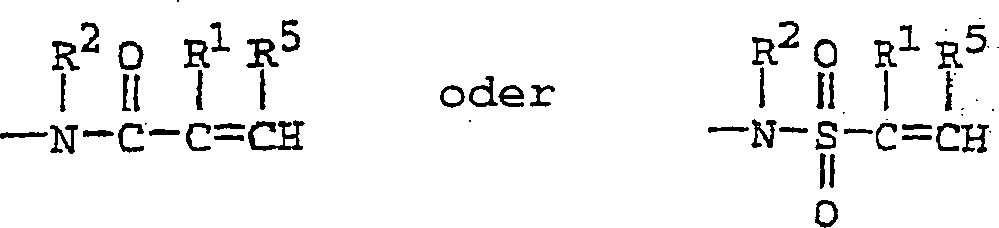


Applications Claiming Priority (3)
| Application Number | Priority Date | Filing Date | Title |
|---|---|---|---|
| US1535196P | 1996-04-12 | 1996-04-12 | |
| US15351P | 1996-04-12 | ||
| PCT/US1997/005778 WO1997038983A1 (en) | 1996-04-12 | 1997-04-08 | Irreversible inhibitors of tyrosine kinases |
Publications (3)
| Publication Number | Publication Date |
|---|---|
| DE69710712D1 DE69710712D1 (en) | 2002-04-04 |
| DE69710712T2 DE69710712T2 (en) | 2002-11-07 |
| DE69710712T3 true DE69710712T3 (en) | 2010-12-23 |
Family
ID=21770892
Family Applications (1)
| Application Number | Title | Priority Date | Filing Date |
|---|---|---|---|
| DE69710712T Expired - Lifetime DE69710712T3 (en) | 1996-04-12 | 1997-04-08 | REVERSIBLE INHIBITORS OF TYROSINE KINASEN |
Country Status (27)
| Country | Link |
|---|---|
| US (3) | US6344459B1 (en) |
| EP (1) | EP0892789B2 (en) |
| JP (1) | JP3370340B2 (en) |
| CN (3) | CN100503580C (en) |
| AT (1) | ATE213730T1 (en) |
| AU (1) | AU725533B2 (en) |
| BG (1) | BG63160B1 (en) |
| BR (1) | BR9708640B1 (en) |
| CA (1) | CA2249446C (en) |
| CZ (1) | CZ295468B6 (en) |
| DE (1) | DE69710712T3 (en) |
| DK (1) | DK0892789T4 (en) |
| EA (1) | EA001595B1 (en) |
| EE (1) | EE05289B1 (en) |
| ES (1) | ES2174250T5 (en) |
| GE (1) | GEP20012442B (en) |
| HU (1) | HU228446B1 (en) |
| IL (1) | IL126351A0 (en) |
| NO (1) | NO312588B1 (en) |
| NZ (1) | NZ332119A (en) |
| PL (1) | PL190489B1 (en) |
| PT (1) | PT892789E (en) |
| RO (1) | RO121900B1 (en) |
| SI (1) | SI0892789T2 (en) |
| SK (1) | SK284073B6 (en) |
| WO (1) | WO1997038983A1 (en) |
| ZA (1) | ZA973060B (en) |
Families Citing this family (616)
| Publication number | Priority date | Publication date | Assignee | Title |
|---|---|---|---|---|
| US5760041A (en) * | 1996-02-05 | 1998-06-02 | American Cyanamid Company | 4-aminoquinazoline EGFR Inhibitors |
| AU719434B2 (en) | 1996-02-13 | 2000-05-11 | Astrazeneca Ab | Quinazoline derivatives as VEGF inhibitors |
| ES2169355T3 (en) | 1996-03-05 | 2002-07-01 | Astrazeneca Ab | DERIVATIVES OF 4-ANILINOQUINAZOLINA. |
| DE69710712T3 (en) * | 1996-04-12 | 2010-12-23 | Warner-Lambert Co. Llc | REVERSIBLE INHIBITORS OF TYROSINE KINASEN |
| GB9718972D0 (en) | 1996-09-25 | 1997-11-12 | Zeneca Ltd | Chemical compounds |
| US5929080A (en) * | 1997-05-06 | 1999-07-27 | American Cyanamid Company | Method of treating polycystic kidney disease |
| ZA986729B (en) * | 1997-07-29 | 1999-02-02 | Warner Lambert Co | Irreversible inhibitors of tyrosine kinases |
| ZA986732B (en) * | 1997-07-29 | 1999-02-02 | Warner Lambert Co | Irreversible inhibitiors of tyrosine kinases |
| TW436485B (en) * | 1997-08-01 | 2001-05-28 | American Cyanamid Co | Substituted quinazoline derivatives |
| US6251912B1 (en) | 1997-08-01 | 2001-06-26 | American Cyanamid Company | Substituted quinazoline derivatives |
| US6323209B1 (en) | 1997-11-06 | 2001-11-27 | American Cyanamid Company | Method of treating or inhibiting colonic polyps |
| US6706721B1 (en) | 1998-04-29 | 2004-03-16 | Osi Pharmaceuticals, Inc. | N-(3-ethynylphenylamino)-6,7-bis(2-methoxyethoxy)-4-quinazolinamine mesylate anhydrate and monohydrate |
| EP1801112A1 (en) * | 1998-05-26 | 2007-06-27 | Warner-Lambert Company LLC | Bicyclic pyrimidines and bicyclic 3,4-dihydropyrimidines as inhibitors of cellular proliferation |
| KR20010043829A (en) | 1998-05-26 | 2001-05-25 | 로즈 암스트롱, 크리스틴 에이. 트러트웨인 | Bicyclic Pyrimidines and Bicyclic 3,4-Dihydropyrimidines as Inhibitors of Cellular Proliferation |
| HRP20010119B1 (en) | 1998-08-18 | 2008-05-31 | The Regents Of The University Of California | PREVENTION OF SLAUGHTERS IN THE AIRWAYS USED BY EGF-R ANTAGONISTS |
| JP3687900B2 (en) * | 1998-11-19 | 2005-08-24 | ワーナー−ランバート・カンパニー、リミテッド、ライアビリティ、カンパニー | N- [4- (3-Chloro-4-fluorophenylamino) -7- (3-morpholin-4-ylpropoxy) quinazolin-6-yl] acrylamide is an irreversible inhibitor of tyrosine kinase |
| JP3270834B2 (en) * | 1999-01-27 | 2002-04-02 | ファイザー・プロダクツ・インク | Heteroaromatic bicyclic derivatives useful as anticancer agents |
| MEP45508A (en) | 1999-06-21 | 2011-02-10 | Boehringer Ingelheim Pharma | Bicyclic heterocycles, medicaments containing these compounds, their use and methods for the production thereof |
| JP2003504363A (en) | 1999-07-09 | 2003-02-04 | グラクソ グループ リミテッド | Anilinoquinazolines as protein tyrosine kinase inhibitors |
| US6933299B1 (en) | 1999-07-09 | 2005-08-23 | Smithkline Beecham Corporation | Anilinoquinazolines as protein tyrosine kinase inhibitors |
| US6432979B1 (en) | 1999-08-12 | 2002-08-13 | American Cyanamid Company | Method of treating or inhibiting colonic polyps and colorectal cancer |
| DE19943815A1 (en) * | 1999-09-14 | 2001-03-15 | Merck Patent Gmbh | Use of thienopyrimidines |
| EP1676845B1 (en) | 1999-11-05 | 2008-06-11 | AstraZeneca AB | New quinazoline derivatives |
| US7087613B2 (en) | 1999-11-11 | 2006-08-08 | Osi Pharmaceuticals, Inc. | Treating abnormal cell growth with a stable polymorph of N-(3-ethynylphenyl)-6,7-bis(2-methoxyethoxy)-4-quinazolinamine hydrochloride |
| UA74803C2 (en) | 1999-11-11 | 2006-02-15 | Осі Фармасьютікалз, Інк. | A stable polymorph of n-(3-ethynylphenyl)-6,7-bis(2-methoxyetoxy)-4-quinazolinamine hydrochloride, a method for producing thereof (variants) and pharmaceutical use |
| DE10009267A1 (en) * | 2000-02-26 | 2001-08-30 | Goedecke Ag | Process for the simple preparation of (3-chloro-4-fluorophenyl) - [7- (3-morpholin-4-yl-propoxy) -6-nitro-quinazolin-4-yl] -amine or (3-chloro -4-fluorophenyl) - [7- (3-morpholin-4-yl-propoxy) -6-amino-quinazolin-4-yl] amine |
| US6664390B2 (en) | 2000-02-02 | 2003-12-16 | Warner-Lambert Company Llc | Method for the simplified production of (3-chloro-4-fluorophenyl)-[7-(3-morpholin-4-yl-propoxy)-6-nitro-quinazoline-4-yl]-amine or (3-chloro-4-fluorophenyl)-[7-(3-morpholin-4-yl-propoxy)-6-amino-quinazoline-4-yl]-amine |
| DK1274692T3 (en) * | 2000-04-07 | 2006-10-30 | Astrazeneca Ab | quinazoline |
| CA2403152C (en) * | 2000-04-08 | 2008-10-28 | Boehringer Ingelheim Pharma Kg | Bicyclic heterocycles, pharmaceutical compositions containing these compounds, their use and processes for preparing them |
| US6627634B2 (en) | 2000-04-08 | 2003-09-30 | Boehringer Ingelheim Pharma Kg | Bicyclic heterocycles, pharmaceutical compositions containing them, their use, and processes for preparing them |
| DE10031971A1 (en) * | 2000-06-30 | 2002-01-10 | Goedecke Ag | Polymorphic forms / hydrates of N- [4- (3-chloro-4-fluoro-phenylamino) -7- (3-morpholin-4-yl-propoxy) -quinazolin-6-yl] -acrylamide dihydrochloride, process for their preparation and the use thereof for the manufacture of medicaments with irreversible tyrosine kinase inhibitory activity |
| US6653305B2 (en) * | 2000-08-26 | 2003-11-25 | Boehringer Ingelheim Pharma Kg | Bicyclic heterocycles, pharmaceutical compositions containing them, their use, and processes for preparing them |
| DE10042064A1 (en) * | 2000-08-26 | 2002-03-07 | Boehringer Ingelheim Pharma | Chinazolines, medicaments containing these compounds, their use and processes for their preparation |
| US6403580B1 (en) | 2000-08-26 | 2002-06-11 | Boehringer Ingelheim Pharma Kg | Quinazolines, pharmaceutical compositions containing these compounds, their use and processes for preparing them |
| US6740651B2 (en) | 2000-08-26 | 2004-05-25 | Boehringer Ingelheim Pharma Kg | Aminoquinazolines which inhibit signal transduction mediated by tyrosine kinases |
| DE10042058A1 (en) * | 2000-08-26 | 2002-03-07 | Boehringer Ingelheim Pharma | Bicyclic heterocycles, medicaments containing these compounds, their use and processes for their preparation |
| DE10042062A1 (en) * | 2000-08-26 | 2002-03-07 | Boehringer Ingelheim Pharma | Bicyclic heterocycles, medicaments containing these compounds, their use and methods of preparation |
| US7019012B2 (en) | 2000-12-20 | 2006-03-28 | Boehringer Ingelheim International Pharma Gmbh & Co. Kg | Quinazoline derivatives and pharmaceutical compositions containing them |
| DE10063435A1 (en) * | 2000-12-20 | 2002-07-04 | Boehringer Ingelheim Pharma | Chinazoline derivatives, pharmaceuticals containing these compounds, their use and process for their preparation |
| NZ516873A (en) * | 2001-02-12 | 2003-11-28 | Warner Lambert Co | Compositions containing retinoids and erb inhibitors and their use in inhibiting retinoid skin damage |
| EP2269603B1 (en) | 2001-02-19 | 2015-05-20 | Novartis AG | Treatment of breast tumors with a rapamycin derivative in combination with exemestane |
| CN1264824C (en) | 2001-02-21 | 2006-07-19 | 三菱制药株式会社 | Quinazoline derivatives |
| IL142118A0 (en) * | 2001-03-20 | 2002-03-10 | Prochon Biotech Ltd | Method and composition for treatment of skeletal dysplasias |
| ATE330956T1 (en) | 2001-04-13 | 2006-07-15 | Pfizer Prod Inc | BIZYCLIC SUBSTITUTED 4-AMINOPYRIDOPYRIMIDINE DERIVATIVES |
| WO2002092091A1 (en) | 2001-05-16 | 2002-11-21 | Novartis Ag | Combination comprising n-{5-[4-(4-methyl-piperazino-methyl)-benzoylamido]-2-methylphenyl}-4-(3-pyridyl)-2pyrimidine-amine and a chemotherapeutic agent |
| US7132427B2 (en) | 2001-06-21 | 2006-11-07 | Ariad Pharmaceuticals, Inc. | Quinazolines and uses thereof |
| JP2003183283A (en) * | 2001-12-18 | 2003-07-03 | Takeda Chem Ind Ltd | Condensed indole compound, method for producing the same and application of the same |
| US20070122406A1 (en) | 2005-07-08 | 2007-05-31 | Xencor, Inc. | Optimized proteins that target Ep-CAM |
| US20040132101A1 (en) | 2002-09-27 | 2004-07-08 | Xencor | Optimized Fc variants and methods for their generation |
| GB0206215D0 (en) | 2002-03-15 | 2002-05-01 | Novartis Ag | Organic compounds |
| US6924285B2 (en) | 2002-03-30 | 2005-08-02 | Boehringer Ingelheim Pharma Gmbh & Co. | Bicyclic heterocyclic compounds, pharmaceutical compositions containing these compounds, their use and process for preparing them |
| US20040044014A1 (en) | 2002-04-19 | 2004-03-04 | Boehringer Ingelheim Pharma Gmbh & Co. Kg | Bicyclic heterocycles, pharmaceutical compositions containing these compounds, their use and processes for the preparation thereof |
| DE10217689A1 (en) * | 2002-04-19 | 2003-11-13 | Boehringer Ingelheim Pharma | Bicyclic heterocycles, medicaments containing these compounds, their use and processes for their preparation |
| US20050276812A1 (en) | 2004-06-01 | 2005-12-15 | Genentech, Inc. | Antibody-drug conjugates and methods |
| DE10221018A1 (en) | 2002-05-11 | 2003-11-27 | Boehringer Ingelheim Pharma | Use of inhibitors of EGFR-mediated signal transduction for the treatment of benign prostatic hyperplasia (BPH) / prostatic hypertrophy |
| KR20120125398A (en) | 2002-05-16 | 2012-11-14 | 노파르티스 아게 | Use of edg receptor binding agents in cancer |
| EP1521747B1 (en) * | 2002-07-15 | 2018-09-05 | Symphony Evolution, Inc. | Receptor-type kinase modulators and methods of use |
| ES2392525T3 (en) | 2002-07-15 | 2012-12-11 | F. Hoffmann-La Roche Ag | Cancer treatment with the antibody directed against ErbB2 rhuMAb 2C4 |
| PA8577501A1 (en) | 2002-07-25 | 2004-02-07 | Warner Lambert Co | KINASE INHIBITORS |
| WO2004029207A2 (en) | 2002-09-27 | 2004-04-08 | Xencor Inc. | Optimized fc variants and methods for their generation |
| AU2003299943A1 (en) * | 2002-12-23 | 2004-07-22 | Ariad Pharmaceuticals, Inc. | Heterocycles and uses thereof |
| US20060167026A1 (en) * | 2003-01-06 | 2006-07-27 | Hiroyuki Nawa | Antipsychotic molecular-targeting epithelial growth factor receptor |
| PE20040945A1 (en) * | 2003-02-05 | 2004-12-14 | Warner Lambert Co | PREPARATION OF SUBSTITUTED QUINAZOLINES |
| US7223749B2 (en) | 2003-02-20 | 2007-05-29 | Boehringer Ingelheim International Gmbh | Bicyclic heterocycles, pharmaceutical compositions containing these compounds, their use and processes for preparing them |
| US20090010920A1 (en) | 2003-03-03 | 2009-01-08 | Xencor, Inc. | Fc Variants Having Decreased Affinity for FcyRIIb |
| WO2005000197A2 (en) | 2003-04-11 | 2005-01-06 | The Regents Of The University Of California | Selective serine/threonine kinase inhibitors |
| EP2236579B1 (en) * | 2003-04-23 | 2014-04-09 | Konica Minolta Holdings, Inc. | Organic electroluminescent element and display |
| GB0309850D0 (en) | 2003-04-30 | 2003-06-04 | Astrazeneca Ab | Quinazoline derivatives |
| SE0301446D0 (en) | 2003-05-16 | 2003-05-16 | Astrazeneca Ab | New Compounds |
| AR044402A1 (en) | 2003-05-19 | 2005-09-14 | Irm Llc | HETEROCICLICAL COMPOUNDS AND ITS USE AS IMMUNODEPRESSORS. PHARMACEUTICAL COMPOSITIONS THAT CONTAIN THEM. |
| MY150088A (en) | 2003-05-19 | 2013-11-29 | Irm Llc | Immunosuppressant compounds and compositions |
| JO2785B1 (en) * | 2003-05-27 | 2014-03-15 | شركة جانسين فارماسوتيكا ان. في | Quinazoline derivatives |
| BRPI0410634A (en) | 2003-05-30 | 2006-06-13 | Astrazeneca Uk Ltd | process |
| AU2004253967B2 (en) * | 2003-07-03 | 2010-02-18 | Cytovia, Inc. | 4-arylamino-quinazolines as activators of caspases and inducers of apoptosis |
| US8309562B2 (en) | 2003-07-03 | 2012-11-13 | Myrexis, Inc. | Compounds and therapeutical use thereof |
| US7501427B2 (en) | 2003-08-14 | 2009-03-10 | Array Biopharma, Inc. | Quinazoline analogs as receptor tyrosine kinase inhibitors |
| DK1660090T3 (en) * | 2003-08-14 | 2012-12-17 | Array Biopharma Inc | QUINAZOLINE ANALOGS AS RECEPTOR-TYROSINKINASE INHIBITORS |
| MXPA06002964A (en) | 2003-09-16 | 2006-06-14 | Astrazeneca Ab | Quinazoline derivatives as tyrosine kinase inhibitors. |
| GB0322409D0 (en) | 2003-09-25 | 2003-10-29 | Astrazeneca Ab | Quinazoline derivatives |
| US9714282B2 (en) | 2003-09-26 | 2017-07-25 | Xencor, Inc. | Optimized Fc variants and methods for their generation |
| ES2925655T3 (en) * | 2003-09-26 | 2022-10-19 | Exelixis Inc | c-Met modulators and methods of use |
| US7456189B2 (en) | 2003-09-30 | 2008-11-25 | Boehringer Ingelheim International Gmbh | Bicyclic heterocycles, medicaments containing these compounds, their use and processes for their preparation |
| DE10345875A1 (en) * | 2003-09-30 | 2005-04-21 | Boehringer Ingelheim Pharma | Bicyclic heterocycles, pharmaceutical compositions containing them, their use and methods of preparation |
| CA2762955A1 (en) * | 2003-10-16 | 2005-04-28 | Imclone Llc | Fibroblast growth factor receptor-1 inhibitors and methods of treatment thereof |
| DE10349113A1 (en) | 2003-10-17 | 2005-05-12 | Boehringer Ingelheim Pharma | Process for the preparation of aminocrotonyl compounds |
| PT2489364E (en) | 2003-11-06 | 2015-04-16 | Seattle Genetics Inc | Monomethylvaline compounds conjugated to antibodies |
| GB0326459D0 (en) | 2003-11-13 | 2003-12-17 | Astrazeneca Ab | Quinazoline derivatives |
| NZ547794A (en) | 2003-12-18 | 2009-11-27 | Janssen Pharmaceutica Nv | Pyrido- and pyrimidopyrimidine derivatives as anti-proliferative agents |
| EP1713781B1 (en) | 2004-02-03 | 2008-11-05 | AstraZeneca AB | Quinazoline derivatives |
| WO2005094830A1 (en) * | 2004-03-30 | 2005-10-13 | Pfizer Products Inc. | Combinations of signal transduction inhibitors |
| EP2439285B1 (en) | 2004-03-31 | 2019-05-08 | The General Hospital Corporation | Method to determine responsiveness of cancer to epidermal growth factor receptor targeting treatments |
| PL2253614T3 (en) | 2004-04-07 | 2013-03-29 | Novartis Ag | Inhibitors of IAP |
| CA2565721C (en) | 2004-05-06 | 2015-10-06 | Bioresponse, L.L.C. | Diindolymethane formulations for the treatment of leiomyomas |
| AP2204A (en) * | 2004-05-06 | 2011-02-07 | Warner Lambert Co | 4-phenylamino-quinazolin-6-yl-amides. |
| US20080268460A1 (en) * | 2004-05-20 | 2008-10-30 | Wyeth | Assays to Identify Irreversibly Binding Inhibitors of Receptor Tyrosine Kinases |
| US7507740B2 (en) * | 2004-06-02 | 2009-03-24 | Takeda Pharmaceutical Company Limited | Fused heterocyclic compound |
| GB0512324D0 (en) | 2005-06-16 | 2005-07-27 | Novartis Ag | Organic compounds |
| CN103172731A (en) | 2004-07-15 | 2013-06-26 | 赞科股份有限公司 | Optimized Fc variants |
| NZ553500A (en) | 2004-09-23 | 2009-11-27 | Genentech Inc Genentech Inc | Cysteine engineered antibodies and conjugates withCysteine engineered antibodies and conjugates with a free cysteine amino acid in the heavy chain a free cysteine amino acid in the heavy chain |
| UY29161A1 (en) * | 2004-10-15 | 2006-04-28 | Bayer Pharmaceuticals Corp | NEW HETEROCICLOS |
| JO3000B1 (en) | 2004-10-20 | 2016-09-05 | Genentech Inc | Antibody Formulations. |
| AU2005304624B2 (en) | 2004-11-12 | 2010-10-07 | Xencor, Inc. | Fc variants with altered binding to FcRn |
| US8367805B2 (en) | 2004-11-12 | 2013-02-05 | Xencor, Inc. | Fc variants with altered binding to FcRn |
| NI200700147A (en) | 2004-12-08 | 2019-05-10 | Janssen Pharmaceutica Nv | QUINAZOLINE DERIVATIVES KINE INHIBITORS TARGETING MULTIP |
| JO3088B1 (en) * | 2004-12-08 | 2017-03-15 | Janssen Pharmaceutica Nv | Macrocyclic Quinazoline derivatives and their use as MTKI |
| US7947676B2 (en) | 2004-12-14 | 2011-05-24 | Astrazeneca Ab | Pyrazolo[3,4-d]pyrimidine compounds as antitumor agents |
| EP1838303B1 (en) | 2004-12-30 | 2011-02-09 | Bioresponse LLC | Use of diindolylmethane-related indoles for the treatment and prevention of respiratory syncytial virus associates conditions |
| US8258145B2 (en) * | 2005-01-03 | 2012-09-04 | Myrexis, Inc. | Method of treating brain cancer |
| CA2592900A1 (en) | 2005-01-03 | 2006-07-13 | Myriad Genetics Inc. | Nitrogen containing bicyclic compounds and therapeutical use thereof |
| UA94899C2 (en) | 2005-01-21 | 2011-06-25 | Дженентек, Инк. | Fixed dosing of her antibodies |
| US20090155247A1 (en) * | 2005-02-18 | 2009-06-18 | Ashkenazi Avi J | Methods of Using Death Receptor Agonists and EGFR Inhibitors |
| US20060188498A1 (en) * | 2005-02-18 | 2006-08-24 | Genentech, Inc. | Methods of using death receptor agonists and EGFR inhibitors |
| EP1850874B1 (en) | 2005-02-23 | 2013-10-16 | Genentech, Inc. | Extending time to disease progression or survival in ovarian cancer patients using pertuzumab |
| GB0510390D0 (en) | 2005-05-20 | 2005-06-29 | Novartis Ag | Organic compounds |
| WO2007034144A1 (en) | 2005-09-20 | 2007-03-29 | Astrazeneca Ab | 4- (ih-indazol-s-yl-amino)-quinazoline compounds as erbb receptor tyrosine kinase inhibitors for the treatment of cancer |
| WO2007041635A2 (en) | 2005-10-03 | 2007-04-12 | Xencor, Inc. | Fc variants with optimized fc receptor binding properties |
| KR100832594B1 (en) * | 2005-11-08 | 2008-05-27 | 한미약품 주식회사 | Quinazoline derivatives as an multiplex inhibitor and method for the preparation thereof |
| WO2007054550A1 (en) | 2005-11-11 | 2007-05-18 | Boehringer Ingelheim International Gmbh | Quinazoline derivatives for the treatment of cancer diseases |
| CN101356171A (en) | 2005-11-15 | 2009-01-28 | 阿雷生物药品公司 | N4-phenyl-quinazolin-4-amine derivatives and related compounds as ERBBI type receptor tyrosine kinase inhibitors for the treatment of proliferative diseases |
| NO346575B1 (en) | 2005-11-21 | 2022-10-17 | Novartis Ag | Use of 40-O-(2-hydroxyethyl)-rapamycin in the treatment of carcinoid or small cell cancer |
| CN101003514A (en) | 2006-01-20 | 2007-07-25 | 上海艾力斯医药科技有限公司 | Derivative of quinazoline, preparation method and usage |
| GB0605120D0 (en) | 2006-03-14 | 2006-04-26 | Novartis Ag | Organic Compounds |
| RU2447891C2 (en) | 2006-04-05 | 2012-04-20 | Новартис Аг | Combinations of therapeutic agents applicable for treating cancer |
| CA2644143C (en) | 2006-04-05 | 2013-10-01 | Novartis Ag | Combinations comprising bcr-abl/c-kit/pdgf-r tk inhibitors for treating cancer |
| EP2026800A1 (en) | 2006-05-09 | 2009-02-25 | Novartis AG | Combination comprising an iron chelator and an anti-neoplastic agent and use thereof |
| CN101100466B (en) * | 2006-07-05 | 2013-12-25 | 天津和美生物技术有限公司 | Non-reversible protein tyrosine phosphorus acylase inhibitor and its preparation and application |
| CA2654583C (en) | 2006-07-13 | 2015-11-24 | Janssen Pharmaceutica N.V. | Mtki quinazoline derivatives |
| US8246966B2 (en) * | 2006-08-07 | 2012-08-21 | University Of Georgia Research Foundation, Inc. | Trypanosome microsome system and uses thereof |
| HRP20140331T1 (en) | 2006-08-14 | 2014-05-09 | Xencor, Inc. | OPTIMIZED CD19 DIRECTED ANTIBODIES |
| ES2530438T3 (en) | 2006-09-12 | 2015-03-02 | Genentech Inc | Procedures and compositions for the diagnosis and treatment of lung cancer using the KIT or KDR gene as a genetic marker |
| NZ576065A (en) * | 2006-09-18 | 2011-12-22 | Boehringer Ingelheim Int | Method for treating cancer harboring egfr mutations |
| MX2009003185A (en) | 2006-09-29 | 2009-04-03 | Novartis Ag | Pyrazolopyrimidines as p13k lipid kinase inhibitors. |
| BRPI0717753B1 (en) | 2006-10-27 | 2022-04-12 | Bioresponse, Llc | Use of a composition comprising 50-250 mg of one or more dim-related indoles and one or more anti-protozoal agents, and, composition |
| EP1921070A1 (en) | 2006-11-10 | 2008-05-14 | Boehringer Ingelheim Pharma GmbH & Co. KG | Bicyclic heterocycles, medicaments comprising them, their use and process for their preparation |
| EP2088863A2 (en) | 2006-11-22 | 2009-08-19 | University Of Georgia Research Foundation, Inc. | Tyrosine kinase inhibitors as anti-kinetolastid and anti-apicomplexan agents |
| TW200835497A (en) * | 2007-01-11 | 2008-09-01 | Astrazeneca Ab | Chemical compounds 636 |
| EP2118075A1 (en) | 2007-02-06 | 2009-11-18 | Boehringer Ingelheim International GmbH | Bicyclic heterocycles, drugs containing said compounds, use thereof, and method for production thereof |
| CN101245050A (en) | 2007-02-14 | 2008-08-20 | 上海艾力斯医药科技有限公司 | 4-aniline quinazoline derivative salt |
| CN101626758A (en) | 2007-02-15 | 2010-01-13 | 诺瓦提斯公司 | Combination of LBH589 and other therapeutic agents for the treatment of cancer |
| EP2132573B1 (en) | 2007-03-02 | 2014-04-23 | Genentech, Inc. | Predicting response to a her dimerisation inhbitor based on low her3 expression |
| EP2708557A1 (en) | 2007-05-30 | 2014-03-19 | Xencor, Inc. | Method and compositions for inhibiting CD32B expressing cells |
| DK2171090T3 (en) | 2007-06-08 | 2013-06-10 | Genentech Inc | Gene expression markers for tumor resistance to HER2 inhibitor therapy |
| JP5536647B2 (en) | 2007-07-27 | 2014-07-02 | ジヤンセン・フアーマシユーチカ・ナームローゼ・フエンノートシヤツプ | Pyrrolopyrimidine |
| WO2009030224A2 (en) * | 2007-09-07 | 2009-03-12 | Schebo Biotech Ag | Novel quinazoline compounds and the use thereof for treating cancerous diseases |
| WO2009039140A1 (en) * | 2007-09-17 | 2009-03-26 | Smithkline Beecham Corporation | Pyridopyrimidine derivatives as pi3 kinase inhibitors |
| EP2220054A2 (en) | 2007-10-29 | 2010-08-25 | Natco Pharma Limited | Novel 4-(tetrazol-5-yl)-quinazoline derivatives as anti cancer agents |
| WO2009067543A2 (en) * | 2007-11-19 | 2009-05-28 | The Regents Of The University Of Colorado | Treatment of histone deacetylase mediated disorders |
| PL2235059T3 (en) | 2007-12-26 | 2015-08-31 | Xencor Inc | Fc variants with altered binding to fcrn |
| TWI472339B (en) | 2008-01-30 | 2015-02-11 | Genentech Inc | Composition comprising antibody that binds to domain ii of her2 and acidic variants thereof |
| CN101939316B (en) | 2008-02-07 | 2013-10-02 | 贝林格尔.英格海姆国际有限公司 | Spirocyclic heterocyclic compound, medicine containing said compound, use thereof and preparation method thereof |
| US12492253B1 (en) | 2008-02-25 | 2025-12-09 | Xencor, Inc. | Anti-human C5 antibodies |
| WO2009118292A1 (en) | 2008-03-24 | 2009-10-01 | Novartis Ag | Arylsulfonamide-based matrix metalloprotease inhibitors |
| EP2628726A1 (en) | 2008-03-26 | 2013-08-21 | Novartis AG | Hydroxamate-based inhibitors of deacetylases b |
| BRPI0912170A2 (en) | 2008-05-13 | 2015-10-13 | Astrazeneca Ab | compound, form, process for preparation thereof, pharmaceutical composition, use of a compound, and method for treating cancer in a warm-blooded animal |
| US8273534B2 (en) | 2008-05-14 | 2012-09-25 | Genomic Health, Inc. | Predictors of patient response to treatment with EGF receptor inhibitors |
| CN101584696A (en) | 2008-05-21 | 2009-11-25 | 上海艾力斯医药科技有限公司 | Composition containing quinazoline derivatives, preparation method and use |
| US8426430B2 (en) * | 2008-06-30 | 2013-04-23 | Hutchison Medipharma Enterprises Limited | Quinazoline derivatives |
| US8648191B2 (en) | 2008-08-08 | 2014-02-11 | Boehringer Ingelheim International Gmbh | Cyclohexyloxy substituted heterocycles, pharmaceutical compositions containing these compounds and processes for preparing them |
| MY156789A (en) * | 2008-09-05 | 2016-03-31 | Celgene Avilomics Res Inc | Algorithm for designing irreversible inhibitors |
| WO2010043050A1 (en) | 2008-10-16 | 2010-04-22 | Celator Pharmaceuticals Corporation | Combinations of a liposomal water-soluble camptothecin with cetuximab or bevacizumab |
| EP2349235A1 (en) | 2008-11-07 | 2011-08-03 | Triact Therapeutics, Inc. | Use of catecholic butane derivatives in cancer therapy |
| JP5781934B2 (en) | 2008-11-10 | 2015-09-24 | ナショナル ヘルス リサーチ インスティテューツ | Fused bicyclic and tricyclic pyrimidine compounds as tyrosine kinase inhibitors |
| CA2747558A1 (en) | 2008-12-18 | 2010-07-15 | Novartis Ag | New salts |
| MA32961B1 (en) | 2008-12-18 | 2012-01-02 | Novartis Ag | 1- [4- [1 (4-CYCLOHEXYL-3-TRIFLUOROMETHYL-BENZYLOXYIMINO] -ETHYL] -2-ETHYL-BENZYL] -AZETIDIN-3-CARBOXYLIC HEMIFUMARATE SALMON HEMIFUMARATE |
| AU2009327405A1 (en) | 2008-12-18 | 2011-06-30 | Novartis Ag | New polymorphic form of 1- (4- { l- [ (E) -4-cyclohexyl--3-trifluoromethyl-benzyloxyimino] -ethyl) -2-ethyl-benzy l) -azetidine-3-carboxylic |
| ITMI20082336A1 (en) * | 2008-12-29 | 2010-06-30 | Univ Parma | COMPOUNDS IRREVERSIBLE EGFR INHIBITORS WITH ANTI-PROLIFERATIVE ACTIVITY |
| KR20250123237A (en) | 2009-01-16 | 2025-08-14 | 엑셀리시스, 인코포레이티드 | Malate salt of n-(4-{[6,7-bis(methyloxy)quinolin-4-yl]oxy}phenyl)-n'-(4-fluorophenyl)cyclopropane-1,1-dicarboxamide, and crystalline forms thereof for the treatment of cancer |
| WO2010083617A1 (en) | 2009-01-21 | 2010-07-29 | Oncalis Ag | Pyrazolopyrimidines as protein kinase inhibitors |
| PT2391366E (en) | 2009-01-29 | 2013-02-05 | Novartis Ag | Substituted benzimidazoles for the treatment of astrocytomas |
| WO2010099139A2 (en) | 2009-02-25 | 2010-09-02 | Osi Pharmaceuticals, Inc. | Combination anti-cancer therapy |
| JP2012519170A (en) | 2009-02-26 | 2012-08-23 | オーエスアイ・ファーマシューティカルズ,エルエルシー | INSITU method for monitoring EMT status of tumor cells in vivo |
| JP2012519281A (en) | 2009-02-27 | 2012-08-23 | オーエスアイ・ファーマシューティカルズ,エルエルシー | Methods for identifying mesenchymal tumor cells or agents that inhibit their production |
| WO2010099138A2 (en) | 2009-02-27 | 2010-09-02 | Osi Pharmaceuticals, Inc. | Methods for the identification of agents that inhibit mesenchymal-like tumor cells or their formation |
| US8465912B2 (en) | 2009-02-27 | 2013-06-18 | OSI Pharmaceuticals, LLC | Methods for the identification of agents that inhibit mesenchymal-like tumor cells or their formation |
| US9073916B2 (en) | 2009-03-11 | 2015-07-07 | Auckland Uniservices Limited | Prodrug forms of kinase inhibitors and their use in therapy |
| KR100963102B1 (en) * | 2009-03-16 | 2010-06-14 | 호서대학교 산학협력단 | Method for screening egfr tyrosine kinase inhibitors, and inhibitors screened by the method |
| JP2012520893A (en) | 2009-03-18 | 2012-09-10 | オーエスアイ・ファーマシューティカルズ,エルエルシー | Combination cancer treatment comprising administration of an EGFR inhibitor and an IGF-1R inhibitor |
| ES2572728T3 (en) | 2009-03-20 | 2016-06-02 | F. Hoffmann-La Roche Ag | Bispecific anti-HER antibodies |
| TWI471137B (en) * | 2009-05-20 | 2015-02-01 | Biomarin Pharm Inc | C-type natriuretic peptide variant |
| JP5456891B2 (en) | 2009-06-26 | 2014-04-02 | ノバルティス アーゲー | 1,3-disubstituted imidazolidin-2-one derivatives as CYP17 inhibitors |
| PT2451445T (en) | 2009-07-06 | 2019-07-10 | Boehringer Ingelheim Int | Process for drying of bibw2992, of its salts and of solid pharmaceutical formulations comprising this active ingredient |
| SMT201700293T1 (en) | 2009-07-20 | 2017-07-18 | Bristol Myers Squibb Co | Combination of an anti-ctla4 antibody with etoposide for the synergistic treatment of proliferative diseases |
| US9345661B2 (en) | 2009-07-31 | 2016-05-24 | Genentech, Inc. | Subcutaneous anti-HER2 antibody formulations and uses thereof |
| US8389526B2 (en) | 2009-08-07 | 2013-03-05 | Novartis Ag | 3-heteroarylmethyl-imidazo[1,2-b]pyridazin-6-yl derivatives |
| UA108618C2 (en) | 2009-08-07 | 2015-05-25 | APPLICATION OF C-MET-MODULATORS IN COMBINATION WITH THEMOSOLOMID AND / OR RADIATION THERAPY FOR CANCER TREATMENT | |
| BR112012003262A8 (en) | 2009-08-12 | 2016-05-17 | Novartis Ag | Heterocyclic Hydrazone Compounds and Their Uses to Treat Cancer and Inflammation |
| PE20121148A1 (en) | 2009-08-17 | 2012-09-07 | Intellikine Llc | HETEROCYCLIC COMPOUNDS AND USES OF THEM |
| BR112012008061A2 (en) | 2009-08-20 | 2016-03-01 | Novartis Ag | heterocyclic oxime compounds |
| IN2012DN01693A (en) | 2009-08-26 | 2015-06-05 | Novartis Ag | |
| WO2011028952A1 (en) | 2009-09-02 | 2011-03-10 | Xencor, Inc. | Compositions and methods for simultaneous bivalent and monovalent co-engagement of antigens |
| MX336332B (en) * | 2009-09-02 | 2016-01-15 | Auckland Uniservices Ltd | Kinase inhibitors, prodrug forms thereof and their use in therapy. |
| KR20120093867A (en) | 2009-09-10 | 2012-08-23 | 아이알엠 엘엘씨 | Ether derivatives of bicyclic heteroaryls |
| RU2012114902A (en) | 2009-09-16 | 2013-10-27 | Авила Терапьютикс, Инк. | CONJUGATES AND PROTEINKINASE INHIBITORS |
| CN101648890B (en) * | 2009-09-16 | 2012-07-25 | 常州工程职业技术学院 | Synthesis method of 2-fluoro-4-nitrobenzonitrile |
| DK2491385T3 (en) | 2009-10-20 | 2017-08-28 | Diatech Holdings Inc | PROXIMITY-MEDIED ASSAYS FOR DETECTING ONCOGEN FUSION PROTEINS |
| BR112012010519A2 (en) | 2009-11-04 | 2017-12-05 | Novartis Ag | heterocyclic sulfonamide derivatives |
| KR20120103587A (en) | 2009-11-12 | 2012-09-19 | 제넨테크, 인크. | A method of promoting dendritic spine density |
| EP2510110A1 (en) | 2009-11-13 | 2012-10-17 | Pangaea Biotech S.L. | Molecular biomarkers for predicting response to tyrosine kinase inhibitors in lung cancer |
| MX2012005987A (en) | 2009-11-23 | 2012-06-25 | Cerulean Pharma Inc | Cyclodextrin-based polymers for therapeutic delivery. |
| WO2011064211A1 (en) | 2009-11-25 | 2011-06-03 | Novartis Ag | Benzene-fused 6-membered oxygen-containing heterocyclic derivatives of bicyclic heteroaryls |
| EP3778917A3 (en) | 2009-12-04 | 2021-06-09 | F. Hoffmann-La Roche AG | Multispecific antibodies, antibody analogs, compositions, and methods |
| ES2484171T3 (en) | 2009-12-08 | 2014-08-11 | Novartis Ag | Heterocyclic sulfonamide derivatives |
| CU24130B1 (en) | 2009-12-22 | 2015-09-29 | Novartis Ag | ISOQUINOLINONES AND REPLACED QUINAZOLINONES |
| US8440693B2 (en) | 2009-12-22 | 2013-05-14 | Novartis Ag | Substituted isoquinolinones and quinazolinones |
| CN102812167A (en) | 2009-12-30 | 2012-12-05 | 阿维拉制药公司 | Ligand-directed Covalent Modification Of Protein |
| TW201129565A (en) | 2010-01-12 | 2011-09-01 | Hoffmann La Roche | Tricyclic heterocyclic compounds, compositions and methods of use thereof |
| WO2011090940A1 (en) | 2010-01-19 | 2011-07-28 | Cerulean Pharma Inc. | Cyclodextrin-based polymers for therapeutic delivery |
| CN102892779B (en) | 2010-02-18 | 2016-12-21 | 基因泰克公司 | Neuregulin antagonist and the purposes in treatment cancer thereof |
| EP2542692B1 (en) | 2010-03-04 | 2016-08-24 | Carpén, Olli | Method for selecting patients for treatment with an egfr inhibitor |
| CA2793024A1 (en) | 2010-03-17 | 2011-09-22 | F. Hoffmann-La Roche Ag | Imidazopyridine compounds, compositions and methods of use |
| US20110237686A1 (en) | 2010-03-26 | 2011-09-29 | Cerulean Pharma Inc | Formulations and methods of use |
| WO2011120135A1 (en) | 2010-03-29 | 2011-10-06 | Zymeworks, Inc. | Antibodies with enhanced or suppressed effector function |
| WO2011130654A1 (en) | 2010-04-16 | 2011-10-20 | Genentech, Inc. | Fox03a as predictive biomarker for pi3k/akt kinase pathway inhibitor efficacy |
| WO2011146568A1 (en) | 2010-05-19 | 2011-11-24 | Genentech, Inc. | Predicting response to a her inhibitor |
| EP2582680A1 (en) | 2010-06-17 | 2013-04-24 | Novartis AG | Biphenyl substituted 1,3-dihydro-benzoimidazol-2-ylideneamine derivatives |
| JP2013532149A (en) | 2010-06-17 | 2013-08-15 | ノバルティス アーゲー | Piperidinyl-substituted 1,3-dihydro-benzimidazol-2-ylideneamine derivatives |
| UA112517C2 (en) | 2010-07-06 | 2016-09-26 | Новартіс Аг | TETRAHYDROPYRIDOPYRIMIDINE DERIVATIVES |
| CN102382106A (en) | 2010-08-30 | 2012-03-21 | 黄振华 | Aniline substituted quinazoline derivative |
| RU2013114360A (en) | 2010-08-31 | 2014-10-10 | Дженентек, Инк. | BIOMARKERS AND TREATMENT METHODS |
| CA2812087A1 (en) | 2010-09-15 | 2012-03-22 | F. Hoffmann-La Roche Ag | Azabenzothiazole compounds, compositions and methods of use |
| EP2627648A1 (en) | 2010-09-16 | 2013-08-21 | Novartis AG | 17aHYDROXYLASE/C17,20-LYASE INHIBITORS |
| EP2637692A4 (en) | 2010-11-12 | 2014-09-10 | Scott & White Healthcare | ANTIBODIES AGAINST THE MARKER 8 TUMOR ENDOTHELIAL |
| JP2013542966A (en) | 2010-11-19 | 2013-11-28 | エフ.ホフマン−ラ ロシュ アーゲー | Pyrazolopyridines and their use as TYK2 inhibitors and their use |
| WO2012085815A1 (en) | 2010-12-21 | 2012-06-28 | Novartis Ag | Bi-heteroaryl compounds as vps34 inhibitors |
| EP2468883A1 (en) | 2010-12-22 | 2012-06-27 | Pangaea Biotech S.L. | Molecular biomarkers for predicting response to tyrosine kinase inhibitors in lung cancer |
| WO2012085176A1 (en) | 2010-12-23 | 2012-06-28 | F. Hoffmann-La Roche Ag | Tricyclic pyrazinone compounds, compositions and methods of use thereof as janus kinase inhibitors |
| US9134297B2 (en) | 2011-01-11 | 2015-09-15 | Icahn School Of Medicine At Mount Sinai | Method and compositions for treating cancer and related methods |
| EP2673277A1 (en) | 2011-02-10 | 2013-12-18 | Novartis AG | [1, 2, 4]triazolo [4, 3 -b]pyridazine compounds as inhibitors of the c-met tyrosine kinase |
| BR112013020992A2 (en) | 2011-02-17 | 2016-10-11 | Nestec Sa | apparatus and method for the isolation of leukocytes and tumor cells by filtration |
| JP5808826B2 (en) | 2011-02-23 | 2015-11-10 | インテリカイン, エルエルシー | Heterocyclic compounds and uses thereof |
| EP2492688A1 (en) | 2011-02-23 | 2012-08-29 | Pangaea Biotech, S.A. | Molecular biomarkers for predicting response to antitumor treatment in lung cancer |
| WO2012120469A1 (en) | 2011-03-08 | 2012-09-13 | Novartis Ag | Fluorophenyl bicyclic heteroaryl compounds |
| EP2683740B1 (en) | 2011-03-10 | 2018-07-04 | Omeros Corporation | Generation of anti-fn14 monoclonal antibodies by ex-vivo accelerated antibody evolution |
| WO2012129145A1 (en) | 2011-03-18 | 2012-09-27 | OSI Pharmaceuticals, LLC | Nscle combination therapy |
| WO2012149014A1 (en) | 2011-04-25 | 2012-11-01 | OSI Pharmaceuticals, LLC | Use of emt gene signatures in cancer drug discovery, diagnostics, and treatment |
| ES2656218T3 (en) | 2011-04-28 | 2018-02-26 | Novartis Ag | 17 alpha-hydroxylase / C17,20-lyase inhibitors |
| EP2716633B1 (en) | 2011-05-26 | 2017-05-17 | Xuanzhu Pharma Co., Ltd. | Quinazoline derivative as tyrosine-kinase inhibitor, preparation method therefor and application thereof |
| IN2014DN00123A (en) | 2011-06-09 | 2015-05-22 | Novartis Ag | |
| EP2721007B1 (en) | 2011-06-20 | 2015-04-29 | Novartis AG | Cyclohexyl isoquinolinone compounds |
| US8859535B2 (en) | 2011-06-20 | 2014-10-14 | Novartis Ag | Hydroxy substituted isoquinolinone derivatives |
| KR20140025530A (en) | 2011-06-27 | 2014-03-04 | 노파르티스 아게 | Solid forms and salts of tetrahydro-pyrido-pyrimidine derivatives |
| WO2013007768A1 (en) | 2011-07-13 | 2013-01-17 | F. Hoffmann-La Roche Ag | Tricyclic heterocyclic compounds, compositions and methods of use thereof as jak inhibitors |
| WO2013007765A1 (en) | 2011-07-13 | 2013-01-17 | F. Hoffmann-La Roche Ag | Fused tricyclic compounds for use as inhibitors of janus kinases |
| WO2013020024A2 (en) * | 2011-08-03 | 2013-02-07 | Karyopharm Therapeutics, Inc. | Maleimide compounds and methods of treatment |
| CA2843499A1 (en) | 2011-08-12 | 2013-02-21 | F. Hoffmann-La Roche Ag | Indazole compounds, compositions and methods of use |
| EP3783028A1 (en) | 2011-08-12 | 2021-02-24 | Omeros Corporation | Anti-fzd10 monoclonal antibodies and methods for their use |
| MX2014001766A (en) | 2011-08-17 | 2014-05-01 | Genentech Inc | Neuregulin antibodies and uses thereof. |
| US12194002B2 (en) | 2011-08-17 | 2025-01-14 | Dennis Brown | Compositions and methods to improve the therapeutic benefit of suboptimally administered chemical compounds including substituted hexitols such as dibromodulcitol |
| BR112014004762A2 (en) | 2011-08-31 | 2018-06-19 | Genentech Inc | methods of determining tumor cell growth sensitivity to inhibition by an egfr kinase inhibitor, identifying a cancer patient who is likely to benefit from treatment with an efgr inhibitor, treating cancer in a patient, selecting a therapy for a cancer patient and determining erbb2 gene overexpression in a cell |
| EP2755976B1 (en) | 2011-09-15 | 2018-07-18 | Novartis AG | 6-substituted 3-(quinolin-6-ylthio)-[1,2,4]triazolo[4,3-a]pyridines as c-met tyrosine kinase inhibitors |
| KR20140082710A (en) | 2011-09-20 | 2014-07-02 | 에프. 호프만-라 로슈 아게 | Imidazopyridine compounds, compositions and methods of use |
| SG11201400996SA (en) | 2011-09-30 | 2014-04-28 | Genentech Inc | Diagnostic methylation markers of epithelial or mesenchymal phenotype and response to egfr kinase inhibitor in tumours or tumour cells |
| US8969341B2 (en) | 2011-11-29 | 2015-03-03 | Novartis Ag | Pyrazolopyrrolidine compounds |
| CN106987620A (en) | 2011-11-30 | 2017-07-28 | 霍夫曼-拉罗奇有限公司 | Erbb3 mutation in cancer |
| US9408885B2 (en) | 2011-12-01 | 2016-08-09 | Vib Vzw | Combinations of therapeutic agents for treating melanoma |
| US20150148377A1 (en) | 2011-12-22 | 2015-05-28 | Novartis Ag | Quinoline Derivatives |
| PT2794600T (en) | 2011-12-22 | 2018-03-13 | Novartis Ag | 2,3-dihydro-benzo[1,4]oxazine derivatives and related compounds as phosphoinositide-3 kinase (pi3k) inhibitors for the treatment of e.g. rheumatoid arthritis |
| JP2015503519A (en) | 2011-12-23 | 2015-02-02 | ノバルティス アーゲー | Compound for inhibiting interaction between BCL2 and binding partner |
| EA201491268A1 (en) | 2011-12-23 | 2014-11-28 | Новартис Аг | COMPOUNDS AND COMPOSITIONS FOR INHIBITING THE INTERACTION OF BCL2 WITH PARTNERS ON THE LINKAGE |
| CN104136428A (en) | 2011-12-23 | 2014-11-05 | 诺华股份有限公司 | Compounds for inhibiting the interaction of bcl2 with binding partners |
| JP2015503518A (en) | 2011-12-23 | 2015-02-02 | ノバルティス アーゲー | Compound for inhibiting interaction between BCL2 and binding partner |
| CA2859867A1 (en) | 2011-12-23 | 2013-06-27 | Novartis Ag | Compounds for inhibiting the interaction of bcl2 with binding partners |
| US20130178520A1 (en) | 2011-12-23 | 2013-07-11 | Duke University | Methods of treatment using arylcyclopropylamine compounds |
| UY34591A (en) | 2012-01-26 | 2013-09-02 | Novartis Ag | IMIDAZOPIRROLIDINONA COMPOUNDS |
| MX2014010750A (en) | 2012-03-08 | 2015-02-05 | Halozyme Inc | Conditionally active anti-epidermal growth factor receptor antibodies and methods of use thereof. |
| WO2013131424A1 (en) * | 2012-03-09 | 2013-09-12 | 上海恒瑞医药有限公司 | 4-quinazoline amine derivative and application thereof |
| JP2015514710A (en) | 2012-03-27 | 2015-05-21 | ジェネンテック, インコーポレイテッド | Diagnosis and treatment of HER3 inhibitors |
| JP2015512425A (en) | 2012-04-03 | 2015-04-27 | ノバルティス アーゲー | Combination products with tyrosine kinase inhibitors and their use |
| WO2013152252A1 (en) | 2012-04-06 | 2013-10-10 | OSI Pharmaceuticals, LLC | Combination anti-cancer therapy |
| KR102125658B1 (en) | 2012-05-04 | 2020-06-22 | 화이자 인코포레이티드 | Prostate-associated antigens and vaccine-based immunotherapy regimens |
| US9365576B2 (en) | 2012-05-24 | 2016-06-14 | Novartis Ag | Pyrrolopyrrolidinone compounds |
| JP6427097B2 (en) | 2012-06-15 | 2018-11-21 | ザ ブリガム アンド ウィメンズ ホスピタル インコーポレイテッドThe Brigham and Women’s Hospital, Inc. | Compositions for treating cancer and methods for producing said compositions |
| WO2013190089A1 (en) | 2012-06-21 | 2013-12-27 | Pangaea Biotech, S.L. | Molecular biomarkers for predicting outcome in lung cancer |
| WO2014025395A1 (en) | 2012-08-06 | 2014-02-13 | Duke University | Compounds and methods for targeting hsp90 |
| WO2014045310A1 (en) | 2012-09-19 | 2014-03-27 | Massimo Zollo | Pyrimido[5,4-d]pyrimidine or pyrimidine derivatives compounds and uses thereof in the treatment of cancer |
| US9950047B2 (en) | 2012-11-05 | 2018-04-24 | Dana-Farber Cancer Institute, Inc. | XBP1, CD138, and CS1 peptides, pharmaceutical compositions that include the peptides, and methods of using such peptides and compositions |
| TW201422625A (en) | 2012-11-26 | 2014-06-16 | Novartis Ag | Solid form of dihydro-pyrido-oxazine derivative |
| US9403827B2 (en) | 2013-01-22 | 2016-08-02 | Novartis Ag | Substituted purinone compounds |
| US9556180B2 (en) | 2013-01-22 | 2017-01-31 | Novartis Ag | Pyrazolo[3,4-d]pyrimidinone compounds as inhibitors of the P53/MDM2 interaction |
| KR102685501B1 (en) | 2013-02-20 | 2024-07-17 | 노파르티스 아게 | Treatment of cancer using humanized anti-egfrviii chimeric antigen receptor |
| WO2014128612A1 (en) | 2013-02-20 | 2014-08-28 | Novartis Ag | Quinazolin-4-one derivatives |
| JP2016509045A (en) | 2013-02-22 | 2016-03-24 | エフ・ホフマン−ラ・ロシュ・アクチェンゲゼルシャフト | How to treat cancer and prevent drug resistance |
| EP2961412A4 (en) | 2013-02-26 | 2016-11-09 | Triact Therapeutics Inc | Cancer therapy |
| WO2014138364A2 (en) | 2013-03-06 | 2014-09-12 | Genentech, Inc. | Methods of treating and preventing cancer drug resistance |
| MX2015011898A (en) | 2013-03-13 | 2016-05-05 | Genentech Inc | Pyrazolo compounds and uses thereof. |
| JP6373353B2 (en) | 2013-03-14 | 2018-08-15 | アルカーメス ファーマ アイルランド リミテッド | Fumarate prodrugs and their use in the treatment of various diseases |
| US8669281B1 (en) | 2013-03-14 | 2014-03-11 | Alkermes Pharma Ireland Limited | Prodrugs of fumarates and their use in treating various diseases |
| WO2014153030A2 (en) | 2013-03-14 | 2014-09-25 | Genentech, Inc. | Methods of treating cancer and preventing cancer drug resistance |
| CA2903480A1 (en) | 2013-03-14 | 2014-09-25 | Genentech, Inc. | Combinations of a mek inhibitor compound with an her3/egfr inhibitor compound and methods of use |
| MX2015011899A (en) | 2013-03-15 | 2016-05-05 | Genentech Inc | Methods of treating cancer and preventing cancer drug resistance. |
| WO2014151147A1 (en) | 2013-03-15 | 2014-09-25 | Intellikine, Llc | Combination of kinase inhibitors and uses thereof |
| WO2014147246A1 (en) | 2013-03-21 | 2014-09-25 | INSERM (Institut National de la Santé et de la Recherche Médicale) | Method and pharmaceutical composition for use in the treatment of chronic liver diseases associated with a low hepcidin expression |
| WO2014155268A2 (en) | 2013-03-25 | 2014-10-02 | Novartis Ag | Fgf-r tyrosine kinase activity inhibitors - use in diseases associated with lack of or reduced snf5 activity |
| US20150018376A1 (en) | 2013-05-17 | 2015-01-15 | Novartis Ag | Pyrimidin-4-yl)oxy)-1h-indole-1-carboxamide derivatives and use thereof |
| UY35675A (en) | 2013-07-24 | 2015-02-27 | Novartis Ag | SUBSTITUTED DERIVATIVES OF QUINAZOLIN-4-ONA |
| BR112016002008B1 (en) | 2013-08-02 | 2021-06-22 | Pfizer Inc. | ANTI-CXCR4 ANTIBODIES, THEIR USE, ANTIBODY-DRUG CONJUGATE AND PHARMACEUTICAL COMPOSITION |
| US9227969B2 (en) | 2013-08-14 | 2016-01-05 | Novartis Ag | Compounds and compositions as inhibitors of MEK |
| WO2015022663A1 (en) | 2013-08-14 | 2015-02-19 | Novartis Ag | Compounds and compositions as inhibitors of mek |
| WO2015022664A1 (en) | 2013-08-14 | 2015-02-19 | Novartis Ag | Compounds and compositions as inhibitors of mek |
| CA2922925A1 (en) | 2013-09-05 | 2015-03-12 | Genentech, Inc. | Antiproliferative compounds |
| US9381246B2 (en) | 2013-09-09 | 2016-07-05 | Triact Therapeutics, Inc. | Cancer therapy |
| HK1226081A1 (en) | 2013-09-12 | 2017-09-22 | Halozyme, Inc. | Modified anti-epidermal growth factor receptor antibodies and methods of use thereof |
| CN105764921B (en) | 2013-09-17 | 2020-06-30 | 台湾浩鼎生技股份有限公司 | Carbohydrate vaccine compositions for inducing immune response and use thereof for treating cancer |
| JP6494634B2 (en) | 2013-09-22 | 2019-04-03 | キャリター・サイエンシーズ・リミテッド・ライアビリティ・カンパニーCalitor Sciences, Llc | Aminopyrimidine compounds substituted and methods of use |
| TW201605857A (en) | 2013-10-03 | 2016-02-16 | 赫孚孟拉羅股份公司 | Therapeutic inhibitors of CDK8 and uses thereof |
| CA2925598A1 (en) | 2013-10-18 | 2015-04-23 | Genentech, Inc. | Anti-rspo antibodies and methods of use |
| WO2015084804A1 (en) | 2013-12-03 | 2015-06-11 | Novartis Ag | Combination of mdm2 inhibitor and braf inhibitor and their use |
| BR112016013963A2 (en) | 2013-12-17 | 2017-10-10 | Genentech Inc | combination therapy comprising ox40 binding agonists and pd-1 axis binding antagonists |
| KR20240017102A (en) | 2013-12-17 | 2024-02-06 | 제넨테크, 인크. | Methods of treating cancers using pd-1 axis binding antagonists and taxanes |
| US9242965B2 (en) | 2013-12-31 | 2016-01-26 | Boehringer Ingelheim International Gmbh | Process for the manufacture of (E)-4-N,N-dialkylamino crotonic acid in HX salt form and use thereof for synthesis of EGFR tyrosine kinase inhibitors |
| AU2015206515B2 (en) | 2014-01-15 | 2019-12-12 | The United States Of America, As Represented By The Secretary, Department Of Health And Human Services | Cartilage targeting agents and their use |
| WO2015127450A1 (en) | 2014-02-24 | 2015-08-27 | Alkermes Pharma Ireland Limited | Sulfonamide and sulfinamide prodrugs of fumarates and their use in treating various diseases |
| WO2015148531A1 (en) | 2014-03-24 | 2015-10-01 | Genentech, Inc. | Cancer treatment with c-met antagonists and correlation of the latter with hgf expression |
| WO2015148714A1 (en) | 2014-03-25 | 2015-10-01 | Duke University | Heat shock protein 70 (hsp-70) receptor ligands |
| WO2015145388A2 (en) | 2014-03-27 | 2015-10-01 | Novartis Ag | Methods of treating colorectal cancers harboring upstream wnt pathway mutations |
| EP3312164B1 (en) | 2014-03-28 | 2020-12-09 | Calitor Sciences, LLC | Substituted heteroaryl compounds and methods of use |
| EP3126394B1 (en) | 2014-03-31 | 2019-10-30 | F.Hoffmann-La Roche Ag | Anti-ox40 antibodies and methods of use |
| KR20160146747A (en) | 2014-03-31 | 2016-12-21 | 제넨테크, 인크. | Combination therapy comprising anti-angiogenesis agents and ox40 binding agonists |
| US10426753B2 (en) | 2014-04-03 | 2019-10-01 | Invictus Oncology Pvt. Ltd. | Supramolecular combinatorial therapeutics |
| WO2015156674A2 (en) | 2014-04-10 | 2015-10-15 | Stichting Het Nederlands Kanker Instituut | Method for treating cancer |
| WO2016011658A1 (en) | 2014-07-25 | 2016-01-28 | Novartis Ag | Combination therapy |
| AU2015294889B2 (en) | 2014-07-31 | 2018-03-15 | Novartis Ag | Combination therapy |
| WO2016023217A1 (en) | 2014-08-15 | 2016-02-18 | 安润医药科技(苏州)有限公司 | Quinazoline derivative, preparation method therefor, and pharmaceutical composition and application thereof |
| JP6814730B2 (en) | 2014-09-05 | 2021-01-20 | ジェネンテック, インコーポレイテッド | Therapeutic compounds and their use |
| JP2017529358A (en) | 2014-09-19 | 2017-10-05 | ジェネンテック, インコーポレイテッド | Use of CBP / EP300 inhibitors and BET inhibitors for the treatment of cancer |
| JP6783230B2 (en) | 2014-10-10 | 2020-11-11 | ジェネンテック, インコーポレイテッド | Pyrrolidone amide compounds as inhibitors of histone demethylase |
| US10704104B2 (en) | 2014-10-20 | 2020-07-07 | Inserm (Institut National De La Sante Et De La Recherche Medicale) | Methods for screening a subject for a cancer |
| EP3215637B1 (en) | 2014-11-03 | 2019-07-03 | F. Hoffmann-La Roche AG | Methods and biomarkers for predicting efficacy and valuation of an ox40 agonist treatment |
| MX2017005750A (en) | 2014-11-03 | 2017-12-15 | Genentech Inc | Assays for detecting t cell immune subsets and methods of use thereof. |
| WO2016073282A1 (en) | 2014-11-06 | 2016-05-12 | Genentech, Inc. | Combination therapy comprising ox40 binding agonists and tigit inhibitors |
| EP3218376B1 (en) | 2014-11-10 | 2019-12-25 | Genentech, Inc. | Bromodomain inhibitors and uses thereof |
| MA40940A (en) | 2014-11-10 | 2017-09-19 | Constellation Pharmaceuticals Inc | SUBSTITUTED PYRROLOPYRIDINES USED AS BROMODOMA INHIBITORS |
| MA40943A (en) | 2014-11-10 | 2017-09-19 | Constellation Pharmaceuticals Inc | SUBSTITUTED PYRROLOPYRIDINES USED AS BROMODOMA INHIBITORS |
| SG11201703605QA (en) | 2014-11-17 | 2017-06-29 | Genentech Inc | Combination therapy comprising ox40 binding agonists and pd-1 axis binding antagonists |
| US9763922B2 (en) | 2014-11-27 | 2017-09-19 | Genentech, Inc. | Therapeutic compounds and uses thereof |
| US10398774B2 (en) | 2014-12-09 | 2019-09-03 | INSERM (Institut National de la Santé et de la Recherche Médicale) | Human monoclonal antibodies against AXL |
| SG11201704707PA (en) | 2014-12-23 | 2017-07-28 | Genentech Inc | Compositions and methods for treating and diagnosing chemotherapy-resistant cancers |
| EP3699290A1 (en) | 2014-12-24 | 2020-08-26 | F. Hoffmann-La Roche AG | Therapeutic, diagnostic, and prognostic methods for cancer |
| CN107208138A (en) | 2014-12-30 | 2017-09-26 | 豪夫迈·罗氏有限公司 | Methods and compositions for cancer prognosis and treatment |
| EP3242872B1 (en) | 2015-01-09 | 2019-07-03 | Genentech, Inc. | (piperidin-3-yl)(naphthalen-2-yl)methanone derivatives and related compounds as inhibitors of the histone demethylase kdm2b for the treatment of cancer |
| WO2016112298A1 (en) | 2015-01-09 | 2016-07-14 | Genentech, Inc. | Pyridazinone derivatives and their use in the treatment of cancer |
| JP6889661B2 (en) | 2015-01-09 | 2021-06-18 | ジェネンテック, インコーポレイテッド | 4,5-Dihydroimidazole derivative and its use as a histone dimethylase (KDM2B) inhibitor |
| EP3250571B1 (en) | 2015-01-29 | 2022-11-30 | Genentech, Inc. | Therapeutic compounds and uses thereof |
| WO2016123387A1 (en) | 2015-01-30 | 2016-08-04 | Genentech, Inc. | Therapeutic compounds and uses thereof |
| MA41598A (en) | 2015-02-25 | 2018-01-02 | Constellation Pharmaceuticals Inc | PYRIDAZINE THERAPEUTIC COMPOUNDS AND THEIR USES |
| WO2016135041A1 (en) | 2015-02-26 | 2016-09-01 | INSERM (Institut National de la Santé et de la Recherche Médicale) | Fusion proteins and antibodies comprising thereof for promoting apoptosis |
| EP3280736A1 (en) | 2015-04-07 | 2018-02-14 | F. Hoffmann-La Roche AG | Antigen binding complex having agonistic activity and methods of use |
| HRP20201900T4 (en) | 2015-05-12 | 2024-06-07 | F. Hoffmann - La Roche Ag | THERAPEUTIC AND DIAGNOSTIC PROCEDURES IN CANCER |
| IL294138A (en) | 2015-05-29 | 2022-08-01 | Genentech Inc | Therapeutic and diagnostic methods for cancer |
| CA2985483A1 (en) | 2015-06-08 | 2016-12-15 | Genentech, Inc. | Methods of treating cancer using anti-ox40 antibodies |
| US20170000885A1 (en) | 2015-06-08 | 2017-01-05 | Genentech, Inc. | Methods of treating cancer using anti-ox40 antibodies and pd-1 axis binding antagonists |
| IL256080B2 (en) | 2015-06-17 | 2025-06-01 | Genentech Inc | Methods for treating locally advanced or metastatic breast cancer using PD-1 axis-binding antagonists and taxanes |
| US10029022B2 (en) * | 2015-07-03 | 2018-07-24 | Kyoto University | Nuclear medicine diagnostic imaging agent |
| JP6739987B2 (en) * | 2015-07-03 | 2020-08-12 | 国立大学法人京都大学 | Nuclear medicine diagnostic imaging agent |
| WO2017005847A1 (en) | 2015-07-07 | 2017-01-12 | INSERM (Institut National de la Santé et de la Recherche Médicale) | Antibodies having specificity to myosin 18a and uses thereof |
| ES2862727T3 (en) | 2015-08-26 | 2021-10-07 | Fundacion Del Sector Publico Estatal Centro Nac De Investigaciones Oncologicas Carlos Iii F S P Cnio | Fused tricyclic compounds as protein kinase inhibitors |
| EP3341732B1 (en) | 2015-08-27 | 2023-07-12 | INSERM - Institut National de la Santé et de la Recherche Médicale | Methods for predicting the survival time of patients suffering from a lung cancer |
| HK1256912A1 (en) | 2015-09-04 | 2019-10-04 | 台湾浩鼎生技股份有限公司 | Glycan arrays and method of use |
| JP2018527362A (en) | 2015-09-11 | 2018-09-20 | サンシャイン・レイク・ファーマ・カンパニー・リミテッドSunshine Lake Pharma Co.,Ltd. | Substituted heteroaryl compounds and methods of use |
| NZ739750A (en) | 2015-09-25 | 2019-11-29 | Genentech Inc | Anti-tigit antibodies and methods of use |
| WO2017055327A1 (en) | 2015-09-29 | 2017-04-06 | INSERM (Institut National de la Santé et de la Recherche Médicale) | Methods for quantifying the population of endothelial cells in a tissue sample |
| WO2017055322A1 (en) | 2015-09-29 | 2017-04-06 | INSERM (Institut National de la Santé et de la Recherche Médicale) | Methods for quantifying the population of neutrophils in a tissue sample |
| WO2017055326A1 (en) | 2015-09-29 | 2017-04-06 | INSERM (Institut National de la Santé et de la Recherche Médicale) | Methods for quantifying the population of myeloid dendritic cells in a tissue sample |
| WO2017055324A1 (en) | 2015-09-29 | 2017-04-06 | INSERM (Institut National de la Santé et de la Recherche Médicale) | Methods for quantifying the population of cells of monocytic origin in a tissue sample |
| WO2017106647A1 (en) | 2015-12-16 | 2017-06-22 | Genentech, Inc. | Process for the preparation of tricyclic pi3k inhibitor compounds and methods for using the same for the treatment of cancer |
| EP3400246B1 (en) | 2016-01-08 | 2020-10-21 | H. Hoffnabb-La Roche Ag | Methods of treating cea-positive cancers using pd-1 axis binding antagonists and anti-cea/anti-cd3 bispecific antibodies |
| CA3013333A1 (en) | 2016-02-26 | 2017-08-31 | Inserm (Institut National De La Sante Et De La Recherche Medicale) | Antibodies having specificity for btla and uses thereof |
| KR20180119632A (en) | 2016-02-29 | 2018-11-02 | 제넨테크, 인크. | Treatment and Diagnosis Methods for Cancer |
| CN109311995A (en) | 2016-03-29 | 2019-02-05 | 台湾浩鼎生技股份有限公司 | Antibodies, pharmaceutical compositions and methods |
| US10980894B2 (en) | 2016-03-29 | 2021-04-20 | Obi Pharma, Inc. | Antibodies, pharmaceutical compositions and methods |
| EP3865511A1 (en) | 2016-04-14 | 2021-08-18 | F. Hoffmann-La Roche AG | Anti-rspo3 antibodies and methods of use |
| EP3443120A2 (en) | 2016-04-15 | 2019-02-20 | H. Hoffnabb-La Roche Ag | Methods for monitoring and treating cancer |
| CN109154613A (en) | 2016-04-15 | 2019-01-04 | 豪夫迈·罗氏有限公司 | For monitoring and the method for the treatment of cancer |
| WO2017180581A1 (en) | 2016-04-15 | 2017-10-19 | Genentech, Inc. | Diagnostic and therapeutic methods for cancer |
| RU2018140976A (en) | 2016-04-22 | 2020-05-22 | Оби Фарма, Инк. | CANCER IMMUNOTHERAPY BY IMMUNE ACTIVATION OR IMMUNE MODULATION THROUGH GLOBO SERIES ANTIGENS |
| US11261187B2 (en) | 2016-04-22 | 2022-03-01 | Duke University | Compounds and methods for targeting HSP90 |
| US20190151346A1 (en) | 2016-05-10 | 2019-05-23 | INSERM (Institute National de la Santé et de la Recherche Médicale) | Combinations therapies for the treatment of cancer |
| CN106008480A (en) * | 2016-05-19 | 2016-10-12 | 江西科技师范大学 | Quinazoline compounds containing cinnamic amide structure and its preparation method and application |
| JP7014736B2 (en) | 2016-05-24 | 2022-02-01 | ジェネンテック, インコーポレイテッド | Pyrazolopyridine derivatives for the treatment of cancer |
| JP7160688B2 (en) | 2016-05-24 | 2022-10-25 | ジェネンテック, インコーポレイテッド | Heterocyclic inhibitors of CBP/EP300 and their use in treating cancer |
| IL305882B2 (en) | 2016-05-25 | 2025-11-01 | Inst Nat Sante Rech Med | Method for creating populations of non-activated pluripotent cells |
| JP2019527037A (en) | 2016-06-08 | 2019-09-26 | ジェネンテック, インコーポレイテッド | Diagnosis and treatment methods for cancer |
| EP3468997B1 (en) | 2016-06-08 | 2023-09-13 | Xencor, Inc. | Treatment of igg4-related diseases with anti-cd19 antibodies crossbinding to cd32b |
| CN107488194B (en) * | 2016-06-10 | 2021-07-30 | 山东新时代药业有限公司 | Afatinib intermediate and preparation method thereof |
| WO2018011166A2 (en) | 2016-07-12 | 2018-01-18 | INSERM (Institut National de la Santé et de la Recherche Médicale) | Methods for quantifying the population of myeloid dendritic cells in a tissue sample |
| KR20230117482A (en) | 2016-07-27 | 2023-08-08 | 오비아이 파머 인코퍼레이티드 | Immunogenic/therapeutic glycan compositions and uses thereof |
| KR102528998B1 (en) | 2016-07-29 | 2023-05-03 | 오비아이 파머 인코퍼레이티드 | Human Antibodies, Pharmaceutical Compositions and Methods |
| CN109661406A (en) | 2016-07-29 | 2019-04-19 | 国家医疗保健研究所 | Antibodies targeting tumor-associated macrophages and their uses |
| WO2018027204A1 (en) | 2016-08-05 | 2018-02-08 | Genentech, Inc. | Multivalent and multiepitopic anitibodies having agonistic activity and methods of use |
| WO2018029124A1 (en) | 2016-08-08 | 2018-02-15 | F. Hoffmann-La Roche Ag | Therapeutic and diagnostic methods for cancer |
| WO2018039205A1 (en) | 2016-08-23 | 2018-03-01 | Oncopep, Inc. | Peptide vaccines and durvalumab for treating breast cancer |
| WO2018039203A1 (en) | 2016-08-23 | 2018-03-01 | Oncopep, Inc. | Peptide vaccines and durvalumab for treating multiple myeloma |
| MX389789B (en) | 2016-09-27 | 2025-03-20 | Cero Therapeutics Inc | CHIMERICAL ENVELOPEMENT RECEPTOR MOLECULES. |
| US10207998B2 (en) | 2016-09-29 | 2019-02-19 | Duke University | Substituted benzimidazole and substituted benzothiazole inhibitors of transforming growth factor-β kinase and methods of use thereof |
| US10927083B2 (en) | 2016-09-29 | 2021-02-23 | Duke University | Substituted benzimidazoles as inhibitors of transforming growth factor-β kinase |
| JP7189133B2 (en) | 2016-09-29 | 2022-12-13 | アセンディス ファーマ グロース ディスオーダーズ エー/エス | Combination therapy with sustained-release CNP agonists |
| JP7579056B2 (en) | 2016-10-06 | 2024-11-07 | ジェネンテック, インコーポレイテッド | Therapeutic and diagnostic methods for cancer |
| CA3039348C (en) | 2016-10-21 | 2023-09-05 | Inserm (Institut National De La Sante Et De La Recherche Medicale) | Methods for promoting t cells response |
| CN110267678A (en) | 2016-10-29 | 2019-09-20 | 霍夫曼-拉罗奇有限公司 | Anti-MIC antibodies and methods of use |
| WO2018087391A1 (en) | 2016-11-14 | 2018-05-17 | INSERM (Institut National de la Santé et de la Recherche Médicale) | Methods and pharmaceutical compositions for modulating stem cells proliferation or differentiation |
| CN110290800A (en) | 2016-11-21 | 2019-09-27 | 台湾浩鼎生技股份有限公司 | Conjugated biomolecules, pharmaceutical compositions and methods |
| CN108148006A (en) * | 2016-12-02 | 2018-06-12 | 北京大学 | Application of the compound containing even acrylamide group in protein inhibitor, protein cross agent or protein label is prepared |
| EA201991528A1 (en) | 2016-12-22 | 2020-01-16 | Эмджен Инк. | Benzisothiazole, isothiazole [3,4-b] pyridine, quinazoline, phthalazine, pyrido [2,3-d] pyridazine and pyrido [2,3-d] pyrimidine derivatives in a red herbal solution COLORECTAL CANCER |
| EP3589754B1 (en) | 2017-03-01 | 2023-06-28 | F. Hoffmann-La Roche AG | Diagnostic and therapeutic methods for cancer |
| EP3589654A1 (en) | 2017-03-02 | 2020-01-08 | INSERM (Institut National de la Santé et de la Recherche Médicale) | Antibodies having specificity to nectin-4 and uses thereof |
| WO2018185516A1 (en) | 2017-04-05 | 2018-10-11 | INSERM (Institut National de la Santé et de la Recherche Médicale) | Methods and pharmaceutical compositions for treating cardiovascular toxicity induced by anti-cancer therapy |
| AU2018250875A1 (en) | 2017-04-13 | 2019-10-03 | F. Hoffmann-La Roche Ag | An interleukin-2 immunoconjugate, a CD40 agonist, and optionally a PD-1 axis binding antagonist for use in methods of treating cancer |
| WO2018189403A1 (en) | 2017-04-14 | 2018-10-18 | INSERM (Institut National de la Santé et de la Recherche Médicale) | Methods and pharmaceutical compositions for the treatment of cancer |
| EP3624798A1 (en) | 2017-05-18 | 2020-03-25 | Institut National de la Sante et de la Recherche Medicale (INSERM) | Methods and pharmaceutical compositions for the treatment of mast cell diseases |
| JOP20190272A1 (en) | 2017-05-22 | 2019-11-21 | Amgen Inc | Kras g12c inhibitors and methods of using the same |
| CA3069469A1 (en) | 2017-07-21 | 2019-01-24 | Genentech, Inc. | Therapeutic and diagnostic methods for cancer |
| AU2018316343B2 (en) | 2017-08-11 | 2025-06-12 | Genentech, Inc. | Anti-CD8 antibodies and uses thereof |
| ES2985118T3 (en) | 2017-09-08 | 2024-11-04 | Amgen Inc | KRAS G12C inhibitors and methods of using them |
| KR102811888B1 (en) | 2017-09-08 | 2025-05-27 | 에프. 호프만-라 로슈 아게 | Diagnosis and treatment of cancer |
| AU2018341244A1 (en) | 2017-09-26 | 2020-03-05 | Cero Therapeutics, Inc. | Chimeric engulfment receptor molecules and methods of use |
| WO2019072885A1 (en) | 2017-10-11 | 2019-04-18 | INSERM (Institut National de la Santé et de la Recherche Médicale) | Magnetic nanoparticles for the treatment of cancer |
| WO2019072888A1 (en) | 2017-10-11 | 2019-04-18 | INSERM (Institut National de la Santé et de la Recherche Médicale) | Methods for predicting hepatocellular carcinoma treatment response |
| WO2019083960A1 (en) | 2017-10-24 | 2019-05-02 | Oncopep, Inc. | Peptide vaccines and hdac inhibitors for treating multiple myeloma |
| WO2019083962A1 (en) | 2017-10-24 | 2019-05-02 | Oncopep, Inc. | Peptide vaccines and pembrolizumab for treating breast cancer |
| EP3710001B1 (en) | 2017-10-27 | 2025-06-18 | University Of Virginia Patent Foundation | Compounds and methods for regulating, limiting, or inhibiting avil expression |
| ES2984919T3 (en) | 2017-11-06 | 2024-10-31 | Hoffmann La Roche | Diagnostic and therapeutic procedures for cancer |
| US10683297B2 (en) | 2017-11-19 | 2020-06-16 | Calitor Sciences, Llc | Substituted heteroaryl compounds and methods of use |
| CA3083158A1 (en) | 2017-11-24 | 2019-05-31 | Institut National De La Sante Et De La Recherche Medicale (Inserm) | Methods and compositions for treating cancers |
| US11814686B2 (en) | 2017-12-07 | 2023-11-14 | Institut National de la Santéde la Recherche Médicale | Method for screening and treating a subject for a cancer |
| EP3730483B1 (en) | 2017-12-21 | 2023-08-30 | Hefei Institutes of Physical Science, Chinese Academy of Sciences | Class of pyrimidine derivative kinase inhibitors |
| JP7236164B2 (en) | 2018-01-15 | 2023-03-09 | エピアクシス セラピューティクス プロプライエタリー リミテッド | Agents and methods for predicting response to therapy |
| US10751339B2 (en) | 2018-01-20 | 2020-08-25 | Sunshine Lake Pharma Co., Ltd. | Substituted aminopyrimidine compounds and methods of use |
| WO2019148043A1 (en) | 2018-01-26 | 2019-08-01 | Exelixis, Inc. | Compounds for the treatment of kinase-dependent disorders |
| IL302626B2 (en) | 2018-01-26 | 2025-12-01 | Exelixis Inc | Compounds for the treatment of kinase-dependent disorders |
| EP4647127A3 (en) | 2018-01-26 | 2025-12-17 | Exelixis, Inc. | Compounds for the treatment of kinase-dependent disorders |
| KR20200135313A (en) | 2018-02-26 | 2020-12-02 | 제넨테크, 인크. | Dosing for treatment with anti-TIGIT and anti-PD-L1 antagonist antibodies |
| CA3093969A1 (en) | 2018-03-28 | 2019-10-03 | Cero Therapeutics, Inc. | Expression vectors for chimeric engulfment receptors, genetically modified host cells, and uses thereof |
| US20210047696A1 (en) | 2018-03-28 | 2021-02-18 | INSERM (Institut National de la Santé et de la Recherche Médicale) | Methods and pharmaceutical compositions for treating cancer |
| WO2019191334A1 (en) | 2018-03-28 | 2019-10-03 | Cero Therapeutics, Inc. | Chimeric tim4 receptors and uses thereof |
| WO2019191340A1 (en) | 2018-03-28 | 2019-10-03 | Cero Therapeutics, Inc. | Cellular immunotherapy compositions and uses thereof |
| US20210164984A1 (en) | 2018-04-13 | 2021-06-03 | INSERM (Institut National de la Santé et de la Recherche Médicale) | Methods for predicting outcome and treatment of patients suffering from prostate cancer or breast cancer |
| WO2019211369A1 (en) | 2018-05-03 | 2019-11-07 | INSERM (Institut National de la Santé et de la Recherche Médicale) | Methods and pharmaceutical compositions for treating cancer |
| WO2019211370A1 (en) | 2018-05-03 | 2019-11-07 | INSERM (Institut National de la Santé et de la Recherche Médicale) | Methods and pharmaceutical compositions for treating cancer |
| CA3099118A1 (en) | 2018-05-04 | 2019-11-07 | Amgen Inc. | Kras g12c inhibitors and methods of using the same |
| EP3788038B1 (en) | 2018-05-04 | 2023-10-11 | Amgen Inc. | Kras g12c inhibitors and methods of using the same |
| MA52564A (en) | 2018-05-10 | 2021-03-17 | Amgen Inc | KRAS G12C INHIBITORS FOR CANCER TREATMENT |
| CN112771177A (en) | 2018-05-21 | 2021-05-07 | 纳米线科技公司 | Molecular gene tags and methods of use thereof |
| CA3101694A1 (en) | 2018-05-30 | 2019-12-05 | David MACHOVER | Methods and pharmaceutical compositions for treating cancer |
| MX2020012731A (en) | 2018-06-01 | 2021-02-22 | Amgen Inc | Kras g12c inhibitors and methods of using the same. |
| WO2019234221A1 (en) | 2018-06-08 | 2019-12-12 | INSERM (Institut National de la Santé et de la Recherche Médicale) | Methods for stratification and treatment of a patient suffering from chronic lymphocytic leukemia |
| EP4268898A3 (en) | 2018-06-11 | 2024-01-17 | Amgen Inc. | Kras g12c inhibitors for treating cancer |
| EP3807276B1 (en) | 2018-06-12 | 2025-12-10 | Amgen Inc. | Kras g12c inhibitors encompassing a piperazine ring and use thereof in the treatment of cancer |
| SG11202012446UA (en) | 2018-06-23 | 2021-01-28 | Genentech Inc | Methods of treating lung cancer with a pd-1 axis binding antagonist, a platinum agent, and a topoisomerase ii inhibitor |
| WO2020006176A1 (en) | 2018-06-27 | 2020-01-02 | Obi Pharma, Inc. | Glycosynthase variants for glycoprotein engineering and methods of use |
| TW202012391A (en) * | 2018-07-04 | 2020-04-01 | 日商第一三共股份有限公司 | Biaryl ether type quinazoline derivatives |
| EP3823611A1 (en) | 2018-07-18 | 2021-05-26 | Genentech, Inc. | Methods of treating lung cancer with a pd-1 axis binding antagonist, an antimetabolite, and a platinum agent |
| EP3826988A4 (en) | 2018-07-24 | 2023-03-22 | Hygia Pharmaceuticals, LLC | COMPOUNDS, DERIVATIVES AND ANALOGS AGAINST CANCER |
| WO2020030634A1 (en) | 2018-08-06 | 2020-02-13 | INSERM (Institut National de la Santé et de la Recherche Médicale) | Methods and compositions for treating cancers |
| CN112805267B (en) | 2018-09-03 | 2024-03-08 | 豪夫迈·罗氏有限公司 | Formamide and sulfonamide derivatives used as TEAD modulators |
| EP3849602A1 (en) | 2018-09-10 | 2021-07-21 | INSERM (Institut National de la Santé et de la Recherche Médicale) | Combination of her2/neu antibody with heme for treating cancer |
| CA3111401A1 (en) | 2018-09-19 | 2020-03-26 | Genentech, Inc. | Therapeutic and diagnostic methods for bladder cancer |
| AU2019342133B8 (en) | 2018-09-21 | 2025-08-07 | Genentech, Inc. | Diagnostic methods for triple-negative breast cancer |
| MX2021003517A (en) | 2018-09-25 | 2021-08-16 | Black Diamond Therapeutics Inc | Quinazoline derivatives as tyrosine kinase inhibitor, compositions, methods of making them and their use. |
| EP3860608A1 (en) | 2018-10-04 | 2021-08-11 | INSERM (Institut National de la Santé et de la Recherche Médicale) | Egfr inhibitors for treating keratodermas |
| US20220402869A1 (en) * | 2018-10-15 | 2022-12-22 | Dana-Farber Cancer Institute, Inc. | Transcriptional enhanced associate domain (tead) transcription factor inhibitors and uses thereof |
| AU2019362972A1 (en) | 2018-10-17 | 2021-05-20 | The University Of Queensland | Epigenetic biomarker and uses therefor |
| AU2019361983A1 (en) | 2018-10-18 | 2021-05-20 | Genentech, Inc. | Diagnostic and therapeutic methods for sarcomatoid kidney cancer |
| JP7516029B2 (en) | 2018-11-16 | 2024-07-16 | アムジエン・インコーポレーテツド | Improved synthesis of key intermediates for KRAS G12C inhibitor compounds |
| JP7377679B2 (en) | 2018-11-19 | 2023-11-10 | アムジエン・インコーポレーテツド | Combination therapy comprising a KRASG12C inhibitor and one or more additional pharmaceutically active agents for the treatment of cancer |
| JP7454572B2 (en) | 2018-11-19 | 2024-03-22 | アムジエン・インコーポレーテツド | KRAS G12C inhibitor and its use |
| JP2022515198A (en) | 2018-12-19 | 2022-02-17 | アレイ バイオファーマ インコーポレイテッド | Substituted pyrazolo [1,5-a] pyridine compound as an inhibitor of FGFR tyrosine kinase |
| US12351571B2 (en) | 2018-12-19 | 2025-07-08 | Array Biopharma Inc. | Substituted quinoxaline compounds as inhibitors of FGFR tyrosine kinases |
| US12459932B2 (en) | 2018-12-20 | 2025-11-04 | Amgen Inc. | KIF18A inhibitors |
| MX419368B (en) | 2018-12-20 | 2025-01-14 | Amgen Inc | Heteroaryl amides useful as kif18a inhibitors |
| KR102875569B1 (en) | 2018-12-20 | 2025-10-23 | 암젠 인크 | KIF18A inhibitor |
| US12441736B2 (en) | 2018-12-20 | 2025-10-14 | Amgen Inc. | KIF18A inhibitors |
| EP3921443A1 (en) | 2019-02-08 | 2021-12-15 | F. Hoffmann-La Roche AG | Diagnostic and therapeutic methods for cancer |
| US20220098674A1 (en) | 2019-02-13 | 2022-03-31 | Inserm (Institut National De La Santé Et Dr La Recherch Médicale) | Methods and compositions for selecting a cancer treatment in a subject suffering from cancer |
| US20220146495A1 (en) | 2019-02-27 | 2022-05-12 | Epiaxis Therapeutics Pty Ltd | Methods and agents for assessing t-cell function and predicting response to therapy |
| CA3130695A1 (en) | 2019-02-27 | 2020-09-03 | Genentech, Inc. | Dosing for treatment with anti-tigit and anti-cd20 or anti-cd38 antibodies |
| EP3930845A1 (en) | 2019-03-01 | 2022-01-05 | Revolution Medicines, Inc. | Bicyclic heterocyclyl compounds and uses thereof |
| WO2020180768A1 (en) | 2019-03-01 | 2020-09-10 | Revolution Medicines, Inc. | Bicyclic heteroaryl compounds and uses thereof |
| EP3935193A1 (en) | 2019-03-06 | 2022-01-12 | INSERM (Institut National de la Santé et de la Recherche Médicale) | Method to diagnose a cmmrd |
| WO2020219906A1 (en) * | 2019-04-25 | 2020-10-29 | Board Of Regents, The University Of Texas System | Heterocyclic inhibitors of tyrosine kinase |
| WO2020223233A1 (en) | 2019-04-30 | 2020-11-05 | Genentech, Inc. | Prognostic and therapeutic methods for colorectal cancer |
| MX2021013222A (en) | 2019-05-03 | 2022-01-06 | Genentech Inc | Methods of treating cancer with an anti-pd-l1 antibody. |
| EP3738593A1 (en) | 2019-05-14 | 2020-11-18 | Amgen, Inc | Dosing of kras inhibitor for treatment of cancers |
| US20220251232A1 (en) | 2019-05-20 | 2022-08-11 | INSERM (Institut National de la Santé et de la Recherche Médicale) | Novel anti-cd25 antibodies |
| KR20250159270A (en) | 2019-05-21 | 2025-11-10 | 암젠 인크 | Solid state forms |
| CN112300279A (en) | 2019-07-26 | 2021-02-02 | 上海复宏汉霖生物技术股份有限公司 | Methods and compositions directed to anti-CD 73 antibodies and variants |
| WO2021026101A1 (en) | 2019-08-02 | 2021-02-11 | Amgen Inc. | Kif18a inhibitors |
| WO2021026099A1 (en) | 2019-08-02 | 2021-02-11 | Amgen Inc. | Kif18a inhibitors |
| WO2021023650A1 (en) | 2019-08-02 | 2021-02-11 | INSERM (Institut National de la Santé et de la Recherche Médicale) | Method for screening a subject for a cancer |
| WO2021026100A1 (en) | 2019-08-02 | 2021-02-11 | Amgen Inc. | Pyridine derivatives as kif18a inhibitors |
| EP4007752B1 (en) | 2019-08-02 | 2025-09-24 | Amgen Inc. | Kif18a inhibitors |
| AU2020328598A1 (en) | 2019-08-15 | 2022-03-03 | Black Diamond Therapeutics, Inc. | Alkynyl quinazoline compounds |
| EP4025608A1 (en) | 2019-09-04 | 2022-07-13 | F. Hoffmann-La Roche AG | Cd8 binding agents and uses thereof |
| US12371428B2 (en) | 2019-09-26 | 2025-07-29 | Exelixis, Inc. | Pyridone compounds and methods of use |
| CR20220127A (en) | 2019-09-27 | 2022-05-27 | Genentech Inc | DOSE ADMINISTRATION FOR TREATMENT WITH ANTI-TIGIT AND ANTI-PD-L1 ANTAGONIST ANTIBODIES |
| EP3800201A1 (en) | 2019-10-01 | 2021-04-07 | INSERM (Institut National de la Santé et de la Recherche Médicale) | Cd28h stimulation enhances nk cell killing activities |
| EP4038097A1 (en) | 2019-10-03 | 2022-08-10 | Cero Therapeutics, Inc. | Chimeric tim4 receptors and uses thereof |
| MX2022004656A (en) | 2019-10-24 | 2022-05-25 | Amgen Inc | PYRIDOPYRIMIDINE DERIVATIVES USEFUL AS INHIBITORS OF KRAS G12C AND KRAS G12D IN THE TREATMENT OF CANCER. |
| EP4051674A1 (en) | 2019-10-29 | 2022-09-07 | F. Hoffmann-La Roche AG | Bifunctional compounds for the treatment of cancer |
| CN114901366A (en) | 2019-11-04 | 2022-08-12 | 锐新医药公司 | RAS inhibitors |
| KR20220109408A (en) | 2019-11-04 | 2022-08-04 | 레볼루션 메디슨즈, 인크. | RAS inhibitors |
| PH12022550988A1 (en) | 2019-11-04 | 2023-10-09 | Revolution Medicines Inc | Ras inhibitors |
| IL292458A (en) | 2019-11-06 | 2022-06-01 | Genentech Inc | Diagnostic and therapeutic methods for treatment of hematologic cancers |
| WO2021092115A1 (en) | 2019-11-08 | 2021-05-14 | Revolution Medicines, Inc. | Bicyclic heteroaryl compounds and uses thereof |
| EP4058435A1 (en) | 2019-11-13 | 2022-09-21 | Genentech, Inc. | Therapeutic compounds and methods of use |
| US20220395553A1 (en) | 2019-11-14 | 2022-12-15 | Cohbar, Inc. | Cxcr4 antagonist peptides |
| AR120457A1 (en) | 2019-11-14 | 2022-02-16 | Amgen Inc | ENHANCED SYNTHESIS OF KRAS G12C INHIBITOR COMPOUND |
| CA3161156A1 (en) | 2019-11-14 | 2021-05-20 | Amgen Inc. | Improved synthesis of kras g12c inhibitor compound |
| WO2021108683A1 (en) | 2019-11-27 | 2021-06-03 | Revolution Medicines, Inc. | Covalent ras inhibitors and uses thereof |
| EP4072682A1 (en) | 2019-12-09 | 2022-10-19 | Institut National de la Santé et de la Recherche Médicale (INSERM) | Antibodies having specificity to her4 and uses thereof |
| EP4072584B1 (en) | 2019-12-13 | 2026-01-28 | Genentech, Inc. | Anti-ly6g6d antibodies and methods of use |
| CA3164995A1 (en) | 2019-12-20 | 2021-06-24 | Erasca, Inc. | Tricyclic pyridones and pyrimidones |
| WO2021142026A1 (en) | 2020-01-07 | 2021-07-15 | Revolution Medicines, Inc. | Shp2 inhibitor dosing and methods of treating cancer |
| WO2021194481A1 (en) | 2020-03-24 | 2021-09-30 | Genentech, Inc. | Dosing for treatment with anti-tigit and anti-pd-l1 antagonist antibodies |
| WO2022050954A1 (en) | 2020-09-04 | 2022-03-10 | Genentech, Inc. | Dosing for treatment with anti-tigit and anti-pd-l1 antagonist antibodies |
| TW202142230A (en) | 2020-01-27 | 2021-11-16 | 美商建南德克公司 | Methods for treatment of cancer with an anti-tigit antagonist antibody |
| WO2021177980A1 (en) | 2020-03-06 | 2021-09-10 | Genentech, Inc. | Combination therapy for cancer comprising pd-1 axis binding antagonist and il6 antagonist |
| WO2021233534A1 (en) | 2020-05-20 | 2021-11-25 | Pvac Medical Technologies Ltd | Use of substance and pharmaceutical composition thereof, and medical treatments or uses thereof |
| WO2021185844A1 (en) | 2020-03-16 | 2021-09-23 | Pvac Medical Technologies Ltd | Use of substance and pharmaceutical composition thereof, and medical treatments or uses thereof |
| JP2023520515A (en) | 2020-04-03 | 2023-05-17 | ジェネンテック, インコーポレイテッド | Therapeutic and diagnostic methods for cancer |
| CN115768890A (en) | 2020-04-15 | 2023-03-07 | 加州理工学院 | Thermal control of T cell immunotherapy by molecular and physical initiation |
| TWI820414B (en) * | 2020-04-17 | 2023-11-01 | 大陸商北京賽特明強醫藥科技有限公司 | Quinazoline compounds, preparation method and use thereof |
| CN113527215B (en) * | 2020-04-17 | 2023-12-05 | 北京赛特明强医药科技有限公司 | Quinazoline compound, preparation method and application thereof |
| JP2023523450A (en) | 2020-04-28 | 2023-06-05 | ジェネンテック, インコーポレイテッド | Methods and compositions for non-small cell lung cancer immunotherapy |
| CN115551553A (en) | 2020-05-12 | 2022-12-30 | Inserm(法国国家健康医学研究院) | Novel method for treating cutaneous T cell lymphoma and lymphoma of TFH origin |
| KR20230025691A (en) | 2020-06-16 | 2023-02-22 | 제넨테크, 인크. | Methods and compositions for treating triple negative breast cancer |
| MX2022016355A (en) | 2020-06-18 | 2023-04-03 | Revolution Medicines Inc | Methods for delaying, preventing, and treating acquired resistance to ras inhibitors. |
| AU2021293507A1 (en) | 2020-06-18 | 2023-02-02 | F. Hoffmann-La Roche Ag | Treatment with anti-TIGIT antibodies and PD-1 axis binding antagonists |
| WO2022002873A1 (en) | 2020-06-30 | 2022-01-06 | INSERM (Institut National de la Santé et de la Recherche Médicale) | Methods for predicting the risk of recurrence and/or death of patients suffering from a solid cancer after preoperative adjuvant therapies |
| JP7741831B2 (en) | 2020-06-30 | 2025-09-18 | アンスティチュ ナショナル ドゥ ラ サンテ エ ドゥ ラ ルシェルシュ メディカル | Method for predicting the risk of recurrence and/or death in patients with solid tumors after neoadjuvant therapy and curative surgery - Patent Application 20070122997 |
| US11787775B2 (en) | 2020-07-24 | 2023-10-17 | Genentech, Inc. | Therapeutic compounds and methods of use |
| EP4189121A1 (en) | 2020-08-03 | 2023-06-07 | Genentech, Inc. | Diagnostic and therapeutic methods for lymphoma |
| JP2023536346A (en) | 2020-08-05 | 2023-08-24 | エリプシーズ ファーマ リミテッド | Treatment of Cancer with Cyclodextrin-Containing Polymeric Topoisomerase Inhibitor Conjugates and PARP Inhibitors |
| EP4196612A1 (en) | 2020-08-12 | 2023-06-21 | Genentech, Inc. | Diagnostic and therapeutic methods for cancer |
| WO2022036287A1 (en) | 2020-08-14 | 2022-02-17 | Cero Therapeutics, Inc. | Anti-cd72 chimeric receptors and uses thereof |
| WO2022036285A1 (en) | 2020-08-14 | 2022-02-17 | Cero Therapeutics, Inc. | Compositions and methods for treating cancer with chimeric tim receptors in combination with inhibitors of poly (adp-ribose) polymerase |
| WO2022036265A1 (en) | 2020-08-14 | 2022-02-17 | Cero Therapeutics, Inc. | Chimeric tim receptors and uses thereof |
| CN116847887A (en) | 2020-08-27 | 2023-10-03 | 伊诺西治疗公司 | Methods and compositions for treating autoimmune diseases and cancer |
| US11999964B2 (en) | 2020-08-28 | 2024-06-04 | California Institute Of Technology | Synthetic mammalian signaling circuits for robust cell population control |
| CA3187757A1 (en) | 2020-09-03 | 2022-03-24 | Ethan AHLER | Use of sos1 inhibitors to treat malignancies with shp2 mutations |
| IL301298A (en) | 2020-09-15 | 2023-05-01 | Revolution Medicines Inc | Indole derivatives as ras inhibitors in the treatment of cancer |
| EP4217071A1 (en) | 2020-09-23 | 2023-08-02 | Erasca, Inc. | Tricyclic pyridones and pyrimidones |
| CA3193952A1 (en) | 2020-10-05 | 2022-04-14 | Bernard Martin Fine | Dosing for treatment with anti-fcrh5/anti-cd3 bispecific antibodies |
| WO2022101463A1 (en) | 2020-11-16 | 2022-05-19 | INSERM (Institut National de la Santé et de la Recherche Médicale) | Use of the last c-terminal residues m31/41 of zikv m ectodomain for triggering apoptotic cell death |
| TW202237638A (en) | 2020-12-09 | 2022-10-01 | 日商武田藥品工業股份有限公司 | Compositions of guanylyl cyclase c (gcc) antigen binding agents and methods of use thereof |
| WO2022133345A1 (en) | 2020-12-18 | 2022-06-23 | Erasca, Inc. | Tricyclic pyridones and pyrimidones |
| AU2021409816A1 (en) | 2020-12-22 | 2023-07-06 | Qilu Regor Therapeutics Inc. | Sos1 inhibitors and uses thereof |
| EP4284420A1 (en) | 2021-01-29 | 2023-12-06 | INSERM (Institut National de la Santé et de la Recherche Médicale) | Method to diagnose msi cancer |
| CA3210553A1 (en) | 2021-02-12 | 2022-08-18 | F. Hoffmann-La Roche Ag | Bicyclic tetrahydroazepine derivatives for the treatment of cancer |
| CA3211063A1 (en) | 2021-02-19 | 2022-08-25 | Exelixis, Inc. | Pyridone compounds and methods of use |
| EP4298114A1 (en) | 2021-02-26 | 2024-01-03 | Kelonia Therapeutics, Inc. | Lymphocyte targeted lentiviral vectors |
| AR125787A1 (en) | 2021-05-05 | 2023-08-16 | Revolution Medicines Inc | RAS INHIBITORS |
| AR125782A1 (en) | 2021-05-05 | 2023-08-16 | Revolution Medicines Inc | RAS INHIBITORS |
| WO2022235866A1 (en) | 2021-05-05 | 2022-11-10 | Revolution Medicines, Inc. | Covalent ras inhibitors and uses thereof |
| JP2024520457A (en) | 2021-05-25 | 2024-05-24 | エラスカ・インコーポレイテッド | Sulfur-containing heteroaromatic tricyclic KRAS inhibitors |
| US20220389104A1 (en) | 2021-05-28 | 2022-12-08 | Ose Immunotherapeutics | Method for Treating CD127-Positive Cancers by Administering an Anti-CD127 Agent |
| WO2022266206A1 (en) | 2021-06-16 | 2022-12-22 | Erasca, Inc. | Kras inhibitor conjugates |
| WO2022266427A1 (en) * | 2021-06-17 | 2022-12-22 | Black Diamond Therapeutics, Inc. | 4-(aryl-methyl-amino)-quinazoline derivatives and uses thereof |
| JP2024528697A (en) | 2021-07-20 | 2024-07-30 | エイジーエス・セラピューティクス・ソシエテ・パール・アクシオン・サンプリフィエ | Microalgae-derived extracellular vesicles, their preparation and use |
| JP2024529474A (en) | 2021-07-28 | 2024-08-06 | セロ・セラピューティクス・インコーポレイテッド | Chimeric Tim4 receptor and uses thereof |
| TW202321261A (en) | 2021-08-10 | 2023-06-01 | 美商伊瑞斯卡公司 | Selective kras inhibitors |
| AR127308A1 (en) | 2021-10-08 | 2024-01-10 | Revolution Medicines Inc | RAS INHIBITORS |
| US12275745B2 (en) | 2021-11-24 | 2025-04-15 | Genentech, Inc. | Therapeutic compounds and methods of use |
| US12110276B2 (en) | 2021-11-24 | 2024-10-08 | Genentech, Inc. | Pyrazolo compounds and methods of use thereof |
| CN119212994A (en) | 2021-12-17 | 2024-12-27 | 建新公司 | Pyrazolopyrazine compounds as SHP2 inhibitors |
| WO2023144127A1 (en) | 2022-01-31 | 2023-08-03 | Ags Therapeutics Sas | Extracellular vesicles from microalgae, their biodistribution upon administration, and uses |
| EP4227307A1 (en) | 2022-02-11 | 2023-08-16 | Genzyme Corporation | Pyrazolopyrazine compounds as shp2 inhibitors |
| JP2025509217A (en) | 2022-03-07 | 2025-04-11 | アムジエン・インコーポレーテツド | Process for preparing 4-methyl-2-propan-2-yl-pyridine-3-carbonitrile |
| WO2023172940A1 (en) | 2022-03-08 | 2023-09-14 | Revolution Medicines, Inc. | Methods for treating immune refractory lung cancer |
| IL315770A (en) | 2022-04-01 | 2024-11-01 | Genentech Inc | Dosing for treatment with anti-fcrh5/anti-cd3 bispecific antibodies |
| AU2022458320A1 (en) | 2022-05-11 | 2024-11-28 | Genentech, Inc. | Dosing for treatment with anti-fcrh5/anti-cd3 bispecific antibodies |
| IL317449A (en) | 2022-06-07 | 2025-02-01 | Genentech Inc | Method for determining the efficacy of a lung cancer treatment comprising an anti-pd-l1 antagonist and an anti-tigit antagonist antibody |
| CN120504682A (en) | 2022-06-10 | 2025-08-19 | 锐新医药公司 | Macrocyclic RAS inhibitors |
| JP2025523020A (en) | 2022-07-13 | 2025-07-17 | ジェネンテック, インコーポレイテッド | Administration for Treatment with Anti-FcRH5/Anti-CD3 Bispecific Antibody |
| IL318252A (en) | 2022-07-19 | 2025-03-01 | Genentech Inc | Dosing for treatment with anti-fcrh5/anti-cd3 bispecific antibodies |
| IL318710A (en) | 2022-08-02 | 2025-03-01 | Univ Hokkaido Nat Univ Corp | Methods of improving cellular therapy with organelle complexes |
| CN119677733A (en) | 2022-08-11 | 2025-03-21 | 豪夫迈·罗氏有限公司 | Bicyclic tetrahydrothiazepine derivatives |
| JP2025526683A (en) | 2022-08-11 | 2025-08-15 | エフ・ホフマン-ラ・ロシュ・アクチェンゲゼルシャフト | Bicyclic tetrahydrothiazepine derivatives |
| CN119677732A (en) | 2022-08-11 | 2025-03-21 | 豪夫迈·罗氏有限公司 | Bicyclic tetrahydroazepine derivatives |
| JP2025526727A (en) | 2022-08-11 | 2025-08-15 | エフ・ホフマン-ラ・ロシュ・アクチェンゲゼルシャフト | Bicyclic tetrahydrothiazepine derivatives |
| WO2024052503A1 (en) | 2022-09-08 | 2024-03-14 | Institut National de la Santé et de la Recherche Médicale | Antibodies having specificity to ltbp2 and uses thereof |
| WO2024061930A1 (en) | 2022-09-22 | 2024-03-28 | Institut National de la Santé et de la Recherche Médicale | New method to treat and diagnose peripheral t-cell lymphoma (ptcl) |
| JP2025536257A (en) | 2022-10-14 | 2025-11-05 | ブラック ダイアモンド セラピューティクス,インコーポレイティド | Methods of treating cancer using isoquinoline or 6-AZA-quinoline derivatives |
| WO2024085242A2 (en) | 2022-10-21 | 2024-04-25 | Kawasaki Institute Of Industrial Promotion | Non-fouling or super stealth vesicle |
| EP4608424A1 (en) | 2022-10-24 | 2025-09-03 | AGS Therapeutics SAS | Extracellular vesicles from microalgae, their biodistribution upon intranasal administration, and uses thereof |
| WO2024091991A1 (en) | 2022-10-25 | 2024-05-02 | Genentech, Inc. | Therapeutic and diagnostic methods for multiple myeloma |
| WO2024127053A1 (en) | 2022-12-14 | 2024-06-20 | INSERM (Institut National de la Santé et de la Recherche Médicale) | Method to predict a response to immune checkpoint inhibitors in patient with msi cancer |
| WO2024161015A1 (en) | 2023-02-03 | 2024-08-08 | Institut National de la Santé et de la Recherche Médicale | Method to treat age-related diseases |
| WO2024173842A1 (en) | 2023-02-17 | 2024-08-22 | Erasca, Inc. | Kras inhibitors |
| KR20250164828A (en) | 2023-03-30 | 2025-11-25 | 레볼루션 메디슨즈, 인크. | Composition for inducing RAS GTP hydrolysis and use thereof |
| CN121263418A (en) | 2023-04-07 | 2026-01-02 | 锐新医药公司 | Macrocyclic RAS inhibitors |
| KR20260005904A (en) | 2023-04-07 | 2026-01-12 | 레볼루션 메디슨즈, 인크. | macrocyclic RAS inhibitors |
| CN121100123A (en) | 2023-04-14 | 2025-12-09 | 锐新医药公司 | Crystalline form of Ras inhibitors |
| TW202448897A (en) | 2023-04-14 | 2024-12-16 | 美商銳新醫藥公司 | Crystalline forms of ras inhibitors, compositions containing the same, and methods of use thereof |
| TW202508595A (en) | 2023-05-04 | 2025-03-01 | 美商銳新醫藥公司 | Combination therapy for a ras related disease or disorder |
| TW202448949A (en) | 2023-05-05 | 2024-12-16 | 美商建南德克公司 | Dosing for treatment with anti-fcrh5/anti-cd3 bispecific antibodies |
| WO2024254455A1 (en) | 2023-06-08 | 2024-12-12 | Genentech, Inc. | Macrophage signatures for diagnostic and therapeutic methods for lymphoma |
| WO2025012417A1 (en) | 2023-07-13 | 2025-01-16 | Institut National de la Santé et de la Recherche Médicale | Anti-neurotensin long fragment and anti-neuromedin n long fragment antibodies and uses thereof |
| WO2025024257A1 (en) | 2023-07-21 | 2025-01-30 | Genentech, Inc. | Diagnostic and therapeutic methods for cancer |
| US20250049810A1 (en) | 2023-08-07 | 2025-02-13 | Revolution Medicines, Inc. | Methods of treating a ras protein-related disease or disorder |
| WO2025049277A1 (en) | 2023-08-25 | 2025-03-06 | Genentech, Inc. | Methods and compositions for treating non-small cell lung cancer comprising an anti-tigit antagonist antibody and a pd-1 axis binding antagonist |
| WO2025073890A1 (en) | 2023-10-06 | 2025-04-10 | Institut National de la Santé et de la Recherche Médicale | Method to capture circulating tumor extracellular vesicles |
| WO2025080946A2 (en) | 2023-10-12 | 2025-04-17 | Revolution Medicines, Inc. | Ras inhibitors |
| WO2025114411A1 (en) | 2023-11-29 | 2025-06-05 | Institut National de la Santé et de la Recherche Médicale | New method to treat brain or neurologic disorders |
| TW202542151A (en) | 2023-12-22 | 2025-11-01 | 美商銳格醫藥有限公司 | Sos1 inhibitors and uses thereof |
| WO2025171296A1 (en) | 2024-02-09 | 2025-08-14 | Revolution Medicines, Inc. | Ras inhibitors |
| WO2025176847A1 (en) | 2024-02-21 | 2025-08-28 | Ags Therapeutics Sas | Ocular delivery of active agents via microalgae extracellular vesicles |
| WO2025224297A1 (en) | 2024-04-26 | 2025-10-30 | Institut National de la Santé et de la Recherche Médicale | Antibodies having specificity to tgfbi and uses thereof |
| WO2025240847A1 (en) | 2024-05-17 | 2025-11-20 | Revolution Medicines, Inc. | Ras inhibitors |
| WO2025255438A1 (en) | 2024-06-07 | 2025-12-11 | Revolution Medicines, Inc. | Methods of treating a ras protein-related disease or disorder |
| WO2025265060A1 (en) | 2024-06-21 | 2025-12-26 | Revolution Medicines, Inc. | Therapeutic compositions and methods for managing treatment-related effects |
| WO2026006747A1 (en) | 2024-06-28 | 2026-01-02 | Revolution Medicines, Inc. | Ras inhibitors |
| WO2026015825A1 (en) | 2024-07-12 | 2026-01-15 | Revolution Medicines, Inc. | Use of ras inhibitor for treating pancreatic cancer |
| WO2026015796A1 (en) | 2024-07-12 | 2026-01-15 | Revolution Medicines, Inc. | Methods of treating a ras related disease or disorder |
| WO2026015801A1 (en) | 2024-07-12 | 2026-01-15 | Revolution Medicines, Inc. | Methods of treating a ras related disease or disorder |
| WO2026015790A1 (en) | 2024-07-12 | 2026-01-15 | Revolution Medicines, Inc. | Methods of treating a ras related disease or disorder |
| CN119039237A (en) * | 2024-08-19 | 2024-11-29 | 中国药科大学 | Quinazolinamine compound, and preparation method and application thereof |
Family Cites Families (42)
| Publication number | Priority date | Publication date | Assignee | Title |
|---|---|---|---|---|
| US3755583A (en) * | 1970-06-05 | 1973-08-28 | Chas0!nhx | |
| US5321030A (en) | 1989-02-14 | 1994-06-14 | Amira, Inc. | Creatine analogs having antiviral activity |
| HUT64533A (en) * | 1990-11-06 | 1994-01-28 | Pfizer | Method for producing quinazoline derivatives for improving anti-tumoric activity and preparations containing said compounds |
| US5710158A (en) | 1991-05-10 | 1998-01-20 | Rhone-Poulenc Rorer Pharmaceuticals Inc. | Aryl and heteroaryl quinazoline compounds which inhibit EGF and/or PDGF receptor tyrosine kinase |
| SG64322A1 (en) | 1991-05-10 | 1999-04-27 | Rhone Poulenc Rorer Int | Bis mono and bicyclic aryl and heteroaryl compounds which inhibit egf and/or pdgf receptor tyrosine kinase |
| US5721237A (en) | 1991-05-10 | 1998-02-24 | Rhone-Poulenc Rorer Pharmaceuticals Inc. | Protein tyrosine kinase aryl and heteroaryl quinazoline compounds having selective inhibition of HER-2 autophosphorylation properties |
| NZ243082A (en) | 1991-06-28 | 1995-02-24 | Ici Plc | 4-anilino-quinazoline derivatives; pharmaceutical compositions, preparatory processes, and use thereof |
| PT100905A (en) * | 1991-09-30 | 1994-02-28 | Eisai Co Ltd | BICYCLE HYGIENEOUS HETEROCYCLIC COMPOUNDS CONTAINING BENZENE, CYCLOHEXAN OR PYRIDINE AND PYRIMIDINE, PYRIDINE OR IMIDAZOLE SUBSTITUTES AND PHARMACEUTICAL COMPOSITIONS CONTAINING THEM |
| AU661533B2 (en) | 1992-01-20 | 1995-07-27 | Astrazeneca Ab | Quinazoline derivatives |
| GB9323290D0 (en) | 1992-12-10 | 1994-01-05 | Zeneca Ltd | Quinazoline derivatives |
| GB9314884D0 (en) | 1993-07-19 | 1993-09-01 | Zeneca Ltd | Tricyclic derivatives |
| GB9314893D0 (en) | 1993-07-19 | 1993-09-01 | Zeneca Ltd | Quinazoline derivatives |
| IL112249A (en) * | 1994-01-25 | 2001-11-25 | Warner Lambert Co | Pharmaceutical compositions containing di and tricyclic pyrimidine derivatives for inhibiting tyrosine kinases of the epidermal growth factor receptor family and some new such compounds |
| US5654307A (en) | 1994-01-25 | 1997-08-05 | Warner-Lambert Company | Bicyclic compounds capable of inhibiting tyrosine kinases of the epidermal growth factor receptor family |
| IL112248A0 (en) | 1994-01-25 | 1995-03-30 | Warner Lambert Co | Tricyclic heteroaromatic compounds and pharmaceutical compositions containing them |
| WO1995023141A1 (en) | 1994-02-23 | 1995-08-31 | Pfizer Inc. | 4-heterocyclyl-substituted quinazoline derivatives, processes for their preparation and their use as anti-cancer agents |
| WO1995024190A2 (en) | 1994-03-07 | 1995-09-14 | Sugen, Inc. | Receptor tyrosine kinase inhibitors for inhibiting cell proliferative disorders and compositions thereof |
| DK0682027T3 (en) | 1994-05-03 | 1998-05-04 | Ciba Geigy Ag | Pyrrolopyrimidine derivatives with antiproliferative action |
| DE4431867A1 (en) * | 1994-09-07 | 1996-03-14 | Thomae Gmbh Dr K | Pyrimido [5,4-d] pyrimidines, medicaments containing these compounds, their use and processes for their preparation |
| TW414798B (en) * | 1994-09-07 | 2000-12-11 | Thomae Gmbh Dr K | Pyrimido (5,4-d) pyrimidines, medicaments comprising these compounds, their use and processes for their preparation |
| GB9510757D0 (en) | 1994-09-19 | 1995-07-19 | Wellcome Found | Therapeuticaly active compounds |
| TW321649B (en) | 1994-11-12 | 1997-12-01 | Zeneca Ltd | |
| AU5108196A (en) | 1995-03-20 | 1996-10-08 | Dr. Karl Thomae Gmbh | Imidazoquinazolines, drugs containing these compounds, their use and process for their preparation |
| EP2163546B1 (en) | 1995-03-30 | 2016-06-01 | Pfizer Products Inc. | Quinazoline derivatives |
| GB9508535D0 (en) | 1995-04-27 | 1995-06-14 | Zeneca Ltd | Quinazoline derivative |
| GB9508565D0 (en) | 1995-04-27 | 1995-06-14 | Zeneca Ltd | Quiazoline derivative |
| US5932574A (en) | 1995-04-27 | 1999-08-03 | Zeneca Limited | Quinazoline derivatives |
| GB9508538D0 (en) | 1995-04-27 | 1995-06-14 | Zeneca Ltd | Quinazoline derivatives |
| GB9508537D0 (en) | 1995-04-27 | 1995-06-14 | Zeneca Ltd | Quinazoline derivatives |
| DK0831829T3 (en) | 1995-06-07 | 2003-12-15 | Pfizer | Heterocyclic, ring-condensed pyrimidine derivatives |
| CA2222545A1 (en) | 1995-06-07 | 1996-12-19 | Sugen, Inc. | Quinazolines and pharmaceutical compositions |
| GB9514265D0 (en) | 1995-07-13 | 1995-09-13 | Wellcome Found | Hetrocyclic compounds |
| GB9520822D0 (en) | 1995-10-11 | 1995-12-13 | Wellcome Found | Therapeutically active compounds |
| AR004010A1 (en) | 1995-10-11 | 1998-09-30 | Glaxo Group Ltd | HETERO CYCLIC COMPOUNDS |
| US6143764A (en) | 1995-11-07 | 2000-11-07 | Kirin Beer Kabushiki Kaisha | Quinoline and quinazoline derivatives inhibiting platelet-derived growth factor receptor autophosphorylation and pharmaceutical compositions containing the same |
| PL321296A1 (en) | 1995-11-14 | 1997-12-08 | Pharmacia & Upjohn Spa | Derivatives of aryl and heteroaryl purine |
| GB9624482D0 (en) | 1995-12-18 | 1997-01-15 | Zeneca Phaema S A | Chemical compounds |
| US5760041A (en) † | 1996-02-05 | 1998-06-02 | American Cyanamid Company | 4-aminoquinazoline EGFR Inhibitors |
| AU719434B2 (en) | 1996-02-13 | 2000-05-11 | Astrazeneca Ab | Quinazoline derivatives as VEGF inhibitors |
| GB9603095D0 (en) | 1996-02-14 | 1996-04-10 | Zeneca Ltd | Quinazoline derivatives |
| DE69710712T3 (en) * | 1996-04-12 | 2010-12-23 | Warner-Lambert Co. Llc | REVERSIBLE INHIBITORS OF TYROSINE KINASEN |
| TW436485B (en) | 1997-08-01 | 2001-05-28 | American Cyanamid Co | Substituted quinazoline derivatives |
-
1997
- 1997-04-08 DE DE69710712T patent/DE69710712T3/en not_active Expired - Lifetime
- 1997-04-08 ES ES97920213T patent/ES2174250T5/en not_active Expired - Lifetime
- 1997-04-08 HU HU9901207A patent/HU228446B1/en unknown
- 1997-04-08 JP JP53717397A patent/JP3370340B2/en not_active Expired - Lifetime
- 1997-04-08 PT PT97920213T patent/PT892789E/en unknown
- 1997-04-08 SI SI9730304T patent/SI0892789T2/en unknown
- 1997-04-08 DK DK97920213.2T patent/DK0892789T4/en active
- 1997-04-08 US US09/155,501 patent/US6344459B1/en not_active Expired - Lifetime
- 1997-04-08 CN CNB2003101141263A patent/CN100503580C/en not_active Expired - Lifetime
- 1997-04-08 EA EA199800887A patent/EA001595B1/en not_active IP Right Cessation
- 1997-04-08 IL IL12635197A patent/IL126351A0/en not_active IP Right Cessation
- 1997-04-08 NZ NZ332119A patent/NZ332119A/en not_active IP Right Cessation
- 1997-04-08 SK SK1417-98A patent/SK284073B6/en not_active IP Right Cessation
- 1997-04-08 CN CNB97194458XA patent/CN1145614C/en not_active Expired - Lifetime
- 1997-04-08 BR BRPI9708640-1B1A patent/BR9708640B1/en not_active IP Right Cessation
- 1997-04-08 AU AU24463/97A patent/AU725533B2/en not_active Expired
- 1997-04-08 EP EP97920213A patent/EP0892789B2/en not_active Expired - Lifetime
- 1997-04-08 CA CA002249446A patent/CA2249446C/en not_active Expired - Lifetime
- 1997-04-08 CZ CZ19983244A patent/CZ295468B6/en not_active IP Right Cessation
- 1997-04-08 CN CNA2006101018277A patent/CN1923818A/en active Pending
- 1997-04-08 AT AT97920213T patent/ATE213730T1/en active
- 1997-04-08 EE EE9800328A patent/EE05289B1/en unknown
- 1997-04-08 RO RO98-01475A patent/RO121900B1/en unknown
- 1997-04-08 PL PL97329391A patent/PL190489B1/en unknown
- 1997-04-08 GE GEAP19974568A patent/GEP20012442B/en unknown
- 1997-04-08 WO PCT/US1997/005778 patent/WO1997038983A1/en not_active Ceased
- 1997-04-10 ZA ZA9703060A patent/ZA973060B/en unknown
-
1998
- 1998-10-01 BG BG102811A patent/BG63160B1/en unknown
- 1998-10-09 NO NO19984718A patent/NO312588B1/en not_active IP Right Cessation
-
2000
- 2000-09-27 US US09/671,559 patent/US6602863B1/en not_active Expired - Lifetime
-
2003
- 2003-05-20 US US10/441,450 patent/US7786131B2/en not_active Expired - Fee Related
Also Published As
Similar Documents
| Publication | Publication Date | Title |
|---|---|---|
| DE69710712T3 (en) | REVERSIBLE INHIBITORS OF TYROSINE KINASEN | |
| DE69904358T2 (en) | N- 4- (3-CHLORO-4-FLUORO-PHENYLAMINO) -7- (3-MORFOLIN-4-YL-PROPOXY) -CHINAZININ-6-YL-ACRYLAMIDE, AN IRREVERSIBLE TYROSINE-KINASEN HEMMER | |
| DE69531558T2 (en) | HETEROCYCLIC CONDENSED PYRIMIDINE DERIVATIVES | |
| DE69522717T2 (en) | quinazoline derivatives | |
| EP0637300B1 (en) | Antiproliferative quinazolines | |
| DE69509553T2 (en) | CHINAZOLINE DERIVATIVES | |
| DE69300754T2 (en) | Quinazoline derivatives. | |
| DE69636671T2 (en) | Pyrido [2,3-] pyrimidines and their use in inhibiting cell proliferation and protein tyrosine kinase enzyme activity | |
| DE69611361T2 (en) | CHINAZOLIN DERIVATIVES | |
| US6395733B1 (en) | Heterocyclic ring-fused pyrimidine derivatives | |
| DE60037020T2 (en) | ANILINOCHINAZOLINE AS PROTEIN TYROSINE KINASE INHIBITOR | |
| WO1997013760A1 (en) | Tricyclic fused compounds and pharmaceutical compositions containing them | |
| KR100545274B1 (en) | Irreversible Inhibitors of Tyrosine Kinases | |
| HK1064675B (en) | Irreversible inhibitors of tyrosine kinases |
Legal Events
| Date | Code | Title | Description |
|---|---|---|---|
| 8363 | Opposition against the patent | ||
| 8366 | Restricted maintained after opposition proceedings | ||
| 8327 | Change in the person/name/address of the patent owner |
Owner name: WARNER-LAMBERT CO. LLC, NEW YORK, N.Y., US |