JP7516029B2 - Improved synthesis of key intermediates for KRAS G12C inhibitor compounds - Google Patents
Improved synthesis of key intermediates for KRAS G12C inhibitor compounds Download PDFInfo
- Publication number
- JP7516029B2 JP7516029B2 JP2019205198A JP2019205198A JP7516029B2 JP 7516029 B2 JP7516029 B2 JP 7516029B2 JP 2019205198 A JP2019205198 A JP 2019205198A JP 2019205198 A JP2019205198 A JP 2019205198A JP 7516029 B2 JP7516029 B2 JP 7516029B2
- Authority
- JP
- Japan
- Prior art keywords
- fluoro
- formula
- compound
- composition
- methyl
- Prior art date
- Legal status (The legal status is an assumption and is not a legal conclusion. Google has not performed a legal analysis and makes no representation as to the accuracy of the status listed.)
- Active
Links
Images








Classifications
-
- C—CHEMISTRY; METALLURGY
- C07—ORGANIC CHEMISTRY
- C07D—HETEROCYCLIC COMPOUNDS
- C07D471/00—Heterocyclic compounds containing nitrogen atoms as the only ring hetero atoms in the condensed system, at least one ring being a six-membered ring with one nitrogen atom, not provided for by groups C07D451/00 - C07D463/00
- C07D471/02—Heterocyclic compounds containing nitrogen atoms as the only ring hetero atoms in the condensed system, at least one ring being a six-membered ring with one nitrogen atom, not provided for by groups C07D451/00 - C07D463/00 in which the condensed system contains two hetero rings
- C07D471/04—Ortho-condensed systems
-
- C—CHEMISTRY; METALLURGY
- C07—ORGANIC CHEMISTRY
- C07C—ACYCLIC OR CARBOCYCLIC COMPOUNDS
- C07C309/00—Sulfonic acids; Halides, esters, or anhydrides thereof
- C07C309/01—Sulfonic acids
- C07C309/02—Sulfonic acids having sulfo groups bound to acyclic carbon atoms
- C07C309/24—Sulfonic acids having sulfo groups bound to acyclic carbon atoms of a carbon skeleton containing six-membered aromatic rings
-
- C—CHEMISTRY; METALLURGY
- C07—ORGANIC CHEMISTRY
- C07C—ACYCLIC OR CARBOCYCLIC COMPOUNDS
- C07C67/00—Preparation of carboxylic acid esters
- C07C67/48—Separation; Purification; Stabilisation; Use of additives
- C07C67/52—Separation; Purification; Stabilisation; Use of additives by change in the physical state, e.g. crystallisation
-
- C—CHEMISTRY; METALLURGY
- C07—ORGANIC CHEMISTRY
- C07C—ACYCLIC OR CARBOCYCLIC COMPOUNDS
- C07C69/00—Esters of carboxylic acids; Esters of carbonic or haloformic acids
- C07C69/76—Esters of carboxylic acids having a carboxyl group bound to a carbon atom of a six-membered aromatic ring
-
- C—CHEMISTRY; METALLURGY
- C07—ORGANIC CHEMISTRY
- C07C—ACYCLIC OR CARBOCYCLIC COMPOUNDS
- C07C69/00—Esters of carboxylic acids; Esters of carbonic or haloformic acids
- C07C69/76—Esters of carboxylic acids having a carboxyl group bound to a carbon atom of a six-membered aromatic ring
- C07C69/78—Benzoic acid esters
-
- C—CHEMISTRY; METALLURGY
- C07—ORGANIC CHEMISTRY
- C07D—HETEROCYCLIC COMPOUNDS
- C07D307/00—Heterocyclic compounds containing five-membered rings having one oxygen atom as the only ring hetero atom
- C07D307/02—Heterocyclic compounds containing five-membered rings having one oxygen atom as the only ring hetero atom not condensed with other rings
- C07D307/04—Heterocyclic compounds containing five-membered rings having one oxygen atom as the only ring hetero atom not condensed with other rings having no double bonds between ring members or between ring members and non-ring members
- C07D307/06—Heterocyclic compounds containing five-membered rings having one oxygen atom as the only ring hetero atom not condensed with other rings having no double bonds between ring members or between ring members and non-ring members with only hydrogen atoms or radicals containing only hydrogen and carbon atoms, directly attached to ring carbon atoms
-
- C—CHEMISTRY; METALLURGY
- C07—ORGANIC CHEMISTRY
- C07B—GENERAL METHODS OF ORGANIC CHEMISTRY; APPARATUS THEREFOR
- C07B2200/00—Indexing scheme relating to specific properties of organic compounds
- C07B2200/07—Optical isomers
-
- C—CHEMISTRY; METALLURGY
- C07—ORGANIC CHEMISTRY
- C07B—GENERAL METHODS OF ORGANIC CHEMISTRY; APPARATUS THEREFOR
- C07B57/00—Separation of optically-active compounds
Landscapes
- Chemical & Material Sciences (AREA)
- Organic Chemistry (AREA)
- Crystallography & Structural Chemistry (AREA)
- Pharmaceuticals Containing Other Organic And Inorganic Compounds (AREA)
- Organic Low-Molecular-Weight Compounds And Preparation Thereof (AREA)
- Nitrogen Condensed Heterocyclic Rings (AREA)
- Acyclic And Carbocyclic Compounds In Medicinal Compositions (AREA)
- Furan Compounds (AREA)
- Plural Heterocyclic Compounds (AREA)
Description
本発明は、KRAS G12C変異を阻害する化合物の合成に有用な、下記の構造を有する、化合物5Mなどの中間体化合物を調製するための、改良された効率的でスケーラブルな方法に関する。

KRAS遺伝子変異は、膵臓がん、肺腺がん、結腸直腸がん、胆嚢がん、甲状腺がん、及び胆管がんで一般的である。KRAS変異はまた、NSCLC患者の約25%において観察され、いくつかの研究では、KRAS変異がNSCLC患者の負の予後因子であることを示している。最近、V-Ki-ras2 Kirstenラット肉腫ウイルス癌遺伝子相同体(KRAS)変異は、結腸直腸がんにおける上皮成長因子受容体(EGFR)標的療法に対する耐性を付与することが見出されており、したがって、KRASの変異状態は、重要な情報をTKI療法の処方前に提供することができる。まとめると、膵臓がん、肺腺がん、又は結腸直腸がんを有する患者、特にKRAS変異を特徴とするがんを有すると診断された患者、及び化学療法後にまで進行した患者を含む患者のための新しい医学的治療が必要とされている。 KRAS gene mutations are common in pancreatic, lung adenocarcinoma, colorectal, gallbladder, thyroid, and bile duct cancers. KRAS mutations are also observed in approximately 25% of NSCLC patients, and some studies have shown that KRAS mutations are a negative prognostic factor for NSCLC patients. Recently, V-Ki-ras2 Kirsten rat sarcoma viral oncogene homolog (KRAS) mutations have been found to confer resistance to epidermal growth factor receptor (EGFR)-targeted therapy in colorectal cancer, and thus, the mutation status of KRAS can provide important information before prescribing TKI therapy. In summary, new medical treatments are needed for patients with pancreatic, lung adenocarcinoma, or colorectal cancer, especially those diagnosed with cancer characterized by KRAS mutations, including those who have progressed after chemotherapy.
本発明は、下記の化学構造
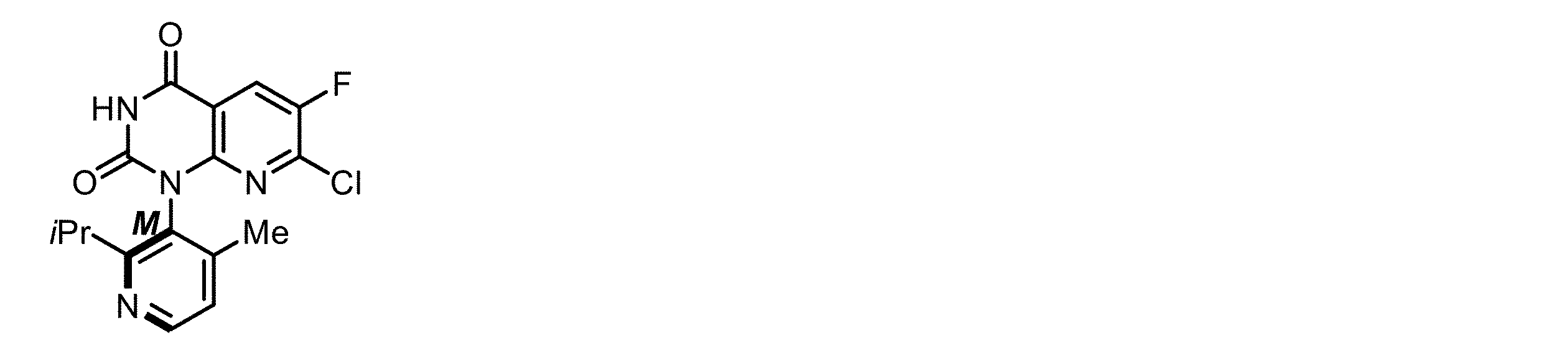
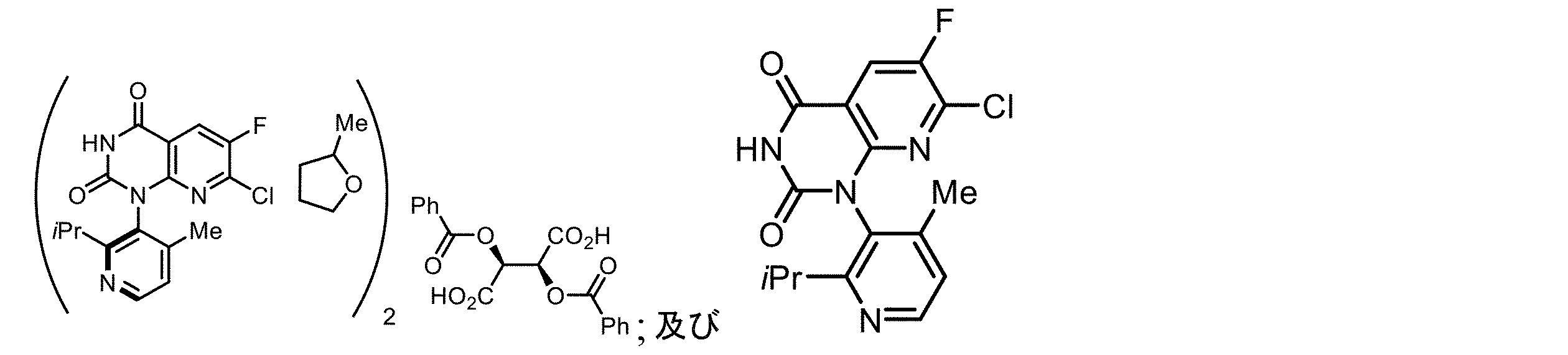
本発明はさらに、下記の化学構造
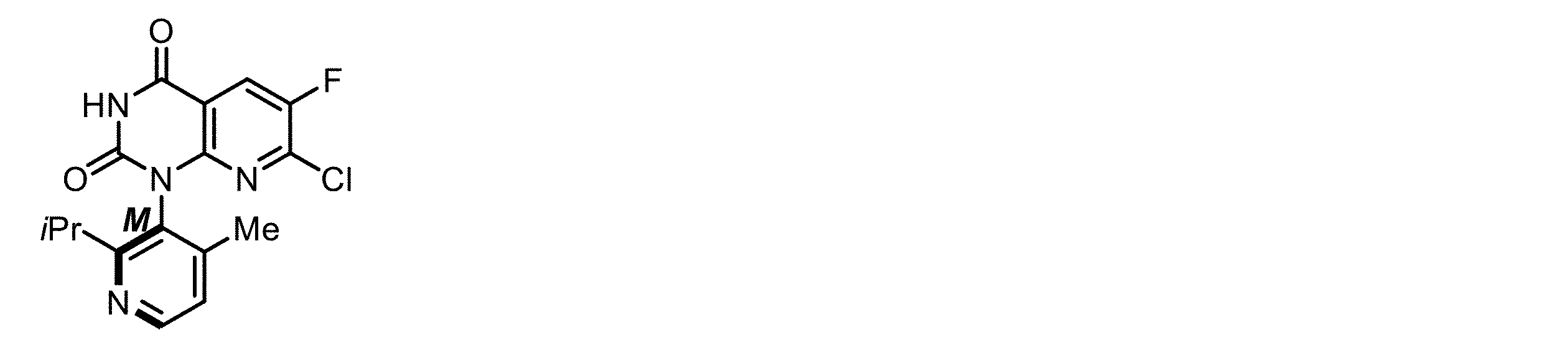
本発明はさらに、構造

定義
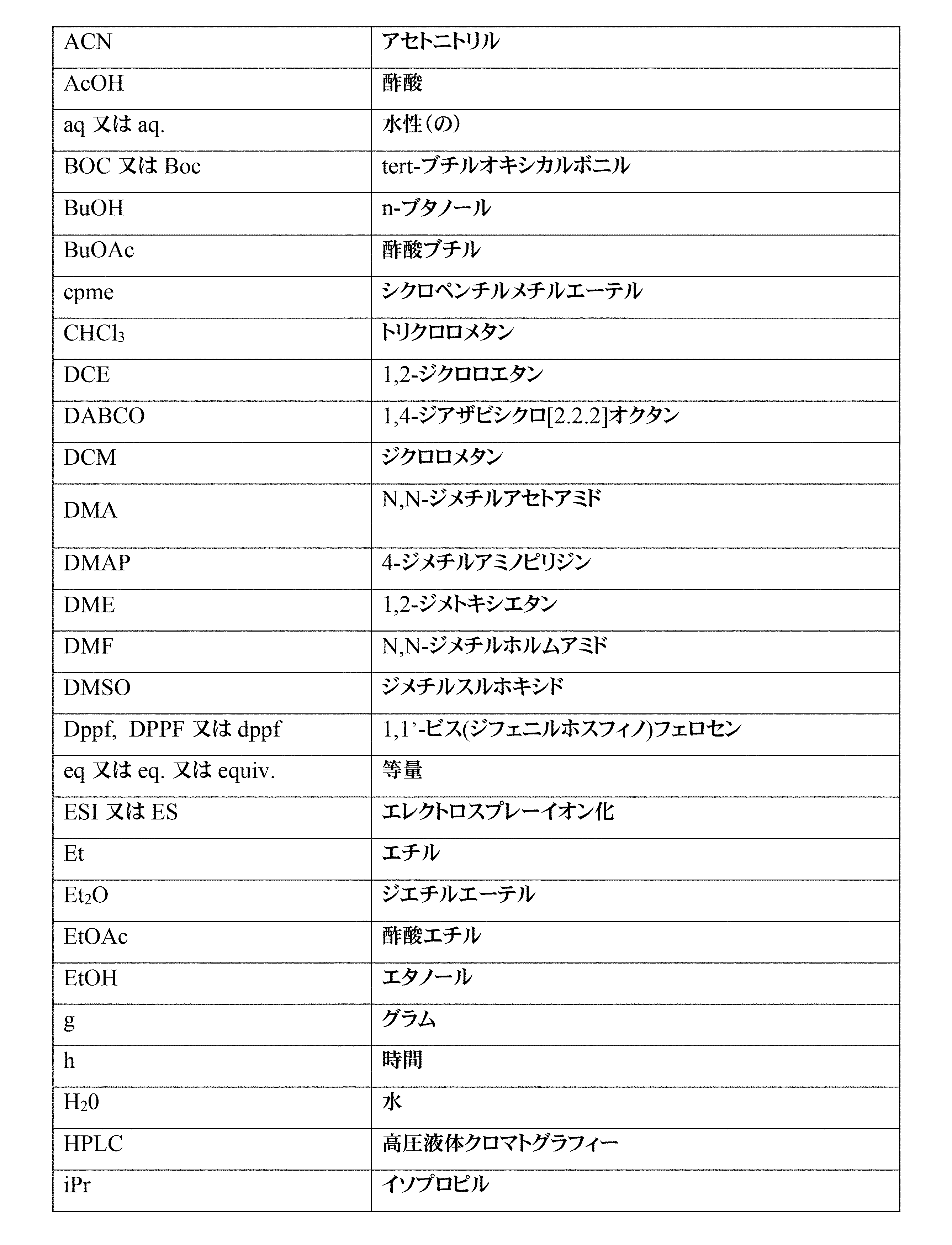
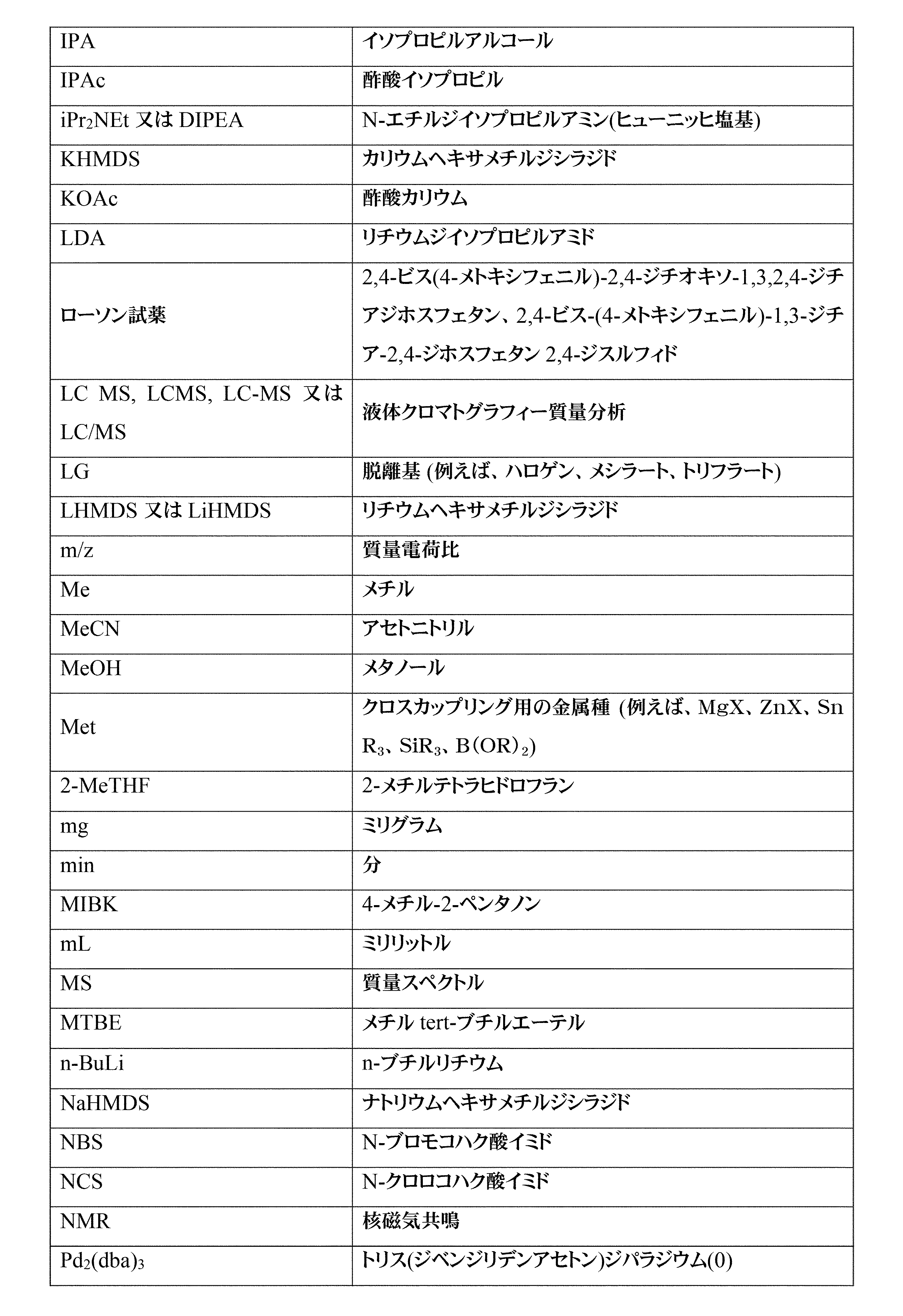
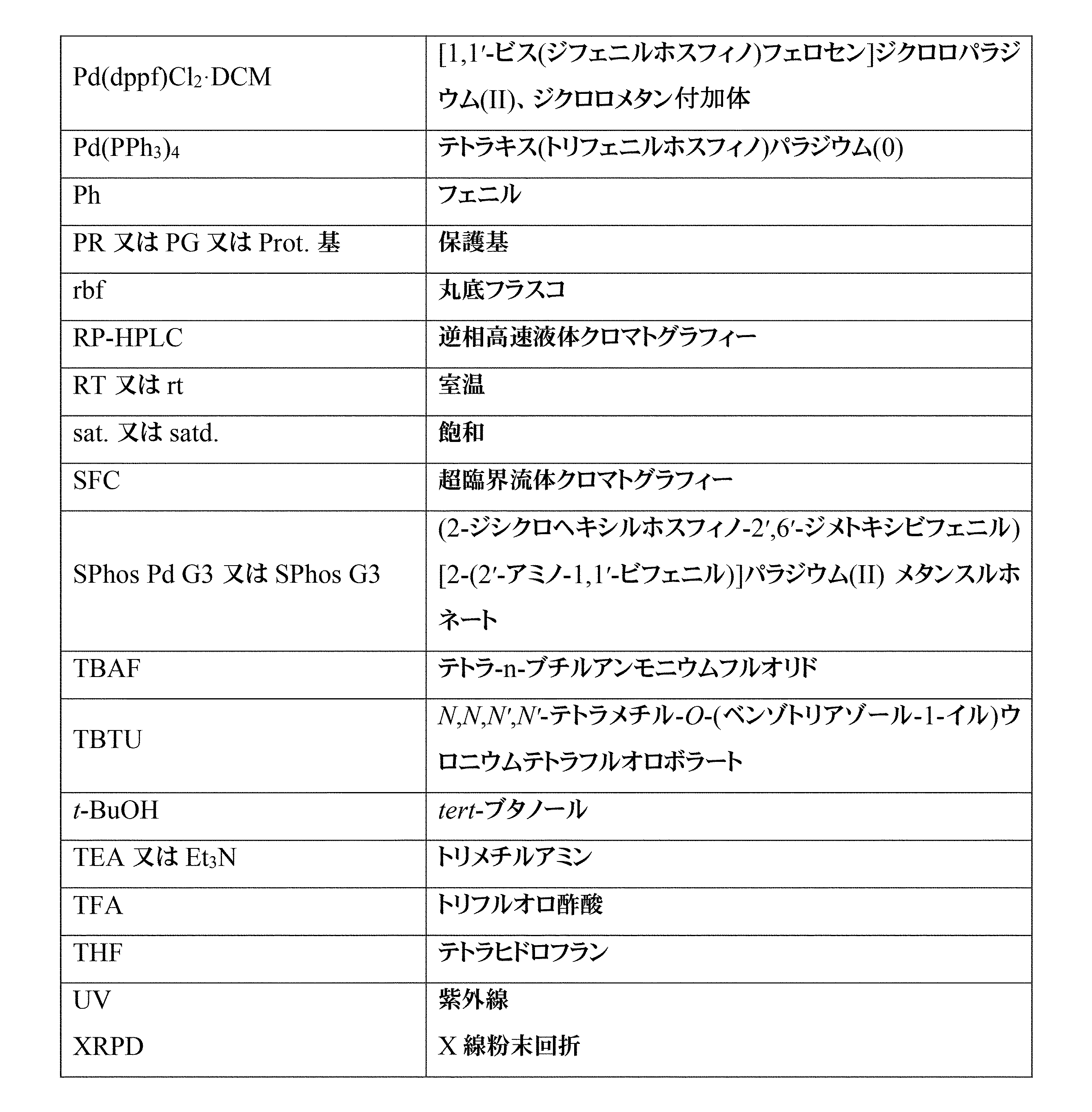
略語:以下の略語が本明細書で使用され得る:
Definition Abbreviations: The following abbreviations may be used herein:
本発明を説明する文脈における(特に、特許請求の範囲の文脈における)用語「1つの(a)」、「1つの(an)」、「その(the)」、及び同様の指示対象の使用は、別段の指示がない限り、単数形及び複数形の両方を包含するものと解釈されるべきである。本明細書中の値の範囲の記載は、本明細書中で別段の指示がない限り、単に、その範囲内に入る各別個の値を個々に言及する簡潔な方法としての役割を果たすことを意図しているにすぎず、各別個の値は、本明細書中で個々に列挙されたかのように、本明細書中に組み込まれる。本明細書で提供されるあらゆる例、又は例示的な言語(例えば、「~など(such as))の使用は、本発明をより良く説明することを意図しており、特に言及しない限り、本発明の範囲を限定するものではない。本明細書中の言語は、言及していないいかなる要素も本発明の実施に必須であると指示していると解釈されてはならない。 The use of the terms "a," "an," "the," and similar referents in the context of describing the present invention (particularly in the context of the claims) should be construed to encompass both the singular and the plural unless otherwise indicated. The recitation of ranges of values herein is merely intended to serve as a shorthand method of individually referring to each separate value falling within the range, unless otherwise indicated herein, and each separate value is incorporated herein as if it were individually recited herein. Any examples provided herein, or the use of exemplary language (e.g., "such as"), are intended to better illustrate the invention and do not limit the scope of the invention unless specifically stated. No language in the specification should be construed as indicating that any unrecited element is essential to the practice of the invention.
本明細書で使用される場合、「アルキル」という用語は、直鎖状及び分岐状のC1~C8炭化水素基、例えば、以下に限定されないが、メチル、エチル、n-プロピル、i-プロピル、n-ブチル、sec-ブチル、t-ブチル、n-ペンチル、2-メチルブチル、3-メチルブチル、2,2-ジメチルプロピル、n-ヘキシル、2-メチルペンチル、3-メチルペンチル、4-メチルペンチル、2,2-ジメチルブチル、2,3-ジメチルブチル、3,3-ジメチルブチル、及び2-エチルブチルを指す。用語Cm~nは、アルキル基が「m」~「n」個の炭素原子を有することを意味する。「アルキレン」という用語は、置換基を有するアルキル基を指す。アルキル(例えば、メチル)又はアルキレン(例えば、-CH2-)基は、例えば、ハロ、トリフルオロメチル、トリフルオロメトキシ、ヒドロキシ、アルコキシ、ニトロ、シアノ、アルキルアミノ、C1~8アルキル、C2~8アルケニル、C2~8アルキニル、-NC、アミノ、-CO2H、-CO2C1~C8アルキル、-OCOC1~C8アルキル、C3~C10シクロアルキル、C3~C10ヘテロシクロアルキル、C5~C10アリール、及びC5~C10ヘテロアリールから独立して選択される、1個以上、通常1~3個で置換され得る。「ハロアルキル」という用語は、具体的には、アルキル基の水素原子の少なくとも1個、例えば、1~6個、又は全てがハロ原子で置換されているアルキル基を指す。 As used herein, the term "alkyl" refers to straight chain and branched C 1 to C 8 hydrocarbon groups, including, but not limited to, methyl, ethyl, n-propyl, i-propyl, n-butyl, sec-butyl, t-butyl, n-pentyl, 2-methylbutyl, 3-methylbutyl, 2,2-dimethylpropyl, n-hexyl, 2-methylpentyl, 3-methylpentyl, 4-methylpentyl, 2,2-dimethylbutyl, 2,3-dimethylbutyl, 3,3-dimethylbutyl, and 2-ethylbutyl. The term C m-n means that the alkyl group has from "m" to "n" carbon atoms. The term "alkylene" refers to an alkyl group that has a substituent. An alkyl (e.g., methyl) or alkylene (e.g., -CH2- ) group can be substituted with one or more, typically 1 to 3, independently selected from, for example, halo, trifluoromethyl, trifluoromethoxy, hydroxy , alkoxy , nitro, cyano, alkylamino, C1-8 alkyl, C2-8 alkenyl, C2-8 alkynyl, -NC, amino, -CO2H , -CO2C1 - C8 alkyl, -OCOC1- C8 alkyl, C3 - C10 cycloalkyl, C3 - C10 heterocycloalkyl, C5 - C10 aryl, and C5 - C10 heteroaryl. The term "haloalkyl" specifically refers to an alkyl group in which at least one, for example 1 to 6, or all, of the alkyl group's hydrogen atoms have been replaced with a halo atom.
「アルケニル」及び「アルキニル」という用語は、それぞれ二重結合又は三重結合をさらに含むアルキル基を示す。 The terms "alkenyl" and "alkynyl" refer to alkyl groups that further contain a double bond or triple bond, respectively.
本明細書で使用される場合、「ハロ」という用語は、フルオロ、クロロ、ブロモ、及びヨードを指す。「アルコキシ」という用語は、-OR(ここで、Rはアルキルである)として定義される。 As used herein, the term "halo" refers to fluoro, chloro, bromo, and iodo. The term "alkoxy" is defined as -OR, where R is alkyl.
本明細書で使用される場合、「アミノ」又は「アミン」という用語は、互換的に-NR2基(ここで、各Rは、例えば、H又は置換基である)を指す。いくつかの実施形態では、アミノ基はさらに置換されて、アンモニウムイオン、例えば、NR3
+を形成する。
アンモニウム部分は、「アミノ」又は「アミン」の定義に特に含まれる。置換基は、例えば、アルキル、アルコキシ、シクロアルキル、ヘテロシクロアルキル、アミド、又はカルボキシレートであり得る。R基はさらに、例えば、ハロ、シアノ、アルケニル、アルキニル、アルキル、シクロアルキル、ヘテロシクロアルキル、アリール、ヘテロアリール、尿素、カルボニル、カルボキシレート、アミン、及びアミドから選択される1個以上、例えば、1~4個の基でさらに置換され得る。「アミド」又は「アミド」基は、アミン又はアミノ基に類似するが、C(O)、例えば、-C(O)NR2をさらに含む基を互換的に指す。
As used herein, the terms "amino" or "amine" interchangeably refer to the -NR2 group, where each R is, for example, H or a substituent. In some embodiments, the amino group is further substituted to form an ammonium ion, for example, NR3 + .
Ammonium moieties are specifically included in the definition of "amino" or "amine." Substituents can be, for example, alkyl, alkoxy, cycloalkyl, heterocycloalkyl, amido, or carboxylate. The R group can be further substituted with one or more, e.g., 1 to 4, groups selected from, for example, halo, cyano, alkenyl, alkynyl, alkyl, cycloalkyl, heterocycloalkyl, aryl, heteroaryl, urea, carbonyl, carboxylate, amine, and amido. "Amido" or "amido" groups refer interchangeably to groups similar to amine or amino groups but further comprising a C(O), e.g., -C(O)NR 2 .
本明細書で使用される場合、「アリール」という用語は、C6~14単環式又は多環式芳香族基、好ましくはC6~10単環式若しくは二環式芳香族基、又はC10~14多環式芳香族基を指す。アリール基の例としては、フェニル、ナフチル、フルオレニル、アズレニル、アントリル、フェナントリル、ピレニル、ビフェニル、及びテルフェニルが挙げられるが、これらに限定されない。アリールはまた、ここで、1つの環は芳香環であり、他は飽和環、部分不飽和環、又は芳香環である、C10~14の二環式及び三環式炭素環、例えば、ジヒドロナフチル、インデニル、インダニル、又はテトラヒドロナフチル(テトラリニル)を指す。特に明記しない限り、アリール基は、例えば、ハロ、C1-8アルキル、C2~8アルケニル、C2~8アルキニル、-CF3、-OCF3、-NO2、-CN、-NC、-OH、アルコキシ、アミノ、-CO2H、-CO2C1~C8アルキル、-OCOC1~C8アルキル、C3~C10シクロアルキル、C3~C10ヘテロシクロアルキル、C5~C10アリール、及びC5~C10ヘテロアリールから独立して選択される1個以上、特に1~4個の基で置換されていてもよい。
As used herein, the term "aryl" refers to a C 6-14 monocyclic or polycyclic aromatic group, preferably a C 6-10 monocyclic or bicyclic aromatic group, or a C 10-14 polycyclic aromatic group. Examples of aryl groups include, but are not limited to, phenyl, naphthyl, fluorenyl, azulenyl, anthryl, phenanthryl, pyrenyl, biphenyl, and terphenyl. Aryl also refers herein to C 10-14 bicyclic and tricyclic carbocyclic rings, in which one ring is aromatic and the other is saturated, partially unsaturated, or aromatic, such as dihydronaphthyl, indenyl, indanyl, or tetrahydronaphthyl (tetralinyl). Unless otherwise specified, aryl groups may be optionally substituted with one or more, and particularly 1 to 4, groups independently selected from halo, C 1-8 alkyl, C 2-8 alkenyl, C 2-8 alkynyl, -CF 3 , -OCF 3 , -NO 2 , -CN, -NC , -OH, alkoxy, amino, -CO 2 H, -CO 2 C 1 -C 8 alkyl, -OCOC 1 -C 8 alkyl, C 3 -C 10 cycloalkyl, C 3 -
本明細書中で使用される場合、「シクロアルキル」という用語は、単環式又は多環式の非芳香族炭素環(ここで、多環式環は、縮合、架橋、又はスピロであり得る)を指す。炭素環は、3~10個の炭素環原子を有し得る。考えられる炭素環としては、シクロプロピル、シクロブチル、シクロペンチル、シクロヘキシル、シクロヘプチル、シクロオクチル、及びシクロノニルが挙げられるが、これらに限定されない。 As used herein, the term "cycloalkyl" refers to a monocyclic or polycyclic non-aromatic carbocyclic ring, where the polycyclic ring may be fused, bridged, or spiro. The carbocyclic ring may have 3 to 10 carbon ring atoms. Possible carbocyclic rings include, but are not limited to, cyclopropyl, cyclobutyl, cyclopentyl, cyclohexyl, cycloheptyl, cyclooctyl, and cyclononyl.
本明細書中で使用される場合、「ヘテロシクロアルキル」という用語は、3個以上(例えば、3~12個、4~10個、4~8個、又は5~7個)の全原子を含有し、そのうちの1~5個(例えば、1、2、3、4、又は5個)の原子は、窒素、酸素、及び硫黄から独立して選択される単環式又は多環式(例えば、二環式)で飽和又は部分不飽和の環系を意味する。ヘテロシクロアルキル基の非限定的な例としては、アゼチジニル、ピロリジニル、ピペリジニル、ピペラジニル、ジヒドロピロリル、モルホリニル、チオモルホリニル、ジヒドロピリジニル、オキサシクロヘプチル、ジオキサシクロヘプチル、チアシクロヘプチル、及びジアザシクロヘプチルが挙げられる。 As used herein, the term "heterocycloalkyl" refers to a monocyclic or polycyclic (e.g., bicyclic), saturated or partially unsaturated ring system containing 3 or more (e.g., 3-12, 4-10, 4-8, or 5-7) total atoms, of which 1-5 (e.g., 1, 2, 3, 4, or 5) atoms are independently selected from nitrogen, oxygen, and sulfur. Non-limiting examples of heterocycloalkyl groups include azetidinyl, pyrrolidinyl, piperidinyl, piperazinyl, dihydropyrrolyl, morpholinyl, thiomorpholinyl, dihydropyridinyl, oxacycloheptyl, dioxacycloheptyl, thiacycloheptyl, and diazacycloheptyl.
特に明記しない限り、シクロアルキル基又はヘテロシクロアルキル基は、非置換であっても、1個以上、特に1~4個の基で置換されていてもよい。いくつかの考えられる置換基としては、ハロ、C1~8アルキル、C2~8アルケニル、C2~8アルキニル、-OCF3、-NO2、-CN、-NC、-OH、アルコキシ、アミノ、-CO2H、-CO2C1~C8アルキル、-OCOC1~C8アルキル、C3~C10シクロアルキル、C3~C10ヘテロシクロアルキル、C5~C10アリール、及びC5~C10ヘテロアリールが挙げられる。 Unless otherwise specified, a cycloalkyl or heterocycloalkyl group can be unsubstituted or substituted with one or more, especially 1 to 4, groups. Some possible substituents include halo, C 1-8 alkyl, C 2-8 alkenyl, C 2-8 alkynyl, -OCF 3 , -NO 2 , -CN, -NC, -OH , alkoxy, amino, -CO 2 H, -CO 2 C 1 -C 8 alkyl, -OCOC 1 -C 8 alkyl, C 3 -C 10 cycloalkyl, C 3 -C 10 heterocycloalkyl, C 5 -C 10 aryl, and C 5 -C 10 heteroaryl.
本明細書で使用される場合、「ヘテロアリール」という用語は、1~3個の芳香環を含み、芳香環中に窒素、酸素、及び硫黄から選択される1~4個(例えば、1、2、3、又は4個)のヘテロ原子を含む単環式又は多環式(例えば、二環式)の環系を指す。特定の実施形態では、ヘテロアリール基は、5~20個、5~15個、5~10個、又は5~7個の原子を有する。ヘテロアリールはまた、1つの環は芳香環であり、他は飽和環、部分不飽和環、又は芳香環である、C10~14の二環式及び三環式環を指す。ヘテロアリール基の例としては、フラニル、イミダゾリル、イソチアゾリル、イソオキサゾリル、オキサジアゾリル、オキサゾリル、ピラジニル、ピラゾリル、ピリダジニル、ピリジル、ピリミジニル、ピロリル、チアジアゾリル、チアゾリル、チエニル、テトラゾリル、トリアジニル、トリアゾリル、ベンゾフラニル、ベンゾイミダゾリル、ベンゾイソキサゾリル、ベンゾピラニル、ベンゾチアジアゾリル、ベンゾチアゾリル、ベンゾチエニル、ベンゾチオフェニル、ベンゾトリアゾリル、ベンゾオキサゾリル、フロピリジル、イミダゾピリジニル、イミダゾチアゾリル、インドリジニル、インドリル、インダゾリル、イソベンゾフラニル、イソベンゾチエニル、イソインドリル、イソキノリニル、イソチアゾリル、ナフチリジニル、オキサゾロピリジニル、フタラジニル、プテリジニル、プリニル、ピリドピリジル、ピロロピリジル、キノリニル、キノキサリニル、キアゾリニル、チアジアゾロピリミジル、及びチエノピリジルが挙げられるが、これらに限定されない。特に明記しない限り、ヘテロアリール基は、非置換であっても、1個以上、特に1~4個又は1若しくは2個の置換基で置換されていてもよい。考えられる置換基としては、ハロ、C1~8アルキル、C2~8アルケニル、C2~8アルキニル、-OCF3、-NO2、-CN、-NC、-OH、アルコキシ、アミノ、-CO2H、-CO2C1~C8アルキル、-OCOC1~C8アルキル、C3~C10シクロアルキル、C3~C10ヘテロシクロアルキル、C5~C10アリール、及びC5~C10ヘテロアリールが挙げられる。 As used herein, the term "heteroaryl" refers to a monocyclic or polycyclic (e.g., bicyclic) ring system containing 1 to 3 aromatic rings and containing 1 to 4 (e.g., 1, 2, 3, or 4) heteroatoms selected from nitrogen, oxygen, and sulfur in the aromatic rings. In certain embodiments, heteroaryl groups have 5 to 20, 5 to 15, 5 to 10, or 5 to 7 atoms. Heteroaryl also refers to C 10-14 bicyclic and tricyclic rings in which one ring is aromatic and the other is saturated, partially unsaturated, or aromatic. Examples of heteroaryl groups include furanyl, imidazolyl, isothiazolyl, isoxazolyl, oxadiazolyl, oxazolyl, pyrazinyl, pyrazolyl, pyridazinyl, pyridyl, pyrimidinyl, pyrrolyl, thiadiazolyl, thiazolyl, thienyl, tetrazolyl, triazinyl, triazolyl, benzofuranyl, benzimidazolyl, benzoisoxazolyl, benzopyranyl, benzothiadiazolyl, benzothiazolyl, benzothienyl, benzothiophenyl, benzotriazolyl, and the like. Examples of heteroaryl include, but are not limited to, benzoxazolyl, furopyridyl, imidazopyridinyl, imidazothiazolyl, indolizinyl, indolyl, indazolyl, isobenzofuranyl, isobenzothienyl, isoindolyl, isoquinolinyl, isothiazolyl, naphthyridinyl, oxazolopyridinyl, phthalazinyl, pteridinyl, purinyl, pyridopyridyl, pyrrolopyridyl, quinolinyl, quinoxalinyl, ciazolinyl, thiadiazolopyrimidyl, and thienopyridyl. Unless otherwise specified, heteroaryl groups may be unsubstituted or substituted with one or more, particularly 1 to 4 or 1 or 2, substituents. Possible substituents include halo, C 1-8 alkyl, C 2-8 alkenyl, C 2-8 alkynyl, -OCF 3 , -NO 2 , -CN, -NC, -OH, alkoxy, amino, -CO 2 H, -CO 2 C 1 -C 8 alkyl, -OCOC 1 -C 8 alkyl, C 3 -C 10 cycloalkyl, C 3 -C 10 heterocycloalkyl, C 5 -C 10 aryl, and C 5 -C 10 heteroaryl.
本明細書で使用される場合、用語Bocは、以下の構造を指す。

実施形態
実施形態1
本発明の一実施形態では、本発明は、組成物であって、式4
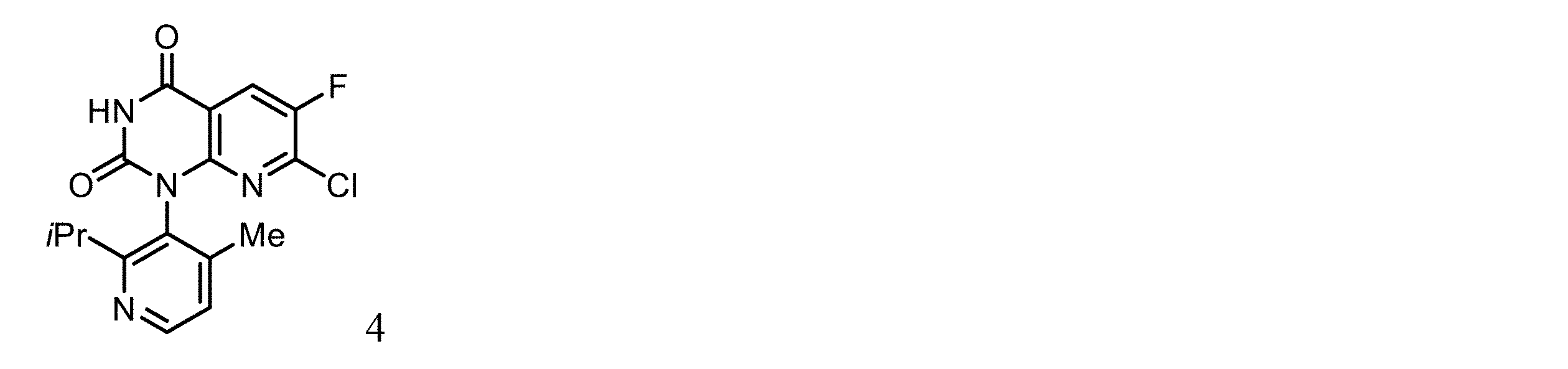

In one embodiment of the present invention, the present invention provides a composition comprising a compound of
実施形態2
本発明の別の実施形態では、本発明は、式4の化合物が式5M

In another embodiment of the present invention, the compound of
実施形態3
本発明の別の実施形態では、本発明は、式4の化合物が式5P

In another embodiment of the present invention, the compound of
実施形態4
本発明の別の実施形態では、本発明は、式Bの化合物が式B1

In another embodiment of the present invention, the compound of formula B is represented by formula B1
実施形態5
本発明の別の実施形態では、本発明は、式Bの化合物が式B2

In another embodiment of the present invention, the compound of formula B is represented by formula B2
実施形態6
本発明の別の実施形態では、本発明は、組成物が2:1の比の式4の化合物と式Bの化合物とを含む、実施形態1~5のいずれか1つの組成物を含む。
In another embodiment of the invention, the invention comprises the composition of any one of embodiments 1-5, wherein the composition comprises a 2:1 ratio of the compound of
実施形態7
本発明の別の実施形態では、本発明は、組成物が式

In another embodiment of the present invention, the composition comprises a compound of formula
実施形態8
本発明の別の実施形態では、本発明は、2-メチルテトラヒドロフランと式Bの化合物との比が2:1である、実施形態1~7のいずれか1つの組成物を含む。
In another embodiment of the invention, the invention comprises the composition of any one of
実施形態9
本発明の別の実施形態では、本発明は、組成物が式

In another embodiment of the present invention, the composition comprises a compound of formula
実施形態10
本発明の別の実施形態では、本発明は、組成物が式

In another embodiment of the present invention, the composition comprises a compound of formula
実施形態11
本発明の別の実施形態では、本発明は、組成物が式

In another embodiment of the present invention, the composition comprises a compound of formula
実施形態12
本発明の別の実施形態では、本発明は、組成物が式

In another embodiment of the present invention, the composition comprises a compound of formula
実施形態13
本発明の別の実施形態では、本発明は、組成物が式

In another embodiment of the present invention, the composition comprises a compound of formula
実施形態14
本発明の別の実施形態では、本発明は、組成物が結晶状態である、実施形態1~13のいずれか1つの組成物を含む。
In another embodiment of the invention, the invention comprises the composition of any one of
実施形態15
本発明の別の実施形態では、本発明は、式4aの組成物の製造方法であって、下記の化学構造



In another embodiment of the present invention, the present invention provides a method for preparing a composition of formula 4a, comprising the steps of:
実施形態16
本発明の別の実施形態では、本発明は、下記の化学構造

a)下記の化学構造


b)組成物4aを単離すること;
c)単離された組成物4aを塩基で処理して、式5Mの化合物を生成すること
を含む方法を含む。
In another embodiment of the present invention, the present invention provides a compound having the following chemical structure:
a) The following chemical structure:
b) isolating composition 4a;
c) treating the isolated composition 4a with a base to produce a compound of formula 5M.
実施形態17
本発明の別の実施形態では、本発明は、塩基がNa2HPO4である、実施形態16に記載の方法を含む。
EMBODIMENT 17
In another embodiment of the invention, the invention comprises the method of
実施形態18
本発明の別の実施形態では、本発明は、塩基がNaHCO3である、実施形態16に記載の方法を含む。
EMBODIMENT 18
In another embodiment of the invention, the invention includes the method of
実施形態19
本発明の別の実施形態では、本発明は、組成物であって、式4


In another embodiment of the present invention, the present invention provides a composition comprising a compound of
実施形態20
本発明の別の実施形態では、本発明は、式4の化合物が式5M

In another embodiment of the present invention, the compound of
実施形態21
本発明の別の実施形態では、本発明は、式4の化合物が式5P
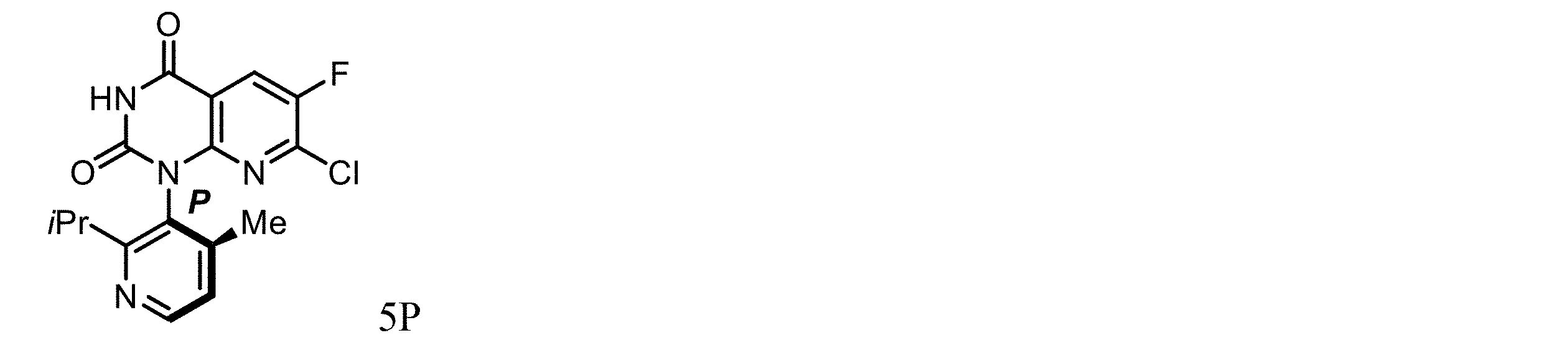
In another embodiment of the present invention, the compound of
実施形態22
本発明の別の実施形態では、本発明は、式11の化合物が式11a

In another embodiment of the present invention, the compound of
実施形態23
本発明の別の実施形態では、本発明は、式11の化合物が式11b

In another embodiment of the present invention, the compound of
実施形態24
本発明の別の実施形態では、本発明は、組成物が式

In another embodiment of the present invention, the composition comprises a compound of formula
実施形態25
本発明の別の実施形態では、本発明は、組成物が式

In another embodiment of the present invention, the composition comprises a compound of formula
実施形態26
本発明の別の実施形態では、本発明は、組成物が式

In another embodiment of the present invention, the composition comprises a compound of formula
実施形態27
本発明の別の実施形態では、本発明は、組成物が式

In another embodiment of the present invention, the composition comprises a compound of formula
実施形態28
本発明の別の実施形態では、本発明は、1:1の比の式4の化合物と式11の化合物とを含む、実施形態19~27のいずれか1つの組成物を含む。
EMBODIMENT 28
In another embodiment of the invention, the invention comprises the composition of any one of embodiments 19-27, comprising a 1:1 ratio of the compound of
実施形態29
本発明の別の実施形態では、本発明は、式5Mの化合物を使用して、式

In another embodiment of the invention, the present invention provides a compound of formula 5M for use in the preparation of a compound of formula
本開示の化合物
以下により詳細に説明する構造を有するKRAS阻害剤を、本明細書において提供する。
Compounds of the Present Disclosure Provided herein are KRAS inhibitors having structures as described in more detail below.
本明細書に開示する化合物は、本明細書に開示する化合物の1つ以上の原子が、同じ原子番号を有するが、天然に通常見出される原子質量又は質量数とは異なる原子質量又は質量数を有する原子によって置換されている、薬学的に許容される同位体標識化合物を全て含む。開示する化合物に組み込むことができる同位体の例としては、水素、炭素、窒素、酸素、リン、フッ素、塩素、及びヨウ素の同位体、例えば、それぞれ、2H、3H、11C、13C、14C、13N、15N、15O、17O、18O、31P、32P、35S、18F、36Cl、123I、及び125Iが挙げられる。これらの放射性標識化合物は例えば、作用の部位若しくは様式、又は薬理学的に重要な作用部位への結合親和性を特徴付けることによって、化合物の有効性を決定又は測定するのを助けるために有用であり得る。本開示の特定の同位体標識化合物、例えば、放射性同位体を組み込む化合物は、薬物及び/又は基質組織分布の研究において有用である。放射性同位体のトリチウム、すなわち3H、及び炭素-14、すなわち14Cは、それらの組み込みの容易さ及び検出の容易な手段の観点から、この目的に特に有用である。 The compounds disclosed herein include all pharma- ceutically acceptable isotopically labeled compounds, in which one or more atoms of the compounds disclosed herein are replaced by an atom with the same atomic number, but with a different atomic mass or mass number than the atomic mass or mass number that is usually found in nature. Examples of isotopes that can be incorporated into the disclosed compounds include isotopes of hydrogen, carbon, nitrogen, oxygen, phosphorus, fluorine, chlorine, and iodine, such as 2H , 3H , 11C , 13C, 14C , 13N , 15N , 15O , 17O , 18O , 31P , 32P , 35S , 18F , 36Cl , 123I , and 125I , respectively. These radiolabeled compounds can be useful, for example, to help determine or measure the effectiveness of compounds by characterizing the site or mode of action, or the binding affinity to pharmacologically important sites of action. Certain isotopically labeled compounds of the disclosure, for example those incorporating a radioactive isotope, are useful in drug and/or substrate tissue distribution studies. The radioactive isotopes tritium, i.e., 3H , and carbon-14, i.e., 14C , are particularly useful for this purpose in view of their ease of incorporation and ready means of detection.
重水素、すなわち2Hなどのより重い同位体での置換は、より大きな代謝安定性、例えば、増加したインビボ半減期又は減少した投薬必要量から生じる特定の治療上の利点を提供し得るため、いくつかの状況においては好ましい。 Substitution with heavier isotopes such as deuterium, i.e., 2H , may be preferred in some circumstances as it may offer certain therapeutic advantages resulting from greater metabolic stability, for example, increased in vivo half-life or reduced dosage requirements.
11C、18F、15O及び13Nなどの陽電子放出同位体による置換は、基質受容体占有率を調べるための陽電子放出トポグラフィー(PET)研究において有用であり得る。構造(I)の同位体標識化合物は一般に、当業者に知られた従来の技術によって、又は以前に使用された非標識試薬の代わりに適切な同位体標識試薬を使用して、以下に記載する調製及び実施例に記載されるものと類似のプロセスによって調製され得る。 Substitution with positron emitting isotopes, such as 11 C, 18 F, 15 O and 13 N, can be useful in Positron Emission Topography (PET) studies to examine substrate receptor occupancy. Isotopically labeled compounds of structure (I) can generally be prepared by conventional techniques known to those skilled in the art, or by processes analogous to those described in the Preparations and Examples below, using appropriately isotopically labeled reagents in place of previously used non-labeled reagents.
本明細書に開示する同位体標識化合物は一般に、当業者に知られた従来の技術によって、又は以前に使用された非標識試薬の代わりに適切な同位体標識試薬を使用して添付の実施例及びスキームに記載されるものと類似のプロセスによって調製され得る。 The isotopically labeled compounds disclosed herein may generally be prepared by conventional techniques known to those of skill in the art, or by processes similar to those described in the accompanying examples and schemes, using appropriate isotopically labeled reagents in place of previously used non-labeled reagents.
本明細書に開示される化合物のいくつかは、光学異性体及び立体配座異性体(又は、コンフォーマー)を含む立体異性体(すなわち、原子の空間配置のみが異なる異性体)として存在し得る。本明細書に開示する化合物は、全ての立体異性体を、純粋な個々の立体異性体調製物としても、各々がリッチの調製物としても、また、そのような立体異性体のラセミ混合物としても、当業者に知られた方法に従って分割し得る個々のジアステレオマー及びエナンチオマーとしても含む。さらに、本明細書に開示する化合物は、それら化合物の全ての互変異性型を含む。 Some of the compounds disclosed herein may exist as stereoisomers (i.e., isomers that differ only in the spatial arrangement of atoms), including optical isomers and conformational isomers (or conformers). The compounds disclosed herein include all stereoisomers, either as pure individual stereoisomer preparations or as enriched preparations of each, as racemic mixtures of such stereoisomers, or as individual diastereomers and enantiomers that may be resolved according to methods known to those of skill in the art. Additionally, the compounds disclosed herein include all tautomeric forms of the compounds.
本明細書中に開示する化合物のいくつかは、分子の他の部分との立体相互作用の結果として、分子中の単結合の周りの回転が妨げられるか、又は非常に遅くされる場合に生じる立体配座異性体であるアトロプ異性体として存在し得る。本明細書に開示する化合物は、全てのアトロプ異性体を、純粋な個々のアトロプ異性体調製物としても、それぞれがリッチの調製物としても、又はそれぞれの非特異的混合物としても含む。単結合の周りの回転障壁が十分に高く、配座間の相互変換が十分に遅い場合、異性体種の分割及び単離が可能であり得る。例えば、以下に限定されないが、下記の基が回転を制限し得る。

「一水和物」という用語は、約1つの水分子が結合した化合物9の塩を意味する。当業者であれば、結合する水分子の正確な数は、温度、圧力、及び他の環境の影響が変化すると、いつでもわずかに変化し得ることを理解しているであろう。結合する水分子の数のわずかな変化は全て、本発明の範囲内であると考えられる。
The term "monohydrate" refers to a salt of
「二水和物」という用語は、約2つの水分子が結合した化合物9の塩を意味する。当業者であれば、結合する水分子の正確な数は、温度、圧力、及び他の環境の影響が変化すると、いつでもわずかに変化し得ることを理解しているであろう。結合する水分子の数のわずかな変化は全て、本発明の範囲内であると考えられる。
The term "dihydrate" refers to a salt of
「共結晶」という用語は、周囲温度(20℃~25℃、好ましくは20℃)で2つ以上の化合物を含む結晶性材料を意味し、そのうちの少なくとも2つは弱い相互作用によって結合しており、化合物のうちの少なくとも1つは共結晶形成剤であり、その他は化合物5である。弱い相互作用はイオン性でも共有結合性でもない相互作用として定義され、例えば、水素結合、ファンデルワールス力、及びπ-π相互作用が挙げられる。
The term "co-crystal" refers to a crystalline material at ambient temperature (20°C-25°C, preferably 20°C) that includes two or more compounds, at least two of which are bound by weak interactions, with at least one of the compounds being a co-crystal former and the other being
「アモルファス形態」又は「アモルファス」という用語は、長距離秩序を欠き、それ自体、明確なX線回折ピーク、すなわちブラッグ回折ピークを示さない材料を意味する。アモルファス材料のXRPDパターンは、1つ以上のアモルファスハローを特徴とする。「アモルファスハロー」という用語は、アモルファス物質のX線粉末パターンにおけるほぼ釣鐘状の極大である。 The term "amorphous morphology" or "amorphous" refers to a material that lacks long-range order and, as such, does not exhibit distinct X-ray diffraction peaks, i.e., Bragg diffraction peaks. The XRPD pattern of an amorphous material is characterized by one or more amorphous halos. The term "amorphous halo" refers to an approximately bell-shaped maximum in the X-ray powder pattern of an amorphous substance.
「実質的に純粋な」という用語は、約95%超、特には約99.5%超、より特には約99.8%超、さらに特には約99.9%超の純度を有する化合物9の固体形態を指す。
The term "substantially pure" refers to a solid form of
「患者」という用語は、イヌ、ネコ、ウシ、ウマ、ヒツジ及びヒトなどの動物を意味する。特定の患者は哺乳動物である。患者という用語は、雄及び雌を含む。 The term "patient" refers to animals such as dogs, cats, cows, horses, sheep, and humans. Particular patients are mammals. The term patient includes males and females.
「治療している」、「治療する」又は「治療」などの用語には、予防的(preventative)(例えば、予防的(prophylactic))及び緩和的治療が含まれる。 Terms such as "treating," "treat," or "treatment" include preventative (e.g., prophylactic) and palliative treatment.
「賦形剤」という用語は、医薬品有効成分(API)以外の薬学的に許容される添加剤、担体、希釈剤、アジュバント、又は他の成分を意味し、これは、通常、製剤化及び/又は患者への投与のために含まれる。 The term "excipient" means a pharma- ceutically acceptable additive, carrier, diluent, adjuvant, or other ingredient other than an active pharmaceutical ingredient (API), which is typically included in the formulation and/or for administration to a patient.
医薬組成物、用量、及び投与経路
また、本明細書に提供されるのは、本明細書で開示される化合物と、例えば、希釈剤又は担体などの薬学的に許容される賦形剤とをともに含む医薬組成物である。本発明での使用に適した化合物及び医薬組成物は、化合物がその意図された目的を達成するのに有効な量で投与することができるものを含む。化合物の投与は、以下でより詳細に記載される。
Pharmaceutical Compositions, Dosages, and Routes of Administration Also provided herein are pharmaceutical compositions comprising the compounds disclosed herein together with a pharma- ceutically acceptable excipient, such as a diluent or carrier. Compounds and pharmaceutical compositions suitable for use in the present invention include those in which the compound can be administered in an amount effective to achieve its intended purpose. Administration of the compounds is described in more detail below.
当業者は、投与経路及び所望の用量に応じて、適切な医薬剤形を決定することができる。例えば、Remington’s Pharmaceutical Sciences,1435-712(18th ed.,Mack Publishing Co,Easton,Pennsylvania,1990)を参照されたい。剤形は、投与された薬剤の物理的状態、安定性、インビボ放出速度、及びインビボ消失速度に影響を及ぼし得る。投与経路に依存して、適切な用量は、体重、体表面積又は器官サイズに従って計算され得る。適切な治療用量を決定するのに必要な計算のさらなる改良は、特に本明細書で開示される用量情報及び分析、並びに動物又はヒトの臨床試験を通して得られる薬物動態学的データに照らして、過度の実験なしに当業者によってルーチンとしてなされる。 Those skilled in the art can determine the appropriate pharmaceutical dosage form depending on the route of administration and the desired dose. See, for example, Remington's Pharmaceutical Sciences, 1435-712 (18th ed., Mack Publishing Co, Easton, Pennsylvania, 1990). The dosage form can affect the physical state, stability, in vivo release rate, and in vivo elimination rate of the administered drug. Depending on the route of administration, the appropriate dose can be calculated according to body weight, body surface area, or organ size. Further refinement of the calculations required to determine the appropriate therapeutic dose can be routinely made by those skilled in the art without undue experimentation, especially in light of the dosage information and analysis disclosed herein, and pharmacokinetic data obtained through animal or human clinical trials.
「薬学的に許容される」又は「薬理学的に許容される」という語句は、動物又はヒトに投与される場合に、有害なアレルギー性、又は他の不都合な反応をもたらさない分子実体及び組成物を指す。本明細書では、「薬学的に許容される」は、任意の、且つ全ての溶媒、分散媒体、コーティング、抗菌剤及び抗真菌剤、等張剤及び吸収遅延剤などを含む。薬学的に活性な物質用のそのような賦形剤の使用は、当技術分野で周知である。任意の従来の媒体又は薬剤が治療組成物と不適合でなければ、治療組成物におけるその使用が意図される。補助的な活性成分もまた、組成物に組み込むことができる。例示的な実施形態では、製剤は、コーンシロップ固体、高オレインベニバナ油、ココナッツ油、大豆油、L-ロイシン、リン酸三カルシウム、L-チロシン、L-プロリン、酢酸L-リジン、DATEM(乳化剤)、L-グルタミン、L-バリン、リン酸二カリウム、L-イソロイシン、L-アルギニン、L-アラニン、グリシン、L-アスパラギン一水和物、L-セリン、クエン酸カリウム、L-トレオニン、クエン酸ナトリウム、塩化マグネシウム、L-ヒスチジン、L-メチオニン、アスコルビン酸、炭酸カルシウム、L-グルタミン酸、L-シスチン二塩酸塩、L-トリプトファン、L-アスパラギン酸、塩化コリン、タウリン、m-イノシトール、硫酸第一鉄、パルミチン酸アスコルビル、硫酸亜鉛、L-カルニチン、アルファ-トコフェリルアセテート、塩化ナトリウム、ナイアシンアミド、トコフェロール混合物、パントテン酸カルシウム、硫酸銅、塩化チアミン塩酸塩、ビタミンAパルミテート、硫酸マンガン、リボフラビン、塩酸ピリドキシン、葉酸、β-カロテン、ヨウ化カリウム、フィロキノン、ビオチン、セレン酸ナトリウム、塩化クロム、モリブデン酸ナトリウム、ビタミンD3及びシアノコバラミンを含み得る。 The phrases "pharmacologically acceptable" or "pharmacologically acceptable" refer to molecular entities and compositions that do not produce adverse, allergic, or other untoward reactions when administered to animals or humans. As used herein, "pharmacologically acceptable" includes any and all solvents, dispersion media, coatings, antibacterial and antifungal agents, isotonic and absorption delaying agents, and the like. The use of such excipients for pharma-ceutically active substances is well known in the art. Unless any conventional media or agent is incompatible with the therapeutic composition, its use in the therapeutic composition is contemplated. Supplementary active ingredients can also be incorporated into the compositions. In an exemplary embodiment, the formulation comprises corn syrup solids, high oleic safflower oil, coconut oil, soybean oil, L-leucine, tricalcium phosphate, L-tyrosine, L-proline, L-lysine acetate, DATEM (emulsifier), L-glutamine, L-valine, dipotassium phosphate, L-isoleucine, L-arginine, L-alanine, glycine, L-asparagine monohydrate, L-serine, potassium citrate, L-threonine, sodium citrate, magnesium chloride, L-histidine, L-methionine, ascorbic acid, calcium carbonate, L-glutamic acid, L-cystine dihydrochloride, L-arginine, L-alanine, glycine, L-asparagine monohydrate, L-serine, potassium citrate, L-threonine, sodium citrate, magnesium chloride, L-histidine, L-methionine, ascorbic acid, calcium carbonate, L-glutamic acid, L-cystine dihydrochloride, L-arginine, L-sodium citrate ... -May contain tryptophan, L-aspartic acid, choline chloride, taurine, m-inositol, ferrous sulfate, ascorbyl palmitate, zinc sulfate, L-carnitine, alpha-tocopheryl acetate, sodium chloride, niacinamide, tocopherol mixture, calcium pantothenate, copper sulfate, thiamine chloride hydrochloride, vitamin A palmitate, manganese sulfate, riboflavin, pyridoxine hydrochloride, folic acid, beta-carotene, potassium iodide, phylloquinone, biotin, sodium selenate, chromium chloride, sodium molybdate, vitamin D3, and cyanocobalamin.
化合物は、薬学的に許容される塩として医薬組成物中に存在することができる。本明細書では、「薬学的に許容される塩」は、例えば、塩基付加塩及び酸付加塩を含む。 The compounds may be present in the pharmaceutical composition as pharma- ceutically acceptable salts. As used herein, "pharma-ceutically acceptable salts" includes, for example, base addition salts and acid addition salts.
薬学的に許容される塩基付加塩は、アルカリ及びアルカリ土類金属又は有機アミンなどの金属又はアミンを用いて生成し得る。化合物の薬学的に許容される塩は、また、薬学的に許容されるカチオンを用いて調製し得る。適切な薬学的に許容されるカチオンは当業者に周知であり、アルカリ、アルカリ土類、アンモニウム及び第四級アンモニウムカチオンを含む。炭酸塩又は炭酸水素塩も可能である。カチオンとして使用される金属の例は、ナトリウム、カリウム、マグネシウム、アンモニウム、カルシウム、又は第二鉄などである。適切なアミンの例としては、イソプロピルアミン、トリメチルアミン、ヒスチジン、N,N’-ジベンジルエチレンジアミン、塩化プロカイン、コリン、ジエタノールアミン、ジシクロヘキシルアミン、エチレンジアミン、N-メチルグルカミン、及びプロカインが挙げられる。 Pharmaceutically acceptable base addition salts may be formed with metals or amines, such as alkali and alkaline earth metals or organic amines. Pharmaceutically acceptable salts of compounds may also be prepared with pharma- ceutically acceptable cations. Suitable pharma-ceutically acceptable cations are well known to those skilled in the art and include alkali, alkaline earth, ammonium and quaternary ammonium cations. Carbonates or bicarbonates are also possible. Examples of metals used as cations include sodium, potassium, magnesium, ammonium, calcium, or ferric. Examples of suitable amines include isopropylamine, trimethylamine, histidine, N,N'-dibenzylethylenediamine, procaine chloride, choline, diethanolamine, dicyclohexylamine, ethylenediamine, N-methylglucamine, and procaine.
薬学的に許容される酸付加塩には、無機又は有機酸塩が含まれる。適切な酸塩の例には、塩酸塩、ギ酸塩、酢酸塩、クエン酸塩、サリチル酸塩、硝酸塩、リン酸塩が含まれる。薬学的に許容される、他の適切な塩は当業者に周知であり、例えば、ギ酸、酢酸、クエン酸、シュウ酸、酒石酸、若しくはマンデル酸、塩酸、臭化水素酸、硫酸又はリン酸;有機カルボン酸、スルホン酸、スルホ酸若しくはホスホ酸又はN-置換スルファミン酸、例えば、酢酸、トリフルオロ酢酸(TFA)、プロピオン酸、グリコール酸、コハク酸、マレイン酸、ヒドロキシマレイン酸、メチルマレイン酸、フマル酸、リンゴ酸、酒石酸、乳酸、シュウ酸、グルコン酸、グルカル酸、グルクロン酸、クエン酸、安息香酸、ケイ皮酸、マンデル酸、サリチル酸、4-アミノサリチル酸、2-フェノキシ安息香酸、2-アセトキシ安息香酸、エンボン酸、ニコチン酸又はイソニコチン酸を有するもの;及び、天然のタンパク質の合成に関与する20種のアルファアミノ酸、例えば、グルタミン酸又はアスパラギン酸などのアミノ酸を有するもの、そしてまた、フェニル酢酸、メタンスルホン酸、エタンスルホン酸、2-ヒドロキシエタンスルホン酸、エタン1,2-ジスルホン酸、ベンゼンスルホン酸、4-メチルベンゼンスルホン酸、ナフタレン2-スルホン酸、ナフタレン1,5-ジスルホン酸、2-又は3-ホスホグリセリン酸、グルコース6-リン酸、N-シクロヘキシルスルファミン酸(シクラメートの形成を伴う)を有するもの、又はアスコルビン酸などの他の酸性有機化合物を有するものを含む。 Pharmaceutically acceptable acid addition salts include inorganic or organic acid salts. Examples of suitable acid salts include hydrochlorides, formates, acetates, citrates, salicylates, nitrates, and phosphates. Other suitable pharma- ceutically acceptable salts will be known to those skilled in the art, and include, for example, formic, acetic, citric, oxalic, tartaric, or mandelic acid, hydrochloric, hydrobromic, sulfuric, or phosphoric acid; organic carboxylic, sulfonic, sulfo, or phosphonic acids or N-substituted sulfamic acids, such as acetic acid, trifluoroacetic acid (TFA), propionic acid, glycolic acid, succinic acid, maleic acid, hydroxymaleic acid, methylmaleic acid, fumaric acid, malic acid, tartaric acid, lactic acid, oxalic acid, gluconic acid, glucaric acid, glucuronic acid, citric acid, benzoic acid, cinnamic acid, mandelic acid, salicylic acid, 4-aminosalicylic acid, 2-phenoxybenzoic acid, 2-acetoxybenzoic acid, embonic acid, nicotinic acid, benzo ... and those with the 20 alpha amino acids involved in the synthesis of natural proteins, such as glutamic acid or aspartic acid, and also those with phenylacetic acid, methanesulfonic acid, ethanesulfonic acid, 2-hydroxyethanesulfonic acid, ethane 1,2-disulfonic acid, benzenesulfonic acid, 4-methylbenzenesulfonic acid, naphthalene 2-sulfonic acid, naphthalene 1,5-disulfonic acid, 2- or 3-phosphoglyceric acid, glucose 6-phosphate, N-cyclohexylsulfamic acid (with the formation of cyclamate), or other acidic organic compounds such as ascorbic acid.
本明細書で開示される化合物を含有する医薬組成物は、従来法で、例えば、従来の混合、溶解、造粒、糖衣錠製造、粉末化、乳化、カプセル化、封入、又は凍結乾燥プロセスによって製造することができる。適切な剤形は、選択する投与経路に依存する。 Pharmaceutical compositions containing the compounds disclosed herein can be prepared in a conventional manner, e.g., by conventional mixing, dissolving, granulating, dragee-making, pulverizing, emulsifying, encapsulating, entrapping, or lyophilizing processes. The appropriate dosage form depends on the route of administration chosen.
経口投与用では、適切な組成物は、本明細書で開示される化合物を、当技術分野で周知の担体などの薬学的に許容される賦形剤と組み合わせることによって、容易に剤形化することができる。そうした賦形剤及び担体は、治療される患者による経口摂取のために、本発明の化合物を、錠剤、丸剤、糖衣錠、カプセル、液剤、ゲル、シロップ、スラリー、懸濁液などとして剤形化することを可能にする。経口使用のための医薬調製物は、本明細書で開示される化合物に固体賦形剤を加え、得られた混合物を任意選択により粉砕し、錠剤又は糖衣錠のコアを得るためには、必要に応じて適切な補助剤を添加した後、顆粒の混合物を処理することによって得ることができる。適切な賦形剤には、例えば、フィラー及びセルロース調製物が含まれる。必要に応じて、崩壊剤を添加することができる。薬学的に許容される成分は、種々のタイプの製剤が周知であり、例えば、バインダー(例えば、天然又は合成ポリマー)、潤滑剤、界面活性剤、甘味料及び香味料、コーティング材料、保存料、染料、増粘剤、アジュバント、抗菌剤、抗酸化剤及び種々の製剤タイプのための担体であり得る。 For oral administration, suitable compositions can be readily formulated by combining the compounds disclosed herein with pharma- ceutically acceptable excipients, such as carriers well known in the art. Such excipients and carriers allow the compounds of the present invention to be formulated as tablets, pills, dragees, capsules, liquids, gels, syrups, slurries, suspensions, and the like, for oral ingestion by the patient to be treated. Pharmaceutical preparations for oral use can be obtained by adding solid excipients to the compounds disclosed herein, optionally grinding the resulting mixture, and processing the mixture of granules, after adding suitable auxiliaries as necessary, to obtain tablets or dragee cores. Suitable excipients include, for example, fillers and cellulose preparations. Disintegrants can be added as necessary. Pharmaceutically acceptable ingredients are well known for various types of formulations and can be, for example, binders (e.g., natural or synthetic polymers), lubricants, surfactants, sweeteners and flavorings, coating materials, preservatives, dyes, thickeners, adjuvants, antimicrobial agents, antioxidants, and carriers for various formulation types.
本明細書で開示される化合物の治療有効量が経口投与される場合、組成物は、通常、固体(例えば、錠剤、カプセル、丸剤、粉末、又はトローチ)又は液体製剤(例えば、水性懸濁液、溶液、エリキシル、又はシロップ)の形態である。 When a therapeutically effective amount of a compound disclosed herein is administered orally, the composition will typically be in the form of a solid (e.g., a tablet, capsule, pill, powder, or lozenge) or liquid preparation (e.g., an aqueous suspension, solution, elixir, or syrup).
錠剤形態で投与される場合、組成物は、ゼラチン又はアジュバントなどの機能性固体及び/又は固体担体をさらに含有することができる。錠剤、カプセル、及び粉末は、約1~約95%の化合物、好ましくは約15~約90%の化合物を含有することができる。 When administered in tablet form, the composition may further contain a functional solid and/or solid carrier, such as gelatin or an adjuvant. Tablets, capsules, and powders may contain about 1 to about 95% of the compound, preferably about 15 to about 90% of the compound.
液体又は懸濁液の形態で投与する場合、水、石油、又は動物若しくは植物起源の油などの、機能性液体及び/又は液体担体を加えることができる。組成物の液体形態は、生理食塩水、糖アルコール溶液、デキストロース又は他の糖溶液、又はグリコールをさらに含有することができる。液体又は懸濁液の形態で投与する場合、組成物は、約0.5~約90重量%の本明細書で開示される化合物、好ましくは約1~約50%の本明細書で開示される化合物を含有することができる。考えられる一実施形態では、液体担体は非水性又は実質的に非水性である。液体形態での投与では、組成物は、投与の直前に溶解又は懸濁させるために、迅速に溶解する固体製剤として供給し得る。 When administered in liquid or suspension form, functional liquids and/or liquid carriers, such as water, petroleum, or oils of animal or plant origin, can be added. Liquid forms of the composition can further contain saline, sugar alcohol solutions, dextrose or other sugar solutions, or glycols. When administered in liquid or suspension form, the composition can contain about 0.5 to about 90% by weight of the compounds disclosed herein, preferably about 1 to about 50% of the compounds disclosed herein. In one contemplated embodiment, the liquid carrier is non-aqueous or substantially non-aqueous. For administration in liquid form, the composition can be supplied as a rapidly dissolving solid formulation for dissolution or suspension immediately prior to administration.
本明細書で開示される化合物の治療有効量が、静脈内、皮膚、又は皮下注射によって投与される場合、組成物は発熱物質を含まない、非経口的に許容される水溶液の形態である。pH、等張性、安定性などを十分に考慮して、そのような非経口的に許容される溶液を調製することは、当業者の範囲内である。静脈内、皮膚、又は皮下注射用として好ましい組成物は、通常、本明細書で開示される化合物に加えて、等張性ビヒクルを含有する。そのような組成物は、ヒドロキシプロピルセルロースのような界面活性剤と適切に混合された水中の、遊離塩基又は薬理学的に許容される塩の溶液として投与するように調製され得る。分散液も、グリセロール、液体ポリエチレングリコール、及びそれらの混合物、並びに油中で調製することができる。貯蔵及び使用の通常の条件下で、これらの調製物は、微生物の増殖を防ぐために、任意選択により保存料を含有することができる。 When a therapeutically effective amount of a compound disclosed herein is administered by intravenous, cutaneous, or subcutaneous injection, the composition is in the form of a pyrogen-free, parenterally acceptable aqueous solution. It is within the skill of the art to prepare such parenterally acceptable solutions, taking into due consideration pH, isotonicity, stability, and the like. A preferred composition for intravenous, cutaneous, or subcutaneous injection will usually contain an isotonic vehicle in addition to the compound disclosed herein. Such compositions may be prepared for administration as a solution of a free base or a pharmacologically acceptable salt in water suitably mixed with a surfactant, such as hydroxypropylcellulose. Dispersions may also be prepared in glycerol, liquid polyethylene glycols, and mixtures thereof, as well as in oils. Under ordinary conditions of storage and use, these preparations may optionally contain a preservative to prevent the growth of microorganisms.
注射用組成物は、無菌注射溶液、懸濁液、又は分散液の即時調製のための無菌水溶液、懸濁液、又は分散液、及び無菌粉末を含むことができる。全ての実施形態で、この形態は、無菌でなければならず、そして注射針通過性が容易な程度に流動性がなければならない。それは、製造及び貯蔵の条件下で安定でなければならず、任意選択により保存料を含めることによって、細菌及び真菌などの微生物の汚染作用に抵抗しなければならない。担体は、例えば、水、エタノール、ポリオール(例えば、グリセロール、プロピレングリコール、及び液体ポリエチレングリコールなど)、それらの適切な混合物、並びに植物油を含有する溶媒又は分散媒体とすることができる。考えられる一実施形態では、担体は非水性又は実質的に非水性である。適切な流動性は、例えば、レシチンなどのコーティングの使用、分散体の実施形態では化合物の必要とされる粒径の維持及び界面活性剤の使用によって維持することができる。微生物作用の予防は、様々な抗菌剤及び抗真菌剤、例えば、パラベン、クロロブタノール、フェノール、ソルビン酸、チメロサールなどによってもたらすことができる。多くの実施形態で、等張化剤、例えば、糖又は塩化ナトリウムを含むことが好ましい。注射用組成物の吸収の延長は、吸収を遅延する作用物質、例えば、モノステアリン酸アルミニウム及びゼラチンを組成物中で使用することによりもたらすことができる。 Injectable compositions can include sterile aqueous solutions, suspensions, or dispersions, and sterile powders for the extemporaneous preparation of sterile injectable solutions, suspensions, or dispersions. In all embodiments, the form must be sterile and fluid to the extent that easy syringability exists. It must be stable under the conditions of manufacture and storage and must resist the contaminating action of microorganisms, such as bacteria and fungi, optionally by including preservatives. The carrier can be, for example, a solvent or dispersion medium containing water, ethanol, polyol (e.g., glycerol, propylene glycol, and liquid polyethylene glycol, and the like), suitable mixtures thereof, and vegetable oils. In one contemplated embodiment, the carrier is non-aqueous or substantially non-aqueous. Proper fluidity can be maintained, for example, by the use of a coating such as lecithin, by the maintenance of the required particle size of the compound in dispersion embodiments, and by the use of surfactants. Prevention of microbial action can be achieved by various antibacterial and antifungal agents, for example, parabens, chlorobutanol, phenol, sorbic acid, thimerosal, and the like. In many embodiments, it is preferable to include an isotonic agent, for example, sugar or sodium chloride. Prolonged absorption of injectable compositions can be achieved by using agents that delay absorption, such as aluminum monostearate and gelatin, in the composition.
無菌注射溶液は、必要な量の活性な化合物を、必要であれば上で列挙した種々の他の成分と共に適当な溶媒中に組み込み、続いて濾過滅菌することによって調製される。一般的に、分散体は、上で列挙した基本の分散媒体及び必要な他の成分を含有する無菌ビヒクルに、滅菌された種々の活性成分を組み込むことによって調製される。無菌注射溶液を調製するための無菌粉末の実施形態では、好ましい調製方法は、活性成分及び任意の追加の所望成分の粉末を、予め滅菌濾過されたそれらの溶液から得られる、真空乾燥及びフリーズドライの手法である。 Sterile injectable solutions are prepared by incorporating the required amount of active compound in the appropriate solvent with various other ingredients as enumerated above, if required, followed by filtered sterilization. In general, dispersions are prepared by incorporating the various sterilized active ingredients into a sterile vehicle containing the basic dispersion medium as enumerated above and the required other ingredients. In the embodiment of sterile powders for preparing sterile injectable solutions, the preferred preparation methods are vacuum drying and freeze-drying techniques, which yield powders of the active ingredients and any additional desired ingredients from previously sterile-filtered solutions thereof.
徐放性又は持続放出性製剤もまた、GI管内で体液と接触して活性化合物の制御放出を達成し、活性化合物の実質的に一定且つ有効な血漿中濃度を提供するために調製され得る。例えば、放出は、溶解、拡散、及びイオン交換のうちの1つ以上によって制御することができる。さらに、徐放アプローチは、GI管内の可飽和又は制限経路を介して吸収を増強し得る。例えば、化合物はこの目的のために、生分解性ポリマー、水溶性ポリマー、又は両混合物のマトリックス、及び任意選択により適切な界面活性剤の中に埋め込まれ得る。埋め込みは、この文脈では、微粒子をポリマーマトリックス中へ組み込むことを意味する。制御放出製剤はまた、周知の分散又は乳化コーティング技術により、分散微粒子又は乳化微小液滴のカプセル化によって得られる。 Slow or sustained release formulations may also be prepared to achieve controlled release of the active compound upon contact with body fluids in the GI tract and provide a substantially constant and effective plasma concentration of the active compound. For example, release may be controlled by one or more of dissolution, diffusion, and ion exchange. Furthermore, slow release approaches may enhance absorption via saturable or restricted pathways in the GI tract. For example, the compound may be embedded for this purpose in a matrix of a biodegradable polymer, a water-soluble polymer, or a mixture of both, and optionally a suitable surfactant. Embedding in this context means incorporating microparticles into a polymer matrix. Controlled release formulations may also be obtained by encapsulation of dispersed microparticles or emulsified microdroplets by well-known dispersion or emulsion coating techniques.
吸入による投与では、本発明の化合物は、適切な噴射剤を使用して、加圧容器又はネブライザーからエアロゾルスプレーの提供形態で便利に送達される。加圧エアロゾルの実施形態では、用量単位は、計量された量を送達するためのバルブを提供することによって決定することができる。吸入器又は注入器で使用するための、例えば、ゼラチンのカプセル及びカートリッジは、化合物と、ラクトース又はデンプンなどの適切な粉末基剤との粉末混合物を含有させて製剤化することができる。 For administration by inhalation, the compounds of the invention are conveniently delivered in the form of an aerosol spray presentation from pressurized container or nebulizer with the use of a suitable propellant. In pressurized aerosol embodiments, the dosage unit can be determined by providing a valve to deliver a metered amount. Capsules and cartridges of, for example, gelatin for use in an inhaler or insufflator can be formulated containing a powder mix of the compound and a suitable powder base such as lactose or starch.
本明細書で開示される化合物は、注射(例えば、ボーラス注射又は連続注入)による非経口投与のために製剤化することができる。注射製剤は、保存料を添加した単位用量形態(例えば、アンプル又は多数回投与容器)で提供することができる。組成物は、懸濁液、溶液、又は油性又は水性ビヒクル中のエマルジョンなどの形態をとることができ、懸濁剤、安定化剤、及び/又は分散剤などの製剤化剤を含有することができる。 The compounds disclosed herein can be formulated for parenteral administration by injection (e.g., bolus injection or continuous infusion). Injectable formulations can be presented in unit dosage form (e.g., in ampoules or multi-dose containers) with an added preservative. The compositions can take such forms as suspensions, solutions, or emulsions in oily or aqueous vehicles, and can contain formulatory agents such as suspending, stabilizing, and/or dispersing agents.
非経口投与用の医薬製剤は、水溶性形態化合物の水溶液を含む。さらに、化合物の懸濁液は、適切な油性注射懸濁液として調製することができる。適切な親油性溶媒又はビヒクルには、脂肪油又は合成脂肪酸エステルが含まれる。水性注射懸濁液は、懸濁液の粘度を増加させる物質を含有することができる。任意選択により、懸濁液もまた、化合物の溶解度を増加させ、高度に濃縮された溶液の調製を可能にする適切な安定剤又は薬剤を含有することができる。或いは、本組成物は、使用前に適切なビヒクル(例えば、無菌の発熱物質を含まない水)で構成するために、粉末形態とすることができる。 Pharmaceutical preparations for parenteral administration include aqueous solutions of the compound in water-soluble form. Additionally, suspensions of the compound may be prepared as appropriate oily injection suspensions. Suitable lipophilic solvents or vehicles include fatty oils or synthetic fatty acid esters. Aqueous injection suspensions may contain substances which increase the viscosity of the suspension. Optionally, suspensions may also contain suitable stabilizers or agents which increase the solubility of the compound and allow for the preparation of highly concentrated solutions. Alternatively, the compositions may be in powder form for constitution with a suitable vehicle (e.g., sterile pyrogen-free water) before use.
本明細書で開示される化合物はまた、坐薬又は保持浣腸剤(例えば、従来の座薬基剤を含む)などの直腸組成物に製剤化させることができる。先に記載した製剤に加えて、化合物はデポ製剤として製剤化することもできる。そのような長期作用性製剤は埋め込み(例えば、皮下又は筋肉内)によって、又は筋肉内注射によって投与することができる。したがって、例えば、化合物は、適切なポリマー若しくは疎水性材料(例えば、許容される油中のエマルジョンとして)、又はイオン交換樹脂とともに、或いは難溶性誘導体として、例えば、難溶性の塩として製剤化することができる。 The compounds disclosed herein can also be formulated in rectal compositions such as suppositories or retention enemas (e.g., containing conventional suppository bases). In addition to the formulations described above, the compounds can also be formulated as depot preparations. Such long-acting formulations can be administered by implantation (e.g., subcutaneously or intramuscularly) or by intramuscular injection. Thus, for example, the compounds can be formulated with suitable polymeric or hydrophobic materials (e.g., as an emulsion in an acceptable oil) or ion exchange resins, or as sparingly soluble derivatives, e.g., as a sparingly soluble salt.
特に、本明細書で開示される化合物は、デンプン又はラクトースなどの賦形剤を含有する錠剤の形態で、又はカプセル若しくはオビュールの形態で、単独で、又は賦形剤との混合物で、又は香味剤又は着色剤を含有するエリキシル剤又は懸濁液の形態で、経口、口腔内、又は舌下に投与することができる。そのような液体調製物は、懸濁剤などの薬学的に許容される添加剤とともに調製することができる。化合物はまた、非経口的に、例えば、静脈内、筋肉内、皮下、又は冠動脈内に注射することができる。非経口投与では、溶液を血液と等張にするために、化合物は他の物質、例えば、塩、又はマンニトールなどの糖アルコール、又はグルコースを含むことができる無菌水溶液の形態で最もよく使用される。 In particular, the compounds disclosed herein can be administered orally, bucally, or sublingually in the form of tablets containing excipients such as starch or lactose, or in the form of capsules or ovules, alone or in admixture with excipients, or in the form of elixirs or suspensions containing flavorings or colorants. Such liquid preparations can be prepared with pharma- ceutically acceptable additives, such as suspending agents. The compounds can also be injected parenterally, for example, intravenously, intramuscularly, subcutaneously, or intracoronarily. For parenteral administration, the compounds are best used in the form of a sterile aqueous solution, which may contain other substances, for example, salts, or sugar alcohols, such as mannitol, or glucose, to make the solution isotonic with blood.
獣医学的使用では、本明細書で開示される化合物は、通常の獣医学的実践に従って、適切に許容される製剤として投与される。獣医は、特定の動物に最も適切な投与計画及び投与経路を容易に決定することができる。 For veterinary use, the compounds disclosed herein are administered in an appropriately tolerated formulation in accordance with normal veterinary practice. A veterinarian can readily determine the most appropriate dosing regimen and route of administration for a particular animal.
いくつかの実施形態では、本明細書で開示される化合物を単独で使用するか、又は別の薬剤若しくはこのような疾患の治療のために伝統的に使用される治療介入と組み合わせて使用する、KRAS関連障害の治療に必要なすべての成分はキットにパッケージ化され得る。具体的には、本発明は、本明細書で開示される化合物、並びに前記薬剤を送達可能な形態に調製するための緩衝剤及び他の成分、並びに/又はそのような薬剤を送達するためのデバイス、及び/又は本明細書で開示される化合物との併用療法で使用される任意の薬剤、及び/又は薬剤とともにパッケージされた疾患治療の説明書を含むパッケージ化された薬剤セットを含む、疾患の治療介入で使用するキットを提供する。説明書は、印刷された紙、又はコンピュータ可読磁気若しくは光学媒体などの任意の有形媒体に固定されていてよく、或いは、説明書はインターネットによりアクセス可能なワールドワイドウェブページなどのリモートコンピュータのデータソースを参照するものでもよい。 In some embodiments, all components necessary for the treatment of KRAS-associated disorders, using the compounds disclosed herein alone or in combination with another agent or intervention traditionally used for the treatment of such diseases, may be packaged into a kit. Specifically, the present invention provides kits for use in the treatment of diseases, including a compound disclosed herein, and a packaged drug set including buffers and other ingredients for preparing said agent in a deliverable form, and/or a device for delivering such agent, and/or any agent to be used in combination therapy with the compounds disclosed herein, and/or instructions for treating the disease packaged with the agent. The instructions may be fixed on any tangible medium, such as printed paper, or a computer-readable magnetic or optical medium, or the instructions may refer to a remote computer data source, such as a World Wide Web page accessible by the Internet.
「治療有効量」とは、治療される対象の現在の症状を治療するか、又は進行を抑えるか、或いは軽減するのに有効な量を意味する。有効量の決定は、特に本明細書で提供される詳細な開示に照らせば、十分に当業者の能力の範囲内である。一般に、「治療有効量」は、所望の効果の達成をもたらす化合物の量を指す。例えば、好ましい一実施形態では、本明細書で開示される化合物の治療有効量は、対照と比較して、KRAS活性を少なくとも5%、少なくとも10%、少なくとも15%、少なくとも20%、少なくとも25%、少なくとも30%、少なくとも35%、少なくとも40%、少なくとも45%、少なくとも50%、少なくとも55%、少なくとも60%、少なくとも65%、少なくとも70%、少なくとも75%、少なくとも80%、少なくとも85%、又は少なくとも90%減少させる。 By "therapeutically effective amount" is meant an amount effective to treat, inhibit progression, or alleviate current symptoms of the subject being treated. Determination of an effective amount is well within the capabilities of those skilled in the art, especially in light of the detailed disclosure provided herein. In general, a "therapeutically effective amount" refers to an amount of a compound that results in the achievement of a desired effect. For example, in a preferred embodiment, a therapeutically effective amount of a compound disclosed herein reduces KRAS activity by at least 5%, at least 10%, at least 15%, at least 20%, at least 25%, at least 30%, at least 35%, at least 40%, at least 45%, at least 50%, at least 55%, at least 60%, at least 65%, at least 70%, at least 75%, at least 80%, at least 85%, or at least 90% compared to a control.
投与される化合物の量は、治療される対象、対象の年齢、健康、性別及び体重、併用治療の種類(もしあれば)、苦痛の重症度、所望する効果の性質、治療の方法及び頻度、並びに処方医師の判断に依存し得る。投与の頻度もまた、動脈酸素圧に対する薬力学的効果に依存し得る。しかしながら、最も好ましい用量は、当業者によって理解され、決定されるように、過度の実験なしに、個々の被験者に合わせて決定することができる。これは、通常、標準用量の調節(例えば、患者体重が軽い場合の用量の減少)を含む。 The amount of compound administered will depend on the subject being treated, the age, health, sex, and weight of the subject, type of concurrent treatment (if any), the severity of the affliction, the nature of the effect desired, the method and frequency of treatment, and the judgment of the prescribing physician. The frequency of administration will also depend on the pharmacodynamic effect on arterial oxygen pressure. However, the most preferred dose can be determined for each individual subject without undue experimentation, as will be understood and determined by those skilled in the art. This will usually involve adjustment of standard doses (e.g., reducing the dose if the patient is of lower weight).
個々の必要性は変化するが、化合物の有効量の最適範囲の決定は、当業者の範囲内である。本明細書で同定される状態及び障害の治癒的又は予防的治療におけるヒトへの投与では、例えば、本発明の化合物の典型的な用量は、約0.05mg/kg/日~約50mg/kg/日、例えば、少なくとも0.05mg/kg、少なくとも0.08mg/kg、少なくとも0.1mg/kg、少なくとも0.2mg/kg、少なくとも0.3mg/kg、少なくとも0.4mg/kg、又は少なくとも0.5mg/kg、そして好ましくは50mg/kg以下、40mg/kg以下、30mg/kg以下、20mg/kg以下、又は10mg/kg以下とすることができ、これは、例えば、約2.5mg/日(0.5mg/kg×5kg)~約5000mg/日(50mg/kg×100kg)であり得る。例えば、化合物の用量は、約0.1mg/kg/日~約50mg/kg/日、約0.05mg/kg/日~約10mg/kg/日、約0.05mg/kg/日~約5mg/kg/日、約0.05mg/kg/日~約3mg/kg/日、約0.07mg/kg/日~約3mg/kg/日、約0.09mg/kg/日~約3mg/kg/日、約0.05mg/kg/日~約0.1mg/kg/日、約0.1mg/kg/日~約1mg/kg/日、約1mg/kg/日~約10mg/kg/日、約1mg/kg/日~約5mg/kg/日、約1mg/kg/日~約3mg/kg/日、約3mg/日~約500mg/日、約5mg/日~約250mg/日、約10mg/日~約100mg/日、約3mg/日~約10mg/日、又は約100mg/日~約250mg/日とすることができる。そのような用量は、単回用量で投与され得るか、又は複数回用量に分割され得る。 While individual needs vary, determination of optimal ranges of effective amounts of the compounds is within the skill of the art. For administration to humans in the curative or prophylactic treatment of the conditions and disorders identified herein, for example, a typical dose of the compounds of the invention can be from about 0.05 mg/kg/day to about 50 mg/kg/day, e.g., at least 0.05 mg/kg, at least 0.08 mg/kg, at least 0.1 mg/kg, at least 0.2 mg/kg, at least 0.3 mg/kg, at least 0.4 mg/kg, or at least 0.5 mg/kg, and preferably 50 mg/kg or less, 40 mg/kg or less, 30 mg/kg or less, 20 mg/kg or less, or 10 mg/kg or less, which can be, for example, about 2.5 mg/day (0.5 mg/kg x 5 kg) to about 5000 mg/day (50 mg/kg x 100 kg). For example, the dose of the compound can be from about 0.1 mg/kg/day to about 50 mg/kg/day, from about 0.05 mg/kg/day to about 10 mg/kg/day, from about 0.05 mg/kg/day to about 5 mg/kg/day, from about 0.05 mg/kg/day to about 3 mg/kg/day, from about 0.07 mg/kg/day to about 3 mg/kg/day, from about 0.09 mg/kg/day to about 3 mg/kg/day, from about 0.05 mg/kg/day to about 0.1 mg/kg/day, It can be about 0.1 mg/kg/day to about 1 mg/kg/day, about 1 mg/kg/day to about 10 mg/kg/day, about 1 mg/kg/day to about 5 mg/kg/day, about 1 mg/kg/day to about 3 mg/kg/day, about 3 mg/day to about 500 mg/day, about 5 mg/day to about 250 mg/day, about 10 mg/day to about 100 mg/day, about 3 mg/day to about 10 mg/day, or about 100 mg/day to about 250 mg/day. Such doses can be administered in a single dose or can be divided into multiple doses.
KRAS G12C阻害剤の使用方法
本開示は、細胞と、本明細書で開示される1種以上の化合物の有効量とを接触させることを含む、RAS媒介細胞シグナル伝達を阻害する方法を提供する。RAS媒介シグナル伝達の阻害は、当技術分野で周知の広範な種々の方法によって評価及び実証することができる。非限定的な例としては、(a)RASのGTPアーゼ活性の減少;(b)GTP結合親和性の減少又はGDP結合親和性の増加;(c)GTPのK offの増加又はGDPのK offの減少;(d)pMEK、pERK、又はpAKTレベルの減少などの、RAS経路の下流のシグナル伝達分子のレベルの減少;及び/又は(e)Rafを含むがこれに限定されない下流のシグナル伝達分子へのRAS複合体の結合の減少を示すことが挙げられる。上記の1つ以上を決定するために、キット及び市販のアッセイを利用することができる。
Methods of using KRAS G12C inhibitors The present disclosure provides a method of inhibiting RAS-mediated cell signaling, comprising contacting a cell with an effective amount of one or more compounds disclosed herein. Inhibition of RAS-mediated signaling can be assessed and demonstrated by a wide variety of methods well known in the art. Non-limiting examples include: (a) a decrease in the GTPase activity of RAS; (b) a decrease in GTP binding affinity or an increase in GDP binding affinity; (c) an increase in the Koff of GTP or a decrease in the Koff of GDP; (d) a decrease in the level of downstream signaling molecules of the RAS pathway, such as a decrease in pMEK, pERK, or pAKT levels; and/or (e) a decrease in the binding of the RAS complex to downstream signaling molecules, including but not limited to Raf. Kits and commercially available assays can be utilized to determine one or more of the above.
本開示はまた、G12C KRAS、HRAS又はNRAS変異に関連する状態(例えば、がん)を含むが、これらに限定されない疾患状態を治療するために、本開示の化合物又は医薬組成物を使用する方法を提供する。 The present disclosure also provides methods of using the compounds or pharmaceutical compositions of the present disclosure to treat disease conditions, including, but not limited to, conditions associated with G12C KRAS, HRAS, or NRAS mutations (e.g., cancer).
いくつかの実施形態では、がんの治療のための方法が提供され、その方法は、本明細書で開示される化合物を含む前述の医薬組成物のいずれかの有効量を、それを必要とする対象に投与することを含む。いくつかの実施形態では、がんはKRAS、HRAS又はNRASのG12C変異によって媒介される。種々の実施形態では、がんは膵臓がん、結腸直腸がん又は肺がんである。いくつかの実施形態では、がんは胆嚢がん、甲状腺がん、及び胆管がんである。 In some embodiments, a method for the treatment of cancer is provided, the method comprising administering to a subject in need thereof an effective amount of any of the aforementioned pharmaceutical compositions comprising a compound disclosed herein. In some embodiments, the cancer is mediated by a G12C mutation in KRAS, HRAS, or NRAS. In various embodiments, the cancer is pancreatic cancer, colorectal cancer, or lung cancer. In some embodiments, the cancer is gallbladder cancer, thyroid cancer, and cholangiocarcinoma.
いくつかの実施形態では、本開示は治療を必要とする対象の障害を治療する方法であって、対象がKRAS、HRAS又はNRASのG12C変異を有するかどうかを決定し、そして対象がKRAS、HRAS又はNRASのG12C変異を有すると決定されれば、本明細書で開示される少なくとも1つの化合物又はその薬学的に許容される塩の治療有効量を、対象に投与することを含む方法を提供する。 In some embodiments, the disclosure provides a method of treating a disorder in a subject in need of treatment, comprising determining whether the subject has a G12C mutation in KRAS, HRAS, or NRAS, and, if the subject is determined to have a G12C mutation in KRAS, HRAS, or NRAS, administering to the subject a therapeutically effective amount of at least one compound disclosed herein, or a pharma- ceutically acceptable salt thereof.
開示された化合物は足場非依存性細胞増殖を阻害し、したがって腫瘍の転移を阻害する可能性を有する。したがって、別の実施形態では、本開示は腫瘍転移を阻害するための方法を提供し、その方法は本明細書で開示される化合物の有効量を投与することを含む。 The disclosed compounds inhibit anchorage-independent cell growth and therefore have the potential to inhibit tumor metastasis. Thus, in another embodiment, the present disclosure provides a method for inhibiting tumor metastasis, the method comprising administering an effective amount of a compound disclosed herein.
KRAS、HRAS又はNRASのG12C変異はまた、血液学的悪性腫瘍(例えば、血液、骨髄及び/又はリンパ節に影響を及ぼすがん)で同定されている。したがって、特定の実施形態は、血液学的悪性腫瘍の治療を必要とする患者への、開示された化合物(例えば、医薬組成物の形態で)の投与に関する。このような悪性腫瘍には白血病及びリンパ腫が含まれるが、これらに限定されない。例えば、本開示の化合物は、急性リンパ芽球性白血病(ALL)、急性骨髄性白血病(AML)、慢性リンパ性白血病(CLL)、小リンパ球性リンパ腫(SLL)、慢性骨髄性白血病(CML)、急性単球性白血病(AMoL)及び/又は他の白血病などの疾患の治療に使用することができる。別の実施形態では、化合物はリンパ腫、例えば、ホジキンリンパ腫又は非ホジキンリンパ腫のすべてのサブタイプの治療に有用である。様々な実施形態では、化合物は、多発性骨髄腫、マントル細胞リンパ腫、及びワルデンシュトレームマクログロブリン血症などの形質細胞悪性腫瘍の治療に有用である。 G12C mutations in KRAS, HRAS, or NRAS have also been identified in hematological malignancies (e.g., cancers affecting the blood, bone marrow, and/or lymph nodes). Accordingly, certain embodiments relate to the administration of the disclosed compounds (e.g., in the form of a pharmaceutical composition) to a patient in need of treatment for a hematological malignancy. Such malignancies include, but are not limited to, leukemias and lymphomas. For example, the disclosed compounds can be used to treat diseases such as acute lymphoblastic leukemia (ALL), acute myeloid leukemia (AML), chronic lymphocytic leukemia (CLL), small lymphocytic lymphoma (SLL), chronic myeloid leukemia (CML), acute monocytic leukemia (AMoL), and/or other leukemias. In another embodiment, the compounds are useful for treating lymphomas, e.g., all subtypes of Hodgkin's lymphoma or non-Hodgkin's lymphoma. In various embodiments, the compounds are useful in the treatment of plasma cell malignancies, such as multiple myeloma, mantle cell lymphoma, and Waldenstrom's macroglobulinemia.
腫瘍又はがんがG12C KRAS、HRAS又はNRAS変異を含むかどうかの決定は、KRAS、HRAS又はNRASタンパク質をコードするヌクレオチド配列を評価することによって、KRAS、HRAS又はNRASタンパク質のアミノ酸配列を評価することによって、又は推定KRAS、HRAS又はNRAS変異体タンパク質の特性を評価することによって行うことができる。野生型ヒトKRAS、HRAS又はNRASの配列は当該技術分野で周知である(例えば、アクセッション番号NP203524)。 Determining whether a tumor or cancer contains a G12C KRAS, HRAS or NRAS mutation can be done by evaluating the nucleotide sequence encoding the KRAS, HRAS or NRAS protein, by evaluating the amino acid sequence of the KRAS, HRAS or NRAS protein, or by evaluating the characteristics of a putative KRAS, HRAS or NRAS mutant protein. The sequence of wild-type human KRAS, HRAS or NRAS is well known in the art (e.g., Accession No. NP203524).
KRAS、HRAS又はNRASヌクレオチド配列の変異を検出する方法は、当業者に周知である。これらの方法には、ポリメラーゼ連鎖反応-制限酵素断片長多型(PCR-RFLP)アッセイ、ポリメラーゼ連鎖反応-一本鎖立体配座多型(PCR-SSCP)アッセイ、リアルタイムPCRアッセイ、PCRシーケンシング、変異体対立遺伝子特異的PCR増幅(MASA)アッセイ、直接配列決定、プライマー伸長反応、電気泳動、オリゴヌクレオチド連結アッセイ、ハイブリダイゼーションアッセイ、TaqManアッセイ、SNPジェノタイピングアッセイ、高解像度融解曲線解析法及びマイクロアレイ分析が含まれるが、これらに限定されない。いくつかの実施形態では、試料は、リアルタイムPCRによって、G12C KRAS、HRAS又はNRASの変異が評価される。リアルタイムPCRでは、KRAS、HRAS又はNRASのG12C変異に特異的な蛍光プローブが使用される。変異が存在すると、プローブは結合し、蛍光が検出される。いくつかの実施形態では、KRAS、HRAS又はNRASのG12C変異は、KRAS、HRAS又はNRAS遺伝子中の特定の領域(例えば、エクソン2及び/又はエクソン3)の直接配列決定法を用いて同定される。この手法は、配列決定された領域の全ての可能な変異を同定する。
Methods for detecting mutations in KRAS, HRAS or NRAS nucleotide sequences are well known to those of skill in the art. These methods include, but are not limited to, polymerase chain reaction-restriction fragment length polymorphism (PCR-RFLP) assays, polymerase chain reaction-single strand conformation polymorphism (PCR-SSCP) assays, real-time PCR assays, PCR sequencing, mutant allele-specific PCR amplification (MASA) assays, direct sequencing, primer extension reactions, electrophoresis, oligonucleotide ligation assays, hybridization assays, TaqMan assays, SNP genotyping assays, high resolution melting curve analysis and microarray analysis. In some embodiments, samples are assessed for G12C KRAS, HRAS or NRAS mutations by real-time PCR. In real-time PCR, a fluorescent probe specific for the G12C mutation in KRAS, HRAS or NRAS is used. If the mutation is present, the probe binds and fluorescence is detected. In some embodiments, the KRAS, HRAS, or NRAS G12C mutation is identified using direct sequencing of specific regions (e.g.,
KRAS、HRAS又はNRASタンパク質の変異を検出する方法は、当業者に周知である。これらの方法は、変異体タンパク質に特異的な結合剤(例えば、抗体)、タンパク質の電気泳動及びウェスタンブロット、並びに直接ペプチド配列決定を使用する、KRAS、HRAS又はNRAS変異体の検出を含むが、これらに限定されない。 Methods for detecting mutations in KRAS, HRAS, or NRAS proteins are well known to those of skill in the art. These methods include, but are not limited to, detection of KRAS, HRAS, or NRAS mutants using binding agents (e.g., antibodies) specific for the mutant protein, protein electrophoresis and Western blots, and direct peptide sequencing.
腫瘍又はがんがG12C KRAS、HRAS又はNRAS変異を含むかどうかを決定する方法には、様々な試料を使用することができる。いくつかの実施形態では、試料は腫瘍又はがんを有する対象から採取される。いくつかの実施形態では、試料は新鮮な腫瘍/がん試料である。いくつかの実施形態では、試料は冷凍された腫瘍/がん試料である。いくつかの実施形態では、試料はホルマリン固定パラフィン包埋試料である。いくつかの実施形態では、試料は循環腫瘍細胞(CTC)試料である。いくつかの実施形態では、試料は、細胞溶解物へと処理される。いくつかの実施形態では、試料は、DNA又はRNAへと処理される。 A variety of samples can be used in the method of determining whether a tumor or cancer contains a G12C KRAS, HRAS, or NRAS mutation. In some embodiments, the sample is taken from a subject having a tumor or cancer. In some embodiments, the sample is a fresh tumor/cancer sample. In some embodiments, the sample is a frozen tumor/cancer sample. In some embodiments, the sample is a formalin-fixed paraffin-embedded sample. In some embodiments, the sample is a circulating tumor cell (CTC) sample. In some embodiments, the sample is processed into a cell lysate. In some embodiments, the sample is processed into DNA or RNA.
本開示はまた、哺乳動物の過剰増殖性障害の治療方法であって、本明細書で開示される化合物、又はその薬学的に許容される塩の治療有効量を、前記哺乳動物に投与することを含む方法に関する。いくつかの実施形態では、前記方法は、急性骨髄性白血病、青年期のがん、小児副腎皮質がん、AIDS関連がん(例えば、リンパ腫とカポジ肉腫)、肛門がん、虫垂がん、星状細胞腫、非定型奇形、基底細胞がん、胆管がん、膀胱がん、骨がん、脳幹グリオーマ、脳腫瘍、乳がん、気管支腫瘍、バーキットリンパ腫、カルチノイド腫瘍、非定型奇形、胚芽腫、胚細胞腫瘍、原発性リンパ腫、子宮頸がん、小児がん、脊索腫、心臓腫瘍、慢性リンパ性白血病(CLL)、慢性骨髄性白血病(CML)、慢性骨髄増殖性疾患、結腸がん、結腸直腸がん、頭蓋咽頭腫、皮膚T細胞リンパ腫、非浸潤性乳管がん(DCIS)、胚芽腫、CNSがん、子宮内膜がん、上衣腫、食道がん、鼻腔神経芽細胞腫、ユーイング肉腫、頭蓋外胚細胞腫瘍、性腺外胚細胞腫瘍、眼がん、骨の線維性組織球腫、胆嚢がん、胃がん、消化管カルチノイド腫瘍、消化管間質腫瘍(GIST)、胚細胞腫瘍、妊娠性絨毛腫瘍、有毛細胞白血病、頭頸部がん、心臓がん、肝がん、ホジキンリンパ腫、下咽頭がん、眼内黒色腫、膵島細胞腫瘍、膵神経内分泌腫瘍、腎臓がん、喉頭がん、口唇及び口腔がん、肝臓がん、上皮内小葉がん(LCIS)、肺がん、リンパ腫、再発した原発不明の転移性頸部扁平上皮がん、正中線がん、口腔がん、多発性内分泌腫瘍症候群、多発性骨髄腫/形質細胞腫瘍、菌状息肉腫、骨髄異形成症候群、骨髄異形成/骨髄増殖性腫瘍、多発性骨髄腫、メルケル細胞がん、悪性中皮腫、骨の悪性線維性組織球腫及び骨肉腫、鼻腔及び副鼻腔がん、鼻咽頭がん、神経芽細胞腫、非ホジキンリンパ腫、非小細胞肺がん(NSCLC)、口腔がん、口唇及び口腔がん、中咽頭がん、卵巣がん、膵臓がん、乳頭腫症、傍神経節腫、副鼻腔及び鼻腔がん、副甲状腺がん、陰茎がん、咽頭がん、胸膜肺芽腫、原発性中枢神経系(CNS)リンパ腫、前立腺がん、直腸がん、移行上皮がん、網膜芽細胞腫、横紋筋肉腫、唾液腺がん、皮膚がん、胃(胃)がん、小細胞肺がん、小腸がん、軟部組織肉腫、T細胞リンパ腫、精巣がん、咽頭がん、胸腺腫及び胸腺がん、甲状腺がん、腎盂及び尿管の移行上皮がん、絨毛性腫瘍、小児の異常がん、尿道がん、子宮肉腫、膣がん、外陰がん、又はウイルス誘発がんなどのがんに罹患した対象の治療に関する。いくつかの実施形態では、前記方法は、皮膚の良性過形成(例えば、乾癬)、再狭窄、又は前立腺(例えば、良性前立腺肥大(BPH))などの非がん性過剰増殖性障害の治療に関する。 The present disclosure also relates to a method of treating a hyperproliferative disorder in a mammal, comprising administering to the mammal a therapeutically effective amount of a compound disclosed herein, or a pharmacologic acceptable salt thereof. In some embodiments, the method is for treating a hyperproliferative disorder in a mammal, the method comprising administering to the mammal a therapeutically effective amount of a compound disclosed herein, or a pharmacologic acceptable salt thereof. In some embodiments, the method is for treating a hyperproliferative disorder in a mammal, the mammal being treated with a therapeutically effective amount of a compound disclosed herein, or a pharmacologic acceptable salt thereof. In some embodiments, the method is for treating a hyperproliferative disorder in a mammal, the mammal being treated with a therapeutically effective amount of a compound disclosed herein, or a pharmacologic acceptable salt thereof. colorectal cancer, craniopharyngioma, cutaneous T-cell lymphoma, ductal carcinoma in situ (DCIS), germinoma, CNS cancer, endometrial cancer, ependymoma, esophageal cancer, nasal neuroblastoma, Ewing's sarcoma, extracranial germ cell tumor, extragonadal germ cell tumor, eye cancer, fibrous histiocytoma of bone, gallbladder cancer, gastric cancer, gastrointestinal carcinoid tumor, gastrointestinal stromal tumor (GIST), germ cell tumor, gestational trophoblastic tumor, hairy cell leukemia, head and neck cancer, cardiac cancer, liver cancer, Hodgkin's lymphoma, hypopharyngeal cancer, intraocular melanoma, pancreatic islet cell tumor, pancreatic neuroendocrine tumor, kidney cancer, laryngeal cancer, lip and oral cancer Cavity cancer, liver cancer, lobular carcinoma in situ (LCIS), lung cancer, lymphoma, recurrent metastatic squamous cell carcinoma of the neck of unknown primary, midline carcinoma, oral cavity cancer, multiple endocrine neoplasia syndrome, multiple myeloma/plasma cell neoplasm, mycosis fungoides, myelodysplastic syndrome, myelodysplastic/myeloproliferative neoplasm, multiple myeloma, Merkel cell carcinoma, malignant mesothelioma, malignant fibrous histiocytoma and osteosarcoma of bone, nasal cavity and paranasal sinus cancer, nasopharyngeal cancer, neuroblastoma, non-Hodgkin's lymphoma, non-small cell lung cancer (NSCLC), oral cavity cancer, lip and oral cavity cancer, oropharyngeal cancer, ovarian cancer, pancreatic cancer, nipple The present invention relates to the treatment of subjects suffering from cancer, such as rhabdomyosarcoma, paraganglioma, paranasal sinus and nasal cancer, parathyroid cancer, penile cancer, pharyngeal cancer, pleuropulmonary blastoma, primary central nervous system (CNS) lymphoma, prostate cancer, rectal cancer, transitional cell carcinoma, retinoblastoma, rhabdomyosarcoma, salivary gland cancer, skin cancer, gastric (stomach) cancer, small cell lung cancer, small intestine cancer, soft tissue sarcoma, T-cell lymphoma, testicular cancer, pharyngeal cancer, thymoma and thymic carcinoma, thyroid cancer, transitional cell carcinoma of the renal pelvis and ureter, trophoblastic tumor, childhood anomaly cancer, urethral cancer, uterine sarcoma, vaginal cancer, vulvar cancer, or virus-induced cancer. In some embodiments, the method relates to the treatment of non-cancerous hyperproliferative disorders, such as benign hyperplasia of the skin (e.g., psoriasis), restenosis, or prostate (e.g., benign prostatic hyperplasia (BPH)).
いくつかの実施形態では、治療の方法は肺がんの治療に関し、この方法は有効量の上記化合物(又はそれを含む医薬組成物)のいずれかを、それを必要とする対象に投与することを含む。特定の実施形態では、肺がんは非小細胞肺がん(NSCLC)、例えば、腺がん、扁平上皮肺がん又は大細胞肺がんである。いくつかの実施形態では、肺がんは小細胞肺がんである。開示された化合物で治療可能な他の肺がんには、腺がん、カルチノイド腫瘍、及び未分化がん腫が含まれるが、これらに限定されない。 In some embodiments, the method of treatment relates to treating lung cancer, the method comprising administering an effective amount of any of the above compounds (or a pharmaceutical composition comprising same) to a subject in need thereof. In certain embodiments, the lung cancer is non-small cell lung cancer (NSCLC), e.g., adenocarcinoma, squamous cell lung cancer, or large cell lung cancer. In some embodiments, the lung cancer is small cell lung cancer. Other lung cancers treatable with the disclosed compounds include, but are not limited to, adenocarcinoma, carcinoid tumor, and anaplastic carcinoma.
本開示はさらに、G12C変異体KRAS、HRAS又はNRASタンパク質活性を調節する方法であって、このタンパク質を有効量の本開示の化合物と接触させる方法を提供する。調節は、タンパク質の活性を阻害又は活性化することであり得る。いくつかの実施形態では、本開示は、G12C変異体KRAS、HRAS又はNRASタンパク質を、有効量の本開示の化合物と溶液中で接触させることにより、タンパク質活性を阻害する方法を提供する。いくつかの実施形態では、本開示は、G12C変異体KRAS、HRAS、又はNRASタンパク質の活性を阻害する方法であって、目的のタンパク質を発現する細胞、組織、又は器官を接触させる方法を提供する。いくつかの実施形態では、本開示は、本開示の化合物の有効量を対象に投与することによって、げっ歯類及び哺乳動物(例えば、ヒト)を含む(これらに限定されない)対象内のタンパク質の活性を阻害する方法を提供する。いくつかの実施形態では、調節のパーセンテージは25%、30%、40%、50%、60%、70%、80%、又は90%を超える。いくつかの実施形態では、阻害のパーセンテージは25%、30%、40%、50%、60%、70%、80%、又は90%を超える。 The present disclosure further provides a method of modulating G12C mutant KRAS, HRAS, or NRAS protein activity by contacting the protein with an effective amount of a compound of the present disclosure. Modulation can be inhibiting or activating the activity of the protein. In some embodiments, the present disclosure provides a method of inhibiting protein activity by contacting a G12C mutant KRAS, HRAS, or NRAS protein with an effective amount of a compound of the present disclosure in solution. In some embodiments, the present disclosure provides a method of inhibiting activity of a G12C mutant KRAS, HRAS, or NRAS protein by contacting a cell, tissue, or organ expressing the protein of interest. In some embodiments, the present disclosure provides a method of inhibiting activity of the protein in a subject, including, but not limited to, rodents and mammals (e.g., humans), by administering to the subject an effective amount of a compound of the present disclosure. In some embodiments, the percentage of modulation is greater than 25%, 30%, 40%, 50%, 60%, 70%, 80%, or 90%. In some embodiments, the percentage of inhibition is greater than 25%, 30%, 40%, 50%, 60%, 70%, 80%, or 90%.
いくつかの実施形態では、本開示は、細胞中のKRAS、HRAS又はNRASのG12C活性を、前記細胞と、前記細胞中のKRAS、HRAS又はNRASのG12C活性を阻害するのに十分な量の本開示の化合物とを接触させることによって阻害する方法を提供する。いくつかの実施形態では、本開示は、組織内のKRAS、HRAS又はNRASのG12C活性を、前記組織と、前記組織中におけるKRAS、HRAS又はNRASのG12C活性を阻害するのに十分な量の本開示の化合物とを接触させることによって阻害する方法を提供する。いくつかの実施形態では、本開示は、生物内部のKRAS、HRAS又はNRASのG12C活性を、前記生物と、前記生物内部におけるKRAS、HRAS又はNRASのG12C活性を阻害するのに十分な量の本開示の化合物とを接触させることによって阻害する方法を提供する。いくつかの実施形態では、本開示は、動物内部のKRAS、HRAS又はNRASのG12C活性を、前記動物と、前記動物内部におけるKRAS、HRAS又はNRASのG12C活性を阻害するのに十分な量の本開示の化合物とを接触させることによって阻害する方法を提供する。いくつかの実施形態では、本開示は、哺乳動物内部のKRAS、HRAS又はNRASのG12C活性を、前記哺乳動物と、前記哺乳動物内部におけるKRAS、HRAS又はNRASのG12C活性を阻害するのに十分な量の本開示の化合物とを接触させることによって阻害する方法を提供する。いくつかの実施形態では、本開示は、ヒト内部でのKRAS、HRAS又はNRASのG12C活性を、前記ヒトと、前記ヒト内部におけるKRAS、HRAS又はNRASのG12C活性を阻害するのに十分な量の本開示の化合物と接触させることによって阻害する方法を提供する。本開示は、KRAS、HRAS又はNRASのG12C活性により媒介された疾患の治療方法であって、そのような治療を必要とする対象を治療する方法を提供する。 In some embodiments, the disclosure provides a method of inhibiting G12C activity of KRAS, HRAS, or NRAS in a cell by contacting the cell with a compound of the disclosure in an amount sufficient to inhibit G12C activity of KRAS, HRAS, or NRAS in the cell. In some embodiments, the disclosure provides a method of inhibiting G12C activity of KRAS, HRAS, or NRAS in a tissue by contacting the tissue with a compound of the disclosure in an amount sufficient to inhibit G12C activity of KRAS, HRAS, or NRAS in the tissue. In some embodiments, the disclosure provides a method of inhibiting G12C activity of KRAS, HRAS, or NRAS in an organism by contacting the organism with a compound of the disclosure in an amount sufficient to inhibit G12C activity of KRAS, HRAS, or NRAS in the organism. In some embodiments, the present disclosure provides a method for inhibiting the G12C activity of KRAS, HRAS or NRAS in an animal by contacting the animal with a compound of the present disclosure in an amount sufficient to inhibit the G12C activity of KRAS, HRAS or NRAS in the animal. In some embodiments, the present disclosure provides a method for inhibiting the G12C activity of KRAS, HRAS or NRAS in a mammal by contacting the mammal with a compound of the present disclosure in an amount sufficient to inhibit the G12C activity of KRAS, HRAS or NRAS in the mammal. In some embodiments, the present disclosure provides a method for inhibiting the G12C activity of KRAS, HRAS or NRAS in a human by contacting the human with a compound of the present disclosure in an amount sufficient to inhibit the G12C activity of KRAS, HRAS or NRAS in the human. The present disclosure provides a method for treating a disease mediated by G12C activity of KRAS, HRAS, or NRAS, in a subject in need of such treatment.
併用療法
本開示はまた、他の経路を調節する、若しくは同じ経路の他の成分を調節することが知られている薬剤、又は重複する標的酵素のセットも、本開示の化合物、又はその薬学的に許容される塩と組み合わせて使用される併用治療の方法を提供する。1つの態様では、このような治療は、相乗的又は相加的な治療効果を提供するために、本開示の1つ以上の化合物と、化学療法薬、治療抗体、及び放射線治療との併用を含むが、これらに限定されない。
Combination Therapy The present disclosure also provides methods of combination therapy in which agents known to modulate other pathways, or other components of the same pathway, or sets of overlapping target enzymes, are used in combination with the compounds of the present disclosure, or pharma- ceutically acceptable salts thereof. In one aspect, such therapy includes, but is not limited to, the combination of one or more compounds of the present disclosure with chemotherapeutic agents, therapeutic antibodies, and radiation therapy to provide a synergistic or additive therapeutic effect.
現在、多くの化学療法薬が当技術分野で周知であり、本開示の化合物と併用することができる。いくつかの実施形態では、化学療法薬は、有糸分裂阻害剤、アルキル化剤、代謝拮抗剤、インターカレート抗生物質、増殖因子阻害剤、細胞周期阻害剤、酵素、トポイソメラーゼ阻害剤、生物学的応答調節物質、抗ホルモン、血管新生阻害剤、及び抗アンドロゲンからなる群から選択される。非限定的な例は、化学療法薬、細胞毒性剤、及びGleevec(登録商標)(イマチニブメシレート)、Kyprolis(登録商標)(カルフィルゾミブ)、Velcade(登録商標)(ボルテゾミブ)、Casodex(ビカルタミド)、Iressa(登録商標)(ゲフィチニブ)、Venclexta(商標)(ベネトクラクス)及びAdriamycin(商標)(ドキソルビシン)などの非ペプチド小分子、並びに化学療法薬のホストである。化学療法薬の非限定的な例には、チオテパ及びシクロホスファミド(Cytoxan(商標))などのアルキル化剤;ブスルファン、インプロスルファン及びピポスルファンなどのアルキルスルホネート;ベンゾドーパ、カルボコン、メツレドーパ、及びウレドーパなどのアジリジン;アルトレタミン、トリエチレンメラミン、トリエチレンホスホラミド、トリエチレンチオホスホラミド及びトリメチルオロメラミンを含むエチレンイミン及びメチラメラミン;クロラムブシル、クロルナファジン、クロロシクロホスファミド、エストラムスチン、イホスファミド、メクロレタミン、メクロレタミンオキシド塩酸塩、メルファラン、ノベムビシン、フェネステリン、プレドニムスチン、トロフォスファミド、ウラシルマスタードなどのナイトロジェンマスタード;カルムスチン、クロロゾトシン、フォテムスチン、ロムスチン、ニムスチン、ラニムスチンなどのニトロソ尿素;アクラシノマイシン、アクチノマイシン、オースラマイシン(アンスラマイシン)、アザセリン、ブレオマイシン、カクチノマイシン、カリケアマイシン、カラビシン、カルミノマイシン、カルジノフィリン、Casodex(商標)、クロモマイシン、ダクチノマイシン、ダウノルビシン、デトルビシン、6-ジアゾ-5-オキソ-L-ノルロイシン、ドキソルビシン、エピルビシン、エソルビシン、イダルビシン、マルセロマイシン、マイトマイシン、ミコフェノール酸、ノガラマイシン、オリボマイシン、ペプロマイシン、ポトフィロマイシン、ピューロマイシン、ケラマイシン、ロドルビシン、ストレプトニグリン、ストレプトゾシン、ツベルシジン、ウベニメクス、ジノスタチン、ゾルビシンなどの抗生物質;メトトレキサート及び5-フルオロウラシル(5-FU)などの代謝拮抗剤;デノプテリン、メトトレキサート、プテロプテリン、トリメトレキサートなどの葉酸類似体;フルダラビン、6-メルカプトプリン、チアミプリン、チオグアニンなどのプリン類似体;アンシタビン、アザシチジン、6-アザウリジン、カルモフール、シタラビン、ジデオキシウリジン、ドキシフルリジン、エノシタビン、フロクスウリジンなどのピリミジン類似体;カルステロン、プロピオン酸ドロモスタノロン、エピチオスタノール、メピチオスタン、テストラクトンなどのアンドロゲン;アミノグルテチミド、ミトタン、トリロスタンなどの抗アドレナル;フロリン酸などの葉酸補給剤;アセグラトン;アルドホスファミドグリコシド;アミノレブリン酸;アムサクリン;ベストラブシル;ビサントレン;エダトラキサート;デフォファミン;デメコルシン;ジアジクオン;エルフォミチン;酢酸エリプチニウム;エトグルシド;硝酸ガリウム;ヒドロキシ尿素;レンチナン;ロニダミン;ミトグアゾン;ミトキサントロン;モピダモール;ニトラクリン;ペントスタチン;フェナメット;ピラルビシン;ポドフィリン酸;2-エチルヒドラジド;プロカルバジン;PSK;ラゾキサン;シゾフィラン;スピロゲルマニウム;テヌアゾン酸;トリアジクオン;2,2’,2’’-トリクロロトリエチルアミン;ウレタン;ビンデシン;ダカルバジン;マンノムスチン;ミトブロニトール;ミトラクトール;ピポブロマン;ガシトシン;アラビノシド(「Ara-C」);シクロホスファミド;チオテパ;タキサン、例えば、パクリタキセル及びドセタキセル;レチノイン酸;エスペラマイシン;カペシタビン;並びに上記のいずれかの薬学的に許容される塩、酸又は誘導体が含まれる。 Currently, many chemotherapeutic agents are known in the art and can be used in combination with the compounds of the present disclosure. In some embodiments, the chemotherapeutic agent is selected from the group consisting of mitotic inhibitors, alkylating agents, antimetabolites, intercalating antibiotics, growth factor inhibitors, cell cycle inhibitors, enzymes, topoisomerase inhibitors, biological response modifiers, antihormones, angiogenesis inhibitors, and antiandrogens. Non-limiting examples are chemotherapeutic agents, cytotoxic agents, and non-peptide small molecules such as Gleevec® (imatinib mesylate), Kyprolis® (carfilzomib), Velcade® (bortezomib), Casodex (bicalutamide), Iressa® (gefitinib), Venclexta™ (venetoclax) and Adriamycin™ (doxorubicin), as well as a host of chemotherapeutic agents. Non-limiting examples of chemotherapeutic agents include alkylating agents such as thiotepa and cyclophosphamide (Cytoxan™); alkylsulfonates such as busulfan, improsulfan, and piposulfan; aziridines such as benzodopa, carboquone, meturedopa, and uredopa; ethylenimines and methylamelamines, including altretamine, triethylenemelamine, triethylenephosphoramide, triethylenethiophosphoramide, and trimethylololamine; nitrogen mustards such as chlorambucil, chlornaphazine, chlorocyclophosphamide, estramustine, ifosfamide, mechlorethamine, mechlorethamine oxide hydrochloride, melphalan, novembicin, phenesterine, prednimustine, trophosphamide, uracil mustard; Nitrosoureas such as mustine, nimustine, and ranimustine; antibiotics such as aclacinomycin, actinomycin, ausramycin (anthramycin), azaserine, bleomycin, cactinomycin, calicheamicin, carabicin, carminomycin, carzinophilin, Casodex™, chromomycin, dactinomycin, daunorubicin, detorubicin, 6-diazo-5-oxo-L-norleucine, doxorubicin, epirubicin, esorubicin, idarubicin, marcellomycin, mitomycin, mycophenolic acid, nogalamycin, olivomycin, peplomycin, potofilomycin, puromycin, keramycin, rodorubicin, streptonigrin, streptozocin, tubercidin, ubenimex, zinostatin, and zorubicin; methotrexate and 5-fluorouracil; antimetabolites such as uracil (5-FU); folic acid analogues such as denopterin, methotrexate, pteropterin, trimetrexate; purine analogues such as fludarabine, 6-mercaptopurine, thiamiprine, thioguanine; pyrimidine analogues such as ancitabine, azacitidine, 6-azauridine, carmofur, cytarabine, dideoxyuridine, doxifluridine, enocitabine, floxuridine; androgens such as calsterone, dromostanolone propionate, epithiostanol, mepitiostane, testolactone; antiadrenals such as aminoglutethimide, mitotane, trilostane; folic acid supplements such as floric acid; aceglatone; aldophosphamide glycosides; aminolevulinic acid; amsacrine; bestravcil; bisantrene; edatraxate; defofamine; demecolcine; diaziquo ; Elfomitin; Elliptinium acetate; Etoglucide; Gallium nitrate; Hydroxyurea; Lentinan; Lonidamine; Mitoguazone; Mitoxantrone; Mopidamol; Nitracrine; Pentostatin; Fenamet; Pirarubicin; Podophyllic acid; 2-ethylhydrazide; Procarbazine; PSK; Razoxane; Sizofiran; Spirogermanium; Tenuazonic acid; Triaziquone; 2,2',2''- These include trichlorotriethylamine; urethane; vindesine; dacarbazine; mannomustine; mitobronitol; mitolactol; pipobroman; gacytosine; arabinoside ("Ara-C"); cyclophosphamide; thiotepa; taxanes, such as paclitaxel and docetaxel; retinoic acid; esperamicin; capecitabine; and pharmaceutically acceptable salts, acids, or derivatives of any of the above.
適切な化学療法細胞コンディショナーとして、例えば、タモキシフェン(Nolvadex(商標))、ラロキシフェン、アロマターゼ阻害4(5)イミダゾール、4-ヒドロキシタモキシフェン、トリオキシフェン、ケオキシフェン、LY117018、オナプリストン、及びトレミフェン(Fareston))を含む抗エストロゲン;フルタミド、ニルタミド、ビカルタミド、ロイプロリド及びゴセレリンなどの抗アンドロゲン;クロラムブシル;ゲムシタビン;6-チオグアニン;メルカプトプリン;メトトレキサート;シスプラチン及びカルボプラチンなどの白金類似体;ビンブラスチン;プラチナ;エトポシド(VP-16);イホスファミド;マイトマイシンC;ミトキサントロン;ビンクリスチン;ビノレルビン;ナベルビン;ノバントロン;テニポシド;ダウノマイシン;アミノプテリン;ゼローダ;イバンドロネート;カンプトテシン-11(CPT-11);トポイソメラーゼ阻害剤RFS 2000;ジフルオロメチルオルニチン(DMFO)などの、腫瘍に対するホルモン作用を調節又は阻害する抗ホルモン剤も含まれる。
Suitable chemotherapy cell conditioners include, for example, antiestrogens including tamoxifen (Nolvadex™), raloxifene, aromatase-inhibiting 4(5)-imidazole, 4-hydroxytamoxifen, trioxyphene, ketoxifene, LY117018, onapristone, and toremifene (Fareston); antiandrogens such as flutamide, nilutamide, bicalutamide, leuprolide, and goserelin; chlorambucil; Also included are anti-hormonal agents that modulate or inhibit hormone action on tumors, such as mucitabine; 6-thioguanine; mercaptopurine; methotrexate; platinum analogs such as cisplatin and carboplatin; vinblastine; platinum; etoposide (VP-16); ifosfamide; mitomycin C; mitoxantrone; vincristine; vinorelbine; navelbine; novantrone; teniposide; daunomycin; aminopterin; xeloda; ibandronate; camptothecin-11 (CPT-11); the
所望であれば、本開示の化合物又は医薬組成物は、Herceptin(登録商標)、Avastin(登録商標)、Erbitux(登録商標)、Rituxan(登録商標)、Taxol(登録商標)、Arimidex(登録商標)、Taxotere(登録商標)、ABVD、AVICINE、アバゴボマブ、アクリジンカルボキサミド、アデカツムマブ、17-N-アリルアミノ-17-デメトキシゲルダナマイシン、アルファラジン、アルボシジブ、3-アミノピリジン-2-カルボキシアルデヒドチオセミカルバゾン、アモナフィド、アントラセンジオン、抗-CD22免疫毒素、抗腫瘍薬、抗腫瘍形成性ハーブ、アパジコン、アチプリモド、アザチオプリン、ベロテカン、ベンダムスチン、BIBW2992、ビリコダール、ブロスタリシン、ブリオスタチン、ブチオニンスルホキシミン、CBV(化学療法)、カリクリン、細胞周期非特異的抗腫瘍剤、ジクロロ酢酸、ジスコデルモリド、エルサミトルシン、エノシタビン、エポチロン、エリブリン、エベロリムス、エクサテカン、エクシスリンド、フェルギノール、フォロデシン、ホスフェストロール、ICE化学療法レジメン、IT-101、イメキソン、イミキモド、インドロカルバゾール、イロフルベン、ラニキダール、ラロタキセル、レナリドマイド、ルカントン、ルルトテカン、マホスファミド、ミトゾロミド、ナホキシジン、ネダプラチン、オラパリブ、オルタキセル、PAC-1、ポーポー、ピキサントロン、プロテアソーム阻害剤、レベカマイシン、レシキモド、ルビテカン、SN-38、サリノスポラミドA、サパシタビン、スタンフォードV、スワインソニン、タラポルフィン、タリキダール、テガフール-ウラシル、テモダール、テセタキセル、四硝酸トリプラチン、トリス(2-クロロエチル)アミン、トロキサシタビン、ウラムスチン、バジメザン、ビンフルニン、ZD6126、又はゾスキダルなどの一般に処方されている抗がん剤と併用することができる。 If desired, the compounds or pharmaceutical compositions of the present disclosure may be used in combination with Herceptin (registered trademark), Avastin (registered trademark), Erbitux (registered trademark), Rituxan (registered trademark), Taxol (registered trademark), Arimidex (registered trademark), Taxotere (registered trademark), ABVD, AVICINE, abagovomab, acridine carboxamide, adecatumumab, 17-N-allylamino-17-demethoxygeldanamycin, alpharadin, alvocidib, 3 -aminopyridine-2-carboxaldehyde thiosemicarbazone, amonafide, anthracenedione, anti-CD22 immunotoxin, antineoplastic drugs, antitumorigenic herbs, apaziquone, atiprimod, azathioprine, belotecan, bendamustine, BIBW2992, biricoderl, brostallicin, bryostatin, buthionine sulfoximine, CBV (chemotherapy), calyculin, cell cycle nonspecific antineoplastic agents, dichloroacetic acid, discodermolide, elsamitrucin, eno Citabine, epothilone, eribulin, everolimus, exatecan, exisulind, ferruginol, forodesine, fosfestrol, ICE chemotherapy regimen, IT-101, imexon, imiquimod, indolocarbazole, irofulven, laniquidar, larotaxel, lenalidomide, lucantone, lurtotecan, mafosfamide, mitozolomide, nafoxidine, nedaplatin, olaparib, ortaxel, PAC-1, pawpaw, pixantrone, It can be used in combination with commonly prescribed anticancer drugs such as proteasome inhibitors, rebeccamycin, resiquimod, rubitecan, SN-38, salinosporamide A, sapacitabine, Stanford V, swainsonine, talaporfin, tariquidar, tegafur-uracil, temodar, tesetaxel, triplatin tetranitrate, tris(2-chloroethyl)amine, troxacitabine, uramustine, vadimezan, vinflunine, ZD6126, or zosuquidar.
本開示はさらに、哺乳動物の異常な細胞増殖を阻害するために、又は過剰増殖障害を治療するために、本明細書で提供される化合物又は医薬組成物と放射線療法とを併用する方法に関する。放射線療法を施すための手法は、当技術分野で周知であり、それらの手法は、本明細書に記載の併用療法で使用することができる。この併用療法における本開示の化合物の投与は、本明細書に記載のようにして決定することができる。 The present disclosure further relates to methods of combining a compound or pharmaceutical composition provided herein with radiation therapy to inhibit abnormal cell proliferation or treat a hyperproliferative disorder in a mammal. Techniques for administering radiation therapy are well known in the art, and these techniques can be used in the combination therapy described herein. The administration of the compounds of the present disclosure in this combination therapy can be determined as described herein.
放射線療法は、外部ビーム療法、内部放射線療法、組織内照射、定位放射線手術、全身放射線療法、放射線療法、及び永続的又は一時的な組織内小線源療法を含む、いくつかの方法のうちの1つ、又はこれらの方法の組合せによって施すことができるが、これらに限定されない。本明細書では、「小線源療法」という用語は、腫瘍又は他の増殖性組織疾患部位の、又はその付近の身体に挿入された、空間的に限られた放射性物質によって送達される放射線療法を指す。この用語は放射性同位体(例えば、At-211、I-131、I-125、Y-90、Re-186、Re-188、Sm-153、Bi-212、P-32、及びLu放射性同位体)への曝露を含むことが意図されるが、これらに限定されない。本開示の細胞コンディショナーとして使用する適切な放射線源には、固体及び液体の両方が含まれる。非限定的な例として、放射線源は、固体源としてのI-125、I-131、Yb-169、Ir-192、固体源としてのI-125、又は光子、ベータ粒子、ガンマ線、又は他の治療用光線を放出する他の放射性核種などの放射性核種とすることができる。放射性物質はまた、放射性核種の任意の溶液、例えば、I-125又はI-131の溶液から生成する流体とすることができ、又は放射性流体は、Au-198、Y-90などの固体放射性核種の微小粒子を含む適切な流体のスラリーを使用して生成することができる。さらに、放射性核種は、ゲル又は放射性微小球の形態で具体化することができる。 Radiation therapy can be administered by one of several methods, or a combination of methods, including, but not limited to, external beam therapy, internal radiation therapy, interstitial irradiation, stereotactic radiosurgery, total body radiation therapy, radiotherapy, and permanent or temporary interstitial brachytherapy. As used herein, the term "brachytherapy" refers to radiation therapy delivered by a spatially confined radioactive material inserted into the body at or near the site of a tumor or other proliferative tissue disease. The term is intended to include, but is not limited to, exposure to radioisotopes (e.g., At-211, I-131, I-125, Y-90, Re-186, Re-188, Sm-153, Bi-212, P-32, and Lu radioisotopes). Suitable radiation sources for use as cell conditioners of the present disclosure include both solid and liquid sources. As non-limiting examples, the radiation source can be a radionuclide such as I-125, I-131, Yb-169, Ir-192 as a solid source, I-125 as a solid source, or other radionuclides that emit photons, beta particles, gamma rays, or other therapeutic rays. The radioactive material can also be any solution of the radionuclide, for example, a fluid produced from a solution of I-125 or I-131, or the radioactive fluid can be produced using a slurry of a suitable fluid containing microparticles of a solid radionuclide such as Au-198, Y-90, etc. Additionally, the radionuclide can be embodied in the form of a gel or radioactive microspheres.
本開示の化合物又は医薬組成物は、抗血管新生薬、シグナル伝達阻害剤、抗増殖薬、解糖阻害剤、又はオートファジー阻害剤から選択される1種以上の、ある量の物質の量と併用することができる。 The compounds or pharmaceutical compositions of the present disclosure may be used in combination with an amount of one or more substances selected from an antiangiogenic agent, a signal transduction inhibitor, an antiproliferative agent, a glycolysis inhibitor, or an autophagy inhibitor.
MMP-2(マトリックス-メタロプロテイナーゼ2)阻害剤、MMP-9(マトリックス-メタロプロテイナーゼ9)阻害剤、及びCOX-11(シクロオキシゲナーゼ11)阻害剤などの抗血管新生薬は、本開示の化合物及び本明細書に記載の医薬組成物と併用することができる。抗血管新生薬には、例えば、ラパマイシン、テムシロリムス(CCI-779)、エベロリムス(RAD001)、ソラフェニブ、スニチニブ、及びベバシズマブが含まれる。有用なCOX-II阻害剤の例には、アレコキシブ、バルデコキシブ、及びロフェコキシブが含まれる。有用なマトリックスメタロプロテイナーゼ阻害剤の例は、国際公開第96/33172号パンフレット、国際公開第96/27583号パンフレット、欧州特許出願公開第0818442号明細書、欧州特許出願公開第1004578号明細書、国際公開第98/07697号パンフレット、国際公開第98/03516号パンフレット、国際公開第98/34918号パンフレット、国際公開第98/34915号パンフレット、国際公開第98/33768号パンフレット、国際公開第98/30566号パンフレット、欧州特許出願公開第0606046号明細書、欧州特許出願公開第0931788号明細書、国際公開第90/05719号パンフレット、国際公開第99/52910号パンフレット、国際公開第99/52889号パンフレット、国際公開第99/29667号パンフレット、国際公開第1999/007675号パンフレット、欧州特許出願公開第1786785号明細書、欧州特許出願公開第1181017号明細書、米国特許出願公開第2009/0012085号明細書、米国特許第5863949号明細書、米国特許第5861510号明細書、及び欧州特許出願公開第0780386号明細書に記載されており、これらの全ては、参照によりその全体が本明細書に組み込まれる。好ましいMMP-2及びMMP-9阻害剤は、MMP-1を阻害する活性をほとんど又は全く有さないものである。より好ましくは、他のマトリックスメタロプロテイナーゼ(すなわち、MAP-1、MMP-3、MMP-4、MMP-5、MMP-6、MMP7、MMP8、MMP-10、MMP-11、MMP-12、及びMMP-13)と比較してMMP-2及び/又はAMP-9を選択的に阻害するものである。本開示で有用なMMP阻害剤のいくつかの特定の例は、AG-3340、RO32-3555、及びRS13-0830である。
Antiangiogenic agents such as MMP-2 (matrix metalloproteinase 2) inhibitors, MMP-9 (matrix metalloproteinase 9) inhibitors, and COX-11 (cyclooxygenase 11) inhibitors can be used in combination with the compounds of the present disclosure and pharmaceutical compositions described herein. Antiangiogenic agents include, for example, rapamycin, temsirolimus (CCI-779), everolimus (RAD001), sorafenib, sunitinib, and bevacizumab. Examples of useful COX-II inhibitors include alecoxib, valdecoxib, and rofecoxib. Examples of useful matrix metalloproteinase inhibitors are disclosed in WO 96/33172, WO 96/27583,
また、本化合物は、エースマンナン、アクラルビシン、アルデスロイキン、アレムツズマブ、アリトレチノイン、アルトレタミン、アミホスチン、アミノレブリン酸、アムルビシン、アムサクリン、アナグレライド、アナストロゾール、ANCER、アンセスチム、ARGLABIN、三酸化ヒ素、BAM002(Novelos)、ベキサロテン、ビカルタミド、ブロクスウリジン、カペシタビン、セルモロイキン、セトロレリクス、クラドリビン、クロトリマゾール、シタラビンオクホスファート、DA3030(Dong-A)、ダシリツマブ、デニロイキンジフチトクス、デスロレリン、デクスラゾキサン、ジラゼプ、ドセタキセル、ドコサノール、ドキセルカルシフェロール、ドキシフルリジン、ドキソルビシン、ブロモクリプチン、カルムスチン、シタラビン、フルオロウラシル、HITジクロフェナク、インターフェロンアルファ、ダウノルビシン、ドキソルビシン、トレチノイン、エデルフォシン、エドレコロマブ、エフロールニチン、エミテフール、エピルビシン、エポエチンベータ、リン酸エトポシド、エキセメスタン、エクシスリンド、ファドロゾール、フィルグラスチム、フィナステリド、リン酸フルダラビン、フォルメスタン、フォテムスチン、硝酸ガリウム、ゲムシタビン、ゲムツズマブオゾガマイシン、ギメラシル/オテラシル/テガフール配合剤、グリコピン(glycopine)、ゴセレリン、ヘプタプラチン、ヒト絨毛性ゴナドトロピン、ヒト胎児性アルファ-フェトプロテイン、イバンドロン酸、イダルビシン、(イミキモド、インターフェロンアルファ、インターフェロンアルファ、天然型、インターフェロンアルファ-2、インターフェロンアルファ-2a、インターフェロンアルファ-2b、インターフェロンアルファ-N1、インターフェロンアルファ-n3、インターフェロンアルファコン-1、インターフェロンアルファ、天然型、インターフェロンベータ、インターフェロンベータ-1a、インターフェロンベータ-1b、インターフェロンガンマ、天然型インターフェロンガンマ-1a、インターフェロンガンマ-1b、インターロイキン-1ベータ、イオベングアン、イリノテカン、イルソグラジン、ランレオチド、LC9018(Yakult)、レフルノミド、レノグラスチム、硫酸レンチナン、レトロゾール、白血球アルファインターフェロン、リュープロレリン、レバミソール+フルオロウラシル、リアロゾール、ロバプラチン、ロニダミン、ロバスタチン、マソプロコル、メラルソプロール、メトクロプラミド、ミフェプリストン、ミルテフォシン、ミリモスチム、ミスマッチ二本鎖RNA、ミトグアゾン、ミトラクトール、ミトキサントロン、モルグラモスチム、ナファレリン、ナロキソン+ペンタゾシン、ナルトグラスチム、ネダプラチン、ニルタミド、ノスカピン、新規赤血球産生刺激タンパク質製剤、NSC631570オクトレオチド、オプレルベキン、オサテロン、オキサリプラチン、パクリタキセル、パミドロン酸、ペグアスパラガーゼ、ペグインターフェロンアルファ-2b、ポリ硫酸ペントサンナトリウム、ペントスタチン、ピシバニル、ピラルビシン、ウサギの抗胸腺細胞ポリクローナル抗体、ポリエチレングリコールインターフェロンアルファ-2a、ポルフィマーナトリウム、ラロキシフェン、ラルチトレキセド、ラスブリエンボディメント(rasburiembodiment)、エチドロン酸レニウムRe186、RIIレチンアミド、リツキシマブ、ロムルチド、サマリウム(153Sm)レキシドロナム、サルグラモスチム、シゾフィラン、ソブゾキサン、ソネルミン、塩化ストロンチウム89、スラミン、タソネルミン、タザロテン、テガフール、テモポルフィン、テモゾロミド、テニポシド、テトラクロロデカオキシド、サリドマイド、チマルファシン、チロトロピンアルファ、トポテカン、トレミフェン、トシツモマブ-ヨウ素131、トラスツズマブ、トレオサルファン、トレチノイン、トリロスタン、トリメトレキセート、トリプトレリン、腫瘍壊死因子アルファ、天然型、ウベニメクス、膀胱がんワクチン、丸山ワクチン、メラノーマ溶解液ワクチン、バルルビシン、ベルテポルフィン、ビノレルビン、VIRULIZIN、ジノスタチンスチマラマー、又はゾレドロン酸;アバレリクス;AE941(Aeterna)、アンバムスチン、アンチセンスオリゴヌクレオチド、bcl-2(Genta)、APC8015(Dendreon)、セツキシマブ、デシタビン、デクスアミノグルテチミド、ジアジクオン、EL532(Elan)、EM800(Endorecherche)、エニルウラシル、エタニダゾール、フェンレチニド、フィルグラスチムSD01(Amgen)、フルベストラント、ガロシタビン、ガストリン17免疫抗原、HLA-B7遺伝子治療薬(Vical)、顆粒球マクロファージコロニー刺激因子、ヒスタミン二塩酸塩、イブリツモマブチウキセタン、イロマスタット、IM862(Cytran)、インターロイキン2、イプロキシフェン、LDI200(Milkhaus)、レリジスチム、リンツズマブ、CA125MAb(Biomira)、cancer MAb(Japan Pharmaceutical Development)、HER-2及びFcMAb(Medarex)、イディオタイプ105AD7 MAb(CRC Technology)、イディオタイプCEA MAb(Trilex)、LYM-1-iodine 131 MAb(Techniclone)、多型性上皮ムチン-イットリウム90 MAb(Antisoma)、マリマスタット、メノガリル、ミツモマブ、モテキサフィンガドリニウム、MX6(Galderma)、ネララビン、ノラトレキセド、P30タンパク質、ペグビソマント、ペメトレキセド、ポルフィロマイシン、プリノマスタット、RL0903(Shire)、ルビテカン、サトラプラチン、フェニル酢酸ナトリウム、スパルホス酸、SRL172(SRPharma)、SU5416(SUGEN、現在はPfizer.Inc.)、TA077(Tanabe)、テトラチオモリブデート、タリブラスチン、トロンボポエチン、スズエチルエチオプルプリン、チラパザミン、がんワクチン(Biomira)、メラノーマワクチン(New York University)、メラノーマワクチン(Sloan Kettering Institute)、メラノーマ腫瘍縮退性ワクチン(New York Medical College)、ウイルス性メラノーマ細胞溶解物ワクチン(Royal Newcastle Hospital)、又はバルスポダールなどの、他の抗腫瘍薬との併用療法で使用してもよい。 The compound is also useful for treating rheumatoid arthritis, rheumatoid arthritis, and is also used in the treatment of rheumatoid arthritis. The compound is also useful for treating rheumatoid arthritis, rheumatoid arthritis, and is also used in the treatment of rheumatoid arthritis. The compound is also useful for treating rheumatoid arthritis, rheumatoid arthritis, and is also used in the treatment of rheumatoid arthritis. The compound is also useful for treating rheumatoid arthritis, rheumatoid arthritis, and is also used in the treatment of rheumatoid arthritis. The compound is also useful for treating rheumatoid arthritis, rheumatoid arthritis, and is also used in the treatment of rheumatoid arthritis. Razoxane, dilazep, docetaxel, docosanol, doxercalciferol, doxifluridine, doxorubicin, bromocriptine, carmustine, cytarabine, fluorouracil, HIT diclofenac, interferon alpha, daunorubicin, doxorubicin, tretinoin, edelfosine, edrecolomab, eflornithine, emitefur, epirubicin, epoetin beta, etoposide phosphate, exemestane, exisulind, fadrozole, filgrastim, finasteride, fludarabine phosphate, formestane, fotemustine, gallium nitrate, gemcitabine, gemcitabine Mutuzumab ozogamicin, gimeracil/oteracil/tegafur combination drug, glycopine, goserelin, heptaplatin, human chorionic gonadotropin, human fetal alpha-fetoprotein, ibandronate, idarubicin, (imiquimod, interferon alpha, interferon alpha, natural type, interferon alpha-2, interferon alpha-2a, interferon alpha-2b, interferon alpha-N1, interferon alpha-n3, interferon alphacon-1, interferon alpha, natural type, interferon beta , interferon beta-1a, interferon beta-1b, interferon gamma, natural interferon gamma-1a, interferon gamma-1b, interleukin-1 beta, iobenguane, irinotecan, irsogladine, lanreotide, LC9018 (Yakult), leflunomide, lenograstim, lentinan sulfate, letrozole, leukocyte alpha interferon, leuprorelin, levamisole + fluorouracil, liarozole, lobaplatin, lonidamine, lovastatin, masoprocol, melarsoprol, metoclopramide, mifepristone, miltef Osin, millimostim, mismatched double-stranded RNA, mitoguazone, mitolactol, mitoxantrone, molgramostim, nafarelin, naloxone + pentazocine, nartograstim, nedaplatin, nilutamide, noscapine, novel erythropoiesis-stimulating protein preparation, NSC631570, octreotide, oprelvekin, osaterone, oxaliplatin, paclitaxel, pamidronate, pegaspargase, peginterferon alpha-2b, pentosan polysulfate sodium, pentostatin, picibanil, pirarubicin, rabbit antithymocyte polyclonal antibody, polyethylene glycol isomerase Interferon alfa-2a, porfimer sodium, raloxifene, raltitrexed, rasburiembodime, rhenium etidronate Re186, RII retinamide, rituximab, romurtide, samarium (153Sm) lexidronam, sargramostim, sizofiran, sobuzoxane, sonermin, strontium 89 chloride, suramin, tasonermin, tazarotene, tegafur, temoporfin, temozolomide, teniposide, tetrachlorodecaoxide, thalidomide, thymalfasin, thyrotropin alfa, topotecan, toremifene , tositumomab-iodine 131, trastuzumab, threosulfan, tretinoin, trilostane, trimetrexate, triptorelin, tumor necrosis factor alpha, native, ubenimex, bladder cancer vaccine, Maruyama vaccine, melanoma lysate vaccine, valrubicin, verteporfin, vinorelbine, VIRULIZIN, zinostatin stimalamer, or zoledronic acid; abarelix; AE941 (Aeterna), ambamustine, antisense oligonucleotides, bcl-2 (Genta), APC8015 (Dendreon), cetuximab, decitabine, dexaminoglutethimide , diaziquone, EL532 (Elan), EM800 (Endorecherche), eniluracil, etanidazole, fenretinide, filgrastim SD01 (Amgen), fulvestrant, galocitabine, gastrin 17 immunogen, HLA-B7 gene therapy drug (Vical), granulocyte-macrophage colony-stimulating factor, histamine dihydrochloride, ibritumomab tiuxetan, ilomastat, IM862 (Cytran), interleukin 2, iproxifen, LDI200 (Milkhaus), religistim, lintuzumab, CA125MAb (Biomira), cancer MAb (Japan Pharmaceutical Development), HER-2 and Fc MAb (Medarex), idiotype 105AD7 MAb (CRC Technology), idiotype CEA MAb (Trilex), LYM-1-iodine 131 MAb (Techniclone), polymorphic epithelial mucin-yttrium 90 MAb (Antisoma), marimastat, menogaril, mitumomab, motexafingadolinium, MX6 (Galderma), nelarabine, nolatrexed, P30 protein, pegvisomant, pemetrexed, porfiromycin, prinomastat, RL0903 (Shire), rubitecan, satraplatin, sodium phenylacetate, sparfosic acid, SRL172 (SRPharma), SU5416 (SUGEN, now Pfizer Inc. ), TA077 (Tanabe), tetrathiomolybdate, thaliblastine, thrombopoietin, tin ethyl etiopurpurin, tirapazamine, cancer vaccine (Biomira), melanoma vaccine (New York University), melanoma vaccine (Sloan Kettering Institute), melanoma oncolytic vaccine (New York Medical College), viral melanoma cell lysate vaccine (Royal Newcastle Hospital), or valspodar.
本発明の化合物は、VEGFR阻害剤と共にさらに使用し得る。併用療法では、以下の特許及び特許出願に記載されている他の化合物を使用することができる: 米国特許第6,258,812号明細書、米国特許出願公開第2003/0105091号明細書、国際公開第01/37820号パンフレット、米国特許第6,235,764号明細書、国際公開第01/32651号パンフレット、米国特許第6,630,500号明細書、米国特許第6,515,004号明細書、米国特許第6,713,485号明細書、米国特許第5,521,184号明細書、米国特許第5,770,599号明細書、米国特許第5,747,498号明細書、国際公開第02/68406号パンフレット、国際公開第02/66470号パンフレット、国際公開第02/55501号パンフレット、国際公開第04/05279号パンフレット、国際公開第04/07481号パンフレット、国際公開第04/07458号パンフレット、国際公開第04/09784号パンフレット、国際公開第02/59110号パンフレット、国際公開第99/45009号パンフレット、国際公開第00/59509号パンフレット、国際公開第99/61422号パンフレット、米国特許第5,990,141号明細書、国際公開第00/12089号パンフレット、及び国際公開第00/02871号パンフレット。 The compounds of the present invention may further be used with VEGFR inhibitors. In combination therapy, other compounds described in the following patents and patent applications may be used: U.S. Pat. No. 6,258,812, U.S. Patent Application Publication No. 2003/0105091, WO 01/37820, U.S. Pat. No. 6,235,764, WO 01/32651, U.S. Pat. No. 6,630,500, U.S. Pat. No. 6,515,004, U.S. Pat. No. 6,713,485, U.S. Pat. No. 5,521,184, U.S. Pat. No. 5,770,599, U.S. Pat. No. 5,747,498, WO 02/68406, WO 02/66470, and the like. FRET, WO 02/55501, WO 04/05279, WO 04/07481, WO 04/07458, WO 04/09784, WO 02/59110, WO 99/45009, WO 00/59509, WO 99/61422, U.S. Patent No. 5,990,141, WO 00/12089, and WO 00/02871.
いくつかの実施形態では、併用薬は少なくとも1種の抗血管新生薬と組み合わせた本発明の組成物を含む。薬剤はインビトロで合成により調製された化学組成物、抗体、抗原結合領域、放射性核種、並びにこれらの組み合わせ及び結合体を含むが、これらに限定されない。薬剤はアゴニスト、アンタゴニスト、アロステリック調節剤、毒素であり得、又はより一般的には、それは、その標的を阻害又は刺激し(例えば、受容体又は酵素の活性化又は抑止)、それによって細胞死を促進又は細胞増殖を阻むように作用し得る。 In some embodiments, the therapeutic combination comprises a composition of the invention in combination with at least one anti-angiogenic agent. Agents include, but are not limited to, in vitro synthetically prepared chemical compositions, antibodies, antigen-binding regions, radionuclides, and combinations and conjugates thereof. An agent may be an agonist, antagonist, allosteric modulator, toxin, or more generally, it may act to inhibit or stimulate its target (e.g., activate or inhibit a receptor or enzyme), thereby promoting cell death or preventing cell proliferation.
例示的な抗血管新生薬には、ERBITUX(商標)(IMC-C225)、KDR(キナーゼドメイン受容体)阻害剤(例えば、キナーゼドメイン受容体に特異的に結合する抗体及び抗原結合領域)、AVASTIN(商標)又はVEGF-TRAP(商標)などの抗VEGF薬(例えば、VEGF若しくは可溶性VEGF受容体又はそのリガンド結合領域に特異的に結合する抗体又は抗原結合領域)、及び抗VEGF受容体薬(例えば、それに特異的に結合する抗体又は抗原結合領域)、Vectibix(パニツムマブ)、IRESSA(商標)(ゲフィチニブ)、TARCEVA(商標)(エルロチニブ)、抗Ang1及び抗Ang2薬(例えば、それ又はそれらの受容体、例えば、Tie2/Tekに特異的に結合する抗体又は抗原結合領域)並びに抗Tie2キナーゼ阻害剤(例えば、それに特異的に結合する抗体又は抗原結合領域)などのEGFR阻害剤(例えば、それに特異的に結合する抗体又は抗原結合領域)が含まれる。本発明の医薬組成物はまた、肝細胞成長因子(HGF、分散因子でも公知される)の拮抗物質のように、成長因子に特異的に結合し、その活性を抑制する1種以上の薬剤(例:抗体、抗原結合領域、又は可溶性の受容体)及びその受容体「c-met」に特異的に結合する抗体又は抗原結合領域を含むことができる。 Exemplary antiangiogenic agents include ERBITUX™ (IMC-C225), KDR (kinase domain receptor) inhibitors (e.g., antibodies and antigen binding regions that specifically bind to kinase domain receptors), anti-VEGF agents such as AVASTIN™ or VEGF-TRAP™ (e.g., antibodies or antigen binding regions that specifically bind to VEGF or a soluble VEGF receptor or its ligand binding region), and anti-VEGF receptor agents (e.g., antibodies or These include EGFR inhibitors (e.g., antibodies or antigen binding regions that specifically bind thereto), Vectibix (panitumumab), IRESSA™ (gefitinib), TARCEVA™ (erlotinib), anti-Ang1 and anti-Ang2 drugs (e.g., antibodies or antigen binding regions that specifically bind thereto) and anti-Tie2 kinase inhibitors (e.g., antibodies or antigen binding regions that specifically bind thereto). The pharmaceutical compositions of the present invention can also include one or more agents (e.g., antibodies, antigen binding regions, or soluble receptors) that specifically bind to and inhibit the activity of a growth factor, such as an antagonist of hepatocyte growth factor (HGF, also known as scatter factor) and an antibody or antigen binding region that specifically binds to its receptor "c-met".
他の抗血管新生薬には、Campath、IL-8、B-FGF、Tekアンタゴニスト(Cerettiら、米国特許出願公開第2003/0162712号明細書;米国特許第6,413,932号明細書)、抗TWEAK剤(例えば、特異的に結合する抗体若しくは抗原結合領域;又は可溶性TWEAK受容体アンタゴニスト;Wiley、米国特許第6,727,225号明細書を参照されたい)、インテグリンのそのリガンドへの結合に拮抗するADAMジスインテグリンドメイン(Fanslowら、米国特許出願公開第2002/0042368号明細書)、特異的に結合する抗eph受容体抗体及び/若しくは抗ephrin抗体又は抗原結合領域(米国特許第5,981,245号明細書;同第5,728,813号明細書;同第5,969,110号明細書;同第6,596,852号明細書;同第6,232,447号明細書;同第6,057,124号明細書及びその特許ファミリーのメンバー)、及び抗PDGF-BBアンタゴニスト(例えば、特異的に結合する抗体又は抗原結合領域)並びにPDGF-BBリガンドに特異的に結合する抗体又は抗原結合領域、及びPDGFRキナーゼ阻害剤(例えば、抗体)それに特異的に結合する抗体又は抗原結合領域)が含まれる。 Other antiangiogenic agents include Campath, IL-8, B-FGF, Tek antagonists (Ceretti et al., U.S. Patent Application Publication No. 2003/0162712; U.S. Patent No. 6,413,932), anti-TWEAK agents (e.g., antibodies or antigen-binding regions that specifically bind; or soluble TWEAK receptor antagonists; Wiley, U.S. Patent No. 6,727,225), ADAM disintegrin domains that antagonize the binding of integrins to their ligands (Fanslow et al., U.S. Patent Application Publication No. 2002/0042368), anti-eph receptor antagonists that specifically bind These include receptor antibodies and/or anti-ephrin antibodies or antigen binding regions (see U.S. Patent Nos. 5,981,245; 5,728,813; 5,969,110; 6,596,852; 6,232,447; 6,057,124 and members of the patent family), and anti-PDGF-BB antagonists (e.g., antibodies or antigen binding regions that specifically bind) as well as antibodies or antigen binding regions that specifically bind to PDGF-BB ligands, and PDGFR kinase inhibitors (e.g., antibodies or antigen binding regions that specifically bind thereto).
さらなる抗血管新生/抗腫瘍剤には、以下のものが含まれる:SD-7784(Pfizer、USA);シレンジタイド.(Merck KGaA、Germany、欧州特許第770622号明細書);ペガプタニブ八ナトリウム、(Gilead Sciences、USA);アルファスタチン、(BioActa、UK);M-PGA、(Celgene、USA、米国特許第5712291号明細書);イロマスタット、(Arriva、USA、米国特許第5892112号明細書);エマキサニブ、(Pfizer、USA、米国特許第5792783号明細書);バタラニブ、(Novartis、Switzerland);2-メトキシエストラジオール、(EntreMed、現在はCASI Pharmaceuticals、USA);TLC ELL-12、(Elan、Ireland);酢酸アネコルタブ、(Alcon、USA);アルファ-D148Mab、(Amgen、USA);CEP-7055、(Cephalon、USA);anti-Vn Mab、(Crucell、Netherlands)DAC:抗血管新生薬、(ConjuChem、Canada);アンギオシジン、(InKine Pharmaceutical、USA);KM-2550、(Kyowa Hakko、Japan);SU-0879、(Pfizer、USA);CGP-79787、(Novartis、Switzerland、欧州特許第970070号明細書);ARGENT technology、(Ariad、USA);YIGSR-Stealth、(Johnson&Johnson、USA);フィブリノーゲン-Eフラグメント、(BioActa、UK);血管新生阻害剤、(Trigen、UK);TBC-1635、(Encysive Pharmaceuticals、USA);SC-236、(Pfizer、USA);ABT-567、(Abbott、USA);メタスタチン、(EntreMed、USA);血管新生阻害剤、(Tripep、Sweden);マスピン、(そーせい、日本国);2-メトキシエストラジオール、(Oncology Sciences Corporation、USA);ER-68203-00、(IVAX、USA);ベネフィン、(Lane Labs、USA);Tz-93、(株式会社ツムラ、日本国);TAN-1120、(武田薬品工業株式会社、日本国);FR-111142、(藤沢薬品工業株式会社)、日本国、特開平02-233610号公報);血小板第4因子、(RepliGen、USA、欧州特許第407122号明細書);血管内皮増殖因子アンタゴニスト、(Borean、Denmark);ベバシズマブ(pINN)、(Genentech、USA);血管新生阻害剤、(SUGEN、USA);XL 784、(Exelixis、USA);XL 647、(Exelixis、USA);MAb、アルファ5ベータ3インテグリン、第2世代、(Applied Molecular Evolution、USA及びMedImmune、USA);遺伝子療法、網膜症、(Oxford BioMedica、UK);エンザスタウリン塩酸塩(USAN)、(Lilly、USA);CEP 7055、(Cephalon、USA及びSanofi-Synthelabo、France);BC 1、(Genoa Institute of Cancer Research、Italy);血管新生阻害剤、(Alchemia、Australia);VEGFアンタゴニスト、(Regeneron、USA);rBPI 21及びBPI-由来の抗血管新生薬、(XOMA、USA);PI 88、(Progen、Australia);シレンジタイド(pINN)、(Merck KGaA、German;Munich Technical University、Germany、Scripps Clinic及びResearch Foundation、USA);セツキシマブ(INN)、(Aventis、France);AVE 8062、(味の素株式会社、日本国);AS 1404、(Cancer Research Laboratory、New Zealand);SG 292、(Telios、USA);エンドスタチン、(Boston Childrens Hospital、USA);ATN 161、(Attenuon、USA);ANGIOSTATIN、(Boston Childrens Hospital、USA);2-メトキシエストラジオール、(Boston Childrens Hospital、USA);ZD 6474、(AstraZeneca、UK);ZD 6126、(Angiogene Pharmaceuticals、UK);PPI 2458、(Praecis、USA);AZD 9935、(AstraZeneca、UK);AZD 2171、(AstraZeneca、UK);vatalanib(pINN)、(Novartis、Switzerland及びSchering AG、Germany);組織因子経路阻害剤、(EntreMed、USA);ペガプタニブ(Pinn)、(Gilead Sciences、USA);キサントリゾール、(Yonsei University、South Korea);ワクチン、遺伝子ベース、VEGF-2、(Scripps Clinic and Research Foundation、USA);SPV5.2、(Supratek、Canada);SDX 103、(University of California at San Diego、USA);PX 478、(ProlX、USA);METASTATIN、(EntreMed、現在はCASI Pharmaceuticals、USA);トロポニンI、(Harvard University、USA);SU 6668、(SUGEN、現在はPfizer.Inc.、USA);OXI 4503、(OXiGENE、USA);o-グアニジン、(Dimensional Pharmaceuticals、USA);モツポラミンC、(British Columbia University、Canada);CDP 791、(Celltech Group、UK);アチプリモド(pINN)、(GlaxoSmithKline、UK);E 7820、エーザイ株式会社、日本国);CYC 381、(Harvard University、USA);AE 941、(Aeterna、Canada);ワクチン、血管新生薬、(EntreMed、現在はCASI Pharmaceuticals、USA);ウロキナーゼ型プラスミノゲン活性化因子阻害剤、(Dendreon、USA);オグルファニド(pINN)、(Melmotte、USA);HIF-1アルファ阻害剤、(Xenova、UK);CEP 5214、(Cephalon、USA);BAY RES 2622、(Bayer、Germany);アンジオシジン、(InKine、USA);A6、(Angstrom、USA);KR31372、(Korea Research Institute of Chemical Technology、South Korea);GW 2286、(GlaxoSmithKline、UK);EHT 0101、(ExonHit、France);CP 868596、(Pfizer、USA);CP 564959、(OSI、USA);CP 547632、(Pfizer、USA);786034、(GlaxoSmithKline、UK);KRN 633、(麒麟麦酒株式会社、日本国);薬物送達システム、眼内薬、2-メトキシエストラジオール、(EntreMed、USA);アンジネクス、(Maastricht University、Netherlands、and Minnesota University、USA);ABT 510、(Abbott、USA);AAL 993、(Novartis、Switzerland);VEGI、(ProteomTech、USA);腫瘍壊死因子-アルファ阻害剤、(National Institute on Aging、USA);SU 11248、(Pfizer、USA and SUGEN USA);ABT 518、(Abbott、USA);YH16、(Yantai Rongchang、China);S-3APG、(Boston Childrens Hospital、USA及びEntreMed、USA);MAb、KDR、(ImClone Systems、USA);MAb、アルファ5ベータ1、(Protein Design、USA);KDR キナーゼ阻害剤、(Celltech Group、UK、及びJohnson&Johnson、USA);GFB 116、(South Florida University、USA 及びYale University、USA);CS 706、(三共株式会社、日本国);コンブレタスタチンA4プロドラッグ、(Arizona State University、USA);コンドロイチナーゼAC、(IBEX、Canada);BAY RES 2690、(Bayer、Germany);AGM 1470、(Harvard University、USA、武田薬品工業株式会社、日本国、及びTAP、USA);AG 13925、(Agouron、USA);テトラチオモリブデート、(University of Michigan、USA);GCS 100、(Wayne State University、USA)CV 247、(Ivy Medical、UK);CKD 732、(Chong Kun Dang、South Korea);MAb、血管内皮増殖因子、(Xenova、UK);イルソグランジン(INN)、(日本新薬株式会社、日本国);RG 13577、(Aventis、France);WX 360、(Wilex、Germany);スクアラミン(pINN)、(Genaera、USA);RPI 4610、(Sirna、USA);がん治療、(Marinova、Australia);ヘパラナーゼ阻害剤、(InSight、Israel);KL 3106、(Kolon、South Korea);ホノキオール、(Emory University、USA);ZK CDK、(Schering AG、Germany);ZK Angio、(Schering AG、Germany);ZK 229561、(Novartis、Switzerland、及び Schering AG、Germany);XMP 300、(XOMA、USA);VGA 1102、(大正製薬株式会社、日本国);VEGF受容体調節因子、(Pharmacopeia、USA);VE-カドヘリン-2アンタゴニスト、(ImClone Systems、USA);バソスタチン、(National Institutes of Health、USA);ワクチン、Flk-1、(ImClone Systems、USA);TZ 93、(株式会社ツムラ、日本国);ツムスタチン、(Beth Israel Hospital、USA);切断型可溶性FLT 1(血管内皮増殖因子受容体1)、(Merck&Co、USA);Tie-2リガンド、(Regeneron、USA);及びトロンボスポンジン1阻害剤、(Allegheny Health、Education and Research Foundation、USA)。 Additional anti-angiogenic/anti-tumor agents include: SD-7784 (Pfizer, USA); Cilengitide. (Merck KGaA, Germany, EP 770622); pegaptanib octasodium, (Gilead Sciences, USA); alphastatin, (BioActa, UK); M-PGA, (Celgene, USA, US Patent No. 5,712,291); ilomastat, (Arriva, USA, US Patent No. 5,892,112); emaxanib, (Pfizer, USA, US Patent No. 5,792,783); vatalanib, (Novartis, Switzerland); 2-methoxyestradiol, (EntreMed, now CASI Pharmaceuticals, USA); TLC ELL-12, (Elan, Ireland); anecortave acetate, (Alcon, USA); alpha-D148 Mab, (Amgen, USA); CEP-7055, (Cephalon, USA); anti-Vn Mab, (Crucell, Netherlands) DAC: antiangiogenic drug, (ConjuChem, Canada); angiocidin, (InKine Pharmaceutical, USA); KM-2550, (Kyowa Hakko, Japan); SU-0879, (Pfizer, USA); CGP-79787, (Novartis, Switzerland, EP 970070); ARGENT technology, (Ariad, USA); YIGSR-Stealth, (Johnson & Johnson, USA); Fibrinogen-E fragment, (BioActa, UK); Angiogenesis inhibitor, (Trigen, UK); TBC-1635, (Encysive (Abbott, USA); SC-236, (Pfizer, USA); ABT-567, (Abbott, USA); metastatin, (EntreMed, USA); angiogenesis inhibitor, (Tripep, Sweden); maspin, (Sosei, Japan); 2-methoxyestradiol, (Oncology Sciences Corporation, USA); ER-68203-00, (IVAX, USA); Benefin, (Lane Labs, USA); Tz-93, (Tsumura, Japan); TAN-1120, (Takeda Pharmaceutical Co., Japan); FR-111142, (Fujisawa Pharmaceutical Co., Japan, JP 02-233610); Platelet factor 4, (RepliGen, USA, EP 407122); Vascular endothelial growth factor antagonist, (Borean, Denmark); Bevacizumab (pINN), (Genentech, USA); Angiogenesis inhibitor, (SUGEN, USA); XL 784, (Exelixis, USA); XL 647, (Exelixis, USA); MAb, alpha 5 beta 3 integrin, second generation, (Applied Molecular Evolution, USA and MedImmune, USA); gene therapy, retinopathy, (Oxford BioMedica, UK); enzastaurin hydrochloride (USA), (Lilly, USA); CEP 7055, (Cephalon, USA and Sanofi-Synthelabo, France); BC 1, (Genoa Institute of Cancer Research, Italy); angiogenesis inhibitors, (Alchemia, Australia); VEGF antagonists, (Regeneron, USA); rBPI 21 and BPI-derived antiangiogenics, (XOMA, USA); PI 88, (Progen, Australia); cilengitide (pINN), (Merck KGaA, German; Munich Technical University, Germany, Scripps Clinic and Research Foundation, USA); cetuximab (INN), (Aventis, France); AVE 8062, (Ajinomoto Co., Japan); AS 1404, (Cancer Research Laboratory, New Zealand); SG 292, (Telios, USA); endostatin, (Boston Children's Hospital, USA); ATN 161, (Attenuon, USA); ANGIOSTATIN, (Boston Children's Hospital, USA); 2-Methoxyestradiol, (Boston Children's Hospital, USA); ZD 6474, (AstraZeneca, UK); ZD 6126, (Angiogene Pharmaceuticals, UK); PPI 2458, (Praecis, USA); AZD 9935, (AstraZeneca, UK); AZD 2171, (AstraZeneca, UK); vatalanib (pINN), (Novartis, Switzerland and Schering AG, Germany); tissue factor pathway inhibitor, (EntreMed, USA); pegaptanib (Pinn), (Gilead Sciences, USA); xanthrizol, (Yonsei University, South Korea); vaccine, gene-based, VEGF-2, (Scripps Clinic and Research Foundation, USA); SPV5.2, (Supratek, Canada); SDX 103, (University of California at San Diego, USA); PX 478, (ProlX, USA); METASTATIN, (EntreMed, now CASI Pharmaceuticals, USA); Troponin I, (Harvard University, USA); SU 6668, (SUGEN, now Pfizer. Inc. , USA); OXI 4503, (OXiGENE, USA); o-guanidine, (Dimensional Pharmaceuticals, USA); Motuporamine C, (British Columbia University, Canada); CDP 791, (Celltech Group, UK); Atiprimod (pINN), (GlaxoSmithKline, UK); E 7820, Eisai Co., Ltd., Japan); CYC 381, (Harvard University, USA); AE 941, (Aeterna, Canada); Vaccine, angiogenesis agent, (EntreMed, now CASI Pharmaceuticals, USA); urokinase-type plasminogen activator inhibitor, (Dendreon, USA); oglufanide (pINN), (Melmotte, USA); HIF-1 alpha inhibitor, (Xenova, UK); CEP 5214, (Cephalon, USA); BAY RES 2622, (Bayer, Germany); angiocidin, (InKine, USA); A6, (Angstrom, USA); KR31372, (Korea Research Institute of Chemical Technology, South Korea); GW 2286, (GlaxoSmithKline, UK); EHT 0101, (ExonHit, France); CP 868596, (Pfizer, USA); CP 564959, (OSI, USA); CP 547632, (Pfizer, USA); 786034, (GlaxoSmithKline, UK); KRN 633, (Kirin Brewery Co., Japan); drug delivery system, intraocular medication, 2-methoxyestradiol, (EntreMed, USA); Anginex, (Maastricht University, Netherlands, and Minnesota ABT 510, (Abbott, USA); AAL 993, (Novartis, Switzerland); VEGI, (ProteomTech, USA); tumor necrosis factor-alpha inhibitor, (National Institute on Aging, USA); SU 11248, (Pfizer, USA and SUGEN USA); ABT 518, (Abbott, USA); YH16, (Yantai Rongchang, China); S-3APG, (Boston Children's Hospital, USA and EntreMed, USA); MAb, KDR, (ImClone Systems, USA); MAb, alpha5beta1, (Protein Design, USA); KDR kinase inhibitor, (Celltech Group, UK and Johnson & Johnson, USA); GFB 116, (South Florida University, USA and Yale University, USA); CS 706, (Sankyo Co., Ltd., Japan); Combretastatin A4 prodrug, (Arizona State University, USA); University, USA); chondroitinase AC, (IBEX, Canada); BAY RES 2690, (Bayer, Germany); AGM 1470, (Harvard University, USA, Takeda Pharmaceutical Co., Japan, and TAP, USA); AG 13925, (Agouron, USA); tetrathiomolybdate, (University of Michigan, USA); GCS 100, (Wayne State University, USA) CV 247, (Ivy Medical, UK); CKD 732, (Chong Kun Dang, South Korea); MAb, vascular endothelial growth factor, (Xenova, UK); Irsoglandin (INN), (Nippon Shinyaku Co., Ltd., Japan); RG 13577, (Aventis, France); WX 360, (Wilex, Germany); Squalamine (pINN), (Genaera, USA); RPI 4610, (Sirna, USA); Cancer treatment, (Marinova, Australia); Heparanase inhibitor, (InSight, Israel); KL 3106, (Kolon, South Korea); Honokiol, (Emory University, USA); ZK CDK, (Schering AG, Germany); ZK Angio, (Schering AG, Germany); ZK 229561, (Novartis, Switzerland, and Schering AG, Germany); XMP 300, (XOMA, USA); VGA 1102, (Taisho Pharmaceutical Co., Ltd., Japan); VEGF receptor modulator, (Pharmacopeia, USA); VE-cadherin-2 antagonist, (ImClone Systems, USA); vasostatin, (National Institutes of Health, USA); vaccine, Flk-1, (ImClone Systems, USA); TZ 93, (Tsumura & Co., Japan); Tumstatin, (Beth Israel Hospital, USA); Truncated soluble FLT 1 (vascular endothelial growth factor receptor 1), (Merck & Co., USA); Tie-2 ligand, (Regeneron, USA); and Thrombospondin 1 inhibitor, (Allegheny Health, Education and Research Foundation, USA).
オートファジー阻害剤にはクロロキン、3-メチルアデニン、ヒドロキシクロロキン(Plaquenil(商標))、バフィロマイシンA1、5-アミノ-4イミダゾールカルボキサミドリボシド(AICAR)、オカダ酸、2A型又は1型のタンパク質ホスファターゼを阻害するオートファジー抑制藻類毒素、cAMPの類似体、及びアデノシン、LY204002、N6-メルカプトプリンリボシド、及びビンブラスチンなどのcAMPレベルを上昇させる薬剤が含まれるが、これらに限定されない。さらに、ATG5(オートファジーに関与する)(これに限定されない)を含むタンパク質の発現を阻害するアンチセンス又はsiRNAもまた使用し得る。
Autophagy inhibitors include, but are not limited to, chloroquine, 3-methyladenine, hydroxychloroquine (Plaquenil™), bafilomycin A1, 5-amino-4-imidazolecarboxamide riboside (AICAR), okadaic acid, autophagy-inhibiting algal toxins that inhibit type 2A or
がんの治療に使用でき、且つ本発明の1種以上の化合物と併用できるさらなる薬学的に活性な化合物/薬剤には、エポエチンアルファ、ダルベポエチンアルファ、パニツムマブ、ペグフィルグラスチム、パリフェルミン、フィルグラスチム、デノスマブ、アンセスチム、AMG102、AMG176、AMG386、AMG479、AMG655、AMG745、AMG951、及びAMG706、又はその薬学的に許容される塩が含まれる。 Additional pharma- ceutically active compounds/agents that may be used in the treatment of cancer and that may be used in combination with one or more compounds of the present invention include epoetin alfa, darbepoetin alfa, panitumumab, pegfilgrastim, palifermin, filgrastim, denosumab, ancestim, AMG 102, AMG 176, AMG 386, AMG 479, AMG 655, AMG 745, AMG 951, and AMG 706, or pharma- ceutically acceptable salts thereof.
特定の実施形態では、本明細書で提供される組成物は化学療法薬と一緒に投与される。適切な化学療法薬には、ビンカアルカロイド(例えば、ビンブラスチン、ビンクリスチン、及びビノレルビン)、パクリタキセル、エピジポドフィロトキシン(例えば、エトポシド及びテニポシド)、抗生物質(例えば、ダクチノマイシン(アクチノマイシンD)、ダウノルビシン、ドキソルビシン、及びイダルビシン)、アントラサイクリン、ミトキサントロン、ブレオマイシン、プリカマイシン(ミトラマイシン)マイトマイシン、酵素(例えば、L-アスパラギンを全身的に代謝し、それら自体のアスパラギンを合成する能力を有さない細胞を奪うL-アスパラギナーゼ)、抗血小板薬、ナイトロジェンマスタードなどの抗増殖性/抗有糸分裂性アルキル化剤(例えば、メクロレタミン、シクロホスファミド及び類似体、メルファラン並びにクロラムブシル)、エチレンイミン及びメチルメラミン(例えば、ヘキサメチルメラミン及びチオテパ)、CDK阻害剤(例えば、セリシクリブ、UCN-01、P1446A-05、PD-0332991、ジナシクリブ、P27-00、AT-7519、RGB286638、及びSCH727965)、アルキルスルホネート(例えば、ブスルファン)、ニトロソウレア(例えば、カルムスチン(BCNU)及び類似体、並びにストレプトゾシン)、トラゼン-ダカルバジニン(DTIC)、葉酸類似体(例えば、メトトレキサート)などの抗増殖性/抗有糸分裂性代謝拮抗剤、ピリミジン類似体(例えば、フルオロウラシル、フロキシウリジン及びシタラビン)プリン類似体及び関連阻害剤(例えば、メルカプトプリン、チオグアニン、ペントスタチン、2-クロロデオキシアデノシン)、アロマターゼ阻害剤(例えば、アナストロゾール、エキセメスタン、及びレトロゾール)及び白金配位錯体(例えば、シスプラチン及びカルボプラチン)、プロカルバジン、ヒドロキシ尿素、ミトタン、アミノグルテチミド、ヒストンデアセチラーゼ(HDAC)阻害剤(例えば、トリコスタチン、酪酸ナトリウム、アピシダン、スベロイルアニリドヒドロキサム酸、ボリノスタット、LBH589、ロミデプシン、ACY-1215、及びパノビノスタット)、mTor阻害剤(例えば、テムシロリムス、エベロリムス、リダフォロリムス、及びシロリムス)、KSP(Eg5)阻害剤(例えば、Array520)、DNA結合剤(例えば、Zalypsis)、PI3Kデルタ阻害剤(例えば、GS-1101及びTGR-1202)、PI3Kデルタ及びガンマ阻害剤(例えば、CAL-130)、マルチキナーゼ阻害剤(例えば、TG02及びソラフェニブ)、ホルモン(例えば、エストロゲン)及び黄体形成ホルモン放出ホルモン(LHRH)アゴニスト(例えば、ゴセレリン、ロイプロリド及びトリプトレリン)などのホルモンアゴニスト、BAFF中和抗体(例えば、LY2127399)、IKK阻害剤、p38MAPK阻害剤、抗IL-6(例えば、CNTO328)、テロメラーゼ阻害剤(例えば、GRN163L)、オーロラキナーゼ阻害剤(例えば、MLN8237)、細胞表面モノクローナル抗体(例えば、抗CD38(HUMAX-CD38)、抗CS1(例えば、エロツズマブ)、HSP90阻害剤(例えば、17AAG及びKOS953)、P13K/Akt阻害剤(例えば、ペリフォシン)、Akt阻害剤(例えば、GSK-2141795)、PKC阻害剤(例えば、エンザスタウリン)、FTI(例えば、Zarnestra(商標))、抗CD138(例えば、BT062)、Torc1/2特異的キナーゼ阻害剤(例えば、INK128)、キナーゼ阻害剤(例えば、GS-1101)、ER/UPR標的化剤(例えば、MKC-3946)、cFMS阻害剤(例えば、ARRY-382)、JAK1/2阻害剤(例えば、CYT387)、PARP阻害剤(例えば、オラパリブ及びベリパリブ(ABT-888))、BCL-2アンタゴニストなどの天然生成物が含まれる。他の化学療法薬としては、メクロレタミン、カンプトテシン、イホスファミド、タモキシフェン、ラロキシフェン、ゲムシタビン、ナベルビン、ソラフェニブ、又は上記の任意の類似体若しくは誘導変異体が含まれ得る。 In certain embodiments, the compositions provided herein are administered in combination with a chemotherapeutic agent. Suitable chemotherapeutic agents include vinca alkaloids (e.g., vinblastine, vincristine, and vinorelbine), paclitaxel, epidipodophyllotoxins (e.g., etoposide and teniposide), antibiotics (e.g., dactinomycin (actinomycin D), daunorubicin, doxorubicin, and idarubicin), anthracyclines, mitoxantrone, bleomycin, plicamycin (mithramycin), mitomycin, enzymes (e.g., L-amycin, L-asparaginase, which metabolizes asparagine systemically, depriving cells of the ability to synthesize their own asparagine), antiplatelet agents, antiproliferative/antimitotic alkylating agents such as nitrogen mustards (e.g., mechlorethamine, cyclophosphamide and analogs, melphalan and chlorambucil), ethylenimines and methylmelamines (e.g., hexamethylmelamine and thiotepa), CDK inhibitors (e.g., seliciclib, UCN-01, P14 antiproliferative/antimitotic antimetabolites such as 46A-05, PD-0332991, dinaciclib, P27-00, AT-7519, RGB286638, and SCH727965), alkylsulfonates (e.g., busulfan), nitrosoureas (e.g., carmustine (BCNU) and analogs, and streptozocin), trazene-dacarbazine (DTIC), folic acid analogs (e.g., methotrexate), pyrimidine analogs (e.g., fluorouracil, cyclosporine, floxuridine, and cytarabine), purine analogs and related inhibitors (e.g., mercaptopurine, thioguanine, pentostatin, 2-chlorodeoxyadenosine), aromatase inhibitors (e.g., anastrozole, exemestane, and letrozole), and platinum coordination complexes (e.g., cisplatin and carboplatin), procarbazine, hydroxyurea, mitotane, aminoglutethimide, histone deacetylase (HDAC) inhibitors (e.g., trimethoprim, statins, sodium butyrate, apicidan, suberoylanilide hydroxamic acid, vorinostat, LBH589, romidepsin, ACY-1215, and panobinostat), mTor inhibitors (e.g., temsirolimus, everolimus, ridaforolimus, and sirolimus), KSP (Eg5) inhibitors (e.g., Array520), DNA binders (e.g., Zalypsis), PI3K delta inhibitors (e.g., GS-1101 and TGR-1202), PI 3K delta and gamma inhibitors (e.g., CAL-130), multikinase inhibitors (e.g., TG02 and sorafenib), hormone (e.g., estrogen) and hormonal agonists such as luteinizing hormone releasing hormone (LHRH) agonists (e.g., goserelin, leuprolide and triptorelin), BAFF neutralizing antibodies (e.g., LY2127399), IKK inhibitors, p38 MAPK inhibitors, anti-IL-6 (e.g., CNTO328), telomerase inhibitors (e.g., CYP20001, CYP20002, CYP20003, CYP20004, CYP20005, CYP20006, CYP20007, CYP20009, CYP20008, CYP20009 ... anti-CD38 (HUMAX-CD38), anti-CS1 (e.g., elotuzumab), HSP90 inhibitors (e.g., 17AAG and KOS953), P13K/Akt inhibitors (e.g., perifosine), Akt inhibitors (e.g., GSK-2141795), PKC inhibitors (e.g., enzastaurin), FTIs (e.g., Zarnest, ra™), anti-CD138 (e.g., BT062), Torc1/2 specific kinase inhibitors (e.g., INK128), kinase inhibitors (e.g., GS-1101), ER/UPR targeting agents (e.g., MKC-3946), cFMS inhibitors (e.g., ARRY-382), JAK1/2 inhibitors (e.g., CYT387), PARP inhibitors (e.g., olaparib and veliparib (ABT-888)), natural products such as BCL-2 antagonists. Other chemotherapeutic agents may include mechlorethamine, camptothecin, ifosfamide, tamoxifen, raloxifene, gemcitabine, navelbine, sorafenib, or any analog or derived variant of the above.
本発明の化合物はまた、放射線療法、ホルモン療法、手術及び免疫療法と組み合わせて使用し得、これらの療法は、当業者に周知である。 The compounds of the present invention may also be used in combination with radiation therapy, hormone therapy, surgery and immunotherapy, which are well known to those skilled in the art.
特定の実施形態では、本明細書で提供される医薬組成物は、ステロイドと一緒に投与される。適切なステロイドには21-アセトキシプレグネノロン、アルクロメタゾン、アルゲストン、アムシノニド、ベクロメタゾン、ベタメタゾン、ブデソニド、クロロプレドニソン、クロベタゾール、クロコルトロン、クロプレドノール、コルチコステロン、コルチゾン、コルチバゾール、デフラザコルト、デソニド、デスオキシメタゾン、デキサメタゾン、ジフロラソン、ジフルコルトロン、ジフルプレドナート、エノキソロン、フルアザコルト、フルクロロニド、フルメタゾン、フルニソリド、フルオシノロンアセトニド、フルオシノニド、フルオコルチンブチル、フルオコルトロン、フルオロメトロン、フルペロロンアセタート、フルプレドニデンアセテート、フルプレドニゾロン、フルランドレノリド、フルチカゾンプロピオネート、ホルモコルタール、ハルシノニド、ハロベタゾールプロピオネート、ハロメタゾン、ヒドロコルチゾン、ロテプレドノールエタボネート、マジプレドン、メドリゾン、メプレドニゾン、メチルプレドニゾロン、モメタゾンフロエート、パラメタゾン、プレドニカルベート、プレドニゾロン、プレドニゾロン25-ジエチルアミノアセテート、リン酸プレドニゾロンナトリウム、プレドニゾン、プレドニバル、プレドニリデン、リメキソロン、チクソコルトール、トリアムシノロン、トリアムシノロンアセトニド、トリアムシノロンベネトニド、トリアムシノロンヘキサセトニド、及び/又はそれらの塩及び誘導体が含まれるが、これらに限定されない。特定の実施形態では、本発明の化合物はまた、薬学的に活性な、悪心を治療するさらなる薬剤と併用することができる。悪心を治療するために使用できる薬剤の例には、ドロナビノール;グラニセトロン;メトクロプラミド;オンダンセトロン;及びプロクロルペラジン;又はその薬学的に許容される塩が含まれる。 In certain embodiments, the pharmaceutical compositions provided herein are administered with a steroid. Suitable steroids include 21-acetoxypregnenolone, alclometasone, algestone, amcinonide, beclomethasone, betamethasone, budesonide, chloroprednisone, clobetasol, clocortolone, cloprednol, corticosterone, cortisone, cortivazol, deflazacort, desonide, desoximetasone, dexamethasone, diflorasone, diflucortolone, difluprednate, enoxolone, fluazacort, flucloronide, flumethasone, flunisolide, fluocinolone acetonide, fluocinonide, fluocortin butyl, fluocortolone, fluorometholone, fluperolone acetate, fluprednidene acetate, fluprednisolone, flurane, These include, but are not limited to, drenolide, fluticasone propionate, formocortal, halcinonide, halobetasol propionate, halometasone, hydrocortisone, loteprednol etabonate, mazipredone, medrysone, meprednisone, methylprednisolone, mometasone furoate, paramethasone, prednicarbate, prednisolone, prednisolone 25-diethylaminoacetate, prednisolone sodium phosphate, prednisone, prednival, prednylidene, rimexolone, tixocortol, triamcinolone, triamcinolone acetonide, triamcinolone benetonide, triamcinolone hexacetonide, and/or salts and derivatives thereof. In certain embodiments, the compounds of the present invention may also be used in combination with an additional pharma- ceutically active agent to treat nausea. Examples of drugs that can be used to treat nausea include dronabinol; granisetron; metoclopramide; ondansetron; and prochlorperazine; or a pharma- ceutically acceptable salt thereof.
本発明の化合物はまた、RAS-RAF-ERK又はPI3K-AKT-TORシグナル伝達経路を破壊又は阻害する、薬学的に活性なさらなる化合物と併用し得る。他のそのような併用では、薬学的に活性なさらなる化合物は、PD-1及びPD-L1アンタゴニストである。本開示の化合物又は医薬組成物はまた、EGFR阻害剤、MEK阻害剤、PI3K阻害剤、AKT阻害剤、TOR阻害剤、Mcl-1阻害剤、BCL-2阻害剤、SHP2阻害剤、プロテアソーム阻害剤及び免疫療法剤(例えば、モノクローナル抗体、免疫調節薬イミド(IMiD)、抗PD-1、抗PDL-1、抗CTLA4、抗LAG1及び抗OX40剤、GITRアゴニスト、CAR-T細胞及びBiTEを含む)から選択される1つ以上の物質のある量と併用することができる。 The compounds of the present invention may also be combined with additional pharma- ceutically active compounds that disrupt or inhibit the RAS-RAF-ERK or PI3K-AKT-TOR signaling pathways. In other such combinations, the additional pharma- ceutically active compounds are PD-1 and PD-L1 antagonists. The compounds or pharmaceutical compositions of the present disclosure may also be combined with an amount of one or more agents selected from EGFR inhibitors, MEK inhibitors, PI3K inhibitors, AKT inhibitors, TOR inhibitors, Mcl-1 inhibitors, BCL-2 inhibitors, SHP2 inhibitors, proteasome inhibitors, and immunotherapeutic agents, including, for example, monoclonal antibodies, immunomodulatory drugs imids (IMiDs), anti-PD-1, anti-PDL-1, anti-CTLA4, anti-LAG1, and anti-OX40 agents, GITR agonists, CAR-T cells, and BiTEs.
EGFR阻害剤には、小分子アンタゴニスト、抗体阻害剤、又は特異的アンチセンスヌクレオチド若しくはsiRNAが含まれるが、これらに限定されない。EGFRの有用な抗体阻害剤としては、セツキシマブ(Erbitux)、パニツムマブ(Vectibix)、ザルツムマブ、ニモツズマブ、及びマツズマブが挙げられる。EGFRの小分子アンタゴニストとしては、ゲフィチニブ、エルロチニブ(Tarceva)、及びごく最近ではラパチニブ(TykerB)が挙げられる。例えば、Yan L,et al.,Pharmacogenetics and Pharmacogenomics In Oncology Therapeutic Antibody Development、Bio Techniques 2005;39(4):565-8、及びPaez JG,et al.,EGFR Mutations In Lung Cancer Correlation With Clinical Response To Gefitinib Therapy、Science 2004;304(5676):1497-500を参照されたい。 EGFR inhibitors include, but are not limited to, small molecule antagonists, antibody inhibitors, or specific antisense nucleotides or siRNA. Useful antibody inhibitors of EGFR include cetuximab (Erbitux), panitumumab (Vectibix), zalutumumab, nimotuzumab, and matuzumab. Small molecule antagonists of EGFR include gefitinib, erlotinib (Tarceva), and most recently lapatinib (TykerB). See, for example, Yan L, et al. , Pharmacogenetics and Pharmacogenomics In Oncology Therapeutic Antibody Development, Bio Techniques 2005;39(4):565-8, and Paez JG, et al., EGFR Mutations In Lung Cancer Correlation With Clinical Response To Gefitinib Therapy, Science 2004;304(5676):1497-500.
小分子EGFR阻害剤の非限定的な例としては、以下の特許公報に記載されている任意のEGFR阻害剤、並びに前記EGFR阻害剤の薬学的に許容される塩及び溶媒和物のすべてが挙げられる:1992年12月30日に公開された欧州特許出願公開第520722号明細書;1993年10月20日に公開された欧州特許出願公開第566226号明細書;1996年10月31日に公開された国際公開第96/33980号パンフレット;1998年5月5日に発行された米国特許第5,747,498号明細書;1996年10月3日に公開された国際公開第96/30347号パンフレット;1997年8月6日に公開された欧州特許出願公開第787772号明細書;1997年8月21日に公開された国際公開第97/30034号パンフレット;1997年8月21日に公開された国際公開第97/30044号パンフレット;1997年10月23日に公開された国際公開第97/38994号パンフレット;1997年12月31日に公開された国際公開第97/49688号パンフレット;1998年4月22日に公開された欧州特許出願公開第837063号明細書;1998年1月22日に公開された国際公開第98/02434号パンフレット;1997年10月23日に公開された国際公開第97/38983号パンフレット;1995年7月27日に公開された国際公開第95/19774号パンフレット;1995年7月27日に公開された国際公開第95/19970号パンフレット;1997年4月17日に公開された国際公開第97/13771号パンフレット;1998年1月22日に公開された国際公開第98/02437号パンフレット;1998年1月22日に公開された国際公開第98/02438号パンフレット;1997年9月12日に公開された国際公開第97/32881号パンフレット;1998年1月29日に公開された独国特許出願公開第19629652号明細書;1998年8月6日に公開された国際公開第98/33798号パンフレット;1997年9月12日に公開された国際公開第97/32880号パンフレット;1997年9月12日に公開された国際公開第97/32880号パンフレット;1995年11月15日に公開された欧州特許出願公開第682027号明細書;1997年1月23日に公開された国際公開第97/02266号パンフレット;1997年7月31日に公開された国際公開第97/27199号パンフレット;1998年2月26日に公開された国際公開第98/07726号パンフレット;1997年9月25日に公開された国際公開第97/34895号パンフレット;1996年10月10日に公開された国際公開第96/31510号パンフレット;1998年4月9日に公開された国際公開第98/14449号パンフレット;1998年4月9日に公開された国際公開第98/14450号パンフレット;1998年4月9日に公開された国際公開第98/14451号パンフレット;1995年4月13日に公開された国際公開第95/09847号パンフレット;1997年5月29日に公開された国際公開第97/19065号パンフレット;1998年4月30日に公開された国際公開第98/17662号パンフレット;1998年8月4日に発行された米国特許第5,789,427号明細書;1997年7月22日に発行された米国特許第5,650,415号明細書;1997年8月12日に発行された米国特許第5,656,643号明細書;1999年7月15日に公開された国際公開第99/35146号パンフレット;1999年7月15日に公開された国際公開第99/35132号パンフレット;1999年2月18日に公開された国際公開第99/07701号パンフレット;及び1992年11月26に公開された国際公開第92/20642号パンフレット。小分子EGFR阻害剤のさらなる非限定的な例には、Traxler,P.,1998,Exp.Opin.Ther.Patents8(12):1599-1625に記載されているEGFR阻害剤の全てが含まれる。 Non-limiting examples of small molecule EGFR inhibitors include any of the EGFR inhibitors described in the following patent publications, as well as all of the pharma- ceutically acceptable salts and solvates of said EGFR inhibitors: EP 520722, published December 30, 1992; EP 566226, published October 20, 1993; WO 96/33980, published October 31, 1996; WO 98/11363, published December 31, 1998; WO 99/11365, published December 31, 1998; WO 99/11366, published December 31, 1998; WO 99/11367, published December 31, 1998; WO 99/11368, published December 31, 1998; WO 99/11369 ... No. 5,747,498, issued May 5, 1996; WO 96/30347, published October 3, 1996; European Patent Application Publication No. 787772, published August 6, 1997; WO 97/30034, published August 21, 1997; WO 97/30044, published August 21, 1997; WO 97/389, published October 23, 1997 94; WO 97/49688 published December 31, 1997; European Patent Application Publication No. 837063 published April 22, 1998; WO 98/02434 published January 22, 1998; WO 97/38983 published October 23, 1997; WO 95/19774 published July 27, 1995; WO 95/19970, published on 7th April, 1997; WO 97/13771, published on 17th April, 1997; WO 98/02437, published on 22nd January, 1998; WO 98/02438, published on 22nd January, 1998; WO 97/32881, published on 12th September, 1997; German Patent Application Publication No. 1998-10-13; WO 98/33798 published August 6, 1998; WO 97/32880 published September 12, 1997; WO 97/32880 published September 12, 1997; European Patent Application Publication No. 682027 published November 15, 1995; WO 97/02266 published January 23, 1997; WO 97/27199, published on; WO 98/07726, published on February 26, 1998; WO 97/34895, published on September 25, 1997; WO 96/31510, published on October 10, 1996; WO 98/14449, published on April 9, 1998; WO 98/14450, published on April 9, 1998 No. WO 98/14451 published April 9, 1998; WO 95/09847 published April 13, 1995; WO 97/19065 published May 29, 1997; WO 98/17662 published April 30, 1998; U.S. Pat. No. 5,789,427 issued August 4, 1998; U.S. Pat. No. 5,789,427 published July 22, 1997 No. 5,650,415, issued Aug. 12, 1997; U.S. Patent No. 5,656,643, published Aug. 12, 1997; WO 99/35146, published Jul. 15, 1999; WO 99/35132, published Jul. 15, 1999; WO 99/07701, published Feb. 18, 1999; and WO 92/20642, published Nov. 26, 1992. Further non-limiting examples of small molecule EGFR inhibitors include all of the EGFR inhibitors described in Traxler, P., 1998, Exp. Opin. Ther. Patents 8(12):1599-1625.
抗体ベースのEGFR阻害剤には、その天然リガンドによるEGFR活性化を部分的又は完全に阻止することができる、全ての抗EGFR抗体又は抗体断片が含まれる。抗体ベースのEGFR阻害剤の非限定的な例としては、Modjtahedi,H.,et al.,1993,Br.J.Cancer 67:247-253;Teramoto,T.,et al.,1996,Cancer 77:639-645;Goldstein et al.,1995,Clin.Cancer Res.1:1311-1318;Huang,S.M.,et al.,1999,Cancer Res.15:59(8):1935-40;and Yang,X.,et al.,1999,Cancer Res.59:1236-1243に記載されているものが挙げられる。したがって、EGFR阻害剤は、モノクローナル抗体Mab E7.6.3(Yang,1999、前掲)、又はMab C225(ATCCアクセッション番号HB-8508)、又はその結合特異性を有する抗体若しくは抗体フラグメントであり得る。 Antibody-based EGFR inhibitors include any anti-EGFR antibody or antibody fragment that can partially or completely block EGFR activation by its natural ligand. Non-limiting examples of antibody-based EGFR inhibitors include those described in Modjtahedi, H., et al., 1993, Br. J. Cancer 67:247-253; Teramoto, T., et al., 1996, Cancer 77:639-645; Goldstein et al., 1995, Clin. Cancer Res. 1:1311-1318; Huang, S. M., et al., 1999, Cancer Res. 15:59(8):1935-40; and Yang, X., et al. , 1999, Cancer Res. 59:1236-1243. Thus, the EGFR inhibitor can be the monoclonal antibody Mab E7.6.3 (Yang, 1999, supra), or Mab C225 (ATCC Accession No. HB-8508), or an antibody or antibody fragment having the binding specificity thereof.
本発明のKRASG12C阻害剤は、MEK阻害剤と併用することができる。本発明の併用で使用することができる具体的なMEK阻害剤には、PD-325901、トラメチニブ、ピマセルチブ、MEK162[ビニメチニブとしても知られている]、TAK-733、GDC-0973及びAZD8330が含まれる。本発明の併用で、KRASG12C阻害剤と一緒に使用することができる具体的なMEK阻害剤は、トラメチニブ(商品名:Mekinist(登録商標)、Novartis Pharmaceuticals Corp.から市販されている)。別の具体的なMEK阻害剤は、N-(((2R)-2,3-ジヒドロキシプロピル)オキシ)-3,4-ジフルオロ-2-((2-フルオロ-4-ヨードフェニル)アミノ)ベンズアミドであり、AMG1009089、1009089又はPD-325901としても知られている。本発明の併用で使用することができる、別の具体的なMEK阻害剤には、コビメチニブが含まれる。MEK阻害剤には、CI-1040、AZD6244、PD318088、PD98059、PD334581、RDEA119、ARRY-142886、及びARRY-438162が含まれるが、これらに限定されない。 The KRAS G12C inhibitors of the present invention can be used in combination with a MEK inhibitor. Particular MEK inhibitors that can be used in the combinations of the present invention include PD-325901, trametinib, pimasertib, MEK162 (also known as binimetinib), TAK-733, GDC-0973 and AZD8330. A particular MEK inhibitor that can be used together with the KRASG12C inhibitor in the combinations of the present invention is trametinib (trade name: Mekinist®, available from Novartis Pharmaceuticals Corp.). Another specific MEK inhibitor is N-(((2R)-2,3-dihydroxypropyl)oxy)-3,4-difluoro-2-((2-fluoro-4-iodophenyl)amino)benzamide, also known as AMG 1009089, 1009089 or PD-325901. Another specific MEK inhibitor that can be used in the combination of the present invention includes cobimetinib. MEK inhibitors include, but are not limited to, CI-1040, AZD6244, PD318088, PD98059, PD334581, RDEA119, ARRY-142886, and ARRY-438162.
PI3K阻害剤には、国際公開第06/044453号パンフレットに記載があるウォルトマンニン、17-ヒドロキシウォルトマンニン類似体、4-[2-(1H-インダゾール-4-イル)-6-[[4-(メチルスルホニル)ピペラジン-1-イル]メチル]チエノ[3,2-d]ピリミジン-4-イル]モルホリン(GDC 0941としても知られ、国際公開第09/036,082号パンフレット及び国際公開第09/055,730号パンフレットに記載がある)、2-メチル-2-[4-[3-メチル-2-オキソ-8-(キノリン-3-イル)-2,3-ジヒドロイミダゾ[4,5-c]キノリン-1-イル]フェニル]プロピオニトリル(BEZ235又はNVP-BEZ235としても知られ、国際公開第06/122806号パンフレットに記載がある)、(S)-1-(4-((2-(2-アミノピリミジン-5-イル)-7-メチル-4-モルホリノチエノ[3,2-d]ピリミジン-6-イル)メチル)ピペラジン-1-イル)-2-ヒドロキシプロパン-1-オン(国際公開第2008/070740号パンフレットに記載がある)、LY294002(2-(4-モルホリニル)-8-フェニル-4H-1-ベンゾピラン-4-オン、Axon Medchemから入手可能)、PI103塩酸塩(3-[4-(4-モルホリニルピリド-[3’,2’:4,5]フロ[3,2-d]ピリミジン-2-イル]フェノールヒドロクロリド、Axon Medchemから入手可能)、PIK 75(N’-[(1E)-(6-ブロモイミダゾ[1,2-a]ピリジン-3-イル)メチレン]-N,2-ジメチル-5-ニトロベンゼンスルホノ-ヒドラジドハイドロクロリド、Axon Medchemから入手可能)、PIK90(N-(7,8-ジメトキシ-2,3-ジヒドロ-イミダゾ[1,2-c]キナゾリン-5-イル)-ニコチンアミド、Axon Medchemから入手可能)、GDC-0941ビスメシレート(2-(1H-インダゾール-4-イル)-6-(4-メタンスルホニル-ピペラジン-1-イルメチル)-4-モルホリン-4-イル-チエノ[3,2-d]ピリミジンビスメシレート、Axon Medchemから入手可能)、AS-252424(5-[1-[5-(4-フルオロ-2-ヒドロキシ-フェニル)-フラン-2-イル]-メト-(Z)-イリデン]-チアゾリジン-2,4-ジオン、Axon Medchemから入手可能)、並びにTGX-221(7-メチル-2-(4-モルホリニル)-9-[1-(フェニルアミノ)エチル]-4H-ピリド-[1,2-a]ピリミジン-4-オン、Axon Medchemから入手可能)、XL-765及びXL-147が含まれるが、これらに限定されない。他のPI3K阻害剤には、デメトキシビリジン、ペリフォシン、CAL101、PX-866、BEZ235、SF1126、INK1117、IPI-145、BKM120、XL147、XL765、Palomid529、GSK1059615、ZSTK474、PWT33597、IC87114、TG100-115、CAL263、PI-103、GNE-477、CUDC-907及びAEZS-136が含まれる。 PI3K inhibitors include wortmannin, 17-hydroxywortmannin analogs, as described in WO 06/044453, 4-[2-(1H-indazol-4-yl)-6-[[4-(methylsulfonyl)piperazin-1-yl]methyl]thieno[3,2-d]pyrimidin-4-yl]morpholine (also known as GDC 0941, as described in WO 09/036,082 and WO 09/055,730), 2-methyl-2-[4-[3-methyl-2-oxo-8-(quinolin-3-yl)-2,3-dihydroimidazo[4,5-c]quinolin-1-yl]phenyl]propionitrile (also known as BEZ235 or NVP-BEZ235, as described in WO 06/122806), and 2-methyl-2-[4-[3-methyl-2-oxo-8-(quinolin-3-yl)-2,3-dihydroimidazo[4,5-c]quinolin-1-yl]phenyl]propionitrile (also known as BEZ235 or NVP-BEZ235, as described in WO 06/122806). (S)-1-(4-((2-(2-aminopyrimidin-5-yl)-7-methyl-4-morpholinothieno[3,2-d]pyrimidin-6-yl)methyl)piperazin-1-yl)-2-hydroxypropan-1-one (described in WO 2008/070740), LY294002 (2-(4-morpholinyl)-8-phenyl-4H-1-benzopyran-4-one, Axon available from Axon Medchem), PI103 hydrochloride (3-[4-(4-morpholinylpyrido-[3',2':4,5]furo[3,2-d]pyrimidin-2-yl]phenol hydrochloride, available from Axon Medchem), PIK 75 (N'-[(1E)-(6-bromoimidazo[1,2-a]pyridin-3-yl)methylene]-N,2-dimethyl-5-nitrobenzenesulfono-hydrazide hydrochloride, available from Axon Medchem), PIK90 (N-(7,8-dimethoxy-2,3-dihydro-imidazo[1,2-c]quinazolin-5-yl)-nicotinamide, available from Axon Medchem). available from Axon Medchem), GDC-0941 bismesylate (2-(1H-indazol-4-yl)-6-(4-methanesulfonyl-piperazin-1-ylmethyl)-4-morpholin-4-yl-thieno[3,2-d]pyrimidine bismesylate, available from Axon Medchem), AS-252424 (5-[1-[5-(4-fluoro-2-hydroxy-phenyl)-furan-2-yl]-meth-(Z)-ylidene]-thiazolidine-2,4-dione, available from Axon Medchem), and TGX-221 (7-methyl-2-(4-morpholinyl)-9-[1-(phenylamino)ethyl]-4H-pyrido-[1,2-a]pyrimidin-4-one, available from Axon Medchem). Available from Medchem), XL-765 and XL-147. Other PI3K inhibitors include demethoxyviridine, perifosine, CAL101, PX-866, BEZ235, SF1126, INK1117, IPI-145, BKM120, XL147, XL765, Palomid529, GSK1059615, ZSTK474, PWT33597, IC87114, TG100-115, CAL263, PI-103, GNE-477, CUDC-907 and AEZS-136.
AKT阻害剤としては、Akt-1-1(Akt1を阻害)(Barnett et al.(2005)Biochem.J.,385(Pt.2),399-408);Akt-1-1,2(Ak1及び2を阻害)(Barnett et al.(2005)Biochem.J.385(Pt.2),399-408);API-59CJ-Ome(例えば、Jin et al.(2004)Br.J.Cancer 91,1808-12);1-H-イミダゾ[4,5-c]ピリジニル化合物(例えば、国際公開第05/011700号パンフレット);インドール-3-カルビノール及びその誘導体(例えば、米国特許第6,656,963号明細書;Sarkar and Li(2004)J Nutr.134(12 Suppl),3493S-3498S);ペリフォシン(例えば、Aktの膜への局在を妨害;Dasmahapatra et al.(2004)Clin.Cancer Res.10(15),5242-52,2004);ホスファチジルイノシトールエーテル脂質アナログ(例えば、Gills and Dennis(2004)Expert.Opin.Investig.Drugs 13,787-97);及びトリシリビン(TCN又はAPI-2又はNCI識別子:NSC154020;Yang et al.(2004)Cancer Res.64,4394-9)が挙げられるが、これらに限定されない。
AKT inhibitors include Akt-1-1 (inhibits Akt1) (Barnett et al. (2005) Biochem. J., 385 (Pt. 2), 399-408); Akt-1-1,2 (inhibits Ak1 and 2) (Barnett et al. (2005) Biochem. J. 385 (Pt. 2), 399-408); API-59CJ-Ome (e.g., Jin et al. (2004) Br. J. Cancer, 2006). 91, 1808-12); 1-H-imidazo[4,5-c]pyridinyl compounds (e.g., WO 05/011700); indole-3-carbinol and its derivatives (e.g., U.S. Pat. No. 6,656,963; Sarkar and Li (2004) J Nutr. 134(12 Suppl), 3493S-3498S); perifosine (e.g., disrupts membrane localization of Akt; Dasmahapatra et al. (2004) Clin. Cancer Res. 10(15), 5242-52, 2004); phosphatidylinositol ether lipid analogs (e.g., Gills and Dennis (2004) Expert. Opin. Investig.
TOR阻害剤には、AP-23573、CCI-779、エベロリムス、RAD-001、ラパマイシン、テムシロリムス、ATP競合TORC1/TORC2阻害剤(PI-103、PP242、PP30及びTorin1を含む)が含まれるが、これらに限定されない。他のTOR阻害剤には、FKBP12エンハンサー;ラパマイシン及びその誘導体(以下を含む:CCI-779(テムシロリムス)、RAD001(エベロリムス);国際公開第9409010)及びAP23573;例えば、国際公開第98/02441号パンフレット及び国際公開第01/14387号パンフレットに開示されているラパログ、例えば、AP23573、AP23464、又はAP23841;40-(2-ヒドロキシエチル)ラパマイシン、40-[3-ヒドロキシ(ヒドロキシメチル)メチルプロパノエート]-ラパマイシン(CC1779とも呼ばれる)、40-エピ-(テトラゾリル)-ラパマイシン(ABT578とも呼ばれる)、32-デオキソラパマイシン、16-ペンチニルオキシ-32(S)-ジヒドロラパマイシン、及び国際公開第05005434号パンフレットに開示されている他の誘導体);米国特許第5,258,389号明細書、国際公開第94/090101号パンフレット、国際公開第92/05179号パンフレット、米国特許第5,118,677号明細書、米国特許第5,118,678号明細書、米国特許第5,100,883号明細書、米国特許第5,151,413号明細書、米国特許第5,120,842号明細書、国際公開第93/111130号パンフレット、国際公開第94/02136号パンフレット、国際公開第94/02485号パンフレット、国際公開第95/14023号パンフレット、国際公開第94/02136号パンフレット、国際公開第95/16691号パンフレット、国際公開第96/41807号パンフレット、国際公開第96/41807号パンフレット及び米国特許第5,256,790号明細書に開示されている誘導体;リン含有ラパマイシン誘導体(例えば、国際公開第05016252号パンフレット);4H-1-ベンゾピラン-4-オン誘導体(例えば、米国仮特許出願第60/528,340号明細書)が含まれる。 TOR inhibitors include, but are not limited to, AP-23573, CCI-779, everolimus, RAD-001, rapamycin, temsirolimus, ATP-competitive TORC1/TORC2 inhibitors (including PI-103, PP242, PP30 and Torin1). Other TOR inhibitors include FKBP12 enhancers; rapamycin and its derivatives (including CCI-779 (temsirolimus), RAD001 (everolimus); WO 9409010) and AP23573; e.g., the rapalogs disclosed in WO 98/02441 and WO 01/14387, e.g., AP23573, AP23464, or AP23841; 40-(2-hydroxyethyl)rapamycin; rapamycin, 40-[3-hydroxy(hydroxymethyl)methylpropanoate]-rapamycin (also known as CC1779), 40-epi-(tetrazolyl)-rapamycin (also known as ABT578), 32-deoxorapamycin, 16-pentynyloxy-32(S)-dihydrorapamycin, and other derivatives disclosed in WO 05005434; U.S. Pat. No. 5,258,389, WO 94/090101, and the like. No. 5,118,677, U.S. Pat. No. 5,118,678, U.S. Pat. No. 5,100,883, U.S. Pat. No. 5,151,413, U.S. Pat. No. 5,120,842, WO 93/111130, WO 94/02136, WO 94/02485, WO 95/14023, These include derivatives disclosed in International Publication No. WO 94/02136, International Publication No. WO 95/16691, International Publication No. WO 96/41807, International Publication No. WO 96/41807 and U.S. Patent No. 5,256,790; phosphorus-containing rapamycin derivatives (e.g., WO 05016252); and 4H-1-benzopyran-4-one derivatives (e.g., U.S. Provisional Patent Application No. 60/528,340).
MCl-1阻害剤には、AMG-176、MIK665、及びS63845が含まれるが、これらに限定されない。骨髄性細胞白血病-1(MCL-1)タンパク質は、B細胞リンパ腫-2(BCL-2)タンパク質ファミリーの重要な抗アポトーシスメンバーの1つである。MCL-1の過剰発現は、伝統的な化学療法だけでなく、ABT-263などのBCL-2阻害剤を含む標的治療に対する、腫瘍の進行並びに耐性に密接に関連してきた。 MCl-1 inhibitors include, but are not limited to, AMG-176, MIK665, and S63845. Myeloid cell leukemia-1 (MCL-1) protein is one of the important anti-apoptotic members of the B-cell lymphoma-2 (BCL-2) protein family. Overexpression of MCL-1 has been closely associated with tumor progression and resistance to traditional chemotherapy as well as targeted therapies, including BCL-2 inhibitors such as ABT-263.
KRASG12C阻害剤はまた、本発明において、SHP2阻害剤と組み合わせて使用され得る。本発明の併用療法において使用され得るSHP2阻害剤としては、SHP099、並び及びRedwood City、CAのRevolutions Medicines製のRMC-4550又はRMC-4630が挙げられるが、これらに限定されない。 KRAS G12C inhibitors may also be used in the present invention in combination with SHP2 inhibitors. SHP2 inhibitors that may be used in the combination therapy of the present invention include, but are not limited to, SHP099, and RMC-4550 or RMC-4630 manufactured by Revolutions Medicines of Redwood City, CA.
プロテアソーム阻害剤には、Kyprolis(登録商標)(カルフィルゾミブ)、Velcade(登録商標)(ボルテゾミブ)、及びオプロゾミブが含まれるが、これらに限定されない。 Proteasome inhibitors include, but are not limited to, Kyprolis® (carfilzomib), Velcade® (bortezomib), and oprozomib.
免疫療法には、抗PD-1薬、抗PDL-1薬、抗CTLA-4薬、抗LAG1薬、及び抗OX40薬が含まれるが、これらに限定されない。 Immunotherapies include, but are not limited to, anti-PD-1 drugs, anti-PDL-1 drugs, anti-CTLA-4 drugs, anti-LAG1 drugs, and anti-OX40 drugs.
モノクローナル抗体には、Darzalex(登録商標)(ダラツムマブ)、Herceptin(登録商標)(トラスツズマブ)、Avastin(登録商標)(ベバシズマブ)、Rituxan(登録商標)(リツキシマブ)、Lucentis(登録商標)(ラニビズマブ)、及びEylea(登録商標)(アフリベルセプト)などが含まれるが、これらに限定されない。 Monoclonal antibodies include, but are not limited to, Darzalex® (daratumumab), Herceptin® (trastuzumab), Avastin® (bevacizumab), Rituxan® (rituximab), Lucentis® (ranibizumab), and Eylea® (aflibercept).
免疫調節剤(IMiD)は、イミド基を含有する免疫調節薬(免疫応答を調節する薬剤)の一クラスである。IMiDクラスには、サリドミド及びその類似体(レナリドミド、ポマリドミド、及びアプレミラスト)が含まれる。 Immunomodulatory drugs (IMiDs) are a class of immunomodulatory agents (drugs that modulate the immune response) that contain an imide group. The IMiD class includes thalidomide and its analogs (lenalidomide, pomalidomide, and apremilast).
抗体を含むがこれに限定されない抗PD-1阻害剤には、ペムブロリズマブ(Keytruda(登録商標))及びニボルマブ(Opdivo(登録商標))が含まれるが、これらに限定されない。例示的な抗PD-1抗体及びそれらの使用方法は、Goldberg et al.,Blood 110(1):186-192(2007)、Thompson et al.,Clin.Cancer Res.13(6):1757-1761(2007)及びKorman et al.,国際出願第PCT/JP2006/309606号明細書(国際公開第2006/121168 A1号パンフレット)に記載されており、これらのそれぞれは、参照により本明細書に明示的に組み込まれる。含まれるもの:Yervoy(商標)(イピリムマブ)又はトレメリムマブ(CTLA-4に)、ガリキシマブ(B7.1に)、BMS-936558(PD-1に)、MK-3475(PD-1に)、AMP224(B7DCに)、BMS-936559(B7-H1に)、MPDL3280A(B7-H1に)、MEDI-570(ICOSに)、AMG557(B7H2に)、MGA271(B7H3に)、IMP321(LAG-3に)、BMS-663513(CD137に)、PF-05082566(CD137に)、CDX-1127(CD27に)、anti-OX40(Providence Health Services)、huMAbOX40L(OX40Lに)、アタシセプト(TACIに)、CP-870893(CD40に)、ルカツムマブ(CD40に)、ダセツズマブ(CD40に)、ムロモナブ-CD3(CD3に)、イピリムマブ(CTLA-4に)。免疫療法はまた、遺伝子操作されたT細胞(例えば、CAR-T細胞)及び二重特異性抗体(例えば、BiTE)を含む。 Anti-PD-1 inhibitors, including but not limited to antibodies, include, but are not limited to, pembrolizumab (Keytruda®) and nivolumab (Opdivo®). Exemplary anti-PD-1 antibodies and methods of their use are described in Goldberg et al., Blood 110(1):186-192 (2007), Thompson et al., Clin. Cancer Res. 13(6):1757-1761 (2007), and Korman et al., International Application No. PCT/JP2006/309606 (WO 2006/121168 A1), each of which is expressly incorporated herein by reference. These include: Yervoy™ (ipilimumab) or tremelimumab (to CTLA-4), galiximab (to B7.1), BMS-936558 (to PD-1), MK-3475 (to PD-1), AMP224 (to B7DC), BMS-936559 (to B7-H1), MPDL3280A (to B7-H1), MEDI-570 (to ICOS), AMG557 (to B7H2), MGA271 (to B7H3), IMP321 (to LAG-3), BMS-663513 (to CD137), PF-05082566 (to CD137), CDX-1127 (to CD27), anti-OX40 (Providence Health) Services), huMAbOX40L (to OX40L), atacicept (to TACI), CP-870893 (to CD40), lucatumumab (to CD40), dacetuzumab (to CD40), muromonab-CD3 (to CD3), ipilimumab (to CTLA-4). Immunotherapies also include engineered T cells (e.g., CAR-T cells) and bispecific antibodies (e.g., BiTEs).
GITRアゴニストには、米国特許第6,111,090box.c号明細書、欧州特許第090505B1号明細書、米国特許第8,586,023号明細書、国際公開第2010/003118号パンフレット及び同第2011/090754号パンフレットに記載があるGITR融合タンパク質、又は、例えば、米国特許第7,025,962号明細書、欧州特許第1947183B1号明細書、米国特許第7,812,135号明細書、米国特許第8,388,967号明細書、米国特許第8,591,886号明細書、欧州特許第1866339号明細書、国際公開第2011/028683号パンフレット、国際公開第2013/039954号パンフレット、国際公開第2005/007190号パンフレット、国際公開第2007/133822号パンフレット、国際公開第2005/055808号パンフレット、国際公開第99/40196号パンフレット、国際公開第2001/03720号パンフレット、国際公開第99/20758号パンフレット、国際公開第2006/083289号パンフレット、国際公開第2005/115451号パンフレット、米国特許第7,618,632号明細書、及び国際公開第2011/051726号パンフレットに記載がある抗GITR抗体などの、GITR融合タンパク質及び抗GITR抗体(例えば、二価抗GITR抗体)が含まれるが、これらに限定されない。 GITR agonists include GITR fusion proteins described in U.S. Pat. No. 6,111,090box.c, European Patent No. 090505B1, U.S. Pat. No. 8,586,023, WO 2010/003118 and WO 2011/090754, or, for example, U.S. Pat. No. 7,025,962, European Patent No. 1947183B1, U.S. Pat. No. 7,812,135, U.S. Pat. No. 8,388,967, U.S. Pat. No. 8,591,886, European Patent No. 1866339, WO 2011/028683, WO 2013/039954, WO 2005/007 190, WO 2007/133822, WO 2005/055808, WO 99/40196, WO 2001/03720, WO 99/20758, WO 2006/083289, WO 2005/115451, U.S. Pat. No. 7,618,632, and WO 2011/051726, and other GITR fusion proteins and anti-GITR antibodies (e.g., bivalent anti-GITR antibodies).
本明細書に記載の化合物は、治療される状態に依存して、本明細書で開示した薬剤又は他の適切な薬剤と併用することができる。したがって、いくつかの実施形態では、本開示の1種以上の化合物は、上記の他の薬剤と同時投与されよう。併用療法で使用される場合、本明細書に記載の化合物は、第2の薬剤と同時に又は別々に投与される。この併用投与は、同じ投薬形態の2つの薬剤の同時投与、別々の投薬形態の同時投与、及び別々の投与を含むことができる。すなわち、本明細書に記載の化合物及び上記の薬剤はいずれも、同じ投薬形態で一緒に剤形化し、同時に投与することができる。或いは本開示の化合物及び上記の薬剤のいずれもは、同時に投与することができ、ここで、両薬剤は別々の剤形中に存在する。別の代替法では、本開示の化合物は、上記薬剤のいずれかの直前に投与するか、又はその逆とすることができる。別々に投与するプロトコルのいくつかの実施形態では、本開示の化合物及び上記の薬剤のいずれかを、数分間離して、又は数時間離して、又は数日間離して投与する。 The compounds described herein may be used in combination with the agents disclosed herein or other suitable agents depending on the condition being treated. Thus, in some embodiments, one or more compounds of the present disclosure will be co-administered with the other agents described above. When used in combination therapy, the compounds described herein are administered simultaneously or separately with the second agent. This combination administration can include simultaneous administration of the two agents in the same dosage form, simultaneous administration of separate dosage forms, and separate administration. That is, any of the compounds described herein and any of the agents described above can be formulated together in the same dosage form and administered at the same time. Alternatively, any of the compounds disclosed herein and any of the agents described above can be administered at the same time, where both agents are in separate dosage forms. In another alternative, the compounds disclosed herein can be administered immediately before any of the agents described above, or vice versa. In some embodiments of the separate administration protocol, the compounds disclosed herein and any of the agents described above are administered minutes apart, hours apart, or days apart.
本発明の1つの態様は、別々に投与され得る薬学的に活性な化合物の組み合わせによる、疾患/状態の治療を意図しているので、本発明はさらに、別々の薬学的組成物をキット形態に組み合わせることに関する。キットは、2つの別々の医薬組成物:本発明の化合物、及び第2の医薬化合物を含む。キットは、分割されたボトル又は分割された箔パケットなどの、別々の組成物を収容する容器を含む。容器のさらなる例には、シリンジ、箱、及びバッグが含まれる。いくつかの実施形態では、キットは別々の成分の使用に関する説明書を含む。キット形態は、好ましくは別々の成分が異なる投薬形態(例えば、経口及び非経口)で投与される場合、異なる投薬間隔で投与される場合、又は、処方する医療専門家が組み合わせの個々の成分の用量設定を望む場合に特に有利である。 Since one aspect of the present invention contemplates the treatment of a disease/condition with a combination of pharma- ceutically active compounds that can be administered separately, the present invention further relates to combining separate pharmaceutical compositions in a kit form. The kit includes two separate pharmaceutical compositions: a compound of the present invention, and a second pharmaceutical compound. The kit includes a container that houses the separate compositions, such as a divided bottle or divided foil packet. Further examples of containers include syringes, boxes, and bags. In some embodiments, the kit includes instructions for use of the separate components. The kit form is particularly advantageous when the separate components are preferably administered in different dosage forms (e.g., oral and parenteral), administered at different dosing intervals, or when the prescribing medical professional desires to titrate the individual components of the combination.
本明細書に列挙された全ての特許及び他の刊行物は、参照により本明細書に組み込まれる。 All patents and other publications cited herein are incorporated by reference.
以下に示す実施例は、本発明の特定の実施形態を例示する。これらの実施例は代表的なものであることを意味し、いかなる方法でも特許請求の範囲を限定するものではない。 The following examples illustrate certain embodiments of the present invention. These examples are meant to be representative and are not intended to limit the scope of the claims in any way.
以下の6-フルオロ-7-(2-フルオロ-6-ヒドロキシフェニル)-1-(4-メチル-2-(2-プロパニル)-3-ピリジニル)-4-((2S)-2-メチル-4-(2-プロペノイル)-1-ピペラジニル)ピリド[2,3-d]ピリミジン-2(1H)-オンの中間化合物は本発明の代表的な例であって、本発明の範囲を限定するものと解釈されるべきではない。 The following intermediate compound 6-fluoro-7-(2-fluoro-6-hydroxyphenyl)-1-(4-methyl-2-(2-propanyl)-3-pyridinyl)-4-((2S)-2-methyl-4-(2-propenoyl)-1-piperazinyl)pyrido[2,3-d]pyrimidin-2(1H)-one is a representative example of the present invention and should not be construed as limiting the scope of the present invention.
化合物9及び関連する中間体の合成は、2017年5月22日に出願された米国仮特許出願に記載されている。6-フルオロ-7-(2-フルオロ-6-ヒドロキシフェニル)-1-(4-メチル-2-(2-プロパニル)-3-ピリジニル)-4-((2S)-2-メチル-4-(2-プロペノイル)-1-ピペラジニル)ピリド[2,3-d]ピリミジン-2(1H)-オンを、キラルクロマトグラフィーにより最終生成物の異性体を単離する以下の方法を用いて調製した。

工程1:2,6-ジクロロ-5-フルオロニコチンアミド(中間体S)。ジクロロメタン(48mL)中の2,6-ジクロロ-5-フルオロ-ニコチン酸(4.0g、19.1mmol、AstaTech Inc、Bristol、PA)の混合物に、塩化オキサリル(DCM中の2M溶液、11.9mL、23.8mmol)、続いて触媒量のDMF(0.05mL)を加えた。反応物を室温で終夜撹拌し、その後、濃縮した。残渣を1,4-ジオキサン(48mL)に溶解し、0℃に冷却した。水酸化アンモニウム溶液(28.0~30%NH3ベース、3.6mL、28.6mmol)を、シリンジからゆっくりと加えた。得られた混合物を0℃で30分間撹拌し、次いで濃縮した。EtOAc/ヘプタンの1:1混合物で残渣を希釈し、5分間撹拌し、その後、濾過した。濾過した固体は廃棄し、残りの母液を半分の体積まで部分的に濃縮し、濾過した。濾過した固体をヘプタンで洗浄し、減圧オーブン(45℃)中で終夜乾燥させて、2,6-ジクロロ-5-フルオロニコチンアミドを得た。1H NMR(400MHz,DMSO-d6)δ ppm 8.23(d,J=7.9Hz,1H)8.09(br s,1H)7.93(br s,1H).m/z(ESI,+ve イオン):210.9(M+H). Step 1: 2,6-Dichloro-5-fluoronicotinamide (Intermediate S). To a mixture of 2,6-dichloro-5-fluoro-nicotinic acid (4.0 g, 19.1 mmol, AstaTech Inc, Bristol, PA) in dichloromethane (48 mL) was added oxalyl chloride (2M solution in DCM, 11.9 mL, 23.8 mmol), followed by a catalytic amount of DMF (0.05 mL). The reaction was stirred at room temperature overnight and then concentrated. The residue was dissolved in 1,4-dioxane (48 mL) and cooled to 0° C. Ammonium hydroxide solution (28.0-30% NH3 base, 3.6 mL, 28.6 mmol) was added slowly via syringe. The resulting mixture was stirred at 0° C. for 30 minutes and then concentrated. The residue was diluted with a 1:1 mixture of EtOAc/heptane and stirred for 5 minutes and then filtered. The filtered solid was discarded and the remaining mother liquor was partially concentrated to half the volume and filtered. The filtered solid was washed with heptane and dried in a vacuum oven (45° C.) overnight to give 2,6-dichloro-5-fluoronicotinamide. 1 H NMR (400 MHz, DMSO-d6) δ ppm 8.23 (d, J=7.9 Hz, 1H) 8.09 (br s, 1H) 7.93 (br s, 1H). m/z (ESI, +ve ion): 210.9 (M+H).
工程2:2,6-ジクロロ-5-フルオロ-N-((2-イソプロピル-4-メチルピリジン-3-イル)カルバモイル)ニコチンアミド。THF(20mL)中の2,6-ジクロロ-5-フルオロニコチンアミド(中間体S、5.0g、23.9mmol)の氷冷スラリーに、塩化オキサリル(DCM中の2M溶液、14.4mL、28.8mmol)をシリンジによりゆっくりと加えた。得られた混合物を75℃で1時間加熱し、その後、加熱を停止し、反応物を半分の体積にまで濃縮した。0℃に冷却した後、THF(20mL)を加え、その後、2-イソプロピル-4-メチルピリジン-3-アミン(中間体R、3.59g、23.92mmol)のTHF(10mL)溶液を、カニューレにより滴下した。得られた混合物を0℃で1時間撹拌し、その後、塩水と飽和塩化アンモニウム水溶液の1:1混合物でクエンチした。混合物をEtOAc(3×)で抽出し、一緒にした有機層を無水硫酸ナトリウム上で乾燥させ、濃縮して、2,6-ジクロロ-5-フルオロ-N-((2-イソプロピル-4-メチルピリジン-3-イル)カルバモイル)ニコチンアミドを得た。この物質は、さらに精製することなく次の工程で使用した。m/z(ESI、+ve イオン):385.1(M+H)+. Step 2: 2,6-Dichloro-5-fluoro-N-((2-isopropyl-4-methylpyridin-3-yl)carbamoyl)nicotinamide. To an ice-cold slurry of 2,6-dichloro-5-fluoronicotinamide (Intermediate S, 5.0 g, 23.9 mmol) in THF (20 mL) was added oxalyl chloride (2 M solution in DCM, 14.4 mL, 28.8 mmol) slowly via syringe. The resulting mixture was heated at 75°C for 1 h, after which heating was stopped and the reaction concentrated to half the volume. After cooling to 0°C, THF (20 mL) was added followed by a solution of 2-isopropyl-4-methylpyridin-3-amine (Intermediate R, 3.59 g, 23.92 mmol) in THF (10 mL) dropwise via cannula. The resulting mixture was stirred at 0° C. for 1 h and then quenched with a 1:1 mixture of brine and saturated aqueous ammonium chloride. The mixture was extracted with EtOAc (3×) and the combined organic layers were dried over anhydrous sodium sulfate and concentrated to give 2,6-dichloro-5-fluoro-N-((2-isopropyl-4-methylpyridin-3-yl)carbamoyl)nicotinamide. This material was used in the next step without further purification. m/z (ESI, +ve ion): 385.1 (M+H)+.
工程3:7-クロロ-6-フルオロ-1-(2-イソプロピル-4-メチルピリジン-3-イル)ピリド[2,3-d]ピリミジン-2,4(1H,3H)-ジオン。2,6-ジクロロ-5-フルオロ-N-((2-イソプロピル-4-メチルピリジン-3-イル)カルバモイル)ニコチンアミド(9.2g、24.0mmol)の氷冷THF(40mL)溶液に、KHMDS(1MのTHF溶液、50.2mL、50.2mmol)をシリンジによりゆっくりと加えた。氷浴を除去し、得られた混合物を室温で40分間撹拌した。反応物を飽和塩化アンモニウム水溶液でクエンチし、EtOAcで抽出した(3×)。一緒にした有機層を無水硫酸ナトリウム上で乾燥させ、濃縮した。残渣をシリカゲルクロマトグラフィー(溶離剤:0~50%の3:1のEtOAc-EtOH/ヘプタン)により精製して、7-クロロ-6-フルオロ-1-(2-イソプロピル-4-メチルピリジン-3-イル)ピリド[2,3-d]ピリミジン-2,4(1H,3H)-ジオンを得た。1H NMR(400MHz,DMSO-d6)δ ppm 12.27(br s,1H),8.48-8.55(m,2H),7.29(d,J=4.8Hz,1H),2.87(五重項,J=6.6Hz,1H),1.99-2.06(m,3H),1.09(d,J=6.6Hz,3H),1.01(d,J=6.6Hz,3H).19F NMR(376MHz,DMSO-d6)δ:-126.90(s,1 F).m/z(ESI,+ve イオン):349.1(M+H)+. Step 3: 7-Chloro-6-fluoro-1-(2-isopropyl-4-methylpyridin-3-yl)pyrido[2,3-d]pyrimidine-2,4(1H,3H)-dione. To an ice-cold solution of 2,6-dichloro-5-fluoro-N-((2-isopropyl-4-methylpyridin-3-yl)carbamoyl)nicotinamide (9.2 g, 24.0 mmol) in THF (40 mL) was added KHMDS (1 M in THF, 50.2 mL, 50.2 mmol) slowly via syringe. The ice bath was removed and the resulting mixture was stirred at room temperature for 40 min. The reaction was quenched with saturated aqueous ammonium chloride and extracted with EtOAc (3×). The combined organic layers were dried over anhydrous sodium sulfate and concentrated. The residue was purified by silica gel chromatography (eluent: 0-50% 3:1 EtOAc-EtOH/heptane) to give 7-chloro-6-fluoro-1-(2-isopropyl-4-methylpyridin-3-yl)pyrido[2,3-d]pyrimidine-2,4(1H,3H)-dione. 1H NMR (400MHz, DMSO-d6) δ ppm 12.27 (br s, 1H), 8.48-8.55 (m, 2H), 7.29 (d, J=4.8Hz, 1H), 2.87 (quintet, J=6.6Hz, 1H), 1.99-2.06 (m, 3H), 1.09 (d, J=6.6Hz, 3H), 1.01 (d, J=6.6Hz, 3H). 19F NMR (376 MHz, DMSO-d6) δ: -126.90 (s, 1 F). m/z (ESI, +ve ion): 349.1 (M+H)+.
工程4:4,7-ジクロロ-6-フルオロ-1-(2-イソプロピル-4-メチルピリジン-3-イル)ピリド[2,3-d]ピリミジン-2(1H)-オン。7-クロロ-6-フルオロ-1-(2-イソプロピル-4-メチルピリジン-3-イル)ピリド[2,3-d]ピリミジン-2,4(1H,3H)-ジオン(4.7g、13.5mmol)及びDIPEA(3.5mL、20.2mmol)のアセトニトリル(20mL)溶液に、オキシ塩化リン(1.63mL、17.5mmol)をシリンジから滴下した。得られた混合物を80℃で1時間加熱し、その後、室温に冷却し、濃縮して、4,7-ジクロロ-6-フルオロ-1-(2-イソプロピル-4-メチルピリジン-3-イル)ピリド[2,3-d]ピリミジン-2(1H)-オンを得た。この物質は、さらに精製することなく次の工程で使用した。m/z(ESI、+ve イオン):367.1(M+H)+. Step 4: 4,7-dichloro-6-fluoro-1-(2-isopropyl-4-methylpyridin-3-yl)pyrido[2,3-d]pyrimidin-2(1H)-one. Phosphorus oxychloride (1.63 mL, 17.5 mmol) was added dropwise from a syringe to a solution of 7-chloro-6-fluoro-1-(2-isopropyl-4-methylpyridin-3-yl)pyrido[2,3-d]pyrimidin-2,4(1H,3H)-dione (4.7 g, 13.5 mmol) and DIPEA (3.5 mL, 20.2 mmol) in acetonitrile (20 mL). The resulting mixture was heated at 80° C. for 1 h, then cooled to room temperature and concentrated to give 4,7-dichloro-6-fluoro-1-(2-isopropyl-4-methylpyridin-3-yl)pyrido[2,3-d]pyrimidin-2(1H)-one. This material was used in the next step without further purification. m/z (ESI, +ve ion): 367.1 (M+H)+.
工程5:(S)-tert-ブチル4-(7-クロロ-6-フルオロ-1-(2-イソプロピル-4-メチルピリジン-3-イル)-2-オキソ-1,2-ジヒドロピリド[2,3-d]ピリミジン-4-イル)-3-メチルピペラジン-1-カルボキシレート。4,7-ジクロロ-6-フルオロ-1-(2-イソプロピル-4-メチルピリジン-3-イル)ピリド[2,3-d]ピリミジン-2(1H)-オン(13.5mmol)の氷冷アセトニトリル(20mL)溶液に、DIPEA(7.1mL、40.3mmol)、続いて(S)-4-N-Boc-2-メチルピペラジン(3.23g、16.1mmol、Combi-Blocks、Inc.、San Diego、CA、USA)を加えた。得られた混合物を室温にまで温め、1時間撹拌し、その後、冷飽和炭酸水素ナトリウム水溶液(200mL)及びEtOAc(300mL)で希釈した。混合物をさらに5分間撹拌し、層を分離し、水層をさらなるEtOAc(1×)で抽出した。一緒にした有機層を無水硫酸ナトリウム上で乾燥させ、濃縮した。残渣をシリカゲルクロマトグラフィー(溶離剤:0~50%のEtOAc/ヘプタン)により精製し、(S)-tert-ブチル4-(7-クロロ-6-フルオロ-1-(2-イソプロピル-4-メチルピリジン-3-イル)-2-オキソ-1,2-ジヒドロピリド[2,3-d]ピリミジン-4-イル)-3-メチルピペラジン-1-カルボキシレートを得た。m/z(ESI、+ve イオン):531.2(M+H)+. Step 5: (S)-tert-butyl 4-(7-chloro-6-fluoro-1-(2-isopropyl-4-methylpyridin-3-yl)-2-oxo-1,2-dihydropyrido[2,3-d]pyrimidin-4-yl)-3-methylpiperazine-1-carboxylate. To an ice-cold solution of 4,7-dichloro-6-fluoro-1-(2-isopropyl-4-methylpyridin-3-yl)pyrido[2,3-d]pyrimidin-2(1H)-one (13.5 mmol) in acetonitrile (20 mL) was added DIPEA (7.1 mL, 40.3 mmol) followed by (S)-4-N-Boc-2-methylpiperazine (3.23 g, 16.1 mmol, Combi-Blocks, Inc., San Diego, CA, USA). The resulting mixture was allowed to warm to room temperature and stirred for 1 hour, then diluted with cold saturated aqueous sodium bicarbonate (200 mL) and EtOAc (300 mL). The mixture was stirred for an additional 5 minutes, the layers were separated, and the aqueous layer was extracted with additional EtOAc (1×). The combined organic layers were dried over anhydrous sodium sulfate and concentrated. The residue was purified by silica gel chromatography (eluent: 0-50% EtOAc/heptane) to give (S)-tert-butyl 4-(7-chloro-6-fluoro-1-(2-isopropyl-4-methylpyridin-3-yl)-2-oxo-1,2-dihydropyrido[2,3-d]pyrimidin-4-yl)-3-methylpiperazine-1-carboxylate. m/z (ESI, +ve ion): 531.2 (M+H)+.
工程6:(3S)-tert-ブチル4-(6-フルオロ-7-(2-フルオロ-6-ヒドロキシフェニル)-1-(2-イソプロピル-4-メチルピリジン-3-イル)-2-オキソ-1,2-ジヒドロピリド[2,3-d]ピリミジン-4-イル)-3-メチルピペラジン-1-カルボキシレート。1,4-ジオキサン(80mL)中の(S)-tert-ブチル4-(7-クロロ-6-フルオロ-1-(2-イソプロピル-4-メチルピリジン-3-イル)-2-オキソ-1,2-ジヒドロピリド[2,3-d]ピリミジン-4-イル)-3-メチルピペラジン-1-カルボキシレート(4.3g、8.1mmol)、トリフルオロ(2-フルオロ-6-ヒドロキシフェニル)ホウ酸カリウム(中間体Q、2.9g、10.5mmol)、酢酸カリウム(3.2g、32.4mmol)及び[1,1’-ビス(ジフェニルホスフィノ)フェロセン]ジクロロパラジウム(II)、ジクロロメタンとの錯体(661mg、0.81mmol)の混合物を窒素で1分間脱気した。脱酸素水(14mL)を加え、得られた混合物を90℃で1時間加熱した。反応物を室温にまで冷却し、半飽和炭酸水素ナトリウム水溶液でクエンチし、EtOAc(2×)及びDCM(1×)で抽出した。一緒にした有機層を無水硫酸ナトリウム上で乾燥させ、濃縮した。残渣をシリカゲルクロマトグラフィー(溶離剤:0~60%の3:1のEtOAc-EtOH/ヘプタン)により精製し、(3S)-tert-ブチル4-(6-フルオロ-7-(2-フルオロ-6-ヒドロキシフェニル)-1-(2-イソプロピル-4-メチルピリジン-3-イル)-2-オキソ-1,2-ジヒドロピリド[2,3-d]ピリミジン-4-イル)-3-メチルピペラジン-1-カルボキシレートを得た。1H NMR(400MHz,DMSO-d6)δ ppm 10.19(br s,1H),8.38(d,J=5.0Hz,1H),8.26(dd,J=12.5,9.2Hz,1H),7.23-7.28(m,1H),7.18(d,J=5.0Hz,1H),6.72(d,J=8.0Hz,1H),6.68(t,J=8.9Hz,1H),4.77-4.98(m,1H),4.24(br t,J=14.2Hz,1H),3.93-4.08(m,1H),3.84(br d,J=12.9Hz,1H),3.52-3.75(m,1H),3.07-3.28(m,1H),2.62-2.74(m,1H),1.86-1.93(m,3H),1.43-1.48(m,9H),1.35(dd,J=10.8,6.8Hz,3H),1.26-1.32(m,1H),1.07(dd,J=6.6,1.7Hz,3H),0.93(dd,J=6.6,2.1Hz,3H).19F NMR(376MHz,DMSO-d6)δ:-115.65(s,1 F),-128.62(s,1 F).m/z(ESI,+ve イオン):607.3(M+H). Step 6: (3S)-tert-butyl 4-(6-fluoro-7-(2-fluoro-6-hydroxyphenyl)-1-(2-isopropyl-4-methylpyridin-3-yl)-2-oxo-1,2-dihydropyrido[2,3-d]pyrimidin-4-yl)-3-methylpiperazine-1-carboxylate. A mixture of (S)-tert-butyl 4-(7-chloro-6-fluoro-1-(2-isopropyl-4-methylpyridin-3-yl)-2-oxo-1,2-dihydropyrido[2,3-d]pyrimidin-4-yl)-3-methylpiperazine-1-carboxylate (4.3 g, 8.1 mmol), potassium trifluoro(2-fluoro-6-hydroxyphenyl)borate (Intermediate Q, 2.9 g, 10.5 mmol), potassium acetate (3.2 g, 32.4 mmol) and [1,1′-bis(diphenylphosphino)ferrocene]dichloropalladium(II), complex with dichloromethane (661 mg, 0.81 mmol) in 1,4-dioxane (80 mL) was degassed with nitrogen for 1 minute. Deoxygenated water (14 mL) was added and the resulting mixture was heated at 90° C. for 1 hour. The reaction was cooled to room temperature, quenched with half-saturated aqueous sodium bicarbonate, and extracted with EtOAc (2x) and DCM (1x). The combined organic layers were dried over anhydrous sodium sulfate and concentrated. The residue was purified by silica gel chromatography (eluent: 0-60% 3:1 EtOAc-EtOH/heptane) to give (3S)-tert-butyl 4-(6-fluoro-7-(2-fluoro-6-hydroxyphenyl)-1-(2-isopropyl-4-methylpyridin-3-yl)-2-oxo-1,2-dihydropyrido[2,3-d]pyrimidin-4-yl)-3-methylpiperazine-1-carboxylate. 1 H NMR (400MHz, DMSO-d6) δ ppm 10.19 (br s, 1H), 8.38 (d, J = 5.0Hz, 1H), 8.26 (dd, J = 12.5, 9.2Hz, 1H), 7.23-7.28 (m, 1H), 7.18 (d, J = 5 0Hz, 1H), 6.72 (d, J = 8.0Hz, 1H), 6.68 (t, J = 8.9Hz, 1H), 4.77-4.98 (m, 1H), 4.24 (br t, J = 14.2Hz, 1H), 3.93-4.08 (m, 1H), 3.84 (br d, J = 12.9Hz, 1H), 3.52-3.75 (m, 1H), 3.07-3.28 (m, 1H), 2.62-2.74 (m, 1H), 1.86-1.93 (m, 3H), 1.43-1.48 (m, 9H), 1.35 (dd, J = 10.8, 6.8Hz, 3 H), 1.26-1.32 (m, 1H), 1.07 (dd, J=6.6, 1.7Hz, 3H), 0.93 (dd, J=6.6, 2.1Hz, 3H). 19F NMR (376 MHz, DMSO-d6) δ: -115.65 (s, 1 F), -128.62 (s, 1 F). m/z (ESI, +ve ion): 607.3 (M+H).
工程7:6-フルオロ-7-(2-フルオロ-6-ヒドロキシフェニル)-1-(4-メチル-2-(2-プロパニル)-3-ピリジニル)-4-((2S)-2-メチル-4-(2-プロペノイル)-1-ピペラジニル)ピリド[2,3-d]ピリミジン-2(1H)-オン。トリフルオロ酢酸(25mL、324mmol)を、(3S)-tert-ブチル4-(6-フルオロ-7-(2-フルオロ-6-ヒドロキシフェニル)-1-(2-イソプロピル-4-メチルピリジン-3-イル)-2-オキソ-1,2-ジヒドロピリド[2,3-d]ピリミジン-4-イル)-3-メチルピペラジン-1-カルボキシレート(6.3g、10.4mmol)のDCM(30mL)溶液に加えた。得られた混合物を室温で1時間撹拌し、その後、濃縮した。残渣をDCM(30mL)に溶解し、0℃に冷却し、DIPEA(7.3mL、41.7mmol)及び塩化アクリロイル(0.849mL、10.4mmol)のDCM(3mL;シリンジにより滴下)溶液で順次処理した。反応物を0℃で10分間撹拌し、その後、半飽和炭酸水素ナトリウム水溶液でクエンチし、DCMで抽出した(2×)。一緒にした有機層を無水硫酸ナトリウム上で乾燥させ、濃縮した。残渣をシリカゲルクロマトグラフィー(溶離液:0~100% 3:1 EtOAc-EtOH/ヘプタン)で精製して、6-フルオロ-7-(2-フルオロ-6-ヒドロキシフェニル)-1-(4-メチル-2-(2-プロパニル)-3-ピリジニル)-4-((2S)-2-メチル-4-(2-プロペノイル)-1-ピペラジニル)ピリド[2,3-d]ピリミジン-2(1H)-オンを得た。1H NMR(400MHz,DMSO-d6)δ ppm 10.20(s,1H),8.39(d,J=4.8Hz,1H),8.24-8.34(m,1H),7.23-7.32(m,1H),7.19(d,J=5.0Hz,1H),6.87(td,J=16.3,11.0Hz,1H),6.74(d,J=8.6Hz,1H),6.69(t,J=8.6Hz,1H),6.21(br d,J=16.2Hz,1H),5.74-5.80(m,1H),4.91(br s,1H),4.23-4.45(m,2H),3.97-4.21(m,1H),3.44-3.79(m,2H),3.11-3.31(m,1H),2.67-2.77(m,1H),1.91(s,3H),1.35(d,J=6.8Hz,3H),1.08(d,J=6.6Hz,3H),0.94(d,J=6.8Hz,3H).19F NMR(376MHz,DMSO-d6)δ ppm -115.64(s,1 F),-128.63(s,1 F).m/z(ESI,+ve イオン):561.2(M+H)+. Step 7: 6-Fluoro-7-(2-fluoro-6-hydroxyphenyl)-1-(4-methyl-2-(2-propanyl)-3-pyridinyl)-4-((2S)-2-methyl-4-(2-propenoyl)-1-piperazinyl)pyrido[2,3-d]pyrimidin-2(1H)-one. Trifluoroacetic acid (25 mL, 324 mmol) was added to a solution of (3S)-tert-butyl 4-(6-fluoro-7-(2-fluoro-6-hydroxyphenyl)-1-(2-isopropyl-4-methylpyridin-3-yl)-2-oxo-1,2-dihydropyrido[2,3-d]pyrimidin-4-yl)-3-methylpiperazine-1-carboxylate (6.3 g, 10.4 mmol) in DCM (30 mL). The resulting mixture was stirred at room temperature for 1 h and then concentrated. The residue was dissolved in DCM (30 mL), cooled to 0° C., and treated sequentially with solutions of DIPEA (7.3 mL, 41.7 mmol) and acryloyl chloride (0.849 mL, 10.4 mmol) in DCM (3 mL; dropwise via syringe). The reaction was stirred at 0° C. for 10 min, then quenched with half-saturated aqueous sodium bicarbonate and extracted with DCM (2×). The combined organic layers were dried over anhydrous sodium sulfate and concentrated. The residue was purified by silica gel chromatography (eluent: 0-100% 3:1 EtOAc-EtOH/heptane) to give 6-fluoro-7-(2-fluoro-6-hydroxyphenyl)-1-(4-methyl-2-(2-propanyl)-3-pyridinyl)-4-((2S)-2-methyl-4-(2-propenoyl)-1-piperazinyl)pyrido[2,3-d]pyrimidin-2(1H)-one. 1 H NMR (400MHz, DMSO-d 6 ) δ ppm 10.20 (s, 1H), 8.39 (d, J = 4.8Hz, 1H), 8.24-8.34 (m, 1H), 7.23-7.32 (m, 1H), 7.19 (d, J = 5.0Hz, 1H), 6 .87 (td, J=16.3, 11.0Hz, 1H), 6.74 (d, J=8.6Hz, 1H), 6.69 (t, J=8.6Hz, 1H), 6.21 (br d, J=16.2Hz, 1H), 5.74-5.80 (m, 1H), 4.91 (br s, 1H), 4.23-4.45 (m, 2H), 3.97-4.21 (m, 1H), 3.44-3.79 (m, 2H), 3.11-3.31 (m, 1H), 2.67-2.77 (m, 1H), 1.91 (s, 3H), 1.35 (d, J=6.8Hz, 3H), 1.0 8 (d, J=6.6Hz, 3H), 0.94 (d, J=6.8Hz, 3H). 19 F NMR (376 MHz, DMSO-d 6 ) δ ppm -115.64 (s, 1 F), -128.63 (s, 1 F). m/z (ESI, +ve ion): 561.2 (M+H) + .
本発明は以下の工程を含み、工程4及び5におけるrac-ジオンの分割がアトロプ異性体の分離の成功を促進している。

プロセスの説明
工程1


ジクロロメタン(167kg)及びDMF(592g)中の2,6-ジクロロ-5-フルオロ-3-ピリジンカルボン酸(化合物1)(25kg;119.1mol)の溶液に、内部温度を15~20℃に維持しながら、塩化オキサリル(18.9kg;148.9mol)を加えた。追加のジクロロメタン(33kg)を濯ぎとして加え、反応混合物を2時間撹拌した。反応混合物を冷却し、その後、内部温度を0±10℃に維持しながら、水酸化アンモニウム(40.2L;595.5mol)によりクエンチした。得られたスラリーを90分間撹拌し、その後、濾過により生成物を回収した。濾過した固体をDI水で洗浄(3×87L)し、乾燥させて、2,6-ジクロロ-5-フルオロニコチンアミド(化合物2)を得た。 To a solution of 2,6-dichloro-5-fluoro-3-pyridine carboxylic acid (compound 1) (25 kg; 119.1 mol) in dichloromethane (167 kg) and DMF (592 g) was added oxalyl chloride (18.9 kg; 148.9 mol) while maintaining the internal temperature at 15-20°C. Additional dichloromethane (33 kg) was added as a rinse and the reaction mixture was stirred for 2 hours. The reaction mixture was cooled and then quenched with ammonium hydroxide (40.2 L; 595.5 mol) while maintaining the internal temperature at 0±10°C. The resulting slurry was stirred for 90 minutes before the product was collected by filtration. The filtered solid was washed with DI water (3×87 L) and dried to give 2,6-dichloro-5-fluoronicotinamide (compound 2).
工程2


反応器A内で、2,6-ジクロロ-5-フルオロニコチンアミド(化合物2)(16.27kg;77.8mol)のジクロロメタン(359.5kg)溶液に、温度≦25℃を75分間維持しながら、塩化オキサリル(11.9kg;93.8mol)を加えた。その後、得られた溶液を40℃±3℃に加熱し、3時間エージングした。真空を使用して、溶液を蒸留し、溶液が撹拌機の下になるまでジクロロメタンを除去した。その後、ジクロロメタン(300kg)を加え、混合物を0±5℃に冷却した。清浄な乾燥した反応器(反応器B)に、2-イソプロピル-4-メチルピリジン-3-アミン(ANILINE)(12.9kg;85.9mol)、続いてジクロロメタン(102.6kg)を加えた。内部温度を20~25℃の間に維持しながら、KF分析で溶液が乾燥(限界≦0.05%)するまでさらなるジクロロメタンで置き換えながら、真空蒸留によりANILINE溶液を共沸乾燥した。ジクロロメタンにより、溶液の体積を約23L体積に調節した。その後、乾燥したANILINE溶液を反応器Aに加えた(その間、0±5℃の内部温度を維持した)。その後、混合物を23℃に加熱し、1時間エージングした。溶液を清浄な反応器中へ仕上げ濾過し、DCM中の溶液として2,6-ジクロロ-5-フルオロ-N-((2-イソプロピル-4-メチルピリジン-3-イル)カルバモイル)ニコチンアミド(化合物3)を得、次の工程で直接使用した。 In reactor A, oxalyl chloride (11.9 kg; 93.8 mol) was added to a solution of 2,6-dichloro-5-fluoronicotinamide (compound 2) (16.27 kg; 77.8 mol) in dichloromethane (359.5 kg) while maintaining the temperature at ≦25°C for 75 minutes. The resulting solution was then heated to 40°C ± 3°C and aged for 3 hours. Using a vacuum, the solution was distilled to remove dichloromethane until the solution was under the stirrer. Dichloromethane (300 kg) was then added and the mixture was cooled to 0 ± 5°C. To a clean, dry reactor (reactor B), 2-isopropyl-4-methylpyridin-3-amine (ANILINE) (12.9 kg; 85.9 mol) was added followed by dichloromethane (102.6 kg). The ANILINE solution was azeotropically dried by vacuum distillation, replacing with additional dichloromethane until the solution was dry by KF analysis (limit ≦0.05%) while maintaining the internal temperature between 20-25° C. The volume of the solution was adjusted to about 23 L volume with dichloromethane. The dried ANILINE solution was then added to reactor A (while maintaining an internal temperature of 0±5° C.). The mixture was then heated to 23° C. and aged for 1 hour. The solution was polish filtered into a clean reactor to give 2,6-dichloro-5-fluoro-N-((2-isopropyl-4-methylpyridin-3-yl)carbamoyl)nicotinamide (compound 3) as a solution in DCM, which was used directly in the next step.
工程3

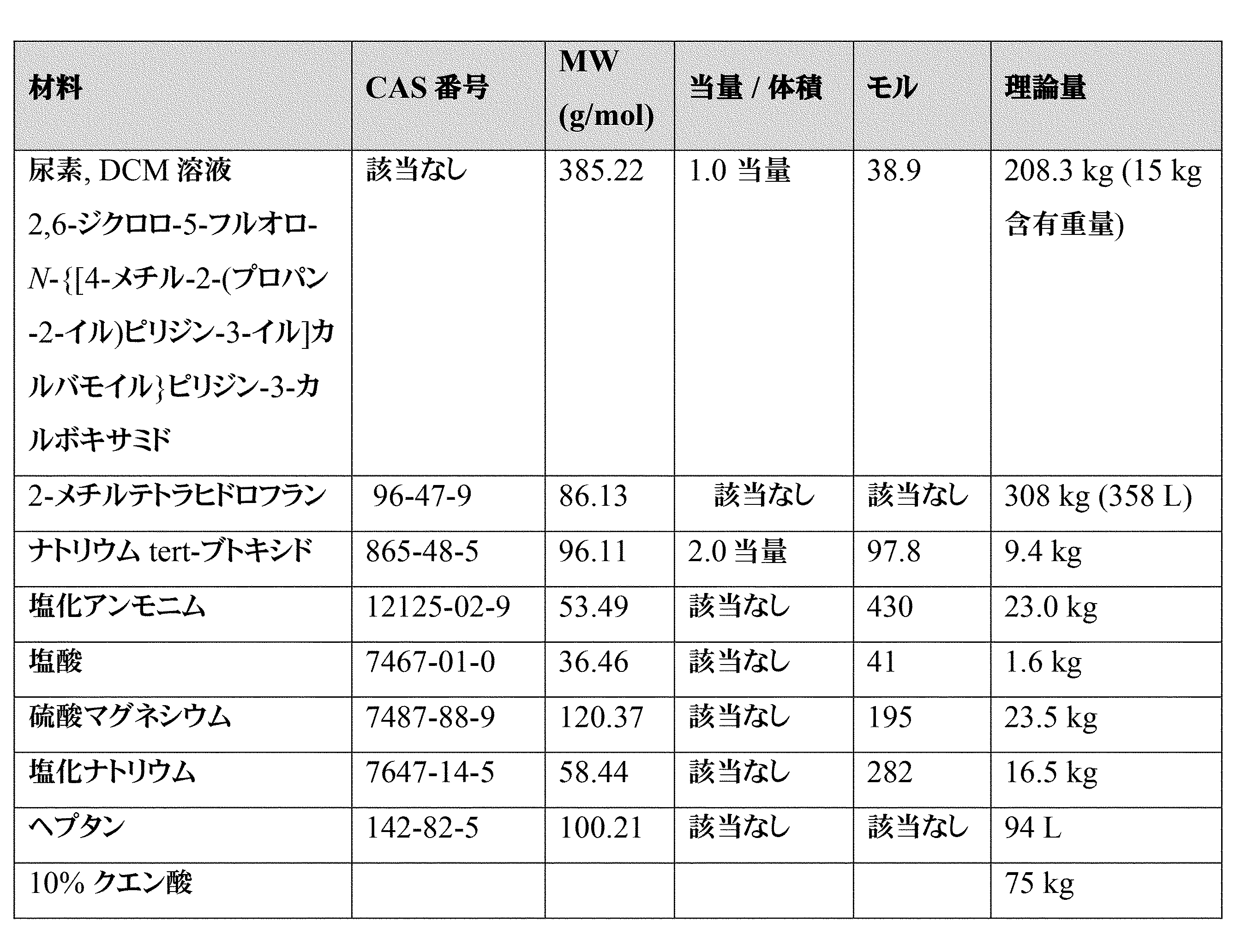
20~25℃の内部温度を維持しながら、2,6-ジクロロ-5-フルオロ-N-{[4-メチル-2-(プロパン-2-イル)ピリジン-3-イル]カルバモイル}ピリジン-3-カルボキサミド(UREA(化合物3))(15kg含有;38.9mol)のジクロロメタン溶液を、真空蒸留を用いて2-MeTHFに溶媒交換した。反応器容積を40Lに調節し、その後、追加の2-MeTHF(105.4kg)を投入した。5~10℃を維持しながら、ナトリウムt-ブトキシド(9.4kg;97.8mol)を添加した。内容物を23℃に温め、3時間撹拌した。その後、内容物を0~5℃に冷却し、DI水60Lの溶液として塩化アンモニウム(23.0kg;430mol)を加えた。混合物を20℃に温め、DI水(15L)を加え、さらに30分間エージングした。撹拌を停止し、層を分離した。水層を除去し、有機層にDI水(81.7L)を加えた。濃HCl(1.5kg)と水(9L)の混合物を調製し、その後、pHが4~5と測定されるまで反応器にゆっくりと加えた。層を分離し、2-MeTHF(42.2kg)を用いて水層を逆抽出した。2つの有機層を一緒にし、10%クエン酸溶液(75kg)、続いて水(81.7L)と飽和NaCl(19.8kg)の混合物で洗浄した。その後、有機層を飽和炭酸水素ナトリウム(75kg)で洗浄し、水性物の目標pH≧7.0を達成した(必要であれば洗浄を繰り返した)。有機層を塩水(54.7kg)で再び洗浄し、次いで硫酸マグネシウム(5kg)上で乾燥させた。混合物を濾過して硫酸マグネシウムを除去し、濾過ベッドを2-MeTHF(49.2kg)で濯いだ。一緒にした濾液及び洗浄液を、40Lの体積にまで真空蒸留した。濃縮溶液を55℃に加熱し、ヘプタン(10~12kg)を曇り点までゆっくりと加えた。2時間かけて溶液を23℃に冷却し、その後2時間かけて、ヘプタン(27.3kg)を加えた。生成物スラリーを20~25℃で3時間エージングし、その後濾過し、2-MeTHF(2.8kg)とヘプタン(9kg)の混合物で洗浄した。生成物を窒素及び真空を用いて乾燥させ、7-クロロ-6-フルオロ-1-(2-イソプロピル-4-メチルピリジン-3-イル)ピリド[2,3-d]ピリミジン-2,4(1H,3H)-ジオン(rac-DIONE(化合物4))の固体を得た。 A dichloromethane solution of 2,6-dichloro-5-fluoro-N-{[4-methyl-2-(propan-2-yl)pyridin-3-yl]carbamoyl}pyridine-3-carboxamide (UREA (compound 3)) (containing 15 kg; 38.9 mol) was solvent exchanged into 2-MeTHF using vacuum distillation while maintaining an internal temperature of 20-25°C. The reactor volume was adjusted to 40 L and then additional 2-MeTHF (105.4 kg) was charged. Sodium t-butoxide (9.4 kg; 97.8 mol) was added while maintaining a temperature of 5-10°C. The contents were warmed to 23°C and stirred for 3 hours. The contents were then cooled to 0-5°C and ammonium chloride (23.0 kg; 430 mol) was added as a solution in 60 L of DI water. The mixture was warmed to 20° C., DI water (15 L) was added, and aged for an additional 30 minutes. Agitation was stopped and the layers were separated. The aqueous layer was removed and DI water (81.7 L) was added to the organic layer. A mixture of concentrated HCl (1.5 kg) and water (9 L) was prepared and then slowly added to the reactor until a pH of 4-5 was measured. The layers were separated and the aqueous layer was back extracted with 2-MeTHF (42.2 kg). The two organic layers were combined and washed with 10% citric acid solution (75 kg), followed by a mixture of water (81.7 L) and saturated NaCl (19.8 kg). The organic layer was then washed with saturated sodium bicarbonate (75 kg) to achieve a target aqueous pH of ≧7.0 (washing was repeated if necessary). The organic layer was washed again with brine (54.7 kg) and then dried over magnesium sulfate (5 kg). The mixture was filtered to remove magnesium sulfate and the filter bed was rinsed with 2-MeTHF (49.2 kg). The combined filtrate and washes were vacuum distilled to a volume of 40 L. The concentrated solution was heated to 55° C. and heptane (10-12 kg) was added slowly to the cloud point. The solution was cooled to 23° C. over 2 hours, after which heptane (27.3 kg) was added over 2 hours. The product slurry was aged at 20-25° C. for 3 hours, then filtered and washed with a mixture of 2-MeTHF (2.8 kg) and heptane (9 kg). The product was dried using nitrogen and vacuum to give a solid of 7-chloro-6-fluoro-1-(2-isopropyl-4-methylpyridin-3-yl)pyrido[2,3-d]pyrimidine-2,4(1H,3H)-dione (rac-DIONE (compound 4)).
工程4
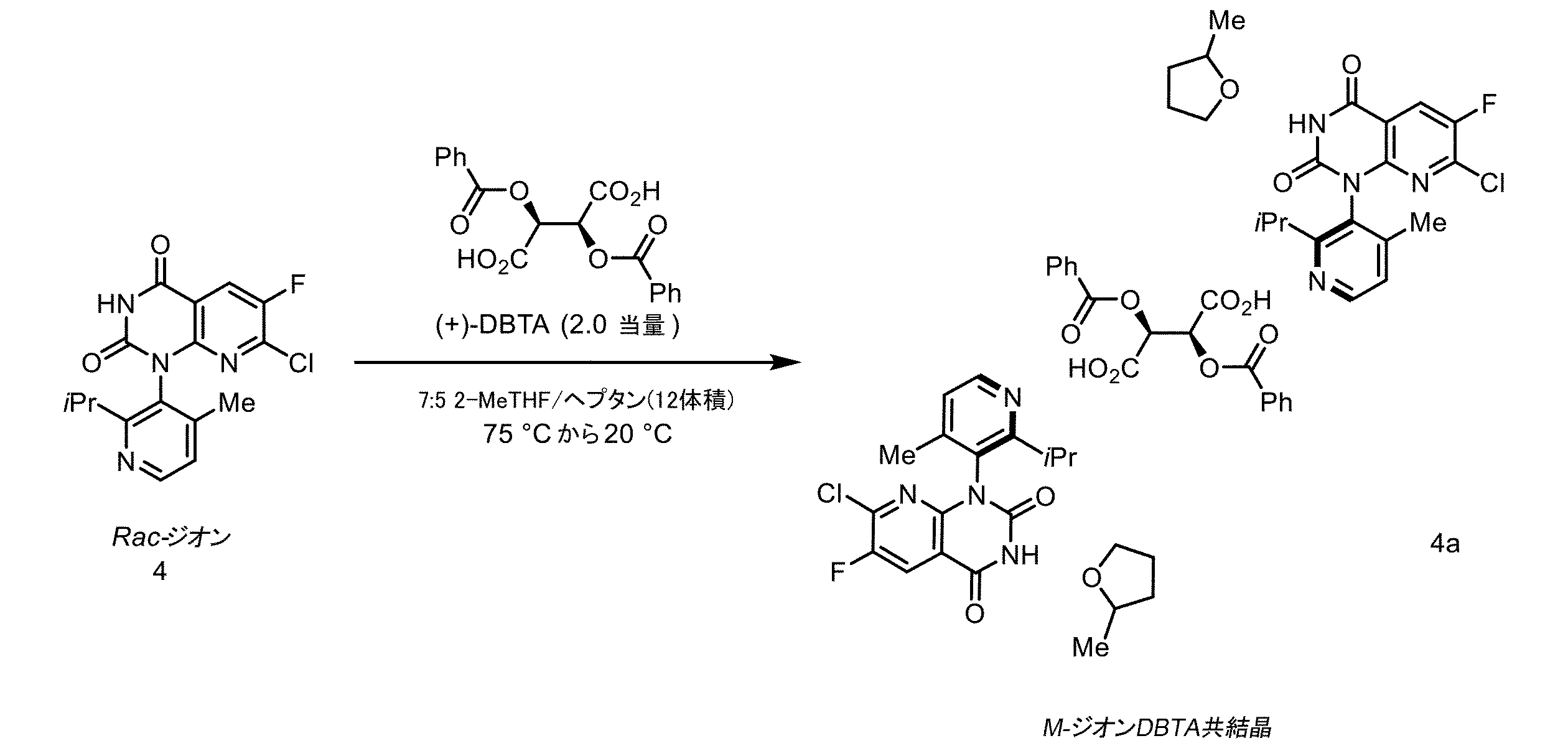
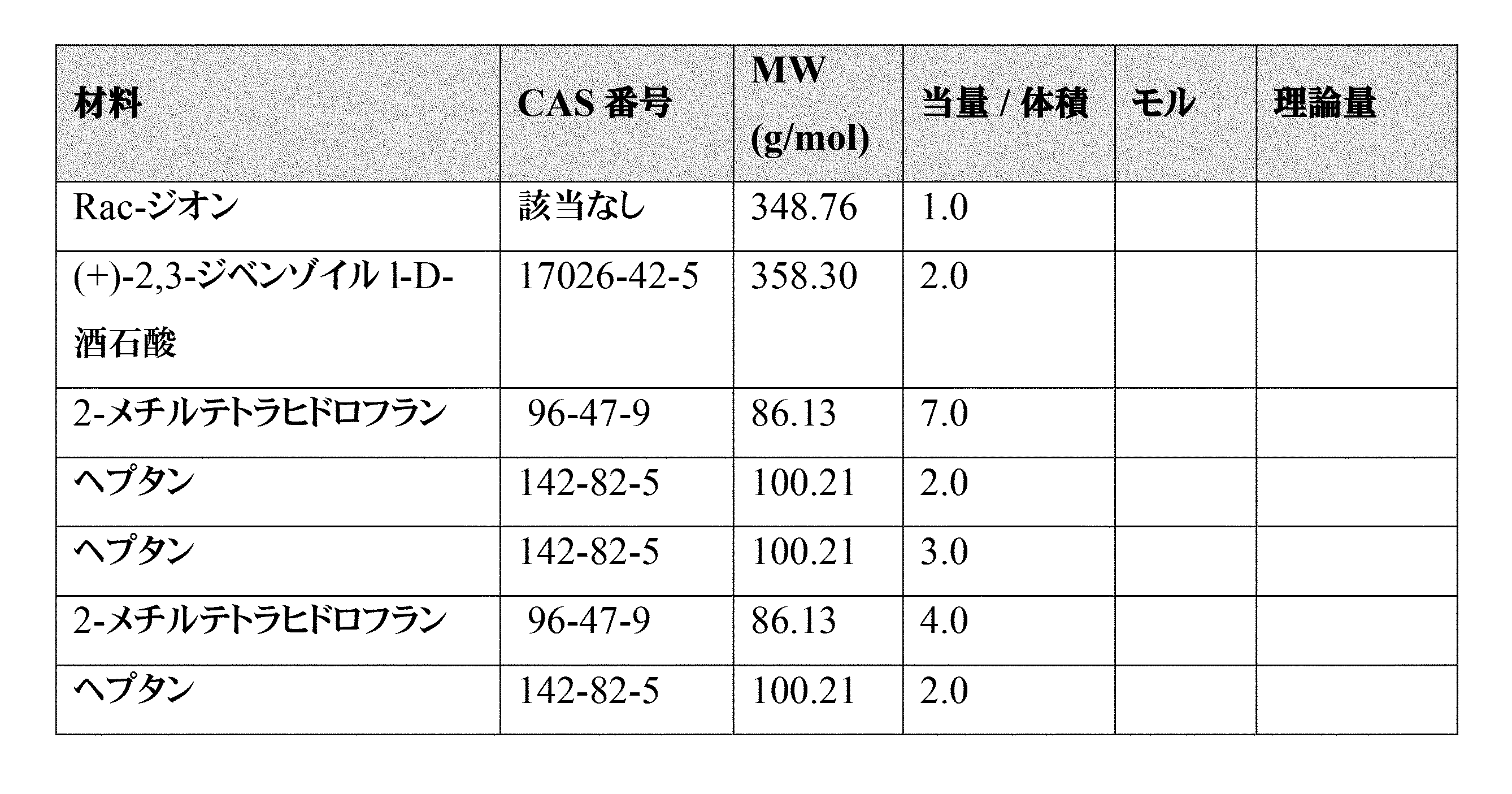
窒素雰囲気下、(+)-2,3-ジベンゾイル-D-酒石酸(2.0当量)とともに、化合物4(1.0当量)の2-メチルテラヒドロフラン(7.0L/kg)中撹拌懸濁液を容器に加えた。2-MeTHFはキラルであるが、ラセミ混合物として使用される。2-MeTHFの異なる鏡像異性体は、共結晶中にランダムに組み込まれる。得られた懸濁液を75℃に温め、完全な溶解が観察されるまで(≦30分)、75℃でエージングした。得られた溶液を75℃で第2の容器中に仕上げ濾過(polish filtered)した。仕上げ濾過した溶液に、内部温度を65℃より高く維持する速度でn-ヘプタン(2.0L/kg)を投入した。その後、溶液を60℃に冷却し、結晶の種(0.01kg/kg)を加え、30分間熟成させた。得られた懸濁液を4時間かけて20℃に冷却し、その後、HPLCによるキラル純度分析のためにサンプリングした。懸濁液にn-ヘプタン(3.0L/kg)を投入し、その後、窒素雰囲気下、20℃で4時間エージングした。懸濁液を濾過し、単離した固体を(2:1)n-ヘプタン:2-メチルテトラヒドロフラン(3.0L/kg)で2回洗浄した。この物質を窒素及び真空下で乾燥させて、M-ジオン:DBTA:Me-THF複合体(化合物4a)を得た。 A stirred suspension of compound 4 (1.0 equiv.) in 2-methylterahydrofuran (7.0 L/kg) was added to the vessel under nitrogen together with (+)-2,3-dibenzoyl-D-tartaric acid (2.0 equiv.). 2-MeTHF is chiral but used as a racemic mixture. The different enantiomers of 2-MeTHF are randomly incorporated into the co-crystal. The resulting suspension was warmed to 75°C and aged at 75°C until complete dissolution was observed (≦30 min). The resulting solution was polish filtered into a second vessel at 75°C. The polish filtered solution was charged with n-heptane (2.0 L/kg) at a rate that maintained the internal temperature above 65°C. The solution was then cooled to 60°C, seeded (0.01 kg/kg), and aged for 30 min. The resulting suspension was cooled to 20°C over 4 hours and then sampled for chiral purity analysis by HPLC. The suspension was charged with n-heptane (3.0 L/kg) and then aged at 20°C under nitrogen for 4 hours. The suspension was filtered and the isolated solid was washed twice with (2:1) n-heptane:2-methyltetrahydrofuran (3.0 L/kg). This material was dried under nitrogen and vacuum to give M-dione:DBTA:Me-THF complex (compound 4a).
工程5


容器Aに、リン酸水素二ナトリウム(21.1kg、2.0当量)のDI水(296.8L、6.3L/kg)中懸濁液を、溶解が観察されるまで(≧30分)撹拌した。容器Bに、M-ジオン:DBTA:Me-THF複合体(組成物4a)[46.9kg(M-ジオンについて補正して25.9kg、1.0当量)]のメチルtert-ブチルエーテル(517.8L、11.0L/kg)中懸濁液を15~30分間撹拌した。容器Aから得られた溶液を容器Bに加え、その後、混合物を3時間超撹拌した。撹拌を停止させ、分離のために二相混合物を30分超放置した。下部の水相を除去し、その後、メチルtert-ブチルエーテル(77.7L、1.7L/kg)で逆抽出した。有機相を容器B中で一緒にし、硫酸マグネシウム(24.8kg、0.529kg/kg)で乾燥させた。容器Bから得られた懸濁液を3時間超撹拌し、その後、容器Cに濾過した。容器Bに、メチルtert-ブチルエーテル(46.9L、1.0L/kg)リンス液を投入し、その後、容器Cに濾過した。容器Cの内容物を10℃に冷却し、その後、真空下で35℃までゆっくりと加温しながら蒸留した。320~350kg(6.8~7.5kg/kg)のメチルtert-ブチルエーテルが回収されるまで蒸留を続けた。容器Cの内容物を20℃に冷却した後、n-ヘプタン(278.7L、5.9L/kg)を1時間かけて投入し、その後、35℃にまでゆっくりと加温しながら真空蒸留した。190~200kg(4.1~4.3kg/kg)のメチルtert-ブチルエーテル及びn-ヘプタン混合物が回収されるまで蒸留を続けた。容器Cの内容物を20℃に冷却した後、2回目のn-ヘプタン(278.7L、5.9L/kg)を1時間かけて投入し、その後、35℃にまでゆっくりと加温しながら真空蒸留した。190~200kg(4.1~4.3kg/kg)のメチルtert-ブチルエーテル及びn-ヘプタン混合物が回収されるまで蒸留を続けた。容器Cの内容物を20℃に冷却した後、3回目のn-ヘプタン(195.9L、4.2L/kg)を1時間かけて投入し、その後、GCによる溶媒組成分析用にサンプリングした。容器Cの懸濁液を1時間超撹拌し続けた。懸濁液を濾過し、その後、容器Cからのn-ヘプタン(68.6L、1.5L/kg)リンス液で洗浄した。単離された固体を50℃で乾燥させ、試料を貯蔵適合性のために提出した。7-クロロ-6-フルオロ-(1M)-1-[4-メチル-2-(プロパン-2-イル)ピリジン-3-イル]ピリド[2,3-d]ピリミジン-2,4(1H,3H)-ジオン(M-DIONE)の化合物5Mを得た。 In vessel A, a suspension of disodium hydrogen phosphate (21.1 kg, 2.0 equiv.) in DI water (296.8 L, 6.3 L/kg) was stirred until dissolution was observed (>30 min). In vessel B, a suspension of M-dione:DBTA:Me-THF complex (composition 4a) [46.9 kg (25.9 kg corrected for M-dione, 1.0 equiv.)] in methyl tert-butyl ether (517.8 L, 11.0 L/kg) was stirred for 15-30 min. The resulting solution from vessel A was added to vessel B, after which the mixture was stirred for >3 h. Agitation was stopped and the biphasic mixture was allowed to stand for >30 min for separation. The lower aqueous phase was removed and then back extracted with methyl tert-butyl ether (77.7 L, 1.7 L/kg). The organic phases were combined in vessel B and dried over magnesium sulfate (24.8 kg, 0.529 kg/kg). The resulting suspension from vessel B was stirred for >3 hours and then filtered into vessel C. Vessel B was charged with a methyl tert-butyl ether (46.9 L, 1.0 L/kg) rinse and then filtered into vessel C. The contents of vessel C were cooled to 10° C. and then distilled under vacuum with slow warming to 35° C. Distillation was continued until 320-350 kg (6.8-7.5 kg/kg) of methyl tert-butyl ether was collected. The contents of vessel C were cooled to 20° C. and then charged with n-heptane (278.7 L, 5.9 L/kg) over 1 hour and then vacuum distilled with slow warming to 35° C. Distillation was continued until 190-200 kg (4.1-4.3 kg/kg) of methyl tert-butyl ether and n-heptane mixture was collected. The contents of vessel C were cooled to 20° C. and then charged with a second charge of n-heptane (278.7 L, 5.9 L/kg) over 1 hour, followed by vacuum distillation with slow warming to 35° C. Distillation was continued until 190-200 kg (4.1-4.3 kg/kg) of methyl tert-butyl ether and n-heptane mixture was collected. The contents of vessel C were cooled to 20° C. and then charged with a third charge of n-heptane (195.9 L, 4.2 L/kg) over 1 hour, followed by sampling for solvent composition analysis by GC. The suspension in vessel C was allowed to continue stirring for >1 hour. The suspension was filtered and then washed with n-heptane (68.6 L, 1.5 L/kg) rinse from vessel C. The isolated solid was dried at 50°C and a sample was submitted for storage suitability. Compound 5M of 7-chloro-6-fluoro-(1M)-1-[4-methyl-2-(propan-2-yl)pyridin-3-yl]pyrido[2,3-d]pyrimidine-2,4(1H,3H)-dione (M-DIONE) was obtained.
上で強調した第1世代のプロセスでは、200+kgのrac-ジオン出発物質(化合物5)では規模の対応ができた。このプロセスでは、結晶化に熱力学的に安定なrac-ジオン結晶形態(これは低い溶解度を示す)の種を加えることは、バッチの失敗を引き起こすであろう。我々のその後の研究に基づき、我々はヘプタン投入スケジュールを調節することによる、DBTA当量の増加、及び種の添加温度の低下が、プロセスの頑健性を改善することを見出した。改良された方法は熱力学的に安定なrac-ジオン結晶形態の存在に対して抵抗性があり、アトロプ異性体分離の成功を促進する。その後のバッチは、大規模製造のために、改善されたプロセスを組み込むであろう。 The first generation process highlighted above was scalable to 200+ kg of rac-dione starting material (compound 5). In this process, seeding the crystallization with the thermodynamically stable rac-dione crystal form (which exhibits low solubility) would cause batch failure. Based on our subsequent work, we found that increasing the DBTA equivalents and decreasing the seed addition temperature by adjusting the heptane dosing schedule improved process robustness. The improved method is tolerant to the presence of the thermodynamically stable rac-dione crystal form, facilitating successful atropisomer separation. Subsequent batches will incorporate the improved process for large-scale production.
工程6


7-クロロ-6-フルオロ-(1M)-1-[4-メチル-2-(プロパン-2-イル)ピリジン-3-イル]ピリド[2,3-d]ピリミジン-2,4(1H,3H)-ジオン(M-DIONE)(3.7kg;9.8mol)を10.5kgのトルエンと反応器(A)中で一緒にし、設定点を45℃に維持しながら、油状になるまで蒸留して水を除去した。トルエン(21kg)を残渣に加え、混合物を40~45℃で30分間撹拌した。内容物を22℃に冷却し、その後、塩化ホスホリル(1.8kg;11.7mol)を加えた。混合物を0~5℃に冷却した後、温度を5℃未満に維持しながら、N,N-ジイソプロピルエチルアミン(2.5kg;19.34mol)を加えた。溶液を22℃で3時間エージングした。別の反応器(B)中で、(s)-1-boc-3-メチルピペラジン(2.21kg;10.8mol)及びN,N-ジイソプロピルエチルアミン(1.26kg;9.75mol)をトルエン(6kg)中で一緒にし、<25℃を維持しながら反応器(A)に投入した。反応混合物を22℃で15分間エージングし、その後、温度<25℃を維持しながら、水(12.9L)中の炭酸水素ナトリウム(973g)でクエンチした。混合物を30分間撹拌し、その後、1時間撹拌し続けながらDCM(36.8kg)を加えた。層を分離することが可能となり、下部の有機層を反応器(C)に排出した。反応器(A)中の水層を、DCM(18.4kg)を用いて逆抽出し、一緒にした有機層を塩水溶液(6.0kgのNaCl;16.5kgのDI水)で洗浄した。内部温度を45~55℃に維持ながら、有機層を大気圧下で蒸留した。蒸留中にDCMを交換して、溶液を共沸乾燥させる。蒸留後、DCMを用いて溶液体積を19Lに調節した。溶液を30℃に冷却し、仕上げ濾過した。濾液に酢酸エチル(8.5kg)を加え、その後、11~13kgが受器に回収されるまで大気圧で蒸留した。溶液に30gの真正生成物の種を加え、25~30℃で1時間エージングし、その後、大気圧下、45~55℃の内部温度で、8.2kgの留出物が回収されるまでさらに蒸留した。スラリーを22℃に冷却し、一晩エージングさせた後、さらに0~5℃に冷却した。生成物を濾過により回収し、酢酸エチル(各4.2kg)を用いて2回洗浄した。ケーキを窒素及び真空下で乾燥させて、tert-ブチル(3S)-4-{7-クロロ-6-フルオロ-(1M)-1-[4-メチル-2-(プロパン-2-イル)ピリジン-3-イル]-2-オキソ-1,2-ジヒドロピリド[2,3-d]ピリミジン-4-イル}-3-メチルピペラジン-1-カルボキシレート(化合物6、PIPAZOLINE)を得た。
7-Chloro-6-fluoro-(1M)-1-[4-methyl-2-(propan-2-yl)pyridin-3-yl]pyrido[2,3-d]pyrimidine-2,4(1H,3H)-dione (M-DIONE) (3.7 kg; 9.8 mol) was combined with 10.5 kg toluene in a reactor (A) and distilled to remove water until an oil was obtained while maintaining the set point at 45°C. Toluene (21 kg) was added to the residue and the mixture was stirred at 40-45°C for 30 minutes. The contents were cooled to 22°C, after which phosphoryl chloride (1.8 kg; 11.7 mol) was added. The mixture was cooled to 0-5°C, after which N,N-diisopropylethylamine (2.5 kg; 19.34 mol) was added while maintaining the temperature below 5°C. The solution was aged at 22°C for 3 hours. In a separate reactor (B), (s)-1-boc-3-methylpiperazine (2.21 kg; 10.8 mol) and N,N-diisopropylethylamine (1.26 kg; 9.75 mol) were combined in toluene (6 kg) and charged to reactor (A) while maintaining the temperature at <25° C. The reaction mixture was aged at 22° C. for 15 minutes and then quenched with sodium bicarbonate (973 g) in water (12.9 L) while maintaining the temperature at <25° C. The mixture was stirred for 30 minutes and then DCM (36.8 kg) was added with continued stirring for 1 hour. The layers were allowed to separate and the lower organic layer was drained into reactor (C). The aqueous layer in reactor (A) was back extracted with DCM (18.4 kg) and the combined organic layers were washed with a brine solution (6.0 kg NaCl; 16.5 kg DI water). The organic layer was distilled at atmospheric pressure while maintaining an internal temperature of 45-55°C. DCM was exchanged during the distillation to azeotropically dry the solution. After distillation, the solution volume was adjusted to 19 L with DCM. The solution was cooled to 30°C and polish filtered. Ethyl acetate (8.5 kg) was added to the filtrate and then distilled at atmospheric pressure until 11-13 kg was collected in the receiver. The solution was seeded with 30 g of authentic product and aged at 25-30°C for 1 hour and then further distilled at atmospheric pressure at an internal temperature of 45-55°C until 8.2 kg of distillate was collected. The slurry was cooled to 22°C and aged overnight before being further cooled to 0-5°C. The product was collected by filtration and washed twice with ethyl acetate (4.2 kg each). The cake was dried under nitrogen and vacuum to give tert-butyl (3S)-4-{7-chloro-6-fluoro-(1M)-1-[4-methyl-2-(propan-2-yl)pyridin-3-yl]-2-oxo-1,2-dihydropyrido[2,3-d]pyrimidin-4-yl}-3-methylpiperazine-1-carboxylate (
工程7


反応器に、脱気したジオキサン(74.2kg)、tert-ブチル(3S)-4-{7-クロロ-6-フルオロ-(1M)-1-[4-メチル-2-(プロパン-2-イル)ピリジン-3-イル]-2-オキソ-1,2-ジヒドロピリド[2,3-d]ピリミジン-4-イル}-3-メチルピペラジン-1-カルボキシレート(化合物6、ピパゾリン)(24.0kg、45.2mol)、酢酸カリウム(22.2kg、45.2mol)、及び(dppf)PdCl2(0.74kg、1.01mol)を加えた。反応器は窒素ガスで不活性化された。酸素含有量が<500mg/Lになるまで、溶液に窒素ガスを注入した。反応物を87.5℃に加熱した。酸素含有率<500mg/Lの、トリフルオロ(2-フルオロ-6-ヒドロキシフェニル)ホウ酸カリウム(12.6kg、54.3mol)の脱気ジオキサン(49.4kg)及び脱気水(14.4kg)中溶液を、82.5℃±7.5℃の内部温度を維持しながら反応物に移した。反応物を87.5℃±1.5℃に調節し、75分間±15分間撹拌した。1.0MのEDTA溶液(47.3kg)、続いて水(40.1kg)を、85℃±5℃の内部温度を維持しながら反応器に投入した。反応物を>2時間かけて20℃±3℃に冷却し、>16時間撹拌した。反応物を濾過し、粗固体を水(3×120kg)で濯いだ。固体をヘプタン(28.8kg)と2-プロパノール(33.1kg)の混合物で濯ぎ、その後、<50℃で>10時間乾燥させた。清浄な反応器に粗固体及びジクロロメタン(240kg)を加えた。内容物を20℃±5℃で>30分間撹拌した。反応器に、Si-チオール(144kg)及びジクロロメタン(14.9kg)を加えた。反応物を20℃±5℃で18時間撹拌した。反応物を濾過し、ジクロロメタン(84kg)で濯いだ。溶液を蒸留し、溶媒を2-プロパノールに交換した。反応物を60℃±3℃に加熱し、反応温度を60℃±3℃に維持しながらヘプタン(108kg)を投入した。反応物を45分間撹拌し、その後冷却し、20℃±5℃で2.5時間撹拌した。反応物を濾過し、50%v/vのヘプタン/2-プロパノール(61.9kg)で濯いだ。単離した固体を<50℃で12時間乾燥させ、tert-ブチル(3S)-4-{6-フルオロ-7-(2-フルオロ-6-ヒドロキシフェニル)-(1M)-1-[4-メチル-2-(プロパン-2-イル)ピリジン-3-イル]-2-オキソ-1,2-ジヒドロピリド[2,3-d]ピリミジン-4-イル}-3-メチルピペラジン-1-カルボキシレート(化合物7、BIARYL)を得た。
To the reactor was added degassed dioxane (74.2 kg), tert-butyl (3S)-4-{7-chloro-6-fluoro-(1M)-1-[4-methyl-2-(propan-2-yl)pyridin-3-yl]-2-oxo-1,2-dihydropyrido[2,3-d]pyrimidin-4-yl}-3-methylpiperazine-1-carboxylate (
工程8
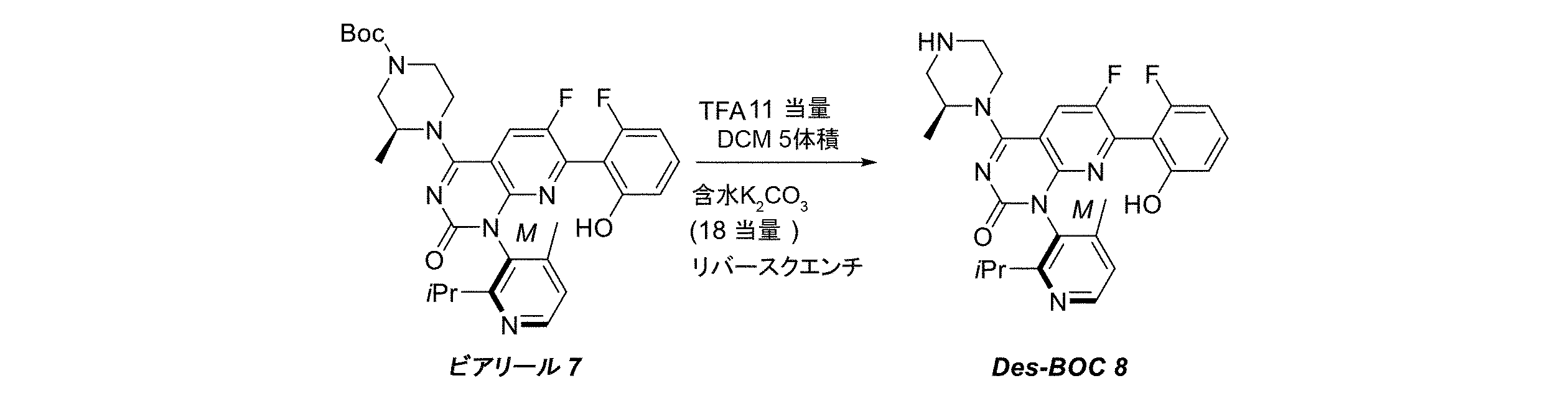

反応器にtert-ブチル(3S)-4-{6-フルオロ-7-(2-フルオロ-6-ヒドロキシフェニル)-(1M)-1-[4-メチル-2-(プロパン-2-イル)ピリジン-3-イル]-2-オキソ-1,2-ジヒドロピリド[2,3-d]ピリミジン-4-イル}-3-メチルピペラジン-1-カルボキシレート(化合物7、BIARYL)(2.75kg、5.27mol)、DCM(13.7L)及びTFA(5.67kg、49.7mol)を加えた。反応物を20±5℃で8~16時間撹拌した。第2の反応器に、炭酸カリウム(11.24kg)、水(54.8L)、及びメタノール(13.7L)を加えて、均質な溶液を生成させた。反応混合物を炭酸カリウム溶液に2時間かけて加えた。混合物を20±5℃でさらに12時間撹拌した。得られたスラリーを濾過し、水(2×27.5L)で濯いだ。湿潤ケーキを24時間乾燥させて、6-フルオロ-7-(2-フルオロ-6-ヒドロキシフェニル)-4-[(2S)-2-メチルピペラジン-1-イル]-(1M)-1-[4-メチル-2-(プロパン-2-イル)ピリジン-3-イル]ピリド[2,3-d]ピリミジン-2(1H)-オン(化合物8、DESBOC)を得た。
To the reactor was added tert-butyl (3S)-4-{6-fluoro-7-(2-fluoro-6-hydroxyphenyl)-(1M)-1-[4-methyl-2-(propan-2-yl)pyridin-3-yl]-2-oxo-1,2-dihydropyrido[2,3-d]pyrimidin-4-yl}-3-methylpiperazine-1-carboxylate (
工程9


6-フルオロ-7-(2-フルオロ-6-ヒドロキシフェニル)-4-[(2S)-2-メチルピペラジン-1-イル]-(1M)-1-[4-メチル-2-(プロパン-2-イル)ピリジン-3-イル]ピリド[2,3-d]ピリミジン-2(1H)-オン(化合物8、DESBOC)(156.25g)にN-メチルピロリジノン(625mL)を加え、周囲温度で撹拌した。<30℃の内部温度を維持しながら、得られた溶液に塩化アクリロイル(36.29g;401.0mmol)を加えた。内容物を25℃で2時間撹拌した。別の反応器に、リン酸二ナトリウム(175.1g;1234mmol)のDI水(3.1L)溶液を調製した。その後、リン酸二ナトリウム溶液を含有する反応器に、25℃で、>2時間かけて粗生成物溶液を移した。添加の途中でスラリーを45℃に加熱し、完全に加えた後、同じ温度で2時間エージングした。混合物を25℃に冷却し、4時間エージングした後、真空濾過により固体を回収した。固体を水で2回洗浄し(各1.5L)、生成物を窒素及び真空下で乾燥させて、生成物6-フルオロ-7-(2-フルオロ-6-ヒドロキシフェニル)-(1M)-1-[4-メチル-2-(プロパン-2-イル)ピリジン-3-イル]-4-[(2S)-2-メチル-4-(プロプ-2-エノイル)ピペラジン-1-イル]ピリド[2,3-d]ピリミジン-2(1H)-オンを得た(粗化合物9)。4
To 6-fluoro-7-(2-fluoro-6-hydroxyphenyl)-4-[(2S)-2-methylpiperazin-1-yl]-(1M)-1-[4-methyl-2-(propan-2-yl)pyridin-3-yl]pyrido[2,3-d]pyrimidin-2(1H)-one (
工程10


6-フルオロ-7-(2-フルオロ-6-ヒドロキシフェニル)-(1M)-1-[4-メチル-2-(プロパン-2-イル)ピリジン-3-イル]-4-[(2S)-2-メチル-4-(プロプ-2-エノイル)ピペラジン-1-イル]ピリド[2,3-d]ピリミジン-2(1H)-オン(粗化合物9)(142.33g;253.9mmol)にエタノール(996mL)及び水(270mL)を加えた。酢酸(21.8ml;380.8mmol)を加え、混合物を75℃に加熱して溶液を生成し、これを清浄な反応器中に仕上げ濾過した。溶液を45℃に冷却し、その後、内部温度を>40℃に維持しながら、水(1067mL)を加えた。溶液に真正化合物9の種を加え、得られた混合物を30分間エージングした。その後、水(1138mL)を2時間かけて加えた。混合物を25℃に冷却し、8時間エージングし、その後、固体を真空濾過によって回収し、エタノール(355.8mL)及び水(711.6mL)の混合物を使用して洗浄した。真空及び窒素を使用して固体を乾燥させ、6-フルオロ-7-(2-フルオロ-6-ヒドロキシフェニル)-(1M)-1-[4-メチル-2-(プロパン-2-イル)ピリジン-3-イル]-4-[(2S)-2-メチル-4-(プロプ-2-エノイル)ピペラジン-1-イル]ピリド[2,3-d]ピリミジン-2(1H)-オン(化合物9)を得た。
To 6-fluoro-7-(2-fluoro-6-hydroxyphenyl)-(1M)-1-[4-methyl-2-(propan-2-yl)pyridin-3-yl]-4-[(2S)-2-methyl-4-(prop-2-enoyl)piperazin-1-yl]pyrido[2,3-d]pyrimidin-2(1H)-one (crude compound 9) (142.33 g; 253.9 mmol) was added ethanol (996 mL) and water (270 mL). Acetic acid (21.8 ml; 380.8 mmol) was added and the mixture was heated to 75°C to produce a solution which was polish filtered into a clean reactor. The solution was cooled to 45°C, after which water (1067 mL) was added while maintaining an internal temperature >40°
工程A1 反応スキーム及び投入表
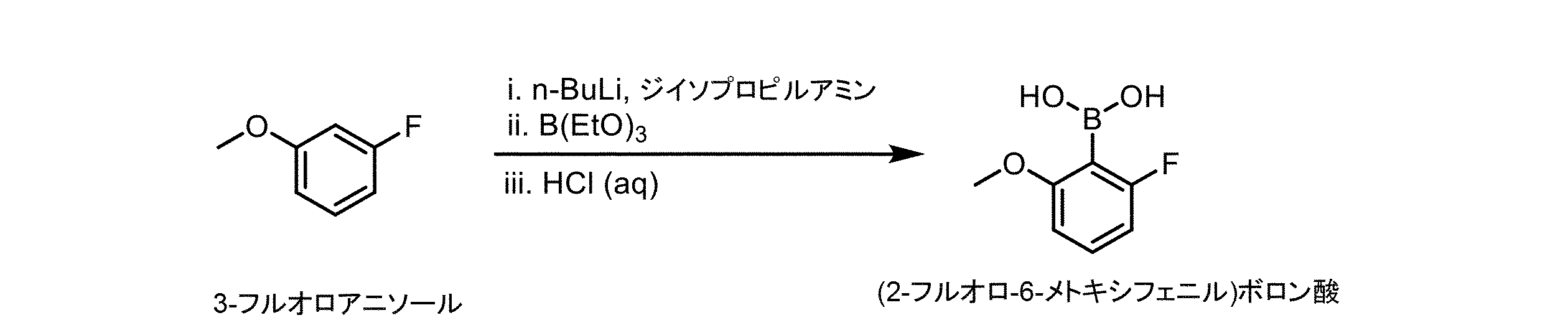

反応器AにTHF(6体積)及びジイソプロピルアミン(1.4当量)を投入した。得られた溶液を-70℃に冷却し、n-BuLi(ヘキサン中2.5M、1.5当量)をゆっくりと加えた。添加完了後、3-フルオロアニソール(1.0当量)のTHF(6体積)溶液をゆっくりと加え、-70℃で5分間保持した。B(EtO)3(2.0当量)をゆっくり加え、-70℃で10分間保持した。反応混合物は、2NのHClでクエンチした。クエンチした反応混合物をMTBE(3×4体積)で抽出した。一緒にした有機相を1.5~3の総体積に濃縮した。ヘプタン(7~9体積)を滴下し、混合物を0~10℃に冷却し、3時間撹拌した。混合物を濾過し、ヘプタン(1.5体積)で濯いだ。固体を窒素下、<30℃で乾燥させ、(2-フルオロ-6-メトキシフェニル)ボロン酸を得た。 Reactor A was charged with THF (6 vol) and diisopropylamine (1.4 eq). The resulting solution was cooled to -70°C and n-BuLi (2.5 M in hexanes, 1.5 eq) was added slowly. After addition was complete, a solution of 3-fluoroanisole (1.0 eq) in THF (6 vol) was added slowly and held at -70°C for 5 min. B(EtO)3 (2.0 eq) was added slowly and held at -70°C for 10 min. The reaction mixture was quenched with 2N HCl. The quenched reaction mixture was extracted with MTBE (3 x 4 vol). The combined organic phase was concentrated to a total volume of 1.5-3. Heptane (7-9 vol) was added dropwise and the mixture was cooled to 0-10°C and stirred for 3 h. The mixture was filtered and rinsed with heptane (1.5 vol). The solid was dried under nitrogen at <30°C to give (2-fluoro-6-methoxyphenyl)boronic acid.
工程A2 反応スキーム及び投入表


反応器Aに、ジクロロメタン(4体積)及び2-フルオロ-6-メトキシ-4-メチルフェニルボロン酸(1当量)を加えた。反応混合物を-30℃に冷却し、1.5BBr3(1.5当量)を滴下した。添加が完了したならば、混合物を25℃に加温し、2時間撹拌した。反応混合物を氷冷(0~5℃)水(10体積)に入れてクエンチした。MTBE(10体積)を加え、混合物を25℃に温め、1~2時間、又はすべての固体が溶解するまで撹拌した。水相を分離し、MTBE(3体積)で抽出した。一緒にした有機抽出物を水(3体積)で洗浄し、その後、全体が1容量になるまで濃縮した。ヘプタン(10体積)を混合物に加え、2時間撹拌した。得られた生成物を濾過により単離し、<30℃で乾燥させて(2-フルオロ-6-ヒドロキシフェニル)ボロン酸を得た。 To reactor A was added dichloromethane (4 vol) and 2-fluoro-6-methoxy-4-methylphenylboronic acid (1 eq). The reaction mixture was cooled to -30°C and 1.5BBr3 (1.5 eq) was added dropwise. Once the addition was complete, the mixture was warmed to 25°C and stirred for 2 hours. The reaction mixture was quenched into ice-cold (0-5°C) water (10 vol). MTBE (10 vol) was added and the mixture was warmed to 25°C and stirred for 1-2 hours or until all solids were dissolved. The aqueous phase was separated and extracted with MTBE (3 vol). The combined organic extracts were washed with water (3 vol) and then concentrated to 1 volume overall. Heptane (10 vol) was added to the mixture and stirred for 2 hours. The resulting product was isolated by filtration and dried at <30°C to give (2-fluoro-6-hydroxyphenyl)boronic acid.
工程A3 反応スキーム及び投入表


工程A3
反応器(反応器A)中で、フッ化カリウム(21.0kg;20.87mol)に水(28L)を加え、内容物を30分間撹拌した。別の反応器(反応器B)に、(2-フルオロ-6-ヒドロキシフェニル)ボロン酸(14.00kg、89.79mol)、続いてアセトニトリル(206.1kg)及びクエン酸(30.94kg;147.26mol)を25℃で投入した。反応器Aの内容物を25℃で反応器Bに加え、その温度で10時間撹拌した。反応混合物をセライトのベッド(7.0kg)を通して濾過し、アセトニトリル(42kg)で濯いだ。濾液にイソプロパノール(56kg)を加え、その後、真空下、<35℃の温度で蒸留し、反応器への蒸留体積をイソプロパノールで置き換え、必要に応じて繰り返して、アセトニトリルからイソプロパノールへの溶媒交換を完了させた。スラリーを15℃に冷却し、1時間エージング後、濾過し、28kgのイソプロパノールで洗浄した。ケーキを真空及び窒素を用いて乾燥させ、包装して化合物A3を得た。
Step A3
Water (28 L) was added to potassium fluoride (21.0 kg; 20.87 mol) in a reactor (Reactor A) and the contents were stirred for 30 minutes. A separate reactor (Reactor B) was charged with (2-fluoro-6-hydroxyphenyl)boronic acid (14.00 kg, 89.79 mol) followed by acetonitrile (206.1 kg) and citric acid (30.94 kg; 147.26 mol) at 25° C. The contents of Reactor A were added to Reactor B at 25° C. and stirred at that temperature for 10 hours. The reaction mixture was filtered through a bed of Celite (7.0 kg) and rinsed with acetonitrile (42 kg). Isopropanol (56 kg) was added to the filtrate, which was then distilled under vacuum at a temperature of <35° C. to replace the distilled volume to the reactor with isopropanol and repeated as necessary to complete the solvent exchange from acetonitrile to isopropanol. The slurry was cooled to 15° C. and aged for 1 hour, then filtered and washed with 28 kg of isopropanol. The cake was dried using vacuum and nitrogen and packaged to give compound A3.
M-ジオン化合物5の分割
M-ジオン中間体のクロマトグラフィーによる分割
化合物4からM-ジオンを単離するために、多数のキラルクロマトグラフィー技術及び方法が使用された。その技術及び固定相は当技術分野で周知であり、表1に概説されている。


SFC、HPLC、及びSMB技術は当技術分野で周知であり、Chiralpak(登録商標)固定相は、Fisher Scientific及び株式会社ダイセルなどの商業的供給源から市販されている。 SFC, HPLC, and SMB techniques are well known in the art, and Chiralpak® stationary phases are commercially available from commercial sources such as Fisher Scientific and Daicel Corporation.
しかしながら、M-ジオン(化合物5)を単離するためのより効率的な方法を開発することが望ましい。 However, it would be desirable to develop a more efficient method for isolating M-dione (compound 5).
典型的な分割
本発明は、M/P-ジオンラセミ体(化合物4)のための実行可能な典型的な分割法の開発に関する。
Exemplary Resolution The present invention relates to the development of a viable exemplary resolution method for the M/P-dione racemate (compound 4).
合計100回の共結晶スクリーニング実験を行い、3つの可能性があるジオンの共結晶を同定した。残留固体中のM/P-ジオンの最大面積比及び上清中の最小面積比に基づき、分割のためのキラル試薬として(+)-2、3-ジベンゾイル-D-酒石酸(DBTA)を選択した。 A total of 100 cocrystal screening experiments were performed and three potential cocrystals of diones were identified. Based on the highest area ratio of M/P-dione in the residual solid and the lowest area ratio in the supernatant, (+)-2,3-dibenzoyl-D-tartaric acid (DBTA) was selected as the chiral reagent for resolution.
100回の共結晶スクリーニング実験及び20回以上の溶媒スクリーニングからの結果によれば、2-MeTHF/n-ヘプタンが、他の溶媒系よりも良好な分割結果を提供することが見出された。2-MeTHF及びn-ヘプタンの異なる比率での、M-ジオン共結晶とP-ジオン共結晶の溶解度の結果に基づき、分割のための最適溶媒組成として2-MeTHF/n-ヘプタン(1.4:1、v/v)を選択した。 According to the results from 100 cocrystal screening experiments and over 20 solvent screenings, 2-MeTHF/n-heptane was found to provide better resolution results than other solvent systems. Based on the solubility results of M-dione cocrystals and P-dione cocrystals in different ratios of 2-MeTHF and n-heptane, 2-MeTHF/n-heptane (1.4:1, v/v) was selected as the optimal solvent composition for resolution.
キラル分解の結晶化過程で、ジオンラセミ体又はM/P-ジオンへの可能な形態変換を見出すために、2-MeTHF/n-ヘプタン(1.4:1、体積/体積)中で、M-ジオン共結晶、P-ジオン共結晶、M+P-ジオン共結晶混合物(1:1、重量/重量)、ジオンラセミ体及びDBTAの溶解度を異なる温度で決定した。異なる温度で7日間、M-ジオン共結晶及びP-ジオン共結晶について形態変化は観察されなかった。しかしながら、M+P-ジオン共結晶混合物(1:1、重量/重量)の混合物を異なる温度で7日間撹拌した後では、ジオンラセミ体C型が得られた。ジオンラセミ体D型(20及び30℃)又はジオンラセミ体C型(40、50、60及び65℃)が、対応する温度で7日間、ジオンラセミ体を攪拌した後に観察された。全ての温度で、DBTAの溶解度は、約100mg/mLであることが観察された。 In order to find out the possible morphological transformation to dione racemate or M/P-dione during the crystallization process of chiral resolution, the solubility of M-dione cocrystal, P-dione cocrystal, M+P-dione cocrystal mixture (1:1, wt/wt), dione racemate and DBTA was determined at different temperatures in 2-MeTHF/n-heptane (1.4:1, vol/vol). No morphological change was observed for M-dione cocrystal and P-dione cocrystal at different temperatures for 7 days. However, dione racemate form C was obtained after stirring the mixture of M+P-dione cocrystal mixture (1:1, wt/wt) at different temperatures for 7 days. Dione racemate form D (20 and 30°C) or dione racemate form C (40, 50, 60 and 65°C) were observed after stirring the dione racemate at the corresponding temperatures for 7 days. At all temperatures, the solubility of DBTA was observed to be approximately 100 mg/mL.
分割プロセスをさらに最適化するために、M/P-ジオン共結晶の三元相図を平衡溶解度の結果に基づいて描いたが、恐らく、M-ジオン共結晶とP-ジオン共結晶の両方が存在する場合にラセミ体C型が結晶化できるため、共晶点は得られなかった。M/P-Dioneの別の三元相図を平衡溶解度の結果に基づいて描いたが、恐らく、M-ジオン及びP-ジオンの両方が存在する場合にジオンラセミ体C型又はD型が結晶化できるため、共晶点は得られなかった。 To further optimize the resolution process, a ternary phase diagram for M/P-dione cocrystal was drawn based on the equilibrium solubility results, but no eutectic point was obtained, presumably because racemic Form C can crystallize in the presence of both M-dione and P-dione cocrystals. Another ternary phase diagram for M/P-Dione was drawn based on the equilibrium solubility results, but no eutectic point was obtained, presumably because dione racemic Forms C or D can crystallize in the presence of both M-dione and P-dione.
要約すると、ジオンラセミ体の分割用として、キラル試薬(DBTA)及び溶媒系(2-MeTHF/n-ヘプタン(1.4:1、体積/体積))を同定した。本分割試薬及び溶媒系を使用する小規模結晶化プロセスは、M-ジオンについて収率39%及びee純度99%を達成できた。さらに、スクリーニング実験中にジオンラセミ体の多型を観察し、調査した。 In summary, a chiral reagent (DBTA) and solvent system (2-MeTHF/n-heptane (1.4:1, vol/vol)) were identified for the resolution of the dione racemate. A small-scale crystallization process using this resolution reagent and solvent system was able to achieve a yield of 39% and an ee purity of 99% for M-dione. Furthermore, polymorphism of the dione racemate was observed and investigated during screening experiments.
2. スクリーニング実験
2.1 共結晶スクリーニング
20種の酸及び5種の溶媒系を用いて、合計100回の共結晶スクリーニング実験を行った(結果を表2-1にまとめた)。一般に、XRPDの単離前に、ジオンラセミ体及び酸を1:1のモル比で混合し、RTで3日間撹拌した。XRPDの結果に基づき、ジオンラセミ体の共結晶を形成する可能性のある3種の酸、(1S)-(-)-カンファン酸(図2-2)、(+)-2、3-ジベンゾイル-D-酒石酸(図2-3)及びD-(+)-リンゴ酸(図2-4))を含む酸が特定された。また、XRPDの結果に基づき、4種の新しい遊離塩基結晶形態が得られ、これをジオンラセミ体B~E型とした。
2. Screening Experiments 2.1 Co-crystal Screening A total of 100 co-crystal screening experiments were performed using 20 acids and 5 solvent systems (results are summarized in Table 2-1). Typically, the dione racemate and the acid were mixed in a 1:1 molar ratio and stirred at RT for 3 days prior to XRPD isolation. Based on the XRPD results, three acids were identified that could potentially form co-crystals with the dione racemate, including (1S)-(-)-camphanic acid (Figure 2-2), (+)-2,3-dibenzoyl-D-tartaric acid (Figure 2-3), and D-(+)-malic acid (Figure 2-4). Also based on the XRPD results, four new free base crystalline forms were obtained, designated as dione racemate forms B-E.
表2-2に示すように、3種の潜在的共結晶の上清及び残留固体を、HPLCによってさらに試験した。M-ジオン/P-ジオンの比率を測定し、表2-2にまとめた。その結果、DBTA共結晶は上清で0.11、残留固体で4.4のM-ジオン/P-ジオンの面積比を示し、M-ジオンとP-ジオンがDBTAと共結晶を形成した後に良好な分割を示すことを示唆した。したがって、DBTAを、さらなる分割最適化のためのキラル試薬として選択した。 The supernatant and residual solids of the three potential cocrystals were further tested by HPLC, as shown in Table 2-2. The ratio of M-dione/P-dione was measured and summarized in Table 2-2. As a result, the DBTA cocrystal showed an area ratio of M-dione/P-dione of 0.11 in the supernatant and 4.4 in the residual solid, suggesting that M-dione and P-dione show good resolution after forming cocrystals with DBTA. Therefore, DBTA was selected as the chiral reagent for further resolution optimization.
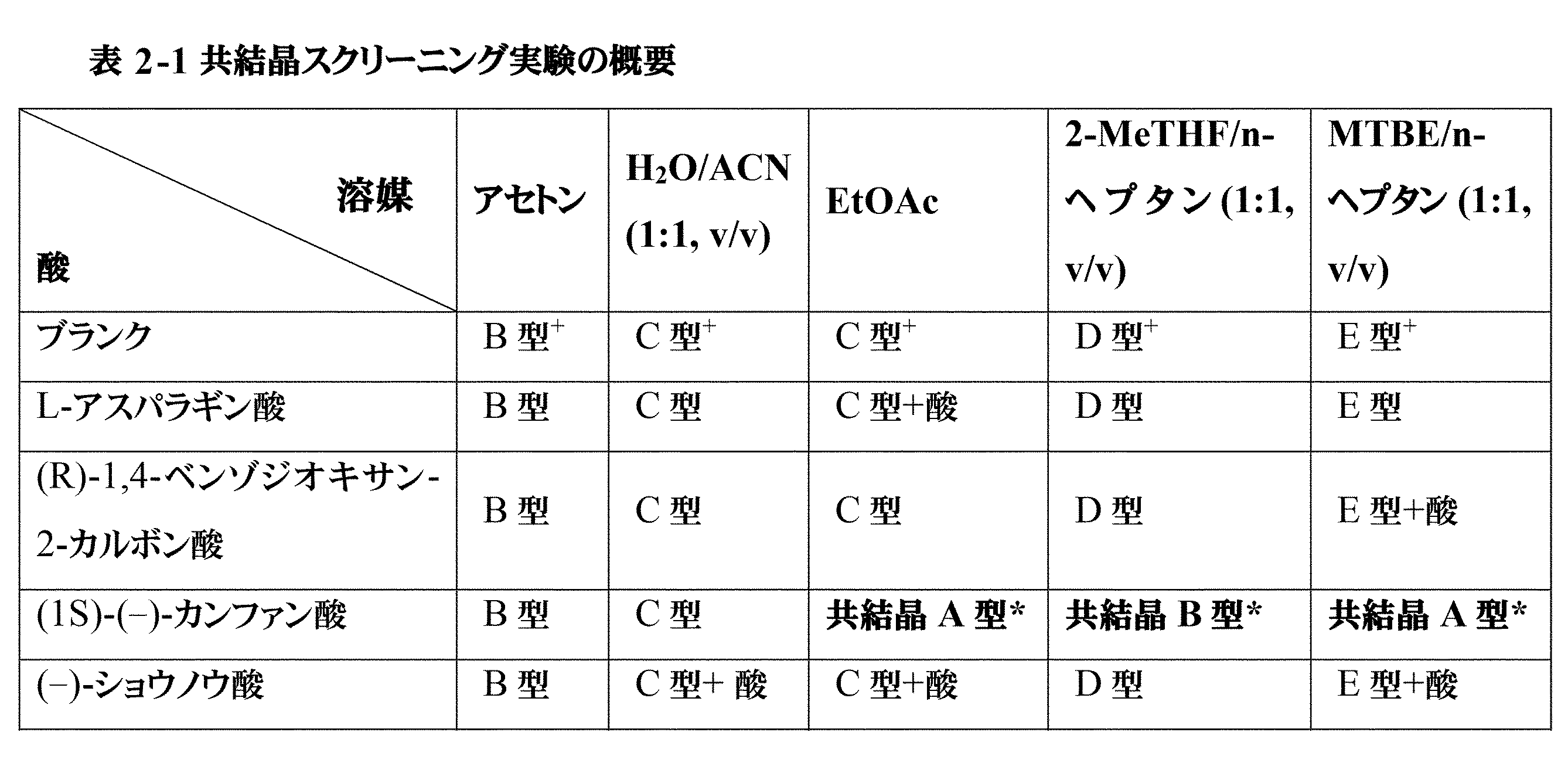


2.2 溶媒スクリーニング
M-ジオン及びP-ジオンをさらに分割するのに好適な溶媒を選択するために、M/P-ジオンのHPLCからの面積比を、20種超の溶媒/溶媒混合物で収集した。表2-3に示すように、2-MeTHFは、上清のM-ジオン/P-ジオン面積比が0.7、残留固体のM-ジオン/P-ジオン面積比が4.1で最良の分割を示した。しかしながら、2-MeTHF/n-ヘプタン(1:1、v/v)は共結晶スクリーニングにおいてより良好な分割結果を示し(表2-2)、したがって、2-MeTHF/n-ヘプタンをさらなる最適化のために選択した。M/P-ジオンのHPLCからの面積比を、異なる酸/塩基比による2-MeTHF/n-ヘプタンの異なる比で収集した。表2-4の結果は、2-MeTHF/n-ヘプタン(8:1又は4:1、v/v)で、酸/FBの比率が高いこと(2:1又は1.5:1)が、単離された固体におけるM/P-ジオンの比率の改善に望ましいことを示した。
2.2 Solvent Screening To select suitable solvents for further resolution of M-dione and P-dione, the area ratios from HPLC of M/P-dione were collected in more than 20 solvent/solvent mixtures. As shown in Table 2-3, 2-MeTHF showed the best resolution with M-dione/P-dione area ratio of 0.7 in the supernatant and 4.1 in the residual solid. However, 2-MeTHF/n-heptane (1:1, v/v) showed better resolution results in co-crystal screening (Table 2-2), and therefore, 2-MeTHF/n-heptane was selected for further optimization. The area ratios from HPLC of M/P-dione were collected in different ratios of 2-MeTHF/n-heptane with different acid/base ratios. The results in Tables 2-4 showed that in 2-MeTHF/n-heptane (8:1 or 4:1, v/v), a higher acid/FB ratio (2:1 or 1.5:1) was desirable for improving the M/P-dione ratio in the isolated solid.
また、2-MeTHF/n-ヘプタンの異なった比率におけるM-共結晶とP-共結晶の溶解度を5℃及び25℃で実施し、これを表2-5にまとめた。M-共結晶はクライアントによって提供され、P-共結晶は反貧溶媒及び貧溶媒により調製した(実験の詳細はセクション4.3を参照)。表2-5の溶解度の結果は、1.5:1の2-MeTHF/n-ヘプタンの体積比がRTで最良の分割を与え得ることを示した。より多くの分割実験がクライアントによって実施され、それにより、1.4:1の体積比が最良の分割の結果を示した。したがって、1.4:1の2-MeTHF/n-ヘプタンの体積比を、分割のための溶媒系として選択した。 Also, the solubility of M-cocrystals and P-cocrystals in different ratios of 2-MeTHF/n-heptane was carried out at 5°C and 25°C, which is summarized in Table 2-5. M-cocrystals were provided by the client, and P-cocrystals were prepared with anti-antisolvent and anti-antisolvent (see Section 4.3 for experimental details). The solubility results in Table 2-5 showed that a volume ratio of 1.5:1 2-MeTHF/n-heptane could give the best resolution at RT. More resolution experiments were carried out by the client, whereby a volume ratio of 1.4:1 showed the best resolution results. Therefore, a volume ratio of 1.4:1 2-MeTHF/n-heptane was selected as the solvent system for resolution.


2.3 ジオンDBTA共結晶、ジオンラセミ体及びDBTAの溶解度
2-MeTHF/n-ヘプタン(1.4:1、v/v)中の、M-ジオン共結晶、P-ジオン共結晶、M+P-ジオン共結晶混合物(1:1、w/w)、及びジオンラセミ体の7日間平衡溶解度を、異なる温度(20、30、40、50、60、65、75及び80℃)で求めた。5日後、75及び80℃では、分解を示唆する変色が観察されたので、溶解度は収集しなかった。M-共結晶とP-共結晶を異なる温度で7日間撹拌しても、形態の変化は観察されなかった(図2-5及び図2-6)。異なる温度で7日間、M-ジオン共結晶とP-ジオン共結晶混合物(1:1、w/w)の混合物を撹拌した後、ジオンラセミ体C型が得られた(図2-7)。異なる温度で7日間、ジオンラセミ体を撹拌した後、ジオンラセミ体D型(20及び30℃)及びジオンラセミ体C型(40、50、60及び65℃)が観察された(図2-8及び図2-9)。
2-MeTHF/n-ヘプタン(1.4:1、v/v)中のDBTAの5日間平衡溶解度を、種々の温度(20、30、40、50、60及び65℃)で求めた。全ての温度で、溶解度約100mg/mLが観察された。温度の変化による有意差は観察されなかった(表2-7)。
2.3 Solubility of dione-DBTA cocrystal, dione racemate, and DBTA The 7-day equilibrium solubilities of M-dione cocrystal, P-dione cocrystal, M+P-dione cocrystal mixture (1:1, w/w), and dione racemate in 2-MeTHF/n-heptane (1.4:1, v/v) were determined at different temperatures (20, 30, 40, 50, 60, 65, 75, and 80°C). After 5 days, discoloration was observed at 75 and 80°C, suggesting decomposition, so solubility data were not collected. No change in morphology was observed upon stirring M- and P-cocrystals at different temperatures for 7 days (Figures 2-5 and 2-6). After stirring the mixture of M- and P-dione cocrystal mixture (1:1, w/w) for 7 days at different temperatures, dione racemate Form C was obtained (Figure 2-7). After stirring the dione racemate for 7 days at different temperatures, racemic dione form D (20 and 30° C.) and racemic dione form C (40, 50, 60 and 65° C.) were observed (FIGS. 2-8 and 2-9).
The 5-day equilibrium solubility of DBTA in 2-MeTHF/n-heptane (1.4:1, v/v) was determined at various temperatures (20, 30, 40, 50, 60 and 65° C.). At all temperatures, a solubility of about 100 mg/mL was observed. No significant difference was observed with the change in temperature (Tables 2-7).
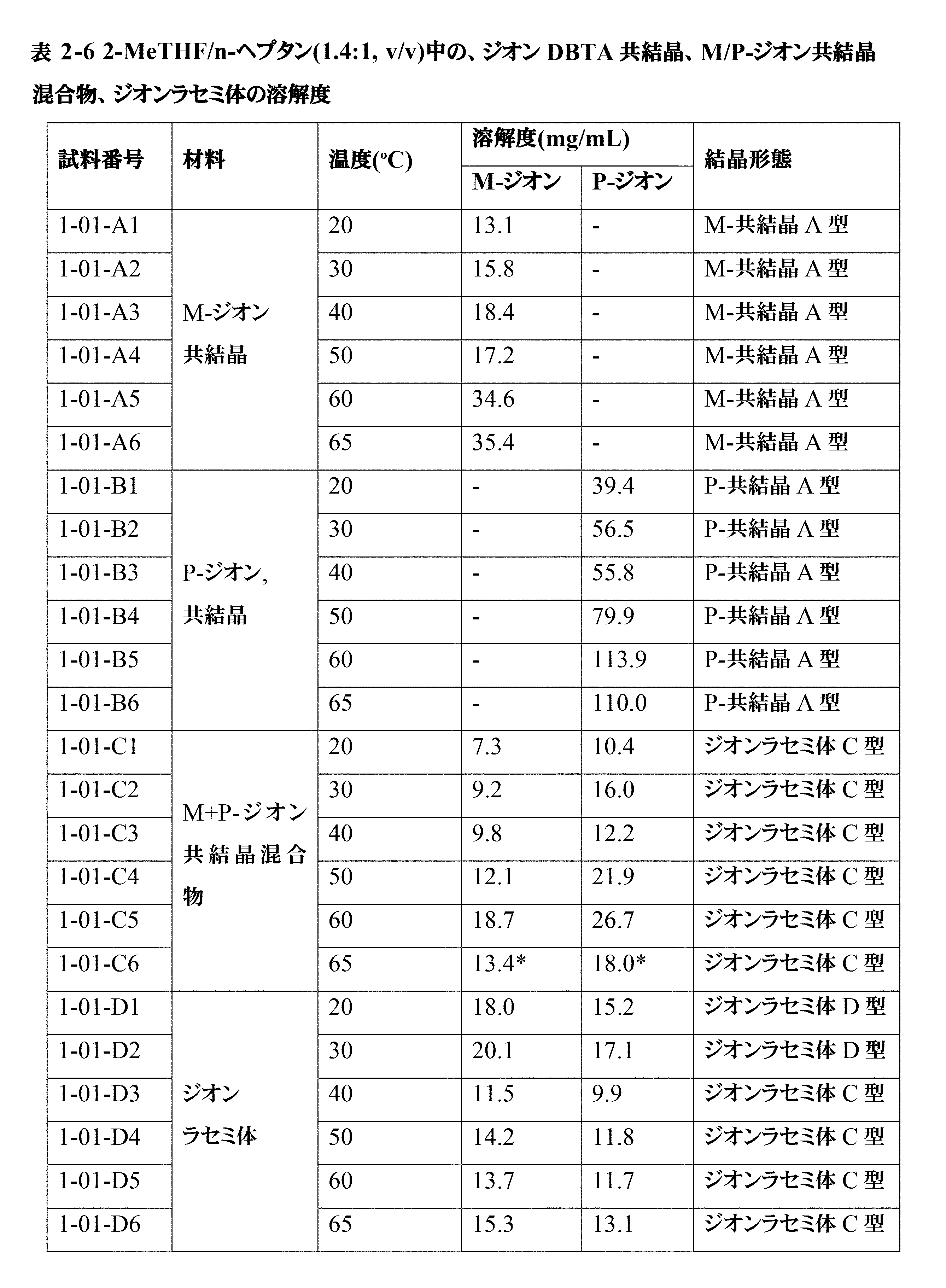
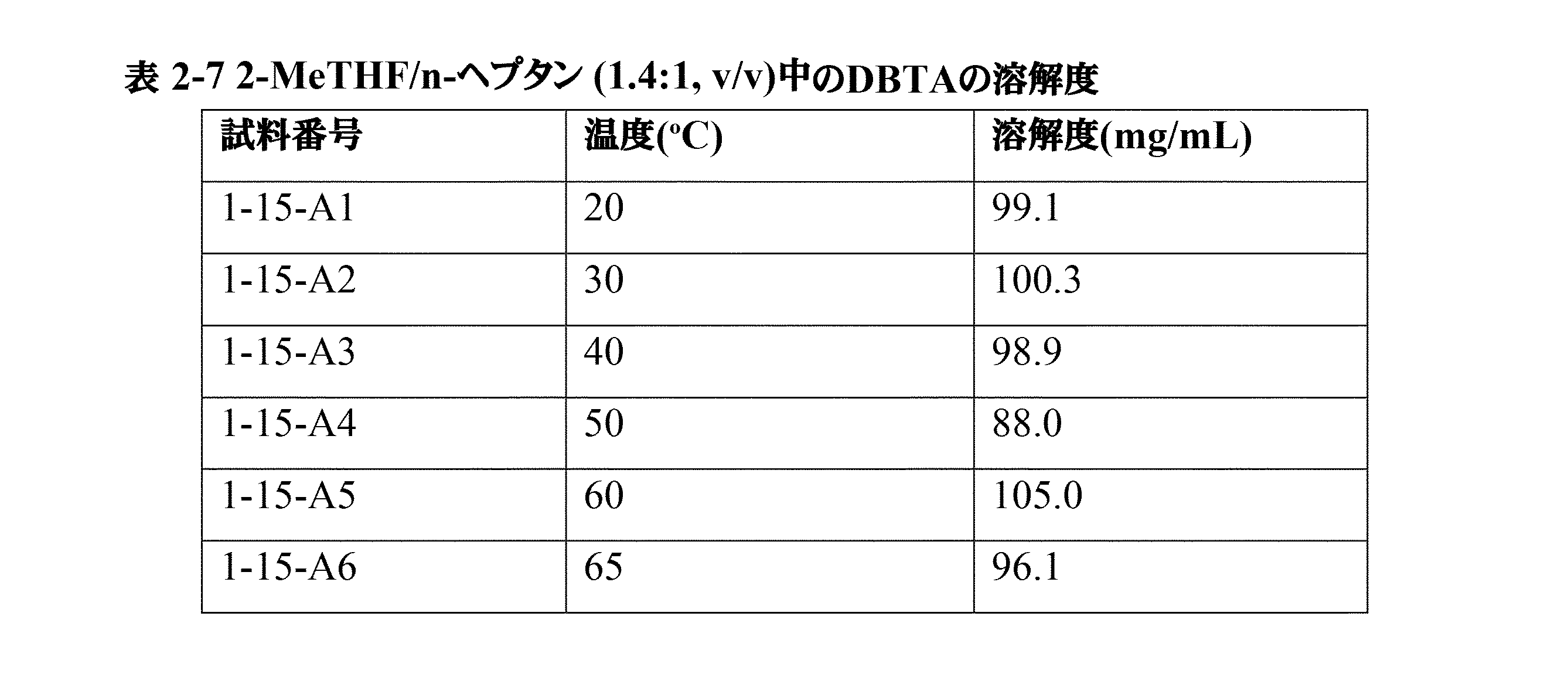
2.4 三元相図
2.4.1 M/P-ジオン共結晶
M-ジオン共結晶及びP-ジオン共結晶を、表2-8に記載した対応する質量として秤量し、2-MeTHF/n-ヘプタン(1.4:1、v/v)中、RTで72時間撹拌した。72時間平衡溶解度データに基づいて、M/P-ジオン共結晶の三元相図を描いたが、共晶点は得られなかった(図2-10)。
2.4 Ternary Phase Diagram 2.4.1 M/P-dione Cocrystal M-dione cocrystal and P-dione cocrystal were weighed as the corresponding masses listed in Table 2-8 and stirred in 2-MeTHF/n-heptane (1.4:1, v/v) for 72 h at RT. Based on the 72 h equilibrium solubility data, a ternary phase diagram of M/P-dione cocrystal was drawn, but no eutectic point was obtained (Figure 2-10).
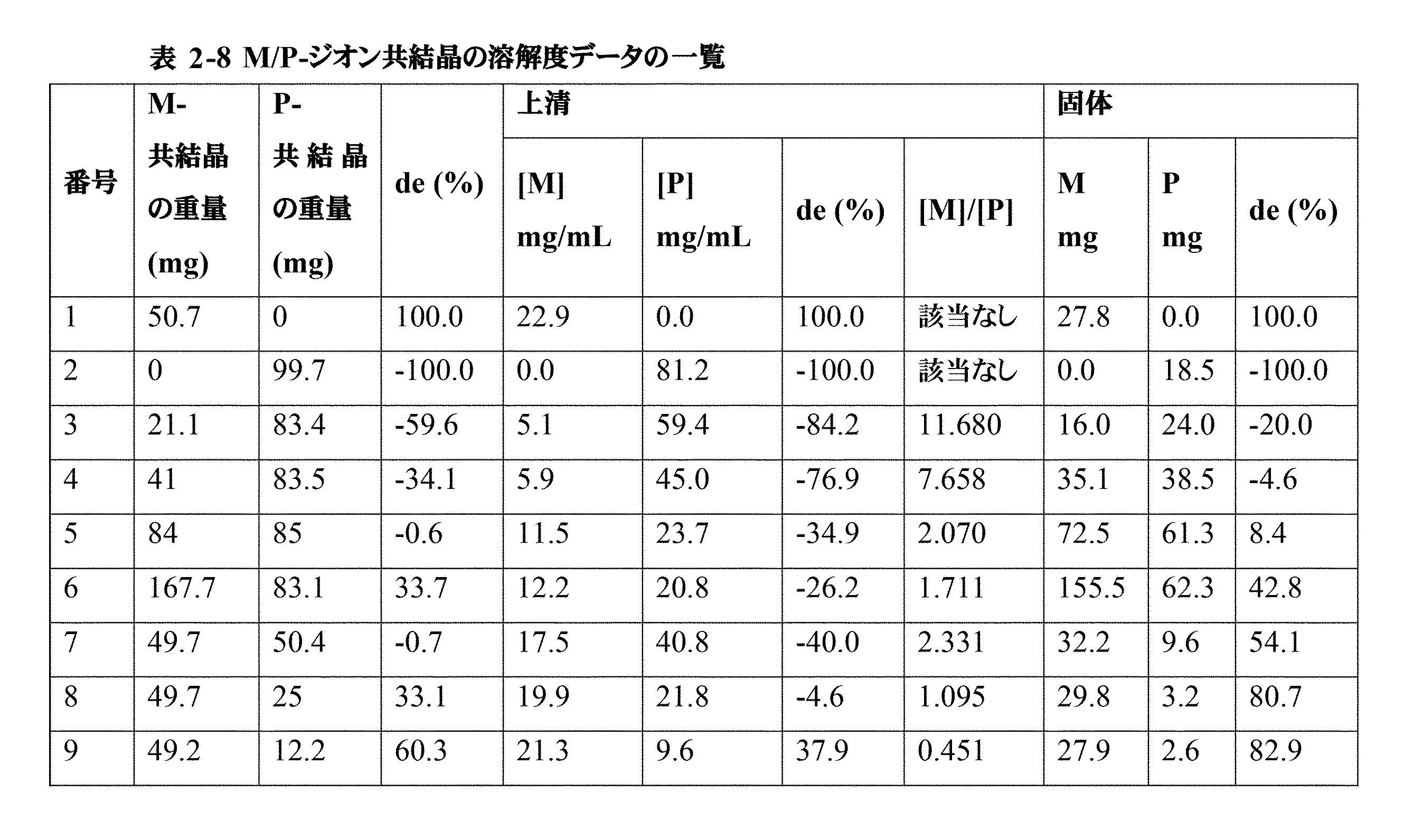
2.4.2 M/P-ジオン
M-ジオン及びP-ジオンを、表2-9に記載した対応する質量として秤量し、2-MeTHF/n-ヘプタン(1.4:1、v/v)中、RTで5日間撹拌した。RTにおける1.0mLの2-MeTHF/n-ヘプタン(1.4:1、v/v)中の5日間平衡溶解度データに基づいて、三元相図を描いた。M-ジオンA型、P-ジオンA型、ジオンラセミ体C型及びD型が溶解度試料の残留固体中で観察された。相図では共晶点は得られなかった(図2-11)。
2.4.2 M/P-Dione M-dione and P-dione were weighed as the corresponding masses listed in Table 2-9 and stirred in 2-MeTHF/n-heptane (1.4:1, v/v) at RT for 5 days. A ternary phase diagram was drawn based on the 5-day equilibrium solubility data in 1.0 mL of 2-MeTHF/n-heptane (1.4:1, v/v) at RT. M-dione Form A, P-dione Form A, dione racemic Forms C and D were observed in the residual solids of the solubility samples. No eutectic point was obtained in the phase diagram (Figure 2-11).
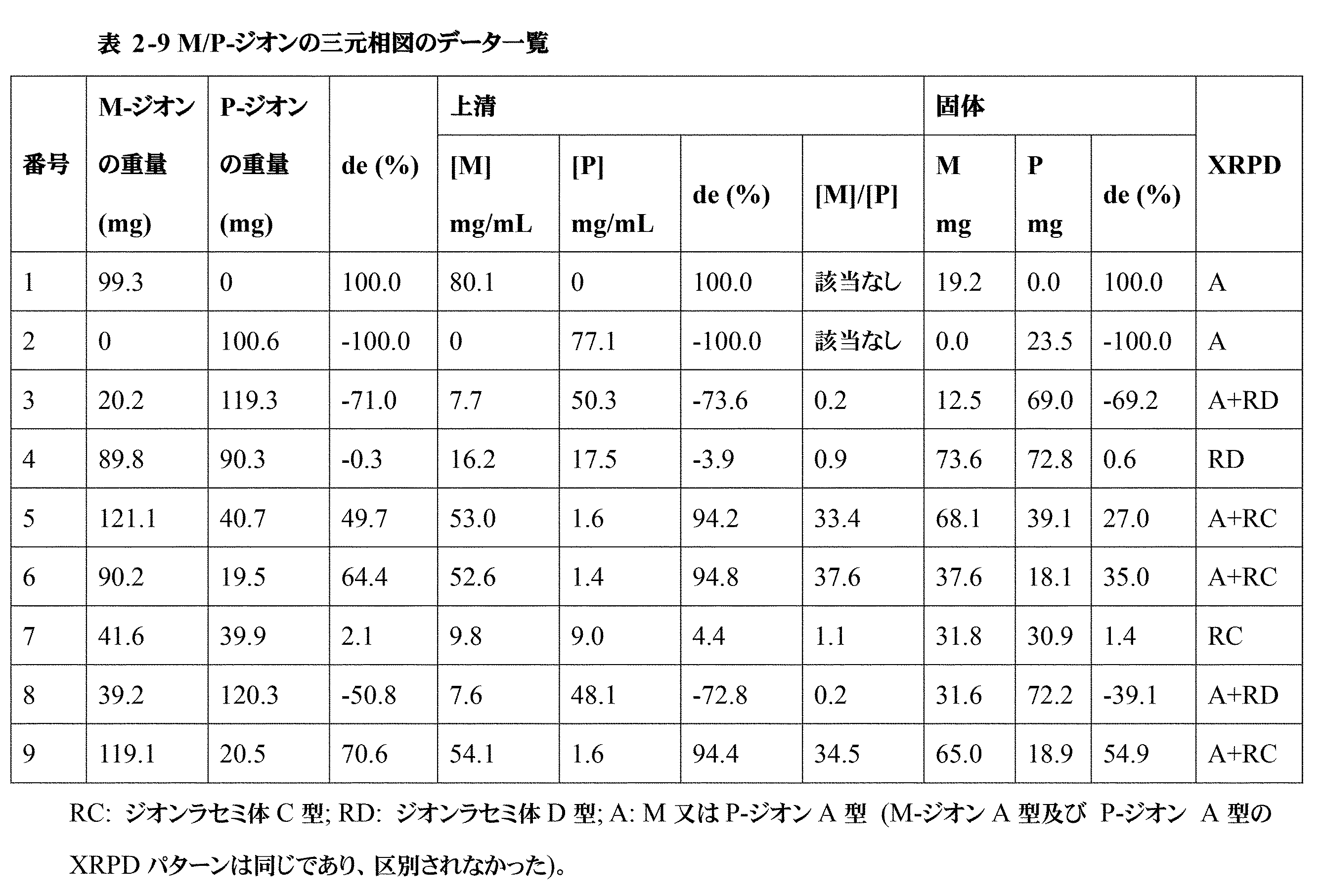
3 結晶形態の固体状態の解析
全部で5種のジオンラセミ体結晶形態と2種の共結晶形態が得られた。これらの形態を全て、XRPD、TGA、DSC、PLM及び1H NMRによって解析し、表2-10にまとめた。固体状態の解析データは、ジオンラセミ体A型及びD型が2-MeTHF溶媒和物として同定され、B型がアセトン溶媒和物として同定され、C型が無水物として同定され、E型がMTBE溶媒和物として同定されたことを示唆した。
3. Solid State Characterization of Crystal Forms A total of five dione racemic crystalline forms and two co-crystal forms were obtained. All these forms were characterized by XRPD, TGA, DSC, PLM and 1 H NMR and are summarized in Tables 2-10. Solid state analytical data suggested that dione racemic Forms A and D were identified as 2-MeTHF solvates, Form B was identified as an acetone solvate, Form C was identified as an anhydrate, and Form E was identified as an MTBE solvate.
M-ジオン共結晶A型及びP-ジオン共結晶A型はいずれも2-MeTHF溶媒和物であることがわかった。全ての解析データを図3-1~図3-22に示す。 Both M-dione cocrystal type A and P-dione cocrystal type A were found to be 2-MeTHF solvates. All analytical data are shown in Figures 3-1 to 3-22.
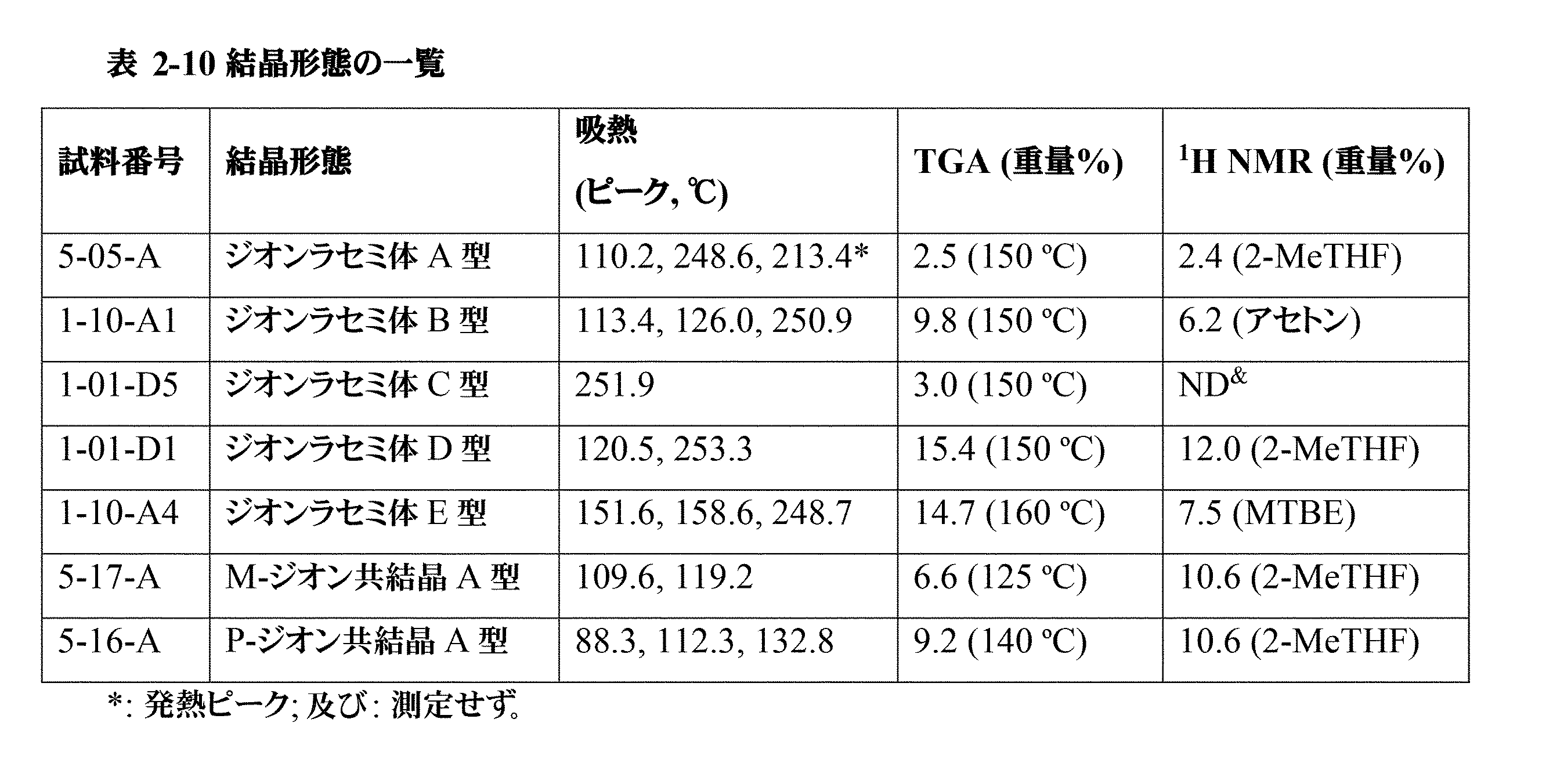
3.1.1 ジオンラセミ体形態の競合スラリー
RTで、ジオンラセミ体B~E型を、それぞれアセトン、H2O/ACN(1:1、v/v)、2-MeTHF/n-ヘプタン(1.4:1、v/v)及びMTBE/n-ヘプタン(1:1、v/v)中のジオンラセミ体A型のスラリーを用いて、正常に再生成した。
3.1.1 Competitive Slurries of Dione Racemic Forms Dione racemic forms B to E were successfully regenerated using slurries of dione racemic form A in acetone, H 2 O/ACN (1:1, v/v), 2-MeTHF/n-heptane (1.4:1, v/v), and MTBE/n-heptane (1:1, v/v), respectively, at RT.
約5mgの各ジオンラセミ体(A~E型)をHPLC瓶に秤量し、この瓶に2-MeHTF/n-ヘプタン(1.4:1、v/v)中のジオンラセミ体の飽和溶液0.3mLを添加し、次いで、この混合物を20、30、40、50、60及び65℃で5日間撹拌した。 Approximately 5 mg of each dione racemate (types A-E) was weighed into an HPLC vial, 0.3 mL of a saturated solution of the dione racemate in 2-MeHTF/n-heptane (1.4:1, v/v) was added to the vial, and the mixture was then stirred at 20, 30, 40, 50, 60 and 65°C for 5 days.
ターゲット温度の2-MeHTF/n-ヘプタン(1.4:1、v/v)の競合スラリーによって、全ての遊離塩基の形態がジオンラセミ体C型に変換され、このことは、ジオンラセミ体C型が20~65℃の2-MeHTF/n-ヘプタン(1.4:1、v/v)中で最も熱力学的に安定な形態であることを示唆している。 Competitive slurries in 2-MeHTF/n-heptane (1.4:1, v/v) at the target temperature converted all free base forms to dione racemic form C, suggesting that dione racemic form C is the most thermodynamically stable form in 2-MeHTF/n-heptane (1.4:1, v/v) from 20 to 65 °C.
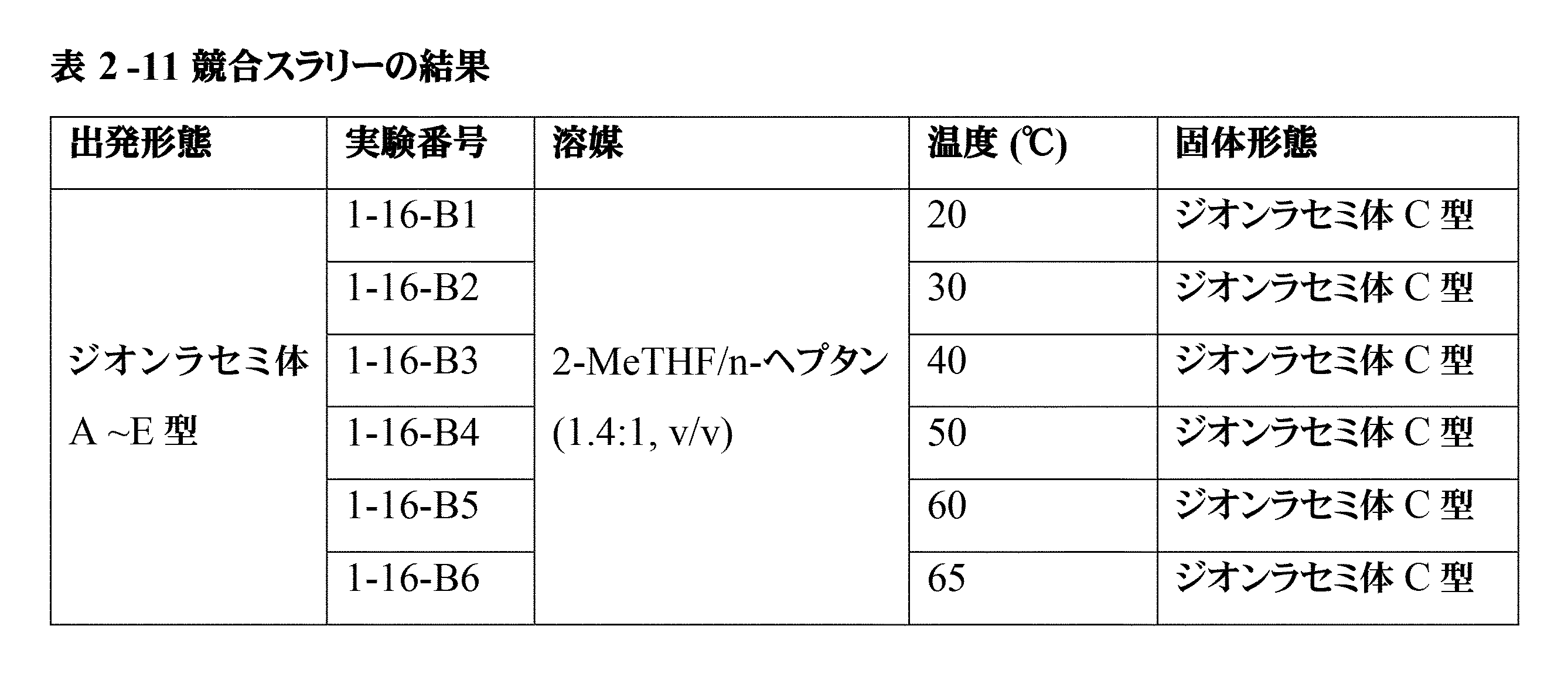
3.2 P-ジオン共結晶の調製
3.2.1 小規模
2gのP-ジオンと1gのDBTAとを18mlの2-MeTHFに65℃で溶解して、ほぼ透明な溶液を得た。この溶液に1時間かけて18mLのヘプタンを添加した。この溶液を4時間かけて20℃に冷却し、一晩熟成させた。エアーブローを用いて室温で約1時間、この溶液を蒸発させ、黄色味を帯びた油状ペーストを得た。この混合物を2時間撹拌しながら、さらに54mLのヘプタンを添加した。懸濁液を濾過した。固体試料を810465-16-Aとした。
3.2 Preparation of P-dione co-crystal 3.2.1 Small scale 2 g of P-dione and 1 g of DBTA were dissolved in 18 ml of 2-MeTHF at 65° C. to give a nearly clear solution. To this solution was added 18 mL of heptane over 1 hour. The solution was cooled to 20° C. over 4 hours and aged overnight. The solution was evaporated at room temperature with an air blower for about 1 hour to give a yellowish oily paste. An additional 54 mL of heptane was added while the mixture was stirred for 2 hours. The suspension was filtered. The solid sample was designated 810465-16-A.
3.2.2 大規模
10gのP-ジオンと5gのDBTAとを100mlの2-MeTHFに65℃で溶解した。この溶液を0.45μmのPTFEフィルターで濾過し、透明な溶液を得た。この透明な溶液を、最初の実験で生成した約1gの種子(810465-16-A)を含有する400mLのヘプタンの懸濁液に滴下した。この懸濁液をRTで5時間撹拌し続けた後、単離した。約10gのP-ジオン共結晶(810465-20-A)が約66%の収率で生成された。
3.2.2 Large scale 10 g of P-dione and 5 g of DBTA were dissolved in 100 ml of 2-MeTHF at 65°C. The solution was filtered through a 0.45 μm PTFE filter to obtain a clear solution. This clear solution was added dropwise to a suspension of about 1 g of seeds (810465-16-A) produced in the first experiment in 400 mL of heptane. The suspension was kept stirring at RT for 5 h and then isolated. About 10 g of P-dione cocrystal (810465-20-A) was produced in about 66% yield.
4 機器及び方法
4.1 XRPD
XRPD分析に、PANalytical X線粉末回折計を反射モードで使用した。使用したXRPDパラメータを表4-1に示す。
4. Instruments and Methods 4.1 XRPD
A PANalytical X-ray powder diffractometer in reflection mode was used for XRPD analysis, and the XRPD parameters used are listed in Table 4-1.

4.2 TGA及びDSC
TA Instruments製のTA discovery 550、Q500及びQ5000TGAを用いてTGAデータを収集した。DSCは、TA Instruments製のQ500、Q5000及びDiscovery 2500 DSCを用いて行った。使用した詳細なパラメータを表4-2に示す。
4.2 TGA and DSC
TGA data was collected using TA discovery 550, Q500 and Q5000 TGA from TA Instruments. DSC was performed using Q500, Q5000 and

4.3 HPLC
Agilent 1100/1260 HPLCを用いて溶解度を試験した。詳細な方法を表4-3に示す。
4.3 HPLC
The solubility was tested using an Agilent 1100/1260 HPLC, the detailed method is shown in Table 4-3.


4.4 1H NMR
1H NMRスペクトルを、溶媒としてDMSO-d6を使用して、Bruker 400M NMR分光計で収集した。
4.4 1H NMR
1 H NMR spectra were collected on a Bruker 400M NMR spectrometer using DMSO- d6 as the solvent.
4.5 PLM
偏光顕微鏡写真を、Nikon DS-Fi2正立顕微鏡により室温で撮影した。
4.5 PLM
Polarized light micrographs were taken at room temperature with a Nikon DS-Fi2 upright microscope.
1,3-ジフェニル-3-オキソプロパンスルホン酸11bによる化合物5のさらなるスクリーニング。
化合物5のピリジン部分の塩基度が小さく、標準的なスクリーニング設定による結晶塩の形成に関して「ヒット」が限られているため、ラセミ化合物4を1,3-ジフェニル-3-オキソプロパンスルホン酸11bにより0.06mmolスケールでスクリーニングすることが選択された。

Due to the low basicity of the pyridine moiety of
ラセミ化合物5のグラムスケールでの分割:250mLの丸底フラスコに、200mLのEtOH:AcOH(90:10 体積:体積)中の2.0gのラセミ化合物4(5.7mmol、1.0eq.)を投入した。物質が溶解した後、この溶液に832mgのスルホン酸11b(2.9mmol、0.5eq.)を添加した。透明な溶液を、撹拌速度800rpmで15時間撹拌した。白色の沈殿物が生成し、これを母液から単離した。単離した塩をCH2Cl2に懸濁し、分液漏斗を用いて濃NaHCO3水溶液で処理した。有機層を単離し、塩基性水層をCH2Cl2で抽出した(2×)。有機層を合わせ、Na2SO3で乾燥させた。溶媒を蒸発させて、415mgの(M)-5(96%ee)を得た(図6-1を参照)。 Gram-scale resolution of racemic compound 5: A 250 mL round bottom flask was charged with 2.0 g of racemic compound 4 (5.7 mmol, 1.0 eq.) in 200 mL of EtOH:AcOH (90:10 vol:vol). After the material was dissolved, 832 mg of sulfonic acid 11b (2.9 mmol, 0.5 eq.) was added to the solution. The clear solution was stirred for 15 h at a stirring speed of 800 rpm. A white precipitate formed, which was isolated from the mother liquor. The isolated salt was suspended in CH 2 Cl 2 and treated with concentrated aqueous NaHCO 3 using a separatory funnel. The organic layer was isolated and the basic aqueous layer was extracted with CH 2 Cl 2 (2×). The organic layers were combined and dried over Na 2 SO 3. The solvent was evaporated to give 415 mg of (M)-5 (96% ee) (see FIG. 6-1).
透明な母液を蒸発乾固した。黄色の油状物質をCH2Cl2に溶解し、分液漏斗を用いて濃NaHCO3水溶液で処理した。有機層を単離し、塩基性水層をCH2Cl2で抽出した(2×)。有機層を合わせ、Na2SO3で乾燥させた。溶媒を蒸発させて、1579mgの5((P)-アトロプ異性体中、23%ee;図6-2)を得た。 The clear mother liquor was evaporated to dryness. The yellow oil was dissolved in CH 2 Cl 2 and treated with concentrated aqueous NaHCO 3 in a separatory funnel. The organic layer was isolated and the basic aqueous layer was extracted with CH 2 Cl 2 (2×). The organic layers were combined and dried over Na 2 SO 3. The solvent was evaporated to give 1579 mg of 5 (23% ee in the (P)-atropisomer; FIG. 6-2).
M-ジオンDBTA共結晶の多形スクリーニング
5 M-ジオンDBTA共結晶の結晶形態の解析
M-ジオンについての多形スクリーニング実験は、スラリーコンバージョン法、緩慢に蒸発させる方法、徐冷法、貧溶媒添加法、蒸気拡散法、温度サイクル法、及び湿式粉砕法を使用して、100の条件下で行った。全部で17種の結晶形態(A~Q型)をスクリーニングから得た。形態の関係を図4-1に示す。詳細な解析データを表5-1に示し、XRPDパターンのオーバーレイを図5-1に示す。固体状態の解析の結果は、G型が水和物であり、他の型は溶媒和物であることを示唆した。
Polymorph Screening of M-dione-
5.1 機器及び方法
5.1.1 XRPD
XRPDを、Siゼロバックグラウンドホルダー上でPanalytical X’Pert3粉末XRPDを用いて行った。2θ位置を、Panalytical Siリファレンス標準ディスクに対して較正した。使用したパラメータを表5-aに示す。
5.1 Instruments and Methods 5.1.1 XRPD
XRPD was performed using a Panalytical X'Pert 3 powder XRPD on a Si zero background holder. 2θ positions were calibrated against Panalytical Si reference standard discs. The parameters used are given in Table 5-a.

5.1.2 TGA/DSC
TA Instrument製のTA Discovery 550 TGAを用いてTGAデータを収集した。DSCは、TA Instrument製のTA Q2000 DSCを用いて行った。DSCをインジウムリファレンス標準で較正し、TGAを、ニッケルリファレンス標準を用いて較正した。使用した詳細なパラメータを表5-bに示す。
5.1.2 TGA/DSC
TGA data was collected using a TA Discovery 550 TGA from TA Instrument. DSC was performed using a TA Q2000 DSC from TA Instrument. The DSC was calibrated with an indium reference standard and the TGA was calibrated with a nickel reference standard. The detailed parameters used are shown in Table 5-b.

5.2 多形スクリーニング
A型(3-05-A)の溶解度をRTで推定した。約2mgの固体を3mLガラス瓶に加えた。次いで、表5-cの溶媒を、固体が溶解するか、又は総体積が2mLに達するまで、瓶に段階的に(50/50/200/700μL)添加した。表5-cに結果をまとめ、多形スクリーニングの溶媒選択の指針とした。
5.2 Polymorph Screening The solubility of Form A (3-05-A) was estimated at RT. Approximately 2 mg of solid was added to a 3 mL vial. Solvents from Table 5-c were then added stepwise (50/50/200/700 μL) to the vial until the solid was dissolved or the total volume reached 2 mL. Table 5-c summarizes the results and serves as a guide for solvent selection for polymorph screening.
種々の結晶化法又は固体転移法を用いて多形スクリーニング実験を行った。利用した方法及び同定された結晶型を表5-cに要約する。 Polymorph screening experiments were performed using various crystallization or solid-state transformation techniques. The methods used and the crystal forms identified are summarized in Table 5-c.

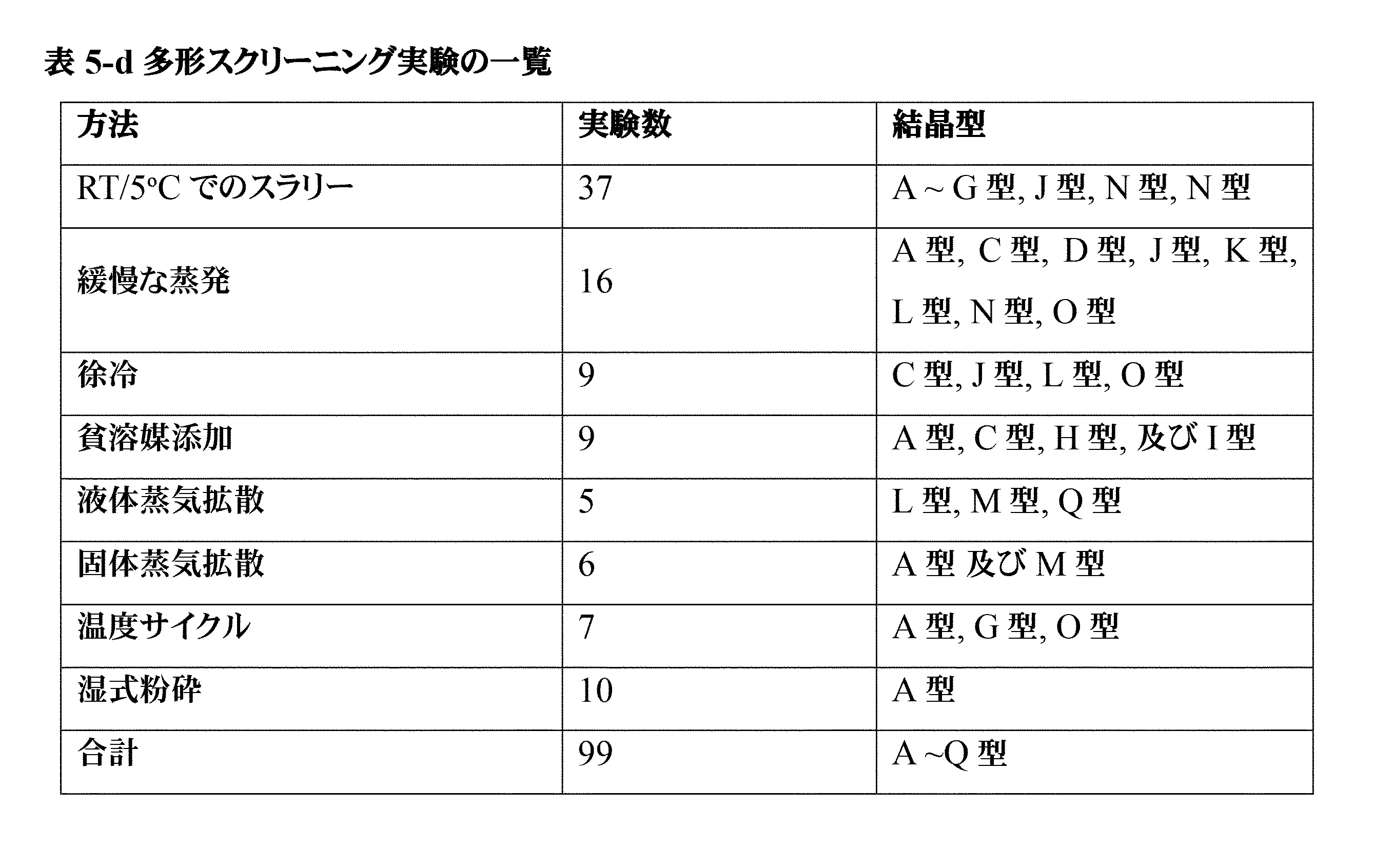
5.2.1 RTにおけるスラリー
スラリー実験を種々の溶媒系においてRTで行った。約20mgのA型(3-05-A)を、3mLガラス瓶中の0.2mLの溶媒に懸濁した。懸濁液をRTで13日間磁気的に撹拌した後、残った固体をXRPD分析のために単離した。表5-eにまとめた結果は、A~D型及びJ型が得られたことを示した。
5.2.1 Slurries at RT Slurry experiments were performed in various solvent systems at RT. Approximately 20 mg of Form A (3-05-A) was suspended in 0.2 mL of solvent in a 3 mL vial. After the suspension was magnetically stirred at RT for 13 days, the remaining solid was isolated for XRPD analysis. The results, summarized in Table 5-e, showed that Forms A through D and J were obtained.

5.2.2 緩慢な蒸発
緩慢な蒸発実験を16の条件下で行った。簡単に記すと、20mgのA型(3-05-A)を、20mLガラス瓶中の0.2~0.8mLの溶媒に溶解した。溶解しなかった場合、PTFE膜(孔径0.2μm)を使用して懸濁液を濾過し、濾液を次の工程に使用した。視覚的に透明な溶液を、5~10個のピンホールを有するParafilm(登録商標)で覆い、RTで蒸発させた。固体をXRPD分析のために単離した。表5-fにまとめた結果は、A型、C型、D型、J型、K型、L型、N型、O型が得られたことを示した。
5.2.2 Slow Evaporation Slow evaporation experiments were performed under 16 conditions. Briefly, 20 mg of Form A (3-05-A) was dissolved in 0.2-0.8 mL of solvent in a 20 mL glass bottle. If not dissolved, the suspension was filtered using a PTFE membrane (0.2 μm pore size) and the filtrate was used for the next step. The visually clear solution was covered with Parafilm® with 5-10 pinholes and allowed to evaporate at RT. The solid was isolated for XRPD analysis. The results summarized in Table 5-f showed that Form A, C, D, J, K, L, N, O were obtained.
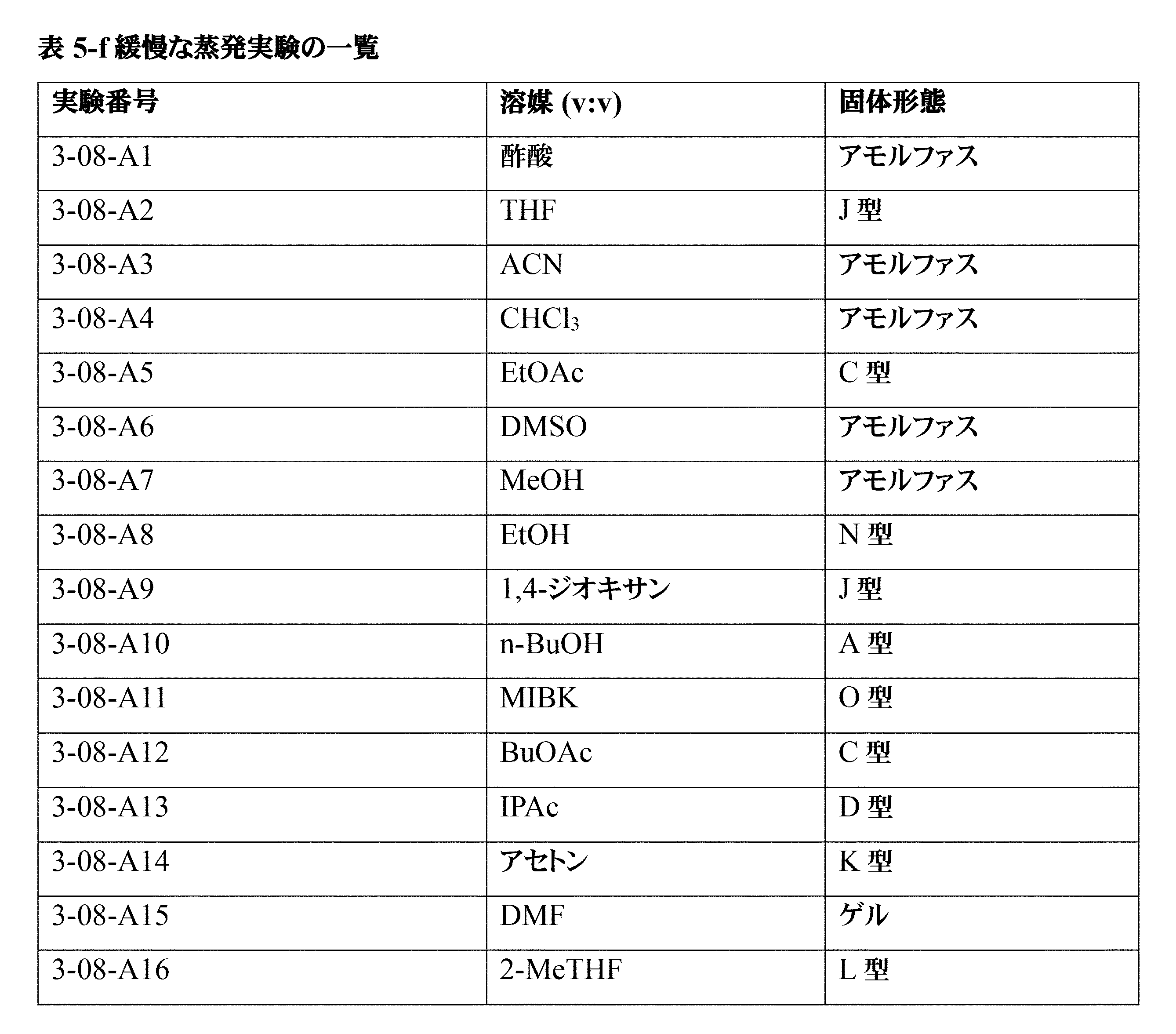
5.2.3 徐冷
徐冷実験を9種の溶媒系で行った。約20mgのA型(3-05-A)を、RTで3mLガラス瓶中の1mLの溶媒に懸濁した。次いで、懸濁液を50℃に加熱し、2時間平衡化し、PTFE膜(孔径0.20μm)を用いて濾過した。濾液を0.1℃/minの速度で5℃までゆっくりと冷却した。表5-gにまとめた結果は、C型、G型、J型、L型及びO型が確認されたことを示した。
5.2.3 Slow Cooling Slow cooling experiments were performed with nine solvent systems. Approximately 20 mg of Form A (3-05-A) was suspended in 1 mL of solvent in a 3 mL glass bottle at RT. The suspension was then heated to 50°C, equilibrated for 2 h, and filtered using a PTFE membrane (pore size 0.20 μm). The filtrate was slowly cooled to 5°C at a rate of 0.1°C/min. The results, summarized in Table 5-g, showed that Forms C, G, J, L, and O were identified.

5.2.4 貧溶媒添加
全部で9つの貧溶媒添加実験を行った。約20mgの出発物質(3-05-A)を0.2~1.4mLの溶媒に溶解して、透明な溶液を得た。溶液を磁気的に撹拌し、続いて、沈殿が現れるか、又は貧溶媒の総量が15.0mLに達するまで、0.2mLの貧溶媒を段階的に添加した。得られた沈殿物をXRPD分析のために単離した。表5-hの結果は、A型、C型、H型及びI型が得られたことを示した。
5.2.4 Anti-solvent addition A total of nine anti-solvent addition experiments were performed. Approximately 20 mg of starting material (3-05-A) was dissolved in 0.2-1.4 mL of solvent to obtain a clear solution. The solution was magnetically stirred followed by the stepwise addition of 0.2 mL of anti-solvent until a precipitate appeared or the total amount of anti-solvent reached 15.0 mL. The resulting precipitate was isolated for XRPD analysis. The results in Table 5-h showed that Forms A, C, H and I were obtained.
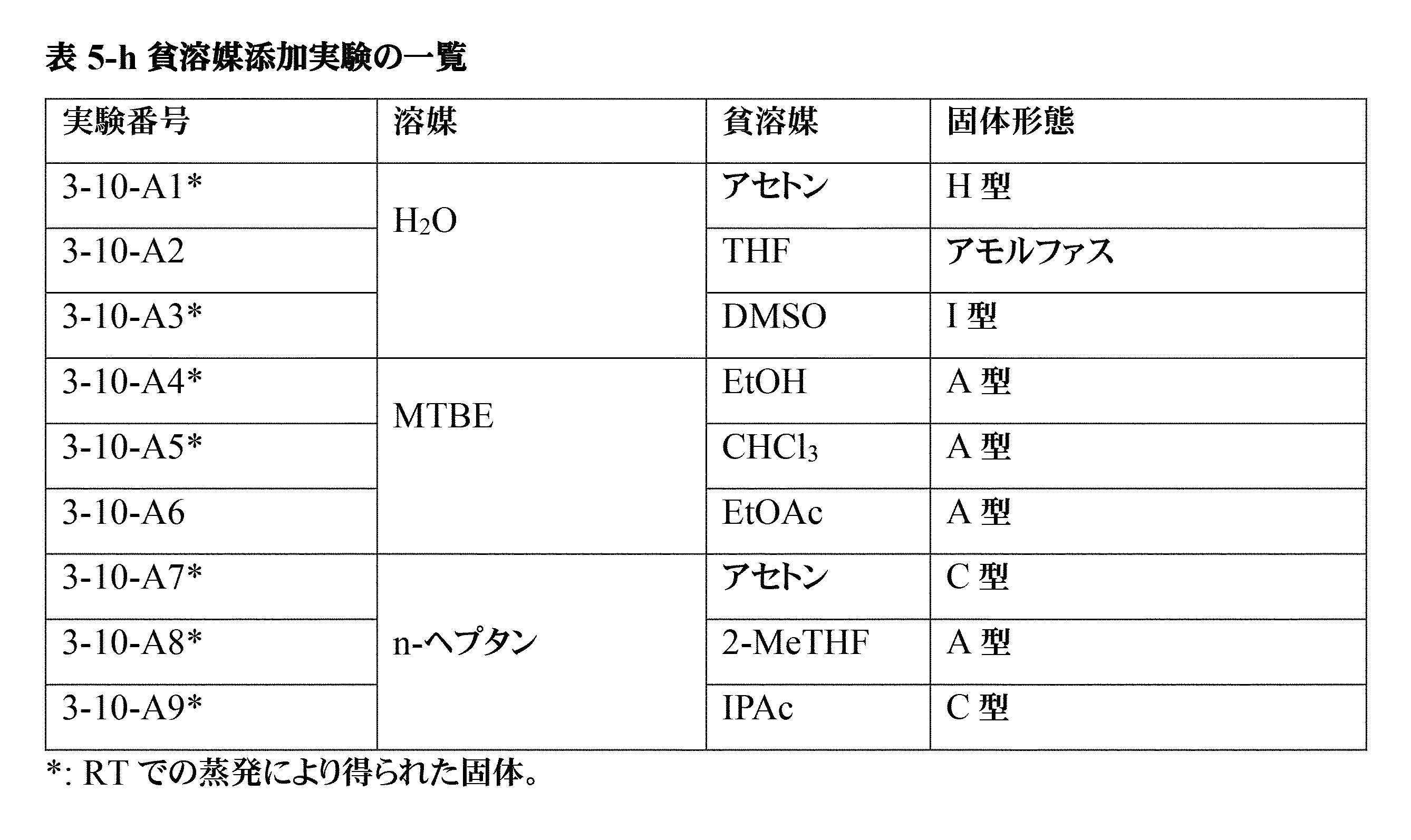
5.2.5 液体蒸気拡散
5つの液体蒸気拡散実験を行った。約20mgの出発物質(3-05-A)を3mLの瓶中、適当な溶媒に溶解して、透明な溶液を得た。次いで、この溶液を、3mLの揮発性溶媒と共に20mL瓶に入れた。20mL瓶をキャップで密封し、有機蒸気が溶液と相互作用するのに十分な時間、RTに保った。沈殿物をXRPD分析のために単離した。表5-iにまとめた結果は、L型、M型及びQ型が生成されたことを示した。
5.2.5 Liquid Vapor Diffusion Five liquid vapor diffusion experiments were performed. Approximately 20 mg of starting material (3-05-A) was dissolved in a suitable solvent in a 3 mL bottle to obtain a clear solution. This solution was then placed in a 20 mL bottle along with 3 mL of a volatile solvent. The 20 mL bottle was sealed with a cap and kept at RT for a sufficient time for the organic vapor to interact with the solution. The precipitate was isolated for XRPD analysis. The results, summarized in Table 5-i, showed that Forms L, M, and Q were produced.

5.2.6 固体蒸気拡散
6種の異なる溶媒を用いて固体蒸気拡散実験を行った。約10mgの出発物質(3-05-A)を3mL瓶に秤量し、これを2mLの揮発性溶媒と共に20mLバイアルに入れた。20mLバイアルをキャップで密封し、RTで7日間保持し、溶媒蒸気を試料と相互作用させた。固体をXRPDによって試験し、表5-jにまとめた結果は、A型及びM型が生成されたことを示した。
5.2.6 Solid Vapor Diffusion Solid vapor diffusion experiments were performed using six different solvents. Approximately 10 mg of starting material (3-05-A) was weighed into a 3 mL bottle and placed in a 20 mL vial with 2 mL of a volatile solvent. The 20 mL vial was sealed with a cap and kept at RT for 7 days to allow the solvent vapor to interact with the sample. The solids were examined by XRPD and the results, summarized in Table 5-j, showed that Forms A and M were produced.

5.2.7 温度サイクル
温度サイクル実験を、7種の溶媒系で行った。約20mgの出発物質(3-05-A)を、RTで3mLガラス瓶中の1mLの溶媒に懸濁した。次いで、懸濁液を50℃に加熱し、1時間平衡化し、PTFE膜(孔径0.20μm)を用いて濾過した。濾液を0.2℃/minの速度で5℃までゆっくりと冷却し、次いで、1℃/minの速度で50℃まで加熱した。このサイクルをもう1回繰り返した後、0.2℃/minの速度で5℃まで冷却する。固体を単離し、XRPDを用いて分析するまで、試料を5℃に保存した。表5-kにまとめた結果は、A型、G型及びO型が確認されたことを示した。
5.2.7 Temperature Cycling Temperature cycling experiments were performed with seven solvent systems. Approximately 20 mg of starting material (3-05-A) was suspended in 1 mL of solvent in a 3 mL vial at RT. The suspension was then heated to 50° C., equilibrated for 1 h, and filtered using a PTFE membrane (pore size 0.20 μm). The filtrate was slowly cooled to 5° C. at a rate of 0.2° C./min and then heated to 50° C. at a rate of 1° C./min. This cycle was repeated once more, followed by cooling to 5° C. at a rate of 0.2° C./min. The samples were stored at 5° C. until the solids were isolated and analyzed using XRPD. The results, summarized in Table 5-k, showed that Forms A, G, and O were identified.

5.2.8 5℃におけるスラリー
スラリー実験を種々の溶媒系において5℃で行った。約20mgの出発物質(3-05-A)を、3mLガラス瓶中の0.2mLの溶媒に懸濁した。懸濁液を5℃で7日間磁気的に撹拌した後、残った固体をXRPD分析のために単離した。表5-lにまとめた結果は、A型、C型~E型及びJ型が得られたことを示した。
5.2.8 Slurries at 5° C. Slurry experiments were performed in various solvent systems at 5° C. Approximately 20 mg of starting material (3-05-A) was suspended in 0.2 mL of solvent in a 3 mL vial. After the suspension was magnetically stirred at 5° C. for 7 days, the remaining solid was isolated for XRPD analysis. The results, summarized in Table 5-1, showed that Forms A, C through E, and J were obtained.

5.2.9 湿式粉砕
湿式研削実験を5つの条件下で行った。簡単に記すと、10mgのA型(3-05-A)を乳鉢に入れ、約20μLの溶媒中で5分間粉砕した。固体をXRPD分析のために単離した。表5-mにまとめた結果は、A型が得られたことを示した。
5.2.9 Wet Grinding Wet grinding experiments were performed under five conditions. Briefly, 10 mg of Form A (3-05-A) was placed in a mortar and ground in approximately 20 μL of solvent for 5 minutes. The solid was isolated for XRPD analysis. The results, summarized in Table 5-m, showed that Form A was obtained.


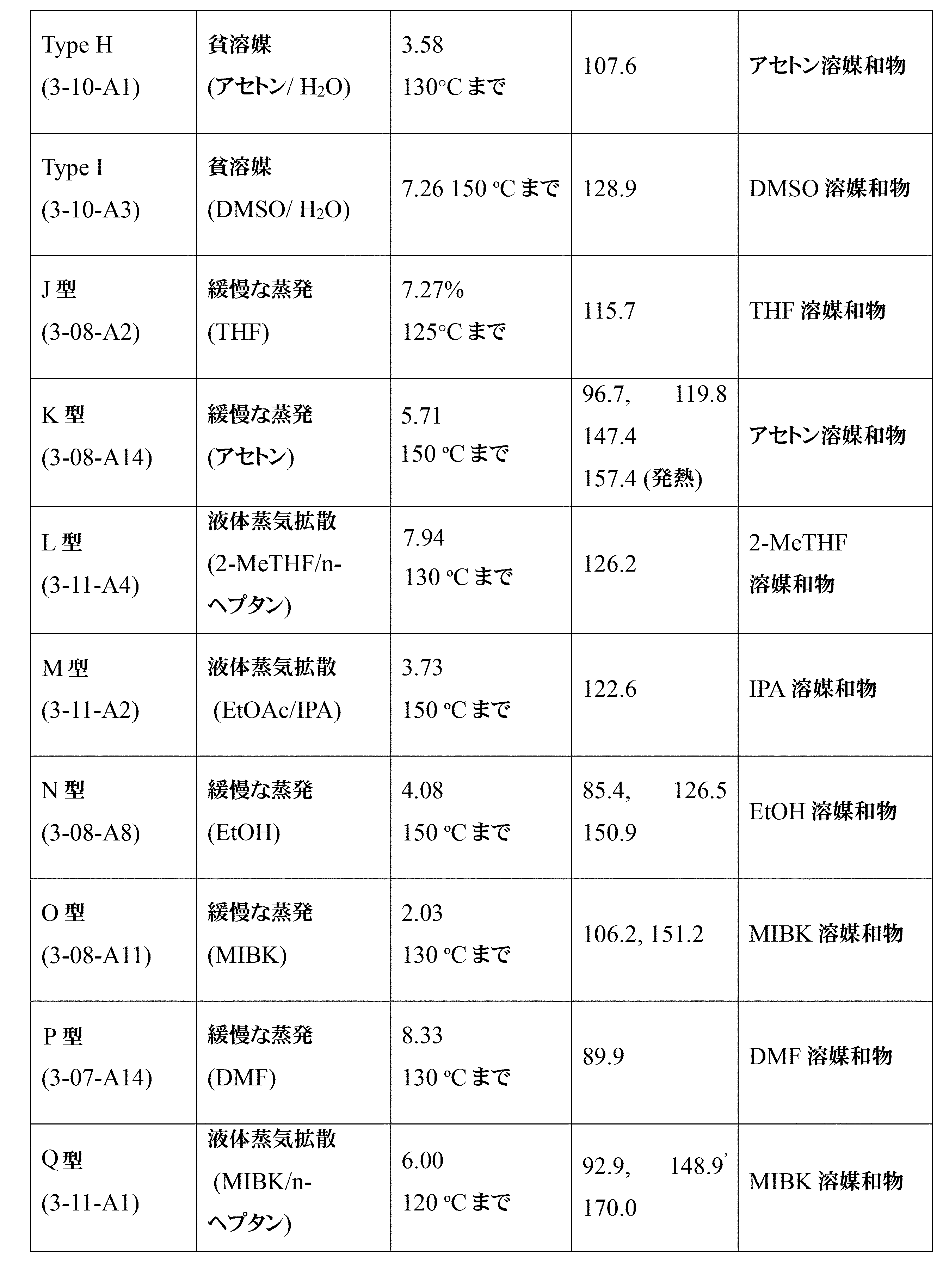
5.3 A型
A型(3-05-A)は、クライアントによって提供された。図5-4に示したXRPDの結果は、結晶性であることを示唆した。図5-5のTGA及びDSCデータによって示されるように、重量の減少は125℃まで7.3%であり、109.4℃及び120.0℃(ピーク)に2つの吸熱が観察された。図5-6に示すように、1H NMRスペクトルで2-MeTHFの存在が確認された。これらの結果に基づき、A型は2-MeTHF溶媒和物であると見なした。
5.3 Form A Form A (3-05-A) was provided by a client. XRPD results shown in Figure 5-4 suggested it was crystalline. As shown by the TGA and DSC data in Figure 5-5, the weight loss was 7.3% up to 125°C and two endotherms were observed at 109.4°C and 120.0°C (peaks). The 1H NMR spectrum confirmed the presence of 2-MeTHF as shown in Figure 5-6. Based on these results, Form A was considered to be a 2-MeTHF solvate.
5.4 B型
B型試料(3-07-A1)を、RTで、MTBE中のA型のスラリーによって得た。
図5-7に示すXRPDパターンは、結晶性を示唆した。図5-10のTGA及びDSCデータによって示されるように、125℃まで7.2%の重量減少と、115.7℃(ピーク)での吸熱が観察された。図5-9に示すように、1H NMRスペクトルでMTBEの存在が確認された。これらの結果に基づくと、B型はMTBE溶媒和物と考えられた。
5.4 Form B A Form B sample (3-07-A1) was obtained by slurrying Form A in MTBE at RT.
The XRPD pattern shown in Figure 5-7 was suggestive of crystallinity. As shown by the TGA and DSC data in Figure 5-10, a 7.2% weight loss up to 125°C and an endotherm at 115.7°C (peak) was observed. The 1H NMR spectrum confirmed the presence of MTBE as shown in Figure 5-9. Based on these results, Form B was believed to be an MTBE solvate.
5.5 C型
C型試料(3-08-A5)を、EtOAc中、RTでゆっくりと蒸発させて得た。図5-10に示すXRPDパターンは、結晶性を示唆した。図5-11に示したTGA及びDSCデータは、125℃まで8.0%の重量減少と、92.7℃及び116.4℃(ピーク)での2つの吸熱を示した。図5-12に示すように、1H NMRスペクトルでEtOAcの存在が確認された。これらの結果に基づくと、C型はEtOAc溶媒和物と考えられた。
5.5 Form C A sample of Form C (3-08-A5) was obtained by slow evaporation in EtOAc at RT. The XRPD pattern, shown in Figure 5-10, suggested crystallinity. The TGA and DSC data, shown in Figure 5-11, showed a weight loss of 8.0% up to 125°C and two endotherms at 92.7°C and 116.4°C (peaks). The 1H NMR spectrum, shown in Figure 5-12, confirmed the presence of EtOAc. Based on these results, Form C was believed to be an EtOAc solvate.
5.6 D型
D型(3-07-A12)を、RTでIPAc中のA型のスラリーによって得た。図5-13に示したXRPDの結果は、結晶性を示唆した。図5-14のTGA及びDSCデータによって示されるように、130℃まで7.5%の重量減少と、75.4℃、110.5℃、148.0℃、及び116.6℃(ピーク)での吸熱と、265.9℃での発熱が観察された。図5-15に示すように、1H NMRスペクトルでIPAcの存在が確認された。
これらの結果に基づくと、D型はIPAc溶媒和物と考えられた。
5.6 Form D Form D (3-07-A12) was obtained by slurrying Form A in IPAc at RT. XRPD results shown in Figure 5-13 suggested crystallinity. As shown by TGA and DSC data in Figure 5-14, a 7.5% weight loss up to 130°C, endotherms at 75.4°C, 110.5°C, 148.0°C, and 116.6°C (peaks) and an exotherm at 265.9°C were observed. The 1H NMR spectrum confirmed the presence of IPAc as shown in Figure 5-15.
Based on these results, Form D was believed to be an IPAc solvate.
5.7 E型
E型(3-07-A15)は、RTで、アニソール中のA型のスラリーによって得た。図5-16に示したXRPDの結果は、結晶性を示唆した。図5-17のTGA及びDSCデータによって示されるように、125℃まで8.6%の重量減少と、103.8℃及び119.0℃(ピーク)での2つの吸熱が観察された。図5-18に示すように、1H NMRスペクトルでIPAcの存在が確認された。これらの結果に基づくと、E型はアニソール溶媒和物と考えられた。
5.7 Form E Form E (3-07-A15) was obtained by slurrying Form A in anisole at RT. The XRPD results shown in Figure 5-16 suggested crystallinity. As shown by the TGA and DSC data in Figure 5-17, a weight loss of 8.6% up to 125°C and two endotherms at 103.8°C and 119.0°C (peaks) were observed. The 1H NMR spectrum confirmed the presence of IPAc as shown in Figure 5-18. Based on these results, Form E was believed to be an anisole solvate.
5.8 F型
F型(3-07-A19)を、RTでIPAc/H2O(体積:体積 1:9)中のA型のスラリーにより得た。図5-19に示したXRPDの結果は、結晶性を示唆した。図5-20のTGA及びDSCデータによって示されるように、130℃まで6.2%の重量減少と、86.5℃及び107.9℃(ピーク)での2つの吸熱が観察された。図5-18に示すように、1H NMRスペクトルでIPAcの存在が確認された。これらの結果に基づくと、F型はIPAc溶媒和物と考えられた。
5.8 Form F Form F (3-07-A19) was obtained by slurrying Form A in IPAc/H 2 O (1:9 vol:vol) at RT. XRPD results shown in Figure 5-19 suggested crystallinity. As shown by TGA and DSC data in Figure 5-20, a weight loss of 6.2% up to 130°C and two endotherms at 86.5°C and 107.9°C (peaks) were observed. 1 H NMR spectrum confirmed the presence of IPAc as shown in Figure 5-18. Based on these results, Form F was believed to be an IPAc solvate.
5.9 G型
G型(3-07-A26)を、RTでMeOH/H2O(aw=0.8)中のA型のスラリーにより得た。図5-22に示したXRPDの結果は、結晶性を示唆した。図5-23のTGA及びDSCデータによって示されるように、100℃まで6.4%の重量減少と、86.0℃、127.2℃及び133.1℃(ピーク)での吸熱が確認された。図5-24に示すように、溶液1HNMRスペクトルではMeOHのシグナルもMeTHFのシグナルも観察されなかった。これらの結果に基づくと、G型は水和物と考えられた。
5.9 Form G Form G (3-07-A26) was obtained by slurrying Form A in MeOH/H 2 O (aw=0.8) at RT. XRPD results shown in Figure 5-22 suggested crystallinity. As shown by TGA and DSC data in Figure 5-23, a weight loss of 6.4% up to 100°C and endotherms at 86.0°C, 127.2°C, and 133.1°C (peaks) were observed. No MeOH or MeTHF signals were observed in the solution 1 H NMR spectrum as shown in Figure 5-24. Based on these results, Form G was believed to be a hydrate.
5.10 H型
H型(3-10-A1)を、アセトン/H2Oを用いた貧溶媒添加によって得た。図5-25に示したXRPDの結果は、結晶性を示唆した。図5-26のTGA及びDSCデータによって示されるように、130℃まで3.6%の重量減少と、107.6℃(ピーク)での吸熱が確認された。図5-27に示すように、1H NMRスペクトルでアセトンの存在が確認された。これらの結果に基づくと、H型はアセトン溶媒和物と考えられた。
5.10 Form H Form H (3-10-A1) was obtained by anti-solvent addition using acetone/H 2 O. The XRPD results shown in Figure 5-25 suggested crystallinity. As shown by the TGA and DSC data in Figure 5-26, a weight loss of 3.6% up to 130° C. and an endotherm at 107.6° C. (peak) were observed. The 1 H NMR spectrum confirmed the presence of acetone as shown in Figure 5-27. Based on these results, Form H was believed to be an acetone solvate.
5.11 I型
I型(3-10-A3)を、DMSO/H2Oを用いた貧溶媒添加によって得た。図5-28に示したXRPDの結果は、結晶性を示唆した。図5-29のTGA及びDSCデータによって示されるように、150℃まで7.3%の重量減少と、128.9℃(ピーク)での吸熱が観察された。図5-30に示すように、1H NMRスペクトルでDMSOの存在が確認された。これらの結果に基づくと、I型はDMSO溶媒和物と考えられた。
5.11 Form I Form I (3-10-A3) was obtained by anti-solvent addition using DMSO/H 2 O. XRPD results shown in Figure 5-28 suggested crystallinity. As shown by TGA and DSC data in Figure 5-29, a 7.3% weight loss up to 150° C. and an endotherm at 128.9° C. (peak) were observed. 1 H NMR spectrum confirmed the presence of DMSO as shown in Figure 5-30. Based on these results, Form I was considered to be a DMSO solvate.
5.12 J型
J型(3-08-A2)を、THF中での緩慢な蒸発によって得た。図5-31に示したXRPDの結果は、結晶性を示唆した。図5-32のTGA及びDSCデータによって示されるように、125℃まで7.3%の重量減少と、115.7℃(ピーク)での吸熱が観察された。図5-33に示すように、1H NMRスペクトルでTHFの存在が確認された。これらの結果に基づくと、J型はTHF溶媒和物と考えられた。
5.12 Form J Form J (3-08-A2) was obtained by slow evaporation in THF. The XRPD results shown in Figure 5-31 suggested crystallinity. As shown by the TGA and DSC data in Figure 5-32, a weight loss of 7.3% up to 125°C and an endotherm at 115.7°C (peak) were observed. The 1H NMR spectrum confirmed the presence of THF as shown in Figure 5-33. Based on these results, Form J was believed to be a THF solvate.
5.13 K型
K型(3-08-A14)を、アセトン中での緩慢な蒸発によって得た。図5-34に示したXRPDの結果は、結晶性を示唆した。図5-35のTGA及びDSCデータによって示されるように、150℃まで5.7%の重量減少と、96.7℃、119.8℃及び147.4℃(ピーク)での吸熱と、157.4℃(ピーク)での発熱が観察された。図5-36に示すように、1H NMRスペクトルでアセトンの存在が確認された。これらの結果に基づくと、K型はアセトン溶媒和物と考えられた。
5.13 Form K Form K (3-08-A14) was obtained by slow evaporation in acetone. XRPD results shown in Figure 5-34 suggested crystallinity. As shown by TGA and DSC data in Figure 5-35, a 5.7% weight loss up to 150°C, endotherms at 96.7°C, 119.8°C, and 147.4°C (peaks) and an exotherm at 157.4°C (peak) were observed. The 1H NMR spectrum confirmed the presence of acetone as shown in Figure 5-36. Based on these results, Form K was believed to be an acetone solvate.
5.14 L型
L型(3-11-A4)を、2-MeTHF/n-ヘプタン中での液体蒸気拡散によって得た。図5-37に示したXRPDの結果は、好ましい配向を有する結晶であることを示唆した。図5-38のTGA及びDSCデータによって示されるように、130℃まで7.9%の重量減少と、126.2℃(ピーク)での吸熱が確認された。図5-39に示すように、1H NMRスペクトルで、アセトンの存在は確認されたが、n-ヘプタンのシグナルは観察されなかった。これらの結果に基づき、L型は2-MeTHF溶媒和物と考えられた。
5.14 Form L Form L (3-11-A4) was obtained by liquid vapor diffusion in 2-MeTHF/n-heptane. XRPD results shown in Figure 5-37 suggested crystals with preferred orientation. As shown by TGA and DSC data in Figure 5-38, a 7.9% weight loss up to 130°C and an endotherm at 126.2°C (peak) were observed. The 1H NMR spectrum confirmed the presence of acetone, but no n-heptane signal was observed, as shown in Figure 5-39. Based on these results, Form L was considered to be a 2-MeTHF solvate.
5.15 M型
M型(3-11-A2)を、EtOAc/IPA中での液体蒸気拡散から得た。図5-40に示したXRPDの結果は、結晶性を示唆した。図5-41のTGA及びDSCデータによって示されるように、150℃まで3.7%の重量減少と、122.6℃(ピーク)での吸熱が観察された。図5-42に示すように、1H NMRスペクトルで、IPAの存在は確認されたが、EtOAcのシグナルは観察されなかった。これらの結果に基づくと、M型はIPA溶媒和物と考えられた。
5.15 Form M Form M (3-11-A2) was obtained from liquid vapor diffusion in EtOAc/IPA. The XRPD results shown in Figure 5-40 suggested crystallinity. As shown by the TGA and DSC data in Figure 5-41, a weight loss of 3.7% up to 150°C and an endotherm at 122.6°C (peak) were observed. The 1H NMR spectrum confirmed the presence of IPA, but no EtOAc signal was observed, as shown in Figure 5-42. Based on these results, Form M was believed to be an IPA solvate.
5.16 N型
N型(3-08-A8)を、EtOH中での緩慢な蒸発によって得た。図5-43に示したXRPDの結果は、結晶性を示唆した。図5-44のTGA及びDSCデータによって示されるように、150℃まで4.1%の重量減少と、85.4℃、126.5℃及び150.9℃(ピーク)での吸熱が観察された。図5-45に示すように、1H NMRスペクトルでEtOHの存在が確認された。これらの結果に基づくと、N型はEtOH溶媒和物と考えられた。
5.16 Form N Form N (3-08-A8) was obtained by slow evaporation in EtOH. XRPD results shown in Figure 5-43 suggested crystallinity. As shown by TGA and DSC data in Figure 5-44, a weight loss of 4.1% up to 150°C and endotherms at 85.4°C, 126.5°C, and 150.9°C (peaks) were observed. The 1H NMR spectrum confirmed the presence of EtOH as shown in Figure 5-45. Based on these results, Form N was believed to be an EtOH solvate.
5.17 O型
O型(3-08-A11)を、MIBK中での緩慢な蒸発によって得た。図5-46に示したXRPDの結果は、結晶性を示唆した。図5-47のTGA及びDSCデータによって示されるように、130℃まで2.0%の重量減少と、106.2℃及び151.2℃(ピーク)での吸熱が観察された。図5-48に示すように、1H NMRスペクトルでMIBKの存在が確認された。これらの結果に基づくと、O型はMIBK溶媒和物と考えられた。
5.17 Form O Form O (3-08-A11) was obtained by slow evaporation in MIBK. The XRPD results shown in Figure 5-46 suggested crystallinity. As shown by the TGA and DSC data in Figure 5-47, a weight loss of 2.0% up to 130°C and endotherms at 106.2°C and 151.2°C (peaks) were observed. The 1H NMR spectrum confirmed the presence of MIBK as shown in Figure 5-48. Based on these results, Form O was believed to be a MIBK solvate.
5.18 P型
P型(3-07-A14)を、DMF中での緩慢な蒸発によって得た。図5-49に示したXRPDの結果は、結晶性を示唆した。図5-50のTGA及びDSCデータによって示されるように、130℃まで8.3%の重量減少と、89.9℃(ピーク)での吸熱が確認された。図5-51に示すように、1H NMRスペクトルでDMFの存在が確認された。これらの結果に基づくと、P型はDMF溶媒和物と考えられた。
5.18 Form P Form P (3-07-A14) was obtained by slow evaporation in DMF. XRPD results shown in Figure 5-49 suggested crystallinity. As shown by TGA and DSC data in Figure 5-50, a weight loss of 8.3% up to 130°C and an endotherm at 89.9°C (peak) were observed. The 1H NMR spectrum confirmed the presence of DMF as shown in Figure 5-51. Based on these results, Form P was believed to be a DMF solvate.
5.19 Q型
Q型(3-11-A1)を、MIBK/n-ヘプタン中での液体蒸気拡散によって得た。図5-52に示したXRPDの結果は、結晶性であることを示唆した。図5-53のTGA及びDSCデータによって示されるように、120℃まで6.0%の重量減少と、92.9℃、148.9℃及び170.0℃(ピーク)での吸熱が観察された。図5-54に示すように、1H NMRスペクトルで、MIBKの存在は確認されたが、n-ヘプタンのシグナルは観察されなかった。これらの結果に基づくと、Q型はMIBK溶媒和物と考えられた。
5.19 Form Q Form Q (3-11-A1) was obtained by liquid vapor diffusion in MIBK/n-heptane. The XRPD results shown in Figure 5-52 suggested it was crystalline. As shown by the TGA and DSC data in Figure 5-53, a 6.0% weight loss up to 120°C and endotherms at 92.9°C, 148.9°C and 170.0°C (peaks) were observed. The 1H NMR spectrum confirmed the presence of MIBK, but no n-heptane signals were observed, as shown in Figure 5-54. Based on these results, Form Q was believed to be a MIBK solvate.
6.組成物4aの結晶データ及び実験
実験。(組成物4a)の単一の無色の板状結晶を、受け取ったままで使用した。好適な結晶(0.28×0.18×0.09)mm3を選択し、Bruker APEX-II CCD回折計のナイロンループ上にパラトン油を用いて取り付けた。データ収集中、結晶をT=173(2)Kに保った。Olex2(Dolomanov et al.,2009)を使用して、構造を、固有位相決定法(Intrinsic Phasing solution method)を用いるXT(Sheldrick,2015)構造解析プログラムで解析した。モデルは、最小二乗法を使用するXLのバージョン(Sheldrick、2008)で精密化した。
6. Crystal Data and Experimental for Composition 4a Experimental. A single colorless plate crystal of (composition 4a) was used as received. A suitable crystal (0.28 x 0.18 x 0.09) mm3 was selected and mounted with paratone oil on the nylon loop of a Bruker APEX-II CCD diffractometer. The crystal was kept at T = 173(2) K during data collection. The structure was solved with the XT (Sheldrick, 2015) structure solution program using the Intrinsic Phasing solution method using Olex2 (Dolomanov et al., 2009). The model was refined with a version of XL (Sheldrick, 2008) using the least squares method.
結晶データ。C65H72Cl2F2N8O15、Mr=1314.20、三斜晶系、P1(No.1)、a=11.5683(10)Å、b=11.6705(10)Å、c=13.9593(12)Å、α=68.1780(10)°、β=69.4150(10)°、γ=87.7760(10)°、V=1628.7(2)Å3、T=173(2)K、Z=1、Z’=1、μ(MoKα)=0.178、測定された反射26758、ユニーク11949(Rint=0.0528)、これらを全ての計算に使用した。最終wR2は0.2465(全データ)であり、R1は0.0835(I>2(I)).pであった。 Crystal data : C65H72Cl2F2N8O15 , Mr = 1314.20, triclinic, P1 (No. 1), a = 11.5683(10) Å , b = 11.6705(10 ) Å , c = 13.9593(12) Å, α = 68.1780(10)° , β = 69.4150(10)°, γ = 87.7760(10)°, V = 1628.7(2) Å3 , T = 173(2) K, Z = 1, Z' = 1, μ( MoKα ) = 0.178, 26758 measured reflections, 11949 unique ( Rint = 0.0528), used for all calculations. The final wR2 was 0.2465 (all data) and R1 was 0.0835 (I>2(I)). p

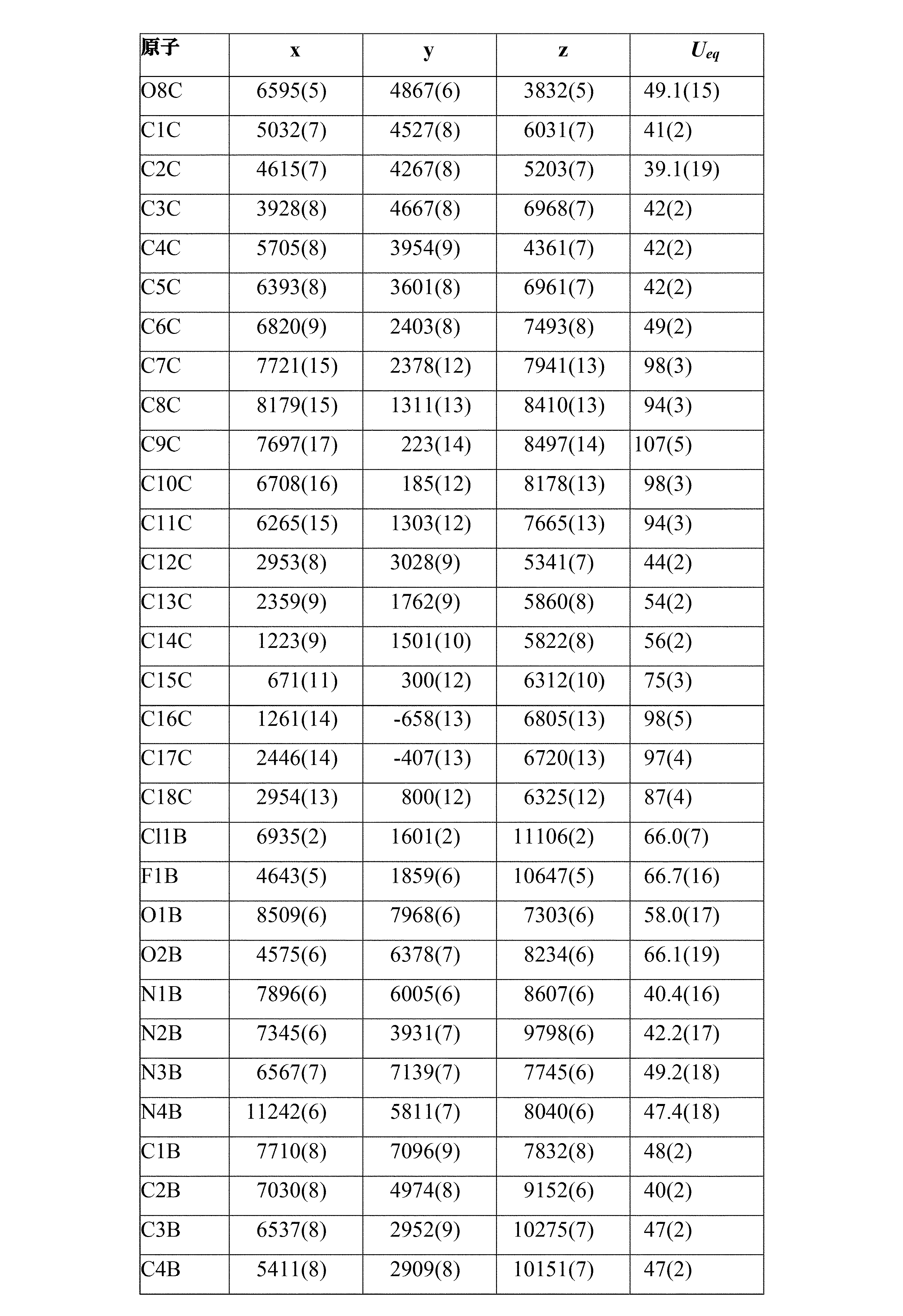


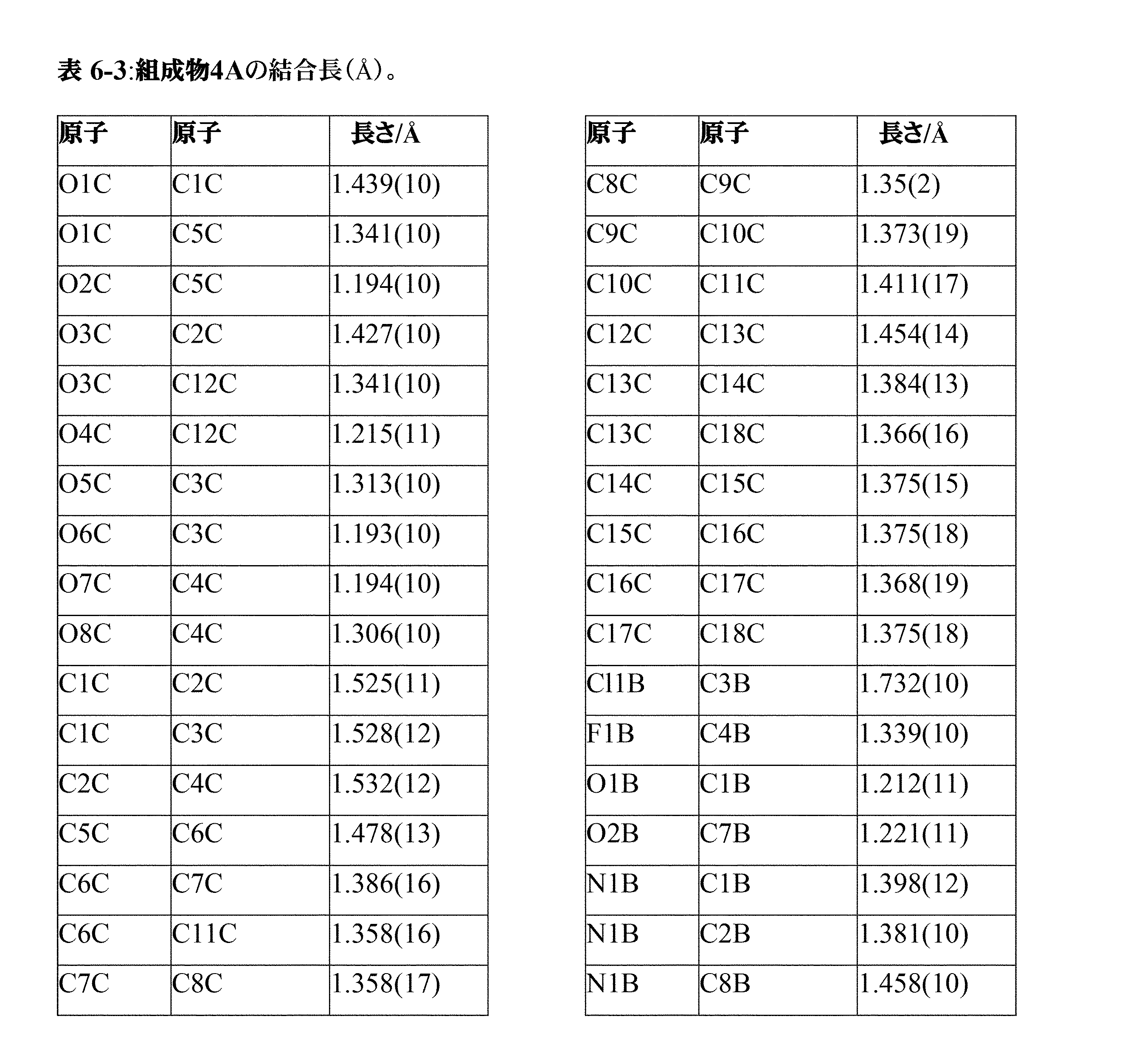
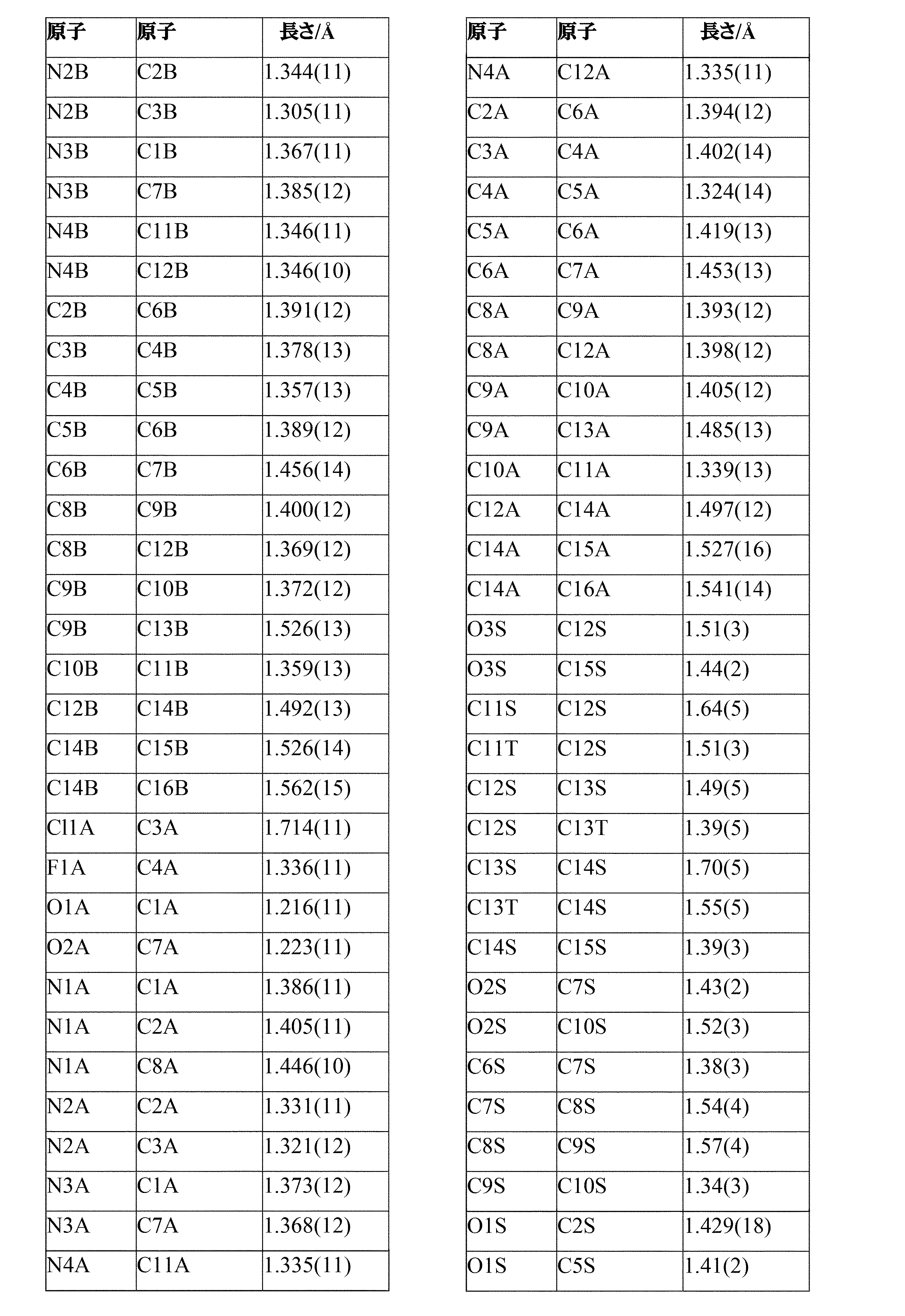


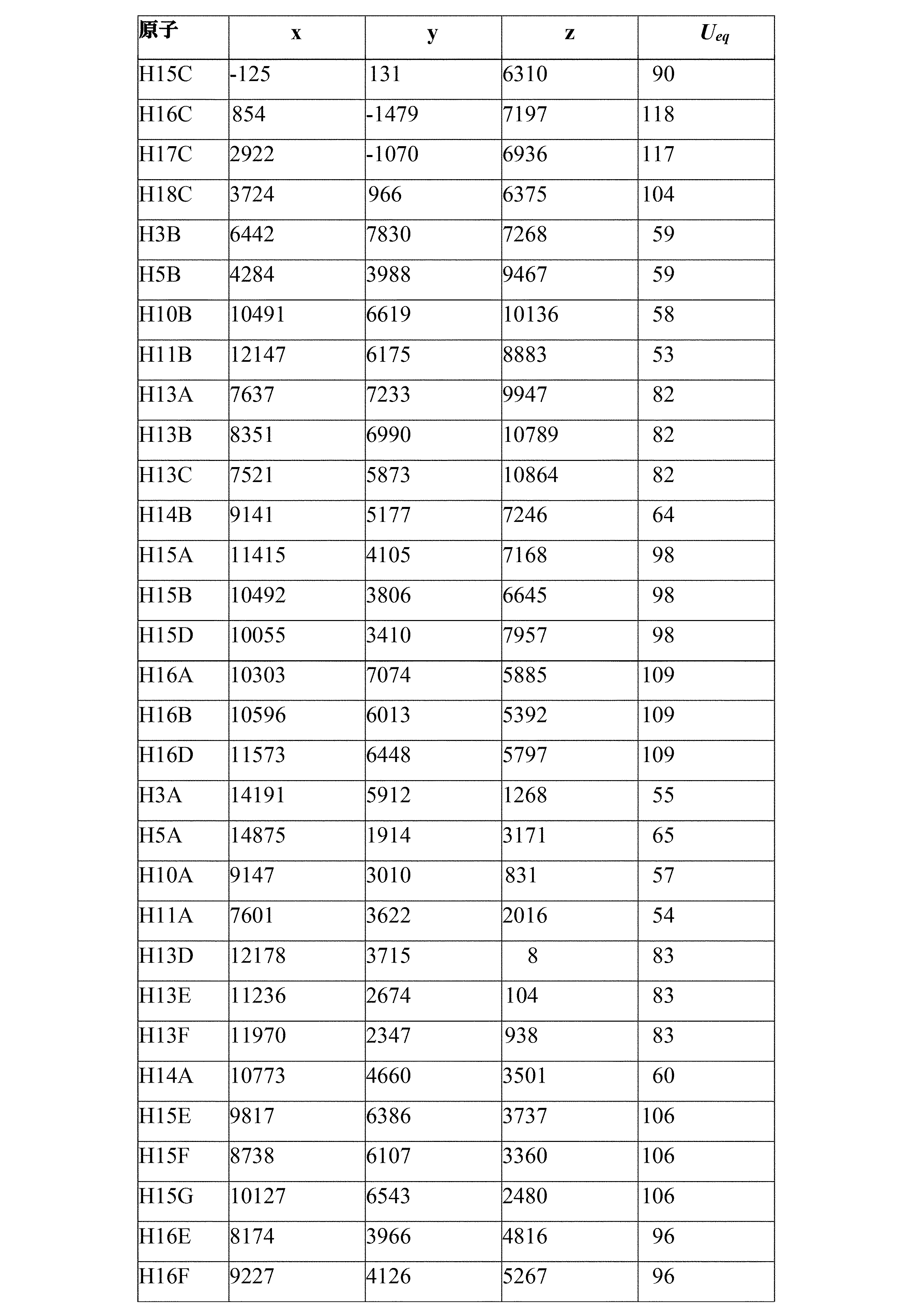


上記は単に本発明を例示するものであり、本発明を開示された用途に限定することを意図するものではない。当業者にとって日常的である変形及び変更は、添付の特許請求の範囲に定義される本発明の範囲及び性質内であることが意図される。言及された全ての参考文献、特許、出願及び刊行物は、本明細書に記載されているかのように、その全体が参照により本明細書に組み込まれる。 The foregoing is merely illustrative of the present invention and is not intended to limit the present invention to the disclosed applications. Variations and modifications that are routine for those skilled in the art are intended to be within the scope and nature of the present invention as defined in the appended claims. All references, patents, applications and publications mentioned are incorporated herein by reference in their entirety as if set forth herein.
Claims (59)

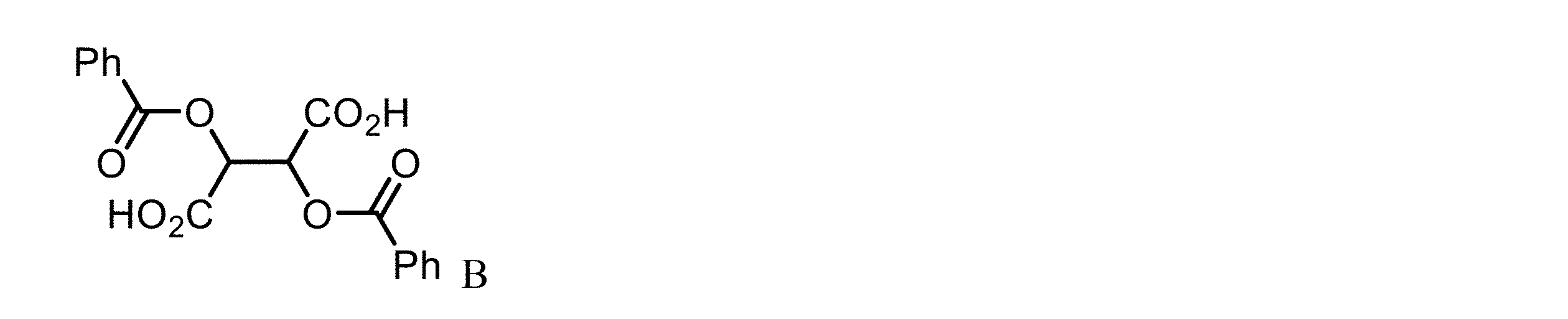

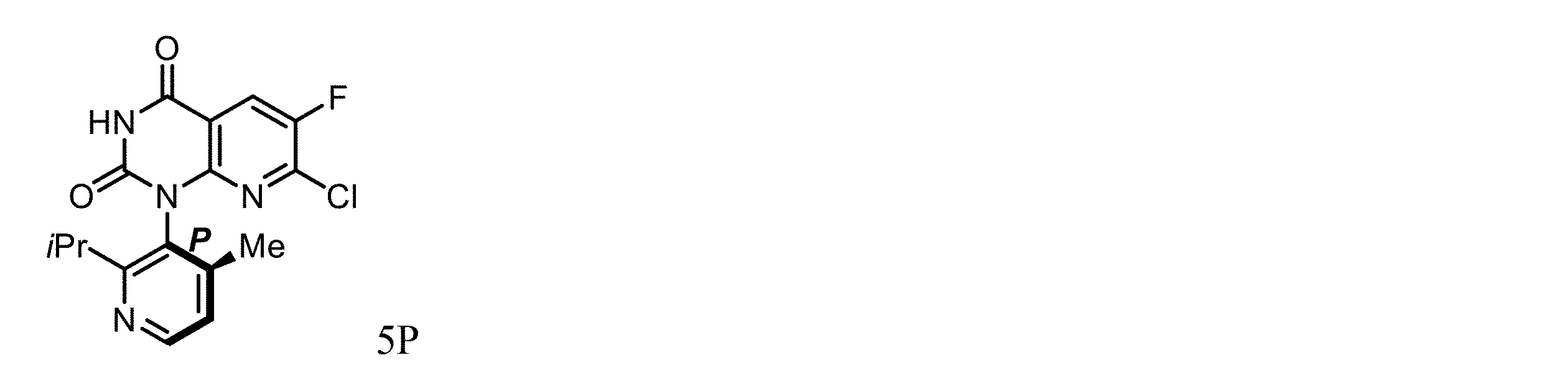



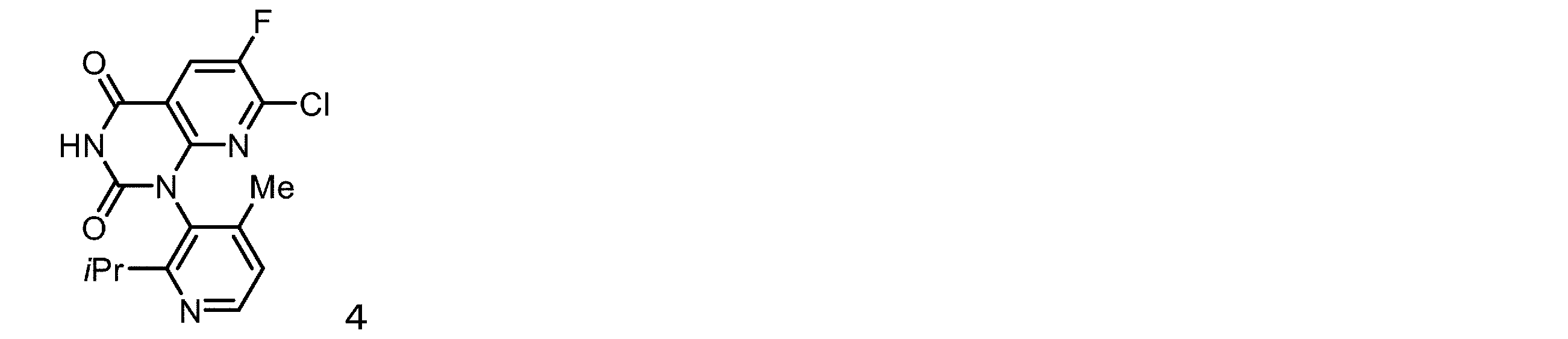
の化合物の製造方法であって、2,6-ジクロロ-5-フルオロ-N-{[4-メチル-2-(プロパン-2-イル)ピリジン-3-イル]カルバモイル}ピリジン-3-カルボキサミドを、ナトリウムt-ブトキシドと混合し、前記式4の化合物を形成することを含む、方法。2,6-dichloro-5-fluoro-N-{[4-methyl-2-(propan-2-yl)pyridin-3-yl]carbamoyl}pyridine-3-carboxamide with sodium t-butoxide to form the compound of formula 4.

の組成物の製造方法であって、式4:


の化合物と混合し、前記式4aの組成物を形成することを含む、方法。 Formula 4a :
A method for preparing a composition of formula 4 :
to form said composition of formula 4a .

式4a:
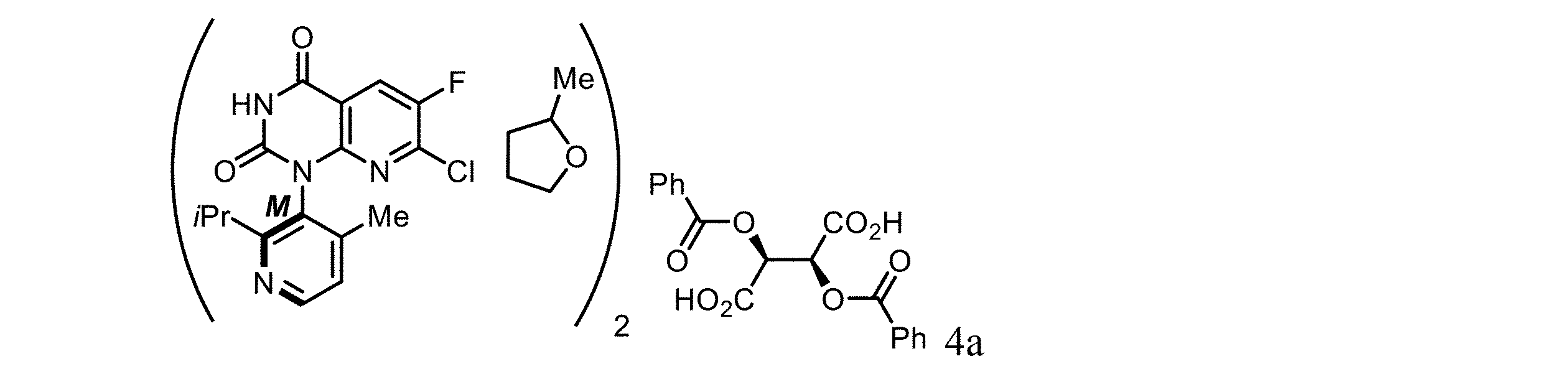
Formula 4a:

の化合物又はその薬学的に許容される塩の製造方法であって、7-クロロ-6-フルオロ-1-[4-メチル-2-(プロパン-2-イル)ピリジン-3-イル]ピリド[2,3-d]ピリミジン-2,4(1H,3H)-ジオンをPOClor a pharma- ceutical acceptable salt thereof, comprising reacting 7-chloro-6-fluoro-1-[4-methyl-2-(propan-2-yl)pyridin-3-yl]pyrido[2,3-d]pyrimidine-2,4(1H,3H)-dione with POCl 33 及びN,N-ジイソプロピルエチルアミンと混合し、4,7-ジクロロ-6-フルオロ-1-(2-イソプロピル-4-メチルピリジン-3-イル)ピリド[2,3-d]ピリミジン-2(1H)-オンを形成し、ここで、前記7-クロロ-6-フルオロ-1-[4-メチル-2-(プロパン-2-イル)ピリジン-3-イル]ピリド[2,3-d]ピリミジン-2,4(1H,3H)-ジオンは、7-クロロ-6-フルオロ-(1M)-1-[4-メチル-2-(プロパン-2-イル)ピリジン-3-イル]ピリド[2,3-d]ピリミジン-2,4(1H,3H)-ジオンで立体異性体的にリッチである、方法。and N,N-diisopropylethylamine to form 4,7-dichloro-6-fluoro-1-(2-isopropyl-4-methylpyridin-3-yl)pyrido[2,3-d]pyrimidine-2(1H)-one, wherein said 7-chloro-6-fluoro-1-[4-methyl-2-(propan-2-yl)pyridin-3-yl]pyrido[2,3-d]pyrimidine-2,4(1H,3H)-dione is stereoisomerically enriched with 7-chloro-6-fluoro-(1M)-1-[4-methyl-2-(propan-2-yl)pyridin-3-yl]pyrido[2,3-d]pyrimidine-2,4(1H,3H)-dione.

の化合物又はその薬学的に許容される塩の製造方法であって、4,7-ジクロロ-6-フルオロ-1-(2-イソプロピル-4-メチルピリジン-3-イル)ピリド[2,3-d]ピリミジン-2(1H)-オンをtert-ブチル(3S)-3-メチルピペラジン-1-カルボキシレート、及びN,N-ジイソプロピルエチルアミンと混合し、tert-ブチル(3S)-4-{7-クロロ-6-フルオロ-1-[4-メチル-2-(プロパン-2-イル)ピリジン-3-イル]-2-オキソ-1,2-ジヒドロピリド[2,3-d]ピリミジン-4-イル}-3-メチルピペラジン-1-カルボキシレートを形成し、ここで、前記4,7-ジクロロ-6-フルオロ-1-(2-イソプロピル-4-メチルピリジン-3-イル)ピリド[2,3-d]ピリミジン-2(1H)-オンは、4,7-ジクロロ-6-フルオロ-(1M)-1-(2-イソプロピル-4-メチルピリジン-3-イル)ピリド[2,3-d]ピリミジン-2(1H)-オンで立体異性体的にリッチである、方法。or a pharma- ceutical acceptable salt thereof, comprising mixing 4,7-dichloro-6-fluoro-1-(2-isopropyl-4-methylpyridin-3-yl)pyrido[2,3-d]pyrimidin-2(1H)-one with tert-butyl(3S)-3-methylpiperazine-1-carboxylate and N,N-diisopropylethylamine to obtain tert-butyl(3S)-4-{7-chloro-6-fluoro-1-[4-methyl-2-(propan-2-yl)pyridin-3-yl]-2-oxo and forming 4,7-dichloro-6-fluoro-(1M)-1-(2-isopropyl-4-methylpyridin-3-yl)pyrido[2,3-d]pyrimidin-2(1H)-one, wherein said 4,7-dichloro-6-fluoro-(1M)-1-(2-isopropyl-4-methylpyridin-3-yl)pyrido[2,3-d]pyrimidin-2(1H)-one is stereoisomerically enriched with 4,7-dichloro-6-fluoro-(1M)-1-(2-isopropyl-4-methylpyridin-3-yl)pyrido[2,3-d]pyrimidin-2(1H)-one.

の化合物又はその薬学的に許容される塩の製造方法であって、tert-ブチル(3S)-4-{7-クロロ-6-フルオロ-1-[4-メチル-2-(プロパン-2-イル)ピリジン-3-イル]-2-オキソ-1,2-ジヒドロピリド[2,3-d]ピリミジン-4-イル}-3-メチルピペラジン-1-カルボキシレート、トリフルオロ(2-フルオロ-6-ヒドロキシフェニル)ホウ酸カリウム、[1,1’-ビス(ジフェニルホスフィノ)フェロセン]ジクロロパラジウム(II)、及び酢酸カリウムを混合し、tert-ブチル(3S)-4-(6-フルオロ-7-(2-フルオロ-6-ヒドロキシフェニル)-1-[4-メチル-2-(プロパン-2-イル)ピリジン-3-イル]-2-オキソ-1,2-ジヒドロピリド[2,3-d]ピリミジン-4-イル)-3-メチルピペラジン-1-カルボキシレートを形成し、ここで、前記tert-ブチル(3S)-4-{7-クロロ-6-フルオロ-1-[4-メチル-2-(プロパン-2-イル)ピリジン-3-イル]-2-オキソ-1,2-ジヒドロピリド[2,3-d]ピリミジン-4-イル}-3-メチルピペラジン-1-カルボキシレートは、tert-ブチル(3S)-4-{7-クロロ-6-フルオロ-(1M)-1-[4-メチル-2-(プロパン-2-イル)ピリジン-3-イル]-2-オキソ-1,2-ジヒドロピリド[2,3-d]ピリミジン-4-イル}-3-メチルピペラジン-1-カルボキシレートで立体異性体的にリッチである、方法。or a pharma- ceutically acceptable salt thereof, comprising mixing tert-butyl (3S)-4-(6-fluoro-7-(2-fluoro-6-hydroxyphenyl)-1-[4-methyl-2-(propan-2-yl)pyridin-3-yl]-2-oxo-1,2-dihydropyrido[2,3-d]pyrimidin-4-yl)-3-methylpiperazine-1-carboxylate, potassium trifluoro(2-fluoro-6-hydroxyphenyl)borate, [1,1'-bis(diphenylphosphino)ferrocene]dichloropalladium(II), and potassium acetate to obtain a compound represented by the formula (I) or (II), 2-dihydropyrido[2,3-d]pyrimidin-4-yl)-3-methylpiperazine-1-carboxylate, wherein said tert-butyl (3S)-4-{7-chloro-6-fluoro-1-[4-methyl-2-(propan-2-yl)pyridin-3-yl]-2-oxo-1,2-dihydropyrido[2,3-d]pyrimidin-4-yl}-3-methylpiperazine-1-carboxylate is stereoisomerically enriched with tert-butyl (3S)-4-{7-chloro-6-fluoro-(1M)-1-[4-methyl-2-(propan-2-yl)pyridin-3-yl]-2-oxo-1,2-dihydropyrido[2,3-d]pyrimidin-4-yl}-3-methylpiperazine-1-carboxylate.
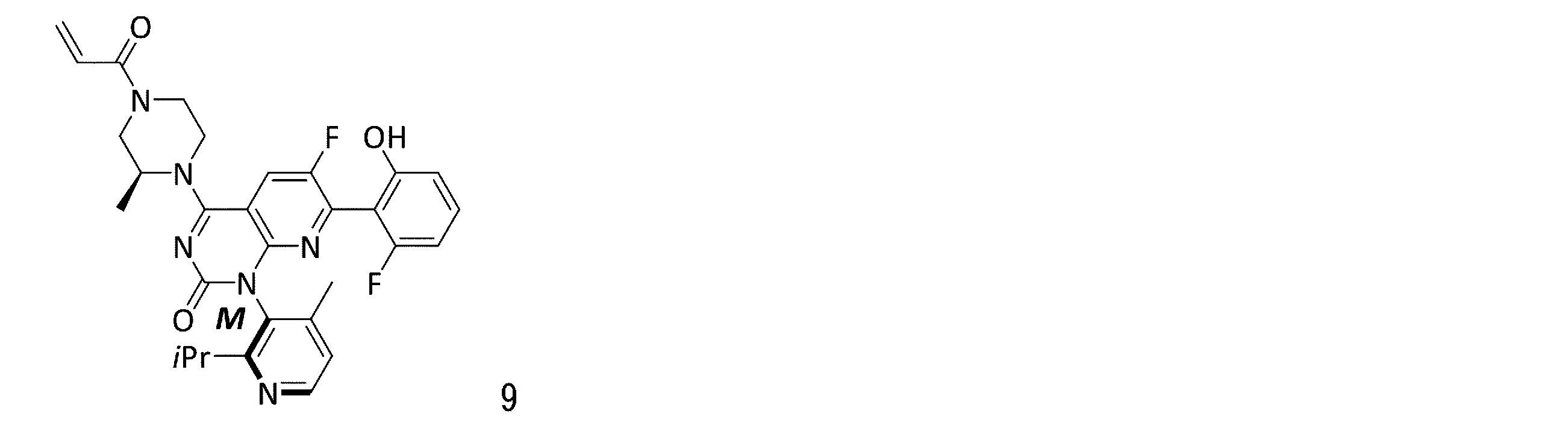
の化合物又はその薬学的に許容される塩の製造方法であって、tert-ブチル(3S)-4-{6-フルオロ-7-(2-フルオロ-6-ヒドロキシフェニル)-1-[4-メチル-2-(プロパン-2-イル)ピリジン-3-イル]-2-オキソ-1,2-ジヒドロピリド[2,3-d]ピリミジン-4-イル}-3-メチルピペラジン-1-カルボキシレート及びトリフルオロ酢酸を混合し、6-フルオロ-7-(2-フルオロ-6-ヒドロキシフェニル)-4-[(2S)-2-メチルピペラジン-1-イル]-1-[4-メチル-2-(プロパン-2-イル)ピリジン-3-イル]ピリド[2,3-d]ピリミジン-2(1H)-オンを形成し、ここで、前記tert-ブチル(3S)-4-{6-フルオロ-7-(2-フルオロ-6-ヒドロキシフェニル)-1-[4-メチル-2-(プロパン-2-イル)ピリジン-3-イル]-2-オキソ-1,2-ジヒドロピリド[2,3-d]ピリミジン-4-イル}-3-メチルピペラジン-1-カルボキシレートは、tert-ブチル(3S)-4-{6-フルオロ-7-(2-フルオロ-6-ヒドロキシフェニル)-(1M)-1-[4-メチル-2-(プロパン-2-イル)ピリジン-3-イル]-2-オキソ-1,2-ジヒドロピリド[2,3-d]ピリミジン-4-イル}-3-メチルピペラジン-1-カルボキシレートで立体異性性的にリッチである、方法。or a pharma- ceutically acceptable salt thereof, comprising mixing tert-butyl (3S)-4-{6-fluoro-7-(2-fluoro-6-hydroxyphenyl)-1-[4-methyl-2-(propan-2-yl)pyridin-3-yl]-2-oxo-1,2-dihydropyrido[2,3-d]pyrimidin-4-yl}-3-methylpiperazine-1-carboxylate and trifluoroacetic acid to form 6-fluoro-7-(2-fluoro-6-hydroxyphenyl)-4-[(2S)-2-methylpiperazin-1-yl]-1-[4-methyl-2-(propan-2-yl)pyridin-3-yl]pyrido[2,3-d]pyrimidin-2(1H)-one, wherein wherein said tert-butyl (3S)-4-{6-fluoro-7-(2-fluoro-6-hydroxyphenyl)-1-[4-methyl-2-(propan-2-yl)pyridin-3-yl]-2-oxo-1,2-dihydropyrido[2,3-d]pyrimidin-4-yl}-3-methylpiperazine-1-carboxylate is stereoisomerically enriched with tert-butyl (3S)-4-{6-fluoro-7-(2-fluoro-6-hydroxyphenyl)-(1M)-1-[4-methyl-2-(propan-2-yl)pyridin-3-yl]-2-oxo-1,2-dihydropyrido[2,3-d]pyrimidin-4-yl}-3-methylpiperazine-1-carboxylate.
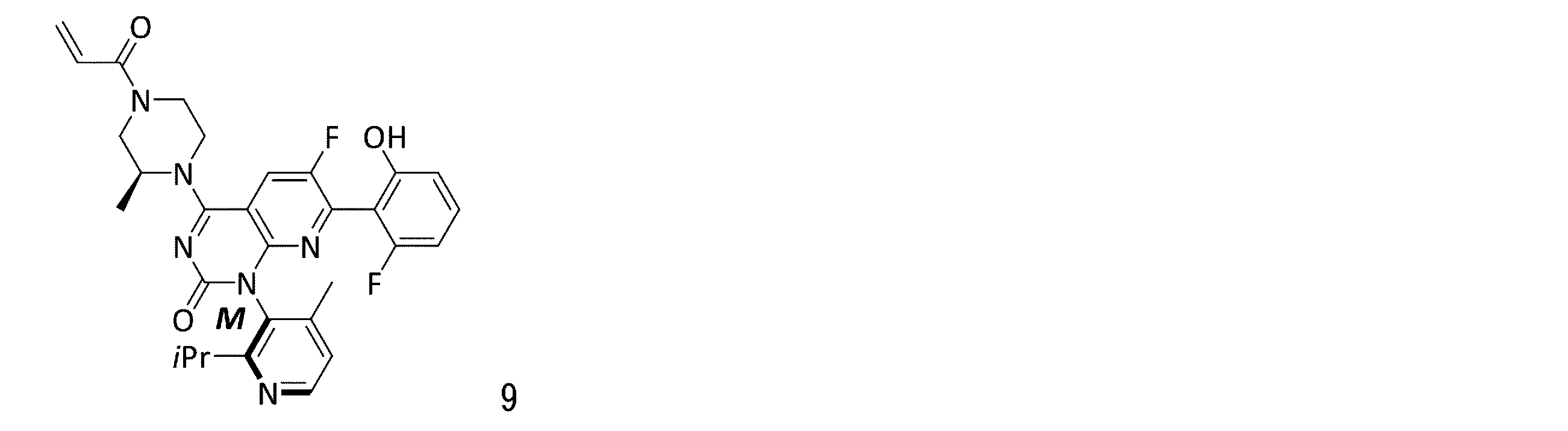
の化合物又はその薬学的に許容される塩の製造方法であって、6-フルオロ-7-(2-フルオロ-6-ヒドロキシフェニル)-4-[(2S)-2-メチルピペラジン-1-イル]-1-[4-メチル-2-(プロパン-2-イル)ピリジン-3-イル]ピリド[2,3-d]ピリミジン-2(1H)-オンを塩化アクリロイルと混合し、6-フルオロ-7-(2-フルオロ-6-ヒドロキシフェニル)-1-[4-メチル-2-(プロパン-2-イル)ピリジン-3-イル]-4-[(2S)-2-メチル-4-(プロプ-2-エノイル)ピペラジン-1-イル]ピリド[2,3-d]ピリミジン-2(1H)-オンを形成し、ここで、前記6-フルオロ-7-(2-フルオロ-6-ヒドロキシフェニル)-4-[(2S)-2-メチルピペラジン-1-イル]-1-[4-メチル-2-(プロパン-2-イル)ピリジン-3-イル]ピリド[2,3-d]ピリミジン-2(1H)-オンは、6-フルオロ-7-(2-フルオロ-6-ヒドロキシフェニル)-4-[(2S)-2-メチルピペラジン-1-イル]-(1M)-1-[4-メチル-2-(プロパン-2-イル)ピリジン-3-イル]ピリド[2,3-d]ピリミジン-2(1H)-オンで立体異性的にリッチである、方法。or a pharma- ceutical acceptable salt thereof, comprising mixing 6-fluoro-7-(2-fluoro-6-hydroxyphenyl)-4-[(2S)-2-methylpiperazin-1-yl]-1-[4-methyl-2-(propan-2-yl)pyridin-3-yl]pyrido[2,3-d]pyrimidin-2(1H)-one with acryloyl chloride to obtain 6-fluoro-7-(2-fluoro-6-hydroxyphenyl)-1-[4-methyl-2-(propan-2-yl)pyridin-3-yl]-4-[(2S)-2-methyl-4-(prop-2-enoyl)piperazin-1-yl]pyrido[2,3-d]pyrimidin-2(1H)-one; and forming 6-fluoro-7-(2-fluoro-6-hydroxyphenyl)-4-[(2S)-2-methylpiperazin-1-yl]-1-[4-methyl-2-(propan-2-yl)pyridin-3-yl]pyrido[2,3-d]pyrimidin-2(1H)-one, wherein said 6-fluoro-7-(2-fluoro-6-hydroxyphenyl)-4-[(2S)-2-methylpiperazin-1-yl]-(1M)-1-[4-methyl-2-(propan-2-yl)pyridin-3-yl]pyrido[2,3-d]pyrimidin-2(1H)-one is stereoisomerically enriched with 6-fluoro-7-(2-fluoro-6-hydroxyphenyl)-4-[(2S)-2-methylpiperazin-1-yl]-(1M)-1-[4-methyl-2-(propan-2-yl)pyridin-3-yl]pyrido[2,3-d]pyrimidin-2(1H)-one.

の化合物又はその薬学的に許容される塩の製造方法であって、請求項14~48のいずれか一項に記載の方法を含む、方法。or a pharma- ceutically acceptable salt thereof, comprising the method of any one of claims 14 to 48.


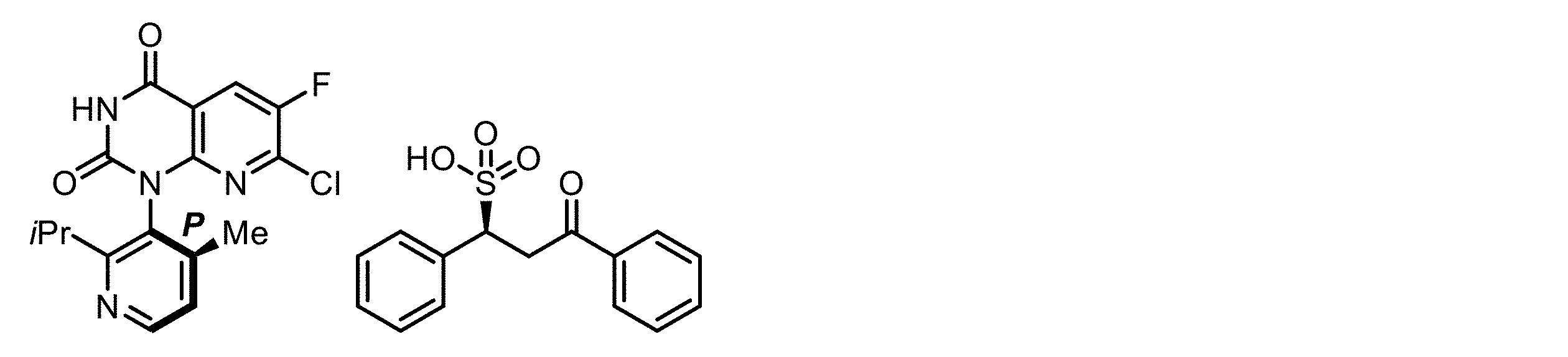
Priority Applications (1)
| Application Number | Priority Date | Filing Date | Title |
|---|---|---|---|
| JP2024106605A JP2024127907A (en) | 2018-11-16 | 2024-07-02 | Improved synthesis of key intermediates for KRAS G12C inhibitor compounds |
Applications Claiming Priority (2)
| Application Number | Priority Date | Filing Date | Title |
|---|---|---|---|
| US201862768802P | 2018-11-16 | 2018-11-16 | |
| US62/768,802 | 2018-11-16 |
Related Child Applications (1)
| Application Number | Title | Priority Date | Filing Date |
|---|---|---|---|
| JP2024106605A Division JP2024127907A (en) | 2018-11-16 | 2024-07-02 | Improved synthesis of key intermediates for KRAS G12C inhibitor compounds |
Publications (3)
| Publication Number | Publication Date |
|---|---|
| JP2020090482A JP2020090482A (en) | 2020-06-11 |
| JP2020090482A5 JP2020090482A5 (en) | 2022-11-18 |
| JP7516029B2 true JP7516029B2 (en) | 2024-07-16 |
Family
ID=68887130
Family Applications (2)
| Application Number | Title | Priority Date | Filing Date |
|---|---|---|---|
| JP2019205198A Active JP7516029B2 (en) | 2018-11-16 | 2019-11-13 | Improved synthesis of key intermediates for KRAS G12C inhibitor compounds |
| JP2024106605A Pending JP2024127907A (en) | 2018-11-16 | 2024-07-02 | Improved synthesis of key intermediates for KRAS G12C inhibitor compounds |
Family Applications After (1)
| Application Number | Title | Priority Date | Filing Date |
|---|---|---|---|
| JP2024106605A Pending JP2024127907A (en) | 2018-11-16 | 2024-07-02 | Improved synthesis of key intermediates for KRAS G12C inhibitor compounds |
Country Status (25)
| Country | Link |
|---|---|
| US (5) | US11299491B2 (en) |
| EP (2) | EP4234546A3 (en) |
| JP (2) | JP7516029B2 (en) |
| KR (2) | KR20250164341A (en) |
| CN (3) | CN113015724B (en) |
| AR (1) | AR117101A1 (en) |
| AU (2) | AU2019381817B2 (en) |
| BR (1) | BR112021009384A2 (en) |
| CA (1) | CA3117221A1 (en) |
| CL (1) | CL2021001266A1 (en) |
| DK (1) | DK3880670T3 (en) |
| EA (1) | EA202191381A1 (en) |
| ES (1) | ES2953752T3 (en) |
| FI (1) | FI3880670T3 (en) |
| HU (1) | HUE062656T2 (en) |
| IL (2) | IL318601A (en) |
| LT (1) | LT3880670T (en) |
| MA (1) | MA54233A (en) |
| MX (2) | MX2021005598A (en) |
| PL (1) | PL3880670T3 (en) |
| PT (1) | PT3880670T (en) |
| SG (1) | SG11202104927QA (en) |
| SI (1) | SI3880670T1 (en) |
| TW (1) | TWI862525B (en) |
| WO (1) | WO2020102730A1 (en) |
Cited By (1)
| Publication number | Priority date | Publication date | Assignee | Title |
|---|---|---|---|---|
| JP2024127907A (en) * | 2018-11-16 | 2024-09-20 | アムジエン・インコーポレーテツド | Improved synthesis of key intermediates for KRAS G12C inhibitor compounds |
Families Citing this family (54)
| Publication number | Priority date | Publication date | Assignee | Title |
|---|---|---|---|---|
| EA201991528A1 (en) | 2016-12-22 | 2020-01-16 | Эмджен Инк. | Benzisothiazole, isothiazole [3,4-b] pyridine, quinazoline, phthalazine, pyrido [2,3-d] pyridazine and pyrido [2,3-d] pyrimidine derivatives in a red herbal solution COLORECTAL CANCER |
| JOP20190272A1 (en) | 2017-05-22 | 2019-11-21 | Amgen Inc | Kras g12c inhibitors and methods of using the same |
| ES2985118T3 (en) | 2017-09-08 | 2024-11-04 | Amgen Inc | KRAS G12C inhibitors and methods of using them |
| EP3788038B1 (en) | 2018-05-04 | 2023-10-11 | Amgen Inc. | Kras g12c inhibitors and methods of using the same |
| CA3099118A1 (en) | 2018-05-04 | 2019-11-07 | Amgen Inc. | Kras g12c inhibitors and methods of using the same |
| MA52564A (en) | 2018-05-10 | 2021-03-17 | Amgen Inc | KRAS G12C INHIBITORS FOR CANCER TREATMENT |
| MX2020012731A (en) | 2018-06-01 | 2021-02-22 | Amgen Inc | Kras g12c inhibitors and methods of using the same. |
| EP3807276B1 (en) | 2018-06-12 | 2025-12-10 | Amgen Inc. | Kras g12c inhibitors encompassing a piperazine ring and use thereof in the treatment of cancer |
| JP7377679B2 (en) | 2018-11-19 | 2023-11-10 | アムジエン・インコーポレーテツド | Combination therapy comprising a KRASG12C inhibitor and one or more additional pharmaceutically active agents for the treatment of cancer |
| JP7454572B2 (en) | 2018-11-19 | 2024-03-22 | アムジエン・インコーポレーテツド | KRAS G12C inhibitor and its use |
| EP3738593A1 (en) | 2019-05-14 | 2020-11-18 | Amgen, Inc | Dosing of kras inhibitor for treatment of cancers |
| JP2022532790A (en) | 2019-05-21 | 2022-07-19 | アムジエン・インコーポレーテツド | Solid form |
| KR20250159270A (en) | 2019-05-21 | 2025-11-10 | 암젠 인크 | Solid state forms |
| AR120457A1 (en) | 2019-11-14 | 2022-02-16 | Amgen Inc | ENHANCED SYNTHESIS OF KRAS G12C INHIBITOR COMPOUND |
| CA3161156A1 (en) | 2019-11-14 | 2021-05-20 | Amgen Inc. | Improved synthesis of kras g12c inhibitor compound |
| WO2021108683A1 (en) | 2019-11-27 | 2021-06-03 | Revolution Medicines, Inc. | Covalent ras inhibitors and uses thereof |
| US12479834B2 (en) | 2019-11-29 | 2025-11-25 | Taiho Pharmaceutical Co., Ltd. | Phenol compound or salt thereof |
| WO2021185233A1 (en) * | 2020-03-17 | 2021-09-23 | Jacobio Pharmaceuticals Co., Ltd. | Kras mutant protein inhibitors |
| CN114585624A (en) * | 2020-06-02 | 2022-06-03 | 上海喆邺生物科技有限公司 | A kind of chiral intermediate and preparation method thereof |
| KR20230019462A (en) | 2020-06-02 | 2023-02-08 | 베링거 인겔하임 인터내셔날 게엠베하 | Cyclic 2-amino-3-cyanothiophene and derivatives for cancer treatment |
| MX2022016355A (en) | 2020-06-18 | 2023-04-03 | Revolution Medicines Inc | Methods for delaying, preventing, and treating acquired resistance to ras inhibitors. |
| CN115942936A (en) | 2020-06-24 | 2023-04-07 | 勃林格殷格翰国际有限公司 | Anticancer combination therapy comprising SOS1 inhibitor and KRAS G12C inhibitor |
| CN113929676A (en) * | 2020-07-14 | 2022-01-14 | 浙江海正药业股份有限公司 | Pyridino-heterocyclic derivative and preparation method and application thereof |
| CN115052870B (en) | 2020-08-02 | 2024-02-20 | 上海喆邺生物科技有限公司 | An aromatic compound and its application in anti-tumor drugs |
| US20230357233A1 (en) * | 2020-08-26 | 2023-11-09 | InventisBio Co., Ltd. | Heteroaryl compounds, preparation methods and uses thereof |
| CA3187757A1 (en) | 2020-09-03 | 2022-03-24 | Ethan AHLER | Use of sos1 inhibitors to treat malignancies with shp2 mutations |
| US20230391771A1 (en) * | 2020-10-07 | 2023-12-07 | Amgen Inc. | Process for racemizing and isolating atropisomers of 7-chloro-6-fluoro-1-(2-isopropyl-4-methylpyridin-3-yl)pyrido[2,3-d]pyrimidine-2,4(1h,3h)-dione |
| WO2022109242A1 (en) | 2020-11-20 | 2022-05-27 | Amgen Inc. | Process for preparing 7-chloro-6-fluoro-1-(2-isopropyl-4-methylpyridin-3- yl)pyridof[2,3-d]pyrimidine-2,4(1h,3h)-dione |
| EP4319757A1 (en) | 2021-04-09 | 2024-02-14 | Boehringer Ingelheim International GmbH | Anticancer therapy |
| EP4341260A1 (en) | 2021-05-19 | 2024-03-27 | Teva Pharmaceuticals International GmbH | Process for preparation of sotorasib and solid state form thereof |
| WO2022269008A1 (en) * | 2021-06-24 | 2022-12-29 | Sandoz Ag | Crystalline form of sotorasib |
| CN114605406B (en) * | 2021-09-18 | 2023-05-26 | 都创(上海)医药开发有限公司 | Crystal form of AMG510 compound and its preparation method and use |
| KR20240128852A (en) | 2021-12-01 | 2024-08-27 | 베링거 인겔하임 인터내셔날 게엠베하 | Cyclic 2-amino-3-cyano thiophenes and derivatives for cancer therapy |
| US20250163039A1 (en) | 2021-12-22 | 2025-05-22 | Boehringer Ingelheim International Gmbh | Heteroaromatic compounds for the treatment of cancer |
| CN116375746B (en) * | 2021-12-23 | 2025-08-05 | 上海馨远医药科技有限公司 | A preparation method of potassium (2-fluoro-6-hydroxyphenyl) trifluoroborate |
| JP2025509217A (en) | 2022-03-07 | 2025-04-11 | アムジエン・インコーポレーテツド | Process for preparing 4-methyl-2-propan-2-yl-pyridine-3-carbonitrile |
| CN115466259B (en) * | 2022-08-16 | 2023-12-05 | 山东大学 | Preparation method of KRAS G12C inhibitor sotorubin |
| KR20250164828A (en) | 2023-03-30 | 2025-11-25 | 레볼루션 메디슨즈, 인크. | Composition for inducing RAS GTP hydrolysis and use thereof |
| TW202508595A (en) | 2023-05-04 | 2025-03-01 | 美商銳新醫藥公司 | Combination therapy for a ras related disease or disorder |
| WO2024246114A1 (en) | 2023-05-31 | 2024-12-05 | Boehringer Ingelheim International Gmbh | Survivin as a biomarker for predicting the responsiveness of cancer treatment |
| US20250049810A1 (en) | 2023-08-07 | 2025-02-13 | Revolution Medicines, Inc. | Methods of treating a ras protein-related disease or disorder |
| WO2025036442A1 (en) * | 2023-08-15 | 2025-02-20 | 劲方医药科技(上海)股份有限公司 | Method for preparing pyrazinonaphthyridine dione compound, and intermediate thereof |
| WO2025080946A2 (en) | 2023-10-12 | 2025-04-17 | Revolution Medicines, Inc. | Ras inhibitors |
| TW202535891A (en) | 2023-10-20 | 2025-09-16 | 美商默沙東有限責任公司 | Small molecule inhibitors of kras proteins |
| WO2025132549A1 (en) | 2023-12-20 | 2025-06-26 | Boehringer Ingelheim International Gmbh | Cancer combination therapy using zongertinib and a kras g12c inhibitor |
| WO2025171296A1 (en) | 2024-02-09 | 2025-08-14 | Revolution Medicines, Inc. | Ras inhibitors |
| WO2025240847A1 (en) | 2024-05-17 | 2025-11-20 | Revolution Medicines, Inc. | Ras inhibitors |
| WO2025255438A1 (en) | 2024-06-07 | 2025-12-11 | Revolution Medicines, Inc. | Methods of treating a ras protein-related disease or disorder |
| WO2025265060A1 (en) | 2024-06-21 | 2025-12-26 | Revolution Medicines, Inc. | Therapeutic compositions and methods for managing treatment-related effects |
| WO2026006747A1 (en) | 2024-06-28 | 2026-01-02 | Revolution Medicines, Inc. | Ras inhibitors |
| WO2026015825A1 (en) | 2024-07-12 | 2026-01-15 | Revolution Medicines, Inc. | Use of ras inhibitor for treating pancreatic cancer |
| WO2026015801A1 (en) | 2024-07-12 | 2026-01-15 | Revolution Medicines, Inc. | Methods of treating a ras related disease or disorder |
| WO2026015790A1 (en) | 2024-07-12 | 2026-01-15 | Revolution Medicines, Inc. | Methods of treating a ras related disease or disorder |
| WO2026015796A1 (en) | 2024-07-12 | 2026-01-15 | Revolution Medicines, Inc. | Methods of treating a ras related disease or disorder |
Citations (3)
| Publication number | Priority date | Publication date | Assignee | Title |
|---|---|---|---|---|
| US20180334454A1 (en) | 2017-05-22 | 2018-11-22 | Amgen Inc. | Kras g12c inhibitors and methods of using the same |
| WO2019051291A1 (en) | 2017-09-08 | 2019-03-14 | Amgen Inc. | KRAS G12C INHIBITORS AND METHODS OF USE |
| WO2019213516A1 (en) | 2018-05-04 | 2019-11-07 | Amgen Inc. | Kras g12c inhibitors and methods of using the same |
Family Cites Families (210)
| Publication number | Priority date | Publication date | Assignee | Title |
|---|---|---|---|---|
| US4232027A (en) | 1979-01-29 | 1980-11-04 | E. R. Squibb & Sons, Inc. | 1,2-Dihydro-2-oxo-4-phenyl-3-quinolinecarbonitrile derivatives |
| GB2116183B (en) | 1982-03-03 | 1985-06-05 | Genentech Inc | Human antithrombin iii dna sequences therefore expression vehicles and cloning vectors containing such sequences and cell cultures transformed thereby a process for expressing human antithrombin iii and pharmaceutical compositions comprising it |
| GB8827305D0 (en) | 1988-11-23 | 1988-12-29 | British Bio Technology | Compounds |
| JP2762522B2 (en) | 1989-03-06 | 1998-06-04 | 藤沢薬品工業株式会社 | Angiogenesis inhibitor |
| US5112946A (en) | 1989-07-06 | 1992-05-12 | Repligen Corporation | Modified pf4 compositions and methods of use |
| PT98990A (en) | 1990-09-19 | 1992-08-31 | American Home Prod | PROCESS FOR THE PREPARATION OF CARBOXYLIC ACID ESTERS OF RAPAMICIN |
| US5892112A (en) | 1990-11-21 | 1999-04-06 | Glycomed Incorporated | Process for preparing synthetic matrix metalloprotease inhibitors |
| US5120842A (en) | 1991-04-01 | 1992-06-09 | American Home Products Corporation | Silyl ethers of rapamycin |
| US5100883A (en) | 1991-04-08 | 1992-03-31 | American Home Products Corporation | Fluorinated esters of rapamycin |
| US5118678A (en) | 1991-04-17 | 1992-06-02 | American Home Products Corporation | Carbamates of rapamycin |
| SG64322A1 (en) | 1991-05-10 | 1999-04-27 | Rhone Poulenc Rorer Int | Bis mono and bicyclic aryl and heteroaryl compounds which inhibit egf and/or pdgf receptor tyrosine kinase |
| US5118677A (en) | 1991-05-20 | 1992-06-02 | American Home Products Corporation | Amide esters of rapamycin |
| NZ243082A (en) | 1991-06-28 | 1995-02-24 | Ici Plc | 4-anilino-quinazoline derivatives; pharmaceutical compositions, preparatory processes, and use thereof |
| US5151413A (en) | 1991-11-06 | 1992-09-29 | American Home Products Corporation | Rapamycin acetals as immunosuppressant and antifungal agents |
| GB9125660D0 (en) | 1991-12-03 | 1992-01-29 | Smithkline Beecham Plc | Novel compound |
| AU661533B2 (en) | 1992-01-20 | 1995-07-27 | Astrazeneca Ab | Quinazoline derivatives |
| US5521184A (en) | 1992-04-03 | 1996-05-28 | Ciba-Geigy Corporation | Pyrimidine derivatives and processes for the preparation thereof |
| ZA935112B (en) | 1992-07-17 | 1994-02-08 | Smithkline Beecham Corp | Rapamycin derivatives |
| ZA935111B (en) | 1992-07-17 | 1994-02-04 | Smithkline Beecham Corp | Rapamycin derivatives |
| US5256790A (en) | 1992-08-13 | 1993-10-26 | American Home Products Corporation | 27-hydroxyrapamycin and derivatives thereof |
| GB9221220D0 (en) | 1992-10-09 | 1992-11-25 | Sandoz Ag | Organic componds |
| WO1994009101A1 (en) | 1992-10-13 | 1994-04-28 | The Procter & Gamble Company | Non-aqueous liquid detergent compositions |
| US5258389A (en) | 1992-11-09 | 1993-11-02 | Merck & Co., Inc. | O-aryl, O-alkyl, O-alkenyl and O-alkynylrapamycin derivatives |
| CA2148484A1 (en) | 1992-11-13 | 1994-05-26 | Stewart Lyman | Novel cytokine designated elk ligand |
| US5455258A (en) | 1993-01-06 | 1995-10-03 | Ciba-Geigy Corporation | Arylsulfonamido-substituted hydroxamic acids |
| US5629327A (en) | 1993-03-01 | 1997-05-13 | Childrens Hospital Medical Center Corp. | Methods and compositions for inhibition of angiogenesis |
| US5516658A (en) | 1993-08-20 | 1996-05-14 | Immunex Corporation | DNA encoding cytokines that bind the cell surface receptor hek |
| CA2148931A1 (en) | 1993-10-01 | 1995-04-13 | Jurg Zimmermann | Pyrimidineamine derivatives and processes for the preparation thereof |
| US5656643A (en) | 1993-11-08 | 1997-08-12 | Rhone-Poulenc Rorer Pharmaceuticals Inc. | Bis mono-and bicyclic aryl and heteroaryl compounds which inhibit EGF and/or PDGF receptor tyrosine kinase |
| EP0729471A1 (en) | 1993-11-19 | 1996-09-04 | Abbott Laboratories | Semisynthetic analogs of rapamycin (macrolides) being immunomodulators |
| PL314238A1 (en) | 1993-12-17 | 1996-09-02 | Sandoz Ltd | Rapamycin derivatives |
| US5700823A (en) | 1994-01-07 | 1997-12-23 | Sugen, Inc. | Treatment of platelet derived growth factor related disorders such as cancers |
| IL112249A (en) | 1994-01-25 | 2001-11-25 | Warner Lambert Co | Pharmaceutical compositions containing di and tricyclic pyrimidine derivatives for inhibiting tyrosine kinases of the epidermal growth factor receptor family and some new such compounds |
| IL112248A0 (en) | 1994-01-25 | 1995-03-30 | Warner Lambert Co | Tricyclic heteroaromatic compounds and pharmaceutical compositions containing them |
| WO1995024190A2 (en) | 1994-03-07 | 1995-09-14 | Sugen, Inc. | Receptor tyrosine kinase inhibitors for inhibiting cell proliferative disorders and compositions thereof |
| EP0756627A1 (en) | 1994-04-15 | 1997-02-05 | Amgen Inc. | Hek5, hek7, hek8, hek11, new eph-like receptor protein tyrosine kinases |
| DK0682027T3 (en) | 1994-05-03 | 1998-05-04 | Ciba Geigy Ag | Pyrrolopyrimidine derivatives with antiproliferative action |
| US6303769B1 (en) | 1994-07-08 | 2001-10-16 | Immunex Corporation | Lerk-5 dna |
| US5919905A (en) | 1994-10-05 | 1999-07-06 | Immunex Corporation | Cytokine designated LERK-6 |
| US6057124A (en) | 1995-01-27 | 2000-05-02 | Amgen Inc. | Nucleic acids encoding ligands for HEK4 receptors |
| US5863949A (en) | 1995-03-08 | 1999-01-26 | Pfizer Inc | Arylsulfonylamino hydroxamic acid derivatives |
| EP2163546B1 (en) | 1995-03-30 | 2016-06-01 | Pfizer Products Inc. | Quinazoline derivatives |
| DE69609602T2 (en) | 1995-04-03 | 2001-04-12 | Novartis Ag, Basel | PYRAZOLE DERIVATIVES AND METHOD FOR THE PRODUCTION THEREOF |
| US5861510A (en) | 1995-04-20 | 1999-01-19 | Pfizer Inc | Arylsulfonyl hydroxamic acid derivatives as MMP and TNF inhibitors |
| GB9508538D0 (en) | 1995-04-27 | 1995-06-14 | Zeneca Ltd | Quinazoline derivatives |
| US5747498A (en) | 1996-05-28 | 1998-05-05 | Pfizer Inc. | Alkynyl and azido-substituted 4-anilinoquinazolines |
| US5650415A (en) | 1995-06-07 | 1997-07-22 | Sugen, Inc. | Quinoline compounds |
| US5880141A (en) | 1995-06-07 | 1999-03-09 | Sugen, Inc. | Benzylidene-Z-indoline compounds for the treatment of disease |
| CA2219659C (en) | 1995-06-09 | 2008-03-18 | Novartis Ag | Rapamycin derivatives |
| TR199800012T1 (en) | 1995-07-06 | 1998-04-21 | Novartis Ag | Pyrolopyrimidines and applications for preparation. |
| DE19534177A1 (en) | 1995-09-15 | 1997-03-20 | Merck Patent Gmbh | Cyclic adhesion inhibitors |
| AR004010A1 (en) | 1995-10-11 | 1998-09-30 | Glaxo Group Ltd | HETERO CYCLIC COMPOUNDS |
| GB9523675D0 (en) | 1995-11-20 | 1996-01-24 | Celltech Therapeutics Ltd | Chemical compounds |
| DE69624081T2 (en) | 1995-12-20 | 2003-06-12 | Agouron Pharmaceuticals, Inc. | Matrix metalloprotease inhibitors |
| JP4275733B2 (en) | 1996-01-23 | 2009-06-10 | ノバルティス アクチエンゲゼルシャフト | Pyrrolopyrimidine and process for producing the same |
| JP3406763B2 (en) | 1996-01-30 | 2003-05-12 | 東レ・ダウコーニング・シリコーン株式会社 | Silicone rubber composition |
| GB9603095D0 (en) | 1996-02-14 | 1996-04-10 | Zeneca Ltd | Quinazoline derivatives |
| GB9603097D0 (en) | 1996-02-14 | 1996-04-10 | Zeneca Ltd | Quinazoline compounds |
| DE19629652A1 (en) | 1996-03-06 | 1998-01-29 | Thomae Gmbh Dr K | 4-Amino-pyrimidine derivatives, medicaments containing these compounds, their use and processes for their preparation |
| DE19608588A1 (en) | 1996-03-06 | 1997-09-11 | Thomae Gmbh Dr K | Pyrimido [5,4-d] pyrimidines, medicaments containing these compounds, their use and processes for their preparation |
| WO1997034895A1 (en) | 1996-03-15 | 1997-09-25 | Novartis Ag | Novel n-7-heterocyclyl pyrrolo[2,3-d]pyridines and their use |
| DE69710712T3 (en) | 1996-04-12 | 2010-12-23 | Warner-Lambert Co. Llc | REVERSIBLE INHIBITORS OF TYROSINE KINASEN |
| GB9607729D0 (en) | 1996-04-13 | 1996-06-19 | Zeneca Ltd | Quinazoline derivatives |
| CA2258548C (en) | 1996-06-24 | 2005-07-26 | Pfizer Inc. | Phenylamino-substituted tricyclic derivatives for treatment of hyperproliferative diseases |
| EP0818442A3 (en) | 1996-07-12 | 1998-12-30 | Pfizer Inc. | Cyclic sulphone derivatives as inhibitors of metalloproteinases and of the production of tumour necrosis factor |
| EP0937082A2 (en) | 1996-07-12 | 1999-08-25 | Ariad Pharmaceuticals, Inc. | Materials and method for treating or preventing pathogenic fungal infection |
| EP0912559B1 (en) | 1996-07-13 | 2002-11-06 | Glaxo Group Limited | Fused heterocyclic compounds as protein tyrosine kinase inhibitors |
| ES2191187T3 (en) | 1996-07-13 | 2003-09-01 | Glaxo Group Ltd | BICYCLE HETEROAROMATIC COMPOUNDS AS INHIBITORS OF PROTEIN TIROSIN-QUINASA. |
| HRP970371A2 (en) | 1996-07-13 | 1998-08-31 | Kathryn Jane Smith | Heterocyclic compounds |
| EA199900036A1 (en) | 1996-07-18 | 1999-06-24 | Пфайзер Инк | METALLIC PROTEASIS INHIBITORS OF MATRIX ON THE BASIS OF PHOSPHINATES, PHARMACEUTICAL COMPOSITION, METHOD OF TREATMENT |
| AU4055697A (en) | 1996-08-16 | 1998-03-06 | Schering Corporation | Mammalian cell surface antigens; related reagents |
| US6111090A (en) | 1996-08-16 | 2000-08-29 | Schering Corporation | Mammalian cell surface antigens; related reagents |
| ATE384062T1 (en) | 1996-08-23 | 2008-02-15 | Novartis Pharma Gmbh | SUBSTITUTED PYRROLOPYRIMIDINES AND METHOD FOR THE PRODUCTION THEREOF |
| PL331895A1 (en) | 1996-08-23 | 1999-08-16 | Pfizer | Arylosulphonylamino derivatives of hydroxamic acid |
| ID18494A (en) | 1996-10-02 | 1998-04-16 | Novartis Ag | PIRAZOLA DISTRIBUTION IN THE SEQUENCE AND THE PROCESS OF MAKING IT |
| EP0929553B1 (en) | 1996-10-02 | 2005-03-16 | Novartis AG | Pyrimidine derivatives and processes for the preparation thereof |
| WO1998014449A1 (en) | 1996-10-02 | 1998-04-09 | Novartis Ag | Fused pyrazole derivatives and processes for their preparation |
| EP0837063A1 (en) | 1996-10-17 | 1998-04-22 | Pfizer Inc. | 4-Aminoquinazoline derivatives |
| GB9621757D0 (en) | 1996-10-18 | 1996-12-11 | Ciba Geigy Ag | Phenyl-substituted bicyclic heterocyclyl derivatives and their use |
| DK0950059T3 (en) | 1997-01-06 | 2004-11-01 | Pfizer | Cyclic sulfone derivatives |
| ATE248812T1 (en) | 1997-02-03 | 2003-09-15 | Pfizer Prod Inc | ARYLSULFONYLHYDROXAMIC ACID DERIVATIVES |
| KR20000070751A (en) | 1997-02-05 | 2000-11-25 | 로즈 암스트롱, 크리스틴 에이. 트러트웨인 | Pyrido[2,3-D]pyrimidines and 4-Aminopyrimidines as Inhibitors of Cellular Proliferation |
| JP2000507975A (en) | 1997-02-07 | 2000-06-27 | ファイザー・インク | N-hydroxy-β-sulfonylpropionamide derivatives and their use as matrix metalloproteinase inhibitors |
| PL334997A1 (en) | 1997-02-11 | 2000-03-27 | Pfizer | Derivatives or arylosulphonyl-hydroxamic acid |
| CO4950519A1 (en) | 1997-02-13 | 2000-09-01 | Novartis Ag | PHTHALAZINES, PHARMACEUTICAL PREPARATIONS THAT UNDERSTAND THEM AND THE PROCESS FOR THEIR PREPARATION |
| US6150395A (en) | 1997-05-30 | 2000-11-21 | The Regents Of The University Of California | Indole-3-carbinol (I3C) derivatives and methods |
| WO1999007701A1 (en) | 1997-08-05 | 1999-02-18 | Sugen, Inc. | Tricyclic quinoxaline derivatives as protein tyrosine kinase inhibitors |
| BR9811868A (en) | 1997-08-08 | 2000-08-15 | Pfizer Prod Inc | Hydroxyl aryloxyarylsulfonylamino derivatives |
| US6323208B1 (en) * | 1997-09-05 | 2001-11-27 | Pfizer Inc | Atropisomers of 2,3-disubstituted-(5.6)-heteroaryl fused-pyrimidin-4-ones |
| AU1102399A (en) | 1997-10-21 | 1999-05-10 | Human Genome Sciences, Inc. | Human tumor necrosis factor receptor-like proteins tr11, tr11sv1, and tr11sv2 |
| GB9725782D0 (en) | 1997-12-05 | 1998-02-04 | Pfizer Ltd | Therapeutic agents |
| RS49779B (en) | 1998-01-12 | 2008-06-05 | Glaxo Group Limited, | BICYCLIC HETEROAROMATIC COMPOUNDS AS PROTEIN TYROSINE KINASE INHIBITORS |
| GB9800575D0 (en) | 1998-01-12 | 1998-03-11 | Glaxo Group Ltd | Heterocyclic compounds |
| GB9801690D0 (en) | 1998-01-27 | 1998-03-25 | Pfizer Ltd | Therapeutic agents |
| IL137409A0 (en) | 1998-02-09 | 2001-07-24 | Genentech Inc | Novel tumor necrosis factor receptor homolog and nucleic acids encoding the same |
| AU756838B2 (en) | 1998-03-04 | 2003-01-23 | Bristol-Myers Squibb Company | Heterocyclo-substituted imidazopyrazine protein tyrosine kinase inhibitors |
| PA8469501A1 (en) | 1998-04-10 | 2000-09-29 | Pfizer Prod Inc | HYDROXAMIDES OF THE ACID (4-ARILSULFONILAMINO) -TETRAHIDROPIRAN-4-CARBOXILICO |
| PA8469401A1 (en) | 1998-04-10 | 2000-05-24 | Pfizer Prod Inc | BICYCLE DERIVATIVES OF HYDROXAMIC ACID |
| HUP0103617A2 (en) | 1998-05-29 | 2002-02-28 | Sugen, Inc. | Pyrrole substituted 2-indolinone protein kinase inhibitors, pharmaceutical compositions containing the compounds and their use |
| UA60365C2 (en) | 1998-06-04 | 2003-10-15 | Пфайзер Продактс Інк. | Isothiazole derivatives, a method for preparing thereof, a pharmaceutical composition and a method for treatment of hyperproliferative disease of mammal |
| EP1097147A4 (en) | 1998-07-10 | 2001-11-21 | Merck & Co Inc | Novel angiogenesis inhibitors |
| AU760020B2 (en) | 1998-08-31 | 2003-05-08 | Merck & Co., Inc. | Novel angiogenesis inhibitors |
| ES2213985T3 (en) | 1998-11-05 | 2004-09-01 | Pfizer Products Inc. | 5-OXO-PIRROLIDIN-2-CARBOXYLIC ACID HYDROXYAMIDE DERIVATIVES. |
| JP2002534468A (en) | 1999-01-13 | 2002-10-15 | バイエル コーポレイション | ω-Carboxyaryl-substituted diphenylureas as p38 kinase inhibitors |
| DE60028740T2 (en) | 1999-03-30 | 2007-05-24 | Novartis Ag | PHTHALAZINE DERIVATIVES FOR THE TREATMENT OF INFLAMMATORY DISEASES |
| GB9912961D0 (en) | 1999-06-03 | 1999-08-04 | Pfizer Ltd | Metalloprotease inhibitors |
| US6521424B2 (en) | 1999-06-07 | 2003-02-18 | Immunex Corporation | Recombinant expression of Tek antagonists |
| ATE324444T1 (en) | 1999-06-07 | 2006-05-15 | Immunex Corp | TEK ANTAGONISTS |
| WO2001003720A2 (en) | 1999-07-12 | 2001-01-18 | Genentech, Inc. | Promotion or inhibition of angiogenesis and cardiovascularization by tumor necrosis factor ligand/receptor homologs |
| CA2383451A1 (en) | 1999-08-24 | 2001-03-01 | Ariad Gene Therapeutics, Inc. | 28-epirapalogs |
| EP1676845B1 (en) | 1999-11-05 | 2008-06-11 | AstraZeneca AB | New quinazoline derivatives |
| EP1233943B1 (en) | 1999-11-24 | 2011-06-29 | Sugen, Inc. | Ionizable indolinone derivatives and their use as ptk ligands |
| US6515004B1 (en) | 1999-12-15 | 2003-02-04 | Bristol-Myers Squibb Company | N-[5-[[[5-alkyl-2-oxazolyl]methyl]thio]-2-thiazolyl]-carboxamide inhibitors of cyclin dependent kinases |
| US6727225B2 (en) | 1999-12-20 | 2004-04-27 | Immunex Corporation | TWEAK receptor |
| US7074408B2 (en) | 2000-02-25 | 2006-07-11 | Immunex Corporation | Use of integrin antagonists to inhibit angiogenesis |
| US6630500B2 (en) | 2000-08-25 | 2003-10-07 | Cephalon, Inc. | Selected fused pyrrolocarbazoles |
| CN1307173C (en) | 2000-12-21 | 2007-03-28 | 葛兰素集团有限公司 | Pyrimidinamines as modulators of angiogenesis |
| US7105682B2 (en) | 2001-01-12 | 2006-09-12 | Amgen Inc. | Substituted amine derivatives and methods of use |
| US6878714B2 (en) | 2001-01-12 | 2005-04-12 | Amgen Inc. | Substituted alkylamine derivatives and methods of use |
| US7102009B2 (en) | 2001-01-12 | 2006-09-05 | Amgen Inc. | Substituted amine derivatives and methods of use |
| US6995162B2 (en) | 2001-01-12 | 2006-02-07 | Amgen Inc. | Substituted alkylamine derivatives and methods of use |
| US20020147198A1 (en) | 2001-01-12 | 2002-10-10 | Guoqing Chen | Substituted arylamine derivatives and methods of use |
| GB2382074A (en) | 2001-11-14 | 2003-05-21 | Basf Ag | Recovery of chiral tartaric acid resolving agents |
| US7307088B2 (en) | 2002-07-09 | 2007-12-11 | Amgen Inc. | Substituted anthranilic amide derivatives and methods of use |
| TWI329112B (en) | 2002-07-19 | 2010-08-21 | Bristol Myers Squibb Co | Novel inhibitors of kinases |
| JP4392661B2 (en) | 2003-01-16 | 2010-01-06 | 東レ・ファインケミカル株式会社 | Method for recovering optically active diacyltartaric acid |
| KR20060052681A (en) | 2003-05-23 | 2006-05-19 | 와이어쓰 | Gitr ligand and gitr ligand-related molecules and antibody and uses thereof |
| PT1646634E (en) | 2003-07-08 | 2009-02-16 | Novartis Ag | Use of rapamycin and rapamycin derivatives for the treatment of bone loss |
| WO2005016252A2 (en) | 2003-07-11 | 2005-02-24 | Ariad Gene Therapeutics, Inc. | Phosphorus-containing macrocycles |
| WO2005007190A1 (en) | 2003-07-11 | 2005-01-27 | Schering Corporation | Agonists or antagonists of the clucocorticoid-induced tumour necrosis factor receptor (gitr) or its ligand for the treatment of immune disorders, infections and cancer |
| TW200523262A (en) | 2003-07-29 | 2005-07-16 | Smithkline Beecham Corp | Inhibitors of AKT activity |
| JP2007503388A (en) | 2003-08-22 | 2007-02-22 | アバニール・ファーマシューティカルズ | Substituted naphthyridine derivatives as inhibitors of macrophage migration inhibitory factor and their use in the treatment of human diseases |
| WO2005055808A2 (en) | 2003-12-02 | 2005-06-23 | Genzyme Corporation | Compositions and methods to diagnose and treat lung cancer |
| GB0409799D0 (en) | 2004-04-30 | 2004-06-09 | Isis Innovation | Method of generating improved immune response |
| EP1765402A2 (en) | 2004-06-04 | 2007-03-28 | Duke University | Methods and compositions for enhancement of immunity by in vivo depletion of immunosuppressive cell activity |
| PL1786785T3 (en) | 2004-08-26 | 2010-08-31 | Pfizer | Enantiomerically pure aminoheteroaryl compounds as protein kinases |
| MX2007004489A (en) | 2004-10-13 | 2007-09-21 | Wyeth Corp | Analogs of 17-hydroxywortmannin as pi3k inhibitors. |
| CA2602777C (en) | 2005-03-25 | 2018-12-11 | Tolerrx, Inc. | Gitr binding molecules and uses therefor |
| PL2161336T5 (en) | 2005-05-09 | 2017-10-31 | Ono Pharmaceutical Co | Human monoclonal antibodies to programmed death 1(PD-1) and methods for treating cancer using anti-PD-1 antibodies alone or in combination with other immunotherapeutics |
| GB0510390D0 (en) | 2005-05-20 | 2005-06-29 | Novartis Ag | Organic compounds |
| CN101267824A (en) | 2005-09-20 | 2008-09-17 | 辉瑞产品公司 | Therapeutic dosage forms and methods using tyrosine kinase inhibitors |
| WO2007133822A1 (en) | 2006-01-19 | 2007-11-22 | Genzyme Corporation | Gitr antibodies for the treatment of cancer |
| AU2007329352B2 (en) | 2006-12-07 | 2013-01-17 | F. Hoffmann-La Roche Ag | Phosphoinositide 3-kinase inhibitor compounds and methods of use |
| ES2591281T3 (en) | 2007-07-12 | 2016-11-25 | Gitr, Inc. | Combination therapies that employ GITR binding molecules |
| PE20090678A1 (en) | 2007-09-12 | 2009-06-27 | Genentech Inc | COMBINATIONS OF INHIBITING COMPOUNDS OF PHOSPHOINOSITIDE 3-KINASE AND CHEMOTHERAPEUTIC AGENTS AND THE METHODS OF USE |
| JP5348725B2 (en) | 2007-10-25 | 2013-11-20 | ジェネンテック, インコーポレイテッド | Method for producing thienopyrimidine compound |
| CN101239913B (en) | 2008-03-17 | 2011-03-16 | 广州辉宏生物医药科技有限公司 | Chiral tartaric acids derivatives preparation method |
| AU2009266873A1 (en) | 2008-07-02 | 2010-01-07 | Emergent Product Development Seattle, Llc | TGF-beta antagonist multi-target binding proteins |
| JPWO2010030002A1 (en) | 2008-09-12 | 2012-02-02 | 国立大学法人三重大学 | Foreign GITR ligand expressing cells |
| CA2772613C (en) | 2009-09-03 | 2020-03-10 | Schering Corporation | Anti-gitr antibodies |
| GB0919054D0 (en) | 2009-10-30 | 2009-12-16 | Isis Innovation | Treatment of obesity |
| HUE029257T2 (en) | 2009-12-29 | 2017-02-28 | Aptevo Res And Dev Llc | Heterodimer binding proteins and uses thereof |
| US9133164B2 (en) | 2011-04-13 | 2015-09-15 | Innov88 Llc | MIF inhibitors and their uses |
| US20130108641A1 (en) | 2011-09-14 | 2013-05-02 | Sanofi | Anti-gitr antibodies |
| EP2836482B1 (en) | 2012-04-10 | 2019-12-25 | The Regents of The University of California | Compositions and methods for treating cancer |
| WO2014143659A1 (en) | 2013-03-15 | 2014-09-18 | Araxes Pharma Llc | Irreversible covalent inhibitors of the gtpase k-ras g12c |
| US9227978B2 (en) * | 2013-03-15 | 2016-01-05 | Araxes Pharma Llc | Covalent inhibitors of Kras G12C |
| AU2014239542A1 (en) * | 2013-03-15 | 2015-10-01 | Araxes Pharma Llc | Covalent inhibitors of KRas G12C |
| GB201312059D0 (en) | 2013-07-05 | 2013-08-21 | Univ Leuven Kath | Novel GAK modulators |
| KR20160076519A (en) * | 2013-10-10 | 2016-06-30 | 아락세스 파마 엘엘씨 | Inhibitors of kras g12c |
| JO3805B1 (en) * | 2013-10-10 | 2021-01-31 | Araxes Pharma Llc | Inhibitors of kras g12c |
| GB201320729D0 (en) | 2013-11-25 | 2014-01-08 | Cancer Rec Tech Ltd | Therapeutic compounds and their use |
| KR102628356B1 (en) * | 2014-06-19 | 2024-01-24 | 다케다 야쿠힌 고교 가부시키가이샤 | Heteroaryl compounds for kinase inhibition |
| JO3556B1 (en) | 2014-09-18 | 2020-07-05 | Araxes Pharma Llc | Combination therapies for treatment of cancer |
| WO2016049568A1 (en) | 2014-09-25 | 2016-03-31 | Araxes Pharma Llc | Methods and compositions for inhibition of ras |
| WO2016049524A1 (en) | 2014-09-25 | 2016-03-31 | Araxes Pharma Llc | Inhibitors of kras g12c mutant proteins |
| WO2016049565A1 (en) | 2014-09-25 | 2016-03-31 | Araxes Pharma Llc | Compositions and methods for inhibition of ras |
| BR112017021869A2 (en) | 2015-04-10 | 2018-12-11 | Araxes Pharma Llc | substituted quinazoline compounds and methods of use thereof |
| US10428064B2 (en) | 2015-04-15 | 2019-10-01 | Araxes Pharma Llc | Fused-tricyclic inhibitors of KRAS and methods of use thereof |
| TW201713630A (en) * | 2015-07-22 | 2017-04-16 | Araxes Pharma Llc | Substituted quinazoline compounds and methods of use thereof |
| US10144724B2 (en) * | 2015-07-22 | 2018-12-04 | Araxes Pharma Llc | Substituted quinazoline compounds and methods of use thereof |
| CA2993013A1 (en) | 2015-07-22 | 2017-01-26 | Araxes Pharma Llc | Substituted quinazoline compounds and their use as inhibitors of g12c mutant kras, hras and/or nras proteins |
| WO2017058768A1 (en) | 2015-09-28 | 2017-04-06 | Araxes Pharma Llc | Inhibitors of kras g12c mutant proteins |
| EP3356339A1 (en) | 2015-09-28 | 2018-08-08 | Araxes Pharma LLC | Inhibitors of kras g12c mutant proteins |
| EP3356359B1 (en) | 2015-09-28 | 2021-10-20 | Araxes Pharma LLC | Inhibitors of kras g12c mutant proteins |
| EP3356347A1 (en) | 2015-09-28 | 2018-08-08 | Araxes Pharma LLC | Inhibitors of kras g12c mutant proteins |
| EP3356354A1 (en) | 2015-09-28 | 2018-08-08 | Araxes Pharma LLC | Inhibitors of kras g12c mutant proteins |
| WO2017058728A1 (en) | 2015-09-28 | 2017-04-06 | Araxes Pharma Llc | Inhibitors of kras g12c mutant proteins |
| WO2017058915A1 (en) | 2015-09-28 | 2017-04-06 | Araxes Pharma Llc | Inhibitors of kras g12c mutant proteins |
| MX2018005967A (en) | 2015-11-16 | 2018-08-29 | Araxes Pharma Llc | 2-substituted quinazoline compounds comprising a substituted heterocyclic group and methods of use thereof. |
| WO2017100546A1 (en) | 2015-12-09 | 2017-06-15 | Araxes Pharma Llc | Methods for preparation of quinazoline derivatives |
| US10822312B2 (en) | 2016-03-30 | 2020-11-03 | Araxes Pharma Llc | Substituted quinazoline compounds and methods of use |
| JP7039489B2 (en) | 2016-05-18 | 2022-03-22 | ミラティ セラピューティクス, インコーポレイテッド | KRAS G12C inhibitor |
| US10646488B2 (en) | 2016-07-13 | 2020-05-12 | Araxes Pharma Llc | Conjugates of cereblon binding compounds and G12C mutant KRAS, HRAS or NRAS protein modulating compounds and methods of use thereof |
| JP2019529484A (en) * | 2016-09-29 | 2019-10-17 | アラクセス ファーマ エルエルシー | Inhibitor of KRAS G12C mutant protein |
| US10377743B2 (en) | 2016-10-07 | 2019-08-13 | Araxes Pharma Llc | Inhibitors of RAS and methods of use thereof |
| EA201991528A1 (en) | 2016-12-22 | 2020-01-16 | Эмджен Инк. | Benzisothiazole, isothiazole [3,4-b] pyridine, quinazoline, phthalazine, pyrido [2,3-d] pyridazine and pyrido [2,3-d] pyrimidine derivatives in a red herbal solution COLORECTAL CANCER |
| WO2018140598A1 (en) | 2017-01-26 | 2018-08-02 | Araxes Pharma Llc | Fused n-heterocyclic compounds and methods of use thereof |
| CN110831933A (en) | 2017-05-25 | 2020-02-21 | 亚瑞克西斯制药公司 | Quinazoline derivatives as modulators of mutated KRAS, HRAS or NRAS |
| CA3099118A1 (en) | 2018-05-04 | 2019-11-07 | Amgen Inc. | Kras g12c inhibitors and methods of using the same |
| MA52564A (en) | 2018-05-10 | 2021-03-17 | Amgen Inc | KRAS G12C INHIBITORS FOR CANCER TREATMENT |
| MX2020012731A (en) | 2018-06-01 | 2021-02-22 | Amgen Inc | Kras g12c inhibitors and methods of using the same. |
| EP4268898A3 (en) | 2018-06-11 | 2024-01-17 | Amgen Inc. | Kras g12c inhibitors for treating cancer |
| EP3807276B1 (en) * | 2018-06-12 | 2025-12-10 | Amgen Inc. | Kras g12c inhibitors encompassing a piperazine ring and use thereof in the treatment of cancer |
| AU2019291099A1 (en) | 2018-06-21 | 2021-01-07 | Janssen Pharmaceutica Nv | Oga inhibitor compounds |
| WO2019243535A1 (en) | 2018-06-21 | 2019-12-26 | Janssen Pharmaceutica Nv | Oga inhibitor compounds |
| JP7516029B2 (en) * | 2018-11-16 | 2024-07-16 | アムジエン・インコーポレーテツド | Improved synthesis of key intermediates for KRAS G12C inhibitor compounds |
| JP7454572B2 (en) | 2018-11-19 | 2024-03-22 | アムジエン・インコーポレーテツド | KRAS G12C inhibitor and its use |
| JP7377679B2 (en) | 2018-11-19 | 2023-11-10 | アムジエン・インコーポレーテツド | Combination therapy comprising a KRASG12C inhibitor and one or more additional pharmaceutically active agents for the treatment of cancer |
| EP3738593A1 (en) | 2019-05-14 | 2020-11-18 | Amgen, Inc | Dosing of kras inhibitor for treatment of cancers |
| JP2022532790A (en) | 2019-05-21 | 2022-07-19 | アムジエン・インコーポレーテツド | Solid form |
| KR20250159270A (en) | 2019-05-21 | 2025-11-10 | 암젠 인크 | Solid state forms |
| MX2022004656A (en) | 2019-10-24 | 2022-05-25 | Amgen Inc | PYRIDOPYRIMIDINE DERIVATIVES USEFUL AS INHIBITORS OF KRAS G12C AND KRAS G12D IN THE TREATMENT OF CANCER. |
| AR120457A1 (en) | 2019-11-14 | 2022-02-16 | Amgen Inc | ENHANCED SYNTHESIS OF KRAS G12C INHIBITOR COMPOUND |
| CA3161156A1 (en) | 2019-11-14 | 2021-05-20 | Amgen Inc. | Improved synthesis of kras g12c inhibitor compound |
| US20230028414A1 (en) | 2019-12-16 | 2023-01-26 | Amgen Inc. | Dosing regimen of kras g12c inhibitor |
| US11299281B2 (en) | 2020-08-03 | 2022-04-12 | Ami Industries, Inc. | Parachute assemblies with elastomeric inserts |
| US20230391771A1 (en) * | 2020-10-07 | 2023-12-07 | Amgen Inc. | Process for racemizing and isolating atropisomers of 7-chloro-6-fluoro-1-(2-isopropyl-4-methylpyridin-3-yl)pyrido[2,3-d]pyrimidine-2,4(1h,3h)-dione |
| WO2022109242A1 (en) * | 2020-11-20 | 2022-05-27 | Amgen Inc. | Process for preparing 7-chloro-6-fluoro-1-(2-isopropyl-4-methylpyridin-3- yl)pyridof[2,3-d]pyrimidine-2,4(1h,3h)-dione |
| JP2025509217A (en) | 2022-03-07 | 2025-04-11 | アムジエン・インコーポレーテツド | Process for preparing 4-methyl-2-propan-2-yl-pyridine-3-carbonitrile |
-
2019
- 2019-11-13 JP JP2019205198A patent/JP7516029B2/en active Active
- 2019-11-15 EP EP23174717.1A patent/EP4234546A3/en active Pending
- 2019-11-15 KR KR1020257037985A patent/KR20250164341A/en active Pending
- 2019-11-15 PT PT198209389T patent/PT3880670T/en unknown
- 2019-11-15 AU AU2019381817A patent/AU2019381817B2/en active Active
- 2019-11-15 LT LTEPPCT/US2019/061815T patent/LT3880670T/en unknown
- 2019-11-15 SI SI201930601T patent/SI3880670T1/en unknown
- 2019-11-15 MX MX2021005598A patent/MX2021005598A/en unknown
- 2019-11-15 IL IL318601A patent/IL318601A/en unknown
- 2019-11-15 IL IL282682A patent/IL282682B2/en unknown
- 2019-11-15 AR ARP190103372A patent/AR117101A1/en unknown
- 2019-11-15 MA MA054233A patent/MA54233A/en unknown
- 2019-11-15 CN CN201980075080.8A patent/CN113015724B/en active Active
- 2019-11-15 HU HUE19820938A patent/HUE062656T2/en unknown
- 2019-11-15 CN CN202411826898.8A patent/CN119638693A/en active Pending
- 2019-11-15 CN CN202411826907.3A patent/CN119638694A/en active Pending
- 2019-11-15 BR BR112021009384-2A patent/BR112021009384A2/en unknown
- 2019-11-15 FI FIEP19820938.9T patent/FI3880670T3/en active
- 2019-11-15 US US16/685,841 patent/US11299491B2/en active Active
- 2019-11-15 PL PL19820938.9T patent/PL3880670T3/en unknown
- 2019-11-15 EA EA202191381A patent/EA202191381A1/en unknown
- 2019-11-15 EP EP19820938.9A patent/EP3880670B1/en active Active
- 2019-11-15 ES ES19820938T patent/ES2953752T3/en active Active
- 2019-11-15 CA CA3117221A patent/CA3117221A1/en active Pending
- 2019-11-15 DK DK19820938.9T patent/DK3880670T3/en active
- 2019-11-15 SG SG11202104927QA patent/SG11202104927QA/en unknown
- 2019-11-15 TW TW108141509A patent/TWI862525B/en active
- 2019-11-15 KR KR1020217017296A patent/KR20210093276A/en not_active Ceased
- 2019-11-15 WO PCT/US2019/061815 patent/WO2020102730A1/en not_active Ceased
-
2021
- 2021-05-12 MX MX2023007748A patent/MX2023007748A/en unknown
- 2021-05-14 CL CL2021001266A patent/CL2021001266A1/en unknown
-
2022
- 2022-03-08 US US17/689,741 patent/US12391689B2/en active Active
-
2024
- 2024-07-02 JP JP2024106605A patent/JP2024127907A/en active Pending
- 2024-12-19 US US18/987,568 patent/US12391691B2/en active Active
-
2025
- 2025-04-22 AU AU2025202772A patent/AU2025202772A1/en active Pending
- 2025-07-25 US US19/281,069 patent/US20250368643A1/en active Pending
- 2025-07-25 US US19/281,019 patent/US20250368642A1/en active Pending
Patent Citations (3)
| Publication number | Priority date | Publication date | Assignee | Title |
|---|---|---|---|---|
| US20180334454A1 (en) | 2017-05-22 | 2018-11-22 | Amgen Inc. | Kras g12c inhibitors and methods of using the same |
| WO2019051291A1 (en) | 2017-09-08 | 2019-03-14 | Amgen Inc. | KRAS G12C INHIBITORS AND METHODS OF USE |
| WO2019213516A1 (en) | 2018-05-04 | 2019-11-07 | Amgen Inc. | Kras g12c inhibitors and methods of using the same |
Non-Patent Citations (2)
| Title |
|---|
| JANES MATTHEW R ET AL,Targeting KRAS Mutant Cancers with a Covalent G12C-Specific Inhibitor,CELL,2018年,Vol.172(3),p.578-589 |
| STATSYUK ALEXANDER V,Let K-Ras activate its own inhibitor,NAT. STRUCT. MOL. BIOL.,2018年,Vol.25(6),p.435-437 |
Cited By (1)
| Publication number | Priority date | Publication date | Assignee | Title |
|---|---|---|---|---|
| JP2024127907A (en) * | 2018-11-16 | 2024-09-20 | アムジエン・インコーポレーテツド | Improved synthesis of key intermediates for KRAS G12C inhibitor compounds |
Also Published As
Similar Documents
| Publication | Publication Date | Title |
|---|---|---|
| JP7516029B2 (en) | Improved synthesis of key intermediates for KRAS G12C inhibitor compounds | |
| JP7360396B2 (en) | KRAS G12C inhibitors and methods of using the same | |
| US20260028339A1 (en) | Synthesis of KRAS G12C Inhibitor Compound | |
| JP7361722B2 (en) | KRAS G12C inhibitors and methods of using the same | |
| TWI882037B (en) | Improved synthesis of kras g12c inhibitor compound | |
| HK40094419A (en) | Improved synthesis of key intermediate of kras g12c inhibitor compound | |
| HK40123166A (en) | Improved synthesis of key intermediate of kras g12c inhibitor compound | |
| HK40050247B (en) | Improved synthesis of key intermediate of kras g12c inhibitor compound | |
| HK40050247A (en) | Improved synthesis of key intermediate of kras g12c inhibitor compound | |
| EA049102B1 (en) | IMPROVED SYNTHESIS OF A KRAS G12C INHIBITOR COMPOUND | |
| HK40079912B (en) | Improved synthesis of kras g12c inhibitor compound | |
| HK40055588B (en) | Improved synthesis of key intermediate of kras g12c inhibitor compound |
Legal Events
| Date | Code | Title | Description |
|---|---|---|---|
| A521 | Request for written amendment filed |
Free format text: JAPANESE INTERMEDIATE CODE: A523 Effective date: 20200117 |
|
| AA79 | Non-delivery of priority document |
Free format text: JAPANESE INTERMEDIATE CODE: A24379 Effective date: 20200324 |
|
| A521 | Request for written amendment filed |
Free format text: JAPANESE INTERMEDIATE CODE: A523 Effective date: 20221110 |
|
| A621 | Written request for application examination |
Free format text: JAPANESE INTERMEDIATE CODE: A621 Effective date: 20221110 |
|
| A977 | Report on retrieval |
Free format text: JAPANESE INTERMEDIATE CODE: A971007 Effective date: 20230926 |
|
| A131 | Notification of reasons for refusal |
Free format text: JAPANESE INTERMEDIATE CODE: A131 Effective date: 20231003 |
|
| A601 | Written request for extension of time |
Free format text: JAPANESE INTERMEDIATE CODE: A601 Effective date: 20231215 |
|
| TRDD | Decision of grant or rejection written | ||
| A01 | Written decision to grant a patent or to grant a registration (utility model) |
Free format text: JAPANESE INTERMEDIATE CODE: A01 Effective date: 20240604 |
|
| A61 | First payment of annual fees (during grant procedure) |
Free format text: JAPANESE INTERMEDIATE CODE: A61 Effective date: 20240703 |
|
| R150 | Certificate of patent or registration of utility model |
Ref document number: 7516029 Country of ref document: JP Free format text: JAPANESE INTERMEDIATE CODE: R150 |