EP0912559B1 - Fused heterocyclic compounds as protein tyrosine kinase inhibitors - Google Patents
Fused heterocyclic compounds as protein tyrosine kinase inhibitors Download PDFInfo
- Publication number
- EP0912559B1 EP0912559B1 EP97934458A EP97934458A EP0912559B1 EP 0912559 B1 EP0912559 B1 EP 0912559B1 EP 97934458 A EP97934458 A EP 97934458A EP 97934458 A EP97934458 A EP 97934458A EP 0912559 B1 EP0912559 B1 EP 0912559B1
- Authority
- EP
- European Patent Office
- Prior art keywords
- compound
- group
- methyl
- formula
- quinazolin
- Prior art date
- Legal status (The legal status is an assumption and is not a legal conclusion. Google has not performed a legal analysis and makes no representation as to the accuracy of the status listed.)
- Expired - Lifetime
Links
- 150000002391 heterocyclic compounds Chemical class 0.000 title description 2
- 239000005483 tyrosine kinase inhibitor Substances 0.000 title 1
- 150000001875 compounds Chemical class 0.000 claims description 185
- -1 C1-4alkoxycarbonyl Chemical group 0.000 claims description 163
- 238000000034 method Methods 0.000 claims description 53
- 229910052739 hydrogen Inorganic materials 0.000 claims description 50
- 239000001257 hydrogen Substances 0.000 claims description 50
- 238000006243 chemical reaction Methods 0.000 claims description 48
- 125000004178 (C1-C4) alkyl group Chemical group 0.000 claims description 43
- RAXXELZNTBOGNW-UHFFFAOYSA-N imidazole Natural products C1=CNC=N1 RAXXELZNTBOGNW-UHFFFAOYSA-N 0.000 claims description 36
- 125000001997 phenyl group Chemical group [H]C1=C([H])C([H])=C(*)C([H])=C1[H] 0.000 claims description 36
- 150000003839 salts Chemical class 0.000 claims description 36
- YLQBMQCUIZJEEH-UHFFFAOYSA-N Furan Chemical compound C=1C=COC=1 YLQBMQCUIZJEEH-UHFFFAOYSA-N 0.000 claims description 32
- 125000004435 hydrogen atom Chemical group [H]* 0.000 claims description 29
- 239000012453 solvate Substances 0.000 claims description 29
- 238000011282 treatment Methods 0.000 claims description 27
- 102000004022 Protein-Tyrosine Kinases Human genes 0.000 claims description 26
- 108090000412 Protein-Tyrosine Kinases Proteins 0.000 claims description 26
- 239000003153 chemical reaction reagent Substances 0.000 claims description 25
- 230000000694 effects Effects 0.000 claims description 23
- 238000002360 preparation method Methods 0.000 claims description 20
- 230000008569 process Effects 0.000 claims description 19
- 125000002496 methyl group Chemical group [H]C([H])([H])* 0.000 claims description 18
- UFHFLCQGNIYNRP-UHFFFAOYSA-N Hydrogen Chemical compound [H][H] UFHFLCQGNIYNRP-UHFFFAOYSA-N 0.000 claims description 17
- 206010028980 Neoplasm Diseases 0.000 claims description 17
- 125000005843 halogen group Chemical group 0.000 claims description 17
- 125000000623 heterocyclic group Chemical group 0.000 claims description 17
- 229910052760 oxygen Inorganic materials 0.000 claims description 17
- 208000037265 diseases, disorders, signs and symptoms Diseases 0.000 claims description 16
- 239000008194 pharmaceutical composition Substances 0.000 claims description 16
- 229910052717 sulfur Inorganic materials 0.000 claims description 15
- 229910052757 nitrogen Inorganic materials 0.000 claims description 14
- 125000000217 alkyl group Chemical group 0.000 claims description 12
- 125000003118 aryl group Chemical group 0.000 claims description 12
- 208000035475 disorder Diseases 0.000 claims description 12
- 125000005842 heteroatom Chemical group 0.000 claims description 12
- 125000002294 quinazolinyl group Chemical group N1=C(N=CC2=CC=CC=C12)* 0.000 claims description 12
- 125000001424 substituent group Chemical group 0.000 claims description 11
- 150000003852 triazoles Chemical class 0.000 claims description 11
- JUJWROOIHBZHMG-UHFFFAOYSA-N Pyridine Chemical compound C1=CC=NC=C1 JUJWROOIHBZHMG-UHFFFAOYSA-N 0.000 claims description 10
- KAESVJOAVNADME-UHFFFAOYSA-N Pyrrole Chemical compound C=1C=CNC=1 KAESVJOAVNADME-UHFFFAOYSA-N 0.000 claims description 10
- YTPLMLYBLZKORZ-UHFFFAOYSA-N Thiophene Chemical compound C=1C=CSC=1 YTPLMLYBLZKORZ-UHFFFAOYSA-N 0.000 claims description 10
- 125000001797 benzyl group Chemical group [H]C1=C([H])C([H])=C(C([H])=C1[H])C([H])([H])* 0.000 claims description 10
- WCPAKWJPBJAGKN-UHFFFAOYSA-N oxadiazole Chemical compound C1=CON=N1 WCPAKWJPBJAGKN-UHFFFAOYSA-N 0.000 claims description 10
- 229910052736 halogen Inorganic materials 0.000 claims description 9
- 150000002367 halogens Chemical class 0.000 claims description 9
- 125000000229 (C1-C4)alkoxy group Chemical group 0.000 claims description 8
- 125000004175 fluorobenzyl group Chemical group 0.000 claims description 8
- 125000003453 indazolyl group Chemical group N1N=C(C2=C1C=CC=C2)* 0.000 claims description 8
- 125000002924 primary amino group Chemical group [H]N([H])* 0.000 claims description 8
- 125000002023 trifluoromethyl group Chemical group FC(F)(F)* 0.000 claims description 8
- 230000001594 aberrant effect Effects 0.000 claims description 7
- 201000011510 cancer Diseases 0.000 claims description 7
- 125000004356 hydroxy functional group Chemical group O* 0.000 claims description 7
- 230000001404 mediated effect Effects 0.000 claims description 7
- 125000000449 nitro group Chemical group [O-][N+](*)=O 0.000 claims description 7
- 125000002837 carbocyclic group Chemical group 0.000 claims description 6
- 125000004432 carbon atom Chemical group C* 0.000 claims description 6
- 125000004093 cyano group Chemical group *C#N 0.000 claims description 6
- 125000006287 difluorobenzyl group Chemical group 0.000 claims description 6
- 239000003814 drug Substances 0.000 claims description 6
- 125000001041 indolyl group Chemical group 0.000 claims description 6
- 150000004702 methyl esters Chemical class 0.000 claims description 6
- 125000004433 nitrogen atom Chemical group N* 0.000 claims description 6
- VIYRBOKXYWEHRC-UHFFFAOYSA-N 5-[4-[(1-benzylindazol-5-yl)amino]quinazolin-7-yl]furan-2-carbaldehyde Chemical compound O1C(C=O)=CC=C1C1=CC=C(C(NC=2C=C3C=NN(CC=4C=CC=CC=4)C3=CC=2)=NC=N2)C2=C1 VIYRBOKXYWEHRC-UHFFFAOYSA-N 0.000 claims description 5
- CZPWVGJYEJSRLH-UHFFFAOYSA-N Pyrimidine Chemical compound C1=CN=CN=C1 CZPWVGJYEJSRLH-UHFFFAOYSA-N 0.000 claims description 5
- 125000003545 alkoxy group Chemical group 0.000 claims description 5
- 150000001408 amides Chemical class 0.000 claims description 5
- CTAPFRYPJLPFDF-UHFFFAOYSA-N isoxazole Chemical compound C=1C=NOC=1 CTAPFRYPJLPFDF-UHFFFAOYSA-N 0.000 claims description 5
- UMJSCPRVCHMLSP-UHFFFAOYSA-N pyridine Natural products COC1=CC=CN=C1 UMJSCPRVCHMLSP-UHFFFAOYSA-N 0.000 claims description 5
- 125000005344 pyridylmethyl group Chemical group [H]C1=C([H])C([H])=C([H])C(=N1)C([H])([H])* 0.000 claims description 5
- 229920006395 saturated elastomer Polymers 0.000 claims description 5
- 229930192474 thiophene Natural products 0.000 claims description 5
- RZBXGNUKPJTWLR-NDEPHWFRSA-N (2s)-1-[[5-[4-(4-phenylmethoxyanilino)quinazolin-6-yl]furan-2-yl]methyl]pyrrolidine-2-carboxamide Chemical compound NC(=O)[C@@H]1CCCN1CC1=CC=C(C=2C=C3C(NC=4C=CC(OCC=5C=CC=CC=5)=CC=4)=NC=NC3=CC=2)O1 RZBXGNUKPJTWLR-NDEPHWFRSA-N 0.000 claims description 4
- 125000005955 1H-indazolyl group Chemical group 0.000 claims description 4
- JKTCBAGSMQIFNL-UHFFFAOYSA-N 2,3-dihydrofuran Chemical compound C1CC=CO1 JKTCBAGSMQIFNL-UHFFFAOYSA-N 0.000 claims description 4
- RJRCBHTXQMHLQP-UHFFFAOYSA-N 3-methyl-2-[4-(4-phenylmethoxyanilino)quinazolin-6-yl]imidazole-4-carbaldehyde Chemical compound CN1C(C=O)=CN=C1C1=CC=C(N=CN=C2NC=3C=CC(OCC=4C=CC=CC=4)=CC=3)C2=C1 RJRCBHTXQMHLQP-UHFFFAOYSA-N 0.000 claims description 4
- BIJFAHQDVZZUBO-UHFFFAOYSA-N 5-[4-(4-phenylmethoxyanilino)quinazolin-6-yl]furan-2-carbaldehyde Chemical compound O1C(C=O)=CC=C1C1=CC=C(N=CN=C2NC=3C=CC(OCC=4C=CC=CC=4)=CC=3)C2=C1 BIJFAHQDVZZUBO-UHFFFAOYSA-N 0.000 claims description 4
- HOCGWOOAFSKFHG-UHFFFAOYSA-N 5-[4-[(1-benzylindazol-5-yl)amino]quinazolin-6-yl]furan-2-carbaldehyde Chemical compound O1C(C=O)=CC=C1C1=CC=C(N=CN=C2NC=3C=C4C=NN(CC=5C=CC=CC=5)C4=CC=3)C2=C1 HOCGWOOAFSKFHG-UHFFFAOYSA-N 0.000 claims description 4
- WUJYYMGQHNKEGQ-UHFFFAOYSA-N 6-[5-[[methyl(2-methylsulfonylethyl)amino]methyl]furan-2-yl]-n-(4-phenylmethoxyphenyl)quinazolin-4-amine Chemical compound O1C(CN(CCS(C)(=O)=O)C)=CC=C1C1=CC=C(N=CN=C2NC=3C=CC(OCC=4C=CC=CC=4)=CC=3)C2=C1 WUJYYMGQHNKEGQ-UHFFFAOYSA-N 0.000 claims description 4
- DHMQDGOQFOQNFH-UHFFFAOYSA-N Glycine Chemical compound NCC(O)=O DHMQDGOQFOQNFH-UHFFFAOYSA-N 0.000 claims description 4
- 125000003282 alkyl amino group Chemical group 0.000 claims description 4
- 125000003917 carbamoyl group Chemical group [H]N([H])C(*)=O 0.000 claims description 4
- 125000004989 dicarbonyl group Chemical group 0.000 claims description 4
- 125000000816 ethylene group Chemical group [H]C([H])([*:1])C([H])([H])[*:2] 0.000 claims description 4
- ZFUNPOYWDQHPLK-UHFFFAOYSA-N methyl 5-[4-(4-phenylmethoxyanilino)quinazolin-6-yl]furan-2-carboxylate Chemical compound O1C(C(=O)OC)=CC=C1C1=CC=C(N=CN=C2NC=3C=CC(OCC=4C=CC=CC=4)=CC=3)C2=C1 ZFUNPOYWDQHPLK-UHFFFAOYSA-N 0.000 claims description 4
- 125000002950 monocyclic group Chemical group 0.000 claims description 4
- PPSPNYYHBDGVGY-UHFFFAOYSA-N n-(1-benzylindazol-5-yl)-6-[5-(1,3-dioxolan-2-yl)furan-2-yl]quinazolin-4-amine Chemical compound N1=CC2=CC(NC=3C4=CC(=CC=C4N=CN=3)C=3OC(=CC=3)C3OCCO3)=CC=C2N1CC1=CC=CC=C1 PPSPNYYHBDGVGY-UHFFFAOYSA-N 0.000 claims description 4
- BDHFUVZGWQCTTF-UHFFFAOYSA-N sulfonic acid Chemical compound OS(=O)=O BDHFUVZGWQCTTF-UHFFFAOYSA-N 0.000 claims description 4
- 150000003536 tetrazoles Chemical class 0.000 claims description 4
- 229910052720 vanadium Inorganic materials 0.000 claims description 4
- FWVJXNJMIWTFLH-NDEPHWFRSA-N (2s)-1-[[3-methyl-2-[4-(4-phenylmethoxyanilino)quinazolin-6-yl]imidazol-4-yl]methyl]pyrrolidine-2-carboxamide Chemical compound C=1N=C(C=2C=C3C(NC=4C=CC(OCC=5C=CC=CC=5)=CC=4)=NC=NC3=CC=2)N(C)C=1CN1CCC[C@H]1C(N)=O FWVJXNJMIWTFLH-NDEPHWFRSA-N 0.000 claims description 3
- MLTAABXMDQKTIZ-LJAQVGFWSA-N (2s)-1-[[5-[4-[(1-benzylindazol-5-yl)amino]quinazolin-6-yl]furan-2-yl]methyl]pyrrolidine-2-carboxamide Chemical compound NC(=O)[C@@H]1CCCN1CC1=CC=C(C=2C=C3C(NC=4C=C5C=NN(CC=6C=CC=CC=6)C5=CC=4)=NC=NC3=CC=2)O1 MLTAABXMDQKTIZ-LJAQVGFWSA-N 0.000 claims description 3
- 125000004209 (C1-C8) alkyl group Chemical group 0.000 claims description 3
- CAIJGAFHVSALOJ-UHFFFAOYSA-N 2-[[5-[4-(4-phenylmethoxyanilino)quinazolin-6-yl]furan-2-yl]methylamino]ethanesulfonamide Chemical compound O1C(CNCCS(=O)(=O)N)=CC=C1C1=CC=C(N=CN=C2NC=3C=CC(OCC=4C=CC=CC=4)=CC=3)C2=C1 CAIJGAFHVSALOJ-UHFFFAOYSA-N 0.000 claims description 3
- BDXIOIHBIAVXQO-UHFFFAOYSA-N 5-[4-(1-benzylindazol-5-yl)quinazolin-6-yl]-1-methylpyrrole-2-carbaldehyde Chemical compound CN1C(C=O)=CC=C1C1=CC=C(N=CN=C2C=3C=C4C=NN(CC=5C=CC=CC=5)C4=CC=3)C2=C1 BDXIOIHBIAVXQO-UHFFFAOYSA-N 0.000 claims description 3
- KEAHPTLEJWSJLB-UHFFFAOYSA-N 6-[5-(1,3-dioxolan-2-yl)-1-methylimidazol-2-yl]-n-(4-phenylmethoxyphenyl)quinazolin-4-amine Chemical compound CN1C(C2OCCO2)=CN=C1C(C=C12)=CC=C1N=CN=C2NC(C=C1)=CC=C1OCC1=CC=CC=C1 KEAHPTLEJWSJLB-UHFFFAOYSA-N 0.000 claims description 3
- 125000004414 alkyl thio group Chemical group 0.000 claims description 3
- 125000004429 atom Chemical group 0.000 claims description 3
- 125000002915 carbonyl group Chemical group [*:2]C([*:1])=O 0.000 claims description 3
- 125000003387 indolinyl group Chemical group N1(CCC2=CC=CC=C12)* 0.000 claims description 3
- 125000004594 isoindolinyl group Chemical group C1(NCC2=CC=CC=C12)* 0.000 claims description 3
- 125000000904 isoindolyl group Chemical group C=1(NC=C2C=CC=CC12)* 0.000 claims description 3
- MGRNWJPWIAFGQE-UHFFFAOYSA-N n-(1-benzylindazol-5-yl)-6-[5-[(2-methylsulfonylethylamino)methyl]-1,2,4-oxadiazol-3-yl]quinazolin-4-amine Chemical compound O1C(CNCCS(=O)(=O)C)=NC(C=2C=C3C(NC=4C=C5C=NN(CC=6C=CC=CC=6)C5=CC=4)=NC=NC3=CC=2)=N1 MGRNWJPWIAFGQE-UHFFFAOYSA-N 0.000 claims description 3
- JFYXRFGHVISHRB-UHFFFAOYSA-N n-[2-[[5-[4-(4-phenylmethoxyanilino)quinazolin-6-yl]furan-2-yl]methylamino]ethyl]methanesulfonamide Chemical compound O1C(CNCCNS(=O)(=O)C)=CC=C1C1=CC=C(N=CN=C2NC=3C=CC(OCC=4C=CC=CC=4)=CC=3)C2=C1 JFYXRFGHVISHRB-UHFFFAOYSA-N 0.000 claims description 3
- GPURBJOXKSEHNK-UHFFFAOYSA-N n-methyl-2-[[5-[4-(4-phenylmethoxyanilino)quinazolin-6-yl]furan-2-yl]methylamino]ethanesulfonamide Chemical compound O1C(CNCCS(=O)(=O)NC)=CC=C1C1=CC=C(N=CN=C2NC=3C=CC(OCC=4C=CC=CC=4)=CC=3)C2=C1 GPURBJOXKSEHNK-UHFFFAOYSA-N 0.000 claims description 3
- 239000000546 pharmaceutical excipient Substances 0.000 claims description 3
- 238000002560 therapeutic procedure Methods 0.000 claims description 3
- ITMCEJHCFYSIIV-UHFFFAOYSA-M triflate Chemical compound [O-]S(=O)(=O)C(F)(F)F ITMCEJHCFYSIIV-UHFFFAOYSA-M 0.000 claims description 3
- WSKCNVNSSBXCFL-LJAQVGFWSA-N (2s)-1-[[5-[4-[(1-benzylindazol-5-yl)amino]quinazolin-7-yl]furan-2-yl]methyl]pyrrolidine-2-carboxamide Chemical compound NC(=O)[C@@H]1CCCN1CC1=CC=C(C=2C=C3N=CN=C(NC=4C=C5C=NN(CC=6C=CC=CC=6)C5=CC=4)C3=CC=2)O1 WSKCNVNSSBXCFL-LJAQVGFWSA-N 0.000 claims description 2
- 125000006645 (C3-C4) cycloalkyl group Chemical group 0.000 claims description 2
- 125000005913 (C3-C6) cycloalkyl group Chemical group 0.000 claims description 2
- YZEWWULNMTWQNZ-UHFFFAOYSA-N 2-[[[2-(methanesulfonamido)ethylamino]-(3-methylsulfinylpropylamino)-(2-sulfamoylethylamino)methyl]-[2-(methylsulfamoyl)ethylamino]amino]-2-(3-methylsulfonylpropylamino)acetamide Chemical compound CS(=O)(=O)CCCNC(C(N)=O)N(NCCS(=O)(=O)NC)C(NCCCS(C)=O)(NCCNS(C)(=O)=O)NCCS(N)(=O)=O YZEWWULNMTWQNZ-UHFFFAOYSA-N 0.000 claims description 2
- XQLSVKIYPIABLH-UHFFFAOYSA-N 5-[4-(4-phenylmethoxyanilino)quinazolin-6-yl]furan-2-carboxylic acid Chemical compound O1C(C(=O)O)=CC=C1C1=CC=C(N=CN=C2NC=3C=CC(OCC=4C=CC=CC=4)=CC=3)C2=C1 XQLSVKIYPIABLH-UHFFFAOYSA-N 0.000 claims description 2
- 239000004471 Glycine Substances 0.000 claims description 2
- 229910052770 Uranium Inorganic materials 0.000 claims description 2
- 125000005115 alkyl carbamoyl group Chemical group 0.000 claims description 2
- 125000004448 alkyl carbonyl group Chemical group 0.000 claims description 2
- 125000004644 alkyl sulfinyl group Chemical group 0.000 claims description 2
- 125000004390 alkyl sulfonyl group Chemical group 0.000 claims description 2
- 125000003785 benzimidazolyl group Chemical group N1=C(NC2=C1C=CC=C2)* 0.000 claims description 2
- 239000003085 diluting agent Substances 0.000 claims description 2
- 239000003937 drug carrier Substances 0.000 claims description 2
- CCGKOQOJPYTBIH-UHFFFAOYSA-N ethenone Chemical compound C=C=O CCGKOQOJPYTBIH-UHFFFAOYSA-N 0.000 claims description 2
- BEBCJVAWIBVWNZ-UHFFFAOYSA-N glycinamide Chemical compound NCC(N)=O BEBCJVAWIBVWNZ-UHFFFAOYSA-N 0.000 claims description 2
- 125000001183 hydrocarbyl group Chemical group 0.000 claims description 2
- KQSSATDQUYCRGS-UHFFFAOYSA-N methyl glycinate Chemical compound COC(=O)CN KQSSATDQUYCRGS-UHFFFAOYSA-N 0.000 claims description 2
- 125000000325 methylidene group Chemical group [H]C([H])=* 0.000 claims description 2
- NIWCLOVPIUBQEZ-UHFFFAOYSA-N n-(1-benzylindazol-5-yl)-6-[5-[(2-methylsulfonylethylamino)methyl]furan-2-yl]quinazolin-4-amine Chemical compound O1C(CNCCS(=O)(=O)C)=CC=C1C1=CC=C(N=CN=C2NC=3C=C4C=NN(CC=5C=CC=CC=5)C4=CC=3)C2=C1 NIWCLOVPIUBQEZ-UHFFFAOYSA-N 0.000 claims description 2
- PEGMJAWCBJOPAD-UHFFFAOYSA-N n-(2-methylsulfonylethyl)-5-[4-(4-phenylmethoxyanilino)quinazolin-6-yl]furan-2-carboxamide Chemical compound O1C(C(=O)NCCS(=O)(=O)C)=CC=C1C1=CC=C(N=CN=C2NC=3C=CC(OCC=4C=CC=CC=4)=CC=3)C2=C1 PEGMJAWCBJOPAD-UHFFFAOYSA-N 0.000 claims description 2
- 125000000951 phenoxy group Chemical group [H]C1=C([H])C([H])=C(O*)C([H])=C1[H] 0.000 claims description 2
- 125000001436 propyl group Chemical group [H]C([*])([H])C([H])([H])C([H])([H])[H] 0.000 claims description 2
- FDDDEECHVMSUSB-UHFFFAOYSA-N sulfanilamide Chemical compound NC1=CC=C(S(N)(=O)=O)C=C1 FDDDEECHVMSUSB-UHFFFAOYSA-N 0.000 claims description 2
- 229940124530 sulfonamide Drugs 0.000 claims description 2
- 125000000876 trifluoromethoxy group Chemical group FC(F)(F)O* 0.000 claims description 2
- 229910052727 yttrium Inorganic materials 0.000 claims description 2
- 150000002431 hydrogen Chemical class 0.000 claims 4
- IAZDPXIOMUYVGZ-UHFFFAOYSA-N Dimethylsulphoxide Chemical compound CS(C)=O IAZDPXIOMUYVGZ-UHFFFAOYSA-N 0.000 description 112
- 239000000203 mixture Substances 0.000 description 79
- YMWUJEATGCHHMB-UHFFFAOYSA-N Dichloromethane Chemical compound ClCCl YMWUJEATGCHHMB-UHFFFAOYSA-N 0.000 description 56
- 239000007787 solid Substances 0.000 description 51
- XEKOWRVHYACXOJ-UHFFFAOYSA-N Ethyl acetate Chemical compound CCOC(C)=O XEKOWRVHYACXOJ-UHFFFAOYSA-N 0.000 description 49
- CSCPPACGZOOCGX-UHFFFAOYSA-N Acetone Chemical compound CC(C)=O CSCPPACGZOOCGX-UHFFFAOYSA-N 0.000 description 48
- XLYOFNOQVPJJNP-UHFFFAOYSA-N water Substances O XLYOFNOQVPJJNP-UHFFFAOYSA-N 0.000 description 47
- ZMANZCXQSJIPKH-UHFFFAOYSA-N Triethylamine Chemical compound CCN(CC)CC ZMANZCXQSJIPKH-UHFFFAOYSA-N 0.000 description 42
- LFQSCWFLJHTTHZ-UHFFFAOYSA-N Ethanol Chemical compound CCO LFQSCWFLJHTTHZ-UHFFFAOYSA-N 0.000 description 36
- OKKJLVBELUTLKV-UHFFFAOYSA-N Methanol Chemical compound OC OKKJLVBELUTLKV-UHFFFAOYSA-N 0.000 description 36
- 239000000243 solution Substances 0.000 description 35
- RTZKZFJDLAIYFH-UHFFFAOYSA-N Diethyl ether Chemical compound CCOCC RTZKZFJDLAIYFH-UHFFFAOYSA-N 0.000 description 34
- WYURNTSHIVDZCO-UHFFFAOYSA-N Tetrahydrofuran Chemical compound C1CCOC1 WYURNTSHIVDZCO-UHFFFAOYSA-N 0.000 description 30
- WEVYAHXRMPXWCK-UHFFFAOYSA-N Acetonitrile Chemical compound CC#N WEVYAHXRMPXWCK-UHFFFAOYSA-N 0.000 description 27
- VYPSYNLAJGMNEJ-UHFFFAOYSA-N Silicium dioxide Chemical compound O=[Si]=O VYPSYNLAJGMNEJ-UHFFFAOYSA-N 0.000 description 25
- 238000010992 reflux Methods 0.000 description 22
- HEMHJVSKTPXQMS-UHFFFAOYSA-M Sodium hydroxide Chemical compound [OH-].[Na+] HEMHJVSKTPXQMS-UHFFFAOYSA-M 0.000 description 21
- IJGRMHOSHXDMSA-UHFFFAOYSA-N Atomic nitrogen Chemical compound N#N IJGRMHOSHXDMSA-UHFFFAOYSA-N 0.000 description 19
- 101710100968 Receptor tyrosine-protein kinase erbB-2 Proteins 0.000 description 18
- 102100030086 Receptor tyrosine-protein kinase erbB-2 Human genes 0.000 description 18
- 235000019439 ethyl acetate Nutrition 0.000 description 18
- 238000001914 filtration Methods 0.000 description 18
- 239000000047 product Substances 0.000 description 17
- HEDRZPFGACZZDS-UHFFFAOYSA-N Chloroform Chemical compound ClC(Cl)Cl HEDRZPFGACZZDS-UHFFFAOYSA-N 0.000 description 14
- HEDRZPFGACZZDS-MICDWDOJSA-N Trichloro(2H)methane Chemical compound [2H]C(Cl)(Cl)Cl HEDRZPFGACZZDS-MICDWDOJSA-N 0.000 description 14
- 239000002904 solvent Substances 0.000 description 13
- ZMXDDKWLCZADIW-UHFFFAOYSA-N N,N-Dimethylformamide Chemical compound CN(C)C=O ZMXDDKWLCZADIW-UHFFFAOYSA-N 0.000 description 12
- 210000004027 cell Anatomy 0.000 description 12
- 239000000377 silicon dioxide Substances 0.000 description 12
- CDBYLPFSWZWCQE-UHFFFAOYSA-L sodium carbonate Substances [Na+].[Na+].[O-]C([O-])=O CDBYLPFSWZWCQE-UHFFFAOYSA-L 0.000 description 11
- PAYRUJLWNCNPSJ-UHFFFAOYSA-N Aniline Chemical compound NC1=CC=CC=C1 PAYRUJLWNCNPSJ-UHFFFAOYSA-N 0.000 description 10
- 108060006698 EGF receptor Proteins 0.000 description 10
- 238000009472 formulation Methods 0.000 description 10
- 239000003921 oil Substances 0.000 description 10
- 238000000746 purification Methods 0.000 description 10
- VEXZGXHMUGYJMC-UHFFFAOYSA-N Hydrochloric acid Chemical compound Cl VEXZGXHMUGYJMC-UHFFFAOYSA-N 0.000 description 9
- 239000002585 base Substances 0.000 description 9
- 230000015572 biosynthetic process Effects 0.000 description 9
- 239000003112 inhibitor Substances 0.000 description 9
- 238000010898 silica gel chromatography Methods 0.000 description 9
- RYHBNJHYFVUHQT-UHFFFAOYSA-N 1,4-Dioxane Chemical compound C1COCCO1 RYHBNJHYFVUHQT-UHFFFAOYSA-N 0.000 description 8
- KFZMGEQAYNKOFK-UHFFFAOYSA-N Isopropanol Chemical compound CC(C)O KFZMGEQAYNKOFK-UHFFFAOYSA-N 0.000 description 8
- SMWDFEZZVXVKRB-UHFFFAOYSA-N Quinoline Chemical compound N1=CC=CC2=CC=CC=C21 SMWDFEZZVXVKRB-UHFFFAOYSA-N 0.000 description 8
- 239000004480 active ingredient Substances 0.000 description 8
- 229910052799 carbon Inorganic materials 0.000 description 8
- 230000005764 inhibitory process Effects 0.000 description 8
- BWHMMNNQKKPAPP-UHFFFAOYSA-L potassium carbonate Chemical compound [K+].[K+].[O-]C([O-])=O BWHMMNNQKKPAPP-UHFFFAOYSA-L 0.000 description 8
- 238000003756 stirring Methods 0.000 description 8
- 239000000725 suspension Substances 0.000 description 8
- 238000001665 trituration Methods 0.000 description 8
- 239000002253 acid Substances 0.000 description 7
- 230000003197 catalytic effect Effects 0.000 description 7
- 239000000543 intermediate Substances 0.000 description 7
- 239000012299 nitrogen atmosphere Substances 0.000 description 7
- AFABGHUZZDYHJO-UHFFFAOYSA-N 2-Methylpentane Chemical compound CCCC(C)C AFABGHUZZDYHJO-UHFFFAOYSA-N 0.000 description 6
- VHYFNPMBLIVWCW-UHFFFAOYSA-N 4-Dimethylaminopyridine Chemical compound CN(C)C1=CC=NC=C1 VHYFNPMBLIVWCW-UHFFFAOYSA-N 0.000 description 6
- CSNNHWWHGAXBCP-UHFFFAOYSA-L Magnesium sulfate Chemical compound [Mg+2].[O-][S+2]([O-])([O-])[O-] CSNNHWWHGAXBCP-UHFFFAOYSA-L 0.000 description 6
- 201000004681 Psoriasis Diseases 0.000 description 6
- 238000004587 chromatography analysis Methods 0.000 description 6
- 238000001816 cooling Methods 0.000 description 6
- 239000000706 filtrate Substances 0.000 description 6
- 125000002485 formyl group Chemical group [H]C(*)=O 0.000 description 6
- 239000012074 organic phase Substances 0.000 description 6
- 239000002244 precipitate Substances 0.000 description 6
- 229910000029 sodium carbonate Inorganic materials 0.000 description 6
- BQUSMTPKYUILPD-UHFFFAOYSA-N 1-benzylindazol-5-amine Chemical compound N1=CC2=CC(N)=CC=C2N1CC1=CC=CC=C1 BQUSMTPKYUILPD-UHFFFAOYSA-N 0.000 description 5
- QCQCHGYLTSGIGX-GHXANHINSA-N 4-[[(3ar,5ar,5br,7ar,9s,11ar,11br,13as)-5a,5b,8,8,11a-pentamethyl-3a-[(5-methylpyridine-3-carbonyl)amino]-2-oxo-1-propan-2-yl-4,5,6,7,7a,9,10,11,11b,12,13,13a-dodecahydro-3h-cyclopenta[a]chrysen-9-yl]oxy]-2,2-dimethyl-4-oxobutanoic acid Chemical compound N([C@@]12CC[C@@]3(C)[C@]4(C)CC[C@H]5C(C)(C)[C@@H](OC(=O)CC(C)(C)C(O)=O)CC[C@]5(C)[C@H]4CC[C@@H]3C1=C(C(C2)=O)C(C)C)C(=O)C1=CN=CC(C)=C1 QCQCHGYLTSGIGX-GHXANHINSA-N 0.000 description 5
- JQXJBXVWVPVTOO-UHFFFAOYSA-L 4-diphenylphosphanylbutyl(diphenyl)phosphane;palladium(2+);dichloride Chemical compound Cl[Pd]Cl.C=1C=CC=CC=1P(C=1C=CC=CC=1)CCCCP(C=1C=CC=CC=1)C1=CC=CC=C1 JQXJBXVWVPVTOO-UHFFFAOYSA-L 0.000 description 5
- WCTNNANEJFKYCG-UHFFFAOYSA-N 5-[4-(4-phenylmethoxyanilino)quinazolin-6-yl]furan-2-carbaldehyde;hydrochloride Chemical compound Cl.O1C(C=O)=CC=C1C1=CC=C(N=CN=C2NC=3C=CC(OCC=4C=CC=CC=4)=CC=3)C2=C1 WCTNNANEJFKYCG-UHFFFAOYSA-N 0.000 description 5
- 150000001412 amines Chemical class 0.000 description 5
- 239000006196 drop Substances 0.000 description 5
- 238000004128 high performance liquid chromatography Methods 0.000 description 5
- 239000007788 liquid Substances 0.000 description 5
- 239000000843 powder Substances 0.000 description 5
- 125000004076 pyridyl group Chemical group 0.000 description 5
- 239000011541 reaction mixture Substances 0.000 description 5
- 102000027426 receptor tyrosine kinases Human genes 0.000 description 5
- 108091008598 receptor tyrosine kinases Proteins 0.000 description 5
- 238000003786 synthesis reaction Methods 0.000 description 5
- UYDNPZLYDODKKA-UHFFFAOYSA-N 1-benzylindol-5-amine Chemical compound C1=CC2=CC(N)=CC=C2N1CC1=CC=CC=C1 UYDNPZLYDODKKA-UHFFFAOYSA-N 0.000 description 4
- SMNDYUVBFMFKNZ-UHFFFAOYSA-N 2-furoic acid Chemical compound OC(=O)C1=CC=CO1 SMNDYUVBFMFKNZ-UHFFFAOYSA-N 0.000 description 4
- QTBSBXVTEAMEQO-UHFFFAOYSA-N Acetic acid Chemical compound CC(O)=O QTBSBXVTEAMEQO-UHFFFAOYSA-N 0.000 description 4
- 206010006187 Breast cancer Diseases 0.000 description 4
- 208000026310 Breast neoplasm Diseases 0.000 description 4
- WTDHULULXKLSOZ-UHFFFAOYSA-N Hydroxylamine hydrochloride Chemical compound Cl.ON WTDHULULXKLSOZ-UHFFFAOYSA-N 0.000 description 4
- 101100268066 Mus musculus Zap70 gene Proteins 0.000 description 4
- 101150093908 PDGFRB gene Proteins 0.000 description 4
- 102000001332 SRC Human genes 0.000 description 4
- 108060006706 SRC Proteins 0.000 description 4
- DTQVDTLACAAQTR-UHFFFAOYSA-N Trifluoroacetic acid Chemical compound OC(=O)C(F)(F)F DTQVDTLACAAQTR-UHFFFAOYSA-N 0.000 description 4
- 239000006071 cream Substances 0.000 description 4
- 125000004122 cyclic group Chemical group 0.000 description 4
- 229960004132 diethyl ether Drugs 0.000 description 4
- 125000005879 dioxolanyl group Chemical group 0.000 description 4
- 201000010099 disease Diseases 0.000 description 4
- 239000012458 free base Substances 0.000 description 4
- 230000012010 growth Effects 0.000 description 4
- 230000036210 malignancy Effects 0.000 description 4
- 125000001624 naphthyl group Chemical group 0.000 description 4
- NFHFRUOZVGFOOS-UHFFFAOYSA-N palladium;triphenylphosphane Chemical compound [Pd].C1=CC=CC=C1P(C=1C=CC=CC=1)C1=CC=CC=C1.C1=CC=CC=C1P(C=1C=CC=CC=1)C1=CC=CC=C1.C1=CC=CC=C1P(C=1C=CC=CC=1)C1=CC=CC=C1.C1=CC=CC=C1P(C=1C=CC=CC=1)C1=CC=CC=C1 NFHFRUOZVGFOOS-UHFFFAOYSA-N 0.000 description 4
- 229910000027 potassium carbonate Inorganic materials 0.000 description 4
- 125000006239 protecting group Chemical group 0.000 description 4
- 238000006467 substitution reaction Methods 0.000 description 4
- RIOQSEWOXXDEQQ-UHFFFAOYSA-N triphenylphosphine Chemical compound C1=CC=CC=C1P(C=1C=CC=CC=1)C1=CC=CC=C1 RIOQSEWOXXDEQQ-UHFFFAOYSA-N 0.000 description 4
- FKASFBLJDCHBNZ-UHFFFAOYSA-N 1,3,4-oxadiazole Chemical compound C1=NN=CO1 FKASFBLJDCHBNZ-UHFFFAOYSA-N 0.000 description 3
- MACVPLPBEJHWHK-UHFFFAOYSA-N 1-benzyl-3-methyl-5-nitroindazole Chemical compound C12=CC=C([N+]([O-])=O)C=C2C(C)=NN1CC1=CC=CC=C1 MACVPLPBEJHWHK-UHFFFAOYSA-N 0.000 description 3
- LONPVIGEVNTHTN-UHFFFAOYSA-N 1-benzyl-5-nitroindole Chemical compound C1=CC2=CC([N+](=O)[O-])=CC=C2N1CC1=CC=CC=C1 LONPVIGEVNTHTN-UHFFFAOYSA-N 0.000 description 3
- YBYIRNPNPLQARY-UHFFFAOYSA-N 1H-indene Chemical compound C1=CC=C2CC=CC2=C1 YBYIRNPNPLQARY-UHFFFAOYSA-N 0.000 description 3
- BDAIUOPDSRAOKI-UHFFFAOYSA-N 4-chloro-6-iodoquinazoline Chemical compound C1=C(I)C=C2C(Cl)=NC=NC2=C1 BDAIUOPDSRAOKI-UHFFFAOYSA-N 0.000 description 3
- FIIDVVUUWRJXLF-UHFFFAOYSA-N 4-phenylmethoxyaniline Chemical compound C1=CC(N)=CC=C1OCC1=CC=CC=C1 FIIDVVUUWRJXLF-UHFFFAOYSA-N 0.000 description 3
- JFJNDMNYNYLFLJ-UHFFFAOYSA-N 6-bromo-4-chloroquinazoline Chemical compound C1=C(Br)C=C2C(Cl)=NC=NC2=C1 JFJNDMNYNYLFLJ-UHFFFAOYSA-N 0.000 description 3
- XCIBDBIJADQFFZ-UHFFFAOYSA-N 6-iodo-n-(4-phenylmethoxyphenyl)quinazolin-4-amine Chemical compound C12=CC(I)=CC=C2N=CN=C1NC(C=C1)=CC=C1OCC1=CC=CC=C1 XCIBDBIJADQFFZ-UHFFFAOYSA-N 0.000 description 3
- UHOVQNZJYSORNB-UHFFFAOYSA-N Benzene Chemical compound C1=CC=CC=C1 UHOVQNZJYSORNB-UHFFFAOYSA-N 0.000 description 3
- OKTJSMMVPCPJKN-UHFFFAOYSA-N Carbon Chemical compound [C] OKTJSMMVPCPJKN-UHFFFAOYSA-N 0.000 description 3
- 101150008206 Cilk1 gene Proteins 0.000 description 3
- 101100481408 Danio rerio tie2 gene Proteins 0.000 description 3
- 102000004190 Enzymes Human genes 0.000 description 3
- 108090000790 Enzymes Proteins 0.000 description 3
- LYCAIKOWRPUZTN-UHFFFAOYSA-N Ethylene glycol Chemical compound OCCO LYCAIKOWRPUZTN-UHFFFAOYSA-N 0.000 description 3
- VLJNHYLEOZPXFW-BYPYZUCNSA-N L-prolinamide Chemical compound NC(=O)[C@@H]1CCCN1 VLJNHYLEOZPXFW-BYPYZUCNSA-N 0.000 description 3
- 241000124008 Mammalia Species 0.000 description 3
- 241001465754 Metazoa Species 0.000 description 3
- 101100481410 Mus musculus Tek gene Proteins 0.000 description 3
- KDLHZDBZIXYQEI-UHFFFAOYSA-N Palladium Chemical compound [Pd] KDLHZDBZIXYQEI-UHFFFAOYSA-N 0.000 description 3
- KWYUFKZDYYNOTN-UHFFFAOYSA-M Potassium hydroxide Chemical compound [OH-].[K+] KWYUFKZDYYNOTN-UHFFFAOYSA-M 0.000 description 3
- RWRDLPDLKQPQOW-UHFFFAOYSA-N Pyrrolidine Chemical compound C1CCNC1 RWRDLPDLKQPQOW-UHFFFAOYSA-N 0.000 description 3
- 229940127361 Receptor Tyrosine Kinase Inhibitors Drugs 0.000 description 3
- KEAYESYHFKHZAL-UHFFFAOYSA-N Sodium Chemical compound [Na] KEAYESYHFKHZAL-UHFFFAOYSA-N 0.000 description 3
- PMZURENOXWZQFD-UHFFFAOYSA-L Sodium Sulfate Chemical compound [Na+].[Na+].[O-]S([O-])(=O)=O PMZURENOXWZQFD-UHFFFAOYSA-L 0.000 description 3
- 239000013543 active substance Substances 0.000 description 3
- 150000001448 anilines Chemical class 0.000 description 3
- AGEZXYOZHKGVCM-UHFFFAOYSA-N benzyl bromide Chemical compound BrCC1=CC=CC=C1 AGEZXYOZHKGVCM-UHFFFAOYSA-N 0.000 description 3
- YNHIGQDRGKUECZ-UHFFFAOYSA-L bis(triphenylphosphine)palladium(ii) dichloride Chemical compound [Cl-].[Cl-].[Pd+2].C1=CC=CC=C1P(C=1C=CC=CC=1)C1=CC=CC=C1.C1=CC=CC=C1P(C=1C=CC=CC=1)C1=CC=CC=C1 YNHIGQDRGKUECZ-UHFFFAOYSA-L 0.000 description 3
- 210000000481 breast Anatomy 0.000 description 3
- 125000003178 carboxy group Chemical group [H]OC(*)=O 0.000 description 3
- 239000003054 catalyst Substances 0.000 description 3
- SFZULDYEOVSIKM-UHFFFAOYSA-N chembl321317 Chemical group C1=CC(C(=N)NO)=CC=C1C1=CC=C(C=2C=CC(=CC=2)C(=N)NO)O1 SFZULDYEOVSIKM-UHFFFAOYSA-N 0.000 description 3
- 125000001309 chloro group Chemical group Cl* 0.000 description 3
- 238000005859 coupling reaction Methods 0.000 description 3
- 238000002425 crystallisation Methods 0.000 description 3
- 125000000000 cycloalkoxy group Chemical group 0.000 description 3
- 230000001419 dependent effect Effects 0.000 description 3
- 239000006185 dispersion Substances 0.000 description 3
- 239000006260 foam Substances 0.000 description 3
- 125000001072 heteroaryl group Chemical group 0.000 description 3
- 229910052943 magnesium sulfate Inorganic materials 0.000 description 3
- 235000019341 magnesium sulphate Nutrition 0.000 description 3
- 239000002480 mineral oil Substances 0.000 description 3
- 235000010446 mineral oil Nutrition 0.000 description 3
- MZRVEZGGRBJDDB-UHFFFAOYSA-N n-Butyllithium Substances [Li]CCCC MZRVEZGGRBJDDB-UHFFFAOYSA-N 0.000 description 3
- BASFCYQUMIYNBI-UHFFFAOYSA-N platinum Substances [Pt] BASFCYQUMIYNBI-UHFFFAOYSA-N 0.000 description 3
- NLKNQRATVPKPDG-UHFFFAOYSA-M potassium iodide Chemical compound [K+].[I-] NLKNQRATVPKPDG-UHFFFAOYSA-M 0.000 description 3
- 108090000765 processed proteins & peptides Proteins 0.000 description 3
- 102000004169 proteins and genes Human genes 0.000 description 3
- 108090000623 proteins and genes Proteins 0.000 description 3
- 230000009467 reduction Effects 0.000 description 3
- 238000006722 reduction reaction Methods 0.000 description 3
- 239000012312 sodium hydride Substances 0.000 description 3
- 229910000104 sodium hydride Inorganic materials 0.000 description 3
- 239000012321 sodium triacetoxyborohydride Substances 0.000 description 3
- 238000012360 testing method Methods 0.000 description 3
- CXWXQJXEFPUFDZ-UHFFFAOYSA-N tetralin Chemical compound C1=CC=C2CCCCC2=C1 CXWXQJXEFPUFDZ-UHFFFAOYSA-N 0.000 description 3
- 230000001225 therapeutic effect Effects 0.000 description 3
- 125000001544 thienyl group Chemical group 0.000 description 3
- 238000011200 topical administration Methods 0.000 description 3
- MIQQFNUHWRYYFY-UHFFFAOYSA-N tributyl-[5-(1,3-dioxolan-2-yl)furan-2-yl]stannane Chemical compound O1C([Sn](CCCC)(CCCC)CCCC)=CC=C1C1OCCO1 MIQQFNUHWRYYFY-UHFFFAOYSA-N 0.000 description 3
- 238000005406 washing Methods 0.000 description 3
- NWZSZGALRFJKBT-KNIFDHDWSA-N (2s)-2,6-diaminohexanoic acid;(2s)-2-hydroxybutanedioic acid Chemical compound OC(=O)[C@@H](O)CC(O)=O.NCCCC[C@H](N)C(O)=O NWZSZGALRFJKBT-KNIFDHDWSA-N 0.000 description 2
- BBVIDBNAYOIXOE-UHFFFAOYSA-N 1,2,4-oxadiazole Chemical compound C=1N=CON=1 BBVIDBNAYOIXOE-UHFFFAOYSA-N 0.000 description 2
- KACWEIWGSHNESJ-UHFFFAOYSA-N 1-benzyl-5-nitroindazole Chemical compound N1=CC2=CC([N+](=O)[O-])=CC=C2N1CC1=CC=CC=C1 KACWEIWGSHNESJ-UHFFFAOYSA-N 0.000 description 2
- ZTNUCKSQJANOAC-UHFFFAOYSA-N 2,2,2-trifluoro-n-(2-methylsulfanylethyl)acetamide Chemical compound CSCCNC(=O)C(F)(F)F ZTNUCKSQJANOAC-UHFFFAOYSA-N 0.000 description 2
- LHVCSRDYAQDDSF-UHFFFAOYSA-N 2,2,2-trifluoro-n-(2-methylsulfonylethyl)acetamide Chemical compound CS(=O)(=O)CCNC(=O)C(F)(F)F LHVCSRDYAQDDSF-UHFFFAOYSA-N 0.000 description 2
- NGNBDVOYPDDBFK-UHFFFAOYSA-N 2-[2,4-di(pentan-2-yl)phenoxy]acetyl chloride Chemical compound CCCC(C)C1=CC=C(OCC(Cl)=O)C(C(C)CCC)=C1 NGNBDVOYPDDBFK-UHFFFAOYSA-N 0.000 description 2
- DGUVEYAZTOUCEJ-UHFFFAOYSA-N 2-aminoethanesulfonamide;hydron;chloride Chemical compound Cl.NCCS(N)(=O)=O DGUVEYAZTOUCEJ-UHFFFAOYSA-N 0.000 description 2
- UMWIVOZCYNITGG-UHFFFAOYSA-N 2-benzyl-6-nitro-1h-benzimidazole Chemical compound N1C2=CC([N+](=O)[O-])=CC=C2N=C1CC1=CC=CC=C1 UMWIVOZCYNITGG-UHFFFAOYSA-N 0.000 description 2
- SDNXQWUJWNTDCC-UHFFFAOYSA-N 2-methylsulfonylethanamine Chemical compound CS(=O)(=O)CCN SDNXQWUJWNTDCC-UHFFFAOYSA-N 0.000 description 2
- GDLMZHDQNPWKOL-UHFFFAOYSA-N 4-(4-phenylmethoxyanilino)quinazoline-6-carbonitrile Chemical compound C12=CC(C#N)=CC=C2N=CN=C1NC(C=C1)=CC=C1OCC1=CC=CC=C1 GDLMZHDQNPWKOL-UHFFFAOYSA-N 0.000 description 2
- KCGZHOPKWJEWIO-UHFFFAOYSA-N 4-(furan-2-yl)-1-methyl-3,5,8-trioxabicyclo[2.2.2]octane Chemical compound O1CC(C)(CO2)COC12C1=CC=CO1 KCGZHOPKWJEWIO-UHFFFAOYSA-N 0.000 description 2
- ZSYZKJLWLQAKDV-UHFFFAOYSA-N 4-[(1-benzylindazol-5-yl)amino]quinazoline-6-carbonitrile Chemical compound C12=CC(C#N)=CC=C2N=CN=C1NC(C=C1C=N2)=CC=C1N2CC1=CC=CC=C1 ZSYZKJLWLQAKDV-UHFFFAOYSA-N 0.000 description 2
- WSSATKKSEZSYAN-UHFFFAOYSA-N 4-chloro-7-iodoquinazoline Chemical compound IC1=CC=C2C(Cl)=NC=NC2=C1 WSSATKKSEZSYAN-UHFFFAOYSA-N 0.000 description 2
- 229960000549 4-dimethylaminophenol Drugs 0.000 description 2
- FPZYEKYQKDCXQS-UHFFFAOYSA-N 5-(1,3-dioxolan-2-yl)-1-methylimidazole Chemical compound CN1C=NC=C1C1OCCO1 FPZYEKYQKDCXQS-UHFFFAOYSA-N 0.000 description 2
- KFOVBNWMCVQJPR-UHFFFAOYSA-N 5-[4-(4-phenylmethoxyanilino)quinazolin-6-yl]furan-2-carboxylic acid;hydrochloride Chemical compound Cl.O1C(C(=O)O)=CC=C1C1=CC=C(N=CN=C2NC=3C=CC(OCC=4C=CC=CC=4)=CC=3)C2=C1 KFOVBNWMCVQJPR-UHFFFAOYSA-N 0.000 description 2
- GZVYTFDAFJLAPN-UHFFFAOYSA-N 6-[5-(1,3-dioxolan-2-yl)furan-2-yl]-4-n'-(4-phenylmethoxyphenyl)-1h-quinazoline-4,4-diamine Chemical compound N1C=NC2=CC=C(C=3OC(=CC=3)C3OCCO3)C=C2C1(N)NC(C=C1)=CC=C1OCC1=CC=CC=C1 GZVYTFDAFJLAPN-UHFFFAOYSA-N 0.000 description 2
- RZLRWRLAHJWOLF-UHFFFAOYSA-N 7-iodo-1h-quinazolin-4-one Chemical compound IC1=CC=C2C(O)=NC=NC2=C1 RZLRWRLAHJWOLF-UHFFFAOYSA-N 0.000 description 2
- VHUUQVKOLVNVRT-UHFFFAOYSA-N Ammonium hydroxide Chemical compound [NH4+].[OH-] VHUUQVKOLVNVRT-UHFFFAOYSA-N 0.000 description 2
- 208000023275 Autoimmune disease Diseases 0.000 description 2
- KZMGYPLQYOPHEL-UHFFFAOYSA-N Boron trifluoride etherate Chemical compound FB(F)F.CCOCC KZMGYPLQYOPHEL-UHFFFAOYSA-N 0.000 description 2
- 101100503636 Danio rerio fyna gene Proteins 0.000 description 2
- ROSDSFDQCJNGOL-UHFFFAOYSA-N Dimethylamine Chemical compound CNC ROSDSFDQCJNGOL-UHFFFAOYSA-N 0.000 description 2
- 102000001301 EGF receptor Human genes 0.000 description 2
- 101150018272 FYN gene Proteins 0.000 description 2
- WSFSSNUMVMOOMR-UHFFFAOYSA-N Formaldehyde Chemical compound O=C WSFSSNUMVMOOMR-UHFFFAOYSA-N 0.000 description 2
- 206010020751 Hypersensitivity Diseases 0.000 description 2
- SIKJAQJRHWYJAI-UHFFFAOYSA-N Indole Chemical compound C1=CC=C2NC=CC2=C1 SIKJAQJRHWYJAI-UHFFFAOYSA-N 0.000 description 2
- HDJLSECJEQSPKW-UHFFFAOYSA-N Methyl 2-Furancarboxylate Chemical compound COC(=O)C1=CC=CO1 HDJLSECJEQSPKW-UHFFFAOYSA-N 0.000 description 2
- BAVYZALUXZFZLV-UHFFFAOYSA-N Methylamine Chemical compound NC BAVYZALUXZFZLV-UHFFFAOYSA-N 0.000 description 2
- YNAVUWVOSKDBBP-UHFFFAOYSA-N Morpholine Chemical compound C1COCCN1 YNAVUWVOSKDBBP-UHFFFAOYSA-N 0.000 description 2
- KWYHDKDOAIKMQN-UHFFFAOYSA-N N,N,N',N'-tetramethylethylenediamine Chemical compound CN(C)CCN(C)C KWYHDKDOAIKMQN-UHFFFAOYSA-N 0.000 description 2
- UFWIBTONFRDIAS-UHFFFAOYSA-N Naphthalene Chemical compound C1=CC=CC2=CC=CC=C21 UFWIBTONFRDIAS-UHFFFAOYSA-N 0.000 description 2
- 206010061535 Ovarian neoplasm Diseases 0.000 description 2
- 206010061902 Pancreatic neoplasm Diseases 0.000 description 2
- NQRYJNQNLNOLGT-UHFFFAOYSA-N Piperidine Chemical compound C1CCNCC1 NQRYJNQNLNOLGT-UHFFFAOYSA-N 0.000 description 2
- UIIMBOGNXHQVGW-UHFFFAOYSA-M Sodium bicarbonate Chemical compound [Na+].OC([O-])=O UIIMBOGNXHQVGW-UHFFFAOYSA-M 0.000 description 2
- 208000005718 Stomach Neoplasms Diseases 0.000 description 2
- RAHZWNYVWXNFOC-UHFFFAOYSA-N Sulphur dioxide Chemical compound O=S=O RAHZWNYVWXNFOC-UHFFFAOYSA-N 0.000 description 2
- GCTFWCDSFPMHHS-UHFFFAOYSA-M Tributyltin chloride Chemical compound CCCC[Sn](Cl)(CCCC)CCCC GCTFWCDSFPMHHS-UHFFFAOYSA-M 0.000 description 2
- 229960000583 acetic acid Drugs 0.000 description 2
- 150000007513 acids Chemical class 0.000 description 2
- 239000000443 aerosol Substances 0.000 description 2
- 125000005236 alkanoylamino group Chemical group 0.000 description 2
- 125000002947 alkylene group Chemical group 0.000 description 2
- 208000026935 allergic disease Diseases 0.000 description 2
- 230000007815 allergy Effects 0.000 description 2
- QGZKDVFQNNGYKY-UHFFFAOYSA-N ammonia Natural products N QGZKDVFQNNGYKY-UHFFFAOYSA-N 0.000 description 2
- 235000011114 ammonium hydroxide Nutrition 0.000 description 2
- 230000001093 anti-cancer Effects 0.000 description 2
- 208000006673 asthma Diseases 0.000 description 2
- 239000012298 atmosphere Substances 0.000 description 2
- QVGXLLKOCUKJST-UHFFFAOYSA-N atomic oxygen Chemical group [O] QVGXLLKOCUKJST-UHFFFAOYSA-N 0.000 description 2
- 125000000051 benzyloxy group Chemical group [H]C1=C([H])C([H])=C(C([H])=C1[H])C([H])([H])O* 0.000 description 2
- 125000002619 bicyclic group Chemical group 0.000 description 2
- 210000004369 blood Anatomy 0.000 description 2
- 239000008280 blood Substances 0.000 description 2
- 230000037396 body weight Effects 0.000 description 2
- 125000001246 bromo group Chemical group Br* 0.000 description 2
- 150000001721 carbon Chemical group 0.000 description 2
- 150000001732 carboxylic acid derivatives Chemical class 0.000 description 2
- 238000001516 cell proliferation assay Methods 0.000 description 2
- 239000003795 chemical substances by application Substances 0.000 description 2
- 238000007796 conventional method Methods 0.000 description 2
- 239000012043 crude product Substances 0.000 description 2
- 125000000753 cycloalkyl group Chemical group 0.000 description 2
- 125000000113 cyclohexyl group Chemical group [H]C1([H])C([H])([H])C([H])([H])C([H])(*)C([H])([H])C1([H])[H] 0.000 description 2
- NNBZCPXTIHJBJL-UHFFFAOYSA-N decalin Chemical compound C1CCCC2CCCCC21 NNBZCPXTIHJBJL-UHFFFAOYSA-N 0.000 description 2
- IJKVHSBPTUYDLN-UHFFFAOYSA-N dihydroxy(oxo)silane Chemical compound O[Si](O)=O IJKVHSBPTUYDLN-UHFFFAOYSA-N 0.000 description 2
- 229960001760 dimethyl sulfoxide Drugs 0.000 description 2
- 125000002147 dimethylamino group Chemical group [H]C([H])([H])N(*)C([H])([H])[H] 0.000 description 2
- 239000000839 emulsion Substances 0.000 description 2
- 150000002148 esters Chemical class 0.000 description 2
- FVNQYTKYRSLDHJ-UHFFFAOYSA-N ethyl 2-[2-methylsulfonylethyl-(2,2,2-trifluoroacetyl)amino]acetate Chemical compound CCOC(=O)CN(C(=O)C(F)(F)F)CCS(C)(=O)=O FVNQYTKYRSLDHJ-UHFFFAOYSA-N 0.000 description 2
- 239000000284 extract Substances 0.000 description 2
- 230000002496 gastric effect Effects 0.000 description 2
- 239000000499 gel Substances 0.000 description 2
- 239000012362 glacial acetic acid Substances 0.000 description 2
- 239000008187 granular material Substances 0.000 description 2
- 201000010536 head and neck cancer Diseases 0.000 description 2
- 208000014829 head and neck neoplasm Diseases 0.000 description 2
- IKDUDTNKRLTJSI-UHFFFAOYSA-N hydrazine monohydrate Substances O.NN IKDUDTNKRLTJSI-UHFFFAOYSA-N 0.000 description 2
- 150000004678 hydrides Chemical class 0.000 description 2
- XLYOFNOQVPJJNP-UHFFFAOYSA-M hydroxide Chemical compound [OH-] XLYOFNOQVPJJNP-UHFFFAOYSA-M 0.000 description 2
- 125000002962 imidazol-1-yl group Chemical group [*]N1C([H])=NC([H])=C1[H] 0.000 description 2
- 125000003392 indanyl group Chemical group C1(CCC2=CC=CC=C12)* 0.000 description 2
- 239000007924 injection Substances 0.000 description 2
- 238000002347 injection Methods 0.000 description 2
- 239000002198 insoluble material Substances 0.000 description 2
- AWJUIBRHMBBTKR-UHFFFAOYSA-N isoquinoline Chemical compound C1=NC=CC2=CC=CC=C21 AWJUIBRHMBBTKR-UHFFFAOYSA-N 0.000 description 2
- 239000000463 material Substances 0.000 description 2
- BDAGIHXWWSANSR-UHFFFAOYSA-N methanoic acid Natural products OC=O BDAGIHXWWSANSR-UHFFFAOYSA-N 0.000 description 2
- 239000002808 molecular sieve Substances 0.000 description 2
- FOZDJUHVXCDQEL-UHFFFAOYSA-N n-(1-benzylindazol-5-yl)-6-bromoquinazolin-4-amine Chemical compound C12=CC(Br)=CC=C2N=CN=C1NC(C=C1C=N2)=CC=C1N2CC1=CC=CC=C1 FOZDJUHVXCDQEL-UHFFFAOYSA-N 0.000 description 2
- FSYWDYHHKVHORW-UHFFFAOYSA-N n-(1-benzylindazol-5-yl)-6-iodoquinazolin-4-amine Chemical compound C12=CC(I)=CC=C2N=CN=C1NC(C=C1C=N2)=CC=C1N2CC1=CC=CC=C1 FSYWDYHHKVHORW-UHFFFAOYSA-N 0.000 description 2
- OJMVLWOLSOWVGJ-UHFFFAOYSA-N n-(1-benzylindazol-5-yl)-6-iodoquinazolin-4-amine;hydrochloride Chemical compound Cl.C12=CC(I)=CC=C2N=CN=C1NC(C=C1C=N2)=CC=C1N2CC1=CC=CC=C1 OJMVLWOLSOWVGJ-UHFFFAOYSA-N 0.000 description 2
- SYMRMSYWORLBPS-UHFFFAOYSA-N n-(1-benzylindazol-5-yl)-7-[5-(1,3-dioxolan-2-yl)furan-2-yl]quinazolin-4-amine;hydrochloride Chemical compound Cl.N1=CC2=CC(NC=3C4=CC=C(C=C4N=CN=3)C=3OC(=CC=3)C3OCCO3)=CC=C2N1CC1=CC=CC=C1 SYMRMSYWORLBPS-UHFFFAOYSA-N 0.000 description 2
- PGUXMZHODKGDJQ-UHFFFAOYSA-N n-(1-benzylindazol-5-yl)-7-[5-[(2-methylsulfonylethylamino)methyl]furan-2-yl]quinazolin-4-amine Chemical compound O1C(CNCCS(=O)(=O)C)=CC=C1C1=CC=C(C(NC=2C=C3C=NN(CC=4C=CC=CC=4)C3=CC=2)=NC=N2)C2=C1 PGUXMZHODKGDJQ-UHFFFAOYSA-N 0.000 description 2
- GCDZDXVTDCMNMN-UHFFFAOYSA-N n-(2-aminoethyl)methanesulfonamide Chemical compound CS(=O)(=O)NCCN GCDZDXVTDCMNMN-UHFFFAOYSA-N 0.000 description 2
- VLKZOEOYAKHREP-UHFFFAOYSA-N n-Hexane Chemical class CCCCCC VLKZOEOYAKHREP-UHFFFAOYSA-N 0.000 description 2
- OYEVBVBJLIOIJY-UHFFFAOYSA-N n-[2-(methanesulfonamido)ethyl]acetamide Chemical compound CC(=O)NCCNS(C)(=O)=O OYEVBVBJLIOIJY-UHFFFAOYSA-N 0.000 description 2
- 150000002828 nitro derivatives Chemical class 0.000 description 2
- 208000002154 non-small cell lung carcinoma Diseases 0.000 description 2
- 239000002674 ointment Substances 0.000 description 2
- 230000002611 ovarian Effects 0.000 description 2
- 230000002018 overexpression Effects 0.000 description 2
- 239000001301 oxygen Substances 0.000 description 2
- 230000020477 pH reduction Effects 0.000 description 2
- 239000006072 paste Substances 0.000 description 2
- WLJVXDMOQOGPHL-UHFFFAOYSA-N phenylacetic acid Chemical compound OC(=O)CC1=CC=CC=C1 WLJVXDMOQOGPHL-UHFFFAOYSA-N 0.000 description 2
- 238000003566 phosphorylation assay Methods 0.000 description 2
- 239000002243 precursor Substances 0.000 description 2
- JWVCLYRUEFBMGU-UHFFFAOYSA-N quinazoline Chemical compound N1=CN=CC2=CC=CC=C21 JWVCLYRUEFBMGU-UHFFFAOYSA-N 0.000 description 2
- 102000005962 receptors Human genes 0.000 description 2
- 108020003175 receptors Proteins 0.000 description 2
- 238000006268 reductive amination reaction Methods 0.000 description 2
- 230000002829 reductive effect Effects 0.000 description 2
- 230000021014 regulation of cell growth Effects 0.000 description 2
- 238000011160 research Methods 0.000 description 2
- 208000037803 restenosis Diseases 0.000 description 2
- 206010039073 rheumatoid arthritis Diseases 0.000 description 2
- URGAHOPLAPQHLN-UHFFFAOYSA-N sodium aluminosilicate Chemical compound [Na+].[Al+3].[O-][Si]([O-])=O.[O-][Si]([O-])=O URGAHOPLAPQHLN-UHFFFAOYSA-N 0.000 description 2
- LPXPTNMVRIOKMN-UHFFFAOYSA-M sodium nitrite Chemical compound [Na+].[O-]N=O LPXPTNMVRIOKMN-UHFFFAOYSA-M 0.000 description 2
- 229910052938 sodium sulfate Inorganic materials 0.000 description 2
- 239000007921 spray Substances 0.000 description 2
- 238000010561 standard procedure Methods 0.000 description 2
- 239000012258 stirred mixture Substances 0.000 description 2
- 239000000126 substance Substances 0.000 description 2
- 239000000758 substrate Substances 0.000 description 2
- 239000003826 tablet Substances 0.000 description 2
- VZGDMQKNWNREIO-UHFFFAOYSA-N tetrachloromethane Chemical compound ClC(Cl)(Cl)Cl VZGDMQKNWNREIO-UHFFFAOYSA-N 0.000 description 2
- 125000003396 thiol group Chemical class [H]S* 0.000 description 2
- 210000001519 tissue Anatomy 0.000 description 2
- DMOYILRVNNYQTM-UHFFFAOYSA-N tributyl-[5-(1-methyl-3,5,8-trioxabicyclo[2.2.2]octan-4-yl)furan-2-yl]stannane Chemical compound O1C([Sn](CCCC)(CCCC)CCCC)=CC=C1C1(OC2)OCC2(C)CO1 DMOYILRVNNYQTM-UHFFFAOYSA-N 0.000 description 2
- GMYAQHAKWKXYHG-UHFFFAOYSA-N tributylstannylformonitrile Chemical compound CCCC[Sn](CCCC)(CCCC)C#N GMYAQHAKWKXYHG-UHFFFAOYSA-N 0.000 description 2
- QAEDZJGFFMLHHQ-UHFFFAOYSA-N trifluoroacetic anhydride Chemical compound FC(F)(F)C(=O)OC(=O)C(F)(F)F QAEDZJGFFMLHHQ-UHFFFAOYSA-N 0.000 description 2
- 208000029729 tumor suppressor gene on chromosome 11 Diseases 0.000 description 2
- 125000001493 tyrosinyl group Chemical group [H]OC1=C([H])C([H])=C(C([H])=C1[H])C([H])([H])C([H])(N([H])[H])C(*)=O 0.000 description 2
- XSQUKJJJFZCRTK-UHFFFAOYSA-N urea group Chemical group NC(=O)N XSQUKJJJFZCRTK-UHFFFAOYSA-N 0.000 description 2
- NIPOPBCWKIYUBU-UJXPALLWSA-N (2s)-1-[[5-[4-[(1-benzylindazol-5-yl)amino]quinazolin-6-yl]furan-2-yl]methyl]pyrrolidine-2-carboxamide;dihydrochloride Chemical compound Cl.Cl.NC(=O)[C@@H]1CCCN1CC1=CC=C(C=2C=C3C(NC=4C=C5C=NN(CC=6C=CC=CC=6)C5=CC=4)=NC=NC3=CC=2)O1 NIPOPBCWKIYUBU-UJXPALLWSA-N 0.000 description 1
- NLQMSBJFLQPLIJ-UHFFFAOYSA-N (3-methyloxetan-3-yl)methanol Chemical compound OCC1(C)COC1 NLQMSBJFLQPLIJ-UHFFFAOYSA-N 0.000 description 1
- CMFHQHWEDDOXPL-UHFFFAOYSA-N (3-methyloxetan-3-yl)methyl 5-[4-(4-phenylmethoxyanilino)quinazolin-6-yl]furan-2-carboxylate Chemical compound C=1C=C(C=2C=C3C(NC=4C=CC(OCC=5C=CC=CC=5)=CC=4)=NC=NC3=CC=2)OC=1C(=O)OCC1(C)COC1 CMFHQHWEDDOXPL-UHFFFAOYSA-N 0.000 description 1
- 125000006570 (C5-C6) heteroaryl group Chemical group 0.000 description 1
- 125000004607 1,2,3,4-tetrahydroquinolinyl group Chemical group N1(CCCC2=CC=CC=C12)* 0.000 description 1
- 125000003626 1,2,4-triazol-1-yl group Chemical group [*]N1N=C([H])N=C1[H] 0.000 description 1
- WNXJIVFYUVYPPR-UHFFFAOYSA-N 1,3-dioxolane Chemical compound C1COCO1 WNXJIVFYUVYPPR-UHFFFAOYSA-N 0.000 description 1
- 125000005877 1,4-benzodioxanyl group Chemical group 0.000 description 1
- BCXOSCQTHVTUET-UHFFFAOYSA-N 1-(2-fluoro-5-nitrophenyl)ethanone Chemical compound CC(=O)C1=CC([N+]([O-])=O)=CC=C1F BCXOSCQTHVTUET-UHFFFAOYSA-N 0.000 description 1
- BHOSCKKNURHTND-UHFFFAOYSA-N 1-(benzenesulfonyl)indol-5-amine Chemical compound C1=CC2=CC(N)=CC=C2N1S(=O)(=O)C1=CC=CC=C1 BHOSCKKNURHTND-UHFFFAOYSA-N 0.000 description 1
- LXFNLRHJSUSBFL-UHFFFAOYSA-N 1-(pyridin-2-ylmethyl)indazol-5-amine Chemical compound N1=CC2=CC(N)=CC=C2N1CC1=CC=CC=N1 LXFNLRHJSUSBFL-UHFFFAOYSA-N 0.000 description 1
- ZSFTXNIYPDDDSG-UHFFFAOYSA-N 1-(pyridin-3-ylmethyl)indazol-5-amine Chemical compound N1=CC2=CC(N)=CC=C2N1CC1=CC=CN=C1 ZSFTXNIYPDDDSG-UHFFFAOYSA-N 0.000 description 1
- JXYVDGXOCFQXTF-UHFFFAOYSA-N 1-(pyridin-4-ylmethyl)indazol-5-amine Chemical compound N1=CC2=CC(N)=CC=C2N1CC1=CC=NC=C1 JXYVDGXOCFQXTF-UHFFFAOYSA-N 0.000 description 1
- DDCMQWDHBVDKHH-UHFFFAOYSA-N 1-[(2,3-difluorophenyl)methyl]indazol-5-amine Chemical compound N1=CC2=CC(N)=CC=C2N1CC1=CC=CC(F)=C1F DDCMQWDHBVDKHH-UHFFFAOYSA-N 0.000 description 1
- HNAXFSKDGWBXFI-UHFFFAOYSA-N 1-[(2-fluorophenyl)methyl]indazol-5-amine Chemical compound N1=CC2=CC(N)=CC=C2N1CC1=CC=CC=C1F HNAXFSKDGWBXFI-UHFFFAOYSA-N 0.000 description 1
- ZEGHCBNPNZAANE-UHFFFAOYSA-N 1-[(3,5-difluorophenyl)methyl]indazol-5-amine Chemical compound N1=CC2=CC(N)=CC=C2N1CC1=CC(F)=CC(F)=C1 ZEGHCBNPNZAANE-UHFFFAOYSA-N 0.000 description 1
- BTNPJMNKYNWUPD-UHFFFAOYSA-N 1-[(3-fluorophenyl)methyl]indazol-5-amine Chemical compound N1=CC2=CC(N)=CC=C2N1CC1=CC=CC(F)=C1 BTNPJMNKYNWUPD-UHFFFAOYSA-N 0.000 description 1
- VHWVWFPJTDRKIK-UHFFFAOYSA-N 1-[(4-fluorophenyl)methyl]indazol-5-amine Chemical compound N1=CC2=CC(N)=CC=C2N1CC1=CC=C(F)C=C1 VHWVWFPJTDRKIK-UHFFFAOYSA-N 0.000 description 1
- 125000004173 1-benzimidazolyl group Chemical group [H]C1=NC2=C([H])C([H])=C([H])C([H])=C2N1* 0.000 description 1
- NCALXEWOPBPBQR-UHFFFAOYSA-N 1-benzyl-3-methylindazol-5-amine Chemical compound C12=CC=C(N)C=C2C(C)=NN1CC1=CC=CC=C1 NCALXEWOPBPBQR-UHFFFAOYSA-N 0.000 description 1
- CKZUIHNIFQRRNE-UHFFFAOYSA-N 1-methyl-5-tributylstannylpyrrole-2-carbaldehyde Chemical compound CCCC[Sn](CCCC)(CCCC)C1=CC=C(C=O)N1C CKZUIHNIFQRRNE-UHFFFAOYSA-N 0.000 description 1
- WUIJTQZXUURFQU-UHFFFAOYSA-N 1-methylsulfonylethene Chemical compound CS(=O)(=O)C=C WUIJTQZXUURFQU-UHFFFAOYSA-N 0.000 description 1
- QWENRTYMTSOGBR-UHFFFAOYSA-N 1H-1,2,3-Triazole Chemical compound C=1C=NNN=1 QWENRTYMTSOGBR-UHFFFAOYSA-N 0.000 description 1
- YDTDKKULPWTHRV-UHFFFAOYSA-N 1H-indazol-3-amine Chemical compound C1=CC=C2C(N)=NNC2=C1 YDTDKKULPWTHRV-UHFFFAOYSA-N 0.000 description 1
- IMSODMZESSGVBE-UHFFFAOYSA-N 2-Oxazoline Chemical compound C1CN=CO1 IMSODMZESSGVBE-UHFFFAOYSA-N 0.000 description 1
- JKMHFZQWWAIEOD-UHFFFAOYSA-N 2-[4-(2-hydroxyethyl)piperazin-1-yl]ethanesulfonic acid Chemical compound OCC[NH+]1CCN(CCS([O-])(=O)=O)CC1 JKMHFZQWWAIEOD-UHFFFAOYSA-N 0.000 description 1
- MQTBODNTRQAUSK-UHFFFAOYSA-N 2-benzyl-3h-benzimidazol-5-amine Chemical compound N1C2=CC(N)=CC=C2N=C1CC1=CC=CC=C1 MQTBODNTRQAUSK-UHFFFAOYSA-N 0.000 description 1
- WOBMUXLADQPSBY-UHFFFAOYSA-N 2-benzyl-5-nitro-1,3-dihydroindazole Chemical compound C1C2=CC([N+](=O)[O-])=CC=C2NN1CC1=CC=CC=C1 WOBMUXLADQPSBY-UHFFFAOYSA-N 0.000 description 1
- CYWGSFFHHMQKET-UHFFFAOYSA-N 2-methylsulfanylethanamine Chemical compound CSCCN CYWGSFFHHMQKET-UHFFFAOYSA-N 0.000 description 1
- AMYYUKGKCJKCBI-UHFFFAOYSA-N 2-methylsulfonylethanamine;hydrochloride Chemical compound Cl.CS(=O)(=O)CCN AMYYUKGKCJKCBI-UHFFFAOYSA-N 0.000 description 1
- VHMICKWLTGFITH-UHFFFAOYSA-N 2H-isoindole Chemical compound C1=CC=CC2=CNC=C21 VHMICKWLTGFITH-UHFFFAOYSA-N 0.000 description 1
- MGADZUXDNSDTHW-UHFFFAOYSA-N 2H-pyran Chemical compound C1OC=CC=C1 MGADZUXDNSDTHW-UHFFFAOYSA-N 0.000 description 1
- 125000001698 2H-pyranyl group Chemical group O1C(C=CC=C1)* 0.000 description 1
- QGKGASXQTBQINX-UHFFFAOYSA-N 3,4-dihydro-1h-pyrimidin-2-one Chemical compound O=C1NCC=CN1 QGKGASXQTBQINX-UHFFFAOYSA-N 0.000 description 1
- RNUNUPZAHSFZPH-UHFFFAOYSA-N 3-(benzenesulfonyl)-1h-indol-6-amine Chemical compound C=1NC2=CC(N)=CC=C2C=1S(=O)(=O)C1=CC=CC=C1 RNUNUPZAHSFZPH-UHFFFAOYSA-N 0.000 description 1
- KQAODTJBTYIOOT-UHFFFAOYSA-N 3-(benzenesulfonyl)-6-nitro-1h-indole Chemical compound C=1NC2=CC([N+](=O)[O-])=CC=C2C=1S(=O)(=O)C1=CC=CC=C1 KQAODTJBTYIOOT-UHFFFAOYSA-N 0.000 description 1
- XFGRSRQUIAXQNB-UHFFFAOYSA-N 3-chloro-4-[(2-fluorophenyl)methoxy]aniline Chemical compound ClC1=CC(N)=CC=C1OCC1=CC=CC=C1F XFGRSRQUIAXQNB-UHFFFAOYSA-N 0.000 description 1
- AYPFEYDGZDPAPE-UHFFFAOYSA-N 3-chloro-4-[(3-fluorophenyl)methoxy]aniline Chemical compound ClC1=CC(N)=CC=C1OCC1=CC=CC(F)=C1 AYPFEYDGZDPAPE-UHFFFAOYSA-N 0.000 description 1
- VQCZIZIHGIJMII-UHFFFAOYSA-N 3-chloro-4-[(4-fluorophenyl)methoxy]aniline Chemical compound ClC1=CC(N)=CC=C1OCC1=CC=C(F)C=C1 VQCZIZIHGIJMII-UHFFFAOYSA-N 0.000 description 1
- DKTRZBWXGOPYIX-UHFFFAOYSA-N 3-chloro-4-nitrophenol Chemical compound OC1=CC=C([N+]([O-])=O)C(Cl)=C1 DKTRZBWXGOPYIX-UHFFFAOYSA-N 0.000 description 1
- WOWKZTBVWKKGJV-UHFFFAOYSA-N 3-chloro-4-phenylmethoxyaniline Chemical compound ClC1=CC(N)=CC=C1OCC1=CC=CC=C1 WOWKZTBVWKKGJV-UHFFFAOYSA-N 0.000 description 1
- OSWFIVFLDKOXQC-UHFFFAOYSA-N 4-(3-methoxyphenyl)aniline Chemical compound COC1=CC=CC(C=2C=CC(N)=CC=2)=C1 OSWFIVFLDKOXQC-UHFFFAOYSA-N 0.000 description 1
- NDXVNFXIIDXXNL-UHFFFAOYSA-N 4-(5-ethylfuran-2-yl)-2-methoxyphenol Chemical compound O1C(CC)=CC=C1C1=CC=C(O)C(OC)=C1 NDXVNFXIIDXXNL-UHFFFAOYSA-N 0.000 description 1
- GDYFDXDATVPPDR-UHFFFAOYSA-N 4-(benzenesulfonyl)aniline Chemical compound C1=CC(N)=CC=C1S(=O)(=O)C1=CC=CC=C1 GDYFDXDATVPPDR-UHFFFAOYSA-N 0.000 description 1
- MSDIPDIUEFTOFP-UHFFFAOYSA-N 4-[(1-benzylindazol-5-yl)amino]quinazoline-6-carboxylic acid Chemical compound C12=CC(C(=O)O)=CC=C2N=CN=C1NC(C=C1C=N2)=CC=C1N2CC1=CC=CC=C1 MSDIPDIUEFTOFP-UHFFFAOYSA-N 0.000 description 1
- ARKQSUYCILKUKZ-UHFFFAOYSA-N 4-[(2-fluorophenyl)methoxy]aniline Chemical compound C1=CC(N)=CC=C1OCC1=CC=CC=C1F ARKQSUYCILKUKZ-UHFFFAOYSA-N 0.000 description 1
- LMKDKHDGVBPEKI-UHFFFAOYSA-N 4-[(3-fluorophenyl)methoxy]aniline Chemical compound C1=CC(N)=CC=C1OCC1=CC=CC(F)=C1 LMKDKHDGVBPEKI-UHFFFAOYSA-N 0.000 description 1
- WKJLZHPOOMPGPI-UHFFFAOYSA-N 4-[(4-fluorophenyl)methoxy]aniline Chemical compound C1=CC(N)=CC=C1OCC1=CC=C(F)C=C1 WKJLZHPOOMPGPI-UHFFFAOYSA-N 0.000 description 1
- RAUWPNXIALNKQM-UHFFFAOYSA-N 4-nitro-1,2-phenylenediamine Chemical compound NC1=CC=C([N+]([O-])=O)C=C1N RAUWPNXIALNKQM-UHFFFAOYSA-N 0.000 description 1
- BTJIUGUIPKRLHP-UHFFFAOYSA-N 4-nitrophenol Chemical compound OC1=CC=C([N+]([O-])=O)C=C1 BTJIUGUIPKRLHP-UHFFFAOYSA-N 0.000 description 1
- NSPMIYGKQJPBQR-UHFFFAOYSA-N 4H-1,2,4-triazole Chemical compound C=1N=CNN=1 NSPMIYGKQJPBQR-UHFFFAOYSA-N 0.000 description 1
- FKEJGSNMBSSIBL-UHFFFAOYSA-N 5-[4-(1-benzylindazol-5-yl)quinazolin-7-yl]furan-2-carbaldehyde Chemical compound O1C(C=O)=CC=C1C1=CC=C(C(=NC=N2)C=3C=C4C=NN(CC=5C=CC=CC=5)C4=CC=3)C2=C1 FKEJGSNMBSSIBL-UHFFFAOYSA-N 0.000 description 1
- WSGURAYTCUVDQL-UHFFFAOYSA-N 5-nitro-1h-indazole Chemical compound [O-][N+](=O)C1=CC=C2NN=CC2=C1 WSGURAYTCUVDQL-UHFFFAOYSA-N 0.000 description 1
- OZFPSOBLQZPIAV-UHFFFAOYSA-N 5-nitro-1h-indole Chemical compound [O-][N+](=O)C1=CC=C2NC=CC2=C1 OZFPSOBLQZPIAV-UHFFFAOYSA-N 0.000 description 1
- UEMFBPBNPGVTCE-UHFFFAOYSA-N 6-[5-(1-methyl-3,5,8-trioxabicyclo[2.2.2]octan-4-yl)furan-2-yl]-n-(4-phenylmethoxyphenyl)quinazolin-2-amine Chemical compound O1CC(C)(CO2)COC12C(O1)=CC=C1C(C=C1C=N2)=CC=C1N=C2NC(C=C1)=CC=C1OCC1=CC=CC=C1 UEMFBPBNPGVTCE-UHFFFAOYSA-N 0.000 description 1
- GYCIIHLXFKYZAF-UHFFFAOYSA-N 6-[5-(1-methyl-3,5,8-trioxabicyclo[2.2.2]octan-4-yl)furan-2-yl]-n-(4-phenylmethoxyphenyl)quinazolin-4-amine Chemical compound O1CC(C)(CO2)COC12C(O1)=CC=C1C(C=C12)=CC=C1N=CN=C2NC(C=C1)=CC=C1OCC1=CC=CC=C1 GYCIIHLXFKYZAF-UHFFFAOYSA-N 0.000 description 1
- XFTUDEYATQLWOU-UHFFFAOYSA-N 6-bromo-n-(4-phenylmethoxyphenyl)quinazolin-4-amine Chemical compound C12=CC(Br)=CC=C2N=CN=C1NC(C=C1)=CC=C1OCC1=CC=CC=C1 XFTUDEYATQLWOU-UHFFFAOYSA-N 0.000 description 1
- CBDTYTMODDKUQR-UHFFFAOYSA-N 6-bromo-n-(4-phenylmethoxyphenyl)quinazolin-4-amine;hydrochloride Chemical compound Cl.C12=CC(Br)=CC=C2N=CN=C1NC(C=C1)=CC=C1OCC1=CC=CC=C1 CBDTYTMODDKUQR-UHFFFAOYSA-N 0.000 description 1
- UMYGLBZYLVBWOF-UHFFFAOYSA-N 6-iodo-n-(4-phenylmethoxyphenyl)quinazolin-4-amine;hydrochloride Chemical compound Cl.C12=CC(I)=CC=C2N=CN=C1NC(C=C1)=CC=C1OCC1=CC=CC=C1 UMYGLBZYLVBWOF-UHFFFAOYSA-N 0.000 description 1
- WQXFFJUUIIGPRY-UHFFFAOYSA-N 7-amino-1h-quinazolin-4-one Chemical compound N1C=NC(=O)C=2C1=CC(N)=CC=2 WQXFFJUUIIGPRY-UHFFFAOYSA-N 0.000 description 1
- HBAQYPYDRFILMT-UHFFFAOYSA-N 8-[3-(1-cyclopropylpyrazol-4-yl)-1H-pyrazolo[4,3-d]pyrimidin-5-yl]-3-methyl-3,8-diazabicyclo[3.2.1]octan-2-one Chemical class C1(CC1)N1N=CC(=C1)C1=NNC2=C1N=C(N=C2)N1C2C(N(CC1CC2)C)=O HBAQYPYDRFILMT-UHFFFAOYSA-N 0.000 description 1
- QTBSBXVTEAMEQO-UHFFFAOYSA-M Acetate Chemical compound CC([O-])=O QTBSBXVTEAMEQO-UHFFFAOYSA-M 0.000 description 1
- NLXLAEXVIDQMFP-UHFFFAOYSA-N Ammonium chloride Substances [NH4+].[Cl-] NLXLAEXVIDQMFP-UHFFFAOYSA-N 0.000 description 1
- 201000001320 Atherosclerosis Diseases 0.000 description 1
- 239000004342 Benzoyl peroxide Substances 0.000 description 1
- OMPJBNCRMGITSC-UHFFFAOYSA-N Benzoylperoxide Chemical compound C=1C=CC=CC=1C(=O)OOC(=O)C1=CC=CC=C1 OMPJBNCRMGITSC-UHFFFAOYSA-N 0.000 description 1
- 125000004648 C2-C8 alkenyl group Chemical group 0.000 description 1
- 125000004649 C2-C8 alkynyl group Chemical group 0.000 description 1
- NWRTWAZVEAFJDM-UHFFFAOYSA-N CCCC(C)CCC(C(C)=O)N(C)C Chemical compound CCCC(C)CCC(C(C)=O)N(C)C NWRTWAZVEAFJDM-UHFFFAOYSA-N 0.000 description 1
- GGLXWZNXHDEPLF-UHFFFAOYSA-N CCCCCCCC(C(C)=O)N(C)C Chemical compound CCCCCCCC(C(C)=O)N(C)C GGLXWZNXHDEPLF-UHFFFAOYSA-N 0.000 description 1
- VEXZGXHMUGYJMC-UHFFFAOYSA-M Chloride anion Chemical compound [Cl-] VEXZGXHMUGYJMC-UHFFFAOYSA-M 0.000 description 1
- HLGFZPVXNXONLB-UHFFFAOYSA-N Cl.O1C(C(=O)NCCS(=O)(=O)C)=CC=C1C1=CC=C(N=CN=C2NC=3C=CC(OCC=4C=CC=CC=4)=CC=3)C2=C1 Chemical compound Cl.O1C(C(=O)NCCS(=O)(=O)C)=CC=C1C1=CC=C(N=CN=C2NC=3C=CC(OCC=4C=CC=CC=4)=CC=3)C2=C1 HLGFZPVXNXONLB-UHFFFAOYSA-N 0.000 description 1
- 206010009944 Colon cancer Diseases 0.000 description 1
- QOSSAOTZNIDXMA-UHFFFAOYSA-N Dicylcohexylcarbodiimide Chemical compound C1CCCCC1N=C=NC1CCCCC1 QOSSAOTZNIDXMA-UHFFFAOYSA-N 0.000 description 1
- KCXVZYZYPLLWCC-UHFFFAOYSA-N EDTA Chemical compound OC(=O)CN(CC(O)=O)CCN(CC(O)=O)CC(O)=O KCXVZYZYPLLWCC-UHFFFAOYSA-N 0.000 description 1
- 241000792859 Enema Species 0.000 description 1
- 241000400611 Eucalyptus deanei Species 0.000 description 1
- 206010016654 Fibrosis Diseases 0.000 description 1
- 239000007995 HEPES buffer Substances 0.000 description 1
- DGAQECJNVWCQMB-PUAWFVPOSA-M Ilexoside XXIX Chemical compound C[C@@H]1CC[C@@]2(CC[C@@]3(C(=CC[C@H]4[C@]3(CC[C@@H]5[C@@]4(CC[C@@H](C5(C)C)OS(=O)(=O)[O-])C)C)[C@@H]2[C@]1(C)O)C)C(=O)O[C@H]6[C@@H]([C@H]([C@@H]([C@H](O6)CO)O)O)O.[Na+] DGAQECJNVWCQMB-PUAWFVPOSA-M 0.000 description 1
- 206010061218 Inflammation Diseases 0.000 description 1
- 102100028198 Macrophage colony-stimulating factor 1 receptor Human genes 0.000 description 1
- 101710150918 Macrophage colony-stimulating factor 1 receptor Proteins 0.000 description 1
- 229910021380 Manganese Chloride Inorganic materials 0.000 description 1
- GLFNIEUTAYBVOC-UHFFFAOYSA-L Manganese chloride Chemical compound Cl[Mn]Cl GLFNIEUTAYBVOC-UHFFFAOYSA-L 0.000 description 1
- 238000005481 NMR spectroscopy Methods 0.000 description 1
- 239000007832 Na2SO4 Substances 0.000 description 1
- 208000012902 Nervous system disease Diseases 0.000 description 1
- ZCQWOFVYLHDMMC-UHFFFAOYSA-N Oxazole Chemical compound C1=COC=N1 ZCQWOFVYLHDMMC-UHFFFAOYSA-N 0.000 description 1
- WYNCHZVNFNFDNH-UHFFFAOYSA-N Oxazolidine Chemical compound C1COCN1 WYNCHZVNFNFDNH-UHFFFAOYSA-N 0.000 description 1
- 108091008606 PDGF receptors Proteins 0.000 description 1
- 229910019142 PO4 Inorganic materials 0.000 description 1
- 206010033645 Pancreatitis Diseases 0.000 description 1
- 108091000080 Phosphotransferase Proteins 0.000 description 1
- 102000001253 Protein Kinase Human genes 0.000 description 1
- 239000007868 Raney catalyst Substances 0.000 description 1
- NPXOKRUENSOPAO-UHFFFAOYSA-N Raney nickel Chemical compound [Al].[Ni] NPXOKRUENSOPAO-UHFFFAOYSA-N 0.000 description 1
- 229910000564 Raney nickel Inorganic materials 0.000 description 1
- 108091005682 Receptor kinases Proteins 0.000 description 1
- 239000004280 Sodium formate Substances 0.000 description 1
- 239000004133 Sodium thiosulphate Substances 0.000 description 1
- 108010090804 Streptavidin Proteins 0.000 description 1
- QAOWNCQODCNURD-UHFFFAOYSA-N Sulfuric acid Chemical class OS(O)(=O)=O QAOWNCQODCNURD-UHFFFAOYSA-N 0.000 description 1
- 210000001744 T-lymphocyte Anatomy 0.000 description 1
- FZWLAAWBMGSTSO-UHFFFAOYSA-N Thiazole Chemical compound C1=CSC=N1 FZWLAAWBMGSTSO-UHFFFAOYSA-N 0.000 description 1
- 208000007536 Thrombosis Diseases 0.000 description 1
- 206010052779 Transplant rejections Diseases 0.000 description 1
- 208000007097 Urinary Bladder Neoplasms Diseases 0.000 description 1
- 238000002835 absorbance Methods 0.000 description 1
- 238000005903 acid hydrolysis reaction Methods 0.000 description 1
- 230000009471 action Effects 0.000 description 1
- 230000004913 activation Effects 0.000 description 1
- 238000007259 addition reaction Methods 0.000 description 1
- 239000000654 additive Substances 0.000 description 1
- 150000001299 aldehydes Chemical group 0.000 description 1
- 229910052784 alkaline earth metal Inorganic materials 0.000 description 1
- 125000002355 alkine group Chemical group 0.000 description 1
- 125000004453 alkoxycarbonyl group Chemical group 0.000 description 1
- 125000003368 amide group Chemical group 0.000 description 1
- 125000000320 amidine group Chemical group 0.000 description 1
- 230000033115 angiogenesis Effects 0.000 description 1
- 150000008064 anhydrides Chemical class 0.000 description 1
- 125000003705 anilinocarbonyl group Chemical group O=C([*])N([H])C1=C([H])C([H])=C([H])C([H])=C1[H] 0.000 description 1
- 238000011319 anticancer therapy Methods 0.000 description 1
- 239000003963 antioxidant agent Substances 0.000 description 1
- 235000006708 antioxidants Nutrition 0.000 description 1
- 239000000010 aprotic solvent Substances 0.000 description 1
- 239000008346 aqueous phase Substances 0.000 description 1
- 239000007864 aqueous solution Substances 0.000 description 1
- 239000003125 aqueous solvent Substances 0.000 description 1
- 150000004945 aromatic hydrocarbons Chemical class 0.000 description 1
- 125000003710 aryl alkyl group Chemical group 0.000 description 1
- 125000005418 aryl aryl group Chemical group 0.000 description 1
- 150000001502 aryl halides Chemical class 0.000 description 1
- 125000004104 aryloxy group Chemical group 0.000 description 1
- 150000001540 azides Chemical class 0.000 description 1
- 125000004931 azocinyl group Chemical group N1=C(C=CC=CC=C1)* 0.000 description 1
- 230000008901 benefit Effects 0.000 description 1
- RFRXIWQYSOIBDI-UHFFFAOYSA-N benzarone Chemical compound CCC=1OC2=CC=CC=C2C=1C(=O)C1=CC=C(O)C=C1 RFRXIWQYSOIBDI-UHFFFAOYSA-N 0.000 description 1
- 125000005605 benzo group Chemical group 0.000 description 1
- WPYMKLBDIGXBTP-UHFFFAOYSA-N benzoic acid group Chemical group C(C1=CC=CC=C1)(=O)O WPYMKLBDIGXBTP-UHFFFAOYSA-N 0.000 description 1
- 125000004541 benzoxazolyl group Chemical group O1C(=NC2=C1C=CC=C2)* 0.000 description 1
- 125000003236 benzoyl group Chemical group [H]C1=C([H])C([H])=C(C([H])=C1[H])C(*)=O 0.000 description 1
- 235000019400 benzoyl peroxide Nutrition 0.000 description 1
- MSJHOJKVMMEMNX-UHFFFAOYSA-N benzylhydrazine;hydron;dichloride Chemical compound Cl.Cl.NNCC1=CC=CC=C1 MSJHOJKVMMEMNX-UHFFFAOYSA-N 0.000 description 1
- 230000005540 biological transmission Effects 0.000 description 1
- 201000011263 bladder neck cancer Diseases 0.000 description 1
- 238000009835 boiling Methods 0.000 description 1
- 201000008275 breast carcinoma Diseases 0.000 description 1
- 210000000069 breast epithelial cell Anatomy 0.000 description 1
- 239000000872 buffer Substances 0.000 description 1
- 239000002775 capsule Substances 0.000 description 1
- 239000004202 carbamide Substances 0.000 description 1
- XEVRDFDBXJMZFG-UHFFFAOYSA-N carbonyl dihydrazine Chemical compound NNC(=O)NN XEVRDFDBXJMZFG-UHFFFAOYSA-N 0.000 description 1
- PFKFTWBEEFSNDU-UHFFFAOYSA-N carbonyldiimidazole Chemical compound C1=CN=CN1C(=O)N1C=CN=C1 PFKFTWBEEFSNDU-UHFFFAOYSA-N 0.000 description 1
- 125000002843 carboxylic acid group Chemical group 0.000 description 1
- 238000009903 catalytic hydrogenation reaction Methods 0.000 description 1
- 230000010261 cell growth Effects 0.000 description 1
- 210000000170 cell membrane Anatomy 0.000 description 1
- 238000012512 characterization method Methods 0.000 description 1
- 239000003638 chemical reducing agent Substances 0.000 description 1
- 230000000973 chemotherapeutic effect Effects 0.000 description 1
- 125000000259 cinnolinyl group Chemical group N1=NC(=CC2=CC=CC=C12)* 0.000 description 1
- 229910052681 coesite Inorganic materials 0.000 description 1
- 210000001072 colon Anatomy 0.000 description 1
- 238000004440 column chromatography Methods 0.000 description 1
- 238000002648 combination therapy Methods 0.000 description 1
- 229910052906 cristobalite Inorganic materials 0.000 description 1
- 239000013078 crystal Substances 0.000 description 1
- 125000000582 cycloheptyl group Chemical group [H]C1([H])C([H])([H])C([H])([H])C([H])([H])C([H])(*)C([H])([H])C1([H])[H] 0.000 description 1
- 125000000596 cyclohexenyl group Chemical group C1(=CCCCC1)* 0.000 description 1
- 125000000062 cyclohexylmethoxy group Chemical group [H]C([H])(O*)C1([H])C([H])([H])C([H])([H])C([H])([H])C([H])([H])C1([H])[H] 0.000 description 1
- 125000002433 cyclopentenyl group Chemical group C1(=CCCC1)* 0.000 description 1
- 125000001511 cyclopentyl group Chemical group [H]C1([H])C([H])([H])C([H])([H])C([H])(*)C1([H])[H] 0.000 description 1
- 239000011928 denatured alcohol Substances 0.000 description 1
- 230000001627 detrimental effect Effects 0.000 description 1
- 125000005044 dihydroquinolinyl group Chemical group N1(CC=CC2=CC=CC=C12)* 0.000 description 1
- 238000007865 diluting Methods 0.000 description 1
- 238000004090 dissolution Methods 0.000 description 1
- 238000001035 drying Methods 0.000 description 1
- 238000010828 elution Methods 0.000 description 1
- 239000007920 enema Substances 0.000 description 1
- 229940079360 enema for constipation Drugs 0.000 description 1
- 210000002615 epidermis Anatomy 0.000 description 1
- CEIPQQODRKXDSB-UHFFFAOYSA-N ethyl 3-(6-hydroxynaphthalen-2-yl)-1H-indazole-5-carboximidate dihydrochloride Chemical compound Cl.Cl.C1=C(O)C=CC2=CC(C3=NNC4=CC=C(C=C43)C(=N)OCC)=CC=C21 CEIPQQODRKXDSB-UHFFFAOYSA-N 0.000 description 1
- PQJJJMRNHATNKG-UHFFFAOYSA-N ethyl bromoacetate Chemical compound CCOC(=O)CBr PQJJJMRNHATNKG-UHFFFAOYSA-N 0.000 description 1
- 239000003889 eye drop Substances 0.000 description 1
- 229940012356 eye drops Drugs 0.000 description 1
- 230000004761 fibrosis Effects 0.000 description 1
- 239000010419 fine particle Substances 0.000 description 1
- 239000000796 flavoring agent Substances 0.000 description 1
- 125000001153 fluoro group Chemical group F* 0.000 description 1
- 235000013355 food flavoring agent Nutrition 0.000 description 1
- 235000019253 formic acid Nutrition 0.000 description 1
- 125000002541 furyl group Chemical group 0.000 description 1
- 239000003102 growth factor Substances 0.000 description 1
- 125000002795 guanidino group Chemical group C(N)(=N)N* 0.000 description 1
- 229940093915 gynecological organic acid Drugs 0.000 description 1
- 125000001188 haloalkyl group Chemical group 0.000 description 1
- 150000008282 halocarbons Chemical class 0.000 description 1
- 150000002390 heteroarenes Chemical class 0.000 description 1
- 230000003054 hormonal effect Effects 0.000 description 1
- 150000003840 hydrochlorides Chemical class 0.000 description 1
- 238000005984 hydrogenation reaction Methods 0.000 description 1
- 230000007062 hydrolysis Effects 0.000 description 1
- 238000006460 hydrolysis reaction Methods 0.000 description 1
- 239000008309 hydrophilic cream Substances 0.000 description 1
- 239000005457 ice water Substances 0.000 description 1
- JBFYUZGYRGXSFL-UHFFFAOYSA-N imidazolide Chemical compound C1=C[N-]C=N1 JBFYUZGYRGXSFL-UHFFFAOYSA-N 0.000 description 1
- 125000003454 indenyl group Chemical group C1(C=CC2=CC=CC=C12)* 0.000 description 1
- PZOUSPYUWWUPPK-UHFFFAOYSA-N indole Natural products CC1=CC=CC2=C1C=CN2 PZOUSPYUWWUPPK-UHFFFAOYSA-N 0.000 description 1
- RKJUIXBNRJVNHR-UHFFFAOYSA-N indolenine Natural products C1=CC=C2CC=NC2=C1 RKJUIXBNRJVNHR-UHFFFAOYSA-N 0.000 description 1
- 125000003406 indolizinyl group Chemical group C=1(C=CN2C=CC=CC12)* 0.000 description 1
- 239000012442 inert solvent Substances 0.000 description 1
- 230000004054 inflammatory process Effects 0.000 description 1
- 239000004615 ingredient Substances 0.000 description 1
- 230000002401 inhibitory effect Effects 0.000 description 1
- 230000000977 initiatory effect Effects 0.000 description 1
- 229910052500 inorganic mineral Inorganic materials 0.000 description 1
- 230000003834 intracellular effect Effects 0.000 description 1
- 238000007918 intramuscular administration Methods 0.000 description 1
- 238000001990 intravenous administration Methods 0.000 description 1
- 125000002346 iodo group Chemical group I* 0.000 description 1
- ZLTPDFXIESTBQG-UHFFFAOYSA-N isothiazole Chemical compound C=1C=NSC=1 ZLTPDFXIESTBQG-UHFFFAOYSA-N 0.000 description 1
- 125000000842 isoxazolyl group Chemical group 0.000 description 1
- 150000002576 ketones Chemical class 0.000 description 1
- 208000017169 kidney disease Diseases 0.000 description 1
- DLEDOFVPSDKWEF-UHFFFAOYSA-N lithium butane Chemical compound [Li+].CCC[CH2-] DLEDOFVPSDKWEF-UHFFFAOYSA-N 0.000 description 1
- 239000006210 lotion Substances 0.000 description 1
- 239000007937 lozenge Substances 0.000 description 1
- 210000004072 lung Anatomy 0.000 description 1
- 230000014759 maintenance of location Effects 0.000 description 1
- 239000011565 manganese chloride Substances 0.000 description 1
- 238000001819 mass spectrum Methods 0.000 description 1
- 238000013160 medical therapy Methods 0.000 description 1
- QARBMVPHQWIHKH-UHFFFAOYSA-N methanesulfonyl chloride Chemical compound CS(Cl)(=O)=O QARBMVPHQWIHKH-UHFFFAOYSA-N 0.000 description 1
- 125000000956 methoxy group Chemical group [H]C([H])([H])O* 0.000 description 1
- HRDXJKGNWSUIBT-UHFFFAOYSA-N methoxybenzene Chemical group [CH2]OC1=CC=CC=C1 HRDXJKGNWSUIBT-UHFFFAOYSA-N 0.000 description 1
- CXKWCBBOMKCUKX-UHFFFAOYSA-M methylene blue Chemical compound [Cl-].C1=CC(N(C)C)=CC2=[S+]C3=CC(N(C)C)=CC=C3N=C21 CXKWCBBOMKCUKX-UHFFFAOYSA-M 0.000 description 1
- 229960000907 methylthioninium chloride Drugs 0.000 description 1
- 235000010755 mineral Nutrition 0.000 description 1
- 239000011707 mineral Substances 0.000 description 1
- 230000000877 morphologic effect Effects 0.000 description 1
- 239000002324 mouth wash Substances 0.000 description 1
- 230000035772 mutation Effects 0.000 description 1
- VJCROFLDMJMJJB-UHFFFAOYSA-N n-(1-benzylindazol-5-yl)-6-[5-[(2-methylsulfonylethylamino)methyl]furan-2-yl]quinazolin-4-amine;dihydrochloride Chemical compound Cl.Cl.O1C(CNCCS(=O)(=O)C)=CC=C1C1=CC=C(N=CN=C2NC=3C=C4C=NN(CC=5C=CC=CC=5)C4=CC=3)C2=C1 VJCROFLDMJMJJB-UHFFFAOYSA-N 0.000 description 1
- ZMHFJXUKMNQWAN-UHFFFAOYSA-N n-(1-benzylindazol-5-yl)-7-[5-(1,3-dioxolan-2-yl)furan-2-yl]quinazolin-4-amine Chemical compound N1=CC2=CC(NC=3C4=CC=C(C=C4N=CN=3)C=3OC(=CC=3)C3OCCO3)=CC=C2N1CC1=CC=CC=C1 ZMHFJXUKMNQWAN-UHFFFAOYSA-N 0.000 description 1
- OPQBTPSBHMCKCF-UHFFFAOYSA-N n-(1-benzylindazol-5-yl)-7-iodoquinazolin-4-amine;hydrochloride Chemical compound Cl.N=1C=NC2=CC(I)=CC=C2C=1NC(C=C1C=N2)=CC=C1N2CC1=CC=CC=C1 OPQBTPSBHMCKCF-UHFFFAOYSA-N 0.000 description 1
- YESJKZGCXPCJMF-UHFFFAOYSA-N n-(2-aminoethyl)methanesulfonamide;hydrochloride Chemical compound Cl.CS(=O)(=O)NCCN YESJKZGCXPCJMF-UHFFFAOYSA-N 0.000 description 1
- VAIQLDVGHBJTAH-UHFFFAOYSA-N n-[2-[[5-[4-(4-phenylmethoxyanilino)quinazolin-6-yl]furan-2-yl]methylamino]ethyl]methanesulfonamide;dihydrochloride Chemical compound Cl.Cl.O1C(CNCCNS(=O)(=O)C)=CC=C1C1=CC=C(N=CN=C2NC=3C=CC(OCC=4C=CC=CC=4)=CC=3)C2=C1 VAIQLDVGHBJTAH-UHFFFAOYSA-N 0.000 description 1
- SGAXXPRQNZLPAY-UHFFFAOYSA-N n-[[5-[4-[2-(1-benzylindazol-5-yl)hydrazinyl]quinazolin-6-yl]furan-2-yl]methyl]-2-methylsulfonylethanamine Chemical compound O1C(CNCCS(=O)(=O)C)=CC=C1C1=CC=C(N=CN=C2NNC=3C=C4C=NN(CC=5C=CC=CC=5)C4=CC=3)C2=C1 SGAXXPRQNZLPAY-UHFFFAOYSA-N 0.000 description 1
- GCPNZCTVVWEQKX-UHFFFAOYSA-N n-methyl-2-methylsulfonylethanamine Chemical compound CNCCS(C)(=O)=O GCPNZCTVVWEQKX-UHFFFAOYSA-N 0.000 description 1
- YDKCJAHACDMXGM-UHFFFAOYSA-N n-methyl-2-methylsulfonylethanamine;hydrochloride Chemical compound Cl.CNCCS(C)(=O)=O YDKCJAHACDMXGM-UHFFFAOYSA-N 0.000 description 1
- 150000005054 naphthyridines Chemical class 0.000 description 1
- 239000007923 nasal drop Substances 0.000 description 1
- 229940100662 nasal drops Drugs 0.000 description 1
- 229940097496 nasal spray Drugs 0.000 description 1
- 239000007922 nasal spray Substances 0.000 description 1
- 150000002825 nitriles Chemical class 0.000 description 1
- QJGQUHMNIGDVPM-UHFFFAOYSA-N nitrogen group Chemical group [N] QJGQUHMNIGDVPM-UHFFFAOYSA-N 0.000 description 1
- 229910000069 nitrogen hydride Inorganic materials 0.000 description 1
- 239000003883 ointment base Substances 0.000 description 1
- 238000011369 optimal treatment Methods 0.000 description 1
- 150000007524 organic acids Chemical class 0.000 description 1
- 235000005985 organic acids Nutrition 0.000 description 1
- 150000001451 organic peroxides Chemical class 0.000 description 1
- 239000003960 organic solvent Substances 0.000 description 1
- 125000002524 organometallic group Chemical group 0.000 description 1
- 210000001672 ovary Anatomy 0.000 description 1
- 125000002971 oxazolyl group Chemical group 0.000 description 1
- 125000003585 oxepinyl group Chemical group 0.000 description 1
- KJIFKLIQANRMOU-UHFFFAOYSA-N oxidanium;4-methylbenzenesulfonate Chemical compound O.CC1=CC=C(S(O)(=O)=O)C=C1 KJIFKLIQANRMOU-UHFFFAOYSA-N 0.000 description 1
- 239000007800 oxidant agent Substances 0.000 description 1
- 230000001590 oxidative effect Effects 0.000 description 1
- 229910052763 palladium Inorganic materials 0.000 description 1
- PIBWKRNGBLPSSY-UHFFFAOYSA-L palladium(II) chloride Chemical compound Cl[Pd]Cl PIBWKRNGBLPSSY-UHFFFAOYSA-L 0.000 description 1
- 238000007911 parenteral administration Methods 0.000 description 1
- 230000036961 partial effect Effects 0.000 description 1
- 239000002245 particle Substances 0.000 description 1
- 235000010603 pastilles Nutrition 0.000 description 1
- 239000008188 pellet Substances 0.000 description 1
- HJKYXKSLRZKNSI-UHFFFAOYSA-I pentapotassium;hydrogen sulfate;oxido sulfate;sulfuric acid Chemical compound [K+].[K+].[K+].[K+].[K+].OS([O-])(=O)=O.[O-]S([O-])(=O)=O.OS(=O)(=O)O[O-].OS(=O)(=O)O[O-] HJKYXKSLRZKNSI-UHFFFAOYSA-I 0.000 description 1
- 239000003208 petroleum Substances 0.000 description 1
- 229960003424 phenylacetic acid Drugs 0.000 description 1
- 239000003279 phenylacetic acid Substances 0.000 description 1
- 125000000286 phenylethyl group Chemical group [H]C1=C([H])C([H])=C(C([H])=C1[H])C([H])([H])C([H])([H])* 0.000 description 1
- 239000010452 phosphate Substances 0.000 description 1
- XHXFXVLFKHQFAL-UHFFFAOYSA-N phosphoryl trichloride Chemical compound ClP(Cl)(Cl)=O XHXFXVLFKHQFAL-UHFFFAOYSA-N 0.000 description 1
- 230000026731 phosphorylation Effects 0.000 description 1
- 238000006366 phosphorylation reaction Methods 0.000 description 1
- 102000020233 phosphotransferase Human genes 0.000 description 1
- DCWXELXMIBXGTH-UHFFFAOYSA-N phosphotyrosine Chemical compound OC(=O)C(N)CC1=CC=C(OP(O)(O)=O)C=C1 DCWXELXMIBXGTH-UHFFFAOYSA-N 0.000 description 1
- 125000004592 phthalazinyl group Chemical group C1(=NN=CC2=CC=CC=C12)* 0.000 description 1
- 125000004193 piperazinyl group Chemical group 0.000 description 1
- 125000003386 piperidinyl group Chemical group 0.000 description 1
- 229910052697 platinum Inorganic materials 0.000 description 1
- 230000003389 potentiating effect Effects 0.000 description 1
- 230000002035 prolonged effect Effects 0.000 description 1
- 230000000069 prophylactic effect Effects 0.000 description 1
- 108060006633 protein kinase Proteins 0.000 description 1
- 238000000425 proton nuclear magnetic resonance spectrum Methods 0.000 description 1
- 125000003373 pyrazinyl group Chemical group 0.000 description 1
- 125000004353 pyrazol-1-yl group Chemical group [H]C1=NN(*)C([H])=C1[H] 0.000 description 1
- 125000003226 pyrazolyl group Chemical group 0.000 description 1
- 125000002098 pyridazinyl group Chemical group 0.000 description 1
- UDJFFSGCRRMVFH-UHFFFAOYSA-N pyrido[2,3-d]pyrimidine Chemical compound N1=CN=CC2=CC=CN=C21 UDJFFSGCRRMVFH-UHFFFAOYSA-N 0.000 description 1
- 125000005554 pyridyloxy group Chemical group 0.000 description 1
- 125000000714 pyrimidinyl group Chemical group 0.000 description 1
- JOZPEVMCAKXSEY-UHFFFAOYSA-N pyrimido[5,4-d]pyrimidine Chemical class N1=CN=CC2=NC=NC=C21 JOZPEVMCAKXSEY-UHFFFAOYSA-N 0.000 description 1
- 125000000168 pyrrolyl group Chemical group 0.000 description 1
- 125000005493 quinolyl group Chemical group 0.000 description 1
- 125000001567 quinoxalinyl group Chemical group N1=C(C=NC2=CC=CC=C12)* 0.000 description 1
- 230000009703 regulation of cell differentiation Effects 0.000 description 1
- 230000010076 replication Effects 0.000 description 1
- 210000002966 serum Anatomy 0.000 description 1
- 239000000741 silica gel Substances 0.000 description 1
- 229910002027 silica gel Inorganic materials 0.000 description 1
- VFWRGKJLLYDFBY-UHFFFAOYSA-N silver;hydrate Chemical compound O.[Ag].[Ag] VFWRGKJLLYDFBY-UHFFFAOYSA-N 0.000 description 1
- 210000003491 skin Anatomy 0.000 description 1
- 229910000030 sodium bicarbonate Inorganic materials 0.000 description 1
- BEOOHQFXGBMRKU-UHFFFAOYSA-N sodium cyanoborohydride Chemical compound [Na+].[B-]C#N BEOOHQFXGBMRKU-UHFFFAOYSA-N 0.000 description 1
- HLBBKKJFGFRGMU-UHFFFAOYSA-M sodium formate Chemical compound [Na+].[O-]C=O HLBBKKJFGFRGMU-UHFFFAOYSA-M 0.000 description 1
- 235000019254 sodium formate Nutrition 0.000 description 1
- 235000010288 sodium nitrite Nutrition 0.000 description 1
- 235000011152 sodium sulphate Nutrition 0.000 description 1
- AKHNMLFCWUSKQB-UHFFFAOYSA-L sodium thiosulfate Chemical compound [Na+].[Na+].[O-]S([O-])(=O)=S AKHNMLFCWUSKQB-UHFFFAOYSA-L 0.000 description 1
- 235000019345 sodium thiosulphate Nutrition 0.000 description 1
- 238000010186 staining Methods 0.000 description 1
- KXCAEQNNTZANTK-UHFFFAOYSA-N stannane Chemical class [SnH4] KXCAEQNNTZANTK-UHFFFAOYSA-N 0.000 description 1
- 229910000080 stannane Inorganic materials 0.000 description 1
- 239000007858 starting material Substances 0.000 description 1
- 229910052682 stishovite Inorganic materials 0.000 description 1
- 210000002784 stomach Anatomy 0.000 description 1
- 238000007920 subcutaneous administration Methods 0.000 description 1
- 125000005415 substituted alkoxy group Chemical group 0.000 description 1
- 125000000547 substituted alkyl group Chemical group 0.000 description 1
- 235000011149 sulphuric acid Nutrition 0.000 description 1
- 239000000829 suppository Substances 0.000 description 1
- 239000000375 suspending agent Substances 0.000 description 1
- 125000000147 tetrahydroquinolinyl group Chemical group N1(CCCC2=CC=CC=C12)* 0.000 description 1
- 229940124597 therapeutic agent Drugs 0.000 description 1
- VLLMWSRANPNYQX-UHFFFAOYSA-N thiadiazole Chemical compound C1=CSN=N1.C1=CSN=N1 VLLMWSRANPNYQX-UHFFFAOYSA-N 0.000 description 1
- 125000001113 thiadiazolyl group Chemical group 0.000 description 1
- 125000005306 thianaphthenyl group Chemical group 0.000 description 1
- 239000002562 thickening agent Substances 0.000 description 1
- 125000003777 thiepinyl group Chemical group 0.000 description 1
- 238000004809 thin layer chromatography Methods 0.000 description 1
- 229940100611 topical cream Drugs 0.000 description 1
- 230000000699 topical effect Effects 0.000 description 1
- 229940100615 topical ointment Drugs 0.000 description 1
- 230000001988 toxicity Effects 0.000 description 1
- 231100000419 toxicity Toxicity 0.000 description 1
- 238000012546 transfer Methods 0.000 description 1
- 238000002054 transplantation Methods 0.000 description 1
- 229910052905 tridymite Inorganic materials 0.000 description 1
- UCPYLLCMEDAXFR-UHFFFAOYSA-N triphosgene Chemical compound ClC(Cl)(Cl)OC(=O)OC(Cl)(Cl)Cl UCPYLLCMEDAXFR-UHFFFAOYSA-N 0.000 description 1
- 210000004881 tumor cell Anatomy 0.000 description 1
- 230000000381 tumorigenic effect Effects 0.000 description 1
- 241000701447 unidentified baculovirus Species 0.000 description 1
- PXXNTAGJWPJAGM-UHFFFAOYSA-N vertaline Natural products C1C2C=3C=C(OC)C(OC)=CC=3OC(C=C3)=CC=C3CCC(=O)OC1CC1N2CCCC1 PXXNTAGJWPJAGM-UHFFFAOYSA-N 0.000 description 1
- 239000008215 water for injection Substances 0.000 description 1
Classifications
-
- C—CHEMISTRY; METALLURGY
- C07—ORGANIC CHEMISTRY
- C07D—HETEROCYCLIC COMPOUNDS
- C07D401/00—Heterocyclic compounds containing two or more hetero rings, having nitrogen atoms as the only ring hetero atoms, at least one ring being a six-membered ring with only one nitrogen atom
- C07D401/02—Heterocyclic compounds containing two or more hetero rings, having nitrogen atoms as the only ring hetero atoms, at least one ring being a six-membered ring with only one nitrogen atom containing two hetero rings
- C07D401/04—Heterocyclic compounds containing two or more hetero rings, having nitrogen atoms as the only ring hetero atoms, at least one ring being a six-membered ring with only one nitrogen atom containing two hetero rings directly linked by a ring-member-to-ring-member bond
-
- A—HUMAN NECESSITIES
- A61—MEDICAL OR VETERINARY SCIENCE; HYGIENE
- A61P—SPECIFIC THERAPEUTIC ACTIVITY OF CHEMICAL COMPOUNDS OR MEDICINAL PREPARATIONS
- A61P17/00—Drugs for dermatological disorders
- A61P17/06—Antipsoriatics
-
- A—HUMAN NECESSITIES
- A61—MEDICAL OR VETERINARY SCIENCE; HYGIENE
- A61P—SPECIFIC THERAPEUTIC ACTIVITY OF CHEMICAL COMPOUNDS OR MEDICINAL PREPARATIONS
- A61P35/00—Antineoplastic agents
-
- C—CHEMISTRY; METALLURGY
- C07—ORGANIC CHEMISTRY
- C07D—HETEROCYCLIC COMPOUNDS
- C07D403/00—Heterocyclic compounds containing two or more hetero rings, having nitrogen atoms as the only ring hetero atoms, not provided for by group C07D401/00
- C07D403/02—Heterocyclic compounds containing two or more hetero rings, having nitrogen atoms as the only ring hetero atoms, not provided for by group C07D401/00 containing two hetero rings
- C07D403/04—Heterocyclic compounds containing two or more hetero rings, having nitrogen atoms as the only ring hetero atoms, not provided for by group C07D401/00 containing two hetero rings directly linked by a ring-member-to-ring-member bond
-
- C—CHEMISTRY; METALLURGY
- C07—ORGANIC CHEMISTRY
- C07D—HETEROCYCLIC COMPOUNDS
- C07D403/00—Heterocyclic compounds containing two or more hetero rings, having nitrogen atoms as the only ring hetero atoms, not provided for by group C07D401/00
- C07D403/14—Heterocyclic compounds containing two or more hetero rings, having nitrogen atoms as the only ring hetero atoms, not provided for by group C07D401/00 containing three or more hetero rings
-
- C—CHEMISTRY; METALLURGY
- C07—ORGANIC CHEMISTRY
- C07D—HETEROCYCLIC COMPOUNDS
- C07D405/00—Heterocyclic compounds containing both one or more hetero rings having oxygen atoms as the only ring hetero atoms, and one or more rings having nitrogen as the only ring hetero atom
- C07D405/02—Heterocyclic compounds containing both one or more hetero rings having oxygen atoms as the only ring hetero atoms, and one or more rings having nitrogen as the only ring hetero atom containing two hetero rings
- C07D405/04—Heterocyclic compounds containing both one or more hetero rings having oxygen atoms as the only ring hetero atoms, and one or more rings having nitrogen as the only ring hetero atom containing two hetero rings directly linked by a ring-member-to-ring-member bond
-
- C—CHEMISTRY; METALLURGY
- C07—ORGANIC CHEMISTRY
- C07D—HETEROCYCLIC COMPOUNDS
- C07D405/00—Heterocyclic compounds containing both one or more hetero rings having oxygen atoms as the only ring hetero atoms, and one or more rings having nitrogen as the only ring hetero atom
- C07D405/14—Heterocyclic compounds containing both one or more hetero rings having oxygen atoms as the only ring hetero atoms, and one or more rings having nitrogen as the only ring hetero atom containing three or more hetero rings
-
- C—CHEMISTRY; METALLURGY
- C07—ORGANIC CHEMISTRY
- C07D—HETEROCYCLIC COMPOUNDS
- C07D409/00—Heterocyclic compounds containing two or more hetero rings, at least one ring having sulfur atoms as the only ring hetero atoms
- C07D409/02—Heterocyclic compounds containing two or more hetero rings, at least one ring having sulfur atoms as the only ring hetero atoms containing two hetero rings
- C07D409/04—Heterocyclic compounds containing two or more hetero rings, at least one ring having sulfur atoms as the only ring hetero atoms containing two hetero rings directly linked by a ring-member-to-ring-member bond
-
- C—CHEMISTRY; METALLURGY
- C07—ORGANIC CHEMISTRY
- C07D—HETEROCYCLIC COMPOUNDS
- C07D413/00—Heterocyclic compounds containing two or more hetero rings, at least one ring having nitrogen and oxygen atoms as the only ring hetero atoms
- C07D413/02—Heterocyclic compounds containing two or more hetero rings, at least one ring having nitrogen and oxygen atoms as the only ring hetero atoms containing two hetero rings
- C07D413/04—Heterocyclic compounds containing two or more hetero rings, at least one ring having nitrogen and oxygen atoms as the only ring hetero atoms containing two hetero rings directly linked by a ring-member-to-ring-member bond
-
- C—CHEMISTRY; METALLURGY
- C07—ORGANIC CHEMISTRY
- C07D—HETEROCYCLIC COMPOUNDS
- C07D413/00—Heterocyclic compounds containing two or more hetero rings, at least one ring having nitrogen and oxygen atoms as the only ring hetero atoms
- C07D413/14—Heterocyclic compounds containing two or more hetero rings, at least one ring having nitrogen and oxygen atoms as the only ring hetero atoms containing three or more hetero rings
Definitions
- the present invention relates to a series of substituted heteroaromatic compounds, methods for their preparation, pharmaceutical compositions containing them and their use in medicine.
- the invention relates to quinazoline derivatives which exhibit protein tyrosine kinase inhibition.
- Protein tyrosine kinases catalyse the phosphorylation of specific tyrosyl residues in various proteins involved in the regulation of cell growth and differentiation (A.F. Wilks, Progress in Growth Factor Research, 1990, 2 , 97-111; S.A. Courtneidge, Dev. Supp.l, 1993, 57-64; J.A. Cooper, Semin. Cell Biol., 1994, 5(6) , 377-387; R.F. Paulson, Semin. Immunol., 1995, 7(4) , 267-277; A.C. Chan, Curr. Opin. Immunol., 1996, 8(3) , 394-401).
- Protein tyrosine kinases can be broadly classified as receptor (e.g. EGFr, c-erbB-2, c-met, tie-2, PDGFr, FGFr) or non-receptor (e.g. c-src, Ick, Zap70) kinases. Inappropriate or uncontrolled activation of many of these kinase, i.e. aberrant protein tyrosine kinase activity, for example by over-expression or mutation, has been shown to result in uncontrolled cell growth.
- receptor e.g. EGFr, c-erbB-2, c-met, tie-2, PDGFr, FGFr
- non-receptor e.g. c-src, Ick, Zap70
- Protein tyrosine kinases such as c-erbB-2, c-src, c-met, EGFr and PDGFr have been implicated in human malignancies. Elevated EGFr activity has, for example, been implicated in non-small cell lung, bladder and head and neck cancers, and increased c-erbB-2 activity in breast, ovarian, gastric and pancreatic cancers. Inhibition of protein tyrosine kinases should therefore provide a treatment for tumours such as those outlined above.
- P56lck and zap 70 are indicated in disease conditions in which T cells are hyperactive e.g. rheumatoid arthritis, autoimmune disease, allergy, asthma and graft rejection.
- the process of angiogenesis has been associated with a number of disease states (e.g. tumourogenesis, psoriasis, rheumatoid arthritis) and this has been shown to be controlled through the action of a number of receptor tyrosine kinases (L.K. Shawver, DDT, 1997, 2(2) , 50-63).
- EP0635507 discloses a class of tricyclic quinazoline derivatives of the formula: wherein R 1 and R 2 together form specified optionally substituted groups containing at least one heteroatom so as to form a 5 or 6-membered ring, in which there is a N atom at the 6 position of the quinazoline ring; R 3 includes independently hydrogen, hydroxy, halogeno, (1-4C)alkyl, (1-4C) alkoxy di-[(1-4C)alkyl]amino, or (2-4C)alkanoylamino.
- receptor tyrosine kinases in general, which are important in the transmission of biochemical signals initiating cell replication, are frequently present at increased levels or with higher activities in common human cancers such as breast cancer (Sainsbury et al, Brit. J. Cancer, 1988, 58 , 458). It is suggested that inhibitors of receptor tyrosine kinase should be of value as inhibitors of the growth of mammalian cancer cells (Yaish et al. Science, 1988, 242 , 933). This citation therefore has the aim of providing quinazoline derivatives which inhibit receptor tyrosine kinases involved in controlling the tumourigenic phenotype.
- WO 95119774 discloses bicyclic derivatives of formula: in which A to E are nitrogen or carbon and at least one of A to E is nitrogen; or two adjacent atoms together are N, O or S; R 1 is H or alkyl and n is 0, 1 or 2; m is 0 to 3 and R 2 includes optionally substituted alkyl, alkoxy, cycloalkoxy, cycloalkoxy, or two R 2 groups together form a carbocycle or heterocycle.
- the compounds are said to inhibit epidermal growth factor receptor tyrosine kinase and suggested uses include the treatment of cancer, psoriasis, kidney disease, pancreatitis and contraception.
- WO 96/07657 discloses pyrimido[5,4-d]pyrimidine derivatives of formula wherein Ra includes hydrogen or alkyl; Rb includes optionally substituted phenyl; and Rc includes hydrogen, halo, alkyl, cycloalkyl, cycloalkylalkylaryl, aralkyl, OH, optionally substituted alkoxy, cycloalkoxy, aryloxy, aralkoxy, mercapto, optionally substituted alkyl- or arylsulfenyl, -sulfinyl, or -sulfonyl and substituted alkyleneimino; as EGF-R inhibitors.
- WO 96/09294 discloses quinoline and quinazoline derivatives of formula wherein X is N or CH; Y includes O, S, CH 2 O and NH; R 6 includes phenoxy, benzyloxy, benzylmercapto, benzylamino, benzyl, anilino, benzoyl, anilinocarbonyl, anilinomethyl, phenylethynyl, phenylethenyl, phenylethyl, phenylthio, phenylsulphonyl, benzylthio, benzylsulphonyl, phenylthiomethyl, phenylsulphonylmethyl, phenoxymethyl, thienylmethoxy, furanylmethoxy, cyclohexyl, and cyclohexylmethoxy; and R 1 , R 2 , R 3 and R 3' include a range of possible substituents, predominantly not including heterocyclic
- WO 96/15118 discloses quinazoline derivatives of formula wherein X includes O, S, SO, SO 2 , CH 2 , OCH 2 , CH 2 O and CO; Q includes a phenyl or naphthyl group and various 5- or 6-membered heteroaryl moieties; n is 0, 1, 2 or 3 and each R 2 is independently halogeno, trifluoromethyl, hydroxy, amino, nitro, cyano, C 1-4 alkyl, C 1-4 alkoxy, C 1-4 alkylamino, diC 1-4 alkyl amino or C 2-4 alkanoylamino; m is 1, 2 or 3 and R 1 includes a range of possible substituents, predominantly not including heterocyclic ring systems; as receptor tyrosine kinase inhibitors, in particular as EGF-R inhibitors.
- WO 96/15128 discloses pyrido[2,3-d]pyrimidine and naphthyridine derivatives of formula wherein X is CH or N; B is halo, hydroxy or NR 3 R 4 ; Ar includes unsubstituted and substituted phenyl or pyridyl; and R 1 , R 2 , R 3 and R 4 independently include hydrogen, amino, C 1-8 alkylamino, di-C 1-8 alkylamino, unsubstituted and substituted aromatic or heteroaromatic groups, and unsubstituted and substituted C 1-8 alkyl, C 2-8 alkenyl or C 2-8 alkynyl groups.
- WO 96/16960 discloses quinazoline derivatives of formula wherein m is 1 or 2; each R 1 independently includes hydrogen and C 1-4 alkoxy; n is 1, 2 or 3; each R 2 independently includes hydrogen, halogeno and C 1-4 alkyl, or R 2 is an aryl- or heteroaryl-containing group, including pyridylmethoxy and benzoyl; and Ar includes a substituted or unsubstituted 5- or 9-membered nitrogen-linked heteroaryl moiety containing up to four nitrogen atoms, in particular imidazol-1-yl, imidazolin-1-yl, benzimidazol-1-yl, pyrazol-1-yl and 1,2,4-triazol-1-yl; as receptor tyrosine kinase inhibitors, in particular as EGF-R inhibitors.
- the present invention envisages that other disorders mediated by protein tyrosine kinase activity may be treated effectively by inhibition, including preferential inhibition, of the appropriate protein tyrosine kinase activity.
- protein tyrosine kinase may not always provide optimal treatment of, for example tumours, and could in certain cases even be detrimental to subjects since protein tyrosine kinases provide an essential role in the normal regulation of cell growth.
- protein tyrosine kinases such as EGFr, c-erbB-2, c-erbB-4, c-met, tie-2, PDGFr, c-src, Ick, Zap70, and fyn.
- protein tyrosine kinases such as EGFr, c-erbB-2, c-erbB-4, c-met, tie-2, PDGFr, c-src, Ick, Zap70, and fyn.
- a further object of the present invention is to provide compounds useful in the treatment of protein tyrosine kinase related diseases which minimise undesirable side-effects in the recipient.
- the present invention relates to heterocyclic compounds which may be used to treat disorders mediated by protein tyrosine kinases and in particular have anti-cancer properties. More particularly, the compounds of the present invention are potent inhibitors of protein tyrosine kinases such as such as EGFr, c-erbB-2, c-erbB-4, c-met, tie-2, PDGFr, c-src, Ick, Zap70, and fyn, thereby allowing clinical management of particular diseased tissues.
- protein tyrosine kinases such as such as EGFr, c-erbB-2, c-erbB-4, c-met, tie-2, PDGFr, c-src, Ick, Zap70, and fyn
- the present invention envisages, in particular, the treatment of human malignancies, for example breast, non-small cell lung, ovary, stomach, and pancreatic tumours, especially those driven by EGFr or erbB-2, using the compounds of the present invention.
- the invention includes compounds which are highly active against the c-erbB-2 protein tyrosine kinase often in preference to the EGF receptor kinase hence allowing treatment of c-erbB-2 driven tumours.
- the invention also includes compounds which are highly active against both c-erbB-2 and EGF-R receptor kinases hence allowing treatment of a broader range of tumours.
- the present invention envisages that disorders mediated by protein tyrosine kinase activity may be treated effectively by inhibition of the appropriate protein tyrosine kinase activity in a relatively selective manner, thereby minimising potential side effects.
- the present invention provides a compound of formula (I): or a salt thereof; wherein Y is a group NR a wherein R a is hydrogen or a C 1-8 alkyl group; R 1 is selected from the group comprising furan, dihydrofuran, thiophene, imidazole, tetrazole, triazole, pyridine, pyrrole, pyrimidine, isoxazole or oxadiazole, optionally substituted by one or more C 1-4 alkyl groups, and substituted by an R 3 group; with the proviso that where R 1 contains only N as heteroatom(s) the ring is C-linked to the quinazoline ring; R 2 is selected from the group comprising hydrogen, halogen, trifluoromethyl, C 1-4 alkyl and C 1-4 alkoxy; R 3 represents a group selected from M 1 -M 2 -M 3 -M 4 or M 1 -M 5 wherein M 1 represents a C 1-4 alkyl
- Heterocyclic groups comprise one or more rings which may be saturated, unsaturated, or aromatic and which may independently contain one or more heteroatoms in each ring.
- Carbocyclic groups comprise one or more rings which may be independently saturated, unsaturated, or aromatic and which contain only carbon and hydrogen.
- the 5, 6, 7, 8, 9 or 10-membered heterocyclic moiety is selected from the group comprising: furan, dioxolane, thiophene, pyrrole, imidazole, pyrrolidine, pyran, pyridine, pyrimidine, morpholine, piperidine, oxazole, isoxazole, oxazoline, oxazolidine, thiazole, isothiazole, thiadiazole, benzofuran, indole, isoindole, quinazoline, quinoline, isoquinoline and ketal.
- the 5, 6, 7, 8, 9 or 10-membered carbocyclic moiety is selected from the group comprising: phenyl, benzyl, indene, naphthalene, tetralin, decalin, cyclopentyl, cyclopentenyl, cyclohexyl, cyclohexenyl and cycloheptyl.
- halo is meant fluoro, chloro, bromo or iodo.
- Alkyl groups containing three or more carbon atoms may be straight, branched or cyclised.
- R a is preferably hydrogen or methyl.
- group M 2 -M 3 -M 4 represents an ⁇ -, ⁇ - or ⁇ -amino carboxylic, sulphinic or sulphonic acid or a C 1-4 alkyl ester, an amide or a C 1-4 alkyl- or di-(C 1-4 alkyl)-amide thereof.
- M 1 represents CH 2 , CO, CH 2 CH 2 or CH 2 CO, more preferably CH 2 .
- M 2 represents NR 12 in which R 12 is as defined above; more preferably R 12 represents H or methyl.
- M 3 represents CH 2 , CH 2 CH 2 or propyl.
- M 4 represents SOR 13 , SO 2 R 13 , NR 12 SO 2 R 13 , SO 2 NR 14 R 15 , CO 2 R 13 or CONR 14 R 15 in which R 12 and R 13 are defined above and R 14 and R 15 each independently represent H or C 1-4 alkyl; more preferably R 12 , R 13 , R 14 and R 15 each independently represent H or methyl.
- M 5 represents a group in which t represents 2 or 3 and R 16 represents OH, NH 2 , N(C 1-4 alkyl) 2 or OC 1-4 alkyl; more preferably R 16 represents NH 2 or N(CH 3 ) 2 .
- M 2 -M 3 -M 4 represents an ⁇ -amino carboxylic acid or a methyl ester or amide thereof.
- M 2 -M 3 -M 4 represents an ⁇ -, ⁇ - or ⁇ -amino sulphinic or sulphonic acid, more preferably a ⁇ - or ⁇ -amino sulphinic or sulphonic acid, most preferably a ⁇ -aminosulphonic acid, or a methyl ester thereof.
- M 2 -M 3 -M 4 represents a methylsulphonylethylamino, methylsulphinylethylamino, methylsulphonylethyl(methylamino), methylsulphinylethyl(methylamino), methylsulphonylpropylamino, methylsulphinylpropylamino, methylsulphonamidoethylamino, aminosulphonylethylamino, methylaminosulphonylethylamino, sarcosinamide, glycine, glycinamide, glycine methyl ester or acetylaminoethylamino group.
- M 5 represents a prolinamido or N,N -dimethylprolinamido group.
- R 1 is selected from the group comprising furan, imidazole, oxadiazole (particularly 1,3,4-oxadiazole and 1,2,4-oxadiazole) and triazole (particularly 1,2,3-triazole and 1,3,4-triazole).
- R 2 is hydrogen, C 1-4 alkyl, C 1-4 alkoxy or halogen, preferably methyl or hydrogen, more preferably hydrogen.
- R 4 is hydrogen, hydroxy, halogen, C 1-4 alkyl, C 1-4 alkoxy, di-[C 1-4 alkyl]amino, nitro or trifluoromethyl, preferably hydrogen, halogen or methyl, more preferably hydrogen.
- R 7 is an optionally substituted phenyl, dioxolanyl, thienyl, cyclohexyl or pyridyl group.
- Z is absent or represents oxygen, CH 2 , NR b , NR b (CH 2 ), (CH 2 )NR b , CH(CH 3 ), O(CH 2 ), (CH)CN, O(CF 2 ), (CH 2 )O, (CF 2 )O, S(CH 2 ), S(O) m , carbonyl or dicarbonyl, wherein R b is hydrogen or C 1-4 alkyl.
- Z is oxygen, dicarbonyl, OCH 2 , CH 2 (CN), S(O) m or NR b , wherein R b is hydrogen or C 1-4 alkyl.
- R 6 is benzyl, , halo-, dihalo- and trihalobenzyl, ⁇ -methylbenzyl, phenyl, halo-, dihalo- and trihalophenyl, pyridyl, pyridylmethyl, pyridyloxy, pyridylmethoxy, thienylmethoxy, dioxolanylmethoxy, cyclohexylmethoxy, phenoxy, halo-, dihalo- and trihalophenoxy, phenylthio, benzyloxy, halo-, dihalo- and trihalobenzyloxy, C 1-4 alkoxybenzyloxy, phenyloxalyl or benzenesulphonyl, more preferably benzyl, fluorobenzyl, difluorobenzyl, benzyloxy, fluorobenzyloxy, pyridylmethyl, phenyl, halo
- R 6 is in the para position with respect to Y.
- R 6 R 7 .
- One or both of the rings comprising the mono or bicyclic ring system U may be aromatic or non-aromatic.
- the R 4 and R 6 groups may be bound to the ring system by either a carbon atom or a heteroatom of the ring system.
- the ring system itself may be bound to the bridging group by a carbon atom or a heteroatom.
- the R 4 and R 6 groups may be bound to either ring when U represents a bicyclic ring system, but these groups are preferably bound to the ring which is not bound to the bridging group Y in such a case.
- Suitable mono or bicyclic groups U include: phenyl, isoindenyl, indenyl, indanyl, naphthyl, 1,2-dihydronaphthyl or 1,2,3,4-tetrahydronaphthyl, pyrrolyl, pyridinyl, pyridazinyl, pyrimidinyl, pyrazinyl, furanyl, 2H-pyranyl, thiophenyl, 1 H-azepinyl, oxepinyl, thiepinyl, azocinyl, 2H-oxocinyl, thieno[2,3-b] furanyl, thianaphthenyl, indolyl, indolinyl, isoindolyl, isoindolinyl, indolizinyl, 1 H -benzimidazolyl, 2,3-dihydro-1 H -benzimidazolyl, 1
- U represents a phenyl, indolyl, isoindolyl, indolinyl, isoindolinyl, 1 H -indazolyl, 2,3-dihydro-1 H -indazolyl, 1 H -benzimidazolyl, 2,3-dihydro-1 H -benzimidazolyl or 1 H -benzotriazolyl group.
- the group R 1 is in the 6-position of the quinazoline ring system.
- R a represents hydrogen or C 1-4 alkyl
- R 1 represents a furan, dihydrofuran, thiophene, pyridine, pyrrole, pyrimidine, isoxazole, triazole, tetrazole, imidazole or oxadiazole ring, preferably furan, imidazole, oxadiazole and triazole, substituted with an R 3 group selected from methylsulphonylethylaminomethyl, methylsulphonylethylamino-carbonyl, methylsulphinylethylamino-methyl, methylsulphinylethylamino-carbonyl, methylsulphonylpropylamino-methyl, methylsulphinylpropylamino-methyl, methylsulphonylpropylamino-methyl, methylsulphonylpropylamino-methyl, methylsulphonylpropylamino-methyl, methylsulphonyl
- R a represents hydrogen or C 1-4 alkyl
- R 1 represents a furan, dihydrofuran, thiophene, pyridine, pyrrole, pyrimidine, isoxazole, triazole, tetrazole, imidazole or oxadiazole ring, preferably furan, imidazole, oxadiazole and triazole, substituted with an R 3 group selected from methylsulphonylethylaminomethyl, methylsulphonylethylamino-carbonyl, methylsulphonylethyl(methylamino)-methyl, methylsulphonamidoethylamino-methyl, aminosulphonylethylamino-methyl, methylaminosulphonylethylamino-methyl, N-(prolinamido)methyl or (N,N-dimethyl-
- a compound of formula (I) or a salt or solvate thereof wherein Y represents NH; R 1 represents a furan, imidazole, oxadiazole or triazole ring optionally substituted with a methyl group; R 2 represents hydrogen; R 4 represents hydrogen; U represents phenyl or indazolyl; and R 6 represents benzyl, fluorobenzyl, benzyloxy or fluorobenzyloxy.
- a compound of formula (I) or a salt or solvate thereof wherein Y represents NH; R 1 represents a furan ring substituted with an R 3 group selected from methylsulphonylethylaminomethyl, methylsulphonylethyl(methylamino)-methyl, methylsulphonamidoethylamino-methyl, aminosulphonylethylamino-methyl, methylaminosulphonylethylamino-methyl or (prolinamido)methyl; R 2 represents hydrogen; R 4 represents hydrogen; U represents phenyl or indazolyl; and R 6 represents benzyl, fluorobenzyl, benzyloxy or fluorobenzyloxy.
- Preferred compounds of the present invention include:
- Particularly preferred compounds of the present invention include:
- Certain compounds of formula (I) may exist in stereoisomeric forms (e.g. they may contain one or more asymmetric carbon atoms or may exhibit cis-trans isomerism). The individual stereoisomers (enantiomers and diastereoisomers) and mixtures of these are included within the scope of the present invention. Likewise, it is understood that compounds of formula (I) may exist in tautomeric forms other than that shown in the formula and these are also included within the scope of the present invention.
- Salts of the compounds of the present invention may comprise acid addition salts derived from a nitrogen in the compound of formula (I).
- the therapeutic activity resides in the moiety derived from the compound of the invention as defined herein and the identity of the other component is of less importance although for therapeutic and prophylactic purposes it is, preferably, pharmaceutically acceptable to the patient.
- Examples of pharmaceutically acceptable acid addition salts include those derived from mineral acids, such as hydrochloric, hydrobromic, phosphoric, metaphosphoric, nitric and sulphuric acids, and organic acids, such as tartaric, acetic, trifluoroacetic, citric, malic, lactic, fumaric, benzoic, glycolic, gluconic, succinic and methanesulphonic and arylsulphonic, for example p -toluenesulphonic, acids.
- mineral acids such as hydrochloric, hydrobromic, phosphoric, metaphosphoric, nitric and sulphuric acids
- organic acids such as tartaric, acetic, trifluoroacetic, citric, malic, lactic, fumaric, benzoic, glycolic, gluconic, succinic and methanesulphonic and arylsulphonic, for example p -toluenesulphonic, acids.
- the compound of formula (II) as defined above is reacted with the appropriate reagents to substitute the group R 1 onto the phenyl ring by replacement of the respective leaving group and then the product thereby obtained (of formula (V) below) is reacted with the compound of formula (III) as defined above, followed, if desired, by conversion of the compound of formula (I) thereby obtained into another compound of formula (I).
- the compound of formula (V) may be prepared by the reaction of a compound of formula (VI) with appropriate reagents to substitute the group R 1 onto the phenyl ring to prepare a compound of formula (VII) and subsequent reaction to incorporate the leaving group L.
- a chloro leaving group can be incorporated by reaction of a corresponding 3,4-dihydropyrimidone with carbon tetrachloride/triphenylphosphine in an appropriate solvent.
- the group R 1 may, therefore, be substituted onto the phenyl ring by replacement of a suitable leaving group.
- This is especially suitable for preparing compounds where R 1 is a substituted heterocyclic ring system; such compounds may, for example, be prepared by reaction of the corresponding aryl or heteroaryl stannane derivative with the corresponding compound of formula (IV) carrying the leaving group L' in the appropriate position on the ring.
- the reagents used to effect the substitution of the group R 1 onto the phenyl ring may, in certain circumstances, include appropriate protecting group(s) well known to the person skilled in the art for particular functionalities. This may, for example, be suitable where the group R 1 contains a free amino functionality. Such protecting group(s) would be removed by standard methods after the substitution onto the phenyl ring has been effected.
- protecting groups See T.W. Greene and P.G.M. Wuts, "Protective Groups in Organic Synthesis", 2nd edn., John Wiley & Sons, New York, 1991.
- Such processes are particularly suitable for the preparation of compounds of formula (I) wherein R 1 carries a substituent selected from M 1 -M 2 -M 3 -M 4 or M 1 -M 5 as defined above in which M 2 represents NR 12 .
- the group Z carries a terminal formyl group (CHO).
- the compound may be suitably prepared from the corresponding dioxolanyl substituted compound, for example by acid hydrolysis.
- the dioxolanyl substituted compound may be prepared by reaction of a compound of formula (IV) with an appropriate reagent to substitute the relevant leaving group with the substituent carrying the dioxolanyl ring.
- This reagent could, for example, be an appropriate heteroaryl stannane derivative.
- Z carries a terminal formyl group
- the compound could suitably be prepared by reaction of a compound of formula (IV) with an appropriate heteroaryl stannane derivative.
- This derivative is either readily available or can be readily synthesised by those skilled in the art using conventional methods of organic synthesis.
- Suitable possibilities for preparation of compounds where R 1 carries the aforementioned substituents include the following schematic examples:-
- the resulting compounds would, for example, then be converted into the respective stannane derivative.
- a suitable process may comprise reaction of the compound in which the group Z carries a terminal formyl group (i.e. a -CHO or -(C 1-3 alkylene)-CHO group) with a compound of formula HM 2 -M 3 -M 4 or a compound of formula HM 5 , wherein M 2 represents NR 12 .
- the reaction preferably involves a reductive amination by means of an appropriate reducing agent, for example sodium triacetoxyborohydride.
- a suitable process would comprise reaction of a compound in which the group Z carries a -(C 0-3 alkylene)-CO 2 H group with a compound of formula HM 2 -M 3 -M 4 or a compound of formula HM 5 , wherein M 2 represents NR 12 .
- the group Z is converted into the group R 1 by a de novo synthesis of a substituted or unsubstituted heterocyclic ring system using appropriate reagents.
- a de novo synthesis of a substituted or unsubstituted heterocyclic ring system using appropriate reagents would involve standard synthetic methodology known to the person skilled in the art for building up the heterocyclic ring system.
- Z could suitably represent an alkyne group which when reacted with an appropriate nitrile oxide results in the formation of an isoxazole ring system; reaction with an azide would result in the formation of a triazole ring system.
- the group Z could also suitably represent an amidoxime group (derived from a cyano group) which when reacted with an activated carboxylic acid derivative (such as an acid chloride or an acid imidazolide) would result in the formation of a 1,2,4-oxadiazole ring system.
- the group Z could also suitably represent a bromomethylenecarbonyl group which would be reacted with an imidate to result in the formation of an oxazole ring system, with a guanidino group to result in the formation of an N-imidazole ring system or with an amidine group to result in the formation of a C-imidazole ring system.
- the group Z could also suitably represent an activated carboxylic acid group which would be reacted to form a hydrazinoketone which would subsequently be reacted with another activated carboxylic acid derivative to result in the preparation of a 1,3,4-oxadiazole ring system.
- Such processes are particularly suitable for the preparation of the compounds of formula (I) wherein R 1 carries a substituent selected from M 1 -M 2 -M 3 -M 4 or M 1 -M 5 as defined above in which M 2 represents CR 12 R 13 , including those in which in M 1 one CH 2 group is replaced by a CO group.
- Suitable leaving groups for L and L' will be well known to those skilled in the art and include, for example, halo such as chloro and bromo; sulphonyloxy groups such as methanesulphonyloxy and toluene-p-sulphonyloxy; alkoxy groups; and triflate.
- the coupling reaction referred to above with the compound of formula (III) is conveniently carried out in the presence of a suitable inert solvent, for example a C 1-4 alkanol, such as isopropanol, a halogenated hydrocarbon, an ether, an aromatic hydrocarbon or a dipolar aprotic solvent such as acetone or acetonitrile at a non-extreme temperature, for example from 0 to 150°, suitably 10 to 100°C, preferably 50 to 100°C.
- a suitable inert solvent for example a C 1-4 alkanol, such as isopropanol, a halogenated hydrocarbon, an ether, an aromatic hydrocarbon or a dipolar aprotic solvent such as acetone or acetonitrile
- suitable bases include an organic amine such as triethylamine, or an alkaline earth metal carbonate, hydride or hydroxide, such as sodium or potassium carbonate, hydride or hydroxide.
- the compound of formula (I) prepared may be converted to another compound of formula (I) by chemical transformation of the appropriate substituent or substituents using appropriate chemical methods (see for example, J.March “Advanced Organic Chemistry", Edition III, Wiley Interscience, 1985).
- a compound containing an alkyl or aryl mercapto group may be oxidised to the corresponding sulphinyl or sulphonyl compound by use of an organic peroxide (eg benzoyl peroxide) or suitable inorganic oxidant (eg OXONE ®).
- an organic peroxide eg benzoyl peroxide
- suitable inorganic oxidant eg OXONE ®
- a compound containing a nitro substituent may be reduced to the corresponding amino-compound, eg by use of hydrogen and an appropriate catalyst (if there are no other susceptible groups) or by use of Raney Nickel and hydrazine hydrate.
- Amino or hydroxy substituents may be acylated by use of an acid chloride or an anhydride under appropriate conditions. Equally an acetate or amide group may be cleaved to the hydroxy or amino compound respectively by treatment with, for example, dilute aqueous base.
- amino substituent may also be converted to a dimethylamino substituent by reaction with formic acid and sodium cyanoborohydride.
- Particularly preferred intermediate compounds used in the above-mentioned processes are selected from:
- the compounds of formula (I) and salts thereof have anticancer activity as demonstrated hereinafter by their inhibition of the protein tyrosine kinase c-erbB-2, c-erbB-4 and/or EGF-r enzymes and their effect on selected cell lines whose growth is dependent on c-erbB-2 or EGF-r tyrosine kinase activity.
- the present invention thus also provides compounds of formula (I) and pharmaceutically acceptable salts or solvates thereof for use in medical therapy, and particularly in the treatment of disorders mediated by aberrant protein tyrosine kinase activity such as human malignancies and the other disorders mentioned above.
- the compounds of the present invention are especially useful for the treatment of disorders caused by aberrant c-erbB-2 and/or EGF-r activity such as breast, ovarian, gastric, pancreatic, non-small cell lung, bladder, head and neck cancers, and psoriasis.
- a further aspect of the invention provides a method of treatment of a human or animal subject suffering from a disorder mediated by aberrant protein tyrosine kinase activity, including susceptible malignancies, which comprises administering to said subject an effective amount of a compound of formula (I) or a pharmaceutically acceptable salt or solvate thereof.
- a further aspect of the present invention provides the use of a compound of formula (I), or a pharmaceutically acceptable salt or solvate thereof, in therapy.
- a further aspect of the present invention provides the use of a compound of formula (I), or a pharmaceutically acceptable salt or solvate thereof, in the preparation of a medicament for the treatment of cancer and malignant tumours.
- a further aspect of the present invention provides the use of a compound of formula (I), or a pharmaceutically acceptable salt or solvate thereof, in the preparation of a medicament for the treatment of psoriasis.
- the compounds or salts of the present invention Whilst it is possible for the compounds or salts of the present invention to be administered as the new chemical, it is preferred to present them in the form of a pharmaceutical formulation.
- a pharmaceutical formulation comprising at least one compound of formula (I), or a pharmaceutically acceptable salt or solvate thereof, together with one or more pharmaceutically acceptable carriers, diluents or excipients.
- compositions may be presented in unit dose forms containing a predetermined amount of active ingredient per unit dose.
- a unit may contain for example 0.5mg to 1g, preferably 70mg to 700mg, more preferably 5mg to 100mg of a compound of the formula (I) depending on the condition being treated, the route of administration and the age, weight and condition of the patient.
- compositions may be adapted for administration by any appropriate route, for example by the oral (including buccal or sublingual), rectal, nasal, topical (including buccal, sublingual or transdermal), vaginal or parenteral (including subcutaneous, intramuscular, intravenous or intradermal) route.
- Such formulations may be prepared by any method known in the art of pharmacy, for example by bringing into association the active ingredient with the carrier(s) or excipient(s).
- compositions adapted for oral administration may be presented as discrete units such as capsules or tablets; powders or granules; solutions or suspensions in aqueous or non-aqueous liquids; edible foams or whips; or oil-in-water liquid emulsions or water-in-oil liquid emulsions.
- compositions adapted for transdermal administration may be presented as discrete patches intended to remain in intimate contact with the epidermis of the recipient for a prolonged period of time.
- the active ingredient may be delivered from the patch by iontophoresis as generally described in Pharmaceutical Research, 3(6), 318 (1986).
- compositions adapted for topical administration may be formulated as ointments, creams, suspensions, lotions, powders, solutions, pastes, gels, sprays, aerosols or oils.
- the formulations are preferably applied as a topical ointment or cream.
- the active ingredient may be employed with either a paraffinic or a water-miscible ointment base.
- the active ingredient may be formulated in a cream with an oil-in-water cream base or a water-in-oil base.
- compositions adapted for topical administrations to the eye include eye drops wherein the active ingredient is dissolved or suspended in a suitable carrier, especially an aqueous solvent.
- compositions adapted for topical administration in the mouth include lozenges, pastilles and mouth washes.
- compositions adapted for rectal administration may be presented as suppositories or as enemas.
- compositions adapted for nasal administration wherein the carrier is a solid include a coarse powder having a particle size for example in the range 20 to 500 microns which is administered in the manner in which snuff is taken, i.e. by rapid inhalation through the nasal passage from a container of the powder held close up to the nose.
- Suitable formulations wherein the carrier is a liquid, for administration as a nasal spray or as nasal drops, include aqueous or oil solutions of the active ingredient.
- Fine particle dusts or mists which may be generated by means of various types of metered dose pressurised aerosols, nebulizers or insufflators.
- compositions adapted for vaginal administration may be presented as pessaries, tampons, creams, gels, pastes, foams or spray formulations.
- compositions adapted for parenteral administration include aqueous and non-aqueous sterile injection solutions which may contain anti-oxidants, buffers, bacteriostats and solutes which render the formulation isotonic with the blood of the intended recipient; and aqueous and non-aqueous sterile suspensions which may include suspending agents and thickening agents.
- the formulations may be presented in unit-dose or multi-dose containers, for example sealed ampoules and vials, and may be stored in a freeze-dried (lyophilized) condition requiring only the addition of the sterile liquid carrier, for example water for injections, immediately prior to use.
- Extemporaneous injection solutions and suspensions may be prepared from sterile powders, granules and tablets.
- Preferred unit dosage formulations are those containing a daily dose or sub-dose, as herein above recited, or an appropriate fraction thereof, of an active ingredient.
- formulations may include other agents conventional in the art having regard to the type of formulation in question, for example those suitable for oral administration may include flavouring agents.
- the animal requiring treatment with a compound, salt or solvate of the present invention is usually a mammal, such as a human being.
- a therapeutically effective amount of a compound, salt or solvate of the present invention will depend upon a number of factors including, for example, the age and weight of the animal, the precise condition requiring treatment and its severity, the nature of the formulation, and the route of administration, and will ultimately be at the discretion of the attendant physician or veterinarian.
- an effective amount of a compound of the present invention for the treatment of neoplastic growth, for example colon or breast carcinoma will generally be in the range of 0.1 to 100 mg/kg body weight of recipient (mammal) per day and more usually in the range of 1 to 10 mg/kg body weight per day.
- the actual amount per day would usually be from 70 to 700 mg and this amount may be given in a single dose per day or more usually in a number (such as two, three, four, five or six) of sub-doses per day such that the total daily dose is the same.
- An effective amount of a salt or solvate of the present invention may be determined as a proportion of the effective amount of the compound per se .
- Combination therapies according to the present invention thus comprise the administration of at least one compound of formula (I) or a pharmaceutically acceptable salt or solvate thereof and at least one other pharmaceutically active agent.
- the compound(s) of formula (I) and the other pharmaceutically active agent(s) may be administered together or separately and, when administered separately this may occur simultaneously or sequentially in any order.
- the amounts of the compound(s) of formula (I) and the other pharmaceutically active agent(s) and the relative timings of administration will be selected in order to achieve the desired combined therapeutic effect.
- Petrol refers to petroleum ether, either the fraction boiling at 40-60°C, or at 60-80°C.
- Ether refers to diethylether.
- DMAP refers to 4-dimethylaminopyridine.
- DMF refers to dimethylformamide.
- DMSO refers to dimethylsulphoxide.
- IMS refers to industrial methylated spirit.
- THF refers to tetrahydrofuran.
- TMEDA refers to N,N,N',N' -tetramethylethylenediamine.
- HPLC refers to high pressure liquid chromatography. RT refers to retention time.
- the optionally substituted quinazoline or quinoline and the specified amine were mixed in an appropriate solvent and heated to reflux. When the reaction was complete (as judged by tic), the reaction mixture was allowed to cool. The resulting suspension was diluted, e.g. with acetone, and the solid collected by filtration, washing e.g. with excess acetone, and dried at 60°C in vacuo, giving the product as the hydrochloride salt. If the free base was required ( e.g. for further reaction), this was obtained by treatment with a base e.g. triethylamine; purification by chromatography was then performed, if required.
- a base e.g. triethylamine
- a suitable leaving group such as chloro, bromo, iodo or triflate
- a suitable palladium catalyst such as bis-(triphenylphosphine)palladium (II) chloride or 1,4-bis(dipheny
- Powdered molecular sieves (0.025g) were added to a solution of a 4-substituted-quinazolin-6-yl-( N -hydroxycarboximidamide) (0.20mmol) in dry THF (10ml), and the mixture was stirred at room temperature for 15 minutes.
- Sodium hydride (0.008g of 60% dispersion in mineral oil, 0.20mmol) was added and stirring continued for 30 minutes.
- An appropriate ester (0.20mmol or more) was added and the mixture was heated to reflux for several hours.
- the reaction mixture was concentrated in vacuo, and purified by chromatography on silica using a Bond ElutTM cartridge, using appropriate solvents for elution.
- 4-Benzyloxyaniline is commercially available as the hydrochloride salt; this is treated with aqueous sodium carbonate solution, and the mixture extracted with ethyl acetate; the organic solution is dried (MgSO 4 ) and concentrated to give the free base as a brown solid, used without further purification.
- Anilines prepared by such methods include:
- 1-Benzyl-5-nitroindazole 400g was suspended in ethanol (5 litre) and hydrogenated in the presence of 5% platinum on carbon catalyst (20g) operating at 1 bar pressure and 50-60°C. When hydrogen uptake was complete the reactor contents were heated to 70°C, discharged and filtered while still hot and the filtrate concentrated to ⁇ 4 litre which caused some crystallisation. Water (4 litre) was then gradually added with stirring and the mixture was stirred at 5°C overnight.
- the relevant nitro-substituted 1 H-indazole was treated with a base such as potassium carbonate or sodium hydroxide in a suitable solvent, such as acetone or acetonitrile.
- a base such as potassium carbonate or sodium hydroxide
- a suitable solvent such as acetone or acetonitrile.
- the appropriate aryl halide or heteroaryl halide was added and the reaction mixture heated or stirred at room temperature overnight. Subsequent concentration in vacuo and chromatography on silica gave the desired 1-substituted vitro-1H-indazoles. Hydrogenation was carried out by analogy with the preparation of 5-amino-1-benzyl-1H-indole described above.
- Amines prepared by such methods include:-
- 6-Bromo-4-chloroquinazoline (5.0g) was reacted with 5-amino-1-benzyl-1H-indazole (5.0g) in acetonitrile (100ml) at 100°C.
- the resulting precipitate was treated with triethylamine in ethyl acetate and water to give the title compound as a yellow solid, (7.37g); ⁇ H [ 2 H 6 ] -DMSO 9.93(1H,s), 8.82 (1H,d), 8.52(1H,s), 8.19(1H,s), 8.09(1H,s), 7.92(1H,dd), 7.65(3H,m), 7.25(5H,m), 5.62(2H,s).
- N -Acetyethylenediamine (10.2g, 100mmol) and triethylamine (15ml, 10.9g, 108mmol) were dissolved in dichloromethane (300ml) and the solution cooled to 0°C.
- Methane sulphonyl chloride (8ml, 11.8g, 103mmol) was dissolved in dichloromethane (10ml) and added dropwise , and stirring was continued at 0°C for 3 hours. The dichloromethane was removed in vacuo, and the residue was suspended in a mixture of ether and acetone, removing the insoluble material by filtration.
- N -[2-(Methylsulphonamido)ethyl]acetamide (14.5g, 88.3mmol) and concentrated hydrochloric acid (100ml) were dissolved in water (100ml) and heated to reflux for a total of 3 hours. After cooling, the water was removed in vacuo, and the residue was left for several days at room temperature until crystallisation was underway.
- Trifluoroacetic anhydride (17ml, 25.28g, 120.6mmol) was added dropwise to a solution of 2-methylthioethylamine (10.0g, 109.7mmol) and triethylamine (16.8ml, 12.2g, 120.5mmol) in anhydrous dichloromethane (50ml) cooled to 0°C using an ice bath. On completion of the addition, the reaction was stirred at room temperature under a nitrogen atmosphere for 18 hours. Water (200ml) was added, the layers were separated, and the aqueous was extracted with further dichloromethane (100ml).
- the 4-(4-benzyloxy-phenylamino)-(6-(5-(1,3-dioxolan-2-yl)-furan-2-yl)-quinazolin-4-yl)-amine (1.0g, 2.1mmol) was dissolved in THF (20ml) and hydrochloric acid (2N, 10ml) was added. The reaction was stirred at room temperature for 1 hr. The precipitate which formed was collected by filtration and washed with acetone, then partitioned between ethyl acetate, triethylamine and water. The organic phase was washed with water, dried (magnesium sulphate) and the solvent was removed under vacuum.
- the substrate phosphorylation assays use baculovirus expressed, recombinant constructs of the intracellular domains of c-erbB-2 and c-erbB-4 that are constitutively active and EGFr isolated from solubilised A431 cell membranes.
- the method measures the ability of the isolated enzymes to catalyse the transfer of the ⁇ -phosphate from ATP onto tyrosine residues in a biotinylated synthetic peptide (Biotin-GluGluGluGluTyrPheGluLeuVal).
- the enzyme is incubated for 30 minutes, at room temperature, with 10mM MnCl 2 , ATP and peptide at Km concentrations, and test compound (diluted from a 5mM stock in DMSO, final DMSO concentration is 2%) in 40mM HEPES buffer, pH 7.4.
- the reaction is stopped by the addition of EDTA (final concentration 0.15mM) and a sample is transferred to a streptavidin-coated 96-well plate.
- the plate is washed and level of phosphotyrosine on the peptide is determined using a Europium-labelled antiphosphotyrosine antibody and quantified with a time-resolved fluorescence technique.
- Table 1 The results are shown in Table 1 as the IC 50 values in nM.
- the cell proliferation assay uses an immortalised human breast epithelial cell line (HB4a) which has been transformed by over-expression of c-erbB-2. Growth of these cells in low serum is dependent upon the c-erbB-2 tyrosine kinase activity. The specificity of the effect of the test compounds on tyrosine kinase dependent growth over general toxicity is assessed by comparison to an HB4a cell line which has been transfected with ras. Cells are plated at 3000/well in 96-well plates in 0.1 ml medium and allowed to attach overnight. test compound is added in 0.1 ml medium, with a final concentration of 0.5% DMSO, and the plates incubated for 4 days at 37°C.
- HB4a immortalised human breast epithelial cell line
- the cells are then examined microscopically for evidence of morphological detransformation and cell mass is estimated by staining with methylene blue and measuring the absorbance at 620nm.
- the results are shown in Table 1 below as the IC 50 values in nM.
- Activity against a range of naturally occurring EGFr or c-erbB-2 over-expressing human tumour cell lines (BT474-breast, HN5-head and neck, N87-gastric and Calu3-lung) is assessed with selected compounds by the same methodology.
- the results are also shown in Table 1 below as the IC 50 values in nM.
Landscapes
- Chemical & Material Sciences (AREA)
- Organic Chemistry (AREA)
- Health & Medical Sciences (AREA)
- Animal Behavior & Ethology (AREA)
- Pharmacology & Pharmacy (AREA)
- Veterinary Medicine (AREA)
- Chemical Kinetics & Catalysis (AREA)
- General Chemical & Material Sciences (AREA)
- Medicinal Chemistry (AREA)
- Nuclear Medicine, Radiotherapy & Molecular Imaging (AREA)
- Public Health (AREA)
- Life Sciences & Earth Sciences (AREA)
- General Health & Medical Sciences (AREA)
- Engineering & Computer Science (AREA)
- Bioinformatics & Cheminformatics (AREA)
- Dermatology (AREA)
- Pharmaceuticals Containing Other Organic And Inorganic Compounds (AREA)
- Plural Heterocyclic Compounds (AREA)
Description
- The present invention relates to a series of substituted heteroaromatic compounds, methods for their preparation, pharmaceutical compositions containing them and their use in medicine. In particular, the invention relates to quinazoline derivatives which exhibit protein tyrosine kinase inhibition.
- Protein tyrosine kinases catalyse the phosphorylation of specific tyrosyl residues in various proteins involved in the regulation of cell growth and differentiation (A.F. Wilks, Progress in Growth Factor Research, 1990, 2, 97-111; S.A. Courtneidge, Dev. Supp.l, 1993, 57-64; J.A. Cooper, Semin. Cell Biol., 1994, 5(6), 377-387; R.F. Paulson, Semin. Immunol., 1995, 7(4), 267-277; A.C. Chan, Curr. Opin. Immunol., 1996, 8(3), 394-401). Protein tyrosine kinases can be broadly classified as receptor (e.g. EGFr, c-erbB-2, c-met, tie-2, PDGFr, FGFr) or non-receptor (e.g. c-src, Ick, Zap70) kinases. Inappropriate or uncontrolled activation of many of these kinase, i.e. aberrant protein tyrosine kinase activity, for example by over-expression or mutation, has been shown to result in uncontrolled cell growth.
- Aberrant activity of protein tyrosine kinases, such as c-erbB-2, c-src, c-met, EGFr and PDGFr have been implicated in human malignancies. Elevated EGFr activity has, for example, been implicated in non-small cell lung, bladder and head and neck cancers, and increased c-erbB-2 activity in breast, ovarian, gastric and pancreatic cancers. Inhibition of protein tyrosine kinases should therefore provide a treatment for tumours such as those outlined above.
- Aberrant protein tyrosine kinase activity has also been implicated in a variety of other disorders: psoriasis, (Dvir et al, J.Cell.Biol; 1991, 113, 857-865), fibrosis, atherosclerosis, restenosis, (Buchdunger et al, Proc.Natl.Acad.Sci. USA; 1991, 92, 2258-2262), auto-immune disease, allergy, asthma, transplantation rejection (Klausner and Samelson, Cell; 1991, 64, 875-878), inflammation (Berkois, Blood; 1992, 79(9), 2446-2454), thrombosis (Safari et al, FEBS; 1990, 263(1), 104-108) and nervous system diseases (Ohmichi et al, Biochemistry, 1992, 31, 4034-4039). Inhibitors of the specific protein tyrosine kinases involved in these diseases eg PDGF-R in restenosis and EGF-R in psoriasis, should lead to novel therapies for such disorders. P56lck and zap 70 are indicated in disease conditions in which T cells are hyperactive e.g. rheumatoid arthritis, autoimmune disease, allergy, asthma and graft rejection. The process of angiogenesis has been associated with a number of disease states (e.g. tumourogenesis, psoriasis, rheumatoid arthritis) and this has been shown to be controlled through the action of a number of receptor tyrosine kinases (L.K. Shawver, DDT, 1997, 2(2), 50-63).
- EP0635507 discloses a class of tricyclic quinazoline derivatives of the formula:wherein R1 and R2 together form specified optionally substituted groups containing at least one heteroatom so as to form a 5 or 6-membered ring, in which there is a N atom at the 6 position of the quinazoline ring; R3 includes independently hydrogen, hydroxy, halogeno, (1-4C)alkyl, (1-4C) alkoxy di-[(1-4C)alkyl]amino, or (2-4C)alkanoylamino. The above citation notes that receptor tyrosine kinases in general, which are important in the transmission of biochemical signals initiating cell replication, are frequently present at increased levels or with higher activities in common human cancers such as breast cancer (Sainsbury et al, Brit. J. Cancer, 1988, 58, 458). It is suggested that inhibitors of receptor tyrosine kinase should be of value as inhibitors of the growth of mammalian cancer cells (Yaish et al. Science, 1988, 242, 933). This citation therefore has the aim of providing quinazoline derivatives which inhibit receptor tyrosine kinases involved in controlling the tumourigenic phenotype.

- WO 95/15758 discloses aryl and heteroaryl quinazoline derivatives of formulawherein X includes a bond, O, S, SO, SO2, C≡C, C=C, CH2 and NH; Ar includes phenyl, naphthyl, naphthalenyl, indolyl, pyridyl, piperidinyl, piperazinyl, dihydroquinolinyl, tetrahydroquinolinyl, thienyl, indanyl, pyrazolyl and 1,4-benzodioxanyl; and R5, R6 and R7 independently include hydrogen, alkyl, alkylthio, cycloalkyl, hydroxy, alkoxy, aralkoxy, aryl, halo, haloalkyl, carboxy or carbalkoxy; as inhibitors of CSF-1R and/or p56lck receptor tyrosine kinase activity.

- WO 95119774 discloses bicyclic derivatives of formula:in which A to E are nitrogen or carbon and at least one of A to E is nitrogen; or two adjacent atoms together are N, O or S; R1 is H or alkyl and n is 0, 1 or 2; m is 0 to 3 and R2 includes optionally substituted alkyl, alkoxy, cycloalkoxy, cycloalkoxy, or two R2 groups together form a carbocycle or heterocycle. The compounds are said to inhibit epidermal growth factor receptor tyrosine kinase and suggested uses include the treatment of cancer, psoriasis, kidney disease, pancreatitis and contraception.

- WO 96/07657 discloses pyrimido[5,4-d]pyrimidine derivatives of formulawherein Ra includes hydrogen or alkyl; Rb includes optionally substituted phenyl; and Rc includes hydrogen, halo, alkyl, cycloalkyl, cycloalkylalkylaryl, aralkyl, OH, optionally substituted alkoxy, cycloalkoxy, aryloxy, aralkoxy, mercapto, optionally substituted alkyl- or arylsulfenyl, -sulfinyl, or -sulfonyl and substituted alkyleneimino; as EGF-R inhibitors.

- WO 96/09294 discloses quinoline and quinazoline derivatives of formulawherein X is N or CH; Y includes O, S, CH2O and NH; R6 includes phenoxy, benzyloxy, benzylmercapto, benzylamino, benzyl, anilino, benzoyl, anilinocarbonyl, anilinomethyl, phenylethynyl, phenylethenyl, phenylethyl, phenylthio, phenylsulphonyl, benzylthio, benzylsulphonyl, phenylthiomethyl, phenylsulphonylmethyl, phenoxymethyl, thienylmethoxy, furanylmethoxy, cyclohexyl, and cyclohexylmethoxy; and R1, R2, R3 and R3' include a range of possible substituents, predominantly not including heterocyclic ring systems; as protein receptor tyrosine kinase inhibitors, in particular as c-erbB-2 and/or p56lck inhibitors.

- WO 96/15118 discloses quinazoline derivatives of formulawherein X includes O, S, SO, SO2, CH2, OCH2, CH2O and CO; Q includes a phenyl or naphthyl group and various 5- or 6-membered heteroaryl moieties; n is 0, 1, 2 or 3 and each R2 is independently halogeno, trifluoromethyl, hydroxy, amino, nitro, cyano, C1-4 alkyl, C1-4 alkoxy, C1-4 alkylamino, diC1-4 alkyl amino or C2-4 alkanoylamino; m is 1, 2 or 3 and R1 includes a range of possible substituents, predominantly not including heterocyclic ring systems; as receptor tyrosine kinase inhibitors, in particular as EGF-R inhibitors.

- WO 96/15128 discloses pyrido[2,3-d]pyrimidine and naphthyridine derivatives of formulawherein X is CH or N; B is halo, hydroxy or NR3R4; Ar includes unsubstituted and substituted phenyl or pyridyl; and R1, R2, R3 and R4 independently include hydrogen, amino, C1-8alkylamino, di-C1-8alkylamino, unsubstituted and substituted aromatic or heteroaromatic groups, and unsubstituted and substituted C1-8alkyl, C2-8alkenyl or C2-8alkynyl groups.

- WO 96/16960 discloses quinazoline derivatives of formulawherein m is 1 or 2; each R1 independently includes hydrogen and C1-4alkoxy; n is 1, 2 or 3; each R2 independently includes hydrogen, halogeno and C1-4alkyl, or R2 is an aryl- or heteroaryl-containing group, including pyridylmethoxy and benzoyl; and Ar includes a substituted or unsubstituted 5- or 9-membered nitrogen-linked heteroaryl moiety containing up to four nitrogen atoms, in particular imidazol-1-yl, imidazolin-1-yl, benzimidazol-1-yl, pyrazol-1-yl and 1,2,4-triazol-1-yl; as receptor tyrosine kinase inhibitors, in particular as EGF-R inhibitors.

- It is therefore a general object of the present invention to provide compounds suitable for the treatment of disorders mediated by protein tyrosine kinase activity, and in particular treatment of the above mentioned disorders.
- In addition to the treatment of tumours, the present invention envisages that other disorders mediated by protein tyrosine kinase activity may be treated effectively by inhibition, including preferential inhibition, of the appropriate protein tyrosine kinase activity.
- Broad spectrum inhibition of protein tyrosine kinase may not always provide optimal treatment of, for example tumours, and could in certain cases even be detrimental to subjects since protein tyrosine kinases provide an essential role in the normal regulation of cell growth.
- It is another object of the present invention to provide compounds which preferentially inhibit protein tyrosine kinases, such as EGFr, c-erbB-2, c-erbB-4, c-met, tie-2, PDGFr, c-src, Ick, Zap70, and fyn. There is also perceived to be a benefit in the preferential inhibition involving small groups of protein tyrosine kinases, for example c-erbB-2 and c-erbB-4 or c-erbB-2, c-erbB-4 and EGF-R.
- A further object of the present invention is to provide compounds useful in the treatment of protein tyrosine kinase related diseases which minimise undesirable side-effects in the recipient.
- The present invention relates to heterocyclic compounds which may be used to treat disorders mediated by protein tyrosine kinases and in particular have anti-cancer properties. More particularly, the compounds of the present invention are potent inhibitors of protein tyrosine kinases such as such as EGFr, c-erbB-2, c-erbB-4, c-met, tie-2, PDGFr, c-src, Ick, Zap70, and fyn, thereby allowing clinical management of particular diseased tissues.
- The present invention envisages, in particular, the treatment of human malignancies, for example breast, non-small cell lung, ovary, stomach, and pancreatic tumours, especially those driven by EGFr or erbB-2, using the compounds of the present invention. For example, the invention includes compounds which are highly active against the c-erbB-2 protein tyrosine kinase often in preference to the EGF receptor kinase hence allowing treatment of c-erbB-2 driven tumours. However, the invention also includes compounds which are highly active against both c-erbB-2 and EGF-R receptor kinases hence allowing treatment of a broader range of tumours.
- More particularly, the present invention envisages that disorders mediated by protein tyrosine kinase activity may be treated effectively by inhibition of the appropriate protein tyrosine kinase activity in a relatively selective manner, thereby minimising potential side effects.
- Accordingly, the present invention provides a compound of formula (I):or a salt thereof;

wherein Y is a group NRa wherein Ra is hydrogen or a C1-8 alkyl group;
R1 is selected from the group comprising furan, dihydrofuran, thiophene, imidazole, tetrazole, triazole, pyridine, pyrrole, pyrimidine, isoxazole or oxadiazole, optionally substituted by one or more C1-4 alkyl groups, and substituted by an R3 group; with the proviso that where R1 contains only N as heteroatom(s) the ring is C-linked to the quinazoline ring;
R2 is selected from the group comprising hydrogen, halogen, trifluoromethyl, C1-4 alkyl and C1-4 alkoxy;
R3 represents a group selected from M1-M2-M3-M4 or M1-M5 wherein
M1 represents a C1-4 alkyl group, wherein optionally a CH2 group is replaced by a CO group;
M2 represents NR12 or CR12R13, in which R12 and R13 each independently represent H or C1-4 alkyl;
M3 represents a C1-4 alkyl group;
M4 represents CN, NR12S(O)mR13, S(O)mNR14R15, CONR14R15, S(O)mR13 or CO2R13, in which R12, R13 and m are as hereinbefore defined and R14 and R15 each independently represent H or C1-4 alkyl, or R14 and R15 together with the nitrogen atom to which they are attached represent a 5-or 6-membered ring optionally containing 1 or 2 additional heteroatoms selected from N, O or S(O)m in which ring any nitrogen atom present may optionally be substituted with a C1-4 alkyl group; and
M5 represents the groupin which t represents 2 to 4 and R16 represents OH, OC1-4 alkyl or NR14R15;
U represents phenyl or a 5 to 10-membered mono or bicyclic ring system in which one or more of the carbon atoms is optionally replaced by a heteroatom independently selected from N, O and S(O)m, wherein m is 0, 1 or 2, and wherein U is substituted by at least one independently selected R6 group and is optionally substituted by at least one independently selected R4 group;
each R4 is independently hydrogen, hydroxy, halogen, C1-4 alkyl, C1-4 alkoxy, C1-4 alkylamino, di-(C1-4 alkyl]amino, C1-4 alkylthio, C1-4 alkylsulphinyl, C1-4 alkylsulphonyl, C1-4 alkylcarbonyl, C1-4 alkylcarbamoyl, di-[C1-4 alkyl] carbamoyl, carbamyl, C1-4 alkoxycarbonyl, cyano, nitro or trifluoromethyl;
each R6 is independently a group ZR7 wherein Z is joined to R7 through a (CH2)d group in which d is 0, 1 or 2 and Z represents a group V(CH2), V(CH2), (CH2)V, (CH2)V, V(CRR'), V(CHR) or V where R and R' are each C1-4 alkyl and in which V is a hydrocarbyl group containing 0,1 or 2 carbon atoms, carbonyl, dicarbonyl, CH(OH), CH(CN), sulphonamide, amide, O, S(O)m or NRb where Rb is hydrogen or Rb is C1-4alkyl; and R7 is an optionally substituted C3-4 cycloalkyl; or an optionally substituted 5, 6, 7, 8, 9 or 10-membered carbocyclic or heterocyclic moiety;
or R6 is a group ZR7 in which Z is NRb, and NRb and R7 together form an optionally substituted 5, 6, 7, 8, 9 or 10-membered carbocyclic or heterocyclic moiety;
wherein any optional substituent is either (a) selected from the group comprising (CH2)qS(O)m-C1-4 alkyl, (CH2)qS(O)m-C3-6 cycloalkyl, (CH2)qSO2NR8R9, (CH2)qNR8R9, (CH2)qCO2R8, (CH2)qOR8, (CH2)qCONR8R9, (CH2)qNR8COR9, (CH2)qCOR8, (CH2)qR8, NR8SO2R9 and S(O)mR8; wherein q is an integer from 0 to 4 inclusive and m is as defined above; and wherein R8 and R9 are independently selected from the group comprising hydrogen, C1-4 alkyl, C3-6 cycloalkyl, aryl, a 5- or 6-membered saturated or unsaturated heterocyclic ring which may be the same or different and which contains one or more heteroatoms which are selected from N, O or S(O)m, with the proviso that the heterocyclic ring does not contain two adjacent O or S(O)m atoms; or (b) is selected from the group comprising halogen, trifluoromethyl, trifluoromethoxy, nitro and cyano. - Solvates of the compounds of formula (I) are also included within the scope of the present invention.
- Heterocyclic groups comprise one or more rings which may be saturated, unsaturated, or aromatic and which may independently contain one or more heteroatoms in each ring.
- Carbocyclic groups comprise one or more rings which may be independently saturated, unsaturated, or aromatic and which contain only carbon and hydrogen.
- Suitably the 5, 6, 7, 8, 9 or 10-membered heterocyclic moiety is selected from the group comprising: furan, dioxolane, thiophene, pyrrole, imidazole, pyrrolidine, pyran, pyridine, pyrimidine, morpholine, piperidine, oxazole, isoxazole, oxazoline, oxazolidine, thiazole, isothiazole, thiadiazole, benzofuran, indole, isoindole, quinazoline, quinoline, isoquinoline and ketal.
- Suitably the 5, 6, 7, 8, 9 or 10-membered carbocyclic moiety is selected from the group comprising: phenyl, benzyl, indene, naphthalene, tetralin, decalin, cyclopentyl, cyclopentenyl, cyclohexyl, cyclohexenyl and cycloheptyl.
- By halo is meant fluoro, chloro, bromo or iodo.
- Alkyl groups containing three or more carbon atoms may be straight, branched or cyclised.
- In an embodiment, Ra is preferably hydrogen or methyl.
- In a further embodiment the group M2-M3-M4 represents an α-, β- or γ-amino carboxylic, sulphinic or sulphonic acid or a C1-4 alkyl ester, an amide or a C1-4 alkyl- or di-(C1-4 alkyl)-amide thereof.
- Preferably M1 represents CH2, CO, CH2CH2 or CH2CO, more preferably CH2.
- Preferably M2 represents NR12 in which R12 is as defined above; more preferably R12 represents H or methyl.
- Preferably M3 represents CH2, CH2CH2 or propyl.
- Preferably M4 represents SOR13, SO2R13, NR12SO2R13, SO2NR14R15, CO2R13 or CONR14R15 in which R12 and R13 are defined above and R14 and R15 each independently represent H or C1-4 alkyl; more preferably R12, R13, R14 and R15 each independently represent H or methyl.
- Preferably M5 represents a groupin which t represents 2 or 3 and R16 represents OH, NH2, N(C1-4 alkyl)2 or OC1-4 alkyl; more preferably R16 represents NH2 or N(CH3)2.

- In a further preferred embodiment M2-M3-M4 represents an α-amino carboxylic acid or a methyl ester or amide thereof.
- In a further preferred embodiment M2-M3-M4 represents an α-, β- or γ-amino sulphinic or sulphonic acid, more preferably a β- or γ-amino sulphinic or sulphonic acid, most preferably a β-aminosulphonic acid, or a methyl ester thereof.
- In an especially preferred embodiment M2-M3-M4 represents a methylsulphonylethylamino, methylsulphinylethylamino, methylsulphonylethyl(methylamino), methylsulphinylethyl(methylamino), methylsulphonylpropylamino, methylsulphinylpropylamino, methylsulphonamidoethylamino, aminosulphonylethylamino, methylaminosulphonylethylamino, sarcosinamide, glycine, glycinamide, glycine methyl ester or acetylaminoethylamino group.
- In a further especially preferred embodiment M5 represents a prolinamido or N,N-dimethylprolinamido group.
- In an especially preferred embodiment R1 is selected from the group comprising furan, imidazole, oxadiazole (particularly 1,3,4-oxadiazole and 1,2,4-oxadiazole) and triazole (particularly 1,2,3-triazole and 1,3,4-triazole).
- In an embodiment R2 is hydrogen, C1-4 alkyl, C1-4 alkoxy or halogen, preferably methyl or hydrogen, more preferably hydrogen.
- In a further embodiment R4 is hydrogen, hydroxy, halogen, C1-4 alkyl, C1-4 alkoxy, di-[C1-4 alkyl]amino, nitro or trifluoromethyl, preferably hydrogen, halogen or methyl, more preferably hydrogen.
- In a preferred embodiment R7 is an optionally substituted phenyl, dioxolanyl, thienyl, cyclohexyl or pyridyl group.
- In a further embodiment, Z is absent or represents oxygen, CH2, NRb, NRb(CH2), (CH2)NRb, CH(CH3), O(CH2), (CH)CN, O(CF2), (CH2)O, (CF2)O, S(CH2), S(O)m, carbonyl or dicarbonyl, wherein Rb is hydrogen or C1-4 alkyl.
- In a preferred embodiment Z is oxygen, dicarbonyl, OCH2, CH2(CN), S(O)m or NRb, wherein Rb is hydrogen or C1-4 alkyl.
- In a further preferred embodiment R6 is benzyl, , halo-, dihalo- and trihalobenzyl, α-methylbenzyl, phenyl, halo-, dihalo- and trihalophenyl, pyridyl, pyridylmethyl, pyridyloxy, pyridylmethoxy, thienylmethoxy, dioxolanylmethoxy, cyclohexylmethoxy, phenoxy, halo-, dihalo- and trihalophenoxy, phenylthio, benzyloxy, halo-, dihalo- and trihalobenzyloxy, C1-4 alkoxybenzyloxy, phenyloxalyl or benzenesulphonyl, more preferably benzyl, fluorobenzyl, difluorobenzyl, benzyloxy, fluorobenzyloxy, pyridylmethyl, phenyl, benzenesulphonyl, phenoxy or fluorophenoxy.
- In a further embodiment R6 is in the para position with respect to Y.
- When the group Z is absent, R6 = R7.
- One or both of the rings comprising the mono or bicyclic ring system U may be aromatic or non-aromatic. The R4 and R6 groups may be bound to the ring system by either a carbon atom or a heteroatom of the ring system. The ring system itself may be bound to the bridging group by a carbon atom or a heteroatom. The R4 and R6 groups may be bound to either ring when U represents a bicyclic ring system, but these groups are preferably bound to the ring which is not bound to the bridging group Y in such a case.
- Examples of suitable mono or bicyclic groups U include: phenyl, isoindenyl, indenyl, indanyl, naphthyl, 1,2-dihydronaphthyl or 1,2,3,4-tetrahydronaphthyl, pyrrolyl, pyridinyl, pyridazinyl, pyrimidinyl, pyrazinyl, furanyl, 2H-pyranyl, thiophenyl, 1 H-azepinyl, oxepinyl, thiepinyl, azocinyl, 2H-oxocinyl, thieno[2,3-b] furanyl, thianaphthenyl, indolyl, indolinyl, isoindolyl, isoindolinyl, indolizinyl, 1H-benzimidazolyl, 2,3-dihydro-1H-benzimidazolyl, 1H-indazolyl, 2,3-dihydro-1H-indazolyl, benzoxazolyl, 2,3-dihydrobenzoxazolyl, benzo[c]isoxazolyl, benzo[d]isoxazolyl, 2,3-dihydrobenzo[d]isoxazolyl, benzothiazoyl, 2,3-dihydrobenzothiazolyl, benzo[c]isothiazolyl, benzo[d]isothiazolyl, 2,3-dihydrobenzo[d]isothiazolyl, 1H-benzotriazolyl, benzo[c]furanyl, benzo[c][1,2,3]thiadiazolyl, benzo[d][1,2,3]oxadiazolyl, benzo[d][1,2,3]thiadiazolyl, quinolyl, 1,2-dihydroquinolinyl, 1,2,3,4-tetrahydroquinolinyl, isoquinolyl 1,2,3,4-tetrahydroisoquinolinyl, cinnolinyl, quinazolinyl, quinoxalinyl, phthalazinyl, 4H-1,4-benzoxazinyl, 2,3-dihydro-4H-1,4-benzoxazinyl, 4H-1,4-benzothiazinyl or 2,3-dihydro-4H-1,4-benzothiazinyl.
- Suitably U represents a phenyl, indolyl, isoindolyl, indolinyl, isoindolinyl, 1H-indazolyl, 2,3-dihydro-1H-indazolyl, 1H-benzimidazolyl, 2,3-dihydro-1H-benzimidazolyl or 1H-benzotriazolyl group.
- In a further embodiment the group R1 is in the 6-position of the quinazoline ring system.
- In a preferred embodiment of the present invention there is provided a compound of formula (I) or a salt or solvate thereof wherein Ra represents hydrogen or C1-4 alkyl; R1 represents a furan, dihydrofuran, thiophene, pyridine, pyrrole, pyrimidine, isoxazole, triazole, tetrazole, imidazole or oxadiazole ring, preferably furan, imidazole, oxadiazole and triazole, substituted with an R3 group selected from methylsulphonylethylaminomethyl, methylsulphonylethylamino-carbonyl, methylsulphinylethylamino-methyl, methylsulphinylethylamino-carbonyl, methylsulphonylpropylamino-methyl, methylsulphinylpropylamino-methyl, methylsulphonylpropyamino-carbonyl, methylsulphinylpropylamino-carbonyl, methylsulphonylethyl-(methylamino)-methyl, methylsulphonylethyl-(methylamino)-carbonyl, methylsulphinylethyl-(methylamino)-methyl, methylsulphinylethyl(methylamino)-carbonyl, methylsulphonylpropyl-(methylamino)-methyl, methylsulphinylpropyl-(methylamino)-methyl, methylsulphonylpropyl-(methylamino)-carbonyl, methylsulphinylpropyl-(methylamino)-carbonyl, methylsulphonamidoethylamino-methyl, methylsulphonamidopropylamino-methyl, aminosulphonylethylaminomethyl, methylaminosulphonylethylaminomethyl, sarcosinamidomethyl, glycinylmethyl, glycinamidomethyl, glycinylmethyl methyl ester, acetylaminoethylaminomethyl, N-(prolinamido)methyl and (N,N-dimethylprolinamido)methyl and optionally further substituted by one or more C1-4 alkyl groups; R2 represents hydrogen; R4 represents hydrogen, halo or methyl; U represents phenyl, indolyl, benzimidazolyl or indazolyl, more preferably phenyl or indazolyl; and R6 represents phenyl, benzyl, α-methylbenzyl, fluorobenzyl, difluorobenzyl, pyridylmethyl, benzenesulphonyl, phenoxy, fluorophenoxy, benzyloxy or fluorobenzyloxy.
- In an especially preferred embodiment of the present invention there is provided a compound of formula (I) or a salt or solvate thereof wherein Ra represents hydrogen or C1-4 alkyl; R1 represents a furan, dihydrofuran, thiophene, pyridine, pyrrole, pyrimidine, isoxazole, triazole, tetrazole, imidazole or oxadiazole ring, preferably furan, imidazole, oxadiazole and triazole, substituted with an R3 group selected from methylsulphonylethylaminomethyl, methylsulphonylethylamino-carbonyl, methylsulphonylethyl(methylamino)-methyl, methylsulphonamidoethylamino-methyl, aminosulphonylethylamino-methyl, methylaminosulphonylethylamino-methyl, N-(prolinamido)methyl or (N,N-dimethyl-prolinamido)methyl; R2 represents hydrogen; R4 represents hydrogen or halo; U represents phenyl or indazolyl; and R6 represents benzyl, fluorobenzyl, difluorobenzyl, pyridylmethyl, benzenesulphonyl, phenoxy, benzyloxy or fluorobenzyloxy.
- In a most especially preferred embodiment of the present invention there is provided a compound of formula (I) or a salt or solvate thereof wherein Y represents NH; R1 represents a furan, imidazole, oxadiazole or triazole ring optionally substituted with a methyl group; R2 represents hydrogen; R4 represents hydrogen; U represents phenyl or indazolyl; and R6 represents benzyl, fluorobenzyl, benzyloxy or fluorobenzyloxy.
- In a further most especially preferred embodiment of the present invention there is provided a compound of formula (I) or a salt or solvate thereof wherein Y represents NH; R1 represents a furan ring substituted with an R3 group selected from methylsulphonylethylaminomethyl, methylsulphonylethyl(methylamino)-methyl, methylsulphonamidoethylamino-methyl, aminosulphonylethylamino-methyl, methylaminosulphonylethylamino-methyl or (prolinamido)methyl; R2 represents hydrogen; R4 represents hydrogen; U represents phenyl or indazolyl; and R6 represents benzyl, fluorobenzyl, benzyloxy or fluorobenzyloxy.
- Preferred compounds of the present invention include:
- (S)-1-(5-(4-(4-Benzyloxy-phenylamino)-quinazolin-6-yl)-furan-2-ylmethyl)-pyrrolidine-2-carboxylic acid amide;
- (S)-1-(5-(4-(1-Benzyl-1 H-indazol-5-ylamino)-quinazolin-6-yl)-furan-2-ylmethyl)-pyrrolidine-2-carboxylic acid amide;
- (1-Benzyl-1H-indazol-5-ylamino)-(6-(5-((2-methanesulphonyl-ethylamino)-methyl)-furan-2-yl)-quinazolin-4-yl)-amine;
- (S)-1-(2-(4-(4-Benzyloxy-phenylamino)-quinazolin-6-yl)-3-methyl-3H-imidazol-4-ylmethyl)-pyrrolidine-2-carboxylic acid amide;
- (4-Benzyloxy-phenyl)-(6-(5-(((2-methanesulphonyl-ethyl)-methyl-amino)-methyl)-furan-2-yl)-quinazolin-4-yl)-amine;
- N-(2-((5-(4-(4-Benzyloxy-phenylamino)-quinazolin-6-yl)-furan-2-ylmethyl)-amino)-ethyl)-methanesulphonamide;
- 2-((5-(4-(4-Benzyloxy-phenylamino)-quinazolin-6-yl)-furan-2-ylmethyl)-amino)-ethanesulphonic acid amide;
- 5-[4-(4-Benzyloxy-phenylamino)-quinazolin-6-yl]-furan-2-carboxylic acid (2-methanesulphonyl-ethyl)-amide;
- 2-((5-(4-(4-Benzyloxy-phenylamino)-quinazolin-6-yl)-furan-2-ylmethyl)-amino)-ethanesulphonic acid methylamide;
- (1-Benzyl-1H-indazol-5-yl)-(6-(5-(((2-methanesulphonyl-ethyl)-amino)-methyl)-1,2,4-oxadiazol-3-yl)-quinazolin-4-yl)-amine;
- (1-Benzyl-1 H-indazol-5-yl)-(6-(5-((2-methanesuphonyl-ethyl-amino)-methyl)-1-methyl-pyrrol-2-yl)-quinazolin-4-yl)-amine;
- (1-Benzyl-1H-indazol-5-yl)-[7-{5-[(2-methanesulphonyl-ethylamino)-methyl]-furan-2-yl}-quinazolin-4-yl]-amine;
- (S)-1-{5-(4-(1-Benzyl-1H-indazol-5-ylamino)-quinazolin-7-yl]-furan-2-yl-methyl}-pyrrolidine-2-carboxylic acid amide; and salts or solvates thereof, particularly pharmaceutically acceptable salts or solvates thereof.
-
- Particularly preferred compounds of the present invention include:
- (S)-1-(5-(4-(4-Benzyloxy-phenylamino)-quinazolin-6-yl)-furan-2-ylmethyl)-pyrrolidine-2-carboxylic acid amide;
- (S)-1-(5-(4-(1-Benzyl-1 H-indazol-5-ylamino)-quinazolin-6-yl)-furan-2-ylmethyl)-pyrrolidine-2-carboxylic acid amide;
- (1 -Benzyl-1 H-indazol-5-yl)-(6-(5-((2-methanesulphonyl-ethylamino)-methyl)-furan-2-yl)-quinazolin-4-yl)-amine;
- (4-Benzyloxy-phenyl)-(6-(5-(((2-methanesulphonyl-ethyl)-methyl-amino)-methyl)-furan-2-yl)-quinazolin-4-yl)-amine;
- N-(2-((5-(4-(4-Benzyloxy-phenylamino)-quinazolin-6-yl)-furan-2-ylmethyl)-amino)-ethyl)-methanesulphonamide; and salts or solvates thereof, particularly pharmaceutically acceptable salts or solvates thereof.
-
- Certain compounds of formula (I) may exist in stereoisomeric forms (e.g. they may contain one or more asymmetric carbon atoms or may exhibit cis-trans isomerism). The individual stereoisomers (enantiomers and diastereoisomers) and mixtures of these are included within the scope of the present invention. Likewise, it is understood that compounds of formula (I) may exist in tautomeric forms other than that shown in the formula and these are also included within the scope of the present invention.
- Salts of the compounds of the present invention may comprise acid addition salts derived from a nitrogen in the compound of formula (I). The therapeutic activity resides in the moiety derived from the compound of the invention as defined herein and the identity of the other component is of less importance although for therapeutic and prophylactic purposes it is, preferably, pharmaceutically acceptable to the patient. Examples of pharmaceutically acceptable acid addition salts include those derived from mineral acids, such as hydrochloric, hydrobromic, phosphoric, metaphosphoric, nitric and sulphuric acids, and organic acids, such as tartaric, acetic, trifluoroacetic, citric, malic, lactic, fumaric, benzoic, glycolic, gluconic, succinic and methanesulphonic and arylsulphonic, for example p -toluenesulphonic, acids.
- According to a further aspect of the present invention there is provided a process for the preparation of a compound of formula (I) as defined above which comprises the steps:
- (a) the reaction of a compound of formula (II)
 wherein R2 is as defined above and L and L' are suitable leaving groups, with a
compound of formula (III)
wherein R2 is as defined above and L and L' are suitable leaving groups, with a
compound of formula (III)
-
- Alternatively, the compound of formula (II) as defined above is reacted with the appropriate reagents to substitute the group R1 onto the phenyl ring by replacement of the respective leaving group and then the product thereby obtained (of formula (V) below) is reacted with the compound of formula (III) as defined above, followed, if desired, by conversion of the compound of formula (I) thereby obtained into another compound of formula (I).
- In a variant of this alternative the compound of formula (V)may be prepared by the reaction of a compound of formula (VI)
 with appropriate reagents to substitute the group R1 onto the phenyl ring to prepare a compound of formula (VII)
 and subsequent reaction to incorporate the leaving group L. For example, a chloro leaving group can be incorporated by reaction of a corresponding 3,4-dihydropyrimidone with carbon tetrachloride/triphenylphosphine in an appropriate solvent.
- The group R1 may, therefore, be substituted onto the phenyl ring by replacement of a suitable leaving group. This is especially suitable for preparing compounds where R1 is a substituted heterocyclic ring system; such compounds may, for example, be prepared by reaction of the corresponding aryl or heteroaryl stannane derivative with the corresponding compound of formula (IV) carrying the leaving group L' in the appropriate position on the ring.
- The reagents used to effect the substitution of the group R1 onto the phenyl ring may, in certain circumstances, include appropriate protecting group(s) well known to the person skilled in the art for particular functionalities. This may, for example, be suitable where the group R1 contains a free amino functionality. Such protecting group(s) would be removed by standard methods after the substitution onto the phenyl ring has been effected. For a description of protecting groups and their use see T.W. Greene and P.G.M. Wuts, "Protective Groups in Organic Synthesis", 2nd edn., John Wiley & Sons, New York, 1991.
- According to a further aspect of the present invention there is provided a process for the preparation of a compound of formula (I) as defined above which comprises the steps:
- (a) reacting a compound of formula (IV) as defined above with appropriate reagent(s) to prepare a compound wherein the group L' is replaced with an appropriately functionalised group G;
- (b) subsequently converting the group G into the group R1 by means of appropriate reagent(s); and, if desired, (c) subsequently converting the compound of formula (I) thereby obtained into another compound of formula (I) by means of appropriate reagents.
-
- Such processes are particularly suitable for the preparation of compounds of formula (I) wherein R1 carries a substituent selected from M1-M2-M3-M4 or M1-M5 as defined above in which M2 represents NR12. In such cases preferably the group Z carries a terminal formyl group (CHO).
- Where Z carries a formyl group the compound may be suitably prepared from the corresponding dioxolanyl substituted compound, for example by acid hydrolysis. The dioxolanyl substituted compound may be prepared by reaction of a compound of formula (IV) with an appropriate reagent to substitute the relevant leaving group with the substituent carrying the dioxolanyl ring. This reagent could, for example, be an appropriate heteroaryl stannane derivative.
- Where Z carries a terminal formyl group the compound could suitably be prepared by reaction of a compound of formula (IV) with an appropriate heteroaryl stannane derivative. This derivative is either readily available or can be readily synthesised by those skilled in the art using conventional methods of organic synthesis. Suitable possibilities for preparation of compounds where R1 carries the aforementioned substituents include the following schematic examples:-
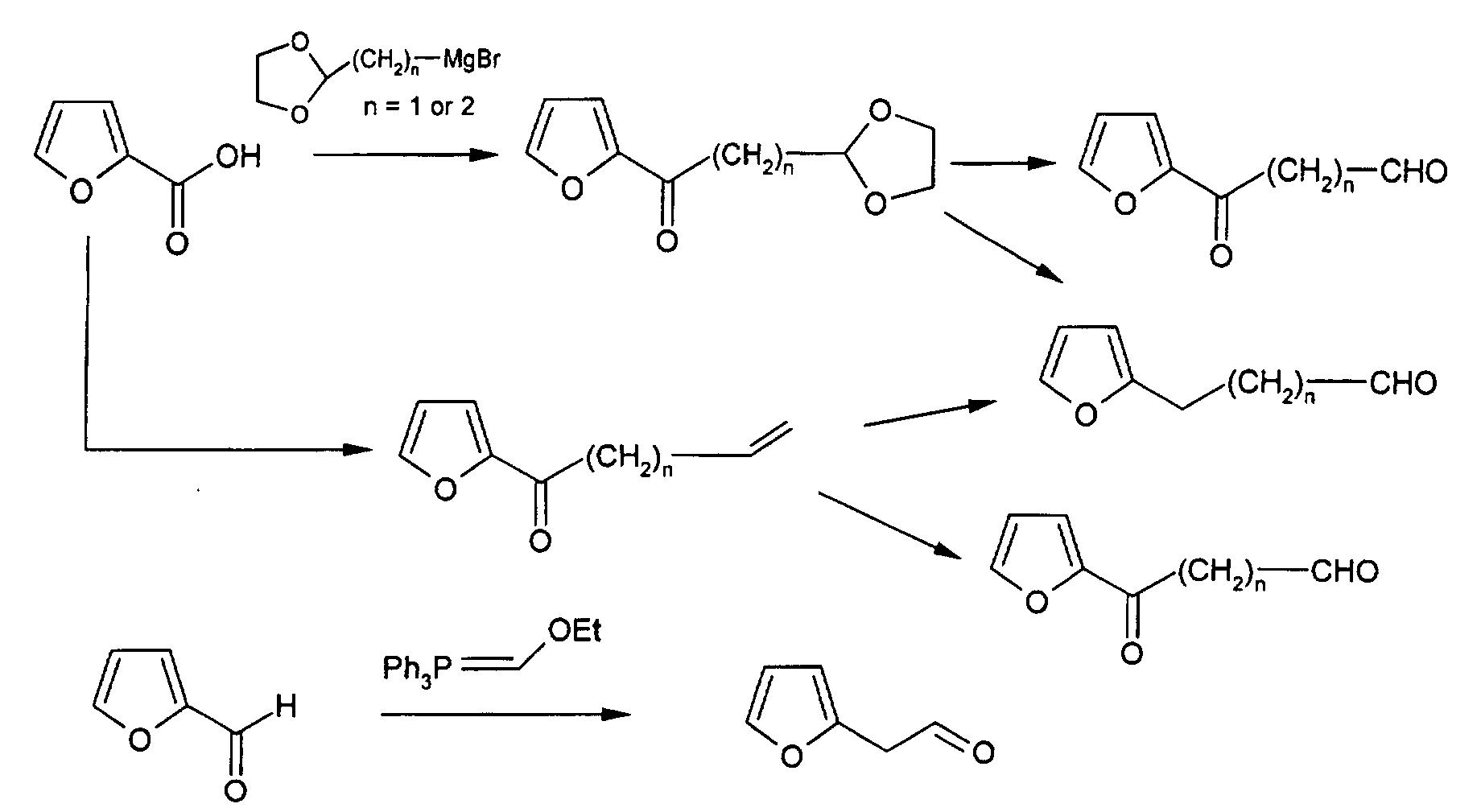
- The resulting compounds would, for example, then be converted into the respective stannane derivative.
- Analogous methods could be used for other heterocyclic ring systems.
- Therefore a suitable process may comprise reaction of the compound in which the group Z carries a terminal formyl group (i.e. a -CHO or -(C1-3 alkylene)-CHO group) with a compound of formula HM2-M3-M4 or a compound of formula HM5, wherein M2 represents NR12. The reaction preferably involves a reductive amination by means of an appropriate reducing agent, for example sodium triacetoxyborohydride.
- A similar process would be involved where in M1 one CH2 group was replaced with a CO group and M2 was NR12. If necessary, in certain circumstances, the ketone could be protected by standard methods to ensure that the reductive amination involved the aldehyde functionality.
- For the preparation of those compounds wherein in M1 the CH2 group adjacent to M2 is replaced with a CO group a suitable process would comprise reaction of a compound in which the group Z carries a -(C0-3 alkylene)-CO2H group with a compound of formula HM2-M3-M4 or a compound of formula HM5, wherein M2 represents NR12.
- Alternatively, an analogous scheme to those described above could be used wherein the substitution of the group R1 onto the phenyl ring occurs prior to the coupling reaction with the compound of formula (III).
- According to a further alternative process the group Z is converted into the group R1 by a de novo synthesis of a substituted or unsubstituted heterocyclic ring system using appropriate reagents. Such a process would involve standard synthetic methodology known to the person skilled in the art for building up the heterocyclic ring system.
- For example, Z could suitably represent an alkyne group which when reacted with an appropriate nitrile oxide results in the formation of an isoxazole ring system; reaction with an azide would result in the formation of a triazole ring system. The group Z could also suitably represent an amidoxime group (derived from a cyano group) which when reacted with an activated carboxylic acid derivative (such as an acid chloride or an acid imidazolide) would result in the formation of a 1,2,4-oxadiazole ring system. The group Z could also suitably represent a bromomethylenecarbonyl group which would be reacted with an imidate to result in the formation of an oxazole ring system, with a guanidino group to result in the formation of an N-imidazole ring system or with an amidine group to result in the formation of a C-imidazole ring system. The group Z could also suitably represent an activated carboxylic acid group which would be reacted to form a hydrazinoketone which would subsequently be reacted with another activated carboxylic acid derivative to result in the preparation of a 1,3,4-oxadiazole ring system. Thus reaction of a compound carrying a relevant Z group with appropriate reagents carrying one of
-C=N=O, -NH-C(NH2)=NH, -COX, -C(NH2)=NOH, -C(OMe)=NH, or
- C(NH2)=NH as a terminal group would result in the formation of the ring systems indicated above. - Alternatively, an analogous scheme to those described above could be used wherein the substitution of the group R1 onto the phenyl ring occurs prior to the coupling reaction with the compound of formula (III).
- The following scheme outlines, for example, the synthesis of derivatives carrying a substituted 1,3,4-oxadiazole ring as an R1 substituent:

- Such processes are particularly suitable for the preparation of the compounds of formula (I) wherein R1 carries a substituent selected from M1-M2-M3-M4 or M1-M5 as defined above in which M2 represents CR12R13, including those in which in M1 one CH2 group is replaced by a CO group.
- Suitable leaving groups for L and L' will be well known to those skilled in the art and include, for example, halo such as chloro and bromo; sulphonyloxy groups such as methanesulphonyloxy and toluene-p-sulphonyloxy; alkoxy groups; and triflate.
- The coupling reaction referred to above with the compound of formula (III) is conveniently carried out in the presence of a suitable inert solvent, for example a C1-4 alkanol, such as isopropanol, a halogenated hydrocarbon, an ether, an aromatic hydrocarbon or a dipolar aprotic solvent such as acetone or acetonitrile at a non-extreme temperature, for example from 0 to 150°, suitably 10 to 100°C, preferably 50 to 100°C.
- Optionally, the reaction is carried out in the presence of a base when Y = NH. Examples of suitable bases include an organic amine such as triethylamine, or an alkaline earth metal carbonate, hydride or hydroxide, such as sodium or potassium carbonate, hydride or hydroxide.
- The compound of formula (I) in the case in which Y = NRa may be obtained from this process in the form of a salt with the acid HL, wherein L is as hereinbefore defined, or as the free base by treating the salt with a base as hereinbefore defined.
- The compounds of formulae (II) and (III) as defined above, the reagents to substitute the group R1, and the reagent(s) to convert the group Z into the group R1 are either readily available or can be readily synthesised by those skilled in the art using conventional methods of organic synthesis.
- As indicated above, the compound of formula (I) prepared may be converted to another compound of formula (I) by chemical transformation of the appropriate substituent or substituents using appropriate chemical methods (see for example, J.March "Advanced Organic Chemistry", Edition III, Wiley Interscience, 1985).
- For example, a compound containing an alkyl or aryl mercapto group may be oxidised to the corresponding sulphinyl or sulphonyl compound by use of an organic peroxide (eg benzoyl peroxide) or suitable inorganic oxidant (eg OXONE ®).
- A compound containing a nitro substituent may be reduced to the corresponding amino-compound, eg by use of hydrogen and an appropriate catalyst (if there are no other susceptible groups) or by use of Raney Nickel and hydrazine hydrate.
- Amino or hydroxy substituents may be acylated by use of an acid chloride or an anhydride under appropriate conditions. Equally an acetate or amide group may be cleaved to the hydroxy or amino compound respectively by treatment with, for example, dilute aqueous base.
- In addition reaction of an amino substituent with triphosgene and another amine (eg aqueous ammonia, dimethylamine) gives the urea substituted product.
- An amino substituent may also be converted to a dimethylamino substituent by reaction with formic acid and sodium cyanoborohydride.
- All of the above-mentioned chemical transformations may also be used to convert one compound of formula (II) to a further compound of formula (II) prior to any subsequent reaction; or to convert one compound of formula (III) to a further compound of formula (III) prior to any subsequent reaction.
- Various intermediate compounds used in the above-mentioned processes, including but not limited to certain of the compounds of formulae (V) and (VII) as illustrated above, are novel and thus represent a further aspect of the present invention.
- Particularly preferred intermediate compounds used in the above-mentioned processes are selected from:
- (4-Benzyloxy-phenyl)-(6-(5-(1,3-dioxolan-2-yl)-furan-2-yl-quinazolin-4-yl)-amine; 5-(4-(4-Benzyloxy-phenylamino)-quinazolin-6-yl)-furan-2-carbaldehyde;
- (1-Benzyl-1H-indazol-5-yl)-(6-(5-(1,3-dioxolan-2-yl)-furan-2-yl)-quinazolin-4-yl)-amine;
- 5-(4-(1-Benzyl-1H-indazol-5-ylamino)-quinazolin-6-yl)-furan-2-carbaldehyde; 5-(4-(4-Benzyloxy-phenylamino)-quinazolin-6-yl)-furan-2-carboxylic acid methyl ester;
- 5-(4-(4-Benzyloxy-phenylamino)-quinazolin-6-yl)-furan-2-carboxylic acid;
- 5-(4-(1-Benzyl-1H-indazol-5-yl)-quinazolin-6-yl)-1-methyl-pyrrole-2-carbaldehyde;
- (1-Benzyl-1H-indazol-5-yl)-[7-(5-(1,3-dioxolan-2-yl)-furan-2-yl)quinazolin-4-yl]amine;
- 5-[4-(1-Benzyl-1H-indazol-5-ylamino)-quinazolin-7-yl]-furan-2-carbaldehyde;
- (4-Benzyloxy-phenyl)-(6-(4-(1,3-dioxolan-2-yl)-3-methyl-3H-imidazol-2-yl)-quinazolin-4-yl)-amine;
- 2-(4-(4-Benzyloxy-phenylamino)-quinazolin-6-yl)-3-methyl-3H-imidazol-4-carbaldehyde; and salts and solvates thereof.
-
- The compounds of formula (I) and salts thereof have anticancer activity as demonstrated hereinafter by their inhibition of the protein tyrosine kinase c-erbB-2, c-erbB-4 and/or EGF-r enzymes and their effect on selected cell lines whose growth is dependent on c-erbB-2 or EGF-r tyrosine kinase activity.
- The present invention thus also provides compounds of formula (I) and pharmaceutically acceptable salts or solvates thereof for use in medical therapy, and particularly in the treatment of disorders mediated by aberrant protein tyrosine kinase activity such as human malignancies and the other disorders mentioned above. The compounds of the present invention are especially useful for the treatment of disorders caused by aberrant c-erbB-2 and/or EGF-r activity such as breast, ovarian, gastric, pancreatic, non-small cell lung, bladder, head and neck cancers, and psoriasis.
- A further aspect of the invention provides a method of treatment of a human or animal subject suffering from a disorder mediated by aberrant protein tyrosine kinase activity, including susceptible malignancies, which comprises administering to said subject an effective amount of a compound of formula (I) or a pharmaceutically acceptable salt or solvate thereof.
- A further aspect of the present invention provides the use of a compound of formula (I), or a pharmaceutically acceptable salt or solvate thereof, in therapy.
- A further aspect of the present invention provides the use of a compound of formula (I), or a pharmaceutically acceptable salt or solvate thereof, in the preparation of a medicament for the treatment of cancer and malignant tumours.
- A further aspect of the present invention provides the use of a compound of formula (I), or a pharmaceutically acceptable salt or solvate thereof, in the preparation of a medicament for the treatment of psoriasis.
- Whilst it is possible for the compounds or salts of the present invention to be administered as the new chemical, it is preferred to present them in the form of a pharmaceutical formulation.
- According to a further feature of the present invention there is provided a pharmaceutical formulation comprising at least one compound of formula (I), or a pharmaceutically acceptable salt or solvate thereof, together with one or more pharmaceutically acceptable carriers, diluents or excipients.
- Pharmaceutical formulations may be presented in unit dose forms containing a predetermined amount of active ingredient per unit dose. Such a unit may contain for example 0.5mg to 1g, preferably 70mg to 700mg, more preferably 5mg to 100mg of a compound of the formula (I) depending on the condition being treated, the route of administration and the age, weight and condition of the patient.
- Pharmaceutical formulations may be adapted for administration by any appropriate route, for example by the oral (including buccal or sublingual), rectal, nasal, topical (including buccal, sublingual or transdermal), vaginal or parenteral (including subcutaneous, intramuscular, intravenous or intradermal) route. Such formulations may be prepared by any method known in the art of pharmacy, for example by bringing into association the active ingredient with the carrier(s) or excipient(s).
- Pharmaceutical formulations adapted for oral administration may be presented as discrete units such as capsules or tablets; powders or granules; solutions or suspensions in aqueous or non-aqueous liquids; edible foams or whips; or oil-in-water liquid emulsions or water-in-oil liquid emulsions.
- Pharmaceutical formulations adapted for transdermal administration may be presented as discrete patches intended to remain in intimate contact with the epidermis of the recipient for a prolonged period of time. For example, the active ingredient may be delivered from the patch by iontophoresis as generally described in Pharmaceutical Research, 3(6), 318 (1986).
- Pharmaceutical formulations adapted for topical administration may be formulated as ointments, creams, suspensions, lotions, powders, solutions, pastes, gels, sprays, aerosols or oils.
- For treatments of the eye or other external tissues, for example mouth and skin, the formulations are preferably applied as a topical ointment or cream. When formulated in an ointment, the active ingredient may be employed with either a paraffinic or a water-miscible ointment base. Alternatively, the active ingredient may be formulated in a cream with an oil-in-water cream base or a water-in-oil base.
- Pharmaceutical formulations adapted for topical administrations to the eye include eye drops wherein the active ingredient is dissolved or suspended in a suitable carrier, especially an aqueous solvent.
- Pharmaceutical formulations adapted for topical administration in the mouth include lozenges, pastilles and mouth washes.
- Pharmaceutical formulations adapted for rectal administration may be presented as suppositories or as enemas.
- Pharmaceutical formulations adapted for nasal administration wherein the carrier is a solid include a coarse powder having a particle size for example in the range 20 to 500 microns which is administered in the manner in which snuff is taken, i.e. by rapid inhalation through the nasal passage from a container of the powder held close up to the nose. Suitable formulations wherein the carrier is a liquid, for administration as a nasal spray or as nasal drops, include aqueous or oil solutions of the active ingredient.
- Pharmaceutical formulations adapted for administration by inhalation include fine particle dusts or mists which may be generated by means of various types of metered dose pressurised aerosols, nebulizers or insufflators.
- Pharmaceutical formulations adapted for vaginal administration may be presented as pessaries, tampons, creams, gels, pastes, foams or spray formulations.
- Pharmaceutical formulations adapted for parenteral administration include aqueous and non-aqueous sterile injection solutions which may contain anti-oxidants, buffers, bacteriostats and solutes which render the formulation isotonic with the blood of the intended recipient; and aqueous and non-aqueous sterile suspensions which may include suspending agents and thickening agents. The formulations may be presented in unit-dose or multi-dose containers, for example sealed ampoules and vials, and may be stored in a freeze-dried (lyophilized) condition requiring only the addition of the sterile liquid carrier, for example water for injections, immediately prior to use. Extemporaneous injection solutions and suspensions may be prepared from sterile powders, granules and tablets.
- Preferred unit dosage formulations are those containing a daily dose or sub-dose, as herein above recited, or an appropriate fraction thereof, of an active ingredient.
- It should be understood that in addition to the ingredients particularly mentioned above, the formulations may include other agents conventional in the art having regard to the type of formulation in question, for example those suitable for oral administration may include flavouring agents.
- The animal requiring treatment with a compound, salt or solvate of the present invention is usually a mammal, such as a human being.
- A therapeutically effective amount of a compound, salt or solvate of the present invention will depend upon a number of factors including, for example, the age and weight of the animal, the precise condition requiring treatment and its severity, the nature of the formulation, and the route of administration, and will ultimately be at the discretion of the attendant physician or veterinarian. However, an effective amount of a compound of the present invention for the treatment of neoplastic growth, for example colon or breast carcinoma will generally be in the range of 0.1 to 100 mg/kg body weight of recipient (mammal) per day and more usually in the range of 1 to 10 mg/kg body weight per day. Thus, for a 70kg adult mammal, the actual amount per day would usually be from 70 to 700 mg and this amount may be given in a single dose per day or more usually in a number (such as two, three, four, five or six) of sub-doses per day such that the total daily dose is the same. An effective amount of a salt or solvate of the present invention may be determined as a proportion of the effective amount of the compound per se.
- The compounds of the present invention and their salts and solvates may be employed alone or in combination with other therapeutic agents for the treatment of the above-mentioned conditions. In particular, in anti-cancer therapy, combination with other chemotherapeutic, hormonal or antibody agents is envisaged. Combination therapies according to the present invention thus comprise the administration of at least one compound of formula (I) or a pharmaceutically acceptable salt or solvate thereof and at least one other pharmaceutically active agent. The compound(s) of formula (I) and the other pharmaceutically active agent(s) may be administered together or separately and, when administered separately this may occur simultaneously or sequentially in any order. The amounts of the compound(s) of formula (I) and the other pharmaceutically active agent(s) and the relative timings of administration will be selected in order to achieve the desired combined therapeutic effect.
- Certain embodiments of the present invention will now be illustrated by way of example only. The physical data given for the compounds exemplified is consistent with the assigned structure of those compounds.
- 1H NMR spectra were obtained at 250MHz on a Bruker AC250 or Bruker AM250 spectrophotometer. J values are given in Hz. Mass spectra were obtained on one of the following machines: VG Micromass Platform (electrospray positive or negative) or HP5989A Engine (thermospray positive). Analytical thin layer chromatography (tic) was used to verify the purity of some intermediates which could not be isolated or which were too unstable for full characterisation, and to follow the progress of reactions. Unless otherwise stated, this was done using silica gel (Merck Silica Gel 60 F254). Unless otherwise stated, column chromatography for the purification of some compounds used Merck Silica gel 60 (Art. 1.09385, 230-400 mesh), and the stated solvent system under pressure.
Petrol refers to petroleum ether, either the fraction boiling at 40-60°C, or at 60-80°C. Ether refers to diethylether.
DMAP refers to 4-dimethylaminopyridine.
DMF refers to dimethylformamide.
DMSO refers to dimethylsulphoxide.
IMS refers to industrial methylated spirit.
THF refers to tetrahydrofuran.
TMEDA refers to N,N,N',N'-tetramethylethylenediamine.
HPLC refers to high pressure liquid chromatography.
RT refers to retention time. - Useful preparative techniques are described in WO96/09294, WO97/03069 and WO97/13771; also described in these publications are appropriate intermediate compounds other than those detailed below.
- The optionally substituted quinazoline or quinoline and the specified amine were mixed in an appropriate solvent and heated to reflux. When the reaction was complete (as judged by tic), the reaction mixture was allowed to cool. The resulting suspension was diluted, e.g. with acetone, and the solid collected by filtration, washing e.g. with excess acetone, and dried at 60°C in vacuo, giving the product as the hydrochloride salt. If the free base was required (e.g. for further reaction), this was obtained by treatment with a base e.g. triethylamine; purification by chromatography was then performed, if required.
- A stirred mixture of the product from Procedure (A), (containing a suitable leaving group such as chloro, bromo, iodo or triflate), a heteroaryl stannane and a suitable palladium catalyst, such as bis-(triphenylphosphine)palladium (II) chloride or 1,4-bis(diphenylphosphino)-butane palladium (II) chloride (prepared as described in C.E.Housecroft et. al, Inorg. Chem. (1991), 30(1), 125-30), together with other appropriate additives, were heated at reflux in dry dioxane or another suitable solvent under nitrogen until the reaction was complete. The resulting mixture was generally purified by chromatography on silica.
- Powdered molecular sieves (0.025g) were added to a solution of a 4-substituted-quinazolin-6-yl-(N-hydroxycarboximidamide) (0.20mmol) in dry THF (10ml), and the mixture was stirred at room temperature for 15 minutes. Sodium hydride (0.008g of 60% dispersion in mineral oil, 0.20mmol) was added and stirring continued for 30 minutes. An appropriate ester (0.20mmol or more) was added and the mixture was heated to reflux for several hours. The reaction mixture was concentrated in vacuo, and purified by chromatography on silica using a Bond Elut™ cartridge, using appropriate solvents for elution.
- 4-Benzyloxyaniline is commercially available as the hydrochloride salt; this is treated with aqueous sodium carbonate solution, and the mixture extracted with ethyl acetate; the organic solution is dried (MgSO4) and concentrated to give the free base as a brown solid, used without further purification.
- Other substituted anilines were in general prepared by analogous methods to those outlined in WO 96/09294 and/or as follows:
- Step 1: Preparation of the precursor nitro-compounds
4-Nitrophenol (or an appropriate substituted analogue, such as 3-chloro-4-nitrophenol) was treated with a base such as potassium carbonate or sodium hydroxide in an appropriate solvent, such as acetone or acetonitrile. The appropriate aryl or heteroaryl halide was added and the reaction mixture heated or stirred at room temperature overnight. Purification A: Most of the acetonitrile was removed in vacuo, and the residue was partitioned between water and dichloromethane. The aqueous layer was extracted with further dichloromethane (x 2), and the combined dichloromethane layers were concentrated in vacuo. Purification B: removal of insoluble material by filtration, followed by concentration of the reaction mixture in vacuo, and chromatography on silica. - Step 2: Reduction to the corresponding aniline
The precursor nitro compound was reduced by catalytic hydrogenation at atmospheric pressure using 5%Pt/carbon, in a suitable solvent (e.g. ethanol, THF, or mixtures thereof to promote solubility). When reduction was complete, the mixture was filtered through Harborlite™, washing with excess solvent, and the resulting solution concentrated in vacuo to give the desired aniline. In some cases, the anilines were acidified with HCI (e.g. in a solution in dioxane) to give the corresponding hydrochloride salt. -
- Anilines prepared by such methods include:
- 4-(2-Fluorobenzyloxy)aniline; m/z (M+1)+ 218
- 4-(3-Fluorobenzyloxy)aniline; m/z (M+1)+ 218
- 4-(4-Fluorobenzyloxy)aniline; m/z (M+1)+ 218
- 3-Chloro-4-(2-fluorobenzyloxy)aniline; m/z (M+1)+ 252
- 3-Chloro-4-(3-fluorobenzyloxy)aniline; m/z (M+1)+ 252
- 3-Chloro-4-(4-fluorobenzyloxy)aniline; m/z (M+1)+ 252
- 4-(Pyridyl-2-methoxy)aniline; m/z (M+1)+ 201
- 4-(Pyridyl-4-methoxy)aniline; m/z (M+1)+ 201
- 4-(Pyridyl-3-methoxy)aniline; m/z (M+1)+ 201
- 4-Benzyloxy-3-chloroaniline; m/z (M+1)+ 234 and, in appropriate cases, their hydrochloride salts.
-
- 4-Benzenesulphonylaniline was prepared by the published method (Helv. Chim. Acta., 1983, 66(4), p1046.
- Dry dimethylsulphoxide (20 ml) was added to potassium hydroxide (4.2 g, 0.074 mol) (crushed pellets) and the mixture was stirred under nitrogen for 5 mins. 5-Nitroindole (commercially available) (3.0 g, 0.019 mol) was then added and the red mixture stirred for 30 min at room temperature. The mixture was then cooled to -10 °C, benzyl bromide (4.4 ml, 0.037 mol) was slowly added and the mixture stirred and allowed to warm to room temperature over a period of 40 mins.
- Water (50 ml) was then added and the mixture was extracted with diethyl ether (2 x 200 ml). The extracts were washed with water (4 x 50 ml), dried over sodium sulphate and evaporated to leave an oily solid. The excess benzyl bromide was removed by dissolving the whole in diethyl ether (50 ml), diluting this solution with 40-60 petrol (50 ml) and then gradually removing the diethyl ether in vacuo to leave a yellow solid suspended in the petrol. The solid was filtered, washed with copious amounts of 40-60 petrol and dried to give 1-benzyl-5-nitroindole (2.4 g, 51%) as a yellow solid, m.p. 102-104 °C; δH [2H6]-DMSO 8.53 (1H, s, 4-H), 8.00 (1H, d, J 9, 6-H), 7.78 (1H, s, 2-H), 7.68 (1H, d, J 9, 7-H), 7.36-7.20 (5H, m, 2'-H, 3'-H, 4'-H, 5'-H, 6'-H), 6.81 (1H, s, 3-H), 5.52 (2H, s, CH2).
- A solution of 1-benzyl-5-nitroindole (0.51 g, 0.02 mol) in a mixture of ethyl acetate (25 ml) and methanol (25 ml) was carefully added to 10% palladium on charcoal (45 mg). The resulting suspension was stirred at room temperature under an atmosphere of hydrogen. When the reaction was complete (indicated by tic or calculated uptake of hydrogen) the suspension was filtered through a pad of Harbolite™, and the filtrate evaporated to dryness to give 5-amino-1-benzylindole (0.40 g, 91%) as an off-white solid; m.p. 66-68 °C; δH [2H6]-DMSO 7.30-7.12 (6H, m, 2-H, 2"-H, 3"-H, 4"-H, 5"-H, 6"-H), 7.08 (1H, d, J 8, 7-H), 6.70 (1H, s, 4-H), 6.49 (1H, d, J 8, 6-H), 6.18 (1H, s, 3-H), 5.28 (2H, s, CH2), 4.38 (2H, br s, NH2).
- A mixture of 4-nitro-o-phenylene diamine (1.54g) and phenylacetic acid (2.04g) in 5N aqueous HCI (16ml) were heated at 110 °C under nitrogen for 22 hours. The mixture was cooled to room temperature and the accumulated black solid collected by filtration. This crude residue was then adsorbed onto silica and chromatographed to give the title compound (0.84g) as a purple foam; δH CDCl3 9.70 (1H, bs), 8.15 (1H, d), 7.30 (7H, m), 4.30 (2H,s); m/z (M + 1)+ 254.
- The title compound was prepared from 5-nitro-2-benzylbenzimidazole by an analogous reduction method to that described above for 5-amino-1-benzyl-1H-indole; m/z (M + 1)+ 224. Also note the published method (J. Het. Chem., 23, 1109-13, (1986)).
- A stirred mixture of 5-nitroindazole (50g), potassium carbonate (46.6g, 1.1 equiv.) and benzyl bromide (57.6g, 1.1 equiv) in N,N-dimethylformamide (500 ml) was heated at 75°C for a period of 4 hours. The reaction was then cooled and water (500ml) was gradually added to precipitate the product which was filtered off and washed with water (50ml) and dried in the air at ambient temperature. The weight of pale yellow solid thus obtained was 72.3g (93%), m.pt. 95-97°C; HPLC (Partisil 5, dichloromethane, 4ml/min, 250nm) gave an isomer ratio (1-N-benzyl : 2-N-benzyl) of 63:37 (RT-1N 3.4min, RT-2N 6.6min). To a filtered solution of the mixed regioisomers (100g) in acetone (470ml) at room temperature was added, gradually with stirring, water (156ml) and the mixture was stirred for one hour. The resultant yellow crystalline solid was filtered off and dried in the air at ambient temperature to give 36.4g (34%) of material; m.pt.124-126°C; HPLC showed an isomer ratio (1-N-benzyl : 2-N-benzyl) of 96:4; δH (CDCl3) 5.58 (2H,s,CH2), 7.12-7.15(2H) & 7.22-7.29(3H)-(phenyl), 7.33(1H,dt, J=1Hz & 9Hz, H-7), 8.15(1H,dd, J=2Hz & 9Hz,H-6), 8.19(1H,d,J=1Hz,H-3), 8.67 (1H,dd,J=1Hz & 2Hz, H-4).
- Also note the published method in FR 5600, 8 January 1968.
- 1-Benzyl-5-nitroindazole (400g) was suspended in ethanol (5 litre) and hydrogenated in the presence of 5% platinum on carbon catalyst (20g) operating at 1 bar pressure and 50-60°C. When hydrogen uptake was complete the reactor contents were heated to 70°C, discharged and filtered while still hot and the filtrate concentrated to ∼4 litre which caused some crystallisation. Water (4 litre) was then gradually added with stirring and the mixture was stirred at 5°C overnight. The resultant crystals were filtered off and air-dried at ambient temperature to give 305g (86%) of material, m.pt.150-152°C; HPLC (Supelcosil ABZ +, gradient 0.05% trifluoroacetic acid in water/0.05% trifluoroacetic acid in acetonitrile, 1.5m1/min, 220nm) showed <1% of the corresponding 2-N-isomer (RT-1N 6.03min, RT-2N 5.29min); δH (CDCl3) 3.3-3.8(2H,broad s,NH2), 5.47 (2H,s,CH2), 6.74(1H,dd,J=2Hz & 9Hz,H-6), 6.87(1H,dd,J=1Hz & 2Hz,H-4), 7.06-7.11 (3H) & 7.17-7.25(3H)-(phenyl & H-7), 7.77(1H,d,J=1 Hz,H-3).
- Also note the published method in FR 5600, 8 January 1968.
- 2-Fluoro-5-nitroacetophenone (H. Sato et al, Bioorganic and Medicinal Chemistry Letters, 5(3), 233-236, 1995) (0.24g) was treated with triethylamine (0.73ml)and benzyl hydrazine dihydrochloride (0.255g) in ethanol (20ml) at reflux under N2 for 8 days. The mixture was cooled and the solid 1-benzyl-3-methyl-5-nitroindazole (0.16g) was collected by filtration; m/z (M+1)+ 268.
- 1-Benzyl-3-methyl-5-nitroindazole (0.15g) in THF (15ml) was treated with platinum on carbon (0.05g, 5%) under an atmosphere of hydrogen at room temperature. When hydrogen uptake was complete, the mixture was filtered and concentrated in vacuo to give the title compound; m/z (M+1)+ 268.
- The relevant nitro-substituted 1 H-indazole was treated with a base such as potassium carbonate or sodium hydroxide in a suitable solvent, such as acetone or acetonitrile. The appropriate aryl halide or heteroaryl halide was added and the reaction mixture heated or stirred at room temperature overnight. Subsequent concentration in vacuo and chromatography on silica gave the desired 1-substituted vitro-1H-indazoles. Hydrogenation was carried out by analogy with the preparation of 5-amino-1-benzyl-1H-indole described above.
- Amines prepared by such methods include:-
- 5-Amino-1-benzyl-1H-indazole; m/z (M+1)+ 224
- 5-Amino-1-(2-fluorobenzyl)-1H-indazole; m/z (M+1)+ 242
- 5-Amino-1-(3-fluorobenzyl)-1H-indazole; m/z (M+1)+ 242
- 5-Amino-1-(4-fluorobenzyl)-1H-indazole; m/z (M+1)+ 242
- 5-Amino-1-(2-pyridylmethyl)-1H-indazole; m/z (M+1)+ 225
- 5-Amino-1-(3-pyridylmethyl)-1H-indazole; m/z (M+1)+ 225
- 5-Amino-1-(4-pyridylmethyl)-1H-indazole; m/z (M+1)+ 225
- 5-Amino-1-(2,3-difluorobenzyl)-1H-indazole; m/z (M+1)+ 260
- 5-Amino-1-(3,5-difluorobenzyl)-1H-indazole; m/z (M+1)+ 260.
-
- 1-Benzenesulphonylindol-5-yl-amine was prepared according to the published method (J. Org. Chem., 55, 1379-90, (1990)).
- 3-Benzenesulphonyl-6-nitroindole (K. Wojciechowski and M Makosza, Tet. Lett., 25 (42), p4793, 1984) was hydrogenated by analogy with the procedures above to give the title compound; δH [2H6]DMSO 11.64 (1H,s), 7.94 (2H,m), 7.81 (1H,s), 7.57 (3H,m), 7.49(1H,d), 6.60(1H,s), 6.55 (1H,dd), 5.40 (2H,s).
- 4-Chloro-6-bromoquinazoline and 4-Chloro-6-iodoquinazoline were prepared as described in WO 96/09294.
- 4-Chloro-6-bromoquinazoline (0.25g, 1.0mmol) and 4-benzyloxyaniline (0.25g, 1.3mmol) were mixed in 2-propanol (6ml) and heated at reflux for 10 mins (Procedure A). The solution was allowed to cool at room temperature and the 2-propanol removed in vacuo. The resulting solid was triturated with acetone to give the product as a yellow solid (0.39g, 88%); δH [2H6]-DMSO 11.60 (1H, b, NH), 9.21 (1H, s, 5-H), 8.86 (1H, s, 2-H), 8.20 (1H, d, 7-H), 7.90 (1H, d, 8-H), 7.65 (2H, d, 2'-H, 6'-H), 7.50-7.25 (5H, m, Ph-H), 7.10 (2H, d, 3'-H, 5'-H), 5.15 (2H, s, CH2); m/z 405/407 (M+).
- 6-Bromo-4-chloroquinazoline (5.0g) was reacted with 5-amino-1-benzyl-1H-indazole (5.0g) in acetonitrile (100ml) at 100°C. The resulting precipitate was treated with triethylamine in ethyl acetate and water to give the title compound as a yellow solid, (7.37g); δH [2H6] -DMSO 9.93(1H,s), 8.82 (1H,d), 8.52(1H,s), 8.19(1H,s), 8.09(1H,s), 7.92(1H,dd), 7.65(3H,m), 7.25(5H,m), 5.62(2H,s).
- 4-Chloro-6-iodoquinazoline (5.8g) was treated with 5-amino-1-benzyl-1H-indazole (3.90g) in acetonitrile (500ml) at reflux under N2 for 18 hours (Procedure A). Subsequent cooling and filtration gave the title compound (8.26g); m/z (M+1)+ 478.
- 4-Chloro-6-iodoquinazoline (8g) was treated with 4-benzyloxyaniline (5.5g) in acetonitrile (500ml) at reflux under N2 for 18 hours. Subsequent cooling and filtration gave the title compound (13.13g); m/z (M+1)+ 454.
- (4-Benzyloxy-phenyl)-(6-iodoquinazolin-4-yl)-amine (1.2g) in dioxane (10ml) under N2 was treated with tributyltin cyanide (0.79g) and catalytic quantities of 1.4-bis-(diphenylphosphino)-butane palladium (II) chloride and tetrakis (triphenylphosphine) palladium at reflux for 23 hours. The mixture was absorbed onto silica and chromatographed to give the title compound (0.65g); δH [2H6]DMSO 10.01(1H,s), 9.14(1H,s), 8.63(1H,s), 8.15(1H,d), 7.87(1H,d), 7.73(2H,d), 7.45(5H,m), 7.10(2H,d), 5.13(2H,s); m/z (M+1)+ 353.
- (1-Benzyl-1H-indazol-5-yl)-(6-iodoquinazolin-4-yl)-amine (0.48g) in DMF under CO was treated with sodium formate (0.1g) and catalytic quantities of triphenyl phosphine and bistriphenylphosphine palladium (II) chloride at 110°C. The mixture was cooled, added to 5% sodium hydroxide and extracted with ethyl acetate. The aqueous phase was treated with 2N HCl and the precipitated solid filtered and dried to give the title compound (0.07g); δH [2H6]DMSO 13.35(1H,bs), 10.40(1H,s), 9.30(1H,s), 8.60(1H,s), 8.30(1H,d), 8.17(2H,d), 7.84(1H,d), 7.72(1H,s), 7.30(5H,m), 5.70(2H,s); m/z (M+1)+ 396.
- (1-Benzyl-1H-indazol-5-yl)-(6-iodoquinazolin-4-yl)-amine(3.58g) in dioxane (30ml) under N2 was treated with tributyltin cyanide (2.51g) and catalytic quantities of 1.4-bis-(diphenylphosphino)-butane palladium (II) chloride and tetrakis (triphenylphosphine) palladium at reflux for 5 days. The mixture was absorbed onto silica and chromatographed to give the title compound (1.25g); δH [2H6]DMSO 10.20(1H,s), 9.15(1H,s), 8.65(1H,s), 8.24(1H,s), 8.18(2H,m), 7.89(1H,s), 7.70(2H,m), 7.30(5H,m), 5.70(2H,s); m/z (M+1)+ 377.
- 1-Methyl-5-form imidazole (0.64g) was treated with ethylene glycol (0.3ml), p-toluenesulphonic acid monohydrate (0.0015g) and powdered 4A molecular seives under N2 for 18 hours at reflux. Subsequent cooling and filtration was followed by washing of the organic phase with aqueous sodium carbonate solution (2N), drying and concentration to give the title compound; δH (CDCl3) 7.43 (1H,s), 7.12 (1H,s), 5.91(1H,s), 4.10(4H,m), 3.70(3H,s).
- Methylvinyl sulphone (2.1g, 19.78mmol) and methylamine (33% solution in IMS, 40ml, excess) were mixed and heated at reflux under a nitrogen atmosphere for 6 hours. After standing overnight at room temperature, the mixture was concentrated in vacuo to give a yellow oil, which was treated with ethereal HCI to give a sticky solid. Trituration with absolute ethanol gave the title compound as a white solid which was collected by filtration and dried at 60°C in vacuo (1.01g, 5.82mmol, 29%); δH [2H6]DMSO 9.27 (2H,br s), 3.59 (2H,dd), 3.31 (2H,dd), 3.12 (3H,s), 2.57 (3H,s).
- N-Acetyethylenediamine (10.2g, 100mmol) and triethylamine (15ml, 10.9g, 108mmol) were dissolved in dichloromethane (300ml) and the solution cooled to 0°C. Methane sulphonyl chloride (8ml, 11.8g, 103mmol) was dissolved in dichloromethane (10ml) and added dropwise , and stirring was continued at 0°C for 3 hours. The dichloromethane was removed in vacuo, and the residue was suspended in a mixture of ether and acetone, removing the insoluble material by filtration. The filtrate was concentrated in vacuo to give the title compound as a pale brown gum (14.5g, 88.3mmol, 88%); δH [2H6]DMSO 7.93 (1H,brt), 7.05 (1H,t), 3.11 (2H,t), 2.97 (2H,t), 2.89 (3H,s), 2.09 (3H,s).
- N-[2-(Methylsulphonamido)ethyl]acetamide (14.5g, 88.3mmol) and concentrated hydrochloric acid (100ml) were dissolved in water (100ml) and heated to reflux for a total of 3 hours. After cooling, the water was removed in vacuo, and the residue was left for several days at room temperature until crystallisation was underway. Trituration with a mixture of ethanol and ether gave the title compound as a white solid which was dried in vacuo at 60°C (7.5g, 42.9mmol, 49%); δH [2H6]DMSO 8.22 (2H,br s), 7.42 (1H,t), 3.23 (2H,q), 2.87 (3H,s), 2.85-2.95 (2H,m).
- 2-Phthalamidoethylsulphonyl chloride (prepared as described in J. Am. Chem. Soc., 69, 1393-1401, (1947)) (10.0g, 36.5mmol) was added to conc. aqueous ammonia solution (0.880Mol, 120ml), cooled to 0°C. The mixture was stirred at 0°C for 30 min and then at room temperature for 2 hours. Concentration in vacuo, followed by trituration with water gave 2-phthalamidoethylsulphonamide as a white solid (3.70g, 14.6mmol, 40%); δH [2H6]DMSO 7.80-7.92 (4H,m), 7.03 (2H,br s), 3.96 (2H,dd), 3.30-3.38 (2H,m, obscured by water).
- 2-Phthalamidoethylsulphonamide (3.68g, 14.5mmol) was suspended in ethanol (50ml) and hydrazine hydrate (0.70g, 71.5mmol) was added. The mixture was heated to reflux for 4 hours. The mixture was partially concentrated in vacuo, diluted with water, acidified to pH 1 with 2N HCI, and filtered. The filtrate was concentrated in vacuo to give a white solid. Treatment with more 2N HCI, followed by trituration with a mixture of ethanol and acetone gave the title compound as a white solid (1.0g, 6.23mmol, 43%); δH D2O 3.60-3.69 (2H,m), 3.50-3.58 (2H,m).
- 2-Furoic acid (9.0g, 80.3mmol) was added to a solution of 3-methyl-3-oxetanemethanol (16.5g, 161.6mmol), 1,3-dicyclohexylcarbodiimide (25.09, 121.1mmol) and DMAP (0.50g, 4.1mmol) in dichloromethane (250ml), and the mixture was stirred under a nitrogen atmosphere overnight. The mixture was filtered and the filtrate was concentrated in vacuo to give an oil. Crystallisation from ethanol/water gave a white solid collected by filtration and shown by NMR to be 2-furoic acid. The filtrate was concentrated in vacuo to remove the ethanol, and the resulting aqueous solution was extracted with dichloromethane (x2). This solution was dried (MgSO4) and concentrated to give the title compound as a colourless oil (11.8g, 60.1mmol, 75%); δH [2H6]DMSO 8.00 (1H,s), 7.34 (1H,d), 7.71 (1H, dd), 4.44 (2H,d), 4.35 (2H,s), 4.28 (2H,d), 1.31 (3H,s).
- (3-Methyl-3-oxetane)-methyl-2-furoate (11.8g, 60.1 mmol) was dissolved in dichloromethane (250ml) and the solution was cooled to 0°C. Boron trifluoride-etherate (10 drops) was added and the mixture stirred at room temperature, and then left to stand for two months. Triethylamine (0.5ml, 0.36g, 3.6mmol) was added and the mixture concentrated to give a sticky white solid. Trituration with ether/acetone gave the title compound as a white solid (2.2g, 11.2mmol, 19%); δH [2H6]DMSO 8.00 (1H,s), 7.34 (1H,d), 7.71 (1H, dd), 4.44 (2H,d), 4.35 (2H,s), 4.28 (2H,d), 1.31 (3H,s).
- 2-(4-Methyl-2,6,7-trioxabicyclo[2.2.2]oct-1-yl)furan (2.0g, 10.2mmol) was dissolved in THF (20ml) and the solution was cooled to -78°C. n-BuLi (1.6M solution in hexanes, 7.7ml, 12.32mmol) was added and the mixture stirred at
-78°C for 30min, allowed to warm to 0°C for 20 min. and then recooled to -78°C. The tributyltin chloride (3.5ml, 4.68g, 14.4mmol) was added and stirring was continued at -78°C for 15min. The mixture was allowed to warm gradually to room temperature and stirring continued for three days. The reaction was quenched by the addition of water, and extracted with ethyl acetate. This solution was washed with water, dried (MgSO4), and concentrated in vacuo to give the title compound as a yellow oil (4.7g, 9.7mmol, 95%); δH [2H6]DMSO 6.52 (1H,d), 6.38 (1H, d), 3.96 (6H,s), 0.77-1.63 (30H,m). - (4-Benzyloxy-phenyl)-(6-iodoquinazolin-4-yl)-amine (0.925g, 2.04mmol), 5-(4-methyl-2,6,7-trioxabicyclo[2.2.2]oct-1-yl)-2-[tri(n-butyl)stannyl]furan (2.00g, 4.1mmol) and bis(triphenylphosphine)palladium (II) chloride (catalytic) were reacted in dry dioxane (25ml) according to Procedure B. Purification by silica gel chromatography and eluting with 100% EtOAc gave the title compound as a yellow solid (0.700g, 1.34mmol, 66%); δH [2H6]DMSO 10.0 (1H,s), 8.75 (1H,s), 8.48 (1H,s), 8.12 (1H,d), 7.79 (1H,d), 7.66 (2H,d), 7.30-7.52 (5H,m), 7.03-7.12 (3H,m), 6.64 (1H,d), 5.14 (2H,s), 4.06 (6H,s), 0.85 (3H,s).
- Sodium hydroxide (0.62g, 15.5mmol) and hydroxylamine hydrochloride (1.03g, 14.8mmol) were added to a solution of (4-benzyloxy-phenyl)-(6-cyanoquinazolin-4-yl)-amine (0.472g, 1.34mmol) in ethanol (30ml), and the resulting mixture was heated to reflux overnight. After cooling, the mixture was concentrated in vacuo. The residue was washed thoroughly with water, and then with a little ether and dried in vacuo to give the title amidoxime (0.452g,1.18mmol, 88%); δH [2H6]DMSO 9.88 (1H,s), 9.73 (1H,s), 8.72 (1H,s), 8.52 (1H,s), 8.13 (1H,d), 7.67-7.78 (3H,m), 7.31-7.52 (5H,m), 7.07 (2H,d), 6.65 (2H,s), 5.14 (2H,s);m/z (M+1+) 386.
- Sodium hydroxide (0.563g, 14.1mmol) and hydroxylamine hydrochloride (0.931g, 13.4mmol) were added to a solution of (1-benzyl-1H-indazol-5-yl)-(6-cyanoquinazolin-4-yl)-amine (0.504g, 1.34mmol) in ethanol (40ml), and the resulting mixture was heated to reflux overnight. After cooling, the mixture was concentrated in vacuo . The residue was washed thoroughly with water, and then with a little ether and dried in vacuo to give the title amidoxime (0.452g,1.10mmol, 82%); δH [2H6]DMSO 9.87 (2H,m), 8.76 (1H,s), 8.54 (1H,s), 8.23 (1H,s), 8.10-8.18 (2H,m), 7.65-7.80 (3H,m), 7.18-7.38 (5H,m), 5.96 (2H,s), 5.68 (2H,s); m/z (M+1+) 410.
- Trifluoroacetic anhydride (17ml, 25.28g, 120.6mmol) was added dropwise to a solution of 2-methylthioethylamine (10.0g, 109.7mmol) and triethylamine (16.8ml, 12.2g, 120.5mmol) in anhydrous dichloromethane (50ml) cooled to 0°C using an ice bath. On completion of the addition, the reaction was stirred at room temperature under a nitrogen atmosphere for 18 hours. Water (200ml) was added, the layers were separated, and the aqueous was extracted with further dichloromethane (100ml). The combined dichloromethane solutions were dried (MgSO4), and concentrated in vacuo to give the title compound as a yellow oil (19.0g, 109.7mmol, 100%); δH CDCl3 6.8 (1H,brs), 3.59 (2H,q), 2.72 (2H,t), 2.13 (3H,s).
- A solution of N-(2-methylthioethyl) trifluoroacetamide (19.0g, 109.7mmol) in methanol (200ml) was cooled to 0°C using an ice bath. A suspension of Oxone™ (2KHSO5.KHSO4.K2SO4) (74.19g, 120.67mmol) in water (100ml) was added portionwise over 10 minutes, and the reaction was stirred at room temperature for 24 hours. The methanol was removed in vacuo, water (600ml) was added and the mixture was extracted with dichloromethane (3 x 300ml). The combined extracts were dried (MgSO4), and concentrated in vacuo to give the title compound as a white solid (12.42g, 56.7mmol, 52%); δH CDCl3 7.33 (1H,br s), 3.93 (2H,q), 3.31 (2H,t), 3.02 (3H,s).
- Sodium hydride (60% dispersion in mineral oil, 0.190g, 4.75mmol) was added to a solution of N-(2-methylsulphonylethyl) trifluoroacetamide (0.986g, 4.50mmol) in dry DMF (10ml) and the mixture was stirred under a nitrogen atmosphere for 30 minutes. Ethyl bromoacetate (0.55ml, 0.828g, 4.96mmol) was added and the mixture was stirred at room temperature overnight. The mixture was poured into ice-water, and extracted with ethyl acetate. This solution was washed with water, dried (MgSO4), and concentrated in vacuo to give the title compound as a white solid (1.239g, 4.03mmol, 90%); δH CDCl3 4.17 (4H,m), 3.91 (2H,t), 3.46 (2H,t), 2.98 (3H,s), 1.30 (3H,t).
- 7-Amino-quinazolin-4-one (R. Dempcy and E. Skito, Biochemistry, 30, 1991, 8480) (1.61g) was suspended in 6N HCl (20ml) and cooled in an ice bath. A solution of sodium nitrite (0.75g) in water (10ml) was added dropwise over 15 minutes. After a further 10 minutes, a solution of potassium iodide (1.66g) in water (5ml) was added dropwise. The mixture was warmed to 20°C and after 3 hours partitioned between ethyl acetate and sodium thiosulphate. The organic phase was dried and concentrated in vacuo to give the title compound (0.485g); m/z (M+1+) 271.
- 7-Iodoquinazolin-4-one (0.46g) was treated with phosphorous oxychloride (5ml) at reflux under nitrogen for 2 hours. The mixture was cooled, evaporated and partitioned between saturated aqueous sodium carbonate and ethyl acetate. The organic phase was dried and concentrated in vacuo to give the title compound (0.43g); m/z (M+1+) 291.
- 4-Chloro-7-iodoquinazoline (0.42g) was treated with 1-benzyl-1H-indazol-5-ylamine (0.323g) in acetonitrile (20ml) at reflux under nitrogen for 18 hours (Procedure A). The mixture was cooled and filtered to give the title compound (0.57g); m/z (M+1+) 478.
- The (4-benzyloxy-phenyl)-(6-bromoquinazolin-4-yl)-amine (1.5g, 3.7mmol), 5-(1,3-dioxolan-2-yl)-2-(tributylstannyl)-furan (1.9g, 4.42mmol) and bis(triphenylphosphine)palladium(II) chloride (catalytic) were dissolved in dioxan (30ml) and heated at reflux under nitrogen for 6 hr. The solvent was removed from the cooled reaction under vacuum, and the residual oil was triturated with iso-hexane/ethyl acetate to give the product (1.07g, 62%) as a pale yellow solid; δH [2H6]-DMSO 9.96 (1H, b, NH), 8.80 (1H, s, 5-H), 8.51 (1H, s, 2-H), 8.18 (1H, d, 7-H), 7.80 (1H, d, 8-H), 7.70 (2H, d, 2'-H, 6'-H), 7.58-7.30 (5H, m, 5 x Ph-H), 7.10 (3H, m, 3'-H, 5'-H, furan 3-H), 6.78 (1H, d, furan 4-H), 6.12 (1H, s, CHO2), 5.18 (2H, s, PhCH 2), 4.22-3.94 (4H, m, 2 x CH2); m/z 466 (M+1)+.
- The 4-(4-benzyloxy-phenylamino)-(6-(5-(1,3-dioxolan-2-yl)-furan-2-yl)-quinazolin-4-yl)-amine (1.0g, 2.1mmol) was dissolved in THF (20ml) and hydrochloric acid (2N, 10ml) was added. The reaction was stirred at room temperature for 1 hr. The precipitate which formed was collected by filtration and washed with acetone, then partitioned between ethyl acetate, triethylamine and water. The organic phase was washed with water, dried (magnesium sulphate) and the solvent was removed under vacuum. Trituration with iso-hexane/ethyl acetate gave the product as an orange solid (610mg, 69%); δH [2H6]-DMSO 10.05 (1H, b, NH), 9.62 (1H, s, CHO), 8.95 (1H, s, 5-H), 8.48 (1H, s, 2-H), 8.24 (1H, d, 7-H), 7.80 (1H, d, 8-H), 7.70 (1H, d, furan 4-H), 7.59 (2H, d, 2'-H, 6'-H), 7.48-7.25 (6H, m, 5 x Ph-H, furan 3-H), 7.02 (2H, m, 3'-H, 5'-H), 5.09 (2H, s, CH2); m/z 422 (M+1)+.
- 4-(4-Benzyloxy-phenylamino)-(6-(5-(1,3-dioxolan-2-yl)-furan-2-yl)-quinazolin-4-yl)-amine (6.70g, 14.4mmol) was stirred at room temperature in a mixture of THF (70ml) and 2N aqueous HCI (70ml) for 1 hour. The THF was removed in vacuo and the resulting precipitate was collected by filtration and washed with water to give the hydrochloride salt as a yellow solid (6.50g, 14.1mmol, 98%); δH [2H6]DMSO 12.15 (1H,s), 9.69 (1H,s) 9.58 (1H,s), 8.88 (1H,s), 8.50 (1H,dd), 8.02 (1H,d), 7.77 (1H,d), 7.62-7.74 (3H,m), 7.31-7.52 (5H,m), 7.15 (2H,d), 5.17 (2H,s).
- (1-Benzyl-1H-indazol-5-yl)-(6-bromoquinazolin-4-yl)-amine (4.3g), 2-(tributylstannyl)-5-(1,3-dioxolan-2-yl)-furan (J. Chem. Soc., Chem Commun., (1988), 560) (10g) and 1,4-bis(diphenylphosphino) palladium (II) chloride (1g) were heated at reflux in dioxane (150ml) for 24 hr. The solvent was removed in vacuo and the residue chromatographed on silica. Subsequent trituration gave the title compound δH [2H6] -DMSO 10.13 (1H, s), 8.85 (1H, s), 8.54 (1H, s), 8.20 (3H, m), 7.80 (3H, m), 7.30 (5H, m), 7.13 (1H, d), 6.79 (1H, d), 6.04 (1H, s), 5.71 (2H, s), 4.15 (4H, m).
- (1-Benzyl-1H-indazol-5-yl)-(6-(5-(1,3)-dioxolan-2-yl-furan-2-yl)-quinazolin-4-yl)-amine (2.0g) and hydrochloric acid (2N, 50ml) were stirred in THF (20ml) for 16 hr. The resulting precipitate was filtered, washed with water and dried at 60°C in vacuo to give the product as a yellow solid (1.80g, 3.73g, 91%); δH [2H6] -DMSO 12.30 (1H, s), 9.79 (1H, s), 9.62 (1H, s), 8.85 (1H, s), 8.62 (1H, m), 8.31 (1H, s), 8.19 (1H, m), 8.10 (1H, d), 7.90 (2H, m), 7.78 (2H, m), 7.40 (5H, m), 5.80 (2H, s).
- (4-Benzyloxy-phenyl)-(6-(5-(4-methyl-2,6,7-trioxabicyclo[2.2.2]oct-1-yl)-furan-2-yl)-quinazolin-4-yl)-amine (0.680g, 1.30mmol) was dissolved in THF (10ml) and 2N aqueous HCI (10ml) was added. The mixture was stirred at room temperature for 2 hours. The THF was removed in vacuo and the residue diluted with water to preciptate the intermediate (partial hydrolysis) 5-(4-(4-benzyloxy-phenylamino)-quinazolin-6-yl)-furan-2-carboxylic acid (3-methyloxetan-3-yl)-methyl ester which was collected by filtration and washed with water and acetone; δH [2H6]DMSO 12.10 (1H,s), 9.50 (1H,s), 8.87 (1H,s), 8.43 (1H,s), 8.00 (1H,s), 7.66 (2H,d), 7.58 (1H,d), 7.30-7.54 (6H,m), 7.13 (2H,d), 5.16 (2H,s), 4.14 (2H,s), 3.28-3.41 (4H,m), 0.88 (3H,s). This solid was suspended in a mixture of MeOH (15ml) and NaOH (2N, 15ml), and the mixture was stirred at room temperature for 2 hours. The reaction was diluted with water to give the title product as a yellow solid, which was collected by filtration (0.375g, 0.831mmol, 64%); δH [2H6]DMSO 10.06 (1H,s), 8.91 (1H,s), 8.48 (1H,s), 8.21 (1H,d), 7.80 (1H,d), 7.63 (2H,d), 7.25-7.52 (7H,m), 7.05 (2H,d), 5.10 (2H,s), 3.85 (3H,s); m/z (M+1+) 452.
- 5-(4-(4-Benzyloxy-phenylamino)-quinazolin-6-yl)-furan-2-carboxylic acid methyl ester (0.150g, 0.332mmol) was suspended in a mixture of EtOH (2ml) and 2N aqueous NaOH (2ml). The mixture was stirred at room temperature for 15mins. To facilitate dissolution, CHCl3 (2ml) was added and stirring was continued for 3 days, by which time tlc showed there to be no remaining starting material. The organic solvents were removed in vacuo and the residue diluted with water and treated with 2N aqueous HCl to give the product as a yellow solid, which was collected by filtration (0.130g, 0.274mmol, 83%); m/z (M+1+) 438.
- A stirred solution of 5-formyl-1-methyl-2-(tri-n-butylstannyl)pyrrole (prepared as described in F. Denat et al. J. Organometallic Chem., 423, 173,(1992)) (1.60g, 4.02mmol), (1-benzyl-1H-indazol-5-yl)-(6-iodoquinazolin-4-yl)-amine hydrochloride (1.0g, 1.95mmol), triethylamine (0.3ml, 0.218g, 2.2mmol) and 1,4-bis(diphenylphosphino)-butane palladium (II) chloride (0.2g, catalytic) in dioxane (20ml) was heated to reflux under a nitrogen atmosphere for 18 hours (Procedure B). The mixture was concentrated in vacuo and purified by silica gel chromatography, eluting with 60%-100% EtOAc/i-hexane. Concentration of the appropriate fractions gave the product as a yellow solid (0.460g, 1.00mmol, 51%); δH [2H6]DMSO 10.00 (1H,s), 9.64 (1H,s), 8.73 (1H,s), 8.59 (1H,s), 8.22 (1H,s), 8.13-8.16 (1H,m), 8.01 (1H,dd), 7.86 (1H,d), 7.68-7.75 (2H,m), 7.19-7.37 (6H,m), 6.59 (1H,d), 5.68 (2H,s), 3.98 (3H,s); m/z (M+1+) 459.
- Prepared according to Procedure B from (1-benzyl-1 H-indazol-5-yl)-(7-iodoquinazo)in-4-yl)-amine hydrochloride and 5-(1,3-dioxolan-2-yl)-2-(tri-n-butylstannyl)furan; tlc Rf, 0.25 (100% EtOAc on silica); m/z (M+1+) 490.
- (1-Benzyl-1 H-indazol-5-yl)-[7-(5-(1,3-dioxolan-2-yl)furan-2-yl)quinazolin-4-yl]-amine hydrochloride (0.27g) was stirred in THF:2N HCI (2:1, 15ml) at 20°C for 1 hour. Filtration gave 5-(4-(1-benzyl-1H-indazol-5-ylamino)-quinazolin-7-yl]-furan-2-carbaldehyde, used directly in the subsequent synthetic step (Example 12).
- 1-Methyl-5-(1,3-dioxolan-2-yl)-imidazole (0.09g) in dry THF (5ml) under N2 was cooled to -78°C and treated with n-butyl lithium (0.4ml, 1.6M). After 30 minutes, tributyl tin chloride (0.17ml) was added, the mixture allowed to warm to 20°C and stirred for 1 hour. (4-Benzyloxy-phenyl)-(6-iodoquinazolin-4-yl)-amine (0.191g), catalytic quantities of 1.4-bis-(diphenylphosphino)-butane palladium (II) chloride and silver (I) oxide (0.052g) were added and the mixture heated at reflux for 18 hours. The mixture was absorbed onto silica and chromatographed to give the title compound (0.045g); m/z (M+1)+ 480.
- (4-Benzyloxy-phenyl)-(6-(4-(1,3-dioxolan-2-yl)-3-methyl-3H-imidazol-2-yl)-quinazolin-4-yl)-amine (0.06g) was treated with acetone (5ml) and 2N HCI at reflux for 2 hours. The mixture was cooled, partitioned between ethyl acetate and 2N sodium carbonate. The organic phase was dried and concentrated in vacuo to give the title compound which was used directly in any subsequent synthetic step; m/z (M+1)+ 436.
- 5-(4-(4-Benzyloxy-phenylamino)-quinazolin-6-yl)-furan-2-carbaldehyde and L-prolinamide were reacted in dichloromethane (0.6ml) and stirred at room temperature for 5 mins. The mixture was chilled to 0°C and sodium triacetoxyborohydride (0.5g) added in portions with stirring. The reaction was stirred at 0°C for 2 hr. The reaction was quenched with water and extracted with dichloromethane (x2). The combined organic fractions were dried (magnesium sulphate) and the solvent removed under vacuum to give the title compound;
δH [2H6] -DMSO 9.85 (1H, b), 8.72 (1H, s), 8.50 (1H, s), 8.14 (1H, d), 7.79 (1H, d), 7.71 (2H, d), 7.54-7.31 (5H, m), 7.24 (1H, s), 7.17 (1H, s), 7.09 (2H, d), 7.02 (1H, d), 6.53 (1H, d), 5.15 (2H, s), 3.82 (2H, s), 3.42 (1H, b), 3.12 (2H, b), 1.85-1.67 (4H, m); m/z 520 (M+1)+. - Acidification with ethereal HCI gave a yellow precipitate, which was dissolved in MeOH. This solution was concentrated in vacuo and the residue was triturated with ether to give the product as a yellow solid which was dried at 60°C in vacuo to give the hydrochloride salt as a yellow solid; δH [2H6]DMSO 12.35 (1H,s), 9.64 (1H,s), 8.86 (1H,s), 8.42 (1H,d), 8.30 (1H,s), 8.00 (1H,d), 7.68-7.76 (3H,m), 7.31-7.55 (6H,m), 7.14 (2H,d), 6.89 (1H,d), 5.18 (2H,s), 4.57 (2H,s), 3.50-3.70 (3H,m), 1.80-2.10 (4H,m); m/z (M+1+) 520.
- 5-(4-(1-Benzyl-1H-indazol-5-ylamino)-quinazolin-6-yl)-furan-2-carbaldehydeand L-prolinamide were reacted in an analogous manner to Example 1. Purification by silica gel chromatography, eluting with 4-7%MeOH/CHCl3, followed by acidification with ethereal HCI gave the product as a yellow solid (0.075g, 0.122mmol, 29%); δH [2H6] -DMSO 12.80 (1H, s), 9.79 (1H, s), 8.85 (1H, s), 8.45 (1H, d), 8.38 (1H, s), 8.22 (1H, s), 8.14 (1H, s), 8.06 (1H, d), 7.82 (1H, d), 7.75 (1H, dd), 7.70 (1H, s), 7.50 (1H, d), 7.30 (5H, m), 6.90 (1H, d), 5.72 (2H, s), 4.64 (1H, m), 4.59 (2H, s), 3.50 (2H, m), 1.90 (4H, m); m/z 544 (M + 1)+.
- 5-(4-(1-Benzyl-1H-indazol-5-ylamino)-quinazolin-6-yl)-furan-2-carbaldehyde and 2-methylsulphonylamine were reacted in an analogous manner to Example 1 to give the title compound; δH [2H6] -DMSO 12.15 (1H, s), 10.00 (1H, bs), 9.75 (1H, s), 8.88 (1H, s), 8.45 (1H, d), 8.24 (1H, s), 8.16 (1H, s), 8.00 (1H, d), 7.84 (1H, d), 7.77 (1H, dd), 7.39 (1H, d), 7.30 (5H, m), 6.87 (1H, d), 5.72 (2H, s), 4.46 (2H, s), 3.70 (4H, m), 3.15 (3H, s); m/z (M + 1)+ 553.
- 2-(4-(4-Benzyloxy-phenylamino)-quinazolin-6-yl)-3-methyl-3H-imidazole-4-carbaldehyde was dissolved in dichloromethane (5ml) containing glacial acetic acid (0.03ml). L-prolinamide (0.028g) was added and the mixture stirred at 20°C for 0.75 hours. Sodium acetoxyborohydride (0.08g) was added and the reaction stirred at 20°C for 18 hours. The mixture was partitioned between 2N sodium carbonate and ethyl acetate, the organic phase was dried over magnesium sulphate and concentrated in vacuo. Chromatography on silica gave the title compound (0.008g) as a yellow solid; tlc (SiO2, CH2Cl2:EtOH:NH3, 100:8:1) Rf 0.18; m/z (M+1)+ 534.
- In an analogous manner to Example 1, 5-(4-(4-Benzyloxy-phenylamino)-quinazolin-6-yl)-furan-2-carbaldehyde hydrochloride (0.217g, 0.474mmol) was reacted with N-methyl-N-(2-methanesulphonyl-ethyl)amine (0.411g, 3.0mmol). Purification by silica gel chromatography, eluting with 2-3% MeOH/CHCl3, followed by trituration with ether, gave the title compound as a pale yellow solid (0.100g, 0.184mmol, 39%); δH [2H6]DMSO 9.84 (1H,s), 8.63 (1H,s), 8.48 (1H,s), 8.12 (1H,d), 7.78 (1H,d), 7.68 (2H,d), 7.13-7.52 (5H,m), 7.02-7.10 (3H,m), 6.55 (1H,d), 5.14 (2H,s), 3.70 (2H,s), 3.35-3.44 (2H, obscured by water), 3.05 (3H,s), 2.84 (2H,t), 2.28 (3H,s).
- In an analogous manner to Example 1, 5-(4-(4-Benzyloxy-phenylamino)-quinazolin-6-yl)-furan-2-carbaldehyde hydrochloride (0.200g, 0.436mmol) was reacted with 2-(methanesulphonamido)ethylamine (0.350g, 2.53mmol). On completion of the reaction the mixture was acidified with dilute HCI and diluted with water, but no solid was formed. The mixture was concentrated in vacuo, and the residue was washed with acetone, 2N HCI and acetone again, and dried at 60°C in vacuo to give the title compound as a yellow solid (0.210g, 0.340mmol, 78%); δH [2H6]DMSO 12.01 (1H,s), 9.82 (1H, brs), 9.77 (1H,s), 8.88 (1H,s), 8.40 (1H,d), 8.02 (1H,d), 7.76 (2H,d), 7.31-7.53 (6H,m), 7.14 (2H,d), 6.84 (1H,d), 5.18 (2H,s), 4.40 (2H,s), 3.34-3.48 (2H, m), 3.08-3.18 (2H,m), 2.96 (3H,s); m/z (M+1+) 544.
- In an analogous manner to Example 1, 5-(4-(4-Benzyloxy-phenylamino)-quinazolin-6-yl)-furan-2-carbaldehyde hydrochloride (0.200g, 0.436mmol) was reacted with 2-aminoethylsulphonamide hydrochloride (0.200g, 1.245mmol) and triethylamine (10 drops). On completion of the reaction, the mixture was acidified with dilute HCI and diluted with water, to give the crude product as a precipitate collected by filtration. Treatment with triethylamine followed by purification by silica gel chromatography, eluting with 3-10% MeOH/CHCl3 gave the title compound as a yellow solid (0.085g, 0.160mmol, 37%); δH [2H6]DMSO 9.61 (2H, brs) 9.25 (1H,s), 8.58 (1H,s), 8.23 (1H,d), 7.77-7.88 (3H,m), 7.30-7.52 (5H,m), 7.26 (2H,s), 7.20 (1H,d), 7.08 (2H,d), 6.81 (1H,d), 5.14 (2H,s), 4.44 (2H,s), 3.34-3.60 (2H, m), 3.25-3.45 (2H,obscured by water); m/z (M+1+) 530.
- 5-(4-(4-Benzyloxy-phenylamino)-quinazolin-6-yl)-furan-2-carboxylic acid hydrochloride (0.130g, 0.274mmol) and carbonyldiimidazole (0.053g, 0.326mmol) were mixed in THF (2ml) and stirred at room temperature under a nitrogen atmosphere for 2.5 hours. 2-(Methylsulphonyl)ethylamine hydrochloride (0.055g, 0.45mmol) and triethylamine (5 drops) were added, and the resulting mixture was stirred at room temperature for 3 days. The mixture was diluted with water, and treated with conc. HCI until at pH 1, to give the crude product as a yellow solid, which was further purified by silica gel chromatography, eluting with 5-10% MeOH/CHCl3. Concentration of the relevant fractions, followed by treatment with 2N aqueous HCI gave the product as an yellow solid, which was collected by filtration and washed with acetone and ether (0.028g, 0.048mmol, 18%); δH [2H6]DMSO 12.05 (1H,s), 9.66 (1H,s), 9.21 (1H,t), 8.88 (1H,s), 8.55 (1H,d), 7.91 (1H,d), 7.71 (2H,d), 7.28-7.54 (7H,m), 7.15 (2H,d), 5.18 (2H,s), 3.72 (2H,dd), 3.40-3.52 (2H obscured by water signal), 3.07 (3H,s); m/z (M+1+) 543.
- In an analogous manner to Example 10, 5-(4-(4-Benzyloxy-phenylamino)-quinazolin-6-yl)-furan-2-carbaldehyde hydrochloride (0.200g, 0.436mmol) was reacted with 2-(methylsulphonamido)ethylamine (Int. J. Pept. Protein Res., (1984), 24(4), 367-76) (0.200g, 1.145mmol) and triethylamine (10 drops). On completion of the reaction the mixture was diluted with water and acidified with dilute HCI and the resulting solid collected. Treatment with triethylamine followed by purification by silica gel chromatography, eluting with 4-6% MeOH/CHCl3, gave the title compound as a yellow solid (0.080g, 0.147mmol, 34%); δH [2H6]DMSO 9.85 (1H,s), 8.74 (1H,s), 8.48 (1H,s), 8.14 (1H,d), 7.75 (1H,d), 7.65 (2H,d), 7.33-7.54 (5H,m), 7.02-7.12 (3H,m), 6.91 (1H,br), 6.49 (1H,d), 5.14 (2H,s), 3.84 (2H,s), 3.20 (2H,t), 2.88-2.98 (2H, m), 2.53-2.60 (3H,m, obscured by DMSO); m/z (M+1+) 544.
- (4-(1-Benzyl-1H-indazol-5-yl)-quinazolin-6-yl)-(N-hydroxycarboximidamide) (0.123g, 0.30mmol) and N-(ethoxycarbonylmethyl)-N-(2-methylsulphonylethyl) trifluoroacetamide (0.183g, 0.60mmol) were reacted according to Procedure C. After being left overnight the reaction had not gone to completion so further sodium hydride (60% dispersion on mineral oil, 0.013g, 0.33mmol) and ester (0.183g, 0.60mmol) were added and the reaction was stirred for a further 24 hours. The mixture was concentrated in vacuo and the residue was purified by silica gel chromatography, eluting with 10% MeOH/CHCl3 to give the title compound as a yellow solid (0.028g,0.050mmol, 17%); δH [2H6]DMSO 10.39 (1H,s), 9.30 (1H,s), 8.59 (1H,s), 8.40 (1H,d), 8.11-8.22 (2H,m), 7.91 (1H,d), 7.72 (2H,m), 7.22-7.38 (5H,m), 5.68 (2H,s), 4.20 (2H,s), 3.28-3.38 (2H, obscured by water), 3.08 (2H,t), 3.05 (3H,s); m/z (M+1+) 555.
- 5-(4-(1-Benzyl-1H-indazol-5-ylamino)-quinazolin-6-yl)-furan-2-carbaldehyde (0.10g, 0.22mmol) was strirred with 2-(methylsulphonyl)ethylamine (0.10g, 0.81mmol) and molecular sieves in dry dichloromethane (2ml) for 30 min under a nitrogen atmosphere. Sodium triacetoxyborohydride (0.17g, 0.80mmol) and glacial acetic acid (2 drops) were added and the mixture was stirred at room temperature for 5 hours. The solution was decanted, washed with 8% aq. NaHCO3, dried (Na2SO4) and concentrated in vacuo. The residue was purified by silica gel chromatography, eluting with 10% MeOH/EtOAc. Concentration of the appropriate fractions gave the free base of the product as a yellow solid, which was redissolved in EtOAc and treated with ethereal HCI. This mixture was concentrated in vacuo to give the title compound as a yellow solid (0.066g, 0.103mmol, 47%); δH [2H6]DMSO 12.15 (1H,s), 9.71 (2H,br s), 9.02 (1H,s), 8.89 (1H,s), 8.22 (1H,s), 8.16 (1H,d), 8.02-8.09 (2H,m), 7.83 (1H,d), 7.67 (1H,dd), 7.22-7.39 (5H,m), 6.51 (2H,s), 5.72 (2H,s), 4.38 (2H,s,) 3.81 (3H,s), 3.65-3.75 (2H,m), 3.38-3.50 (2H,m), 3.15 (3H,s); m/z (M+1+) 566.
- Prepared by an analogous method to Example 1 from 5-[4-(1-benzyl-1H-indazol-5-ylamino)-quinazolin-7-yl]-furan-2-carbaldehyde and 2-methanesulphonylethylamine; δH [2H6] DMSO 9.92(1H,bs), 8.60(1H,d), 8.55(1H,s), 8.25(1H,s), 8.17(1H,s), 8.00{2H,m), 7.72(2H,m), 7.30(6H,m), 6.53 (1H,d), 5.72(2H,s) 4.55 (1H,m), 3.87 (2H,m), 3.35 (2H,m), 3.08 (3H,s), 3.04 (2H,m); m/z (M+1+) 553.
- Prepared by an analogous method to Example 1 from 5-[4-(1-benzyl-1H-indazol-5-yl)-quinazolin-7-yl]-furan-2-carbaldehyde and S-(-)-prolineamide; δH [2H6] DMSO 9.83(1H,bs), 8.50(1H,d), 8.47(1H,s), 8.15(1H,s), 8.08(1H,s), 7.90(2H,m), 7.65(2H,m), 7.20(6H,m), 7.05 (1H,m), 6.48 (1H,d), 5.62(2H,s) 3.80 (1H,d), 3.70 (1H,d), 3.70 (2H,s), 3.03 (2H,m), 2.00 (1H,m), 1.70 (3H,m); m/z (M+1+) 544.
- Compounds of the present invention were tested for protein tyrosine kinase inhibitory activity in substrate phosphorylation assays and cell proliferation assays.
- The substrate phosphorylation assays use baculovirus expressed, recombinant constructs of the intracellular domains of c-erbB-2 and c-erbB-4 that are constitutively active and EGFr isolated from solubilised A431 cell membranes. The method measures the ability of the isolated enzymes to catalyse the transfer of the γ-phosphate from ATP onto tyrosine residues in a biotinylated synthetic peptide (Biotin-GluGluGluGluTyrPheGluLeuVal). The enzyme is incubated for 30 minutes, at room temperature, with 10mM MnCl2, ATP and peptide at Km concentrations, and test compound (diluted from a 5mM stock in DMSO, final DMSO concentration is 2%) in 40mM HEPES buffer, pH 7.4. The reaction is stopped by the addition of EDTA (final concentration 0.15mM) and a sample is transferred to a streptavidin-coated 96-well plate. The plate is washed and level of phosphotyrosine on the peptide is determined using a Europium-labelled antiphosphotyrosine antibody and quantified with a time-resolved fluorescence technique. The results are shown in Table 1 as the IC50 values in nM.
- The cell proliferation assay uses an immortalised human breast epithelial cell line (HB4a) which has been transformed by over-expression of c-erbB-2. Growth of these cells in low serum is dependent upon the c-erbB-2 tyrosine kinase activity. The specificity of the effect of the test compounds on tyrosine kinase dependent growth over general toxicity is assessed by comparison to an HB4a cell line which has been transfected with ras. Cells are plated at 3000/well in 96-well plates in 0.1 ml medium and allowed to attach overnight. test compound is added in 0.1 ml medium, with a final concentration of 0.5% DMSO, and the plates incubated for 4 days at 37°C. The cells are then examined microscopically for evidence of morphological detransformation and cell mass is estimated by staining with methylene blue and measuring the absorbance at 620nm. The results are shown in Table 1 below as the IC50 values in nM. Activity against a range of naturally occurring EGFr or c-erbB-2 over-expressing human tumour cell lines (BT474-breast, HN5-head and neck, N87-gastric and Calu3-lung) is assessed with selected compounds by the same methodology. The results are also shown in Table 1 below as the IC50 values in nM.


Claims (25)
- A compound of formula (I):or a salt or solvate thereof;

wherein Y is a group NRa wherein Ra is hydrogen or a C1-8 alkyl group;
R1 is selected from the group comprising furan, dihydrofuran, thiophene, imidazole, tetrazole, triazole, pyridine, pyrrole, pyrimidine, isoxazole or oxadiazole, optionally substituted by one or more C1-4 alkyl groups, and substituted by an R3 group; with the proviso that where R1 contains only N as heteroatom(s) the ring is C-linked to the quinazoline ring;
R2 is selected from the group comprising hydrogen, halogen, trifluoromethyl, C1-4 alkyl and C1-4 alkoxy;
R3 represents a group selected from M1-M2-M3-M4 or M1-M5 wherein
M1 represents a C1-4 alkyl group, wherein optionally a CH2 group is replaced by a CO group;
M2 represents NR12 or CR12R13, in which R12 and R13 each independently represent H or C1-4 alkyl;
M3 represents a C1-4 alkyl group;
M4 represents CN, NR12S(O)mR13, S(O)mNR14R15, CONR14R15, S(O)mR13 or CO2R13, in which R12, R13 and m are as hereinbefore defined and R14 and R15 each independently represent H or C1-4 alkyl, or R14 and R15 together with the nitrogen atom to which they are attached represent a 5-or 6-membered ring optionally containing 1 or 2 additional heteroatoms selected from N, O or S(O)m in which ring any nitrogen atom present may optionally be substituted with a C1-4 alkyl group; and
M5 represents the groupin which t represents 2 to 4 and R16 represents OH, OC1-4 alkyl or NR14R15;
U represents phenyl or a 5 to 10-membered mono or bicyclic ring system in which one or more of the carbon atoms is optionally replaced by a heteroatom independently selected from N, O and S(O)m, wherein m is 0, 1 or 2, and wherein U is substituted by at least one independently selected R6 group and is optionally substituted by at least one independently selected R4 group;
each R4 is independently hydrogen, hydroxy, halogen, C1-4 alkyl, C1-4 alkoxy, C1-4 alkylamino, di-[C1-4 alkyl]amino, C1-4 alkylthio, C1-4 alkylsulphinyl, C1-4 alkylsulphonyl, C1-4 alkylcarbonyl, C1-4 alkylcarbamoyl, di-[C1-4 alkyl] carbamoyl, carbamyl, C1-4alkoxycarbonyl, cyano, nitro or trifluoromethyl;
each R6 is independently a group ZR7 wherein Z is joined to R7 through a (CH2)d group in which d is 0, 1 or 2 and Z represents a group V(CH2), V(CH2), (CH2)V, (CH2)V, V(CRR'), V(CHR) or V where R and R' are each C1-4 alkyl and in which V is a hydrocarbyl group containing 0,1 or 2 carbon atoms, carbonyl, dicarbonyl, CH(OH), CH(CN), sulphonamide, amide, O, S(O)m or NRb where Rb is hydrogen or Rb is C1-4alkyl; and R7 is an optionally substituted C3-4 cycloalkyl; or an optionally substituted 5, 6, 7, 8, 9 or 10-membered carbocyclic or heterocyclic moiety;
or R6 is a group ZR7 in which Z is NRb, and NRb and R7 together form an optionally substituted 5, 6, 7, 8, 9 or 10-membered carbocyclic or heterocyclic moiety;
wherein any optional substituent is either (a) selected from the group comprising (CH2)qS(O)m-C1-4 alkyl, (CH2)qS(O)m-C3-6 cycloalkyl, (CH2)qSO2NR8R9, (CH2)qNR8R9, (CH2)qCO2R8 (CH2)qOR8, (CH2)qCONR8R9, (CH2)qNR8COR9, (CH2)qCOR8, (CH2)qR8, NR8SO2R9 and S(O)mR8, wherein q is an integer from 0 to 4 inclusive and m is as defined above; and wherein R8 and R9 are independently selected from the group comprising hydrogen, C1-4 alkyl, C3-6 cycloalkyl, aryl, a 5- or 6-membered saturated or unsaturated heterocyclic ring which may be the same or different and which contains one or more heteroatoms which are selected from N, O or S(O)m, with the proviso that the heterocyclic ring does not contain two adjacent O or S(O)m atoms; or (b) is selected from the group comprising halogen, trifluoromethyl, trifluoromethoxy, nitro and cyano. - A compound as claimed in claim 1 wherein Ra is hydrogen or methyl.
- A compound as claimed in claim 1 or claim 2 wherein M1 represents CH2, CO, CH2CH2 or CH2CO; M2 represents NR12 in which R12 is as defined in claim 1; M3 represents CH2, CH2CH2 or propyl; M4 represents SOR13, SO2R13, NR12SO2R13, SO2NR14R15, CO2R13 or CONR14R15 in which R12 and R13 are defined in claim 1 and R14 and R15 each independently represent H or C1-4 alkyl; and M5 represents a groupin which t represents 2 or 3 and R16 represents OH, NH2, N(C1-4 alkyl)2 or OC1-4 alkyl.

- A compound as claimed in any one of claims 1 to 3 wherein M2-M3-M4 represents an α-amino carboxylic acid or a methyl ester or amide thereof; or M2-M3-M4 represents a β- or γ-amino sulphinic or sulphonic acid or a methyl ester thereof.
- A compound as claimed in any one of claims 1 to 4 wherein M2-M3-M4 represents a methylsulphonylethylamino, methylsulphinylethylamino, methylsulphonylethyl(methylamino), methylsulphinylethyl(methylamino), methylsulphonylpropylamino, methylsulphinylpropylamino, methylsulphonamidoethylamino, aminosulphonylethylamino, methylaminosulphonylethylamino, sarcosinamide, glycine, glycinamide, glycine methyl ester or acetylaminoethylamino group.
- A compound as claimed in any one of claims 1 to 3 wherein M1-M5 represents a prolinamidomethyl or N,N-dimethylprolinamido-methyl group.
- A compound as claimed in any one of claims 1 to 6 wherein R1 is selected from the group comprising furan, imidazole, oxadiazole and triazole.
- A compound as claimed in any one of claims 1 to 7 wherein R6 is benzyl, fluorobenzyl, difluorobenzyl, benzyloxy, fluorobenzyloxy, pyridylmethyl, phenyl, benzenesulphonyl, phenoxy or fluorophenoxy.
- A compound as claimed in any one of claims 1 to 8 wherein U represents an phenyl, indolyl, isoindolyl, indolinyl, isoindolinyl, 1H-indazolyl, 2,3-dihydro-1H-indazolyl, 1H-benzimidazoiyl, 2,3-dihydro-1H-benzimidazolyl or 1H-benzotriazolyl group.
- A compound as claimed in claim 9 wherein U represents a phenyl or 1H-indazolyl group.
- A compound as claimed in claim 1 wherein Ra is hydrogen or C1-4 alkyl; R1 is as defined in claim 1, substituted with an R3 group selected from methylsulphonylethylaminomethyl, methylsulphonylethylamino-carbonyl, methylsulphinylethylamino-methyl, methylsulphinylethylamino-carbonyl, methylsulphonylpropylamino-methyl, methylsulphinylpropylamino-methyl, methylsulphonylpropyamino-carbonyl, methylsulphinylpropylamino-carbonyl, methylsulphonylethyl-(methylamino)- methyl, methylsulphonylethyl-(methylamino)-carbonyl, methylsulphinylethyl-(methylamino)-methyl, methylsulphinylethyl-(methylamino)-carbonyl, methylsulphonylpropyl-(methylamino)-methyl, methylsulphinylpropyl-(methylamino)-methyl, methylsulphonylpropyl-(methylamino)-carbonyl, methylsulphinylpropyl-(methylamino)-carbonyl, methylsulphonamidoethylamino-methyl, methylsulphonamidopropylamino-methyl, aminosulphonylethylaminomethyl, methylaminosulphonylethylaminomethyl, sarcosinamidomethyl, glycinylmethyl, glycinamidomethyl, glycinylmethyl methyl ester, acetylaminoethylaminomethyl, N-(prolinamido)methyl and (N,N-dimethylprolinamido)methyl, and optionally further substituted by one or more C1-4 alkyl groups; R2 represents hydrogen; R4 represents hydrogen, halo or methyl; U represents phenyl, indolyl, benzimidazolyl or indazolyl, more preferably phenyl or indazolyl; and R6 represents phenyl, benzyl, α-methylbenzyl, fluorobenzyl, difluorobenzyl, pyridylmethyl, benzenesulphonyl, phenoxy, fluorophenoxy, benzyloxy or fluorobenzyloxy.
- A compound as claimed in claim 1 wherein Ra is hydrogen or C1-4 alkyl; R1 is furan, imidazole, oxadiazole and triazole, substituted with an R3 group selected from methylsulphonylethylaminomethyl, methylsulphonylethylaminocarbonyl, methylsulphonylethyl(methylamino)-methyl, methylsulphonamidoethylamino-methyl, aminosulphonylethylamino-methyl, methylaminosulphonylethylamino-methyl, N-(prolinamido)methyl or (N,N-dimethyl-prolinamido)methyl; R2 represents hydrogen; R4 represents hydrogen or halo; U represents phenyl or indazolyl; and R6 represents benzyl, fluorobenzyl, difluorobenzyl, pyridylmethyl, benzenesulphonyl, phenoxy, benzyloxy or fluorobenzyloxy.
- A compound as claimed in claim 1 selected from:and salts or solvates thereof, particularly pharmaceutically acceptable salts or solvates thereof.(S)-1-(5-(4-(4-Benzyloxy-phenylamino)-quinazolin-6-yl)-furan-2-ylmethyl)-pyrrolidine-2-carboxylic acid amide;(S)-1-(5-(4-(1-Benzyl-1H-indazol-5- ylamino)-quinazolin-6-yl)-furan-2-ylmethyl)-pyrrolidine-2-carboxylic acid amide;(1-Benzyl-1H-indazol-5-yl)-(6-(5-((2-methanesulphonyl-ethylamino)-methyl)-furan-2-yl)-quinazolin-4-yl)-amine;(S)-1-(2-(4-(4-Benzyloxy-phenylamino)-quinazolin-6-yl)-3-methyl-3H-imidazol-4-ylmethyl)-pyrrolidine-2-carboxylic acid amide;(4-Benzyloxy-phenyl)-(6-(5-(((2-methanesulphonyl-ethyl)-methyl-amino)-methyl)-furan-2-yl)-quinazolin-4-yl)-amine;N-(2-((5-(4-(4-Benzyloxy-phenylamino)-quinazolin-6-yl)-furan-2-ylmethyl)-amino)-ethyl)-methanesulphonamide;2-((5-(4-(4-Benzyloxy-phenylamino)-quinazolin-6-yl)-furan-2-ylmethyl)-amino)-ethanesulphonic acid amide;5-[4-(4-Benzyloxy-phenylamino)-quinazolin-6-yl]-furan-2-carboxylic acid (2-methanesulphonyl-ethyl)-amide;2-((5-(4-(4-Benzyloxy-phenylamino)-quinazolin-6-yl)-furan-2-ylmethyl)-amino)-ethanesulphonic acid methylamide;(1-Benzyl-1H-indazol-5-yl)-(6-(5-(((2-methanesulphonyl-ethyl)-amino)-methyl)-1,2,4-oxadiazol-3-yl)-quinazolin-4-yl)-amine;(1-Benzyl-1H-indazol-5-yl)-(6-(5-((2-methanesuphonyl-ethyl-amino)-methyl)-1-methyl-pyrrol-2-yl)-quinazolin-4-yl)-amine;(1-Benzyl-1H-indazol-5-yl)-[7-{5-[(2-methanesulphonyl-ethylamino)-methyl]-furan-2-yt}-quinazolin-4-yl]-amine;(S)-1-{5-[4-(1-Benzyl-1 H-indazol-5-ylamino)-quinazolin-7-yl]-furan-2-yl-methyl}-pyrrolidine-2-carboxylic acid amide;
- A pharmaceutical formulation comprising at least one compound of formula (I) as claimed in any one of claims 1 to 13 or a pharmaceutically acceptable salt or solvate thereof, together with one or more pharmaceutically acceptable carriers, diluents or excipients.
- A compound of formula (I) or a pharmaceutically acceptable salt or solvate thereof as claimed in any one of claims 1 to 13 for use in therapy.
- The use of a compound of formula (I) as claimed in any one of claims 1 to 13 or a pharmaceutically acceptable salt or solvate thereof in the preparation of a medicament for the treatment of disorders mediated by aberrant protein tyrosine kinase activity.
- The use of a compound of formula (I) as claimed in any one of claims 1 to 13 or a pharmaceutically acceptable salt or solvate thereof in the preparation of a medicament for the treatment of cancer and malignant tumours.
- A process for the preparation of a compound of formula (I) as defined in claim 1 which comprises the steps:wherein R2 is as defined in claim 1 and L and L' are suitable leaving groups, with a compound of formula (III)(a) the reaction of a compound of formula (II)
 and subsequently (b) reaction with an appropriate reagent to substitute the group R1 onto the phenyl ring by replacement of the leaving group L'; and, if desired, (c) subsequently converting the compound of formula (I) thereby obtained into another compound of formula (I) by means of appropriate reagents.
- A process for the preparation of a compound of formula (I) as defined in claim 1 in which the compound of formula (II) as defined in claim 18 is reacted with the appropriate reagent to substitute the group R1 onto the phenyl ring by replacement of the respective leaving group and then the product thereby obtained of formula (V)is reacted with the compound of formula (III) as defined in claim 18, followed, if desired, by conversion of the compound of formula (I) thereby obtained into another compound of formula (I).

- A process as claimed in claim 19 wherein the compound of formula (V)is prepared by the reaction of a compound of formula (VI)
 with appropriate reagents to substitute the group R1 onto the phenyl ring to prepare a compound of formula (VII)
 and subsequent reaction to incorporate the leaving group L.
- A process for the preparation of a compound of formula (I) as defined in claim 1 which comprises the steps:and, if desired, (c) subsequently converting the compound of formula (I) thereby obtained into another compound of formula (I) by means of appropriate reagents.(a) reacting a compound of formula (IV) as defined in claim 18 with appropriate reagent(s) to prepare a compound wherein the group L' is replaced with an appropriately functionalised group G;(b) subsequently converting the group G into the group R1 by means of appropriate reagent(s);
- A process for the preparation of a compound of formula (I) as defined in claim 1 which comprises the steps:(a) reacting a compound of formula (II) as defined in claim 18 with appropriate reagent(s) to prepare a compound wherein the group L' is replaced with an appropriately functionalised group G;(b) subsequently converting the group G into the group R1 by means of appropriate reagents;(c) the product thereby obtained is reacted with the compound of formula (III) as defined in claim 18; and, if desired, (d) subsequently converting the compound of formula (I) thereby obtained into another compound of formula (I) by means of appropriate reagents.
- A compound of formula (V)wherein R1 and R2 are as defined in claim 1;

and L is selected from halo, methanesulphonyloxy, toluene-p-sulphonyloxy, alkoxy and triflate. - A compound of formula (VII)wherein R1 and R2 are as defined in claim 1.

- An intermediate compound used in the process as claimed in claim 21 selected from:and salts or solvates thereof.(4-Benzyloxy-phenyl)-(6-(5-(1,3-dioxolan-2-yl)-furan-2-yl-quinazolin-4-yl)-amine;5-(4-(4-Benzyloxy-phenylamino)-quinazolin-6-yl)-furan-2-carbaldehyde;(1-Benzyl-1H-indazol-5-yl)-(6-(5-(1,3-dioxolan-2-yl)-furan-2-yl)-quinazolin-4-yl)-amine;5-(4-(1-Benzyl-1H-indazol-5-ylamino)-quinazolin-6-yl)-furan-2-carbaldehyde;5-(4-(4-Benzyloxy-phenylamino)-quinazolin-6-yl)-furan-2-carboxylic acid methyl ester;5-(4-(4-Benzyloxy-phenylamino)-quinazolin-6-yl)-furan-2-carboxylic acid;5-(4-(1-Benzyl-1H-indazol-5-yl)-quinazolin-6-yl)-1-methyl-pyrrole-2-carbaldehyde;(1-Benzyl-1H-indazol-5-yl)-[7-(5-(1,3-dioxolan-2-yl)-furan-2-yl)quinazolin-4-yl] amine;5-[4-(1-Benzyl-1H-indazol-5-ylamino)-quinazolin-7-yl]-furan-2-carbaldehyde;(4-Benzyloxy-phenyl)-(6-(4-(1,3-dioxolan-2-yl)-3-methyl-3H-imidazol-2-yl)-quinazolin-4-yl)-amine;2-(4-(4-Benzyloxy-phenylamino)-quinazolin-6-yl)-3-methyl-3H-imidazol-4-carbaldehyde;
Applications Claiming Priority (5)
| Application Number | Priority Date | Filing Date | Title |
|---|---|---|---|
| GB9614755 | 1996-07-13 | ||
| GBGB9614755.8A GB9614755D0 (en) | 1996-07-13 | 1996-07-13 | Heterocyclic compounds |
| GBGB9625458.6A GB9625458D0 (en) | 1996-12-07 | 1996-12-07 | Heterocyclic compounds |
| GB9625458 | 1996-12-07 | ||
| PCT/EP1997/003672 WO1998002434A1 (en) | 1996-07-13 | 1997-07-11 | Fused heterocyclic compounds as protein tyrosine kinase inhibitors |
Publications (2)
| Publication Number | Publication Date |
|---|---|
| EP0912559A1 EP0912559A1 (en) | 1999-05-06 |
| EP0912559B1 true EP0912559B1 (en) | 2002-11-06 |
Family
ID=26309690
Family Applications (1)
| Application Number | Title | Priority Date | Filing Date |
|---|---|---|---|
| EP97934458A Expired - Lifetime EP0912559B1 (en) | 1996-07-13 | 1997-07-11 | Fused heterocyclic compounds as protein tyrosine kinase inhibitors |
Country Status (13)
| Country | Link |
|---|---|
| US (2) | US6391874B1 (en) |
| EP (1) | EP0912559B1 (en) |
| JP (1) | JP4386967B2 (en) |
| AR (1) | AR007857A1 (en) |
| AT (1) | ATE227283T1 (en) |
| AU (1) | AU3766897A (en) |
| CY (1) | CY2451B1 (en) |
| DE (1) | DE69716916T2 (en) |
| DK (1) | DK0912559T3 (en) |
| ES (1) | ES2186908T3 (en) |
| ID (1) | ID19609A (en) |
| PT (1) | PT912559E (en) |
| WO (1) | WO1998002434A1 (en) |
Families Citing this family (515)
| Publication number | Priority date | Publication date | Assignee | Title |
|---|---|---|---|---|
| AU719434B2 (en) | 1996-02-13 | 2000-05-11 | Astrazeneca Ab | Quinazoline derivatives as VEGF inhibitors |
| GB9603095D0 (en) | 1996-02-14 | 1996-04-10 | Zeneca Ltd | Quinazoline derivatives |
| ES2169355T3 (en) | 1996-03-05 | 2002-07-01 | Astrazeneca Ab | DERIVATIVES OF 4-ANILINOQUINAZOLINA. |
| GB9707800D0 (en) | 1996-05-06 | 1997-06-04 | Zeneca Ltd | Chemical compounds |
| HRP970371A2 (en) | 1996-07-13 | 1998-08-31 | Kathryn Jane Smith | Heterocyclic compounds |
| CN1252054C (en) | 1996-09-25 | 2006-04-19 | 曾尼卡有限公司 | Qinoline derivatives inhibiting effect of growth factors such as VEGF |
| GB9718972D0 (en) | 1996-09-25 | 1997-11-12 | Zeneca Ltd | Chemical compounds |
| US6294532B1 (en) | 1997-08-22 | 2001-09-25 | Zeneca Limited | Oxindolylquinazoline derivatives as angiogenesis inhibitors |
| RS49779B (en) * | 1998-01-12 | 2008-06-05 | Glaxo Group Limited, | BICYCLIC HETEROAROMATIC COMPOUNDS AS PROTEIN TYROSINE KINASE INHIBITORS |
| US6288082B1 (en) | 1998-09-29 | 2001-09-11 | American Cyanamid Company | Substituted 3-cyanoquinolines |
| US6297258B1 (en) | 1998-09-29 | 2001-10-02 | American Cyanamid Company | Substituted 3-cyanoquinolines |
| HU230728B1 (en) | 1998-09-29 | 2017-12-28 | Wyeth Holdings Llc | Substituted 3-cyanoquinolines as protein tyrosine kinases inhibitors |
| HK1039126B (en) * | 1998-10-08 | 2005-09-30 | 阿斯特拉曾尼卡有限公司 | Quinazoline derivatives |
| UA71945C2 (en) * | 1999-01-27 | 2005-01-17 | Pfizer Prod Inc | Substituted bicyclic derivatives being used as anticancer agents |
| JP3270834B2 (en) | 1999-01-27 | 2002-04-02 | ファイザー・プロダクツ・インク | Heteroaromatic bicyclic derivatives useful as anticancer agents |
| MXPA01008182A (en) | 1999-02-10 | 2003-08-20 | Astrazeneca Ab | Quinazoline derivatives as angiogenesis inhibitors. |
| GB9904103D0 (en) | 1999-02-24 | 1999-04-14 | Zeneca Ltd | Quinoline derivatives |
| GB9910580D0 (en) | 1999-05-08 | 1999-07-07 | Zeneca Ltd | Chemical compounds |
| GB9910579D0 (en) | 1999-05-08 | 1999-07-07 | Zeneca Ltd | Chemical compounds |
| CA2383546A1 (en) | 1999-06-30 | 2001-01-04 | William H. Parsons | Src kinase inhibitor compounds |
| EP1194152A4 (en) | 1999-06-30 | 2002-11-06 | Merck & Co Inc | SIN KINASE INHIBITOR COMPOUNDS |
| US6329380B1 (en) | 1999-06-30 | 2001-12-11 | Merck & Co., Inc. | SRC kinase inhibitor compounds |
| JP2003504363A (en) | 1999-07-09 | 2003-02-04 | グラクソ グループ リミテッド | Anilinoquinazolines as protein tyrosine kinase inhibitors |
| US6933299B1 (en) | 1999-07-09 | 2005-08-23 | Smithkline Beecham Corporation | Anilinoquinazolines as protein tyrosine kinase inhibitors |
| US6432979B1 (en) | 1999-08-12 | 2002-08-13 | American Cyanamid Company | Method of treating or inhibiting colonic polyps and colorectal cancer |
| WO2002049993A2 (en) * | 2000-09-29 | 2002-06-27 | Neurogen Corporation | High affinity small molecule c5a receptor modulators |
| EP1676845B1 (en) | 1999-11-05 | 2008-06-11 | AstraZeneca AB | New quinazoline derivatives |
| UA74803C2 (en) | 1999-11-11 | 2006-02-15 | Осі Фармасьютікалз, Інк. | A stable polymorph of n-(3-ethynylphenyl)-6,7-bis(2-methoxyetoxy)-4-quinazolinamine hydrochloride, a method for producing thereof (variants) and pharmaceutical use |
| UA75055C2 (en) * | 1999-11-30 | 2006-03-15 | Пфайзер Продактс Інк. | Benzoimidazole derivatives being used as antiproliferative agent, pharmaceutical composition based thereon |
| US6638929B2 (en) | 1999-12-29 | 2003-10-28 | Wyeth | Tricyclic protein kinase inhibitors |
| GB0002952D0 (en) * | 2000-02-09 | 2000-03-29 | Pharma Mar Sa | Process for producing kahalalide F compounds |
| DK1274692T3 (en) | 2000-04-07 | 2006-10-30 | Astrazeneca Ab | quinazoline |
| UA73993C2 (en) | 2000-06-06 | 2005-10-17 | Астразенека Аб | Quinazoline derivatives for the treatment of tumours and a pharmaceutical composition |
| MXPA02012681A (en) * | 2000-06-30 | 2003-04-25 | Glaxo Group Ltd | Quinazoline ditosylate salt compounds. |
| WO2002012226A1 (en) | 2000-08-09 | 2002-02-14 | Astrazeneca Ab | Quinoline derivatives having vegf inhibiting activity |
| CA2419301C (en) | 2000-08-21 | 2009-12-08 | Astrazeneca Ab | Quinazoline derivatives |
| US6660731B2 (en) | 2000-09-15 | 2003-12-09 | Vertex Pharmaceuticals Incorporated | Pyrazole compounds useful as protein kinase inhibitors |
| ES2242771T5 (en) | 2000-09-15 | 2011-10-14 | Vertex Pharmaceuticals Incorporated | PIRAZOL COMPOUNDS USEFUL AS PROTEIN QUINASE INHIBITORS. |
| US7473691B2 (en) | 2000-09-15 | 2009-01-06 | Vertex Pharmaceuticals Incorporated | Pyrazole compounds useful as protein kinase inhibitors |
| HUP0302221A3 (en) * | 2000-09-20 | 2004-01-28 | Merck Patent Gmbh | 4-amino-quinazolines |
| EP1318985A2 (en) * | 2000-09-20 | 2003-06-18 | MERCK PATENT GmbH | 4-amino-quinazolines |
| AU2001292138A1 (en) | 2000-10-13 | 2002-04-22 | Astrazeneca Ab | Quinazoline derivatives with anti-tumour activity |
| AU2001292137A1 (en) | 2000-10-13 | 2002-04-22 | Astrazeneca Ab | Quinazoline derivatives |
| DE60134679D1 (en) | 2000-10-20 | 2008-08-14 | Eisai R&D Man Co Ltd | Nitrogen-containing aromatic heterocycles |
| WO2002036570A1 (en) | 2000-11-02 | 2002-05-10 | Astrazeneca Ab | 4-substituted quinolines as antitumor agents |
| JP2004514718A (en) | 2000-11-02 | 2004-05-20 | アストラゼネカ アクチボラグ | Substituted quinolines as anticancer agents |
| CN102250071A (en) | 2000-12-21 | 2011-11-23 | 沃泰克斯药物股份有限公司 | Pyrazole compounds useful as protein kinase inhibitors |
| SV2007000775A (en) | 2001-01-05 | 2007-03-15 | Pfizer | ANTIBODIES AGAINST THE RECEIVER OF THE SIMILAR TO INSULIN GROWTH FACTOR |
| JP4458746B2 (en) * | 2001-01-16 | 2010-04-28 | グラクソ グループ リミテッド | How to treat cancer |
| DK1370553T3 (en) * | 2001-03-23 | 2006-09-11 | Bayer Corp | Rho kinase inhibitors |
| AR035792A1 (en) * | 2001-03-23 | 2004-07-14 | Bayer Corp | COMPOUNDS OF N- (4-QUINAZOLINIL) -N- (1H-INDAZOL-5-IL) AMINA, INHIBITOR OF RHO-KINASE, ITS USE FOR THE MANUFACTURE OF A MEDICINAL PRODUCT AND METHOD TO PREPARE IT |
| WO2002085895A1 (en) | 2001-04-19 | 2002-10-31 | Astrazeneca Ab | Quinazoline derivatives |
| GB0112834D0 (en) | 2001-05-25 | 2001-07-18 | Smithkline Beecham Plc | Medicaments |
| GB0112836D0 (en) | 2001-05-25 | 2001-07-18 | Smithkline Beecham Plc | Medicaments |
| WO2003000194A2 (en) | 2001-06-21 | 2003-01-03 | Pfizer Inc. | Thienopyridine and thienopyrimidine anticancer agents |
| US7829566B2 (en) * | 2001-09-17 | 2010-11-09 | Werner Mederski | 4-amino-quinazolines |
| ATE423104T1 (en) * | 2001-11-03 | 2009-03-15 | Astrazeneca Ab | QUINAZOLINE DERIVATIVES AS ANTI-TUMOR AGENT |
| GB0126433D0 (en) * | 2001-11-03 | 2002-01-02 | Astrazeneca Ab | Compounds |
| AR039067A1 (en) | 2001-11-09 | 2005-02-09 | Pfizer Prod Inc | ANTIBODIES FOR CD40 |
| WO2003050108A1 (en) | 2001-12-12 | 2003-06-19 | Pfizer Products Inc. | Salt forms of e-2-methoxy-n-(3-(4-(3-methyl-pyridin-3-yloxy)-phenylamino)-quinazolin-6-yl)-allyl)-acetamide, its preparation and its use against cancer |
| US6797825B2 (en) | 2001-12-13 | 2004-09-28 | Abbott Laboratories | Protein kinase inhibitors |
| US20030187026A1 (en) | 2001-12-13 | 2003-10-02 | Qun Li | Kinase inhibitors |
| AU2003202263A1 (en) * | 2002-01-10 | 2003-07-30 | Bayer Healthcare Ag | Roh-kinase inhibitors |
| EP1471910A2 (en) * | 2002-01-17 | 2004-11-03 | Neurogen Corporation | Substituted quinazolin-4-ylamine analogues as modulators of capsaicin receptors |
| WO2003062225A1 (en) | 2002-01-23 | 2003-07-31 | Bayer Pharmaceuticals Corporation | Pyrimidine derivatives as rho-kinase inhibitors |
| ES2298497T3 (en) | 2002-01-23 | 2008-05-16 | Bayer Pharmaceuticals Corporation | QUINASA RHO INHIBITORS. |
| US7268230B2 (en) | 2002-02-01 | 2007-09-11 | Astrazeneca Ab | Quinazoline compounds |
| US7645878B2 (en) * | 2002-03-22 | 2010-01-12 | Bayer Healthcare Llc | Process for preparing quinazoline Rho-kinase inhibitors and intermediates thereof |
| US6924285B2 (en) | 2002-03-30 | 2005-08-02 | Boehringer Ingelheim Pharma Gmbh & Co. | Bicyclic heterocyclic compounds, pharmaceutical compositions containing these compounds, their use and process for preparing them |
| JP2005534623A (en) * | 2002-04-08 | 2005-11-17 | スミスクライン ビーチャム コーポレーション | ERB family inhibitors and methods of treating cancer comprising administering RAF and / or RAS inhibitors |
| UA77303C2 (en) | 2002-06-14 | 2006-11-15 | Pfizer | Derivatives of thienopyridines substituted by benzocondensed heteroarylamide useful as therapeutic agents, pharmaceutical compositions and methods for their use |
| MY141867A (en) | 2002-06-20 | 2010-07-16 | Vertex Pharma | Substituted pyrimidines useful as protein kinase inhibitors |
| GB0215823D0 (en) | 2002-07-09 | 2002-08-14 | Astrazeneca Ab | Quinazoline derivatives |
| JP2005536486A (en) | 2002-07-09 | 2005-12-02 | アストラゼネカ アクチボラグ | Quinazoline derivatives for use in the treatment of cancer |
| EP1521747B1 (en) * | 2002-07-15 | 2018-09-05 | Symphony Evolution, Inc. | Receptor-type kinase modulators and methods of use |
| CA2494061C (en) * | 2002-07-31 | 2011-06-14 | Wayne R. Danter | Protein tyrosine kinase inhibitors |
| AU2003257078B2 (en) | 2002-08-02 | 2010-04-01 | Vertex Pharmaceuticals Incorporated | Pyrazole compositions useful as inhibitors of GSK-3 |
| AU2003273675A1 (en) * | 2002-10-09 | 2004-05-04 | Wayne R. Danter | Protein tyrosine kinase inhibitors |
| GB0304367D0 (en) * | 2003-02-26 | 2003-04-02 | Pharma Mar Sau | Methods for treating psoriasis |
| GB0225579D0 (en) | 2002-11-02 | 2002-12-11 | Astrazeneca Ab | Chemical compounds |
| ES2300619T3 (en) | 2002-11-04 | 2008-06-16 | Astrazeneca Ab | QUINOLINE DERIVATIVES AS INHIBITORS OF SRC THYROSINE QUINASE. |
| US7488823B2 (en) | 2003-11-10 | 2009-02-10 | Array Biopharma, Inc. | Cyanoguanidines and cyanoamidines as ErbB2 and EGFR inhibitors |
| TW200418480A (en) * | 2002-12-13 | 2004-10-01 | Neurogen Corp | 2-substituted quinazolin-4-ylamine analogues |
| SI1585743T1 (en) | 2002-12-19 | 2007-08-31 | Pfizer | 2-(1h-indazol-6-ylamino)- benzamide compounds as protein kinases inhibitors useful for the treatment of ophthalmic diseases |
| AU2003285614B2 (en) | 2002-12-20 | 2009-05-14 | Pfizer Products, Inc. | Pyrimidine derivatives for the treatment of abnormal cell growth |
| CN103265477B (en) | 2003-02-26 | 2017-01-11 | 苏根公司 | Aminoheteroaryl compounds as protein kinase inhibitors |
| JP4960085B2 (en) * | 2003-03-19 | 2012-06-27 | エクセリクシス, インク. | TIE-2 modulator and usage |
| GB0309850D0 (en) | 2003-04-30 | 2003-06-04 | Astrazeneca Ab | Quinazoline derivatives |
| TWI328009B (en) | 2003-05-21 | 2010-08-01 | Glaxo Group Ltd | Quinoline derivatives as phosphodiesterase inhibitors |
| US8309562B2 (en) | 2003-07-03 | 2012-11-13 | Myrexis, Inc. | Compounds and therapeutical use thereof |
| AU2004253967B2 (en) * | 2003-07-03 | 2010-02-18 | Cytovia, Inc. | 4-arylamino-quinazolines as activators of caspases and inducers of apoptosis |
| AR045037A1 (en) | 2003-07-10 | 2005-10-12 | Aventis Pharma Sa | TETRAHIDRO-1H-PIRAZOLO [3,4-C] SUBSTITUTED PYRIDINS, COMPOSITIONS THAT CONTAIN THEM AND ITS USE. |
| TW200510373A (en) * | 2003-07-14 | 2005-03-16 | Neurogen Corp | Substituted quinolin-4-ylamine analogues |
| US7329664B2 (en) * | 2003-07-16 | 2008-02-12 | Neurogen Corporation | Substituted (7-pyridyl-4-phenylamino-quinazolin-2-yl)-methanol analogues |
| EP1653986A4 (en) * | 2003-08-01 | 2007-03-14 | Smithkline Beecham Corp | TREATMENT OF CANCERS EXPRESSING P95 SP ERBB2 / SP |
| HN2004000285A (en) | 2003-08-04 | 2006-04-27 | Pfizer Prod Inc | ANTIBODIES DIRECTED TO c-MET |
| US7501427B2 (en) | 2003-08-14 | 2009-03-10 | Array Biopharma, Inc. | Quinazoline analogs as receptor tyrosine kinase inhibitors |
| DK1660090T3 (en) | 2003-08-14 | 2012-12-17 | Array Biopharma Inc | QUINAZOLINE ANALOGS AS RECEPTOR-TYROSINKINASE INHIBITORS |
| ATE412655T1 (en) | 2003-08-29 | 2008-11-15 | Pfizer | THIENOPYRIDINPHENYLACETAMIDE AND DERIVATIVES THEREOF SUITABLE AS NEW ANTIANGIOGENIC AGENTS |
| CA2537883A1 (en) * | 2003-09-09 | 2005-03-17 | Neurogen Corporation | Substituted bicyclic quinazolin-4-ylamine derivatives |
| GB0321066D0 (en) * | 2003-09-09 | 2003-10-08 | Pharma Mar Sau | New antitumoral compounds |
| AR045563A1 (en) | 2003-09-10 | 2005-11-02 | Warner Lambert Co | ANTIBODIES DIRECTED TO M-CSF |
| MXPA06002964A (en) | 2003-09-16 | 2006-06-14 | Astrazeneca Ab | Quinazoline derivatives as tyrosine kinase inhibitors. |
| GB0322409D0 (en) | 2003-09-25 | 2003-10-29 | Astrazeneca Ab | Quinazoline derivatives |
| ES2925655T3 (en) * | 2003-09-26 | 2022-10-19 | Exelixis Inc | c-Met modulators and methods of use |
| JP4303726B2 (en) | 2003-11-11 | 2009-07-29 | エーザイ・アール・アンド・ディー・マネジメント株式会社 | Urea derivative and method for producing the same |
| US7511065B2 (en) * | 2003-11-12 | 2009-03-31 | Eli Lilly And Company | Mixed lineage kinase modulators |
| GB0326459D0 (en) | 2003-11-13 | 2003-12-17 | Astrazeneca Ab | Quinazoline derivatives |
| WO2005051919A1 (en) * | 2003-11-26 | 2005-06-09 | Pfizer Products Inc. | Aminopyrazole derivatives as gsk-3 inhibitors |
| GB0330002D0 (en) | 2003-12-24 | 2004-01-28 | Astrazeneca Ab | Quinazoline derivatives |
| EP1713781B1 (en) | 2004-02-03 | 2008-11-05 | AstraZeneca AB | Quinazoline derivatives |
| AP2204A (en) | 2004-05-06 | 2011-02-07 | Warner Lambert Co | 4-phenylamino-quinazolin-6-yl-amides. |
| CA2569404A1 (en) * | 2004-06-04 | 2005-12-22 | Amphora Discovery Corporation | Quinoline- and isoquinoline-based compounds exhibiting atp-utilizing enzyme inhibitory activity, and compositions, and uses thereof |
| CN101014365B (en) | 2004-07-16 | 2011-04-13 | 辉瑞产品公司 | Combination treatment for non-hematologic malignancies using an anti-igf-1r antibody |
| PL1786785T3 (en) | 2004-08-26 | 2010-08-31 | Pfizer | Enantiomerically pure aminoheteroaryl compounds as protein kinases |
| WO2006031929A2 (en) | 2004-09-15 | 2006-03-23 | Janssen Pharmaceutica, N.V. | Thiazolopyridine kinase inhibitors |
| ES2322175T3 (en) | 2004-09-17 | 2009-06-17 | EISAI R&D MANAGEMENT CO., LTD. | MEDICINAL COMPOSITION WITH IMPROVED STABILITY AND REDUCED GELIFICATION. |
| US20070054916A1 (en) * | 2004-10-01 | 2007-03-08 | Amgen Inc. | Aryl nitrogen-containing bicyclic compounds and methods of use |
| TW200621251A (en) | 2004-10-12 | 2006-07-01 | Neurogen Corp | Substituted biaryl quinolin-4-ylamine analogues |
| US7947676B2 (en) | 2004-12-14 | 2011-05-24 | Astrazeneca Ab | Pyrazolo[3,4-d]pyrimidine compounds as antitumor agents |
| CA2592900A1 (en) | 2005-01-03 | 2006-07-13 | Myriad Genetics Inc. | Nitrogen containing bicyclic compounds and therapeutical use thereof |
| US8258145B2 (en) | 2005-01-03 | 2012-09-04 | Myrexis, Inc. | Method of treating brain cancer |
| US20090155247A1 (en) * | 2005-02-18 | 2009-06-18 | Ashkenazi Avi J | Methods of Using Death Receptor Agonists and EGFR Inhibitors |
| US20060188498A1 (en) * | 2005-02-18 | 2006-08-24 | Genentech, Inc. | Methods of using death receptor agonists and EGFR inhibitors |
| PL1854789T3 (en) | 2005-02-23 | 2014-03-31 | Shionogi & Co | Quinazoline derivative having tyrosine kinase inhibitory activity |
| WO2006105488A2 (en) | 2005-03-31 | 2006-10-05 | Agensys, Inc. | Antibodies and related molecules that bind to 161p2f10b proteins |
| EP2444421A1 (en) | 2005-04-26 | 2012-04-25 | Pfizer Inc. | P-Cadherin antibodies |
| GB0508715D0 (en) * | 2005-04-29 | 2005-06-08 | Astrazeneca Ab | Chemical compounds |
| US7579356B2 (en) | 2005-05-04 | 2009-08-25 | Janssen Pharmaceutica Nv | Thia-tetraazaacenaphthylene kinase inhibitors |
| ATE465151T1 (en) | 2005-07-27 | 2010-05-15 | Hoffmann La Roche | 4-ARYLOXY-QUINOLINE DERIVATIVES AS 5-HT6 MODULATORS |
| US9006240B2 (en) | 2005-08-02 | 2015-04-14 | Eisai R&D Management Co., Ltd. | Method for assay on the effect of vascularization inhibitor |
| CN101517068B (en) | 2005-09-07 | 2017-02-08 | 安进弗里蒙特公司 | Human monoclonal antibodies to activin receptor-like kinase-1 |
| WO2007033196A1 (en) * | 2005-09-14 | 2007-03-22 | Bristol-Myers Squibb Company | Met kinase inhibitors |
| JP5055284B2 (en) | 2005-09-20 | 2012-10-24 | オーエスアイ・フアーマシユーテイカルズ・エル・エル・シー | Biological markers for predicting anti-cancer responses to insulin-like growth factor-1 receptor kinase inhibitors |
| WO2007034144A1 (en) | 2005-09-20 | 2007-03-29 | Astrazeneca Ab | 4- (ih-indazol-s-yl-amino)-quinazoline compounds as erbb receptor tyrosine kinase inhibitors for the treatment of cancer |
| GB0520475D0 (en) * | 2005-10-07 | 2005-11-16 | Arrow Therapeutics Ltd | Chemical compounds |
| AR056763A1 (en) | 2005-11-03 | 2007-10-24 | Vertex Pharma | AMINOPIRIMIDINES REPLACED WITH TIAZOL OR PIRAZOL, USEFUL AS ANTICANCER AGENTS AND PHARMACEUTICAL COMPOSITIONS CONTAINING THEM. |
| CN101356171A (en) | 2005-11-15 | 2009-01-28 | 阿雷生物药品公司 | N4-phenyl-quinazolin-4-amine derivatives and related compounds as ERBBI type receptor tyrosine kinase inhibitors for the treatment of proliferative diseases |
| BRPI0706412A2 (en) * | 2006-01-11 | 2011-03-29 | Arrow Therapeutics Ltd | compound, use of a compound, product, pharmaceutical composition, use of an interferon or an interferon derivative, and method of treating a patient suffering or susceptible to flaviviridae infection |
| DE102006012251A1 (en) * | 2006-03-15 | 2007-11-08 | Grünenthal GmbH | Substituted 4-aminoquinazoline derivatives and their use for the preparation of medicaments |
| MX2008013990A (en) | 2006-05-09 | 2009-01-29 | Pfizer Prod Inc | Cycloalkylamino acid derivatives and pharmaceutical compositions thereof. |
| NL2000613C2 (en) | 2006-05-11 | 2007-11-20 | Pfizer Prod Inc | Triazole pyrazine derivatives. |
| CA2652442C (en) | 2006-05-18 | 2014-12-09 | Eisai R & D Management Co., Ltd. | Antitumor agent for thyroid cancer |
| WO2008016123A1 (en) * | 2006-08-03 | 2008-02-07 | Takeda Pharmaceutical Company Limited | GSK-3β INHIBITOR |
| US20110053964A1 (en) * | 2006-08-22 | 2011-03-03 | Roger Tung | 4-aminoquinazoline derivatives and methods of use thereof |
| WO2008024439A2 (en) * | 2006-08-22 | 2008-02-28 | Concert Pharmaceuticals Inc. | 4-aminoquinazoline derivatives and methods of use thereof |
| EP2065372B1 (en) | 2006-08-28 | 2012-11-28 | Eisai R&D Management Co., Ltd. | Antitumor agent for undifferentiated gastric cancer |
| ES2530438T3 (en) | 2006-09-12 | 2015-03-02 | Genentech Inc | Procedures and compositions for the diagnosis and treatment of lung cancer using the KIT or KDR gene as a genetic marker |
| MX2009003673A (en) * | 2006-10-04 | 2009-04-22 | Pfizer Prod Inc | Pyrido[4,3-d]pyrimidin-4(3h)-one derivatives as calcium receptor antagonists. |
| MX2009004700A (en) | 2006-11-06 | 2009-05-15 | Supergen Inc | Imidazo[1,2-b]pyridazine and pyrazolo[1,5-a]pyrimidine derivatives and their use as protein kinase inhibitors. |
| EP1921070A1 (en) | 2006-11-10 | 2008-05-14 | Boehringer Ingelheim Pharma GmbH & Co. KG | Bicyclic heterocycles, medicaments comprising them, their use and process for their preparation |
| JP5571387B2 (en) | 2007-01-11 | 2014-08-13 | クリティカル・アウトカム・テクノロジーズ・インコーポレイテッド | Compounds and methods for the treatment of cancer |
| JP5319306B2 (en) | 2007-01-29 | 2013-10-16 | エーザイ・アール・アンド・ディー・マネジメント株式会社 | Composition for treatment of undifferentiated gastric cancer |
| EP2118075A1 (en) | 2007-02-06 | 2009-11-18 | Boehringer Ingelheim International GmbH | Bicyclic heterocycles, drugs containing said compounds, use thereof, and method for production thereof |
| EP2137177B1 (en) | 2007-04-05 | 2014-05-07 | Amgen, Inc | Aurora kinase modulators and method of use |
| EP2851091B1 (en) | 2007-04-13 | 2017-12-27 | Dana-Farber Cancer Institute, Inc. | Methods for treating cancer resistant to ERBB therapeutics |
| JP4782239B2 (en) | 2007-04-18 | 2011-09-28 | ファイザー・プロダクツ・インク | Sulfonylamide derivatives for the treatment of abnormal cell proliferation |
| NZ580884A (en) | 2007-05-02 | 2012-02-24 | Vertex Pharma | Thiazoles and pyrazoles useful as kinase inhibitors |
| CN101367794B (en) * | 2007-07-20 | 2013-07-10 | 上海恒瑞医药有限公司 | Preparation method for quinazoline derivants and medical uses thereof |
| WO2009012647A1 (en) * | 2007-07-20 | 2009-01-29 | Shanghai Hengrui Pharmaceutical Co., Ltd. | Preparation methods of quinazoline derivatives and their pharmaceutical uses |
| AR067762A1 (en) | 2007-07-31 | 2009-10-21 | Vertex Pharma | PROCESS TO PREPARE 5-FLUORO-1H-PIRAZOLO (3,4-B) PIRIDIN-3-AMINA AND DERIVATIVES OF THE SAME |
| EP3330292A1 (en) | 2007-08-21 | 2018-06-06 | Amgen, Inc | Human c-fms antigen binding proteins |
| HRP20130649T1 (en) | 2007-09-07 | 2013-08-31 | Agensys, Inc. | Antibodies and related molecules that bind to 24p4c12 proteins |
| EP2207561A2 (en) * | 2007-10-19 | 2010-07-21 | Pharma Mar, S.A. | Improved antitumoral treatments |
| EP2220054A2 (en) | 2007-10-29 | 2010-08-25 | Natco Pharma Limited | Novel 4-(tetrazol-5-yl)-quinazoline derivatives as anti cancer agents |
| CN101848895B (en) | 2007-11-09 | 2013-10-23 | 卫材R&D管理有限公司 | Combined use of angiogenesis inhibitory substance and antitumor platinum complex |
| WO2009067543A2 (en) * | 2007-11-19 | 2009-05-28 | The Regents Of The University Of Colorado | Treatment of histone deacetylase mediated disorders |
| US8466151B2 (en) | 2007-12-26 | 2013-06-18 | Critical Outcome Technologies, Inc. | Compounds and method for treatment of cancer |
| TWI472339B (en) | 2008-01-30 | 2015-02-11 | Genentech Inc | Composition comprising antibody that binds to domain ii of her2 and acidic variants thereof |
| EP2252315A1 (en) * | 2008-01-30 | 2010-11-24 | Pharma Mar, S.A. | Improved antitumoral treatments |
| CN101939316B (en) | 2008-02-07 | 2013-10-02 | 贝林格尔.英格海姆国际有限公司 | Spirocyclic heterocyclic compound, medicine containing said compound, use thereof and preparation method thereof |
| CN101965192A (en) * | 2008-03-07 | 2011-02-02 | 法马马有限公司 | Antitumoral treatments |
| MX2010010151A (en) | 2008-03-20 | 2010-10-25 | Amgen Inc | Aurora kinase modulators and method of use. |
| WO2009126662A1 (en) * | 2008-04-08 | 2009-10-15 | Syndax Pharmaceuticals, Inc. | Administration of an inhibitor of hdac, an inhibitor of her-2, and a selective estrogen receptor modulator |
| WO2009137714A2 (en) * | 2008-05-07 | 2009-11-12 | Teva Pharmaceutical Industries Ltd. | Forms of lapatinib ditosylate and processes for preparation thereof |
| BRPI0912170A2 (en) | 2008-05-13 | 2015-10-13 | Astrazeneca Ab | compound, form, process for preparation thereof, pharmaceutical composition, use of a compound, and method for treating cancer in a warm-blooded animal |
| CN101584696A (en) * | 2008-05-21 | 2009-11-25 | 上海艾力斯医药科技有限公司 | Composition containing quinazoline derivatives, preparation method and use |
| CA2730890C (en) | 2008-07-17 | 2018-05-15 | Critical Outcome Technologies Inc. | Thiosemicarbazone inhibitor compounds and cancer treatment methods |
| US20100197915A1 (en) * | 2008-08-06 | 2010-08-05 | Leonid Metsger | Lapatinib intermediates |
| US8648191B2 (en) | 2008-08-08 | 2014-02-11 | Boehringer Ingelheim International Gmbh | Cyclohexyloxy substituted heterocycles, pharmaceutical compositions containing these compounds and processes for preparing them |
| US9126935B2 (en) | 2008-08-14 | 2015-09-08 | Amgen Inc. | Aurora kinase modulators and methods of use |
| US20100087459A1 (en) * | 2008-08-26 | 2010-04-08 | Leonid Metsger | Forms of lapatinib compounds and processes for the preparation thereof |
| BRPI0918496A2 (en) * | 2008-09-02 | 2019-09-24 | Novartis Ag | bicyclic kinase inhibitor compound, its use, pharmaceutical composition and method for inhibiting pim kinase activity in a cell |
| WO2010027921A1 (en) | 2008-09-03 | 2010-03-11 | Vertex Pharmaceuticals Incorporated | Co-crystals and pharmaceutical formulations comprising the same |
| TW201014860A (en) | 2008-09-08 | 2010-04-16 | Boehringer Ingelheim Int | New chemical compounds |
| JP5836125B2 (en) | 2008-10-16 | 2015-12-24 | ユニバーシティ オブ ピッツバーグ − オブ ザ コモンウェルス システム オブ ハイヤー エデュケイション | Fully human antibodies against high molecular weight melanoma-related antigens and uses thereof |
| EP2349235A1 (en) | 2008-11-07 | 2011-08-03 | Triact Therapeutics, Inc. | Use of catecholic butane derivatives in cancer therapy |
| KR20250123237A (en) | 2009-01-16 | 2025-08-14 | 엑셀리시스, 인코포레이티드 | Malate salt of n-(4-{[6,7-bis(methyloxy)quinolin-4-yl]oxy}phenyl)-n'-(4-fluorophenyl)cyclopropane-1,1-dicarboxamide, and crystalline forms thereof for the treatment of cancer |
| CN101787017A (en) * | 2009-01-23 | 2010-07-28 | 岑均达 | Optical pure quinazoline compound |
| WO2010090764A1 (en) | 2009-02-09 | 2010-08-12 | Supergen, Inc. | Pyrrolopyrimidinyl axl kinase inhibitors |
| WO2010099139A2 (en) | 2009-02-25 | 2010-09-02 | Osi Pharmaceuticals, Inc. | Combination anti-cancer therapy |
| JP2012519170A (en) | 2009-02-26 | 2012-08-23 | オーエスアイ・ファーマシューティカルズ,エルエルシー | INSITU method for monitoring EMT status of tumor cells in vivo |
| WO2010099138A2 (en) | 2009-02-27 | 2010-09-02 | Osi Pharmaceuticals, Inc. | Methods for the identification of agents that inhibit mesenchymal-like tumor cells or their formation |
| US8465912B2 (en) | 2009-02-27 | 2013-06-18 | OSI Pharmaceuticals, LLC | Methods for the identification of agents that inhibit mesenchymal-like tumor cells or their formation |
| JP2012519281A (en) | 2009-02-27 | 2012-08-23 | オーエスアイ・ファーマシューティカルズ,エルエルシー | Methods for identifying mesenchymal tumor cells or agents that inhibit their production |
| US20100222381A1 (en) | 2009-02-27 | 2010-09-02 | Hariprasad Vankayalapati | Cyclopentathiophene/cyclohexathiophene DNA methyltransferase inhibitors |
| JP2012520893A (en) | 2009-03-18 | 2012-09-10 | オーエスアイ・ファーマシューティカルズ,エルエルシー | Combination cancer treatment comprising administration of an EGFR inhibitor and an IGF-1R inhibitor |
| ES2572728T3 (en) | 2009-03-20 | 2016-06-02 | F. Hoffmann-La Roche Ag | Bispecific anti-HER antibodies |
| EP2270002A1 (en) | 2009-06-18 | 2011-01-05 | Vereniging voor Christelijk Hoger Onderwijs, Wetenschappelijk Onderzoek en Patiëntenzorg | Quinazoline derivatives as histamine H4-receptor inhibitors for use in the treatment of inflammatory disorders |
| NZ597379A (en) | 2009-06-29 | 2014-04-30 | Agios Pharmaceuticals Inc | Therapeutic compounds and compositions |
| RU2012103492A (en) | 2009-07-02 | 2013-08-10 | Ньюджен Терапьютикс, Инк. | PHYPHORUS-CONTAINING CHINOZOLINE COMPOUNDS AND METHODS OF APPLICATION |
| UA108618C2 (en) | 2009-08-07 | 2015-05-25 | APPLICATION OF C-MET-MODULATORS IN COMBINATION WITH THEMOSOLOMID AND / OR RADIATION THERAPY FOR CANCER TREATMENT | |
| AU2010285740C1 (en) | 2009-08-19 | 2016-03-17 | Eisai R&D Management Co., Ltd. | Quinoline derivative-containing pharmaceutical composition |
| HUE029098T2 (en) | 2009-08-21 | 2017-02-28 | Novartis Ag | Lapatinib for treating cancer |
| WO2011027249A2 (en) | 2009-09-01 | 2011-03-10 | Pfizer Inc. | Benzimidazole derivatives |
| SG178592A1 (en) | 2009-09-03 | 2012-04-27 | Bristol Myers Squibb Co | Quinazolines as potassium ion channel inhibitors |
| CN102030742B (en) | 2009-09-28 | 2013-06-19 | 齐鲁制药有限公司 | 4-(substituent phenylamino group) quinazoline derivatives used as tyrosine kinase inhibitor |
| KR20120103587A (en) | 2009-11-12 | 2012-09-19 | 제넨테크, 인크. | A method of promoting dendritic spine density |
| EP2510110A1 (en) | 2009-11-13 | 2012-10-17 | Pangaea Biotech S.L. | Molecular biomarkers for predicting response to tyrosine kinase inhibitors in lung cancer |
| WO2011079231A1 (en) * | 2009-12-23 | 2011-06-30 | Gatekeeper Pharmaceutical, Inc. | Compounds that modulate egfr activity and methods for treating or preventing conditions therewith |
| CN102108079B (en) * | 2009-12-25 | 2014-10-01 | 齐鲁制药有限公司 | 4-anilino quinazoline derivatives serving as tyrosine kinase inhibitors |
| TW201129565A (en) | 2010-01-12 | 2011-09-01 | Hoffmann La Roche | Tricyclic heterocyclic compounds, compositions and methods of use thereof |
| CN102153544B (en) * | 2010-02-12 | 2015-04-29 | 上海阳帆医药科技有限公司 | Preparation method and application of novel tyrosine kinase inhibitors |
| JP5745283B2 (en) | 2010-02-12 | 2015-07-08 | ファイザー・インク | 8-Fluoro-2- {4-[(methylamino) methyl] phenyl} -1,3,4,5-tetrahydro-6H-azepino [5,4,3-cd] indol-6-one salts and many Form |
| CN102892779B (en) | 2010-02-18 | 2016-12-21 | 基因泰克公司 | Neuregulin antagonist and the purposes in treatment cancer thereof |
| AU2011223643A1 (en) | 2010-03-03 | 2012-06-28 | OSI Pharmaceuticals, LLC | Biological markers predictive of anti-cancer response to insulin-like growth factor-1 receptor kinase inhibitors |
| WO2011109584A2 (en) | 2010-03-03 | 2011-09-09 | OSI Pharmaceuticals, LLC | Biological markers predictive of anti-cancer response to insulin-like growth factor-1 receptor kinase inhibitors |
| CA2793024A1 (en) | 2010-03-17 | 2011-09-22 | F. Hoffmann-La Roche Ag | Imidazopyridine compounds, compositions and methods of use |
| AU2011232219B2 (en) * | 2010-03-23 | 2016-02-04 | Scinopharm Taiwan, Ltd. | Process and intermediates for preparing lapatinib |
| EP2552915B1 (en) | 2010-04-01 | 2017-07-19 | Critical Outcome Technologies Inc. | Compounds for the treatment of hiv |
| WO2011130654A1 (en) | 2010-04-16 | 2011-10-20 | Genentech, Inc. | Fox03a as predictive biomarker for pi3k/akt kinase pathway inhibitor efficacy |
| CN104689314B (en) | 2010-06-16 | 2018-02-02 | 高等教育联邦系统-匹兹堡大学 | Antibody of endoplasmin and application thereof |
| ES2573515T3 (en) | 2010-06-25 | 2016-06-08 | Eisai R&D Management Co., Ltd. | Anti-tumor agent that uses compounds with combined kinase inhibitory effect |
| RU2013114360A (en) | 2010-08-31 | 2014-10-10 | Дженентек, Инк. | BIOMARKERS AND TREATMENT METHODS |
| CA2812087A1 (en) | 2010-09-15 | 2012-03-22 | F. Hoffmann-La Roche Ag | Azabenzothiazole compounds, compositions and methods of use |
| ES2543151T3 (en) | 2010-10-20 | 2015-08-17 | Pfizer Inc | 2-Pyridine derivatives as Smoothened receptor modulators |
| JP2013542966A (en) | 2010-11-19 | 2013-11-28 | エフ.ホフマン−ラ ロシュ アーゲー | Pyrazolopyridines and their use as TYK2 inhibitors and their use |
| CN102552271B (en) * | 2010-12-09 | 2014-08-06 | 中国科学院上海药物研究所 | Use of quinazoline compounds in preparation of drug for resisting flaviviridae viruses |
| EP2468883A1 (en) | 2010-12-22 | 2012-06-27 | Pangaea Biotech S.L. | Molecular biomarkers for predicting response to tyrosine kinase inhibitors in lung cancer |
| WO2012085176A1 (en) | 2010-12-23 | 2012-06-28 | F. Hoffmann-La Roche Ag | Tricyclic pyrazinone compounds, compositions and methods of use thereof as janus kinase inhibitors |
| US9134297B2 (en) | 2011-01-11 | 2015-09-15 | Icahn School Of Medicine At Mount Sinai | Method and compositions for treating cancer and related methods |
| WO2012116040A1 (en) | 2011-02-22 | 2012-08-30 | OSI Pharmaceuticals, LLC | Biological markers predictive of anti-cancer response to insulin-like growth factor-1 receptor kinase inhibitors in hepatocellular carcinoma |
| EP2492688A1 (en) | 2011-02-23 | 2012-08-29 | Pangaea Biotech, S.A. | Molecular biomarkers for predicting response to antitumor treatment in lung cancer |
| SG10201913982WA (en) | 2011-03-04 | 2020-03-30 | Newgen Therapeutics Inc | Alkyne Substituted Quinazoline Compound And Methods Of Use |
| BR112013022307A2 (en) | 2011-03-04 | 2020-09-24 | Glaxosmithkline Intellectual Property (No. 2) Limited | aminoquinolines as kinase inhibitors |
| US10952415B2 (en) | 2011-03-09 | 2021-03-23 | Richard G. Pestell | Prostate cancer cell lines, gene signatures and uses thereof |
| CN103648500B (en) | 2011-03-17 | 2016-05-04 | 宾夕法尼亚大学理事会 | Methods and uses of bifunctional enzymatic clamp molecules |
| US9295676B2 (en) | 2011-03-17 | 2016-03-29 | The Trustees Of The University Of Pennsylvania | Mutation mimicking compounds that bind to the kinase domain of EGFR |
| WO2012129145A1 (en) | 2011-03-18 | 2012-09-27 | OSI Pharmaceuticals, LLC | Nscle combination therapy |
| US9150644B2 (en) | 2011-04-12 | 2015-10-06 | The United States Of America, As Represented By The Secretary, Department Of Health And Human Services | Human monoclonal antibodies that bind insulin-like growth factor (IGF) I and II |
| JP6021805B2 (en) | 2011-04-18 | 2016-11-09 | エーザイ・アール・アンド・ディー・マネジメント株式会社 | Tumor treatment |
| ES2724801T3 (en) | 2011-04-19 | 2019-09-16 | Pfizer | Combinations of anti-4-1BB antibodies and ADCC inducing antibodies for cancer treatment |
| WO2012149014A1 (en) | 2011-04-25 | 2012-11-01 | OSI Pharmaceuticals, LLC | Use of emt gene signatures in cancer drug discovery, diagnostics, and treatment |
| CN102918029B (en) | 2011-05-17 | 2015-06-17 | 江苏康缘药业股份有限公司 | 4-phenylamino-6-butenamide-7-alkyloxy quinazoline derivatives, preparative method and use thereof |
| EP3444363B1 (en) | 2011-06-03 | 2020-11-25 | Eisai R&D Management Co., Ltd. | Biomarkers for prediciting and assessing responsiveness of thyroid and kidney cancer subjects to lenvatinib compounds |
| WO2013007765A1 (en) | 2011-07-13 | 2013-01-17 | F. Hoffmann-La Roche Ag | Fused tricyclic compounds for use as inhibitors of janus kinases |
| WO2013007768A1 (en) | 2011-07-13 | 2013-01-17 | F. Hoffmann-La Roche Ag | Tricyclic heterocyclic compounds, compositions and methods of use thereof as jak inhibitors |
| PT3409278T (en) | 2011-07-21 | 2020-12-18 | Sumitomo Dainippon Pharma Oncology Inc | Heterocyclic protein kinase inhibitors |
| CA2843499A1 (en) | 2011-08-12 | 2013-02-21 | F. Hoffmann-La Roche Ag | Indazole compounds, compositions and methods of use |
| MX2014001766A (en) | 2011-08-17 | 2014-05-01 | Genentech Inc | Neuregulin antibodies and uses thereof. |
| TWI547494B (en) | 2011-08-18 | 2016-09-01 | 葛蘭素史克智慧財產發展有限公司 | Aminoquinazolines as kinase inhibitors |
| BR112014004762A2 (en) | 2011-08-31 | 2018-06-19 | Genentech Inc | methods of determining tumor cell growth sensitivity to inhibition by an egfr kinase inhibitor, identifying a cancer patient who is likely to benefit from treatment with an efgr inhibitor, treating cancer in a patient, selecting a therapy for a cancer patient and determining erbb2 gene overexpression in a cell |
| KR20140082710A (en) | 2011-09-20 | 2014-07-02 | 에프. 호프만-라 로슈 아게 | Imidazopyridine compounds, compositions and methods of use |
| CA2847540C (en) | 2011-09-22 | 2016-05-17 | Pfizer Inc. | Pyrrolopyrimidine and purine derivatives |
| SG11201400996SA (en) | 2011-09-30 | 2014-04-28 | Genentech Inc | Diagnostic methylation markers of epithelial or mesenchymal phenotype and response to egfr kinase inhibitor in tumours or tumour cells |
| WO2013050725A1 (en) | 2011-10-04 | 2013-04-11 | King's College London | Ige anti -hmw-maa antibody |
| WO2013060881A1 (en) | 2011-10-27 | 2013-05-02 | Vereniging Voor Christelijk Hoger Onderwijs, Wetenschappelijk Onderzoek En Patientenzorg | Pyridopyrimidines and their therapeutic use |
| BR112014011115A2 (en) | 2011-11-08 | 2017-06-13 | Pfizer | Methods for treating inflammatory disorders using anti-csf antibodies |
| CN106987620A (en) | 2011-11-30 | 2017-07-28 | 霍夫曼-拉罗奇有限公司 | Erbb3 mutation in cancer |
| EP2796451B1 (en) | 2011-12-20 | 2018-08-01 | Wei Qian | Heterocycle amido alkyloxy substituted quinazoline derivative and use thereof |
| RU2014135224A (en) | 2012-01-31 | 2016-03-27 | Смитклайн Бичем (Корк) Лимитед | METHOD FOR TREATING MALIGNANT TUMORS |
| AR090263A1 (en) | 2012-03-08 | 2014-10-29 | Hoffmann La Roche | COMBINED ANTIBODY THERAPY AGAINST HUMAN CSF-1R AND USES OF THE SAME |
| JP2015514710A (en) | 2012-03-27 | 2015-05-21 | ジェネンテック, インコーポレイテッド | Diagnosis and treatment of HER3 inhibitors |
| JP2015512425A (en) | 2012-04-03 | 2015-04-27 | ノバルティス アーゲー | Combination products with tyrosine kinase inhibitors and their use |
| WO2013152252A1 (en) | 2012-04-06 | 2013-10-10 | OSI Pharmaceuticals, LLC | Combination anti-cancer therapy |
| WO2013173312A1 (en) | 2012-05-14 | 2013-11-21 | Pestell Richard G | Using modulators of ccr5 for treating cancer |
| WO2013190089A1 (en) | 2012-06-21 | 2013-12-27 | Pangaea Biotech, S.L. | Molecular biomarkers for predicting outcome in lung cancer |
| AR092530A1 (en) | 2012-09-13 | 2015-04-22 | Glaxosmithkline Llc | AMINO-QUINOLINE COMPOSITE, PHARMACEUTICAL COMPOSITION THAT INCLUDES IT AND USE OF THIS COMPOUND FOR THE PREPARATION OF A MEDICINAL PRODUCT |
| AR092529A1 (en) | 2012-09-13 | 2015-04-22 | Glaxosmithkline Llc | AMINOQUINAZOLINE COMPOUND, PHARMACEUTICAL COMPOSITION THAT INCLUDES IT AND USE OF THIS COMPOSITE FOR THE PREPARATION OF A MEDICINAL PRODUCT |
| US9394257B2 (en) | 2012-10-16 | 2016-07-19 | Tolero Pharmaceuticals, Inc. | PKM2 modulators and methods for their use |
| US9260426B2 (en) | 2012-12-14 | 2016-02-16 | Arrien Pharmaceuticals Llc | Substituted 1H-pyrrolo [2, 3-b] pyridine and 1H-pyrazolo [3, 4-b] pyridine derivatives as salt inducible kinase 2 (SIK2) inhibitors |
| BR112015009004A8 (en) | 2012-12-21 | 2021-07-20 | Eisai R&D Man Co Ltd | amorphous form of quinoline derivative and method of production thereof |
| TWI630203B (en) | 2013-02-21 | 2018-07-21 | 葛蘭素史克智慧財產發展有限公司 | Quinazolines as kinase inhibitors |
| JP2016509045A (en) | 2013-02-22 | 2016-03-24 | エフ・ホフマン−ラ・ロシュ・アクチェンゲゼルシャフト | How to treat cancer and prevent drug resistance |
| EP2961412A4 (en) | 2013-02-26 | 2016-11-09 | Triact Therapeutics Inc | Cancer therapy |
| US9468681B2 (en) | 2013-03-01 | 2016-10-18 | California Institute Of Technology | Targeted nanoparticles |
| WO2014138364A2 (en) | 2013-03-06 | 2014-09-12 | Genentech, Inc. | Methods of treating and preventing cancer drug resistance |
| MX2015011898A (en) | 2013-03-13 | 2016-05-05 | Genentech Inc | Pyrazolo compounds and uses thereof. |
| ES2738493T3 (en) | 2013-03-14 | 2020-01-23 | Tolero Pharmaceuticals Inc | JAK2 and ALK2 inhibitors and methods for their use |
| CA2903480A1 (en) | 2013-03-14 | 2014-09-25 | Genentech, Inc. | Combinations of a mek inhibitor compound with an her3/egfr inhibitor compound and methods of use |
| WO2014153030A2 (en) | 2013-03-14 | 2014-09-25 | Genentech, Inc. | Methods of treating cancer and preventing cancer drug resistance |
| MX2015011899A (en) | 2013-03-15 | 2016-05-05 | Genentech Inc | Methods of treating cancer and preventing cancer drug resistance. |
| WO2014147246A1 (en) | 2013-03-21 | 2014-09-25 | INSERM (Institut National de la Santé et de la Recherche Médicale) | Method and pharmaceutical composition for use in the treatment of chronic liver diseases associated with a low hepcidin expression |
| US9206188B2 (en) | 2013-04-18 | 2015-12-08 | Arrien Pharmaceuticals Llc | Substituted pyrrolo[2,3-b]pyridines as ITK and JAK inhibitors |
| US10517861B2 (en) | 2013-05-14 | 2019-12-31 | Eisai R&D Management Co., Ltd. | Biomarkers for predicting and assessing responsiveness of endometrial cancer subjects to lenvatinib compounds |
| TW201605896A (en) | 2013-08-30 | 2016-02-16 | 安美基股份有限公司 | GITR antigen binding proteins |
| CA2922925A1 (en) | 2013-09-05 | 2015-03-12 | Genentech, Inc. | Antiproliferative compounds |
| US9381246B2 (en) | 2013-09-09 | 2016-07-05 | Triact Therapeutics, Inc. | Cancer therapy |
| TW201605857A (en) | 2013-10-03 | 2016-02-16 | 赫孚孟拉羅股份公司 | Therapeutic inhibitors of CDK8 and uses thereof |
| WO2015051304A1 (en) | 2013-10-04 | 2015-04-09 | Aptose Biosciences Inc. | Compositions, biomarkers and their use in treatment of cancer |
| CA2925598A1 (en) | 2013-10-18 | 2015-04-23 | Genentech, Inc. | Anti-rspo antibodies and methods of use |
| CN103554091B (en) * | 2013-11-05 | 2016-05-18 | 沈阳工业大学 | Quinazoline derivant and its production and use |
| UA115388C2 (en) | 2013-11-21 | 2017-10-25 | Пфайзер Інк. | 2,6-substituted purine derivatives and their use in the treatment of proliferative disorders |
| ES2750236T3 (en) * | 2013-12-09 | 2020-03-25 | UCB Biopharma SRL | Fused bicyclic heteroaromatic derivatives as modulators of TNF activity |
| KR20240017102A (en) | 2013-12-17 | 2024-02-06 | 제넨테크, 인크. | Methods of treating cancers using pd-1 axis binding antagonists and taxanes |
| BR112016013963A2 (en) | 2013-12-17 | 2017-10-10 | Genentech Inc | combination therapy comprising ox40 binding agonists and pd-1 axis binding antagonists |
| WO2015148531A1 (en) | 2014-03-24 | 2015-10-01 | Genentech, Inc. | Cancer treatment with c-met antagonists and correlation of the latter with hgf expression |
| KR20160146747A (en) | 2014-03-31 | 2016-12-21 | 제넨테크, 인크. | Combination therapy comprising anti-angiogenesis agents and ox40 binding agonists |
| EP3126394B1 (en) | 2014-03-31 | 2019-10-30 | F.Hoffmann-La Roche Ag | Anti-ox40 antibodies and methods of use |
| WO2015155624A1 (en) | 2014-04-10 | 2015-10-15 | Pfizer Inc. | Dihydropyrrolopyrimidine derivatives |
| WO2015156674A2 (en) | 2014-04-10 | 2015-10-15 | Stichting Het Nederlands Kanker Instituut | Method for treating cancer |
| KR20160149256A (en) | 2014-04-30 | 2016-12-27 | 화이자 인코포레이티드 | Cycloalkyl-linked diheterocycle derivatives |
| WO2016001789A1 (en) | 2014-06-30 | 2016-01-07 | Pfizer Inc. | Pyrimidine derivatives as pi3k inhibitors for use in the treatment of cancer |
| EP3473271B1 (en) | 2014-07-31 | 2022-07-20 | The Government of the United States of America as represented by the Secretary of the Department of Health and Human Services | Human monoclonal antibodies against epha4 and their use |
| JP6659554B2 (en) | 2014-08-28 | 2020-03-04 | エーザイ・アール・アンド・ディー・マネジメント株式会社 | High purity quinoline derivative and method for producing the same |
| JP6814730B2 (en) | 2014-09-05 | 2021-01-20 | ジェネンテック, インコーポレイテッド | Therapeutic compounds and their use |
| JP2017529358A (en) | 2014-09-19 | 2017-10-05 | ジェネンテック, インコーポレイテッド | Use of CBP / EP300 inhibitors and BET inhibitors for the treatment of cancer |
| JP6783230B2 (en) | 2014-10-10 | 2020-11-11 | ジェネンテック, インコーポレイテッド | Pyrrolidone amide compounds as inhibitors of histone demethylase |
| JP2017536347A (en) | 2014-10-17 | 2017-12-07 | ノバルティス アーゲー | Combination of ceritinib and EGFR inhibitor |
| MX2017005750A (en) | 2014-11-03 | 2017-12-15 | Genentech Inc | Assays for detecting t cell immune subsets and methods of use thereof. |
| EP3215637B1 (en) | 2014-11-03 | 2019-07-03 | F. Hoffmann-La Roche AG | Methods and biomarkers for predicting efficacy and valuation of an ox40 agonist treatment |
| WO2016073282A1 (en) | 2014-11-06 | 2016-05-12 | Genentech, Inc. | Combination therapy comprising ox40 binding agonists and tigit inhibitors |
| EP3218376B1 (en) | 2014-11-10 | 2019-12-25 | Genentech, Inc. | Bromodomain inhibitors and uses thereof |
| MA40943A (en) | 2014-11-10 | 2017-09-19 | Constellation Pharmaceuticals Inc | SUBSTITUTED PYRROLOPYRIDINES USED AS BROMODOMA INHIBITORS |
| MA40940A (en) | 2014-11-10 | 2017-09-19 | Constellation Pharmaceuticals Inc | SUBSTITUTED PYRROLOPYRIDINES USED AS BROMODOMA INHIBITORS |
| SG11201703605QA (en) | 2014-11-17 | 2017-06-29 | Genentech Inc | Combination therapy comprising ox40 binding agonists and pd-1 axis binding antagonists |
| US9763922B2 (en) | 2014-11-27 | 2017-09-19 | Genentech, Inc. | Therapeutic compounds and uses thereof |
| CA3081443A1 (en) | 2014-12-15 | 2016-06-23 | The Regents Of The University Of Michigan | Small molecule inhibitors of egfr and pi3k |
| EP3233829B1 (en) | 2014-12-18 | 2019-08-14 | Pfizer Inc | Pyrimidine and triazine derivatives and their use as axl inhibitors |
| SG11201704707PA (en) | 2014-12-23 | 2017-07-28 | Genentech Inc | Compositions and methods for treating and diagnosing chemotherapy-resistant cancers |
| EP3699290A1 (en) | 2014-12-24 | 2020-08-26 | F. Hoffmann-La Roche AG | Therapeutic, diagnostic, and prognostic methods for cancer |
| CN107208138A (en) | 2014-12-30 | 2017-09-26 | 豪夫迈·罗氏有限公司 | Methods and compositions for cancer prognosis and treatment |
| EP3242872B1 (en) | 2015-01-09 | 2019-07-03 | Genentech, Inc. | (piperidin-3-yl)(naphthalen-2-yl)methanone derivatives and related compounds as inhibitors of the histone demethylase kdm2b for the treatment of cancer |
| JP6889661B2 (en) | 2015-01-09 | 2021-06-18 | ジェネンテック, インコーポレイテッド | 4,5-Dihydroimidazole derivative and its use as a histone dimethylase (KDM2B) inhibitor |
| WO2016112298A1 (en) | 2015-01-09 | 2016-07-14 | Genentech, Inc. | Pyridazinone derivatives and their use in the treatment of cancer |
| EP3250571B1 (en) | 2015-01-29 | 2022-11-30 | Genentech, Inc. | Therapeutic compounds and uses thereof |
| WO2016123387A1 (en) | 2015-01-30 | 2016-08-04 | Genentech, Inc. | Therapeutic compounds and uses thereof |
| LT3263106T (en) | 2015-02-25 | 2024-01-10 | Eisai R&D Management Co., Ltd. | METHOD OF REDUCING BITTERNESS OF QUINOLINE DERIVATIVES |
| MA41598A (en) | 2015-02-25 | 2018-01-02 | Constellation Pharmaceuticals Inc | PYRIDAZINE THERAPEUTIC COMPOUNDS AND THEIR USES |
| AU2015384801B2 (en) | 2015-03-04 | 2022-01-06 | Eisai R&D Management Co., Ltd. | Combination of a PD-1 antagonist and a VEGFR/FGFR/RET tyrosine kinase inhibitor for treating cancer |
| EP3280736A1 (en) | 2015-04-07 | 2018-02-14 | F. Hoffmann-La Roche AG | Antigen binding complex having agonistic activity and methods of use |
| HK1251655A1 (en) | 2015-04-20 | 2019-02-01 | Tolero Pharmaceuticals, Inc. | Predicting response to alvocidib by mitochondrial profiling |
| CN107709344B (en) | 2015-05-01 | 2022-07-15 | 共晶制药股份有限公司 | Nucleoside analogs for the treatment of Flaviviridae and cancer |
| HRP20201900T4 (en) | 2015-05-12 | 2024-06-07 | F. Hoffmann - La Roche Ag | THERAPEUTIC AND DIAGNOSTIC PROCEDURES IN CANCER |
| EP4086264B1 (en) | 2015-05-18 | 2023-10-25 | Sumitomo Pharma Oncology, Inc. | Alvocidib prodrugs having increased bioavailability |
| IL294138A (en) | 2015-05-29 | 2022-08-01 | Genentech Inc | Therapeutic and diagnostic methods for cancer |
| US20170000885A1 (en) | 2015-06-08 | 2017-01-05 | Genentech, Inc. | Methods of treating cancer using anti-ox40 antibodies and pd-1 axis binding antagonists |
| CA2985483A1 (en) | 2015-06-08 | 2016-12-15 | Genentech, Inc. | Methods of treating cancer using anti-ox40 antibodies |
| AU2016279474B2 (en) | 2015-06-16 | 2021-09-09 | Eisai R&D Management Co., Ltd. | Anticancer agent |
| IL256080B2 (en) | 2015-06-17 | 2025-06-01 | Genentech Inc | Methods for treating locally advanced or metastatic breast cancer using PD-1 axis-binding antagonists and taxanes |
| CN111643479B (en) | 2015-07-01 | 2023-10-27 | 加州理工学院 | Cationic mucic acid polymer-based delivery system |
| WO2017009751A1 (en) | 2015-07-15 | 2017-01-19 | Pfizer Inc. | Pyrimidine derivatives |
| US10568887B2 (en) | 2015-08-03 | 2020-02-25 | Tolero Pharmaceuticals, Inc. | Combination therapies for treatment of cancer |
| SG11201801083UA (en) | 2015-08-20 | 2018-03-28 | Eisai R&D Man Co Ltd | Tumor therapeutic agent |
| ES2862727T3 (en) | 2015-08-26 | 2021-10-07 | Fundacion Del Sector Publico Estatal Centro Nac De Investigaciones Oncologicas Carlos Iii F S P Cnio | Fused tricyclic compounds as protein kinase inhibitors |
| NZ739750A (en) | 2015-09-25 | 2019-11-29 | Genentech Inc | Anti-tigit antibodies and methods of use |
| AU2016333987A1 (en) | 2015-10-05 | 2018-05-10 | Ny State Psychiatric Institute | Activators of autophagic flux and phospholipase D and clearance of protein aggregates including tau and treatment of proteinopathies |
| WO2017096165A1 (en) | 2015-12-03 | 2017-06-08 | Agios Pharmaceuticals, Inc. | Mat2a inhibitors for treating mtap null cancer |
| WO2017106647A1 (en) | 2015-12-16 | 2017-06-22 | Genentech, Inc. | Process for the preparation of tricyclic pi3k inhibitor compounds and methods for using the same for the treatment of cancer |
| EP3400246B1 (en) | 2016-01-08 | 2020-10-21 | H. Hoffnabb-La Roche Ag | Methods of treating cea-positive cancers using pd-1 axis binding antagonists and anti-cea/anti-cd3 bispecific antibodies |
| KR20180119632A (en) | 2016-02-29 | 2018-11-02 | 제넨테크, 인크. | Treatment and Diagnosis Methods for Cancer |
| CN107141293B (en) | 2016-03-01 | 2022-09-23 | 上海医药集团股份有限公司 | Nitrogen-containing heterocyclic compound, preparation method, intermediate, composition and application |
| SG11201807596YA (en) | 2016-03-08 | 2018-10-30 | Janssen Biotech Inc | Gitr antibodies, methods, and uses |
| EP3865511A1 (en) | 2016-04-14 | 2021-08-18 | F. Hoffmann-La Roche AG | Anti-rspo3 antibodies and methods of use |
| WO2017180581A1 (en) | 2016-04-15 | 2017-10-19 | Genentech, Inc. | Diagnostic and therapeutic methods for cancer |
| CN109154613A (en) | 2016-04-15 | 2019-01-04 | 豪夫迈·罗氏有限公司 | For monitoring and the method for the treatment of cancer |
| EP3443120A2 (en) | 2016-04-15 | 2019-02-20 | H. Hoffnabb-La Roche Ag | Methods for monitoring and treating cancer |
| JP7160688B2 (en) | 2016-05-24 | 2022-10-25 | ジェネンテック, インコーポレイテッド | Heterocyclic inhibitors of CBP/EP300 and their use in treating cancer |
| JP7014736B2 (en) | 2016-05-24 | 2022-02-01 | ジェネンテック, インコーポレイテッド | Pyrazolopyridine derivatives for the treatment of cancer |
| JP2019527037A (en) | 2016-06-08 | 2019-09-26 | ジェネンテック, インコーポレイテッド | Diagnosis and treatment methods for cancer |
| IL264161B2 (en) | 2016-07-14 | 2025-06-01 | Scholar Rock Inc | TGFB Antibodies, Methods and Uses |
| WO2018027204A1 (en) | 2016-08-05 | 2018-02-08 | Genentech, Inc. | Multivalent and multiepitopic anitibodies having agonistic activity and methods of use |
| WO2018029124A1 (en) | 2016-08-08 | 2018-02-15 | F. Hoffmann-La Roche Ag | Therapeutic and diagnostic methods for cancer |
| JP7579056B2 (en) | 2016-10-06 | 2024-11-07 | ジェネンテック, インコーポレイテッド | Therapeutic and diagnostic methods for cancer |
| CN110267678A (en) | 2016-10-29 | 2019-09-20 | 霍夫曼-拉罗奇有限公司 | Anti-MIC antibodies and methods of use |
| US11279694B2 (en) | 2016-11-18 | 2022-03-22 | Sumitomo Dainippon Pharma Oncology, Inc. | Alvocidib prodrugs and their use as protein kinase inhibitors |
| MX2019007332A (en) | 2016-12-19 | 2019-11-18 | Tolero Pharmaceuticals Inc | Profiling peptides and methods for sensitivity profiling. |
| EA201991528A1 (en) | 2016-12-22 | 2020-01-16 | Эмджен Инк. | Benzisothiazole, isothiazole [3,4-b] pyridine, quinazoline, phthalazine, pyrido [2,3-d] pyridazine and pyrido [2,3-d] pyrimidine derivatives in a red herbal solution COLORECTAL CANCER |
| CN110072528B (en) | 2017-02-08 | 2022-04-26 | 卫材R&D管理有限公司 | Pharmaceutical composition for treating tumor |
| EP3589754B1 (en) | 2017-03-01 | 2023-06-28 | F. Hoffmann-La Roche AG | Diagnostic and therapeutic methods for cancer |
| AU2018250875A1 (en) | 2017-04-13 | 2019-10-03 | F. Hoffmann-La Roche Ag | An interleukin-2 immunoconjugate, a CD40 agonist, and optionally a PD-1 axis binding antagonist for use in methods of treating cancer |
| KR20200013644A (en) | 2017-05-16 | 2020-02-07 | 에자이 알앤드디 매니지먼트 가부시키가이샤 | Treatment of Hepatocellular Carcinoma |
| JOP20190272A1 (en) | 2017-05-22 | 2019-11-21 | Amgen Inc | Kras g12c inhibitors and methods of using the same |
| CA3069469A1 (en) | 2017-07-21 | 2019-01-24 | Genentech, Inc. | Therapeutic and diagnostic methods for cancer |
| AU2018316343B2 (en) | 2017-08-11 | 2025-06-12 | Genentech, Inc. | Anti-CD8 antibodies and uses thereof |
| US11578074B2 (en) | 2017-09-01 | 2023-02-14 | Shanghai Pharmaceuticals Holding Cd., Ltd. | Nitrogenous heterocyclic compound, preparation method, intermediate, composition, and application |
| ES2985118T3 (en) | 2017-09-08 | 2024-11-04 | Amgen Inc | KRAS G12C inhibitors and methods of using them |
| KR102811888B1 (en) | 2017-09-08 | 2025-05-27 | 에프. 호프만-라 로슈 아게 | Diagnosis and treatment of cancer |
| JP7196160B2 (en) | 2017-09-12 | 2022-12-26 | スミトモ ファーマ オンコロジー, インコーポレイテッド | Treatment Regimens for Cancers Insensitive to BCL-2 Inhibitors Using the MCL-1 Inhibitor Albocidib |
| WO2019075367A1 (en) | 2017-10-13 | 2019-04-18 | Tolero Pharmaceuticals, Inc. | Pkm2 activators in combination with reactive oxygen species for treatment of cancer |
| EP3710001B1 (en) | 2017-10-27 | 2025-06-18 | University Of Virginia Patent Foundation | Compounds and methods for regulating, limiting, or inhibiting avil expression |
| ES2984919T3 (en) | 2017-11-06 | 2024-10-31 | Hoffmann La Roche | Diagnostic and therapeutic procedures for cancer |
| JP2021506974A (en) | 2017-12-18 | 2021-02-22 | スターングリーン、インク. | Pyrimidine compounds useful as tyrosine kinase inhibitors |
| JP7236164B2 (en) | 2018-01-15 | 2023-03-09 | エピアクシス セラピューティクス プロプライエタリー リミテッド | Agents and methods for predicting response to therapy |
| KR20200135313A (en) | 2018-02-26 | 2020-12-02 | 제넨테크, 인크. | Dosing for treatment with anti-TIGIT and anti-PD-L1 antagonist antibodies |
| EP3788038B1 (en) | 2018-05-04 | 2023-10-11 | Amgen Inc. | Kras g12c inhibitors and methods of using the same |
| CA3099118A1 (en) | 2018-05-04 | 2019-11-07 | Amgen Inc. | Kras g12c inhibitors and methods of using the same |
| MA52564A (en) | 2018-05-10 | 2021-03-17 | Amgen Inc | KRAS G12C INHIBITORS FOR CANCER TREATMENT |
| CN112771177A (en) | 2018-05-21 | 2021-05-07 | 纳米线科技公司 | Molecular gene tags and methods of use thereof |
| MX2020012731A (en) | 2018-06-01 | 2021-02-22 | Amgen Inc | Kras g12c inhibitors and methods of using the same. |
| EP4268898A3 (en) | 2018-06-11 | 2024-01-17 | Amgen Inc. | Kras g12c inhibitors for treating cancer |
| EP3807276B1 (en) | 2018-06-12 | 2025-12-10 | Amgen Inc. | Kras g12c inhibitors encompassing a piperazine ring and use thereof in the treatment of cancer |
| WO2019241327A1 (en) | 2018-06-13 | 2019-12-19 | California Institute Of Technology | Nanoparticles for crossing the blood brain barrier and methods of treatment using the same |
| SG11202012446UA (en) | 2018-06-23 | 2021-01-28 | Genentech Inc | Methods of treating lung cancer with a pd-1 axis binding antagonist, a platinum agent, and a topoisomerase ii inhibitor |
| EP3823611A1 (en) | 2018-07-18 | 2021-05-26 | Genentech, Inc. | Methods of treating lung cancer with a pd-1 axis binding antagonist, an antimetabolite, and a platinum agent |
| US11040038B2 (en) | 2018-07-26 | 2021-06-22 | Sumitomo Dainippon Pharma Oncology, Inc. | Methods for treating diseases associated with abnormal ACVR1 expression and ACVR1 inhibitors for use in the same |
| CN112805267B (en) | 2018-09-03 | 2024-03-08 | 豪夫迈·罗氏有限公司 | Formamide and sulfonamide derivatives used as TEAD modulators |
| CA3111401A1 (en) | 2018-09-19 | 2020-03-26 | Genentech, Inc. | Therapeutic and diagnostic methods for bladder cancer |
| AU2019342133B8 (en) | 2018-09-21 | 2025-08-07 | Genentech, Inc. | Diagnostic methods for triple-negative breast cancer |
| EP3860608A1 (en) | 2018-10-04 | 2021-08-11 | INSERM (Institut National de la Santé et de la Recherche Médicale) | Egfr inhibitors for treating keratodermas |
| AU2019362972A1 (en) | 2018-10-17 | 2021-05-20 | The University Of Queensland | Epigenetic biomarker and uses therefor |
| AU2019361983A1 (en) | 2018-10-18 | 2021-05-20 | Genentech, Inc. | Diagnostic and therapeutic methods for sarcomatoid kidney cancer |
| JP7516029B2 (en) | 2018-11-16 | 2024-07-16 | アムジエン・インコーポレーテツド | Improved synthesis of key intermediates for KRAS G12C inhibitor compounds |
| JP7377679B2 (en) | 2018-11-19 | 2023-11-10 | アムジエン・インコーポレーテツド | Combination therapy comprising a KRASG12C inhibitor and one or more additional pharmaceutically active agents for the treatment of cancer |
| JP7454572B2 (en) | 2018-11-19 | 2024-03-22 | アムジエン・インコーポレーテツド | KRAS G12C inhibitor and its use |
| AU2019391097B2 (en) | 2018-12-04 | 2025-07-03 | Sumitomo Pharma America, Inc. | CDK9 inhibitors and polymorphs thereof for use as agents for treatment of cancer |
| JP2022515198A (en) | 2018-12-19 | 2022-02-17 | アレイ バイオファーマ インコーポレイテッド | Substituted pyrazolo [1,5-a] pyridine compound as an inhibitor of FGFR tyrosine kinase |
| US12351571B2 (en) | 2018-12-19 | 2025-07-08 | Array Biopharma Inc. | Substituted quinoxaline compounds as inhibitors of FGFR tyrosine kinases |
| MX419368B (en) | 2018-12-20 | 2025-01-14 | Amgen Inc | Heteroaryl amides useful as kif18a inhibitors |
| KR102875569B1 (en) | 2018-12-20 | 2025-10-23 | 암젠 인크 | KIF18A inhibitor |
| US12459932B2 (en) | 2018-12-20 | 2025-11-04 | Amgen Inc. | KIF18A inhibitors |
| US12441736B2 (en) | 2018-12-20 | 2025-10-14 | Amgen Inc. | KIF18A inhibitors |
| EP3921443A1 (en) | 2019-02-08 | 2021-12-15 | F. Hoffmann-La Roche AG | Diagnostic and therapeutic methods for cancer |
| NZ778055A (en) | 2019-02-12 | 2025-11-28 | Sumitomo Pharma America Inc | Formulations comprising heterocyclic protein kinase inhibitors |
| US20220146495A1 (en) | 2019-02-27 | 2022-05-12 | Epiaxis Therapeutics Pty Ltd | Methods and agents for assessing t-cell function and predicting response to therapy |
| CA3130695A1 (en) | 2019-02-27 | 2020-09-03 | Genentech, Inc. | Dosing for treatment with anti-tigit and anti-cd20 or anti-cd38 antibodies |
| WO2020180768A1 (en) | 2019-03-01 | 2020-09-10 | Revolution Medicines, Inc. | Bicyclic heteroaryl compounds and uses thereof |
| EP3930845A1 (en) | 2019-03-01 | 2022-01-05 | Revolution Medicines, Inc. | Bicyclic heterocyclyl compounds and uses thereof |
| JP2022525149A (en) | 2019-03-20 | 2022-05-11 | スミトモ ダイニッポン ファーマ オンコロジー, インコーポレイテッド | Treatment of Acute Myeloid Leukemia (AML) with Venetoclax Failure |
| EP3941463A1 (en) | 2019-03-22 | 2022-01-26 | Sumitomo Dainippon Pharma Oncology, Inc. | Compositions comprising pkm2 modulators and methods of treatment using the same |
| WO2020223233A1 (en) | 2019-04-30 | 2020-11-05 | Genentech, Inc. | Prognostic and therapeutic methods for colorectal cancer |
| MX2021013222A (en) | 2019-05-03 | 2022-01-06 | Genentech Inc | Methods of treating cancer with an anti-pd-l1 antibody. |
| EP3738593A1 (en) | 2019-05-14 | 2020-11-18 | Amgen, Inc | Dosing of kras inhibitor for treatment of cancers |
| KR20250159270A (en) | 2019-05-21 | 2025-11-10 | 암젠 인크 | Solid state forms |
| CN112300279A (en) | 2019-07-26 | 2021-02-02 | 上海复宏汉霖生物技术股份有限公司 | Methods and compositions directed to anti-CD 73 antibodies and variants |
| WO2021026099A1 (en) | 2019-08-02 | 2021-02-11 | Amgen Inc. | Kif18a inhibitors |
| EP4007752B1 (en) | 2019-08-02 | 2025-09-24 | Amgen Inc. | Kif18a inhibitors |
| WO2021026101A1 (en) | 2019-08-02 | 2021-02-11 | Amgen Inc. | Kif18a inhibitors |
| WO2021026100A1 (en) | 2019-08-02 | 2021-02-11 | Amgen Inc. | Pyridine derivatives as kif18a inhibitors |
| EP4025608A1 (en) | 2019-09-04 | 2022-07-13 | F. Hoffmann-La Roche AG | Cd8 binding agents and uses thereof |
| CR20220127A (en) | 2019-09-27 | 2022-05-27 | Genentech Inc | DOSE ADMINISTRATION FOR TREATMENT WITH ANTI-TIGIT AND ANTI-PD-L1 ANTAGONIST ANTIBODIES |
| MX2022004656A (en) | 2019-10-24 | 2022-05-25 | Amgen Inc | PYRIDOPYRIMIDINE DERIVATIVES USEFUL AS INHIBITORS OF KRAS G12C AND KRAS G12D IN THE TREATMENT OF CANCER. |
| EP4051674A1 (en) | 2019-10-29 | 2022-09-07 | F. Hoffmann-La Roche AG | Bifunctional compounds for the treatment of cancer |
| PH12022550988A1 (en) | 2019-11-04 | 2023-10-09 | Revolution Medicines Inc | Ras inhibitors |
| CN114901366A (en) | 2019-11-04 | 2022-08-12 | 锐新医药公司 | RAS inhibitors |
| KR20220109408A (en) | 2019-11-04 | 2022-08-04 | 레볼루션 메디슨즈, 인크. | RAS inhibitors |
| IL292458A (en) | 2019-11-06 | 2022-06-01 | Genentech Inc | Diagnostic and therapeutic methods for treatment of hematologic cancers |
| CN112778217B (en) * | 2019-11-08 | 2024-01-26 | 沈阳化工研究院有限公司 | A kind of quinazoline compound and its application |
| WO2021092115A1 (en) | 2019-11-08 | 2021-05-14 | Revolution Medicines, Inc. | Bicyclic heteroaryl compounds and uses thereof |
| EP4058435A1 (en) | 2019-11-13 | 2022-09-21 | Genentech, Inc. | Therapeutic compounds and methods of use |
| AR120457A1 (en) | 2019-11-14 | 2022-02-16 | Amgen Inc | ENHANCED SYNTHESIS OF KRAS G12C INHIBITOR COMPOUND |
| CA3161156A1 (en) | 2019-11-14 | 2021-05-20 | Amgen Inc. | Improved synthesis of kras g12c inhibitor compound |
| WO2021108683A1 (en) | 2019-11-27 | 2021-06-03 | Revolution Medicines, Inc. | Covalent ras inhibitors and uses thereof |
| EP4072584B1 (en) | 2019-12-13 | 2026-01-28 | Genentech, Inc. | Anti-ly6g6d antibodies and methods of use |
| CA3164995A1 (en) | 2019-12-20 | 2021-06-24 | Erasca, Inc. | Tricyclic pyridones and pyrimidones |
| WO2021142026A1 (en) | 2020-01-07 | 2021-07-15 | Revolution Medicines, Inc. | Shp2 inhibitor dosing and methods of treating cancer |
| TW202142230A (en) | 2020-01-27 | 2021-11-16 | 美商建南德克公司 | Methods for treatment of cancer with an anti-tigit antagonist antibody |
| WO2021194481A1 (en) | 2020-03-24 | 2021-09-30 | Genentech, Inc. | Dosing for treatment with anti-tigit and anti-pd-l1 antagonist antibodies |
| WO2021155006A1 (en) | 2020-01-31 | 2021-08-05 | Les Laboratoires Servier Sas | Inhibitors of cyclin-dependent kinases and uses thereof |
| WO2021177980A1 (en) | 2020-03-06 | 2021-09-10 | Genentech, Inc. | Combination therapy for cancer comprising pd-1 axis binding antagonist and il6 antagonist |
| JP2023520515A (en) | 2020-04-03 | 2023-05-17 | ジェネンテック, インコーポレイテッド | Therapeutic and diagnostic methods for cancer |
| JP2023523450A (en) | 2020-04-28 | 2023-06-05 | ジェネンテック, インコーポレイテッド | Methods and compositions for non-small cell lung cancer immunotherapy |
| KR20230025691A (en) | 2020-06-16 | 2023-02-22 | 제넨테크, 인크. | Methods and compositions for treating triple negative breast cancer |
| AU2021293507A1 (en) | 2020-06-18 | 2023-02-02 | F. Hoffmann-La Roche Ag | Treatment with anti-TIGIT antibodies and PD-1 axis binding antagonists |
| MX2022016355A (en) | 2020-06-18 | 2023-04-03 | Revolution Medicines Inc | Methods for delaying, preventing, and treating acquired resistance to ras inhibitors. |
| US11787775B2 (en) | 2020-07-24 | 2023-10-17 | Genentech, Inc. | Therapeutic compounds and methods of use |
| EP4189121A1 (en) | 2020-08-03 | 2023-06-07 | Genentech, Inc. | Diagnostic and therapeutic methods for lymphoma |
| EP4196612A1 (en) | 2020-08-12 | 2023-06-21 | Genentech, Inc. | Diagnostic and therapeutic methods for cancer |
| CA3187757A1 (en) | 2020-09-03 | 2022-03-24 | Ethan AHLER | Use of sos1 inhibitors to treat malignancies with shp2 mutations |
| IL301298A (en) | 2020-09-15 | 2023-05-01 | Revolution Medicines Inc | Indole derivatives as ras inhibitors in the treatment of cancer |
| EP4217071A1 (en) | 2020-09-23 | 2023-08-02 | Erasca, Inc. | Tricyclic pyridones and pyrimidones |
| CA3193952A1 (en) | 2020-10-05 | 2022-04-14 | Bernard Martin Fine | Dosing for treatment with anti-fcrh5/anti-cd3 bispecific antibodies |
| WO2022133345A1 (en) | 2020-12-18 | 2022-06-23 | Erasca, Inc. | Tricyclic pyridones and pyrimidones |
| JP2024501995A (en) | 2020-12-22 | 2024-01-17 | メカニスティク・セラピューティクス・エルエルシー | Substituted aminobenzylheteroaryl compounds as EGFR and/or PI3K inhibitors |
| AU2021409816A1 (en) | 2020-12-22 | 2023-07-06 | Qilu Regor Therapeutics Inc. | Sos1 inhibitors and uses thereof |
| CA3210553A1 (en) | 2021-02-12 | 2022-08-18 | F. Hoffmann-La Roche Ag | Bicyclic tetrahydroazepine derivatives for the treatment of cancer |
| AR125787A1 (en) | 2021-05-05 | 2023-08-16 | Revolution Medicines Inc | RAS INHIBITORS |
| AR125782A1 (en) | 2021-05-05 | 2023-08-16 | Revolution Medicines Inc | RAS INHIBITORS |
| WO2022235866A1 (en) | 2021-05-05 | 2022-11-10 | Revolution Medicines, Inc. | Covalent ras inhibitors and uses thereof |
| JP2024520457A (en) | 2021-05-25 | 2024-05-24 | エラスカ・インコーポレイテッド | Sulfur-containing heteroaromatic tricyclic KRAS inhibitors |
| WO2022266206A1 (en) | 2021-06-16 | 2022-12-22 | Erasca, Inc. | Kras inhibitor conjugates |
| TW202321261A (en) | 2021-08-10 | 2023-06-01 | 美商伊瑞斯卡公司 | Selective kras inhibitors |
| AR127308A1 (en) | 2021-10-08 | 2024-01-10 | Revolution Medicines Inc | RAS INHIBITORS |
| US12275745B2 (en) | 2021-11-24 | 2025-04-15 | Genentech, Inc. | Therapeutic compounds and methods of use |
| US12110276B2 (en) | 2021-11-24 | 2024-10-08 | Genentech, Inc. | Pyrazolo compounds and methods of use thereof |
| CN119212994A (en) | 2021-12-17 | 2024-12-27 | 建新公司 | Pyrazolopyrazine compounds as SHP2 inhibitors |
| EP4227307A1 (en) | 2022-02-11 | 2023-08-16 | Genzyme Corporation | Pyrazolopyrazine compounds as shp2 inhibitors |
| JP2025509217A (en) | 2022-03-07 | 2025-04-11 | アムジエン・インコーポレーテツド | Process for preparing 4-methyl-2-propan-2-yl-pyridine-3-carbonitrile |
| WO2023172940A1 (en) | 2022-03-08 | 2023-09-14 | Revolution Medicines, Inc. | Methods for treating immune refractory lung cancer |
| IL315770A (en) | 2022-04-01 | 2024-11-01 | Genentech Inc | Dosing for treatment with anti-fcrh5/anti-cd3 bispecific antibodies |
| AU2022458320A1 (en) | 2022-05-11 | 2024-11-28 | Genentech, Inc. | Dosing for treatment with anti-fcrh5/anti-cd3 bispecific antibodies |
| IL317449A (en) | 2022-06-07 | 2025-02-01 | Genentech Inc | Method for determining the efficacy of a lung cancer treatment comprising an anti-pd-l1 antagonist and an anti-tigit antagonist antibody |
| CN120504682A (en) | 2022-06-10 | 2025-08-19 | 锐新医药公司 | Macrocyclic RAS inhibitors |
| JP2025523020A (en) | 2022-07-13 | 2025-07-17 | ジェネンテック, インコーポレイテッド | Administration for Treatment with Anti-FcRH5/Anti-CD3 Bispecific Antibody |
| IL318252A (en) | 2022-07-19 | 2025-03-01 | Genentech Inc | Dosing for treatment with anti-fcrh5/anti-cd3 bispecific antibodies |
| CN119677732A (en) | 2022-08-11 | 2025-03-21 | 豪夫迈·罗氏有限公司 | Bicyclic tetrahydroazepine derivatives |
| CN119677733A (en) | 2022-08-11 | 2025-03-21 | 豪夫迈·罗氏有限公司 | Bicyclic tetrahydrothiazepine derivatives |
| JP2025526683A (en) | 2022-08-11 | 2025-08-15 | エフ・ホフマン-ラ・ロシュ・アクチェンゲゼルシャフト | Bicyclic tetrahydrothiazepine derivatives |
| JP2025526727A (en) | 2022-08-11 | 2025-08-15 | エフ・ホフマン-ラ・ロシュ・アクチェンゲゼルシャフト | Bicyclic tetrahydrothiazepine derivatives |
| JP2025536257A (en) | 2022-10-14 | 2025-11-05 | ブラック ダイアモンド セラピューティクス,インコーポレイティド | Methods of treating cancer using isoquinoline or 6-AZA-quinoline derivatives |
| WO2024085242A2 (en) | 2022-10-21 | 2024-04-25 | Kawasaki Institute Of Industrial Promotion | Non-fouling or super stealth vesicle |
| WO2024091991A1 (en) | 2022-10-25 | 2024-05-02 | Genentech, Inc. | Therapeutic and diagnostic methods for multiple myeloma |
| WO2024173842A1 (en) | 2023-02-17 | 2024-08-22 | Erasca, Inc. | Kras inhibitors |
| KR20250164828A (en) | 2023-03-30 | 2025-11-25 | 레볼루션 메디슨즈, 인크. | Composition for inducing RAS GTP hydrolysis and use thereof |
| CN121263418A (en) | 2023-04-07 | 2026-01-02 | 锐新医药公司 | Macrocyclic RAS inhibitors |
| KR20260005904A (en) | 2023-04-07 | 2026-01-12 | 레볼루션 메디슨즈, 인크. | macrocyclic RAS inhibitors |
| CN121100123A (en) | 2023-04-14 | 2025-12-09 | 锐新医药公司 | Crystalline form of Ras inhibitors |
| TW202448897A (en) | 2023-04-14 | 2024-12-16 | 美商銳新醫藥公司 | Crystalline forms of ras inhibitors, compositions containing the same, and methods of use thereof |
| TW202508595A (en) | 2023-05-04 | 2025-03-01 | 美商銳新醫藥公司 | Combination therapy for a ras related disease or disorder |
| TW202448949A (en) | 2023-05-05 | 2024-12-16 | 美商建南德克公司 | Dosing for treatment with anti-fcrh5/anti-cd3 bispecific antibodies |
| WO2024254455A1 (en) | 2023-06-08 | 2024-12-12 | Genentech, Inc. | Macrophage signatures for diagnostic and therapeutic methods for lymphoma |
| WO2025024257A1 (en) | 2023-07-21 | 2025-01-30 | Genentech, Inc. | Diagnostic and therapeutic methods for cancer |
| US20250049810A1 (en) | 2023-08-07 | 2025-02-13 | Revolution Medicines, Inc. | Methods of treating a ras protein-related disease or disorder |
| WO2025049277A1 (en) | 2023-08-25 | 2025-03-06 | Genentech, Inc. | Methods and compositions for treating non-small cell lung cancer comprising an anti-tigit antagonist antibody and a pd-1 axis binding antagonist |
| WO2025080946A2 (en) | 2023-10-12 | 2025-04-17 | Revolution Medicines, Inc. | Ras inhibitors |
| TW202542151A (en) | 2023-12-22 | 2025-11-01 | 美商銳格醫藥有限公司 | Sos1 inhibitors and uses thereof |
| WO2025171296A1 (en) | 2024-02-09 | 2025-08-14 | Revolution Medicines, Inc. | Ras inhibitors |
| WO2025240847A1 (en) | 2024-05-17 | 2025-11-20 | Revolution Medicines, Inc. | Ras inhibitors |
| WO2025255438A1 (en) | 2024-06-07 | 2025-12-11 | Revolution Medicines, Inc. | Methods of treating a ras protein-related disease or disorder |
| WO2025265060A1 (en) | 2024-06-21 | 2025-12-26 | Revolution Medicines, Inc. | Therapeutic compositions and methods for managing treatment-related effects |
| WO2026006747A1 (en) | 2024-06-28 | 2026-01-02 | Revolution Medicines, Inc. | Ras inhibitors |
| WO2026015796A1 (en) | 2024-07-12 | 2026-01-15 | Revolution Medicines, Inc. | Methods of treating a ras related disease or disorder |
| WO2026015790A1 (en) | 2024-07-12 | 2026-01-15 | Revolution Medicines, Inc. | Methods of treating a ras related disease or disorder |
| WO2026015825A1 (en) | 2024-07-12 | 2026-01-15 | Revolution Medicines, Inc. | Use of ras inhibitor for treating pancreatic cancer |
| WO2026015801A1 (en) | 2024-07-12 | 2026-01-15 | Revolution Medicines, Inc. | Methods of treating a ras related disease or disorder |
Family Cites Families (12)
| Publication number | Priority date | Publication date | Assignee | Title |
|---|---|---|---|---|
| US5710158A (en) | 1991-05-10 | 1998-01-20 | Rhone-Poulenc Rorer Pharmaceuticals Inc. | Aryl and heteroaryl quinazoline compounds which inhibit EGF and/or PDGF receptor tyrosine kinase |
| US5480883A (en) | 1991-05-10 | 1996-01-02 | Rhone-Poulenc Rorer Pharmaceuticals Inc. | Bis mono- and bicyclic aryl and heteroaryl compounds which inhibit EGF and/or PDGF receptor tyrosine kinase |
| AU661533B2 (en) | 1992-01-20 | 1995-07-27 | Astrazeneca Ab | Quinazoline derivatives |
| GB9314884D0 (en) | 1993-07-19 | 1993-09-01 | Zeneca Ltd | Tricyclic derivatives |
| IL112249A (en) | 1994-01-25 | 2001-11-25 | Warner Lambert Co | Pharmaceutical compositions containing di and tricyclic pyrimidine derivatives for inhibiting tyrosine kinases of the epidermal growth factor receptor family and some new such compounds |
| TW414798B (en) | 1994-09-07 | 2000-12-11 | Thomae Gmbh Dr K | Pyrimido (5,4-d) pyrimidines, medicaments comprising these compounds, their use and processes for their preparation |
| GB9510757D0 (en) * | 1994-09-19 | 1995-07-19 | Wellcome Found | Therapeuticaly active compounds |
| TW321649B (en) * | 1994-11-12 | 1997-12-01 | Zeneca Ltd | |
| SK281724B6 (en) | 1994-11-14 | 2001-07-10 | Warner-Lambert Company | 6-ARYLPYRIDO [2,3-D] PYRIMIDINS, THEIR USE AND PHARMACEUTICAL COMPOSITIONS ON THEIR BASE |
| GB9424233D0 (en) | 1994-11-30 | 1995-01-18 | Zeneca Ltd | Quinazoline derivatives |
| GB9514265D0 (en) * | 1995-07-13 | 1995-09-13 | Wellcome Found | Hetrocyclic compounds |
| GB9603095D0 (en) | 1996-02-14 | 1996-04-10 | Zeneca Ltd | Quinazoline derivatives |
-
1997
- 1997-07-11 EP EP97934458A patent/EP0912559B1/en not_active Expired - Lifetime
- 1997-07-11 WO PCT/EP1997/003672 patent/WO1998002434A1/en not_active Ceased
- 1997-07-11 AR ARP970103103A patent/AR007857A1/en unknown
- 1997-07-11 US US09/214,267 patent/US6391874B1/en not_active Expired - Lifetime
- 1997-07-11 PT PT97934458T patent/PT912559E/en unknown
- 1997-07-11 AT AT97934458T patent/ATE227283T1/en active
- 1997-07-11 JP JP50559698A patent/JP4386967B2/en not_active Expired - Lifetime
- 1997-07-11 DK DK97934458T patent/DK0912559T3/en active
- 1997-07-11 ID IDP972414A patent/ID19609A/en unknown
- 1997-07-11 AU AU37668/97A patent/AU3766897A/en not_active Abandoned
- 1997-07-11 DE DE69716916T patent/DE69716916T2/en not_active Expired - Lifetime
- 1997-07-11 ES ES97934458T patent/ES2186908T3/en not_active Expired - Lifetime
-
2002
- 2002-01-31 US US10/062,647 patent/US6828320B2/en not_active Expired - Lifetime
-
2004
- 2004-04-29 CY CY0400034A patent/CY2451B1/en unknown
Also Published As
| Publication number | Publication date |
|---|---|
| US6828320B2 (en) | 2004-12-07 |
| JP2000514806A (en) | 2000-11-07 |
| DE69716916D1 (en) | 2002-12-12 |
| PT912559E (en) | 2003-03-31 |
| EP0912559A1 (en) | 1999-05-06 |
| US6391874B1 (en) | 2002-05-21 |
| DE69716916T2 (en) | 2003-07-03 |
| DK0912559T3 (en) | 2003-03-10 |
| ID19609A (en) | 1998-07-23 |
| ATE227283T1 (en) | 2002-11-15 |
| CY2451B1 (en) | 2005-06-03 |
| US20020147214A1 (en) | 2002-10-10 |
| WO1998002434A1 (en) | 1998-01-22 |
| JP4386967B2 (en) | 2009-12-16 |
| AR007857A1 (en) | 1999-11-24 |
| ES2186908T3 (en) | 2003-05-16 |
| AU3766897A (en) | 1998-02-09 |
Similar Documents
| Publication | Publication Date | Title |
|---|---|---|
| EP0912559B1 (en) | Fused heterocyclic compounds as protein tyrosine kinase inhibitors | |
| EP0912570B1 (en) | Bicyclic heteroaromatic compounds as protein tyrosine kinase inhibitors | |
| EP0912572B1 (en) | Bicyclic heteroaromatic compounds as protein tyrosine kinase inhibitors | |
| EP1047694B1 (en) | Bicyclic heteroaromatic compounds as protein tyrosine kinase inhibitors | |
| WO1999035132A1 (en) | Heterocyclic compounds | |
| CA2413134C (en) | Quinazoline ditosylate salt compounds | |
| KR102010611B1 (en) | Indazole-3-carboxamides and their use as WNT/β-catenin signaling pathway inhibitors | |
| EP0843671A1 (en) | Heterocyclic compounds and pharmaceutical compositions containing them | |
| TW200831500A (en) | Novel compounds | |
| AU2001273071A1 (en) | Quinazoline ditosylate salt compounds | |
| AU2005203303A1 (en) | Quinazoline ditosylate salt compounds | |
| HK1106231A (en) | Processes for preparation of 5-(6-quinazolinyl)-furan-2-carbaldehydes | |
| HK1031883B (en) | Bicyclic heteroaromatic compounds as protein tyrosine kinase inhibitors |
Legal Events
| Date | Code | Title | Description |
|---|---|---|---|
| PUAI | Public reference made under article 153(3) epc to a published international application that has entered the european phase |
Free format text: ORIGINAL CODE: 0009012 |
|
| 17P | Request for examination filed |
Effective date: 19990111 |
|
| AK | Designated contracting states |
Kind code of ref document: A1 Designated state(s): AT BE CH DE DK ES FI FR GB GR IE IT LI LU MC NL PT SE |
|
| 17Q | First examination report despatched |
Effective date: 20000901 |
|
| GRAG | Despatch of communication of intention to grant |
Free format text: ORIGINAL CODE: EPIDOS AGRA |
|
| GRAG | Despatch of communication of intention to grant |
Free format text: ORIGINAL CODE: EPIDOS AGRA |
|
| GRAH | Despatch of communication of intention to grant a patent |
Free format text: ORIGINAL CODE: EPIDOS IGRA |
|
| GRAH | Despatch of communication of intention to grant a patent |
Free format text: ORIGINAL CODE: EPIDOS IGRA |
|
| GRAA | (expected) grant |
Free format text: ORIGINAL CODE: 0009210 |
|
| AK | Designated contracting states |
Kind code of ref document: B1 Designated state(s): AT BE CH DE DK ES FI FR GB GR IE IT LI LU MC NL PT SE |
|
| REF | Corresponds to: |
Ref document number: 227283 Country of ref document: AT Date of ref document: 20021115 Kind code of ref document: T |
|
| REG | Reference to a national code |
Ref country code: GB Ref legal event code: FG4D |
|
| REG | Reference to a national code |
Ref country code: CH Ref legal event code: EP |
|
| REG | Reference to a national code |
Ref country code: IE Ref legal event code: FG4D |
|
| REF | Corresponds to: |
Ref document number: 69716916 Country of ref document: DE Date of ref document: 20021212 |
|
| REG | Reference to a national code |
Ref country code: CH Ref legal event code: NV Representative=s name: E. BLUM & CO. PATENTANWAELTE |
|
| REG | Reference to a national code |
Ref country code: GR Ref legal event code: EP Ref document number: 20030400337 Country of ref document: GR |
|
| REG | Reference to a national code |
Ref country code: DK Ref legal event code: T3 |
|
| REG | Reference to a national code |
Ref country code: PT Ref legal event code: SC4A Free format text: AVAILABILITY OF NATIONAL TRANSLATION Effective date: 20030131 |
|
| REG | Reference to a national code |
Ref country code: ES Ref legal event code: FG2A Ref document number: 2186908 Country of ref document: ES Kind code of ref document: T3 |
|
| ET | Fr: translation filed | ||
| PLBE | No opposition filed within time limit |
Free format text: ORIGINAL CODE: 0009261 |
|
| STAA | Information on the status of an ep patent application or granted ep patent |
Free format text: STATUS: NO OPPOSITION FILED WITHIN TIME LIMIT |
|
| 26N | No opposition filed |
Effective date: 20030807 |
|
| REG | Reference to a national code |
Ref country code: CH Ref legal event code: PFA Owner name: GLAXO GROUP LIMITED Free format text: GLAXO GROUP LIMITED#GLAXO WELLCOME HOUSE, BERKELEY AVENUE#GREENFORD, MIDDLESEX UB6 0NN (GB) -TRANSFER TO- GLAXO GROUP LIMITED#GLAXO WELLCOME HOUSE, BERKELEY AVENUE#GREENFORD, MIDDLESEX UB6 0NN (GB) |
|
| REG | Reference to a national code |
Ref country code: CH Ref legal event code: PCOW Free format text: NEW ADDRESS: 980 GREAT WEST ROAD, BRENTFORD, MIDDLESEX TW8 9GS (GB) |
|
| REG | Reference to a national code |
Ref country code: FR Ref legal event code: CA Effective date: 20131004 |
|
| REG | Reference to a national code |
Ref country code: CH Ref legal event code: PUE Owner name: GLAXOSMITHKLINE LLC, US Free format text: FORMER OWNER: GLAXO GROUP LIMITED, GB |
|
| REG | Reference to a national code |
Ref country code: GB Ref legal event code: 732E Free format text: REGISTERED BETWEEN 20141204 AND 20141211 |
|
| REG | Reference to a national code |
Ref country code: AT Ref legal event code: PC Ref document number: 227283 Country of ref document: AT Kind code of ref document: T Owner name: GLAXOSMITHKLINE LLC, US Effective date: 20141211 |
|
| REG | Reference to a national code |
Ref country code: PT Ref legal event code: PC4A Owner name: GLAXOSMITHKLINE LLC, US Effective date: 20141217 |
|
| REG | Reference to a national code |
Ref country code: ES Ref legal event code: PC2A Owner name: GLAXOSMITHKLINE LLC Effective date: 20150130 |
|
| REG | Reference to a national code |
Ref country code: NL Ref legal event code: SD Effective date: 20150204 |
|
| REG | Reference to a national code |
Ref country code: DE Ref legal event code: R082 Ref document number: 69716916 Country of ref document: DE Representative=s name: VOSSIUS & PARTNER PATENTANWAELTE RECHTSANWAELT, DE |
|
| REG | Reference to a national code |
Ref country code: FR Ref legal event code: TP Owner name: GLAXOSMITHKLINE LLC, US Effective date: 20150119 |
|
| REG | Reference to a national code |
Ref country code: DE Ref legal event code: R082 Ref document number: 69716916 Country of ref document: DE Representative=s name: VOSSIUS & PARTNER PATENTANWAELTE RECHTSANWAELT, DE Effective date: 20150212 Ref country code: DE Ref legal event code: R081 Ref document number: 69716916 Country of ref document: DE Owner name: NOVARTIS AG, CH Free format text: FORMER OWNER: SMITHKLINE BEECHAM CORP. (N.D.GES.D.STAATES DELAWARE), PHILADELPHIA, PA., US Effective date: 20150212 Ref country code: DE Ref legal event code: R081 Ref document number: 69716916 Country of ref document: DE Owner name: NOVARTIS AG, CH Free format text: FORMER OWNER: GLAXO GROUP LTD., UB6 ONN GREENFORD, MIDDLESEX, GB Effective date: 20150212 Ref country code: DE Ref legal event code: R081 Ref document number: 69716916 Country of ref document: DE Owner name: NOVARTIS AG, CH Free format text: FORMER OWNER: GLAXO GROUP LTD., BRENTFORD, MIDDLESEX, GB Effective date: 20150212 Ref country code: DE Ref legal event code: R081 Ref document number: 69716916 Country of ref document: DE Owner name: GLAXOSMITHKLINE LLC, WILMINGTON, US Free format text: FORMER OWNER: GLAXO GROUP LTD., BRENTFORD, MIDDLESEX, GB Effective date: 20150212 Ref country code: DE Ref legal event code: R081 Ref document number: 69716916 Country of ref document: DE Owner name: GLAXOSMITHKLINE LLC, WILMINGTON, US Free format text: FORMER OWNER: GLAXO GROUP LTD., UB6 ONN GREENFORD, MIDDLESEX, GB Effective date: 20150212 Ref country code: DE Ref legal event code: R081 Ref document number: 69716916 Country of ref document: DE Owner name: GLAXOSMITHKLINE LLC, WILMINGTON, US Free format text: FORMER OWNER: SMITHKLINE BEECHAM CORP. (N.D.GES.D.STAATES DELAWARE), PHILADELPHIA, PA., US Effective date: 20150212 |
|
| REG | Reference to a national code |
Ref country code: GB Ref legal event code: 732E Free format text: REGISTERED BETWEEN 20151022 AND 20151028 |
|
| REG | Reference to a national code |
Ref country code: DE Ref legal event code: R082 Ref document number: 69716916 Country of ref document: DE Representative=s name: VOSSIUS & PARTNER PATENTANWAELTE RECHTSANWAELT, DE Ref country code: DE Ref legal event code: R081 Ref document number: 69716916 Country of ref document: DE Owner name: NOVARTIS AG, CH Free format text: FORMER OWNER: GLAXOSMITHKLINE LLC, WILMINGTON, DEL., US |
|
| REG | Reference to a national code |
Ref country code: DE Ref legal event code: R082 Ref document number: 69716916 Country of ref document: DE Representative=s name: VOSSIUS & PARTNER PATENTANWAELTE RECHTSANWAELT, DE Ref country code: DE Ref legal event code: R081 Ref document number: 69716916 Country of ref document: DE Owner name: NOVARTIS AG, CH Free format text: FORMER OWNER: LEO OSPREY LIMITED, BRENTFORD, MIDDLESEX, GB |
|
| REG | Reference to a national code |
Ref country code: PT Ref legal event code: PC4A Owner name: LEO OSPREY LIMITED, GB Effective date: 20160114 |
|
| REG | Reference to a national code |
Ref country code: PT Ref legal event code: PC4A Owner name: NOVARTIS AG, CH Effective date: 20160114 |
|
| REG | Reference to a national code |
Ref country code: ES Ref legal event code: PC2A Owner name: LEO OSPREY LIMITED Effective date: 20160129 |
|
| REG | Reference to a national code |
Ref country code: ES Ref legal event code: PC2A Owner name: NOVARTIS AG Effective date: 20160408 |
|
| REG | Reference to a national code |
Ref country code: CH Ref legal event code: PUE Owner name: LEO OSPREY LIMITED, GB Free format text: FORMER OWNER: GLAXOSMITHKLINE LLC, US Ref country code: CH Ref legal event code: PUE Owner name: NOVARTIS AG, CH Free format text: FORMER OWNER: LEO OSPREY LIMITED, GB Ref country code: AT Ref legal event code: PC Ref document number: 227283 Country of ref document: AT Kind code of ref document: T Owner name: CORPORATION SERVICE COMPANY, US Effective date: 20160218 Ref country code: CH Ref legal event code: NV Representative=s name: SCHNEIDER FELDMANN AG PATENT- UND MARKENANWAEL, CH |
|
| REG | Reference to a national code |
Ref country code: FR Ref legal event code: PLFP Year of fee payment: 20 |
|
| PGFP | Annual fee paid to national office [announced via postgrant information from national office to epo] |
Ref country code: LU Payment date: 20160630 Year of fee payment: 20 Ref country code: MC Payment date: 20160609 Year of fee payment: 20 Ref country code: GR Payment date: 20160614 Year of fee payment: 20 Ref country code: ES Payment date: 20160613 Year of fee payment: 20 |
|
| PGFP | Annual fee paid to national office [announced via postgrant information from national office to epo] |
Ref country code: FR Payment date: 20160613 Year of fee payment: 20 Ref country code: BE Payment date: 20160613 Year of fee payment: 20 |
|
| REG | Reference to a national code |
Ref country code: NL Ref legal event code: PD Owner name: NOVARTIS AG; CH Free format text: DETAILS ASSIGNMENT: VERANDERING VAN EIGENAAR(S), OVERDRACHT; FORMER OWNER NAME: LEO OSPREY LIMITED Effective date: 20160701 |
|
| PGFP | Annual fee paid to national office [announced via postgrant information from national office to epo] |
Ref country code: NL Payment date: 20160711 Year of fee payment: 20 |
|
| REG | Reference to a national code |
Ref country code: FR Ref legal event code: TP Owner name: NOVARTIS AG, CH Effective date: 20160927 |
|
| PGFP | Annual fee paid to national office [announced via postgrant information from national office to epo] |
Ref country code: FI Payment date: 20160711 Year of fee payment: 20 Ref country code: DK Payment date: 20160712 Year of fee payment: 20 Ref country code: IE Payment date: 20160711 Year of fee payment: 20 Ref country code: IT Payment date: 20160720 Year of fee payment: 20 Ref country code: GB Payment date: 20160706 Year of fee payment: 20 Ref country code: DE Payment date: 20160705 Year of fee payment: 20 Ref country code: CH Payment date: 20160712 Year of fee payment: 20 |
|
| REG | Reference to a national code |
Ref country code: FR Ref legal event code: TP Owner name: NOVARTIS AG, CH Effective date: 20161014 |
|
| PGFP | Annual fee paid to national office [announced via postgrant information from national office to epo] |
Ref country code: AT Payment date: 20160630 Year of fee payment: 20 Ref country code: PT Payment date: 20160706 Year of fee payment: 20 Ref country code: SE Payment date: 20160712 Year of fee payment: 20 |
|
| REG | Reference to a national code |
Ref country code: DE Ref legal event code: R071 Ref document number: 69716916 Country of ref document: DE |
|
| REG | Reference to a national code |
Ref country code: NL Ref legal event code: MK Effective date: 20170710 |
|
| REG | Reference to a national code |
Ref country code: DK Ref legal event code: EUP Effective date: 20170711 |
|
| REG | Reference to a national code |
Ref country code: CH Ref legal event code: PL |
|
| REG | Reference to a national code |
Ref country code: GB Ref legal event code: PE20 Expiry date: 20170710 |
|
| REG | Reference to a national code |
Ref country code: AT Ref legal event code: MK07 Ref document number: 227283 Country of ref document: AT Kind code of ref document: T Effective date: 20170711 |
|
| REG | Reference to a national code |
Ref country code: IE Ref legal event code: MK9A |
|
| PG25 | Lapsed in a contracting state [announced via postgrant information from national office to epo] |
Ref country code: GB Free format text: LAPSE BECAUSE OF EXPIRATION OF PROTECTION Effective date: 20170710 Ref country code: PT Free format text: LAPSE BECAUSE OF EXPIRATION OF PROTECTION Effective date: 20170718 Ref country code: IE Free format text: LAPSE BECAUSE OF EXPIRATION OF PROTECTION Effective date: 20170711 |
|
| REG | Reference to a national code |
Ref country code: ES Ref legal event code: FD2A Effective date: 20180508 |
|
| PG25 | Lapsed in a contracting state [announced via postgrant information from national office to epo] |
Ref country code: ES Free format text: LAPSE BECAUSE OF EXPIRATION OF PROTECTION Effective date: 20170712 |