JP2023523450A - Methods and compositions for non-small cell lung cancer immunotherapy - Google Patents
Methods and compositions for non-small cell lung cancer immunotherapy Download PDFInfo
- Publication number
- JP2023523450A JP2023523450A JP2022565857A JP2022565857A JP2023523450A JP 2023523450 A JP2023523450 A JP 2023523450A JP 2022565857 A JP2022565857 A JP 2022565857A JP 2022565857 A JP2022565857 A JP 2022565857A JP 2023523450 A JP2023523450 A JP 2023523450A
- Authority
- JP
- Japan
- Prior art keywords
- tumor
- subject
- btmb
- sample
- score
- Prior art date
- Legal status (The legal status is an assumption and is not a legal conclusion. Google has not performed a legal analysis and makes no representation as to the accuracy of the status listed.)
- Pending
Links
Images


Classifications
-
- C—CHEMISTRY; METALLURGY
- C07—ORGANIC CHEMISTRY
- C07K—PEPTIDES
- C07K16/00—Immunoglobulins [IGs], e.g. monoclonal or polyclonal antibodies
- C07K16/18—Immunoglobulins [IGs], e.g. monoclonal or polyclonal antibodies against material from animals or humans
- C07K16/28—Immunoglobulins [IGs], e.g. monoclonal or polyclonal antibodies against material from animals or humans against receptors, cell surface antigens or cell surface determinants
- C07K16/2803—Immunoglobulins [IGs], e.g. monoclonal or polyclonal antibodies against material from animals or humans against receptors, cell surface antigens or cell surface determinants against the immunoglobulin superfamily
- C07K16/2827—Immunoglobulins [IGs], e.g. monoclonal or polyclonal antibodies against material from animals or humans against receptors, cell surface antigens or cell surface determinants against the immunoglobulin superfamily against B7 molecules, e.g. CD80, CD86
-
- C—CHEMISTRY; METALLURGY
- C12—BIOCHEMISTRY; BEER; SPIRITS; WINE; VINEGAR; MICROBIOLOGY; ENZYMOLOGY; MUTATION OR GENETIC ENGINEERING
- C12Q—MEASURING OR TESTING PROCESSES INVOLVING ENZYMES, NUCLEIC ACIDS OR MICROORGANISMS; COMPOSITIONS OR TEST PAPERS THEREFOR; PROCESSES OF PREPARING SUCH COMPOSITIONS; CONDITION-RESPONSIVE CONTROL IN MICROBIOLOGICAL OR ENZYMOLOGICAL PROCESSES
- C12Q1/00—Measuring or testing processes involving enzymes, nucleic acids or microorganisms; Compositions therefor; Processes of preparing such compositions
- C12Q1/68—Measuring or testing processes involving enzymes, nucleic acids or microorganisms; Compositions therefor; Processes of preparing such compositions involving nucleic acids
- C12Q1/6876—Nucleic acid products used in the analysis of nucleic acids, e.g. primers or probes
- C12Q1/6883—Nucleic acid products used in the analysis of nucleic acids, e.g. primers or probes for diseases caused by alterations of genetic material
- C12Q1/6886—Nucleic acid products used in the analysis of nucleic acids, e.g. primers or probes for diseases caused by alterations of genetic material for cancer
-
- A—HUMAN NECESSITIES
- A61—MEDICAL OR VETERINARY SCIENCE; HYGIENE
- A61K—PREPARATIONS FOR MEDICAL, DENTAL OR TOILETRY PURPOSES
- A61K31/00—Medicinal preparations containing organic active ingredients
- A61K31/28—Compounds containing heavy metals
- A61K31/282—Platinum compounds
-
- A—HUMAN NECESSITIES
- A61—MEDICAL OR VETERINARY SCIENCE; HYGIENE
- A61K—PREPARATIONS FOR MEDICAL, DENTAL OR TOILETRY PURPOSES
- A61K31/00—Medicinal preparations containing organic active ingredients
- A61K31/33—Heterocyclic compounds
- A61K31/395—Heterocyclic compounds having nitrogen as a ring hetero atom, e.g. guanethidine or rifamycins
- A61K31/495—Heterocyclic compounds having nitrogen as a ring hetero atom, e.g. guanethidine or rifamycins having six-membered rings with two or more nitrogen atoms as the only ring heteroatoms, e.g. piperazine or tetrazines
- A61K31/505—Pyrimidines; Hydrogenated pyrimidines, e.g. trimethoprim
- A61K31/519—Pyrimidines; Hydrogenated pyrimidines, e.g. trimethoprim ortho- or peri-condensed with heterocyclic rings
-
- A—HUMAN NECESSITIES
- A61—MEDICAL OR VETERINARY SCIENCE; HYGIENE
- A61K—PREPARATIONS FOR MEDICAL, DENTAL OR TOILETRY PURPOSES
- A61K33/00—Medicinal preparations containing inorganic active ingredients
- A61K33/24—Heavy metals; Compounds thereof
- A61K33/243—Platinum; Compounds thereof
-
- A—HUMAN NECESSITIES
- A61—MEDICAL OR VETERINARY SCIENCE; HYGIENE
- A61P—SPECIFIC THERAPEUTIC ACTIVITY OF CHEMICAL COMPOUNDS OR MEDICINAL PREPARATIONS
- A61P35/00—Antineoplastic agents
-
- G01N33/5759—
-
- C—CHEMISTRY; METALLURGY
- C07—ORGANIC CHEMISTRY
- C07K—PEPTIDES
- C07K2317/00—Immunoglobulins specific features
- C07K2317/20—Immunoglobulins specific features characterized by taxonomic origin
- C07K2317/24—Immunoglobulins specific features characterized by taxonomic origin containing regions, domains or residues from different species, e.g. chimeric, humanized or veneered
-
- C—CHEMISTRY; METALLURGY
- C12—BIOCHEMISTRY; BEER; SPIRITS; WINE; VINEGAR; MICROBIOLOGY; ENZYMOLOGY; MUTATION OR GENETIC ENGINEERING
- C12Q—MEASURING OR TESTING PROCESSES INVOLVING ENZYMES, NUCLEIC ACIDS OR MICROORGANISMS; COMPOSITIONS OR TEST PAPERS THEREFOR; PROCESSES OF PREPARING SUCH COMPOSITIONS; CONDITION-RESPONSIVE CONTROL IN MICROBIOLOGICAL OR ENZYMOLOGICAL PROCESSES
- C12Q2600/00—Oligonucleotides characterized by their use
- C12Q2600/106—Pharmacogenomics, i.e. genetic variability in individual responses to drugs and drug metabolism
-
- C—CHEMISTRY; METALLURGY
- C12—BIOCHEMISTRY; BEER; SPIRITS; WINE; VINEGAR; MICROBIOLOGY; ENZYMOLOGY; MUTATION OR GENETIC ENGINEERING
- C12Q—MEASURING OR TESTING PROCESSES INVOLVING ENZYMES, NUCLEIC ACIDS OR MICROORGANISMS; COMPOSITIONS OR TEST PAPERS THEREFOR; PROCESSES OF PREPARING SUCH COMPOSITIONS; CONDITION-RESPONSIVE CONTROL IN MICROBIOLOGICAL OR ENZYMOLOGICAL PROCESSES
- C12Q2600/00—Oligonucleotides characterized by their use
- C12Q2600/118—Prognosis of disease development
-
- C—CHEMISTRY; METALLURGY
- C12—BIOCHEMISTRY; BEER; SPIRITS; WINE; VINEGAR; MICROBIOLOGY; ENZYMOLOGY; MUTATION OR GENETIC ENGINEERING
- C12Q—MEASURING OR TESTING PROCESSES INVOLVING ENZYMES, NUCLEIC ACIDS OR MICROORGANISMS; COMPOSITIONS OR TEST PAPERS THEREFOR; PROCESSES OF PREPARING SUCH COMPOSITIONS; CONDITION-RESPONSIVE CONTROL IN MICROBIOLOGICAL OR ENZYMOLOGICAL PROCESSES
- C12Q2600/00—Oligonucleotides characterized by their use
- C12Q2600/156—Polymorphic or mutational markers
-
- G—PHYSICS
- G01—MEASURING; TESTING
- G01N—INVESTIGATING OR ANALYSING MATERIALS BY DETERMINING THEIR CHEMICAL OR PHYSICAL PROPERTIES
- G01N2333/00—Assays involving biological materials from specific organisms or of a specific nature
- G01N2333/435—Assays involving biological materials from specific organisms or of a specific nature from animals; from humans
- G01N2333/705—Assays involving receptors, cell surface antigens or cell surface determinants
- G01N2333/70596—Molecules with a "CD"-designation not provided for elsewhere in G01N2333/705
Landscapes
- Health & Medical Sciences (AREA)
- Chemical & Material Sciences (AREA)
- Life Sciences & Earth Sciences (AREA)
- Organic Chemistry (AREA)
- Immunology (AREA)
- General Health & Medical Sciences (AREA)
- Proteomics, Peptides & Aminoacids (AREA)
- Medicinal Chemistry (AREA)
- Genetics & Genomics (AREA)
- Engineering & Computer Science (AREA)
- Public Health (AREA)
- Animal Behavior & Ethology (AREA)
- Pharmacology & Pharmacy (AREA)
- Veterinary Medicine (AREA)
- Analytical Chemistry (AREA)
- Pathology (AREA)
- Wood Science & Technology (AREA)
- Zoology (AREA)
- Molecular Biology (AREA)
- Biochemistry (AREA)
- Epidemiology (AREA)
- Biophysics (AREA)
- Oncology (AREA)
- Microbiology (AREA)
- Biotechnology (AREA)
- Physics & Mathematics (AREA)
- Hospice & Palliative Care (AREA)
- General Engineering & Computer Science (AREA)
- Bioinformatics & Cheminformatics (AREA)
- Chemical Kinetics & Catalysis (AREA)
- General Chemical & Material Sciences (AREA)
- Nuclear Medicine, Radiotherapy & Molecular Imaging (AREA)
- Inorganic Chemistry (AREA)
- Medicines That Contain Protein Lipid Enzymes And Other Medicines (AREA)
- Cell Biology (AREA)
- Medicines Containing Antibodies Or Antigens For Use As Internal Diagnostic Agents (AREA)
- Biomedical Technology (AREA)
- Hematology (AREA)
- Urology & Nephrology (AREA)
- Food Science & Technology (AREA)
Abstract
本開示は、例えば、白金系化学療法(例えば、シスプラチン又はカルボプラチン及びゲムシタビン)と組み合わせてPD-1軸結合アンタゴニスト(例えば、アテゾリズマブ)を含む治療レジメンを対象に投与することによって、対象における非小細胞肺がん(NSCLC;例えば、ステージIVのNSCLCを含む扁平上皮又は非扁平上皮NSCLC)を治療するための方法及び組成物を提供する。本開示の組成物及び方法を使用して治療され得る例示的な対象には、参照bTMBスコアと比較して高い血液腫瘍変異負荷(bTMB)スコアを示す対象が含まれる。また、治療開始前にbTMBスコアが上昇している対象などの対象においてNSCLC(例えば、ステージIVのNSCLCを含む扁平上皮又は非扁平上皮NSCLC)を治療することにおける使用のための組成物(例えば、PD-1軸結合アンタゴニスト(例えば、アテゾリズマブ)及び/又は白金系化学療法(例えば、シスプラチン又はカルボプラチン及びゲムシタビン)、その薬学的組成物、そのキット、及びその製造品)も提供される。【選択図】なしThe present disclosure provides, for example, a treatment regimen comprising a PD-1 axis binding antagonist (eg, atezolizumab) in combination with platinum-based chemotherapy (eg, cisplatin or carboplatin and gemcitabine) to the subject, thereby reducing non-small cell cancer in a subject. Methods and compositions for treating lung cancer (NSCLC; eg, squamous or non-squamous NSCLC, including stage IV NSCLC) are provided. Exemplary subjects that may be treated using the compositions and methods of the present disclosure include those exhibiting high hematologic tumor mutational burden (bTMB) scores compared to reference bTMB scores. Also compositions (e.g., PD-1 axis binding antagonists (eg, atezolizumab) and/or platinum-based chemotherapy (eg, cisplatin or carboplatin and gemcitabine), pharmaceutical compositions thereof, kits thereof, and articles of manufacture thereof) are also provided. [Selection figure] None
Description
配列表
本出願は、ASCII形式で電子的に提出された配列表を含み、参照によりその全体が本明細書に組み込まれる。前記ASCIIコピーは、2021年4月22日に作成され、50474-211WO2_Sequence_Listing_4_22_21_ST25と命名され、大きさは22,260バイトである。
SEQUENCE LISTING This application contains a Sequence Listing which has been submitted electronically in ASCII format and is hereby incorporated by reference in its entirety. Said ASCII copy was created on April 22, 2021, is named 50474-211WO2_Sequence_Listing_4_22_21_ST25 and is 22,260 bytes in size.
本開示は、対象における非小細胞肺がん(NSCLC;例えば、ステージIVのNSCLCを含む扁平上皮又は非扁平上皮NSCLC)の治療に使用するための方法及び組成物に関する。PD-1軸結合アンタゴニストは、例えば、アテゾリズマブなどの抗PD-L1抗体などのPD-L1結合アンタゴニストであり得る。 The present disclosure relates to methods and compositions for use in treating non-small cell lung cancer (NSCLC; eg, squamous or non-squamous NSCLC, including stage IV NSCLC) in a subject. A PD-1 axis binding antagonist can be, for example, a PD-L1 binding antagonist such as an anti-PD-L1 antibody such as atezolizumab.
がんは、依然としてヒトの健康に対する最も致命的な脅威のうちの1つである。がん又は悪性腫瘍は、制御されない様式で急速に転移及び増殖し、時宜を得た検出及び治療を極めて困難にする。プログラム死リガンド1(PD-L1)は、がん、慢性感染症、妊娠、組織同種移植片、及び自己免疫疾患における免疫系応答の抑制に関係があるとされているタンパク質である。PD-L1は、T細胞、B細胞、及び単球の表面上に発現される、プログラム死1(PD-1)として知られる阻害受容体に結合することにより免疫応答を調節する。PD-L1は、別の受容体、B7-1との相互作用によっても、T細胞機能を負に制御する。PD-L1/PD-1及びPD-L1/B7-1複合体の形成は、T細胞受容体のシグナル伝達を負に制御し、その後、T細胞活性化の下方制御、及び抗腫瘍免疫活性の抑制をもたらす。 Cancer remains one of the deadliest threats to human health. Cancers or malignancies rapidly metastasize and grow in an uncontrolled manner, making timely detection and treatment extremely difficult. Programmed death ligand 1 (PD-L1) is a protein that has been implicated in suppressing immune system responses in cancer, chronic infections, pregnancy, tissue allografts, and autoimmune diseases. PD-L1 regulates immune responses by binding to an inhibitory receptor known as programmed death 1 (PD-1), which is expressed on the surface of T cells, B cells, and monocytes. PD-L1 also negatively regulates T cell function by interacting with another receptor, B7-1. Formation of PD-L1/PD-1 and PD-L1/B7-1 complexes negatively regulates T-cell receptor signaling and subsequently down-regulates T-cell activation and anti-tumor immune activity. bring about inhibitions.
がん(例えば、非小細胞肺がん(NSCLC;例えば、ステージIVのNSCLCを含む扁平上皮及び非扁平上皮NSCLC))の治療における著しい進歩にもかかわらず、改善された治療法が依然として求められている。 Despite significant advances in the treatment of cancer (e.g., non-small cell lung cancer (NSCLC; e.g., squamous and non-squamous NSCLC, including stage IV NSCLC)), there remains a need for improved therapies. .
本開示は、とりわけ、対象における非小細胞肺がん(NSCLC;例えば、ステージIVのNSCLCを含む扁平上皮及び非扁平上皮NSCLC)を治療する方法、並びに対象におけるNSCLC(例えば、ステージIVのNSCLCを含む扁平上皮及び非扁平上皮NSCLC)の治療に使用するための組成物(例えば、PD-1軸結合アンタゴニスト、又はその薬学的組成物)に関する。関連キット及び製造品も提供される。 The present disclosure provides, inter alia, methods of treating non-small cell lung cancer (NSCLC; e.g., squamous and non-squamous NSCLC, including stage IV NSCLC) in a subject, and NSCLC (e.g., squamous, including stage IV NSCLC) in a subject. Compositions (eg, PD-1 axis binding antagonists, or pharmaceutical compositions thereof) for use in the treatment of epithelial and non-squamous NSCLC). Related kits and articles of manufacture are also provided.
第1の態様では、本開示は、PD-1軸結合アンタゴニストを含む治療から利益を得る可能性のある扁平上皮NSCLCを有する対象を同定する方法を特徴とする。この方法は、例えば、対象からの試料から血液腫瘍変異負荷(bTMB)スコアを決定することを含み得、ここで、参照bTMBスコア以上である試料からのbTMBスコアは、対象を、PD-1軸結合アンタゴニストを含む治療から利益を得る可能性がある者として同定する。 In a first aspect, the disclosure features a method of identifying a subject with squamous NSCLC who may benefit from treatment comprising a PD-1 axis binding antagonist. The method can include, for example, determining a hematologic tumor mutational burden (bTMB) score from a sample from the subject, wherein the bTMB score from the sample that is equal to or greater than the reference bTMB score indicates that the subject is on the PD-1 axis. Identify those who may benefit from therapy that includes a binding antagonist.
別の態様では、本開示は、扁平上皮NSCLCを有する対象のための治療法を選択する方法を特徴とする。この方法は、例えば、対象からの試料からbTMBスコアを決定することを含み得、ここで、参照bTMBスコア以上である試料からのbTMBスコアは、対象を、PD-1軸結合アンタゴニストを含む治療から利益を得る可能性がある者として同定する。 In another aspect, the disclosure features a method of selecting a therapy for a subject with squamous NSCLC. The method can include, for example, determining a bTMB score from a sample from the subject, wherein a bTMB score from the sample that is equal to or greater than a reference bTMB score indicates that the subject is off treatment with a PD-1 axis binding antagonist. Identify as potential beneficiaries.
いくつかの実施態様では、試料から決定されたbTMBスコアは、参照bTMBスコア以上である。そのような事例では、方法は、有効量のPD-1軸結合アンタゴニストを対象に投与することをさらに含み得る。いくつかの実施態様では、試料から決定されたbTMBスコアは、参照bTMBスコア未満である。そのような事例では、方法は、PD-1軸結合アンタゴニストを含まない有効量の治療法を対象に投与することを含み得る。 In some embodiments, the bTMB score determined from the sample is greater than or equal to the reference bTMB score. In such instances, the method may further comprise administering to the subject an effective amount of a PD-1 axis binding antagonist. In some embodiments, the bTMB score determined from the sample is less than the reference bTMB score. In such instances, the method may comprise administering to the subject an effective amount of therapy that does not include a PD-1 axis binding antagonist.
別の態様では、本開示は、扁平上皮NSCLCの治療を必要とする対象における扁平上皮NSCLCを治療する方法を特徴とする。この方法は、以下を含み得る:
(a)対象からの試料からbTMBスコアを決定することであって、試料から決定されたbTMBスコアが参照bTMBスコア以上である、対象からの試料からbTMBスコアを決定すること;及び
(b)有効量のPD-1軸結合アンタゴニストを対象に投与すること。
In another aspect, the disclosure features a method of treating squamous NSCLC in a subject in need thereof. The method may include:
(a) determining a bTMB score from a sample from the subject, wherein the bTMB score determined from the sample is greater than or equal to the reference bTMB score; and (b) valid administering to the subject an amount of a PD-1 axis binding antagonist.
別の態様では、本開示は、有効量のPD-1軸結合アンタゴニストを対象に投与することによって、扁平上皮NSCLCの治療を必要とする対象における扁平上皮NSCLCを治療する方法であって、ここで、PD-1軸結合アンタゴニストを対象に投与する前に、対象からの試料からのbTMBスコアが参照bTMBスコア以上であると決定されている、方法を特徴とする。 In another aspect, the disclosure provides a method of treating squamous NSCLC in a subject in need thereof by administering to the subject an effective amount of a PD-1 axis binding antagonist, wherein , wherein a bTMB score from a sample from the subject is determined to be greater than or equal to a reference bTMB score prior to administering a PD-1 axis binding antagonist to the subject.
本開示の任意の前述の態様のいくつかの実施態様では、参照bTMBスコアは、参照集団におけるbTMBスコアである。参照集団は、例えば、扁平上皮NSCLCを有する対象の集団であり得る。扁平上皮NSCLCを有する対象の集団は、PD-1軸結合アンタゴニストで治療された対象からなる第1のサブセット及びPD-1軸結合アンタゴニストを含まない治療法で治療された対象からなる第2のサブセットを含み得る。そのような事例では、参照bTMBスコアは、PD-1軸結合アンタゴニストによる治療に対する対象の応答性と、PD-1軸結合アンタゴニストを含まない治療法による治療に対する対象の応答性との間の有意差に基づいて、参照bTMBスコア以上で、対象の各第1のサブセットと第2のサブセットを有意に区別し得、ここで、PD-1軸結合アンタゴニストによる治療に対する対象の応答性は、PD-1軸結合アンタゴニストを含まない治療法による治療に対する対象の応答性と比較して有意に改善されている。いくつかの実施態様では、参照bTMBスコアは、PD-1軸結合アンタゴニストによる治療に対する対象の応答性と、PD-1軸結合アンタゴニストを含まない治療法による治療に対する対象の応答性との間の有意差に基づいて、bTMBスコア未満で、対象の各第1のサブセットと第2のサブセットを有意に区別し、ここで、PD-1軸結合アンタゴニストを含まない治療法による治療に対する対象の応答性は、PD-1軸結合アンタゴニストによる治療に対する対象の応答性と比較して有意に改善されている。いくつかの実施態様では、PD-1軸結合アンタゴニストを含まない治療法は、抗腫瘍剤、化学療法剤、増殖阻害剤、抗血管新生剤、放射線療法、細胞傷害性剤、又はそれらの組み合わせを含む。例えば、いくつかの実施態様では、PD-1軸結合アンタゴニストを含まない治療法は、化学療法剤を含む。前述の実施態様のいずれかに関連して、治療に対する応答性は、無増悪生存期間(PFS)の増加及び/又は全生存期間(OS)の増加を含み得る。 In some embodiments of any of the foregoing aspects of the disclosure, the reference bTMB score is a bTMB score in a reference population. A reference population can be, for example, a population of subjects with squamous NSCLC. The population of subjects with squamous NSCLC comprises a first subset consisting of subjects treated with a PD-1 axis binding antagonist and a second subset consisting of subjects treated with a therapy that does not include a PD-1 axis binding antagonist can include In such cases, the reference bTMB score is a significant difference between a subject's responsiveness to treatment with a PD-1 axis binding antagonist and a subject's responsiveness to treatment with a therapy that does not include a PD-1 axis binding antagonist. Each first and second subset of subjects can be significantly differentiated at or above the reference bTMB score based on the responsiveness of subjects to treatment with a PD-1 axis binding antagonist, where the subject's responsiveness to PD-1 There is a significant improvement compared to the subject's responsiveness to treatment with a therapy that does not include an axial binding antagonist. In some embodiments, the reference bTMB score is a significant difference between a subject's responsiveness to treatment with a PD-1 axis binding antagonist and a subject's responsiveness to treatment with a therapy that does not include a PD-1 axis binding antagonist. Based on the difference, less than the bTMB score significantly differentiated each first and second subset of subjects, wherein the subject's responsiveness to treatment with a therapy that does not include a PD-1 axis binding antagonist is , is significantly improved compared to the subject's responsiveness to treatment with a PD-1 axis binding antagonist. In some embodiments, the PD-1 axis binding antagonist-free therapy includes anti-tumor agents, chemotherapeutic agents, anti-proliferative agents, anti-angiogenic agents, radiotherapy, cytotoxic agents, or combinations thereof. include. For example, in some embodiments, a therapy that does not include a PD-1 axis binding antagonist includes a chemotherapeutic agent. In conjunction with any of the foregoing embodiments, responsiveness to treatment may include increased progression-free survival (PFS) and/or increased overall survival (OS).
いくつかの実施態様では、試料からのbTMBスコアは、参照集団において約5%以上の有病率を有する。いくつかの実施態様では、試料からのbTMBスコアは、参照集団において約5%~約75%の有病率を有する。いくつかの実施態様では、試料からのbTMBスコアは、参照集団において約20%~約30%の有病率を有する。 In some embodiments, bTMB scores from samples have a prevalence of about 5% or greater in a reference population. In some embodiments, bTMB scores from samples have a prevalence of about 5% to about 75% in a reference population. In some embodiments, bTMB scores from samples have a prevalence of about 20% to about 30% in a reference population.
本開示の上記の態様又は実施態様のいずれかのいくつかの実施態様では、参照bTMBスコアは、事前に割り当てられたbTMBスコアである。例えば、参照bTMBスコアは、4~30であり得る(例えば、参照bTMBスコアは、4、5、6、7、8、9、10、11、12、13、14、15、16、17、18、19、20、21、22、23、24、25、26、27、28、29、又は30)。いくつかの実施態様では、参照bTMBスコアは、5~58である(例えば、参照bTMBスコアは、5、6、7、8、9、10、11、12、13、14、15、16、17、18、19、20、21、22、23、24、25、26、27、又は28)。いくつかの実施態様では、参照bTMBスコアは、6~26である(例えば、参照bTMBスコアは、6、7、8、9、10、11、12、13、14、15、16、17、18、19、20、21、22、23、24、25、又は26)。いくつかの実施態様では、参照bTMBスコアは、7~24である(例えば、参照bTMBスコアは、7、8、9、10、11、12、13、14、15、16、17、18、19、20、21、22、23、又は24)。いくつかの実施態様では、参照bTMBスコアは、8~22である(例えば、参照bTMBスコアは、8、9、10、11、12、13、14、15、16、17、18、19、20、21、又は22)。 In some implementations of any of the above aspects or embodiments of the disclosure, the reference bTMB score is a pre-assigned bTMB score. For example, the reference bTMB score can be 4-30 (eg, the reference bTMB score is 4, 5, 6, 7, 8, 9, 10, 11, 12, 13, 14, 15, 16, 17, 18 , 19, 20, 21, 22, 23, 24, 25, 26, 27, 28, 29, or 30). In some embodiments, the reference bTMB score is 5-58 (eg, the reference bTMB score is 5, 6, 7, 8, 9, 10, 11, 12, 13, 14, 15, 16, 17 , 18, 19, 20, 21, 22, 23, 24, 25, 26, 27, or 28). In some embodiments, the reference bTMB score is 6-26 (eg, the reference bTMB score is 6, 7, 8, 9, 10, 11, 12, 13, 14, 15, 16, 17, 18 , 19, 20, 21, 22, 23, 24, 25, or 26). In some embodiments, the reference bTMB score is 7-24 (eg, the reference bTMB score is 7, 8, 9, 10, 11, 12, 13, 14, 15, 16, 17, 18, 19 , 20, 21, 22, 23, or 24). In some embodiments, the reference bTMB score is 8-22 (eg, the reference bTMB score is 8, 9, 10, 11, 12, 13, 14, 15, 16, 17, 18, 19, 20 , 21, or 22).
例えば、本開示の上記の態様又は実施態様のいずれかのいくつかの実施態様では、参照bTMBスコアは、7~13である(例えば、参照bTMBスコアは、7、8、9、10、11、12、又は13)。いくつかの実施態様では、参照bTMBスコアは、8~12である(例えば、参照bTMBスコアは、8、9、10、11、又は12)。いくつかの実施態様では、参照bTMBスコアは、9~11である(例えば、参照bTMBスコアは、9、10、又は11)。いくつかの実施態様では、参照bTMBスコアは10である。 For example, in some implementations of any of the above aspects or embodiments of the disclosure, the reference bTMB score is between 7 and 13 (eg, the reference bTMB score is 7, 8, 9, 10, 11, 12 or 13). In some embodiments, the reference bTMB score is 8-12 (eg, the reference bTMB score is 8, 9, 10, 11, or 12). In some embodiments, the reference bTMB score is 9-11 (eg, the reference bTMB score is 9, 10, or 11). In some embodiments, the reference bTMB score is 10.
本開示の上記の態様又は実施態様のいずれかのいくつかの実施態様では、参照bTMBスコアは、13~19である(例えば、参照bTMBスコアは、13、14、15、16、17、18、又は19)。いくつかの実施態様では、参照bTMBスコアは、14~18である(例えば、参照bTMBスコアは、14、15、16、17、又は18)。いくつかの実施態様では、参照bTMBスコアは、5~17である(例えば、参照bTMBスコアは、15、16、又は17)。いくつかの実施態様では、参照bTMBスコアは16である。 In some embodiments of any of the above aspects or embodiments of the disclosure, the reference bTMB score is 13-19 (eg, the reference bTMB score is 13, 14, 15, 16, 17, 18, or 19). In some embodiments, the reference bTMB score is 14-18 (eg, the reference bTMB score is 14, 15, 16, 17, or 18). In some embodiments, the reference bTMB score is 5-17 (eg, the reference bTMB score is 15, 16, or 17). In some embodiments, the reference bTMB score is 16.
本開示の上記の態様又は実施態様のいずれかのいくつかの実施態様では、参照bTMBスコアは、16~24である(例えば、参照bTMBスコアは、16、17、18、19、20、22、23、又は24)。いくつかの実施態様では、参照bTMBスコアは、17~23である(例えば、参照bTMBスコアは、17、18、19、20、21、又は23)。いくつかの実施態様では、参照bTMBスコアは、18~22である(例えば、参照bTMBスコアは、18、19、20、21、又は22)。いくつかの実施態様では、参照bTMBスコアは、19~21である(例えば、参照bTMBスコアは、19、20、又は21)。いくつかの実施態様では、参照bTMBスコアは20である。 In some embodiments of any of the above aspects or embodiments of the disclosure, the reference bTMB score is 16-24 (eg, the reference bTMB score is 16, 17, 18, 19, 20, 22, 23 or 24). In some embodiments, the reference bTMB score is 17-23 (eg, the reference bTMB score is 17, 18, 19, 20, 21, or 23). In some embodiments, the reference bTMB score is 18-22 (eg, the reference bTMB score is 18, 19, 20, 21, or 22). In some embodiments, the reference bTMB score is 19-21 (eg, the reference bTMB score is 19, 20, or 21). In some embodiments, the reference bTMB score is 20.
本開示の上記の態様又は実施態様のいずれかのいくつかの実施態様では、試料から決定されたbTMBスコアは4以上である。例えば、参照bTMBスコアは、4、5、6、7、8、9、10、11、12、13、14、15、16、17、18、19、20、21、22、23、24、25、26、27、28、29、30、31、32、33、34、35、36、37、38、39、40、41、42、43、44、45、46、47、48、49、50、51、52、53、54、55、56、57、58、59、60、61、62、63、64、65、66、67、68、69、70、71、72、73、74、75、76、77、78、79、80、81、82、83、84、85、86、87、88、89、90、91、92、93、94、95、96、97、98、99、100、101、102、103、104、105、107、108、109、110、111、112、113、114、115、116、117、118、119、120、121、122、123、124、125、126、127、128、129、130、131、132、133、134、135、136、137、138、139、140、141、142、143、144、145、146、147、148、149、150、151、152、153、154、155、156、157、158、159、160、161、162、163、164、165、166、167、168、169、170、171、172、173、174、175、176、177、178、179、180、181、182、183、184、185、186、187、188、189、190、191、192、193、194、195、196、197、198、199、200、201、202、203、204、205、207、208、209、210、211、212、213、214、215、216、217、218、219、220、221、222、223、224、225、226、227、228、229、230、231、232、233、234、235、236、237、238、239、240、241、242、243、244、245、246、247、248、249、250、251、252、253、254、255、256、257、258、259、260、261、262、263、264、265、266、267、268、269、270、271、272、273、274、275、276、277、278、279、280、281、282、283、284、285、286、287、288、289、290、291、292、293、294、295、296、297、298、299、300、又はそれ以上であり得る。 In some embodiments of any of the above aspects or embodiments of the disclosure, the bTMB score determined from the sample is 4 or greater. For example, reference bTMB scores are 4, 5, 6, 7, 8, 9, 10, 11, 12, 13, 14, 15, 16, 17, 18, 19, 20, 21, 22, 23, 24, 25 , 26, 27, 28, 29, 30, 31, 32, 33, 34, 35, 36, 37, 38, 39, 40, 41, 42, 43, 44, 45, 46, 47, 48, 49, 50 , 51, 52, 53, 54, 55, 56, 57, 58, 59, 60, 61, 62, 63, 64, 65, 66, 67, 68, 69, 70, 71, 72, 73, 74, 75 , 76, 77, 78, 79, 80, 81, 82, 83, 84, 85, 86, 87, 88, 89, 90, 91, 92, 93, 94, 95, 96, 97, 98, 99, 100 , 101, 102, 103, 104, 105, 107, 108, 109, 110, 111, 112, 113, 114, 115, 116, 117, 118, 119, 120, 121, 122, 123, 124, 125, 126 , 127, 128, 129, 130, 131, 132, 133, 134, 135, 136, 137, 138, 139, 140, 141, 142, 143, 144, 145, 146, 147, 148, 149, 150, 151 , 152, 153, 154, 155, 156, 157, 158, 159, 160, 161, 162, 163, 164, 165, 166, 167, 168, 169, 170, 171, 172, 173, 174, 175, 176 , 177, 178, 179, 180, 181, 182, 183, 184, 185, 186, 187, 188, 189, 190, 191, 192, 193, 194, 195, 196, 197, 198, 199, 200, 201 , 202, 203, 204, 205, 207, 208, 209, 210, 211, 212, 213, 214, 215, 216, 217, 218, 219, 220, 221, 222, 223, 224, 225, 226, 227 , 228, 229, 230, 231, 232, 233, 234, 235, 236, 237, 238, 239, 240, 241, 242, 243, 244, 245, 246, 247, 248, 249, 250, 251, 252 , 253, 254, 255, 256, 257, 258, 259, 260, 261, 262, 263, 264, 265, 266, 267, 268, 269, 270, 271, 272, 273, 274, 275, 276, 277 , 278, 279, 280, 281, 282, 283, 284, 285, 286, 287, 288, 289, 290, 291, 292, 293, 294, 295, 296, 297, 298, 299, 300, or more can be
例えば、いくつかの実施態様では、参照bTMBスコアは、4~100である(例えば、参照bTMBスコアは、4、5、6、7、8、9、10、11、12、13、14、15、16、17、18、19、20、21、22、23、24、25、26、27、28、29、30、31、32、33、34、35、36、37、38、39、40、41、42、43、44、45、46、47、48、49、50、51、52、53、54、55、56、57、58、59、60、61、62、63、64、65、66、67、68、69、70、71、72、73、74、75、76、77、78、79、80、81、82、83、84、85、86、87、88、89、90、91、92、93、94、95、96、97、98、99、又は100)。 For example, in some embodiments, the reference bTMB score is 4-100 (eg, the reference bTMB score is 4, 5, 6, 7, 8, 9, 10, 11, 12, 13, 14, 15 , 16, 17, 18, 19, 20, 21, 22, 23, 24, 25, 26, 27, 28, 29, 30, 31, 32, 33, 34, 35, 36, 37, 38, 39, 40 , 41, 42, 43, 44, 45, 46, 47, 48, 49, 50, 51, 52, 53, 54, 55, 56, 57, 58, 59, 60, 61, 62, 63, 64, 65 , 66, 67, 68, 69, 70, 71, 72, 73, 74, 75, 76, 77, 78, 79, 80, 81, 82, 83, 84, 85, 86, 87, 88, 89, 90 , 91, 92, 93, 94, 95, 96, 97, 98, 99, or 100).
いくつかの実施態様では、参照bTMBスコアは6以上である。例えば、参照bTMBスコアは、6、7、8、9、10、11、12、13、14、15、16、17、18、19、20、21、22、23、24、25、26、27、28、29、30、31、32、33、34、35、36、37、38、39、40、41、42、43、44、45、46、47、48、49、50、51、52、53、54、55、56、57、58、59、60、61、62、63、64、65、66、67、68、69、70、71、72、73、74、75、76、77、78、79、80、81、82、83、84、85、86、87、88、89、90、91、92、93、94、95、96、97、98、99、100、101、102、103、104、105、107、108、109、110、111、112、113、114、115、116、117、118、119、120、121、122、123、124、125、126、127、128、129、130、131、132、133、134、135、136、137、138、139、140、141、142、143、144、145、146、147、148、149、150、151、152、153、154、155、156、157、158、159、160、161、162、163、164、165、166、167、168、169、170、171、172、173、174、175、176、177、178、179、180、181、182、183、184、185、186、187、188、189、190、191、192、193、194、195、196、197、198、199、200、201、202、203、204、205、207、208、209、210、211、212、213、214、215、216、217、218、219、220、221、222、223、224、225、226、227、228、229、230、231、232、233、234、235、236、237、238、239、240、241、242、243、244、245、246、247、248、249、250、251、252、253、254、255、256、257、258、259、260、261、262、263、264、265、266、267、268、269、270、271、272、273、274、275、276、277、278、279、280、281、282、283、284、285、286、287、288、289、290、291、292、293、294、295、296、297、298、299、300、又はそれ以上であり得る。 In some embodiments, the reference bTMB score is 6 or greater. For example, reference bTMB scores are 6, 7, 8, 9, 10, 11, 12, 13, 14, 15, 16, 17, 18, 19, 20, 21, 22, 23, 24, 25, 26, 27 , 28, 29, 30, 31, 32, 33, 34, 35, 36, 37, 38, 39, 40, 41, 42, 43, 44, 45, 46, 47, 48, 49, 50, 51, 52 , 53, 54, 55, 56, 57, 58, 59, 60, 61, 62, 63, 64, 65, 66, 67, 68, 69, 70, 71, 72, 73, 74, 75, 76, 77 , 78, 79, 80, 81, 82, 83, 84, 85, 86, 87, 88, 89, 90, 91, 92, 93, 94, 95, 96, 97, 98, 99, 100, 101, 102 , 103, 104, 105, 107, 108, 109, 110, 111, 112, 113, 114, 115, 116, 117, 118, 119, 120, 121, 122, 123, 124, 125, 126, 127, 128 , 129, 130, 131, 132, 133, 134, 135, 136, 137, 138, 139, 140, 141, 142, 143, 144, 145, 146, 147, 148, 149, 150, 151, 152, 153 , 154, 155, 156, 157, 158, 159, 160, 161, 162, 163, 164, 165, 166, 167, 168, 169, 170, 171, 172, 173, 174, 175, 176, 177, 178 , 179, 180, 181, 182, 183, 184, 185, 186, 187, 188, 189, 190, 191, 192, 193, 194, 195, 196, 197, 198, 199, 200, 201, 202, 203 , 204, 205, 207, 208, 209, 210, 211, 212, 213, 214, 215, 216, 217, 218, 219, 220, 221, 222, 223, 224, 225, 226, 227, 228, 229 , 230, 231, 232, 233, 234, 235, 236, 237, 238, 239, 240, 241, 242, 243, 244, 245, 246, 247, 248, 249, 250, 251, 252, 253, 254 , 255, 256, 257, 258, 259, 260, 261, 262, 263, 264, 265, 266, 267, 268, 269, 270, 271, 272, 273, 274, 275, 276, 277, 278, 279 , 280, 281, 282, 283, 284, 285, 286, 287, 288, 289, 290, 291, 292, 293, 294, 295, 296, 297, 298, 299, 300, or more.
いくつかの実施態様では、参照bTMBスコアは、6~100である(例えば、参照bTMBスコアは、6、7、8、9、10、11、12、13、14、15、16、17、18、19、20、21、22、23、24、25、26、27、28、29、30、31、32、33、34、35、36、37、38、39、40、41、42、43、44、45、46、47、48、49、50、51、52、53、54、55、56、57、58、59、60、61、62、63、64、65、66、67、68、69、70、71、72、73、74、75、76、77、78、79、80、81、82、83、84、85、86、87、88、89、90、91、92、93、94、95、96、97、98、99、又は100)。 In some embodiments, the reference bTMB score is 6-100 (eg, the reference bTMB score is 6, 7, 8, 9, 10, 11, 12, 13, 14, 15, 16, 17, 18 , 19, 20, 21, 22, 23, 24, 25, 26, 27, 28, 29, 30, 31, 32, 33, 34, 35, 36, 37, 38, 39, 40, 41, 42, 43 , 44, 45, 46, 47, 48, 49, 50, 51, 52, 53, 54, 55, 56, 57, 58, 59, 60, 61, 62, 63, 64, 65, 66, 67, 68 , 69, 70, 71, 72, 73, 74, 75, 76, 77, 78, 79, 80, 81, 82, 83, 84, 85, 86, 87, 88, 89, 90, 91, 92, 93 , 94, 95, 96, 97, 98, 99, or 100).
いくつかの実施態様では、参照bTMBスコアは8以上である。例えば、参照bTMBスコアは、8、9、10、11、12、13、14、15、16、17、18、19、20、21、22、23、24、25、26、27、28、29、30、31、32、33、34、35、36、37、38、39、40、41、42、43、44、45、46、47、48、49、50、51、52、53、54、55、56、57、58、59、60、61、62、63、64、65、66、67、68、69、70、71、72、73、74、75、76、77、78、79、80、81、82、83、84、85、86、87、88、89、90、91、92、93、94、95、96、97、98、99、100、101、102、103、104、105、107、108、109、110、111、112、113、114、115、116、117、118、119、120、121、122、123、124、125、126、127、128、129、130、131、132、133、134、135、136、137、138、139、140、141、142、143、144、145、146、147、148、149、150、151、152、153、154、155、156、157、158、159、160、161、162、163、164、165、166、167、168、169、170、171、172、173、174、175、176、177、178、179、180、181、182、183、184、185、186、187、188、189、190、191、192、193、194、195、196、197、198、199、200、201、202、203、204、205、207、208、209、210、211、212、213、214、215、216、217、218、219、220、221、222、223、224、225、226、227、228、229、230、231、232、233、234、235、236、237、238、239、240、241、242、243、244、245、246、247、248、249、250、251、252、253、254、255、256、257、258、259、260、261、262、263、264、265、266、267、268、269、270、271、272、273、274、275、276、277、278、279、280、281、282、283、284、285、286、287、288、289、290、291、292、293、294、295、296、297、298、299、300、又はそれ以上であり得る。 In some embodiments, the reference bTMB score is 8 or greater. For example, reference bTMB scores are 8, 9, 10, 11, 12, 13, 14, 15, 16, 17, 18, 19, 20, 21, 22, 23, 24, 25, 26, 27, 28, 29 , 30, 31, 32, 33, 34, 35, 36, 37, 38, 39, 40, 41, 42, 43, 44, 45, 46, 47, 48, 49, 50, 51, 52, 53, 54 , 55, 56, 57, 58, 59, 60, 61, 62, 63, 64, 65, 66, 67, 68, 69, 70, 71, 72, 73, 74, 75, 76, 77, 78, 79 , 80, 81, 82, 83, 84, 85, 86, 87, 88, 89, 90, 91, 92, 93, 94, 95, 96, 97, 98, 99, 100, 101, 102, 103, 104 , 105, 107, 108, 109, 110, 111, 112, 113, 114, 115, 116, 117, 118, 119, 120, 121, 122, 123, 124, 125, 126, 127, 128, 129, 130 , 131, 132, 133, 134, 135, 136, 137, 138, 139, 140, 141, 142, 143, 144, 145, 146, 147, 148, 149, 150, 151, 152, 153, 154, 155 , 156, 157, 158, 159, 160, 161, 162, 163, 164, 165, 166, 167, 168, 169, 170, 171, 172, 173, 174, 175, 176, 177, 178, 179, 180 , 181, 182, 183, 184, 185, 186, 187, 188, 189, 190, 191, 192, 193, 194, 195, 196, 197, 198, 199, 200, 201, 202, 203, 204, 205 , 207, 208, 209, 210, 211, 212, 213, 214, 215, 216, 217, 218, 219, 220, 221, 222, 223, 224, 225, 226, 227, 228, 229, 230, 231 , 232, 233, 234, 235, 236, 237, 238, 239, 240, 241, 242, 243, 244, 245, 246, 247, 248, 249, 250, 251, 252, 253, 254, 255, 256 , 257, 258, 259, 260, 261, 262, 263, 264, 265, 266, 267, 268, 269, 270, 271, 272, 273, 274, 275, 276, 277, 278, 279, 280, 281 , 282, 283, 284, 285, 286, 287, 288, 289, 290, 291, 292, 293, 294, 295, 296, 297, 298, 299, 300, or more.
いくつかの実施態様では、参照bTMBスコアは、8~100である(例えば、参照bTMBスコアは、8、9、10、11、12、13、14、15、16、17、18、19、20、21、22、23、24、25、26、27、28、29、30、31、32、33、34、35、36、37、38、39、40、41、42、43、44、45、46、47、48、49、50、51、52、53、54、55、56、57、58、59、60、61、62、63、64、65、66、67、68、69、70、71、72、73、74、75、76、77、78、79、80、81、82、83、84、85、86、87、88、89、90、91、92、93、94、95、96、97、98、99、又は100)。 In some embodiments, the reference bTMB score is 8-100 (eg, the reference bTMB score is 8, 9, 10, 11, 12, 13, 14, 15, 16, 17, 18, 19, 20 , 21, 22, 23, 24, 25, 26, 27, 28, 29, 30, 31, 32, 33, 34, 35, 36, 37, 38, 39, 40, 41, 42, 43, 44, 45 , 46, 47, 48, 49, 50, 51, 52, 53, 54, 55, 56, 57, 58, 59, 60, 61, 62, 63, 64, 65, 66, 67, 68, 69, 70 , 71, 72, 73, 74, 75, 76, 77, 78, 79, 80, 81, 82, 83, 84, 85, 86, 87, 88, 89, 90, 91, 92, 93, 94, 95 , 96, 97, 98, 99, or 100).
いくつかの実施態様では、参照bTMBスコアは10以上である。例えば、参照bTMBスコアは、10、11、12、13、14、15、16、17、18、19、20、21、22、23、24、25、26、27、28、29、30、31、32、33、34、35、36、37、38、39、40、41、42、43、44、45、46、47、48、49、50、51、52、53、54、55、56、57、58、59、60、61、62、63、64、65、66、67、68、69、70、71、72、73、74、75、76、77、78、79、80、81、82、83、84、85、86、87、88、89、90、91、92、93、94、95、96、97、98、99、100、101、102、103、104、105、107、108、109、110、111、112、113、114、115、116、117、118、119、120、121、122、123、124、125、126、127、128、129、130、131、132、133、134、135、136、137、138、139、140、141、142、143、144、145、146、147、148、149、150、151、152、153、154、155、156、157、158、159、160、161、162、163、164、165、166、167、168、169、170、171、172、173、174、175、176、177、178、179、180、181、182、183、184、185、186、187、188、189、190、191、192、193、194、195、196、197、198、199、200、201、202、203、204、205、207、208、209、210、211、212、213、214、215、216、217、218、219、220、221、222、223、224、225、226、227、228、229、230、231、232、233、234、235、236、237、238、239、240、241、242、243、244、245、246、247、248、249、250、251、252、253、254、255、256、257、258、259、260、261、262、263、264、265、266、267、268、269、270、271、272、273、274、275、276、277、278、279、280、281、282、283、284、285、286、287、288、289、290、291、292、293、294、295、296、297、298、299、300、又はそれ以上であり得る。 In some embodiments, the reference bTMB score is 10 or greater. For example, reference bTMB scores are: , 32, 33, 34, 35, 36, 37, 38, 39, 40, 41, 42, 43, 44, 45, 46, 47, 48, 49, 50, 51, 52, 53, 54, 55, 56 , 57, 58, 59, 60, 61, 62, 63, 64, 65, 66, 67, 68, 69, 70, 71, 72, 73, 74, 75, 76, 77, 78, 79, 80, 81 , 82, 83, 84, 85, 86, 87, 88, 89, 90, 91, 92, 93, 94, 95, 96, 97, 98, 99, 100, 101, 102, 103, 104, 105, 107 , 108, 109, 110, 111, 112, 113, 114, 115, 116, 117, 118, 119, 120, 121, 122, 123, 124, 125, 126, 127, 128, 129, 130, 131, 132 , 133, 134, 135, 136, 137, 138, 139, 140, 141, 142, 143, 144, 145, 146, 147, 148, 149, 150, 151, 152, 153, 154, 155, 156, 157 , 158, 159, 160, 161, 162, 163, 164, 165, 166, 167, 168, 169, 170, 171, 172, 173, 174, 175, 176, 177, 178, 179, 180, 181, 182 , 183, 184, 185, 186, 187, 188, 189, 190, 191, 192, 193, 194, 195, 196, 197, 198, 199, 200, 201, 202, 203, 204, 205, 207, 208 , 209, 210, 211, 212, 213, 214, 215, 216, 217, 218, 219, 220, 221, 222, 223, 224, 225, 226, 227, 228, 229, 230, 231, 232, 233 , 234, 235, 236, 237, 238, 239, 240, 241, 242, 243, 244, 245, 246, 247, 248, 249, 250, 251, 252, 253, 254, 255, 256, 257, 258 , 259, 260, 261, 262, 263, 264, 265, 266, 267, 268, 269, 270, 271, 272, 273, 274, 275, 276, 277, 278, 279, 280, 281, 282, 283 , 284, 285, 286, 287, 288, 289, 290, 291, 292, 293, 294, 295, 296, 297, 298, 299, 300, or more.
いくつかの実施態様では、参照bTMBスコアは、10~100である(例えば、参照bTMBスコアは、10、11、12、13、14、15、16、17、18、19、20、21、22、23、24、25、26、27、28、29、30、31、32、33、34、35、36、37、38、39、40、41、42、43、44、45、46、47、48、49、50、51、52、53、54、55、56、57、58、59、60、61、62、63、64、65、66、67、68、69、70、71、72、73、74、75、76、77、78、79、80、81、82、83、84、85、86、87、88、89、90、91、92、93、94、95、96、97、98、99、又は100)。 In some embodiments, the reference bTMB score is 10-100 (eg, the reference bTMB score is 10, 11, 12, 13, 14, 15, 16, 17, 18, 19, 20, 21, 22 , 23, 24, 25, 26, 27, 28, 29, 30, 31, 32, 33, 34, 35, 36, 37, 38, 39, 40, 41, 42, 43, 44, 45, 46, 47 , 48, 49, 50, 51, 52, 53, 54, 55, 56, 57, 58, 59, 60, 61, 62, 63, 64, 65, 66, 67, 68, 69, 70, 71, 72 , 73, 74, 75, 76, 77, 78, 79, 80, 81, 82, 83, 84, 85, 86, 87, 88, 89, 90, 91, 92, 93, 94, 95, 96, 97 , 98, 99, or 100).
いくつかの実施態様では、参照bTMBスコアは12以上である。例えば、参照bTMBスコアは、12、13、14、15、16、17、18、19、20、21、22、23、24、25、26、27、28、29、30、31、32、33、34、35、36、37、38、39、40、41、42、43、44、45、46、47、48、49、50、51、52、53、54、55、56、57、58、59、60、61、62、63、64、65、66、67、68、69、70、71、72、73、74、75、76、77、78、79、80、81、82、83、84、85、86、87、88、89、90、91、92、93、94、95、96、97、98、99、100、101、102、103、104、105、107、108、109、110、111、112、113、114、115、116、117、118、119、120、121、122、123、124、125、126、127、128、129、130、131、132、133、134、135、136、137、138、139、140、141、142、143、144、145、146、147、148、149、150、151、152、153、154、155、156、157、158、159、160、161、162、163、164、165、166、167、168、169、170、171、172、173、174、175、176、177、178、179、180、181、182、183、184、185、186、187、188、189、190、191、192、193、194、195、196、197、198、199、200、201、202、203、204、205、207、208、209、210、211、212、213、214、215、216、217、218、219、220、221、222、223、224、225、226、227、228、229、230、231、232、233、234、235、236、237、238、239、240、241、242、243、244、245、246、247、248、249、250、251、252、253、254、255、256、257、258、259、260、261、262、263、264、265、266、267、268、269、270、271、272、273、274、275、276、277、278、279、280、281、282、283、284、285、286、287、288、289、290、291、292、293、294、295、296、297、298、299、300、又はそれ以上であり得る。 In some embodiments, the reference bTMB score is 12 or greater. For example, reference bTMB scores are: , 34, 35, 36, 37, 38, 39, 40, 41, 42, 43, 44, 45, 46, 47, 48, 49, 50, 51, 52, 53, 54, 55, 56, 57, 58 , 59, 60, 61, 62, 63, 64, 65, 66, 67, 68, 69, 70, 71, 72, 73, 74, 75, 76, 77, 78, 79, 80, 81, 82, 83 , 84, 85, 86, 87, 88, 89, 90, 91, 92, 93, 94, 95, 96, 97, 98, 99, 100, 101, 102, 103, 104, 105, 107, 108, 109 , 110, 111, 112, 113, 114, 115, 116, 117, 118, 119, 120, 121, 122, 123, 124, 125, 126, 127, 128, 129, 130, 131, 132, 133, 134 , 135, 136, 137, 138, 139, 140, 141, 142, 143, 144, 145, 146, 147, 148, 149, 150, 151, 152, 153, 154, 155, 156, 157, 158, 159 , 160, 161, 162, 163, 164, 165, 166, 167, 168, 169, 170, 171, 172, 173, 174, 175, 176, 177, 178, 179, 180, 181, 182, 183, 184 , 185, 186, 187, 188, 189, 190, 191, 192, 193, 194, 195, 196, 197, 198, 199, 200, 201, 202, 203, 204, 205, 207, 208, 209, 210 , 211, 212, 213, 214, 215, 216, 217, 218, 219, 220, 221, 222, 223, 224, 225, 226, 227, 228, 229, 230, 231, 232, 233, 234, 235 , 236, 237, 238, 239, 240, 241, 242, 243, 244, 245, 246, 247, 248, 249, 250, 251, 252, 253, 254, 255, 256, 257, 258, 259, 260 , 261, 262, 263, 264, 265, 266, 267, 268, 269, 270, 271, 272, 273, 274, 275, 276, 277, 278, 279, 280, 281, 282, 283, 284, 285 , 286, 287, 288, 289, 290, 291, 292, 293, 294, 295, 296, 297, 298, 299, 300, or more.
いくつかの実施態様では、参照bTMBスコアは、12~100である(例えば、参照bTMBスコアは、12、13、14、15、16、17、18、19、20、21、22、23、24、25、26、27、28、29、30、31、32、33、34、35、36、37、38、39、40、41、42、43、44、45、46、47、48、49、50、51、52、53、54、55、56、57、58、59、60、61、62、63、64、65、66、67、68、69、70、71、72、73、74、75、76、77、78、79、80、81、82、83、84、85、86、87、88、89、90、91、92、93、94、95、96、97、98、99、又は100)。 In some embodiments, the reference bTMB score is 12-100 (eg, the reference bTMB score is 12, 13, 14, 15, 16, 17, 18, 19, 20, 21, 22, 23, 24 , 25, 26, 27, 28, 29, 30, 31, 32, 33, 34, 35, 36, 37, 38, 39, 40, 41, 42, 43, 44, 45, 46, 47, 48, 49 , 50, 51, 52, 53, 54, 55, 56, 57, 58, 59, 60, 61, 62, 63, 64, 65, 66, 67, 68, 69, 70, 71, 72, 73, 74 , 75, 76, 77, 78, 79, 80, 81, 82, 83, 84, 85, 86, 87, 88, 89, 90, 91, 92, 93, 94, 95, 96, 97, 98, 99 , or 100).
いくつかの実施態様では、参照bTMBスコアは14以上である。例えば、参照bTMBスコアは、14、15、16、17、18、19、20、21、22、23、24、25、26、27、28、29、30、31、32、33、34、35、36、37、38、39、40、41、42、43、44、45、46、47、48、49、50、51、52、53、54、55、56、57、58、59、60、61、62、63、64、65、66、67、68、69、70、71、72、73、74、75、76、77、78、79、80、81、82、83、84、85、86、87、88、89、90、91、92、93、94、95、96、97、98、99、100、101、102、103、104、105、107、108、109、110、111、112、113、114、115、116、117、118、119、120、121、122、123、124、125、126、127、128、129、130、131、132、133、134、135、136、137、138、139、140、141、142、143、144、145、146、147、148、149、150、151、152、153、154、155、156、157、158、159、160、161、162、163、164、165、166、167、168、169、170、171、172、173、174、175、176、177、178、179、180、181、182、183、184、185、186、187、188、189、190、191、192、193、194、195、196、197、198、199、200、201、202、203、204、205、207、208、209、210、211、212、213、214、215、216、217、218、219、220、221、222、223、224、225、226、227、228、229、230、231、232、233、234、235、236、237、238、239、240、241、242、243、244、245、246、247、248、249、250、251、252、253、254、255、256、257、258、259、260、261、262、263、264、265、266、267、268、269、270、271、272、273、274、275、276、277、278、279、280、281、282、283、284、285、286、287、288、289、290、291、292、293、294、295、296、297、298、299、300、又はそれ以上であり得る。 In some embodiments, the reference bTMB score is 14 or greater. For example, reference bTMB scores are: , 36, 37, 38, 39, 40, 41, 42, 43, 44, 45, 46, 47, 48, 49, 50, 51, 52, 53, 54, 55, 56, 57, 58, 59, 60 , 61, 62, 63, 64, 65, 66, 67, 68, 69, 70, 71, 72, 73, 74, 75, 76, 77, 78, 79, 80, 81, 82, 83, 84, 85 , 86, 87, 88, 89, 90, 91, 92, 93, 94, 95, 96, 97, 98, 99, 100, 101, 102, 103, 104, 105, 107, 108, 109, 110, 111 , 112, 113, 114, 115, 116, 117, 118, 119, 120, 121, 122, 123, 124, 125, 126, 127, 128, 129, 130, 131, 132, 133, 134, 135, 136 , 137, 138, 139, 140, 141, 142, 143, 144, 145, 146, 147, 148, 149, 150, 151, 152, 153, 154, 155, 156, 157, 158, 159, 160, 161 , 162, 163, 164, 165, 166, 167, 168, 169, 170, 171, 172, 173, 174, 175, 176, 177, 178, 179, 180, 181, 182, 183, 184, 185, 186 , 187, 188, 189, 190, 191, 192, 193, 194, 195, 196, 197, 198, 199, 200, 201, 202, 203, 204, 205, 207, 208, 209, 210, 211, 212 , 213, 214, 215, 216, 217, 218, 219, 220, 221, 222, 223, 224, 225, 226, 227, 228, 229, 230, 231, 232, 233, 234, 235, 236, 237 , 238, 239, 240, 241, 242, 243, 244, 245, 246, 247, 248, 249, 250, 251, 252, 253, 254, 255, 256, 257, 258, 259, 260, 261, 262 , 263, 264, 265, 266, 267, 268, 269, 270, 271, 272, 273, 274, 275, 276, 277, 278, 279, 280, 281, 282, 283, 284, 285, 286, 287 , 288, 289, 290, 291, 292, 293, 294, 295, 296, 297, 298, 299, 300, or more.
いくつかの実施態様では、参照bTMBスコアは、14~100である(例えば、参照bTMBスコアは、14、15、16、17、18、19、20、21、22、23、24、25、26、27、28、29、30、31、32、33、34、35、36、37、38、39、40、41、42、43、44、45、46、47、48、49、50、51、52、53、54、55、56、57、58、59、60、61、62、63、64、65、66、67、68、69、70、71、72、73、74、75、76、77、78、79、80、81、82、83、84、85、86、87、88、89、90、91、92、93、94、95、96、97、98、99、又は100)。 In some embodiments, the reference bTMB score is 14-100 (eg, the reference bTMB score is 14, 15, 16, 17, 18, 19, 20, 21, 22, 23, 24, 25, 26 , 27, 28, 29, 30, 31, 32, 33, 34, 35, 36, 37, 38, 39, 40, 41, 42, 43, 44, 45, 46, 47, 48, 49, 50, 51 , 52, 53, 54, 55, 56, 57, 58, 59, 60, 61, 62, 63, 64, 65, 66, 67, 68, 69, 70, 71, 72, 73, 74, 75, 76 , 77, 78, 79, 80, 81, 82, 83, 84, 85, 86, 87, 88, 89, 90, 91, 92, 93, 94, 95, 96, 97, 98, 99, or 100) .
いくつかの実施態様では、参照bTMBスコアは16以上である。例えば、参照bTMBスコアは、16、17、18、19、20、21、22、23、24、25、26、27、28、29、30、31、32、33、34、35、36、37、38、39、40、41、42、43、44、45、46、47、48、49、50、51、52、53、54、55、56、57、58、59、60、61、62、63、64、65、66、67、68、69、70、71、72、73、74、75、76、77、78、79、80、81、82、83、84、85、86、87、88、89、90、91、92、93、94、95、96、97、98、99、100、101、102、103、104、105、107、108、109、110、111、112、113、114、115、116、117、118、119、120、121、122、123、124、125、126、127、128、129、130、131、132、133、134、135、136、137、138、139、140、141、142、143、144、145、146、147、148、149、150、151、152、153、154、155、156、157、158、159、160、161、162、163、164、165、166、167、168、169、170、171、172、173、174、175、176、177、178、179、180、181、182、183、184、185、186、187、188、189、190、191、192、193、194、195、196、197、198、199、200、201、202、203、204、205、207、208、209、210、211、212、213、214、215、216、217、218、219、220、221、222、223、224、225、226、227、228、229、230、231、232、233、234、235、236、237、238、239、240、241、242、243、244、245、246、247、248、249、250、251、252、253、254、255、256、257、258、259、260、261、262、263、264、265、266、267、268、269、270、271、272、273、274、275、276、277、278、279、280、281、282、283、284、285、286、287、288、289、290、291、292、293、294、295、296、297、298、299、300、又はそれ以上であり得る。 In some embodiments, the reference bTMB score is 16 or greater. For example, reference bTMB scores are: 16, 17, 18, 19, 20, 21, 22, 23, 24, 25, 26, 27, 28, 29, 30, 31, 32, 33, 34, 35, 36, , 38, 39, 40, 41, 42, 43, 44, 45, 46, 47, 48, 49, 50, 51, 52, 53, 54, 55, 56, 57, 58, 59, 60, 61, 62 , 63, 64, 65, 66, 67, 68, 69, 70, 71, 72, 73, 74, 75, 76, 77, 78, 79, 80, 81, 82, 83, 84, 85, 86, 87 , 88, 89, 90, 91, 92, 93, 94, 95, 96, 97, 98, 99, 100, 101, 102, 103, 104, 105, 107, 108, 109, 110, 111, 112, 113 , 114, 115, 116, 117, 118, 119, 120, 121, 122, 123, 124, 125, 126, 127, 128, 129, 130, 131, 132, 133, 134, 135, 136, 137, 138 , 139, 140, 141, 142, 143, 144, 145, 146, 147, 148, 149, 150, 151, 152, 153, 154, 155, 156, 157, 158, 159, 160, 161, 162, 163 , 164, 165, 166, 167, 168, 169, 170, 171, 172, 173, 174, 175, 176, 177, 178, 179, 180, 181, 182, 183, 184, 185, 186, 187, 188 , 189, 190, 191, 192, 193, 194, 195, 196, 197, 198, 199, 200, 201, 202, 203, 204, 205, 207, 208, 209, 210, 211, 212, 213, 214 , 215, 216, 217, 218, 219, 220, 221, 222, 223, 224, 225, 226, 227, 228, 229, 230, 231, 232, 233, 234, 235, 236, 237, 238, 239 , 240, 241, 242, 243, 244, 245, 246, 247, 248, 249, 250, 251, 252, 253, 254, 255, 256, 257, 258, 259, 260, 261, 262, 263, 264 , 265, 266, 267, 268, 269, 270, 271, 272, 273, 274, 275, 276, 277, 278, 279, 280, 281, 282, 283, 284, 285, 286, 287, 288, 289 , 290, 291, 292, 293, 294, 295, 296, 297, 298, 299, 300, or more.
いくつかの実施態様では、参照bTMBスコアは、16~100である(例えば、参照bTMBスコアは、16、17、18、19、20、21、22、23、24、25、26、27、28、29、30、31、32、33、34、35、36、37、38、39、40、41、42、43、44、45、46、47、48、49、50、51、52、53、54、55、56、57、58、59、60、61、62、63、64、65、66、67、68、69、70、71、72、73、74、75、76、77、78、79、80、81、82、83、84、85、86、87、88、89、90、91、92、93、94、95、96、97、98、99、又は100)。 In some embodiments, the reference bTMB score is 16-100 (eg, the reference bTMB score is 16, 17, 18, 19, 20, 21, 22, 23, 24, 25, 26, 27, 28 , 29, 30, 31, 32, 33, 34, 35, 36, 37, 38, 39, 40, 41, 42, 43, 44, 45, 46, 47, 48, 49, 50, 51, 52, 53 , 54, 55, 56, 57, 58, 59, 60, 61, 62, 63, 64, 65, 66, 67, 68, 69, 70, 71, 72, 73, 74, 75, 76, 77, 78 , 79, 80, 81, 82, 83, 84, 85, 86, 87, 88, 89, 90, 91, 92, 93, 94, 95, 96, 97, 98, 99, or 100).
いくつかの実施態様では、参照bTMBスコアは18以上である。例えば、参照bTMBスコアは、18、19、20、21、22、23、24、25、26、27、28、29、30、31、32、33、34、35、36、37、38、39、40、41、42、43、44、45、46、47、48、49、50、51、52、53、54、55、56、57、58、59、60、61、62、63、64、65、66、67、68、69、70、71、72、73、74、75、76、77、78、79、80、81、82、83、84、85、86、87、88、89、90、91、92、93、94、95、96、97、98、99、100、101、102、103、104、105、107、108、109、110、111、112、113、114、115、116、117、118、119、120、121、122、123、124、125、126、127、128、129、130、131、132、133、134、135、136、137、138、139、140、141、142、143、144、145、146、147、148、149、150、151、152、153、154、155、156、157、158、159、160、161、162、163、164、165、166、167、168、169、170、171、172、173、174、175、176、177、178、179、180、181、182、183、184、185、186、187、188、189、190、191、192、193、194、195、196、197、198、199、200、201、202、203、204、205、207、208、209、210、211、212、213、214、215、216、217、218、219、220、221、222、223、224、225、226、227、228、229、230、231、232、233、234、235、236、237、238、239、240、241、242、243、244、245、246、247、248、249、250、251、252、253、254、255、256、257、258、259、260、261、262、263、264、265、266、267、268、269、270、271、272、273、274、275、276、277、278、279、280、281、282、283、284、285、286、287、288、289、290、291、292、293、294、295、296、297、298、299、300、又はそれ以上であり得る。 In some embodiments, the reference bTMB score is 18 or greater. For example, reference bTMB scores are: 18, 19, 20, 21, 22, 23, 24, 25, 26, 27, 28, 29, 30, 31, 32, 33, 34, 35, 36, 37, 38, , 40, 41, 42, 43, 44, 45, 46, 47, 48, 49, 50, 51, 52, 53, 54, 55, 56, 57, 58, 59, 60, 61, 62, 63, 64 , 65, 66, 67, 68, 69, 70, 71, 72, 73, 74, 75, 76, 77, 78, 79, 80, 81, 82, 83, 84, 85, 86, 87, 88, 89 , 90, 91, 92, 93, 94, 95, 96, 97, 98, 99, 100, 101, 102, 103, 104, 105, 107, 108, 109, 110, 111, 112, 113, 114, 115 , 116, 117, 118, 119, 120, 121, 122, 123, 124, 125, 126, 127, 128, 129, 130, 131, 132, 133, 134, 135, 136, 137, 138, 139, 140 , 141, 142, 143, 144, 145, 146, 147, 148, 149, 150, 151, 152, 153, 154, 155, 156, 157, 158, 159, 160, 161, 162, 163, 164, 165 , 166, 167, 168, 169, 170, 171, 172, 173, 174, 175, 176, 177, 178, 179, 180, 181, 182, 183, 184, 185, 186, 187, 188, 189, 190 , 191, 192, 193, 194, 195, 196, 197, 198, 199, 200, 201, 202, 203, 204, 205, 207, 208, 209, 210, 211, 212, 213, 214, 215, 216 , 217, 218, 219, 220, 221, 222, 223, 224, 225, 226, 227, 228, 229, 230, 231, 232, 233, 234, 235, 236, 237, 238, 239, 240, 241 , 242, 243, 244, 245, 246, 247, 248, 249, 250, 251, 252, 253, 254, 255, 256, 257, 258, 259, 260, 261, 262, 263, 264, 265, 266 , 267, 268, 269, 270, 271, 272, 273, 274, 275, 276, 277, 278, 279, 280, 281, 282, 283, 284, 285, 286, 287, 288, 289, 290, 291 , 292, 293, 294, 295, 296, 297, 298, 299, 300, or more.
いくつかの実施態様では、参照bTMBスコアは、18~100である(例えば、参照bTMBスコアは、18、19、20、21、22、23、24、25、26、27、28、29、30、31、32、33、34、35、36、37、38、39、40、41、42、43、44、45、46、47、48、49、50、51、52、53、54、55、56、57、58、59、60、61、62、63、64、65、66、67、68、69、70、71、72、73、74、75、76、77、78、79、80、81、82、83、84、85、86、87、88、89、90、91、92、93、94、95、96、97、98、99、又は100)。 In some embodiments, the reference bTMB score is 18-100 (eg, the reference bTMB score is 18, 19, 20, 21, 22, 23, 24, 25, 26, 27, 28, 29, 30 , 31, 32, 33, 34, 35, 36, 37, 38, 39, 40, 41, 42, 43, 44, 45, 46, 47, 48, 49, 50, 51, 52, 53, 54, 55 , 56, 57, 58, 59, 60, 61, 62, 63, 64, 65, 66, 67, 68, 69, 70, 71, 72, 73, 74, 75, 76, 77, 78, 79, 80 , 81, 82, 83, 84, 85, 86, 87, 88, 89, 90, 91, 92, 93, 94, 95, 96, 97, 98, 99, or 100).
いくつかの実施態様では、参照bTMBスコアは20以上である。例えば、参照bTMBスコアは、20、21、22、23、24、25、26、27、28、29、30、31、32、33、34、35、36、37、38、39、40、41、42、43、44、45、46、47、48、49、50、51、52、53、54、55、56、57、58、59、60、61、62、63、64、65、66、67、68、69、70、71、72、73、74、75、76、77、78、79、80、81、82、83、84、85、86、87、88、89、90、91、92、93、94、95、96、97、98、99、100、101、102、103、104、105、107、108、109、110、111、112、113、114、115、116、117、118、119、120、121、122、123、124、125、126、127、128、129、130、131、132、133、134、135、136、137、138、139、140、141、142、143、144、145、146、147、148、149、150、151、152、153、154、155、156、157、158、159、160、161、162、163、164、165、166、167、168、169、170、171、172、173、174、175、176、177、178、179、180、181、182、183、184、185、186、187、188、189、190、191、192、193、194、195、196、197、198、199、200、201、202、203、204、205、207、208、209、210、211、212、213、214、215、216、217、218、219、220、221、222、223、224、225、226、227、228、229、230、231、232、233、234、235、236、237、238、239、240、241、242、243、244、245、246、247、248、249、250、251、252、253、254、255、256、257、258、259、260、261、262、263、264、265、266、267、268、269、270、271、272、273、274、275、276、277、278、279、280、281、282、283、284、285、286、287、288、289、290、291、292、293、294、295、296、297、298、299、300、又はそれ以上であり得る。 In some embodiments, the reference bTMB score is 20 or greater. For example, reference bTMB scores are: , 42, 43, 44, 45, 46, 47, 48, 49, 50, 51, 52, 53, 54, 55, 56, 57, 58, 59, 60, 61, 62, 63, 64, 65, 66 , 67, 68, 69, 70, 71, 72, 73, 74, 75, 76, 77, 78, 79, 80, 81, 82, 83, 84, 85, 86, 87, 88, 89, 90, 91 , 92, 93, 94, 95, 96, 97, 98, 99, 100, 101, 102, 103, 104, 105, 107, 108, 109, 110, 111, 112, 113, 114, 115, 116, 117 , 118, 119, 120, 121, 122, 123, 124, 125, 126, 127, 128, 129, 130, 131, 132, 133, 134, 135, 136, 137, 138, 139, 140, 141, 142 , 143, 144, 145, 146, 147, 148, 149, 150, 151, 152, 153, 154, 155, 156, 157, 158, 159, 160, 161, 162, 163, 164, 165, 166, 167 , 168, 169, 170, 171, 172, 173, 174, 175, 176, 177, 178, 179, 180, 181, 182, 183, 184, 185, 186, 187, 188, 189, 190, 191, 192 , 193, 194, 195, 196, 197, 198, 199, 200, 201, 202, 203, 204, 205, 207, 208, 209, 210, 211, 212, 213, 214, 215, 216, 217, 218 , 219, 220, 221, 222, 223, 224, 225, 226, 227, 228, 229, 230, 231, 232, 233, 234, 235, 236, 237, 238, 239, 240, 241, 242, 243 , 244, 245, 246, 247, 248, 249, 250, 251, 252, 253, 254, 255, 256, 257, 258, 259, 260, 261, 262, 263, 264, 265, 266, 267, 268 , 269, 270, 271, 272, 273, 274, 275, 276, 277, 278, 279, 280, 281, 282, 283, 284, 285, 286, 287, 288, 289, 290, 291, 292, 293 , 294, 295, 296, 297, 298, 299, 300, or more.
いくつかの実施態様では、参照bTMBスコアは、20~100である(例えば、参照bTMBスコアは、20、21、22、23、24、25、26、27、28、29、30、31、32、33、34、35、36、37、38、39、40、41、42、43、44、45、46、47、48、49、50、51、52、53、54、55、56、57、58、59、60、61、62、63、64、65、66、67、68、69、70、71、72、73、74、75、76、77、78、79、80、81、82、83、84、85、86、87、88、89、90、91、92、93、94、95、96、97、98、99、又は100)。 In some embodiments, the reference bTMB score is 20-100 (eg, the reference bTMB score is 20, 21, 22, 23, 24, 25, 26, 27, 28, 29, 30, 31, 32 , 33, 34, 35, 36, 37, 38, 39, 40, 41, 42, 43, 44, 45, 46, 47, 48, 49, 50, 51, 52, 53, 54, 55, 56, 57 , 58, 59, 60, 61, 62, 63, 64, 65, 66, 67, 68, 69, 70, 71, 72, 73, 74, 75, 76, 77, 78, 79, 80, 81, 82 , 83, 84, 85, 86, 87, 88, 89, 90, 91, 92, 93, 94, 95, 96, 97, 98, 99, or 100).
本開示の上記の態様又は実施態様のいずれかのいくつかの実施態様では、試料から決定されたbTMBスコアは、例えばFOUNDATIONONE CDX(商標)パネル又はFOUNDATIONONE(登録商標)パネルを使用して評価されるように、配列決定された塩基の定められた数にわたってカウントされた体細胞変異の数として表される。例えば、いくつかの実施態様では、試料から決定されたbTMBスコアの計算に使用される配列決定された塩基の定められた数は、約100kb~約10Mbである(例えば、配列決定された塩基の定められた数は、100kb、150kb、200kb、250kb、300kb、350kb、400kb、450kb、500kb、550kb、600kb、650kb、700kb、750kb、800kb、850kb、900kb、950kb、1.0Mb、1.2Mb、1.3Mb、1.4Mb、1.5Mb、1.6Mb、1.7Mb、1.8Mb、1.9Mb、2.0Mb、2.1Mb、2.2Mb、2.3Mb、2.4Mb、2.5Mb、2.6Mb、2.7Mb、2.8Mb、2.9Mb、3.0Mb、3.1Mb、3.2Mb、3.3Mb、3.4Mb、3.5Mb、3.6Mb、3.7Mb、3.8Mb、3.9Mb、4.0Mb、4.1Mb、4.2Mb、4.3Mb、4.4Mb、4.5Mb、4.6Mb、4.7Mb、4.8Mb、4.9Mb、5.0Mb、5.1Mb、5.2Mb、5.3Mb、5.4Mb、5.5Mb、5.6Mb、5.7Mb、5.8Mb、5.9Mb、6.0Mb、6.1Mb、6.2Mb、6.3Mb、6.4Mb、6.5Mb、6.6Mb、6.7Mb、6.8Mb、6.9Mb、7.0Mb、7.1Mb、7.2Mb、7.3Mb、7.4Mb、7.5Mb、7.6Mb、7.7Mb、7.8Mb、7.9Mb、8.0Mb、8.1Mb、8.2Mb、8.3Mb、8.4Mb、8.5Mb、8.6Mb、8.7Mb、8.8Mb、8.9Mb、9.0Mb、9.1Mb、9.2Mb、9.3Mb、9.4Mb、9.5Mb、9.6Mb、9.7Mb、9.8Mb、9.9Mb、又は10.0Mbであり得る)。いくつかの実施態様では、試料から決定されたbTMBスコアの計算に使用される配列決定された塩基の定められた数は、約0.5Mb~約1.5Mbである(例えば、配列決定された塩基の定められた数は、500kb、550kb、600kb、650kb、700kb、750kb、800kb、850kb、900kb、950kb、1.0Mb、1.2Mb、1.3Mb、1.4Mb、又は1.5Mであり得る)。いくつかの実施態様では、試料から決定されたbTMBスコアの計算に使用される配列決定された塩基の定められた数は、約0.7Mb~約1.3Mbである(例えば、配列決定された塩基の定められた数は、700kb、750kb、800kb、850kb、900kb、950kb、1.0Mb、1.2Mb、又は1.3Mbであり得る)。いくつかの実施態様では、試料から決定されたbTMBスコアの計算に使用される配列決定された塩基の定められた数は、約0.8Mb~約1.2Mbである(例えば、配列決定された塩基の定められた数は、800kb、850kb、900kb、950kb、1.0Mb、又は1.2Mbであり得る)。いくつかの実施態様では、試料から決定されたbTMBスコアの計算に使用される配列決定された塩基の定められた数は、約1.1Mbである。試料から決定されたbTMBスコアの計算に使用される体細胞変異の数は、例えば、(i)カウントされた一塩基バリアント(SNV)の数であり得るか、又は(ii)カウントされたSNVの数とカウントされたインデル変異の数との合計であり得る。いくつかの実施態様では、試料から決定されたbTMBスコアの計算に使用される体細胞変異の数は、カウントされたSNVの数である。いくつかの実施態様では、試料から決定されたbTMBスコアの計算に使用される体細胞変異の数は、同義及び非同義のSNV及び/又はインデルの数である。いくつかの実施態様では、試料から決定されたbTMBスコアは、例えば、全エクソーム配列決定によって決定される、同等のbTMB値である。いくつかの実施態様では、試料から決定されたbTMBスコアの計算に使用される体細胞変異は、表1に示される1つ又は複数の遺伝子においてカウントされる。 In some embodiments of any of the above aspects or embodiments of the disclosure, the bTMB score determined from the sample is assessed using, for example, the FOUNDATIONONE CDX™ panel or the FOUNDATIONONE® panel. As such, it is expressed as the number of somatic mutations counted over a defined number of sequenced bases. For example, in some embodiments, the defined number of sequenced bases used to calculate a bTMB score determined from a sample is from about 100 kb to about 10 Mb (e.g., the number of sequenced bases The defined numbers are 100kb, 150kb, 200kb, 250kb, 300kb, 350kb, 400kb, 450kb, 500kb, 550kb, 600kb, 650kb, 700kb, 750kb, 800kb, 850kb, 900kb, 950kb, 1.0Mb, 1 .2Mb, 1.3Mb, 1.4Mb, 1.5Mb, 1.6Mb, 1.7Mb, 1.8Mb, 1.9Mb, 2.0Mb, 2.1Mb, 2.2Mb, 2.3Mb, 2.4Mb, 2. 5Mb, 2.6Mb, 2.7Mb, 2.8Mb, 2.9Mb, 3.0Mb, 3.1Mb, 3.2Mb, 3.3Mb, 3.4Mb, 3.5Mb, 3.6Mb, 3.7Mb, 3.8Mb, 3.9Mb, 4.0Mb, 4.1Mb, 4.2Mb, 4.3Mb, 4.4Mb, 4.5Mb, 4.6Mb, 4.7Mb, 4.8Mb, 4.9Mb, 5. 0Mb, 5.1Mb, 5.2Mb, 5.3Mb, 5.4Mb, 5.5Mb, 5.6Mb, 5.7Mb, 5.8Mb, 5.9Mb, 6.0Mb, 6.1Mb, 6.2Mb, 6.3Mb, 6.4Mb, 6.5Mb, 6.6Mb, 6.7Mb, 6.8Mb, 6.9Mb, 7.0Mb, 7.1Mb, 7.2Mb, 7.3Mb, 7.4Mb, 7. 5Mb, 7.6Mb, 7.7Mb, 7.8Mb, 7.9Mb, 8.0Mb, 8.1Mb, 8.2Mb, 8.3Mb, 8.4Mb, 8.5Mb, 8.6Mb, 8.7Mb, 8.8Mb, 8.9Mb, 9.0Mb, 9.1Mb, 9.2Mb, 9.3Mb, 9.4Mb, 9.5Mb, 9.6Mb, 9.7Mb, 9.8Mb, 9.9Mb or 10 .0 Mb). In some embodiments, the defined number of sequenced bases used to calculate a bTMB score determined from a sample is from about 0.5 Mb to about 1.5 Mb (e.g., sequenced The defined number of bases is 500 kb, 550 kb, 600 kb, 650 kb, 700 kb, 750 kb, 800 kb, 850 kb, 900 kb, 950 kb, 1.0 Mb, 1.2 Mb, 1.3 Mb, 1.4 Mb, or 1.5M. obtain). In some embodiments, the defined number of sequenced bases used to calculate a bTMB score determined from a sample is from about 0.7 Mb to about 1.3 Mb (e.g., sequenced The defined number of bases can be 700 kb, 750 kb, 800 kb, 850 kb, 900 kb, 950 kb, 1.0 Mb, 1.2 Mb, or 1.3 Mb). In some embodiments, the defined number of sequenced bases used to calculate a bTMB score determined from a sample is from about 0.8 Mb to about 1.2 Mb (e.g., sequenced The defined number of bases can be 800 kb, 850 kb, 900 kb, 950 kb, 1.0 Mb, or 1.2 Mb). In some embodiments, the defined number of sequenced bases used to calculate a bTMB score determined from a sample is about 1.1 Mb. The number of somatic mutations used to calculate a bTMB score determined from a sample can be, for example, (i) the number of single nucleotide variants (SNVs) counted, or (ii) the number of SNVs counted. It can be the sum of the number and the number of indel mutations counted. In some embodiments, the number of somatic mutations used to calculate the bTMB score determined from the sample is the number of SNVs counted. In some embodiments, the number of somatic mutations used to calculate the bTMB score determined from the sample is the number of synonymous and non-synonymous SNVs and/or indels. In some embodiments, the bTMB score determined from the sample is an equivalent bTMB value determined, for example, by whole-exome sequencing. In some embodiments, the somatic mutations used to calculate the bTMB score determined from the sample are counted in one or more genes shown in Table 1.
本開示の上記の態様又は実施態様のいずれかのいくつかの実施態様では、参照bTMBスコアは、例えばFOUNDATIONONE CDX(商標)パネル又はFOUNDATIONONE(登録商標)パネルを使用して評価されるように、配列決定された塩基の定められた数にわたってカウントされた体細胞変異の数として表される。いくつかの実施態様では、参照bTMBスコアの計算に使用される配列決定された塩基の定められた数は、約100kb~約10Mbである(例えば、配列決定された塩基の定められた数は、100kb、150kb、200kb、250kb、300kb、350kb、400kb、450kb、500kb、550kb、600kb、650kb、700kb、750kb、800kb、850kb、900kb、950kb、1.0Mb、1.2Mb、1.3Mb、1.4Mb、1.5Mb、1.6Mb、1.7Mb、1.8Mb、1.9Mb、2.0Mb、2.1Mb、2.2Mb、2.3Mb、2.4Mb、2.5Mb、2.6Mb、2.7Mb、2.8Mb、2.9Mb、3.0Mb、3.1Mb、3.2Mb、3.3Mb、3.4Mb、3.5Mb、3.6Mb、3.7Mb、3.8Mb、3.9Mb、4.0Mb、4.1Mb、4.2Mb、4.3Mb、4.4Mb、4.5Mb、4.6Mb、4.7Mb、4.8Mb、4.9Mb、5.0Mb、5.1Mb、5.2Mb、5.3Mb、5.4Mb、5.5Mb、5.6Mb、5.7Mb、5.8Mb、5.9Mb、6.0Mb、6.1Mb、6.2Mb、6.3Mb、6.4Mb、6.5Mb、6.6Mb、6.7Mb、6.8Mb、6.9Mb、7.0Mb、7.1Mb、7.2Mb、7.3Mb、7.4Mb、7.5Mb、7.6Mb、7.7Mb、7.8Mb、7.9Mb、8.0Mb、8.1Mb、8.2Mb、8.3Mb、8.4Mb、8.5Mb、8.6Mb、8.7Mb、8.8Mb、8.9Mb、9.0Mb、9.1Mb、9.2Mb、9.3Mb、9.4Mb、9.5Mb、9.6Mb、9.7Mb、9.8Mb、9.9Mb、又は10.0Mbであり得る)。いくつかの実施態様では、参照bTMBスコアの計算に使用される配列決定された塩基の定められた数は、約0.5Mb~約1.5Mbである(例えば、配列決定された塩基の定められた数は、500kb、550kb、600kb、650kb、700kb、750kb、800kb、850kb、900kb、950kb、1.0Mb、1.2Mb、1.3Mb、1.4Mb、又は1.5Mであり得る)。いくつかの実施態様では、参照bTMBスコアの計算に使用される配列決定された塩基の定められた数は、約0.7Mb~約1.3Mbである(例えば、配列決定された塩基の定められた数は、700kb、750kb、800kb、850kb、900kb、950kb、1.0Mb、1.2Mb、又は1.3Mbであり得る)。いくつかの実施態様では、参照bTMBスコアの計算に使用される配列決定された塩基の定められた数は、約0.8Mb~約1.2Mbである(例えば、配列決定された塩基の定められた数は、800kb、850kb、900kb、950kb、1.0Mb、又は1.2Mbであり得る)。いくつかの実施態様では、参照bTMBスコアの計算に使用される配列決定された塩基の定められた数は、約1.1Mbである。参照bTMBスコアの計算に使用される体細胞変異の数は、例えば、(i)カウントされた一塩基バリアント(SNV)の数であり得るか、又は(ii)カウントされたSNVの数とカウントされたインデル変異の数との合計であり得る。いくつかの実施態様では、参照bTMBスコアの計算に使用される体細胞変異の数は、カウントされたSNVの数である。いくつかの実施態様では、参照bTMBスコアの計算に使用される体細胞変異の数は、同義及び非同義のSNV及び/又はインデルの数である。いくつかの実施態様では、参照bTMBスコアは、例えば、全エクソーム配列決定によって決定される、同等のbTMB値である。いくつかの実施態様では、参照TMBスコアの計算に使用される体細胞変異は、表1に示される1つ又は複数の遺伝子においてカウントされる。 In some embodiments of any of the above aspects or embodiments of the disclosure, the reference bTMB score is sequence Expressed as the number of somatic mutations counted over a defined number of determined bases. In some embodiments, the defined number of sequenced bases used to calculate the reference bTMB score is from about 100 kb to about 10 Mb (e.g., the defined number of sequenced bases is 100kb, 150kb, 200kb, 250kb, 300kb, 350kb, 400kb, 450kb, 500kb, 550kb, 600kb, 650kb, 700kb, 750kb, 800kb, 850kb, 900kb, 950kb, 1.0Mb, 1.2Mb, 1 .3 Mb, 1. 4Mb, 1.5Mb, 1.6Mb, 1.7Mb, 1.8Mb, 1.9Mb, 2.0Mb, 2.1Mb, 2.2Mb, 2.3Mb, 2.4Mb, 2.5Mb, 2.6Mb, 2.7Mb, 2.8Mb, 2.9Mb, 3.0Mb, 3.1Mb, 3.2Mb, 3.3Mb, 3.4Mb, 3.5Mb, 3.6Mb, 3.7Mb, 3.8Mb,3. 9Mb, 4.0Mb, 4.1Mb, 4.2Mb, 4.3Mb, 4.4Mb, 4.5Mb, 4.6Mb, 4.7Mb, 4.8Mb, 4.9Mb, 5.0Mb, 5.1Mb, 5.2Mb, 5.3Mb, 5.4Mb, 5.5Mb, 5.6Mb, 5.7Mb, 5.8Mb, 5.9Mb, 6.0Mb, 6.1Mb, 6.2Mb, 6.3Mb; 4Mb, 6.5Mb, 6.6Mb, 6.7Mb, 6.8Mb, 6.9Mb, 7.0Mb, 7.1Mb, 7.2Mb, 7.3Mb, 7.4Mb, 7.5Mb, 7.6Mb, 7.7Mb, 7.8Mb, 7.9Mb, 8.0Mb, 8.1Mb, 8.2Mb, 8.3Mb, 8.4Mb, 8.5Mb, 8.6Mb, 8.7Mb, 8.8Mb, 8. 9 Mb, 9.0 Mb, 9.1 Mb, 9.2 Mb, 9.3 Mb, 9.4 Mb, 9.5 Mb, 9.6 Mb, 9.7 Mb, 9.8 Mb, 9.9 Mb, or 10.0 Mb) . In some embodiments, the defined number of sequenced bases used to calculate the reference bTMB score is from about 0.5 Mb to about 1.5 Mb (e.g., the defined number of sequenced bases The number may be 500kb, 550kb, 600kb, 650kb, 700kb, 750kb, 800kb, 850kb, 900kb, 950kb, 1.0Mb, 1.2Mb, 1.3Mb, 1.4Mb, or 1.5M). In some embodiments, the defined number of sequenced bases used to calculate the reference bTMB score is from about 0.7 Mb to about 1.3 Mb (e.g., the defined number of sequenced bases The number may be 700 kb, 750 kb, 800 kb, 850 kb, 900 kb, 950 kb, 1.0 Mb, 1.2 Mb, or 1.3 Mb). In some embodiments, the defined number of sequenced bases used to calculate the reference bTMB score is from about 0.8 Mb to about 1.2 Mb (e.g., the defined number of sequenced bases The number may be 800 kb, 850 kb, 900 kb, 950 kb, 1.0 Mb, or 1.2 Mb). In some embodiments, the defined number of sequenced bases used to calculate the reference bTMB score is about 1.1 Mb. The number of somatic mutations used to calculate the reference bTMB score can be, for example, (i) the number of single nucleotide variants (SNVs) counted, or (ii) the number of SNVs counted. It can be the sum of the number of indel mutations found. In some embodiments, the number of somatic mutations used to calculate the reference bTMB score is the number of SNVs counted. In some embodiments, the number of somatic mutations used to calculate the reference bTMB score is the number of synonymous and non-synonymous SNVs and/or indels. In some embodiments, the reference bTMB score is an equivalent bTMB value determined, for example, by whole-exome sequencing. In some embodiments, the somatic mutations used to calculate the reference TMB score are counted in one or more genes shown in Table 1.
本開示の上記の態様又は実施態様のいずれかのいくつかの実施態様では、方法は、対象から得られた試料から最大体細胞対立遺伝子頻度(MSAF)を決定することをさらに含む。MSAFは、例えば、1%以上であり得る。本開示の上記の態様又は実施態様のいずれかのいくつかの実施態様では、PD-1軸結合アンタゴニストが投与される前に、対象から得られた試料は、1%以上のMSAFを有すると決定されている。 In some embodiments of any of the above aspects or embodiments of the disclosure, the method further comprises determining the maximum somatic allele frequency (MSAF) from the sample obtained from the subject. MSAF can be, for example, 1% or greater. In some embodiments of any of the above aspects or embodiments of the disclosure, the sample obtained from the subject is determined to have an MSAF of 1% or greater prior to administration of the PD-1 axis binding antagonist. It is
いくつかの実施態様では、方法は、対象から得られた試料からMSAFを決定することをさらに含み、ここで、試料からのMSAFは1%未満である。いくつかの実施態様では、PD-1軸結合アンタゴニストが投与される前に、対象から得られた試料は、1%未満のMSAFを有すると決定されている。 In some embodiments, the method further comprises determining MSAF from a sample obtained from the subject, wherein the MSAF from the sample is less than 1%. In some embodiments, the sample obtained from the subject has been determined to have less than 1% MSAF prior to administration of the PD-1 axis binding antagonist.
いくつかの実施態様では、方法は、対象から得られた試料からMSAFを決定することをさらに含み、ここで、試料からのMSAFは、1%以上であると決定されており、方法は、PD-1軸結合アンタゴニスト以外の、又はそれに加えて、有効量の抗がん治療法を個体に投与することをさらに含む。 In some embodiments, the method further comprises determining MSAF from a sample obtained from the subject, wherein the MSAF from the sample is determined to be 1% or greater, and wherein the method comprises PD - further comprising administering to the individual an effective amount of an anti-cancer therapy other than or in addition to the uniaxial binding antagonist.
いくつかの実施態様では、方法は、対象から得られた試料からMSAFを決定することをさらに含み、ここで、試料からのMSAFは1%未満であると決定されており、方法は、有効量のPD-1軸結合アンタゴニストを個体に投与することをさらに含む。 In some embodiments, the method further comprises determining MSAF from a sample obtained from the subject, wherein the MSAF from the sample is determined to be less than 1%, and wherein the method comprises an effective amount of further comprising administering to the individual a PD-1 axis binding antagonist of.
いくつかの実施態様では、PD-1軸結合アンタゴニストを含む治療による利益には、OSの増加が含まれる。いくつかの実施態様では、PD-1軸結合アンタゴニストを含む治療による利益には、PFSの増加が含まれる。 In some embodiments, benefits from treatment comprising a PD-1 axis binding antagonist include increased OS. In some embodiments, benefits from treatment comprising a PD-1 axis binding antagonist include increased PFS.
いくつかの実施態様では、対象へのPD-1軸結合アンタゴニストの投与は、PD-1軸結合アンタゴニストを用いない白金系化学療法の投与と比較して、対象のOSを延長する。例えば、対象へのPD-1軸結合アンタゴニストの投与は、PD-1軸結合アンタゴニストを用いない白金系化学療法の投与と比較して、対象のOSを、約4ヶ月~約10ヶ月、約5ヶ月~約9ヶ月、約6ヶ月~約8ヶ月、約6.5ヶ月~約7.5ヶ月、又は約6.8ヶ月~約7.4ヶ月延長し得る(例えば、約4ヶ月、4.1ヶ月、4.2ヶ月、4.3ヶ月、4.4ヶ月、4.5ヶ月、4.6ヶ月、4.7ヶ月、4.8ヶ月、4.9ヶ月、5ヶ月、5.1ヶ月、5.2ヶ月、5.3ヶ月、5.4ヶ月、5.5ヶ月、5.6ヶ月、5.7ヶ月、5.8ヶ月、5.9ヶ月、6ヶ月、6.1ヶ月、6.2ヶ月、6.3ヶ月、6.4ヶ月、6.5ヶ月、6.6ヶ月、6.7ヶ月、6.8ヶ月、6.9ヶ月、7ヶ月、7.1ヶ月、7.2ヶ月、7.3ヶ月、7.4ヶ月、7.5ヶ月、7.6ヶ月、7.7ヶ月、7.8ヶ月、7.9ヶ月、8ヶ月、8.1ヶ月、8.2ヶ月、8.3ヶ月、8.4ヶ月、8.5ヶ月、8.6ヶ月、8.7ヶ月、8.8ヶ月、8.9ヶ月、9ヶ月、9.1ヶ月、9.2ヶ月、9.3ヶ月、9.4ヶ月、9.5ヶ月、9.6ヶ月、9.7ヶ月、9.8ヶ月、9.9ヶ月、又は10ヶ月)。いくつかの実施態様では、対象へのPD-1軸結合アンタゴニストの投与は、PD-1軸結合アンタゴニストを用いない白金系化学療法の投与と比較して、対象のOSを約7.1ヶ月延長し得る。 In some embodiments, administration of a PD-1 axis binding antagonist to the subject prolongs OS in the subject compared to administration of platinum-based chemotherapy without the PD-1 axis binding antagonist. For example, administration of a PD-1 axis binding antagonist to a subject can reduce a subject's OS by about 4 months to about 10 months, by about 5 months, compared to administration of platinum-based chemotherapy without a PD-1 axis binding antagonist. months to about 9 months, about 6 months to about 8 months, about 6.5 months to about 7.5 months, or about 6.8 months to about 7.4 months (eg, about 4 months, 4.5 months). 1 month, 4.2 months, 4.3 months, 4.4 months, 4.5 months, 4.6 months, 4.7 months, 4.8 months, 4.9 months, 5 months, 5.1 months , 5.2 months, 5.3 months, 5.4 months, 5.5 months, 5.6 months, 5.7 months, 5.8 months, 5.9 months, 6 months, 6.1 months, 6 months .2 months, 6.3 months, 6.4 months, 6.5 months, 6.6 months, 6.7 months, 6.8 months, 6.9 months, 7 months, 7.1 months, 7.2 months months, 7.3 months, 7.4 months, 7.5 months, 7.6 months, 7.7 months, 7.8 months, 7.9 months, 8 months, 8.1 months, 8.2 months, 8.3 months, 8.4 months, 8.5 months, 8.6 months, 8.7 months, 8.8 months, 8.9 months, 9 months, 9.1 months, 9.2 months, 9. 3 months, 9.4 months, 9.5 months, 9.6 months, 9.7 months, 9.8 months, 9.9 months, or 10 months). In some embodiments, administration of the PD-1 axis binding antagonist to the subject prolongs the subject's OS by about 7.1 months compared to administration of platinum-based chemotherapy without the PD-1 axis binding antagonist can.
本開示のいくつかの実施態様では、対象へのPD-1軸結合アンタゴニストの投与は、PD-1軸結合アンタゴニストを用いない白金系化学療法の投与と比較して、対象のPFSを延長する。例えば、対象へのPD-1軸結合アンタゴニストの投与は、PD-1軸結合アンタゴニストを用いない白金系化学療法の投与と比較して、対象のPFSを約1ヶ月~約5ヶ月、約2ヶ月~約4ヶ月、約2.1ヶ月~約3.9ヶ月、約2.5ヶ月~約3.5ヶ月、又は約2.8ヶ月~約3.4ヶ月延長し得る(例えば、約1ヶ月、1.1ヶ月、1.2ヶ月、1.3ヶ月、1.4ヶ月、1.5ヶ月、1.6ヶ月、1.7ヶ月、1.8ヶ月、1.9ヶ月、2ヶ月、2.1ヶ月、2.2ヶ月、2.3ヶ月、2.4ヶ月、2.5ヶ月、2.6ヶ月、2.7ヶ月、2.8ヶ月、2.9ヶ月、3ヶ月、3.1ヶ月、3.2ヶ月、3.3ヶ月、3.4ヶ月、3.5ヶ月、3.6ヶ月、3.7ヶ月、3.8ヶ月、3.9ヶ月、4ヶ月、4.1ヶ月、4.2ヶ月、4.3ヶ月、4.4ヶ月、4.5ヶ月、4.6ヶ月、4.7ヶ月、4.8ヶ月、4.9ヶ月、又は5ヶ月)。いくつかの実施態様では、対象へのPD-1軸結合アンタゴニストの投与は、PD-1軸結合アンタゴニストを用いない白金系化学療法の投与と比較して、対象のOSを約3.1ヶ月延長し得る。 In some embodiments of the present disclosure, administration of a PD-1 axis binding antagonist to the subject prolongs the subject's PFS compared to administration of platinum-based chemotherapy without the PD-1 axis binding antagonist. For example, administration of a PD-1 axis binding antagonist to a subject reduces a subject's PFS from about 1 month to about 5 months, about 2 months, compared to administration of platinum-based chemotherapy without a PD-1 axis binding antagonist. can extend from about 4 months, from about 2.1 months to about 3.9 months, from about 2.5 months to about 3.5 months, or from about 2.8 months to about 3.4 months (e.g., about 1 month , 1.1 months, 1.2 months, 1.3 months, 1.4 months, 1.5 months, 1.6 months, 1.7 months, 1.8 months, 1.9 months, 2 months, 2 months .1 month, 2.2 months, 2.3 months, 2.4 months, 2.5 months, 2.6 months, 2.7 months, 2.8 months, 2.9 months, 3 months, 3.1 months months, 3.2 months, 3.3 months, 3.4 months, 3.5 months, 3.6 months, 3.7 months, 3.8 months, 3.9 months, 4 months, 4.1 months, 4.2 months, 4.3 months, 4.4 months, 4.5 months, 4.6 months, 4.7 months, 4.8 months, 4.9 months, or 5 months). In some embodiments, administration of the PD-1 axis binding antagonist to the subject prolongs the subject's OS by about 3.1 months compared to administration of platinum-based chemotherapy without the PD-1 axis binding antagonist. can.
いくつかの実施態様では、対象へのPD-1軸結合アンタゴニストの投与は、PD-1軸結合アンタゴニストを用いない白金系化学療法の投与と比較して、対象が客観的奏功を有する可能性を高め、及び/又は対象の奏功期間(DOR)を延長する。 In some embodiments, administration of a PD-1 axis binding antagonist to the subject increases the likelihood that the subject will have an objective response compared to administration of platinum-based chemotherapy without the PD-1 axis binding antagonist. enhance and/or prolong the subject's duration of response (DOR).
いくつかの実施態様では、対象へのPD-1軸結合アンタゴニストの投与は、PD-1軸結合アンタゴニストを用いない白金系化学療法の投与と比較して、対象が客観的奏功を有する可能性を高め、及び/又は対象の客観的奏効率(ORR)を高める。 In some embodiments, administration of a PD-1 axis binding antagonist to the subject increases the likelihood that the subject will have an objective response compared to administration of platinum-based chemotherapy without the PD-1 axis binding antagonist. and/or increase a subject's objective response rate (ORR).
いくつかの実施態様では、対象へのPD-1軸結合アンタゴニストの投与は、PD-1軸結合アンタゴニストを用いない白金系化学療法の投与と比較して、対象が完全奏効(CR)を有する可能性を高める。 In some embodiments, administration of a PD-1 axis binding antagonist to the subject allows the subject to have a complete response (CR) compared to administration of platinum-based chemotherapy without the PD-1 axis binding antagonist. enhance sexuality.
いくつかの実施態様では、白金系化学療法は、白金系化学療法剤及びヌクレオシド類似体を含む。 In some embodiments, platinum-based chemotherapy comprises a platinum-based chemotherapeutic agent and a nucleoside analogue.
いくつかの実施態様では、白金系化学療法剤は、シスプラチン、カルボプラチン、又はオキサリプラチンである。 In some embodiments, the platinum-based chemotherapeutic agent is cisplatin, carboplatin, or oxaliplatin.
いくつかの実施態様では、白金系化学療法剤はシスプラチンである。 In some embodiments, the platinum-based chemotherapeutic agent is cisplatin.
他の実施態様では、白金系化学療法剤はカルボプラチンである。 In another embodiment, the platinum-based chemotherapeutic agent is carboplatin.
いくつかの実施態様では、ヌクレオシド類似体はゲムシタビンである。 In some embodiments, the nucleoside analogue is gemcitabine.
いくつかの実施態様では、白金系化学療法は、シスプラチン及びゲムシタビン、又はカルボプラチン及びゲムシタビンを含む。 In some embodiments, the platinum-based chemotherapy comprises cisplatin and gemcitabine, or carboplatin and gemcitabine.
いくつかの実施態様では、白金系化学療法は、シスプラチン及びゲムシタビンを含む。 In some embodiments, platinum-based chemotherapy comprises cisplatin and gemcitabine.
いくつかの実施態様では、白金系化学療法は、カルボプラチン及びゲムシタビンを含む。 In some embodiments, platinum-based chemotherapy comprises carboplatin and gemcitabine.
いくつかの実施態様では、白金系化学療法は、シスプラチン及びペメトレキセド(premetrexed)、又はカルボプラチン及びペメトレキセド(premetrexed)を含む。 In some embodiments, the platinum-based chemotherapy comprises cisplatin and pemetrexed, or carboplatin and pemetrexed.
いくつかの実施態様では、白金系化学療法は、シスプラチン及びペメトレキセド(premetrexed)を含む。 In some embodiments, platinum-based chemotherapy comprises cisplatin and pemetrexed.
いくつかの実施態様では、白金系化学療法は、カルボプラチン及びペメトレキセド(premetrexed)を含む。 In some embodiments, platinum-based chemotherapy comprises carboplatin and pemetrexed.
いくつかの実施態様では、PD-1軸結合アンタゴニストは、1~10回の投薬サイクル(例えば、2~8回の投薬サイクル、3~7回の投薬サイクル、又は4~6回の投薬サイクル)など、1つ又は複数の投薬サイクルの間に対象に投与される。いくつかの実施態様では、PD-1軸結合アンタゴニストは、4~6回の投薬サイクルの間に対象に投与される。PD-1軸結合アンタゴニストは、各投薬サイクルの間に1回又は複数回、例えば投薬サイクルごとに1回、対象に投与され得る。 In some embodiments, the PD-1 axis binding antagonist is administered for 1-10 dosing cycles (eg, 2-8 dosing cycles, 3-7 dosing cycles, or 4-6 dosing cycles). etc. is administered to the subject during one or more dosing cycles. In some embodiments, the PD-1 axis binding antagonist is administered to the subject for 4-6 dosing cycles. The PD-1 axis binding antagonist can be administered to the subject once or multiple times during each dosing cycle, eg, once per dosing cycle.
いくつかの実施態様では、投薬サイクルは、最大58ヶ月間継続する。例えば、投薬サイクルは、1ヶ月~100ヶ月、例えば、2ヶ月~99ヶ月、3ヶ月~98ヶ月、4ヶ月~97ヶ月、5ヶ月~96ヶ月、6ヶ月~95ヶ月、7ヶ月~94ヶ月、8ヶ月~93ヶ月、9ヶ月~92ヶ月、10ヶ月~91ヶ月、11ヶ月~90ヶ月、12ヶ月~89ヶ月、13ヶ月~88ヶ月、14ヶ月~87ヶ月、15ヶ月~86ヶ月、16ヶ月~85ヶ月、17ヶ月~84ヶ月、18ヶ月~83ヶ月、19ヶ月~82ヶ月、20ヶ月~81ヶ月、21ヶ月~80ヶ月、22ヶ月~79ヶ月、23ヶ月~78ヶ月、24ヶ月~77ヶ月、25ヶ月~76ヶ月、26ヶ月~75ヶ月、27ヶ月~74ヶ月、28ヶ月~73ヶ月、29ヶ月~72ヶ月、30ヶ月~71ヶ月、31ヶ月~70ヶ月、32ヶ月~69ヶ月、33ヶ月~68ヶ月、34ヶ月~67ヶ月、35ヶ月~66ヶ月、36ヶ月~65ヶ月、37ヶ月~64ヶ月、36ヶ月~63ヶ月、37ヶ月~62ヶ月、38ヶ月~61ヶ月、39ヶ月~60ヶ月、50ヶ月~70ヶ月、51ヶ月~69ヶ月、52ヶ月~68ヶ月、53ヶ月~67ヶ月、54ヶ月~66ヶ月、55ヶ月~61ヶ月、56ヶ月~60ヶ月、又は57ヶ月~59ヶ月の間継続することができる。 In some embodiments, the dosing cycle continues for up to 58 months. For example, dosing cycles range from 1 month to 100 months, such as 2 months to 99 months, 3 months to 98 months, 4 months to 97 months, 5 months to 96 months, 6 months to 95 months, 7 months to 94 months, 8-93 months, 9-92 months, 10-91 months, 11-90 months, 12-89 months, 13-88 months, 14-87 months, 15-86 months, 16 months ~85 months, 17 months ~ 84 months, 18 months ~ 83 months, 19 months ~ 82 months, 20 months ~ 81 months, 21 months ~ 80 months, 22 months ~ 79 months, 23 months ~ 78 months, 24 months ~ 77 months months, 25 months to 76 months, 26 months to 75 months, 27 months to 74 months, 28 months to 73 months, 29 months to 72 months, 30 months to 71 months, 31 months to 70 months, 32 months to 69 months, 33-68 months, 34-67 months, 35-66 months, 36-65 months, 37-64 months, 36-63 months, 37-62 months, 38-61 months, 39 months ~60 months, 50 months to 70 months, 51 months to 69 months, 52 months to 68 months, 53 months to 67 months, 54 months to 66 months, 55 months to 61 months, 56 months to 60 months, or 57 months~ It can continue for 59 months.
いくつかの実施態様では、各投薬サイクルは約21日間である。 In some embodiments, each dosing cycle is about 21 days.
いくつかの実施態様では、PD-1軸結合アンタゴニストは、単剤療法として対象に投与される。いくつかの実施態様では、PD-1軸結合アンタゴニストは、白金系化学療法剤及びヌクレオシド類似体を含む白金系化学療法などの白金系化学療法と組み合わせて対象に投与される。いくつかの実施態様では、対象に投与される白金系化学療法剤は、シスプラチン、カルボプラチン、又はオキサリプラチンである。いくつかの実施態様では、対象に投与される白金系化学療法剤はシスプラチンである。他の実施態様では、対象に投与される白金系化学療法剤はカルボプラチンである。いくつかの実施態様では、対象に投与されるヌクレオシド類似体はゲムシタビンである。いくつかの実施態様では、対象に投与される白金系化学療法は、シスプラチン及びゲムシタビン、又はカルボプラチン及びゲムシタビンを含む。いくつかの実施態様では、対象に投与される白金系化学療法は、シスプラチン及びゲムシタビンを含む。いくつかの実施態様では、対象に投与される白金系化学療法は、カルボプラチン及びゲムシタビンを含む。いくつかの実施態様では、対象に投与される白金系化学療法は、シスプラチン及びペメトレキセド(premetrexed)、又はカルボプラチン及びペメトレキセド(premetrexed)を含む。いくつかの実施態様では、対象に投与される白金系化学療法は、シスプラチン及びペメトレキセド(premetrexed)を含む。いくつかの実施態様では、対象に投与される白金系化学療法は、カルボプラチン及びペメトレキセド(premetrexed)を含む。 In some embodiments, the PD-1 axis binding antagonist is administered to the subject as monotherapy. In some embodiments, the PD-1 axis binding antagonist is administered to the subject in combination with platinum-based chemotherapy, such as platinum-based chemotherapy comprising platinum-based chemotherapeutic agents and nucleoside analogs. In some embodiments, the platinum-based chemotherapeutic agent administered to the subject is cisplatin, carboplatin, or oxaliplatin. In some embodiments, the platinum-based chemotherapeutic agent administered to the subject is cisplatin. In other embodiments, the platinum-based chemotherapeutic agent administered to the subject is carboplatin. In some embodiments, the nucleoside analogue administered to the subject is gemcitabine. In some embodiments, the platinum-based chemotherapy administered to the subject comprises cisplatin and gemcitabine, or carboplatin and gemcitabine. In some embodiments, the platinum-based chemotherapy administered to the subject comprises cisplatin and gemcitabine. In some embodiments, the platinum-based chemotherapy administered to the subject comprises carboplatin and gemcitabine. In some embodiments, the platinum-based chemotherapy administered to the subject comprises cisplatin and pemetrexed, or carboplatin and pemetrexed. In some embodiments, the platinum-based chemotherapy administered to the subject comprises cisplatin and pemetrexed. In some embodiments, the platinum-based chemotherapy administered to the subject comprises carboplatin and pemetrexed.
いくつかの実施態様では、シスプラチンは、21日間の投薬サイクルの-2日目から4日目に(例えば、21日間投薬サイクルの-2日目、-1日目、0日目、1日目、2日目、3日目、又は4日目に)、約75mg/m2の用量で対象に静脈内投与される。いくつかの実施態様では、シスプラチンは、21日間の投薬サイクルの1日目に約75mg/m2の用量で対象に静脈内投与される。
In some embodiments, cisplatin is administered on days -2 to 4 of a 21-day dosing cycle (e.g., days -2, -1, 0, 1 of a 21-day dosing cycle). ,
いくつかの実施態様では、カルボプラチンは、21日間の投薬サイクルの-2日目から4日目に(例えば、21日間投薬サイクルの-2日目、-1日目、0日目、1日目、2日目、3日目、又は4日目に)、約5の曲線下面積(AUC)で対象に静脈内投与される。いくつかの実施態様では、カルボプラチンは、21日間の投薬サイクルの1日目に約5のAUCで対象に静脈内投与される。
In some embodiments, carboplatin is administered on days -2 to 4 of a 21-day dosing cycle (e.g., on days -2, -1, 0, 1 of a 21-day dosing cycle). ,
いくつかの実施態様では、カルボプラチンは、21日間の投薬サイクルの-2日目から4日目に(例えば、21日間投薬サイクルの-2日目、-1日目、0日目、1日目、2日目、3日目、又は4日目に)、約6のAUCで対象に静脈内投与される。いくつかの実施態様では、カルボプラチンは、21日間の投薬サイクルの1日目に約6のAUCで対象に静脈内投与される。
In some embodiments, carboplatin is administered on days -2 to 4 of a 21-day dosing cycle (e.g., on days -2, -1, 0, 1 of a 21-day dosing cycle). ,
いくつかの実施態様では、ゲムシタビンは、21日間の投薬サイクルの-2日目から4日目に(例えば、-2日目、-1日目、0日目、1日目、2日目、3日目、又は4日目に)及び7日目から11日目に(例えば、7日目、8日目、9日目、10日目、又は11日目に)約1000mg/m2の用量で対象に静脈内投与される。いくつかの実施態様では、ゲムシタビンは、21日間の投薬サイクルの1日目及び8日目に、約1000mg/m2の用量で対象に静脈内投与される。
In some embodiments, gemcitabine is administered on days -2 to 4 of a 21-day dosing cycle (e.g., day -2, day -1,
いくつかの実施態様では、ゲムシタビンは、21日間の投薬サイクルの-2日目から4日目に(例えば、-2日目、-1日目、0日目、1日目、2日目、3日目、又は4日目に)及び7日目から11日目に(例えば、7日目、8日目、9日目、10日目、又は11日目に)約1250mg/m2の用量で対象に静脈内投与される。いくつかの実施態様では、ゲムシタビンは、21日間の投薬サイクルの1日目及び8日目に、約1250mg/m2の用量で対象に静脈内投与される。
In some embodiments, gemcitabine is administered on days -2 to 4 of a 21-day dosing cycle (e.g., day -2, day -1,
いくつかの実施態様では、ペメトレキセド(premetrexed)は、21日間の投薬サイクルの-2日目から4日目に(例えば、21日間投薬サイクルの-2日目、-1日目、0日目、1日目、2日目、3日目、又は4日目に)、約500mg/m2の用量で対象に静脈内投与される。いくつかの実施態様では、ペメトレキセド(premetrexed)は、21日間の投薬サイクルの1日目に約500mg/m2の用量で対象に静脈内投与される。
In some embodiments, pemetrexed (premetrexed) is administered on days -2 to 4 of a 21-day dosing cycle (e.g., on days -2, -1, 0, On
いくつかの実施態様では、PD-1軸結合アンタゴニストは、PD-L1結合アンタゴニスト、PD-1結合アンタゴニスト、及びPD-L2結合アンタゴニストからなる群から選択される。 In some embodiments, the PD-1 axis binding antagonist is selected from the group consisting of PD-L1 binding antagonists, PD-1 binding antagonists, and PD-L2 binding antagonists.
いくつかの実施態様では、PD-1軸結合アンタゴニストは、PD-L1結合アンタゴニストである。 In some embodiments, the PD-1 axis binding antagonist is a PD-L1 binding antagonist.
いくつかの実施態様では、PD-L1結合アンタゴニストは、PD-L1の、そのリガンド結合パートナーのうちの1つ又は複数への結合を阻害する。 In some embodiments, the PD-L1 binding antagonist inhibits binding of PD-L1 to one or more of its ligand binding partners.
いくつかの実施態様では、PD-L1結合アンタゴニストは、PD-L1の、PD-1、B7-1、又はPD-1及びB7-1の両方への結合を阻害する。 In some embodiments, the PD-L1 binding antagonist inhibits binding of PD-L1 to PD-1, B7-1, or both PD-1 and B7-1.
いくつかの実施態様では、PD-L1結合アンタゴニストは、抗PD-L1抗体である。 In some embodiments, the PD-L1 binding antagonist is an anti-PD-L1 antibody.
いくつかの実施態様では、抗PD-L1抗体は、アテゾリズマブ(TECENTRIQ(登録商標))、MDX-1105、MEDI4736(デュルバルマブ)、又はMSB0010718C(アベルマブ)である。 In some embodiments, the anti-PD-L1 antibody is atezolizumab (TECENTRIQ®), MDX-1105, MEDI4736 (durvalumab), or MSB0010718C (avelumab).
いくつかの実施態様では、抗PD-L1抗体は、以下の超可変領域(HVR):(a)GFTFSDSWIHのHVR-H1配列(配列番号19);(b)AWISPYGGSTYYADSVKGのHVR-H2配列(配列番号20);(c)RHWPGGFDYのHVR-H3配列(配列番号21);(d)RASQDVSTAVAのHVR-L1配列(配列番号22);(e)SASFLYSのHVR-L2配列(配列番号23);及び(f)QQYLYHPATのHVR-L3配列(配列番号24)を含む。 In some embodiments, the anti-PD-L1 antibody has the following hypervariable regions (HVRs): (a) HVR-H1 sequence of GFTFSDSWIH (SEQ ID NO: 19); (b) HVR-H2 sequence of AWISPYGGSTYYADSVKG (SEQ ID NO: 20); (c) HVR-H3 sequence of RHWPGGFDY (SEQ ID NO: 21); (d) HVR-L1 sequence of RASQDVSTAVA (SEQ ID NO: 22); (e) HVR-L2 sequence of SASFLYS (SEQ ID NO: 23); f) contains the HVR-L3 sequence of QQYLYHPAT (SEQ ID NO: 24).
いくつかの実施態様では、抗PD-L1抗体は、(a)配列番号3のアミノ酸配列に対して少なくとも90%の配列同一性を有するアミノ酸配列を含む重鎖可変(VH)ドメイン;(b)配列番号4のアミノ酸配列に対して少なくとも90%の配列同一性を有するアミノ酸配列を含む軽鎖可変(VL)ドメイン;又は(c)(a)に記載のVHドメイン及び(b)に記載のVLドメインを含む。いくつかの実施態様では、抗PD-L1抗体は、(a)配列番号3のアミノ酸配列に対して少なくとも95%の配列同一性を有するアミノ酸配列を含むVHドメイン;(b)配列番号4のアミノ酸配列に対して少なくとも95%の配列同一性を有するアミノ酸配列を含むVLドメイン;又は(c)(a)に記載のVHドメイン及び(b)に記載のVLドメインを含む。いくつかの実施態様では、抗PD-L1抗体は、(a)配列番号3のアミノ酸配列に対して少なくとも96%の配列同一性を有するアミノ酸配列を含むVHドメイン;(b)配列番号4のアミノ酸配列に対して少なくとも96%の配列同一性を有するアミノ酸配列を含むVLドメイン;又は(c)(a)に記載のVHドメイン及び(b)に記載のVLドメインを含む。いくつかの実施態様では、抗PD-L1抗体は、(a)配列番号3のアミノ酸配列に対して少なくとも97%の配列同一性を有するアミノ酸配列を含むVHドメイン;(b)配列番号4のアミノ酸配列に対して少なくとも97%の配列同一性を有するアミノ酸配列を含むVLドメイン;又は(c)(a)に記載のVHドメイン及び(b)に記載のVLドメインを含む。いくつかの実施態様では、抗PD-L1抗体は、(a)配列番号3のアミノ酸配列に対して少なくとも98%の配列同一性を有するアミノ酸配列を含むVHドメイン;(b)配列番号4のアミノ酸配列に対して少なくとも98%の配列同一性を有するアミノ酸配列を含むVLドメイン;又は(c)(a)に記載のVHドメイン及び(b)に記載のVLドメインを含む。いくつかの実施態様では、抗PD-L1抗体は、(a)配列番号3のアミノ酸配列に対して少なくとも99%の配列同一性を有するアミノ酸配列を含むVHドメイン;(b)配列番号4のアミノ酸配列に対して少なくとも99%の配列同一性を有するアミノ酸配列を含むVLドメイン;又は(c)(a)に記載のVHドメイン及び(b)に記載のVLドメインを含む。いくつかの実施態様では、抗PD-L1抗体は、(a)配列番号3のアミノ酸配列を含むVHドメイン;(b)配列番号4のアミノ酸配列を含むVLドメイン;又は(c)(a)に記載のVHドメイン及び(b)に記載のVLドメインを含む。いくつかの実施態様では、抗PD-L1抗体は、(a)配列番号3のアミノ酸配列を含むVHドメイン;及び(b)配列番号4のアミノ酸配列を含むVLドメインを含む。 In some embodiments, the anti-PD-L1 antibody comprises (a) a heavy chain variable (VH) domain comprising an amino acid sequence having at least 90% sequence identity to the amino acid sequence of SEQ ID NO:3; (b) or (c) a VH domain as described in (a) and a VL as described in (b). Contains domains. In some embodiments, the anti-PD-L1 antibody comprises (a) a VH domain comprising an amino acid sequence having at least 95% sequence identity to the amino acid sequence of SEQ ID NO:3; (b) an amino acid of SEQ ID NO:4 or (c) a VH domain as described in (a) and a VL domain as described in (b). In some embodiments, the anti-PD-L1 antibody comprises (a) a VH domain comprising an amino acid sequence having at least 96% sequence identity to the amino acid sequence of SEQ ID NO:3; (b) an amino acid of SEQ ID NO:4 or (c) a VH domain as described in (a) and a VL domain as described in (b). In some embodiments, the anti-PD-L1 antibody comprises (a) a VH domain comprising an amino acid sequence having at least 97% sequence identity to the amino acid sequence of SEQ ID NO:3; (b) an amino acid of SEQ ID NO:4 or (c) a VH domain as described in (a) and a VL domain as described in (b). In some embodiments, the anti-PD-L1 antibody comprises (a) a VH domain comprising an amino acid sequence having at least 98% sequence identity to the amino acid sequence of SEQ ID NO:3; (b) an amino acid of SEQ ID NO:4 or (c) a VH domain as described in (a) and a VL domain as described in (b). In some embodiments, the anti-PD-L1 antibody comprises (a) a VH domain comprising an amino acid sequence having at least 99% sequence identity to the amino acid sequence of SEQ ID NO:3; (b) an amino acid of SEQ ID NO:4 or (c) a VH domain as described in (a) and a VL domain as described in (b). In some embodiments, the anti-PD-L1 antibody comprises (a) a VH domain comprising the amino acid sequence of SEQ ID NO:3; (b) a VL domain comprising the amino acid sequence of SEQ ID NO:4; It comprises a VH domain as described and a VL domain as described in (b). In some embodiments, the anti-PD-L1 antibody comprises (a) a VH domain comprising the amino acid sequence of SEQ ID NO:3; and (b) a VL domain comprising the amino acid sequence of SEQ ID NO:4.
いくつかの実施態様では、抗PD-L1抗体は、アテゾリズマブである。 In some embodiments, the anti-PD-L1 antibody is atezolizumab.
いくつかの実施態様では、アテゾリズマブは、2週間ごとに約840mg、3週間ごとに約1200mg、又は4週間ごとに約1680mgの用量で対象に静脈内投与される。 In some embodiments, atezolizumab is administered intravenously to the subject at a dose of about 840 mg every 2 weeks, about 1200 mg every 3 weeks, or about 1680 mg every 4 weeks.
いくつかの実施態様では、アテゾリズマブは、3週間ごとに約1200mgの用量で対象に静脈内投与される。 In some embodiments, atezolizumab is administered intravenously to the subject at a dose of about 1200 mg every three weeks.
いくつかの実施態様では、アテゾリズマブは、21日間の投薬サイクルの-2日目から4日目に、約1200mgの用量で対象に静脈内投与される。 In some embodiments, atezolizumab is administered intravenously to the subject at a dose of about 1200 mg on days -2 to 4 of a 21-day dosing cycle.
いくつかの実施態様では、アテゾリズマブは、21日間の投薬サイクルの1日目に、約1200mgの用量で対象に静脈内投与される。
In some embodiments, atezolizumab is administered intravenously to the subject at a dose of about 1200 mg on
いくつかの実施態様では、PD-1軸結合アンタゴニストは、PD-1結合アンタゴニストである。 In some embodiments, the PD-1 axis binding antagonist is a PD-1 binding antagonist.
いくつかの実施態様では、PD-1結合アンタゴニストは、PD-1の、そのリガンド結合パートナーのうちの1つ又は複数への結合を阻害する。 In some embodiments, the PD-1 binding antagonist inhibits binding of PD-1 to one or more of its ligand binding partners.
いくつかの実施態様では、PD-1結合アンタゴニストは、PD-1の、PD-L1、PD-L2、又はPD-L1及びPD-L2の両方への結合を阻害する。 In some embodiments, the PD-1 binding antagonist inhibits binding of PD-1 to PD-L1, PD-L2, or both PD-L1 and PD-L2.
いくつかの実施態様では、PD-1結合アンタゴニストは、抗PD-1抗体である。 In some embodiments, the PD-1 binding antagonist is an anti-PD-1 antibody.
いくつかの実施態様では、抗PD-1抗体は、MDX-1106(ニボルマブ)、MK-3475(ペンブロリズマブ)、MEDI-0680(AMP-514)、PDR001、REGN2810、又はBGB-108である。 In some embodiments, the anti-PD-1 antibody is MDX-1106 (nivolumab), MK-3475 (pembrolizumab), MEDI-0680 (AMP-514), PDR001, REGN2810, or BGB-108.
いくつかの実施態様では、PD-1結合アンタゴニストは、Fc融合タンパク質である。 In some embodiments, the PD-1 binding antagonist is an Fc fusion protein.
いくつかの実施態様では、Fc融合タンパク質は、AMP-224である。 In some embodiments, the Fc fusion protein is AMP-224.
いくつかの実施態様では、対象は化学療法未経験である。例えば、対象は、NSCLCの治療のために化学療法を以前に投与されたことがない対象であり得る。いくつかの実施態様では、対象は、NSCLCの治療のための全身療法を以前に投与されていない。いくつかの実施態様では、対象は、NSCLCの治療のためのいかなる治療法も以前に投与されていない。 In some embodiments, the subject is chemotherapy naive. For example, the subject can be a subject who has not previously received chemotherapy for the treatment of NSCLC. In some embodiments, the subject has not previously received systemic therapy for the treatment of NSCLC. In some embodiments, the subject has not previously been administered any therapy for the treatment of NSCLC.
いくつかの実施態様では、NSCLCは、ステージIVのNSCLCである。 In some embodiments, the NSCLC is Stage IV NSCLC.
いくつかの実施態様では、NSCLCは、転移性NSCLCである。 In some embodiments, the NSCLC is metastatic NSCLC.
いくつかの実施態様では、対象から得られた腫瘍試料は、腫瘍試料中の腫瘍細胞の1%以上において、PD-L1の検出可能な発現レベルを有すると決定されている。例えば、いくつかの実施態様では、対象から得られた腫瘍試料は、腫瘍試料中の腫瘍細胞の約1%~約100%、腫瘍試料中の腫瘍細胞の約2%~約100%、腫瘍試料中の腫瘍細胞の約3%~約100%、腫瘍試料中の腫瘍細胞の約4%~約100%、腫瘍試料中の腫瘍細胞の約5%~約100%、腫瘍試料中の腫瘍細胞の約6%~約100%、腫瘍試料中の腫瘍細胞の約7%~約100%、腫瘍試料中の腫瘍細胞の約8%~約100%、腫瘍試料中の腫瘍細胞の約9%~約100%、腫瘍試料中の腫瘍細胞の約10%~約100%、腫瘍試料中の腫瘍細胞の約11%~約100%、腫瘍試料中の腫瘍細胞の約12%~約100%、腫瘍試料中の腫瘍細胞の約13%~約100%、腫瘍試料中の腫瘍細胞の約14%~約100%、腫瘍試料中の腫瘍細胞の約15%~約100%、腫瘍試料中の腫瘍細胞の約16%~約100%、腫瘍試料中の腫瘍細胞の約17%~約100%、腫瘍試料中の腫瘍細胞の約18%~約100%、腫瘍試料中の腫瘍細胞の約19%~約100%、腫瘍試料中の腫瘍細胞の約20%~約100%、腫瘍試料中の腫瘍細胞の約21%~約100%、腫瘍試料中の腫瘍細胞の約22%~約100%、腫瘍試料中の腫瘍細胞の約23%~約100%、腫瘍試料中の腫瘍細胞の約24%~約100%、腫瘍試料中の腫瘍細胞の約25%~約100%、腫瘍試料中の腫瘍細胞の約26%~約100%、腫瘍試料中の腫瘍細胞の約27%~約100%、腫瘍試料中の腫瘍細胞の約28%~約100%、腫瘍試料中の腫瘍細胞の約29%~約100%、腫瘍試料中の腫瘍細胞の約30%~約100%、腫瘍試料中の腫瘍細胞の約31%~約100%、腫瘍試料中の腫瘍細胞の約32%~約100%、腫瘍試料中の腫瘍細胞の約33%~約100%、腫瘍試料中の腫瘍細胞の約34%~約100%、腫瘍試料中の腫瘍細胞の約35%~約100%、腫瘍試料中の腫瘍細胞の約36%~約100%、腫瘍試料中の腫瘍細胞の約37%~約100%、腫瘍試料中の腫瘍細胞の約38%~約100%、腫瘍試料中の腫瘍細胞の約39%~約100%、腫瘍試料中の腫瘍細胞の約40%~約100%、腫瘍試料中の腫瘍細胞の約41%~約100%、腫瘍試料中の腫瘍細胞の約42%~約100%、腫瘍試料中の腫瘍細胞の約43%~約100%、腫瘍試料中の腫瘍細胞の約44%~約100%、腫瘍試料中の腫瘍細胞の約45%~約100%、腫瘍試料中の腫瘍細胞の約46%~約100%、腫瘍試料中の腫瘍細胞の約47%~約100%、腫瘍試料中の腫瘍細胞の約48%~約100%、腫瘍試料中の腫瘍細胞の約49%~約100%、腫瘍試料中の腫瘍細胞の約50%~約100%、腫瘍試料中の腫瘍細胞の約51%~約100%、腫瘍試料中の腫瘍細胞の約52%~約100%、腫瘍試料中の腫瘍細胞の約53%~約100%、腫瘍試料中の腫瘍細胞の約54%~約100%、腫瘍試料中の腫瘍細胞の約55%~約100%、腫瘍試料中の腫瘍細胞の約56%~約100%、腫瘍試料中の腫瘍細胞の約57%~約100%、腫瘍試料中の腫瘍細胞の約58%~約100%、腫瘍試料中の腫瘍細胞の約59%~約100%、腫瘍試料中の腫瘍細胞の約60%~約100%、腫瘍試料中の腫瘍細胞の約61%~約100%、腫瘍試料中の腫瘍細胞の約62%~約100%、腫瘍試料中の腫瘍細胞の約63%~約100%、腫瘍試料中の腫瘍細胞の約64%~約100%、腫瘍試料中の腫瘍細胞の約65%~約100%、腫瘍試料中の腫瘍細胞の約66%~約100%、腫瘍試料中の腫瘍細胞の約67%~約100%、腫瘍試料中の腫瘍細胞の約68%~約100%、腫瘍試料中の腫瘍細胞の約69%~約100%、腫瘍試料中の腫瘍細胞の約70%~約100%、腫瘍試料中の腫瘍細胞の約71%~約100%、腫瘍試料中の腫瘍細胞の約72%~約100%、腫瘍試料中の腫瘍細胞の約73%~約100%、腫瘍試料中の腫瘍細胞の約74%~約100%、腫瘍試料中の腫瘍細胞の約75%~約100%、腫瘍試料中の腫瘍細胞の約76%~約100%、腫瘍試料中の腫瘍細胞の約77%~約100%、腫瘍試料中の腫瘍細胞の約78%~約100%、腫瘍試料中の腫瘍細胞の約79%~約100%、腫瘍試料中の腫瘍細胞の約80%~約100%、腫瘍試料中の腫瘍細胞の約81%~約100%、腫瘍試料中の腫瘍細胞の約82%~約100%、腫瘍試料中の腫瘍細胞の約83%~約100%、腫瘍試料中の腫瘍細胞の約84%~約100%、腫瘍試料中の腫瘍細胞の約85%~約100%、腫瘍試料中の腫瘍細胞の約86%~約100%、腫瘍試料中の腫瘍細胞の約87%~約100%、腫瘍試料中の腫瘍細胞の約88%~約100%、腫瘍試料中の腫瘍細胞の約89%~約100%、腫瘍試料中の腫瘍細胞の約90%~約100%、腫瘍試料中の腫瘍細胞の約91%~約100%、腫瘍試料中の腫瘍細胞の約92%~約100%、腫瘍試料中の腫瘍細胞の約93%~約100%、腫瘍試料中の腫瘍細胞の約94%~約100%、腫瘍試料中の腫瘍細胞の約95%~約100%、腫瘍試料中の腫瘍細胞の約96%~約100%、腫瘍試料中の腫瘍細胞の約97%~約100%、腫瘍試料中の腫瘍細胞の約98%~約100%、又は腫瘍試料中の腫瘍細胞の約99%~約100%(例えば、腫瘍試料中の腫瘍細胞の約1%、腫瘍試料中の腫瘍細胞の約2%、腫瘍試料中の腫瘍細胞の約3%、腫瘍試料中の腫瘍細胞の約4%、腫瘍試料中の腫瘍細胞の約5%、腫瘍試料中の腫瘍細胞の約6%、腫瘍試料中の腫瘍細胞の約7%、腫瘍試料中の腫瘍細胞の約8%、腫瘍試料中の腫瘍細胞の約9%、腫瘍試料中の腫瘍細胞の約10%、腫瘍試料中の腫瘍細胞の約11%、腫瘍試料中の腫瘍細胞の約12%、腫瘍試料中の腫瘍細胞の約13%、腫瘍試料中の腫瘍細胞の約14%、腫瘍試料中の腫瘍細胞の約15%、腫瘍試料中の腫瘍細胞の約16%、腫瘍試料中の腫瘍細胞の約17%、腫瘍試料中の腫瘍細胞の約18%、腫瘍試料中の腫瘍細胞の約19%、腫瘍試料中の腫瘍細胞の約20%、腫瘍試料中の腫瘍細胞の約21%、腫瘍試料中の腫瘍細胞の約22%、腫瘍試料中の腫瘍細胞の約23%、腫瘍試料中の腫瘍細胞の約24%、腫瘍試料中の腫瘍細胞の約25%、腫瘍試料中の腫瘍細胞の約26%、腫瘍試料中の腫瘍細胞の約27%、腫瘍試料中の腫瘍細胞の約28%、腫瘍試料中の腫瘍細胞の約29%、腫瘍試料中の腫瘍細胞の約30%、腫瘍試料中の腫瘍細胞の約31%、腫瘍試料中の腫瘍細胞の約32%、腫瘍試料中の腫瘍細胞の約33%、腫瘍試料中の腫瘍細胞の約34%、腫瘍試料中の腫瘍細胞の約35%、腫瘍試料中の腫瘍細胞の約36%、腫瘍試料中の腫瘍細胞の約37%、腫瘍試料中の腫瘍細胞の約38%、腫瘍試料中の腫瘍細胞の約39%、腫瘍試料中の腫瘍細胞の約40%、腫瘍試料中の腫瘍細胞の約41%、腫瘍試料中の腫瘍細胞の約42%、腫瘍試料中の腫瘍細胞の約43%、腫瘍試料中の腫瘍細胞の約44%、腫瘍試料中の腫瘍細胞の約45%、腫瘍試料中の腫瘍細胞の約46%、腫瘍試料中の腫瘍細胞の約47%、腫瘍試料中の腫瘍細胞の約48%、腫瘍試料中の腫瘍細胞の約49%、腫瘍試料中の腫瘍細胞の約50%、腫瘍試料中の腫瘍細胞の約51%、腫瘍試料中の腫瘍細胞の約52%、腫瘍試料中の腫瘍細胞の約53%、腫瘍試料中の腫瘍細胞の約54%、腫瘍試料中の腫瘍細胞の約55%、腫瘍試料中の腫瘍細胞の約56%、腫瘍試料中の腫瘍細胞の約57%、腫瘍試料中の腫瘍細胞の約58%、腫瘍試料中の腫瘍細胞の約59%、腫瘍試料中の腫瘍細胞の約60%、腫瘍試料中の腫瘍細胞の約61%、腫瘍試料中の腫瘍細胞の約62%、腫瘍試料中の腫瘍細胞の約63%、腫瘍試料中の腫瘍細胞の約64%、腫瘍試料中の腫瘍細胞の約65%、腫瘍試料中の腫瘍細胞の約66%、腫瘍試料中の腫瘍細胞の約67%、腫瘍試料中の腫瘍細胞の約68%、腫瘍試料中の腫瘍細胞の約69%、腫瘍試料中の腫瘍細胞の約70%、腫瘍試料中の腫瘍細胞の約71%、腫瘍試料中の腫瘍細胞の約72%、腫瘍試料中の腫瘍細胞の約73%、腫瘍試料中の腫瘍細胞の約74%、腫瘍試料中の腫瘍細胞の約75%、腫瘍試料中の腫瘍細胞の約76%、腫瘍試料中の腫瘍細胞の約77%、腫瘍試料中の腫瘍細胞の約76%、腫瘍試料中の腫瘍細胞の約79%、腫瘍試料中の腫瘍細胞の約80%、腫瘍試料中の腫瘍細胞の約81%、腫瘍試料中の腫瘍細胞の約82%、腫瘍試料中の腫瘍細胞の約83%、腫瘍試料中の腫瘍細胞の約84%、腫瘍試料中の腫瘍細胞の約85%、腫瘍試料中の腫瘍細胞の約86%、腫瘍試料中の腫瘍細胞の約87%、腫瘍試料中の腫瘍細胞の約88%、腫瘍試料中の腫瘍細胞の約89%、腫瘍試料中の腫瘍細胞の約90%、腫瘍試料中の腫瘍細胞の約91%、腫瘍試料中の腫瘍細胞の約92%、腫瘍試料中の腫瘍細胞の約93%、腫瘍試料中の腫瘍細胞の約94%、腫瘍試料中の腫瘍細胞の約95%、腫瘍試料中の腫瘍細胞の約96%、腫瘍試料中の腫瘍細胞の約97%、腫瘍試料中の腫瘍細胞の約98%、腫瘍試料中の腫瘍細胞の約99%、又は腫瘍試料中の腫瘍細胞の約100%)において、PD-L1の検出可能な発現レベルを有すると決定されている。 In some embodiments, the tumor sample obtained from the subject has been determined to have a detectable expression level of PD-L1 in 1% or more of the tumor cells in the tumor sample. For example, in some embodiments, the tumor sample obtained from the subject comprises about 1% to about 100% of the tumor cells in the tumor sample, about 2% to about 100% of the tumor cells in the tumor sample, about 2% to about 100% of the tumor cells in the tumor sample, about 3% to about 100% of the tumor cells in the tumor sample, about 4% to about 100% of the tumor cells in the tumor sample, about 5% to about 100% of the tumor cells in the tumor sample, about 6% to about 100%, about 7% to about 100% of the tumor cells in the tumor sample, about 8% to about 100% of the tumor cells in the tumor sample, about 9% to about 9% of the tumor cells in the tumor sample 100%, about 10% to about 100% of the tumor cells in the tumor sample, about 11% to about 100% of the tumor cells in the tumor sample, about 12% to about 100% of the tumor cells in the tumor sample, the tumor sample about 13% to about 100% of the tumor cells in the tumor sample; about 14% to about 100% of the tumor cells in the tumor sample; about 15% to about 100% of the tumor cells in the tumor sample; about 16% to about 100%, about 17% to about 100% of the tumor cells in the tumor sample, about 18% to about 100% of the tumor cells in the tumor sample, about 19% to about 19% of the tumor cells in the tumor sample 100%, about 20% to about 100% of the tumor cells in the tumor sample, about 21% to about 100% of the tumor cells in the tumor sample, about 22% to about 100% of the tumor cells in the tumor sample, the tumor sample about 23% to about 100% of the tumor cells in the tumor sample, about 24% to about 100% of the tumor cells in the tumor sample, about 25% to about 100% of the tumor cells in the tumor sample, about 26% to about 100%, about 27% to about 100% of the tumor cells in the tumor sample, about 28% to about 100% of the tumor cells in the tumor sample, about 29% to about 29% of the tumor cells in the tumor sample 100%, about 30% to about 100% of the tumor cells in the tumor sample, about 31% to about 100% of the tumor cells in the tumor sample, about 32% to about 100% of the tumor cells in the tumor sample, the tumor sample about 33% to about 100% of the tumor cells in the tumor sample, about 34% to about 100% of the tumor cells in the tumor sample, about 35% to about 100% of the tumor cells in the tumor sample about 36% to about 100%, about 37% to about 100% of the tumor cells in the tumor sample, about 38% to about 100% of the tumor cells in the tumor sample, about 39% to about about 39% of the tumor cells in the tumor sample 100%, about 40% to about 100% of the tumor cells in the tumor sample, about 41% to about 100% of the tumor cells in the tumor sample, about 42% to about 100% of the tumor cells in the tumor sample, the tumor sample about 43% to about 100% of the tumor cells in the tumor sample; about 44% to about 100% of the tumor cells in the tumor sample; about 45% to about 100% of the tumor cells in the tumor sample; about 46% to about 100%, about 47% to about 100% of the tumor cells in the tumor sample, about 48% to about 100% of the tumor cells in the tumor sample, about 49% to about 49% of the tumor cells in the tumor sample 100%, about 50% to about 100% of the tumor cells in the tumor sample, about 51% to about 100% of the tumor cells in the tumor sample, about 52% to about 100% of the tumor cells in the tumor sample, the tumor sample about 53% to about 100% of the tumor cells in the tumor sample, about 54% to about 100% of the tumor cells in the tumor sample, about 55% to about 100% of the tumor cells in the tumor sample, about 56% to about 100%, about 57% to about 100% of the tumor cells in the tumor sample, about 58% to about 100% of the tumor cells in the tumor sample, about 59% to about 59% of the tumor cells in the tumor sample 100%, about 60% to about 100% of the tumor cells in the tumor sample, about 61% to about 100% of the tumor cells in the tumor sample, about 62% to about 100% of the tumor cells in the tumor sample, the tumor sample about 63% to about 100% of the tumor cells in the tumor sample, about 64% to about 100% of the tumor cells in the tumor sample, about 65% to about 100% of the tumor cells in the tumor sample, about 66% to about 100%, about 67% to about 100% of the tumor cells in the tumor sample, about 68% to about 100% of the tumor cells in the tumor sample, about 69% to about 69% of the tumor cells in the tumor sample 100%, about 70% to about 100% of the tumor cells in the tumor sample, about 71% to about 100% of the tumor cells in the tumor sample, about 72% to about 100% of the tumor cells in the tumor sample, the tumor sample about 73% to about 100% of the tumor cells in the tumor sample, about 74% to about 100% of the tumor cells in the tumor sample, about 75% to about 100% of the tumor cells in the tumor sample, about 76% to about 100%, about 77% to about 100% of the tumor cells in the tumor sample, about 78% to about 100% of the tumor cells in the tumor sample, about 79% to about 79% of the tumor cells in the tumor sample 100%, about 80% to about 100% of the tumor cells in the tumor sample, about 81% to about 100% of the tumor cells in the tumor sample, about 82% to about 100% of the tumor cells in the tumor sample, the tumor sample about 83% to about 100% of the tumor cells in the tumor sample, about 84% to about 100% of the tumor cells in the tumor sample, about 85% to about 100% of the tumor cells in the tumor sample about 86% to about 100%, about 87% to about 100% of the tumor cells in the tumor sample, about 88% to about 100% of the tumor cells in the tumor sample, about 89% to about 89% of the tumor cells in the tumor sample 100%, about 90% to about 100% of the tumor cells in the tumor sample, about 91% to about 100% of the tumor cells in the tumor sample, about 92% to about 100% of the tumor cells in the tumor sample, the tumor sample about 93% to about 100% of the tumor cells in the tumor sample, about 94% to about 100% of the tumor cells in the tumor sample, about 95% to about 100% of the tumor cells in the tumor sample about 96% to about 100%, about 97% to about 100% of the tumor cells in the tumor sample, about 98% to about 100% of the tumor cells in the tumor sample, or about 99% to about 99% of the tumor cells in the tumor sample about 100% (e.g., about 1% of tumor cells in a tumor sample, about 2% of tumor cells in a tumor sample, about 3% of tumor cells in a tumor sample, about 4% of tumor cells in a tumor sample, about 5% of the tumor cells in the tumor sample, about 6% of the tumor cells in the tumor sample, about 7% of the tumor cells in the tumor sample, about 8% of the tumor cells in the tumor sample, about 8% of the tumor cells in the tumor sample about 9% of the tumor cells in the tumor sample, about 10% of the tumor cells in the tumor sample, about 11% of the tumor cells in the tumor sample, about 12% of the tumor cells in the tumor sample, about 13% of the tumor cells in the tumor sample, about 14% of the tumor cells in the sample, about 15% of the tumor cells in the tumor sample, about 16% of the tumor cells in the tumor sample, about 17% of the tumor cells in the tumor sample, about 17% of the tumor cells in the tumor sample about 18%, about 19% of the tumor cells in the tumor sample, about 20% of the tumor cells in the tumor sample, about 21% of the tumor cells in the tumor sample, about 22% of the tumor cells in the tumor sample, about 22% of the tumor cells in the tumor sample about 23% of the tumor cells in the tumor sample, about 24% of the tumor cells in the tumor sample, about 25% of the tumor cells in the tumor sample, about 26% of the tumor cells in the tumor sample, about 26% of the tumor cells in the tumor sample 27%, about 28% of the tumor cells in the tumor sample, about 29% of the tumor cells in the tumor sample, about 30% of the tumor cells in the tumor sample, about 31% of the tumor cells in the tumor sample, about 31% of the tumor cells in the tumor sample about 32% of the tumor cells in the tumor sample, about 33% of the tumor cells in the tumor sample, about 34% of the tumor cells in the tumor sample, about 35% of the tumor cells in the tumor sample, about 36% of the tumor cells in the tumor sample %, about 37% of tumor cells in a tumor sample, about 38% of tumor cells in a tumor sample, about 39% of tumor cells in a tumor sample, about 40% of tumor cells in a tumor sample, about about 41% of the tumor cells, about 42% of the tumor cells in the tumor sample, about 43% of the tumor cells in the tumor sample, about 44% of the tumor cells in the tumor sample, about 45% of the tumor cells in the tumor sample , about 46% of the tumor cells in the tumor sample, about 47% of the tumor cells in the tumor sample, about 48% of the tumor cells in the tumor sample, about 49% of the tumor cells in the tumor sample, about 49% of the tumor cells in the tumor sample about 50% of the cells, about 51% of the tumor cells in the tumor sample, about 52% of the tumor cells in the tumor sample, about 53% of the tumor cells in the tumor sample, about 54% of the tumor cells in the tumor sample; about 55% of the tumor cells in the tumor sample, about 56% of the tumor cells in the tumor sample, about 57% of the tumor cells in the tumor sample, about 58% of the tumor cells in the tumor sample, about 58% of the tumor cells in the tumor sample about 59% of the tumor cells in the tumor sample about 61% of the tumor cells in the tumor sample about 62% of the tumor cells in the tumor sample about 63% of the tumor cells in the tumor sample about 64% of the tumor cells in the sample, about 65% of the tumor cells in the tumor sample, about 66% of the tumor cells in the tumor sample, about 67% of the tumor cells in the tumor sample, about 67% of the tumor cells in the tumor sample about 68%, about 69% of the tumor cells in the tumor sample, about 70% of the tumor cells in the tumor sample, about 71% of the tumor cells in the tumor sample, about 72% of the tumor cells in the tumor sample, about 72% of the tumor cells in the tumor sample about 73% of the tumor cells in the tumor sample, about 74% of the tumor cells in the tumor sample, about 75% of the tumor cells in the tumor sample, about 76% of the tumor cells in the tumor sample, about 76% of the tumor cells in the tumor sample 77%, about 76% of the tumor cells in the tumor sample, about 79% of the tumor cells in the tumor sample, about 80% of the tumor cells in the tumor sample, about 81% of the tumor cells in the tumor sample, in the tumor sample about 82% of the tumor cells in the tumor sample, about 83% of the tumor cells in the tumor sample, about 84% of the tumor cells in the tumor sample, about 85% of the tumor cells in the tumor sample, about 86% of the tumor cells in the tumor sample %, about 87% of tumor cells in a tumor sample, about 88% of tumor cells in a tumor sample, about 89% of tumor cells in a tumor sample, about 90% of tumor cells in a tumor sample, about 91% of the tumor cells, about 92% of the tumor cells in the tumor sample, about 93% of the tumor cells in the tumor sample, about 94% of the tumor cells in the tumor sample, about 95% of the tumor cells in the tumor sample , about 96% of the tumor cells in the tumor sample, about 97% of the tumor cells in the tumor sample, about 98% of the tumor cells in the tumor sample, about 99% of the tumor cells in the tumor sample, or It has been determined that approximately 100% of tumor cells have detectable expression levels of PD-L1.
いくつかの実施態様では、対象から得られた腫瘍試料は、腫瘍試料の1%以上を構成する腫瘍浸潤免疫細胞において、PD-L1の検出可能な発現レベルを有すると決定されている。例えば、いくつかの実施態様では、対象から得られた腫瘍試料は、腫瘍試料の約1%~約100%、腫瘍試料の約5%~約100%、腫瘍試料の約10%~約100%、腫瘍試料の約15%~約100%、腫瘍試料の約20%~約100%、腫瘍試料の約30%~約100%、腫瘍試料の約40%~約100%、腫瘍試料の約50%~約100%、腫瘍試料の約60%~約100%、腫瘍試料の約70%~約100%、腫瘍試料の約80%~約100%、又は腫瘍試料の約90%~約100%(例えば、腫瘍試料の約1%、腫瘍試料の約2%、腫瘍試料の約3%、腫瘍試料の約4%、腫瘍試料の約5%、腫瘍試料の約6%、腫瘍試料の約7%、腫瘍試料の約8%、腫瘍試料の約9%、腫瘍試料の約10%、腫瘍試料の約11%、腫瘍試料の約12%、腫瘍試料の約13%、腫瘍試料の約14%、腫瘍試料の約15%、腫瘍試料の約16%、腫瘍試料の約17%、腫瘍試料の約18%、腫瘍試料の約19%、腫瘍試料の約20%、腫瘍試料の約21%、腫瘍試料の約22%、腫瘍試料の約23%、腫瘍試料の約24%、腫瘍試料の約25%、腫瘍試料の約26%、腫瘍試料の約27%、腫瘍試料の約28%、腫瘍試料の約29%、腫瘍試料の約30%、腫瘍試料の約31%、腫瘍試料の約32%、腫瘍試料の約33%、腫瘍試料の約34%、腫瘍試料の約35%、腫瘍試料の約36%、腫瘍試料の約37%、腫瘍試料の約38%、腫瘍試料の約39%、腫瘍試料の約40%、腫瘍試料の約41%、腫瘍試料の約42%、腫瘍試料の約43%、腫瘍試料の約44%、腫瘍試料の約45%、腫瘍試料の約46%、腫瘍試料の約47%、腫瘍試料の約48%、腫瘍試料の約49%、腫瘍試料の約50%、腫瘍試料の約51%、腫瘍試料の約52%、腫瘍試料の約53%、腫瘍試料の約54%、腫瘍試料の約55%、腫瘍試料の約56%、腫瘍試料の約57%、腫瘍試料の約58%、腫瘍試料の約59%、腫瘍試料の約60%、腫瘍試料の約61%、腫瘍試料の約62%、腫瘍試料の約63%、腫瘍試料の約64%、腫瘍試料の約65%、腫瘍試料の約66%、腫瘍試料の約67%、腫瘍試料の約68%、腫瘍試料の約69%、腫瘍試料の約70%、腫瘍試料の約71%、腫瘍試料の約72%、腫瘍試料の約73%、腫瘍試料の約74%、腫瘍試料の約75%、腫瘍試料の約76%、腫瘍試料の約77%、腫瘍試料の約78%、腫瘍試料の約79%、腫瘍試料の約80%、腫瘍試料の約81%、腫瘍試料の約82%、腫瘍試料の約83%、腫瘍試料の約84%、腫瘍試料の約85%、腫瘍試料の約86%、腫瘍試料の約87%、腫瘍試料の約88%、腫瘍試料の約89%、腫瘍試料の約90%、腫瘍試料の約91%、腫瘍試料の約92%、腫瘍試料の約93%、腫瘍試料の約94%、腫瘍試料の約95%、腫瘍試料の約96%、腫瘍試料の約97%、腫瘍試料の約98%、腫瘍試料の約99%、又は腫瘍試料の約100%)を構成する腫瘍浸潤免疫細胞において、PD-L1の検出可能な発現レベルを有すると決定されている。 In some embodiments, the tumor sample obtained from the subject has been determined to have detectable expression levels of PD-L1 in tumor-infiltrating immune cells that constitute 1% or more of the tumor sample. For example, in some embodiments, the tumor samples obtained from the subject are about 1% to about 100% of the tumor samples, about 5% to about 100% of the tumor samples, about 10% to about 100% of the tumor samples. , about 15% to about 100% of tumor samples, about 20% to about 100% of tumor samples, about 30% to about 100% of tumor samples, about 40% to about 100% of tumor samples, about 50% of tumor samples % to about 100%, about 60% to about 100% of tumor samples, about 70% to about 100% of tumor samples, about 80% to about 100% of tumor samples, or about 90% to about 100% of tumor samples (e.g., about 1% of tumor samples, about 2% of tumor samples, about 3% of tumor samples, about 4% of tumor samples, about 5% of tumor samples, about 6% of tumor samples, about 7% of tumor samples %, about 8% of tumor samples, about 9% of tumor samples, about 10% of tumor samples, about 11% of tumor samples, about 12% of tumor samples, about 13% of tumor samples, about 14% of tumor samples , about 15% of tumor samples, about 16% of tumor samples, about 17% of tumor samples, about 18% of tumor samples, about 19% of tumor samples, about 20% of tumor samples, about 21% of tumor samples, about 22% of tumor samples, about 23% of tumor samples, about 24% of tumor samples, about 25% of tumor samples, about 26% of tumor samples, about 27% of tumor samples, about 28% of tumor samples, tumor about 29% of samples, about 30% of tumor samples, about 31% of tumor samples, about 32% of tumor samples, about 33% of tumor samples, about 34% of tumor samples, about 35% of tumor samples, tumor samples about 36% of the tumor samples, about 37% of the tumor samples, about 38% of the tumor samples, about 39% of the tumor samples, about 40% of the tumor samples, about 41% of the tumor samples, about 42% of the tumor samples, about 43% of tumor samples, about 44% of tumor samples, about 45% of tumor samples, about 46% of tumor samples, about 47% of tumor samples, about 48% of tumor samples, about 49% of tumor samples, about 50%, about 51% of tumor samples, about 52% of tumor samples, about 53% of tumor samples, about 54% of tumor samples, about 55% of tumor samples, about 56% of tumor samples, about 57 of tumor samples %, about 58% of tumor samples, about 59% of tumor samples, about 60% of tumor samples, about 61% of tumor samples, about 62% of tumor samples, about 63% of tumor samples, about 64% of tumor samples , about 65% of tumor samples, about 66% of tumor samples, about 67% of tumor samples, about 68% of tumor samples, about 69% of tumor samples, about 70% of tumor samples, about 71% of tumor samples, about 72% of tumor samples, about 73% of tumor samples, about 74% of tumor samples, about 75% of tumor samples, about 76% of tumor samples, about 77% of tumor samples, about 78% of tumor samples, tumor about 79% of samples, about 80% of tumor samples, about 81% of tumor samples, about 82% of tumor samples, about 83% of tumor samples, about 84% of tumor samples, about 85% of tumor samples, tumor samples about 86% of the tumor samples, about 87% of the tumor samples, about 88% of the tumor samples, about 89% of the tumor samples, about 90% of the tumor samples, about 91% of the tumor samples, about 92% of the tumor samples, about 93% of the tumor samples, about 94% of the tumor samples, about 95% of the tumor samples, about 96% of the tumor samples, about 97% of the tumor samples, about 98% of the tumor samples, about 99% of the tumor samples, or (approximately 100%) have detectable expression levels of PD-L1 in tumor-infiltrating immune cells.
いくつかの実施態様では、対象から得られた腫瘍試料は、腫瘍試料中の腫瘍細胞の約1%~5%未満において、PD-L1の検出可能な発現レベルを有すると決定されている。例えば、いくつかの実施態様では、対象から得られた腫瘍試料は、腫瘍試料中の腫瘍細胞の約1%、腫瘍試料中の腫瘍細胞の約2%、腫瘍試料中の腫瘍細胞の約3%、又は腫瘍試料中の腫瘍細胞の約4%において、PD-L1の検出可能な発現レベルを有すると決定されている。 In some embodiments, the tumor sample obtained from the subject has been determined to have a detectable expression level of PD-L1 in less than about 1% to 5% of the tumor cells in the tumor sample. For example, in some embodiments, the tumor sample obtained from the subject is about 1% of the tumor cells in the tumor sample, about 2% of the tumor cells in the tumor sample, about 3% of the tumor cells in the tumor sample. , or about 4% of tumor cells in a tumor sample have detectable expression levels of PD-L1.
いくつかの実施態様では、対象から得られた腫瘍試料は、腫瘍試料中の腫瘍細胞の約1%~5%未満を構成する腫瘍浸潤免疫細胞において、PD-L1の検出可能な発現レベルを有すると決定されている。例えば、いくつかの実施態様では、対象から得られた腫瘍試料は、腫瘍試料中の腫瘍細胞の約1%、腫瘍試料中の腫瘍細胞の約2%、腫瘍試料中の腫瘍細胞の約3%、又は腫瘍試料中の腫瘍細胞の約4%を構成する腫瘍浸潤免疫細胞において、PD-L1の検出可能な発現レベルを有すると決定されている。 In some embodiments, the tumor sample obtained from the subject has a detectable level of expression of PD-L1 in tumor-infiltrating immune cells that constitute less than about 1% to 5% of the tumor cells in the tumor sample. It has been decided that For example, in some embodiments, the tumor sample obtained from the subject is about 1% of the tumor cells in the tumor sample, about 2% of the tumor cells in the tumor sample, about 3% of the tumor cells in the tumor sample. , or tumor-infiltrating immune cells, which constitute approximately 4% of the tumor cells in a tumor sample, have been determined to have detectable expression levels of PD-L1.
いくつかの実施態様では、対象から得られた腫瘍試料は、腫瘍試料中の腫瘍細胞の5%以上において、PD-L1の検出可能な発現レベルを有すると決定されている。例えば、いくつかの実施態様では、対象から得られた腫瘍試料は、腫瘍試料中の腫瘍細胞の約5%~約100%、腫瘍試料中の腫瘍細胞の6%~約100%、腫瘍試料中の腫瘍細胞の約7%~約100%、腫瘍試料中の腫瘍細胞の約8%~約100%、腫瘍試料中の腫瘍細胞の約9%~約100%、腫瘍試料中の腫瘍細胞の約10%~約100%、腫瘍試料中の腫瘍細胞の約11%~約100%、腫瘍試料中の腫瘍細胞の約12%~約100%、腫瘍試料中の腫瘍細胞の約13%~約100%、腫瘍試料中の腫瘍細胞の約14%~約100%、腫瘍試料中の腫瘍細胞の約15%~約100%、腫瘍試料中の腫瘍細胞の約16%~約100%、腫瘍試料中の腫瘍細胞の約17%~約100%、腫瘍試料中の腫瘍細胞の約18%~約100%、腫瘍試料中の腫瘍細胞の約19%~約100%、腫瘍試料中の腫瘍細胞の約20%~約100%、腫瘍試料中の腫瘍細胞の約21%~約100%、腫瘍試料中の腫瘍細胞の約22%~約100%、腫瘍試料中の腫瘍細胞の約23%~約100%、腫瘍試料中の腫瘍細胞の約24%~約100%、腫瘍試料中の腫瘍細胞の約25%~約100%、腫瘍試料中の腫瘍細胞の約26%~約100%、腫瘍試料中の腫瘍細胞の約27%~約100%、腫瘍試料中の腫瘍細胞の約28%~約100%、腫瘍試料中の腫瘍細胞の約29%~約100%、腫瘍試料中の腫瘍細胞の約30%~約100%、腫瘍試料中の腫瘍細胞の約31%~約100%、腫瘍試料中の腫瘍細胞の約32%~約100%、腫瘍試料中の腫瘍細胞の約33%~約100%、腫瘍試料中の腫瘍細胞の約34%~約100%、腫瘍試料中の腫瘍細胞の約35%~約100%、腫瘍試料中の腫瘍細胞の約36%~約100%、腫瘍試料中の腫瘍細胞の約37%~約100%、腫瘍試料中の腫瘍細胞の約38%~約100%、腫瘍試料中の腫瘍細胞の約39%~約100%、腫瘍試料中の腫瘍細胞の約40%~約100%、腫瘍試料中の腫瘍細胞の約41%~約100%、腫瘍試料中の腫瘍細胞の約42%~約100%、腫瘍試料中の腫瘍細胞の約43%~約100%、腫瘍試料中の腫瘍細胞の約44%~約100%、腫瘍試料中の腫瘍細胞の約45%~約100%、腫瘍試料中の腫瘍細胞の約46%~約100%、腫瘍試料中の腫瘍細胞の約47%~約100%、腫瘍試料中の腫瘍細胞の約48%~約100%、腫瘍試料中の腫瘍細胞の約49%~約100%、腫瘍試料中の腫瘍細胞の約50%~約100%、腫瘍試料中の腫瘍細胞の約51%~約100%、腫瘍試料中の腫瘍細胞の約52%~約100%、腫瘍試料中の腫瘍細胞の約53%~約100%、腫瘍試料中の腫瘍細胞の約54%~約100%、腫瘍試料中の腫瘍細胞の約55%~約100%、腫瘍試料中の腫瘍細胞の約56%~約100%、腫瘍試料中の腫瘍細胞の約57%~約100%、腫瘍試料中の腫瘍細胞の約58%~約100%、腫瘍試料中の腫瘍細胞の約59%~約100%、腫瘍試料中の腫瘍細胞の約60%~約100%、腫瘍試料中の腫瘍細胞の約61%~約100%、腫瘍試料中の腫瘍細胞の約62%~約100%、腫瘍試料中の腫瘍細胞の約63%~約100%、腫瘍試料中の腫瘍細胞の約64%~約100%、腫瘍試料中の腫瘍細胞の約65%~約100%、腫瘍試料中の腫瘍細胞の約66%~約100%、腫瘍試料中の腫瘍細胞の約67%~約100%、腫瘍試料中の腫瘍細胞の約68%~約100%、腫瘍試料中の腫瘍細胞の約69%~約100%、腫瘍試料中の腫瘍細胞の約70%~約100%、腫瘍試料中の腫瘍細胞の約71%~約100%、腫瘍試料中の腫瘍細胞の約72%~約100%、腫瘍試料中の腫瘍細胞の約73%~約100%、腫瘍試料中の腫瘍細胞の約74%~約100%、腫瘍試料中の腫瘍細胞の約75%~約100%、腫瘍試料中の腫瘍細胞の約76%~約100%、腫瘍試料中の腫瘍細胞の約77%~約100%、腫瘍試料中の腫瘍細胞の約78%~約100%、腫瘍試料中の腫瘍細胞の約79%~約100%、腫瘍試料中の腫瘍細胞の約80%~約100%、腫瘍試料中の腫瘍細胞の約81%~約100%、腫瘍試料中の腫瘍細胞の約82%~約100%、腫瘍試料中の腫瘍細胞の約83%~約100%、腫瘍試料中の腫瘍細胞の約84%~約100%、腫瘍試料中の腫瘍細胞の約85%~約100%、腫瘍試料中の腫瘍細胞の約86%~約100%、腫瘍試料中の腫瘍細胞の約87%~約100%、腫瘍試料中の腫瘍細胞の約88%~約100%、腫瘍試料中の腫瘍細胞の約89%~約100%、腫瘍試料中の腫瘍細胞の約90%~約100%、腫瘍試料中の腫瘍細胞の約91%~約100%、腫瘍試料中の腫瘍細胞の約92%~約100%、腫瘍試料中の腫瘍細胞の約93%~約100%、腫瘍試料中の腫瘍細胞の約94%~約100%、腫瘍試料中の腫瘍細胞の約95%~約100%、腫瘍試料中の腫瘍細胞の約96%~約100%、腫瘍試料中の腫瘍細胞の約97%~約100%、腫瘍試料中の腫瘍細胞の約98%~約100%、又は腫瘍試料中の腫瘍細胞の約99%~約100%(例えば、腫瘍試料中の腫瘍細胞の約5%、腫瘍試料中の腫瘍細胞の約6%、腫瘍試料中の腫瘍細胞の約7%、腫瘍試料中の腫瘍細胞の約8%、腫瘍試料中の腫瘍細胞の約9%、腫瘍試料中の腫瘍細胞の約10%、腫瘍試料中の腫瘍細胞の約11%、腫瘍試料中の腫瘍細胞の約12%、腫瘍試料中の腫瘍細胞の約13%、腫瘍試料中の腫瘍細胞の約14%、腫瘍試料中の腫瘍細胞の約15%、腫瘍試料中の腫瘍細胞の約16%、腫瘍試料中の腫瘍細胞の約17%、腫瘍試料中の腫瘍細胞の約18%、腫瘍試料中の腫瘍細胞の約19%、腫瘍試料中の腫瘍細胞の約20%、腫瘍試料中の腫瘍細胞の約21%、腫瘍試料中の腫瘍細胞の約22%、腫瘍試料中の腫瘍細胞の約23%、腫瘍試料中の腫瘍細胞の約24%、腫瘍試料中の腫瘍細胞の約25%、腫瘍試料中の腫瘍細胞の約26%、腫瘍試料中の腫瘍細胞の約27%、腫瘍試料中の腫瘍細胞の約28%、腫瘍試料中の腫瘍細胞の約29%、腫瘍試料中の腫瘍細胞の約30%、腫瘍試料中の腫瘍細胞の約31%、腫瘍試料中の腫瘍細胞の約32%、腫瘍試料中の腫瘍細胞の約33%、腫瘍試料中の腫瘍細胞の約34%、腫瘍試料中の腫瘍細胞の約35%、腫瘍試料中の腫瘍細胞の約36%、腫瘍試料中の腫瘍細胞の約37%、腫瘍試料中の腫瘍細胞の約38%、腫瘍試料中の腫瘍細胞の約39%、腫瘍試料中の腫瘍細胞の約40%、腫瘍試料中の腫瘍細胞の約41%、腫瘍試料中の腫瘍細胞の約42%、腫瘍試料中の腫瘍細胞の約43%、腫瘍試料中の腫瘍細胞の約44%、腫瘍試料中の腫瘍細胞の約45%、腫瘍試料中の腫瘍細胞の約46%、腫瘍試料中の腫瘍細胞の約47%、腫瘍試料中の腫瘍細胞の約48%、腫瘍試料中の腫瘍細胞の約49%、腫瘍試料中の腫瘍細胞の約50%、腫瘍試料中の腫瘍細胞の約51%、腫瘍試料中の腫瘍細胞の約52%、腫瘍試料中の腫瘍細胞の約53%、腫瘍試料中の腫瘍細胞の約54%、腫瘍試料中の腫瘍細胞の約55%、腫瘍試料中の腫瘍細胞の約56%、腫瘍試料中の腫瘍細胞の約57%、腫瘍試料中の腫瘍細胞の約58%、腫瘍試料中の腫瘍細胞の約59%、腫瘍試料中の腫瘍細胞の約60%、腫瘍試料中の腫瘍細胞の約61%、腫瘍試料中の腫瘍細胞の約62%、腫瘍試料中の腫瘍細胞の約63%、腫瘍試料中の腫瘍細胞の約64%、腫瘍試料中の腫瘍細胞の約65%、腫瘍試料中の腫瘍細胞の約66%、腫瘍試料中の腫瘍細胞の約67%、腫瘍試料中の腫瘍細胞の約68%、腫瘍試料中の腫瘍細胞の約69%、腫瘍試料中の腫瘍細胞の約70%、腫瘍試料中の腫瘍細胞の約71%、腫瘍試料中の腫瘍細胞の約72%、腫瘍試料中の腫瘍細胞の約73%、腫瘍試料中の腫瘍細胞の約74%、腫瘍試料中の腫瘍細胞の約75%、腫瘍試料中の腫瘍細胞の約76%、腫瘍試料中の腫瘍細胞の約77%、腫瘍試料中の腫瘍細胞の約78%、腫瘍試料中の腫瘍細胞の約79%、腫瘍試料中の腫瘍細胞の約80%、腫瘍試料中の腫瘍細胞の約81%、腫瘍試料中の腫瘍細胞の約82%、腫瘍試料中の腫瘍細胞の約83%、腫瘍試料中の腫瘍細胞の約84%、腫瘍試料中の腫瘍細胞の約85%、腫瘍試料中の腫瘍細胞の約86%、腫瘍試料中の腫瘍細胞の約87%、腫瘍試料中の腫瘍細胞の約88%、腫瘍試料中の腫瘍細胞の約89%、腫瘍試料中の腫瘍細胞の約90%、腫瘍試料中の腫瘍細胞の約91%、腫瘍試料中の腫瘍細胞の約92%、腫瘍試料中の腫瘍細胞の約93%、腫瘍試料中の腫瘍細胞の約94%、腫瘍試料中の腫瘍細胞の約95%、腫瘍試料中の腫瘍細胞の約96%、腫瘍試料中の腫瘍細胞の約97%、腫瘍試料中の腫瘍細胞の約98%、腫瘍試料中の腫瘍細胞の約99%、又は腫瘍試料中の腫瘍細胞の約100%)において、PD-L1の検出可能な発現レベルを有すると決定されている。 In some embodiments, the tumor sample obtained from the subject has been determined to have a detectable expression level of PD-L1 in 5% or more of the tumor cells in the tumor sample. For example, in some embodiments, the tumor sample obtained from the subject comprises about 5% to about 100% of the tumor cells in the tumor sample, 6% to about 100% of the tumor cells in the tumor sample, about 7% to about 100% of the tumor cells in the tumor sample, about 8% to about 100% of the tumor cells in the tumor sample, about 9% to about 100% of the tumor cells in the tumor sample, about 10% to about 100% of the tumor cells in the tumor sample, about 11% to about 100% of the tumor cells in the tumor sample, about 12% to about 100% of the tumor cells in the tumor sample, about 13% to about 100% of the tumor cells in the tumor sample %, about 14% to about 100% of tumor cells in a tumor sample, about 15% to about 100% of tumor cells in a tumor sample, about 16% to about 100% of tumor cells in a tumor sample, about 16% to about 100% of tumor cells in a tumor sample about 17% to about 100% of the tumor cells in the tumor sample, about 18% to about 100% of the tumor cells in the tumor sample, about 19% to about 100% of the tumor cells in the tumor sample, about 20% to about 100%, about 21% to about 100% of the tumor cells in the tumor sample, about 22% to about 100% of the tumor cells in the tumor sample, about 23% to about 100% of the tumor cells in the tumor sample %, about 24% to about 100% of tumor cells in a tumor sample, about 25% to about 100% of tumor cells in a tumor sample, about 26% to about 100% of tumor cells in a tumor sample, about 26% to about 100% of tumor cells in a tumor sample about 27% to about 100% of the tumor cells in the tumor sample, about 28% to about 100% of the tumor cells in the tumor sample, about 29% to about 100% of the tumor cells in the tumor sample, about 30% to about 100%, about 31% to about 100% of the tumor cells in the tumor sample, about 32% to about 100% of the tumor cells in the tumor sample, about 33% to about 100% of the tumor cells in the tumor sample %, about 34% to about 100% of tumor cells in a tumor sample, about 35% to about 100% of tumor cells in a tumor sample, about 36% to about 100% of tumor cells in a tumor sample, about 36% to about 100% of tumor cells in a tumor sample about 37% to about 100% of the tumor cells in the tumor sample, about 38% to about 100% of the tumor cells in the tumor sample, about 39% to about 100% of the tumor cells in the tumor sample, about 40% to about 100%, about 41% to about 100% of the tumor cells in the tumor sample, about 42% to about 100% of the tumor cells in the tumor sample, about 43% to about 100% of the tumor cells in the tumor sample %, about 44% to about 100% of tumor cells in a tumor sample, about 45% to about 100% of tumor cells in a tumor sample, about 46% to about 100% of tumor cells in a tumor sample, about 46% to about 100% of tumor cells in a tumor sample about 47% to about 100% of the tumor cells in the tumor sample, about 48% to about 100% of the tumor cells in the tumor sample, about 49% to about 100% of the tumor cells in the tumor sample, about 50% to about 100%, about 51% to about 100% of the tumor cells in the tumor sample, about 52% to about 100% of the tumor cells in the tumor sample, about 53% to about 100% of the tumor cells in the tumor sample %, about 54% to about 100% of the tumor cells in the tumor sample, about 55% to about 100% of the tumor cells in the tumor sample, about 56% to about 100% of the tumor cells in the tumor sample, in the tumor sample about 57% to about 100% of the tumor cells in the tumor sample, about 58% to about 100% of the tumor cells in the tumor sample, about 59% to about 100% of the tumor cells in the tumor sample, about 60% to about 100%, about 61% to about 100% of the tumor cells in the tumor sample, about 62% to about 100% of the tumor cells in the tumor sample, about 63% to about 100% of the tumor cells in the tumor sample %, about 64% to about 100% of the tumor cells in the tumor sample, about 65% to about 100% of the tumor cells in the tumor sample, about 66% to about 100% of the tumor cells in the tumor sample, in the tumor sample about 67% to about 100% of the tumor cells in the tumor sample, about 68% to about 100% of the tumor cells in the tumor sample, about 69% to about 100% of the tumor cells in the tumor sample, about 70% to about 100%, about 71% to about 100% of the tumor cells in the tumor sample, about 72% to about 100% of the tumor cells in the tumor sample, about 73% to about 100% of the tumor cells in the tumor sample %, about 74% to about 100% of tumor cells in a tumor sample, about 75% to about 100% of tumor cells in a tumor sample, about 76% to about 100% of tumor cells in a tumor sample, about 76% to about 100% of tumor cells in a tumor sample about 77% to about 100% of the tumor cells in the tumor sample, about 78% to about 100% of the tumor cells in the tumor sample, about 79% to about 100% of the tumor cells in the tumor sample, about 80% to about 100%, about 81% to about 100% of the tumor cells in the tumor sample, about 82% to about 100% of the tumor cells in the tumor sample, about 83% to about 100% of the tumor cells in the tumor sample %, about 84% to about 100% of the tumor cells in the tumor sample, about 85% to about 100% of the tumor cells in the tumor sample, about 86% to about 100% of the tumor cells in the tumor sample, in the tumor sample about 87% to about 100% of the tumor cells in the tumor sample, about 88% to about 100% of the tumor cells in the tumor sample, about 89% to about 100% of the tumor cells in the tumor sample, about 90% to about 100%, about 91% to about 100% of the tumor cells in the tumor sample, about 92% to about 100% of the tumor cells in the tumor sample, about 93% to about 100% of the tumor cells in the tumor sample %, about 94% to about 100% of the tumor cells in the tumor sample, about 95% to about 100% of the tumor cells in the tumor sample, about 96% to about 100% of the tumor cells in the tumor sample, in the tumor sample about 97% to about 100% of the tumor cells in the tumor sample, about 98% to about 100% of the tumor cells in the tumor sample, or about 99% to about 100% of the tumor cells in the tumor sample (e.g., tumor about 5% of the cells, about 6% of the tumor cells in the tumor sample, about 7% of the tumor cells in the tumor sample, about 8% of the tumor cells in the tumor sample, about 9% of the tumor cells in the tumor sample; about 10% of the tumor cells in the tumor sample, about 11% of the tumor cells in the tumor sample, about 12% of the tumor cells in the tumor sample, about 13% of the tumor cells in the tumor sample, about 13% of the tumor cells in the tumor sample about 14% of the tumor cells in the tumor sample; about 16% of the tumor cells in the tumor sample; about 17% of the tumor cells in the tumor sample; about 18% of the tumor cells in the tumor sample; about 19% of the tumor cells in the sample, about 20% of the tumor cells in the tumor sample, about 21% of the tumor cells in the tumor sample, about 22% of the tumor cells in the tumor sample, about 22% of the tumor cells in the tumor sample about 23%, about 24% of the tumor cells in the tumor sample, about 25% of the tumor cells in the tumor sample, about 26% of the tumor cells in the tumor sample, about 27% of the tumor cells in the tumor sample, about 27% of the tumor cells in the tumor sample about 28% of the tumor cells in the tumor sample, about 29% of the tumor cells in the tumor sample, about 30% of the tumor cells in the tumor sample, about 31% of the tumor cells in the tumor sample, about 31% of the tumor cells in the tumor sample 32%, about 33% of the tumor cells in the tumor sample, about 34% of the tumor cells in the tumor sample, about 35% of the tumor cells in the tumor sample, about 36% of the tumor cells in the tumor sample, about 36% of the tumor cells in the tumor sample about 37% of the tumor cells in the tumor sample, about 38% of the tumor cells in the tumor sample, about 39% of the tumor cells in the tumor sample, about 40% of the tumor cells in the tumor sample, about 41% of the tumor cells in the tumor sample %, about 42% of tumor cells in a tumor sample, about 43% of tumor cells in a tumor sample, about 44% of tumor cells in a tumor sample, about 45% of tumor cells in a tumor sample, about about 46% of the tumor cells, about 47% of the tumor cells in the tumor sample, about 48% of the tumor cells in the tumor sample, about 49% of the tumor cells in the tumor sample, about 50% of the tumor cells in the tumor sample , about 51% of the tumor cells in the tumor sample, about 52% of the tumor cells in the tumor sample, about 53% of the tumor cells in the tumor sample, about 54% of the tumor cells in the tumor sample, about 54% of the tumor cells in the tumor sample about 55% of the cells, about 56% of the tumor cells in the tumor sample, about 57% of the tumor cells in the tumor sample, about 58% of the tumor cells in the tumor sample, about 59% of the tumor cells in the tumor sample; about 60% of the tumor cells in the tumor sample, about 61% of the tumor cells in the tumor sample, about 62% of the tumor cells in the tumor sample, about 63% of the tumor cells in the tumor sample, about 63% of the tumor cells in the tumor sample about 64% of the tumor cells in the tumor sample about 66% of the tumor cells in the tumor sample about 67% of the tumor cells in the tumor sample about 68% of the tumor cells in the tumor sample about 69% of the tumor cells in the sample, about 70% of the tumor cells in the tumor sample, about 71% of the tumor cells in the tumor sample, about 72% of the tumor cells in the tumor sample, about 72% of the tumor cells in the tumor sample about 73%, about 74% of the tumor cells in the tumor sample, about 75% of the tumor cells in the tumor sample, about 76% of the tumor cells in the tumor sample, about 77% of the tumor cells in the tumor sample, about 77% of the tumor cells in the tumor sample about 78% of the tumor cells in the tumor sample, about 79% of the tumor cells in the tumor sample, about 80% of the tumor cells in the tumor sample, about 81% of the tumor cells in the tumor sample, about 82%, about 83% of the tumor cells in the tumor sample, about 84% of the tumor cells in the tumor sample, about 85% of the tumor cells in the tumor sample, about 86% of the tumor cells in the tumor sample, about 86% of the tumor cells in the tumor sample about 87% of the tumor cells in the tumor sample, about 88% of the tumor cells in the tumor sample, about 89% of the tumor cells in the tumor sample, about 90% of the tumor cells in the tumor sample, about 91% of the tumor cells in the tumor sample %, about 92% of tumor cells in a tumor sample, about 93% of tumor cells in a tumor sample, about 94% of tumor cells in a tumor sample, about 95% of tumor cells in a tumor sample, about about 96% of the tumor cells, about 97% of the tumor cells in the tumor sample, about 98% of the tumor cells in the tumor sample, about 99% of the tumor cells in the tumor sample, or about 100 of the tumor cells in the tumor sample %) have been determined to have detectable expression levels of PD-L1.
いくつかの実施態様では、対象から得られた腫瘍試料は、腫瘍試料の5%以上を構成する腫瘍浸潤免疫細胞において、PD-L1の検出可能な発現レベルを有すると決定されている。例えば、いくつかの実施態様では、対象から得られた腫瘍試料は、腫瘍試料の約5%~約100%、腫瘍試料の約6%~約100%、腫瘍試料の約7%~約100%、腫瘍試料の約8%~約100%、腫瘍試料の約9%~約100%、腫瘍試料の約10%~約100%、腫瘍試料の約20%~約100%、腫瘍試料の約30%~約100%、腫瘍試料の約40%~約100%、腫瘍試料の約50%~約100%、腫瘍試料の約60%~約100%、腫瘍試料の約70%~約100%、腫瘍試料の約80%~約100%、又は腫瘍試料の約90%~約100%(例えば、腫瘍試料の約10%、腫瘍試料の約11%、腫瘍試料の約12%、腫瘍試料の約13%、腫瘍試料の約14%、腫瘍試料の約15%、腫瘍試料の約16%、腫瘍試料の約17%、腫瘍試料の約18%、腫瘍試料の約19%、腫瘍試料の約20%、腫瘍試料の約21%、腫瘍試料の約22%、腫瘍試料の約23%、腫瘍試料の約24%、腫瘍試料の約25%、腫瘍試料の約26%、腫瘍試料の約27%、腫瘍試料の約28%、腫瘍試料の約29%、腫瘍試料の約30%、腫瘍試料の約31%、腫瘍試料の約32%、腫瘍試料の約33%、腫瘍試料の約34%、腫瘍試料の約35%、腫瘍試料の約36%、腫瘍試料の約37%、腫瘍試料の約38%、腫瘍試料の約39%、腫瘍試料の約40%、腫瘍試料の約41%、腫瘍試料の約42%、腫瘍試料の約43%、腫瘍試料の約44%、腫瘍試料の約45%、腫瘍試料の約46%、腫瘍試料の約47%、腫瘍試料の約48%、腫瘍試料の約49%、腫瘍試料の約50%、腫瘍試料の約51%、腫瘍試料の約52%、腫瘍試料の約53%、腫瘍試料の約54%、腫瘍試料の約55%、腫瘍試料の約56%、腫瘍試料の約57%、腫瘍試料の約58%、腫瘍試料の約59%、腫瘍試料の約60%、腫瘍試料の約61%、腫瘍試料の約62%、腫瘍試料の約63%、腫瘍試料の約64%、腫瘍試料の約65%、腫瘍試料の約66%、腫瘍試料の約67%、腫瘍試料の約68%、腫瘍試料の約69%、腫瘍試料の約70%、腫瘍試料の約71%、腫瘍試料の約72%、腫瘍試料の約73%、腫瘍試料の約74%、腫瘍試料の約75%、腫瘍試料の約76%、腫瘍試料の約77%、腫瘍試料の約78%、腫瘍試料の約79%、腫瘍試料の約80%、腫瘍試料の約81%、腫瘍試料の約82%、腫瘍試料の約83%、腫瘍試料の約84%、腫瘍試料の約85%、腫瘍試料の約86%、腫瘍試料の約87%、腫瘍試料の約88%、腫瘍試料の約89%、腫瘍試料の約90%、腫瘍試料の約91%、腫瘍試料の約92%、腫瘍試料の約93%、腫瘍試料の約94%、腫瘍試料の約95%、腫瘍試料の約96%、腫瘍試料の約97%、腫瘍試料の約98%、腫瘍試料の約99%、又は腫瘍試料の約100%)を構成する腫瘍浸潤免疫細胞において、PD-L1の検出可能な発現レベルを有すると決定されている。 In some embodiments, the tumor sample obtained from the subject has been determined to have detectable expression levels of PD-L1 in tumor-infiltrating immune cells that constitute 5% or more of the tumor sample. For example, in some embodiments, the tumor samples obtained from the subject are about 5% to about 100% of the tumor samples, about 6% to about 100% of the tumor samples, about 7% to about 100% of the tumor samples. , about 8% to about 100% of tumor samples, about 9% to about 100% of tumor samples, about 10% to about 100% of tumor samples, about 20% to about 100% of tumor samples, about 30 of tumor samples % to about 100%, about 40% to about 100% of tumor samples, about 50% to about 100% of tumor samples, about 60% to about 100% of tumor samples, about 70% to about 100% of tumor samples, about 80% to about 100% of the tumor samples, or about 90% to about 100% of the tumor samples (e.g., about 10% of the tumor samples, about 11% of the tumor samples, about 12% of the tumor samples, about 13%, about 14% of tumor samples, about 15% of tumor samples, about 16% of tumor samples, about 17% of tumor samples, about 18% of tumor samples, about 19% of tumor samples, about 20 of tumor samples %, about 21% of tumor samples, about 22% of tumor samples, about 23% of tumor samples, about 24% of tumor samples, about 25% of tumor samples, about 26% of tumor samples, about 27% of tumor samples , about 28% of tumor samples, about 29% of tumor samples, about 30% of tumor samples, about 31% of tumor samples, about 32% of tumor samples, about 33% of tumor samples, about 34% of tumor samples, about 35% of tumor samples, about 36% of tumor samples, about 37% of tumor samples, about 38% of tumor samples, about 39% of tumor samples, about 40% of tumor samples, about 41% of tumor samples, tumor about 42% of samples, about 43% of tumor samples, about 44% of tumor samples, about 45% of tumor samples, about 46% of tumor samples, about 47% of tumor samples, about 48% of tumor samples, tumor samples about 49% of the tumor samples, about 50% of the tumor samples, about 51% of the tumor samples, about 52% of the tumor samples, about 53% of the tumor samples, about 54% of the tumor samples, about 55% of the tumor samples, about 56% of tumor samples, about 57% of tumor samples, about 58% of tumor samples, about 59% of tumor samples, about 60% of tumor samples, about 61% of tumor samples, about 62% of tumor samples, about 63%, about 64% of tumor samples, about 65% of tumor samples, about 66% of tumor samples, about 67% of tumor samples, about 68% of tumor samples, about 69% of tumor samples, about 70 of tumor samples %, about 71% of tumor samples, about 72% of tumor samples, about 73% of tumor samples, about 74% of tumor samples, about 75% of tumor samples, about 76% of tumor samples, about 77% of tumor samples , about 78% of tumor samples, about 79% of tumor samples, about 80% of tumor samples, about 81% of tumor samples, about 82% of tumor samples, about 83% of tumor samples, about 84% of tumor samples, about 85% of tumor samples, about 86% of tumor samples, about 87% of tumor samples, about 88% of tumor samples, about 89% of tumor samples, about 90% of tumor samples, about 91% of tumor samples, tumor about 92% of samples, about 93% of tumor samples, about 94% of tumor samples, about 95% of tumor samples, about 96% of tumor samples, about 97% of tumor samples, about 98% of tumor samples, tumor samples tumor-infiltrating immune cells, which make up about 99% of tumor samples, or about 100% of tumor samples), have detectable levels of expression of PD-L1.
いくつかの実施態様では、対象から得られた腫瘍試料は、腫瘍試料中の腫瘍細胞の約5%~50%未満において、PD-L1の検出可能な発現レベルを有すると決定されている。例えば、いくつかの実施態様では、対象から得られた腫瘍試料は、腫瘍試料中の腫瘍細胞の約5%、腫瘍試料中の腫瘍細胞の約6%、腫瘍試料中の腫瘍細胞の約7%、腫瘍試料中の腫瘍細胞の約8%、腫瘍試料中の腫瘍細胞の約9%、腫瘍試料中の腫瘍細胞の約10%、腫瘍試料中の腫瘍細胞の約11%、腫瘍試料中の腫瘍細胞の約12%、腫瘍試料中の腫瘍細胞の約13%、腫瘍試料中の腫瘍細胞の約14%、腫瘍試料中の腫瘍細胞の約15%、腫瘍試料中の腫瘍細胞の約16%、腫瘍試料中の腫瘍細胞の約17%、腫瘍試料中の腫瘍細胞の約18%、腫瘍試料中の腫瘍細胞の約19%、腫瘍試料中の腫瘍細胞の約20%、腫瘍試料中の腫瘍細胞の約21%、腫瘍試料中の腫瘍細胞の約22%、腫瘍試料中の腫瘍細胞の約23%、腫瘍試料中の腫瘍細胞の約24%、腫瘍試料中の腫瘍細胞の約25%、腫瘍試料中の腫瘍細胞の約26%、腫瘍試料中の腫瘍細胞の約27%、腫瘍試料中の腫瘍細胞の約28%、腫瘍試料中の腫瘍細胞の約29%、腫瘍試料中の腫瘍細胞の約30%、腫瘍試料中の腫瘍細胞の約31%、腫瘍試料中の腫瘍細胞の約32%、腫瘍試料中の腫瘍細胞の約33%、腫瘍試料中の腫瘍細胞の約34%、腫瘍試料中の腫瘍細胞の約35%、腫瘍試料中の腫瘍細胞の約36%、腫瘍試料中の腫瘍細胞の約37%、腫瘍試料中の腫瘍細胞の約38%、腫瘍試料中の腫瘍細胞の約39%、腫瘍試料中の腫瘍細胞の約40%、腫瘍試料中の腫瘍細胞の約41%、腫瘍試料中の腫瘍細胞の約42%、腫瘍試料中の腫瘍細胞の約43%、腫瘍試料中の腫瘍細胞の約44%、腫瘍試料中の腫瘍細胞の約45%、腫瘍試料中の腫瘍細胞の約46%、腫瘍試料中の腫瘍細胞の約47%、腫瘍試料中の腫瘍細胞の約48%、又は腫瘍試料中の腫瘍細胞の約49%において、PD-L1の検出可能な発現レベルを有すると決定されている。 In some embodiments, the tumor sample obtained from the subject has been determined to have a detectable expression level of PD-L1 in less than about 5% to 50% of the tumor cells in the tumor sample. For example, in some embodiments, the tumor sample obtained from the subject is about 5% of the tumor cells in the tumor sample, about 6% of the tumor cells in the tumor sample, about 7% of the tumor cells in the tumor sample. , about 8% of tumor cells in tumor sample, about 9% of tumor cells in tumor sample, about 10% of tumor cells in tumor sample, about 11% of tumor cells in tumor sample, tumor in tumor sample about 12% of the cells, about 13% of the tumor cells in the tumor sample, about 14% of the tumor cells in the tumor sample, about 15% of the tumor cells in the tumor sample, about 16% of the tumor cells in the tumor sample; about 17% of the tumor cells in the tumor sample, about 18% of the tumor cells in the tumor sample, about 19% of the tumor cells in the tumor sample, about 20% of the tumor cells in the tumor sample, about 20% of the tumor cells in the tumor sample about 21% of the tumor cells in the tumor sample; about 23% of the tumor cells in the tumor sample; about 24% of the tumor cells in the tumor sample; about 25% of the tumor cells in the tumor sample; about 26% of the tumor cells in the sample, about 27% of the tumor cells in the tumor sample, about 28% of the tumor cells in the tumor sample, about 29% of the tumor cells in the tumor sample, about 29% of the tumor cells in the tumor sample about 30% of the tumor cells in the tumor sample about 31% of the tumor cells in the tumor sample about 32% of the tumor cells in the tumor sample about 33% of the tumor cells in the tumor sample about 34% of the tumor cells in the tumor sample about 35% of the tumor cells in the tumor sample, about 36% of the tumor cells in the tumor sample, about 37% of the tumor cells in the tumor sample, about 38% of the tumor cells in the tumor sample, about 38% of the tumor cells in the tumor sample 39%, about 40% of the tumor cells in the tumor sample, about 41% of the tumor cells in the tumor sample, about 42% of the tumor cells in the tumor sample, about 43% of the tumor cells in the tumor sample, about 43% of the tumor cells in the tumor sample about 44% of the tumor cells in the tumor sample, about 45% of the tumor cells in the tumor sample, about 46% of the tumor cells in the tumor sample, about 47% of the tumor cells in the tumor sample, about 48% of the tumor cells in the tumor sample %, or approximately 49% of the tumor cells in a tumor sample, have detectable expression levels of PD-L1.
いくつかの実施態様では、対象から得られた腫瘍試料は、腫瘍試料中の腫瘍細胞の約5%~10%未満を構成する腫瘍浸潤免疫細胞において、PD-L1の検出可能な発現レベルを有すると決定されている。例えば、いくつかの実施態様では、対象から得られた腫瘍試料は、腫瘍試料中の腫瘍細胞の約5%、腫瘍試料中の腫瘍細胞の約6%、腫瘍試料中の腫瘍細胞の約7%、腫瘍試料中の腫瘍細胞の約8%、又は腫瘍試料中の腫瘍細胞の約9%を構成する腫瘍浸潤免疫細胞において、PD-L1の検出可能な発現レベルを有すると決定されている。 In some embodiments, the tumor sample obtained from the subject has a detectable expression level of PD-L1 in tumor-infiltrating immune cells that constitute less than about 5%-10% of the tumor cells in the tumor sample. It has been decided that For example, in some embodiments, the tumor sample obtained from the subject is about 5% of the tumor cells in the tumor sample, about 6% of the tumor cells in the tumor sample, about 7% of the tumor cells in the tumor sample. , have detectable expression levels of PD-L1 in tumor-infiltrating immune cells, which make up about 8% of the tumor cells in a tumor sample, or about 9% of the tumor cells in a tumor sample.
いくつかの実施態様では、対象から得られた腫瘍試料は、腫瘍試料中の腫瘍細胞の50%以上において、PD-L1の検出可能な発現レベルを有すると決定されている。例えば、いくつかの実施態様では、対象から得られた腫瘍試料は、腫瘍試料中の腫瘍細胞の約50%~約100%、腫瘍試料中の腫瘍細胞の約60%~約100%、腫瘍試料中の腫瘍細胞の約70%~約100%、腫瘍試料中の腫瘍細胞の約80%~約100%又は腫瘍試料中の腫瘍細胞の約90%~約100%(例えば、約50%、腫瘍試料中の腫瘍細胞の約51%、腫瘍試料中の腫瘍細胞の約52%、腫瘍試料中の腫瘍細胞の約53%、腫瘍試料中の腫瘍細胞の約54%、腫瘍試料中の腫瘍細胞の約55%、腫瘍試料中の腫瘍細胞の約56%、腫瘍試料中の腫瘍細胞の約57%、腫瘍試料中の腫瘍細胞の約58%、腫瘍試料中の腫瘍細胞の約59%、腫瘍試料中の腫瘍細胞の約60%、腫瘍試料中の腫瘍細胞の約61%、腫瘍試料中の腫瘍細胞の約62%、腫瘍試料中の腫瘍細胞の約63%、腫瘍試料中の腫瘍細胞の約64%、腫瘍試料中の腫瘍細胞の約65%、腫瘍試料中の腫瘍細胞の約66%、腫瘍試料中の腫瘍細胞の約67%、腫瘍試料中の腫瘍細胞の約68%、腫瘍試料中の腫瘍細胞の約69%、腫瘍試料中の腫瘍細胞の約70%、腫瘍試料中の腫瘍細胞の約71%、腫瘍試料中の腫瘍細胞の約72%、腫瘍試料中の腫瘍細胞の約73%、腫瘍試料中の腫瘍細胞の約74%、腫瘍試料中の腫瘍細胞の約75%、腫瘍試料中の腫瘍細胞の約76%、腫瘍試料中の腫瘍細胞の約77%、腫瘍試料中の腫瘍細胞の約78%、腫瘍試料中の腫瘍細胞の約79%、腫瘍試料中の腫瘍細胞の約80%、腫瘍試料中の腫瘍細胞の約81%、腫瘍試料中の腫瘍細胞の約82%、腫瘍試料中の腫瘍細胞の約83%、腫瘍試料中の腫瘍細胞の約84%、腫瘍試料中の腫瘍細胞の約85%、腫瘍試料中の腫瘍細胞の約86%、腫瘍試料中の腫瘍細胞の約87%、腫瘍試料中の腫瘍細胞の約88%、腫瘍試料中の腫瘍細胞の約89%、腫瘍試料中の腫瘍細胞の約90%、腫瘍試料中の腫瘍細胞の約91%、腫瘍試料中の腫瘍細胞の約92%、腫瘍試料中の腫瘍細胞の約93%、腫瘍試料中の腫瘍細胞の約94%、腫瘍試料中の腫瘍細胞の約95%、腫瘍試料中の腫瘍細胞の約96%、腫瘍試料中の腫瘍細胞の約97%、腫瘍試料中の腫瘍細胞の約98%、腫瘍試料中の腫瘍細胞の約99%又は腫瘍試料中の腫瘍細胞の約100%)において、PD-L1の検出可能な発現レベルを有すると決定されている。 In some embodiments, the tumor sample obtained from the subject has been determined to have detectable expression levels of PD-L1 in 50% or more of the tumor cells in the tumor sample. For example, in some embodiments, the tumor sample obtained from the subject is about 50% to about 100% of the tumor cells in the tumor sample, about 60% to about 100% of the tumor cells in the tumor sample, about 60% to about 100% of the tumor cells in the tumor sample, about 70% to about 100% of the tumor cells in the tumor sample, about 80% to about 100% of the tumor cells in the tumor sample, or about 90% to about 100% of the tumor cells in the tumor sample (e.g., about 50% of the tumor about 51% of the tumor cells in the sample, about 52% of the tumor cells in the tumor sample, about 53% of the tumor cells in the tumor sample, about 54% of the tumor cells in the tumor sample, about 54% of the tumor cells in the tumor sample about 55% of the tumor cells in the tumor sample about 56% of the tumor cells in the tumor sample about 57% of the tumor cells in the tumor sample about 58% of the tumor cells in the tumor sample about 59% of the tumor cells in the tumor sample about 60% of the tumor cells in the tumor sample, about 61% of the tumor cells in the tumor sample, about 62% of the tumor cells in the tumor sample, about 63% of the tumor cells in the tumor sample, about 63% of the tumor cells in the tumor sample 64%, about 65% of the tumor cells in the tumor sample, about 66% of the tumor cells in the tumor sample, about 67% of the tumor cells in the tumor sample, about 68% of the tumor cells in the tumor sample, about 68% of the tumor cells in the tumor sample about 69% of the tumor cells in the tumor sample, about 70% of the tumor cells in the tumor sample, about 71% of the tumor cells in the tumor sample, about 72% of the tumor cells in the tumor sample, about 73% of the tumor cells in the tumor sample %, about 74% of tumor cells in a tumor sample, about 75% of tumor cells in a tumor sample, about 76% of tumor cells in a tumor sample, about 77% of tumor cells in a tumor sample, about about 78% of the tumor cells, about 79% of the tumor cells in the tumor sample, about 80% of the tumor cells in the tumor sample, about 81% of the tumor cells in the tumor sample, about 82% of the tumor cells in the tumor sample , about 83% of the tumor cells in the tumor sample, about 84% of the tumor cells in the tumor sample, about 85% of the tumor cells in the tumor sample, about 86% of the tumor cells in the tumor sample, tumor in the tumor sample about 87% of the cells, about 88% of the tumor cells in the tumor sample, about 89% of the tumor cells in the tumor sample, about 90% of the tumor cells in the tumor sample, about 91% of the tumor cells in the tumor sample; about 92% of the tumor cells in the tumor sample, about 93% of the tumor cells in the tumor sample, about 94% of the tumor cells in the tumor sample, about 95% of the tumor cells in the tumor sample, about 95% of the tumor cells in the tumor sample about 96% of the tumor cells in the tumor sample, about 97% of the tumor cells in the tumor sample, about 98% of the tumor cells in the tumor sample, about 99% of the tumor cells in the tumor sample, or about 100% of the tumor cells in the tumor sample) , has been determined to have detectable expression levels of PD-L1.
いくつかの実施態様では、対象から得られた腫瘍試料は、腫瘍試料の10%以上を構成する腫瘍浸潤免疫細胞において、PD-L1の検出可能な発現レベルを有すると決定されている。例えば、いくつかの実施態様では、対象から得られた腫瘍試料は、腫瘍試料の約10%~約100%、腫瘍試料の約20%~約100%、腫瘍試料の約30%~約100%、腫瘍試料の約40%~約100%、腫瘍試料の約50%~約100%、腫瘍試料の約60%~約100%、腫瘍試料の約70%~約100%、腫瘍試料の約80%~約100%、又は腫瘍試料の約90%~約100%例えば、いくつかの実施態様では、対象から得られた腫瘍試料は、腫瘍試料の約5%~約100%、腫瘍試料の約6%~約100%、腫瘍試料の約7%~約100%、腫瘍試料の約8%~約100%、腫瘍試料の約9%~約100%、腫瘍試料の約10%~約100%、腫瘍試料の約20%~約100%、腫瘍試料の約30%~約100%、腫瘍試料の約40%~約100%、腫瘍試料の約50%~約100%、腫瘍試料の約60%~約100%、腫瘍試料の約70%~約100%、腫瘍試料の約80%~約100%、又は腫瘍試料の約90%~約100%(例えば、腫瘍試料の約10%、腫瘍試料の約11%、腫瘍試料の約12%、腫瘍試料の約13%、腫瘍試料の約14%、腫瘍試料の約15%、腫瘍試料の約16%、腫瘍試料の約17%、腫瘍試料の約18%、腫瘍試料の約19%、腫瘍試料の約20%、腫瘍試料の約21%、腫瘍試料の約22%、腫瘍試料の約23%、腫瘍試料の約24%、腫瘍試料の約25%、腫瘍試料の約26%、腫瘍試料の約27%、腫瘍試料の約28%、腫瘍試料の約29%、腫瘍試料の約30%、腫瘍試料の約31%、腫瘍試料の約32%、腫瘍試料の約33%、腫瘍試料の約34%、腫瘍試料の約35%、腫瘍試料の約36%、腫瘍試料の約37%、腫瘍試料の約38%、腫瘍試料の約39%、腫瘍試料の約40%、腫瘍試料の約41%、腫瘍試料の約42%、腫瘍試料の約43%、腫瘍試料の約44%、腫瘍試料の約45%、腫瘍試料の約46%、腫瘍試料の約47%、腫瘍試料の約48%、腫瘍試料の約49%、腫瘍試料の約50%、腫瘍試料の約51%、腫瘍試料の約52%、腫瘍試料の約53%、腫瘍試料の約54%、腫瘍試料の約55%、腫瘍試料の約56%、腫瘍試料の約57%、腫瘍試料の約58%、腫瘍試料の約59%、腫瘍試料の約60%、腫瘍試料の約61%、腫瘍試料の約62%、腫瘍試料の約63%、腫瘍試料の約64%、腫瘍試料の約65%、腫瘍試料の約66%、腫瘍試料の約67%、腫瘍試料の約68%、腫瘍試料の約69%、腫瘍試料の約70%、腫瘍試料の約71%、腫瘍試料の約72%、腫瘍試料の約73%、腫瘍試料の約74%、腫瘍試料の約75%、腫瘍試料の約76%、腫瘍試料の約77%、腫瘍試料の約78%、腫瘍試料の約79%、腫瘍試料の約80%、腫瘍試料の約81%、腫瘍試料の約82%、腫瘍試料の約83%、腫瘍試料の約84%、腫瘍試料の約85%、腫瘍試料の約86%、腫瘍試料の約87%、腫瘍試料の約88%、腫瘍試料の約89%、腫瘍試料の約90%、腫瘍試料の約91%、腫瘍試料の約92%、腫瘍試料の約93%、腫瘍試料の約94%、腫瘍試料の約95%、腫瘍試料の約96%、腫瘍試料の約97%、腫瘍試料の約98%、腫瘍試料の約99%、又は腫瘍試料の約100%)を構成する腫瘍浸潤免疫細胞において、PD-L1の検出可能な発現レベルを有すると決定されている。 In some embodiments, the tumor sample obtained from the subject has been determined to have detectable expression levels of PD-L1 in tumor-infiltrating immune cells that constitute 10% or more of the tumor sample. For example, in some embodiments, the tumor samples obtained from the subject are about 10% to about 100% of the tumor samples, about 20% to about 100% of the tumor samples, about 30% to about 100% of the tumor samples. , about 40% to about 100% of tumor samples, about 50% to about 100% of tumor samples, about 60% to about 100% of tumor samples, about 70% to about 100% of tumor samples, about 80% of tumor samples % to about 100%, or about 90% to about 100% of the tumor samples, for example, in some embodiments, the tumor samples obtained from the subject are about 5% to about 100% of the tumor samples, about 6% to about 100%, about 7% to about 100% of tumor samples, about 8% to about 100% of tumor samples, about 9% to about 100% of tumor samples, about 10% to about 100% of tumor samples , about 20% to about 100% of tumor samples, about 30% to about 100% of tumor samples, about 40% to about 100% of tumor samples, about 50% to about 100% of tumor samples, about 60% of tumor samples % to about 100%, about 70% to about 100% of tumor samples, about 80% to about 100% of tumor samples, or about 90% to about 100% of tumor samples (e.g., about 10% of tumor samples, tumor about 11% of samples, about 12% of tumor samples, about 13% of tumor samples, about 14% of tumor samples, about 15% of tumor samples, about 16% of tumor samples, about 17% of tumor samples, tumor samples about 18% of the tumor samples, about 19% of the tumor samples, about 20% of the tumor samples, about 21% of the tumor samples, about 22% of the tumor samples, about 23% of the tumor samples, about 24% of the tumor samples, about 25%, about 26% of tumor samples, about 27% of tumor samples, about 28% of tumor samples, about 29% of tumor samples, about 30% of tumor samples, about 31% of tumor samples, about 32%, about 33% of tumor samples, about 34% of tumor samples, about 35% of tumor samples, about 36% of tumor samples, about 37% of tumor samples, about 38% of tumor samples, about 39 of tumor samples %, about 40% of tumor samples, about 41% of tumor samples, about 42% of tumor samples, about 43% of tumor samples, about 44% of tumor samples, about 45% of tumor samples, about 46% of tumor samples , about 47% of tumor samples, about 48% of tumor samples, about 49% of tumor samples, about 50% of tumor samples, about 51% of tumor samples, about 52% of tumor samples, about 53% of tumor samples, about 54% of tumor samples, about 55% of tumor samples, about 56% of tumor samples, about 57% of tumor samples, about 58% of tumor samples, about 59% of tumor samples, about 60% of tumor samples, tumor about 61% of samples, about 62% of tumor samples, about 63% of tumor samples, about 64% of tumor samples, about 65% of tumor samples, about 66% of tumor samples, about 67% of tumor samples, tumor samples about 68% of the tumor samples, about 69% of the tumor samples, about 70% of the tumor samples, about 71% of the tumor samples, about 72% of the tumor samples, about 73% of the tumor samples, about 74% of the tumor samples, about 75% of tumor samples, about 76% of tumor samples, about 77% of tumor samples, about 78% of tumor samples, about 79% of tumor samples, about 80% of tumor samples, about 81% of tumor samples, about 82%, about 83% of tumor samples, about 84% of tumor samples, about 85% of tumor samples, about 86% of tumor samples, about 87% of tumor samples, about 88% of tumor samples, about 89 of tumor samples %, about 90% of tumor samples, about 91% of tumor samples, about 92% of tumor samples, about 93% of tumor samples, about 94% of tumor samples, about 95% of tumor samples, about 96% of tumor samples , about 97% of the tumor samples, about 98% of the tumor samples, about 99% of the tumor samples, or about 100% of the tumor samples). It has been decided that
PD-L1発現は、例えば、本明細書に記載の他の技術の中でも特に免疫組織化学(IHC)を使用して決定することができる。いくつかの実施態様では、PD-L1発現は、抗PD-L1抗体を使用して検出される。例えば、SP142、SP263、22C3、28-8、E1L3N、4059、h5H1、及び9A11を含む、任意の適切な抗PD-L1抗体を使用することができる。いくつかの実施態様では、抗PD-L1抗体は、SP142である。いくつかの実施態様では、抗PD-L1抗体は、SP263である。いくつかの実施態様では、抗PD-L1抗体は、22C3である。 PD-L1 expression can be determined, for example, using immunohistochemistry (IHC), among other techniques described herein. In some embodiments, PD-L1 expression is detected using an anti-PD-L1 antibody. Any suitable anti-PD-L1 antibody can be used, including, for example, SP142, SP263, 22C3, 28-8, E1L3N, 4059, h5H1, and 9A11. In some embodiments, the anti-PD-L1 antibody is SP142. In some embodiments, the anti-PD-L1 antibody is SP263. In some embodiments, the anti-PD-L1 antibody is 22C3.
いくつかの実施態様では、対象は、(i)上皮成長因子受容体(EGFR)をコードする遺伝子に感作変異を有しない、且つ/又は(ii)未分化リンパ腫受容体チロシンキナーゼ(ALK)融合がん遺伝子を有しない、ヒトなどのヒトである。例えば、対象は、EGFR又はALKのゲノム腫瘍異常を有しないヒトであり得る。 In some embodiments, the subject (i) does not have a sensitizing mutation in the gene encoding epidermal growth factor receptor (EGFR) and/or (ii) has an anaplastic lymphoma receptor tyrosine kinase (ALK) fusion A human, such as a human, who does not have an oncogene. For example, the subject can be a human with no EGFR or ALK genomic tumor aberrations.
さらなる態様では、本開示は、扁平上皮NSCLCの治療を必要とするヒト対象における扁平上皮NSCLCを治療する方法であって、1つ又は複数の投薬サイクルの間に有効量のアテゾリズマブを対象に投与することを含み、ここで、対象は化学療法未経験であり、対象からの試料からのbTMBスコアは、参照bTMBスコア以上であると決定されており、任意選択で、参照bTMBスコアは16であり、対象から得られた腫瘍試料は、
(i)腫瘍試料中の腫瘍細胞の1%以上におけるPD-L1の検出可能な発現レベル;及び/又は
(ii)腫瘍試料の1%以上を構成する腫瘍浸潤免疫細胞におけるPD-L1の検出可能な発現レベル
を有すると決定されている、方法を特徴とする。
In a further aspect, the present disclosure provides a method of treating squamous NSCLC in a human subject in need thereof, comprising administering to the subject an effective amount of atezolizumab during one or more dosing cycles wherein the subject is chemotherapy naïve, the bTMB score from the sample from the subject has been determined to be greater than or equal to the reference bTMB score, optionally the reference bTMB score is 16, and the subject Tumor samples obtained from
(i) a detectable expression level of PD-L1 in 1% or more of the tumor cells in the tumor sample; and/or (ii) detectable PD-L1 in tumor-infiltrating immune cells comprising 1% or more of the tumor sample. A method is characterized, wherein the expression level is determined to be
さらなる態様では、本開示は、扁平上皮NSCLCの治療を必要とするヒト対象における扁平上皮NSCLCを治療する方法であって、1つ又は複数の投薬サイクルの間に有効量のアテゾリズマブを対象に投与することを含み、ここで、対象は化学療法未経験であり、対象からの試料からのbTMBスコアは、参照bTMBスコア以上であると決定されており、任意選択で、参照bTMBスコアは16であり、アテゾリズマブは、2週間ごとに約840mg、3週間ごとに約1200mg、又は4週間ごとに約1680mgの用量で対象に静脈内投与され、対象から得られた腫瘍試料は、
(i)腫瘍試料中の腫瘍細胞の1%以上におけるPD-L1の検出可能な発現レベル;及び/又は
(ii)腫瘍試料の1%以上を構成する腫瘍浸潤免疫細胞におけるPD-L1の検出可能な発現レベル
を有すると決定されている、方法を特徴とする。
In a further aspect, the present disclosure provides a method of treating squamous NSCLC in a human subject in need thereof, comprising administering to the subject an effective amount of atezolizumab during one or more dosing cycles wherein the subject is chemotherapy naive, the bTMB score from the sample from the subject has been determined to be greater than or equal to the reference bTMB score, optionally the reference bTMB score is 16, and atezolizumab is administered intravenously to a subject at a dose of about 840 mg every 2 weeks, about 1200 mg every 3 weeks, or about 1680 mg every 4 weeks, and a tumor sample obtained from the subject is
(i) a detectable expression level of PD-L1 in 1% or more of the tumor cells in the tumor sample; and/or (ii) detectable PD-L1 in tumor-infiltrating immune cells comprising 1% or more of the tumor sample. A method is characterized, wherein the expression level is determined to be
さらなる態様では、本開示は、扁平上皮NSCLCの治療を必要とするヒト対象における扁平上皮NSCLCを治療する方法であって、1つ又は複数の投薬サイクルの間に有効量のアテゾリズマブを対象に投与することを含み、ここで、対象は化学療法未経験であり、対象からの試料からのbTMBスコアは、参照bTMBスコア以上であると決定されており、任意選択で、参照bTMBスコアは16であり、アテゾリズマブは、3週間ごとに約1200mgの用量で対象に静脈内投与され、対象から得られた腫瘍試料は、
(i)腫瘍試料中の腫瘍細胞の1%以上におけるPD-L1の検出可能な発現レベル;及び/又は
(ii)腫瘍試料の1%以上を構成する腫瘍浸潤免疫細胞におけるPD-L1の検出可能な発現レベル
を有すると決定されている、方法を特徴とする。
In a further aspect, the present disclosure provides a method of treating squamous NSCLC in a human subject in need thereof, comprising administering to the subject an effective amount of atezolizumab during one or more dosing cycles wherein the subject is chemotherapy naive, the bTMB score from the sample from the subject has been determined to be greater than or equal to the reference bTMB score, optionally the reference bTMB score is 16, and atezolizumab is administered intravenously to a subject at a dose of about 1200 mg every 3 weeks, and a tumor sample obtained from the subject is
(i) a detectable expression level of PD-L1 in 1% or more of the tumor cells in the tumor sample; and/or (ii) detectable PD-L1 in tumor-infiltrating immune cells comprising 1% or more of the tumor sample. A method is characterized, wherein the expression level is determined to be
さらなる態様では、本開示は、ステージIVの扁平上皮NSCLCの治療を必要とするヒト対象におけるステージIVの扁平上皮NSCLCを治療する方法であって、1つ又は複数の投薬サイクルの間に有効量のアテゾリズマブを対象に投与することを含み、ここで、対象は化学療法未経験であり、対象からの試料からのbTMBスコアは、参照bTMBスコア以上であると決定されており、任意選択で、参照bTMBスコアは16であり、アテゾリズマブは、3週間ごとに約1200mgの用量で対象に静脈内投与され、対象から得られた腫瘍試料は、
(i)腫瘍試料中の腫瘍細胞の1%以上におけるPD-L1の検出可能な発現レベル;及び/又は
(ii)腫瘍試料の1%以上を構成する腫瘍浸潤免疫細胞におけるPD-L1の検出可能な発現レベル
を有すると決定されている、方法を特徴とする。
In a further aspect, the present disclosure provides a method of treating stage IV squamous NSCLC in a human subject in need of treatment of stage IV squamous NSCLC, comprising an effective amount of administering atezolizumab to a subject, wherein the subject is chemotherapy naive, a bTMB score from a sample from the subject has been determined to be greater than or equal to a reference bTMB score, and optionally a reference bTMB score was 16, atezolizumab was administered intravenously to subjects at a dose of about 1200 mg every 3 weeks, and tumor samples obtained from the subjects were:
(i) a detectable expression level of PD-L1 in 1% or more of the tumor cells in the tumor sample; and/or (ii) detectable PD-L1 in tumor-infiltrating immune cells comprising 1% or more of the tumor sample. A method is characterized, wherein the expression level is determined to be
さらなる態様では、本開示は、ステージIVの扁平上皮NSCLCの治療を必要とするヒト対象におけるステージIVの扁平上皮NSCLCを治療する方法であって、1つ又は複数の投薬サイクルの間に有効量のアテゾリズマブを対象に投与することを含み、ここで、対象は化学療法未経験であり、対象は、EGFRをコードする遺伝子に感作変異を有さず、ALK融合がん遺伝子を有さず、対象からの試料からのbTMBスコアは、参照bTMBスコア以上であると決定されており、任意選択で、参照bTMBスコアは16であり、アテゾリズマブは、3週間ごとに約1200mgの用量で対象に静脈内投与され、対象から得られた腫瘍試料は、
(i)腫瘍試料中の腫瘍細胞の1%以上におけるPD-L1の検出可能な発現レベル;及び/又は
(ii)腫瘍試料の1%以上を構成する腫瘍浸潤免疫細胞におけるPD-L1の検出可能な発現レベル
を有すると決定されている、方法を特徴とする。
In a further aspect, the present disclosure provides a method of treating stage IV squamous NSCLC in a human subject in need of treatment of stage IV squamous NSCLC, comprising an effective amount of administering atezolizumab to a subject, wherein the subject is chemotherapy naïve, the subject does not have a sensitizing mutation in the gene encoding EGFR, the subject does not have an ALK fusion oncogene, and from the subject optionally, the reference bTMB score is 16 and atezolizumab is administered intravenously to the subject at a dose of about 1200 mg every 3 weeks. , the tumor sample obtained from the subject is
(i) a detectable expression level of PD-L1 in 1% or more of the tumor cells in the tumor sample; and/or (ii) detectable PD-L1 in tumor-infiltrating immune cells comprising 1% or more of the tumor sample. A method is characterized, wherein the expression level is determined to be
さらなる態様では、本開示は、扁平上皮NSCLCの治療を必要とするヒト対象における扁平上皮NSCLCを治療する方法であって、1つ又は複数の投薬サイクルの間に有効量のアテゾリズマブを対象に投与することを含み、ここで、対象は化学療法未経験であり、対象からの試料からのbTMBスコアは、参照bTMBスコア以上であると決定されており、任意選択で、参照bTMBスコアは16であり、対象から得られた腫瘍試料は、
(i)腫瘍試料中の腫瘍細胞の1%~5%未満におけるPD-L1の検出可能な発現レベル;及び/又は
(ii)腫瘍試料の1%~5%未満を構成する腫瘍浸潤免疫細胞におけるPD-L1の検出可能な発現レベル
を有すると決定されている、方法を特徴とする。
In a further aspect, the present disclosure provides a method of treating squamous NSCLC in a human subject in need thereof, comprising administering to the subject an effective amount of atezolizumab during one or more dosing cycles wherein the subject is chemotherapy naïve, the bTMB score from the sample from the subject has been determined to be greater than or equal to the reference bTMB score, optionally the reference bTMB score is 16, and the subject Tumor samples obtained from
(i) a detectable expression level of PD-L1 in less than 1% to 5% of the tumor cells in the tumor sample; and/or (ii) in tumor-infiltrating immune cells that make up less than 1% to 5% of the tumor sample. A method is characterized that is determined to have a detectable expression level of PD-L1.
さらなる態様では、本開示は、扁平上皮NSCLCの治療を必要とするヒト対象における扁平上皮NSCLCを治療する方法であって、1つ又は複数の投薬サイクルの間に有効量のアテゾリズマブを対象に投与することを含み、ここで、対象は化学療法未経験であり、対象からの試料からのbTMBスコアは、参照bTMBスコア以上であると決定されており、任意選択で、参照bTMBスコアは16であり、アテゾリズマブは、2週間ごとに約840mg、3週間ごとに約1200mg、又は4週間ごとに約1680mgの用量で対象に静脈内投与され、対象から得られた腫瘍試料は、
(i)腫瘍試料中の腫瘍細胞の1%~5%未満におけるPD-L1の検出可能な発現レベル;及び/又は
(ii)腫瘍試料の1%~5%未満を構成する腫瘍浸潤免疫細胞におけるPD-L1の検出可能な発現レベル
を有すると決定されている、方法を特徴とする。
In a further aspect, the present disclosure provides a method of treating squamous NSCLC in a human subject in need thereof, comprising administering to the subject an effective amount of atezolizumab during one or more dosing cycles wherein the subject is chemotherapy naive, a bTMB score from a sample from the subject has been determined to be greater than or equal to the reference bTMB score, optionally the reference bTMB score is 16, and atezolizumab is intravenously administered to a subject at a dose of about 840 mg every 2 weeks, about 1200 mg every 3 weeks, or about 1680 mg every 4 weeks, and a tumor sample obtained from the subject is
(i) a detectable expression level of PD-L1 in less than 1% to 5% of the tumor cells in the tumor sample; and/or (ii) in tumor-infiltrating immune cells that make up less than 1% to 5% of the tumor sample. A method is characterized that is determined to have a detectable expression level of PD-L1.
さらなる態様では、本開示は、扁平上皮NSCLCの治療を必要とするヒト対象における扁平上皮NSCLCを治療する方法であって、1つ又は複数の投薬サイクルの間に有効量のアテゾリズマブを対象に投与することを含み、ここで、対象は化学療法未経験であり、対象からの試料からのbTMBスコアは、参照bTMBスコア以上であると決定されており、任意選択で、参照bTMBスコアは16であり、アテゾリズマブは、3週間ごとに約1200mgの用量で対象に静脈内投与され、対象から得られた腫瘍試料は、
(i)腫瘍試料中の腫瘍細胞の1%~5%未満におけるPD-L1の検出可能な発現レベル;及び/又は
(ii)腫瘍試料の1%~5%未満を構成する腫瘍浸潤免疫細胞におけるPD-L1の検出可能な発現レベル
を有すると決定されている、方法を特徴とする。
In a further aspect, the present disclosure provides a method of treating squamous NSCLC in a human subject in need thereof, comprising administering to the subject an effective amount of atezolizumab during one or more dosing cycles wherein the subject is chemotherapy naive, a bTMB score from a sample from the subject has been determined to be greater than or equal to the reference bTMB score, optionally the reference bTMB score is 16, and atezolizumab is administered intravenously to a subject at a dose of about 1200 mg every 3 weeks, and a tumor sample obtained from the subject is
(i) a detectable expression level of PD-L1 in less than 1% to 5% of the tumor cells in the tumor sample; and/or (ii) in tumor-infiltrating immune cells that make up less than 1% to 5% of the tumor sample. A method is featured that is determined to have a detectable expression level of PD-L1.
さらなる態様では、本開示は、ステージIVの扁平上皮NSCLCの治療を必要とするヒト対象におけるステージIVの扁平上皮NSCLCを治療する方法であって、1つ又は複数の投薬サイクルの間に有効量のアテゾリズマブを対象に投与することを含み、ここで、対象は化学療法未経験であり、対象からの試料からのbTMBスコアは、参照bTMBスコア以上であると決定されており、任意選択で、参照bTMBスコアは16であり、アテゾリズマブは、3週間ごとに約1200mgの用量で対象に静脈内投与され、対象から得られた腫瘍試料は、
(i)腫瘍試料中の腫瘍細胞の1%~5%未満におけるPD-L1の検出可能な発現レベル;及び/又は
(ii)腫瘍試料の1%~5%未満を構成する腫瘍浸潤免疫細胞におけるPD-L1の検出可能な発現レベル
を有すると決定されている、方法を特徴とする。
In a further aspect, the present disclosure provides a method of treating stage IV squamous NSCLC in a human subject in need of treatment of stage IV squamous NSCLC, comprising an effective amount of administering atezolizumab to a subject, wherein the subject is chemotherapy naive, a bTMB score from a sample from the subject has been determined to be greater than or equal to a reference bTMB score, and optionally a reference bTMB score was 16, atezolizumab was administered intravenously to subjects at a dose of about 1200 mg every 3 weeks, and tumor samples obtained from the subjects were:
(i) a detectable expression level of PD-L1 in less than 1% to 5% of the tumor cells in the tumor sample; and/or (ii) in tumor-infiltrating immune cells that make up less than 1% to 5% of the tumor sample. A method is featured that is determined to have a detectable expression level of PD-L1.
さらなる態様では、本開示は、ステージIVの扁平上皮NSCLCの治療を必要とするヒト対象におけるステージIVの扁平上皮NSCLCを治療する方法であって、1つ又は複数の投薬サイクルの間に有効量のアテゾリズマブを対象に投与することを含み、ここで、対象は化学療法未経験であり、対象は、EGFRをコードする遺伝子に感作変異を有さず、ALK融合がん遺伝子を有さず、対象からの試料からのbTMBスコアは、参照bTMBスコア以上であると決定されており、任意選択で、参照bTMBスコアは16であり、アテゾリズマブは、3週間ごとに約1200mgの用量で対象に静脈内投与され、対象から得られた腫瘍試料は、
(i)腫瘍試料中の腫瘍細胞の1%~5%未満におけるPD-L1の検出可能な発現レベル;及び/又は
(ii)腫瘍試料の1%~5%未満を構成する腫瘍浸潤免疫細胞におけるPD-L1の検出可能な発現レベル
を有すると決定されている、方法を特徴とする。
In a further aspect, the present disclosure provides a method of treating stage IV squamous NSCLC in a human subject in need of treatment for stage IV squamous NSCLC, comprising an effective amount of administering atezolizumab to a subject, wherein the subject is chemotherapy naïve, the subject does not have a sensitizing mutation in the gene encoding EGFR, the subject does not have an ALK fusion oncogene, and from the subject optionally, the reference bTMB score is 16 and atezolizumab is administered intravenously to the subject at a dose of about 1200 mg every 3 weeks. , the tumor sample obtained from the subject is
(i) a detectable expression level of PD-L1 in less than 1% to 5% of the tumor cells in the tumor sample; and/or (ii) in tumor-infiltrating immune cells comprising 1% to less than 5% of the tumor sample. A method is featured that is determined to have a detectable expression level of PD-L1.
さらなる態様では、本開示は、扁平上皮NSCLCの治療を必要とするヒト対象における扁平上皮NSCLCを治療する方法であって、1つ又は複数の投薬サイクルの間に有効量のアテゾリズマブを対象に投与することを含み、ここで、対象は化学療法未経験であり、対象からの試料からのbTMBスコアは、参照bTMBスコア以上であると決定されており、任意選択で、参照bTMBスコアは16であり、対象から得られた腫瘍試料は、
(i)腫瘍試料中の腫瘍細胞の5%以上におけるPD-L1の検出可能な発現レベル;及び/又は
(ii)腫瘍試料の5%以上を構成する腫瘍浸潤免疫細胞におけるPD-L1の検出可能な発現レベル
を有すると決定されている、方法を特徴とする。
In a further aspect, the present disclosure provides a method of treating squamous NSCLC in a human subject in need thereof, comprising administering to the subject an effective amount of atezolizumab during one or more dosing cycles wherein the subject is chemotherapy naïve, the bTMB score from the sample from the subject has been determined to be greater than or equal to the reference bTMB score, optionally the reference bTMB score is 16, and the subject Tumor samples obtained from
(i) a detectable expression level of PD-L1 in 5% or more of the tumor cells in the tumor sample; and/or (ii) detectable PD-L1 in tumor-infiltrating immune cells comprising 5% or more of the tumor sample. A method is characterized, wherein the expression level is determined to be
さらなる態様では、本開示は、扁平上皮NSCLCの治療を必要とするヒト対象における扁平上皮NSCLCを治療する方法であって、1つ又は複数の投薬サイクルの間に有効量のアテゾリズマブを対象に投与することを含み、ここで、対象は化学療法未経験であり、対象からの試料からのbTMBスコアは、参照bTMBスコア以上であると決定されており、任意選択で、参照bTMBスコアは16であり、アテゾリズマブは、2週間ごとに約840mg、3週間ごとに約1200mg、又は4週間ごとに約1680mgの用量で対象に静脈内投与され、対象から得られた腫瘍試料は、
(i)腫瘍試料中の腫瘍細胞の5%以上におけるPD-L1の検出可能な発現レベル;及び/又は
(ii)腫瘍試料の5%以上を構成する腫瘍浸潤免疫細胞におけるPD-L1の検出可能な発現レベル
を有すると決定されている、方法を特徴とする。
In a further aspect, the present disclosure provides a method of treating squamous NSCLC in a human subject in need thereof, comprising administering to the subject an effective amount of atezolizumab during one or more dosing cycles wherein the subject is chemotherapy naive, a bTMB score from a sample from the subject has been determined to be greater than or equal to the reference bTMB score, optionally the reference bTMB score is 16, and atezolizumab is intravenously administered to a subject at a dose of about 840 mg every 2 weeks, about 1200 mg every 3 weeks, or about 1680 mg every 4 weeks, and a tumor sample obtained from the subject is
(i) a detectable expression level of PD-L1 in 5% or more of the tumor cells in the tumor sample; and/or (ii) detectable PD-L1 in tumor-infiltrating immune cells comprising 5% or more of the tumor sample. A method is characterized, wherein the expression level is determined to be
さらなる態様では、本開示は、扁平上皮NSCLCの治療を必要とするヒト対象における扁平上皮NSCLCを治療する方法であって、1つ又は複数の投薬サイクルの間に有効量のアテゾリズマブを対象に投与することを含み、ここで、対象は化学療法未経験であり、対象からの試料からのbTMBスコアは、参照bTMBスコア以上であると決定されており、任意選択で、参照bTMBスコアは16であり、アテゾリズマブは、3週間ごとに約1200mgの用量で対象に静脈内投与され、対象から得られた腫瘍試料は、
(i)腫瘍試料中の腫瘍細胞の5%以上におけるPD-L1の検出可能な発現レベル;及び/又は
(ii)腫瘍試料の5%以上を構成する腫瘍浸潤免疫細胞におけるPD-L1の検出可能な発現レベル
を有すると決定されている、方法を特徴とする。
In a further aspect, the present disclosure provides a method of treating squamous NSCLC in a human subject in need thereof, comprising administering to the subject an effective amount of atezolizumab during one or more dosing cycles wherein the subject is chemotherapy naive, a bTMB score from a sample from the subject has been determined to be greater than or equal to the reference bTMB score, optionally the reference bTMB score is 16, and atezolizumab is administered intravenously to a subject at a dose of about 1200 mg every 3 weeks, and a tumor sample obtained from the subject is
(i) a detectable expression level of PD-L1 in 5% or more of the tumor cells in the tumor sample; and/or (ii) detectable PD-L1 in tumor-infiltrating immune cells comprising 5% or more of the tumor sample. A method is characterized, wherein the expression level is determined to be
さらなる態様では、本開示は、ステージIVの扁平上皮NSCLCの治療を必要とするヒト対象におけるステージIVの扁平上皮NSCLCを治療する方法であって、1つ又は複数の投薬サイクルの間に有効量のアテゾリズマブを対象に投与することを含み、ここで、対象は化学療法未経験であり、対象からの試料からのbTMBスコアは、参照bTMBスコア以上であると決定されており、任意選択で、参照bTMBスコアは16であり、アテゾリズマブは、3週間ごとに約1200mgの用量で対象に静脈内投与され、対象から得られた腫瘍試料は、
(i)腫瘍試料中の腫瘍細胞の5%以上におけるPD-L1の検出可能な発現レベル;及び/又は
(ii)腫瘍試料の5%以上を構成する腫瘍浸潤免疫細胞におけるPD-L1の検出可能な発現レベル
を有すると決定されている、方法を特徴とする。
In a further aspect, the present disclosure provides a method of treating stage IV squamous NSCLC in a human subject in need of treatment of stage IV squamous NSCLC, comprising an effective amount of administering atezolizumab to a subject, wherein the subject is chemotherapy naive, a bTMB score from a sample from the subject has been determined to be greater than or equal to a reference bTMB score, and optionally a reference bTMB score was 16, atezolizumab was administered intravenously to subjects at a dose of about 1200 mg every 3 weeks, and tumor samples obtained from the subjects were:
(i) a detectable expression level of PD-L1 in 5% or more of the tumor cells in the tumor sample; and/or (ii) detectable PD-L1 in tumor-infiltrating immune cells comprising 5% or more of the tumor sample. A method is characterized, wherein the expression level is determined to be
さらなる態様では、本開示は、ステージIVの扁平上皮NSCLCの治療を必要とするヒト対象におけるステージIVの扁平上皮NSCLCを治療する方法であって、1つ又は複数の投薬サイクルの間に有効量のアテゾリズマブを対象に投与することを含み、ここで、対象は化学療法未経験であり、対象は、EGFRをコードする遺伝子に感作変異を有さず、ALK融合がん遺伝子を有さず、対象からの試料からのbTMBスコアは、参照bTMBスコア以上であると決定されており、任意選択で、参照bTMBスコアは16であり、アテゾリズマブは、3週間ごとに約1200mgの用量で対象に静脈内投与され、対象から得られた腫瘍試料は、
(i)腫瘍試料中の腫瘍細胞の5%以上におけるPD-L1の検出可能な発現レベル;及び/又は
(ii)腫瘍試料の5%以上を構成する腫瘍浸潤免疫細胞におけるPD-L1の検出可能な発現レベル
を有すると決定されている、方法を特徴とする。
In a further aspect, the present disclosure provides a method of treating stage IV squamous NSCLC in a human subject in need of treatment for stage IV squamous NSCLC, comprising an effective amount of administering atezolizumab to a subject, wherein the subject is chemotherapy naïve, the subject does not have a sensitizing mutation in the gene encoding EGFR, the subject does not have an ALK fusion oncogene, and from the subject optionally, the reference bTMB score is 16 and atezolizumab is administered intravenously to the subject at a dose of about 1200 mg every 3 weeks. , the tumor sample obtained from the subject is
(i) a detectable expression level of PD-L1 in 5% or more of the tumor cells in the tumor sample; and/or (ii) detectable PD-L1 in tumor-infiltrating immune cells comprising 5% or more of the tumor sample. A method is characterized, wherein the expression level is determined to be
さらなる態様では、本開示は、扁平上皮NSCLCの治療を必要とするヒト対象における扁平上皮NSCLCを治療する方法であって、1つ又は複数の投薬サイクルの間に有効量のアテゾリズマブを対象に投与することを含み、ここで、対象は化学療法未経験であり、対象からの試料からのbTMBスコアは、参照bTMBスコア以上であると決定されており、任意選択で、参照bTMBスコアは16であり、対象から得られた腫瘍試料は、
(i)腫瘍試料中の腫瘍細胞の5%~50%未満におけるPD-L1の検出可能な発現レベル;及び/又は
(ii)腫瘍試料の5%~10%未満を構成する腫瘍浸潤免疫細胞におけるPD-L1の検出可能な発現レベル
を有すると決定されている、方法を特徴とする。
In a further aspect, the present disclosure provides a method of treating squamous NSCLC in a human subject in need thereof, comprising administering to the subject an effective amount of atezolizumab during one or more dosing cycles wherein the subject is chemotherapy naïve, the bTMB score from the sample from the subject has been determined to be greater than or equal to the reference bTMB score, optionally the reference bTMB score is 16, and the subject Tumor samples obtained from
(i) a detectable expression level of PD-L1 in less than 5% to 50% of the tumor cells in the tumor sample; and/or (ii) in tumor-infiltrating immune cells that make up less than 5% to 10% of the tumor sample. A method is characterized that is determined to have a detectable expression level of PD-L1.
さらなる態様では、本開示は、扁平上皮NSCLCの治療を必要とするヒト対象における扁平上皮NSCLCを治療する方法であって、1つ又は複数の投薬サイクルの間に有効量のアテゾリズマブを対象に投与することを含み、ここで、対象は化学療法未経験であり、対象からの試料からのbTMBスコアは、参照bTMBスコア以上であると決定されており、任意選択で、参照bTMBスコアは16であり、アテゾリズマブは、2週間ごとに約840mg、3週間ごとに約1200mg、又は4週間ごとに約1680mgの用量で対象に静脈内投与され、対象から得られた腫瘍試料は、
(i)腫瘍試料中の腫瘍細胞の5%~50%未満におけるPD-L1の検出可能な発現レベル;及び/又は
(ii)腫瘍試料の5%~10%未満を構成する腫瘍浸潤免疫細胞におけるPD-L1の検出可能な発現レベル
を有すると決定されている、方法を特徴とする。
In a further aspect, the present disclosure provides a method of treating squamous NSCLC in a human subject in need thereof, comprising administering to the subject an effective amount of atezolizumab during one or more dosing cycles wherein the subject is chemotherapy naive, a bTMB score from a sample from the subject has been determined to be greater than or equal to the reference bTMB score, optionally the reference bTMB score is 16, and atezolizumab is intravenously administered to a subject at a dose of about 840 mg every 2 weeks, about 1200 mg every 3 weeks, or about 1680 mg every 4 weeks, and a tumor sample obtained from the subject is
(i) a detectable expression level of PD-L1 in less than 5% to 50% of the tumor cells in the tumor sample; and/or (ii) in tumor-infiltrating immune cells that make up less than 5% to 10% of the tumor sample. A method is characterized that is determined to have a detectable expression level of PD-L1.
さらなる態様では、本開示は、扁平上皮NSCLCの治療を必要とするヒト対象における扁平上皮NSCLCを治療する方法であって、1つ又は複数の投薬サイクルの間に有効量のアテゾリズマブを対象に投与することを含み、ここで、対象は化学療法未経験であり、対象からの試料からのbTMBスコアは、参照bTMBスコア以上であると決定されており、任意選択で、参照bTMBスコアは16であり、アテゾリズマブは、3週間ごとに約1200mgの用量で対象に静脈内投与され、対象から得られた腫瘍試料は、
(i)腫瘍試料中の腫瘍細胞の5%~50%未満におけるPD-L1の検出可能な発現レベル;及び/又は
(ii)腫瘍試料の5%~10%未満を構成する腫瘍浸潤免疫細胞におけるPD-L1の検出可能な発現レベル
を有すると決定されている、方法を特徴とする。
In a further aspect, the present disclosure provides a method of treating squamous NSCLC in a human subject in need thereof, comprising administering to the subject an effective amount of atezolizumab during one or more dosing cycles wherein the subject is chemotherapy naive, a bTMB score from a sample from the subject has been determined to be greater than or equal to the reference bTMB score, optionally the reference bTMB score is 16, and atezolizumab is administered intravenously to a subject at a dose of about 1200 mg every 3 weeks, and a tumor sample obtained from the subject is
(i) a detectable expression level of PD-L1 in less than 5% to 50% of the tumor cells in the tumor sample; and/or (ii) in tumor-infiltrating immune cells that make up less than 5% to 10% of the tumor sample. A method is characterized that is determined to have a detectable expression level of PD-L1.
さらなる態様では、本開示は、ステージIVの扁平上皮NSCLCの治療を必要とするヒト対象におけるステージIVの扁平上皮NSCLCを治療する方法であって、1つ又は複数の投薬サイクルの間に有効量のアテゾリズマブを対象に投与することを含み、ここで、対象は化学療法未経験であり、対象からの試料からのbTMBスコアは、参照bTMBスコア以上であると決定されており、任意選択で、参照bTMBスコアは16であり、アテゾリズマブは、3週間ごとに約1200mgの用量で対象に静脈内投与され、対象から得られた腫瘍試料は、
(i)腫瘍試料中の腫瘍細胞の5%~50%未満におけるPD-L1の検出可能な発現レベル;及び/又は
(ii)腫瘍試料の5%~10%未満を構成する腫瘍浸潤免疫細胞におけるPD-L1の検出可能な発現レベル
を有すると決定されている、方法を特徴とする。
In a further aspect, the present disclosure provides a method of treating stage IV squamous NSCLC in a human subject in need of treatment of stage IV squamous NSCLC, comprising an effective amount of administering atezolizumab to a subject, wherein the subject is chemotherapy naive, a bTMB score from a sample from the subject has been determined to be greater than or equal to a reference bTMB score, and optionally a reference bTMB score was 16, atezolizumab was administered intravenously to subjects at a dose of about 1200 mg every 3 weeks, and tumor samples obtained from the subjects were:
(i) a detectable expression level of PD-L1 in less than 5% to 50% of the tumor cells in the tumor sample; and/or (ii) in tumor-infiltrating immune cells that make up less than 5% to 10% of the tumor sample. A method is characterized that is determined to have a detectable expression level of PD-L1.
さらなる態様では、本開示は、ステージIVの扁平上皮NSCLCの治療を必要とするヒト対象におけるステージIVの扁平上皮NSCLCを治療する方法であって、1つ又は複数の投薬サイクルの間に有効量のアテゾリズマブを対象に投与することを含み、ここで、対象は化学療法未経験であり、対象は、EGFRをコードする遺伝子に感作変異を有さず、ALK融合がん遺伝子を有さず、対象からの試料からのbTMBスコアは、参照bTMBスコア以上であると決定されており、任意選択で、参照bTMBスコアは16であり、アテゾリズマブは、3週間ごとに約1200mgの用量で対象に静脈内投与され、対象から得られた腫瘍試料は、
(i)腫瘍試料中の腫瘍細胞の5%~50%未満におけるPD-L1の検出可能な発現レベル;及び/又は
(ii)腫瘍試料の5%~10%未満を構成する腫瘍浸潤免疫細胞におけるPD-L1の検出可能な発現レベル
を有すると決定されている、方法を特徴とする。
In a further aspect, the present disclosure provides a method of treating stage IV squamous NSCLC in a human subject in need of treatment of stage IV squamous NSCLC, comprising an effective amount of administering atezolizumab to a subject, wherein the subject is chemotherapy naïve, the subject does not have a sensitizing mutation in the gene encoding EGFR, the subject does not have an ALK fusion oncogene, and from the subject optionally, the reference bTMB score is 16 and atezolizumab is administered intravenously to the subject at a dose of about 1200 mg every 3 weeks. , the tumor sample obtained from the subject is
(i) a detectable expression level of PD-L1 in less than 5% to 50% of the tumor cells in the tumor sample; and/or (ii) in tumor-infiltrating immune cells that make up less than 5% to 10% of the tumor sample. A method is characterized that is determined to have a detectable expression level of PD-L1.
さらなる態様では、本開示は、扁平上皮NSCLCの治療を必要とするヒト対象における扁平上皮NSCLCを治療する方法であって、1つ又は複数の投薬サイクルの間に有効量のアテゾリズマブを対象に投与することを含み、ここで、対象は化学療法未経験であり、対象からの試料からのbTMBスコアは、参照bTMBスコア以上であると決定されており、任意選択で、参照bTMBスコアは16であり、対象から得られた腫瘍試料は、
(i)腫瘍試料中の腫瘍細胞の50%以上におけるPD-L1の検出可能な発現レベル;及び/又は
(ii)腫瘍試料の10%以上を構成する腫瘍浸潤免疫細胞におけるPD-L1の検出可能な発現レベル
を有すると決定されている、方法を特徴とする。
In a further aspect, the present disclosure provides a method of treating squamous NSCLC in a human subject in need thereof, comprising administering to the subject an effective amount of atezolizumab during one or more dosing cycles wherein the subject is chemotherapy naïve, the bTMB score from the sample from the subject has been determined to be greater than or equal to the reference bTMB score, optionally the reference bTMB score is 16, and the subject Tumor samples obtained from
(i) a detectable expression level of PD-L1 in 50% or more of the tumor cells in the tumor sample; and/or (ii) detectable PD-L1 in tumor-infiltrating immune cells comprising 10% or more of the tumor sample. A method is characterized, wherein the expression level is determined to be
さらなる態様では、本開示は、扁平上皮NSCLCの治療を必要とするヒト対象における扁平上皮NSCLCを治療する方法であって、1つ又は複数の投薬サイクルの間に有効量のアテゾリズマブを対象に投与することを含み、ここで、対象は化学療法未経験であり、対象からの試料からのbTMBスコアは、参照bTMBスコア以上であると決定されており、任意選択で、参照bTMBスコアは16であり、アテゾリズマブは、2週間ごとに約840mg、3週間ごとに約1200mg、又は4週間ごとに約1680mgの用量で対象に静脈内投与され、対象から得られた腫瘍試料は、
(i)腫瘍試料中の腫瘍細胞の50%以上におけるPD-L1の検出可能な発現レベル;及び/又は
(ii)腫瘍試料の10%以上を構成する腫瘍浸潤免疫細胞におけるPD-L1の検出可能な発現レベル
を有すると決定されている、方法を特徴とする。
In a further aspect, the present disclosure provides a method of treating squamous NSCLC in a human subject in need thereof, comprising administering to the subject an effective amount of atezolizumab during one or more dosing cycles wherein the subject is chemotherapy naive, a bTMB score from a sample from the subject has been determined to be greater than or equal to the reference bTMB score, optionally the reference bTMB score is 16, and atezolizumab is intravenously administered to a subject at a dose of about 840 mg every 2 weeks, about 1200 mg every 3 weeks, or about 1680 mg every 4 weeks, and a tumor sample obtained from the subject is
(i) a detectable expression level of PD-L1 in 50% or more of the tumor cells in the tumor sample; and/or (ii) detectable PD-L1 in tumor-infiltrating immune cells comprising 10% or more of the tumor sample. A method is characterized, wherein the expression level is determined to be
さらなる態様では、本開示は、扁平上皮NSCLCの治療を必要とするヒト対象における扁平上皮NSCLCを治療する方法であって、1つ又は複数の投薬サイクルの間に有効量のアテゾリズマブを対象に投与することを含み、ここで、対象は化学療法未経験であり、対象からの試料からのbTMBスコアは、参照bTMBスコア以上であると決定されており、任意選択で、参照bTMBスコアは16であり、アテゾリズマブは、3週間ごとに約1200mgの用量で対象に静脈内投与され、対象から得られた腫瘍試料は、
(i)腫瘍試料中の腫瘍細胞の50%以上におけるPD-L1の検出可能な発現レベル;及び/又は
(ii)腫瘍試料の10%以上を構成する腫瘍浸潤免疫細胞におけるPD-L1の検出可能な発現レベル
を有すると決定されている、方法を特徴とする。
In a further aspect, the present disclosure provides a method of treating squamous NSCLC in a human subject in need thereof, comprising administering to the subject an effective amount of atezolizumab during one or more dosing cycles wherein the subject is chemotherapy naive, the bTMB score from the sample from the subject has been determined to be greater than or equal to the reference bTMB score, optionally the reference bTMB score is 16, and atezolizumab is administered intravenously to a subject at a dose of about 1200 mg every 3 weeks, and a tumor sample obtained from the subject is
(i) a detectable expression level of PD-L1 in 50% or more of the tumor cells in the tumor sample; and/or (ii) detectable PD-L1 in tumor-infiltrating immune cells comprising 10% or more of the tumor sample. A method is characterized, wherein the expression level is determined to be
さらなる態様では、本開示は、ステージIVの扁平上皮NSCLCの治療を必要とするヒト対象におけるステージIVの扁平上皮NSCLCを治療する方法であって、1つ又は複数の投薬サイクルの間に有効量のアテゾリズマブを対象に投与することを含み、ここで、対象は化学療法未経験であり、対象からの試料からのbTMBスコアは、参照bTMBスコア以上であると決定されており、任意選択で、参照bTMBスコアは16であり、アテゾリズマブは、3週間ごとに約1200mgの用量で対象に静脈内投与され、対象から得られた腫瘍試料は、
(i)腫瘍試料中の腫瘍細胞の50%以上におけるPD-L1の検出可能な発現レベル;及び/又は
(ii)腫瘍試料の10%以上を構成する腫瘍浸潤免疫細胞におけるPD-L1の検出可能な発現レベル
を有すると決定されている、方法を特徴とする。
In a further aspect, the present disclosure provides a method of treating stage IV squamous NSCLC in a human subject in need of treatment for stage IV squamous NSCLC, comprising an effective amount of administering atezolizumab to a subject, wherein the subject is chemotherapy naive, a bTMB score from a sample from the subject has been determined to be greater than or equal to a reference bTMB score, and optionally a reference bTMB score was 16, atezolizumab was administered intravenously to subjects at a dose of about 1200 mg every 3 weeks, and tumor samples obtained from the subjects were:
(i) a detectable expression level of PD-L1 in 50% or more of the tumor cells in the tumor sample; and/or (ii) detectable PD-L1 in tumor-infiltrating immune cells comprising 10% or more of the tumor sample. A method is characterized, wherein the expression level is determined to be
さらなる態様では、本開示は、ステージIVの扁平上皮NSCLCの治療を必要とするヒト対象におけるステージIVの扁平上皮NSCLCを治療する方法であって、1つ又は複数の投薬サイクルの間に有効量のアテゾリズマブを対象に投与することを含み、ここで、対象は化学療法未経験であり、対象は、EGFRをコードする遺伝子に感作変異を有さず、ALK融合がん遺伝子を有さず、対象からの試料からのbTMBスコアは、参照bTMBスコア以上であると決定されており、任意選択で、参照bTMBスコアは16であり、アテゾリズマブは、3週間ごとに約1200mgの用量で対象に静脈内投与され、対象から得られた腫瘍試料は、
(i)腫瘍試料中の腫瘍細胞の50%以上におけるPD-L1の検出可能な発現レベル;及び/又は
(ii)腫瘍試料の10%以上を構成する腫瘍浸潤免疫細胞におけるPD-L1の検出可能な発現レベル
を有すると決定されている、方法を特徴とする。
In a further aspect, the present disclosure provides a method of treating stage IV squamous NSCLC in a human subject in need of treatment of stage IV squamous NSCLC, comprising an effective amount of administering atezolizumab to a subject, wherein the subject is chemotherapy naïve, the subject does not have a sensitizing mutation in the gene encoding EGFR, the subject does not have an ALK fusion oncogene, and from the subject optionally, the reference bTMB score is 16 and atezolizumab is administered intravenously to the subject at a dose of about 1200 mg every 3 weeks. , the tumor sample obtained from the subject is
(i) a detectable expression level of PD-L1 in 50% or more of the tumor cells in the tumor sample; and/or (ii) detectable PD-L1 in tumor-infiltrating immune cells comprising 10% or more of the tumor sample. A method is characterized, wherein the expression level is determined to be
さらなる態様では、本開示は、本開示の上記態様又は実施態様のいずれかの方法に従った使用のためのPD-1軸結合アンタゴニストを特徴とする。 In a further aspect, the disclosure features a PD-1 axis binding antagonist for use according to the method of any of the above aspects or embodiments of the disclosure.
別の態様では、本開示は、本開示の上記態様又は実施態様のいずれかの方法に従って、扁平上皮NSCLCを治療するための医薬の製造におけるPD-1軸結合アンタゴニストの使用を特徴とする。 In another aspect, the disclosure features the use of a PD-1 axis binding antagonist in the manufacture of a medicament for treating squamous NSCLC, according to the method of any of the above aspects or embodiments of the disclosure.
別の態様では、本開示は、PD-1軸結合アンタゴニストと、本開示の上記態様又は実施態様のいずれかの方法に従ってPD-1軸結合アンタゴニストを対象に投与するようキットの使用者に指示する添付文書とを含むキットを特徴とする。 In another aspect, the disclosure instructs a user of a kit to administer a PD-1 axis binding antagonist and a PD-1 axis binding antagonist to a subject according to the method of any of the above aspects or embodiments of the disclosure. A kit is featured that includes a package insert.
さらなる態様では、本開示は、PD-1軸結合アンタゴニストを含む治療から利益を得る可能性のある非扁平上皮NSCLCを有する対象を同定する方法を特徴とする。この方法は、例えば、対象からの試料から血液腫瘍変異負荷(bTMB)スコアを決定することを含み得、ここで、参照bTMBスコア以上である試料からのbTMBスコアは、対象を、PD-1軸結合アンタゴニストを含む治療から利益を得る可能性がある者として同定する。 In a further aspect, the disclosure features a method of identifying a subject with non-squamous NSCLC who may benefit from treatment comprising a PD-1 axis binding antagonist. The method can include, for example, determining a hematologic tumor mutational burden (bTMB) score from a sample from the subject, wherein the bTMB score from the sample that is equal to or greater than the reference bTMB score indicates that the subject is on the PD-1 axis. Identify those who may benefit from therapy that includes a binding antagonist.
別の態様では、本開示は、非扁平上皮NSCLCを有する対象のための治療法を選択する方法を特徴とする。この方法は、例えば、対象からの試料からbTMBスコアを決定することを含み得、ここで、参照bTMBスコア以上である試料からのbTMBスコアは、対象を、PD-1軸結合アンタゴニストを含む治療から利益を得る可能性がある者として同定する。 In another aspect, the disclosure features a method of selecting a therapy for a subject with non-squamous NSCLC. The method can include, for example, determining a bTMB score from a sample from the subject, wherein a bTMB score from the sample that is equal to or greater than the reference bTMB score indicates that the subject will be removed from treatment comprising a PD-1 axis binding antagonist. Identify as potential beneficiaries.
いくつかの実施態様では、試料から決定されたbTMBスコアは、参照bTMBスコア以上である。そのような事例では、方法は、有効量のPD-1軸結合アンタゴニストを対象に投与することをさらに含み得る。いくつかの実施態様では、試料から決定されたbTMBスコアは、参照bTMBスコア未満である。そのような事例では、方法は、PD-1軸結合アンタゴニストを含まない有効量の治療法を対象に投与することを含み得る。 In some embodiments, the bTMB score determined from the sample is greater than or equal to the reference bTMB score. In such instances, the method may further comprise administering to the subject an effective amount of a PD-1 axis binding antagonist. In some embodiments, the bTMB score determined from the sample is less than the reference bTMB score. In such instances, the method may comprise administering to the subject an effective amount of therapy that does not include a PD-1 axis binding antagonist.
別の態様では、本開示は、非扁平上皮NSCLCの治療を必要とする対象における非扁平上皮NSCLCを治療する方法を特徴とする。この方法は、以下を含んでよい:
(a)対象からの試料からbTMBスコアを決定することであって、試料から決定されたbTMBスコアが参照bTMBスコア以上である、対象からの試料からbTMBスコアを決定すること;及び
(b)有効量のPD-1軸結合アンタゴニストを対象に投与すること。
In another aspect, the disclosure features a method of treating non-squamous NSCLC in a subject in need thereof. This method may include:
(a) determining a bTMB score from a sample from the subject, wherein the bTMB score determined from the sample is greater than or equal to the reference bTMB score; and (b) valid administering to the subject an amount of a PD-1 axis binding antagonist.
別の態様では、本開示は、有効量のPD-1軸結合アンタゴニストを対象に投与することによって、非扁平上皮NSCLCの治療を必要とする対象における非扁平上皮NSCLCを治療する方法であって、ここで、PD-1軸結合アンタゴニストを対象に投与する前に、対象からの試料からのbTMBスコアが参照bTMBスコア以上であると決定されている、方法を特徴とする。 In another aspect, the disclosure provides a method of treating non-squamous NSCLC in a subject in need thereof by administering to the subject an effective amount of a PD-1 axis binding antagonist comprising: A method is featured herein wherein, prior to administering a PD-1 axis binding antagonist to the subject, a bTMB score from a sample from the subject is determined to be greater than or equal to a reference bTMB score.
本開示の任意の前述の態様のいくつかの実施態様では、参照bTMBスコアは、参照集団におけるbTMBスコアである。参照集団は、例えば、非扁平上皮NSCLCを有する対象の集団であり得る。非扁平上皮NSCLCを有する対象の集団は、PD-1軸結合アンタゴニストで治療された対象からなる第1のサブセット及びPD-1軸結合アンタゴニストを含まない治療法で治療された対象からなる第2のサブセットを含み得る。そのような事例では、参照bTMBスコアは、PD-1軸結合アンタゴニストによる治療に対する対象の応答性と、PD-1軸結合アンタゴニストを含まない治療法による治療に対する対象の応答性との間の有意差に基づいて、参照bTMBスコア以上で、対象の各第1のサブセットと第2のサブセットを有意に区別し得、ここで、PD-1軸結合アンタゴニストによる治療に対する対象の応答性は、PD-1軸結合アンタゴニストを含まない治療法による治療に対する対象の応答性と比較して有意に改善されている。いくつかの実施態様では、参照bTMBスコアは、PD-1軸結合アンタゴニストによる治療に対する対象の応答性と、PD-1軸結合アンタゴニストを含まない治療法による治療に対する対象の応答性との間の有意差に基づいて、bTMBスコア未満で、対象の各第1のサブセットと第2のサブセットを有意に区別し、ここで、PD-1軸結合アンタゴニストを含まない治療法による治療に対する対象の応答性は、PD-1軸結合アンタゴニストによる治療に対する対象の応答性と比較して有意に改善されている。いくつかの実施態様では、PD-1軸結合アンタゴニストを含まない治療法は、抗腫瘍剤、化学療法剤、増殖阻害剤、抗血管新生剤、放射線療法、細胞傷害性剤、又はそれらの組み合わせを含む。例えば、いくつかの実施態様では、PD-1軸結合アンタゴニストを含まない治療法は、化学療法剤を含む。前述の実施態様のいずれかに関連して、治療に対する応答性は、無増悪生存期間(PFS)の増加及び/又は全生存期間(OS)の増加を含み得る。 In some embodiments of any of the foregoing aspects of the disclosure, the reference bTMB score is a bTMB score in a reference population. A reference population can be, for example, a population of subjects with non-squamous NSCLC. The population of subjects with non-squamous NSCLC includes a first subset consisting of subjects treated with a PD-1 axis binding antagonist and a second subset consisting of subjects treated with a therapy that does not include a PD-1 axis binding antagonist. It can contain subsets. In such cases, the reference bTMB score is a significant difference between a subject's responsiveness to treatment with a PD-1 axis binding antagonist and a subject's responsiveness to treatment with a therapy that does not include a PD-1 axis binding antagonist. Each first and second subset of subjects can be significantly differentiated at or above the reference bTMB score based on the responsiveness of subjects to treatment with a PD-1 axis binding antagonist, where the subject's responsiveness to PD-1 There is a significant improvement compared to the subject's responsiveness to treatment with a therapy that does not include an axial binding antagonist. In some embodiments, the reference bTMB score is a significant difference between a subject's responsiveness to treatment with a PD-1 axis binding antagonist and a subject's responsiveness to treatment with a therapy that does not include a PD-1 axis binding antagonist. Based on the difference, less than the bTMB score significantly differentiated each first and second subset of subjects, wherein the subject's responsiveness to treatment with a therapy that does not include a PD-1 axis binding antagonist is , is significantly improved compared to the subject's responsiveness to treatment with a PD-1 axis binding antagonist. In some embodiments, the PD-1 axis binding antagonist-free therapy includes anti-tumor agents, chemotherapeutic agents, anti-proliferative agents, anti-angiogenic agents, radiotherapy, cytotoxic agents, or combinations thereof. include. For example, in some embodiments, a therapy that does not include a PD-1 axis binding antagonist includes a chemotherapeutic agent. In conjunction with any of the foregoing embodiments, responsiveness to treatment may include increased progression-free survival (PFS) and/or increased overall survival (OS).
いくつかの実施態様では、試料からのbTMBスコアは、参照集団において約5%以上の有病率を有する。いくつかの実施態様では、試料からのbTMBスコアは、参照集団において約5%~約75%の有病率を有する。いくつかの実施態様では、試料からのbTMBスコアは、参照集団において約20%~約30%の有病率を有する。 In some embodiments, bTMB scores from samples have a prevalence of about 5% or greater in a reference population. In some embodiments, bTMB scores from samples have a prevalence of about 5% to about 75% in a reference population. In some embodiments, bTMB scores from samples have a prevalence of about 20% to about 30% in a reference population.
本開示の上記の態様又は実施態様のいずれかのいくつかの実施態様では、参照bTMBスコアは、事前に割り当てられたbTMBスコアである。例えば、参照bTMBスコアは、4~30であり得る(例えば、参照bTMBスコアは、4、5、6、7、8、9、10、11、12、13、14、15、16、17、18、19、20、21、22、23、24、25、26、27、28、29、又は30)。いくつかの実施態様では、参照bTMBスコアは、5~58である(例えば、参照bTMBスコアは、5、6、7、8、9、10、11、12、13、14、15、16、17、18、19、20、21、22、23、24、25、26、27、又は28)。いくつかの実施態様では、参照bTMBスコアは、6~26である(例えば、参照bTMBスコアは、6、7、8、9、10、11、12、13、14、15、16、17、18、19、20、21、22、23、24、25、又は26)。いくつかの実施態様では、参照bTMBスコアは、7~24である(例えば、参照bTMBスコアは、7、8、9、10、11、12、13、14、15、16、17、18、19、20、21、22、23、又は24)。いくつかの実施態様では、参照bTMBスコアは、8~22である(例えば、参照bTMBスコアは、8、9、10、11、12、13、14、15、16、17、18、19、20、21、又は22)。 In some implementations of any of the above aspects or embodiments of the disclosure, the reference bTMB score is a pre-assigned bTMB score. For example, the reference bTMB score can be between 4 and 30 (eg, the reference bTMB score is 4, 5, 6, 7, 8, 9, 10, 11, 12, 13, 14, 15, 16, 17, 18 , 19, 20, 21, 22, 23, 24, 25, 26, 27, 28, 29, or 30). In some embodiments, the reference bTMB score is 5-58 (eg, the reference bTMB score is 5, 6, 7, 8, 9, 10, 11, 12, 13, 14, 15, 16, 17 , 18, 19, 20, 21, 22, 23, 24, 25, 26, 27, or 28). In some embodiments, the reference bTMB score is 6-26 (eg, the reference bTMB score is 6, 7, 8, 9, 10, 11, 12, 13, 14, 15, 16, 17, 18 , 19, 20, 21, 22, 23, 24, 25, or 26). In some embodiments, the reference bTMB score is 7-24 (eg, the reference bTMB score is 7, 8, 9, 10, 11, 12, 13, 14, 15, 16, 17, 18, 19 , 20, 21, 22, 23, or 24). In some embodiments, the reference bTMB score is 8-22 (eg, the reference bTMB score is 8, 9, 10, 11, 12, 13, 14, 15, 16, 17, 18, 19, 20 , 21, or 22).
例えば、本開示の上記の態様又は実施態様のいずれかのいくつかの実施態様では、参照bTMBスコアは、7~13である(例えば、参照bTMBスコアは、7、8、9、10、11、12、又は13)。いくつかの実施態様では、参照bTMBスコアは、8~12である(例えば、参照bTMBスコアは、8、9、10、11、又は12)。いくつかの実施態様では、参照bTMBスコアは、9~11である(例えば、参照bTMBスコアは、9、10、又は11)。いくつかの実施態様では、参照bTMBスコアは10である。 For example, in some implementations of any of the above aspects or embodiments of the disclosure, the reference bTMB score is between 7 and 13 (eg, the reference bTMB score is 7, 8, 9, 10, 11, 12 or 13). In some embodiments, the reference bTMB score is 8-12 (eg, the reference bTMB score is 8, 9, 10, 11, or 12). In some embodiments, the reference bTMB score is 9-11 (eg, the reference bTMB score is 9, 10, or 11). In some embodiments, the reference bTMB score is 10.
本開示の上記の態様又は実施態様のいずれかのいくつかの実施態様では、参照bTMBスコアは、13~19である(例えば、参照bTMBスコアは、13、14、15、16、17、18、又は19)。いくつかの実施態様では、参照bTMBスコアは、14~18である(例えば、参照bTMBスコアは、14、15、16、17、又は18)。いくつかの実施態様では、参照bTMBスコアは、5~17である(例えば、参照bTMBスコアは、15、16、又は17)。いくつかの実施態様では、参照bTMBスコアは16である。 In some embodiments of any of the above aspects or embodiments of the disclosure, the reference bTMB score is 13-19 (eg, the reference bTMB score is 13, 14, 15, 16, 17, 18, or 19). In some embodiments, the reference bTMB score is 14-18 (eg, the reference bTMB score is 14, 15, 16, 17, or 18). In some embodiments, the reference bTMB score is 5-17 (eg, the reference bTMB score is 15, 16, or 17). In some embodiments, the reference bTMB score is 16.
本開示の上記の態様又は実施態様のいずれかのいくつかの実施態様では、参照bTMBスコアは、16~24である(例えば、参照bTMBスコアは、16、17、18、19、20、22、23、又は24)。いくつかの実施態様では、参照bTMBスコアは、17~23である(例えば、参照bTMBスコアは、17、18、19、20、21、又は23)。いくつかの実施態様では、参照bTMBスコアは、18~22である(例えば、参照bTMBスコアは、18、19、20、21、又は22)。いくつかの実施態様では、参照bTMBスコアは、19~21である(例えば、参照bTMBスコアは、19、20、又は21)。いくつかの実施態様では、参照bTMBスコアは20である。 In some embodiments of any of the above aspects or embodiments of the disclosure, the reference bTMB score is 16-24 (eg, the reference bTMB score is 16, 17, 18, 19, 20, 22, 23 or 24). In some embodiments, the reference bTMB score is 17-23 (eg, the reference bTMB score is 17, 18, 19, 20, 21, or 23). In some embodiments, the reference bTMB score is 18-22 (eg, the reference bTMB score is 18, 19, 20, 21, or 22). In some embodiments, the reference bTMB score is 19-21 (eg, the reference bTMB score is 19, 20, or 21). In some embodiments, the reference bTMB score is 20.
本開示の上記の態様又は実施態様のいずれかのいくつかの実施態様では、試料から決定されたbTMBスコアは4以上である。例えば、参照bTMBスコアは、4、5、6、7、8、9、10、11、12、13、14、15、16、17、18、19、20、21、22、23、24、25、26、27、28、29、30、31、32、33、34、35、36、37、38、39、40、41、42、43、44、45、46、47、48、49、50、51、52、53、54、55、56、57、58、59、60、61、62、63、64、65、66、67、68、69、70、71、72、73、74、75、76、77、78、79、80、81、82、83、84、85、86、87、88、89、90、91、92、93、94、95、96、97、98、99、100、101、102、103、104、105、107、108、109、110、111、112、113、114、115、116、117、118、119、120、121、122、123、124、125、126、127、128、129、130、131、132、133、134、135、136、137、138、139、140、141、142、143、144、145、146、147、148、149、150、151、152、153、154、155、156、157、158、159、160、161、162、163、164、165、166、167、168、169、170、171、172、173、174、175、176、177、178、179、180、181、182、183、184、185、186、187、188、189、190、191、192、193、194、195、196、197、198、199、200、201、202、203、204、205、207、208、209、210、211、212、213、214、215、216、217、218、219、220、221、222、223、224、225、226、227、228、229、230、231、232、233、234、235、236、237、238、239、240、241、242、243、244、245、246、247、248、249、250、251、252、253、254、255、256、257、258、259、260、261、262、263、264、265、266、267、268、269、270、271、272、273、274、275、276、277、278、279、280、281、282、283、284、285、286、287、288、289、290、291、292、293、294、295、296、297、298、299、300、又はそれ以上であり得る。 In some embodiments of any of the above aspects or embodiments of the disclosure, the bTMB score determined from the sample is 4 or greater. For example, reference bTMB scores are 4, 5, 6, 7, 8, 9, 10, 11, 12, 13, 14, 15, 16, 17, 18, 19, 20, 21, 22, 23, 24, 25 , 26, 27, 28, 29, 30, 31, 32, 33, 34, 35, 36, 37, 38, 39, 40, 41, 42, 43, 44, 45, 46, 47, 48, 49, 50 , 51, 52, 53, 54, 55, 56, 57, 58, 59, 60, 61, 62, 63, 64, 65, 66, 67, 68, 69, 70, 71, 72, 73, 74, 75 , 76, 77, 78, 79, 80, 81, 82, 83, 84, 85, 86, 87, 88, 89, 90, 91, 92, 93, 94, 95, 96, 97, 98, 99, 100 , 101, 102, 103, 104, 105, 107, 108, 109, 110, 111, 112, 113, 114, 115, 116, 117, 118, 119, 120, 121, 122, 123, 124, 125, 126 , 127, 128, 129, 130, 131, 132, 133, 134, 135, 136, 137, 138, 139, 140, 141, 142, 143, 144, 145, 146, 147, 148, 149, 150, 151 , 152, 153, 154, 155, 156, 157, 158, 159, 160, 161, 162, 163, 164, 165, 166, 167, 168, 169, 170, 171, 172, 173, 174, 175, 176 , 177, 178, 179, 180, 181, 182, 183, 184, 185, 186, 187, 188, 189, 190, 191, 192, 193, 194, 195, 196, 197, 198, 199, 200, 201 , 202, 203, 204, 205, 207, 208, 209, 210, 211, 212, 213, 214, 215, 216, 217, 218, 219, 220, 221, 222, 223, 224, 225, 226, 227 , 228, 229, 230, 231, 232, 233, 234, 235, 236, 237, 238, 239, 240, 241, 242, 243, 244, 245, 246, 247, 248, 249, 250, 251, 252 , 253, 254, 255, 256, 257, 258, 259, 260, 261, 262, 263, 264, 265, 266, 267, 268, 269, 270, 271, 272, 273, 274, 275, 276, 277 , 278, 279, 280, 281, 282, 283, 284, 285, 286, 287, 288, 289, 290, 291, 292, 293, 294, 295, 296, 297, 298, 299, 300, or more can be
例えば、いくつかの実施態様では、参照bTMBスコアは、4~100である(例えば、参照bTMBスコアは、4、5、6、7、8、9、10、11、12、13、14、15、16、17、18、19、20、21、22、23、24、25、26、27、28、29、30、31、32、33、34、35、36、37、38、39、40、41、42、43、44、45、46、47、48、49、50、51、52、53、54、55、56、57、58、59、60、61、62、63、64、65、66、67、68、69、70、71、72、73、74、75、76、77、78、79、80、81、82、83、84、85、86、87、88、89、90、91、92、93、94、95、96、97、98、99、又は100)。 For example, in some embodiments, the reference bTMB score is 4-100 (eg, the reference bTMB score is 4, 5, 6, 7, 8, 9, 10, 11, 12, 13, 14, 15 , 16, 17, 18, 19, 20, 21, 22, 23, 24, 25, 26, 27, 28, 29, 30, 31, 32, 33, 34, 35, 36, 37, 38, 39, 40 , 41, 42, 43, 44, 45, 46, 47, 48, 49, 50, 51, 52, 53, 54, 55, 56, 57, 58, 59, 60, 61, 62, 63, 64, 65 , 66, 67, 68, 69, 70, 71, 72, 73, 74, 75, 76, 77, 78, 79, 80, 81, 82, 83, 84, 85, 86, 87, 88, 89, 90 , 91, 92, 93, 94, 95, 96, 97, 98, 99, or 100).
いくつかの実施態様では、参照bTMBスコアは6以上である。例えば、参照bTMBスコアは、6、7、8、9、10、11、12、13、14、15、16、17、18、19、20、21、22、23、24、25、26、27、28、29、30、31、32、33、34、35、36、37、38、39、40、41、42、43、44、45、46、47、48、49、50、51、52、53、54、55、56、57、58、59、60、61、62、63、64、65、66、67、68、69、70、71、72、73、74、75、76、77、78、79、80、81、82、83、84、85、86、87、88、89、90、91、92、93、94、95、96、97、98、99、100、101、102、103、104、105、107、108、109、110、111、112、113、114、115、116、117、118、119、120、121、122、123、124、125、126、127、128、129、130、131、132、133、134、135、136、137、138、139、140、141、142、143、144、145、146、147、148、149、150、151、152、153、154、155、156、157、158、159、160、161、162、163、164、165、166、167、168、169、170、171、172、173、174、175、176、177、178、179、180、181、182、183、184、185、186、187、188、189、190、191、192、193、194、195、196、197、198、199、200、201、202、203、204、205、207、208、209、210、211、212、213、214、215、216、217、218、219、220、221、222、223、224、225、226、227、228、229、230、231、232、233、234、235、236、237、238、239、240、241、242、243、244、245、246、247、248、249、250、251、252、253、254、255、256、257、258、259、260、261、262、263、264、265、266、267、268、269、270、271、272、273、274、275、276、277、278、279、280、281、282、283、284、285、286、287、288、289、290、291、292、293、294、295、296、297、298、299、300、又はそれ以上であり得る。 In some embodiments, the reference bTMB score is 6 or greater. For example, reference bTMB scores are 6, 7, 8, 9, 10, 11, 12, 13, 14, 15, 16, 17, 18, 19, 20, 21, 22, 23, 24, 25, 26, 27 , 28, 29, 30, 31, 32, 33, 34, 35, 36, 37, 38, 39, 40, 41, 42, 43, 44, 45, 46, 47, 48, 49, 50, 51, 52 , 53, 54, 55, 56, 57, 58, 59, 60, 61, 62, 63, 64, 65, 66, 67, 68, 69, 70, 71, 72, 73, 74, 75, 76, 77 , 78, 79, 80, 81, 82, 83, 84, 85, 86, 87, 88, 89, 90, 91, 92, 93, 94, 95, 96, 97, 98, 99, 100, 101, 102 , 103, 104, 105, 107, 108, 109, 110, 111, 112, 113, 114, 115, 116, 117, 118, 119, 120, 121, 122, 123, 124, 125, 126, 127, 128 , 129, 130, 131, 132, 133, 134, 135, 136, 137, 138, 139, 140, 141, 142, 143, 144, 145, 146, 147, 148, 149, 150, 151, 152, 153 , 154, 155, 156, 157, 158, 159, 160, 161, 162, 163, 164, 165, 166, 167, 168, 169, 170, 171, 172, 173, 174, 175, 176, 177, 178 , 179, 180, 181, 182, 183, 184, 185, 186, 187, 188, 189, 190, 191, 192, 193, 194, 195, 196, 197, 198, 199, 200, 201, 202, 203 , 204, 205, 207, 208, 209, 210, 211, 212, 213, 214, 215, 216, 217, 218, 219, 220, 221, 222, 223, 224, 225, 226, 227, 228, 229 , 230, 231, 232, 233, 234, 235, 236, 237, 238, 239, 240, 241, 242, 243, 244, 245, 246, 247, 248, 249, 250, 251, 252, 253, 254 , 255, 256, 257, 258, 259, 260, 261, 262, 263, 264, 265, 266, 267, 268, 269, 270, 271, 272, 273, 274, 275, 276, 277, 278, 279 , 280, 281, 282, 283, 284, 285, 286, 287, 288, 289, 290, 291, 292, 293, 294, 295, 296, 297, 298, 299, 300, or more.
いくつかの実施態様では、参照bTMBスコアは、6~100である(例えば、参照bTMBスコアは、6、7、8、9、10、11、12、13、14、15、16、17、18、19、20、21、22、23、24、25、26、27、28、29、30、31、32、33、34、35、36、37、38、39、40、41、42、43、44、45、46、47、48、49、50、51、52、53、54、55、56、57、58、59、60、61、62、63、64、65、66、67、68、69、70、71、72、73、74、75、76、77、78、79、80、81、82、83、84、85、86、87、88、89、90、91、92、93、94、95、96、97、98、99、又は100)。 In some embodiments, the reference bTMB score is 6-100 (eg, the reference bTMB score is 6, 7, 8, 9, 10, 11, 12, 13, 14, 15, 16, 17, 18 , 19, 20, 21, 22, 23, 24, 25, 26, 27, 28, 29, 30, 31, 32, 33, 34, 35, 36, 37, 38, 39, 40, 41, 42, 43 , 44, 45, 46, 47, 48, 49, 50, 51, 52, 53, 54, 55, 56, 57, 58, 59, 60, 61, 62, 63, 64, 65, 66, 67, 68 , 69, 70, 71, 72, 73, 74, 75, 76, 77, 78, 79, 80, 81, 82, 83, 84, 85, 86, 87, 88, 89, 90, 91, 92, 93 , 94, 95, 96, 97, 98, 99, or 100).
いくつかの実施態様では、参照bTMBスコアは8以上である。例えば、参照bTMBスコアは、8、9、10、11、12、13、14、15、16、17、18、19、20、21、22、23、24、25、26、27、28、29、30、31、32、33、34、35、36、37、38、39、40、41、42、43、44、45、46、47、48、49、50、51、52、53、54、55、56、57、58、59、60、61、62、63、64、65、66、67、68、69、70、71、72、73、74、75、76、77、78、79、80、81、82、83、84、85、86、87、88、89、90、91、92、93、94、95、96、97、98、99、100、101、102、103、104、105、107、108、109、110、111、112、113、114、115、116、117、118、119、120、121、122、123、124、125、126、127、128、129、130、131、132、133、134、135、136、137、138、139、140、141、142、143、144、145、146、147、148、149、150、151、152、153、154、155、156、157、158、159、160、161、162、163、164、165、166、167、168、169、170、171、172、173、174、175、176、177、178、179、180、181、182、183、184、185、186、187、188、189、190、191、192、193、194、195、196、197、198、199、200、201、202、203、204、205、207、208、209、210、211、212、213、214、215、216、217、218、219、220、221、222、223、224、225、226、227、228、229、230、231、232、233、234、235、236、237、238、239、240、241、242、243、244、245、246、247、248、249、250、251、252、253、254、255、256、257、258、259、260、261、262、263、264、265、266、267、268、269、270、271、272、273、274、275、276、277、278、279、280、281、282、283、284、285、286、287、288、289、290、291、292、293、294、295、296、297、298、299、300、又はそれ以上であり得る。 In some embodiments, the reference bTMB score is 8 or greater. For example, reference bTMB scores are 8, 9, 10, 11, 12, 13, 14, 15, 16, 17, 18, 19, 20, 21, 22, 23, 24, 25, 26, 27, 28, 29 , 30, 31, 32, 33, 34, 35, 36, 37, 38, 39, 40, 41, 42, 43, 44, 45, 46, 47, 48, 49, 50, 51, 52, 53, 54 , 55, 56, 57, 58, 59, 60, 61, 62, 63, 64, 65, 66, 67, 68, 69, 70, 71, 72, 73, 74, 75, 76, 77, 78, 79 , 80, 81, 82, 83, 84, 85, 86, 87, 88, 89, 90, 91, 92, 93, 94, 95, 96, 97, 98, 99, 100, 101, 102, 103, 104 , 105, 107, 108, 109, 110, 111, 112, 113, 114, 115, 116, 117, 118, 119, 120, 121, 122, 123, 124, 125, 126, 127, 128, 129, 130 , 131, 132, 133, 134, 135, 136, 137, 138, 139, 140, 141, 142, 143, 144, 145, 146, 147, 148, 149, 150, 151, 152, 153, 154, 155 , 156, 157, 158, 159, 160, 161, 162, 163, 164, 165, 166, 167, 168, 169, 170, 171, 172, 173, 174, 175, 176, 177, 178, 179, 180 , 181, 182, 183, 184, 185, 186, 187, 188, 189, 190, 191, 192, 193, 194, 195, 196, 197, 198, 199, 200, 201, 202, 203, 204, 205 , 207, 208, 209, 210, 211, 212, 213, 214, 215, 216, 217, 218, 219, 220, 221, 222, 223, 224, 225, 226, 227, 228, 229, 230, 231 , 232, 233, 234, 235, 236, 237, 238, 239, 240, 241, 242, 243, 244, 245, 246, 247, 248, 249, 250, 251, 252, 253, 254, 255, 256 , 257, 258, 259, 260, 261, 262, 263, 264, 265, 266, 267, 268, 269, 270, 271, 272, 273, 274, 275, 276, 277, 278, 279, 280, 281 , 282, 283, 284, 285, 286, 287, 288, 289, 290, 291, 292, 293, 294, 295, 296, 297, 298, 299, 300, or more.
いくつかの実施態様では、参照bTMBスコアは、8~100である(例えば、参照bTMBスコアは、8、9、10、11、12、13、14、15、16、17、18、19、20、21、22、23、24、25、26、27、28、29、30、31、32、33、34、35、36、37、38、39、40、41、42、43、44、45、46、47、48、49、50、51、52、53、54、55、56、57、58、59、60、61、62、63、64、65、66、67、68、69、70、71、72、73、74、75、76、77、78、79、80、81、82、83、84、85、86、87、88、89、90、91、92、93、94、95、96、97、98、99、又は100)。 In some embodiments, the reference bTMB score is 8-100 (eg, the reference bTMB score is 8, 9, 10, 11, 12, 13, 14, 15, 16, 17, 18, 19, 20 , 21, 22, 23, 24, 25, 26, 27, 28, 29, 30, 31, 32, 33, 34, 35, 36, 37, 38, 39, 40, 41, 42, 43, 44, 45 , 46, 47, 48, 49, 50, 51, 52, 53, 54, 55, 56, 57, 58, 59, 60, 61, 62, 63, 64, 65, 66, 67, 68, 69, 70 , 71, 72, 73, 74, 75, 76, 77, 78, 79, 80, 81, 82, 83, 84, 85, 86, 87, 88, 89, 90, 91, 92, 93, 94, 95 , 96, 97, 98, 99, or 100).
いくつかの実施態様では、参照bTMBスコアは10以上である。例えば、参照bTMBスコアは、10、11、12、13、14、15、16、17、18、19、20、21、22、23、24、25、26、27、28、29、30、31、32、33、34、35、36、37、38、39、40、41、42、43、44、45、46、47、48、49、50、51、52、53、54、55、56、57、58、59、60、61、62、63、64、65、66、67、68、69、70、71、72、73、74、75、76、77、78、79、80、81、82、83、84、85、86、87、88、89、90、91、92、93、94、95、96、97、98、99、100、101、102、103、104、105、107、108、109、110、111、112、113、114、115、116、117、118、119、120、121、122、123、124、125、126、127、128、129、130、131、132、133、134、135、136、137、138、139、140、141、142、143、144、145、146、147、148、149、150、151、152、153、154、155、156、157、158、159、160、161、162、163、164、165、166、167、168、169、170、171、172、173、174、175、176、177、178、179、180、181、182、183、184、185、186、187、188、189、190、191、192、193、194、195、196、197、198、199、200、201、202、203、204、205、207、208、209、210、211、212、213、214、215、216、217、218、219、220、221、222、223、224、225、226、227、228、229、230、231、232、233、234、235、236、237、238、239、240、241、242、243、244、245、246、247、248、249、250、251、252、253、254、255、256、257、258、259、260、261、262、263、264、265、266、267、268、269、270、271、272、273、274、275、276、277、278、279、280、281、282、283、284、285、286、287、288、289、290、291、292、293、294、295、296、297、298、299、300、又はそれ以上であり得る。 In some embodiments, the reference bTMB score is 10 or greater. For example, reference bTMB scores are: , 32, 33, 34, 35, 36, 37, 38, 39, 40, 41, 42, 43, 44, 45, 46, 47, 48, 49, 50, 51, 52, 53, 54, 55, 56 , 57, 58, 59, 60, 61, 62, 63, 64, 65, 66, 67, 68, 69, 70, 71, 72, 73, 74, 75, 76, 77, 78, 79, 80, 81 , 82, 83, 84, 85, 86, 87, 88, 89, 90, 91, 92, 93, 94, 95, 96, 97, 98, 99, 100, 101, 102, 103, 104, 105, 107 , 108, 109, 110, 111, 112, 113, 114, 115, 116, 117, 118, 119, 120, 121, 122, 123, 124, 125, 126, 127, 128, 129, 130, 131, 132 , 133, 134, 135, 136, 137, 138, 139, 140, 141, 142, 143, 144, 145, 146, 147, 148, 149, 150, 151, 152, 153, 154, 155, 156, 157 , 158, 159, 160, 161, 162, 163, 164, 165, 166, 167, 168, 169, 170, 171, 172, 173, 174, 175, 176, 177, 178, 179, 180, 181, 182 , 183, 184, 185, 186, 187, 188, 189, 190, 191, 192, 193, 194, 195, 196, 197, 198, 199, 200, 201, 202, 203, 204, 205, 207, 208 , 209, 210, 211, 212, 213, 214, 215, 216, 217, 218, 219, 220, 221, 222, 223, 224, 225, 226, 227, 228, 229, 230, 231, 232, 233 , 234, 235, 236, 237, 238, 239, 240, 241, 242, 243, 244, 245, 246, 247, 248, 249, 250, 251, 252, 253, 254, 255, 256, 257, 258 , 259, 260, 261, 262, 263, 264, 265, 266, 267, 268, 269, 270, 271, 272, 273, 274, 275, 276, 277, 278, 279, 280, 281, 282, 283 , 284, 285, 286, 287, 288, 289, 290, 291, 292, 293, 294, 295, 296, 297, 298, 299, 300, or more.
いくつかの実施態様では、参照bTMBスコアは、10~100である(例えば、参照bTMBスコアは、10、11、12、13、14、15、16、17、18、19、20、21、22、23、24、25、26、27、28、29、30、31、32、33、34、35、36、37、38、39、40、41、42、43、44、45、46、47、48、49、50、51、52、53、54、55、56、57、58、59、60、61、62、63、64、65、66、67、68、69、70、71、72、73、74、75、76、77、78、79、80、81、82、83、84、85、86、87、88、89、90、91、92、93、94、95、96、97、98、99、又は100)。 In some embodiments, the reference bTMB score is 10-100 (eg, the reference bTMB score is 10, 11, 12, 13, 14, 15, 16, 17, 18, 19, 20, 21, 22 , 23, 24, 25, 26, 27, 28, 29, 30, 31, 32, 33, 34, 35, 36, 37, 38, 39, 40, 41, 42, 43, 44, 45, 46, 47 , 48, 49, 50, 51, 52, 53, 54, 55, 56, 57, 58, 59, 60, 61, 62, 63, 64, 65, 66, 67, 68, 69, 70, 71, 72 , 73, 74, 75, 76, 77, 78, 79, 80, 81, 82, 83, 84, 85, 86, 87, 88, 89, 90, 91, 92, 93, 94, 95, 96, 97 , 98, 99, or 100).
いくつかの実施態様では、参照bTMBスコアは12以上である。例えば、参照bTMBスコアは、12、13、14、15、16、17、18、19、20、21、22、23、24、25、26、27、28、29、30、31、32、33、34、35、36、37、38、39、40、41、42、43、44、45、46、47、48、49、50、51、52、53、54、55、56、57、58、59、60、61、62、63、64、65、66、67、68、69、70、71、72、73、74、75、76、77、78、79、80、81、82、83、84、85、86、87、88、89、90、91、92、93、94、95、96、97、98、99、100、101、102、103、104、105、107、108、109、110、111、112、113、114、115、116、117、118、119、120、121、122、123、124、125、126、127、128、129、130、131、132、133、134、135、136、137、138、139、140、141、142、143、144、145、146、147、148、149、150、151、152、153、154、155、156、157、158、159、160、161、162、163、164、165、166、167、168、169、170、171、172、173、174、175、176、177、178、179、180、181、182、183、184、185、186、187、188、189、190、191、192、193、194、195、196、197、198、199、200、201、202、203、204、205、207、208、209、210、211、212、213、214、215、216、217、218、219、220、221、222、223、224、225、226、227、228、229、230、231、232、233、234、235、236、237、238、239、240、241、242、243、244、245、246、247、248、249、250、251、252、253、254、255、256、257、258、259、260、261、262、263、264、265、266、267、268、269、270、271、272、273、274、275、276、277、278、279、280、281、282、283、284、285、286、287、288、289、290、291、292、293、294、295、296、297、298、299、300、又はそれ以上であり得る。 In some embodiments, the reference bTMB score is 12 or greater. For example, reference bTMB scores are: , 34, 35, 36, 37, 38, 39, 40, 41, 42, 43, 44, 45, 46, 47, 48, 49, 50, 51, 52, 53, 54, 55, 56, 57, 58 , 59, 60, 61, 62, 63, 64, 65, 66, 67, 68, 69, 70, 71, 72, 73, 74, 75, 76, 77, 78, 79, 80, 81, 82, 83 , 84, 85, 86, 87, 88, 89, 90, 91, 92, 93, 94, 95, 96, 97, 98, 99, 100, 101, 102, 103, 104, 105, 107, 108, 109 , 110, 111, 112, 113, 114, 115, 116, 117, 118, 119, 120, 121, 122, 123, 124, 125, 126, 127, 128, 129, 130, 131, 132, 133, 134 , 135, 136, 137, 138, 139, 140, 141, 142, 143, 144, 145, 146, 147, 148, 149, 150, 151, 152, 153, 154, 155, 156, 157, 158, 159 , 160, 161, 162, 163, 164, 165, 166, 167, 168, 169, 170, 171, 172, 173, 174, 175, 176, 177, 178, 179, 180, 181, 182, 183, 184 , 185, 186, 187, 188, 189, 190, 191, 192, 193, 194, 195, 196, 197, 198, 199, 200, 201, 202, 203, 204, 205, 207, 208, 209, 210 , 211, 212, 213, 214, 215, 216, 217, 218, 219, 220, 221, 222, 223, 224, 225, 226, 227, 228, 229, 230, 231, 232, 233, 234, 235 , 236, 237, 238, 239, 240, 241, 242, 243, 244, 245, 246, 247, 248, 249, 250, 251, 252, 253, 254, 255, 256, 257, 258, 259, 260 , 261, 262, 263, 264, 265, 266, 267, 268, 269, 270, 271, 272, 273, 274, 275, 276, 277, 278, 279, 280, 281, 282, 283, 284, 285 , 286, 287, 288, 289, 290, 291, 292, 293, 294, 295, 296, 297, 298, 299, 300, or more.
いくつかの実施態様では、参照bTMBスコアは、12~100である(例えば、参照bTMBスコアは、12、13、14、15、16、17、18、19、20、21、22、23、24、25、26、27、28、29、30、31、32、33、34、35、36、37、38、39、40、41、42、43、44、45、46、47、48、49、50、51、52、53、54、55、56、57、58、59、60、61、62、63、64、65、66、67、68、69、70、71、72、73、74、75、76、77、78、79、80、81、82、83、84、85、86、87、88、89、90、91、92、93、94、95、96、97、98、99、又は100)。 In some embodiments, the reference bTMB score is 12-100 (eg, the reference bTMB score is 12, 13, 14, 15, 16, 17, 18, 19, 20, 21, 22, 23, 24 , 25, 26, 27, 28, 29, 30, 31, 32, 33, 34, 35, 36, 37, 38, 39, 40, 41, 42, 43, 44, 45, 46, 47, 48, 49 , 50, 51, 52, 53, 54, 55, 56, 57, 58, 59, 60, 61, 62, 63, 64, 65, 66, 67, 68, 69, 70, 71, 72, 73, 74 , 75, 76, 77, 78, 79, 80, 81, 82, 83, 84, 85, 86, 87, 88, 89, 90, 91, 92, 93, 94, 95, 96, 97, 98, 99 , or 100).
いくつかの実施態様では、参照bTMBスコアは14以上である。例えば、参照bTMBスコアは、14、15、16、17、18、19、20、21、22、23、24、25、26、27、28、29、30、31、32、33、34、35、36、37、38、39、40、41、42、43、44、45、46、47、48、49、50、51、52、53、54、55、56、57、58、59、60、61、62、63、64、65、66、67、68、69、70、71、72、73、74、75、76、77、78、79、80、81、82、83、84、85、86、87、88、89、90、91、92、93、94、95、96、97、98、99、100、101、102、103、104、105、107、108、109、110、111、112、113、114、115、116、117、118、119、120、121、122、123、124、125、126、127、128、129、130、131、132、133、134、135、136、137、138、139、140、141、142、143、144、145、146、147、148、149、150、151、152、153、154、155、156、157、158、159、160、161、162、163、164、165、166、167、168、169、170、171、172、173、174、175、176、177、178、179、180、181、182、183、184、185、186、187、188、189、190、191、192、193、194、195、196、197、198、199、200、201、202、203、204、205、207、208、209、210、211、212、213、214、215、216、217、218、219、220、221、222、223、224、225、226、227、228、229、230、231、232、233、234、235、236、237、238、239、240、241、242、243、244、245、246、247、248、249、250、251、252、253、254、255、256、257、258、259、260、261、262、263、264、265、266、267、268、269、270、271、272、273、274、275、276、277、278、279、280、281、282、283、284、285、286、287、288、289、290、291、292、293、294、295、296、297、298、299、300、又はそれ以上であり得る。 In some embodiments, the reference bTMB score is 14 or greater. For example, reference bTMB scores are: , 36, 37, 38, 39, 40, 41, 42, 43, 44, 45, 46, 47, 48, 49, 50, 51, 52, 53, 54, 55, 56, 57, 58, 59, 60 , 61, 62, 63, 64, 65, 66, 67, 68, 69, 70, 71, 72, 73, 74, 75, 76, 77, 78, 79, 80, 81, 82, 83, 84, 85 , 86, 87, 88, 89, 90, 91, 92, 93, 94, 95, 96, 97, 98, 99, 100, 101, 102, 103, 104, 105, 107, 108, 109, 110, 111 , 112, 113, 114, 115, 116, 117, 118, 119, 120, 121, 122, 123, 124, 125, 126, 127, 128, 129, 130, 131, 132, 133, 134, 135, 136 , 137, 138, 139, 140, 141, 142, 143, 144, 145, 146, 147, 148, 149, 150, 151, 152, 153, 154, 155, 156, 157, 158, 159, 160, 161 , 162, 163, 164, 165, 166, 167, 168, 169, 170, 171, 172, 173, 174, 175, 176, 177, 178, 179, 180, 181, 182, 183, 184, 185, 186 , 187, 188, 189, 190, 191, 192, 193, 194, 195, 196, 197, 198, 199, 200, 201, 202, 203, 204, 205, 207, 208, 209, 210, 211, 212 , 213, 214, 215, 216, 217, 218, 219, 220, 221, 222, 223, 224, 225, 226, 227, 228, 229, 230, 231, 232, 233, 234, 235, 236, 237 , 238, 239, 240, 241, 242, 243, 244, 245, 246, 247, 248, 249, 250, 251, 252, 253, 254, 255, 256, 257, 258, 259, 260, 261, 262 , 263, 264, 265, 266, 267, 268, 269, 270, 271, 272, 273, 274, 275, 276, 277, 278, 279, 280, 281, 282, 283, 284, 285, 286, 287 , 288, 289, 290, 291, 292, 293, 294, 295, 296, 297, 298, 299, 300, or more.
いくつかの実施態様では、参照bTMBスコアは、14~100である(例えば、参照bTMBスコアは、14、15、16、17、18、19、20、21、22、23、24、25、26、27、28、29、30、31、32、33、34、35、36、37、38、39、40、41、42、43、44、45、46、47、48、49、50、51、52、53、54、55、56、57、58、59、60、61、62、63、64、65、66、67、68、69、70、71、72、73、74、75、76、77、78、79、80、81、82、83、84、85、86、87、88、89、90、91、92、93、94、95、96、97、98、99、又は100)。 In some embodiments, the reference bTMB score is 14-100 (eg, the reference bTMB score is 14, 15, 16, 17, 18, 19, 20, 21, 22, 23, 24, 25, 26 , 27, 28, 29, 30, 31, 32, 33, 34, 35, 36, 37, 38, 39, 40, 41, 42, 43, 44, 45, 46, 47, 48, 49, 50, 51 , 52, 53, 54, 55, 56, 57, 58, 59, 60, 61, 62, 63, 64, 65, 66, 67, 68, 69, 70, 71, 72, 73, 74, 75, 76 , 77, 78, 79, 80, 81, 82, 83, 84, 85, 86, 87, 88, 89, 90, 91, 92, 93, 94, 95, 96, 97, 98, 99, or 100) .
いくつかの実施態様では、参照bTMBスコアは16以上である。例えば、参照bTMBスコアは、16、17、18、19、20、21、22、23、24、25、26、27、28、29、30、31、32、33、34、35、36、37、38、39、40、41、42、43、44、45、46、47、48、49、50、51、52、53、54、55、56、57、58、59、60、61、62、63、64、65、66、67、68、69、70、71、72、73、74、75、76、77、78、79、80、81、82、83、84、85、86、87、88、89、90、91、92、93、94、95、96、97、98、99、100、101、102、103、104、105、107、108、109、110、111、112、113、114、115、116、117、118、119、120、121、122、123、124、125、126、127、128、129、130、131、132、133、134、135、136、137、138、139、140、141、142、143、144、145、146、147、148、149、150、151、152、153、154、155、156、157、158、159、160、161、162、163、164、165、166、167、168、169、170、171、172、173、174、175、176、177、178、179、180、181、182、183、184、185、186、187、188、189、190、191、192、193、194、195、196、197、198、199、200、201、202、203、204、205、207、208、209、210、211、212、213、214、215、216、217、218、219、220、221、222、223、224、225、226、227、228、229、230、231、232、233、234、235、236、237、238、239、240、241、242、243、244、245、246、247、248、249、250、251、252、253、254、255、256、257、258、259、260、261、262、263、264、265、266、267、268、269、270、271、272、273、274、275、276、277、278、279、280、281、282、283、284、285、286、287、288、289、290、291、292、293、294、295、296、297、298、299、300、又はそれ以上であり得る。 In some embodiments, the reference bTMB score is 16 or greater. For example, reference bTMB scores are: 16, 17, 18, 19, 20, 21, 22, 23, 24, 25, 26, 27, 28, 29, 30, 31, 32, 33, 34, 35, 36, , 38, 39, 40, 41, 42, 43, 44, 45, 46, 47, 48, 49, 50, 51, 52, 53, 54, 55, 56, 57, 58, 59, 60, 61, 62 , 63, 64, 65, 66, 67, 68, 69, 70, 71, 72, 73, 74, 75, 76, 77, 78, 79, 80, 81, 82, 83, 84, 85, 86, 87 , 88, 89, 90, 91, 92, 93, 94, 95, 96, 97, 98, 99, 100, 101, 102, 103, 104, 105, 107, 108, 109, 110, 111, 112, 113 , 114, 115, 116, 117, 118, 119, 120, 121, 122, 123, 124, 125, 126, 127, 128, 129, 130, 131, 132, 133, 134, 135, 136, 137, 138 , 139, 140, 141, 142, 143, 144, 145, 146, 147, 148, 149, 150, 151, 152, 153, 154, 155, 156, 157, 158, 159, 160, 161, 162, 163 , 164, 165, 166, 167, 168, 169, 170, 171, 172, 173, 174, 175, 176, 177, 178, 179, 180, 181, 182, 183, 184, 185, 186, 187, 188 , 189, 190, 191, 192, 193, 194, 195, 196, 197, 198, 199, 200, 201, 202, 203, 204, 205, 207, 208, 209, 210, 211, 212, 213, 214 , 215, 216, 217, 218, 219, 220, 221, 222, 223, 224, 225, 226, 227, 228, 229, 230, 231, 232, 233, 234, 235, 236, 237, 238, 239 , 240, 241, 242, 243, 244, 245, 246, 247, 248, 249, 250, 251, 252, 253, 254, 255, 256, 257, 258, 259, 260, 261, 262, 263, 264 , 265, 266, 267, 268, 269, 270, 271, 272, 273, 274, 275, 276, 277, 278, 279, 280, 281, 282, 283, 284, 285, 286, 287, 288, 289 , 290, 291, 292, 293, 294, 295, 296, 297, 298, 299, 300, or more.
いくつかの実施態様では、参照bTMBスコアは、16~100である(例えば、参照bTMBスコアは、16、17、18、19、20、21、22、23、24、25、26、27、28、29、30、31、32、33、34、35、36、37、38、39、40、41、42、43、44、45、46、47、48、49、50、51、52、53、54、55、56、57、58、59、60、61、62、63、64、65、66、67、68、69、70、71、72、73、74、75、76、77、78、79、80、81、82、83、84、85、86、87、88、89、90、91、92、93、94、95、96、97、98、99、又は100)。 In some embodiments, the reference bTMB score is 16-100 (eg, the reference bTMB score is 16, 17, 18, 19, 20, 21, 22, 23, 24, 25, 26, 27, 28 , 29, 30, 31, 32, 33, 34, 35, 36, 37, 38, 39, 40, 41, 42, 43, 44, 45, 46, 47, 48, 49, 50, 51, 52, 53 , 54, 55, 56, 57, 58, 59, 60, 61, 62, 63, 64, 65, 66, 67, 68, 69, 70, 71, 72, 73, 74, 75, 76, 77, 78 , 79, 80, 81, 82, 83, 84, 85, 86, 87, 88, 89, 90, 91, 92, 93, 94, 95, 96, 97, 98, 99, or 100).
いくつかの実施態様では、参照bTMBスコアは18以上である。例えば、参照bTMBスコアは、18、19、20、21、22、23、24、25、26、27、28、29、30、31、32、33、34、35、36、37、38、39、40、41、42、43、44、45、46、47、48、49、50、51、52、53、54、55、56、57、58、59、60、61、62、63、64、65、66、67、68、69、70、71、72、73、74、75、76、77、78、79、80、81、82、83、84、85、86、87、88、89、90、91、92、93、94、95、96、97、98、99、100、101、102、103、104、105、107、108、109、110、111、112、113、114、115、116、117、118、119、120、121、122、123、124、125、126、127、128、129、130、131、132、133、134、135、136、137、138、139、140、141、142、143、144、145、146、147、148、149、150、151、152、153、154、155、156、157、158、159、160、161、162、163、164、165、166、167、168、169、170、171、172、173、174、175、176、177、178、179、180、181、182、183、184、185、186、187、188、189、190、191、192、193、194、195、196、197、198、199、200、201、202、203、204、205、207、208、209、210、211、212、213、214、215、216、217、218、219、220、221、222、223、224、225、226、227、228、229、230、231、232、233、234、235、236、237、238、239、240、241、242、243、244、245、246、247、248、249、250、251、252、253、254、255、256、257、258、259、260、261、262、263、264、265、266、267、268、269、270、271、272、273、274、275、276、277、278、279、280、281、282、283、284、285、286、287、288、289、290、291、292、293、294、295、296、297、298、299、300、又はそれ以上であり得る。 In some embodiments, the reference bTMB score is 18 or greater. For example, reference bTMB scores are: 18, 19, 20, 21, 22, 23, 24, 25, 26, 27, 28, 29, 30, 31, 32, 33, 34, 35, 36, 37, 38, , 40, 41, 42, 43, 44, 45, 46, 47, 48, 49, 50, 51, 52, 53, 54, 55, 56, 57, 58, 59, 60, 61, 62, 63, 64 , 65, 66, 67, 68, 69, 70, 71, 72, 73, 74, 75, 76, 77, 78, 79, 80, 81, 82, 83, 84, 85, 86, 87, 88, 89 , 90, 91, 92, 93, 94, 95, 96, 97, 98, 99, 100, 101, 102, 103, 104, 105, 107, 108, 109, 110, 111, 112, 113, 114, 115 , 116, 117, 118, 119, 120, 121, 122, 123, 124, 125, 126, 127, 128, 129, 130, 131, 132, 133, 134, 135, 136, 137, 138, 139, 140 , 141, 142, 143, 144, 145, 146, 147, 148, 149, 150, 151, 152, 153, 154, 155, 156, 157, 158, 159, 160, 161, 162, 163, 164, 165 , 166, 167, 168, 169, 170, 171, 172, 173, 174, 175, 176, 177, 178, 179, 180, 181, 182, 183, 184, 185, 186, 187, 188, 189, 190 , 191, 192, 193, 194, 195, 196, 197, 198, 199, 200, 201, 202, 203, 204, 205, 207, 208, 209, 210, 211, 212, 213, 214, 215, 216 , 217, 218, 219, 220, 221, 222, 223, 224, 225, 226, 227, 228, 229, 230, 231, 232, 233, 234, 235, 236, 237, 238, 239, 240, 241 , 242, 243, 244, 245, 246, 247, 248, 249, 250, 251, 252, 253, 254, 255, 256, 257, 258, 259, 260, 261, 262, 263, 264, 265, 266 , 267, 268, 269, 270, 271, 272, 273, 274, 275, 276, 277, 278, 279, 280, 281, 282, 283, 284, 285, 286, 287, 288, 289, 290, 291 , 292, 293, 294, 295, 296, 297, 298, 299, 300, or more.
いくつかの実施態様では、参照bTMBスコアは、18~100である(例えば、参照bTMBスコアは、18、19、20、21、22、23、24、25、26、27、28、29、30、31、32、33、34、35、36、37、38、39、40、41、42、43、44、45、46、47、48、49、50、51、52、53、54、55、56、57、58、59、60、61、62、63、64、65、66、67、68、69、70、71、72、73、74、75、76、77、78、79、80、81、82、83、84、85、86、87、88、89、90、91、92、93、94、95、96、97、98、99、又は100)。 In some embodiments, the reference bTMB score is 18-100 (eg, the reference bTMB score is 18, 19, 20, 21, 22, 23, 24, 25, 26, 27, 28, 29, 30 , 31, 32, 33, 34, 35, 36, 37, 38, 39, 40, 41, 42, 43, 44, 45, 46, 47, 48, 49, 50, 51, 52, 53, 54, 55 , 56, 57, 58, 59, 60, 61, 62, 63, 64, 65, 66, 67, 68, 69, 70, 71, 72, 73, 74, 75, 76, 77, 78, 79, 80 , 81, 82, 83, 84, 85, 86, 87, 88, 89, 90, 91, 92, 93, 94, 95, 96, 97, 98, 99, or 100).
いくつかの実施態様では、参照bTMBスコアは20以上である。例えば、参照bTMBスコアは、20、21、22、23、24、25、26、27、28、29、30、31、32、33、34、35、36、37、38、39、40、41、42、43、44、45、46、47、48、49、50、51、52、53、54、55、56、57、58、59、60、61、62、63、64、65、66、67、68、69、70、71、72、73、74、75、76、77、78、79、80、81、82、83、84、85、86、87、88、89、90、91、92、93、94、95、96、97、98、99、100、101、102、103、104、105、107、108、109、110、111、112、113、114、115、116、117、118、119、120、121、122、123、124、125、126、127、128、129、130、131、132、133、134、135、136、137、138、139、140、141、142、143、144、145、146、147、148、149、150、151、152、153、154、155、156、157、158、159、160、161、162、163、164、165、166、167、168、169、170、171、172、173、174、175、176、177、178、179、180、181、182、183、184、185、186、187、188、189、190、191、192、193、194、195、196、197、198、199、200、201、202、203、204、205、207、208、209、210、211、212、213、214、215、216、217、218、219、220、221、222、223、224、225、226、227、228、229、230、231、232、233、234、235、236、237、238、239、240、241、242、243、244、245、246、247、248、249、250、251、252、253、254、255、256、257、258、259、260、261、262、263、264、265、266、267、268、269、270、271、272、273、274、275、276、277、278、279、280、281、282、283、284、285、286、287、288、289、290、291、292、293、294、295、296、297、298、299、300、又はそれ以上であり得る。 In some embodiments, the reference bTMB score is 20 or greater. For example, reference bTMB scores are: , 42, 43, 44, 45, 46, 47, 48, 49, 50, 51, 52, 53, 54, 55, 56, 57, 58, 59, 60, 61, 62, 63, 64, 65, 66 , 67, 68, 69, 70, 71, 72, 73, 74, 75, 76, 77, 78, 79, 80, 81, 82, 83, 84, 85, 86, 87, 88, 89, 90, 91 , 92, 93, 94, 95, 96, 97, 98, 99, 100, 101, 102, 103, 104, 105, 107, 108, 109, 110, 111, 112, 113, 114, 115, 116, 117 , 118, 119, 120, 121, 122, 123, 124, 125, 126, 127, 128, 129, 130, 131, 132, 133, 134, 135, 136, 137, 138, 139, 140, 141, 142 , 143, 144, 145, 146, 147, 148, 149, 150, 151, 152, 153, 154, 155, 156, 157, 158, 159, 160, 161, 162, 163, 164, 165, 166, 167 , 168, 169, 170, 171, 172, 173, 174, 175, 176, 177, 178, 179, 180, 181, 182, 183, 184, 185, 186, 187, 188, 189, 190, 191, 192 , 193, 194, 195, 196, 197, 198, 199, 200, 201, 202, 203, 204, 205, 207, 208, 209, 210, 211, 212, 213, 214, 215, 216, 217, 218 , 219, 220, 221, 222, 223, 224, 225, 226, 227, 228, 229, 230, 231, 232, 233, 234, 235, 236, 237, 238, 239, 240, 241, 242, 243 , 244, 245, 246, 247, 248, 249, 250, 251, 252, 253, 254, 255, 256, 257, 258, 259, 260, 261, 262, 263, 264, 265, 266, 267, 268 , 269, 270, 271, 272, 273, 274, 275, 276, 277, 278, 279, 280, 281, 282, 283, 284, 285, 286, 287, 288, 289, 290, 291, 292, 293 , 294, 295, 296, 297, 298, 299, 300, or more.
いくつかの実施態様では、参照bTMBスコアは、20~100である(例えば、参照bTMBスコアは、20、21、22、23、24、25、26、27、28、29、30、31、32、33、34、35、36、37、38、39、40、41、42、43、44、45、46、47、48、49、50、51、52、53、54、55、56、57、58、59、60、61、62、63、64、65、66、67、68、69、70、71、72、73、74、75、76、77、78、79、80、81、82、83、84、85、86、87、88、89、90、91、92、93、94、95、96、97、98、99、又は100)。 In some embodiments, the reference bTMB score is 20-100 (eg, the reference bTMB score is 20, 21, 22, 23, 24, 25, 26, 27, 28, 29, 30, 31, 32 , 33, 34, 35, 36, 37, 38, 39, 40, 41, 42, 43, 44, 45, 46, 47, 48, 49, 50, 51, 52, 53, 54, 55, 56, 57 , 58, 59, 60, 61, 62, 63, 64, 65, 66, 67, 68, 69, 70, 71, 72, 73, 74, 75, 76, 77, 78, 79, 80, 81, 82 , 83, 84, 85, 86, 87, 88, 89, 90, 91, 92, 93, 94, 95, 96, 97, 98, 99, or 100).
本開示の上記の態様又は実施態様のいずれかのいくつかの実施態様では、試料から決定されたbTMBスコアは、例えばFOUNDATIONONE CDX(商標)パネル又はFOUNDATIONONE(登録商標)パネルを使用して評価されるように、配列決定された塩基の定められた数にわたってカウントされた体細胞変異の数として表される。例えば、いくつかの実施態様では、試料から決定されたbTMBスコアの計算に使用される配列決定された塩基の定められた数は、約100kb~約10Mbである(例えば、配列決定された塩基の定められた数は、100kb、150kb、200kb、250kb、300kb、350kb、400kb、450kb、500kb、550kb、600kb、650kb、700kb、750kb、800kb、850kb、900kb、950kb、1.0Mb、1.2Mb、1.3Mb、1.4Mb、1.5Mb、1.6Mb、1.7Mb、1.8Mb、1.9Mb、2.0Mb、2.1Mb、2.2Mb、2.3Mb、2.4Mb、2.5Mb、2.6Mb、2.7Mb、2.8Mb、2.9Mb、3.0Mb、3.1Mb、3.2Mb、3.3Mb、3.4Mb、3.5Mb、3.6Mb、3.7Mb、3.8Mb、3.9Mb、4.0Mb、4.1Mb、4.2Mb、4.3Mb、4.4Mb、4.5Mb、4.6Mb、4.7Mb、4.8Mb、4.9Mb、5.0Mb、5.1Mb、5.2Mb、5.3Mb、5.4Mb、5.5Mb、5.6Mb、5.7Mb、5.8Mb、5.9Mb、6.0Mb、6.1Mb、6.2Mb、6.3Mb、6.4Mb、6.5Mb、6.6Mb、6.7Mb、6.8Mb、6.9Mb、7.0Mb、7.1Mb、7.2Mb、7.3Mb、7.4Mb、7.5Mb、7.6Mb、7.7Mb、7.8Mb、7.9Mb、8.0Mb、8.1Mb、8.2Mb、8.3Mb、8.4Mb、8.5Mb、8.6Mb、8.7Mb、8.8Mb、8.9Mb、9.0Mb、9.1Mb、9.2Mb、9.3Mb、9.4Mb、9.5Mb、9.6Mb、9.7Mb、9.8Mb、9.9Mb、又は10.0Mbであり得る)。いくつかの実施態様では、試料から決定されたbTMBスコアの計算に使用される配列決定された塩基の定められた数は、約0.5Mb~約1.5Mbである(例えば、配列決定された塩基の定められた数は、500kb、550kb、600kb、650kb、700kb、750kb、800kb、850kb、900kb、950kb、1.0Mb、1.2Mb、1.3Mb、1.4Mb、又は1.5Mであり得る)。いくつかの実施態様では、試料から決定されたbTMBスコアの計算に使用される配列決定された塩基の定められた数は、約0.7Mb~約1.3Mbである(例えば、配列決定された塩基の定められた数は、700kb、750kb、800kb、850kb、900kb、950kb、1.0Mb、1.2Mb、又は1.3Mbであり得る)。いくつかの実施態様では、試料から決定されたbTMBスコアの計算に使用される配列決定された塩基の定められた数は、約0.8Mb~約1.2Mbである(例えば、配列決定された塩基の定められた数は、800kb、850kb、900kb、950kb、1.0Mb、又は1.2Mbであり得る)。いくつかの実施態様では、試料から決定されたbTMBスコアの計算に使用される配列決定された塩基の定められた数は、約1.1Mbである。試料から決定されたbTMBスコアの計算に使用される体細胞変異の数は、例えば、(i)カウントされた一塩基バリアント(SNV)の数であり得るか、又は(ii)カウントされたSNVの数とカウントされたインデル変異の数との合計であり得る。いくつかの実施態様では、試料から決定されたbTMBスコアの計算に使用される体細胞変異の数は、カウントされたSNVの数である。いくつかの実施態様では、試料から決定されたbTMBスコアの計算に使用される体細胞変異の数は、同義及び非同義のSNV及び/又はインデルの数である。いくつかの実施態様では、試料から決定されたbTMBスコアは、例えば、全エクソーム配列決定によって決定される、同等のbTMB値である。いくつかの実施態様では、試料から決定されたbTMBスコアの計算に使用される体細胞変異は、表1に示される1つ又は複数の遺伝子においてカウントされる。 In some embodiments of any of the above aspects or embodiments of the disclosure, the bTMB score determined from the sample is assessed using, for example, the FOUNDATIONONE CDX™ panel or the FOUNDATIONONE® panel. As such, it is expressed as the number of somatic mutations counted over a defined number of sequenced bases. For example, in some embodiments, the defined number of sequenced bases used to calculate a bTMB score determined from a sample is from about 100 kb to about 10 Mb (e.g., the number of sequenced bases The defined numbers are 100kb, 150kb, 200kb, 250kb, 300kb, 350kb, 400kb, 450kb, 500kb, 550kb, 600kb, 650kb, 700kb, 750kb, 800kb, 850kb, 900kb, 950kb, 1.0Mb, 1 .2Mb, 1.3Mb, 1.4Mb, 1.5Mb, 1.6Mb, 1.7Mb, 1.8Mb, 1.9Mb, 2.0Mb, 2.1Mb, 2.2Mb, 2.3Mb, 2.4Mb, 2. 5Mb, 2.6Mb, 2.7Mb, 2.8Mb, 2.9Mb, 3.0Mb, 3.1Mb, 3.2Mb, 3.3Mb, 3.4Mb, 3.5Mb, 3.6Mb, 3.7Mb, 3.8Mb, 3.9Mb, 4.0Mb, 4.1Mb, 4.2Mb, 4.3Mb, 4.4Mb, 4.5Mb, 4.6Mb, 4.7Mb, 4.8Mb, 4.9Mb, 5. 0Mb, 5.1Mb, 5.2Mb, 5.3Mb, 5.4Mb, 5.5Mb, 5.6Mb, 5.7Mb, 5.8Mb, 5.9Mb, 6.0Mb, 6.1Mb, 6.2Mb, 6.3Mb, 6.4Mb, 6.5Mb, 6.6Mb, 6.7Mb, 6.8Mb, 6.9Mb, 7.0Mb, 7.1Mb, 7.2Mb, 7.3Mb, 7.4Mb, 7. 5Mb, 7.6Mb, 7.7Mb, 7.8Mb, 7.9Mb, 8.0Mb, 8.1Mb, 8.2Mb, 8.3Mb, 8.4Mb, 8.5Mb, 8.6Mb, 8.7Mb, 8.8Mb, 8.9Mb, 9.0Mb, 9.1Mb, 9.2Mb, 9.3Mb, 9.4Mb, 9.5Mb, 9.6Mb, 9.7Mb, 9.8Mb, 9.9Mb or 10 .0 Mb). In some embodiments, the defined number of sequenced bases used to calculate a bTMB score determined from a sample is from about 0.5 Mb to about 1.5 Mb (e.g., sequenced The defined number of bases is 500 kb, 550 kb, 600 kb, 650 kb, 700 kb, 750 kb, 800 kb, 850 kb, 900 kb, 950 kb, 1.0 Mb, 1.2 Mb, 1.3 Mb, 1.4 Mb, or 1.5M. obtain). In some embodiments, the defined number of sequenced bases used to calculate a bTMB score determined from a sample is from about 0.7 Mb to about 1.3 Mb (e.g., sequenced The defined number of bases can be 700 kb, 750 kb, 800 kb, 850 kb, 900 kb, 950 kb, 1.0 Mb, 1.2 Mb, or 1.3 Mb). In some embodiments, the defined number of sequenced bases used to calculate a bTMB score determined from a sample is from about 0.8 Mb to about 1.2 Mb (e.g., sequenced The defined number of bases can be 800 kb, 850 kb, 900 kb, 950 kb, 1.0 Mb, or 1.2 Mb). In some embodiments, the defined number of sequenced bases used to calculate a bTMB score determined from a sample is about 1.1 Mb. The number of somatic mutations used to calculate a bTMB score determined from a sample can be, for example, (i) the number of single nucleotide variants (SNVs) counted, or (ii) the number of SNVs counted. It can be the sum of the number and the number of indel mutations counted. In some embodiments, the number of somatic mutations used to calculate the bTMB score determined from the sample is the number of SNVs counted. In some embodiments, the number of somatic mutations used to calculate the bTMB score determined from the sample is the number of synonymous and non-synonymous SNVs and/or indels. In some embodiments, the bTMB score determined from the sample is an equivalent bTMB value determined, for example, by whole-exome sequencing. In some embodiments, the somatic mutations used to calculate the bTMB score determined from the sample are counted in one or more genes shown in Table 1.
本開示の上記の態様又は実施態様のいずれかのいくつかの実施態様では、参照bTMBスコアは、例えばFOUNDATIONONE CDX(商標)パネル又はFOUNDATIONONE(登録商標)パネルを使用して評価されるように、配列決定された塩基の定められた数にわたってカウントされた体細胞変異の数として表される。いくつかの実施態様では、参照bTMBスコアの計算に使用される配列決定された塩基の定められた数は、約100kb~約10Mbである(例えば、配列決定された塩基の定められた数は、100kb、150kb、200kb、250kb、300kb、350kb、400kb、450kb、500kb、550kb、600kb、650kb、700kb、750kb、800kb、850kb、900kb、950kb、1.0Mb、1.2Mb、1.3Mb、1.4Mb、1.5Mb、1.6Mb、1.7Mb、1.8Mb、1.9Mb、2.0Mb、2.1Mb、2.2Mb、2.3Mb、2.4Mb、2.5Mb、2.6Mb、2.7Mb、2.8Mb、2.9Mb、3.0Mb、3.1Mb、3.2Mb、3.3Mb、3.4Mb、3.5Mb、3.6Mb、3.7Mb、3.8Mb、3.9Mb、4.0Mb、4.1Mb、4.2Mb、4.3Mb、4.4Mb、4.5Mb、4.6Mb、4.7Mb、4.8Mb、4.9Mb、5.0Mb、5.1Mb、5.2Mb、5.3Mb、5.4Mb、5.5Mb、5.6Mb、5.7Mb、5.8Mb、5.9Mb、6.0Mb、6.1Mb、6.2Mb、6.3Mb、6.4Mb、6.5Mb、6.6Mb、6.7Mb、6.8Mb、6.9Mb、7.0Mb、7.1Mb、7.2Mb、7.3Mb、7.4Mb、7.5Mb、7.6Mb、7.7Mb、7.8Mb、7.9Mb、8.0Mb、8.1Mb、8.2Mb、8.3Mb、8.4Mb、8.5Mb、8.6Mb、8.7Mb、8.8Mb、8.9Mb、9.0Mb、9.1Mb、9.2Mb、9.3Mb、9.4Mb、9.5Mb、9.6Mb、9.7Mb、9.8Mb、9.9Mb、又は10.0Mbであり得る)。いくつかの実施態様では、参照bTMBスコアの計算に使用される配列決定された塩基の定められた数は、約0.5Mb~約1.5Mbである(例えば、配列決定された塩基の定められた数は、500kb、550kb、600kb、650kb、700kb、750kb、800kb、850kb、900kb、950kb、1.0Mb、1.2Mb、1.3Mb、1.4Mb、又は1.5Mであり得る)。いくつかの実施態様では、参照bTMBスコアの計算に使用される配列決定された塩基の定められた数は、約0.7Mb~約1.3Mbである(例えば、配列決定された塩基の定められた数は、700kb、750kb、800kb、850kb、900kb、950kb、1.0Mb、1.2Mb、又は1.3Mbであり得る)。いくつかの実施態様では、参照bTMBスコアの計算に使用される配列決定された塩基の定められた数は、約0.8Mb~約1.2Mbである(例えば、配列決定された塩基の定められた数は、800kb、850kb、900kb、950kb、1.0Mb、又は1.2Mbであり得る)。いくつかの実施態様では、参照bTMBスコアの計算に使用される配列決定された塩基の定められた数は、約1.1Mbである。参照bTMBスコアの計算に使用される体細胞変異の数は、例えば、(i)カウントされた一塩基バリアント(SNV)の数であり得るか、又は(ii)カウントされたSNVの数とカウントされたインデル変異の数との合計であり得る。いくつかの実施態様では、参照bTMBスコアの計算に使用される体細胞変異の数は、カウントされたSNVの数である。いくつかの実施態様では、参照bTMBスコアの計算に使用される体細胞変異の数は、同義及び非同義のSNV及び/又はインデルの数である。いくつかの実施態様では、参照bTMBスコアは、例えば、全エクソーム配列決定によって決定される、同等のbTMB値である。いくつかの実施態様では、参照TMBスコアの計算に使用される体細胞変異は、表1に示される1つ又は複数の遺伝子においてカウントされる。 In some embodiments of any of the above aspects or embodiments of the disclosure, the reference bTMB score is sequence Expressed as the number of somatic mutations counted over a defined number of determined bases. In some embodiments, the defined number of sequenced bases used to calculate the reference bTMB score is from about 100 kb to about 10 Mb (e.g., the defined number of sequenced bases is 100kb, 150kb, 200kb, 250kb, 300kb, 350kb, 400kb, 450kb, 500kb, 550kb, 600kb, 650kb, 700kb, 750kb, 800kb, 850kb, 900kb, 950kb, 1.0Mb, 1.2Mb, 1 .3 Mb, 1. 4Mb, 1.5Mb, 1.6Mb, 1.7Mb, 1.8Mb, 1.9Mb, 2.0Mb, 2.1Mb, 2.2Mb, 2.3Mb, 2.4Mb, 2.5Mb, 2.6Mb, 2.7Mb, 2.8Mb, 2.9Mb, 3.0Mb, 3.1Mb, 3.2Mb, 3.3Mb, 3.4Mb, 3.5Mb, 3.6Mb, 3.7Mb, 3.8Mb,3. 9Mb, 4.0Mb, 4.1Mb, 4.2Mb, 4.3Mb, 4.4Mb, 4.5Mb, 4.6Mb, 4.7Mb, 4.8Mb, 4.9Mb, 5.0Mb, 5.1Mb, 5.2Mb, 5.3Mb, 5.4Mb, 5.5Mb, 5.6Mb, 5.7Mb, 5.8Mb, 5.9Mb, 6.0Mb, 6.1Mb, 6.2Mb, 6.3Mb; 4Mb, 6.5Mb, 6.6Mb, 6.7Mb, 6.8Mb, 6.9Mb, 7.0Mb, 7.1Mb, 7.2Mb, 7.3Mb, 7.4Mb, 7.5Mb, 7.6Mb, 7.7Mb, 7.8Mb, 7.9Mb, 8.0Mb, 8.1Mb, 8.2Mb, 8.3Mb, 8.4Mb, 8.5Mb, 8.6Mb, 8.7Mb, 8.8Mb, 8. 9 Mb, 9.0 Mb, 9.1 Mb, 9.2 Mb, 9.3 Mb, 9.4 Mb, 9.5 Mb, 9.6 Mb, 9.7 Mb, 9.8 Mb, 9.9 Mb, or 10.0 Mb) . In some embodiments, the defined number of sequenced bases used to calculate the reference bTMB score is from about 0.5 Mb to about 1.5 Mb (e.g., the defined number of sequenced bases The number may be 500kb, 550kb, 600kb, 650kb, 700kb, 750kb, 800kb, 850kb, 900kb, 950kb, 1.0Mb, 1.2Mb, 1.3Mb, 1.4Mb, or 1.5M). In some embodiments, the defined number of sequenced bases used to calculate the reference bTMB score is from about 0.7 Mb to about 1.3 Mb (e.g., the defined number of sequenced bases The number may be 700 kb, 750 kb, 800 kb, 850 kb, 900 kb, 950 kb, 1.0 Mb, 1.2 Mb, or 1.3 Mb). In some embodiments, the defined number of sequenced bases used to calculate the reference bTMB score is from about 0.8 Mb to about 1.2 Mb (e.g., the defined number of sequenced bases The number may be 800 kb, 850 kb, 900 kb, 950 kb, 1.0 Mb, or 1.2 Mb). In some embodiments, the defined number of sequenced bases used to calculate the reference bTMB score is about 1.1 Mb. The number of somatic mutations used to calculate the reference bTMB score can be, for example, (i) the number of single nucleotide variants (SNVs) counted, or (ii) the number of SNVs counted. It can be the sum of the number of indel mutations found. In some embodiments, the number of somatic mutations used to calculate the reference bTMB score is the number of SNVs counted. In some embodiments, the number of somatic mutations used to calculate the reference bTMB score is the number of synonymous and non-synonymous SNVs and/or indels. In some embodiments, the reference bTMB score is an equivalent bTMB value determined, for example, by whole-exome sequencing. In some embodiments, the somatic mutations used to calculate the reference TMB score are counted in one or more genes shown in Table 1.
本開示の上記の態様又は実施態様のいずれかのいくつかの実施態様では、方法は、対象から得られた試料から最大体細胞対立遺伝子頻度(MSAF)を決定することをさらに含む。MSAFは、例えば、1%以上であり得る。本開示の上記の態様又は実施態様のいずれかのいくつかの実施態様では、PD-1軸結合アンタゴニストが投与される前に、対象から得られた試料は、1%以上のMSAFを有すると決定されている。 In some embodiments of any of the above aspects or embodiments of the disclosure, the method further comprises determining the maximum somatic allele frequency (MSAF) from the sample obtained from the subject. MSAF can be, for example, 1% or greater. In some embodiments of any of the above aspects or embodiments of the disclosure, the sample obtained from the subject is determined to have 1% or more MSAF before the PD-1 axis binding antagonist is administered. It is
いくつかの実施態様では、方法は、対象から得られた試料からMSAFを決定することをさらに含み、ここで、試料からのMSAFは1%未満である。いくつかの実施態様では、PD-1軸結合アンタゴニストが投与される前に、対象から得られた試料は、1%未満のMSAFを有すると決定されている。 In some embodiments, the method further comprises determining MSAF from a sample obtained from the subject, wherein the MSAF from the sample is less than 1%. In some embodiments, the sample obtained from the subject has been determined to have less than 1% MSAF prior to administration of the PD-1 axis binding antagonist.
いくつかの実施態様では、方法は、対象から得られた試料からMSAFを決定することをさらに含み、ここで、試料からのMSAFは、1%以上であると決定されており、方法は、PD-1軸結合アンタゴニスト以外の、又はそれに加えて、有効量の抗がん治療法を個体に投与することをさらに含む。 In some embodiments, the method further comprises determining MSAF from a sample obtained from the subject, wherein the MSAF from the sample is determined to be 1% or greater, and wherein the method comprises PD - further comprising administering to the individual an effective amount of an anti-cancer therapy other than or in addition to the uniaxial binding antagonist.
いくつかの実施態様では、方法は、対象から得られた試料からMSAFを決定することをさらに含み、ここで、試料からのMSAFは1%未満であると決定されており、方法は、有効量のPD-1軸結合アンタゴニストを個体に投与することをさらに含む。 In some embodiments, the method further comprises determining MSAF from a sample obtained from the subject, wherein the MSAF from the sample is determined to be less than 1%, and wherein the method comprises an effective amount of further comprising administering to the individual a PD-1 axis binding antagonist of.
いくつかの実施態様では、PD-1軸結合アンタゴニストを含む治療による利益には、OSの増加が含まれる。いくつかの実施態様では、PD-1軸結合アンタゴニストを含む治療による利益には、PFSの増加が含まれる。 In some embodiments, benefits from treatment comprising a PD-1 axis binding antagonist include increased OS. In some embodiments, benefits from treatment comprising a PD-1 axis binding antagonist include increased PFS.
いくつかの実施態様では、対象へのPD-1軸結合アンタゴニストの投与は、PD-1軸結合アンタゴニストを用いない白金系化学療法の投与と比較して、対象のOSを延長する。例えば、対象へのPD-1軸結合アンタゴニストの投与は、PD-1軸結合アンタゴニストを用いない白金系化学療法の投与と比較して、対象のOSを、約4ヶ月~約10ヶ月、約5ヶ月~約9ヶ月、約6ヶ月~約8ヶ月、約6.5ヶ月~約7.5ヶ月、又は約6.8ヶ月~約7.4ヶ月延長し得る(例えば、約4ヶ月、4.1ヶ月、4.2ヶ月、4.3ヶ月、4.4ヶ月、4.5ヶ月、4.6ヶ月、4.7ヶ月、4.8ヶ月、4.9ヶ月、5ヶ月、5.1ヶ月、5.2ヶ月、5.3ヶ月、5.4ヶ月、5.5ヶ月、5.6ヶ月、5.7ヶ月、5.8ヶ月、5.9ヶ月、6ヶ月、6.1ヶ月、6.2ヶ月、6.3ヶ月、6.4ヶ月、6.5ヶ月、6.6ヶ月、6.7ヶ月、6.8ヶ月、6.9ヶ月、7ヶ月、7.1ヶ月、7.2ヶ月、7.3ヶ月、7.4ヶ月、7.5ヶ月、7.6ヶ月、7.7ヶ月、7.8ヶ月、7.9ヶ月、8ヶ月、8.1ヶ月、8.2ヶ月、8.3ヶ月、8.4ヶ月、8.5ヶ月、8.6ヶ月、8.7ヶ月、8.8ヶ月、8.9ヶ月、9ヶ月、9.1ヶ月、9.2ヶ月、9.3ヶ月、9.4ヶ月、9.5ヶ月、9.6ヶ月、9.7ヶ月、9.8ヶ月、9.9ヶ月、又は10ヶ月)。いくつかの実施態様では、対象へのPD-1軸結合アンタゴニストの投与は、PD-1軸結合アンタゴニストを用いない白金系化学療法の投与と比較して、対象のOSを約7.1ヶ月延長し得る。 In some embodiments, administration of a PD-1 axis binding antagonist to the subject prolongs OS in the subject compared to administration of platinum-based chemotherapy without the PD-1 axis binding antagonist. For example, administration of a PD-1 axis binding antagonist to a subject can reduce a subject's OS by about 4 months to about 10 months, by about 5 months, compared to administration of platinum-based chemotherapy without a PD-1 axis binding antagonist. months to about 9 months, about 6 months to about 8 months, about 6.5 months to about 7.5 months, or about 6.8 months to about 7.4 months (eg, about 4 months, 4.5 months). 1 month, 4.2 months, 4.3 months, 4.4 months, 4.5 months, 4.6 months, 4.7 months, 4.8 months, 4.9 months, 5 months, 5.1 months , 5.2 months, 5.3 months, 5.4 months, 5.5 months, 5.6 months, 5.7 months, 5.8 months, 5.9 months, 6 months, 6.1 months, 6 months .2 months, 6.3 months, 6.4 months, 6.5 months, 6.6 months, 6.7 months, 6.8 months, 6.9 months, 7 months, 7.1 months, 7.2 months months, 7.3 months, 7.4 months, 7.5 months, 7.6 months, 7.7 months, 7.8 months, 7.9 months, 8 months, 8.1 months, 8.2 months, 8.3 months, 8.4 months, 8.5 months, 8.6 months, 8.7 months, 8.8 months, 8.9 months, 9 months, 9.1 months, 9.2 months, 9. 3 months, 9.4 months, 9.5 months, 9.6 months, 9.7 months, 9.8 months, 9.9 months, or 10 months). In some embodiments, administration of the PD-1 axis binding antagonist to the subject prolongs the subject's OS by about 7.1 months compared to administration of platinum-based chemotherapy without the PD-1 axis binding antagonist can.
本開示のいくつかの実施態様では、対象へのPD-1軸結合アンタゴニストの投与は、PD-1軸結合アンタゴニストを用いない白金系化学療法の投与と比較して、対象のPFSを延長する。例えば、対象へのPD-1軸結合アンタゴニストの投与は、PD-1軸結合アンタゴニストを用いない白金系化学療法の投与と比較して、対象のPFSを約1ヶ月~約5ヶ月、約2ヶ月~約4ヶ月、約2.1ヶ月~約3.9ヶ月、約2.5ヶ月~約3.5ヶ月、又は約2.8ヶ月~約3.4ヶ月延長し得る(例えば、約1ヶ月、1.1ヶ月、1.2ヶ月、1.3ヶ月、1.4ヶ月、1.5ヶ月、1.6ヶ月、1.7ヶ月、1.8ヶ月、1.9ヶ月、2ヶ月、2.1ヶ月、2.2ヶ月、2.3ヶ月、2.4ヶ月、2.5ヶ月、2.6ヶ月、2.7ヶ月、2.8ヶ月、2.9ヶ月、3ヶ月、3.1ヶ月、3.2ヶ月、3.3ヶ月、3.4ヶ月、3.5ヶ月、3.6ヶ月、3.7ヶ月、3.8ヶ月、3.9ヶ月、4ヶ月、4.1ヶ月、4.2ヶ月、4.3ヶ月、4.4ヶ月、4.5ヶ月、4.6ヶ月、4.7ヶ月、4.8ヶ月、4.9ヶ月、又は5ヶ月)。いくつかの実施態様では、対象へのPD-1軸結合アンタゴニストの投与は、PD-1軸結合アンタゴニストを用いない白金系化学療法の投与と比較して、対象のOSを約3.1ヶ月延長し得る。 In some embodiments of the present disclosure, administration of a PD-1 axis binding antagonist to the subject prolongs the subject's PFS compared to administration of platinum-based chemotherapy without the PD-1 axis binding antagonist. For example, administration of a PD-1 axis binding antagonist to a subject reduces a subject's PFS from about 1 month to about 5 months, about 2 months, compared to administration of platinum-based chemotherapy without a PD-1 axis binding antagonist. can extend from about 4 months, from about 2.1 months to about 3.9 months, from about 2.5 months to about 3.5 months, or from about 2.8 months to about 3.4 months (e.g., about 1 month , 1.1 months, 1.2 months, 1.3 months, 1.4 months, 1.5 months, 1.6 months, 1.7 months, 1.8 months, 1.9 months, 2 months, 2 months .1 month, 2.2 months, 2.3 months, 2.4 months, 2.5 months, 2.6 months, 2.7 months, 2.8 months, 2.9 months, 3 months, 3.1 months months, 3.2 months, 3.3 months, 3.4 months, 3.5 months, 3.6 months, 3.7 months, 3.8 months, 3.9 months, 4 months, 4.1 months, 4.2 months, 4.3 months, 4.4 months, 4.5 months, 4.6 months, 4.7 months, 4.8 months, 4.9 months, or 5 months). In some embodiments, administration of the PD-1 axis binding antagonist to the subject prolongs the subject's OS by about 3.1 months compared to administration of platinum-based chemotherapy without the PD-1 axis binding antagonist. can.
いくつかの実施態様では、対象へのPD-1軸結合アンタゴニストの投与は、PD-1軸結合アンタゴニストを用いない白金系化学療法の投与と比較して、対象が客観的奏功を有する可能性を高め、及び/又は対象の奏功期間(DOR)を延長する。 In some embodiments, administration of a PD-1 axis binding antagonist to the subject increases the likelihood that the subject will have an objective response compared to administration of platinum-based chemotherapy without the PD-1 axis binding antagonist. enhance and/or prolong the subject's duration of response (DOR).
いくつかの実施態様では、対象へのPD-1軸結合アンタゴニストの投与は、PD-1軸結合アンタゴニストを用いない白金系化学療法の投与と比較して、対象が客観的奏功を有する可能性を高め、及び/又は対象の客観的奏効率(ORR)を高める。 In some embodiments, administration of a PD-1 axis binding antagonist to the subject increases the likelihood that the subject will have an objective response compared to administration of platinum-based chemotherapy without the PD-1 axis binding antagonist. and/or increase a subject's objective response rate (ORR).
いくつかの実施態様では、対象へのPD-1軸結合アンタゴニストの投与は、PD-1軸結合アンタゴニストを伴わない白金系化学療法の投与と比較して、対象が完全奏効(CR)を有する可能性を高める。 In some embodiments, administration of a PD-1 axis binding antagonist to the subject allows the subject to have a complete response (CR) compared to administration of platinum-based chemotherapy without the PD-1 axis binding antagonist. enhance sexuality.
いくつかの実施態様では、白金系化学療法は、白金系化学療法剤及びヌクレオシド類似体を含む。 In some embodiments, platinum-based chemotherapy comprises a platinum-based chemotherapeutic agent and a nucleoside analogue.
いくつかの実施態様では、白金系化学療法剤は、シスプラチン、カルボプラチン、又はオキサリプラチンである。 In some embodiments, the platinum-based chemotherapeutic agent is cisplatin, carboplatin, or oxaliplatin.
いくつかの実施態様では、白金系化学療法剤はシスプラチンである。 In some embodiments, the platinum-based chemotherapeutic agent is cisplatin.
他の実施態様では、白金系化学療法剤はカルボプラチンである。 In another embodiment, the platinum-based chemotherapeutic agent is carboplatin.
いくつかの実施態様では、ヌクレオシド類似体はゲムシタビンである。 In some embodiments, the nucleoside analogue is gemcitabine.
いくつかの実施態様では、白金系化学療法は、シスプラチン及びゲムシタビン、又はカルボプラチン及びゲムシタビンを含む。 In some embodiments, the platinum-based chemotherapy comprises cisplatin and gemcitabine, or carboplatin and gemcitabine.
いくつかの実施態様では、白金系化学療法は、シスプラチン及びゲムシタビンを含む。 In some embodiments, platinum-based chemotherapy comprises cisplatin and gemcitabine.
いくつかの実施態様では、白金系化学療法は、カルボプラチン及びゲムシタビンを含む。 In some embodiments, platinum-based chemotherapy comprises carboplatin and gemcitabine.
いくつかの実施態様では、白金系化学療法は、シスプラチン及びペメトレキセド(premetrexed)、又はカルボプラチン及びペメトレキセド(premetrexed)を含む。 In some embodiments, the platinum-based chemotherapy comprises cisplatin and pemetrexed, or carboplatin and pemetrexed.
いくつかの実施態様では、白金系化学療法は、シスプラチン及びペメトレキセド(premetrexed)を含む。 In some embodiments, platinum-based chemotherapy comprises cisplatin and pemetrexed.
いくつかの実施態様では、白金系化学療法は、カルボプラチン及びペメトレキセド(premetrexed)を含む。 In some embodiments, platinum-based chemotherapy comprises carboplatin and pemetrexed.
いくつかの実施態様では、PD-1軸結合アンタゴニストは、1~10回の投薬サイクル(例えば、2~8回の投薬サイクル、3~7回の投薬サイクル、又は4~6回の投薬サイクル)など、1つ又は複数の投薬サイクルの間に対象に投与される。いくつかの実施態様では、PD-1軸結合アンタゴニストは、4~6回の投薬サイクルの間に対象に投与される。PD-1軸結合アンタゴニストは、各投薬サイクルの間に1回又は複数回、例えば投薬サイクルごとに1回、対象に投与され得る。 In some embodiments, the PD-1 axis binding antagonist is administered for 1-10 dosing cycles (eg, 2-8 dosing cycles, 3-7 dosing cycles, or 4-6 dosing cycles). etc. is administered to the subject during one or more dosing cycles. In some embodiments, the PD-1 axis binding antagonist is administered to the subject for 4-6 dosing cycles. The PD-1 axis binding antagonist can be administered to the subject once or multiple times during each dosing cycle, eg, once per dosing cycle.
いくつかの実施態様では、投薬サイクルは、最大58ヶ月間継続する。例えば、投薬サイクルは、1ヶ月~100ヶ月、例えば、2ヶ月~99ヶ月、3ヶ月~98ヶ月、4ヶ月~97ヶ月、5ヶ月~96ヶ月、6ヶ月~95ヶ月、7ヶ月~94ヶ月、8ヶ月~93ヶ月、9ヶ月~92ヶ月、10ヶ月~91ヶ月、11ヶ月~90ヶ月、12ヶ月~89ヶ月、13ヶ月~88ヶ月、14ヶ月~87ヶ月、15ヶ月~86ヶ月、16ヶ月~85ヶ月、17ヶ月~84ヶ月、18ヶ月~83ヶ月、19ヶ月~82ヶ月、20ヶ月~81ヶ月、21ヶ月~80ヶ月、22ヶ月~79ヶ月、23ヶ月~78ヶ月、24ヶ月~77ヶ月、25ヶ月~76ヶ月、26ヶ月~75ヶ月、27ヶ月~74ヶ月、28ヶ月~73ヶ月、29ヶ月~72ヶ月、30ヶ月~71ヶ月、31ヶ月~70ヶ月、32ヶ月~69ヶ月、33ヶ月~68ヶ月、34ヶ月~67ヶ月、35ヶ月~66ヶ月、36ヶ月~65ヶ月、37ヶ月~64ヶ月、36ヶ月~63ヶ月、37ヶ月~62ヶ月、38ヶ月~61ヶ月、39ヶ月~60ヶ月、50ヶ月~70ヶ月、51ヶ月~69ヶ月、52ヶ月~68ヶ月、53ヶ月~67ヶ月、54ヶ月~66ヶ月、55ヶ月~61ヶ月、56ヶ月~60ヶ月、又は57ヶ月~59ヶ月の間継続することができる。 In some embodiments, the dosing cycle continues for up to 58 months. For example, dosing cycles range from 1 month to 100 months, such as 2 months to 99 months, 3 months to 98 months, 4 months to 97 months, 5 months to 96 months, 6 months to 95 months, 7 months to 94 months, 8 to 93 months, 9 to 92 months, 10 to 91 months, 11 to 90 months, 12 to 89 months, 13 to 88 months, 14 to 87 months, 15 to 86 months, 16 months ~85 months, 17 months~84 months, 18 months~83 months, 19 months~82 months, 20 months~81 months, 21 months~80 months, 22 months~79 months, 23 months~78 months, 24 months~77 months months, 25 months to 76 months, 26 months to 75 months, 27 months to 74 months, 28 months to 73 months, 29 months to 72 months, 30 months to 71 months, 31 months to 70 months, 32 months to 69 months, 33-68 months, 34-67 months, 35-66 months, 36-65 months, 37-64 months, 36-63 months, 37-62 months, 38-61 months, 39 months ~60 months, 50 months to 70 months, 51 months to 69 months, 52 months to 68 months, 53 months to 67 months, 54 months to 66 months, 55 months to 61 months, 56 months to 60 months, or 57 months~ It can continue for 59 months.
いくつかの実施態様では、各投薬サイクルは約21日間である。 In some embodiments, each dosing cycle is about 21 days.
いくつかの実施態様では、PD-1軸結合アンタゴニストは、単剤療法として対象に投与される。いくつかの実施態様では、PD-1軸結合アンタゴニストは、白金系化学療法剤及びヌクレオシド類似体を含む白金系化学療法などの白金系化学療法と組み合わせて対象に投与される。いくつかの実施態様では、対象に投与される白金系化学療法剤は、シスプラチン、カルボプラチン、又はオキサリプラチンである。いくつかの実施態様では、対象に投与される白金系化学療法剤はシスプラチンである。他の実施態様では、対象に投与される白金系化学療法剤はカルボプラチンである。いくつかの実施態様では、対象に投与されるヌクレオシド類似体はゲムシタビンである。いくつかの実施態様では、対象に投与される白金系化学療法は、シスプラチン及びゲムシタビン、又はカルボプラチン及びゲムシタビンを含む。いくつかの実施態様では、対象に投与される白金系化学療法は、シスプラチン及びゲムシタビンを含む。いくつかの実施態様では、対象に投与される白金系化学療法は、カルボプラチン及びゲムシタビンを含む。いくつかの実施態様では、対象に投与される白金系化学療法は、シスプラチン及びペメトレキセド(premetrexed)、又はカルボプラチン及びペメトレキセド(premetrexed)を含む。いくつかの実施態様では、対象に投与される白金系化学療法は、シスプラチン及びペメトレキセド(premetrexed)を含む。いくつかの実施態様では、対象に投与される白金系化学療法は、カルボプラチン及びペメトレキセド(premetrexed)を含む。 In some embodiments, the PD-1 axis binding antagonist is administered to the subject as monotherapy. In some embodiments, the PD-1 axis binding antagonist is administered to the subject in combination with platinum-based chemotherapy, such as platinum-based chemotherapy comprising platinum-based chemotherapeutic agents and nucleoside analogs. In some embodiments, the platinum-based chemotherapeutic agent administered to the subject is cisplatin, carboplatin, or oxaliplatin. In some embodiments, the platinum-based chemotherapeutic agent administered to the subject is cisplatin. In other embodiments, the platinum-based chemotherapeutic agent administered to the subject is carboplatin. In some embodiments, the nucleoside analogue administered to the subject is gemcitabine. In some embodiments, the platinum-based chemotherapy administered to the subject comprises cisplatin and gemcitabine, or carboplatin and gemcitabine. In some embodiments, the platinum-based chemotherapy administered to the subject comprises cisplatin and gemcitabine. In some embodiments, the platinum-based chemotherapy administered to the subject comprises carboplatin and gemcitabine. In some embodiments, the platinum-based chemotherapy administered to the subject comprises cisplatin and pemetrexed, or carboplatin and pemetrexed. In some embodiments, the platinum-based chemotherapy administered to the subject comprises cisplatin and pemetrexed. In some embodiments, the platinum-based chemotherapy administered to the subject comprises carboplatin and pemetrexed.
いくつかの実施態様では、シスプラチンは、21日間の投薬サイクルの-2日目から4日目に(例えば、21日間投薬サイクルの-2日目、-1日目、0日目、1日目、2日目、3日目、又は4日目に)、約75mg/m2の用量で対象に静脈内投与される。いくつかの実施態様では、シスプラチンは、21日間の投薬サイクルの1日目に約75mg/m2の用量で対象に静脈内投与される。
In some embodiments, cisplatin is administered on days -2 to 4 of a 21-day dosing cycle (e.g., days -2, -1, 0, 1 of a 21-day dosing cycle). ,
いくつかの実施態様では、カルボプラチンは、21日間の投薬サイクルの-2日目から4日目に(例えば、21日間投薬サイクルの-2日目、-1日目、0日目、1日目、2日目、3日目、又は4日目に)、約5の曲線下面積(AUC)で対象に静脈内投与される。いくつかの実施態様では、カルボプラチンは、21日間の投薬サイクルの1日目に約5のAUCで対象に静脈内投与される。
In some embodiments, carboplatin is administered on days -2 to 4 of a 21-day dosing cycle (e.g., on days -2, -1, 0, 1 of a 21-day dosing cycle). ,
いくつかの実施態様では、カルボプラチンは、21日間の投薬サイクルの-2日目から4日目に(例えば、21日間投薬サイクルの-2日目、-1日目、0日目、1日目、2日目、3日目、又は4日目に)、約6のAUCで対象に静脈内投与される。いくつかの実施態様では、カルボプラチンは、21日間の投薬サイクルの1日目に約6のAUCで対象に静脈内投与される。
In some embodiments, carboplatin is administered on days -2 to 4 of a 21-day dosing cycle (e.g., on days -2, -1, 0, 1 of a 21-day dosing cycle). ,
いくつかの実施態様では、ゲムシタビンは、21日間の投薬サイクルの-2日目から4日目に(例えば、-2日目、-1日目、0日目、1日目、2日目、3日目、又は4日目に)及び7日目から11日目に(例えば、7日目、8日目、9日目、10日目、又は11日目に)約1000mg/m2の用量で対象に静脈内投与される。いくつかの実施態様では、ゲムシタビンは、21日間の投薬サイクルの1日目及び8日目に、約1000mg/m2の用量で対象に静脈内投与される。
In some embodiments, gemcitabine is administered on days -2 to 4 of a 21-day dosing cycle (e.g., day -2, day -1,
いくつかの実施態様では、ゲムシタビンは、21日間の投薬サイクルの-2日目から4日目に(例えば、-2日目、-1日目、0日目、1日目、2日目、3日目、又は4日目に)及び7日目から11日目に(例えば、7日目、8日目、9日目、10日目、又は11日目に)約1250mg/m2の用量で対象に静脈内投与される。いくつかの実施態様では、ゲムシタビンは、21日間の投薬サイクルの1日目及び8日目に、約1250mg/m2の用量で対象に静脈内投与される。
In some embodiments, gemcitabine is administered on days -2 to 4 of a 21-day dosing cycle (e.g., day -2, day -1,
いくつかの実施態様では、ペメトレキセド(premetrexed)は、21日間の投薬サイクルの-2日目から4日目に(例えば、21日間投薬サイクルの-2日目、-1日目、0日目、1日目、2日目、3日目、又は4日目に)、約500mg/m2の用量で対象に静脈内投与される。いくつかの実施態様では、ペメトレキセド(premetrexed)は、21日間の投薬サイクルの1日目に約500mg/m2の用量で対象に静脈内投与される。
In some embodiments, pemetrexed (premetrexed) is administered on days -2 to 4 of a 21-day dosing cycle (e.g., on days -2, -1, 0, On
いくつかの実施態様では、PD-1軸結合アンタゴニストは、PD-L1結合アンタゴニスト、PD-1結合アンタゴニスト、及びPD-L2結合アンタゴニストからなる群から選択される。 In some embodiments, the PD-1 axis binding antagonist is selected from the group consisting of PD-L1 binding antagonists, PD-1 binding antagonists, and PD-L2 binding antagonists.
いくつかの実施態様では、PD-1軸結合アンタゴニストは、PD-L1結合アンタゴニストである。 In some embodiments, the PD-1 axis binding antagonist is a PD-L1 binding antagonist.
いくつかの実施態様では、PD-L1結合アンタゴニストは、PD-L1の、そのリガンド結合パートナーのうちの1つ又は複数への結合を阻害する。 In some embodiments, the PD-L1 binding antagonist inhibits binding of PD-L1 to one or more of its ligand binding partners.
いくつかの実施態様では、PD-L1結合アンタゴニストは、PD-L1の、PD-1、B7-1、又はPD-1及びB7-1の両方への結合を阻害する。 In some embodiments, the PD-L1 binding antagonist inhibits binding of PD-L1 to PD-1, B7-1, or both PD-1 and B7-1.
いくつかの実施態様では、PD-L1結合アンタゴニストは、抗PD-L1抗体である。 In some embodiments, the PD-L1 binding antagonist is an anti-PD-L1 antibody.
いくつかの実施態様では、抗PD-L1抗体は、アテゾリズマブ(TECENTRIQ(登録商標))、MDX-1105、MEDI4736(デュルバルマブ)、又はMSB0010718C(アベルマブ)である。 In some embodiments, the anti-PD-L1 antibody is atezolizumab (TECENTRIQ®), MDX-1105, MEDI4736 (durvalumab), or MSB0010718C (avelumab).
いくつかの実施態様では、抗PD-L1抗体は、以下の超可変領域(HVR):(a)GFTFSDSWIHのHVR-H1配列(配列番号19);(b)AWISPYGGSTYYADSVKGのHVR-H2配列(配列番号20);(c)RHWPGGFDYのHVR-H3配列(配列番号21);(d)RASQDVSTAVAのHVR-L1配列(配列番号22);(e)SASFLYSのHVR-L2配列(配列番号23);及び(f)QQYLYHPATのHVR-L3配列(配列番号24)を含む。 In some embodiments, the anti-PD-L1 antibody comprises the following hypervariable regions (HVRs): (a) HVR-H1 sequence of GFTFSDSWIH (SEQ ID NO: 19); (b) HVR-H2 sequence of AWISPYGGSTYYADSVKG (SEQ ID NO: (c) HVR-H3 sequence of RHWPGGFDY (SEQ ID NO: 21); (d) HVR-L1 sequence of RASQDVSTAVA (SEQ ID NO: 22); (e) HVR-L2 sequence of SASFLYS (SEQ ID NO: 23); f) contains the HVR-L3 sequence of QQYLYHPAT (SEQ ID NO: 24).
いくつかの実施態様では、抗PD-L1抗体は、(a)配列番号3のアミノ酸配列に対して少なくとも90%の配列同一性を有するアミノ酸配列を含む重鎖可変(VH)ドメイン;(b)配列番号4のアミノ酸配列に対して少なくとも90%の配列同一性を有するアミノ酸配列を含む軽鎖可変(VL)ドメイン;又は(c)(a)に記載のVHドメイン及び(b)に記載のVLドメインを含む。いくつかの実施態様では、抗PD-L1抗体は、(a)配列番号3のアミノ酸配列に対して少なくとも95%の配列同一性を有するアミノ酸配列を含むVHドメイン;(b)配列番号4のアミノ酸配列に対して少なくとも95%の配列同一性を有するアミノ酸配列を含むVLドメイン;又は(c)(a)に記載のVHドメイン及び(b)に記載のVLドメインを含む。いくつかの実施態様では、抗PD-L1抗体は、(a)配列番号3のアミノ酸配列に対して少なくとも96%の配列同一性を有するアミノ酸配列を含むVHドメイン;(b)配列番号4のアミノ酸配列に対して少なくとも96%の配列同一性を有するアミノ酸配列を含むVLドメイン;又は(c)(a)に記載のVHドメイン及び(b)に記載のVLドメインを含む。いくつかの実施態様では、抗PD-L1抗体は、(a)配列番号3のアミノ酸配列に対して少なくとも97%の配列同一性を有するアミノ酸配列を含むVHドメイン;(b)配列番号4のアミノ酸配列に対して少なくとも97%の配列同一性を有するアミノ酸配列を含むVLドメイン;又は(c)(a)に記載のVHドメイン及び(b)に記載のVLドメインを含む。いくつかの実施態様では、抗PD-L1抗体は、(a)配列番号3のアミノ酸配列に対して少なくとも98%の配列同一性を有するアミノ酸配列を含むVHドメイン;(b)配列番号4のアミノ酸配列に対して少なくとも98%の配列同一性を有するアミノ酸配列を含むVLドメイン;又は(c)(a)に記載のVHドメイン及び(b)に記載のVLドメインを含む。いくつかの実施態様では、抗PD-L1抗体は、(a)配列番号3のアミノ酸配列に対して少なくとも99%の配列同一性を有するアミノ酸配列を含むVHドメイン;(b)配列番号4のアミノ酸配列に対して少なくとも99%の配列同一性を有するアミノ酸配列を含むVLドメイン;又は(c)(a)に記載のVHドメイン及び(b)に記載のVLドメインを含む。いくつかの実施態様では、抗PD-L1抗体は、(a)配列番号3のアミノ酸配列を含むVHドメイン;(b)配列番号4のアミノ酸配列を含むVLドメイン;又は(c)(a)に記載のVHドメイン及び(b)に記載のVLドメインを含む。いくつかの実施態様では、抗PD-L1抗体は、(a)配列番号3のアミノ酸配列を含むVHドメイン;及び(b)配列番号4のアミノ酸配列を含むVLドメインを含む。 In some embodiments, the anti-PD-L1 antibody comprises (a) a heavy chain variable (VH) domain comprising an amino acid sequence having at least 90% sequence identity to the amino acid sequence of SEQ ID NO:3; (b) or (c) a VH domain as described in (a) and a VL as described in (b). Contains domains. In some embodiments, the anti-PD-L1 antibody comprises (a) a VH domain comprising an amino acid sequence having at least 95% sequence identity to the amino acid sequence of SEQ ID NO:3; (b) an amino acid of SEQ ID NO:4 or (c) a VH domain as described in (a) and a VL domain as described in (b). In some embodiments, the anti-PD-L1 antibody comprises (a) a VH domain comprising an amino acid sequence having at least 96% sequence identity to the amino acid sequence of SEQ ID NO:3; (b) an amino acid of SEQ ID NO:4 or (c) a VH domain as described in (a) and a VL domain as described in (b). In some embodiments, the anti-PD-L1 antibody comprises (a) a VH domain comprising an amino acid sequence having at least 97% sequence identity to the amino acid sequence of SEQ ID NO:3; (b) an amino acid of SEQ ID NO:4 or (c) a VH domain as described in (a) and a VL domain as described in (b). In some embodiments, the anti-PD-L1 antibody comprises (a) a VH domain comprising an amino acid sequence having at least 98% sequence identity to the amino acid sequence of SEQ ID NO:3; (b) an amino acid of SEQ ID NO:4 or (c) a VH domain as described in (a) and a VL domain as described in (b). In some embodiments, the anti-PD-L1 antibody comprises (a) a VH domain comprising an amino acid sequence having at least 99% sequence identity to the amino acid sequence of SEQ ID NO:3; (b) an amino acid of SEQ ID NO:4 or (c) a VH domain as described in (a) and a VL domain as described in (b). In some embodiments, the anti-PD-L1 antibody comprises (a) a VH domain comprising the amino acid sequence of SEQ ID NO:3; (b) a VL domain comprising the amino acid sequence of SEQ ID NO:4; It comprises a VH domain as described and a VL domain as described in (b). In some embodiments, the anti-PD-L1 antibody comprises (a) a VH domain comprising the amino acid sequence of SEQ ID NO:3; and (b) a VL domain comprising the amino acid sequence of SEQ ID NO:4.
いくつかの実施態様では、抗PD-L1抗体は、アテゾリズマブである。 In some embodiments, the anti-PD-L1 antibody is atezolizumab.
いくつかの実施態様では、アテゾリズマブは、2週間ごとに約840mg、3週間ごとに約1200mg、又は4週間ごとに約1680mgの用量で対象に静脈内投与される。 In some embodiments, atezolizumab is administered intravenously to the subject at a dose of about 840 mg every 2 weeks, about 1200 mg every 3 weeks, or about 1680 mg every 4 weeks.
いくつかの実施態様では、アテゾリズマブは、3週間ごとに約1200mgの用量で対象に静脈内投与される。 In some embodiments, atezolizumab is administered intravenously to the subject at a dose of about 1200 mg every three weeks.
いくつかの実施態様では、アテゾリズマブは、21日間の投薬サイクルの-2日目から4日目に、約1200mgの用量で対象に静脈内投与される。 In some embodiments, atezolizumab is administered intravenously to the subject at a dose of about 1200 mg on days -2 to 4 of a 21-day dosing cycle.
いくつかの実施態様では、アテゾリズマブは、21日間の投薬サイクルの1日目に、約1200mgの用量で対象に静脈内投与される。
In some embodiments, atezolizumab is administered intravenously to the subject at a dose of about 1200 mg on
いくつかの実施態様では、PD-1軸結合アンタゴニストは、PD-1結合アンタゴニストである。 In some embodiments, the PD-1 axis binding antagonist is a PD-1 binding antagonist.
いくつかの実施態様では、PD-1結合アンタゴニストは、PD-1の、そのリガンド結合パートナーのうちの1つ又は複数への結合を阻害する。 In some embodiments, the PD-1 binding antagonist inhibits binding of PD-1 to one or more of its ligand binding partners.
いくつかの実施態様では、PD-1結合アンタゴニストは、PD-1の、PD-L1、PD-L2、又はPD-L1及びPD-L2の両方への結合を阻害する。 In some embodiments, the PD-1 binding antagonist inhibits binding of PD-1 to PD-L1, PD-L2, or both PD-L1 and PD-L2.
いくつかの実施態様では、PD-1結合アンタゴニストは、抗PD-1抗体である。 In some embodiments, the PD-1 binding antagonist is an anti-PD-1 antibody.
いくつかの実施態様では、抗PD-1抗体は、MDX-1106(ニボルマブ)、MK-3475(ペンブロリズマブ)、MEDI-0680(AMP-514)、PDR001、REGN2810、又はBGB-108である。 In some embodiments, the anti-PD-1 antibody is MDX-1106 (nivolumab), MK-3475 (pembrolizumab), MEDI-0680 (AMP-514), PDR001, REGN2810, or BGB-108.
いくつかの実施態様では、PD-1結合アンタゴニストは、Fc融合タンパク質である。 In some embodiments, the PD-1 binding antagonist is an Fc fusion protein.
いくつかの実施態様では、Fc融合タンパク質は、AMP-224である。 In some embodiments, the Fc fusion protein is AMP-224.
いくつかの実施態様では、対象は化学療法未経験である。例えば、対象は、NSCLCの治療のために化学療法を以前に投与されたことがない対象であり得る。いくつかの実施態様では、対象は、NSCLCの治療のための全身療法を以前に投与されていない。いくつかの実施態様では、対象は、NSCLCの治療のためのいかなる治療法も以前に投与されていない。 In some embodiments, the subject is chemotherapy naive. For example, the subject can be a subject who has not previously received chemotherapy for the treatment of NSCLC. In some embodiments, the subject has not previously received systemic therapy for the treatment of NSCLC. In some embodiments, the subject has not previously been administered any therapy for the treatment of NSCLC.
いくつかの実施態様では、NSCLCは、ステージIVのNSCLCである。 In some embodiments, the NSCLC is stage IV NSCLC.
いくつかの実施態様では、NSCLCは、転移性NSCLCである。 In some embodiments, the NSCLC is metastatic NSCLC.
いくつかの実施態様では、対象から得られた腫瘍試料は、腫瘍試料中の腫瘍細胞の1%以上において、PD-L1の検出可能な発現レベルを有すると決定されている。例えば、いくつかの実施態様では、対象から得られた腫瘍試料は、腫瘍試料中の腫瘍細胞の約1%~約100%、腫瘍試料中の腫瘍細胞の約2%~約100%、腫瘍試料中の腫瘍細胞の約3%~約100%、腫瘍試料中の腫瘍細胞の約4%~約100%、腫瘍試料中の腫瘍細胞の約5%~約100%、腫瘍試料中の腫瘍細胞の約6%~約100%、腫瘍試料中の腫瘍細胞の約7%~約100%、腫瘍試料中の腫瘍細胞の約8%~約100%、腫瘍試料中の腫瘍細胞の約9%~約100%、腫瘍試料中の腫瘍細胞の約10%~約100%、腫瘍試料中の腫瘍細胞の約11%~約100%、腫瘍試料中の腫瘍細胞の約12%~約100%、腫瘍試料中の腫瘍細胞の約13%~約100%、腫瘍試料中の腫瘍細胞の約14%~約100%、腫瘍試料中の腫瘍細胞の約15%~約100%、腫瘍試料中の腫瘍細胞の約16%~約100%、腫瘍試料中の腫瘍細胞の約17%~約100%、腫瘍試料中の腫瘍細胞の約18%~約100%、腫瘍試料中の腫瘍細胞の約19%~約100%、腫瘍試料中の腫瘍細胞の約20%~約100%、腫瘍試料中の腫瘍細胞の約21%~約100%、腫瘍試料中の腫瘍細胞の約22%~約100%、腫瘍試料中の腫瘍細胞の約23%~約100%、腫瘍試料中の腫瘍細胞の約24%~約100%、腫瘍試料中の腫瘍細胞の約25%~約100%、腫瘍試料中の腫瘍細胞の約26%~約100%、腫瘍試料中の腫瘍細胞の約27%~約100%、腫瘍試料中の腫瘍細胞の約28%~約100%、腫瘍試料中の腫瘍細胞の約29%~約100%、腫瘍試料中の腫瘍細胞の約30%~約100%、腫瘍試料中の腫瘍細胞の約31%~約100%、腫瘍試料中の腫瘍細胞の約32%~約100%、腫瘍試料中の腫瘍細胞の約33%~約100%、腫瘍試料中の腫瘍細胞の約34%~約100%、腫瘍試料中の腫瘍細胞の約35%~約100%、腫瘍試料中の腫瘍細胞の約36%~約100%、腫瘍試料中の腫瘍細胞の約37%~約100%、腫瘍試料中の腫瘍細胞の約38%~約100%、腫瘍試料中の腫瘍細胞の約39%~約100%、腫瘍試料中の腫瘍細胞の約40%~約100%、腫瘍試料中の腫瘍細胞の約41%~約100%、腫瘍試料中の腫瘍細胞の約42%~約100%、腫瘍試料中の腫瘍細胞の約43%~約100%、腫瘍試料中の腫瘍細胞の約44%~約100%、腫瘍試料中の腫瘍細胞の約45%~約100%、腫瘍試料中の腫瘍細胞の約46%~約100%、腫瘍試料中の腫瘍細胞の約47%~約100%、腫瘍試料中の腫瘍細胞の約48%~約100%、腫瘍試料中の腫瘍細胞の約49%~約100%、腫瘍試料中の腫瘍細胞の約50%~約100%、腫瘍試料中の腫瘍細胞の約51%~約100%、腫瘍試料中の腫瘍細胞の約52%~約100%、腫瘍試料中の腫瘍細胞の約53%~約100%、腫瘍試料中の腫瘍細胞の約54%~約100%、腫瘍試料中の腫瘍細胞の約55%~約100%、腫瘍試料中の腫瘍細胞の約56%~約100%、腫瘍試料中の腫瘍細胞の約57%~約100%、腫瘍試料中の腫瘍細胞の約58%~約100%、腫瘍試料中の腫瘍細胞の約59%~約100%、腫瘍試料中の腫瘍細胞の約60%~約100%、腫瘍試料中の腫瘍細胞の約61%~約100%、腫瘍試料中の腫瘍細胞の約62%~約100%、腫瘍試料中の腫瘍細胞の約63%~約100%、腫瘍試料中の腫瘍細胞の約64%~約100%、腫瘍試料中の腫瘍細胞の約65%~約100%、腫瘍試料中の腫瘍細胞の約66%~約100%、腫瘍試料中の腫瘍細胞の約67%~約100%、腫瘍試料中の腫瘍細胞の約68%~約100%、腫瘍試料中の腫瘍細胞の約69%~約100%、腫瘍試料中の腫瘍細胞の約70%~約100%、腫瘍試料中の腫瘍細胞の約71%~約100%、腫瘍試料中の腫瘍細胞の約72%~約100%、腫瘍試料中の腫瘍細胞の約73%~約100%、腫瘍試料中の腫瘍細胞の約74%~約100%、腫瘍試料中の腫瘍細胞の約75%~約100%、腫瘍試料中の腫瘍細胞の約76%~約100%、腫瘍試料中の腫瘍細胞の約77%~約100%、腫瘍試料中の腫瘍細胞の約78%~約100%、腫瘍試料中の腫瘍細胞の約79%~約100%、腫瘍試料中の腫瘍細胞の約80%~約100%、腫瘍試料中の腫瘍細胞の約81%~約100%、腫瘍試料中の腫瘍細胞の約82%~約100%、腫瘍試料中の腫瘍細胞の約83%~約100%、腫瘍試料中の腫瘍細胞の約84%~約100%、腫瘍試料中の腫瘍細胞の約85%~約100%、腫瘍試料中の腫瘍細胞の約86%~約100%、腫瘍試料中の腫瘍細胞の約87%~約100%、腫瘍試料中の腫瘍細胞の約88%~約100%、腫瘍試料中の腫瘍細胞の約89%~約100%、腫瘍試料中の腫瘍細胞の約90%~約100%、腫瘍試料中の腫瘍細胞の約91%~約100%、腫瘍試料中の腫瘍細胞の約92%~約100%、腫瘍試料中の腫瘍細胞の約93%~約100%、腫瘍試料中の腫瘍細胞の約94%~約100%、腫瘍試料中の腫瘍細胞の約95%~約100%、腫瘍試料中の腫瘍細胞の約96%~約100%、腫瘍試料中の腫瘍細胞の約97%~約100%、腫瘍試料中の腫瘍細胞の約98%~約100%又は腫瘍試料中の腫瘍細胞の約99%~約100%(例えば、腫瘍試料中の腫瘍細胞の約1%、腫瘍試料中の腫瘍細胞の約2%、腫瘍試料中の腫瘍細胞の約3%、腫瘍試料中の腫瘍細胞の約4%、腫瘍試料中の腫瘍細胞の約5%、腫瘍試料中の腫瘍細胞の約6%、腫瘍試料中の腫瘍細胞の約7%、腫瘍試料中の腫瘍細胞の約8%、腫瘍試料中の腫瘍細胞の約9%、腫瘍試料中の腫瘍細胞の約10%、腫瘍試料中の腫瘍細胞の約11%、腫瘍試料中の腫瘍細胞の約12%、腫瘍試料中の腫瘍細胞の約13%、腫瘍試料中の腫瘍細胞の約14%、腫瘍試料中の腫瘍細胞の約15%、腫瘍試料中の腫瘍細胞の約16%、腫瘍試料中の腫瘍細胞の約17%、腫瘍試料中の腫瘍細胞の約18%、腫瘍試料中の腫瘍細胞の約19%、腫瘍試料中の腫瘍細胞の約20%、腫瘍試料中の腫瘍細胞の約21%、腫瘍試料中の腫瘍細胞の約22%、腫瘍試料中の腫瘍細胞の約23%、腫瘍試料中の腫瘍細胞の約24%、腫瘍試料中の腫瘍細胞の約25%、腫瘍試料中の腫瘍細胞の約26%、腫瘍試料中の腫瘍細胞の約27%、腫瘍試料中の腫瘍細胞の約28%、腫瘍試料中の腫瘍細胞の約29%、腫瘍試料中の腫瘍細胞の約30%、腫瘍試料中の腫瘍細胞の約31%、腫瘍試料中の腫瘍細胞の約32%、腫瘍試料中の腫瘍細胞の約33%、腫瘍試料中の腫瘍細胞の約34%、腫瘍試料中の腫瘍細胞の約35%、腫瘍試料中の腫瘍細胞の約36%、腫瘍試料中の腫瘍細胞の約37%、腫瘍試料中の腫瘍細胞の約38%、腫瘍試料中の腫瘍細胞の約39%、腫瘍試料中の腫瘍細胞の約40%、腫瘍試料中の腫瘍細胞の約41%、腫瘍試料中の腫瘍細胞の約42%、腫瘍試料中の腫瘍細胞の約43%、腫瘍試料中の腫瘍細胞の約44%、腫瘍試料中の腫瘍細胞の約45%、腫瘍試料中の腫瘍細胞の約46%、腫瘍試料中の腫瘍細胞の約47%、腫瘍試料中の腫瘍細胞の約48%、腫瘍試料中の腫瘍細胞の約49%、腫瘍試料中の腫瘍細胞の約50%、腫瘍試料中の腫瘍細胞の約51%、腫瘍試料中の腫瘍細胞の約52%、腫瘍試料中の腫瘍細胞の約53%、腫瘍試料中の腫瘍細胞の約54%、腫瘍試料中の腫瘍細胞の約55%、腫瘍試料中の腫瘍細胞の約56%、腫瘍試料中の腫瘍細胞の約57%、腫瘍試料中の腫瘍細胞の約58%、腫瘍試料中の腫瘍細胞の約59%、腫瘍試料中の腫瘍細胞の約60%、腫瘍試料中の腫瘍細胞の約61%、腫瘍試料中の腫瘍細胞の約62%、腫瘍試料中の腫瘍細胞の約63%、腫瘍試料中の腫瘍細胞の約64%、腫瘍試料中の腫瘍細胞の約65%、腫瘍試料中の腫瘍細胞の約66%、腫瘍試料中の腫瘍細胞の約67%、腫瘍試料中の腫瘍細胞の約68%、腫瘍試料中の腫瘍細胞の約69%、腫瘍試料中の腫瘍細胞の約70%、腫瘍試料中の腫瘍細胞の約71%、腫瘍試料中の腫瘍細胞の約72%、腫瘍試料中の腫瘍細胞の約73%、腫瘍試料中の腫瘍細胞の約74%、腫瘍試料中の腫瘍細胞の約75%、腫瘍試料中の腫瘍細胞の約76%、腫瘍試料中の腫瘍細胞の約77%、腫瘍試料中の腫瘍細胞の約78%、腫瘍試料中の腫瘍細胞の約79%、腫瘍試料中の腫瘍細胞の約80%、腫瘍試料中の腫瘍細胞の約81%、腫瘍試料中の腫瘍細胞の約82%、腫瘍試料中の腫瘍細胞の約83%、腫瘍試料中の腫瘍細胞の約84%、腫瘍試料中の腫瘍細胞の約85%、腫瘍試料中の腫瘍細胞の約86%、腫瘍試料中の腫瘍細胞の約87%、腫瘍試料中の腫瘍細胞の約88%、腫瘍試料中の腫瘍細胞の約89%、腫瘍試料中の腫瘍細胞の約90%、腫瘍試料中の腫瘍細胞の約91%、腫瘍試料中の腫瘍細胞の約92%、腫瘍試料中の腫瘍細胞の約93%、腫瘍試料中の腫瘍細胞の約94%、腫瘍試料中の腫瘍細胞の約95%、腫瘍試料中の腫瘍細胞の約96%、腫瘍試料中の腫瘍細胞の約97%、腫瘍試料中の腫瘍細胞の約98%、腫瘍試料中の腫瘍細胞の約99%、又は腫瘍試料中の腫瘍細胞の約100%)において、PD-L1の検出可能な発現レベルを有すると決定されている。 In some embodiments, the tumor sample obtained from the subject has been determined to have a detectable expression level of PD-L1 in 1% or more of the tumor cells in the tumor sample. For example, in some embodiments, the tumor sample obtained from the subject comprises about 1% to about 100% of the tumor cells in the tumor sample, about 2% to about 100% of the tumor cells in the tumor sample, about 2% to about 100% of the tumor cells in the tumor sample, about 3% to about 100% of the tumor cells in the tumor sample, about 4% to about 100% of the tumor cells in the tumor sample, about 5% to about 100% of the tumor cells in the tumor sample, about 6% to about 100%, about 7% to about 100% of the tumor cells in the tumor sample, about 8% to about 100% of the tumor cells in the tumor sample, about 9% to about 9% of the tumor cells in the tumor sample 100%, about 10% to about 100% of the tumor cells in the tumor sample, about 11% to about 100% of the tumor cells in the tumor sample, about 12% to about 100% of the tumor cells in the tumor sample, the tumor sample about 13% to about 100% of the tumor cells in the tumor sample; about 14% to about 100% of the tumor cells in the tumor sample; about 15% to about 100% of the tumor cells in the tumor sample; about 16% to about 100%, about 17% to about 100% of the tumor cells in the tumor sample, about 18% to about 100% of the tumor cells in the tumor sample, about 19% to about 19% of the tumor cells in the tumor sample 100%, about 20% to about 100% of the tumor cells in the tumor sample, about 21% to about 100% of the tumor cells in the tumor sample, about 22% to about 100% of the tumor cells in the tumor sample, the tumor sample about 23% to about 100% of the tumor cells in the tumor sample, about 24% to about 100% of the tumor cells in the tumor sample, about 25% to about 100% of the tumor cells in the tumor sample, about 26% to about 100%, about 27% to about 100% of the tumor cells in the tumor sample, about 28% to about 100% of the tumor cells in the tumor sample, about 29% to about 29% of the tumor cells in the tumor sample 100%, about 30% to about 100% of the tumor cells in the tumor sample, about 31% to about 100% of the tumor cells in the tumor sample, about 32% to about 100% of the tumor cells in the tumor sample, the tumor sample about 33% to about 100% of the tumor cells in the tumor sample, about 34% to about 100% of the tumor cells in the tumor sample, about 35% to about 100% of the tumor cells in the tumor sample about 36% to about 100%, about 37% to about 100% of the tumor cells in the tumor sample, about 38% to about 100% of the tumor cells in the tumor sample, about 39% to about about 39% of the tumor cells in the tumor sample 100%, about 40% to about 100% of the tumor cells in the tumor sample, about 41% to about 100% of the tumor cells in the tumor sample, about 42% to about 100% of the tumor cells in the tumor sample, the tumor sample about 43% to about 100% of the tumor cells in the tumor sample; about 44% to about 100% of the tumor cells in the tumor sample; about 45% to about 100% of the tumor cells in the tumor sample; about 46% to about 100%, about 47% to about 100% of the tumor cells in the tumor sample, about 48% to about 100% of the tumor cells in the tumor sample, about 49% to about 49% of the tumor cells in the tumor sample 100%, about 50% to about 100% of the tumor cells in the tumor sample, about 51% to about 100% of the tumor cells in the tumor sample, about 52% to about 100% of the tumor cells in the tumor sample, the tumor sample about 53% to about 100% of the tumor cells in the tumor sample, about 54% to about 100% of the tumor cells in the tumor sample, about 55% to about 100% of the tumor cells in the tumor sample, about 56% to about 100%, about 57% to about 100% of the tumor cells in the tumor sample, about 58% to about 100% of the tumor cells in the tumor sample, about 59% to about 59% of the tumor cells in the tumor sample 100%, about 60% to about 100% of the tumor cells in the tumor sample, about 61% to about 100% of the tumor cells in the tumor sample, about 62% to about 100% of the tumor cells in the tumor sample, the tumor sample about 63% to about 100% of the tumor cells in the tumor sample, about 64% to about 100% of the tumor cells in the tumor sample, about 65% to about 100% of the tumor cells in the tumor sample, about 66% to about 100%, about 67% to about 100% of the tumor cells in the tumor sample, about 68% to about 100% of the tumor cells in the tumor sample, about 69% to about 69% of the tumor cells in the tumor sample 100%, about 70% to about 100% of the tumor cells in the tumor sample, about 71% to about 100% of the tumor cells in the tumor sample, about 72% to about 100% of the tumor cells in the tumor sample, the tumor sample about 73% to about 100% of the tumor cells in the tumor sample, about 74% to about 100% of the tumor cells in the tumor sample, about 75% to about 100% of the tumor cells in the tumor sample, about 76% to about 100%, about 77% to about 100% of the tumor cells in the tumor sample, about 78% to about 100% of the tumor cells in the tumor sample, about 79% to about 79% of the tumor cells in the tumor sample 100%, about 80% to about 100% of the tumor cells in the tumor sample, about 81% to about 100% of the tumor cells in the tumor sample, about 82% to about 100% of the tumor cells in the tumor sample, the tumor sample about 83% to about 100% of the tumor cells in the tumor sample, about 84% to about 100% of the tumor cells in the tumor sample, about 85% to about 100% of the tumor cells in the tumor sample about 86% to about 100%, about 87% to about 100% of the tumor cells in the tumor sample, about 88% to about 100% of the tumor cells in the tumor sample, about 89% to about 89% of the tumor cells in the tumor sample 100%, about 90% to about 100% of the tumor cells in the tumor sample, about 91% to about 100% of the tumor cells in the tumor sample, about 92% to about 100% of the tumor cells in the tumor sample, the tumor sample about 93% to about 100% of the tumor cells in the tumor sample, about 94% to about 100% of the tumor cells in the tumor sample, about 95% to about 100% of the tumor cells in the tumor sample about 96% to about 100%, about 97% to about 100% of the tumor cells in the tumor sample, about 98% to about 100% of the tumor cells in the tumor sample, or about 99% to about 99% of the tumor cells in the tumor sample 100% (e.g., about 1% of tumor cells in a tumor sample, about 2% of tumor cells in a tumor sample, about 3% of tumor cells in a tumor sample, about 4% of tumor cells in a tumor sample, tumor about 5% of the tumor cells in the sample, about 6% of the tumor cells in the tumor sample, about 7% of the tumor cells in the tumor sample, about 8% of the tumor cells in the tumor sample, about 8% of the tumor cells in the tumor sample about 9%, about 10% of the tumor cells in the tumor sample, about 11% of the tumor cells in the tumor sample, about 12% of the tumor cells in the tumor sample, about 13% of the tumor cells in the tumor sample, about 13% of the tumor cells in the tumor sample about 14% of the tumor cells in the tumor sample, about 15% of the tumor cells in the tumor sample, about 16% of the tumor cells in the tumor sample, about 17% of the tumor cells in the tumor sample, about 17% of the tumor cells in the tumor sample 18%, about 19% of the tumor cells in the tumor sample, about 20% of the tumor cells in the tumor sample, about 21% of the tumor cells in the tumor sample, about 22% of the tumor cells in the tumor sample, about 22% of the tumor cells in the tumor sample about 23% of the tumor cells in the tumor sample, about 24% of the tumor cells in the tumor sample, about 25% of the tumor cells in the tumor sample, about 26% of the tumor cells in the tumor sample, about 27% of the tumor cells in the tumor sample %, about 28% of tumor cells in a tumor sample, about 29% of tumor cells in a tumor sample, about 30% of tumor cells in a tumor sample, about 31% of tumor cells in a tumor sample, about about 32% of the tumor cells, about 33% of the tumor cells in the tumor sample, about 34% of the tumor cells in the tumor sample, about 35% of the tumor cells in the tumor sample, about 36% of the tumor cells in the tumor sample , about 37% of the tumor cells in the tumor sample, about 38% of the tumor cells in the tumor sample, about 39% of the tumor cells in the tumor sample, about 40% of the tumor cells in the tumor sample, and about 40% of the tumor cells in the tumor sample. about 41% of the cells, about 42% of the tumor cells in the tumor sample, about 43% of the tumor cells in the tumor sample, about 44% of the tumor cells in the tumor sample, about 45% of the tumor cells in the tumor sample; about 46% of the tumor cells in the tumor sample, about 47% of the tumor cells in the tumor sample, about 48% of the tumor cells in the tumor sample, about 49% of the tumor cells in the tumor sample, about 49% of the tumor cells in the tumor sample about 50% of the tumor cells in the tumor sample about 51% of the tumor cells in the tumor sample about 52% of the tumor cells in the tumor sample about 53% of the tumor cells in the tumor sample about 54% of the tumor cells in the tumor sample about 55% of the tumor cells in the sample, about 56% of the tumor cells in the tumor sample, about 57% of the tumor cells in the tumor sample, about 58% of the tumor cells in the tumor sample, about 58% of the tumor cells in the tumor sample about 59% of the tumor cells in the tumor sample about 60% of the tumor cells in the tumor sample about 61% of the tumor cells in the tumor sample about 62% of the tumor cells in the tumor sample about 63% of the tumor cells in the tumor sample about 64% of the tumor cells in the tumor sample, about 65% of the tumor cells in the tumor sample, about 66% of the tumor cells in the tumor sample, about 67% of the tumor cells in the tumor sample, about 67% of the tumor cells in the tumor sample 68%, about 69% of the tumor cells in the tumor sample, about 70% of the tumor cells in the tumor sample, about 71% of the tumor cells in the tumor sample, about 72% of the tumor cells in the tumor sample, in the tumor sample about 73% of the tumor cells in the tumor sample, about 74% of the tumor cells in the tumor sample, about 75% of the tumor cells in the tumor sample, about 76% of the tumor cells in the tumor sample, about 77% of the tumor cells in the tumor sample %, about 78% of tumor cells in a tumor sample, about 79% of tumor cells in a tumor sample, about 80% of tumor cells in a tumor sample, about 81% of tumor cells in a tumor sample, about about 82% of the tumor cells, about 83% of the tumor cells in the tumor sample, about 84% of the tumor cells in the tumor sample, about 85% of the tumor cells in the tumor sample, about 86% of the tumor cells in the tumor sample , about 87% of the tumor cells in the tumor sample, about 88% of the tumor cells in the tumor sample, about 89% of the tumor cells in the tumor sample, about 90% of the tumor cells in the tumor sample, tumor in the tumor sample about 91% of the cells, about 92% of the tumor cells in the tumor sample, about 93% of the tumor cells in the tumor sample, about 94% of the tumor cells in the tumor sample, about 95% of the tumor cells in the tumor sample, about 96% of tumor cells in a tumor sample, about 97% of tumor cells in a tumor sample, about 98% of tumor cells in a tumor sample, about 99% of tumor cells in a tumor sample, or tumor in a tumor sample It has been determined that approximately 100% of the cells have detectable expression levels of PD-L1.
いくつかの実施態様では、対象から得られた腫瘍試料は、腫瘍試料の1%以上を構成する腫瘍浸潤免疫細胞において、PD-L1の検出可能な発現レベルを有すると決定されている。例えば、いくつかの実施態様では、対象から得られた腫瘍試料は、腫瘍試料の約1%~約100%、腫瘍試料の約5%~約100%、腫瘍試料の約10%~約100%、腫瘍試料の約15%~約100%、腫瘍試料の約20%~約100%、腫瘍試料の約30%~約100%、腫瘍試料の約40%~約100%、腫瘍試料の約50%~約100%、腫瘍試料の約60%~約100%、腫瘍試料の約70%~約100%、腫瘍試料の約80%~約100%、又は腫瘍試料の約90%~約100%(例えば、腫瘍試料の約1%、腫瘍試料の約2%、腫瘍試料の約3%、腫瘍試料の約4%、腫瘍試料の約5%、腫瘍試料の約6%、腫瘍試料の約7%、腫瘍試料の約8%、腫瘍試料の約9%、腫瘍試料の約10%、腫瘍試料の約11%、腫瘍試料の約12%、腫瘍試料の約13%、腫瘍試料の約14%、腫瘍試料の約15%、腫瘍試料の約16%、腫瘍試料の約17%、腫瘍試料の約18%、腫瘍試料の約19%、腫瘍試料の約20%、腫瘍試料の約21%、腫瘍試料の約22%、腫瘍試料の約23%、腫瘍試料の約24%、腫瘍試料の約25%、腫瘍試料の約26%、腫瘍試料の約27%、腫瘍試料の約28%、腫瘍試料の約29%、腫瘍試料の約30%、腫瘍試料の約31%、腫瘍試料の約32%、腫瘍試料の約33%、腫瘍試料の約34%、腫瘍試料の約35%、腫瘍試料の約36%、腫瘍試料の約37%、腫瘍試料の約38%、腫瘍試料の約39%、腫瘍試料の約40%、腫瘍試料の約41%、腫瘍試料の約42%、腫瘍試料の約43%、腫瘍試料の約44%、腫瘍試料の約45%、腫瘍試料の約46%、腫瘍試料の約47%、腫瘍試料の約48%、腫瘍試料の約49%、腫瘍試料の約50%、腫瘍試料の約51%、腫瘍試料の約52%、腫瘍試料の約53%、腫瘍試料の約54%、腫瘍試料の約55%、腫瘍試料の約56%、腫瘍試料の約57%、腫瘍試料の約58%、腫瘍試料の約59%、腫瘍試料の約60%、腫瘍試料の約61%、腫瘍試料の約62%、腫瘍試料の約63%、腫瘍試料の約64%、腫瘍試料の約65%、腫瘍試料の約66%、腫瘍試料の約67%、腫瘍試料の約68%、腫瘍試料の約69%、腫瘍試料の約70%、腫瘍試料の約71%、腫瘍試料の約72%、腫瘍試料の約73%、腫瘍試料の約74%、腫瘍試料の約75%、腫瘍試料の約76%、腫瘍試料の約77%、腫瘍試料の約78%、腫瘍試料の約79%、腫瘍試料の約80%、腫瘍試料の約81%、腫瘍試料の約82%、腫瘍試料の約83%、腫瘍試料の約84%、腫瘍試料の約85%、腫瘍試料の約86%、腫瘍試料の約87%、腫瘍試料の約88%、腫瘍試料の約89%、腫瘍試料の約90%、腫瘍試料の約91%、腫瘍試料の約92%、腫瘍試料の約93%、腫瘍試料の約94%、腫瘍試料の約95%、腫瘍試料の約96%、腫瘍試料の約97%、腫瘍試料の約98%、腫瘍試料の約99%、又は腫瘍試料の約100%)を構成する腫瘍浸潤免疫細胞において、PD-L1の検出可能な発現レベルを有すると決定されている。 In some embodiments, the tumor sample obtained from the subject has been determined to have detectable expression levels of PD-L1 in tumor-infiltrating immune cells that constitute 1% or more of the tumor sample. For example, in some embodiments, the tumor samples obtained from the subject are about 1% to about 100% of the tumor samples, about 5% to about 100% of the tumor samples, about 10% to about 100% of the tumor samples. , about 15% to about 100% of tumor samples, about 20% to about 100% of tumor samples, about 30% to about 100% of tumor samples, about 40% to about 100% of tumor samples, about 50% of tumor samples % to about 100%, about 60% to about 100% of tumor samples, about 70% to about 100% of tumor samples, about 80% to about 100% of tumor samples, or about 90% to about 100% of tumor samples (e.g., about 1% of tumor samples, about 2% of tumor samples, about 3% of tumor samples, about 4% of tumor samples, about 5% of tumor samples, about 6% of tumor samples, about 7% of tumor samples %, about 8% of tumor samples, about 9% of tumor samples, about 10% of tumor samples, about 11% of tumor samples, about 12% of tumor samples, about 13% of tumor samples, about 14% of tumor samples , about 15% of tumor samples, about 16% of tumor samples, about 17% of tumor samples, about 18% of tumor samples, about 19% of tumor samples, about 20% of tumor samples, about 21% of tumor samples, about 22% of tumor samples, about 23% of tumor samples, about 24% of tumor samples, about 25% of tumor samples, about 26% of tumor samples, about 27% of tumor samples, about 28% of tumor samples, tumor about 29% of samples, about 30% of tumor samples, about 31% of tumor samples, about 32% of tumor samples, about 33% of tumor samples, about 34% of tumor samples, about 35% of tumor samples, tumor samples about 36% of the tumor samples, about 37% of the tumor samples, about 38% of the tumor samples, about 39% of the tumor samples, about 40% of the tumor samples, about 41% of the tumor samples, about 42% of the tumor samples, about 43% of tumor samples, about 44% of tumor samples, about 45% of tumor samples, about 46% of tumor samples, about 47% of tumor samples, about 48% of tumor samples, about 49% of tumor samples, about 50%, about 51% of tumor samples, about 52% of tumor samples, about 53% of tumor samples, about 54% of tumor samples, about 55% of tumor samples, about 56% of tumor samples, about 57 of tumor samples %, about 58% of tumor samples, about 59% of tumor samples, about 60% of tumor samples, about 61% of tumor samples, about 62% of tumor samples, about 63% of tumor samples, about 64% of tumor samples , about 65% of tumor samples, about 66% of tumor samples, about 67% of tumor samples, about 68% of tumor samples, about 69% of tumor samples, about 70% of tumor samples, about 71% of tumor samples, about 72% of tumor samples, about 73% of tumor samples, about 74% of tumor samples, about 75% of tumor samples, about 76% of tumor samples, about 77% of tumor samples, about 78% of tumor samples, tumor about 79% of samples, about 80% of tumor samples, about 81% of tumor samples, about 82% of tumor samples, about 83% of tumor samples, about 84% of tumor samples, about 85% of tumor samples, tumor samples about 86% of the tumor samples, about 87% of the tumor samples, about 88% of the tumor samples, about 89% of the tumor samples, about 90% of the tumor samples, about 91% of the tumor samples, about 92% of the tumor samples, about 93%, about 94% of the tumor samples, about 95% of the tumor samples, about 96% of the tumor samples, about 97% of the tumor samples, about 98% of the tumor samples, about 99% of the tumor samples, or (approximately 100%) have detectable expression levels of PD-L1 in tumor-infiltrating immune cells.
いくつかの実施態様では、対象から得られた腫瘍試料は、腫瘍試料中の腫瘍細胞の約1%~5%未満において、PD-L1の検出可能な発現レベルを有すると決定されている。例えば、いくつかの実施態様では、対象から得られた腫瘍試料は、腫瘍試料中の腫瘍細胞の約1%、腫瘍試料中の腫瘍細胞の約2%、腫瘍試料中の腫瘍細胞の約3%、又は腫瘍試料中の腫瘍細胞の約4%において、PD-L1の検出可能な発現レベルを有すると決定されている。 In some embodiments, the tumor sample obtained from the subject has been determined to have a detectable expression level of PD-L1 in less than about 1% to 5% of the tumor cells in the tumor sample. For example, in some embodiments, the tumor sample obtained from the subject is about 1% of the tumor cells in the tumor sample, about 2% of the tumor cells in the tumor sample, about 3% of the tumor cells in the tumor sample. , or about 4% of tumor cells in a tumor sample have detectable expression levels of PD-L1.
いくつかの実施態様では、対象から得られた腫瘍試料は、腫瘍試料中の腫瘍細胞の約1%~5%未満を構成する腫瘍浸潤免疫細胞において、PD-L1の検出可能な発現レベルを有すると決定されている。例えば、いくつかの実施態様では、対象から得られた腫瘍試料は、腫瘍試料中の腫瘍細胞の約1%、腫瘍試料中の腫瘍細胞の約2%、腫瘍試料中の腫瘍細胞の約3%、又は腫瘍試料中の腫瘍細胞の約4%を構成する腫瘍浸潤免疫細胞において、PD-L1の検出可能な発現レベルを有すると決定されている。 In some embodiments, the tumor sample obtained from the subject has a detectable level of expression of PD-L1 in tumor-infiltrating immune cells that constitute less than about 1% to 5% of the tumor cells in the tumor sample. It has been decided that For example, in some embodiments, the tumor sample obtained from the subject is about 1% of the tumor cells in the tumor sample, about 2% of the tumor cells in the tumor sample, about 3% of the tumor cells in the tumor sample. , or tumor-infiltrating immune cells, which constitute approximately 4% of the tumor cells in a tumor sample, have been determined to have detectable expression levels of PD-L1.
いくつかの実施態様では、対象から得られた腫瘍試料は、腫瘍試料中の腫瘍細胞の5%以上において、PD-L1の検出可能な発現レベルを有すると決定されている。例えば、いくつかの実施態様では、対象から得られた腫瘍試料は、腫瘍試料中の腫瘍細胞の約5%~約100%、腫瘍試料中の腫瘍細胞の約6%~約100%、腫瘍試料中の腫瘍細胞の約7%~約100%、腫瘍試料中の腫瘍細胞の約8%~約100%、腫瘍試料中の腫瘍細胞の約9%~約100%、腫瘍試料中の腫瘍細胞の約10%~約100%、腫瘍試料中の腫瘍細胞の約11%~約100%、腫瘍試料中の腫瘍細胞の約12%~約100%、腫瘍試料中の腫瘍細胞の約13%~約100%、腫瘍試料中の腫瘍細胞の約14%~約100%、腫瘍試料中の腫瘍細胞の約15%~約100%、腫瘍試料中の腫瘍細胞の約16%~約100%、腫瘍試料中の腫瘍細胞の約17%~約100%、腫瘍試料中の腫瘍細胞の約18%~約100%、腫瘍試料中の腫瘍細胞の約19%~約100%、腫瘍試料中の腫瘍細胞の約20%~約100%、腫瘍試料中の腫瘍細胞の約21%~約100%、腫瘍試料中の腫瘍細胞の約22%~約100%、腫瘍試料中の腫瘍細胞の約23%~約100%、腫瘍試料中の腫瘍細胞の約24%~約100%、腫瘍試料中の腫瘍細胞の約25%~約100%、腫瘍試料中の腫瘍細胞の約26%~約100%、腫瘍試料中の腫瘍細胞の約27%~約100%、腫瘍試料中の腫瘍細胞の約28%~約100%、腫瘍試料中の腫瘍細胞の約29%~約100%、腫瘍試料中の腫瘍細胞の約30%~約100%、腫瘍試料中の腫瘍細胞の約31%~約100%、腫瘍試料中の腫瘍細胞の約32%~約100%、腫瘍試料中の腫瘍細胞の約33%~約100%、腫瘍試料中の腫瘍細胞の約34%~約100%、腫瘍試料中の腫瘍細胞の約35%~約100%、腫瘍試料中の腫瘍細胞の約36%~約100%、腫瘍試料中の腫瘍細胞の約37%~約100%、腫瘍試料中の腫瘍細胞の約38%~約100%、腫瘍試料中の腫瘍細胞の約39%~約100%、腫瘍試料中の腫瘍細胞の約40%~約100%、腫瘍試料中の腫瘍細胞の約41%~約100%、腫瘍試料中の腫瘍細胞の約42%~約100%、腫瘍試料中の腫瘍細胞の約43%~約100%、腫瘍試料中の腫瘍細胞の約44%~約100%、腫瘍試料中の腫瘍細胞の約45%~約100%、腫瘍試料中の腫瘍細胞の約46%~約100%、腫瘍試料中の腫瘍細胞の約47%~約100%、腫瘍試料中の腫瘍細胞の約48%~約100%、腫瘍試料中の腫瘍細胞の約49%~約100%、腫瘍試料中の腫瘍細胞の約50%~約100%、腫瘍試料中の腫瘍細胞の約51%~約100%、腫瘍試料中の腫瘍細胞の約52%~約100%、腫瘍試料中の腫瘍細胞の約53%~約100%、腫瘍試料中の腫瘍細胞の約54%~約100%、腫瘍試料中の腫瘍細胞の約55%~約100%、腫瘍試料中の腫瘍細胞の約56%~約100%、腫瘍試料中の腫瘍細胞の約57%~約100%、腫瘍試料中の腫瘍細胞の約58%~約100%、腫瘍試料中の腫瘍細胞の約59%~約100%、腫瘍試料中の腫瘍細胞の約60%~約100%、腫瘍試料中の腫瘍細胞の約61%~約100%、腫瘍試料中の腫瘍細胞の約62%~約100%、腫瘍試料中の腫瘍細胞の約63%~約100%、腫瘍試料中の腫瘍細胞の約64%~約100%、腫瘍試料中の腫瘍細胞の約65%~約100%、腫瘍試料中の腫瘍細胞の約66%~約100%、腫瘍試料中の腫瘍細胞の約67%~約100%、腫瘍試料中の腫瘍細胞の約68%~約100%、腫瘍試料中の腫瘍細胞の約69%~約100%、腫瘍試料中の腫瘍細胞の約70%~約100%、腫瘍試料中の腫瘍細胞の約71%~約100%、腫瘍試料中の腫瘍細胞の約72%~約100%、腫瘍試料中の腫瘍細胞の約73%~約100%、腫瘍試料中の腫瘍細胞の約74%~約100%、腫瘍試料中の腫瘍細胞の約75%~約100%、腫瘍試料中の腫瘍細胞の約76%~約100%、腫瘍試料中の腫瘍細胞の約77%~約100%、腫瘍試料中の腫瘍細胞の約78%~約100%、腫瘍試料中の腫瘍細胞の約79%~約100%、腫瘍試料中の腫瘍細胞の約80%~約100%、腫瘍試料中の腫瘍細胞の約81%~約100%、腫瘍試料中の腫瘍細胞の約82%~約100%、腫瘍試料中の腫瘍細胞の約83%~約100%、腫瘍試料中の腫瘍細胞の約84%~約100%、腫瘍試料中の腫瘍細胞の約85%~約100%、腫瘍試料中の腫瘍細胞の約86%~約100%、腫瘍試料中の腫瘍細胞の約87%~約100%、腫瘍試料中の腫瘍細胞の約88%~約100%、腫瘍試料中の腫瘍細胞の約89%~約100%、腫瘍試料中の腫瘍細胞の約90%~約100%、腫瘍試料中の腫瘍細胞の約91%~約100%、腫瘍試料中の腫瘍細胞の約92%~約100%、腫瘍試料中の腫瘍細胞の約93%~約100%、腫瘍試料中の腫瘍細胞の約94%~約100%、腫瘍試料中の腫瘍細胞の約95%~約100%、腫瘍試料中の腫瘍細胞の約96%~約100%、腫瘍試料中の腫瘍細胞の約97%~約100%、腫瘍試料中の腫瘍細胞の約98%~約100%、又は腫瘍試料中の腫瘍細胞の約99%~100%(例えば、腫瘍試料中の腫瘍細胞の約5%、腫瘍試料中の腫瘍細胞の約6%、腫瘍試料中の腫瘍細胞の約7%、腫瘍試料中の腫瘍細胞の約8%、腫瘍試料中の腫瘍細胞の約9%、腫瘍試料中の腫瘍細胞の約10%、腫瘍試料中の腫瘍細胞の約11%、腫瘍試料中の腫瘍細胞の約12%、腫瘍試料中の腫瘍細胞の約13%、腫瘍試料中の腫瘍細胞の約14%、腫瘍試料中の腫瘍細胞の約15%、腫瘍試料中の腫瘍細胞の約16%、腫瘍試料中の腫瘍細胞の約17%、腫瘍試料中の腫瘍細胞の約18%、腫瘍試料中の腫瘍細胞の約19%、腫瘍試料中の腫瘍細胞の約20%、腫瘍試料中の腫瘍細胞の約21%、腫瘍試料中の腫瘍細胞の約22%、腫瘍試料中の腫瘍細胞の約23%、腫瘍試料中の腫瘍細胞の約24%、腫瘍試料中の腫瘍細胞の約25%、腫瘍試料中の腫瘍細胞の約26%、腫瘍試料中の腫瘍細胞の約27%、腫瘍試料中の腫瘍細胞の約28%、腫瘍試料中の腫瘍細胞の約29%、腫瘍試料中の腫瘍細胞の約30%、腫瘍試料中の腫瘍細胞の約31%、腫瘍試料中の腫瘍細胞の約32%、腫瘍試料中の腫瘍細胞の約33%、腫瘍試料中の腫瘍細胞の約34%、腫瘍試料中の腫瘍細胞の約35%、腫瘍試料中の腫瘍細胞の約36%、腫瘍試料中の腫瘍細胞の約37%、腫瘍試料中の腫瘍細胞の約38%、腫瘍試料中の腫瘍細胞の約39%、腫瘍試料中の腫瘍細胞の約40%、腫瘍試料中の腫瘍細胞の約41%、腫瘍試料中の腫瘍細胞の約42%、腫瘍試料中の腫瘍細胞の約43%、腫瘍試料中の腫瘍細胞の約44%、腫瘍試料中の腫瘍細胞の約45%、腫瘍試料中の腫瘍細胞の約46%、腫瘍試料中の腫瘍細胞の約47%、腫瘍試料中の腫瘍細胞の約48%、腫瘍試料中の腫瘍細胞の約49%、腫瘍試料中の腫瘍細胞の約50%、腫瘍試料中の腫瘍細胞の約51%、腫瘍試料中の腫瘍細胞の約52%、腫瘍試料中の腫瘍細胞の約53%、腫瘍試料中の腫瘍細胞の約54%、腫瘍試料中の腫瘍細胞の約55%、腫瘍試料中の腫瘍細胞の約56%、腫瘍試料中の腫瘍細胞の約57%、腫瘍試料中の腫瘍細胞の約58%、腫瘍試料中の腫瘍細胞の約59%、腫瘍試料中の腫瘍細胞の約60%、腫瘍試料中の腫瘍細胞の約61%、腫瘍試料中の腫瘍細胞の約62%、腫瘍試料中の腫瘍細胞の約63%、腫瘍試料中の腫瘍細胞の約64%、腫瘍試料中の腫瘍細胞の約65%、腫瘍試料中の腫瘍細胞の約66%、腫瘍試料中の腫瘍細胞の約67%、腫瘍試料中の腫瘍細胞の約68%、腫瘍試料中の腫瘍細胞の約69%、腫瘍試料中の腫瘍細胞の約70%、腫瘍試料中の腫瘍細胞の約71%、腫瘍試料中の腫瘍細胞の約72%、腫瘍試料中の腫瘍細胞の約73%、腫瘍試料中の腫瘍細胞の約74%、腫瘍試料中の腫瘍細胞の約75%、腫瘍試料中の腫瘍細胞の約76%、腫瘍試料中の腫瘍細胞の約77%、腫瘍試料中の腫瘍細胞の約78%、腫瘍試料中の腫瘍細胞の約79%、腫瘍試料中の腫瘍細胞の約80%、腫瘍試料中の腫瘍細胞の約81%、腫瘍試料中の腫瘍細胞の約82%、腫瘍試料中の腫瘍細胞の約83%、腫瘍試料中の腫瘍細胞の約84%、腫瘍試料中の腫瘍細胞の約85%、腫瘍試料中の腫瘍細胞の約86%、腫瘍試料中の腫瘍細胞の約87%、腫瘍試料中の腫瘍細胞の約88%、腫瘍試料中の腫瘍細胞の約89%、腫瘍試料中の腫瘍細胞の約90%、腫瘍試料中の腫瘍細胞の約91%、腫瘍試料中の腫瘍細胞の約92%、腫瘍試料中の腫瘍細胞の約93%、腫瘍試料中の腫瘍細胞の約94%、腫瘍試料中の腫瘍細胞の約95%、腫瘍試料中の腫瘍細胞の約96%、腫瘍試料中の腫瘍細胞の約97%、腫瘍試料中の腫瘍細胞の約98%、腫瘍試料中の腫瘍細胞の約99%、又は腫瘍試料中の腫瘍細胞の約100%)において、PD-L1の検出可能な発現レベルを有すると決定されている。 In some embodiments, the tumor sample obtained from the subject has been determined to have a detectable expression level of PD-L1 in 5% or more of the tumor cells in the tumor sample. For example, in some embodiments, the tumor sample obtained from the subject comprises about 5% to about 100% of the tumor cells in the tumor sample, about 6% to about 100% of the tumor cells in the tumor sample, about 6% to about 100% of the tumor cells in the tumor sample, about 7% to about 100% of the tumor cells in the tumor sample, about 8% to about 100% of the tumor cells in the tumor sample, about 9% to about 100% of the tumor cells in the tumor sample, about 10% to about 100%, about 11% to about 100% of the tumor cells in the tumor sample, about 12% to about 100% of the tumor cells in the tumor sample, about 13% to about 13% of the tumor cells in the tumor sample 100%, about 14% to about 100% of the tumor cells in the tumor sample, about 15% to about 100% of the tumor cells in the tumor sample, about 16% to about 100% of the tumor cells in the tumor sample, the tumor sample about 17% to about 100% of the tumor cells in the tumor sample, about 18% to about 100% of the tumor cells in the tumor sample, about 19% to about 100% of the tumor cells in the tumor sample, about 20% to about 100%, about 21% to about 100% of the tumor cells in the tumor sample, about 22% to about 100% of the tumor cells in the tumor sample, about 23% to about 23% of the tumor cells in the tumor sample 100%, about 24% to about 100% of the tumor cells in the tumor sample, about 25% to about 100% of the tumor cells in the tumor sample, about 26% to about 100% of the tumor cells in the tumor sample, the tumor sample about 27% to about 100% of the tumor cells in the tumor sample, about 28% to about 100% of the tumor cells in the tumor sample, about 29% to about 100% of the tumor cells in the tumor sample, about 30% to about 100%, about 31% to about 100% of the tumor cells in the tumor sample, about 32% to about 100% of the tumor cells in the tumor sample, about 33% to about 33% of the tumor cells in the tumor sample 100%, about 34% to about 100% of the tumor cells in the tumor sample, about 35% to about 100% of the tumor cells in the tumor sample, about 36% to about 100% of the tumor cells in the tumor sample, the tumor sample about 37% to about 100% of the tumor cells in the tumor sample, about 38% to about 100% of the tumor cells in the tumor sample, about 39% to about 100% of the tumor cells in the tumor sample about 40% to about 100%, about 41% to about 100% of the tumor cells in the tumor sample, about 42% to about 100% of the tumor cells in the tumor sample, about 43% to about 43% of the tumor cells in the tumor sample 100%, about 44% to about 100% of the tumor cells in the tumor sample, about 45% to about 100% of the tumor cells in the tumor sample, about 46% to about 100% of the tumor cells in the tumor sample, the tumor sample about 47% to about 100% of the tumor cells in the tumor sample, about 48% to about 100% of the tumor cells in the tumor sample, about 49% to about 100% of the tumor cells in the tumor sample, about 50% to about 100%, about 51% to about 100% of the tumor cells in the tumor sample, about 52% to about 100% of the tumor cells in the tumor sample, about 53% to about 53% of the tumor cells in the tumor sample 100%, about 54% to about 100% of the tumor cells in the tumor sample, about 55% to about 100% of the tumor cells in the tumor sample, about 56% to about 100% of the tumor cells in the tumor sample, the tumor sample about 57% to about 100% of the tumor cells in the tumor sample, about 58% to about 100% of the tumor cells in the tumor sample, about 59% to about 100% of the tumor cells in the tumor sample, about 60% to about 100%, about 61% to about 100% of the tumor cells in the tumor sample, about 62% to about 100% of the tumor cells in the tumor sample, about 63% to about 63% of the tumor cells in the tumor sample 100%, about 64% to about 100% of the tumor cells in the tumor sample, about 65% to about 100% of the tumor cells in the tumor sample, about 66% to about 100% of the tumor cells in the tumor sample, the tumor sample about 67% to about 100% of the tumor cells in the tumor sample, about 68% to about 100% of the tumor cells in the tumor sample, about 69% to about 100% of the tumor cells in the tumor sample about 70% to about 100%, about 71% to about 100% of the tumor cells in the tumor sample, about 72% to about 100% of the tumor cells in the tumor sample, about 73% to about 73% of the tumor cells in the tumor sample 100%, about 74% to about 100% of the tumor cells in the tumor sample, about 75% to about 100% of the tumor cells in the tumor sample, about 76% to about 100% of the tumor cells in the tumor sample, the tumor sample about 77% to about 100% of the tumor cells in the tumor sample, about 78% to about 100% of the tumor cells in the tumor sample, about 79% to about 100% of the tumor cells in the tumor sample about 80% to about 100%, about 81% to about 100% of the tumor cells in the tumor sample, about 82% to about 100% of the tumor cells in the tumor sample, about 83% to about 83% of the tumor cells in the tumor sample 100%, about 84% to about 100% of the tumor cells in the tumor sample, about 85% to about 100% of the tumor cells in the tumor sample, about 86% to about 100% of the tumor cells in the tumor sample, the tumor sample about 87% to about 100% of the tumor cells in the tumor sample, about 88% to about 100% of the tumor cells in the tumor sample, about 89% to about 100% of the tumor cells in the tumor sample about 90% to about 100%, about 91% to about 100% of the tumor cells in the tumor sample, about 92% to about 100% of the tumor cells in the tumor sample, about 93% to about 93% of the tumor cells in the tumor sample 100%, about 94% to about 100% of the tumor cells in the tumor sample, about 95% to about 100% of the tumor cells in the tumor sample, about 96% to about 100% of the tumor cells in the tumor sample, the tumor sample about 97% to about 100% of the tumor cells in the tumor sample, about 98% to about 100% of the tumor cells in the tumor sample, or about 99% to about 100% of the tumor cells in the tumor sample (e.g., tumor about 5% of the cells, about 6% of the tumor cells in the tumor sample, about 7% of the tumor cells in the tumor sample, about 8% of the tumor cells in the tumor sample, about 9% of the tumor cells in the tumor sample; about 10% of the tumor cells in the tumor sample, about 11% of the tumor cells in the tumor sample, about 12% of the tumor cells in the tumor sample, about 13% of the tumor cells in the tumor sample, about 13% of the tumor cells in the tumor sample about 14% of the tumor cells in the tumor sample; about 16% of the tumor cells in the tumor sample; about 17% of the tumor cells in the tumor sample; about 18% of the tumor cells in the tumor sample; about 19% of the tumor cells in the sample, about 20% of the tumor cells in the tumor sample, about 21% of the tumor cells in the tumor sample, about 22% of the tumor cells in the tumor sample, about 22% of the tumor cells in the tumor sample about 23%, about 24% of the tumor cells in the tumor sample, about 25% of the tumor cells in the tumor sample, about 26% of the tumor cells in the tumor sample, about 27% of the tumor cells in the tumor sample, about 27% of the tumor cells in the tumor sample about 28% of the tumor cells in the tumor sample, about 29% of the tumor cells in the tumor sample, about 30% of the tumor cells in the tumor sample, about 31% of the tumor cells in the tumor sample, about 31% of the tumor cells in the tumor sample 32%, about 33% of the tumor cells in the tumor sample, about 34% of the tumor cells in the tumor sample, about 35% of the tumor cells in the tumor sample, about 36% of the tumor cells in the tumor sample, about 36% of the tumor cells in the tumor sample about 37% of the tumor cells in the tumor sample, about 38% of the tumor cells in the tumor sample, about 39% of the tumor cells in the tumor sample, about 40% of the tumor cells in the tumor sample, about 41% of the tumor cells in the tumor sample %, about 42% of tumor cells in a tumor sample, about 43% of tumor cells in a tumor sample, about 44% of tumor cells in a tumor sample, about 45% of tumor cells in a tumor sample, about about 46% of the tumor cells, about 47% of the tumor cells in the tumor sample, about 48% of the tumor cells in the tumor sample, about 49% of the tumor cells in the tumor sample, about 50% of the tumor cells in the tumor sample , about 51% of the tumor cells in the tumor sample, about 52% of the tumor cells in the tumor sample, about 53% of the tumor cells in the tumor sample, about 54% of the tumor cells in the tumor sample, about 54% of the tumor cells in the tumor sample about 55% of the cells, about 56% of the tumor cells in the tumor sample, about 57% of the tumor cells in the tumor sample, about 58% of the tumor cells in the tumor sample, about 59% of the tumor cells in the tumor sample; about 60% of the tumor cells in the tumor sample, about 61% of the tumor cells in the tumor sample, about 62% of the tumor cells in the tumor sample, about 63% of the tumor cells in the tumor sample, about 63% of the tumor cells in the tumor sample about 64% of the tumor cells in the tumor sample about 66% of the tumor cells in the tumor sample about 67% of the tumor cells in the tumor sample about 68% of the tumor cells in the tumor sample about 69% of the tumor cells in the sample, about 70% of the tumor cells in the tumor sample, about 71% of the tumor cells in the tumor sample, about 72% of the tumor cells in the tumor sample, about 72% of the tumor cells in the tumor sample about 73%, about 74% of the tumor cells in the tumor sample, about 75% of the tumor cells in the tumor sample, about 76% of the tumor cells in the tumor sample, about 77% of the tumor cells in the tumor sample, about 77% of the tumor cells in the tumor sample about 78% of the tumor cells in the tumor sample, about 79% of the tumor cells in the tumor sample, about 80% of the tumor cells in the tumor sample, about 81% of the tumor cells in the tumor sample, about 82%, about 83% of the tumor cells in the tumor sample, about 84% of the tumor cells in the tumor sample, about 85% of the tumor cells in the tumor sample, about 86% of the tumor cells in the tumor sample, about 86% of the tumor cells in the tumor sample about 87% of the tumor cells in the tumor sample, about 88% of the tumor cells in the tumor sample, about 89% of the tumor cells in the tumor sample, about 90% of the tumor cells in the tumor sample, about 91% of the tumor cells in the tumor sample %, about 92% of tumor cells in a tumor sample, about 93% of tumor cells in a tumor sample, about 94% of tumor cells in a tumor sample, about 95% of tumor cells in a tumor sample, about 96% of the tumor cells, about 97% of the tumor cells in the tumor sample, about 98% of the tumor cells in the tumor sample, about 99% of the tumor cells in the tumor sample, or about 100 of the tumor cells in the tumor sample %) have been determined to have detectable expression levels of PD-L1.
いくつかの実施態様では、対象から得られた腫瘍試料は、腫瘍試料の5%以上を構成する腫瘍浸潤免疫細胞において、PD-L1の検出可能な発現レベルを有すると決定されている。例えば、いくつかの実施態様では、対象から得られた腫瘍試料は、腫瘍試料の約5%~約100%、腫瘍試料の約6%~約100%、腫瘍試料の約7%~約100%、腫瘍試料の約8%~約100%、腫瘍試料の約9%~約100%、腫瘍試料の約10%~約100%、腫瘍試料の約20%~約100%、腫瘍試料の約30%~約100%、腫瘍試料の約40%~約100%、腫瘍試料の約50%~約100%、腫瘍試料の約60%~約100%、腫瘍試料の約70%~約100%、腫瘍試料の約80%~約100%、又は腫瘍試料の約90%~約100%(例えば、腫瘍試料の約10%、腫瘍試料の約11%、腫瘍試料の約12%、腫瘍試料の約13%、腫瘍試料の約14%、腫瘍試料の約15%、腫瘍試料の約16%、腫瘍試料の約17%、腫瘍試料の約18%、腫瘍試料の約19%、腫瘍試料の約20%、腫瘍試料の約21%、腫瘍試料の約22%、腫瘍試料の約23%、腫瘍試料の約24%、腫瘍試料の約25%、腫瘍試料の約26%、腫瘍試料の約27%、腫瘍試料の約28%、腫瘍試料の約29%、腫瘍試料の約30%、腫瘍試料の約31%、腫瘍試料の約32%、腫瘍試料の約33%、腫瘍試料の約34%、腫瘍試料の約35%、腫瘍試料の約36%、腫瘍試料の約37%、腫瘍試料の約38%、腫瘍試料の約39%、腫瘍試料の約40%、腫瘍試料の約41%、腫瘍試料の約42%、腫瘍試料の約43%、腫瘍試料の約44%、腫瘍試料の約45%、腫瘍試料の約46%、腫瘍試料の約47%、腫瘍試料の約48%、腫瘍試料の約49%、腫瘍試料の約50%、腫瘍試料の約51%、腫瘍試料の約52%、腫瘍試料の約53%、腫瘍試料の約54%、腫瘍試料の約55%、腫瘍試料の約56%、腫瘍試料の約57%、腫瘍試料の約58%、腫瘍試料の約59%、腫瘍試料の約60%、腫瘍試料の約61%、腫瘍試料の約62%、腫瘍試料の約63%、腫瘍試料の約64%、腫瘍試料の約65%、腫瘍試料の約66%、腫瘍試料の約67%、腫瘍試料の約68%、腫瘍試料の約69%、腫瘍試料の約70%、腫瘍試料の約71%、腫瘍試料の約72%、腫瘍試料の約73%、腫瘍試料の約74%、腫瘍試料の約75%、腫瘍試料の約76%、腫瘍試料の約77%、腫瘍試料の約78%、腫瘍試料の約79%、腫瘍試料の約80%、腫瘍試料の約81%、腫瘍試料の約82%、腫瘍試料の約83%、腫瘍試料の約84%、腫瘍試料の約85%、腫瘍試料の約86%、腫瘍試料の約87%、腫瘍試料の約88%、腫瘍試料の約89%、腫瘍試料の約90%、腫瘍試料の約91%、腫瘍試料の約92%、腫瘍試料の約93%、腫瘍試料の約94%、腫瘍試料の約95%、腫瘍試料の約96%、腫瘍試料の約97%、腫瘍試料の約98%、腫瘍試料の約99%、又は腫瘍試料の約100%)を構成する腫瘍浸潤免疫細胞において、PD-L1の検出可能な発現レベルを有すると決定されている。 In some embodiments, the tumor sample obtained from the subject has been determined to have detectable expression levels of PD-L1 in tumor-infiltrating immune cells that constitute 5% or more of the tumor sample. For example, in some embodiments, the tumor samples obtained from the subject are about 5% to about 100% of the tumor samples, about 6% to about 100% of the tumor samples, about 7% to about 100% of the tumor samples. , about 8% to about 100% of tumor samples, about 9% to about 100% of tumor samples, about 10% to about 100% of tumor samples, about 20% to about 100% of tumor samples, about 30 of tumor samples % to about 100%, about 40% to about 100% of tumor samples, about 50% to about 100% of tumor samples, about 60% to about 100% of tumor samples, about 70% to about 100% of tumor samples, about 80% to about 100% of the tumor samples, or about 90% to about 100% of the tumor samples (e.g., about 10% of the tumor samples, about 11% of the tumor samples, about 12% of the tumor samples, about 13%, about 14% of tumor samples, about 15% of tumor samples, about 16% of tumor samples, about 17% of tumor samples, about 18% of tumor samples, about 19% of tumor samples, about 20 of tumor samples %, about 21% of tumor samples, about 22% of tumor samples, about 23% of tumor samples, about 24% of tumor samples, about 25% of tumor samples, about 26% of tumor samples, about 27% of tumor samples , about 28% of tumor samples, about 29% of tumor samples, about 30% of tumor samples, about 31% of tumor samples, about 32% of tumor samples, about 33% of tumor samples, about 34% of tumor samples, about 35% of tumor samples, about 36% of tumor samples, about 37% of tumor samples, about 38% of tumor samples, about 39% of tumor samples, about 40% of tumor samples, about 41% of tumor samples, tumor about 42% of samples, about 43% of tumor samples, about 44% of tumor samples, about 45% of tumor samples, about 46% of tumor samples, about 47% of tumor samples, about 48% of tumor samples, tumor samples about 49% of the tumor samples, about 50% of the tumor samples, about 51% of the tumor samples, about 52% of the tumor samples, about 53% of the tumor samples, about 54% of the tumor samples, about 55% of the tumor samples, about 56% of tumor samples, about 57% of tumor samples, about 58% of tumor samples, about 59% of tumor samples, about 60% of tumor samples, about 61% of tumor samples, about 62% of tumor samples, about 63%, about 64% of tumor samples, about 65% of tumor samples, about 66% of tumor samples, about 67% of tumor samples, about 68% of tumor samples, about 69% of tumor samples, about 70 of tumor samples %, about 71% of tumor samples, about 72% of tumor samples, about 73% of tumor samples, about 74% of tumor samples, about 75% of tumor samples, about 76% of tumor samples, about 77% of tumor samples , about 78% of tumor samples, about 79% of tumor samples, about 80% of tumor samples, about 81% of tumor samples, about 82% of tumor samples, about 83% of tumor samples, about 84% of tumor samples, about 85% of tumor samples, about 86% of tumor samples, about 87% of tumor samples, about 88% of tumor samples, about 89% of tumor samples, about 90% of tumor samples, about 91% of tumor samples, tumor about 92% of samples, about 93% of tumor samples, about 94% of tumor samples, about 95% of tumor samples, about 96% of tumor samples, about 97% of tumor samples, about 98% of tumor samples, tumor samples tumor-infiltrating immune cells, which make up about 99% of tumor samples, or about 100% of tumor samples), have detectable levels of expression of PD-L1.
いくつかの実施態様では、対象から得られた腫瘍試料は、腫瘍試料中の腫瘍細胞の約5%~50%未満において、PD-L1の検出可能な発現レベルを有すると決定されている。例えば、いくつかの実施態様では、対象から得られた腫瘍試料は、腫瘍試料中の腫瘍細胞の約5%、腫瘍試料中の腫瘍細胞の約6%、腫瘍試料中の腫瘍細胞の約7%、腫瘍試料中の腫瘍細胞の約8%、腫瘍試料中の腫瘍細胞の約9%、腫瘍試料中の腫瘍細胞の約10%、腫瘍試料中の腫瘍細胞の約11%、腫瘍試料中の腫瘍細胞の約12%、腫瘍試料中の腫瘍細胞の約13%、腫瘍試料中の腫瘍細胞の約14%、腫瘍試料中の腫瘍細胞の約15%、腫瘍試料中の腫瘍細胞の約16%、腫瘍試料中の腫瘍細胞の約17%、腫瘍試料中の腫瘍細胞の約18%、腫瘍試料中の腫瘍細胞の約19%、腫瘍試料中の腫瘍細胞の約20%、腫瘍試料中の腫瘍細胞の約21%、腫瘍試料中の腫瘍細胞の約22%、腫瘍試料中の腫瘍細胞の約23%、腫瘍試料中の腫瘍細胞の約24%、腫瘍試料中の腫瘍細胞の約25%、腫瘍試料中の腫瘍細胞の約26%、腫瘍試料中の腫瘍細胞の約27%、腫瘍試料中の腫瘍細胞の約28%、腫瘍試料中の腫瘍細胞の約29%、腫瘍試料中の腫瘍細胞の約30%、腫瘍試料中の腫瘍細胞の約31%、腫瘍試料中の腫瘍細胞の約32%、腫瘍試料中の腫瘍細胞の約33%、腫瘍試料中の腫瘍細胞の約34%、腫瘍試料中の腫瘍細胞の約35%、腫瘍試料中の腫瘍細胞の約36%、腫瘍試料中の腫瘍細胞の約37%、腫瘍試料中の腫瘍細胞の約38%、腫瘍試料中の腫瘍細胞の約39%、腫瘍試料中の腫瘍細胞の約40%、腫瘍試料中の腫瘍細胞の約41%、腫瘍試料中の腫瘍細胞の約42%、腫瘍試料中の腫瘍細胞の約43%、腫瘍試料中の腫瘍細胞の約44%、腫瘍試料中の腫瘍細胞の約45%、腫瘍試料中の腫瘍細胞の約46%、腫瘍試料中の腫瘍細胞の約47%、腫瘍試料中の腫瘍細胞の約48%、又は腫瘍試料中の腫瘍細胞の約49%において、PD-L1の検出可能な発現レベルを有すると決定されている。 In some embodiments, the tumor sample obtained from the subject has been determined to have a detectable expression level of PD-L1 in less than about 5% to 50% of the tumor cells in the tumor sample. For example, in some embodiments, the tumor sample obtained from the subject is about 5% of the tumor cells in the tumor sample, about 6% of the tumor cells in the tumor sample, about 7% of the tumor cells in the tumor sample. , about 8% of tumor cells in tumor sample, about 9% of tumor cells in tumor sample, about 10% of tumor cells in tumor sample, about 11% of tumor cells in tumor sample, tumor in tumor sample about 12% of the cells, about 13% of the tumor cells in the tumor sample, about 14% of the tumor cells in the tumor sample, about 15% of the tumor cells in the tumor sample, about 16% of the tumor cells in the tumor sample; about 17% of the tumor cells in the tumor sample, about 18% of the tumor cells in the tumor sample, about 19% of the tumor cells in the tumor sample, about 20% of the tumor cells in the tumor sample, about 20% of the tumor cells in the tumor sample about 21% of the tumor cells in the tumor sample; about 23% of the tumor cells in the tumor sample; about 24% of the tumor cells in the tumor sample; about 25% of the tumor cells in the tumor sample; about 26% of the tumor cells in the sample, about 27% of the tumor cells in the tumor sample, about 28% of the tumor cells in the tumor sample, about 29% of the tumor cells in the tumor sample, about 29% of the tumor cells in the tumor sample about 30% of the tumor cells in the tumor sample about 31% of the tumor cells in the tumor sample about 32% of the tumor cells in the tumor sample about 33% of the tumor cells in the tumor sample about 34% of the tumor cells in the tumor sample about 35% of the tumor cells in the tumor sample, about 36% of the tumor cells in the tumor sample, about 37% of the tumor cells in the tumor sample, about 38% of the tumor cells in the tumor sample, about 38% of the tumor cells in the tumor sample 39%, about 40% of the tumor cells in the tumor sample, about 41% of the tumor cells in the tumor sample, about 42% of the tumor cells in the tumor sample, about 43% of the tumor cells in the tumor sample, about 43% of the tumor cells in the tumor sample about 44% of the tumor cells in the tumor sample, about 45% of the tumor cells in the tumor sample, about 46% of the tumor cells in the tumor sample, about 47% of the tumor cells in the tumor sample, about 48% of the tumor cells in the tumor sample %, or approximately 49% of the tumor cells in a tumor sample, have detectable expression levels of PD-L1.
いくつかの実施態様では、対象から得られた腫瘍試料は、腫瘍試料中の腫瘍細胞の約5%~10%未満を構成する腫瘍浸潤免疫細胞において、PD-L1の検出可能な発現レベルを有すると決定されている。例えば、いくつかの実施態様では、対象から得られた腫瘍試料は、腫瘍試料中の腫瘍細胞の約5%、腫瘍試料中の腫瘍細胞の約6%、腫瘍試料中の腫瘍細胞の約7%、腫瘍試料中の腫瘍細胞の約8%、又は腫瘍試料中の腫瘍細胞の約9%を構成する腫瘍浸潤免疫細胞において、PD-L1の検出可能な発現レベルを有すると決定されている。 In some embodiments, the tumor sample obtained from the subject has a detectable expression level of PD-L1 in tumor-infiltrating immune cells that constitute less than about 5%-10% of the tumor cells in the tumor sample. It has been decided that For example, in some embodiments, the tumor sample obtained from the subject is about 5% of the tumor cells in the tumor sample, about 6% of the tumor cells in the tumor sample, about 7% of the tumor cells in the tumor sample. , have detectable expression levels of PD-L1 in tumor-infiltrating immune cells, which constitute about 8% of the tumor cells in a tumor sample, or about 9% of the tumor cells in a tumor sample.
いくつかの実施態様では、対象から得られた腫瘍試料は、腫瘍試料中の腫瘍細胞の50%以上において、PD-L1の検出可能な発現レベルを有すると決定されている。例えば、いくつかの実施態様では、対象から得られた腫瘍試料は、腫瘍試料中の腫瘍細胞の約50%~約100%、腫瘍試料中の腫瘍細胞の約60%~約100%、腫瘍試料中の腫瘍細胞の約70%~約100%、腫瘍試料中の腫瘍細胞の約80%~約100%又は腫瘍試料中の腫瘍細胞の約90%~約100%(例えば、約50%、腫瘍試料中の腫瘍細胞の約51%、腫瘍試料中の腫瘍細胞の約52%、腫瘍試料中の腫瘍細胞の約53%、腫瘍試料中の腫瘍細胞の約54%、腫瘍試料中の腫瘍細胞の約55%、腫瘍試料中の腫瘍細胞の約56%、腫瘍試料中の腫瘍細胞の約57%、腫瘍試料中の腫瘍細胞の約58%、腫瘍試料中の腫瘍細胞の約59%、腫瘍試料中の腫瘍細胞の約60%、腫瘍試料中の腫瘍細胞の約61%、腫瘍試料中の腫瘍細胞の約62%、腫瘍試料中の腫瘍細胞の約63%、腫瘍試料中の腫瘍細胞の約64%、腫瘍試料中の腫瘍細胞の約65%、腫瘍試料中の腫瘍細胞の約66%、腫瘍試料中の腫瘍細胞の約67%、腫瘍試料中の腫瘍細胞の約68%、腫瘍試料中の腫瘍細胞の約69%、腫瘍試料中の腫瘍細胞の約70%、腫瘍試料中の腫瘍細胞の約71%、腫瘍試料中の腫瘍細胞の約72%、腫瘍試料中の腫瘍細胞の約73%、腫瘍試料中の腫瘍細胞の約74%、腫瘍試料中の腫瘍細胞の約75%、腫瘍試料中の腫瘍細胞の約76%、腫瘍試料中の腫瘍細胞の約77%、腫瘍試料中の腫瘍細胞の約78%、腫瘍試料中の腫瘍細胞の約79%、腫瘍試料中の腫瘍細胞の約80%、腫瘍試料中の腫瘍細胞の約81%、腫瘍試料中の腫瘍細胞の約82%、腫瘍試料中の腫瘍細胞の約83%、腫瘍試料中の腫瘍細胞の約84%、腫瘍試料中の腫瘍細胞の約85%、腫瘍試料中の腫瘍細胞の約86%、腫瘍試料中の腫瘍細胞の約87%、腫瘍試料中の腫瘍細胞の約88%、腫瘍試料中の腫瘍細胞の約89%、腫瘍試料中の腫瘍細胞の約90%、腫瘍試料中の腫瘍細胞の約91%、腫瘍試料中の腫瘍細胞の約92%、腫瘍試料中の腫瘍細胞の約93%、腫瘍試料中の腫瘍細胞の約94%、腫瘍試料中の腫瘍細胞の約95%、腫瘍試料中の腫瘍細胞の約96%、腫瘍試料中の腫瘍細胞の約97%、腫瘍試料中の腫瘍細胞の約98%、腫瘍試料中の腫瘍細胞の約99%又は腫瘍試料中の腫瘍細胞の約100%)において、PD-L1の検出可能な発現レベルを有すると決定されている。 In some embodiments, the tumor sample obtained from the subject has been determined to have detectable expression levels of PD-L1 in 50% or more of the tumor cells in the tumor sample. For example, in some embodiments, the tumor sample obtained from the subject is about 50% to about 100% of the tumor cells in the tumor sample, about 60% to about 100% of the tumor cells in the tumor sample, about 60% to about 100% of the tumor cells in the tumor sample, about 70% to about 100% of the tumor cells in the tumor sample, about 80% to about 100% of the tumor cells in the tumor sample, or about 90% to about 100% of the tumor cells in the tumor sample (e.g., about 50% of the tumor about 51% of the tumor cells in the sample, about 52% of the tumor cells in the tumor sample, about 53% of the tumor cells in the tumor sample, about 54% of the tumor cells in the tumor sample, about 54% of the tumor cells in the tumor sample about 55% of the tumor cells in the tumor sample about 56% of the tumor cells in the tumor sample about 57% of the tumor cells in the tumor sample about 58% of the tumor cells in the tumor sample about 59% of the tumor cells in the tumor sample about 60% of the tumor cells in the tumor sample, about 61% of the tumor cells in the tumor sample, about 62% of the tumor cells in the tumor sample, about 63% of the tumor cells in the tumor sample, about 63% of the tumor cells in the tumor sample 64%, about 65% of the tumor cells in the tumor sample, about 66% of the tumor cells in the tumor sample, about 67% of the tumor cells in the tumor sample, about 68% of the tumor cells in the tumor sample, about 68% of the tumor cells in the tumor sample about 69% of the tumor cells in the tumor sample, about 70% of the tumor cells in the tumor sample, about 71% of the tumor cells in the tumor sample, about 72% of the tumor cells in the tumor sample, about 73% of the tumor cells in the tumor sample %, about 74% of tumor cells in a tumor sample, about 75% of tumor cells in a tumor sample, about 76% of tumor cells in a tumor sample, about 77% of tumor cells in a tumor sample, about about 78% of the tumor cells, about 79% of the tumor cells in the tumor sample, about 80% of the tumor cells in the tumor sample, about 81% of the tumor cells in the tumor sample, about 82% of the tumor cells in the tumor sample , about 83% of the tumor cells in the tumor sample, about 84% of the tumor cells in the tumor sample, about 85% of the tumor cells in the tumor sample, about 86% of the tumor cells in the tumor sample, tumor in the tumor sample about 87% of the cells, about 88% of the tumor cells in the tumor sample, about 89% of the tumor cells in the tumor sample, about 90% of the tumor cells in the tumor sample, about 91% of the tumor cells in the tumor sample; about 92% of the tumor cells in the tumor sample, about 93% of the tumor cells in the tumor sample, about 94% of the tumor cells in the tumor sample, about 95% of the tumor cells in the tumor sample, about 95% of the tumor cells in the tumor sample about 96% of the tumor cells in the tumor sample, about 97% of the tumor cells in the tumor sample, about 98% of the tumor cells in the tumor sample, about 99% of the tumor cells in the tumor sample, or about 100% of the tumor cells in the tumor sample) , has been determined to have detectable expression levels of PD-L1.
いくつかの実施態様では、対象から得られた腫瘍試料は、腫瘍試料の10%以上を構成する腫瘍浸潤免疫細胞において、PD-L1の検出可能な発現レベルを有すると決定されている。例えば、いくつかの実施態様では、対象から得られた腫瘍試料は、腫瘍試料の約10%~約100%、腫瘍試料の約20%~約100%、腫瘍試料の約30%~約100%、腫瘍試料の約40%~約100%、腫瘍試料の約50%~約100%、腫瘍試料の約60%~約100%、腫瘍試料の約70%~約100%、腫瘍試料の約80%~約100%、又は腫瘍試料の約90%~約100%例えば、いくつかの実施態様では、対象から得られた腫瘍試料は、腫瘍試料の約5%~約100%、腫瘍試料の約6%~約100%、腫瘍試料の約7%~約100%、腫瘍試料の約8%~約100%、腫瘍試料の約9%~約100%、腫瘍試料の約10%~約100%、腫瘍試料の約20%~約100%、腫瘍試料の約30%~約100%、腫瘍試料の約40%~約100%、腫瘍試料の約50%~約100%、腫瘍試料の約60%~約100%、腫瘍試料の約70%~約100%、腫瘍試料の約80%~約100%、又は腫瘍試料の約90%~約100%(例えば、腫瘍試料の約10%、腫瘍試料の約11%、腫瘍試料の約12%、腫瘍試料の約13%、腫瘍試料の約14%、腫瘍試料の約15%、腫瘍試料の約16%、腫瘍試料の約17%、腫瘍試料の約18%、腫瘍試料の約19%、腫瘍試料の約20%、腫瘍試料の約21%、腫瘍試料の約22%、腫瘍試料の約23%、腫瘍試料の約24%、腫瘍試料の約25%、腫瘍試料の約26%、腫瘍試料の約27%、腫瘍試料の約28%、腫瘍試料の約29%、腫瘍試料の約30%、腫瘍試料の約31%、腫瘍試料の約32%、腫瘍試料の約33%、腫瘍試料の約34%、腫瘍試料の約35%、腫瘍試料の約36%、腫瘍試料の約37%、腫瘍試料の約38%、腫瘍試料の約39%、腫瘍試料の約40%、腫瘍試料の約41%、腫瘍試料の約42%、腫瘍試料の約43%、腫瘍試料の約44%、腫瘍試料の約45%、腫瘍試料の約46%、腫瘍試料の約47%、腫瘍試料の約48%、腫瘍試料の約49%、腫瘍試料の約50%、腫瘍試料の約51%、腫瘍試料の約52%、腫瘍試料の約53%、腫瘍試料の約54%、腫瘍試料の約55%、腫瘍試料の約56%、腫瘍試料の約57%、腫瘍試料の約58%、腫瘍試料の約59%、腫瘍試料の約60%、腫瘍試料の約61%、腫瘍試料の約62%、腫瘍試料の約63%、腫瘍試料の約64%、腫瘍試料の約65%、腫瘍試料の約66%、腫瘍試料の約67%、腫瘍試料の約68%、腫瘍試料の約69%、腫瘍試料の約70%、腫瘍試料の約71%、腫瘍試料の約72%、腫瘍試料の約73%、腫瘍試料の約74%、腫瘍試料の約75%、腫瘍試料の約76%、腫瘍試料の約77%、腫瘍試料の約78%、腫瘍試料の約79%、腫瘍試料の約80%、腫瘍試料の約81%、腫瘍試料の約82%、腫瘍試料の約83%、腫瘍試料の約84%、腫瘍試料の約85%、腫瘍試料の約86%、腫瘍試料の約87%、腫瘍試料の約88%、腫瘍試料の約89%、腫瘍試料の約90%、腫瘍試料の約91%、腫瘍試料の約92%、腫瘍試料の約93%、腫瘍試料の約94%、腫瘍試料の約95%、腫瘍試料の約96%、腫瘍試料の約97%、腫瘍試料の約98%、腫瘍試料の約99%、又は腫瘍試料の約100%)を構成する腫瘍浸潤免疫細胞において、PD-L1の検出可能な発現レベルを有すると決定されている。 In some embodiments, the tumor sample obtained from the subject has been determined to have detectable expression levels of PD-L1 in tumor-infiltrating immune cells that constitute 10% or more of the tumor sample. For example, in some embodiments, the tumor samples obtained from the subject are about 10% to about 100% of the tumor samples, about 20% to about 100% of the tumor samples, about 30% to about 100% of the tumor samples. , about 40% to about 100% of tumor samples, about 50% to about 100% of tumor samples, about 60% to about 100% of tumor samples, about 70% to about 100% of tumor samples, about 80% of tumor samples % to about 100%, or about 90% to about 100% of the tumor samples, for example, in some embodiments, the tumor samples obtained from the subject are about 5% to about 100% of the tumor samples, about 6% to about 100%, about 7% to about 100% of tumor samples, about 8% to about 100% of tumor samples, about 9% to about 100% of tumor samples, about 10% to about 100% of tumor samples , about 20% to about 100% of tumor samples, about 30% to about 100% of tumor samples, about 40% to about 100% of tumor samples, about 50% to about 100% of tumor samples, about 60% of tumor samples % to about 100%, about 70% to about 100% of tumor samples, about 80% to about 100% of tumor samples, or about 90% to about 100% of tumor samples (e.g., about 10% of tumor samples, tumor about 11% of samples, about 12% of tumor samples, about 13% of tumor samples, about 14% of tumor samples, about 15% of tumor samples, about 16% of tumor samples, about 17% of tumor samples, tumor samples about 18% of the tumor samples, about 19% of the tumor samples, about 20% of the tumor samples, about 21% of the tumor samples, about 22% of the tumor samples, about 23% of the tumor samples, about 24% of the tumor samples, about 25%, about 26% of tumor samples, about 27% of tumor samples, about 28% of tumor samples, about 29% of tumor samples, about 30% of tumor samples, about 31% of tumor samples, about 32%, about 33% of tumor samples, about 34% of tumor samples, about 35% of tumor samples, about 36% of tumor samples, about 37% of tumor samples, about 38% of tumor samples, about 39 of tumor samples %, about 40% of tumor samples, about 41% of tumor samples, about 42% of tumor samples, about 43% of tumor samples, about 44% of tumor samples, about 45% of tumor samples, about 46% of tumor samples , about 47% of tumor samples, about 48% of tumor samples, about 49% of tumor samples, about 50% of tumor samples, about 51% of tumor samples, about 52% of tumor samples, about 53% of tumor samples, about 54% of tumor samples, about 55% of tumor samples, about 56% of tumor samples, about 57% of tumor samples, about 58% of tumor samples, about 59% of tumor samples, about 60% of tumor samples, tumor about 61% of samples, about 62% of tumor samples, about 63% of tumor samples, about 64% of tumor samples, about 65% of tumor samples, about 66% of tumor samples, about 67% of tumor samples, tumor samples about 68% of the tumor samples, about 69% of the tumor samples, about 70% of the tumor samples, about 71% of the tumor samples, about 72% of the tumor samples, about 73% of the tumor samples, about 74% of the tumor samples, about 75% of tumor samples, about 76% of tumor samples, about 77% of tumor samples, about 78% of tumor samples, about 79% of tumor samples, about 80% of tumor samples, about 81% of tumor samples, about 82%, about 83% of tumor samples, about 84% of tumor samples, about 85% of tumor samples, about 86% of tumor samples, about 87% of tumor samples, about 88% of tumor samples, about 89 of tumor samples %, about 90% of tumor samples, about 91% of tumor samples, about 92% of tumor samples, about 93% of tumor samples, about 94% of tumor samples, about 95% of tumor samples, about 96% of tumor samples , about 97% of the tumor samples, about 98% of the tumor samples, about 99% of the tumor samples, or about 100% of the tumor samples). It has been decided that
PD-L1発現は、例えば、本明細書に記載の他の技術の中でも特に免疫組織化学(IHC)を使用して決定することができる。いくつかの実施態様では、PD-L1発現は、抗PD-L1抗体を使用して検出される。例えば、SP142、SP263、22C3、28-8、E1L3N、4059、h5H1、及び9A11を含む、任意の適切な抗PD-L1抗体を使用することができる。いくつかの実施態様では、抗PD-L1抗体は、SP142である。いくつかの実施態様では、抗PD-L1抗体は、SP263である。いくつかの実施態様では、抗PD-L1抗体は、22C3である。 PD-L1 expression can be determined, for example, using immunohistochemistry (IHC), among other techniques described herein. In some embodiments, PD-L1 expression is detected using an anti-PD-L1 antibody. Any suitable anti-PD-L1 antibody can be used, including, for example, SP142, SP263, 22C3, 28-8, E1L3N, 4059, h5H1, and 9A11. In some embodiments, the anti-PD-L1 antibody is SP142. In some embodiments, the anti-PD-L1 antibody is SP263. In some embodiments, the anti-PD-L1 antibody is 22C3.
いくつかの実施態様では、対象は、(i)EGFRをコードする遺伝子に感作変異を有しない、且つ/又は(ii)ALK融合がん遺伝子を有しない、ヒトなどのヒトである。例えば、対象は、EGFR又はALKのゲノム腫瘍異常を有しないヒトであり得る。 In some embodiments, the subject is a human, such as a human, who (i) does not have a sensitizing mutation in the gene encoding EGFR and/or (ii) does not have an ALK fusion oncogene. For example, the subject can be a human with no EGFR or ALK genomic tumor aberrations.
さらなる態様では、本開示は、非扁平上皮NSCLCの治療を必要とするヒト対象における非扁平上皮NSCLCを治療する方法であって、1つ又は複数の投薬サイクルの間に有効量のアテゾリズマブを対象に投与することを含み、ここで、対象は化学療法未経験であり、対象からの試料からのbTMBスコアは、参照bTMBスコア以上であると決定されており、任意選択で、参照bTMBスコアは16であり、対象から得られた腫瘍試料は、
(i)腫瘍試料中の腫瘍細胞の1%以上におけるPD-L1の検出可能な発現レベル;及び/又は
(ii)腫瘍試料の1%以上を構成する腫瘍浸潤免疫細胞におけるPD-L1の検出可能な発現レベル
を有すると決定されている、方法を特徴とする。
In a further aspect, the present disclosure provides a method of treating non-squamous NSCLC in a human subject in need thereof, comprising administering to the subject an effective amount of atezolizumab during one or more dosing cycles. wherein the subject is chemotherapy naïve and the bTMB score from the sample from the subject has been determined to be greater than or equal to the reference bTMB score, and optionally the reference bTMB score is 16 , the tumor sample obtained from the subject is
(i) a detectable expression level of PD-L1 in 1% or more of the tumor cells in the tumor sample; and/or (ii) detectable PD-L1 in tumor-infiltrating immune cells comprising 1% or more of the tumor sample. A method is characterized, wherein the expression level is determined to be
さらなる態様では、本開示は、非扁平上皮NSCLCの治療を必要とするヒト対象における非扁平上皮NSCLCを治療する方法であって、1つ又は複数の投薬サイクルの間に有効量のアテゾリズマブを対象に投与することを含み、ここで、対象は化学療法未経験であり、対象からの試料からのbTMBスコアは、参照bTMBスコア以上であると決定されており、任意選択で、参照bTMBスコアは16であり、アテゾリズマブは、2週間ごとに約840mg、3週間ごとに約1200mg、又は4週間ごとに約1680mgの用量で対象に静脈内投与され、対象から得られた腫瘍試料は、
(i)腫瘍試料中の腫瘍細胞の1%以上におけるPD-L1の検出可能な発現レベル;及び/又は
(ii)腫瘍試料の1%以上を構成する腫瘍浸潤免疫細胞におけるPD-L1の検出可能な発現レベル
を有すると決定されている、方法を特徴とする。
In a further aspect, the present disclosure provides a method of treating non-squamous NSCLC in a human subject in need thereof, comprising administering to the subject an effective amount of atezolizumab during one or more dosing cycles. wherein the subject is chemotherapy naïve and the bTMB score from the sample from the subject has been determined to be greater than or equal to the reference bTMB score, and optionally the reference bTMB score is 16 , atezolizumab is administered intravenously to a subject at a dose of about 840 mg every 2 weeks, about 1200 mg every 3 weeks, or about 1680 mg every 4 weeks, and a tumor sample obtained from the subject is
(i) a detectable expression level of PD-L1 in 1% or more of the tumor cells in the tumor sample; and/or (ii) detectable PD-L1 in tumor-infiltrating immune cells comprising 1% or more of the tumor sample. A method is characterized, wherein the expression level is determined to be
さらなる態様では、本開示は、非扁平上皮NSCLCの治療を必要とするヒト対象における非扁平上皮NSCLCを治療する方法であって、1つ又は複数の投薬サイクルの間に有効量のアテゾリズマブを対象に投与することを含み、ここで、対象は化学療法未経験であり、対象からの試料からのbTMBスコアは、参照bTMBスコア以上であると決定されており、任意選択で、参照bTMBスコアは16であり、アテゾリズマブは、3週間ごとに約1200mgの用量で対象に静脈内投与され、対象から得られた腫瘍試料は、
(i)腫瘍試料中の腫瘍細胞の1%以上におけるPD-L1の検出可能な発現レベル;及び/又は
(ii)腫瘍試料の1%以上を構成する腫瘍浸潤免疫細胞におけるPD-L1の検出可能な発現レベル
を有すると決定されている、方法を特徴とする。
In a further aspect, the present disclosure provides a method of treating non-squamous NSCLC in a human subject in need thereof, comprising administering to the subject an effective amount of atezolizumab during one or more dosing cycles. wherein the subject is chemotherapy naïve and the bTMB score from the sample from the subject has been determined to be greater than or equal to the reference bTMB score, and optionally the reference bTMB score is 16 , atezolizumab was administered intravenously to a subject at a dose of about 1200 mg every 3 weeks, and a tumor sample obtained from the subject was
(i) a detectable expression level of PD-L1 in 1% or more of the tumor cells in the tumor sample; and/or (ii) detectable PD-L1 in tumor-infiltrating immune cells comprising 1% or more of the tumor sample. A method is characterized, wherein the expression level is determined to be
さらなる態様では、本開示は、ステージIVの非扁平上皮NSCLCの治療を必要とするヒト対象におけるステージIVの非扁平上皮NSCLCを治療する方法であって、1つ又は複数の投薬サイクルの間に有効量のアテゾリズマブを対象に投与することを含み、ここで、対象は化学療法未経験であり、対象からの試料からのbTMBスコアは、参照bTMBスコア以上であると決定されており、任意選択で、参照bTMBスコアは16であり、アテゾリズマブは、3週間ごとに約1200mgの用量で対象に静脈内投与され、対象から得られた腫瘍試料は、
(i)腫瘍試料中の腫瘍細胞の1%以上におけるPD-L1の検出可能な発現レベル;及び/又は
(ii)腫瘍試料の1%以上を構成する腫瘍浸潤免疫細胞におけるPD-L1の検出可能な発現レベル
を有すると決定されている、方法を特徴とする。
In a further aspect, the present disclosure provides a method of treating stage IV non-squamous NSCLC in a human subject in need of treatment of stage IV non-squamous NSCLC, comprising: Amount of atezolizumab to a subject, wherein the subject is chemotherapy naïve and a bTMB score from a sample from the subject has been determined to be greater than or equal to the reference bTMB score; The bTMB score was 16, atezolizumab was administered intravenously to the subject at a dose of approximately 1200 mg every 3 weeks, and tumor samples obtained from the subject were:
(i) a detectable expression level of PD-L1 in 1% or more of the tumor cells in the tumor sample; and/or (ii) detectable PD-L1 in tumor-infiltrating immune cells comprising 1% or more of the tumor sample. A method is characterized, wherein the expression level is determined to be
さらなる態様では、本開示は、ステージIVの非扁平上皮NSCLCの治療を必要とするヒト対象におけるステージIVの非扁平上皮NSCLCを治療する方法であって、1つ又は複数の投薬サイクルの間に有効量のアテゾリズマブを対象に投与することを含み、ここで、対象は化学療法未経験であり、対象は、EGFRをコードする遺伝子に感作変異を有さず、ALK融合がん遺伝子を有さず、対象からの試料からのbTMBスコアは、参照bTMBスコア以上であると決定されており、任意選択で、参照bTMBスコアは16であり、アテゾリズマブは、3週間ごとに約1200mgの用量で対象に静脈内投与され、対象から得られた腫瘍試料は、
(i)腫瘍試料中の腫瘍細胞の1%以上におけるPD-L1の検出可能な発現レベル;及び/又は
(ii)腫瘍試料の1%以上を構成する腫瘍浸潤免疫細胞におけるPD-L1の検出可能な発現レベル
を有すると決定されている、方法を特徴とする。
In a further aspect, the present disclosure provides a method of treating stage IV non-squamous NSCLC in a human subject in need of treatment of stage IV non-squamous NSCLC, comprising: administering an amount of atezolizumab to a subject, wherein the subject is chemotherapy naive, the subject does not have a sensitizing mutation in the gene encoding EGFR, the subject does not have an ALK fusion oncogene, The bTMB score from the sample from the subject has been determined to be greater than or equal to the reference bTMB score, optionally the reference bTMB score is 16 and atezolizumab is administered intravenously to the subject at a dose of about 1200 mg every 3 weeks. The administered tumor sample obtained from the subject is
(i) a detectable expression level of PD-L1 in 1% or more of the tumor cells in the tumor sample; and/or (ii) detectable PD-L1 in tumor-infiltrating immune cells comprising 1% or more of the tumor sample. A method is characterized, wherein the expression level is determined to be
さらなる態様では、本開示は、非扁平上皮NSCLCの治療を必要とするヒト対象における非扁平上皮NSCLCを治療する方法であって、1つ又は複数の投薬サイクルの間に有効量のアテゾリズマブを対象に投与することを含み、ここで、対象は化学療法未経験であり、対象からの試料からのbTMBスコアは、参照bTMBスコア以上であると決定されており、任意選択で、参照bTMBスコアは16であり、対象から得られた腫瘍試料は、
(i)腫瘍試料中の腫瘍細胞の1%~5%未満におけるPD-L1の検出可能な発現レベル;及び/又は
(ii)腫瘍試料の1%~5%未満を構成する腫瘍浸潤免疫細胞におけるPD-L1の検出可能な発現レベル
を有すると決定されている、方法を特徴とする。
In a further aspect, the present disclosure provides a method of treating non-squamous NSCLC in a human subject in need thereof, comprising administering to the subject an effective amount of atezolizumab during one or more dosing cycles. wherein the subject is chemotherapy naïve and the bTMB score from the sample from the subject has been determined to be greater than or equal to the reference bTMB score, and optionally the reference bTMB score is 16 , the tumor sample obtained from the subject is
(i) a detectable expression level of PD-L1 in less than 1% to 5% of the tumor cells in the tumor sample; and/or (ii) in tumor-infiltrating immune cells comprising 1% to less than 5% of the tumor sample. A method is characterized that is determined to have a detectable expression level of PD-L1.
さらなる態様では、本開示は、非扁平上皮NSCLCの治療を必要とするヒト対象における非扁平上皮NSCLCを治療する方法であって、1つ又は複数の投薬サイクルの間に有効量のアテゾリズマブを対象に投与することを含み、ここで、対象は化学療法未経験であり、対象からの試料からのbTMBスコアは、参照bTMBスコア以上であると決定されており、任意選択で、参照bTMBスコアは16であり、アテゾリズマブは、2週間ごとに約840mg、3週間ごとに約1200mg、又は4週間ごとに約1680mgの用量で対象に静脈内投与され、対象から得られた腫瘍試料は、
(i)腫瘍試料中の腫瘍細胞の1%~5%未満におけるPD-L1の検出可能な発現レベル;及び/又は
(ii)腫瘍試料の1%~5%未満を構成する腫瘍浸潤免疫細胞におけるPD-L1の検出可能な発現レベル
を有すると決定されている、方法を特徴とする。
In a further aspect, the present disclosure provides a method of treating non-squamous NSCLC in a human subject in need thereof, comprising administering to the subject an effective amount of atezolizumab during one or more dosing cycles. wherein the subject is chemotherapy naïve and the bTMB score from the sample from the subject has been determined to be greater than or equal to the reference bTMB score, and optionally the reference bTMB score is 16 , atezolizumab is administered intravenously to a subject at a dose of about 840 mg every 2 weeks, about 1200 mg every 3 weeks, or about 1680 mg every 4 weeks, and a tumor sample obtained from the subject is
(i) a detectable expression level of PD-L1 in less than 1% to 5% of the tumor cells in the tumor sample; and/or (ii) in tumor-infiltrating immune cells comprising 1% to less than 5% of the tumor sample. A method is featured that is determined to have a detectable expression level of PD-L1.
さらなる態様では、本開示は、非扁平上皮NSCLCの治療を必要とするヒト対象における非扁平上皮NSCLCを治療する方法であって、1つ又は複数の投薬サイクルの間に有効量のアテゾリズマブを対象に投与することを含み、ここで、対象は化学療法未経験であり、対象からの試料からのbTMBスコアは、参照bTMBスコア以上であると決定されており、任意選択で、参照bTMBスコアは16であり、アテゾリズマブは、3週間ごとに約1200mgの用量で対象に静脈内投与され、対象から得られた腫瘍試料は、
(i)腫瘍試料中の腫瘍細胞の1%~5%未満におけるPD-L1の検出可能な発現レベル;及び/又は
(ii)腫瘍試料の1%~5%未満を構成する腫瘍浸潤免疫細胞におけるPD-L1の検出可能な発現レベル
を有すると決定されている、方法を特徴とする。
In a further aspect, the present disclosure provides a method of treating non-squamous NSCLC in a human subject in need thereof, comprising administering to the subject an effective amount of atezolizumab during one or more dosing cycles. wherein the subject is chemotherapy naïve and the bTMB score from the sample from the subject has been determined to be greater than or equal to the reference bTMB score, and optionally the reference bTMB score is 16 , atezolizumab was administered intravenously to a subject at a dose of about 1200 mg every 3 weeks, and a tumor sample obtained from the subject was
(i) a detectable expression level of PD-L1 in less than 1% to 5% of the tumor cells in the tumor sample; and/or (ii) in tumor-infiltrating immune cells that make up less than 1% to 5% of the tumor sample. A method is characterized that is determined to have a detectable expression level of PD-L1.
さらなる態様では、本開示は、ステージIVの非扁平上皮NSCLCの治療を必要とするヒト対象におけるステージIVの非扁平上皮NSCLCを治療する方法であって、1つ又は複数の投薬サイクルの間に有効量のアテゾリズマブを対象に投与することを含み、ここで、対象は化学療法未経験であり、対象からの試料からのbTMBスコアは、参照bTMBスコア以上であると決定されており、任意選択で、参照bTMBスコアは16であり、アテゾリズマブは、3週間ごとに約1200mgの用量で対象に静脈内投与され、対象から得られた腫瘍試料は、
(i)腫瘍試料中の腫瘍細胞の1%~5%未満におけるPD-L1の検出可能な発現レベル;及び/又は
(ii)腫瘍試料の1%~5%未満を構成する腫瘍浸潤免疫細胞におけるPD-L1の検出可能な発現レベル
を有すると決定されている、方法を特徴とする。
In a further aspect, the present disclosure provides a method of treating stage IV non-squamous NSCLC in a human subject in need of treatment of stage IV non-squamous NSCLC, comprising: Amount of atezolizumab to a subject, wherein the subject is chemotherapy naïve and a bTMB score from a sample from the subject has been determined to be greater than or equal to the reference bTMB score; The bTMB score was 16, atezolizumab was administered intravenously to the subject at a dose of approximately 1200 mg every 3 weeks, and tumor samples obtained from the subject were:
(i) a detectable expression level of PD-L1 in less than 1% to 5% of the tumor cells in the tumor sample; and/or (ii) in tumor-infiltrating immune cells comprising 1% to less than 5% of the tumor sample. A method is featured that is determined to have a detectable expression level of PD-L1.
さらなる態様では、本開示は、ステージIVの非扁平上皮NSCLCの治療を必要とするヒト対象におけるステージIVの非扁平上皮NSCLCを治療する方法であって、1つ又は複数の投薬サイクルの間に有効量のアテゾリズマブを対象に投与することを含み、ここで、対象は化学療法未経験であり、対象は、EGFRをコードする遺伝子に感作変異を有さず、ALK融合がん遺伝子を有さず、対象からの試料からのbTMBスコアは、参照bTMBスコア以上であると決定されており、任意選択で、参照bTMBスコアは16であり、アテゾリズマブは、3週間ごとに約1200mgの用量で対象に静脈内投与され、対象から得られた腫瘍試料は、
(i)腫瘍試料中の腫瘍細胞の1%~5%未満におけるPD-L1の検出可能な発現レベル;及び/又は
(ii)腫瘍試料の1%~5%未満を構成する腫瘍浸潤免疫細胞におけるPD-L1の検出可能な発現レベル
を有すると決定されている、方法を特徴とする。
In a further aspect, the present disclosure provides a method of treating stage IV non-squamous NSCLC in a human subject in need of treatment of stage IV non-squamous NSCLC, comprising: administering an amount of atezolizumab to a subject, wherein the subject is chemotherapy naïve, the subject does not have a sensitizing mutation in the gene encoding EGFR, the subject does not have an ALK fusion oncogene, The bTMB score from the sample from the subject has been determined to be greater than or equal to the reference bTMB score, optionally the reference bTMB score is 16 and atezolizumab is administered intravenously to the subject at a dose of about 1200 mg every 3 weeks. The administered tumor sample obtained from the subject is
(i) a detectable expression level of PD-L1 in less than 1% to 5% of the tumor cells in the tumor sample; and/or (ii) in tumor-infiltrating immune cells comprising 1% to less than 5% of the tumor sample. A method is characterized that is determined to have a detectable expression level of PD-L1.
さらなる態様では、本開示は、非扁平上皮NSCLCの治療を必要とするヒト対象における非扁平上皮NSCLCを治療する方法であって、1つ又は複数の投薬サイクルの間に有効量のアテゾリズマブを対象に投与することを含み、ここで、対象は化学療法未経験であり、対象からの試料からのbTMBスコアは、参照bTMBスコア以上であると決定されており、任意選択で、参照bTMBスコアは16であり、対象から得られた腫瘍試料は、
(i)腫瘍試料中の腫瘍細胞の5%以上におけるPD-L1の検出可能な発現レベル;及び/又は
(ii)腫瘍試料の5%以上を構成する腫瘍浸潤免疫細胞におけるPD-L1の検出可能な発現レベル
を有すると決定されている、方法を特徴とする。
In a further aspect, the present disclosure provides a method of treating non-squamous NSCLC in a human subject in need thereof, comprising administering to the subject an effective amount of atezolizumab during one or more dosing cycles. wherein the subject is chemotherapy naïve and the bTMB score from the sample from the subject has been determined to be greater than or equal to the reference bTMB score, and optionally the reference bTMB score is 16 , the tumor sample obtained from the subject is
(i) a detectable expression level of PD-L1 in 5% or more of the tumor cells in the tumor sample; and/or (ii) detectable PD-L1 in tumor-infiltrating immune cells comprising 5% or more of the tumor sample. A method is characterized, wherein the expression level is determined to be
さらなる態様では、本開示は、非扁平上皮NSCLCの治療を必要とするヒト対象における非扁平上皮NSCLCを治療する方法であって、1つ又は複数の投薬サイクルの間に有効量のアテゾリズマブを対象に投与することを含み、ここで、対象は化学療法未経験であり、対象からの試料からのbTMBスコアは、参照bTMBスコア以上であると決定されており、任意選択で、参照bTMBスコアは16であり、アテゾリズマブは、2週間ごとに約840mg、3週間ごとに約1200mg、又は4週間ごとに約1680mgの用量で対象に静脈内投与され、対象から得られた腫瘍試料は、
(i)腫瘍試料中の腫瘍細胞の5%以上におけるPD-L1の検出可能な発現レベル;及び/又は
(ii)腫瘍試料の5%以上を構成する腫瘍浸潤免疫細胞におけるPD-L1の検出可能な発現レベル
を有すると決定されている、方法を特徴とする。
In a further aspect, the present disclosure provides a method of treating non-squamous NSCLC in a human subject in need thereof, comprising administering to the subject an effective amount of atezolizumab during one or more dosing cycles. wherein the subject is chemotherapy naïve and the bTMB score from the sample from the subject has been determined to be greater than or equal to the reference bTMB score, and optionally the reference bTMB score is 16 , atezolizumab is administered intravenously to a subject at a dose of about 840 mg every 2 weeks, about 1200 mg every 3 weeks, or about 1680 mg every 4 weeks, and a tumor sample obtained from the subject is
(i) a detectable expression level of PD-L1 in 5% or more of the tumor cells in the tumor sample; and/or (ii) detectable PD-L1 in tumor-infiltrating immune cells comprising 5% or more of the tumor sample. A method is characterized, wherein the expression level is determined to be
さらなる態様では、本開示は、非扁平上皮NSCLCの治療を必要とするヒト対象における非扁平上皮NSCLCを治療する方法であって、1つ又は複数の投薬サイクルの間に有効量のアテゾリズマブを対象に投与することを含み、ここで、対象は化学療法未経験であり、対象からの試料からのbTMBスコアは、参照bTMBスコア以上であると決定されており、任意選択で、参照bTMBスコアは16であり、アテゾリズマブは、3週間ごとに約1200mgの用量で対象に静脈内投与され、対象から得られた腫瘍試料は、
(i)腫瘍試料中の腫瘍細胞の5%以上におけるPD-L1の検出可能な発現レベル;及び/又は
(ii)腫瘍試料の5%以上を構成する腫瘍浸潤免疫細胞におけるPD-L1の検出可能な発現レベル
を有すると決定されている、方法を特徴とする。
In a further aspect, the present disclosure provides a method of treating non-squamous NSCLC in a human subject in need thereof, comprising administering to the subject an effective amount of atezolizumab during one or more dosing cycles. wherein the subject is chemotherapy naïve and the bTMB score from the sample from the subject has been determined to be greater than or equal to the reference bTMB score, and optionally the reference bTMB score is 16 , atezolizumab was administered intravenously to a subject at a dose of about 1200 mg every 3 weeks, and a tumor sample obtained from the subject was
(i) a detectable expression level of PD-L1 in 5% or more of the tumor cells in the tumor sample; and/or (ii) detectable PD-L1 in tumor-infiltrating immune cells comprising 5% or more of the tumor sample. A method is characterized, wherein the expression level is determined to be
さらなる態様では、本開示は、ステージIVの非扁平上皮NSCLCの治療を必要とするヒト対象におけるステージIVの非扁平上皮NSCLCを治療する方法であって、1つ又は複数の投薬サイクルの間に有効量のアテゾリズマブを対象に投与することを含み、ここで、対象は化学療法未経験であり、対象からの試料からのbTMBスコアは、参照bTMBスコア以上であると決定されており、任意選択で、参照bTMBスコアは16であり、アテゾリズマブは、3週間ごとに約1200mgの用量で対象に静脈内投与され、対象から得られた腫瘍試料は、
(i)腫瘍試料中の腫瘍細胞の5%以上におけるPD-L1の検出可能な発現レベル;及び/又は
(ii)腫瘍試料の5%以上を構成する腫瘍浸潤免疫細胞におけるPD-L1の検出可能な発現レベル
を有すると決定されている、方法を特徴とする。
In a further aspect, the present disclosure provides a method of treating stage IV non-squamous NSCLC in a human subject in need of treatment of stage IV non-squamous NSCLC, comprising: Amount of atezolizumab to a subject, wherein the subject is chemotherapy naïve and a bTMB score from a sample from the subject has been determined to be greater than or equal to the reference bTMB score; The bTMB score was 16, atezolizumab was administered intravenously to the subject at a dose of approximately 1200 mg every 3 weeks, and tumor samples obtained from the subject were:
(i) a detectable expression level of PD-L1 in 5% or more of the tumor cells in the tumor sample; and/or (ii) detectable PD-L1 in tumor-infiltrating immune cells comprising 5% or more of the tumor sample. A method is characterized, wherein the expression level is determined to be
さらなる態様では、本開示は、ステージIVの非扁平上皮NSCLCの治療を必要とするヒト対象におけるステージIVの非扁平上皮NSCLCを治療する方法であって、1つ又は複数の投薬サイクルの間に有効量のアテゾリズマブを対象に投与することを含み、ここで、対象は化学療法未経験であり、対象は、EGFRをコードする遺伝子に感作変異を有さず、ALK融合がん遺伝子を有さず、対象からの試料からのbTMBスコアは、参照bTMBスコア以上であると決定されており、任意選択で、参照bTMBスコアは16であり、アテゾリズマブは、3週間ごとに約1200mgの用量で対象に静脈内投与され、対象から得られた腫瘍試料は、
(i)腫瘍試料中の腫瘍細胞の5%以上におけるPD-L1の検出可能な発現レベル;及び/又は
(ii)腫瘍試料の5%以上を構成する腫瘍浸潤免疫細胞におけるPD-L1の検出可能な発現レベル
を有すると決定されている、方法を特徴とする。
In a further aspect, the present disclosure provides a method of treating stage IV non-squamous NSCLC in a human subject in need of treatment of stage IV non-squamous NSCLC, comprising: administering an amount of atezolizumab to a subject, wherein the subject is chemotherapy naïve, the subject does not have a sensitizing mutation in the gene encoding EGFR, the subject does not have an ALK fusion oncogene, The bTMB score from the sample from the subject has been determined to be greater than or equal to the reference bTMB score, optionally the reference bTMB score is 16 and atezolizumab is administered intravenously to the subject at a dose of about 1200 mg every 3 weeks. The administered tumor sample obtained from the subject is
(i) a detectable expression level of PD-L1 in 5% or more of the tumor cells in the tumor sample; and/or (ii) detectable PD-L1 in tumor-infiltrating immune cells comprising 5% or more of the tumor sample. A method is characterized, wherein the expression level is determined to be
さらなる態様では、本開示は、非扁平上皮NSCLCの治療を必要とするヒト対象における非扁平上皮NSCLCを治療する方法であって、1つ又は複数の投薬サイクルの間に有効量のアテゾリズマブを対象に投与することを含み、ここで、対象は化学療法未経験であり、対象からの試料からのbTMBスコアは、参照bTMBスコア以上であると決定されており、任意選択で、参照bTMBスコアは16であり、対象から得られた腫瘍試料は、
(i)腫瘍試料中の腫瘍細胞の5%~50%未満におけるPD-L1の検出可能な発現レベル;及び/又は
(ii)腫瘍試料の5%~10%未満を構成する腫瘍浸潤免疫細胞におけるPD-L1の検出可能な発現レベル
を有すると決定されている、方法を特徴とする。
In a further aspect, the present disclosure provides a method of treating non-squamous NSCLC in a human subject in need thereof, comprising administering to the subject an effective amount of atezolizumab during one or more dosing cycles. wherein the subject is chemotherapy naïve and the bTMB score from the sample from the subject has been determined to be greater than or equal to the reference bTMB score, and optionally the reference bTMB score is 16 , the tumor sample obtained from the subject is
(i) a detectable expression level of PD-L1 in less than 5% to 50% of the tumor cells in the tumor sample; and/or (ii) in tumor-infiltrating immune cells that make up less than 5% to 10% of the tumor sample. A method is featured that is determined to have a detectable expression level of PD-L1.
さらなる態様では、本開示は、非扁平上皮NSCLCの治療を必要とするヒト対象における非扁平上皮NSCLCを治療する方法であって、1つ又は複数の投薬サイクルの間に有効量のアテゾリズマブを対象に投与することを含み、ここで、対象は化学療法未経験であり、対象からの試料からのbTMBスコアは、参照bTMBスコア以上であると決定されており、任意選択で、参照bTMBスコアは16であり、アテゾリズマブは、2週間ごとに約840mg、3週間ごとに約1200mg、又は4週間ごとに約1680mgの用量で対象に静脈内投与され、対象から得られた腫瘍試料は、
(i)腫瘍試料中の腫瘍細胞の5%~50%未満におけるPD-L1の検出可能な発現レベル;及び/又は
(ii)腫瘍試料の5%~10%未満を構成する腫瘍浸潤免疫細胞におけるPD-L1の検出可能な発現レベル
を有すると決定されている、方法を特徴とする。
In a further aspect, the present disclosure provides a method of treating non-squamous NSCLC in a human subject in need thereof, comprising administering to the subject an effective amount of atezolizumab during one or more dosing cycles. wherein the subject is chemotherapy naïve and the bTMB score from the sample from the subject has been determined to be greater than or equal to the reference bTMB score, and optionally the reference bTMB score is 16 , atezolizumab is administered intravenously to a subject at a dose of about 840 mg every 2 weeks, about 1200 mg every 3 weeks, or about 1680 mg every 4 weeks, and a tumor sample obtained from the subject is
(i) a detectable expression level of PD-L1 in less than 5% to 50% of the tumor cells in the tumor sample; and/or (ii) in tumor-infiltrating immune cells that make up less than 5% to 10% of the tumor sample. A method is characterized that is determined to have a detectable expression level of PD-L1.
さらなる態様では、本開示は、非扁平上皮NSCLCの治療を必要とするヒト対象における非扁平上皮NSCLCを治療する方法であって、1つ又は複数の投薬サイクルの間に有効量のアテゾリズマブを対象に投与することを含み、ここで、対象は化学療法未経験であり、対象からの試料からのbTMBスコアは、参照bTMBスコア以上であると決定されており、任意選択で、参照bTMBスコアは16であり、アテゾリズマブは、3週間ごとに約1200mgの用量で対象に静脈内投与され、対象から得られた腫瘍試料は、
(i)腫瘍試料中の腫瘍細胞の5%~50%未満におけるPD-L1の検出可能な発現レベル;及び/又は
(ii)腫瘍試料の5%~10%未満を構成する腫瘍浸潤免疫細胞におけるPD-L1の検出可能な発現レベル
を有すると決定されている、方法を特徴とする。
In a further aspect, the present disclosure provides a method of treating non-squamous NSCLC in a human subject in need thereof, comprising administering to the subject an effective amount of atezolizumab during one or more dosing cycles. wherein the subject is chemotherapy naïve and the bTMB score from the sample from the subject has been determined to be greater than or equal to the reference bTMB score, and optionally the reference bTMB score is 16 , atezolizumab was administered intravenously to a subject at a dose of about 1200 mg every 3 weeks, and a tumor sample obtained from the subject was
(i) a detectable expression level of PD-L1 in less than 5% to 50% of the tumor cells in the tumor sample; and/or (ii) in tumor-infiltrating immune cells that make up less than 5% to 10% of the tumor sample. A method is characterized that is determined to have a detectable expression level of PD-L1.
さらなる態様では、本開示は、ステージIVの非扁平上皮NSCLCの治療を必要とするヒト対象におけるステージIVの非扁平上皮NSCLCを治療する方法であって、1つ又は複数の投薬サイクルの間に有効量のアテゾリズマブを対象に投与することを含み、ここで、対象は化学療法未経験であり、対象からの試料からのbTMBスコアは、参照bTMBスコア以上であると決定されており、任意選択で、参照bTMBスコアは16であり、アテゾリズマブは、3週間ごとに約1200mgの用量で対象に静脈内投与され、対象から得られた腫瘍試料は、
(i)腫瘍試料中の腫瘍細胞の5%~50%未満におけるPD-L1の検出可能な発現レベル;及び/又は
(ii)腫瘍試料の5%~10%未満を構成する腫瘍浸潤免疫細胞におけるPD-L1の検出可能な発現レベル
を有すると決定されている、方法を特徴とする。
In a further aspect, the present disclosure provides a method of treating stage IV non-squamous NSCLC in a human subject in need of treatment of stage IV non-squamous NSCLC, comprising: Amount of atezolizumab to a subject, wherein the subject is chemotherapy naïve and a bTMB score from a sample from the subject has been determined to be greater than or equal to the reference bTMB score; The bTMB score was 16, atezolizumab was administered intravenously to the subject at a dose of approximately 1200 mg every 3 weeks, and tumor samples obtained from the subject were:
(i) a detectable expression level of PD-L1 in less than 5% to 50% of the tumor cells in the tumor sample; and/or (ii) in tumor-infiltrating immune cells that make up less than 5% to 10% of the tumor sample. A method is characterized that is determined to have a detectable expression level of PD-L1.
さらなる態様では、本開示は、ステージIVの非扁平上皮NSCLCの治療を必要とするヒト対象におけるステージIVの非扁平上皮NSCLCを治療する方法であって、1つ又は複数の投薬サイクルの間に有効量のアテゾリズマブを対象に投与することを含み、ここで、対象は化学療法未経験であり、対象は、EGFRをコードする遺伝子に感作変異を有さず、ALK融合がん遺伝子を有さず、対象からの試料からのbTMBスコアは、参照bTMBスコア以上であると決定されており、任意選択で、参照bTMBスコアは16であり、アテゾリズマブは、3週間ごとに約1200mgの用量で対象に静脈内投与され、対象から得られた腫瘍試料は、
(i)腫瘍試料中の腫瘍細胞の5%~50%未満におけるPD-L1の検出可能な発現レベル;及び/又は
(ii)腫瘍試料の5%~10%未満を構成する腫瘍浸潤免疫細胞におけるPD-L1の検出可能な発現レベル
を有すると決定されている、方法を特徴とする。
In a further aspect, the present disclosure provides a method of treating stage IV non-squamous NSCLC in a human subject in need of treatment of stage IV non-squamous NSCLC, comprising: administering an amount of atezolizumab to a subject, wherein the subject is chemotherapy naive, the subject does not have a sensitizing mutation in the gene encoding EGFR, the subject does not have an ALK fusion oncogene, The bTMB score from the sample from the subject has been determined to be greater than or equal to the reference bTMB score, optionally the reference bTMB score is 16 and atezolizumab is administered intravenously to the subject at a dose of about 1200 mg every 3 weeks. The administered tumor sample obtained from the subject is
(i) a detectable expression level of PD-L1 in less than 5% to 50% of the tumor cells in the tumor sample; and/or (ii) in tumor-infiltrating immune cells that make up less than 5% to 10% of the tumor sample. A method is featured that is determined to have a detectable expression level of PD-L1.
さらなる態様では、本開示は、非扁平上皮NSCLCの治療を必要とするヒト対象における非扁平上皮NSCLCを治療する方法であって、1つ又は複数の投薬サイクルの間に有効量のアテゾリズマブを対象に投与することを含み、ここで、対象は化学療法未経験であり、対象からの試料からのbTMBスコアは、参照bTMBスコア以上であると決定されており、任意選択で、参照bTMBスコアは16であり、対象から得られた腫瘍試料は、
(i)腫瘍試料中の腫瘍細胞の50%以上におけるPD-L1の検出可能な発現レベル;及び/又は
(ii)腫瘍試料の10%以上を構成する腫瘍浸潤免疫細胞におけるPD-L1の検出可能な発現レベル
を有すると決定されている、方法を特徴とする。
In a further aspect, the present disclosure provides a method of treating non-squamous NSCLC in a human subject in need thereof, comprising administering to the subject an effective amount of atezolizumab during one or more dosing cycles. wherein the subject is chemotherapy naïve and the bTMB score from the sample from the subject has been determined to be greater than or equal to the reference bTMB score, and optionally the reference bTMB score is 16 , the tumor sample obtained from the subject is
(i) a detectable expression level of PD-L1 in 50% or more of the tumor cells in the tumor sample; and/or (ii) detectable PD-L1 in tumor-infiltrating immune cells comprising 10% or more of the tumor sample. A method is characterized, wherein the expression level is determined to be
さらなる態様では、本開示は、非扁平上皮NSCLCの治療を必要とするヒト対象における非扁平上皮NSCLCを治療する方法であって、1つ又は複数の投薬サイクルの間に有効量のアテゾリズマブを対象に投与することを含み、ここで、対象は化学療法未経験であり、対象からの試料からのbTMBスコアは、参照bTMBスコア以上であると決定されており、任意選択で、参照bTMBスコアは16であり、アテゾリズマブは、2週間ごとに約840mg、3週間ごとに約1200mg、又は4週間ごとに約1680mgの用量で対象に静脈内投与され、対象から得られた腫瘍試料は、
(i)腫瘍試料中の腫瘍細胞の50%以上におけるPD-L1の検出可能な発現レベル;及び/又は
(ii)腫瘍試料の10%以上を構成する腫瘍浸潤免疫細胞におけるPD-L1の検出可能な発現レベル
を有すると決定されている、方法を特徴とする。
In a further aspect, the present disclosure provides a method of treating non-squamous NSCLC in a human subject in need thereof, comprising administering to the subject an effective amount of atezolizumab during one or more dosing cycles. wherein the subject is chemotherapy naïve and the bTMB score from the sample from the subject has been determined to be greater than or equal to the reference bTMB score, and optionally the reference bTMB score is 16 , atezolizumab is administered intravenously to a subject at a dose of about 840 mg every 2 weeks, about 1200 mg every 3 weeks, or about 1680 mg every 4 weeks, and a tumor sample obtained from the subject is
(i) a detectable expression level of PD-L1 in 50% or more of the tumor cells in the tumor sample; and/or (ii) detectable PD-L1 in tumor-infiltrating immune cells comprising 10% or more of the tumor sample. A method is characterized, wherein the expression level is determined to be
さらなる態様では、本開示は、非扁平上皮NSCLCの治療を必要とするヒト対象における非扁平上皮NSCLCを治療する方法であって、1つ又は複数の投薬サイクルの間に有効量のアテゾリズマブを対象に投与することを含み、ここで、対象は化学療法未経験であり、対象からの試料からのbTMBスコアは、参照bTMBスコア以上であると決定されており、任意選択で、参照bTMBスコアは16であり、アテゾリズマブは、3週間ごとに約1200mgの用量で対象に静脈内投与され、対象から得られた腫瘍試料は、
(i)腫瘍試料中の腫瘍細胞の50%以上におけるPD-L1の検出可能な発現レベル;及び/又は
(ii)腫瘍試料の10%以上を構成する腫瘍浸潤免疫細胞におけるPD-L1の検出可能な発現レベル
を有すると決定されている、方法を特徴とする。
In a further aspect, the present disclosure provides a method of treating non-squamous NSCLC in a human subject in need thereof, comprising administering to the subject an effective amount of atezolizumab during one or more dosing cycles. wherein the subject is chemotherapy naïve and the bTMB score from the sample from the subject has been determined to be greater than or equal to the reference bTMB score, and optionally the reference bTMB score is 16 , atezolizumab was administered intravenously to a subject at a dose of about 1200 mg every 3 weeks, and a tumor sample obtained from the subject was
(i) a detectable expression level of PD-L1 in 50% or more of the tumor cells in the tumor sample; and/or (ii) detectable PD-L1 in tumor-infiltrating immune cells comprising 10% or more of the tumor sample. A method is characterized, wherein the expression level is determined to be
さらなる態様では、本開示は、ステージIVの非扁平上皮NSCLCの治療を必要とするヒト対象におけるステージIVの非扁平上皮NSCLCを治療する方法であって、1つ又は複数の投薬サイクルの間に有効量のアテゾリズマブを対象に投与することを含み、ここで、対象は化学療法未経験であり、対象からの試料からのbTMBスコアは、参照bTMBスコア以上であると決定されており、任意選択で、参照bTMBスコアは16であり、アテゾリズマブは、3週間ごとに約1200mgの用量で対象に静脈内投与され、対象から得られた腫瘍試料は、
(i)腫瘍試料中の腫瘍細胞の50%以上におけるPD-L1の検出可能な発現レベル;及び/又は
(ii)腫瘍試料の10%以上を構成する腫瘍浸潤免疫細胞におけるPD-L1の検出可能な発現レベル
を有すると決定されている、方法を特徴とする。
In a further aspect, the present disclosure provides a method of treating stage IV non-squamous NSCLC in a human subject in need of treatment of stage IV non-squamous NSCLC, comprising: Amount of atezolizumab to a subject, wherein the subject is chemotherapy naïve and a bTMB score from a sample from the subject has been determined to be greater than or equal to the reference bTMB score; The bTMB score was 16, atezolizumab was administered intravenously to the subject at a dose of approximately 1200 mg every 3 weeks, and tumor samples obtained from the subject were:
(i) a detectable expression level of PD-L1 in 50% or more of the tumor cells in the tumor sample; and/or (ii) detectable PD-L1 in tumor-infiltrating immune cells comprising 10% or more of the tumor sample. A method is characterized, wherein the expression level is determined to be
さらなる態様では、本開示は、ステージIVの非扁平上皮NSCLCの治療を必要とするヒト対象におけるステージIVの非扁平上皮NSCLCを治療する方法であって、1つ又は複数の投薬サイクルの間に有効量のアテゾリズマブを対象に投与することを含み、ここで、対象は化学療法未経験であり、対象は、EGFRをコードする遺伝子に感作変異を有さず、ALK融合がん遺伝子を有さず、対象からの試料からのbTMBスコアは、参照bTMBスコア以上であると決定されており、任意選択で、参照bTMBスコアは16であり、アテゾリズマブは、3週間ごとに約1200mgの用量で対象に静脈内投与され、対象から得られた腫瘍試料は、
(i)腫瘍試料中の腫瘍細胞の50%以上におけるPD-L1の検出可能な発現レベル;及び/又は
(ii)腫瘍試料の10%以上を構成する腫瘍浸潤免疫細胞におけるPD-L1の検出可能な発現レベル
を有すると決定されている、方法を特徴とする。
In a further aspect, the present disclosure provides a method of treating stage IV non-squamous NSCLC in a human subject in need of treatment of stage IV non-squamous NSCLC, comprising: administering an amount of atezolizumab to a subject, wherein the subject is chemotherapy naïve, the subject does not have a sensitizing mutation in the gene encoding EGFR, the subject does not have an ALK fusion oncogene, The bTMB score from the sample from the subject has been determined to be greater than or equal to the reference bTMB score, optionally the reference bTMB score is 16 and atezolizumab is administered intravenously to the subject at a dose of about 1200 mg every 3 weeks. The administered tumor sample obtained from the subject is
(i) a detectable expression level of PD-L1 in 50% or more of the tumor cells in the tumor sample; and/or (ii) detectable PD-L1 in tumor-infiltrating immune cells comprising 10% or more of the tumor sample. A method is characterized, wherein the expression level is determined to be
さらなる態様では、本開示は、本開示の上記態様又は実施態様のいずれかの方法に従った使用のためのPD-1軸結合アンタゴニストを特徴とする。 In a further aspect, the disclosure features a PD-1 axis binding antagonist for use according to the method of any of the above aspects or embodiments of the disclosure.
別の態様では、本開示は、本開示の上記態様又は実施態様のいずれかの方法に従って、非扁平上皮NSCLCを治療するための医薬の製造におけるPD-1軸結合アンタゴニストの使用を特徴とする。 In another aspect, the disclosure features the use of a PD-1 axis binding antagonist in the manufacture of a medicament for treating non-squamous NSCLC, according to the method of any of the above aspects or embodiments of the disclosure.
別の態様では、本開示は、PD-1軸結合アンタゴニストと、本開示の上記態様又は実施態様のいずれかの方法に従ってPD-1軸結合アンタゴニストを対象に投与するようキットの使用者に指示する添付文書とを含むキットを特徴とする。 In another aspect, the disclosure instructs a user of a kit to administer a PD-1 axis binding antagonist and a PD-1 axis binding antagonist to a subject according to the method of any of the above aspects or embodiments of the disclosure. A kit is featured that includes a package insert.
本明細書に記載の様々な実施態様の特性の1つ、いくつか、又は全てを組み合わせて、本開示の他の実施態様を形成できることを理解されたい。本開示のこれら及びその他の態様は、当業者には明らかとなるであろう。本開示のこれら及び他の実施態様は、以下の詳細な説明によってさらに説明される。 It is to be understood that one, some, or all features of the various implementations described herein can be combined to form other implementations of the disclosure. These and other aspects of the disclosure will be apparent to those skilled in the art. These and other embodiments of the present disclosure are further illustrated by the detailed description below.
本発明の実施態様の詳細な説明
I.序文
本開示は、がん、例えば、非小細胞肺がん(NSCLC、例えば、ステージIVの扁平上皮及び非扁平上皮NSCLCを含む扁平上皮及び非扁平上皮NSCLC)を有する対象の治療及び評価のための治療、診断、及び予後方法並びに組成物を提供する。本開示の組成物及び方法は、抗PD-L1抗体(例えば、アテゾリズマブ)などのPD-1軸結合アンタゴニストによる治療から特に利益を得る可能性が高いがん(例えば、ステージIVの扁平上皮及び非扁平上皮NSCLCを含む扁平上皮及び非扁平上皮NSCLC)を有する対象を同定するために使用され得る。例えば、本明細書に記載の組成物及び方法を使用して、がん(例えば、ステージIVの扁平上皮及び非扁平上皮NSCLCを含む扁平上皮及び非扁平上皮NSCLC)を有する対象は、対象が参照bTMBスコア以上の血液腫瘍変異負荷(bTMB)スコアを示す場合、PD-1軸結合アンタゴニストによる治療から利益を受ける可能性が高いと同定され得る。本開示は、部分的に、閾値レベル以上のbTMBスコアを示すがん(例えば、ステージIVの扁平上皮及び非扁平上皮NSCLCを含む扁平上皮及び非扁平上皮NSCLC)を有する対象が、PD-1軸結合アンタゴニスト治療に応答する可能性が高いという発見に基づく。この発見は、以下の実施例でさらに詳細に説明されている。
Detailed Description of Embodiments of the InventionI. Introduction The present disclosure provides therapeutics for the treatment and evaluation of subjects with cancer, e.g., non-small cell lung cancer (NSCLC, e.g., squamous and non-squamous NSCLC, including stage IV squamous and non-squamous NSCLC). , diagnostic and prognostic methods and compositions. The compositions and methods of the present disclosure demonstrate that cancers that are likely to particularly benefit from treatment with PD-1 axis binding antagonists, such as anti-PD-L1 antibodies (eg, atezolizumab) (eg, stage IV squamous and non-squamous cell lines). squamous and non-squamous NSCLC, including squamous NSCLC). For example, using the compositions and methods described herein, a subject with cancer (e.g., squamous and non-squamous NSCLC, including stage IV squamous and non-squamous NSCLC) may refer to A hematologic tumor mutational burden (bTMB) score equal to or greater than the bTMB score may be identified as likely to benefit from treatment with a PD-1 axis binding antagonist. The present disclosure provides, in part, that subjects with cancer exhibiting a bTMB score above a threshold level (e.g., squamous and non-squamous NSCLC, including stage IV squamous and non-squamous NSCLC) are able to Based on the finding that they are likely to respond to binding antagonist therapy. This discovery is described in further detail in the examples below.
本開示の組成物及び方法は、一連の重要な臨床的利点を提供する。本明細書に記載の組成物及び方法を使用して、がん(例えば、ステージIVの扁平上皮及び非扁平上皮NSCLCを含む扁平上皮及び非扁平上皮NSCLC)を有する対象を、治療開始前に、PD-1軸結合アンタゴニスト療法から利益を得る可能性について評価することができる。したがって、本開示の組成物及び方法は、PD-1軸結合アンタゴニスト療法から利益を受ける可能性が高い対象を早期に特定し、それに応じて治療することを可能にする。同様に、例えば、bTMB参照レベルを下回るbTMBスコアに基づいて、PD-1軸結合アンタゴニスト療法から利益を受ける可能性が低いと同定された対象は、PD-1軸結合アンタゴニストを含まない治療レジメンを投与され得る。 The compositions and methods of the disclosure provide a series of important clinical advantages. Using the compositions and methods described herein, a subject with cancer (e.g., squamous and non-squamous NSCLC, including stage IV squamous and non-squamous NSCLC) can be treated with The potential to benefit from PD-1 axis binding antagonist therapy can be evaluated. Thus, the compositions and methods of the present disclosure allow early identification of subjects likely to benefit from PD-1 axis binding antagonist therapy and treatment accordingly. Similarly, subjects identified as unlikely to benefit from PD-1 axis binding antagonist therapy, e.g., based on a bTMB score below the bTMB reference level, may receive a treatment regimen that does not include a PD-1 axis binding antagonist. can be administered.
本開示の組成物及び方法と併用して使用され得るPD-1軸結合アンタゴニストには、PD-L1結合アンタゴニスト、PD-1結合アンタゴニスト、及びPD-L2結合アンタゴニストが含まれる。例えば、PD-1軸結合アンタゴニストは、抗PD-L1抗体などのPD-L1結合アンタゴニストであり得る。いくつかの実施態様では、抗PD-L1抗体は、アテゾリズマブ(TECENTRIQ(登録商標))、MDX-1105、MEDI4736(デュルバルマブ)、又はMSB0010718C(アベルマブ)である。アテゾリズマブ治療から利益を得る可能性が高いと同定された対象は、本明細書に記載の投与経路及び投与スケジュールのいずれかによってアテゾリズマブを投与することができ、例えば、2週間ごとに約840mg、3週間ごとに約1200mg、又は4週間ごとに約1680mgの用量で静脈内投与することができる。いくつかの実施態様では、PD-1軸結合アンタゴニストは、抗PD-1抗体などのPD-1結合アンタゴニストである。本開示の組成物及び方法と併用して有用な例示的な抗PD-1抗体には、MDX-1106(ニボルマブ)、MK-3475(ペムブロリズマブ)、MEDI-0680(AMP-514)、PDR001、REGN2810、及びBGB-108が含まれる。いくつかの実施態様では、PD-1結合アンタゴニストは、AMP-224などのFc融合タンパク質である。 PD-1 axis binding antagonists that may be used in conjunction with the compositions and methods of the present disclosure include PD-L1 binding antagonists, PD-1 binding antagonists, and PD-L2 binding antagonists. For example, a PD-1 axis binding antagonist can be a PD-L1 binding antagonist such as an anti-PD-L1 antibody. In some embodiments, the anti-PD-L1 antibody is atezolizumab (TECENTRIQ®), MDX-1105, MEDI4736 (durvalumab), or MSB0010718C (avelumab). Subjects identified as likely to benefit from atezolizumab treatment can be administered atezolizumab by any of the routes and schedules of administration described herein, e.g. It can be administered intravenously at a dose of about 1200 mg every week, or about 1680 mg every 4 weeks. In some embodiments, the PD-1 axis binding antagonist is a PD-1 binding antagonist, such as an anti-PD-1 antibody. Exemplary anti-PD-1 antibodies useful in conjunction with the compositions and methods of this disclosure include MDX-1106 (nivolumab), MK-3475 (pembrolizumab), MEDI-0680 (AMP-514), PDR001, REGN2810 , and BGB-108. In some embodiments, the PD-1 binding antagonist is an Fc fusion protein such as AMP-224.
以下のセクションでは、対象(例えば、ステージIVの扁平上皮又は非扁平上皮NSCLCなど、扁平上皮又は非扁平上皮NSCLCを有する対象)がPD-1軸結合アンタゴニスト療法から利益を得る可能性を決定するための組成物及び方法、並びにそれに応じて対象を治療するための組成物及び方法をさらに詳細に説明する。 In the section below, to determine the likelihood that a subject (e.g., a subject with squamous or non-squamous NSCLC, such as stage IV squamous or non-squamous NSCLC) will benefit from PD-1 axis binding antagonist therapy and compositions and methods for treating subjects accordingly are described in further detail.
II.定義
本開示の組成物及び方法を詳細に説明する前に、本開示は特定の組成物又は生物系に限定されず、もちろん変化し得ることが理解されるべきである。本明細書で使用される用語は、特定の実施態様を説明することのみを目的としており、限定することを意図していないことも理解されたい。
II. DEFINITIONS Before describing the compositions and methods of this disclosure in detail, it is to be understood that this disclosure is not limited to particular compositions or biological systems, as such may, of course, vary. It is also to be understood that the terminology used herein is for the purpose of describing particular embodiments only and is not intended to be limiting.
本明細書及び添付の特許請求の範囲で使用されるとき、単数形「a」、「an」、及び「the」は、別途内容が明確に指示しない限り、複数の指示対象を含む。したがって、例えば、「分子」への言及は、2つ以上のかかる分子などの組み合わせを任意に含む。 As used in this specification and the appended claims, the singular forms "a," "an," and "the" include plural referents unless the content clearly dictates otherwise. Thus, for example, reference to "a molecule" optionally includes any combination of two or more such molecules, etc.
本明細書で使用される「約」という用語は、この技術分野の当業者であれば容易に理解する、それぞれの値の通常の誤差範囲を指す。本明細書中の「約」の値又はパラメータへの言及は、その値又はパラメータ自体に対する実施態様を含む(記載する)。 As used herein, the term "about" refers to the normal error range for the respective value, readily understood by those skilled in the art. Reference to “about” a value or parameter herein includes (describes) embodiments that are directed to that value or parameter per se.
本明細書に記載される本開示の態様及び実施態様は、態様及び実施態様を「含む」、態様及び実施態様「からなる」、並びに態様及び実施態様「から本質的になる」を含むことを理解されたい。 Aspects and embodiments of the disclosure described herein are meant to include "comprising" aspects and embodiments, "consisting of" aspects and embodiments, and "consisting essentially of" aspects and embodiments. be understood.
本明細書で使用される場合、「血液腫瘍変異負荷スコア(blood tumor mutational burden score)」、「血液腫瘍変異負荷スコア(blood tumor mutation burden score)」、及び「bTMBスコア」という用語は、それぞれ交換可能に使用され、個体(例えば、がんのリスクがある、又はがんを有する個体)から得られた血液試料(例えば、全血試料、血漿試料、血清試料、又はそれらの組み合わせ)において検出された体細胞変異の数を反映する数値を指す。bTMBスコアは、例えば、全ゲノム又はエクソームに基づいて、又はゲノム若しくはエクソームのサブセット(例えば、遺伝子の所定のセット)に基づいて測定することができる。いくつかの実施態様では、bTMBスコアは、遺伝子間配列に基づいて測定することができる。いくつかの実施態様では、ゲノム又はエクソームのサブセットに基づいて測定されたbTMBスコアを外挿して、全ゲノム又はエクソームbTMBスコアを決定することができる。いくつかの実施態様では、遺伝子の所定のセットは、全ゲノム又は全エクソームを含まない。いくつかの実施態様では、サブゲノム区間のセットは、全ゲノム又は全エクソームを含まない。いくつかの実施態様では、遺伝子の所定のセットは、変異体形態で、細胞分裂、増殖又は生存に対する効果に関連するか、又はがんに関連する複数の遺伝子を含む。いくつかの実施態様では、少なくとも約50以上、約100以上、約150以上、約200以上、約250以上、約300以上、約350以上、約400以上、約450以上、又は約500以上の遺伝子を含む。いくつかの実施態様では、遺伝子の予め定められたセットは、約1Mb(例えば、約1.1Mb、例えば、約1.125Mb)をカバーする。 As used herein, the terms "blood tumor mutational burden score," "blood tumor mutational burden score," and "bTMB score" are used interchangeably. can be used and detected in a blood sample (e.g., a whole blood sample, a plasma sample, a serum sample, or a combination thereof) obtained from an individual (e.g., an individual at risk for cancer or having cancer) A numerical value that reflects the number of somatic mutations A bTMB score can be measured, for example, based on the whole genome or exome, or on a subset of the genome or exome (eg, a given set of genes). In some embodiments, the bTMB score can be determined based on intergenic sequences. In some embodiments, the bTMB score measured based on a subset of the genome or exome can be extrapolated to determine the whole genome or exome bTMB score. In some embodiments, the predetermined set of genes does not include whole genomes or whole exomes. In some embodiments, the set of subgenomic intervals does not include whole genomes or whole exomes. In some embodiments, the predetermined set of genes comprises a plurality of genes in mutant form associated with effects on cell division, proliferation or survival or associated with cancer. In some embodiments, at least about 50 or more, about 100 or more, about 150 or more, about 200 or more, about 250 or more, about 300 or more, about 350 or more, about 400 or more, about 450 or more, or about 500 or more genes including. In some embodiments, the predetermined set of genes covers about 1 Mb (eg, about 1.1 Mb, eg, about 1.125 Mb).
いくつかの実施態様では、bTMBスコアは、試料中の無細胞DNA(cfDNA)における体細胞変異の数を測定することから決定される。いくつかの実施態様では、bTMBスコアは、試料中の循環腫瘍DNA(ctDNA)における体細胞変異の数を測定することから決定される。いくつかの実施態様では、体細胞変異の数は、カウントされた一塩基バリアント(SNV)の数であるか、又はカウントされたSNVの数とインデル変異の数との合計である。いくつかの実施態様では、bTMBスコアは、腫瘍における蓄積された体細胞変異の数を指す。したがって、bTMBスコアは、発がん性(例えば、腫瘍)細胞上のネオアンチゲンの数の代用として使用することができる。bTMBスコアは、腫瘍内の突然変異率の代用としても使用でき、これは発癌性(例えば、腫瘍)細胞上のネオアンチゲンの数の代用となるものである。いくつかの実施態様では、参照bTMBスコア以上のbTMBスコアは、個体を、免疫チェックポイント阻害剤、例えばPD-1軸結合アンタゴニスト(例えば、アテゾリズマブ)を含む治療から利益を得る可能性がある者として同定する。いくつかの実施態様では、参照bTMBスコア未満のbTMBスコアは、個体を、PD-1軸結合アンタゴニスト以外の、又はそれに加えた、抗がん療法を含む治療から利益を得る可能性がある者として同定する。いくつかの実施態様では、bTMBスコアは、免疫チェックポイント阻害剤、例えばPD-1軸結合アンタゴニスト(例えばアテゾリズマブ)を含む治療に対するがんを有する個体の応答を監視するために使用することができる。 In some embodiments, the bTMB score is determined from measuring the number of somatic mutations in cell-free DNA (cfDNA) in the sample. In some embodiments, the bTMB score is determined from measuring the number of somatic mutations in circulating tumor DNA (ctDNA) in the sample. In some embodiments, the number of somatic mutations is the number of single nucleotide variants (SNVs) counted or the number of SNVs counted plus the number of indel mutations. In some embodiments, the bTMB score refers to the number of accumulated somatic mutations in a tumor. Therefore, the bTMB score can be used as a proxy for the number of neoantigens on carcinogenic (eg, tumor) cells. The bTMB score can also be used as a proxy for mutation rate within tumors, which is a proxy for the number of neoantigens on carcinogenic (eg, tumor) cells. In some embodiments, a bTMB score equal to or greater than the reference bTMB score identifies an individual as likely to benefit from treatment with an immune checkpoint inhibitor, such as a PD-1 axis binding antagonist (eg, atezolizumab). identify. In some embodiments, a bTMB score less than a reference bTMB score identifies an individual as likely to benefit from treatment, including anti-cancer therapy, other than or in addition to a PD-1 axis binding antagonist. identify. In some embodiments, the bTMB score can be used to monitor the response of an individual with cancer to therapy, including immune checkpoint inhibitors, such as PD-1 axis binding antagonists (eg, atezolizumab).
本明細書で使用される場合、「参照bTMBスコア」という用語は、例えば、診断、予測、予後、及び/又は治療判定を行うために、別のbTMBスコアと比較されるbTMBスコアを指す。例えば、参照bTMBスコアは、参照試料、参照集団、及び/又は所定の値におけるbTMBスコアであり得る。いくつかの事例では、参照bTMBスコアは、免疫チェックポイント阻害剤、例えば、PD-1軸結合アンタゴニスト療法による治療に対する個体の応答性と、非PD-1軸結合アンタゴニスト療法による治療に対する個体の応答性との間の有意差に基づいて、参照集団において、免疫チェックポイント阻害剤、例えばPD-1軸結合アンタゴニスト療法で治療された個体からなる第1のサブセットと、同じ参照集団において、免疫チェックポイント阻害剤、例えばPD-1軸結合アンタゴニストを含まない非PD-1軸結合アンタゴニスト療法で治療された個体からなる第2のサブセットとを、カットオフ値以上及び/又はカットオフ値未満で有意に区別するカットオフ値である。いくつかの事例では、免疫チェックポイント阻害剤による治療、例えば、PD-1軸結合アンタゴニスト療法などに対する個体の応答性は、カットオフ値以上で、非PD-1軸結合アンタゴニスト療法による治療に対する個体の応答性と比較して有意に改善されている。いくつかの事例では、非PD-1軸結合アンタゴニスト療法による治療に対する個体の応答性は、カットオフ値未満で、免疫チェックポイント阻害剤による治療、例えば、PD-1軸結合アンタゴニスト療法に対する個体の応答性と比較して有意に改善されている。 As used herein, the term "reference bTMB score" refers to a bTMB score that is compared to another bTMB score, e.g., to make diagnostic, prognostic, prognostic, and/or therapeutic decisions. For example, the reference bTMB score can be a reference sample, a reference population, and/or a bTMB score at a given value. In some cases, the reference bTMB score measures an individual's responsiveness to treatment with an immune checkpoint inhibitor, e.g., a PD-1 axis binding antagonist therapy, and an individual's responsiveness to treatment with a non-PD-1 axis binding antagonist therapy. In a reference population, a first subset consisting of individuals treated with an immune checkpoint inhibitor, e.g., PD-1 axis binding antagonist therapy, and in the same reference population, immune checkpoint inhibition A second subset consisting of individuals treated with an agent, eg, a non-PD-1 axis binding antagonist therapy that does not contain a PD-1 axis binding antagonist, is significantly differentiated above and/or below the cutoff value is the cutoff value. In some cases, the individual's responsiveness to treatment with an immune checkpoint inhibitor, such as a PD-1 axis binding antagonist therapy, is at or above the cutoff value and the individual's response to treatment with a non-PD-1 axis binding antagonist therapy. Significantly improved compared to responsiveness. In some cases, the individual's responsiveness to treatment with a non-PD-1 axis binding antagonist therapy is below the cutoff value and the individual's response to treatment with an immune checkpoint inhibitor, e.g., PD-1 axis binding antagonist therapy. significantly improved compared to sex.
参照bTMBスコアの数値は、がんの種類(例えば、肺がん(例えば、非小細胞肺がん(NSCLC))、腎臓がん(例えば、腎尿路上皮癌)、膀胱がん(例えば、膀胱尿路上皮(移行上皮)癌)、乳がん、結腸直腸がん(例えば、結腸腺癌)、卵巣がん、膵臓がん、胃がん、食道がん、中皮腫、黒色腫(例えば、皮膚黒色腫)、頭頸部がん(例えば、頭頸部扁平上皮癌(HNSCC))、甲状腺がん、肉腫(例えば、軟部組織肉腫、線維肉腫、粘液肉腫、脂肪肉腫、骨原性肉腫、骨肉腫、軟骨肉腫、血管肉腫、内皮肉腫、リンパ管肉腫、リンパ管内皮肉腫、平滑筋肉腫、又は横紋筋肉腫)、前立腺がん、膠芽腫、子宮頸がん、胸腺がん、白血病(例えば、急性リンパ性白血病(ALL)、急性骨髄性白血病(AML)、慢性骨髄性白血病(CML)、慢性好酸球性白血病、又は慢性リンパ性白血病(CLL))、リンパ腫(例えば、ホジキンリンパ腫又は非ホジキンリンパ腫(NHL))、骨髄腫(例えば、多発性骨髄腫(MM))、菌状息肉症、メルケル細胞がん、血液悪性腫瘍、血液組織のがん、B細胞がん、気管支がん、胃がん、脳又は中枢神経系のがん、末梢神経系のがん、子宮又は子宮内膜がん、口腔又は咽頭のがん、肝臓がん、精巣がん、胆道がん、小腸又は虫垂がん、唾液腺がん、副腎がん、腺癌、炎症性筋線維芽細胞性腫瘍、消化管間質腫瘍(GIST)、結腸がん、骨髄異形成症候群(MDS)、骨髄増殖性疾患(MPD)、真性赤血球増加症、脊索腫、滑膜腫、ユーイング腫瘍、扁平上皮癌、基底細胞癌、腺癌、汗腺癌、皮脂腺癌、乳頭癌、乳頭腺癌、髄様癌、気管支癌、腎細胞癌、肝癌、胆管癌、絨毛癌、セミノーマ、胚性癌、ウィルムス腫瘍、膀胱癌、上皮癌、神経膠腫、星状細胞腫、髄芽腫、頭蓋咽頭腫、上衣腫、松果体腫、血管芽腫、聴神経腫、乏突起膠腫、髄膜腫、神経芽細胞腫、網膜芽細胞腫、濾胞性リンパ腫、びまん性大細胞型B細胞リンパ腫、マントル細胞リンパ腫、肝細胞癌、甲状腺がん、小細胞がん、本態性血小板血症、原発性骨髄線維症、好酸球増多症候群、全身性肥満細胞症、家族性好酸球増加症、神経内分泌がん、又はカルチノイド腫瘍)、bTMBスコアを測定するために使用される方法論、及び/又はbTMBスコアを生成するために使用される統計的方法に応じて変化する可能性があることは、当業者には理解されるであろう。 Reference bTMB score values are based on cancer type (e.g., lung cancer (e.g., non-small cell lung cancer (NSCLC)), renal cancer (e.g., renal urothelial carcinoma), bladder cancer (e.g., bladder urothelial (transitional cell) cancer), breast cancer, colorectal cancer (e.g. colon adenocarcinoma), ovarian cancer, pancreatic cancer, gastric cancer, esophageal cancer, mesothelioma, melanoma (e.g. cutaneous melanoma), head and neck head and neck squamous cell carcinoma (HNSCC), thyroid cancer, sarcoma (e.g. soft tissue sarcoma, fibrosarcoma, myxosarcoma, liposarcoma, osteogenic sarcoma, osteosarcoma, chondrosarcoma, angiosarcoma) , endothelial sarcoma, lymphangiosarcoma, lymphatic endothelial sarcoma, leiomyosarcoma, or rhabdomyosarcoma), prostate cancer, glioblastoma, cervical cancer, thymic cancer, leukemia (for example, acute lymphocytic leukemia ( ALL), acute myelogenous leukemia (AML), chronic myelogenous leukemia (CML), chronic eosinophilic leukemia, or chronic lymphocytic leukemia (CLL)), lymphoma (e.g. Hodgkin lymphoma or non-Hodgkin lymphoma (NHL)) , myeloma (e.g., multiple myeloma (MM)), mycosis fungoides, Merkel cell carcinoma, hematologic malignancies, blood tissue cancer, B-cell cancer, bronchial cancer, gastric cancer, brain or central nervous system system cancer, peripheral nervous system cancer, uterine or endometrial cancer, oral cavity or pharynx cancer, liver cancer, testicular cancer, biliary tract cancer, small intestine or appendix cancer, salivary gland cancer, adrenal gland cancer Cancer, adenocarcinoma, inflammatory myofibroblastic tumor, gastrointestinal stromal tumor (GIST), colon cancer, myelodysplastic syndrome (MDS), myeloproliferative disease (MPD), polycythemia vera, notochord tumor, synovioma, Ewing tumor, squamous cell carcinoma, basal cell carcinoma, adenocarcinoma, sweat gland carcinoma, sebaceous adenocarcinoma, papillary carcinoma, papillary adenocarcinoma, medullary carcinoma, bronchial carcinoma, renal cell carcinoma, liver cancer, cholangiocarcinoma, choriocarcinoma Carcinoma, seminoma, embryonic carcinoma, Wilms tumor, bladder cancer, epithelial carcinoma, glioma, astrocytoma, medulloblastoma, craniopharyngioma, ependymoma, pinealoma, hemangioblastoma, acoustic neuroma, oligo Dendroglioma, meningioma, neuroblastoma, retinoblastoma, follicular lymphoma, diffuse large B-cell lymphoma, mantle cell lymphoma, hepatocellular carcinoma, thyroid cancer, small cell carcinoma, essential thrombocythemia, primary myelofibrosis, hypereosinophilic syndrome, systemic mastocytosis, familial eosinophilia, neuroendocrine cancer, or carcinoid tumors), bTMB score It will be understood by those skilled in the art that this may vary depending on the methodology used and/or the statistical method used to generate the bTMB score.
「同等のbTMB値」という用語は、配列決定された塩基の定められた数(例えば、約1.1Mb(例えば、約1.125Mb)、例えば、FOUNDATIONONE(登録商標)パネルによって評価される)にわたってカウントされた体細胞変異の数として表されるbTMBスコアに対応する数値を指す。一般に、bTMBスコアは、配列決定されたゲノム領域のサイズに直線的に関連していることを理解されたい。そのような同等のbTMB値は、bTMBスコアと比較して同等の程度の腫瘍変異負荷を示し、例えば、免疫チェックポイント阻害剤(例えば、抗PD-L1抗体、例えば、アテゾリズマブ)に対するがん患者の応答を予測するために、本明細書に記載の方法において交換可能に使用することができる。一例として、いくつかの実施態様では、同等のbTMB値は、体細胞バリアント(例えば、体細胞変異)の数を配列決定された塩基数で割ることによって計算できる正規化されたbTMB値である。例えば、同等のbTMB値は、例えば、メガベース当たりの突然変異の数として表すことができる。例えば、約25のbTMBスコア(約1.1Mbにわたってカウントされた体細胞変異の数として決定される)は、約23変異/Mbの同等のbTMB値に対応する。本明細書に記載のbTMBスコア(例えば、配列決定された塩基の定められた数(例えば、約1.1Mb(例えば、約1.125Mb)、例えば、FOUNDATIONONE(登録商標)パネルによって評価される)にわたってカウントされた体細胞変異の数として表されるbTMBスコア)は、異なる方法論(例えば、全エクソーム配列決定又は全ゲノム配列決定)を使用して得られた同等のbTMB値を包含することを理解するべきである。一例として、エクソームパネル全体の場合、標的領域は約50Mbであり、約500個の体細胞変異が検出された試料は、約10個の変異/Mbの同等のbTMB値を有する。いくつかの実施態様では、ゲノム又はエクソームのサブセット(例えば、所定の遺伝子セット)において、配列決定された塩基の定められた数(例えば、約1.1Mb(例えば、約1.125Mb)、例えば、FOUNDATIONONE(登録商標)パネルによって評価される)にわたってカウントされた体細胞変異の数として決定されるbTMBスコアは、全エクソーム配列決定によって決定されたbTMBスコアから、約30%未満(例えば、約30%未満、約25%未満、約20%未満、約15%未満、約10%未満、約5%未満、約4%未満、約3%未満、約2%未満、約1%未満)逸脱する。例えば、Chalmers et al.Genome Medicine 9:34,2017を参照。 The term "equivalent bTMB value" is defined over a defined number of sequenced bases (e.g., about 1.1 Mb (e.g., about 1.125 Mb), e.g., as assessed by the FOUNDATIONONE® panel). Refers to numerical values corresponding to bTMB scores expressed as the number of somatic mutations counted. It should be appreciated that in general the bTMB score is linearly related to the size of the genomic region sequenced. Such comparable bTMB values indicate a comparable degree of tumor mutational burden compared to bTMB scores, e.g. They can be used interchangeably in the methods described herein to predict response. As an example, in some embodiments, equivalent bTMB values are normalized bTMB values that can be calculated by dividing the number of somatic variants (e.g., somatic mutations) by the number of bases sequenced. For example, equivalent bTMB values can be expressed as, for example, the number of mutations per megabase. For example, a bTMB score of approximately 25 (determined as the number of somatic mutations counted over approximately 1.1 Mb) corresponds to an equivalent bTMB value of approximately 23 mutations/Mb. A bTMB score as described herein (e.g., a defined number of sequenced bases (e.g., about 1.1 Mb (e.g., about 1.125 Mb), e.g., as assessed by the FOUNDATIONONE® panel)) bTMB score, expressed as the number of somatic mutations counted over time) encompasses equivalent bTMB values obtained using different methodologies (e.g., whole-exome sequencing or whole-genome sequencing) should. As an example, for the entire exome panel, the target region is approximately 50 Mb, and a sample with approximately 500 somatic mutations detected has an equivalent bTMB value of approximately 10 mutations/Mb. In some embodiments, in a subset of the genome or exome (e.g., a given gene set), a defined number of sequenced bases (e.g., about 1.1 Mb (e.g., about 1.125 Mb), e.g., The bTMB score, determined as the number of somatic mutations counted across the FOUNDATIONONE® panel, is less than about 30% (e.g., about 30%) from the bTMB score determined by whole-exome sequencing. less than about 25%, less than about 20%, less than about 15%, less than about 10%, less than about 5%, less than about 4%, less than about 3%, less than about 2%, less than about 1%) deviate. For example, Chalmers et al. See Genome Medicine 9:34, 2017.
本明細書で使用される「最大体細胞対立遺伝子頻度」及び「MSAF」という用語は、それぞれ交換可能に使用され得、約40%未満(例えば、40%、30%、20%、10%、5%、又は1%未満)の対立遺伝子(すなわち、体細胞変異(例えば、コード領域における塩基置換及び/又はコード領域におけるインデル変異)を有する遺伝子のバリアント)の最高頻度を指し、個体由来の試料(例えば、全血試料、血漿試料、血清試料、又はそれらの組み合わせ)から検出される割合又はパーセンテージとして表される。体細胞変異の対立遺伝子頻度は、体細胞変異を示す配列読み取りの数を、ヒトゲノムの特定の領域に整列された読み取り総数に対して割ることによって計算することができる。いくつかの事例では、MSAFは、試料中の約20%未満の最大の体細胞対立遺伝子頻度に由来する。いくつかの実施態様では、値は、その対立遺伝子を保有する対象からの試料中の全cfDNAの割合である。いくつかの実施態様では、値は、その対立遺伝子を保有する対象からの試料中のctDNAの割合である。いくつかの実施態様では、値は、試料中の腫瘍内容物の総量を推定するために使用される。いくつかの実施態様では、この方法は、試料から検出された各体細胞改変の対立遺伝子頻度を決定することを含む。例えば、複数の体細胞改変を有する試料は、体細胞対立遺伝子頻度の分布としてそれらの変化を示す可能性があり、がん(例えば、腫瘍)におけるそれらの元のクローン頻度に依存する可能性が高い。いくつかの実施態様では、値は、所定の遺伝子のセット、例えば所定の遺伝子のセットのコード領域の関数として表される。他の実施態様では、値は、配列決定されたサブゲノム間隔、例えば、配列決定されたコーディングサブゲノム間隔の関数として表される。いくつかの実施態様では、MSAFは、がんを有する個体の予後を提供するために使用され得る。 As used herein, the terms "maximal somatic allele frequency" and "MSAF" can each be used interchangeably and are less than about 40% (e.g., 40%, 30%, 20%, 10%, 5%, or less than 1%) of alleles (i.e., variants of the gene with somatic mutations (e.g., base substitutions in the coding region and/or indel mutations in the coding region)), and the sample from the individual. (eg, whole blood sample, plasma sample, serum sample, or a combination thereof). The allele frequency of a somatic mutation can be calculated by dividing the number of sequence reads exhibiting a somatic mutation by the total number of reads aligned to a particular region of the human genome. In some cases, MSAF is derived from a maximal somatic allele frequency of less than about 20% in the sample. In some embodiments, the value is the percentage of total cfDNA in a sample from subjects carrying that allele. In some embodiments, the value is the percentage of ctDNA in samples from subjects carrying that allele. In some embodiments, the values are used to estimate the total amount of tumor content in the sample. In some embodiments, the method comprises determining the allelic frequency of each somatic alteration detected from the sample. For example, samples with multiple somatic alterations may show those changes as a distribution of somatic allele frequencies, which may depend on their original clonal frequencies in cancers (e.g., tumors). expensive. In some embodiments, the value is expressed as a function of a given set of genes, eg, the coding regions of a given set of genes. In other embodiments, values are expressed as a function of sequenced subgenomic intervals, eg, sequenced coding subgenomic intervals. In some embodiments, MSAF can be used to provide a prognosis for individuals with cancer.
「体細胞変異」又は「体細胞改変」という用語は、体細胞組織(例えば、生殖細胞系外の細胞)において生じる遺伝子変化を指す。遺伝子改変の例としては、点突然変異(例えば、単一ヌクレオチドの別のものへの交換(例えば、サイレント変異、ミスセンス変異、及びナンセンス変異))、挿入及び欠失(例えば、1つ又は複数のヌクレオチドの付加及び/又は除去(例えば、インデル))、増幅、遺伝子複製、コピー数の改変(CNA)、再配列、並びにスプライスバリアントが挙げられるが、これらに限定されない。いくつかの実施態様では、インデルは、1つ又は複数のヌクレオチド(例えば、約1~40ヌクレオチド)のフレームシフト変異又はインフレーム変異であり得る。特定の変異の存在は疾患状態(例えば、がん、例えば、肺がん(例えば、非小細胞肺がん(NSCLC))、腎臓がん(例えば、腎尿路上皮癌)、膀胱がん(例えば、膀胱尿路上皮(移行上皮)癌)、乳がん、結腸直腸がん(例えば、結腸腺癌)、卵巣がん、膵臓がん、胃がん、食道がん、中皮腫、黒色腫(例えば、皮膚黒色腫)、頭頸部がん(例えば、頭頸部扁平上皮癌(HNSCC))、甲状腺がん、肉腫(例えば、軟部組織肉腫、線維肉腫、粘液肉腫、脂肪肉腫、骨原性肉腫、骨肉腫、軟骨肉腫、血管肉腫、内皮肉腫、リンパ管肉腫、リンパ管内皮肉腫、平滑筋肉腫、又は横紋筋肉腫)、前立腺がん、膠芽腫、子宮頸がん、胸腺がん、白血病(例えば、急性リンパ性白血病(ALL)、急性骨髄性白血病(AML)、慢性骨髄性白血病(CML)、慢性好酸球性白血病、又は慢性リンパ性白血病(CLL))、リンパ腫(例えば、ホジキンリンパ腫又は非ホジキンリンパ腫(NHL))、骨髄腫(例えば、多発性骨髄腫(MM))、菌状息肉症、メルケル細胞がん、血液悪性腫瘍、血液組織のがん、B細胞がん、気管支がん、胃がん、脳又は中枢神経系のがん、末梢神経系のがん、子宮又は子宮内膜がん、口腔又は咽頭のがん、肝臓がん、精巣がん、胆道がん、小腸又は虫垂がん、唾液腺がん、副腎がん、腺癌、炎症性筋線維芽細胞性腫瘍、消化管間質腫瘍(GIST)、結腸がん、骨髄異形成症候群(MDS)、骨髄増殖性疾患(MPD)、真性赤血球増加症、脊索腫、滑膜腫、ユーイング腫瘍、扁平上皮癌、基底細胞癌、腺癌、汗腺癌、皮脂腺癌、乳頭癌、乳頭腺癌、髄様癌、気管支癌、腎細胞癌、肝癌、胆管癌、絨毛癌、セミノーマ、胚性癌、ウィルムス腫瘍、膀胱癌、上皮癌、神経膠腫、星状細胞腫、髄芽腫、頭蓋咽頭腫、上衣腫、松果体腫、血管芽腫、聴神経腫、乏突起膠腫、髄膜腫、神経芽細胞腫、網膜芽細胞腫、濾胞性リンパ腫、びまん性大細胞型B細胞リンパ腫、マントル細胞リンパ腫、肝細胞癌、甲状腺がん、小細胞がん、本態性血小板血症、原発性骨髄線維症、好酸球増多症候群、全身性肥満細胞症、家族性好酸球増加症、神経内分泌がん、又はカルチノイド腫瘍)と関連している可能性がある。 The terms "somatic mutation" or "somatic alteration" refer to genetic alterations that occur in somatic tissue (eg, cells outside the germline). Examples of genetic modifications include point mutations (e.g., replacement of a single nucleotide for another (e.g., silent mutations, missense mutations, and nonsense mutations)), insertions and deletions (e.g., one or more additions and/or deletions of nucleotides (eg, indels)), amplifications, gene duplications, copy number alterations (CNAs), rearrangements, and splice variants. In some embodiments, an indel can be a frameshift or in-frame mutation of one or more nucleotides (eg, about 1-40 nucleotides). The presence of certain mutations is associated with disease states (e.g., cancer, e.g., lung cancer (e.g., non-small cell lung cancer (NSCLC)), renal cancer (e.g., renal urothelial carcinoma), bladder cancer (e.g., urinary bladder cancer). tractal (transitional cell) cancer), breast cancer, colorectal cancer (e.g. colon adenocarcinoma), ovarian cancer, pancreatic cancer, gastric cancer, esophageal cancer, mesothelioma, melanoma (e.g. cutaneous melanoma) , head and neck cancer (e.g. head and neck squamous cell carcinoma (HNSCC)), thyroid cancer, sarcoma (e.g. soft tissue sarcoma, fibrosarcoma, myxosarcoma, liposarcoma, osteogenic sarcoma, osteosarcoma, chondrosarcoma, angiosarcoma, endothelial sarcoma, lymphangiosarcoma, lymphangioendothelioma, leiomyosarcoma, or rhabdomyosarcoma), prostate cancer, glioblastoma, cervical cancer, thymic carcinoma, leukemia (e.g., acute lymphocytic Leukemia (ALL), acute myelogenous leukemia (AML), chronic myelogenous leukemia (CML), chronic eosinophilic leukemia, or chronic lymphocytic leukemia (CLL)), lymphoma (e.g., Hodgkin's lymphoma or non-Hodgkin's lymphoma (NHL) )), myeloma (e.g., multiple myeloma (MM)), mycosis fungoides, Merkel cell carcinoma, hematologic malignancies, blood tissue cancer, B-cell cancer, bronchial carcinoma, gastric cancer, brain or Central nervous system cancer, peripheral nervous system cancer, uterine or endometrial cancer, oral cavity or pharynx cancer, liver cancer, testicular cancer, biliary tract cancer, small intestine or appendix cancer, salivary gland cancer , adrenal cancer, adenocarcinoma, inflammatory myofibroblastic tumor, gastrointestinal stromal tumor (GIST), colon cancer, myelodysplastic syndrome (MDS), myeloproliferative disease (MPD), polycythemia vera , chordoma, synovioma, Ewing tumor, squamous cell carcinoma, basal cell carcinoma, adenocarcinoma, sweat gland carcinoma, sebaceous gland carcinoma, papillary carcinoma, papillary adenocarcinoma, medullary carcinoma, bronchial carcinoma, renal cell carcinoma, liver cancer, cholangiocarcinoma , choriocarcinoma, seminoma, embryonic carcinoma, Wilms tumor, bladder cancer, epithelial carcinoma, glioma, astrocytoma, medulloblastoma, craniopharyngioma, ependymoma, pinealoma, hemangioblastoma, acoustic neuroma , oligodendroglioma, meningioma, neuroblastoma, retinoblastoma, follicular lymphoma, diffuse large B-cell lymphoma, mantle cell lymphoma, hepatocellular carcinoma, thyroid cancer, small cell carcinoma, essential thrombocythemia, primary myelofibrosis, hypereosinophilic syndrome, systemic mastocytosis, familial eosinophilia, neuroendocrine cancer, or carcinoid tumors) be.
特定の実施態様では、体細胞改変は、サイレント変異(例えば、同義的改変)である。他の実施態様では、体細胞改変は、非同義的単一ヌクレオチドバリアント(SNV)である。他の実施態様では、体細胞改変は、パッセンジャー変異(例えば、クローンの適応度に検出可能な影響を及ぼさない改変)である。特定の実施態様では、体細胞改変は、重要性が不明なバリアント(VUS)、例えば、その病原性を確認することも除外することもできない改変である。特定の実施態様では、体細胞改変は、がん表現型に関連するものとして同定されていない。 In certain embodiments, somatic alterations are silent mutations (eg, synonymous alterations). In other embodiments, the somatic modification is a non-synonymous single nucleotide variant (SNV). In other embodiments, the somatic modification is a passenger mutation (eg, a modification that has no detectable effect on the fitness of the clone). In certain embodiments, the somatic modification is a variant of unknown significance (VUS), eg, a modification whose pathogenicity cannot be confirmed or ruled out. In certain embodiments, the somatic alteration has not been identified as being associated with the cancer phenotype.
特定の実施態様では、体細胞改変は、細胞分裂、成長、又は生存に対する影響と関連していないか、又は関連しているとは知られていない。他の実施態様では、体細胞改変は、細胞分裂、成長、又は生存に与える影響と関連付けられる。 In certain embodiments, the somatic cell modification is not associated with, or known to be associated with, effects on cell division, growth, or survival. In other embodiments, the somatic cell modification is associated with effects on cell division, growth, or survival.
特定の実施態様では、体細胞改変の数は、サブゲノム区間における1つ又は複数の機能的改変を除外する。 In certain embodiments, the number of somatic alterations excludes one or more functional alterations in subgenomic intervals.
本明細書で使用される「サブゲノム区間(sub-genomic interval)」及び「サブゲノム区間(subgenomic interval)」という用語は、それぞれ交換可能に使用されてもよく、ゲノム配列の一部を指す。いくつかの実施態様では、サブゲノム区間は、単一のヌクレオチド位置、例えば、腫瘍表現型と(正又は負に)関連するそのヌクレオチド位置バリアントであり得る。いくつかの実施態様では、サブゲノム区間は、1つを超えるヌクレオチド位置を含む。そのような実施態様は、少なくとも2、5、10、50、100、150、又は250ヌクレオチド位置の長さの配列を含む。サブゲノム区間は、遺伝子全体又はその事前選択された部分、例えば、コード領域(又はその一部)、事前選択されたイントロン(又はその一部)、又はエクソン(又はその一部)を含み得る。サブゲノム区間は、天然に存在する、例えばゲノムDNA、核酸の断片の全部又は一部を含むことができる。例えば、サブゲノム区間は、配列決定反応に供されるゲノムDNAの断片に対応し得る。特定の実施態様では、サブゲノム区間は、ゲノム源からの連続配列である。他の実施態様では、サブゲノム区間は、ゲノム内で連続していない配列を含み、例えば、cDNA内のエクソン-エクソン接合部で形成された接合部を含むことができる。 As used herein, the terms "sub-genomic interval" and "subgenomic interval" may be used interchangeably and each refer to a portion of a genomic sequence. In some embodiments, a subgenomic interval can be a single nucleotide position, eg, a nucleotide position variant thereof associated (positively or negatively) with a tumor phenotype. In some embodiments, a subgenomic interval comprises more than one nucleotide position. Such embodiments include sequences that are at least 2, 5, 10, 50, 100, 150, or 250 nucleotide positions in length. A subgenomic interval can include an entire gene or preselected portions thereof, such as coding regions (or portions thereof), preselected introns (or portions thereof), or exons (or portions thereof). A subgenomic interval can include all or part of a fragment of naturally occurring, eg, genomic DNA, nucleic acid. For example, a subgenomic interval can correspond to a segment of genomic DNA that is submitted to a sequencing reaction. In certain embodiments, a subgenomic interval is a contiguous sequence from a genomic source. In other embodiments, subgenomic intervals comprise sequences that are not contiguous within the genome, and can include junctions formed by exon-exon junctions within a cDNA, for example.
実施態様では、サブゲノム区間は、単一のヌクレオチド位置;遺伝子内領域又は遺伝子間領域;エクソン若しくはイントロン、又はそれらの断片、典型的にはエクソン配列又はその断片;コード領域又は非コード領域、例えば、プロモーター、エンハンサー、5’非翻訳領域(5’UTR)若しくは3’非翻訳領域(3’UTR)、又はそれらの断片;cDNA又はその断片;SNV;SNP;体細胞変異、生殖細胞変異、又はそれらの両方;変化、例えば、点又は単一変異;欠失変異(例えば、インフレーム欠失、遺伝子内欠失、完全遺伝子欠失);挿入変異(例えば、遺伝子内挿入);逆位変異(例えば、染色体内逆位);連結変異;連結された挿入変異;逆位重複変異;タンデム重複(例えば、染色体内タンデム重複);転座(例えば、染色体転座、非相反転座);再編成(例えば、ゲノム再編成(例えば、1つ又は複数のイントロン又はその断片の再編成;再編成されたイントロンは、5’-及び/又は3’UTRを含み得る));遺伝子コピー数の変化;遺伝子発現の変化;RNAレベルの変化;あるいはそれらの組み合わせを含むか又はそれらからなる。 In embodiments, a subgenomic interval is a single nucleotide position; intragenic or intergenic regions; exons or introns, or fragments thereof, typically exon sequences or fragments thereof; coding regions or non-coding regions, such as Promoters, enhancers, 5′ untranslated regions (5′UTR) or 3′ untranslated regions (3′UTR), or fragments thereof; cDNAs or fragments thereof; SNVs; SNPs; somatic mutations, germline mutations, or them alterations, e.g., point or single mutations; deletion mutations (e.g., in-frame deletions, intragenic deletions, complete gene deletions); insertion mutations (e.g., intragenic insertions); linked insertional mutations; inverted duplication mutations; tandem duplications (e.g., intrachromosomal tandem duplications); translocations (e.g., chromosomal translocations, non-inverted loci); rearrangements ( For example, genomic rearrangements (e.g., rearrangements of one or more introns or fragments thereof; rearranged introns may include 5'- and/or 3'UTRs)); gene copy number changes; genes altering expression; altering RNA levels; or a combination thereof.
個体への臨床的利益の増加に関連する体細胞変異の「量」又は「数」は、生物学的試料中で検出可能なレベルである。これらは、当業者に知られており、本明細書にも開示されている方法によって測定することができる。評価された体細胞変異の量は、治療に対する応答を決定するために使用することができる。 An "amount" or "number" of somatic mutations associated with increased clinical benefit to an individual is the level detectable in a biological sample. These can be measured by methods known to those skilled in the art and also disclosed herein. The amount of somatic mutation assessed can be used to determine response to therapy.
「遺伝子のコピー数」は、特定の遺伝子産物をコードする細胞中のDNA配列の数を指す。一般に、所与の遺伝子に関して、哺乳動物は各遺伝子の2つのコピーを有する。コピー数は、例えば、遺伝子増幅又は複製によって増加するか、又は欠失によって減少する可能性がある。 "Gene copy number" refers to the number of DNA sequences in a cell that encode a particular gene product. Generally, for a given gene, mammals have two copies of each gene. Copy number can be increased by, for example, gene amplification or duplication, or decreased by deletion.
いくつかの実施態様では、機能的改変は、参照配列(例えば、野生型又は非変異配列)と比較して、細胞分裂、増殖、又は生存に影響を与える(例えば、細胞分裂、成長、又は生存を促進する)改変である。特定の実施態様では、機能的改変は、機能的改変のデータベース、例えば、COSMICデータベース(参照により全体が本明細書に組み込まれる、Forbes et al.Nucl.Acids Res.43(D1):D805-D811,2015を参照)に含まれることによって、そうであると識別される。他の実施態様では、機能的改変は、既知の機能状態を有する(例えば、COSMICデータベースにおいて既知である体細胞改変として発生する)改変である。特定の実施態様では、機能的改変は、機能的状態の可能性が高い改変(例えば、腫瘍抑制遺伝子におけるトランケーション)である。特定の実施態様では、機能的改変は、ドライバー変異(例えば、細胞の生存又は複製を増加させることによって、その微小環境においてクローンに選択的利点を与える改変)である。他の実施態様では、機能改変は、クローン増殖を引き起こすことができる改変である。特定の実施態様では、機能的改変は、以下のうちの1つ、2つ、3つ、4つ、5つ、又は6つ全てを引き起こすことができる改変である:(a)成長シグナルの自給自足;(b)反成長シグナルに対する感受性の低下など;(c)アポトーシスの減少;(d)複製可能性の増加;(e)持続的な血管新生;又は(f)組織浸潤若しくは転移。 In some embodiments, functional alterations affect cell division, growth, or survival (e.g., cell division, growth, or survival) compared to a reference sequence (e.g., wild-type or non-mutated sequence). ) is a modification. In certain embodiments, the functional modification is performed in a database of functional modifications, such as the COSMIC database (Forbes et al. Nucl. Acids Res. 43(D1): D805-D811, incorporated herein by reference in its entirety). , 2015). In other embodiments, functional alterations are alterations that have a known functional state (eg, occur as somatic alterations known in the COSMIC database). In certain embodiments, functional alterations are likely alterations of the functional state (eg, truncations in tumor suppressor genes). In certain embodiments, functional alterations are driver mutations (eg, alterations that confer a selective advantage on the clone in its microenvironment by increasing cell survival or replication). In other embodiments, functional alterations are alterations that can cause clonal expansion. In certain embodiments, functional alterations are alterations that can cause one, two, three, four, five, or all six of the following: (a) growth signal self-sufficiency; (b) such as decreased sensitivity to anti-growth signals; (c) decreased apoptosis; (d) increased replication potential; (e) sustained angiogenesis; or (f) tissue invasion or metastasis.
特定の実施態様では、機能的改変は、パッセンジャー変異ではない(例えば、細胞のクローンの適応度に検出可能な影響を及ぼさない改変ではない)。特定の実施態様では、機能的改変は、重要性が不明なバリアント(VUS)ではない(例えば、その病原性を確認することも除外することもできない改変ではない)。 In certain embodiments, the functional alteration is not a passenger mutation (eg, an alteration that has no detectable effect on the clonal fitness of the cell). In certain embodiments, the functional alteration is not a variant of unknown significance (VUS) (eg, an alteration whose pathogenicity cannot be confirmed or ruled out).
特定の実施態様では、遺伝子の予め定められたセットにおける事前に選択された腫瘍遺伝子中の複数(例えば、約10%、20%、30%、40%、50%、60%、70%、80%、90%、又はそれ以上)の機能的改変が除外される。特定の実施態様では、遺伝子の予め定められたセットにおける事前に選択された遺伝子(例えば、腫瘍遺伝子)中の全ての機能的改変が除外される。特定の実施態様では、遺伝子の予め定められたセットにおける複数の事前に選択された遺伝子(例えば、腫瘍遺伝子)中の複数の機能的改変が除外される。特定の実施態様では、遺伝子の予め定められたセットにおける全ての遺伝子(例えば、腫瘍遺伝子)中の全ての機能的改変が除外される。 In certain embodiments, a plurality (e.g., about 10%, 20%, 30%, 40%, 50%, 60%, 70%, 80%) of preselected oncogenes in a predetermined set of genes %, 90%, or more) functional alterations are excluded. In certain embodiments, all functional alterations in preselected genes (eg, oncogenes) in a predetermined set of genes are excluded. In certain embodiments, multiple functional alterations in multiple preselected genes (eg, oncogenes) in a predetermined set of genes are excluded. In certain embodiments, all functional alterations in all genes (eg, oncogenes) in a predetermined set of genes are excluded.
特定の実施態様では、体細胞改変の数は、サブゲノム区間における生殖細胞変異を除外する。 In certain embodiments, the number of somatic alterations excludes germline mutations in subgenomic intervals.
特定の実施態様では、生殖細胞系列改変は、SNP、塩基置換、挿入、欠失、インデル、又はサイレント変異(例えば、同義変異)である。 In certain embodiments, germline alterations are SNPs, base substitutions, insertions, deletions, indels, or silent mutations (eg, synonymous mutations).
特定の実施態様では、生殖細胞系列改変は、一致する正常な配列との比較を使用しない方法を使用することによって除外される。他の実施態様では、生殖細胞系列改変は、アルゴリズム、例えば、体細胞生殖細胞系列接合性(SGZ)アルゴリズムの使用を含む方法によって除外される(Sun et al.Cancer Research 2014;74(19S):1893-1893を参照)。特定の実施態様では、生殖細胞系列改変は、生殖細胞系列改変のデータベース、例えば、dbSNPデータベースに含まれることによって、そうであると識別される(参照によりその全体が本明細書に組み込まれる、Sherry et al.Nucleic Acids Res.29(1):308-311,2001を参照)。他の実施態様では、生殖細胞系列改変は、ExACデータベースの2つ以上のカウントに含まれることによって、そうであると識別される(参照によりその全体が本明細書に組み込まれる、Exome Aggregation Consortium et al.bioRxiv preprint,October 30,2015を参照)。いくつかの実施態様では、生殖細胞系列改変は、1000Genome Projectデータベースに含まれることによって、そうであると識別される(参照によりその全体が本明細書に組み込まれる、McVean et al.Nature 491,56-65,2012を参照)。いくつかの実施態様では、生殖細胞系列改変は、ESPデータベース(Exome Variant Server,NHLBI GO Exome Sequencing Project(ESP),Seattle,WA)に含まれることによって、そうであると識別される。
In certain embodiments, germline alterations are excluded by using methods that do not use comparison to matching normal sequences. In other embodiments, germline alterations are excluded by methods including the use of algorithms, e.g., the somatic germline zygosity (SGZ) algorithm (Sun et al. Cancer Research 2014; 74(19S): 1893-1893). In certain embodiments, a germline alteration is identified as such by inclusion in a database of germline alterations, e.g., a dbSNP database (herein incorporated by reference in its entirety, Sherry et al., Nucleic Acids Res.29(1):308-311, 2001). In other embodiments, a germline modification is identified as such by being included in two or more counts in the ExAC database (Exome Aggregation Consortium et al., incorporated herein by reference in its entirety). al. bioRxiv preprint, October 30, 2015). In some embodiments, a germline alteration is identified as such by inclusion in the 1000 Genome Project database (McVean et al.
「プログラム死リガンド1」及び「PD-L1」という用語は、本明細書において、天然配列PD-L1ポリペプチド、ポリペプチドバリアント、並びに天然配列ポリペプチド及びポリペプチドバリアントの断片(これらは、本明細書においてさらに定義される)を指す。本明細書に記載のPD-L1ポリペプチドは、ヒト組織型又は別の供給源などの様々な供給源から単離されたもの、又は組換え法若しくは合成法によって調製されたものであり得る。
The terms "programmed
「天然配列PD-L1ポリペプチド」とは、対応する、自然界に由来するPD-L1ポリペプチドと同じアミノ酸配列を有するポリペプチドを含む。 A “native sequence PD-L1 polypeptide” includes a polypeptide having the same amino acid sequence as the corresponding PD-L1 polypeptide derived from nature.
「PD-L1ポリペプチドバリアント」又はその変形は、本明細書に定義されるPD-L1ポリペプチド、一般的には活性PD-L1ポリペプチドであって、本明細書に開示される天然配列PD-L1ポリペプチド配列のいずれかに対して少なくとも約80%のアミノ酸配列同一性を有するものを意味する。そのようなPD-L1ポリペプチドバリアントには、例えば、天然アミノ酸配列のN末端又はC末端に1つ又は複数のアミノ酸残基が付加又は欠失されたPD-L1ポリペプチドが含まれる。通常、PD-L1ポリペプチドバリアントは、本明細書に開示される天然配列PD-L1ポリペプチド配列に対して少なくとも約80%のアミノ酸配列同一性、あるいは少なくとも約81%、82%、83%、84%、85%、86%、87%、88%、89%、90%、91%、92%、93%、94%、95%、96%、97%、98%、又は99%のアミノ酸配列同一性を有する。通常、PD-L1バリアントポリペプチドは、少なくとも約10アミノ酸長であり、あるいは少なくとも約20、30、40、50、60、70、80、90、100、110、120、130、140、150、160、170、180、190、200、210、220、230、240、250、260、270、280、281、282、283、284、285、286、287、288、若しくは289アミノ酸長、又はそれ以上である。任意で、PD-L1バリアントポリペプチドは、天然PD-L1ポリペプチド配列と比較して1つ以下の保存的アミノ酸置換、あるいは天然PD-L1ポリペプチド配列と比較して2、3、4、5、6、7、8、9、又は10個以下の保存的アミノ酸置換を有する。 A "PD-L1 polypeptide variant" or variant thereof is a PD-L1 polypeptide as defined herein, generally an active PD-L1 polypeptide, wherein the native sequence PD as disclosed herein - has at least about 80% amino acid sequence identity to any of the L1 polypeptide sequences. Such PD-L1 polypeptide variants include, for example, PD-L1 polypeptides with one or more amino acid residues added or deleted at the N-terminus or C-terminus of the native amino acid sequence. Typically, PD-L1 polypeptide variants will have at least about 80% amino acid sequence identity, alternatively at least about 81%, 82%, 83%, or at least about 81%, 82%, 83%, to the native sequence PD-L1 polypeptide sequences disclosed herein. 84%, 85%, 86%, 87%, 88%, 89%, 90%, 91%, 92%, 93%, 94%, 95%, 96%, 97%, 98%, or 99% amino acids have sequence identity. Typically, a PD-L1 variant polypeptide is at least about 10 amino acids long, alternatively at least about 20, 30, 40, 50, 60, 70, 80, 90, 100, 110, 120, 130, 140, 150, 160 , 170, 180, 190, 200, 210, 220, 230, 240, 250, 260, 270, 280, 281, 282, 283, 284, 285, 286, 287, 288, or 289 amino acids long or longer be. Optionally, the PD-L1 variant polypeptide has no more than one conservative amino acid substitution compared to the native PD-L1 polypeptide sequence, or 2, 3, 4, 5 compared to the native PD-L1 polypeptide sequence. , 6, 7, 8, 9, or 10 or fewer conservative amino acid substitutions.
本明細書で同義に使用される「ポリヌクレオチド」又は「核酸」とは、任意の長さのヌクレオチドのポリマーを指し、DNA及びRNAを含む。ヌクレオチドは、デオキシリボヌクレオチド、リボヌクレオチド、修飾ヌクレオチド若しくは塩基、及び/若しくはそれらの類似体であっても、又はDNA若しくはRNAポリメラーゼによって若しくは合成反応によってポリマーに組み込まれ得る任意の基質であってもよい。したがって、例えば、本明細書で定義されるポリヌクレオチドとしては、限定するものではないが、一本鎖及び二本鎖DNA、一本鎖及び二本鎖領域を含むDNA、一本鎖及び二本鎖RNA、並びに一本鎖及び二本鎖領域を含むRNA、一本鎖、若しくはより典型的には二本鎖であってもよく、又は一本鎖領域及び二本鎖領域を含んでいてもよいDNA及びRNAを含むハイブリッド分子が挙げられる。加えて、本明細書で使用される「ポリヌクレオチド」という用語は、RNA若しくはDNA、又はRNA及びDNAの両方を含む三本鎖領域を指す。このような領域内の鎖は、同じ分子由来であり得るか、又は異なる分子由来であり得る。これらの領域は、これらの分子のうちの1つ又は複数の全てを含み得るが、より典型的には、これらの分子のうちのいくつかの領域のみを含む。三重らせん領域の分子のうちの1つは、多くの場合、オリゴヌクレオチドである。「ポリヌクレオチド」という用語は、具体的には、cDNAを含む。 "Polynucleotide," or "nucleic acid," as used interchangeably herein, refer to polymers of nucleotides of any length, and include DNA and RNA. Nucleotides can be deoxyribonucleotides, ribonucleotides, modified nucleotides or bases, and/or analogs thereof, or any substrate that can be incorporated into a polymer by a DNA or RNA polymerase or by a synthetic reaction. Thus, for example, polynucleotides as defined herein include, but are not limited to, single- and double-stranded DNA, DNA containing single- and double-stranded regions, single- and double-stranded Stranded RNA, and RNA containing single- and double-stranded regions, may be single-stranded, or more typically double-stranded, or may contain single- and double-stranded regions Hybrid molecules comprising both DNA and RNA are included. In addition, the term "polynucleotide" as used herein refers to triple-stranded regions comprising RNA or DNA or both RNA and DNA. The strands within such regions can be from the same molecule or from different molecules. These regions may include all or one or more of these molecules, but more typically include only regions of some of these molecules. One of the molecules in the triple helix region is often an oligonucleotide. The term "polynucleotide" specifically includes cDNA.
本明細書で使用される場合、「オリゴヌクレオチド」とは、一般に、約250ヌクレオチド長未満であるが、必ずしもそうではない短い一本鎖ポリヌクレオチドを指す。オリゴヌクレオチドは、合成であってもよい。「オリゴヌクレオチド」及び「ポリヌクレオチド」という用語は、相互排他的ではない。ポリヌクレオチドについての上記の説明は、オリゴヌクレオチドに等しく完全に適用可能である。 As used herein, "oligonucleotide" refers to short single-stranded polynucleotides, generally, but not necessarily less than about 250 nucleotides in length. Oligonucleotides may be synthetic. The terms "oligonucleotide" and "polynucleotide" are not mutually exclusive. The above discussion of polynucleotides is equally and fully applicable to oligonucleotides.
「プライマー」という用語は、一般に遊離の3’-OH基を提供することによって、核酸にハイブリダイズし、相補的核酸の重合を可能にすることができる一本鎖ポリヌクレオチドを指す。 The term "primer" refers to a single-stranded polynucleotide capable of hybridizing to a nucleic acid and allowing complementary nucleic acid to polymerize, generally by providing a free 3'-OH group.
「検出」という用語は、直接又は間接検出を含む、検出の任意の手段を含む。 The term "detection" includes any means of detection, including direct or indirect detection.
本明細書で使用される「バイオマーカー」という用語は、試料中で検出され得る指標、例えば、予測指標、診断指標、及び/又は予後指標、例えば、PD-L1を指す。バイオマーカーは、ある特定の分子的、病理学的、組織学的、及び/又は臨床的特徴によって特徴付けられる疾患又は障害(例えば、がん)の特定のサブタイプの指標としての機能を果たし得る。いくつかの実施態様では、バイオマーカーは、遺伝子である。バイオマーカーとしては、ポリヌクレオチド(例えば、DNA及び/又はRNA)、ポリヌクレオチドコピー数の変化(例えば、DNAコピー数)、ポリペプチド、ポリペプチド、及びポリヌクレオチド修飾(例えば、翻訳後修飾)、炭水化物、並びに/又は糖脂質に基づく分子マーカーが挙げられるが、これらに限定されない。 As used herein, the term "biomarker" refers to an indicator that can be detected in a sample, eg, predictive, diagnostic, and/or prognostic indicator, eg, PD-L1. A biomarker can serve as an indicator of a particular subtype of a disease or disorder (e.g., cancer) characterized by certain molecular, pathological, histological, and/or clinical features. . In some embodiments, biomarkers are genes. Biomarkers include polynucleotides (e.g. DNA and/or RNA), polynucleotide copy number changes (e.g. DNA copy number), polypeptides, polypeptide and polynucleotide modifications (e.g. post-translational modifications), carbohydrates , and/or glycolipid-based molecular markers.
個体に対する臨床的利益の増加に関連するバイオマーカーの「量」又は「レベル」は、生物学的試料中で検出可能なレベルである。これらは、当業者に知られており、本明細書にも開示されている方法によって測定することができる。評価されるバイオマーカーの発現レベル又は量を使用して、治療への応答を決定することができる。 An "amount" or "level" of a biomarker associated with increased clinical benefit to an individual is the detectable level in a biological sample. These can be measured by methods known to those skilled in the art and also disclosed herein. The expression level or amount of the biomarkers evaluated can be used to determine response to treatment.
「発現のレベル」又は「発現レベル」という用語は、一般に、同義に使用され、一般に、生物学的試料中のバイオマーカーの量を指す。「発現」は、概して、情報(例えば、遺伝子コード及び/又はエピジェネティック情報)が、細胞中に存在し、機能する構造に変換されるプロセスを指す。したがって、本明細書で使用される場合、「発現」とは、ポリヌクレオチドへの転写、ポリペプチドへの翻訳、又はさらにポリヌクレオチド及び/若しくはポリペプチド修飾(例えば、ポリペプチドの翻訳後修飾)を指す場合がある。転写されたポリヌクレオチド、翻訳されたポリペプチド、又はポリヌクレオチド及び/若しくはポリペプチド修飾(例えば、ポリペプチドの翻訳後修飾)の断片も、それらが選択的スプライシングによって生成された転写物若しくは分解された転写物に由来するか、又は例えばタンパク質分解によるポリペプチドの翻訳後プロセシングに由来するかどうかにかかわらず、発現されたものと見なされるべきである。「発現した遺伝子」とは、mRNAとしてポリヌクレオチドに転写され、その後、ポリペプチドに翻訳されるもの、及びまたRNAに転写されるが、ポリペプチドに翻訳されないもの(例えば、転移及びリボソームRNA)を含む。 The terms "level of expression" or "expression level" are generally used interchangeably and generally refer to the amount of a biomarker in a biological sample. "Expression" generally refers to the process by which information (eg, genetic code and/or epigenetic information) is converted into structures present and functioning in a cell. Thus, as used herein, "expression" refers to transcription into a polynucleotide, translation into a polypeptide, or further polynucleotide and/or polypeptide modification (e.g., post-translational modification of a polypeptide). may point. Transcribed polynucleotides, translated polypeptides, or fragments of polynucleotide and/or polypeptide modifications (e.g., post-translational modifications of polypeptides) may also be transcripts produced by alternative splicing or degraded fragments. Expressed is to be considered whether derived from a transcript or from post-translational processing of the polypeptide, eg, by proteolysis. "Expressed genes" include those that are transcribed as mRNA into polynucleotides that are subsequently translated into polypeptides, and those that are also transcribed into RNA but not translated into polypeptides (e.g., transposed and ribosomal RNA). include.
「増加した発現」、「増加した発現レベル」、「増加したレベル」、「上昇した発現」、「上昇した発現レベル」、又は「上昇したレベル」とは、疾患若しくは障害(例えば、がん)に罹患していない個体(複数可)又は内部対照(例えば、ハウスキーピングバイオマーカー)などの対照と比較した個体におけるバイオマーカーの発現の増加又はそのレベルの増加を指す。 "Increased expression", "increased expression level", "increased level", "elevated expression", "elevated expression level" or "elevated level" refers to a disease or disorder (e.g., cancer) Refers to an increase in the expression of a biomarker or an increase in its level in an individual compared to a control, such as an individual(s) not afflicted with , or an internal control (eg, a housekeeping biomarker).
「減少した発現」、「減少した発現レベル」、「減少したレベル」、「低減した発現」、「低減した発現レベル」、又は「低減したレベル」とは、疾患若しくは障害(例えば、がん)に罹患していない個体(複数可)又は内部対照(例えば、ハウスキーピングバイオマーカー)などの対照と比較した個体におけるバイオマーカーの低減した発現又は低減したレベルを指す。いくつかの実施態様では、低減した発現とは、発現がほとんど又は全くないことである。 "Reduced expression," "reduced expression level," "reduced level," "reduced expression," "reduced expression level," or "reduced level" refers to a disease or disorder (e.g., cancer) Refers to the reduced expression or reduced level of a biomarker in an individual compared to a control, such as an individual(s) not affected by or an internal control (eg, a housekeeping biomarker). In some embodiments, reduced expression is little or no expression.
「ハウスキーピングバイオマーカー」という用語は、全ての細胞型中に典型的に同様に存在するバイオマーカー又はバイオマーカーの群(例えば、ポリヌクレオチド及び/又はポリペプチド)を指す。いくつかの実施態様では、ハウスキーピングバイオマーカーは、「ハウスキーピング遺伝子」である。「ハウスキーピング遺伝子」は、本明細書において、その活性が細胞機能の維持に必須であるタンパク質をコードし、典型的には全ての細胞型に同様に存在する遺伝子又は遺伝子の群を指す。 The term "housekeeping biomarker" refers to a biomarker or group of biomarkers (eg, polynucleotides and/or polypeptides) that are typically similarly present in all cell types. In some embodiments, a housekeeping biomarker is a "housekeeping gene." A "housekeeping gene", as used herein, refers to a gene or group of genes that encode proteins whose activity is essential for the maintenance of cellular function and are typically similarly present in all cell types.
本明細書で使用される「増幅」とは、一般に、所望の配列の複数のコピーを生成するプロセスを指す。「複数のコピー」とは、少なくとも2つのコピーを意味する。「コピー」は、鋳型配列に対する完全な配列相補性又は同一性を必ずしも意味しない。例えば、コピーは、デオキシイノシン等のヌクレオチド類似体、意図的な配列改変(鋳型にハイブリダイズ可能であるが相補的ではない配列を含むプライマーによって導入される配列改変等)、及び/又は増幅中に生じる配列エラーを含み得る。 As used herein, "amplification" generally refers to the process of producing multiple copies of a desired sequence. "Multiple copies" means at least two copies. A "copy" does not necessarily mean perfect sequence complementarity or identity to the template sequence. For example, copies may be modified by nucleotide analogues such as deoxyinosine, deliberate sequence modifications (such as sequence modifications introduced by primers containing sequences that are hybridizable to the template but not complementary), and/or during amplification. May contain sequence errors that occur.
「ポリメラーゼ連鎖反応」又は「PCR」技法は、本明細書で使用される場合、一般に、核酸、RNA、及び/又はDNAの微量の特定の小片が、例えば、米国特許第4,683,195号に記載されるように増幅される手順を指す。一般に、オリゴヌクレオチドプライマーが設計され得るように、目的とする領域の末端又はそれ以降からの配列情報が利用可能でなければならず、これらのプライマーの配列は、増幅される鋳型の反対側の鎖と同一又は類似しているであろう。2つのプライマーの5’末端ヌクレオチドは、増幅される材料のー末端と一致し得る。PCRを用いて、特定のRNA配列、全ゲノムDNA由来の特定のDNA配列及び全細胞RNAから転写したcDNA、バクテリオファージ配列又はプラスミド配列などを増幅し得る。概要については、Mullis et al.,Cold Spring Harbor Symp.Biol.51:263(1987)及びErlich,ed.,PCR Technology,(Stockton Press,NY,1989)を参照されたい。本明細書で使用されるとき、PCRは、プライマーとしての既知の核酸(DNA又はRNA)の使用を含む、核酸試験試料を増幅する核酸ポリメラーゼ反応法の一例であると見なされるが、唯一の例ではなく、核酸の特定の小片を増幅若しくは生成するために、又は特定の核酸に相補的な核酸の特定の小片を増幅若しくは生成するために、核酸ポリメラーゼを利用する。 The "polymerase chain reaction" or "PCR" technique, as used herein, generally refers to the process by which minute specific pieces of nucleic acid, RNA, and/or DNA are refers to a procedure that is amplified as described in . In general, sequence information from the ends of the region of interest or beyond must be available so that oligonucleotide primers can be designed, the sequences of these primers being on opposite strands of the template to be amplified. will be identical or similar to The 5' terminal nucleotides of the two primers can coincide with the -ends of the material to be amplified. PCR can be used to amplify specific RNA sequences, specific DNA sequences from total genomic DNA and cDNA transcribed from total cellular RNA, bacteriophage or plasmid sequences, and the like. For an overview, see Mullis et al. , Cold Spring Harbor Symp. Biol. 51:263 (1987) and Erlich, ed. , PCR Technology, (Stockton Press, NY, 1989). As used herein, PCR is considered an example of a nucleic acid polymerase reaction method of amplifying a nucleic acid test sample that involves the use of known nucleic acids (DNA or RNA) as primers, but is the only example. Instead, nucleic acid polymerases are utilized to amplify or produce specific pieces of nucleic acids, or to amplify or produce specific pieces of nucleic acids that are complementary to specific nucleic acids.
「多重PCR」という用語は、単一の反応で2つ以上のDNA配列を増幅する目的で、2つ以上のプライマーセットを使用して、単一の供給源(例えば、個体)から得られた核酸に対して実施される単一のPCR反応を指す。 The term "multiplex PCR" refers to the use of two or more primer sets for the purpose of amplifying two or more DNA sequences in a single reaction. Refers to a single PCR reaction performed on a nucleic acid.
「定量的リアルタイムポリメラーゼ連鎖反応」又は「qRT-PCR」とは、PCR産物の量がPCR反応の各工程で測定されるPCRの一形態を指す。この技術は例えば、Croninら、「Am.J.Pathol.」第164巻第1号第35~42頁(2004年)及びMaら、「Cancer Cell」第5巻第607~616頁(2004年)を含む、種々の出版物に記載されている。 "Quantitative real-time polymerase chain reaction" or "qRT-PCR" refers to a form of PCR in which the amount of PCR product is measured at each step of the PCR reaction. 164:1:35-42 (2004) and Ma et al., Cancer Cell: 5:607-616 (2004). ) in various publications.
「マイクロアレイ」という用語は、基板上でのハイブリダイズ可能なアレイエレメント、好ましくはポリヌクレオチドプローブの規則的な配置を指す。 The term "microarray" refers to a regular arrangement of hybridizable array elements, preferably polynucleotide probes, on a substrate.
「診断」という用語は、本明細書では、分子的又は病理学的状態、疾患又は状態(例えば、がん(例えば、非小細胞肺がん(NSCLC;例えば、ステージIVのNSCLCを含む扁平上皮又は非扁平上皮NSCLC)))の同定又は分類を指すために使用される。例えば、「診断」とは、特定のタイプのがんの同定を指し得る。「診断」は、例えば、病理組織学的基準によるか、又は分子的特徴(例えば、バイオマーカー(例えば、特定の遺伝子又は当該遺伝子によってコードされるタンパク質)の1つ又は組み合わせの発現によって特徴付けられるサブタイプ)による、がんの特定のサブタイプの分類を指す場合もある。 The term "diagnosis" is used herein to refer to a molecular or pathological condition, disease or condition such as cancer (e.g. non-small cell lung cancer (NSCLC); Used to refer to the identification or classification of squamous NSCLC))). For example, "diagnosis" can refer to identification of a particular type of cancer. "Diagnosis" is characterized, e.g., by histopathological criteria or by molecular features, e.g., expression of one or a combination of biomarkers (e.g., a particular gene or protein encoded by that gene) It can also refer to the classification of specific subtypes of cancer by subtype).
本明細書で使用される「試料」という用語は、例えば、物理的、生化学的、化学的、及び/又は生理学的特性に基づいて、特徴付けられ且つ/又は識別される細胞及び/又は他の分子実体を含有する、目的の対象及び/又は個体から得られるか、又はそれに由来する組成物を指す。例えば、「疾患試料」という語句及びその変形は、特徴付けられるべき細胞及び/又は分子実体を含有することが期待されるか又は含有することが知られている、目的の対象から得られた任意の試料を指す。試料には、組織試料、初代若しくは培養細胞又は細胞株、細胞上清、細胞溶解物、血小板、血清、血漿、硝子体液、リンパ液、滑液、卵胞液、精液、羊水、乳、全血、血液由来の細胞、尿、脳脊髄液、唾液、痰、涙、汗、粘液、腫瘍溶解物、及び組織培養培地、組織抽出物、例えば、均質化組織、腫瘍組織、細胞抽出物、並びにそれらの組み合わせが挙げられるが、これらに限定されない。 The term "sample," as used herein, refers to cells and/or other samples characterized and/or identified based on, for example, physical, biochemical, chemical, and/or physiological properties. A composition obtained or derived from a subject and/or individual of interest that contains the molecular entity of For example, the phrase "disease sample" and variations thereof refers to any sample obtained from a subject of interest that is expected or known to contain cellular and/or molecular entities to be characterized. refers to the sample of Samples include tissue samples, primary or cultured cells or cell lines, cell supernatants, cell lysates, platelets, serum, plasma, vitreous humor, lymph, synovial fluid, follicular fluid, semen, amniotic fluid, milk, whole blood, blood derived cells, urine, cerebrospinal fluid, saliva, sputum, tears, sweat, mucus, tumor lysates, and tissue culture media, tissue extracts such as homogenized tissue, tumor tissue, cell extracts, and combinations thereof include, but are not limited to.
「組織試料」又は「細胞試料」は、対象又は個体の組織から得られた同様の細胞の集合体を意味する。組織又は細胞試料の供給源は、新鮮な、凍結した、及び/又は保存された器官、組織試料、生検、及び/又は吸引液から等の固形組織;血漿等の血液又は任意の血液構成物;脳脊髄液、羊水、腹水、又は間質液等の体液;対象の妊娠又は発育における任意の時期の細胞であってもよい。組織試料は、初代細胞又は培養細胞又は細胞株でもあり得る。任意に、組織又は細胞試料は、疾患組織/器官から得られる。例えば、「腫瘍試料」は、腫瘍(例えば、肝臓腫瘍)又は他のがん組織から得られた組織試料である。組織試料は、細胞型(例えば、腫瘍細胞及び非腫瘍細胞、がん性細胞及び非がん性細胞)の混合集団を含有し得る。組織試料は、保存剤、抗凝固剤、緩衝剤、固定剤、栄養剤、抗生物質などのような、自然界では組織と混合されない化合物を含んでいてもよい。 "Tissue sample" or "cell sample" means a collection of similar cells obtained from tissue of a subject or individual. Sources of tissue or cell samples may be solid tissues such as from fresh, frozen and/or preserved organs, tissue samples, biopsies, and/or aspirates; blood such as plasma or any blood constituent. body fluids such as cerebrospinal fluid, amniotic fluid, ascites, or interstitial fluid; cells at any stage in the subject's pregnancy or development. Tissue samples can also be primary cells or cultured cells or cell lines. Optionally, tissue or cell samples are obtained from diseased tissues/organs. For example, a "tumor sample" is a tissue sample obtained from a tumor (eg, liver tumor) or other cancerous tissue. A tissue sample may contain a mixed population of cell types (eg, tumor and non-tumor cells, cancerous and non-cancerous cells). Tissue samples may contain compounds that are not naturally mixed with tissue, such as preservatives, anticoagulants, buffers, fixatives, nutrients, antibiotics, and the like.
「腫瘍浸潤免疫細胞」とは、本明細書で使用される場合、腫瘍又はその試料中に存在する任意の免疫細胞を指す。腫瘍浸潤免疫細胞としては、腫瘍内免疫細胞、腫瘍周辺免疫細胞、他の腫瘍間質細胞(例えば、線維芽細胞)、又はこれらの任意の組み合わせが挙げられるが、これらに限定されない。かかる腫瘍浸潤免疫細胞は、例えばTリンパ球(CD8+ Tリンパ球及び/又はCD4+ Tリンパ球など)、Bリンパ球、又は顆粒球(例えば、好中球、好酸球、及び好塩基球)、単球、マクロファージ、樹状細胞(例えば、指状嵌入樹状細胞)、組織球、及びナチュラルキラー細胞を含む他の骨髄系細胞であり得る。 A "tumor-infiltrating immune cell" as used herein refers to any immune cell present in a tumor or sample thereof. Tumor-infiltrating immune cells include, but are not limited to, intratumoral immune cells, peritumoral immune cells, other tumor stromal cells (eg, fibroblasts), or any combination thereof. Such tumor-infiltrating immune cells are e.g. T lymphocytes (such as CD8+ T lymphocytes and/or CD4+ T lymphocytes), B lymphocytes, or granulocytes (e.g. neutrophils, eosinophils and basophils), Monocytes, macrophages, dendritic cells (eg, interdigitated dendritic cells), histiocytes, and other myeloid cells, including natural killer cells.
本明細書で使用される場合、「腫瘍細胞」は、腫瘍又はその試料中に存在する任意の腫瘍細胞を指す。腫瘍細胞は、当技術分野で知られており、且つ/又は本明細書に記載される方法を使用して、腫瘍試料中に存在し得る他の細胞、例えば、間質細胞及び腫瘍浸潤免疫細胞と区別され得る。 As used herein, "tumor cell" refers to any tumor cell present in a tumor or sample thereof. Tumor cells are known in the art and/or other cells that may be present in the tumor sample, such as stromal cells and tumor-infiltrating immune cells, using methods described herein. can be distinguished from
本明細書で使用される「参照試料」、「参照細胞」、「参照組織」、「対照試料」、「対照細胞」、又は「対照組織」は、比較目的のために使用される試料、細胞、組織、標準物、又はレベルを指す。一実施態様では、参照試料、参照細胞、参照組織、対照試料、対照細胞、又は対照組織は、同じ対象又は個体の身体の健常な及び/又は非疾患部分(例えば、組織又は細胞)から得られる。例えば、参照試料、参照細胞、参照組織、対照試料、対照細胞、又は対照組織は、疾患細胞又は組織に隣接する健常な及び/又は非疾患細胞若しくは組織(例えば、腫瘍に隣接する細胞又は組織)であり得る。他の実施態様では、参照試料は、同じ対象又は個体の身体の未治療の組織及び/又は細胞から得られる。さらに別の実施態様では、参照試料、参照細胞、参照組織、対照試料、対照細胞、又は対照組織は、対象又は個体ではない個体の身体の健常な及び/又は非疾患部分(例えば、組織又は細胞)から得られる。さらに別の実施態様では、参照試料、参照細胞、参照組織、対照試料、対照細胞、又は対照組織は、対象又は個体ではない個体の身体の未治療の組織及び/又は細胞から得られる。 As used herein, a "reference sample," "reference cell," "reference tissue," "control sample," "control cell," or "control tissue" refers to a sample, cell , refers to an organization, standard, or level. In one embodiment, the reference sample, reference cell, reference tissue, control sample, control cell, or control tissue is obtained from a healthy and/or non-diseased part (e.g., tissue or cell) of the body of the same subject or individual. . For example, a reference sample, reference cell, reference tissue, control sample, control cell, or control tissue can be healthy and/or non-diseased cells or tissue adjacent to diseased cells or tissue (e.g., cells or tissue adjacent to a tumor). can be In other embodiments, the reference sample is obtained from untreated tissue and/or cells of the body of the same subject or individual. In yet another embodiment, the reference sample, reference cell, reference tissue, control sample, control cell, or control tissue is a healthy and/or non-diseased portion of the body of an individual that is not the subject or individual (e.g., tissue or cells ). In yet another embodiment, the reference sample, reference cell, reference tissue, control sample, control cell, or control tissue is obtained from untreated tissue and/or cells of the body of an individual that is not the subject or individual.
本明細書における目的では、組織試料の「切片」は、組織試料の単一の部分又は小片、例えば、組織試料(例えば、腫瘍試料)から切り取られた組織又は細胞の薄切片を意味する。組織試料の複数の切片を、採取し、分析に供することができることが理解され、但し、組織試料の同じ切片を、形態学的レベル及び分子レベルの両方で分析することができ、あるいはポリペプチド(例えば、免疫組織化学によって)及び/又はポリヌクレオチド(例えば、インサイツハイブリダイゼーションによって)に関して分析することができることが理解されるものとする。 For purposes herein, a "section" of a tissue sample means a single portion or piece of tissue sample, eg, a thin section of tissue or cells cut from a tissue sample (eg, a tumor sample). It is understood that multiple sections of the tissue sample can be taken and subjected to analysis, provided that the same section of the tissue sample can be analyzed at both the morphological and molecular level, or the polypeptide ( for example, by immunohistochemistry) and/or for polynucleotides (for example, by in situ hybridization).
「相関させる」又は「相関させること」とは、任意の方法で、第1の分析又はプロトコルの性能及び/又は結果を、第2の分析又はプロトコルの性能及び/又は結果と比較することを意味する。例えば、第1の分析若しくはプロトコルの結果を、第2のプロトコルを行う際に使用してもよいし、及び/又は、第1の分析若しくはプロトコルの結果を使用して、第2の分析若しくはプロトコルを行うべきかどうかを決定してもよい。ポリペプチド分析又はプロトコルの実施態様に関して、ポリペプチド発現分析又はプロトコルの結果を使用して、特定の治療レジメンが行われるべきかを決定することができる。ポリヌクレオチド分析又はプロトコルの実施態様に関して、ポリヌクレオチド発現分析又はプロトコルの結果を使用して、特定の治療レジメンが行われるべきかを決定することができる。 "Correlate" or "correlating" means comparing the performance and/or results of a first analysis or protocol to the performance and/or results of a second analysis or protocol in any manner. do. For example, the results of a first analysis or protocol may be used in performing a second protocol and/or the results of the first analysis or protocol may be used to perform a second analysis or protocol. may decide whether to do For polypeptide assay or protocol embodiments, the results of the polypeptide expression assay or protocol can be used to determine whether a particular therapeutic regimen should be administered. With regard to polynucleotide analysis or protocol embodiments, the results of the polynucleotide expression analysis or protocol can be used to determine whether a particular therapeutic regimen should be administered.
「に基づく」という語句は、本明細書で使用される場合、1つ又は複数のバイオマーカーについての情報が、治療の決定、添付文書に提供される情報、又はマーケティング/宣伝指針等を伝えるために使用されることを意味する。 The phrase "based on" as used herein means that information about one or more biomarkers is used to inform treatment decisions, information provided in package inserts, marketing/promotional guidance, etc. is meant to be used for
「標識」という単語は、本明細書で使用される場合、ポリヌクレオチドプローブなどの試薬又は抗体に直接的又は間接的にコンジュゲート又は融合され、コンジュゲート又は融合される試薬の検出を容易にする化合物又は組成物を指す。標識は、それ自体が検出可能(例えば、放射性同位体標識又は蛍光標識)であり得、又は酵素的標識の場合、検出可能な基質化合物若しくは組成物の化学的改変を触媒し得る。この用語は、検出可能な物質をプローブ又は抗体にカップリングする(すなわち、物理的に連結する)ことによるプローブ又は抗体の直接標識、並びに直接標識される別の試薬との反応性によるプローブ又は抗体の間接標識を包含することを意図している。間接標識化の例には、蛍光標識された二次抗体を使用した一次抗体の検出、及び蛍光標識されたストレプトアビジンで検出できるようにビオチンでDNAプローブを末端標識することが含まれる。 The term "label" as used herein is conjugated or fused, directly or indirectly, to a reagent such as a polynucleotide probe or an antibody to facilitate detection of the reagent to which it is conjugated or fused. It refers to a compound or composition. A label may itself be detectable (eg, a radioisotope label or a fluorescent label) or, in the case of an enzymatic label, may catalyze a detectable chemical modification of a substrate compound or composition. The term includes the direct labeling of a probe or antibody by coupling (i.e., physically linking) a detectable substance to the probe or antibody, as well as the probe or antibody by reactivity with another directly labeled reagent. is intended to encompass indirect labeling of Examples of indirect labeling include detection of the primary antibody using a fluorescently labeled secondary antibody and end labeling of the DNA probe with biotin for detection with fluorescently labeled streptavidin.
免疫機能障害との関連での「機能障害」という用語は、抗原刺激への免疫応答性が低減した状態を指す。この用語には、抗原認識は生じ得るが、後に続く免疫応答が感染又は腫瘍成長の制御に無効である、「消耗」及び/又は「アネルギー」の両方の共通要素が含まれる。 The term "impairment" in the context of immune dysfunction refers to a state of reduced immune responsiveness to antigenic stimulation. The term includes the common elements of both "wasting" and/or "anergy", where antigen recognition can occur but the subsequent immune response is ineffective in controlling infection or tumor growth.
本明細書で使用される場合、「機能障害性」という用語には、抗原認識に対する不応性又は無応答性、具体的には、抗原認識を、増殖、サイトカイン産生(例えば、IL-2)、及び/又は標的細胞死滅などの下流T細胞エフェクター機能に翻訳する能力の障害も含まれる。 As used herein, the term "dysfunctional" includes refractory or unresponsiveness to antigen recognition, specifically antigen recognition, proliferation, cytokine production (e.g., IL-2), and/or impaired ability to translate into downstream T cell effector functions such as target cell killing.
「アネルギー」という用語は、T細胞受容体を介して伝達される不完全又は不十分なシグナル(例えば、ras活性化の非存在下での細胞内Ca2+の増加)に起因する抗原刺激に対する無応答の状態を指す。T細胞アネルギーはまた、共刺激の非存在下で抗原による刺激の際に生じることがあり、その結果、細胞は、共刺激の状況においてさえ、抗原によるその後の活性化に対して不応性になる。無応答状態は、多くの場合、インターロイキン2の存在によって無効になり得る。アネルギーT細胞は、クローン増殖を起こさず、且つ/又はエフェクター機能を獲得しなお。 The term "anergy" refers to insensitivity to antigenic stimulation resulting from incomplete or insufficient signals transmitted through T-cell receptors (e.g., increased intracellular Ca 2+ in the absence of ras activation). Refers to the state of the response. T cell anergy can also occur upon stimulation with antigen in the absence of costimulation, such that cells become refractory to subsequent activation by antigen even in the context of costimulation. . Unresponsiveness can often be reversed by the presence of interleukin-2. Anergic T cells do not undergo clonal expansion and/or do not acquire effector function.
「消耗」という用語は、多くの慢性感染症及びがん発症中に生じる持続的TCRシグナル伝達に起因するT細胞機能障害の状態としてのT細胞消耗を指す。これは、不完全な又は不十分なシグナル伝達によってではなく、持続的シグナル伝達に起因するという点で、アネルギーとは区別される。これは、不十分なエフェクター機能、抑制性受容体の持続的発現、及び機能的エフェクター又はメモリーT細胞の転写状態とは異なる転写状態によって定義される。消耗は、感染症及び腫瘍の最適な制御を妨げる。消耗は、外因性の負の制御性経路(例えば、免疫制御性サイトカイン)及び細胞内因性の負の制御性(共刺激)経路(PD-1、B7-H3、B7-H4など)の両方に起因し得る。 The term "wasting" refers to T cell exhaustion as a condition of T cell dysfunction resulting from persistent TCR signaling that occurs during many chronic infections and cancer development. It is distinguished from anergy in that it results from persistent signaling rather than from defective or insufficient signaling. It is defined by poor effector function, persistent expression of inhibitory receptors, and a transcriptional state that differs from that of functional effector or memory T cells. Wasting prevents optimal control of infections and tumors. Exhaustion affects both extrinsic negative regulatory pathways (eg, immunoregulatory cytokines) and cell-intrinsic negative regulatory (co-stimulatory) pathways (PD-1, B7-H3, B7-H4, etc.). can be attributed.
「腫瘍免疫」とは、腫瘍が免疫認識及び排除を回避する過程を指す。したがって、治療的概念として、かかる回避が減弱し、腫瘍が免疫系によって認識されて、攻撃されるときに、腫瘍免疫は「治療される」。腫瘍認識の例としては、腫瘍結合、腫瘍収縮、及び腫瘍クリアランスが挙げられる。 "Tumor immunity" refers to the process by which tumors evade immune recognition and elimination. Thus, as a therapeutic concept, tumor immunity is "treated" when such evasion is attenuated and the tumor is recognized and attacked by the immune system. Examples of tumor recognition include tumor binding, tumor shrinkage, and tumor clearance.
「免疫原性」とは、免疫応答を誘発する特定の物質の能力を指す。腫瘍は、免疫原性であり、腫瘍免疫原性を増強させることは、免疫応答による腫瘍細胞の排除を助ける。腫瘍の免疫原性を増強させる例としては、PD-1軸結合アンタゴニスト(例えば、抗PD-L1抗体(例えば、アテゾリズマブ))による治療、又はPD-1軸結合アンタゴニスト(例えば、抗PD-L1抗体(例えば、アテゾリズマブ))と白金系化学療法(例えば、シスプラチン又はカルボプラチン及びゲムシタビン)による治療が挙げられる。 "Immunogenicity" refers to the ability of a particular substance to elicit an immune response. Tumors are immunogenic and enhancing tumor immunogenicity helps the immune response to eliminate tumor cells. Examples of enhancing tumor immunogenicity include treatment with a PD-1 axis binding antagonist (e.g., anti-PD-L1 antibody (e.g., atezolizumab)) or PD-1 axis binding antagonist (e.g., anti-PD-L1 antibody). (eg, atezolizumab)) and platinum-based chemotherapy (eg, cisplatin or carboplatin and gemcitabine).
本開示の文脈における「応答する(respond to)」又は「応答して(responsive to)」という用語は、がん(例えば、NSCLC、例えば、ステージIVのNSCLCを含む扁平上皮又は非扁平上皮NSCLC)に罹患している、罹患している疑いがある、又は罹患しやすい患者が、治療法、例えば、PD-1軸結合アンタゴニスト(例えば、抗PD-L1抗体(例えば、アテゾリズマブ)又は抗PD-1抗体)及び/又は白金系化学療法(例えば、シスプラチン又はカルボプラチン及びゲムシタビン)を含む抗がん療法に対して応答を示すことを意味する。当業者は、本開示の方法に従って、PD-1軸結合アンタゴニスト(例えば、抗PD-L1抗体(例えば、アテゾリズマブ)又は抗PD-1抗体)及び/又は白金系化学療法(例えば、シスプラチン又はカルボプラチン及びゲムシタビン)を含む抗がん療法で治療された人が応答を示すかどうかを容易に決定できる立場にある。例えば、応答は、腫瘍成長の減退及び/若しくは停止、腫瘍のサイズの低減、並びに/又は1つ又は複数のがんの症状の緩和など、がん由来の苦痛の減少を反映し得る。好ましくは、応答は、がんの転移性変換の指標又はがんの指標の減少又は減退、例えば、転移の形成の防止又は転移の数若しくはサイズの低減を反映し得る。応答は、例えば、完全奏功、部分奏功、無増悪生存期間の改善、全生存期間の改善、持続的な応答、及び/又は奏功期間(DOR)の改善であり得る。 The terms "response to" or "responsive to" in the context of the present disclosure refer to cancer (e.g., NSCLC, e.g., squamous or non-squamous NSCLC, including stage IV NSCLC). A patient suffering from, suspected of having, or susceptible to antibodies) and/or platinum-based chemotherapy (eg, cisplatin or carboplatin and gemcitabine). A person of ordinary skill in the art can use PD-1 axis binding antagonists (eg, anti-PD-L1 antibodies (eg, atezolizumab) or anti-PD-1 antibodies) and/or platinum-based chemotherapy (eg, cisplatin or carboplatin and We are in a position to readily determine whether people treated with anticancer therapies, including gemcitabine, will respond. For example, a response may reflect reduced pain from cancer, such as slowing and/or arrest of tumor growth, reduction in tumor size, and/or alleviation of one or more cancer symptoms. Preferably, the response may reflect an index of metastatic transformation of cancer or a reduction or attenuation of an index of cancer, eg, preventing the formation of metastases or reducing the number or size of metastases. A response can be, for example, complete response, partial response, improved progression-free survival, improved overall survival, sustained response, and/or improved duration of response (DOR).
いくつかの実施態様では、本明細書に開示される方法を使用して、参照bTMBスコア(例えば、約4~約30の間の参照bTMBスコア、例えば、約4、5、6、7、8、9、10、11、12、13、14、15、16、17、18、19、20、21、22、23、24、25、26、27、28、29、又は30の参照bTMBスコア、例えば、16の参照bTMBスコアなど)以上であると決定されたbTMBスコアを使用して、医薬による治療(例えば、PD-1軸結合アンタゴニスト、例えば抗PD-L1抗体を含む治療)に応答する可能性が高いと予測される患者を同定する。いくつかの実施態様では、本明細書に開示される方法を使用して、参照bTMBスコア(例えば、約4~約30の間の参照bTMBスコア、例えば、約4、5、6、7、8、9、10、11、12、13、14、15、16、17、18、19、20、21、22、23、24、25、26、27、28、29、又は30の参照bTMBスコア、例えば、16の参照bTMBスコアなど)未満であると決定されたbTMBスコアを使用して、PD-1軸結合アンタゴニスト以外の、又はPD-1軸結合アンタゴニストに加えた、抗がん療法による治療に応答する可能性が高いと予測される患者を同定する。いくつかの事例では、個体由来の試料から決定されるbTMBスコアは、約8~約100の間である(例えば、8、9、10、15、20、25、30、35、40、45、50、55、60、65、70、75、80、85、90、95、又は100)。 In some embodiments, using the methods disclosed herein, a reference bTMB score (eg, a reference bTMB score between about 4 and about 30, eg, about 4, 5, 6, 7, 8 , a reference bTMB score of 9, 10, 11, 12, 13, 14, 15, 16, 17, 18, 19, 20, 21, 22, 23, 24, 25, 26, 27, 28, 29, or 30, A bTMB score determined to be greater than or equal to, e.g., a reference bTMB score of 16) can be used to respond to treatment with a drug (e.g., treatment comprising a PD-1 axis binding antagonist, e.g., an anti-PD-L1 antibody). identify patients who are predicted to be at high risk. In some embodiments, using the methods disclosed herein, a reference bTMB score (eg, a reference bTMB score between about 4 and about 30, eg, about 4, 5, 6, 7, 8 , a reference bTMB score of 9, 10, 11, 12, 13, 14, 15, 16, 17, 18, 19, 20, 21, 22, 23, 24, 25, 26, 27, 28, 29, or 30, For example, using a bTMB score determined to be less than a reference bTMB score of 16), treatment with an anticancer therapy other than or in addition to a PD-1 axis binding antagonist Identify patients who are predicted to be more likely to respond. In some cases, the bTMB score determined from the sample from the individual is between about 8 and about 100 (eg, 8, 9, 10, 15, 20, 25, 30, 35, 40, 45, 50, 55, 60, 65, 70, 75, 80, 85, 90, 95, or 100).
一般に、bTMBスコア(参照bTMBスコアなど)は、配列決定されたゲノム領域のサイズに直線的に関連している。上記の数字の例は、例えばFOUNDATIONONE(登録商標)パネルを使用して、約1.1Mbを配列決定することによって得られたbTMBスコアを参照している。X倍の塩基を配列決定した場合の試料のbTMBスコアは、約X倍高くなると予想される。いくつかの実施態様では、正規化されたbTMB値は、カウントされた体細胞変異(例えば、突然変異)の数を、配列決定された塩基の数、例えば、メガベース当たりカウントされた体細胞変異(例えば、突然変異)の数で割ることによって計算することができる。したがって、前述のbTMBスコア又は参照bTMBスコアのいずれも、同等のbTMB値、例えば、全エクソーム配列決定によって決定された同等のbTMB値であり得る。いくつかの事例では、bTMBスコア(例えば、参照bTMBスコア)は、例えば、全エクソームベースのアッセイにおいて約400~約1500の間(例えば、bTMBスコアは、約400、500、600、700、800、900、1000、1100、1200、1300、1400、又は1500)であり得る。 In general, the bTMB score (such as the reference bTMB score) is linearly related to the size of the sequenced genomic region. The example numbers above refer to bTMB scores obtained by sequencing approximately 1.1 Mb, eg using the FOUNDATIONONE® panel. A sample's bTMB score when X times as many bases are sequenced is expected to be about X times higher. In some embodiments, the normalized bTMB value divides the number of somatic mutations (e.g., mutations) counted into the number of bases sequenced, e.g., somatic mutations (e.g., mutations) counted per megabase. for example, by dividing by the number of mutations). Thus, any of the aforementioned bTMB scores or reference bTMB scores can be equivalent bTMB values, eg, equivalent bTMB values determined by whole-exome sequencing. In some cases, the bTMB score (eg, the reference bTMB score) is, for example, between about 400 and about 1500 in a whole exome-based assay (eg, the bTMB score is about 400, 500, 600, 700, 800 , 900, 1000, 1100, 1200, 1300, 1400, or 1500).
いくつかの実施態様では、本明細書に開示される方法を使用して決定されるbTMBスコアとMSAFとの組み合わせを使用して、医薬による治療(例えば、PD-1軸結合アンタゴニスト、例えば抗PD-L1抗体を含む治療)に応答する可能性が高いと予測される患者を同定する。いくつかの実施態様では、本明細書に開示される方法を使用して決定されるbTMBスコアとMSAFとの組み合わせを使用して、PD-1軸結合アンタゴニスト以外の、又はPD-1軸結合アンタゴニストに加えた、抗がん療法による治療に応答する可能性が高いと予測される患者を同定する。 In some embodiments, a combination of bTMB score determined using the methods disclosed herein and MSAF is used to treat with a pharmaceutical agent (e.g., PD-1 axis binding antagonist, e.g., anti-PD - identifying patients who are predicted to be more likely to respond to a therapy containing the L1 antibody). In some embodiments, a combination of the bTMB score determined using the methods disclosed herein and the MSAF is used to determine whether a PD-1 axis binding antagonist other than or PD-1 axis binding Identify patients who are predicted to be more likely to respond to treatment with anticancer therapies in addition to
「持続応答」とは、治療停止後の腫瘍増殖の抑制に対する持続的効果を指す。例えば、腫瘍サイズは、投与段階の開始時のサイズと比較して同じままであるか、又はより小さくなり得る。いくつかの実施態様では、持続応答は、治療期間と少なくとも同じ期間、治療期間の少なくとも1.5倍、2.0倍、2.5倍又は3.0倍の期間を有する。 A "durable response" refers to a sustained effect on suppression of tumor growth after cessation of therapy. For example, tumor size may remain the same or become smaller compared to the size at the start of the dosing phase. In some embodiments, the sustained response has a duration that is at least as long as the treatment duration, at least 1.5, 2.0, 2.5, or 3.0 times the treatment duration.
本明細書で使用される場合、「がんの再発を低減又は阻害すること」とは、腫瘍若しくはがんの再発、又は腫瘍若しくはがんの進行を低減又は阻害することを意味する。本明細書に開示されるように、がんの再発及び/又はがんの進行には、がん転移が含まれるが、これに限定されない。 As used herein, "reducing or inhibiting cancer recurrence" means reducing or inhibiting tumor or cancer recurrence or tumor or cancer progression. As disclosed herein, cancer recurrence and/or cancer progression includes, but is not limited to, cancer metastasis.
本明細書で使用される場合、「完全奏効」又は「CR」は、全ての標的病変の消失を指す。 As used herein, "complete response" or "CR" refers to disappearance of all target lesions.
本明細書で使用される場合、「部分奏功」又は「PR」は、ベースラインSLDを基準として、標的病変の最長径の合計(SLD)における少なくとも30%の低下を指す。 As used herein, "partial response" or "PR" refers to a reduction of at least 30% in the sum of the longest diameters (SLD) of target lesions relative to baseline SLD.
本明細書で使用される場合、「安定疾患」又は「SD」は、治療開始以降の最小SLDを基準として、PRと言えるほどの十分な標的病変の収縮も、PDと言えるほどの十分な増加もないことを指す。 As used herein, "stable disease" or "SD" is defined as either sufficient shrinkage of the target lesion to qualify as a PR or an increase sufficient to qualify as a PD based on minimal SLD since treatment initiation. It means nothing.
本明細書で使用される場合、「進行性疾患」又は「PD」とは、治療開始以来記録された最小のSLDを基準として、標的病変のSLDの少なくとも20%の増加、又は1つ又は複数の新たな病変の存在を指す。 As used herein, “progressive disease” or “PD” refers to at least a 20% increase in SLD of the target lesion relative to the lowest SLD documented since treatment initiation, or one or more refers to the presence of new lesions in
本明細書で使用される場合、「無増悪生存期間」(PFS)は、治療中及び治療後の時間の長さを指し、その間、治療されている疾患(例えば、がん)は悪化しない。無増悪生存期間には、患者が完全奏効又は部分奏効を経験した時間、及び患者が安定した疾患を経験した時間を含み得る。いくつかの実施態様では、PFSは、無作為化又は治療の開始から、RECIST第1.1版によって評価される最初に文書化された疾患の進行、又は何らかの原因による死亡のいずれか早い方までの時間として定義され得る。 As used herein, “progression-free survival” (PFS) refers to the length of time during and after treatment during which the disease (eg, cancer) being treated does not worsen. Progression-free survival can include the time a patient experiences a complete or partial response and the time a patient experiences stable disease. In some embodiments, PFS is measured from randomization or initiation of treatment to first documented disease progression as assessed by RECIST version 1.1 or death from any cause, whichever comes first. can be defined as the time of
本明細書で使用される場合、「客観的奏功率」又は「客観的奏功率」(ORR)は、完全奏功(CR)率と部分奏功(PR)率の合計を指す。例えば、いくつかの実施態様では、ORRは、治験責任医師の評価に基づいて、RECIST第1.1版に従って28日以上離れた2つの評価で観察された、CR又はPRのいずれかの確認された客観的奏功を有する患者の割合を指す。
As used herein, "objective response rate" or "objective response rate" (ORR) refers to the sum of complete response (CR) and partial response (PR) rates. For example, in some embodiments, the ORR is based on the investigator's assessment and is a confirmed either CR or PR observed at two
本明細書で使用される場合、「全生存期間」(OS)は、特定の期間後に生存している可能性が高いグループ内の個体のパーセンテージを指す。 As used herein, "overall survival" (OS) refers to the percentage of individuals in a group who are likely to be alive after a specified period of time.
本明細書で使用される場合、「奏効期間」(DOR)という用語は、腫瘍応答の記録から疾患の進行又は何らかの原因による死亡のいずれか早い方までの時間の長さを指す。 As used herein, the term "duration of response" (DOR) refers to the length of time from documenting a tumor response to disease progression or death from any cause, whichever comes first.
本明細書で使用される場合、「手術不能」及び「切除不能」という用語は、外科的切除が不可能であるか、又は安全に実施できないがん(例えば、NSCLC、例えば、ステージIVのNSCLCを含む扁平上皮又は非扁平上皮NSCLC)を指すために交換可能に使用される。 As used herein, the terms "inoperable" and "unresectable" refer to cancers for which surgical resection is not possible or cannot be safely performed (e.g., NSCLC, e.g., stage IV NSCLC). used interchangeably to refer to squamous or non-squamous NSCLC).
「白金系化学療法による治療に適格である」という用語は、対象が、主治医の判断で、又は当技術分野で知られている白金系化学療法の適格性についての標準化された基準に従って、白金系化学療法による治療に適格であることを意味する。例えば、Galsky et al.Lancet Oncol.12(3):211-4,2011に記載された基準を使用して、対象がシスプラチンに基づく化学療法に適しているかどうかを判断することができる。一例では、以下の1つ又は複数を有する場合、患者はシスプラチンに基づく化学療法に不適であると考えられる:腎機能障害(例えば、糸球体濾過量(GFR)>30であるが<60mL/分);GFRは、直接測定(すなわち、クレアチニンクリアランス又はエチルジアミンテトラアセテート)によって、又は利用可能でない場合、血清/血漿クレアチニンからの計算(Cockcroft-Gault式)によって評定され得る;聴力損失(例えば、国立がん研究所(NCI)有害事象に関する共通用語基準(CTCAE)v4.0グレード≧2、2つの連続周波数で25デシベルの聴力損失);末梢神経障害(例えば、NCI CTCAE v4.0グレード≧2末梢神経障害(すなわち、刺痛を含む感覚変化又は知覚異常));及び/又はECOGパフォーマンスステータス評価(Oken et al.Am.J.Clin.Oncol.5:649-655,1982を参照)(例えば、ECOGパフォーマンスステータスが2)。いくつかの実施態様では、以下のうちの1つを有する対象がカルボプラチンに基づく化学療法に適格であり得る:腎機能障害(例えば、糸球体濾過率(GFR)>30であるが<60mL/分);GFRは、直接測定(すなわち、クレアチニンクリアランス又はエチルジアミンテトラアセテート)によって、又は利用可能でない場合、血清/血漿クレアチニンからの計算(Cockcroft-Gault式)によって評定され得る;聴力損失(例えば、2つの連続周波数で25デシベルのCTCAE v4.0グレード≧2聴力損失);末梢神経障害(例えば、NCI CTCAE v4.0グレード≧2末梢神経障害(すなわち、刺痛を含む感覚変化又は知覚異常));及び/又はECOGパフォーマンスステータス評定(例えば、ECOGパフォーマンスステータスが2)。 The term "eligible for treatment with platinum-based chemotherapy" means that a subject has a platinum-based Means eligible for treatment with chemotherapy. For example, Galsky et al. Lancet Oncol. 12(3):211-4, 2011 can be used to determine whether a subject is suitable for cisplatin-based chemotherapy. In one example, a patient is considered unsuitable for cisplatin-based chemotherapy if they have one or more of the following: renal dysfunction (e.g., glomerular filtration rate (GFR) >30 but <60 mL/min ); GFR can be assessed by direct measurement (i.e., creatinine clearance or ethyldiamine tetraacetate) or, if not available, by calculation from serum/plasma creatinine (Cockcroft-Gault formula); hearing loss (e.g., National Cancer Institute (NCI) Common Terminology Criteria for Adverse Events (CTCAE) v4.0 grade ≥2, hearing loss of 25 decibels on two continuous frequencies); peripheral neuropathy (e.g., NCI CTCAE v4.0 grade ≥2 peripheral neuropathy (i.e., sensory changes or paresthesias, including stinging)); and/or ECOG performance status assessment (see Oken et al. Am. J. Clin. Oncol. ECOG performance status is 2). In some embodiments, subjects with one of the following may be eligible for carboplatin-based chemotherapy: renal dysfunction (e.g., glomerular filtration rate (GFR) >30 but <60 mL/min ); GFR can be assessed by direct measurement (i.e., creatinine clearance or ethyldiamine tetraacetate) or, if not available, by calculation from serum/plasma creatinine (Cockcroft-Gault formula); hearing loss (e.g., 2 CTCAE v4.0 grade ≥2 hearing loss of 25 decibels at one continuous frequency); peripheral neuropathy (e.g., NCI CTCAE v4.0 grade ≥2 peripheral neuropathy (i.e., sensory changes or paresthesias, including tingling)); and/or an ECOG performance status rating (eg, an ECOG performance status of 2).
本明細書で使用される場合、「治療」という用語は、臨床病理学の経過中に治療される個体又は細胞の自然経過を変えるように設計された臨床的介入を指す。治療の望ましい効果としては、疾患進行速度の低減、疾患状態の回復又は緩和、及び予後の寛解又は改善が挙げられる。例えば、個体は、がん性細胞の増殖の低減(若しくは破壊)、疾患に起因する症状の軽減、疾患に罹患している者の生活の質の向上、疾患の治療に必要な他の医薬の用量の低減、及び/又は個体の生存期間の延長を含むが、これらに限定されない、がん(例えば、NSCLC、例えば、ステージIVのNSCLCを含む扁平上皮又は非扁平上皮NSCLC)に関連する1つ又は複数の症状が軽減又は排除された場合、「治療」に成功している。 As used herein, the term "treatment" refers to clinical intervention designed to alter the natural course of the treated individual or cell during the course of clinical pathology. Desirable effects of treatment include a reduction in the rate of disease progression, amelioration or alleviation of the disease state, and amelioration or improvement in prognosis. For example, an individual may reduce the growth (or destroy) of cancerous cells, alleviate symptoms resulting from the disease, improve the quality of life of those suffering from the disease, or take other medications necessary to treat the disease. One associated with cancer (e.g., NSCLC, e.g., squamous or non-squamous NSCLC, including stage IV NSCLC), including but not limited to dose reduction, and/or prolonging survival of an individual or if more than one symptom has been reduced or eliminated, the "treatment" has been successful.
本明細書で使用される場合、疾患の「進行を遅らせる」とは、疾患(がんなど(例えば、NSCLC、例えば、ステージIVのNSCLCを含む扁平上皮又は非扁平上皮NSCLC))の発症を延期する、妨げる、遅らせる、遅延させる、安定させる、及び/又は先送りすることを意味する。この遅延は、病歴及び/又は治療される個体に応じて様々な期間であり得る。当業者には明らかであるように、十分な又は有意な遅延は、事実上、個体が疾患を発症しないという点で予防を包含することができる。例えば、転移の発生などの末期がんを遅延させることができる。 As used herein, "delaying progression" of a disease means delaying the onset of a disease (such as cancer (e.g., NSCLC, e.g., squamous or non-squamous NSCLC, including stage IV NSCLC)). means to do, hinder, delay, delay, stabilize and/or put off. This delay can be of varying duration depending on the medical history and/or the individual being treated. As will be apparent to those of skill in the art, a sufficient or significant delay can, in effect, encompass prevention, in that the individual will not develop the disease. For example, terminal cancer, such as the development of metastases, can be delayed.
本明細書で交換可能に使用される「有効量」又は「治療的有効量」は、特定の障害の測定可能な改善又は予防をもたらすために必要な少なくとも最小の量である。本明細書における有効量は、患者の疾患状態、年齢、性別、及び体重、並びに個体における所望の応答を誘発する薬剤の能力などの要因に応じて異なり得る。有効量は、治療上の有益な効果が治療の任意の毒性作用又は有害作用を上回るものでもある。予防的使用の場合、有益な又は所望の結果としては、疾患の生化学的、組織学的、及び/又は挙動的症状、その合併症、並びに疾患の発症中に現れる中間病理学的表現型を含む、疾患のリスクの排除又は低減、疾患の重症度の軽減、又は疾患の発生の遅延等の結果が挙げられる。治療的使用の場合、有益な又は所望の結果には、疾患に起因する1つ又は複数の症状の減少、疾患に罹患している者の生活の質の向上、疾患の治療に必要な他の薬剤の用量の減少、別の薬剤の効果の増強(例えば、標的による)、疾患の進行の遅延、及び/又は生存期間の延長などの臨床結果が含まれる。がん又は腫瘍の場合、有効量の薬物は、がん細胞の数を低減させ、腫瘍サイズを低減させ、がん細胞の末梢器官への浸潤を阻害し(すなわち、ある程度遅らせるか、又は望ましくは停止させ)、腫瘍転移を阻害し(すなわち、ある程度遅らせるか、又は望ましくは停止させ)、腫瘍成長をある程度阻害し、且つ/又は障害に関連する症状のうちの1つ又は複数をある程度軽減する効果を有し得る。有効量は、1回の投与でも、複数回の投与でもよい。本開示の目的のために、薬物、化合物、又は薬学的組成物の有効量は、予防的治療又は治療的処置を直接又は間接的に達成するのに十分な量である。臨床分野において理解されるように、薬物、化合物、又は薬学的組成物の有効量は、別の薬物、化合物、又は薬学的組成物と併用して達成されてもされなくてもよい。したがって、「有効量」は、1つ又は複数の治療剤の投与との関連で考慮することができ、単剤は、1つ又は複数の他の薬剤と併用して、望ましい結果が達成され得るか、又は達成される場合、有効量で与えられると見ることができる。 An "effective amount" or "therapeutically effective amount," as used interchangeably herein, is at least the minimal amount required to produce measurable improvement or prevention of a particular disorder. Effective amounts herein may vary depending on factors such as the disease state, age, sex and weight of the patient, and the ability of the agent to elicit the desired response in the individual. An effective amount is also one in which any toxic or detrimental effects of treatment are outweighed by the beneficial effects of treatment. In the case of prophylactic use, beneficial or desired outcomes include biochemical, histological, and/or behavioral symptoms of the disease, its complications, and intermediate pathological phenotypes that appear during the development of the disease. including elimination or reduction of risk of disease, reduction of severity of disease, or delay of onset of disease. For therapeutic uses, beneficial or desired results include reducing one or more symptoms resulting from the disease, improving the quality of life of those afflicted with the disease, and other treatments necessary for the treatment of the disease. Clinical outcomes such as reducing drug dose, enhancing the effect of another drug (eg, by targeting), slowing disease progression, and/or prolonging survival are included. In the case of cancer or tumors, an effective amount of the drug reduces the number of cancer cells, reduces tumor size, and inhibits the invasion of cancer cells into peripheral organs (i.e., slows to some extent or desirably arrest), inhibit (i.e. to some extent slow or desirably arrest) tumor metastasis, to some extent inhibit tumor growth, and/or to some extent alleviate one or more of the symptoms associated with the disorder. can have An effective amount may be administered in one dose or in multiple doses. For purposes of this disclosure, an effective amount of a drug, compound, or pharmaceutical composition is an amount sufficient to directly or indirectly achieve prophylactic or therapeutic treatment. As understood in the clinical arts, an effective amount of a drug, compound or pharmaceutical composition may or may not be achieved in combination with another drug, compound or pharmaceutical composition. Thus, "effective amount" can be considered in the context of administration of one or more therapeutic agents, which alone can be used in combination with one or more other agents to achieve a desired result. or, if achieved, can be viewed as being given in an effective amount.
「PD-1軸結合アンタゴニスト」という用語は、PD-1シグナル伝達軸上のシグナル伝達に起因するT細胞の機能不全を取り除き、その結果、T細胞機能(例えば、増殖、サイトカイン産生、及び/又は標的細胞殺傷)を回復又は増強するために、PD-1軸結合パートナーと、1つ又は複数のその結合パートナーとの相互作用を阻害する分子を指す。本明細書で使用される場合、PD-1軸結合アンタゴニストとしては、PD-L1結合アンタゴニスト、PD-1結合アンタゴニスト、及びPD-L2結合アンタゴニストが挙げられる。 The term "PD-1 axis binding antagonist" removes T cell dysfunction due to signaling on the PD-1 signaling axis, resulting in T cell function (e.g., proliferation, cytokine production, and/or A molecule that inhibits the interaction of a PD-1 axis binding partner with one or more of its binding partners in order to restore or enhance target cell killing. As used herein, PD-1 axis binding antagonists include PD-L1 binding antagonists, PD-1 binding antagonists, and PD-L2 binding antagonists.
「PD-L1結合アンタゴニスト」という用語は、PD-L1と、PD-1及び/又はB7-1などの1つ又は複数のその結合パートナーとの相互作用に起因するシグナル伝達を減少させる、遮断する、阻害する、抑止する、又は妨害する分子を指す。いくつかの実施態様では、PD-L1結合アンタゴニストは、PD-L1のその結合パートナーへの結合を阻害する分子である。具体的な態様において、PD-L1結合アンタゴニストは、PD-L1のPD-1及び/又はB7-1への結合を阻害する。いくつかの実施態様では、PD-L1結合アンタゴニストは、抗PD-L1抗体、その抗原結合断片、イムノアドヘシン、融合タンパク質、オリゴペプチド、並びにPD-L1と、PD-1及び/又はB7-1などの1つ又は複数のその結合パートナーとの相互作用に起因するシグナル伝達を低減、遮断、阻害、抑止、又は妨害する他の分子を含む。一実施態様では、PD-L1結合アンタゴニストは、PD-L1を介するシグナル伝達を媒介したTリンパ球上で発現された細胞表面タンパク質によって、又はそれを介して媒介される負の共刺激シグナルを低減し、機能障害T細胞の機能障害性を軽減する(例えば、抗原認識へのエフェクター応答を増強する)。いくつかの実施態様では、PD-L1結合アンタゴニストは、抗PD-L1抗体である。特定の態様では、抗PD-L1抗体はアテゾリズマブであり、TECENTRIQ(登録商標)として販売され、WHO Drug Information(Proposed INN:リスト112、Vol.28、No.4、2015年1月16日発行(485ページを参照)に記載されている。別の具体的な態様では、抗PD-L1抗体は、本明細書に記載のMDX-1105である。さらに別の具体的な態様では、抗PD-L1抗体は、本明細書に記載のYW243.55.S70である。また別の具体的な態様では、抗PD-L1抗体は、本明細書に記載のMEDI4736(デュルバルマブ)である。さらに別の具体的な態様では、抗PD-L1抗体は、本明細書に記載のMSB0010718C(アベルマブ)である。 The term "PD-L1 binding antagonist" reduces or blocks signaling due to the interaction of PD-L1 with one or more of its binding partners, such as PD-1 and/or B7-1. , refers to a molecule that inhibits, abrogates, or interferes. In some embodiments, a PD-L1 binding antagonist is a molecule that inhibits the binding of PD-L1 to its binding partner. In a specific embodiment, the PD-L1 binding antagonist inhibits binding of PD-L1 to PD-1 and/or B7-1. In some embodiments, the PD-L1 binding antagonists are anti-PD-L1 antibodies, antigen-binding fragments thereof, immunoadhesins, fusion proteins, oligopeptides, and PD-L1 with PD-1 and/or B7-1. Other molecules that reduce, block, inhibit, abrogate, or interfere with signaling due to interaction with one or more of its binding partners, such as. In one embodiment, the PD-L1 binding antagonist reduces negative co-stimulatory signals mediated by or through cell surface proteins expressed on T lymphocytes that mediated signaling through PD-L1. and reduce the dysfunction of dysfunctional T cells (eg, enhance effector responses to antigen recognition). In some embodiments, the PD-L1 binding antagonist is an anti-PD-L1 antibody. In a particular aspect, the anti-PD-L1 antibody is atezolizumab, marketed as TECENTRIQ® and described in WHO Drug Information (Proposed INN: List 112, Vol. 28, No. 4, published Jan. 16, 2015 ( page 485. In another specific aspect, the anti-PD-L1 antibody is MDX-1105 as described herein. The L1 antibody is YW243.55.S70 as described herein.In another specific aspect, the anti-PD-L1 antibody is MEDI4736 (durvalumab) as described herein. In a specific aspect, the anti-PD-L1 antibody is MSB0010718C (avelumab) as described herein.
「PD-1結合アンタゴニスト」という用語は、PD-1と、PD-L1及び/又はPD-L2などの1つ又は複数のその結合パートナーとの相互作用に起因するシグナル伝達を低減、遮断、阻害、抑止、又は妨害する分子を指す。いくつかの実施態様では、PD-1結合アンタゴニストは、PD-1の、1つ又は複数のその結合パートナーへの結合を阻害する分子である。具体的な態様では、PD-1結合アンタゴニストは、PD-1のPD-L1及び/又はPD-L2への結合を阻害する。例えば、PD-1結合アンタゴニストは、抗PD-1抗体、その抗原結合断片、イムノアドヘシン、融合タンパク質、オリゴペプチド、並びにPD-1とPD-L1及び/又はPD-L2との相互作用に起因するシグナル伝達を低減、遮断、阻害、抑止、又は妨害する他の分子を含む。一実施態様では、PD-1結合アンタゴニストは、PD-1を介するシグナル伝達を媒介したTリンパ球上で発現された細胞表面タンパク質によって、又はそれを介して媒介される負の共刺激シグナルを低減し、機能障害T細胞の機能障害性を軽減する(例えば、抗原認識へのエフェクター応答を増強する)。いくつかの実施態様では、PD-1結合アンタゴニストは、抗PD-1抗体である。具体的な態様では、PD-1結合アンタゴニストは、本明細書に記載のMDX-1106(ニボルマブ)である。別の具体的な態様では、PD-1結合アンタゴニストは、本明細書に記載のMK-3475(ペムブロリズマブ)である。別の具体的な態様では、PD-1結合アンタゴニストは、本明細書に記載のMEDI-0680(AMP-514)である。別の具体的な態様では、PD-1結合アンタゴニストは、本明細書に記載のPDR001である。別の具体的な態様では、PD-1結合アンタゴニストは、本明細書に記載のREGN2810である。別の具体的な態様では、PD-1結合アンタゴニストは、本明細書に記載のBGB-108である。 The term "PD-1 binding antagonist" reduces, blocks, inhibits signaling due to the interaction of PD-1 with one or more of its binding partners, such as PD-L1 and/or PD-L2. , deterrent, or interfering molecules. In some embodiments, a PD-1 binding antagonist is a molecule that inhibits the binding of PD-1 to one or more of its binding partners. In a specific aspect, the PD-1 binding antagonist inhibits binding of PD-1 to PD-L1 and/or PD-L2. For example, PD-1 binding antagonists include anti-PD-1 antibodies, antigen-binding fragments thereof, immunoadhesins, fusion proteins, oligopeptides, and interactions between PD-1 and PD-L1 and/or PD-L2. including other molecules that reduce, block, inhibit, abrogate, or interfere with signaling to In one embodiment, the PD-1 binding antagonist reduces negative co-stimulatory signals mediated by or through cell surface proteins expressed on T lymphocytes that mediated signaling through PD-1. and reduce the dysfunction of dysfunctional T cells (eg, enhance effector responses to antigen recognition). In some embodiments, the PD-1 binding antagonist is an anti-PD-1 antibody. In a specific aspect, the PD-1 binding antagonist is MDX-1106 (nivolumab) as described herein. In another specific aspect, the PD-1 binding antagonist is MK-3475 (pembrolizumab) as described herein. In another specific aspect, the PD-1 binding antagonist is MEDI-0680 (AMP-514), as described herein. In another specific aspect, the PD-1 binding antagonist is PDR001 as described herein. In another specific aspect, the PD-1 binding antagonist is REGN2810 as described herein. In another specific aspect, the PD-1 binding antagonist is BGB-108 as described herein.
「PD-L2結合アンタゴニスト」という用語は、PD-L2と、PD-1などの1つ又は複数のその結合パートナーとの相互作用の結果として生じるシグナル伝達を低減、遮断、阻害、抑止、又は妨害する分子を指す。いくつかの実施態様では、PD-L2結合アンタゴニストは、PD-L2の、1つ又は複数のその結合パートナーへの結合を阻害する分子である。具体的な態様において、PD-L2結合アンタゴニストは、PD-L2のPD-1への結合を阻害する。いくつかの実施態様では、PD-L2アンタゴニストは、抗PD-L2抗体、その抗原結合断片、イムノアドヘシン、融合タンパク質、オリゴペプチド、及びPD-L2と、PD-1などの1つ又は複数のその結合パートナーとの相互作用に起因するシグナル伝達を低減、遮断、阻害、抑止、又は妨害する他の分子を含む。一実施態様では、PD-L2結合アンタゴニストは、PD-L2を介するシグナル伝達を媒介したTリンパ球上で発現された細胞表面タンパク質によって、又はそれを介して媒介される負の共刺激シグナルを低減し、機能障害T細胞の機能障害性を軽減する(例えば、抗原認識へのエフェクター応答を増強する)。いくつかの実施態様では、PD-L2結合アンタゴニストは、イムノアドヘシンである。 The term "PD-L2 binding antagonist" reduces, blocks, inhibits, abrogates, or interferes with signaling resulting from the interaction of PD-L2 with one or more of its binding partners, such as PD-1. refers to a molecule that In some embodiments, a PD-L2 binding antagonist is a molecule that inhibits the binding of PD-L2 to one or more of its binding partners. In a specific embodiment, the PD-L2 binding antagonist inhibits binding of PD-L2 to PD-1. In some embodiments, the PD-L2 antagonist is an anti-PD-L2 antibody, an antigen-binding fragment thereof, an immunoadhesin, a fusion protein, an oligopeptide, and one or more of PD-L2 and PD-1. It includes other molecules that reduce, block, inhibit, abrogate, or interfere with signal transduction resulting from interaction with its binding partner. In one embodiment, the PD-L2 binding antagonist reduces negative co-stimulatory signals mediated by or through cell surface proteins expressed on T lymphocytes that mediated signaling through PD-L2. and reduce the dysfunction of dysfunctional T cells (eg, enhance effector responses to antigen recognition). In some embodiments, the PD-L2 binding antagonist is an immunoadhesin.
「障害」は、哺乳動物を問題の障害に罹患させる病態を含む、慢性及び急性の障害又は疾患を含むがこれらに限定されない、治療から利益を得るであろういずれかの状態である。例示的な障害には、がん(例えば、NSCLC、例えば、ステージIVのNSCLCを含む扁平上皮又は非扁平上皮NSCLC)が含まれる。 A "disorder" is any condition that would benefit from treatment, including but not limited to chronic and acute disorders or diseases, including conditions that afflict a mammal with the disorder in question. Exemplary disorders include cancer (eg, NSCLC, eg, squamous or non-squamous NSCLC, including stage IV NSCLC).
「細胞増殖性障害」及び「増殖性障害」という用語は、ある程度の異常な細胞増殖に関連する障害を指す。一実施態様では、細胞増殖性障害は、がんである。一実施態様では、細胞増殖性障害は、腫瘍である。 The terms "cell proliferative disorder" and "proliferative disorder" refer to disorders associated with some degree of abnormal cell proliferation. In one embodiment, the cell proliferative disorder is cancer. In one embodiment the cell proliferative disorder is a tumor.
「腫瘍」という用語は、本明細書で使用される場合、悪性であるか良性であるかにかかわらず、全ての腫瘍細胞の成長及び増殖、並びに全ての前がん性及びがん性の細胞及び組織を指す。「がん」、「がん性」、「細胞増殖性障害」、「増殖性障害」、及び「腫瘍」という用語は、本明細書で言及される場合、相互排他的ではない。 The term "tumor" as used herein refers to the growth and proliferation of all tumor cells, whether malignant or benign, and all precancerous and cancerous cells. and organizations. The terms "cancer", "cancerous", "cell proliferative disorder", "proliferative disorder" and "tumor" are not mutually exclusive when referred to herein.
「がん」及び「がん性」という用語は、制御されていない細胞成長を典型的に特徴とする哺乳動物における生理学的状態を指すか、又は説明する。この定義には、良性がん及び悪性がんが含まれる。用語「非小細胞肺がん」及びその略語「NSCLC」には、扁平上皮及び非扁平上皮NSCLCが含まれるが、これらに限定されない。本明細書に記載の方法は、局所進行性及び/又は転移性のがんを含む様々な段階のがんの治療に適している。がんの病期分類において、局所進行性は一般に、限局領域から付近の組織及び/又はリンパ節に広がったがんとして定義される。ローマ数字の病期分類システムでは、局所進行性は通常、ステージII又はIIIに分類される。転移性であるがんは、がんが全身の離れた組織や器官に広がる段階(ステージIV)である。 The terms "cancer" and "cancerous" refer to or describe the physiological condition in mammals that is typically characterized by uncontrolled cell growth. This definition includes benign and malignant cancers. The terms "non-small cell lung cancer" and its abbreviation "NSCLC" include, but are not limited to, squamous and non-squamous NSCLC. The methods described herein are suitable for treating various stages of cancer, including locally advanced and/or metastatic cancer. In cancer staging, locally advanced is generally defined as cancer that has spread from a localized area to nearby tissues and/or lymph nodes. In the Roman numeral staging system, locally progressive disease is usually classified as stage II or III. Cancer that is metastatic is a stage (Stage IV) where the cancer has spread to distant tissues and organs throughout the body.
「細胞傷害性剤」という用語は、本明細書で使用される場合、細胞に有害である(例えば、細胞死を引き起こすか、増殖を阻害するか、又はさもなければ細胞機能を妨害する)任意の薬剤を指す。細胞傷害性剤には、放射性同位体(例えばAt211、I131、I125、Y90、Re186、Re188、Sm153、Bi212、P32、Pb212、及びLuの放射性同位体);化学療法剤;増殖阻害剤;核分解酵素等の酵素及びその断片;並びに細菌、真菌、植物又は動物由来の低分子毒素又は酵素的に活性な毒素等の毒素(その断片及び/又はバリアントを含む)が挙げられるが、これらに限定されない。例示的な細胞傷害性剤は、抗微小管薬、白金配位錯体、アルキル化剤、抗生物質剤、トポイソメラーゼII阻害剤、代謝拮抗薬、トポイソメラーゼI阻害剤、ホルモン及びホルモン類似体、シグナル伝達経路阻害剤、非受容体チロシンキナーゼ血管新生阻害剤、免疫療法剤、アポトーシス促進剤、LDH-A阻害剤、脂肪酸生合成阻害剤、細胞周期シグナル伝達阻害剤、HDAC阻害剤、プロテアソーム阻害剤、並びにがん代謝阻害剤から選択され得る。一実施態様では、細胞傷害性剤は、白金系化学療法剤である。一実施態様では、細胞傷害性剤は、EGFRのアンタゴニストである。一実施態様では、細胞傷害性剤は、N-(3-エチニルフェニル)-6,7-ビス(2-メトキシエトキシ)キナゾリン-4-アミン(例えば、エルロチニブ、TARCEVA(商標))である。一実施態様では、細胞傷害性剤は、RAF阻害剤である。一実施態様では、RAF阻害剤は、BRAF及び/又はCRAF阻害剤である。一実施態様では、RAF阻害剤は、ベムラフェニブである。一実施態様では、細胞傷害性剤は、PI3K阻害剤である。 The term "cytotoxic agent," as used herein, refers to any agent that is detrimental to cells (e.g., causes cell death, inhibits proliferation, or otherwise interferes with cell function). refers to the drug of Cytotoxic agents include radioactive isotopes (e.g. radioactive isotopes of At2i1 , I131 , I125 , Y90 , Re186 , Re188 , Sm153 , Bi212 , P32 , Pb212 , and Lu); chemotherapeutic agents; growth inhibitors; enzymes such as nucleolytic enzymes and fragments thereof; ), but are not limited to these. Exemplary cytotoxic agents include antimicrotubule agents, platinum coordination complexes, alkylating agents, antibiotic agents, topoisomerase II inhibitors, antimetabolites, topoisomerase I inhibitors, hormones and hormone analogs, signaling pathways inhibitors, non-receptor tyrosine kinase angiogenesis inhibitors, immunotherapeutic agents, proapoptotic agents, LDH-A inhibitors, fatty acid biosynthesis inhibitors, cell cycle signaling inhibitors, HDAC inhibitors, proteasome inhibitors, and can be selected from cancer metabolism inhibitors. In one embodiment, the cytotoxic agent is a platinum-based chemotherapeutic agent. In one embodiment, the cytotoxic agent is an antagonist of EGFR. In one embodiment, the cytotoxic agent is N-(3-ethynylphenyl)-6,7-bis(2-methoxyethoxy)quinazolin-4-amine (eg, erlotinib, TARCEVA™). In one embodiment, the cytotoxic agent is a RAF inhibitor. In one embodiment, the RAF inhibitor is a BRAF and/or CRAF inhibitor. In one embodiment, the RAF inhibitor is vemurafenib. In one embodiment, the cytotoxic agent is a PI3K inhibitor.
本明細書で使用される場合、「化学療法剤」という用語は、NSCLC(例えば、ステージIVのNSCLCを含む扁平上皮又は非扁平上皮NSCLC)などの、がんの治療に有用な化合物を含む。化学療法剤の例としては、エルロチニブ(TARCEVA(登録商標)、Genentech/OSI Pharm)、ボルテゾミブ(VELCADE(登録商標)、Millennium Pharm.)、ジスルフィラム、エピガロカテキンガレート、サリノスポラミドA、カーフィルゾミブ、17-AAG(ゲルダナマイシン)、ラジコール、乳酸脱水素酵素A(LDH-A)、フルベストラント(FASLODEX(登録商標)AstraZeneca)、スニチブ(SUTENT(登録商標)、Pfizer/Sugen))、レトロゾール(FEMARA(登録商標)、Novartis)、メシル酸イマチニブ(GLEEVEC(登録商標)、ノバルティス)、フィナサン酸塩(VATALANIB(登録商標)、Novartis)、オキサリプラチン(ELOXATIN(登録商標)、Sanofi)、5-FU(5-フルオロウラシル)、ロイコボリン、ラパマイシン(シロリムス、RAPAMUNE(登録商標)、Wyeth)、ラパチニブ(TYKERB(登録商標)、GSK572016、Glaxo Smith Kline)、ロナファミブ(SCH 66336)、ソラフェニブ(NEXAVAR(登録商標)、Bayer Labs)、ゲフィチニブ(IRESSA(登録商標)、AstraZeneca)、AG1478、チオテパ及びCYTOXAN(登録商標)シクロホスファミド等のアルキル化剤;ブスルファン、インプロスルファン及びピポスルファン等のアルキルスルホン酸塩;ベンゾドパ、カルボクロン、メトレドパ及びウレドパ等のアジリジン類;アルトレタミン、トリエチレンメラミン、トリエチレンホスファミド、トリエチレンチオホスファミド及びトリメチルメラミン等のエチレンイミン類及びメチルメラミン類;アセトジェニン類(特にブラータシン及びブラータシノン);カンプトテシン類(トポテカン及びイリノテカン);ブリオスタチン;カリースタチン;CC-1065(そのアドゼレシン、カルゼレシン及びビゼレシンの合成アナログを含む);クリプトフィシン類(特にクリプトフィシン1及びクリプトフィシン8);副腎皮質ステロイド(プレドニゾン及びプレドニゾロンを含む);酢酸シプロテロン;フィナステリド及びデュタステリドを含む5α-レダクターゼ);ボリノスタット、ロミデプシン、パノビノスタット、バルプロ酸、モセチノスタットドラスタチン;アルデスロイキン、タルクデュオカルマイシン(合成アナログ、KW-2189及びCB1-TM1を含む);エレタロビン;パンクラチスタチン;サルコジクチン;スポンギスタチン、クロラムブシル、クロマファジン、クロロホスファミド、エストラムスチン、イホスファミド、メクロレスタミン、メクロレスタミンオキシド塩酸塩、メルファラン、ノベンビチン、フェネステリン、プレドニムスチン、トロフォスファミド、ウラシルマスタード等の窒素マスタード;カルムスチン、クロロゾトシン、フォテムスチン、ロムスチン、ニムスチン、及びラニムスチン等のニトロソウレア類;エンジエン系抗生物質等の抗生物質(例えば、カリチェマイシン、特にカリチェマイシンγ1I及びカリチェマイシンω1I(Angew Chem.Intl.Ed.Engl.33:183-186(1994));ダイネマイシンAを含むダイネマイシン;クロドロネート等のビスホスホネート類;エスパーマイシン;同様に、ネオカルジノスタチン発色団及び関連する発色団エンジイン抗生物質発色団)、アクラシノマイシン類、アクチノマイシン、オートラマイシン、アザセリン、ブレオマイシン、カクチノマイシン、カラビシン、カミノマイシン、カルジノフィリン、クロモマイシン、ダクチノマイシン、ダウノルビシン、デトルビシン、6-ジアゾ-5-オキソ-L-ノルロイシン、アドリアマイシン(登録商標)(ドキソルビシン)、モルホリノドキソルビシン、シアノモルホリノ-ドキソルビシン、2-ピロリノ-ドキソルビシン及びデオキシドキソルビシン)、エピルビシン、エソルビシン、イダルビシン、マルセロマイシン、マイトマイシンC等のマイトマイシン類、マイコフェノール酸、ノガラマイシン、オリボマイシン、ペプロマイシン、ポルフィロマイシン、ピュロマイシン、ケラマイシン、ロドルビシン、ストレプトニグリン、ストレプトゾシン、ツベルシジン、ウベニメックス、ジノスタチン、ゾルビシン;メトトレキサート及び5-フルオロウラシル(5-FU)等の代謝アンタゴニスト;デノプテリン、メトトレキサート、プテロプテリン、トリメトレキサート等の葉酸類似体;フルダラビン、6-メルカプトプリン、チアミプリン、チオグアニン等のプリン類似体;アンシタビン、アザシチジン、6-アザウリジン、カルモフール、シタラビン、ジデオキシウリジン、ドキシフリジン、エノシタビン、フロクスリジン等のピリミジン類似体;カルステロン、ドロモスタノロンプロピオン酸塩、エピチオスタノール、メピチオステイン、テストラクトン等のアンドロゲン類;アミノグルテチミド、ミトタン、トリロステイン等の抗副腎剤;フロリン酸等の葉酸補充剤;アセグラトン;アルドホスファミド配糖体;アミノレブリン酸;エニルラシル;アムサクリン;ベストラブシル;ビサントレン;エダトラキサート;デフォファミン;デメコルシン;ジアジキオン;エルフォミチン;酢酸エリプチニウム;エポチロン;エトグルシド;硝酸ガリウム;ヒドロキシウレア;レンチナン;ロニダイニン;マイタンシン及びアンサミトシン等のマイタンシノイド;ミトグアゾン;ミトキサントロン;モピダンモル;ニトラエリン;ペントスタチン;フェナメト;ピラルビシン;ロソキサントロン;ポドフィリン酸;2-エチルヒドラジド;プロカルバジン;PSK(登録商標)多糖複合体(JHS Natural Products,Eugene,Oreg.);ラゾキサン;リゾキシン;シゾフラン;スピロゲルマニウム;テヌアゾン酸;トリアジキオン;2,2’,2’’-トリクロロトリエチルアミン;トリコテセン(特にT-2毒素、ベラキュリンA、ロリジンA及びアングイジン);ウレタン;ビンデシン;ダカルバジン;マンノムスチン;マイトブロニトール;マイトラクトール;ピポブロマン;ガシトシン;アラビノシド(「Ara-C」);シクロホスファミド;チオテパ;タキサン;クロラムブシル;GEMZAR(登録商標)(ゲムシタビン);6-チオグアニン;メルカプトプリン;メトトレキサート;ビンブラスチン;エトポシド(VP-16);イホスファミド;マイトキサントロン;ビンクリスチン;NAVELBINE(登録商標)(ビノレルビン);ノバンドロン;テニポシド;エダトレキサート;ダウノマイシン;アミノプテリン;カペシタビン(XELODA(登録商標));イバンドロネート;CPT-11;トポイソメラーゼ阻害剤RFS2000;ジフルオロメチルオルニチン(DMFO);レチノイン酸等のレチノイド類、並びに上記のいずれかの薬学的に許容される塩、酸及び誘導体が挙げられる。 As used herein, the term "chemotherapeutic agent" includes compounds useful in the treatment of cancer, such as NSCLC (eg, squamous or non-squamous NSCLC, including stage IV NSCLC). Examples of chemotherapeutic agents include Erlotinib (TARCEVA®, Genentech/OSI Pharm), Bortezomib (VELCADE®, Millennium Pharm.), Disulfiram, Epigallocatechin Gallate, Salinosporamide A, Carfilzomib, 17-AAG (Geldanamycin), Radicol, Lactate Dehydrogenase A (LDH-A), Fulvestrant (FASLODEX® AstraZeneca), Sunitib (SUTENT®, Pfizer/Sugen)), Letrozole (FEMARA ( ®, Novartis), Imatinib Mesylate (GLEEVEC®, Novartis), Finasanate (VATALANIB®, Novartis), Oxaliplatin (ELOXATIN®, Sanofi), 5-FU (5 -fluorouracil), leucovorin, rapamycin (sirolimus, RAPAMUNE®, Wyeth), lapatinib (TYKERB®, GSK572016, Glaxo Smith Kline), lonafamib (SCH 66336), sorafenib (NEXAVAR®, Bayer Labs ), gefitinib (IRESSA®, AstraZeneca), AG1478, thiotepa and alkylating agents such as CYTOXAN® cyclophosphamide; alkyl sulfonates such as busulfan, improsulfan and piposulfan; benzodopa, carbocurone, aziridines such as metredopa and uredopa; ethyleneimines and methylmelamines such as altretamine, triethylenemelamine, triethylenephosphamide, triethylenethiophosphamide and trimethylmelamine; acetogenins (especially buratacin and buratacinone); camptothecin bryostatin; caryrestatin; CC-1065 (including its synthetic analogues of adzelesin, carzelesin and vizelesin); cryptophycins (particularly cryptophycin 1 and cryptophycin 8); cyproterone acetate; 5α-reductases, including finasteride and dutasteride); vorinostat, romidepsin, panobinostat, valproic acid, mocetinostat dolastatin; aldesleukin, talc duocarmycin (synthetic analogs, KW-2189 and CB1- TM1); eletharobin; pancratistatin; sarcodictin; Nitrosoureas such as carmustine, chlorozotocin, fotemustine, lomustine, nimustine, and ranimustine; Chemycin γ1I and calichemycin ω1I (Angew Chem. Intl. Ed. Engl. 33:183-186 (1994)); dynemycins, including dynemycin A; bisphosphonates such as clodronate; espermycin; , actinomycin, autoramycin, azaserine, bleomycin, cactinomycin, carabicin, caminomycin, cardinophylline, chromomycin, dactinomycin, daunorubicin, detrubicin, 6-diazo-5-oxo-L-norleucine, adriamycin ( (doxorubicin), morpholinodoxorubicin, cyanomorpholino-doxorubicin, 2-pyrrolino-doxorubicin and deoxydoxorubicin), epirubicin, ethorubicin, idarubicin, marceromycin, mitomycins such as mitomycin C, mycophenolic acid, nogaramycin, olibomycin, peplomycin, porphyromycin, puromycin, keramycin, rhodorubicin, streptonigrin, streptozocin, tubercidin, ubenimex, dinostatin, zorubicin; metabolic antagonists such as methotrexate and 5-fluorouracil (5-FU); denopterin, methotrexate, pteropterin, trimetrex folic acid analogues such as sart; purine analogues such as fludarabine, 6-mercaptopurine, thiamipurine, thioguanine; pyrimidine analogues such as ancitabine, azacitidine, 6-azauridine, carmofur, cytarabine, dideoxyuridine, doxyfridine, enocitabine, floxuridine; carsterone , dromostanolone propionate, epithiostanol, mepithiosteine, testolactone and other androgens; anti-adrenal agents such as aminoglutethimide, mitotane, trilosteine; folic acid supplements such as furolinic acid; Doglycosides; aminolevulinic acid; enilracil; amsacrine; besantrene; bisantrene; edatraxate; defofamine; mitoxazone; mitoxantrone; mopidanmol; nitraeline; pentostatin; . 2,2′,2″-trichlorotriethylamine; trichothecenes (especially T-2 toxin, veraculin A, roridin A and anguidine); urethane; vindesine; dacarbazine cyclophosphamide; thiotepa; taxane; chlorambucil; GEMZAR® (gemcitabine); 6-thioguanine; vinblastine; etoposide (VP-16); ifosfamide; mitoxantrone; vincristine; NAVELBINE® (vinorelbine); CPT-11; topoisomerase inhibitor RFS2000; difluoromethylornithine (DMFO); retinoids such as retinoic acid, and pharmaceutically acceptable salts, acids and derivatives of any of the above.
化学療法剤には、分子の不可欠な部分として白金を含有する有機化合物を含む「白金系」化学療法剤も含まれる。典型的には、白金系化学療法剤は、白金の配位錯体である。白金系化学療法剤は、当技術分野において「プラチン」と呼ばれることもある。白金系化学療法剤の例としては、シスプラチン、カルボプラチン、オキサリプラチン、ネダプラチン、トリプラチンテトラニトレート、フェナントリプラチン、ピコプラチン、リポプラチン及びサトラプラチンが挙げられるが、これらに限定されない。 Chemotherapeutic agents also include "platinum-based" chemotherapeutic agents, which include organic compounds containing platinum as an integral part of the molecule. Typically, platinum-based chemotherapeutic agents are coordination complexes of platinum. Platinum-based chemotherapeutic agents are sometimes referred to in the art as "platins." Examples of platinum-based chemotherapeutic agents include, but are not limited to, cisplatin, carboplatin, oxaliplatin, nedaplatin, tripplatin tetranitrate, phenanthriplatin, picoplatin, lipoplatin, and satraplatin.
本明細書で使用される「白金系化学療法」は、白金系化学療法剤を含む化学療法レジメンを指す。例えば、白金系化学療法は、白金系化学療法剤(例えば、シスプラチン又はカルボプラチン)を、例えばヌクレオシド類似体(例えば、ゲムシタビン)などの1つ又は複数の追加の化学療法剤と組み合わせて含み得る。 As used herein, "platinum-based chemotherapy" refers to chemotherapy regimens that include platinum-based chemotherapeutic agents. For example, platinum-based chemotherapy can include a platinum-based chemotherapeutic agent (eg, cisplatin or carboplatin) in combination with one or more additional chemotherapeutic agents such as, for example, nucleoside analogs (eg, gemcitabine).
本明細書で使用される場合、「ヌクレオシド類似体」は、核酸類似体及び糖を含むヌクレオシドを指す。ヌクレオシド類似体は、代謝拮抗剤として機能し得る。例示的なヌクレオシド類似体には、ゲムシタビン、シタラビン、フルダラビン及びクラドリビンが含まれるが、これらに限定されない。 As used herein, "nucleoside analogue" refers to a nucleoside containing a nucleic acid analogue and a sugar. Nucleoside analogues can function as antimetabolites. Exemplary nucleoside analogues include, but are not limited to gemcitabine, cytarabine, fludarabine and cladribine.
また、化学療法剤としては、(i)抗エストロゲン及び選択的エストロゲン受容体モジュレーター(SERM)など、腫瘍に対するホルモン作用を調節又は阻害するように作用する抗ホルモン剤、例えば、タモキシフェン(NOLVADEX(登録商標)、クエン酸タモキシフェンを含む)、ラロキシフェン、ドロキシフェン、ヨードキシフェン、4-ヒドロキシタモキシフェン、トリオキシフェン、ケオキシフェン、LY117018、オナプリストン、及びFARESTON(登録商標)(クエン酸トレミフィン);(ii)副腎におけるエストロゲン産生を調節する酵素アロマターゼを阻害するアロマターゼ阻害剤、例えば、4(5)-イミダゾール、アミノグルテチミド、MEGASE(登録商標)(酢酸メグストロール)、AROMASIN(登録商標)(エクセメスタン;Pfizer)、フォルメスタニー、ファドロゾール、RIVISOR(登録商標)(ボロゾール)、FEMARA(登録商標)(レトロゾール;Novartis)、及びARIMIDEX(登録商標)(アナストロゾール;AstraZeneca);(iii)フルタミド、ニルタミド、ビカルタミド、リュープロライド及びゴセレリンなどの抗アンドロゲン剤;ブセレリン、トリプテレリン、メドロキシプロゲステロン酢酸塩、ジエチルスチルベストロール、プレマリン、フルオキシメステロン、全トランスレチオン酸、フェンレチニド及びトロキサシタビン(1,3-ジオキソランヌクレオシドシトシン類似体);(iv)プロテインキナーゼ阻害剤;(v)脂質キナーゼ阻害剤;(vi)アンチセンスオリゴヌクレオチド、特に、異常細胞増殖に関与するシグナル伝達経路の遺伝子の発現を阻害する薬剤、例えば、PKC-アルファ、Ralf及びH-Ras;(vii)VEGF発現阻害剤(例えば、ANGIOZYME(登録商標))、HER2発現阻害剤などのリボザイム類;(viii)遺伝子治療ワクチンなどのワクチン類、例えばALLOVECTIN(登録商標)、LEUVECTIN(登録商標)、VAXID(登録商標);PROLEUKIN(登録商標)、rIL-2;LURTOTECAN(登録商標)などのトポイソメラーゼ1阻害剤;ABARELIX(登録商標)rmRH;及び(ix)前記のいずれかの薬学的に許容される塩、酸及び誘導体が挙げられる。 Chemotherapeutic agents also include (i) antihormonal agents that act to modulate or inhibit hormone action on tumors, such as antiestrogens and selective estrogen receptor modulators (SERMs), e.g., tamoxifen (NOLVADEX®). ), including tamoxifen citrate), raloxifene, droxifene, iodoxifene, 4-hydroxy tamoxifen, trioxyfen, keoxifene, LY117018, onapristone, and FARESTON® (toremifine citrate); Aromatase inhibitors that inhibit the enzyme aromatase that regulates estrogen production, such as 4(5)-imidazole, aminoglutethimide, MEGASE® (megstrol acetate), AROMASIN® (exemestane; Pfizer), formestani, fadrozole, RIVISOR® (vorozole), FEMARA® (letrozole; Novartis), and ARIMIDEX® (anastrozole; AstraZeneca); (iii) flutamide, nilutamide, bicalutamide, Antiandrogens such as leuprolide and goserelin; buserelin, tripterelin, medroxyprogesterone acetate, diethylstilbestrol, premarin, fluoxymesterone, all-trans rethioic acid, fenretinide and troxacitabine (1,3-dioxolane nucleoside cytosine (iv) protein kinase inhibitors; (v) lipid kinase inhibitors; (vi) antisense oligonucleotides, particularly agents that inhibit the expression of genes in signal transduction pathways involved in abnormal cell proliferation, such as PKC-alpha, Ralf and H-Ras; (vii) ribozymes such as VEGF expression inhibitors (e.g. ANGIOZYME®), HER2 expression inhibitors; (viii) vaccines such as gene therapy vaccines such as ALLOVECTIN ( ), LEUVECTIN®, VAXID®; PROLEUKIN®, rIL-2; Topoisomerase 1 inhibitors such as LURTOTECAN®; ABARELIX® rmRH; and pharmaceutically acceptable salts, acids and derivatives of any of
化学療法剤には、アレムツズマブ(Campath)、ベバシズマブ(AVASTIN(登録商標)、Genentech)、セツキシマブ(ERBITUX(登録商標)、Imclone)などの抗体も含み、パニツムズマブ(VECTIBIX(登録商標)、Amgen)、リツキシマブ(RITUXAN(登録商標)、Genentech/Biogen Idec)、ペルツズマブ(OMNITARG(登録商標)、2C4、Genentech)、トラスツズマブ(HERCEPTIN(登録商標)、Genentech)、トシツモマブ(Bexxar、Corixia)、及び抗体医薬コンジュゲートであるゲムツズマブオゾガミシン(MYLOTARG(登録商標)、Wyeth)も含まれる。本開示の化合物と組み合わせた薬剤としての治療可能性を有するさらなるヒト化モノクローナル抗体には、アポリズマブ、アセリズマブ、アトリズマブ、バピネオズマブ、ビバツズマブメルタンシン(bivatuzumab mertansine)、カンツズマブメルタンシン、セデリズマブ、セルトリズマブペゴール、シドフシツズマブ、シドツズマブ、ダクリズマブ、エクリズマブ、エファリズマブ、エピラツズマブ、エルリズマブ、フェルビズマブ、フォントリズマブ、ゲムツズマブオゾガマイシン、イノツズマブ・オゾガマイシン、イピリムマブ、ラベツズマブ、リンツズマブ、マツズマブ、メポリズマブ、モタビズマブ、モトビズマブ、ナタリズマブ、ニモツズマブ、ノロビズマブ、ヌマビズマブ、オクレリズマブ、オマリズマブ、パリビズマブ、パスコリズマブ、ペクフシツズマブ、ペクツズマブ、ペキセリズマブ、ラリビズマブ、ラニビズマブ、レスリビズマブ、レスリズマブ、レシビズマブ、ロベリズマブ、ルプリズマブ、シブロツズマブ、シプリズマブ、ソンツズマブ、タカツズマブ・テトラキセタン、タドシズマブ、タリズマブ、テフィバズマブ、トシリズマブ、トラリズマブ、ツコツズマブ・セルモロイキン、ツクシツズマブ、ウマビズマブ、ウルトキサズマブ、ウステキヌマブ、ビシリズマブ、及びインターロイキン12 p40タンパク質を認識するように遺伝的に改変された、組換え型で専らヒト配列の完全長IgG1λ抗体である、抗インターロイキン-12(ABT-874/J695、Wyeth Research and Abbott Laboratories)が挙げられる。
Chemotherapeutic agents also include antibodies such as alemtuzumab (Campath), bevacizumab (AVASTIN®, Genentech), cetuximab (ERBITUX®, Imclone), panitumuzumab (VECTIBIX®, Amgen), rituximab (RITUXAN®, Genentech/Biogen Idec), pertuzumab (OMNITARG®, 2C4, Genentech), trastuzumab (HERCEPTIN®, Genentech), tositumomab (Bexxar, Corixia), and antibody drug conjugates Also included is one gemtuzumab ozogamicin (MYLOTARG®, Wyeth). Additional humanized monoclonal antibodies with therapeutic potential as agents in combination with the compounds of the present disclosure include apolizumab, acelizumab, atolizumab, bapineuzumab, bivatuzumab mertansine, cantuzumab mertansine, cedelizumab, certolizumab pegol, cidovucizumab, sidtuzumab, daclizumab, eculizumab, efalizumab, epiratuzumab, erulizumab, felubizumab, vontolizumab, gemtuzumab ozogamicin, inotuzumab ozogamicin, ipilimumab, labetuzumab, lintuzumab, matuzumab, mepolizumab, motavizumab, motovizumab, natalizumab, nimotuzumab, norobizumab, numabizumab, ocrelizumab, omalizumab, palivizumab, pascolizumab, pecfcituzumab, pectuzumab, pexelizumab, ralivizumab, ranibizumab, leslibizumab, leslizumab, lecibizumab, lobelizumab , ruplizumab, sibrotuzumab, siplizumab, sontuzumab, tacatuzumab/tetraxetan, tadocizumab, Talizumab, Tefibazumab, Tocilizumab, Tralizumab, Tutuzumab Thermoleukin, Tuxituzumab, Umavizumab, Ultoxazumab, Ustekinumab, Bicilizumab, and Recombinant, Completely Human Sequence, Genetically Altered to Recognize
化学療法剤はまた、「EGFR阻害剤」を含み、これは、EGFRに結合するか、又はそうでなければEGFRと直接相互作用し、EGFRのシグナル伝達活性を阻害又は低減する化合物を指し、「EGFRアンタゴニスト」と代替的に呼ばれる。このような薬剤の例としては、EGFRに結合する抗体や低分子が挙げられる。EGFRに結合する抗体の例には、MAb 579(ATCC CRL HB 8506)、MAb 455(ATCC CRL HB8507)、MAb 225(ATCC CRL 8508)、MAb 528(ATCC CRL 8509)(米国特許第4,943,533号を参照)及びそのバリアント、例えばキメラ化225(C225又はセツキシマブ;ERBUTIX(登録商標))及びリシェイプヒト225(H225)(例えば、国際公開第96/40210号を参照、Imclone Systems Inc.);完全ヒト、EGFR標的化抗体IMC-11F8(Imclone);II型変異型EGFRを結合する抗体(米国特許第5,212,290号);米国特許第5,891,996号に記載されているようなEGFRを結合するヒト化抗体及びキメラ抗体;並びにABX-EGF又はパニツムマブ(国際公開第98/50433号を参照、Abgenix/Amgen)のようなEGFRと結合するヒト抗体;EMD 55900(Stragliotto et al.Eur.J.Cancer 32A:636-640(1996));EGFR結合のためにEGF及びTGF-アルファの両方と競合するEGFRに対するヒト化EGFR抗体であるEMD7200(マツズマブ);ヒトEGFR抗体、HuMax-EGFR(GenMab);E1.1、E2.4、E2.5、E6.2、E6.4、E2.11、E6.3及びE7.6.3として知られ、米国特許第6,235,883号に記載される完全ヒト抗体;MDX-447(Medarex Inc.);並びにmAb 806又はヒト化mAb 806(Johns et al.,J.Biol.Chem.279(29):30375-30384(2004))が含まれる。抗EGFR抗体は、細胞傷害性剤にコンジュゲートされ、それによりイムノコンジュゲートを生成することができる(例えば、EP659439A2,Merck Patent GmbHを参照)。EGFRアンタゴニストとしては、米国特許第5,616,582号、同第5,457,105号、同第5,475,001号、同第5,654,307号、同第5,679,683号、同第6,084,095号、同第6,265,410号、同第6,455,534号、同第6,521,620号、同第6,596,726号、同第6,713,484号、同第5,770,599号、同第6,140,332号、同第5,866,572号、同第6,399,602号、同第6,344,459号、同第6,602,863号、同第6,391,874号、同第6,344,455号、同第5,760,041号、同第6,002,008号、及び同第5,747,498号、並びに以下のPCT公報:国際公開第98/14451号、同第98/50038号、同第99/09016号、及び同第99/24037号に記載の化合物等の小分子が挙げられる。特定の小分子EGFRアンタゴニストとしては、OSI-774(CP-358774、エルロチニブ、TARCEVA(登録商標)、Genentech/OSI Pharmaceuticals);PD183805(CI1033、2-プロペンアミド、N-[4-[(3-クロロ-4-フルオロフェニル)アミノ]-7-[3-(4-モルホリニル)プロポキシ]-6-キナゾリニル]-、ジヒドロクロリド、Pfizer Inc.);ZD1839、ゲフィチニブ(IRESSA(登録商標))4-(3’-クロロ-4’-フルオロアニリノ)-7-メトキシ-6-(3-モルホリノプロポキシ)キナゾリン、AstraZeneca);ZM105180((6-アミノ-4-(3-メチルフェニル-アミノ)-キナゾリン、Zeneca);BIBX-1382(N8-(3-クロロ-4-フルオロ-フェニル)-N2-(1-メチル-ピペリジン-4-イル)-ピリミド[5,4-d]ピリミジン-2,8-ジアミン、Boehringer Ingelheim);PKI-166((R)-4-[4-[(1-フェニルエチル)アミノ]-1H-ピロロ[2,3-d]ピリミジン-6-イル]-フェノール);(R)-6-(4-ヒドロキシフェニル)-4-[(1-フェニルエチル)アミノ]-7H-ピロロ[2,3-d]ピリミジン);CL-387785(N-[4-[(3-ブロモフェニル)アミノ]-6-キナゾリニル]-2-ブチンアミド);EKB-569(N-[4-[(3-クロロ-4-フルオロフェニル)アミノ]-3-シアノ-7-エトキシ-6-キノリニル]-4-(ジメチルアミノ)-2-ブチンアミド)(Wyeth);AG1478(Pfizer);AG1571(SU5271、Pfizer);及び二重EGFR/HER2チロシンキナーゼ阻害剤、例えば、ラパチニブ(TYKERB(登録商標)、GSK572016又はN-[3-クロロ-4-[(3-フルオロフェニル)メトキシ]フェニル]-6[5[[[2メチルスルホニル)エチル]アミノ]メチル]-2-フラニル]-4-キナゾリンアミン)が挙げられる。 Chemotherapeutic agents also include "EGFR inhibitors," which refer to compounds that bind to or otherwise interact directly with EGFR and inhibit or reduce the signaling activity of EGFR. Alternately referred to as "EGFR antagonists". Examples of such agents include antibodies and small molecules that bind to EGFR. Examples of antibodies that bind EGFR include MAb 579 (ATCC CRL HB 8506), MAb 455 (ATCC CRL HB8507), MAb 225 (ATCC CRL 8508), MAb 528 (ATCC CRL 8509) (U.S. Pat. No. 4,943, 533) and variants thereof such as chimerized 225 (C225 or cetuximab; ERBUTIX®) and reshaped human 225 (H225) (see e.g. WO 96/40210, Imclone Systems Inc.); fully human, EGFR-targeting antibody IMC-11F8 (Imclone); antibody that binds type II mutated EGFR (US Pat. No. 5,212,290); as described in US Pat. No. 5,891,996 humanized and chimeric antibodies that bind EGFR; and human antibodies that bind EGFR, such as ABX-EGF or panitumumab (see WO 98/50433, Abgenix/Amgen); EMD 55900 (Stragliotto et al. Eur. J. Cancer 32A:636-640 (1996)); EMD7200 (matuzumab), a humanized EGFR antibody against EGFR that competes with both EGF and TGF-alpha for EGFR binding; human EGFR antibody, HuMax-EGFR (GenMab); known as E1.1, E2.4, E2.5, E6.2, E6.4, E2.11, E6.3 and E7.6.3, U.S. Patent No. 6,235,883 MDX-447 (Medarex Inc.); and mAb 806 or humanized mAb 806 (Johns et al., J. Biol. Chem. 279(29):30375-30384 (2004)). included. Anti-EGFR antibodies can be conjugated to cytotoxic agents thereby generating immunoconjugates (see eg EP659439A2, Merck Patent GmbH). EGFR antagonists include U.S. Pat. , Nos. 6,084,095, 6,265,410, 6,455,534, 6,521,620, 6,596,726, 6, 713,484, 5,770,599, 6,140,332, 5,866,572, 6,399,602, 6,344,459, Nos. 6,602,863, 6,391,874, 6,344,455, 5,760,041, 6,002,008, and 5, 747,498, and the following PCT publications: WO 98/14451, WO 98/50038, WO 99/09016, and WO 99/24037. be done. Specific small molecule EGFR antagonists include OSI-774 (CP-358774, erlotinib, TARCEVA®, Genentech/OSI Pharmaceuticals); PD183805 (CI1033, 2-propenamide, N-[4-[(3-chloro -4-fluorophenyl)amino]-7-[3-(4-morpholinyl)propoxy]-6-quinazolinyl]-, dihydrochloride, Pfizer Inc.); ZD1839, gefitinib (IRESSA®) 4-(3 '-chloro-4'-fluoroanilino)-7-methoxy-6-(3-morpholinopropoxy)quinazoline, AstraZeneca); ZM105180 ((6-amino-4-(3-methylphenyl-amino)-quinazoline, Zeneca ); BIBX-1382 (N8-(3-chloro-4-fluoro-phenyl)-N2-(1-methyl-piperidin-4-yl)-pyrimido[5,4-d]pyrimidine-2,8-diamine, Boehringer Ingelheim); PKI-166 ((R)-4-[4-[(1-phenylethyl)amino]-1H-pyrrolo[2,3-d]pyrimidin-6-yl]-phenol); (R) -6-(4-hydroxyphenyl)-4-[(1-phenylethyl)amino]-7H-pyrrolo[2,3-d]pyrimidine); CL-387785 (N-[4-[(3-bromophenyl ) amino]-6-quinazolinyl]-2-butynamide); EKB-569 (N-[4-[(3-chloro-4-fluorophenyl)amino]-3-cyano-7-ethoxy-6-quinolinyl]- AG1478 (Pfizer); AG1571 (SU5271, Pfizer); and dual EGFR/HER2 tyrosine kinase inhibitors such as lapatinib (TYKERB®, GSK572016 or N-[3-chloro-4-[(3-fluorophenyl)methoxy]phenyl]-6[5[[[2methylsulfonyl)ethyl]amino]methyl]-2-furanyl]-4-quinazolinamine); be done.
化学療法剤としては、「チロシンキナーゼ阻害剤」、例えば、前段落に記載のEGFR標的薬物;小分子HER2チロシンキナーゼ阻害剤、例えば、Takedaから入手可能なTAK165;CP-724,714、ErbB2受容体チロシンキナーゼの経口選択的阻害剤(Pfizer及びOSI);二重HER阻害剤、例えば、EGFRに優先的に結合するが、HER2及びEGFR過剰発現細胞の両方を阻害するEKB-569(Wyethから入手可能);ラパチニブ(GSK572016、Glaxo-SmithKlineから入手可能)、経口HER2及びEGFRチロシンキナーゼ阻害剤;PKI-166(Novartisから入手可能);pan-HER阻害剤、例えば、カネルチニブ(CI-1033、Pharmacia);Raf-1阻害剤、例えば、Raf-1シグナル伝達を阻害するISIS Pharmaceuticalsから入手可能なアンチセンス薬剤ISIS-5132;非HER標的チロシンキナーゼ阻害剤、例えば、メシル酸イマチニブ(GLEEVEC(登録商標)、Glaxo SmithKlineから入手可能);多標的チロシンキナーゼ阻害剤、例えば、スニチニブ(SUTENT(登録商標)、Pfizerから入手可能);VEGF受容体チロシンキナーゼ阻害剤、例えば、バタラニブ(PTK787/ZK222584、Novartis/Schering AGから入手可能);MAPK細胞外調節キナーゼI阻害剤CI-1040(Pharmaciaから入手可能);キナゾリン、例えば、PD 153035,4-(3-クロロアニリノ)キナゾリン;ピリドピリミジン;ピリミドピリミジン;ピロロピリミジン、例えば、CGP 59326、CGP 60261、及びCGP 62706;ピラゾロピリミジン、4-(フェニルアミノ)-7H-ピロロ[2,3-d]ピリミジン;クルクミン(ジフェルロイルメタン、4,5-ビス(4-フルオロアニリノ)フタルイミド);ニトロチオフェン部分を含有するチルホスチン;PD-0183805(Warner-Lamber);アンチセンス分子(例えば、HERコード核酸に結合するもの);キノキサリン(米国特許第5,804,396号);トリホスチン(米国特許第5,804,396号);ZD6474(Astra Zeneca);PTK-787(Novartis/Schering AG);pan-HER阻害剤、例えば、CI-1033(Pfizer);Affinitac(ISIS 3521、Isis/Lilly);メシル酸イマチニブ(GLEEVEC(登録商標));PKI 166(Novartis);GW2016(Glaxo SmithKline);CI-1033(Pfizer);EKB-569(Wyeth);Semaxinib(Pfizer);ZD6474(AstraZeneca);PTK-787(Novartis/Schering AG);INC-1C11(Imclone)、ラパマイシン(シロリムス、RAPAMUNE(登録商標));又は以下の特許公報:米国特許第5,804,396号、国際公開第1999/09016号(American Cyanamid)、同第1998/43960号(American Cyanamid)、同第1997/38983号(Warner Lambert)、同第1999/06378号(Warner Lambert)、同第1999/06396号(Warner Lambert)、同第1996/30347号(Pfizer,Inc)、同第1996/33978号(Zeneca)、同第1996/3397号(Zeneca)及び同第1996/33980号(Zeneca)のいずれかに記載されるものが挙げられる。 Chemotherapeutic agents include "tyrosine kinase inhibitors" such as the EGFR-targeted drugs described in the preceding paragraph; small molecule HER2 tyrosine kinase inhibitors such as TAK165 available from Takeda; CP-724,714, ErbB2 receptors. Oral selective inhibitors of tyrosine kinases (Pfizer and OSI); dual HER inhibitors such as EKB-569 (available from Wyeth), which preferentially binds EGFR but inhibits both HER2 and EGFR-overexpressing cells ); lapatinib (GSK572016, available from Glaxo-SmithKline), an oral HER2 and EGFR tyrosine kinase inhibitor; PKI-166 (available from Novartis); pan-HER inhibitors such as canertinib (CI-1033, Pharmacia); Raf-1 inhibitors such as the antisense drug ISIS-5132 available from ISIS Pharmaceuticals that inhibits Raf-1 signaling; non-HER targeted tyrosine kinase inhibitors such as imatinib mesylate (GLEEVEC®, Glaxo SmithKline); multitargeted tyrosine kinase inhibitors such as sunitinib (SUTENT®, available from Pfizer); VEGF receptor tyrosine kinase inhibitors such as vatalanib (PTK787/ZK222584, from Novartis/Schering AG); MAPK extracellular regulated kinase I inhibitor CI-1040 (available from Pharmacia); quinazolines such as PD 153035, 4-(3-chloroanilino)quinazoline; pyridopyrimidines; pyrimidopyrimidines; pyrrolopyrimidines such as , CGP 59326, CGP 60261, and CGP 62706; pyrazolopyrimidine, 4-(phenylamino)-7H-pyrrolo[2,3-d]pyrimidine; curcumin (diferuloylmethane, 4,5-bis(4-fluoro anilino)phthalimide); tyrphostins containing a nitrothiophene moiety; PD-0183805 (Warner-Lamber); antisense molecules such as those that bind to HER-encoding nucleic acids; ZD6474 (Astra Zeneca); PTK-787 (Novartis/Schering AG); pan-HER inhibitors such as CI-1033 (Pfizer); Isis/Lilly); imatinib mesylate (GLEEVEC®); PKI 166 (Novartis); GW2016 (Glaxo SmithKline); CI-1033 (Pfizer); AstraZeneca ); PTK-787 (Novartis/Schering AG); INC-1C11 (Imclone), rapamycin (sirolimus, RAPAMUNE®); /09016 (American Cyanamid), 1998/43960 (American Cyanamid), 1997/38983 (Warner Lambert), 1999/06378 (Warner Lambert), 1999/06396 (W arner Lambert ), 1996/30347 (Pfizer, Inc), 1996/33978 (Zeneca), 1996/3397 (Zeneca) and 1996/33980 (Zeneca). things are mentioned.
化学療法剤としては、デキサメタゾン、インターフェロン、コルヒチン、メトプリン、シクロスポリン、アンホテリシン、メトロニダゾール、アレムツズマブ、アリトレチノイン、アロプリノール、アミホスチン、三酸化ヒ素、アスパラギナーゼ、BCG生、ベバシズマブ、ベキサロテン、クラドリビン、クロファラビン、ダルベポエチンアルファ、デニロイキン、デクスラゾキサン、エポエチンアルファ、エルロチニブ、フィルグラスチム、酢酸ヒストレリン、イブリツモマブ、インターフェロンアルファ-2a、インターフェロンアルファ-2b、レナリドミド、レバミゾール、メスナ、メトキサレン、ナンドロロン、ネララビン、ノフェツモマブ、オプレルベキン、パリフェルミン、パミドロネート、ペガデマーゼ、ペグアスパラガーゼ、ペグフィルグラスチム、ペメトレキセド二ナトリウム、プリカマイシン、ポルフィマーナトリウム、キナクリン、ラスブリカーゼ、サルグラモスチム、テモゾロミド、VM-26、6-TG、トレミフェン、トレチノイン、ATRA、バルルビシン、ゾレドロネート、及びゾレドロン酸、並びにそれらの薬学的に許容される塩も挙げられる。 Chemotherapeutic agents include dexamethasone, interferon, colchicine, metoprine, cyclosporine, amphotericin, metronidazole, alemtuzumab, alitretinoin, allopurinol, amifostine, arsenic trioxide, asparaginase, BCG raw, bevacizumab, bexarotene, cladribine, clofarabine, darbepoetin alfa, denileukin. , dexrazoxane, epoetin alfa, erlotinib, filgrastim, histrelin acetate, ibritumomab, interferon alfa-2a, interferon alfa-2b, lenalidomide, levamisole, mesna, methoxsalen, nandrolone, nerarabine, nofetumomab, oprelvequine, palyfermin, pamidronate, pegademase, pegasparagase, pegfilgrastim, pemetrexed disodium, plicamycin, porfimer sodium, quinacrine, rasburicase, sargramostim, temozolomide, VM-26, 6-TG, toremifene, tretinoin, ATRA, valrubicin, zoledronate, and zoledronic acid, and pharmaceutically acceptable salts thereof.
化学療法剤としては、ヒドロコルチゾン、酢酸ヒドロコルチゾン、酢酸コルチゾン、ピバリン酸チクソコルトール、トリアムシノロンアセトニド、トリアムシノロンアルコール、モメタゾン、アムシノニド、ブデソニド、デソニド、フルオシノニド、フルオシノロンアセトニド、ベタメタゾン、リン酸ベタメタゾンナトリウム、デキサメタゾン、リン酸デキサメタゾンナトリウム、フルオコルトロン、ヒドロコルチゾン-17-ブチレート、ヒドロコルチゾン-17-バレレート、ジプロピオン酸アクロメタゾン、吉草酸ベタメタゾン、ジプロピオン酸ベタメタゾン、プレドニカルベート、クロベタゾン-17-ブチレート、クロベタゾン-17-プロピオネート、カプロン酸フルオコルトロン、ピバリン酸フルオコルトロン及び酢酸フルプレドニデン;フェニルアラニン-グルタミン-グリシン(FEG)及びそのD体形態(feG)(IMULAN BioTherapeutics,LLC)などの免疫選択的抗炎症ペプチド(ImSAIDs);アザチオプリン、シクロスポリン(シクロスポリンA)、D-ペニシラミン、金塩、ヒドロキシクロロキン、レフルノミドミノシクリン、スルファサラジンなどの抗リウマチ薬、エタネルセプト(エンブレル)、インフリキシマブ(レミケード)、アダリムマブ(ヒュミラ)、セトリズマブペゴール(シムジア)、ゴリムマブ(シンポニー)などの腫瘍壊死因子アルファ(TNFα)遮断剤、アナキンラ(キネレット)などのインターロイキン1(IL-1)遮断剤、アバタセプト(オレンンシア)などのT細胞共刺激遮断剤、トシリズマブ(ACTEMERA(登録商標))などのインターロイキン6(IL-6)遮断剤;レブリキズマブなどのインターロイキン13(IL-13)遮断剤;ロンタリズマブなどのインターフェロンアルファ(IFN)遮断剤;rhuMAb Beta7などのベータ7インテグリン遮断剤;抗M1プライムなどのIgE経路遮断剤;抗リンホトキシンアルファ(LTa)などの分泌ホモ三量体LTa3及び膜結合ヘテロ三量体LTa1/β2遮断剤;放射性同位体(例えば、At211、I131、I125、Y90、Re186、Re188、Sm153、Bi212、P32、Pb212、及びLuの放射性同位体);チオプラチン、PS-341、フェニルブチレート、ET-18-OCH3、又はファルネシルトランスフェラーゼ阻害剤(L-739749、L-744832)などの種々の治験薬;ポリフェノール類、例えばケルセチン、レスベラトロール、ピセアタンノール、没食子酸エピガロカテキン、テアフラビン、フラバノール、プロシアニジン、ベツリン酸及びその誘導体;クロロキンなどのオートファジー阻害剤;デルタ-9-テトラヒドロカンナビノール(ドロナビノール、MARINOL(登録商標));ベータ-ラパコン;ラパコール;コルチシン;ベツリン酸;アセチルカンプトテシン、スコポレクチン、及び9-アミノカンプトテシン);ポドフィロトキシン;テガフール(UFTORAL(登録商標));ベキサロテン(TARGRETIN(登録商標));クロドロネート(例えば、BONEFOS(登録商標)又はOSTAC(登録商標))、エチドロネート(DIDROCAL(登録商標))、NE-58095、ゾレドロン酸/ゾレドロネート(ZOMETA(登録商標))、アレンドロネート(FOSAMAX(登録商標))、パミドロネート(AREDIA(登録商標))、チルドロネート(SKELID(登録商標))、又はリセドロネート(ACTONEL(登録商標))などのビスホスホネート類;並びに上皮成長因子受容体(EGF-R);THERATOPE(登録商標)ワクチンなどのワクチン類;ペリフォシン、COX-2阻害剤(例えば、セレコキシブ又はエトリコキシブ)、プロテオソーム阻害剤(例えば、PS341);CCI-779;ティピファニブ(R11577);オラフェニブ、ABT510;オブリメルセンナトリウム(GENASENSE(登録商標))などのBcl-2阻害剤;ピクサントロン;ロナファルニブ(SCH 6636、SARASAR(商標))などのファルネシルトランスフェラーゼ阻害剤;並びに前記のうちのいずれかの薬学的に許容される塩、酸、又は誘導体;並びにシクロホスファミド、ドキソルビシン、ビンクリスチン、及びプレドニゾロンの併用療法の略語であるCHOP、5-FU及びロイコボリンと組み合わせたオキサリプラチン(ELOXATIN(商標))を用いた治療レジメンの略語)であるFOLFOXのうち2つ以上の組み合わせが挙げられる。 Chemotherapeutic agents include hydrocortisone, hydrocortisone acetate, cortisone acetate, thixocortol pivalate, triamcinolone acetonide, triamcinolone alcohol, mometasone, amcinonide, budesonide, desonide, fluocinonide, fluocinolone acetonide, betamethasone, betamethasone sodium phosphate, Dexamethasone, dexamethasone sodium phosphate, fluocortolone, hydrocortisone-17-butyrate, hydrocortisone-17-valerate, aclomethasone dipropionate, betamethasone valerate, betamethasone dipropionate, predonicarbate, clobetasone-17-butyrate, clobetasone-17 - immunoselective anti-inflammatory peptides (ImSAIDs) such as propionate, fluocortolone caproate, fluocortolone pivalate and fulprednidene acetate; phenylalanine-glutamine-glycine (FEG) and its D-form (feG) (IMULAN BioTherapeutics, LLC) ); antirheumatic drugs such as azathioprine, cyclosporine (cyclosporine A), D-penicillamine, gold salts, hydroxychloroquine, leflunomidominocycline, sulfasalazine, etanercept (Enbrel), infliximab (Remicade), adalimumab (Humira), cetrizumab Gall (Cimzia), tumor necrosis factor alpha (TNFα) blockers such as golimumab (Simponi), interleukin-1 (IL-1) blockers such as Anakinra (Kineret), T-cell costimulatory blockers such as Abatacept (Orenncia) , interleukin 6 (IL-6) blockers such as tocilizumab (ACTEMERA®); interleukin 13 (IL-13) blockers such as lebrikizumab; interferon alpha (IFN) blockers such as lontarizumab; IgE pathway blockers such as anti-M1 prime; secreted homotrimeric LTa3 and membrane-bound heterotrimeric LTa1/β2 blockers such as anti-lymphotoxin alpha (LTa); radioisotopes ( radioisotopes of At 211 , I 131 , I 125 , Y 90 , Re 186 , Re 188 , Sm 153 , Bi 212 , P 32 , Pb 212 , and Lu); thioplatin, PS-341, phenylbutyrate, ET-18-OCH 3 or various investigational agents such as farnesyltransferase inhibitors (L-739749, L-744832); polyphenols such as quercetin, resveratrol, piceatannol, epigallocatechin gallate, theaflavin, Flavanols, procyanidins, betulinic acid and its derivatives; autophagy inhibitors such as chloroquine; delta-9-tetrahydrocannabinol (dronabinol, MARINOL®); beta-lapachone; tegafur (UFTORAL®); bexarotene (TARGRETIN®); clodronate (e.g. BONEFOS® or OSTAC®), etidronate ( DIDROCAL®), NE-58095, zoledronic acid/zoledronate (ZOMETA®), alendronate (FOSAMAX®), pamidronate (AREDIA®), tiludronate (SKELID®) ), or bisphosphonates such as risedronate (ACTONEL®); and epidermal growth factor receptor (EGF-R); vaccines such as THERATOPE® vaccine; perifosine, COX-2 inhibitors (e.g. celecoxib CCI-779; Tipifarnib (R11577); Olafenib, ABT510; Bcl-2 inhibitors such as oblimersen sodium (GENASENSE®); Pixantrone; Lonafarnib (SCH 6636); , SARASAR™); and pharmaceutically acceptable salts, acids, or derivatives of any of the foregoing; and combination therapy of cyclophosphamide, doxorubicin, vincristine, and prednisolone. Combinations of two or more of the abbreviations CHOP, 5-FU and FOLFOX, an abbreviation for treatment regimen with oxaliplatin in combination with leucovorin (ELOXATIN™).
また、化学療法剤には、鎮痛作用、解熱作用、抗炎症作用を有する非ステロイド性抗炎症剤も含まれる。NSAIDには、酵素シクロオキシゲナーゼの非選択的阻害剤を含む。NSAIDの具体的な例としては、アスピリン、プロピオン酸誘導体、例えば、イブプロフェン、フェノプロフェン、ケトプロフェン、フルルビプロフェン、オキサプロジン、及びナプロキセン、酢酸誘導体、例えば、インドメタシン、スリンダク、エトドラク、ジクロフェナク、エノール酸誘導体、例えば、ピロキシカム、メロキシカム、テノキシカム、ドロキシカム、ロルノキシカム、及びイソキシカム、フェナム酸誘導体、例えば、メフェナム酸、メクロフェナム酸、フルフェナム酸、トルフェナム酸、並びにCOX-2阻害剤、例えば、セレコキシブ、エトリコキシブ、ルミラコキシブ、パレコキシブ、ロフェコキシブ、ロフェコキシブ、及びバルデコキシブが挙げられる。NSAIDは、転移性骨痛、頭痛及び片頭痛、術後痛、炎症及び組織損傷による軽度から中等度の痛み、発熱、イレウス、及び腎疝痛などの状態の症状緩和に適応され得る。 Chemotherapeutic agents also include nonsteroidal anti-inflammatory agents that have analgesic, antipyretic, and anti-inflammatory properties. NSAIDs include non-selective inhibitors of the enzyme cyclooxygenase. Specific examples of NSAIDs include aspirin, propionic acid derivatives such as ibuprofen, fenoprofen, ketoprofen, flurbiprofen, oxaprozin, and naproxen, acetic acid derivatives such as indomethacin, sulindac, etodolac, diclofenac, enolic acid. derivatives such as piroxicam, meloxicam, tenoxicam, droxicam, lornoxicam and isoxicam, fenamic acid derivatives such as mefenamic acid, meclofenamic acid, flufenamic acid, tolfenamic acid and COX-2 inhibitors such as celecoxib, etoricoxib, lumiracoxib, They include parecoxib, rofecoxib, rofecoxib, and valdecoxib. NSAIDs may be indicated for symptomatic relief of conditions such as metastatic bone pain, headaches and migraines, postoperative pain, mild to moderate pain due to inflammation and tissue damage, fever, ileus, and renal colic.
本明細書で使用される「化学療法未経験」という用語は、本明細書に記載のPD-1軸結合アンタゴニストなどの特定の治療剤を対象に投与した時点に対して、過去6ヶ月以内にがんの治療のための化学療法を受けていないがん(例えば、扁平上皮NSCLC及び非扁平上皮NSCLCを含む、NSCLCなどの本明細書に記載のがん)を有する患者を指す。いくつかの実施態様では、化学療法未経験の対象はまた、本明細書に記載のPD-1軸結合アンタゴニストなどの特定の治療剤を対象に投与した時点に対して、過去6ヶ月以内にネオアジュバント療法、放射線療法、又は化学放射線療法を投与されていない。 As used herein, the term "chemo-naïve" means within the past 6 months to the time the subject was administered a particular therapeutic agent, such as the PD-1 axis binding antagonists described herein. Refers to patients with cancer (eg, the cancers described herein, such as NSCLC, including squamous NSCLC and non-squamous NSCLC) who have not received chemotherapy for the treatment of cancer. In some embodiments, the chemotherapy-naive subject also has received a neoadjuvant within the past 6 months relative to the time the subject was administered a particular therapeutic agent, such as a PD-1 axis binding antagonist described herein. No prior therapy, radiation therapy, or chemoradiation therapy.
本明細書で使用される場合、「増殖阻害剤」とは、インビトロ又はインビボで細胞の増殖を阻害する化合物又は組成物を指す。一実施態様では、増殖阻害剤は、抗体が結合する抗原を発現する細胞の増殖を防止又は低減する増殖阻害抗体である。別の実施態様では、増殖阻害剤は、S期の細胞の割合を著しく減少させるものであり得る。増殖阻害剤の例には、細胞周期進行(S期以外の場所で)を遮断する薬剤、例えば、G1停止及びM期停止を誘導する薬剤が含まれる。古典的なM期遮断薬には、ビンカ(ビンクリスチン及びビンブラスチン)、タキサン、及びトポイソメラーゼII阻害剤、例えば、ドキソルビシン、エピルビシン、ダウノルビシン、エトポシド、及びブレオマイシンが含まれる。G1を停止させる薬剤はS期停止にも波及する。例えば、タモキシフェン、プレドニゾン、ダカルバジン、メクロレタミン、シスプラチン、メトトレキサート、5-フルオロウラシル、ara-CなどのDNAアルキル化剤などである。さらなる情報については、Mendelsohn及びIsrael編、The Molecular Basis of Cancer、第1章、表題「Cell cycle Regulation,oncogenes,and antineoplastic drug」、村上ら(W.B.Saunders,Philadelphia,1995)、例えば13頁に見出すことができる。
As used herein, "proliferation inhibitory agent" refers to a compound or composition that inhibits cell proliferation in vitro or in vivo. In one embodiment, the growth inhibitory agent is a growth inhibitory antibody that prevents or reduces proliferation of cells expressing the antigen to which the antibody binds. In another embodiment, the growth inhibitory agent can significantly reduce the percentage of cells in S phase. Examples of growth inhibitory agents include agents that block cell cycle progression (at a place other than S phase), eg, agents that induce G1 arrest and M-phase arrest. Classical M-phase blockers include the vincas (vincristine and vinblastine), taxanes, and topoisomerase II inhibitors such as doxorubicin, epirubicin, daunorubicin, etoposide, and bleomycin. Drugs that arrest G1 also affect S-phase arrest. For example, tamoxifen, prednisone, dacarbazine, mechlorethamine, cisplatin, methotrexate, 5-fluorouracil, DNA alkylating agents such as ara-C, and the like. For further information, see Mendelsohn and Israel, eds., The Molecular Basis of Cancer,
本明細書で使用される「プロドラッグ」という用語は、親薬物と比較して腫瘍細胞に対する細胞毒性が低く、酵素によってより活性な親形態へと活性化又は変換され得る、薬学的に活性な物質の前駆体又は誘導体形態を指す。例えば、Wilman,「Prodrugs in Cancer Chemotherapy」、「Biochemical Society Transactions」、第14巻、第375~382頁、615th Meeting Belfast(1986年)及びStellaら「Prodrugs:A Chemical Approach to Targeted Drug Delivery」、「Directed Drug Delivery」、Borchardtら(編)、第247~267頁、Humana Press(1985年)を参照。本開示のプロドラッグには、ホスフェート含有プロドラッグ、チオホスフェート含有プロドラッグ、スルフェート含有プロドラッグ、ペプチド含有プロドラッグ、Dアミノ酸修飾プロドラッグ、グリコシル化プロドラッグ、β-ラクタム含有プロドラッグ、場合によって置換されたフェノキシアセトアミド含有プロドラッグ、又は場合によって置換されたフェニルアセトアミド含有プロドラッグ、5-フルオロシトシン及び他の5-フルオロウリジンプロドラッグが挙げられるが、これらに限定されず、これらプロドラッグは、より活性な細胞傷害性遊離薬物へと変換され得る。本開示における使用のためのプロドラッグ形態に誘導体化され得る細胞傷害性薬物の例としては、上述の化学療法剤が挙げられるが、これらに限定されない。 As used herein, the term "prodrug" refers to a pharmaceutically active drug that has less cytotoxicity to tumor cells than the parent drug and that can be enzymatically activated or converted into the more active parent form. Refers to a precursor or derivative form of a substance. See, for example, Wilman, "Prodrugs in Cancer Chemotherapy", "Biochemical Society Transactions", Vol. 14, pp. 375-382, 615th Meeting Belfast (1986) and Stella et al. al Approach to Targeted Drug Delivery”, “ Directed Drug Delivery", Borchardt et al. (eds.), pp. 247-267, Humana Press (1985). Prodrugs of the present disclosure include phosphate-containing prodrugs, thiophosphate-containing prodrugs, sulfate-containing prodrugs, peptide-containing prodrugs, D-amino acid modified prodrugs, glycosylated prodrugs, β-lactam-containing prodrugs, optionally substituted phenoxyacetamide-containing prodrugs, optionally substituted phenylacetamide-containing prodrugs, 5-fluorocytosine and other 5-fluorouridine prodrugs, which are more It can be converted into an active cytotoxic free drug. Examples of cytotoxic drugs that can be derivatized into prodrug forms for use in the present disclosure include, but are not limited to, the chemotherapeutic agents mentioned above.
「放射線療法」とは、細胞が正常に機能する能力を制限するか、又は細胞を完全に破壊するために、細胞に十分な損傷を与えるために指向性ガンマ線又はベータ線を使用することを意味する。線量及び治療期間を決定するために、当技術分野で知られている方法が多く存在することが理解されるだろう。典型的な治療は1回の投与として与えられ、典型的な線量は、1日あたり10から200単位(グレイ)の範囲である。 "Radiotherapy" means the use of directed gamma or beta rays to inflict sufficient damage to cells to limit their ability to function normally or to completely destroy them. do. It will be appreciated that there are many methods known in the art for determining dose and duration of treatment. Typical treatment is given as a single dose, with typical doses ranging from 10 to 200 units (Grays) per day.
「抗血管新生剤」又は「血管新生阻害剤」は、血管新生、脈管形成、又は望まれない血管透過性を、直接的又は間接的のいずれかで阻害する、低分子物質、ポリヌクレオチド、ポリペプチド、単離されたタンパク質、組換えタンパク質、抗体、又はこれらのコンジュゲート若しくは融合タンパク質を指す。抗血管新生剤には、血管新生因子又はその受容体の血管新生活性を、結合して遮断する薬剤が含まれることが理解されるべきである。例えば、抗血管新生剤は、上記に定義される血管新生剤に対する抗体又は他のアンタゴニスト、例えば、VEGF-A又はVEGF-A受容体(例えば、KDR受容体又はFlt-1受容体)に対する抗体、GLEEVEC(商標)(イマチニブメシル酸塩)などの抗PDGFR阻害剤である。抗血管新生剤には、天然の血管新生阻害剤、例えば、アンギオスタチン、エンドスタチンなども含まれる。例えば、Klagsbrun and D’Amore,Annu.Rev.Physiol.,53:217-39(1991);Streit and Detmar,Oncogene,22:3172-3179(2003)(例えば、悪性黒色腫における抗血管新生療法を列挙する表3);Ferrara & Alitalo,Nature Medicine 5(12):1359-1364(1999);Tonini et al.,Oncogene,22:6549-6556(2003)及びSato Int.J.Clin.Oncol.,8:200-206(2003)を参照。 "Anti-angiogenic agents" or "anti-angiogenic agents" are small molecules, polynucleotides, Refers to polypeptides, isolated proteins, recombinant proteins, antibodies, or conjugates or fusion proteins thereof. Anti-angiogenic agents should be understood to include agents that bind and block the angiogenic activity of angiogenic factors or their receptors. For example, an anti-angiogenic agent is an antibody or other antagonist to an angiogenic agent as defined above, such as an antibody to VEGF-A or a VEGF-A receptor (e.g., KDR receptor or Flt-1 receptor); Anti-PDGFR inhibitors such as GLEEVEC™ (imatinib mesylate). Anti-angiogenic agents also include natural anti-angiogenic agents such as angiostatin, endostatin, and the like. For example, Klagsbrun and D'Amore, Annu. Rev. Physiol. , 53:217-39 (1991); Streit and Detmar, Oncogene, 22:3172-3179 (2003) (e.g., Table 3 listing antiangiogenic therapies in malignant melanoma); Ferrara & Alitalo, Nature Medicine 5 ( 12): 1359-1364 (1999); Tonini et al. , Oncogene, 22:6549-6556 (2003) and Sato Int. J. Clin. Oncol. , 8:200-206 (2003).
治療の目的で、本明細書で交換可能に使用される「対象」、「個体」、又は「患者」という用語は、ヒト、家畜及び農場動物、並びに動物園、スポーツ、又はペット動物、例えば猫、犬、馬、牛などを含む哺乳類として分類される任意の動物を指す。好ましくは、哺乳動物はヒトである。 The terms "subject," "individual," or "patient," as used interchangeably herein for purposes of therapy, include humans, domestic and farm animals, and zoo, sport, or pet animals such as cats, Any animal classified as a mammal, including dogs, horses, cows, etc. Preferably, the mammal is human.
本明細書における「抗体」という用語は、最も広い意味で使用され、具体的には、それらが所望の生物学的活性を示す限り、モノクローナル抗体(全長モノクローナル抗体等)、ポリクローナル抗体、多重特異性抗体(例えば、二重特異性抗体)、及び抗体断片を包含する。 The term "antibody" herein is used in the broadest sense, specifically monoclonal antibodies (such as full-length monoclonal antibodies), polyclonal antibodies, multispecific antibodies, as long as they exhibit the desired biological activity. Antibodies (eg, bispecific antibodies), and antibody fragments are included.
「単離された」抗体は、その自然環境の成分から同定及び分離され、且つ/又は回収された抗体である。その自然環境の夾雑物成分は、抗体の試験的、診断的、又は治療的使用を妨害するであろう物質であり、それらとしては、酵素、ホルモン、及び他のタンパク質性又は非タンパク質性溶質が挙げられる。いくつかの実施態様では、抗体は、(1)例えば、ローリー法によって決定される、95wt%超、いくつかの実施態様では、99wt%超になるまで、(2)例えば、スピニング・カップ・シークエネーターを使用して、N末端又は内部アミノ酸配列の少なくとも15残基を得るのに十分な程度まで、又は(3)例えば、クーマシーブルー又は銀染色を使用して、還元又は非還元条件下でSDS-PAGEによって均質性が得られるまで精製される。単離抗体としては、組換え細胞内でインサイチュの抗体が挙げられるが、これは、抗体の天然環境の少なくとも1つの構成要素が存在していないためである。しかしながら、通常、単離された抗体は、少なくとも1つの精製工程によって調製される。 An "isolated" antibody is one that has been identified and separated and/or recovered from a component of its natural environment. Contaminant components of its natural environment are materials that would interfere with experimental, diagnostic, or therapeutic uses for the antibody, and include enzymes, hormones, and other proteinaceous or nonproteinaceous solutes. mentioned. In some embodiments, the antibody is (1) greater than 95 wt%, in some embodiments greater than 99 wt%, e.g., determined by the Lowry method; to an extent sufficient to obtain at least 15 residues of the N-terminal or internal amino acid sequence using Noether, or (3) under reducing or non-reducing conditions using, for example, Coomassie blue or silver staining. Purify to homogeneity by SDS-PAGE. Isolated antibody includes the antibody in situ within recombinant cells since at least one component of the antibody's natural environment will not be present. Ordinarily, however, isolated antibody will be prepared by at least one purification step.
「天然抗体」は、通常、2つの同一の軽(L)鎖及び2つの同一の重(H)鎖から構成される、約150,000ダルトンのヘテロ四量体糖タンパク質である。各軽鎖が1つのジスルフィド共有結合により重鎖に連結される一方で、ジスルフィド結合の数は、異なる免疫グロブリンアイソタイプの重鎖間で異なる。各重鎖及び軽鎖はまた、規則的に離間した鎖間ジスルフィド架橋も有する。各重鎖は、一端に可変ドメイン(VH)を有し、その後に複数の定常ドメインが続く。各軽鎖は、一端に可変ドメイン(VL)を、他端に定常ドメインを有する。軽鎖の定常ドメインは重鎖の第1の定常ドメインと整列し、軽鎖可変ドメインは重鎖の可変ドメインと整列している。特定のアミノ酸残基は、軽鎖可変ドメインと重鎖可変ドメインとの間に界面を形成すると考えられている。 "Native antibodies" are usually heterotetrameric glycoproteins of about 150,000 daltons, composed of two identical light (L) chains and two identical heavy (H) chains. While each light chain is linked to a heavy chain by one covalent disulfide bond, the number of disulfide bonds varies between heavy chains of different immunoglobulin isotypes. Each heavy and light chain also has regularly spaced intrachain disulfide bridges. Each heavy chain has at one end a variable domain (V H ) followed by a number of constant domains. Each light chain has a variable domain at one end (V L ) and a constant domain at its other end. The constant domain of the light chain is aligned with the first constant domain of the heavy chain, and the light chain variable domain is aligned with the variable domain of the heavy chain. Particular amino acid residues are believed to form an interface between the light and heavy chain variable domains.
「定常ドメイン」という用語は、抗原結合部位を含む可変ドメインである免疫グロブリンの他の部分と比較して、より保存されたアミノ酸配列を有する免疫グロブリン分子の部分を指す。定常ドメインは、重鎖のCH1、CH2及びCH3ドメイン(総称して、CH)と、軽鎖のCHL(又はCL)ドメインとを含む。
The term "constant domain" refers to parts of immunoglobulin molecules that have more conserved amino acid sequences compared to other parts of immunoglobulins, which are the variable domains that contain the antigen-binding sites. The constant domains comprise the
抗体の「可変領域」又は「可変ドメイン」は、抗体の重鎖又は軽鎖のアミノ末端ドメインを指す。重鎖の可変ドメインは、「VH」と称されることがある。軽鎖の可変ドメインは、「VL」と称されることがある。これらのドメインは、一般的に、抗体の最も可変性の高い部分であり、抗原結合部位を含む。 An antibody "variable region" or "variable domain" refers to the amino-terminal domains of the heavy or light chains of an antibody. The variable domain of the heavy chain is sometimes referred to as " VH ". The variable domain of the light chain is sometimes referred to as "V L ". These domains are generally the most variable parts of an antibody and contain the antigen binding sites.
「可変」という用語は、可変ドメインの特定の部分の配列が抗体間で広く異なり、且つ各特定の抗体の特定の抗原に対する結合及び特異性において使用されるという事実を指す。しかしながら、可変性は、抗体の可変ドメイン全体にわたって均等に分布していない。これは、軽鎖可変ドメイン及び重鎖可変ドメインの両方における超可変領域(HVR)と呼ばれる3つのセグメントに集中している。可変ドメインのより高度に保存された部分は、フレームワーク領域(FR)と呼ばれる。天然の重鎖及び軽鎖の可変ドメインは各々、ベータシート構造を接続し、且ついくつかの場合では、ベータシート構造の一部を形成するループを形成する3つのHVRによって接続されたベータシート立体配置を大部分が採用する4つのFR領域を含む。各鎖内のHVRは、FR領域によって近接して互いに保持され、他方の鎖からのHVRと共に、抗体の抗原結合部位の形成に寄与する(Kabat et al.,Sequences of Proteins of Immunological Interest,Fifth Edition,National Institute of Health,Bethesda,Md.(1991)を参照)。定常ドメインは、抗体の抗原への結合に直接関与していないが、抗体の抗体依存性細胞毒性への関与などの様々なエフェクター機能を呈する。 The term "variable" refers to the fact that the sequences of certain portions of the variable domains vary widely between antibodies and are used in the binding and specificity of each particular antibody for its particular antigen. However, the variability is not evenly distributed throughout the variable domains of antibodies. It is concentrated in three segments called hypervariable regions (HVRs) both in the light and heavy chain variable domains. The more highly conserved portions of variable domains are called the framework regions (FR). The variable domains of the naturally occurring heavy and light chains each connect a beta-sheet conformation, and in some cases, a beta-sheet conformation connected by three HVRs forming a loop forming part of the beta-sheet structure. It contains four FR regions that mostly adopt the arrangement. The HVRs within each chain are held in close proximity to each other by the FR regions and, together with the HVRs from the other chain, contribute to the formation of the antibody's antigen-binding site (Kabat et al., Sequences of Proteins of Immunological Interest, Fifth Edition , National Institute of Health, Bethesda, Md. (1991)). The constant domains are not directly involved in binding an antibody to an antigen, but exhibit various effector functions, such as participating in antibody-dependent cellular cytotoxicity.
任意の哺乳動物種由来の抗体(免疫グロブリン)の「軽鎖」は、定常ドメインのアミノ酸配列に基づき、カッパ(「κ」)及びラムダ(「λ」)と呼ばれる2つの明らかに異なる種類のうちの一方に割り当てられ得る。 The "light chains" of antibodies (immunoglobulins) from any mammalian species are of two distinct types, called kappa ("κ") and lambda ("λ"), based on the amino acid sequences of their constant domains. can be assigned to one of
本明細書で使用されるIgG「アイソタイプ」又は「サブクラス」という用語は、それらの定常領域の化学的及び抗原的特性によって定義される免疫グロブリンのサブクラスのうちのいずれかを意味する。 The terms IgG "isotype" or "subclass" as used herein refer to any of the immunoglobulin subclasses defined by the chemical and antigenic properties of their constant regions.
それらの重鎖の定常ドメインのアミノ酸配列に応じて、抗体(免疫グロブリン)は、異なるクラスに割り当てられ得る。免疫グロブリンには5つの主なクラス:IgA、IgD、IgE、IgG、及びIgMがあり、これらのうちのいくつかは、サブクラス(アイソタイプ)、例えば、IgG1、IgG2、IgG3、IgG4、IgA1、及びIgA2にさらに分類され得る。免疫グロブリンの異なるクラスに対応する重鎖定常ドメインは、それぞれ、α、γ、ε、γ、及びμと呼ばれる。異なるクラスの免疫グロブリンのサブユニット構造及び三次元構成が周知であり、例えば、Abbas et al.Cellular and Mol.Immunology,4th ed.(W.B.Saunders,Co.,2000)に一般的に記載されている。抗体は、抗体と1つ又は複数の他のタンパク質又はペプチドとの共有結合又は非共有結合によって形成される、より大きな融合分子の一部であり得る。 Depending on the amino acid sequences of the constant domain of their heavy chains, antibodies (immunoglobulins) can be assigned to different classes. There are five main classes of immunoglobulins: IgA, IgD, IgE, IgG and IgM, some of which have subclasses (isotypes) such as IgG1 , IgG2 , IgG3 , IgG4 , It can be subdivided into IgA 1 and IgA 2 . The heavy-chain constant domains that correspond to the different classes of immunoglobulins are called α, γ, ε, γ, and μ, respectively. The subunit structures and three-dimensional organization of different classes of immunoglobulins are well known, see, for example, Abbas et al. Cellular and Mol. Immunology, 4th ed. (WB Saunders, Co., 2000). An antibody can be part of a larger fusion molecule formed by covalent or non-covalent attachment of the antibody to one or more other proteins or peptides.
「全長抗体」、「インタクトな抗体」、及び「全抗体」という用語は、以下に記載の抗体断片ではない、その実質的にインタクトな形態の抗体を指すために本明細書で同義に使用される。これらの用語は、具体的には、Fc領域を含む重鎖を有する抗体を指す。 The terms "full length antibody," "intact antibody," and "whole antibody" are used interchangeably herein to refer to an antibody in its substantially intact form, rather than the antibody fragments described below. be. These terms specifically refer to antibodies with heavy chains that include an Fc region.
本明細書における目的のための「裸抗体」は、細胞傷害性部分又は放射標識にコンジュゲートされていない抗体である。 A "naked antibody" for the purposes herein is an antibody that is not conjugated to a cytotoxic moiety or radiolabel.
「抗体断片」は、好ましくはその抗原結合領域を含む、インタクトな抗体の一部を含む。いくつかの実施態様では、本明細書に記載の抗体断片は、抗原結合断片である。抗体断片の例としては、Fab、Fab’、F(ab’)2、及びFv断片;ダイアボディ;直鎖状抗体;一本鎖抗体分子;並びに抗体断片から形成される多重特異性抗体が挙げられる。 An "antibody fragment" includes a portion of an intact antibody, preferably including the antigen-binding region thereof. In some embodiments, antibody fragments described herein are antigen-binding fragments. Examples of antibody fragments include Fab, Fab′, F(ab′) 2 , and Fv fragments; diabodies; linear antibodies; single chain antibody molecules; and multispecific antibodies formed from antibody fragments. be done.
抗体のパパイン消化により、それぞれが単一の抗原結合部位を持つ「Fab」断片と呼ばれる2つの同一の抗原結合断片と、その名前が容易に結晶化する能力を反映した残りの「Fc」断片が生成される。ペプシン処理は、F(ab’)2断片をもたらし、これは、2つの抗原結合部位を有し、依然として抗原を架橋し得る。 Papain digestion of antibodies produces two identical antigen-binding fragments, called "Fab" fragments, each with a single antigen-binding site, and a residual "Fc" fragment, whose name reflects its ability to crystallize readily. generated. Pepsin treatment yields an F(ab') 2 fragment that has two antigen-combining sites and is still capable of cross-linking antigen.
「Fv」は、完全な抗原結合部位を含む最小抗体断片である。一実施態様では、二本鎖Fv種は、密接に非共有会合した1つの重鎖可変ドメイン及び1つの軽鎖可変ドメインの二量体からなる。一本鎖Fv(scFv)種において、1つの重鎖可変ドメイン及び1つの軽鎖可変ドメインは、軽鎖及び重鎖が二本鎖Fv種における構造に類似の「二量体」構造で会合し得るように、可動性ペプチドリンカーによって共有結合し得る。各可変ドメインの3つのHVRが相互作用して、VH-VL二量体の表面上に抗原結合部位を規定するのは、この立体配置においてである。集合的に、6つのHVRが抗体に抗原結合特異性を与える。しかしながら、全結合部位よりも低い親和性であるが、単一の可変ドメイン(又は抗原に特異的なHVRを3つしか含まないFvの半分)でさえも、抗原を認識し、それに結合する能力を有する。 "Fv" is the minimum antibody fragment that contains a complete antigen-binding site. In one embodiment, a two-chain Fv species consists of a dimer of one heavy and one light chain variable domain in tight, non-covalent association. In single-chain Fv (scFv) species, one heavy-chain variable domain and one light-chain variable domain are associated in a "dimeric" structure in which the light and heavy chains are similar to that in two-chain Fv species. As such, they may be covalently linked by a flexible peptide linker. It is in this configuration that the three HVRs of each variable domain interact to define an antigen-binding site on the surface of the VH-VL dimer. Collectively, the six HVRs confer antigen-binding specificity to the antibody. However, even a single variable domain (or half of an Fv containing only three antigen-specific HVRs) is capable of recognizing and binding antigen, albeit with lower affinity than the entire binding site. have
Fab断片は、重鎖可変ドメイン及び軽鎖可変ドメインを含み、軽鎖定常ドメイン及び第1の重鎖定常ドメイン(CH1)も含む。Fab’断片は、抗体ヒンジ領域由来の1つ又は複数のシステインを含め、重鎖CH1ドメインのカルボキシ末端での数個の残基の付加によって、Fab断片とは異なる。Fab’-SHは、定常ドメインのシステイン残基が遊離チオール基を有するFab’の本明細書での命名である。F(ab’)2抗体断片は、元来、間にヒンジシステインを有するFab’断片の対として産生されたものであった。抗体断片の他の化学的カップリングも知られている。 The Fab fragment contains the heavy chain variable domain and the light chain variable domain and also contains the light chain constant domain and the first heavy chain constant domain (CH1). Fab' fragments differ from Fab fragments by the addition of a few residues at the carboxy terminus of the heavy chain CH1 domain including one or more cysteines from the antibody hinge region. Fab'-SH is the designation herein for Fab' in which the constant domain cysteine residue bears a free thiol group. F(ab') 2 antibody fragments originally were produced as pairs of Fab' fragments which have hinge cysteines between them. Other chemical couplings of antibody fragments are also known.
「一本鎖Fv」又は「scFv」抗体断片は、抗体のVH及びVLドメインを含み、これらのドメインは、単一のポリペプチド鎖中に存在する。一般的に、scFvポリペプチドは、VHドメインとVLドメインとの間にポリペプチドリンカーをさらに含み、これにより、scFvが抗原結合に望ましい構造を形成することが可能になる。scFvに関する概説については、例えば、Pluckthun in The Pharmacology of Monoclonal Antibodies,vol.113,Rosenburg and Moore eds.,(Springer-Verlag,New York,1994),pp.269-315を参照されたい。 "Single-chain Fv" or "scFv" antibody fragments comprise the VH and VL domains of antibody, wherein these domains are present in a single polypeptide chain. Generally, the scFv polypeptide further comprises a polypeptide linker between the VH and VL domains, which allows the scFv to form the desired structure for antigen binding. For a review of scFv, see, for example, Pluckthun in The Pharmacology of Monoclonal Antibodies, vol. 113, Rosenburg and Moore eds. , (Springer-Verlag, New York, 1994), pp. 269-315.
「ダイアボディ」という用語は、同じポリペプチド鎖(VH-VL)内の軽鎖可変ドメイン(VL)に接続された重鎖可変ドメイン(VH)を含む、2つの抗原結合部位を有する抗体断片を指す。同一鎖上の2つのドメイン間の対合を可能にするには短すぎるリンカーを使用することにより、これらのドメインは、他の鎖の相補的ドメインと対合させられ、2つの抗原結合部位を生成する。ダイアボディは、二価又は二重特異性であり得る。ダイアボディは、例えば、EP404,097;国際公開第1993/01161号;Hudson et al.,Nat.Med.9:129-134(2003);及びHollinger et al.,Proc.Natl.Acad.Sci.USA 90:6444-6448(1993)にさらに詳しく記載されている。トリアボディ及びテトラボディは、Hudson et al.,Nat.Med.9:129-134(2003)にも記載されている。 The term "diabody" refers to an antibody fragment that has two antigen-binding sites, comprising a heavy chain variable domain (VH) connected to a light chain variable domain (VL) within the same polypeptide chain (VH-VL). Point. By using linkers that are too short to allow pairing between two domains on the same chain, these domains are paired with complementary domains on the other chain, creating two antigen binding sites. Generate. Diabodies can be bivalent or bispecific. Diabodies are described, for example, in EP 404,097; WO 1993/01161; Hudson et al. , Nat. Med. 9:129-134 (2003); and Hollinger et al. , Proc. Natl. Acad. Sci. USA 90:6444-6448 (1993). Triabodies and tetrabodies are described in Hudson et al. , Nat. Med. 9:129-134 (2003).
本明細書で使用される「モノクローナル抗体」という用語は、実質的に同種の抗体の集団から得られる抗体を指し、例えば、その集団を構成する個々の抗体は、少量で存在し得る可能な変異、例えば、自然に発生する変異を除いて同一である。したがって、「モノクローナル」という修飾語は、別個の抗体の混合物ではないという抗体の特徴を示す。特定の実施態様では、このようなモノクローナル抗体は、典型的には、標的に結合するポリペプチド配列を含む抗体を含み、標的結合ポリペプチド配列は、複数のポリペプチド配列から単一の標的結合ポリペプチド配列の選択を含むプロセスによって得られたものである。例えば、この選択プロセスは、ハイブリドーマクローン、ファージクローン、又は組換えDNAクローンのプール等の複数のクローンからの特有のクローンの選択であり得る。選択された標的結合配列が、例えば、標的への親和性を改善し、標的結合配列をヒト化し、細胞培養におけるその生成を改善し、インビボでのその免疫原性を低減し、多重特異性抗体を作製するなどのようにさらに変更されてもよく、且つ変更された標的結合配列を含む抗体が本開示のモノクローナル抗体でもあることを理解されたい。典型的には異なる決定基(エピトープ)に対して指向する異なる抗体を含むポリクローナル抗体調製物とは対照的に、モノクローナル抗体調製物のそれぞれのモノクローナル抗体は、1つの抗原上の単一の決定基に対して指向する。それらの特異性に加えて、モノクローナル抗体調製物は、典型的には他の免疫グロブリンによる混入がないという点で有利である。 The term "monoclonal antibody" as used herein refers to an antibody obtained from a population of substantially homogeneous antibodies, e.g. , eg, are identical except for naturally occurring mutations. Thus, the modifier "monoclonal" indicates the character of the antibody as not being a mixture of separate antibodies. In certain embodiments, such monoclonal antibodies typically comprise antibodies comprising target-binding polypeptide sequences, wherein the target-binding polypeptide sequences are selected from a plurality of polypeptide sequences to form a single target-binding polypeptide. It was obtained by a process involving the selection of peptide sequences. For example, the selection process can be the selection of unique clones from a plurality of clones such as hybridoma clones, phage clones, or pools of recombinant DNA clones. The selected target binding sequence e.g. improves affinity to the target, humanizes the target binding sequence, improves its production in cell culture, reduces its immunogenicity in vivo, and produces multispecific antibodies. It should be understood that antibodies that may be further modified, such as to create a , and that include modified target binding sequences are also monoclonal antibodies of the present disclosure. In contrast to polyclonal antibody preparations, which typically include different antibodies directed against different determinants (epitopes), each monoclonal antibody of a monoclonal antibody preparation is directed against a single determinant on one antigen. Oriented against. In addition to their specificity, monoclonal antibody preparations are advantageous in that they are typically uncontaminated by other immunoglobulins.
「モノクローナル」という修飾語は、実質的に均一な抗体集団から得られるという抗体の特徴を示し、任意の特定の方法による抗体の産生を必要とするものと解釈されるべきではない。例えば、本開示に従って使用されるモノクローナル抗体は、例えば、ハイブリドーマ法(例えば、Kohler and Milstein,Nature,256:495-97(1975);Hongoら、Hybridoma,14(3):253-260(1995),Harlow et al.,Antibodies:A Laboratory Manual,(Cold Spring Harbor Laboratory Press,2nd ed.1988);Hammerling et al.,Monoclonal Antibodies and T-Cell Hybridomas563-681(Elsevier,N.Y.,1981))、組換えDNA法(例えば、米国特許第4,816,567号を参照されたい)、ファージディスプレイ技術(例えば、Clackson et al.,Nature,352:624-628(1991)、Marks et al.,J.Mol.Biol.222:581-597(1992)、Sidhu et al.,J.Mol.Biol.338(2):299-310(2004)、Lee et al.,J.Mol.Biol.340(5):1073-1093(2004)、Fellouse,Proc.Natl.Acad.Sci.USA 101(34):12467-12472(2004)、及びLee et al.,J.Immunol.Methods284(1-2):119-132(2004)を参照されたい)、及びヒト免疫グロブリン配列をコードするヒト免疫グロブリン遺伝子座又は遺伝子の一部又は全てを有するヒト又はヒト様抗体を動物で産生するための技術(例えば、国際公開第1998/24893号、国際公開第1996/34096号、国際公開第1996/33735号、国際公開第1991/10741号、Jakobovits et al.,Proc. Natl.Acad.Sci.USA 90:2551(1993)、Jakobovits et al.,Nature 362:255-258(1993)、Bruggemann et al.,Year in Immunol.7:33(1993)、米国特許第5,545,807号、同第5,545,806号、同第5,569,825号、同第5,625,126号、同第5,633,425号、及び同第5,661,016号、Marks et al.,Bio/Technology 10:779-783(1992)、Lonberg et al.,Nature 368:856-859(1994)、Morrison,Nature 368:812-813(1994)、Fishwild et al.,Nature Biotechnol.14:845-851(1996)、Neuberger,Nature Biotechnol.14:826(1996)、並びにLonberg et al.,Intern.Rev.Immunol.13:65-93(1995))を含む様々な技法によって作製され得る。 The modifier "monoclonal" indicates the character of the antibody as being obtained from a substantially homogeneous population of antibodies and is not to be construed as requiring production of the antibody by any particular method. For example, monoclonal antibodies used in accordance with the present disclosure may be prepared using hybridoma methods (eg, Kohler and Milstein, Nature, 256:495-97 (1975); Hongo et al., Hybridoma, 14(3):253-260 (1995)). , Harlow et al., Antibodies: A Laboratory Manual, (Cold Spring Harbor Laboratory Press, 2nd ed. 1988); Hammerling et al., Monoclonal Antibodies and T-Cell Hybrido mas 563-681 (Elsevier, N.Y., 1981)) , recombinant DNA methods (see, eg, US Pat. No. 4,816,567), phage display technology (eg, Clackson et al., Nature, 352:624-628 (1991), Marks et al., 222:581-597 (1992), Sidhu et al., J. Mol.Biol.338(2):299-310 (2004), Lee et al., J.Mol.Biol.340 (5): 1073-1093 (2004), Fellouse, Proc. Natl. Acad. Sci. : 119-132 (2004)) and techniques for producing human or human-like antibodies in animals that have part or all of the human immunoglobulin loci or genes that encode human immunoglobulin sequences (e.g. , WO 1998/24893, WO 1996/34096, WO 1996/33735, WO 1991/10741, Jakobovits et al., Proc. (1993), Jakobovits et al., Nature 362:255-258 (1993), Bruggemann et al., Year in Immunol. , 806, 5,569,825, 5,625,126, 5,633,425, and 5,661,016, Marks et al. , Bio/Technology 10:779-783 (1992); Lonberg et al. , Nature 368:856-859 (1994), Morrison, Nature 368:812-813 (1994), Fishwild et al. , Nature Biotechnol. 14:845-851 (1996), Neuberger, Nature Biotechnol. 14:826 (1996), and Lonberg et al. , Intern. Rev. Immunol. 13:65-93 (1995)).
本明細書におけるモノクローナル抗体は、具体的には、重鎖及び/又は軽鎖の一部が、特定の種に由来するか、又は特定の抗体クラス若しくはサブクラスに属する抗体中の対応する配列と同一又は相同である一方で、鎖(複数可)の残りが、別の種に由来するか、又は別の抗体クラス若しくはサブクラスに属する抗体中の対応する配列と同一又は相同である「キメラ抗体」、並びにそれらが所望の生物学的活性を呈する限り、そのような抗体の断片を含む(例えば、米国特許第4,816,567号及びMorrison et al.,Proc.Natl.Acad.Sci.USA 81:6851-6855(1984)を参照されたい)。キメラ抗体には、PRIMATIZED(登録商標)抗体が挙げられ、この抗体の抗原結合領域は、例えば、マカクザルを目的の抗原で免疫化することによって産生された抗体由来である。 Monoclonal antibodies herein specifically refer to a portion of the heavy and/or light chain identical to the corresponding sequences in an antibody derived from a particular species or belonging to a particular antibody class or subclass. or homologous, while the remainder of the chain(s) are identical or homologous to corresponding sequences in an antibody from another species or belonging to another antibody class or subclass, "chimeric antibodies"; and fragments of such antibodies so long as they exhibit the desired biological activity (e.g., U.S. Pat. No. 4,816,567 and Morrison et al., Proc. Natl. Acad. Sci. USA 81: 6851-6855 (1984)). Chimeric antibodies include PRIMATIZED® antibodies, the antigen-binding regions of which are derived, for example, from antibodies produced by immunizing macaque monkeys with the antigen of interest.
非ヒト(例えば、マウス)抗体の「ヒト化」形態は、非ヒト免疫グロブリン由来の最小限の配列を含むキメラ抗体である。一実施態様では、ヒト化抗体は、レシピエントのHVR由来の残基が、所望の特異性、親和性、及び/又は能力を有するマウス、ラット、ウサギ、又は非ヒト霊長類等の非ヒト種(ドナー抗体)のHVR由来の残基により置き換えられているヒト免疫グロブリン(レシピエント抗体)である。いくつかの実施態様では、ヒト免疫グロブリンのFR残基は、対応する非ヒト残基によって置き換えられる。さらに、ヒト化抗体は、レシピエント抗体又はドナー抗体には見られない残基を含み得る。これらの修飾は、抗体の性能をさらに洗練させるために行われ得る。一般的に、ヒト化抗体は、少なくとも1つ、典型的には、2つの可変ドメインのうちの実質的に全てを含み、超可変ループのうちの全て又は実質的に全てが非ヒト免疫グロブリンの超可変ループに対応し、FRのうちの全て又は実質的に全てがヒト免疫グロブリン配列のFRである。ヒト化抗体は、任意に、免疫グロブリン定常領域(Fc)、典型的には、ヒト免疫グロブリンのFcの少なくとも一部も含む。さらなる詳細については、例えば、Jones et al.,Nature 321:522-525(1986);Riechmann et al.,Nature 332:323-329(1988);及びPresta,Curr.Op.Struct.Biol.2:593-596(1992)を参照されたい。また、例えば、Vaswani and Hamilton,Ann.Allergy,Asthma & Immunol.1:105-115(1998);Harris,Biochem.Soc.Transactions 23:1035-1038(1995);Hurle and Gross,Curr.Op.Biotech.5:428-433(1994);並びに米国特許第6,982,321号及び同7,087,409号も参照されたい。 “Humanized” forms of non-human (eg, murine) antibodies are chimeric antibodies that contain minimal sequence derived from non-human immunoglobulin. In one embodiment, a humanized antibody is a non-human species such as mouse, rat, rabbit, or non-human primate in which residues from the recipient HVR have the desired specificity, affinity, and/or ability. A human immunoglobulin (recipient antibody) in which the (donor antibody) has been replaced by HVR-derived residues. In some embodiments, FR residues of the human immunoglobulin are replaced by corresponding non-human residues. Furthermore, humanized antibodies may comprise residues that are found neither in the recipient antibody nor in the donor antibody. These modifications are made to further refine antibody performance. Generally, a humanized antibody comprises substantially all of at least one, and typically two, variable domains, and all or substantially all of the hypervariable loops are those of a non-human immunoglobulin. Corresponding to hypervariable loops, all or substantially all of the FRs are those of a human immunoglobulin sequence. The humanized antibody optionally also will comprise at least a portion of an immunoglobulin constant region (Fc), typically that of a human immunoglobulin. For further details see, for example, Jones et al. , Nature 321:522-525 (1986); Riechmann et al. , Nature 332:323-329 (1988); and Presta, Curr. Op. Struct. Biol. 2:593-596 (1992). See also, for example, Vaswani and Hamilton, Ann. Allergy, Asthma & Immunol. 1:105-115 (1998); Harris, Biochem. Soc. Transactions 23:1035-1038 (1995); Hurle and Gross, Curr. Op. Biotech. 5:428-433 (1994); and also US Pat. Nos. 6,982,321 and 7,087,409.
「ヒト抗体」とは、ヒトによって産生され、且つ/又は本明細書に開示されるヒト抗体を作製するための技法のうちのいずれかを使用して作製された抗体のアミノ酸配列に対応するアミノ酸配列を有する抗体である。このヒト抗体の定義は、非ヒト抗原結合残基を含むヒト化抗体を明確に除外する。ヒト抗体は、ファージディスプレイライブラリを含む、当技術分野で知られている様々な技法を使用して生成することができる。Hoogenboom and Winter,J.Mol.Biol.,227:381(1991);Marks et al.,J.Mol.Biol.,222:581(1991)。Cole et al.,Monoclonal antibodies and Cancer Therapy,Alan R.Liss,p.77(1985);Boerner et al.,J.Immunol.,147(1):86-95(1991)に記載されている方法も、ヒトモノクローナル抗体の調製に利用可能である。van Dijk and van de Winkel,Curr.Opin.Pharmacol.,5:368-74(2001)も参照されたい。ヒト抗体は、抗原曝露に応答してそのような抗体を生成するように改変されているが、その内因性遺伝子座が無効化されているトランスジェニック動物、例えば、免疫化されたキセノマウスに抗原を投与することによって調製することができる(例えば、XENOMOUSETM技術に関する米国特許第6,075,181号及び第6,150,584号を参照されたい)。例えば、ヒトB細胞ハイブリドーマ技術を介して生成されるヒト抗体に関するLi et al.,Proc.Natl.Acad.Sci.USA,103:3557-3562(2006)も参照されたい。 A "human antibody" is an amino acid sequence that corresponds to the amino acid sequence of an antibody produced by a human and/or made using any of the techniques for making human antibodies disclosed herein. An antibody with a sequence. This definition of human antibody specifically excludes humanized antibodies that contain non-human antigen-binding residues. Human antibodies can be generated using various techniques known in the art, including phage display libraries. Hoogenboom and Winter, J.; Mol. Biol. , 227:381 (1991); Marks et al. , J. Mol. Biol. , 222:581 (1991). Cole et al. , Monoclonal antibodies and Cancer Therapy, Alan R.; Liss, p. 77 (1985); Boerner et al. , J. Immunol. , 147(1):86-95 (1991) are also available for the preparation of human monoclonal antibodies. van Dijk and van de Winkel, Curr. Opin. Pharmacol. , 5:368-74 (2001). Human antibodies have been modified to produce such antibodies in response to antigen challenge, but the antigen is presented to transgenic animals in which the endogenous locus has been disabled, e.g., immunized xeno mice. (See, eg, US Pat. Nos. 6,075,181 and 6,150,584 regarding XENOMOUSE ™ technology). See, eg, Li et al., for human antibodies generated via human B-cell hybridoma technology. , Proc. Natl. Acad. Sci. USA, 103:3557-3562 (2006).
「種依存性抗体」は、第2の哺乳動物種由来の抗原の相同体に対する結合親和性よりも強い第1の哺乳動物種由来の抗原に対する結合親和性を有する抗体である。通常、種依存性抗体は、ヒト抗原に「特異的に」結合する(例えば、約1×10⁻⁷M以下、好ましくは約1×10⁻⁸M以下、好ましくは約1×10⁻⁹M以下の結合親和性(Kd)値を有する)が、ヒト抗原に対する結合親和性よりも少なくとも約50倍、又は少なくとも約500倍、又は少なくとも約1000倍弱い、第2の非ヒト哺乳動物種由来の抗原の相同体に対する結合親和性を有する。種依存性抗体は、上で定義される様々な種類の抗体のうちのいずれかであり得るが、好ましくは、ヒト化抗体又はヒト抗体である。 A "species-dependent antibody" is an antibody that has a stronger binding affinity for an antigen from a first mammalian species than it has for a homologue of the antigen from a second mammalian species. Typically, species-dependent antibodies "specifically" bind to human antigens (eg, at about 1×10 −7 M or less, preferably at about 1×10 −8 M or less, preferably at about 1×10 −9 M or less). from a second non-human mammalian species having a binding affinity (Kd) value of: It has binding affinity for homologues of the antigen. Species-dependent antibodies can be any of the various types of antibodies defined above, but are preferably humanized or human antibodies.
本明細書で使用されるとき、「超可変領域」、「HVR」、又は「HV」という用語は、配列が超可変性であり、且つ/又は構造的に定義されたループを形成する抗体可変ドメインの領域を指す。一般的に、抗体は、VHに3つ(H1、H2、H3)及びVLに3つ(L1、L2、L3)の、6つのHVRを含む。天然抗体では、H3及びL3が6つのHVRのうちで最も高い多様性を示し、特にH3が抗体に優れた特異性を与える上で特有の役割を果たすと考えられている。例えば、Xu et al.,Immunity 13:37-45(2000);Johnson and Wu,in Methods in Molecular Biology 248:1-25(Lo,ed.,Human Press,Totowa,N.J.,2003)を参照されたい。実際に、重鎖のみからなる天然に存在するラクダ抗体は、軽鎖の非存在下で機能的であり、安定している。例えば、Hamers-Casterman et al.,Nature 363:446-448(1993);Sheriff et al.,Nature Struct.Biol.3:733-736(1996)を参照されたい。 As used herein, the terms "hypervariable region", "HVR", or "HV" refer to antibody variable regions that are hypervariable in sequence and/or form structurally defined loops. Refers to an area of a domain. Generally, an antibody contains 6 HVRs, 3 in the VH (H1, H2, H3) and 3 in the VL (L1, L2, L3). In native antibodies, H3 and L3 exhibit the most diversity of the six HVRs, with H3 in particular thought to play a unique role in conferring fine specificity to antibodies. For example, Xu et al. , Immunity 13:37-45 (2000); Johnson and Wu, in Methods in Molecular Biology 248:1-25 (Lo, ed., Human Press, Totowa, NJ, 2003). Indeed, naturally occurring camelid antibodies consisting only of heavy chains are functional and stable in the absence of light chains. For example, Hamers-Casterman et al. , Nature 363:446-448 (1993); Sheriff et al. , Nature Struct. Biol. 3:733-736 (1996).
いくつかのHVR描写が本明細書で使用され、本明細書に包含されている。Kabat相補性決定領域(Complementarity Determining Region:CDR)は、配列の可変性に基づいており、最も一般的に使用されている(Kabat et al.,Sequences of Proteins of Immunological Interest,5th Ed.Public Health Service,National Institutes of Health,Bethesda,Md.(1991))。Chothiaは、代わりに構造ループの位置に言及している(Chothia and Lesk J.Mol.Biol.196:901-917(1987))。AbM HVRは、Kabat HVRとChothia構造的ループとの間の折衷物を表し、Oxford MolecularのAbM抗体モデリングソフトウェアによって使用されている。「接触」HVRは、利用可能な複合体結晶構造の分析に基づいている。これらHVRの各々に由来する残基が、以下に示される。

HVRは、以下の「伸長HVR」を含み得る:VLにおいて、24~36又は24~34(L1)、46~56又は50~56(L2)、及び89~97又は89~96(L3)、並びにVHにおいて、26~35(H1)、50~65又は49~65(H2)、及び93~102、94~102、又は95~102(H3)。可変ドメイン残基は、これらの定義の各々について、上記Kabatらに従って番号付けされる。 HVRs may include the following "extended HVRs": 24-36 or 24-34 (L1), 46-56 or 50-56 (L2), and 89-97 or 89-96 (L3) in the VL; and in VH 26-35 (H1), 50-65 or 49-65 (H2), and 93-102, 94-102, or 95-102 (H3). Variable domain residues are numbered according to Kabat et al., supra for each of these definitions.
「フレームワーク」又は「FR」残基は、本明細書で定義されるHVR残基以外の可変ドメイン残基である。 "Framework" or "FR" residues are those variable domain residues other than the HVR residues as herein defined.
「Kabatにおけるような可変ドメイン残基番号付け」又は「Kabatにおけるようなアミノ酸位置番号付け」という用語、及びそれらの変形は、Kabatら(上記参照)における抗体の編集物の重鎖可変ドメイン又は軽鎖可変ドメインに使用される番号付けシステムを指す。この番号付けシステムを使用して、実際の直鎖状アミノ酸配列は、可変ドメインのFR若しくはHVRの短縮、又はそれへの挿入に対応する、より少ないアミノ酸又は追加のアミノ酸を含み得る。例えば、重鎖可変ドメインは、H2の残基52の後に単一のアミノ酸挿入(Kabatに従う残基52a)を含み、重鎖FR残基82の後に挿入された残基(例えば、Kabatに従う残基82a、82b、及び82c等)を含み得る。残基のKabat番号付けは、所与の抗体に対して、抗体の配列と「標準の」Kabatによって番号付けされた配列との相同領域での整列によって決定され得る。
The terms "variable domain residue numbering as in Kabat" or "amino acid position numbering as in Kabat" and variations thereof refer to the heavy chain variable domain or light chain variable domain of antibody compilations in Kabat et al. (see above). Refers to the numbering system used for chain variable domains. Using this numbering system, the actual linear amino acid sequence may contain fewer or additional amino acids corresponding to truncations or insertions into the FRs or HVRs of the variable domain. For example, the heavy chain variable domain contains a single amino acid insertion after
Kabat番号付けシステムは一般に、可変ドメイン(およそ軽鎖の残基1~107及び重鎖の残基1~113)内の残基に言及するときに使用される(例えば、Kabat et al.,Sequences of Immunological Interest.5th Ed.Public Health Service,National Institutes of Health,Bethesda,Md.(1991))。「EU番号付けシステム」又は「EUインデックス」は、一般に、免疫グロブリン重鎖定常領域における残基について言及する際に使用される(例えば、Kabatら(上記参照)で報告されるEUインデックス)。「KabatにおけるようなEUインデックス」は、ヒトIgG1 EU抗体の残基番号付けを指す。 The Kabat numbering system is generally used when referring to residues within the variable domain (approximately residues 1-107 of the light chain and residues 1-113 of the heavy chain) (see, e.g., Kabat et al., Sequences of Immunological Interest, 5th Ed. Public Health Service, National Institutes of Health, Bethesda, Md. (1991)). The "EU numbering system" or "EU index" is commonly used when referring to residues in immunoglobulin heavy chain constant regions (eg, the EU index reported in Kabat et al., supra). "EU index as in Kabat" refers to the residue numbering of the human IgG1 EU antibody.
「直鎖状抗体」という表現は、Zapata et al.(1995 Protein Eng,8(10):1057-1062)に記載される抗体を指す。簡潔には、これらの抗体は、相補的軽鎖ポリペプチドと一緒になって一対の抗原結合領域を形成する一対のタンデムFdセグメント(VH-CH1-VH-CH1)を含む。直鎖状抗体は、二重特異性又は単一特異性であり得る。 The term "linear antibody" is used in Zapata et al. (1995 Protein Eng, 8(10):1057-1062). Briefly, these antibodies comprise a pair of tandem Fd segments (VH-CH1-VH-CH1) which together with complementary light chain polypeptides form a pair of antigen binding regions. Linear antibodies can be bispecific or monospecific.
本明細書で使用される場合、「結合する」、「~に特異的に結合する」、又は「~に特異的である」という用語は、標的と抗体との間の結合など、測定可能且つ再生可能な相互作用を指し、これは、生体分子を含む分子の異種集団の存在下において、標的の存在を決定づけるものである。例えば、標的(エピトープであり得る)に結合するか、又はそれに特異的に結合する抗体は、この標的に、他の標的に結合するよりも高い親和性で、結合力で、より容易に、且つ/又はより長期間結合する抗体である。一実施態様では、抗体が無関係の標的に結合する程度は、例えば、ラジオイムノアッセイ(RIA)によって測定した場合、抗体の標的への結合の約10%未満である。特定の実施態様では、標的に特異的に結合する抗体は、1μM以下、100nM以下、10nM以下、1nM以下、又は0.1nM以下の解離定数(Kd)を有する。特定の実施態様では、抗体は、異なる種由来のタンパク質間で保存されるタンパク質上のエピトープに特異的に結合する。別の実施態様では、特異的結合は排他的結合を含むことができるが、これを必要としない。 As used herein, the term “binds,” “binds specifically to,” or “is specific for” refers to a measurable and Refers to reproducible interactions, which dictate the presence of a target in the presence of a heterogeneous population of molecules, including biomolecules. For example, an antibody that binds or specifically binds to a target (which can be an epitope) will bind this target with higher affinity, avidity, more readily, and /or antibodies that bind for a longer period of time. In one embodiment, the extent to which the antibody binds to an irrelevant target is less than about 10% of the antibody's binding to the target, as measured, for example, by radioimmunoassay (RIA). In certain embodiments, an antibody that specifically binds to a target has a dissociation constant (Kd) of 1 μM or less, 100 nM or less, 10 nM or less, 1 nM or less, or 0.1 nM or less. In certain embodiments, the antibody specifically binds to an epitope on the protein that is conserved among proteins from different species. In another embodiment, specific binding can include, but does not require, exclusive binding.
本明細書で特定されるポリペプチド配列に関する「アミノ酸配列同一性パーセント(%)」とは、最大の配列同一性パーセントが得られるように、配列を整列させ、必要に応じてギャップを導入した後に、いずれの保存的置換も配列同一性の一部とは見なさずに、候補配列内のアミノ酸残基が、比較されるポリペプチド内のアミノ酸残基と同一である割合として定義される。アミノ酸配列同一性パーセントを決定する目的のための整列は、当該技術分野における技術の範囲内にある種々の方法において、例えば、BLAST、BLAST-2、ALIGN、又はMegalign(DNASTAR)ソフトウェア等の公的に入手可能なコンピュータソフトウェアを用いて達成され得る。当業者であれば、比較されている配列の完全長にわたって最大の整列を達成するために必要な任意のアルゴリズムを含む、整列を測定するための適切なパラメータを決定することができる。しかしながら、本明細書での目的のために、アミノ酸配列同一性%値は、配列比較コンピュータプログラムALIGN-2を用いて生成している。ALIGN-2配列比較コンピュータプログラムは、Genentech,Inc.によって作成され、ソースコードは、米国著作権庁、ワシントンD.C.、20559にユーザードキュメントと共に提出され、ここでは、米国著作権登録番号TXU510087に基づいて登録されている。ALIGN-2プログラムは、Genentech,Inc.,South San Francisco,Californiaから公的に利用可能である。ALIGN-2プログラムは、UNIXオペレーティングシステム、好ましくはデジタルUNIX V4.0Dで使用するために編集されるべきである。全ての配列比較パラメータは、ALIGN-2プログラムによって設定されており、変わらない。 "Percent (%) amino acid sequence identity" with respect to a polypeptide sequence specified herein means that after aligning the sequences and introducing gaps, if necessary, to obtain the maximum percent sequence identity, , is defined as the percentage of amino acid residues in a candidate sequence that are identical to amino acid residues in the polypeptide being compared, without considering any conservative substitutions as part of the sequence identity. Alignment for purposes of determining percent amino acid sequence identity may be performed in a variety of ways within the skill in the art, for example, by BLAST, BLAST-2, ALIGN, or Megalign (DNASTAR) software. can be accomplished using computer software available at Those skilled in the art can determine appropriate parameters for measuring alignment, including any algorithms needed to achieve maximal alignment over the full length of the sequences being compared. For purposes herein, however, % amino acid sequence identity values are generated using the sequence comparison computer program ALIGN-2. The ALIGN-2 sequence comparison computer program is available from Genentech, Inc.; and source code is available from the United States Copyright Office, Washington D.C. C. , 20559, and is registered under United States Copyright Registration Number TXU510087. The ALIGN-2 program is available from Genentech, Inc. , South San Francisco, California. The ALIGN-2 program should be compiled for use with a UNIX operating system, preferably Digital UNIX V4.0D. All sequence comparison parameters were set by the ALIGN-2 program and remain unchanged.
ALIGN-2がアミノ酸配列比較に用いられる状況では、所与のアミノ酸配列Bへの、アミノ酸配列Bとの、又はアミノ酸配列Bに対する、所与のアミノ酸配列Aのアミノ酸配列同一性%(あるいは、所与のアミノ酸配列Bへの、アミノ酸配列Bとの、又はアミノ酸配列Bに対する、ある特定のアミノ酸配列同一性%を有するか又は含む、所与のアミノ酸配列Aとして記述され得る)は、以下のように計算され:
100×分数X/Y
ここで、Xは配列アラインメントプログラムALIGN-2により、AとBのそのプログラムのアラインメントにおいて同一であるとして一致したスコアのアミノ酸残基の数であり、YはBの全アミノ酸残基数である。アミノ酸配列Aの長さがアミノ酸配列Bの長さと異なる場合、AのBに対するアミノ酸配列同一性%は、BのAに対するアミノ酸配列同一性%とは異なることは理解されるであろう。特に断らない限り、本明細書で使用される全てのアミノ酸配列同一性%値は、ALIGN-2コンピュータプログラムを使用して、直前の段落で説明したように得られる。
In situations where ALIGN-2 is used for amino acid sequence comparison, the % amino acid sequence identity of a given amino acid sequence A to, with, or against a given amino acid sequence B (or A given amino acid sequence A having or including a certain % amino acid sequence identity to, with, or to a given amino acid sequence B) can be described as: is calculated to:
100 x Fractional X/Y
where X is the number of amino acid residues scored in agreement by the sequence alignment program ALIGN-2 as being identical in that program's alignment of A and B, and Y is the total number of amino acid residues in B. It will be understood that the % amino acid sequence identity of A to B differs from the % amino acid sequence identity of B to A if the length of amino acid sequence A differs from the length of amino acid sequence B. Unless otherwise specified, all % amino acid sequence identity values used herein are obtained using the ALIGN-2 computer program as described in the immediately preceding paragraph.
本明細書に記載のアミノ酸配列は、特に明記しない限り、連続したアミノ酸配列である。 The amino acid sequences described herein are contiguous amino acid sequences unless otherwise specified.
「添付文書」という用語は、治療製品の市販パッケージに通常含まれる指示を指すために用いられ、このような治療製品に関する適応症、使用、投薬量、投与、併用療法、禁忌及び/又は警告に関する情報を含む。 The term "package insert" is used to refer to the instructions normally included in the commercial packaging of therapeutic products and relating to indications, uses, dosages, administration, concomitant therapies, contraindications and/or warnings regarding such therapeutic products. Contains information.
用語「薬学的製剤」及び「薬学的組成物」は、本明細書では互換的に使用され、その中に含まれる活性成分の生物活性が効果的であることを可能にするような形態の調製物であり、製剤が投与される対象に対して容認できないほど毒性である追加の成分を含まない調製物を指す。そのような製剤は無菌である。好ましい実施態様では、薬学的組成物又は薬学的製剤は、ヒト対象に投与される。 The terms "pharmaceutical formulation" and "pharmaceutical composition" are used interchangeably herein and are preparations in a form such as to allow the biological activity of the active ingredients contained therein to be effective. Refers to a preparation that does not contain additional ingredients that are substances and are unacceptably toxic to the subject to whom the formulation is administered. Such formulations are sterile. In preferred embodiments, the pharmaceutical composition or pharmaceutical formulation is administered to a human subject.
「無菌」製剤は、無菌であるか、又は全ての生存微生物及びそれらの胞子を含まないか、又は本質的に含まない。 A "sterile" formulation is sterile or free or essentially free of all viable microorganisms and their spores.
「薬学的に許容される担体」とは、対象に対して非毒性である、有効成分以外の薬学的製剤中の成分を指す。薬学的に許容される担体には、緩衝剤、添加物、安定剤、又は防腐剤が含まれるが、これらに限定されない。 "Pharmaceutically acceptable carrier" refers to an ingredient in a pharmaceutical formulation other than the active ingredient that is non-toxic to the subject. Pharmaceutically acceptable carriers include, but are not limited to, buffers, additives, stabilizers, or preservatives.
本明細書で使用される場合、「投与する」とは、化合物(例えば、PD-1軸結合アンタゴニスト(例えば、抗PD-L1抗体(例えば、アテゾリズマブ)又は抗PD-1抗体)及び/又は白金系化学療法(例えば、シスプラチン又はカルボプラチン及びゲムシタビン))又は組成物(例えば、薬学的組成物、例えば、PD-1軸結合アンタゴニスト及び/又は白金系化学療法を含み、場合により追加の治療剤も含む薬学的組成物)の投与量を対象に与える方法を意味する。本明細書に記載される方法で利用される組成物は、例えば、硝子体内、筋肉内、静脈内、皮内、経皮的、動脈内、腹腔内、病変内、頭蓋内、関節内、前立腺内、胸膜内、気管内、髄腔内、鼻腔内、膣内、直腸内、局所的に、腫瘍内、腹膜、皮下、結膜下、小胞内、粘膜、心膜内、臍内、眼内、眼窩内、経口的、局所的、経皮的、眼周囲、結膜、テノン嚢下、前房内、網膜下、眼球後、毛細胆管内、吸入により、注射により、移植により、注入により、持続注入により、局所灌流浴標的細胞により直接、カテーテルにより、灌流により、クリーム中で、又は脂質組成物中で投与することができる。本明細書に記載の方法で利用される組成物はまた、全身的又は局所的に投与することができる。投与方法は、様々な因子(例えば、投与される化合物又は組成物、及び治療される状態、疾患、又は障害の重症度)に応じて変化し得る。 As used herein, "administering" means a compound (eg, a PD-1 axis binding antagonist (eg, an anti-PD-L1 antibody (eg, atezolizumab) or an anti-PD-1 antibody) and/or platinum (e.g., cisplatin or carboplatin and gemcitabine)) or compositions (e.g., pharmaceutical compositions such as PD-1 axis binding antagonists and/or platinum-based chemotherapy, optionally including additional therapeutic agents) means a method of administering a dosage of a pharmaceutical composition) to a subject. Compositions utilized in the methods described herein may be used, for example, intravitreal, intramuscular, intravenous, intradermal, transcutaneous, intraarterial, intraperitoneal, intralesional, intracranial, intraarticular, prostatic Intrapleural, intratracheal, intrathecal, intranasal, intravaginal, intrarectal, topical, intratumoral, peritoneal, subcutaneous, subconjunctival, intravesicular, mucosal, intrapericardial, intraumbilical, intraocular , intraorbital, oral, topical, percutaneous, periocular, conjunctival, sub-Tenon's, intracameral, subretinal, retrobulbar, intracanalicular, by inhalation, by injection, by implantation, by infusion, sustained Administration can be by injection, directly by local perfusion bath target cells, by catheter, by perfusion, in a cream, or in a lipid composition. Compositions utilized in the methods described herein can also be administered systemically or locally. The method of administration may vary depending on various factors such as the compound or composition being administered and the severity of the condition, disease or disorder being treated.
本明細書で使用される場合、「と組み合わせて」又は「と併用して」は、別の治療様式に加えて1つの治療様式の投与を指し、例えば、PD-1軸結合アンタゴニスト(例えば、アテゾリズマブなどの抗PD-L1抗体)及び白金系化学療法(例えば、シスプラチン又はカルボプラチン及びゲムシタビン)の投与を含む治療レジメンが含まれる。
したがって、「と併用して」とは、個体への他の治療様式の投与前、投与中、又は投与後に、1つの治療様式を投与することを指す。
As used herein, "in combination with" or "in conjunction with" refers to administration of one therapeutic modality in addition to another therapeutic modality, e.g., a PD-1 axis binding antagonist (e.g., Treatment regimens including administration of anti-PD-L1 antibodies such as atezolizumab) and platinum-based chemotherapy (eg, cisplatin or carboplatin and gemcitabine) are included.
Thus, “in combination with” refers to administering one treatment modality before, during, or after administration of the other treatment modality to an individual.
III.NSCLCを有する対象を評価するための診断方法及び組成物
特定の事例では、本明細書に提供される方法及びアッセイは、本明細書に記載される他のもののうち、抗PD-L1抗体(例えば、アテゾリズマブ)などのPD-1軸結合アンタゴニストを含む治療から利益を得ることができるがんを有する個体を同定するために使用され得る。特定の事例において、本明細書に提供される方法及びアッセイは、がん(例えば、扁平上皮又は非扁平上皮NSCLC)を有する個体のための治療法を選択するために使用され得、本方法は、個体からの試料からbTMBスコアを決定することを含み、ここで、参照bTMBスコア以上である試料からのbTMBスコアは、本明細書に記載される他のもののうち、PD-1軸結合アンタゴニスト(例えば、アテゾリズマブなどの抗PD-L1抗体)を含む治療から利益を得る可能性がある者として個体を同定する。
III. Diagnostic Methods and Compositions for Evaluating a Subject With NSCLC In certain instances, the methods and assays provided herein may be used with anti-PD-L1 antibodies (e.g., anti-PD-L1 antibodies, among others described herein). , atezolizumab) to identify individuals with cancer who could benefit from treatment involving PD-1 axis binding antagonists. In certain instances, the methods and assays provided herein can be used to select a therapy for an individual with cancer (e.g., squamous or non-squamous NSCLC), the method comprising , determining a bTMB score from a sample from the individual, wherein the bTMB score from the sample that is equal to or greater than the reference bTMB score is a PD-1 axis binding antagonist ( Individuals are identified as likely to benefit from therapy, including, for example, anti-PD-L1 antibodies such as atezolizumab.
本明細書で提供される方法は、個体由来の試料(例えば、全血試料、血漿試料、血清試料、又はそれらの組み合わせ)からbTMBスコアを決定することを含み得る。個体からの試料は、保管用試料、新鮮な試料、又は凍結試料であってよい。決定ステップは、個体由来の試料からbTMBスコアを導出するために、遺伝子の予め定められたセットにおいて生じる体細胞変異(例えば、コード領域における塩基置換及び/又はコード領域におけるインデル変異)の総数を決定することを含み得る。いくつかの実施態様では、体細胞変異の数は、カウントされた一塩基バリアント(SNV)の数であるか、又はカウントされたSNVの数とインデル変異の数との合計である。 Methods provided herein can include determining a bTMB score from a sample (eg, whole blood sample, plasma sample, serum sample, or combination thereof) from an individual. A sample from an individual may be an archival sample, a fresh sample, or a frozen sample. A determining step determines the total number of somatic mutations (e.g., base substitutions in coding regions and/or indel mutations in coding regions) that occur in a predetermined set of genes to derive a bTMB score from a sample from an individual. can include doing In some embodiments, the number of somatic mutations is the number of single nucleotide variants (SNVs) counted or the number of SNVs counted plus the number of indel mutations.
体細胞変異の数は、個体における、DNA、mRNA、cDNA、タンパク質、タンパク質断片、及び/又は遺伝子コピー数レベルの測定値を含むがこれらに限定されない当技術分野で知られている任意の好適な基準に基づいて、定性的且つ/又は定量的に決定され得る。いくつかの事例では、個体の包括的ゲノムプロファイルが決定される。いくつかの事例では、個体から収集された試料(例えば、全血試料、血漿試料、血清試料、又はそれらの組み合わせ)の包括的なゲノムプロファイルが決定される。いくつかの事例では、ゲノムプロファイルの決定は、当技術分野で知られているか、又は本明細書に記載されている次世代配列決定法を適用して、ゲノム改変(例えば、体細胞変異(例えば、コード領域における塩基置換及び/又はコード領域におけるインデル変異))を同定することを含む。いくつかの事例では、試験は、少なくとも約0.05Mb~約10Mb(例えば、0.05、0.06、0.07、0.08、0.09、0.1、0.2、0.3、0.4、0.5、0.6、0.7、0.8、0.9、1、2、3、4、5、6、7、8、9、又は10Mb)をカバーする約300個の遺伝子(例えば、少なくとも約300個~約400個の遺伝子、例えば、約300、310、320、330、340、350、360、370、380、390、又は400個の遺伝子の多様なセット)のコード領域を、少なくとも約500x(例えば、500x、550x、600x、650x、700x、750x、800x、850x、900x、950x、又は1,000x)のエクソンカバレッジの典型的なメジアン深度まで同時に配列決定する。他の事例では、試験は、約400個の遺伝子、約425個の遺伝子、約450個の遺伝子、約475個の遺伝子、約500個の遺伝子、約525個の遺伝子、約550個の遺伝子、約575個の遺伝子、約600個の遺伝子、約625個の遺伝子、約650個の遺伝子、約675個の遺伝子、約700個の遺伝子、約725個の遺伝子、約750個の遺伝子、約775個の遺伝子、約800個の遺伝子、約825個の遺伝子、約850個の遺伝子、約875個の遺伝子、約900個の遺伝子、約925個の遺伝子、約950個の遺伝子、約975個の遺伝子、約1000個の遺伝子、又は1000個を超える遺伝子のコード領域を同時に配列決定する。いくつかの事例では、遺伝子のセットは、表1に示される1つ又は複数の遺伝子(例えば、がん関連遺伝子)を含む。いくつかの事例では、遺伝子のセットは、FOUNDATIONONE(登録商標)パネルの遺伝子のセットである(例えば、Frampton et al.Nat.Biotechnol.31:1023-31,2013を参照。参照によりその全体が本明細書に組み込まれる)。いくつかの事例では、遺伝子のセットはFOUNDATIONONE(登録商標)CDxパネルの遺伝子のセットである。いくつかの実施態様では、試験配列は、個体のゲノムの約10Mbを超える、例えば、約10Mbを超える、約15Mbを超える、約20Mbを超える、約25Mbを超える、約30Mbを超える、約35Mbを超える、約40Mbを超える、約45Mbを超える、約50Mbを超える、約55Mbを超える、約60Mbを超える、約65Mbを超える、約70Mbを超える、約75Mbを超える、約80Mbを超える、約85Mbを超える、約90Mbを超える、約95Mbを超える、約100Mbを超える、約200Mbを超える、約300Mbを超える、約400Mbを超える、約500Mbを超える、約600Mbを超える、約700Mbを超える、約800Mbを超える、約900Mbを超える、約1Gbを超える、約2Gbを超える、約3Gbを超えるか、又は約3.3Gbである。いくつかの事例では、bTMBスコアは全エクソーム配列決定によって決定される。いくつかの事例では、bTMBスコアは全ゲノム配列決定によって決定される。現在、bTMBスコアは、遺伝子同一性とは無関係に計算できることが理解されている。いくつかの事例では、各カバーされた配列決定リードは、固有のDNA断面を表し、腫瘍の不均一性、腫瘍純度の低さ、及び試料量の少なさに起因して低頻度で生じるゲノム改変の高感度且つ特異的検出を可能にする。決定ステップは、bTMBスコアを導出するために、個体由来の試料(例えば、全血試料、血漿試料、血清試料、又はそれらの組み合わせ)から単離された無細胞DNA(cfDNA)及び/又は循環腫瘍DNA(ctDNA)における体細胞変異の数を決定することを含み得る。いくつかの実施態様では、試料から単離されたcfDNAの量は、少なくとも約5ng(例えば、少なくとも約5ng、少なくとも約10ng、少なくとも約15ng、少なくとも約20ng、少なくとも約25ng、少なくとも約30ng、少なくとも約35ng、少なくとも約40ng、少なくとも約45ng、少なくとも約50ng、少なくとも約75ng、少なくとも約100ng、少なくとも約200ng、少なくとも約300ng、少なくとも約400ng、又はそれ以上)である。例えば、いくつかの実施態様では、試料から単離されたcfDNAの量は、少なくとも約20ngのcfDNAである。いくつかの実施態様では、試料から単離されたcfDNAの量は、例えば、約5ng~約100ng(例えば、約5ng~約100ng、約5ng~約90ng、約5ng~約80ng、約5ng~約70ng、約5ng~約60ng、約5ng~約50ng、約5ng~約40ng、約5ng~約30ng、約5ng~約20ng、約5ng~約15ng、約5ng~約10ng、約10ng~約100ng、約10ng~約90ng、約10ng~約80ng、約10ng~約70ng、約10ng~約60ng、約10ng~約50ng、約10ng~約40ng、約10ng~約30ng、約10ng~約20ng、約15ng~約100ng、約15ng~約90ng、約15ng~約80ng、約15ng~約70ng、約15ng~約60ng、約15ng~約50ng、約20ng~約100ng、約20ng~約90ng、約20ng~約80ng、約20ng~約70ng、約20ng~約60ng、約20ng~約50ng、約20ng~約40ng、約20ng~約30ng、約25ng~約100ng、約25ng~約90ng、約25ng~約80ng、約25ng~約70ng、約25ng~約60ng、約25ng~約50ng、約25ng~約40ng、約25ng~約30ng、約30ng~約100ng、約30ng~約90ng、約30ng~約80ng、約30ng~約70ng、約30ng~約60ng、約30ng~約50ng、約30ng~約40ng、約30ng~約35ng、約35ng~約100ng、約35ng~約90ng、約35ng~約80ng、約35ng~約70ng、約35ng~約60ng、約35ng~約50ng、約35ng~約40ng、約40ng~約100ng、約40ng~約90ng、約40ng~約80ng、約40ng~約70ng、約40ng~約60ng、約40ng~約50ng、約40ng~約45ng、約50ng~約100ng、約50ng~約90ng、約50ng~約80ng、約50ng~約70ng、約50ng~約60ng、約60ng~約100ng、約60ng~約90ng、約60ng~約80ng、約60ng~約70ng、約70ng~約100ng、約70ng~約90ng、約70ng~約80ng、約80ng~約100ng、約80ng~約90ng、又は90ng~約100ng)である。いくつかの実施態様では、試料から単離されたcfDNAの量は、約100ng以上(例えば、約100ng以上、約200ng以上、約300ng以上、約400ng以上、約500ng以上、約600ng以上、約700ng以上、約800ng以上、約900ng以上、又はそれ以上)である。 The number of somatic mutations can be any suitable number known in the art including, but not limited to, measurements of DNA, mRNA, cDNA, protein, protein fragment, and/or gene copy number levels in an individual. It can be determined qualitatively and/or quantitatively based on criteria. In some cases, a global genomic profile of the individual is determined. In some cases, a global genomic profile of a sample (eg, whole blood sample, plasma sample, serum sample, or combination thereof) collected from an individual is determined. In some cases, the genomic profile is determined by applying next-generation sequencing methods known in the art or described herein to modify genomes (e.g., somatic mutations (e.g., , base substitutions in the coding region and/or indel mutations in the coding region)). In some cases, the test is at least about 0.05 Mb to about 10 Mb (eg, 0.05, 0.06, 0.07, 0.08, 0.09, 0.1, 0.2, 0.05 Mb). 3, 0.4, 0.5, 0.6, 0.7, 0.8, 0.9, 1, 2, 3, 4, 5, 6, 7, 8, 9, or 10 Mb) about 300 genes (e.g., at least about 300 to about 400 genes, e.g., about 300, 310, 320, 330, 340, 350, 360, 370, 380, 390, or a diverse set) of coding regions simultaneously to a typical median depth of exon coverage of at least about 500x (e.g., 500x, 550x, 600x, 650x, 700x, 750x, 800x, 850x, 900x, 950x, or 1,000x) decide. In other cases, the test is about 400 genes, about 425 genes, about 450 genes, about 475 genes, about 500 genes, about 525 genes, about 550 genes, about 575 genes about 600 genes about 625 genes about 650 genes about 675 genes about 700 genes about 725 genes about 750 genes about 775 genes, about 800 genes, about 825 genes, about 850 genes, about 875 genes, about 900 genes, about 925 genes, about 950 genes, about 975 genes Coding regions of genes, about 1000 genes, or more than 1000 genes are sequenced simultaneously. In some cases, the set of genes includes one or more genes shown in Table 1 (eg, cancer-associated genes). In some cases, the set of genes is the set of genes of the FOUNDATIONONE® panel (see, eg, Frampton et al. Nat. Biotechnol. 31:1023-31, 2013, incorporated herein by reference in its entirety). incorporated in the specification). In some cases, the set of genes is the set of genes of the FOUNDATIONONE® CDx panel. In some embodiments, the test sequence comprises more than about 10 Mb of the individual's genome, e.g., more than about 10 Mb, more than about 15 Mb, more than about 20 Mb, more than about 25 Mb, more than about 30 Mb, about 35 Mb. greater than about 40 Mb greater than about 45 Mb greater than about 50 Mb greater than about 55 Mb greater than about 60 Mb greater than about 65 Mb greater than about 70 Mb greater than about 75 Mb greater than about 80 Mb greater than about 85 Mb greater than about 90 Mb greater than about 95 Mb greater than about 100 Mb greater than about 200 Mb greater than about 300 Mb greater than about 400 Mb greater than about 500 Mb greater than about 600 Mb greater than about 700 Mb greater than about 800 Mb greater than about 900 Mb, greater than about 1 Gb, greater than about 2 Gb, greater than about 3 Gb, or about 3.3 Gb. In some cases, the bTMB score is determined by whole-exome sequencing. In some cases, the bTMB score is determined by whole genome sequencing. It is now understood that the bTMB score can be calculated independently of genetic identity. In some cases, each covered sequencing read represents a unique cross-section of DNA, with genomic alterations occurring at low frequencies due to tumor heterogeneity, low tumor purity, and low sample volume. enables highly sensitive and specific detection of A determining step comprises cell-free DNA (cfDNA) isolated from a sample (e.g., whole blood sample, plasma sample, serum sample, or combination thereof) from the individual and/or circulating tumor to derive a bTMB score. It can include determining the number of somatic mutations in the DNA (ctDNA). In some embodiments, the amount of cfDNA isolated from the sample is at least about 5 ng (e.g., at least about 5 ng, at least about 10 ng, at least about 15 ng, at least about 20 ng, at least about 25 ng, at least about 30 ng, at least about 35 ng, at least about 40 ng, at least about 45 ng, at least about 50 ng, at least about 75 ng, at least about 100 ng, at least about 200 ng, at least about 300 ng, at least about 400 ng, or more). For example, in some embodiments the amount of cfDNA isolated from the sample is at least about 20 ng of cfDNA. In some embodiments, the amount of cfDNA isolated from the sample is, for example, about 5 ng to about 100 ng (eg, about 5 ng to about 100 ng, about 5 ng to about 90 ng, about 5 ng to about 80 ng, about 5 ng to about 70 ng, about 5 ng to about 60 ng, about 5 ng to about 50 ng, about 5 ng to about 40 ng, about 5 ng to about 30 ng, about 5 ng to about 20 ng, about 5 ng to about 15 ng, about 5 ng to about 10 ng, about 10 ng to about 100 ng, about 10 ng to about 90 ng, about 10 ng to about 80 ng, about 10 ng to about 70 ng, about 10 ng to about 60 ng, about 10 ng to about 50 ng, about 10 ng to about 40 ng, about 10 ng to about 30 ng, about 10 ng to about 20 ng, about 15 ng to about 100 ng, about 15 ng to about 90 ng, about 15 ng to about 80 ng, about 15 ng to about 70 ng, about 15 ng to about 60 ng, about 15 ng to about 50 ng, about 20 ng to about 100 ng, about 20 ng to about 90 ng, about 20 ng to about 80 ng, about 20 ng to about 70 ng, about 20 ng to about 60 ng, about 20 ng to about 50 ng, about 20 ng to about 40 ng, about 20 ng to about 30 ng, about 25 ng to about 100 ng, about 25 ng to about 90 ng, about 25 ng to about 80 ng, about 25 ng to about 70 ng, about 25 ng to about 60 ng, about 25 ng to about 50 ng, about 25 ng to about 40 ng, about 25 ng to about 30 ng, about 30 ng to about 100 ng, about 30 ng to about 90 ng, about 30 ng to about 80 ng, about 30 ng to about 70 ng, about 30 ng to about 60 ng, about 30 ng to about 50 ng, about 30 ng to about 40 ng, about 30 ng to about 35 ng, about 35 ng to about 100 ng, about 35 ng to about 90 ng, about 35 ng to about 80 ng, about 35 ng to about 70 ng, about 35 ng to about 60 ng, about 35 ng to about 50 ng, about 35 ng to about 40 ng, about 40 ng to about 100 ng, about 40 ng to about 90 ng, about 40 ng to about 80 ng, about 40 ng to about 70 ng, about 40 ng to about 60 ng, about 40 ng to about 50 ng, about 40 ng to about 45 ng, about 50 ng to about 100 ng, about 50 ng to about 90 ng, about 50 ng to about 80 ng, about 50 ng to about 70 ng, about 50 ng to about 60 ng, about 60 ng to about 100 ng, about 60 ng to about 90 ng, about 60 ng to about 80 ng, about 60 ng to about 70 ng, about 70 ng to about 100 ng, about 70 ng to about 90 ng, about 70 ng to about 80 ng, about 80 ng to about 100 ng, about 80 ng to about 90 ng, or 90 ng to about 100 ng). In some embodiments, the amount of cfDNA isolated from the sample is about 100 ng or more (e.g., about 100 ng or more, about 200 ng or more, about 300 ng or more, about 400 ng or more, about 500 ng or more, about 600 ng or more, about 700 ng or more above, about 800 ng or more, about 900 ng or more, or more).
前述の方法のいずれにおいても、任意の適切な試料量を使用することができる。例えば、いくつかの事例では、試料(例えば、全血試料、血漿試料、血清試料、又はそれらの組み合わせ)は、約1m~約50mL、例えば、約1mL、約2mL、約3mL、約4mL、約5mL、約6mL、約7mL、約8mL、約9mL、約10mL、約11mL、約12mL、約13mL、約14mL、約15mL、約16mL、約17mL、約18mL、約19mL、約20mL、約22mL、約24mL、約26mL、約28mL、約30mL、約32mL、約34mL、約36mL、約38mL、約40mL、約42mL、約44mL、約46mL、約48mL、又は約50mLの体積を有し得る。いくつかの事例では、試料(例えば、全血試料、血漿試料、血清試料、又はそれらの組み合わせ)は、約1m~約50mL、約1mL~約40mL、約1mL~約30mL、約1mL~約20mL、約1mL~約10mL、約5mL~約50mL、約5mL~約40mL、約5mL~約30mL、約5mL~約20mL、約5mL~約10mL、約6mL~約50mL、約6mL~約40mL、約6mL~約30mL、約6mL~約20mL、約6mL~約10mL、約7mL~約50mL、約7mL~約40mL、約7mL~約30mL、約7mL~約20mL、約7mL~約10mL、約8mL~約50mL、約8mL~約40mL、約8mL~約30mL、約8mL~約20mL、約8mL~約10mL、約9mL~約50mL、約9mL~約40mL、約9mL~約30mL、約9mL~約20mL、約9mL~約10mL、約5mL~約15mL、約5mL~約14mL、約5mL~約13mL、約5mL~約12mL、約5mL~約11mL、約6mL~約15mL、約6mL~約14mL、約6mL~約13mL、約6mL~約12mL、約6mL~約11mL、約7mL~約15mL、約7mL~約14mL、約7mL~約13mL、約7mL~約12mL、約7mL~約11mL、約8mL~約15mL、約8mL~約14mL、約8mL~約13mL、約8mL~約12mL、約8mL~約11mL、約9mL~約15mL、約9mL~約14mL、約9mL~約13mL、約9mL~約12mL、又は約9mL~約11mLの体積を有し得る。いくつかの事例では、試料(例えば、全血試料、血漿試料、血清試料、又はそれらの組み合わせ)は、約10mLの体積を有する。例えば、いくつかの事例では、血漿試料の体積は10mLである。 Any suitable sample volume can be used in any of the foregoing methods. For example, in some cases, the sample (eg, whole blood sample, plasma sample, serum sample, or combination thereof) is about 1 mL to about 50 mL, such as about 1 mL, about 2 mL, about 3 mL, about 4 mL, about 5 mL, about 6 mL, about 7 mL, about 8 mL, about 9 mL, about 10 mL, about 11 mL, about 12 mL, about 13 mL, about 14 mL, about 15 mL, about 16 mL, about 17 mL, about 18 mL, about 19 mL, about 20 mL, about 22 mL, It can have a volume of about 24 mL, about 26 mL, about 28 mL, about 30 mL, about 32 mL, about 34 mL, about 36 mL, about 38 mL, about 40 mL, about 42 mL, about 44 mL, about 46 mL, about 48 mL, or about 50 mL. In some cases, the sample (eg, whole blood sample, plasma sample, serum sample, or combination thereof) is about 1 mL to about 50 mL, about 1 mL to about 40 mL, about 1 mL to about 30 mL, about 1 mL to about 20 mL , about 1 mL to about 10 mL, about 5 mL to about 50 mL, about 5 mL to about 40 mL, about 5 mL to about 30 mL, about 5 mL to about 20 mL, about 5 mL to about 10 mL, about 6 mL to about 50 mL, about 6 mL to about 40 mL, about 6 mL to about 30 mL, about 6 mL to about 20 mL, about 6 mL to about 10 mL, about 7 mL to about 50 mL, about 7 mL to about 40 mL, about 7 mL to about 30 mL, about 7 mL to about 20 mL, about 7 mL to about 10 mL, about 8 mL to about 50 mL, about 8 mL to about 40 mL, about 8 mL to about 30 mL, about 8 mL to about 20 mL, about 8 mL to about 10 mL, about 9 mL to about 50 mL, about 9 mL to about 40 mL, about 9 mL to about 30 mL, about 9 mL to about 20 mL , about 9 mL to about 10 mL, about 5 mL to about 15 mL, about 5 mL to about 14 mL, about 5 mL to about 13 mL, about 5 mL to about 12 mL, about 5 mL to about 11 mL, about 6 mL to about 15 mL, about 6 mL to about 14 mL, about 6 mL to about 13 mL, about 6 mL to about 12 mL, about 6 mL to about 11 mL, about 7 mL to about 15 mL, about 7 mL to about 14 mL, about 7 mL to about 13 mL, about 7 mL to about 12 mL, about 7 mL to about 11 mL, about 8 mL to about 15 mL, about 8 mL to about 14 mL, about 8 mL to about 13 mL, about 8 mL to about 12 mL, about 8 mL to about 11 mL, about 9 mL to about 15 mL, about 9 mL to about 14 mL, about 9 mL to about 13 mL, about 9 mL to about 12 mL , or have a volume of about 9 mL to about 11 mL. In some cases, the sample (eg, whole blood sample, plasma sample, serum sample, or combination thereof) has a volume of about 10 mL. For example, in some cases the plasma sample volume is 10 mL.
前述の方法のいずれかのいくつかの実施態様では、アッセイで評価される体細胞変異はそれぞれ、約0.1%以上、例えば、約0.1%以上、約0.2%以上、約0.3%以上、約0.4%以上、約0.5%以上、約0.6%以上、約0.7%以上、約0.8%以上、約0.9%以上、約1.0%以上、約1.1%以上、約1.2%以上、約1.3%以上、約1.4%以上、約1.5%以上、約1.6%以上、約1.7%以上、約1.8%以上、約1.9%以上、約2.0%以上、約2.1%以上、約2.2%以上、約2.3%以上、約2.4%以上、約2.5%以上、約2.6%以上、約2.7%以上、約2.8%以上、約2.9%以上、約3.0%以上、約3.1%以上、約3.2%以上、約3.3%以上、約3.4%以上、約3.5%以上、約3.6%以上、約3.7%以上、約3.8%以上、約3.9%以上、約4.0%以上、約4.1%以上、約4.2%以上、約4.3%以上、約4.4%以上、約4.5%以上、約4.6%以上、約4.7%以上、約4.8%以上、約4.9%以上、約5.0%以上、約6.0%以上、約7.0%以上、約8.0%以上、約9.0%以上、約10.0%以上、約11.0%以上、約12.0%以上、約13.0%以上、約14.0%以上、約15.0%以上、16.0%以上、約17.0%以上、約18.0%以上、約19.0%以上、約20.0%以上、又はそれ以上の対立遺伝子頻度を有する。例えば、いくつかの実施態様では、アッセイで評価される体細胞変異はそれぞれ、0.5%以上の対立遺伝子頻度を有する。


決定ステップは、MSAFを導出するために、個体由来の試料(例えば、全血試料、血漿試料、血清試料、又はそれらの組み合わせ)から対立遺伝子(すなわち、体細胞変異(例えば、コード領域における塩基置換及び/又はコード領域におけるインデル変異)を有する遺伝子のバリアント)の最高相対頻度を決定することを含み得る。次に最も一般的に発生する変異の体細胞対立遺伝子頻度も、個体からの試料から決定することができる。いくつかの事例では、個体由来の試料から検出された各変異について、体細胞対立遺伝子頻度が決定される。いくつかの事例では、複数の体細胞変異を有する試料は、体細胞対立遺伝子頻度の分布としてそれらの変異を示す可能性があり、がん(例えば、腫瘍)におけるそれらの元のクローン頻度に依存する可能性が高い。いくつかの事例では、40%を超える体細胞対立遺伝子頻度(例えば、>40%、≧50%、≧60%、≧70%、≧80%、≧90%、又は100%)は破棄され、40%未満の次に高い体細胞対立遺伝子頻度(例えば、≦40%)が、試料のMSAFであると決定され得る。いくつかの事例では、MSAFは、試料中の20%未満の最大の体細胞対立遺伝子頻度から計算される。生殖細胞変異は、約50%~約100%の間の体細胞対立遺伝子頻度分布を有することが見出される場合がある。 A determining step extracts alleles (i.e., somatic mutations (e.g., base substitutions in coding regions) from samples (e.g., whole blood samples, plasma samples, serum samples, or combinations thereof) from individuals to derive MSAF. and/or determining the highest relative frequency of variants of the gene with indel mutations) in the coding region. Somatic allele frequencies of the next most commonly occurring mutation can also be determined from samples from individuals. In some cases, somatic allele frequencies are determined for each mutation detected from a sample from the individual. In some cases, samples with multiple somatic mutations may exhibit those mutations as a distribution of somatic allele frequencies, depending on their original clonal frequency in cancers (e.g., tumors). likely to. In some cases, somatic allele frequencies greater than 40% (e.g., >40%, ≧50%, ≧60%, ≧70%, ≧80%, ≧90%, or 100%) are discarded; The next highest somatic allele frequency of less than 40% (eg, <40%) can be determined to be MSAF in the sample. In some cases, MSAF is calculated from the highest somatic allele frequency of less than 20% in the sample. Germline mutations may be found to have a somatic allele frequency distribution of between about 50% and about 100%.
MSAFの決定は、個体からの試料からのbTMBスコアの決定の前、同時、又は後に行うことができる。 Determination of MSAF can be performed before, concurrently with, or after determination of bTMB score from a sample from the individual.
前述の方法のいずれにおいても、患者から得られる試料(例えば、血液試料)は、全血、血漿、血清、又はそれらの組み合わせからなる群から選択される。いくつかの事例では、試料は保存血液試料、新鮮血液試料、又は凍結血液試料である。 In any of the foregoing methods, the sample (eg, blood sample) obtained from the patient is selected from the group consisting of whole blood, plasma, serum, or combinations thereof. In some cases, the sample is a stored blood sample, a fresh blood sample, or a frozen blood sample.
前述の事例のいずれにおいても、参照bTMBスコアは、がん(例えば、肺がん(例えば、扁平上皮又は非扁平上皮NSCLC))を有する個体の参照集団におけるbTMBスコアであり得る。個体の集団は、免疫チェックポイント阻害剤、例えば、PD-1軸結合アンタゴニスト療法で治療された個体からなる第1のサブセット及び非PD-1軸結合アンタゴニスト療法で治療された個体からなる第2のサブセットを含み得、ここで、非PD-1軸結合アンタゴニスト療法は、免疫チェックポイント阻害剤、例えばPD-1軸結合アンタゴニストを含まない。いくつかの実例では、参照bTMBスコアは、非PD-1軸結合アンタゴニスト療法による治療に対する応答性と比較した、PD-1軸結合アンタゴニスト療法による治療に対する応答性の有意差に基づいて、個体の各第1のサブセットと第2のサブセットを有意に区別する。いくつかの事例では、治療に対する応答性とは、無増悪生存期間(PFS)の増加及び/又は全生存期間(OS)の増加である。 In any of the foregoing cases, the reference bTMB score may be the bTMB score in a reference population of individuals with cancer (eg, lung cancer (eg, squamous or non-squamous NSCLC)). The population of individuals comprises a first subset consisting of individuals treated with an immune checkpoint inhibitor, e.g., a PD-1 axis binding antagonist therapy, and a second subset consisting of individuals treated with a non-PD-1 axis binding antagonist therapy. It may include a subset, wherein non-PD-1 axis binding antagonist therapy does not include immune checkpoint inhibitors, such as PD-1 axis binding antagonists. In some instances, the reference bTMB score is based on a significant difference in responsiveness to treatment with a PD-1 axis binding antagonist therapy compared to responsiveness to treatment with a non-PD-1 axis binding antagonist therapy. Significantly distinguish between the first subset and the second subset. In some cases, responsiveness to treatment is increased progression-free survival (PFS) and/or increased overall survival (OS).
いくつかの事例では、参照bTMBスコアは、事前に割り当てられたbTMBスコアであり得る。参照bTMBスコアは4から30の間(例えば、4、5、6、7、8、9、10、11、12、13、14、15、16、17、18、19、20、21、22、23、24、25、26、27、28、29、及び30、例えば、8から30の間、例えば10から16の間、又は例えば10から20の間)であり得る。いくつかの事例では、参照bTMBスコアは、10から20の間(例えば、10、11、12、13、14、15、16、17、18、19、又は20)であり得る。他の事例では、参照bTMBスコアは、16から20の間(例えば、16、17、18、19、又は20)であり得る。例えば、いくつかの事例では、個体の参照集団は、肺がん(例えば、扁平上皮又は非扁平上皮NSCLC)を有し、参照bTMBスコアが9以上である。例えば、いくつかの事例では、個体の参照集団は、肺がん(例えば、扁平上皮又は非扁平上皮NSCLC)を有し、参照bTMBスコアが10以上である。例えば、いくつかの事例では、個体の参照集団は、肺がん(例えば、扁平上皮又は非扁平上皮NSCLC)を有し、参照bTMBスコアが11以上である。例えば、いくつかの事例では、個体の参照集団は、肺がん(例えば、扁平上皮又は非扁平上皮NSCLC)を有し、参照bTMBスコアが12以上である。例えば、いくつかの事例では、個体の参照集団は、肺がん(例えば、扁平上皮又は非扁平上皮NSCLC)を有し、参照bTMBスコアが13以上である。例えば、いくつかの事例では、個体の参照集団は、肺がん(例えば、扁平上皮又は非扁平上皮NSCLC)を有し、参照bTMBスコアが14以上である。例えば、いくつかの事例では、個体の参照集団は、肺がん(例えば、扁平上皮又は非扁平上皮NSCLC)を有し、参照bTMBスコアが15以上である。例えば、いくつかの事例では、個体の参照集団は、肺がん(例えば、扁平上皮又は非扁平上皮NSCLC)を有し、参照bTMBスコアが16以上である。例えば、いくつかの事例では、個体の参照集団は、肺がん(例えば、扁平上皮又は非扁平上皮NSCLC)を有し、参照bTMBスコアが17以上である。例えば、いくつかの事例では、個体の参照集団は、肺がん(例えば、扁平上皮又は非扁平上皮NSCLC)を有し、参照bTMBスコアが18以上である。例えば、いくつかの事例では、個体の参照集団は、肺がん(例えば、扁平上皮又は非扁平上皮NSCLC)を有し、参照bTMBスコアが19以上である。例えば、いくつかの事例では、個体の参照集団は、肺がん(例えば、扁平上皮又は非扁平上皮NSCLC)を有し、参照bTMBスコアが20以上である。例えば、いくつかの事例では、個体の参照集団は、肺がん(例えば、扁平上皮又は非扁平上皮NSCLC)を有し、参照bTMBスコアが21以上である。例えば、いくつかの事例では、個体の参照集団は、肺がん(例えば、扁平上皮又は非扁平上皮NSCLC)を有し、参照bTMBスコアが22以上である。例えば、いくつかの事例では、個体の参照集団は、肺がん(例えば、扁平上皮又は非扁平上皮NSCLC)を有し、参照bTMBスコアが23以上である。例えば、いくつかの事例では、個体の参照集団は、肺がん(例えば、扁平上皮又は非扁平上皮NSCLC)を有し、参照bTMBスコアが24以上である。例えば、いくつかの事例では、個体の参照集団は、肺がん(例えば、扁平上皮又は非扁平上皮NSCLC)を有し、参照bTMBスコアが25以上である。 In some cases, the reference bTMB score can be a pre-assigned bTMB score. Reference bTMB scores are between 4 and 30 (e.g. 23, 24, 25, 26, 27, 28, 29 and 30, such as between 8 and 30, such as between 10 and 16, or such as between 10 and 20). In some cases, the reference bTMB score can be between 10 and 20 (eg, 10, 11, 12, 13, 14, 15, 16, 17, 18, 19, or 20). In other cases, the reference bTMB score can be between 16 and 20 (eg, 16, 17, 18, 19, or 20). For example, in some cases, the reference population of individuals has lung cancer (eg, squamous or non-squamous NSCLC) and a reference bTMB score of 9 or greater. For example, in some cases, the reference population of individuals has lung cancer (eg, squamous or non-squamous NSCLC) and a reference bTMB score of 10 or greater. For example, in some cases, the reference population of individuals has lung cancer (eg, squamous or non-squamous NSCLC) and a reference bTMB score of 11 or greater. For example, in some cases, the reference population of individuals has lung cancer (eg, squamous or non-squamous NSCLC) and a reference bTMB score of 12 or greater. For example, in some cases, the reference population of individuals has lung cancer (eg, squamous or non-squamous NSCLC) and a reference bTMB score of 13 or greater. For example, in some cases, the reference population of individuals has lung cancer (eg, squamous or non-squamous NSCLC) and a reference bTMB score of 14 or greater. For example, in some cases, the reference population of individuals has lung cancer (eg, squamous or non-squamous NSCLC) and a reference bTMB score of 15 or greater. For example, in some cases, the reference population of individuals has lung cancer (eg, squamous or non-squamous NSCLC) and a reference bTMB score of 16 or greater. For example, in some cases, the reference population of individuals has lung cancer (eg, squamous or non-squamous NSCLC) and a reference bTMB score of 17 or greater. For example, in some cases, the reference population of individuals has lung cancer (eg, squamous or non-squamous NSCLC) and a reference bTMB score of 18 or greater. For example, in some cases, the reference population of individuals has lung cancer (eg, squamous or non-squamous NSCLC) and a reference bTMB score of 19 or greater. For example, in some cases, the reference population of individuals has lung cancer (eg, squamous or non-squamous NSCLC) and a reference bTMB score of 20 or greater. For example, in some cases, the reference population of individuals has lung cancer (eg, squamous or non-squamous NSCLC) and a reference bTMB score of 21 or greater. For example, in some cases, the reference population of individuals has lung cancer (eg, squamous or non-squamous NSCLC) and a reference bTMB score of 22 or greater. For example, in some cases, the reference population of individuals has lung cancer (eg, squamous or non-squamous NSCLC) and a reference bTMB score of 23 or greater. For example, in some cases, the reference population of individuals has lung cancer (eg, squamous or non-squamous NSCLC) and a reference bTMB score of 24 or greater. For example, in some cases, the reference population of individuals has lung cancer (eg, squamous or non-squamous NSCLC) and a reference bTMB score of 25 or greater.
前述の事例のいずれかで、試料からのbTMBスコアは、4以上(例えば、4、5、6、7、8、9、10、11、12、13、14、15、16、17、18、19、20、21、22、23、24、25、26、27、28、29、30、又はそれ以上)であり得る。例えば、試料からのbTMBスコアは、約8~約100の間(例えば、8、9、10、20、30、40、50、60、70、80、90、及び100)であり得る。いくつかの事例では、試料からのbTMBスコアは、約400~約1500の間(例えば、bTMBスコアは、約400、500、600、700、800、900、1000、1100、1200、1300、1400、又は1500))であり得る。いくつかの事例では、試料からのbTMBスコアは4未満(例えば、0、1、2、又は3)であり得るか、又は検出できない場合がある。 In any of the foregoing cases, the bTMB score from the sample is 4 or greater (e.g., 4, 5, 6, 7, 8, 9, 10, 11, 12, 13, 14, 15, 16, 17, 18, 19, 20, 21, 22, 23, 24, 25, 26, 27, 28, 29, 30, or more). For example, bTMB scores from samples can be between about 8 and about 100 (eg, 8, 9, 10, 20, 30, 40, 50, 60, 70, 80, 90, and 100). In some cases, the bTMB score from the sample is between about 400 and about 1500 (e.g. or 1500)). In some cases, bTMB scores from samples may be less than 4 (eg, 0, 1, 2, or 3) or may be undetectable.
前述の方法のいずれかのいくつかの実施態様では、bTMBスコア(例えば、参照bTMBスコア)は、配列決定された塩基の定められた数(例えば、約1.1Mb(例えば、約1.125Mb)、例えば、FOUNDATIONONE(登録商標)パネルによって評価される)にわたってカウントされた体細胞変異の数として表される。いくつかの実施態様では、bTMBスコア(例えば、参照bTMBスコア)は、例えば、全エクソーム配列決定によって決定される、同等のbTMB値である。 In some embodiments of any of the foregoing methods, the bTMB score (eg, the reference bTMB score) is based on a defined number of sequenced bases (eg, about 1.1 Mb (eg, about 1.125 Mb) , for example, as assessed by the FOUNDATIONONE® panel). In some embodiments, the bTMB score (eg, reference bTMB score) is an equivalent bTMB value determined, eg, by whole-exome sequencing.
いくつかの事例では、参照集団において、個体からの試料からのbTMBスコアは、約5%以上の有病率、例えば、約5%~約75%の間の有病率(例えば、約5%~約15%、約15%~約30%、約30%~約45%、約45%~約60%、又は約60%から75%の間の有病率;例えば、5%、6%、7%、8%、9%、10%、11%、12%、13%、14%、15%、16%、17%、18%、19%、20%、21%、22%、23%、24%、25%、26%、27%、28%、29%、30%、31%、32%、33%、34%、35%、36%、37%、38%、39%、40%、41%、42%、43%、44%、45%、46%、47%、48%、49%、50%、51%、52%、53%、54%、55%、56%、57%、58%、59%、60%、61%、62%、63%、64%、65%、66%、67%、68%、69%、70%、71%、72%、73%、74%、又は75%)を有し得る。 In some cases, bTMB scores from samples from individuals in a reference population have a prevalence of about 5% or greater, such as a prevalence of between about 5% and about 75% (e.g., about 5% prevalence of between ~ about 15%, about 15% to about 30%, about 30% to about 45%, about 45% to about 60%, or about 60% to 75%; e.g., 5%, 6% , 7%, 8%, 9%, 10%, 11%, 12%, 13%, 14%, 15%, 16%, 17%, 18%, 19%, 20%, 21%, 22%, 23% %, 24%, 25%, 26%, 27%, 28%, 29%, 30%, 31%, 32%, 33%, 34%, 35%, 36%, 37%, 38%, 39%, 40%, 41%, 42%, 43%, 44%, 45%, 46%, 47%, 48%, 49%, 50%, 51%, 52%, 53%, 54%, 55%, 56% , 57%, 58%, 59%, 60%, 61%, 62%, 63%, 64%, 65%, 66%, 67%, 68%, 69%, 70%, 71%, 72%, 73% %, 74%, or 75%).
いくつかの事例では、参照集団において、参照カットオフbTMBスコア以上であるbTMBスコアの有病率は約5%であり、例えば、約5%~約75%の間の有病率(例えば、約5%~約15%、約15%~約30%、約30%~約45%、約45%~約60%、又は約60%から75%の間の有病率;例えば、5%、6%、7%、8%、9%、10%、11%、12%、13%、14%、15%、16%、17%、18%、19%、20%、21%、22%、23%、24%、25%、26%、27%、28%、29%、30%、31%、32%、33%、34%、35%、36%、37%、38%、39%、40%、41%、42%、43%、44%、45%、46%、47%、48%、49%、50%、51%、52%、53%、54%、55%、56%、57%、58%、59%、60%、61%、62%、63%、64%、65%、66%、67%、68%、69%、70%、71%、72%、73%、74%、又は75%)である。 In some cases, the prevalence of bTMB scores that are equal to or greater than the reference cutoff bTMB score in the reference population is about 5%, e.g., a prevalence between about 5% and about 75% (e.g., about A prevalence of between 5% and about 15%, about 15% to about 30%, about 30% to about 45%, about 45% to about 60%, or about 60% to 75%; 6%, 7%, 8%, 9%, 10%, 11%, 12%, 13%, 14%, 15%, 16%, 17%, 18%, 19%, 20%, 21%, 22% , 23%, 24%, 25%, 26%, 27%, 28%, 29%, 30%, 31%, 32%, 33%, 34%, 35%, 36%, 37%, 38%, 39% %, 40%, 41%, 42%, 43%, 44%, 45%, 46%, 47%, 48%, 49%, 50%, 51%, 52%, 53%, 54%, 55%, 56%, 57%, 58%, 59%, 60%, 61%, 62%, 63%, 64%, 65%, 66%, 67%, 68%, 69%, 70%, 71%, 72% , 73%, 74%, or 75%).
いくつかの事例では、ゲノム又はエクソームのサブセット(例えば、所定の遺伝子セット)において、配列決定された塩基の定められた数(例えば、約1.1Mb(例えば、約1.125Mb)、例えば、FOUNDATIONONE(登録商標)パネルによって評価される)にわたってカウントされた体細胞変異の数として決定されるbTMBスコアは、全エクソーム配列決定によって決定されたbTMBスコアから、約30%未満(例えば、約30%未満、約25%未満、約20%未満、約15%未満、約10%未満、約5%未満、約4%未満、約3%未満、約2%未満、約1%未満)逸脱する。いくつかの実施態様では、ゲノム又はエクソームのサブセット(例えば、所定の遺伝子セット)において、配列決定された塩基の定められた数(例えば、約1.1Mb(例えば、約1.125Mb)、例えば、FOUNDATIONONE(登録商標)パネルによって評価される)にわたってカウントされた体細胞変異の数として決定されるbTMBスコアは、全エクソーム配列決定によって決定されたbTMBスコアから、約1%~約30%(例えば、約1%~約30%、約1%~約25%、約1%~約20%、約1%~約15%、約1%~約10%、約5%~約30%、約5%~約25%、約5%~約20%、約5%~約15%、約10%~約30%、約10%~約25%、約10%~約15%、約15%~30%、15%~25%、15%~約20%、又は20%~約25%)逸脱する。いくつかの実施態様では、ゲノム又はエクソームのサブセット(例えば、所定の遺伝子セット)において、配列決定された塩基の定められた数(例えば、約1.1Mb(例えば、約1.125Mb)、例えば、FOUNDATIONONE(登録商標)パネルによって評価される)にわたってカウントされた体細胞変異の数として決定されるbTMBスコアは、全エクソーム配列決定によって決定されたbTMBスコアから、約10%~約20%(例えば、約10%、約11%、約12%、約13%、約14%、約15%、約16%、約17%、約18%、約19%、又は約20%)逸脱する。本明細書で提供される方法のいずれかにおいて、免疫チェックポイント阻害剤、例えば、PD-1軸結合アンタゴニストを含む治療からの利益は、OSの増加、PFSの増加、又はOS及びPFSの増加であり得る。 In some cases, a defined number of sequenced bases (e.g., about 1.1 Mb (e.g., about 1.125 Mb) in a subset of the genome or exome (e.g., a given gene set), e.g., FOUNDATIONONE The bTMB score, determined as the number of somatic mutations counted across (as assessed by the ® Panel), is less than about 30% (e.g., less than about 30%) from the bTMB score determined by whole-exome sequencing. , less than about 25%, less than about 20%, less than about 15%, less than about 10%, less than about 5%, less than about 4%, less than about 3%, less than about 2%, less than about 1%). In some embodiments, in a subset of the genome or exome (e.g., a given gene set), a defined number of sequenced bases (e.g., about 1.1 Mb (e.g., about 1.125 Mb), e.g., The bTMB score, determined as the number of somatic mutations counted across the FOUNDATIONONE® panel, is about 1% to about 30% from the bTMB score determined by whole-exome sequencing (e.g., about 1% to about 30%, about 1% to about 25%, about 1% to about 20%, about 1% to about 15%, about 1% to about 10%, about 5% to about 30%, about 5 % to about 25%, about 5% to about 20%, about 5% to about 15%, about 10% to about 30%, about 10% to about 25%, about 10% to about 15%, about 15% to 30%, 15% to 25%, 15% to about 20%, or 20% to about 25%). In some embodiments, in a subset of the genome or exome (e.g., a given gene set), a defined number of sequenced bases (e.g., about 1.1 Mb (e.g., about 1.125 Mb), e.g., The bTMB score, determined as the number of somatic mutations counted across the FOUNDATIONONE® panel, is about 10% to about 20% from the bTMB score determined by whole-exome sequencing (e.g., about 10%, about 11%, about 12%, about 13%, about 14%, about 15%, about 16%, about 17%, about 18%, about 19%, or about 20%). In any of the methods provided herein, the benefit from treatment comprising an immune checkpoint inhibitor, e.g., a PD-1 axis binding antagonist, is increased OS, increased PFS, or increased OS and PFS. could be.
前述の方法のいずれかにおいて、PD-1軸結合アンタゴニストは、当技術分野で知られているか、又は本明細書に記載されている任意のPD-1軸結合アンタゴニストであり得る。 In any of the foregoing methods, the PD-1 axis binding antagonist can be any PD-1 axis binding antagonist known in the art or described herein.
いくつかの実施態様では、本方法は、報告書、例えば、電子報告書、ウェブベース報告書、又は書面報告書を、患者、又は別の者若しくは団体、介護者、医師、腫瘍医、病院、診療所、第三者支払人、保険会社、製薬会社若しくはバイオテクノロジー会社、又は官庁に対して作成することをさらに含む。いくつかの実施態様では、報告書は、bTMBスコアの評価を含む方法からの出力を含む。 In some embodiments, the method provides a report, e.g., an electronic report, a web-based report, or a written report, to the patient or another person or entity, caregiver, physician, oncologist, hospital, Further includes making to a clinic, third party payer, insurance company, pharmaceutical or biotechnology company, or government agency. In some embodiments, the report includes output from the method including the evaluation of the bTMB score.
IV.NSCLCの治療のための治療方法及び組成物
本明細書で提供されるのは、有効量のPD-1軸結合アンタゴニスト(例えば、抗PD-L1抗体(例えば、アテゾリズマブ)又は抗PD-1抗体)を対象に投与することを含む、対象におけるNSCLC(例えば、ステージIVのNSCLCを含む扁平上皮又は非扁平上皮NSCLC)を治療する又は進行を遅延させるための方法である。また本明細書で提供されるのは、有効量のPD-1軸結合アンタゴニスト(例えば、抗PD-L1抗体(例えば、アテゾリズマブ)又は抗PD-1抗体)及び白金系化学療法(例えば、シスプラチン又はカルボプラチン及びゲムシタビン)を対象に投与することを含む、対象におけるNSCLC(例えば、ステージIVのNSCLCを含む扁平上皮又は非扁平上皮NSCLC)を治療する又は進行を遅延させるための方法である。対象は、例えば、対象が参照bTMBスコア以上のbTMBスコアを示すという所見に基づいて、PD-1軸結合アンタゴニストによる治療から利益を受ける可能性が高いと同定された対象であり得る。例えば、対象は、8以上のbTMBスコアを有すると同定される対象であり得る。いくつかの実施態様では、対象は、9以上のbTMBスコアを有すると同定される対象であり得る。いくつかの実施態様では、対象は、10以上のbTMBスコアを有すると同定される対象であり得る。いくつかの実施態様では、対象は、11以上のbTMBスコアを有すると同定される対象であり得る。いくつかの実施態様では、対象は、12以上のbTMBスコアを有すると同定される対象であり得る。いくつかの実施態様では、対象は、13以上のbTMBスコアを有すると同定される対象であり得る。いくつかの実施態様では、対象は、14以上のbTMBスコアを有すると同定される対象であり得る。いくつかの実施態様では、対象は、15以上のbTMBスコアを有すると同定される対象であり得る。いくつかの実施態様では、対象は、16以上のbTMBスコアを有すると同定される対象であり得る。いくつかの実施態様では、対象は、17以上のbTMBスコアを有すると同定される対象であり得る。いくつかの実施態様では、対象は、18以上のbTMBスコアを有すると同定される対象であり得る。いくつかの実施態様では、対象は、19以上のbTMBスコアを有すると同定される対象であり得る。いくつかの実施態様では、対象は、20以上のbTMBスコアを有すると同定される対象であり得る。いくつかの実施態様では、対象は、21以上のbTMBスコアを有すると同定される対象であり得る。いくつかの実施態様では、対象は、22以上のbTMBスコアを有すると同定される対象であり得る。いくつかの実施態様では、対象は、23以上のbTMBスコアを有すると同定される対象であり得る。いくつかの実施態様では、対象は、24以上のbTMBスコアを有すると同定される対象であり得る。いくつかの実施態様では、対象は、25以上のbTMBスコアを有すると同定される対象であり得る。いくつかの実施態様では、対象は、26以上のbTMBスコアを有すると同定される対象であり得る。いくつかの実施態様では、対象は、27以上のbTMBスコアを有すると同定される対象であり得る。いくつかの実施態様では、対象は、28以上のbTMBスコアを有すると同定される対象であり得る。いくつかの実施態様では、対象は、29以上のbTMBスコアを有すると同定される対象であり得る。いくつかの実施態様では、対象は、30以上のbTMBスコアを有すると同定される対象であり得る。
IV. Therapeutic Methods and Compositions for the Treatment of NSCLC Provided herein are effective amounts of a PD-1 axis binding antagonist (eg, an anti-PD-L1 antibody (eg, atezolizumab) or an anti-PD-1 antibody) A method for treating or delaying progression of NSCLC (eg, squamous or non-squamous NSCLC, including stage IV NSCLC) in a subject comprising administering to the subject. Also provided herein are effective amounts of a PD-1 axis binding antagonist (e.g., an anti-PD-L1 antibody (e.g., atezolizumab) or an anti-PD-1 antibody) and a platinum-based chemotherapy (e.g., cisplatin or A method for treating or delaying progression of NSCLC (eg, squamous or non-squamous NSCLC, including stage IV NSCLC) in a subject comprising administering carboplatin and gemcitabine to the subject. A subject can be a subject identified as likely to benefit from treatment with a PD-1 axis binding antagonist, eg, based on the observation that the subject exhibits a bTMB score equal to or greater than a reference bTMB score. For example, a subject can be one identified as having a bTMB score of 8 or greater. In some embodiments, the subject can be one identified as having a bTMB score of 9 or greater. In some embodiments, the subject can be one identified as having a bTMB score of 10 or greater. In some embodiments, the subject can be one identified as having a bTMB score of 11 or greater. In some embodiments, the subject can be one identified as having a bTMB score of 12 or greater. In some embodiments, the subject can be one identified as having a bTMB score of 13 or greater. In some embodiments, the subject can be one identified as having a bTMB score of 14 or greater. In some embodiments, the subject can be one identified as having a bTMB score of 15 or greater. In some embodiments, the subject can be one identified as having a bTMB score of 16 or greater. In some embodiments, the subject can be one identified as having a bTMB score of 17 or greater. In some embodiments, the subject can be one identified as having a bTMB score of 18 or greater. In some embodiments, the subject can be one identified as having a bTMB score of 19 or greater. In some embodiments, the subject can be one identified as having a bTMB score of 20 or greater. In some embodiments, the subject can be one identified as having a bTMB score of 21 or greater. In some embodiments, the subject can be one identified as having a bTMB score of 22 or greater. In some embodiments, the subject can be one identified as having a bTMB score of 23 or greater. In some embodiments, the subject can be one identified as having a bTMB score of 24 or greater. In some embodiments, the subject can be one identified as having a bTMB score of 25 or greater. In some embodiments, the subject can be one identified as having a bTMB score of 26 or greater. In some embodiments, the subject can be one identified as having a bTMB score of 27 or greater. In some embodiments, the subject can be one identified as having a bTMB score of 28 or greater. In some embodiments, the subject can be one identified as having a bTMB score of 29 or greater. In some embodiments, the subject can be one identified as having a bTMB score of 30 or greater.
いくつかの実施態様では、PD-1軸結合アンタゴニストは、治療後に対象において応答をもたらす。例えば、いくつかの実施態様では、PD-1軸結合アンタゴニストは、例えば、参照治療、例えば、PD-1軸結合アンタゴニストを用いない治療、又はPD-1軸結合アンタゴニストを用いない白金系化学療法による治療と比較して、対象が客観的奏功(例えば、完全奏功(CR))を有する可能性を高め、対象の無増悪生存期間(PFS)を延長し、対象の全生存期間(OS)を延長し、及び/又は対象の奏功期間(DOR)を延長する。また本明細書で提供されるのは、有効量のPD-1軸結合アンタゴニスト(例えば、抗PD-L1抗体(例えば、アテゾリズマブ)又は抗PD-1抗体)を対象に投与することを含む、NSCLC(例えば、ステージIVのNSCLCを含む扁平上皮又は非扁平上皮NSCLC)を有する対象における免疫機能を増強する方法である。本明細書においてさらに提供されるのは、有効量のPD-1軸結合アンタゴニスト(例えば、抗PD-L1抗体(例えば、アテゾリズマブ)又は抗PD-1抗体)及び白金系化学療法(例えば、シスプラチン又はカルボプラチン及びゲムシタビン)を対象に投与することを含む、NSCLC(例えば、ステージIVのNSCLCを含む扁平上皮又は非扁平上皮NSCLC)を有する対象における免疫機能を増強する方法である。当技術分野で知られている又は本明細書に記載のPD-1軸結合アンタゴニスト及び及び/又は白金系化学療法のうちのいずれかが、本開示の方法で使用され得る。 In some embodiments, the PD-1 axis binding antagonist elicits a response in the subject following treatment. For example, in some embodiments, the PD-1 axis binding antagonist is by, for example, a reference treatment, such as treatment without a PD-1 axis binding antagonist, or platinum-based chemotherapy without a PD-1 axis binding antagonist. Increase the likelihood that a subject will have an objective response (e.g., complete response (CR)), prolong a subject's progression-free survival (PFS), and prolong a subject's overall survival (OS) compared to treatment and/or prolong the subject's duration of response (DOR). Also provided herein is NSCLC, comprising administering to the subject an effective amount of a PD-1 axis binding antagonist (eg, an anti-PD-L1 antibody (eg, atezolizumab) or an anti-PD-1 antibody). (eg, squamous or non-squamous NSCLC, including stage IV NSCLC). Further provided herein are effective amounts of a PD-1 axis binding antagonist (e.g., an anti-PD-L1 antibody (e.g., atezolizumab) or an anti-PD-1 antibody) and a platinum-based chemotherapy (e.g., cisplatin or A method of enhancing immune function in a subject with NSCLC (eg, squamous or non-squamous NSCLC, including stage IV NSCLC) comprising administering carboplatin and gemcitabine to the subject. Any of the PD-1 axis binding antagonists and/or platinum-based chemotherapy known in the art or described herein can be used in the methods of the present disclosure.
例えば、本明細書で提供されるのは、NSCLCの治療を必要とする対象におけるNSCLC(例えば、ステージIVのNSCLCを含む扁平上皮又は非扁平上皮NSCLC)を治療する方法であって、有効量のPD-1軸結合アンタゴニスト(例えば、抗PD-L1抗体(例えば、アテゾリズマブ)又は抗PD-1抗体)を1つ又は複数の投薬サイクルにおいて対象に投与することを含み、ここで、対象は以前にNSCLCの治療を受けておらず、白金系化学療法による治療に適格であり、PD-1軸結合アンタゴニストは、PD-1軸結合アンタゴニストを用いない治療と比較して改善された治療応答をもたらす、方法である。 For example, provided herein is a method of treating NSCLC (e.g., squamous or non-squamous NSCLC, including stage IV NSCLC) in a subject in need of treatment for NSCLC, comprising an effective amount of administering a PD-1 axis binding antagonist (e.g., an anti-PD-L1 antibody (e.g., atezolizumab) or an anti-PD-1 antibody) to a subject in one or more dosing cycles, wherein the subject has previously untreated for NSCLC and eligible for treatment with platinum-based chemotherapy, and a PD-1 axis binding antagonist provides an improved therapeutic response compared to treatment without a PD-1 axis binding antagonist; The method.
別の例では、本明細書で提供されるのは、NSCLCの治療を必要とする対象におけるNSCLC(例えば、ステージIVのNSCLCを含む扁平上皮又は非扁平上皮NSCLC)の治療における使用のためのPD-1軸結合アンタゴニストを含む薬学的組成物であって、ここで、治療は、1つ又は複数の投薬サイクルにおけるPD-1軸結合アンタゴニスト(例えば、抗PD-L1抗体(例えば、アテゾリズマブ)又は抗PD-1抗体)の投与を含み、対象は以前にNSCLCの治療を受けておらず、白金系化学療法による治療に適格であり、PD-1軸結合アンタゴニストは、PD-1軸結合アンタゴニストを用いない治療と比較して改善された治療応答をもたらす、薬学的組成物である。 In another example, provided herein is PD for use in treating NSCLC (e.g., squamous or non-squamous NSCLC, including stage IV NSCLC) in a subject in need of treatment for NSCLC. - A pharmaceutical composition comprising a uniaxial binding antagonist, wherein the treatment is a PD-1 axis binding antagonist (e.g., anti-PD-L1 antibody (e.g., atezolizumab) or anti-PD-L1 antibody (e.g., atezolizumab) in one or more dosing cycles The subject was previously untreated for NSCLC and was eligible for treatment with platinum-based chemotherapy, and the PD-1 axis binding antagonist was administered with a PD-1 axis binding antagonist. A pharmaceutical composition that provides an improved therapeutic response compared to treatment without the drug.
例えば、いくつかの実施態様では、PD-1軸結合アンタゴニストは、PD-1軸結合アンタゴニストを用いない治療と比較して、対象が客観的奏功(例えば、CR)を有する可能性を高め、対象の無増悪生存期間(PFS)を延長し、対象の全生存期間(OS)を延長し、及び/又は対象の奏功期間(DOR)を延長する。いくつかの実施態様では、PD-1軸結合アンタゴニストは、PD-1軸結合アンタゴニストを用いない治療と比較して、対象が客観的奏功を有する可能性を高める。いくつかの実施態様では、PD-1軸結合アンタゴニストは、PD-1軸結合アンタゴニストを用いない治療と比較して、対象がCRを有する可能性を高める。いくつかの実施態様では、PD-1軸結合アンタゴニストは、PD-1軸結合アンタゴニストを用いない治療と比較して、対象のPFSを延長する。いくつかの実施態様では、PD-1軸結合アンタゴニストは、PD-1軸結合アンタゴニストを用いない治療と比較して、対象のOSを延長する。いくつかの実施態様では、PD-1軸結合アンタゴニストは、PD-1軸結合アンタゴニストを用いない治療と比較して、対象のDORを延長する。 For example, in some embodiments, a PD-1 axis binding antagonist increases the likelihood that a subject will have an objective response (e.g., CR) compared to treatment without the PD-1 axis binding antagonist; prolongs progression-free survival (PFS) in patients, prolongs overall survival (OS) in subjects, and/or prolongs duration of response (DOR) in subjects. In some embodiments, a PD-1 axis binding antagonist increases the likelihood that a subject will have an objective response compared to treatment without the PD-1 axis binding antagonist. In some embodiments, the PD-1 axis binding antagonist increases the likelihood that the subject will have CR compared to treatment without the PD-1 axis binding antagonist. In some embodiments, the PD-1 axis binding antagonist prolongs the subject's PFS compared to treatment without the PD-1 axis binding antagonist. In some embodiments, the PD-1 axis binding antagonist prolongs OS in the subject compared to treatment without the PD-1 axis binding antagonist. In some embodiments, the PD-1 axis binding antagonist prolongs DOR in a subject compared to treatment without the PD-1 axis binding antagonist.
対象は、適切な白金系化学療法に適格である可能性がある。白金系化学療法の適格性は、本明細書に記載されたとおりであってもよいし、当技術分野で知られている基準に従ってもよい。例えば、シスプラチン適格又はシスプラチン不適格である患者を定義するための基準は、当技術分野で知られており、例えば、Galsky et al.Lancet.Oncol.12:211-4,2011に記載されており、これは参照によりその全体が本明細書に組み込まれる。いくつかの実施態様では、対象は、シスプラチンを含む白金系化学療法による治療に適格である。いくつかの実施態様では、対象は、カルボプラチンを含む白金系化学療法による治療に適格である。 Subjects may be eligible for suitable platinum-based chemotherapy. Eligibility for platinum-based chemotherapy may be as described herein or according to criteria known in the art. For example, criteria for defining cisplatin-eligible or cisplatin-ineligible patients are known in the art, see, for example, Galsky et al. Lancet. Oncol. 12:211-4, 2011, which is incorporated herein by reference in its entirety. In some embodiments, the subject is eligible for treatment with platinum-based chemotherapy comprising cisplatin. In some embodiments, the subject is eligible for treatment with platinum-based chemotherapy comprising carboplatin.
いくつかの実施態様では、PD-1軸結合アンタゴニストは、単剤療法として投与される。 In some embodiments, the PD-1 axis binding antagonist is administered as monotherapy.
他の実施態様では、PD-1軸結合アンタゴニストは、有効量の1つ又は複数の追加の治療剤と組み合わせて投与される。いくつかの実施態様では、1つ又は複数の追加の治療剤は、抗腫瘍剤、化学療法剤、増殖阻害剤、抗血管新生剤、放射線療法、又は細胞傷害性剤から選択される。いくつかの実施態様では、1つ又は複数の追加の治療剤は、白金系化学療法である。いくつかの実施態様では、PD-1軸結合アンタゴニストを用いない治療は、白金系化学療法による治療を含む。 In other embodiments, the PD-1 axis binding antagonist is administered in combination with an effective amount of one or more additional therapeutic agents. In some embodiments, the one or more additional therapeutic agents are selected from anti-tumor agents, chemotherapeutic agents, anti-proliferative agents, anti-angiogenic agents, radiation therapy, or cytotoxic agents. In some embodiments, the one or more additional therapeutic agents is platinum-based chemotherapy. In some embodiments, treatment without a PD-1 axis binding antagonist comprises treatment with platinum-based chemotherapy.
先の例のいずれかにおいて、各投薬サイクルは、任意の適切な長さ、例えば、約7日間、約14日間、約21日間、約28日間又はそれを超えてもよい。いくつかの実施態様では、各投薬サイクルは約21日間である。 In any of the preceding examples, each dosing cycle may be of any suitable length, such as about 7 days, about 14 days, about 21 days, about 28 days or more. In some embodiments, each dosing cycle is about 21 days.
別の例では、本明細書で提供されるのは、NSCLCの治療を必要とする対象におけるNSCLC(例えば、ステージIVのNSCLCを含む扁平上皮又は非扁平上皮NSCLC)を治療する方法であって、有効量のPD-1軸結合アンタゴニスト(例えば、抗PD-L1抗体(例えば、アテゾリズマブ)又は抗PD-1抗体)を1つ又は複数の投薬サイクルにおいて白金系化学療法(シスプラチン又はカルボプラチン及びゲムシタビン)と組み合わせて対象に投与することを含み、ここで、対象は以前にNSCLCの治療を受けておらず、PD-1軸結合アンタゴニストは、PD-1軸結合アンタゴニストを用いない白金系化学療法による治療と比較して改善された治療応答をもたらす、方法である。 In another example, provided herein is a method of treating NSCLC (e.g., squamous or non-squamous NSCLC, including stage IV NSCLC) in a subject in need of treatment for NSCLC, comprising: An effective amount of a PD-1 axis binding antagonist (e.g., an anti-PD-L1 antibody (e.g., atezolizumab) or an anti-PD-1 antibody) in one or more dosing cycles with platinum-based chemotherapy (cisplatin or carboplatin and gemcitabine). administering to a subject in combination, wherein the subject has not been previously treated for NSCLC, and the PD-1 axis binding antagonist is treated with platinum-based chemotherapy without the PD-1 axis binding antagonist; A method that results in a comparatively improved therapeutic response.
さらに別の例では、本明細書で提供されるのは、NSCLCの治療を必要とする対象におけるNSCLC(例えば、ステージIVのNSCLCを含む扁平上皮又は非扁平上皮NSCLC)の治療における使用のための、PD-1軸結合アンタゴニスト(例えば、抗PD-L1抗体(例えば、アテゾリズマブ)又は抗PD-1抗体)を含む薬学的組成物であって、ここで、治療は、1つ又は複数の投薬サイクルにおいて、白金系化学療法(例えば、シスプラチン又はカルボプラチン及びゲムシタビン)と組み合わせたPD-1軸結合アンタゴニストの投与を含み、対象は以前にNSCLCの治療を受けておらず、PD-1軸結合アンタゴニストは、PD-1軸結合アンタゴニストを用いない白金系化学療法による治療と比較して改善された治療応答をもたらす、薬学的組成物である。 In yet another example, provided herein are compounds for use in treating NSCLC (e.g., squamous or non-squamous NSCLC, including stage IV NSCLC) in a subject in need of treatment for NSCLC. , a PD-1 axis binding antagonist (e.g., an anti-PD-L1 antibody (e.g., atezolizumab) or an anti-PD-1 antibody), wherein the treatment is one or more dosing cycles in which the subject was previously untreated for NSCLC and the PD-1 axis binding antagonist is A pharmaceutical composition that provides an improved therapeutic response compared to treatment with platinum-based chemotherapy without a PD-1 axis binding antagonist.
例えば、いくつかの実施態様では、PD-1軸結合アンタゴニストは、PD-1軸結合アンタゴニストを用いない白金系化学療法による治療と比較して、対象が客観的奏功(例えば、CR)を有する可能性を高め、対象のPFSを延長し、対象のOSを延長し、及び/又は対象のDORを延長する。いくつかの実施態様では、PD-1軸結合アンタゴニストは、PD-1軸結合アンタゴニストを用いない白金系化学療法による治療と比較して、対象が客観的奏功を有する可能性を高める。いくつかの実施態様では、PD-1軸結合アンタゴニストは、PD-1軸結合アンタゴニストを用いない白金系化学療法による治療と比較して、対象がCRを有する可能性を高める。いくつかの実施態様では、PD-1軸結合アンタゴニストは、PD-1軸結合アンタゴニストを用いない白金系化学療法による治療と比較して、対象のPFSを延長する。いくつかの実施態様では、PD-1軸結合アンタゴニストは、PD-1軸結合アンタゴニストを用いない白金系化学療法による治療と比較して、対象のOSを延長する。いくつかの実施態様では、PD-1軸結合アンタゴニストは、PD-1軸結合アンタゴニストを用いない白金系化学療法による治療と比較して、対象のDORを延長する。 For example, in some embodiments, the PD-1 axis binding antagonist allows the subject to have an objective response (e.g., CR) compared to treatment with platinum-based chemotherapy without the PD-1 axis binding antagonist. prolongs a subject's PFS, prolongs a subject's OS, and/or prolongs a subject's DOR. In some embodiments, a PD-1 axis binding antagonist increases the likelihood that a subject will have an objective response compared to treatment with platinum-based chemotherapy without a PD-1 axis binding antagonist. In some embodiments, the PD-1 axis binding antagonist increases the likelihood that the subject will have CR compared to treatment with platinum-based chemotherapy without the PD-1 axis binding antagonist. In some embodiments, the PD-1 axis binding antagonist prolongs the subject's PFS compared to treatment with platinum-based chemotherapy without the PD-1 axis binding antagonist. In some embodiments, the PD-1 axis binding antagonist prolongs OS in the subject compared to treatment with platinum-based chemotherapy without the PD-1 axis binding antagonist. In some embodiments, the PD-1 axis binding antagonist prolongs the subject's DOR compared to treatment with platinum-based chemotherapy without the PD-1 axis binding antagonist.
別の例では、本明細書で提供されるのは、NSCLCの治療を必要とする対象におけるNSCLC(例えば、ステージIVのNSCLCを含む扁平上皮又は非扁平上皮NSCLC)を治療する方法であって、有効量のPD-1軸結合アンタゴニスト(例えば、抗PD-L1抗体(例えば、アテゾリズマブ)又は抗PD-1抗体)を1つ又は複数の投薬サイクルにおいて白金系化学療法(シスプラチン又はカルボプラチン及びゲムシタビン)と組み合わせて対象に投与することを含み、ここで、対象は以前にNSCLCの治療を受けておらず、PD-1軸結合アンタゴニストは、PD-1軸結合アンタゴニストを用いない白金系化学療法による治療と比較して対象のPFS及び/又はOSを延長する、方法である。 In another example, provided herein is a method of treating NSCLC (e.g., squamous or non-squamous NSCLC, including stage IV NSCLC) in a subject in need of treatment for NSCLC, comprising: An effective amount of a PD-1 axis binding antagonist (e.g., an anti-PD-L1 antibody (e.g., atezolizumab) or an anti-PD-1 antibody) in one or more dosing cycles with platinum-based chemotherapy (cisplatin or carboplatin and gemcitabine). administering to a subject in combination, wherein the subject has not been previously treated for NSCLC, and the PD-1 axis binding antagonist is treated with platinum-based chemotherapy without the PD-1 axis binding antagonist; A method of prolonging a subject's PFS and/or OS in comparison.
なおさらなる例では、本明細書で提供されるのは、NSCLCの治療を必要とする対象におけるNSCLC(例えば、ステージIVのNSCLCを含む扁平上皮又は非扁平上皮NSCLC)の治療における使用のためのPD-1軸結合アンタゴニストを含む薬学的組成物であって、該治療は、1つ又は複数の投薬サイクルにおいて、白金系化学療法(シスプラチン又はカルボプラチン及びゲムシタビン)と組み合わせたPD-1軸結合アンタゴニスト(例えば、抗PD-L1抗体(例えば、アテゾリズマブ)又は抗PD-1抗体)の投与を含み、ここで、対象は以前にNSCLCの治療を受けておらず、PD-1軸結合アンタゴニストは、PD-1軸結合アンタゴニストを用いない白金系化学療法による治療と比較して対象のPFS及び/又はOSを延長する、方法である。 In still further examples, provided herein are PDs for use in treating NSCLC (e.g., squamous or non-squamous NSCLC, including stage IV NSCLC) in a subject in need of treatment for NSCLC. - A pharmaceutical composition comprising a PD-1 axis binding antagonist, wherein the treatment is a PD-1 axis binding antagonist (e.g., , anti-PD-L1 antibody (eg, atezolizumab) or anti-PD-1 antibody), wherein the subject has not been previously treated for NSCLC, and the PD-1 axis binding antagonist is PD-1 A method of prolonging a subject's PFS and/or OS compared to treatment with platinum-based chemotherapy without an axially bound antagonist.
いくつかの例では、PD-1軸結合アンタゴニストは、PD-1軸結合アンタゴニストを用いない白金系化学療法による治療と比較して、対象のPFSを延長する。いくつかの例では、PD-1軸結合アンタゴニストは、PD-1軸結合アンタゴニストを用いない白金系化学療法による治療と比較して、対象のOSを延長する。いくつかの実施態様では、PD-1軸結合アンタゴニストは、PD-1軸結合アンタゴニストを用いない白金系化学療法による治療と比較して、対象が客観的奏功(例えば、CR)を有する可能性を高め、及び/又は対象のDORを延長する。いくつかの実施態様では、PD-1軸結合アンタゴニストは、PD-1軸結合アンタゴニストを用いない白金系化学療法による治療と比較して、対象が客観的奏功を有する可能性を高める。いくつかの実施態様では、PD-1軸結合アンタゴニストは、PD-1軸結合アンタゴニストを用いない白金系化学療法による治療と比較して、対象がCRを有する可能性を高める。いくつかの実施態様では、PD-1軸結合アンタゴニストは、PD-1軸結合アンタゴニストを用いない白金系化学療法による治療と比較して、対象のDORを延長する。 In some examples, the PD-1 axis binding antagonist prolongs the subject's PFS compared to treatment with platinum-based chemotherapy without the PD-1 axis binding antagonist. In some examples, the PD-1 axis binding antagonist prolongs OS in a subject compared to treatment with platinum-based chemotherapy without the PD-1 axis binding antagonist. In some embodiments, the PD-1 axis binding antagonist increases the likelihood that the subject will have an objective response (e.g., CR) compared to treatment with platinum-based chemotherapy without the PD-1 axis binding antagonist. Increase and/or prolong the subject's DOR. In some embodiments, the PD-1 axis binding antagonist increases the likelihood that a subject will have an objective response compared to treatment with platinum-based chemotherapy without the PD-1 axis binding antagonist. In some embodiments, the PD-1 axis binding antagonist increases the likelihood that the subject will have CR compared to treatment with platinum-based chemotherapy without the PD-1 axis binding antagonist. In some embodiments, the PD-1 axis binding antagonist prolongs the subject's DOR compared to treatment with platinum-based chemotherapy without the PD-1 axis binding antagonist.
別の例では、本明細書で提供されるのは、NSCLCの治療を必要とする対象におけるNSCLCを治療する方法であって、有効量のPD-1軸結合アンタゴニスト(例えば、抗PD-L1抗体(例えば、アテゾリズマブ)又は抗PD-1抗体)を1つ又は複数の投薬サイクルにおいて白金系化学療法(シスプラチン又はカルボプラチン及びゲムシタビン)と組み合わせて対象に投与することを含み、ここで、対象は以前にNSCLCの治療を受けておらず、PD-1軸結合アンタゴニストは、PD-1軸結合アンタゴニストを用いない白金系化学療法による治療と比較して対象のPFSを延長する、方法である。 In another example, provided herein is a method of treating NSCLC in a subject in need of treatment for NSCLC, comprising an effective amount of a PD-1 axis binding antagonist (e.g., an anti-PD-L1 antibody) (e.g., atezolizumab) or an anti-PD-1 antibody) in combination with platinum-based chemotherapy (cisplatin or carboplatin and gemcitabine) in one or more dosing cycles to a subject, wherein the subject has previously A method of prolonging a subject's PFS compared to treatment with platinum-based chemotherapy without a PD-1 axis binding antagonist in a NSCLC treatment naïve.
さらに別の例では、本明細書で提供されるのは、NSCLCの治療を必要とする対象におけるNSCLCの治療における使用のためのPD-1軸結合アンタゴニストを含む薬学的組成物であって、該治療は、1つ又は複数の投薬サイクルにおいて、白金系化学療法(シスプラチン又はカルボプラチン及びゲムシタビン)と組み合わせたPD-1軸結合アンタゴニスト(例えば、抗PD-L1抗体(例えば、アテゾリズマブ)又は抗PD-1抗体)の投与を含み、ここで、対象は以前にNSCLCの治療を受けておらず、PD-1軸結合アンタゴニストは、PD-1軸結合アンタゴニストを用いない白金系化学療法による治療と比較して対象のPFSを延長する、方法である。 In yet another example, provided herein is a pharmaceutical composition comprising a PD-1 axis binding antagonist for use in treating NSCLC in a subject in need of treatment for NSCLC, comprising: Treatment may include PD-1 axis binding antagonists (eg, anti-PD-L1 antibodies (eg, atezolizumab) or anti-PD-1 antibody), wherein the subject has not been previously treated for NSCLC, and a PD-1 axis binding antagonist compared to treatment with platinum-based chemotherapy without a PD-1 axis binding antagonist A method of prolonging a subject's PFS.
別の例では、本明細書で提供されるのは、NSCLCの治療を必要とする対象におけるNSCLCを治療する方法であって、有効量のPD-1軸結合アンタゴニスト(例えば、抗PD-L1抗体(例えば、アテゾリズマブ)又は抗PD-1抗体)を1つ又は複数の投薬サイクルにおいて白金系化学療法(シスプラチン又はカルボプラチン及びゲムシタビン)と組み合わせて対象に投与することを含み、ここで、対象は以前にNSCLCの治療を受けておらず、PD-1軸結合アンタゴニストは、PD-1軸結合アンタゴニストを用いない白金系化学療法による治療と比較して対象のOSを延長する、方法である。 In another example, provided herein is a method of treating NSCLC in a subject in need of treatment for NSCLC, comprising an effective amount of a PD-1 axis binding antagonist (e.g., an anti-PD-L1 antibody) (e.g., atezolizumab) or an anti-PD-1 antibody) in combination with platinum-based chemotherapy (cisplatin or carboplatin and gemcitabine) in one or more dosing cycles to a subject, wherein the subject has previously Treatment-naïve NSCLC, PD-1 axis binding antagonists prolong OS in subjects compared to treatment with platinum-based chemotherapy without PD-1 axis binding antagonists is a method.
さらに別の例では、本明細書で提供されるのは、NSCLCの治療を必要とする対象におけるNSCLCの治療における使用のためのPD-1軸結合アンタゴニストを含む薬学的組成物であって、該治療は、1つ又は複数の投薬サイクルにおいて、白金系化学療法(シスプラチン又はカルボプラチン及びゲムシタビン)と組み合わせたPD-1軸結合アンタゴニスト(例えば、抗PD-L1抗体(例えば、アテゾリズマブ)又は抗PD-1抗体)の投与を含み、ここで、対象は以前にNSCLCの治療を受けておらず、PD-1軸結合アンタゴニストは、PD-1軸結合アンタゴニストを用いない白金系化学療法による治療と比較して対象のOSを延長する、方法である。 In yet another example, provided herein is a pharmaceutical composition comprising a PD-1 axis binding antagonist for use in treating NSCLC in a subject in need of treatment for NSCLC, comprising: Treatment may include PD-1 axis binding antagonists (eg, anti-PD-L1 antibodies (eg, atezolizumab) or anti-PD-1 antibody), wherein the subject has not been previously treated for NSCLC, and a PD-1 axis binding antagonist compared to treatment with platinum-based chemotherapy without a PD-1 axis binding antagonist A method for extending a target OS.
先の例のいずれかにおいて、各投薬サイクルは、任意の適切な長さ、例えば、約7日間、約14日間、約21日間、約28日間又はそれを超えてもよい。いくつかの実施態様では、各投薬サイクルは約21日間である。 In any of the preceding examples, each dosing cycle may be of any suitable length, such as about 7 days, about 14 days, about 21 days, about 28 days or more. In some embodiments, each dosing cycle is about 21 days.
任意の適切な数の投薬サイクル、例えば、1、2、3、4、5、6、7、8、9、10、11、12、13、14、15、20、25、30、35、40、45、50回又はそれ以上の投薬サイクルを使用することができる。いくつかの実施態様では、10回以下の投薬サイクルが使用され得る。いくつかの実施態様では、20回以下の投薬サイクルが使用され得る。いくつかの実施態様では、25回以下の投薬サイクルが使用され得る。 any suitable number of dosing cycles, e.g. , 45, 50 or more dosing cycles can be used. In some embodiments, ten or fewer dosing cycles may be used. In some embodiments, 20 or fewer dosing cycles may be used. In some embodiments, 25 or fewer dosing cycles may be used.
当技術分野で知られている、又は本明細書に記載されている任意の白金系化学療法を含む、任意の適切な白金系化学療法を使用することができる。いくつかの実施態様では、白金系化学療法は、白金系化学療法剤及びヌクレオシド類似体を含む。いくつかの実施態様では、白金系化学療法剤は、シスプラチン、カルボプラチン、又はオキサリプラチンである。 Any suitable platinum-based chemotherapy can be used, including any platinum-based chemotherapy known in the art or described herein. In some embodiments, platinum-based chemotherapy comprises a platinum-based chemotherapeutic agent and a nucleoside analogue. In some embodiments, the platinum-based chemotherapeutic agent is cisplatin, carboplatin, or oxaliplatin.
例えば、いくつかの実施態様では、白金系化学療法剤はシスプラチンである。当技術分野で知られているシスプラチンの任意の適切な投薬レジメンが使用され得る。いくつかの実施態様では、シスプラチンは、21日間の投薬サイクルで対象に投与される。いくつかの実施態様では、シスプラチンは、約35mg/m2~約140mg/m2の用量で対象に静脈内投与される。いくつかの実施態様では、シスプラチンは、約75mg/m2の用量で対象に静脈内投与される。いくつかの実施態様では、シスプラチンは、21日間の投薬サイクルの-2日目から4日目に約75mg/m2の用量で対象に静脈内投与される。いくつかの実施態様では、シスプラチンは、21日間の投薬サイクルの1日目に約75mg/m2の用量で対象に静脈内投与される。
For example, in some embodiments the platinum-based chemotherapeutic agent is cisplatin. Any suitable dosing regimen for cisplatin known in the art may be used. In some embodiments, cisplatin is administered to the subject in a 21-day dosing cycle. In some embodiments, cisplatin is administered intravenously to the subject at a dose of about 35 mg/m 2 to about 140 mg/m 2 . In some embodiments, cisplatin is administered intravenously to the subject at a dose of about 75 mg/ m2 . In some embodiments, cisplatin is administered intravenously to the subject at a dose of about 75 mg/m 2 on days -2 to 4 of a 21-day dosing cycle. In some embodiments, cisplatin is administered intravenously to the subject at a dose of about 75 mg/m 2 on
別の例において、他の実施態様では、白金系化学療法剤はカルボプラチンである。当技術分野で知られているカルボプラチンの任意の適切な投薬レジメンが使用され得る。いくつかの実施態様では、カルボプラチンは、21日間の投薬サイクルで対象に投与される。いくつかの実施態様では、カルボプラチンは、約2~約9の曲線下面積(AUC)で対象に静脈内投与される。いくつかの実施態様では、カルボプラチンは、約5の曲線下面積(AUC)で対象に静脈内投与される。いくつかの実施態様では、カルボプラチンは、21日間の投薬サイクルの-2日目から4日目に約5の曲線下面積(AUC)で対象に静脈内投与される。いくつかの実施態様では、カルボプラチンは、21日間の投薬サイクルの1日目に約5のAUCで対象に静脈内投与される。
In another example, in another embodiment, the platinum-based chemotherapeutic agent is carboplatin. Any suitable dosing regimen for carboplatin known in the art may be used. In some embodiments, carboplatin is administered to the subject in a 21-day dosing cycle. In some embodiments, carboplatin is administered intravenously to the subject with an area under the curve (AUC) of about 2 to about 9. In some embodiments, carboplatin is administered intravenously to the subject with an area under the curve (AUC) of about 5. In some embodiments, carboplatin is administered intravenously to the subject with an area under the curve (AUC) of about 5 on days -2 to 4 of a 21-day dosing cycle. In some embodiments, carboplatin is administered intravenously to the subject at an AUC of about 5 on
前述の例のいずれかにおいて、白金系化学療法はヌクレオシド類似体を含み得る。当技術分野で知られているか、又は本明細書に記載されている任意のヌクレオシド類似体を含む、任意の適切なヌクレオシド類似体を使用することができる。当技術分野で知られているゲムシタビンの任意の適切な投薬レジメンが使用され得る。いくつかの実施態様では、ヌクレオシド類似体はゲムシタビンである。いくつかの実施態様では、ゲムシタビンは、21日間の投薬サイクルで対象に投与される。いくつかの実施態様では、ゲムシタビンは、約500mg/m2~約2000mg/m2の用量で対象に静脈内投与される。いくつかの実施態様では、ゲムシタビンは、約1000mg/m2の用量で対象に静脈内投与される。いくつかの実施態様では、ゲムシタビンは、21日間の投薬サイクルの-2日目から4日目及び7日目から11日目に、約1000mg/m2の用量で対象に静脈内投与される。いくつかの実施態様では、ゲムシタビンは、21日間の投薬サイクルの1日目及び8日目に、約1000mg/m2の用量で対象に静脈内投与される。
In any of the foregoing examples, platinum-based chemotherapy can include nucleoside analogues. Any suitable nucleoside analogue can be used, including any nucleoside analogue known in the art or described herein. Any suitable dosing regimen for gemcitabine known in the art may be used. In some embodiments, the nucleoside analogue is gemcitabine. In some embodiments, gemcitabine is administered to the subject in a 21-day dosing cycle. In some embodiments, gemcitabine is administered intravenously to the subject at a dose of about 500 mg/m 2 to about 2000 mg/m 2 . In some embodiments, gemcitabine is administered intravenously to the subject at a dose of about 1000 mg/m 2 . In some embodiments, gemcitabine is administered intravenously to the subject at a dose of about 1000 mg/m 2 on days −2 through 4 and
前述の例のいずれかにおいて、白金系化学療法はシスプラチン及びゲムシタビンを含み得る。いくつかの実施態様では、白金系化学療法は、カルボプラチン及びゲムシタビンを含み得る。 In any of the foregoing examples, platinum-based chemotherapy may include cisplatin and gemcitabine. In some embodiments, platinum-based chemotherapy can include carboplatin and gemcitabine.
別の例では、本明細書で提供されるのは、NSCLCの治療を必要とする対象におけるNSCLCを治療する方法であって、有効量のPD-1軸結合アンタゴニスト(例えば、抗PD-L1抗体(例えば、アテゾリズマブ)又は抗PD-1抗体)を1つ又は複数の21日間の投薬サイクルにおいてシスプラチン又はカルボプラチン及びゲムシタビンを含む白金系化学療法と組み合わせて対象に投与することを含み、ここで、対象は以前にNSCLCの治療を受けておらず、PD-1軸結合アンタゴニストは、PD-1軸結合アンタゴニストを用いない白金系化学療法による治療と比較して対象のPFSを延長する、方法である。 In another example, provided herein is a method of treating NSCLC in a subject in need of treatment for NSCLC, comprising an effective amount of a PD-1 axis binding antagonist (e.g., an anti-PD-L1 antibody) (e.g., atezolizumab) or an anti-PD-1 antibody) in combination with a platinum-based chemotherapy comprising cisplatin or carboplatin and gemcitabine in one or more 21-day dosing cycles, wherein the subject have not previously been treated for NSCLC, and PD-1 axis binding antagonists prolong the subject's PFS compared to treatment with platinum-based chemotherapy without PD-1 axis binding antagonists.
別の例では、本明細書で提供されるのは、NSCLCの治療を必要とする対象におけるNSCLCの治療における使用のためのPD-1軸結合アンタゴニストを含む薬学的組成物であって、該治療は1つ又は複数の21日間の投薬サイクルにおいてシスプラチン又はカルボプラチン及びゲムシタビンを含む白金系化学療法と組み合わせたPD-1軸結合アンタゴニスト(例えば、抗PD-L1抗体(例えば、アテゾリズマブ)又は抗PD-1抗体)の投与を含み、ここで、対象は以前にNSCLCの治療を受けておらず、PD-1軸結合アンタゴニストは、PD-1軸結合アンタゴニストを用いない白金系化学療法による治療と比較して対象のPFSを延長する、方法である。 In another example, provided herein is a pharmaceutical composition comprising a PD-1 axis binding antagonist for use in treating NSCLC in a subject in need thereof, the treatment is a PD-1 axis binding antagonist (e.g., an anti-PD-L1 antibody (e.g., atezolizumab) or an anti-PD-1 antibody), wherein the subject has not been previously treated for NSCLC, and a PD-1 axis binding antagonist compared to treatment with platinum-based chemotherapy without a PD-1 axis binding antagonist A method of prolonging a subject's PFS.
別の例では、本明細書で提供されるのは、NSCLCの治療を必要とする対象におけるNSCLCを治療する方法であって、有効量のPD-1軸結合アンタゴニスト(例えば、抗PD-L1抗体(例えば、アテゾリズマブ)又は抗PD-1抗体)を1つ又は複数の21日間の投薬サイクルにおいてシスプラチン又はカルボプラチン及びゲムシタビンを含む白金系化学療法と組み合わせて対象に投与することを含み、ここで、対象は以前にNSCLCの治療を受けておらず、PD-1軸結合アンタゴニストは、PD-1軸結合アンタゴニストを用いない白金系化学療法による治療と比較して対象のOSを延長する、方法である。 In another example, provided herein is a method of treating NSCLC in a subject in need of treatment for NSCLC, comprising an effective amount of a PD-1 axis binding antagonist (e.g., an anti-PD-L1 antibody) (e.g., atezolizumab) or an anti-PD-1 antibody) in combination with a platinum-based chemotherapy comprising cisplatin or carboplatin and gemcitabine in one or more 21-day dosing cycles, wherein the subject previously untreated for NSCLC, and PD-1 axis binding antagonists prolong OS in subjects compared to treatment with platinum-based chemotherapy without PD-1 axis binding antagonists.
本開示のいくつかの実施態様では、対象へのPD-1軸結合アンタゴニストの投与は、PD-1軸結合アンタゴニストを用いない白金系化学療法の投与と比較して、対象のOSを延長する。例えば、対象へのPD-1軸結合アンタゴニストの投与は、PD-1軸結合アンタゴニストを用いない白金系化学療法の投与と比較して、対象のOSを、約4ヶ月~約10ヶ月、約5ヶ月~約9ヶ月、約6ヶ月~約8ヶ月、約6.5ヶ月~約7.5ヶ月、又は約6.8ヶ月~約7.4ヶ月延長し得る(例えば、約4ヶ月、4.1ヶ月、4.2ヶ月、4.3ヶ月、4.4ヶ月、4.5ヶ月、4.6ヶ月、4.7ヶ月、4.8ヶ月、4.9ヶ月、5ヶ月、5.1ヶ月、5.2ヶ月、5.3ヶ月、5.4ヶ月、5.5ヶ月、5.6ヶ月、5.7ヶ月、5.8ヶ月、5.9ヶ月、6ヶ月、6.1ヶ月、6.2ヶ月、6.3ヶ月、6.4ヶ月、6.5ヶ月、6.6ヶ月、6.7ヶ月、6.8ヶ月、6.9ヶ月、7ヶ月、7.1ヶ月、7.2ヶ月、7.3ヶ月、7.4ヶ月、7.5ヶ月、7.6ヶ月、7.7ヶ月、7.8ヶ月、7.9ヶ月、8ヶ月、8.1ヶ月、8.2ヶ月、8.3ヶ月、8.4ヶ月、8.5ヶ月、8.6ヶ月、8.7ヶ月、8.8ヶ月、8.9ヶ月、9ヶ月、9.1ヶ月、9.2ヶ月、9.3ヶ月、9.4ヶ月、9.5ヶ月、9.6ヶ月、9.7ヶ月、9.8ヶ月、9.9ヶ月、又は10ヶ月)。いくつかの実施態様では、対象へのPD-1軸結合アンタゴニストの投与は、PD-1軸結合アンタゴニストを用いない白金系化学療法の投与と比較して、対象のOSを約7.1ヶ月延長し得る。 In some embodiments of the present disclosure, administration of a PD-1 axis binding antagonist to the subject prolongs OS in the subject compared to administration of platinum-based chemotherapy without the PD-1 axis binding antagonist. For example, administration of a PD-1 axis binding antagonist to a subject can reduce a subject's OS by about 4 months to about 10 months, by about 5 months, compared to administration of platinum-based chemotherapy without a PD-1 axis binding antagonist. months to about 9 months, about 6 months to about 8 months, about 6.5 months to about 7.5 months, or about 6.8 months to about 7.4 months (eg, about 4 months, 4.5 months). 1 month, 4.2 months, 4.3 months, 4.4 months, 4.5 months, 4.6 months, 4.7 months, 4.8 months, 4.9 months, 5 months, 5.1 months , 5.2 months, 5.3 months, 5.4 months, 5.5 months, 5.6 months, 5.7 months, 5.8 months, 5.9 months, 6 months, 6.1 months, 6 months .2 months, 6.3 months, 6.4 months, 6.5 months, 6.6 months, 6.7 months, 6.8 months, 6.9 months, 7 months, 7.1 months, 7.2 months months, 7.3 months, 7.4 months, 7.5 months, 7.6 months, 7.7 months, 7.8 months, 7.9 months, 8 months, 8.1 months, 8.2 months, 8.3 months, 8.4 months, 8.5 months, 8.6 months, 8.7 months, 8.8 months, 8.9 months, 9 months, 9.1 months, 9.2 months, 9. 3 months, 9.4 months, 9.5 months, 9.6 months, 9.7 months, 9.8 months, 9.9 months, or 10 months). In some embodiments, administration of the PD-1 axis binding antagonist to the subject prolongs the subject's OS by about 7.1 months compared to administration of platinum-based chemotherapy without the PD-1 axis binding antagonist can.
本開示のいくつかの実施態様では、対象へのPD-1軸結合アンタゴニストの投与は、PD-1軸結合アンタゴニストを用いない白金系化学療法の投与と比較して、対象のPFSを延長する。例えば、対象へのPD-1軸結合アンタゴニストの投与は、PD-1軸結合アンタゴニストを用いない白金系化学療法の投与と比較して、対象のPFSを約1ヶ月~約5ヶ月、約2ヶ月~約4ヶ月、約2.1ヶ月~約3.9ヶ月、約2.5ヶ月~約3.5ヶ月、又は約2.8ヶ月~約3.4ヶ月延長し得る(例えば、約1ヶ月、1.1ヶ月、1.2ヶ月、1.3ヶ月、1.4ヶ月、1.5ヶ月、1.6ヶ月、1.7ヶ月、1.8ヶ月、1.9ヶ月、2ヶ月、2.1ヶ月、2.2ヶ月、2.3ヶ月、2.4ヶ月、2.5ヶ月、2.6ヶ月、2.7ヶ月、2.8ヶ月、2.9ヶ月、3ヶ月、3.1ヶ月、3.2ヶ月、3.3ヶ月、3.4ヶ月、3.5ヶ月、3.6ヶ月、3.7ヶ月、3.8ヶ月、3.9ヶ月、4ヶ月、4.1ヶ月、4.2ヶ月、4.3ヶ月、4.4ヶ月、4.5ヶ月、4.6ヶ月、4.7ヶ月、4.8ヶ月、4.9ヶ月、又は5ヶ月)。いくつかの実施態様では、対象へのPD-1軸結合アンタゴニストの投与は、PD-1軸結合アンタゴニストを用いない白金系化学療法の投与と比較して、対象のOSを約3.1ヶ月延長し得る。 In some embodiments of the present disclosure, administration of a PD-1 axis binding antagonist to the subject prolongs the subject's PFS compared to administration of platinum-based chemotherapy without the PD-1 axis binding antagonist. For example, administration of a PD-1 axis binding antagonist to a subject reduces a subject's PFS from about 1 month to about 5 months, about 2 months, compared to administration of platinum-based chemotherapy without a PD-1 axis binding antagonist. can extend from about 4 months, from about 2.1 months to about 3.9 months, from about 2.5 months to about 3.5 months, or from about 2.8 months to about 3.4 months (e.g., about 1 month , 1.1 months, 1.2 months, 1.3 months, 1.4 months, 1.5 months, 1.6 months, 1.7 months, 1.8 months, 1.9 months, 2 months, 2 months .1 month, 2.2 months, 2.3 months, 2.4 months, 2.5 months, 2.6 months, 2.7 months, 2.8 months, 2.9 months, 3 months, 3.1 months months, 3.2 months, 3.3 months, 3.4 months, 3.5 months, 3.6 months, 3.7 months, 3.8 months, 3.9 months, 4 months, 4.1 months, 4.2 months, 4.3 months, 4.4 months, 4.5 months, 4.6 months, 4.7 months, 4.8 months, 4.9 months, or 5 months). In some embodiments, administration of the PD-1 axis binding antagonist to the subject prolongs the subject's OS by about 3.1 months compared to administration of platinum-based chemotherapy without the PD-1 axis binding antagonist. can.
本開示のいくつかの実施態様では、対象へのPD-1軸結合アンタゴニストの投与は、PD-1軸結合アンタゴニストを用いない白金系化学療法の投与と比較して、対象のOSを延長する。例えば、PD-1軸結合アンタゴニストの対象への投与は、PD-1軸結合アンタゴニストを用いない白金系化学療法の投与と比較して、対象のOSを約1ヶ月~約5.5ヶ月、約2ヶ月~約5ヶ月、約2.1ヶ月~約4.5ヶ月、約2.5ヶ月~約4ヶ月、約3ヶ月~約3.6ヶ月まで、約3.1ヶ月~約3.5ヶ月(例えば、約3.3ヶ月)延長し得る。 In some embodiments of the present disclosure, administration of a PD-1 axis binding antagonist to the subject prolongs OS in the subject compared to administration of platinum-based chemotherapy without the PD-1 axis binding antagonist. For example, administration of a PD-1 axis binding antagonist to a subject reduces the subject's OS by about 1 month to about 5.5 months, compared to administration of platinum-based chemotherapy without a PD-1 axis binding antagonist, by about 2 months to about 5 months, about 2.1 months to about 4.5 months, about 2.5 months to about 4 months, about 3 months to about 3.6 months, about 3.1 months to about 3.5 months It can extend for months (eg, about 3.3 months).
本開示のいくつかの実施態様では、対象へのPD-1軸結合アンタゴニストの投与は、PD-1軸結合アンタゴニストを用いない白金系化学療法の投与と比較して、対象のPFSを延長する。例えば、対象へのPD-1軸結合アンタゴニストの投与は、PD-1軸結合アンタゴニストを用いない白金系化学療法の投与と比較して、対象のPFSを約1ヶ月~約4ヶ月、又は約1.5ヶ月~約2ヶ月(例えば、約1.7ヶ月)延長し得る。 In some embodiments of the present disclosure, administration of a PD-1 axis binding antagonist to the subject prolongs the subject's PFS compared to administration of platinum-based chemotherapy without the PD-1 axis binding antagonist. For example, administration of a PD-1 axis binding antagonist to a subject reduces the subject's PFS from about 1 month to about 4 months, or about 1 month, compared to administration of platinum-based chemotherapy without the PD-1 axis binding antagonist. .5 months to about 2 months (eg, about 1.7 months).
別の例では、本明細書で提供されるのは、NSCLCの治療を必要とする対象におけるNSCLCの治療における使用のためのPD-1軸結合アンタゴニストを含む薬学的組成物であって、該治療は1つ又は複数の21日間の投薬サイクルにおいてシスプラチン又はカルボプラチン及びゲムシタビンを含む白金系化学療法と組み合わせたPD-1軸結合アンタゴニスト(例えば、抗PD-L1抗体(例えば、アテゾリズマブ)又は抗PD-1抗体)の投与を含み、ここで、対象は以前にNSCLCの治療を受けておらず、PD-1軸結合アンタゴニストは、PD-1軸結合アンタゴニストを用いない白金系化学療法による治療と比較して対象のOSを延長する、方法である。 In another example, provided herein is a pharmaceutical composition comprising a PD-1 axis binding antagonist for use in treating NSCLC in a subject in need thereof, the treatment is a PD-1 axis binding antagonist (e.g., an anti-PD-L1 antibody (e.g., atezolizumab) or an anti-PD-1 antibody), wherein the subject has not been previously treated for NSCLC, and a PD-1 axis binding antagonist compared to treatment with platinum-based chemotherapy without a PD-1 axis binding antagonist A method for extending a target OS.
任意の適切なPD-1軸結合アンタゴニストが使用され得る。例示的なPD-1軸結合アンタゴニストは、本明細書に記載されている。他のPD-1軸結合アンタゴニストは、当技術分野で知られている。いくつかの実施態様では、PD-1軸結合アンタゴニストは、PD-L1結合アンタゴニスト、PD-1結合アンタゴニスト、及びPD-L2結合アンタゴニストからなる群から選択される。 Any suitable PD-1 axis binding antagonist can be used. Exemplary PD-1 axis binding antagonists are described herein. Other PD-1 axis binding antagonists are known in the art. In some embodiments, the PD-1 axis binding antagonist is selected from the group consisting of PD-L1 binding antagonists, PD-1 binding antagonists, and PD-L2 binding antagonists.
いくつかの実施態様では、PD-1軸結合アンタゴニストは、PD-L1結合アンタゴニストである。いくつかの実施態様では、PD-L1結合アンタゴニストは、PD-L1の、そのリガンド結合パートナーのうちの1つ又は複数への結合を阻害する。いくつかの実施態様では、PD-L1結合アンタゴニストは、PD-L1の、PD-1、B7-1、又はPD-1及びB7-1の両方への結合を阻害する。 In some embodiments, the PD-1 axis binding antagonist is a PD-L1 binding antagonist. In some embodiments, the PD-L1 binding antagonist inhibits binding of PD-L1 to one or more of its ligand binding partners. In some embodiments, the PD-L1 binding antagonist inhibits binding of PD-L1 to PD-1, B7-1, or both PD-1 and B7-1.
いくつかの実施態様では、PD-L1結合アンタゴニストは、抗PD-L1抗体である。本明細書に記載の、又は当技術分野で知られている任意の適切な抗PD-L1抗体を使用することができる。いくつかの実施態様では、抗PD-L1抗体は、アテゾリズマブ(TECENTRIQ(登録商標))、MDX-1105、MEDI4736(デュルバルマブ)、及びMSB0010718C(アベルマブ)からなる群から選択される。いくつかの実施態様では、抗PD-L1抗体は、以下の超可変領域(HVR):(a)GFTFSDSWIHのHVR-H1配列(配列番号19);(b)AWISPYGGSTYYADSVKGのHVR-H2配列(配列番号20);(c)RHWPGGFDYのHVR-H3配列(配列番号21);(d)RASQDVSTAVAのHVR-L1配列(配列番号22);(e)SASFLYSのHVR-L2配列(配列番号23);及び(f)QQYLYHPATのHVR-L3配列(配列番号24)を含む。いくつかの実施態様では、抗PD-L1抗体は、(a)配列番号3のアミノ酸配列に対して少なくとも約85%、86%、87%、88%、89%、90%、91%、92%、93%、94%、95%、96%、97%、98%、99%、又はそれ以上の配列同一性を有するアミノ酸配列を含む重鎖可変(VH)ドメイン;(b)配列番号4のアミノ酸配列に対して少なくとも約85%、86%、87%、88%、89%、90%、91%、92%、93%、94%、95%、96%、97%、98%、99%、又はそれ以上の配列同一性を有するアミノ酸配列を含む軽鎖可変(VL)ドメイン;又は(c)(a)に記載のVHドメイン及び(b)に記載のVLドメインを含む。いくつかの実施態様では、抗PD-L1抗体は、(a)配列番号3のアミノ酸配列に対して少なくとも95%の配列同一性を有するアミノ酸配列を含むVHドメイン;(b)配列番号4のアミノ酸配列に対して少なくとも95%の配列同一性を有するアミノ酸配列を含むVLドメイン;又は(c)(a)に記載のVHドメイン及び(b)に記載のVLドメインを含む。いくつかの実施態様では、抗PD-L1抗体は、(a)配列番号3のアミノ酸配列に対して少なくとも96%の配列同一性を有するアミノ酸配列を含むVHドメイン;(b)配列番号4のアミノ酸配列に対して少なくとも96%の配列同一性を有するアミノ酸配列を含むVLドメイン;又は(c)(a)に記載のVHドメイン及び(b)に記載のVLドメインを含む。いくつかの実施態様では、抗PD-L1抗体は、(a)配列番号3のアミノ酸配列に対して少なくとも97%の配列同一性を有するアミノ酸配列を含むVHドメイン;(b)配列番号4のアミノ酸配列に対して少なくとも97%の配列同一性を有するアミノ酸配列を含むVLドメイン;又は(c)(a)に記載のVHドメイン及び(b)に記載のVLドメインを含む。いくつかの実施態様では、抗PD-L1抗体は、(a)配列番号3のアミノ酸配列に対して少なくとも98%の配列同一性を有するアミノ酸配列を含むVHドメイン;(b)配列番号4のアミノ酸配列に対して少なくとも98%の配列同一性を有するアミノ酸配列を含むVLドメイン;又は(c)(a)に記載のVHドメイン及び(b)に記載のVLドメインを含む。いくつかの実施態様では、抗PD-L1抗体は、(a)配列番号3のアミノ酸配列に対して少なくとも99%の配列同一性を有するアミノ酸配列を含むVHドメイン;(b)配列番号4のアミノ酸配列に対して少なくとも99%の配列同一性を有するアミノ酸配列を含むVLドメイン;又は(c)(a)に記載のVHドメイン及び(b)に記載のVLドメインを含む。いくつかの実施態様では、抗PD-L1抗体は、(a)配列番号3のアミノ酸配列を含むVHドメイン;(b)配列番号4のアミノ酸配列を含むVLドメイン;又は(c)(a)に記載のVHドメイン及び(b)に記載のVLドメインを含む。いくつかの実施態様では、抗PD-L1抗体は、(a)配列番号3のアミノ酸配列を含むVHドメイン;及び(b)配列番号4のアミノ酸配列を含むVLドメインを含む。いくつかの実施態様では、抗PD-L1抗体は、アテゾリズマブである。 In some embodiments, the PD-L1 binding antagonist is an anti-PD-L1 antibody. Any suitable anti-PD-L1 antibody described herein or known in the art can be used. In some embodiments, the anti-PD-L1 antibody is selected from the group consisting of atezolizumab (TECENTRIQ®), MDX-1105, MEDI4736 (durvalumab), and MSB0010718C (avelumab). In some embodiments, the anti-PD-L1 antibody has the following hypervariable regions (HVRs): (a) HVR-H1 sequence of GFTFSDSWIH (SEQ ID NO: 19); (b) HVR-H2 sequence of AWISPYGGSTYYADSVKG (SEQ ID NO: 20); (c) HVR-H3 sequence of RHWPGGFDY (SEQ ID NO: 21); (d) HVR-L1 sequence of RASQDVSTAVA (SEQ ID NO: 22); (e) HVR-L2 sequence of SASFLYS (SEQ ID NO: 23); f) contains the HVR-L3 sequence of QQYLYHPAT (SEQ ID NO: 24). In some embodiments, the anti-PD-L1 antibody is (a) at least about 85%, 86%, 87%, 88%, 89%, 90%, 91%, 92% relative to the amino acid sequence of SEQ ID NO:3 a heavy chain variable (VH) domain comprising an amino acid sequence having %, 93%, 94%, 95%, 96%, 97%, 98%, 99% or more sequence identity; (b) SEQ ID NO:4 at least about 85%, 86%, 87%, 88%, 89%, 90%, 91%, 92%, 93%, 94%, 95%, 96%, 97%, 98% of the amino acid sequence of A light chain variable (VL) domain comprising an amino acid sequence having 99% or greater sequence identity; or (c) a VH domain as described in (a) and a VL domain as described in (b). In some embodiments, the anti-PD-L1 antibody comprises (a) a VH domain comprising an amino acid sequence having at least 95% sequence identity to the amino acid sequence of SEQ ID NO:3; (b) an amino acid of SEQ ID NO:4 or (c) a VH domain as described in (a) and a VL domain as described in (b). In some embodiments, the anti-PD-L1 antibody comprises (a) a VH domain comprising an amino acid sequence having at least 96% sequence identity to the amino acid sequence of SEQ ID NO:3; (b) an amino acid of SEQ ID NO:4 or (c) a VH domain as described in (a) and a VL domain as described in (b). In some embodiments, the anti-PD-L1 antibody comprises (a) a VH domain comprising an amino acid sequence having at least 97% sequence identity to the amino acid sequence of SEQ ID NO:3; (b) an amino acid of SEQ ID NO:4 or (c) a VH domain as described in (a) and a VL domain as described in (b). In some embodiments, the anti-PD-L1 antibody comprises (a) a VH domain comprising an amino acid sequence having at least 98% sequence identity to the amino acid sequence of SEQ ID NO:3; (b) an amino acid of SEQ ID NO:4 or (c) a VH domain as described in (a) and a VL domain as described in (b). In some embodiments, the anti-PD-L1 antibody comprises (a) a VH domain comprising an amino acid sequence having at least 99% sequence identity to the amino acid sequence of SEQ ID NO:3; (b) an amino acid of SEQ ID NO:4 or (c) a VH domain as described in (a) and a VL domain as described in (b). In some embodiments, the anti-PD-L1 antibody comprises (a) a VH domain comprising the amino acid sequence of SEQ ID NO:3; (b) a VL domain comprising the amino acid sequence of SEQ ID NO:4; It comprises a VH domain as described and a VL domain as described in (b). In some embodiments, the anti-PD-L1 antibody comprises (a) a VH domain comprising the amino acid sequence of SEQ ID NO:3; and (b) a VL domain comprising the amino acid sequence of SEQ ID NO:4. In some embodiments, the anti-PD-L1 antibody is atezolizumab.
アテゾリズマブは、任意の適切な投薬量で対象に投与され得る。いくつかの実施態様では、アテゾリズマブは、2週間ごとに約840mg、3週間ごとに約1200mg、又は4週間ごとに約1680mgの用量で対象に静脈内投与される。いくつかの実施態様では、アテゾリズマブは、3週間ごとに約1200mgの用量で対象に静脈内投与される。いくつかの実施態様では、アテゾリズマブは、21日間の投薬サイクルで対象に投与される。いくつかの実施態様では、アテゾリズマブは、21日間の投薬サイクルの-2日目から4日目に、約1200mgの用量で対象に静脈内投与される。いくつかの実施態様では、アテゾリズマブは、21日間の投薬サイクルの1日目に、約1200mgの用量で対象に静脈内投与される。
Atezolizumab can be administered to a subject at any suitable dosage. In some embodiments, atezolizumab is administered intravenously to the subject at a dose of about 840 mg every 2 weeks, about 1200 mg every 3 weeks, or about 1680 mg every 4 weeks. In some embodiments, atezolizumab is administered intravenously to the subject at a dose of about 1200 mg every three weeks. In some embodiments, atezolizumab is administered to the subject in a 21-day dosing cycle. In some embodiments, atezolizumab is administered intravenously to the subject at a dose of about 1200 mg on days -2 to 4 of a 21-day dosing cycle. In some embodiments, atezolizumab is administered intravenously to the subject at a dose of about 1200 mg on
さらなる例において、本明細書で提供されるのは、NSCLCの治療を必要とする対象におけるNSCLCを治療する方法であって、シスプラチン及びゲムシタビンを含む白金系化学療法と組み合わせて有効量のアテゾリズマブを対象に1つ又は複数の21日間の投薬サイクルにおいて投与することを含み、ここで、対象は以前にNSCLCの治療を受けておらず、シスプラチンは、21日間の投薬サイクルの1日目に約75mg/m2の用量で対象に静脈内投与され、ゲムシタビンは、21日間の投薬サイクルの1日目及び8日目に約1000mg/m2の用量で対象に静脈内投与され、アテゾリズマブは、21日間の投薬サイクルの1日目に約1200mgの用量で対象に静脈内投与され、PD-1軸結合アンタゴニストは、アテゾリズマブを用いない白金系化学療法による治療と比較して、対象のPFS及び/又はOSを延長する、方法である。
In a further example, provided herein is a method of treating NSCLC in a subject in need thereof, comprising administering an effective amount of atezolizumab in combination with platinum-based chemotherapy comprising cisplatin and gemcitabine. in one or more 21-day dosing cycles, wherein the subject has not been previously treated for NSCLC, and cisplatin is administered at about 75 mg/
なおさらなる例において、本明細書で提供されるのは、NSCLCの治療を必要とする対象におけるNSCLCの治療における使用のためのPD-1軸結合アンタゴニストを含む薬学的組成物であって、該治療は1つ又は複数の21日間の投薬サイクルにおいて、シスプラチン及びゲムシタビンを含む白金系化学療法と組み合わせたアテゾリズマブの投与を含み、ここで、対象は以前にNSCLCの治療を受けておらず、シスプラチンは、21日間の投薬サイクルの1日目に約75mg/m2の用量で対象に静脈内投与され、ゲムシタビンは、21日間の投薬サイクルの1日目及び8日目に約1000mg/m2の用量で対象に静脈内投与され、アテゾリズマブは、21日間の投薬サイクルの1日目に約1200mgの用量で対象に静脈内投与され、PD-1軸結合アンタゴニストは、アテゾリズマブを用いない白金系化学療法による治療と比較して、対象のPFS及び/又はOSを延長する、方法である。
In still further examples, provided herein are pharmaceutical compositions comprising a PD-1 axis binding antagonist for use in treating NSCLC in a subject in need of treatment of NSCLC, the treatment comprises administration of atezolizumab in combination with platinum-based chemotherapy comprising cisplatin and gemcitabine in one or more 21-day dosing cycles, wherein the subject has not been previously treated for NSCLC and cisplatin is Subjects were administered intravenously at a dose of about 75 mg/ m2 on
別の例において、本明細書で提供されるのは、NSCLCの治療を必要とする対象におけるNSCLCを治療する方法であって、カルボプラチン及びゲムシタビンを含む白金系化学療法と組み合わせて有効量のアテゾリズマブを対象に1つ又は複数の21日間の投薬サイクルにおいて投与することを含み、ここで、対象は以前にNSCLCの治療を受けておらず、カルボプラチンは、21日間の投薬サイクルの1日目に約5のAUCで対象に静脈内投与され、ゲムシタビンは、21日間の投薬サイクルの1日目及び8日目に約1000mg/m2の用量で対象に静脈内投与され、アテゾリズマブは、21日間の投薬サイクルの1日目に約1200mgの用量で対象に静脈内投与され、PD-1軸結合アンタゴニストは、アテゾリズマブを用いない白金系化学療法による治療と比較して、対象のPFS及び/又はOSを延長する、方法である。
In another example, provided herein is a method of treating NSCLC in a subject in need of treatment for NSCLC comprising administering an effective amount of atezolizumab in combination with platinum-based chemotherapy comprising carboplatin and gemcitabine. administering to the subject in one or more 21-day dosing cycles, wherein the subject has not been previously treated for NSCLC, and carboplatin is administered at about 5 days on
さらに別の例において、本明細書で提供されるのは、NSCLCの治療を必要とする対象におけるNSCLCの治療における使用のためのPD-1軸結合アンタゴニストを含む薬学的組成物であって、該治療は1つ又は複数の21日間の投薬サイクルにおいて、カルボプラチン及びゲムシタビンを含む白金系化学療法と組み合わせたアテゾリズマブの投与を含み、ここで、対象は以前にNSCLCの治療を受けておらず、カルボプラチンは、21日間の投薬サイクルの1日目に約5のAUCで対象に静脈内投与され、ゲムシタビンは、21日間の投薬サイクルの1日目及び8日目に約1000mg/m2の用量で対象に静脈内投与され、アテゾリズマブは、21日間の投薬サイクルの1日目に約1200mgの用量で対象に静脈内投与され、PD-1軸結合アンタゴニストは、アテゾリズマブを用いない白金系化学療法による治療と比較して、対象のPFS及び/又はOSを延長する、方法である。
In yet another example, provided herein is a pharmaceutical composition comprising a PD-1 axis binding antagonist for use in treating NSCLC in a subject in need of treatment for NSCLC, comprising: Treatment included administration of atezolizumab in combination with platinum-based chemotherapy containing carboplatin and gemcitabine in one or more 21-day dosing cycles, wherein the subject was previously untreated for NSCLC and carboplatin was was administered intravenously to subjects at an AUC of about 5 on
さらなる例において、本明細書で提供されるのは、NSCLCの治療を必要とする対象におけるNSCLCを治療する方法であって、シスプラチン及びゲムシタビンを含む白金系化学療法と組み合わせて有効量のアテゾリズマブを対象に1つ又は複数の21日間の投薬サイクルにおいて投与することを含み、ここで、対象は以前にNSCLCの治療を受けておらず、シスプラチンは、21日間の投薬サイクルの1日目に約75mg/m2の用量で対象に静脈内投与され、ゲムシタビンは、21日間の投薬サイクルの1日目及び8日目に約1000mg/m2の用量で対象に静脈内投与され、アテゾリズマブは、21日間の投薬サイクルの1日目に約1200mgの用量で対象に静脈内投与され、PD-1軸結合アンタゴニストは、アテゾリズマブを用いない白金系化学療法による治療と比較して、対象のPFSを延長する、方法である。
In a further example, provided herein is a method of treating NSCLC in a subject in need thereof, comprising administering an effective amount of atezolizumab in combination with platinum-based chemotherapy comprising cisplatin and gemcitabine. in one or more 21-day dosing cycles, wherein the subject has not been previously treated for NSCLC, and cisplatin is administered at about 75 mg/
なおさらなる例において、本明細書で提供されるのは、NSCLCの治療を必要とする対象におけるNSCLCの治療における使用のためのPD-1軸結合アンタゴニストを含む薬学的組成物であって、該治療は1つ又は複数の21日間の投薬サイクルにおいて、シスプラチン及びゲムシタビンを含む白金系化学療法と組み合わせたアテゾリズマブの投与を含み、ここで、対象は以前にNSCLCの治療を受けておらず、シスプラチンは、21日間の投薬サイクルの1日目に約75mg/m2の用量で対象に静脈内投与され、ゲムシタビンは、21日間の投薬サイクルの1日目及び8日目に約1000mg/m2の用量で対象に静脈内投与され、アテゾリズマブは、21日間の投薬サイクルの1日目に約1200mgの用量で対象に静脈内投与され、PD-1軸結合アンタゴニストは、アテゾリズマブを用いない白金系化学療法による治療と比較して、対象のPFSを延長する、方法である。
In still further examples, provided herein are pharmaceutical compositions comprising a PD-1 axis binding antagonist for use in treating NSCLC in a subject in need of treatment of NSCLC, wherein said treatment comprises administration of atezolizumab in combination with platinum-based chemotherapy comprising cisplatin and gemcitabine in one or more 21-day dosing cycles, wherein the subject has not been previously treated for NSCLC and cisplatin is Subjects were administered intravenously at a dose of about 75 mg/ m2 on
別の例において、本明細書で提供されるのは、NSCLCの治療を必要とする対象におけるNSCLCを治療する方法であって、カルボプラチン及びゲムシタビンを含む白金系化学療法と組み合わせて有効量のアテゾリズマブを対象に1つ又は複数の21日間の投薬サイクルにおいて投与することを含み、ここで、対象は以前にNSCLCの治療を受けておらず、カルボプラチンは、21日間の投薬サイクルの1日目に約5のAUCで対象に静脈内投与され、ゲムシタビンは、21日間の投薬サイクルの1日目及び8日目に約1000mg/m2の用量で対象に静脈内投与され、アテゾリズマブは、21日間の投薬サイクルの1日目に約1200mgの用量で対象に静脈内投与され、PD-1軸結合アンタゴニストは、アテゾリズマブを用いない白金系化学療法による治療と比較して、対象のPFSを延長する、方法である。
In another example, provided herein is a method of treating NSCLC in a subject in need of treatment for NSCLC comprising administering an effective amount of atezolizumab in combination with platinum-based chemotherapy comprising carboplatin and gemcitabine. administering to the subject in one or more 21-day dosing cycles, wherein the subject has not been previously treated for NSCLC and carboplatin is administered at about 5 days on
さらに別の例において、本明細書で提供されるのは、NSCLCの治療を必要とする対象におけるNSCLCの治療における使用のためのPD-1軸結合アンタゴニストを含む薬学的組成物であって、該治療は1つ又は複数の21日間の投薬サイクルにおいて、カルボプラチン及びゲムシタビンを含む白金系化学療法と組み合わせたアテゾリズマブの投与を含み、ここで、対象は以前にNSCLCの治療を受けておらず、カルボプラチンは、21日間の投薬サイクルの1日目に約5のAUCで対象に静脈内投与され、ゲムシタビンは、21日間の投薬サイクルの1日目及び8日目に約1000mg/m2の用量で対象に静脈内投与され、アテゾリズマブは、21日間の投薬サイクルの1日目に約1200mgの用量で対象に静脈内投与され、PD-1軸結合アンタゴニストは、アテゾリズマブを用いない白金系化学療法による治療と比較して、対象のPFSを延長する、方法である。
In yet another example, provided herein is a pharmaceutical composition comprising a PD-1 axis binding antagonist for use in treating NSCLC in a subject in need of treatment for NSCLC, comprising: Treatment included administration of atezolizumab in combination with platinum-based chemotherapy containing carboplatin and gemcitabine in one or more 21-day dosing cycles, wherein the subject was previously untreated for NSCLC and carboplatin was was administered intravenously to subjects at an AUC of about 5 on
さらなる例において、本明細書で提供されるのは、NSCLCの治療を必要とする対象におけるNSCLCを治療する方法であって、シスプラチン及びゲムシタビンを含む白金系化学療法と組み合わせて有効量のアテゾリズマブを対象に1つ又は複数の21日間の投薬サイクルにおいて投与することを含み、ここで、対象は以前にNSCLCの治療を受けておらず、シスプラチンは、21日間の投薬サイクルの1日目に約75mg/m2の用量で対象に静脈内投与され、ゲムシタビンは、21日間の投薬サイクルの1日目及び8日目に約1000mg/m2の用量で対象に静脈内投与され、アテゾリズマブは、21日間の投薬サイクルの1日目に約1200mgの用量で対象に静脈内投与され、PD-1軸結合アンタゴニストは、アテゾリズマブを用いない白金系化学療法による治療と比較して、対象のOSを延長する、方法である。
In a further example, provided herein is a method of treating NSCLC in a subject in need thereof, comprising administering an effective amount of atezolizumab in combination with platinum-based chemotherapy comprising cisplatin and gemcitabine. in one or more 21-day dosing cycles, wherein the subject has not been previously treated for NSCLC, and cisplatin is administered at about 75 mg/
なおさらなる例において、本明細書で提供されるのは、NSCLCの治療を必要とする対象におけるNSCLCの治療における使用のためのPD-1軸結合アンタゴニストを含む薬学的組成物であって、該治療は1つ又は複数の21日間の投薬サイクルにおいて、シスプラチン及びゲムシタビンを含む白金系化学療法と組み合わせたアテゾリズマブの投与を含み、ここで、対象は以前にNSCLCの治療を受けておらず、シスプラチンは、21日間の投薬サイクルの1日目に約75mg/m2の用量で対象に静脈内投与され、ゲムシタビンは、21日間の投薬サイクルの1日目及び8日目に約1000mg/m2の用量で対象に静脈内投与され、アテゾリズマブは、21日間の投薬サイクルの1日目に約1200mgの用量で対象に静脈内投与され、PD-1軸結合アンタゴニストは、アテゾリズマブを用いない白金系化学療法による治療と比較して、対象のOSを延長する、方法である。
In still further examples, provided herein are pharmaceutical compositions comprising a PD-1 axis binding antagonist for use in treating NSCLC in a subject in need of treatment of NSCLC, the treatment comprises administration of atezolizumab in combination with platinum-based chemotherapy comprising cisplatin and gemcitabine in one or more 21-day dosing cycles, wherein the subject has not been previously treated for NSCLC and cisplatin is Subjects were administered intravenously at a dose of about 75 mg/ m2 on
別の例において、本明細書で提供されるのは、NSCLCの治療を必要とする対象におけるNSCLCを治療する方法であって、カルボプラチン及びゲムシタビンを含む白金系化学療法と組み合わせて有効量のアテゾリズマブを対象に1つ又は複数の21日間の投薬サイクルにおいて投与することを含み、ここで、対象は以前にNSCLCの治療を受けておらず、カルボプラチンは、21日間の投薬サイクルの1日目に約5のAUCで対象に静脈内投与され、ゲムシタビンは、21日間の投薬サイクルの1日目及び8日目に約1000mg/m2の用量で対象に静脈内投与され、アテゾリズマブは、21日間の投薬サイクルの1日目に約1200mgの用量で対象に静脈内投与され、PD-1軸結合アンタゴニストは、アテゾリズマブを用いない白金系化学療法による治療と比較して、対象のOSを延長する、方法である。
In another example, provided herein is a method of treating NSCLC in a subject in need of treatment for NSCLC comprising administering an effective amount of atezolizumab in combination with platinum-based chemotherapy comprising carboplatin and gemcitabine. administering to the subject in one or more 21-day dosing cycles, wherein the subject has not been previously treated for NSCLC, and carboplatin is administered at about 5 days on
さらに別の例において、本明細書で提供されるのは、NSCLCの治療を必要とする対象におけるNSCLCの治療における使用のためのPD-1軸結合アンタゴニストを含む薬学的組成物であって、該治療は1つ又は複数の21日間の投薬サイクルにおいて、カルボプラチン及びゲムシタビンを含む白金系化学療法と組み合わせたアテゾリズマブの投与を含み、ここで、対象は以前にNSCLCの治療を受けておらず、カルボプラチンは、21日間の投薬サイクルの1日目に約5のAUCで対象に静脈内投与され、ゲムシタビンは、21日間の投薬サイクルの1日目及び8日目に約1000mg/m2の用量で対象に静脈内投与され、アテゾリズマブは、21日間の投薬サイクルの1日目に約1200mgの用量で対象に静脈内投与され、PD-1軸結合アンタゴニストは、アテゾリズマブを用いない白金系化学療法による治療と比較して、対象のOSを延長する、方法である。
In yet another example, provided herein is a pharmaceutical composition comprising a PD-1 axis binding antagonist for use in treating NSCLC in a subject in need of treatment for NSCLC, comprising: Treatment included administration of atezolizumab in combination with platinum-based chemotherapy containing carboplatin and gemcitabine in one or more 21-day dosing cycles, wherein the subject was previously untreated for NSCLC and carboplatin was , administered intravenously to subjects at an AUC of about 5 on
他の実施態様では、PD-1軸結合アンタゴニストは、PD-1結合アンタゴニストである。いくつかの実施態様では、PD-1結合アンタゴニストは、PD-1の、そのリガンド結合パートナーのうちの1つ又は複数への結合を阻害する。いくつかの実施態様では、PD-1結合アンタゴニストは、PD-1の、PD-L1、PD-L2、又はPD-L1及びPD-L2の両方への結合を阻害する。いくつかの実施態様では、PD-1結合アンタゴニストは、抗PD-1抗体である。いくつかの実施態様では、抗PD-1抗体は、MDX-1106(ニボルマブ)、MK-3475(ペムブロリズマブ)、MEDI-0680(AMP-514)、PDR001、REGN2810、及びBGB-108からなる群から選択される。いくつかの実施態様では、PD-1結合アンタゴニストは、Fc融合タンパク質である。いくつかの実施態様では、Fc融合タンパク質は、AMP-224である。 In another embodiment, the PD-1 axis binding antagonist is a PD-1 binding antagonist. In some embodiments, the PD-1 binding antagonist inhibits binding of PD-1 to one or more of its ligand binding partners. In some embodiments, the PD-1 binding antagonist inhibits the binding of PD-1 to PD-L1, PD-L2, or both PD-L1 and PD-L2. In some embodiments, the PD-1 binding antagonist is an anti-PD-1 antibody. In some embodiments, the anti-PD-1 antibody is selected from the group consisting of MDX-1106 (nivolumab), MK-3475 (pembrolizumab), MEDI-0680 (AMP-514), PDR001, REGN2810, and BGB-108 be done. In some embodiments, the PD-1 binding antagonist is an Fc fusion protein. In some embodiments, the Fc fusion protein is AMP-224.
いくつかの実施態様では、対象は、NSCLCの治療のための化学療法を以前に投与されていない。例えば、いくつかの実施態様では、対象は、NSCLCの治療のための全身療法を以前に投与されていない。いくつかの実施態様では、対象は、NSCLCの治療のためのいかなる治療法も以前に投与されていない。 In some embodiments, the subject has not previously received chemotherapy for the treatment of NSCLC. For example, in some embodiments, the subject has not previously received systemic therapy for the treatment of NSCLC. In some embodiments, the subject has not previously been administered any therapy for the treatment of NSCLC.
いくつかの実施態様では、NSCLCは、扁平上皮NSCLCである。 In some embodiments, the NSCLC is squamous NSCLC.
いくつかの実施態様では、NSCLCは、非扁平上皮NSCLCである。 In some embodiments, the NSCLC is non-squamous NSCLC.
いくつかの実施態様では、NSCLCは、ステージIVのNSCLCである。 In some embodiments, the NSCLC is stage IV NSCLC.
いくつかの実施態様では、患者から得られた腫瘍試料は、例えば、腫瘍試料中の腫瘍細胞の1%未満(例えば、0%、0.25%、0.5%、0.75%、又は0.99%)において、PD-L1の検出可能な発現レベルを有すると決定されている。 In some embodiments, the tumor sample obtained from the patient, e.g., contains less than 1% (e.g., 0%, 0.25%, 0.5%, 0.75%, or 0.99%) have detectable expression levels of PD-L1.
他の実施態様では、患者から得られた腫瘍試料は、腫瘍試料中の腫瘍細胞の1%以上(例えば、1%以上、5%以上、10%以上、20%以上、30%以上、40%以上、50%以上、60%以上、70%以上、80%以上、90%以上、95%以上、又は99%以上)において、PD-L1の検出可能な発現レベルを有すると決定されている。例えば、いくつかの実施態様では、患者から得られた腫瘍試料は、腫瘍試料中の腫瘍細胞の1%~5%未満においてPD-L1の検出可能な発現レベルを有すると決定されている。他の実施態様では、患者から得られた腫瘍試料は、腫瘍試料中の腫瘍細胞の5%以上において、PD-L1の検出可能な発現レベルを有すると決定されている。いくつかの実施態様では、患者から得られた腫瘍試料は、腫瘍試料中の腫瘍細胞の5%~50%未満において、PD-L1の検出可能な発現レベルを有すると決定されている。他の実施態様では、患者から得られた腫瘍試料は、腫瘍試料中の腫瘍細胞の50%以上において、PD-L1の検出可能な発現レベルを有すると決定されている。 In other embodiments, the tumor sample obtained from the patient has 1% or more (e.g., 1% or more, 5% or more, 10% or more, 20% or more, 30% or more, 40% or more) of the tumor cells in the tumor sample. ≥50%, ≥60%, ≥70%, ≥80%, ≥90%, ≥95%, or ≥99%) have detectable expression levels of PD-L1. For example, in some embodiments, a tumor sample obtained from a patient has been determined to have detectable expression levels of PD-L1 in less than 1% to 5% of the tumor cells in the tumor sample. In other embodiments, the tumor sample obtained from the patient has been determined to have detectable expression levels of PD-L1 in 5% or more of the tumor cells in the tumor sample. In some embodiments, the tumor sample obtained from the patient has been determined to have detectable expression levels of PD-L1 in less than 5% to 50% of the tumor cells in the tumor sample. In other embodiments, the tumor sample obtained from the patient has been determined to have detectable expression levels of PD-L1 in 50% or more of the tumor cells in the tumor sample.
いくつかの実施態様では、患者から得られた腫瘍試料は、例えば、腫瘍試料の1%未満(例えば、0%、0.25%、0.5%、0.75%、又は0.99%)を構成する腫瘍浸潤免疫細胞において、PD-L1の検出可能な発現レベルを有すると決定されている。 In some embodiments, the tumor sample obtained from the patient is, for example, less than 1% (eg, 0%, 0.25%, 0.5%, 0.75%, or 0.99%) of the tumor sample ) have detectable expression levels of PD-L1 in tumor-infiltrating immune cells that make up the .
他の実施態様では、患者から得られた腫瘍試料は、腫瘍試料の1%以上(例えば、1%以上、5%以上、10%以上、20%以上、30%以上、40%以上、50%以上、60%以上、70%以上、80%以上、90%以上、95%以上、又は99%以上)を構成する腫瘍浸潤免疫細胞において、PD-L1の検出可能な発現レベルを有すると決定されている。いくつかの実施態様では、患者から得られた腫瘍試料は、腫瘍試料の1%~5%未満を構成する腫瘍浸潤免疫細胞において、PD-L1の検出可能な発現レベルを有すると決定されている。他の実施態様では、患者から得られた腫瘍試料は、腫瘍試料の5%以上を構成する腫瘍浸潤免疫細胞において、PD-L1の検出可能な発現レベルを有すると決定されている。他の実施態様では、患者から得られた腫瘍試料は、腫瘍試料の5%~10%未満を構成する腫瘍浸潤免疫細胞において、PD-L1の検出可能な発現レベルを有すると決定されている。いくつかの実施態様では、患者から得られた腫瘍試料は、腫瘍試料の10%以上を構成する腫瘍浸潤免疫細胞において、PD-L1の検出可能な発現レベルを有すると決定されている。 In other embodiments, the tumor sample obtained from the patient is 1% or more of the tumor sample (e.g., 1% or more, 5% or more, 10% or more, 20% or more, 30% or more, 40% or more, 50% or more, 60% or more, 70% or more, 80% or more, 90% or more, 95% or more, or 99% or more of the tumor-infiltrating immune cells that constitute ing. In some embodiments, the tumor sample obtained from the patient has been determined to have detectable expression levels of PD-L1 in tumor-infiltrating immune cells that constitute less than 1% to 5% of the tumor sample. . In another embodiment, the tumor sample obtained from the patient has been determined to have detectable expression levels of PD-L1 in tumor-infiltrating immune cells that constitute 5% or more of the tumor sample. In other embodiments, the tumor sample obtained from the patient has been determined to have detectable expression levels of PD-L1 in tumor-infiltrating immune cells that constitute less than 5% to 10% of the tumor sample. In some embodiments, the tumor sample obtained from the patient has been determined to have detectable expression levels of PD-L1 in tumor-infiltrating immune cells comprising 10% or more of the tumor sample.
いくつかの実施態様では、腫瘍試料は、ホルマリン固定及びパラフィン包埋(FFPE)腫瘍試料、保管用腫瘍試料、新鮮腫瘍試料、又は凍結腫瘍試料である。本明細書に記載の任意のバイオマーカー(例えば、PD-L1)の存在及び/又は発現レベルは、本明細書に記載の任意の方法を使用して、又は当技術分野で知られているアプローチを使用して決定することができる。 In some embodiments, the tumor sample is a formalin-fixed and paraffin-embedded (FFPE) tumor sample, an archival tumor sample, a fresh tumor sample, or a frozen tumor sample. The presence and/or expression level of any biomarker described herein (eg, PD-L1) can be determined using any method described herein or by approaches known in the art. can be determined using
対象は、好ましくはヒトである。他の実施態様では、対象は非ヒト哺乳動物である。 The subject is preferably human. In other embodiments, the subject is a non-human mammal.
一般的な提案として、ヒトに投与されるPD-1軸結合アンタゴニスト(例えば、抗PD-L1抗体(例えば、アテゾリズマブ)又は抗PD-1抗体)の治療的有効量は、1回又は複数回の投与によるかどうかにかかわらず、約0.01~約50mg/kg患者体重の範囲である。いくつかの実施態様では、例えば、アンタゴニスト(例えば、PD-1軸結合アンタゴニスト(例えば、抗PD-L1抗体(例えば、アテゾリズマブ)又は抗PD-1抗体))は、約0.01~約45mg/kg、約0.01~約40mg/kg、約0.01~約35mg/kg、約0.01~約30mg/kg、約0.01~約25mg/kg、約0.01~約20mg/kg、約0.01~約15mg/kg、約0.01~約10mg/kg、約0.01~約5mg/kg、又は約0.01~約1mg/kgの用量で、例えば、毎日、毎週、2週間ごと、3週間ごと、又は4週間ごとに投与される。いくつかの実施態様では、アンタゴニスト(例えば、PD-1軸結合アンタゴニスト(例えば、抗PD-L1抗体(例えば、アテゾリズマブ)又は抗PD-1抗体)及び/又はVEGFアンタゴニスト(例えば、抗VEGF抗体(例えば、ベバシズマブ)))は、15mg/kgで投与される。しかしながら、他の投薬レジメンが有用であり得る。一実施態様では、PD-1軸結合アンタゴニスト(例えば、抗PD-L1抗体(例えば、アテゾリズマブ)又は抗PD-1抗体)は、約100mg、約200mg、約300mg、約400mg、約500mg、約600mg、約700mg、約800mg、約900mg、約1000mg、約1100mg、約1200mg、約1300mg、約1400mg、又は約1500mgの用量でヒトに投与される。いくつかの実施態様では、アンタゴニスト(例えば、抗PD-L1抗体(例えば、アテゾリズマブ)又は抗PD-1抗体)は、3週間ごとに約1000mg~約1400mg(例えば、3週間ごとに約1100mg~約1300mg、例えば、3週間ごとに約1150mg~約1250mg)の用量で投与され得る。いくつかの実施態様では、アンタゴニスト(例えば、抗PD-L1抗体(例えば、アテゾリズマブ)又は抗PD-1抗体)は、2週間ごとに約840mg、3週間ごとに約1200mg、又は4週間ごとに約1680mgの用量で対象に静脈内投与される。いくつかの実施態様では、アンタゴニスト(例えば、抗PD-L1抗体(例えば、アテゾリズマブ)又は抗PD-1抗体)は、3週間ごとに約1200mgのアテゾリズマブの用量で投与される。用量は、単回用量として、又は注入などの複数回用量(例えば、2又は3用量)として投与され得る。併用療法において投与される抗体の用量は、単剤治療と比較して減らされる場合がある。いくつかの実施態様では、治療レジメンは、3週間ごとに約1200mgのアテゾリズマブを対象に静脈内投与することを含む。この治療の進行は、従来の技術によって容易に監視される。 As a general proposition, a therapeutically effective amount of a PD-1 axis binding antagonist (e.g., an anti-PD-L1 antibody (e.g., atezolizumab) or an anti-PD-1 antibody) administered to a human is one or more Whether administered or not, ranges from about 0.01 to about 50 mg/kg patient body weight. In some embodiments, for example, the antagonist (eg, a PD-1 axis binding antagonist (eg, an anti-PD-L1 antibody (eg, atezolizumab) or an anti-PD-1 antibody)) is from about 0.01 to about 45 mg/day kg, about 0.01 to about 40 mg/kg, about 0.01 to about 35 mg/kg, about 0.01 to about 30 mg/kg, about 0.01 to about 25 mg/kg, about 0.01 to about 20 mg/kg. kg, about 0.01 to about 15 mg/kg, about 0.01 to about 10 mg/kg, about 0.01 to about 5 mg/kg, or about 0.01 to about 1 mg/kg, for example, daily Administered every week, every 2 weeks, every 3 weeks, or every 4 weeks. In some embodiments, an antagonist (e.g., a PD-1 axis binding antagonist (e.g., an anti-PD-L1 antibody (e.g., atezolizumab) or an anti-PD-1 antibody) and/or a VEGF antagonist (e.g., an anti-VEGF antibody (e.g., , bevacizumab))) is dosed at 15 mg/kg. However, other dosing regimens may be useful. In one embodiment, the PD-1 axis binding antagonist (eg, anti-PD-L1 antibody (eg, atezolizumab) or anti-PD-1 antibody) is about 100 mg, about 200 mg, about 300 mg, about 400 mg, about 500 mg, about 600 mg , about 700 mg, about 800 mg, about 900 mg, about 1000 mg, about 1100 mg, about 1200 mg, about 1300 mg, about 1400 mg, or about 1500 mg. In some embodiments, the antagonist (eg, an anti-PD-L1 antibody (eg, atezolizumab) or an anti-PD-1 antibody) is about 1000 mg to about 1400 mg every 3 weeks (eg, about 1100 mg to about 1300 mg, eg, about 1150 mg to about 1250 mg every three weeks). In some embodiments, the antagonist (eg, anti-PD-L1 antibody (eg, atezolizumab) or anti-PD-1 antibody) is about 840 mg every 2 weeks, about 1200 mg every 3 weeks, or about A dose of 1680 mg is administered intravenously to the subject. In some embodiments, the antagonist (eg, anti-PD-L1 antibody (eg, atezolizumab) or anti-PD-1 antibody) is administered at a dose of about 1200 mg atezolizumab every three weeks. The dose may be administered as a single dose or as multiple doses (eg 2 or 3 doses) such as an infusion. The dose of antibody administered in combination therapy may be reduced compared to monotherapy. In some embodiments, the treatment regimen comprises administering about 1200 mg of atezolizumab intravenously to the subject every three weeks. The progress of this therapy is easily monitored by conventional techniques.
いくつかの実施態様では、PD-1軸結合アンタゴニスト(例えば、抗PD-L1抗体(例えば、アテゾリズマブ)又は抗PD-1抗体)及び白金系化学療法(例えば、シスプラチン又はカルボプラチン及びゲムシタビン)は、単回投薬レジメンで投与される。これらの薬剤の投与は、投薬レジメンの文脈内で同時又は別個であってよい。 In some embodiments, the PD-1 axis binding antagonist (eg, anti-PD-L1 antibody (eg, atezolizumab) or anti-PD-1 antibody) and platinum-based chemotherapy (eg, cisplatin or carboplatin and gemcitabine) are administered alone. It is administered in a single dose regimen. Administration of these agents may be simultaneous or separate within the context of a dosing regimen.
PD-1軸結合アンタゴニスト(例えば、抗PD-L1抗体(例えば、アテゾリズマブ)又は抗PD-1抗体)及び/又は白金系化学療法(例えば、シスプラチン又はカルボプラチン及びゲムシタビン)は、当技術分野で知られている任意の適切な方法で投与され得る。例えば、PD-1軸結合アンタゴニスト(例えば、抗PD-L1抗体(例えば、アテゾリズマブ)又は抗PD-1抗体)及び白金系化学療法(例えば、シスプラチン又はカルボプラチン及びゲムシタビン)は、順次に(異なる時間に)投与することも、同時に(concurrently)(同時に(at the same time))投与することもできる。いくつかの実施態様では、PD-1軸結合アンタゴニストは、白金系化学療法(例えば、シスプラチン又はカルボプラチン及びゲムシタビン)の前に投与される。他の実施態様では、PD-1軸結合アンタゴニストは、白金系化学療法(例えば、シスプラチン又はカルボプラチン及びゲムシタビン)の後に投与される。さらに他の実施態様では、PD-1軸結合アンタゴニストは、白金系化学療法(例えば、シスプラチン又はカルボプラチン及びゲムシタビン)と同時に投与される。いくつかの実施態様では、PD-1軸結合アンタゴニスト(例えば、抗PD-L1抗体(例えば、アテゾリズマブ)又は抗PD-1抗体)は、白金系化学療法(例えば、シスプラチン又はカルボプラチン及びゲムシタビン)とは別の組成物中に存在する。いくつかの実施態様では、PD-1軸結合アンタゴニスト(例えば、抗PD-L1抗体(例えば、アテゾリズマブ)又は抗PD-1抗体)は、白金系化学療法(例えば、シスプラチン又はカルボプラチン及びゲムシタビン)と同じ組成物中に存在する。 PD-1 axis binding antagonists (eg, anti-PD-L1 antibodies (eg, atezolizumab) or anti-PD-1 antibodies) and/or platinum-based chemotherapy (eg, cisplatin or carboplatin and gemcitabine) are known in the art. can be administered in any suitable manner. For example, a PD-1 axis binding antagonist (eg, an anti-PD-L1 antibody (eg, atezolizumab) or an anti-PD-1 antibody) and a platinum-based chemotherapy (eg, cisplatin or carboplatin and gemcitabine) are administered sequentially (at different times). ) or concurrently (at the same time). In some embodiments, the PD-1 axis binding antagonist is administered prior to platinum-based chemotherapy (eg, cisplatin or carboplatin and gemcitabine). In other embodiments, the PD-1 axis binding antagonist is administered after platinum-based chemotherapy (eg, cisplatin or carboplatin and gemcitabine). In still other embodiments, the PD-1 axis binding antagonist is administered concurrently with platinum-based chemotherapy (eg, cisplatin or carboplatin and gemcitabine). In some embodiments, the PD-1 axis binding antagonist (e.g., anti-PD-L1 antibody (e.g., atezolizumab) or anti-PD-1 antibody) is a platinum-based chemotherapy (e.g., cisplatin or carboplatin and gemcitabine) It exists in another composition. In some embodiments, the PD-1 axis binding antagonist (e.g., anti-PD-L1 antibody (e.g., atezolizumab) or anti-PD-1 antibody) is the same as platinum-based chemotherapy (e.g., cisplatin or carboplatin and gemcitabine) present in the composition.
PD-1軸結合アンタゴニスト(例えば、抗PD-L1抗体(例えば、アテゾリズマブ)又は抗PD-1抗体)及び白金系化学療法(例えば、シスプラチン又はカルボプラチン及びゲムシタビン)は、同じ投与経路によって、又は異なる投与経路によって投与され得る。いくつかの実施態様では、PD-1軸結合アンタゴニスト(例えば、抗PD-L1抗体(例えば、アテゾリズマブ)又は抗PD-1抗体)は、静脈内、筋肉内、皮下、局所的、経口的、経皮的、腹腔内、眼窩内、移植により、吸入により、くも膜下腔内、脳室内、又は鼻腔内に投与される。いくつかの実施態様では、白金系化学療法(例えば、シスプラチン又はカルボプラチン及びゲムシタビン)は、静脈内、筋肉内、皮下、局所的、経口的、経皮的、腹腔内、眼窩内、移植により、吸入により、くも膜下腔内、脳室内、又は鼻腔内に投与される。有効量のPD-1軸結合アンタゴニスト(例えば、抗PD-L1抗体(例えば、アテゾリズマブ)又は抗PD-1抗体)及び白金系化学療法(例えば、シスプラチン又はカルボプラチン及びゲムシタビン)は、疾患の予防又は治療のために投与され得る。PD-1軸結合アンタゴニスト(例えば、抗PD-L1抗体(例えば、アテゾリズマブ)又は抗PD-1抗体)及び/又は白金系化学療法(例えば、シスプラチン又はカルボプラチン及びゲムシタビン)は、治療する疾患の種類、PD-1軸結合アンタゴニストとVEGFアンタゴニストの種類、疾患の重症度と経過、個体の臨床状態、個体の病歴と治療への反応、及び主治医の裁量に基づいて決定され得る。いくつかの実施態様では、PD-1軸結合アンタゴニスト(例えば、抗PD-L1抗体(例えば、アテゾリズマブ)又は抗PD-1抗体)及び/又は白金系化学療法(例えば、シスプラチン又はカルボプラチン及びゲムシタビン)は、注入により静脈内投与される。 A PD-1 axis binding antagonist (e.g., an anti-PD-L1 antibody (e.g., atezolizumab) or an anti-PD-1 antibody) and a platinum-based chemotherapy (e.g., cisplatin or carboplatin and gemcitabine) may be administered by the same route of administration or by different administrations. It can be administered by route. In some embodiments, the PD-1 axis binding antagonist (eg, anti-PD-L1 antibody (eg, atezolizumab) or anti-PD-1 antibody) is administered intravenously, intramuscularly, subcutaneously, topically, orally, orally. Administered intrathecally, intracerebroventricularly, or intranasally, by inhalation, by cutaneous, intraperitoneal, intraorbital, implantation. In some embodiments, platinum-based chemotherapy (e.g., cisplatin or carboplatin and gemcitabine) is administered intravenously, intramuscularly, subcutaneously, topically, orally, transdermally, intraperitoneally, intraorbitally, by implantation, by inhalation. It is administered intrathecally, intracerebroventricularly, or intranasally. Effective doses of PD-1 axis binding antagonists (e.g., anti-PD-L1 antibodies (e.g., atezolizumab) or anti-PD-1 antibodies) and platinum-based chemotherapy (e.g., cisplatin or carboplatin and gemcitabine) can prevent or treat disease. can be administered for PD-1 axis binding antagonists (e.g., anti-PD-L1 antibodies (e.g., atezolizumab) or anti-PD-1 antibodies) and/or platinum-based chemotherapy (e.g., cisplatin or carboplatin and gemcitabine), depending on the type of disease being treated; It can be determined based on the type of PD-1 axis binding antagonist and VEGF antagonist, the severity and course of the disease, the individual's clinical status, the individual's medical history and response to therapy, and the discretion of the attending physician. In some embodiments, the PD-1 axis binding antagonist (e.g., anti-PD-L1 antibody (e.g., atezolizumab) or anti-PD-1 antibody) and/or platinum-based chemotherapy (e.g., cisplatin or carboplatin and gemcitabine) are , administered intravenously by infusion.
いくつかの実施態様では、治療は、追加の治療法をさらに含んでもよい。当技術分野で知られているか又は本明細書に記載される任意の適切な追加の治療法を使用することができる。追加の治療法は、放射線療法、手術若しくは膀胱切除術、化学療法、遺伝子療法、DNA療法、ウイルス療法、RNA療法、免疫療法、骨髄移植、ナノ療法、モノクローナル抗体療法、又は前述の組み合わせであり得る。追加の治療法は、アジュバント療法又はネオアジュバント療法の形態であり得る。いくつかの実施態様では、追加の治療法は、小分子酵素阻害剤又は抗転移剤の投与である。いくつかの実施態様では、追加の治療法は、副作用制限剤(例えば、治療の副作用の発生及び/又は重症度を軽減するよう意図された薬剤、例えば、制嘔吐剤等)の投与である。いくつかの実施態様では、追加の治療法は放射線療法である。いくつかの実施態様では、追加の治療法は手術である。いくつかの実施態様では、追加の治療法は放射線療法と手術の組み合わせである。いくつかの実施態様では、追加の治療法はγ線照射である。いくつかの実施態様では、追加の治療法は、PI3K/AKT/mTOR経路を標的とする治療法、HSP90阻害剤、チューブリン阻害剤、アポトーシス阻害剤、及び/又は化学予防剤である。追加の治療法は、本明細書に記載の化学療法剤のうちの1つ又は複数であり得る。 In some embodiments, treatment may further include additional therapies. Any suitable additional therapy known in the art or described herein can be used. Additional therapies may be radiation therapy, surgery or cystectomy, chemotherapy, gene therapy, DNA therapy, viral therapy, RNA therapy, immunotherapy, bone marrow transplantation, nanotherapy, monoclonal antibody therapy, or combinations of the foregoing. . Additional therapy may be in the form of adjuvant or neoadjuvant therapy. In some embodiments, the additional therapy is administration of small molecule enzyme inhibitors or antimetastatic agents. In some embodiments, the additional therapy is administration of side effect limiting agents (eg, agents intended to reduce the incidence and/or severity of side effects of treatment, such as antiemetic agents, etc.). In some embodiments, the additional therapy is radiation therapy. In some embodiments, the additional therapy is surgery. In some embodiments, the additional therapy is a combination of radiation therapy and surgery. In some embodiments, the additional therapy is gamma irradiation. In some embodiments, the additional therapy is a therapy targeting the PI3K/AKT/mTOR pathway, an HSP90 inhibitor, a tubulin inhibitor, an apoptosis inhibitor, and/or a chemopreventive agent. The additional therapy can be one or more of the chemotherapeutic agents described herein.
V.併用療法
また本明細書で提供されるのは、有効量のPD-1軸結合アンタゴニスト(例えば、抗PD-L1抗体(例えば、アテゾリズマブ)又は抗PD-1抗体)及び/又は白金系化学療法(例えば、シスプラチン又はカルボプラチン及びゲムシタビン)を含む治療レジメンを、別の抗がん剤又はがん治療法と併用して対象に投与することを含む、対象におけるNSCLC(例えば、ステージIVのNSCLCを含む扁平上皮又は非扁平上皮NSCLC)を治療する又は進行を遅延させるための方法である。いくつかの実施態様では、方法は、PD-1軸結合アンタゴニスト(例えば、抗PD-L1抗体(例えば、アテゾリズマブ)又は抗PD-1抗体)、白金系化学療法(例えば、シスプラチン又はカルボプラチン及びゲムシタビン)及び追加の治療剤を個体に投与することを含む。
V. Combination Therapy Also provided herein is an effective amount of a PD-1 axis binding antagonist (e.g., anti-PD-L1 antibody (e.g., atezolizumab) or anti-PD-1 antibody) and/or platinum-based chemotherapy ( Squamous NSCLC (e.g., stage IV NSCLC) in a subject, comprising administering to the subject a treatment regimen comprising, for example, cisplatin or carboplatin and gemcitabine) in combination with another anticancer agent or cancer therapy. A method for treating or delaying progression of epithelial or non-squamous NSCLC). In some embodiments, the method includes PD-1 axis binding antagonists (eg, anti-PD-L1 antibodies (eg, atezolizumab) or anti-PD-1 antibodies), platinum-based chemotherapy (eg, cisplatin or carboplatin and gemcitabine). and administering an additional therapeutic agent to the individual.
いくつかの実施態様では、PD-1軸結合アンタゴニスト(例えば、抗PD-L1抗体(例えば、アテゾリズマブ)又は抗PD-1抗体)及び/又は白金系化学療法(例えば、シスプラチン又はカルボプラチン及びゲムシタビン)は、追加の化学療法又は化学療法剤と併用して投与され得る。いくつかの実施態様では、PD-1軸結合アンタゴニスト(例えば、抗PD-L1抗体(例えば、アテゾリズマブ)又は抗PD-1抗体)及び/又は白金系化学療法(例えば、シスプラチン又はカルボプラチン及びゲムシタビン)は、放射線療法又は放射線治療剤と併用して投与され得る。いくつかの実施態様では、PD1軸結合アンタゴニスト(例えば、抗PD-L1抗体(例えば、アテゾリズマブ)又は抗PD-1抗体)及び/又は白金系化学療法(例えば、シスプラチン又はカルボプラチン及びゲムシタビン)は、標的療法又は標的治療剤と併用して投与され得る。いくつかの実施態様では、PD-1軸結合アンタゴニスト(例えば、抗PD-L1抗体(例えば、アテゾリズマブ)又は抗PD-1抗体)及び/又は白金系化学療法(例えば、シスプラチン又はカルボプラチン及びゲムシタビン)は、免疫療法又は免疫療法剤、例えば、モノクローナル抗体と併用して投与され得る。 In some embodiments, the PD-1 axis binding antagonist (e.g., anti-PD-L1 antibody (e.g., atezolizumab) or anti-PD-1 antibody) and/or platinum-based chemotherapy (e.g., cisplatin or carboplatin and gemcitabine) are , in combination with additional chemotherapy or chemotherapeutic agents. In some embodiments, the PD-1 axis binding antagonist (e.g., anti-PD-L1 antibody (e.g., atezolizumab) or anti-PD-1 antibody) and/or platinum-based chemotherapy (e.g., cisplatin or carboplatin and gemcitabine) are , radiotherapy or in combination with radiotherapeutic agents. In some embodiments, the PD1 axis binding antagonist (e.g., anti-PD-L1 antibody (e.g., atezolizumab) or anti-PD-1 antibody) and/or platinum-based chemotherapy (e.g., cisplatin or carboplatin and gemcitabine) are targeted It can be administered in combination with therapy or targeted therapeutic agents. In some embodiments, the PD-1 axis binding antagonist (e.g., anti-PD-L1 antibody (e.g., atezolizumab) or anti-PD-1 antibody) and/or platinum-based chemotherapy (e.g., cisplatin or carboplatin and gemcitabine) are , immunotherapy or immunotherapeutic agents, eg, in combination with monoclonal antibodies.
理論に拘束されることを望むものではないが、共刺激分子の活性化を促進することによる又は負の共刺激分子を阻害することによるT細胞刺激の増強が、腫瘍細胞死を促進し、それによってがんを治療し又は進行を遅延させ得ると考えられる。いくつかの実施態様では、PD-1軸結合アンタゴニスト(例えば、抗PD-L1抗体(例えば、アテゾリズマブ)又は抗PD-1抗体)及び/又は白金系化学療法(例えば、シスプラチン又はカルボプラチン及びゲムシタビン)は、活性化共刺激分子に対して指向されるアゴニストと併用して投与され得る。いくつかの実施態様では、活性化共刺激分子には、CD40、CD226、CD28、OX40、GITR、CD137、CD27、HVEM、又はCD127が含まれ得る。いくつかの実施態様では、活性化共刺激分子に対して指向されるアゴニストは、CD40、CD226、CD28、OX40、GITR、CD137、CD27、HVEM、又はCD127に結合するアゴニスト抗体である。いくつかの実施態様では、PD-1軸結合アンタゴニスト(例えば、抗PD-L1抗体(例えば、アテゾリズマブ)又は抗PD-1抗体)及び/又は白金系化学療法(例えば、シスプラチン又はカルボプラチン及びゲムシタビン)は、阻害性共刺激分子に対して指向されるアンタゴニストと併用して投与され得る。いくつかの実施態様では、阻害性共刺激分子には、CTLA-4(別名、CD152)、PD-1、TIM-3、BTLA、VISTA、LAG-3、B7-H3、B7-H4、IDO、TIGIT、MICA/B、又はアルギナーゼが含まれ得る。いくつかの実施態様では、阻害性共刺激分子に対して指向されるアンタゴニストは、CTLA-4、PD-1、TIM-3、BTLA、VISTA、LAG-3、B7-H3、B7-H4、IDO、TIGIT、MICA/B、又はアルギナーゼに結合するアンタゴニスト抗体である。 Without wishing to be bound by theory, it is believed that enhancement of T cell stimulation by promoting activation of co-stimulatory molecules or by inhibiting negative co-stimulatory molecules promotes tumor cell death, thereby may treat or delay cancer progression. In some embodiments, the PD-1 axis binding antagonist (e.g., anti-PD-L1 antibody (e.g., atezolizumab) or anti-PD-1 antibody) and/or platinum-based chemotherapy (e.g., cisplatin or carboplatin and gemcitabine) are , may be administered in combination with an agonist directed against the activated co-stimulatory molecule. In some embodiments, the activating co-stimulatory molecule can include CD40, CD226, CD28, OX40, GITR, CD137, CD27, HVEM, or CD127. In some embodiments, the agonist directed against the activating co-stimulatory molecule is an agonistic antibody that binds CD40, CD226, CD28, OX40, GITR, CD137, CD27, HVEM, or CD127. In some embodiments, the PD-1 axis binding antagonist (e.g., anti-PD-L1 antibody (e.g., atezolizumab) or anti-PD-1 antibody) and/or platinum-based chemotherapy (e.g., cisplatin or carboplatin and gemcitabine) are , may be administered in combination with an antagonist directed against an inhibitory co-stimulatory molecule. In some embodiments, inhibitory co-stimulatory molecules include CTLA-4 (aka CD152), PD-1, TIM-3, BTLA, VISTA, LAG-3, B7-H3, B7-H4, IDO, TIGIT, MICA/B, or Arginase may be included. In some embodiments, the antagonist directed against an inhibitory co-stimulatory molecule is CTLA-4, PD-1, TIM-3, BTLA, VISTA, LAG-3, B7-H3, B7-H4, IDO , TIGIT, MICA/B, or antagonist antibodies that bind to arginase.
いくつかの実施態様では、PD-1軸結合アンタゴニスト(例えば、抗PD-L1抗体(例えば、アテゾリズマブ)又は抗PD-1抗体)及び/又は白金系化学療法(例えば、シスプラチン又はカルボプラチン及びゲムシタビン)は、CTLA-4(別名、CD152)に対して指向されるアンタゴニスト、例えば遮断抗体と併用して投与され得る。いくつかの実施態様では、PD-1軸結合アンタゴニスト(例えば、抗PD-L1抗体(例えば、アテゾリズマブ)又は抗PD-1抗体)及び/又は白金系化学療法(例えば、シスプラチン又はカルボプラチン及びゲムシタビン)は、イピリムマブ(別名、MDX-010、MDX-101、又はYERVOY(登録商標))と併用して投与され得る。いくつかの実施態様では、PD-1軸結合アンタゴニスト(例えば、抗PD-L1抗体(例えば、アテゾリズマブ)又は抗PD-1抗体)及び/又は白金系化学療法(例えば、シスプラチン又はカルボプラチン及びゲムシタビン)は、トレメリムマブ(別名、チシリムマブ又はCP-675,206)と併用して投与され得る。いくつかの実施態様では、PD-1軸結合アンタゴニスト(例えば、抗PD-L1抗体(例えば、アテゾリズマブ)又は抗PD-1抗体)及び/又は白金系化学療法(例えば、シスプラチン又はカルボプラチン及びゲムシタビン)は、B7-H3(別名、CD276)に対して指向されるアンタゴニスト、例えば遮断抗体と併用して投与され得る。いくつかの実施態様では、PD-1軸結合アンタゴニスト(例えば、抗PD-L1抗体(例えば、アテゾリズマブ)又は抗PD-1抗体)及び/又は白金系化学療法(例えば、シスプラチン又はカルボプラチン及びゲムシタビン)は、MGA271と併用して投与され得る。いくつかの実施態様では、PD-1軸結合アンタゴニスト(例えば、抗PD-L1抗体(例えば、アテゾリズマブ)又は抗PD-1抗体)及び/又は白金系化学療法(例えば、シスプラチン又はカルボプラチン及びゲムシタビン)は、TGFベータに対して指向されるアンタゴニスト、例えば、メテリムマブ(別名、CAT-192)、フレソリムマブ(別名、GC1008)、又はLY2157299と併用して投与され得る。 In some embodiments, the PD-1 axis binding antagonist (e.g., anti-PD-L1 antibody (e.g., atezolizumab) or anti-PD-1 antibody) and/or platinum-based chemotherapy (e.g., cisplatin or carboplatin and gemcitabine) are , in combination with an antagonist directed against CTLA-4 (aka CD152), such as a blocking antibody. In some embodiments, the PD-1 axis binding antagonist (e.g., anti-PD-L1 antibody (e.g., atezolizumab) or anti-PD-1 antibody) and/or platinum-based chemotherapy (e.g., cisplatin or carboplatin and gemcitabine) are , in combination with ipilimumab (also known as MDX-010, MDX-101, or YERVOY®). In some embodiments, the PD-1 axis binding antagonist (e.g., anti-PD-L1 antibody (e.g., atezolizumab) or anti-PD-1 antibody) and/or platinum-based chemotherapy (e.g., cisplatin or carboplatin and gemcitabine) are , in combination with tremelimumab (also known as ticilimumab or CP-675,206). In some embodiments, the PD-1 axis binding antagonist (e.g., anti-PD-L1 antibody (e.g., atezolizumab) or anti-PD-1 antibody) and/or platinum-based chemotherapy (e.g., cisplatin or carboplatin and gemcitabine) are , B7-H3 (aka CD276) in combination with an antagonist, such as a blocking antibody. In some embodiments, the PD-1 axis binding antagonist (e.g., anti-PD-L1 antibody (e.g., atezolizumab) or anti-PD-1 antibody) and/or platinum-based chemotherapy (e.g., cisplatin or carboplatin and gemcitabine) are , MGA271. In some embodiments, the PD-1 axis binding antagonist (e.g., anti-PD-L1 antibody (e.g., atezolizumab) or anti-PD-1 antibody) and/or platinum-based chemotherapy (e.g., cisplatin or carboplatin and gemcitabine) are , an antagonist directed against TGF-beta, such as metelimumab (aka CAT-192), flesolimumab (aka GC1008), or LY2157299.
いくつかの実施態様では、PD-1軸結合アンタゴニスト(例えば、抗PD-L1抗体(例えば、アテゾリズマブ)又は抗PD-1抗体)及び/又は白金系化学療法(例えば、シスプラチン又はカルボプラチン及びゲムシタビン)は、キメラ抗原受容体(CAR)を発現するT細胞(例えば、細胞傷害性T細胞又はCTL)の養子移入を含む治療と併用して投与され得る。いくつかの実施態様では、PD1軸結合アンタゴニスト(例えば、抗PD-L1抗体(例えば、アテゾリズマブ)又は抗PD-1抗体)及び/又は白金系化学療法(例えば、シスプラチン又はカルボプラチン及びゲムシタビン)は、ドミナントネガティブTGFベータ受容体、例えば、ドミナントネガティブTGFベータII型受容体を含むT細胞の養子移入を含む治療と併用して投与され得る。いくつかの実施態様では、PD-1軸結合アンタゴニスト(例えば、抗PD-L1抗体(例えば、アテゾリズマブ)又は抗PD-1抗体)及び/又は白金系化学療法(例えば、シスプラチン又はカルボプラチン及びゲムシタビン)は、HERCREEMプロトコルを含む治療と併用して投与され得る(例えば、ClinicalTrials.gov Identifier NCT00889954を参照)。 In some embodiments, the PD-1 axis binding antagonist (e.g., anti-PD-L1 antibody (e.g., atezolizumab) or anti-PD-1 antibody) and/or platinum-based chemotherapy (e.g., cisplatin or carboplatin and gemcitabine) are , may be administered in combination with a therapy involving adoptive transfer of T cells (eg, cytotoxic T cells or CTLs) expressing a chimeric antigen receptor (CAR). In some embodiments, PD1 axis binding antagonists (eg, anti-PD-L1 antibodies (eg, atezolizumab) or anti-PD-1 antibodies) and/or platinum-based chemotherapy (eg, cisplatin or carboplatin and gemcitabine) are dominant It may be administered in combination with a therapy involving adoptive transfer of T cells containing a negative TGFbeta receptor, eg, a dominant-negative TGFbeta type II receptor. In some embodiments, the PD-1 axis binding antagonist (e.g., anti-PD-L1 antibody (e.g., atezolizumab) or anti-PD-1 antibody) and/or platinum-based chemotherapy (e.g., cisplatin or carboplatin and gemcitabine) are , in combination with therapies including the HERCREEM protocol (see, eg, ClinicalTrials.gov Identifier NCT00889954).
いくつかの実施態様では、PD-1軸結合アンタゴニスト及び/又は白金系化学療法は、CD137(別名、TNFRSF9、4-1BB、又はILA)に対して指向されるアゴニスト、例えば活性化抗体と併用して投与され得る。いくつかの実施態様では、PD-1軸結合アンタゴニスト及び/又は白金系化学療法は、ウレルマブ(別名、BMS-663513)と併用して投与され得る。いくつかの実施態様では、PD-1軸結合アンタゴニスト及び/又は白金系化学療法は、CD40に対して指向されるアゴニスト、例えば活性化抗体と併用して投与され得る。いくつかの実施態様では、PD-1軸結合アンタゴニスト及び/又は白金系化学療法は、CP-870893と併用して投与され得る。いくつかの実施態様では、PD-1軸結合アンタゴニスト及び/又は白金系化学療法は、OX40(別名、CD134)に対して指向されるアゴニスト、例えば活性化抗体と併用して投与され得る。いくつかの実施態様では、PD-1軸結合アンタゴニスト及び/又は白金系化学療法は、抗OX40抗体(例えば、AgonOX)と併用して投与され得る。いくつかの実施態様では、PD-1軸結合アンタゴニスト及び/又は白金系化学療法は、CD27に対して指向されるアゴニスト、例えば活性化抗体と併用して投与され得る。いくつかの実施態様では、PD-1軸結合アンタゴニスト及び/又は白金系化学療法は、CDX-1127と併用して投与され得る。いくつかの実施態様では、PD-1軸結合アンタゴニスト及び/又は白金系化学療法は、インドールアミン-2,3-ジオキシゲナーゼ(IDO)に対して指向されるアンタゴニストと併用して投与され得る。いくつかの実施態様では、IDOアンタゴニストは、1-メチル-D-トリプトファン(別名、1-D-MT)である。 In some embodiments, the PD-1 axis binding antagonist and/or platinum-based chemotherapy is combined with an agonist directed against CD137 (aka TNFRSF9, 4-1BB, or ILA), such as an activating antibody. can be administered. In some embodiments, a PD-1 axis binding antagonist and/or platinum-based chemotherapy may be administered in combination with Urelumab (aka BMS-663513). In some embodiments, the PD-1 axis binding antagonist and/or platinum-based chemotherapy may be administered in combination with an agonist directed against CD40, such as an activating antibody. In some embodiments, a PD-1 axis binding antagonist and/or platinum-based chemotherapy can be administered in combination with CP-870893. In some embodiments, PD-1 axis binding antagonists and/or platinum-based chemotherapy may be administered in combination with agonists directed against OX40 (aka CD134), such as activating antibodies. In some embodiments, a PD-1 axis binding antagonist and/or platinum-based chemotherapy can be administered in combination with an anti-OX40 antibody (eg, AgonOX). In some embodiments, the PD-1 axis binding antagonist and/or platinum-based chemotherapy may be administered in combination with an agonist directed against CD27, such as an activating antibody. In some embodiments, a PD-1 axis binding antagonist and/or platinum-based chemotherapy can be administered in combination with CDX-1127. In some embodiments, the PD-1 axis binding antagonist and/or platinum-based chemotherapy may be administered in combination with an antagonist directed against indoleamine-2,3-dioxygenase (IDO). In some embodiments, the IDO antagonist is 1-methyl-D-tryptophan (aka 1-D-MT).
いくつかの実施態様では、PD-1軸結合アンタゴニスト及び/又は白金系化学療法は、抗体-薬物コンジュゲートと併用して投与され得る。いくつかの実施態様では、抗体-薬物コンジュゲートは、メルタンシン又はモノメチルアウリスタチンE(MMAE)を含むいくつかの実施態様では、PD-1軸結合アンタゴニスト及び/又は白金系化学療法は、抗NaPi2b抗体-MMAEコンジュゲート(別名、DNIB0600A又はRG7599)と併用して投与され得る。いくつかの実施態様では、PD-1軸結合アンタゴニスト及び/又は白金系化学療法は、トラスツズマブエムタンシン(別名、T-DM1、ado-トラスツズマブエムタンシン、又はKADCYLA(登録商標)、Genentech)と併用して投与され得る。いくつかの実施態様では、PD-1軸結合アンタゴニスト及び/又は白金系化学療法は、DMUC5754Aと併用して投与され得る。いくつかの実施態様では、PD-1軸結合アンタゴニスト及び/又は白金系化学療法は、エンドセリンB受容体(EDNBR)を標的とする抗体-薬物コンジュゲート、例えば、MMAEとコンジュゲートされたEDNBRに対して指向される抗体と併用して投与され得る。 In some embodiments, a PD-1 axis binding antagonist and/or platinum-based chemotherapy can be administered in combination with an antibody-drug conjugate. In some embodiments, the antibody-drug conjugate comprises mertansine or monomethylauristatin E (MMAE) In some embodiments, the PD-1 axis binding antagonist and/or platinum-based chemotherapy is an anti-NaPi2b antibody -MMAE conjugates (aka DNIB0600A or RG7599) may be administered in combination. In some embodiments, the PD-1 axis binding antagonist and/or platinum-based chemotherapy is in combination with trastuzumab emtansine (also known as T-DM1, ado-trastuzumab emtansine, or KADCYLA®, Genentech). can be administered. In some embodiments, a PD-1 axis binding antagonist and/or platinum-based chemotherapy can be administered in combination with DMUC5754A. In some embodiments, the PD-1 axis binding antagonist and/or platinum-based chemotherapy is directed to an antibody-drug conjugate targeting the endothelin B receptor (EDNBR), e.g., EDNBR conjugated with MMAE. can be administered in combination with an antibody directed against
いくつかの実施態様では、PD-1軸結合アンタゴニスト及び/又は白金系化学療法は、血管新生阻害剤と併用して投与され得る。いくつかの実施態様では、PD-1軸結合アンタゴニスト及び/又は白金系化学療法は、アンジオポエチン2(別名、Ang2)に対して指向される抗体と併用して投与され得る。いくつかの実施態様では、PD-1軸結合アンタゴニスト及び/又は白金系化学療法は、MEDI3617と併用して投与され得る。 In some embodiments, a PD-1 axis binding antagonist and/or platinum-based chemotherapy can be administered in combination with an angiogenesis inhibitor. In some embodiments, PD-1 axis binding antagonists and/or platinum-based chemotherapy may be administered in combination with antibodies directed against Angiopoietin 2 (aka Ang2). In some embodiments, a PD-1 axis binding antagonist and/or platinum-based chemotherapy can be administered in combination with MEDI3617.
いくつかの実施態様では、PD-1軸結合アンタゴニスト及び/又は白金系化学療法は、抗悪性腫瘍薬と併用して投与され得る。いくつかの実施態様では、PD-1軸結合アンタゴニスト及び/又は白金系化学療法は、CSF-1R(別名、M-CSFR又はCD115)を標的とする薬剤と併用して投与され得る。いくつかの実施態様では、PD-1軸結合アンタゴニスト及び/又は白金系化学療法は、抗CSF-1R(別名、IMC-CS4)と併用して投与され得る。いくつかの実施態様では、PD-1軸結合アンタゴニスト及び/又は白金系化学療法は、インターフェロン、例えば、インターフェロンアルファ又はインターフェロンガンマと併用して投与され得る。いくつかの実施態様では、PD-1軸結合アンタゴニスト及び/又は白金系化学療法は、Roferon-A(別名、組換えインターフェロンアルファ-2a)と併用して投与され得る。いくつかの実施態様では、PD-1軸結合アンタゴニスト及び/又は白金系化学療法は、GM-CSF(別名、組換えヒト顆粒球マクロファージコロニー刺激因子、rhu GM-CSF、サルグラモスチム、又はLEUKINE(登録商標))と併用して投与され得る。いくつかの実施態様では、PD-1軸結合アンタゴニスト及び/又は白金系化学療法は、IL-2(別名、アルデスロイキン又はPROLEUKIN(登録商標))と併用して投与され得る。いくつかの実施態様では、PD-1軸結合アンタゴニスト及び/又は白金系化学療法は、IL-12と併用して投与され得る。いくつかの実施態様では、PD-1軸結合アンタゴニスト及び/又は白金系化学療法は、CD20を標的とする抗体と併用して投与され得る。いくつかの実施態様では、CD20を標的とする抗体は、オビヌツズマブ(別名、GA101若しくはGAZYVA(登録商標))又はリツキシマブである。いくつかの実施態様では、PD-1軸結合アンタゴニスト及び/又は白金系化学療法は、GITRを標的とする抗体と併用して投与され得る。いくつかの実施態様では、GITRを標的とする抗体は、TRX518である。 In some embodiments, PD-1 axis binding antagonists and/or platinum-based chemotherapy may be administered in combination with antineoplastic agents. In some embodiments, PD-1 axis binding antagonists and/or platinum-based chemotherapy may be administered in combination with agents that target CSF-1R (aka M-CSFR or CD115). In some embodiments, PD-1 axis binding antagonists and/or platinum-based chemotherapy may be administered in combination with anti-CSF-1R (aka IMC-CS4). In some embodiments, the PD-1 axis binding antagonist and/or platinum-based chemotherapy can be administered in combination with an interferon, eg, interferon alpha or interferon gamma. In some embodiments, PD-1 axis binding antagonists and/or platinum-based chemotherapy may be administered in combination with Roferon-A (aka recombinant interferon alpha-2a). In some embodiments, the PD-1 axis binding antagonist and/or platinum-based chemotherapy is GM-CSF (aka recombinant human granulocyte-macrophage colony-stimulating factor, rhu GM-CSF, sargramostim, or LEUKINE®). ))). In some embodiments, PD-1 axis binding antagonists and/or platinum-based chemotherapy may be administered in combination with IL-2 (aka aldesleukin or PROLEUKIN®). In some embodiments, PD-1 axis binding antagonists and/or platinum-based chemotherapy can be administered in combination with IL-12. In some embodiments, a PD-1 axis binding antagonist and/or platinum-based chemotherapy may be administered in combination with an antibody targeting CD20. In some embodiments, the CD20-targeting antibody is obinutuzumab (also known as GA101 or GAZYVA®) or rituximab. In some embodiments, a PD-1 axis binding antagonist and/or platinum-based chemotherapy may be administered in combination with an antibody targeting GITR. In some embodiments, the antibody that targets GITR is TRX518.
いくつかの実施態様では、PD-1軸結合アンタゴニスト及び/又は白金系化学療法は、がんワクチンと併用して投与され得る。いくつかの実施態様では、がんワクチンは、ペプチドがんワクチンであり、いくつかの実施態様では、個別化されたペプチドワクチンである。いくつかの実施態様では、ペプチドがんワクチンは、多価ロングペプチド、マルチペプチド、ペプチドカクテル、ハイブリッドペプチド、又はペプチドパルス樹状細胞ワクチンである(例えば、Yamada et al.,Cancer Sci,104:14-21,2013を参照されたい)。いくつかの実施態様では、PD-1軸結合アンタゴニスト及び/又は白金系化学療法は、アジュバントと併用して投与され得る。いくつかの実施態様では、PD-1軸結合アンタゴニスト及び/又は白金系化学療法は、TLRアゴニスト、例えば、Poly-ICLC(別名、HILTONOL(登録商標))、LPS、MPL、又はCpG ODNを含む治療と併用して投与され得る。いくつかの実施態様では、PD-1軸結合アンタゴニスト及び/又は白金系化学療法は、腫瘍壊死因子(TNF)アルファと併用して投与され得る。いくつかの実施態様では、PD-1軸結合アンタゴニスト及び/又は白金系化学療法は、IL-1と併用して投与され得る。いくつかの実施態様では、PD-1軸結合アンタゴニスト及び/又は白金系化学療法は、HMGB1と併用して投与され得る。いくつかの実施態様では、PD-1軸結合アンタゴニスト及び/又は白金系化学療法は、IL-10アンタゴニストと併用して投与され得る。いくつかの実施態様では、PD-1軸結合アンタゴニスト及び/又は白金系化学療法は、IL-4アンタゴニストと併用して投与され得る。いくつかの実施態様では、PD-1軸結合アンタゴニスト及び/又は白金系化学療法は、IL-13アンタゴニストと併用して投与され得る。いくつかの実施態様では、PD-1軸結合アンタゴニスト及び/又は白金系化学療法は、HVEMアンタゴニストと併用して投与され得る。いくつかの実施態様では、PD-1軸結合アンタゴニスト及び/又は白金系化学療法は、例えば、ICOS-Lの投与によってICOSアゴニストと併用して、又はICOSに対して指向されるアゴニスト抗体と併用して投与され得る。いくつかの実施態様では、PD-1軸結合アンタゴニスト及び/又は白金系化学療法は、CX3CL1を標的とする治療と併用して投与され得る。いくつかの実施態様では、PD-1軸結合アンタゴニスト及び/又は白金系化学療法は、CXCL9を標的とする治療と併用して投与され得る。いくつかの実施態様では、PD-1軸結合アンタゴニスト及び/又は白金系化学療法は、CXCL10を標的とする治療と併用して投与され得る。いくつかの実施態様では、PD-1軸結合アンタゴニスト及び/又は白金系化学療法は、CCL5を標的とする治療と併用して投与され得る。いくつかの実施態様では、PD-1軸結合アンタゴニスト及び/又は白金系化学療法は、LFA-1又はICAM1アゴニストと併用して投与され得る。いくつかの実施態様では、PD-1軸結合アンタゴニスト及び/又は白金系化学療法は、セレクチンアゴニストと併用して投与され得る。 In some embodiments, PD-1 axis binding antagonists and/or platinum-based chemotherapy can be administered in combination with cancer vaccines. In some embodiments, the cancer vaccine is a peptide cancer vaccine, and in some embodiments, a personalized peptide vaccine. In some embodiments, the peptide cancer vaccine is a multivalent long peptide, multi-peptide, peptide cocktail, hybrid peptide, or peptide-pulsed dendritic cell vaccine (e.g., Yamada et al., Cancer Sci, 104:14 -21, 2013). In some embodiments, the PD-1 axis binding antagonist and/or platinum-based chemotherapy can be administered in combination with an adjuvant. In some embodiments, the PD-1 axis binding antagonist and/or platinum-based chemotherapy is a treatment comprising a TLR agonist, such as Poly-ICLC (aka HILTONOL®), LPS, MPL, or CpG ODN. can be administered in combination with In some embodiments, PD-1 axis binding antagonists and/or platinum-based chemotherapy may be administered in combination with tumor necrosis factor (TNF) alpha. In some embodiments, PD-1 axis binding antagonists and/or platinum-based chemotherapy can be administered in combination with IL-1. In some embodiments, a PD-1 axis binding antagonist and/or platinum-based chemotherapy may be administered in combination with HMGB1. In some embodiments, a PD-1 axis binding antagonist and/or platinum-based chemotherapy can be administered in combination with an IL-10 antagonist. In some embodiments, a PD-1 axis binding antagonist and/or platinum-based chemotherapy can be administered in combination with an IL-4 antagonist. In some embodiments, a PD-1 axis binding antagonist and/or platinum-based chemotherapy can be administered in combination with an IL-13 antagonist. In some embodiments, PD-1 axis binding antagonists and/or platinum-based chemotherapy can be administered in combination with HVEM antagonists. In some embodiments, the PD-1 axis binding antagonist and/or platinum-based chemotherapy is used in combination with an ICOS agonist, such as by administration of ICOS-L, or in combination with an agonistic antibody directed against ICOS. can be administered. In some embodiments, a PD-1 axis binding antagonist and/or platinum-based chemotherapy may be administered in combination with therapy targeting CX3CL1. In some embodiments, a PD-1 axis binding antagonist and/or platinum-based chemotherapy may be administered in combination with therapy targeting CXCL9. In some embodiments, a PD-1 axis binding antagonist and/or platinum-based chemotherapy may be administered in combination with therapy targeting CXCL10. In some embodiments, a PD-1 axis binding antagonist and/or platinum-based chemotherapy may be administered in combination with therapy targeting CCL5. In some embodiments, PD-1 axis binding antagonists and/or platinum-based chemotherapy may be administered in combination with LFA-1 or ICAM1 agonists. In some embodiments, a PD-1 axis binding antagonist and/or platinum-based chemotherapy can be administered in combination with a selectin agonist.
いくつかの実施態様では、PD-1軸結合アンタゴニスト及び/又は白金系化学療法は、標的療法と併用して投与され得る。いくつかの実施態様では、PD-1軸結合アンタゴニスト及び/又は白金系化学療法は、B-Rafの阻害剤と併用して投与され得る。いくつかの実施態様では、PD-1軸結合アンタゴニスト及び/又は白金系化学療法は、ベムラフェニブ(別名、ZELBORAF(登録商標))と併用して投与され得る。いくつかの実施態様では、PD-1軸結合アンタゴニスト及び/又は白金系化学療法は、ダブラフェニブ(別名、TAFINLAR(登録商標))と併用して投与され得る。いくつかの実施態様では、PD-1軸結合アンタゴニスト及び/又は白金系化学療法は、エルロチニブ(別名、TARCEVA(登録商標))と併用して投与され得る。いくつかの実施態様では、PD-1軸結合アンタゴニスト及び/又は白金系化学療法は、MEK1(別名、MAP2K1)又はMEK2(別名、MAP2K2)などのMEKの阻害剤と併用して投与され得る。いくつかの実施態様では、PD-1軸結合アンタゴニスト及び/又は白金系化学療法は、コビメチニブ(別名、GDC-0973又はXL-518)と併用して投与され得る。いくつかの実施態様では、PD-1軸結合アンタゴニスト及び/又は白金系化学療法は、トラメチニブ(別名、MEKINIST(登録商標))と併用して投与され得る。いくつかの実施態様では、PD-1軸結合アンタゴニスト及び/又は白金系化学療法は、K-Rasの阻害剤と併用して投与され得る。いくつかの実施態様では、PD-1軸結合アンタゴニスト及び/又は白金系化学療法は、c-Metの阻害剤と併用して投与され得る。いくつかの実施態様では、PD-1軸結合アンタゴニスト及び/又は白金系化学療法は、オナルツズマブ(別名、MetMAb)と併用して投与され得る。いくつかの実施態様では、PD-1軸結合アンタゴニスト及び/又は白金系化学療法は、Alkの阻害剤と併用して投与され得る。いくつかの実施態様では、PD-1軸結合アンタゴニスト及び/又は白金系化学療法は、AF802(別名、CH5424802又はアレクチニブ)と併用して投与され得る。いくつかの実施態様では、PD-1軸結合アンタゴニスト及び/又は白金系化学療法は、ホスファチジルイノシトール3-キナーゼ(PI3K)の阻害剤と併用して投与され得る。いくつかの実施態様では、PD-1軸結合アンタゴニスト及び/又は白金系化学療法は、BKM120と併用して投与され得る。いくつかの実施態様では、PD-1軸結合アンタゴニスト及び/又は白金系化学療法は、イデラリシブ(別名、GS-1101又はCAL-101)と併用して投与され得る。いくつかの実施態様では、PD-1軸結合アンタゴニスト及び/又は白金系化学療法は、ペリフォシン(別名、KRX-0401)と併用して投与され得る。いくつかの実施態様では、PD-1軸結合アンタゴニスト及び/又は白金系化学療法は、Aktの阻害剤と併用して投与され得る。いくつかの実施態様では、PD-1軸結合アンタゴニスト及び/又は白金系化学療法は、MK2206と併用して投与され得る。いくつかの実施態様では、PD-1軸結合アンタゴニスト及び/又は白金系化学療法は、GSK690693と併用して投与され得る。いくつかの実施態様では、PD-1軸結合アンタゴニスト及び/又は白金系化学療法は、GDC-0941と併用して投与され得る。いくつかの実施態様では、PD-1軸結合アンタゴニスト及び/又は白金系化学療法は、mTORの阻害剤と併用して投与され得る。いくつかの実施態様では、PD-1軸結合アンタゴニスト及び/又は白金系化学療法は、シロリムス(別名、ラパマイシン)と併用して投与され得る。いくつかの実施態様では、PD-1軸結合アンタゴニスト及び/又は白金系化学療法は、テムシロリムス(別名、CCI-779又はTORISEL(登録商標))と併用して投与され得る。いくつかの実施態様では、PD-1軸結合アンタゴニスト及び/又は白金系化学療法は、エベロリムス(別名、RAD001)と併用して投与され得る。いくつかの実施態様では、PD-1軸結合アンタゴニスト及び/又は白金系化学療法は、リダフォロリムス(別名、AP-23573、MK-8669、又はデフォロリムス)と併用して投与され得る。いくつかの実施態様では、PD-1軸結合アンタゴニスト及び/又は白金系化学療法は、OSI-027と併用して投与され得る。いくつかの実施態様では、PD-1軸結合アンタゴニスト及び/又は白金系化学療法は、AZD8055と併用して投与され得る。いくつかの実施態様では、PD-1軸結合アンタゴニスト及び/又は白金系化学療法は、INK128と併用して投与され得る。いくつかの実施態様では、PD-1軸結合アンタゴニスト及び/又は白金系化学療法は、デュアルPI3K/mTOR阻害剤と併用して投与され得る。いくつかの実施態様では、PD-1軸結合アンタゴニスト及び/又は白金系化学療法は、XL765と併用して投与され得る。いくつかの実施態様では、PD-1軸結合アンタゴニスト及び/又は白金系化学療法は、GDC-0980と併用して投与され得る。いくつかの実施態様では、PD-1軸結合アンタゴニスト及び/又は白金系化学療法は、BEZ235(別名、NVP-BEZ235)と併用して投与され得る。いくつかの実施態様では、PD-1軸結合アンタゴニスト及び/又は白金系化学療法は、BGT226と併用して投与され得る。いくつかの実施態様では、PD-1軸結合アンタゴニスト及び/又は白金系化学療法は、GSK2126458と併用して投与され得る。いくつかの実施態様では、PD-1軸結合アンタゴニスト及び/又は白金系化学療法は、PF-04691502と併用して投与され得る。いくつかの実施態様では、PD-1軸結合アンタゴニスト及び/又は白金系化学療法は、PF-05212384(別名、PKI-587)と併用して投与され得る。 In some embodiments, a PD-1 axis binding antagonist and/or platinum-based chemotherapy may be administered in combination with targeted therapy. In some embodiments, a PD-1 axis binding antagonist and/or platinum-based chemotherapy may be administered in combination with an inhibitor of B-Raf. In some embodiments, a PD-1 axis binding antagonist and/or platinum-based chemotherapy may be administered in combination with vemurafenib (also known as ZELBORAF®). In some embodiments, a PD-1 axis binding antagonist and/or platinum-based chemotherapy may be administered in combination with dabrafenib (aka TAFINLAR®). In some embodiments, a PD-1 axis binding antagonist and/or platinum-based chemotherapy may be administered in combination with erlotinib (aka TARCEVA®). In some embodiments, PD-1 axis binding antagonists and/or platinum-based chemotherapy may be administered in combination with inhibitors of MEK, such as MEK1 (aka MAP2K1) or MEK2 (aka MAP2K2). In some embodiments, a PD-1 axis binding antagonist and/or platinum-based chemotherapy may be administered in combination with cobimetinib (aka GDC-0973 or XL-518). In some embodiments, a PD-1 axis binding antagonist and/or platinum-based chemotherapy may be administered in combination with trametinib (aka MEKINIST®). In some embodiments, PD-1 axis binding antagonists and/or platinum-based chemotherapy may be administered in combination with inhibitors of K-Ras. In some embodiments, PD-1 axis binding antagonists and/or platinum-based chemotherapy may be administered in combination with inhibitors of c-Met. In some embodiments, a PD-1 axis binding antagonist and/or platinum-based chemotherapy can be administered in combination with onartuzumab (aka MetMAb). In some embodiments, PD-1 axis binding antagonists and/or platinum-based chemotherapy may be administered in combination with inhibitors of Alk. In some embodiments, a PD-1 axis binding antagonist and/or platinum-based chemotherapy may be administered in combination with AF802 (aka CH5424802 or alectinib). In some embodiments, the PD-1 axis binding antagonist and/or platinum-based chemotherapy may be administered in combination with an inhibitor of phosphatidylinositol 3-kinase (PI3K). In some embodiments, a PD-1 axis binding antagonist and/or platinum-based chemotherapy can be administered in combination with BKM120. In some embodiments, a PD-1 axis binding antagonist and/or platinum-based chemotherapy may be administered in combination with idelalisib (aka GS-1101 or CAL-101). In some embodiments, PD-1 axis binding antagonists and/or platinum-based chemotherapy may be administered in combination with perifosine (aka KRX-0401). In some embodiments, PD-1 axis binding antagonists and/or platinum-based chemotherapy may be administered in combination with inhibitors of Akt. In some embodiments, a PD-1 axis binding antagonist and/or platinum-based chemotherapy can be administered in combination with MK2206. In some embodiments, a PD-1 axis binding antagonist and/or platinum-based chemotherapy may be administered in combination with GSK690693. In some embodiments, a PD-1 axis binding antagonist and/or platinum-based chemotherapy may be administered in combination with GDC-0941. In some embodiments, a PD-1 axis binding antagonist and/or platinum-based chemotherapy may be administered in combination with an inhibitor of mTOR. In some embodiments, PD-1 axis binding antagonists and/or platinum-based chemotherapy may be administered in combination with sirolimus (aka rapamycin). In some embodiments, a PD-1 axis binding antagonist and/or platinum-based chemotherapy may be administered in combination with temsirolimus (aka CCI-779 or TORISEL®). In some embodiments, a PD-1 axis binding antagonist and/or platinum-based chemotherapy may be administered in combination with everolimus (aka RAD001). In some embodiments, a PD-1 axis binding antagonist and/or platinum-based chemotherapy may be administered in combination with ridaforolimus (also known as AP-23573, MK-8669, or deforolimus). In some embodiments, a PD-1 axis binding antagonist and/or platinum-based chemotherapy may be administered in combination with OSI-027. In some embodiments, a PD-1 axis binding antagonist and/or platinum-based chemotherapy can be administered in combination with AZD8055. In some embodiments, a PD-1 axis binding antagonist and/or platinum-based chemotherapy can be administered in combination with INK128. In some embodiments, a PD-1 axis binding antagonist and/or platinum-based chemotherapy may be administered in combination with a dual PI3K/mTOR inhibitor. In some embodiments, a PD-1 axis binding antagonist and/or platinum-based chemotherapy may be administered in combination with XL765. In some embodiments, a PD-1 axis binding antagonist and/or platinum-based chemotherapy may be administered in combination with GDC-0980. In some embodiments, a PD-1 axis binding antagonist and/or platinum-based chemotherapy may be administered in combination with BEZ235 (aka NVP-BEZ235). In some embodiments, a PD-1 axis binding antagonist and/or platinum-based chemotherapy can be administered in combination with BGT226. In some embodiments, a PD-1 axis binding antagonist and/or platinum-based chemotherapy may be administered in combination with GSK2126458. In some embodiments, a PD-1 axis binding antagonist and/or platinum-based chemotherapy may be administered in combination with PF-04691502. In some embodiments, a PD-1 axis binding antagonist and/or platinum-based chemotherapy may be administered in combination with PF-05212384 (aka PKI-587).
前述の実施態様のいずれかにおいて、PD-1軸結合アンタゴニストは、ヒトPD-1軸結合アンタゴニストであり得る。 In any of the foregoing embodiments, the PD-1 axis binding antagonist can be a human PD-1 axis binding antagonist.
前述の実施態様のいずれかにおいて、PD-1軸結合アンタゴニストは、抗PD-L1抗体(例えば、アテゾリズマブ)又は抗PD-1抗体である。 In any of the foregoing embodiments, the PD-1 axis binding antagonist is an anti-PD-L1 antibody (eg, atezolizumab) or an anti-PD-1 antibody.
前述の実施態様のいずれかにおいて、白金系化学療法には、白金系化学療法剤(例えば、シスプラチン又はカルボプラチン)が含まれる。いくつかの実施態様では、白金系化学療法は、シスプラチンを含む。いくつかの実施態様では、白金系化学療法は、カルボプラチンを含む。いくつかの実施態様では、白金系化学療法は、例えばヌクレオシド類似体などの1つ又は複数の追加の化学療法剤をさらに含む。いくつかの実施態様では、ヌクレオシド類似体はゲムシタビンである。いくつかの実施態様では、白金系化学療法は、シスプラチン及びゲムシタビンを含む。他の実施態様では、白金系化学療法は、カルボプラチン及びゲムシタビンを含む。 In any of the foregoing embodiments, the platinum-based chemotherapy includes a platinum-based chemotherapeutic agent (eg, cisplatin or carboplatin). In some embodiments, platinum-based chemotherapy comprises cisplatin. In some embodiments, platinum-based chemotherapy comprises carboplatin. In some embodiments, platinum-based chemotherapy further comprises one or more additional chemotherapeutic agents such as, for example, nucleoside analogues. In some embodiments, the nucleoside analogue is gemcitabine. In some embodiments, platinum-based chemotherapy comprises cisplatin and gemcitabine. In other embodiments, platinum-based chemotherapy comprises carboplatin and gemcitabine.
VI.PD-L1発現の評価
PD-L1の発現は、本明細書に記載の使用のための方法及び組成物のいずれかに従って治療された対象において評価され得る。いくつかの実施態様では、方法は、対象から得られた生物学的試料(例えば、腫瘍試料)中のPD-L1の発現レベルを決定することを含む。他の実施態様では、対象から得られた生物学的試料(例えば、腫瘍試料)中のPD-L1の発現レベルは、治療の開始前に決定されている。さらに他の実施態様では、対象から得られた生物学的試料(例えば、腫瘍試料)中のPD-L1の発現レベルは、治療の開始後に決定され得る。
VI. Assessing PD-L1 Expression PD-L1 expression can be assessed in subjects treated according to any of the methods and compositions for use described herein. In some embodiments, the method comprises determining the expression level of PD-L1 in a biological sample (eg, tumor sample) obtained from the subject. In other embodiments, the expression level of PD-L1 in a biological sample (eg, tumor sample) obtained from the subject has been determined prior to initiation of treatment. In still other embodiments, the expression level of PD-L1 in a biological sample (eg, tumor sample) obtained from a subject can be determined after initiation of treatment.
いくつかの実施態様では、対象から得られた腫瘍試料は、腫瘍試料の約1%以上(例えば、約1%以上、2%以上、3%以上、5%以上、6%以上、7%以上、8%以上、9%以上、10%以上、11%以上、12%以上、13%以上、14%以上、15%以上、16%以上、17%以上、18%以上、19%以上、20%以上、21%以上、22%以上、23%以上、24%以上、25%以上、26%以上、27%以上、28%以上、29%以上、30%以上、31%以上、32%以上、33%以上、34%以上、35%以上、36%以上、37%以上、38%以上、39%以上、40%以上、41%以上、42%以上、43%以上、44%以上、45%以上、46%以上、47%以上、48%以上、49%以上、約50%以上、約60%以上、約70%以上、約80%以上、約90%以上、約95%以上、約96%以上、約97%以上、約98%以上、約99%以上、又は100%)を構成する腫瘍浸潤免疫細胞において、PD-L1の検出可能な発現レベルを有すると決定されている。例えば、いくつかの実施態様では、対象から得られた腫瘍試料は、腫瘍試料の約1%~約5%未満(例えば、1%~4.9%、1%~4.5%、1%~4%、1%~3.5%、1%~3%、1%~2.5%、又は1%~2%)を構成する腫瘍浸潤免疫細胞において、PD-L1の検出可能な発現レベルを有すると決定されている。 In some embodiments, the tumor sample obtained from the subject is about 1% or more of the tumor sample (e.g., about 1% or more, 2% or more, 3% or more, 5% or more, 6% or more, 7% or more , 8% or more, 9% or more, 10% or more, 11% or more, 12% or more, 13% or more, 14% or more, 15% or more, 16% or more, 17% or more, 18% or more, 19% or more, 20 % or more, 21% or more, 22% or more, 23% or more, 24% or more, 25% or more, 26% or more, 27% or more, 28% or more, 29% or more, 30% or more, 31% or more, 32% or more , 33% or more, 34% or more, 35% or more, 36% or more, 37% or more, 38% or more, 39% or more, 40% or more, 41% or more, 42% or more, 43% or more, 44% or more, 45 % or more, 46% or more, 47% or more, 48% or more, 49% or more, about 50% or more, about 60% or more, about 70% or more, about 80% or more, about 90% or more, about 95% or more, about 96% or more, about 97% or more, about 98% or more, about 99% or more, or 100%) of tumor-infiltrating immune cells have detectable expression levels of PD-L1. For example, in some embodiments, the tumor samples obtained from the subject are about 1% to less than about 5% of the tumor samples (eg, 1% to 4.9%, 1% to 4.5%, 1% Detectable expression of PD-L1 in tumor-infiltrating immune cells comprising ~4%, 1%-3.5%, 1%-3%, 1%-2.5%, or 1%-2% has been determined to have a level.
いくつかの実施態様では、対象から得られた腫瘍試料は、腫瘍試料中の腫瘍浸潤免疫細胞の約1%以上(例えば、約1%以上、2%以上、3%以上、5%以上、6%以上、7%以上、8%以上、9%以上、10%以上、11%以上、12%以上、13%以上、14%以上、15%以上、16%以上、17%以上、18%以上、19%以上、20%以上、21%以上、22%以上、23%以上、24%以上、25%以上、26%以上、27%以上、28%以上、29%以上、30%以上、31%以上、32%以上、33%以上、34%以上、35%以上、36%以上、37%以上、38%以上、39%以上、40%以上、41%以上、42%以上、43%以上、44%以上、45%以上、46%以上、47%以上、48%以上、49%以上、約50%以上、約60%以上、約70%以上、約80%以上、約90%以上、約95%以上、約96%以上、約97%以上、約98%以上、約99%以上、又は100%)において、PD-L1の検出可能な発現レベルを有すると決定されている。例えば、いくつかの実施態様では、対象から得られた腫瘍試料は、腫瘍試料中の腫瘍浸潤免疫細胞の約1%~約5%未満(例えば、1%~4.9%、1%~4.5%、1%~4%、1%~3.5%、1%~3%、1%~2.5%、又は1%~2%)において、PD-L1の検出可能な発現レベルを有すると決定されている。 In some embodiments, the tumor sample obtained from the subject comprises about 1% or more (e.g., about 1% or more, 2% or more, 3% or more, 5% or more, 6% or more) of the tumor-infiltrating immune cells in the tumor sample. % or more, 7% or more, 8% or more, 9% or more, 10% or more, 11% or more, 12% or more, 13% or more, 14% or more, 15% or more, 16% or more, 17% or more, 18% or more , 19% or more, 20% or more, 21% or more, 22% or more, 23% or more, 24% or more, 25% or more, 26% or more, 27% or more, 28% or more, 29% or more, 30% or more, 31 % or more, 32% or more, 33% or more, 34% or more, 35% or more, 36% or more, 37% or more, 38% or more, 39% or more, 40% or more, 41% or more, 42% or more, 43% or more , 44% or more, 45% or more, 46% or more, 47% or more, 48% or more, 49% or more, about 50% or more, about 60% or more, about 70% or more, about 80% or more, about 90% or more, about 95% or more, about 96% or more, about 97% or more, about 98% or more, about 99% or more, or 100%) have detectable expression levels of PD-L1. For example, in some embodiments, a tumor sample obtained from a subject has less than about 1% to about 5% (eg, 1% to 4.9%, 1% to 4%) of tumor-infiltrating immune cells in the tumor sample. Detectable expression levels of PD-L1 in .5%, 1%-4%, 1%-3.5%, 1%-3%, 1%-2.5%, or 1%-2%) has been determined to have
他の実施態様では、対象から得られた腫瘍試料は、腫瘍試料の約5%以上を構成する腫瘍浸潤免疫細胞において、PD-L1の検出可能な発現レベルを有すると決定されている。例えば、いくつかの実施態様では、対象から得られた腫瘍試料は、腫瘍試料の約5%~約10%未満(例えば、5%~9.5%、5%~9%、5%~8.5%、5%~8%、5%~7.5%、5%~7%、5%~6.5%、5%~6%、5%~5.5%、6%~9.5%、6%~9%、6%~8.5%、6%~8%、6%~7.5%、6~7%、6%~6.5%、7%~9.5%、7%~9%、7%~7.5%、8%~9.5%、8%~9%、又は8%~8.5%)を構成する腫瘍浸潤免疫細胞において、PD-L1の検出可能な発現レベルを有すると決定されている。 In other embodiments, the tumor sample obtained from the subject has been determined to have a detectable expression level of PD-L1 in tumor-infiltrating immune cells comprising about 5% or more of the tumor sample. For example, in some embodiments, the tumor sample obtained from the subject is about 5% to less than about 10% (eg, 5% to 9.5%, 5% to 9%, 5% to 8%) of the tumor sample. .5%, 5%-8%, 5%-7.5%, 5%-7%, 5%-6.5%, 5%-6%, 5%-5.5%, 6%-9 .5%, 6%-9%, 6%-8.5%, 6%-8%, 6%-7.5%, 6-7%, 6%-6.5%, 7%-9. PD in tumor-infiltrating immune cells that make up - have been determined to have detectable expression levels of L1.
なお他の実施態様では、対象から得られた腫瘍試料は、腫瘍試料中の腫瘍浸潤免疫細胞の約5%以上において、PD-L1の検出可能な発現レベルを有すると決定されている。例えば、いくつかの実施態様では、対象から得られた腫瘍試料は、腫瘍試料中の腫瘍浸潤免疫細胞の約5%~約10%未満(例えば、5%~9.5%、5%~9%、5%~8.5%、5%~8%、5%~7.5%、5%~7%、5%~6.5%、5%~6%、5%~5.5%、6%~9.5%、6%~9%、6%~8.5%、6%~8%、6%~7.5%、6%~7%、6~6.5%、7%~9.5%、7%~9%、7%~7.5%、8%~9.5%、8%~9%、又は8%~8.5%)において、PD-L1の検出可能な発現レベルを有すると決定されている。 In still other embodiments, the tumor sample obtained from the subject has been determined to have a detectable expression level of PD-L1 in about 5% or more of the tumor-infiltrating immune cells in the tumor sample. For example, in some embodiments, the tumor sample obtained from the subject has less than about 5% to about 10% (eg, 5% to 9.5%, 5% to 9%) of the tumor-infiltrating immune cells in the tumor sample. %, 5% to 8.5%, 5% to 8%, 5% to 7.5%, 5% to 7%, 5% to 6.5%, 5% to 6%, 5% to 5.5% %, 6%-9.5%, 6%-9%, 6%-8.5%, 6%-8%, 6%-7.5%, 6%-7%, 6-6.5% , 7%-9.5%, 7%-9%, 7%-7.5%, 8%-9.5%, 8%-9%, or 8%-8.5%) in PD- It has been determined to have detectable expression levels of L1.
さらなる実施態様では、対象から得られた腫瘍試料は、腫瘍試料の約10%以上(例えば、10%以上、11%以上、12%以上、13%以上、14%以上、15%以上、16%以上、17%以上、18%以上、19%以上、20%以上、21%以上、22%以上、23%以上、24%以上、25%以上、26%以上、27%以上、28%以上、29%以上、30%以上、31%以上、32%以上、33%以上、34%以上、35%以上、36%以上、37%以上、38%以上、39%以上、40%以上、41%以上、42%以上、43%以上、44%以上、45%以上、46%以上、47%以上、48%以上、49%以上、50%以上、60%以上、70%以上、80%以上、90%以上、95%以上、96%以上、97%以上、98%以上、99%以上、又は100%)を構成する腫瘍浸潤免疫細胞において、PD-L1の検出可能な発現レベルを有すると決定されている。 In further embodiments, the tumor sample obtained from the subject is about 10% or more of the tumor sample (e.g., 10% or more, 11% or more, 12% or more, 13% or more, 14% or more, 15% or more, 16% 17% or more, 18% or more, 19% or more, 20% or more, 21% or more, 22% or more, 23% or more, 24% or more, 25% or more, 26% or more, 27% or more, 28% or more, 29% or more, 30% or more, 31% or more, 32% or more, 33% or more, 34% or more, 35% or more, 36% or more, 37% or more, 38% or more, 39% or more, 40% or more, 41% 42% or more, 43% or more, 44% or more, 45% or more, 46% or more, 47% or more, 48% or more, 49% or more, 50% or more, 60% or more, 70% or more, 80% or more, 90% or more, 95% or more, 96% or more, 97% or more, 98% or more, 99% or more, or 100% of tumor-infiltrating immune cells, determined to have a detectable expression level of PD-L1 It is
さらなる実施態様では、対象から得られた腫瘍試料は、腫瘍試料中の腫瘍浸潤免疫細胞の約10%以上(例えば、10%以上、11%以上、12%以上、13%以上、14%以上、15%以上、16%以上、17%以上、18%以上、19%以上、20%以上、21%以上、22%以上、23%以上、24%以上、25%以上、26%以上、27%以上、28%以上、29%以上、30%以上、31%以上、32%以上、33%以上、34%以上、35%以上、36%以上、37%以上、38%以上、39%以上、40%以上、41%以上、42%以上、43%以上、44%以上、45%以上、46%以上、47%以上、48%以上、49%以上、50%以上、60%以上、70%以上、80%以上、90%以上、95%以上、96%以上、97%以上、98%以上、99%以上、又は100%)において、PD-L1の検出可能な発現レベルを有すると決定されている。 In further embodiments, the tumor sample obtained from the subject comprises about 10% or more (e.g., 10% or more, 11% or more, 12% or more, 13% or more, 14% or more, 15% or more, 16% or more, 17% or more, 18% or more, 19% or more, 20% or more, 21% or more, 22% or more, 23% or more, 24% or more, 25% or more, 26% or more, 27% 28% or more, 29% or more, 30% or more, 31% or more, 32% or more, 33% or more, 34% or more, 35% or more, 36% or more, 37% or more, 38% or more, 39% or more, 40% or more, 41% or more, 42% or more, 43% or more, 44% or more, 45% or more, 46% or more, 47% or more, 48% or more, 49% or more, 50% or more, 60% or more, 70% ≥80%, ≥90%, ≥95%, ≥96%, ≥97%, ≥98%, ≥99%, or 100%) have detectable expression levels of PD-L1 ing.
さらに他の実施態様では、対象から得られた腫瘍試料は、腫瘍試料中の腫瘍細胞の約50%以上(例えば、約50%以上、51%以上、52%以上、53%以上、54%以上、55%以上、56%以上、57%以上、58%以上、59%以上、60%以上、61%以上、62%以上、63%以上、64%以上、65%以上、66%以上、67%以上、68%以上、69%以上、70%以上、71%以上、72%以上、73%以上、74%以上、75%以上、76%以上、77%以上、78%以上、79%以上、80%以上、81%以上、82%以上、83%以上、84%以上、85%以上、86%以上、87%以上、88%以上、89%以上、90%以上、91%以上、92%以上、93%以上、94%以上、95%以上、96%以上、97%以上、98%以上、又は99%以上)において、PD-L1の検出可能な発現レベルを、及び/又は腫瘍試料の約10%以上(例えば、10%以上、11%以上、12%以上、13%以上、14%以上、15%以上、16%以上、17%以上、18%以上、19%以上、20%以上、21%以上、22%以上、23%以上、24%以上、25%以上、26%以上、27%以上、28%以上、29%以上、30%以上、31%以上、32%以上、33%以上、34%以上、35%以上、36%以上、37%以上、38%以上、39%以上、40%以上、41%以上、42%以上、43%以上、44%以上、45%以上、46%以上、47%以上、48%以上、49%以上、50%以上、60%以上、70%以上、80%以上、90%以上、95%以上、96%以上、97%以上、98%以上、99%以上、又は100%)を構成する腫瘍浸潤免疫細胞において、PD-L1の検出可能な発現レベルを有すると決定されている。 In still other embodiments, the tumor sample obtained from the subject is about 50% or more (e.g., about 50% or more, 51% or more, 52% or more, 53% or more, 54% or more) of the tumor cells in the tumor sample. , 55% or more, 56% or more, 57% or more, 58% or more, 59% or more, 60% or more, 61% or more, 62% or more, 63% or more, 64% or more, 65% or more, 66% or more, 67 % or more, 68% or more, 69% or more, 70% or more, 71% or more, 72% or more, 73% or more, 74% or more, 75% or more, 76% or more, 77% or more, 78% or more, 79% or more , 80% or more, 81% or more, 82% or more, 83% or more, 84% or more, 85% or more, 86% or more, 87% or more, 88% or more, 89% or more, 90% or more, 91% or more, 92 %, 93% or more, 94% or more, 95% or more, 96% or more, 97% or more, 98% or more, or 99% or more of the tumor samples and/or of about 10% or more (e.g., 10% or more, 11% or more, 12% or more, 13% or more, 14% or more, 15% or more, 16% or more, 17% or more, 18% or more, 19% or more, 20% 21% or more, 22% or more, 23% or more, 24% or more, 25% or more, 26% or more, 27% or more, 28% or more, 29% or more, 30% or more, 31% or more, 32% or more, 33% or more, 34% or more, 35% or more, 36% or more, 37% or more, 38% or more, 39% or more, 40% or more, 41% or more, 42% or more, 43% or more, 44% or more, 45% 46% or more, 47% or more, 48% or more, 49% or more, 50% or more, 60% or more, 70% or more, 80% or more, 90% or more, 95% or more, 96% or more, 97% or more, determined to have detectable expression levels of PD-L1 in tumor-infiltrating immune cells comprising 98% or more, 99% or more, or 100%).
さらに他の実施態様では、対象から得られた腫瘍試料は、腫瘍試料中の腫瘍細胞の約5%以上(例えば、約5%以上、6%以上、7%以上、8%以上、9%以上、10%以上、11%以上、12%以上、13%以上、14%以上、15%以上、16%以上、17%以上、18%以上、19%以上、20%以上、21%以上、22%以上、23%以上、24%以上、25%以上、26%以上、27%以上、28%以上、29%以上、30%以上、31%以上、32%以上、33%以上、34%以上、35%以上、36%以上、37%以上、38%以上、39%以上、40%以上、41%以上、42%以上、43%以上、44%以上、45%以上、46%以上、47%以上、48%以上、49%以上、又は50%以上)において、PD-L1の検出可能な発現レベルを、及び/又は腫瘍試料の約5%以上(例えば、約5%以上、6%以上、7%以上、8%以上、9%以上、10%以上、11%以上、12%以上、13%以上、14%以上、15%以上、16%以上、17%以上、18%以上、19%以上、20%以上、21%以上、22%以上、23%以上、24%以上、25%以上、26%以上、27%以上、28%以上、29%以上、30%以上、31%以上、32%以上、33%以上、34%以上、35%以上、36%以上、37%以上、38%以上、39%以上、40%以上、41%以上、42%以上、43%以上、44%以上、45%以上、46%以上、47%以上、48%以上、49%以上、又は50%以上)を構成する腫瘍浸潤免疫細胞において、PD-L1の検出可能な発現レベルを有すると決定されている。 In still other embodiments, the tumor sample obtained from the subject has about 5% or more (e.g., about 5% or more, 6% or more, 7% or more, 8% or more, 9% or more) of the tumor cells in the tumor sample. , 10% or more, 11% or more, 12% or more, 13% or more, 14% or more, 15% or more, 16% or more, 17% or more, 18% or more, 19% or more, 20% or more, 21% or more, 22 % or more, 23% or more, 24% or more, 25% or more, 26% or more, 27% or more, 28% or more, 29% or more, 30% or more, 31% or more, 32% or more, 33% or more, 34% or more , 35% or more, 36% or more, 37% or more, 38% or more, 39% or more, 40% or more, 41% or more, 42% or more, 43% or more, 44% or more, 45% or more, 46% or more, 47 %, 48% or more, 49% or more, or 50% or more) and/or about 5% or more (e.g., about 5% or more, 6% or more) of the tumor samples , 7% or more, 8% or more, 9% or more, 10% or more, 11% or more, 12% or more, 13% or more, 14% or more, 15% or more, 16% or more, 17% or more, 18% or more, 19 % or more, 20% or more, 21% or more, 22% or more, 23% or more, 24% or more, 25% or more, 26% or more, 27% or more, 28% or more, 29% or more, 30% or more, 31% or more , 32% or more, 33% or more, 34% or more, 35% or more, 36% or more, 37% or more, 38% or more, 39% or more, 40% or more, 41% or more, 42% or more, 43% or more, 44 %, 45% or more, 46% or more, 47% or more, 48% or more, 49% or more, or 50% or more of the tumor-infiltrating immune cells, determined to have a detectable expression level of PD-L1 It is
前述の例のいずれにおいても、腫瘍浸潤免疫細胞によって構成される腫瘍試料のパーセンテージは、対象から得られた腫瘍試料の切片において、腫瘍浸潤免疫細胞によって覆われる腫瘍領域のパーセンテージ(例えば、抗PD-L1抗体(例えば、SP142抗体)を使用してIHCによって評定されるように)に関してであり得ることが理解されるべきである。例えば、SP142(Ventana)、SP263(Ventana)、22C3(Dako)、28-8(Dako)、E1L3N(Cell Signaling Technology)、4059(ProSci,Inc.)、h5H1(Advanced Cell Diagnostics)及び9A11を含む任意の適切な抗PD-L1抗体を使用することができる。いくつかの実施態様では、抗PD-L1抗体は、SP142である。いくつかの実施態様では、抗PD-L1抗体は、SP263である。 In any of the foregoing examples, the percentage of the tumor sample composed of tumor-infiltrating immune cells is the percentage of the tumor area covered by tumor-infiltrating immune cells (e.g., anti-PD- immune cells) in a section of the tumor sample obtained from the subject. as assessed by IHC using the L1 antibody (eg, the SP142 antibody). For example, SP142 (VENTANA), SP263 (VENTANA), 22C3 (DAKO), 28-8 (DAKO), E1L3N (Cell Signaling Technology), 4059 (PROSCI, Inc.), H5h Optional (ADVANCED CELL DIAGNOSTICS) and 9A11 of suitable anti-PD-L1 antibodies can be used. In some embodiments, the anti-PD-L1 antibody is SP142. In some embodiments, the anti-PD-L1 antibody is SP263.
いくつかの実施態様では、対象から得られた腫瘍試料は、腫瘍試料中の腫瘍細胞の約1%以上(例えば、約1%以上、2%以上、3%以上、5%以上、6%以上、7%以上、8%以上、9%以上、10%以上、11%以上、12%以上、13%以上、14%以上、15%以上、16%以上、17%以上、18%以上、19%以上、20%以上、21%以上、22%以上、23%以上、24%以上、25%以上、26%以上、27%以上、28%以上、29%以上、30%以上、31%以上、32%以上、33%以上、34%以上、35%以上、36%以上、37%以上、38%以上、39%以上、40%以上、41%以上、42%以上、43%以上、44%以上、45%以上、46%以上、47%以上、48%以上、49%以上、50%以上、51%以上、52%以上、53%以上、54%以上、55%以上、56%以上、57%以上、58%以上、59%以上、60%以上、61%以上、62%以上、63%以上、64%以上、65%以上、66%以上、67%以上、68%以上、69%以上、70%以上、71%以上、72%以上、73%以上、74%以上、75%以上、76%以上、77%以上、78%以上、79%以上、80%以上、81%以上、82%以上、83%以上、84%以上、85%以上、86%以上、87%以上、88%以上、89%以上、90%以上、91%以上、92%以上、93%以上、94%以上、95%以上、96%以上。97%以上、98%以上、又は99%以上)において、PD-L1の検出可能な発現レベルを有すると決定されている。例えば、いくつかの実施態様では、対象から得られた腫瘍試料は、腫瘍試料中の腫瘍細胞の約1%~約5%未満(例えば、1%~4.9%、1%~4.5%、1%~4%、1%~3.5%、1%~3%、1%~2.5%、又は1%~2%)において、PD-L1の検出可能な発現レベルを有すると決定されている。他の実施態様では、対象から得られた腫瘍試料は、腫瘍試料中の腫瘍細胞の約1%未満において、PD-L1の検出可能な発現レベルを有すると決定されている。 In some embodiments, the tumor sample obtained from the subject comprises about 1% or more (e.g., about 1% or more, 2% or more, 3% or more, 5% or more, 6% or more) of the tumor cells in the tumor sample. , 7% or more, 8% or more, 9% or more, 10% or more, 11% or more, 12% or more, 13% or more, 14% or more, 15% or more, 16% or more, 17% or more, 18% or more, 19 % or more, 20% or more, 21% or more, 22% or more, 23% or more, 24% or more, 25% or more, 26% or more, 27% or more, 28% or more, 29% or more, 30% or more, 31% or more , 32% or more, 33% or more, 34% or more, 35% or more, 36% or more, 37% or more, 38% or more, 39% or more, 40% or more, 41% or more, 42% or more, 43% or more, 44 % or more, 45% or more, 46% or more, 47% or more, 48% or more, 49% or more, 50% or more, 51% or more, 52% or more, 53% or more, 54% or more, 55% or more, 56% or more , 57% or more, 58% or more, 59% or more, 60% or more, 61% or more, 62% or more, 63% or more, 64% or more, 65% or more, 66% or more, 67% or more, 68% or more, 69 % or more, 70% or more, 71% or more, 72% or more, 73% or more, 74% or more, 75% or more, 76% or more, 77% or more, 78% or more, 79% or more, 80% or more, 81% or more , 82% or more, 83% or more, 84% or more, 85% or more, 86% or more, 87% or more, 88% or more, 89% or more, 90% or more, 91% or more, 92% or more, 93% or more, 94 %, ≧95%, ≧96%, ≧97%, ≧98%, or ≧99%) have detectable expression levels of PD-L1. For example, in some embodiments, the tumor sample obtained from the subject has less than about 1% to about 5% (eg, 1% to 4.9%, 1% to 4.5%) of the tumor cells in the tumor sample. %, 1%-4%, 1%-3.5%, 1%-3%, 1%-2.5%, or 1%-2%) have detectable expression levels of PD-L1 It has been decided that In other embodiments, the tumor sample obtained from the subject has been determined to have a detectable expression level of PD-L1 in less than about 1% of the tumor cells in the tumor sample.
他の実施態様では、対象から得られた腫瘍試料は、腫瘍試料中の腫瘍細胞の約5%以上において、PD-L1の検出可能な発現レベルを有すると決定されている。例えば、いくつかの実施態様では、対象から得られた腫瘍試料は、腫瘍試料中の腫瘍細胞の約5%~50%未満(例えば、5%~49.5%、5%~45%、5%~40%、5%~35%、5%~30%、5%~25%、5%~20%、5%~15%、5~10%、5%~9%、5%~8%、5%~7%、5%~6%、10%~49.5%、10%~40%、10%~35%、10%~30%、10%~25%、10%~20%、10%~15%、15%~49.5%、15%~45%、15%~40%、15%~35%、15%~30%、15%~30%、15%~25%、15%~20%、20%~49.5%、20%~45%、20%~40%、20%~35%、20%~30%、20%~25%、25%~49.5%、25%~45%、25%~40%、25%~35%、25%~30%、30%~49.5%、30%~45%、30%~40%、30%~35%、35%~49.5%、35%~45%、35%~40%、40%~49.5%、40%~45%、又は45%~49.5%)において、PD-L1の検出可能な発現レベルを有すると決定されている。 In other embodiments, the tumor sample obtained from the subject has been determined to have a detectable expression level of PD-L1 in about 5% or more of the tumor cells in the tumor sample. For example, in some embodiments, a tumor sample obtained from a subject has less than about 5% to 50% (eg, 5% to 49.5%, 5% to 45%, 5% to 45%, 5% to 50%) of the tumor cells in the tumor sample. %~40%, 5%~35%, 5%~30%, 5%~25%, 5%~20%, 5%~15%, 5~10%, 5%~9%, 5%~8 %, 5%-7%, 5%-6%, 10%-49.5%, 10%-40%, 10%-35%, 10%-30%, 10%-25%, 10%-20 %, 10% to 15%, 15% to 49.5%, 15% to 45%, 15% to 40%, 15% to 35%, 15% to 30%, 15% to 30%, 15% to 25% %, 15%-20%, 20%-49.5%, 20%-45%, 20%-40%, 20%-35%, 20%-30%, 20%-25%, 25%-49 .5%, 25%-45%, 25%-40%, 25%-35%, 25%-30%, 30%-49.5%, 30%-45%, 30%-40%, 30% ~35%, 35%-49.5%, 35%-45%, 35%-40%, 40%-49.5%, 40%-45%, or 45%-49.5%) in PD - have been determined to have detectable expression levels of L1.
さらに他の実施態様では、対象から得られた腫瘍試料は、腫瘍試料中の腫瘍細胞の約50%以上(例えば、約50%以上、51%以上、52%以上、53%以上、54%以上、55%以上、56%以上、57%以上、58%以上、59%以上、60%以上、61%以上、62%以上、63%以上、64%以上、65%以上、66%以上、67%以上、68%以上、69%以上、70%以上、71%以上、72%以上、73%以上、74%以上、75%以上、76%以上、77%以上、78%以上、79%以上、80%以上、81%以上、82%以上、83%以上、84%以上、85%以上、86%以上、87%以上、88%以上、89%以上、90%以上、91%以上、92%以上、93%以上、94%以上、95%以上、96%以上、97%以上、98%以上、又は99%以上)において、PD-L1の検出可能な発現レベルを有すると決定されている。いくつかの実施態様では、対象から得られた腫瘍試料は、腫瘍試料中の腫瘍細胞の約50%~約99%(例えば、50%~99%、50%~95%、50%~90%、50%~85%、50%~80%、50%~75%、50%~70%、50%~65%、50%~60%、50%~55%、55%~99%、55%~95%、55%~90%、55%~85%、55%~80%、55%~75%、55%~70%、55%~65%、55%~60%、60%~99%、60%~95%、60%~90%、60%~85%、60%~80%、60%~75%、60%~70%、60%~65%、65%~99%、65%~95%、65%~90%、65%~85%、65%~80%、65%~75%、65%~70%、70%~99%、70%~95%、70%~90%、70%~85%、70%~80%、70%~75%、75%~99%、75%~95%、75%~90%、75%~85%、75%~80%、80%~99%、80%~95%、80%~90%、80%~85%、85%~99%、85%~95%、85%~90%、90%~99%、又は90%~95%)において、PD-L1の検出可能な発現レベルを有すると決定されている。 In still other embodiments, the tumor sample obtained from the subject is about 50% or more (e.g., about 50% or more, 51% or more, 52% or more, 53% or more, 54% or more) of the tumor cells in the tumor sample. , 55% or more, 56% or more, 57% or more, 58% or more, 59% or more, 60% or more, 61% or more, 62% or more, 63% or more, 64% or more, 65% or more, 66% or more, 67 % or more, 68% or more, 69% or more, 70% or more, 71% or more, 72% or more, 73% or more, 74% or more, 75% or more, 76% or more, 77% or more, 78% or more, 79% or more , 80% or more, 81% or more, 82% or more, 83% or more, 84% or more, 85% or more, 86% or more, 87% or more, 88% or more, 89% or more, 90% or more, 91% or more, 92 %, ≧93%, ≧94%, ≧95%, ≧96%, ≧97%, ≧98%, or ≧99%) have detectable expression levels of PD-L1 . In some embodiments, the tumor sample obtained from the subject comprises about 50% to about 99% (eg, 50% to 99%, 50% to 95%, 50% to 90%) of the tumor cells in the tumor sample. , 50%-85%, 50%-80%, 50%-75%, 50%-70%, 50%-65%, 50%-60%, 50%-55%, 55%-99%, 55 %~95%, 55%~90%, 55%~85%, 55%~80%, 55%~75%, 55%~70%, 55%~65%, 55%~60%, 60%~ 99%, 60%-95%, 60%-90%, 60%-85%, 60%-80%, 60%-75%, 60%-70%, 60%-65%, 65%-99% , 65%-95%, 65%-90%, 65%-85%, 65%-80%, 65%-75%, 65%-70%, 70%-99%, 70%-95%, 70 % ~ 90%, 70% ~ 85%, 70% ~ 80%, 70% ~ 75%, 75% ~ 99%, 75% ~ 95%, 75% ~ 90%, 75% ~ 85%, 75% ~ 80%, 80%-99%, 80%-95%, 80%-90%, 80%-85%, 85%-99%, 85%-95%, 85%-90%, 90%-99% , or 90%-95%) have detectable expression levels of PD-L1.
いくつかの実施態様では、腫瘍試料は、ホルマリン固定及びパラフィン包埋(FFPE)腫瘍試料、保管用腫瘍試料、新鮮腫瘍試料、又は凍結腫瘍試料である。 In some embodiments, the tumor sample is a formalin-fixed and paraffin-embedded (FFPE) tumor sample, an archival tumor sample, a fresh tumor sample, or a frozen tumor sample.
上記のバイオマーカー(例えば、対象から得られた腫瘍試料における、PD-L1(例えば、対象から得られた腫瘍試料中の腫瘍浸潤免疫細胞(IC)上のPD-L1発現及び/又は対象から得られた腫瘍試料中の腫瘍細胞(TC)上のPD-L1発現を含む))のいずれかの存在及び/又は発現レベルは、DNA、mRNA、cDNA、タンパク質、タンパク質断片、及び/又は遺伝子コピー数を含むがこれらに限定されない、当技術分野で知られている任意の適切な基準に基づいて、定性的及び/又は定量的に評価することができる。このようなバイオマーカーを測定するための方法論は、当技術分野において知られており、当業者によって理解されている。該方法論としては、以下に限定されないが、免疫組織化学(「IHC」)、ウエスタンブロット解析、免疫沈降、分子結合アッセイ、ELISA、ELIFA、蛍光活性化細胞選別(「FACS」)、MassARRAY、プロテオミクス、定量的血液系アッセイ(例えば、血清ELISA)、生化学的酵素活性アッセイ、インサイツハイブリダイゼーション(ISH)、蛍光インサイツハイブリダイゼーション(FISH)、サザン解析、ノーザン解析、全ゲノム配列決定、ポリメラーゼ連鎖反応(PCR)、例としては、定量的リアルタイムPCR(qRT-PCR)及び他の増幅型検出方法、例えば、分岐状DNA、SISBA、及びTMAなど、RNA-Seq、マイクロアレイ解析、遺伝子発現プロファイリング、全ゲノム配列決定(WGS)、並びに/又は遺伝子発現の連続解析(「SAGE」)、並びにタンパク質、遺伝子、及び/若しくは組織アレイ解析によって実行され得る多種多様なアッセイのうちのいずれか1つが挙げられる。遺伝子及び遺伝子生成物の状態を評価するための典型的なプロトコルは、例えば、Ausubel et al.eds.(Current Protocols in Molecular Biology,1995)の第2部(ノーザンブロット法)、第4部(サザンブロット法)、第15部(免疫ブロット法)、及び第18部(PCR分析)において見出される。Rules Based Medicine又はMeso Scale Discovery(「MSD」)から入手可能なアッセイ等の多重化免疫アッセイも使用され得る。 The above biomarkers (e.g., PD-L1 expression in a tumor sample obtained from a subject (e.g., PD-L1 expression on tumor-infiltrating immune cells (ICs) in a tumor sample obtained from a subject and/or including PD-L1 expression on tumor cells (TC))) in a tumor sample obtained from a tumor sample containing DNA, mRNA, cDNA, protein, protein fragment, and/or gene copy number. can be assessed qualitatively and/or quantitatively based on any suitable criteria known in the art, including but not limited to. Methodologies for measuring such biomarkers are known in the art and understood by those skilled in the art. The methodologies include, but are not limited to, immunohistochemistry (“IHC”), Western blot analysis, immunoprecipitation, molecular binding assays, ELISA, ELISA, fluorescence activated cell sorting (“FACS”), MassARRAY, proteomics, Quantitative blood-based assays (e.g., serum ELISA), biochemical enzymatic activity assays, in situ hybridization (ISH), fluorescence in situ hybridization (FISH), Southern analysis, Northern analysis, whole genome sequencing, polymerase chain reaction (PCR) ), including quantitative real-time PCR (qRT-PCR) and other amplification-type detection methods such as branched DNA, SISBA, and TMA, RNA-Seq, microarray analysis, gene expression profiling, whole genome sequencing. (WGS), and/or serial analysis of gene expression (“SAGE”), and any one of a wide variety of assays that can be performed by protein, gene, and/or tissue array analysis. Exemplary protocols for assessing gene and gene product status are described, for example, in Ausubel et al. eds. (Current Protocols in Molecular Biology, 1995), Part 2 (Northern blotting), Part 4 (Southern blotting), Part 15 (Immunoblotting) and Part 18 (PCR analysis). Multiplexed immunoassays, such as those available from Rules Based Medicine or Meso Scale Discovery (“MSD”), may also be used.
前述の方法のうちのいずれかの他の実施態様では、バイオマーカー(例えば、PD-L1)の発現レベルは、タンパク質発現レベルであってもよい。特定の実施態様では、方法は、試料を、バイオマーカーの結合を許容する条件下で、本明細書に記載のバイオマーカーに特異的に結合する抗体と接触させること、及び複合体が抗体とバイオマーカーとの間で形成されるかどうかを検出することを含む。このような方法は、インビトロ法又はインビボ法であってもよい。いくつかの実施態様では、抗体は、PD-1軸結合アンタゴニスト、例えば、抗PD-L1抗体(例えば、アテゾリズマブ)又は抗PD-1抗体、例えば、対象を選択するためのバイオマーカーを含む抗がん療法による治療に適格な対象を選択するために使用される。いくつかの実施態様では、抗体は、PD-1軸結合アンタゴニスト(例えば、抗PD-L1抗体(例えば、アテゾリズマブ)又は抗PD-1抗体)及び白金系化学療法(例えば、シスプラチン又はカルボプラチン及びゲムシタビン)、例えば、対象を選択するためのバイオマーカーを含む抗がん療法による治療に適格な対象を選択するために使用される。 In other embodiments of any of the foregoing methods, the biomarker (eg, PD-L1) expression level can be a protein expression level. In certain embodiments, the method comprises contacting the sample with an antibody that specifically binds to a biomarker described herein under conditions permissive for binding of the biomarker; Including detecting whether it is formed with a marker. Such methods may be in vitro or in vivo methods. In some embodiments, the antibody is a PD-1 axis binding antagonist, e.g., an anti-PD-L1 antibody (e.g., atezolizumab) or an anti-PD-1 antibody, e.g. Used to select subjects eligible for treatment with cancer therapy. In some embodiments, the antibodies are PD-1 axis binding antagonists (eg, anti-PD-L1 antibodies (eg, atezolizumab) or anti-PD-1 antibodies) and platinum-based chemotherapy (eg, cisplatin or carboplatin and gemcitabine). , for example, to select subjects eligible for treatment with an anti-cancer therapy, including biomarkers for selecting subjects.
タンパク質発現レベルを測定する、当技術分野で知られているか、又は本明細書に記載される任意の方法を使用してもよい。例えば、いくつかの実施態様では、バイオマーカーのタンパク質発現レベルは、免疫組織化学(IHC)、フローサイトメトリー(例えば、蛍光活性化細胞選別(FACS(商標)))、ウエスタンブロット、酵素結合免疫吸着アッセイ(ELISA)、免疫沈降、免疫蛍光、ラジオイムノアッセイ、ドットブロッティング、免疫検出方法、HPLC、表面プラズモン共鳴、光学分光法、質量分析法、及びHPLCからなる群から選択される方法を使用して決定される。 Any method of measuring protein expression levels known in the art or described herein may be used. For example, in some embodiments, biomarker protein expression levels are assayed by immunohistochemistry (IHC), flow cytometry (eg, fluorescence-activated cell sorting (FACS™)), Western blot, enzyme-linked immunosorbent assay (ELISA), immunoprecipitation, immunofluorescence, radioimmunoassay, dot blotting, immunodetection methods, HPLC, surface plasmon resonance, optical spectroscopy, mass spectrometry, and HPLC. be done.
いくつかの実施態様では、バイオマーカー(例えば、PD-L1)のタンパク質発現レベルは、腫瘍浸潤免疫細胞において決定される。いくつかの実施態様では、バイオマーカーのタンパク質発現レベルは、腫瘍細胞において決定される。いくつかの実施態様では、バイオマーカーのタンパク質発現レベルは、腫瘍浸潤免疫細胞及び/又は腫瘍細胞において決定される。いくつかの実施態様では、バイオマーカーのタンパク質発現レベルは、末梢血単核細胞(PBMC)において決定される。 In some embodiments, protein expression levels of biomarkers (eg, PD-L1) are determined in tumor-infiltrating immune cells. In some embodiments, protein expression levels of biomarkers are determined in tumor cells. In some embodiments, protein expression levels of biomarkers are determined in tumor-infiltrating immune cells and/or tumor cells. In some embodiments, biomarker protein expression levels are determined in peripheral blood mononuclear cells (PBMC).
特定の実施態様では、試料中のバイオマーカータンパク質(例えば、PD-L1)の存在及び/又は発現レベル/量は、IHC及び染色プロトコルを使用して検査される。組織切片のIHC染色は、試料中のタンパク質の存在を決定又は検出する信頼できる方法であることが示されている。方法、アッセイ及び/又はキットのいずれかのいくつかの実施態様では、バイオマーカーは、PD-L1のタンパク質発現産物の1つ又は複数である。一実施態様では、バイオマーカーの発現レベルは、(a)抗体を用いて試料(対象から得られる腫瘍試料など)のIHC分析を実行すること;及び(b)試料中のバイオマーカーの発現レベルを決定することを含む方法を使用して決定される。いくつかの実施態様では、IHC染色強度は、参照と比較して決定される。いくつかの実施態様では、参照は、基準値である。いくつかの実施態様では、参照は、参照試料(例えば、対照細胞株染色試料、非がん対象からの組織試料、又は目的のバイオマーカーに対して陰性であると決定された腫瘍試料)である。 In certain embodiments, the presence and/or expression level/amount of a biomarker protein (eg, PD-L1) in a sample is examined using IHC and staining protocols. IHC staining of tissue sections has been shown to be a reliable method of determining or detecting the presence of proteins in a sample. In some embodiments of any of the methods, assays and/or kits, the biomarkers are one or more of the protein expression products of PD-L1. In one embodiment, the biomarker expression level is determined by (a) performing an IHC analysis of a sample (such as a tumor sample obtained from a subject) using an antibody; and (b) determining the biomarker expression level in the sample. Determined using a method comprising determining. In some embodiments, IHC staining intensity is determined relative to a reference. In some embodiments the reference is a reference value. In some embodiments, the reference is a reference sample (e.g., a control cell line stained sample, a tissue sample from a non-cancer subject, or a tumor sample determined to be negative for the biomarker of interest). .
例えば、いくつかの実施態様では、PD-L1のタンパク質発現レベルは、IHCを使用して決定される。いくつかの実施態様では、PD-L1のタンパク質発現レベルは、抗PD-L1抗体を用いて検出される。例えば、SP142、SP263、22C3、28-8、E1L3N、4059、h5H1、及び9A11を含む、任意の適切な抗PD-L1抗体を使用することができる。いくつかの実施態様では、抗PD-L1抗体は、SP142である。いくつかの実施態様では、抗PD-L1抗体は、SP263である。 For example, in some embodiments, PD-L1 protein expression levels are determined using IHC. In some embodiments, the protein expression level of PD-L1 is detected using an anti-PD-L1 antibody. Any suitable anti-PD-L1 antibody can be used, including, for example, SP142, SP263, 22C3, 28-8, E1L3N, 4059, h5H1, and 9A11. In some embodiments, the anti-PD-L1 antibody is SP142. In some embodiments, the anti-PD-L1 antibody is SP263.
IHCは、形態的染色及び/又はインサイツハイブリダイゼーション(例えば、ISH)などの追加の技術と組み合わせて実行され得る。IHCの2つの一般的な方法;直接アッセイ及び間接アッセイが利用可能である。第1のアッセイによれば、標的抗原への抗体の結合が直接決定される。この直接アッセイは、さらなる抗体相互作用なしで可視化され得る蛍光タグ又は酵素標識一次抗体などの標識試薬を使用する。典型的な間接アッセイでは、コンジュゲートしていない一次抗体が抗原に結合し、次に標識二次抗体がその一次抗体に結合する。二次抗体が酵素標識にコンジュゲートする場合、発色基質又は蛍光発生基質が添加されて、抗原の可視化をもたらす。シグナル増幅は、いくつかの二次抗体が一次抗体の異なるエピトープと反応し得るために発生する。 IHC can be performed in combination with additional techniques such as morphological staining and/or in situ hybridization (eg, ISH). Two general methods of IHC are available; direct assays and indirect assays. The first assay directly determines antibody binding to the target antigen. This direct assay uses labeling reagents such as fluorescent tags or enzyme-labeled primary antibodies that can be visualized without additional antibody interaction. In a typical indirect assay, an unconjugated primary antibody binds to the antigen and then a labeled secondary antibody binds to the primary antibody. When the secondary antibody is conjugated to an enzymatic label, a chromogenic or fluorogenic substrate is added to effect visualization of the antigen. Signal amplification occurs because several secondary antibodies can react with different epitopes of the primary antibody.
IHCに使用される一次抗体及び/又は二次抗体は、典型的には、検出可能な部分で標識される。多数の標識が利用可能であり、これらは、一般に、以下のカテゴリに群分けされ得る:(a)35S、14C、1251、3H、及び131Iなどの放射性同位体、(b)コロイド金粒子、(c)希土類キレート(ユウロピウムキレート)、Texas Red、ローダミン、フルオレセイン、ダンシル、リサミン、ウンベリフェロン、フィコクリセリン、フィコシアニン、若しくは市販のフルオロフォア(SPECTRUM ORANGE7及びSPECTRUM GREEN7など)、並びに/又は上記のいずれか1つ又は複数の誘導体を含むが、これらに限定されない、蛍光標識に群分けされ得、(d)様々な酵素-基質標識が利用可能であり、米国特許第4,275,149号がこれらのいくつかについての概説を提供する。酵素標識の例には、ルシフェラーゼ(例えば、ホタルルシフェラーゼ及び細菌ルシフェラーゼ;例えば、米国特許第4,737,456号を参照)、ルシフェリン、2,3-ジヒドロフタラジンジオン、リンゴ酸脱水素酵素、ウレアーゼ、ペルオキシダーゼ、例えば、西洋ワサビペルオキシダーゼ(horseradish peroxidase:HRPO)、アルカリホスファターゼ、β-ガラクトシダーゼ、グルコアミラーゼ、リゾチーム、糖オキシダーゼ(例えば、グルコースオキシダーゼ、ガラクトースオキシダーゼ、及びグルコース-6-リン酸脱水素酵素)、複素環式オキシダーゼ(ウリカーゼ及びキサンチンオキシダーゼなど)、ラクトペルオキシダーゼ、マイクロペルオキシダーゼなどが挙げられる。 Primary and/or secondary antibodies used for IHC are typically labeled with a detectable moiety. Numerous labels are available and these can generally be grouped into the following categories: (a) radioisotopes such as 35 S, 14 C, 125 1, 3 H, and 131 I, (b) colloidal gold particles, (c) rare earth chelates (europium chelates), Texas Red, rhodamine, fluorescein, dansyl, lissamine, umbelliferone, phycochrycerin, phycocyanin, or commercially available fluorophores such as SPECTRUM ORANGE7 and SPECTRUM GREEN7, and /or may be grouped into fluorescent labels, including but not limited to derivatives of any one or more of the above; (d) a variety of enzyme-substrate labels are available, US Pat. No. 4,275; , 149 provides a review of some of these. Examples of enzymatic labels include luciferase (eg, firefly luciferase and bacterial luciferase; see, eg, US Pat. No. 4,737,456), luciferin, 2,3-dihydrophthalazinedione, malate dehydrogenase, urease. , peroxidases such as horseradish peroxidase (HRPO), alkaline phosphatase, β-galactosidase, glucoamylase, lysozyme, sugar oxidases (such as glucose oxidase, galactose oxidase, and glucose-6-phosphate dehydrogenase), Heterocyclic oxidases (such as uricase and xanthine oxidase), lactoperoxidase, microperoxidase and the like.
酵素-基質の組み合わせの例としては、例えば基質として水素ペルオキシダーゼを有する西洋ワサビペルオキシダーゼ(HRPO)、発色基質としてパラ-ニトロフェニルリン酸塩を有するアルカリホスファターゼ(AP)、及び発色基質(例えば、p-ニトロフェニル-β-D-ガラクトシダーゼ)又は蛍光発生基質(例えば、4-メチルアンベリフェリル-β-D-ガラクトシダーゼ)を有するβ-D-ガラクトシダーゼ(β-D-Gal)が挙げられる。これらの総説については、例えば、米国特許第4,275,149号及び同第4,318,980号を参照されたい。 Examples of enzyme-substrate combinations include, for example, horseradish peroxidase (HRPO) with hydrogen peroxidase as substrate, alkaline phosphatase (AP) with para-nitrophenyl phosphate as chromogenic substrate, and a chromogenic substrate (such as p- nitrophenyl-β-D-galactosidase) or β-D-galactosidase (β-D-Gal) with a fluorogenic substrate (eg, 4-methylambelliferyl-β-D-galactosidase). See, for example, US Pat. Nos. 4,275,149 and 4,318,980 for a review of these articles.
標本は、例えば、手動で調製してもよいし、又は自動染色機器(例えば、Ventana BenchMark XT又はBenchmark ULTRA instrument)を使用して、調製してもよい。このようにして調製された標本は、マウントされ、カバースリップされ得る。次いで、例えば顕微鏡を使用してスライド評価を決定し、当技術分野で日常的に使用される染色強度基準が用いられ得る。一実施態様では、IHCを使用して腫瘍由来の細胞及び/又は組織を検査する場合、染色は、一般的に、腫瘍細胞(複数可)及び/又は組織において(試料中に存在し得る間質又は周囲組織に対して)決定又は評価されることを理解されたい。他の実施態様では、染色は、試料中に存在し得る間質又は周囲組織において決定又は評価され得る。いくつかの実施態様では、腫瘍由来の細胞及び/又は組織がIHCを使用して試験される場合、染色は、腫瘍内又は腫瘍周辺免疫細胞等の腫瘍浸潤免疫細胞における決定又は評価を含むことが理解される。いくつかの実施態様では、バイオマーカーの存在は、試料の0%超、試料の少なくとも1%、試料の少なくとも5%、試料の少なくとも10%、試料の少なくとも15%、試料の少なくとも15%、試料の少なくとも20%、試料の少なくとも25%、試料の少なくとも30%、試料の少なくとも35%、試料の少なくとも40%、試料の少なくとも45%、試料の少なくとも50%、試料の少なくとも55%、試料の少なくとも60%、試料の少なくとも65%、試料の少なくとも70%、試料の少なくとも75%、試料の少なくとも80%、試料の少なくとも85%、試料の少なくとも90%、試料の少なくとも95%、又はそれ以上においてIHCによって検出される。試料は、当技術分野で知られている任意の方法を使用して、例えば、病理学者によって、又は自動画像分析によってスコア付けされ得る。 Specimens may, for example, be prepared manually or using an automated staining instrument (eg, Ventana BenchMark XT or Benchmark ULTRA instrument). Specimens prepared in this manner can be mounted and coverslipped. Slide evaluation is then determined using, for example, a microscope, and staining intensity criteria routinely used in the art can be used. In one embodiment, when IHC is used to examine tumor-derived cells and/or tissue, staining is generally performed in the tumor cell(s) and/or tissue (stromal cells that may be present in the sample). or relative to surrounding tissue). In other embodiments, staining may be determined or assessed in stroma or surrounding tissue, which may be present in the sample. In some embodiments, when tumor-derived cells and/or tissues are tested using IHC, staining can include determination or evaluation of tumor-infiltrating immune cells, such as intratumoral or peritumoral immune cells. understood. In some embodiments, the presence of the biomarker is greater than 0% of the samples, at least 1% of the samples, at least 5% of the samples, at least 10% of the samples, at least 15% of the samples, at least 15% of the samples, at least 20% of the sample, at least 25% of the sample, at least 30% of the sample, at least 35% of the sample, at least 40% of the sample, at least 45% of the sample, at least 50% of the sample, at least 55% of the sample, at least IHC in 60%, at least 65% of the samples, at least 70% of the samples, at least 75% of the samples, at least 80% of the samples, at least 85% of the samples, at least 90% of the samples, at least 95% of the samples, or more detected by Samples may be scored using any method known in the art, such as by a pathologist or by automated image analysis.
任意の方法のいくつかの実施態様では、バイオマーカーは、診断用抗体(すなわち、一次抗体)を使用する免疫組織化学によって検出される。いくつかの実施態様では、診断用抗体は、ヒト抗原に特異的に結合する。いくつかの実施態様では、診断用抗体は、非ヒト抗体である。いくつかの実施態様では、診断用抗体は、ラット、マウス、又はウサギ抗体である。いくつかの実施態様では、診断用抗体は、ウサギ抗体である。いくつかの実施態様では、診断用抗体は、モノクローナル抗体である。いくつかの実施態様では、診断用抗体は直接標識される。他の実施態様では、診断用抗体は(例えば、二次抗体によって)間接的に標識される。 In some embodiments of any method, biomarkers are detected by immunohistochemistry using diagnostic antibodies (ie, primary antibodies). In some embodiments, the diagnostic antibody specifically binds to a human antigen. In some embodiments, diagnostic antibodies are non-human antibodies. In some embodiments, diagnostic antibodies are rat, mouse, or rabbit antibodies. In some embodiments, the diagnostic antibody is a rabbit antibody. In some embodiments, diagnostic antibodies are monoclonal antibodies. In some embodiments, diagnostic antibodies are directly labeled. In other embodiments, the diagnostic antibody is indirectly labeled (eg, by a secondary antibody).
前述の方法のいずれかの他の実施態様では、バイオマーカーの発現レベルは、核酸発現レベル(例えば、DNA発現レベル又はRNA発現レベル(例えば、mRNA発現レベル))であり得る。核酸発現レベルを決定する任意の好適な方法が、使用され得る。いくつかの実施態様では、核酸発現レベルは、RNA-seq、RT-qPCR、qPCR、マルチプレックスqPCR若しくはRT-qPCR、マイクロアレイ解析、SAGE、MassARRAY技術、ISH、又はそれらの組み合わせを使用して決定される。 In other embodiments of any of the foregoing methods, the biomarker expression level can be a nucleic acid expression level (eg, DNA expression level or RNA expression level (eg, mRNA expression level)). Any suitable method of determining nucleic acid expression levels can be used. In some embodiments, nucleic acid expression levels are determined using RNA-seq, RT-qPCR, qPCR, multiplex qPCR or RT-qPCR, microarray analysis, SAGE, MassARRAY technology, ISH, or combinations thereof. be.
細胞におけるmRNAの評価のための方法は周知であり、該方法としては、例えば、遺伝子発現の連続解析(SAGE)、全ゲノム配列決定(WGS)、相補的DNAプローブを使用するハイブリダイゼーションアッセイ(1種以上の遺伝子に特異的な標識されたリボプローブを使用するインサイツハイブリダイゼーション、ノーザンブロット、及び関連する技術など)、及び様々な核酸増幅アッセイ(遺伝子のうちの1種以上に特異的な相補的プライマーを使用するRT-PCR(例えば、qRT-PCR)、及び例えば、分岐DNA、SISBA、TMAなどの他の増幅型検出方法など)が挙げられる。加えて、かかる方法は、生物学的試料中の標的mRNAのレベルを決定する(例えば、アクチンファミリーメンバーなどの「ハウスキーピング」遺伝子の比較対照mRNA配列のレベルを同時に試験することによって)ことを可能にする1つ又は複数の工程を含み得る。任意に、増幅標的cDNAの配列が決定され得る。任意の方法は、マイクロアレイ技術によって組織又は細胞試料中の標的mRNA等のmRNAを試験又は検出するプロトコルを含む。核酸マイクロアレイを使用して、試験及び対照組織試料からの試験及び対照mRNA試料を逆転写し、標識して、cDNAプローブを生成する。その後、プローブを、固体支持体に固定した核酸のアレイにハイブリダイズする。アレイは、アレイの各メンバーの配列及び位置が分かるように構成される。例えば、免疫療法及び抑制性間質アンタゴニストを含む治療の臨床的利益の増加又は減少と相関する発現を有する遺伝子のセレクションが、固体支持体上に配列され得る。特定のアレイメンバーとの標識されたプローブのハイブリダイゼーションは、プローブが由来する試料がその遺伝子を発現することを示す。 Methods for the evaluation of mRNA in cells are well known and include, for example, serial analysis of gene expression (SAGE), whole genome sequencing (WGS), hybridization assays using complementary DNA probes (1 such as in situ hybridization, Northern blots, and related techniques using labeled riboprobes specific for one or more genes, and various nucleic acid amplification assays (complementary RT-PCR using primers (eg qRT-PCR) and other amplification-type detection methods such as branched DNA, SISBA, TMA, etc.). In addition, such methods allow determination of target mRNA levels in a biological sample (e.g., by simultaneously testing levels of comparative control mRNA sequences of "housekeeping" genes such as actin family members). may include one or more steps of: Optionally, the sequence of the amplified target cDNA can be determined. Optional methods include protocols for testing or detecting mRNA, such as target mRNA, in tissue or cell samples by microarray technology. Nucleic acid microarrays are used to reverse transcribe and label test and control mRNA samples from test and control tissue samples to generate cDNA probes. The probes are then hybridized to an array of nucleic acids immobilized on a solid support. Arrays are constructed such that the sequence and position of each member of the array is known. For example, a selection of genes whose expression correlates with increased or decreased clinical benefit of treatments, including immunotherapy and inhibitory stromal antagonists, can be arrayed on a solid support. Hybridization of a labeled probe with a particular array member indicates that the sample from which the probe was derived expresses that gene.
試料は、任意の適切な時期に対象から取得することができる。例えば、いくつかの実施態様では、試料は、治療レジメンの投与前(例えば、数分、数時間、数日、数週(例えば、1、2、3、4、5、6、又は7週間)、数か月、又は数年前)に対象から得られる。前述の方法のうちのいずれかのいくつかの実施態様では、対象由来の試料は、治療レジメンの投与の約2~約10週間(例えば、2、3、4、5、6、7、8、9、又は10週間)後に得られる。いくつかの実施態様では、対象由来の試料は、治療レジメンの投与の約4~約6週間後に得られる。 A sample can be obtained from a subject at any suitable time. For example, in some embodiments, the sample is administered (e.g., minutes, hours, days, weeks (e.g., 1, 2, 3, 4, 5, 6, or 7 weeks) prior to administration of a therapeutic regimen. , months, or years ago) from the subject. In some embodiments of any of the foregoing methods, the sample from the subject is administered from about 2 to about 10 weeks (eg, 2, 3, 4, 5, 6, 7, 8, 2, 3, 4, 5, 6, 7, 8, 8, 9, 10, 12, 14, 16, 18, 19, 20, 21, 21, 21, 21, 21, 21, 21, 21, 21, 21, 21, 21, 21, 21, 21) 9 or 10 weeks). In some embodiments, the subject-derived sample is obtained about 4 to about 6 weeks after administration of the therapeutic regimen.
いくつかの実施態様では、バイオマーカー(例えば、PD-L1)の発現レベル又は数は、組織試料、初代若しくは培養細胞又は細胞株、細胞上清、細胞溶解物、血小板、血清、血漿、硝子体液、リンパ液、滑液、卵胞液、精液、羊水、乳、全血、血液由来の細胞、尿、脳脊髄液、唾液、痰、涙、汗、粘液、腫瘍溶解物、及び組織培養培地、組織抽出物、例えば、均質化組織、腫瘍組織、細胞抽出物、又はそれらの組み合わせにおいて検出される。いくつかの実施態様では、試料は、組織試料(例えば、腫瘍組織試料)、細胞試料、全血試料、血漿試料、血清試料、又はそれらの組み合わせである。いくつかの実施態様では、腫瘍組織試料は、腫瘍細胞、腫瘍浸潤免疫細胞、間質細胞、又はそれらの組み合わせを含む。いくつかの実施態様では、腫瘍組織試料は、ホルマリン固定及びパラフィン包埋(FFPE)試料、保管用試料、新鮮な試料、又は凍結試料である。 In some embodiments, the biomarker (eg, PD-L1) expression level or number is measured in tissue samples, primary or cultured cells or cell lines, cell supernatants, cell lysates, platelets, serum, plasma, vitreous humor. , lymphatic fluid, synovial fluid, follicular fluid, semen, amniotic fluid, milk, whole blood, blood-derived cells, urine, cerebrospinal fluid, saliva, sputum, tears, sweat, mucus, tumor lysates, tissue culture media, tissue extracts substances, eg, homogenized tissue, tumor tissue, cell extracts, or combinations thereof. In some embodiments, the sample is a tissue sample (eg, tumor tissue sample), cell sample, whole blood sample, plasma sample, serum sample, or a combination thereof. In some embodiments, the tumor tissue sample comprises tumor cells, tumor-infiltrating immune cells, stromal cells, or a combination thereof. In some embodiments, the tumor tissue sample is a formalin-fixed and paraffin-embedded (FFPE) sample, an archival sample, a fresh sample, or a frozen sample.
例えば、いくつかの実施態様では、バイオマーカー(例えば、PD-L1)の発現レベルは、既知の技術(例えば、IHC、免疫蛍光顕微鏡、又はフローサイトメトリー)を使用して、腫瘍浸潤免疫細胞、腫瘍細胞、PBMC、又はそれらの組み合わせにおいて検出される。腫瘍浸潤免疫細胞としては、腫瘍内免疫細胞、腫瘍周辺免疫細胞、又はこれらの任意の組み合わせ、及び他の腫瘍間質細胞(例えば、線維芽細胞)が挙げられるが、これらに限定されない。このような腫瘍浸潤免疫細胞は、Tリンパ球(例えば、CD8+Tリンパ球(例えば、CD8+Tエフェクター(Teff)細胞)及び/又はCD4+Tリンパ球(例えば、CD4+Teff細胞)、Bリンパ球、又は他の骨髄系列細胞、例としては、顆粒球(好中球、好酸球、好塩基球)、単球、マクロファージ、樹状細胞(例えば、指状嵌入樹状細胞)、組織球、及びナチュラルキラー(NK)細胞であってもよい。いくつかの実施態様では、バイオマーカーの染色は、膜染色、細胞質染色、又はそれらの組み合わせとして検出される。他の実施態様では、バイオマーカーの非存在は、参照試料と比較して、試料中の染色の欠如又は無染色として検出される。 For example, in some embodiments, the expression level of a biomarker (eg, PD-L1) is measured using known techniques (eg, IHC, immunofluorescence microscopy, or flow cytometry) in tumor-infiltrating immune cells, tumor-infiltrating immune cells, Detected in tumor cells, PBMCs, or a combination thereof. Tumor-infiltrating immune cells include, but are not limited to, intratumoral immune cells, peritumoral immune cells, or any combination thereof, and other tumor stromal cells (eg, fibroblasts). Such tumor-infiltrating immune cells are T lymphocytes (e.g., CD8 + T lymphocytes (e.g., CD8 + T effector (Teff) cells) and/or CD4 + T lymphocytes (e.g., CD4 + Teff cells), B Lymphocytes or other myeloid lineage cells, including granulocytes (neutrophils, eosinophils, basophils), monocytes, macrophages, dendritic cells (e.g., finger-involving dendritic cells), tissue spheres, and natural killer (NK) cells.In some embodiments, biomarker staining is detected as membrane staining, cytoplasmic staining, or a combination thereof. Absence of the marker is detected as lack or no staining in the sample compared to the reference sample.
特定の実施態様では、バイオマーカーの発現レベルは、がん細胞を含むか又は含むと疑われる試料において評価される。試料は、例えば、がん(例えば、NSCLC(例えば、ステージIVのNSCLCを含む扁平上皮又は非扁平上皮NSCLC))に罹患している、罹患していると疑われる、又はそれと診断された対象から得られた組織生検又は転移病変であり得る。いくつかの実施態様では、試料は、組織の試料、腫瘍の生検、転移性NSCLC(例えば、扁平上皮又は非扁平上皮NSCLC)の既知の若しくは疑われる病変若しくは切片、又は循環がん細胞、例えば、NSCLC細胞(例えば、扁平上皮又は非扁平上皮NSCLC細胞)を含むことが既知の若しくは疑われる血液試料、例えば、末梢血試料である。試料は、がん細胞(すなわち、腫瘍細胞)及び非がん性細胞(例えば、T細胞又はNK細胞などのリンパ球)の両方を含み得、特定の実施態様では、がん性細胞及び非がん性細胞の両方を含む。組織切除片、生検、及び体液(例えば、がん/腫瘍細胞を含む血液試料)を含む生物学的試料を得る方法は、当技術分野で周知である。 In certain embodiments, the expression level of a biomarker is assessed in a sample containing or suspected of containing cancer cells. The sample is, e.g., from a subject suffering from, suspected of having, or diagnosed with cancer (e.g., NSCLC (e.g., squamous or non-squamous NSCLC, including stage IV NSCLC)) It may be a tissue biopsy obtained or a metastatic lesion. In some embodiments, the sample is a tissue sample, a tumor biopsy, a known or suspected lesion or section of metastatic NSCLC (e.g., squamous or non-squamous NSCLC), or circulating cancer cells, such as , a blood sample, eg, a peripheral blood sample, known or suspected to contain NSCLC cells (eg, squamous or non-squamous NSCLC cells). A sample may contain both cancer cells (i.e., tumor cells) and non-cancerous cells (e.g., lymphocytes such as T cells or NK cells); contains both cancerous cells. Methods of obtaining biological samples, including tissue sections, biopsies, and bodily fluids (eg, blood samples containing cancer/tumor cells) are well known in the art.
特定の実施態様では、対象は、進行性、難治性、再発性、及び/又は化学療法抵抗性の形態のがんを有し得る。 In certain embodiments, the subject may have an advanced, refractory, recurrent, and/or chemoresistant form of cancer.
特定の実施態様では、第1の試料におけるバイオマーカーの存在及び/又は発現レベル/量は、第2の試料における存在/非存在及び/又は発現レベル/量と比較して増加又は上昇する。特定の実施態様では、第1の試料におけるバイオマーカーの存在/非存在及び/又は発現レベル/量は、第2の試料における存在及び/又は発現レベル/量と比較して減少又は低減する。特定の実施態様では、第2の試料は、参照試料、参照細胞、参照組織、対照試料、対照細胞、又は対照組織である。 In certain embodiments, the presence and/or expression level/amount of a biomarker in a first sample is increased or elevated relative to its presence/absence and/or expression level/amount in a second sample. In certain embodiments, the presence/absence and/or expression level/amount of a biomarker in the first sample is decreased or reduced compared to the presence and/or expression level/amount in the second sample. In certain embodiments, the second sample is a reference sample, reference cell, reference tissue, control sample, control cell, or control tissue.
特定の実施態様では、参照試料、参照細胞、参照組織、対照試料、対照細胞、又は対照組織は、試験試料が得られたときとは異なる1つ又は複数の時点で得られた、同じ対象からの単一の試料又は組み合わされた複数の試料である。例えば、参照試料、参照細胞、参照組織、対照試料、対照細胞、又は対照組織は、試験試料が得られるときよりも早い時点で同じ対象から得られる。かかる参照試料、参照細胞、参照組織、対照試料、対照細胞、又は対照組織は、参照試料ががんの初期診断中に得られる場合、且つがんが転移性がんになったときに試験試料が得られる場合に有用であり得る。 In certain embodiments, the reference sample, reference cell, reference tissue, control sample, control cell, or control tissue is from the same subject obtained at one or more time points different from when the test sample was obtained. A single sample or multiple samples combined. For example, the reference sample, reference cells, reference tissue, control sample, control cells, or control tissue is obtained from the same subject at an earlier time point than when the test sample is obtained. Such reference sample, reference cell, reference tissue, control sample, control cell, or control tissue is a test sample when the reference sample is obtained during the initial diagnosis of cancer and when the cancer becomes metastatic. can be useful if
特定の実施態様では、参照試料、参照細胞、参照組織、対照試料、対照細胞、又は対照組織は、対象ではない1つ又は複数の健康な個体からの組み合わされた複数の試料である。特定の実施態様では、参照試料、参照細胞、参照組織、対照試料、対照細胞、又は対照組織は、対象ではない疾患又は障害(例えば、がん)を有する1つ又は複数の個体からの組み合わされた複数の試料である。特定の実施態様では、参照試料、参照細胞、参照組織、対照試料、対照細胞、又は対照組織は、正常組織からのプールされたRNA試料、又は対象ではない1つ又は複数の個体からのプールされた血漿又は血清試料である。特定の実施態様では、参照試料、参照細胞、参照組織、対照試料、対照細胞、又は対照組織は、腫瘍組織からのプールされたRNA試料、又は対象ではない疾患若しくは障害(例えば、がん)を有する1つ又は複数の個体からのプールされた血漿若しくは血清試料である。 In certain embodiments, the reference sample, reference cell, reference tissue, control sample, control cell, or control tissue is a combined plurality of samples from one or more healthy individuals who are not the subject. In certain embodiments, the reference sample, reference cell, reference tissue, control sample, control cell, or control tissue are combined from one or more individuals with a disease or disorder (e.g., cancer) that is not of interest. multiple samples. In certain embodiments, the reference sample, reference cell, reference tissue, control sample, control cell, or control tissue is a pooled RNA sample from normal tissue or pooled from one or more individuals not of interest. plasma or serum samples. In certain embodiments, the reference sample, reference cell, reference tissue, control sample, control cell, or control tissue is a pooled RNA sample from tumor tissue, or a disease or disorder not of interest (e.g., cancer). are pooled plasma or serum samples from one or more individuals with
いくつかの実施態様では、方法は、例えば、1つ又は複数のバイオマーカー(例えば、PD-L1)の発現レベルに基づいて、有効量の本明細書に記載の治療レジメン(例えば、PD-1軸結合アンタゴニスト(例えば、抗PD-L1抗体(例えば、アテゾリズマブ)又は抗PD-1抗体)及び/又は白金系化学療法(例えば、シスプラチン又はカルボプラチン及びゲムシタビン))を対象に投与することをさらに含む。 In some embodiments, the method includes an effective amount of a therapeutic regimen described herein (eg, PD-L1), eg, based on expression levels of one or more biomarkers (eg, PD-L1). Further comprising administering to the subject an axial binding antagonist (eg, an anti-PD-L1 antibody (eg, atezolizumab) or an anti-PD-1 antibody) and/or a platinum-based chemotherapy (eg, cisplatin or carboplatin and gemcitabine).
VII.PD-1軸結合アンタゴニスト
本明細書で提供されるのは、有効量のPD-1軸結合アンタゴニスト(例えば、抗PD-L1抗体(例えば、アテゾリズマブ)又は抗PD-1抗体)を含む治療レジメンを対象に投与することを含む、対象におけるNSCLC(例えば、ステージIVのNSCLCを含む扁平上皮又は非扁平上皮NSCLC)を治療する又は進行を遅延させるための方法である。また本明細書で提供されるのは、有効量のPD-1軸結合アンタゴニスト(例えば、抗PD-L1抗体(例えば、アテゾリズマブ)又は抗PD-1抗体)及び白金系化学療法(例えば、シスプラチン又はカルボプラチン及びゲムシタビン)を含む治療レジメンを対象に投与することを含む、対象におけるNSCLC(例えば、ステージIVのNSCLCを含む扁平上皮又は非扁平上皮NSCLC)を治療する又は進行を遅延させるための方法である。また本明細書で提供されるのは、有効量のPD-1軸結合アンタゴニスト(例えば、抗PD-L1抗体(例えば、アテゾリズマブ)又は抗PD-1抗体)を含む治療レジメンを対象に投与することを含む、NSCLC(例えば、ステージIVのNSCLCを含む扁平上皮又は非扁平上皮NSCLC)を有する対象における免疫機能を増強する方法である。本明細書においてさらに提供されるのは、有効量のPD-1軸結合アンタゴニスト(例えば、抗PD-L1抗体(例えば、アテゾリズマブ)又は抗PD-1抗体)及び白金系化学療法(例えば、シスプラチン又はカルボプラチン及びゲムシタビン)を含む治療レジメンを対象に投与することを含む、NSCLC(例えば、ステージIVのNSCLCを含む扁平上皮又は非扁平上皮NSCLC)を有する対象における免疫機能を増強する方法である。使用のための関連組成物(例えば、薬学的組成物)、キット、及び製造品も提供される。本明細書に記載される方法、使用のための組成物、キット、又は製造品のいずれもが、以下に記載されるPD-1軸結合アンタゴニストのいずれかを含み得るか、又は関与し得る。
VII. PD-1 Axis Binding Antagonists Provided herein are therapeutic regimens comprising an effective amount of a PD-1 axis binding antagonist (eg, an anti-PD-L1 antibody (eg, atezolizumab) or an anti-PD-1 antibody). A method for treating or delaying progression of NSCLC (eg, squamous or non-squamous NSCLC, including stage IV NSCLC) in a subject comprising administering to the subject. Also provided herein are effective amounts of a PD-1 axis binding antagonist (e.g., an anti-PD-L1 antibody (e.g., atezolizumab) or an anti-PD-1 antibody) and a platinum-based chemotherapy (e.g., cisplatin or A method for treating or delaying progression of NSCLC (e.g., squamous or non-squamous NSCLC, including stage IV NSCLC) in a subject comprising administering to the subject a therapeutic regimen comprising carboplatin and gemcitabine. . Also provided herein is administering to a subject a therapeutic regimen comprising an effective amount of a PD-1 axis binding antagonist (e.g., an anti-PD-L1 antibody (e.g., atezolizumab) or an anti-PD-1 antibody) A method of enhancing immune function in a subject with NSCLC (eg, squamous or non-squamous NSCLC, including stage IV NSCLC), comprising: Further provided herein are effective amounts of a PD-1 axis binding antagonist (e.g., an anti-PD-L1 antibody (e.g., atezolizumab) or an anti-PD-1 antibody) and a platinum-based chemotherapy (e.g., cisplatin or A method of enhancing immune function in a subject with NSCLC (eg, squamous or non-squamous NSCLC, including stage IV NSCLC) comprising administering to the subject a therapeutic regimen comprising carboplatin and gemcitabine. Related compositions (eg, pharmaceutical compositions), kits, and articles of manufacture for use are also provided. Any of the methods, compositions for use, kits, or articles of manufacture described herein may comprise or involve any of the PD-1 axis binding antagonists described below.
例えば、PD-1軸結合アンタゴニストとしては、PD-L1結合アンタゴニスト、PD-1結合アンタゴニスト、及びPD-L2結合アンタゴニストが挙げられる。PD-L1(プログラム死リガンド1)は、当技術分野で「プログラム細胞死1リガンド1」、「PDCD1LG1」、「CD274」、「B7-H」、及び「PDL1」とも称される。例示的なヒトPD-L1はUniProtKB/Swiss-Prot Accession No.Q9NZQ7.1に示されている。PD-1(プログラム死1)は、当技術分野で「プログラム細胞死1」、「PDCD1」、「CD279」、及び「SLEB2」とも称される。例示的なヒトPD-1は、UniProtKB/Swiss-Prot受入託番号Q15116に示される。PD-L2(プログラム死リガンド2)は、当技術分野で「プログラム細胞死1リガンド2」、「PDCD1LG2」、「CD273」、「B7-DC」、「Btdc」、及び「PDL2」とも称される。例示的なヒトPD-L2は、UniProtKB/Swiss-Prot受入番号Q9BQ51に示される。いくつかの実施態様では、PD-L1、PD-1、及びPD-L2は、ヒトPD-L1、PD-1、及びPD-L2である。
For example, PD-1 axis binding antagonists include PD-L1 binding antagonists, PD-1 binding antagonists, and PD-L2 binding antagonists. PD-L1 (programmed death ligand 1) is also referred to in the art as "
いくつかの実施態様では、PD-1軸結合アンタゴニストは、抗PD-L1抗体である。いくつかの実施態様では、抗PD-L1抗体は、アテゾリズマブ、YW243.55.S70、MDX-1105、MEDI4736(デュルバルマブ)、又はMSB0010718C(アベルマブ)である。抗体YW243.55.S70は、国際公開第2010/077634号に記載されている抗PD-L1抗体である。BMS-936559としても知られるMDX-1105は、国際公開第2007/005874号に記載されている抗PD-L1抗体である。MEDI4736は、国際公開第2011/066389号及び米国特許出願公開第2013/034559号に記載されている抗PD-L1モノクローナル抗体である。いくつかの実施態様では、抗PD-L1抗体は、PD-L1とPD-1との間の結合及び/又はPD-L1とB7-1との間の結合を阻害することができる。いくつかの実施態様では、抗PD-L1抗体は、モノクローナル抗体である。いくつかの実施態様では、抗PD-L1抗体は、Fab、Fab’-SH、Fv、scFv及び(Fab’)2断片からなる群から選択される抗体断片である。いくつかの実施態様では、抗PD-L1抗体は、ヒト化抗体である。いくつかの実施態様では、抗PD-L1抗体は、ヒト抗体である。 In some embodiments, the PD-1 axis binding antagonist is an anti-PD-L1 antibody. In some embodiments, the anti-PD-L1 antibody is atezolizumab, YW243.55. S70, MDX-1105, MEDI4736 (durvalumab), or MSB0010718C (avelumab). Antibody YW243.55. S70 is an anti-PD-L1 antibody described in WO2010/077634. MDX-1105, also known as BMS-936559, is an anti-PD-L1 antibody described in WO2007/005874. MEDI4736 is an anti-PD-L1 monoclonal antibody described in WO2011/066389 and US Patent Application Publication No. 2013/034559. In some embodiments, anti-PD-L1 antibodies are capable of inhibiting binding between PD-L1 and PD-1 and/or binding between PD-L1 and B7-1. In some embodiments, the anti-PD-L1 antibody is a monoclonal antibody. In some embodiments, the anti-PD-L1 antibody is an antibody fragment selected from the group consisting of Fab, Fab'-SH, Fv, scFv and (Fab') 2 fragments. In some embodiments, the anti-PD-L1 antibody is a humanized antibody. In some embodiments, the anti-PD-L1 antibody is a human antibody.
本開示の方法に有用な抗PD-L1抗体、及びそれらの作製方法の例は、PCT特許出願番号国際公開第2010/077634号、国際公開第2007/005874号、国際公開第2011/066389号、及び米国特許出願公開第2013/034559号に記載されており、これらは参照により本明細書に組み込まれる。このような抗体を含有する組成物を含む、本開示において有用な抗PD-L1抗体は、単剤療法として、又は1つ若しくは複数の追加の治療剤、例えば、白金系化学療法と組み合わせて使用され得る。 Examples of anti-PD-L1 antibodies useful in the methods of the present disclosure, and methods of making them, are PCT Patent Application Nos. WO2010/077634, WO2007/005874, WO2011/066389, and US Patent Application Publication No. 2013/034559, which are incorporated herein by reference. Anti-PD-L1 antibodies useful in this disclosure, including compositions containing such antibodies, can be used as monotherapy or in combination with one or more additional therapeutic agents, such as platinum-based chemotherapy. can be
いくつかの実施態様では、PD-1結合アンタゴニストは、PD-1のそのリガンド結合パートナーへの結合を阻害する分子である。具体的な態様では、PD-1リガンド結合パートナーは、PD-L1及び/又はPD-L2である。別の実施態様では、PD-L1結合アンタゴニストは、PD-L1のその結合パートナーへの結合を阻害する分子である。具体的な態様では、PD-L1結合パートナーは、PD-1及び/又はB7-1である。別の実施態様では、PD-L2結合アンタゴニストは、PD-L2のその結合パートナーへの結合を阻害する分子である。具体的な態様では、PD-L2の結合パートナーは、PD-1である。アンタゴニストは、抗体、その抗原結合断片、イムノアドヘシン、融合タンパク質、又はオリゴペプチドであってもよい。 In some embodiments, a PD-1 binding antagonist is a molecule that inhibits the binding of PD-1 to its ligand binding partner. In a specific aspect, the PD-1 ligand binding partner is PD-L1 and/or PD-L2. In another embodiment, a PD-L1 binding antagonist is a molecule that inhibits the binding of PD-L1 to its binding partner. In a specific aspect, the PD-L1 binding partner is PD-1 and/or B7-1. In another embodiment, a PD-L2 binding antagonist is a molecule that inhibits the binding of PD-L2 to its binding partner. In a specific aspect, the binding partner of PD-L2 is PD-1. Antagonists may be antibodies, antigen-binding fragments thereof, immunoadhesins, fusion proteins, or oligopeptides.
任意の適切な抗PD-L1抗体が、本明細書中に提供される方法及び組成物において使用され得る。国際公開第2010/077634号及び米国特許第8,217,149号に記載されている抗PD-L1抗体は、本明細書で提供される方法及び組成物に使用することができる。いくつかの事例では、抗PD-L1抗体は、配列番号3の重鎖可変領域配列及び/又は配列番号4の軽鎖可変領域配列を含む。なおさらなる事例では、重鎖可変領域及び/又は軽鎖可変領域配列を含む単離された抗PD-L1抗体が提供され、ここで:
(a)重鎖配列は、重鎖配列:EVQLVESGGGLVQPGGSLRLSCAASGFTFSDSWIHWVRQAPGKGLEWVAWISPYGGSTYYADSVKGRFTISADTSKNTAYLQMNSLRAEDTAVYYCARRHWPGGFDYWGQGTLVTVSS(配列番号3)に対して少なくとも85%、少なくとも90%、少なくとも91%、少なくとも92%、少なくとも93%、少なくとも94%、少なくとも95%、少なくとも96%、少なくとも97%、少なくとも98%、少なくとも99%、又は100%の配列同一性を有し、且つ
(b)軽鎖配列は、軽鎖配列:DIQMTQSPSSLSASVGDRVTITCRASQDVSTAVAWYQQKPGKAPKLLIYSASFLYSGVPSRFSGSGSGTDFTLTISSLQPEDFATYYCQQYLYHPATFGQGTKVEIKR(配列番号4)に対して少なくとも85%、少なくとも90%、少なくとも91%、少なくとも92%、少なくとも93%、少なくとも94%、少なくとも95%、少なくとも96%、少なくとも97%、少なくとも98%、少なくとも99%、又は100%の配列同一性を有する。
Any suitable anti-PD-L1 antibody can be used in the methods and compositions provided herein. Anti-PD-L1 antibodies described in WO2010/077634 and US Pat. No. 8,217,149 can be used in the methods and compositions provided herein. In some cases, the anti-PD-L1 antibody comprises the heavy chain variable region sequence of SEQ ID NO:3 and/or the light chain variable region sequence of SEQ ID NO:4. In still further cases, an isolated anti-PD-L1 antibody is provided comprising heavy chain variable region and/or light chain variable region sequences, wherein:
(a) the heavy chain sequence is at least 85 relative to the heavy chain sequence: EVQLVESGGGGLVQPGGSLRLSCAASGFTFSDSWIHWVRQAPGKGLEWVAWISPYGGSTYYADSVKGRFTISADTSKNTAYLQMNSLRAEDTAVYYCARRHWPGGFDYWGQGTLVTVSS (SEQ ID NO: 3) %, at least 90%, at least 91%, at least 92%, at least 93%, at least 94%, at least 95%, at least has 96%, at least 97%, at least 98%, at least 99%, or 100% sequence identity, and (b) the light chain sequence has the light chain sequence: at least 85 for PATFGQGTKVEIKR (SEQ ID NO: 4) %, at least 90%, at least 91%, at least 92%, at least 93%, at least 94%, at least 95%, at least 96%, at least 97%, at least 98%, at least 99%, or 100% sequence identity have.
1つの事例では、抗PD-L1抗体は、HVR-H1、HVR-H2、及びHVR-H3配列を含む重鎖可変領域を含み、ここで、
(a)HVR-H1配列は、GFTFSX1SWIH(配列番号5)であり;
(b)HVR-H2配列は、AWIX2PYGGSX3YYADSVKG(配列番号6)であり;
(c)HVR-H3配列は、RHWPGGFDY(配列番号7)であり;
さらに、X1はD又はGであり;X2はS又はLであり;X3はT又はSである。特定の一態様では、X1はDであり;X2はSであり、X3はTである。別の態様では、ポリペプチドは、式:(FR-H1)-(HVR-H1)-(FR-H2)-(HVR-H2)-(FR-H3)-(HVR-H3)-(FR-H4)に従って、HVR間に並置された可変領域重鎖フレームワーク配列をさらに含む。なお別の態様では、フレームワーク配列は、ヒトコンセンサスフレームワーク配列に由来する。さらなる態様では、フレームワーク配列は、VHサブグループIIIコンセンサスフレームワークである。なおさらなる態様では、フレームワーク配列のうちの少なくとも1つは、以下である:
FR-H1は、EVQLVESGGGLVQPGGSLRLSCAAS(配列番号8)である。
FR-H2は、WVRQAPGKGLEWV(配列番号9)である。
FR-H3は、RFTISADTSKNTAYLQMNSLRAEDTAVYYCAR(配列番号10)である。
FR-H4は、WGQGTLVTVSS(配列番号11)である。
In one instance, the anti-PD-L1 antibody comprises a heavy chain variable region comprising HVR-H1, HVR-H2, and HVR-H3 sequences, wherein
(a) the HVR-H1 sequence is GFTFSX 1 SWIH (SEQ ID NO: 5);
(b) the HVR-H2 sequence is AWIX 2 PYGGSX 3 YYADSVKG (SEQ ID NO: 6);
(c) the HVR-H3 sequence is RHWPGGFDY (SEQ ID NO: 7);
Further, X 1 is D or G; X 2 is S or L; X 3 is T or S. In one particular aspect, X 1 is D; X 2 is S and X 3 is T. In another aspect, the polypeptide has the formula: (FR-H1)-(HVR-H1)-(FR-H2)-(HVR-H2)-(FR-H3)-(HVR-H3)-(FR- H4) further comprises variable region heavy chain framework sequences juxtaposed between the HVRs. In yet another aspect, the framework sequences are derived from human consensus framework sequences. In a further aspect, the framework sequence is a VH subgroup III consensus framework. In a still further aspect, at least one of the framework sequences is:
FR-H1 is EVQLVESGGGLVQPGGSLRLSCAAS (SEQ ID NO: 8).
FR-H2 is WVRQAPGKGLEWV (SEQ ID NO:9).
FR-H3 is RFTISADTSKNTAYLQMNSLRAEDTAVYYCAR (SEQ ID NO: 10).
FR-H4 is WGQGTLVTVSS (SEQ ID NO: 11).
なおさらなる態様では、重鎖ポリペプチドは、HVR-L1、HVR-L2及びHVR-L3を含む可変領域軽鎖とさらに組み合わされ、ここで、
(a)HVR-L1配列は、RASQX4X5X6TX7X8A(配列番号12)であり;
(b)HVR-L2配列は、SASX9LX10S(配列番号13)であり;
(c)HVR-L3配列は、QQX11X12X13X14PX15T(配列番号14)であり;
ここで、X4はD又はVであり;X5はV又はIであり;X6はS又はNであり;X7はA又はFであり;X8はV又はLであり;X9はF又はTであり;X10はY又はAであり;X11はY,G,F,又はSであり;X12はL,Y,F又はWであり;X13はY,N,A,T,G,F又はIであり;X14はH,V,P,T又はIであり;X15はA,W,R,P又はTである。さらなる態様では、X4はDであり;X5はVであり;X6はSであり;X7はAであり;X8はVであり;X9はFであり;X10はYであり;X11はYであり;X12はLであり;X13はYであり;X14はHであり;X15はAである。
In a still further aspect, the heavy chain polypeptide is further combined with a variable region light chain comprising HVR-L1, HVR-L2 and HVR-L3, wherein
(a) the HVR-L1 sequence is RASQX 4 X 5 X 6 TX 7 X 8 A (SEQ ID NO: 12);
(b) the HVR-L2 sequence is SASX 9 LX 10 S (SEQ ID NO: 13);
(c) the HVR-L3 sequence is QQX 11 X 12 X 13 X 14 PX 15 T (SEQ ID NO: 14);
wherein X 4 is D or V ; X 5 is V or I ; X 6 is S or N; X 7 is A or F; is F or T; X 10 is Y or A ; X 11 is Y, G, F, or S; X 12 is L, Y, F, or W; A, T, G, F or I; X 14 is H, V, P, T or I; X 15 is A, W, R, P or T. X 6 is S; X 7 is A; X 8 is V ; X 9 is F ; X 11 is Y; X 12 is L; X 13 is Y; X 14 is H;
なおさらなる一態様では、軽鎖は、式:(FR-L1)-(HVR-L1)-(FR-L2)-(HVR-L2)-(FR-L3)-(HVR-L3)-(FR-L4)に従って、HVR間に並置された可変領域軽鎖フレームワーク配列をさらに含む。なおさらなる態様では、フレームワーク配列は、ヒトコンセンサスフレームワーク配列に由来する。なおさらなる態様では、フレームワーク配列は、VLカッパIコンセンサスフレームワークである。なおさらなる態様では、フレームワーク配列のうちの少なくとも1つは、以下である:
FR-L1は、DIQMTQSPSSLSASVGDRVTITC(配列番号15)である。
FR-L2は、WYQQKPGKAPKLLIY(配列番号16)である。
FR-L3は、GVPSRFSGSGSGTDFTLTISSLQPEDFATYYC(配列番号17)である。
FR-L4は、FGQGTKVEIKR(配列番号18)である。
In a still further aspect, the light chain has the formula: (FR-L1)-(HVR-L1)-(FR-L2)-(HVR-L2)-(FR-L3)-(HVR-L3)-(FR -L4) further comprising variable region light chain framework sequences juxtaposed between the HVRs. In a still further aspect, the framework sequences are derived from human consensus framework sequences. In a still further aspect, the framework sequence is the VL kappa I consensus framework. In a still further aspect, at least one of the framework sequences is:
FR-L1 is DIQMTQSPSSLSASVGDRVTITC (SEQ ID NO: 15).
FR-L2 is WYQQKPGKAPKLLIY (SEQ ID NO: 16).
FR-L3 is GVPSRFSGSGSGTDFTLTISSLQPEDFATYYC (SEQ ID NO: 17).
FR-L4 is FGQGTKVEIKR (SEQ ID NO: 18).
別の事例では、重鎖及び軽鎖可変領域配列を含む単離された抗PD-L1抗体又は抗原結合断片が提供され、ここで、
(a)重鎖は、HVR-H1、HVR-H2、及びHVR-H3を含み、さらに;
(i)HVR-H1配列は、GFTFSX1SWIH(配列番号5)であり
(ii)HVR-H2配列は、AWIX2PYGGSX3YYADSVKG(配列番号6)であり
(iii)HVR-H3配列は、RHWPGGFDY(配列番号7)であり、且つ
(b)軽鎖は、HVR-L1、HVR-L2、及びHVR-L3を含み、さらに:
(i)HVR-L1配列は、RASQX4X5X6TX7X8A(配列番号12)であり
(ii)HVR-L2配列は、SASX9LX10S(配列番号13)であり
(iii)HVR-L3配列は、QQX11X12X13X14PX15T(配列番号14)であり
ここで、X1はD又はGであり;X2はS又はLであり;X3はT又はSであり;X4はD又はVであり;X5はV又はIであり;X6はS又はNであり;X7はA又はFであり;X8はV又はLであり;X9はF又はTであり;X10はY又はAであり;X11はY、G、F、又はSであり;X12はL、Y、F又はWであり;X13はY、N、A、T、G、F又はIであり;X14はH、V、P、T又はIであり;X15はA、W、R、P又はTである。特定の態様では、X1はDであり;X2はSであり、X3はTである。別の態様において、X4はDであり;X5はVであり;X6はSであり;X7はAであり;X8はVであり;X9はFであり;X10はYであり;X11はYであり;X12はLであり;X13はYであり;X14はHであり;X15はAである。また別の態様では、X1はDであり;X2はSであり、X3はTであり、X4はDであり;X5はVであり;X6はSであり;X7はAであり;X8はVであり;X9はFであり;X10はYであり;X11はYであり;X12はLであり;X13はYであり;X14はHであり、X15はAである。
In another case, an isolated anti-PD-L1 antibody or antigen-binding fragment comprising heavy and light chain variable region sequences is provided, wherein
(a) the heavy chain comprises HVR-H1, HVR-H2, and HVR-H3, and further;
(i) HVR-H1 sequence is GFTFSX 1 SWIH (SEQ ID NO: 5) (ii) HVR-H2 sequence is AWIX 2 PYGGSX 3 YYADSVKG (SEQ ID NO: 6) (iii) HVR-H3 sequence is RHWPGGFDY (SEQ ID NO:7) and (b) the light chain comprises HVR-L1, HVR-L2, and HVR-L3, and further:
(i) HVR-L1 sequence is RASQX 4 X 5 X 6 TX 7 X 8 A (SEQ ID NO: 12) (ii) HVR-L2 sequence is SASX 9 LX 10 S (SEQ ID NO: 13) (iii) ) HVR-L3 sequence is QQX 11 X 12 X 13 X 14 PX 15 T (SEQ ID NO : 14) where X 1 is D or G; X 2 is S or L; or S; X 4 is D or V ; X 5 is V or I; X 6 is S or N; X 9 is F or T; X 10 is Y or A; X 11 is Y, G, F, or S; X 12 is L, Y, F, or W; X 14 is H, V, P, T or I; X 15 is A, W, R, P or T. In a particular aspect, X 1 is D; X 2 is S and X 3 is T. X 5 is V; X 7 is A ; X 8 is V; X 9 is F ; X 11 is Y; X 12 is L; X 13 is Y; X 14 is H; In yet another aspect, X 1 is D; X 2 is S, X 3 is T, X 4 is D; X 5 is V; X 6 is S ; X 8 is V; X 9 is F; X 10 is Y; X 11 is Y; X 12 is L; H and X 15 is A.
さらなる態様では、重鎖可変領域は、HVR間に(FR-H1)-(HVR-H1)-(FR-H2)-(HVR-H2)-(FR-H3)-(HVR-H3)-(FR-H4)として並置された1つ又は複数のフレームワーク配列を含み、軽鎖可変領域は、HVR間に(FR-L1)-(HVR-L1)-(FR-L2)-(HVR-L2)-(FR-L3)-(HVR-L3)-(FR-L4)として並置された1つ又は複数のフレームワーク配列を含む。なおさらなる態様では、フレームワーク配列は、ヒトコンセンサスフレームワーク配列に由来する。なおさらなる態様では、重鎖フレームワーク配列は、KabatサブグループI、II、又はIII配列に由来する。なおさらなる態様では、重鎖フレームワーク配列は、VHサブグループIIIコンセンサスフレームワークである。なおさらなる態様では、重鎖フレームワーク配列の1つ又は複数が、配列番号8、9、10、及び11として記載される。なおさらなる態様では、軽鎖フレームワーク配列は、KabatカッパI、II、II、又はIVサブグループ配列に由来する。なおさらなる態様では、軽鎖フレームワーク配列は、VLカッパIコンセンサスフレームワークである。なおさらなる態様では、軽鎖フレームワーク配列の1つ又は複数が、配列番号15、16、17、及び18として記載される。 In a further aspect, the heavy chain variable region comprises (FR-H1)-(HVR-H1)-(FR-H2)-(HVR-H2)-(FR-H3)-(HVR-H3)-( FR-H4) and the light chain variable region is between (FR-L1)-(HVR-L1)-(FR-L2)-(HVR-L2 )-(FR-L3)-(HVR-L3)-(FR-L4). In a still further aspect, the framework sequences are derived from human consensus framework sequences. In a still further aspect, the heavy chain framework sequences are from Kabat subgroup I, II, or III sequences. In a still further aspect, the heavy chain framework sequence is a VH subgroup III consensus framework. In a still further aspect, one or more of the heavy chain framework sequences are set forth as SEQ ID NOs:8, 9, 10 and 11. In a still further aspect, the light chain framework sequences are derived from Kabat kappa I, II, II, or IV subgroup sequences. In a still further aspect, the light chain framework sequence is the VL kappa I consensus framework. In a still further aspect, one or more of the light chain framework sequences are set forth as SEQ ID NOS: 15, 16, 17 and 18.
さらに特定の態様では、抗体は、ヒト又はマウスの定常領域をさらに含む。さらなる態様では、ヒト定常領域は、IgG1、IgG2、IgG2、IgG3、及びIgG4からなる群から選択される。さらに特定の態様では、ヒト定常領域はIgG1である。さらなる態様では、マウス定常領域は、IgG1、IgG2A、IgG2B、及びIgG3からなる群から選択される。なおさらなる態様では、マウス定常領域は、IgG2Aである。さらに特定の態様では、抗体は、低下した又は最小のエフェクター機能を有する。なおさらに具体的な態様では、最小のエフェクター機能は、「エフェクターなしのFc突然変異」又はアグリコシル化に起因する。なおさらなる事例では、エフェクターなしのFc突然変異は、定常領域内のN297A又はD265A/N297A置換である。 In a more particular aspect, the antibody further comprises a human or mouse constant region. In a further aspect, the human constant region is selected from the group consisting of IgG1, IgG2, IgG2, IgG3 and IgG4. In a more particular aspect, the human constant region is IgG1. In a further aspect, the murine constant region is selected from the group consisting of IgG1, IgG2A, IgG2B and IgG3. In a still further aspect, the mouse constant region is IgG2A. In a more particular aspect, the antibody has reduced or minimal effector functions. In an even more specific aspect, minimal effector function is due to "effectorless Fc mutations" or aglycosylation. In still further cases, the effectorless Fc mutation is an N297A or D265A/N297A substitution within the constant region.
さらに別の事例では、重鎖及び軽鎖可変領域配列を含む抗PD-L1抗体が提供され、ここで:
(a)重鎖は、GFTFSDSWIH(配列番号19)、AWISPYGGSTYYADSVKG(配列番号20)及びRHWPGGFDY(配列番号21)のそれぞれに対して少なくとも85%の配列同一性を有するHVR-H1、HVR-H2及びHVR-H3配列をさらに含み、又は
(b)軽鎖は、RASQDVSTAVA(配列番号22)、SASFLYS(配列番号23)及びQQYLYHPAT(配列番号24)のそれぞれに対して少なくとも85%の配列同一性を有するHVR-L1、HVR-L2及びHVR-L3配列をさらに含む。
In yet another example, an anti-PD-L1 antibody is provided comprising heavy and light chain variable region sequences, wherein:
(a) the heavy chain is HVR-H1, HVR-H2 and HVR having at least 85% sequence identity to GFTFSDSWIH (SEQ ID NO: 19), AWISPYGGSTYYADSVKG (SEQ ID NO: 20) and RHWPGGFDY (SEQ ID NO: 21), respectively; - HVR further comprising an H3 sequence, or (b) the light chain has at least 85% sequence identity to each of RASQDVSTAVA (SEQ ID NO:22), SASFLYS (SEQ ID NO:23) and QQYLYHPAT (SEQ ID NO:24) -L1, HVR-L2 and HVR-L3 sequences.
特定の態様では、配列同一性は、86%、87%、88%、89%、90%、91%、92%、93%、94%、95%、96%、97%、98%、99%又は100%である。 In particular aspects, the sequence identity is 86%, 87%, 88%, 89%, 90%, 91%, 92%, 93%, 94%, 95%, 96%, 97%, 98%, 99% % or 100%.
別の態様では、重鎖可変領域は、HVR間に(FR-H1)-(HVR-H1)-(FR-H2)-(HVR-H2)-(FR-H3)-(HVR-H3)-(FR-H4)として並置された1つ又は複数のフレームワーク配列を含み、軽鎖可変領域は、HVR間に(FR-L1)-(HVR-L1)-(FR-L2)-(HVR-L2)-(FR-L3)-(HVR-L3)-(FR-L4)として並置された1つ又は複数のフレームワーク配列を含む。なお別の態様では、フレームワーク配列は、ヒトコンセンサスフレームワーク配列に由来する。なおさらなる態様では、重鎖フレームワーク配列は、KabatサブグループI、II、又はIII配列に由来する。なおさらなる態様では、重鎖フレームワーク配列は、VHサブグループIIIコンセンサスフレームワークである。なおさらなる態様では、重鎖フレームワーク配列の1つ又は複数が、配列番号8、9、10、及び11として記載される。なおさらなる一態様では、軽鎖フレームワーク配列は、KabatカッパI、II、II、又はIVサブグループ配列に由来する。なおさらなる態様では、軽鎖フレームワーク配列は、VLカッパIコンセンサスフレームワークである。なおさらなる態様では、軽鎖フレームワーク配列の1つ又は複数が、配列番号15、16、17、及び18として記載される。 In another aspect, the heavy chain variable region is (FR-H1)-(HVR-H1)-(FR-H2)-(HVR-H2)-(FR-H3)-(HVR-H3)- Comprising one or more framework sequences aligned as (FR-H4), the light chain variable region is (FR-L1)-(HVR-L1)-(FR-L2)-(HVR- L2)-(FR-L3)-(HVR-L3)-(FR-L4). In yet another aspect, the framework sequences are derived from human consensus framework sequences. In a still further aspect, the heavy chain framework sequences are from Kabat subgroup I, II, or III sequences. In a still further aspect, the heavy chain framework sequence is a VH subgroup III consensus framework. In a still further aspect, one or more of the heavy chain framework sequences are set forth as SEQ ID NOs:8, 9, 10 and 11. In a still further aspect, the light chain framework sequences are derived from Kabat kappa I, II, II, or IV subgroup sequences. In a still further aspect, the light chain framework sequence is the VL kappa I consensus framework. In a still further aspect, one or more of the light chain framework sequences are set forth as SEQ ID NOS: 15, 16, 17 and 18.
さらなる態様では、重鎖可変領域は、HVR間に(FR-H1)-(HVR-H1)-(FR-H2)-(HVR-H2)-(FR-H3)-(HVR-H3)-(FR-H4)として並置された1つ又は複数のフレームワーク配列を含み、軽鎖可変領域は、HVR間に(FR-L1)-(HVR-L1)-(FR-L2)-(HVR-L2)-(FR-L3)-(HVR-L3)-(FR-L4)として並置された1つ又は複数のフレームワーク配列を含む。なおさらなる態様では、フレームワーク配列は、ヒトコンセンサスフレームワーク配列に由来する。なおさらなる態様では、重鎖フレームワーク配列は、KabatサブグループI、II、又はIII配列に由来する。なおさらなる態様では、重鎖フレームワーク配列は、VHサブグループIIIコンセンサスフレームワークである。なおさらなる態様では、重鎖フレームワーク配列のうちの1つ又は複数は以下である:
FR-H1 EVQLVESGGGLVQPGGSLRLSCAASGFTFS(配列番号27)
FR-H2 WVRQAPGKGLEWVA(配列番号28)
FR-H3 RFTISADTSKNTAYLQMNSLRAEDTAVYYCAR(配列番号10)
FR-H4 WGQGTLVTVSS(配列番号11)。
In a further aspect, the heavy chain variable region comprises (FR-H1)-(HVR-H1)-(FR-H2)-(HVR-H2)-(FR-H3)-(HVR-H3)-( FR-H4) and the light chain variable region is between (FR-L1)-(HVR-L1)-(FR-L2)-(HVR-L2 )-(FR-L3)-(HVR-L3)-(FR-L4). In a still further aspect, the framework sequences are derived from human consensus framework sequences. In a still further aspect, the heavy chain framework sequences are from Kabat subgroup I, II, or III sequences. In a still further aspect, the heavy chain framework sequence is a VH subgroup III consensus framework. In a still further aspect, one or more of the heavy chain framework sequences are:
FR-H1 EVQLVESGGGLVQPGGSLRRLSCAASGFTFS (SEQ ID NO: 27)
FR-H2 WVRQAPGKGLEWVA (SEQ ID NO: 28)
FR-H3 RFTISADTSKNTAYLQMNSLRAEDTAVYYCAR (SEQ ID NO: 10)
FR-H4 WGQGTLVTVSS (SEQ ID NO: 11).
なおさらなる態様では、軽鎖フレームワーク配列は、KabatカッパI、II、II、又はIVサブグループ配列に由来する。なおさらなる態様では、軽鎖フレームワーク配列は、VLカッパIコンセンサスフレームワークである。なおさらなる態様では、軽鎖フレームワーク配列のうちの1つ又は複数は以下である:
FR-L1 DIQMTQSPSSLSASVGDRVTITC(配列番号15)
FR-L2 WYQQKPGKAPKLLIY(配列番号16)
FR-L3 GVPSRFSGSGSGTDFTLTISSLQPEDFATYYC(配列番号17)
FR-L4 FGQGTKVEIK(配列番号26)。
In a still further aspect, the light chain framework sequences are derived from Kabat kappa I, II, II, or IV subgroup sequences. In a still further aspect, the light chain framework sequence is the VL kappa I consensus framework. In a still further aspect, one or more of the light chain framework sequences are:
FR-L1 DIQMTQSPSSLSASVGDRVTITC (SEQ ID NO: 15)
FR-L2 WYQQKPGKAPKLLIY (SEQ ID NO: 16)
FR-L3 GVPSRFSGSGSGTDFTLTISSLQPEDFATYYC (SEQ ID NO: 17)
FR-L4 FGQGTKVEIK (SEQ ID NO:26).
さらに特定の態様では、抗体は、ヒト又はマウスの定常領域をさらに含む。さらなる態様では、ヒト定常領域は、IgG1、IgG2、IgG2、IgG3、及びIgG4からなる群から選択される。さらに特定の態様では、ヒト定常領域はIgG1である。さらなる態様では、マウス定常領域は、IgG1、IgG2A、IgG2B、及びIgG3からなる群から選択される。なおさらなる態様では、マウス定常領域は、IgG2Aである。さらに特定の態様では、抗体は、低下した又は最小のエフェクター機能を有する。なおさらに具体的な態様では、最小のエフェクター機能は、「エフェクターなしのFc突然変異」又はアグリコシル化に起因する。なおさらなる事例では、エフェクターなしのFc突然変異は、定常領域内のN297A又はD265A/N297A置換である。 In a more particular aspect, the antibody further comprises a human or mouse constant region. In a further aspect, the human constant region is selected from the group consisting of IgG1, IgG2, IgG2, IgG3 and IgG4. In a more particular aspect, the human constant region is IgG1. In a further aspect, the murine constant region is selected from the group consisting of IgG1, IgG2A, IgG2B and IgG3. In a still further aspect, the mouse constant region is IgG2A. In a more particular aspect, the antibody has reduced or minimal effector functions. In an even more specific aspect, minimal effector function is due to "effectorless Fc mutations" or aglycosylation. In still further cases, the effectorless Fc mutation is an N297A or D265A/N297A substitution within the constant region.
さらに別の事例では、重鎖及び軽鎖可変領域配列を含む抗PD-L1抗体が提供され、ここで:
(a)重鎖は、GFTFSDSWIH(配列番号19)、AWISPYGGSTYYADSVKG(配列番号20)及びRHWPGGFDY(配列番号21)のそれぞれに対して少なくとも85%の配列同一性を有するHVR-H1、HVR-H2及びHVR-H3配列をさらに含み、及び/又は
(b)軽鎖は、RASQDVSTAVA(配列番号22)、SASFLYS(配列番号23)及びQQYLYHPAT(配列番号24)のそれぞれに対して少なくとも85%の配列同一性を有するHVR-L1、HVR-L2及びHVR-L3配列をさらに含む。
In yet another example, an anti-PD-L1 antibody is provided comprising heavy and light chain variable region sequences, wherein:
(a) the heavy chain is HVR-H1, HVR-H2 and HVR having at least 85% sequence identity to GFTFSDSWIH (SEQ ID NO: 19), AWISPYGGSTYYADSVKG (SEQ ID NO: 20) and RHWPGGFDY (SEQ ID NO: 21), respectively; -H3 sequence, and/or (b) the light chain has at least 85% sequence identity to each of RASQDVSTAVA (SEQ ID NO:22), SASFLYS (SEQ ID NO:23) and QQYLYHPAT (SEQ ID NO:24) further includes HVR-L1, HVR-L2 and HVR-L3 sequences having
特定の態様では、配列同一性は、86%、87%、88%、89%、90%、91%、92%、93%、94%、95%、96%、97%、98%、99%又は100%である。 In particular aspects, the sequence identity is 86%, 87%, 88%, 89%, 90%, 91%, 92%, 93%, 94%, 95%, 96%, 97%, 98%, 99% % or 100%.
別の態様では、重鎖可変領域は、HVR間に(FR-H1)-(HVR-H1)-(FR-H2)-(HVR-H2)-(FR-H3)-(HVR-H3)-(FR-H4)として並置された1つ又は複数のフレームワーク配列を含み、軽鎖可変領域は、HVR間に(FR-L1)-(HVR-L1)-(FR-L2)-(HVR-L2)-(FR-L3)-(HVR-L3)-(FR-L4)として並置された1つ又は複数のフレームワーク配列を含む。なお別の態様では、フレームワーク配列は、ヒトコンセンサスフレームワーク配列に由来する。なおさらなる態様では、重鎖フレームワーク配列は、KabatサブグループI、II、又はIII配列に由来する。なおさらなる態様では、重鎖フレームワーク配列は、VHサブグループIIIコンセンサスフレームワークである。なおさらなる態様では、重鎖フレームワーク配列の1つ又は複数が、配列番号8、9、10、及びWGQGTLVTVSSASTK(配列番号29)として記載される。 In another aspect, the heavy chain variable region is (FR-H1)-(HVR-H1)-(FR-H2)-(HVR-H2)-(FR-H3)-(HVR-H3)- Comprising one or more framework sequences aligned as (FR-H4), the light chain variable region is (FR-L1)-(HVR-L1)-(FR-L2)-(HVR- L2)-(FR-L3)-(HVR-L3)-(FR-L4). In yet another aspect, the framework sequences are derived from human consensus framework sequences. In a still further aspect, the heavy chain framework sequences are from Kabat subgroup I, II, or III sequences. In a still further aspect, the heavy chain framework sequence is a VH subgroup III consensus framework. In a still further aspect, one or more of the heavy chain framework sequences are set forth as SEQ ID NOS:8, 9, 10, and WGQGTLVTVSSASTK (SEQ ID NO:29).
なおさらなる態様では、軽鎖フレームワーク配列は、KabatカッパI、II、II、又はIVサブグループ配列に由来する。なおさらなる態様では、軽鎖フレームワーク配列は、VLカッパIコンセンサスフレームワークである。なおさらなる態様では、軽鎖フレームワーク配列の1つ又は複数が、配列番号15、16、17、及び18として記載される。さらに特定の態様では、抗体は、ヒト又はマウスの定常領域をさらに含む。さらなる態様では、ヒト定常領域は、IgG1、IgG2、IgG2、IgG3、及びIgG4からなる群から選択される。さらに特定の態様では、ヒト定常領域はIgG1である。さらなる態様では、マウス定常領域は、IgG1、IgG2A、IgG2B、及びIgG3からなる群から選択される。なおさらなる態様では、マウス定常領域は、IgG2Aである。さらに特定の態様では、抗体は、低下した又は最小のエフェクター機能を有する。なおさらに具体的な態様では、最小のエフェクター機能は、「エフェクターなしのFc突然変異」又はアグリコシル化に起因する。なおさらなる事例では、エフェクターなしのFc突然変異は、定常領域内のN297A又はD265A/N297A置換である。 In a still further aspect, the light chain framework sequences are derived from Kabat kappa I, II, II, or IV subgroup sequences. In a still further aspect, the light chain framework sequence is the VL kappa I consensus framework. In a still further aspect, one or more of the light chain framework sequences are set forth as SEQ ID NOS: 15, 16, 17 and 18. In a more particular aspect, the antibody further comprises a human or mouse constant region. In a further aspect, the human constant region is selected from the group consisting of IgG1, IgG2, IgG2, IgG3 and IgG4. In a more particular aspect, the human constant region is IgG1. In a further aspect, the murine constant region is selected from the group consisting of IgG1, IgG2A, IgG2B and IgG3. In a still further aspect, the mouse constant region is IgG2A. In a more particular aspect, the antibody has reduced or minimal effector functions. In an even more specific aspect, minimal effector function is due to "effectorless Fc mutations" or aglycosylation. In still further cases, the effectorless Fc mutation is an N297A or D265A/N297A substitution within the constant region.
なおさらなる事例では、重鎖及び軽鎖可変領域配列を含む単離された抗PD-L1抗体が提供され、ここで、
(a)重鎖配列は、重鎖配列:EVQLVESGGGLVQPGGSLRLSCAASGFTFSDSWIHWVRQAPGKGLEWVAWISPYGGSTYYADSVKGRFTISADTSKNTAYLQMNSLRAEDTAVYYCARRHWPGGFDYWGQGTLVTVSSASTK(配列番号25)に対して少なくとも85%の配列同一性を有する、又は
(b)軽鎖配列は、軽鎖配列:DIQMTQSPSSLSASVGDRVTITCRASQDVSTAVAWYQQKPGKAPKLLIYSASFLYSGVPSRFSGSGSGTDFTLTISSLQPEDFATYYCQQYLYHPATFGQGTKVEIKR(配列番号4)に対して少なくとも85%の配列同一性を有する。
In still further cases, an isolated anti-PD-L1 antibody is provided comprising heavy and light chain variable region sequences, wherein:
(a) The heavy chain sequence is relative to the heavy chain sequence: EVQLVESGGGGLVQPGGSLRLSCAASGFTFSDSWIHWVRQAPGKGLEWVAWISPYGGSTYYADSVKGRFTISADTSKNTAYLQMNSLRAEDTAVYYCARRHWPGGFDYWGQGTLVTVSSASTK (SEQ ID NO: 25) has at least 85% sequence identity, or (b) the light chain sequence is the light chain sequence: DIQMTQSPSSLSASVGDRVTITCRASQDVSTAVAWYQQKPGKAPKLLIYSASFLYSGVPSRFSGSGSGTDFTLTISSLQPEDFATYYCQQYLYHPATFGQGTKVEIKR (SEQ ID NO: 4) have at least 85% sequence identity to
いくつかの事例では、重鎖及び軽鎖可変領域配列を含む単離された抗PD-L1抗体が提供され、ここで、軽鎖可変領域配列は、配列番号4のアミノ酸配列に対して少なくとも85%、少なくとも86%、少なくとも87%、少なくとも88%、少なくとも89%、少なくとも90%、少なくとも91%、少なくとも92%、少なくとも93%、少なくとも94%、少なくとも95%、少なくとも96%、少なくとも97%、少なくとも98%、少なくとも99%又は100%の配列同一性を有する。いくつかの事例では、重鎖及び軽鎖可変領域配列を含む単離された抗PD-L1抗体が提供され、ここで、重鎖可変領域配列は、配列番号25のアミノ酸配列に対して少なくとも85%、少なくとも86%、少なくとも87%、少なくとも88%、少なくとも89%、少なくとも90%、少なくとも91%、少なくとも92%、少なくとも93%、少なくとも94%、少なくとも95%、少なくとも96%、少なくとも97%、少なくとも98%、少なくとも99%又は100%の配列同一性を有する。いくつかの事例では、重鎖及び軽鎖可変領域配列を含む単離された抗PD-L1抗体が提供され、ここで、軽鎖可変領域配列は、配列番号4のアミノ酸配列に対して少なくとも85%、少なくとも86%、少なくとも87%、少なくとも88%、少なくとも89%、少なくとも90%、少なくとも91%、少なくとも92%、少なくとも93%、少なくとも94%、少なくとも95%、少なくとも96%、少なくとも97%、少なくとも98%、少なくとも99%又は100%の配列同一性を有し、重鎖可変領域配列は、配列番号25のアミノ酸配列に対して少なくとも85%、少なくとも86%、少なくとも87%、少なくとも88%、少なくとも89%、少なくとも90%、少なくとも91%、少なくとも92%、少なくとも93%、少なくとも94%、少なくとも95%、少なくとも96%、少なくとも97%、少なくとも98%、少なくとも99%又は100%の配列同一性を有する。いくつかの事例では、重鎖及び/又は軽鎖のN末端の1、2、3、4、又は5個のアミノ酸残基が欠失、置換又は修飾され得る。
In some cases, an isolated anti-PD-L1 antibody is provided comprising heavy and light chain variable region sequences, wherein the light chain variable region sequence has at least 85 amino acids relative to the amino acid sequence of SEQ ID NO:4. %, at least 86%, at least 87%, at least 88%, at least 89%, at least 90%, at least 91%, at least 92%, at least 93%, at least 94%, at least 95%, at least 96%, at least 97%, Have at least 98%, at least 99% or 100% sequence identity. In some cases, an isolated anti-PD-L1 antibody is provided comprising heavy and light chain variable region sequences, wherein the heavy chain variable region sequence comprises at least 85 amino acid sequences relative to the amino acid sequence of SEQ ID NO:25. %, at least 86%, at least 87%, at least 88%, at least 89%, at least 90%, at least 91%, at least 92%, at least 93%, at least 94%, at least 95%, at least 96%, at least 97%, Have at least 98%, at least 99% or 100% sequence identity. In some cases, an isolated anti-PD-L1 antibody is provided comprising heavy and light chain variable region sequences, wherein the light chain variable region sequence has at least 85 amino acids relative to the amino acid sequence of SEQ ID NO:4. %, at least 86%, at least 87%, at least 88%, at least 89%, at least 90%, at least 91%, at least 92%, at least 93%, at least 94%, at least 95%, at least 96%, at least 97%, having at least 98%, at least 99% or 100% sequence identity, wherein the heavy chain variable region sequence is at least 85%, at least 86%, at least 87%, at least 88%, to the amino acid sequence of SEQ ID NO:25; at least 89%, at least 90%, at least 91%, at least 92%, at least 93%, at least 94%, at least 95%, at least 96%, at least 97%, at least 98%, at least 99% or 100% sequence identity have In some cases, the N-
なおさらなる事例では、重鎖及び軽鎖配列を含む単離された抗PD-L1抗体が提供され、ここで、
(a)重鎖配列は、重鎖配列:EVQLVESGGGLVQPGGSLRLSCAASGFTFSDSWIHWVRQAPGKGLEWVAWISPYGGSTYYADSVKGRFTISADTSKNTAYLQMNSLRAEDTAVYYCARRHWPGGFDYWGQGTLVTVSSASTKGPSVFPLAPSSKSTSGGTAALGCLVKDYFPEPVTVSWNSGALTSGVHTFPAVLQSSGLYSLSSVVTVPSSSLGTQTYICNVNHKPSNTKVDKKVEPKSCDKTHTCPPCPAPELLGGPSVFLFPPKPKDTLMISRTPEVTCVVVDVSHEDPEVKFNWYVDGVEVHNAKTKPREEQYASTYRVVSVLTVLHQDWLNGKEYKCKVSNKALPAPIEKTISKAKGQPREPQVYTLPPSREEMTKNQVSLTCLVKGFYPSDIAVEWESNGQPENNYKTTPPVLDSDGSFFLYSKLTVDKSRWQQGNVFSCSVMHEALHNHYTQKSLSLSPG(配列番号30)に対して少なくとも85%の配列同一性を有し、且つ/又は
(b)軽鎖配列は、軽鎖配列:DIQMTQSPSSLSASVGDRVTITCRASQDVSTAVAWYQQKPGKAPKLLIYSASFLYSGVPSRFSGSGSGTDFTLTISSLQPEDFATYYCQQYLYHPATFGQGTKVEIKRTVAAPSVFIFPPSDEQLKSGTASVVCLLNNFYPREAKVQWKVDNALQSGNSQESVTEQDSKDSTYSLSSTLTLSKADYEKHKVYACEVTHQGLSSPVTKSFNRGEC(配列番号31)に対して少なくとも85%の配列同一性を有する。
In still further cases, an isolated anti-PD-L1 antibody is provided comprising heavy and light chain sequences, wherein:
(a) The heavy chain sequence is the heavy chain sequence: EVQLVESGGGGLVQPGGSLRLSCAASGFTFSDSWIHWVRQAPGKGLEWVAWISPYGGSTYYADSVKGRFTISADTSKNTAYLQMNSLRAEDTAVYYCARRHWPGGFDYWGQGTLVTVSSASTKGPSVFPLAPS SKSTSGGTAALGCLVKDYFPEPVTVSWNSGALTSGVHTFPAVLQSSGLYSLSSVVTVPSSSLGTQTYICNVNHKPSNTKVDKKVEPKSCDKTHTCPPCPAPELLGGPSVFLFPPKPKDTLMISRTPEVTCVVVDVSHEDPEVKFNWYVD GVEVHNAKTKPREEQYASTYRVVSVLTVLHQDWLNGKEYKCKVSNKALPAPIEKTISKAKGQPREPQVYTLPPSREEMTKNQVSLTCLVKGFYPSDIAVEWESNGQPENNYKTTPPVLDSDGSFFLYSKLTVDKSRWQGNVFSC has at least 85% sequence identity to SVMHEALHNHYTQKSLSLSPG (SEQ ID NO: 30); and/or (b) the light chain sequence is the light chain sequence: YLYHPATFGQGTKVEIKRTVAAPSVFIFPPSDEQLKSGTASVVCLLNNFYPREAKVQWKVDNALQSGNSQESVTEQDSKDSTY Has at least 85% sequence identity to SLSSTLTLSKADYEKHKVYACEVTHQGLSSPVTKSFNRGEC (SEQ ID NO: 31).
いくつかの事例では、重鎖及び軽鎖配列を含む単離された抗PD-L1抗体が提供され、ここで、軽鎖配列は、配列番号31のアミノ酸配列に対して少なくとも85%、少なくとも86%、少なくとも87%、少なくとも88%、少なくとも89%、少なくとも90%、少なくとも91%、少なくとも92%、少なくとも93%、少なくとも94%、少なくとも95%、少なくとも96%、少なくとも97%、少なくとも98%、又は少なくとも99%の配列同一性を有する。いくつかの事例では、重鎖及び軽鎖配列を含む単離された抗PD-L1抗体が提供され、ここで、重鎖配列は、配列番号30のアミノ酸配列に対して少なくとも85%、少なくとも86%、少なくとも87%、少なくとも88%、少なくとも89%、少なくとも90%、少なくとも91%、少なくとも92%、少なくとも93%、少なくとも94%、少なくとも95%、少なくとも96%、少なくとも97%、少なくとも98%、又は少なくとも99%の配列同一性を有する。いくつかの事例では、重鎖及び軽鎖配列を含む単離された抗PD-L1抗体が提供され、ここで、軽鎖配列は、配列番号31のアミノ酸配列に対して少なくとも85%、少なくとも86%、少なくとも87%、少なくとも88%、少なくとも89%、少なくとも90%、少なくとも91%、少なくとも92%、少なくとも93%、少なくとも94%、少なくとも95%、少なくとも96%、少なくとも97%、少なくとも98%、又は少なくとも99%の配列同一性を有し、重鎖配列は、配列番号30のアミノ酸配列に対して少なくとも85%、少なくとも86%、少なくとも87%、少なくとも88%、少なくとも89%、少なくとも90%、少なくとも91%、少なくとも92%、少なくとも93%、少なくとも94%、少なくとも95%、少なくとも96%、少なくとも97%、少なくとも98%、又は少なくとも99%の配列同一性を有する。いくつかの事例では、配列番号30のアミノ酸配列を含む重鎖及び配列番号31のアミノ酸配列を含む軽鎖配列を含む単離された抗PD-L1抗体が提供される。 In some cases, an isolated anti-PD-L1 antibody is provided comprising heavy and light chain sequences, wherein the light chain sequence is at least 85%, at least 86%, relative to the amino acid sequence of SEQ ID NO:31. %, at least 87%, at least 88%, at least 89%, at least 90%, at least 91%, at least 92%, at least 93%, at least 94%, at least 95%, at least 96%, at least 97%, at least 98%, or have at least 99% sequence identity. In some cases, an isolated anti-PD-L1 antibody is provided comprising heavy and light chain sequences, wherein the heavy chain sequence is at least 85%, at least 86%, relative to the amino acid sequence of SEQ ID NO:30. %, at least 87%, at least 88%, at least 89%, at least 90%, at least 91%, at least 92%, at least 93%, at least 94%, at least 95%, at least 96%, at least 97%, at least 98%, or have at least 99% sequence identity. In some cases, an isolated anti-PD-L1 antibody is provided comprising heavy and light chain sequences, wherein the light chain sequence is at least 85%, at least 86%, relative to the amino acid sequence of SEQ ID NO:31. %, at least 87%, at least 88%, at least 89%, at least 90%, at least 91%, at least 92%, at least 93%, at least 94%, at least 95%, at least 96%, at least 97%, at least 98%, or has at least 99% sequence identity, wherein the heavy chain sequence has at least 85%, at least 86%, at least 87%, at least 88%, at least 89%, at least 90%, to the amino acid sequence of SEQ ID NO:30; Have at least 91%, at least 92%, at least 93%, at least 94%, at least 95%, at least 96%, at least 97%, at least 98%, or at least 99% sequence identity. In some cases, an isolated anti-PD-L1 antibody is provided that comprises a heavy chain sequence comprising the amino acid sequence of SEQ ID NO:30 and a light chain sequence comprising the amino acid sequence of SEQ ID NO:31.
いくつかの事例では、単離された抗PD-L1抗体は、非グリコシル化されている。抗体のグリコシル化は、典型的には、N結合型又はO結合型のいずれかである。N結合型とは、炭水化物部分のアスパラギン残基の側鎖への結合を指す。トリペプチド配列であるアスパラギン-X-セリン及びアスパラギン-X-トレオニン(Xは、プロリン以外の任意のアミノ酸である)は、炭水化物部分のアスパラギン側鎖への酵素結合の認識配列である。したがって、ポリペプチド内でのこれらのトリペプチド配列のいずれかの存在により、潜在的なグリコシル化部位が作製される。O結合型グリコシル化とは、糖類、N-アセチルガラクトサミン、ガラクトース、又はキシロースのうちの1種のヒドロキシアミノ酸、最も一般的にはセリン又はトレオニンへの結合を指すが、5-ヒドロキシプロリン又は5-ヒドロキシリジンも使用され得る。抗体からのグリコシル化部位の除去は、(N結合型グリコシル化部位について)上述のトリペプチド配列のうちの1種が除去されるようにアミノ酸配列を改変することによって好都合に達成される。この改変は、グリコシル化部位内のアスパラギン、セリン、又はトレオニン残基の別のアミノ酸残基(例えば、グリシン、アラニン又は保存的置換)との置換によって行われ得る。 In some cases, the isolated anti-PD-L1 antibody is non-glycosylated. Glycosylation of antibodies is typically either N-linked or O-linked. N-linked refers to attachment of the carbohydrate moiety to the side chain of the asparagine residue. The tripeptide sequences asparagine-X-serine and asparagine-X-threonine (where X is any amino acid except proline) are recognition sequences for enzymatic attachment of the carbohydrate moiety to the asparagine side chain. Thus, the presence of either of these tripeptide sequences within a polypeptide creates a potential glycosylation site. O-linked glycosylation refers to the attachment of one of the sugars, N-acetylgalactosamine, galactose, or xylose, to a hydroxyamino acid, most commonly serine or threonine, but 5-hydroxyproline or 5- Hydroxylysine may also be used. Removal of glycosylation sites from the antibody is conveniently accomplished by altering the amino acid sequence such that one of the tripeptide sequences described above (for N-linked glycosylation sites) is removed. This modification may be accomplished by replacing an asparagine, serine, or threonine residue within the glycosylation site with another amino acid residue (eg, glycine, alanine, or conservative substitution).
本明細書の事例のいずれにおいても、単離された抗PD-L1抗体は、ヒトPD-L1、例えば、UniProtKB/Swiss-Prot受託番号Q9NZQ7.1に示されるようなヒトPD-L1、又はそのバリアントに結合することができる。 In any of the instances herein, the isolated anti-PD-L1 antibody is human PD-L1, eg, human PD-L1 as set forth in UniProtKB/Swiss-Prot Accession No. Q9NZQ7.1, or its Can be combined into variants.
なおさらなる事例では、本明細書に記載の抗体のうちのいずれかをコードする単離核酸が提供される。いくつかの事例では、核酸は、前述の抗PD-L1抗体のいずれかをコードする核酸の発現に好適なベクターをさらに含む。またさらなる特定の態様では、ベクターは、核酸の発現に適した宿主細胞内にある。またさらなる特定の態様では、宿主細胞は、真核細胞又は原核細胞である。またさらなる特定の態様では、真核細胞は、チャイニーズハムスター卵巣(CHO)細胞などの哺乳動物細胞である。 In still further cases, isolated nucleic acids encoding any of the antibodies described herein are provided. In some cases, the nucleic acid further comprises a vector suitable for expression of a nucleic acid encoding any of the anti-PD-L1 antibodies described above. In yet a further particular aspect, the vector is in a host cell suitable for expression of the nucleic acid. In yet a further specific aspect, the host cell is a eukaryotic or prokaryotic cell. In still further specific aspects, the eukaryotic cells are mammalian cells, such as Chinese Hamster Ovary (CHO) cells.
抗体又はその抗原結合断片は、例えば、当技術分野で知られている方法を使用して、例えば、発現に適した形態の前述の抗PD-L1抗体又は抗原結合断片のいずれかをコードする核酸を含む宿主細胞を、そのような抗体又は断片を産生するのに適した条件下で培養すること、及び抗体又は断片を回収することを含む方法により作製することができる。 Antibodies or antigen-binding fragments thereof can be obtained by, for example, using methods known in the art, for example, nucleic acids encoding any of the aforementioned anti-PD-L1 antibodies or antigen-binding fragments in a form suitable for expression. can be produced by a method comprising culturing under conditions suitable for producing such an antibody or fragment, and recovering the antibody or fragment.
いくつかの実施態様では、PD-1軸結合アンタゴニストは、PD-1結合アンタゴニストである。いくつかの実施態様では、PD-1結合アンタゴニストは、抗PD-1抗体(例えば、ヒト抗体、ヒト化抗体、又はキメラ抗体)である。本開示の文脈において、任意の適切な抗PD-1抗体が使用され得る。いくつかの実施態様では、抗PD-1抗体は、MDX-1106(ニボルマブ)、MK-3475(ペンブロリズマブ)、MEDI-0680(AMP-514)、PDR001、REGN2810、及びBGB-108からなる群から選択される。いくつかの実施態様では、PD-1結合アンタゴニストは、イムノアドヘシン(例えば、定常領域(例えば、免疫グロブリン配列のFc領域)に融合したPD-L1又はPD-L2の細胞外又はPD-1結合部分を含むイムノアドヘシン)である。いくつかの実施態様では、PD-1結合アンタゴニストはAMP-224である。いくつかの実施態様では、PD-L1結合アンタゴニストは、抗PD-L1抗体である。MDX-1106、別名MDX-1106-04、ONO-4538、BMS-936558、又はニボルマブは、国際公開第2006/121168号に記載される抗PD-1抗体である。MK-3475、別名ランブロリズマブは、国際公開第2009/114335号に記載される抗PD-1抗体である。AMP-224、別名、B7-DCIgは、国際公開第2010/027827号及び国際公開第2011/066342号に記載されるPD-L2-Fc融合可溶性受容体である。いくつかの事例では、抗PD-1抗体は、MDX-1106である。「MDX-1106」の代替名称としては、MDX-1106-04、ONO-4538、BMS-936558、及びニボルマブが挙げられる。いくつかの事例では、抗PD-1抗体は、ニボルマブ(CAS登録番号:946414-94-4)である。なおさらなる事例では、配列番号1からの重鎖可変領域アミノ酸配列を含む重鎖可変領域、及び/又は配列番号2からの軽鎖可変領域アミノ酸配列を含む軽鎖可変領域を含む単離された抗PD-1抗体が提供される。なおさらなる事例では、重鎖及び/又は軽鎖配列を含む単離された抗PD-1抗体が提供され、ここで、
(a)重鎖配列は、重鎖配列:QVQLVESGGGVVQPGRSLRLDCKASGITFSNSGMHWVRQAPGKGLEWVAVIWYDGSKRYYADSVKGRFTISRDNSKNTLFLQMNSLRAEDTAVYYCATNDDYWGQGTLVTVSSASTKGPSVFPLAPCSRSTSESTAALGCLVKDYFPEPVTVSWNSGALTSGVHTFPAVLQSSGLYSLSSVVTVPSSSLGTKTYTCNVDHKPSNTKVDKRVESKYGPPCPPCPAPEFLGGPSVFLFPPKPKDTLMISRTPEVTCVVVDVSQEDPEVQFNWYVDGVEVHNAKTKPREEQFNSTYRVVSVLTVLHQDWLNGKEYKCKVSNKGLPSSIEKTISKAKGQPREPQVYTLPPSQEEMTKNQVSLTCLVKGFYPSDIAVEWESNGQPENNYKTTPPVLDSDGSFFLYSRLTVDKSRWQEGNVFSCSVMHEALHNHYTQKSLSLSLGK(配列番号1)に対して少なくとも85%、少なくとも90%、少なくとも91%、少なくとも92%、少なくとも93%、少なくとも94%、少なくとも95%、少なくとも96%、少なくとも97%、少なくとも98%、少なくとも99%、又は100%の配列同一性を有し、且つ
(b)軽鎖配列は、軽鎖配列:EIVLTQSPATLSLSPGERATLSCRASQSVSSYLAWYQQKPGQAPRLLIYDASNRATGIPARFSGSGSGTDFTLTISSLEPEDFAVYYCQQSSNWPRTFGQGTKVEIKRTVAAPSVFIFPPSDEQLKSGTASVVCLLNNFYPREAKVQWKVDNALQSGNSQESVTEQDSKDSTYSLSSTLTLSKADYEKHKVYACEVTHQGLSSPVTKSFNRGEC(配列番号2)に対して少なくとも85%、少なくとも90%、少なくとも91%、少なくとも92%、少なくとも93%、少なくとも94%、少なくとも95%、少なくとも96%、少なくとも97%、少なくとも98%、少なくとも99%、又は100%の配列同一性を有する。
In some embodiments, the PD-1 axis binding antagonist is a PD-1 binding antagonist. In some embodiments, the PD-1 binding antagonist is an anti-PD-1 antibody (eg, human, humanized, or chimeric antibody). Any suitable anti-PD-1 antibody may be used in the context of the present disclosure. In some embodiments, the anti-PD-1 antibody is selected from the group consisting of MDX-1106 (nivolumab), MK-3475 (pembrolizumab), MEDI-0680 (AMP-514), PDR001, REGN2810, and BGB-108 be done. In some embodiments, the PD-1 binding antagonist is an immunoadhesin (eg, an extracellular or PD-1-binding PD-L1 or PD-L2 fused to a constant region (eg, the Fc region of an immunoglobulin sequence)). immunoadhesins, including moieties). In some embodiments, the PD-1 binding antagonist is AMP-224. In some embodiments, the PD-L1 binding antagonist is an anti-PD-L1 antibody. MDX-1106, also known as MDX-1106-04, ONO-4538, BMS-936558, or nivolumab, is an anti-PD-1 antibody described in WO2006/121168. MK-3475, also known as lambrolizumab, is an anti-PD-1 antibody described in WO2009/114335. AMP-224, also known as B7-DCIg, is a PD-L2-Fc fusion soluble receptor described in WO2010/027827 and WO2011/066342. In some cases, the anti-PD-1 antibody is MDX-1106. Alternative names for "MDX-1106" include MDX-1106-04, ONO-4538, BMS-936558, and nivolumab. In some cases, the anti-PD-1 antibody is nivolumab (CAS Registry Number: 946414-94-4). In still further instances, an isolated antibody comprising a heavy chain variable region comprising the heavy chain variable region amino acid sequence from SEQ ID NO:1 and/or a light chain variable region comprising the light chain variable region amino acid sequence from SEQ ID NO:2. PD-1 antibodies are provided. In still further cases, an isolated anti-PD-1 antibody is provided comprising heavy and/or light chain sequences, wherein
(a) The heavy chain sequence is the heavy chain sequence: QVQLVESGGGVVQPGRSRLLDCKASGITFSNSGMHWVRQAPGKGLEWVAVIWYDGSKRYYADSVKGRFTISRDNSKNTLFLQMNSLRAEDTAVYYCATNDDYWGQGTLVTVSSASTKGPSSVFPLAPCSRST SESTAALGCLVKDYFPEPVTVSWNSGALTSGVHTFPAVLQSSGLYSLSSVVTVPSSSLGTKTYTCNVDHKPSNTKVDKRVESKYGPPCPPCPAPEFLGGPSVFLFPPKPKDTLMISRTPEVTCVVVDVSQEDPEVQFNWYVDGVEVH NAKTKPREEQFNSTYRVVSVLTVLHQDWLNGKEYKCKVSNKGLPSSIEKTISKAKGQPREPQVYTLPPSQEEMTKNQVSLTCLVKGFYPSDIAVEWESNGQPENNYKTTPPVLDSDGSFFLYSRLTVDKSRWQEGNVFSCSVMHE at least 85%, at least 90%, at least 91%, at least 92%, at least 93%, at least 94%, at least 95% relative to ALHNHYTQKSLSLSLGK (SEQ ID NO: 1) and (b) the light chain sequence has at least 96%, at least 97%, at least 98%, at least 99%, or 100% sequence identity, and (b) the light chain sequence has the light chain sequence: for RTFGQGTKVEIKRTVAAPSVFIFPPSDEQLKSGTASVVCLLNNFYPREAKVQWKVDNALQSGNSQESVTEQDSKDSTYSLSSTLTLSKADYEKHKVYACEVTHQGLSSPVTKSFNRGEC (SEQ ID NO: 2) at least 85%, at least 90%, at least 91%, at least 92%, at least 93%, at least 94%, at least 95%, at least 96%, at least 97%, at least 98%, at least 99%, or 100% of the sequence have identity.
またさらなる実施態様では、本明細書に記載の抗体のうちのいずれかをコードする単離核酸が提供される。いくつかの実施態様では、核酸は、前述の抗PD-1抗体のいずれかをコードする核酸の発現に適したベクターをさらに含む。またさらなる特定の態様では、ベクターは、核酸の発現に適した宿主細胞内にある。またさらなる特定の態様では、宿主細胞は、真核細胞又は原核細胞である。またさらなる特定の態様では、真核細胞は、チャイニーズハムスター卵巣(CHO)細胞などの哺乳動物細胞である。 In yet further embodiments, isolated nucleic acids encoding any of the antibodies described herein are provided. In some embodiments, the nucleic acid further comprises a vector suitable for expression of a nucleic acid encoding any of the anti-PD-1 antibodies described above. In yet a further particular aspect, the vector is in a host cell suitable for expression of the nucleic acid. In yet further particular aspects, the host cell is a eukaryotic or prokaryotic cell. In still further specific aspects, the eukaryotic cells are mammalian cells, such as Chinese Hamster Ovary (CHO) cells.
抗体又はその抗原結合断片は、例えば、当技術分野で知られている方法を使用して、例えば、発現に適した形態の前述の抗PD-1抗体のいずれかをコードする核酸を含む宿主細胞を、そのような抗体又は断片を産生するのに適した条件下で培養すること、及び抗体又は断片を回収することを含む方法により作製することができる。 Antibodies or antigen-binding fragments thereof can be isolated from host cells containing nucleic acid encoding any of the foregoing anti-PD-1 antibodies in a form suitable for expression, eg, using methods known in the art. can be produced by a method comprising culturing under conditions suitable to produce such antibodies or fragments, and recovering the antibodies or fragments.
上で列挙される事例のいずれかにおける使用のためのかかるPD-L1抗体(例えば、抗PD-L1抗体、抗PD-1抗体、及び抗PD-L2抗体)又は本明細書に記載される他の抗体が、以下の1~7項に記載される特徴のうちのいずれかを、単独で又は組み合わせて有し得ることが明白に企図される。 Such PD-L1 antibodies (e.g., anti-PD-L1 antibodies, anti-PD-1 antibodies, and anti-PD-L2 antibodies) for use in any of the cases listed above or others described herein It is expressly contemplated that the antibody of may have any of the features described in paragraphs 1-7 below, alone or in combination.
1.抗体親和性
特定の事例では、本明細書に提供される抗体(例えば、抗PD-L1抗体又は抗PD-1抗体)は、1μM以下、100nM以下、10nM以下、1nM以下、0.1nM以下、0.01nM以下、又は0.001nM以下(例えば、10-8M以下、例えば、10-8M~10-13M、例えば、10-9M~10-13M)の解離定数(Kd)を有する。
1. Antibody Affinity In certain instances, antibodies provided herein (e.g., anti-PD-L1 antibodies or anti-PD-1 antibodies) have A dissociation constant (Kd) of 0.01 nM or less, or 0.001 nM or less (eg, 10 −8 M or less, such as 10 −8 M to 10 −13 M, such as 10 −9 M to 10 −13 M) have.
1つの事例では、Kdは、放射標識抗原結合アッセイ(RIA)によって測定される。1つの事例では、RIAは、目的の抗体及びその抗原のFabバージョンを用いて実施される。例えば、抗原に対するFabの溶液結合親和性は、非標識抗原の滴定系の存在下で、最小濃度の(125I)標識抗原によりFabを平衡化し、次いで、結合した抗原を抗Fab抗体でコーティングしたプレートで捕捉することにより測定する(例えば、Chen et al.,J.Mol.Biol.293:865-881(1999)を参照されたい)。アッセイのための条件を確立するために、MICROTITER(登録商標)マルチウェルプレート(Thermo Scientific)を、50mMの炭酸塩(pH9.6)中5μg/mlの捕捉用抗Fab抗体(Cappel Labs)で一晩コーティングし、続いて、室温(およそ23℃)で2~5時間、PBS中2%(w/v)のウシ血清アルブミンによってブロッキングする。非吸着性プレート(Nunc#269620)中で、100pM又は26pMの[125I]-抗原を、目的のFabの連続希釈物と混合する(例えば、Presta et al.,Cancer Res.57:4593-4599(1997)における抗VEGF抗体Fab-12の評価と一致する)。その後、目的のFabを一晩インキュベートするが、インキュベーションをより長い期間(例えば、約65時間)続けて、平衡に達することを確実にすることができる。その後、室温でのインキュベーション(例えば、1時間)のために混合物を捕捉プレートに移す。次に、溶液を除去し、プレートを、PBS中0.1%のポリソルベート20(TWEEN-20(登録商標))で8回洗浄する。プレートが乾燥したら、150μL/ウェルのシンチラント(MICROSCINT-20(商標);Packard)を添加し、プレートを10分間TOPCOUNT(商標)ガンマカウンター(Packard)で計数する。最大結合の20%以下をもたらす各Fabの濃度を、競合結合アッセイにおける使用のために選択する。 In one case, Kd is measured by radiolabeled antigen binding assay (RIA). In one case, RIA is performed using the antibody of interest and the Fab version of its antigen. For example, the solution binding affinity of Fabs for antigen was evaluated by equilibrating the Fabs with a minimal concentration of ( 125 I)-labeled antigen in the presence of a titration system of unlabeled antigen and then coating the bound antigen with anti-Fab antibody. Measured by plate capture (see, eg, Chen et al., J. Mol. Biol. 293:865-881 (1999)). To establish the conditions for the assay, MICROTITER® multiwell plates (Thermo Scientific) were spiked with 5 μg/ml capture anti-Fab antibody (Cappel Labs) in 50 mM carbonate, pH 9.6. Coat overnight and then block with 2% (w/v) bovine serum albumin in PBS for 2-5 hours at room temperature (approximately 23°C). 100 pM or 26 pM [ 125 I]-antigen is mixed with serial dilutions of the Fab of interest in non-adsorbing plates (Nunc#269620) (eg, Presta et al., Cancer Res. 57:4593-4599). (1997), consistent with the evaluation of the anti-VEGF antibody Fab-12). The Fab of interest is then incubated overnight, but incubation can be continued for a longer period (eg, about 65 hours) to ensure equilibrium is reached. The mixture is then transferred to a capture plate for incubation (eg, 1 hour) at room temperature. The solution is then removed and the plate washed 8 times with 0.1% polysorbate 20 (TWEEN-20®) in PBS. Once the plates are dry, 150 μL/well of scintillant (MICROSCINT-20™; Packard) is added and the plates are counted for 10 minutes in a TOPCOUNT™ gamma counter (Packard). Concentrations of each Fab that yield 20% or less of maximal binding are selected for use in competitive binding assays.
別の事例によると、Kdは、BIACORE(登録商標)表面プラズモン共鳴アッセイを使用して測定される。例えば、BIACORE(登録商標)-2000又はBIACORE(登録商標)-3000(BIAcore,Inc.、ニュージャージー州ピスカタウェイ)を使用するアッセイは、約10の応答単位(response unit:RU)で固定化抗原CM5チップを用いて25℃で実施される。1つの事例では、カルボキシメチル化デキストランバイオセンサーチップ(CM5、BIACORE,Inc.)は、供給業者の指示に従って、N-エチル-N’-(3-ジメチルアミノプロピル)-カルボジイミドヒドロクロリド(EDC)及びN-ヒドロキシスクシンイミド(NHS)を用いて活性化される。抗原を10mM酢酸ナトリウム、pH4.8で希釈し、5μL/分の流量で注入する前に5μg/mL(約0.2μM)に希釈して、結合タンパク質のおよそ10応答単位(RU)を達成する。抗原の注入後、1Mのエタノールアミンを注入して、未反応性基をブロックする。動態測定のために、Fab(0.78nM~500nM)の2倍段階希釈物が、25℃で、およそ25μL/分の流速で、0.05%のポリソルベート20(TWEEN-20(商標))界面活性剤(PBST)を含むPBSに注入される。会合速度(kon)及び解離速度(koff)を、単純な1対1ラングミュア結合モデル(BIACORE(登録商標)Evaluation Softwareバージョン3.2版)を使用して、会合センサーグラム及び解離センサーグラムを同時に適合することによって、計算する。平衡解離定数(Kd)は、kオフ/kオン比として算出される。例えば、Chen et al.,J.Mol.Biol.293:865-881(1999)を参照されたい。上記表面プラズモン共鳴アッセイによるオンレートが106M-1s-1を超える場合、オンレートは、ストップトフローを備えた分光光度計(Aviv Instruments)、又は撹拌キュベットを備えた8000シリーズSLM-AMINCO(商標)分光光度計(ThermoSpectronic)などの分光計で測定される場合に、増加する抗原濃度の存在下で、25℃で、PBS中20nMの抗-抗原抗体(Fab型)(pH7.2)の蛍光発光強度(励起=295nm;発光=340nm、16nm帯域通過)の増加又は減少を測定する蛍光消光技法を使用して決定することができる。 In another instance, the Kd is measured using a BIACORE® surface plasmon resonance assay. For example, an assay using the BIACORE®-2000 or BIACORE®-3000 (BIAcore, Inc., Piscataway, NJ) uses immobilized antigen on a CM5 chip at about 10 response units (RU). at 25° C. using In one case, a carboxymethylated dextran biosensor chip (CM5, BIACORE, Inc.) was prepared with N-ethyl-N'-(3-dimethylaminopropyl)-carbodiimide hydrochloride (EDC) and Activated with N-hydroxysuccinimide (NHS). Antigen is diluted in 10 mM sodium acetate, pH 4.8, to 5 μg/mL (approximately 0.2 μM) prior to injection at a flow rate of 5 μL/min to achieve approximately 10 response units (RU) of bound protein. . After injection of antigen, 1M ethanolamine is injected to block unreactive groups. For kinetic measurements, two-fold serial dilutions of Fabs (0.78 nM to 500 nM) were added to a 0.05% polysorbate 20 (TWEEN-20™) interface at 25° C. at a flow rate of approximately 25 μL/min. Injected in PBS containing the active agent (PBST). Association and dissociation kinetics (k on ) and dissociation kinetics (k off ) were calculated using a simple one-to-one Langmuir binding model (BIACORE® Evaluation Software version 3.2). Compute by fitting simultaneously. The equilibrium dissociation constant (Kd) is calculated as the koff / kon ratio. For example, Chen et al. , J. Mol. Biol. 293:865-881 (1999). If the on-rate by the above surface plasmon resonance assay exceeds 10 6 M −1 s −1 , the on-rate is measured using a spectrophotometer (Aviv Instruments) equipped with stopped flow or an 8000 series SLM-AMINCO™ equipped with a stirring cuvette. ) Fluorescence of 20 nM anti-antigen antibody (Fab type) (pH 7.2) in PBS at 25° C. in the presence of increasing antigen concentrations as measured by a spectrometer such as a ThermoSpectronic It can be determined using a fluorescence quenching technique that measures the increase or decrease in emission intensity (excitation = 295 nm; emission = 340 nm, 16 nm bandpass).
2.抗体断片
特定の事例では、本明細書に提供される抗体(例えば、抗PD-L1抗体又は抗PD-1抗体)は、抗体断片である。抗体断片としては、Fab、Fab’、Fab’-SH、F(ab’)2、Fv、及びscFv断片、及び以下に記載する他の断片が挙げられるがこれらに限定されない。特定の抗体断片の総説としては、Hudson et al.Nat.Med.9:129-134(2003)を参照されたい。scFv断片の参照には、例えば、Pluckthun,in The Pharmacology of Monoclonal Antibodies,vol.113,Rosenburg and Moore eds.,(Springer-Verlag,New York),pp.269-315(1994)を参照されたい;また、国際公開第93/16185号;米国特許第5,571,894号及び同第5,587,458号も参照されたい。サルベージ受容体結合エピトープ残基を構成し、且つインビボ半減期を増加させたFab及びF(ab’)2断片の議論については、米国特許第5,869,046号を参照されたい。
2. Antibody Fragments In certain instances, the antibodies provided herein (eg, anti-PD-L1 antibodies or anti-PD-1 antibodies) are antibody fragments. Antibody fragments include, but are not limited to, Fab, Fab', Fab'-SH, F(ab') 2 , Fv, and scFv fragments, and other fragments described below. Reviews of particular antibody fragments include Hudson et al. Nat. Med. 9:129-134 (2003). References to scFv fragments include, for example, Pluckthun, in The Pharmacology of Monoclonal Antibodies, vol. 113, Rosenburg and Moore eds. , (Springer-Verlag, New York), pp. 269-315 (1994); see also WO 93/16185; US Pat. Nos. 5,571,894 and 5,587,458. See US Pat. No. 5,869,046 for a discussion of Fab and F(ab') 2 fragments that constitute salvage receptor binding epitope residues and have increased in vivo half-lives.
ダイアボディは、二価又は二重特異性であり得る2つの抗原結合部位を有する抗体断片である。例えば、欧州特許第404,097号、国際公開第1993/01161号、Hudson et al.,Nat.Med.9:129-134(2003);及びHollinger et al.,Proc.Natl.Acad.Sci.USA 90:6444-6448(1993)を参照されたい。トリアボディ及びテトラボディはまた、Hudson et al.Nat.Med.9:129-134(2003)においても説明されている。 Diabodies are antibody fragments with two antigen-binding sites that can be bivalent or bispecific. See, for example, EP 404,097, WO 1993/01161, Hudson et al. , Nat. Med. 9:129-134 (2003); and Hollinger et al. , Proc. Natl. Acad. Sci. See USA 90:6444-6448 (1993). Triabodies and tetrabodies are also described in Hudson et al. Nat. Med. 9:129-134 (2003).
単一ドメイン抗体は、抗体の重鎖可変ドメインの全て若しくは一部又は軽鎖可変ドメインの全て若しくは一部を含む抗体断片である。特定の事例では、単一ドメイン抗体は、ヒト単一ドメイン抗体である(Domantis,Inc.、マサチューセッツ州ウォルサム、例えば米国特許第6,248,516B1号を参照)。 Single domain antibodies are antibody fragments that contain all or part of the heavy chain variable domain or all or part of the light chain variable domain of an antibody. In certain instances, the single domain antibody is a human single domain antibody (Domantis, Inc., Waltham, MA, see, eg, US Pat. No. 6,248,516 B1).
抗体断片は、本明細書に記載されているように、インタクトな抗体のタンパク質分解消化、及び組換え宿主細胞(例えば、大腸菌又はファージ)による生産を含むがこれらに限定されない様々な技術によって作製することができる。 Antibody fragments are produced by a variety of techniques, including, but not limited to, proteolytic digestion of intact antibodies and production in recombinant host cells (e.g., E. coli or phage), as described herein. be able to.
3.キメラ抗体及びヒト化抗体
特定の事例では、本明細書に提供される抗体(例えば、抗PD-L1抗体又は抗PD-1抗体)は、キメラ抗体である。特定のキメラ抗体は、例えば、米国特許第4,816,567号;及びMorrison et al.Proc.Natl.Acad.Sci.USA,81:6851-6855(1984))に記載されている。一例では、キメラ抗体は、非ヒト可変領域(例えば、マウス、ラット、ハムスター、ウサギ、又は非ヒト霊長類、例えば、サル由来の可変領域)及びヒト定常領域を含む。さらなる例では、キメラ抗体は、クラス又はサブクラスが親抗体のそれから変更されている「クラススイッチ」抗体である。キメラ抗体は、その抗原結合断片を含む。
3. Chimeric and Humanized Antibodies In certain cases, the antibodies provided herein (eg, anti-PD-L1 antibodies or anti-PD-1 antibodies) are chimeric antibodies. Certain chimeric antibodies are described, for example, in US Pat. No. 4,816,567; and Morrison et al. Proc. Natl. Acad. Sci. USA, 81:6851-6855 (1984)). In one example, a chimeric antibody comprises a non-human variable region (eg, from a mouse, rat, hamster, rabbit, or non-human primate, eg, monkey) and a human constant region. In a further example, a chimeric antibody is a "class-switched" antibody in which the class or subclass has been altered from that of the parent antibody. Chimeric antibodies include antigen-binding fragments thereof.
特定の事例では、キメラ抗体は、ヒト化抗体である。典型的には、非ヒト抗体は、ヒトに対する免疫原性を低減する一方で、親非ヒト抗体の特異性及び親和性は保持するようにヒト化される。一般に、ヒト化抗体は、HVR、例えばCDR(又はその一部)が非ヒト抗体に由来し、FR(又はその一部)がヒト抗体配列に由来する1つ又は複数の可変ドメインを含む。ヒト化抗体はまた、任意に、ヒト定常領域の少なくとも一部を含む。いくつかの事例では、ヒト化抗体のいくつかのFR残基は、例えば抗体の特異性又は親和性を回復又は改善するために、非ヒト抗体(例えば、HVR残基が由来する抗体)からの対応する残基で置換される。 In certain cases, a chimeric antibody is a humanized antibody. Typically, non-human antibodies are humanized to reduce their immunogenicity to humans while retaining the specificity and affinity of the parent non-human antibody. Generally, a humanized antibody comprises one or more variable domains in which HVRs, eg, CDRs (or portions thereof) are derived from non-human antibodies and FRs (or portions thereof) are derived from human antibody sequences. A humanized antibody optionally also will comprise at least a portion of a human constant region. In some cases, some FR residues of a humanized antibody are removed from a non-human antibody (e.g., the antibody from which the HVR residues are derived), e.g., to restore or improve antibody specificity or affinity. Replaced by the corresponding residue.
ヒト化抗体及びその作成方法は例えば、Almagro and Fransson,Front.Biosci.13:1619-1633(2008)で確認され、さらに、例えばRiechmann et al.,Nature 332:323-329(1988);Queen et al.,Proc.Natl.Acad.Sci.USA 86:10029-10033(1989);米国特許第5,821,337号、同第7,527,791号、同第6,982,321号、及び同第7,087,409号;Kashmiri et al.,Methods 36:25-34(2005)(特異性決定領域(SDR)グラフトに関する記述);Padlan,Mol.Immunol.28:489-498(1991)(「表面再構成」の記述);Dall’Acqua et al.,Methods 36:43-60(2005)(「FR再構成」の記述);並びにOsbourn et al.,Methods 36:61-68(2005)及びKlimka et al.,Br.J.Cancer,83:252-260(2000)(FR構築のための「誘導選択」アプローチの記述)に詳しく記載されている。 Humanized antibodies and methods for making them are described, for example, in Almagro and Fransson, Front. Biosci. 13:1619-1633 (2008) and further described, for example, in Riechmann et al. , Nature 332:323-329 (1988); Queen et al. , Proc. Natl. Acad. Sci. USA 86:10029-10033 (1989); U.S. Patent Nos. 5,821,337, 7,527,791, 6,982,321, and 7,087,409; Kashmiri et al. al. , Methods 36:25-34 (2005) (description of specificity determining region (SDR) grafting); Padlan, Mol. Immunol. 28:489-498 (1991) (description of "surface reconstruction"); Dall'Acqua et al. , Methods 36:43-60 (2005) (description of "FR reconstruction"); and Osbourn et al. , Methods 36:61-68 (2005) and Klimka et al. , Br. J. Cancer, 83:252-260 (2000) (description of a "guided selection" approach for FR construction).
ヒト化に使用可能なフレームワーク領域としては、限定されないが、「ベストフィット」法を用いて選択されたフレームワーク領域(例えば、Sims et al.J.Immunol.151:2296(1993)を参照);軽鎖又は重鎖可変領域の特定のサブグループのヒト抗体のコンセンサス配列に由来するフレームワーク領域(例えば、Carter et al.Proc.Natl.Acad.Sci.USA,89:4285(1992);及びPresta et al.J.Immunol.,151:2623(1993)を参照);ヒト成熟(体細胞変異)フレームワーク領域又はヒト生殖細胞フレームワーク領域(例えば、Almagro and Fransson,Front.Biosci.13:1619-1633(2008)を参照);並びにFRライブラリのスクリーニングに由来するフレームワーク領域(例えば、Baca et al.,J.Biol.Chem.272:10678-10684(1997)及びRosok et al.,J.Biol.Chem.271:22611-22618(1996)を参照)が挙げられる。 Framework regions that can be used for humanization include, but are not limited to, framework regions selected using the "best fit" method (see, e.g., Sims et al. J. Immunol. 151:2296 (1993)). framework regions derived from the consensus sequences of human antibodies of a particular subgroup of light or heavy chain variable regions (e.g., Carter et al. Proc. Natl. Acad. Sci. USA, 89:4285 (1992); and Presta et al., J. Immunol., 151:2623 (1993)); human mature (somatic mutation) framework regions or human germline framework regions (e.g., Almagro and Fransson, Front. -1633 (2008)); and framework regions derived from screening of FR libraries (eg, Baca et al., J. Biol. Chem. 272:10678-10684 (1997) and Rosok et al., J. Am. Biol. Chem. 271:22611-22618 (1996)).
4.ヒト抗体
ある特定の事例では、本明細書に提供される抗体(例えば、抗PD-L1抗体又は抗PD-1抗体)は、ヒト抗体である。ヒト抗体は、当技術分野で知られている様々な技法を使用して作製され得る。ヒト抗体は一般的に、van Dijk and van de Winkel,Curr.Opin.Pharmacol.5:368-74(2001)及びLonberg,Curr.Opin.Immunol.20:450-459(2008)に記載されている。
4. Human Antibodies In certain instances, the antibodies provided herein (eg, anti-PD-L1 antibodies or anti-PD-1 antibodies) are human antibodies. Human antibodies can be produced using various techniques known in the art. Human antibodies are generally described in van Dijk and van de Winkel, Curr. Opin. Pharmacol. 5:368-74 (2001) and Lonberg, Curr. Opin. Immunol. 20:450-459 (2008).
ヒト抗体は、免疫原を、抗原チャレンジに応答して、インタクトなヒト抗体又はヒト可変領域を有するインタクトな抗体を産生するように改変されたトランスジェニック動物に投与することによって調製されてもよい。このような動物は、典型的には、内因性免疫グロブリン遺伝子座に取って代わるか、又は染色体外に存在するか、若しくは動物の染色体にランダムに組み込まれるヒト免疫グロブリン遺伝子座の全部又は一部分を含む。そのようなトランスジェニックマウスでは、内因性免疫グロブリン遺伝子座は、一般的に不活性化されている。トランスジェニック動物からヒト抗体を得るための方法の総説については、Lonberg,Nat.Biotech.23:1117-1125(2005)を参照されたい。例えば、XENOMOUSE(商標)技術について記載した米国特許第6,075,181号及び同第6,150,584号;HUMAB(登録商標)技術について記載した米国特許第5,770,429号;K-M MOUSE(登録商標)技術について記載した米国特許第7,041,870号;並びにVELOCIMOUSE(登録商標)技術について記載した米国特許出願公開第2007/0061900号もまた参照されたい。そのような動物によって生成されたインタクトな抗体からのヒト可変領域は、例えば、異なるヒト定常領域と組み合わせることによって、さらに改変され得る。 Human antibodies may be prepared by administering an immunogen to a transgenic animal that has been engineered to produce intact human antibodies or intact antibodies with human variable regions in response to antigenic challenge. Such animals typically have all or part of the human immunoglobulin loci replacing the endogenous immunoglobulin loci, or existing extrachromosomally or randomly integrated into the animal's chromosomes. include. In such transgenic mice, the endogenous immunoglobulin loci are generally inactivated. For a review of methods for obtaining human antibodies from transgenic animals, see Lonberg, Nat. Biotech. 23:1117-1125 (2005). For example, US Pat. Nos. 6,075,181 and 6,150,584, which describe the XENOMOUSE™ technology; US Pat. No. 5,770,429, which describes the HUMAB® technology; See also U.S. Patent No. 7,041,870, which describes the M MOUSE® technology; and U.S. Patent Application Publication No. 2007/0061900, which describes the VELOCIMOUSE® technology. Human variable regions from intact antibodies produced by such animals can be further modified, eg, by combining with a different human constant region.
ヒト抗体はまた、ハイブリドーマベースの方法によって作製し得る。ヒトモノクローナル抗体を産生するためのヒト骨髄腫及びマウス-ヒト異種骨髄腫細胞株が記載されている。(例えば、Kozbor J.Immunol.,133:3001(1984);Brodeur et al.,Monoclonal Antibody Production Techniques and Applications,pp.51-63(Marcel Dekker,Inc.,New York,1987);及びBoerner et al.,J.Immunol.,147:86(1991)を参照されたい)。ヒトB細胞ハイブリドーマ技術を介して生成されたヒト抗体もまた、Li et al.,Proc.Natl.Acad.Sci.USA,103:3557-3562(2006)に記載されている。さらなる方法としては、例えば、米国特許第7,189,826号(ハイブリドーマ細胞株由来のモノクローナルヒトIgM抗体の産生を記載する)、及びNi,Xiandai Mianyixue,26(4):265-268(2006)(ヒト-ヒトハイブリドーマを記載する)が挙げられる。ヒトハイブリドーマ技術(トリオーマ技術)はまた、Vollmers and Brandlein,Histology and Histopathology,20(3):927-937(2005)及びVollmers and Brandlein,Methods and Findings in Experimental and Clinical Pharmacology,27(3):185-91(2005)にも記載されている。 Human antibodies can also be made by hybridoma-based methods. Human myeloma and mouse-human xenomyeloma cell lines have been described for the production of human monoclonal antibodies. (eg, Kozbor J. Immunol., 133:3001 (1984); Brodeur et al., Monoclonal Antibody Production Techniques and Applications, pp. 51-63 (Marcel Dekker, Inc., New York k, 1987); and Boerner et al. , J. Immunol., 147:86 (1991)). Human antibodies generated through human B-cell hybridoma technology have also been described by Li et al. , Proc. Natl. Acad. Sci. USA, 103:3557-3562 (2006). Additional methods include, for example, US Pat. No. 7,189,826 (describing the production of monoclonal human IgM antibodies from hybridoma cell lines), and Ni, Xiandai Mianyixue, 26(4):265-268 (2006). (describing human-human hybridomas). Human hybridoma technology (trioma technology) is also described in Vollmers and Brandlein, Histology and Histopathology, 20(3):927-937 (2005) and Vollmers and Brandlein, Methods and Findings in Experimental and Clinical Pharmacology, 27(3): 185- 91 (2005).
ヒト抗体はまた、ヒト由来のファージディスプレイライブラリから選択されたFvクローン可変ドメイン配列を単離することによって生成され得る。次いで、そのような可変ドメイン配列は、所望のヒト定常ドメインと組み合わせられてもよい。抗体ライブラリからヒト抗体を選択する技法は以下に記載されている。 Human antibodies can also be generated by isolating selected Fv clone variable domain sequences from human-derived phage display libraries. Such variable domain sequences may then be combined with the desired human constant domain. Techniques for selecting human antibodies from antibody libraries are described below.
5.ライブラリ由来の抗体
抗体(例えば、抗PD-L1抗体及び抗PD-1抗体)は、所望の活性(複数可)を有する抗体についてコンビナトリアルライブラリをスクリーニングすることによって単離され得る。例えば、ファージディスプレイライブラリを作成し、所望の結合特性を有する抗体についてかかるライブラリをスクリーニングするための様々な方法が当技術分野で知られている。そのような方法については、例えば、Hoogenboom et al.in Methods in Molecular Biology 178:1-37(O’Brien et al.,ed.,Human Press,Totowa,NJ,2001)で概説し、McCafferty et al.,Nature 348:552-554;Clackson et al.,Nature 352:624-628(1991);Marks et al.,J.Mol.Biol.222:581-597(1992);Marks and Bradbury,in Methods in Molecular Biology 248:161-175(Lo,ed.,Human Press,Totowa,NJ,2003);Sidhu et al.,J.Mol.Biol.338(2):299-310(2004);Lee et al.,J.Mol.Biol.340(5):1073-1093(2004);Fellouse,Proc.Natl.Acad.Sci.USA 101(34):12467-12472(2004);及びLee et al.,J.Immunol.Methods 284(1-2):119-132(2004)にさらに記載されている。
5. Antibodies from Libraries Antibodies (eg, anti-PD-L1 antibodies and anti-PD-1 antibodies) can be isolated by screening combinatorial libraries for antibodies with the desired activity(s). For example, various methods are known in the art for generating phage display libraries and screening such libraries for antibodies with desired binding characteristics. Such methods are described, for example, in Hoogenboom et al. in Methods in Molecular Biology 178:1-37 (O'Brien et al., ed., Human Press, Totowa, NJ, 2001); , Nature 348:552-554; Clackson et al. , Nature 352:624-628 (1991); Marks et al. , J. Mol. Biol. 222:581-597 (1992); Marks and Bradbury, in Methods in Molecular Biology 248:161-175 (Lo, ed., Human Press, Totowa, NJ, 2003); Sidhu et al. , J. Mol. Biol. 338(2):299-310 (2004); Lee et al. , J. Mol. Biol. 340(5):1073-1093 (2004); Fellowe, Proc. Natl. Acad. Sci. USA 101(34):12467-12472 (2004); and Lee et al. , J. Immunol. Methods 284(1-2):119-132 (2004).
ある特定のファージディスプレイ法では、VH及びVL遺伝子のレパートリは、ポリメラーゼ連鎖反応(PCR)によって別個にクローニングされ、ファージライブラリ中でランダムに再結合され、次いで、Winter et al.,Ann.Rev.Immunol.,12:433-455(1994)に記載されているように抗原結合ファージのスクリーニングを行うことができる。ファージは、典型的には、抗体断片を一本鎖Fv(scFv)断片又はFab断片のいずれかとして提示する。免疫化源からのライブラリは、ハイブリドーマを構築する必要なく、免疫原に対する高親和性抗体を与える。代替的に、ナイーブレパートリーは、Griffiths et al.,EMBO J,12:725-734(1993)によって記載されているように、免疫化を行わずに、広範囲の非自己抗原及びまた自己抗原に対する抗体の単一の供給源を提供するために、(例えば、ヒトから)クローン化することができる。最後に、ナイーブライブラリは、幹細胞から再配列されていないV遺伝子セグメントをクローニングし、ランダムな配列を含むPCRプライマーを使用して、非常に可変的なCDR3領域をコードし、Hoogenboom and Winter,J.Mol.Biol.,227:381-388(1992)に記載されているように、インビトロで再配列を達成することによって、合成的に作製することもできる。ヒト抗体ファージライブラリを記載する特許刊行物としては、例えば、米国特許第5,750,373号、並びに米国特許出願公開第2005/0079574号、同第2005/0119455号、同第2005/0266000号、同第2007/0117126号、同第2007/0160598号、同第2007/0237764号、同第2007/0292936号、及び同第2009/0002360号が挙げられる。 In one particular phage display method, repertoires of VH and VL genes are separately cloned by polymerase chain reaction (PCR), randomly recombined in a phage library, and then described by Winter et al. , Ann. Rev. Immunol. , 12:433-455 (1994). Phage typically display antibody fragments, either as single-chain Fv (scFv) or Fab fragments. Libraries from immunization sources give high affinity antibodies to the immunogen without the need to construct hybridomas. Alternatively, the naive repertoire can be found in Griffiths et al. , EMBO J, 12:725-734 (1993), to provide a single source of antibodies against a wide range of non-self and also self antigens without immunization. It can be cloned (eg, from humans). Finally, a naive library was created by cloning unrearranged V-gene segments from stem cells and using PCR primers containing random sequences to encode the highly variable CDR3 region, Hoogenboom and Winter, J. Am. Mol. Biol. , 227:381-388 (1992), by effecting rearrangements in vitro. Patent publications describing human antibody phage libraries include, for example, US Pat. 2007/0117126, 2007/0160598, 2007/0237764, 2007/0292936, and 2009/0002360.
ヒト抗体ライブラリから単離された抗体又は抗体断片は、本明細書ではヒト抗体又はヒト抗体断片とみなされる。 Antibodies or antibody fragments isolated from human antibody libraries are considered human antibodies or human antibody fragments herein.
6.多重特異性抗体
上記の態様のいずれか1つにおいて、本明細書に提供される抗体(例えば、抗PD-L1抗体又は抗PD-1抗体)は、多重特異性抗体、例えば、二重特異性抗体であり得る。多重特異性抗体は、少なくとも2つの異なる部位に対する結合特異性を有するモノクローナル抗体である。特定の事例では、本明細書に提供される抗体は、多重特異性抗体、例えば、二重特異性抗体である。特定の事例では、結合特異性の一方は、PD-L1へのものであり、他方は、任意の他の抗原へのものである。特定の事例では、二重特異性抗体は、PD-L1の2つの異なるエピトープに結合し得る。二重特異性抗体を使用して、PD-L1を発現する細胞に細胞傷害性剤を局在化することもできる。二重特異性抗体は、完全長抗体又は抗体断片として調製され得る。
6. Multispecific Antibodies In any one of the above aspects, the antibodies (e.g., anti-PD-L1 antibodies or anti-PD-1 antibodies) provided herein are multispecific antibodies, e.g., bispecific It can be an antibody. Multispecific antibodies are monoclonal antibodies that have binding specificities for at least two different sites. In certain cases, antibodies provided herein are multispecific antibodies, eg, bispecific antibodies. In certain cases, one of the binding specificities is for PD-L1 and the other is for any other antigen. In certain instances, bispecific antibodies may bind to two different epitopes of PD-L1. Bispecific antibodies can also be used to localize cytotoxic agents to cells that express PD-L1. Bispecific antibodies can be prepared as full length antibodies or antibody fragments.
多重特異性抗体を作製するための技術には、異なる特異性を有する2つの免疫グロブリン重鎖-軽鎖対の組換え共発現(Milstein and Cuello,Nature 305:537(1983))、国際公開第93/08829号、及びTraunecker et al.,EMBO J.10:3655(1991))を参照)、及び「ノブ・イントゥ・ホール」操作(例えば、米国特許第5,731,168号を参照)が含まれるが、これらに限定されるものではない。多特異性抗体はまた、以下の方法により製造することができる:抗体Fcヘテロ二量体分子を製造するための静電ステアリング効果をエンジニアリング的に利用する方法(国際公開第2009/089004A1号);2個以上の抗体又は断片を架橋する方法(例えば、米国特許第4,676,980号、及びBrennan et al.,Science 229:81(1985)を参照);二重特異性抗体を製造するためにロイシンジッパーを利用する方法(例えば、Kostelny et al.,J.Immunol.148(5):1547-1553(1992)を参照);二重特異性抗体断片を製造するために「ダイアボディ」技術を利用する方法(例えば、Hollinger et al.,Proc.Natl.Acad.Sci.USA 90:6444-6448(1993)を参照);一本鎖Fv(sFv)二量体を利用する方法(例えば、Gruber et al.,J.Immunol.152:5368(1994)を参照);及び、例えば、Tutt et al.J.Immunol.147:60(1991)に記載されているように三重特異性抗体を調製する方法。 Techniques for making multispecific antibodies include recombinant co-expression of two immunoglobulin heavy chain-light chain pairs with different specificities (Milstein and Cuello, Nature 305:537 (1983)), International Publication No. 93/08829, and Traunecker et al. , EMBOJ. 10:3655 (1991)), and "knob into hole" operation (see, for example, US Pat. No. 5,731,168). Multispecific antibodies can also be produced by the following methods: engineering the electrostatic steering effect to produce antibody Fc heterodimeric molecules (WO2009/089004A1); methods of cross-linking two or more antibodies or fragments (see, e.g., U.S. Pat. No. 4,676,980 and Brennan et al., Science 229:81 (1985)); for making bispecific antibodies (see, e.g., Kostelny et al., J. Immunol. 148(5):1547-1553 (1992)); the "diabody" technology for the production of bispecific antibody fragments; (see, e.g., Hollinger et al., Proc. Natl. Acad. Sci. USA 90:6444-6448 (1993)); Gruber et al., J. Immunol.152:5368 (1994)); J. Immunol. 147:60 (1991).
「オクトパス抗体」を含む、3つ以上の機能性抗原結合部位を有する操作された抗体もまた、本明細書に含まれる(例えば、米国特許出願公開第2006/0025576A1号を参照)。 Also included herein are engineered antibodies with three or more functional antigen binding sites, including "octopus antibodies" (see, eg, US Patent Application Publication No. 2006/0025576A1).
本明細書の抗体又は断片には、PD-L1並びに別の異なる抗原に結合する抗原結合部位を含む「二重作用Fab」又は「DAF」も含まれる。 Antibodies or fragments herein also include "dual-acting Fabs" or "DAFs" that contain antigen binding sites that bind PD-L1 as well as another, different antigen.
7.抗体バリアント
特定の事例では、本明細書で提供される抗体(例えば、抗PD-L1抗体及び抗PD-1抗体)のアミノ酸配列バリアントが企図される。例えば、抗体の結合親和性及び/又は他の生物学的特性を改善することが望ましい場合がある。抗体のアミノ酸配列バリアントは、抗体をコードするヌクレオチド配列中に適正な修飾を導入することによって、又はペプチド合成によって調製されてもよい。このような改変としては、例えば、抗体のアミノ酸配列内の残基からの欠失、及び/又は抗体のアミノ酸配列内の残基への挿入、及び/又は抗体のアミノ酸配列内の残基の置換が挙げられる。欠失、挿入、及び置換の任意の組み合わせにより、最終構築物に到達することができるが、但し、最終構築物が所望される特徴、例えば、抗原結合を保有することを条件とする。
7. Antibody Variants In certain instances, amino acid sequence variants of the antibodies provided herein (eg, anti-PD-L1 antibodies and anti-PD-1 antibodies) are contemplated. For example, it may be desirable to improve the binding affinity and/or other biological properties of an antibody. Amino acid sequence variants of the antibody may be prepared by introducing appropriate modifications into the nucleotide sequence encoding the antibody, or by peptide synthesis. Such modifications include, for example, deletions from, and/or insertions into, and/or substitutions of residues within the amino acid sequences of the antibody. are mentioned. Any combination of deletion, insertion, and substitution can be made to arrive at the final construct, provided that the final construct possesses the desired characteristics, eg, antigen binding.
I.置換、挿入、及び欠失バリアント
特定の事例では、1つ又は複数のアミノ酸置換を有する抗体バリアントが提供される。置換による突然変異誘発に関して目的の部位には、HVR及びFRが含まれる。保存的置換は、表2において、「好ましい置換」の見出しの下に示される。より実質的な変化は、表2において、「例示的な置換」の見出しの下に提供され、またアミノ酸側鎖クラスを参照して以下にさらに記載される通りである。アミノ酸置換は、目的の抗体中に導入され得、その産物は、所望の活性、例えば、保持/改善された抗原結合、減少した免疫原性、又は改善された抗体依存性細胞媒介性細胞傷害(ADCC)若しくは補体依存性細胞傷害(CDC)についてスクリーニングされ得る。

(1)疎水性:ノルロイシン、Met、Ala、Val、Leu、Ile;
(2)中性親水性:Cys、Ser、Thr、Asn、Gln;
(3)酸性:Asp、Glu;
(4)塩基性:His、Lys、Arg;
(5)鎖配向に影響を及ぼす残基:Gly、Pro;
(6)芳香族:Trp、Tyr、Phe。
I. Substitution, Insertion, and Deletion Variants In certain cases, antibody variants with one or more amino acid substitutions are provided. Sites of interest for substitutional mutagenesis include HVR and FR. Conservative substitutions are shown in Table 2 under the heading of "preferred substitutions." More substantial changes are provided in Table 2 under the heading "Exemplary Substitutions" and are as further described below with reference to amino acid side chain classes. Amino acid substitutions may be introduced into the antibody of interest, and the product may have a desired activity, such as retained/improved antigen binding, decreased immunogenicity, or improved antibody-dependent cell-mediated cytotoxicity ( ADCC) or complement dependent cytotoxicity (CDC).
(1) Hydrophobic: Norleucine, Met, Ala, Val, Leu, Ile;
(2) neutral hydrophilicity: Cys, Ser, Thr, Asn, Gln;
(3) acidic: Asp, Glu;
(4) basic: His, Lys, Arg;
(5) residues affecting chain orientation: Gly, Pro;
(6) Aromatics: Trp, Tyr, Phe.
非保存的置換は、これらのクラスの1つのメンバーを別のクラスと交換することを伴うであろう。 Non-conservative substitutions will entail exchanging a member of one of these classes for another class.
ある種の置換バリアントは、親抗体(例えば、ヒト化抗体又はヒト抗体)の1つ又は複数の超可変領域残基を置換することを含む。一般に、さらなる研究のために選択される得られたバリアント(複数可)は、親抗体と比べて、特定の生物学的特性(例えば、親和性の増加及び/又は免疫原性の低減)における改変(例えば、改善)を有し、且つ/又は実質的に保持された親抗体の特定の生物学的特性を有することになる。例示的な置換型バリアントは、例えば、本明細書に記載の技術などのファージディスプレイに基づく親和性成熟技術を使用して簡便に生成され得る親和性成熟抗体である。簡潔には、1つ又は複数のHVR残基が変異され、バリアント抗体がファージ上に提示され、特定の生物学的活性(例えば、結合親和性)についてスクリーニングされる。 Certain substitutional variants involve substituting one or more hypervariable region residues of a parent antibody (eg, a humanized or human antibody). Generally, the resulting variant(s) selected for further study are alterations in a particular biological property (e.g., increased affinity and/or decreased immunogenicity) compared to the parent antibody. (eg, an improvement) and/or have substantially retained certain biological properties of the parent antibody. Exemplary substitutional variants are affinity matured antibodies, which can be conveniently generated using, for example, phage display-based affinity maturation techniques such as those described herein. Briefly, one or more HVR residues are mutated and the variant antibodies are displayed on phage and screened for a particular biological activity (eg binding affinity).
改変(例えば、置換)は、抗体親和性を改善するために、例えば、HVRにおいて行われてもよい。そのような改変は、HVR「ホットスポット」、すなわち、体細胞成熟プロセス中に高頻度で突然変異を受けるコドンによってコードされる残基(例えば、Chowdhury,Methods Mol.Biol.207:179-196(2008)を参照されたい)、及び/又は抗原と接触する残基内で行われ得、結果として得られるバリアントVH又はVLが結合親和性について試験される。二次ライブラリからの構築及び再選択による親和性成熟化は、例えば、Hoogenboomら、「Methods in Molecular Biology」第178巻第1~37頁(O’Brienら編、Human Press、ニュージャージー州トトワ(2001年)に記載されている。親和性成熟のいくつかの事例では、多様な方法(例えば、エラープローンPCR、鎖シャッフリング、又はオリゴヌクレオチド指向性変異誘発)のいずれかによって、成熟のために選択される可変遺伝子に多様性が導入される。次いで、二次ライブラリが作製される。次いで、このライブラリをスクリーニングして、所望の親和性を有する抗体バリアントを同定する。多様性を導入するための別の方法は、いくつかのHVR残基(例えば、一度に4~6個の残基)がランダム化される、HVR指向性アプローチを含む。抗原結合に関与するHVR残基は、例えば、アラニンスキャニング突然変異誘発又はモデリングを使用して、特異的に同定され得る。特に、CDR-H3及びCDR-L3が、標的にされることが多い。 Modifications (eg, substitutions) may be made, eg, in HVRs, to improve antibody affinity. Such alterations are made by HVR "hotspots", i.e., residues encoded by codons that are frequently mutated during the somatic maturation process (e.g., Chowdhury, Methods Mol. Biol. 207:179-196). 2008)), and/or within residues that contact the antigen, and the resulting variant VH or VL is tested for binding affinity. Affinity maturation by construction and reselection from secondary libraries is described, for example, in Hoogenboom et al., Methods in Molecular Biology 178:1-37 (O'Brien et al., eds., Human Press, Totowa, NJ (2001). 2003. In some cases of affinity maturation, affinity maturation is performed by any of a variety of methods (e.g., error-prone PCR, strand shuffling, or oligonucleotide-directed mutagenesis). Diversity is introduced into the variable genes in which diversity is introduced.A secondary library is then generated.This library is then screened to identify antibody variants with the desired affinity. methods include an HVR-directed approach in which several HVR residues (eg, 4-6 residues at a time) are randomized HVR residues involved in antigen binding are identified by, eg, alanine scanning Mutagenesis or modeling can be used to specifically identify CDR-H3 and CDR-L3 in particular are often targeted.
特定の事例では、置換、挿入、又は欠失は、そのような改変が抗体の抗原に結合する能力を実質的に低減させない限り、1つ又は複数のHVR内で生じ得る。例えば、結合親和性を実質的に低下させない保存的改変(例えば、本明細書に提供される保存的置換)が、HVR中で行われてよい。そのような改変は、例えば、HVR内の抗原接触残基の外側であってもよい。上述のバリアントVH及びVL配列の特定の事例では、各HVRは、改変されていないか、又は1つ、2つ、若しくは3つ以下のアミノ酸置換を有するかのいずれかである。 In certain instances, substitutions, insertions, or deletions may be made within one or more HVRs, so long as such alterations do not substantially reduce the ability of the antibody to bind antigen. For example, conservative modifications (eg, conservative substitutions provided herein) that do not substantially reduce binding affinity may be made in HVRs. Such modifications may, for example, be outside of the antigen contacting residues within the HVR. In the specific cases of variant VH and VL sequences described above, each HVR is either unmodified or has no more than 1, 2, or 3 amino acid substitutions.
変異導入の標的となり得る抗体の残基又は領域を同定するための有用な方法は、Cunningham and Wells(1989)Science,244:1081-1085に記載されているように「アラニンスキャニング突然変異誘発」と呼ばれる。この方法では、抗体と抗原との相互作用が影響を受けるかどうかを決定するために、残基又は標的残基群(例えば、帯電した残基、例えば、Arg、Asp、His、Lys及びGlu)が同定され、中性又は負に帯電したアミノ酸(例えば、アラニン又はポリアラニン)によって置き換えられる。さらなる置換が、最初の置換に対する機能的感受性を示すアミノ酸の位置に導入されてもよい。あるいは、又はそれに加えて、抗体と抗原との間の接触点を同定するための抗原抗体複合体の結晶構造。そのような接触残基及び隣接残基は、置換の候補として標的とされるか、又は除去されてもよい。バリアントは、所望の特性を有するか否かを決定するためにスクリーニングされてもよい。 A useful method for identifying residues or regions of an antibody that may be targeted for mutagenesis is "alanine scanning mutagenesis" as described in Cunningham and Wells (1989) Science, 244:1081-1085. Called. In this method, a residue or group of target residues (e.g., charged residues such as Arg, Asp, His, Lys and Glu) are used to determine whether the interaction of the antibody with the antigen is affected. are identified and replaced by neutral or negatively charged amino acids (eg, alanine or polyalanine). Additional substitutions may be introduced at amino acid positions demonstrating functional sensitivity to the initial substitution. Alternatively, or additionally, a crystal structure of the antigen-antibody complex to identify contact points between the antibody and antigen. Such contact residues and flanking residues may be targeted as candidates for substitution or removed. Variants may be screened to determine whether they possess the desired property.
アミノ酸配列挿入には、1個の残基から100個以上の残基を含むポリペプチドまでの長さの範囲のアミノ末端及び/又はカルボキシル末端融合、並びに1個以上のアミノ酸残基の配列内挿入が含まれる。末端挿入の例としては、N末端メチオニル残基を有する抗体が挙げられる。抗体分子の他の挿入バリアントには、抗体のN末端又はC末端と酵素(例えば、ADEPTの場合)又は抗体の血清半減期を増加させるポリペプチドとの融合が含まれる。 Amino acid sequence insertions include amino- and/or carboxyl-terminal fusions ranging in length from one residue to polypeptides containing a hundred or more residues, as well as intrasequence insertions of one or more amino acid residues. is included. Examples of terminal insertions include antibodies with N-terminal methionyl residues. Other insertional variants of the antibody molecule include fusions of the antibody's N-terminus or C-terminus with an enzyme (eg, in the case of ADEPT) or a polypeptide that increases the serum half-life of the antibody.
II.グリコシル化バリアント
特定の事例では、本開示の抗体を改変して、抗体がグリコシル化する程度を増加又は減少させることができる。本開示の抗体へのグリコシル化部位の付加又は欠失は、1つ又は複数のグリコシル化部位を創出するか、又は除去するように、アミノ酸配列を改変することによって簡便に達成され得る。
II. Glycosylation Variants In certain cases, the antibodies of this disclosure can be modified to increase or decrease the degree of glycosylation of the antibodies. Addition or deletion of glycosylation sites to the antibodies of this disclosure can be conveniently accomplished by altering the amino acid sequence so as to create or remove one or more glycosylation sites.
抗体がFc領域を含む場合、それに付着した炭水化物が改変され得る。哺乳動物細胞によって産生された天然抗体は、典型的には、N結合によってFc領域のCH2ドメインのAsn297に一般に付着される分岐状の二分岐オリゴ糖を含む。例えば、Wright et al.TIBTECH 15:26-32(1997)を参照されたい。オリゴ糖には、様々な糖質、例えば、マンノース、N-アセチルグルコサミン(GlcNAc)、ガラクトース、及びシアル酸の他、二分岐オリゴ糖構造の「幹」においてGlcNAcに付着したフコースが含まれ得る。いくつかの事例では、特定の改善された特性を有する抗体バリアントを作製するために、本開示の抗体中におけるオリゴ糖の修飾が行われ得る。 Where the antibody contains an Fc region, the carbohydrate attached to it may be modified. Natural antibodies produced by mammalian cells typically contain branched, biantennary oligosaccharides commonly attached to Asn297 of the CH2 domain of the Fc region by an N-linkage. For example, Wright et al. See TIBTECH 15:26-32 (1997). Oligosaccharides can include various carbohydrates such as mannose, N-acetylglucosamine (GlcNAc), galactose, and sialic acid, as well as fucose attached to GlcNAc in the "stem" of the biantennary oligosaccharide structure. In some cases, oligosaccharide modifications in the antibodies of this disclosure can be made to generate antibody variants with certain improved properties.
1つの事例では、Fc領域に(直接的又は間接的に)結合したフコースを欠く炭水化物構造を有する抗体バリアントが提供される。例えば、そのような抗体内のフコースの量は、1%~80%、1%~65%、5%~65%又は20%~40%であり得る。フコースの量は、例えば、国際公開第2008/077546号に記載されるMALDI-TOF質量分析法によって測定される、Asn297に結合した全ての糖構造(例えば、複合体、ハイブリッド、及び高マンノース構造)の合計に対する、Asn297での糖鎖内のフコースの平均量を計算することによって決定される。Asn297とは、Fc領域内のおよそ297位(Fc領域残基のEU番号付け)に位置するアスパラギン残基を指すが、Asn297は、抗体のわずかな配列のバリエーションに起因して、297位から上流又は下流に±3アミノ酸、すなわち294位から300位の間に位置する場合もある。このようなフコシル化バリアントは、改善されたADCC機能を有し得る。例えば、米国特許出願公開第2003/0157108号及び同第2004/0093621号を参照されたい。「脱フコシル化」又は「フコース欠損」抗体バリアントに関する公報の例としては、米国特許出願公開第2003/0157108号;国際公開第2000/61739号;同第2001/29246号;米国特許出願公開第2003/0115614号;同第2002/0164328号;同第2004/0093621号;同第2004/0132140号;同第2004/0110704号;同第2004/0110282号;同第2004/0109865号;国際公開第2003/085119号;同第2003/084570号;同第2005/035586号;同第2005/035778号;同第2005/053742号;同第2002/031140号;Okazaki et al.J.Mol.Biol.336:1239-1249(2004);Yamane-Ohnuki et al.Biotech.Bioeng.87:614(2004)が挙げられる。脱フコシル化抗体を産生することができる細胞株の例としては、タンパク質フコシル化が欠損しているLec13 CHO細胞(Ripka et al.Arch.Biochem.Biophys.249:533-545(1986);米国特許出願公開第2003/0157108A1号;及び国際公開第2004/056312A1号,Adamsら、特に実施例11)、並びにα-1,6-フコシルトランスフェラーゼ遺伝子、FUT8、ノックアウトCHO細胞などのノックアウト細胞株(例えば、Yamane-Ohnuki et al.Biotech.Bioeng.87:614(2004);Kanda,Y.et al.,Biotechnol.Bioeng.,94(4):680-688(2006);及び国際公開第2003/085107号)が挙げられる。 In one case, antibody variants are provided that have carbohydrate structures that lack fucose attached (directly or indirectly) to the Fc region. For example, the amount of fucose in such antibodies can be 1%-80%, 1%-65%, 5%-65% or 20%-40%. The amount of fucose is measured, for example, by MALDI-TOF mass spectrometry as described in WO 2008/077546, all sugar structures linked to Asn297 (e.g. complexes, hybrids, and high mannose structures) is determined by calculating the average amount of fucose within the sugar chain at Asn297 relative to the sum of Asn297 refers to an asparagine residue located approximately at position 297 (EU numbering of Fc region residues) within the Fc region, although Asn297 is located upstream from position 297 due to minor sequence variations in antibodies. or ±3 amino acids downstream, ie between positions 294 and 300. Such fucosylation variants may have improved ADCC function. See, for example, US Patent Application Publication Nos. 2003/0157108 and 2004/0093621. Examples of publications relating to "defucosylated" or "fucose-deficient" antibody variants include U.S. Patent Application Publication No. 2003/0157108; WO 2000/61739; 2004/0093621; 2004/0132140; 2004/0110704; 2004/0110282; 2004/0109865; 2005/035586; 2005/035778; 2005/053742; 2002/031140; Okazaki et al. J. Mol. Biol. 336:1239-1249 (2004); Yamane-Ohnuki et al. Biotech. Bioeng. 87:614 (2004). Examples of cell lines capable of producing defucosylated antibodies include Lec13 CHO cells, which are deficient in protein fucosylation (Ripka et al. Arch. Biochem. Biophys. 249:533-545 (1986); US Pat. Application Publication No. 2003/0157108 A1; and WO 2004/056312 A1, Adams et al., especially Example 11), and knockout cell lines such as the α-1,6-fucosyltransferase gene, FUT8, knockout CHO cells (e.g. Yamane-Ohnuki et al.Biotech.Bioeng.87:614 (2004);Kanda, Y. et al., Biotechnol.Bioeng.,94(4):680-688 (2006); ).
例えば、抗体のFc領域に結合した二分岐オリゴ糖がGlcNAcによって二分されている、二分されたオリゴ糖を有する抗体バリアントがさらに提供される。そのような抗体バリアントは、低減されたフコシル化及び/又は改善されたADCC機能を有し得る。そのような抗体バリアントの例は、例えば、国際公開第2003/011878号;米国特許第6,602,684号;及び米国特許出願公開第2005/0123546号に記載されている。Fc領域に付着したオリゴ糖中に少なくとも1つのガラクトース残基を持つ抗体バリアントも提供される。このような抗体バリアントは、改善されたCDC機能を有し得る。このような抗体バリアントの例は、例えば、国際公開第1997/30087号;同第1998/58964号;及び同第1999/22764号に記載されている。 Further provided are antibody variants having bisected oligosaccharides, for example, wherein the biantennary oligosaccharide attached to the Fc region of the antibody is bisected by GlcNAc. Such antibody variants may have reduced fucosylation and/or improved ADCC function. Examples of such antibody variants are described, eg, in WO2003/011878; US Pat. No. 6,602,684; and US Patent Application Publication No. 2005/0123546. Antibody variants with at least one galactose residue in the oligosaccharide attached to the Fc region are also provided. Such antibody variants may have improved CDC function. Examples of such antibody variants are described, for example, in WO 1997/30087; WO 1998/58964; and WO 1999/22764.
III.Fc領域バリアント
特定の事例では、1つ又は複数のアミノ酸修飾が、本開示の抗体のFc領域内に導入され、それによってFc領域バリアントが生成され得る。Fc領域バリアントは、1つ又は複数のアミノ酸位置にアミノ酸修飾(例えば、置換)を含むヒトFc領域配列(例えば、ヒトIgG1、IgG2、IgG3、又はIgG4 Fc領域)を含み得る。
III. Fc Region Variants In certain cases, one or more amino acid modifications may be introduced into the Fc region of an antibody of this disclosure, thereby generating an Fc region variant. An Fc region variant can include a human Fc region sequence (eg, a human IgG1, IgG2, IgG3, or IgG4 Fc region) containing amino acid modifications (eg, substitutions) at one or more amino acid positions.
特定の事例では、本開示は、全てではなく、いくつかのエフェクター機能を有することにより、インビボでの抗体の半減期が重要ではあるが、特定のエフェクター機能(補体及びADCCなど)が不要又は有害である用途に望ましい候補となる抗体バリアントを企図する。CDC及び/又はADCC活性の低下/消失を確認するために、インビトロ及び/又はインビボの細胞傷害性アッセイを実施することができる。例えば、Fc受容体(Fc receptor:FcR)結合アッセイを行って、抗体がFcγR結合を欠く(故にADCC活性を欠く可能性が高い)が、FcRn結合能力を保持していることを確実にすることができる。ADCCを媒介する主要な細胞であるNK細胞がFcγRIIIのみを発現させるのに対し、単球はFcγRI、FcγRII、及びFcγRIIIを発現させる。造血細胞におけるFcRの発現については、Ravetch and Kinet,Annu.Rev.Immunol.9:457-492(1991)の464頁の表3に要約されている。対象の分子のADCC活性を評価するためのインビトロアッセイの非限定的な例は、米国特許第5,500,362号(例えば、Hellstrom,I.et al.Proc.Natl.Acad.Sci.USA 83:7059-7063 (1986)を参照)及びHellstrom,I et al.,Proc.Natl.Acad.Sci.USA 82:1499-1502(1985);米国特許第5,821,337号(Bruggemann,M.et al.,J.Exp.Med.166:1351-1361(1987)を参照)に記載されている。あるいは、非放射性アッセイ法が用いられ得る(例えば、フローサイトメトリーのためのACTI(商標)非放射性細胞傷害性アッセイ(CellTechnology、Inc.Mountain View,CA;及びCYTOTOX 96(登録商標)非放射性細胞傷害性アッセイ(Promega,Madison,WI)を参照))。そのようなアッセイに有用なエフェクター細胞としては、末梢血単核球(PBMC:peripheral blood mononuclear cell)及びナチュラルキラー(Natural Killer:NK)細胞が挙げられる。これに代えて、又はこれに加えて、目的の分子のADCC活性は、インビボで、例えば、Clynes et al.Proc.Natl.Acad.Sci.USA 95:652-656(1998)に開示されているような動物モデルにおいて評価され得る。また、抗体がC1qに結合することができず、CDC活性を欠いていることを確認するために、C1q結合アッセイを実施してもよい。例えば、国際公開第2006/029879号及び同第2005/100402号のC1q及びC3c結合ELISAを参照されたい。補体活性化を評価するために、CDCアッセイを行ってもよい(例えば、Gazzano-Santoro et al.,J.Immunol.Methods 202:163(1996);Cragg et al.,Blood.101:1045-1052(2003);及びCragg et al.,Blood.103:2738-2743(2004)を参照)。FcRn結合及びインビボでのクリアランス/半減期の決定はまた、当技術分野で知られている方法を使用して実施することができる(例えば、Petkova et al。Int’l.Immunol.18(12):1759-1769(2006)を参照)。
In certain cases, the present disclosure demonstrates that by having some, but not all, effector functions, the half-life of antibodies in vivo is important, but certain effector functions (such as complement and ADCC) are unnecessary or Antibody variants that are desirable candidates for use that are deleterious are contemplated. In vitro and/or in vivo cytotoxicity assays can be performed to confirm the reduction/absence of CDC and/or ADCC activity. For example, performing an Fc receptor (FcR) binding assay to ensure that the antibody lacks FcγR binding (and thus likely lacks ADCC activity) but retains FcRn binding ability. can be done. NK cells, the primary cells mediating ADCC, express only FcγRIII, whereas monocytes express FcγRI, FcγRII, and FcγRIII. For expression of FcR in hematopoietic cells, see Ravetch and Kinet, Annu. Rev. Immunol. 9:457-492 (1991), page 464, Table 3. A non-limiting example of an in vitro assay for assessing ADCC activity of a molecule of interest is described in U.S. Pat. No. 5,500,362 (e.g. Hellstrom, I. et al. Proc. Natl. Acad. : 7059-7063 (1986)) and Hellstrom, I et al. , Proc. Natl. Acad. Sci. USA 82:1499-1502 (1985); U.S. Patent No. 5,821,337 (see Bruggemann, M. et al., J. Exp. Med. 166:1351-1361 (1987)). . Alternatively, non-radioactive assays can be used (e.g., ACTI™ non-radioactive cytotoxicity assay for flow cytometry (CellTechnology, Inc. Mountain View, Calif.; and
低減したエフェクター機能を有する抗体には、Fc領域残基238、265、269、270、297、327、及び329のうちの1つ又は複数の置換を有する抗体が挙げられる(米国特許第6,737,056号及び同第8,219,149号)。そのようなFc変異体としては、アミノ酸位置265、269、270、297及び327の2つ以上が置換されたFc変異体が挙げられ、残基265及び297をアラニンに置換した、いわゆる「DANA」Fc変異体(米国特許第7,332,581号及び同第8,219,149号)を含む。
Antibodies with reduced effector function include antibodies with substitutions of one or more of
FcRへの結合が改善又は減少した特定の抗体バリアントが記載されている。(例えば、米国特許第6,737,056号;国際公開第2004/056312号,及びShields et al.,J.Biol.Chem.9(2):6591-6604(2001)を参照されたい。) Certain antibody variants with improved or decreased binding to FcRs have been described. (See, eg, U.S. Patent No. 6,737,056; WO 2004/056312, and Shields et al., J. Biol. Chem. 9(2):6591-6604 (2001).)
特定の事例では、抗体バリアントは、ADCCを改善する1つ又は複数のアミノ酸置換、例えば、Fc領域の298、333、及び/又は334位(残基のEU番号付け)での置換を有するFc領域を含む。
In certain cases, the antibody variant is an Fc region having one or more amino acid substitutions that improve ADCC, e.g., substitutions at
いくつかの事例では、例えば米国特許第6,194,551号、国際公開第99/51642号、及びIdusogie et al.J.Immunol.164:4178-4184(2000)に記載されているように、C1q結合及び/又は補体依存性細胞傷害(CDC)の変化(すなわち向上又は低下のいずれか)をもたらす変更が、Fc領域内で行われる。 In some cases, for example, US Pat. No. 6,194,551, WO 99/51642, and Idusogie et al. J. Immunol. 164:4178-4184 (2000), alterations that result in altered (i.e., either increased or decreased) C1q binding and/or complement-dependent cytotoxicity (CDC) are within the Fc region. done.
半減期が増加し、母体のIgGの胎児への移行に関与する新生児Fc受容体(FcRn)への結合が改善された抗体(Guyer et al.,J.Immunol.117:587(1976)及びKim et al.,J.Immunol.24:249(1994))は、米国特許出願公開第2005/0014934A1号(Hintonら)に記載されている。それらの抗体は、Fc領域とFcRnとの結合を改善する1つ又は複数の置換をその中に有するFc領域を含む。このようなFcバリアントとしては、Fc領域残基:238、256、265、272、286、303、305、307、311、312、317、340、356、360、362、376、378、380、382、413、424又は434のうちの1つ又は複数での置換、例えば、Fc領域残基434の置換を有するバリアントを含む(米国特許第7,371,826号)。 Antibodies with increased half-lives and improved binding to the neonatal Fc receptor (FcRn), which is involved in the transfer of maternal IgG to the fetus (Guyer et al., J. Immunol. 117:587 (1976) and Kim et al., J. Immunol.24:249 (1994)) are described in US Patent Application Publication No. 2005/0014934A1 (Hinton et al.). Those antibodies comprise an Fc region having one or more substitutions therein that improve binding between the Fc region and FcRn. Such Fc variants include Fc region residues: , 413, 424 or 434, eg, a substitution of Fc region residue 434 (US Pat. No. 7,371,826).
Fc領域バリアントの他の例に関しては、Duncan&Winter,Nature 322:738-40(1988)、米国特許第5,648,260号、米国特許第5,624,821号、及び国際公開第94/29351号も参照されたい。 For other examples of Fc region variants, see Duncan & Winter, Nature 322:738-40 (1988), US Pat. No. 5,648,260, US Pat. No. 5,624,821, and WO 94/29351. See also
IV.システイン操作抗体バリアント
特定の事例では、システイン操作抗体、例えば抗体の1つ又は複数の残基がシステイン残基により置換されている「thioMAb」を作製するのが望ましい場合がある。特定の事例では、置換された残基は、抗体のアクセス可能な部位で生じる。これらの残基をシステインで置換することにより、反応性チオール基は、それによって抗体のアクセス可能な部位に配置され、本明細書にさらに記載されるように、抗体を薬物部分又はリンカー薬物部分などの他の部分に結合させてイムノコンジュゲートを作成するために使用することができる。特定の事例では、以下の残基のうちの任意の1つ又は複数を、システインで置換することができる:軽鎖のV205(Kabat番号付け)、重鎖のA118(EU番号付け)、重鎖Fc領域のS400(EU番号付け)。システイン操作抗体は、例えば、米国特許第7,521,541号に記載されるように生成され得る。
IV. Cysteine Engineered Antibody Variants In certain cases, it may be desirable to generate cysteine engineered antibodies, eg, "thioMAbs", in which one or more residues of the antibody are replaced by cysteine residues. In certain instances, substituted residues occur at accessible sites of the antibody. By replacing these residues with cysteines, reactive thiol groups are thereby placed at accessible sites on the antibody, making the antibody a drug moiety or linker drug moiety, etc., as further described herein. can be used to create immunoconjugates by binding to other moieties of In certain cases, any one or more of the following residues can be replaced with a cysteine: V205 for light chain (Kabat numbering), A118 for heavy chain (EU numbering), heavy chain. S400 of the Fc region (EU numbering). Cysteine engineered antibodies can be generated, for example, as described in US Pat. No. 7,521,541.
V.抗体誘導体
特定の事例では、本明細書に提供される抗体は、当技術分野で知られており、容易に入手可能な追加の非タンパク質性部分を含有するようにさらに修飾され得る。抗体の誘導体化に適した部分としては、限定されないが、水溶性ポリマーが挙げられる。水溶性ポリマーの非限定的な例としては、限定されないが、ポリエチレングリコール(PEG)、エチレングリコール/プロピレングリコールのコポリマー、カルボキシメチルセルロース、デキストラン、ポリビニルアルコール、ポリビニルピロリドン、ポリ-1,3-ジオキソラン、ポリ-1,3,6-トリオキサン、エチレン/無水マレイン酸コポリマー、ポリアミノ酸(ホモポリマー又はランダムコポリマーのいずれか)、及びデキストラン又はポリ(n-ビニルピロリドン)ポリエチレングリコール、ポリプロピレングリコールホモポリマー、ポリプロピレンオキシド/エチレンオキシドコポリマー、ポリオキシエチル化ポリオール(例えば、グリセロール)、ポリビニルアルコール、及びこれらの混合物が挙げられる。ポリエチレングリコールプロピオンアルデヒドは、水中でのその安定性のため、製造時に有利であり得る。ポリマーは、任意の分子量であってもよく、分岐していても、分岐していなくてもよい。抗体に接続するポリマーの数は変化し得て、1つを超えるポリマーが接続する場合、ポリマーは、同じ分子であってもよく、又は異なる分子であってもよい。一般的に、誘導体化のために使用されるポリマーの数及び/又はタイプは、限定するものではないが、改良される抗体の特定の特性又は機能、抗体誘導体が定義された条件下で治療に使用されるかどうかなどの考慮事項に基づいて決定することができる。
V. Antibody Derivatives In certain instances, the antibodies provided herein can be further modified to contain additional non-proteinaceous moieties that are known and readily available in the art. Moieties suitable for antibody derivatization include, but are not limited to, water-soluble polymers. Non-limiting examples of water-soluble polymers include, but are not limited to, polyethylene glycol (PEG), copolymers of ethylene glycol/propylene glycol, carboxymethylcellulose, dextran, polyvinyl alcohol, polyvinylpyrrolidone, poly-1,3-dioxolane, poly - 1,3,6-trioxane, ethylene/maleic anhydride copolymer, polyamino acid (either homopolymer or random copolymer), and dextran or poly(n-vinylpyrrolidone) polyethylene glycol, polypropylene glycol homopolymer, polypropylene oxide/ Ethylene oxide copolymers, polyoxyethylated polyols (eg, glycerol), polyvinyl alcohol, and mixtures thereof. Polyethylene glycol propionaldehyde may have manufacturing advantages due to its stability in water. The polymer can be of any molecular weight and can be branched or unbranched. The number of polymers attached to an antibody can vary, and if more than one polymer is attached, the polymers can be the same or different molecules. Generally, the number and/or types of polymers used for derivatization are not limited to the particular property or function of the antibody that is to be improved, and the antibody derivative may be useful therapeutically under defined conditions. It can be decided based on considerations such as whether it is used.
別の事例では、放射線への曝露によって選択的に加熱され得る抗体及び非タンパク質性部分のコンジュゲートが提供される。1つの事例では、非タンパク質性部分はカーボンナノチューブである(Kam et al.,Proc.Natl.Acad.Sci.USA 102:11600-11605(2005))。放射線は任意の波長であってよく、通常の細胞に害を及ぼさないが、非タンパク質性部分を、抗体非タンパク質性部分に近接する細胞が死滅する温度まで加熱する波長が含まれるが、これらに限定されない。 In another case, conjugates of antibodies and non-proteinaceous moieties are provided that can be selectively heated by exposure to radiation. In one case, the non-proteinaceous portion is a carbon nanotube (Kam et al., Proc. Natl. Acad. Sci. USA 102:11600-11605 (2005)). The radiation can be of any wavelength, including wavelengths that do not harm normal cells, but which heat the non-proteinaceous portion to a temperature at which cells adjacent to the antibody non-proteinaceous portion are killed. Not limited.
VI.イムノコンジュゲート
本開示は、化学療法剤若しくは薬物、増殖阻害剤、毒素(例えば、タンパク質毒素、細菌、真菌、植物、若しくは動物起源の酵素活性毒素、又はそれらの断片)、又は放射性同位体などの1つ又は複数の細胞傷害性剤とコンジュゲートされた、本明細書で提供される抗体(例えば、抗PD-L1抗体又は抗PD-1抗体)を含むイムノコンジュゲートも提供する。
VI. Immunoconjugates The present disclosure provides chemotherapeutic agents or drugs, growth inhibitors, toxins (e.g., protein toxins, enzymatically active toxins of bacterial, fungal, plant, or animal origin, or fragments thereof), or radioisotopes. Also provided are immunoconjugates comprising an antibody provided herein (eg, an anti-PD-L1 antibody or an anti-PD-1 antibody) conjugated to one or more cytotoxic agents.
1つの事例では、イムノコンジュゲートは抗体-薬物コンジュゲート(ADC)であり、抗体が、これらに限定されるわけではないが、マイタンシノイド(米国特許第5,208,020号、同第5,416,064号、及び欧州特許第0425235B1号を参照);モノメチルオーリスタチン薬物部分DE及びDF(MMAE及びMMAF)などのオーリスタチン(米国特許第5,635,483号、同第5,780,588号、及び同第7,498,298号を参照);ドラスタチン;カリケアマイシン又はその誘導体(米国特許第5,712,374号、同第5,714,586号、同第5,739,116号、同第5,767,285号、同第5,770,701号、同第5,770,710号、同第5,773,001号、及び同第5,877,296号;Hinman et al.,Cancer Res.53:3336-3342(1993);並びにLode et al.,Cancer Res.58:2925-2928(1998)を参照);ダウノマイシン及びドキソルビシン等のアントラサイクリン(例えば、Kratz et al.,Current Med.Chem.13:477-523(2006);Jeffrey et al.,Bioorganic & Med.Chem.Letters 16:358-362(2006);Torgov et al.,Bioconj.Chem.16:717-721(2005);Nagy et al.,Proc.Natl.Acad.Sci.USA 97:829-834(2000);Dubowchik et al.,Bioorg.& Med.Chem.Letters 12:1529-1532(2002);King et al.,J.Med.Chem.45:4336-4343(2002);及び米国特許第6,630,579号を参照);メトトレキサート;ビンデシン;ドセタキセル、パクリタキセル、ラロタキセル、テセタキセル、及びオルタタキセル等のタキサン;トリコテセン;並びにCC1065を含む1つ又は複数の薬物にコンジュゲートしている。 In one instance, the immunoconjugate is an antibody-drug conjugate (ADC), where the antibody is a maytansinoid (US Pat. Nos. 5,208,020, 5), including but not limited to , 416,064, and EP 0425235B1); auristatins such as the monomethyl auristatin drug moieties DE and DF (MMAE and MMAF) (U.S. Pat. Nos. 5,635,483, 5,780, 588, and 7,498,298); dolastatin; calicheamicin or its derivatives (U.S. Pat. Nos. 5,712,374, 5,714,586, 5,739, 116, 5,767,285, 5,770,701, 5,770,710, 5,773,001, and 5,877,296; Hinman; et al., Cancer Res. 53:3336-3342 (1993); and Lode et al., Cancer Res. 58:2925-2928 (1998)); Chem., Current Med.Chem.13:477-523 (2006); 721 (2005);Nagy et al., Proc.Natl.Acad.Sci.USA 97:829-834 (2000); King et al., J. Med. Chem. 45:4336-4343 (2002); and U.S. Patent No. 6,630,579); Conjugated to one or more drugs including taxanes; trichothecenes; and CC1065.
別の事例では、イムノコンジュゲートは、ジフテリアA鎖、ジフテリア毒素の非結合活性断片、外毒素A鎖(シュードモナス・エルギノーサ(Pseudomonas aeruginosa)由来)、リシンA鎖、アブリンA鎖、モデシンA鎖、アルファ-サルシン、アレウリテス・フォルディ(Aleurites fordii)タンパク質、ジアンシン(dianthin)タンパク質、フィトラッカ・アメリカーナ(Phytolaca americana)タンパク質(PAPI、PAPII、及びPAP-S)、モモルディカ・チャランティア(momordica charantia)阻害剤、クルシン、クロチン、サポナリア・オフィシナリス(sapaonaria officinalis)阻害剤、ゲロニン、ミトゲリン、レストリクトシン、フェノマイシン、エノマイシン、及びトリコテセンを含むがこれらに限定されない、酵素的に活性な毒素又はその断片にコンジュゲートされた、本明細書に記載される抗体を含む。 In another instance, the immunoconjugate is diphtheria A chain, a non-binding active fragment of diphtheria toxin, exotoxin A chain (from Pseudomonas aeruginosa), ricin A chain, abrin A chain, modecin A chain, alpha - sarcin, Aleurites fordii protein, dianthin protein, Phytolaca americana protein (PAPI, PAPII and PAP-S), momordica charantia inhibitor, curcin, conjugated to an enzymatically active toxin or fragment thereof, including but not limited to crotin, saponaria officinalis inhibitor, gelonin, mitgerin, restrictocin, phenomycin, enomycin, and trichothecene , including the antibodies described herein.
別の事例では、イムノコンジュゲートは、放射性原子にコンジュゲートされて放射性複合体を形成する、本明細書に記載される抗体を含む。種々の放射性同位体が、放射性コンジュゲートの製造のために入手可能である。例としては、At211、I131、I125、Y90、Re186、Re188、Sm153、Bi212、P32、Pb212、及びLuの放射性同位元素が挙げられる。検出のために用いられる場合、放射性コンジュゲートは、シンチグラフ検査用の放射性原子、例えばtc99m又はI123、或いは核磁気共鳴(NMR)イメージング(磁気共鳴イメージング、mriとしても知られる)のためのスピン標識(例えば再びヨウ素-123、ヨウ素-131、インジウム-111、フッ素-19、炭素-13、窒素-15、酸素-17、ガドリニウム、マンガン又は鉄等)を含み得る。 In another instance, an immunoconjugate includes an antibody described herein conjugated to a radioactive atom to form a radioconjugate. A variety of radioisotopes are available for the production of radioconjugates. Examples include radioactive isotopes of At 211 , I 131 , I 125 , Y 90 , Re 186 , Re 188 , Sm 153 , Bi 212 , P 32 , Pb 212 , and Lu. When used for detection, the radioconjugate may be a radioactive atom, such as tc99m or I123, for scintigraphic studies, or a spin label for nuclear magnetic resonance (NMR) imaging (also known as magnetic resonance imaging, mri). (eg again iodine-123, iodine-131, indium-111, fluorine-19, carbon-13, nitrogen-15, oxygen-17, gadolinium, manganese or iron, etc.).
抗体と細胞傷害性剤とのコンジュゲートは、種々の二官能性タンパク質カップリング剤、例えばN-スクシンイミジル-3-(2-ピリジルジチオ)プロピオネート(SPDP)、スクシンイミジル-4-(N-マレイミドメチル)シクロヘキサン-1-カルボキシレート(SMCC)、イミノチオラン(IT)、イミドエステルの二官能性誘導体(例えばジメチルアジピミダートHCl)、活性エステル(例えばジスクシンイミジルスベレート)、アルデヒド(例えばグルタルアルデヒド)、ビスアジド化合物(例えばビス(p-アジドベンゾイル)ヘキサンジアミン)、ビス-ジアゾニウム誘導体(例えばビス-(p-ジアゾニウムベンゾイル)-エチレンジアミン)、ジイソシアネート(例えばトルエン2,6-ジイソシアネート)、及び二活性フッ素化合物(例えば1,5-ジフルオロ-2,4-ジニトロベンゼン)を使用して作製することができる。例えば、リシンイムノトキシンは、Vitetta et al.,Science 238:1098(1987)に記載されているようにして調製することができる。炭素-14-標識1-イソチオシアナトベンジル-3-メチルジエチレントリアミン五酢酸(MX-DTPA)は、放射性ヌクレオチドの抗体へのコンジュゲーションのための例示的キレート剤である。国際公開第94/11026号を参照。リンカーは、細胞内において細胞傷害性薬物の放出を容易にする「切断可能リンカー」であってもよい。例えば、酸に不安定なリンカー、ペプチダーゼ感受性リンカー、光解離性リンカー、ジメチルリンカー又はジスルフィド含有リンカー(例えば、Chari et al.Cancer Res.52:127-131,1992);米国特許第5,208,020号を参照)を使用することができる。
Conjugates of antibodies with cytotoxic agents can be made with various bifunctional protein coupling agents such as N-succinimidyl-3-(2-pyridyldithio)propionate (SPDP), succinimidyl-4-(N-maleimidomethyl) Cyclohexane-1-carboxylate (SMCC), iminothiolane (IT), bifunctional derivatives of imidoesters (eg dimethyladipimidate HCl), active esters (eg disuccinimidyl suberate), aldehydes (eg glutaraldehyde) , bisazide compounds (such as bis(p-azidobenzoyl)hexanediamine), bis-diazonium derivatives (such as bis-(p-diazoniumbenzoyl)-ethylenediamine), diisocyanates (such as
本明細書のイムノコンジュゲート又はADCは、市販されている(例えば、Pierce Biotechnology,Inc.,Rockford,IL.,U.S.Aから)、BMPS、EMCS、GMBS、HBVS、LC-SMCC、MBS、MPBH、SBAP、SIA、SIAB、SMCC、SMPB、SMPH、スルホ-EMCS、スルホ-GMBS、スルホ-KMUS、スルホ-MBS、スルホ-SIAB、スルホ-SMCC、スルホ-SMPB、及びSVSB(スクシンイミジル-(4-ビニルスルホン)ベンゾエート)を含むが、これらに限定されない架橋剤試薬により調製されるこのようなコンジュゲートを明示的に企図するが、これらに限定されない。 Immunoconjugates or ADCs herein are commercially available (eg from Pierce Biotechnology, Inc., Rockford, Ill., USA), BMPS, EMCS, GMBS, HBVS, LC-SMCC, MBS succinimidyl-(4 -vinylsulfone)benzoate) are expressly contemplated, but are not limited to, such conjugates prepared by crosslinker reagents.
VIII.白金系化学療法
本明細書で提供されるのは、有効量のPD-1軸結合アンタゴニスト(例えば、抗PD-L1抗体(例えば、アテゾリズマブ)又は抗PD-1抗体)及び白金系化学療法(例えば、シスプラチン又はカルボプラチン及びゲムシタビン)を含む治療レジメンを対象に投与することを含む、対象におけるNSCLC(例えば、ステージIVのNSCLCを含む扁平上皮又は非扁平上皮NSCLC)を治療する又は進行を遅延させるための方法である。本明細書においてさらに提供されるのは、有効量のPD-1軸結合アンタゴニスト(例えば、抗PD-L1抗体(例えば、アテゾリズマブ)又は抗PD-1抗体)及び白金系化学療法(例えば、シスプラチン又はカルボプラチン及びゲムシタビン)を含む治療レジメンを対象に投与することを含む、NSCLC(例えば、ステージIVのNSCLCを含む扁平上皮又は非扁平上皮NSCLC)を有する対象における免疫機能を増強する方法である。使用のための関連組成物(例えば、薬学的組成物)、キット、及び製造品も提供される。本明細書に記載される方法、使用のための組成物、キット、又は製造品のいずれも、以下に記載される白金系化学療法のいずれかを含み得るか、又は関与し得る。
VIII. Platinum-Based Chemotherapy Provided herein are effective amounts of a PD-1 axis binding antagonist (eg, an anti-PD-L1 antibody (eg, atezolizumab) or an anti-PD-1 antibody) and a platinum-based chemotherapy (eg, , cisplatin or carboplatin and gemcitabine) to treat or delay progression of NSCLC (e.g., squamous or non-squamous NSCLC, including stage IV NSCLC) in a subject. The method. Further provided herein are effective amounts of a PD-1 axis binding antagonist (e.g., an anti-PD-L1 antibody (e.g., atezolizumab) or an anti-PD-1 antibody) and a platinum-based chemotherapy (e.g., cisplatin or A method of enhancing immune function in a subject with NSCLC (eg, squamous or non-squamous NSCLC, including stage IV NSCLC) comprising administering to the subject a therapeutic regimen comprising carboplatin and gemcitabine. Related compositions (eg, pharmaceutical compositions), kits, and articles of manufacture for use are also provided. Any of the methods, compositions for use, kits, or articles of manufacture described herein may comprise or involve any of the platinum-based chemotherapy described below.
任意の適切な白金系化学療法が使用され得る。いくつかの実施態様では、白金系化学療法は、白金系化学療法剤(例えば、シスプラチン、カルボプラチン、オキサリプラチン、ネダプラチン、四硝酸トリプラチン、フェナントリプラチン、ピコプラチン、リポプラチン、又はサトラプラチン)を含む。いくつかの実施態様では、白金系化学療法は、シスプラチンを含む。いくつかの実施態様では、白金系化学療法は、カルボプラチンを含む。 Any suitable platinum-based chemotherapy can be used. In some embodiments, the platinum-based chemotherapy comprises a platinum-based chemotherapeutic agent (eg, cisplatin, carboplatin, oxaliplatin, nedaplatin, triplatin tetranitrate, phenanthriplatin, picoplatin, lipoplatin, or satraplatin). In some embodiments, platinum-based chemotherapy comprises cisplatin. In some embodiments, platinum-based chemotherapy comprises carboplatin.
いくつかの実施態様では、白金系化学療法は、1つ又は複数の追加の化学療法剤をさらに含む。例えば、白金系化学療法は、本明細書に記載の化学療法剤のいずれかをさらに含み得る。一例では、白金系化学療法は、ヌクレオシド類似体をさらに含む。任意の適切なヌクレオシド類似体、例えば、ゲムシタビン、シタラビン、フルダラビン、又はクラドリビンを使用することができる。いくつかの実施態様では、ヌクレオシド類似体はゲムシタビンである。例えば、いくつかの実施態様では、白金系化学療法は、シスプラチン及びゲムシタビンを含む。他の実施態様では、白金系化学療法は、カルボプラチン及びゲムシタビンを含む。 In some embodiments, platinum-based chemotherapy further comprises one or more additional chemotherapeutic agents. For example, platinum-based chemotherapy can further include any of the chemotherapeutic agents described herein. In one example, platinum-based chemotherapy further comprises a nucleoside analogue. Any suitable nucleoside analogue can be used, such as gemcitabine, cytarabine, fludarabine, or cladribine. In some embodiments, the nucleoside analogue is gemcitabine. For example, in some embodiments, platinum-based chemotherapy includes cisplatin and gemcitabine. In other embodiments, platinum-based chemotherapy comprises carboplatin and gemcitabine.
別の例では、白金系化学療法は、シスプラチン、メトトレキサート、ビンブラスチン、及びドキソルビシンを含んでもよく、これは当技術分野でMVACとしても知られている。 In another example, platinum-based chemotherapy may include cisplatin, methotrexate, vinblastine, and doxorubicin, also known in the art as MVAC.
別の例では、白金系化学療法は、投与集中のメトトレキサート、ビンブラスチン、ドキソルビシン、及びシスプラチンを含んでもよく、これはDDMVACとしても当技術分野で知られている。 In another example, platinum-based chemotherapy may include dose-intensive methotrexate, vinblastine, doxorubicin, and cisplatin, also known in the art as DDMVAC.
別の例では、白金系化学療法は、シスプラチン及びフルオロウラシル(5-FU)を含み得る。 In another example, platinum-based chemotherapy can include cisplatin and fluorouracil (5-FU).
別の例では、白金系化学療法は、シスプラチン、メトトレキサート、及びビンブラスチンを含んでもよく、これは当技術分野でCMVとしても知られている。 In another example, platinum-based chemotherapy may include cisplatin, methotrexate, and vinblastine, also known in the art as CMV.
別の例では、白金系化学療法は、メトトレキサート、カルボプラチン、及びビンクリスチンを含んでもよく、これは当技術分野でM-CAVIとしても知られている。 In another example, platinum-based chemotherapy may include methotrexate, carboplatin, and vincristine, also known in the art as M-CAVI.
別の例では、白金系化学療法は、シスプラチン及びタキサン(パクリタキセルなど)を含み得る。 In another example, platinum-based chemotherapy may include cisplatin and taxanes (such as paclitaxel).
IX.薬学的組成物及び製剤
PD-1軸結合アンタゴニスト及び/又は本明細書に記載の抗体(抗PD-L1抗体(例えば、アテゾリズマブ)又は抗PD-1抗体など)と、任意に、薬学的に許容される担体とを含む薬学的組成物及び製剤も本明細書に提供される。本開示はまた、白金系化学療法の1つ又は複数のメンバー(例えば、シスプラチン又はカルボプラチン及びゲムシタビン)と、任意に、薬学的に許容される担体とを含む薬学的組成物及び製剤を提供する。
IX. Pharmaceutical Compositions and Formulations A PD-1 axis binding antagonist and/or an antibody described herein (such as an anti-PD-L1 antibody (eg, atezolizumab) or an anti-PD-1 antibody) and, optionally, a pharmaceutically acceptable Also provided herein are pharmaceutical compositions and formulations comprising a carrier. The disclosure also provides pharmaceutical compositions and formulations comprising one or more members of platinum-based chemotherapy (eg, cisplatin or carboplatin and gemcitabine) and, optionally, a pharmaceutically acceptable carrier.
本明細書に記載の薬学的組成物及び製剤は、所望の度合の純度を有する活性成分(複数可)(例えば、PD-1軸結合アンタゴニスト(例えば、抗PD-L1抗体(例えば、アテゾリズマブ)又は抗PD-1抗体)及び/又は白金系化学療法(例えば、シスプラチン又はカルボプラチン及びゲムシタビン)と、1つ又は複数の任意選択の薬学的に許容される担体(例えば、Remington’s Pharmaceutical Sciences 16th edition,Osol,A.Ed.(1980)を参照)とを、例えば、凍結乾燥製剤又は水溶液の形態において混合することにより調製することができる。薬学的に許容される担体は一般的に、用いられる投薬量及び濃度でレシピエントに対して非毒性であり、リン酸塩、クエン酸塩、及び他の有機酸等の緩衝剤;アスコルビン酸及びメチオニンを含む抗酸化物質;防腐剤(塩化オクタデシルジメチルベンジルアンモニウム;塩化ヘキサメトニウム;塩化ベンザルコニウム;塩化ベンゼトニウム;フェノール、ブチル、若しくはベンジルアルコール;メチル若しくはプロピルパラベン等のアルキルパラベン;カテコール;レゾルシノール;シクロヘキサノール;3-ペンタノール;及びm-クレゾール等)、低分子量(約10残基未満)のポリペプチド;血清アルブミン、ゼラチン、若しくは免疫グロブリン等のタンパク質;ポリビニルピロリドン等の親水性ポリマー;グリシン、グルタミン、アスパラギン、ヒスチジン、アルギニン、若しくはリジン等のアミノ酸;単糖類、二糖類、及びグルコース、マンノース、若しくはデキストリンを含む他の炭水化物;EDTA等のキレート剤;スクロース、マンニトール、トレハロース、若しくはソルビトール等の糖類;ナトリウム等の塩形成対イオン;金属複合体(例えば、Zn-タンパク質複合体);並びに/又はポリエチレングリコール(PEG)等の非イオン性界面活性剤を含むが、これらに限定されない。本明細書における例示的な薬学的に許容される担体は、可溶性の中性活性ヒアルロニダーゼ糖タンパク質(sHASEGP)、例えば、rHuPH20(HYLENEX(登録商標)、Baxter International,Inc.)などのヒト可溶性PH-20ヒアルロニダーゼ糖タンパク質などの介在性薬物分散剤をさらに含む。rHuPH20を含むいくつかの例示的なsHASEGPと使用方法は、米国特許出願公開第2005/0260186号及び同第2006/0104968号に記載されている。一態様では、sHASEGPは、1つ又は複数の追加のグリコサミノグリカナーゼ、例えばコンドロイチナーゼと組み合わされる。 The pharmaceutical compositions and formulations described herein contain active ingredient(s) (e.g., PD-1 axis binding antagonists (e.g., anti-PD-L1 antibodies (e.g., atezolizumab)) or anti-PD-1 antibodies) and/or platinum-based chemotherapy (eg, cisplatin or carboplatin and gemcitabine) with one or more optional pharmaceutically acceptable carriers (eg, Remington's Pharmaceutical Sciences 16th edition, Osol, A. Ed. (1980)), for example, in the form of a lyophilized formulation or an aqueous solution. buffers such as phosphate, citrate, and other organic acids that are non-toxic to the recipient in amounts and concentrations; antioxidants, including ascorbic acid and methionine; preservatives (octadecyldimethylbenzylammonium chloride hexamethonium chloride; benzalkonium chloride; benzethonium chloride; phenol, butyl or benzyl alcohol; alkylparabens such as methyl or propylparaben; catechol; low molecular weight (less than about 10 residues) polypeptides; proteins such as serum albumin, gelatin, or immunoglobulins; hydrophilic polymers such as polyvinylpyrrolidone; amino acids such as glycine, glutamine, asparagine, histidine, arginine, or lysine; saccharides, disaccharides, and other carbohydrates including glucose, mannose, or dextrins; chelating agents such as EDTA; saccharides such as sucrose, mannitol, trehalose, or sorbitol; salt-forming counterions such as sodium; Zn-protein complexes), and/or non-ionic surfactants such as polyethylene glycol (PEG).Exemplary pharmaceutically acceptable carriers herein include soluble Further includes an intervening drug dispersing agent such as a neutral active hyaluronidase glycoprotein (sHASEGP), for example a human soluble PH-20 hyaluronidase glycoprotein such as rHuPH20 (HYLENEX®, Baxter International, Inc.). Some exemplary sHASEGPs and methods of use are described in US Patent Application Publication Nos. 2005/0260186 and 2006/0104968. In one aspect, sHASEGP is combined with one or more additional glycosaminoglycanase, eg, chondroitinase.
例示的な凍結乾燥抗体製剤は、米国特許第6,267,958号に記載されている。水性抗体製剤としては、米国特許第6,171,586号及び国際公開第2006/044908号に記載されるものが挙げられ、後者の製剤は酢酸ヒスチジン緩衝液を含む。 An exemplary lyophilized antibody formulation is described in US Pat. No. 6,267,958. Aqueous antibody formulations include those described in US Pat. No. 6,171,586 and WO 2006/044908, the latter formulation comprising a histidine acetate buffer.
本明細書の組成物及び製剤はまた、治療される特定の適応症に必要な2種以上の活性成分、好ましくは互いに悪影響を及ぼさない相補的な活性を有するものを含有してもよい。そのような活性成分は、意図される目的に有効な量で組み合わせて好適に存在する。 The compositions and formulations herein may also contain two or more active ingredients as required for the particular indication being treated, preferably those with complementary activities that do not adversely affect each other. Such active ingredients are suitably present in combination in amounts that are effective for the purpose intended.
有効成分は、例えば、コアセルベーション技術によって、又は界面重合によって調製されたマイクロカプセル中に封入されてもよく(例えば、それぞれ、ヒドロキシメチルセルロース又はゼラチンマイクロカプセル及びポリ(メチルメタクリレート)マイクロカプセル)、コロイド状薬物送達システム(例えば、リポソーム、アルブミン微小球、マイクロエマルション、ナノ粒子及びナノカプセル)又はマクロエマルションに封入されてもよい。そのような技術が、Remington’s Pharmaceutical Sciences 16th edition,Osol,A.Ed.(1980)に開示されている。 Active ingredients may be encapsulated in microcapsules prepared, for example, by coacervation techniques or by interfacial polymerization (for example, hydroxymethylcellulose or gelatin microcapsules and poly(methyl methacrylate) microcapsules, respectively), colloidal It may be encapsulated in a drug delivery system (eg, liposomes, albumin microspheres, microemulsions, nanoparticles and nanocapsules) or macroemulsions. Such techniques are described in Remington's Pharmaceutical Sciences 16th edition, Osol, A.; Ed. (1980).
徐放性製剤が調製されてもよい。徐放性製剤の好適な例としては、抗体を含有する固体疎水性ポリマーの半透性マトリクスが含まれ、これらのマトリクスは、成形物品、例えば、フィルム又はマイクロカプセルの形態である。インビボ投与に使用される製剤は一般に、滅菌される。滅菌性は、例えば、滅菌ろ過膜を通したろ過によって容易に達成され得る。 Sustained-release formulations may be prepared. Suitable examples of sustained-release preparations include semipermeable matrices of solid hydrophobic polymers containing the antibody, which matrices are in the form of shaped articles, eg films or microcapsules. The formulations to be used for in vivo administration are generally sterile. Sterility can be readily accomplished, for example, by filtration through sterile filtration membranes.
X.製造品又はキット
本開示の別の実施態様では、PD-1軸結合アンタゴニスト(例えば、抗PD-L1抗体(例えば、アテゾリズマブ)又は抗PD-1抗体)及び/又は白金系化学療法(例えば、シスプラチン又はカルボプラチン及びゲムシタビン)を含む製造品又はキットが提供される。いくつかの実施態様では、製造品又はキットは、対象におけるNSCLC(例えば、ステージIVのNSCLCを含む扁平上皮又は非扁平上皮NSCLC)を治療する若しくは進行を遅延させるか、又はNSCLC(例えば、ステージIVのNSCLCを含む扁平上皮又は非扁平上皮NSCLC)を有する対象の免疫機能を増強するためにPD-1軸結合アンタゴニストを使用するための説明書を含む添付文書をさらに含む。いくつかの実施態様では、製造品又はキットは、対象におけるNSCLC(例えば、ステージIVのNSCLCを含む扁平上皮又は非扁平上皮NSCLC)を治療する若しくは進行を遅延させるか、又はNSCLC(例えば、ステージIVのNSCLCを含む扁平上皮又は非扁平上皮NSCLC)を有する対象の免疫機能を増強するために、白金系化学療法(シスプラチン又はカルボプラチン及びゲムシタビン)と組み合わせてPD-1軸結合アンタゴニストを使用するための説明書を含む添付文書をさらに含む。本明細書に記載のPD-1軸結合アンタゴニスト及び/又は白金系化学療法のいずれかが、製造品又はキットに含まれ得る。
X. Article of Manufacture or Kit In another embodiment of the present disclosure, PD-1 axis binding antagonists (eg, anti-PD-L1 antibodies (eg, atezolizumab) or anti-PD-1 antibodies) and/or platinum-based chemotherapy (eg, cisplatin) or carboplatin and gemcitabine) are provided. In some embodiments, the article of manufacture or kit treats or delays progression of NSCLC (e.g., squamous or non-squamous NSCLC, including stage IV NSCLC) or NSCLC (e.g., stage IV further comprising a package insert containing instructions for using the PD-1 axis binding antagonist to enhance immune function in a subject with squamous or non-squamous NSCLC (including NSCLC of squamous cell disease). In some embodiments, the article of manufacture or kit treats or delays progression of NSCLC (e.g., squamous or non-squamous NSCLC, including stage IV NSCLC) or NSCLC (e.g., stage IV Instructions for using PD-1 axis binding antagonists in combination with platinum-based chemotherapy (cisplatin or carboplatin and gemcitabine) to enhance immune function in subjects with squamous or non-squamous NSCLC, including NSCLC of Further including a package insert containing the Any of the PD-1 axis binding antagonists and/or platinum-based chemotherapy described herein can be included in an article of manufacture or kit.
いくつかの実施態様では、PD-1軸結合アンタゴニスト(例えば、抗PD-L1抗体(例えば、アテゾリズマブ)又は抗PD-1抗体)及び白金系化学療法(例えば、シスプラチン又はカルボプラチン及びゲムシタビン)は、同じ容器又は別の容器に入っている。好適な容器としては、例えば、ボトル、バイアル、袋、及びシリンジが挙げられる。容器は、ガラス、プラスチック(ポリ塩化ビニル若しくはポリオレフィン等)、又は金属合金(ステンレス鋼若しくはハステロイ等)等の様々な材料から形成され得る。いくつかの実施態様では、容器は、製剤を保持し、容器上のラベル又は容器に関連するラベルは、使用のための指示を示し得る。製造品又はキットは、他の緩衝液、希釈剤、フィルター、針、シリンジ、及び使用説明書付きの添付文書を含む、商業的観点及び使用者の観点から望ましい他の材料をさらに含み得る。いくつかの実施態様では、製造品は、1つ又は複数の別の薬剤(例えば、追加の化学療法剤又は抗腫瘍剤)をさらに含む。1つ又は複数の薬剤に好適な容器としては、例えば、ボトル、バイアル、袋、及びシリンジが挙げられる。 In some embodiments, the PD-1 axis binding antagonist (e.g., anti-PD-L1 antibody (e.g., atezolizumab) or anti-PD-1 antibody) and platinum-based chemotherapy (e.g., cisplatin or carboplatin and gemcitabine) are administered in the same in a container or in another container. Suitable containers include, for example, bottles, vials, bags, and syringes. The container can be formed from a variety of materials such as glass, plastic (such as polyvinyl chloride or polyolefin), or metal alloys (such as stainless steel or Hastelloy). In some embodiments, the container holds the formulation and the label on or associated with the container may indicate directions for use. The article of manufacture or kit may further include other materials desirable from a commercial and user standpoint, including other buffers, diluents, filters, needles, syringes, and package inserts with instructions for use. In some embodiments, the article of manufacture further comprises one or more additional agents (eg, additional chemotherapeutic agents or anti-tumor agents). Suitable containers for one or more medicaments include, for example, bottles, vials, bags, and syringes.
別の例では、本明細書で提供されるのは、NSCLCの治療を必要とする対象におけるNSCLCを治療するためのキットであって、PD-1軸結合アンタゴニスト(例えば、抗PD-L1抗体(例えば、アテゾリズマブ)又は抗PD-1抗体)及び/又は白金系化学療法(例えば、シスプラチン又はカルボプラチン及びゲムシタビン)と、PD-1軸結合アンタゴニスト及び/又は白金系化学療法を、1つ又は複数の投薬サイクルを含む治療レジメンにおいて、以前にNSCLCの治療を受けていない対象に投与するための説明書とを含み、ここで、治療レジメンは、PD-1軸結合アンタゴニストを用いない白金系化学療法による治療と比較して、対象のPFS及び/又はOSを延長する、キットである。いくつかの実施態様では、治療レジメンは、PD-1軸結合アンタゴニストを用いない白金系化学療法による治療と比較して、対象のPFSを延長する。いくつかの実施態様では、治療レジメンは、PD-1軸結合アンタゴニストを用いない白金系化学療法による治療と比較して、対象のOSを延長する。いくつかの実施態様では、治療レジメンは、PD-1軸結合アンタゴニストを用いない白金系化学療法による治療と比較して、対象が客観的奏功(例えば、CR)を有する可能性を高め、及び/又は奏功期間(DOR)を延長する。いくつかの実施態様では、各投薬サイクルは約21日間である。いくつかの実施態様では、白金系化学療法は、白金系化学療法剤及びヌクレオシド類似体を含む。いくつかの実施態様では、白金系化学療法剤は、シスプラチン、カルボプラチン、又はオキサリプラチンである。いくつかの実施態様では、白金系化学療法剤はシスプラチンである。いくつかの実施態様では、シスプラチンは、21日間の投薬サイクルの-2日目から4日目に約75mg/m2の用量で対象に静脈内投与される。いくつかの実施態様では、シスプラチンは、21日間の投薬サイクルの1日目に約75mg/m2の用量で対象に静脈内投与される。いくつかの実施態様では、白金系化学療法剤はカルボプラチンである。いくつかの実施態様では、カルボプラチンは、21日間の投薬サイクルの-2日目から4日目に約5の曲線下面積(AUC)で対象に静脈内投与される。いくつかの実施態様では、カルボプラチンは、21日間の投薬サイクルの1日目に約5のAUCで対象に静脈内投与される。いくつかの実施態様では、ヌクレオシド類似体はゲムシタビンである。いくつかの実施態様では、ゲムシタビンは、21日間の投薬サイクルの-2日目から4日目及び7日目から11日目に、約1000mg/m2の用量で対象に静脈内投与される。いくつかの実施態様では、ゲムシタビンは、21日間の投薬サイクルの1日目及び8日目に、約1000mg/m2の用量で対象に静脈内投与される。いくつかの実施態様では、白金系化学療法は、シスプラチン及びゲムシタビンを含む。他の実施態様では、白金系化学療法は、カルボプラチン及びゲムシタビンを含む。
In another example, provided herein is a kit for treating NSCLC in a subject in need of treatment for NSCLC, comprising a PD-1 axis binding antagonist (e.g., an anti-PD-L1 antibody ( (e.g., atezolizumab) or anti-PD-1 antibodies) and/or platinum-based chemotherapy (e.g., cisplatin or carboplatin and gemcitabine) with PD-1 axis binding antagonists and/or platinum-based chemotherapy in one or more doses instructions for administering to a previously untreated subject for NSCLC in a treatment regimen comprising cycles, wherein the treatment regimen is treatment with platinum-based chemotherapy without a PD-1 axis binding antagonist A kit that prolongs a subject's PFS and/or OS as compared to In some embodiments, the treatment regimen prolongs PFS in the subject compared to treatment with platinum-based chemotherapy without a PD-1 axis binding antagonist. In some embodiments, the treatment regimen prolongs OS in the subject compared to treatment with platinum-based chemotherapy without a PD-1 axis binding antagonist. In some embodiments, the treatment regimen increases the likelihood that the subject will have an objective response (e.g., CR) compared to treatment with platinum-based chemotherapy without a PD-1 axis binding antagonist, and/ or prolong the duration of response (DOR). In some embodiments, each dosing cycle is about 21 days. In some embodiments, platinum-based chemotherapy comprises a platinum-based chemotherapeutic agent and a nucleoside analogue. In some embodiments, the platinum-based chemotherapeutic agent is cisplatin, carboplatin, or oxaliplatin. In some embodiments, the platinum-based chemotherapeutic agent is cisplatin. In some embodiments, cisplatin is administered intravenously to the subject at a dose of about 75 mg/m 2 on days -2 to 4 of a 21-day dosing cycle. In some embodiments, cisplatin is administered intravenously to the subject at a dose of about 75 mg/m 2 on
前述のキットのいずれかにおいて、抗PD-L1抗体はアテゾリズマブであり得る。キットは、アテゾリズマブを対象に任意の適切な投薬量で投与するための説明書を含み得る。いくつかの実施態様では、キットは、2週間ごとに約840mg、3週間ごとに約1200mg、又は4週間ごとに約1680mgの用量でアテゾリズマブを対象に静脈内投与するための説明書を含む。いくつかの実施態様では、キットは、3週間ごとに約1200mgの用量でアテゾリズマブを対象に静脈内投与するための説明書を含む。いくつかの実施態様では、キットは、21日間の投薬サイクルでアテゾリズマブを対象に投与するための説明書を含む。いくつかの実施態様では、キットは、21日間の投薬サイクルの-2日目から4日目に約1200mgの用量で対象にアテゾリズマブを静脈内投与するための説明書を含む。いくつかの実施態様では、キットは、21日間の投薬サイクルの1日目に、アテゾリズマブを約1200mgの用量で対象に静脈内投与するための説明書を含む。
In any of the foregoing kits, the anti-PD-L1 antibody can be atezolizumab. The kit can include instructions for administering atezolizumab to a subject at any suitable dosage. In some embodiments, the kit includes instructions for intravenously administering atezolizumab to the subject at a dose of about 840 mg every 2 weeks, about 1200 mg every 3 weeks, or about 1680 mg every 4 weeks. In some embodiments, the kit includes instructions for intravenously administering atezolizumab to a subject at a dose of about 1200 mg every three weeks. In some embodiments, the kit includes instructions for administering atezolizumab to the subject in a 21-day dosing cycle. In some embodiments, the kit includes instructions for administering atezolizumab intravenously to a subject at a dose of about 1200 mg on days -2 to 4 of a 21-day dosing cycle. In some embodiments, the kit includes instructions for administering atezolizumab intravenously to the subject at a dose of about 1200 mg on
本明細書は、当業者が本開示を実施することを可能にするのに十分であると考えられる。本明細書に示され、記載されたものに加えて、本開示の様々な修正は、前述の説明から当業者には明らかとなり、それらは添付の特許請求の範囲に含まれる。 This specification is considered to be sufficient to enable one skilled in the art to practice the present disclosure. Various modifications of the disclosure in addition to those shown and described herein will become apparent to those skilled in the art from the foregoing description and fall within the scope of the appended claims.
本開示は、以下の実施例を参照することによってより完全に理解されることになる。しかし、これらは、本開示の範囲を限定するものとして解釈されるべきではない。本明細書に記載の実施例及び実施態様が例示のみを目的とするものであり、それを考慮に入れた様々な修正又は変更が当業者に提案され、本出願精神及び範囲並びに添付の特許請求の範囲内に含まれるべきであることは理解されよう。 The present disclosure will be more fully understood by reference to the following examples. They should not, however, be construed as limiting the scope of this disclosure. It is intended that the examples and embodiments described herein are for illustrative purposes only and that various modifications or alterations in light thereof will be suggested to those skilled in the art, and will remain within the spirit and scope of the application and the appended claims. It will be appreciated that should be included within the range of
実施例1:未治療の非小細胞肺がん患者を対象とした、白金系化学療法と比較した、アテゾリズマブ(抗PD-L1抗体)の第III相非盲検無作為化試験
この実施例は、ステージIVの扁平上皮又は非扁平上皮の非小細胞肺がん(NSCLC)を有する患者に対する、白金系化学療法による治療に対するアテゾリズマブ治療の異なる効果を評価する目的で実施された第III相臨床試験の結果を記載する。以下に説明するように、この試験の主要評価項目は全生存期間(OS)の改善であった。副次評価項目には、無増悪生存期間(PFS)、全奏効率(ORR)、及び奏効期間(DOR)などが含まれる。
Example 1: Phase III, Open-label, Randomized Trial of Atezolizumab (Anti-PD-L1 Antibody) Compared to Platinum-Based Chemotherapy in Patients with Previously Untreated Non-Small Cell Lung Cancer Describes the results of a phase III clinical trial conducted to evaluate differential effects of atezolizumab versus platinum-based chemotherapy in patients with IV squamous or non-squamous non-small cell lung cancer (NSCLC) do. The primary endpoint of this study was improvement in overall survival (OS), as described below. Secondary endpoints include progression-free survival (PFS), overall response rate (ORR), and duration of response (DOR).
研究は、以下に記載されているプロトコルに従って実施された。 The study was conducted according to the protocol described below.
実験計画
この研究は、PD-L1で選択された化学療法未経験のステージIVのNSCLC患者における、白金製剤(研究者の裁量によるシスプラチン又はカルボプラチン)とペメトレキセド(非扁平上皮疾患)又はゲムシタビン(扁平上皮疾患)のいずれかを併用する化学療法と比較して、アテゾリズマブの安全性と有効性を評価するために設計された無作為化、第III相、グローバル、多施設共同、非盲検試験である。図1に研究デザインを示す。
EXPERIMENTAL DESIGN This study investigated platinum agents (cisplatin or carboplatin at investigator's discretion) plus pemetrexed (nonsquamous cell disease) or gemcitabine (squamous cell ), a randomized, phase III, global, multicenter, open-label study designed to evaluate the safety and efficacy of atezolizumab compared with chemotherapy combined with either Figure 1 shows the study design.
スクリーニングでは、潜在的に適格な各患者からの腫瘍標本が、IHCアッセイを使用して中央検査室によってPD-L1発現について試験された。PD-L1選択された患者(TC1/2/3又はIC1/2/3;PD-L1発現TCが≧1%及びPD-L1発現ICが占める腫瘍領域が≧1%に相当)のみが登録された。非扁平上皮疾患の患者は、アテゾリズマブ単独又はシスプラチン若しくはカルボプラチンと組み合わせたペメトレキセドのいずれかを受けるように1:1で無作為化された。扁平上皮疾患の患者は、アテゾリズマブ単独又はシスプラチン若しくはカルボプラチンと組み合わせたゲムシタビンのいずれかを受けるように1:1で無作為化された。無作為化は、性別(男性対女性)、ECOGパフォーマンスステータス(0対1)、組織学(非扁平上皮対扁平上皮)、及びIHCによるPD-L1腫瘍発現(TC1/2/3及び任意のIC対TC0及びIC1/2/3)によって層別化された。 At screening, tumor specimens from each potentially eligible patient were tested for PD-L1 expression by a central laboratory using an IHC assay. Only PD-L1-selected patients (TC1/2/3 or IC1/2/3; corresponding to >1% PD-L1-expressing TCs and >1% tumor area occupied by PD-L1-expressing ICs) were enrolled. rice field. Patients with non-squamous cell disease were randomized 1:1 to receive either atezolizumab alone or pemetrexed in combination with cisplatin or carboplatin. Patients with squamous cell disease were randomized 1:1 to receive either atezolizumab alone or gemcitabine in combination with cisplatin or carboplatin. Randomization was determined by gender (male vs. female), ECOG performance status (0 vs. 1), histology (nonsquamous vs. squamous), and PD-L1 tumor expression by IHC (TC1/2/3 and any IC stratified by vs. TC0 and IC1/2/3).
白金系化学療法に伴う毒性(例えば、好中球減少症、貧血)及び前投薬の必要性を考慮して、これは非盲検試験とした。
対照群(白金系化学療法)から実験群(アテゾリズマブ)へのクロスオーバーは許可されなかった。
Given the toxicities associated with platinum-based chemotherapy (eg, neutropenia, anemia) and the need for premedication, this was an open-label study.
Crossover from the control arm (platinum-based chemotherapy) to the experimental arm (atezolizumab) was not allowed.
アテゾリズマブ(固定用量1200mg)は、各21日間サイクルの1日目に静脈内投与された。アテゾリズマブ治療は、治験責任医師の評価により患者が臨床的利益を経験している限り(すなわち、放射線学的データ、生検結果[利用可能な場合]、及び臨床状態の統合評価後に治験責任医師によって決定された、疾患の進行に起因する許容できない毒性又は症状の悪化がない場合)、又は許容できない毒性若しくは死亡が生じるまで継続された。
Atezolizumab (1200 mg fixed dose) was administered intravenously on
治療中、アテゾリズマブで治療され、臨床的利益の証拠を示した患者は、進行性疾患のRECIST第1.1版基準が満たされた後、以下の基準を全て満たした場合、アテゾリズマブ治療を継続することが許可された:
・ 治験責任医師により評価された臨床的利益の証拠
・ 疾患の明らかな進行を示す症状及び徴候(臨床検査値の悪化[例えば、高カルシウム血症の発症又は悪化]を含む)がないこと
・ 疾患進行に起因し得るECOGパフォーマンスステータスの低下なし
・ プロトコルで許可された医療介入では管理できない重要な解剖学的部位(例えば、軟膜疾患)での腫瘍進行がないこと
・ 患者は、RECIST第1.1版による最初の放射線学的進行時に研究治療を継続するために、他の治療選択肢を延期することを承認するための書面によるインフォームドコンセントを提供しなければならない。
Patients treated with atezolizumab during treatment who have demonstrated evidence of clinical benefit will continue atezolizumab treatment if all of the following criteria are met after the RECIST Version 1.1 criteria for progressive disease are met: It was allowed to:
- Evidence of clinical benefit as assessed by the investigator - Absence of symptoms and signs of overt disease progression (including worsening laboratory values [e.g., development or worsening of hypercalcemia]) - Disease No decline in ECOG performance status that could be attributed to progression No tumor progression in critical anatomical sites (e.g., leptomeningeal disease) that cannot be managed by protocol-allowed medical intervention Written informed consent to authorize deferment of other treatment options must be provided to continue study treatment at first radiographic progression by edition.
全ての患者は、治験責任医師によって評価及び文書化されたように臨床的に実行可能でない場合を除き、放射線学的疾患進行の最初の証拠(放射線学的進行から40日以内、又は次の抗がん治療の開始前のいずれか早い方)で、必須の腫瘍生検試料収集を受けた。これらのデータは、放射線学的所見が腫瘍の存在と一致するかどうか、又は進行の出現が偽進行によって引き起こされたかどうかを調査するために使用された。さらに、これらのデータは、腫瘍組織の変化と臨床転帰との関連性について分析され、化学療法による治療後のメカニズムと比較して、アテゾリズマブに対する耐性と進行の潜在的なメカニズムをさらに理解することを目的とした。
この探索的バイオマーカー評価はいずれの治療に関連する決定にも使用されなかった。生検試料の収集を受けることができなかったが、それ以外の場合は上記の基準を満たしている患者は、引き続きアテゾリズマブを受けることができる。
All patients will receive the first evidence of radiological disease progression (within 40 days of radiographic progression or Underwent mandatory tumor biopsy sample collection prior to initiation of cancer therapy, whichever occurred first. These data were used to investigate whether the radiographic findings were consistent with the presence of tumor or whether the appearance of progression was caused by pseudoprogression. In addition, these data were analyzed for associations between tumor histology changes and clinical outcomes to further understand the potential mechanisms of resistance and progression to atezolizumab compared to those following treatment with chemotherapy. aimed.
This exploratory biomarker evaluation was not used for any treatment-related decisions. Patients who were unable to undergo biopsy collection but otherwise met the above criteria may continue to receive atezolizumab.
ペメトレキセドをシスプラチン又はカルボプラチンと組み合わせて受けるように無作為に割り付けられた患者(非扁平上皮疾患)は、各21日間サイクルの1日目に化学療法を4又は6サイクルにわたって静脈内投与され、その後ペメトレキセドによる維持療法を受けた。シスプラチン又はカルボプラチンと組み合わせてゲムシタビンを受けるように無作為に割り付けられた患者(扁平上皮疾患)は、21日間サイクルの1日目にシスプラチン又はカルボプラチンを、1日目と8日目にゲムシタビンを4又は6サイクルにわたって静脈内投与され、続いて最善の支持療法を受けた。白金系導入化学療法のために計画された意図されたサイクル数(すなわち、4又は6サイクル)は、研究の無作為化の前に治験責任医師によって指定された。治療は、疾患の進行、許容できない毒性、又は死亡するまで続けられるであろう。
Patients randomized to receive pemetrexed in combination with cisplatin or carboplatin (non-squamous cell disease) received intravenous chemotherapy for 4 or 6 cycles on
全ての患者は、治療の遅延に関係なく、ベースライン時及びサイクル1、1日目から48週間、6週間ごと(±7日間)に腫瘍評価を受けた。第48週の腫瘍評価の完了後、治療の遅延に関係なく、RECIST第1.1版による放射線学的疾患進行(又はRECIST第1.1版による放射線学的疾患進行後にアテゾリズマブ治療を継続した、アテゾリズマブ治療患者の臨床的利益の喪失)、同意の撤回、死亡、又は治験依頼者による試験の中止のいずれかが最初に起こるまで、9週間(±7日)ごとに腫瘍評価が必要であった。RECIST第1.1版による放射線学的疾患進行以外の理由(例えば、毒性、症状の悪化)で治療を中断した患者は、RECIST第1.1版による放射線学的疾患進行(又はRECIST第1.1版に従って放射線学的疾患進行後にアテゾリズマブ治療を継続した、アテゾリズマブ治療患者の臨床的利益の喪失)、同意の撤回、死亡、又は治験依頼者による研究終了のいずれかが最初に起こるまで、予定された腫瘍評価を継続した。RECIST第1.1版による放射線学的疾患進行がない場合、患者が新しい抗がん療法を開始するかどうかに関係なく、腫瘍の評価は継続された。
All patients underwent tumor assessments at baseline and every 6 weeks (±7 days) for 48 weeks from
以下の基準が全て満たされた時点で、研究は終了した。
・ OSの最終分析に必要な死亡数が観察されている。
・ 最後の患者、最後の来院が行われた。
The study was terminated when all of the following criteria were met.
• The number of deaths required for the final analysis of OS has been observed.
• Last patient, last visit performed.
さらに、治験依頼者はいつでも研究を終了することを決定することができる。治験依頼者が研究の終了を決定した場合、まだ研究治療を受けているか生存追跡調査を受けている患者は、延長研究又は非介入研究に登録される可能性がある。 Additionally, the sponsor may decide to terminate the study at any time. Patients still receiving study treatment or undergoing survival follow-up may be enrolled in an extension study or a non-interventional study if the sponsor decides to terminate the study.
評価項目
この研究の主要有効性評価項目は、無作為化から何らかの原因による死亡までの時間として定義されるOSである。
Endpoints The primary efficacy endpoint of this study is OS, defined as the time from randomization to death from any cause.
この研究の副次的有効性評価項目は次の通りである。
・ PFS、無作為化からRECIST第1.1版を使用して治験責任医師が決定した疾患進行の最初の発生までの時間、又は何らかの原因による死亡のいずれか早い方の時間と定義される
・ PECIST第1.1版に従って治験責任医師によって決定された客観的奏効(PRとCR)
・ DOR、文書化された客観的奏効が最初に発現してから、RECIST第1.1版を使用して治験責任医師が決定した疾患進行の時点まで、又は何らかの原因による死亡の時点までのいずれか早い方の時間として定義される
・ 1年及び2年のランドマーク時点でのOS
・ SILCスケールを使用した、患者が報告した肺がんの各症状(咳、呼吸困難、又は胸痛)のTTD及びベースラインからの変化(すなわち、症状の提示に基づく改善又は悪化)
・ 患者報告の肺がん症状におけるTTD、EORTC QLQ-LC13によって測定される次の症状サブスケール(咳、呼吸困難[多項目尺度]、及び胸痛)の最初に発生したいずれかにおいて、無作為化から悪化(10ポイントの変化)までの時間として定義される。
・ PD-L1(SP263 IHCアッセイで定義)及びbTMB亜集団におけるRECIST第1.1版に従ったOS及び治験責任医師が評価したPFS。bTMBアッセイ(Foundation Medicine,Cambridge,MA)は、394の遺伝子全体で0.5%以上の一塩基バリアントを特定し、最大体細胞対立遺伝子頻度によって腫瘍の割合を推定し、生殖細胞系列のイベントを除外し、非ドライバー体細胞変異をカウントしてbTMBスコアを生成する。評価されたbTMBスコアのカットオフは、≧10、≧16、≧20であった。bTMBスコア16(16変異/1.1Mb)は、約14.5変異/Mbに相当する。
The secondary efficacy endpoints of this study were:
PFS, defined as the time from randomization to the first occurrence of disease progression as determined by the investigator using RECIST version 1.1, or death from any cause, whichever is earlier Objective response (PR and CR) determined by the investigator according to PECIST v1.1
DOR, either from the onset of first documented objective response to the time of disease progression as determined by the investigator using RECIST version 1.1, or to the time of death from any cause OS at 1-year and 2-year landmarks
- TTD and change from baseline for each patient-reported lung cancer symptom (cough, dyspnea, or chest pain) using the SILC scale (i.e., improvement or worsening based on symptom presentation)
TTD in patient-reported lung cancer symptoms, worsening from randomization in any of the following symptom subscales (cough, dyspnea [multi-item scale], and chest pain) as measured by the EORTC QLQ-LC13, first occurring Defined as the time to (10 point change).
• OS and investigator-assessed PFS according to RECIST v1.1 in PD-L1 (defined by SP263 IHC assay) and bTMB subpopulations. The bTMB assay (Foundation Medicine, Cambridge, Mass.) identified ≥0.5% single nucleotide variants across 394 genes, estimated tumor fraction by maximal somatic allele frequency, and identified germline events. Exclude and count non-driver somatic mutations to generate a bTMB score. The bTMB score cut-offs evaluated were ≧10, ≧16, ≧20. A bTMB score of 16 (16 mutations/1.1 Mb) corresponds to approximately 14.5 mutations/Mb.
この研究の探索的有効性評価項目は次の通りである。
・ PD-L1(22c3アッセイで定義)亜集団におけるRECIST第1.1版に従ったOS及び治験責任医師が評価したPFS
・ 6ヶ月及び1年のランドマーク時点でのPFS
・ 3年のランドマーク時点でのOS
・ 人口統計学的特性及びベースライン特性に基づくサブグループにおけるRECIST第1.1版に従ったOS及び治験責任医師が評価したPFS
・ 進行時に採取された必須の生検標本における免疫細胞浸潤及びその他の探索的バイオマーカーの状態
・ 保管用及び/又は新鮮に得られた腫瘍組織、並びにアテゾリズマブによる治療前、治療中、又は治療後、又は進行時に採取された血液(又は血液誘導体)中のPD-L1、免疫関連及びNSCLC関連、及びその他の探索的バイオマーカーの状態、並びに疾患状態及び/又はアテゾリズマブに対する応答との関連
・ EQ-5D-3Lアンケートの有用性スコア
・ EORTC QLQ-C30及びQLQ-LC13 によって評価された、健康関連の生活の質、肺がん関連の症状、及び機能の PRO のベースラインからの変化。
The exploratory efficacy endpoints of this study are as follows.
- OS and investigator-assessed PFS according to RECIST v1.1 in the PD-L1 (as defined by the 22c3 assay) subpopulation
- PFS at 6-month and 1-year landmarks
・ OS at the landmark of 3 years
- OS and investigator-assessed PFS according to RECIST v1.1 in subgroups based on demographic and baseline characteristics
Immune cell infiltration and other exploratory biomarker status in mandatory biopsy specimens taken at progression Archival and/or freshly obtained tumor tissue and before, during, or after treatment with atezolizumab , or PD-L1, immune- and NSCLC-related, and other exploratory biomarker status in blood (or blood derivatives) drawn at progression and their association with disease status and/or response to atezolizumab EQ- 5D-3L Questionnaire Utility Score • PRO change from baseline in health-related quality of life, lung cancer-related symptoms, and function as assessed by EORTC QLQ-C30 and QLQ-LC13.
材料及び方法
患者
世界中の約150施設がこの研究に参加し、PD-L1で選択された化学療法未経験のステージIVのNSCLC患者およそ555人が登録された。
Materials and Methods Patients Approximately 150 centers worldwide participated in this study, and approximately 555 chemotherapy-naive stage IV NSCLC patients with PD-L1 were enrolled.
対象基準
患者は、研究への参加資格を得るために、以下の基準を全て満たしていなければならない:
・ 署名されたインフォームドコンセント用紙
・ 年齢≧18歳
・ ECOGパフォーマンスステータス0又は1
・ 組織学的又は細胞学的に確認された、ステージIVの非扁平上皮又は扁平上皮NSCLC(Union Internationale contre le Cancer/American Joint Committee on Cancer staging system,7th edition;Detterbeck et al.2009による)
・ 混合組織型の腫瘍を有する患者は、主要な組織学的構成要素に基づいて、非扁平上皮又は扁平上皮として分類されなければならない。
・ ステージIVの非扁平上皮又は扁平上皮NSCLCに対する前治療歴なし
・ EGFR遺伝子又はALK融合がん遺伝子に感作変異があることが知られている患者は、研究から除外される。
・ EGFR又はALKの状態が不明な非扁平上皮NSCLC患者は、プレスクリーニング/スクリーニングで検査を受ける必要があった。
・ EGFR又はALKの状態が不明な扁平上皮NSCLC患者は、プレスクリーニング/スクリーニングで検査を受ける必要はないであろう。EGFR及び/又はALKは、現地の又は中央の検査室で評価され得る。EGFR及び/又はALKの中央検査には、追加の組織が必要であった。
・ 非転移性疾患に対する治癒目的でネオアジュバント、アジュバント化学療法、放射線療法又は化学放射線療法を以前に受けたことがある患者は、最後の化学療法、放射線療法、又は化学放射線療法サイクル以降、無作為化から少なくとも6ヶ月の無治療期間を経験していなければならない。
・ 無症候性CNS転移の治療歴を有する患者は適格であるが、但し、以下の基準の全てを満たすことを条件とする:
テント上(supratentorial)及び小脳転移のみが許容された(すなわち、中脳、橋、延髄又は脊髄への転移なし)
CNS疾患の治療としてのコルチコステロイドの継続的な必要性はない
無作為化前の7日間以内に定位放射線照射なし、又は14日間以内に全脳照射
CNSに向けられた治療の完了とスクリーニング放射線学的検査との間の暫定的な進行の証拠はない
スクリーニング検査で新たに無症候性CNS転移が検出された患者は、CNS転移に対する放射線療法及び/又は手術を受けていなければならない。治療後、これらの患者は、他の全ての基準を満たしている場合には無作為化の前に追加の脳スキャンを必要とせずに適格となる可能性がある。
・ 以前に得られた保管用腫瘍組織又はスクリーニング時の生検から得られた組織に対して中央検査室によって実施されたIHCアッセイによって決定された、腫瘍PD-L1発現(TC1/2/3又はIC1/2/3;PD-L1発現TCが≧1%及びPD-L1発現ICが占める腫瘍領域が≧1%に相当)。
・ この研究への参加には、パラフィンブロック中の代表的なホルマリン固定パラフィン包埋(FFPE)腫瘍標本(望ましい)、又はFFPE腫瘍標本からの15以上の未染色の切りたての連続切片(スライド上)が必要である。この標本には、関連する病理レポートを添付する必要がある。ベースライン時に利用できるスライドが15枚未満(ただし10枚以上)の場合でも、メディカルモニターとの協議の上、患者は適格である可能性がある。
・ 採取したばかりの標本については、切除、コア針生検、摘出、切開、パンチ、又は鉗子生検が許容される。細針吸引(組織構造を保持せず、細胞懸濁液及び/又は細胞塗抹が得られる試料として定義される)、ブラッシング、胸水からの細胞ペレット、及び洗浄液試料は許容されない。
・ 脱灰された骨転移からの腫瘍組織は許容されない。
・ コア針生検の場合、できれば、単一のパラフィンブロックに埋め込まれた少なくとも3つのコアを評価のために提出する必要がある。
・ 最初の保管用腫瘍組織試料がPD-L1陰性である患者の場合、スクリーニング時に生検を実施して、PD-L1状態を検査する目的で新鮮な組織を提出することができる。いずれかの腫瘍組織試料で陽性の検査結果が得られれば、この適格基準が満たされるであろう。
・ RECIST第1.1版によって定義される測定可能な疾患
・ 以前に放射線照射された病変は、放射線照射後に疾患の進行がその部位で明確に文書化されており、以前に放射線照射された病変が測定可能な疾患の唯一の部位ではない場合にのみ、測定可能な疾患と見なすことができる。
・ 無作為化前14日以内に得られた以下の臨床検査結果によって定義される適切な血液学的機能及び終末器官機能:
顆粒球コロニー刺激因子による支持なしで、ANC≧1500細胞/μL
リンパ球数≧500細胞/μL
輸血なしで、血小板数≧100,000細胞/μL
ヘモグロビン≧9.0g/dL
患者は、この基準を満たすために輸血を受けることがある。
INR又はaPTT≦1.5x通常の上限(upper limit of normal:ULN)。
これは、抗凝固療法を受けていない患者にのみ適用される;治療的抗凝固療法を受けている患者は、無作為化の少なくとも1週間前にINR又はaPTTが治療限界内にある必要がある。
・ AST、ALT、及びアルカリホスファターゼ≦2.5xULN、次の例外を伴う:
文書化された肝臓転移を有する患者:AST及び/又はALT≦5×ULN
文書化された肝臓又は骨転移を有する患者:アルカリホスファターゼ≦5×ULN
血清ビリルビン≦1.5xULN
血清ビリルビン値≦3xULNを有する既知のギルバート病患者を登録することができる。
計算されたクレアチニンクリアランス(CrCl)≧45mL/分、又はシスプラチンを使用している場合は、計算されたCrCl≧60mL/分
・ 妊娠可能な女性患者及び妊娠可能なパートナーのいる男性患者については、一貫して正しく使用した場合に年間1%未満という低い失敗率をもたらす、非常に有効な避妊方法を研究治療中に使用することに同意すること。女性患者は、アテゾリズマブの最終投与後5 ヶ月間、及びシスプラチンの最終投与後6ヶ月間、避妊の使用を継続する必要がある。この同じ時期に女性は卵子を提供しないようにしなければならない。化学療法(シスプラチン又はカルボプラチンとペメトレキセド又はゲムシタビン)で治療された男性患者は、化学療法の最終投与後6ヶ月間避妊の使用を継続する必要がある。男性は、同期間中は精子提供をやめなければならない。このような方法には、組み合わせた(エストロゲンとプロゲストーゲンを含む)ホルモン避妊法、排卵の抑制に関連するプロゲストーゲンのみのホルモン避妊法と、常に殺精子剤を含む別の追加のバリア法、子宮内避妊器具(IUD)、子宮内ホルモン放出システム(IUS)、両側卵管閉塞又は精管切除されたパートナー(これが全研究期間中の唯一のパートナーであることを理解した上で)、及び性的禁欲が含まれる。経口避妊薬は、試験薬との相互作用の可能性があるため、必ず他の避妊法を併用する必要がある。出産の可能性のあるパートナーがいる場合、この研究に参加している男性患者にも同じ規則が適用される。男性患者は常にコンドームを使用する必要がある。
・ 閉経後(≧12ヶ月の非治療誘発性無月経)でないか又は外科手術によって不妊である女性は、試験薬の開始前14日以内に血清妊娠検査結果が陰性でなければならない。
Inclusion Criteria Patients must meet all of the following criteria to be eligible for study participation:
- Signed informed consent form - Age ≥ 18 years -
Histologically or cytologically confirmed stage IV non-squamous or squamous NSCLC (according to Union International Contre le Cancer/American Joint Committee on Cancer staging system, 7th edition; Detterbeck et al. 2009)
• Patients with mixed histology tumors must be classified as nonsquamous or squamous based on the major histologic components.
• No prior treatment for stage IV non-squamous or squamous NSCLC • Patients with known sensitizing mutations in the EGFR gene or the ALK fusion oncogene are excluded from the study.
• Non-squamous NSCLC patients with unknown EGFR or ALK status were required to undergo prescreening/screening.
• Patients with squamous NSCLC with unknown EGFR or ALK status may not need to be tested at prescreening/screening. EGFR and/or ALK can be assessed in local or central laboratories. Additional tissue was required for central testing of EGFR and/or ALK.
- Patients who have previously received neoadjuvant, adjuvant chemotherapy, radiotherapy, or chemoradiation therapy with curative intent for nonmetastatic disease, randomized after the last chemotherapy, radiotherapy, or chemoradiation cycle A treatment-free period of at least 6 months from onset must have been experienced.
• Patients with previously treated asymptomatic CNS metastases are eligible provided they meet all of the following criteria:
Only supratentorial and cerebellar metastases were allowed (i.e. no midbrain, pons, medulla oblongata or spinal cord metastases)
No ongoing need for corticosteroids as treatment for CNS disease No stereotactic radiation within 7 days prior to randomization or whole brain radiation within 14 days Completion of CNS-directed therapy and screening radiation No evidence of interim progression between clinical studies Patients with new asymptomatic CNS metastases detected at screening must have had radiation therapy and/or surgery for CNS metastases. After treatment, these patients may be eligible without requiring additional brain scans prior to randomization if all other criteria are met.
Tumor PD-L1 expression (TC1/2/3 or IC1/2/3; corresponds to ≧1% PD-L1-expressing TCs and ≧1% tumor area occupied by PD-L1-expressing ICs).
- Participation in this study includes a representative formalin-fixed paraffin-embedded (FFPE) tumor specimen in a paraffin block (preferred) or 15 or more unstained freshly cut serial sections (slides) from an FFPE tumor specimen. above) is required. This specimen should be accompanied by the relevant pathology report. Patients may still be eligible if fewer than 15 slides (but 10 or more) are available at baseline, in consultation with the medical monitor.
• Excision, core needle biopsy, excision, incision, punch, or forceps biopsy are acceptable for freshly collected specimens. Fine-needle aspiration (defined as a sample that does not retain tissue architecture and yields a cell suspension and/or cell smear), brushings, cell pellets from pleural effusions, and lavage fluid samples are not permitted.
• Tumor tissue from demineralized bone metastases is not acceptable.
• For core needle biopsies, preferably at least 3 cores embedded in a single paraffin block should be submitted for evaluation.
• For patients whose initial archival tumor tissue sample is PD-L1 negative, a biopsy may be performed at Screening and fresh tissue submitted for PD-L1 status testing. A positive test result in any tumor tissue sample would fulfill this eligibility criteria.
- Measurable disease as defined by RECIST version 1.1 - Previously irradiated lesions with clearly documented disease progression at the site after irradiation and no previously irradiated lesions can be considered measurable disease only if is not the only site of measurable disease.
- Adequate hematologic and end-organ function as defined by the following laboratory test results obtained within 14 days prior to randomization:
ANC≧1500 cells/μL without support with granulocyte colony stimulating factor
Lymphocyte count ≧500 cells/μL
Platelet count ≥ 100,000 cells/μL without transfusion
Hemoglobin ≥ 9.0 g/dL
Patients may receive blood transfusions to meet this criterion.
INR or aPTT ≤ 1.5 x upper limit of normal (ULN).
This applies only to patients not receiving anticoagulant therapy; patients receiving therapeutic anticoagulant therapy must have an INR or aPTT within therapeutic limits at least 1 week prior to randomization .
- AST, ALT, and alkaline phosphatase < 2.5xULN, with the following exceptions:
Patients with documented liver metastases: AST and/or ALT ≤ 5 x ULN
Patients with documented liver or bone metastases: alkaline phosphatase ≤ 5 x ULN
Serum bilirubin < 1.5 x ULN
Known Gilbert's disease patients with serum bilirubin levels < 3xULN can be enrolled.
Calculated creatinine clearance (CrCl) ≥ 45 mL/min or calculated CrCl ≥ 60 mL/min if using cisplatin Agree to use a highly effective contraceptive method during study treatment that, when used correctly, results in a low failure rate of less than 1% per year. Female patients should continue to use contraception for 5 months after the last dose of atezolizumab and for 6 months after the last dose of cisplatin. During this same period the woman must refrain from donating eggs. Male patients treated with chemotherapy (cisplatin or carboplatin and pemetrexed or gemcitabine) should continue to use contraception for 6 months after the last dose of chemotherapy. Men must stop donating sperm during the same period. Such methods include combined (including estrogen and progestogen) hormonal contraceptive methods, progestogen-only hormonal contraceptive methods associated with suppression of ovulation, and another additional barrier method that always includes a spermicide. , an intrauterine device (IUD), an intrauterine hormone releasing system (IUS), a partner with bilateral tubal obstruction or a vasectomy (with the understanding that this was the only partner for the entire study period), and Includes sexual abstinence. Oral contraceptives should always be used in combination with other methods of contraception due to potential interactions with study drug. The same rules apply to male patients participating in this study if they have a partner of childbearing potential. Male patients should always use condoms.
• Women who are not postmenopausal (≥12 months of non-treatment-induced amenorrhea) or surgically infertile must have a negative serum pregnancy test within 14 days prior to initiation of study drug.
除外基準
以下のセクションの基準のいずれかを満たす患者は、研究登録から除外された:
Exclusion Criteria Patients meeting any of the criteria in the following sections were excluded from study enrollment:
がん特異的除外
・ EGFR遺伝子又はALK融合がん遺伝子における既知の感作変異
・ スクリーニング中のCT又は磁気共鳴画像法(MRI)評価及び以前の放射線学的評価によって決定された、活動性又は未治療のCNS転移
・ 手術及び/又は放射線で確定的に治療されていない脊髄圧迫、又は以前に診断及び治療された脊髄圧迫であって、無作為化前の≧2週間、疾患が臨床的に安定しているという証拠がない脊髄圧迫
・ 軟膜疾患
・ 制御されない腫瘍関連疼痛
鎮痛薬を必要とする患者は、研究登録時に安定したレジメンでなければならない。姑息的放射線療法を受けることができる症候性病変(例えば、骨転移又は神経インピンジメントを引き起こす転移)は、無作為化前に治療されなければならない。患者は、放射線の影響から回復されなければならない。
Cancer-specific exclusion Known sensitizing mutations in the EGFR gene or ALK fusion oncogene Active or non-active as determined by CT or magnetic resonance imaging (MRI) evaluation during screening and previous CNS metastases to treatment • Spinal cord compression not definitively treated with surgery and/or radiation or previously diagnosed and treated spinal cord compression with clinically stable disease ≥2 weeks prior to randomization Patients with spinal cord compression, leptomeningeal disease, or requiring uncontrolled tumor-related pain analgesics with no evidence of disease must be on a stable regimen at study entry. Symptomatic lesions amenable to palliative radiotherapy (eg, bone metastases or metastases causing nerve impingement) must be treated prior to randomization. Patients must recover from the effects of radiation.
必要とされる最低限の回復期間はない。そのさらなる成長が機能不全又は難治性疼痛を引き起こす可能性がある無症候性転移病変(脊髄圧迫に現在は関連付けられていない硬膜外転移)は、適切である場合、登録前に局所領域的療法について検討されるべきである;
・ コントロールされていない胸水、心嚢液、又は腹水があり、定期的なドレナージ処置が必要である(月に1回又はそれ以上の頻度)。
・ 留置カテーテル(例えば、PleurX(登録商標))を有する患者は許容される。
・ コントロールされていない、又は症候性の高カルシウム血症(>1.5mmol/Lイオン化カルシウム又はカルシウム>12mg/dL又は補正血清カルシウム>ULN)
・ 無作為化の前にデノスマブを受けている患者は、研究中にその使用を中止し、代わりにビスホスホネートに置き換える意思と資格がなければならない。
・ 無作為化前の5年以内にNSCLC以外の悪性腫瘍、ただし、期待される治癒結果で治療され、転移又は死亡のリスクがごくわずかである場合(例えば、期待される5年OS>90%)(適切に治療された子宮頸部の上皮内癌、基底細胞又は扁平上皮皮膚がん、治癒目的で外科的に治療された限局性前立腺がん、治癒目的で外科的に治療された非浸潤性乳管がんなど)を除く。
There is no minimum recovery period required. Asymptomatic metastatic lesions (epidural metastases not currently associated with spinal cord compression) whose further growth may cause dysfunction or intractable pain should be treated with locoregional therapy prior to enrollment, if appropriate. should be considered;
• Has uncontrolled pleural, pericardial, or ascites requiring regular drainage procedures (monthly or more often).
• Patients with indwelling catheters (eg PleurX®) are allowed.
- Uncontrolled or symptomatic hypercalcemia (>1.5 mmol/L ionized calcium or calcium >12 mg/dL or corrected serum calcium > ULN)
• Patients receiving denosumab prior to randomization must be willing and eligible to discontinue its use during the study and replace it with a bisphosphonate.
- Malignancy other than NSCLC within 5 years prior to randomization, if treated with expected curative outcome and minimal risk of metastasis or death (e.g., expected 5-year OS >90%) ) (appropriately treated cervical carcinoma in situ, basal cell or squamous cell carcinoma, localized prostate cancer surgically treated with curative intent, noninvasive surgically treated with curative intent ductal carcinoma, etc.).
一般的な医学的除外
・ 妊娠中、授乳中、又は研究の間に妊娠する予定の女性
・ キメラ抗体若しくはヒト化抗体又は融合タンパク質に対する重度のアレルギー反応、アナフィラキシー反応、又は他の過敏症の病歴
・ チャイニーズハムスター卵巣細胞で産生されたバイオ医薬品又はアテゾリズマブ製剤の成分に対する既知の過敏症
・ 重症筋無力症、筋炎、自己免疫性肝炎、全身性エリテマトーデス、関節リウマチ、炎症性腸疾患、抗リン脂質症候群に伴う血管血栓症、ウェゲナー肉芽腫症、シェーグレン症候群、ギラン・バレー症候群、多発性硬化症、血管炎、又は糸球体腎炎を含むがこれらに限定されない自己免疫疾患の病歴。
・ 甲状腺補充療法を受けている自己免疫関連甲状腺機能低下症の病歴のある患者は、この研究に適格である。インスリンレジメンで制御されたI型糖尿病の患者は、この研究に適格である。湿疹、乾癬、慢性単純性苔癬、又は皮膚症状のみを伴う白斑の患者(つまり、乾癬性関節炎の患者は除外されるであろう)は、次の条件を満たしている場合に許可される:
発疹は体表面積の10%未満を覆っていなければならない
疾患はベースラインで十分に制御されており、低効力の局所ステロイドのみを必要とする
過去12ヶ月以内に、PUVA[ソラレン+紫外線A照射]、メトトレキサート、レチノイド、生物学的製剤、経口カルシニューリン阻害剤、又は高効力又は経口のステロイドのいずれかによる治療を必要とする、基礎疾患の急性増悪なし
・ 特発性肺線維症、器質化肺炎(例えば、閉塞性細気管支炎)、薬物誘発性間質性肺炎、特発性間質性肺炎の病歴、又はスクリーニング胸部CTスキャンでの活動性間質性肺炎の証拠
・ 放射線領域における放射線肺臓炎(線維症)の病歴は許容される。
・ HIV検査陽性
全ての患者はHIV検査を受ける必要がある;HIV陽性の患者は除外された。
・ 活動性B型肝炎(慢性又は急性;スクリーニング時にB型肝炎表面抗原[HBsAg]検査が陽性であると定義される)又はC型肝炎の患者
・ 過去にB型肝炎ウイルス(HBV)に感染した患者、又はHBV感染から回復した患者(B型肝炎コア抗体[HBcAb]の存在及びHBsAgの非存在として定義される)は適格である。これらの患者には、無作為化前にHBV DNA検査を実施する必要がある。
・ C型肝炎ウイルス(HCV)抗体について陽性の患者は、ポリメラーゼ連鎖反応がHCV RNAについて陰性である場合にのみ適格である。
・ 活動性結核
・ 無作為化前の4週間以内の重度の感染症(感染症、菌血症、又は重度の肺炎の合併症による入院が含まれるが、これらに限定されない)
・ 無作為化前の3ヶ月以内のNew York Heart Association心疾患(クラスII以上)、心筋梗塞又は脳血管障害、不安定不整脈又は不安定狭心症等の重大な心血管疾患
・ 既知の冠動脈疾患、上記の基準を満たさないうっ血性心不全、又は左室駆出分画のある患者<50%は、必要に応じて心臓専門医と相談して、担当医師の意見で最適化された安定した医療レジメンを受けていなければならない。
・ 無作為化前の28日以内の診断以外の大手術、又は研究期間中の大手術の必要性の予測
・ 以前の同種骨髄移植又は固形臓器移植
・ 治験薬の使用に禁忌を示す疾患又は状態の合理的な疑いを与えるか、結果の解釈に影響を及ぼし得るか、又は患者を治療合併症に対して高リスクにする可能性がある任意の他の疾患、代謝機能障害、健康診断所見、又は臨床研究所見
・ 研究手順を理解し、従い、及び/又は遵守する能力を妨げる病気又は状態の患者
General medical exclusions Women who are pregnant, lactating, or plan to become pregnant during the study History of severe allergic, anaphylactic, or other hypersensitivity reactions to chimeric or humanized antibodies or fusion proteins Known hypersensitivity to components of biopharmaceuticals or atezolizumab formulations produced in Chinese hamster ovary cells Myasthenia gravis, myositis, autoimmune hepatitis, systemic lupus erythematosus, rheumatoid arthritis, inflammatory bowel disease, antiphospholipid syndrome History of autoimmune disease including, but not limited to, associated vascular thrombosis, Wegener's granulomatosis, Sjögren's syndrome, Guillain-Barré syndrome, multiple sclerosis, vasculitis, or glomerulonephritis.
• Patients with a history of autoimmune-related hypothyroidism receiving thyroid replacement therapy are eligible for this study. Patients with type I diabetes controlled with an insulin regimen are eligible for this study. Patients with eczema, psoriasis, lichen simplex chronicus, or vitiligo with skin manifestations only (that is, patients with psoriatic arthritis would be excluded) are permitted if they meet the following conditions:
Rash must cover <10% of body surface area Disease is well controlled at baseline requiring only low-potency topical steroids PUVA [psoralen + ultraviolet A radiation] within the last 12 months No acute exacerbation of underlying disease requiring treatment with either methotrexate, retinoids, biologics, oral calcineurin inhibitors, or high-potency or oral steroids idiopathic pulmonary fibrosis, organizing pneumonia (e.g. , bronchiolitis obliterans), history of drug-induced interstitial pneumonia, idiopathic interstitial pneumonia, or evidence of active interstitial pneumonia on screening chest CT scan ) is acceptable.
• All patients with a positive HIV test should be tested for HIV; HIV-positive patients were excluded.
- Active hepatitis B (chronic or acute; defined as a positive hepatitis B surface antigen [HBsAg] test at screening) or hepatitis C - Previous hepatitis B virus (HBV) infection Patients, or patients who have recovered from HBV infection (defined as the presence of hepatitis B core antibody [HBcAb] and the absence of HBsAg) are eligible. These patients should have HBV DNA testing prior to randomization.
• Patients positive for hepatitis C virus (HCV) antibodies are eligible only if the polymerase chain reaction is negative for HCV RNA.
- Active tuberculosis - Severe infection within 4 weeks prior to randomization (including but not limited to hospitalization due to complications of infection, bacteremia, or severe pneumonia)
- Significant cardiovascular disease such as New York Heart Association heart disease (class II or higher), myocardial infarction or cerebrovascular accident, unstable arrhythmia or unstable angina pectoris within 3 months prior to randomization - Known coronary artery disease , congestive heart failure not meeting the above criteria, or patients with left ventricular ejection fraction <50% should be treated with a stable medical regimen optimized in the opinion of the attending physician, in consultation with a cardiologist as needed. must have received
- Major non-diagnostic surgery within 28 days prior to randomization or anticipated need for major surgery during the study - Prior allogeneic bone marrow or solid organ transplantation - Diseases or conditions that contraindicate the use of the study drug any other disease, metabolic dysfunction, physical examination findings, that may give reasonable suspicion of or a patient with an illness or condition that interferes with their ability to understand, follow, and/or adhere to clinical laboratory observations and procedures.
薬物に関する除外基準
・ 研究治療開始前の3週間以内のホルモン療法を含む承認された抗がん療法による治療
・ 無作為化前の28日以内の治療目的の任意の他の治験薬による治療
・ 無作為化前の2週間以内に治療用の経口又はIV抗生物質を投与された。
・ 予防的抗生物質(例えば、尿路感染症の予防又は慢性閉塞性肺疾患の悪化を予防するため)を投与されている患者は適格である。
・ 無作為化前の4週間以内の弱毒生ワクチンの投与、又は研究中にそのような弱毒生ワクチンが必要であるとの予測
・ CD137アゴニスト又は免疫チェックポイント遮断療法、抗PD-1、及び抗PD-L1治療用抗体による以前の治療
・ 以前に抗細胞傷害性Tリンパ球関連抗原4(CTLA-4)治療を受けたことがある患者は、以下の要件が満たされている場合に登録され得る:
無作為化の少なくとも6週間前に抗CTLA-4の最後の投与
抗CTLA-4による重篤な免疫関連有害作用(CTCAEグレード3又は4)の既往がない
・ 無作為化前の4週間又は薬物の5半減期(いずれか長い方)以内の全身性免疫刺激剤(インターフェロン又はインターロイキン-2を含むがこれらに限定されない)による治療
・ がんワクチンによる事前治療は許可されている。
・ 無作為化前の2週間以内の全身性コルチコステロイド又は他の全身性免疫抑制薬(コルチコステロイド、シクロホスファミド、アザチオプリン、メトトレキサート、サリドマイド、及び抗腫瘍壊死因子[抗TNF]剤を含むが、これらに限定されない)による治療
急性低用量(≦10mg経口プレドニゾン又は同等物)の全身性免疫抑制薬を受けた患者は、研究に登録することができる。慢性閉塞性肺疾患に対するコルチコステロイド(≦10mg経口プレドニゾン又は同等物)、起立性低血圧患者に対するミネラルコルチコイド(例えば、フルドロコルチゾン)、及び副腎皮質機能不全に対する低用量補充コルチコステロイドの使用は許可されている。
Drug Exclusion Criteria Treatment with an approved anticancer therapy, including hormone therapy, within 3 weeks prior to initiation of study treatment Treatment with any other investigational drug with therapeutic intent within 28 days prior to randomization None Therapeutic oral or IV antibiotics were administered within 2 weeks prior to randomization.
• Patients receiving prophylactic antibiotics (eg, to prevent urinary tract infections or to prevent exacerbation of chronic obstructive pulmonary disease) are eligible.
- Administration of live attenuated vaccine within 4 weeks prior to randomization or anticipation of need for such live attenuated vaccine during study - CD137 agonist or immune checkpoint blockade therapy, anti-PD-1, and Prior therapy with a PD-L1 therapeutic antibody Patients who have received prior anti-cytotoxic T-lymphocyte-associated antigen 4 (CTLA-4) therapy will be enrolled if the following requirements are met: obtain:
Last dose of anti-CTLA-4 at least 6 weeks prior to randomization No history of serious immune-related adverse effects (
- Systemic corticosteroids or other systemic immunosuppressants (corticosteroids, cyclophosphamide, azathioprine, methotrexate, thalidomide, and anti-tumor necrosis factor [anti-TNF] agents within 2 weeks prior to randomization) Treatment with (including but not limited to): Patients receiving acute low-dose (≤10 mg oral prednisone or equivalent) systemic immunosuppressants may be enrolled in the study. Use of corticosteroids (≤10 mg oral prednisone or equivalent) for chronic obstructive pulmonary disease, mineralocorticoids (e.g., fludrocortisone) for patients with orthostatic hypotension, and low-dose supplemental corticosteroids for adrenal cortical insufficiency Allowed.
化学療法に関する除外基準
・ シスプラチン、カルボプラチン、又はその他の白金含有化合物に対するアレルギー反応の既往
・ 聴覚障害のある患者(シスプラチン)
・ NCI CTCAE v4.0基準によって定義されるグレード≧2の末梢神経障害(シスプラチン)
・ CrCl<60mL/分(シスプラチン)
・ ゲムシタビンに対する既知の過敏症
・ ゲムシタビンを開始する前の7日以内の放射線療法の履歴
Exclusion Criteria for Chemotherapy • History of allergic reaction to cisplatin, carboplatin, or other platinum-containing compounds • Patients with hearing impairment (cisplatin)
- Grade ≥2 peripheral neuropathy (cisplatin) as defined by the NCI CTCAE v4.0 criteria
- CrCl < 60 mL/min (cisplatin)
- Known hypersensitivity to gemcitabine - History of radiation therapy within 7 days prior to starting gemcitabine
治療の割り当てと盲検化の方法
これは非盲検試験であった。書面によるインフォームドコンセントが得られ、適格性が確立された後(中央検査による腫瘍PD-L1状態の決定を含む)、研究施設の職員が人口統計学的特徴及びベースラインの特徴を双方向音声又はWebベースの応答システム(IxRS)に入力した。登録に適格な患者の場合、研究施設は患者の無作為化番号と治療の割り当てをIxRSから取得した。2つの治療群のうちの1つへの無作為化は、1:1の比率で行われた。各治療群へのバランスの取れた割り当てを確保するために、置換ブロック無作為化が適用された。無作為化は、次の基準によって層別化された:
・ 性別(男性対女性)
・ ECOGパフォーマンスステータス(0対1)
・ 組織学(非扁平上皮対扁平上皮)
・ IHCによるPD-L1腫瘍発現(TC1/2/3及び任意のIC対TC0及びIC1/2/3)
可能であれば患者は無作為化当日に研究治療の初回投与を受けた。これが不可能な場合、初回投与は無作為化後5日以内に行われた。
Methods of Treatment Allocation and Blinding This was an open-label study. After written informed consent has been obtained and eligibility has been established (including determination of tumor PD-L1 status by central laboratory), study site personnel will provide two-way audio of demographic and baseline characteristics. or entered into a web-based response system (IxRS). For patients eligible for enrollment, the study site obtained the patient's randomization number and treatment assignment from IxRS. Randomization to 1 of 2 treatment groups was performed in a 1:1 ratio. Permuted block randomization was applied to ensure balanced allocation to each treatment group. Randomization was stratified by the following criteria:
・ Gender (male vs. female)
・ ECOG performance status (0 to 1)
- Histology (nonsquamous vs. squamous)
- PD-L1 tumor expression by IHC (TC1/2/3 and any IC versus TC0 and IC1/2/3)
Patients received their first dose of study treatment on the day of randomization, if possible. If this was not possible, the first dose was given within 5 days after randomization.
研究治療
非扁平上皮疾患の患者は、アテゾリズマブ単独、又はシスプラチン若しくはカルボプラチンと組み合わせたペメトレキセドのいずれかを投与された。扁平上皮疾患の患者は、アテゾリズマブ単独、又はシスプラチン若しくはカルボプラチンと組み合わせたゲムシタビンのいずれかを受けた。
Study Treatment Patients with non-squamous cell disease received either atezolizumab alone or pemetrexed in combination with cisplatin or carboplatin. Patients with squamous cell disease received either atezolizumab alone or gemcitabine in combination with cisplatin or carboplatin.
製剤化、包装、及び取扱い
アテゾリズマブ
アテゾリズマブ(MPDL3280A)製剤は、使い捨ての20mLガラスバイアル中の滅菌した液体として提供される。バイアルは20mL(1200mg)のアテゾリズマブ溶液を送達するように設計されるが、全20mL容量の送達を可能にするために、記載された容量より多く含有していてもよい。
Formulation, Packaging, and Handling Atezolizumab Atezolizumab (MPDL3280A) formulation is provided as a sterile liquid in single-
シスプラチン、カルボプラチン、ペメトレキセド、及びゲムシタビン
シスプラチン、カルボプラチン、ペメトレキセド、及びゲムシタビンは、市販の製剤で使用された。シスプラチン、カルボプラチン、ペメトレキセド、及びゲムシタビンの製剤、包装、及び取り扱いに関する情報については、各薬物の地域の処方情報を参照されたい。
Cisplatin, Carboplatin, Pemetrexed and Gemcitabine Cisplatin, Carboplatin, Pemetrexed and Gemcitabine were used in commercial formulations. For formulation, packaging, and handling information for cisplatin, carboplatin, pemetrexed, and gemcitabine, refer to each drug's local prescribing information.
アテゾリズマブ投与
アテゾリズマブによる治療を受けるように無作為に割り付けられた患者は、訓練された職員と、潜在的に重篤な反応を管理するための適切な機器/医薬に直ちにアクセスできる監視された設定で、IV注入でq21dによって投与される1200mgのアテゾリズマブを受けた。アテゾリズマブ注入は、表3に概説されている指示に従って投与された。

シスプラチン又はカルボプラチンと組み合わせたペメトレキセド(Premetrexed)(非扁平上皮NSCLC患者のみ)
各研究施設では、ペメトレキセド(非扁平上皮NSCLC)を白金系化学療法(シスプラチン又はカルボプラチン)と組み合わせて4サイクル又は6サイクル投与した。化学療法導入サイクルの意図した数(4又は6サイクル)は、無作為化の前に治験責任医師によって指定された。選択された白金化学療法剤は、全てのサイクルで同じままであった(例えば、ペメトレキセドとシスプラチンで開始した患者は、この組み合わせを続けるべきであり、ペメトレキセドとカルボプラチンに切り替えるべきではなく、逆もまた同様である)。ただし、選択した白金化学療法で許容できない毒性を経験した患者については、メディカルモニターとの協議及び承認後に切り替えが検討される場合がある。
Pemetrexed (Premetrexed) in combination with cisplatin or carboplatin (non-squamous NSCLC patients only)
At each study site, pemetrexed (non-squamous NSCLC) was administered in combination with platinum-based chemotherapy (cisplatin or carboplatin) for 4 or 6 cycles. The intended number of chemotherapy induction cycles (4 or 6 cycles) was specified by the investigator prior to randomization. The platinum chemotherapeutic agents selected remained the same for all cycles (e.g., patients started on pemetrexed and cisplatin should continue on this combination and not switch to pemetrexed and carboplatin, and vice versa). similar). However, for patients who experience unacceptable toxicity with their chosen platinum chemotherapy, switching may be considered after consultation and approval with the medical monitor.
患者は、ペメトレキセドについて、ステロイド、葉酸、及びビタミンB12の前投薬を受けた。ステロイドの選択と前投薬のタイミングは、現地の標準治療と処方情報に従って投与することができる(表4を参照)。葉酸補充は、ペメトレキセドベースの治療を見越して地域の標準治療を満たすために、治験責任医師の裁量で全ての患者において無作為化前に開始され、無作為化後にアテゾリズマブ群に割り当てられた患者で中止される場合がある。さらに、患者は、地域の標準治療及び処方情報に従って、白金系治療のために制吐剤及びIV水分補給を受ける必要がある。 Patients were premedicated with steroids, folic acid, and vitamin B12 for pemetrexed. Steroid selection and premedication timing can be administered according to local standard of care and prescribing information (see Table 4). Folic acid supplementation will be initiated in all patients prior to randomization and post-randomization in patients assigned to the atezolizumab arm at the investigator's discretion to meet local standard of care in anticipation of pemetrexed-based therapy. It may be discontinued. In addition, patients should receive antiemetics and IV hydration for platinum-based therapy according to local standard of care and prescribing information.
表4は、ペメトレキセド+白金系化学療法の推奨される前投薬を示し、表5は、ペメトレキセド+白金系化学療法で使用された用量と推奨される注入時間を示している。化学療法の注入時間は、現地の標準治療に従って調整することができる。


ペメトレキセドは、各21日間サイクルの1日目に500mg/m2の用量でIV注入によって投与され、続いてペメトレキセドの完了からおよそ30分後にカルボプラチン又はシスプラチンが投与された。寛解導入療法(4又は6サイクル)を完了した後、RECIST第1.1版による疾患の進行を経験していない患者は、RECIST第1.1版に従って疾患が進行するまで、各21日間サイクルの1日目に投与されるペメトレキセドによる維持療法を継続する。ペメトレキセド治療に適格な全ての患者は、非ステロイド性抗炎症薬(NSAID)の消失半減期が短い場合、ペメトレキセド投与前の少なくとも2日間、NSAIDの消失半減期が長い場合は、ペメトレキセド投与前の少なくとも5日間、ペメトレキセド投与当日、及びペメトレキセド投与後少なくとも2日間、非ステロイド性抗炎症薬(NSAID)の服用を避ける必要があった。
Pemetrexed was administered by IV infusion at a dose of 500 mg/m 2 on
シスプラチン又はカルボプラチンと組み合わせたゲムシタビン(扁平上皮NSCLC患者のみ)
各研究施設では、ゲムシタビン(扁平上皮NSCLC)を白金系化学療法(シスプラチン又はカルボプラチン)と組み合わせて4サイクル又は6サイクル投与した。化学療法導入サイクルの意図した数(4又は6サイクル)は、無作為化の前に治験責任医師によって指定された。選択された白金化学療法剤は、全てのサイクルで同じままであった(例えば、ゲムシタビンとシスプラチンで開始した患者は、この組み合わせを続けるべきであり、ゲムシタビンとカルボプラチンに切り替えるべきではなく、逆もまた同様である)。ただし、選択した白金化学療法で許容できない毒性を経験した患者については、メディカルモニターとの協議及び承認後に切り替えを検討することができる。
Gemcitabine in combination with cisplatin or carboplatin (squamous NSCLC patients only)
At each study site, gemcitabine (squamous NSCLC) was administered in combination with platinum-based chemotherapy (cisplatin or carboplatin) for 4 or 6 cycles. The intended number of chemotherapy induction cycles (4 or 6 cycles) was specified by the investigator prior to randomization. The platinum chemotherapeutic agent selected remained the same for all cycles (e.g., patients started on gemcitabine and cisplatin should continue on this combination and not switch to gemcitabine and carboplatin, and vice versa). similar). However, for patients who experience unacceptable toxicity with their chosen platinum chemotherapy, switching may be considered after consultation and approval from the medical monitor.
患者は、地域の標準治療及び処方情報に従って、白金系治療のために制吐療法及びIV水分補給を受けた。表6は、使用された用量と、ゲムシタビンと白金系治療の推奨される注入時間を示している。化学療法の注入時間は、現地の標準治療に従って調整されている場合がある。

ゲムシタビンは、21日間サイクルの各1日目と8日目に1250mg/m2(シスプラチンとの併用)又は1000mg/m2(カルボプラチンとの併用)を30分かけてIV注入によって投与し、1日目のみ、ゲムシタビン注入の完了後約30分でシスプラチン又はカルボプラチンを投与した。ゲムシタビン注射液は注入前に希釈した。ゲムシタビンの再構成に推奨される希釈剤は、防腐剤を含まない0.9%塩化ナトリウム注射液であった。ゲムシタビンの投与は、現地の慣行及び処方情報に従って行われた;各施設は、肥満患者のゲムシタビン用量を決定するため、及び患者の体重が変化した場合の用量調整のために、施設内の標準治療に従った。
Gemcitabine was administered by IV infusion over 30 minutes at 1250 mg/m 2 (with cisplatin) or 1000 mg/m 2 (with carboplatin) on each
シスプラチン投与
シスプラチンは、上記の表に従って、ペメトレキセド又はゲムシタビンの注入の完了のおよそ30分後に、75mg/m2の用量で1~2時間かけてIV注入によって投与された。患者は、シスプラチンの投与前及び/又は投与後に、適切な制吐剤治療と適切な水分補給を受けた。
Cisplatin Administration Cisplatin was administered by IV infusion over 1-2 hours at a dose of 75 mg/m 2 approximately 30 minutes after completion of the pemetrexed or gemcitabine infusion according to the table above. Patients received adequate antiemetic therapy and adequate hydration prior to and/or after administration of cisplatin.
カルボプラチン投与
カルボプラチンは、ペメトレキセド又はゲムシタビンの注入が完了した後、ペメトレキセドと組み合わせて投与する場合はAUC6の用量で、ゲムシタビンと組み合わせて投与する場合はAUC5の用量で、現地の診療ガイドラインに従って標準制吐剤とともにIV注入によって投与された。
Carboplatin Administration After completion of pemetrexed or gemcitabine infusion, carboplatin will be administered at a dose of
カルボプラチンの用量は、カルバートの式(Calvert et al.1989)を使用して計算された。
カルバート式
総投与量(mg)=(目標AUC)×(糸球体濾過率[GFR]+25)
AUCベースの投与量を計算するためにCalvert式で使用されるGFRは、125mL/分を超えてはならない。
このプロトコルの目的のために、GFRはCrClと同等であると考えられる。
CrClは、施設のガイドラインによって、又は以下の式を使用してCockcroft及びGault(1976)の方法によって計算される。
CrCl=(140-年齢)(wt)]/[72×Scr](x0.85、女性の場合)
上式中、CRCL=mL/分単位のクレアチニンクリアランス
年齢=患者の年齢(歳)
体重=患者の体重(kg)
Scr=血清クレアチニン(mg/dL)
異常に低い血清クレアチニンレベルを有する患者については、0.8mg/dLの最小クレアチニンレベルを使用してGFRを推定するか、又は125mL/分で推定GFRを制限した。
Carboplatin doses were calculated using Calvert's formula (Calvert et al. 1989).
Calvert Total Dose (mg) = (Target AUC) x (Glomerular Filtration Rate [GFR] + 25)
The GFR used in the Calvert formula to calculate AUC-based dose should not exceed 125 mL/min.
For the purposes of this protocol, GFR is considered equivalent to CrCl.
CrCl is calculated by institutional guidelines or by the method of Cockcroft and Gault (1976) using the following formula.
CrCl = (140-age) (wt)]/[72 x Scr] (x 0.85 for females)
where CRCL = creatinine clearance age in mL/min = age of patient in years
Body weight = patient weight (kg)
Scr = serum creatinine (mg/dL)
For patients with abnormally low serum creatinine levels, a minimum creatinine level of 0.8 mg/dL was used to estimate GFR or limit the estimated GFR at 125 mL/min.
同位体希釈質量分析法による血清クレアチニン測定値に基づいて患者のGFRを推定した場合、米国食品医薬品局(FDA)は、過剰摂取による潜在的な毒性を避けるために、希望する曝露(AUC)に対してカルボプラチンの用量を制限することを医師が検討することを推奨している。カルボプラチンのラベルに記載されているCalvert式に基づいて、最大用量を以下のように計算することができる:
カルボプラチンの最大用量(mg)=目標AUC(mg・分/mL)×(GFR+25mL/分)
最大用量は、正常な腎機能を有する患者について125mL/分で上限を定めたGFR推定値に基づく。より高い推定GFR値を使用すべきではない。
標的AUC=6の場合、最大用量は6×150=900mgである。
標的AUC=5の場合、最大用量は5×150=750mgである。
標的AUC=4の場合、最大用量は4×150=600mgである。
When estimating a patient's GFR based on serum creatinine measurements by isotope dilution mass spectrometry, the U.S. Food and Drug Administration (FDA) recommends that the desired exposure (AUC) be adjusted to avoid potential toxicity from overdose. recommended that physicians consider limiting the dose of carboplatin. Based on the Calvert formula on the carboplatin label, the maximum dose can be calculated as follows:
Maximum Carboplatin Dose (mg) = Target AUC (mg min/mL) x (GFR + 25 mL/min)
Maximum dose is based on GFR estimates capped at 125 mL/min for patients with normal renal function. Higher estimated GFR values should not be used.
For target AUC=6, the maximum dose is 6×150=900 mg.
For target AUC=5, the maximum dose is 5×150=750 mg.
For target AUC=4, the maximum dose is 4×150=600 mg.
併用療法
併用療法には、スクリーニングの7日前から治療中止来院までのプロトコル指定の研究治療に加えて、患者によって使用される任意の薬物療法(例えば、処方薬、市販薬、ハーブ療法又はホメオパシー療法、栄養補助食品)が含まれる。そのような薬物療法は全て治験責任医師に報告する必要がある。
Concomitant Therapy Concomitant therapy includes any drug therapy used by the patient (e.g., prescription drugs, over-the-counter drugs, herbal or homeopathic remedies, dietary supplements). All such medications should be reported to the investigator.
許可された治療法
患者が研究に参加している間、以下の治療法を継続することが許可された。
・ 経口避妊薬
・ ホルモン補充療法
・ 予防的又は治療的抗凝固療法(安定した用量レベルの低分子量ヘパリン又はワルファリンなど)
・ 腫瘍標的病変(例えば、RECIST第1.1版に従った腫瘍評価による反応について患者を評価できなくなるため、照射される病変は疾患の唯一の部位ではない)の評価を妨げないことを条件として、姑息的放射線療法(例えば、既知の骨転移の治療又は痛みの症状緩和など)。姑息的放射線療法中にアテゾリズマブを控える必要はない。
・ 不活性なインフルエンザワクチン接種
・ 食欲増進剤として投与されたメゲストロール
・ 慢性閉塞性肺疾患に対するコルチコステロイド(≦10mgの経口プレドニゾン又は同等品)
・ ミネラルコルチコイド(例えば、フルドロコルチゾン)
・ 起立性低血圧又は副腎皮質機能不全の患者に対する低用量コルチコステロイド
Allowed Treatments Patients were allowed to continue the following treatments while participating in the study.
- Oral contraceptives - Hormone replacement therapy - Prophylactic or therapeutic anticoagulant therapy (such as stable dose levels of low molecular weight heparin or warfarin)
provided that it does not preclude assessment of the tumor target lesion (e.g., the irradiated lesion is not the only site of disease, as it would render the patient unable to be assessed for response by tumor assessment according to RECIST v1.1). , palliative radiation therapy (eg, treatment of known bone metastases or relief of pain). There is no need to withhold atezolizumab during palliative radiotherapy.
Inactive influenza vaccination Megestrol given as an appetite stimulant Corticosteroids for chronic obstructive pulmonary disease (≤10 mg oral prednisone or equivalent)
- mineralocorticoids (e.g. fludrocortisone)
- Low-dose corticosteroids for patients with orthostatic hypotension or adrenocortical insufficiency
一般に、治験責任医師は、現地の基準に従って、臨床的に必要とされる支持療法を用いて患者のケアを管理した。注入関連症状を経験した患者は、標準的な慣行に従って、アセトアミノフェン、イブプロフェン、ジフェンヒドラミン、及び/若しくはファモチジン、又は別のH2受容体アンタゴニストで症候的に治療された(米国以外の地域では、現地の慣行に従い同等の医薬品で代用され得る)。呼吸困難、低血圧、喘鳴、気管支痙攣、頻脈、酸素飽和度低下、又は呼吸窮迫によって明らかとなる、重篤な注入関連事象は、臨床的に示される支持療法により管理されなくてはならない。 In general, investigators managed patient care using clinically indicated supportive care according to local standards. Patients who experienced infusion-related symptoms were treated symptomatically with acetaminophen, ibuprofen, diphenhydramine, and/or famotidine, or another H2 receptor antagonist, according to standard practice. Equivalent drugs may be substituted in accordance with the practice of ). Serious infusion-related events manifested by dyspnea, hypotension, wheezing, bronchospasm, tachycardia, oxygen desaturation, or respiratory distress must be managed with clinically indicated supportive care.
アテゾリズマブで治療した患者に対する注意療法
全身性コルチコステロイド及びTNF-α阻害剤は、アテゾリズマブによる治療の潜在的に有益な免疫学的効果を減弱させ得る。したがって、全身性コルチコステロイド又はTNF-α阻害剤が日常的に投与される状況では、抗ヒスタミン薬を含む代替薬が、担当医師によって最初に検討された。代替案が実行可能でない場合、造影剤を用いたCTスキャンが禁忌である患者(すなわち、造影剤アレルギー又は腎クリアランス障害のある患者)の場合を除いて、全身性コルチコステロイド及びTNF-α阻害剤が、担当医師の裁量で投与された。
Cautionary Therapy for Patients Treated with Atezolizumab Systemic corticosteroids and TNF-α inhibitors may attenuate the potentially beneficial immunological effects of treatment with atezolizumab. Therefore, in situations where systemic corticosteroids or TNF-α inhibitors are routinely administered, alternatives, including antihistamines, were first considered by attending physicians. Systemic corticosteroids and TNF-α inhibition, except for patients in whom CT scanning with contrast is contraindicated (i.e., patients with contrast allergy or impaired renal clearance) when no alternative is feasible Drugs were administered at the discretion of the attending physician.
アテゾリズマブ療法に関連する場合、特定の有害事象の治療には、担当医師の裁量に注意しつつ、全身性コルチコステロイドが推奨された。 Systemic corticosteroids were recommended for the treatment of specific adverse events when associated with atezolizumab therapy, with the discretion of the attending physician noted.
禁止される治療法
がんの治療を目的とした任意の併用療法は、保健当局が承認したものであれ又は実験的なものであれ、抗がん剤に応じて、研究治療開始前の様々な期間、及び研究治療中は病勢進行が確認され患者が研究治療を中断するまで禁止されている。これには、化学療法、ホルモン療法、免疫療法、放射線療法、承認されていない実験的薬剤、又はハーブ療法が含まれるが、これらに限定されない(特に断りのない限り)。
Prohibited Therapies Any combination therapy for the treatment of cancer, whether health authority-approved or experimental, depends on the anticancer agent and may be used in a variety of ways prior to initiation of study treatment. Duration, and during study treatment, is prohibited until disease progression is confirmed and the patient discontinues study treatment. This includes, but is not limited to, chemotherapy, hormone therapy, immunotherapy, radiation therapy, unapproved experimental drugs, or herbal remedies (unless otherwise specified).
特に断りのない限り、以下の薬物は研究中禁止された:
・ デノスマブ;登録前にデノスマブを受けている患者は、研究中に代わりにビスホスホネートを受ける意思及び資格がなければならない。
・ 無作為化前の4週間以内、治療中、又は最後のアテゾリズマブ投与後5か月以内の任意の弱毒生ワクチン(例えば、FLUMIST(登録商標))(アテゾリズマブに無作為化された患者の場合)。
・ 造影剤を用いたCTスキャンが禁忌である患者(造影剤アレルギー又は腎クリアランス障害のある患者)に対する前投薬としてのステロイドの使用;そのような患者では、胸部の非造影CTと、腹部及び骨盤の非造影CT又はMRIスキャンを実施する必要がある。
The following drugs were prohibited during the study unless otherwise noted:
• Denosumab; patients receiving denosumab prior to enrollment must be willing and eligible to receive a bisphosphonate instead during the study.
Any live attenuated vaccine (e.g., FLUMIST®) within 4 weeks prior to randomization, during treatment, or within 5 months after last dose of atezolizumab (for patients randomized to atezolizumab) .
Use of steroids as premedication in patients for whom CT scans with contrast are contraindicated (those with contrast allergy or impaired renal clearance); in such patients, non-contrast CT of the chest and abdomen and pelvis of non-contrast CT or MRI scans should be performed.
ハーブ療法の併用は、それらの薬物動態、安全性プロファイル、及び潜在的薬物-薬物相互作用が一般的に不明であるため、推奨されなかった。ただし、研究における患者への使用は、研究治療との既知の相互作用がなければ、治験責任医師の裁量で許可された。上記のように、がんの治療を目的としたハーブ療法は禁止された。 Concomitant herbal remedies were not recommended because their pharmacokinetics, safety profiles, and potential drug-drug interactions are generally unknown. However, study patient use was permitted at the investigator's discretion in the absence of known interactions with study treatment. As noted above, herbal remedies intended to treat cancer were banned.
腫瘍組織試料
中央検査室は、中央検査室又は治験依頼者での研究関連検査のための組織試料の試料収集を調整した。取扱説明書と供給キットは、全ての中央検査室評価に提供された。
Tumor Tissue Samples The central laboratory coordinated sample collection of tissue samples for study-related testing at the central laboratory or sponsor. Instructions for use and supply kits were provided for all central laboratory evaluations.
スクリーニングのための保管用及び新たに収集された腫瘍組織試料
無作為化の前に、患者が適格基準を満たしていることを確認するために、PD-L1状態の決定のために、パラフィンブロック(推奨)又は15(又はそれ以上)の新たに切断された連続非染色切片(スライド上)の代表的な腫瘍標本が、関連する病理学レポートと共に提出された。ベースライン時に利用できるスライドが15枚未満(ただし10枚以上)であった場合でも、メディカルモニターとの協議の上、患者は適格であった可能性がある。さらに、SP263 IHCアッセイによって定義されたPD-L1の発現を評価した。探索的バイオマーカー(PD-L1、PD-1、変異負荷、及び免疫又はNSCLC生物学に関連するその他のバイオマーカー(抽出されたDNA及び/又はRNAでNGSによって特定されたT細胞バイオマーカー又は非遺伝性バイオマーカーなど)を含むがこれらに限定されない)も評価され得る。非扁平上皮NSCLC患者については、EGFR及び/又はALKの状態が不明である場合、これらは現地又は中央検査室で評価されている可能性がある。EGFR及び/又はALKの中央検査には、追加の組織が必要であった。
Archival and freshly collected tumor tissue samples for screening Prior to randomization, paraffin blocks ( recommended) or 15 (or more) freshly cut serial unstained sections (on slides) representative tumor specimens were submitted along with the associated pathology report. In consultation with the medical monitor, patients may have been eligible even if fewer than 15 slides (but 10 or more) were available at baseline. In addition, PD-L1 expression as defined by the SP263 IHC assay was assessed. Exploratory biomarkers (PD-L1, PD-1, mutational burden, and other biomarkers relevant to immunity or NSCLC biology (T cell biomarkers identified by NGS in extracted DNA and/or RNA or genetic biomarkers, etc.) may also be evaluated. For non-squamous NSCLC patients, if EGFR and/or ALK status is unknown, they may have been evaluated locally or in a central laboratory. Additional tissue was required for central testing of EGFR and/or ALK.
腫瘍組織は、腫瘍の総含有量及び生存腫瘍含有量に基づいて良質である必要がある(提出された標本の品質が腫瘍のPD-L1状態を判断するのに不十分な場合は、施設に通知された)。 Tumor tissue should be of good quality based on total tumor content and viable tumor content (if the submitted specimen quality is insufficient to determine the PD-L1 status of the notified).
入手可能な場合は、保管用腫瘍標本が提出されている必要がある。保管用標本が利用できない場合でも、患者が治療前の生検又は腫瘍の切除に同意し、それを受ける意思があると仮定すると、患者は適格である可能性がある。 Archival tumor specimens should be submitted if available. Patients may be eligible even if archival specimens are not available, provided they agree and are willing to undergo pretreatment biopsy or tumor resection.
新たに収集された生検標本の場合、針のゲージや回収方法に関係なく、細胞状況と組織構造を維持する生存腫瘍細胞が最低50個ある場合、許容される試料には以下に概説するものが含まれた:
・ 深部腫瘍組織のコア針生検試料コレクション;単一のパラフィンブロックに埋め込まれた少なくとも3つのコアを評価のために提出する必要がある
・ 皮膚、皮下、又は粘膜病変に対する切除、切開、パンチ、又は鉗子による生検試料の収集
・ 腫瘍組織の切除
For freshly collected biopsy specimens, regardless of needle gauge or collection method, acceptable specimens are those outlined below provided they have a minimum of 50 viable tumor cells that maintain cellular status and histology. included:
Core needle biopsy specimen collection of deep tumor tissue; at least 3 cores embedded in a single paraffin block must be submitted for evaluation Excision, incision, punch, or Collection of biopsy specimens and resection of tumor tissue with forceps
穿刺吸引(組織構造を保持せず、細胞懸濁液及び/又は細胞塗抹が得られる試料として定義される)、ブラッシング、胸水からの細胞ペレット、及び洗浄試料は許容されなかった。 Fine needle aspirations (defined as samples that do not retain tissue architecture and yield cell suspensions and/or cell smears), brushings, cell pellets from pleural effusions, and wash samples were not allowed.
脱灰された骨転移からの腫瘍組織は許容されなかった。 Tumor tissue from demineralized bone metastases was not accepted.
保管用試料の場合、登録された全ての患者の残りの腫瘍組織ブロックは、リクエストに応じて、又は研究データベースの最終閉鎖から18か月後のいずれか早い方で、施設に返却された。研究への登録に不適格とみなされた患者からの組織試料は、適格性の決定後6週間以内に返却された。 For archival samples, remaining tumor tissue blocks from all enrolled patients were returned to the institution upon request or 18 months after final closure of the study database, whichever came first. Tissue samples from patients deemed ineligible for study enrollment were returned within 6 weeks after determination of eligibility.
放射線学的進行時の腫瘍試料
全ての治療群の患者は、放射線学的疾患進行時に(放射線学的進行から40日以内、又は次の抗がん治療の開始前のいずれか早い方)、臨床的に実行可能でない場合を除き、腫瘍試料を採取するために必須の腫瘍生検を受けた。
Tumor Samples at Radiographic Progression Patients in all treatment groups will be clinically evaluated at the time of radiographic disease progression (within 40 days of radiographic progression or prior to initiation of the next anticancer therapy, whichever comes first). Mandatory tumor biopsies were performed to obtain tumor samples unless technically feasible.
許容される試料には、以下に概説するものが含まれる:
・ 深部腫瘍組織のコア針生検試料コレクション;単一のパラフィンブロックに埋め込まれた少なくとも3つのコアを評価のために提出する必要がある
・ 切除、切開、パンチ、又は鉗子による生検
・ 腫瘍組織の切除
Acceptable samples include those outlined below:
A core needle biopsy specimen collection of deep tumor tissue; at least 3 cores embedded in a single paraffin block must be submitted for evaluation Excision, incision, punch, or forceps biopsy resection
腫瘍組織試料中の免疫関連、腫瘍タイプ関連、及びその他の探索的バイオマーカー(抽出されたDNA及び/又はRNAに対するNGSによって同定されたT細胞バイオマーカー及び非遺伝性バイオマーカーを含むがこれらに限定されない)の状態が評価されている場合がある。NGSはFoundation Medicine によって実施されていてもよい。Foundation Medicineによって実施された場合、治験責任医師は疾患進行時に収集された試料からNGSレポート(これはFoundation Medicineから直接要求に応じて入手できる)の形式で結果を取得している場合がある。治験責任医師は、患者が別の方法を選択しない限り、患者と結果を共有し、話し合った可能性がある。Foundation MedicineのNGSアッセイは、FDAの許可又は承認を受けておらず;これらの治験の結果は、将来の治療決定の指針として使用されなかった。 Immune-related, tumor-type-related, and other exploratory biomarkers in tumor tissue samples, including but not limited to T-cell biomarkers and non-genetic biomarkers identified by NGS on extracted DNA and/or RNA ) status may have been evaluated. NGS may be performed by Foundation Medicine. If performed by Foundation Medicine, the investigator may have obtained results in the form of NGS reports, which are available upon request directly from Foundation Medicine, from samples collected during disease progression. The investigator may have shared and discussed the results with the patient unless the patient chose otherwise. Foundation Medicine's NGS assays have not been cleared or approved by the FDA; the results of these trials were not used to guide future treatment decisions.
他の時点での腫瘍試料
患者が医学的に指示された手順(気管支鏡検査、食道胃十二指腸鏡検査、結腸内視鏡検査など)を受けた場合、研究の過程で腫瘍組織が得られる可能性がある場合はいつでも、残りの試料又は医学的診断に必要のない試料の一部(残りの腫瘍組織)を探索的分析のために取得することができる。
Tumor samples at other time points Possibility of obtaining tumor tissue during the course of the study if the patient underwent a medically indicated procedure (bronchoscopy, esophagogastroduodenoscopy, colonoscopy, etc.) Whenever there is a residual sample, or a portion of the sample not required for medical diagnosis (residual tumor tissue) can be obtained for exploratory analysis.
RCRの任意の同意に署名し、研究参加の過程(治療中及び生存追跡中)の様々な時点で実施された手順からの追加の組織試料を有する患者は、これらの任意の新鮮な生検試料も中央検査のために提出するように要求された(必須ではない)。臨床事象(例えば、臨床反応)の時点で収集された腫瘍組織試料が優先された。個々の患者から複数回得られた組織試料は、PD-L1発現のダイナミクスと介入する抗がん治療との関係の理解の向上に貢献した。 Patients who have signed a voluntary consent for RCR and who have additional tissue samples from procedures performed at various times during the course of study participation (during treatment and during survival follow-up) may receive any of these fresh biopsies. were also requested (but not required) to be submitted for central review. Preference was given to tumor tissue samples collected at the time of clinical event (eg, clinical response). Tissue samples obtained multiple times from individual patients have contributed to an improved understanding of the relationship between PD-L1 expression dynamics and intervening anti-cancer therapies.
抗治療抗体検査
アテゾリズマブによる治療は、免疫応答を誘発し得る。アテゾリズマブに対する潜在的な免疫応答の兆候を示す患者は、綿密に監視された。アテゾリズマブによる治療前、治療中、治療後の複数の時点でATAを検出するために、検証済みのスクリーニング及び確認アッセイが採用された。免疫原性評価では、リスクベースの免疫原性戦略(Rosenberg and Worobec 2004;Koren et al.2008)を利用して、臨床開発プログラムを支援するアテゾリズマブに対するATA応答を特徴付けるであろう。この階層化された戦略には、検出されたATA応答が関連する臨床エンドポイントと相関するかどうかの評価が含まれていた。ATA特性評価アッセイの実施は、安全性プロファイルと臨床免疫原性データに依存していた。
Anti-Therapeutic Antibody Testing Treatment with atezolizumab can elicit an immune response. Patients showing signs of potential immune response to atezolizumab were closely monitored. Validated screening and confirmation assays were employed to detect ATA at multiple time points before, during, and after treatment with atezolizumab. Immunogenicity assessment will utilize risk-based immunogenicity strategies (Rosenberg and Worobec 2004; Koren et al. 2008) to characterize ATA responses to atezolizumab in support of clinical development programs. This stratified strategy included an assessment of whether detected ATA responses correlated with relevant clinical endpoints. Implementation of the ATA characterization assay was dependent on the safety profile and clinical immunogenicity data.
評価のタイミング
スクリーニング試験と評価は、サイクル1の1日目の前の8日以内に実施された。インフォームドコンセントを取得する前、及びサイクル1の1日目の前の28日以内に実施された標準治療の試験又は検査の結果が使用された可能性があり;このような試験は、スクリーニングのために繰り返す必要はなかった。
Timing of Evaluation Screening tests and evaluations were performed within 8 days prior to
治療中の評価
特に明記しない限り、全ての治療来院は予定日から3日以内に行われた。
時間枠が指定されていない限り、全ての評価は指定された来院日に実施された。特に明記しない限り、各サイクルの研究治療投与の日(1日目)に予定された評価は、研究治療注入の前に実施された。
In-Treatment Evaluations Unless otherwise stated, all treatment visits occurred within 3 days of the scheduled date.
All assessments were performed on the designated visits unless a time frame was designated. Unless otherwise stated, assessments scheduled for the day of study treatment administration (Day 1) of each cycle were performed prior to study treatment infusion.
休日、週末、又はその他のイベントのために予定された投薬及び研究評価が妨げられた場合、投薬は次の最も早い日に延期され、その後の投薬及び来院は21日間のスケジュールで継続されることができた。治療が3日未満にわたって延期された場合、患者は元のスケジュールを再開することができた。 If scheduled medications and study assessments are interrupted due to holidays, weekends, or other events, medications will be postponed to the next earliest date and subsequent medications and visits will continue on the 21-day schedule. was made. If treatment was delayed for less than 3 days, patients were allowed to resume their original schedule.
白金製剤と組み合わせたペメトレキセド又はゲムシタビンの4~6サイクルの完了後(対照群の患者)、又は5サイクル後(アテゾリズマブ群の患者)は、休暇/休日を考慮して、3サイクルのうちの1サイクルが1週間遅れている可能性がある(1サイクルの21日間ではなく28日間)。遅延の後、次のサイクルは前回の用量投与から21日後に投与された。2回連続の28日間のサイクルは許可されなかった。 After completion of 4-6 cycles of platinum-combined pemetrexed or gemcitabine (patients in the control group) or after 5 cycles (patients in the atezolizumab group), 1 of 3 cycles, considering vacations/holidays may be delayed by one week (28 days instead of 21 days of one cycle). After a delay, the next cycle was administered 21 days after the previous dose administration. Two consecutive 28-day cycles were not allowed.
腫瘍の評価は、サイクル1の第1日目以降は6週間(±7日)毎に48週間、第48週目の腫瘍の評価終了後、その後は9週間(±7日)毎に、治療の遅れにかかわらず、RECIST第1.1版(又はRECIST第1.1版による放射線学的疾患進行後にアテゾリズマブ治療を継続した、アテゾリズマブ治療患者の臨床的利益の喪失)による放射線学的疾患進行、同意の撤回、死亡、又は治験依頼者による研究終了のいずれかが最初に起こるまで行われた。RECIST第1.1版による放射線学的疾患進行以外の理由(例えば、毒性、症状の悪化)で治療を中断した患者は、RECIST第1.1版による放射線学的疾患進行(又はRECIST第1.1版に従って放射線学的疾患進行後にアテゾリズマブ治療を継続した、アテゾリズマブ治療患者の臨床的利益の喪失)、同意の撤回、死亡、又は治験依頼者による研究終了のいずれかが最初に起こるまで、予定された腫瘍評価を継続した。RECIST第1.1版による放射線学的疾患進行がない場合、患者が新しい抗がん療法を開始するかどうかに関係なく、腫瘍の評価は継続された。
Tumor assessments will be every 6 weeks (±7 days) after
以下の評価は、各サイクルの1日目の≦96時間前に実施された。
・ ECOGパフォーマンスステータス
・ 限定的な身体検査
・ 現地の臨床検査
The following assessments were performed <96 hours prior to
・ECOG performance status ・Limited physical examination ・Local clinical examination
サイクル1、1日目の≦96時間前に実施されたスクリーニング評価は、サイクル1、1日目に繰り返す必要はなかった。8日目のゲムシタビン注入の前に、現地の血液検査も実施する必要がある。
Screening assessments performed <96 hours prior to
治療中止来院時の評価
研究治療を中止した患者は、研究治療の最後の投与後30日以内に治療中止の来院のために診療所に戻った。反応評価がRECIST第1.1版に従った放射線学的疾患進行(又は、アテゾリズマブで治療を受けた患者において、RECIST第1.1版に従った放射線学的疾患進行後もアテゾリズマブで治療を継続していた患者の臨床的利益の喪失)を示したときの来院を、治療中止の来院として使用した。
Evaluation at the Discontinuation Visit Patients who discontinued study treatment returned to the clinic for the Discontinuation Visit within 30 days after the last dose of study treatment. Radiological disease progression according to RECIST v1.1 with response assessment (or, in patients treated with atezolizumab, continued treatment with atezolizumab after radiographic disease progression according to RECIST v1.1) The visit when the patient showed loss of clinical benefit from treatment) was used as the treatment discontinuation visit.
研究治療を中止した患者は、研究中止として定義された、死亡、追跡の喪失、又は同意の撤回まで、進行及び/又は生存の追跡調査訪問スケジュールに従って追跡された。 Patients who discontinued study treatment were followed according to the progression and/or survival follow-up visit schedule until death, loss of follow-up, or withdrawal of consent, defined as study discontinuation.
安全性の評価
安全計画
この研究に参加する患者の安全を確保するための措置が講じられ、これには、厳格な包含基準と除外基準の使用、及び綿密な監視(以下に示される)が含まれる。
Safety Assessment Safety Plan Measures were taken to ensure the safety of patients participating in this study, including the use of strict inclusion and exclusion criteria, and close monitoring (as indicated below). be
アテゾリズマブの投与は、訓練された職員と、潜在的な重篤な反応を管理するための適切な機器/医薬に直ちにアクセスできる、監視された設定で行われた。全ての重篤な有害事象及び特に関心のある有害事象は、研究中、及び研究治療の最終投与後最大90日まで又は研究治療の最終投与後の新しい全身性抗がん療法の開始のいずれか早い方まで記録された。その他の全ての有害事象は、研究中、及び研究治療の最終投与後最大30日まで又は研究治療の最終投与後の新しい全身性抗がん療法の開始までのいずれか早い方まで記録された。 Administration of atezolizumab was performed in a monitored setting with trained personnel and ready access to appropriate equipment/medicine to manage potential serious reactions. All serious adverse events and adverse events of particular interest during the study and either up to 90 days after the last dose of study treatment or initiation of new systemic anticancer therapy after the last dose of study treatment Recorded early. All other adverse events were recorded during the study and up to 30 days after the last dose of study treatment or until initiation of new systemic anticancer therapy after the last dose of study treatment, whichever came first.
有害事象の報告期間後も、全ての死亡が報告され続けた。さらに、治験責任医師が、研究治療への以前の曝露に関連すると考えられる重篤な有害事象又は特に関心のある有害事象に気付いた場合、治験依頼者に通知された。 All deaths continued to be reported after the adverse event reporting period. In addition, the sponsor was notified if the investigator became aware of any serious adverse events or adverse events of particular interest thought to be related to prior exposure to study treatment.
用量の変更
用量変更に関する一般的な注意事項
用量の変更又は遅延の理由、取られた支援措置、及び結果は、患者のカルテに記録され、eCRFに記録された。有害事象の重症度は、NCI CTCAE v4.0評価システムに従って評価された。
・ ベースラインですでに明らかな随伴状態については、治験責任医師が適切であると判断した場合、毒性グレードの対応するシフトに従って用量変更が適用された。例えば、患者がベースラインでグレード1の無力症を有し、研究治療中にグレード2に増加した場合、これは1グレードのシフトと見なされ、用量変更の目的ではグレード1の毒性として扱われた。
・ 重症度の異なるいくつかの毒性が同時に発生した場合、用量の変更は、観察された最高のグレードに従って行われた。
・ 治験責任医師の意見では、毒性が化学療法の1つの成分のみによるものであると考えられた場合、他の化学療法成分の用量を変更する必要はなく、禁忌がなければ他の化学療法成分が投与された。
・ 治験責任医師は、患者のコンプライアンスと支持療法へのアクセスを最大化することを目標に、毒性の重症度と患者のリスク対ベネフィットの評価に応じて、以下に説明する用量変更ガイドラインを変更又は促進する際に裁量を使用することが許可された。
Dose Changes General Notes on Dose Changes Reasons for dose changes or delays, supportive measures taken, and outcomes were documented in the patient's chart and documented on the eCRF. Adverse event severity was assessed according to the NCI CTCAE v4.0 rating system.
• For concomitant conditions already evident at baseline, dose modification was applied according to the corresponding shift in toxicity grade, if deemed appropriate by the investigator. For example, if a patient had
• If several toxicities of varying severity occurred simultaneously, dose modifications were made according to the highest grade observed.
- If, in the opinion of the investigator, the toxicity is attributed to only one component of chemotherapy, no dose change of the other chemotherapy components is necessary, and other chemotherapy components may be used unless contraindicated. was administered.
The investigator may modify or modify the dose modification guidelines described below, depending on the severity of toxicity and patient risk-benefit assessment, with the goal of maximizing patient compliance and access to supportive care. Allowed to use discretion in facilitating.
アテゾリズマブの用量変更、治療の遅延、又は治療の中止及び特定の有害事象の管理
この研究では、アテゾリズマブの用量の低減はなかった。患者は、投与の差し控えが必要な有害事象を経験した場合、最後の投与から最大105日間、アテゾリズマブによる研究治療を一時的に中断することができた。有害事象のために最後の投与から>105日間アテゾリズマブが差し控えられた場合、患者はアテゾリズマブ治療を中止し、安全性及び有効性が追跡された。例外としてはメディカルモニターの承認を必要とした。
Atezolizumab Dose Modification, Treatment Delay, or Treatment Discontinuation and Management of Specific Adverse Events There were no atezolizumab dose reductions in this study. Patients were allowed to temporarily discontinue study treatment with atezolizumab for up to 105 days after the last dose if they experienced an adverse event requiring dose withdrawal. If atezolizumab was withheld for >105 days after the last dose due to an adverse event, patients were discontinued from atezolizumab treatment and followed for safety and efficacy. Exceptions required medical monitor approval.
患者が有害事象の治療に使用するステロイドを漸減された場合、アテゾリズマブは、ステロイドが中止されるか、プレドニゾンの用量(又は同等の用量)を≦10mg/日に減量されるまで、最後の用量からさらに>105日間差し控えられた可能性がある。中断の許容され得る長さは、治験責任医師と医療モニターとの間の合意に依存した。 If a patient is tapered off steroids used to treat adverse events, atezolizumab will be tapered from the last dose until steroids are discontinued or the prednisone dose (or equivalent dose) is reduced to ≤10 mg/day. An additional >105 days may have been withheld. The acceptable length of interruption was dependent on agreement between the investigator and the medical monitor.
手術などの毒性以外の理由による投与の中断は、医療モニターの承認を得て許可された。中断の許容され得る長さは、治験責任医師と医療モニターとの間の合意に依存した。 Dose interruptions for reasons other than toxicity, such as surgery, were permitted with medical monitor approval. The acceptable length of interruption was dependent on agreement between the investigator and the medical monitor.
ペメトレキセドの用量変更、治療の遅延、又は治療の中止及び特定の有害事象の管理
用量変更のガイドラインは、ペメトレキセドを単剤として、又はシスプラチン若しくはカルボプラチンと組み合わせて使用する場合に適用された。ペメトレキセドによる治療は、患者が2回の用量減量後に血液学的若しくは非血液学的グレード3若しくは4の毒性を経験した場合、又は毒性のために治療が63日間以上遅れた場合に中止された。
Pemetrexed Dose Modification, Treatment Delay, or Treatment Discontinuation and Management of Certain Adverse Events Dose modification guidelines were applied when pemetrexed was used as a single agent or in combination with cisplatin or carboplatin. Treatment with pemetrexed was discontinued if a patient experienced hematologic or
各サイクルの開始時に、ANCが≧1500/μL、血小板数が≧100,000/μLである必要がある。回復のための十分な時間を確保するために、治療は最大63日間延期された。成長因子は、米国臨床腫瘍学会(ASCO)及び全米総合がん情報ネットワーク(NCCN)のガイドライン(Smith et al.2006)に従って使用することができた。回復後、次のサイクルの開始時の用量調整は、前のサイクルからの血小板及び好中球の最低(最下点)値に基づいて行われた(表7を参照)。ANC及び血小板の両方について用量調整が必要な場合、患者はより低い用量を投与された。

各サイクルの開始時に、CrClは≧45mL/分である必要がある。登録及び投薬量の決定のために、CrClは元の体重ベースのCockcroft及びGault式(1976)を使用して推定されるか、適切な放射性標識法(51-CrEDTA又はTc99m-DTPA)を使用して測定され、GFRが決定された。ベースラインで使用されたCrCl評価の方法は、研究を通して使用された。 CrCl should be ≧45 mL/min at the start of each cycle. For registration and dosing determination, CrCl was estimated using the original weight-based Cockcroft and Gault formula (1976) or using the appropriate radiolabeling method (51-CrEDTA or Tc99m-DTPA). was measured and the GFR was determined. The method of CrCl assessment used at baseline was used throughout the study.
患者が非血液学的毒性を発症した場合(表8を参照)、ペメトレキセドは、患者のベースライン(又はベースラインで患者にその毒性がなかった場合はグレード≦1)と同等又はそれ以下に回復するまで、最大63日間差し控えられた。治療は、表8のガイドラインに従って再開する必要がある。グレード3又は4の神経毒性の場合、改善された時点でペメトレキセドを前回の用量の50%で再開するか、直ちに中止する(治験責任医師の臨床的判断に基づく)必要がある。
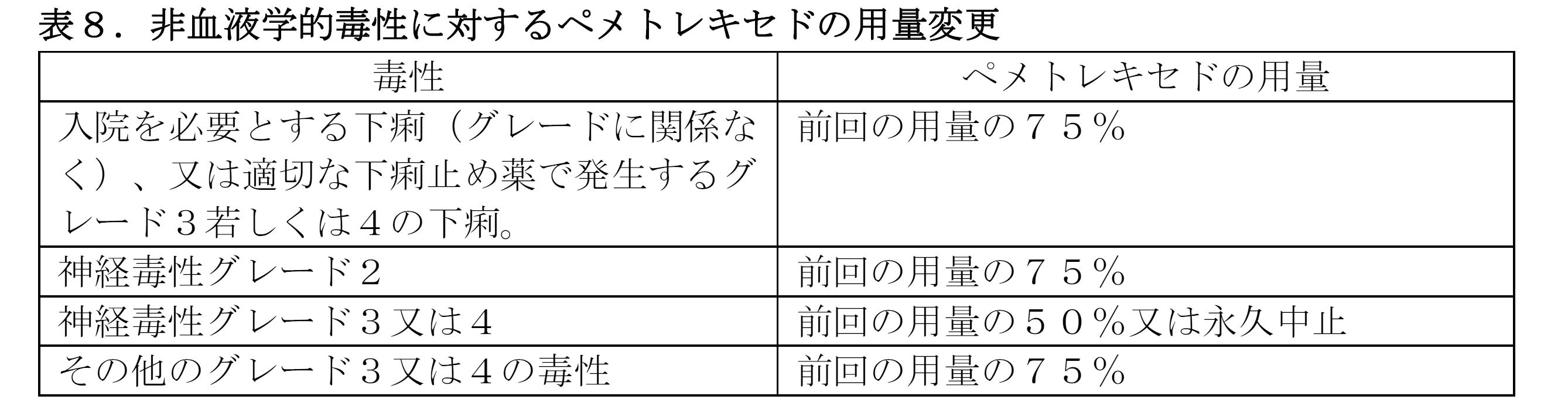
ゲムシタビンの用量変更、治療の遅延、又は治療の中止及び特定の有害事象の管理
ゲムシタビンの用量変更ガイドラインを以下に示す。ゲムシタビンによる治療は、患者が2回の用量減量後に血液学的若しくは非血液学的グレード3若しくは4の毒性を経験した場合、又は毒性のために治療が63日間を超えて遅延した場合に中止された。
Gemcitabine Dose Modification, Treatment Delay, or Treatment Discontinuation and Management of Certain Adverse Events Gemcitabine dose modification guidelines are provided below. Treatment with gemcitabine was discontinued if a patient experienced hematologic or
血液学的毒性に対するゲムシタビンの用量変更は、治療の1日目と8日目に採取した顆粒球と血小板の数に基づいていた(表9及び表10)。ゲムシタビンを投与されている患者は、各投与の前に、白血球百分率及び血小板数を含め、全血球数で監視された。回復のための十分な時間を確保するために、治療は最大63日間延期された。成長因子は、米国臨床腫瘍学会(ASCO)及び全米総合がん情報ネットワーク(NCCN)のガイドライン(Smith et al.2006)に従って使用された。回復後、次のサイクルの開始時の用量調整は、前のサイクルからの血小板及び好中球の最低(最下点)値に基づいて行われた。
Gemcitabine dose modifications for hematologic toxicity were based on granulocyte and platelet counts taken on
ANC及び血小板の両方について用量調整が必要な場合、患者はより低い用量を投与されることになった。


治験責任医師は、骨髄抑制、感染症、発熱性好中球減少症の早期且つ明白な兆候に注意し、これらの合併症を迅速かつ適切に管理できるよう努めた。患者はこれらの徴候を認識し、できるだけ早い機会に医療処置を求めるように促された。 Investigators were alert to early and overt signs of myelosuppression, infection, and febrile neutropenia and sought to manage these complications promptly and appropriately. Patients were encouraged to recognize these signs and seek medical attention at the earliest opportunity.
血液学的毒性のために化学療法が差し控えられた場合、総血球数(白血球分画を含む)は、概説された治療の下限に達するまで、毎週取得された。その後、治療が再開された。 If chemotherapy was withheld due to hematologic toxicity, total blood counts (including differential leukocyte counts) were obtained weekly until the low limit of treatment outlined was reached. Treatment was then resumed.
貧血については、用量減量は推奨されなかった。患者は、治療する医師の施設のガイドラインに従って支援された。 No dose reduction was recommended for anemia. Patients were assisted according to the guidelines of the treating physician's institution.
シスプラチンの用量変更、治療の遅延、又は治療の中止及び特定の有害事象の管理
シスプラチンの用量変更ガイドラインを以下に示す。
Cisplatin Dose Modification, Treatment Delay, or Treatment Discontinuation and Management of Certain Adverse Events Cisplatin dose modification guidelines are provided below.
シスプラチンによる治療は、患者が2回の用量減量後に血液学的若しくは非血液学的グレード3若しくは4の毒性を経験した場合、又は毒性のために治療が63日間を超えて遅延した場合に中止された。
Treatment with cisplatin was discontinued if a patient experienced hematologic or
各サイクルの開始時に、ANCが≧1500/μL、血小板数が≧100,000/μLである必要がある。回復のための十分な時間を確保するために、治療は最大63日間延期された。成長因子は、米国臨床腫瘍学会(ASCO)及び全米総合がん情報ネットワーク(NCCN)のガイドライン((Smith et al.2006;NCCN 2014)に従って使用された。回復後、次のサイクルの開始時の用量調整は、前のサイクルからの血小板及び好中球の最低値に基づいて行われた(表11を参照)。 At the start of each cycle, ANC should be ≧1500/μL and platelet count should be ≧100,000/μL. Treatment was deferred for up to 63 days to allow adequate time for recovery. Growth factors were used according to the American Society of Clinical Oncology (ASCO) and National Comprehensive Cancer Network (NCCN) guidelines ((Smith et al. 2006; NCCN 2014). After recovery, dose at the start of the next cycle. Adjustments were made based on nadir platelet and neutrophil values from the previous cycle (see Table 11).
ANC及び血小板の両方について用量調整が必要であった場合、患者はより低い用量を投与されることになった。

治験責任医師は、骨髄抑制、感染症、発熱性好中球減少症の早期且つ明白な兆候に注意し、これらの合併症を迅速かつ適切に管理できるよう努めた。患者はこれらの徴候を認識し、できるだけ早い機会に医師の診察を受けるように勧められた。 Investigators were alert to early and overt signs of myelosuppression, infection, and febrile neutropenia and sought to manage these complications promptly and appropriately. Patients were advised to recognize these signs and seek medical attention at the earliest opportunity.
血液学的毒性のために化学療法が差し控えられた場合、全血球数(白血球分画を含む)は、概説したように、計数が治療の下限に達するまで毎週取得された。その後、治療が再開された。貧血に対する用量減量は推奨されなかった。患者は施設のガイドラインに従って支援された。 If chemotherapy was withheld due to hematologic toxicity, complete blood counts (including differential leukocyte counts) were obtained weekly as outlined until counts reached the lower limit of therapy. Treatment was then resumed. No dose reduction was recommended for anemia. Patients were assisted according to institutional guidelines.
患者が非血液学的毒性を発症した場合(表12を参照)、シスプラチンは、患者のベースライン(又はベースラインで患者にその毒性がなかった場合はグレード≦1)以下に回復するまで、最大63日間差し控えられた。治療は、表12のガイドラインに従って再開された。下痢は適切な下痢止め薬でコントロールされた。吐き気及び/又は嘔吐は、適切な制吐剤でコントロールされた。

CrClは、シスプラチンのサイクルの開始前に≧60mL/分でなければならない。サイクル間でCrClが減少したが、次のサイクルの時点でCrClがまだ≧60mL/分であった場合、治験責任医師は、シスプラチンの継続、用量減量、又はサイクルの遅延に関する臨床的判断を使用した。最後のシスプラチン投与から63日間以内に患者のCrCl値が≧60mL/分に戻らなかった場合、患者はシスプラチンを中止された。 CrCl must be ≧60 mL/min prior to initiation of the cisplatin cycle. If CrCl decreased between cycles but CrCl was still ≥60 mL/min at the time of the next cycle, the investigator used clinical judgment regarding continuation of cisplatin, dose reduction, or delay of cycle. . Patients were discontinued from cisplatin if their CrCl values did not return to ≧60 mL/min within 63 days of the last dose of cisplatin.
神経毒性が発生した場合のシスプラチンの推奨用量調整は、表13に記載されている。グレード3又は4の神経毒性の場合、改善された時点でシスプラチンは前回の用量の50%で再開されたか、又は直ちに中止された(治験責任医師の臨床的判断に基づく)。

カルボプラチンの用量変更、治療の遅延、又は治療の中止及び特定の有害事象の管理
カルボプラチンの用量変更ガイドラインを以下に示す。
Carboplatin Dose Modification, Treatment Delay, or Treatment Discontinuation and Management of Certain Adverse Events Dose modification guidelines for carboplatin are provided below.
カルボプラチンによる治療は、患者が2回の用量減量後に血液学的若しくは非血液学的グレード3若しくは4の毒性を経験した場合、又は毒性のために治療が63日間を超えて遅延した場合に中止された。
Treatment with carboplatin was discontinued if a patient experienced hematologic or
各サイクルの開始時に、ANCが≧1500/μL、血小板数が≧100,000/μLである必要がある。回復のための十分な時間を確保するために、治療は最大63日間延期された。成長因子は、米国臨床腫瘍学会(ASCO)及びNCCNガイドライン(Smith et al.2006;NCCN 2012)に従って使用された。回復後、次のサイクルの開始時の用量調整は、前のサイクルからの血小板及び好中球の最低値に基づいて行われた(表14を参照)。 At the start of each cycle, ANC should be ≧1500/μL and platelet count should be ≧100,000/μL. Treatment was deferred for up to 63 days to allow adequate time for recovery. Growth factors were used according to the American Society of Clinical Oncology (ASCO) and NCCN guidelines (Smith et al. 2006; NCCN 2012). After recovery, dose adjustments at the start of the next cycle were based on nadir platelet and neutrophil values from the previous cycle (see Table 14).
ANC及び血小板の両方について用量調整が必要であった場合、患者はより低い用量を投与されることになった。
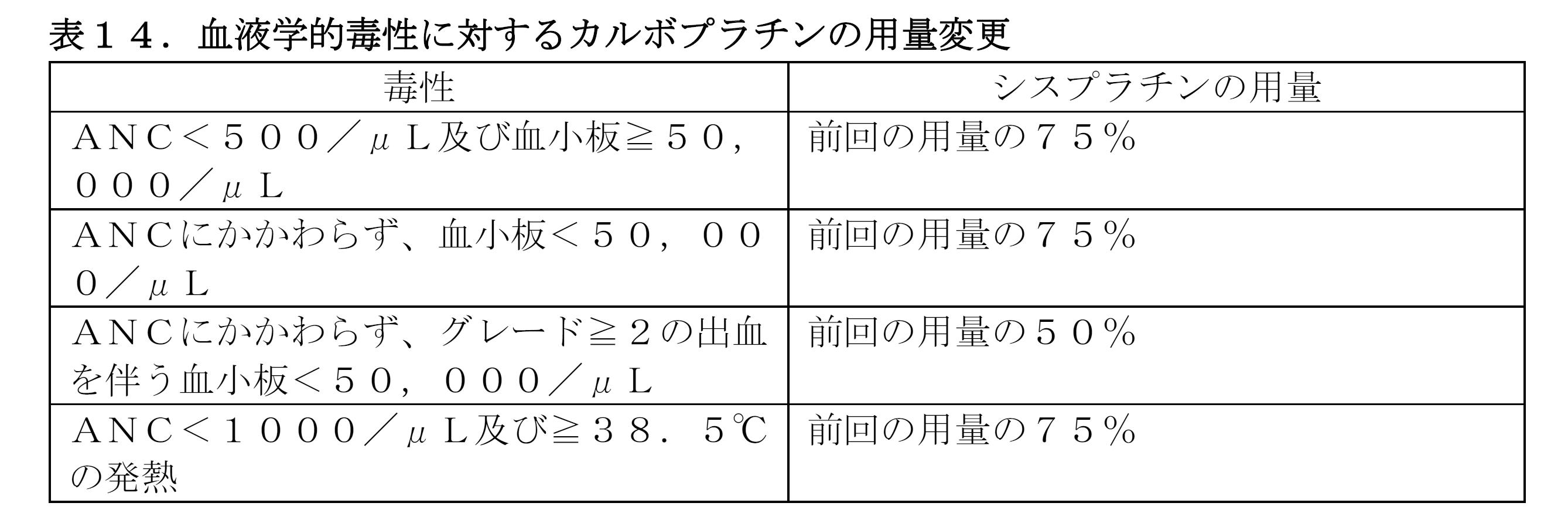
治験責任医師は、骨髄抑制、感染症、発熱性好中球減少症の早期且つ明白な兆候に注意し、これらの合併症を迅速かつ適切に管理できるよう努めた。患者はこれらの徴候を認識し、できるだけ早い機会に医療処置を求めるように促された。 Investigators were alert to early and overt signs of myelosuppression, infection, and febrile neutropenia and sought to manage these complications promptly and appropriately. Patients were encouraged to recognize these signs and seek medical attention at the earliest opportunity.
血液学的毒性のために化学療法が差し控えられた場合、全血球数(白血球分画を含む)は、概説したように、計数が治療の下限に達するまで毎週取得された。その後、治療を再開することができる。 If chemotherapy was withheld due to hematologic toxicity, complete blood counts (including differential leukocyte counts) were obtained weekly as outlined until counts reached the lower limit of therapy. Treatment can then be resumed.
貧血に対する用量減量は推奨されなかった。患者は、担当医師の施設のガイドラインに従って支援された。 No dose reduction was recommended for anemia. Patients were assisted according to their physician's institutional guidelines.
非血液学的毒性(表15を参照)の場合、治療は、患者のベースライン値(又は患者がベースラインでその毒性を有していなかった場合はグレード≦1)以下に回復するまで最大63日間遅延された。次のサイクルの開始時の用量減量は、前のサイクルで投与された用量からの非血液学的毒性に基づいて行われた。表15は、非血液学的毒性に対する用量変更を提供する。

a:治験責任医師が適切であると判断した場合、カルボプラチンの用量を前回のAUCの指定されたパーセンテージに調整する。
b:適切な下痢止め薬で発生するグレード3又は4の下痢、又は入院を必要とする任意のグレードの下痢。
c:制吐剤の使用にもかかわらず。
For non-hematological toxicities (see Table 15), treatment is administered up to 63 until recovery to below the patient's baseline value (or Grade ≤ 1 if the patient did not have the toxicity at baseline). Delayed for days. Dose reductions at the start of the next cycle were based on non-hematologic toxicities from the dose administered in the previous cycle. Table 15 provides dose modifications for non-hematological toxicities.
a: If deemed appropriate by the Investigator, the carboplatin dose will be adjusted to the indicated percentage of the previous AUC.
b:
c: Despite the use of antiemetics.
下痢は適切な下痢止め薬でコントロールされた。吐き気及び/又は嘔吐は、適切な制吐剤でコントロールされるべきである。グレード3又は4の神経毒性の場合、改善された時点でカルボプラチンは前回の用量の50%で再開されたか、又は直ちに中止された(治験責任医師の臨床的判断に基づく)。
Diarrhea was controlled with appropriate antidiarrheal medications. Nausea and/or vomiting should be controlled with appropriate antiemetics. For
有害事象
臨床試験の実施(Good Clinical Practice)のためのICHガイドラインによれば、有害事象は、原因の属性にかかわらず、医薬品を投与された臨床試験対象における何らかの不都合な医学的事象である。したがって、有害事象は以下のいずれかであり得る:
・ 医薬品に関連すると考えられるか否かにかかわらず、医薬品の使用に一時的に関連するあらゆる好ましくない意図しない徴候(異常な検査所見を含む)、症候又は疾患
・ 新規疾患又は既存疾患の増悪(既知の症状の特徴、頻度、又は重症度の悪化)
・ ベースラインに存在しない間欠的な医学的症状(例えば、頭痛)の再発
・ 症候に関連した、又は研究治療若しくは併用治療の変更、又は試験薬の中止をもたらす、臨床検査値又はその他の臨床検査(心電図、X線など)の悪化
・ プロトコルで義務付けられている介入に関連する有害事象、割り当て前に発生したものを含む
Adverse Event According to the ICH Guidelines for Good Clinical Practice, an adverse event is any untoward medical occurrence in a clinical trial subject administered a drug, regardless of the causal attribute. Adverse events can therefore be any of the following:
Any unfavorable and unintended sign (including abnormal laboratory findings), symptom or disease temporally related to the use of the drug, whether or not considered to be related to the drug New disease or exacerbation of an existing disease ( exacerbation of known symptom characteristics, frequency, or severity)
Recurrence of intermittent medical symptoms (e.g., headache) not present at baseline Laboratory values or other laboratory tests related to symptoms or leading to change in study treatment or concomitant treatment, or discontinuation of study drug exacerbation (ECG, X-ray, etc.) Protocol-mandated intervention-related adverse events, including those occurring prior to assignment
重篤な有害事象(治験依頼者に直ちに報告)
重篤な有害事象は、以下の基準のいずれかを満たす任意の有害事象である:
・ 致命的である(すなわち、有害事象が実際に死を引き起こすか、又は死に至る)
・ 生命を脅かす(すなわち、有害事象は、治験責任医師の観点から患者を死亡の即時リスクにさらす)。これには、より重度の形態で発生したか、又は継続された場合、死を引き起こした可能性がある有害事象は含まれない。
・ 入院患者の入院を必要とするか、又は延長する
・ 持続的又は有意な障害/無能力をもたらす(すなわち、有害事象は、正常な生活機能を遂行する患者の能力の実質的な破壊をもたらす)
・ 試験薬に曝露された母親から生まれた新生児/乳児における先天異常/出生時欠損である。
・ 治験責任医師の判断において重大な医学的事象である(例えば、患者を危険にさらす可能性があり、又は上に列挙した結果のうちの1つを防ぐために医学的/外科的介入を必要とする可能性がある)
Serious adverse events (reported immediately to the sponsor)
A serious adverse event is any adverse event that meets any of the following criteria:
is fatal (i.e. the adverse event actually causes or leads to death);
• Life-threatening (ie, the adverse event puts the patient at immediate risk of death from the investigator's perspective). This does not include adverse events that may have caused death if they occurred or continued in more severe forms.
Requires or prolongs hospitalization of the inpatient Result in persistent or significant disability/incapacity (i.e., the adverse event results in substantial disruption of the patient's ability to perform normal life functions) )
• Congenital anomalies/birth defects in neonates/infants born to mothers exposed to study drug.
Is a significant medical event in the investigator's judgment (e.g., may endanger the patient or require medical/surgical intervention to prevent one of the consequences listed above). there's a possibility that)
「重症」及び「重篤」という用語は、同義語ではない。重症度とは、有害事象の強度(例えば、軽度、中等度、若しくは重度と評価されるか、又はNCI CTCAE基準に従って評価される)を指し、事象自体は、比較的軽微な医学的重要性を持つ場合がある(さらなる所見のない重度の頭痛など)。 The terms "severe" and "serious" are not synonymous. Severity refers to the intensity of an adverse event (e.g., rated as mild, moderate, or severe, or assessed according to NCI CTCAE criteria); the event itself is of relatively minor medical significance. (e.g., severe headache without further findings).
重症度及び重篤度は、eCRFに記録された有害事象ごとに個別に評価する必要がある。 Severity and seriousness should be assessed individually for each adverse event recorded on the eCRF.
重大な有害事象は、治験責任医師が直ちに治験依頼者に報告する必要がある(すなわち、事象を知ってから24時間以内)。 Serious adverse events must be reported immediately by the Investigator to the Sponsor (ie, within 24 hours of knowledge of the event).
特に関心のある有害事象(治験依頼者に直ちに報告する義務がある)
特に関心のある有害事象は、治験責任医師が直ちに治験依頼者に報告する必要があった(すなわち、事象を知ってから24時間以内)。この研究にとって特に関心のある有害事象には以下が含まれる:
・ 以下は、治療に起因する自己免疫状態を確認したものである:
肺臓炎
低酸素症又は呼吸困難グレード≧3
大腸炎
内分泌障害:真性糖尿病、膵炎、又は副腎不全
血管炎
肝炎
高トランスアミナーゼ血症:グレード≧2(AST又はALT>3×ULN且つビリルビン>2×ULN)又は
AST/ALT>10×ULN
AST/ALT>10×ULN
全身性エリテマトーデス
ギラン・バレー症候群
皮膚反応:白斑、類天疱瘡
・ 過敏症、サイトカイン放出、インフルエンザ様疾患、全身性炎症反応系、又は注入反応症候群を示唆する事象
・ Hyの法則によって定義される、ビリルビン上昇又は臨床的黄疸のいずれかと組み合わせたALT又はAST上昇を含む潜在的な薬物誘発性肝損傷の症例
・ 以下に定義されるように、試験薬による感染性病原体の伝播の疑い:
Adverse events of particular interest (must be reported immediately to the sponsor)
Adverse events of particular interest required immediate reporting by the investigator to the sponsor (ie, within 24 hours of knowledge of the event). Adverse events of particular interest to this study include:
• The following have been identified for treatment-emergent autoimmune conditions:
Pneumonitis Hypoxia or dyspnea Grade ≥3
Colitis Endocrine Disorders: Diabetes Mellitus, Pancreatitis, or Adrenal Insufficiency Vasculitis Hepatitis Hypertransaminasemia: Grade ≥2 (AST or ALT >3 x ULN and bilirubin >2 x ULN) or AST/ALT >10 x ULN
AST/ALT>10×ULN
Systemic lupus erythematosus Guillain-Barré syndrome Cutaneous reactions: vitiligo, pemphigoid hypersensitivity, cytokine release, influenza-like illness, systemic inflammatory response system, or events suggestive of infusion response syndrome Bilirubin, as defined by Hy's law Cases of potential drug-induced liver injury, including elevated ALT or AST combined with either elevation or clinical jaundice Suspected transmission of infectious agents by study drug, as defined below:
病原性又は非病原性のあらゆる生物、ウイルス、又は感染性粒子(例えば、伝播性海綿状脳症を伝播するプリオンタンパク質)は、感染因子と見なされる。感染性病原体の伝播は、医薬品に曝露された患者における感染を示す臨床症状又は検査所見から疑われ得る。この用語は、試験薬の汚染が疑われる場合にのみ適用される。 Any pathogenic or non-pathogenic organism, virus, or infectious particle (eg, the prion protein that transmits transmissible spongiform encephalopathy) is considered an infectious agent. Transmission of infectious agents can be suspected from clinical symptoms or laboratory findings indicative of infection in patients exposed to the drug. This term applies only if contamination of the study drug is suspected.
結果
人口統計
以下の表16~20は、この研究で分析された患者の人口統計学的分布を要約している。以下の表16~20、及び本実施例全体で使用されるように、「TC3」という用語は、治療前に対象から単離された腫瘍試料中の腫瘍細胞の50%以上においてPD-L1の検出可能な発現レベルを有する患者を意味し;「IC3」という用語は、腫瘍試料の10%以上を構成する腫瘍浸潤免疫細胞においてPD-L1の検出可能な発現レベルを有する患者を意味し;「WT」という用語は、EGFR又はALKゲノム腫瘍異常を有しない患者を意味する。さらに、「TC2/3」という用語は、治療前に対象から単離された腫瘍試料中の腫瘍細胞の5%以上においてPD-L1の検出可能な発現レベルを有する患者を意味し;「IC2/3」という用語は、腫瘍試料の5%以上を構成する腫瘍浸潤免疫細胞においてPD-L1の検出可能な発現レベルを有する患者を意味する。「TC1/2/3」という用語は、治療前に対象から単離された腫瘍試料中の腫瘍細胞の1%以上においてPD-L1の検出可能な発現レベルを有する患者を意味し;「IC1/2/3」という用語は、腫瘍試料の1%以上を構成する腫瘍浸潤免疫細胞においてPD-L1の検出可能な発現レベルを有する患者を意味する。この研究に登録された患者のPD-L1発現パターンの分布を図4に示す。


患者の気質
以下の表21は、この研究中に化学療法又はアテゾリズマブ治療のいずれかを受けた患者の数、並びに研究への参加後の患者の状態をまとめたものである。

有効性
TC3及びIC3-WTの患者集団全体
この研究の結果は、TC3又はIC3-WT集団の患者は、白金系化学療法で治療されたTC3又はIC3-WT患者と比較して、アテゾリズマブ投与の結果として、統計的に有意且つ臨床的に意味のある全生存期間(OS)の改善を経験したことを示している。これらの結果は、以下の表22に要約されており、図2及び5のカプラン-マイヤー曲線にグラフで示されている。

この研究の結果はさらに、TC3又はIC3-WT集団の患者は、白金系化学療法で治療されたTC3又はIC3-WT患者と比較して、アテゾリズマブ投与の結果として、臨床的に意味のある無増悪生存期間(PFS)の改善を経験したことを示している。これらの結果は、以下の表23に要約されており、図3及び9のカプラン-マイヤー曲線にグラフで示されている。

この研究の結果はさらに、TC3又はIC3-WT集団の患者は、白金系化学療法で治療されたTC3又はIC3-WT患者と比較して、アテゾリズマブ投与の結果として、全奏効率と奏効期間の改善を経験したことを示している。これらの結果は、以下の図11及び表24に要約されている。

PD-L1発現によって層別化された患者群間の有効性の比較
以下の表25は、異なるPD-L1発現レベルを有する患者における白金系化学療法に対するアテゾリズマブの有効性の比較を示す。TC1/2/3又はIC1/2/3-WT集団(n=554)のうち、534人の患者が22C3により評価可能であり、546人の患者がSP263により評価可能であった(バイオマーカー評価可能集団;BEP)。各BEPサブグループの主要なベースライン特性は、TC1/2/3又はIC1/2/3-WT集団の特性と一致していた。2つのIHCアッセイによって決定されたPD-L1発現の有病率は類似していた(図15)。22C3とSP263の≧50%サブグループ間には、高い重複が観察された(図13A)。さらに、SP142 TC3又はIC3サブグループのかなりの部分が、22C3≧50%TPS又はSP263≧50%TCサブグループ内に包含された(図13A及び16)。
Comparison of Efficacy Between Patient Groups Stratified by PD-L1 Expression Table 25 below shows a comparison of efficacy of atezolizumab versus platinum-based chemotherapy in patients with different PD-L1 expression levels. Among the TC1/2/3 or IC1/2/3-WT population (n=554), 534 patients were evaluable by 22C3 and 546 patients were evaluable by SP263 (biomarker assessment potential population; BEP). Key baseline characteristics of each BEP subgroup were consistent with those of the TC1/2/3 or IC1/2/3-WT populations. The prevalence of PD-L1 expression determined by the two IHC assays was similar (Figure 15). A high overlap was observed between the ≧50% subgroups of 22C3 and SP263 (FIG. 13A). Moreover, a significant portion of the SP142 TC3 or IC3 subgroups were encompassed within the 22C3 >50% TPS or SP263 >50% TC subgroups (Figures 13A and 16).
TC2/3又はIC2/3 WT群の患者の全生存率に対するアテゾリズマブ単剤療法の効果を図7に示す。TC1/2/3又はIC1/2/3 WT群の患者の全生存率に対するアテゾリズマブ単剤療法の効果を図8に示す。(i)TC2/3及びIC2/3 WT群と(ii)TC1/2/3及びIC1/2/3 WT群の患者の無増悪生存期間に対するアテゾリズマブ単剤療法の効果を図10に示す。全体として、アテゾリズマブは、使用したIHCアッセイに関係なく、PD-L1発現が高い患者において化学療法と比較して同様のOS改善を示した(図13B及び13C)。PD-L1陽性BEPサブグループにおいても、化学療法に対してアテゾリズマブの方がOSの改善が見られた(図13D及び16)。PD-L1低BEPサブグループの患者は、アッセイに関係なく、治療群全体で同様のOS結果を示した(図13D及び16)。アテゾリズマブによるPFSの改善は、PD-L1BEPサブグループ全体で観察された(図17)。 The effect of atezolizumab monotherapy on overall survival of patients in the TC2/3 or IC2/3 WT groups is shown in FIG. The effect of atezolizumab monotherapy on overall survival of patients in the TC1/2/3 or IC1/2/3 WT groups is shown in FIG. The effect of atezolizumab monotherapy on progression-free survival of patients in (i) TC2/3 and IC2/3 WT groups and (ii) TC1/2/3 and IC1/2/3 WT groups is shown in FIG. Overall, atezolizumab showed similar OS improvements compared to chemotherapy in patients with high PD-L1 expression, regardless of the IHC assay used (FIGS. 13B and 13C). Improvements in OS were also seen with atezolizumab versus chemotherapy in the PD-L1 positive BEP subgroup (FIGS. 13D and 16). Patients in the PD-L1 low BEP subgroup showed similar OS results across treatment arms regardless of assay (FIGS. 13D and 16). Improvement in PFS with atezolizumab was observed across the PD-L1BEP subgroup (Figure 17).
PD-L1発現が高い患者において(TC3/IC3-WT;本明細書における「WT」は、ALK又はEGFR変異を持たない患者を示す)、アテゾリズマブ単剤療法が化学療法単独療法と比較して全生存期間(OS)を7.1ヶ月改善したことを示す中間解析において(全生存期間の中央値[OS]=20.2対13.1ヶ月;ハザード比[HR]=0.595、95%CI:0.398-0.890;p=0.0106)、本研究は主要評価項目を達成した。OSの促進(18.2ヶ月対14.9ヶ月;ハザード比[HR]=0.717、95%CI:0.520-0.989;p=0.0416)は、中程度のPD-L1発現レベルを有する人(TC2/3又はIC2/3-WT)においても観察された。

bTMBスコアによって層別化された患者群間の有効性の比較
TC1/2/3又はIC1/2/3-WT集団(n=554)のうち、389人の患者がbTMB評価可能であった。ベースライン特性は、TC1/2/3又はIC1/2/3-WT集団とbTMB BEP-WT集団の間で一貫していた。bTMBスコア≧16は、bTMB BEP-WT集団の患者の22.4%を表し、SP142 IHC又は22C3によって評価される高いPD-L1発現と比較して、異なる集団を同定するように見えた(図14A)。アテゾリズマブは、化学療法と比較してOS及びPFSの改善を示し、bTMB≧16カットオフで頭打ちになった(OSの非層別化HR、0.75[95%CI:0.41、1.35];PFS HR、0.55[95%CI:0.33、0.92]);図14B及び14C)。
Comparison of Efficacy Between Patient Groups Stratified by bTMB Score Among the TC1/2/3 or IC1/2/3-WT population (n=554), 389 patients were bTMB-evaluable. Baseline characteristics were consistent between the TC1/2/3 or IC1/2/3-WT and bTMB BEP-WT populations. A bTMB score ≧16 represented 22.4% of patients in the bTMB BEP-WT population and appeared to identify a distinct population compared to elevated PD-L1 expression assessed by SP142 IHC or 22C3 (Fig. 14A). Atezolizumab showed improvements in OS and PFS compared to chemotherapy, plateauing at the bTMB≧16 cutoff (non-stratified HR for OS, 0.75 [95% CI: 0.41, 1.5% CI; 35]; PFS HR, 0.55 [95% CI: 0.33, 0.92]); Figures 14B and 14C).
サブグループ分析:
上記に加えて、この研究の結果は、アテゾリズマブ治療が、TC3又はIC3-WT患者群内の幅広い亜集団にわたって、白金系化学療法治療と比較して全生存期間の改善をもたらしたことを示している。図6A及び6Bは、これらの亜集団を要約し、白金系化学療法と比較して、アテゾリズマブによってもたらされた全生存期間の改善について報告している。
Subgroup analysis:
In addition to the above, the results of this study show that atezolizumab treatment resulted in improved overall survival compared to platinum-based chemotherapy treatment across a broad subpopulation within the TC3 or IC3-WT patient population. there is Figures 6A and 6B summarize these subpopulations and report the improvement in overall survival provided by atezolizumab compared to platinum-based chemotherapy.
有効性の概要
要約すると、この研究の結果は、アテゾリズマブが、TC3又はIC3-WT集団の患者において、白金系化学療法と比較して、統計的に有意で臨床的に意味のある全生存期間の改善をもたらしたことを示している。この結果はさらに、アテゾリズマブが、TC3又はIC3-WT集団の患者において、白金系化学療法と比較して無増悪生存期間の臨床的に意味のある改善をもたらしたことを示している。さらに、OS及びPFSの改善は、TC3及びTC3又はIC3-WT集団内の全ての臨床サブグループに適用されることがわかった。
Summary of Efficacy In summary, the results of this study demonstrate that atezolizumab was associated with a statistically significant and clinically meaningful improvement in overall survival compared to platinum-based chemotherapy in patients in the TC3 or IC3-WT population. shows that it has improved. The results further indicate that atezolizumab provided a clinically meaningful improvement in progression-free survival compared to platinum-based chemotherapy in patients in the TC3 or IC3-WT population. Furthermore, improvements in OS and PFS were found to apply to all clinical subgroups within the TC3 and TC3 or IC3-WT populations.
有害事象
上記のように、この研究に参加した患者は、臨床試験の期間を通じて有害事象について監視された。これらの有害事象は、以下の表にまとめられており、図12にもグラフで示されている。
Adverse Events As described above, patients enrolled in this study were monitored for adverse events throughout the duration of the clinical trial. These adverse events are summarized in the table below and are also graphically illustrated in FIG.
これらの表が示すように、アテゾリズマブは白金系化学療法と比較して良好な安全性プロファイルを示した。研究された安全集団は、A群(アテゾリズマブ単剤療法)の286人の患者、及びB群(化学療法)の263人の患者で構成されていた。治療関連のAE(TRAE)とグレード3~4のTRAEは、それぞれ60.5%(A群)と85.2%(B群)、12.9%(A群)と44.1%(B群)において発生した。

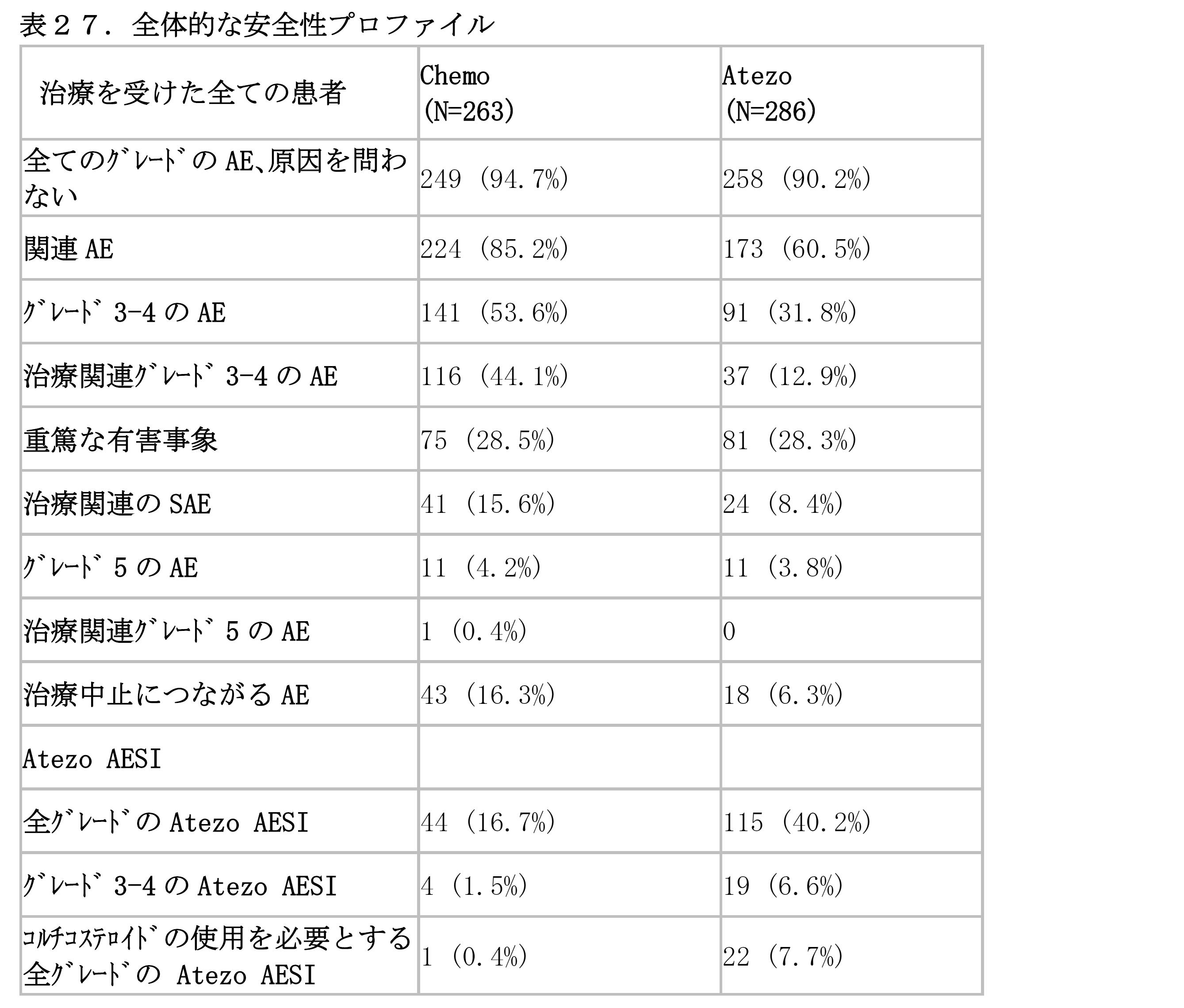

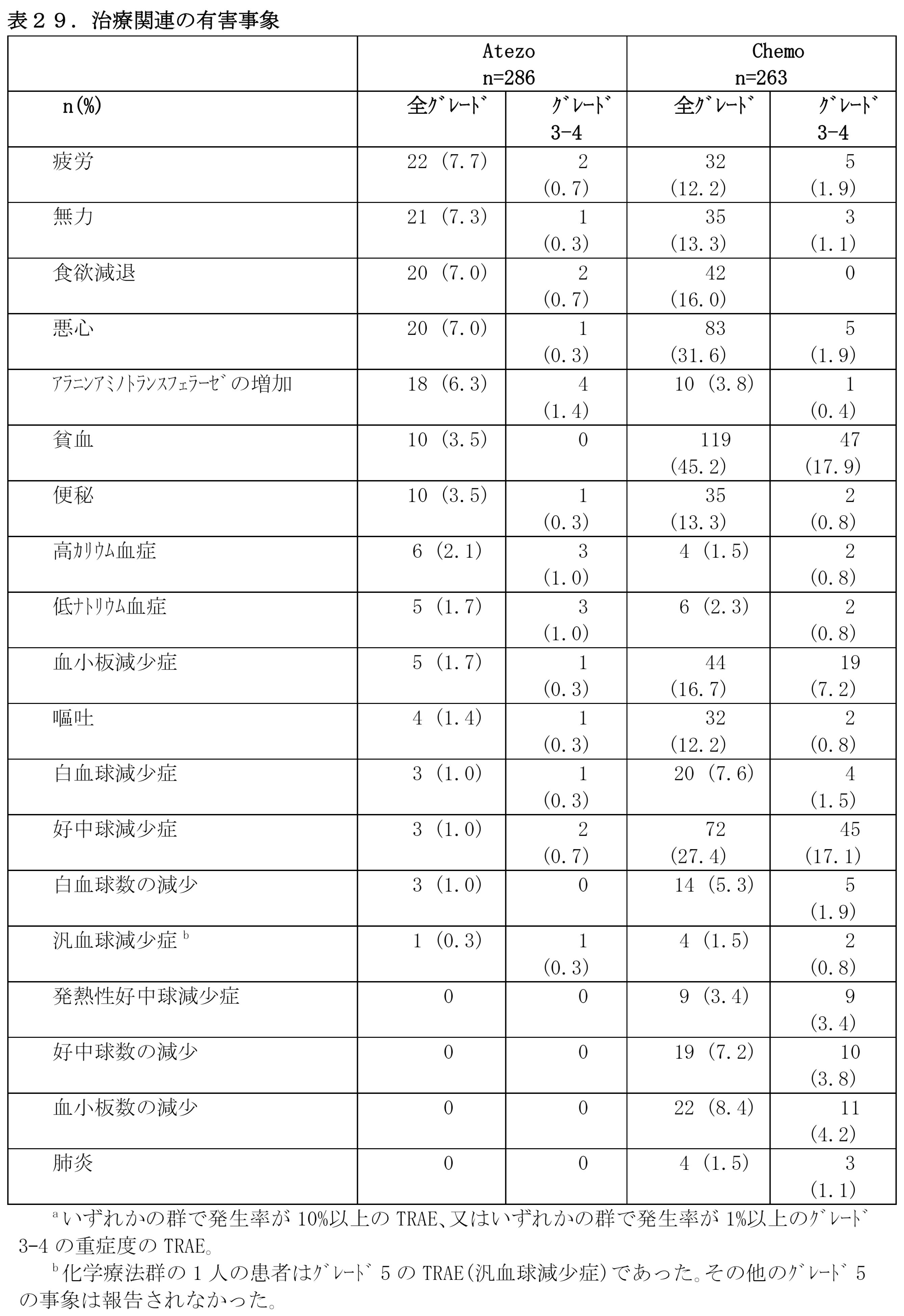

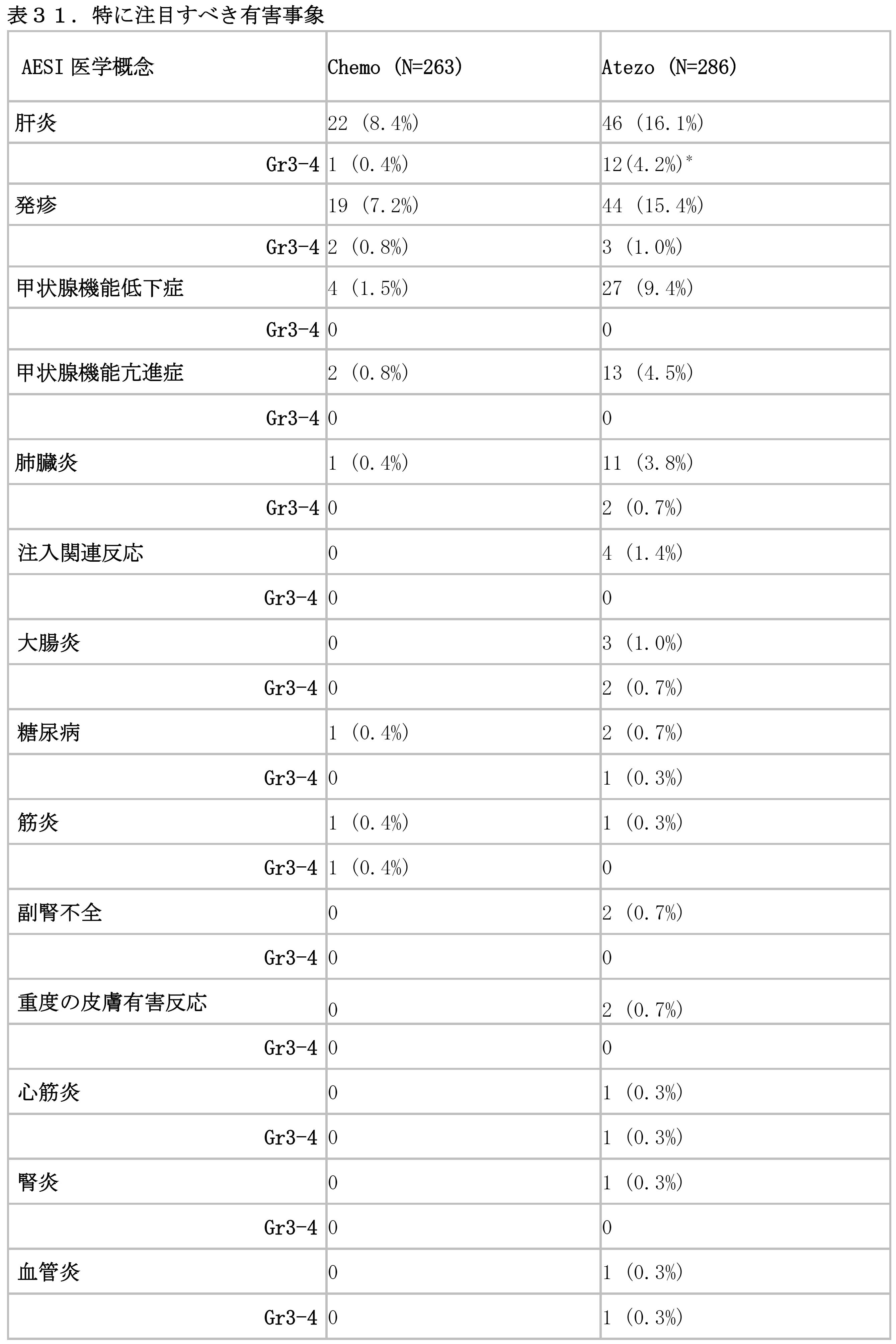
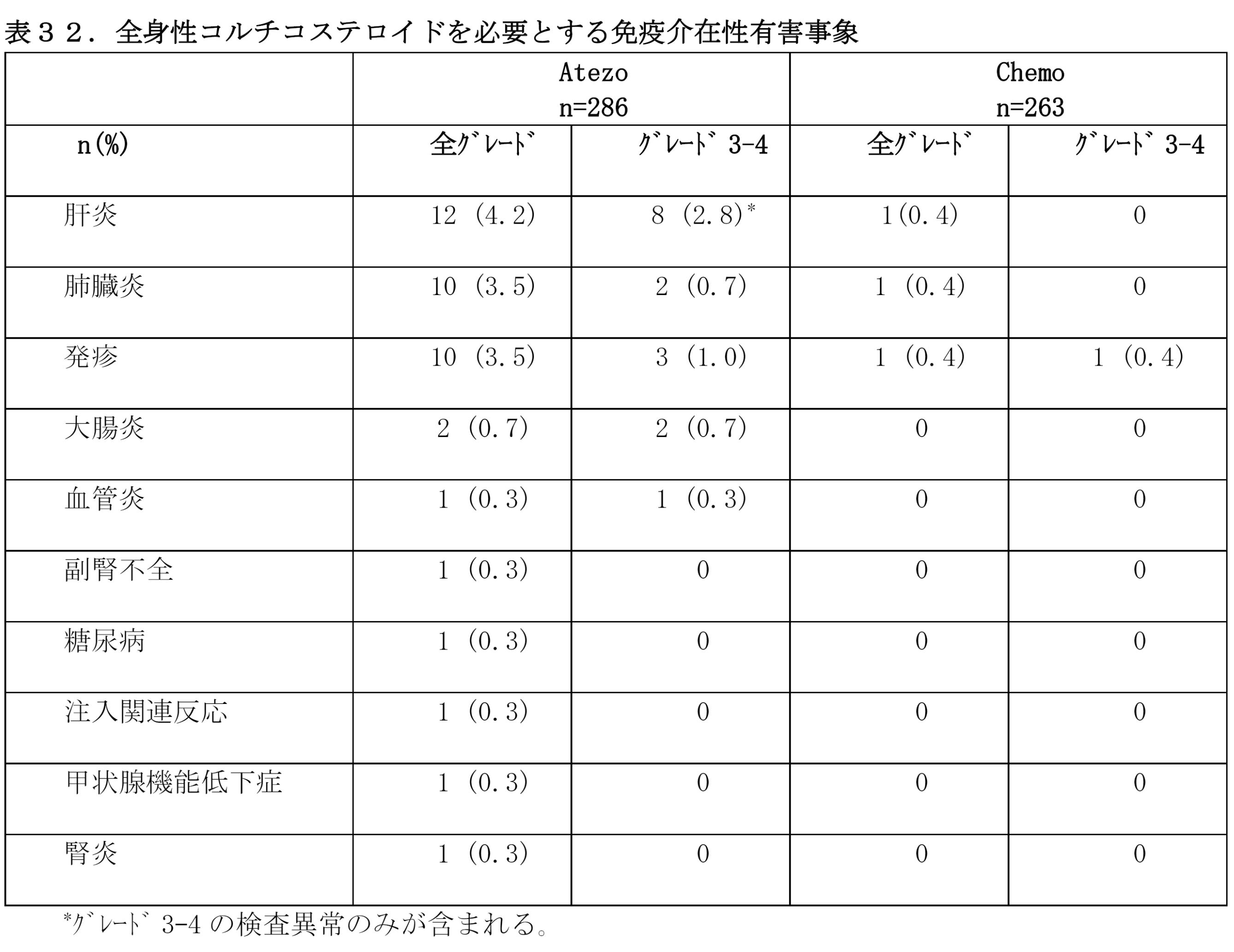
他の実施態様
前述の本開示の組成物及び方法は、理解を明確にする目的で説明及び実施例としてある程度詳細に説明されているが、その説明及び実施例は、本開示の範囲を限定するものと解釈されるべきではない。本明細書に引用される全ての特許及び科学文献の開示は、参照によりその全体が明示的に組み込まれる。
OTHER EMBODIMENTS The foregoing compositions and methods of the disclosure have been described in some detail by way of illustration and example for purposes of clarity of understanding, but the description and examples do not limit the scope of the disclosure. should not be construed as The disclosures of all patent and scientific literature cited herein are expressly incorporated by reference in their entirety.
Claims (284)
(a)対象からの試料からbTMBスコアを決定することであって、試料から決定されたbTMBスコアが参照bTMBスコア以上である、対象からの試料からbTMBスコアを決定すること;及び
(b)有効量のPD-1軸結合アンタゴニストを対象に投与すること
を含む、方法。 A method of treating squamous NSCLC in a subject in need thereof, comprising:
(a) determining a bTMB score from a sample from the subject, wherein the bTMB score determined from the sample is greater than or equal to the reference bTMB score; and (b) valid A method comprising administering to a subject an amount of a PD-1 axis binding antagonist.
(a)GFTFSDSWIH(配列番号19)のHVR-H1配列;
(b)AWISPYGGSTYYADSVKG(配列番号20)のHVR-H2配列;
(c)RHWPGGFDY(配列番号21)のHVR-H3配列;
(d)RASQDVSTAVA(配列番号22)のHVR-L1配列;
(e)SASFLYS(配列番号23)のHVR-L2配列;及び
(f)QQYLYHPAT(配列番号24)のHVR-L3配列
を含む、請求項93又は94に記載の方法。 The anti-PD-L1 antibody has the following hypervariable regions (HVRs):
(a) HVR-H1 sequence of GFTFSDSWIH (SEQ ID NO: 19);
(b) the HVR-H2 sequence of AWISPYGGSTYYADSVKG (SEQ ID NO: 20);
(c) the HVR-H3 sequence of RHWPGGFDY (SEQ ID NO: 21);
(d) the HVR-L1 sequence of RASQDVSTAVA (SEQ ID NO: 22);
(e) HVR-L2 sequence of SASFLYS (SEQ ID NO:23); and (f) HVR-L3 sequence of QQYLYHPAT (SEQ ID NO:24).
(a)配列番号3のアミノ酸配列に対して少なくとも90%の配列同一性を有するアミノ酸配列を含む重鎖可変(VH)ドメイン;
(b)配列番号4のアミノ酸配列に対して少なくとも90%の配列同一性を有するアミノ酸配列を含む軽鎖可変(VL)ドメイン;又は
(c)(a)に記載のVHドメイン及び(b)に記載のVLドメイン
を含む、請求項94又は95に記載の方法。 The anti-PD-L1 antibody is
(a) a heavy chain variable (VH) domain comprising an amino acid sequence having at least 90% sequence identity to the amino acid sequence of SEQ ID NO:3;
(b) a light chain variable (VL) domain comprising an amino acid sequence having at least 90% sequence identity to the amino acid sequence of SEQ ID NO:4; or (c) a VH domain according to (a) and (b) 96. The method of claim 94 or 95, comprising the VL domain of claim 94 or 95.
(a)配列番号3のアミノ酸配列に対して少なくとも95%の配列同一性を有するアミノ酸配列を含むVHドメイン;
(b)配列番号4のアミノ酸配列に対して少なくとも95%の配列同一性を有するアミノ酸配列を含むVLドメイン;又は
(c)(a)に記載のVHドメイン及び(b)に記載のVLドメイン
を含む、請求項96に記載の方法。 The anti-PD-L1 antibody is
(a) a VH domain comprising an amino acid sequence having at least 95% sequence identity to the amino acid sequence of SEQ ID NO:3;
(b) a VL domain comprising an amino acid sequence having at least 95% sequence identity to the amino acid sequence of SEQ ID NO: 4; or (c) a VH domain according to (a) and a VL domain according to (b) 97. The method of claim 96, comprising:
(a)配列番号3のアミノ酸配列に対して少なくとも96%の配列同一性を有するアミノ酸配列を含むVHドメイン;
(b)配列番号4のアミノ酸配列に対して少なくとも96%の配列同一性を有するアミノ酸配列を含むVLドメイン;又は
(c)(a)に記載のVHドメイン及び(b)に記載のVLドメイン
を含む、請求項97に記載の方法。 The anti-PD-L1 antibody is
(a) a VH domain comprising an amino acid sequence having at least 96% sequence identity to the amino acid sequence of SEQ ID NO:3;
(b) a VL domain comprising an amino acid sequence having at least 96% sequence identity to the amino acid sequence of SEQ ID NO: 4; or (c) a VH domain according to (a) and a VL domain according to (b) 98. The method of claim 97, comprising:
(a)配列番号3のアミノ酸配列に対して少なくとも97%の配列同一性を有するアミノ酸配列を含むVHドメイン;
(b)配列番号4のアミノ酸配列に対して少なくとも97%の配列同一性を有するアミノ酸配列を含むVLドメイン;又は
(c)(a)に記載のVHドメイン及び(b)に記載のVLドメイン
を含む、請求項98に記載の方法。 The anti-PD-L1 antibody is
(a) a VH domain comprising an amino acid sequence having at least 97% sequence identity to the amino acid sequence of SEQ ID NO:3;
(b) a VL domain comprising an amino acid sequence having at least 97% sequence identity to the amino acid sequence of SEQ ID NO: 4; or (c) a VH domain according to (a) and a VL domain according to (b) 99. The method of claim 98, comprising:
(a)配列番号3のアミノ酸配列に対して少なくとも98%の配列同一性を有するアミノ酸配列を含むVHドメイン;
(b)配列番号4のアミノ酸配列に対して少なくとも98%の配列同一性を有するアミノ酸配列を含むVLドメイン;又は
(c)(a)に記載のVHドメイン及び(b)に記載のVLドメイン
を含む、請求項99に記載の方法。 The anti-PD-L1 antibody is
(a) a VH domain comprising an amino acid sequence having at least 98% sequence identity to the amino acid sequence of SEQ ID NO:3;
(b) a VL domain comprising an amino acid sequence having at least 98% sequence identity to the amino acid sequence of SEQ ID NO: 4; or (c) a VH domain according to (a) and a VL domain according to (b) 100. The method of claim 99, comprising
(a)配列番号3のアミノ酸配列に対して少なくとも99%の配列同一性を有するアミノ酸配列を含むVHドメイン;
(b)配列番号4のアミノ酸配列に対して少なくとも99%の配列同一性を有するアミノ酸配列を含むVLドメイン;又は
(c)(a)に記載のVHドメイン及び(b)に記載のVLドメイン
を含む、請求項100に記載の方法。 The anti-PD-L1 antibody is
(a) a VH domain comprising an amino acid sequence having at least 99% sequence identity to the amino acid sequence of SEQ ID NO:3;
(b) a VL domain comprising an amino acid sequence having at least 99% sequence identity to the amino acid sequence of SEQ ID NO: 4; or (c) a VH domain according to (a) and a VL domain according to (b) 101. The method of claim 100, comprising:
(a)配列番号3のアミノ酸配列を含むVHドメイン;
(b)配列番号4のアミノ酸配列を含むVLドメイン;又は
(c)(a)に記載のVHドメイン及び(b)に記載のVLドメイン
を含む、請求項101に記載の方法。 The anti-PD-L1 antibody is
(a) a VH domain comprising the amino acid sequence of SEQ ID NO:3;
102. The method of claim 101, comprising (b) a VL domain comprising the amino acid sequence of SEQ ID NO: 4; or (c) a VH domain according to (a) and a VL domain according to (b).
(a)配列番号3のアミノ酸配列を含むVHドメイン;及び
(b)配列番号4のアミノ酸配列を含むVLドメイン
を含む、請求項102に記載の方法。 The anti-PD-L1 antibody is
103. The method of claim 102, comprising (a) a VH domain comprising the amino acid sequence of SEQ ID NO:3; and (b) a VL domain comprising the amino acid sequence of SEQ ID NO:4.
(i)腫瘍試料中の腫瘍細胞の1%以上におけるPD-L1の検出可能な発現レベル;及び/又は
(ii)腫瘍試料の1%以上を構成する腫瘍浸潤免疫細胞におけるPD-L1の検出可能な発現レベル
を示すと決定されている、請求項1~120のいずれか一項に記載の方法。 A tumor sample obtained from a subject is
(i) a detectable expression level of PD-L1 in 1% or more of the tumor cells in the tumor sample; and/or (ii) detectable PD-L1 in tumor-infiltrating immune cells comprising 1% or more of the tumor sample. 121. The method of any one of claims 1-120, wherein the method has been determined to exhibit a significant expression level.
(i)腫瘍試料中の腫瘍細胞の1%~5%未満におけるPD-L1の検出可能な発現レベル;及び/又は
(ii)腫瘍試料の1%~5%未満を構成する腫瘍浸潤免疫細胞におけるPD-L1の検出可能な発現レベル
を示すと決定されている、請求項121に記載の方法。 A tumor sample obtained from a subject is
(i) a detectable expression level of PD-L1 in less than 1% to 5% of the tumor cells in the tumor sample; and/or (ii) in tumor-infiltrating immune cells comprising 1% to less than 5% of the tumor sample. 122. The method of claim 121, which has been determined to exhibit a detectable expression level of PD-L1.
(i)腫瘍試料中の腫瘍細胞の5%以上におけるPD-L1の検出可能な発現レベル;及び/又は
(ii)腫瘍試料の5%以上を構成する腫瘍浸潤免疫細胞におけるPD-L1の検出可能な発現レベル
を示すと決定されている、請求項1~120のいずれか一項に記載の方法。 A tumor sample obtained from a subject is
(i) a detectable expression level of PD-L1 in 5% or more of the tumor cells in the tumor sample; and/or (ii) detectable PD-L1 in tumor-infiltrating immune cells comprising 5% or more of the tumor sample. 121. The method of any one of claims 1-120, wherein the method has been determined to exhibit an expression level of
(i)腫瘍試料中の腫瘍細胞の5%~50%未満におけるPD-L1の検出可能な発現レベル;及び/又は
(ii)腫瘍試料の5%~10%未満を構成する腫瘍浸潤免疫細胞におけるPD-L1の検出可能な発現レベル
を示すと決定されている、請求項123に記載の方法。 A tumor sample obtained from a subject is
(i) a detectable expression level of PD-L1 in less than 5% to 50% of the tumor cells in the tumor sample; and/or (ii) in tumor-infiltrating immune cells that make up less than 5% to 10% of the tumor sample. 124. The method of claim 123, which has been determined to exhibit a detectable expression level of PD-L1.
(i)腫瘍試料中の腫瘍細胞の50%以上におけるPD-L1の検出可能な発現レベル;及び/又は
(ii)腫瘍試料の10%以上を構成する腫瘍浸潤免疫細胞におけるPD-L1の検出可能な発現レベル
を示すと決定されている、請求項1~120のいずれか一項に記載の方法。 A tumor sample obtained from a subject is
(i) a detectable expression level of PD-L1 in 50% or more of the tumor cells in the tumor sample; and/or (ii) detectable PD-L1 in tumor-infiltrating immune cells comprising 10% or more of the tumor sample. 121. The method of any one of claims 1-120, wherein the method has been determined to exhibit a significant expression level.
(i)腫瘍試料中の腫瘍細胞の50%以上におけるPD-L1の検出可能な発現レベル;及び/又は
(ii)腫瘍試料の10%以上を構成する腫瘍浸潤免疫細胞におけるPD-L1の検出可能な発現レベル
を有すると決定されている、方法。 A method of treating squamous NSCLC in a human subject in need of treatment for squamous NSCLC comprising administering to the subject an effective amount of atezolizumab during one or more dosing cycles, wherein the subject is chemotherapy naive and the bTMB score from the sample from the subject has been determined to be greater than or equal to the reference bTMB score, optionally the reference bTMB score is 16 and the tumor sample obtained from the subject is
(i) a detectable expression level of PD-L1 in 50% or more of the tumor cells in the tumor sample; and/or (ii) detectable PD-L1 in tumor-infiltrating immune cells comprising 10% or more of the tumor sample. The method has been determined to have an expression level of
(i)腫瘍試料中の腫瘍細胞の50%以上におけるPD-L1の検出可能な発現レベル;及び/又は
(ii)腫瘍試料の10%以上を構成する腫瘍浸潤免疫細胞におけるPD-L1の検出可能な発現レベル
を有すると決定されている、方法。 A method of treating squamous NSCLC in a human subject in need of treatment for squamous NSCLC comprising administering to the subject an effective amount of atezolizumab during one or more dosing cycles, wherein the subject is chemotherapy naive and the bTMB score from a sample from the subject has been determined to be greater than or equal to the reference bTMB score, optionally the reference bTMB score is 16 and atezolizumab is administered at about 840 mg every 2 weeks , administered intravenously to a subject at a dose of about 1200 mg every 3 weeks, or about 1680 mg every 4 weeks, and a tumor sample obtained from the subject comprising:
(i) a detectable expression level of PD-L1 in 50% or more of the tumor cells in the tumor sample; and/or (ii) detectable PD-L1 in tumor-infiltrating immune cells comprising 10% or more of the tumor sample. The method has been determined to have an expression level of
(i)腫瘍試料中の腫瘍細胞の50%以上におけるPD-L1の検出可能な発現レベル;及び/又は
(ii)腫瘍試料の10%以上を構成する腫瘍浸潤免疫細胞におけるPD-L1の検出可能な発現レベル
を有すると決定されている、方法。 A method of treating squamous NSCLC in a human subject in need of treatment for squamous NSCLC comprising administering to the subject an effective amount of atezolizumab during one or more dosing cycles, wherein the subject is chemotherapy naive and the bTMB score from a sample from the subject has been determined to be greater than or equal to the reference bTMB score, optionally the reference bTMB score is 16 and atezolizumab is administered at about 1200 mg every 3 weeks A tumor sample obtained from a subject intravenously administered to the subject at a dose of
(i) a detectable expression level of PD-L1 in 50% or more of the tumor cells in the tumor sample; and/or (ii) detectable PD-L1 in tumor-infiltrating immune cells comprising 10% or more of the tumor sample. The method has been determined to have an expression level of
(i)腫瘍試料中の腫瘍細胞の50%以上におけるPD-L1の検出可能な発現レベル;及び/又は
(ii)腫瘍試料の10%以上を構成する腫瘍浸潤免疫細胞におけるPD-L1の検出可能な発現レベル
を有すると決定されている、方法。 A method of treating stage IV squamous NSCLC in a human subject in need of treatment for stage IV squamous NSCLC comprising administering to the subject an effective amount of atezolizumab during one or more dosing cycles. wherein the subject is chemotherapy naïve, the bTMB score from the sample from the subject has been determined to be greater than or equal to the reference bTMB score, optionally the reference bTMB score is 16, and atezolizumab is administered intravenously to a subject at a dose of about 1200 mg every 3 weeks and a tumor sample obtained from the subject comprising:
(i) a detectable expression level of PD-L1 in 50% or more of the tumor cells in the tumor sample; and/or (ii) detectable PD-L1 in tumor-infiltrating immune cells comprising 10% or more of the tumor sample. The method has been determined to have an expression level of
(i)腫瘍試料中の腫瘍細胞の50%以上におけるPD-L1の検出可能な発現レベル;及び/又は
(ii)腫瘍試料の10%以上を構成する腫瘍浸潤免疫細胞におけるPD-L1の検出可能な発現レベル
を有すると決定されている、方法。 A method of treating stage IV squamous NSCLC in a human subject in need of treatment for stage IV squamous NSCLC comprising administering to the subject an effective amount of atezolizumab during one or more dosing cycles. wherein the subject is chemotherapy naïve, the subject does not have a sensitizing mutation in the gene encoding EGFR, the subject does not have an ALK fusion oncogene, and the bTMB score from a sample from the subject is: determined to be greater than or equal to the reference bTMB score, optionally the reference bTMB score is 16, atezolizumab is administered intravenously to the subject at a dose of about 1200 mg every 3 weeks, and the tumor sample obtained from the subject teeth,
(i) a detectable expression level of PD-L1 in 50% or more of the tumor cells in the tumor sample; and/or (ii) detectable PD-L1 in tumor-infiltrating immune cells comprising 10% or more of the tumor sample. The method has been determined to have an expression level of
(a)対象からの試料からbTMBスコアを決定することであって、試料から決定されたbTMBスコアが参照bTMBスコア以上である、対象からの試料からbTMBスコアを決定すること;及び
(b)有効量のPD-1軸結合アンタゴニストを対象に投与すること
を含む、方法。 A method of treating squamous NSCLC in a subject in need of treatment for non-squamous NSCLC comprising:
(a) determining a bTMB score from a sample from the subject, wherein the bTMB score determined from the sample is greater than or equal to the reference bTMB score; and (b) valid A method comprising administering to a subject an amount of a PD-1 axis binding antagonist.
(a)GFTFSDSWIH(配列番号19)のHVR-H1配列;
(b)AWISPYGGSTYYADSVKG(配列番号20)のHVR-H2配列;
(c)RHWPGGFDY(配列番号21)のHVR-H3配列;
(d)RASQDVSTAVA(配列番号22)のHVR-L1配列;
(e)SASFLYS(配列番号23)のHVR-L2配列;及び
(f)QQYLYHPAT(配列番号24)のHVR-L3配列
を含む、請求項235又は236に記載の方法。 The anti-PD-L1 antibody has the following hypervariable regions (HVRs):
(a) HVR-H1 sequence of GFTFSDSWIH (SEQ ID NO: 19);
(b) the HVR-H2 sequence of AWISPYGGSTYYADSVKG (SEQ ID NO: 20);
(c) the HVR-H3 sequence of RHWPGGFDY (SEQ ID NO: 21);
(d) the HVR-L1 sequence of RASQDVSTAVA (SEQ ID NO: 22);
(e) HVR-L2 sequence of SASFLYS (SEQ ID NO:23); and (f) HVR-L3 sequence of QQYLYHPAT (SEQ ID NO:24).
(a)配列番号3のアミノ酸配列に対して少なくとも90%の配列同一性を有するアミノ酸配列を含む重鎖可変(VH)ドメイン;
(b)配列番号4のアミノ酸配列に対して少なくとも90%の配列同一性を有するアミノ酸配列を含む軽鎖可変(VL)ドメイン;又は
(c)(a)に記載のVHドメイン及び(b)に記載のVLドメイン
を含む、請求項236又は237に記載の方法。 The anti-PD-L1 antibody is
(a) a heavy chain variable (VH) domain comprising an amino acid sequence having at least 90% sequence identity to the amino acid sequence of SEQ ID NO:3;
(b) a light chain variable (VL) domain comprising an amino acid sequence having at least 90% sequence identity to the amino acid sequence of SEQ ID NO:4; or (c) a VH domain according to (a) and (b) 238. The method of claim 236 or 237, comprising the VL domain of claim 236 or 237.
(a)配列番号3のアミノ酸配列に対して少なくとも95%の配列同一性を有するアミノ酸配列を含むVHドメイン;
(b)配列番号4のアミノ酸配列に対して少なくとも95%の配列同一性を有するアミノ酸配列を含むVLドメイン;又は
(c)(a)に記載のVHドメイン及び(b)に記載のVLドメイン
を含む、請求項238に記載の方法。 The anti-PD-L1 antibody is
(a) a VH domain comprising an amino acid sequence having at least 95% sequence identity to the amino acid sequence of SEQ ID NO:3;
(b) a VL domain comprising an amino acid sequence having at least 95% sequence identity to the amino acid sequence of SEQ ID NO: 4; or (c) a VH domain according to (a) and a VL domain according to (b) 239. The method of claim 238, comprising:
(a)配列番号3のアミノ酸配列に対して少なくとも96%の配列同一性を有するアミノ酸配列を含むVHドメイン;
(b)配列番号4のアミノ酸配列に対して少なくとも96%の配列同一性を有するアミノ酸配列を含むVLドメイン;又は
(c)(a)に記載のVHドメイン及び(b)に記載のVLドメイン
を含む、請求項239に記載の方法。 The anti-PD-L1 antibody is
(a) a VH domain comprising an amino acid sequence having at least 96% sequence identity to the amino acid sequence of SEQ ID NO:3;
(b) a VL domain comprising an amino acid sequence having at least 96% sequence identity to the amino acid sequence of SEQ ID NO: 4; or (c) a VH domain according to (a) and a VL domain according to (b) 240. The method of claim 239, comprising:
(a)配列番号3のアミノ酸配列に対して少なくとも97%の配列同一性を有するアミノ酸配列を含むVHドメイン;
(b)配列番号4のアミノ酸配列に対して少なくとも97%の配列同一性を有するアミノ酸配列を含むVLドメイン;又は
(c)(a)に記載のVHドメイン及び(b)に記載のVLドメイン
を含む、請求項240に記載の方法。 The anti-PD-L1 antibody is
(a) a VH domain comprising an amino acid sequence having at least 97% sequence identity to the amino acid sequence of SEQ ID NO:3;
(b) a VL domain comprising an amino acid sequence having at least 97% sequence identity to the amino acid sequence of SEQ ID NO: 4; or (c) a VH domain according to (a) and a VL domain according to (b) 241. The method of claim 240, comprising:
(a)配列番号3のアミノ酸配列に対して少なくとも98%の配列同一性を有するアミノ酸配列を含むVHドメイン;
(b)配列番号4のアミノ酸配列に対して少なくとも98%の配列同一性を有するアミノ酸配列を含むVLドメイン;又は
(c)(a)に記載のVHドメイン及び(b)に記載のVLドメイン
を含む、請求項241に記載の方法。 The anti-PD-L1 antibody is
(a) a VH domain comprising an amino acid sequence having at least 98% sequence identity to the amino acid sequence of SEQ ID NO:3;
(b) a VL domain comprising an amino acid sequence having at least 98% sequence identity to the amino acid sequence of SEQ ID NO: 4; or (c) a VH domain according to (a) and a VL domain according to (b) 242. The method of claim 241, comprising:
(a)配列番号3のアミノ酸配列に対して少なくとも99%の配列同一性を有するアミノ酸配列を含むVHドメイン;
(b)配列番号4のアミノ酸配列に対して少なくとも99%の配列同一性を有するアミノ酸配列を含むVLドメイン;又は
(c)(a)に記載のVHドメイン及び(b)に記載のVLドメイン
を含む、請求項242に記載の方法。 The anti-PD-L1 antibody is
(a) a VH domain comprising an amino acid sequence having at least 99% sequence identity to the amino acid sequence of SEQ ID NO:3;
(b) a VL domain comprising an amino acid sequence having at least 99% sequence identity to the amino acid sequence of SEQ ID NO: 4; or (c) a VH domain according to (a) and a VL domain according to (b) 243. The method of claim 242, comprising:
(a)配列番号3のアミノ酸配列を含むVHドメイン;
(b)配列番号4のアミノ酸配列を含むVLドメイン;又は
(c)(a)に記載のVHドメイン及び(b)に記載のVLドメイン
を含む、請求項243に記載の方法。 The anti-PD-L1 antibody is
(a) a VH domain comprising the amino acid sequence of SEQ ID NO:3;
244. The method of claim 243, comprising (b) a VL domain comprising the amino acid sequence of SEQ ID NO: 4; or (c) the VH domain of (a) and the VL domain of (b).
(a)配列番号3のアミノ酸配列を含むVHドメイン;及び
(b)配列番号4のアミノ酸配列を含むVLドメイン
を含む、請求項244に記載の方法。 The anti-PD-L1 antibody is
245. The method of claim 244, comprising (a) a VH domain comprising the amino acid sequence of SEQ ID NO:3; and (b) a VL domain comprising the amino acid sequence of SEQ ID NO:4.
(i)腫瘍試料中の腫瘍細胞の1%以上におけるPD-L1の検出可能な発現レベル;及び/又は
(ii)腫瘍試料の1%以上を構成する腫瘍浸潤免疫細胞におけるPD-L1の検出可能な発現レベル
を示すと決定されている、請求項143~262のいずれか一項に記載の方法。 A tumor sample obtained from a subject is
(i) a detectable expression level of PD-L1 in 1% or more of the tumor cells in the tumor sample; and/or (ii) detectable PD-L1 in tumor-infiltrating immune cells comprising 1% or more of the tumor sample. 263. The method of any one of claims 143-262, wherein the method has been determined to exhibit an expression level of
(i)腫瘍試料中の腫瘍細胞の1%~5%未満におけるPD-L1の検出可能な発現レベル;及び/又は
(ii)腫瘍試料の1%~5%未満を構成する腫瘍浸潤免疫細胞におけるPD-L1の検出可能な発現レベル
を示すと決定されている、請求項263に記載の方法。 A tumor sample obtained from a subject is
(i) a detectable expression level of PD-L1 in less than 1% to 5% of the tumor cells in the tumor sample; and/or (ii) in tumor-infiltrating immune cells comprising 1% to less than 5% of the tumor sample. 264. The method of claim 263, which has been determined to exhibit a detectable expression level of PD-Ll.
(i)腫瘍試料中の腫瘍細胞の5%以上におけるPD-L1の検出可能な発現レベル;及び/又は
(ii)腫瘍試料の5%以上を構成する腫瘍浸潤免疫細胞におけるPD-L1の検出可能な発現レベル
を示すと決定されている、請求項143~262のいずれか一項に記載の方法。 A tumor sample obtained from a subject is
(i) a detectable expression level of PD-L1 in 5% or more of the tumor cells in the tumor sample; and/or (ii) detectable PD-L1 in tumor-infiltrating immune cells comprising 5% or more of the tumor sample. 263. The method of any one of claims 143-262, wherein the method has been determined to exhibit an expression level of
(i)腫瘍試料中の腫瘍細胞の5%~50%未満におけるPD-L1の検出可能な発現レベル;及び/又は
(ii)腫瘍試料の5%~10%未満を構成する腫瘍浸潤免疫細胞におけるPD-L1の検出可能な発現レベル
を示すと決定されている、請求項264に記載の方法。 A tumor sample obtained from a subject is
(i) a detectable expression level of PD-L1 in less than 5% to 50% of the tumor cells in the tumor sample; and/or (ii) in tumor-infiltrating immune cells that make up less than 5% to 10% of the tumor sample. 265. The method of claim 264, wherein it has been determined to exhibit a detectable expression level of PD-Ll.
(i)腫瘍試料中の腫瘍細胞の50%以上におけるPD-L1の検出可能な発現レベル;及び/又は
(ii)腫瘍試料の10%以上を構成する腫瘍浸潤免疫細胞におけるPD-L1の検出可能な発現レベル
を示すと決定されている、請求項143~262のいずれか一項に記載の方法。 A tumor sample obtained from a subject is
(i) a detectable expression level of PD-L1 in 50% or more of the tumor cells in the tumor sample; and/or (ii) detectable PD-L1 in tumor-infiltrating immune cells comprising 10% or more of the tumor sample. 263. The method of any one of claims 143-262, wherein the method has been determined to exhibit an expression level of
(i)腫瘍試料中の腫瘍細胞の50%以上におけるPD-L1の検出可能な発現レベル;及び/又は
(ii)腫瘍試料の10%以上を構成する腫瘍浸潤免疫細胞におけるPD-L1の検出可能な発現レベル
を有すると決定されている、方法。 A method of treating non-squamous NSCLC in a human subject in need of treatment for non-squamous NSCLC comprising administering to the subject an effective amount of atezolizumab during one or more dosing cycles, wherein , the subject is chemotherapy naive and the bTMB score from the sample from the subject has been determined to be greater than or equal to the reference bTMB score, optionally the reference bTMB score is 16 and the tumor sample obtained from the subject teeth,
(i) a detectable expression level of PD-L1 in 50% or more of the tumor cells in the tumor sample; and/or (ii) detectable PD-L1 in tumor-infiltrating immune cells comprising 10% or more of the tumor sample. The method has been determined to have an expression level of
(i)腫瘍試料中の腫瘍細胞の50%以上におけるPD-L1の検出可能な発現レベル;及び/又は
(ii)腫瘍試料の10%以上を構成する腫瘍浸潤免疫細胞におけるPD-L1の検出可能な発現レベル
を有すると決定されている、方法。 A method of treating non-squamous NSCLC in a human subject in need of treatment for non-squamous NSCLC comprising administering to the subject an effective amount of atezolizumab during one or more dosing cycles, wherein , the subject is chemotherapy naïve, the bTMB score from the sample from the subject has been determined to be greater than or equal to the reference bTMB score, optionally the reference bTMB score is 16, and atezolizumab is administered every 2 weeks administered intravenously to a subject at a dose of about 840 mg, about 1200 mg every 3 weeks, or about 1680 mg every 4 weeks, and a tumor sample obtained from the subject comprising:
(i) a detectable expression level of PD-L1 in 50% or more of the tumor cells in the tumor sample; and/or (ii) detectable PD-L1 in tumor-infiltrating immune cells comprising 10% or more of the tumor sample. The method has been determined to have an expression level of
(i)腫瘍試料中の腫瘍細胞の50%以上におけるPD-L1の検出可能な発現レベル;及び/又は
(ii)腫瘍試料の10%以上を構成する腫瘍浸潤免疫細胞におけるPD-L1の検出可能な発現レベル
を有すると決定されている、方法。 A method of treating non-squamous NSCLC in a human subject in need of treatment for non-squamous NSCLC comprising administering to the subject an effective amount of atezolizumab during one or more dosing cycles, wherein , the subject is chemotherapy naive and the bTMB score from the sample from the subject has been determined to be greater than or equal to the reference bTMB score, optionally the reference bTMB score is 16, and atezolizumab is administered every 3 weeks Administered intravenously to a subject at a dose of about 1200 mg, a tumor sample obtained from the subject comprising:
(i) a detectable expression level of PD-L1 in 50% or more of the tumor cells in the tumor sample; and/or (ii) detectable PD-L1 in tumor-infiltrating immune cells comprising 10% or more of the tumor sample. The method has been determined to have an expression level of
(i)腫瘍試料中の腫瘍細胞の50%以上におけるPD-L1の検出可能な発現レベル;及び/又は
(ii)腫瘍試料の10%以上を構成する腫瘍浸潤免疫細胞におけるPD-L1の検出可能な発現レベル
を有すると決定されている、方法。 A method of treating stage IV non-squamous NSCLC in a human subject in need of treatment of stage IV non-squamous NSCLC comprising administering to the subject an effective amount of atezolizumab during one or more dosing cycles. wherein the subject is chemotherapy naive, the bTMB score from the sample from the subject has been determined to be greater than or equal to the reference bTMB score, optionally the reference bTMB score is 16, and atezolizumab is administered intravenously to a subject at a dose of about 1200 mg every 3 weeks, and a tumor sample obtained from the subject is
(i) a detectable expression level of PD-L1 in 50% or more of the tumor cells in the tumor sample; and/or (ii) detectable PD-L1 in tumor-infiltrating immune cells comprising 10% or more of the tumor sample. The method has been determined to have an expression level of
(i)腫瘍試料中の腫瘍細胞の50%以上におけるPD-L1の検出可能な発現レベル;及び/又は
(ii)腫瘍試料の10%以上を構成する腫瘍浸潤免疫細胞におけるPD-L1の検出可能な発現レベル
を有すると決定されている、方法。 A method of treating stage IV non-squamous NSCLC in a human subject in need of treatment of stage IV non-squamous NSCLC comprising administering to the subject an effective amount of atezolizumab during one or more dosing cycles. wherein the subject is chemotherapy naïve, the subject does not have a sensitizing mutation in the gene encoding EGFR, the subject does not have an ALK fusion oncogene, and a bTMB score from a sample from the subject has been determined to be greater than or equal to the reference bTMB score, optionally the reference bTMB score is 16, and atezolizumab is administered intravenously to the subject at a dose of about 1200 mg every 3 weeks and obtained from the subject Tumor samples are
(i) a detectable expression level of PD-L1 in 50% or more of the tumor cells in the tumor sample; and/or (ii) detectable PD-L1 in tumor-infiltrating immune cells comprising 10% or more of the tumor sample. The method has been determined to have an expression level of
A kit comprising a PD-1 axis binding antagonist and a package insert instructing a user of the kit to administer the PD-1 axis binding antagonist to a subject according to the method of any one of claims 143-281.
Applications Claiming Priority (3)
| Application Number | Priority Date | Filing Date | Title |
|---|---|---|---|
| US202063016529P | 2020-04-28 | 2020-04-28 | |
| US63/016,529 | 2020-04-28 | ||
| PCT/US2021/029288 WO2021222167A1 (en) | 2020-04-28 | 2021-04-27 | Methods and compositions for non-small cell lung cancer immunotherapy |
Publications (2)
| Publication Number | Publication Date |
|---|---|
| JP2023523450A true JP2023523450A (en) | 2023-06-05 |
| JPWO2021222167A5 JPWO2021222167A5 (en) | 2024-05-10 |
Family
ID=75905075
Family Applications (1)
| Application Number | Title | Priority Date | Filing Date |
|---|---|---|---|
| JP2022565857A Pending JP2023523450A (en) | 2020-04-28 | 2021-04-27 | Methods and compositions for non-small cell lung cancer immunotherapy |
Country Status (5)
| Country | Link |
|---|---|
| US (1) | US20230312723A1 (en) |
| EP (1) | EP4143345A1 (en) |
| JP (1) | JP2023523450A (en) |
| CN (1) | CN115885050A (en) |
| WO (1) | WO2021222167A1 (en) |
Families Citing this family (1)
| Publication number | Priority date | Publication date | Assignee | Title |
|---|---|---|---|---|
| HRP20201900T4 (en) * | 2015-05-12 | 2024-06-07 | F. Hoffmann - La Roche Ag | THERAPEUTIC AND DIAGNOSTIC PROCEDURES IN CANCER |
Citations (1)
| Publication number | Priority date | Publication date | Assignee | Title |
|---|---|---|---|---|
| WO2019018757A1 (en) * | 2017-07-21 | 2019-01-24 | Genentech, Inc. | Therapeutic and diagnostic methods for cancer |
Family Cites Families (138)
| Publication number | Priority date | Publication date | Assignee | Title |
|---|---|---|---|---|
| CU22545A1 (en) | 1994-11-18 | 1999-03-31 | Centro Inmunologia Molecular | OBTAINING A CHEMICAL AND HUMANIZED ANTIBODY AGAINST THE RECEPTOR OF THE EPIDERMAL GROWTH FACTOR FOR DIAGNOSTIC AND THERAPEUTIC USE |
| US4275149A (en) | 1978-11-24 | 1981-06-23 | Syva Company | Macromolecular environment control in specific receptor assays |
| US4318980A (en) | 1978-04-10 | 1982-03-09 | Miles Laboratories, Inc. | Heterogenous specific binding assay employing a cycling reactant as label |
| US4816567A (en) | 1983-04-08 | 1989-03-28 | Genentech, Inc. | Recombinant immunoglobin preparations |
| US4943533A (en) | 1984-03-01 | 1990-07-24 | The Regents Of The University Of California | Hybrid cell lines that produce monoclonal antibodies to epidermal growth factor receptor |
| US4683195A (en) | 1986-01-30 | 1987-07-28 | Cetus Corporation | Process for amplifying, detecting, and/or-cloning nucleic acid sequences |
| US4737456A (en) | 1985-05-09 | 1988-04-12 | Syntex (U.S.A.) Inc. | Reducing interference in ligand-receptor binding assays |
| US4676980A (en) | 1985-09-23 | 1987-06-30 | The United States Of America As Represented By The Secretary Of The Department Of Health And Human Services | Target specific cross-linked heteroantibodies |
| US6548640B1 (en) | 1986-03-27 | 2003-04-15 | Btg International Limited | Altered antibodies |
| IL85035A0 (en) | 1987-01-08 | 1988-06-30 | Int Genetic Eng | Polynucleotide molecule,a chimeric antibody with specificity for human b cell surface antigen,a process for the preparation and methods utilizing the same |
| WO1988007089A1 (en) | 1987-03-18 | 1988-09-22 | Medical Research Council | Altered antibodies |
| US5770701A (en) | 1987-10-30 | 1998-06-23 | American Cyanamid Company | Process for preparing targeted forms of methyltrithio antitumor agents |
| US5606040A (en) | 1987-10-30 | 1997-02-25 | American Cyanamid Company | Antitumor and antibacterial substituted disulfide derivatives prepared from compounds possessing a methyl-trithio group |
| GB8823869D0 (en) | 1988-10-12 | 1988-11-16 | Medical Res Council | Production of antibodies |
| WO1990005144A1 (en) | 1988-11-11 | 1990-05-17 | Medical Research Council | Single domain ligands, receptors comprising said ligands, methods for their production, and use of said ligands and receptors |
| DE3920358A1 (en) | 1989-06-22 | 1991-01-17 | Behringwerke Ag | BISPECIFIC AND OLIGO-SPECIFIC, MONO- AND OLIGOVALENT ANTI-BODY CONSTRUCTS, THEIR PRODUCTION AND USE |
| WO1991003489A1 (en) | 1989-09-08 | 1991-03-21 | The Johns Hopkins University | Structural alterations of the egf receptor gene in human gliomas |
| CA2026147C (en) | 1989-10-25 | 2006-02-07 | Ravi J. Chari | Cytotoxic agents comprising maytansinoids and their therapeutic use |
| US5208020A (en) | 1989-10-25 | 1993-05-04 | Immunogen Inc. | Cytotoxic agents comprising maytansinoids and their therapeutic use |
| DK0463151T3 (en) | 1990-01-12 | 1996-07-01 | Cell Genesys Inc | Generation of xenogenic antibodies |
| US6150584A (en) | 1990-01-12 | 2000-11-21 | Abgenix, Inc. | Human antibodies derived from immunized xenomice |
| US6075181A (en) | 1990-01-12 | 2000-06-13 | Abgenix, Inc. | Human antibodies derived from immunized xenomice |
| US5770429A (en) | 1990-08-29 | 1998-06-23 | Genpharm International, Inc. | Transgenic non-human animals capable of producing heterologous antibodies |
| JP2938569B2 (en) | 1990-08-29 | 1999-08-23 | ジェンファーム インターナショナル,インコーポレイティド | Method for producing xenogeneic immunoglobulin and transgenic mouse |
| US5625126A (en) | 1990-08-29 | 1997-04-29 | Genpharm International, Inc. | Transgenic non-human animals for producing heterologous antibodies |
| US5545806A (en) | 1990-08-29 | 1996-08-13 | Genpharm International, Inc. | Ransgenic non-human animals for producing heterologous antibodies |
| US5661016A (en) | 1990-08-29 | 1997-08-26 | Genpharm International Inc. | Transgenic non-human animals capable of producing heterologous antibodies of various isotypes |
| US5633425A (en) | 1990-08-29 | 1997-05-27 | Genpharm International, Inc. | Transgenic non-human animals capable of producing heterologous antibodies |
| DE69129154T2 (en) | 1990-12-03 | 1998-08-20 | Genentech, Inc., South San Francisco, Calif. | METHOD FOR ENRICHING PROTEIN VARIANTS WITH CHANGED BINDING PROPERTIES |
| US5571894A (en) | 1991-02-05 | 1996-11-05 | Ciba-Geigy Corporation | Recombinant antibodies specific for a growth factor receptor |
| JP4124480B2 (en) | 1991-06-14 | 2008-07-23 | ジェネンテック・インコーポレーテッド | Immunoglobulin variants |
| GB9114948D0 (en) | 1991-07-11 | 1991-08-28 | Pfizer Ltd | Process for preparing sertraline intermediates |
| FI941572L (en) | 1991-10-07 | 1994-05-27 | Oncologix Inc | Combination and method of use of anti-erbB-2 monoclonal antibodies |
| WO1993008829A1 (en) | 1991-11-04 | 1993-05-13 | The Regents Of The University Of California | Compositions that mediate killing of hiv-infected cells |
| AU661533B2 (en) | 1992-01-20 | 1995-07-27 | Astrazeneca Ab | Quinazoline derivatives |
| ATE503496T1 (en) | 1992-02-06 | 2011-04-15 | Novartis Vaccines & Diagnostic | BIOSYNTHETIC BINDING PROTEIN FOR TUMOR MARKERS |
| ATE139900T1 (en) | 1992-11-13 | 1996-07-15 | Idec Pharma Corp | THERAPEUTIC USE OF CHIMERIC AND LABELED ANTIBODIES AGAINST HUMAN B LYMPHOCYTE RESTRICTED DIFFERENTIATION ANTIGEN FOR THE TREATMENT OF B CELL LYMPHOMA |
| US5635483A (en) | 1992-12-03 | 1997-06-03 | Arizona Board Of Regents Acting On Behalf Of Arizona State University | Tumor inhibiting tetrapeptide bearing modified phenethyl amides |
| US5780588A (en) | 1993-01-26 | 1998-07-14 | Arizona Board Of Regents | Elucidation and synthesis of selected pentapeptides |
| CA2163345A1 (en) | 1993-06-16 | 1994-12-22 | Susan Adrienne Morgan | Antibodies |
| GB9314893D0 (en) | 1993-07-19 | 1993-09-01 | Zeneca Ltd | Quinazoline derivatives |
| PT659439E (en) | 1993-12-24 | 2002-04-29 | Merck Patent Gmbh | IMUNOCONJUGADOS |
| IL112248A0 (en) | 1994-01-25 | 1995-03-30 | Warner Lambert Co | Tricyclic heteroaromatic compounds and pharmaceutical compositions containing them |
| IL112249A (en) | 1994-01-25 | 2001-11-25 | Warner Lambert Co | Pharmaceutical compositions containing di and tricyclic pyrimidine derivatives for inhibiting tyrosine kinases of the epidermal growth factor receptor family and some new such compounds |
| US5654307A (en) | 1994-01-25 | 1997-08-05 | Warner-Lambert Company | Bicyclic compounds capable of inhibiting tyrosine kinases of the epidermal growth factor receptor family |
| US5773001A (en) | 1994-06-03 | 1998-06-30 | American Cyanamid Company | Conjugates of methyltrithio antitumor agents and intermediates for their synthesis |
| EP0772609B1 (en) | 1994-07-21 | 1999-02-24 | Akzo Nobel N.V. | Cyclic ketone peroxide formulations |
| US5804396A (en) | 1994-10-12 | 1998-09-08 | Sugen, Inc. | Assay for agents active in proliferative disorders |
| US5731168A (en) | 1995-03-01 | 1998-03-24 | Genentech, Inc. | Method for making heteromultimeric polypeptides |
| EP2163546B1 (en) | 1995-03-30 | 2016-06-01 | Pfizer Products Inc. | Quinazoline derivatives |
| US5869046A (en) | 1995-04-14 | 1999-02-09 | Genentech, Inc. | Altered polypeptides with increased half-life |
| DE69637481T2 (en) | 1995-04-27 | 2009-04-09 | Amgen Fremont Inc. | Human antibodies to IL-8 derived from immunized Xenomae |
| GB9508565D0 (en) | 1995-04-27 | 1995-06-14 | Zeneca Ltd | Quiazoline derivative |
| GB9508538D0 (en) | 1995-04-27 | 1995-06-14 | Zeneca Ltd | Quinazoline derivatives |
| AU2466895A (en) | 1995-04-28 | 1996-11-18 | Abgenix, Inc. | Human antibodies derived from immunized xenomice |
| US5747498A (en) | 1996-05-28 | 1998-05-05 | Pfizer Inc. | Alkynyl and azido-substituted 4-anilinoquinazolines |
| US5712374A (en) | 1995-06-07 | 1998-01-27 | American Cyanamid Company | Method for the preparation of substantiallly monomeric calicheamicin derivative/carrier conjugates |
| JPH11507535A (en) | 1995-06-07 | 1999-07-06 | イムクローン システムズ インコーポレイテッド | Antibodies and antibody fragments that suppress tumor growth |
| US5714586A (en) | 1995-06-07 | 1998-02-03 | American Cyanamid Company | Methods for the preparation of monomeric calicheamicin derivative/carrier conjugates |
| TR199800012T1 (en) | 1995-07-06 | 1998-04-21 | Novartis Ag | Pyrolopyrimidines and applications for preparation. |
| US6267958B1 (en) | 1995-07-27 | 2001-07-31 | Genentech, Inc. | Protein formulation |
| US5760041A (en) | 1996-02-05 | 1998-06-02 | American Cyanamid Company | 4-aminoquinazoline EGFR Inhibitors |
| GB9603095D0 (en) | 1996-02-14 | 1996-04-10 | Zeneca Ltd | Quinazoline derivatives |
| GB9603256D0 (en) | 1996-02-16 | 1996-04-17 | Wellcome Found | Antibodies |
| DE69710712T3 (en) | 1996-04-12 | 2010-12-23 | Warner-Lambert Co. Llc | REVERSIBLE INHIBITORS OF TYROSINE KINASEN |
| EP0912559B1 (en) | 1996-07-13 | 2002-11-06 | Glaxo Group Limited | Fused heterocyclic compounds as protein tyrosine kinase inhibitors |
| ID18494A (en) | 1996-10-02 | 1998-04-16 | Novartis Ag | PIRAZOLA DISTRIBUTION IN THE SEQUENCE AND THE PROCESS OF MAKING IT |
| CA2273194C (en) | 1996-12-03 | 2011-02-01 | Abgenix, Inc. | Transgenic mammals having human ig loci including plural vh and vk regions and antibodies produced therefrom |
| US6002008A (en) | 1997-04-03 | 1999-12-14 | American Cyanamid Company | Substituted 3-cyano quinolines |
| UA73073C2 (en) | 1997-04-03 | 2005-06-15 | Уайт Холдінгз Корпорейшн | Substituted 3-cyan chinolines |
| US6235883B1 (en) | 1997-05-05 | 2001-05-22 | Abgenix, Inc. | Human monoclonal antibodies to epidermal growth factor receptor |
| AU7165698A (en) | 1997-05-06 | 1998-11-27 | American Cyanamid Company | Use of quinazoline compounds for the treatment of polycystic kidney disease |
| US6171586B1 (en) | 1997-06-13 | 2001-01-09 | Genentech, Inc. | Antibody formulation |
| ES2244066T3 (en) | 1997-06-24 | 2005-12-01 | Genentech, Inc. | PROCEDURE AND COMPOSITIONS OF GALACTOSILATED GLICOPROTEINS. |
| ZA986732B (en) | 1997-07-29 | 1999-02-02 | Warner Lambert Co | Irreversible inhibitiors of tyrosine kinases |
| ZA986729B (en) | 1997-07-29 | 1999-02-02 | Warner Lambert Co | Irreversible inhibitors of tyrosine kinases |
| TW436485B (en) | 1997-08-01 | 2001-05-28 | American Cyanamid Co | Substituted quinazoline derivatives |
| WO1999022764A1 (en) | 1997-10-31 | 1999-05-14 | Genentech, Inc. | Methods and compositions comprising glycoprotein glycoforms |
| HUP0004286A3 (en) | 1997-11-06 | 2002-01-28 | American Cyanamid Co Madison | Use of quinazoline derivatives for producing pharmaceutical compositions for treating colonic polyps |
| US6610833B1 (en) | 1997-11-24 | 2003-08-26 | The Institute For Human Genetics And Biochemistry | Monoclonal human natural antibodies |
| WO1999029888A1 (en) | 1997-12-05 | 1999-06-17 | The Scripps Research Institute | Humanization of murine antibody |
| ATE375365T1 (en) | 1998-04-02 | 2007-10-15 | Genentech Inc | ANTIBODIES VARIANTS AND FRAGMENTS THEREOF |
| US6194551B1 (en) | 1998-04-02 | 2001-02-27 | Genentech, Inc. | Polypeptide variants |
| PT1071700E (en) | 1998-04-20 | 2010-04-23 | Glycart Biotechnology Ag | Glycosylation engineering of antibodies for improving antibody-dependent cellular cytotoxicity |
| JP3687900B2 (en) | 1998-11-19 | 2005-08-24 | ワーナー−ランバート・カンパニー、リミテッド、ライアビリティ、カンパニー | N- [4- (3-Chloro-4-fluorophenylamino) -7- (3-morpholin-4-ylpropoxy) quinazolin-6-yl] acrylamide is an irreversible inhibitor of tyrosine kinase |
| US6737056B1 (en) | 1999-01-15 | 2004-05-18 | Genentech, Inc. | Polypeptide variants with altered effector function |
| EP1141024B1 (en) | 1999-01-15 | 2018-08-08 | Genentech, Inc. | POLYPEPTIDE COMPRISING A VARIANT HUMAN IgG1 Fc REGION |
| ES2601882T5 (en) | 1999-04-09 | 2021-06-07 | Kyowa Kirin Co Ltd | Procedure to monitor the activity of an immunofunctional molecule |
| CA2388245C (en) | 1999-10-19 | 2012-01-10 | Tatsuya Ogawa | The use of serum-free adapted rat cells for producing heterologous polypeptides |
| AU784983B2 (en) | 1999-12-15 | 2006-08-17 | Genentech Inc. | Shotgun scanning, a combinatorial method for mapping functional protein epitopes |
| DK1242438T3 (en) | 1999-12-29 | 2007-02-12 | Immunogen Inc | Cytotoxic agents comprising modified doxorubicins and daunorubicins and their therapeutic use |
| DK2857516T3 (en) | 2000-04-11 | 2017-08-07 | Genentech Inc | Multivalent antibodies and uses thereof |
| HU231090B1 (en) | 2000-10-06 | 2020-07-28 | Kyowa Kirin Co., Ltd. | Cells producing antibody compositions |
| US7064191B2 (en) | 2000-10-06 | 2006-06-20 | Kyowa Hakko Kogyo Co., Ltd. | Process for purifying antibody |
| US6946292B2 (en) | 2000-10-06 | 2005-09-20 | Kyowa Hakko Kogyo Co., Ltd. | Cells producing antibody compositions with increased antibody dependent cytotoxic activity |
| US6596541B2 (en) | 2000-10-31 | 2003-07-22 | Regeneron Pharmaceuticals, Inc. | Methods of modifying eukaryotic cells |
| EP1916303B1 (en) | 2000-11-30 | 2013-02-27 | Medarex, Inc. | Nucleic acids encoding rearranged human immunoglobulin sequences from transgenic transchromosomal mice |
| EP1423510A4 (en) | 2001-08-03 | 2005-06-01 | Glycart Biotechnology Ag | ANTIBODY GLYCOSYLATION VARIANTS WITH INCREASED CELL CYTOTOXICITY DEPENDENT OF ANTIBODIES |
| HUP0600342A3 (en) | 2001-10-25 | 2011-03-28 | Genentech Inc | Glycoprotein compositions |
| US20040093621A1 (en) | 2001-12-25 | 2004-05-13 | Kyowa Hakko Kogyo Co., Ltd | Antibody composition which specifically binds to CD20 |
| CN102911987B (en) | 2002-04-09 | 2015-09-30 | 协和发酵麒麟株式会社 | The adorned cell of genome |
| CA2481656A1 (en) | 2002-04-09 | 2003-10-16 | Kyowa Hakko Kogyo Co., Ltd. | Cells in which activity of the protein involved in transportation of gdp-fucose is reduced or lost |
| US20050031613A1 (en) | 2002-04-09 | 2005-02-10 | Kazuyasu Nakamura | Therapeutic agent for patients having human FcgammaRIIIa |
| CA2481837A1 (en) | 2002-04-09 | 2003-10-16 | Kyowa Hakko Kogyo Co., Ltd. | Production process for antibody composition |
| WO2003085119A1 (en) | 2002-04-09 | 2003-10-16 | Kyowa Hakko Kogyo Co., Ltd. | METHOD OF ENHANCING ACTIVITY OF ANTIBODY COMPOSITION OF BINDING TO FcϜ RECEPTOR IIIa |
| WO2003084569A1 (en) | 2002-04-09 | 2003-10-16 | Kyowa Hakko Kogyo Co., Ltd. | Drug containing antibody composition |
| CA2488441C (en) | 2002-06-03 | 2015-01-27 | Genentech, Inc. | Synthetic antibody phage libraries |
| US7361740B2 (en) | 2002-10-15 | 2008-04-22 | Pdl Biopharma, Inc. | Alteration of FcRn binding affinities or serum half-lives of antibodies by mutagenesis |
| DK2289936T3 (en) | 2002-12-16 | 2017-07-31 | Genentech Inc | IMMUNGLOBULIN VARIATIONS AND APPLICATIONS THEREOF |
| EP1585767A2 (en) | 2003-01-16 | 2005-10-19 | Genentech, Inc. | Synthetic antibody phage libraries |
| US7871607B2 (en) | 2003-03-05 | 2011-01-18 | Halozyme, Inc. | Soluble glycosaminoglycanases and methods of preparing and using soluble glycosaminoglycanases |
| WO2005035586A1 (en) | 2003-10-08 | 2005-04-21 | Kyowa Hakko Kogyo Co., Ltd. | Fused protein composition |
| WO2005035778A1 (en) | 2003-10-09 | 2005-04-21 | Kyowa Hakko Kogyo Co., Ltd. | PROCESS FOR PRODUCING ANTIBODY COMPOSITION BY USING RNA INHIBITING THE FUNCTION OF α1,6-FUCOSYLTRANSFERASE |
| DK2380910T3 (en) | 2003-11-05 | 2015-10-19 | Roche Glycart Ag | Antigen binding molecules with increased Fc receptor binding affinity and effector function |
| PT2489364E (en) | 2003-11-06 | 2015-04-16 | Seattle Genetics Inc | Monomethylvaline compounds conjugated to antibodies |
| WO2005053742A1 (en) | 2003-12-04 | 2005-06-16 | Kyowa Hakko Kogyo Co., Ltd. | Medicine containing antibody composition |
| MXPA06011199A (en) | 2004-03-31 | 2007-04-16 | Genentech Inc | Humanized anti-tgf-beta antibodies. |
| US7785903B2 (en) | 2004-04-09 | 2010-08-31 | Genentech, Inc. | Variable domain library and uses |
| PL1737891T3 (en) | 2004-04-13 | 2013-08-30 | Hoffmann La Roche | Anti-p-selectin antibodies |
| TWI380996B (en) | 2004-09-17 | 2013-01-01 | Hoffmann La Roche | Anti-ox40l antibodies |
| NZ553500A (en) | 2004-09-23 | 2009-11-27 | Genentech Inc Genentech Inc | Cysteine engineered antibodies and conjugates withCysteine engineered antibodies and conjugates with a free cysteine amino acid in the heavy chain a free cysteine amino acid in the heavy chain |
| JO3000B1 (en) | 2004-10-20 | 2016-09-05 | Genentech Inc | Antibody Formulations. |
| PL2161336T5 (en) | 2005-05-09 | 2017-10-31 | Ono Pharmaceutical Co | Human monoclonal antibodies to programmed death 1(PD-1) and methods for treating cancer using anti-PD-1 antibodies alone or in combination with other immunotherapeutics |
| US8219149B2 (en) | 2005-06-29 | 2012-07-10 | Nokia Corporation | Mobile communication terminal |
| CN104356236B (en) | 2005-07-01 | 2020-07-03 | E.R.施贵宝&圣斯有限责任公司 | Human monoclonal antibody against programmed death ligand 1 (PD-L1) |
| EP1957531B1 (en) | 2005-11-07 | 2016-04-13 | Genentech, Inc. | Binding polypeptides with diversified and consensus vh/vl hypervariable sequences |
| US20070237764A1 (en) | 2005-12-02 | 2007-10-11 | Genentech, Inc. | Binding polypeptides with restricted diversity sequences |
| AR060871A1 (en) | 2006-05-09 | 2008-07-16 | Genentech Inc | UNION OF POLYPEPTIDES WITH OPTIMIZED SUPERCONTIGES |
| US20080226635A1 (en) | 2006-12-22 | 2008-09-18 | Hans Koll | Antibodies against insulin-like growth factor I receptor and uses thereof |
| CN100592373C (en) | 2007-05-25 | 2010-02-24 | 群康科技(深圳)有限公司 | Liquid crystal display panel driving device and driving method thereof |
| SI2235064T1 (en) | 2008-01-07 | 2016-04-29 | Amgen Inc. | Method for making antibody fc-heterodimeric molecules using electrostatic steering effects |
| US8168757B2 (en) | 2008-03-12 | 2012-05-01 | Merck Sharp & Dohme Corp. | PD-1 binding proteins |
| EP2328919A2 (en) | 2008-08-25 | 2011-06-08 | Amplimmune, Inc. | Pd-i antagonists and methods for treating infectious disease |
| EP4331604B9 (en) | 2008-12-09 | 2025-07-23 | F. Hoffmann-La Roche AG | Anti-pd-l1 antibodies and their use to enhance t-cell function |
| US20130017199A1 (en) | 2009-11-24 | 2013-01-17 | AMPLIMMUNE ,Inc. a corporation | Simultaneous inhibition of pd-l1/pd-l2 |
| CA2778714C (en) | 2009-11-24 | 2018-02-27 | Medimmune Limited | Targeted binding agents against b7-h1 |
| AU2014235453A1 (en) * | 2013-03-15 | 2015-10-08 | Genentech, Inc. | Biomarkers and methods of treating PD-1 and PD-L1 related conditions |
| MA40737A (en) * | 2014-11-21 | 2017-07-04 | Memorial Sloan Kettering Cancer Center | DETERMINANTS OF CANCER RESPONSE TO PD-1 BLOCKED IMMUNOTHERAPY |
-
2021
- 2021-04-27 JP JP2022565857A patent/JP2023523450A/en active Pending
- 2021-04-27 WO PCT/US2021/029288 patent/WO2021222167A1/en not_active Ceased
- 2021-04-27 CN CN202180044792.0A patent/CN115885050A/en active Pending
- 2021-04-27 EP EP21725358.2A patent/EP4143345A1/en active Pending
-
2022
- 2022-10-27 US US18/050,236 patent/US20230312723A1/en active Pending
Patent Citations (2)
| Publication number | Priority date | Publication date | Assignee | Title |
|---|---|---|---|---|
| WO2019018757A1 (en) * | 2017-07-21 | 2019-01-24 | Genentech, Inc. | Therapeutic and diagnostic methods for cancer |
| JP2020527351A (en) * | 2017-07-21 | 2020-09-10 | ジェネンテック, インコーポレイテッド | Cancer treatment and diagnosis |
Non-Patent Citations (1)
| Title |
|---|
| NATURE MEDICINE, vol. 24, JPN6025017154, 2018, pages 1441 - 1448, ISSN: 0005587370 * |
Also Published As
| Publication number | Publication date |
|---|---|
| CN115885050A (en) | 2023-03-31 |
| US20230312723A1 (en) | 2023-10-05 |
| EP4143345A1 (en) | 2023-03-08 |
| WO2021222167A1 (en) | 2021-11-04 |
Similar Documents
| Publication | Publication Date | Title |
|---|---|---|
| TWI775781B (en) | Therapeutic and diagnostic methods for cancer | |
| US20180346586A1 (en) | Methods of treating cancer using anti-ox40 antibodies | |
| US20180256711A1 (en) | Methods of treating cancer using anti-ox40 antibodies and pd-1 axis binding antagonists | |
| KR20220133243A (en) | Method of treating cancer using anti-TIGIT antagonist antibody | |
| JP2017501167A (en) | Combination therapy comprising OX40 binding agonist and PD-1 axis binding antagonist | |
| JP2017537090A (en) | Combination therapy comprising OX40 binding agonist and PD-1 axis binding antagonist | |
| US20240424092A1 (en) | Methods for treatment of cancer with an anti-tigit antagonist antibody | |
| TWI819011B (en) | Methods of treating lung cancer with a pd-1 axis binding antagonist, a platinum agent, and a topoisomerase ii inhibitor | |
| JP2024161372A (en) | Methods of Treating Lung Cancer with PD-1 Axis Binding Antagonists, Antimetabolites, and Platinum Agents | |
| JP2024109565A (en) | Diagnostic methods for triple-negative breast cancer | |
| JP2023520515A (en) | Therapeutic and diagnostic methods for cancer | |
| US20230114626A1 (en) | Methods and compositions for treating triple-negative breast cancer | |
| JP2023523450A (en) | Methods and compositions for non-small cell lung cancer immunotherapy | |
| HK40053012A (en) | Methods of treating lung cancer with a pd-1 axis binding antagonist, an antimetabolite, and a platinum agent |
Legal Events
| Date | Code | Title | Description |
|---|---|---|---|
| A521 | Request for written amendment filed |
Free format text: JAPANESE INTERMEDIATE CODE: A523 Effective date: 20221110 |
|
| A521 | Request for written amendment filed |
Free format text: JAPANESE INTERMEDIATE CODE: A523 Effective date: 20240426 |
|
| A621 | Written request for application examination |
Free format text: JAPANESE INTERMEDIATE CODE: A621 Effective date: 20240426 |
|
| A131 | Notification of reasons for refusal |
Free format text: JAPANESE INTERMEDIATE CODE: A131 Effective date: 20250507 |
|
| A601 | Written request for extension of time |
Free format text: JAPANESE INTERMEDIATE CODE: A601 Effective date: 20250730 |
|
| A521 | Request for written amendment filed |
Free format text: JAPANESE INTERMEDIATE CODE: A523 Effective date: 20251106 |
|
| A131 | Notification of reasons for refusal |
Free format text: JAPANESE INTERMEDIATE CODE: A131 Effective date: 20251202 |