EP2163546B1 - Quinazoline derivatives - Google Patents
Quinazoline derivatives Download PDFInfo
- Publication number
- EP2163546B1 EP2163546B1 EP09174228.8A EP09174228A EP2163546B1 EP 2163546 B1 EP2163546 B1 EP 2163546B1 EP 09174228 A EP09174228 A EP 09174228A EP 2163546 B1 EP2163546 B1 EP 2163546B1
- Authority
- EP
- European Patent Office
- Prior art keywords
- mmol
- ethynyl
- quinazolin
- amine
- vacuo
- Prior art date
- Legal status (The legal status is an assumption and is not a legal conclusion. Google has not performed a legal analysis and makes no representation as to the accuracy of the status listed.)
- Expired - Lifetime
Links
- 125000002294 quinazolinyl group Chemical class N1=C(N=CC2=CC=CC=C12)* 0.000 title 1
- 239000000203 mixture Substances 0.000 claims description 58
- 206010028980 Neoplasm Diseases 0.000 claims description 24
- 150000003839 salts Chemical class 0.000 claims description 18
- 208000037265 diseases, disorders, signs and symptoms Diseases 0.000 claims description 15
- 201000010099 disease Diseases 0.000 claims description 11
- 230000003463 hyperproliferative effect Effects 0.000 claims description 11
- 201000011510 cancer Diseases 0.000 claims description 10
- 238000004519 manufacturing process Methods 0.000 claims description 9
- 239000002253 acid Substances 0.000 claims description 7
- 210000000481 breast Anatomy 0.000 claims description 4
- 239000003814 drug Substances 0.000 claims description 3
- 230000002496 gastric effect Effects 0.000 claims description 3
- 210000004072 lung Anatomy 0.000 claims description 3
- 206010061902 Pancreatic neoplasm Diseases 0.000 claims description 2
- 208000024770 Thyroid neoplasm Diseases 0.000 claims description 2
- 210000004556 brain Anatomy 0.000 claims description 2
- 239000003937 drug carrier Substances 0.000 claims description 2
- 208000015486 malignant pancreatic neoplasm Diseases 0.000 claims description 2
- 201000002528 pancreatic cancer Diseases 0.000 claims description 2
- 208000008443 pancreatic carcinoma Diseases 0.000 claims description 2
- 206010058467 Lung neoplasm malignant Diseases 0.000 claims 1
- AAKJLRGGTJKAMG-UHFFFAOYSA-N erlotinib Chemical compound C=12C=C(OCCOC)C(OCCOC)=CC2=NC=NC=1NC1=CC=CC(C#C)=C1 AAKJLRGGTJKAMG-UHFFFAOYSA-N 0.000 claims 1
- 201000005202 lung cancer Diseases 0.000 claims 1
- 208000020816 lung neoplasm Diseases 0.000 claims 1
- 201000002510 thyroid cancer Diseases 0.000 claims 1
- OKKJLVBELUTLKV-UHFFFAOYSA-N Methanol Chemical compound OC OKKJLVBELUTLKV-UHFFFAOYSA-N 0.000 description 144
- KFZMGEQAYNKOFK-UHFFFAOYSA-N Isopropanol Chemical compound CC(C)O KFZMGEQAYNKOFK-UHFFFAOYSA-N 0.000 description 122
- 239000000047 product Substances 0.000 description 118
- HEDRZPFGACZZDS-UHFFFAOYSA-N Chloroform Chemical compound ClC(Cl)Cl HEDRZPFGACZZDS-UHFFFAOYSA-N 0.000 description 84
- RTZKZFJDLAIYFH-UHFFFAOYSA-N Diethyl ether Chemical compound CCOCC RTZKZFJDLAIYFH-UHFFFAOYSA-N 0.000 description 78
- 150000001875 compounds Chemical class 0.000 description 78
- YMWUJEATGCHHMB-UHFFFAOYSA-N Dichloromethane Chemical compound ClCCl YMWUJEATGCHHMB-UHFFFAOYSA-N 0.000 description 72
- 230000000052 comparative effect Effects 0.000 description 63
- 239000007787 solid Substances 0.000 description 60
- VEXZGXHMUGYJMC-UHFFFAOYSA-N Hydrochloric acid Chemical compound Cl VEXZGXHMUGYJMC-UHFFFAOYSA-N 0.000 description 50
- 239000011541 reaction mixture Substances 0.000 description 49
- ZMXDDKWLCZADIW-UHFFFAOYSA-N N,N-Dimethylformamide Chemical compound CN(C)C=O ZMXDDKWLCZADIW-UHFFFAOYSA-N 0.000 description 48
- -1 4-(substitutedphenylamino)quinazoline Chemical class 0.000 description 39
- XEKOWRVHYACXOJ-UHFFFAOYSA-N Ethyl acetate Chemical compound CCOC(C)=O XEKOWRVHYACXOJ-UHFFFAOYSA-N 0.000 description 39
- VYPSYNLAJGMNEJ-UHFFFAOYSA-N Silicium dioxide Chemical compound O=[Si]=O VYPSYNLAJGMNEJ-UHFFFAOYSA-N 0.000 description 39
- XLYOFNOQVPJJNP-UHFFFAOYSA-N water Substances O XLYOFNOQVPJJNP-UHFFFAOYSA-N 0.000 description 38
- DKGAVHZHDRPRBM-UHFFFAOYSA-N Tert-Butanol Chemical compound CC(C)(C)O DKGAVHZHDRPRBM-UHFFFAOYSA-N 0.000 description 34
- UIIMBOGNXHQVGW-UHFFFAOYSA-M Sodium bicarbonate Chemical compound [Na+].OC([O-])=O UIIMBOGNXHQVGW-UHFFFAOYSA-M 0.000 description 32
- 238000004895 liquid chromatography mass spectrometry Methods 0.000 description 29
- 239000012267 brine Substances 0.000 description 28
- HPALAKNZSZLMCH-UHFFFAOYSA-M sodium;chloride;hydrate Chemical compound O.[Na+].[Cl-] HPALAKNZSZLMCH-UHFFFAOYSA-M 0.000 description 28
- 238000000034 method Methods 0.000 description 27
- 239000002904 solvent Substances 0.000 description 27
- LFQSCWFLJHTTHZ-UHFFFAOYSA-N Ethanol Chemical compound CCO LFQSCWFLJHTTHZ-UHFFFAOYSA-N 0.000 description 26
- WEVYAHXRMPXWCK-UHFFFAOYSA-N Acetonitrile Chemical compound CC#N WEVYAHXRMPXWCK-UHFFFAOYSA-N 0.000 description 25
- IJGRMHOSHXDMSA-UHFFFAOYSA-N Atomic nitrogen Chemical compound N#N IJGRMHOSHXDMSA-UHFFFAOYSA-N 0.000 description 25
- VLKZOEOYAKHREP-UHFFFAOYSA-N n-Hexane Chemical class CCCCCC VLKZOEOYAKHREP-UHFFFAOYSA-N 0.000 description 25
- QTBSBXVTEAMEQO-UHFFFAOYSA-N Acetic acid Chemical compound CC(O)=O QTBSBXVTEAMEQO-UHFFFAOYSA-N 0.000 description 24
- CSCPPACGZOOCGX-UHFFFAOYSA-N Acetone Chemical compound CC(C)=O CSCPPACGZOOCGX-UHFFFAOYSA-N 0.000 description 24
- CSNNHWWHGAXBCP-UHFFFAOYSA-L Magnesium sulfate Chemical compound [Mg+2].[O-][S+2]([O-])([O-])[O-] CSNNHWWHGAXBCP-UHFFFAOYSA-L 0.000 description 24
- VZGDMQKNWNREIO-UHFFFAOYSA-N tetrachloromethane Chemical compound ClC(Cl)(Cl)Cl VZGDMQKNWNREIO-UHFFFAOYSA-N 0.000 description 24
- RIOQSEWOXXDEQQ-UHFFFAOYSA-N triphenylphosphine Chemical compound C1=CC=CC=C1P(C=1C=CC=CC=1)C1=CC=CC=C1 RIOQSEWOXXDEQQ-UHFFFAOYSA-N 0.000 description 24
- 238000004128 high performance liquid chromatography Methods 0.000 description 22
- NNKQLUVBPJEUOR-UHFFFAOYSA-N 3-ethynylaniline Chemical compound NC1=CC=CC(C#C)=C1 NNKQLUVBPJEUOR-UHFFFAOYSA-N 0.000 description 21
- 150000001412 amines Chemical class 0.000 description 21
- 238000010992 reflux Methods 0.000 description 21
- JUJWROOIHBZHMG-UHFFFAOYSA-N Pyridine Chemical compound C1=CC=NC=C1 JUJWROOIHBZHMG-UHFFFAOYSA-N 0.000 description 20
- 239000000243 solution Substances 0.000 description 20
- 239000007832 Na2SO4 Substances 0.000 description 19
- PMZURENOXWZQFD-UHFFFAOYSA-L Sodium Sulfate Chemical compound [Na+].[Na+].[O-]S([O-])(=O)=O PMZURENOXWZQFD-UHFFFAOYSA-L 0.000 description 19
- 238000006243 chemical reaction Methods 0.000 description 19
- 229910052938 sodium sulfate Inorganic materials 0.000 description 19
- 239000002585 base Substances 0.000 description 18
- BWHMMNNQKKPAPP-UHFFFAOYSA-L potassium carbonate Chemical compound [K+].[K+].[O-]C([O-])=O BWHMMNNQKKPAPP-UHFFFAOYSA-L 0.000 description 18
- 229910000030 sodium bicarbonate Inorganic materials 0.000 description 16
- KWYUFKZDYYNOTN-UHFFFAOYSA-M Potassium hydroxide Chemical compound [OH-].[K+] KWYUFKZDYYNOTN-UHFFFAOYSA-M 0.000 description 15
- ZMANZCXQSJIPKH-UHFFFAOYSA-N Triethylamine Chemical compound CCN(CC)CC ZMANZCXQSJIPKH-UHFFFAOYSA-N 0.000 description 15
- 239000012458 free base Substances 0.000 description 15
- WYURNTSHIVDZCO-UHFFFAOYSA-N Tetrahydrofuran Chemical compound C1CCOC1 WYURNTSHIVDZCO-UHFFFAOYSA-N 0.000 description 14
- NFHFRUOZVGFOOS-UHFFFAOYSA-N palladium;triphenylphosphane Chemical compound [Pd].C1=CC=CC=C1P(C=1C=CC=CC=1)C1=CC=CC=C1.C1=CC=CC=C1P(C=1C=CC=CC=1)C1=CC=CC=C1.C1=CC=CC=C1P(C=1C=CC=CC=1)C1=CC=CC=C1.C1=CC=CC=C1P(C=1C=CC=CC=1)C1=CC=CC=C1 NFHFRUOZVGFOOS-UHFFFAOYSA-N 0.000 description 14
- 239000012298 atmosphere Substances 0.000 description 13
- 229940093499 ethyl acetate Drugs 0.000 description 13
- 235000019439 ethyl acetate Nutrition 0.000 description 13
- 239000000284 extract Substances 0.000 description 13
- 229910052757 nitrogen Inorganic materials 0.000 description 13
- 229910052943 magnesium sulfate Inorganic materials 0.000 description 12
- 235000019341 magnesium sulphate Nutrition 0.000 description 12
- 108060006698 EGF receptor Proteins 0.000 description 11
- 102000001301 EGF receptor Human genes 0.000 description 11
- 230000000694 effects Effects 0.000 description 11
- 229920006395 saturated elastomer Polymers 0.000 description 11
- 239000000741 silica gel Substances 0.000 description 11
- 229910002027 silica gel Inorganic materials 0.000 description 11
- 239000003795 chemical substances by application Substances 0.000 description 10
- 239000000706 filtrate Substances 0.000 description 10
- 238000001914 filtration Methods 0.000 description 10
- 238000003818 flash chromatography Methods 0.000 description 10
- 239000000463 material Substances 0.000 description 10
- 239000012044 organic layer Substances 0.000 description 10
- UMJSCPRVCHMLSP-UHFFFAOYSA-N pyridine Natural products COC1=CC=CN=C1 UMJSCPRVCHMLSP-UHFFFAOYSA-N 0.000 description 10
- 238000004007 reversed phase HPLC Methods 0.000 description 10
- 239000000377 silicon dioxide Substances 0.000 description 10
- WSLDOOZREJYCGB-UHFFFAOYSA-N 1,2-Dichloroethane Chemical compound ClCCCl WSLDOOZREJYCGB-UHFFFAOYSA-N 0.000 description 9
- LLLHRNQLGUOJHP-UHFFFAOYSA-N 4-chloro-6,7-dimethoxyquinazoline Chemical compound C1=NC(Cl)=C2C=C(OC)C(OC)=CC2=N1 LLLHRNQLGUOJHP-UHFFFAOYSA-N 0.000 description 9
- 102000004022 Protein-Tyrosine Kinases Human genes 0.000 description 9
- 108090000412 Protein-Tyrosine Kinases Proteins 0.000 description 9
- 239000012043 crude product Substances 0.000 description 9
- 239000003921 oil Substances 0.000 description 9
- 229910000027 potassium carbonate Inorganic materials 0.000 description 9
- 238000002360 preparation method Methods 0.000 description 9
- 125000002924 primary amino group Chemical group [H]N([H])* 0.000 description 9
- ZPJLDMNVDPGZIU-UHFFFAOYSA-N 4-chloro-6,7-bis(2-methoxyethoxy)quinazoline Chemical compound C1=NC(Cl)=C2C=C(OCCOC)C(OCCOC)=CC2=N1 ZPJLDMNVDPGZIU-UHFFFAOYSA-N 0.000 description 8
- 210000004027 cell Anatomy 0.000 description 8
- HPNMFZURTQLUMO-UHFFFAOYSA-N diethylamine Chemical compound CCNCC HPNMFZURTQLUMO-UHFFFAOYSA-N 0.000 description 8
- 125000003917 carbamoyl group Chemical group [H]N([H])C(*)=O 0.000 description 7
- 150000003840 hydrochlorides Chemical class 0.000 description 7
- 239000012442 inert solvent Substances 0.000 description 7
- 230000005764 inhibitory process Effects 0.000 description 7
- 239000000543 intermediate Substances 0.000 description 7
- 125000001997 phenyl group Chemical group [H]C1=C([H])C([H])=C(*)C([H])=C1[H] 0.000 description 7
- 238000012360 testing method Methods 0.000 description 7
- YLQBMQCUIZJEEH-UHFFFAOYSA-N tetrahydrofuran Natural products C=1C=COC=1 YLQBMQCUIZJEEH-UHFFFAOYSA-N 0.000 description 7
- 229910021595 Copper(I) iodide Inorganic materials 0.000 description 6
- IAZDPXIOMUYVGZ-UHFFFAOYSA-N Dimethylsulphoxide Chemical compound CS(C)=O IAZDPXIOMUYVGZ-UHFFFAOYSA-N 0.000 description 6
- SECXISVLQFMRJM-UHFFFAOYSA-N N-Methylpyrrolidone Chemical compound CN1CCCC1=O SECXISVLQFMRJM-UHFFFAOYSA-N 0.000 description 6
- KDLHZDBZIXYQEI-UHFFFAOYSA-N Palladium Chemical compound [Pd] KDLHZDBZIXYQEI-UHFFFAOYSA-N 0.000 description 6
- DNIAPMSPPWPWGF-UHFFFAOYSA-N Propylene glycol Chemical compound CC(O)CO DNIAPMSPPWPWGF-UHFFFAOYSA-N 0.000 description 6
- PXIPVTKHYLBLMZ-UHFFFAOYSA-N Sodium azide Chemical compound [Na+].[N-]=[N+]=[N-] PXIPVTKHYLBLMZ-UHFFFAOYSA-N 0.000 description 6
- 229910052783 alkali metal Inorganic materials 0.000 description 6
- 238000001816 cooling Methods 0.000 description 6
- LSXDOTMGLUJQCM-UHFFFAOYSA-M copper(i) iodide Chemical compound I[Cu] LSXDOTMGLUJQCM-UHFFFAOYSA-M 0.000 description 6
- 125000002887 hydroxy group Chemical group [H]O* 0.000 description 6
- RAXXELZNTBOGNW-UHFFFAOYSA-N imidazole Natural products C1=CNC=N1 RAXXELZNTBOGNW-UHFFFAOYSA-N 0.000 description 6
- 239000012074 organic phase Substances 0.000 description 6
- 239000002244 precipitate Substances 0.000 description 6
- 150000003246 quinazolines Chemical class 0.000 description 6
- 235000017557 sodium bicarbonate Nutrition 0.000 description 6
- LPXPTNMVRIOKMN-UHFFFAOYSA-M sodium nitrite Chemical compound [Na+].[O-]N=O LPXPTNMVRIOKMN-UHFFFAOYSA-M 0.000 description 6
- CWMFRHBXRUITQE-UHFFFAOYSA-N trimethylsilylacetylene Chemical group C[Si](C)(C)C#C CWMFRHBXRUITQE-UHFFFAOYSA-N 0.000 description 6
- 230000004913 activation Effects 0.000 description 5
- 230000010933 acylation Effects 0.000 description 5
- 238000005917 acylation reaction Methods 0.000 description 5
- 125000003178 carboxy group Chemical group [H]OC(*)=O 0.000 description 5
- KRKNYBCHXYNGOX-UHFFFAOYSA-N citric acid Natural products OC(=O)CC(O)(C(O)=O)CC(O)=O KRKNYBCHXYNGOX-UHFFFAOYSA-N 0.000 description 5
- 238000004090 dissolution Methods 0.000 description 5
- 230000002401 inhibitory effect Effects 0.000 description 5
- 230000003647 oxidation Effects 0.000 description 5
- 238000007254 oxidation reaction Methods 0.000 description 5
- 239000008194 pharmaceutical composition Substances 0.000 description 5
- 229920000642 polymer Polymers 0.000 description 5
- 238000000746 purification Methods 0.000 description 5
- 238000003756 stirring Methods 0.000 description 5
- QCQCHGYLTSGIGX-GHXANHINSA-N 4-[[(3ar,5ar,5br,7ar,9s,11ar,11br,13as)-5a,5b,8,8,11a-pentamethyl-3a-[(5-methylpyridine-3-carbonyl)amino]-2-oxo-1-propan-2-yl-4,5,6,7,7a,9,10,11,11b,12,13,13a-dodecahydro-3h-cyclopenta[a]chrysen-9-yl]oxy]-2,2-dimethyl-4-oxobutanoic acid Chemical compound N([C@@]12CC[C@@]3(C)[C@]4(C)CC[C@H]5C(C)(C)[C@@H](OC(=O)CC(C)(C)C(O)=O)CC[C@]5(C)[C@H]4CC[C@@H]3C1=C(C(C2)=O)C(C)C)C(=O)C1=CN=CC(C)=C1 QCQCHGYLTSGIGX-GHXANHINSA-N 0.000 description 4
- YNAVUWVOSKDBBP-UHFFFAOYSA-N Morpholine Chemical compound C1COCCN1 YNAVUWVOSKDBBP-UHFFFAOYSA-N 0.000 description 4
- 102100033237 Pro-epidermal growth factor Human genes 0.000 description 4
- FAPWRFPIFSIZLT-UHFFFAOYSA-M Sodium chloride Chemical compound [Na+].[Cl-] FAPWRFPIFSIZLT-UHFFFAOYSA-M 0.000 description 4
- DTQVDTLACAAQTR-UHFFFAOYSA-N Trifluoroacetic acid Chemical compound OC(=O)C(F)(F)F DTQVDTLACAAQTR-UHFFFAOYSA-N 0.000 description 4
- HSFWRNGVRCDJHI-UHFFFAOYSA-N alpha-acetylene Natural products C#C HSFWRNGVRCDJHI-UHFFFAOYSA-N 0.000 description 4
- 125000003277 amino group Chemical group 0.000 description 4
- 150000008064 anhydrides Chemical class 0.000 description 4
- 230000001093 anti-cancer Effects 0.000 description 4
- 238000004587 chromatography analysis Methods 0.000 description 4
- 238000003776 cleavage reaction Methods 0.000 description 4
- 238000005859 coupling reaction Methods 0.000 description 4
- 208000035475 disorder Diseases 0.000 description 4
- 238000001035 drying Methods 0.000 description 4
- 239000003701 inert diluent Substances 0.000 description 4
- BDAGIHXWWSANSR-UHFFFAOYSA-N methanoic acid Natural products OC=O BDAGIHXWWSANSR-UHFFFAOYSA-N 0.000 description 4
- BASFCYQUMIYNBI-UHFFFAOYSA-N platinum Chemical compound [Pt] BASFCYQUMIYNBI-UHFFFAOYSA-N 0.000 description 4
- 125000006239 protecting group Chemical group 0.000 description 4
- 230000009467 reduction Effects 0.000 description 4
- 239000000758 substrate Substances 0.000 description 4
- 239000000725 suspension Substances 0.000 description 4
- CWERGRDVMFNCDR-UHFFFAOYSA-N thioglycolic acid Chemical compound OC(=O)CS CWERGRDVMFNCDR-UHFFFAOYSA-N 0.000 description 4
- 125000000026 trimethylsilyl group Chemical group [H]C([H])([H])[Si]([*])(C([H])([H])[H])C([H])([H])[H] 0.000 description 4
- 125000000229 (C1-C4)alkoxy group Chemical group 0.000 description 3
- OISVCGZHLKNMSJ-UHFFFAOYSA-N 2,6-dimethylpyridine Chemical compound CC1=CC=CC(C)=N1 OISVCGZHLKNMSJ-UHFFFAOYSA-N 0.000 description 3
- MPOYBFYHRQBZPM-UHFFFAOYSA-N 3h-pyridin-4-one Chemical compound O=C1CC=NC=C1 MPOYBFYHRQBZPM-UHFFFAOYSA-N 0.000 description 3
- WXAZLCUYDRYLFC-UHFFFAOYSA-N 4-chloro-6,7-bis(2-chloroethoxy)quinazoline Chemical compound C1=NC(Cl)=C2C=C(OCCCl)C(OCCCl)=CC2=N1 WXAZLCUYDRYLFC-UHFFFAOYSA-N 0.000 description 3
- RORJMEOQKVOQBC-UHFFFAOYSA-N 4-chloro-6-(2-chloroethoxy)-7-(2-methoxyethoxy)quinazoline Chemical compound C1=NC(Cl)=C2C=C(OCCCl)C(OCCOC)=CC2=N1 RORJMEOQKVOQBC-UHFFFAOYSA-N 0.000 description 3
- HFGVHQGBDDTDIJ-UHFFFAOYSA-N 4-chloro-7-(2-chloroethoxy)-6-(2-methoxyethoxy)quinazoline Chemical compound N1=CN=C2C=C(OCCCl)C(OCCOC)=CC2=C1Cl HFGVHQGBDDTDIJ-UHFFFAOYSA-N 0.000 description 3
- UACQHSQWXWUFLT-UHFFFAOYSA-N 4-fluoro-3-(2-trimethylsilylethynyl)aniline Chemical compound C[Si](C)(C)C#CC1=CC(N)=CC=C1F UACQHSQWXWUFLT-UHFFFAOYSA-N 0.000 description 3
- XSLSFNALFKUARJ-UHFFFAOYSA-N 6,7-bis(2-methoxyethoxy)-1h-quinazolin-2-one Chemical compound C1=NC(=O)NC2=C1C=C(OCCOC)C(OCCOC)=C2 XSLSFNALFKUARJ-UHFFFAOYSA-N 0.000 description 3
- HBAQYPYDRFILMT-UHFFFAOYSA-N 8-[3-(1-cyclopropylpyrazol-4-yl)-1H-pyrazolo[4,3-d]pyrimidin-5-yl]-3-methyl-3,8-diazabicyclo[3.2.1]octan-2-one Chemical class C1(CC1)N1N=CC(=C1)C1=NNC2=C1N=C(N=C2)N1C2C(N(CC1CC2)C)=O HBAQYPYDRFILMT-UHFFFAOYSA-N 0.000 description 3
- QTBSBXVTEAMEQO-UHFFFAOYSA-M Acetate Chemical compound CC([O-])=O QTBSBXVTEAMEQO-UHFFFAOYSA-M 0.000 description 3
- WFDIJRYMOXRFFG-UHFFFAOYSA-N Acetic anhydride Chemical compound CC(=O)OC(C)=O WFDIJRYMOXRFFG-UHFFFAOYSA-N 0.000 description 3
- USFZMSVCRYTOJT-UHFFFAOYSA-N Ammonium acetate Chemical compound N.CC(O)=O USFZMSVCRYTOJT-UHFFFAOYSA-N 0.000 description 3
- 239000005695 Ammonium acetate Substances 0.000 description 3
- UHOVQNZJYSORNB-UHFFFAOYSA-N Benzene Chemical compound C1=CC=CC=C1 UHOVQNZJYSORNB-UHFFFAOYSA-N 0.000 description 3
- CPELXLSAUQHCOX-UHFFFAOYSA-M Bromide Chemical compound [Br-] CPELXLSAUQHCOX-UHFFFAOYSA-M 0.000 description 3
- 101000610640 Homo sapiens U4/U6 small nuclear ribonucleoprotein Prp3 Proteins 0.000 description 3
- XEEYBQQBJWHFJM-UHFFFAOYSA-N Iron Chemical compound [Fe] XEEYBQQBJWHFJM-UHFFFAOYSA-N 0.000 description 3
- GUBGYTABKSRVRQ-QKKXKWKRSA-N Lactose Natural products OC[C@H]1O[C@@H](O[C@H]2[C@H](O)[C@@H](O)C(O)O[C@@H]2CO)[C@H](O)[C@@H](O)[C@H]1O GUBGYTABKSRVRQ-QKKXKWKRSA-N 0.000 description 3
- SJRJJKPEHAURKC-UHFFFAOYSA-N N-Methylmorpholine Chemical compound CN1CCOCC1 SJRJJKPEHAURKC-UHFFFAOYSA-N 0.000 description 3
- 101710098940 Pro-epidermal growth factor Proteins 0.000 description 3
- 101001110823 Saccharomyces cerevisiae (strain ATCC 204508 / S288c) 60S ribosomal protein L6-A Proteins 0.000 description 3
- 101000712176 Saccharomyces cerevisiae (strain ATCC 204508 / S288c) 60S ribosomal protein L6-B Proteins 0.000 description 3
- HEMHJVSKTPXQMS-UHFFFAOYSA-M Sodium hydroxide Chemical compound [OH-].[Na+] HEMHJVSKTPXQMS-UHFFFAOYSA-M 0.000 description 3
- YXFVVABEGXRONW-UHFFFAOYSA-N Toluene Chemical compound CC1=CC=CC=C1 YXFVVABEGXRONW-UHFFFAOYSA-N 0.000 description 3
- 102100040374 U4/U6 small nuclear ribonucleoprotein Prp3 Human genes 0.000 description 3
- 230000001594 aberrant effect Effects 0.000 description 3
- 150000001340 alkali metals Chemical class 0.000 description 3
- 229910052784 alkaline earth metal Inorganic materials 0.000 description 3
- 125000003282 alkyl amino group Chemical group 0.000 description 3
- 125000004390 alkyl sulfonyl group Chemical group 0.000 description 3
- 229940043376 ammonium acetate Drugs 0.000 description 3
- 235000019257 ammonium acetate Nutrition 0.000 description 3
- 150000001540 azides Chemical group 0.000 description 3
- 239000000872 buffer Substances 0.000 description 3
- 230000008878 coupling Effects 0.000 description 3
- 238000010168 coupling process Methods 0.000 description 3
- 125000002534 ethynyl group Chemical group [H]C#C* 0.000 description 3
- 230000012010 growth Effects 0.000 description 3
- 238000000338 in vitro Methods 0.000 description 3
- 229910052751 metal Inorganic materials 0.000 description 3
- 239000002184 metal Substances 0.000 description 3
- 239000007800 oxidant agent Substances 0.000 description 3
- 239000000546 pharmaceutical excipient Substances 0.000 description 3
- XHXFXVLFKHQFAL-UHFFFAOYSA-N phosphoryl trichloride Chemical compound ClP(Cl)(Cl)=O XHXFXVLFKHQFAL-UHFFFAOYSA-N 0.000 description 3
- 238000006366 phosphorylation reaction Methods 0.000 description 3
- 108090000623 proteins and genes Proteins 0.000 description 3
- JWVCLYRUEFBMGU-UHFFFAOYSA-N quinazoline Chemical compound N1=CN=CC2=CC=CC=C21 JWVCLYRUEFBMGU-UHFFFAOYSA-N 0.000 description 3
- 102000027426 receptor tyrosine kinases Human genes 0.000 description 3
- 108091008598 receptor tyrosine kinases Proteins 0.000 description 3
- JVBXVOWTABLYPX-UHFFFAOYSA-L sodium dithionite Chemical compound [Na+].[Na+].[O-]S(=O)S([O-])=O JVBXVOWTABLYPX-UHFFFAOYSA-L 0.000 description 3
- 238000005694 sulfonylation reaction Methods 0.000 description 3
- 150000003512 tertiary amines Chemical class 0.000 description 3
- 230000009466 transformation Effects 0.000 description 3
- 125000005951 trifluoromethanesulfonyloxy group Chemical group 0.000 description 3
- 230000004614 tumor growth Effects 0.000 description 3
- 238000005406 washing Methods 0.000 description 3
- 239000003643 water by type Substances 0.000 description 3
- 125000004178 (C1-C4) alkyl group Chemical group 0.000 description 2
- SCYULBFZEHDVBN-UHFFFAOYSA-N 1,1-Dichloroethane Chemical compound CC(Cl)Cl SCYULBFZEHDVBN-UHFFFAOYSA-N 0.000 description 2
- MYRTYDVEIRVNKP-UHFFFAOYSA-N 1,2-Divinylbenzene Chemical compound C=CC1=CC=CC=C1C=C MYRTYDVEIRVNKP-UHFFFAOYSA-N 0.000 description 2
- RYHBNJHYFVUHQT-UHFFFAOYSA-N 1,4-Dioxane Chemical compound C1COCCO1 RYHBNJHYFVUHQT-UHFFFAOYSA-N 0.000 description 2
- FWIROFMBWVMWLB-UHFFFAOYSA-N 1-bromo-3-nitrobenzene Chemical compound [O-][N+](=O)C1=CC=CC(Br)=C1 FWIROFMBWVMWLB-UHFFFAOYSA-N 0.000 description 2
- RXCAVRWLJXOQFR-UHFFFAOYSA-N 1-nitro-3-prop-1-ynylbenzene Chemical compound CC#CC1=CC=CC([N+]([O-])=O)=C1 RXCAVRWLJXOQFR-UHFFFAOYSA-N 0.000 description 2
- JKMHFZQWWAIEOD-UHFFFAOYSA-N 2-[4-(2-hydroxyethyl)piperazin-1-yl]ethanesulfonic acid Chemical compound OCC[NH+]1CCN(CCS([O-])(=O)=O)CC1 JKMHFZQWWAIEOD-UHFFFAOYSA-N 0.000 description 2
- UBUGNWMTGOQPCM-UHFFFAOYSA-N 2-[7-(2-acetyloxyethoxy)-4-(3-ethynylanilino)quinazolin-6-yl]oxyethyl acetate Chemical compound C=12C=C(OCCOC(C)=O)C(OCCOC(=O)C)=CC2=NC=NC=1NC1=CC=CC(C#C)=C1 UBUGNWMTGOQPCM-UHFFFAOYSA-N 0.000 description 2
- LSBFEKPBXBBTCL-UHFFFAOYSA-N 2-[7-chloro-4-(3-ethynylanilino)quinazolin-6-yl]sulfanylacetonitrile Chemical compound C=12C=C(SCC#N)C(Cl)=CC2=NC=NC=1NC1=CC=CC(C#C)=C1 LSBFEKPBXBBTCL-UHFFFAOYSA-N 0.000 description 2
- PMNLUUOXGOOLSP-UHFFFAOYSA-N 2-mercaptopropanoic acid Chemical compound CC(S)C(O)=O PMNLUUOXGOOLSP-UHFFFAOYSA-N 0.000 description 2
- KTUVWWBARHAYLK-UHFFFAOYSA-N 3-prop-1-ynylaniline Chemical compound CC#CC1=CC=CC(N)=C1 KTUVWWBARHAYLK-UHFFFAOYSA-N 0.000 description 2
- OSWFIVFLDKOXQC-UHFFFAOYSA-N 4-(3-methoxyphenyl)aniline Chemical compound COC1=CC=CC(C=2C=CC(N)=CC=2)=C1 OSWFIVFLDKOXQC-UHFFFAOYSA-N 0.000 description 2
- VHYFNPMBLIVWCW-UHFFFAOYSA-N 4-Dimethylaminopyridine Chemical compound CN(C)C1=CC=NC=C1 VHYFNPMBLIVWCW-UHFFFAOYSA-N 0.000 description 2
- NRKMCAKKJSZIRN-UHFFFAOYSA-N 4-n-(3-ethynylphenyl)quinazoline-4,6-diamine Chemical compound C12=CC(N)=CC=C2N=CN=C1NC1=CC=CC(C#C)=C1 NRKMCAKKJSZIRN-UHFFFAOYSA-N 0.000 description 2
- YYROPELSRYBVMQ-UHFFFAOYSA-N 4-toluenesulfonyl chloride Chemical compound CC1=CC=C(S(Cl)(=O)=O)C=C1 YYROPELSRYBVMQ-UHFFFAOYSA-N 0.000 description 2
- LZAXDHPYDAHQEY-UHFFFAOYSA-N 6-ethenoxy-n-(3-ethynylphenyl)-7-(2-methoxyethoxy)quinazolin-4-amine Chemical compound C=12C=C(OC=C)C(OCCOC)=CC2=NC=NC=1NC1=CC=CC(C#C)=C1 LZAXDHPYDAHQEY-UHFFFAOYSA-N 0.000 description 2
- ZZHNBKOVSVWDIM-UHFFFAOYSA-N 7-chloro-n-(3-ethynylphenyl)-6-nitroquinazolin-4-amine;hydrochloride Chemical compound Cl.N1=CN=C2C=C(Cl)C([N+](=O)[O-])=CC2=C1NC1=CC=CC(C#C)=C1 ZZHNBKOVSVWDIM-UHFFFAOYSA-N 0.000 description 2
- 208000026310 Breast neoplasm Diseases 0.000 description 2
- 201000009030 Carcinoma Diseases 0.000 description 2
- 230000006820 DNA synthesis Effects 0.000 description 2
- ROSDSFDQCJNGOL-UHFFFAOYSA-N Dimethylamine Chemical compound CNC ROSDSFDQCJNGOL-UHFFFAOYSA-N 0.000 description 2
- ZHNUHDYFZUAESO-UHFFFAOYSA-N Formamide Chemical compound NC=O ZHNUHDYFZUAESO-UHFFFAOYSA-N 0.000 description 2
- PEDCQBHIVMGVHV-UHFFFAOYSA-N Glycerine Chemical compound OCC(O)CO PEDCQBHIVMGVHV-UHFFFAOYSA-N 0.000 description 2
- MHAJPDPJQMAIIY-UHFFFAOYSA-N Hydrogen peroxide Chemical compound OO MHAJPDPJQMAIIY-UHFFFAOYSA-N 0.000 description 2
- DGAQECJNVWCQMB-PUAWFVPOSA-M Ilexoside XXIX Chemical compound C[C@@H]1CC[C@@]2(CC[C@@]3(C(=CC[C@H]4[C@]3(CC[C@@H]5[C@@]4(CC[C@@H](C5(C)C)OS(=O)(=O)[O-])C)C)[C@@H]2[C@]1(C)O)C)C(=O)O[C@H]6[C@@H]([C@H]([C@@H]([C@H](O6)CO)O)O)O.[Na+] DGAQECJNVWCQMB-PUAWFVPOSA-M 0.000 description 2
- JVTAAEKCZFNVCJ-UHFFFAOYSA-N Lactic Acid Natural products CC(O)C(O)=O JVTAAEKCZFNVCJ-UHFFFAOYSA-N 0.000 description 2
- WHXSMMKQMYFTQS-UHFFFAOYSA-N Lithium Chemical compound [Li] WHXSMMKQMYFTQS-UHFFFAOYSA-N 0.000 description 2
- TWRXJAOTZQYOKJ-UHFFFAOYSA-L Magnesium chloride Chemical compound [Mg+2].[Cl-].[Cl-] TWRXJAOTZQYOKJ-UHFFFAOYSA-L 0.000 description 2
- 241000124008 Mammalia Species 0.000 description 2
- 241001465754 Metazoa Species 0.000 description 2
- BAVYZALUXZFZLV-UHFFFAOYSA-N Methylamine Chemical compound NC BAVYZALUXZFZLV-UHFFFAOYSA-N 0.000 description 2
- 241000699670 Mus sp. Species 0.000 description 2
- JGFZNNIVVJXRND-UHFFFAOYSA-N N,N-Diisopropylethylamine (DIPEA) Chemical compound CCN(C(C)C)C(C)C JGFZNNIVVJXRND-UHFFFAOYSA-N 0.000 description 2
- JLTDJTHDQAWBAV-UHFFFAOYSA-N N,N-dimethylaniline Chemical compound CN(C)C1=CC=CC=C1 JLTDJTHDQAWBAV-UHFFFAOYSA-N 0.000 description 2
- PXHVJJICTQNCMI-UHFFFAOYSA-N Nickel Chemical compound [Ni] PXHVJJICTQNCMI-UHFFFAOYSA-N 0.000 description 2
- 108700020796 Oncogene Proteins 0.000 description 2
- KFSLWBXXFJQRDL-UHFFFAOYSA-N Peracetic acid Chemical compound CC(=O)OO KFSLWBXXFJQRDL-UHFFFAOYSA-N 0.000 description 2
- YGYAWVDWMABLBF-UHFFFAOYSA-N Phosgene Chemical compound ClC(Cl)=O YGYAWVDWMABLBF-UHFFFAOYSA-N 0.000 description 2
- 108091000080 Phosphotransferase Proteins 0.000 description 2
- NQRYJNQNLNOLGT-UHFFFAOYSA-N Piperidine Chemical compound C1CCNCC1 NQRYJNQNLNOLGT-UHFFFAOYSA-N 0.000 description 2
- CDBYLPFSWZWCQE-UHFFFAOYSA-L Sodium Carbonate Chemical compound [Na+].[Na+].[O-]C([O-])=O CDBYLPFSWZWCQE-UHFFFAOYSA-L 0.000 description 2
- WQDUMFSSJAZKTM-UHFFFAOYSA-N Sodium methoxide Chemical compound [Na+].[O-]C WQDUMFSSJAZKTM-UHFFFAOYSA-N 0.000 description 2
- 230000002378 acidificating effect Effects 0.000 description 2
- 150000007513 acids Chemical class 0.000 description 2
- 230000009471 action Effects 0.000 description 2
- 125000004423 acyloxy group Chemical group 0.000 description 2
- 125000005236 alkanoylamino group Chemical group 0.000 description 2
- 125000004453 alkoxycarbonyl group Chemical group 0.000 description 2
- 125000000217 alkyl group Chemical group 0.000 description 2
- 125000004644 alkyl sulfinyl group Chemical group 0.000 description 2
- 230000000259 anti-tumor effect Effects 0.000 description 2
- 239000002246 antineoplastic agent Substances 0.000 description 2
- 239000000010 aprotic solvent Substances 0.000 description 2
- 239000007864 aqueous solution Substances 0.000 description 2
- 238000003556 assay Methods 0.000 description 2
- 239000011230 binding agent Substances 0.000 description 2
- 230000015572 biosynthetic process Effects 0.000 description 2
- ILAHWRKJUDSMFH-UHFFFAOYSA-N boron tribromide Chemical compound BrB(Br)Br ILAHWRKJUDSMFH-UHFFFAOYSA-N 0.000 description 2
- ZOAIGCHJWKDIPJ-UHFFFAOYSA-M caesium acetate Chemical compound [Cs+].CC([O-])=O ZOAIGCHJWKDIPJ-UHFFFAOYSA-M 0.000 description 2
- 239000003054 catalyst Substances 0.000 description 2
- 239000003638 chemical reducing agent Substances 0.000 description 2
- 210000001072 colon Anatomy 0.000 description 2
- 208000029742 colonic neoplasm Diseases 0.000 description 2
- 229940126214 compound 3 Drugs 0.000 description 2
- 238000007796 conventional method Methods 0.000 description 2
- 125000004093 cyano group Chemical group *C#N 0.000 description 2
- 238000010790 dilution Methods 0.000 description 2
- 239000012895 dilution Substances 0.000 description 2
- 239000002552 dosage form Substances 0.000 description 2
- KBPUBCVJHFXPOC-UHFFFAOYSA-N ethyl 3,4-dihydroxybenzoate Chemical compound CCOC(=O)C1=CC=C(O)C(O)=C1 KBPUBCVJHFXPOC-UHFFFAOYSA-N 0.000 description 2
- 238000001704 evaporation Methods 0.000 description 2
- 230000008020 evaporation Effects 0.000 description 2
- 235000019253 formic acid Nutrition 0.000 description 2
- 238000009472 formulation Methods 0.000 description 2
- 238000004108 freeze drying Methods 0.000 description 2
- 230000006870 function Effects 0.000 description 2
- 230000014509 gene expression Effects 0.000 description 2
- 150000002391 heterocyclic compounds Chemical class 0.000 description 2
- 230000007062 hydrolysis Effects 0.000 description 2
- 238000006460 hydrolysis reaction Methods 0.000 description 2
- 206010020718 hyperplasia Diseases 0.000 description 2
- 239000003112 inhibitor Substances 0.000 description 2
- 238000002347 injection Methods 0.000 description 2
- 239000007924 injection Substances 0.000 description 2
- INQOMBQAUSQDDS-UHFFFAOYSA-N iodomethane Chemical compound IC INQOMBQAUSQDDS-UHFFFAOYSA-N 0.000 description 2
- 208000032839 leukemia Diseases 0.000 description 2
- 239000007791 liquid phase Substances 0.000 description 2
- 229910052744 lithium Inorganic materials 0.000 description 2
- HQKMJHAJHXVSDF-UHFFFAOYSA-L magnesium stearate Chemical compound [Mg+2].CCCCCCCCCCCCCCCCCC([O-])=O.CCCCCCCCCCCCCCCCCC([O-])=O HQKMJHAJHXVSDF-UHFFFAOYSA-L 0.000 description 2
- 230000004048 modification Effects 0.000 description 2
- 238000012986 modification Methods 0.000 description 2
- WLPMLPRHPSNTHR-UHFFFAOYSA-N n-(3-ethynylphenyl)-6,7-dimethoxyquinazolin-4-amine;hydrochloride Chemical compound Cl.C=12C=C(OC)C(OC)=CC2=NC=NC=1NC1=CC=CC(C#C)=C1 WLPMLPRHPSNTHR-UHFFFAOYSA-N 0.000 description 2
- YCKNNOOOLDLHGY-UHFFFAOYSA-N n-(3-ethynylphenyl)-6-nitroquinazolin-4-amine;hydrochloride Chemical compound Cl.C12=CC([N+](=O)[O-])=CC=C2N=CN=C1NC1=CC=CC(C#C)=C1 YCKNNOOOLDLHGY-UHFFFAOYSA-N 0.000 description 2
- UHQRPOAMRZXPAS-UHFFFAOYSA-N n-(3-ethynylphenyl)-7-(2-methoxyethylsulfanyl)quinazolin-4-amine;hydrochloride Chemical compound Cl.N=1C=NC2=CC(SCCOC)=CC=C2C=1NC1=CC=CC(C#C)=C1 UHQRPOAMRZXPAS-UHFFFAOYSA-N 0.000 description 2
- CTZUJXMPVGLREJ-UHFFFAOYSA-N n-(4-iodophenyl)-6,7-dimethoxyquinazolin-4-amine;hydrochloride Chemical compound Cl.C=12C=C(OC)C(OC)=CC2=NC=NC=1NC1=CC=C(I)C=C1 CTZUJXMPVGLREJ-UHFFFAOYSA-N 0.000 description 2
- NPWROGXMBGWEJT-UHFFFAOYSA-N n-[4-(3-ethynylanilino)quinazolin-6-yl]methanesulfonamide Chemical compound C12=CC(NS(=O)(=O)C)=CC=C2N=CN=C1NC1=CC=CC(C#C)=C1 NPWROGXMBGWEJT-UHFFFAOYSA-N 0.000 description 2
- 150000002828 nitro derivatives Chemical class 0.000 description 2
- 125000000449 nitro group Chemical group [O-][N+](*)=O 0.000 description 2
- QJGQUHMNIGDVPM-UHFFFAOYSA-N nitrogen group Chemical group [N] QJGQUHMNIGDVPM-UHFFFAOYSA-N 0.000 description 2
- 230000002611 ovarian Effects 0.000 description 2
- CTSLXHKWHWQRSH-UHFFFAOYSA-N oxalyl chloride Chemical compound ClC(=O)C(Cl)=O CTSLXHKWHWQRSH-UHFFFAOYSA-N 0.000 description 2
- 229910052763 palladium Inorganic materials 0.000 description 2
- 239000003208 petroleum Substances 0.000 description 2
- 239000012071 phase Substances 0.000 description 2
- 230000026731 phosphorylation Effects 0.000 description 2
- 102000020233 phosphotransferase Human genes 0.000 description 2
- 229910052697 platinum Inorganic materials 0.000 description 2
- 238000001556 precipitation Methods 0.000 description 2
- TVDSBUOJIPERQY-UHFFFAOYSA-N prop-2-yn-1-ol Chemical compound OCC#C TVDSBUOJIPERQY-UHFFFAOYSA-N 0.000 description 2
- 210000002307 prostate Anatomy 0.000 description 2
- 102000004169 proteins and genes Human genes 0.000 description 2
- AOJFQRQNPXYVLM-UHFFFAOYSA-N pyridin-1-ium;chloride Chemical compound [Cl-].C1=CC=[NH+]C=C1 AOJFQRQNPXYVLM-UHFFFAOYSA-N 0.000 description 2
- 238000001953 recrystallisation Methods 0.000 description 2
- 239000011347 resin Substances 0.000 description 2
- 229920005989 resin Polymers 0.000 description 2
- 239000011734 sodium Substances 0.000 description 2
- 229910052708 sodium Inorganic materials 0.000 description 2
- 239000011780 sodium chloride Substances 0.000 description 2
- 239000007858 starting material Substances 0.000 description 2
- 239000000126 substance Substances 0.000 description 2
- 125000001424 substituent group Chemical group 0.000 description 2
- 230000006103 sulfonylation Effects 0.000 description 2
- 238000003786 synthesis reaction Methods 0.000 description 2
- 239000003826 tablet Substances 0.000 description 2
- DPKBAXPHAYBPRL-UHFFFAOYSA-M tetrabutylazanium;iodide Chemical compound [I-].CCCC[N+](CCCC)(CCCC)CCCC DPKBAXPHAYBPRL-UHFFFAOYSA-M 0.000 description 2
- 230000001225 therapeutic effect Effects 0.000 description 2
- 238000002560 therapeutic procedure Methods 0.000 description 2
- 150000003573 thiols Chemical group 0.000 description 2
- 238000011200 topical administration Methods 0.000 description 2
- 231100000331 toxic Toxicity 0.000 description 2
- 230000002588 toxic effect Effects 0.000 description 2
- XRKUMSQNWPGUTF-UHFFFAOYSA-N trimethyl-[2-(3-nitrophenyl)ethynyl]silane Chemical compound C[Si](C)(C)C#CC1=CC=CC([N+]([O-])=O)=C1 XRKUMSQNWPGUTF-UHFFFAOYSA-N 0.000 description 2
- GETQZCLCWQTVFV-UHFFFAOYSA-N trimethylamine Chemical compound CN(C)C GETQZCLCWQTVFV-UHFFFAOYSA-N 0.000 description 2
- 210000004881 tumor cell Anatomy 0.000 description 2
- 229940121358 tyrosine kinase inhibitor Drugs 0.000 description 2
- 239000005483 tyrosine kinase inhibitor Substances 0.000 description 2
- 238000007738 vacuum evaporation Methods 0.000 description 2
- NWZSZGALRFJKBT-KNIFDHDWSA-N (2s)-2,6-diaminohexanoic acid;(2s)-2-hydroxybutanedioic acid Chemical compound OC(=O)[C@@H](O)CC(O)=O.NCCCC[C@H](N)C(O)=O NWZSZGALRFJKBT-KNIFDHDWSA-N 0.000 description 1
- WZCQRUWWHSTZEM-UHFFFAOYSA-N 1,3-phenylenediamine Chemical compound NC1=CC=CC(N)=C1 WZCQRUWWHSTZEM-UHFFFAOYSA-N 0.000 description 1
- PVOAHINGSUIXLS-UHFFFAOYSA-N 1-Methylpiperazine Chemical compound CN1CCNCC1 PVOAHINGSUIXLS-UHFFFAOYSA-N 0.000 description 1
- AFQFCFYQEIWLKJ-UHFFFAOYSA-N 1-[2-[4-(3-ethynylanilino)-6-(2-methoxyethoxy)quinazolin-7-yl]oxyethyl]pyridin-4-one;hydrochloride Chemical compound Cl.N1=CN=C2C=C(OCCN3C=CC(=O)C=C3)C(OCCOC)=CC2=C1NC1=CC=CC(C#C)=C1 AFQFCFYQEIWLKJ-UHFFFAOYSA-N 0.000 description 1
- KYJWZIMGVWQUID-UHFFFAOYSA-N 1-[2-[4-(3-ethynylanilino)-7-(2-methoxyethoxy)quinazolin-6-yl]oxyethyl]pyridin-4-one;hydrochloride Chemical compound Cl.C=12C=C(OCCN3C=CC(=O)C=C3)C(OCCOC)=CC2=NC=NC=1NC1=CC=CC(C#C)=C1 KYJWZIMGVWQUID-UHFFFAOYSA-N 0.000 description 1
- GAWGABJADXVGJO-UHFFFAOYSA-N 1-[7-chloro-4-(3-ethynylanilino)quinazolin-6-yl]sulfanylpropane-2-thiol Chemical compound N1=CN=C2C=C(Cl)C(SCC(S)C)=CC2=C1NC1=CC=CC(C#C)=C1 GAWGABJADXVGJO-UHFFFAOYSA-N 0.000 description 1
- YZUPZGFPHUVJKC-UHFFFAOYSA-N 1-bromo-2-methoxyethane Chemical compound COCCBr YZUPZGFPHUVJKC-UHFFFAOYSA-N 0.000 description 1
- 125000004214 1-pyrrolidinyl group Chemical group [H]C1([H])N(*)C([H])([H])C([H])([H])C1([H])[H] 0.000 description 1
- XEZNGIUYQVAUSS-UHFFFAOYSA-N 18-crown-6 Chemical compound C1COCCOCCOCCOCCOCCO1 XEZNGIUYQVAUSS-UHFFFAOYSA-N 0.000 description 1
- QMNUDYFKZYBWQX-UHFFFAOYSA-N 1H-quinazolin-4-one Chemical class C1=CC=C2C(=O)N=CNC2=C1 QMNUDYFKZYBWQX-UHFFFAOYSA-N 0.000 description 1
- HCPVYBCAYPMANM-UHFFFAOYSA-N 2-(1,3-dioxoisoindol-2-yl)ethanesulfonyl chloride Chemical compound C1=CC=C2C(=O)N(CCS(=O)(=O)Cl)C(=O)C2=C1 HCPVYBCAYPMANM-UHFFFAOYSA-N 0.000 description 1
- LZZLMZTVTUJGEC-UHFFFAOYSA-N 2-[(7-chloro-4-oxo-1h-quinazolin-6-yl)sulfanyl]acetamide Chemical compound N1=CNC(=O)C2=C1C=C(Cl)C(SCC(=O)N)=C2 LZZLMZTVTUJGEC-UHFFFAOYSA-N 0.000 description 1
- BWSQKOKULIALEW-UHFFFAOYSA-N 2-[2-[4-fluoro-3-(trifluoromethyl)phenyl]-3-[2-(piperidin-3-ylamino)pyrimidin-4-yl]imidazol-4-yl]acetonitrile Chemical compound FC1=C(C=C(C=C1)C=1N(C(=CN=1)CC#N)C1=NC(=NC=C1)NC1CNCCC1)C(F)(F)F BWSQKOKULIALEW-UHFFFAOYSA-N 0.000 description 1
- DIPPSATVOCYFSS-UHFFFAOYSA-N 2-[4-(3-ethynylanilino)-6-(2-methoxyethoxy)quinazolin-7-yl]oxyethanol;hydrochloride Chemical compound Cl.N1=CN=C2C=C(OCCO)C(OCCOC)=CC2=C1NC1=CC=CC(C#C)=C1 DIPPSATVOCYFSS-UHFFFAOYSA-N 0.000 description 1
- TZHTWWZUWBDHPB-UHFFFAOYSA-N 2-[4-(3-ethynylanilino)-6-(2-methoxyethoxy)quinazolin-7-yl]oxyethyl acetate Chemical compound N1=CN=C2C=C(OCCOC(C)=O)C(OCCOC)=CC2=C1NC1=CC=CC(C#C)=C1 TZHTWWZUWBDHPB-UHFFFAOYSA-N 0.000 description 1
- BUOXOWNQZVIETJ-UHFFFAOYSA-N 2-[4-(3-ethynylanilino)-7-(2-methoxyethoxy)quinazolin-6-yl]oxyethanol;hydrochloride Chemical compound Cl.C=12C=C(OCCO)C(OCCOC)=CC2=NC=NC=1NC1=CC=CC(C#C)=C1 BUOXOWNQZVIETJ-UHFFFAOYSA-N 0.000 description 1
- XSMVZQAPXNUGBP-UHFFFAOYSA-N 2-[4-(3-ethynylanilino)-7-(2-methoxyethoxy)quinazolin-6-yl]oxyethyl acetate Chemical compound C=12C=C(OCCOC(C)=O)C(OCCOC)=CC2=NC=NC=1NC1=CC=CC(C#C)=C1 XSMVZQAPXNUGBP-UHFFFAOYSA-N 0.000 description 1
- OPFZHICTNRDQQU-UHFFFAOYSA-N 2-[4-(3-ethynylanilino)quinazolin-6-yl]guanidine;hydrochloride Chemical compound Cl.C12=CC(NC(=N)N)=CC=C2N=CN=C1NC1=CC=CC(C#C)=C1 OPFZHICTNRDQQU-UHFFFAOYSA-N 0.000 description 1
- KPRPFTOLWQQUAV-OCVAFRRMSA-N 2-amino-N-(4-hydroxy-1-bicyclo[2.2.2]octanyl)-5-[4-[(1R,5S)-3-(oxan-4-yl)-3-azabicyclo[3.1.0]hexan-1-yl]phenyl]pyridine-3-carboxamide Chemical compound NC1=C(C(=O)NC23CCC(CC2)(CC3)O)C=C(C=N1)C1=CC=C(C=C1)[C@@]12CN(C[C@H]2C1)C1CCOCC1 KPRPFTOLWQQUAV-OCVAFRRMSA-N 0.000 description 1
- UDSSKXAFALXYCP-UHFFFAOYSA-N 2-methyl-3-(2-trimethylsilylethynyl)aniline Chemical compound CC1=C(N)C=CC=C1C#C[Si](C)(C)C UDSSKXAFALXYCP-UHFFFAOYSA-N 0.000 description 1
- XWKFPIODWVPXLX-UHFFFAOYSA-N 2-methyl-5-methylpyridine Natural products CC1=CC=C(C)N=C1 XWKFPIODWVPXLX-UHFFFAOYSA-N 0.000 description 1
- YRLORWPBJZEGBX-UHFFFAOYSA-N 3,4-dihydro-2h-1,4-benzoxazine Chemical class C1=CC=C2NCCOC2=C1 YRLORWPBJZEGBX-UHFFFAOYSA-N 0.000 description 1
- GAZRNXIMWKZADY-UHFFFAOYSA-N 3,5-dimethylpyrazole-1-carboximidamide Chemical compound CC=1C=C(C)N(C(N)=N)N=1 GAZRNXIMWKZADY-UHFFFAOYSA-N 0.000 description 1
- BMYNFMYTOJXKLE-UHFFFAOYSA-N 3-azaniumyl-2-hydroxypropanoate Chemical compound NCC(O)C(O)=O BMYNFMYTOJXKLE-UHFFFAOYSA-N 0.000 description 1
- IILVSKMKMOJHMA-UHFFFAOYSA-N 3-bromo-2-methylaniline Chemical compound CC1=C(N)C=CC=C1Br IILVSKMKMOJHMA-UHFFFAOYSA-N 0.000 description 1
- KOWPUNQBGWIERF-UHFFFAOYSA-N 3-bromo-4-fluoroaniline Chemical compound NC1=CC=C(F)C(Br)=C1 KOWPUNQBGWIERF-UHFFFAOYSA-N 0.000 description 1
- NHQDETIJWKXCTC-UHFFFAOYSA-N 3-chloroperbenzoic acid Chemical compound OOC(=O)C1=CC=CC(Cl)=C1 NHQDETIJWKXCTC-UHFFFAOYSA-N 0.000 description 1
- HWMVCSBQJWRQNF-UHFFFAOYSA-N 3-ethynyl-4-fluoroaniline Chemical compound NC1=CC=C(F)C(C#C)=C1 HWMVCSBQJWRQNF-UHFFFAOYSA-N 0.000 description 1
- CUNYDQJCQAWKLK-UHFFFAOYSA-N 3-ethynylaniline;hydrochloride Chemical compound Cl.NC1=CC=CC(C#C)=C1 CUNYDQJCQAWKLK-UHFFFAOYSA-N 0.000 description 1
- MJLHSJRIMKQIFP-UHFFFAOYSA-N 3-n-(6,7-dimethoxyquinazolin-4-yl)benzene-1,3-diamine;hydrochloride Chemical compound Cl.C=12C=C(OC)C(OC)=CC2=NC=NC=1NC1=CC=CC(N)=C1 MJLHSJRIMKQIFP-UHFFFAOYSA-N 0.000 description 1
- VHFFODQAQLNACY-UHFFFAOYSA-N 4,7-dichloro-6-nitroquinazoline Chemical compound N1=CN=C2C=C(Cl)C([N+](=O)[O-])=CC2=C1Cl VHFFODQAQLNACY-UHFFFAOYSA-N 0.000 description 1
- QRZXFNFMRVWNDG-UHFFFAOYSA-N 4-(3-ethynylanilino)-6-(2-methoxyethoxy)quinazolin-7-ol Chemical compound N1=CN=C2C=C(O)C(OCCOC)=CC2=C1NC1=CC=CC(C#C)=C1 QRZXFNFMRVWNDG-UHFFFAOYSA-N 0.000 description 1
- OBDMTFNWJCAFFV-UHFFFAOYSA-N 4-(3-ethynylanilino)-7-(2-methoxyethoxy)quinazolin-6-ol;hydrochloride Chemical compound Cl.C=12C=C(O)C(OCCOC)=CC2=NC=NC=1NC1=CC=CC(C#C)=C1 OBDMTFNWJCAFFV-UHFFFAOYSA-N 0.000 description 1
- ZLJULFCUCOAMGL-UHFFFAOYSA-N 4-(3-ethynylanilino)quinazoline-6-carbonitrile Chemical compound C#CC1=CC=CC(NC=2C3=CC(=CC=C3N=CN=2)C#N)=C1 ZLJULFCUCOAMGL-UHFFFAOYSA-N 0.000 description 1
- YZLDIENXHCQQRG-UHFFFAOYSA-N 4-[[7-chloro-4-(3-ethynylanilino)quinazolin-6-yl]sulfanylmethyl]benzonitrile Chemical compound C=12C=C(SCC=3C=CC(=CC=3)C#N)C(Cl)=CC2=NC=NC=1NC1=CC=CC(C#C)=C1 YZLDIENXHCQQRG-UHFFFAOYSA-N 0.000 description 1
- SDYAJRBHPPWHSF-UHFFFAOYSA-N 4-azidoaniline;hydrochloride Chemical compound Cl.NC1=CC=C(N=[N+]=[N-])C=C1 SDYAJRBHPPWHSF-UHFFFAOYSA-N 0.000 description 1
- KZNXALJXBRSMFL-UHFFFAOYSA-N 4-bromo-1-methyl-2-nitrobenzene Chemical compound CC1=CC=C(Br)C=C1[N+]([O-])=O KZNXALJXBRSMFL-UHFFFAOYSA-N 0.000 description 1
- HGMQPDNSSYTATF-UHFFFAOYSA-N 4-chloro-6,7-diethoxyquinazoline Chemical compound C1=NC(Cl)=C2C=C(OCC)C(OCC)=CC2=N1 HGMQPDNSSYTATF-UHFFFAOYSA-N 0.000 description 1
- LZOSFEDULGODDH-UHFFFAOYSA-N 4-chloro-6-nitroquinazoline Chemical compound N1=CN=C(Cl)C2=CC([N+](=O)[O-])=CC=C21 LZOSFEDULGODDH-UHFFFAOYSA-N 0.000 description 1
- GUQZHZBMDPEBQG-UHFFFAOYSA-N 4-chloro-7-methoxyquinazoline Chemical compound ClC1=NC=NC2=CC(OC)=CC=C21 GUQZHZBMDPEBQG-UHFFFAOYSA-N 0.000 description 1
- CCCGYXZEVXWXAU-UHFFFAOYSA-N 4-chloro-7-nitroquinazoline Chemical compound ClC1=NC=NC2=CC([N+](=O)[O-])=CC=C21 CCCGYXZEVXWXAU-UHFFFAOYSA-N 0.000 description 1
- GVRRXASZZAKBMN-UHFFFAOYSA-N 4-chloroquinazoline Chemical compound C1=CC=C2C(Cl)=NC=NC2=C1 GVRRXASZZAKBMN-UHFFFAOYSA-N 0.000 description 1
- VLVCDUSVTXIWGW-UHFFFAOYSA-N 4-iodoaniline Chemical compound NC1=CC=C(I)C=C1 VLVCDUSVTXIWGW-UHFFFAOYSA-N 0.000 description 1
- MLFVZJQGCZIVJI-UHFFFAOYSA-N 4-n-(3-ethynylphenyl)quinazoline-4,7-diamine Chemical compound N=1C=NC2=CC(N)=CC=C2C=1NC1=CC=CC(C#C)=C1 MLFVZJQGCZIVJI-UHFFFAOYSA-N 0.000 description 1
- PXRKCOCTEMYUEG-UHFFFAOYSA-N 5-aminoisoindole-1,3-dione Chemical compound NC1=CC=C2C(=O)NC(=O)C2=C1 PXRKCOCTEMYUEG-UHFFFAOYSA-N 0.000 description 1
- JOWOVQOMOOEGES-UHFFFAOYSA-N 5-chloro-3-n-(6,7-dimethoxyquinazolin-4-yl)benzene-1,3-diamine;hydrochloride Chemical compound Cl.C=12C=C(OC)C(OC)=CC2=NC=NC=1NC1=CC(N)=CC(Cl)=C1 JOWOVQOMOOEGES-UHFFFAOYSA-N 0.000 description 1
- VZNUCJOYPXKLTA-UHFFFAOYSA-N 5-chlorobenzene-1,3-diamine Chemical compound NC1=CC(N)=CC(Cl)=C1 VZNUCJOYPXKLTA-UHFFFAOYSA-N 0.000 description 1
- UASVPQOWYLTXIE-UHFFFAOYSA-N 5-ethynyl-2-methylaniline Chemical compound CC1=CC=C(C#C)C=C1N UASVPQOWYLTXIE-UHFFFAOYSA-N 0.000 description 1
- MCJCPYXGLTWKGT-UHFFFAOYSA-N 6,7-bis(2-chloroethoxy)-n-(3-ethynylphenyl)quinazolin-4-amine;hydrochloride Chemical compound Cl.C=12C=C(OCCCl)C(OCCCl)=CC2=NC=NC=1NC1=CC=CC(C#C)=C1 MCJCPYXGLTWKGT-UHFFFAOYSA-N 0.000 description 1
- BDBRXILWISDQCT-UHFFFAOYSA-N 6,7-di(propan-2-yloxy)-1h-quinazolin-4-one Chemical compound N1=CNC(=O)C2=C1C=C(OC(C)C)C(OC(C)C)=C2 BDBRXILWISDQCT-UHFFFAOYSA-N 0.000 description 1
- YUQAWTZXQLPKQJ-UHFFFAOYSA-N 6,7-dibutoxy-1h-quinazolin-4-one Chemical compound N1=CNC(=O)C2=C1C=C(OCCCC)C(OCCCC)=C2 YUQAWTZXQLPKQJ-UHFFFAOYSA-N 0.000 description 1
- HAWMAPSKEIQTAR-UHFFFAOYSA-N 6,7-dibutoxy-n-(3-ethynylphenyl)quinazolin-4-amine;hydrochloride Chemical compound Cl.C=12C=C(OCCCC)C(OCCCC)=CC2=NC=NC=1NC1=CC=CC(C#C)=C1 HAWMAPSKEIQTAR-UHFFFAOYSA-N 0.000 description 1
- CAKNVIMJJNHQLR-UHFFFAOYSA-N 6,7-diethoxy-1h-quinazolin-4-one Chemical compound N1=CNC(=O)C2=C1C=C(OCC)C(OCC)=C2 CAKNVIMJJNHQLR-UHFFFAOYSA-N 0.000 description 1
- ZQYYBJFCLFLXBU-UHFFFAOYSA-N 6,7-diethoxy-n-(3-ethynyl-2-methylphenyl)quinazolin-4-amine;hydrochloride Chemical compound Cl.C=12C=C(OCC)C(OCC)=CC2=NC=NC=1NC1=CC=CC(C#C)=C1C ZQYYBJFCLFLXBU-UHFFFAOYSA-N 0.000 description 1
- YVTPAGRDUZRXKY-UHFFFAOYSA-N 6,7-diethoxy-n-(3-ethynylphenyl)quinazolin-4-amine;hydrochloride Chemical compound Cl.C=12C=C(OCC)C(OCC)=CC2=NC=NC=1NC1=CC=CC(C#C)=C1 YVTPAGRDUZRXKY-UHFFFAOYSA-N 0.000 description 1
- NQFZBXSVTMDWFQ-UHFFFAOYSA-N 6-(2-chloroethoxy)-n-(3-ethynylphenyl)-7-(2-methoxyethoxy)quinazolin-4-amine;hydrochloride Chemical compound Cl.C=12C=C(OCCCl)C(OCCOC)=CC2=NC=NC=1NC1=CC=CC(C#C)=C1 NQFZBXSVTMDWFQ-UHFFFAOYSA-N 0.000 description 1
- PWBDHIOSEIXABI-UHFFFAOYSA-N 6-(2-chlorophenoxy)-n-(3-ethynylphenyl)quinazolin-4-amine Chemical compound ClC1=CC=CC=C1OC1=CC=C(N=CN=C2NC=3C=C(C=CC=3)C#C)C2=C1 PWBDHIOSEIXABI-UHFFFAOYSA-N 0.000 description 1
- HHXRZTKQJGLXLG-UHFFFAOYSA-N 6-(2-ethoxyethoxy)-n-(3-ethynylphenyl)-7-(2-methoxyethoxy)quinazolin-4-amine;hydrochloride Chemical compound Cl.N1=CN=C2C=C(OCCOC)C(OCCOCC)=CC2=C1NC1=CC=CC(C#C)=C1 HHXRZTKQJGLXLG-UHFFFAOYSA-N 0.000 description 1
- PZOZQTHGJTUIIR-UHFFFAOYSA-N 6-(3,4-dichlorophenoxy)-n-(3-ethynylphenyl)quinazolin-4-amine Chemical compound C1=C(Cl)C(Cl)=CC=C1OC1=CC=C(N=CN=C2NC=3C=C(C=CC=3)C#C)C2=C1 PZOZQTHGJTUIIR-UHFFFAOYSA-N 0.000 description 1
- QBBUCMHXXOBXCV-UHFFFAOYSA-N 6-(3,5-dichlorophenoxy)-n-(3-ethynylphenyl)quinazolin-4-amine Chemical compound ClC1=CC(Cl)=CC(OC=2C=C3C(NC=4C=C(C=CC=4)C#C)=NC=NC3=CC=2)=C1 QBBUCMHXXOBXCV-UHFFFAOYSA-N 0.000 description 1
- YLJIJDQLIKUFQP-UHFFFAOYSA-N 6-(3-bromophenoxy)-7-chloro-n-(3-ethynylphenyl)quinazolin-4-amine Chemical compound C=12C=C(OC=3C=C(Br)C=CC=3)C(Cl)=CC2=NC=NC=1NC1=CC=CC(C#C)=C1 YLJIJDQLIKUFQP-UHFFFAOYSA-N 0.000 description 1
- FNBTWVKKDXVPPT-UHFFFAOYSA-N 6-(3-chlorophenoxy)-n-(3-ethynylphenyl)quinazolin-4-amine Chemical compound ClC1=CC=CC(OC=2C=C3C(NC=4C=C(C=CC=4)C#C)=NC=NC3=CC=2)=C1 FNBTWVKKDXVPPT-UHFFFAOYSA-N 0.000 description 1
- ROSBHDBAPDSJTB-UHFFFAOYSA-N 6-(4-bromophenoxy)-n-(3-ethynylphenyl)quinazolin-4-amine Chemical compound C1=CC(Br)=CC=C1OC1=CC=C(N=CN=C2NC=3C=C(C=CC=3)C#C)C2=C1 ROSBHDBAPDSJTB-UHFFFAOYSA-N 0.000 description 1
- AOFVYVAOMQIUTF-UHFFFAOYSA-N 6-(4-chloro-2-methylphenoxy)-n-(3-ethynylphenyl)quinazolin-4-amine Chemical compound CC1=CC(Cl)=CC=C1OC1=CC=C(N=CN=C2NC=3C=C(C=CC=3)C#C)C2=C1 AOFVYVAOMQIUTF-UHFFFAOYSA-N 0.000 description 1
- JRWAOQZFSPOMJS-UHFFFAOYSA-N 6-[(4-bromophenyl)methylsulfanyl]-n-(3-ethynylphenyl)quinazolin-4-amine Chemical compound C1=CC(Br)=CC=C1CSC1=CC=C(N=CN=C2NC=3C=C(C=CC=3)C#C)C2=C1 JRWAOQZFSPOMJS-UHFFFAOYSA-N 0.000 description 1
- SZBYJUBQBVBLCG-UHFFFAOYSA-N 6-[2-(4-bromophenoxy)ethylsulfanyl]-n-(3-ethynylphenyl)quinazolin-4-amine Chemical compound C1=CC(Br)=CC=C1OCCSC1=CC=C(N=CN=C2NC=3C=C(C=CC=3)C#C)C2=C1 SZBYJUBQBVBLCG-UHFFFAOYSA-N 0.000 description 1
- UCHSTKTUXITXPD-UHFFFAOYSA-N 6-bromo-7-(4-chlorophenoxy)-n-(3-ethynylphenyl)quinazolin-4-amine Chemical compound C1=CC(Cl)=CC=C1OC1=CC2=NC=NC(NC=3C=C(C=CC=3)C#C)=C2C=C1Br UCHSTKTUXITXPD-UHFFFAOYSA-N 0.000 description 1
- OQMKVBOPOGUTPO-UHFFFAOYSA-N 6-bromo-7-chloro-n-(3-ethynylphenyl)quinazolin-4-amine Chemical compound C=12C=C(Br)C(Cl)=CC2=NC=NC=1NC1=CC=CC(C#C)=C1 OQMKVBOPOGUTPO-UHFFFAOYSA-N 0.000 description 1
- BACJUPWRBIZKTC-UHFFFAOYSA-N 6-chloro-7-(2-methoxyethylsulfanyl)-1h-quinazolin-4-one Chemical compound N1=CNC(=O)C2=C1C=C(SCCOC)C(Cl)=C2 BACJUPWRBIZKTC-UHFFFAOYSA-N 0.000 description 1
- SINFIRJIYNSMON-UHFFFAOYSA-N 6-chloro-n-(3-ethynylphenyl)-7-methoxyquinazolin-4-amine Chemical compound C=12C=C(Cl)C(OC)=CC2=NC=NC=1NC1=CC=CC(C#C)=C1 SINFIRJIYNSMON-UHFFFAOYSA-N 0.000 description 1
- GVCNDDCTVNBHRX-UHFFFAOYSA-N 6-chloro-n-(3-ethynylphenyl)quinazolin-4-amine Chemical compound C12=CC(Cl)=CC=C2N=CN=C1NC1=CC=CC(C#C)=C1 GVCNDDCTVNBHRX-UHFFFAOYSA-N 0.000 description 1
- NOFVNLZQAOGUIT-UHFFFAOYSA-N 6-methoxy-1h-quinazolin-4-one Chemical compound N1=CNC(=O)C2=CC(OC)=CC=C21 NOFVNLZQAOGUIT-UHFFFAOYSA-N 0.000 description 1
- JUCDXPIFJIVICL-UHFFFAOYSA-N 6-methyl-1h-quinazolin-4-one Chemical compound N1C=NC(=O)C2=CC(C)=CC=C21 JUCDXPIFJIVICL-UHFFFAOYSA-N 0.000 description 1
- NMNMIARUPWAQPX-UHFFFAOYSA-N 6-methylsulfonyl-1h-quinazolin-4-one Chemical compound N1=CNC(=O)C2=CC(S(=O)(=O)C)=CC=C21 NMNMIARUPWAQPX-UHFFFAOYSA-N 0.000 description 1
- GBQJODHTQRFZEL-UHFFFAOYSA-N 7-(2-chloroethoxy)-n-(3-ethynylphenyl)-6-(2-methoxyethoxy)quinazolin-4-amine;hydrochloride Chemical compound Cl.N1=CN=C2C=C(OCCCl)C(OCCOC)=CC2=C1NC1=CC=CC(C#C)=C1 GBQJODHTQRFZEL-UHFFFAOYSA-N 0.000 description 1
- QXPBGYZMMFTYMI-UHFFFAOYSA-N 7-(2-methoxyethylsulfanyl)-1h-quinazolin-4-one Chemical compound N1=CNC(=O)C=2C1=CC(SCCOC)=CC=2 QXPBGYZMMFTYMI-UHFFFAOYSA-N 0.000 description 1
- ZUHHTXDBLFPATQ-UHFFFAOYSA-N 7-bromo-4-(3-ethynylanilino)quinazoline-6-sulfonic acid Chemical compound N1=CN=C2C=C(Br)C(S(=O)(=O)O)=CC2=C1NC1=CC=CC(C#C)=C1 ZUHHTXDBLFPATQ-UHFFFAOYSA-N 0.000 description 1
- VYKOEQIDDPSCMR-UHFFFAOYSA-N 7-bromo-n-(3-ethynylphenyl)-6-methylsulfanylquinazolin-4-amine Chemical compound N1=CN=C2C=C(Br)C(SC)=CC2=C1NC1=CC=CC(C#C)=C1 VYKOEQIDDPSCMR-UHFFFAOYSA-N 0.000 description 1
- CTVYWCZDDJHGDW-UHFFFAOYSA-N 7-chloro-4-(3-ethynylanilino)-6-methyl-1h-quinazoline-2-thione Chemical compound N=1C(=S)NC=2C=C(Cl)C(C)=CC=2C=1NC1=CC=CC(C#C)=C1 CTVYWCZDDJHGDW-UHFFFAOYSA-N 0.000 description 1
- GDJUFRYOYCJPMY-UHFFFAOYSA-N 7-chloro-4-(3-ethynylanilino)quinazoline-6-carbonitrile Chemical compound C=12C=C(C#N)C(Cl)=CC2=NC=NC=1NC1=CC=CC(C#C)=C1 GDJUFRYOYCJPMY-UHFFFAOYSA-N 0.000 description 1
- WSABBMONCWGLTJ-UHFFFAOYSA-N 7-chloro-4-n-(3-ethynylphenyl)quinazoline-4,6-diamine;hydrochloride Chemical compound Cl.N1=CN=C2C=C(Cl)C(N)=CC2=C1NC1=CC=CC(C#C)=C1 WSABBMONCWGLTJ-UHFFFAOYSA-N 0.000 description 1
- NRECGTITQNKAHG-UHFFFAOYSA-N 7-chloro-6-(2,5-dichlorophenyl)sulfanyl-n-(3-ethynylphenyl)quinazolin-4-amine Chemical compound ClC1=CC=C(Cl)C(SC=2C(=CC3=NC=NC(NC=4C=C(C=CC=4)C#C)=C3C=2)Cl)=C1 NRECGTITQNKAHG-UHFFFAOYSA-N 0.000 description 1
- QHKCIGUPOVTAFN-UHFFFAOYSA-N 7-chloro-6-(3-chlorophenoxy)-n-(3-ethynylphenyl)quinazolin-4-amine Chemical compound ClC1=CC=CC(OC=2C(=CC3=NC=NC(NC=4C=C(C=CC=4)C#C)=C3C=2)Cl)=C1 QHKCIGUPOVTAFN-UHFFFAOYSA-N 0.000 description 1
- RBLGTHWNFVDKEN-UHFFFAOYSA-N 7-chloro-6-(4-chlorophenyl)sulfanyl-n-(3-ethynylphenyl)quinazolin-4-amine Chemical compound C1=CC(Cl)=CC=C1SC(C(=CC1=NC=N2)Cl)=CC1=C2NC1=CC=CC(C#C)=C1 RBLGTHWNFVDKEN-UHFFFAOYSA-N 0.000 description 1
- ZFDMYDKERGJMHC-UHFFFAOYSA-N 7-chloro-6-[4-(4-chlorophenyl)sulfanylphenoxy]-n-(3-ethynylphenyl)quinazolin-4-amine Chemical compound C1=CC(Cl)=CC=C1SC(C=C1)=CC=C1OC(C(=CC1=NC=N2)Cl)=CC1=C2NC1=CC=CC(C#C)=C1 ZFDMYDKERGJMHC-UHFFFAOYSA-N 0.000 description 1
- URDYTQYZXZKBQT-UHFFFAOYSA-N 7-chloro-6-nitro-1h-quinazolin-4-one Chemical compound N1C=NC(=O)C2=C1C=C(Cl)C([N+](=O)[O-])=C2 URDYTQYZXZKBQT-UHFFFAOYSA-N 0.000 description 1
- XPVPLOIYNJSVQH-UHFFFAOYSA-N 7-chloro-n-(3-ethynylphenyl)-6-(4-fluorophenoxy)quinazolin-4-amine Chemical compound C1=CC(F)=CC=C1OC(C(=CC1=NC=N2)Cl)=CC1=C2NC1=CC=CC(C#C)=C1 XPVPLOIYNJSVQH-UHFFFAOYSA-N 0.000 description 1
- KGFQIXBUWAUALY-UHFFFAOYSA-N 7-chloro-n-(3-ethynylphenyl)-6-(4-methoxyphenoxy)quinazolin-4-amine Chemical compound C1=CC(OC)=CC=C1OC(C(=CC1=NC=N2)Cl)=CC1=C2NC1=CC=CC(C#C)=C1 KGFQIXBUWAUALY-UHFFFAOYSA-N 0.000 description 1
- GNYQLVURTZNJCP-UHFFFAOYSA-N 7-chloro-n-(3-ethynylphenyl)-6-(4-methylphenoxy)quinazolin-4-amine Chemical compound C1=CC(C)=CC=C1OC(C(=CC1=NC=N2)Cl)=CC1=C2NC1=CC=CC(C#C)=C1 GNYQLVURTZNJCP-UHFFFAOYSA-N 0.000 description 1
- WNVPUZWLLHQKBE-UHFFFAOYSA-N 7-chloro-n-(3-ethynylphenyl)-6-(4-methylsulfanylphenoxy)quinazolin-4-amine Chemical compound C1=CC(SC)=CC=C1OC(C(=CC1=NC=N2)Cl)=CC1=C2NC1=CC=CC(C#C)=C1 WNVPUZWLLHQKBE-UHFFFAOYSA-N 0.000 description 1
- MKEVLUDXAOMBRI-UHFFFAOYSA-N 7-chloro-n-(3-ethynylphenyl)-6-(4-methylsulfonylphenoxy)quinazolin-4-amine Chemical compound C1=CC(S(=O)(=O)C)=CC=C1OC(C(=CC1=NC=N2)Cl)=CC1=C2NC1=CC=CC(C#C)=C1 MKEVLUDXAOMBRI-UHFFFAOYSA-N 0.000 description 1
- GDRGEXYQZFNLLD-UHFFFAOYSA-N 7-chloro-n-(3-ethynylphenyl)-6-phenoxyquinazolin-4-amine Chemical compound C=12C=C(OC=3C=CC=CC=3)C(Cl)=CC2=NC=NC=1NC1=CC=CC(C#C)=C1 GDRGEXYQZFNLLD-UHFFFAOYSA-N 0.000 description 1
- NJTSUZGSZPOGQL-UHFFFAOYSA-N 7-chloro-n-(3-ethynylphenyl)-6-phenylsulfanylquinazolin-4-amine Chemical compound C=12C=C(SC=3C=CC=CC=3)C(Cl)=CC2=NC=NC=1NC1=CC=CC(C#C)=C1 NJTSUZGSZPOGQL-UHFFFAOYSA-N 0.000 description 1
- DRKPCZKOXLIIFW-UHFFFAOYSA-N 7-chloro-n-(3-ethynylphenyl)-6-propylsulfanylquinazolin-4-amine Chemical compound N1=CN=C2C=C(Cl)C(SCCC)=CC2=C1NC1=CC=CC(C#C)=C1 DRKPCZKOXLIIFW-UHFFFAOYSA-N 0.000 description 1
- QVSGVNAEZGBBSW-UHFFFAOYSA-N 7-propylsulfanyl-1h-quinazolin-4-one Chemical compound N1=CNC(=O)C=2C1=CC(SCCC)=CC=2 QVSGVNAEZGBBSW-UHFFFAOYSA-N 0.000 description 1
- RZCJSVRGPHXBSM-UHFFFAOYSA-N 8-chloro-[1,3]dioxolo[4,5-g]quinazoline Chemical compound C1=C2C(Cl)=NC=NC2=CC2=C1OCO2 RZCJSVRGPHXBSM-UHFFFAOYSA-N 0.000 description 1
- 241000220479 Acacia Species 0.000 description 1
- GUBGYTABKSRVRQ-XLOQQCSPSA-N Alpha-Lactose Chemical compound O[C@@H]1[C@@H](O)[C@@H](O)[C@@H](CO)O[C@H]1O[C@@H]1[C@@H](CO)O[C@H](O)[C@H](O)[C@H]1O GUBGYTABKSRVRQ-XLOQQCSPSA-N 0.000 description 1
- ZOXJGFHDIHLPTG-UHFFFAOYSA-N Boron Chemical compound [B] ZOXJGFHDIHLPTG-UHFFFAOYSA-N 0.000 description 1
- 206010006187 Breast cancer Diseases 0.000 description 1
- COVZYZSDYWQREU-UHFFFAOYSA-N Busulfan Chemical compound CS(=O)(=O)OCCCCOS(C)(=O)=O COVZYZSDYWQREU-UHFFFAOYSA-N 0.000 description 1
- OYPRJOBELJOOCE-UHFFFAOYSA-N Calcium Chemical compound [Ca] OYPRJOBELJOOCE-UHFFFAOYSA-N 0.000 description 1
- 239000004215 Carbon black (E152) Substances 0.000 description 1
- 206010009944 Colon cancer Diseases 0.000 description 1
- 229910021591 Copper(I) chloride Inorganic materials 0.000 description 1
- XFXPMWWXUTWYJX-UHFFFAOYSA-N Cyanide Chemical compound N#[C-] XFXPMWWXUTWYJX-UHFFFAOYSA-N 0.000 description 1
- XTHFKEDIFFGKHM-UHFFFAOYSA-N Dimethoxyethane Chemical compound COCCOC XTHFKEDIFFGKHM-UHFFFAOYSA-N 0.000 description 1
- KCXVZYZYPLLWCC-UHFFFAOYSA-N EDTA Chemical compound OC(=O)CN(CC(O)=O)CCN(CC(O)=O)CC(O)=O KCXVZYZYPLLWCC-UHFFFAOYSA-N 0.000 description 1
- 102000004190 Enzymes Human genes 0.000 description 1
- 108090000790 Enzymes Proteins 0.000 description 1
- 101800003838 Epidermal growth factor Proteins 0.000 description 1
- 208000009849 Female Genital Neoplasms Diseases 0.000 description 1
- 102400000921 Gastrin Human genes 0.000 description 1
- 108010052343 Gastrins Proteins 0.000 description 1
- 206010017993 Gastrointestinal neoplasms Diseases 0.000 description 1
- 108010010803 Gelatin Proteins 0.000 description 1
- WQZGKKKJIJFFOK-GASJEMHNSA-N Glucose Natural products OC[C@H]1OC(O)[C@H](O)[C@@H](O)[C@@H]1O WQZGKKKJIJFFOK-GASJEMHNSA-N 0.000 description 1
- 239000007995 HEPES buffer Substances 0.000 description 1
- 239000004705 High-molecular-weight polyethylene Substances 0.000 description 1
- 241000282412 Homo Species 0.000 description 1
- 101000851176 Homo sapiens Pro-epidermal growth factor Proteins 0.000 description 1
- OUYCCCASQSFEME-QMMMGPOBSA-N L-tyrosine Chemical compound OC(=O)[C@@H](N)CC1=CC=C(O)C=C1 OUYCCCASQSFEME-QMMMGPOBSA-N 0.000 description 1
- 235000010643 Leucaena leucocephala Nutrition 0.000 description 1
- 239000002841 Lewis acid Substances 0.000 description 1
- 239000012359 Methanesulfonyl chloride Substances 0.000 description 1
- BZLVMXJERCGZMT-UHFFFAOYSA-N Methyl tert-butyl ether Chemical compound COC(C)(C)C BZLVMXJERCGZMT-UHFFFAOYSA-N 0.000 description 1
- 241000699666 Mus <mouse, genus> Species 0.000 description 1
- 229910021205 NaH2PO2 Inorganic materials 0.000 description 1
- GRYLNZFGIOXLOG-UHFFFAOYSA-N Nitric acid Chemical compound O[N+]([O-])=O GRYLNZFGIOXLOG-UHFFFAOYSA-N 0.000 description 1
- IOVCWXUNBOPUCH-UHFFFAOYSA-M Nitrite anion Chemical compound [O-]N=O IOVCWXUNBOPUCH-UHFFFAOYSA-M 0.000 description 1
- 102000043276 Oncogene Human genes 0.000 description 1
- ZJOKWAWPAPMNIM-UHFFFAOYSA-N PD-153035 hydrochloride Chemical compound Cl.C=12C=C(OC)C(OC)=CC2=NC=NC=1NC1=CC=CC(Br)=C1 ZJOKWAWPAPMNIM-UHFFFAOYSA-N 0.000 description 1
- 229910019213 POCl3 Inorganic materials 0.000 description 1
- NBIIXXVUZAFLBC-UHFFFAOYSA-N Phosphoric acid Chemical compound OP(O)(O)=O NBIIXXVUZAFLBC-UHFFFAOYSA-N 0.000 description 1
- 239000004793 Polystyrene Substances 0.000 description 1
- OFOBLEOULBTSOW-UHFFFAOYSA-N Propanedioic acid Natural products OC(=O)CC(O)=O OFOBLEOULBTSOW-UHFFFAOYSA-N 0.000 description 1
- 201000004681 Psoriasis Diseases 0.000 description 1
- 229910019020 PtO2 Inorganic materials 0.000 description 1
- 239000012980 RPMI-1640 medium Substances 0.000 description 1
- 230000010799 Receptor Interactions Effects 0.000 description 1
- 101710100969 Receptor tyrosine-protein kinase erbB-3 Proteins 0.000 description 1
- 102100029986 Receptor tyrosine-protein kinase erbB-3 Human genes 0.000 description 1
- 102100029981 Receptor tyrosine-protein kinase erbB-4 Human genes 0.000 description 1
- 101710100963 Receptor tyrosine-protein kinase erbB-4 Proteins 0.000 description 1
- 208000015634 Rectal Neoplasms Diseases 0.000 description 1
- 206010039491 Sarcoma Diseases 0.000 description 1
- 238000003436 Schotten-Baumann reaction Methods 0.000 description 1
- 229940124639 Selective inhibitor Drugs 0.000 description 1
- DBMJMQXJHONAFJ-UHFFFAOYSA-M Sodium laurylsulphate Chemical compound [Na+].CCCCCCCCCCCCOS([O-])(=O)=O DBMJMQXJHONAFJ-UHFFFAOYSA-M 0.000 description 1
- 229920002472 Starch Polymers 0.000 description 1
- 208000005718 Stomach Neoplasms Diseases 0.000 description 1
- 229930006000 Sucrose Natural products 0.000 description 1
- CZMRCDWAGMRECN-UGDNZRGBSA-N Sucrose Chemical compound O[C@H]1[C@H](O)[C@@H](CO)O[C@@]1(CO)O[C@@H]1[C@H](O)[C@@H](O)[C@H](O)[C@@H](CO)O1 CZMRCDWAGMRECN-UGDNZRGBSA-N 0.000 description 1
- QAOWNCQODCNURD-UHFFFAOYSA-N Sulfuric acid Chemical compound OS(O)(=O)=O QAOWNCQODCNURD-UHFFFAOYSA-N 0.000 description 1
- RAHZWNYVWXNFOC-UHFFFAOYSA-N Sulphur dioxide Chemical group O=S=O RAHZWNYVWXNFOC-UHFFFAOYSA-N 0.000 description 1
- GSEJCLTVZPLZKY-UHFFFAOYSA-N Triethanolamine Chemical compound OCCN(CCO)CCO GSEJCLTVZPLZKY-UHFFFAOYSA-N 0.000 description 1
- WETWJCDKMRHUPV-UHFFFAOYSA-N acetyl chloride Chemical compound CC(Cl)=O WETWJCDKMRHUPV-UHFFFAOYSA-N 0.000 description 1
- 239000012346 acetyl chloride Substances 0.000 description 1
- 150000008065 acid anhydrides Chemical class 0.000 description 1
- 239000004480 active ingredient Substances 0.000 description 1
- 150000001266 acyl halides Chemical class 0.000 description 1
- 125000004442 acylamino group Chemical group 0.000 description 1
- YKIOKAURTKXMSB-UHFFFAOYSA-N adams's catalyst Chemical compound O=[Pt]=O YKIOKAURTKXMSB-UHFFFAOYSA-N 0.000 description 1
- 239000002671 adjuvant Substances 0.000 description 1
- 239000000783 alginic acid Substances 0.000 description 1
- 235000010443 alginic acid Nutrition 0.000 description 1
- 229920000615 alginic acid Polymers 0.000 description 1
- 229960001126 alginic acid Drugs 0.000 description 1
- 150000004781 alginic acids Chemical class 0.000 description 1
- 239000003513 alkali Substances 0.000 description 1
- 150000008044 alkali metal hydroxides Chemical class 0.000 description 1
- 150000001345 alkine derivatives Chemical class 0.000 description 1
- 125000003545 alkoxy group Chemical group 0.000 description 1
- 125000004414 alkyl thio group Chemical group 0.000 description 1
- 239000002168 alkylating agent Substances 0.000 description 1
- 229940100198 alkylating agent Drugs 0.000 description 1
- 230000029936 alkylation Effects 0.000 description 1
- 238000005804 alkylation reaction Methods 0.000 description 1
- 229910052782 aluminium Inorganic materials 0.000 description 1
- XAGFODPZIPBFFR-UHFFFAOYSA-N aluminium Chemical compound [Al] XAGFODPZIPBFFR-UHFFFAOYSA-N 0.000 description 1
- 125000006242 amine protecting group Chemical group 0.000 description 1
- 150000001413 amino acids Chemical class 0.000 description 1
- 238000007098 aminolysis reaction Methods 0.000 description 1
- VZTDIZULWFCMLS-UHFFFAOYSA-N ammonium formate Chemical compound [NH4+].[O-]C=O VZTDIZULWFCMLS-UHFFFAOYSA-N 0.000 description 1
- 150000003863 ammonium salts Chemical class 0.000 description 1
- 230000002491 angiogenic effect Effects 0.000 description 1
- HOPRXXXSABQWAV-UHFFFAOYSA-N anhydrous collidine Natural products CC1=CC=NC(C)=C1C HOPRXXXSABQWAV-UHFFFAOYSA-N 0.000 description 1
- 230000001028 anti-proliverative effect Effects 0.000 description 1
- 238000013459 approach Methods 0.000 description 1
- 239000012736 aqueous medium Substances 0.000 description 1
- 239000007900 aqueous suspension Substances 0.000 description 1
- 125000005161 aryl oxy carbonyl group Chemical group 0.000 description 1
- 125000005135 aryl sulfinyl group Chemical group 0.000 description 1
- 125000004391 aryl sulfonyl group Chemical group 0.000 description 1
- 125000004104 aryloxy group Chemical group 0.000 description 1
- 238000011717 athymic nude mouse Methods 0.000 description 1
- QVGXLLKOCUKJST-UHFFFAOYSA-N atomic oxygen Chemical compound [O] QVGXLLKOCUKJST-UHFFFAOYSA-N 0.000 description 1
- WNAHYKISKIRRSY-UHFFFAOYSA-N azane;2-[2-[4-(3-ethynylanilino)-6-(2-methoxyethoxy)quinazolin-7-yl]oxyethylsulfanyl]acetic acid Chemical compound N.N1=CN=C2C=C(OCCSCC(O)=O)C(OCCOC)=CC2=C1NC1=CC=CC(C#C)=C1 WNAHYKISKIRRSY-UHFFFAOYSA-N 0.000 description 1
- PKNDVMFXUUWOFB-UHFFFAOYSA-N azane;2-[2-[4-(3-ethynylanilino)-6-(2-methoxyethoxy)quinazolin-7-yl]oxyethylsulfanyl]propanoic acid Chemical compound N.N1=CN=C2C=C(OCCSC(C)C(O)=O)C(OCCOC)=CC2=C1NC1=CC=CC(C#C)=C1 PKNDVMFXUUWOFB-UHFFFAOYSA-N 0.000 description 1
- KZHQEVQJKVQCIE-UHFFFAOYSA-N azane;2-[2-[4-(3-ethynylanilino)-7-(2-methoxyethoxy)quinazolin-6-yl]oxyethylsulfanyl]acetic acid Chemical compound N.C=12C=C(OCCSCC(O)=O)C(OCCOC)=CC2=NC=NC=1NC1=CC=CC(C#C)=C1 KZHQEVQJKVQCIE-UHFFFAOYSA-N 0.000 description 1
- 230000009286 beneficial effect Effects 0.000 description 1
- SRSXLGNVWSONIS-UHFFFAOYSA-N benzenesulfonic acid Chemical compound OS(=O)(=O)C1=CC=CC=C1 SRSXLGNVWSONIS-UHFFFAOYSA-N 0.000 description 1
- PASDCCFISLVPSO-UHFFFAOYSA-N benzoyl chloride Chemical compound ClC(=O)C1=CC=CC=C1 PASDCCFISLVPSO-UHFFFAOYSA-N 0.000 description 1
- 125000001797 benzyl group Chemical group [H]C1=C([H])C([H])=C(C([H])=C1[H])C([H])([H])* 0.000 description 1
- 125000001584 benzyloxycarbonyl group Chemical group C(=O)(OCC1=CC=CC=C1)* 0.000 description 1
- WQZGKKKJIJFFOK-VFUOTHLCSA-N beta-D-glucose Chemical compound OC[C@H]1O[C@@H](O)[C@H](O)[C@@H](O)[C@@H]1O WQZGKKKJIJFFOK-VFUOTHLCSA-N 0.000 description 1
- 229910052796 boron Inorganic materials 0.000 description 1
- 229910052791 calcium Inorganic materials 0.000 description 1
- 239000011575 calcium Substances 0.000 description 1
- 230000000711 cancerogenic effect Effects 0.000 description 1
- 239000002775 capsule Substances 0.000 description 1
- 125000001951 carbamoylamino group Chemical group C(N)(=O)N* 0.000 description 1
- 230000002252 carbamoylating effect Effects 0.000 description 1
- 230000021235 carbamoylation Effects 0.000 description 1
- 150000001718 carbodiimides Chemical class 0.000 description 1
- 125000004432 carbon atom Chemical group C* 0.000 description 1
- PFKFTWBEEFSNDU-UHFFFAOYSA-N carbonyldiimidazole Chemical compound C1=CN=CN1C(=O)N1C=CN=C1 PFKFTWBEEFSNDU-UHFFFAOYSA-N 0.000 description 1
- 231100000357 carcinogen Toxicity 0.000 description 1
- 239000003183 carcinogenic agent Substances 0.000 description 1
- 239000000969 carrier Substances 0.000 description 1
- 150000001768 cations Chemical class 0.000 description 1
- 210000000170 cell membrane Anatomy 0.000 description 1
- 230000004663 cell proliferation Effects 0.000 description 1
- 230000010307 cell transformation Effects 0.000 description 1
- 230000008859 change Effects 0.000 description 1
- 239000013043 chemical agent Substances 0.000 description 1
- 239000003153 chemical reaction reagent Substances 0.000 description 1
- 238000002512 chemotherapy Methods 0.000 description 1
- 150000008280 chlorinated hydrocarbons Chemical class 0.000 description 1
- FZFAMSAMCHXGEF-UHFFFAOYSA-N chloro formate Chemical class ClOC=O FZFAMSAMCHXGEF-UHFFFAOYSA-N 0.000 description 1
- 229940117975 chromium trioxide Drugs 0.000 description 1
- WGLPBDUCMAPZCE-UHFFFAOYSA-N chromium trioxide Inorganic materials O=[Cr](=O)=O WGLPBDUCMAPZCE-UHFFFAOYSA-N 0.000 description 1
- GAMDZJFZMJECOS-UHFFFAOYSA-N chromium(6+);oxygen(2-) Chemical compound [O-2].[O-2].[O-2].[Cr+6] GAMDZJFZMJECOS-UHFFFAOYSA-N 0.000 description 1
- UTBIMNXEDGNJFE-UHFFFAOYSA-N collidine Natural products CC1=CC=C(C)C(C)=N1 UTBIMNXEDGNJFE-UHFFFAOYSA-N 0.000 description 1
- 238000004040 coloring Methods 0.000 description 1
- 238000004440 column chromatography Methods 0.000 description 1
- 239000012059 conventional drug carrier Substances 0.000 description 1
- OXBLHERUFWYNTN-UHFFFAOYSA-M copper(I) chloride Chemical compound [Cu]Cl OXBLHERUFWYNTN-UHFFFAOYSA-M 0.000 description 1
- 239000006071 cream Substances 0.000 description 1
- 210000000448 cultured tumor cell Anatomy 0.000 description 1
- 229940045803 cuprous chloride Drugs 0.000 description 1
- XLJMAIOERFSOGZ-UHFFFAOYSA-M cyanate Chemical compound [O-]C#N XLJMAIOERFSOGZ-UHFFFAOYSA-M 0.000 description 1
- 150000001913 cyanates Chemical class 0.000 description 1
- 125000004122 cyclic group Chemical group 0.000 description 1
- 229940127089 cytotoxic agent Drugs 0.000 description 1
- 238000006900 dealkylation reaction Methods 0.000 description 1
- 230000001419 dependent effect Effects 0.000 description 1
- 238000010511 deprotection reaction Methods 0.000 description 1
- 238000011161 development Methods 0.000 description 1
- 239000008121 dextrose Substances 0.000 description 1
- YNHIGQDRGKUECZ-UHFFFAOYSA-N dichloropalladium;triphenylphosphanium Chemical compound Cl[Pd]Cl.C1=CC=CC=C1[PH+](C=1C=CC=CC=1)C1=CC=CC=C1.C1=CC=CC=C1[PH+](C=1C=CC=CC=1)C1=CC=CC=C1 YNHIGQDRGKUECZ-UHFFFAOYSA-N 0.000 description 1
- FAMRKDQNMBBFBR-BQYQJAHWSA-N diethyl azodicarboxylate Substances CCOC(=O)\N=N\C(=O)OCC FAMRKDQNMBBFBR-BQYQJAHWSA-N 0.000 description 1
- SBZXBUIDTXKZTM-UHFFFAOYSA-N diglyme Chemical compound COCCOCCOC SBZXBUIDTXKZTM-UHFFFAOYSA-N 0.000 description 1
- 239000003085 diluting agent Substances 0.000 description 1
- JZBWUTVDIDNCMW-UHFFFAOYSA-L dipotassium;oxido sulfate Chemical compound [K+].[K+].[O-]OS([O-])(=O)=O JZBWUTVDIDNCMW-UHFFFAOYSA-L 0.000 description 1
- 239000007884 disintegrant Substances 0.000 description 1
- 239000000975 dye Substances 0.000 description 1
- 239000003995 emulsifying agent Substances 0.000 description 1
- 239000000839 emulsion Substances 0.000 description 1
- 229940116977 epidermal growth factor Drugs 0.000 description 1
- SIHZWGODIRRSRA-ONEGZZNKSA-N erbstatin Chemical compound OC1=CC=C(O)C(\C=C\NC=O)=C1 SIHZWGODIRRSRA-ONEGZZNKSA-N 0.000 description 1
- 150000002148 esters Chemical class 0.000 description 1
- YZOWMIHUDJVXBH-UHFFFAOYSA-N ethyl 2-amino-4,5-bis(2-methoxyethoxy)benzoate Chemical compound CCOC(=O)C1=CC(OCCOC)=C(OCCOC)C=C1N YZOWMIHUDJVXBH-UHFFFAOYSA-N 0.000 description 1
- VGFZRAVMWXHEJB-UHFFFAOYSA-N ethyl 3,4-bis(2-methoxyethoxy)benzoate Chemical compound CCOC(=O)C1=CC=C(OCCOC)C(OCCOC)=C1 VGFZRAVMWXHEJB-UHFFFAOYSA-N 0.000 description 1
- VOHOFZNVWZWVMA-UHFFFAOYSA-N ethyl 4,5-bis(2-methoxyethoxy)-2-nitrobenzoate Chemical compound CCOC(=O)C1=CC(OCCOC)=C(OCCOC)C=C1[N+]([O-])=O VOHOFZNVWZWVMA-UHFFFAOYSA-N 0.000 description 1
- FAMRKDQNMBBFBR-UHFFFAOYSA-N ethyl n-ethoxycarbonyliminocarbamate Chemical compound CCOC(=O)N=NC(=O)OCC FAMRKDQNMBBFBR-UHFFFAOYSA-N 0.000 description 1
- 239000000945 filler Substances 0.000 description 1
- 239000000796 flavoring agent Substances 0.000 description 1
- 239000006260 foam Substances 0.000 description 1
- 238000005187 foaming Methods 0.000 description 1
- 235000013355 food flavoring agent Nutrition 0.000 description 1
- 235000003599 food sweetener Nutrition 0.000 description 1
- 238000001640 fractional crystallisation Methods 0.000 description 1
- 125000000524 functional group Chemical group 0.000 description 1
- 238000002290 gas chromatography-mass spectrometry Methods 0.000 description 1
- 206010017758 gastric cancer Diseases 0.000 description 1
- 239000008273 gelatin Substances 0.000 description 1
- 229920000159 gelatin Polymers 0.000 description 1
- 239000007903 gelatin capsule Substances 0.000 description 1
- 235000019322 gelatine Nutrition 0.000 description 1
- 235000011852 gelatine desserts Nutrition 0.000 description 1
- 230000000762 glandular Effects 0.000 description 1
- 230000002518 glial effect Effects 0.000 description 1
- 208000005017 glioblastoma Diseases 0.000 description 1
- 235000011187 glycerol Nutrition 0.000 description 1
- 239000003102 growth factor Substances 0.000 description 1
- 150000004820 halides Chemical class 0.000 description 1
- 125000001475 halogen functional group Chemical group 0.000 description 1
- 201000003911 head and neck carcinoma Diseases 0.000 description 1
- 208000014829 head and neck neoplasm Diseases 0.000 description 1
- 238000010438 heat treatment Methods 0.000 description 1
- 230000002440 hepatic effect Effects 0.000 description 1
- 125000001072 heteroaryl group Chemical group 0.000 description 1
- IKDUDTNKRLTJSI-UHFFFAOYSA-N hydrazine monohydrate Substances O.NN IKDUDTNKRLTJSI-UHFFFAOYSA-N 0.000 description 1
- BHEPBYXIRTUNPN-UHFFFAOYSA-N hydridophosphorus(.) (triplet) Chemical compound [PH] BHEPBYXIRTUNPN-UHFFFAOYSA-N 0.000 description 1
- 229930195733 hydrocarbon Natural products 0.000 description 1
- 150000002430 hydrocarbons Chemical class 0.000 description 1
- XMBWDFGMSWQBCA-UHFFFAOYSA-N hydrogen iodide Chemical compound I XMBWDFGMSWQBCA-UHFFFAOYSA-N 0.000 description 1
- 238000005984 hydrogenation reaction Methods 0.000 description 1
- 230000003301 hydrolyzing effect Effects 0.000 description 1
- XLYOFNOQVPJJNP-UHFFFAOYSA-M hydroxide Chemical compound [OH-] XLYOFNOQVPJJNP-UHFFFAOYSA-M 0.000 description 1
- 125000002349 hydroxyamino group Chemical group [H]ON([H])[*] 0.000 description 1
- 125000005027 hydroxyaryl group Chemical group 0.000 description 1
- 230000002390 hyperplastic effect Effects 0.000 description 1
- 230000002267 hypothalamic effect Effects 0.000 description 1
- 230000001900 immune effect Effects 0.000 description 1
- 238000002513 implantation Methods 0.000 description 1
- 238000001727 in vivo Methods 0.000 description 1
- 238000010348 incorporation Methods 0.000 description 1
- 230000006698 induction Effects 0.000 description 1
- 230000002757 inflammatory effect Effects 0.000 description 1
- 238000001802 infusion Methods 0.000 description 1
- 239000004615 ingredient Substances 0.000 description 1
- 230000003834 intracellular effect Effects 0.000 description 1
- 238000007918 intramuscular administration Methods 0.000 description 1
- 238000007912 intraperitoneal administration Methods 0.000 description 1
- 238000001990 intravenous administration Methods 0.000 description 1
- 150000002505 iron Chemical class 0.000 description 1
- 239000012948 isocyanate Substances 0.000 description 1
- 150000002513 isocyanates Chemical class 0.000 description 1
- 210000003734 kidney Anatomy 0.000 description 1
- 239000004310 lactic acid Substances 0.000 description 1
- 239000008101 lactose Substances 0.000 description 1
- 239000010410 layer Substances 0.000 description 1
- 150000007517 lewis acids Chemical class 0.000 description 1
- 239000003446 ligand Substances 0.000 description 1
- 238000005567 liquid scintillation counting Methods 0.000 description 1
- 210000004185 liver Anatomy 0.000 description 1
- 239000000314 lubricant Substances 0.000 description 1
- 229940018564 m-phenylenediamine Drugs 0.000 description 1
- 229910001629 magnesium chloride Inorganic materials 0.000 description 1
- 159000000003 magnesium salts Chemical class 0.000 description 1
- 235000019359 magnesium stearate Nutrition 0.000 description 1
- VZCYOOQTPOCHFL-UPHRSURJSA-N maleic acid Chemical compound OC(=O)\C=C/C(O)=O VZCYOOQTPOCHFL-UPHRSURJSA-N 0.000 description 1
- 239000011976 maleic acid Substances 0.000 description 1
- 230000036210 malignancy Effects 0.000 description 1
- 230000003211 malignant effect Effects 0.000 description 1
- 238000005259 measurement Methods 0.000 description 1
- 230000007246 mechanism Effects 0.000 description 1
- QARBMVPHQWIHKH-UHFFFAOYSA-N methanesulfonyl chloride Chemical compound CS(Cl)(=O)=O QARBMVPHQWIHKH-UHFFFAOYSA-N 0.000 description 1
- IDHHMNQZABWRON-UHFFFAOYSA-N methyl 4-(3-ethynylanilino)quinazoline-6-carboxylate;hydrochloride Chemical compound Cl.C12=CC(C(=O)OC)=CC=C2N=CN=C1NC1=CC=CC(C#C)=C1 IDHHMNQZABWRON-UHFFFAOYSA-N 0.000 description 1
- NTNPIJPZPRBNDW-UHFFFAOYSA-N methyl 4-(3-ethynylanilino)quinazoline-7-carboxylate;hydrochloride Chemical compound Cl.N=1C=NC2=CC(C(=O)OC)=CC=C2C=1NC1=CC=CC(C#C)=C1 NTNPIJPZPRBNDW-UHFFFAOYSA-N 0.000 description 1
- ZFTPRYBXJRWOHZ-UHFFFAOYSA-N methyl 4-chloroquinazoline-6-carboxylate Chemical compound N1=CN=C(Cl)C2=CC(C(=O)OC)=CC=C21 ZFTPRYBXJRWOHZ-UHFFFAOYSA-N 0.000 description 1
- BYHDRGRVVXBJIP-UHFFFAOYSA-N methyl 4-chloroquinazoline-7-carboxylate Chemical compound ClC1=NC=NC2=CC(C(=O)OC)=CC=C21 BYHDRGRVVXBJIP-UHFFFAOYSA-N 0.000 description 1
- 239000002480 mineral oil Substances 0.000 description 1
- 235000010446 mineral oil Nutrition 0.000 description 1
- 150000007522 mineralic acids Chemical class 0.000 description 1
- ILBIXZPOMJFOJP-UHFFFAOYSA-N n,n-dimethylprop-2-yn-1-amine Chemical compound CN(C)CC#C ILBIXZPOMJFOJP-UHFFFAOYSA-N 0.000 description 1
- KWTKAHJFBOHEHR-UHFFFAOYSA-N n-(3-azido-5-chlorophenyl)-6,7-dimethoxyquinazolin-4-amine Chemical compound C=12C=C(OC)C(OC)=CC2=NC=NC=1NC1=CC(Cl)=CC(N=[N+]=[N-])=C1 KWTKAHJFBOHEHR-UHFFFAOYSA-N 0.000 description 1
- VVCIISBATPBTBZ-UHFFFAOYSA-N n-(3-azidophenyl)-6,7-dimethoxyquinazolin-4-amine Chemical compound C=12C=C(OC)C(OC)=CC2=NC=NC=1NC1=CC=CC(N=[N+]=[N-])=C1 VVCIISBATPBTBZ-UHFFFAOYSA-N 0.000 description 1
- PPLYDLMRYZIHOR-UHFFFAOYSA-N n-(3-ethynyl-2-methylphenyl)-6,7-dimethoxyquinazolin-4-amine Chemical compound C=12C=C(OC)C(OC)=CC2=NC=NC=1NC1=CC=CC(C#C)=C1C PPLYDLMRYZIHOR-UHFFFAOYSA-N 0.000 description 1
- YHBVAFFTMUOBGK-UHFFFAOYSA-N n-(3-ethynyl-4-fluorophenyl)-6,7-bis(2-methoxyethoxy)quinazolin-4-amine;hydrochloride Chemical compound Cl.C=12C=C(OCCOC)C(OCCOC)=CC2=NC=NC=1NC1=CC=C(F)C(C#C)=C1 YHBVAFFTMUOBGK-UHFFFAOYSA-N 0.000 description 1
- VBRYJPYSILOESF-UHFFFAOYSA-N n-(3-ethynyl-4-fluorophenyl)-6,7-dimethoxyquinazolin-4-amine;hydrochloride Chemical compound Cl.C=12C=C(OC)C(OC)=CC2=NC=NC=1NC1=CC=C(F)C(C#C)=C1 VBRYJPYSILOESF-UHFFFAOYSA-N 0.000 description 1
- DEPCDHDAWBLYFX-UHFFFAOYSA-N n-(3-ethynyl-5-fluorophenyl)-6,7-bis(2-methoxyethoxy)quinazolin-4-amine;hydrochloride Chemical compound Cl.C=12C=C(OCCOC)C(OCCOC)=CC2=NC=NC=1NC1=CC(F)=CC(C#C)=C1 DEPCDHDAWBLYFX-UHFFFAOYSA-N 0.000 description 1
- QHLZFEIRZFUFLS-UHFFFAOYSA-N n-(3-ethynylphenyl)-6,7-di(propan-2-yloxy)quinazolin-4-amine;hydrochloride Chemical compound Cl.C=12C=C(OC(C)C)C(OC(C)C)=CC2=NC=NC=1NC1=CC=CC(C#C)=C1 QHLZFEIRZFUFLS-UHFFFAOYSA-N 0.000 description 1
- BLHGKLOYJPGTTE-UHFFFAOYSA-N n-(3-ethynylphenyl)-6-(2-imidazol-1-ylethoxy)-7-(2-methoxyethoxy)quinazolin-4-amine;dihydrochloride Chemical compound Cl.Cl.C=12C=C(OCCN3C=NC=C3)C(OCCOC)=CC2=NC=NC=1NC1=CC=CC(C#C)=C1 BLHGKLOYJPGTTE-UHFFFAOYSA-N 0.000 description 1
- OELFXXDKHDALKF-UHFFFAOYSA-N n-(3-ethynylphenyl)-6-(2-methoxyethoxy)-7-[2-(4-methylpiperazin-1-yl)ethoxy]quinazolin-4-amine;dihydrochloride Chemical compound Cl.Cl.N1=CN=C2C=C(OCCN3CCN(C)CC3)C(OCCOC)=CC2=C1NC1=CC=CC(C#C)=C1 OELFXXDKHDALKF-UHFFFAOYSA-N 0.000 description 1
- GQOUJAZGRSVDGX-UHFFFAOYSA-N n-(3-ethynylphenyl)-6-(4-phenoxyphenoxy)quinazolin-4-amine Chemical compound C#CC1=CC=CC(NC=2C3=CC(OC=4C=CC(OC=5C=CC=CC=5)=CC=4)=CC=C3N=CN=2)=C1 GQOUJAZGRSVDGX-UHFFFAOYSA-N 0.000 description 1
- XMRATPNLXWIFQF-UHFFFAOYSA-N n-(3-ethynylphenyl)-6-(trifluoromethyl)quinazolin-4-amine Chemical compound C12=CC(C(F)(F)F)=CC=C2N=CN=C1NC1=CC=CC(C#C)=C1 XMRATPNLXWIFQF-UHFFFAOYSA-N 0.000 description 1
- PFTMFIZJDRWQOY-UHFFFAOYSA-N n-(3-ethynylphenyl)-6-iodoquinazolin-4-amine Chemical compound C12=CC(I)=CC=C2N=CN=C1NC1=CC=CC(C#C)=C1 PFTMFIZJDRWQOY-UHFFFAOYSA-N 0.000 description 1
- HMKJWRGRNHPARW-UHFFFAOYSA-N n-(3-ethynylphenyl)-6-methoxyquinazolin-4-amine;hydrochloride Chemical compound Cl.C12=CC(OC)=CC=C2N=CN=C1NC1=CC=CC(C#C)=C1 HMKJWRGRNHPARW-UHFFFAOYSA-N 0.000 description 1
- PLILRSOXLSXQQW-UHFFFAOYSA-N n-(3-ethynylphenyl)-6-methylquinazolin-4-amine;hydrochloride Chemical compound Cl.C12=CC(C)=CC=C2N=CN=C1NC1=CC=CC(C#C)=C1 PLILRSOXLSXQQW-UHFFFAOYSA-N 0.000 description 1
- FXNPOBUEIRDARI-UHFFFAOYSA-N n-(3-ethynylphenyl)-7-(2-imidazol-1-ylethoxy)-6-(2-methoxyethoxy)quinazolin-4-amine;dihydrochloride Chemical compound Cl.Cl.N1=CN=C2C=C(OCCN3C=NC=C3)C(OCCOC)=CC2=C1NC1=CC=CC(C#C)=C1 FXNPOBUEIRDARI-UHFFFAOYSA-N 0.000 description 1
- SVAZHTKUOLJSQL-UHFFFAOYSA-N n-(3-ethynylphenyl)-7-(2-methoxyethoxy)-6-(2-morpholin-4-ylethoxy)quinazolin-4-amine;dihydrochloride Chemical compound Cl.Cl.C=12C=C(OCCN3CCOCC3)C(OCCOC)=CC2=NC=NC=1NC1=CC=CC(C#C)=C1 SVAZHTKUOLJSQL-UHFFFAOYSA-N 0.000 description 1
- DFMCIAKKWVZERJ-UHFFFAOYSA-N n-(3-ethynylphenyl)-7-methoxy-6-nitroquinazolin-4-amine Chemical compound C=12C=C([N+]([O-])=O)C(OC)=CC2=NC=NC=1NC1=CC=CC(C#C)=C1 DFMCIAKKWVZERJ-UHFFFAOYSA-N 0.000 description 1
- VITDPUGQQDQGEF-UHFFFAOYSA-N n-(3-ethynylphenyl)-7-methoxyquinazolin-4-amine;hydrochloride Chemical compound Cl.N=1C=NC2=CC(OC)=CC=C2C=1NC1=CC=CC(C#C)=C1 VITDPUGQQDQGEF-UHFFFAOYSA-N 0.000 description 1
- QNXPBWBRUTVOIE-UHFFFAOYSA-N n-(3-ethynylphenyl)-7-nitroquinazolin-4-amine;hydrochloride Chemical compound Cl.N=1C=NC2=CC([N+](=O)[O-])=CC=C2C=1NC1=CC=CC(C#C)=C1 QNXPBWBRUTVOIE-UHFFFAOYSA-N 0.000 description 1
- RVKRTLCFHWWRFX-UHFFFAOYSA-N n-(3-ethynylphenyl)-7-phenylsulfanylquinazolin-4-amine Chemical compound C#CC1=CC=CC(NC=2C3=CC=C(SC=4C=CC=CC=4)C=C3N=CN=2)=C1 RVKRTLCFHWWRFX-UHFFFAOYSA-N 0.000 description 1
- OVBFNQKSLJYVCB-UHFFFAOYSA-N n-(4-ethynylphenyl)-6,7-dimethoxyquinazolin-4-amine Chemical compound C=12C=C(OC)C(OC)=CC2=NC=NC=1NC1=CC=C(C#C)C=C1 OVBFNQKSLJYVCB-UHFFFAOYSA-N 0.000 description 1
- 229930014626 natural product Natural products 0.000 description 1
- GVUGOAYIVIDWIO-UFWWTJHBSA-N nepidermin Chemical compound C([C@@H](C(=O)N[C@@H]([C@@H](C)CC)C(=O)NCC(=O)N[C@@H](CCC(O)=O)C(=O)N[C@@H](CCCNC(N)=N)C(=O)N[C@@H](CS)C(=O)N[C@@H](CCC(N)=O)C(=O)N[C@@H](CC=1C=CC(O)=CC=1)C(=O)N[C@@H](CCCNC(N)=N)C(=O)N[C@@H](CC(O)=O)C(=O)N[C@@H](CC(C)C)C(=O)N[C@@H](CCCCN)C(=O)N[C@@H](CC=1C2=CC=CC=C2NC=1)C(=O)N[C@@H](CC=1C2=CC=CC=C2NC=1)C(=O)N[C@@H](CCC(O)=O)C(=O)N[C@@H](CC(C)C)C(=O)N[C@@H](CCCNC(N)=N)C(O)=O)NC(=O)CNC(=O)[C@@H](NC(=O)[C@@H](NC(=O)[C@H](CS)NC(=O)[C@H](CC(N)=O)NC(=O)[C@H](CS)NC(=O)[C@H](C)NC(=O)[C@H](CC=1C=CC(O)=CC=1)NC(=O)[C@H](CCCCN)NC(=O)[C@H](CC(O)=O)NC(=O)[C@H](CC(C)C)NC(=O)[C@H](C)NC(=O)[C@H](CCC(O)=O)NC(=O)[C@@H](NC(=O)[C@H](CC=1C=CC(O)=CC=1)NC(=O)[C@H](CCSC)NC(=O)[C@H](CS)NC(=O)[C@@H](NC(=O)CNC(=O)[C@H](CC(O)=O)NC(=O)[C@H](CC=1NC=NC=1)NC(=O)[C@H](CC(C)C)NC(=O)[C@H](CS)NC(=O)[C@H](CC=1C=CC(O)=CC=1)NC(=O)CNC(=O)[C@H](CC(O)=O)NC(=O)[C@H](CC=1NC=NC=1)NC(=O)[C@H](CO)NC(=O)[C@H](CC(C)C)NC(=O)[C@H]1N(CCC1)C(=O)[C@H](CS)NC(=O)[C@H](CCC(O)=O)NC(=O)[C@H](CO)NC(=O)[C@H](CC(O)=O)NC(=O)[C@H](CO)NC(=O)[C@@H](N)CC(N)=O)C(C)C)[C@@H](C)CC)C(C)C)C(C)C)C1=CC=C(O)C=C1 GVUGOAYIVIDWIO-UFWWTJHBSA-N 0.000 description 1
- 230000001537 neural effect Effects 0.000 description 1
- 229910052759 nickel Inorganic materials 0.000 description 1
- 229910017604 nitric acid Inorganic materials 0.000 description 1
- 239000002674 ointment Substances 0.000 description 1
- 231100000590 oncogenic Toxicity 0.000 description 1
- 230000002246 oncogenic effect Effects 0.000 description 1
- 150000007524 organic acids Chemical class 0.000 description 1
- 150000007530 organic bases Chemical class 0.000 description 1
- 239000003960 organic solvent Substances 0.000 description 1
- 230000002018 overexpression Effects 0.000 description 1
- 239000001301 oxygen Substances 0.000 description 1
- 229910052760 oxygen Inorganic materials 0.000 description 1
- 238000007911 parenteral administration Methods 0.000 description 1
- 238000010647 peptide synthesis reaction Methods 0.000 description 1
- 150000004965 peroxy acids Chemical class 0.000 description 1
- 239000008177 pharmaceutical agent Substances 0.000 description 1
- DGTNSSLYPYDJGL-UHFFFAOYSA-N phenyl isocyanate Chemical compound O=C=NC1=CC=CC=C1 DGTNSSLYPYDJGL-UHFFFAOYSA-N 0.000 description 1
- UYWQUFXKFGHYNT-UHFFFAOYSA-N phenylmethyl ester of formic acid Natural products O=COCC1=CC=CC=C1 UYWQUFXKFGHYNT-UHFFFAOYSA-N 0.000 description 1
- UHZYTMXLRWXGPK-UHFFFAOYSA-N phosphorus pentachloride Chemical compound ClP(Cl)(Cl)(Cl)Cl UHZYTMXLRWXGPK-UHFFFAOYSA-N 0.000 description 1
- XKJCHHZQLQNZHY-UHFFFAOYSA-N phthalimide Chemical compound C1=CC=C2C(=O)NC(=O)C2=C1 XKJCHHZQLQNZHY-UHFFFAOYSA-N 0.000 description 1
- 239000006187 pill Substances 0.000 description 1
- 239000003880 polar aprotic solvent Substances 0.000 description 1
- 239000002798 polar solvent Substances 0.000 description 1
- 229920001983 poloxamer Polymers 0.000 description 1
- 229920001223 polyethylene glycol Polymers 0.000 description 1
- 229920002223 polystyrene Polymers 0.000 description 1
- XAEFZNCEHLXOMS-UHFFFAOYSA-M potassium benzoate Chemical compound [K+].[O-]C(=O)C1=CC=CC=C1 XAEFZNCEHLXOMS-UHFFFAOYSA-M 0.000 description 1
- FJVZDOGVDJCCCR-UHFFFAOYSA-M potassium periodate Chemical compound [K+].[O-]I(=O)(=O)=O FJVZDOGVDJCCCR-UHFFFAOYSA-M 0.000 description 1
- 230000003389 potentiating effect Effects 0.000 description 1
- 239000000843 powder Substances 0.000 description 1
- 230000008569 process Effects 0.000 description 1
- 239000000651 prodrug Substances 0.000 description 1
- 229940002612 prodrug Drugs 0.000 description 1
- 230000002062 proliferating effect Effects 0.000 description 1
- 230000009696 proliferative response Effects 0.000 description 1
- 230000000069 prophylactic effect Effects 0.000 description 1
- 125000004546 quinazolin-4-yl group Chemical group N1=CN=C(C2=CC=CC=C12)* 0.000 description 1
- 229920005604 random copolymer Polymers 0.000 description 1
- 239000000376 reactant Substances 0.000 description 1
- 230000009257 reactivity Effects 0.000 description 1
- 206010038038 rectal cancer Diseases 0.000 description 1
- 201000001275 rectum cancer Diseases 0.000 description 1
- 230000002829 reductive effect Effects 0.000 description 1
- 230000004044 response Effects 0.000 description 1
- 230000007017 scission Effects 0.000 description 1
- 238000012216 screening Methods 0.000 description 1
- 125000000467 secondary amino group Chemical group [H]N([*:1])[*:2] 0.000 description 1
- OEBIHOVSAMBXIB-SJKOYZFVSA-N selitrectinib Chemical compound C[C@@H]1CCC2=NC=C(F)C=C2[C@H]2CCCN2C2=NC3=C(C=NN3C=C2)C(=O)N1 OEBIHOVSAMBXIB-SJKOYZFVSA-N 0.000 description 1
- 230000011664 signaling Effects 0.000 description 1
- 230000007781 signaling event Effects 0.000 description 1
- 150000004760 silicates Chemical class 0.000 description 1
- 125000004469 siloxy group Chemical group [SiH3]O* 0.000 description 1
- 239000002002 slurry Substances 0.000 description 1
- 229910000029 sodium carbonate Inorganic materials 0.000 description 1
- ZVCDLGYNFYZZOK-UHFFFAOYSA-M sodium cyanate Chemical compound [Na]OC#N ZVCDLGYNFYZZOK-UHFFFAOYSA-M 0.000 description 1
- QDRKDTQENPPHOJ-UHFFFAOYSA-N sodium ethoxide Chemical compound [Na+].CC[O-] QDRKDTQENPPHOJ-UHFFFAOYSA-N 0.000 description 1
- 235000019333 sodium laurylsulphate Nutrition 0.000 description 1
- 159000000000 sodium salts Chemical class 0.000 description 1
- KIMPPGSMONZDMN-UHFFFAOYSA-N sodium;dihydrogen phosphite Chemical compound [Na+].OP(O)[O-] KIMPPGSMONZDMN-UHFFFAOYSA-N 0.000 description 1
- QJDUDPQVDAASMV-UHFFFAOYSA-M sodium;ethanethiolate Chemical compound [Na+].CC[S-] QJDUDPQVDAASMV-UHFFFAOYSA-M 0.000 description 1
- 239000008247 solid mixture Substances 0.000 description 1
- 238000010561 standard procedure Methods 0.000 description 1
- 235000019698 starch Nutrition 0.000 description 1
- 239000008107 starch Substances 0.000 description 1
- 239000008174 sterile solution Substances 0.000 description 1
- 239000012258 stirred mixture Substances 0.000 description 1
- 201000011549 stomach cancer Diseases 0.000 description 1
- 239000012089 stop solution Substances 0.000 description 1
- 150000003440 styrenes Chemical class 0.000 description 1
- 238000007920 subcutaneous administration Methods 0.000 description 1
- 238000010254 subcutaneous injection Methods 0.000 description 1
- 125000000547 substituted alkyl group Chemical group 0.000 description 1
- 239000005720 sucrose Substances 0.000 description 1
- 125000005420 sulfonamido group Chemical group S(=O)(=O)(N*)* 0.000 description 1
- 150000003461 sulfonyl halides Chemical class 0.000 description 1
- 239000006228 supernatant Substances 0.000 description 1
- 239000000829 suppository Substances 0.000 description 1
- 239000000375 suspending agent Substances 0.000 description 1
- 238000013268 sustained release Methods 0.000 description 1
- 239000012730 sustained-release form Substances 0.000 description 1
- 239000003765 sweetening agent Substances 0.000 description 1
- GFYHSKONPJXCDE-UHFFFAOYSA-N sym-collidine Natural products CC1=CN=C(C)C(C)=C1 GFYHSKONPJXCDE-UHFFFAOYSA-N 0.000 description 1
- 239000000454 talc Substances 0.000 description 1
- 229910052623 talc Inorganic materials 0.000 description 1
- 235000012222 talc Nutrition 0.000 description 1
- 125000005931 tert-butyloxycarbonyl group Chemical group [H]C([H])([H])C(OC(*)=O)(C([H])([H])[H])C([H])([H])[H] 0.000 description 1
- 238000004809 thin layer chromatography Methods 0.000 description 1
- 125000003396 thiol group Chemical group [H]S* 0.000 description 1
- 210000001685 thyroid gland Anatomy 0.000 description 1
- 208000013076 thyroid tumor Diseases 0.000 description 1
- VZCYOOQTPOCHFL-UHFFFAOYSA-N trans-butenedioic acid Natural products OC(=O)C=CC(O)=O VZCYOOQTPOCHFL-UHFFFAOYSA-N 0.000 description 1
- 238000000844 transformation Methods 0.000 description 1
- IHIXIJGXTJIKRB-UHFFFAOYSA-N trisodium vanadate Chemical compound [Na+].[Na+].[Na+].[O-][V]([O-])([O-])=O IHIXIJGXTJIKRB-UHFFFAOYSA-N 0.000 description 1
- 125000002221 trityl group Chemical group [H]C1=C([H])C([H])=C([H])C([H])=C1C([*])(C1=C(C(=C(C(=C1[H])[H])[H])[H])[H])C1=C([H])C([H])=C([H])C([H])=C1[H] 0.000 description 1
- OUYCCCASQSFEME-UHFFFAOYSA-N tyrosine Natural products OC(=O)C(N)CC1=CC=C(O)C=C1 OUYCCCASQSFEME-UHFFFAOYSA-N 0.000 description 1
- 150000004917 tyrosine kinase inhibitor derivatives Chemical class 0.000 description 1
- 125000001493 tyrosinyl group Chemical group [H]OC1=C([H])C([H])=C(C([H])=C1[H])C([H])([H])C([H])(N([H])[H])C(*)=O 0.000 description 1
- 210000003932 urinary bladder Anatomy 0.000 description 1
- VBEQCZHXXJYVRD-GACYYNSASA-N uroanthelone Chemical compound C([C@@H](C(=O)N[C@H](C(=O)N[C@@H](CS)C(=O)N[C@@H](CC(N)=O)C(=O)N[C@@H](CS)C(=O)N[C@H](C(=O)N[C@@H]([C@@H](C)CC)C(=O)NCC(=O)N[C@@H](CC=1C=CC(O)=CC=1)C(=O)N[C@@H](CO)C(=O)NCC(=O)N[C@@H](CC(O)=O)C(=O)N[C@@H](CCCNC(N)=N)C(=O)N[C@@H](CS)C(=O)N[C@@H](CCC(N)=O)C(=O)N[C@@H]([C@@H](C)O)C(=O)N[C@@H](CCCNC(N)=N)C(=O)N[C@@H](CC(O)=O)C(=O)N[C@@H](CC(C)C)C(=O)N[C@@H](CCCNC(N)=N)C(=O)N[C@@H](CC=1C2=CC=CC=C2NC=1)C(=O)N[C@@H](CC=1C2=CC=CC=C2NC=1)C(=O)N[C@@H](CCC(O)=O)C(=O)N[C@@H](CC(C)C)C(=O)N[C@@H](CCCNC(N)=N)C(O)=O)C(C)C)[C@@H](C)O)NC(=O)[C@H](CO)NC(=O)[C@H](CC(O)=O)NC(=O)[C@H](CC(C)C)NC(=O)[C@H](CO)NC(=O)[C@H](CCC(O)=O)NC(=O)[C@@H](NC(=O)[C@H](CC=1NC=NC=1)NC(=O)[C@H](CCSC)NC(=O)[C@H](CS)NC(=O)[C@@H](NC(=O)CNC(=O)CNC(=O)[C@H](CC(N)=O)NC(=O)[C@H](CC(C)C)NC(=O)[C@H](CS)NC(=O)[C@H](CC=1C=CC(O)=CC=1)NC(=O)CNC(=O)[C@H](CC(O)=O)NC(=O)[C@H](CC=1C=CC(O)=CC=1)NC(=O)[C@H](CO)NC(=O)[C@H](CO)NC(=O)[C@H]1N(CCC1)C(=O)[C@H](CS)NC(=O)CNC(=O)[C@H]1N(CCC1)C(=O)[C@H](CC=1C=CC(O)=CC=1)NC(=O)[C@H](CO)NC(=O)[C@@H](N)CC(N)=O)C(C)C)[C@@H](C)CC)C1=CC=C(O)C=C1 VBEQCZHXXJYVRD-GACYYNSASA-N 0.000 description 1
- LSGOVYNHVSXFFJ-UHFFFAOYSA-N vanadate(3-) Chemical compound [O-][V]([O-])([O-])=O LSGOVYNHVSXFFJ-UHFFFAOYSA-N 0.000 description 1
Classifications
-
- A—HUMAN NECESSITIES
- A61—MEDICAL OR VETERINARY SCIENCE; HYGIENE
- A61K—PREPARATIONS FOR MEDICAL, DENTAL OR TOILETRY PURPOSES
- A61K31/00—Medicinal preparations containing organic active ingredients
- A61K31/33—Heterocyclic compounds
- A61K31/395—Heterocyclic compounds having nitrogen as a ring hetero atom, e.g. guanethidine or rifamycins
- A61K31/495—Heterocyclic compounds having nitrogen as a ring hetero atom, e.g. guanethidine or rifamycins having six-membered rings with two or more nitrogen atoms as the only ring heteroatoms, e.g. piperazine or tetrazines
- A61K31/505—Pyrimidines; Hydrogenated pyrimidines, e.g. trimethoprim
-
- C—CHEMISTRY; METALLURGY
- C07—ORGANIC CHEMISTRY
- C07D—HETEROCYCLIC COMPOUNDS
- C07D239/00—Heterocyclic compounds containing 1,3-diazine or hydrogenated 1,3-diazine rings
- C07D239/70—Heterocyclic compounds containing 1,3-diazine or hydrogenated 1,3-diazine rings condensed with carbocyclic rings or ring systems
- C07D239/72—Quinazolines; Hydrogenated quinazolines
- C07D239/86—Quinazolines; Hydrogenated quinazolines with hetero atoms directly attached in position 4
- C07D239/94—Nitrogen atoms
-
- A—HUMAN NECESSITIES
- A61—MEDICAL OR VETERINARY SCIENCE; HYGIENE
- A61P—SPECIFIC THERAPEUTIC ACTIVITY OF CHEMICAL COMPOUNDS OR MEDICINAL PREPARATIONS
- A61P13/00—Drugs for disorders of the urinary system
- A61P13/08—Drugs for disorders of the urinary system of the prostate
-
- A—HUMAN NECESSITIES
- A61—MEDICAL OR VETERINARY SCIENCE; HYGIENE
- A61P—SPECIFIC THERAPEUTIC ACTIVITY OF CHEMICAL COMPOUNDS OR MEDICINAL PREPARATIONS
- A61P17/00—Drugs for dermatological disorders
- A61P17/06—Antipsoriatics
-
- A—HUMAN NECESSITIES
- A61—MEDICAL OR VETERINARY SCIENCE; HYGIENE
- A61P—SPECIFIC THERAPEUTIC ACTIVITY OF CHEMICAL COMPOUNDS OR MEDICINAL PREPARATIONS
- A61P35/00—Antineoplastic agents
Definitions
- This invention relates to an oral composition of a 4-(substitutedphenylamino)quinazoline derivative which is useful in the treatment of hyperproliferative diseases, such as cancers, in mammals.
- a cell may become cancerous by virtue of the transformation of a portion of its DNA into an oncogene (i.e. a gene which, on activation, leads to the formation of malignant tumor cells).
- oncogenes encode proteins which are aberrant tyrosine kinases capable of causing cell transformation.
- the overexpression of a normal proto-oncogenic tyrosine kinase may also result in proliferative disorders, sometimes resulting in a malignant phenotype.
- Receptor tyrosine kinases are large enzymes which span the cell membrane and possess an extracellular binding domain for growth factors such as epidermal growth factor, a transmembrane domain, and an intracellular portion which functions as a kinase to phosphorylate specific tyrosine residues in proteins and hence to influence cell proliferation. It is known that such kinases are frequently aberrantly expressed in common human cancers such as breast cancer, gastrointestinal cancer such as colon, rectal or stomach cancer, leukemia, and ovarian, bronchial or pancreatic cancer.
- epidermal growth factor receptor which possesses tyrosine kinase activity is mutated and/or overexpressed in many human cancers such as brain, lung, squamous cell, bladder, gastric, breast, head and neck, oesophageal, gynecological and thyroid tumors.
- inhibitors of receptor tyrosine kinases are useful as a selective inhibitors of the growth of mammalian cancer cells.
- erbstatin a tyrosine kinase inhibitor selectively attenuates the growth in athymic nude mice of a transplanted human mammary carcinoma which expresses epidermal growth factor receptor tyrosine kinase (EGFR) but is without effect on the growth of another carcinoma which does not express the EGF receptor.
- EGFR epidermal growth factor receptor tyrosine kinase
- the Formula I compounds, pharmaceutically acceptable salts and prodrugs thereof may be prepared by any process known to be applicable to the preparation of chemically-related compounds.
- the active compounds may be made from the appropriately substituted quinazoline using the appropriately substituted amine.
- the reaction may be effected in the presence of a base, preferably an alkali or alkaline earth metal carbonate or hydroxide or a tertiary amine base, such as pyridine, 2,6-lutidine, collidine, N-methyl-morpholine, triethylamine, 4-dimethylamino-pyridine or N,N-dimethylaniline.
- bases are hereinafter refered to as suitable bases.
- the reaction mixture is maintained at a temperature from about ambient to about the reflux temperature of the solvent, preferably from about 35°C to about reflux, until substantially no remaining 4-haloquinazoline can be detected, typically about 2 to about 24 hours.
- the reaction is performed under an inert atmosphere such as dry nitrogen.
- the reactants are combined stoichiometrically.
- an amine base is used for those compounds where a salt (typically the HCl salt) of an amine 4 or 5 is used, it is preferable to use excess amine base, generally an extra equivalent of amine base. (Alternatively, if an amine base is not used an excess of the amine 4 or 5 may be used).
- a sterically hindered amine 4 such as a 2-alkyl-3-ethynylaniline
- very reactive 4-haloquinazoline it is preferable to use t-butyl alcohol or a polar aprotic solvent such as DMF or N-methylpyrrolidin-2-one as the solvent.
- a 4-substituted quinazoline 2 wherein X is hydroxyl or oxo (and the 2- nitrogen is hydrogenated) is reacted with carbon tetrachloride and an optionally substituted triarylphosphine which is optionally supported on an inert polymer (e.g. triphenylphosphine, polymer supported, Aldrich Cat. No.
- 36,645-5 which is a 2% divinylbenzene cross-linked polystyrene containing 3 mmol phosphorous per gram resin) in a solvent such as carbon tetrachloride, chloroform, dichloroethane, tetrahydrofuran, acetonitrile or other aprotic solvent or mixtures thereof.
- a solvent such as carbon tetrachloride, chloroform, dichloroethane, tetrahydrofuran, acetonitrile or other aprotic solvent or mixtures thereof.
- the reaction mixture is maintained at a temperature from about ambient to reflux, preferably from about 35°C to reflux, for 2 to 24 hours.
- This mixture is reacted with the appropriate amine or amine hydrochloride 4 or 5 either directly or after removal of solvent, for example by vacuum evaporation, and addition of a suitable alternative solvent such as a (C 1 -C 6 ) alcohol, DMF, N-methylpyrrolidin-2-one, pyridine or 1-4 dioxane.
- a suitable alternative solvent such as a (C 1 -C 6 ) alcohol, DMF, N-methylpyrrolidin-2-one, pyridine or 1-4 dioxane.
- the reaction mixture is maintained at a temperature from about ambient to the reflux temperature of the solvent preferably from about 35°C to about reflux, until substantially complete formation of product is acheived, typically from about 2 to about 24 hours.
- the reaction is performed under an inert atmosphere such as dry nitrogen.
- Compound 3 is converted to compounds of formula 1 wherein R 4 is R 11 ethynyl, and R 11 is as defined above, by reaction with a suitable palladium reagent such as tetrakis(triphenylphosphine)palladium or bis(triphenylphosphine)palladium dichloride in the presence of a suitable Lewis acid such as cuprous chloride and a suitable alkyne such as trimethylsilylacetylene , propargyl alcohol or 3-(N,N-dimethylamino)-propyne in a solvent such as diethylamine or triethylamine.
- a suitable palladium reagent such as tetrakis(triphenylphosphine)palladium or bis(triphenylphosphine)palladium dichloride in the presence of a suitable Lewis acid such as cuprous chloride and a suitable alkyne such as trimethylsilylacetylene , propargyl alcohol or 3-
- Compounds 3 wherein Y is NH 2' may be converted to compounds 1 wherein R 4 is azide by treatment of compound 3 with a diazotizing agent, such as an acid and a nitrite (e.g., acetic acid and NaNO 2 ) followed by treatment of the resulting product with an azide, such as NaN 3 .
- a diazotizing agent such as an acid and a nitrite (e.g., acetic acid and NaNO 2 ) followed by treatment of the resulting product with an azide, such as NaN 3 .
- the reduction may conveniently be carried out by any of the many procedures known for such transformations.
- the reduction may be carried out, for example, by hydrogenation of the nitro compound in a reaction-inert solvent in the presence of a suitable metal catalyst such as palladium, platinum or nickel.
- a further suitable reducing agent is, for example, an activated metal such as activated iron (produced by washing iron powder with a dilute solution of an acid such as hydrochloric acid).
- the reduction may be carried out by heating a mixture of the nitro compound and the activated metal with concentrated hydrochloric acid in a solvent such as a mixture of water and an alcohol, for example, methanol or ethanol, to a temperature in the range, for example, 50 to 150°C, conveniently at or near 70°C.
- alkali metal dithionites such as sodium dithionite
- alkali metal dithionites such as sodium dithionite
- nitrogen protecting groups can be used.
- groups include (C 1 -C 8 )alkoxycarbonyl, optionally substituted benzyloxycarbonyl, aryloxycarbonyl, trityl, vinyloxycarbonyl, O-nitrophenylsulfonyl, diphenylphosphinyl, p-toluenesulfonyl, and benzyl.
- the addition of the nitrogen protecting group may be carried out in a chlorinated hydrocarbon solvent such as methylene chloride or 1,2-dichloroethane, or an ethereal solvent such as glyme, diglyme or THF, in the presence or absence of a tertiary amine base such as triethylamine, diisopropylethylamine or pyridine, preferably triethylamine, at a temperature from about 0°C to about 50°C, preferably about ambient temperature.
- a chlorinated hydrocarbon solvent such as methylene chloride or 1,2-dichloroethane
- an ethereal solvent such as glyme, diglyme or THF
- a tertiary amine base such as triethylamine, diisopropylethylamine or pyridine, preferably triethylamine, at a temperature from about 0°C to about 50°C, preferably about ambient temperature.
- the protecting groups are conveniently attached using
- the protecting group may be removed by deprotecting methods known to those skilled in the art such as treatment with trifluoroacetic acid in methylene chloride for the tert- butoxycarbonyl protected products.
- the cleavage reaction may conveniently be carried out by any of the many procedures known for such a transformation.
- Treatment of the protected formula I derivative with molten pyridine hydrochloride (20-30 eq.) at 150 to 175°C may be employed for O-dealkylations.
- the cleavage reaction may be carried out, for example, by treatment of the protected quinazoline derivative with an alkali metal (C 1 -C 4 )alkylsulphide, such as sodium ethanethiolate or by treatment with an alkali metal diarylphosphide such as lithium diphenylphosphide.
- the cleavage reaction may also, conveniently, be carried out by treatment of the protected quinazoline derivative with a boron or aluminum trihalide such as boron tribromide. Such reactions are preferably carried out in the presence of a reaction-inert solvent at a suitable temperature.
- Compounds of formula I, wherein R 1 or R 2 is a (C 1 -C 4 )alkylsulphinyl or (C 1 -C 4 )alkylsulphonyl group are preferably prepared by oxidation of a formula I compound wherein R 1 or R 2 is a (C 1 -C 4 )alkylsulfanyl group.
- Suitable oxidizing agents are known in the art for the oxidation of sulfanyl to sulphinyl and/or sulphonyl, e.
- oxidation is generally carried out under as mild conditions as possible using the stoichiometric amount of oxidizing agent in order to reduce the risk of over oxidation and damage to other functional groups.
- the reaction is carried out in a suitable solvent such as methylene chloride, chloroform, acetone, tetrahydrofuran or tert -butyl methyl ether and at a temperature from about -25 to 50°C, preferably at or near ambient temperature, i. e., in the range of 15 to 35°C.
- a milder oxidizing agents should be used such as sodium or potassium metaperiodate, conveniently in a polar solvent such as acetic acid or ethanol.
- the compounds of formula I containing a (C 1 -C 4 )alkylsulphonyl group may be obtained by oxidation of the corresponding (C 1 -C 4 )alkylsulphinyl compound as well as of the corresponding (C 1 -C 4 )alkylsulianyl compound.
- Suitable acylating agents are any agents known in the art for the acylation of amino to acylamino, for example, acyl halides, e.g., a (C 2 -C 4 )alkanoyl chloride or bromide or a benzoyl chloride or bromide, alkanoic acid anhydrides or mixed anhydrides (e.g., acetic anhydride or the mixed anhydride formed by the reaction of an alkanoic acid and a (C 1 -C 4 )alkoxycarbonyl halide, for example (C 1 -C 4 )alkoxycarbonyl chloride, in the presence of a suitable base.
- acyl halides e.g., a (C 2 -C 4 )alkanoyl chloride or bromide or a benzoyl chloride or bromide
- alkanoic acid anhydrides or mixed anhydrides e.g., acetic anhydride or the mixed anhydr
- a suitable acylating agent is, for example, a cyanate, e.g., an alkali metal cyanate such as sodium cyanate, or an isocyanate such as phenyl isocyanate.
- N-sulfonylations may be carried out with suitable sulfonyl halides or sulfonylanhydrides in the presence of a tertiary amine base.
- the acylation or sulfonylation is carried out in a reaction-inert solvent and at a temperature in the range of about -30 to 120°C, conveniently at or near ambient temperature.
- R 1 is (C 1 -C 4 )alkoxy or substituted (C 1 -C 4 )alkoxy or R 1 is (C 1 -C 4 )alkylamino or substituted mono-N- or di-N,N-(C 1 -C 4 )alkylamino, are prepared by the alkylation, preferably in the presence of a suitable base, of a corresponding compound wherein R 1 is hydroxy or amino, respectively.
- Suitable alkylating agents include alkyl or substituted alkyl halides, for example, an optionally substituted (C 1 -C 4 )alkyl chloride, bromide or iodide, in the presence of a suitable base in a reaction-inert solvent and at a temperature in the range of about 10 to 140°C, conveniently at or near ambient temperature.
- alkyl or substituted alkyl halides for example, an optionally substituted (C 1 -C 4 )alkyl chloride, bromide or iodide
- R 1 is a carboxy substituent or a substituent which includes a carboxy group
- R 1 is a (C 1 -C 4 )alkoxycarbonyl substituent or a substituent which includes a (C 1 -C 4 )alkoxycarbonyl group.
- the hydrolysis may conveniently be performed, for example, under basic conditions, e.g., in the presence of alkali metal hydroxide as illustrated in the accompanying Examples.
- Suitable acylating agents known in the art for acylation of hydroxyaryl moieties to alkanoyloxyaryl groups include, for example, (C 2 -C 4 )alkanoyl halides, (C 2 -C 4 )alkanoyl anhydrides and mixed anhydrides as described above, and suitable substituted derivatives thereof may be employed, typically in the presence of a suitable base.
- (C 2 -C 4 )alkanoic acids or suitably substituted derivatives thereof may be coupled with a Formula I compound wherein R 1 is hydroxy with the aid of a condensing agent such as a carbodiimide.
- suitable carbamoylating agents are, for example, cyanates or alkyl or arylisocyanates, typically in the presence of a suitable base.
- suitable intermediates such as the chloroformate or carbonylimidazolyl derivative of a compound of Formula I in which R 1 is hydroxy may be generated, for example, by treatment of said derivative with phosgene (or a phosgene equivalent) or carbonyldiimidazole. The resulting intermediate may then be reacted with an appropriate amine or substituted amine to produce the desired carbamoyl derivatives.
- the activation and coupling of formula I compounds wherein R 1 is carboxy may be performed by a variety of methods known to those skilled in the art. Suitable methods include activation of the carboxyl as an acid halide, azide, symmetric or mixed anhydride, or active ester of appropriate reactivity for coupling with the desired amine. Examples of such types of intermediates and their production and use in couplings with amines may be found extensively in the literature; for example M. Bodansky and A. Bodansky, "The Practice of Peptide Synthesis", Springer,-Verlag, New York, 1984 . The resulting formula I compounds may be isolated and purified by standard methods, such as solvent removal and recrystallization or chromatography.
- Certain Formula I quinazolines can exist in solvated, as well as unsolvated forms, such as the hydrated forms. It is to be understood that the invention encompasses all such solvated, as well as unsolvated forms, which possess activity against hyperproliferative diseases.
- a suitable pharmaceutically-acceptable salt of a compound of formula I is, for example, an acid-addition salt of a corresponding compound which is sufficiently basic, e.g., an acid-addition salt with, for example, an inorganic or organic acid such as hydrochloric, hydrobromic, sulphuric, phosphoric, methanesulfonic, benzenesulfonic, trifluoroacetic, citric, lactic or maleic acid.
- an inorganic or organic acid such as hydrochloric, hydrobromic, sulphuric, phosphoric, methanesulfonic, benzenesulfonic, trifluoroacetic, citric, lactic or maleic acid.
- a suitable pharmaceutically-acceptable hase-addition salt of a compound of formula I which is acidic is an alkali metal salt, for example, a lithium, sodium or potassium salt; an alkaline earth metal salt, for example, a calcium or magnesium salt; an ammonium salt; or a salt with an organic base which affords a physiologically-acceptable cation for example a salt with methylamine, dimethylamine, trimethylamine, piperidine, morpholine or tris-(2-hydroxyethyl)amine. All such salts are within the scope of this invention and they can be prepared by conventional methods.
- they can be prepared simply by contacting the acidic and basic entities, usually in a stoichiometric ratio, in either an aqueous, nonaqueous or partially aqueous medium, as appropriate.
- the salts are recovered by filtration; by precipitation with a non-solvent, preferably an etheral or hydrocarbon solvent, followed by filtration and by evaporation of a solvent, or, in the case of aqueous solutions, by lyophilization.
- Some of the compounds of Formula I have asymmetric carbon atoms.
- Such diasteromeric mixtures can be separated into their individual diastereomers on the basis of their physical chemical differences by methods known per se ., for example, by chromatography and/or fractional crystallization.
- Enantiomers can be separated by converting the enantiomeric mixtures into a diastereomric mixture by reaction with an appropriate optically active compound (e.g., alcohol), separating the diastereomers and converting (e.g., hydrolyzing) the individual diastereomers to the corresponding pure enantiomers. All such isomers, including diastereomers mixtures and pure enantiomers are considered as part of the invention.
- the active compounds of this invention are potent inhibitors of the erbB family of oncogenic and protooncogenic protein tyrosine kinases such as epidermal growth factor receptor (EGFR), erbB2 , HER3 , or HER4 and thus are all adapted to therapeutic use as antiproliferative agents (e.g., anticancer) in mammals, particularly humans.
- EGFR epidermal growth factor receptor
- erbB2 e.g., HER3
- HER4 HER4
- the compounds of this invention are therapeutants or prophylactics for the treatment of a variety of human tumors (renal, liver, kidney, bladder, breast, gastric, ovarian, colorectal, prostate, pancreatic, lung, vulval, thyroid, hepatic carcinomas, sarcomas, glioblastomas, various head and neck tumors), and other hyperplastic conditions such as benign hyperplasia of the skin (e.g., psoriasis) or prostate (e.g., BPH). It is, in addition, expected that a quinazoline of the present invention may possess activity against a range of leukemias and lymphoid malignancies.
- the active compounds may also be expected to be useful in the treatment of additional disorders in which aberrant expression ligand/receptor interactions, activation or signalling events related to various protein tyrosine kinases, whose activity is inhibited by the agents of Formula I, are involved.
- Such disorders may include those of neuronal, glial, astrocytal, hypothalamic, and other glandular, macrophagal, epithelial, stromal, and blastocoelic nature in which aberrant function, expression, activation or signalling of the erbB tyrosine kinases may be involved.
- compounds of Formula I may have therapeutic utility in inflammatory, angiogenic and immunologic disorders involving both identified and as yet unidentified tyrosine kinases which are inhibited by compounds of Formula I.
- the in vitro activity of the active compounds in inhibiting the receptor tyrosine kinase may be determined by the procedure detailed below.
- Activity of the active compunds, in vitro can be determined by the amount of inhibition of the phosphorylation of an exogenous substrate (e.g., Lys 3 - Gastrin or polyGluTyr (4:1) random copolymer ( I. Posner et. al., J. Biol. Chem. 267 (29), 20638-47 (1992 )) on tyrosine by epidermal growth factor receptor kinase by a test compound relative to a control.
- an exogenous substrate e.g., Lys 3 - Gastrin or polyGluTyr (4:1) random copolymer ( I. Posner et. al., J. Biol. Chem. 267 (29), 20638-47 (1992 )
- Affinity purified, soluble human EGF receptor (96 ng) is obtained according to the procedure in G. N. Gill, W.
- test compound dissolved in dimethylsulfoxide (DMSO)
- DMSO dimethylsulfoxide
- 10 ⁇ l is mixed with the EGF receptor /EGF mix, and incubated for 10-30 minutes at 30°C.
- the phosphorylation reaction is initiated by addition of 20 ⁇ l 33 P-ATP/ substrate mix (120 ⁇ M Lys 3 -Gastrin (sequence in single letter code for amino acids, KKKGPWLEEEEEAYGWLDF), 50 mM Hepes pH 7.4, 40 ⁇ M ATP, 2 ⁇ Ci ⁇ -[ 33 P]-ATP) to the EGFr/EGF mix and incubated for 20 minutes at room temperature.
- 20 ⁇ l 33 P-ATP/ substrate mix 120 ⁇ M Lys 3 -Gastrin (sequence in single letter code for amino acids, KKKGPWLEEEEEAYGWLDF)
- 50 mM Hepes pH 7.4 50 mM Hepes pH 7.4, 40 ⁇ M ATP, 2
- the reaction is stopped by addition of 10 ⁇ l stop solution (0.5 M EDTA, pH 8; 2mM ATP) and 6 ⁇ l 2N HCl.
- the tubes are centrifuged at 14,000 RPM, 4°C, for 10 minutes.
- 35 ⁇ l of supernatant from each tube is pipetted onto a 2.5 cm circle of Whatman P81 paper, bulk washed four times in 5% acetic acid, 1 liter per wash, and then air dried. This results in the binding of substrate to the paper with loss of free ATP on washing.
- the [ 33 P] incorporated is measured by liquid scintillation counting. Incorporation in the absence of substrate (e.g., lys 3 -gastrin) is subtracted from all values as a background and percent inhibition is calculated relative to controls without test compound present.
- Such assays allow the determination of an approximate IC 50 value for the in vitro inhibition of EGFR kinase activity.
- IC 50 0.0001-30 ⁇ M.
- Activity of the active compounds, in vivo can be determined by the amount of inhibition of tumor growth by a test compound relative to a control.
- the tumor growth inhibitory effects of various compounds are measured according to the methods of Corbett T. H., et al. "Tumor Induction Relationships in Development of Transplantable Cancers of the Colon in Mice for Chemotherapy Assays, with a Note on Carcinogen Structure", Cancer Res., 35, 2434-2439 (1975 ) and Corbett, T. H., et al., "A Mouse Colon-tumor Model for Experimental Therapy", Cancer Chemother. Rep. (Part 2)", 5, 169-186 (1975 ), with slight modifications. Tumors are induced in the left flank by s.c.
- test animals injection of 1 X 10 6 log phase, cultured tumor cells (human MDA-MB-468 breast or human HN5 head and neck carcinoma cells) suspended in 0.10 ml RPMI 1640.
- active compound formulated by dissolution in DMSO typically at a concentration of 50 to 100 mg/mL followed by 1:9 dilution into saline or, alternatively, 1:9 dilution into 0.1% Pluronic• P105 in 0.9% saline
- ip intraperitoneal
- oral po
- the flank site of tumor implantation provides reproducible dose/response effects for a variety of chemotherapeutic agents, and the method of measurement (tumor diameter) is a reliable method for assessing tumor growth rates.
- Administration of the active compounds can be effected by any method which enables delivery of the compounds to the site of action (e.g., cancer cells). These methods include oral routes, intraduodenal routes, parenteral injection (including intravenous, subcutaneous, intramuscular, intravascular or infusion), topical administration, etc.
- the amount of active compound administered will, of course, be dependent on the subject being treated, on the severity of the affliction, on the manner of administration and on the judgement of the prescribing physician.
- an effective dosage is in the range of approximately 0.001-100 mg/kg, preferably 1 to 35 mg/kg in single or divided doses. For an average 70kg human, this would amount to 0.05 to 7 g/day, preferably 0.2 to 2.5 g/day.
- the composition may, for example, be in a form suitable for oral administration as a tablet, capsule, pill, powder, sustained release formulations, solution, suspension, for parenteral injection as a sterile solution, suspension or emulsion, for topical administration as an ointment or cream or for rectal administration as a suppository.
- the pharmaceutical composition may be in unit dosage forms suitable for single administration of precise dosages.
- the pharmaceutical composition will include a conventional pharmaceutical carrier or excipient and a compound according to the invention as an active ingredient. In addition, it may include other medicinal or pharmaceutical agents, carriers, adjuvants, etc.
- compositions according to the invention may contain 0.1 %-95% of the compound, preferably 1%-70%.
- the composition or formulation to be administered will contain a quantity of active compound in an amount effective to alleviate or reduce the signs in the subject being treated, i.e., hyperproliferative diseases, over the course of the treatment.
- Exemplary parenteral administration forms include solutions or suspensions of active compounds in sterile aqueous solutions, for example aqueous propylene glycol or dextrose solutions. Such dosage forms can be suitably buffered, if desired.
- Suitable pharmaceutical carriers include inert diluents or fillers, water and various organic solvents.
- the pharmaceutical compositions may, if desired, contain additional ingredients such as flavorings, binders, excipients and the like.
- excipients such as citric acid
- disintegrants such as starch, alginic acid and certain complex silicates
- binding agents such as sucrose, gelatin and acacia.
- lubricating agents such as magnesium stearate, sodium lauryl sulfate and talc are often useful for tableting purposes.
- Solid compositions of a similar type may also be employed in soft and hard filled gelatin capsules.
- Preferred materials include lactose or milk sugar and high molecular weight polyethylene glycols.
- the active compound therein may be combined with various sweetening or flavoring agents, coloring matters or dyes and, if desired, emulsifying agents or suspending agents, together with diluents such as water, ethanol, propylene glycol, glycerin, or combinations thereof.
- hyperproliferative disease treatment described above may be applied as a sole therapy or may involve, in addition to the active compound, one or more other antitumor substances. Such conjoint treatment may be achieved by way of the simultaneous, sequential, cyclic or separate dosing of the individual components of the treatment.
- High pressure liquid chromatography used in the following examples and preparations was effected according to the following method unless modified in specific examples.
- Example 3 The title product of Example 3 (50 mg, 0.149 mmol), triphenylphosphine (60 mg, 0.225 mmol)), phthalimide (165 mg, 1.12 mmol) and diethyl azodicarboxylate (36 ⁇ L, 0.228 mmol) were stirred at room temperature in 3 mL of dry tetrahydrofuran for 16 hours.
- reaction mixture was concentrated to a solid and flash chromatographed on silica gel eluted with 15% acetone:methylene chloride to afford pure solid [3-(2'- ⁇ phthalimidomethyl ⁇ -ethynyl)phenyl]-(6,7-dimethoxyquinazoline-4-yl)amine which was converted to its hydrochloride salt by addition of 1 mL of anhydrous 1M HCl in methanol followed by 3 mL of isopropyl alcohol. The salt was collected by filtration, dried and used immediately in the next step; 15 mg This 15 mg, 0.0323 mmol was treated with 0.5 ml of hydrazine hydrate and 1 mL of methanol for 0.5 hours.
- the title product was prepared in the following three step sequence with out purification of the intermediates.
- a mixture consisting of 3-bromo-2-methylaniline (1.00 g, 5.37 mmol), tetrakis(triphenylphosphine)palladium (200 mg), trimethylsilylacetylene (1.053 g, 10.75 mmol), 10mL of dry, nitrogen purged diethylamine and cuprous iodide 910 mg) was refluxed for 16 hours, cooled and concentrated, in vacuo, to afford a residue which was partitioned between chloroform and 1 N HCL.
- Example 8 The title product of Example 8 (100 mg, 0.384 mmol), pyridine (140 ⁇ L, 1.68 mmol) and methanesulfonyl chloride (99 ⁇ L, 1.26 mmol) were refluxed in 10 mL of 1,2-dichloroethane for 7 hours. The reaction mixture was cooled and evaporated in a vacuo to a residue which was triturated in 10 mL of 1 N HCl, filtered and dried in vacuo to yield (3-ethynylphenyl)-(6-methanesulfonylaminoquinazoline-4-yl)amine; 102mg(78%) mp 248°C dec.
- the title product was prepared in the following three step sequence without purification of the intermediates.
- a mixture consisting of 4-bromo-2-nitrotoluene (1.50 g, 6.94 mmol) tetrakis(triphenylphosphine)palladium (750 mg), trimethylsilylacetylene (3.00 mL, 21.21 mmol) and cuprous iodide (20 mg) in 20 mL of nitrogen purged, dry diethylamine was refluxed for 2 hours, cooled and concentrated, in vacuo, to afford a residue which was partitioned between 100 mL of ethyl acetate and 100 mL of 1 N HCl, The organic layer was washed two times with 50 mL of 1 N HCl followed by brine, dried with magnesium sulfate and vacuum evaporated to a residue.
- 6-Methanesulfonyl-quinazolin-4-one 200 mg, 0.89 mmol
- triphenyl phosphine 566 mg, 2.15 mmol
- carbon tetrachloride 815 ⁇ L, 8.92 mmol
- the solvent was vacuum evaporated to afford a residue. This was dissolved in 5 mL of isopropyl alcohol and 3-ethynylaniline (156 mg, 1.33 mmol) and heated at reflux for 16 hours.
- the cooled reaction mixture was filtered,washed with a minimum of cold isopropyl alcohol and dried in vacuo at 70 °C for 16 hours to afford pure title product; 63 mg (20%) mp 281-282 °C.
- 6-Ethanesulfanyl-quinazolin-4-one (100 mg, 0.48 mmol), triphenyl phosphine (305 mg, 1.16 mmol) and 3 mL of carbon tetrachloride were refluxed for 16 hours.
- the solvent was vacuum evaporated to afford a residue. This was dissolved in 5 mL of isopropyl alcohol and 3-ethynylaniline (68 mg, 0.58 mmol) and heated at reflux for 1 hour.
- the cooled reaction mixture was filtered, washed with a minimum of cold isopropyl alcohol and dried in vacuo at 70°C for 16 hours to afford pure title product; 70 mg (42%) mp 239-40°C.
- 3-(2'-Trimethylsilyl-ethynyl)-4-fluoroaniline was prepared from 3-bromo-4-fluoroaniline (7.0 gm, 36.8 mmol) tetrakis(triphenylphosphine)palladium (1.4 gm), trimethylsilyl-acetylene (7.2 gm, 74 mmol) and cuprous iodide (40 mg) in 140 mL of nitrogen purged dry diethylamine at reflux for 16 hours. The cooled reaction mixture was filtered through Celite and the Celite washed with ether.
- 3-(Propyn-1-yl)aniline was prepared from 3-bromo-nitrobenzene in four steps. 3-Bromo-nitrobenzene (5.0 gm, 24.7 mmol), tetrakis(triphenylphosphine)palladium (1.0 gm), trimethylsilyl-acetylene (3.6 gm, 37 mmol) and cuprous iodide (20 mg) in 20 mL of nitrogen purged, dry diethylamine at reflux for 16 hours. The cooled reaction mixture was vacuum evaporated, diluted with 50 mL of methylene chloride and 50 mL of 1 N hydrochloric acid and filtered.
- the title product was prepared from 4-chloro-6-(2-chloro-ethoxy)-7-(2-methoxy-ethoxy)-quinazoline (399 mg, 1.26 mmol) and 3-ethynyl-aniline (147 mg, 1.26 mmol) as described for Example 29. (515 mg; 94%; M.P. 215-225°C (dec); LC-MS: 398 (MH + ); anal. RP18-HPLC RT: 4.85 min.).
- Example 29 The title product of Example 29 (200 mg, 0.456 mmol) was treated with cesuim acetate (1.75 g, 9.12 mmol) in DMF (3 mL) at 120°C under an atmosphere of N 2 for 16 hours. The reaction mixture was partitioned between brine and CHCl 3 , and the organic extract was washed with brine, dried over Na 2 SO 4 , filtered and concentrated in vacuo to afford an oil (277 mg) which was recrystallized from CH 2 Cl 2 / hexane. (184 mg; 90%; M.P. 137-138 °C; LC-MS: 450 (MH + ); anal. RP18-HPLC RT: 4.64 min.).
- Example 30 The title product of Example 30 (160 mg, 0.368 mmol); was treated with cesium acetate (707 mg, 3.68 mmol) in DMF (3 mL) at 120°C under an atmosphere of N 2 for 16 hours. The reaction mixture was partitioned between brine and CHCl 3 , and the organic extract was washed with brine, dried over Na 2 SO 4 , filtered and concentrated in vacuo to afford a residue (285 mg) which was recrystallized from ethylacetate / hexane. (134 mg; M.P.84-87°C; LC-MS: 422 (MH + ); anal. RP18-HPLC RT: 4.38 min.).
- This product was prepared from 4-chloro-7-(2-chloro-ethoxy)-6-(2-methoxy-ethoxy)-quinazoline (600 mg, 1.89 mmol) and 3-ethynyl-aniline (147 mg, 1.26 mmol) as described for Example 29. (737 mg; 90%; M.P. 225-235°C (dec); LC-MS: 398 (MH + ); anal. RP18-HPLC RT: 4.89 min.).
- Example 34 The title product of Example 34 (160 mg, 0.368 mmol); was treated with cesium acetate (707 mg, 3.68 mmol) in DMF (3 mL) at 120 °C under an atmosphere of N 2 for 16 hours. The reaction mixture was partitioned between brine and CHCl 3 , and the organic extract was washed with brine, dried over Na 2 SO 4 , filtered and concentrated in vacuo to afford a residue (288 mg) which was recrystallized from ethyl acetate / hexanes. (134 mg; M.P.134-135 °C; LC-MS: 422 (MH + ); anal. RP18-HPLC RT: 4.43 min.).
- Example 35 The title product of Example 35 (149 mg, 0.354 mmol) in methanol (3 mL) was treated with 5M aqueous KOH (0.25 mL). The mixture was stirred at 20°C for 30 minutes before removing the solvent in vacuo . The solid residue was washed with water to remove salts, and dried azeotropically by dissolution two times in acetonitrile and concentration in vacuo to afford 100 mg of title product as its free base. This material was converted to its HCl salt according to the method used in Example 28 (87 mg; 59 %; M.P.230-235 °C (dec); LC-MS: 380 (MH + ); anal. RP18-HPLC RT: 3.42 min.).
- Example 34 The title product of Example 34 (110 mg, 0.253 mmol) in DMF (2 mL) was treated with N-methyl-piperazine (281 ⁇ L, 2.53 mmol) at 110 °C for 16 hours. The reaction mixture was partitioned between CHCl 3 and saturated aqueous NaHCO 3 . The organic extracts were washed with brine, dried over Na 2 SO 4 , filtered and concentrated in vacuo . The crude product was chromatographed on silica using 15% methanol/CH 2 Cl 2 to provide 56 mg of pure product as its free base.
- Example 30 The title product of Example 30 (110 mg, 0.253 mmol) in DMF (2 mL) was treated with imidazole (172 mg, 2.53 mmol) at 110 °C for 48 hours. The reaction mixture was partitioned between CHCl 3 and saturated aqueous NaHCO 3 . The organic extracts were washed with brine, dried over Na 2 SO 4 , filtered and concentrated in vacuo . The crude product (125 mg) was chromatographed on silica using 10% methanol/CH 2 Cl 2 to provide 86 mg of pure title product as its free base.
- Example 33 The title product from Example 33 (149 mg, 0.354 mmol) in methanol (3 mL) was treated with 5M aqueous KOH (0.25 mL). The mixtures was stirred at 20°C for 30 minutes before removing the solvent in vacuo. The solid residue was washed with water to remove salts, and dried azeotropically by dissolution two times in acetonitrile and concentration in vacuo to afford 95 mg of title product as its free base. This material was converted to its HCl salt according to the method used in Example 28 (89 mg; 61 %; M.P.190-215 °C (dec); LC-MS: 380 (MH + ); anal. RP18-HPLC RT: 3.66 min.).
- This material was desilated directly by treatment with 2 mL of methanol containing 1 drop of water and 100 mg of potassium carbonate for 0.5 hours.
- the heterogeneous reaction mixture was filtered through Celite and vacuum evaporated to a residue which was dissolved in excess 1 N HCl in methanol, precipitated with ethyl ether, filtered and dried in vacuo at 70°C to afford the title product; 160 mg (75%); mp 258-259.5°C.
- 6-Methyl-quinazolin-4-one (350 mg, 2.18 mmol) was added to a suspension of polymer-supported triphenylphosphine (from Fluka, 3.63 g of about 3 mmol P/g resin; 10.9 mmol) in a mixture of CCl 4 (3.35 g, 21.60 mmol) and 1,2 dichloroethane (10 mL). The mixture was heated to 60°C for 2 hours and then the polymer was removed by filtration and washed with dichloroethane. The filtrate was collected in a flask containing 3-ethynyl-aniline (0.644 g, 2.18 mmol) and concentrated to 5 mL by evaporation.
- Example 34 The title product of Example 34 (150 mg, 0.34 mmol) was added to a solution of thiolactic acid (100 ⁇ L, 1.14 mmol) and KOH (150 mg, 2.7 mmol) in degassed DMF (5 mL)/ H 2 O (0.5 mL). The reaction mixture was stirred at 50°C under an atmosphere of N 2 for 72 hours and then cooled to room temperature. The pH of the mixture was adjusted to about 4.0 with acetic acid and then partitioned between CHCl 3 and brine. The organic extracts were washed with brine, dried over Na 2 SO 4 , filtered and concentrated in vacuo.
- the title product was prepared from the title product of Example34 and mercaptoacetic acid according to the method of Example45. (3%; LC-MS: 454 (MH + ); anal. RP-HPLC RT: 3.37 min).
- Example 30 The title product of Example 30 (107 mg, 0.245 mmol) was treated with sodium ethoxide (0.582 mmol) in refluxing ethanol (3 mL) for 24 hours. The solvent was removed in vacuo and the product was isolated by flash chromatography on silica using 10% acetone/CH 2 Cl 2 to provide 30 mg of the 6-vinyloxy product (33%; M.P. 113-114°C; LC-MS: 362 (MH + ); anal. RP-HPLC RT: 4.84 min). The 6-(2-ethoxy-ethoxy) derivative eluted as a more polar product (45 mg) and was converted to its HCl salt according to the procedure described for Example28 (43%; M.P. 220-225°C (dec); LC-MS: 408 (MH + ); anal. RP-HPLC RT: 4.35 min).
- the free base of this product was prepared from the title product of Example30 and the sodium salt of pyrid-4-one as described for Example 50.
- the free base was isolated by flash chromatography with 15% methanol/CHCl 3 and converted to the title product according to the procedure described for Example 28 (32%; M.P. 155-168°C (dec); LC-MS: 457 (MH + ); anal. RP-HPLC RT: 3.45 min).
- RP18-HPLC RT 5.82 min.
- the analytical RP18-HPLC system consisted of a Waters 717 (trademark) autosampler, Waters 996 Photodiode Array Detector (trademark), and Waters 600 quarternary solvent delivery system, and was controlled by Millennium (trademark) software.
- 6-Chloro-7-(2-methoxyethylsulfanyl)-quinazolin-4-one 200 mg, 0.739 mmol
- triphenylphosphine 427 mg, 1.63 mmol
- 0.7 mL of carbon tetrachloride 0.7 mL
- the hot reaction mixture was filtered to isolate crude product which was column chromatographed on silica gel eluted with 5% methanol in chloroform. Fractions containing the pure product were concentrated in vacuo to afford the title product as a solid; 23 mg (8.4%); mp 230-232°C.
- This product was prepared from the title product of Example 30 and mercaptoacetic acid at 22°C over 10 days according to the method outlined in Example 45. (16%; M.P. 98-113°C (dec); LC-MS 454 (MH + ); anal. RP-HPLC 3.24 min.)
- the catalyst was removed by filtration through Celite, and the filtrate was concentrated in vacuo to a thick slurry which was diluted with ether (400 mL).
- the solid white hydrochloride salt of ethyl 2-amino-4,5-bis-(2-methoxy-ethoxy)benzoate was filtered and dried in vacuo (44.7 g; 88%).
- a portion of this material (42 g, 0.12 mol) and ammonium formate (7.6 g, 0.12 mol) were disssolved in formamide (63 mL) and the stirred mixture was heated to 160-165 °C under an atmosphere of N 2 for 3 hours.
Landscapes
- Health & Medical Sciences (AREA)
- Chemical & Material Sciences (AREA)
- Organic Chemistry (AREA)
- Veterinary Medicine (AREA)
- Animal Behavior & Ethology (AREA)
- Public Health (AREA)
- General Health & Medical Sciences (AREA)
- Life Sciences & Earth Sciences (AREA)
- Medicinal Chemistry (AREA)
- Pharmacology & Pharmacy (AREA)
- Nuclear Medicine, Radiotherapy & Molecular Imaging (AREA)
- General Chemical & Material Sciences (AREA)
- Chemical Kinetics & Catalysis (AREA)
- Bioinformatics & Cheminformatics (AREA)
- Engineering & Computer Science (AREA)
- Epidemiology (AREA)
- Urology & Nephrology (AREA)
- Dermatology (AREA)
- Pharmaceuticals Containing Other Organic And Inorganic Compounds (AREA)
- Plural Heterocyclic Compounds (AREA)
Description
- This invention relates to an oral composition of a 4-(substitutedphenylamino)quinazoline derivative which is useful in the treatment of hyperproliferative diseases, such as cancers, in mammals.
- Many of the current treatment regimes for cancer utilize compounds which inhibit DNA synthesis. Such compounds are toxic to cells generally but their toxic effect on the rapidly dividing tumor cells can be beneficial. Alternative approaches to anti-cancer agents which act by mechanisms other than the inhibition of DNA synthesis have been explored in order to enhance the selectivity of action against cancer cells.
- It is known that a cell may become cancerous by virtue of the transformation of a portion of its DNA into an oncogene (i.e. a gene which, on activation, leads to the formation of malignant tumor cells). Many oncogenes encode proteins which are aberrant tyrosine kinases capable of causing cell transformation. Alternatively, the overexpression of a normal proto-oncogenic tyrosine kinase may also result in proliferative disorders, sometimes resulting in a malignant phenotype.
- Receptor tyrosine kinases are large enzymes which span the cell membrane and possess an extracellular binding domain for growth factors such as epidermal growth factor, a transmembrane domain, and an intracellular portion which functions as a kinase to phosphorylate specific tyrosine residues in proteins and hence to influence cell proliferation. It is known that such kinases are frequently aberrantly expressed in common human cancers such as breast cancer, gastrointestinal cancer such as colon, rectal or stomach cancer, leukemia, and ovarian, bronchial or pancreatic cancer. It has also been shown that epidermal growth factor receptor (EGFR) which possesses tyrosine kinase activity is mutated and/or overexpressed in many human cancers such as brain, lung, squamous cell, bladder, gastric, breast, head and neck, oesophageal, gynecological and thyroid tumors.
- Accordingly, it has been recognized that inhibitors of receptor tyrosine kinases are useful as a selective inhibitors of the growth of mammalian cancer cells. For example, erbstatin, a tyrosine kinase inhibitor selectively attenuates the growth in athymic nude mice of a transplanted human mammary carcinoma which expresses epidermal growth factor receptor tyrosine kinase (EGFR) but is without effect on the growth of another carcinoma which does not express the EGF receptor.
- Various other compounds, such as styrene derivatives, have also been shown to possess tyrosine kinase inhibitory properties. More recently five European patent publications, namely
EP 0 666 226 A1 ,EP 0 602 851 A1 ,EP 0 635 507 A1 ,EP 0 635 498 A1 andEP 0 520 722 A1 have disclosed that certain quinazoline derivatives possess anti-cancer properties which result from their tyrosine kinase inhibitory properties. AlsoPCT publication WO 92/20642 - Although the anti-cancer compounds described above make a significant contribution to the art there is a continuing search in this field of art for improved anti-cancer pharmaceuticals.
- This invention is defined in the claims.
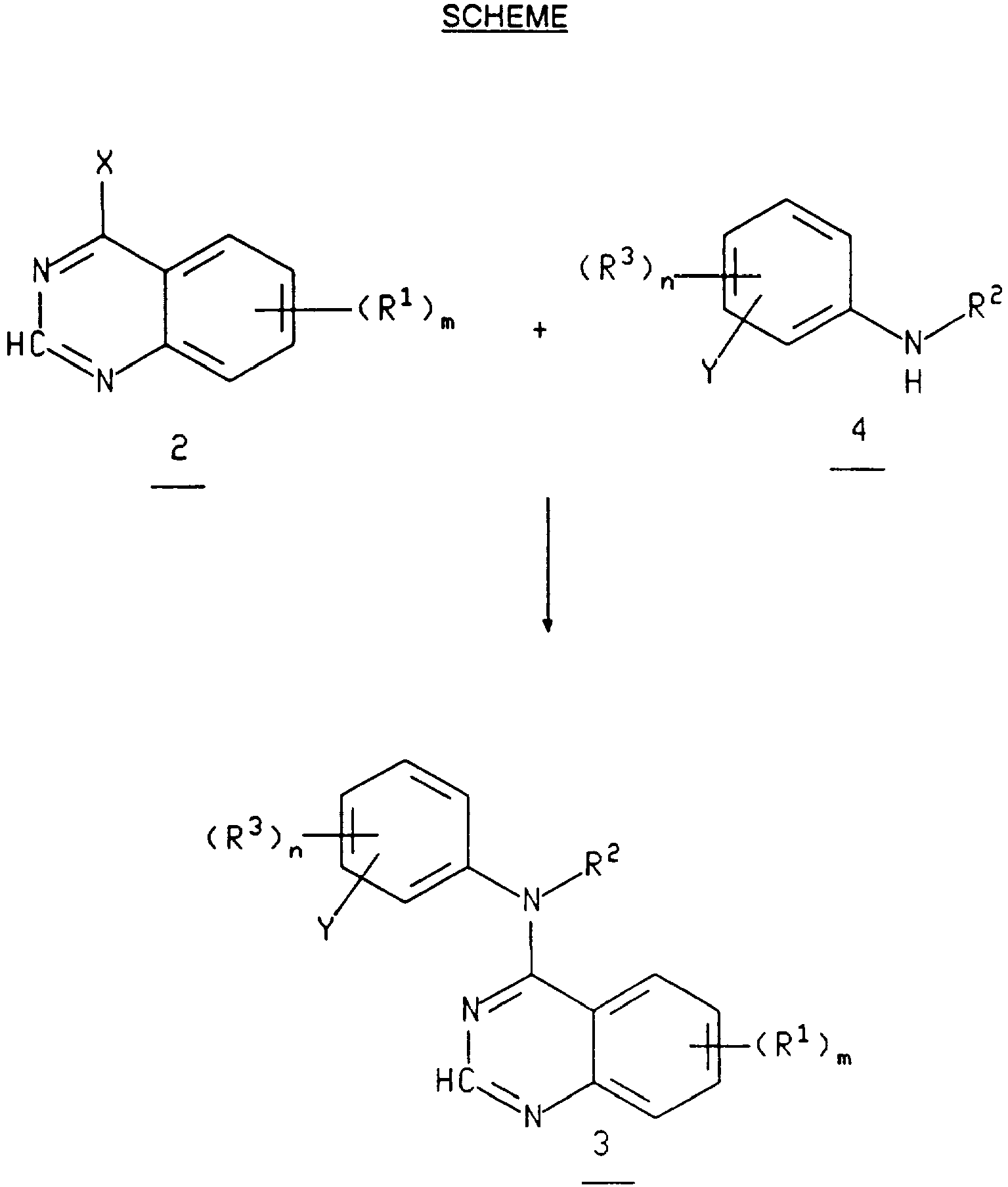

- The Formula I compounds, pharmaceutically acceptable salts and prodrugs thereof (hereafter the active compounds) may be prepared by any process known to be applicable to the preparation of chemically-related compounds.
- In general the active compounds may be made from the appropriately substituted quinazoline using the appropriately substituted amine.
- As shown in the Scheme the appropriate 4-substituted quinazoline 2 wherein X is a suitable displaceable leaving group such as halo, aryloxy, alkylsulfinyl, alkylsulfonyl such as trifluoromethanesulfonyloxy, arylsulfinyl, arylsulfonyl, siloxy, cyano, pyrazolo, triazolo or tetrazolo, preferably a 4-chloroquinazoline, is reacted with the appropriate amine or amine hydrochloride 4 or 5, wherein R4 is as described above and Y is Br, I, or trifluoromethane-sulfonyloxy in a solvent such as a (C1-C6)alcohol, dimethylformamide (DMF), N-methylpyrrolidin-2-one, chloroform, acetonitrile, tetrahydrofuran (THF), 1-4 dioxane, pyridine or other aprotic solvent. The reaction may be effected in the presence of a base, preferably an alkali or alkaline earth metal carbonate or hydroxide or a tertiary amine base, such as pyridine, 2,6-lutidine, collidine, N-methyl-morpholine, triethylamine, 4-dimethylamino-pyridine or N,N-dimethylaniline. These bases are hereinafter refered to as suitable bases. The reaction mixture is maintained at a temperature from about ambient to about the reflux temperature of the solvent, preferably from about 35°C to about reflux, until substantially no remaining 4-haloquinazoline can be detected, typically about 2 to about 24 hours. Preferably, the reaction is performed under an inert atmosphere such as dry nitrogen.
- Generally the reactants are combined stoichiometrically. When an amine base is used for those compounds where a salt (typically the HCl salt) of an amine 4 or 5 is used, it is preferable to use excess amine base, generally an extra equivalent of amine base. (Alternatively, if an amine base is not used an excess of the amine 4 or 5 may be used).
- For those compounds where a sterically hindered amine 4 (such as a 2-alkyl-3-ethynylaniline) or very reactive 4-haloquinazoline is used it is preferable to use t-butyl alcohol or a polar aprotic solvent such as DMF or N-methylpyrrolidin-2-one as the solvent.
- Alternatively, a 4-substituted quinazoline 2 wherein X is hydroxyl or oxo (and the 2- nitrogen is hydrogenated) is reacted with carbon tetrachloride and an optionally substituted triarylphosphine which is optionally supported on an inert polymer (e.g. triphenylphosphine, polymer supported, Aldrich Cat. No. 36,645-5, which is a 2% divinylbenzene cross-linked polystyrene containing 3 mmol phosphorous per gram resin) in a solvent such as carbon tetrachloride, chloroform, dichloroethane, tetrahydrofuran, acetonitrile or other aprotic solvent or mixtures thereof. The reaction mixture is maintained at a temperature from about ambient to reflux, preferably from about 35°C to reflux, for 2 to 24 hours. This mixture is reacted with the appropriate amine or amine hydrochloride 4 or 5 either directly or after removal of solvent, for example by vacuum evaporation, and addition of a suitable alternative solvent such as a (C1-C6) alcohol, DMF, N-methylpyrrolidin-2-one, pyridine or 1-4 dioxane. Then, the reaction mixture is maintained at a temperature from about ambient to the reflux temperature of the solvent preferably from about 35°C to about reflux, until substantially complete formation of product is acheived, typically from about 2 to about 24 hours. Preferably the reaction is performed under an inert atmosphere such as dry nitrogen.
- When compound 4, wherein Y is Br, I, or trifluoromethanesulfonyloxy, is used as starting material in the reaction with quinazoline 2, a compound of formula 3 is formed wherein R1, R2, R3, and Y are as described above. Compound 3 is converted to compounds of formula 1 wherein R4 is R11ethynyl, and R11 is as defined above, by reaction with a suitable palladium reagent such as tetrakis(triphenylphosphine)palladium or bis(triphenylphosphine)palladium dichloride in the presence of a suitable Lewis acid such as cuprous chloride and a suitable alkyne such as trimethylsilylacetylene , propargyl alcohol or 3-(N,N-dimethylamino)-propyne in a solvent such as diethylamine or triethylamine. Compounds 3, wherein Y is NH2' may be converted to compounds 1 wherein R4 is azide by treatment of compound 3 with a diazotizing agent, such as an acid and a nitrite (e.g., acetic acid and NaNO2) followed by treatment of the resulting product with an azide, such as NaN3.
- For the production of those compounds of Formula I wherein an R1 is an amino or hydroxyamino group the reduction of the corresponding Formula I compound wherein R1 is nitro is employed.
- The reduction may conveniently be carried out by any of the many procedures known for such transformations. The reduction may be carried out, for example, by hydrogenation of the nitro compound in a reaction-inert solvent in the presence of a suitable metal catalyst such as palladium, platinum or nickel. A further suitable reducing agent is, for example, an activated metal such as activated iron (produced by washing iron powder with a dilute solution of an acid such as hydrochloric acid). Thus, for example, the reduction may be carried out by heating a mixture of the nitro compound and the activated metal with concentrated hydrochloric acid in a solvent such as a mixture of water and an alcohol, for example, methanol or ethanol, to a temperature in the range, for example, 50 to 150°C, conveniently at or near 70°C. Another suitable class of reducing agents are the alkali metal dithionites, such as sodium dithionite, which may be used in (C1-C4)alkanoic acids, (C1-C6)alkanols, water or mixtures thereof.
- For the production of those compounds of Formula I wherein R2 or R3 incorporates a primary or secondary amino moiety (other than the amino group intended to react with the quinazoline), such free amino group is preferably protected prior to the above described reaction followed by deprotection, subsequent to the above described reaction with 4-(substituted)quinazoline 2.
- Several well known nitrogen protecting groups can be used. Such groups include (C1-C8)alkoxycarbonyl, optionally substituted benzyloxycarbonyl, aryloxycarbonyl, trityl, vinyloxycarbonyl, O-nitrophenylsulfonyl, diphenylphosphinyl, p-toluenesulfonyl, and benzyl. The addition of the nitrogen protecting group may be carried out in a chlorinated hydrocarbon solvent such as methylene chloride or 1,2-dichloroethane, or an ethereal solvent such as glyme, diglyme or THF, in the presence or absence of a tertiary amine base such as triethylamine, diisopropylethylamine or pyridine, preferably triethylamine, at a temperature from about 0°C to about 50°C, preferably about ambient temperature. Alternatively, the protecting groups are conveniently attached using Schotten-Baumann conditions.
- Subsequent to the above described coupling reaction, of compounds 2 and 5, the protecting group may be removed by deprotecting methods known to those skilled in the art such as treatment with trifluoroacetic acid in methylene chloride for the tert-butoxycarbonyl protected products.
- For a description of protecting groups and their use, see T.W. Greene and P.G.M. Wuts, "Protective Groups in Organic Synthesis" Second Ed., John Wiley & Sons, New York, 1991.
- For the production of compounds of Formula I wherein R1 or R2 is hydroxy, cleavage of a Formula I compound wherein R1 or R2 is (C1-C4)alkoxy is preferred.
- The cleavage reaction may conveniently be carried out by any of the many procedures known for such a transformation. Treatment of the protected formula I derivative with molten pyridine hydrochloride (20-30 eq.) at 150 to 175°C may be employed for O-dealkylations. Alternatively, the cleavage reaction may be carried out, for example, by treatment of the protected quinazoline derivative with an alkali metal (C1-C4)alkylsulphide, such as sodium ethanethiolate or by treatment with an alkali metal diarylphosphide such as lithium diphenylphosphide. The cleavage reaction may also, conveniently, be carried out by treatment of the protected quinazoline derivative with a boron or aluminum trihalide such as boron tribromide. Such reactions are preferably carried out in the presence of a reaction-inert solvent at a suitable temperature.
- Compounds of formula I, wherein R1 or R2 is a (C1-C4)alkylsulphinyl or (C1-C4)alkylsulphonyl group are preferably prepared by oxidation of a formula I compound wherein R1 or R2 is a (C1-C4)alkylsulfanyl group. Suitable oxidizing agents are known in the art for the oxidation of sulfanyl to sulphinyl and/or sulphonyl, e. g., hydrogen peroxide, a peracid (such as 3-chloroperoxybenzoic or peroxyacetic acid), an alkali metal peroxysulphate (such as potassium peroxymonosulphate), chromium trioxide or gaseous oxygen in the presence of platinum. The oxidation is generally carried out under as mild conditions as possible using the stoichiometric amount of oxidizing agent in order to reduce the risk of over oxidation and damage to other functional groups. In general, the reaction is carried out in a suitable solvent such as methylene chloride, chloroform, acetone, tetrahydrofuran or tert-butyl methyl ether and at a temperature from about -25 to 50°C, preferably at or near ambient temperature, i. e., in the range of 15 to 35°C. When a compound carrying a sulphinyl group is desired a milder oxidizing agents should be used such as sodium or potassium metaperiodate, conveniently in a polar solvent such as acetic acid or ethanol. The compounds of formula I containing a (C1-C4)alkylsulphonyl group may be obtained by oxidation of the corresponding (C1-C4)alkylsulphinyl compound as well as of the corresponding (C1-C4)alkylsulianyl compound.
- Compounds of formula I wherein R1 is optionally substituted (C2-C4)alkanoylamino, ureido, 3-phenylureido, benzamido or sulfonamido can be prepared by acylation or sulfonylation of a corresponding compound wherein R1 is amino. Suitable acylating agents are any agents known in the art for the acylation of amino to acylamino, for example, acyl halides, e.g., a (C2-C4)alkanoyl chloride or bromide or a benzoyl chloride or bromide, alkanoic acid anhydrides or mixed anhydrides (e.g., acetic anhydride or the mixed anhydride formed by the reaction of an alkanoic acid and a (C1-C4)alkoxycarbonyl halide, for example (C1-C4)alkoxycarbonyl chloride, in the presence of a suitable base. For the production of those compounds of Formula I wherein R1 is ureido or 3-phenylureido, a suitable acylating agent is, for example, a cyanate, e.g., an alkali metal cyanate such as sodium cyanate, or an isocyanate such as phenyl isocyanate. N-sulfonylations may be carried out with suitable sulfonyl halides or sulfonylanhydrides in the presence of a tertiary amine base. In general the acylation or sulfonylation is carried out in a reaction-inert solvent and at a temperature in the range of about -30 to 120°C, conveniently at or near ambient temperature.
- Compounds of Formula I wherein R1 is (C1-C4)alkoxy or substituted (C1-C4)alkoxy or R1 is (C1-C4)alkylamino or substituted mono-N- or di-N,N-(C1-C4)alkylamino, are prepared by the alkylation, preferably in the presence of a suitable base, of a corresponding compound wherein R1 is hydroxy or amino, respectively. Suitable alkylating agents include alkyl or substituted alkyl halides, for example, an optionally substituted (C1-C4)alkyl chloride, bromide or iodide, in the presence of a suitable base in a reaction-inert solvent and at a temperature in the range of about 10 to 140°C, conveniently at or near ambient temperature.
- For the production of those compounds of Formula I wherein R1 is an amino-, oxy- or cyano-substituted (C1-C4)alkyl substituent, a corresponding compound wherein R1 is a (C1-C4)alkyl substituent bearing a group which is displacable by an amino-, alkoxy-, or cyano group is reacted with an appropriate amine, alcohol or cyanide, preferably in the presence of a suitable base. The reaction is preferably carried out in a reaction-inert solvent or diluent and at a temperature in the range of about 10 to 100°C, preferably at or near ambient temperature.
- Compounds of Formula I, wherein R1 is a carboxy substituent or a substituent which includes a carboxy group are prepared by hydrolysis of a corresponding compound wherein R1 is a (C1-C4)alkoxycarbonyl substituent or a substituent which includes a (C1-C4)alkoxycarbonyl group. The hydrolysis may conveniently be performed, for example, under basic conditions, e.g., in the presence of alkali metal hydroxide as illustrated in the accompanying Examples.
- Compounds of Formula I wherein R1 is amino, (C1-C4)alkylamino, di-[(C1-C4)alkyl]amino, pyrrolidin-1-yl, piperidino, morpholino, piperazin-1-yl, 4-(C1-C4)alkylpiperazin-1-yl or (C1-C4)alkysulfanyl, may be prepared by the reaction, in the presence of a suitable base, of a corresponding compound wherein R1 is an amine or thiol displaceable group with an appropriate amine or thiol. The reaction is preferably carried out in a reaction-inert solvent or diluent and at a temperature in the range of about 10 to 180°C, conveniently in the range 100 to 150°C.
- Compounds of Formula I wherein R1 is 2-oxopyrrolidin-1-yl or 2-oxopiperidin-1-yl are prepared by the cyclisation, in the presence of a suitable base, of a corresponding compound wherein R1 is a halo-(C2-C4)alkanoylamino group. The reaction is preferably carried out in a reaction-inert solvent or diluent and at a temperature in the range of about 10 to 100°C, conveniently at or near ambient temperature.
- For the production of compounds of Formula I in which R1 is carbamoyl, substituted carbamoyl, alkanoyloxy or substituted alkanoyloxy, the carbamoylation or acylation of a corresponding compound wherein R1 is hydroxy is convenient.
- Suitable acylating agents known in the art for acylation of hydroxyaryl moieties to alkanoyloxyaryl groups include, for example, (C2-C4)alkanoyl halides, (C2-C4)alkanoyl anhydrides and mixed anhydrides as described above, and suitable substituted derivatives thereof may be employed, typically in the presence of a suitable base. Alternatively, (C2-C4)alkanoic acids or suitably substituted derivatives thereof may be coupled with a Formula I compound wherein R1 is hydroxy with the aid of a condensing agent such as a carbodiimide. For the production of those compounds of Formula I in which R1 is carbamoyl or substituted carbamoyl, suitable carbamoylating agents are, for example, cyanates or alkyl or arylisocyanates, typically in the presence of a suitable base. Alternatively, suitable intermediates such as the chloroformate or carbonylimidazolyl derivative of a compound of Formula I in which R1 is hydroxy may be generated, for example, by treatment of said derivative with phosgene (or a phosgene equivalent) or carbonyldiimidazole. The resulting intermediate may then be reacted with an appropriate amine or substituted amine to produce the desired carbamoyl derivatives.
- Compounds of formula I wherein R1 is aminocarbonyl or a substituted aminocarbonyl can be prepared by the aminolysis of a suitable intermediate in which R1 is carboxy.
- The activation and coupling of formula I compounds wherein R1 is carboxy may be performed by a variety of methods known to those skilled in the art. Suitable methods include activation of the carboxyl as an acid halide, azide, symmetric or mixed anhydride, or active ester of appropriate reactivity for coupling with the desired amine. Examples of such types of intermediates and their production and use in couplings with amines may be found extensively in the literature; for example M. Bodansky and A. Bodansky, "The Practice of Peptide Synthesis", Springer,-Verlag, New York, 1984. The resulting formula I compounds may be isolated and purified by standard methods, such as solvent removal and recrystallization or chromatography.
- The starting materials for the above described reaction schemes (e.g., amines, quinazolines and amine protecting groups) are readily available or can be easily synthesized by those skilled in the art using conventional methods of organic synthesis. For example, the preparation of 2,3-dihydro-1,4-benzoxazine derivatives are described in R. C. Elderfield, W.H. Todd, S. Gerber, Ch. 12 in "Heterocyclic Compounds", Vol. 6, R. C. Elderfield ed., John Wiley and Sons, Inc., N.Y., 1957. Substituted 2,3-dihydro-benzothiazinyl compounds are described by R.C. Elderfield and E.E. Harris in Ch. 13 of Volume 6 of the Elderfield "Heterocyclic Compounds" book.
- Certain Formula I quinazolines can exist in solvated, as well as unsolvated forms, such as the hydrated forms. It is to be understood that the invention encompasses all such solvated, as well as unsolvated forms, which possess activity against hyperproliferative diseases.
- A suitable pharmaceutically-acceptable salt of a compound of formula I is, for example, an acid-addition salt of a corresponding compound which is sufficiently basic, e.g., an acid-addition salt with, for example, an inorganic or organic acid such as hydrochloric, hydrobromic, sulphuric, phosphoric, methanesulfonic, benzenesulfonic, trifluoroacetic, citric, lactic or maleic acid. A suitable pharmaceutically-acceptable hase-addition salt of a compound of formula I which is acidic is an alkali metal salt, for example, a lithium, sodium or potassium salt; an alkaline earth metal salt, for example, a calcium or magnesium salt; an ammonium salt; or a salt with an organic base which affords a physiologically-acceptable cation for example a salt with methylamine, dimethylamine, trimethylamine, piperidine, morpholine or tris-(2-hydroxyethyl)amine. All such salts are within the scope of this invention and they can be prepared by conventional methods. For example, they can be prepared simply by contacting the acidic and basic entities, usually in a stoichiometric ratio, in either an aqueous, nonaqueous or partially aqueous medium, as appropriate. The salts are recovered by filtration; by precipitation with a non-solvent, preferably an etheral or hydrocarbon solvent, followed by filtration and by evaporation of a solvent, or, in the case of aqueous solutions, by lyophilization.
- Some of the compounds of Formula I have asymmetric carbon atoms. Such diasteromeric mixtures can be separated into their individual diastereomers on the basis of their physical chemical differences by methods known per se., for example, by chromatography and/or fractional crystallization. Enantiomers can be separated by converting the enantiomeric mixtures into a diastereomric mixture by reaction with an appropriate optically active compound (e.g., alcohol), separating the diastereomers and converting (e.g., hydrolyzing) the individual diastereomers to the corresponding pure enantiomers. All such isomers, including diastereomers mixtures and pure enantiomers are considered as part of the invention.
- The active compounds of this invention are potent inhibitors of the erbB family of oncogenic and protooncogenic protein tyrosine kinases such as epidermal growth factor receptor (EGFR), erbB2, HER3, or HER4 and thus are all adapted to therapeutic use as antiproliferative agents (e.g., anticancer) in mammals, particularly humans. In particular, the compounds of this invention are therapeutants or prophylactics for the treatment of a variety of human tumors (renal, liver, kidney, bladder, breast, gastric, ovarian, colorectal, prostate, pancreatic, lung, vulval, thyroid, hepatic carcinomas, sarcomas, glioblastomas, various head and neck tumors), and other hyperplastic conditions such as benign hyperplasia of the skin (e.g., psoriasis) or prostate (e.g., BPH). It is, in addition, expected that a quinazoline of the present invention may possess activity against a range of leukemias and lymphoid malignancies.
- The active compounds may also be expected to be useful in the treatment of additional disorders in which aberrant expression ligand/receptor interactions, activation or signalling events related to various protein tyrosine kinases, whose activity is inhibited by the agents of Formula I, are involved.
- Such disorders may include those of neuronal, glial, astrocytal, hypothalamic, and other glandular, macrophagal, epithelial, stromal, and blastocoelic nature in which aberrant function, expression, activation or signalling of the erbB tyrosine kinases may be involved. In addition, compounds of Formula I may have therapeutic utility in inflammatory, angiogenic and immunologic disorders involving both identified and as yet unidentified tyrosine kinases which are inhibited by compounds of Formula I.
- The in vitro activity of the active compounds in inhibiting the receptor tyrosine kinase (and thus subsequent proliferative response, e.g., cancer) may be determined by the procedure detailed below.
- Activity of the active compunds, in vitro, can be determined by the amount of inhibition of the phosphorylation of an exogenous substrate (e.g., Lys3 - Gastrin or polyGluTyr (4:1) random copolymer (I. Posner et. al., J. Biol. Chem. 267 (29), 20638-47 (1992)) on tyrosine by epidermal growth factor receptor kinase by a test compound relative to a control. Affinity purified, soluble human EGF receptor (96 ng) is obtained according to the procedure in G. N. Gill, W. Weber, Methods in Enzymology 146, 82-88 (1987) from A431 cells (American Type Culture Collection, Rockville, MD) and preincubated in a microfuge tube with EGF (2µg/ml) in phosphorylation buffer + vanadate (PBV: 50 mM HEPES, pH 7.4; 125 mM NaCl; 24 mM MgCl2; 100µM sodium orthovanadate), in a total volume of 10 µl, for 20-30 minutes at room temperature. The test compound, dissolved in dimethylsulfoxide (DMSO), is diluted in PBV, and 10 µl is mixed with the EGF receptor /EGF mix, and incubated for 10-30 minutes at 30°C. The phosphorylation reaction is initiated by addition of 20 µl 33P-ATP/ substrate mix (120 µM Lys3-Gastrin (sequence in single letter code for amino acids, KKKGPWLEEEEEAYGWLDF), 50 mM Hepes pH 7.4, 40 µM ATP, 2 µCi γ-[33P]-ATP) to the EGFr/EGF mix and incubated for 20 minutes at room temperature. The reaction is stopped by addition of 10 µl stop solution (0.5 M EDTA, pH 8; 2mM ATP) and 6 µl 2N HCl. The tubes are centrifuged at 14,000 RPM, 4°C, for 10 minutes. 35 µl of supernatant from each tube is pipetted onto a 2.5 cm circle of Whatman P81 paper, bulk washed four times in 5% acetic acid, 1 liter per wash, and then air dried. This results in the binding of substrate to the paper with loss of free ATP on washing. The [33P] incorporated is measured by liquid scintillation counting. Incorporation in the absence of substrate (e.g., lys3-gastrin) is subtracted from all values as a background and percent inhibition is calculated relative to controls without test compound present.
- Such assays, carried out with a range of doses of test compounds, allow the determination of an approximate IC50 value for the in vitro inhibition of EGFR kinase activity. Although the inhibitory properties of the compounds of Formula I vary with structural change as expected, the activity generally exhibited by these agents, determined in the manner described above, is in the range of IC50=0.0001-30 µM.
- Activity of the active compounds, in vivo, can be determined by the amount of inhibition of tumor growth by a test compound relative to a control. The tumor growth inhibitory effects of various compounds are measured according to the methods of Corbett T. H., et al. "Tumor Induction Relationships in Development of Transplantable Cancers of the Colon in Mice for Chemotherapy Assays, with a Note on Carcinogen Structure", Cancer Res., 35, 2434-2439 (1975) and Corbett, T. H., et al., "A Mouse Colon-tumor Model for Experimental Therapy", Cancer Chemother. Rep. (Part 2)", 5, 169-186 (1975), with slight modifications. Tumors are induced in the left flank by s.c. injection of 1 X 10⁶ log phase, cultured tumor cells (human MDA-MB-468 breast or human HN5 head and neck carcinoma cells) suspended in 0.10 ml RPMI 1640. After sufficient time has elapsed for the tumors to become palpable (2-3 mm in diameter) the test animals (athymic mice) are treated with active compound (formulated by dissolution in DMSO typically at a concentration of 50 to 100 mg/mL followed by 1:9 dilution into saline or, alternatively, 1:9 dilution into 0.1% Pluronic• P105 in 0.9% saline) by the intraperitoneal (ip) or oral (po) routes of administration twice daily (i.e., every 12 hours) for 5 consecutive days. In order to determine an anti-tumor effect, the tumor is measured in millimeters with Vernier calipers across two diameters and the tumor size (mg) is calculated using the formula: Tumor weight = (length x [width]2)/2, according to the methods of Geran, R.I., et al. "Protocols for Screening Chemical Agents and Natural Products Against Animal Tumors and Other Biological Systems", Third Edition, Cancer Chemother. Rep., 3, 1-104 (1972).. Results are expressed as percent inhibition, according to the formula: Inhibition (%) = (TuWcontrol - TuWtest)/TuWcontrol x 100%. The flank site of tumor implantation provides reproducible dose/response effects for a variety of chemotherapeutic agents, and the method of measurement (tumor diameter) is a reliable method for assessing tumor growth rates.
- Administration of the active compounds can be effected by any method which enables delivery of the compounds to the site of action (e.g., cancer cells). These methods include oral routes, intraduodenal routes, parenteral injection (including intravenous, subcutaneous, intramuscular, intravascular or infusion), topical administration, etc.
- The amount of active compound administered will, of course, be dependent on the subject being treated, on the severity of the affliction, on the manner of administration and on the judgement of the prescribing physician. However an effective dosage is in the range of approximately 0.001-100 mg/kg, preferably 1 to 35 mg/kg in single or divided doses. For an average 70kg human, this would amount to 0.05 to 7 g/day, preferably 0.2 to 2.5 g/day.
- The composition may, for example, be in a form suitable for oral administration as a tablet, capsule, pill, powder, sustained release formulations, solution, suspension, for parenteral injection as a sterile solution, suspension or emulsion, for topical administration as an ointment or cream or for rectal administration as a suppository. The pharmaceutical composition may be in unit dosage forms suitable for single administration of precise dosages. The pharmaceutical composition will include a conventional pharmaceutical carrier or excipient and a compound according to the invention as an active ingredient. In addition, it may include other medicinal or pharmaceutical agents, carriers, adjuvants, etc.
- Pharmaceutical compositions according to the invention may contain 0.1 %-95% of the compound, preferably 1%-70%. In any event, the composition or formulation to be administered will contain a quantity of active compound in an amount effective to alleviate or reduce the signs in the subject being treated, i.e., hyperproliferative diseases, over the course of the treatment.
- Exemplary parenteral administration forms include solutions or suspensions of active compounds in sterile aqueous solutions, for example aqueous propylene glycol or dextrose solutions. Such dosage forms can be suitably buffered, if desired.
- Suitable pharmaceutical carriers include inert diluents or fillers, water and various organic solvents. The pharmaceutical compositions may, if desired, contain additional ingredients such as flavorings, binders, excipients and the like. Thus for oral administration, tablets containing various excipients, such as citric acid may be employed together with various disintegrants such as starch, alginic acid and certain complex silicates and with binding agents such as sucrose, gelatin and acacia. Additionally, lubricating agents such as magnesium stearate, sodium lauryl sulfate and talc are often useful for tableting purposes. Solid compositions of a similar type may also be employed in soft and hard filled gelatin capsules. Preferred materials, therefor, include lactose or milk sugar and high molecular weight polyethylene glycols. When aqueous suspensions or elixirs are desired for oral administration the active compound therein may be combined with various sweetening or flavoring agents, coloring matters or dyes and, if desired, emulsifying agents or suspending agents, together with diluents such as water, ethanol, propylene glycol, glycerin, or combinations thereof.
- Methods of preparing various pharmaceutical compositions with a specific amount of active compound are known, or will be apparent, to those skilled in this art. For examples, see Remington's Pharmaceutical Sciences., Mack Publishing Company, Easter, Pa., 15th Edition (1975).
- The hyperproliferative disease treatment described above may be applied as a sole therapy or may involve, in addition to the active compound, one or more other antitumor substances. Such conjoint treatment may be achieved by way of the simultaneous, sequential, cyclic or separate dosing of the individual components of the treatment.
- High pressure liquid chromatography (HPLC) used in the following examples and preparations was effected according to the following method unless modified in specific examples. Perkin-Elmer Pecosphere• 3X3C cartridge column (3mm X 3cm, C18; available from Perkin Elmer Corp., Norwalk, CT 06859) with a Brownlee (trademark) RP-8 Newguard precolumn (7 micron, 3.2mm X 15mm, available from Applied Biosystems Inc. San Jose, CA 95134) which was previously equilibrated in pH 4.50, 200 mM ammonium acetate buffer. Samples were eluted using a linear gradient of 0-100% acetonitrile/pH4.50, 200 mM NH4 acetate over 10 minutes with a flow rate of 3.0 mL/min. Chromatograms were generated over the range 240-400nm using a diode array detector.
- It should be understood that the invention is not limited to the particular embodiments shown and described herein, but that various changes and modifications may be made without departing from the spirit and scope of the invention as defined by the claims.
- 4-Chloro-6,7-dimethoxyquinazoline (250 mg, 1.12 mmol) and 4-azidoaniline hydrochloride (200 mg, 1.11 mmol) were refluxed in 10 mL of isopropyl alcohol for 0.5 hour, cooled and filtered to afford solid title product which was washed with 10 mL of isopropyl alcohol and dried in vacuo, at 70°C, 392 mg (98%); mp 200-205°C (dec).
- 4-Chloro-6,7-dimethoxyquinazoline (250 mg, 1.12 mmol) and 3-ethynyl-aniline (137 mg, 1.17 mmol) were refluxed in 10 mL of isopropyl alcohol for 0.5 hour, cooled and filtered to afford solid title product which was washed with 10 mL of isopropyl alcohol and dried in vacuo, at 70°C, 338 mg (99%); mp 269-270°C.
- A mixture of (3'-bromophenyl)-(6,7-dimethoxyquinazolin-4-yl)-amine hydrochloride (250 mg, 0.591 mmol), tetrakis(triphenylphosphine)palladium (100 mg), propargyl alcohol (600 µL), 7 mL of dry, nitrogen purged diethylamine and cuprous iodide (10 mg) was refluxed for 6 hours, cooled and filtered to afford solid title product which was washed two times with 2mL of 50% diethylamine: methanol; 136 mg. The solid was recrystallized from methanol to give pure title product after drying, in vacuo,, at 70°C, 73 mg (37%); mp 267-268°C.
- The title product of Example 3 (50 mg, 0.149 mmol), triphenylphosphine (60 mg, 0.225 mmol)), phthalimide (165 mg, 1.12 mmol) and diethyl azodicarboxylate (36 µL, 0.228 mmol) were stirred at room temperature in 3 mL of dry tetrahydrofuran for 16 hours. The reaction mixture was concentrated to a solid and flash chromatographed on silica gel eluted with 15% acetone:methylene chloride to afford pure solid [3-(2'-{phthalimidomethyl}-ethynyl)phenyl]-(6,7-dimethoxyquinazoline-4-yl)amine which was converted to its hydrochloride salt by addition of 1 mL of anhydrous 1M HCl in methanol followed by 3 mL of isopropyl alcohol. The salt was collected by filtration, dried and used immediately in the next step; 15 mg This 15 mg, 0.0323 mmol was treated with 0.5 ml of hydrazine hydrate and 1 mL of methanol for 0.5 hours. The reaction mixture was evaporated, in vacuo, and the product isolated by flash chromatography eluted with 10% methanol in methylene chloride. Pure title product was isolated after conversion to its hydrochloride salt with 1 mL of 1 M HCl in methanol, precipitation with isopropyl alcohol and diethyl ether and drying , in vacuo,; 5.6 mg (47%) mp 275°C dec.
- 4-Chloro-6-nitroquinazoline (1.06 g, 5.00 mmol) and 3-ethynylaniline (1.00 g, 5.30 mmol) were refluxed in 10 mL of isopropyl alcohol for 3 hours, cooled and, after 16 hours at room temperature, filtered to afford solid title product which was washed with 10 mL of isopropyl alcohol and dried in vacuo, at 70°C, 1.27 g (78%); mp 255-256°C.
- The title product was prepared in the following three step sequence without purification of the intermediates. 4-Chloro-6,7-dimethoxyquinazoline (250 mg, 1.113 mmol) and 4-iodoaniline (268 mg, 1.224 mmol) were refluxed in 10 mL of isopropyl alcohol for 3 hours, cooled to room temperature and filtered to afford solid (4-iodophenyl)-(6,7-dimethoxyquinazoline-4-yl)aminehydrochloride which was washed with 10 mL of isopropyl alcohol and dried in vacuo at 70°C, 396 mg (76%). A mixture consisting of (4'-iodophenyl)-(6,7-dimethoxyquinazoline-4-yl)amine hydrochloride (250 mg, 0.564 mmol), tetrakis(triphenylphosphine)palladium (50 mg), trimethylsilylacetylene (160 µL, 1.13 mmol), 4 mL of dry, nitrogen purged diethylamine and cuprous iodide (10 mg) was refluxed for 2 hours, cooled and concentrated in vacuo, to afford a residue which was partitioned between chloroform and 1 N HCL. Solid [4-(2'-{trimethylsilyl}-ethynyl)phenyl]-(6,7-dimethoxyquinazoline-4-yl)amine formed at the interface of the two liquid phases and was filtered and dried in vacuo; 170 mg (80%).
- (100 mg, 0.265 mmol) and anhydrous potassium carbonate (125 mg, 0.906 mmol) were stirred in 3 mL of methanol and 1 mL of water at room temperature for 2.5 hours. The reaction mixture was concentrated in vacuo, and partitioned between 20 mL of chloroform and 20 mL of 1 N hydrochloric acid. The organic layer was dried with magnesium sulfate, filtered and vacuum evaporated to give the title product which was triturated with diethyl ether and dried in vacuo at 70°C; 81 mg (90%) mp 239°C dec.
- The title product was prepared in the following three step sequence with out purification of the intermediates. A mixture consisting of 3-bromo-2-methylaniline (1.00 g, 5.37 mmol), tetrakis(triphenylphosphine)palladium (200 mg), trimethylsilylacetylene (1.053 g, 10.75 mmol), 10mL of dry, nitrogen purged diethylamine and cuprous iodide 910 mg) was refluxed for 16 hours, cooled and concentrated, in vacuo, to afford a residue which was partitioned between chloroform and 1 N HCL. The organic layer was washed with brine, dried with magnesium sulfate and vacuum evaporated to yield a residue, 3-[2'-(trimethylsilyl)ethynyl]-2-methylaniline which was purified by flash chromatography on silica gel eluted with 1:1 hexanes: methylene chloride; 200 mg (18%).
- 4-Chloro-6,7-dimethoxyquinazoline (104 mg, 0.466 mmol) and 3-[2'-(trimethylsilyl)ethinyl]-2-methylaniline (100 mg, 0.491 mmol) were refluxed in 3 mL of isopropyl alcohol for 16 hour, cooled to room temperature and filtered to afford a residue of solid {3-[2'-(trimethylsilyl)ethynyl]-2'-methylphenyl]}-(6,7-dimethoxyquinazoline-4-yl)amine hydrochloride which was washed with 10 mL of isopropyl alcohol and triturated for 16 hours with diethyl ether. Thin layer chromatography on silica gel eluted with 9:1 chloroform: methanol indicated that the residue was impure product. The residue was purified by flash chromatography on silica gel eluted with 9:1 methylene chloride: methanol to afford after concentration and drying , in vacuo, pure product, 64 mg (33%). The product was dissolved in 3 mL of methanol and treated with 64 mg of anhydrous potassium carbonate at room temperature for 3 hours. The reaction mixture was concentrated in vacuo and partitioned between 1 N HCl and chloroform. Solid title product formed at the interface of the two liquid phases and was filtered and dried, in vacuo,; 40 mg (84%) mp 225°C dec.
- (3-Ethynyl-phenyl)-(6-nitro-quinazolin-4-yl)-amine hydrochloride (500 mg, 1.50 mmol) was dissolved in 10 mL of formic acid and treated portion-wise with sodium dithionite (1.10 g, 6.28 mmol) at room temperature. After 2 hours the mixture was quenched with 120 mL of water and filtered. The filtrate was evaporated in vacuo to a residue which was dissolved in 100 mL of 1:1 methanol:chloroform, filtered and evaporated in vacuo to a second residue. This was triturated with 200 mL of 5% sodium bicarbonate for 30 minutes, filtered, washed with water and dried in vacuo for 16 hours. Flash chromatography on silica gel eluted with ethyl acetate afforded pure (6-amino-quinazolin-4-yl)-(3-ethynylphenyl)-amine ; 140 mg (34%); mp 165 °C dec.
- The title product of Example 8 (100 mg, 0.384 mmol), pyridine (140 µL, 1.68 mmol) and methanesulfonyl chloride (99 µL, 1.26 mmol) were refluxed in 10 mL of 1,2-dichloroethane for 7 hours. The reaction mixture was cooled and evaporated in a vacuo to a residue which was triturated in 10 mL of 1 N HCl, filtered and dried in vacuo to yield (3-ethynylphenyl)-(6-methanesulfonylaminoquinazoline-4-yl)amine; 102mg(78%) mp 248°C dec.
- 4-Chloro-6,7-methylenedioxyquinazoline (200 mg, 1.04 mmol) and 3-ethynylaniline (127 mg, 1.09 mmol) were refluxed in 5 mL of isopropyl alcohol for 16 hour, cooled and filtered to afford solid title product which was washed with 10 mL of isopropyl alcohol and dried in vacuo at 70°C, 266 mg (79%); mp >350°C.
- The title product was prepared in the following three step sequence without purification of the intermediates. A mixture consisting of 4-bromo-2-nitrotoluene (1.50 g, 6.94 mmol) tetrakis(triphenylphosphine)palladium (750 mg), trimethylsilylacetylene (3.00 mL, 21.21 mmol) and cuprous iodide (20 mg) in 20 mL of nitrogen purged, dry diethylamine was refluxed for 2 hours, cooled and concentrated, in vacuo, to afford a residue which was partitioned between 100 mL of ethyl acetate and 100 mL of 1 N HCl, The organic layer was washed two times with 50 mL of 1 N HCl followed by brine, dried with magnesium sulfate and vacuum evaporated to a residue. The residue was dissolved in 10 mL of ethyl acetate and diluted with 200 mL of petroleum ether. The solids were filtered off and the oil, obtained upon vacuum evaporation of the filtrate, solidified to give 4-[2'-(trimethylsilyl)ethinyl]-2-nitrotoluene. This product was reduced to the amino product by treatment with iron powder (1.76 g, 98.5 mmol) in 30 mL of methanol and 5 mL of concentrated hydrochloric acid at 80°C for 2 hours. The cooled reaction mixture was filtered through Celite• and the filtrate was evaporated in vacuum. The residue was partitioned between ethyl acetate and 5% aqueous sodium bicarbonate. The organic layer was washed with brine, dried with magnesium sulfate, filtered and vacuum evaporated to yield an oil, 5-[2'-(trimethylsilyl)ethynyl)-2-methylaniline which solidified upon standing: 1.37 g.
- The above product (185 mg, 0.909 mmol) and 4-chloro-6,7-dimethoxy-quinazoline (200 mg, 0.890 mmol) were refluxed in tert-butyl alcohol for 16 hours. After cooling the reaction mixture was filtered to yield pure [2-methyl-5-(2'-{trimethylsilyl}ethynyl)-phenyl]-(6,7-dimethoxyquinazoline-4-yl-aminehydrochlorideafter washing with ether and drying in vacuum; 326 mg (85%). The trimethylsilyl group was removed by dissolving the above product in 5 mL of methanol and 1 mL of water and treatment with potassium carbonate (320 mg). After stirring for 1 hour the mixture was filtered and concentrated in vacuo. The residue thus obtained was partitioned between 100 mL of methylene chloride and 100 mL of 1 N HCl. The aqueous layer was extracted with an additional 100 mL of methylene chloride. The pooled organic layers were dried with magnesium sulfate, filtered and vacuum evaporated to a residue which was dissolved in anhydrous 1 N HCl in methanol, concentrated and precipitated with ether. The solid title product was collected by filtration and washed with diethyl ether then dried in vacuo at 70°C; 236 mg (88%) mp 266-267°C.
- 4-Chloro-7-nitroquinazoline (7.97 g, 38.0 mmol) and 3-ethynylaniline (4.54 g, 38.8 mmol) were refluxed in 125 mL of tert-butyl alcohol for 3 hours, cooled to room temperature and filtered to afford the title product as a solid which was washed with 10 mL of isopropyl alcohol and dried in vacuo at 70°C, 9.95g (80%); mp 209-210°C dec.
- The title product of example 8 (0.201 mg, 0.774 mmol) and 4-toluenesulfonyl chloride (0.441 mg, 2.31 mmol) were refluxed in 3 mL of 1,2-dichloroethane and 0.5 mL of pyridine for 5 minutes. The reaction mixture was cooled to room temperature, diluted with 75 mL of ethyl acetate and washed two times with 75 mL of water once with 75 mL of 3% sodium bicarbonate and once with 75 mL of brine. The organic layer was dried with magnesium sulfate, filtered and vacuum evaporated to a residue which was purified by chromatography using a Chromatotron (trademark) eluted with ethyl acetate, to afford solid title product; 86.7 mg (27%) mp 220-222 °C.
- The title product of example 8 (0.20 mg, 0.768 mmol) and 2-phthalimido-1-ethanesulfonyl chloride (0.615 mg, 2.25 mmol) were refluxed in 2 mL of 1,2-dichloroethane and 0.5 mL of pyridine for 16 hours, cooled to room temperature, diluted with 100 mL of chloroform and washed with 50 mL of 3% sodium bicarbonate and 50 mL of brine. The organic layer was dried with magnesium sulfate, filtered and vacuum evaporated to a residue which was dissolved in minimal methylene chloride and precipitated with petroleum ether, 188 mg. The precipitate was purified by chromatography using Chromatotron@ eluted with ethyl acetate, to afford the title product as a solid ; 53.4 mg (14%) mp 197 - 200°C.
- The title product of example 8, (0.302 mg, 1.16 mmol) and 3,5-dimethylpyrazole-1-carboxamidine (0.328 mg, 2.36 mmol) were refluxed in 10 mL of 1,2-dichloroethane and 0.97 mL of acetic acid for 24 hours, cooled to room temperature and filtered to yield the crude acetate of the title product. The product was dissolved in 35 mL of methanol and treated with 15 mL of anhydrous 1 N HCl in methanol for 15 minutes and then precipitated with 75 mL of diethyl ether. Solid title product was collected by filtration and dried in vacuo at 70°C; 91.2 mg (23%) mp>400°C.
- The title product of example 12 (1.039 g, 3.18 mmol) was dissolved in 50 mL of tetrahydrofuran, 10 mL of methanol and 5 mL of chloroform at 50°C. Sodium dihydrogen phosphite (NaH2PO2, 3.822 g, 36 mmol) and 10% palladium on carbon (0.19 g) were added followed by dropwise addition of 10 mL of water. When 3 mL of water had been added the mixture became noticeably more homogeneous. After 1 hour the mixture was filtered through Celite. The Celite was washed thoroughly with methanol and chloroform. The combined organic solutions were vacuum evaporated to a residue which was triturated with water, 3% aqueous sodium bicarbonate and filtered. The solid title product was washed with water then diethyl ether and dried in vacuo, 1.054 gm (127%, wet). A portion of the above product was recrystallized from a minimum amount of hot ethanol and water to give, after removal of a small first crop of impure material, pure title product, (43%), mp 180°C (dec).
- 4-Chloro-7-methoxyquinazoline (274 mg, 3.72 mmol) and 3-ethynylaniline (436 mg, 3.72 mmol) were refluxed in 15 mL of tert-butyl alcohol for 3 hours, cooled and filtered to afford solid title product which was washed with 10 mL of isopropyl alcohol and dried in vacuo at 70°C, 977 mg (84%); mp 229-231 °C.
- 4-Chloro-6-carbomethoxyquinazoline (100 mg, 0.450 mmol) and 3-ethynylaniline hydrochloride (53.4 mg, 0.456 mmol) were refluxed in 2 mL of tert-butyl alcohol for 2 hours, cooled, diluted with 2 mL of isopropyl alcohol and filtered to afford solid title product which was washed with 10 mL of diethyl ether and dried , in vacuo, at 70°C, 122 mg (80%); mp 232-233°C (dec).
- 4-Chloro-7-carbomethoxyquinazoline (202 mg, 0.907 mmol) and 3-ethynylaniline (110 mg, 0.939 mmol) were refluxed in 4 mL of tert-butyl alcohol for 2 hours, cooled, diluted with 4 mL of isopropyl alcohol and filtered to afford solid title product which was washed with 10 mL of diethyl ether and dried , in vacuo, at 70°C, 248 mg (80%); mp 219.5-221 °C.
- 3-Ethynylaniline (37 mg, 0.32 mmol.), and 4-chloro-6,7-bis-(2-methoxy-ethoxy)-quinazoline (90 mg, 0.29 mmol) were added to isopropanol (1.5 mL) containing pyridine (25 µL, 0.32 mmol) and the mixture was refluxed 4 hours under an atomospher of dry nitrogen. The solvent was removed , in vacuo, and the residue partitioned between 10% methanol in CHCl3 and saturated aqueous NaHCO3. The organic phase was dried over Na2SO4, filtered and concentrated in vacuo. The residue was flash chromatographed on silica using 30% acetone in hexanes to afford 81 mg of the free base of the title product as a pale yellow solid. The free-base was dissolved in a minimum volume of CHCl3, diluted with several volumes of ether, and titrated with 1 M HCl in ether to precipitate the title product as its hydrochloride salt; 90 mg; 71%; mp 228-230 °C.
- 4-Chloro-6,7-dimethoxyquinazoline (5.01 g, 22.3 mmol) was added in portions, over 1.5 hours, to m-phenylenediamine (2.66 g, 24.6 mmol) in refluxing isopropanol (100 mL) under an atmosphere of dry nitrogen. After the addition was complete the mixture was heated at reflux for 4 hours. The mixture was cooled to 20°C, and the precipitate was filtered, washed with chilled isopropanol and dried in vacuo to afford 6.97 g (93%) of (3-aminophenyl)-(6,7-dimethoxyquinazolin-4-yl)amine hydrochloride (LC-MS: 297 (MH+). To a solution of the above product (50 mg, 0.169 mmol) in 80% acetic acid/H2O (2 mL), at 0°C, was added a solution of NaNO2 (18.4 mg, 0.186 mmol) in H2O (100 µL). After stirring 10 minutes at 0°C a solution of NaN3 (12 mg, 0.185 mmol) in H2O (100 µL) was added. The mixture was allowed to warm to 20°C and stirred for 1.5 hours. The reaction mixture was lyophilized and the residue partitioned between ethyl acetate and saturated aqueous NaHCO3. The organic phase was wahsed further with brine, dried over Na2SO4, filtered, and concentrated , in vacuo,. Recrystallization from CHC3/hexanes afforded 36 mg of the title product as a white solid; mp 110-113 °C.
- 4-Chloro-6,7-dimethoxyquinazoline (200 mg, 0.89 mmol) and 5-amino-3-chloroaniline (253 mg, 1.78 mmol) were combined in isopropanol (3 mL) and heated to reflux for 16 hours under an atmosphere of dry nitrogen. After cooling to 20°C the mixture was diluted with methanol (5 mL) and the resulting precipitate was filtered and dried, in vacuo, to afford 252 mg (77%) of (3-amino-5-chlorophenyl)-(6,7-dimethoxyquinazolin-4-yl)amine hydrochloride (mp. 298-301 °C; LC-MS: 331 (MH+)). A portion of this product (175 mg, 0.476 mmol) was dissolved in 80% acetic acid/H2O (12 mL), cooled to 0°C, and a solution of NaNO2 (36 mg, 0.516 mmol) in H2O (300 µL) was added. The solution was stirred for 10 minutes at 0°C and NaN3 (33 mg, 0.50 mmol) in H2O (300 µL) was added. The reaction mixture was allowed to warm to 20°C and stirred 16 hours. The resulting precipitate was filtered and dissolved in 10% methanol in CHCl3 and the solution was washed with saturated aqueous NaHCO3, and brine, dried over Na2SO4, filtered and concentrated in vacuo to yield 59 mg (35%) of the title product as a yellow solid; mp 205-206°C.
- 6-Methanesulfonyl-quinazolin-4-one (200 mg, 0.89 mmol), triphenyl phosphine (566 mg, 2.15 mmol) and carbon tetrachloride (815 µL, 8.92 mmol) were refluxed in 3 mL of chloroform for 3.5 hours. The solvent was vacuum evaporated to afford a residue. This was dissolved in 5 mL of isopropyl alcohol and 3-ethynylaniline (156 mg, 1.33 mmol) and heated at reflux for 16 hours. The cooled reaction mixture was filtered,washed with a minimum of cold isopropyl alcohol and dried in vacuo at 70 °C for 16 hours to afford pure title product; 63 mg (20%) mp 281-282 °C.
- 6-Ethanesulfanyl-quinazolin-4-one (100 mg, 0.48 mmol), triphenyl phosphine (305 mg, 1.16 mmol) and 3 mL of carbon tetrachloride were refluxed for 16 hours. The solvent was vacuum evaporated to afford a residue. This was dissolved in 5 mL of isopropyl alcohol and 3-ethynylaniline (68 mg, 0.58 mmol) and heated at reflux for 1 hour. The cooled reaction mixture was filtered, washed with a minimum of cold isopropyl alcohol and dried in vacuo at 70°C for 16 hours to afford pure title product; 70 mg (42%) mp 239-40°C.
- 4-Chloro-6,7-dimethoxyquinazoline (500 mg, 2.23 mmol) and 3-(2'-trimethylsilyl-ethynyl)-4-fluoroaniline (507 mg, 2.44 mmol) were refluxed in 5 mL of tert-butyl alcohol for 16 hours, cooled and filtered to afford solid (6,7-dimethoxy-quinazolin-4-yl)-(3'-ethynyl-phenyl)-amine hydrochloride which was washed with 10 mL of isopropyl alcohol and dried in vacuo at 70 °C, 832 mg (83%). This was reacted in 10 mL of methanol and 1 drop of water containing 250 mg of potassium carbonate for 3 hours. The mixture was filtered and the filtrate vacuum evaoprated. This residue was triturated for 1 hour with 1 N hydrochloric acid, filtered and washed with a minimum amount of water then methanol and dried in vacuo; 506 mg (63%) mp 229°C dec.
- 3-(2'-Trimethylsilyl-ethynyl)-4-fluoroaniline, used above, was prepared from 3-bromo-4-fluoroaniline (7.0 gm, 36.8 mmol) tetrakis(triphenylphosphine)palladium (1.4 gm), trimethylsilyl-acetylene (7.2 gm, 74 mmol) and cuprous iodide (40 mg) in 140 mL of nitrogen purged dry diethylamine at reflux for 16 hours. The cooled reaction mixture was filtered through Celite and the Celite washed with ether. The combined filtrates were vacuum evaporated to a residue which was purified by flash chromatography on silica gel eluted with 35% hexanes in methylene chloride. Fractions containing the pure 3-(2'-trimethylsilyl-ethynyl)-4-fluoroaniline were vacuum evaporated to a residue and used without further purification.
- 4-Chloro-6,7-dimethoxyquinazoline (585 mg, 2.60 mmol) and 3-(propyn-1-yl)aniline (361 mg, 2.74 mmol) were refluxed in 5 mL of tert-butyl alcohol for 16 hours, cooled and filtered to afford solid (6,7-dimethoxy-quinazolin-4-yl)-[3-(propyn-1-yl)phenyl)]-amine hydrochloride which was washed with 5 mL of isopropyl alcohol and 25 mL of ether then dried in vacuo at 70 °C, 869 mg (94%); mp 260-261 °C.
- 3-(Propyn-1-yl)aniline, used above, was prepared from 3-bromo-nitrobenzene in four steps. 3-Bromo-nitrobenzene (5.0 gm, 24.7 mmol), tetrakis(triphenylphosphine)palladium (1.0 gm), trimethylsilyl-acetylene (3.6 gm, 37 mmol) and cuprous iodide (20 mg) in 20 mL of nitrogen purged, dry diethylamine at reflux for 16 hours. The cooled reaction mixture was vacuum evaporated, diluted with 50 mL of methylene chloride and 50 mL of 1 N hydrochloric acid and filtered. The organic layer was collected and dried with magnesium sulfate filtered and vacuum evaporated to a residue. The 3-trimethylsilylethynylnitrobenzene was purified by flash chromatography on silica gel eluted with 2:1 hexanes:methylene chloride. Fractions containing the pure material were vacuum evaporated to afford pure 3-trimethylsilyl-ethynyl nitrobenzene (4.6 gm). 4.0 gm of this were dissolved in 30 mL of methanol and 1 drop of water containing 1.16 gm of potassium carbonate. After one hour the mixture was vacuum evaporated and diluted with 100 mL of methylene chloride. The organic layer was washed with 100 mL of 1 N hydrochloric acid, dried with magnesium sulfate, filtered and vacuum evaporated to a residue (2.96 gm). 790 mg of this was dissolved in 10 mL of benzene and treated with finely pulverized 87% potassium hydroxide (377 mg, 5.91 mmol), methyl iodide (2 mL) and 10 mg of 18-Crown-6 (Aldrich) at reflux for 16 hours. An additional 0.5 mL of methyl iodide were added and the reflux continued for an additional 2 hours. The cooled reaction mixture was vacuum evaporated to a residue which was diluted with 100 mL of methylene chloride and washed with 100 mL of 1 N hydrochloric acid, dried with magnesium sulfate, filtered and vacuum evaporated to an oil. This was purified by flash chromatography on silica gel eluted with 1:1 hexanes:methylene chloride. Fractions containing pure 3-(propyn-1-yl)-nitrobenzene were vacuum evaporated to an oil which was used without further purification; 530 mg (61%). 3-(Propyn-1-yl)-nitrobenzene (530 mg, 3.3 mmol), iron powder (400 mg, 7.27 mmol), 3 mL of concentrated hydrochloric acid and 10 mL of methanol were refluxed for 1 hour. The reaction mixture was filtered and vacuum evaporated to a solid which was partitioned between 100 mL of methylene chloride and 100 mL of 1 N sodium hydroxide. The two phases were filtered and then the organic phase was separated, dried with magnesium sulfate, filtered and vacuum evaporated to an oil which was used directly in the preparation of the title product; 321 mg (78%).
- 4-Chloro-6,7-bis-(2-methoxy-ethoxy)-quinazoline (140 mg, 0.446 mmol) and 3-ethynyl-4-fluoroaniline (66 mg, 0.452 mmol) were reacted in refluxing isopropanol (3 mL) under an atmosphere of N2 for 16 hours. The solvent was removed in vacuo and the residue was partitioned between CHCl3 and saturated aqueous NaHCO3. The organic extracts were washed with brine, dried over Na2SO4, filtered and concentrated in vacuo. The crude product was chromatographed on silica using 40% acetone/CH2Cl2 to provide 116 mg of the pure title product as its free base. This oil was dissolved in a minimum volume of CHCl3, diluted with several volumes of ether and titrated with 1 M HCl in ether to precipitate the title product as a white solid (99 mg; 50%; M.P. 170-190 °C (dec); LC-MS: 412 (MH+); anal. RP18-HPLC RT: 4.33 min.).
- 4-Chloro-6,7-bis-(2-methoxy-ethoxy)-quinazoline (153 mg, 0.49 mmol), pyridine (40 µL) and 3-ethynyl-6-methylaniline (71 mg, 0.54 mmol) were reacted in DMF (3 mL) at 110 °C under an atmosphere of N2 for 36 hours. The solvent was removed in vacuo and the residue was partitioned between CHCl3 and saturated aqueous NaHCO3. The organic extracts were washed with brine, dried over Na2SO4, filtered and concentrated in vacuo. The crude product was chromatographed on silica using 40% acetone/CH2Cl2 to provide 40 mg (19%) of pure product as its free base. This oil was dissolved in a minimum volume of CHCl3, diluted with several volumes of ether, and triturated with 1 M HCl in ether to precipitate the title product as a white solid (M.P. 170-185 °C (dec); LC-MS: 408 (MH+); anal. RP18-HPLC RT: 3.93 min.).
- 4-Chloro-6,7-bis-(2-chloro-ethoxy)-quinazoline (600 mg, 1.87 mmol) and 3-ethynyl-aniline (219 mg, 1.87 mmol) were reacted in refluxing isopropanol (15 mL) under an atmosphere of N2 for 2.5 hours. The mixture was cooled to 20 °C and the precipitated product was filtered, washed with isopropanol and ether and dried in vacuo. (707 mg; 86%; M.P. 230-240°C (dec); LC-MS: 402 (MH+); anal. RP18-HPLC RT: 5.35 min.).
- The title product was prepared from 4-chloro-6-(2-chloro-ethoxy)-7-(2-methoxy-ethoxy)-quinazoline (399 mg, 1.26 mmol) and 3-ethynyl-aniline (147 mg, 1.26 mmol) as described for Example 29. (515 mg; 94%; M.P. 215-225°C (dec); LC-MS: 398 (MH+); anal. RP18-HPLC RT: 4.85 min.).
- The title product of Example 29 (200 mg, 0.456 mmol) was treated with cesuim acetate (1.75 g, 9.12 mmol) in DMF (3 mL) at 120°C under an atmosphere of N2 for 16 hours. The reaction mixture was partitioned between brine and CHCl3, and the organic extract was washed with brine, dried over Na2SO4, filtered and concentrated in vacuo to afford an oil (277 mg) which was recrystallized from CH2Cl2 / hexane. (184 mg; 90%; M.P. 137-138 °C; LC-MS: 450 (MH+); anal. RP18-HPLC RT: 4.64 min.).
- 6,7-Bis-(2-acetoxy-ethoxy)-4-(3-ethynyl-phenyl-amino)-quinazoline (199 mg, 0.443 mmol) in methanol (3 mL) was treated with 7M aqueous KOH (0.25 mL). The mixture was stirred at 20°C for 2 hours. before removing the solvent in vacuo. The solid residue was washed with water to remove salts, and dried azeotropically by dissolution two times in acetonitrile and concentration in vacuo to afford 116 mg of title product as its free base. This material was converted to its HCl salt according to the method used in Example 28 (115 mg; 65%; M.P.215-218°C (dec); LC-MS: 366 (MH+); anal. RP18-HPLC RT: 3.08 min.).
- The title product of Example 30 (160 mg, 0.368 mmol); was treated with cesium acetate (707 mg, 3.68 mmol) in DMF (3 mL) at 120°C under an atmosphere of N2 for 16 hours. The reaction mixture was partitioned between brine and CHCl3, and the organic extract was washed with brine, dried over Na2SO4, filtered and concentrated in vacuo to afford a residue (285 mg) which was recrystallized from ethylacetate / hexane. (134 mg; M.P.84-87°C; LC-MS: 422 (MH+); anal. RP18-HPLC RT: 4.38 min.).
- This product was prepared from 4-chloro-7-(2-chloro-ethoxy)-6-(2-methoxy-ethoxy)-quinazoline (600 mg, 1.89 mmol) and 3-ethynyl-aniline (147 mg, 1.26 mmol) as described for Example 29. (737 mg; 90%; M.P. 225-235°C (dec); LC-MS: 398 (MH+); anal. RP18-HPLC RT: 4.89 min.).
- The title product of Example 34 (160 mg, 0.368 mmol); was treated with cesium acetate (707 mg, 3.68 mmol) in DMF (3 mL) at 120 °C under an atmosphere of N2 for 16 hours. The reaction mixture was partitioned between brine and CHCl3, and the organic extract was washed with brine, dried over Na2SO4, filtered and concentrated in vacuo to afford a residue (288 mg) which was recrystallized from ethyl acetate / hexanes. (134 mg; M.P.134-135 °C; LC-MS: 422 (MH+); anal. RP18-HPLC RT: 4.43 min.).
- The title product of Example 35 (149 mg, 0.354 mmol) in methanol (3 mL) was treated with 5M aqueous KOH (0.25 mL). The mixture was stirred at 20°C for 30 minutes before removing the solvent in vacuo. The solid residue was washed with water to remove salts, and dried azeotropically by dissolution two times in acetonitrile and concentration in vacuo to afford 100 mg of title product as its free base. This material was converted to its HCl salt according to the method used in Example 28 (87 mg; 59 %; M.P.230-235 °C (dec); LC-MS: 380 (MH+); anal. RP18-HPLC RT: 3.42 min.).
- The title product of Example 34 (110 mg, 0.253 mmol) in DMF (2 mL) was treated with N-methyl-piperazine (281 µL, 2.53 mmol) at 110 °C for 16 hours. The reaction mixture was partitioned between CHCl3 and saturated aqueous NaHCO3. The organic extracts were washed with brine, dried over Na2SO4, filtered and concentrated in vacuo. The crude product was chromatographed on silica using 15% methanol/CH2Cl2 to provide 56 mg of pure product as its free base. This white solid was dissolved in a minimum volume of CHCl3, and titrated with 2 equivalents of 1 M HCl in ether to precipitate the title product as a white solid (65 mg; 48 %; M.P. 130-142 °C (dec); LC-MS: 462 (MH+); anal. RP18-HPLC RT: 3.69 min.).
- The title product from Example 34 (110 mg, 0.253 mmol) in DMF (2 mL) was treated with imidazole (172 mg, 2.53 mmol) at 110 °C for 48 hours. The reaction mixture was partitioned between CHCl3 and saturated aqueous NaHCO3. The organic extracts were washed with brine, dried over Na2SO4, filtered and concentrated in vacuo. The crude product (119 mg) was chromatographed on silica using 10% methanol/CH2Cl2 to provide 85 mg of pure title product as its free base. This white solid was dissolved in a minimum volume of CHCl3, and titrated with 2 equivalents of 1 M HCl in ether to precipitate the title product as a white solid (95 mg; 75 %; M.P. 220-227 °C (dec); LC-MS: 430 (MH+); anal. RP18-HPLC RT: 3.75 min.).
- The title product of Example 30 (110 mg, 0.253 mmol) in DMF (2 mL) was treated with imidazole (172 mg, 2.53 mmol) at 110 °C for 48 hours. The reaction mixture was partitioned between CHCl3 and saturated aqueous NaHCO3. The organic extracts were washed with brine, dried over Na2SO4, filtered and concentrated in vacuo. The crude product (125 mg) was chromatographed on silica using 10% methanol/CH2Cl2 to provide 86 mg of pure title product as its free base. This white solid was dissolved in a minimum volume of CHCl3, and titrated with 2 equivalents of 1 M HCl in ether to precipitate the title product as a white solid dihydrochloride salt (95 mg; 78 %; M.P. 85-100 °C (dec); LC-MS: 430 (MH+); anal. RP18-HPLC RT: 4.13 min.).
- The title product from Example 30 (107 mg, 0.245 mmol) in DMF (2 mL) was treated with morpholine (214 µL, 2.45 mmol) at 80°C for 24 hours. The reaction mixture was partitioned between CHCl3 and saturated aqueous NaHCO3. The organic extracts were washed with brine, dried over Na2SO4, filtered and concentrated in vacuo. The crude product (168 mg) was chromatographed on silica using 7.5% methanol/CH2Cl2 to provide 65 mg of pure title product as its free base. This white solid was dissolved in a minimum volume of CHCl3, and titrated with 2 equivalents of 1 M HCl in ether to precipitate the title product as a white solid (88 mg; 59 %; M.P. 115-130 °C (dec); LC-MS: 449 (MH+); anal. RP18 HPLC RT: 4.00 min.).
- The title product from Example 33 (149 mg, 0.354 mmol) in methanol (3 mL) was treated with 5M aqueous KOH (0.25 mL). The mixtures was stirred at 20°C for 30 minutes before removing the solvent in vacuo. The solid residue was washed with water to remove salts, and dried azeotropically by dissolution two times in acetonitrile and concentration in vacuo to afford 95 mg of title product as its free base. This material was converted to its HCl salt according to the method used in Example 28 (89 mg; 61 %; M.P.190-215 °C (dec); LC-MS: 380 (MH+); anal. RP18-HPLC RT: 3.66 min.).
- 6,7-Diethoxyquinazolin-4-one (120 mg, 0.512 mmol), triphenylphosphine (295 mg, 1.126 mmol) and 3 mL of carbon tetrachloride were refluxed for 16 hours, the reaction mixture was concentrated in vacuo to a residue which was diluted with 3 mL of isopropyl alcohol and 3-ethynylaniline (66 mg, 0.563 mmol) and refluxed for 3 hours. The cooled reaction mixture was filtered to afford solid title product which was washed with 10 mL of isopropyl alcohol and dried in vacuo at 70°C, 140 mg (75%); mp 269-270°C.
- 4-Chloro-6,7-diethoxyquinazoline (200 mg, 0.792 mmol) and 3-(2'-trimethylsilylethynyl-2-methyl-aniline (168 mg, 0.871 mmol) in 4 mL of tert-butyl alcohol was refluxed for 16 hours. The cooled reaction mixture was diluted with 5 mL of ethyl ether and filtered to afford solid (6,7-diethoxy-quinazolin-4-yl)-(3-(2'-trimethylsilyl-ethynyl)-2-methyl-phenyl)-amine hydrochloride which was washed with 10 mL of ethyl ether and dried in vacuo at 70°C. This material was desilated directly by treatment with 2 mL of methanol containing 1 drop of water and 100 mg of potassium carbonate for 0.5 hours. The heterogeneous reaction mixture was filtered through Celite and vacuum evaporated to a residue which was dissolved in excess 1 N HCl in methanol, precipitated with ethyl ether, filtered and dried in vacuo at 70°C to afford the title product; 160 mg (75%); mp 258-259.5°C.
- 6-Methyl-quinazolin-4-one (350 mg, 2.18 mmol) was added to a suspension of polymer-supported triphenylphosphine (from Fluka, 3.63 g of about 3 mmol P/g resin; 10.9 mmol) in a mixture of CCl4 (3.35 g, 21.60 mmol) and 1,2 dichloroethane (10 mL). The mixture was heated to 60°C for 2 hours and then the polymer was removed by filtration and washed with dichloroethane. The filtrate was collected in a flask containing 3-ethynyl-aniline (0.644 g, 2.18 mmol) and concentrated to 5 mL by evaporation. After 4 hours reflux under N2, followed by cooling to 20°C, the title product was collected by filtration (551 mg; 86%; M.P. 256-257°C; LC-MS: 260 (MH+); anal. RP-HPLC RT: 4.41 min).
- The title product of Example 34 (150 mg, 0.34 mmol) was added to a solution of thiolactic acid (100 µL, 1.14 mmol) and KOH (150 mg, 2.7 mmol) in degassed DMF (5 mL)/ H2O (0.5 mL). The reaction mixture was stirred at 50°C under an atmosphere of N2 for 72 hours and then cooled to room temperature. The pH of the mixture was adjusted to about 4.0 with acetic acid and then partitioned between CHCl3 and brine. The organic extracts were washed with brine, dried over Na2SO4, filtered and concentrated in vacuo. The crude product was purified by preparative RP18 HPLC utilizing a gradient of 15% to 100% CH3CN/pH 4.5, 50 mM ammonium acetate followed by lyophilization of the appropriate pure fractions to afford the title product (28 mg; 18%; M.P. 95-103°C (dec); LC-MS: 468 (MH+); anal. RP-HPLC RT: 3.57 min).
- The title product was prepared from the title product of Example34 and mercaptoacetic acid according to the method of Example45. (3%; LC-MS: 454 (MH+); anal. RP-HPLC RT: 3.37 min).
- This product was isolated as a more lipophilic product (by preparative RP18 HPLC) from the reaction used to generate the title product of Example46 (5%; LC-MS: 336 (MH+); anal. RP-HPLC RT: 3.60 min).
- The title product of Example 30 (107 mg, 0.245 mmol) was treated with sodium ethoxide (0.582 mmol) in refluxing ethanol (3 mL) for 24 hours. The solvent was removed in vacuo and the product was isolated by flash chromatography on silica using 10% acetone/CH2Cl2 to provide 30 mg of the 6-vinyloxy product (33%; M.P. 113-114°C; LC-MS: 362 (MH+); anal. RP-HPLC RT: 4.84 min). The 6-(2-ethoxy-ethoxy) derivative eluted as a more polar product (45 mg) and was converted to its HCl salt according to the procedure described for Example28 (43%; M.P. 220-225°C (dec); LC-MS: 408 (MH+); anal. RP-HPLC RT: 4.35 min).
- (3-Ethynyl-phenyl)-[7-(2-methoxy-ethoxy)-6-vinyloxy-quinazolin-4-yl]-amine (20 mg; from Example 48) was hydrolyzed by treatment with 6M HCl / methanol (30:70; 3 mL) at 50°C for 5 days. The solution was concentrated in vacuo, and the residue was partitioned between CHCl3 and brine at a pH of about 7. The organic extracts were washed with brine, dried over Na2SO4, filtered and concentrated in vacuo to afford the title product as its free base (15 mg), which was converted to its HCl salt according to the procedure described for Example 28 (M.P. 135-150°C (dec); LC-MS: 336 (MH+); anal. RP-HPLC RT: 3.77 min).
- NaH (30 mg of 60% in mineral oil, 0.77 mmol) was added to anhydrous DMF (2.0 mL) followed by pyrid-4-one (79 mg, 0.83 mmol). The mixture was stirred 40 minutes at 22°C until all solids dissolved and the evolution of H2 ceased. The title product of Example 34 (120 mg, 0.28 mmol) and tetrabutylammonium iodide (15 mg) were added and the reaction mixture was stirred at 22°C for 7 days under N2. Additional pyrid-4-one (79 mg) and NaH (30 mg of 60%) were dissolved in DMF (2 mL) and the solution was added to the reaction mixture. After another 4 days stirring the mixture was partitioned between CHCl3 and brine. The organic extracts were dried over Na2SO4, filtered and concentrated in vacuo. The crude product was purified by flash chromatography on silica utilizing 10% methanol/ CH2Cl2 to afford 65 mg of the free base of the title product which was converted to the mono-hydrochloride salt according to the procedure described for Example 28 (66 mg; M.P. 240-248°C (dec); LC-MS: 457 (MH+); anal. RP-HPLC RT: 3.23 min)
- The free base of this product was prepared from the title product of Example30 and the sodium salt of pyrid-4-one as described for Example 50. The free base was isolated by flash chromatography with 15% methanol/CHCl3 and converted to the title product according to the procedure described for Example 28 (32%; M.P. 155-168°C (dec); LC-MS: 457 (MH+); anal. RP-HPLC RT: 3.45 min).
- A 25 mM solution of 6-methoxy-3H-quinazolin-4-one in 1,2-dichloroethane was added to polymer-supported triphenylphosphine (from Fluka, about 3 mmol P/g polymer; 2.5 mol equiv) and carbon tetrachloride (100 mole equiv). The reaction mixture was heated, with shaking, at 60°C for 21 hours, cooled to 22°C, and a 30 mM solution of the 3-ethynylaniline (1.5 mole equiv) in t-butanol was added. The resulting mixture was then heated, with shaking, at 60°C for 18 hours followed by cooling to 22°C. The polymer was filtered off and washed twice with methanol. The methanol washes were added to the filtrate and the solution was concentrated in vacuo to afford the title product (73%; LC-MS: 276 (MH+); anal. RP18-HPLC RT: 5.82 min). For these cases the analytical RP18-HPLC system consisted of a Waters 717 (trademark) autosampler, Waters 996 Photodiode Array Detector (trademark), and Waters 600 quarternary solvent delivery system, and was controlled by Millennium (trademark) software. The aliquots of samples were chromatographed using a linear gradient of 0% to 100% acetonitrile/ 0.2 M ammonium acetate buffer (pH 4.5) over ten minutes at a flow rate of 3 ml/min. using a Perkin-Elmer Pecosphere (trademark) (3mm X 3cm) C18 column.
- The compounds of Examples 53-94, as their hydrochloride salts, were prepared in an analogous manner to that of Example 52 from the appropriate 3H-quinazolin-4-one derivative and 3-ethynyl-aniline:
Comparative Example Product % Yield LC-MS (MH+) HPLC RT (mins) 53 (6-Chloro-quinazolin-4-yl)-(3-ethynyl-phenyl)-amine 60 280, 282 6.44 54 [7-Chloro-6-(2,5-dichloro-phenylsulfanyl)-quinazolin-4-yl]-(3-ethynyl-phenyl)-amine 51 456, 458 8.74 55 7-Chloro-4-(3-ethynyl-phenylamino)-quinazoline-6-carbonitrile 12 305, 307 6.51 56 [6-Bromo-7-(4-chloro-phenoxy)-quinazolin-4-yl]-(3-ethynyl-phenyl)-amine 28 450, 452 8.05 57 [6-(4-Bromo-benzylsulfanyl)-quinazolin-4-yl]-(3-ethynyl-phenyl)-amine 50 446, 448 7.99 58 (7-Bromo-6-methylsulfanyl-quinazolin-4-yl)-(3-ethynyl-phenyl)-amine 46 370, 372 6.99 59 {7-Chloro-6-[4-(4-chloro-phenylsulfanyl)-phenoxy]-quinazolin-4-yl}-(3-ethynyl-phenyl)-amine 82 514, 516 9.45 60 (3-Ethynyl-phenyl)-(7-phenylsulfanyl-quinazolin-4-yl)-amine 88 354 7.40 61 (3-Ethynyl-phenyl)-(6-iodo-quinazolin-4-yl)-amine 64 372 6.81 62 (3-Ethynyl-phenyl)-(6-trifluoromethyl-quinazolin-4-yl)-amine 53 314 6.73 63 [7-Chloro-6-(4-chloro-phenoxy)-quinazolin-4-yl)-(3-ethynyl-phenyl)-amine 78 406, 408 8.06 64 [7-Chloro-6-(4-chloro-phenylsulfanyl)-quinazolin-4-yl]-(3-ethynyl -phenyl)-amine 68 422, 424 8.45 65 [7-Chloro-6-(4-methoxy-phenoxy)-quinazolin-4-yl]-(3-ethynyl-phenyl)-amine 88 402, 404 7.55 66 [7-Chloro-6-(4-fluoro-phenoxy)-quinazolin-4-yl]-(3-ethynyl-phenyl)-amine 80 390 7.61 67 (6-(4-Chloro-phenoxy)-quinazolin-4-yl]-(3-ethynyl-phenyl)-amine 79 372, 374 7.66 68 7-Bromo-4-(3-ethynyl-phenylamino)-quinazoline-6-sulfonic acid 61 431, 433 6.44 69 (6-Bromo-7-chloro-quinazolin-4-yl)-(3-ethynyl-phenyl)-amine 80 358, 360 7.17 70 4-(3-Ethynyl-phenylamino)-quinazoline-6-carbonitrile 72 271 5.84 71 [6-(4-Bromo-phonylsuffanyl)-7-chloro-quinazolin-4-yl]-(3-ethynyl-phenyl)-amine 70 466, 468 8.56 72 {6-[2-(4-Bromo-phenoxy)-ethylsulfanyl]-quinazolin-4-yl}-(3-ethynyl-phenyl)-amine 79 476, 478 8.11 73 4-[7-Chloro-4-(3-ethynyl-phenylamino)-quinazolin-6-ylsulfanyl-methyl]-benzonitrile 85 427, 429 7.56 74 [7-Chloro-6-(3-chloro-phenoxy)-quinazolin-4-yl]-(3-ethynyl-phenyl)-amine 80 406, 408 8.10 75 [6-(3-Bromo-phenoxy)-7-chloro-quinazolin-4-yl]-(3-ethynyl-phenyl)- amine 82 450, 452 8.22 76 (7-Chloro-6-phenoxy-quinazolin-4-yl)-(3-ethynyl-phenyl)-amine 83 372, 374 7.59 77 [7-Chloro-6-(4-methylsulfanyl-phenoxy)-quinazolin-4-yl]-(3-ethynyl-phenyl)-amine 86 418, 420 8.02 78 [7-Chloro-6-(4-methanesulfonyl-phenoxy)-quinazolin-4-yl]-(3-ethynyl-phenyl)-amine 73 450, 452 6.73 79 (7-Chloro-6-p-tolyloxy-quinazolin-4-yl)-(3-ethynyl-phenyl)-amine 85 386, 388 7.95 80 (3-Ethynyl-phenyl)-[6-(4-phenoxy-phenoxy)-quinazolin-4-yl]-amine 81 430 8.29 81 (7-Chloro-6-phenylsulfanyl-quinazolin-4-yl)-(3-ethynyl-phenyl)-amine 80 388, 390 7.96 82 [6-(3-Chloro-phenoxy)-quinazolin-4-yl]-(3-ethynyl-phenyl)-amine 77 372, 374 7.71 83 [6-(3,5-Dichloro-phenoxy)-quinazolin-4-yl]-(3-ethynyl-phenyl)-amine 61 406, 408 8.30 84 [6-(2-Chloro-phenoxy)-quinazolin-4-yl]-(3-ethynyl-phenyl)-amine 70 372, 374 7.38 85 (7-Chloro-6-methanesulfonyl-quinazolir-4-yl)-(3-ethynyl-phenyl)-amine 74 358, 360 5.74 86 [6-(3,4-Dichloro-phenoxy)-quinazolin-4-yl]-(3-ethynyl-phenyl)-amine 62 406, 408 8.14 87 [6-(4-Bromo-phenoxy)-quinazolin-4-yl]-(3-ethynyl-phenyl)-amine 68 416, 418 7.81 88 [6-(4-Chloro-2-methyl-phenoxy)-quinazolin-4-yl]-(3-ethynyl-phenyl)-amine 73 386, 388 8.02 89 [7-Chloro-4-(3-ethynyl-phenylamino)-quinazolin-6-ylsulfanyl]-acetonitrile ** 70 351 6.44 90 (6-Allylsulfanyl-quinazolin-4-yl)-(3-ethynyl-phenyl)-amine 72 318 6.93 91 (7-Chloro-6-propylsulfanyl-quinazolin-4-yl)-(3-ethynyl-phenyl)-amine 69 354, 356 7.79 92 (7-Chloro-6-methyl-sulfanyl-quinazolin-4-yl)-(3-ethynyl-phenyl)-amine 72 326, 328 6.94 93 [7-Chloro-6-(2-methyl-sulfanyl-ethylsulfanyl)-quinazolin-4-yl]-(3-ethynyl-phenyl)-amine 71 386, 388 7.56 94 (6-Chloro-7-methoxy-quinazolin-4-yl)-(3-ethynyl-phenyl)-amine 87 310, 312 6.65 ** [7-Chloro-4-(3-ethynyl-phenylamino)-quinazolin-6-ylsulfanyl]-acetonitrile was obtained from 2-(7-chloro-4-oxo-3,4-dihydro-quinazolin-6-ylsulfanyl)-acetamide under these conditions. - 6,7-Dibutoxyquinazolin-4-one (105 mg. 0.362 mmol), triphenylphosphine (208 mg, 0.796 mmol) and 5 mL of carbon tetrachloride were refluxed for 16 hours and the reaction mixture was concentrated in vacuo to a residue which was diluted with 3 mL of isopropyl alcohol and 3-ethynylaniline (47 mg, 0.398 mmol) and refluxed for 3 hours. The cooled reaction mixture was filtered to afford solid (6,7-dibutoxy-quinazolin-4-yl)-(3-ethynyl-phonyl)-amine hydrochloride which was washed with 10 mL of isopropyl alcohol and dried in vacuo at 70°C, 92 mg (60%); mp 247-248°C.
- 6,7-Diisopropoxyquinazolin-4-one (55 mg, 0.210 mmol), triphenylphosphine (121 mg, 0.462 mmol) and 3 mL of carbon tetrachloride were refluxed for 16 hours and the reaction mixture was concentrated in vacuo to a residue which was diluted with 3 mL of isopropyl alcohol and 3-ethynylaniline (30 mg, 0.257 mmol) and refluxed for 3 hours. The cooled reaction mixture was vacuum evaporated to afford the solid title product which was column chromatographed on silica gel eluted with 5% acetone in methylene chloride containing 0.25% triethylamine. Fractions containing the pure product were concentrated in vacuo to a solid which was dissolved in 2 mL of 1 N HCl in methanol, precipitated with ethyl ether, filtered and dried in vacuo at 70°C to afford the title product; 140 mg (75%); mp 241-242°C.
- 6-Chloro-7-(2-methoxyethylsulfanyl)-quinazolin-4-one (200 mg, 0.739 mmol), triphenylphosphine (427 mg, 1.63 mmol) and 0.7 mL of carbon tetrachloride were refluxed in 4 ml of 1,2-dichloroethane for 4 hours, concentrated in vacuo to a residue, diluted with 4 mL of isopropyl alcohol and 3-ethynylaniline (129 mg, 1.104 mmol) and refluxed for 16 hours. The hot reaction mixture was filtered to isolate crude product which was column chromatographed on silica gel eluted with 5% methanol in chloroform. Fractions containing the pure product were concentrated in vacuo to afford the title product as a solid; 23 mg (8.4%); mp 230-232°C.
- 6,7-Bis-[2-methoxyethoxy]-4-chloro-quinazoline (90 mg, 0.288 mmol) and 3-(2'-trimethylsilylethynyl-2-methyl-aniline (62 mg, 0.317 mmol) were refluxed in 4 mL of tert-butyl alcohol for 16 hours. The cooled reaction mixture was diluted with 1 mL of isopropyl alcohol and filtered to afford solid (6,7-bis-(methoxyethoxy)-quinazolin-4-yl)-(3-(2'-trimethylsilyl-ethyn-1yl)-2-methyl-phenyl)-aminehydrochloride which was washed with 10 mL of ethyl ether and dried in vacuo at 70°C; 70 mg. Of this material 51 mg was desilated by treatment with in 3 mL of methanol containing 1 drop of water and 50 mg of potassium carbonate for 0.5 hours at room temperature. The heterogeneous reaction mixture was filtered through celite and vacuum evaporated to a residue which was dried in vacuo at 70°C to afford the title product as a dry foam; 38 mg (75%); mp 232°C.
- 6,7-Bis[2-methoxyethoxy]-4-chloro-quinazoline (90 mg, 0.288 mmol) and 3-(2'-trimethylsilylethynyl-5-fluoro-aniline (69 mg, 0.317 mmol) were refluxed in 3 mL of tert-butyl alcohol for 5 hours. The cooled reaction mixture was diluted with 2 mL of isopropyl alcohol and filtered to afford solid (6,7-bis-methoxyethoxy-quinazolin-4-yl)-(3-(2'-trimethylsilyl-ethynyl)-5'-fluoro-phenyl)-amine hydrochloride which was washed with 10 mL of ethyl ether and dried in vacuo at 70°C; 131 mg. All of this material was desilated by dissolution in 3 mL of methanol containing 1 drop of water and 35 mg of potassium carbonate for 0.5 hours at room temperature. The reaction mixture was adjusted to pH 2.5 with aqueous 1 N hydrochloric acid and filtered. The solid was dried in vacuo at 70°C to afford the title product; 92 mg (78%); mp 249-250°C.
- 7-Propylsulfanyl-quinazolin-4-one (300 mg, 1.36 mmol), triphenylphosphine (785 mg, 2.99 mmol), 1.31 mL of carbon tetrachloride and 5 mL of chloroform were refluxed for 16 hours and the reaction mixture was concentrated in vacuo to a residue which was diluted with 5 mL of isopropyl alcohol and 3-ethynylaniline (175 mg, 1.49 mmol) and refluxed for 3 hours. The cooled reaction mixture was concentrated in vacuo and the residue purified by column chromatography on silica gel eluted with 10% methanol in chloroform. Fractions containing the pure title product, as the frree amine, were concentrated in vacuo to afford solid which was added to 3 mL of 1 N HCl in methanol. This solution was evaporated in vacuo to a residue which was triturated with 4 mL of hot isopropyl alcohol cooled and filtered. The solid thus obtained was dried in vacuo at 70°C to afford pure title product; 239 mg (55%); mp 229-230°C.
- In the same manner as Example 42 [7-(2-methoxyethylsulfanyl)-quinazolin-4-yl]-(3-ethynyl-phenyl)-amine hydrochloride was prepared from 7-(2-methoxyethylsulfanyl)-quinazolin-4-one (200 mg, 0.847 mmol), triphenylphosphine (533 mg, 2.03 mmol) and 3 mL of carbon tetrachloride in 74 % yield; 233 mg; mp 208-209°C.
- 7-Chloro-6-nitro-quinazolin-4-one (1.002 g, 4.44 mmol), phosphorous oxychloride (11.5 g, 7.51 mmol) and phosphorous pentachloride (1.62 g, 7.74 mmol) were refluxed for 2 hours and the reaction mixture was concentrated in vacuo to a residue which was triturated with toluene and then again with chloroform and dried in vacuo to afford crude 4,7-dichloro-6-nitro-quinazoline. This was dissolved in 35 mL of isopropyl alcohol and 3-ethynylaniline (639 mg, 5.45 mmol) and refluxed for 3 hours. The cooled reaction mixture was filtered to afford the title product as a solid which was washed with 10 mL of isopropyl alcohol and dried in vacuo at 70°C, 1.055 g (66%); mp 230.8-232.6°C.
- (7-Chloro-6-nitro-quinazolin-4-yl)-(3-ethynyl-phenyl)-amine hydrochloride (166 mg, 0.295 mmol) and sodium dithionite (207 mg, 1.19 mmol) were stirred in 1.5 mL of formic acid for 4 hours at room temperature. 45 mL of methanol were added to the reaction mixture which was set aside for 16 hours at room temperature. The precipitate thus obtained was filtered, triturated with 3% sodium bicarbonate for 0.5 hours and refiltered. The solid was dissolved in 20 mL of 1 N HCl in methanol and precipitated with 200 mL of ethyl ether. This was filtered and dried in vacuo at 70°C to afford the title product, 72 mg (83%); mp 260-265°C.
- (7-Chloro-6-nitro-quinazolin-4-yl)-(3-ethynyl-phenyl)-amine hydrochloride (100 mg, 0.306 mmol and dry sodium methoxide (120 mg, 2.22 mmol) were stirred in 2 mL of dry 2-methylpyrrolidin-1-one for 8 hours at 30°C. To the cooled reaction mixture 0.93 mL of 3 N and 1 mL of water were added. The mixture was diluted with 60 mL of water and extracted with two time 60 mL of ethyl acetate. The pooled organic layers were washed with three times 50 mL of water and 50 mL of brine, dried with magnesium sulfate, filtered and vacuum evaporated to afford the title product as a solid; 80 mg (82%); mp 213-218°C dec.
- This product was prepared from the title product of Example 30 and mercaptoacetic acid at 22°C over 10 days according to the method outlined in Example 45. (16%; M.P. 98-113°C (dec); LC-MS 454 (MH+); anal. RP-HPLC 3.24 min.)
- To ethyl 3,4-dihydroxybenzoate (36.4 g, 0.200 mol), K2CO3 (60.8 g, 0.44 mol) and tetrabutylammonium iodide (750 mg) in degassed acetone (400 mL) was added 2-bromoethyl methyl ether (69.5 g, 47 mL). The mixture was stirred under N2 at reflux for 64 hours. Ether (600 mL) was added to the mixture and after stirring 30 minutes at 20 °C the precipitated salts were removed by filtration. The filtrate was concentrated in vacuo and the residue was triturated with hexane (500 mL) for 30 minutes and the white solid ethyl 3,4-bis(2-methoxy-ethoxy)benzoate was filtered and dried in vacuo (55.5 g; 93%; M.P. 50-51 °C). A portion of this product (45.7 g, 0.158 mol) in acetic acid (150 mL) was treated dropwise with conc. HNO3 (40 mL) at 5°C and the solution stirred 24 hours before pouring into cold H2O (1.6 L). The mixture was extracted with ethyl acetate (1.1 L), and the organic phase was washed three times with 200 mL H2O, and brine, dried over Na2SO4, filtered and concentrated in vacuo to afford ethyl 4,5-bis-(2-methoxy-ethoxy)-2-nitro-benzoate (54.3 g) as a brown oil. This nitro product (52.0 g, 0.15 mol) was dissolved in ethanol (1000 mL) containing 1 equivalent of HCl (generated in the ethanol by prior addition of 11 mL acetyl chloride), PtO2•H2O (1.0 g) was added, and the mixture was hydrogenated under 45 psi H2 for 6 hours. The catalyst was removed by filtration through Celite, and the filtrate was concentrated in vacuo to a thick slurry which was diluted with ether (400 mL). The solid white hydrochloride salt of ethyl 2-amino-4,5-bis-(2-methoxy-ethoxy)benzoate was filtered and dried in vacuo (44.7 g; 88%). A portion of this material (42 g, 0.12 mol) and ammonium formate (7.6 g, 0.12 mol) were disssolved in formamide (63 mL) and the stirred mixture was heated to 160-165 °C under an atmosphere of N2 for 3 hours. H2O (200 mL) was added and after cooling the precipitated crude title product was recovered by filtration, washed with cold H2O, and dried in vacuo. The filtrate was extracted five times with CHCl3, and the pooled organic extracts were washed with brine, dried over Na2SO4, and concentrated in vacuo. The residue and crude quinazolone precipitate were combined, triturated in hot acetonitrile (250 mL) for 30 minutes, cooled to 20 °C and treated with ether (250 mL). After cooling to 4 °C the white solid was filtered and dried in vacuo (30.4 g, 86%; GC-MS m/z 294 (M+)).
- To 6,7-bis(2-methoxy-ethoxy)-quinazolone (500 mg, 1.7 mmol), from Preparation 1, in CHCl3 (10 mL) containing one drop of DMF was added oxalylchloride (490µL, 5.6 mmol) in several portions over 5 minutes. Once foaming ceased the solution was refluxed 1.5 hours. The solvent was removed in vacuo and the residue was dissolved in 1,2-dichloroethane (20 mL) and washed two times with 80 mL saturated aqueous Na2CO3. The organic phase was dried over Na2SO4, and concentrated in vacuo to afford solid title product (520 mg, 92%; M.P. 108-109 °C).
- 6,7-Bis(2-methoxy-ethoxy)-quinazolone (5.4 g, 18.3 mmol), from Preparation 1, and pyridine (3.0 mL, 37 mmol) were heated in refluxing POCl3 (22 mL) under an atmosphere of dry nitrogen for 2.5 hours. Following concentration of the mixture in vacuo at 60°C the residue was dissolved in CHCl3 (150 mL) and carefully added in portions with stirring to cold saturated aqueous NaHCO3 (100 mL). The mixture was stirred 10 min. after the addition was complete and the organic phase was separated, washed with brine, dried over Na2SO4, and concentrated in vacuo. The residue was flash chromatographed on silica using a gradient of 20% to 60% ethyl acetate/hexanes to afford 3.41 g of 4-chloro-6,7-bis-(2-methoxy-ethoxy)-quinazoline, 234 mg of 4-chloro-6-(2-chloro-ethoxy)-7-(2-methoxy-ethoxy)-quinazoline, 532 mg of 4-chloro-7-(2-chloro-ethoxy)-6-(2-methoxy-ethoxy)-quinazoline, and 330 mg of 4-chloro-6,7-bis-(2-chloro-ethoxy)-quinazoline.
Claims (10)
- An oral composition comprising 0.1%-95% [6,7-Bis-(2-methoxyethoxy)quinazolin-4-yl]-(3-ethynylphenyl)amine, or a pharmaceutically acceptable salt thereof, and a pharmaceutically acceptable carrier.
- A composition according to claim 1 which is a pharmaceutically acceptable acid addition salt.
- A composition according to claim 1 or 2 for use as a medicament.
- A composition according to claim 1 or 2 for use in the treatment of a hyperproliferative disease.
- A composition for use according to claim 4 wherein the hyperproliferative disease is cancer.
- A composition for use according to claim 5 wherein the hyperproliferative disease is brain, lung, squamous cell, bladder, gastric, pancreatic, breast, head, neck oesophageal, gynaecological or thyroid cancer.
- A composition for use according to claim 6 wherein the hyperproliferative disease is lung cancer.
- A composition for use according to claim 6 wherein the hyperproliferative disease is pancreatic cancer.
- The use of a composition according to claim 1 or 2 in the manufacture of a medicament for the treatment of a hyperproliferative disease.
- The use according to claim 9 wherein the hyperproliferative disease is as defined in claim 5 or 6.
Priority Applications (2)
| Application Number | Priority Date | Filing Date | Title |
|---|---|---|---|
| EP16171536.2A EP3103799B1 (en) | 1995-03-30 | 1995-06-06 | Quinazoline derivatives |
| EP10186213A EP2295415A1 (en) | 1995-03-30 | 1995-06-06 | Quinazoline derivatives |
Applications Claiming Priority (3)
| Application Number | Priority Date | Filing Date | Title |
|---|---|---|---|
| US41330095A | 1995-03-30 | 1995-03-30 | |
| EP01104696A EP1110953B1 (en) | 1995-03-30 | 1995-06-06 | Quinazoline derivatives |
| EP95918713A EP0817775B1 (en) | 1995-03-30 | 1995-06-06 | Quinazoline derivatives |
Related Parent Applications (4)
| Application Number | Title | Priority Date | Filing Date |
|---|---|---|---|
| EP95918713A Division EP0817775B1 (en) | 1995-03-30 | 1995-06-06 | Quinazoline derivatives |
| EP01104696A Division EP1110953B1 (en) | 1995-03-30 | 1995-06-06 | Quinazoline derivatives |
| EP95918713.9 Division | 1996-10-03 | ||
| EP01104696.8 Division | 2001-02-26 |
Related Child Applications (2)
| Application Number | Title | Priority Date | Filing Date |
|---|---|---|---|
| EP16171536.2A Division EP3103799B1 (en) | 1995-03-30 | 1995-06-06 | Quinazoline derivatives |
| EP10186213A Division-Into EP2295415A1 (en) | 1995-03-30 | 1995-06-06 | Quinazoline derivatives |
Publications (2)
| Publication Number | Publication Date |
|---|---|
| EP2163546A1 EP2163546A1 (en) | 2010-03-17 |
| EP2163546B1 true EP2163546B1 (en) | 2016-06-01 |
Family
ID=23636708
Family Applications (5)
| Application Number | Title | Priority Date | Filing Date |
|---|---|---|---|
| EP09174228.8A Expired - Lifetime EP2163546B1 (en) | 1995-03-30 | 1995-06-06 | Quinazoline derivatives |
| EP16171536.2A Expired - Lifetime EP3103799B1 (en) | 1995-03-30 | 1995-06-06 | Quinazoline derivatives |
| EP01104696A Expired - Lifetime EP1110953B1 (en) | 1995-03-30 | 1995-06-06 | Quinazoline derivatives |
| EP95918713A Expired - Lifetime EP0817775B1 (en) | 1995-03-30 | 1995-06-06 | Quinazoline derivatives |
| EP10186213A Ceased EP2295415A1 (en) | 1995-03-30 | 1995-06-06 | Quinazoline derivatives |
Family Applications After (4)
| Application Number | Title | Priority Date | Filing Date |
|---|---|---|---|
| EP16171536.2A Expired - Lifetime EP3103799B1 (en) | 1995-03-30 | 1995-06-06 | Quinazoline derivatives |
| EP01104696A Expired - Lifetime EP1110953B1 (en) | 1995-03-30 | 1995-06-06 | Quinazoline derivatives |
| EP95918713A Expired - Lifetime EP0817775B1 (en) | 1995-03-30 | 1995-06-06 | Quinazoline derivatives |
| EP10186213A Ceased EP2295415A1 (en) | 1995-03-30 | 1995-06-06 | Quinazoline derivatives |
Country Status (43)
Families Citing this family (559)
| Publication number | Priority date | Publication date | Assignee | Title |
|---|---|---|---|---|
| US6811779B2 (en) | 1994-02-10 | 2004-11-02 | Imclone Systems Incorporated | Methods for reducing tumor growth with VEGF receptor antibody combined with radiation and chemotherapy |
| TW321649B (en) * | 1994-11-12 | 1997-12-01 | Zeneca Ltd | |
| GB9424233D0 (en) * | 1994-11-30 | 1995-01-18 | Zeneca Ltd | Quinazoline derivatives |
| GB9508565D0 (en) * | 1995-04-27 | 1995-06-14 | Zeneca Ltd | Quiazoline derivative |
| GB9508535D0 (en) * | 1995-04-27 | 1995-06-14 | Zeneca Ltd | Quinazoline derivative |
| GB9508537D0 (en) * | 1995-04-27 | 1995-06-14 | Zeneca Ltd | Quinazoline derivatives |
| GB9508538D0 (en) * | 1995-04-27 | 1995-06-14 | Zeneca Ltd | Quinazoline derivatives |
| US5932574A (en) * | 1995-04-27 | 1999-08-03 | Zeneca Limited | Quinazoline derivatives |
| GB9624482D0 (en) | 1995-12-18 | 1997-01-15 | Zeneca Phaema S A | Chemical compounds |
| AU719434B2 (en) | 1996-02-13 | 2000-05-11 | Astrazeneca Ab | Quinazoline derivatives as VEGF inhibitors |
| GB9603097D0 (en) * | 1996-02-14 | 1996-04-10 | Zeneca Ltd | Quinazoline compounds |
| GB9603095D0 (en) | 1996-02-14 | 1996-04-10 | Zeneca Ltd | Quinazoline derivatives |
| ES2169355T3 (en) | 1996-03-05 | 2002-07-01 | Astrazeneca Ab | DERIVATIVES OF 4-ANILINOQUINAZOLINA. |
| DE69710712T3 (en) | 1996-04-12 | 2010-12-23 | Warner-Lambert Co. Llc | REVERSIBLE INHIBITORS OF TYROSINE KINASEN |
| GB9607729D0 (en) * | 1996-04-13 | 1996-06-19 | Zeneca Ltd | Quinazoline derivatives |
| CA2258548C (en) * | 1996-06-24 | 2005-07-26 | Pfizer Inc. | Phenylamino-substituted tricyclic derivatives for treatment of hyperproliferative diseases |
| GB9718972D0 (en) | 1996-09-25 | 1997-11-12 | Zeneca Ltd | Chemical compounds |
| EP0837063A1 (en) * | 1996-10-17 | 1998-04-22 | Pfizer Inc. | 4-Aminoquinazoline derivatives |
| US6225318B1 (en) | 1996-10-17 | 2001-05-01 | Pfizer Inc | 4-aminoquinazolone derivatives |
| US6002008A (en) * | 1997-04-03 | 1999-12-14 | American Cyanamid Company | Substituted 3-cyano quinolines |
| US6090096A (en) | 1997-04-23 | 2000-07-18 | Heartport, Inc. | Antegrade cardioplegia catheter and method |
| DE19743435A1 (en) | 1997-10-01 | 1999-04-08 | Merck Patent Gmbh | Benzamidine derivatives |
| US6706721B1 (en) | 1998-04-29 | 2004-03-16 | Osi Pharmaceuticals, Inc. | N-(3-ethynylphenylamino)-6,7-bis(2-methoxyethoxy)-4-quinazolinamine mesylate anhydrate and monohydrate |
| PL196940B1 (en) * | 1998-04-29 | 2008-02-29 | Osi Pharmaceuticals | N-(3-ethynylphenylamino)-6,7-bis(2-methoxyethoxy)-4-quinazolinamine mesylate anhydrate and monohydrate |
| US6384223B1 (en) | 1998-07-30 | 2002-05-07 | American Home Products Corporation | Substituted quinazoline derivatives |
| HRP20010119B1 (en) | 1998-08-18 | 2008-05-31 | The Regents Of The University Of California | PREVENTION OF SLAUGHTERS IN THE AIRWAYS USED BY EGF-R ANTAGONISTS |
| UA71945C2 (en) | 1999-01-27 | 2005-01-17 | Pfizer Prod Inc | Substituted bicyclic derivatives being used as anticancer agents |
| JP3270834B2 (en) | 1999-01-27 | 2002-04-02 | ファイザー・プロダクツ・インク | Heteroaromatic bicyclic derivatives useful as anticancer agents |
| YU13200A (en) * | 1999-03-31 | 2002-10-18 | Pfizer Products Inc. | Process and intermediates for preparing anti-cancer compounds |
| MEP45508A (en) | 1999-06-21 | 2011-02-10 | Boehringer Ingelheim Pharma | Bicyclic heterocycles, medicaments containing these compounds, their use and methods for the production thereof |
| JP2003504363A (en) | 1999-07-09 | 2003-02-04 | グラクソ グループ リミテッド | Anilinoquinazolines as protein tyrosine kinase inhibitors |
| US6933299B1 (en) | 1999-07-09 | 2005-08-23 | Smithkline Beecham Corporation | Anilinoquinazolines as protein tyrosine kinase inhibitors |
| SK3832002A3 (en) * | 1999-09-21 | 2002-11-06 | Astrazeneca Ab | Quinazoline compounds and pharmaceutical compositions containing them |
| GB9922173D0 (en) * | 1999-09-21 | 1999-11-17 | Zeneca Ltd | Chemical compounds |
| GB9925958D0 (en) * | 1999-11-02 | 1999-12-29 | Bundred Nigel J | Therapeutic use |
| EP1676845B1 (en) | 1999-11-05 | 2008-06-11 | AstraZeneca AB | New quinazoline derivatives |
| US7087613B2 (en) | 1999-11-11 | 2006-08-08 | Osi Pharmaceuticals, Inc. | Treating abnormal cell growth with a stable polymorph of N-(3-ethynylphenyl)-6,7-bis(2-methoxyethoxy)-4-quinazolinamine hydrochloride |
| UA74803C2 (en) * | 1999-11-11 | 2006-02-15 | Осі Фармасьютікалз, Інк. | A stable polymorph of n-(3-ethynylphenyl)-6,7-bis(2-methoxyetoxy)-4-quinazolinamine hydrochloride, a method for producing thereof (variants) and pharmaceutical use |
| DK1274692T3 (en) | 2000-04-07 | 2006-10-30 | Astrazeneca Ab | quinazoline |
| UA73993C2 (en) | 2000-06-06 | 2005-10-17 | Астразенека Аб | Quinazoline derivatives for the treatment of tumours and a pharmaceutical composition |
| EP1170011A1 (en) * | 2000-07-06 | 2002-01-09 | Boehringer Ingelheim International GmbH | Novel use of inhibitors of the epidermal growth factor receptor |
| CA2419301C (en) | 2000-08-21 | 2009-12-08 | Astrazeneca Ab | Quinazoline derivatives |
| DE60134679D1 (en) | 2000-10-20 | 2008-08-14 | Eisai R&D Man Co Ltd | Nitrogen-containing aromatic heterocycles |
| US7776315B2 (en) | 2000-10-31 | 2010-08-17 | Boehringer Ingelheim Pharma Gmbh & Co. Kg | Pharmaceutical compositions based on anticholinergics and additional active ingredients |
| JP4564713B2 (en) | 2000-11-01 | 2010-10-20 | ミレニアム・ファーマシューティカルズ・インコーポレイテッド | Nitrogen heterocyclic compounds, and methods for making nitrogen heterocyclic compounds and intermediates thereof |
| US7019012B2 (en) | 2000-12-20 | 2006-03-28 | Boehringer Ingelheim International Pharma Gmbh & Co. Kg | Quinazoline derivatives and pharmaceutical compositions containing them |
| EP2269603B1 (en) | 2001-02-19 | 2015-05-20 | Novartis AG | Treatment of breast tumors with a rapamycin derivative in combination with exemestane |
| JP2002293773A (en) * | 2001-03-30 | 2002-10-09 | Sumika Fine Chemicals Co Ltd | Method for producing quinazoline derivative |
| RU2332415C2 (en) * | 2001-04-27 | 2008-08-27 | Вертекс Фармасьютикалз Инкорпорейтед | Pyrazole derivatives, useful as inhibitors of protein kinase |
| US7132427B2 (en) | 2001-06-21 | 2006-11-07 | Ariad Pharmaceuticals, Inc. | Quinazolines and uses thereof |
| WO2003000194A2 (en) | 2001-06-21 | 2003-01-03 | Pfizer Inc. | Thienopyridine and thienopyrimidine anticancer agents |
| US20040132101A1 (en) | 2002-09-27 | 2004-07-08 | Xencor | Optimized Fc variants and methods for their generation |
| JP2005527511A (en) | 2002-03-01 | 2005-09-15 | ファイザー インコーポレイテッド | Indolyl-urea derivatives of thienopyridine useful as anti-angiogenic agents and methods of use thereof |
| US20070122406A1 (en) | 2005-07-08 | 2007-05-31 | Xencor, Inc. | Optimized proteins that target Ep-CAM |
| US7078409B2 (en) | 2002-03-28 | 2006-07-18 | Beta Pharma, Inc. | Fused quinazoline derivatives useful as tyrosine kinase inhibitors |
| US6924285B2 (en) | 2002-03-30 | 2005-08-02 | Boehringer Ingelheim Pharma Gmbh & Co. | Bicyclic heterocyclic compounds, pharmaceutical compositions containing these compounds, their use and process for preparing them |
| US20050276812A1 (en) | 2004-06-01 | 2005-12-15 | Genentech, Inc. | Antibody-drug conjugates and methods |
| DE10221018A1 (en) | 2002-05-11 | 2003-11-27 | Boehringer Ingelheim Pharma | Use of inhibitors of EGFR-mediated signal transduction for the treatment of benign prostatic hyperplasia (BPH) / prostatic hypertrophy |
| KR20120125398A (en) | 2002-05-16 | 2012-11-14 | 노파르티스 아게 | Use of edg receptor binding agents in cancer |
| UA77303C2 (en) | 2002-06-14 | 2006-11-15 | Pfizer | Derivatives of thienopyridines substituted by benzocondensed heteroarylamide useful as therapeutic agents, pharmaceutical compositions and methods for their use |
| ES2392525T3 (en) | 2002-07-15 | 2012-12-11 | F. Hoffmann-La Roche Ag | Cancer treatment with the antibody directed against ErbB2 rhuMAb 2C4 |
| WO2004029207A2 (en) | 2002-09-27 | 2004-04-08 | Xencor Inc. | Optimized fc variants and methods for their generation |
| US7488823B2 (en) | 2003-11-10 | 2009-02-10 | Array Biopharma, Inc. | Cyanoguanidines and cyanoamidines as ErbB2 and EGFR inhibitors |
| WO2004046101A2 (en) | 2002-11-20 | 2004-06-03 | Array Biopharma, Inc. | Cyanoguanidines and cyanoamidines as erbb2 and egfr inhibitors |
| US20060167026A1 (en) * | 2003-01-06 | 2006-07-27 | Hiroyuki Nawa | Antipsychotic molecular-targeting epithelial growth factor receptor |
| GB0302882D0 (en) * | 2003-02-07 | 2003-03-12 | Univ Cardiff | Improvements in or relating to agents for the treatment of cardiovascular dysfunction and weight loss |
| US7148231B2 (en) * | 2003-02-17 | 2006-12-12 | Hoffmann-La Roche Inc. | [6,7-Bis(2-methoxy-ethoxy)-quinazolin-4-yl]-(3-ethynyl-phenyl)amine hydrochloride polymorph |
| US7223749B2 (en) | 2003-02-20 | 2007-05-29 | Boehringer Ingelheim International Gmbh | Bicyclic heterocycles, pharmaceutical compositions containing these compounds, their use and processes for preparing them |
| US20090010920A1 (en) | 2003-03-03 | 2009-01-08 | Xencor, Inc. | Fc Variants Having Decreased Affinity for FcyRIIb |
| PA8595001A1 (en) | 2003-03-04 | 2004-09-28 | Pfizer Prod Inc | NEW CONDENSED HETEROAROMATIC COMPOUNDS THAT ARE INHIBITORS OF THE TRANSFORMING GROWTH FACTOR (TGF) |
| JPWO2004080462A1 (en) | 2003-03-10 | 2006-06-08 | エーザイ株式会社 | c-Kit kinase inhibitor |
| EP1620408A2 (en) * | 2003-04-16 | 2006-02-01 | F. Hoffmann-La Roche Ag | Quinazoline compounds |
| GB0309850D0 (en) | 2003-04-30 | 2003-06-04 | Astrazeneca Ab | Quinazoline derivatives |
| AR044402A1 (en) | 2003-05-19 | 2005-09-14 | Irm Llc | HETEROCICLICAL COMPOUNDS AND ITS USE AS IMMUNODEPRESSORS. PHARMACEUTICAL COMPOSITIONS THAT CONTAIN THEM. |
| MY150088A (en) | 2003-05-19 | 2013-11-29 | Irm Llc | Immunosuppressant compounds and compositions |
| BRPI0410634A (en) | 2003-05-30 | 2006-06-13 | Astrazeneca Uk Ltd | process |
| CA2528961A1 (en) | 2003-06-09 | 2005-01-06 | Samuel Waksal | Methods of inhibiting receptor tyrosine kinases with an extracellular antagonist and an intracellular antagonist |
| KR100753385B1 (en) | 2003-06-10 | 2007-08-30 | 에프. 호프만-라 로슈 아게 | 1,3,4-triaza-phenalene and 1,3,4,6-tetraazaphenalene derivatives |
| US8309562B2 (en) | 2003-07-03 | 2012-11-13 | Myrexis, Inc. | Compounds and therapeutical use thereof |
| AU2004253967B2 (en) | 2003-07-03 | 2010-02-18 | Cytovia, Inc. | 4-arylamino-quinazolines as activators of caspases and inducers of apoptosis |
| GB0317665D0 (en) | 2003-07-29 | 2003-09-03 | Astrazeneca Ab | Qinazoline derivatives |
| DK1660090T3 (en) * | 2003-08-14 | 2012-12-17 | Array Biopharma Inc | QUINAZOLINE ANALOGS AS RECEPTOR-TYROSINKINASE INHIBITORS |
| KR20060037447A (en) * | 2003-08-18 | 2006-05-03 | 화이자 프로덕츠 인크. | erbB2 Dosing schedule for anticancer drugs |
| ATE412655T1 (en) | 2003-08-29 | 2008-11-15 | Pfizer | THIENOPYRIDINPHENYLACETAMIDE AND DERIVATIVES THEREOF SUITABLE AS NEW ANTIANGIOGENIC AGENTS |
| MXPA06002964A (en) | 2003-09-16 | 2006-06-14 | Astrazeneca Ab | Quinazoline derivatives as tyrosine kinase inhibitors. |
| GB0322409D0 (en) | 2003-09-25 | 2003-10-29 | Astrazeneca Ab | Quinazoline derivatives |
| US9714282B2 (en) | 2003-09-26 | 2017-07-25 | Xencor, Inc. | Optimized Fc variants and methods for their generation |
| DE10349113A1 (en) | 2003-10-17 | 2005-05-12 | Boehringer Ingelheim Pharma | Process for the preparation of aminocrotonyl compounds |
| PT2489364E (en) | 2003-11-06 | 2015-04-16 | Seattle Genetics Inc | Monomethylvaline compounds conjugated to antibodies |
| JP4303726B2 (en) | 2003-11-11 | 2009-07-29 | エーザイ・アール・アンド・ディー・マネジメント株式会社 | Urea derivative and method for producing the same |
| GB0326459D0 (en) | 2003-11-13 | 2003-12-17 | Astrazeneca Ab | Quinazoline derivatives |
| JP4503022B2 (en) | 2003-12-23 | 2010-07-14 | ファイザー・インク | New quinoline derivatives |
| EP1713781B1 (en) | 2004-02-03 | 2008-11-05 | AstraZeneca AB | Quinazoline derivatives |
| KR100942865B1 (en) | 2004-02-19 | 2010-02-17 | 렉산 파마슈티컬스, 인코포레이티드 | Quinazolin derivatives and therapeutic uses thereof |
| US7598350B2 (en) | 2004-03-19 | 2009-10-06 | Imclone Llc | Human anti-epidermal growth factor receptor antibody |
| EP2439285B1 (en) | 2004-03-31 | 2019-05-08 | The General Hospital Corporation | Method to determine responsiveness of cancer to epidermal growth factor receptor targeting treatments |
| PL2253614T3 (en) | 2004-04-07 | 2013-03-29 | Novartis Ag | Inhibitors of IAP |
| CA2565721C (en) | 2004-05-06 | 2015-10-06 | Bioresponse, L.L.C. | Diindolymethane formulations for the treatment of leiomyomas |
| JP2008504292A (en) | 2004-06-24 | 2008-02-14 | ノバルティス ヴァクシンズ アンド ダイアグノスティクス, インコーポレイテッド | Immune enhancement compounds |
| CN103172731A (en) | 2004-07-15 | 2013-06-26 | 赞科股份有限公司 | Optimized Fc variants |
| US20060035893A1 (en) | 2004-08-07 | 2006-02-16 | Boehringer Ingelheim International Gmbh | Pharmaceutical compositions for treatment of respiratory and gastrointestinal disorders |
| ES2322175T3 (en) | 2004-09-17 | 2009-06-17 | EISAI R&D MANAGEMENT CO., LTD. | MEDICINAL COMPOSITION WITH IMPROVED STABILITY AND REDUCED GELIFICATION. |
| NZ553500A (en) | 2004-09-23 | 2009-11-27 | Genentech Inc Genentech Inc | Cysteine engineered antibodies and conjugates withCysteine engineered antibodies and conjugates with a free cysteine amino acid in the heavy chain a free cysteine amino acid in the heavy chain |
| JO3000B1 (en) | 2004-10-20 | 2016-09-05 | Genentech Inc | Antibody Formulations. |
| US8367805B2 (en) | 2004-11-12 | 2013-02-05 | Xencor, Inc. | Fc variants with altered binding to FcRn |
| AU2005304624B2 (en) | 2004-11-12 | 2010-10-07 | Xencor, Inc. | Fc variants with altered binding to FcRn |
| US7947676B2 (en) | 2004-12-14 | 2011-05-24 | Astrazeneca Ab | Pyrazolo[3,4-d]pyrimidine compounds as antitumor agents |
| PE20060777A1 (en) | 2004-12-24 | 2006-10-06 | Boehringer Ingelheim Int | INDOLINONE DERIVATIVES FOR THE TREATMENT OR PREVENTION OF FIBROTIC DISEASES |
| EP1838303B1 (en) | 2004-12-30 | 2011-02-09 | Bioresponse LLC | Use of diindolylmethane-related indoles for the treatment and prevention of respiratory syncytial virus associates conditions |
| CA2592900A1 (en) | 2005-01-03 | 2006-07-13 | Myriad Genetics Inc. | Nitrogen containing bicyclic compounds and therapeutical use thereof |
| US8258145B2 (en) | 2005-01-03 | 2012-09-04 | Myrexis, Inc. | Method of treating brain cancer |
| US7625911B2 (en) | 2005-01-12 | 2009-12-01 | Mai De Ltd. | Amorphous form of erlotinib hydrochloride and its solid amorphous dispersion |
| UA94899C2 (en) | 2005-01-21 | 2011-06-25 | Дженентек, Инк. | Fixed dosing of her antibodies |
| JP5475234B2 (en) | 2005-01-21 | 2014-04-16 | アステックス・セラピューティクス・リミテッド | Pharmaceutical compounds |
| GB0501999D0 (en) * | 2005-02-01 | 2005-03-09 | Sentinel Oncology Ltd | Pharmaceutical compounds |
| PL1854789T3 (en) * | 2005-02-23 | 2014-03-31 | Shionogi & Co | Quinazoline derivative having tyrosine kinase inhibitory activity |
| EP1850874B1 (en) | 2005-02-23 | 2013-10-16 | Genentech, Inc. | Extending time to disease progression or survival in ovarian cancer patients using pertuzumab |
| EP1856095B1 (en) | 2005-02-26 | 2011-08-24 | AstraZeneca AB | Quinazoline derivatives as tyrosine kinase inhibitors |
| SI1859793T1 (en) | 2005-02-28 | 2011-08-31 | Eisai R&D Man Co Ltd | Novel combinational use of a sulfonamide compound in the treatment of cancer |
| EP1871345B1 (en) * | 2005-04-12 | 2012-08-01 | Elan Pharma International Limited | Nanoparticulate erlotinib formulations |
| CN1854130B (en) * | 2005-04-15 | 2011-04-20 | 中国医学科学院药物研究所 | Chinazoline derivative, its production, medicinal composition and use |
| GB0510390D0 (en) | 2005-05-20 | 2005-06-29 | Novartis Ag | Organic compounds |
| CA2612449A1 (en) | 2005-06-17 | 2006-12-28 | Imclone Systems Incorporated | Receptor antagonists for treatment of metastatic bone cancer |
| US9006240B2 (en) | 2005-08-02 | 2015-04-14 | Eisai R&D Management Co., Ltd. | Method for assay on the effect of vascularization inhibitor |
| US8129114B2 (en) | 2005-08-24 | 2012-03-06 | Bristol-Myers Squibb Company | Biomarkers and methods for determining sensitivity to epidermal growth factor receptor modulators |
| WO2007034144A1 (en) | 2005-09-20 | 2007-03-29 | Astrazeneca Ab | 4- (ih-indazol-s-yl-amino)-quinazoline compounds as erbb receptor tyrosine kinase inhibitors for the treatment of cancer |
| WO2007041635A2 (en) | 2005-10-03 | 2007-04-12 | Xencor, Inc. | Fc variants with optimized fc receptor binding properties |
| US20090053236A1 (en) | 2005-11-07 | 2009-02-26 | Eisai R & D Management Co., Ltd. | USE OF COMBINATION OF ANTI-ANGIOGENIC SUBSTANCE AND c-kit KINASE INHIBITOR |
| WO2007054550A1 (en) | 2005-11-11 | 2007-05-18 | Boehringer Ingelheim International Gmbh | Quinazoline derivatives for the treatment of cancer diseases |
| NO346575B1 (en) | 2005-11-21 | 2022-10-17 | Novartis Ag | Use of 40-O-(2-hydroxyethyl)-rapamycin in the treatment of carcinoid or small cell cancer |
| WO2007060691A2 (en) * | 2005-11-23 | 2007-05-31 | Natco Pharma Limited | A novel process for the preparation of erlotinib |
| KR101026676B1 (en) * | 2005-12-05 | 2011-04-04 | 화이자 프로덕츠 인코포레이티드 | How to treat abnormal cell growth |
| CN101003514A (en) | 2006-01-20 | 2007-07-25 | 上海艾力斯医药科技有限公司 | Derivative of quinazoline, preparation method and usage |
| JO2660B1 (en) | 2006-01-20 | 2012-06-17 | نوفارتيس ايه جي | PI-3 Kinase inhibitors and methods of their use |
| EP1984011A4 (en) | 2006-02-03 | 2010-08-18 | Imclone Llc | ANTAGONISTS OF IGF-IR AS ADJUVANTS FOR THE TREATMENT OF PROSTATE CANCER |
| GB0605120D0 (en) | 2006-03-14 | 2006-04-26 | Novartis Ag | Organic Compounds |
| RU2447891C2 (en) | 2006-04-05 | 2012-04-20 | Новартис Аг | Combinations of therapeutic agents applicable for treating cancer |
| CA2644143C (en) | 2006-04-05 | 2013-10-01 | Novartis Ag | Combinations comprising bcr-abl/c-kit/pdgf-r tk inhibitors for treating cancer |
| TW200808739A (en) | 2006-04-06 | 2008-02-16 | Novartis Vaccines & Diagnostic | Quinazolines for PDK1 inhibition |
| EP2010521A1 (en) | 2006-04-19 | 2009-01-07 | Novartis Ag | Indazole compounds and methods for inhibition of cdc7 |
| EP2026800A1 (en) | 2006-05-09 | 2009-02-25 | Novartis AG | Combination comprising an iron chelator and an anti-neoplastic agent and use thereof |
| CA2652442C (en) | 2006-05-18 | 2014-12-09 | Eisai R & D Management Co., Ltd. | Antitumor agent for thyroid cancer |
| WO2007138613A2 (en) * | 2006-05-25 | 2007-12-06 | Vittal Mallya Scientific Research Foundation | A process for synthesis of [6,7-bis-(2-methoxyethoxy)-quinazolin-4-yl]-(3-ethynylphenyl)amine hydrochloride |
| WO2007138612A2 (en) * | 2006-05-25 | 2007-12-06 | Vittal Mallya Scientific Research Foundation | A process for synthesis of [6,7-bis-(2-methoxyethoxy)-quinazolin-4- yl]-(3-ethynylphenyl)amine hydrochloride |
| CN101547910A (en) | 2006-07-28 | 2009-09-30 | 合成纤维有限公司 | Crystalline Erlotinib |
| HRP20140331T1 (en) | 2006-08-14 | 2014-05-09 | Xencor, Inc. | OPTIMIZED CD19 DIRECTED ANTIBODIES |
| EP2065372B1 (en) | 2006-08-28 | 2012-11-28 | Eisai R&D Management Co., Ltd. | Antitumor agent for undifferentiated gastric cancer |
| ES2530438T3 (en) | 2006-09-12 | 2015-03-02 | Genentech Inc | Procedures and compositions for the diagnosis and treatment of lung cancer using the KIT or KDR gene as a genetic marker |
| NZ576065A (en) | 2006-09-18 | 2011-12-22 | Boehringer Ingelheim Int | Method for treating cancer harboring egfr mutations |
| MX2009003185A (en) | 2006-09-29 | 2009-04-03 | Novartis Ag | Pyrazolopyrimidines as p13k lipid kinase inhibitors. |
| MX2009003673A (en) | 2006-10-04 | 2009-04-22 | Pfizer Prod Inc | Pyrido[4,3-d]pyrimidin-4(3h)-one derivatives as calcium receptor antagonists. |
| EP2073803B1 (en) | 2006-10-12 | 2018-09-19 | Astex Therapeutics Limited | Pharmaceutical combinations |
| WO2008044045A1 (en) | 2006-10-12 | 2008-04-17 | Astex Therapeutics Limited | Pharmaceutical combinations |
| US8372856B2 (en) * | 2006-10-27 | 2013-02-12 | Synthon Bv | Hydrates of erlotinib hydrochloride |
| BRPI0717753B1 (en) | 2006-10-27 | 2022-04-12 | Bioresponse, Llc | Use of a composition comprising 50-250 mg of one or more dim-related indoles and one or more anti-protozoal agents, and, composition |
| EP1921070A1 (en) | 2006-11-10 | 2008-05-14 | Boehringer Ingelheim Pharma GmbH & Co. KG | Bicyclic heterocycles, medicaments comprising them, their use and process for their preparation |
| US8343950B2 (en) * | 2006-12-15 | 2013-01-01 | Concert Pharmaceuticals, Inc. | Quinazoline derivatives and methods of treatment |
| KR20090108086A (en) | 2007-01-19 | 2009-10-14 | 에자이 알앤드디 매니지먼트 가부시키가이샤 | Pancreatic cancer treatment composition |
| JP5319306B2 (en) | 2007-01-29 | 2013-10-16 | エーザイ・アール・アンド・ディー・マネジメント株式会社 | Composition for treatment of undifferentiated gastric cancer |
| EP2118075A1 (en) | 2007-02-06 | 2009-11-18 | Boehringer Ingelheim International GmbH | Bicyclic heterocycles, drugs containing said compounds, use thereof, and method for production thereof |
| CN101245050A (en) | 2007-02-14 | 2008-08-20 | 上海艾力斯医药科技有限公司 | 4-aniline quinazoline derivative salt |
| CN101626758A (en) | 2007-02-15 | 2010-01-13 | 诺瓦提斯公司 | Combination of LBH589 and other therapeutic agents for the treatment of cancer |
| WO2008102369A1 (en) | 2007-02-21 | 2008-08-28 | Natco Pharma Limited | Novel polymorphs of erlotinib hydrochloride and method of preparation |
| EP2132573B1 (en) | 2007-03-02 | 2014-04-23 | Genentech, Inc. | Predicting response to a her dimerisation inhbitor based on low her3 expression |
| WO2008122776A2 (en) * | 2007-04-04 | 2008-10-16 | Cipla Limited | Process for preparation of erlotinib and its pharmaceutically acceptable salts |
| EP2708557A1 (en) | 2007-05-30 | 2014-03-19 | Xencor, Inc. | Method and compositions for inhibiting CD32B expressing cells |
| DK2171090T3 (en) | 2007-06-08 | 2013-06-10 | Genentech Inc | Gene expression markers for tumor resistance to HER2 inhibitor therapy |
| AU2008276063B2 (en) | 2007-07-17 | 2013-11-28 | Plexxikon Inc. | Compounds and methods for kinase modulation, and indications therefor |
| WO2009030224A2 (en) * | 2007-09-07 | 2009-03-12 | Schebo Biotech Ag | Novel quinazoline compounds and the use thereof for treating cancerous diseases |
| EP2220054A2 (en) | 2007-10-29 | 2010-08-25 | Natco Pharma Limited | Novel 4-(tetrazol-5-yl)-quinazoline derivatives as anti cancer agents |
| CN101848895B (en) | 2007-11-09 | 2013-10-23 | 卫材R&D管理有限公司 | Combined use of angiogenesis inhibitory substance and antitumor platinum complex |
| AR069393A1 (en) | 2007-11-21 | 2010-01-20 | Imclone Systems Inc | INHIBITION OF THE RECEIVER FOR MACROFAGO STIMULATING PROTEIN (RON) AND METHODS FOR THE TREATMENT OF THE SAME |
| UY31545A1 (en) | 2007-12-20 | 2009-08-03 | NEW DERIVATIVES OF 2-CARBOXAMIDE CIANOAMINOUREA, ITS SALTS AND PHARMACEUTICALLY ACCEPTABLE PROFARMS, PREPARATION PROCESSES AND APPLICATIONS | |
| PL2235059T3 (en) | 2007-12-26 | 2015-08-31 | Xencor Inc | Fc variants with altered binding to fcrn |
| NZ586946A (en) * | 2008-01-18 | 2012-06-29 | Natco Pharma Ltd | 6,7-Dialkoxy quinazoline derivatives useful for treatment of cancer related disorders |
| TWI472339B (en) | 2008-01-30 | 2015-02-11 | Genentech Inc | Composition comprising antibody that binds to domain ii of her2 and acidic variants thereof |
| CN101939316B (en) | 2008-02-07 | 2013-10-02 | 贝林格尔.英格海姆国际有限公司 | Spirocyclic heterocyclic compound, medicine containing said compound, use thereof and preparation method thereof |
| US12492253B1 (en) | 2008-02-25 | 2025-12-09 | Xencor, Inc. | Anti-human C5 antibodies |
| WO2009118292A1 (en) | 2008-03-24 | 2009-10-01 | Novartis Ag | Arylsulfonamide-based matrix metalloprotease inhibitors |
| CN101544609A (en) | 2008-03-25 | 2009-09-30 | 上海艾力斯医药科技有限公司 | Crystallization form of 4-anilinoquinazoline derivatives |
| EP2628726A1 (en) | 2008-03-26 | 2013-08-21 | Novartis AG | Hydroxamate-based inhibitors of deacetylases b |
| JP2011516426A (en) * | 2008-03-28 | 2011-05-26 | コンサート ファーマシューティカルズ インコーポレイテッド | Quinazoline derivatives and methods of treatment |
| BRPI0912170A2 (en) | 2008-05-13 | 2015-10-13 | Astrazeneca Ab | compound, form, process for preparation thereof, pharmaceutical composition, use of a compound, and method for treating cancer in a warm-blooded animal |
| US8273534B2 (en) | 2008-05-14 | 2012-09-25 | Genomic Health, Inc. | Predictors of patient response to treatment with EGF receptor inhibitors |
| CN101584696A (en) | 2008-05-21 | 2009-11-25 | 上海艾力斯医药科技有限公司 | Composition containing quinazoline derivatives, preparation method and use |
| DE102008031039A1 (en) | 2008-06-30 | 2009-12-31 | Dömling, Alexander, Priv.-Doz. Dr. | Use of N-phenylquinazolin-4-amine derivatives as receptor tyrosine kinase inhibitor for accompanying treatment of organ transplantations |
| US8648191B2 (en) | 2008-08-08 | 2014-02-11 | Boehringer Ingelheim International Gmbh | Cyclohexyloxy substituted heterocycles, pharmaceutical compositions containing these compounds and processes for preparing them |
| WO2010043050A1 (en) | 2008-10-16 | 2010-04-22 | Celator Pharmaceuticals Corporation | Combinations of a liposomal water-soluble camptothecin with cetuximab or bevacizumab |
| EP2349235A1 (en) | 2008-11-07 | 2011-08-03 | Triact Therapeutics, Inc. | Use of catecholic butane derivatives in cancer therapy |
| AU2009314336B2 (en) | 2008-11-11 | 2013-09-12 | Eli Lilly And Company | P70 S6 kinase inhibitor and EGFR inhibitor combination therapy |
| CA2747558A1 (en) | 2008-12-18 | 2010-07-15 | Novartis Ag | New salts |
| MA32961B1 (en) | 2008-12-18 | 2012-01-02 | Novartis Ag | 1- [4- [1 (4-CYCLOHEXYL-3-TRIFLUOROMETHYL-BENZYLOXYIMINO] -ETHYL] -2-ETHYL-BENZYL] -AZETIDIN-3-CARBOXYLIC HEMIFUMARATE SALMON HEMIFUMARATE |
| AU2009327405A1 (en) | 2008-12-18 | 2011-06-30 | Novartis Ag | New polymorphic form of 1- (4- { l- [ (E) -4-cyclohexyl--3-trifluoromethyl-benzyloxyimino] -ethyl) -2-ethyl-benzy l) -azetidine-3-carboxylic |
| WO2010083617A1 (en) | 2009-01-21 | 2010-07-29 | Oncalis Ag | Pyrazolopyrimidines as protein kinase inhibitors |
| PT2391366E (en) | 2009-01-29 | 2013-02-05 | Novartis Ag | Substituted benzimidazoles for the treatment of astrocytomas |
| EP2213281A1 (en) | 2009-02-02 | 2010-08-04 | Ratiopharm GmbH | Pharmaceutical composition comprising N-(3-ethynylphenyl)-6,7-bis(2-methoxyethoxy)-4-quinazolinamine hydrochloride |
| WO2010099139A2 (en) | 2009-02-25 | 2010-09-02 | Osi Pharmaceuticals, Inc. | Combination anti-cancer therapy |
| JP2012519170A (en) | 2009-02-26 | 2012-08-23 | オーエスアイ・ファーマシューティカルズ,エルエルシー | INSITU method for monitoring EMT status of tumor cells in vivo |
| US8465912B2 (en) | 2009-02-27 | 2013-06-18 | OSI Pharmaceuticals, LLC | Methods for the identification of agents that inhibit mesenchymal-like tumor cells or their formation |
| JP2012519281A (en) | 2009-02-27 | 2012-08-23 | オーエスアイ・ファーマシューティカルズ,エルエルシー | Methods for identifying mesenchymal tumor cells or agents that inhibit their production |
| WO2010099138A2 (en) | 2009-02-27 | 2010-09-02 | Osi Pharmaceuticals, Inc. | Methods for the identification of agents that inhibit mesenchymal-like tumor cells or their formation |
| JP2012520893A (en) | 2009-03-18 | 2012-09-10 | オーエスアイ・ファーマシューティカルズ,エルエルシー | Combination cancer treatment comprising administration of an EGFR inhibitor and an IGF-1R inhibitor |
| US8440823B2 (en) * | 2009-03-26 | 2013-05-14 | Ranbaxy Laboratories Limited | Process for the preparation of erlotinib or its pharmaceutically acceptable salts thereof |
| JP5456891B2 (en) | 2009-06-26 | 2014-04-02 | ノバルティス アーゲー | 1,3-disubstituted imidazolidin-2-one derivatives as CYP17 inhibitors |
| US8293753B2 (en) | 2009-07-02 | 2012-10-23 | Novartis Ag | Substituted 2-carboxamide cycloamino ureas |
| PT2451445T (en) | 2009-07-06 | 2019-07-10 | Boehringer Ingelheim Int | Process for drying of bibw2992, of its salts and of solid pharmaceutical formulations comprising this active ingredient |
| US9050341B2 (en) * | 2009-07-14 | 2015-06-09 | Natco Pharma Limited | Methods of treating drug resistant and other tumors by administering 6,7-dialkoxy quinazoline derivatives |
| US9345661B2 (en) | 2009-07-31 | 2016-05-24 | Genentech, Inc. | Subcutaneous anti-HER2 antibody formulations and uses thereof |
| US8389526B2 (en) | 2009-08-07 | 2013-03-05 | Novartis Ag | 3-heteroarylmethyl-imidazo[1,2-b]pyridazin-6-yl derivatives |
| BR112012003262A8 (en) | 2009-08-12 | 2016-05-17 | Novartis Ag | Heterocyclic Hydrazone Compounds and Their Uses to Treat Cancer and Inflammation |
| PE20121148A1 (en) | 2009-08-17 | 2012-09-07 | Intellikine Llc | HETEROCYCLIC COMPOUNDS AND USES OF THEM |
| AU2010285740C1 (en) | 2009-08-19 | 2016-03-17 | Eisai R&D Management Co., Ltd. | Quinoline derivative-containing pharmaceutical composition |
| BR112012008061A2 (en) | 2009-08-20 | 2016-03-01 | Novartis Ag | heterocyclic oxime compounds |
| IN2012DN01693A (en) | 2009-08-26 | 2015-06-05 | Novartis Ag | |
| WO2011028952A1 (en) | 2009-09-02 | 2011-03-10 | Xencor, Inc. | Compositions and methods for simultaneous bivalent and monovalent co-engagement of antigens |
| WO2011053779A2 (en) | 2009-10-30 | 2011-05-05 | Bristol-Myers Squibb Company | Methods for treating cancer in patients having igf-1r inhibitor resistance |
| BR112012010519A2 (en) | 2009-11-04 | 2017-12-05 | Novartis Ag | heterocyclic sulfonamide derivatives |
| EP2510110A1 (en) | 2009-11-13 | 2012-10-17 | Pangaea Biotech S.L. | Molecular biomarkers for predicting response to tyrosine kinase inhibitors in lung cancer |
| EP3778917A3 (en) | 2009-12-04 | 2021-06-09 | F. Hoffmann-La Roche AG | Multispecific antibodies, antibody analogs, compositions, and methods |
| ES2484171T3 (en) | 2009-12-08 | 2014-08-11 | Novartis Ag | Heterocyclic sulfonamide derivatives |
| US8440693B2 (en) | 2009-12-22 | 2013-05-14 | Novartis Ag | Substituted isoquinolinones and quinazolinones |
| CU24130B1 (en) | 2009-12-22 | 2015-09-29 | Novartis Ag | ISOQUINOLINONES AND REPLACED QUINAZOLINONES |
| EP2348020A1 (en) | 2009-12-23 | 2011-07-27 | Esteve Química, S.A. | Preparation process of erlotinib |
| TW201129565A (en) | 2010-01-12 | 2011-09-01 | Hoffmann La Roche | Tricyclic heterocyclic compounds, compositions and methods of use thereof |
| EP2542692B1 (en) | 2010-03-04 | 2016-08-24 | Carpén, Olli | Method for selecting patients for treatment with an egfr inhibitor |
| CA2793024A1 (en) | 2010-03-17 | 2011-09-22 | F. Hoffmann-La Roche Ag | Imidazopyridine compounds, compositions and methods of use |
| WO2011120135A1 (en) | 2010-03-29 | 2011-10-06 | Zymeworks, Inc. | Antibodies with enhanced or suppressed effector function |
| WO2011130654A1 (en) | 2010-04-16 | 2011-10-20 | Genentech, Inc. | Fox03a as predictive biomarker for pi3k/akt kinase pathway inhibitor efficacy |
| DE202010006543U1 (en) | 2010-05-07 | 2010-09-09 | Ratiopharm Gmbh | Erlotinibresinat |
| WO2011146568A1 (en) | 2010-05-19 | 2011-11-24 | Genentech, Inc. | Predicting response to a her inhibitor |
| EP2592083A4 (en) | 2010-05-21 | 2014-01-22 | Shenzhen Salubris Pharm Co Ltd | CONDENSED QUINAZOLINE DERIVATIVES AND USES THEREOF |
| WO2011147102A1 (en) * | 2010-05-28 | 2011-12-01 | 翔真生物科技股份有限公司 | Synthetic method for 6,7-substituents-4-aniline quinazoline |
| ES2573515T3 (en) | 2010-06-25 | 2016-06-08 | Eisai R&D Management Co., Ltd. | Anti-tumor agent that uses compounds with combined kinase inhibitory effect |
| UA112517C2 (en) | 2010-07-06 | 2016-09-26 | Новартіс Аг | TETRAHYDROPYRIDOPYRIMIDINE DERIVATIVES |
| AU2011298167B2 (en) * | 2010-07-23 | 2015-11-26 | Generics [Uk] Limited | Pure erlotinib |
| AR082418A1 (en) | 2010-08-02 | 2012-12-05 | Novartis Ag | CRYSTAL FORMS OF 1- (4-METHYL-5- [2- (2,2,2-TRIFLUORO-1,1-DIMETHYL-Ethyl) -PIRIDIN-4-IL] -TIAZOL-2-IL) -AMIDE OF 2 -AMIDA OF THE ACID (S) -PIRROLIDIN-1,2-DICARBOXILICO |
| CA2812087A1 (en) | 2010-09-15 | 2012-03-22 | F. Hoffmann-La Roche Ag | Azabenzothiazole compounds, compositions and methods of use |
| EP2627648A1 (en) | 2010-09-16 | 2013-08-21 | Novartis AG | 17aHYDROXYLASE/C17,20-LYASE INHIBITORS |
| IT1402029B1 (en) | 2010-10-14 | 2013-08-28 | Italiana Sint Spa | PROCEDURE FOR THE PREPARATION OF ERLOTINIB |
| EP2637692A4 (en) | 2010-11-12 | 2014-09-10 | Scott & White Healthcare | ANTIBODIES AGAINST THE MARKER 8 TUMOR ENDOTHELIAL |
| JP2013542966A (en) | 2010-11-19 | 2013-11-28 | エフ.ホフマン−ラ ロシュ アーゲー | Pyrazolopyridines and their use as TYK2 inhibitors and their use |
| CN103476770B (en) * | 2010-11-25 | 2017-02-15 | 拉蒂欧制药有限责任公司 | Salts and polymorphic forms of afatinib |
| DE102010053124A1 (en) | 2010-12-01 | 2012-06-06 | Volkswagen Ag | Clutch, particularly for transmission of motor vehicle, particularly dual clutch for automatic or automated dual clutch transmission, has friction clutch, which is connected with motor shaft on one side |
| WO2012085815A1 (en) | 2010-12-21 | 2012-06-28 | Novartis Ag | Bi-heteroaryl compounds as vps34 inhibitors |
| EP2468883A1 (en) | 2010-12-22 | 2012-06-27 | Pangaea Biotech S.L. | Molecular biomarkers for predicting response to tyrosine kinase inhibitors in lung cancer |
| WO2012085176A1 (en) | 2010-12-23 | 2012-06-28 | F. Hoffmann-La Roche Ag | Tricyclic pyrazinone compounds, compositions and methods of use thereof as janus kinase inhibitors |
| US9134297B2 (en) | 2011-01-11 | 2015-09-15 | Icahn School Of Medicine At Mount Sinai | Method and compositions for treating cancer and related methods |
| AU2012213080B2 (en) | 2011-01-31 | 2014-03-27 | Novartis Ag | Novel heterocyclic derivatives |
| EP2673277A1 (en) | 2011-02-10 | 2013-12-18 | Novartis AG | [1, 2, 4]triazolo [4, 3 -b]pyridazine compounds as inhibitors of the c-met tyrosine kinase |
| JP5808826B2 (en) | 2011-02-23 | 2015-11-10 | インテリカイン, エルエルシー | Heterocyclic compounds and uses thereof |
| EP2492688A1 (en) | 2011-02-23 | 2012-08-29 | Pangaea Biotech, S.A. | Molecular biomarkers for predicting response to antitumor treatment in lung cancer |
| SG10201913982WA (en) | 2011-03-04 | 2020-03-30 | Newgen Therapeutics Inc | Alkyne Substituted Quinazoline Compound And Methods Of Use |
| EP2683740B1 (en) | 2011-03-10 | 2018-07-04 | Omeros Corporation | Generation of anti-fn14 monoclonal antibodies by ex-vivo accelerated antibody evolution |
| WO2012129145A1 (en) | 2011-03-18 | 2012-09-27 | OSI Pharmaceuticals, LLC | Nscle combination therapy |
| JP6021805B2 (en) | 2011-04-18 | 2016-11-09 | エーザイ・アール・アンド・ディー・マネジメント株式会社 | Tumor treatment |
| WO2012149014A1 (en) | 2011-04-25 | 2012-11-01 | OSI Pharmaceuticals, LLC | Use of emt gene signatures in cancer drug discovery, diagnostics, and treatment |
| GB201106870D0 (en) | 2011-04-26 | 2011-06-01 | Univ Belfast | Marker |
| ES2656218T3 (en) | 2011-04-28 | 2018-02-26 | Novartis Ag | 17 alpha-hydroxylase / C17,20-lyase inhibitors |
| CN102918029B (en) * | 2011-05-17 | 2015-06-17 | 江苏康缘药业股份有限公司 | 4-phenylamino-6-butenamide-7-alkyloxy quinazoline derivatives, preparative method and use thereof |
| EP3444363B1 (en) | 2011-06-03 | 2020-11-25 | Eisai R&D Management Co., Ltd. | Biomarkers for prediciting and assessing responsiveness of thyroid and kidney cancer subjects to lenvatinib compounds |
| IN2014DN00123A (en) | 2011-06-09 | 2015-05-22 | Novartis Ag | |
| US8859535B2 (en) | 2011-06-20 | 2014-10-14 | Novartis Ag | Hydroxy substituted isoquinolinone derivatives |
| EP2721007B1 (en) | 2011-06-20 | 2015-04-29 | Novartis AG | Cyclohexyl isoquinolinone compounds |
| CN102267952B (en) * | 2011-06-21 | 2013-12-11 | 天津市汉康医药生物技术有限公司 | Quinazoline compound and preparation method and application thereof |
| KR20140025530A (en) | 2011-06-27 | 2014-03-04 | 노파르티스 아게 | Solid forms and salts of tetrahydro-pyrido-pyrimidine derivatives |
| US8575339B2 (en) * | 2011-07-05 | 2013-11-05 | Xueheng Cheng | Derivatives of erlotinib |
| WO2013007768A1 (en) | 2011-07-13 | 2013-01-17 | F. Hoffmann-La Roche Ag | Tricyclic heterocyclic compounds, compositions and methods of use thereof as jak inhibitors |
| WO2013007765A1 (en) | 2011-07-13 | 2013-01-17 | F. Hoffmann-La Roche Ag | Fused tricyclic compounds for use as inhibitors of janus kinases |
| CA2843499A1 (en) | 2011-08-12 | 2013-02-21 | F. Hoffmann-La Roche Ag | Indazole compounds, compositions and methods of use |
| EP3783028A1 (en) | 2011-08-12 | 2021-02-24 | Omeros Corporation | Anti-fzd10 monoclonal antibodies and methods for their use |
| US12194002B2 (en) | 2011-08-17 | 2025-01-14 | Dennis Brown | Compositions and methods to improve the therapeutic benefit of suboptimally administered chemical compounds including substituted hexitols such as dibromodulcitol |
| BR112014004762A2 (en) | 2011-08-31 | 2018-06-19 | Genentech Inc | methods of determining tumor cell growth sensitivity to inhibition by an egfr kinase inhibitor, identifying a cancer patient who is likely to benefit from treatment with an efgr inhibitor, treating cancer in a patient, selecting a therapy for a cancer patient and determining erbb2 gene overexpression in a cell |
| EP2755976B1 (en) | 2011-09-15 | 2018-07-18 | Novartis AG | 6-substituted 3-(quinolin-6-ylthio)-[1,2,4]triazolo[4,3-a]pyridines as c-met tyrosine kinase inhibitors |
| KR20140082710A (en) | 2011-09-20 | 2014-07-02 | 에프. 호프만-라 로슈 아게 | Imidazopyridine compounds, compositions and methods of use |
| SG11201400996SA (en) | 2011-09-30 | 2014-04-28 | Genentech Inc | Diagnostic methylation markers of epithelial or mesenchymal phenotype and response to egfr kinase inhibitor in tumours or tumour cells |
| HU230483B1 (en) | 2011-10-10 | 2016-07-28 | Egis Gyógyszergyár Nyrt. | Erlotinib salts |
| WO2013056069A1 (en) | 2011-10-13 | 2013-04-18 | Bristol-Myers Squibb Company | Methods for selecting and treating cancer in patients with igf-1r/ir inhibitors |
| PH12014500912A1 (en) | 2011-10-28 | 2014-06-09 | Novartis Ag | Novel purine derivatives and their use in the treatment of disease |
| US8969341B2 (en) | 2011-11-29 | 2015-03-03 | Novartis Ag | Pyrazolopyrrolidine compounds |
| US9408885B2 (en) | 2011-12-01 | 2016-08-09 | Vib Vzw | Combinations of therapeutic agents for treating melanoma |
| PT2794600T (en) | 2011-12-22 | 2018-03-13 | Novartis Ag | 2,3-dihydro-benzo[1,4]oxazine derivatives and related compounds as phosphoinositide-3 kinase (pi3k) inhibitors for the treatment of e.g. rheumatoid arthritis |
| US20150148377A1 (en) | 2011-12-22 | 2015-05-28 | Novartis Ag | Quinoline Derivatives |
| CA2859867A1 (en) | 2011-12-23 | 2013-06-27 | Novartis Ag | Compounds for inhibiting the interaction of bcl2 with binding partners |
| JP2015503519A (en) | 2011-12-23 | 2015-02-02 | ノバルティス アーゲー | Compound for inhibiting interaction between BCL2 and binding partner |
| JP2015503518A (en) | 2011-12-23 | 2015-02-02 | ノバルティス アーゲー | Compound for inhibiting interaction between BCL2 and binding partner |
| EA201491268A1 (en) | 2011-12-23 | 2014-11-28 | Новартис Аг | COMPOUNDS AND COMPOSITIONS FOR INHIBITING THE INTERACTION OF BCL2 WITH PARTNERS ON THE LINKAGE |
| CN104136428A (en) | 2011-12-23 | 2014-11-05 | 诺华股份有限公司 | Compounds for inhibiting the interaction of bcl2 with binding partners |
| UY34591A (en) | 2012-01-26 | 2013-09-02 | Novartis Ag | IMIDAZOPIRROLIDINONA COMPOUNDS |
| MX2014010750A (en) | 2012-03-08 | 2015-02-05 | Halozyme Inc | Conditionally active anti-epidermal growth factor receptor antibodies and methods of use thereof. |
| JP2015514710A (en) | 2012-03-27 | 2015-05-21 | ジェネンテック, インコーポレイテッド | Diagnosis and treatment of HER3 inhibitors |
| JP2015512425A (en) | 2012-04-03 | 2015-04-27 | ノバルティス アーゲー | Combination products with tyrosine kinase inhibitors and their use |
| WO2013152252A1 (en) | 2012-04-06 | 2013-10-10 | OSI Pharmaceuticals, LLC | Combination anti-cancer therapy |
| US10213432B2 (en) | 2012-05-16 | 2019-02-26 | Novartis Ag | Dosage regimen for a PI-3 kinase inhibitor |
| US9365576B2 (en) | 2012-05-24 | 2016-06-14 | Novartis Ag | Pyrrolopyrrolidinone compounds |
| JP6427097B2 (en) | 2012-06-15 | 2018-11-21 | ザ ブリガム アンド ウィメンズ ホスピタル インコーポレイテッドThe Brigham and Women’s Hospital, Inc. | Compositions for treating cancer and methods for producing said compositions |
| WO2013190089A1 (en) | 2012-06-21 | 2013-12-27 | Pangaea Biotech, S.L. | Molecular biomarkers for predicting outcome in lung cancer |
| WO2014037961A1 (en) | 2012-09-04 | 2014-03-13 | Shilpa Medicare Limited | Crystalline erlotinib hydrochloride process |
| TW201422625A (en) | 2012-11-26 | 2014-06-16 | Novartis Ag | Solid form of dihydro-pyrido-oxazine derivative |
| BR112015009004A8 (en) | 2012-12-21 | 2021-07-20 | Eisai R&D Man Co Ltd | amorphous form of quinoline derivative and method of production thereof |
| US9403827B2 (en) | 2013-01-22 | 2016-08-02 | Novartis Ag | Substituted purinone compounds |
| US9556180B2 (en) | 2013-01-22 | 2017-01-31 | Novartis Ag | Pyrazolo[3,4-d]pyrimidinone compounds as inhibitors of the P53/MDM2 interaction |
| WO2014118112A1 (en) | 2013-01-29 | 2014-08-07 | Synthon B.V. | Pharmaceutical composition comprising erlotinib hydrochloride |
| WO2014128612A1 (en) | 2013-02-20 | 2014-08-28 | Novartis Ag | Quinazolin-4-one derivatives |
| EP2961412A4 (en) | 2013-02-26 | 2016-11-09 | Triact Therapeutics Inc | Cancer therapy |
| MX2015011898A (en) | 2013-03-13 | 2016-05-05 | Genentech Inc | Pyrazolo compounds and uses thereof. |
| WO2014151147A1 (en) | 2013-03-15 | 2014-09-25 | Intellikine, Llc | Combination of kinase inhibitors and uses thereof |
| WO2014147246A1 (en) | 2013-03-21 | 2014-09-25 | INSERM (Institut National de la Santé et de la Recherche Médicale) | Method and pharmaceutical composition for use in the treatment of chronic liver diseases associated with a low hepcidin expression |
| WO2014155268A2 (en) | 2013-03-25 | 2014-10-02 | Novartis Ag | Fgf-r tyrosine kinase activity inhibitors - use in diseases associated with lack of or reduced snf5 activity |
| US10517861B2 (en) | 2013-05-14 | 2019-12-31 | Eisai R&D Management Co., Ltd. | Biomarkers for predicting and assessing responsiveness of endometrial cancer subjects to lenvatinib compounds |
| US20150018376A1 (en) | 2013-05-17 | 2015-01-15 | Novartis Ag | Pyrimidin-4-yl)oxy)-1h-indole-1-carboxamide derivatives and use thereof |
| UY35675A (en) | 2013-07-24 | 2015-02-27 | Novartis Ag | SUBSTITUTED DERIVATIVES OF QUINAZOLIN-4-ONA |
| US9227969B2 (en) | 2013-08-14 | 2016-01-05 | Novartis Ag | Compounds and compositions as inhibitors of MEK |
| WO2015022663A1 (en) | 2013-08-14 | 2015-02-19 | Novartis Ag | Compounds and compositions as inhibitors of mek |
| WO2015022664A1 (en) | 2013-08-14 | 2015-02-19 | Novartis Ag | Compounds and compositions as inhibitors of mek |
| CA2922925A1 (en) | 2013-09-05 | 2015-03-12 | Genentech, Inc. | Antiproliferative compounds |
| US9381246B2 (en) | 2013-09-09 | 2016-07-05 | Triact Therapeutics, Inc. | Cancer therapy |
| HK1226081A1 (en) | 2013-09-12 | 2017-09-22 | Halozyme, Inc. | Modified anti-epidermal growth factor receptor antibodies and methods of use thereof |
| CN105764921B (en) | 2013-09-17 | 2020-06-30 | 台湾浩鼎生技股份有限公司 | Carbohydrate vaccine compositions for inducing immune response and use thereof for treating cancer |
| JP6494634B2 (en) | 2013-09-22 | 2019-04-03 | キャリター・サイエンシーズ・リミテッド・ライアビリティ・カンパニーCalitor Sciences, Llc | Aminopyrimidine compounds substituted and methods of use |
| TW201605857A (en) | 2013-10-03 | 2016-02-16 | 赫孚孟拉羅股份公司 | Therapeutic inhibitors of CDK8 and uses thereof |
| WO2015084804A1 (en) | 2013-12-03 | 2015-06-11 | Novartis Ag | Combination of mdm2 inhibitor and braf inhibitor and their use |
| CA2930359C (en) | 2013-12-06 | 2022-03-01 | Novartis Ag | Dosage regimen for an alpha-isoform selective phosphatidylinositol 3-kinase inhibitor |
| KR20240017102A (en) | 2013-12-17 | 2024-02-06 | 제넨테크, 인크. | Methods of treating cancers using pd-1 axis binding antagonists and taxanes |
| BR112016013963A2 (en) | 2013-12-17 | 2017-10-10 | Genentech Inc | combination therapy comprising ox40 binding agonists and pd-1 axis binding antagonists |
| US9242965B2 (en) | 2013-12-31 | 2016-01-26 | Boehringer Ingelheim International Gmbh | Process for the manufacture of (E)-4-N,N-dialkylamino crotonic acid in HX salt form and use thereof for synthesis of EGFR tyrosine kinase inhibitors |
| WO2015145388A2 (en) | 2014-03-27 | 2015-10-01 | Novartis Ag | Methods of treating colorectal cancers harboring upstream wnt pathway mutations |
| EP3312164B1 (en) | 2014-03-28 | 2020-12-09 | Calitor Sciences, LLC | Substituted heteroaryl compounds and methods of use |
| KR20160146747A (en) | 2014-03-31 | 2016-12-21 | 제넨테크, 인크. | Combination therapy comprising anti-angiogenesis agents and ox40 binding agonists |
| EP3126394B1 (en) | 2014-03-31 | 2019-10-30 | F.Hoffmann-La Roche Ag | Anti-ox40 antibodies and methods of use |
| US10426753B2 (en) | 2014-04-03 | 2019-10-01 | Invictus Oncology Pvt. Ltd. | Supramolecular combinatorial therapeutics |
| WO2015156674A2 (en) | 2014-04-10 | 2015-10-15 | Stichting Het Nederlands Kanker Instituut | Method for treating cancer |
| WO2016011658A1 (en) | 2014-07-25 | 2016-01-28 | Novartis Ag | Combination therapy |
| AU2015294889B2 (en) | 2014-07-31 | 2018-03-15 | Novartis Ag | Combination therapy |
| JP6659554B2 (en) | 2014-08-28 | 2020-03-04 | エーザイ・アール・アンド・ディー・マネジメント株式会社 | High purity quinoline derivative and method for producing the same |
| JP6814730B2 (en) | 2014-09-05 | 2021-01-20 | ジェネンテック, インコーポレイテッド | Therapeutic compounds and their use |
| JP2017529358A (en) | 2014-09-19 | 2017-10-05 | ジェネンテック, インコーポレイテッド | Use of CBP / EP300 inhibitors and BET inhibitors for the treatment of cancer |
| JP6783230B2 (en) | 2014-10-10 | 2020-11-11 | ジェネンテック, インコーポレイテッド | Pyrrolidone amide compounds as inhibitors of histone demethylase |
| JP2017536347A (en) | 2014-10-17 | 2017-12-07 | ノバルティス アーゲー | Combination of ceritinib and EGFR inhibitor |
| CA2908441A1 (en) | 2014-10-28 | 2016-04-28 | Cerbios-Pharma Sa | Process for the preparation of erlotinib |
| MX2017005750A (en) | 2014-11-03 | 2017-12-15 | Genentech Inc | Assays for detecting t cell immune subsets and methods of use thereof. |
| EP3215637B1 (en) | 2014-11-03 | 2019-07-03 | F. Hoffmann-La Roche AG | Methods and biomarkers for predicting efficacy and valuation of an ox40 agonist treatment |
| WO2016073282A1 (en) | 2014-11-06 | 2016-05-12 | Genentech, Inc. | Combination therapy comprising ox40 binding agonists and tigit inhibitors |
| MA40940A (en) | 2014-11-10 | 2017-09-19 | Constellation Pharmaceuticals Inc | SUBSTITUTED PYRROLOPYRIDINES USED AS BROMODOMA INHIBITORS |
| EP3218376B1 (en) | 2014-11-10 | 2019-12-25 | Genentech, Inc. | Bromodomain inhibitors and uses thereof |
| MA40943A (en) | 2014-11-10 | 2017-09-19 | Constellation Pharmaceuticals Inc | SUBSTITUTED PYRROLOPYRIDINES USED AS BROMODOMA INHIBITORS |
| SG11201703605QA (en) | 2014-11-17 | 2017-06-29 | Genentech Inc | Combination therapy comprising ox40 binding agonists and pd-1 axis binding antagonists |
| WO2016082879A1 (en) * | 2014-11-27 | 2016-06-02 | Synthon B.V. | Pharmaceutical composition comprising erlotinib hydrochloride |
| US9763922B2 (en) | 2014-11-27 | 2017-09-19 | Genentech, Inc. | Therapeutic compounds and uses thereof |
| SG11201704707PA (en) | 2014-12-23 | 2017-07-28 | Genentech Inc | Compositions and methods for treating and diagnosing chemotherapy-resistant cancers |
| EP3699290A1 (en) | 2014-12-24 | 2020-08-26 | F. Hoffmann-La Roche AG | Therapeutic, diagnostic, and prognostic methods for cancer |
| CN107208138A (en) | 2014-12-30 | 2017-09-26 | 豪夫迈·罗氏有限公司 | Methods and compositions for cancer prognosis and treatment |
| EP3242872B1 (en) | 2015-01-09 | 2019-07-03 | Genentech, Inc. | (piperidin-3-yl)(naphthalen-2-yl)methanone derivatives and related compounds as inhibitors of the histone demethylase kdm2b for the treatment of cancer |
| WO2016112298A1 (en) | 2015-01-09 | 2016-07-14 | Genentech, Inc. | Pyridazinone derivatives and their use in the treatment of cancer |
| JP6889661B2 (en) | 2015-01-09 | 2021-06-18 | ジェネンテック, インコーポレイテッド | 4,5-Dihydroimidazole derivative and its use as a histone dimethylase (KDM2B) inhibitor |
| EP3250571B1 (en) | 2015-01-29 | 2022-11-30 | Genentech, Inc. | Therapeutic compounds and uses thereof |
| WO2016123387A1 (en) | 2015-01-30 | 2016-08-04 | Genentech, Inc. | Therapeutic compounds and uses thereof |
| LT3263106T (en) | 2015-02-25 | 2024-01-10 | Eisai R&D Management Co., Ltd. | METHOD OF REDUCING BITTERNESS OF QUINOLINE DERIVATIVES |
| MA41598A (en) | 2015-02-25 | 2018-01-02 | Constellation Pharmaceuticals Inc | PYRIDAZINE THERAPEUTIC COMPOUNDS AND THEIR USES |
| CN104725327B (en) * | 2015-03-03 | 2017-08-25 | 山东大学 | A kind of environment-friendly preparation method of erlotinib Hydrochloride |
| AU2015384801B2 (en) | 2015-03-04 | 2022-01-06 | Eisai R&D Management Co., Ltd. | Combination of a PD-1 antagonist and a VEGFR/FGFR/RET tyrosine kinase inhibitor for treating cancer |
| EP3280736A1 (en) | 2015-04-07 | 2018-02-14 | F. Hoffmann-La Roche AG | Antigen binding complex having agonistic activity and methods of use |
| HRP20201900T4 (en) | 2015-05-12 | 2024-06-07 | F. Hoffmann - La Roche Ag | THERAPEUTIC AND DIAGNOSTIC PROCEDURES IN CANCER |
| IL294138A (en) | 2015-05-29 | 2022-08-01 | Genentech Inc | Therapeutic and diagnostic methods for cancer |
| US20170000885A1 (en) | 2015-06-08 | 2017-01-05 | Genentech, Inc. | Methods of treating cancer using anti-ox40 antibodies and pd-1 axis binding antagonists |
| CA2985483A1 (en) | 2015-06-08 | 2016-12-15 | Genentech, Inc. | Methods of treating cancer using anti-ox40 antibodies |
| AU2016279474B2 (en) | 2015-06-16 | 2021-09-09 | Eisai R&D Management Co., Ltd. | Anticancer agent |
| IL256080B2 (en) | 2015-06-17 | 2025-06-01 | Genentech Inc | Methods for treating locally advanced or metastatic breast cancer using PD-1 axis-binding antagonists and taxanes |
| CN105017162B (en) * | 2015-06-26 | 2017-10-27 | 陕西师范大学 | 4 pairs of propenylbenzene amido quinazoline derivatives and its application in antineoplastic is prepared |
| SG11201801083UA (en) | 2015-08-20 | 2018-03-28 | Eisai R&D Man Co Ltd | Tumor therapeutic agent |
| ES2862727T3 (en) | 2015-08-26 | 2021-10-07 | Fundacion Del Sector Publico Estatal Centro Nac De Investigaciones Oncologicas Carlos Iii F S P Cnio | Fused tricyclic compounds as protein kinase inhibitors |
| EP3340990B1 (en) | 2015-08-28 | 2019-09-25 | Novartis AG | Pharmaceutical combinations comprising (a) the cyclin dependent kinase 4/6 (cdk4/6) inhibitor lee011 (=ribociclib), and (b) the epidermal growth factor receptor (egfr) inhibitor erlotinib, for the treatment or prevention of cancer |
| HK1256912A1 (en) | 2015-09-04 | 2019-10-04 | 台湾浩鼎生技股份有限公司 | Glycan arrays and method of use |
| JP2018527362A (en) | 2015-09-11 | 2018-09-20 | サンシャイン・レイク・ファーマ・カンパニー・リミテッドSunshine Lake Pharma Co.,Ltd. | Substituted heteroaryl compounds and methods of use |
| NZ739750A (en) | 2015-09-25 | 2019-11-29 | Genentech Inc | Anti-tigit antibodies and methods of use |
| CN108472289A (en) | 2015-11-02 | 2018-08-31 | 诺华股份有限公司 | The dosage regimen of inhibitors of phosphatidylinositol3 3-kinase |
| WO2017106647A1 (en) | 2015-12-16 | 2017-06-22 | Genentech, Inc. | Process for the preparation of tricyclic pi3k inhibitor compounds and methods for using the same for the treatment of cancer |
| EP3400246B1 (en) | 2016-01-08 | 2020-10-21 | H. Hoffnabb-La Roche Ag | Methods of treating cea-positive cancers using pd-1 axis binding antagonists and anti-cea/anti-cd3 bispecific antibodies |
| KR20180119632A (en) | 2016-02-29 | 2018-11-02 | 제넨테크, 인크. | Treatment and Diagnosis Methods for Cancer |
| CN109311995A (en) | 2016-03-29 | 2019-02-05 | 台湾浩鼎生技股份有限公司 | Antibodies, pharmaceutical compositions and methods |
| US10980894B2 (en) | 2016-03-29 | 2021-04-20 | Obi Pharma, Inc. | Antibodies, pharmaceutical compositions and methods |
| WO2017180581A1 (en) | 2016-04-15 | 2017-10-19 | Genentech, Inc. | Diagnostic and therapeutic methods for cancer |
| EP3443120A2 (en) | 2016-04-15 | 2019-02-20 | H. Hoffnabb-La Roche Ag | Methods for monitoring and treating cancer |
| CN109154613A (en) | 2016-04-15 | 2019-01-04 | 豪夫迈·罗氏有限公司 | For monitoring and the method for the treatment of cancer |
| RU2018140976A (en) | 2016-04-22 | 2020-05-22 | Оби Фарма, Инк. | CANCER IMMUNOTHERAPY BY IMMUNE ACTIVATION OR IMMUNE MODULATION THROUGH GLOBO SERIES ANTIGENS |
| US20190151346A1 (en) | 2016-05-10 | 2019-05-23 | INSERM (Institute National de la Santé et de la Recherche Médicale) | Combinations therapies for the treatment of cancer |
| JP7014736B2 (en) | 2016-05-24 | 2022-02-01 | ジェネンテック, インコーポレイテッド | Pyrazolopyridine derivatives for the treatment of cancer |
| JP7160688B2 (en) | 2016-05-24 | 2022-10-25 | ジェネンテック, インコーポレイテッド | Heterocyclic inhibitors of CBP/EP300 and their use in treating cancer |
| EP3468997B1 (en) | 2016-06-08 | 2023-09-13 | Xencor, Inc. | Treatment of igg4-related diseases with anti-cd19 antibodies crossbinding to cd32b |
| JP2019527037A (en) | 2016-06-08 | 2019-09-26 | ジェネンテック, インコーポレイテッド | Diagnosis and treatment methods for cancer |
| KR20230117482A (en) | 2016-07-27 | 2023-08-08 | 오비아이 파머 인코퍼레이티드 | Immunogenic/therapeutic glycan compositions and uses thereof |
| KR102528998B1 (en) | 2016-07-29 | 2023-05-03 | 오비아이 파머 인코퍼레이티드 | Human Antibodies, Pharmaceutical Compositions and Methods |
| WO2018027204A1 (en) | 2016-08-05 | 2018-02-08 | Genentech, Inc. | Multivalent and multiepitopic anitibodies having agonistic activity and methods of use |
| WO2018029124A1 (en) | 2016-08-08 | 2018-02-15 | F. Hoffmann-La Roche Ag | Therapeutic and diagnostic methods for cancer |
| WO2018060833A1 (en) | 2016-09-27 | 2018-04-05 | Novartis Ag | Dosage regimen for alpha-isoform selective phosphatidylinositol 3-kinase inhibitor alpelisib |
| JP7579056B2 (en) | 2016-10-06 | 2024-11-07 | ジェネンテック, インコーポレイテッド | Therapeutic and diagnostic methods for cancer |
| WO2018078143A1 (en) | 2016-10-28 | 2018-05-03 | MAX-PLANCK-Gesellschaft zur Förderung der Wissenschaften e.V. | Means and methods for determining efficacy of anti-egfr inhibitors in colorectal cancer (crc) therapy |
| CN110267678A (en) | 2016-10-29 | 2019-09-20 | 霍夫曼-拉罗奇有限公司 | Anti-MIC antibodies and methods of use |
| CN110290800A (en) | 2016-11-21 | 2019-09-27 | 台湾浩鼎生技股份有限公司 | Conjugated biomolecules, pharmaceutical compositions and methods |
| EA201991528A1 (en) | 2016-12-22 | 2020-01-16 | Эмджен Инк. | Benzisothiazole, isothiazole [3,4-b] pyridine, quinazoline, phthalazine, pyrido [2,3-d] pyridazine and pyrido [2,3-d] pyrimidine derivatives in a red herbal solution COLORECTAL CANCER |
| CN110072528B (en) | 2017-02-08 | 2022-04-26 | 卫材R&D管理有限公司 | Pharmaceutical composition for treating tumor |
| EP3589754B1 (en) | 2017-03-01 | 2023-06-28 | F. Hoffmann-La Roche AG | Diagnostic and therapeutic methods for cancer |
| CN106928069B (en) * | 2017-03-21 | 2019-03-19 | 上海玉函化工有限公司 | A kind of preparation method of 4,5- bis- (2- methoxy ethoxy) -2- ethyl nitrobenzoate |
| AU2018250875A1 (en) | 2017-04-13 | 2019-10-03 | F. Hoffmann-La Roche Ag | An interleukin-2 immunoconjugate, a CD40 agonist, and optionally a PD-1 axis binding antagonist for use in methods of treating cancer |
| KR20200013644A (en) | 2017-05-16 | 2020-02-07 | 에자이 알앤드디 매니지먼트 가부시키가이샤 | Treatment of Hepatocellular Carcinoma |
| JOP20190272A1 (en) | 2017-05-22 | 2019-11-21 | Amgen Inc | Kras g12c inhibitors and methods of using the same |
| CN107200715B (en) * | 2017-06-22 | 2020-05-29 | 陕西师范大学 | Quinazoline derivatives and their application in the preparation of antitumor drugs |
| CA3069469A1 (en) | 2017-07-21 | 2019-01-24 | Genentech, Inc. | Therapeutic and diagnostic methods for cancer |
| AU2018316343B2 (en) | 2017-08-11 | 2025-06-12 | Genentech, Inc. | Anti-CD8 antibodies and uses thereof |
| KR102811888B1 (en) | 2017-09-08 | 2025-05-27 | 에프. 호프만-라 로슈 아게 | Diagnosis and treatment of cancer |
| ES2985118T3 (en) | 2017-09-08 | 2024-11-04 | Amgen Inc | KRAS G12C inhibitors and methods of using them |
| KR20240017986A (en) * | 2017-09-26 | 2024-02-08 | 더 리전트 오브 더 유니버시티 오브 캘리포니아 | Compositions and methods for treating cancer |
| EP3710001B1 (en) | 2017-10-27 | 2025-06-18 | University Of Virginia Patent Foundation | Compounds and methods for regulating, limiting, or inhibiting avil expression |
| ES2984919T3 (en) | 2017-11-06 | 2024-10-31 | Hoffmann La Roche | Diagnostic and therapeutic procedures for cancer |
| US10683297B2 (en) | 2017-11-19 | 2020-06-16 | Calitor Sciences, Llc | Substituted heteroaryl compounds and methods of use |
| JP7236164B2 (en) | 2018-01-15 | 2023-03-09 | エピアクシス セラピューティクス プロプライエタリー リミテッド | Agents and methods for predicting response to therapy |
| US10751339B2 (en) | 2018-01-20 | 2020-08-25 | Sunshine Lake Pharma Co., Ltd. | Substituted aminopyrimidine compounds and methods of use |
| IL302626B2 (en) | 2018-01-26 | 2025-12-01 | Exelixis Inc | Compounds for the treatment of kinase-dependent disorders |
| WO2019148043A1 (en) | 2018-01-26 | 2019-08-01 | Exelixis, Inc. | Compounds for the treatment of kinase-dependent disorders |
| EP4647127A3 (en) | 2018-01-26 | 2025-12-17 | Exelixis, Inc. | Compounds for the treatment of kinase-dependent disorders |
| TWI660728B (en) * | 2018-02-09 | 2019-06-01 | 國立交通大學 | Quinazolinamine derivatives and pharmaceutical compositions and uses thereof |
| KR20200135313A (en) | 2018-02-26 | 2020-12-02 | 제넨테크, 인크. | Dosing for treatment with anti-TIGIT and anti-PD-L1 antagonist antibodies |
| CA3099118A1 (en) | 2018-05-04 | 2019-11-07 | Amgen Inc. | Kras g12c inhibitors and methods of using the same |
| EP3788038B1 (en) | 2018-05-04 | 2023-10-11 | Amgen Inc. | Kras g12c inhibitors and methods of using the same |
| MA52564A (en) | 2018-05-10 | 2021-03-17 | Amgen Inc | KRAS G12C INHIBITORS FOR CANCER TREATMENT |
| CN112771177A (en) | 2018-05-21 | 2021-05-07 | 纳米线科技公司 | Molecular gene tags and methods of use thereof |
| MX2020012731A (en) | 2018-06-01 | 2021-02-22 | Amgen Inc | Kras g12c inhibitors and methods of using the same. |
| EP4268898A3 (en) | 2018-06-11 | 2024-01-17 | Amgen Inc. | Kras g12c inhibitors for treating cancer |
| EP3807276B1 (en) | 2018-06-12 | 2025-12-10 | Amgen Inc. | Kras g12c inhibitors encompassing a piperazine ring and use thereof in the treatment of cancer |
| SG11202012446UA (en) | 2018-06-23 | 2021-01-28 | Genentech Inc | Methods of treating lung cancer with a pd-1 axis binding antagonist, a platinum agent, and a topoisomerase ii inhibitor |
| CN110642796B (en) * | 2018-06-27 | 2023-03-17 | 烟台药物研究所 | Quinazoline derivative and application thereof |
| WO2020006176A1 (en) | 2018-06-27 | 2020-01-02 | Obi Pharma, Inc. | Glycosynthase variants for glycoprotein engineering and methods of use |
| EP3823611A1 (en) | 2018-07-18 | 2021-05-26 | Genentech, Inc. | Methods of treating lung cancer with a pd-1 axis binding antagonist, an antimetabolite, and a platinum agent |
| CN112805267B (en) | 2018-09-03 | 2024-03-08 | 豪夫迈·罗氏有限公司 | Formamide and sulfonamide derivatives used as TEAD modulators |
| CA3111401A1 (en) | 2018-09-19 | 2020-03-26 | Genentech, Inc. | Therapeutic and diagnostic methods for bladder cancer |
| AU2019342133B8 (en) | 2018-09-21 | 2025-08-07 | Genentech, Inc. | Diagnostic methods for triple-negative breast cancer |
| MX2021003517A (en) | 2018-09-25 | 2021-08-16 | Black Diamond Therapeutics Inc | Quinazoline derivatives as tyrosine kinase inhibitor, compositions, methods of making them and their use. |
| EP3860608A1 (en) | 2018-10-04 | 2021-08-11 | INSERM (Institut National de la Santé et de la Recherche Médicale) | Egfr inhibitors for treating keratodermas |
| AU2019362972A1 (en) | 2018-10-17 | 2021-05-20 | The University Of Queensland | Epigenetic biomarker and uses therefor |
| AU2019361983A1 (en) | 2018-10-18 | 2021-05-20 | Genentech, Inc. | Diagnostic and therapeutic methods for sarcomatoid kidney cancer |
| JP7516029B2 (en) | 2018-11-16 | 2024-07-16 | アムジエン・インコーポレーテツド | Improved synthesis of key intermediates for KRAS G12C inhibitor compounds |
| JP7377679B2 (en) | 2018-11-19 | 2023-11-10 | アムジエン・インコーポレーテツド | Combination therapy comprising a KRASG12C inhibitor and one or more additional pharmaceutically active agents for the treatment of cancer |
| JP7454572B2 (en) | 2018-11-19 | 2024-03-22 | アムジエン・インコーポレーテツド | KRAS G12C inhibitor and its use |
| US12459932B2 (en) | 2018-12-20 | 2025-11-04 | Amgen Inc. | KIF18A inhibitors |
| MX419368B (en) | 2018-12-20 | 2025-01-14 | Amgen Inc | Heteroaryl amides useful as kif18a inhibitors |
| US12441736B2 (en) | 2018-12-20 | 2025-10-14 | Amgen Inc. | KIF18A inhibitors |
| KR102875569B1 (en) | 2018-12-20 | 2025-10-23 | 암젠 인크 | KIF18A inhibitor |
| KR20210107069A (en) | 2018-12-21 | 2021-08-31 | 다이이찌 산쿄 가부시키가이샤 | Combination of antibody-drug conjugates and kinase inhibitors |
| EP3921443A1 (en) | 2019-02-08 | 2021-12-15 | F. Hoffmann-La Roche AG | Diagnostic and therapeutic methods for cancer |
| CA3130695A1 (en) | 2019-02-27 | 2020-09-03 | Genentech, Inc. | Dosing for treatment with anti-tigit and anti-cd20 or anti-cd38 antibodies |
| US20220146495A1 (en) | 2019-02-27 | 2022-05-12 | Epiaxis Therapeutics Pty Ltd | Methods and agents for assessing t-cell function and predicting response to therapy |
| WO2020180768A1 (en) | 2019-03-01 | 2020-09-10 | Revolution Medicines, Inc. | Bicyclic heteroaryl compounds and uses thereof |
| EP3930845A1 (en) | 2019-03-01 | 2022-01-05 | Revolution Medicines, Inc. | Bicyclic heterocyclyl compounds and uses thereof |
| WO2020223233A1 (en) | 2019-04-30 | 2020-11-05 | Genentech, Inc. | Prognostic and therapeutic methods for colorectal cancer |
| MX2021013222A (en) | 2019-05-03 | 2022-01-06 | Genentech Inc | Methods of treating cancer with an anti-pd-l1 antibody. |
| EP3738593A1 (en) | 2019-05-14 | 2020-11-18 | Amgen, Inc | Dosing of kras inhibitor for treatment of cancers |
| KR20250159270A (en) | 2019-05-21 | 2025-11-10 | 암젠 인크 | Solid state forms |
| CN112300279A (en) | 2019-07-26 | 2021-02-02 | 上海复宏汉霖生物技术股份有限公司 | Methods and compositions directed to anti-CD 73 antibodies and variants |
| WO2021026100A1 (en) | 2019-08-02 | 2021-02-11 | Amgen Inc. | Pyridine derivatives as kif18a inhibitors |
| EP4007752B1 (en) | 2019-08-02 | 2025-09-24 | Amgen Inc. | Kif18a inhibitors |
| WO2021026101A1 (en) | 2019-08-02 | 2021-02-11 | Amgen Inc. | Kif18a inhibitors |
| WO2021026099A1 (en) | 2019-08-02 | 2021-02-11 | Amgen Inc. | Kif18a inhibitors |
| AU2020328598A1 (en) | 2019-08-15 | 2022-03-03 | Black Diamond Therapeutics, Inc. | Alkynyl quinazoline compounds |
| EP4025608A1 (en) | 2019-09-04 | 2022-07-13 | F. Hoffmann-La Roche AG | Cd8 binding agents and uses thereof |
| US12371428B2 (en) | 2019-09-26 | 2025-07-29 | Exelixis, Inc. | Pyridone compounds and methods of use |
| CR20220127A (en) | 2019-09-27 | 2022-05-27 | Genentech Inc | DOSE ADMINISTRATION FOR TREATMENT WITH ANTI-TIGIT AND ANTI-PD-L1 ANTAGONIST ANTIBODIES |
| MX2022004656A (en) | 2019-10-24 | 2022-05-25 | Amgen Inc | PYRIDOPYRIMIDINE DERIVATIVES USEFUL AS INHIBITORS OF KRAS G12C AND KRAS G12D IN THE TREATMENT OF CANCER. |
| EP4051674A1 (en) | 2019-10-29 | 2022-09-07 | F. Hoffmann-La Roche AG | Bifunctional compounds for the treatment of cancer |
| KR20220109408A (en) | 2019-11-04 | 2022-08-04 | 레볼루션 메디슨즈, 인크. | RAS inhibitors |
| CN114901366A (en) | 2019-11-04 | 2022-08-12 | 锐新医药公司 | RAS inhibitors |
| PH12022550988A1 (en) | 2019-11-04 | 2023-10-09 | Revolution Medicines Inc | Ras inhibitors |
| IL292458A (en) | 2019-11-06 | 2022-06-01 | Genentech Inc | Diagnostic and therapeutic methods for treatment of hematologic cancers |
| WO2021092115A1 (en) | 2019-11-08 | 2021-05-14 | Revolution Medicines, Inc. | Bicyclic heteroaryl compounds and uses thereof |
| WO2021094379A1 (en) | 2019-11-12 | 2021-05-20 | Astrazeneca Ab | Epidermal growth factor receptor tyrosine kinase inhibitors for the treatment of cancer |
| EP4058435A1 (en) | 2019-11-13 | 2022-09-21 | Genentech, Inc. | Therapeutic compounds and methods of use |
| AR120457A1 (en) | 2019-11-14 | 2022-02-16 | Amgen Inc | ENHANCED SYNTHESIS OF KRAS G12C INHIBITOR COMPOUND |
| CA3161156A1 (en) | 2019-11-14 | 2021-05-20 | Amgen Inc. | Improved synthesis of kras g12c inhibitor compound |
| WO2021108683A1 (en) | 2019-11-27 | 2021-06-03 | Revolution Medicines, Inc. | Covalent ras inhibitors and uses thereof |
| EP4072584B1 (en) | 2019-12-13 | 2026-01-28 | Genentech, Inc. | Anti-ly6g6d antibodies and methods of use |
| CA3164995A1 (en) | 2019-12-20 | 2021-06-24 | Erasca, Inc. | Tricyclic pyridones and pyrimidones |
| WO2021142026A1 (en) | 2020-01-07 | 2021-07-15 | Revolution Medicines, Inc. | Shp2 inhibitor dosing and methods of treating cancer |
| JP2023510426A (en) | 2020-01-20 | 2023-03-13 | アストラゼネカ・アクチエボラーグ | Epidermal growth factor receptor tyrosine kinase inhibitors for treating cancer |
| TW202142230A (en) | 2020-01-27 | 2021-11-16 | 美商建南德克公司 | Methods for treatment of cancer with an anti-tigit antagonist antibody |
| WO2021194481A1 (en) | 2020-03-24 | 2021-09-30 | Genentech, Inc. | Dosing for treatment with anti-tigit and anti-pd-l1 antagonist antibodies |
| WO2022050954A1 (en) | 2020-09-04 | 2022-03-10 | Genentech, Inc. | Dosing for treatment with anti-tigit and anti-pd-l1 antagonist antibodies |
| WO2021177980A1 (en) | 2020-03-06 | 2021-09-10 | Genentech, Inc. | Combination therapy for cancer comprising pd-1 axis binding antagonist and il6 antagonist |
| JP2023520515A (en) | 2020-04-03 | 2023-05-17 | ジェネンテック, インコーポレイテッド | Therapeutic and diagnostic methods for cancer |
| JP2023523450A (en) | 2020-04-28 | 2023-06-05 | ジェネンテック, インコーポレイテッド | Methods and compositions for non-small cell lung cancer immunotherapy |
| KR20230025691A (en) | 2020-06-16 | 2023-02-22 | 제넨테크, 인크. | Methods and compositions for treating triple negative breast cancer |
| MX2022016355A (en) | 2020-06-18 | 2023-04-03 | Revolution Medicines Inc | Methods for delaying, preventing, and treating acquired resistance to ras inhibitors. |
| AU2021293507A1 (en) | 2020-06-18 | 2023-02-02 | F. Hoffmann-La Roche Ag | Treatment with anti-TIGIT antibodies and PD-1 axis binding antagonists |
| WO2022002873A1 (en) | 2020-06-30 | 2022-01-06 | INSERM (Institut National de la Santé et de la Recherche Médicale) | Methods for predicting the risk of recurrence and/or death of patients suffering from a solid cancer after preoperative adjuvant therapies |
| JP7741831B2 (en) | 2020-06-30 | 2025-09-18 | アンスティチュ ナショナル ドゥ ラ サンテ エ ドゥ ラ ルシェルシュ メディカル | Method for predicting the risk of recurrence and/or death in patients with solid tumors after neoadjuvant therapy and curative surgery - Patent Application 20070122997 |
| US11787775B2 (en) | 2020-07-24 | 2023-10-17 | Genentech, Inc. | Therapeutic compounds and methods of use |
| EP4189121A1 (en) | 2020-08-03 | 2023-06-07 | Genentech, Inc. | Diagnostic and therapeutic methods for lymphoma |
| EP4196612A1 (en) | 2020-08-12 | 2023-06-21 | Genentech, Inc. | Diagnostic and therapeutic methods for cancer |
| CN116847887A (en) | 2020-08-27 | 2023-10-03 | 伊诺西治疗公司 | Methods and compositions for treating autoimmune diseases and cancer |
| CA3187757A1 (en) | 2020-09-03 | 2022-03-24 | Ethan AHLER | Use of sos1 inhibitors to treat malignancies with shp2 mutations |
| IL301298A (en) | 2020-09-15 | 2023-05-01 | Revolution Medicines Inc | Indole derivatives as ras inhibitors in the treatment of cancer |
| EP4217071A1 (en) | 2020-09-23 | 2023-08-02 | Erasca, Inc. | Tricyclic pyridones and pyrimidones |
| CA3193952A1 (en) | 2020-10-05 | 2022-04-14 | Bernard Martin Fine | Dosing for treatment with anti-fcrh5/anti-cd3 bispecific antibodies |
| WO2022133345A1 (en) | 2020-12-18 | 2022-06-23 | Erasca, Inc. | Tricyclic pyridones and pyrimidones |
| AU2021409816A1 (en) | 2020-12-22 | 2023-07-06 | Qilu Regor Therapeutics Inc. | Sos1 inhibitors and uses thereof |
| CA3210553A1 (en) | 2021-02-12 | 2022-08-18 | F. Hoffmann-La Roche Ag | Bicyclic tetrahydroazepine derivatives for the treatment of cancer |
| CA3211063A1 (en) | 2021-02-19 | 2022-08-25 | Exelixis, Inc. | Pyridone compounds and methods of use |
| AR125782A1 (en) | 2021-05-05 | 2023-08-16 | Revolution Medicines Inc | RAS INHIBITORS |
| AR125787A1 (en) | 2021-05-05 | 2023-08-16 | Revolution Medicines Inc | RAS INHIBITORS |
| WO2022235866A1 (en) | 2021-05-05 | 2022-11-10 | Revolution Medicines, Inc. | Covalent ras inhibitors and uses thereof |
| JP2024520457A (en) | 2021-05-25 | 2024-05-24 | エラスカ・インコーポレイテッド | Sulfur-containing heteroaromatic tricyclic KRAS inhibitors |
| WO2022266206A1 (en) | 2021-06-16 | 2022-12-22 | Erasca, Inc. | Kras inhibitor conjugates |
| JP2024528697A (en) | 2021-07-20 | 2024-07-30 | エイジーエス・セラピューティクス・ソシエテ・パール・アクシオン・サンプリフィエ | Microalgae-derived extracellular vesicles, their preparation and use |
| TW202321261A (en) | 2021-08-10 | 2023-06-01 | 美商伊瑞斯卡公司 | Selective kras inhibitors |
| AR127308A1 (en) | 2021-10-08 | 2024-01-10 | Revolution Medicines Inc | RAS INHIBITORS |
| US12110276B2 (en) | 2021-11-24 | 2024-10-08 | Genentech, Inc. | Pyrazolo compounds and methods of use thereof |
| US12275745B2 (en) | 2021-11-24 | 2025-04-15 | Genentech, Inc. | Therapeutic compounds and methods of use |
| CN119212994A (en) | 2021-12-17 | 2024-12-27 | 建新公司 | Pyrazolopyrazine compounds as SHP2 inhibitors |
| WO2023144127A1 (en) | 2022-01-31 | 2023-08-03 | Ags Therapeutics Sas | Extracellular vesicles from microalgae, their biodistribution upon administration, and uses |
| EP4227307A1 (en) | 2022-02-11 | 2023-08-16 | Genzyme Corporation | Pyrazolopyrazine compounds as shp2 inhibitors |
| JP2025509217A (en) | 2022-03-07 | 2025-04-11 | アムジエン・インコーポレーテツド | Process for preparing 4-methyl-2-propan-2-yl-pyridine-3-carbonitrile |
| WO2023172940A1 (en) | 2022-03-08 | 2023-09-14 | Revolution Medicines, Inc. | Methods for treating immune refractory lung cancer |
| KR20240168418A (en) | 2022-03-31 | 2024-11-29 | 아스트라제네카 아베 | Epidermal growth factor receptor (EGFR) tyrosine kinase inhibitors combined with AKT inhibitors for cancer treatment |
| IL315770A (en) | 2022-04-01 | 2024-11-01 | Genentech Inc | Dosing for treatment with anti-fcrh5/anti-cd3 bispecific antibodies |
| AU2022458320A1 (en) | 2022-05-11 | 2024-11-28 | Genentech, Inc. | Dosing for treatment with anti-fcrh5/anti-cd3 bispecific antibodies |
| IL317449A (en) | 2022-06-07 | 2025-02-01 | Genentech Inc | Method for determining the efficacy of a lung cancer treatment comprising an anti-pd-l1 antagonist and an anti-tigit antagonist antibody |
| CN120504682A (en) | 2022-06-10 | 2025-08-19 | 锐新医药公司 | Macrocyclic RAS inhibitors |
| KR20250029133A (en) | 2022-06-27 | 2025-03-04 | 아스트라제네카 아베 | Combinations comprising epidermal growth factor receptor tyrosine kinase inhibitors for the treatment of cancer |
| JP2025523020A (en) | 2022-07-13 | 2025-07-17 | ジェネンテック, インコーポレイテッド | Administration for Treatment with Anti-FcRH5/Anti-CD3 Bispecific Antibody |
| IL318252A (en) | 2022-07-19 | 2025-03-01 | Genentech Inc | Dosing for treatment with anti-fcrh5/anti-cd3 bispecific antibodies |
| CN119677732A (en) | 2022-08-11 | 2025-03-21 | 豪夫迈·罗氏有限公司 | Bicyclic tetrahydroazepine derivatives |
| JP2025526727A (en) | 2022-08-11 | 2025-08-15 | エフ・ホフマン-ラ・ロシュ・アクチェンゲゼルシャフト | Bicyclic tetrahydrothiazepine derivatives |
| CN119677733A (en) | 2022-08-11 | 2025-03-21 | 豪夫迈·罗氏有限公司 | Bicyclic tetrahydrothiazepine derivatives |
| JP2025526683A (en) | 2022-08-11 | 2025-08-15 | エフ・ホフマン-ラ・ロシュ・アクチェンゲゼルシャフト | Bicyclic tetrahydrothiazepine derivatives |
| JP2025536257A (en) | 2022-10-14 | 2025-11-05 | ブラック ダイアモンド セラピューティクス,インコーポレイティド | Methods of treating cancer using isoquinoline or 6-AZA-quinoline derivatives |
| WO2024085242A2 (en) | 2022-10-21 | 2024-04-25 | Kawasaki Institute Of Industrial Promotion | Non-fouling or super stealth vesicle |
| EP4608424A1 (en) | 2022-10-24 | 2025-09-03 | AGS Therapeutics SAS | Extracellular vesicles from microalgae, their biodistribution upon intranasal administration, and uses thereof |
| WO2024091991A1 (en) | 2022-10-25 | 2024-05-02 | Genentech, Inc. | Therapeutic and diagnostic methods for multiple myeloma |
| WO2024173842A1 (en) | 2023-02-17 | 2024-08-22 | Erasca, Inc. | Kras inhibitors |
| KR20250164828A (en) | 2023-03-30 | 2025-11-25 | 레볼루션 메디슨즈, 인크. | Composition for inducing RAS GTP hydrolysis and use thereof |
| CN121263418A (en) | 2023-04-07 | 2026-01-02 | 锐新医药公司 | Macrocyclic RAS inhibitors |
| KR20260005904A (en) | 2023-04-07 | 2026-01-12 | 레볼루션 메디슨즈, 인크. | macrocyclic RAS inhibitors |
| TW202448897A (en) | 2023-04-14 | 2024-12-16 | 美商銳新醫藥公司 | Crystalline forms of ras inhibitors, compositions containing the same, and methods of use thereof |
| CN121100123A (en) | 2023-04-14 | 2025-12-09 | 锐新医药公司 | Crystalline form of Ras inhibitors |
| TW202508595A (en) | 2023-05-04 | 2025-03-01 | 美商銳新醫藥公司 | Combination therapy for a ras related disease or disorder |
| TW202448949A (en) | 2023-05-05 | 2024-12-16 | 美商建南德克公司 | Dosing for treatment with anti-fcrh5/anti-cd3 bispecific antibodies |
| WO2024254455A1 (en) | 2023-06-08 | 2024-12-12 | Genentech, Inc. | Macrophage signatures for diagnostic and therapeutic methods for lymphoma |
| WO2025024257A1 (en) | 2023-07-21 | 2025-01-30 | Genentech, Inc. | Diagnostic and therapeutic methods for cancer |
| US20250049810A1 (en) | 2023-08-07 | 2025-02-13 | Revolution Medicines, Inc. | Methods of treating a ras protein-related disease or disorder |
| WO2025049277A1 (en) | 2023-08-25 | 2025-03-06 | Genentech, Inc. | Methods and compositions for treating non-small cell lung cancer comprising an anti-tigit antagonist antibody and a pd-1 axis binding antagonist |
| WO2025080946A2 (en) | 2023-10-12 | 2025-04-17 | Revolution Medicines, Inc. | Ras inhibitors |
| TW202542151A (en) | 2023-12-22 | 2025-11-01 | 美商銳格醫藥有限公司 | Sos1 inhibitors and uses thereof |
| WO2025171296A1 (en) | 2024-02-09 | 2025-08-14 | Revolution Medicines, Inc. | Ras inhibitors |
| WO2025176847A1 (en) | 2024-02-21 | 2025-08-28 | Ags Therapeutics Sas | Ocular delivery of active agents via microalgae extracellular vesicles |
| WO2025240847A1 (en) | 2024-05-17 | 2025-11-20 | Revolution Medicines, Inc. | Ras inhibitors |
| WO2025255438A1 (en) | 2024-06-07 | 2025-12-11 | Revolution Medicines, Inc. | Methods of treating a ras protein-related disease or disorder |
| WO2025265060A1 (en) | 2024-06-21 | 2025-12-26 | Revolution Medicines, Inc. | Therapeutic compositions and methods for managing treatment-related effects |
| WO2026006747A1 (en) | 2024-06-28 | 2026-01-02 | Revolution Medicines, Inc. | Ras inhibitors |
| WO2026015790A1 (en) | 2024-07-12 | 2026-01-15 | Revolution Medicines, Inc. | Methods of treating a ras related disease or disorder |
| WO2026015801A1 (en) | 2024-07-12 | 2026-01-15 | Revolution Medicines, Inc. | Methods of treating a ras related disease or disorder |
| WO2026015796A1 (en) | 2024-07-12 | 2026-01-15 | Revolution Medicines, Inc. | Methods of treating a ras related disease or disorder |
| WO2026015825A1 (en) | 2024-07-12 | 2026-01-15 | Revolution Medicines, Inc. | Use of ras inhibitor for treating pancreatic cancer |
Family Cites Families (10)
| Publication number | Priority date | Publication date | Assignee | Title |
|---|---|---|---|---|
| SU400048A1 (en) * | 1970-12-14 | 1973-10-03 | ||
| SU466233A1 (en) * | 1973-06-08 | 1975-04-05 | Всесоюзный научно-исследовательский химико-фармацевтический институт им. С.Орджоникидзе | Method for producing 2-methyl-4-dialkylaminoalkylaminoquinazoline derivatives |
| US5710158A (en) * | 1991-05-10 | 1998-01-20 | Rhone-Poulenc Rorer Pharmaceuticals Inc. | Aryl and heteroaryl quinazoline compounds which inhibit EGF and/or PDGF receptor tyrosine kinase |
| SG64322A1 (en) | 1991-05-10 | 1999-04-27 | Rhone Poulenc Rorer Int | Bis mono and bicyclic aryl and heteroaryl compounds which inhibit egf and/or pdgf receptor tyrosine kinase |
| NZ243082A (en) | 1991-06-28 | 1995-02-24 | Ici Plc | 4-anilino-quinazoline derivatives; pharmaceutical compositions, preparatory processes, and use thereof |
| AU661533B2 (en) | 1992-01-20 | 1995-07-27 | Astrazeneca Ab | Quinazoline derivatives |
| US5258518A (en) * | 1992-04-01 | 1993-11-02 | G. D. Searle & Co. | 2-substituted tertiary carbinol derivatives of deoxynojirimycin |
| GB9323290D0 (en) | 1992-12-10 | 1994-01-05 | Zeneca Ltd | Quinazoline derivatives |
| GB9314893D0 (en) * | 1993-07-19 | 1993-09-01 | Zeneca Ltd | Quinazoline derivatives |
| GB9314884D0 (en) | 1993-07-19 | 1993-09-01 | Zeneca Ltd | Tricyclic derivatives |
-
1995
- 1995-06-06 EP EP09174228.8A patent/EP2163546B1/en not_active Expired - Lifetime
- 1995-06-06 EP EP16171536.2A patent/EP3103799B1/en not_active Expired - Lifetime
- 1995-06-06 WO PCT/IB1995/000436 patent/WO1996030347A1/en not_active Ceased
- 1995-06-06 DE DE200512000053 patent/DE122005000053I2/en active Active
- 1995-06-06 MX MX9707453A patent/MX9707453A/en active IP Right Grant
- 1995-06-06 DE DE69536015T patent/DE69536015D1/en not_active Expired - Lifetime
- 1995-06-06 DE DE69522717T patent/DE69522717T2/en not_active Expired - Lifetime
- 1995-06-06 AT AT01104696T patent/ATE446955T1/en not_active IP Right Cessation
- 1995-06-06 PT PT95918713T patent/PT817775E/en unknown
- 1995-06-06 AT AT95918713T patent/ATE205483T1/en active
- 1995-06-06 EP EP01104696A patent/EP1110953B1/en not_active Expired - Lifetime
- 1995-06-06 ES ES95918713T patent/ES2161290T3/en not_active Expired - Lifetime
- 1995-06-06 EP EP95918713A patent/EP0817775B1/en not_active Expired - Lifetime
- 1995-06-06 CA CA002216796A patent/CA2216796C/en not_active Expired - Lifetime
- 1995-06-06 ES ES01104696T patent/ES2332984T3/en not_active Expired - Lifetime
- 1995-06-06 JP JP08529113A patent/JP3088018B2/en not_active Expired - Lifetime
- 1995-06-06 DK DK95918713T patent/DK0817775T3/en active
- 1995-06-06 EP EP10186213A patent/EP2295415A1/en not_active Ceased
-
1996
- 1996-03-05 TW TW085102699A patent/TW454000B/en not_active IP Right Cessation
- 1996-03-07 AP APAP/P/1996/000788A patent/AP735A/en active
- 1996-03-21 IL IL12999596A patent/IL129995A/en not_active IP Right Cessation
- 1996-03-21 IL IL129994A patent/IL129994A/en not_active IP Right Cessation
- 1996-03-21 IL IL189037A patent/IL189037A/en not_active IP Right Cessation
- 1996-03-21 IL IL11759896A patent/IL117598A/en active Protection Beyond IP Right Term
- 1996-03-25 AR ARP960101903A patent/AR002723A1/en active IP Right Grant
- 1996-03-25 MA MA24190A patent/MA23831A1/en unknown
- 1996-03-25 SK SK387-96A patent/SK283762B6/en not_active IP Right Cessation
- 1996-03-25 SK SK56-2003A patent/SK283763B6/en not_active IP Right Cessation
- 1996-03-25 PE PE1996000207A patent/PE43897A1/en not_active IP Right Cessation
- 1996-03-27 NZ NZ286263A patent/NZ286263A/en not_active IP Right Cessation
- 1996-03-28 EG EG26996A patent/EG24229A/xx active
- 1996-03-28 UA UA96031214A patent/UA44254C2/en unknown
- 1996-03-28 CN CN96102992A patent/CN1066142C/en not_active Expired - Lifetime
- 1996-03-29 HR HR960147A patent/HRP960147B1/en not_active IP Right Cessation
- 1996-03-29 ZA ZA9602522A patent/ZA962522B/en unknown
- 1996-03-29 HU HU9600834A patent/HU229120B1/en active Protection Beyond IP Right Term
- 1996-03-29 SG SG1996006639A patent/SG43262A1/en unknown
- 1996-03-29 RU RU0096106055A patent/RU2694252C3/en active IP Right Grant
- 1996-03-29 CZ CZ19972067A patent/CZ295145B6/en not_active IP Right Cessation
- 1996-03-29 RU RU0096106055K patent/RU2694252C2/en active Protection Beyond IP Right Term
- 1996-03-29 NO NO961299A patent/NO308740B1/en not_active IP Right Cessation
- 1996-03-29 TR TR96/00265A patent/TR199600265A1/en unknown
- 1996-03-29 CO CO96015833A patent/CO4410333A1/en unknown
- 1996-03-29 OA OA60807A patent/OA10277A/en unknown
- 1996-03-29 SI SI9600102A patent/SI9600102A/en active Search and Examination
- 1996-03-29 CZ CZ1996931A patent/CZ294967B6/en not_active IP Right Cessation
- 1996-03-29 BR BRPI9601200-5A patent/BR9601200B1/en not_active IP Right Cessation
- 1996-03-29 MY MYPI96001194A patent/MY117896A/en unknown
- 1996-03-29 AU AU50406/96A patent/AU703638B2/en not_active Expired
- 1996-03-30 SA SA96160707A patent/SA96160707B1/en unknown
- 1996-03-30 KR KR1019960009659A patent/KR100232335B1/en not_active Expired - Lifetime
-
1997
- 1997-09-29 FI FI973832A patent/FI120646B/en not_active IP Right Cessation
- 1997-09-29 PL PL96313541A patent/PL186843B1/en unknown
-
1999
- 1999-05-17 IL IL12999599A patent/IL129995A0/en unknown
- 1999-05-17 IL IL12999499A patent/IL129994A0/en active IP Right Grant
- 1999-05-17 IL IL12999699A patent/IL129996A0/en unknown
- 1999-06-23 AU AU35854/99A patent/AU3585499A/en not_active Abandoned
-
2001
- 2001-10-30 GR GR20010401942T patent/GR3037070T3/en unknown
-
2005
- 2005-12-14 LU LU91209C patent/LU91209I2/en unknown
-
2006
- 2006-01-02 NL NL300214C patent/NL300214I2/en unknown
- 2006-03-06 NO NO2006004C patent/NO2006004I2/en unknown
- 2006-03-15 FR FR06C0010C patent/FR06C0010I2/fr active Active
-
2014
- 2014-01-21 HU HUS1400001C patent/HUS1400001I1/en unknown
Also Published As
Similar Documents
| Publication | Publication Date | Title |
|---|---|---|
| EP2163546B1 (en) | Quinazoline derivatives | |
| USRE41065E1 (en) | Alkynl and azido-substituted 4-anilinoquinazolines | |
| US5475001A (en) | Quinazoline derivatives | |
| EP0823901B1 (en) | Quinazoline derivative | |
| EP0824525B1 (en) | Quinazoline derivatives | |
| HK1231045A (en) | Quinazoline derivatives | |
| HK1231045A1 (en) | Quinazoline derivatives | |
| HK1141804A (en) | Quinazoline derivatives | |
| AU778961B2 (en) | Intermediates for the preparation of 4-(substituted phenylamino)quinazoline derivatives | |
| HK1042083A (en) | Quinazoline derivatives | |
| HK1038740B (en) | Quinazoline derivatives | |
| HK1231045B (en) | Quinazoline derivatives |
Legal Events
| Date | Code | Title | Description |
|---|---|---|---|
| PUAI | Public reference made under article 153(3) epc to a published international application that has entered the european phase |
Free format text: ORIGINAL CODE: 0009012 |
|
| AC | Divisional application: reference to earlier application |
Ref document number: 0817775 Country of ref document: EP Kind code of ref document: P Ref document number: 1110953 Country of ref document: EP Kind code of ref document: P |
|
| AK | Designated contracting states |
Kind code of ref document: A1 Designated state(s): AT BE CH DE DK ES FR GB GR IE IT LI LU NL PT SE |
|
| 17P | Request for examination filed |
Effective date: 20100917 |
|
| 17Q | First examination report despatched |
Effective date: 20101012 |
|
| REG | Reference to a national code |
Ref country code: HK Ref legal event code: DE Ref document number: 1141804 Country of ref document: HK |
|
| RAP1 | Party data changed (applicant data changed or rights of an application transferred) |
Owner name: OSI PHARMACEUTICALS, LLC Owner name: PFIZER PRODUCTS INC. |
|
| REG | Reference to a national code |
Ref country code: DE Ref legal event code: R071 Ref document number: 69536336 Country of ref document: DE |
|
| GRAP | Despatch of communication of intention to grant a patent |
Free format text: ORIGINAL CODE: EPIDOSNIGR1 |
|
| INTG | Intention to grant announced |
Effective date: 20151210 |
|
| GRAS | Grant fee paid |
Free format text: ORIGINAL CODE: EPIDOSNIGR3 |
|
| GRAA | (expected) grant |
Free format text: ORIGINAL CODE: 0009210 |
|
| REG | Reference to a national code |
Ref country code: CH Ref legal event code: PL |
|
| AC | Divisional application: reference to earlier application |
Ref document number: 1110953 Country of ref document: EP Kind code of ref document: P Ref document number: 0817775 Country of ref document: EP Kind code of ref document: P |
|
| AK | Designated contracting states |
Kind code of ref document: B1 Designated state(s): AT BE CH DE DK ES FR GB GR IE IT LI LU NL PT SE |
|
| REG | Reference to a national code |
Ref country code: GB Ref legal event code: FG4D |
|
| REG | Reference to a national code |
Ref country code: NL Ref legal event code: MK Effective date: 20150605 |
|
| REG | Reference to a national code |
Ref country code: CH Ref legal event code: EP Ref country code: AT Ref legal event code: REF Ref document number: 803810 Country of ref document: AT Kind code of ref document: T Effective date: 20160615 |
|
| REG | Reference to a national code |
Ref country code: IE Ref legal event code: FG4D |
|
| REG | Reference to a national code |
Ref country code: DE Ref legal event code: R096 Ref document number: 69536336 Country of ref document: DE |
|
| REG | Reference to a national code |
Ref country code: GB Ref legal event code: PE20 Expiry date: 20150605 Ref country code: IE Ref legal event code: MK9A |
|
| RAP2 | Party data changed (patent owner data changed or rights of a patent transferred) |
Owner name: OSI PHARMACEUTICALS, LLC Owner name: PFIZER PRODUCTS INC. |
|
| PG25 | Lapsed in a contracting state [announced via postgrant information from national office to epo] |
Ref country code: IE Free format text: LAPSE BECAUSE OF EXPIRATION OF PROTECTION Effective date: 20160606 |
|
| REG | Reference to a national code |
Ref country code: AT Ref legal event code: MK05 Ref document number: 803810 Country of ref document: AT Kind code of ref document: T Effective date: 20160601 |
|
| PG25 | Lapsed in a contracting state [announced via postgrant information from national office to epo] |
Ref country code: GR Free format text: LAPSE BECAUSE OF FAILURE TO SUBMIT A TRANSLATION OF THE DESCRIPTION OR TO PAY THE FEE WITHIN THE PRESCRIBED TIME-LIMIT Effective date: 20160902 Ref country code: SE Free format text: LAPSE BECAUSE OF FAILURE TO SUBMIT A TRANSLATION OF THE DESCRIPTION OR TO PAY THE FEE WITHIN THE PRESCRIBED TIME-LIMIT Effective date: 20160601 Ref country code: ES Free format text: LAPSE BECAUSE OF FAILURE TO SUBMIT A TRANSLATION OF THE DESCRIPTION OR TO PAY THE FEE WITHIN THE PRESCRIBED TIME-LIMIT Effective date: 20160601 |
|
| REG | Reference to a national code |
Ref country code: HK Ref legal event code: WD Ref document number: 1141804 Country of ref document: HK |
|
| PG25 | Lapsed in a contracting state [announced via postgrant information from national office to epo] |
Ref country code: PT Free format text: LAPSE BECAUSE OF FAILURE TO SUBMIT A TRANSLATION OF THE DESCRIPTION OR TO PAY THE FEE WITHIN THE PRESCRIBED TIME-LIMIT Effective date: 20161003 Ref country code: AT Free format text: LAPSE BECAUSE OF FAILURE TO SUBMIT A TRANSLATION OF THE DESCRIPTION OR TO PAY THE FEE WITHIN THE PRESCRIBED TIME-LIMIT Effective date: 20160601 Ref country code: BE Free format text: LAPSE BECAUSE OF FAILURE TO SUBMIT A TRANSLATION OF THE DESCRIPTION OR TO PAY THE FEE WITHIN THE PRESCRIBED TIME-LIMIT Effective date: 20160601 |
|
| REG | Reference to a national code |
Ref country code: DE Ref legal event code: R097 Ref document number: 69536336 Country of ref document: DE |
|
| PLBE | No opposition filed within time limit |
Free format text: ORIGINAL CODE: 0009261 |
|
| STAA | Information on the status of an ep patent application or granted ep patent |
Free format text: STATUS: NO OPPOSITION FILED WITHIN TIME LIMIT |
|
| 26N | No opposition filed |
Effective date: 20170302 |
|
| REG | Reference to a national code |
Ref country code: DE Ref legal event code: R082 Ref document number: 69536336 Country of ref document: DE Representative=s name: STREHL SCHUEBEL-HOPF & PARTNER MBB PATENTANWAE, DE Ref country code: DE Ref legal event code: R081 Ref document number: 69536336 Country of ref document: DE Owner name: PFIZER PRODUCTS INC., GROTON, US Free format text: FORMER OWNERS: OSI PHARMACEUTICALS, LLC, FARMINGDALE, N.Y., US; PFIZER PRODUCTS INC., GROTON, CONN., US Ref country code: DE Ref legal event code: R081 Ref document number: 69536336 Country of ref document: DE Owner name: OSI PHARMACEUTICALS, LLC, NORTHBROOK, US Free format text: FORMER OWNERS: OSI PHARMACEUTICALS, LLC, FARMINGDALE, N.Y., US; PFIZER PRODUCTS INC., GROTON, CONN., US |
|
| PG25 | Lapsed in a contracting state [announced via postgrant information from national office to epo] |
Ref country code: DK Free format text: LAPSE BECAUSE OF FAILURE TO SUBMIT A TRANSLATION OF THE DESCRIPTION OR TO PAY THE FEE WITHIN THE PRESCRIBED TIME-LIMIT Effective date: 20160601 |