EP3242872B1 - (piperidin-3-yl)(naphthalen-2-yl)methanone derivatives and related compounds as inhibitors of the histone demethylase kdm2b for the treatment of cancer - Google Patents
(piperidin-3-yl)(naphthalen-2-yl)methanone derivatives and related compounds as inhibitors of the histone demethylase kdm2b for the treatment of cancer Download PDFInfo
- Publication number
- EP3242872B1 EP3242872B1 EP16702830.7A EP16702830A EP3242872B1 EP 3242872 B1 EP3242872 B1 EP 3242872B1 EP 16702830 A EP16702830 A EP 16702830A EP 3242872 B1 EP3242872 B1 EP 3242872B1
- Authority
- EP
- European Patent Office
- Prior art keywords
- alkyl
- independently selected
- halo
- group
- optionally substituted
- Prior art date
- Legal status (The legal status is an assumption and is not a legal conclusion. Google has not performed a legal analysis and makes no representation as to the accuracy of the status listed.)
- Active
Links
- 0 *[C@@]1(CN(CC2CC2)CCC1)O Chemical compound *[C@@]1(CN(CC2CC2)CCC1)O 0.000 description 40
- DISJECWYEXGJJD-UHFFFAOYSA-N CCCN(CCC1)CC1C(c(cc1)cc(cc2)c1cc2OC)=O Chemical compound CCCN(CCC1)CC1C(c(cc1)cc(cc2)c1cc2OC)=O DISJECWYEXGJJD-UHFFFAOYSA-N 0.000 description 3
- AMBXKWBHIFZZRB-UHFFFAOYSA-N Cc1cc(cccc2)c2c(CN)c1 Chemical compound Cc1cc(cccc2)c2c(CN)c1 AMBXKWBHIFZZRB-UHFFFAOYSA-N 0.000 description 3
- FGRIVGLVHHUSHB-UHFFFAOYSA-N C(C1CC1)N1CCCCC1 Chemical compound C(C1CC1)N1CCCCC1 FGRIVGLVHHUSHB-UHFFFAOYSA-N 0.000 description 2
- BJMXXTHTPASICR-UHFFFAOYSA-N CC(CCOc(ccc1c2)cc1ccc2C(C1CN(CCC#N)CCC1)=O)N(CCC1)CC1C(c(cc1)cc(cc2)c1cc2OC)=O Chemical compound CC(CCOc(ccc1c2)cc1ccc2C(C1CN(CCC#N)CCC1)=O)N(CCC1)CC1C(c(cc1)cc(cc2)c1cc2OC)=O BJMXXTHTPASICR-UHFFFAOYSA-N 0.000 description 2
- FZRKUTKTDQEIIJ-UHFFFAOYSA-N CC(NCc1cc(C)cc2c1cccc2)=O Chemical compound CC(NCc1cc(C)cc2c1cccc2)=O FZRKUTKTDQEIIJ-UHFFFAOYSA-N 0.000 description 2
- ULAGITALVLRTEO-UHFFFAOYSA-N COc(cc1)cc(cc2)c1cc2C(C(CCC1)CN1C(C1)CC1C#N)=O Chemical compound COc(cc1)cc(cc2)c1cc2C(C(CCC1)CN1C(C1)CC1C#N)=O ULAGITALVLRTEO-UHFFFAOYSA-N 0.000 description 2
- PYVFIXHCCIXHMT-UHFFFAOYSA-N COc(cc1)cc(cc2)c1cc2C(C1CN(CCF)CCC1)=O Chemical compound COc(cc1)cc(cc2)c1cc2C(C1CN(CCF)CCC1)=O PYVFIXHCCIXHMT-UHFFFAOYSA-N 0.000 description 2
- FRZXPZFVZUQQHN-LJQANCHMSA-N COc(ccc1c2)cc1ccc2C([C@H]1CN(CC2CC2)CCC1)=O Chemical compound COc(ccc1c2)cc1ccc2C([C@H]1CN(CC2CC2)CCC1)=O FRZXPZFVZUQQHN-LJQANCHMSA-N 0.000 description 2
- ADHPAHRITFHGGD-UHFFFAOYSA-N Cc1c[n](-c2ccccc2)nc1 Chemical compound Cc1c[n](-c2ccccc2)nc1 ADHPAHRITFHGGD-UHFFFAOYSA-N 0.000 description 2
- BDPTUIIYKNMWIR-UHFFFAOYSA-N O=C(C(CCC1)CN1C1CCC1)c(cc1)cc2c1cncc2 Chemical compound O=C(C(CCC1)CN1C1CCC1)c(cc1)cc2c1cncc2 BDPTUIIYKNMWIR-UHFFFAOYSA-N 0.000 description 2
- WQVWJWKQRIGZDA-UHFFFAOYSA-N O=C(C1CN(CC2CC2)CCC1)c(cc1)ccc1-c1ccccc1 Chemical compound O=C(C1CN(CC2CC2)CCC1)c(cc1)ccc1-c1ccccc1 WQVWJWKQRIGZDA-UHFFFAOYSA-N 0.000 description 2
- SSWSDXHAYOURTE-UHFFFAOYSA-N O=C(C1CN(CC2CC2)CCC1)c1cccc(Oc2ccccc2)c1 Chemical compound O=C(C1CN(CC2CC2)CCC1)c1cccc(Oc2ccccc2)c1 SSWSDXHAYOURTE-UHFFFAOYSA-N 0.000 description 2
- ZTEATMVVGQUULZ-UHFFFAOYSA-N Brc(cc1)cc2c1cncc2 Chemical compound Brc(cc1)cc2c1cncc2 ZTEATMVVGQUULZ-UHFFFAOYSA-N 0.000 description 1
- RHRLGFPTYKGJPR-UHFFFAOYSA-N C(C1)CC1N1CCCCC1 Chemical compound C(C1)CC1N1CCCCC1 RHRLGFPTYKGJPR-UHFFFAOYSA-N 0.000 description 1
- XPAAQXVZBCROFW-UHFFFAOYSA-N C=CC1CCN(CC2CC2)CC1 Chemical compound C=CC1CCN(CC2CC2)CC1 XPAAQXVZBCROFW-UHFFFAOYSA-N 0.000 description 1
- JAFPMCPTMVHCOC-XWXXLARUSA-N CC(C(C1)CC1N(CC[C@H]1C)C[C@@H]1C(c1ccc(c(CC#N)c(cc2)OC)c2c1)=O)[C@@H](CCN(C1)C2CCC2)[C@H]1C(c(ccc1c2CC#N)cc1ccc2OC)=O Chemical compound CC(C(C1)CC1N(CC[C@H]1C)C[C@@H]1C(c1ccc(c(CC#N)c(cc2)OC)c2c1)=O)[C@@H](CCN(C1)C2CCC2)[C@H]1C(c(ccc1c2CC#N)cc1ccc2OC)=O JAFPMCPTMVHCOC-XWXXLARUSA-N 0.000 description 1
- NQGXVXHYGRAABB-UHFFFAOYSA-N CC(C)(C)OC(N(CCC1)CC1C(N(C)OC)=O)=O Chemical compound CC(C)(C)OC(N(CCC1)CC1C(N(C)OC)=O)=O NQGXVXHYGRAABB-UHFFFAOYSA-N 0.000 description 1
- NXILIHONWRXHFA-UHFFFAOYSA-N CC(C)(C)OC(N(CCC1)CC1C(O)=O)=O Chemical compound CC(C)(C)OC(N(CCC1)CC1C(O)=O)=O NXILIHONWRXHFA-UHFFFAOYSA-N 0.000 description 1
- SMJYJNNYNCFAKM-UHFFFAOYSA-N CC(C)(C)OC(N(CCC1)CC1C(c(cc1)cc(cc2)c1cc2OC)=O)=O Chemical compound CC(C)(C)OC(N(CCC1)CC1C(c(cc1)cc(cc2)c1cc2OC)=O)=O SMJYJNNYNCFAKM-UHFFFAOYSA-N 0.000 description 1
- OLTJERBWUSBMMK-UHFFFAOYSA-N CC(C)(C)OC(N(CCC1c2ccccc2)CC1C(N(C)OC)=O)=O Chemical compound CC(C)(C)OC(N(CCC1c2ccccc2)CC1C(N(C)OC)=O)=O OLTJERBWUSBMMK-UHFFFAOYSA-N 0.000 description 1
- BWAFMLVIKILQTN-GOTSBHOMSA-N CC(C)[C@H](CCN(C1)C2CCC2)[C@H]1C(c(cc1)cc(cc2)c1cc2OC)=O Chemical compound CC(C)[C@H](CCN(C1)C2CCC2)[C@H]1C(c(cc1)cc(cc2)c1cc2OC)=O BWAFMLVIKILQTN-GOTSBHOMSA-N 0.000 description 1
- KHHYABVAILWCET-UHFFFAOYSA-N CC(C1)N(Cc(cc2)ccc2C#N)CCN1C1CCC1 Chemical compound CC(C1)N(Cc(cc2)ccc2C#N)CCN1C1CCC1 KHHYABVAILWCET-UHFFFAOYSA-N 0.000 description 1
- HWEAECDGKKZGLE-UHFFFAOYSA-N CC(C1)N(Cc(cccc2)c2C#N)CCN1C1CCC1 Chemical compound CC(C1)N(Cc(cccc2)c2C#N)CCN1C1CCC1 HWEAECDGKKZGLE-UHFFFAOYSA-N 0.000 description 1
- VNVSEEFQEFETLT-WSYBRLFQSA-N CC(CC=C1)(C=C(C=C2)C([C@H]3C4(CC4)CCN(CC(C4)C4[O](C)c(cc4)cc(cc5)c4cc5C([C@H]4C5(CC5)CCN(CC5CC5)C4)=O)C3)=O)C2=C1OC Chemical compound CC(CC=C1)(C=C(C=C2)C([C@H]3C4(CC4)CCN(CC(C4)C4[O](C)c(cc4)cc(cc5)c4cc5C([C@H]4C5(CC5)CCN(CC5CC5)C4)=O)C3)=O)C2=C1OC VNVSEEFQEFETLT-WSYBRLFQSA-N 0.000 description 1
- BQGNALCZSDYCSG-UHFFFAOYSA-N CC(CCC1)CN1C(C1)=CC1=O Chemical compound CC(CCC1)CN1C(C1)=CC1=O BQGNALCZSDYCSG-UHFFFAOYSA-N 0.000 description 1
- SXUMBXMTYJUEDP-UHFFFAOYSA-N CC(CN(CC1CC1)CC1)C1C(F)(F)F Chemical compound CC(CN(CC1CC1)CC1)C1C(F)(F)F SXUMBXMTYJUEDP-UHFFFAOYSA-N 0.000 description 1
- PYJRBDBXHQMSLB-UHFFFAOYSA-N CC(CN(CC1CC1)CC1)C1OC Chemical compound CC(CN(CC1CC1)CC1)C1OC PYJRBDBXHQMSLB-UHFFFAOYSA-N 0.000 description 1
- ZUJQLOWTMBQFLR-UHFFFAOYSA-N CC(CN(CCC1)CC1C(c(cc1)cc(cc2)c1c(C)c2OCC1C(CN(CCC2)CC2C(c(cc2)cc(cc3)c2c(C)c3OC)=O)C1)=O)COc(cc1)c(C)c(cc2)c1cc2C(C(CCC1)CN1C1CCCC1)=O Chemical compound CC(CN(CCC1)CC1C(c(cc1)cc(cc2)c1c(C)c2OCC1C(CN(CCC2)CC2C(c(cc2)cc(cc3)c2c(C)c3OC)=O)C1)=O)COc(cc1)c(C)c(cc2)c1cc2C(C(CCC1)CN1C1CCCC1)=O ZUJQLOWTMBQFLR-UHFFFAOYSA-N 0.000 description 1
- XGVDRJHXDLBNLU-UHFFFAOYSA-N CC(c1cc(C(C(CCC2)CN2C2CCC2)=O)cc2c1cccc2)O Chemical compound CC(c1cc(C(C(CCC2)CN2C2CCC2)=O)cc2c1cccc2)O XGVDRJHXDLBNLU-UHFFFAOYSA-N 0.000 description 1
- LNHKBDHVIVGUKO-UHFFFAOYSA-N CC(c1cc(C(C(CCC2)CN2C2CCCC2)=O)cc2c1cccc2)O Chemical compound CC(c1cc(C(C(CCC2)CN2C2CCCC2)=O)cc2c1cccc2)O LNHKBDHVIVGUKO-UHFFFAOYSA-N 0.000 description 1
- VRUYSFKBRMAVOC-UHFFFAOYSA-N CC1C(CN(CCC2)CC2C(c(cc2)cc(cc3)c2cc3C#N)=O)C1 Chemical compound CC1C(CN(CCC2)CC2C(c(cc2)cc(cc3)c2cc3C#N)=O)C1 VRUYSFKBRMAVOC-UHFFFAOYSA-N 0.000 description 1
- MSGIXISPJLFMNM-UHFFFAOYSA-N CC1C(CN(CCC2)CC2C(c(cc2)cc(cc3)c2cc3[BrH]C)=O)C1 Chemical compound CC1C(CN(CCC2)CC2C(c(cc2)cc(cc3)c2cc3[BrH]C)=O)C1 MSGIXISPJLFMNM-UHFFFAOYSA-N 0.000 description 1
- NRLHVVRMODLANG-UHFFFAOYSA-N CC1C(CN(CCN(C2)C3CCC3)C2C(c(ccc2c3)cc2ccc3OC)=O)=CC=CC1 Chemical compound CC1C(CN(CCN(C2)C3CCC3)C2C(c(ccc2c3)cc2ccc3OC)=O)=CC=CC1 NRLHVVRMODLANG-UHFFFAOYSA-N 0.000 description 1
- PZKDKKWDDFJHLZ-UHFFFAOYSA-N CC1CCN(CC2CC2)CC1 Chemical compound CC1CCN(CC2CC2)CC1 PZKDKKWDDFJHLZ-UHFFFAOYSA-N 0.000 description 1
- SZQHPSDLQYQQPB-UHFFFAOYSA-N CCCN(CCC1)CC1C(C(C(C)C1C=C2)=CC=C1C(CN)=C2OC)=O Chemical compound CCCN(CCC1)CC1C(C(C(C)C1C=C2)=CC=C1C(CN)=C2OC)=O SZQHPSDLQYQQPB-UHFFFAOYSA-N 0.000 description 1
- NETJRKCPIHKNQU-UHFFFAOYSA-N CCCN(CCC1)CC1C(c(cc1)cc(Cl)c1Cl)=O Chemical compound CCCN(CCC1)CC1C(c(cc1)cc(Cl)c1Cl)=O NETJRKCPIHKNQU-UHFFFAOYSA-N 0.000 description 1
- LAXGGHZCRJDGBQ-UHFFFAOYSA-N CCCN(CCC1)CC1C(c(cc1)ccc1Cl)=O Chemical compound CCCN(CCC1)CC1C(c(cc1)ccc1Cl)=O LAXGGHZCRJDGBQ-UHFFFAOYSA-N 0.000 description 1
- NZJOZUVPOHTSCV-UHFFFAOYSA-N CCCN(CCC1)CC1C(c(cccc1)c1Cl)=O Chemical compound CCCN(CCC1)CC1C(c(cccc1)c1Cl)=O NZJOZUVPOHTSCV-UHFFFAOYSA-N 0.000 description 1
- RTLUGDVTCJNIQQ-UHFFFAOYSA-N CCCN(CCC1)CC1C(c1cc(OCc2ccc(CCCN(CCC3)CC3C(c(cc3)cc4c3[n](C)nc4)=O)cc2)ccc1)=O Chemical compound CCCN(CCC1)CC1C(c1cc(OCc2ccc(CCCN(CCC3)CC3C(c(cc3)cc4c3[n](C)nc4)=O)cc2)ccc1)=O RTLUGDVTCJNIQQ-UHFFFAOYSA-N 0.000 description 1
- FLCATGLJOOGETC-UHFFFAOYSA-N CCCN(CCC1)CC1C(c1cc2cccnc2cc1)=O Chemical compound CCCN(CCC1)CC1C(c1cc2cccnc2cc1)=O FLCATGLJOOGETC-UHFFFAOYSA-N 0.000 description 1
- ISAYTCQDSBMWDK-UHFFFAOYSA-N CCCN(CCC1)CC1C(c1ccc(c(C)c(cc2)C#N)c2c1)=O Chemical compound CCCN(CCC1)CC1C(c1ccc(c(C)c(cc2)C#N)c2c1)=O ISAYTCQDSBMWDK-UHFFFAOYSA-N 0.000 description 1
- JXOZCAHHQNDGAY-OAQYLSRUSA-N CCCN(CCC12CC1)C[C@@H]2C(c(ccc1c2CC#N)cc1ccc2OC)=O Chemical compound CCCN(CCC12CC1)C[C@@H]2C(c(ccc1c2CC#N)cc1ccc2OC)=O JXOZCAHHQNDGAY-OAQYLSRUSA-N 0.000 description 1
- FNVOUZJJWZBGSV-UHFFFAOYSA-N CCCN(CCC1C)CC1C(c(cc1)cc(cc2)c1c(CC#N)c2OC)=O Chemical compound CCCN(CCC1C)CC1C(c(cc1)cc(cc2)c1c(CC#N)c2OC)=O FNVOUZJJWZBGSV-UHFFFAOYSA-N 0.000 description 1
- QBUTTZRSWPBBLI-YWZLYKJASA-N CCCN(CC[C@@H]1C)C[C@@H]1C(c(cc1)cc(cc2)c1cc2C#N)=O Chemical compound CCCN(CC[C@@H]1C)C[C@@H]1C(c(cc1)cc(cc2)c1cc2C#N)=O QBUTTZRSWPBBLI-YWZLYKJASA-N 0.000 description 1
- FNVOUZJJWZBGSV-IERDGZPVSA-N CCCN(CC[C@H]1C)C[C@@H]1C(c(cc1)cc(cc2)c1c(CC#N)c2OC)=O Chemical compound CCCN(CC[C@H]1C)C[C@@H]1C(c(cc1)cc(cc2)c1c(CC#N)c2OC)=O FNVOUZJJWZBGSV-IERDGZPVSA-N 0.000 description 1
- VTDIWMPYBAVEDY-UHFFFAOYSA-N CCCN1CCCCC1 Chemical compound CCCN1CCCCC1 VTDIWMPYBAVEDY-UHFFFAOYSA-N 0.000 description 1
- HARXGNRMKPEPRB-FGLHTTLHSA-N CCC[C@H](CC(COc(cc1)cc(cc2)c1cc2C([C@H](CN(CC1)C2CCC2)[C@H]1c1ccccc1)=O)N(C1)C2CCC2)[C@@H]1C(c(cc1)cc(cc2)c1cc2OC)=O Chemical compound CCC[C@H](CC(COc(cc1)cc(cc2)c1cc2C([C@H](CN(CC1)C2CCC2)[C@H]1c1ccccc1)=O)N(C1)C2CCC2)[C@@H]1C(c(cc1)cc(cc2)c1cc2OC)=O HARXGNRMKPEPRB-FGLHTTLHSA-N 0.000 description 1
- NAVIFTLFLQMRDZ-UHFFFAOYSA-N CCN(CC1)C(C)CN1C1CCC1 Chemical compound CCN(CC1)C(C)CN1C1CCC1 NAVIFTLFLQMRDZ-UHFFFAOYSA-N 0.000 description 1
- IVYXIZSSLAKIFL-GAJHUEQPSA-N CC[C@@H](CCN(C1)C2CCC2)[C@@H]1C(c1ccc(c(CC#N)c(cc2)OC)c2c1)=O Chemical compound CC[C@@H](CCN(C1)C2CCC2)[C@@H]1C(c1ccc(c(CC#N)c(cc2)OC)c2c1)=O IVYXIZSSLAKIFL-GAJHUEQPSA-N 0.000 description 1
- WRMCARNKHYVTPO-NWDGAFQWSA-N CC[C@H](C1)[C@@H](C)CCN1C1CCCC1 Chemical compound CC[C@H](C1)[C@@H](C)CCN1C1CCCC1 WRMCARNKHYVTPO-NWDGAFQWSA-N 0.000 description 1
- ZVXGPSJBUFIIJA-UZUQRXQVSA-N CC[C@H](CCN(C1)C2CCC2)[C@@H]1C(c1ccc(c(CNC)c(cc2)OC)c2c1)=O Chemical compound CC[C@H](CCN(C1)C2CCC2)[C@@H]1C(c1ccc(c(CNC)c(cc2)OC)c2c1)=O ZVXGPSJBUFIIJA-UZUQRXQVSA-N 0.000 description 1
- KRJIEWMVCKZTHR-ZHRRBRCNSA-N CC[C@H](CCN(C1)C2CCC2)[C@H]1C(c(cc1)cc(cc2)c1cc2OC)=O Chemical compound CC[C@H](CCN(C1)C2CCC2)[C@H]1C(c(cc1)cc(cc2)c1cc2OC)=O KRJIEWMVCKZTHR-ZHRRBRCNSA-N 0.000 description 1
- IVYXIZSSLAKIFL-HXOBKFHXSA-N CC[C@H](CCN(C1)C2CCC2)[C@H]1C(c(ccc1c2CC#N)cc1ccc2OC)=O Chemical compound CC[C@H](CCN(C1)C2CCC2)[C@H]1C(c(ccc1c2CC#N)cc1ccc2OC)=O IVYXIZSSLAKIFL-HXOBKFHXSA-N 0.000 description 1
- VLHMAWCUQCJRMD-UHFFFAOYSA-N CCc(cc1)cc(cc2)c1cc2NC(C)=O Chemical compound CCc(cc1)cc(cc2)c1cc2NC(C)=O VLHMAWCUQCJRMD-UHFFFAOYSA-N 0.000 description 1
- OEGYMOJOYLQOML-UHFFFAOYSA-N CN(C)C(c1ccc(cc(cc2)S)c2c1)=O Chemical compound CN(C)C(c1ccc(cc(cc2)S)c2c1)=O OEGYMOJOYLQOML-UHFFFAOYSA-N 0.000 description 1
- LTUBWNJVQGYELL-UHFFFAOYSA-N CN(C1)c(cccc2)c2C=C1C(C1CN(CC2CC2)CCC1)=O Chemical compound CN(C1)c(cccc2)c2C=C1C(C1CN(CC2CC2)CCC1)=O LTUBWNJVQGYELL-UHFFFAOYSA-N 0.000 description 1
- DAKYZBAIWDZNTG-UHFFFAOYSA-N CN(c(ccc(C(C1CN(CC2CC2)CCC1)=O)c1)c1N1C)C1=O Chemical compound CN(c(ccc(C(C1CN(CC2CC2)CCC1)=O)c1)c1N1C)C1=O DAKYZBAIWDZNTG-UHFFFAOYSA-N 0.000 description 1
- MKNOOJFMMRTJJM-UHFFFAOYSA-N COc(cc1)cc(OC)c1C(C(CCC1)CN1C1CCC1)=O Chemical compound COc(cc1)cc(OC)c1C(C(CCC1)CN1C1CCC1)=O MKNOOJFMMRTJJM-UHFFFAOYSA-N 0.000 description 1
- JRYMSOZKLGEFQC-UHFFFAOYSA-N COc(cc1)cc(cc2)c1cc2C(C(CCC1)CN1C(C1)CC1(F)F)=O Chemical compound COc(cc1)cc(cc2)c1cc2C(C(CCC1)CN1C(C1)CC1(F)F)=O JRYMSOZKLGEFQC-UHFFFAOYSA-N 0.000 description 1
- WRONCDDJISQVBF-UHFFFAOYSA-N COc(cc1)cc(cc2)c1cc2C(C(CN(CC1CC1)CC1)C1c1ccccc1)=O Chemical compound COc(cc1)cc(cc2)c1cc2C(C(CN(CC1CC1)CC1)C1c1ccccc1)=O WRONCDDJISQVBF-UHFFFAOYSA-N 0.000 description 1
- QMXUQCHDDJAPPY-VGOFRKELSA-N COc(cc1)cc(cc2)c1cc2C([C@H](CN(CC1CC1)CC1)[C@@H]1C=C)=O Chemical compound COc(cc1)cc(cc2)c1cc2C([C@H](CN(CC1CC1)CC1)[C@@H]1C=C)=O QMXUQCHDDJAPPY-VGOFRKELSA-N 0.000 description 1
- IDDOCZLFJREDAZ-UHFFFAOYSA-N COc(ccc1c2)cc1ccc2[Br]=C Chemical compound COc(ccc1c2)cc1ccc2[Br]=C IDDOCZLFJREDAZ-UHFFFAOYSA-N 0.000 description 1
- SYNRMMCHWVQSGS-CQSZACIVSA-N COc(cccc1)c1C([C@H]1CN(CC2CC2)CCC1)=O Chemical compound COc(cccc1)c1C([C@H]1CN(CC2CC2)CCC1)=O SYNRMMCHWVQSGS-CQSZACIVSA-N 0.000 description 1
- UFYOJSIAULQKBF-SFHVURJKSA-N COc1ccc(cc(C([C@@H](CCC2)CN2C2CCC2)=O)cc2)c2c1 Chemical compound COc1ccc(cc(C([C@@H](CCC2)CN2C2CCC2)=O)cc2)c2c1 UFYOJSIAULQKBF-SFHVURJKSA-N 0.000 description 1
- TULPZLCPDXLOMX-UHFFFAOYSA-N COc1ccc(cc(cc2)C(C(C3)N(CC(C=CC4)=CC4C#N)CCN3C3CCC3)=O)c2c1 Chemical compound COc1ccc(cc(cc2)C(C(C3)N(CC(C=CC4)=CC4C#N)CCN3C3CCC3)=O)c2c1 TULPZLCPDXLOMX-UHFFFAOYSA-N 0.000 description 1
- FYBQNEKPUGASSS-SFHVURJKSA-N COc1ccc(cc(cc2)C([C@@H](CCC3)CN3C3CCC3)=O)c2c1CC#N Chemical compound COc1ccc(cc(cc2)C([C@@H](CCC3)CN3C3CCC3)=O)c2c1CC#N FYBQNEKPUGASSS-SFHVURJKSA-N 0.000 description 1
- JLVWWDRLJFGPBD-UHFFFAOYSA-N CS(N(CC1)Cc(cc2)c1cc2C(C(CCC1)CN1C1CCC1)=O)(=O)=O Chemical compound CS(N(CC1)Cc(cc2)c1cc2C(C(CCC1)CN1C1CCC1)=O)(=O)=O JLVWWDRLJFGPBD-UHFFFAOYSA-N 0.000 description 1
- NWSCUTSBTJWYTG-UHFFFAOYSA-N CS(c(cc1)cc(cc2)c1cc2/C(/C(CCC1)CN1C1CCCC1)=[O]\C1C(CN(CCC2)CC2C(c(cc2)cc(cc3)c2cc3-c2ccccn2)=O)C1)(=O)=O Chemical compound CS(c(cc1)cc(cc2)c1cc2/C(/C(CCC1)CN1C1CCCC1)=[O]\C1C(CN(CCC2)CC2C(c(cc2)cc(cc3)c2cc3-c2ccccn2)=O)C1)(=O)=O NWSCUTSBTJWYTG-UHFFFAOYSA-N 0.000 description 1
- BNPGXDASFMYMMK-UHFFFAOYSA-N CS(c(cc1)cc(cc2)c1cc2C(C(CC1)CN(CC2CC2)C1[O]=S(C)(c(cc1)cc(cc2)c1cc2C(C(CCC1)CN1C1CCC1)=O)=O)=O)(=O)=O Chemical compound CS(c(cc1)cc(cc2)c1cc2C(C(CC1)CN(CC2CC2)C1[O]=S(C)(c(cc1)cc(cc2)c1cc2C(C(CCC1)CN1C1CCC1)=O)=O)=O)(=O)=O BNPGXDASFMYMMK-UHFFFAOYSA-N 0.000 description 1
- XWDXKNZIJMSKAM-SNVBAGLBSA-N CS[C@]1(CN(CC2CC2)CCC1)O Chemical compound CS[C@]1(CN(CC2CC2)CCC1)O XWDXKNZIJMSKAM-SNVBAGLBSA-N 0.000 description 1
- NGFXMDAPNYCFHC-WPRPVWTQSA-N C[C@@H](C1)CN(CC2CC2)C[C@H]1O Chemical compound C[C@@H](C1)CN(CC2CC2)C[C@H]1O NGFXMDAPNYCFHC-WPRPVWTQSA-N 0.000 description 1
- UPOCHFHWAZFBLU-UWVGGRQHSA-N C[C@@H](CC1)[C@@H](C)CN1C1CCC1 Chemical compound C[C@@H](CC1)[C@@H](C)CN1C1CCC1 UPOCHFHWAZFBLU-UWVGGRQHSA-N 0.000 description 1
- NSWICGBHRYCMHA-QWRGUYRKSA-N C[C@@H](CC1)[C@@H](C)CN1C1CCCC1 Chemical compound C[C@@H](CC1)[C@@H](C)CN1C1CCCC1 NSWICGBHRYCMHA-QWRGUYRKSA-N 0.000 description 1
- UPOCHFHWAZFBLU-VHSXEESVSA-N C[C@@H](CC1)[C@H](C)CN1C1CCC1 Chemical compound C[C@@H](CC1)[C@H](C)CN1C1CCC1 UPOCHFHWAZFBLU-VHSXEESVSA-N 0.000 description 1
- BJDGGDWQTYWFQS-KSFYIVLOSA-N C[C@@H](CCN(C1)C2CCC2)[C@@H]1C(c(cc1)cc(cc2)c1c(CC#N)c2OC)=O Chemical compound C[C@@H](CCN(C1)C2CCC2)[C@@H]1C(c(cc1)cc(cc2)c1c(CC#N)c2OC)=O BJDGGDWQTYWFQS-KSFYIVLOSA-N 0.000 description 1
- VTWATUAWIPDYIE-JYSCBICCSA-N C[C@@H](CCN(CC1CC1)C1)[C@@H]1C(c(cc1)cc(cc2)c1cc2OCC(C[C@@H]1C)N(CC2CC2)C[C@H]1C(c(cc1)cc2c1c(OC)ccc2)=O)=O Chemical compound C[C@@H](CCN(CC1CC1)C1)[C@@H]1C(c(cc1)cc(cc2)c1cc2OCC(C[C@@H]1C)N(CC2CC2)C[C@H]1C(c(cc1)cc2c1c(OC)ccc2)=O)=O VTWATUAWIPDYIE-JYSCBICCSA-N 0.000 description 1
- HZUBEOCLOUFFLQ-BTYIYWSLSA-N C[C@@H](CCN(CC1CC1)C1)[C@H]1C(c(cc1)cc(cc2)c1cc2OC)=O Chemical compound C[C@@H](CCN(CC1CC1)C1)[C@H]1C(c(cc1)cc(cc2)c1cc2OC)=O HZUBEOCLOUFFLQ-BTYIYWSLSA-N 0.000 description 1
- NGFXMDAPNYCFHC-PSASIEDQSA-N C[C@H](C1)CN(CC2CC2)C[C@@H]1O Chemical compound C[C@H](C1)CN(CC2CC2)C[C@@H]1O NGFXMDAPNYCFHC-PSASIEDQSA-N 0.000 description 1
- NGFXMDAPNYCFHC-SCZZXKLOSA-N C[C@H](C1)CN(CC2CC2)C[C@H]1O Chemical compound C[C@H](C1)CN(CC2CC2)C[C@H]1O NGFXMDAPNYCFHC-SCZZXKLOSA-N 0.000 description 1
- UPOCHFHWAZFBLU-ZJUUUORDSA-N C[C@H](CC1)[C@@H](C)CN1C1CCC1 Chemical compound C[C@H](CC1)[C@@H](C)CN1C1CCC1 UPOCHFHWAZFBLU-ZJUUUORDSA-N 0.000 description 1
- QMFNMSVAZXETHU-PTIUCAJHSA-N C[C@H](CCN(CC1CC1)C1)[C@H]1C(c(cc1)cc(cc2)c1cc2OCC(C[C@H]1CC2C(CN(CC[C@H]3C)C[C@@H]3C(c(cc3)cc4c3c(OC)ccc4)=O)C2)N(CC2CC2)C[C@H]1C(c(cc1)cc(cc2)c1cc2OC)=O)=O Chemical compound C[C@H](CCN(CC1CC1)C1)[C@H]1C(c(cc1)cc(cc2)c1cc2OCC(C[C@H]1CC2C(CN(CC[C@H]3C)C[C@@H]3C(c(cc3)cc4c3c(OC)ccc4)=O)C2)N(CC2CC2)C[C@H]1C(c(cc1)cc(cc2)c1cc2OC)=O)=O QMFNMSVAZXETHU-PTIUCAJHSA-N 0.000 description 1
- JOFDGDRRYNOWIO-UHFFFAOYSA-N C[n](cc1)c2c1ccc(C(C1CN(CC3CC3)CCC1)=O)c2 Chemical compound C[n](cc1)c2c1ccc(C(C1CN(CC3CC3)CCC1)=O)c2 JOFDGDRRYNOWIO-UHFFFAOYSA-N 0.000 description 1
- WYUIWKFIFOJVKW-UHFFFAOYSA-N Cc(cc1)cc(Cl)c1Cl Chemical compound Cc(cc1)cc(Cl)c1Cl WYUIWKFIFOJVKW-UHFFFAOYSA-N 0.000 description 1
- DZVMIEFOKHREKG-UHFFFAOYSA-N Cc(cc1)cc(cc2)c1cc2C(C1CN(C2CCCC2)C(Cc(cc2)cc(cc3)c2cc3C(C2CN(CC3CC3)CCC2)=O)CC1)=O Chemical compound Cc(cc1)cc(cc2)c1cc2C(C1CN(C2CCCC2)C(Cc(cc2)cc(cc3)c2cc3C(C2CN(CC3CC3)CCC2)=O)CC1)=O DZVMIEFOKHREKG-UHFFFAOYSA-N 0.000 description 1
- PMCAOUNLEWXUOH-UHFFFAOYSA-N Cc(ccc1c2)cc1ccc2S(C)(=O)=O Chemical compound Cc(ccc1c2)cc1ccc2S(C)(=O)=O PMCAOUNLEWXUOH-UHFFFAOYSA-N 0.000 description 1
- LRLRAYMYEXQKID-UHFFFAOYSA-N Cc1ccc(C(F)(F)F)cc1 Chemical compound Cc1ccc(C(F)(F)F)cc1 LRLRAYMYEXQKID-UHFFFAOYSA-N 0.000 description 1
- TYLPQEIDYXVIPY-UHFFFAOYSA-N Cc1ccc2[n](C)ncc2c1 Chemical compound Cc1ccc2[n](C)ncc2c1 TYLPQEIDYXVIPY-UHFFFAOYSA-N 0.000 description 1
- RPRSSHPDKLOHSA-UHFFFAOYSA-N Cc1n[o]c2c1ccc(C(C1CN(CC3CC3)CCC1)=O)c2 Chemical compound Cc1n[o]c2c1ccc(C(C1CN(CC3CC3)CCC1)=O)c2 RPRSSHPDKLOHSA-UHFFFAOYSA-N 0.000 description 1
- NHDODQWIKUYWMW-UHFFFAOYSA-N Clc(cc1)ccc1Br Chemical compound Clc(cc1)ccc1Br NHDODQWIKUYWMW-UHFFFAOYSA-N 0.000 description 1
- JQFFMIFRAHROBZ-UHFFFAOYSA-N Nc(ccc1c2)cc1ccc2-c1ncccc1 Chemical compound Nc(ccc1c2)cc1ccc2-c1ncccc1 JQFFMIFRAHROBZ-UHFFFAOYSA-N 0.000 description 1
- RJZUIWNAWGHYLY-UHFFFAOYSA-N O=C(C(CCC1)CN1C1CCCC1)c1cccc(Cl)c1 Chemical compound O=C(C(CCC1)CN1C1CCCC1)c1cccc(Cl)c1 RJZUIWNAWGHYLY-UHFFFAOYSA-N 0.000 description 1
- QRNDLIOPAPCIAK-UHFFFAOYSA-N O=C(C1CN(CC(C2)C2c(cc2)ccc2Oc(cc2)ccc2C(C2CN(CC3CC3)CCC2)=O)CCC1)c1ccc(C(F)(F)F)cc1 Chemical compound O=C(C1CN(CC(C2)C2c(cc2)ccc2Oc(cc2)ccc2C(C2CN(CC3CC3)CCC2)=O)CCC1)c1ccc(C(F)(F)F)cc1 QRNDLIOPAPCIAK-UHFFFAOYSA-N 0.000 description 1
- BCUQLNPMRYOVLS-UHFFFAOYSA-N O=C(C1CN(CC2C(COc3cc(CCC(C(C4CN(CC5CC5)CCC4)=O)=C4)c4cn3)C2)CCC1)c1cc2ccccc2[s]1 Chemical compound O=C(C1CN(CC2C(COc3cc(CCC(C(C4CN(CC5CC5)CCC4)=O)=C4)c4cn3)C2)CCC1)c1cc2ccccc2[s]1 BCUQLNPMRYOVLS-UHFFFAOYSA-N 0.000 description 1
- XNJGAPZVEJULOZ-UHFFFAOYSA-N O=C(C1CN(CC2CC2)CCC1)c(cc1)c(cccc2)c2c1F Chemical compound O=C(C1CN(CC2CC2)CCC1)c(cc1)c(cccc2)c2c1F XNJGAPZVEJULOZ-UHFFFAOYSA-N 0.000 description 1
- BDDMJYUDKJTGSI-UHFFFAOYSA-N O=C(C1CN(CC2CC2)CCC1)c(cc1)cc(cc2)c1cc2-c1ccccn1 Chemical compound O=C(C1CN(CC2CC2)CCC1)c(cc1)cc(cc2)c1cc2-c1ccccn1 BDDMJYUDKJTGSI-UHFFFAOYSA-N 0.000 description 1
- XPTRLEZYRSIUQA-UHFFFAOYSA-N O=C(C1CN(CC2CC2)CCC1)c(cc1)ccc1Cl Chemical compound O=C(C1CN(CC2CC2)CCC1)c(cc1)ccc1Cl XPTRLEZYRSIUQA-UHFFFAOYSA-N 0.000 description 1
- KYYOHLCLNHXVFO-UHFFFAOYSA-N O=C(C1CN(CC2CC2)CCC1)c(cccc1)c1Cl Chemical compound O=C(C1CN(CC2CC2)CCC1)c(cccc1)c1Cl KYYOHLCLNHXVFO-UHFFFAOYSA-N 0.000 description 1
- NLDGLVJBOXWZCO-UHFFFAOYSA-N O=C(C1CN(CC2CC2)CCC1)c1c[nH]nc1 Chemical compound O=C(C1CN(CC2CC2)CCC1)c1c[nH]nc1 NLDGLVJBOXWZCO-UHFFFAOYSA-N 0.000 description 1
- WRTOKCDDGCGMII-UHFFFAOYSA-N O=C(C1CN(CC2CC2)CCC1)c1cc(cccc2)c2c(F)c1 Chemical compound O=C(C1CN(CC2CC2)CCC1)c1cc(cccc2)c2c(F)c1 WRTOKCDDGCGMII-UHFFFAOYSA-N 0.000 description 1
- ZPXBVOHQRVDIFP-UHFFFAOYSA-N O=C(C1CN(CC2CC2)CCC1)c1ccc(-c2ccccc2)nc1 Chemical compound O=C(C1CN(CC2CC2)CCC1)c1ccc(-c2ccccc2)nc1 ZPXBVOHQRVDIFP-UHFFFAOYSA-N 0.000 description 1
- PCFOMCRBYJFUHA-UHFFFAOYSA-N O=C(C1CN(CC2CC2)CCC1)c1nc(cccc2)c2cc1 Chemical compound O=C(C1CN(CC2CC2)CCC1)c1nc(cccc2)c2cc1 PCFOMCRBYJFUHA-UHFFFAOYSA-N 0.000 description 1
- VGBZKQGNLBKDKQ-UHFFFAOYSA-N O=C(C1CNCCC1)c1ccc(cc(cc2)Br)c2c1 Chemical compound O=C(C1CNCCC1)c1ccc(cc(cc2)Br)c2c1 VGBZKQGNLBKDKQ-UHFFFAOYSA-N 0.000 description 1
- WQVWJWKQRIGZDA-NRFANRHFSA-N O=C([C@@H]1CN(CC2CC2)CCC1)c(cc1)ccc1-c1ccccc1 Chemical compound O=C([C@@H]1CN(CC2CC2)CCC1)c(cc1)ccc1-c1ccccc1 WQVWJWKQRIGZDA-NRFANRHFSA-N 0.000 description 1
- XPTRLEZYRSIUQA-AWEZNQCLSA-N O=C([C@@H]1CN(CC2CC2)CCC1)c(cc1)ccc1Cl Chemical compound O=C([C@@H]1CN(CC2CC2)CCC1)c(cc1)ccc1Cl XPTRLEZYRSIUQA-AWEZNQCLSA-N 0.000 description 1
- WNSOSKFIWQXYFZ-MRXNPFEDSA-N O=C([C@H](CCC1)CN1C=C1CC1)c1nc(cccc2)c2cc1 Chemical compound O=C([C@H](CCC1)CN1C=C1CC1)c1nc(cccc2)c2cc1 WNSOSKFIWQXYFZ-MRXNPFEDSA-N 0.000 description 1
- WQVWJWKQRIGZDA-OAQYLSRUSA-N O=C([C@H]1CN(CC2CC2)CCC1)c(cc1)ccc1-c1ccccc1 Chemical compound O=C([C@H]1CN(CC2CC2)CCC1)c(cc1)ccc1-c1ccccc1 WQVWJWKQRIGZDA-OAQYLSRUSA-N 0.000 description 1
- QINKVQGUYGSIBD-UHFFFAOYSA-N OCc(cc1)cc(cc2)c1cc2C(C(CCC1)CN1C1CCCC1)=O Chemical compound OCc(cc1)cc(cc2)c1cc2C(C(CCC1)CN1C1CCCC1)=O QINKVQGUYGSIBD-UHFFFAOYSA-N 0.000 description 1
- VJSSHBAHEAMDPC-UHFFFAOYSA-N OCc1cc(C(C2CN(CC3CC3)CCC2)=O)cc2c1cccc2 Chemical compound OCc1cc(C(C2CN(CC3CC3)CCC2)=O)cc2c1cccc2 VJSSHBAHEAMDPC-UHFFFAOYSA-N 0.000 description 1
- HREHOXSRYOZKNT-UHFFFAOYSA-N OCc1ccc(cccc2)c2n1 Chemical compound OCc1ccc(cccc2)c2n1 HREHOXSRYOZKNT-UHFFFAOYSA-N 0.000 description 1
Classifications
-
- C—CHEMISTRY; METALLURGY
- C07—ORGANIC CHEMISTRY
- C07D—HETEROCYCLIC COMPOUNDS
- C07D401/00—Heterocyclic compounds containing two or more hetero rings, having nitrogen atoms as the only ring hetero atoms, at least one ring being a six-membered ring with only one nitrogen atom
- C07D401/02—Heterocyclic compounds containing two or more hetero rings, having nitrogen atoms as the only ring hetero atoms, at least one ring being a six-membered ring with only one nitrogen atom containing two hetero rings
- C07D401/06—Heterocyclic compounds containing two or more hetero rings, having nitrogen atoms as the only ring hetero atoms, at least one ring being a six-membered ring with only one nitrogen atom containing two hetero rings linked by a carbon chain containing only aliphatic carbon atoms
-
- A—HUMAN NECESSITIES
- A61—MEDICAL OR VETERINARY SCIENCE; HYGIENE
- A61P—SPECIFIC THERAPEUTIC ACTIVITY OF CHEMICAL COMPOUNDS OR MEDICINAL PREPARATIONS
- A61P31/00—Antiinfectives, i.e. antibiotics, antiseptics, chemotherapeutics
- A61P31/04—Antibacterial agents
-
- A—HUMAN NECESSITIES
- A61—MEDICAL OR VETERINARY SCIENCE; HYGIENE
- A61P—SPECIFIC THERAPEUTIC ACTIVITY OF CHEMICAL COMPOUNDS OR MEDICINAL PREPARATIONS
- A61P35/00—Antineoplastic agents
-
- A—HUMAN NECESSITIES
- A61—MEDICAL OR VETERINARY SCIENCE; HYGIENE
- A61P—SPECIFIC THERAPEUTIC ACTIVITY OF CHEMICAL COMPOUNDS OR MEDICINAL PREPARATIONS
- A61P35/00—Antineoplastic agents
- A61P35/02—Antineoplastic agents specific for leukemia
-
- A—HUMAN NECESSITIES
- A61—MEDICAL OR VETERINARY SCIENCE; HYGIENE
- A61P—SPECIFIC THERAPEUTIC ACTIVITY OF CHEMICAL COMPOUNDS OR MEDICINAL PREPARATIONS
- A61P43/00—Drugs for specific purposes, not provided for in groups A61P1/00-A61P41/00
-
- C—CHEMISTRY; METALLURGY
- C07—ORGANIC CHEMISTRY
- C07D—HETEROCYCLIC COMPOUNDS
- C07D211/00—Heterocyclic compounds containing hydrogenated pyridine rings, not condensed with other rings
- C07D211/04—Heterocyclic compounds containing hydrogenated pyridine rings, not condensed with other rings with only hydrogen or carbon atoms directly attached to the ring nitrogen atom
- C07D211/06—Heterocyclic compounds containing hydrogenated pyridine rings, not condensed with other rings with only hydrogen or carbon atoms directly attached to the ring nitrogen atom having no double bonds between ring members or between ring members and non-ring members
- C07D211/08—Heterocyclic compounds containing hydrogenated pyridine rings, not condensed with other rings with only hydrogen or carbon atoms directly attached to the ring nitrogen atom having no double bonds between ring members or between ring members and non-ring members with hydrocarbon or substituted hydrocarbon radicals directly attached to ring carbon atoms
- C07D211/18—Heterocyclic compounds containing hydrogenated pyridine rings, not condensed with other rings with only hydrogen or carbon atoms directly attached to the ring nitrogen atom having no double bonds between ring members or between ring members and non-ring members with hydrocarbon or substituted hydrocarbon radicals directly attached to ring carbon atoms with substituted hydrocarbon radicals attached to ring carbon atoms
- C07D211/30—Heterocyclic compounds containing hydrogenated pyridine rings, not condensed with other rings with only hydrogen or carbon atoms directly attached to the ring nitrogen atom having no double bonds between ring members or between ring members and non-ring members with hydrocarbon or substituted hydrocarbon radicals directly attached to ring carbon atoms with substituted hydrocarbon radicals attached to ring carbon atoms with hydrocarbon radicals, substituted by doubly bound oxygen or sulfur atoms or by two oxygen or sulfur atoms singly bound to the same carbon atom
-
- C—CHEMISTRY; METALLURGY
- C07—ORGANIC CHEMISTRY
- C07D—HETEROCYCLIC COMPOUNDS
- C07D241/00—Heterocyclic compounds containing 1,4-diazine or hydrogenated 1,4-diazine rings
- C07D241/02—Heterocyclic compounds containing 1,4-diazine or hydrogenated 1,4-diazine rings not condensed with other rings
- C07D241/04—Heterocyclic compounds containing 1,4-diazine or hydrogenated 1,4-diazine rings not condensed with other rings having no double bonds between ring members or between ring members and non-ring members
-
- C—CHEMISTRY; METALLURGY
- C07—ORGANIC CHEMISTRY
- C07D—HETEROCYCLIC COMPOUNDS
- C07D405/00—Heterocyclic compounds containing both one or more hetero rings having oxygen atoms as the only ring hetero atoms, and one or more rings having nitrogen as the only ring hetero atom
- C07D405/02—Heterocyclic compounds containing both one or more hetero rings having oxygen atoms as the only ring hetero atoms, and one or more rings having nitrogen as the only ring hetero atom containing two hetero rings
- C07D405/06—Heterocyclic compounds containing both one or more hetero rings having oxygen atoms as the only ring hetero atoms, and one or more rings having nitrogen as the only ring hetero atom containing two hetero rings linked by a carbon chain containing only aliphatic carbon atoms
-
- C—CHEMISTRY; METALLURGY
- C07—ORGANIC CHEMISTRY
- C07D—HETEROCYCLIC COMPOUNDS
- C07D409/00—Heterocyclic compounds containing two or more hetero rings, at least one ring having sulfur atoms as the only ring hetero atoms
- C07D409/02—Heterocyclic compounds containing two or more hetero rings, at least one ring having sulfur atoms as the only ring hetero atoms containing two hetero rings
- C07D409/06—Heterocyclic compounds containing two or more hetero rings, at least one ring having sulfur atoms as the only ring hetero atoms containing two hetero rings linked by a carbon chain containing only aliphatic carbon atoms
-
- C—CHEMISTRY; METALLURGY
- C07—ORGANIC CHEMISTRY
- C07D—HETEROCYCLIC COMPOUNDS
- C07D413/00—Heterocyclic compounds containing two or more hetero rings, at least one ring having nitrogen and oxygen atoms as the only ring hetero atoms
- C07D413/02—Heterocyclic compounds containing two or more hetero rings, at least one ring having nitrogen and oxygen atoms as the only ring hetero atoms containing two hetero rings
- C07D413/06—Heterocyclic compounds containing two or more hetero rings, at least one ring having nitrogen and oxygen atoms as the only ring hetero atoms containing two hetero rings linked by a carbon chain containing only aliphatic carbon atoms
Definitions
- KDM2b Compounds useful as inhibitors of histone demethylases, such as KDM2b are provided.
- WO 2007/059323 describes various piperidine compounds and their potential for use in treatement of proliferative diseases. Dimmock, J.R. et al., J. Med. Chem, (1998) Vol. 41, 4012-4020 describes 4-( ⁇ -Arylvinyl)-3-( ⁇ -arylvinylketo)-1-ethyl-4-piperidinols and their use in the treatment of cancer. Areej Abuhammad et al., Molecules, (2014) vol. 19, no. 10, 16274-16290 describes various piperidinols and their potential for use as antitubercancer agents. Germain, A.R., et al., Bioorganic & Medicinal Chemistry Letters, (2011) vol. 21, no.
- One aspect provides a compound of formula (I): or a salt thereof, wherein:
- compositions comprising a compound of formula (I), or a pharmaceutically acceptable salt thereof, and a pharmaceutically acceptable adjuvant, carrier, or vehicle.
- Another aspect includes a compound of formula (I), or a pharmaceutically acceptable salt thereof, for use in medical therapy.
- Another aspect includes a compound of formula (I), or a pharmaceutically acceptable salt thereof, for use in the therapeutic or prophylactic treatment of cancer.
- Another aspect includes a compound of formula (I), or a pharmaceutically acceptable salt thereof, wherein:
- structures depicted herein are also meant to include all isomeric (e.g., enantiomeric, diastereomeric, and geometric (or conformational)) forms of the structure; for example, the R and S configurations for each asymmetric center, Z and E double bond isomers, and Z and E conformational isomers. Therefore, single stereochemical isomers as well as enantiomeric, diastereomeric, and geometric (or conformational) mixtures of the present compounds are included.
- isomeric e.g., enantiomeric, diastereomeric, and geometric (or conformational)
- structures depicted herein are also meant to include compounds that differ only in the presence of one or more isotopically enriched atoms.
- compounds having the present structures including the replacement of hydrogen by deuterium or tritium, or the replacement of a carbon by a 13 C- or 14 C-enriched carbon are included.
- Such compounds are useful, for example, as analytical tools, as probes in biological assays, or as therapeutic agents.
- a particular enantiomer may, in some embodiments be provided substantially free of the corresponding enantiomer, and may also be referred to as "optically enriched.”
- “Optically-enriched,” as used herein, means that the compound is made up of a significantly greater proportion of one enantiomer. In certain embodiments the compound is made up of at least about 90% by weight of a preferred enantiomer. In other embodiments the compound is made up of at least about 95%, 98%, or 99% by weight of a preferred enantiomer.
- Preferred enantiomers may be isolated from racemic mixtures by any method known to those skilled in the art, including chiral high pressure liquid chromatography (HPLC) and the formation and crystallization of chiral salts or prepared by asymmetric syntheses.
- HPLC high pressure liquid chromatography
- Jacques et al. Enantiomers, Racemates and Resolutions (Wiley Interscience, New York, 1981 ); Wilen, et al., Tetrahedron 33:2725 (1977 ); Eliel, E.L. Stereochemistry of Carbon Compounds (McGraw-Hill, NY, 1962 ); Wilen, S.H. Tables of Resolving Agents and Optical Resolutions p. 268 (E.L. Eliel, Ed., Univ. of Notre Dame Press, Notre Dame, IN 1972 ).
- a compound as described herein includes the compounds described in the Examples herein and salts and free-bases thereof, as well as compounds of formula (I) and salts thereof.
- heteroatom means one or more of oxygen, sulfur, nitrogen, phosphorus, or silicon (including, any oxidized form of nitrogen, sulfur, phosphorus, or silicon; the quaternized form of any basic nitrogen or; a substitutable nitrogen of a heterocyclic ring, for example N (as in 3,4-dihydro-2 H -pyrrolyl), NH (as in pyrrolidinyl) or NR + (as in N-substituted pyrrolidinyl)).
- a "direct bond” or “covalent bond” refers to a single, double or triple bond. In certain embodiments, a “direct bond” or “covalent bond” refers to a single bond.
- halo and "halogen” as used herein refer to an atom selected from fluorine (fluoro, -F), chlorine (chloro, -Cl), bromine (bromo, -Br), and iodine (iodo, -I).
- aliphatic or "aliphatic group”, as used herein, denotes a hydrocarbon moiety that may be straight-chain (i.e., unbranched), branched, or cyclic (including fused, bridging, and spiro-fused polycyclic) and may be completely saturated or may contain one or more units of unsaturation, but which is not aromatic. Unless otherwise specified, aliphatic groups contain 1-6 carbon atoms. In some embodiments, aliphatic groups contain 1-4 carbon atoms, and in yet other embodiments aliphatic groups contain 1-3 carbon atoms.
- Suitable aliphatic groups include, but are not limited to, linear or branched, alkyl, alkenyl, and alkynyl groups, and hybrids thereof such as (cycloalkyl)alkyl, (cycloalkenyl)alkyl or (cycloalkyl)alkenyl.
- unsaturated means that a moiety has one or more units of unsaturation.
- cycloaliphatic used alone or as part of a larger moiety, refer to a saturated or partially unsaturated cyclic aliphatic monocyclic, bicyclic, or spior ring systems, as described herein, having from 3 to 10 members, wherein the aliphatic ring system is optionally substituted as described herein.
- Cycloaliphatic groups include, without limitation, cyclopropyl, cyclobutyl, cyclopentyl, cyclopentenyl, cyclohexyl, cyclohexenyl, cycloheptyl, cycloheptenyl, cyclooctyl, cyclooctenyl, and cyclooctadienyl.
- the cycloalkyl has 3-6 carbons.
- cycloaliphatic is a group in which an "cycloaliphatic”, “carbocycle”, “carbocyclyl”, “carbocyclo”, or “carbocyclic” is fused to one or more aryl, heterocyclyl, or heteroaryl rings, wherein the point of attachment is a carbon of the "cycloaliphatic", “carbocycle”, “carbocyclyl”, “carbocyclo”, or “carbocyclic”ring.
- alkyl refers to a monovalent saturated, straight- or branched-chain hydrocarbon radical derived from an aliphatic moiety containing between one and six carbon atoms by removal of a single hydrogen atom. In some embodiments, alkyl contains 1-5 carbon atoms. In another embodiment, alkyl contains 1-4 carbon atoms. In still other embodiments, alkyl contains 1-3 carbon atoms. In yet another embodiment, alkyl contains 1-2 carbons.
- alkyl radicals include, but are not limited to, methyl, ethyl, n-propyl, isopropyl, n-butyl, iso-butyl, sec-butyl, sec-pentyl, iso-pentyl, tert-butyl, n-pentyl, neopentyl, n-hexyl, sec-hexyl, n-heptyl, n-octyl, n-decyl, n-undecyl, dodecyl, and the like.
- alkenyl denotes a monovalent group derived from a straight-or branched-chain aliphatic moiety having at least one carbon-carbon double bond by the removal of a single hydrogen atom. In certain embodiments, alkenyl contains 2-6 carbon atoms. In certain embodiments, alkenyl contains 2-5 carbon atoms. In some embodiments, alkenyl contains 2-4 carbon atoms. In another embodiment, alkenyl contains 2-3 carbon atoms. Alkenyl groups include, for example, ethenyl ("vinyl”), propenyl ("allyl”), butenyl, 1-methyl-2-buten-1-yl, and the like.
- alkynyl refers to a monovalent group derived from a straight- or branched-chain aliphatic moiety having at least one carbon-carbon triple bond by the removal of a single hydrogen atom.
- alkynyl contains 2-6 carbon atoms.
- alkynyl contains 2-5 carbon atoms.
- alkynyl contains 2-4 carbon atoms.
- alkynyl contains 2-3 carbon atoms.
- Representative alkynyl groups include, but are not limited to, ethynyl, 2-propynyl ("propargyl"), 1-propynyl, and the like.
- aryl used alone or as part of a larger moiety as in “aralkyl”, “aralkoxy”, or “aryloxyalkyl”, refers to monocyclic and bicyclic ring systems having a total of 6, 7, 8, 9, 10, 11, or 12 ring members, wherein at least one ring in the system is aromatic.
- aryl may be used interchangeably with the term “aryl ring”.
- aryl refers to an aromatic ring system which includes, but not limited to, phenyl, biphenyl, naphthyl, anthracyl and the like, which may bear one or more substituents.
- aryl is a group in which an aromatic carbon ring is fused to one or more cycloaliphatic, heterocyclyl, or heteroaryl rings, wherein the point of attachment is a carbon of the aromatic carbon ring.
- heteroaryl and “heteroar-”, used alone or as part of a larger moiety refer to groups having 5 to 10 ring atoms, preferably 5, 6, or 9 ring atoms; having 6, 10, or 14 ⁇ electrons shared in a cyclic array; and having, in addition to carbon atoms, from one to five heteroatoms.
- heteroatom refers to nitrogen, oxygen, or sulfur, and includes any oxidized form of nitrogen or sulfur, and any quaternized form of a basic nitrogen.
- Heteroaryl groups include, without limitation, thienyl, furanyl, pyrrolyl, imidazolyl, pyrazolyl, triazolyl, tetrazolyl, oxazolyl, isoxazolyl, oxadiazolyl, thiazolyl, isothiazolyl, thiadiazolyl, pyridyl, pyridazinyl, pyrimidinyl, pyrazinyl, indolizinyl, purinyl, naphthyridinyl, and pteridinyl.
- heteroaryl and “heteroar-”, as used herein, also include groups in which a heteroaromatic ring is fused to one or more aryl, cycloaliphatic, or heterocyclyl rings, wherein the point of attachment is a carbon of the heteroaromatic ring.
- Nonlimiting examples include indolyl, isoindolyl, benzothienyl, benzofuranyl, dibenzofuranyl, indazolyl, benzimidazolyl, benzthiazolyl, quinolyl, isoquinolyl, cinnolinyl, phthalazinyl, quinazolinyl, quinoxalinyl, 4 H -quinolizinyl, carbazolyl, acridinyl, phenazinyl, phenothiazinyl, phenoxazinyl, tetrahydroquinolinyl, tetrahydroisoquinolinyl, and pyrido[2,3-b]-1,4-oxazin-3(4H)-one.
- a heteroaryl group may be mono- or bicyclic.
- heterocycle As used herein, the terms “heterocycle”, “heterocyclyl”, “heterocyclic radical”, and “heterocyclic ring” are used interchangeably and refer to a stable 3- to 8-membered monocyclic or 7-10-membered bicyclic heterocyclic moiety that is either saturated or partially unsaturated, and having, in addition to carbon atoms, one or more, preferably one to four, heteroatoms, as defined above.
- nitrogen includes a substituted nitrogen.
- the nitrogen may be N (as in 3,4-dihydro-2 H -pyrrolyl), NH (as in pyrrolidinyl), or + NR (as in N -substituted pyrrolidinyl).
- a heterocyclic ring can be attached to its pendant group at any heteroatom or carbon atom that results in a stable structure and any of the ring atoms can be optionally substituted.
- saturated or partially unsaturated heterocyclic radicals include, without limitation, tetrahydrofuranyl, tetrahydrothienyl, pyrrolidinyl, pyrrolidonyl, piperidinyl, pyrrolinyl, tetrahydroquinolinyl, tetrahydroisoquinolinyl, decahydroquinolinyl, oxazolidinyl, piperazinyl, dioxanyl, dioxolanyl, diazepinyl, oxazepinyl, thiazepinyl, morpholinyl, and quinuclidinyl.
- heterocycle used interchangeably herein, and also include groups in which a heterocyclyl ring is fused to one or more aryl, heteroaryl, or cycloaliphatic rings, such as indolinyl, 3 H -indolyl, chromanyl, phenanthridinyl, 2-azabicyclo[2.2.1]heptanyl, octahydroindolyl, or tetrahydroquinolinyl, where the radical or point of attachment is any atom in the heterocyclyl ringsystem.
- heterocyclyl group may be mono-or bicyclic.
- heterocyclylalkyl refers to an alkyl group substituted by a heterocyclyl, wherein the alkyl and heterocyclyl portions independently are optionally substituted.
- partially unsaturated refers to a ring moiety that includes at least one double or triple bond between ring atoms but is not aromatic.
- partially unsaturated is intended to encompass rings having multiple sites of unsaturation, but is not intended to include aryl or heteroaryl moieties, as herein defined.
- alkylene refers to a bivalent alkyl group.
- An "alkylene chain” is a polymethylene group, i.e., -(CH 2 ) n -, wherein n is a positive integer, preferably from 1 to 6, from 1 to 4, from 1 to 3, from 1 to 2, or from 2 to 3.
- a substituted alkylene chain is a polymethylene group in which one or more methylene hydrogen atoms are replaced with a substituent. Suitable substituents include those described below for a substituted aliphatic group.
- an inhibitor refers to a compound that binds to and inhibits a KDM2b enzyme with measurable affinity and activity.
- an inhibitor has an IC 50 and/or binding constant of less about 50 ⁇ M, less than about 1 ⁇ M, less than about 500 nM, less than about 100 nM, or less than about 10 nM.
- measurable affinity and “measurably inhibit,” as used herein, refer to a measurable reduction in activity of a KDM2b enzyme between: (i) a sample comprising a compound as described herein and such KDM2b enzyme, and (ii) an equivalent sample comprising such KDM2b enzyme, in the absence of said compound.
- “Pharmaceutically acceptable salts” include both acid and base addition salts.
- “Pharmaceutically acceptable acid addition salt” refers to those salts which retain the biological effectiveness and properties of the free bases and which are not biologically or otherwise undesirable, formed with inorganic acids such as hydrochloric acid, hydrobromic acid, sulfuric acid, nitric acid, carbonic acid, phosphoric acid and the like, and organic acids may be selected from aliphatic, cycloaliphatic, aromatic, araliphatic, heterocyclic, carboxylic, and sulfonic classes of organic acids such as formic acid, acetic acid, propionic acid, glycolic acid, gluconic acid, lactic acid, pyruvic acid, oxalic acid, malic acid, maleic acid, maloneic acid, succinic acid, fumaric acid, tartaric acid, citric acid, aspartic acid, ascorbic acid, glutamic acid, anthranilic acid, benzoic acid, cinnamic acid
- “Pharmaceutically acceptable base addition salts” include those derived from inorganic bases such as sodium, potassium, lithium, ammonium, calcium, magnesium, iron, zinc, copper, manganese, aluminum salts and the like. Particularly base addition salts are the ammonium, potassium, sodium, calcium and magnesium salts.
- Salts derived from pharmaceutically acceptable organic nontoxic bases includes salts of primary, secondary, and tertiary amines, substituted amines including naturally occurring substituted amines, cyclic amines and basic ion exchange resins, such as isopropylamine, trimethylamine, diethylamine, triethylamine, tripropylamine, ethanolamine, 2-diethylaminoethanol, tromethamine, dicyclohexylamine, lysine, arginine, histidine, caffeine, procaine, hydrabamine, choline, betaine, ethylenediamine, glucosamine, methylglucamine, theobromine, purines, piperizine, piperidine, N-ethylpiperidine, polyamine resins and the like.
- Particularly organic non-toxic bases are isopropylamine, diethylamine, ethanolamine, tromethamine, dicyclohexylamine, choline, and caffeine.
- tautomer or “tautomeric form” refers to structural isomers of different energies which are interconvertible via a low energy barrier.
- proton tautomers also known as prototropic tautomers
- Valence tautomers include interconversions by reorganization of some of the bonding electrons.
- a “solvate” refers to an association or complex of one or more solvent molecules and a compound or pharmaceutically acceptable salt thereof as described herein.
- solvents include water, isopropanol, ethanol, methanol, DMSO, ethyl acetate, acetic acid and ethanolamine.
- hydrate refers to the complex where the solvent molecule is water.
- “Therapeutically effective amount” refers to an amount of a a compound or pharmaceutically acceptable salt thereof as described herein that (i) treats the particular disease, condition or disorder, (ii) attenuates, ameliorates or eliminates one or more symptoms of the particular disease, condition, or disorder, or (iii) prevents or delays the onset of one or more symptoms of the particular disease, condition or disorder described herein.
- the therapeutically effective amount of the drug may reduce the number of cancer cells; reduce the tumor size; inhibit (i.e., slow to some extent and preferably stop) cancer cell infiltration into peripheral organs; inhibit (i.e., slow to some extent and preferably stop) tumor metastasis; inhibit, to some extent, tumor growth; and/or relieve to some extent one or more of the symptoms associated with the cancer.
- efficacy can, for example, be measured by assessing the time to disease progression (TTP) and/or determining the response rate (RR).
- the therapeutic effective amount is an amount sufficient to decrease or alleviate an allergic disorder, the symptoms of an autoimmune and/or inflammatory disease, or the symptoms of an acute inflammatory reaction (e.g. asthma).
- a therapeutically effective amount is an amount of a chemical entity described herein sufficient to significantly decrease the activity or number of drug tolerant or drug tolerant persisting cancer cells.
- Treatment refers to clinical intervention in an attempt to alter the natural course of the individual or cell being treated, and can be performed either for prophylaxis or during the course of clinical pathology. Desirable effects of treatment include one or more of preventing occurrence or recurrence of disease, alleviation of symptoms, diminishment of any direct or indirect pathological consequences of the disease, stabilized ( i . e ., not worsening) state of disease, preventing metastasis, decreasing the rate of disease progression, amelioration or palliation of the disease state, prolonging survival as compared to expected survival if not receiving treatment and remission or improved prognosis.
- a compound as described herein is used to delay development of a disease or disorder or to slow the progression of a disease or disorder.
- Those individuals in need of treatment include those already with the condition or disorder as well as those prone to have the condition or disorder, (for example, through a genetic mutation or abberent expression of a gene or protein) or those in which the condition or disorder is to be prevented.
- the compound is a compound of formula (Ic): or a salt thereof, wherein:
- R 1 is not 1-(cyclopropylmethyl)piperidin-3-yl, 1-(cyclobutyl)piperidin-3-yl, 1-(cyclopentyl)piperidin-3 -yl, or 1-(tetrahydropyranyl)piperidin-3-yl.
- R 2 is a ring selected from the group consisting of naphthyl, tetralinyl, phenyl, benzisoxazolyl, benzo[7]annulenyl, 1,4-benzodioxinyl, benzimidazolyl-2-one, indolyl, indazolyl, thiophenyl, pyridyl, quinolyl, tetrahydroquinolyl, isoquinolyl, tetrahydroisoquinolyl, and pyrazolyl; which ring is optionally substituted with one or more groups independently selected from the group consisting of C 1-6 alkyl, C 2-6 alkenyl, C 2-6 alkynyl, carbocycle, heterocycle, aryl, heteroaryl, halo, -NO 2 , -N(R d ) 2 , -CN, -C(O)-N(R d ) 2 , -S(O)
- R 1 is selected from the group consisting of:
- R 2 is a ring selected from the group consisting of: which ring is optionally substituted with one or more groups independently selected from the group consisting of C 1-6 alkyl, C 2-6 alkenyl, C 2-6 alkynyl, carbocycle, heterocycle, aryl, heteroaryl, halo, -NO 2 , -N(R d ) 2 , -CN, -C(O)-N(R d ) 2 , -S(O)-N(R d ) 2 , -S(O) 2 -N(R d ) 2 , -O-R d , -S-R d , -O-C(O)-R d , -C(O)-R d , -C(O)-OR d , -S(O)-R d , -S(O) 2 -R d , -N(R d )-C(O)-R ,
- R 2 is a naphthyl ring that is optionally substituted with one or more groups independently selected from the group consisting of C 1-6 alkyl, C 2-6 alkenyl, C 2-6 alkynyl, carbocycle, heterocycle, aryl, heteroaryl, halo, -NO 2 , -N(R d ) 2 , -CN, -C(O)-N(R d ) 2 , -S(O)-N(R d ) 2 , -S(O) 2 -N(R d ) 2 , -O-R d , -S-R d , -O-C(O)-R d , -C(O)-R d , -C(O)-OR d , -S(O)-R d , -S(O) 2 -R d , -N(R d )-C(O)-R d , -C
- R 2 is a naphthyl ring that is optionally substituted with one or more groups independently selected from the group consisting of C 1-6 alkyl, carbocycle, aryl, halo, -NO 2 , -N(R d ) 2 , -CN, -C(O)-N(R d ) 2 , -S(O)-N(R d ) 2 , -S(O) 2 -N(R d ) 2 , -O-R d , -S-R d , -O-C(O)-R d , -C(O)-R d , -C(O)-OR d , -S(O)-R d , -S(O) 2 -R d , -N(R d )-C(O)-R d , -N(R d )-S(O)-R d , -N(R d
- R 2 is a phenyl ring that is optionally substituted with one or more groups independently selected from the group consisting of C 1-6 alkyl, C 2-6 alkenyl, C 2-6 alkynyl, carbocycle, heterocycle, aryl, heteroaryl, halo, -NO 2 , -N(R d ) 2 , -CN, -C(O)-N(R d ) 2 , -S(O)-N(R d ) 2 , -S(O) 2 -N(R d ) 2 , -O-R d , -S-R d , -O-C(O)-R d , -C(O)-R d , -C(O)-OR d , -S(O)-R d , -S(O) 2 -R d , -N(R d )-C(O)-R d , -C(
- R 2 is a phenyl ring that is optionally substituted with one or more groups independently selected from the group consisting of C 1-6 alkyl, carbocycle, aryl, halo, -NO 2 , -N(R d ) 2 , -CN, -C(O)-N(R d ) 2 , -S(O)-N(R d ) 2 , -S(O) 2 -N(R d ) 2 , -O-R d , -S-R d , -O-C(O)-R d , -C(O)-R d , -C(O)-OR d , -S(O)-R d , -S(O) 2 -R d , -N(R d )-C(O)-R d , -N(R d )-S(O)-R d , -N(R d
- R 2 is a quinolyl or isoquinolyl ring, which ring is optionally substituted with one or more groups independently selected from the group consisting of C 1-6 alkyl, C 2-6 alkenyl, C 2-6 alkynyl, carbocycle, heterocycle, aryl, heteroaryl, halo, -NO 2 , -N(R d ) 2 , -CN, -C(O)-N(R d ) 2 , -S(O)-N(R d ) 2 , -S(O) 2 -N(R d ) 2 , -O-R d , -S-R d , -O-C(O)-R d , -C(O)-R d , -C(O)-OR d , -S(O)-R d , -S(O) 2 -R d , -N(R d )-C(O)-
- R 2 is a quinolyl or isoquinolyl ring, which ring is optionally substituted with one or more groups independently selected from the group consisting of C 1-6 alkyl, carbocycle, halo, -NO 2 , -N(R d ) 2 , -CN, -C(O)-N(R d ) 2 , -S(O)-N(R d ) 2 , -S(O) 2 -N(R d ) 2 , -O-R d , -S-R d , -O-C(O)-R d , -C(O)-R d , -C(O)-OR d , -S(O)-R d , -S(O) 2 -R d , -N(R d )-C(O)-R d , -N(R d )-S(O)-R d , ,
- R 2 is selected from the group consisting of:
- R 1 is a carbon-linked piperazine ring that is substituted with one or more groups independently selected from the group consisting of C 1-6 alkyl, C 2-6 alkenyl, C 2-6 alkynyl, C 3-8 carbocycle, 3-8 membered heterocycle, aryl, heteroaryl, halo, -NO 2 , -N(R b ) 2 , -CN, -C(O)-N(R b ) 2 , -S(O)-N(R b ) 2 , -S(O) 2 -N(R b ) 2 , -O-R b , -S-R b , -O-C(O)-R b , -C(O)-R b , -C(O)-OR b , -S(O)-R b , -S(O) 2 -R b , -N(R b )-C(O)-OR
- R 2 is a ring selected from the group consisting of: which ring is optionally substituted with one or more groups independently selected from the group consisting of C 1-6 alkyl, C 2-6 alkenyl, C 2-6 alkynyl, carbocycle, heterocycle, aryl, heteroaryl, halo, -NO 2 , -N(R d ) 2 , -CN, -C(O)-N(R d ) 2 , -S(O)-N(R d ) 2 , -S(O) 2 -N(R d ) 2 , -O-R d , -S-R d , -O-C(O)-R d , -C(O)-R d , -C(O)-OR d , -S(O)-R d , -S(O) 2 -R d , -N(R d )-C(O)-R d
- R 1 is selected from the group consisting of:
- R 2 is a ring selected from the group consisting of: which ring is optionally substituted with one or more groups independently selected from the group consisting of C 1-6 alkyl, C 2-6 alkenyl, C 2-6 alkynyl, carbocycle, heterocycle, aryl, heteroaryl, halo, -NO 2 , -N(R d ) 2 , -CN, -C(O)-N(R d ) 2 , -S(O)-N(R d ) 2 , -S(O) 2 -N(R d ) 2 , -O-R d , -S-R d , -O-C(O)-R d , -C(O)-R d , -C(O)-OR d , -S(O)-R d , -S(O) 2 -R d , -N(R d )-C(O)-R d
- R 1 is selected from the group consisting of:
- R 2 is a ring selected from the group consisting of: which ring is optionally substituted with one or more groups independently selected from the group consisting of C 1-6 alkyl, C 2-6 alkenyl, C 2-6 alkynyl, carbocycle, heterocycle, aryl, heteroaryl, halo, -NO 2 , -N(R d ) 2 , -CN, -C(O)-N(R d ) 2 , -S(O)-N(R d ) 2 , -S(O) 2 -N(R d ) 2 , -O-R d , -S-R d , -O-C(O)-R d , -C(O)-R d , -C(O)-OR d , -S(O)-R d , -S(O) 2 -R d , -N(R d )-C(O)-R d
- R 1 is a carbon-linked piperazine ring that is substituted with one or more groups independently selected from the group consisting of C 1-6 alkyl, C 2-6 alkenyl, C 2-6 alkynyl, C 3-8 carboccle, 3-8 membered heterocycle, aryl, heteroaryl, halo, -NO 2 , -N(R b ) 2 , -CN, -C(O)-N(R b ) 2 , -S(O)-N(R b ) 2 , -S(O) 2 -N(R b ) 2 , -O-R b , -S-R b , -O-C(O)-R b , -C(O)-R b , -C(O)-OR b , -S(O)-R b , -S(O) 2 -R b , -N(R b )-C(O)-OR
- R 2 is selected from the group consisting of:
- R 1 is selected from the group consisting of:
- R 2 is selected from the group consisting of:
- R 1 is selected from the group consisting of:
- R 2 is selected from the group consisting of:
- the compound is selected from the group consisting of: and salts thereof.
- compositions are provided.
- compositions comprising a compound as described herein or a pharmaceutically acceptable salt thereof.
- the composition further comprises a pharmaceutically acceptable carrier, adjuvant, or vehicle.
- the composition further comprises an amount of the compound effective to measurably inhibit KDM2b.
- the composition is formulated for administration to a patient in need thereof.
- patient refers to an animal, such as a mammal, such as a human. In one embodiment, patient or individual refers to a human.
- compositions of this invention refers to a non-toxic carrier, adjuvant, or vehicle that does not destroy the pharmacological activity of the compound with which it is formulated.
- Pharmaceutically acceptable carriers, adjuvants or vehicles that may be used in the compositions of this invention include, but are not limited to, ion exchangers, alumina, aluminum stearate, lecithin, serum proteins, such as human serum albumin, buffer substances such as phosphates, glycine, sorbic acid, potassium sorbate, partial glyceride mixtures of saturated vegetable fatty acids, water, salts or electrolytes, such as protamine sulfate, disodium hydrogen phosphate, potassium hydrogen phosphate, sodium chloride, zinc salts, colloidal silica, magnesium trisilicate, polyvinyl pyrrolidone, cellulose-based substances, polyethylene glycol, sodium carboxymethylcellulose, polyacrylates, waxes, polyethylene-polyoxypropylene-block
- compositions comprising a compound as described herein may be administered orally, parenterally, by inhalation spray, topically, transdermally, rectally, nasally, buccally, sublingually, vaginally, intraperitoneal, intrapulmonary, intradermal, epidural or via an implanted reservoir.
- parenteral as used herein includes subcutaneous, intravenous, intramuscular, intra-articular, intra-synovial, intrasternal, intrathecal, intrahepatic, intralesional and intracranial injection or infusion techniques.
- the composition comprising a compound as described herein is formulated as a solid dosage form for oral administration.
- Solid dosage forms for oral administration include capsules, tablets, pills, powders, and granules.
- the solid oral dosage form comprising a compound as described herein further comprises one or more of (i) an inert, pharmaceutically acceptable excipient or carrier, such as sodium citrate or dicalcium phosphate, and (ii) filler or extender such as starches, lactose, sucrose, glucose, mannitol, or silicic acid, (iii) binders such as carboxymethylcellulose, alginates, gelatin, polyvinylpyrrolidinone, sucrose or acacia, (iv) humectants such as glycerol, (v) disintegrating agent such as agar, calcium carbonate, potato or tapioca starch, alginic acid, certain silicates or sodium carbonate, (vi) solution retarding agents such as paraffin, (
- the solid oral dosage form is formulated as capsules, tablets or pills.
- the solid oral dosage form further comprises buffering agents.
- such compositions for solid oral dosage forms may be formulated as fillers in soft and hard-filled gelatin capsules comprising one or more excipients such as lactose or milk sugar, polyethylene glycols and the like.
- tablets, dragees, capsules, pills and granules of the compositions comprising a compound as described herein optionally comprise coatings or shells such as enteric coatings. They may optionally comprise opacifying agents and can also be of a composition that they release the active ingredient(s) only, or preferentially, in a certain part of the intestinal tract, optionally, in a delayed manner.
- coatings or shells such as enteric coatings.
- opacifying agents can also be of a composition that they release the active ingredient(s) only, or preferentially, in a certain part of the intestinal tract, optionally, in a delayed manner.
- embedding compositions include polymeric substances and waxes, which may also be employed as fillers in soft and hard-filled gelatin capsules using such excipients as lactose or milk sugar as well as high molecular weight polethylene glycols and the like.
- a composition comprises micro-encapsulated compound as described herein, and optionally, further comprises one or more excipients.
- compositions comprise liquid dosage formulations comprising a compound as described herein for oral administration, and optionally further comprise one or more of pharmaceutically acceptable emulsions, microemulsions, solutions, suspensions, syrups and elixirs.
- the liquid dosage form optionally, further comprise one or more of an inert diluent such as water or other solvent, a solubilizing agent, and an emulsifier such as ethyl alcohol, isopropyl alcohol, ethyl carbonate, ethyl acetate, benzyl alcohol, benzyl benzoate, propylene glycol, 1,3-butylene glycol, dimethylformamide, oils (in particular, cottonseed, groundnut, corn, germ, olive, castor, and sesame oils), glycerol, tetrahydrofurfuryl alcohol, polyethylene glycols or fatty acid esters of sorbitan, and mixtures thereof.
- liquid oral compositions comprising a compound as described herein
- sterile injectable aqueous or oleaginous suspensions may be formulated according to the known art using suitable dispersing or wetting agents and suspending agents.
- the sterile injectable preparation may also be a sterile injectable solution, suspension or emulsion in a nontoxic parenterally acceptable diluent or solvent, for example, as a solution in 1,3-butanediol.
- acceptable vehicles and solvents that may be employed are water, Ringer's solution, U.S.P. and isotonic sodium chloride solution.
- sterile, fixed oils are conventionally employed as a solvent or suspending medium.
- any bland fixed oil can be employed including synthetic mono- or diglycerides.
- fatty acids such as oleic acid are used in the preparation of injectables.
- Injectable formulations can be sterilized, for example, by filtration through a bacterial-retaining filter, or by incorporating sterilizing agents in the form of sterile solid compositions which can be dissolved or dispersed in sterile water or other sterile injectable medium prior to use.
- the rate of compound release can be controlled.
- biodegradable polymers include poly(orthoesters) and poly(anhydrides).
- Depot injectable formulations are also prepared by entrapping the compound in liposomes or microemulsions that are compatible with body tissues.
- the composition for rectal or vaginal administration are formulated as suppositories which can be prepared by mixing a compound as described herein with suitable non-irritating excipients or carriers such as cocoa butter, polyethylene glycol or a suppository wax, for example those which are solid at ambient temperature but liquid at body temperature and therefore melt in the rectum or vaginal cavity and release the compound.
- suitable non-irritating excipients or carriers such as cocoa butter, polyethylene glycol or a suppository wax, for example those which are solid at ambient temperature but liquid at body temperature and therefore melt in the rectum or vaginal cavity and release the compound.
- Example dosage forms for topical or transdermal administration of a compound as described herein include ointments, pastes, creams, lotions, gels, powders, solutions, sprays, inhalants or patches.
- the compound as described herein is admixed under sterile conditions with a pharmaceutically acceptable carrier, and optionally preservatives or buffers. Additional formulation examples include an ophthalmic formulation, ear drops, eye drops,. transdermal patches.
- Transdermal dosage forms can be made by dissolving or dispensing the compound as described herein in medium, for example ethanol or dimethylsulfoxide.
- Absorption enhancers can also be used to increase the flux of the compound across the skin. The rate can be controlled by either providing a rate controlling membrane or by dispersing the compound in a polymer matrix or gel.
- Nasal aerosol or inhalation formulations of a compound as described herein may be prepared as solutions in saline, employing benzyl alcohol or other suitable preservatives, absorption promotors to enhance bioavailability, fluorocarbons, and/or other conventional solubilizing or dispersing agents.
- compositions may be administered with or without food. In certain embodiments, pharmaceutically acceptable compositions are administered without food. In certain embodiments, pharmaceutically acceptable compositions of this invention are administered with food.
- Specific dosage and treatment regimen for any particular patient will depend upon a variety of factors, including age, body weight, general health, sex, diet, time of administration, rate of excretion, drug combination, the judgment of the treating physician, and the severity of the particular disease being treated.
- the amount of a compound as described herein in the composition will also depend upon the particular compound in the composition.
- the therapeutically effective amount of the compound of the invention administered parenterally per dose will be in the range of about 0.01-100 mg/kg, alternatively about 0.1 to 20 mg/kg of patient body weight per day, with the typical initial range of compound used being 0.3 to 15 mg/kg/day.
- oral unit dosage forms such as tablets and capsules, contain from about 5 to about 100 mg of the compound of the invention.
- An example tablet oral dosage form comprises about 2 mg, 5 mg, 25 mg, 50 mg, 100 mg, 250 mg or 500 mg of a compound as described herein, and further comprises about 95-30 mg anhydrous lactose, about 5-40 mg sodium croscarmellose, about 5-30 mg polyvinylpyrrolidone (PVP) K30 and about 1-10 mg magnesium stearate.
- the process of formulating the tablet comprises mixing the powdered ingredients together and further mixing with a solution of the PVP.
- the resulting composition can be dried, granulated, mixed with the magnesium stearate and compressed to tablet form using conventional equipment.
- An example of an aerosol formulation can be prepared by dissolving about 2-500 mg of a compound as described herein, in a suitable buffer solution, e.g. a phosphate buffer, and adding a tonicifier, e.g. a salt such sodium chloride, if desired.
- the solution may be filtered, e.g. using a 0.2 micron filter, to remove im
- Another aspect includes a compound as described herein for use in the inhibition of KDM2b.
- Compounds as described herein may also be useful to inhibit the removal of methyl marks on histone lysine residues, including inhibiting the removal of methyl marks from mono-, di- or tri-methylation of histones HI, H2A, H2B, H3 and H4, such as H3K36 (including for example the KDM2b substrate H3K36me2), thereby altering interactions of these histone proteins with DNA and/or other proteins, and altering certain subsequent genetic or protein expression.
- Compounds as described herein may also be useful to inhibit KDM2b and reduce the activity of a cancer stem/progenitor cell population and/or deplete a cancer stem/progenitor cell population.
- the binding or inhibition activity of a compound as described herein may be determined by running a competition experiment where the compound is incubated with the KDM2b enzyme bound to known radioligands. Detailed conditions for assaying a compound as an inhibitor of KDM2b or a mutant thereof are set forth in the Examples below.
- Detection of KDM2b activity is achieved with in vitro assays, which can be either direct binding (non-catalytic) or enzymatic (catalytic) asssays.
- Types of substrates that are used in such assays may include: short synthetic peptides corresponding to a number of residues from the N-terminus of histone sequences comprising the target lysine residue, single recombinant histone polypeptides, histone octamers reconstituted with recombinant histone proteins, and reconstituted nucleosomes (using reconstituted octamers and specific recombinant DNA fragments).
- the reconstituted nucleosomes may be mononucleosomes or oligonucleosomes.
- Another aspect includes a compound as described herein for use in therapy.
- Another aspect includes a pharmaceutical composition comprising a compound as described herein for use in therapy.
- Another aspect includes a compound as described herein for use in treating a disease associated with KDM2b activity.
- Another aspect includes a pharmaceutical composition comprising a compound as described herein for use in treating a disease associated with KDM2b activity.
- the disease or condition is a hyperproliferative disease, cancer, stroke, diabetes, hepatomegaly, cardiovascular disease, multiple sclerosis, Alzheimer's disease, cystic fibrosis, viral disease, autoimmune diseases, atherosclerosis, restenosis, psoriasis, rheumatoid arthritis, inflammatory bowel disease, asthma, allergic disorders, inflammation, neurological disorders, a hormone-related disease, conditions associated with organ transplantation, immunodeficiency disorders, destructive bone disorders, proliferative disorders, infectious diseases, conditions associated with cell death, thrombin-induced platelet aggregation, liver disease, pathologic immune conditions involving T cell activation, CNS disorders or a myeloproliferative disorder.
- treatment may be administered after one or more symptoms have developed. In other embodiments, treatment may be administered in the absence of symptoms. For example, treatment may be administered to a susceptible individual prior to the onset of symptoms (e.g., in light of a history of symptoms and/or in light of genetic or other susceptibility factors). Treatment may also be continued after symptoms have resolved, for example to prevent or delay their recurrence.
- Another aspect includes a compound as described herein for use in the treatment, amelioration or prevention of cancer, drug-resistant cancer or another proliferative disorder in a mammal, for example a human, in need of such treatment.
- the disease to be treated is cancer.
- cancers that may be treated using the compounds described herein include, but are not limited to, adrenal cancer, acinic cell carcinoma, acoustic neuroma, acral lentigious melanoma, acrospiroma, acute eosinophilic leukemia, acute erythroid leukemia, acute lymphoblastic leukemia, acute megakaryoblastic leukemia, acute monocytic leukemia, acute promyelocytic leukemia, adenocarcinoma, adenoid cystic carcinoma, adenoma, adenomatoid odontogenic tumor, adenosquamous carcinoma, adipose tissue neoplasm, adrenocortical carcinoma, adult T-cell leukemia/lymphoma, aggressive NK-cell leukemia, AIDS-related lymphoma, alveolar rhabdomyosarcoma, alveolar soft part sarcoma, ameloblastic fibros
- Another embodiment includes a compound as described herein for use in the treatment of benign proliferative disorders.
- benign proliferative disorders include, but are not limited to, benign soft tissue tumors, bone tumors, brain and spinal tumors, eyelid and orbital tumors, granuloma, lipoma, meningioma, multiple endocrine neoplasia, nasal polyps, pituitary tumors, prolactinoma, pseudotumor cerebri, seborrheic keratoses, stomach polyps, thyroid nodules, cystic neoplasms of the pancreas, hemangiomas, vocal cord nodules, polyps, and cysts, Castleman disease, chronic pilonidal disease, dermatofibroma, pilar cyst, pyogenic granuloma and juvenile polyposis syndrome.
- Another embodiment includes a compound as described herein for use in modulating protein methylation, gene expression, cell proliferation, cell differentiation and/or apoptosis in vivo in diseases mentioned above, in particular cancer.
- Another embodiment includes a compound as described herein for use in regulating endogenous or heterologous promotor activity by contacting a cell.
- Another embodiment includes the use of a compound as described herein for the production of pharmaceutical compositions which are employed for the treatment and/or prophylaxis and/or amelioration of the diseases, disorders, illnesses and/or conditions as mentioned herein.
- Another embodiment includes the use of a compound as described herein for the production of pharmaceutical compositions which are employed for the treatment and/or prophylaxis of diseases and/or disorders responsive or sensitive to the inhibition of histone demethylases, particularly those diseases mentioned above, such as e.g. cancer.
- Compounds as described herein may be administered using any amount and any route of administration effective for treating or lessening the severity of the disorder.
- the exact amount required will vary from patient to patient, depending on the species, age, and general condition of the patient, for example the severity of the disorder, the particular compound, its mode of administration, and the like.
- the total daily usage of a compound as described herein by a given patient will be decided by the attending physician within the scope of sound medical judgment.
- the specific effective dose level for any particular patient will depend upon a variety of factors including the disorder being treated and the severity of the disorder; the activity of the specific compound employed; the specific composition employed; the age, body weight, general health, sex and diet of the patient; the time of administration, route of administration, and rate of excretion of the specific compound employed; the duration of the treatment; drugs used in combination or coincidental with the specific compound employed, and like factors well known in the medical arts.
- Another embodiment includes an in vitro method of inhibiting KDM2b activity in a biological sample comprising contacting said biological sample with a compound as described herein.
- biological sample includes, without limitation, a cell, cell cultures or extracts thereof; biopsied material obtained from a mammal or extracts thereof; and blood, saliva, urine, feces, semen, tears, or other body fluids or extracts thereof.
- the compound as described herein may be employed alone or in combination with other agents for treatment.
- the second agent of the pharmaceutical combination formulation or dosing regimen may have complementary activities to the compound as described herein such that they do not adversely affect each other.
- the compounds may be administered together in a unitary pharmaceutical composition or separately.
- a compound or a pharmaceutically acceptable salt can be co-administered with a cytotoxic agent to treat proliferative diseases and cancer.
- co-administering refers to either simultaneous administration, or any manner of separate sequential administration, of a compound as described herein, and a further active pharmaceutical ingredient or ingredients, including cytotoxic agents and radiation treatment. If the administration is not simultaneous, the compounds are administered in a close time proximity to each other. Furthermore, it does not matter if the compounds are administered in the same dosage form, e.g. one compound may be administered topically and another compound may be administered orally.
- any agent that has activity against a disease or condition being treated may be co-administered.
- agents can be found in Cancer Principles and Practice of Oncology by V.T. Devita and S. Hellman (editors), 6th edition (February 15, 2001), Lippincott Williams & Wilkins Publishers .
- a person of ordinary skill in the art would be able to discern which combinations of agents would be useful based on the particular characteristics of the drugs and the disease involved.
- the treatment includes the co-administration of a compound as described herein and at least one cytotoxic agent.
- cytotoxic agent refers to a substance that inhibits or prevents a cellular function and/or causes cell death or destruction.
- Cytotoxic agents include, but are not limited to, radioactive isotopes (e.g., At 211 , I 131 , I 125 , Y 90 , Re 186 , Re 188 , Sm 153 , Bi 212 , P 32 , Pb 212 and radioactive isotopes of Lu); chemotherapeutic agents; growth inhibitory agents; enzymes and fragments thereof such as nucleolytic enzymes; and toxins such as small molecule toxins or enzymatically active toxins of bacterial, fungal, plant or animal origin, including fragments and/or variants thereof.
- radioactive isotopes e.g., At 211 , I 131 , I 125 , Y 90 , Re 186 , Re 188 , Sm 153 , Bi 212 , P 32 , Pb 212 and radioactive isotopes of Lu
- chemotherapeutic agents e.g., At 211 , I 131 , I 125
- Exemplary cytotoxic agents can be selected from anti-microtubule agents, platinum coordination complexes, alkylating agents, antibiotic agents, topoisomerase II inhibitors, antimetabolites, topoisomerase I inhibitors, hormones and hormonal analogues, signal transduction pathway inhibitors, non-receptor tyrosine kinase angiogenesis inhibitors, immunotherapeutic agents, proapoptotic agents, inhibitors of LDH-A; inhibitors of fatty acid biosynthesis; cell cycle signaling inhibitors; HDAC inhibitors, proteasome inhibitors; and inhibitors of cancer metabolism.
- “Chemotherapeutic agent” includes chemical compounds useful in the treatment of cancer.
- chemotherapeutic agents include erlotinib (TARCEVA®, Genentech/OSI Pharm.), bortezomib (VELCADE®, Millennium Pharm.), disulfiram , epigallocatechin gallate , salinosporamide A, carfilzomib, 17-AAG(geldanamycin), radicicol, lactate dehydrogenase A (LDH-A), fulvestrant (FASLODEX®, AstraZeneca), sunitib (SUTENT®, Pfizer/Sugen), letrozole (FEMARA®, Novartis), imatinib mesylate (GLEEVEC®., Novartis), finasunate (VATALANIB®, Novartis), oxaliplatin (ELOXATIN®, Sanofi), 5-FU (5-fluorouracil), leucovorin, Rapamycin (
- dynemicin including dynemicin A; bisphosphonates, such as clodronate; an esperamicin; as well as neocarzinostatin chromophore and related chromoprotein enediyne antibiotic chromophores), aclacinomysins, actinomycin, authramycin, azaserine, bleomycins, cactinomycin, carabicin, caminomycin, carzinophilin, chromomycinis, dactinomycin, daunorubicin, detorubicin, 6-diazo-5-oxo-L-norleucine, ADRIAMYCIN® (doxorubicin), morpholino-doxorubicin, cyanomorpholino-doxorubicin, 2-pyrrolino-doxorubicin and deoxydoxorubicin), epirubicin, e
- Chemotherapeutic agent also includes (i) anti-hormonal agents that act to regulate or inhibit hormone action on tumors such as anti-estrogens and selective estrogen receptor modulators (SERMs), including, for example, tamoxifen (including NOLVADEX®; tamoxifen citrate), raloxifene, droloxifene, iodoxyfene , 4-hydroxytamoxifen, trioxifene, keoxifene, LY117018, onapristone, and FARESTON® (toremifine citrate); (ii) aromatase inhibitors that inhibit the enzyme aromatase, which regulates estrogen production in the adrenal glands, such as, for example, 4(5)-imidazoles, aminoglutethimide, MEGASE® (megestrol acetate), AROMASIN® (exemestane; Pfizer), formestanie, fadrozole, RIVISOR® (vorozole), FEMARA® (
- Chemotherapeutic agent also includes antibodies such as alemtuzumab (Campath), bevacizumab (AVASTIN®, Genentech); cetuximab (ERBITUX®, Imclone); panitumumab (VECTIBIX®, Amgen), rituximab (RITUXAN®, Genentech/Biogen Idec), pertuzumab (OMNITARG®, 2C4, Genentech), trastuzumab (HERCEPTIN®, Genentech), tositumomab (Bexxar, Corixia), and the antibody drug conjugate, gemtuzumab ozogamicin (MYLOTARG®, Wyeth).
- antibodies such as alemtuzumab (Campath), bevacizumab (AVASTIN®, Genentech); cetuximab (ERBITUX®, Imclone); panitumumab (VECTIBIX®, Amgen), rituximab
- Additional humanized monoclonal antibodies with therapeutic potential as agents in combination with the compounds of the invention include: apolizumab, aselizumab, atlizumab, bapineuzumab, bivatuzumab mertansine, cantuzumab mertansine, cedelizumab, certolizumab pegol, cidfusituzumab, cidtuzumab, daclizumab, eculizumab, efalizumab, epratuzumab, erlizumab, felvizumab, fontolizumab, gemtuzumab ozogamicin, inotuzumab ozogamicin, ipilimumab, labetuzumab, lintuzumab, matuzumab, mepolizumab, motavizumab, motovizumab, natalizumab, nimotuzumab, nolovizum
- Chemotherapeutic agent also includes "EGFR inhibitors,” which refers to compounds that bind to or otherwise interact directly with EGFR and prevent or reduce its signaling activity, and is alternatively referred to as an "EGFR antagonist.”
- EGFR inhibitors refers to compounds that bind to or otherwise interact directly with EGFR and prevent or reduce its signaling activity
- Examples of such agents include antibodies and small molecules that bind to EGFR.
- antibodies which bind to EGFR include MAb 579 (ATCC CRL HB 8506), MAb 455 (ATCC CRL HB8507), MAb 225 (ATCC CRL 8508), MAb 528 (ATCC CRL 8509) (see, US Patent No. 4,943, 533, Mendelsohn et al.
- chimerized 225 C225 or Cetuximab; ERBUTIX®
- H225 reshaped human 225
- IMC-11F8 a fully human, EGFR-targeted antibody (Imclone); antibodies that bind type II mutant EGFR ( US Patent No. 5,212,290 ); humanized and chimeric antibodies that bind EGFR as described in US Patent No.
- EMD 55900 Stragliotto et al. Eur. J. Cancer 32A:636-640 (1996 )
- EMD7200 (matuzumab) a humanized EGFR antibody directed against EGFR that competes with both EGF and TGF-alpha for EGFR binding (EMD/Merck); human EGFR antibody, HuMax-EGFR (GenMab); fully human antibodies known as E1.1, E2.4, E2.5, E6.2, E6.4, E2.11, E6. 3 and E7.6.
- the anti-EGFR antibody may be conjugated with a cytotoxic agent, thus generating an immunoconjugate (see, e.g., EP659,439A2 , Merck Patent GmbH).
- EGFR antagonists include small molecules such as compounds described in US Patent Nos: 5,616,582 , 5,457,105 , 5,475,001 , 5,654,307 , 5,679,683 , 6,084,095 , 6,265,410 , 6,455,534 , 6,521,620 , 6,596,726 , 6,713,484 , 5,770,599 , 6,140,332 , 5,866,572 , 6,399,602 , 6,344,459 , 6,602,863 , 6,391,874 , 6,344,455 , 5,760,041 , 6,002,008 , and 5,747,498 , as well as the following PCT publications: WO98/14451 , WO98/50038 , WO99/09016 , and WO99/24037 .
- EGFR antagonists include OSI-774 (CP-358774, erlotinib, TARCEVA® Genentech/OSI Pharmaceuticals); PD 183805 (CI 1033, 2-propenamide, N-[4-[(3-chloro-4-fluorophenyl)amino]-7-[3-(4-morpholinyl)propoxy]-6-quinazolinyl]-, dihydrochloride, Pfizer Inc.); ZD1839, gefitinib (IRESSA®) 4-(3'-Chloro-4'-fluoroanilino)-7-methoxy-6-(3-morpholinopropoxy)quinazoline, AstraZeneca); ZM 105180 ((6-amino-4-(3-methylphenylamino)-quinazoline, Zeneca); BIBX-1382 (N8-(3-chloro-4-fluoro-phenyl)-N2-(1-methyl-piperidin-4
- Chemotherapeutic agents also include "tyrosine kinase inhibitors" including the EGFR-targeted drugs noted in the preceding paragraph; small molecule HER2 tyrosine kinase inhibitor such as TAK165 available from Takeda; CP-724,714, an oral selective inhibitor of the ErbB2 receptor tyrosine kinase (Pfizer and OSI); dual-HER inhibitors such as EKB-569 (available from Wyeth) which preferentially binds EGFR but inhibits both HER2 and EGFR-overexpressing cells; lapatinib (GSK572016; available from Glaxo-SmithKline), an oral HER2 and EGFR tyrosine kinase inhibitor; PKI-166 (available from Novartis); pan-HER inhibitors such as canertinib (CI-1033; Pharmacia); Raf-1 inhibitors such as antisense agent ISIS-5132 available from ISIS Pharmaceuticals which inhibit Raf-1 signaling; non-HER targeted
- Chemotherapeutic agents also include dexamethasone, interferons, colchicine, metoprine, cyclosporine, amphotericin, metronidazole, alemtuzumab, alitretinoin, allopurinol, amifostine, arsenic trioxide, asparaginase, BCG live, bevacuzimab, bexarotene, cladribine, clofarabine, darbepoetin alfa, denileukin, dexrazoxane, epoetin alfa, elotinib, filgrastim, histrelin acetate, ibritumomab, interferon alfa-2a, interferon alfa-2b, lenalidomide, levamisole, mesna, methoxsalen, nandrolone, nelarabine, nofetumomab, oprelvekin,
- Chemotherapeutic agents also include hydrocortisone, hydrocortisone acetate, cortisone acetate, tixocortol pivalate, triamcinolone acetonide, triamcinolone alcohol, mometasone, amcinonide, budesonide, desonide, fluocinonide, fluocinolone acetonide, betamethasone, betamethasone sodium phosphate, dexamethasone, dexamethasone sodium phosphate, fluocortolone, hydrocortisone-17-butyrate, hydrocortisone-17-valerate, aclometasone dipropionate, betamethasone valerate, betamethasone dipropionate, prednicarbate, clobetasone-17-butyrate, clobetasol-17-propionate, fluocortolone caproate, fluocortolone pivalate and fluprednidene acetate; immune selective
- celecoxib or etoricoxib proteosome inhibitor
- CCI-779 tipifarnib (R11577); orafenib, ABT510
- Bcl-2 inhibitor such as oblimersen sodium (GENASENSE®)
- pixantrone farnesyltransferase inhibitors
- SCH 6636 farnesyltransferase inhibitors
- pharmaceutically acceptable salts, acids or derivatives of any of the above as well as combinations of two or more of the above such as CHOP, an abbreviation for a combined therapy of cyclophosphamide, doxorubicin, vincristine, and prednisolone
- FOLFOX an abbreviation for a treatment regimen with oxaliplatin (ELOXATINTM) combined with 5-FU and leucovorin.
- Chemotherapeutic agents also include non-steroidal anti-inflammatory drugs with analgesic, antipyretic and anti-inflammatory effects.
- NSAIDs include non-selective inhibitors of the enzyme cyclooxygenase.
- Specific examples of NSAIDs include aspirin, propionic acid derivatives such as ibuprofen, fenoprofen, ketoprofen, flurbiprofen, oxaprozin and naproxen, acetic acid derivatives such as indomethacin, sulindac, etodolac, diclofenac, enolic acid derivatives such as piroxicam, meloxicam, tenoxicam, droxicam, lornoxicam and isoxicam, fenamic acid derivatives such as mefenamic acid, meclofenamic acid, flufenamic acid, tolfenamic acid, and COX-2 inhibitors such as celecoxib, etoricoxib, lumirac
- NSAIDs can be indicated for the symptomatic relief of conditions such as rheumatoid arthritis, osteoarthritis, inflammatory arthropathies, ankylosing spondylitis, psoriatic arthritis, Reiter's syndrome, acute gout, dysmenorrhoea, metastatic bone pain, headache and migraine, postoperative pain, mild-to-moderate pain due to inflammation and tissue injury, pyrexia, ileus, and renal colic.
- conditions such as rheumatoid arthritis, osteoarthritis, inflammatory arthropathies, ankylosing spondylitis, psoriatic arthritis, Reiter's syndrome, acute gout, dysmenorrhoea, metastatic bone pain, headache and migraine, postoperative pain, mild-to-moderate pain due to inflammation and tissue injury, pyrexia, ileus, and renal colic.
- Chemotherapeutic agents also include treatments for Alzheimer's Disease such as donepezil hydrochloride and rivastigmine; treatments for Parkinson's Disease such as L-DOPA/carbidopa, entacapone, ropinrole, pramipexole, bromocriptine, pergolide, trihexephendyl, and amantadine; agents for treating multiple sclerosis (MS) such as beta interferon (e.g., Avonex® and Rebif®), glatiramer acetate, and mitoxantrone; treatments for asthma such as albuterol and montelukast sodium; agents for treating schizophrenia such as zyprexa, risperdal, seroquel, and haloperidol; anti-inflammatory agents such as corticosteroids, TNF blockers, IL-1 RA, azathioprine, cyclophosphamide, and sulfasalazine; immunomodulatory and immunosuppressive agents such as cycl
- chemotherapeutic agents include pharmaceutically acceptable salts, acids or derivatives of any of chemotherapeutic agents, described herein, as well as combinations of two or more of them.
- compositions of this invention are formulated such that a dosage of between 0.01 - 100 mg/kg body weight/day of an inventive can be administered.
- the additional therapeutic agent and the compound as described herein may act synergistically. Therefore, the amount of additional therapeutic agent in such compositions may be less than that required in a monotherapy utilizing only that therapeutic agent, or there may be fewer side effects for the patient given that a lower dose is used. In certain embodiments, in such compositions a dosage of between 0.01 - 1,000 ⁇ g/kg body weight/day of the additional therapeutic agent can be administered.
- cytotoxic agent e.g ., targeted therapy, chemotherapy, and/or radiotherapy.
- the cytotoxic agent is a targeted therapy.
- the targeted therapy is one or more of an EGFR antagonist, RAF inhibitor, and/or PI3K inhibitor.
- the targeted therapy is an EGFR antagonist.
- the EGFR antagonist is N-(3-ethynylphenyl)-6,7-bis(2-methoxyethoxy)-4-quinazolinamine and/or a pharmaceutical acceptable salt thereof.
- the EGFR antagonist is N-(3-ethynylphenyl)-6,7-bis(2-methoxyethoxy)-4-quinazolinamine.
- the EGFR antagonist is N-(4-(3-fluorobenzyloxy)-3-chlorophenyl)-6-(5-((2-(methylsulfonyl)ethylamino)methyl)furan-2-yl)quinazolin-4-amine,di4-methylbenzenesulfonate or a pharmaceutically acceptable salt thereof ( e.g. , lapatinib).
- targeted therapy is a RAF inhibitor.
- the RAF inhibitor is a BRAF inhibitor.
- the RAF inhibitor is a CRAF inhibitor.
- the BRAF inhibitor is vemurafenib.
- the RAF inhibitor is 3-(2-cyanopropan-2-yl)-N-(4-methyl-3-(3-methyl-4-oxo-3,4-dihydroquinazolin-6-ylamino)phenyl)benzamide or a pharmaceutically acceptable salt thereof (e.g. , AZ628 (CAS# 878739-06-1)).
- the targeted therapy is a PI3K inhibitor.
- the cytotoxic agent is chemotherapy.
- the chemotherapy is a taxane.
- the taxane is paclitaxel.
- the taxane is docetaxel.
- the cytotoxic agent is a platinum agent. In certain embodiments, the platinum agent is carboplatin. In certain embodiments, the platinum agent is cisplatin. In certain embodiments, the cytotoxic agent is a taxane and a platinum agent. In certain embodiments, the taxane is paclitaxel. In certain embodiments, the taxane is docetaxel. In certain embodiments, the platinum agent is carboplatin. In certain embodiments, the platinum agent is cisplatin.
- the cytotoxic agent is a vinca alkyloid. In certain embodiments, the vinca alkyloid is vinorelbine. In certain embodiments, the chemotherapy is a nucleoside analog. In certain embodiments, the nucleoside analog is gemcitabine.
- the cytotoxic agent is radiotherapy.
- the compound as described herein is concomitantly administered with the cytotoxic agent (e.g. , targeted therapy, chemotherapy, and/or radiotherapy). In certain embodiments, the compound as described herein is administered prior to and/or concurrently with the cytotoxic agent (e.g. , targeted therapy, chemotherapy, and/or radiotherapy).
- the cytotoxic agent e.g. , targeted therapy, chemotherapy, and/or radiotherapy.
- the cancer is lung cancer (e.g., non-small cell lung cancer), breast cancer (e.g., triple-negative breast cancer), pancreatic cancer, leukemia (e.g., AML, CML, ALL (e.g., T-cell or B-cell), MLL), lymphoma, bladder cancer, prostate cancer and/or seminoma.
- the cancer is lung.
- the lung cancer is NSCLC.
- the cancer is leukemia.
- the cancer is lymphoma.
- compounds are prepared according to the following general procedures. It will be appreciated that, although the general methods depict the synthesis of certain compounds, the following general methods, and other methods known to one of ordinary skill in the art, can typically be applied to all compounds and subclasses and species of each of these compounds, as described herein.
- Both cis diastereomers can then be transformed into the weinreb amide by treating with N , O- dimethylhydroxylamine hydrochloride in the presence of isopropylmagnesium chloride in an organic solvent such as, but not limited to, THF at a temperature between -78° C and 0° C.
- the weinreb amides can then be converted to the corresponding ketones as exemplified by formula D under conditions such as, but not limited to, lithium halogen exchange conditions with both commercially available and custom synthesized arylbromides.
- the BOC group can then be cleaved to reveal the free amine of the piperidine sub-unit by exposure to strong acid such as, but not limited to, triflouroacetic acid in an organic solvent such as, but not limited to, DCM.
- strong acid such as, but not limited to, triflouroacetic acid in an organic solvent such as, but not limited to, DCM.
- the free amine can be treated with ketones and aldehydes in the presence of a reducing agent such as, but not limited to, sodium triacetoxyborohydride or treated with alkylhalides in the presence of an organic base such as, but not limited to, diisopropylethylamine to produce N- alkylated piperidine ketones as exemplified by formula E.
- the cis -enantiomers can be transformed into the corresponding trans -enantiomers exemplified by formula F by exposure to a strong base such as , but not limited to, sodium ethoxide in an organic solvent such as, but not limited to ethanol.
- a strong base such as , but not limited to, sodium ethoxide in an organic solvent such as, but not limited to ethanol.
- the unsaturated esters exemplified by formula C can be converted to the corresponding weinreb amides as exemplified by formula G through previously described conditions. These intermediates can then be BOC deprotected and N -alkylated using previously described conditions to afford the N -alkylated weinreb amides as exemplified H. These entities can then be converted into the corresponding aryl ketones as exemplified by formula E using previously described conditions.
- tert -butyl-3-(4-formylnaphthalene-2-carbonyl)piperidine-1-carboxylate (606 mg, 1.65 mmol) was dissolved in DCM (12 mL) and water (12 mL). Sulfamic acid (192 mg, 1.98 mmol) was added and the mixture was stirred vigorously at 0 °C for 5 min. A solution of sodium chlorite (179 mg, 1.98 mmol) in water (1 mL) was then added and the mixture was stirred at room temperature for 2 h. The mix was diluted with water and the layers were separated. The aqueous layer was extracted with DCM (2x).
- Example 69 is a Comparative Example.
- enantiomers and diastereomers are exemplified by alphabetical designations following the numerical designation.
- 1a and 1b designations would refer to the two enantiomers of example 1.
- 2a, 2b, 2c, and 2d designations would refer to the four diastereomers of example 2.
- super-fluid chromatography SFC using the conditions described per example were used for purification.
- purification by methods other than SFC were used and enantiomers or diastereomers were not separated.
- Examples 110a and 110b (1-(cyclopropylmethyl)piperidin-3-yl)(4-methoxyphenyl)methanone
- Step 1 tert -butyl 3-(2-(methylsulfonyl)-1,2,3,4-tetrahydroisoquinoline-6-carbonyl) piperidine-1-carboxylate
Landscapes
- Chemical & Material Sciences (AREA)
- Organic Chemistry (AREA)
- Health & Medical Sciences (AREA)
- Life Sciences & Earth Sciences (AREA)
- General Health & Medical Sciences (AREA)
- Chemical Kinetics & Catalysis (AREA)
- General Chemical & Material Sciences (AREA)
- Medicinal Chemistry (AREA)
- Nuclear Medicine, Radiotherapy & Molecular Imaging (AREA)
- Pharmacology & Pharmacy (AREA)
- Veterinary Medicine (AREA)
- Animal Behavior & Ethology (AREA)
- Public Health (AREA)
- Oncology (AREA)
- Communicable Diseases (AREA)
- Hematology (AREA)
- Engineering & Computer Science (AREA)
- Bioinformatics & Cheminformatics (AREA)
- Pharmaceuticals Containing Other Organic And Inorganic Compounds (AREA)
- Hydrogenated Pyridines (AREA)
- Plural Heterocyclic Compounds (AREA)
Description
- Compounds useful as inhibitors of histone demethylases, such as KDM2b are provided.
- Packaging the 3 billion nucleotides of the human genome into the nucleus of a cell requires tremendous compaction. To accomplish this feat, DNA in our chromosomes is wrapped around spools of proteins called histones to form dense repeating protein/DNA polymers known as chromatin. Far from serving as mere packaging modules, chromatin templates form the basis of a newly appreciated and fundamentally important set of gene control mechanisms termed epigenetic regulation. By conferring a wide range of specific chemical modifications to histones and DNA, epigenetic regulators modulate the structure, function, and accessibility of our genome, thereby exerting a tremendous impact on gene expression. Hundreds of epigenetic effectors have recently been identified, many of which are chromatin-binding or chromatin-modifying enzymes. Significantly, an increasing number of these enzymes have been associated with a variety of disorders such as cancer. Thus, therapeutic agents directed against this emerging class of gene regulatory enzymes promise new approaches to the treatment of human diseases.
- There is currently a need for compounds that inhibit of KDM2 demethylases for treating hyperproliferative diseases.
-
WO 2007/059323 describes various piperidine compounds and their potential for use in treatement of proliferative diseases. Dimmock, J.R. et al., J. Med. Chem, (1998) Vol. 41, 4012-4020 describes 4-(β-Arylvinyl)-3-(β-arylvinylketo)-1-ethyl-4-piperidinols and their use in the treatment of cancer. Areej Abuhammad et al., Molecules, (2014) vol. 19, no. 10, 16274-16290 describes various piperidinols and their potential for use as antitubercancer agents. Germain, A.R., et al., Bioorganic & Medicinal Chemistry Letters, (2011) vol. 21, no. 23, 7197-7200 describes the identification of piperidine-based small-molecule inhibitors of Trypansoma cruzi replication. Upton, C. et al., Bioorganic & Medicinal Chemistry Letters, (2000) vol. 10, no. 11, 1277-1279 describes conformationally-restricted indeno[2,1-c]pyridines and 4-arylpiperidinol precursors as ligands for the histamine H1 receptor. Pavel, G.V., et al., Chemistry of Heterocyclic Compounds (1979) vol. 15, no. 10, 1107-1109 describes synthesis of hydrogenated heterocyclic compounds from α-methylidene-1,5-diketones based on reaction of 1,3,5-triphenyl-2-aminomethyl-4-methylidene-1,5-pentadione with primary amines.DE 28 22 360 A1 describes various piperidine derivatives and their use in relief of tremors associated with extrapyramidal disorders. Pavel, G.V., et al., Chemistry of Heterocyclic Compounds (1979) vol. 15, no. 1, 85-86 describes synthesis of 3-benzoyl-1,2,3,4-tetrahydropyridines by addition of primary amines to 1,3,5-triphenyl-2-methylidene-1,5-pentanedione. Muzalevskiy, V.M., et al., Chemistry - A European Journal, (2015), vol. 21, no. 47, 16982-16989 describes an experimental and theoretical study of the reaction between N,N'-dialkyl-1,2-diamines and α-bromoenones.WO 2014/151106 A1 andWO 2012/071469 A2 descibe substituted pyrido[3,4-d]pyrimidin-4-one derivatives and their use in inhibition of histone demethylase. - One aspect provides a compound of formula (I):

- R1 is: selected from
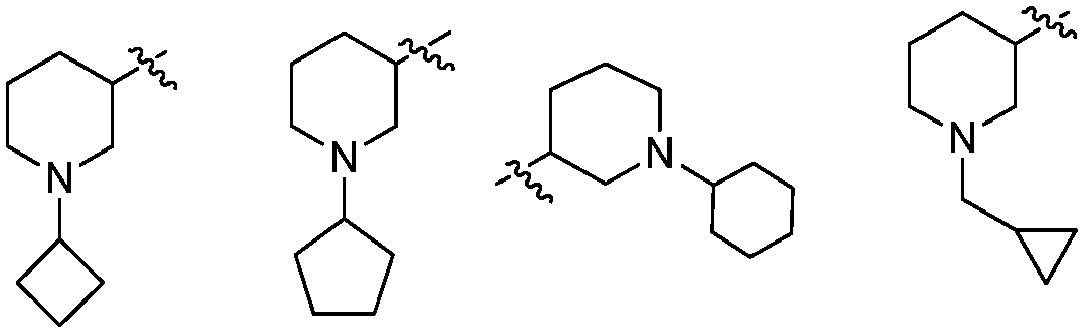


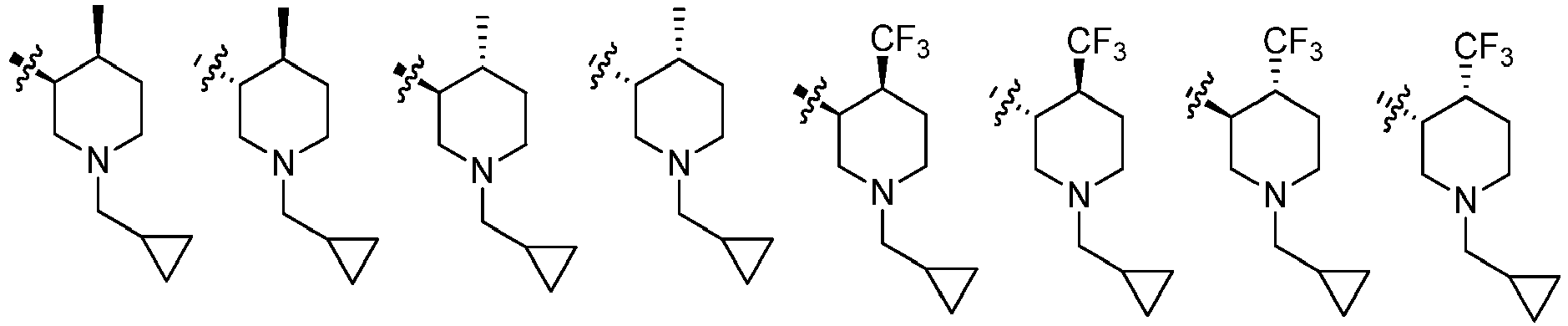

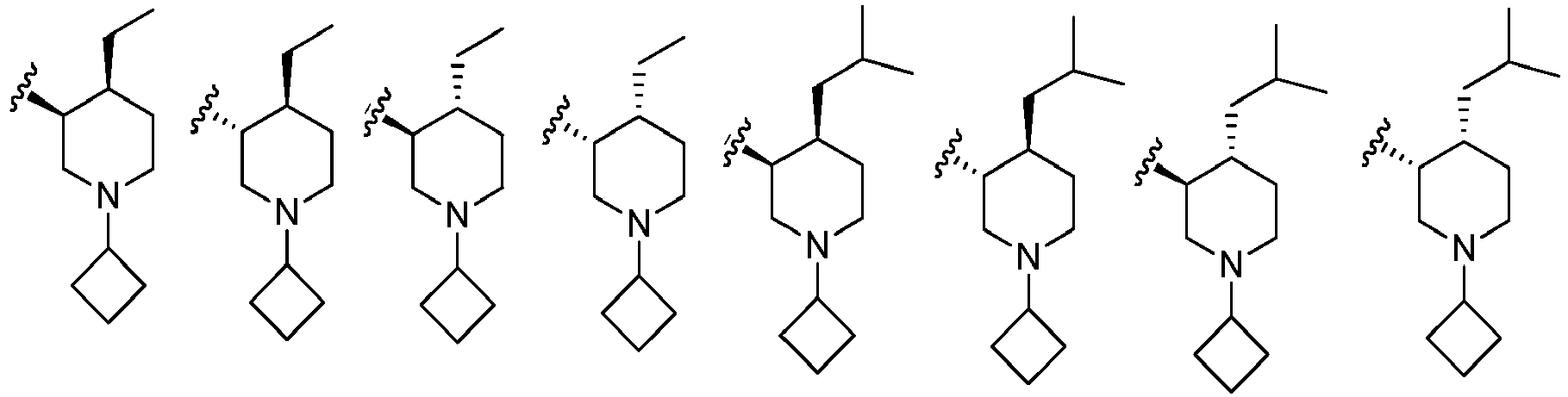


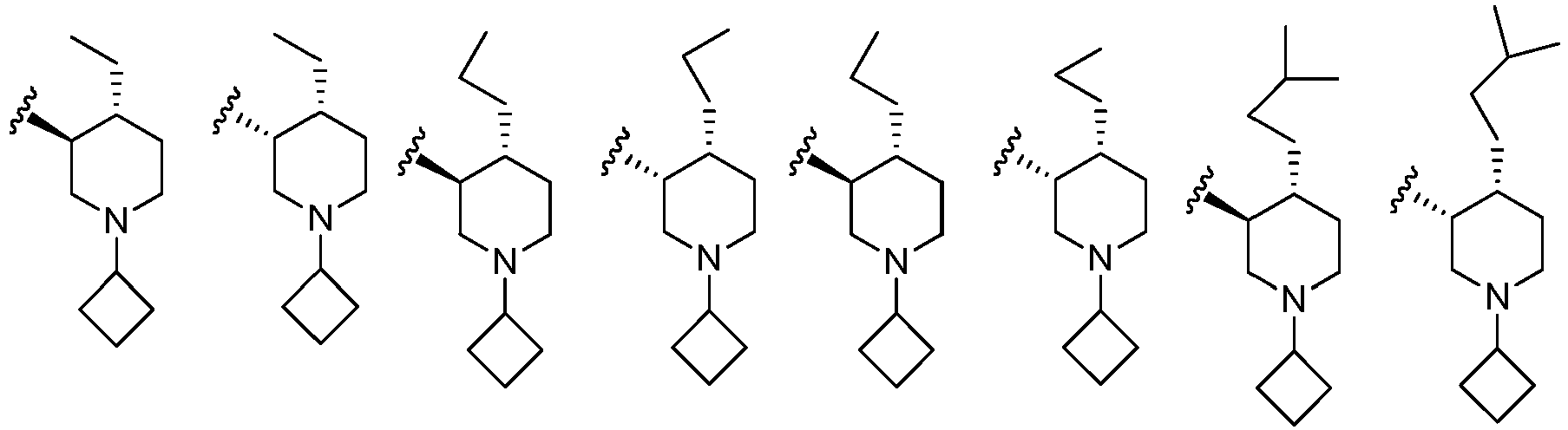

- a)

- b) a carbon-linked piperazine ring that is substituted with one or more groups independently selected from the group consisting of C1-6alkyl, C2-6alkenyl, C2-6alkynyl, C3-8carbocycle, 3-8 membered heterocycle, aryl, heteroaryl, halo, -NO2, -N(Rb)2, -CN, -C(O)-N(Rb)2, -S(O)-N(Rb)2, -S(O)2-N(Rb)2, -O-Rb, -S-Rb, - O-C(O)-Rb, -C(O)-Rb, -C(O)-ORb, -S(O)-Rb, -S(O)2-Rb, -N(Rb)-C(O)-Rb, -N(Rb)-S(O)-Rb, -N(Rb)-C(O)-N(Rb)2, and -N(Rb)-S(O)2-Rb; wherein each C1-6alkyl, C2-6alkenyl, C2-6alkynyl, C3-8carbocycle, 3-8 membered heterocycle, aryl, and heteroaryl is optionally substituted with one or more groups independently selected from the group consisting of halo, -NO2-N(Rb)2, -CN, -C(O)-N(Rb)2, -S(O)-N(Rb)2, -S(O)2-N(Rb)2, -O-Rb, -S-Rb, -O-C(O)-Rb, -C(O)-Rb, -C(O)-ORb, -S(O)-Rb, -S(O)2-Rb, -N(Rb)-C(O)-Rb, -N(Rb)-S(O)-Rb, -N(Rb)-C(O)-N(Rb)2, -N(Rb)-S(O)2-Rb, and C1-6alkyl that is optionally substituted with one or more groups independently selected from halo;
- a)
- each Rb is independently selected from the group consisting of hydrogen, C1-6alkyl, C2-6alkenyl, aryl, and C2-6alkynyl, wherein each C1-6alkyl, C2-6alkenyl, aryl, and C2-6alkynyl is optionally substituted with one or more groups independently selected from the group consisting of halo, -N(Rc)2, -CN, -C(O)-N(Rc)2, -S(O)-N(Rc)2, -S(O)2-N(Rc)2, -O-Rc, -S-Rc, -O-C(O)-Rc, -C(O)-Rc, -C(O)-ORc, -S(O)-Rc, -S(O)2-Rc, -N(Rc)-C(O)-Rc, -N(Rc)-S(O)-Rc, -N(Rc)-C(O)-N(Rc)2, and -N(Rc)-S(O)2-Rc; or two Rb are taken together with the nitrogen to which they are attached to form a pyrrolidino, piperidino, or piperazino ring;
- each Rc is independently selected from the group consisting of hydrogen, C1-6alkyl, C2-6alkenyl, and C2-6alkynyl, wherein each C1-6alkyl, C2-6alkenyl, and C2-6alkynyl is optionally substituted with one or more groups independently selected from the group consisting of oxo, halo, amino, hydroxy, and C1-6alkoxy; or two Rc are taken together with the nitrogen to which they are attached to form a heterocyclyl that is optionally substituted with one or more groups independently selected from the group consisting of oxo, halo and C1-3alkyl that is optionally substituted with one or more groups independently selected from the group consisting of oxo and halo;
- R2 is a 5-10 membered heteroaryl or a 6-12 membered aryl, which 5-10 membered heteroaryl, and 6-12 membered aryl is optionally substituted with one or more groups independently selected from the group consisting of C1-6alkyl, C2-6alkenyl, C2-6alkynyl, carbocycle, heterocycle, aryl, heteroaryl, halo, -NO2, -N(Rd)2, -CN, -C(O)-N(Rd)2, -S(O)-N(Rd)2, -S(O)2-N(Rd)2, -O-Rd, -S-Rd, -O-C(O)-Rd, -C(O)-Rd, -C(O)-ORd, -S(O)-Rd, -S(O)2-Rd, -N(Rd)-C(O)-Rd, -N(Rd)-S(O)-Rd, -N(Rd)-C(O)-N(Rd)2, and -N(Rd)-S(O)2-Rd; wherein each C1-6alkyl, C2-6alkenyl, C2-6alkynyl, carbocycle, heterocycle, aryl, and heteroaryl is optionally substituted with one or more groups independently selected from the group consisting of halo, -NO2-N(Rd)2, -CN, -C(O)-N(Rd)2, -S(O)-N(Rd)2, -S(O)2-N(Rd)2, -O-Rd, -S-Rd, -O-C(O)-Rd, -C(O)-Rd, -C(O)-ORd, -S(O)-Rd, -S(O)2-Rd, -N(Rd)-C(O)-Rd, -N(Rd)-S(O)-Rd, -N(Rd)-C(O)-N(Rd)2, -N(Rd)-S(O)2-Rd, and C1-6alkyl that is optionally substituted with one or more groups independently selected from halo;
- each Rd is independently selected from the group consisting of hydrogen, C1-6alkyl, C2-6alkenyl, aryl, and C2-6alkynyl, wherein each C1-6alkyl, C2-6alkenyl, aryl, and C2-6alkynyl is optionally substituted with one or more groups independently selected from the group consisting of halo, -N(Re)2, -CN, -C(O)-N(Re)2, -S(O)-N(Re)2, -S(O)2-N(Re)2, -O-Re, -S-Re, -O-C(O)-Re, -C(O)-Re, -C(O)-ORe, -S(O)-Re, -S(O)2-Re, -N(Re)-C(O)-Re, -N(Rc)-S(O)-Re, -N(Re)-C(O)-N(Re)2, and -N(Re)-S(O)2-Re; or two Rd are taken together with the nitrogen to which they are attached to form a pyrrolidino, piperidino, or piperazino ring; and
- each Re is independently selected from the group consisting of hydrogen, C1-6alkyl, C2-6alkenyl, and C2-6alkynyl, wherein each C1-6alkyl, C2-6alkenyl, and C2-6alkynyl is optionally substituted with one or more groups independently selected from the group consisting of oxo, halo, amino, hydroxy, and C1-6alkoxy; or two Re are taken together with the nitrogen to which they are attached to form a heterocyclyl that is optionally substituted with one or more groups independently selected from the group consisting of oxo, halo and C1-3alkyl that is optionally substituted with one or more groups independently selected from the group consisting of oxo and halo;
- provided that when R2 is 6-methoxy-2-naphthyl, then R1 is not 1-(cyclopropylmethyl)piperidin-3-yl, 1 -(cyclobutyl)piperidin-3 -yl, 1 -(cyclopentyl)piperidin-3 -yl, or 1-(tetrahydropyranyl)piperidin-3-yl; and
- provided that when R2 is phenyl, naphthyl, 4-quinolyl, 5-quinolyl, 6-quinolyl, 7-quinolyl, 8-quinolyl, 2-methyl-6-quinolyl, 1,5-benzodioxepin-7-yl, benzo[b]thien-7-yl, 2,3-dihydro-1,4-benzodioxin-6-yl, 1H-1-(tert-butoxycarbonyl)-4-bromo-indol-2-yl, 1H-1-(tert-butoxycarbonyl)-4-cyano-indol-2-yl, 3,4-dihydroxyphenyl, 3-methoxy-4-hydroxyphenyl, 3,4-dimethoxyphenyl, 3-methoxycarbonyl-4-hydroxyphenyl, 4-hydroxyphenyl, or 2-hydroxyphenyl, then R1 is not substituted piperazin-2-yl; or the compound of Formula (I) is

- Another aspect includes a composition, comprising a compound of formula (I), or a pharmaceutically acceptable salt thereof, and a pharmaceutically acceptable adjuvant, carrier, or vehicle.
- Another aspect includes a compound of formula (I), or a pharmaceutically acceptable salt thereof, for use in medical therapy.
- Another aspect includes a compound of formula (I), or a pharmaceutically acceptable salt thereof, for use in the therapeutic or prophylactic treatment of cancer.
- Another aspect includes a compound of formula (I),

- R1 is:
- c) a carbon-linked piperidine ring that is substituted on the piperidine ring nitrogen with a group Rx and that is optionally further substituted with one or more groups independently selected from the group consisting of C1-6alkyl, C2-6alkenyl, C2-6alkynyl, C3-8carbocycle, 3-8 membered heterocycle, aryl, heteroaryl, halo, -NO2, -N(Rb)2, -CN, -C(O)-N(Rb)2, -S(O)-N(Rb)2, -S(O)2-N(Rb)2, -O-Rb, -S-Rb, -O-C(O)-Rb, -C(O)-Rb, -C(O)-ORb, -S(O)-Rb, -S(O)2-Rb, -N(Rb)-C(O)-Rb, -N(Rb)-S(O)-Rb, -N(Rb)-C(O)-N(Rb)2, and -N(Rb)-S(O)2-Rb; wherein each C1-6alkyl, C2-6alkenyl, C2-6alkynyl, C3-8carbocycle, 3-8 membered heterocycle, aryl, and heteroaryl is optionally substituted with one or more groups independently selected from the group consisting of halo, -NO2-N(Rb)2, -CN, -C(O)-N(Rb)2, -S(O)-N(Rb)2, -S(O)2-N(Rb)2, -O-Rb, -S-Rb, - O-C(O)-Rb, -C(O)-Rb, -C(O)-ORb, -S(O)-Rb, -S(O)2-Rb, -N(Rb)-C(O)-Rb, -N(Rb)-S(O)-Rb, -N(Rb)-C(O)-N(Rb)2, -N(Rb)-S(O)2-Rb, and C1-6alkyl that is optionally substituted with one or more groups independently selected from halo; or
- d) a carbon-linked piperazine ring that is substituted with one or more groups independently selected from the group consisting of C1-6alkyl, C2-6alkenyl, C2-6alkynyl, C3-8carbocycle, 3-8 membered heterocycle, aryl, heteroaryl, halo, -NO2, -N(Rb)2, -CN, -C(O)-N(Rb)2, -S(O)-N(Rb)2, -S(O)2-N(Rb)2, -O-Rb, -S-Rb, - O-C(O)-Rb, -C(O)-Rb, -C(O)-ORb, -S(O)-Rb, -S(O)2-Rb, -N(Rb)-C(O)-Rb, -N(Rb)-S(O)-Rb, -N(Rb)-C(O)-N(Rb)2, and -N(Rb)-S(O)2-Rb; wherein each C1-6alkyl, C2-6alkenyl, C2-6alkynyl, C3-8carbocycle, 3-8 membered heterocycle, aryl, and heteroaryl is optionally substituted with one or more groups independently selected from the group consisting of halo, -NO2-N(Rb)2, -CN, -C(O)-N(Rb)2, -S(O)-N(Rb)2, -S(O)2-N(Rb)2, -O-Rb, -S-Rb, -O-C(O)-Rb, -C(O)-Rb, -C(O)-ORb, -S(O)-Rb, -S(O)2-Rb, -N(Rb)-C(O)-Rb, -N(Rb)-S(O)-Rb, -N(Rb)-C(O)-N(Rb)2, -N(kb)-S(O)2-Rb, and C1-6alkyl that is optionally substituted with one or more groups independently selected from halo;
- each Rb is independently selected from the group consisting of hydrogen, C1-6alkyl, C2-6alkenyl, aryl, and C2-6alkynyl, wherein each C1-6alkyl, C2-6alkenyl, aryl, and C2-6alkynyl is optionally substituted with one or more groups independently selected from the group consisting of halo, -N(Rc)2, -CN, -C(O)-N(Rc)2, -S(O)-N(Rc)2, -S(O)2-N(Rc)2, -O-Rc, -S-Rc, -O-C(O)-Rc, -C(O)-Rc, -C(O)-ORc, -S(O)-Rc, -S(O)2-Rc, -N(Rc)-C(O)-Rc, -N(Rc)-S(O)-Rc, -N(Rc)-C(O)-N(Rc)2, and -N(Rc)-S(O)2-Rc; or two Rb are taken together with the nitrogen to which they are attached to form a pyrrolidino, piperidino, or piperazino ring;
- each Rc is independently selected from the group consisting of hydrogen, C1-6alkyl, C2-6alkenyl, and C2-6alkynyl, wherein each C1-6alkyl, C2-6alkenyl, and C2-6alkynyl is optionally substituted with one or more groups independently selected from the group consisting of oxo, halo, amino, hydroxy, and C1-6alkoxy; or two Rc are taken together with the nitrogen to which they are attached to form a heterocyclyl that is optionally substituted with one or more groups independently selected from the group consisting of oxo, halo and C1-3alkyl that is optionally substituted with one or more groups independently selected from the group consisting of oxo and halo;
- Rx is C1-6alkyl, C2-6alkenyl, C2-6alkynyl, C3-8carbocycle, oxetanyl, tetrahydrofuranyl, or tetrahydropyranyl, wherein each C1-6alkyl, C2-6alkenyl, C2-6alkynyl, C3-8carbocycle is optionally substituted with one or more groups independently selected from the group consisting of halo, -CN, C1-3alkoxy, oxetanyl, tetrahydrofuranyl, tetrahydropyranyl, and C3-8carbocycle that is optionally substituted with one or more groups independently selected from the group consisting of halo and C1-3alkyl;
- R2 is a 5-10 membered heteroaryl or a 6-12 membered aryl, which 5-10 membered heteroaryl, and 6-12 membered aryl is optionally substituted with one or more groups independently selected from the group consisting of C1-6alkyl, C2-6alkenyl, C2-6alkynyl, carbocycle, heterocycle, aryl, heteroaryl, halo, -NO2, -N(Rd)2, -CN, -C(O)-N(Rd)2, -S(O)-N(Rd)2, -S(O)2-N(Rd)2, -O-Rd, -S-Rd, -O-C(O)-Rd, -C(O)-Rd, -C(O)-ORd, -S(O)-Rd, -S(O)2-Rd, -N(Rd)-C(O)-Rd, -N(Rd)-S(O)-Rd, -N(Rd)-C(O)-N(Rd)2, and -N(Rd)-S(O)2-Rd; wherein each C1-6alkyl, C2-6alkenyl, C2-6alkynyl, carbocycle, heterocycle, aryl, and heteroaryl is optionally substituted with one or more groups independently selected from the group consisting of halo, -NO2-N(Rd)2, -CN, -C(O)-N(Rd)2, -S(O)-N(Rd)2, -S(O)2-N(Rd)2, -O-Rd, -S-Rd, -O-C(O)-Rd, -C(O)-Rd, -C(O)-ORd, -S(O)-Rd, -S(O)2-Rd, -N(Rd)-C(O)-Rd, -N(Rd)-S(O)-Rd, -N(Rd)-C(O)-N(Rd)2, -N(Rd)-S(O)2-Rd, and C1-6alkyl that is optionally substituted with one or more groups independently selected from halo;
- each Rd is independently selected from the group consisting of hydrogen, C1-6alkyl, C2-6alkenyl, aryl, and C2-6alkynyl, wherein each C1-6alkyl, C2-6alkenyl, aryl, and C2-6alkynyl is optionally substituted with one or more groups independently selected from the group consisting of halo, -N(Re)2, -CN, -C(O)-N(Re)2, -S(O)-N(Re)2, -S(O)2-N(Re)2, -O-Re, -S-Re, -O-C(O)-Re, -C(O)-Re, -C(O)-ORe, -S(O)-Re, -S(O)2-Re, -N(Re)-C(O)-Re, -N(Rc)-S(O)-Re, -N(Re)-C(O)-N(Re)2, and -N(Re)-S(O)2-Re; or two Rd are taken together with the nitrogen to which they are attached to form a pyrrolidino, piperidino, or piperazino ring; and
- each Re is independently selected from the group consisting of hydrogen, C1-6alkyl, C2-6alkenyl, and C2-6alkynyl, wherein each C1-6alkyl, C2-6alkenyl, and C2-6alkynyl is optionally substituted with one or more groups independently selected from the group consisting of oxo, halo, amino, hydroxy, and C1-6alkoxy; or two Re are taken together with the nitrogen to which they are attached to form a heterocyclyl that is optionally substituted with one or more groups independently selected from the group consisting of oxo, halo and C1-3alkyl that is optionally substituted with one or more groups independently selected from the group consisting of oxo and halo;
- for use in medical therapy; or
- for use in the therapeutic or prophylactic treatment of cancer.
- Definitions of specific functional groups and chemical terms are described in more detail below. Chemical elements are identified in accordance with the Periodic Table of the Elements, CAS version, Handbook of Chemistry and Physics, 75th Ed., inside cover, and specific functional groups are generally defined as described therein. Additionally, general principles of organic chemistry, as well as specific functional moieties and reactivity, are described in Organic Chemistry, Thomas Sorrell, University Science Books, Sausalito, 1999; Smith and March March's Advanced Organic Chemistry, 5th Edition, John Wiley & Sons, Inc., New York, 2001; Larock, Comprehensive Organic Transformations, VCH Publishers, Inc., New York, 1989; Carruthers, Some Modern Methods of Organic Synthesis, 3rd Edition, Cambridge University Press, Cambridge, 1987.
- Unless otherwise stated, structures depicted herein are also meant to include all isomeric (e.g., enantiomeric, diastereomeric, and geometric (or conformational)) forms of the structure; for example, the R and S configurations for each asymmetric center, Z and E double bond isomers, and Z and E conformational isomers. Therefore, single stereochemical isomers as well as enantiomeric, diastereomeric, and geometric (or conformational) mixtures of the present compounds are included.
- Additionally, unless otherwise stated, structures depicted herein are also meant to include compounds that differ only in the presence of one or more isotopically enriched atoms. For example, compounds having the present structures including the replacement of hydrogen by deuterium or tritium, or the replacement of a carbon by a 13C- or 14C-enriched carbon are included. Such compounds are useful, for example, as analytical tools, as probes in biological assays, or as therapeutic agents.
- Where a particular enantiomer is preferred, it may, in some embodiments be provided substantially free of the corresponding enantiomer, and may also be referred to as "optically enriched." "Optically-enriched," as used herein, means that the compound is made up of a significantly greater proportion of one enantiomer. In certain embodiments the compound is made up of at least about 90% by weight of a preferred enantiomer. In other embodiments the compound is made up of at least about 95%, 98%, or 99% by weight of a preferred enantiomer. Preferred enantiomers may be isolated from racemic mixtures by any method known to those skilled in the art, including chiral high pressure liquid chromatography (HPLC) and the formation and crystallization of chiral salts or prepared by asymmetric syntheses. See, for example, Jacques et al., Enantiomers, Racemates and Resolutions (Wiley Interscience, New York, 1981); Wilen, et al., Tetrahedron 33:2725 (1977); Eliel, E.L. Stereochemistry of Carbon Compounds (McGraw-Hill, NY, 1962); Wilen, S.H. Tables of Resolving Agents and Optical Resolutions p. 268 (E.L. Eliel, Ed., Univ. of Notre Dame Press, Notre Dame, IN 1972).
- The term "a compound as described herein" includes the compounds described in the Examples herein and salts and free-bases thereof, as well as compounds of formula (I) and salts thereof.
- The term "heteroatom" means one or more of oxygen, sulfur, nitrogen, phosphorus, or silicon (including, any oxidized form of nitrogen, sulfur, phosphorus, or silicon; the quaternized form of any basic nitrogen or; a substitutable nitrogen of a heterocyclic ring, for example N (as in 3,4-dihydro-2H-pyrrolyl), NH (as in pyrrolidinyl) or NR+ (as in N-substituted pyrrolidinyl)).
- As used herein a "direct bond" or "covalent bond" refers to a single, double or triple bond. In certain embodiments, a "direct bond" or "covalent bond" refers to a single bond.
- The terms "halo" and "halogen" as used herein refer to an atom selected from fluorine (fluoro, -F), chlorine (chloro, -Cl), bromine (bromo, -Br), and iodine (iodo, -I).
- The term "aliphatic" or "aliphatic group", as used herein, denotes a hydrocarbon moiety that may be straight-chain (i.e., unbranched), branched, or cyclic (including fused, bridging, and spiro-fused polycyclic) and may be completely saturated or may contain one or more units of unsaturation, but which is not aromatic. Unless otherwise specified, aliphatic groups contain 1-6 carbon atoms. In some embodiments, aliphatic groups contain 1-4 carbon atoms, and in yet other embodiments aliphatic groups contain 1-3 carbon atoms. Suitable aliphatic groups include, but are not limited to, linear or branched, alkyl, alkenyl, and alkynyl groups, and hybrids thereof such as (cycloalkyl)alkyl, (cycloalkenyl)alkyl or (cycloalkyl)alkenyl.
- The term "unsaturated", as used herein, means that a moiety has one or more units of unsaturation.
- The terms "cycloaliphatic", "carbocycle", "carbocyclyl", "carbocyclo", or "carbocyclic", used alone or as part of a larger moiety, refer to a saturated or partially unsaturated cyclic aliphatic monocyclic, bicyclic, or spior ring systems, as described herein, having from 3 to 10 members, wherein the aliphatic ring system is optionally substituted as described herein. Cycloaliphatic groups include, without limitation, cyclopropyl, cyclobutyl, cyclopentyl, cyclopentenyl, cyclohexyl, cyclohexenyl, cycloheptyl, cycloheptenyl, cyclooctyl, cyclooctenyl, and cyclooctadienyl. In some embodiments, the cycloalkyl has 3-6 carbons. Also included within the scope of the term "cycloaliphatic", "carbocycle", "carbocyclyl", "carbocyclo", or "carbocyclic", as it is used herein, is a group in which an "cycloaliphatic", "carbocycle", "carbocyclyl", "carbocyclo", or "carbocyclic" is fused to one or more aryl, heterocyclyl, or heteroaryl rings, wherein the point of attachment is a carbon of the "cycloaliphatic", "carbocycle", "carbocyclyl", "carbocyclo", or "carbocyclic"ring.
- The term "alkyl," as used herein, refers to a monovalent saturated, straight- or branched-chain hydrocarbon radical derived from an aliphatic moiety containing between one and six carbon atoms by removal of a single hydrogen atom. In some embodiments, alkyl contains 1-5 carbon atoms. In another embodiment, alkyl contains 1-4 carbon atoms. In still other embodiments, alkyl contains 1-3 carbon atoms. In yet another embodiment, alkyl contains 1-2 carbons. Examples of alkyl radicals include, but are not limited to, methyl, ethyl, n-propyl, isopropyl, n-butyl, iso-butyl, sec-butyl, sec-pentyl, iso-pentyl, tert-butyl, n-pentyl, neopentyl, n-hexyl, sec-hexyl, n-heptyl, n-octyl, n-decyl, n-undecyl, dodecyl, and the like.
- The term "alkenyl," as used herein, denotes a monovalent group derived from a straight-or branched-chain aliphatic moiety having at least one carbon-carbon double bond by the removal of a single hydrogen atom. In certain embodiments, alkenyl contains 2-6 carbon atoms. In certain embodiments, alkenyl contains 2-5 carbon atoms. In some embodiments, alkenyl contains 2-4 carbon atoms. In another embodiment, alkenyl contains 2-3 carbon atoms. Alkenyl groups include, for example, ethenyl ("vinyl"), propenyl ("allyl"), butenyl, 1-methyl-2-buten-1-yl, and the like.
- The term "alkynyl," as used herein, refers to a monovalent group derived from a straight- or branched-chain aliphatic moiety having at least one carbon-carbon triple bond by the removal of a single hydrogen atom. In certain embodiments, alkynyl contains 2-6 carbon atoms. In certain embodiments, alkynyl contains 2-5 carbon atoms. In some embodiments, alkynyl contains 2-4 carbon atoms. In another embodiment, alkynyl contains 2-3 carbon atoms. Representative alkynyl groups include, but are not limited to, ethynyl, 2-propynyl ("propargyl"), 1-propynyl, and the like.
- The term "aryl" used alone or as part of a larger moiety as in "aralkyl", "aralkoxy", or "aryloxyalkyl", refers to monocyclic and bicyclic ring systems having a total of 6, 7, 8, 9, 10, 11, or 12 ring members, wherein at least one ring in the system is aromatic. The term "aryl" may be used interchangeably with the term "aryl ring". In certain embodiments, "aryl" refers to an aromatic ring system which includes, but not limited to, phenyl, biphenyl, naphthyl, anthracyl and the like, which may bear one or more substituents. Also included within the scope of the term aryl", as it is used herein, is a group in which an aromatic carbon ring is fused to one or more cycloaliphatic, heterocyclyl, or heteroaryl rings, wherein the point of attachment is a carbon of the aromatic carbon ring.
- The terms "heteroaryl" and "heteroar-", used alone or as part of a larger moiety, e.g., "heteroaralkyl", or "heteroaralkoxy", refer to groups having 5 to 10 ring atoms, preferably 5, 6, or 9 ring atoms; having 6, 10, or 14 π electrons shared in a cyclic array; and having, in addition to carbon atoms, from one to five heteroatoms. The term "heteroatom" refers to nitrogen, oxygen, or sulfur, and includes any oxidized form of nitrogen or sulfur, and any quaternized form of a basic nitrogen. Heteroaryl groups include, without limitation, thienyl, furanyl, pyrrolyl, imidazolyl, pyrazolyl, triazolyl, tetrazolyl, oxazolyl, isoxazolyl, oxadiazolyl, thiazolyl, isothiazolyl, thiadiazolyl, pyridyl, pyridazinyl, pyrimidinyl, pyrazinyl, indolizinyl, purinyl, naphthyridinyl, and pteridinyl. The terms "heteroaryl" and "heteroar-", as used herein, also include groups in which a heteroaromatic ring is fused to one or more aryl, cycloaliphatic, or heterocyclyl rings, wherein the point of attachment is a carbon of the heteroaromatic ring.
- Nonlimiting examples include indolyl, isoindolyl, benzothienyl, benzofuranyl, dibenzofuranyl, indazolyl, benzimidazolyl, benzthiazolyl, quinolyl, isoquinolyl, cinnolinyl, phthalazinyl, quinazolinyl, quinoxalinyl, 4H-quinolizinyl, carbazolyl, acridinyl, phenazinyl, phenothiazinyl, phenoxazinyl, tetrahydroquinolinyl, tetrahydroisoquinolinyl, and pyrido[2,3-b]-1,4-oxazin-3(4H)-one. A heteroaryl group may be mono- or bicyclic.
- As used herein, the terms "heterocycle", "heterocyclyl", "heterocyclic radical", and "heterocyclic ring" are used interchangeably and refer to a stable 3- to 8-membered monocyclic or 7-10-membered bicyclic heterocyclic moiety that is either saturated or partially unsaturated, and having, in addition to carbon atoms, one or more, preferably one to four, heteroatoms, as defined above. When used in reference to a ring atom of a heterocycle, the term "nitrogen" includes a substituted nitrogen. As an example, in a saturated or partially unsaturated ring having 0-3 heteroatoms selected from oxygen, sulfur or nitrogen, the nitrogen may be N (as in 3,4-dihydro-2H-pyrrolyl), NH (as in pyrrolidinyl), or +NR (as in N-substituted pyrrolidinyl).
- A heterocyclic ring can be attached to its pendant group at any heteroatom or carbon atom that results in a stable structure and any of the ring atoms can be optionally substituted. Examples of such saturated or partially unsaturated heterocyclic radicals include, without limitation, tetrahydrofuranyl, tetrahydrothienyl, pyrrolidinyl, pyrrolidonyl, piperidinyl, pyrrolinyl, tetrahydroquinolinyl, tetrahydroisoquinolinyl, decahydroquinolinyl, oxazolidinyl, piperazinyl, dioxanyl, dioxolanyl, diazepinyl, oxazepinyl, thiazepinyl, morpholinyl, and quinuclidinyl. The terms "heterocycle", "heterocyclyl", "heterocyclyl ring", "heterocyclic group", "heterocyclic moiety", and "heterocyclic radical", are used interchangeably herein, and also include groups in which a heterocyclyl ring is fused to one or more aryl, heteroaryl, or cycloaliphatic rings, such as indolinyl, 3H-indolyl, chromanyl, phenanthridinyl, 2-azabicyclo[2.2.1]heptanyl, octahydroindolyl, or tetrahydroquinolinyl, where the radical or point of attachment is any atom in the heterocyclyl ringsystem. A heterocyclyl group may be mono-or bicyclic. The term "heterocyclylalkyl" refers to an alkyl group substituted by a heterocyclyl, wherein the alkyl and heterocyclyl portions independently are optionally substituted.
- As used herein, the term "partially unsaturated" refers to a ring moiety that includes at least one double or triple bond between ring atoms but is not aromatic. The term "partially unsaturated" is intended to encompass rings having multiple sites of unsaturation, but is not intended to include aryl or heteroaryl moieties, as herein defined.
- The term "alkylene" refers to a bivalent alkyl group. An "alkylene chain" is a polymethylene group, i.e., -(CH2)n-, wherein n is a positive integer, preferably from 1 to 6, from 1 to 4, from 1 to 3, from 1 to 2, or from 2 to 3. A substituted alkylene chain is a polymethylene group in which one or more methylene hydrogen atoms are replaced with a substituent. Suitable substituents include those described below for a substituted aliphatic group.
- As used herein, the term "inhibitor" refers to a compound that binds to and inhibits a KDM2b enzyme with measurable affinity and activity. In certain embodiments, an inhibitor has an IC50 and/or binding constant of less about 50 µM, less than about 1 µM, less than about 500 nM, less than about 100 nM, or less than about 10 nM.
- The terms "measurable affinity" and "measurably inhibit," as used herein, refer to a measurable reduction in activity of a KDM2b enzyme between: (i) a sample comprising a compound as described herein and such KDM2b enzyme, and (ii) an equivalent sample comprising such KDM2b enzyme, in the absence of said compound.
- "Pharmaceutically acceptable salts" include both acid and base addition salts. "Pharmaceutically acceptable acid addition salt" refers to those salts which retain the biological effectiveness and properties of the free bases and which are not biologically or otherwise undesirable, formed with inorganic acids such as hydrochloric acid, hydrobromic acid, sulfuric acid, nitric acid, carbonic acid, phosphoric acid and the like, and organic acids may be selected from aliphatic, cycloaliphatic, aromatic, araliphatic, heterocyclic, carboxylic, and sulfonic classes of organic acids such as formic acid, acetic acid, propionic acid, glycolic acid, gluconic acid, lactic acid, pyruvic acid, oxalic acid, malic acid, maleic acid, maloneic acid, succinic acid, fumaric acid, tartaric acid, citric acid, aspartic acid, ascorbic acid, glutamic acid, anthranilic acid, benzoic acid, cinnamic acid, mandelic acid, embonic acid, phenylacetic acid, methanesulfonic acid, ethanesulfonic acid, benzenesulfonic acid, p-toluenesulfonic acid, salicyclic acid and the like.
- "Pharmaceutically acceptable base addition salts" include those derived from inorganic bases such as sodium, potassium, lithium, ammonium, calcium, magnesium, iron, zinc, copper, manganese, aluminum salts and the like. Particularly base addition salts are the ammonium, potassium, sodium, calcium and magnesium salts. Salts derived from pharmaceutically acceptable organic nontoxic bases includes salts of primary, secondary, and tertiary amines, substituted amines including naturally occurring substituted amines, cyclic amines and basic ion exchange resins, such as isopropylamine, trimethylamine, diethylamine, triethylamine, tripropylamine, ethanolamine, 2-diethylaminoethanol, tromethamine, dicyclohexylamine, lysine, arginine, histidine, caffeine, procaine, hydrabamine, choline, betaine, ethylenediamine, glucosamine, methylglucamine, theobromine, purines, piperizine, piperidine, N-ethylpiperidine, polyamine resins and the like. Particularly organic non-toxic bases are isopropylamine, diethylamine, ethanolamine, tromethamine, dicyclohexylamine, choline, and caffeine.
- The term "tautomer" or "tautomeric form" refers to structural isomers of different energies which are interconvertible via a low energy barrier. For example, proton tautomers (also known as prototropic tautomers) include interconversions via migration of a proton, such as keto-enol and imine-enamine isomerizations. Valence tautomers include interconversions by reorganization of some of the bonding electrons.
- A "solvate" refers to an association or complex of one or more solvent molecules and a compound or pharmaceutically acceptable salt thereof as described herein. Examples of solvents include water, isopropanol, ethanol, methanol, DMSO, ethyl acetate, acetic acid and ethanolamine. The term "hydrate" refers to the complex where the solvent molecule is water.
- "Therapeutically effective amount" refers to an amount of a a compound or pharmaceutically acceptable salt thereof as described herein that (i) treats the particular disease, condition or disorder, (ii) attenuates, ameliorates or eliminates one or more symptoms of the particular disease, condition, or disorder, or (iii) prevents or delays the onset of one or more symptoms of the particular disease, condition or disorder described herein. In the case of cancer, the therapeutically effective amount of the drug may reduce the number of cancer cells; reduce the tumor size; inhibit (i.e., slow to some extent and preferably stop) cancer cell infiltration into peripheral organs; inhibit (i.e., slow to some extent and preferably stop) tumor metastasis; inhibit, to some extent, tumor growth; and/or relieve to some extent one or more of the symptoms associated with the cancer. For cancer therapy, efficacy can, for example, be measured by assessing the time to disease progression (TTP) and/or determining the response rate (RR). In the case of immunological disorders, the therapeutic effective amount is an amount sufficient to decrease or alleviate an allergic disorder, the symptoms of an autoimmune and/or inflammatory disease, or the symptoms of an acute inflammatory reaction (e.g. asthma). In some embodiments, a therapeutically effective amount is an amount of a chemical entity described herein sufficient to significantly decrease the activity or number of drug tolerant or drug tolerant persisting cancer cells.
- "Treatment" (and variations such as "treat" or "treating") refers to clinical intervention in an attempt to alter the natural course of the individual or cell being treated, and can be performed either for prophylaxis or during the course of clinical pathology. Desirable effects of treatment include one or more of preventing occurrence or recurrence of disease, alleviation of symptoms, diminishment of any direct or indirect pathological consequences of the disease, stabilized (i.e., not worsening) state of disease, preventing metastasis, decreasing the rate of disease progression, amelioration or palliation of the disease state, prolonging survival as compared to expected survival if not receiving treatment and remission or improved prognosis. In certain embodiments, a compound as described herein is used to delay development of a disease or disorder or to slow the progression of a disease or disorder. Those individuals in need of treatment include those already with the condition or disorder as well as those prone to have the condition or disorder, (for example, through a genetic mutation or abberent expression of a gene or protein) or those in which the condition or disorder is to be prevented.
- In one embodiment the compound is a compound of formula (Ic):

- each Rf is independently selected from the group consisting of H, C1-6alkyl, C2-6alkenyl, C2-6alkynyl, C3-8carbocycle, 3-8 membered heterocycle, aryl, heteroaryl, halo, -NO2, -N(Rb)2, -CN, -C(O)-N(Rb)2, -S(O)-N(Rb)2, -S(O)2-N(Rb)2, -O-Rb, -S-Rb, -O-C(O)-Rb, -C(O)-Rb, -C(O)-ORb, -S(O)-Rb, -S(O)2-Rb, -N(Rb)-C(O)-Rb, -N(Rb)-S(O)-Rb, -N(Rb)-C(O)-N(Rb)2, and -N(Rb)-S(O)2-Rb; wherein each C1-6alkyl, C2-6alkenyl, C2-6alkynyl, C3-8carbocycle, 3-8 membered heterocycle, aryl, and heteroaryl is optionally substituted with one or more groups independently selected from the group consisting of halo, -NO2-N(Rb)2, -CN, -C(O)-N(Rb)2, -S(O)-N(Rb)2, -S(O)2-N(Rb)2, -O-Rb, -S-Rb, -O-C(O)-Rb, -C(O)-Rb, -C(O)-ORb, -S(O)-Rb, -S(O)2-Rb, -N(Rb)-C(O)-Rb, -N(Rb)-S(O)-Rb, -N(Rb)-C(O)-N(Rb)2, -N(Rb)-S(O)2-Rb, and C1-6alkyl that is optionally substituted with one or more groups independently selected from halo; and
- each Rk is independently selected from the group consisting of H, C1-6alkyl, C2-6alkenyl, C2-6alkynyl, C3-8carbocycle, 3-8 membered heterocycle, aryl, and heteroaryl, wherein each C1-6alkyl, C2-6alkenyl, C2-6alkynyl, C3-8carbocycle, 3-8 membered heterocycle, aryl, and heteroaryl is optionally substituted with one or more groups independently selected from the group consisting of halo, -NO2-N(Rb)2, -CN, -C(O)-N(Rb)2, -S(O)-N(Rb)2, -S(O)2-N(Rb)2, -O-Rb, -S-Rb, - O-C(O)-Rb -C(O)-Rb, -C(O)-ORb, -S(O)-Rb, -S(O)2-Rb, -N(Rb)-C(O)-Rb, -N(Rb)-S(O)-Rb, -N(Rb)-C(O)-N(Rb)2, -N(Rb)-S(O)2-Rb, and C1-6alkyl that is optionally substituted with one or more groups independently selected from halo,
provided that Rf and Rk are not both H. - In one embodiment when R2 is 6-methoxy-2-naphthyl, then R1 is not 1-(cyclopropylmethyl)piperidin-3-yl, 1-(cyclobutyl)piperidin-3-yl, 1-(cyclopentyl)piperidin-3 -yl, or 1-(tetrahydropyranyl)piperidin-3-yl.
- In one embodiment R2 is a ring selected from the group consisting of naphthyl, tetralinyl, phenyl, benzisoxazolyl, benzo[7]annulenyl, 1,4-benzodioxinyl, benzimidazolyl-2-one, indolyl, indazolyl, thiophenyl, pyridyl, quinolyl, tetrahydroquinolyl, isoquinolyl, tetrahydroisoquinolyl, and pyrazolyl; which ring is optionally substituted with one or more groups independently selected from the group consisting of C1-6alkyl, C2-6alkenyl, C2-6alkynyl, carbocycle, heterocycle, aryl, heteroaryl, halo, -NO2, -N(Rd)2, -CN, -C(O)-N(Rd)2, -S(O)-N(Rd)2, -S(O)2-N(Rd)2, -O-Rd, -S-Rd, -O-C(O)-Rd, -C(O)-Rd, -C(O)-ORd, -S(O)-Rd, -S(O)2-Rd, -N(Rd)-C(O)-Rd, -N(Rd)-S(O)-Rd, -N(Rd)-C(O)-N(Rd)2, and -N(Rd)-S(O)2-Rd; wherein each C1-6alkyl, C2-6alkenyl, C2-6alkynyl, carbocycle, heterocycle, aryl, and heteroaryl is optionally substituted with one or more groups independently selected from the group consisting of halo, -NO2-N(Rd)2, -CN, -C(O)-N(Rd)2, -S(O)-N(Rd)2, -S(O)2-N(Rd)2, -O-Rd, -S-Rd, -O-C(O)-Rd, -C(O)-Rd, -C(O)-ORd, -S(O)-Rd, -S(O)2-Rd, -N(Rd)-C(O)-Rd, -N(Rd)-S(O)-Rd, -N(Rd)-C(O)-N(Rd)2, -N(Rd)-S(O)2-Rd, and C1-6alkyl that is optionally substituted with one or more groups independently selected from halo.
- In one embodiment R1 is selected from the group consisting of:


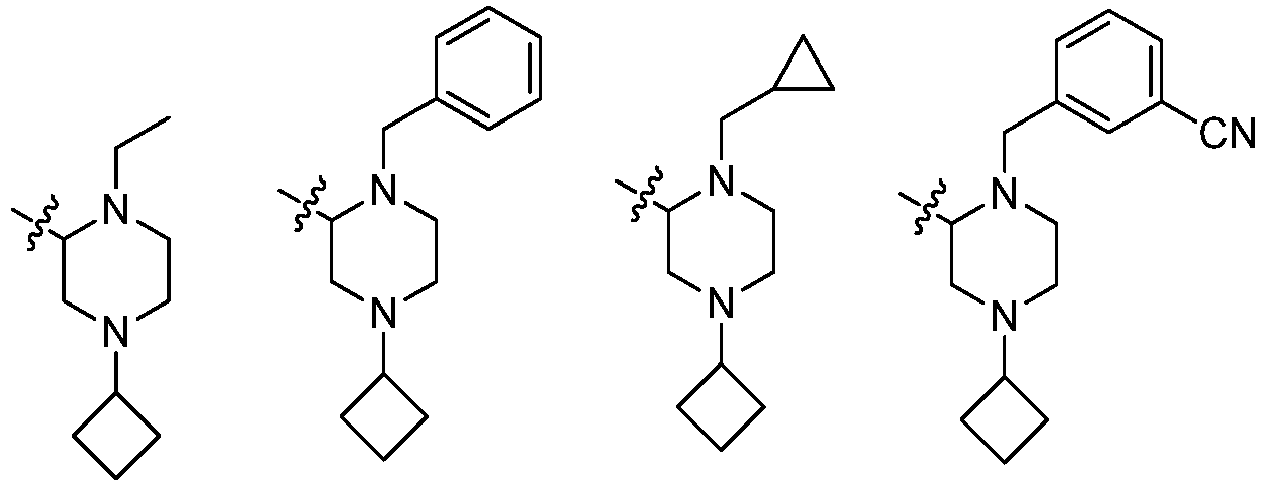


- In one embodiment R2 is a ring selected from the group consisting of:




- In one embodiment R2 is a naphthyl ring that is optionally substituted with one or more groups independently selected from the group consisting of C1-6alkyl, C2-6alkenyl, C2-6alkynyl, carbocycle, heterocycle, aryl, heteroaryl, halo, -NO2, -N(Rd)2, -CN, -C(O)-N(Rd)2, -S(O)-N(Rd)2, -S(O)2-N(Rd)2, -O-Rd, -S-Rd, -O-C(O)-Rd, -C(O)-Rd, -C(O)-ORd, -S(O)-Rd, -S(O)2-Rd, -N(Rd)-C(O)-Rd, -N(Rd)-S(O)-Rd, -N(Rd)-C(O)-N(Rd)2, and -N(Rd)-S(O)2-Rd; wherein each C1-6alkyl, C2-6alkenyl, C2-6alkynyl, carbocycle, heterocycle, aryl, and heteroaryl is optionally substituted with one or more groups independently selected from the group consisting of halo, -NO2-N(Rd)2, -CN, -C(O)-N(Rd)2, -S(O)-N(Rd)2, -S(O)2-N(Rd)2, -O-Rd, -S-Rd, -O-C(O)-Rd, -C(O)-Rd, -C(O)-ORd, -S(O)-Rd, -S(O)2-Rd, -N(Rd)-C(O)-Rd, -N(Rd)-S(O)-Rd, -N(Rd)-C(O)-N(Rd)2, -N(Rd)-S(O)2-Rd, and C1-6alkyl that is optionally substituted with one or more groups independently selected from halo.
- In one embodiment R2 is a naphthyl ring that is optionally substituted with one or more groups independently selected from the group consisting of C1-6alkyl, carbocycle, aryl, halo, -NO2, -N(Rd)2, -CN, -C(O)-N(Rd)2, -S(O)-N(Rd)2, -S(O)2-N(Rd)2, -O-Rd, -S-Rd, -O-C(O)-Rd, -C(O)-Rd, -C(O)-ORd, -S(O)-Rd, -S(O)2-Rd, -N(Rd)-C(O)-Rd, -N(Rd)-S(O)-Rd, -N(Rd)-C(O)-N(Rd)2, and -N(Rd)-S(O)2-Rd; wherein each C1-6alkyl, C2-6alkenyl, C2-6alkynyl, carbocycle, heterocycle, aryl, and heteroaryl is optionally substituted with one or more groups independently selected from the group consisting of halo, -NO2-N(Rd)2, -CN, -C(O)-N(Rd)2, -S(O)-N(Rd)2, -S(O)2-N(Rd)2, -O-Rd, -S-Rd, -O-C(O)-Rd, -C(O)-Rd, -C(O)-ORd, -S(O)-Rd, -S(O)2-Rd, -N(Rd)-C(O)-Rd, -N(Rd)-S(O)-Rd, -N(Rd)-C(O)-N(Rd)2, -N(Rd)-S(O)2-Rd, and C1-6alkyl that is optionally substituted with one or more groups independently selected from halo.
- In one embodiment R2 is a phenyl ring that is optionally substituted with one or more groups independently selected from the group consisting of C1-6alkyl, C2-6alkenyl, C2-6alkynyl, carbocycle, heterocycle, aryl, heteroaryl, halo, -NO2, -N(Rd)2, -CN, -C(O)-N(Rd)2, -S(O)-N(Rd)2, -S(O)2-N(Rd)2, -O-Rd, -S-Rd, -O-C(O)-Rd, -C(O)-Rd, -C(O)-ORd, -S(O)-Rd, -S(O)2-Rd, -N(Rd)-C(O)-Rd, -N(Rd)-S(O)-Rd, -N(Rd)-C(O)-N(Rd)2, and -N(Rd)-S(O)2-Rd; wherein each C1-6alkyl, C2-6alkenyl, C2-6alkynyl, carbocycle, heterocycle, aryl, and heteroaryl is optionally substituted with one or more groups independently selected from the group consisting of halo, -NO2-N(Rd)2, -CN, -C(O)-N(Rd)2, -S(O)-N(Rd)2, -S(O)2-N(Rd)2, -O-Rd, -S-Rd, -O-C(O)-Rd, -C(O)-Rd, -C(O)-ORd, -S(O)-Rd, -S(O)2-Rd, -N(Rd)-C(O)-Rd, -N(Rd)-S(O)-Rd, -N(Rd)-C(O)-N(Rd)2, -N(Rd)-S(O)2-Rd, and C1-6alkyl that is optionally substituted with one or more groups independently selected from halo.
- In one embodiment R2 is a phenyl ring that is optionally substituted with one or more groups independently selected from the group consisting of C1-6alkyl, carbocycle, aryl, halo, -NO2, -N(Rd)2, -CN, -C(O)-N(Rd)2, -S(O)-N(Rd)2, -S(O)2-N(Rd)2, -O-Rd, -S-Rd, -O-C(O)-Rd, -C(O)-Rd, -C(O)-ORd, -S(O)-Rd, -S(O)2-Rd, -N(Rd)-C(O)-Rd, -N(Rd)-S(O)-Rd, -N(Rd)-C(O)-N(Rd)2, and -N(Rd)-S(O)2-Rd; wherein each C1-6alkyl, C2-6alkenyl, C2-6alkynyl, carbocycle, heterocycle, aryl, and heteroaryl is optionally substituted with one or more groups independently selected from the group consisting of halo, -NO2-N(Rd)2, -CN, -C(O)-N(Rd)2, -S(O)-N(Rd)2, -S(O)2-N(Rd)2, -O-Rd, -S-Rd, -O-C(O)-Rd, -C(O)-Rd, -C(O)-ORd, -S(O)-Rd, -S(O)2-Rd, -N(Rd)-C(O)-Rd, -N(Rd)-S(O)-Rd, -N(Rd)-C(O)-N(Rd)2, -N(Rd)-S(O)2-Rd, and C1-6alkyl that is optionally substituted with one or more groups independently selected from halo.
- In one embodiment R2 is a quinolyl or isoquinolyl ring, which ring is optionally substituted with one or more groups independently selected from the group consisting of C1-6alkyl, C2-6alkenyl, C2-6alkynyl, carbocycle, heterocycle, aryl, heteroaryl, halo, -NO2, -N(Rd)2, -CN, -C(O)-N(Rd)2, -S(O)-N(Rd)2, -S(O)2-N(Rd)2, -O-Rd, -S-Rd, -O-C(O)-Rd, -C(O)-Rd, -C(O)-ORd, -S(O)-Rd, -S(O)2-Rd, -N(Rd)-C(O)-Rd, -N(Rd)-S(O)-Rd, -N(Rd)-C(O)-N(Rd)2, and -N(Rd)-S(O)2-Rd; wherein each C1-6alkyl, C2-6alkenyl, C2-6alkynyl, carbocycle, heterocycle, aryl, and heteroaryl is optionally substituted with one or more groups independently selected from the group consisting of halo, -NO2-N(Rd)2, -CN, -C(O)-N(Rd)2, -S(O)-N(Rd)2, -S(O)2-N(Rd)2, -O-Rd, -S-Rd, -O-C(O)-Rd, -C(O)-Rd, -C(O)-ORd, -S(O)-Rd, -S(O)2-Rd, -N(Rd)-C(O)-Rd -N(Rd)-S(O)-Rd, -N(Rd)-C(O)-N(Rd)2, -N(Rd)-S(O)2-Rd, and C1-6alkyl that is optionally substituted with one or more groups independently selected from halo.
- In one embodiment R2 is a quinolyl or isoquinolyl ring, which ring is optionally substituted with one or more groups independently selected from the group consisting of C1-6alkyl, carbocycle, halo, -NO2, -N(Rd)2, -CN, -C(O)-N(Rd)2, -S(O)-N(Rd)2, -S(O)2-N(Rd)2, -O-Rd, -S-Rd, -O-C(O)-Rd, -C(O)-Rd, -C(O)-ORd, -S(O)-Rd, -S(O)2-Rd, -N(Rd)-C(O)-Rd, -N(Rd)-S(O)-Rd, -N(Rd)-C(O)-N(Rd)2, and -N(Rd)-S(O)2-Rd; wherein each C1-6alkyl, C2-6alkenyl, C2-6alkynyl, carbocycle, heterocycle, aryl, and heteroaryl is optionally substituted with one or more groups independently selected from the group consisting of halo, -NO2-N(Rd)2, -CN, -C(O)-N(Rd)2, -S(O)-N(Rd)2, -S(O)2-N(Rd)2, -O-Rd, -S-Rd, -O-C(O)-Rd, -C(O)-Rd, -C(O)-ORd, -S(O)-Rd, -S(O)2-Rd, -N(Rd)-C(O)-Rd, -N(Rd)-S(O)-Rd, -N(Rd)-C(O)-N(Rd)2, -N(Rd)-S(O)2-Rd, and C1-6alkyl that is optionally substituted with one or more groups independently selected from halo.
- In one embodiment R2 is selected from the group consisting of:




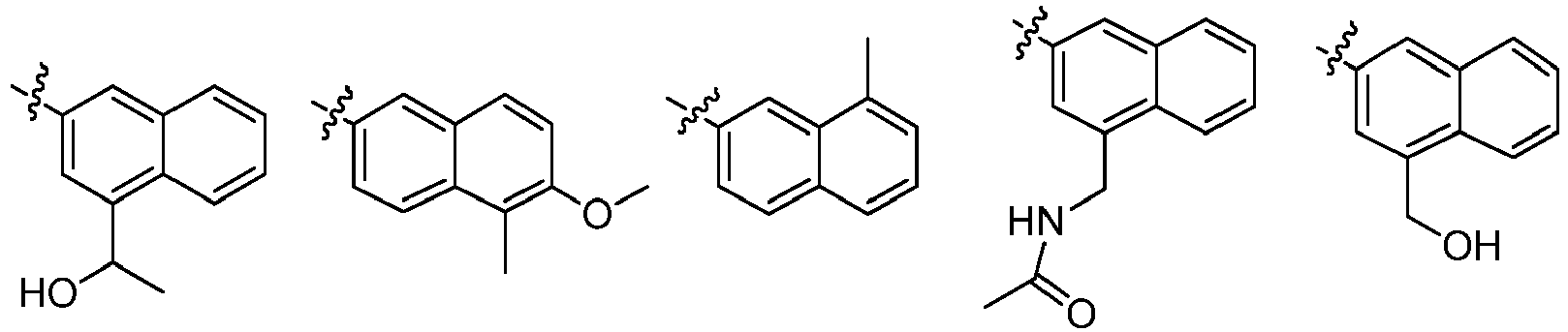



- In one embodiment: R1 is a carbon-linked piperazine ring that is substituted with one or more groups independently selected from the group consisting of C1-6alkyl, C2-6alkenyl, C2-6alkynyl, C3-8carbocycle, 3-8 membered heterocycle, aryl, heteroaryl, halo, -NO2, -N(Rb)2, -CN, -C(O)-N(Rb)2, -S(O)-N(Rb)2, -S(O)2-N(Rb)2, -O-Rb, -S-Rb, -O-C(O)-Rb, -C(O)-Rb, -C(O)-ORb, -S(O)-Rb, -S(O)2-Rb, -N(Rb)-C(O)-Rb, -N(Rb)-S(O)-Rb, -N(Rb)-C(O)-N(Rb)2, and -N(Rb)-S(O)2-Rb; wherein each C1-6alkyl, C2-6alkenyl, C2-6alkynyl, C3-8carbocycle, 3-8 membered heterocycle, aryl, and heteroaryl is optionally substituted with one or more groups independently selected from the group consisting of halo, -NO2-N(Rb)2, -CN, -C(O)-N(Rb)2, -S(O)-N(Rb)2, -S(O)2-N(Rb)2, -O-Rb, -S-Rb, -O-C(O)-Rb, -C(O)-Rb, -C(O)-ORb, -S(O)-Rb, -S(O)2-Rb, -N(Rb)-C(O)-Rb, -N(Rb)-S(O)-Rb, -N(Rb)-C(O)-N(Rb)2, -N(Rb)-S(O)2-Rb, and C1-6alkyl that is optionally substituted with one or more groups independently selected from halo; and
- R2 is a ring selected from the group consisting of:





- In one embodiment: R1 is selected from the group consisting of:
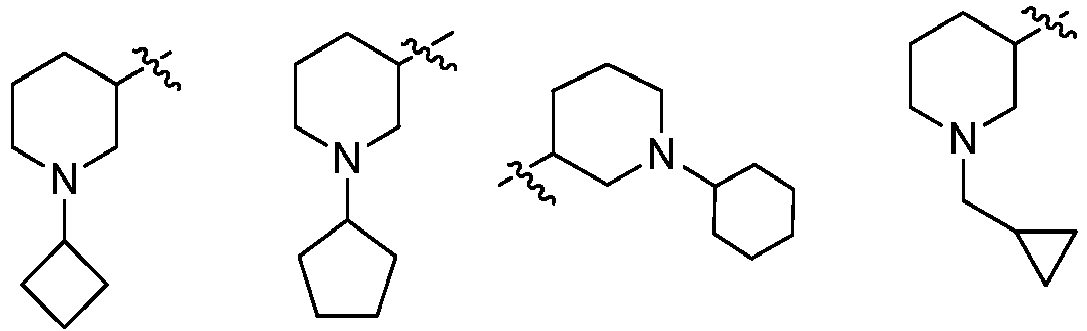


- R2 is a ring selected from the group consisting of:

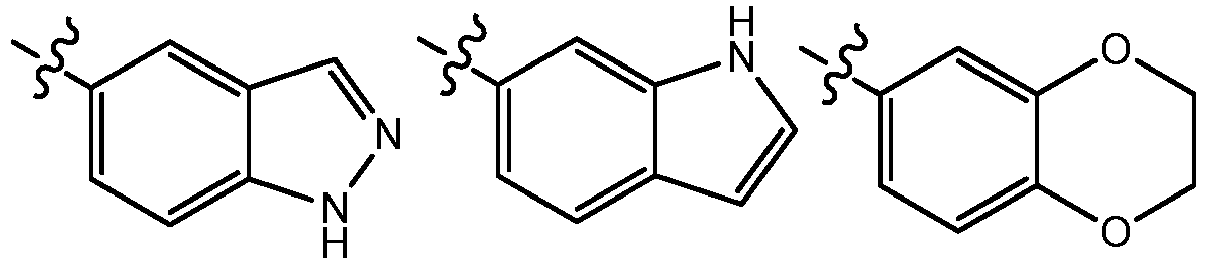


- In one embodiment: R1 is selected from the group consisting of:


- R2 is a ring selected from the group consisting of:

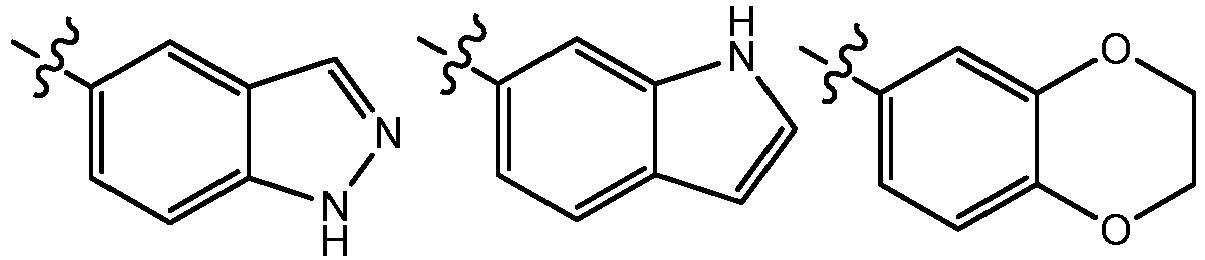


- In one embodiment: R1 is a carbon-linked piperazine ring that is substituted with one or more groups independently selected from the group consisting of C1-6alkyl, C2-6alkenyl, C2-6alkynyl, C3-8carboccle, 3-8 membered heterocycle, aryl, heteroaryl, halo, -NO2, -N(Rb)2, -CN, -C(O)-N(Rb)2, -S(O)-N(Rb)2, -S(O)2-N(Rb)2, -O-Rb, -S-Rb, -O-C(O)-Rb, -C(O)-Rb, -C(O)-ORb, -S(O)-Rb, -S(O)2-Rb, -N(Rb)-C(O)-Rb, -N(Rb)-S(O)-Rb, -N(Rb)-C(O)-N(Rb)2, and -N(Rb)-S(O)2-Rb; wherein each C1-6alkyl, C2-6alkenyl, C2-6alkynyl, C3-8carbocycle, 3-8 membered heterocycle, aryl, and heteroaryl is optionally substituted with one or more groups independently selected from the group consisting of halo, -NO2-N(Rb)2, -CN, -C(O)-N(Rb)2, -S(O)-N(Rb)2, -S(O)2-N(Rb)2, -O-Rb, -S-Rb, -O-C(O)-Rb, -C(O)-Rb, -C(O)-ORb, -S(O)-Rb, -S(O)2-Rb, -N(Rb)-C(O)-Rb, -N(Rb)-S(O)-Rb, -N(Rb)-C(O)-N(Rb)2, -N(Rb)-S(O)2-Rb, and C1-6alkyl that is optionally substituted with one or more groups independently selected from halo; and
- R2 is selected from the group consisting of:


- In one embodiment: R1 is selected from the group consisting of:


- R2 is selected from the group consisting of:


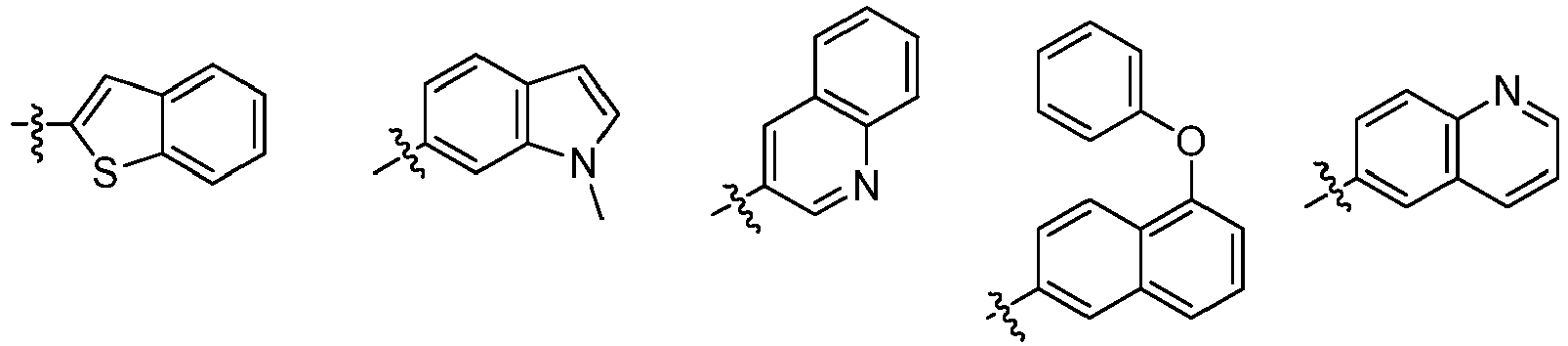





- In one embodiment: R1 is selected from the group consisting of:


- R2 is selected from the group consisting of:




- In one embodiment the compound is selected from the group consisting of:






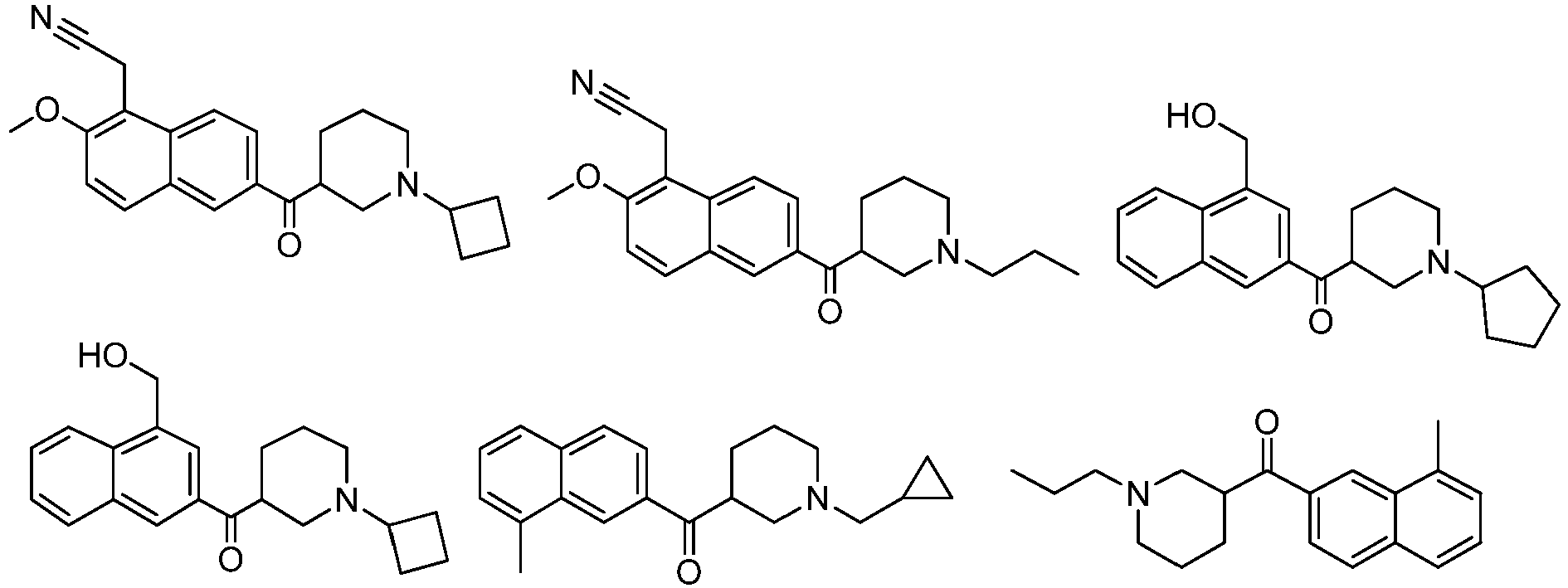





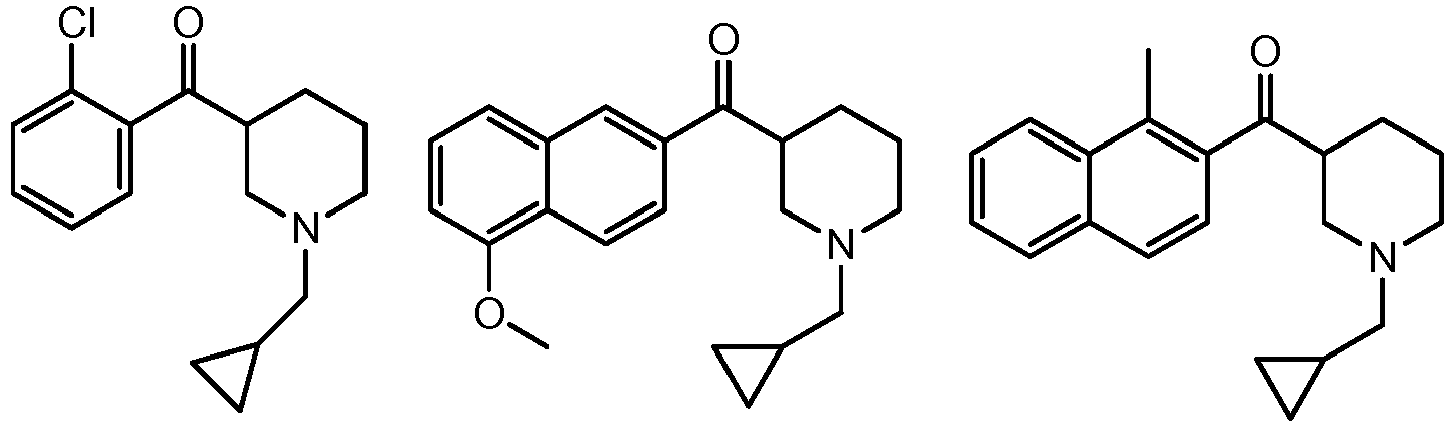

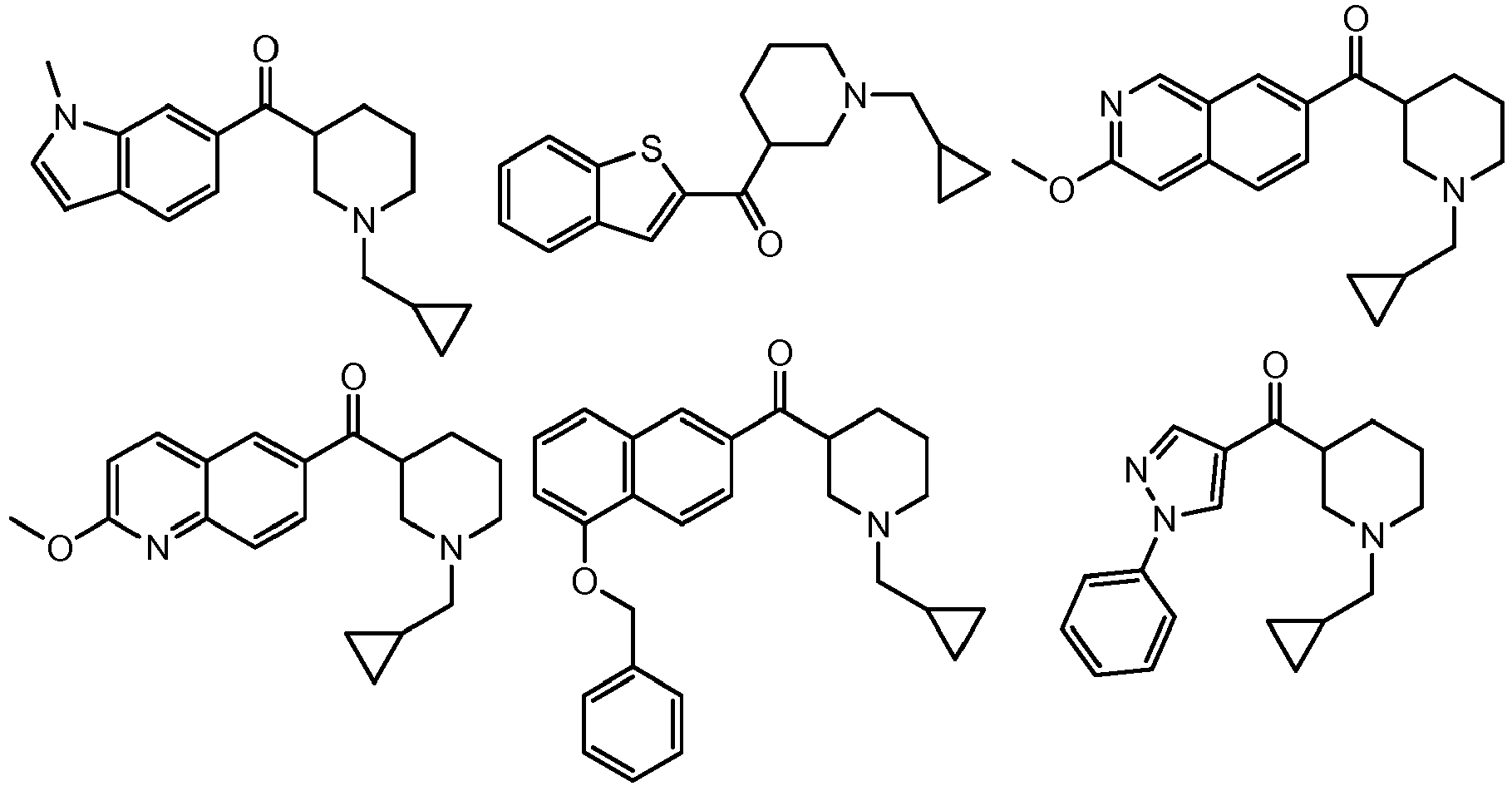


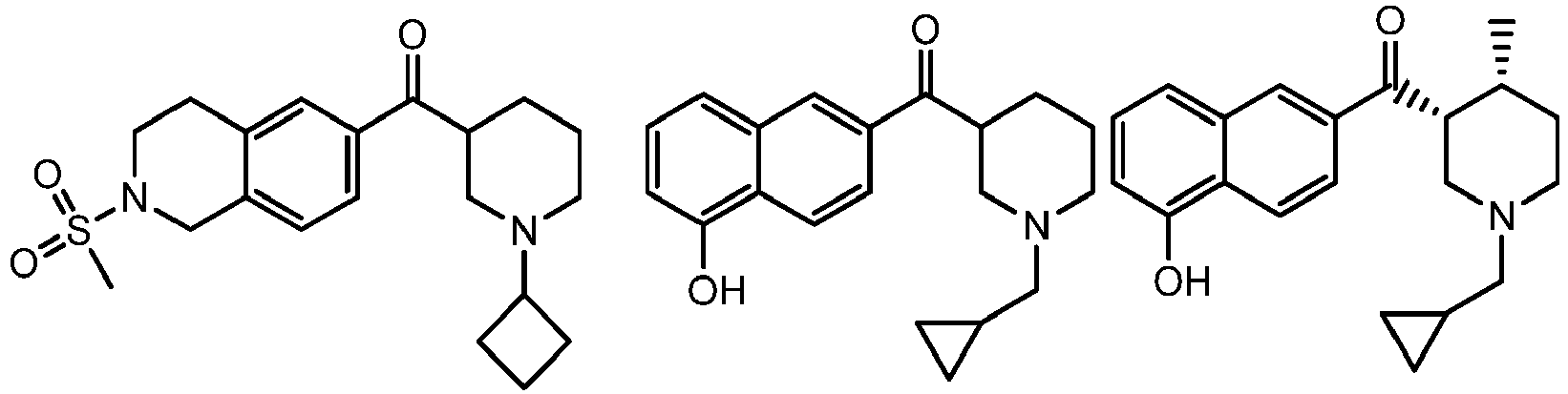


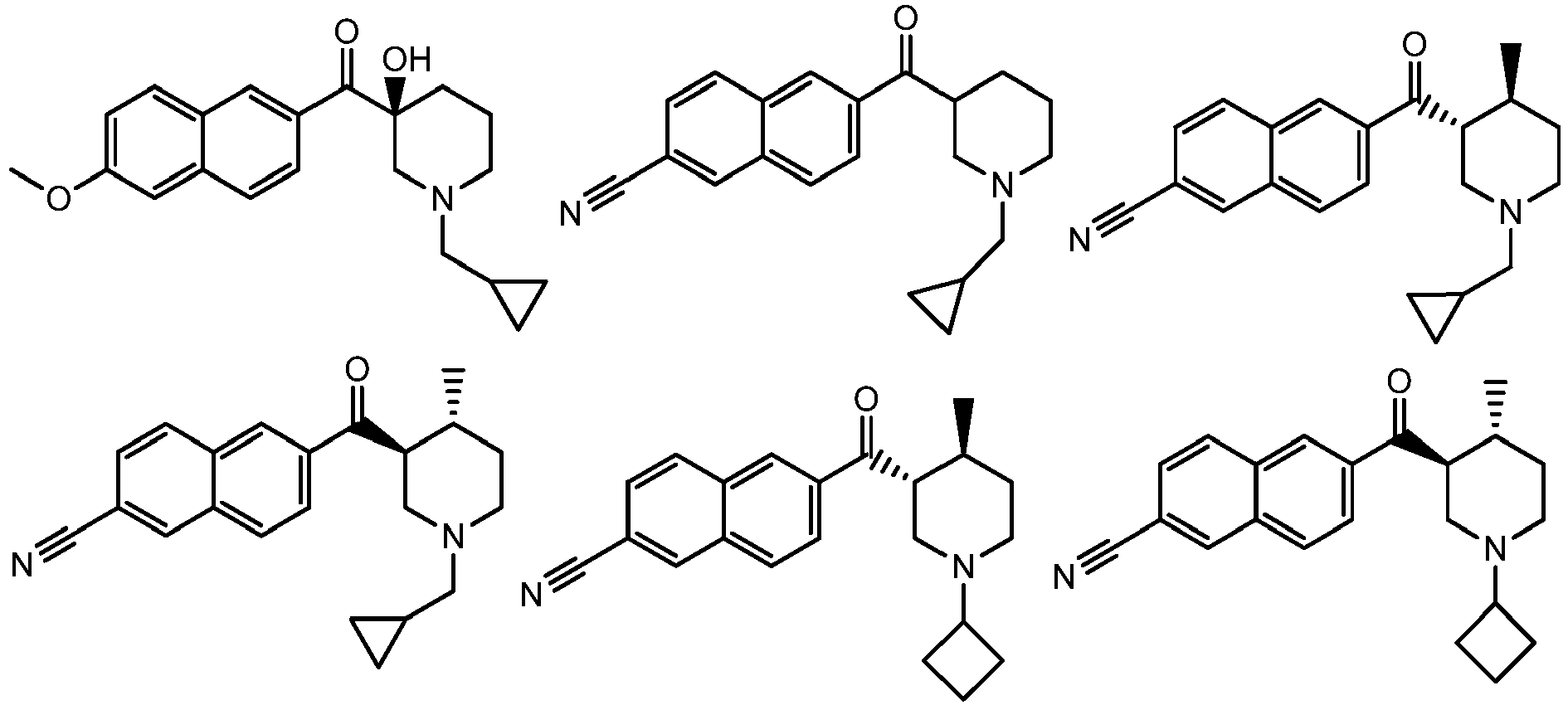


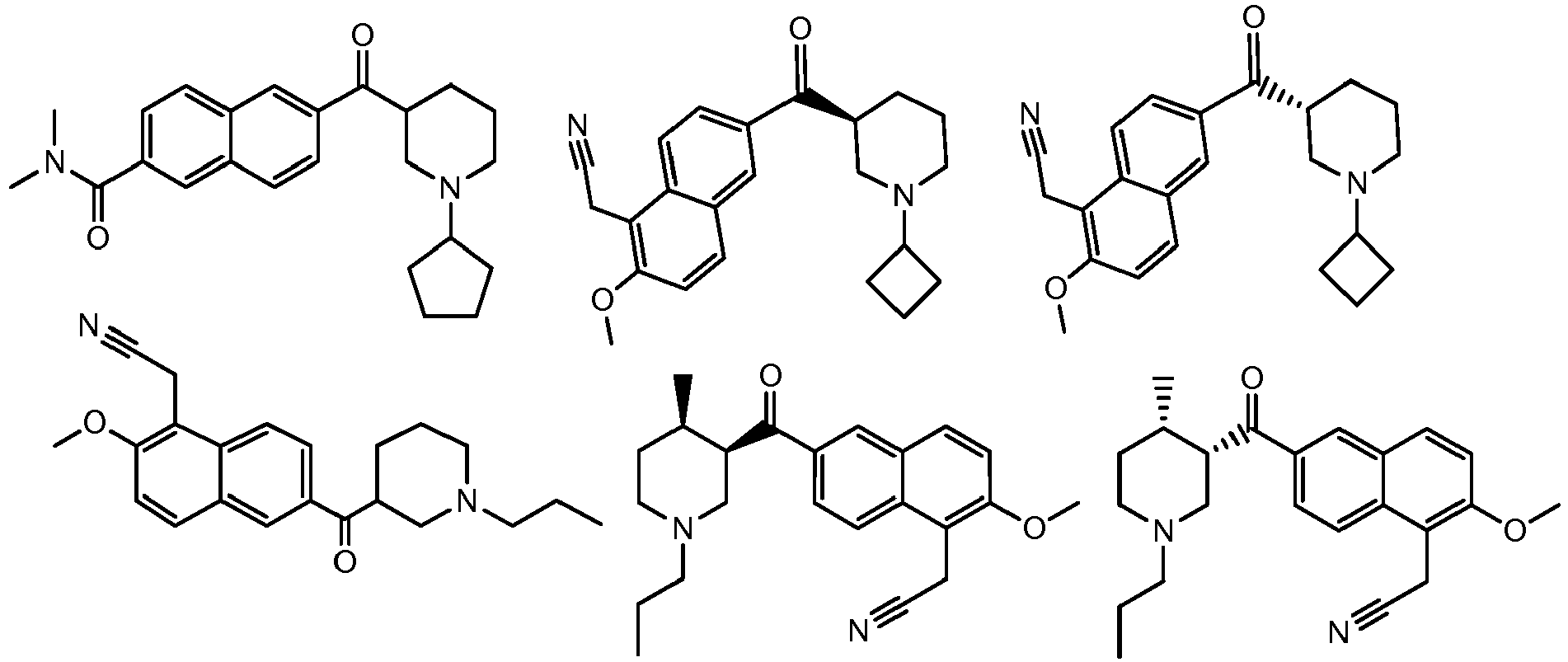


- Another aspect includes a pharmaceutical composition comprising a compound as described herein or a pharmaceutically acceptable salt thereof. In one embodiment, the composition further comprises a pharmaceutically acceptable carrier, adjuvant, or vehicle. In another embodiment, the composition further comprises an amount of the compound effective to measurably inhibit KDM2b. In certain embodiments, the composition is formulated for administration to a patient in need thereof.
- The term "patient" or "individual" as used herein, refers to an animal, such as a mammal, such as a human. In one embodiment, patient or individual refers to a human.
- The term "pharmaceutically acceptable carrier, adjuvant, or vehicle" refers to a non-toxic carrier, adjuvant, or vehicle that does not destroy the pharmacological activity of the compound with which it is formulated. Pharmaceutically acceptable carriers, adjuvants or vehicles that may be used in the compositions of this invention include, but are not limited to, ion exchangers, alumina, aluminum stearate, lecithin, serum proteins, such as human serum albumin, buffer substances such as phosphates, glycine, sorbic acid, potassium sorbate, partial glyceride mixtures of saturated vegetable fatty acids, water, salts or electrolytes, such as protamine sulfate, disodium hydrogen phosphate, potassium hydrogen phosphate, sodium chloride, zinc salts, colloidal silica, magnesium trisilicate, polyvinyl pyrrolidone, cellulose-based substances, polyethylene glycol, sodium carboxymethylcellulose, polyacrylates, waxes, polyethylene-polyoxypropylene-block polymers, polyethylene glycol and wool fat.
- Compositions comprising a compound as described herein may be administered orally, parenterally, by inhalation spray, topically, transdermally, rectally, nasally, buccally, sublingually, vaginally, intraperitoneal, intrapulmonary, intradermal, epidural or via an implanted reservoir. The term "parenteral" as used herein includes subcutaneous, intravenous, intramuscular, intra-articular, intra-synovial, intrasternal, intrathecal, intrahepatic, intralesional and intracranial injection or infusion techniques.
- In one embodiment, the composition comprising a compound as described herein is formulated as a solid dosage form for oral administration. Solid dosage forms for oral administration include capsules, tablets, pills, powders, and granules. In certain embodiments, the solid oral dosage form comprising a compound as described herein further comprises one or more of (i) an inert, pharmaceutically acceptable excipient or carrier, such as sodium citrate or dicalcium phosphate, and (ii) filler or extender such as starches, lactose, sucrose, glucose, mannitol, or silicic acid, (iii) binders such as carboxymethylcellulose, alginates, gelatin, polyvinylpyrrolidinone, sucrose or acacia, (iv) humectants such as glycerol, (v) disintegrating agent such as agar, calcium carbonate, potato or tapioca starch, alginic acid, certain silicates or sodium carbonate, (vi) solution retarding agents such as paraffin, (vii) absorption accelerators such as quaternary ammonium salts, (viii) a wetting agent such as cetyl alcohol or glycerol monostearate, (ix) absorbent such as kaolin or bentonite clay, and (x) lubricant such as talc, calcium stearate, magnesium stearate, polyethylene glycols or sodium lauryl sulfate. In certain embodiments, the solid oral dosage form is formulated as capsules, tablets or pills. In certain embodiments, the solid oral dosage form further comprises buffering agents. In certain embodiments, such compositions for solid oral dosage forms may be formulated as fillers in soft and hard-filled gelatin capsules comprising one or more excipients such as lactose or milk sugar, polyethylene glycols and the like.
- In certain embodiments, tablets, dragees, capsules, pills and granules of the compositions comprising a compound as described herein optionally comprise coatings or shells such as enteric coatings. They may optionally comprise opacifying agents and can also be of a composition that they release the active ingredient(s) only, or preferentially, in a certain part of the intestinal tract, optionally, in a delayed manner. Examples of embedding compositions include polymeric substances and waxes, which may also be employed as fillers in soft and hard-filled gelatin capsules using such excipients as lactose or milk sugar as well as high molecular weight polethylene glycols and the like.
- In another embodiment, a composition comprises micro-encapsulated compound as described herein, and optionally, further comprises one or more excipients.
- In another embodiment, compositions comprise liquid dosage formulations comprising a compound as described herein for oral administration, and optionally further comprise one or more of pharmaceutically acceptable emulsions, microemulsions, solutions, suspensions, syrups and elixirs. In certain embodiments, the liquid dosage form optionally, further comprise one or more of an inert diluent such as water or other solvent, a solubilizing agent, and an emulsifier such as ethyl alcohol, isopropyl alcohol, ethyl carbonate, ethyl acetate, benzyl alcohol, benzyl benzoate, propylene glycol, 1,3-butylene glycol, dimethylformamide, oils (in particular, cottonseed, groundnut, corn, germ, olive, castor, and sesame oils), glycerol, tetrahydrofurfuryl alcohol, polyethylene glycols or fatty acid esters of sorbitan, and mixtures thereof. In certain embodiments, liquid oral compositions optionally further comprise one or more adjuvant, such as a wetting agent, a suspending agent, a sweetening agent, a flavoring agent and a perfuming agent.
- Injectable preparations, for example, sterile injectable aqueous or oleaginous suspensions may be formulated according to the known art using suitable dispersing or wetting agents and suspending agents. The sterile injectable preparation may also be a sterile injectable solution, suspension or emulsion in a nontoxic parenterally acceptable diluent or solvent, for example, as a solution in 1,3-butanediol. Among the acceptable vehicles and solvents that may be employed are water, Ringer's solution, U.S.P. and isotonic sodium chloride solution. In addition, sterile, fixed oils are conventionally employed as a solvent or suspending medium. For this purpose any bland fixed oil can be employed including synthetic mono- or diglycerides. In addition, fatty acids such as oleic acid are used in the preparation of injectables.
- Injectable formulations can be sterilized, for example, by filtration through a bacterial-retaining filter, or by incorporating sterilizing agents in the form of sterile solid compositions which can be dissolved or dispersed in sterile water or other sterile injectable medium prior to use.
- In order to prolong the effect of a compound as described herein, it may be desirable to slow the absorption of the compound from subcutaneous or intramuscular injection. This may be accomplished by the use of a liquid suspension of crystalline or amorphous material with poor water solubility. The rate of absorption of the compound then depends upon its rate of dissolution that, in turn, may depend upon crystal size and crystalline form. Alternatively, delayed absorption of a parenterally administered compound form is accomplished by dissolving or suspending the compound in an oil vehicle. Injectable depot forms are made by forming microencapsule matrices of the compound in biodegradable polymers such as polylactide-polyglycolide. Depending upon the ratio of compound to polymer and the nature of the particular polymer employed, the rate of compound release can be controlled. Examples of other biodegradable polymers include poly(orthoesters) and poly(anhydrides). Depot injectable formulations are also prepared by entrapping the compound in liposomes or microemulsions that are compatible with body tissues.
- In certain embodiments, the composition for rectal or vaginal administration are formulated as suppositories which can be prepared by mixing a compound as described herein with suitable non-irritating excipients or carriers such as cocoa butter, polyethylene glycol or a suppository wax, for example those which are solid at ambient temperature but liquid at body temperature and therefore melt in the rectum or vaginal cavity and release the compound.
- Example dosage forms for topical or transdermal administration of a compound as described herein include ointments, pastes, creams, lotions, gels, powders, solutions, sprays, inhalants or patches. The compound as described herein is admixed under sterile conditions with a pharmaceutically acceptable carrier, and optionally preservatives or buffers. Additional formulation examples include an ophthalmic formulation, ear drops, eye drops,. transdermal patches. Transdermal dosage forms can be made by dissolving or dispensing the compound as described herein in medium, for example ethanol or dimethylsulfoxide. Absorption enhancers can also be used to increase the flux of the compound across the skin. The rate can be controlled by either providing a rate controlling membrane or by dispersing the compound in a polymer matrix or gel.
- Nasal aerosol or inhalation formulations of a compound as described herein may be prepared as solutions in saline, employing benzyl alcohol or other suitable preservatives, absorption promotors to enhance bioavailability, fluorocarbons, and/or other conventional solubilizing or dispersing agents.
- In certain embodiments, pharmaceutical compositions may be administered with or without food. In certain embodiments, pharmaceutically acceptable compositions are administered without food. In certain embodiments, pharmaceutically acceptable compositions of this invention are administered with food.
- Specific dosage and treatment regimen for any particular patient will depend upon a variety of factors, including age, body weight, general health, sex, diet, time of administration, rate of excretion, drug combination, the judgment of the treating physician, and the severity of the particular disease being treated. The amount of a compound as described herein in the composition will also depend upon the particular compound in the composition.
- In one embodiment, the therapeutically effective amount of the compound of the invention administered parenterally per dose will be in the range of about 0.01-100 mg/kg, alternatively about 0.1 to 20 mg/kg of patient body weight per day, with the typical initial range of compound used being 0.3 to 15 mg/kg/day. In another embodiment, oral unit dosage forms, such as tablets and capsules, contain from about 5 to about 100 mg of the compound of the invention.
- An example tablet oral dosage form comprises about 2 mg, 5 mg, 25 mg, 50 mg, 100 mg, 250 mg or 500 mg of a compound as described herein, and further comprises about 95-30 mg anhydrous lactose, about 5-40 mg sodium croscarmellose, about 5-30 mg polyvinylpyrrolidone (PVP) K30 and about 1-10 mg magnesium stearate. The process of formulating the tablet comprises mixing the powdered ingredients together and further mixing with a solution of the PVP. The resulting composition can be dried, granulated, mixed with the magnesium stearate and compressed to tablet form using conventional equipment. An example of an aerosol formulation can be prepared by dissolving about 2-500 mg of a compound as described herein, in a suitable buffer solution, e.g. a phosphate buffer, and adding a tonicifier, e.g. a salt such sodium chloride, if desired. The solution may be filtered, e.g. using a 0.2 micron filter, to remove impurities and contaminants.
- Another aspect includes a compound as described herein for use in the inhibition of KDM2b. Compounds as described herein may also be useful to inhibit the removal of methyl marks on histone lysine residues, including inhibiting the removal of methyl marks from mono-, di- or tri-methylation of histones HI, H2A, H2B, H3 and H4, such as H3K36 (including for example the KDM2b substrate H3K36me2), thereby altering interactions of these histone proteins with DNA and/or other proteins, and altering certain subsequent genetic or protein expression. Compounds as described herein may also be useful to inhibit KDM2b and reduce the activity of a cancer stem/progenitor cell population and/or deplete a cancer stem/progenitor cell population.
- The binding or inhibition activity of a compound as described herein may be determined by running a competition experiment where the compound is incubated with the KDM2b enzyme bound to known radioligands. Detailed conditions for assaying a compound as an inhibitor of KDM2b or a mutant thereof are set forth in the Examples below.
- Detection of KDM2b activity is achieved with in vitro assays, which can be either direct binding (non-catalytic) or enzymatic (catalytic) asssays. Types of substrates that are used in such assays may include: short synthetic peptides corresponding to a number of residues from the N-terminus of histone sequences comprising the target lysine residue, single recombinant histone polypeptides, histone octamers reconstituted with recombinant histone proteins, and reconstituted nucleosomes (using reconstituted octamers and specific recombinant DNA fragments). The reconstituted nucleosomes may be mononucleosomes or oligonucleosomes.
- Another aspect includes a compound as described herein for use in therapy. Another aspect includes a pharmaceutical composition comprising a compound as described herein for use in therapy.
- Another aspect includes a compound as described herein for use in treating a disease associated with KDM2b activity. Another aspect includes a pharmaceutical composition comprising a compound as described herein for use in treating a disease associated with KDM2b activity.
- In certain embodiments, the disease or condition is a hyperproliferative disease, cancer, stroke, diabetes, hepatomegaly, cardiovascular disease, multiple sclerosis, Alzheimer's disease, cystic fibrosis, viral disease, autoimmune diseases, atherosclerosis, restenosis, psoriasis, rheumatoid arthritis, inflammatory bowel disease, asthma, allergic disorders, inflammation, neurological disorders, a hormone-related disease, conditions associated with organ transplantation, immunodeficiency disorders, destructive bone disorders, proliferative disorders, infectious diseases, conditions associated with cell death, thrombin-induced platelet aggregation, liver disease, pathologic immune conditions involving T cell activation, CNS disorders or a myeloproliferative disorder.
- In certain embodiments, treatment may be administered after one or more symptoms have developed. In other embodiments, treatment may be administered in the absence of symptoms. For example, treatment may be administered to a susceptible individual prior to the onset of symptoms (e.g., in light of a history of symptoms and/or in light of genetic or other susceptibility factors). Treatment may also be continued after symptoms have resolved, for example to prevent or delay their recurrence.
- Another aspect includes a compound as described herein for use in the treatment, amelioration or prevention of cancer, drug-resistant cancer or another proliferative disorder in a mammal, for example a human, in need of such treatment. In certain embodiments, the disease to be treated is cancer.
- Examples of cancers that may be treated using the compounds described herein include, but are not limited to, adrenal cancer, acinic cell carcinoma, acoustic neuroma, acral lentigious melanoma, acrospiroma, acute eosinophilic leukemia, acute erythroid leukemia, acute lymphoblastic leukemia, acute megakaryoblastic leukemia, acute monocytic leukemia, acute promyelocytic leukemia, adenocarcinoma, adenoid cystic carcinoma, adenoma, adenomatoid odontogenic tumor, adenosquamous carcinoma, adipose tissue neoplasm, adrenocortical carcinoma, adult T-cell leukemia/lymphoma, aggressive NK-cell leukemia, AIDS-related lymphoma, alveolar rhabdomyosarcoma, alveolar soft part sarcoma, ameloblastic fibroma, anaplastic large cell lymphoma, anaplastic thyroid cancer, androgen dependent cancer, angioimmunoblastic T-cell lymphoma, angiomyolipoma, angiosarcoma, astrocytoma, atypical teratoid rhabdoid tumor, B-cell chronic lymphocytic leukemia, B-cell lymphoma, basal cell carcinoma, biliary tract cancer, bladder cancer, blastoma, bone cancer, Brenner tumor, Brown tumor, Burkitt's lymphoma, breast cancer_(e.g., triple negative-breast cancer), brain cancer, carcinoma, carcinoma in situ, carcinosarcoma, cartilage tumor, cementoma, myeloid sarcoma, chondroma, chordoma, choriocarcinoma, choroid plexus papilloma, clear-cell sarcoma of the kidney, craniopharyngioma, cutaneous T-cell lymphoma, cervical cancer, colorectal cancer, Degos disease, desmoplastic small round cell tumor, diffuse large B-cell lymphoma, dysembryoplastic neuroepithelial tumor, dysgerminoma, embryonal carcinoma, endocrine gland neoplasm, endodermal sinus tumor, enteropathy-associated T-cell lymphoma, esophageal cancer, fetus in fetu, fibroma, fibrosarcoma, follicular lymphoma, follicular thyroid cancer, ganglioneuroma, gastrointestinal cancer, germ cell tumor, gestational choriocarcinoma, giant cell fibroblastoma, giant cell tumor of the bone, glial tumor, glioblastoma multiforme, glioma, gliomatosis cerebri, glucagonoma, gonadoblastoma, granulosa cell tumor, gynandroblastoma, gallbladder cancer, gastric cancer, hemangioblastoma, head and neck cancer, hemangiopericytoma, hematological malignancy, hepatoblastoma, hepatosplenic T-cell lymphoma, Hodgkin's lymphoma, non-Hodgkin's lymphoma, invasive lobular carcinoma, intestinal cancer, kidney cancer, laryngeal cancer, lentigo maligna, leukemia, leydig cell tumor, liposarcoma, lung cancer, lymphangioma, lymphangiosarcoma, lymphoepithelioma, lymphoma, acute lymphocytic leukemia (e.g., T-cell or B-cell), acute myelogeous leukemia, chronic lymphocytic leukemia, liver cancer, small cell lung cancer, non-small cell lung cancer, MALT lymphoma, malignant fibrous histiocytoma, malignant peripheral nerve sheath tumor, malignant triton tumor, mantle cell lymphoma, marginal zone B-cell lymphoma, mast cell leukemia, mediastinal germ cell tumor, medullary carcinoma of the breast, medullary thyroid cancer, medulloblastoma, melanoma, meningioma, merkel cell cancer, mesothelioma, metastatic urothelial carcinoma, mixed Mullerian tumor, mucinous tumor, multiple myeloma, muscle tissue neoplasm, acute myeloid leukemia, chronic myeloid leukemia, mycosis fungoides, myxoid liposarcoma, myxoma, myxosarcoma, nasopharyngeal carcinoma, neurinoma, neuroblastoma, neurofibroma, neuroma, nodular melanoma, ocular cancer, oligoastrocytoma, oligodendroglioma, oncocytoma, optic nerve sheath meningioma, optic nerve tumor, oral cancer, osteosarcoma, ovarian cancer, Pancoast tumor, papillary thyroid cancer, paraganglioma, pinealoblastoma, pineocytoma, pituicytoma, pituitary adenoma, pituitary tumor, plasmacytoma, polyembryoma, precursor T-lymphoblastic lymphoma, primary central nervous system lymphoma, primary effusion lymphoma, preimary peritoneal cancer, prostate cancer, pancreatic cancer, pharyngeal cancer, pseudomyxoma periotonei, renal cell carcinoma, renal medullary carcinoma, retinoblastoma, rhabdomyoma, rhabdomyosarcoma, Richter's transformation, rectal cancer, sarcoma, Schwannomatosis, seminoma, Sertoli cell tumor, sex cord-gonadal stromal tumor, signet ring cell carcinoma, skin cancer, small blue round cell tumors, small cell carcinoma, soft tissue sarcoma, somatostatinoma, soot wart, spinal tumor, splenic marginal zone lymphoma, squamous cell carcinoma, synovial sarcoma, Sezary's disease, small intestine cancer, stomach cancer, T-cell lymphoma, testicular cancer, thecoma, thyroid cancer, transitional cell carcinoma, throat cancer, urachal cancer, urogenital cancer, urothelial carcinoma, uveal melanoma, uterine cancer, verrucous carcinoma, visual pathway glioma, vulvar cancer, vaginal cancer, Waldenstrom's macroglobulinemia, Warthin's tumor and Wilms' tumor.
- Another embodiment includes a compound as described herein for use in the treatment of benign proliferative disorders. Examples of benign proliferative disorders include, but are not limited to, benign soft tissue tumors, bone tumors, brain and spinal tumors, eyelid and orbital tumors, granuloma, lipoma, meningioma, multiple endocrine neoplasia, nasal polyps, pituitary tumors, prolactinoma, pseudotumor cerebri, seborrheic keratoses, stomach polyps, thyroid nodules, cystic neoplasms of the pancreas, hemangiomas, vocal cord nodules, polyps, and cysts, Castleman disease, chronic pilonidal disease, dermatofibroma, pilar cyst, pyogenic granuloma and juvenile polyposis syndrome.
- Another embodiment includes a compound as described herein for use in modulating protein methylation, gene expression, cell proliferation, cell differentiation and/or apoptosis in vivo in diseases mentioned above, in particular cancer.
- Another embodiment includes a compound as described herein for use in regulating endogenous or heterologous promotor activity by contacting a cell.
- Another embodiment includes the use of a compound as described herein for the production of pharmaceutical compositions which are employed for the treatment and/or prophylaxis and/or amelioration of the diseases, disorders, illnesses and/or conditions as mentioned herein.
- Another embodiment includes the use of a compound as described herein for the production of pharmaceutical compositions which are employed for the treatment and/or prophylaxis of diseases and/or disorders responsive or sensitive to the inhibition of histone demethylases, particularly those diseases mentioned above, such as e.g. cancer.
- Compounds as described herein may be administered using any amount and any route of administration effective for treating or lessening the severity of the disorder. The exact amount required will vary from patient to patient, depending on the species, age, and general condition of the patient, for example the severity of the disorder, the particular compound, its mode of administration, and the like. The total daily usage of a compound as described herein by a given patient will be decided by the attending physician within the scope of sound medical judgment. The specific effective dose level for any particular patient will depend upon a variety of factors including the disorder being treated and the severity of the disorder; the activity of the specific compound employed; the specific composition employed; the age, body weight, general health, sex and diet of the patient; the time of administration, route of administration, and rate of excretion of the specific compound employed; the duration of the treatment; drugs used in combination or coincidental with the specific compound employed, and like factors well known in the medical arts.
- Another embodiment includes an in vitro method of inhibiting KDM2b activity in a biological sample comprising contacting said biological sample with a compound as described herein.
- The term "biological sample", as used herein, includes, without limitation, a cell, cell cultures or extracts thereof; biopsied material obtained from a mammal or extracts thereof; and blood, saliva, urine, feces, semen, tears, or other body fluids or extracts thereof.
- The compound as described herein may be employed alone or in combination with other agents for treatment. For example, the second agent of the pharmaceutical combination formulation or dosing regimen may have complementary activities to the compound as described herein such that they do not adversely affect each other. The compounds may be administered together in a unitary pharmaceutical composition or separately. In one embodiment a compound or a pharmaceutically acceptable salt can be co-administered with a cytotoxic agent to treat proliferative diseases and cancer.
- The term "co-administering" refers to either simultaneous administration, or any manner of separate sequential administration, of a compound as described herein, and a further active pharmaceutical ingredient or ingredients, including cytotoxic agents and radiation treatment. If the administration is not simultaneous, the compounds are administered in a close time proximity to each other. Furthermore, it does not matter if the compounds are administered in the same dosage form, e.g. one compound may be administered topically and another compound may be administered orally.
- Typically, any agent that has activity against a disease or condition being treated may be co-administered. Examples of such agents can be found in Cancer Principles and Practice of Oncology by V.T. Devita and S. Hellman (editors), 6th edition (February 15, 2001), Lippincott Williams & Wilkins Publishers. A person of ordinary skill in the art would be able to discern which combinations of agents would be useful based on the particular characteristics of the drugs and the disease involved.
- In one embodiment, the treatment includes the co-administration of a compound as described herein and at least one cytotoxic agent. The term "cytotoxic agent" as used herein refers to a substance that inhibits or prevents a cellular function and/or causes cell death or destruction. Cytotoxic agents include, but are not limited to, radioactive isotopes (e.g., At211, I131, I125, Y90, Re186, Re188, Sm153, Bi212, P32, Pb212 and radioactive isotopes of Lu); chemotherapeutic agents; growth inhibitory agents; enzymes and fragments thereof such as nucleolytic enzymes; and toxins such as small molecule toxins or enzymatically active toxins of bacterial, fungal, plant or animal origin, including fragments and/or variants thereof.
- Exemplary cytotoxic agents can be selected from anti-microtubule agents, platinum coordination complexes, alkylating agents, antibiotic agents, topoisomerase II inhibitors, antimetabolites, topoisomerase I inhibitors, hormones and hormonal analogues, signal transduction pathway inhibitors, non-receptor tyrosine kinase angiogenesis inhibitors, immunotherapeutic agents, proapoptotic agents, inhibitors of LDH-A; inhibitors of fatty acid biosynthesis; cell cycle signaling inhibitors; HDAC inhibitors, proteasome inhibitors; and inhibitors of cancer metabolism.
- "Chemotherapeutic agent" includes chemical compounds useful in the treatment of cancer. Examples of chemotherapeutic agents include erlotinib (TARCEVA®, Genentech/OSI Pharm.), bortezomib (VELCADE®, Millennium Pharm.), disulfiram , epigallocatechin gallate , salinosporamide A, carfilzomib, 17-AAG(geldanamycin), radicicol, lactate dehydrogenase A (LDH-A), fulvestrant (FASLODEX®, AstraZeneca), sunitib (SUTENT®, Pfizer/Sugen), letrozole (FEMARA®, Novartis), imatinib mesylate (GLEEVEC®., Novartis), finasunate (VATALANIB®, Novartis), oxaliplatin (ELOXATIN®, Sanofi), 5-FU (5-fluorouracil), leucovorin, Rapamycin (Sirolimus, RAPAMUNE®, Wyeth), Lapatinib (TYKERB®, GSK572016, Glaxo Smith Kline), Lonafamib (SCH 66336), sorafenib (NEXAVAR®, Bayer Labs), gefitinib (IRESSA®, AstraZeneca), AG1478, alkylating agents such as thiotepa and CYTOXAN® cyclosphosphamide; alkyl sulfonates such as busulfan, improsulfan and piposulfan; aziridines such as benzodopa, carboquone, meturedopa, and uredopa; ethylenimines and methylamelamines including altretamine, triethylenemelamine, triethylenephosphoramide, triethylenethiophosphoramide and trimethylomelamine; acetogenins (especially bullatacin and bullatacinone); a camptothecin (including topotecan and irinotecan); bryostatin; callystatin; CC-1065 (including its adozelesin, carzelesin and bizelesin synthetic analogs); cryptophycins (particularly cryptophycin 1 and cryptophycin 8); adrenocorticosteroids (including prednisone and prednisolone); cyproterone acetate; 5α-reductases including finasteride and dutasteride); vorinostat, romidepsin, panobinostat, valproic acid, mocetinostat dolastatin; aldesleukin, talc duocarmycin (including the synthetic analogs, KW-2189 and CB1-TM1); eleutherobin; pancratistatin; a sarcodictyin; spongistatin; nitrogen mustards such as chlorambucil, chlomaphazine, chlorophosphamide, estramustine, ifosfamide, mechlorethamine, mechlorethamine oxide hydrochloride, melphalan, novembichin, phenesterine, prednimustine, trofosfamide, uracil mustard; nitrosoureas such as carmustine, chlorozotocin, fotemustine, lomustine, nimustine, and ranimnustine; antibiotics such as the enediyne antibiotics (e.g., calicheamicin, especially calicheamicin γ1I and calicheamicin ω1I (Angew Chem. Intl. Ed. Engl. 1994 33:183-186); dynemicin, including dynemicin A; bisphosphonates, such as clodronate; an esperamicin; as well as neocarzinostatin chromophore and related chromoprotein enediyne antibiotic chromophores), aclacinomysins, actinomycin, authramycin, azaserine, bleomycins, cactinomycin, carabicin, caminomycin, carzinophilin, chromomycinis, dactinomycin, daunorubicin, detorubicin, 6-diazo-5-oxo-L-norleucine, ADRIAMYCIN® (doxorubicin), morpholino-doxorubicin, cyanomorpholino-doxorubicin, 2-pyrrolino-doxorubicin and deoxydoxorubicin), epirubicin, esorubicin, idarubicin, marcellomycin, mitomycins such as mitomycin C, mycophenolic acid, nogalamycin, olivomycins, peplomycin, porfiromycin, puromycin, quelamycin, rodorubicin, streptonigrin, streptozocin, tubercidin, ubenimex, zinostatin, zorubicin; anti-metabolites such as methotrexate and 5-fluorouracil (5-FU); folic acid analogs such as denopterin, methotrexate, pteropterin, trimetrexate; purine analogs such as fludarabine, 6-mercaptopurine, thiamiprine, thioguanine; pyrimidine analogs such as ancitabine, azacitidine, 6-azauridine, carmofur, cytarabine, dideoxyuridine, doxifluridine, enocitabine, floxuridine; androgens such as calusterone, dromostanolone propionate, epitiostanol, mepitiostane, testolactone; anti-adrenals such as aminoglutethimide, mitotane, trilostane; folic acid replenisher such as frolinic acid; aceglatone; aldophosphamide glycoside; aminolevulinic acid; eniluracil; amsacrine; bestrabucil; bisantrene; edatraxate; defofamine; demecolcine; diaziquone; elfomithine; elliptinium acetate; an epothilone; etoglucid; gallium nitrate; hydroxyurea; lentinan; lonidainine; maytansinoids such as maytansine and ansamitocins; mitoguazone; mitoxantrone; mopidamnol; nitraerine; pentostatin; phenamet; pirarubicin; losoxantrone; podophyllinic acid; 2-ethylhydrazide; procarbazine; PSK® polysaccharide complex (JHS Natural Products, Eugene, Oreg.); razoxane; rhizoxin; sizofuran; spirogermanium; tenuazonic acid; triaziquone; 2,2',2"-trichlorotriethylamine; trichothecenes (especially T-2 toxin, verracurin A, roridin A and anguidine); urethan; vindesine; dacarbazine; mannomustine; mitobronitol; mitolactol; pipobroman; gacytosine; arabinoside ("Ara-C"); cyclophosphamide; thiotepa; taxoids, e.g., TAXOL (paclitaxel; Bristol-Myers Squibb Oncology, Princeton, N.J.), ABRAXANE® (Cremophor-free), albumin-engineered nanoparticle formulations of paclitaxel (American Pharmaceutical Partners, Schaumberg, Ill.), and TAXOTERE® (docetaxel, doxetaxel; Sanofi-Aventis); chloranmbucil; GEMZAR® (gemcitabine); 6-thioguanine; mercaptopurine; methotrexate; platinum analogs such as cisplatin and carboplatin; vinblastine; etoposide (VP-16); ifosfamide; mitoxantrone; vincristine; NAVELBINE® (vinorelbine); novantrone; teniposide; edatrexate; daunomycin; aminopterin; capecitabine (XELODA®); ibandronate; CPT-11; topoisomerase inhibitor RFS 2000; difluoromethylornithine (DMFO); retinoids such as retinoic acid; and pharmaceutically acceptable salts, acids and derivatives of any of the above.
- Chemotherapeutic agent also includes (i) anti-hormonal agents that act to regulate or inhibit hormone action on tumors such as anti-estrogens and selective estrogen receptor modulators (SERMs), including, for example, tamoxifen (including NOLVADEX®; tamoxifen citrate), raloxifene, droloxifene, iodoxyfene , 4-hydroxytamoxifen, trioxifene, keoxifene, LY117018, onapristone, and FARESTON® (toremifine citrate); (ii) aromatase inhibitors that inhibit the enzyme aromatase, which regulates estrogen production in the adrenal glands, such as, for example, 4(5)-imidazoles, aminoglutethimide, MEGASE® (megestrol acetate), AROMASIN® (exemestane; Pfizer), formestanie, fadrozole, RIVISOR® (vorozole), FEMARA® (letrozole; Novartis), and ARIMIDEX® (anastrozole; AstraZeneca); (iii) anti-androgens such as flutamide, nilutamide, bicalutamide, leuprolide and goserelin; buserelin, tripterelin, medroxyprogesterone acetate, diethylstilbestrol, premarin, fluoxymesterone, all transretionic acid, fenretinide, as well as troxacitabine (a 1,3-dioxolane nucleoside cytosine analog); (iv) protein kinase inhibitors; (v) lipid kinase inhibitors; (vi) antisense oligonucleotides, particularly those which inhibit expression of genes in signaling pathways implicated in aberrant cell proliferation, such as, for example, PKC-alpha, Ralf and H-Ras; (vii) ribozymes such as VEGF expression inhibitors (e.g., ANGIOZYME®) and HER2 expression inhibitors; (viii) vaccines such as gene therapy vaccines, for example, ALLOVECTIN®, LEUVECTIN®, and VAXID®; PROLEUKIN®, rIL-2; a topoisomerase 1 inhibitor such as LURTOTECAN®; ABARELIX® rmRH; and (ix) pharmaceutically acceptable salts, acids and derivatives of any of the above.
- Chemotherapeutic agent also includes antibodies such as alemtuzumab (Campath), bevacizumab (AVASTIN®, Genentech); cetuximab (ERBITUX®, Imclone); panitumumab (VECTIBIX®, Amgen), rituximab (RITUXAN®, Genentech/Biogen Idec), pertuzumab (OMNITARG®, 2C4, Genentech), trastuzumab (HERCEPTIN®, Genentech), tositumomab (Bexxar, Corixia), and the antibody drug conjugate, gemtuzumab ozogamicin (MYLOTARG®, Wyeth). Additional humanized monoclonal antibodies with therapeutic potential as agents in combination with the compounds of the invention include: apolizumab, aselizumab, atlizumab, bapineuzumab, bivatuzumab mertansine, cantuzumab mertansine, cedelizumab, certolizumab pegol, cidfusituzumab, cidtuzumab, daclizumab, eculizumab, efalizumab, epratuzumab, erlizumab, felvizumab, fontolizumab, gemtuzumab ozogamicin, inotuzumab ozogamicin, ipilimumab, labetuzumab, lintuzumab, matuzumab, mepolizumab, motavizumab, motovizumab, natalizumab, nimotuzumab, nolovizumab, numavizumab, ocrelizumab, omalizumab, palivizumab, pascolizumab, pecfusituzumab, pectuzumab, pexelizumab, ralivizumab, ranibizumab, reslivizumab, reslizumab, resyvizumab, rovelizumab, ruplizumab, sibrotuzumab, siplizumab, sontuzumab, tacatuzumab tetraxetan, tadocizumab, talizumab, tefibazumab, tocilizumab, toralizumab, tucotuzumab celmoleukin, tucusituzumab, umavizumab, urtoxazumab, ustekinumab, visilizumab, and the anti-interleukin-12 (ABT-874/J695, Wyeth Research and Abbott Laboratories) which is a recombinant exclusively human-sequence, full-length IgG1 λ antibody genetically modified to recognize interleukin-12 p40 protein.
- Chemotherapeutic agent also includes "EGFR inhibitors," which refers to compounds that bind to or otherwise interact directly with EGFR and prevent or reduce its signaling activity, and is alternatively referred to as an "EGFR antagonist." Examples of such agents include antibodies and small molecules that bind to EGFR. Examples of antibodies which bind to EGFR include MAb 579 (ATCC CRL HB 8506), MAb 455 (ATCC CRL HB8507), MAb 225 (ATCC CRL 8508), MAb 528 (ATCC CRL 8509) (see,
US Patent No. 4,943, 533, Mendelsohn et al. ) and variants thereof, such as chimerized 225 (C225 or Cetuximab; ERBUTIX®) and reshaped human 225 (H225) (see,WO 96/40210 US Patent No. 5,212,290 ); humanized and chimeric antibodies that bind EGFR as described inUS Patent No. 5,891,996 ; and human antibodies that bind EGFR, such as ABX-EGF or Panitumumab (seeWO98/50433 US 6,235,883 ; MDX-447 (Medarex Inc); and mAb 806 or humanized mAb 806 (Johns et al., J. Biol. Chem. 279(29):30375-30384 (2004)). The anti-EGFR antibody may be conjugated with a cytotoxic agent, thus generating an immunoconjugate (see, e.g.,EP659,439A2 US Patent Nos: 5,616,582 ,5,457,105 ,5,475,001 ,5,654,307 ,5,679,683 ,6,084,095 ,6,265,410 ,6,455,534 ,6,521,620 ,6,596,726 ,6,713,484 ,5,770,599 ,6,140,332 ,5,866,572 ,6,399,602 ,6,344,459 ,6,602,863 ,6,391,874 ,6,344,455 ,5,760,041 ,6,002,008 , and5,747,498 , as well as the followingPCT publications: WO98/14451 WO98/50038 WO99/09016 WO99/24037 - Chemotherapeutic agents also include "tyrosine kinase inhibitors" including the EGFR-targeted drugs noted in the preceding paragraph; small molecule HER2 tyrosine kinase inhibitor such as TAK165 available from Takeda; CP-724,714, an oral selective inhibitor of the ErbB2 receptor tyrosine kinase (Pfizer and OSI); dual-HER inhibitors such as EKB-569 (available from Wyeth) which preferentially binds EGFR but inhibits both HER2 and EGFR-overexpressing cells; lapatinib (GSK572016; available from Glaxo-SmithKline), an oral HER2 and EGFR tyrosine kinase inhibitor; PKI-166 (available from Novartis); pan-HER inhibitors such as canertinib (CI-1033; Pharmacia); Raf-1 inhibitors such as antisense agent ISIS-5132 available from ISIS Pharmaceuticals which inhibit Raf-1 signaling; non-HER targeted TK inhibitors such as imatinib mesylate (GLEEVEC®, available from Glaxo SmithKline); multi-targeted tyrosine kinase inhibitors such as sunitinib (SUTENT®, available from Pfizer); VEGF receptor tyrosine kinase inhibitors such as vatalanib (PTK787/ZK222584, available from Novartis/Schering AG); MAPK extracellular regulated kinase I inhibitor CI-1040 (available from Pharmacia); quinazolines, such as PD 153035,4-(3-chloroanilino) quinazoline; pyridopyrimidines; pyrimidopyrimidines; pyrrolopyrimidines, such as CGP 59326, CGP 60261 and CGP 62706; pyrazolopyrimidines, 4-(phenylamino)-7H-pyrrolo[2,3-d] pyrimidines; curcumin (diferuloyl methane, 4,5-bis (4-fluoroanilino)phthalimide); tyrphostines containing nitrothiophene moieties; PD-0183805 (Warner-Lamber); antisense molecules (e.g. those that bind to HER-encoding nucleic acid); quinoxalines (
US Patent No. 5,804,396 ); tryphostins (US Patent No. 5,804,396 ); ZD6474 (Astra Zeneca); PTK-787 (Novartis/Schering AG); pan-HER inhibitors such as CI-1033 (Pfizer); Affinitac (ISIS 3521; Isis/Lilly); imatinib mesylate (GLEEVEC®); PKI 166 (Novartis); GW2016 (Glaxo SmithKline); CI-1033 (Pfizer); EKB-569 (Wyeth); Semaxinib (Pfizer); ZD6474 (AstraZeneca); PTK-787 (Novartis/Schering AG); INC-1C11 (Imclone), rapamycin (sirolimus, RAPAMUNE®); or as described in any of the following patent publications:US Patent No. 5,804,396 ;WO 1999/09016 WO 1998/43960 WO 1997/38983 WO 1999/06378 WO 1999/06396 WO 1996/30347 WO 1996/33978 WO 1996/3397 WO 1996/33980 - Chemotherapeutic agents also include dexamethasone, interferons, colchicine, metoprine, cyclosporine, amphotericin, metronidazole, alemtuzumab, alitretinoin, allopurinol, amifostine, arsenic trioxide, asparaginase, BCG live, bevacuzimab, bexarotene, cladribine, clofarabine, darbepoetin alfa, denileukin, dexrazoxane, epoetin alfa, elotinib, filgrastim, histrelin acetate, ibritumomab, interferon alfa-2a, interferon alfa-2b, lenalidomide, levamisole, mesna, methoxsalen, nandrolone, nelarabine, nofetumomab, oprelvekin, palifermin, pamidronate, pegademase, pegaspargase, pegfilgrastim, pemetrexed disodium, plicamycin, porfimer sodium, quinacrine, rasburicase, sargramostim, temozolomide, VM-26, 6-TG, toremifene, tretinoin, ATRA, valrubicin, zoledronate, and zoledronic acid, and pharmaceutically acceptable salts thereof.
- Chemotherapeutic agents also include hydrocortisone, hydrocortisone acetate, cortisone acetate, tixocortol pivalate, triamcinolone acetonide, triamcinolone alcohol, mometasone, amcinonide, budesonide, desonide, fluocinonide, fluocinolone acetonide, betamethasone, betamethasone sodium phosphate, dexamethasone, dexamethasone sodium phosphate, fluocortolone, hydrocortisone-17-butyrate, hydrocortisone-17-valerate, aclometasone dipropionate, betamethasone valerate, betamethasone dipropionate, prednicarbate, clobetasone-17-butyrate, clobetasol-17-propionate, fluocortolone caproate, fluocortolone pivalate and fluprednidene acetate; immune selective anti-inflammatory peptides (ImSAIDs) such as phenylalanine-glutamine-glycine (FEG) and its D-isomeric form (feG) (IMULAN BioTherapeutics, LLC); anti-rheumatic drugs such as azathioprine, ciclosporin (cyclosporine A), D-penicillamine, gold salts, hydroxychloroquine, leflunomideminocycline, sulfasalazine, tumor necrosis factor alpha (TNFα) blockers such as etanercept (Enbrel), infliximab (Remicade), adalimumab (Humira), certolizumab pegol (Cimzia), golimumab (Simponi), Interleukin 1 (IL-1) blockers such as anakinra (Kineret), T cell costimulation blockers such as abatacept (Orencia), Interleukin 6 (IL-6) blockers such as tocilizumab (ACTEMERA®); Interleukin 13 (IL-13) blockers such as lebrikizumab; Interferon alpha (IFN) blockers such as Rontalizumab; Beta 7 integrin blockers such as rhuMAb Beta7; IgE pathway blockers such as Anti-M1 prime; Secreted homotrimeric LTa3 and membrane bound heterotrimer LTa1/β2 blockers such as Anti-lymphotoxin alpha (LTa); radioactive isotopes (e.g., At211, I131, I125, Y90, Re186, Re188, Sm153, Bi212, P32, Pb212 and radioactive isotopes of Lu); miscellaneous investigational agents such as thioplatin, PS-341, phenylbutyrate, ET-18- OCH3, or farnesyl transferase inhibitors (L-739749, L-744832); polyphenols such as quercetin, resveratrol, piceatannol, epigallocatechine gallate, theaflavins, flavanols, procyanidins, betulinic acid and derivatives thereof; autophagy inhibitors such as chloroquine; delta-9-tetrahydrocannabinol (dronabinol, MARINOL®); beta-lapachone; lapachol; colchicines; betulinic acid; acetylcamptothecin, scopolectin, and 9-aminocamptothecin); podophyllotoxin; tegafur (UFTORAL®); bexarotene (TARGRETIN®); bisphosphonates such as clodronate (for example, BONEFOS® or OSTAC®), etidronate (DIDROCAL®), NE-58095, zoledronic acid/zoledronate (ZOMETA®), alendronate (FOSAMAX®), pamidronate (AREDIA®), tiludronate (SKELID®), or risedronate (ACTONEL®); and epidermal growth factor receptor (EGF-R); vaccines such as THERATOPE® vaccine; perifosine, COX-2 inhibitor (e.g. celecoxib or etoricoxib), proteosome inhibitor (e.g. PS341); CCI-779; tipifarnib (R11577); orafenib, ABT510; Bcl-2 inhibitor such as oblimersen sodium (GENASENSE®); pixantrone; farnesyltransferase inhibitors such as lonafarnib (SCH 6636, SARASAR™); and pharmaceutically acceptable salts, acids or derivatives of any of the above; as well as combinations of two or more of the above such as CHOP, an abbreviation for a combined therapy of cyclophosphamide, doxorubicin, vincristine, and prednisolone; and FOLFOX, an abbreviation for a treatment regimen with oxaliplatin (ELOXATIN™) combined with 5-FU and leucovorin.
- Chemotherapeutic agents also include non-steroidal anti-inflammatory drugs with analgesic, antipyretic and anti-inflammatory effects. NSAIDs include non-selective inhibitors of the enzyme cyclooxygenase. Specific examples of NSAIDs include aspirin, propionic acid derivatives such as ibuprofen, fenoprofen, ketoprofen, flurbiprofen, oxaprozin and naproxen, acetic acid derivatives such as indomethacin, sulindac, etodolac, diclofenac, enolic acid derivatives such as piroxicam, meloxicam, tenoxicam, droxicam, lornoxicam and isoxicam, fenamic acid derivatives such as mefenamic acid, meclofenamic acid, flufenamic acid, tolfenamic acid, and COX-2 inhibitors such as celecoxib, etoricoxib, lumiracoxib, parecoxib, rofecoxib, rofecoxib, and valdecoxib. NSAIDs can be indicated for the symptomatic relief of conditions such as rheumatoid arthritis, osteoarthritis, inflammatory arthropathies, ankylosing spondylitis, psoriatic arthritis, Reiter's syndrome, acute gout, dysmenorrhoea, metastatic bone pain, headache and migraine, postoperative pain, mild-to-moderate pain due to inflammation and tissue injury, pyrexia, ileus, and renal colic.
- Chemotherapeutic agents also include treatments for Alzheimer's Disease such as donepezil hydrochloride and rivastigmine; treatments for Parkinson's Disease such as L-DOPA/carbidopa, entacapone, ropinrole, pramipexole, bromocriptine, pergolide, trihexephendyl, and amantadine; agents for treating multiple sclerosis (MS) such as beta interferon (e.g., Avonex® and Rebif®), glatiramer acetate, and mitoxantrone; treatments for asthma such as albuterol and montelukast sodium; agents for treating schizophrenia such as zyprexa, risperdal, seroquel, and haloperidol; anti-inflammatory agents such as corticosteroids, TNF blockers, IL-1 RA, azathioprine, cyclophosphamide, and sulfasalazine; immunomodulatory and immunosuppressive agents such as cyclosporin, tacrolimus, rapamycin, mycophenolate mofetil, interferons, corticosteroids, cyclophophamide, azathioprine, and sulfasalazine; neurotrophic factors such as acetylcholinesterase inhibitors, MAO inhibitors, interferons, anti-convulsants, ion channel blockers, riluzole, and anti-Parkinsonian agents; agents for treating cardiovascular disease such as beta-blockers, ACE inhibitors, diuretics, nitrates, calcium channel blockers, and statins; agents for treating liver disease such as corticosteroids, cholestyramine, interferons, and anti-viral agents; agents for treating blood disorders such as corticosteroids, anti-leukemic agents, and growth factors; and agents for treating immunodeficiency disorders such as gamma globulin.
- Additionally, chemotherapeutic agents include pharmaceutically acceptable salts, acids or derivatives of any of chemotherapeutic agents, described herein, as well as combinations of two or more of them.
- The amount of both the compound as described herein and additional agent (in those compositions which comprise an additional therapeutic agent as described above) that may be combined with the carrier materials to produce a single dosage form will vary depending upon the host treated and the particular mode of administration. In certain embodiments, compositions of this invention are formulated such that a dosage of between 0.01 - 100 mg/kg body weight/day of an inventive can be administered.
- The additional therapeutic agent and the compound as described herein may act synergistically. Therefore, the amount of additional therapeutic agent in such compositions may be less than that required in a monotherapy utilizing only that therapeutic agent, or there may be fewer side effects for the patient given that a lower dose is used. In certain embodiments, in such compositions a dosage of between 0.01 - 1,000 µg/kg body weight/day of the additional therapeutic agent can be administered.
- In particular, provided herein are methods of treating cancer in an individual comprising administering to the individual (a) a compound as described herein and (b) a cytotoxic agent (e.g., targeted therapy, chemotherapy, and/or radiotherapy).
- In certain embodiments of any of the methods, the cytotoxic agent is a targeted therapy. In certain embodiments, the targeted therapy is one or more of an EGFR antagonist, RAF inhibitor, and/or PI3K inhibitor.
- In certain embodiments, the targeted therapy is an EGFR antagonist. In certain embodiments of any of the methods, the EGFR antagonist is N-(3-ethynylphenyl)-6,7-bis(2-methoxyethoxy)-4-quinazolinamine and/or a pharmaceutical acceptable salt thereof. In certain embodiments, the EGFR antagonist is N-(3-ethynylphenyl)-6,7-bis(2-methoxyethoxy)-4-quinazolinamine. In certain embodiments, the EGFR antagonist is N-(4-(3-fluorobenzyloxy)-3-chlorophenyl)-6-(5-((2-(methylsulfonyl)ethylamino)methyl)furan-2-yl)quinazolin-4-amine,di4-methylbenzenesulfonate or a pharmaceutically acceptable salt thereof (e.g., lapatinib).
- In certain embodiments, targeted therapy is a RAF inhibitor. In certain embodiments, the RAF inhibitor is a BRAF inhibitor. In certain embodiments, the RAF inhibitor is a CRAF inhibitor. In certain embodiments, the BRAF inhibitor is vemurafenib. In certain embodiments, the RAF inhibitor is 3-(2-cyanopropan-2-yl)-N-(4-methyl-3-(3-methyl-4-oxo-3,4-dihydroquinazolin-6-ylamino)phenyl)benzamide or a pharmaceutically acceptable salt thereof (e.g., AZ628 (CAS# 878739-06-1)).
- In certain embodiments, the targeted therapy is a PI3K inhibitor.
- In certain embodiments, the cytotoxic agent is chemotherapy. In certain embodiments, the chemotherapy is a taxane. In certain embodiments, the taxane is paclitaxel. In certain embodiments, the taxane is docetaxel.
- In certain embodiments, the cytotoxic agent is a platinum agent. In certain embodiments, the platinum agent is carboplatin. In certain embodiments, the platinum agent is cisplatin. In certain embodiments, the cytotoxic agent is a taxane and a platinum agent. In certain embodiments, the taxane is paclitaxel. In certain embodiments, the taxane is docetaxel. In certain embodiments, the platinum agent is carboplatin. In certain embodiments, the platinum agent is cisplatin.
- In certain embodiments, the cytotoxic agent is a vinca alkyloid. In certain embodiments, the vinca alkyloid is vinorelbine. In certain embodiments, the chemotherapy is a nucleoside analog. In certain embodiments, the nucleoside analog is gemcitabine.
- In certain embodiments, the cytotoxic agent is radiotherapy.
- In certain embodiments, the compound as described herein is concomitantly administered with the cytotoxic agent (e.g., targeted therapy, chemotherapy, and/or radiotherapy). In certain embodiments, the compound as described herein is administered prior to and/or concurrently with the cytotoxic agent (e.g., targeted therapy, chemotherapy, and/or radiotherapy).
- In certain embodiments, the cancer is lung cancer (e.g., non-small cell lung cancer), breast cancer (e.g., triple-negative breast cancer), pancreatic cancer, leukemia (e.g., AML, CML, ALL (e.g., T-cell or B-cell), MLL), lymphoma, bladder cancer, prostate cancer and/or seminoma. In certain embodiments, the cancer is lung. In certain embodiments, the lung cancer is NSCLC. In certain embodiments, the cancer is leukemia. In certain embodiments, the cancer is lymphoma.
- As depicted in the Examples below, in certain exemplary embodiments, compounds are prepared according to the following general procedures. It will be appreciated that, although the general methods depict the synthesis of certain compounds, the following general methods, and other methods known to one of ordinary skill in the art, can typically be applied to all compounds and subclasses and species of each of these compounds, as described herein.
- The general synthetic methods illustrated in Schemes 1-2 were used to prepare the compounds of the Examples as detailed below.

- Alternatively, the unsaturated esters exemplified by formula C can be converted to the corresponding weinreb amides as exemplified by formula G through previously described conditions. These intermediates can then be BOC deprotected and N-alkylated using previously described conditions to afford the N-alkylated weinreb amides as exemplified H. These entities can then be converted into the corresponding aryl ketones as exemplified by formula E using previously described conditions.
-

- To a solution of 1-benzyloxycarbonylpiperidine-3-carboxylic acid (10 g, 43.6 mmol) in THF (100 mL) at 0 °C was added 1,1'-carbonyldiimidazole (38.57 g, 52.3 mmol). The mixture was stirred at 0 °C for 1 h. Triethylamine (7.13 g, 69.8 mmol) was added followed by N-methoxymethanamine hydrochloride (6.38 g, 65.4 mmol). The mixture was allowed to warm to room temperature and stirred for 16 h. The mixture was diluted with EtOAc, washed with 0.5 N HCl, sat. NaHCO3, and brine. The organic layer was dried (Na2SO4), filtered and concentrated. The crude product was purified by silica flash chromatography (0-30% EtOAc/heptane) to give the title compound (11.03 g, 93% yield) as a colorless oil. 1H NMR (400 MHz, Chloroform-d) δ 7.40 - 7.28 (m, 5H), 5.20 - 5.07 (m, 2H), 4.15 (d, J = 34.48 Hz, 2H), 3.66 (d, J = 38.49 Hz, 3H), 3.16 (s, 3H), 2.94 (d, J = 12.21 Hz, 1H), 1.99 - 1.88 (m, 1H), 1.79 - 1.62 (m, 2H), 1.57 (s, 2H). LCMS (ESI) m/z 307.2 [M+H+].
- A solution of 2-bromo-6-methoxy-naphthalene (3.56 g, 15 mmol) in THF (60 mL) was cooled to -78 °C. A solution of nBuLi (2.5 M in hexane, 6.0 mL, 15 mmol) was added dropwise. After stirring for 1 h at -78 °C, a solution of tert-butyl 3-[methoxy(methyl)carbamoyl]piperidine-1-carboxylate (2.723 g, 10 mmol) in THF (5 mL) was added dropwise. The mixture was allowed to warm to room temperature and stirred for 2 h. The reaction was quenched with sat. NH4Cl, extracted with DCM (3x). The combined organic layers were dried (Na2SO4), filtered and concentrated. The crude product was purified by silica flash chromatography (0-5% EtOAc/DCM) to give the title compound (3.36 g, 91% yield) as a pale yellow foam. 1H NMR (400 MHz, Chloroform-d) δ 8.42 (d, J = 1.71 Hz, 1H), 8.00 (dd, J = 1.82, 8.65 Hz, 1H), 7.87 (d, J = 8.94 Hz, 1H), 7.78 (d, J = 8.62 Hz, 1H), 7.21 (dd, J = 2.52, 8.97 Hz, 1H), 7.17 (s, 1H), 4.5-4.303 (m, 1H), 4.16-4.12 (m, 1H), 3.95 (s, 3H), 3.60 - 3.49 (m, 1H), 3.03-2.97 (m, 1H), 2.81-2.75 (m, 1H), 2.11-2.07 (m, 1H), 1.85 - 1.59 (m, 3H), 1.48 (s, 9H). LCMS (ESI) m/z 370.2 [M+H+].
-

- To a solution of methyl 3-bromonaphthalene-1-carboxylate (800 mg, 3.02 mmol) in DCM (12 mL) at -78 °C was added DIBAL-H (1 M in THF, 9 mL, 9 mmol) dropwise. The mixture was warmed to room temperature and stirred for 2 h. The reaction was cooled to -78°C, charged with 2 mL of methanol, warmed to room temperature, and poured into 40 mL of a 25% Rochelle's salt aqueous solution. The resulting mixture was vigorously stirred. Once the organic layer became clear, it was separated and extracted with EtOAc (3x). The combined organics were dried (Na2SO4), filtered and concentrated to give the title compound (715 mg, 99.9% yield) as a light yellow solid which was used directly without purification. 1H NMR (400 MHz, Chloroform-d) δ 8.05 - 8.01 (m, 1H), 7.96 (d, J = 2.08 Hz, 1H), 7.79-7.77 (m, 1H), 7.67 - 7.64 (m, 1H), 7.58 - 7.49 (m, 2H), 5.14 (d, J = 5.82 Hz, 2H), 1.78 (td, J = 1.28, 5.98 Hz, 1H).
- The mixture of (3-bromo-1-naphthyl)methanol (715 mg, 3.02 mmol), imidazole (514 mg, 7.545 mmol), and TMSCl (586 mg, 3.77 mmol) in DMF (15 mL) was stirred at room temperature for 16 h. The miture was diluted with EtOAc and washed with sat. aqueous NaCl twice. The aqueous phase was back-extracted with EtOAc (2x). The combined organic layers were dried (Na2SO4), filtered and concentrated. The crude product was purified by silica flash chromatography (0-10% EtOAc/heptane) to give the title compound (971 mg, 91.6% yield) as a colorless oil. 1H NMR (400 MHz, Chloroform-d) δ 7.96 - 7.85 (m, 2H), 7.79 - 7.72 (m, 1H), 7.69-7.68 (m, 1H), 7.53 - 7.44 (m, 2H), 5.16 (t, J = 0.88 Hz, 2H), 0.97 (s, 9H), 0.15 (s, 6H).
- A solution of (3-bromo-1-naphthyl)methoxy-tert-butyl-dimethyl-silane (719 mg, 2.0 mmol) in THF (6 mL) was cooled to -78 °C before a solution of nBuLi (2.5 M in hexane, 0.8 mL, 2.0 mml) was added dropwise. After stirring for 1 h at -78 °C, a solution of tert-butyl 3-[methoxy(methyl)carbamoyl]piperidine-1-carboxylate (364 mg, 1.34 mmol) in THF (2 mL) was added dropwise. The mixture was allowed to warm to room temperature and stirred for 2 h. The reaction was quenched with sat. NH4Cl and extracted with DCM (3x). The combined organic layers were dried (Na2SO4), filtered and concentrated. The crude product was purified by silica flash chromatography (0-25% EtOAc/heptane) to give the title compound (451 mg, 69.8% yield) as a colorless oil. 1H NMR (400 MHz, Chloroform-d) δ 8.42 (s, 1H), 8.13 (d, J = 1.63 Hz, 1H), 8.02 (t, J = 7.59 Hz, 2H), 7.63 (ddd, J = 1.41, 6.73, 8.28 Hz, 1H), 7.57 (t, J = 7.72 Hz, 1H), 5.21 (s, 2H), 4.31 (brs, 1H), 4.20 - 4.08 (m, 1H), 3.61-3.55 (m, 1H), 3.06 (brs, 1H), 2.79 (t, J = 12.67 Hz, 1H), 2.18 - 2.06 (m, 1H), 1.85 - 1.59 (m, 3H), 1.47 (s, 9H), 0.97 (s, 9H), 0.15 (s, 6H). LCMS (ESI) m/z 484.2 [M+H+].
-

- To a solution of tert-butyl 3-[4-[[tert-butyl(dimethyl)silyl]oxymethyl]naphthalene-2-carbonyl]piperidine-1-carboxylate (1.46 g, 3.02 mmol) in THF (15 mL) was added TBAF (1.0 M in THF, 4.5 mL). The mixture was stirred at room temperature for 1.5 h. The mixture was quenched with sat. aqueous NH4Cl and extracted with DCM (3x). The combined organic layers were dried (Na2SO4), filtered and concentrated. The crude product was purified by silica-gel flash chromatography (0-60% EtOAc/heptane) to give the title compound (930 mg, 83.4% yield) as a yellow oil. LCMS (ESI) m/z 370.2 [M+H+].
- To a solution of tert-butyl 3-[4-(hydroxymethyl)naphthalene-2-carbonyl]piperidine-1-carboxylate (680 mg, 1.84 mmol) in DMSO (12 mL) was added 2-iodobenzoic acid (1.718 g, 2.761 mmol). The mixture was stirred at room temperature for 3 h. The mixture was diluted with EtOAc and washed with sat. NaHCO3 (1x), water (3x). The organic phase was dried (Na2SO4), filtered and concentrated. The crude product was purified by silica flash chromatography (0-25% EtOAc/heptane) to give the title compound (488 mg, 72.2% yield) as a white solid. LCMS (ESI) m/z 368.2 [M+H+].
- tert-butyl-3-(4-formylnaphthalene-2-carbonyl)piperidine-1-carboxylate (606 mg, 1.65 mmol) was dissolved in DCM (12 mL) and water (12 mL). Sulfamic acid (192 mg, 1.98 mmol) was added and the mixture was stirred vigorously at 0 °C for 5 min. A solution of sodium chlorite (179 mg, 1.98 mmol) in water (1 mL) was then added and the mixture was stirred at room temperature for 2 h. The mix was diluted with water and the layers were separated. The aqueous layer was extracted with DCM (2x). The combined organics were dried (Na2SO4), filtered and concentrated to give the title compound (679 mg, quantitative yield) as a light yellow foam. 1H NMR (400 MHz, DMSO-d6) δ 13.38 (s, 1H), 8.94 (s, 1H), 8.89 (d, J = 8.66 Hz, 1H), 8.55 (d, J = 1.77 Hz, 1H), 8.24 (d, J = 8.15 Hz, 1H), 7.84 - 7.76 (m, 1H), 7.71 (t, J = 7.47 Hz, 1H), 4.05-4.02 (m, 1H), 3.76-3.72 (m, 2H), 2.93 (t, J = 11.66 Hz, 1H), 2.08 - 1.90 (m, 1H), 1.84 - 1.71 (m, 1H), 1.61-1.56 (m , 2H), 1.34 (s, 9H). LCMS (ESI) m/z 384.2 [M+H+].
- A mixture of 3-(1-tert-butoxycarbonylpiperidine-3-carbonyl)naphthalene-1-carboxylic acid (1.252 mmol, 480 mg), NH4Cl (335mg, 6.26 mmol), HATU (589 mg, 1.502 mmol) and DIPEA (404 mg, 3.13 mmol) in THF (5 mL) was stirred at room temperature for 16 h. The reaction was quenched with sat. NH4Cl and extracted with EtOAc (3x). The combined organic layers were dried (Na2SO4), filtered and concentrated. The crude product was purified by silica flash chromatography (0-80% EtOAc/heptane) to give the title compound (491 mg, 99% yield) as a white solid. 1H NMR (400 MHz, DMSO-d6) δ 8.79 (s, 1H), 8.34 (d, J = 8.25 Hz, 1H), 8.24 - 8.15 (m, 1H), 8.09 (s, 1H), 8.06 (d, J = 1.66 Hz, 1H), 7.73 (ddd, J = 1.48, 6.85, 8.52 Hz, 1H), 7.67 (ddd, J = 1.44, 6.94, 8.24 Hz, 2H), 4.06-4.00 (m, 1H), 3.90-3087 (m, 1H), 3.74-3.70 (m, 1H), 2.86 (t, J = 11.42 Hz, 1H), 2.04-2.01 (m, 1H), 1.75-1.73 (m, 1H), 1.61-1.57 (m, 1H), 0.86 (t, J = 6.74 Hz, 2H). LCMS (ESI) m/z 383.2 [M+H+].
-

- To a cloudy solution of tert-butyl 3-(4-carbamoylnaphthalene-2-carbonyl)piperidine-1-carboxylate (292 mg, 0.764 mmol) in 1,4-dioxane (2 mL) at room temperature was added pyridine (211 mg, 2.673 mmol) followed by trifluoroacetic anhydride (353 mg, 1.68 mmol). The mixture was stirred at room temperature for 2 h. The reaction was quenched with water and extracted with EtOAc (3x). The combined organic layers were washed with 10% citric acid, brine, dried (Na2SO4), filtered and concentrated. The crude product was purified by silica flash chromatography (0-25% EtOAc/heptane) to give the title compound (228 mg, 81.9% yield) as a white solid. 1H NMR (400 MHz, Chloroform-d) δ 8.75 - 8.67 (m, 1H), 8.46 (d, J = 1.68 Hz, 1H), 8.32 - 8.27 (m, 1H), 8.09 (d, J = 7.96 Hz, 1H), 7.88 - 7.80 (m, 1H), 7.73 (t, J = 7.57 Hz, 1H), 4.32 br(s, 1H), 4.13-4.11 (m, 1H), 3.55-3.51 (m, 1H), 3.04 (brs, 1H), 2.83 (t, J = 12.25 Hz, 1H), 2.10-2.07 (m, 1H), 1.84-1.72 (m, 2H), 1.68-1.64 (m, 1H), 1.48 (s, 9H). LCMS (ESI) m/z 365.2 [M+H+].
-

- A solution of 6-bromo-(chloromethyl)-2-methoxynaphthalene (530 mg, 1.8 mmol) in THF (8 mL) was cooled to -78 °C before a solutionn of nBuLi (2.5 M in hexane, 0.86 mL, 2.16 mmol) was added dropwise. After stirring for 1 h at -78°C, a solution of tert-butyl-3-[methoxy(methyl)carbamoyl]piperidine-1-carboxylate (327 mg, 1.2 mmol) in THF (2 mL) was added dropwise. The mixture was allowed to warm to room temperature and stirred for 2 h. The reaction was quenched with sat. NH4Cl and extracted with DCM (3x). The combined organic layers were dried (Na2SO4), filtered and concentrated. The crude product was purified by silica flash chromatography (0-25% EtOAc/heptane) to give the title compound (380 mg, 75.8% yield) as a colorless oil. 1H NMR (400 MHz, Chloroform-d) δ 8.46 (s, 1H), 8.12 - 8.09 (m, 2H), 8.01 (d, J = 9.20 Hz, 1H), 7.35 (d, J = 9.17 Hz, 1H), 5.16 (s, 2H), 4.33 (brs, 1H), 4.16-4.13 (m, 1H), 4.05 (s, 3H), 3.60 - 3.48 (m, 1H), 3.00 (brs, 1H), 2.82-2.76 (m, 1H), 2.11-2.07 (m, 1H), 1.85 - 1.69 (m, 2H), 1.74-1.61 (m, 1H), 1.48 (s, 9H).
- To a solution of tert-butyl 3-[5-(chloromethyl)-6-methoxy-naphthalene-2-carbonyl]piperidine-1-carboxylate (340 mg, 0.814 mmol) and benzyltriethylammonium chloride (37 mg, 0.1623 mmol) in DCM (4 mL) was added a solution of KCN (270 mg, 4.1 mmol) in water (500 uL). The mixture was heated at 35 °C for 6 h, The mixture was diluted with water and extracted with DCM (3x). The combined organics were dried (Na2SO4), filtered and concentrated. The crude product was purified by silica flash chromatography (0-50% EtOAc/heptane) to give the title compound (265 mg, 79.6% yield) as a white solid. 1H NMR (400 MHz, Chloroform-d) δ 8.48 (d, J = 1.77 Hz, 1H), 8.13 (dd, J = 1.86, 8.95 Hz, 1H), 8.03 (d, J = 9.07 Hz, 1H), 7.95 (d, J = 8.96 Hz, 1H), 7.37 (d, J = 9.07 Hz, 1H), 4.34 (brs, 1H), 4.16-4.14 (, 1H), 4.12 (s, 2H), 4.06 (s, 3H), 3.56-3.52 ms, 1H), 3.01 (brs, 1H), 2.86 - 2.73 (m, 1H), 2.11-2.07 (m, 1H), 1.85 - 1.69 (m, 2H), 1.68-1.62 (m, 1H), 1.48 (s, 9H). LCMS (ESI) m/z 409.2 [M+H+].
-

- To a solution of 7-bromotetralin-1-one (1.0 g, 4.44 mmol) in THF (20 mL) at 0 °C was added MeMgCl (3 M in THF, 5.92 mL, 17.8 mmol) dropwise. The mixture was stirred at room temperature for 2 h. The reaction was quenched with Sat. NH4Cl and extracted with DCM (3x). The combined organic layers were dried (Na2SO4), filtered and concentrated to a yellow oil to afford the title compound (715 mg, 99.9% yield) that was used without purification. 1H NMR (400 MHz, Chloroform-d) δ 7.71 (d, J = 2.10 Hz, 1H), 7.29 - 7.23 (m, 1H), 6.94 (dt, J = 1.00, 8.28 Hz, 1H), 3.77 - 3.69 (m, 1H), 2.72 (q, J = 6.25, 7.13 Hz, 2H), 1.95 - 1.79 (m, 4H).
- The crude product from Step 1 was combined with triphenylmethanol (1.55 g, 5.77 mmol) and TFA (2.53 g, 22.2 mmol). The resulting dark brown mixture was stirred at room temperature for 18 h. The mixture was diluted with water and extracted with DCM (3x). The combine organic layers were washed with sat. NaHCO3, dried (Na2SO4), filtered and concentrated. The oily residue was treated with heptane. The precipitate was filtered off and washed with heptane. The filtrate was concentrated, and purified by silica flash chromatography (100% heptane) to give the title compound (736 mg, 75% yield) as a colorless oil. 1H NMR (400 MHz, Chloroform-d) δ 8.13 (d, J = 1.77 Hz, 1H), 7.68 (d, J = 8.71 Hz, 1H), 7.64 (d, J = 8.04 Hz, 1H), 7.53 (dd, J = 1.92, 8.68 Hz, 1H), 7.36 (t, J = 7.53 Hz, 1H), 7.33 (s, 1H), 2.63 (s, 3H).
- A solution of 7-bromo-1-methylnaphthalene (338 mg, 1.5 mmol) in THF (5 mL) was cooled to -78°C before a solution of nBuli (2.5 M in hexane, 0.8 mL, 2.00 mmol) was added dropwise. After stirring for 1 h at -78 °C, a solution of tert-butyl 3-[methoxy(methyl)carbamoyl]piperidine-1-carboxylate (272 mg, 1.0 mmol) in THF (2 mL) was added dropwise. The mixture was allowed to warm to room temperature and stirred for 2 h. The reaction was quenched with sat. NH4Cl and extracted with DCM (3x). The combined organic layers were dried (Na2SO4), filtered and concentrated. The crude product was purified by silica flash chromatography (0-20% EtOAc/heptane) to give the title compound (0.7414 mmol, 74.1% yield, 262 mg) as a colorless oil. 1H NMR (400 MHz, Chloroform-d) δ 8.70 (s, 1H), 8.02 (dd, J = 1.73, 8.56 Hz, 1H), 7.91 (d, J = 8.60 Hz, 1H), 7.74 (d, J = 8.18 Hz, 1H), 7.50 (dd, J = 6.99, 8.23 Hz, 1H), 7.43 - 7.37 (m, 1H), 4.15-4.10 (m, 2H), 3.96 (brs, 1H), 3.61-3.57 (m, 1H), 2.79 (s, 3H), 2.83-2.79 (m, 2H), 2.15 - 2.07 (m, 1H), 1.86 - 1.69 (m, 3H), 1.48 (s, 9H). LCMS (ESI) m/z 354.2 [M+H+].
-

- To a solution of tert-butyl 3-[4-(hydroxymethyl)naphthalene-2-carbonyl]piperidine-1-carboxylate (1.900 mmol, 702 mg) in DMSO (12 mL) was added 2-iodoxybenzoic acid (1.77 g, 2.851 mmol). The mixture was stirred at room temperature for 2 h. The mixture was diluted with EtOAc and washed with sat. NaHCO3 (1x) and water (3x). The organic phase was dried (Na2SO4), filtered and concentrated. The crude product was purified by silica flash chromatography (0-25% EtOAc/heptane) to give the title compound (708 mg, 99% yield) as a white solid. 1H NMR (300 MHz, Chloroform-d) δ 10.45 (s, 1H), 9.30 (d, J = 8.57 Hz, 1H), 8.72 (s, 1H), 8.56 (d, J = 1.82 Hz, 1H), 8.09 (dd, J = 1.16, 8.22 Hz, 1H), 7.83 (ddd, J = 1.38, 6.85, 8.49 Hz, 1H), 7.69 (t, J = 7.68 Hz, 1H), 4.36 (brs, 1H), 4.21 - 4.07 (m, 1H), 3.63-3.59 (m, 1H), 3.06 (brs, 1H), 2.83 (t, J = 12.31 Hz, 1H), 2.14-2.10 (m, 1H), 1.91 - 1.59 (m, 3H), 1.48 (s, 9H). LCMS (ESI) m/z 368.2 [M+H+].
- To a solution of tert-butyl 3-(4-formylnaphthalene-2-carbonyl)piperidine-1-carboxylate (350 mg, 0.95 mmol) in THF (12 mL) in a salt-ice bath was added MeMgCl (3 M in THF, 0.36 mL, 1.08 mmol) dropwise. The mixture was stirred in a salt-ice bath for 5 min. The reaction was then quenched with sat. NH4Cl at 0 °C and extracted with DCM (2x). The combined organic layers were dried (Na2SO4), filtered, and concentrated to give the title compound (369 mg, 101% yield) as a white solid, which was used without purification. 1H NMR (400 MHz, Chloroform-d) δ 8.41 (t, J = 2.17 Hz, 1H), 8.24 (s, 1H), 8.15 (td, J = 2.84, 6.66, 7.63 Hz, 1H), 8.02 (dd, J = 1.35, 8.26 Hz, 1H), 7.65 (ddd, J = 1.46, 6.85, 8.42 Hz, 1H), 7.57 (t, J = 7.55 Hz, 1H), 5.75 - 5.60 (m, 1H), 4.34 br(s, 1H), 4.15-4.11 (m, 1H), 3.62-3.58 (m, 1H), 3.00 (brs, 1H), 2.87 - 2.72 (m, 1H), 2.13-2.08 (m, 1H), 1.83-1.78 (m, 1H), 1.70 (dd, J = 2.24, 6.50 Hz, 3H), 1.67 - 1.60 (m, 3H), 1.48 (s, 9H). LCMS (ESI) m/z 400.2 [M+H+].
-
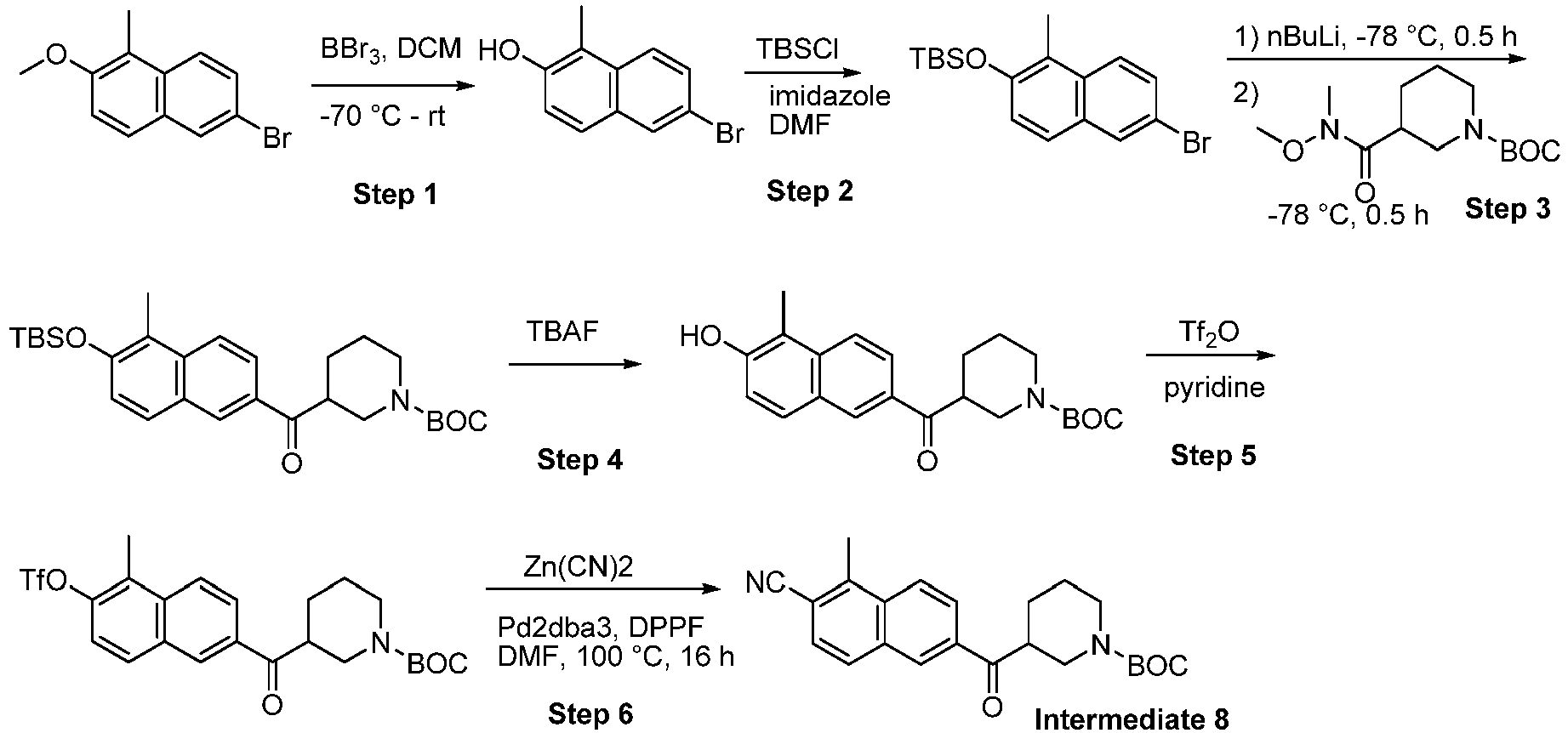
- To a solution of 6-bromo-2-methoxy-1-methyl-naphthalene (576 mg, 2.29 mmol) in DCM (5 mL) at - 78 °C was added BBr3 (1 M in DCM, 2.75 mL, 2.75 mml) dropwise. The mixture was slowly warmed to room temperature. After stirring for 1.5 h at room temperature, the reaction was quenched with ice-water and extracted with DCM (2x). The combined organics were dried (Na2SO4), filtered and concentrated. The crude product was purified by silica flash chromatography (0-25% EtOAc/heptane) to give the title compound (524 mg, 96% yield) as a white solid. 1H NMR (400 MHz, Chloroform-d) δ 7.91 (d, J = 2.11 Hz, 1H), 7.78 (d, J = 9.02 Hz, 1H), 7.57 - 7.49 (m, 2H), 7.07 (d, J = 8.79 Hz, 1H), 4.92 (s, 1H), 2.51 (s, 3H). LCMS (ESI) m/z 237.0 [M+H+].
- The mixture of 6-bromo-1-methyl-naphthalen-2-ol (613 mg, 2.58 mmol), imidazole (264 mg, 3.88 mmol), and TBSCl (482 mg, 3.1 mmol) in DMF (5 mL) was stirred at room temperature for 16 h. The mixture was diluted with EtOAc and washed with sat. NaCl twice. The aqueous phase was back-extracted with EtOAc once. The combined organic layers were dried (Na2SO4), filtered and concentrated. The crude product was purified by silica flash chromatography (0-5% EtOAc/heptane) to give the title compound (859 mg, 94.6% yield) as a white solid. 1H NMR (400 MHz, Chloroform-d) δ 7.91 (d, J = 2.08 Hz, 1H), 7.78 (d, J = 9.04 Hz, 1H), 7.55 - 7.47 (m, 2H), 7.08 (d, J = 8.82 Hz, 1H), 2.50 (s, 3H), 1.05 (s, 9H), 0.23 (s, 6H).
- A solution of (6-bromo-1-methyl-2-naphthyl)oxy-tert-butyl-dimethyl-silane (1.668 mmol, 598 mg, 1.67 mmol) in THF (8 mL) was cooled to -78°C before a solution of nBuLi (2.5 M in hexane, 1.0 mL, 2.5 mmol) was added dropwise. After stirring for 30 min at -78 °C, a solution of tert-butyl 3-[methoxy(methyl)carbamoyl]piperidine-1-carboxylate (1.751 mmol, 476.8 mg) in THF (2 mL) was added dropwise. The mixture was stirred at -78°C for 30 min. The reaction was quenched with sat. NH4Cl and extracted with DCM (3x). The combined organic layers were dried (Na2SO4), filtered and concentrated. The crude product was purified by silica flash chromatography (0-15% EtOAc/heptane) to give the title compound (562 mg, 69.7% yield) as a colorless oil. 1H NMR (400 MHz, Chloroform-d) δ 8.41 (d, J = 1.77 Hz, 1H), 8.02 (dd, J = 1.82, 8.94 Hz, 1H), 7.98 (s, 1H), 7.73 (d, J = 8.87 Hz, 1H), 7.13 (d, J = 8.85 Hz, 1H), 4.33 (s, 1H), 4.20 - 4.10 (m, 1H), 3.96 (s, 1H), 3.55 (dd, J = 8.91, 12.85 Hz, 1H), 2.78 (t, J = 12.02 Hz, 1H), 2.53 (s, 3H), 2.09 (d, J = 12.55 Hz, 1H), 1.83 - 1.59 (m, 4H), 1.48 (s, 9H), 1.06 (s, 9H), 0.26 (s, 6H).LCMS (ESI) m/z 484.2 [M+H+].
- To a solution of tert-butyl-3-[6-[tert-butyl(dimethyl)silyl]oxy-5-methyl-naphthalene-2-carbonyl]piperidine-1-carboxylate (562 mg, 1.16 mmol) in THF (12 mL) was added TBAF (1 M in THF, 2.3 mL, 2.3 mmol) dropwise. The reaction mixture was stirred at room temperature for 30 min. The mixture was quenched with sat. NH4Cl and extracted with DCM (3x). The combined organic layers were dried (Na2SO4), filtered and concentrated. The crude product was purified by silica flash chromatography (0-100% EtOAc/heptane) to give the title compound (354 mg, 82.5% yield) as a white solid. 1H NMR (400 MHz, Chloroform-d) δ 8.38 (d, J = 1.87 Hz, 1H), 8.05 - 7.98 (m, 1H), 7.94 (d, J = 9.01 Hz, 1H), 7.72 (d, J = 8.79 Hz, 1H), 7.12 (d, J = 8.79 Hz, 1H),5.31 (brs, 1H), 4.34 (brs, 1H), 4.15-4.13 (m, 1H), 3.54 (tt, J = 3.68, 11.01 Hz, 1H), 3.01-2.99 (m 1H), 2.79 (t, J = 12.58 Hz, 1H), 2.53 (s, 3H), 2.08 (d, J = 12.84 Hz, 1H), 1.85 - 1.71 (m, 2H), 1.71 - 1.59 (m, 1H), 1.49 (s, 9H).
- To a solution of tert-butyl 3-(6-hydroxy-5-methyl-naphthalene-2-carbonyl)piperidine-1-carboxylate (0.9367 mmol, 346 mg) in pyridine (4 mL) at 0°C was added trifluromethanesulfonic anhydride (317 mg, 1.12 mmol) dropwise. The reaction mixture was stirred at 0 °C for 1 h. The mix was diluted with water and extracted with EtOAc (2x). The combined organic layers were washed with 10% citric acid, brine, dried (Na2SO4), filtered and concentrated. The crude product was purified by silica flash chromatography (0-30% EtOAc/heptane) to give the title compound(460 mg, 97.9% yield) as a colorless oil which solidified when drying in high vacuum. 1H NMR (400 MHz, Chloroform-d) δ 8.51 (s, 1H), 8.15 (d, J = 1.45 Hz, 2H), 7.93 (d, J = 9.04 Hz, 1H), 7.45 (d, J = 9.02 Hz, 1H), 4.34 (brs, 1H), 4.15-4.11 (m, 1H), 3.58-3.53 (m, 1H), 3.01 (brs, 1H), 2.81 (td, J = 2.81, 12.64, 13.25 Hz, 1H), 2.72 (s, 3H), 2.15 - 2.04 (m, 1H), 1.86 - 1.70 (m, 2H), 1.68-1.61 (m, 1H). LCMS (ESI) m/z 502 [M+H+].
- A mixture of tert-butyl-3-[5-methyl-6-(trifluoromethylsulfonyloxy)naphthalene-2-carbonyl]piperidine-1-carboxylate (417 mg, 0.83 mmol), ZnCN (98 mg, 0.83 mmol), Pd2dba3 (16mg, 0.0166 mmol) and 1,1'-bisIdiphenylphosphino)ferrocene (234 mg, 0.042 mmol) in DMF (8 mL) was heated at 100 °C under N2 for 16 h. The mixture was filtered through celite and concentrated. The crude product was purified by silica flash chromatography (0-30% EtOAc/heptane) to give the title compound (249 mg, 79% yield) as a colorless oil. 1H NMR (400 MHz, Chloroform-d) δ 8.49 (s, 1H), 8.15 (d, J = 1.54 Hz, 2H), 7.90 (d, J = 8.55 Hz, 1H), 7.61 (d, J = 8.52 Hz, 1H), 4.46 - 4.24 (m, 1H), 4.18 - 4.06 (m, 1H), 3.57 (7t, J = 3.44, 10.40 Hz, 1H), 3.11 - 2.95 (m, 1H), 2.94 (s, 3H), 2.88 - 2.78 (m, 1H), 2.16 - 2.05 (m, 1H), 1.85-1.72 (m, 2H), 1.68-1.64 (m, 1H), 1.49 (s, 9H). LCMS (ESI) m/z 379 [M+H+].
-

- To a solution of tert-butyl 3-(6-methoxynaphthalene-2-carbonyl)piperidine-1-carboxylate (1.666 g, 4.51 mmol) in DCM (5 mL) was added TFA (5.142 g, 45.1 mmol). The mixture was stirred at room temperature for 1 h. The mixture was concentrated to give (6-methoxynaphthalen-2-yl)(piperidin-3-yl)methanone as a colorless oil and used directly without purification.
- A mixture of (6-methoxy-2-naphthyl)-(3-piperidyl)methanone (80 mg, 0.297 mmol), cyclopentanone (75 mg, 0.891 mmol), AcOH (36 mg, 0.594 mmol) and NaBH(OCH3)3 (99.4 mg, 0.446 mmol) in 1,2-dichloroethan (1.5 mL) was stirred at room temperature for 16 h. The reaction was quenched with 1 N NaOH and extracted with EtOAc (3x). The combined organic layers were dried (Na2SO4), filtered and concentrated. The crude product was purified by preparative reverse phase HPLC (Phenomenx Gemini NX, 20-60% ACN in 0.1% NH4OH (aq)) to give the title compound (57.2 mg, 57% yield) as a yellow oil. 1H NMR (400 MHz, DMSO-d6) δ 8.60 (d, J = 1.47 Hz, 1H), 8.06 (d, J = 8.99 Hz, 1H), 7.94 - 7.86 (m, 2H), 7.40 (d, J = 2.57 Hz, 1H), 7.26 (dd, J = 2.56, 8.96 Hz, 1H), 3.92 (s, 3H), 3.72 (tt, J = 3.48, 10.84 Hz, 1H), 3.07 - 3.00 (m, 1H), 2.93 (m, 1H), 2.51 (m, 3H), 2.13 - 2.05 (m, 1H), 1.98 - 1.82 (m, 2H), 1.80 - 1.64 (m, 3H), 1.60 - 1.26 (m, 7H). LCMS (ESI) m/z 338 [M+H+],
- The following compounds were prepared in a manner similar to example 1: (1-cyclobutylpiperidin-3-yl)(6-methoxynaphthalen-2-yl)methanone. In some cases, racemic mixtures are exemplified. In those cases where a specific enantiomer is exemplified, purification was conducted using super-fluid chromatography with the following conditions to separate enantiomers. SFC conditions: CHIRALPAK AD (250 x 30 mm, 5 µm particle size) at 20% MeOH w/0.1%NH4OH; 60 mL/min, 100 bars, 40 °C.
- Example 69 is a Comparative Example.
Example Compound Name 1H NMR (m/z) M+H 3 (3-chlorophenyl)-(1-cyclopentyl-3-piperidyl)methanone 1H NMR (400 MHz, DMSO-d6) δ 7.90 (dp, J = 1.60, 4.87 Hz, 2H), 7.70 (ddd, J = 1.09, 2.17, 8.00 Hz, 1H), 7.57 (t, J = 8.05 Hz, 1H), 3.60 - 3.52 (m, 1H), 2.99 - 2.92 (m, 1H), 2.84 (m, 1H), 2.08 (dd, J = 9.99, 11.30 Hz, 1H), 1.94 (td, J = 3.40, 11.07 Hz, 1H), 1.84 - 1.40 (m, 10H), 1.34 (m, 3H) 292 5 (1-cyclobutyl-3-piperidyl)-(2,4-dimethoxyphenyl)methanone 1H NMR (400 MHz, DMSO-d6) δ 7.49 (d, J = 8.66 Hz, 1H), 6.64 (d, J = 2.27 Hz, 1H), 6.59 (dd, J = 2.31, 8.65 Hz, 1H), 3.88 (s, 3H), 3.83 (s, 3H), 3.38 - 3.31 (m, 1H), 2.83 - 2.75 (m, 1H), 2.68 - 2.58 (m, 2H), 1.97 - 1.86 (m, 2H), 1.81 - 1.54 (m, 8H), 1.54 - 1.39 (m, 1H), 1.33 - 1.18 (m, 1H) 304 6 (6-methoxy-2-naphthyl)-(1-tetrahydropyran-4-yl-3-piperidyl)methanone 1H NMR (400 MHz, DMSO-d6) δ 8.59 (s, 1H), 8.06 (dd, J = 3.27, 8.92 Hz, 1H), 7.90 (p, J = 2.06 Hz, 2H), 7.40 (q, J = 2.50 Hz, 1H), 7.25 (dq, J = 2.32, 8.83 Hz, 1H), 3.92 (s, 3H), 3.86-3.83 (m, 2H), 3.75 - 3.63 (m, 1H), 3.29 - 3.18 (m, 3H), 3.02-2.09 (m, 1H), 2.91 - 2.88 (m, 1H), 2.36 - 2.25 (m, 1H), 2.15 - 2.09 (m, 1H), 1.89 - 1.86 (m, 1H), 1.72-1.60 (m, 4H), 1.43-1.37 (m, 3H) 354 7 [(3R)-1-(cyclopropylmethyl)-3-piperidyl]-(6-methoxy-2-naphthyl)methanone 1H NMR (DMSO-d6) δ: 8.69 - 8.54 (m, 1H), 8.06 (d, J = 9.0 Hz, 1H), 7.98 - 7.83 (m, 2H), 7.40 (d, J = 2.5 Hz, 1H), 7.26 (dd, J = 9.0, 2.5 Hz, 1H), 3.92 (s, 3H), 3.82 - 3.67 (m, 1H), 3.13 - 2.93 (m, 2H), 2.29 - 2.06 (m, 3H), 2.02 - 1.83 (m, 2H), 1.78 - 1.65 (m, 2H), 1.49 - 1.29 (m, 1H), 0.90 - 0.74 (m, 1H), 0.49 - 0.36 (m, 2H), 0.10 - 0.01 (m, 2H) 324 8 [(3S)-1-(cyclopropylmethyl)-3-piperidyl]-(6-methoxy-2-naphthyl)methanone 1H NMR (DMSO-d6) δ: 8.69 - 8.57 (m, 1H), 8.06 (d, J = 9.0 Hz, 1H), 7.99 - 7.85 (m, 2H), 7.40 (d, J = 2.5 Hz, 1H), 7.26 (dd, J = 9.0, 2.5 Hz, 1H), 3.92 (s, 3H), 3.82 - 3.69 (m, 1H), 3.13 - 2.93 (m, 2H), 2.31 - 2.05 (m, 3H), 2.03 - 1.83 (m, 2H), 1.78 - 1.64 (m, 2H), 1.46 - 1.30 (m, 1H), 0.88 - 0.75 (m, 1H), 0.50 - 0.35 (m, 2H), 0.12 - 0.01 (m, 2H) 324 9 [(3R)-1-cyclopentyl-3-piperidyl]-(6-methoxy-2-naphthyl)methanone 1H NMR (400 MHz, DMSO-d6) d 8.60 (d, J = 1.45 Hz, 1H), 8.06 (d, J = 9.00 Hz, 1H), 7.96 - 7.86 (m, 2H), 7.40 (d, J = 2.55 Hz, 1H), 7.26 (dd, J = 2.55, 8.94 Hz, 1H), 3.91 (s, 3H), 3.72 (tt, J = 3.53, 10.77 Hz, 1H), 3.08 - 3.00 (m, 1H), 2.93 (d, J = 11.20 Hz, 1H), 2.58 - 2.52 (m, 1H), 2.13 - 2.04 (m, 1H), 1.93 (td, J = 3.81, 10.93 Hz, 1H), 1.89 - 1.82 (m, 1H), 1.82 - 1.23 (m, 11H) 338 10 [(3S)-1-cyclopentyl-3-piperidyl]-(6-methoxy-2-naphthyl)methanone 1H NMR (400 MHz, DMSO-d6) d 8.60 (d, J = 1.46 Hz, 1H), 8.06 (d, J = 8.93 Hz, 1H), 7.95 - 7.85 (m, 2H), 7.40 (d, J = 2.55 Hz, 1H), 7.26 (dd, J = 2.56, 8.94 Hz, 1H), 3.72 (tt, J = 3.49, 10.82 Hz, 1H), 3.03 (ddd, J = 1.82, 3.59, 11.30 Hz, 1H), 2.96 - 2.88 (m, 1H), 2.59 - 2.51 (m, 1H), 2.14 - 2.04 (m, 1H), 1.93 (td, J = 3.90, 10.99 Hz, 1H), 1.86 (dd, J = 3.43, 12.73 Hz, 1H), 1.79 - 1.25 (m, 11H). 338 11 [(3S)-1-cyclobutyl-3-piperidyl]-(2,4-dimethoxyphenyl)methanone 1H NMR (400 MHz, DMSO-d6) d 7.49 (d, J = 8.55 Hz, 1H), 6.64 (d, J = 2.27 Hz, 1H), 6.59 (dd, J = 2.30, 8.64 Hz, 1H), 3.88 (s, 3H), 3.83 (s, 3H), 3.39 - 3.32 (m, 1H), 2.84 - 2.75 (m, 1H), 2.69 - 2.56 (m, 2H), 1.99 - 1.86 (m, 2H), 1.81 - 1.38 (m, 9H), 1.33 - 1.19 (m, 1H) 304 12 [(3R)-1-cyclobutyl-3-piperidyl]-(2,4-dimethoxyphenyl)methanone 1H NMR (400 MHz, DMSO-d6) d 7.49 (d, J = 8.58 Hz, 1H), 6.64 (d, J = 2.26 Hz, 1H), 6.59 (dd, J = 2.30, 8.68 Hz, 1H), 3.88 (s, 3H), 3.83 (s, 3H), 3.38 - 3.31 (m, 1H), 2.84 - 2.76 (m, 1H), 2.69 - 2.58 (m, 2H), 1.97- 1.87 (m, 2H), 1.79 - 1.41 (m, 9H), 1.32 - 1.20 (m, 1H) 304 13 (1-cyclohexyl-3-piperidyl)-(6-methoxy-2-naphthyl)methanone 1H NMR (400 MHz, DMSO-d6) δ 8.58 (s, 1H), 8.06 (d, J = 9.00 Hz, 1H), 7.95 - 7.86 (m, 2H), 7.40 (d, J = 2.76 Hz, 1H), 7.26 (dd, J = 2.59, 8.91 Hz, 1H), 3.92 (s, 3H), 3.72 - 3.61 (m, 1H), 2.95 (d, J = 11.17 Hz, 1H), 2.82 (d, J = 10.83 Hz, 1H), 2.36 (t, J = 10.71 Hz, 1H), 2.31-2.27 (m, 1H), 2.25 - 2.15 (m, 1H), 1.89 - 1.85 (m, 1H), 1.72 -1.62 (m, 6H), 1.56 - 1.52 (m, 1H), 1.45 - 1.31 (m, 1H), 1.21 - 1.14 (m, 4H), 1.6-1.024 (m, 1H) 355 14 (6-methoxy-2-naphthyl)-[1-(oxetan-3-yl)-3-piperidyl]methanone 1H NMR (400 MHz, DMSO-d6) δ 8.63 (s, 1H), 8.08 (dd, J = 2.52, 8.77 Hz, 1H), 7.97 - 7.87 (m, 2H), 7.40 (d, J = 2.84 Hz, 1H), 7.26 (dd, J = 2.58, 9.02 Hz, 1H), 4.5 -4.492 (m, 2H), 4.45 - 4.38 (m , 2H), 3.92 (s, 3H), 3.78 - 3.72 (m, 1H), 3.42 (p, J = 6.31 Hz, 1H), 2.83 - 2.79 (m, 1H), 2.75 - 2.65 (m, 1H), 2.04 - 1.87 (m, 2H), 1.85 - 1.68 (m, 3H), 1.44.382 (m, 1H) 326 15 (6-methoxy-2-naphthyl)-(1-tetrahydrofuran-3-yl-3-piperidyl)methanone 1H NMR (400 MHz, DMSO-d6) δ 8.61 (d, J = 3.48 Hz, 1H), 8.07 (dd, J = 1.67, 8.97 Hz, 1H), 7.97 - 7.86 (m, 2H), 7.40 (d, J = 2.52 Hz, 1H), 7.26 (dd, J = 2.60, 8.91 Hz, 1H), 3.92 (s, 3H), 3.80 - 3.68 (m, 3H), 3.62-3.58 (m, 1H), 3.49 - 3.44 (m, 1H), 3.06 - 2.68 (m, 3H), 224-2.128 (m, 1H), 2.07 - 1.83 (m, 3H), 1.78 - 1.61 (m, 3H), 1.47 - 1.32 (m, 1H) 340 18 (6-methoxy-2-naphthyl)-(1-propyl-3-piperidyl)methanone 1H NMR (400 MHz, DMSO-d6) δ 8.60 (d, J = 1.45 Hz, 1H), 8.06 (d, J = 9.03 Hz, 1H), 7.95 - 7.86 (m, 2H), 7.40 (d, J = 2.55 Hz, 1H), 7.26 (dd, J = 2.54, 8.95 Hz, 1H), 3.92 (s, 3H), 3.76-3.70 (m, 1H), 3.01 - 2.94 (m, 1H), 2.89 - 2.96 (m, 1H), 2.29 (t, J = 7.44 Hz, 2H), 2.12 (t, J = 10.81 Hz, 1H), 1.99 - 1.83 (m, 2H), 1.74 - 1.68 (m, 2H), 1.50 - 1.32 (m, 3H), 0.83 (t, J = 7.39 Hz, 3H) 312 21 [1-(cyclopropylmethyl)-3-piperidyl]-(3-phenoxyphenyl)methanone 1H NMR (400 MHz, DMSO-d6) δ 7.73 (dt, J = 1.20, 7.80 Hz, 1H), 7.55 (t, J = 7.92 Hz, 1H), 7.46 - 7.38 (m, 3H), 7.29 (ddd, J = 0.97, 2.50, 8.20 Hz, 1H), 7.23 - 7.16 (m, 1H), 7.09 - 7.03 (m, 2H), 3.52 (tt, J = 3.50, 10.88 Hz, 1H), 3.03 - 2.96 (m, 1H), 2.94 - 2.86 (m, 1H), 2.23 - 2.11 (m, 2H), 2.07 (t, J = 10.70 Hz, 1H), 1.92 (td, J = 3.28, 11.12 Hz, 1H), 1.85 - 1.76 (m, 1H), 1.72 - 1.54 (m, 2H), 1.31 (qd, J = 4.49, 11.72 Hz, 1H), 0.81 - 0.72 (m, 1H), 0.46 - 0.35 (m, 2H), 0.05-0.01 (m, 2H) 336 22 [1-(cyclopropylmethyl)-3-piperidyl]-[4-(trifluoromethyl)phenyl]met hanone 1H NMR (400 MHz, DMSO-d6) δ 8.13 (d, J = 8.11 Hz, 2H), 7.89 (d, J = 8.26 Hz, 2H), 3.62 (tt, J = 3.55, 10.36 Hz, 1H), 3.03 - 2.98 (m, 1H), 2.90 (dt, J = 3.94, 11.08 Hz, 1H), 2.26 - 2.10 (m, 3H), 1.97 (td, J = 3.39, 11.00 Hz, 1H), 1.5 - 1.802 (m, 1H), 1.75 - 1.57 (m, 2H), 1.39-1.29 (m, 1H), 0.82 - 0.737 (m, 1H), 0.45 - 0.34 (m, 2H), 0.08 - 0.00 (m, 2H) 312 23 [1-(cyclopropylmethyl)-3-piperidyl]-(4-phenoxyphenyl)methanone 1H NMR (400 MHz, DMSO-d6) δ 8.03 - 7.94 (m, 2H), 7.50 - 7.42 (m, 2H), 7.25 (t, J = 7.39 Hz, 1H), 7.16 - 7.10 (m, 2H), 7.08 - 7.00 (m, 2H), 3.54 (tt, J = 3.48, 10.90 Hz, 1H), 3.05 - 2.98 (m, 1H), 2.96-2.93 (m, 1H), 2.19 (qd, J = 6.57, 12.68 Hz, 2H), 2.07 (t, J = 10.81 Hz, 1H), 1.91 (td, J = 3.53, 11.12 Hz, 1H), 1.84-1.80 (m, 1H), 1.73 - 1.57 (m, 2H), 1.31 (qd, J = 4.75, 11.70 Hz, 1H), 0.83 - 0.75 (m, 1H), 0.48 - 0.36 (m, 2H), 0.09 - 0.01 (m, 2H) 336 24 [1-(cyclopropylmethyl)-3-piperidyl]-(4-phenylphenyl)methanone 1H NMR (400 MHz, DMSO-d6) δ 8.07 - 8.00 (m, 2H), 7.87 - 7.80 (m, 2H), 7.77 - 7.72 (m, 2H), 7.55 - 7.48 (m, 2H), 7.46 - 7.40 (m, 1H), 3.62 (ddt, J = 3.50, 6.98, 13.90 Hz, 1H), 3.08 - 3.03 (m, 1H), 2.98-2.93 (m, 1H), 2.21 (qd, J = 6.56, 12.67 Hz, 2H), 2.11 (dd, J = 10.32, 11.27 Hz, 1H), 1.94 (td, J = 3.86, 10.99 Hz, 1H), 1.90 - 1.81 (m, 1H), 1.75 - 1.60 (m, 2H), 1.40 - 1.28 (m, 1H), 0.87 - 0.75 (m, 1H), 0.48 - 0.37 (m, 2H), 0.10 - 0.01 (m, 2H) 320 25 [1-(cyclopropylmethyl)-3-piperidyl]-(3-phenylphenyl)methanone 1H NMR (400 MHz, DMSO-d6) δ 8.15 (t, J = 1.79 Hz, 1H), 7.97 - 7.89 (m, 2H), 7.76 - 7.70 (m, 2H), 7.63 (t, J = 7.73 Hz, 1H), 7.55 - 7.47 (m, 2H), 7.44 - 7.38 (m, 1H), 3.70 (tt, J = 3.53, 10.73 Hz, 1H), 3.10 - 3.02 (m, 1H), 2.95-2.92 (m, 1H), 2.27 - 2.08 (m, 3H), 1.95 (td, J = 4.24, 10.78 Hz, 1H), 1.87 - 1.84 (m, 1H), 1.72 - 1.65 (m, 2H), 1.43 - 1.29 (m, 1H), 0.86 - 0.73 (m, 1H), 0.47 - 0.34 (m, 2H), 0.09 - 0.01 (m, 2H) 320 26 [1-(cyclopropylmethyl)-3-piperidyl]-(4-fluoro-2-naphthyl)methanone 1H NMR (400 MHz, DMSO-d6) δ 8.62 (t, J = 0.99 Hz, 1H), 8.27 (dt, J = 1.61, 8.12 Hz, 1H), 8.11 (dd, J = 1.22, 8.21 Hz, 1H), 7.77 (dddd, J = 1.34, 6.96, 8.21, 20.50 Hz, 2H), 7.69 (dd, J = 1.47, 11.60 Hz, 1H), 3.84 - 3.74 (m, 1H), 3.10 - 3.08 (m, 1H), 3.01 - 2.93 (m, 1H), 2.29 - 2.11 (m, 3H), 2.01 - 1.86 (m, 2H), 1.75-1.69 (m, 2H), 1.45 - 1.31z (m, 1H), 0.87 - 0.75 (m, 1H), 0.47 - 0.36 (m, 2H), 0.10 - 0.01 (m, 2H) 312 27 [1-(cyclopropylmethyl)-3-piperidyl]-[3-(4-fluorophenoxy)phenyl]meth anone 1H NMR (400 MHz, DMSO-d6) δ 7.76 - 7.69 (m, 1H), 7.54 (t, J = 7.92 Hz, 1H), 7.41 (dd, J = 1.56, 2.55 Hz, 1H), 7.31 - 7.22 (m, 3H), 7.16 - 7.08 (m, 2H), 3.52 (tt, J = 3.52, 10.76 Hz, 1H), 3.01-2.98 (m, 1H), 2.92-2.89 (m, 1H), 2.23 - 2.11 (m, 2H), 2.11 - 2.03 (m, 1H), 1.92 (td, J = 3.40, 11.12 Hz, 1H), 1.82-1.78 (m, 1H), 1.72 - 1.53 (m, 2H), 1.31 (qd, J = 4.55, 11.72 Hz, 1H), 0.83 - 0.70 (m, 1H), 0.47 - 0.35 (m, 2H), 0.08 - 0.01 (m, 2H) 354 28 [(3S)-1-(cyclopropylmethyl)-3-piperidyl]-(3-phenoxyphenyl)methanone 1H NMR (400 MHz, DMSO-d6) d 7.73 (dt, J = 1.23, 7.77 Hz, 1H), 7.55 (t, J = 7.91 Hz, 1H), 7.47 - 7.38 (m, 3H), 7.28 (ddd, J = 0.98, 2.56, 8.20 Hz, 1H), 7.22 - 7.16 (m, 1H), 7.10 - 7.01 (m, 2H), 3.52 (tt, J = 3.45, 10.62 Hz, 1H), 3.03 - 2.96 (m, 1H), 2.91-2.88 (m, 1H), 2.24 - 2.11 (m, 2H), 2.07 (t, J = 10.71 Hz, 1H), 1.92 (td, J = 3.34, 11.21 Hz, 1H), 1.82-1.78 (m, 1H), 1.73 - 1.53 (m, 2H), 1.31 (qd, J = 4.45, 11.60 Hz, 1H), 0.85 - 0.69 (m, 1H), 0.46 - 0.33 (m, 2H), 0.08 - 0.00 (m, 2H) 336 29 [(3R)-1-(cyclopropylmethyl)-3-piperidyl]-(3-phenoxyphenyl)methanone 1H NMR (400 MHz, DMSO-d6) d 7.73 (dt, J = 1.21, 7.77 Hz, 1H), 7.58 - 7.51 (m, 1H), 7.46 - 7.38 (m, 3H), 7.28 (ddd, J = 0.94, 2.49, 8.19 Hz, 1H), 7.23 - 7.16 (m, 1H), 7.09 - 7.03 (m, 2H), 3.52 (tt, J = 3.56, 10.21 Hz, 1H), 3.03 - 2.95 (m, 1H), 2.91-2.88 (m, 1H), 2.23 - 2.11 (m, 2H), 2.07 (dd, J = 10.12, 11.29 Hz, 1H), 1.92 (td, J = 3.32, 11.16 Hz, 1H), 1.84 - 1.76 (m, 1H), 1.72 - 1.53 (m, 2H), 1.37 - 1.25 (m, 1H), 0.80-0.73 (m, 1H), 0.46 - 0.34 (m, 2H), 0.07 - 0.00 (m, 2H) 336 30 [(3R)-1-(cyclopropylmethyl)-3-piperidyl]-(4-phenoxyphenyl)methanone 1H NMR (400 MHz, DMSO-d6) d 8.02 - 7.94 (m, 2H), 7.50 - 7.42 (m, 2H), 7.28 - 7.21 (m, 1H), 7.16 - 7.09 (m, 2H), 7.07 - 7.01 (m, 2H), 3.54 (tt, J = 3.43, 11.21 Hz, 1H), 3.05 - 2.98 (m, 1H), 2.96-2.93 (m, 1H), 2.19 (qd, J = 6.51, 12.62 Hz, 2H), 2.07 (t, J = 10.84 Hz, 1H), 1.91 (td, J = 3.65, 11.19 Hz, 1H), 1.84 - 1.80 (m, 1H), 1.73 - 1.57 (m, 2H), 1.31 (qd, J = 4.84, 11.81 Hz, 1H), 0.86-0.74 (m, 1H), 0.48 - 0.36 (m, 2H), 0.09 - 0.01 (m, 2H) 336 31 [(3S)-1-(cyclopropylmethyl)-3-piperidyl]-(4-phenoxyphenyl)methanone 1H NMR (400 MHz, DMSO-d6) d 8.03 - 7.92 (m, 2H), 7.51 - 7.42 (m, 2H), 7.29 - 7.21 (m, 1H), 7.16 - 7.10 (m, 2H), 7.07 - 6.99 (m, 2H), 3.61 - 3.47 (m, 1H), 3.03-2.99 (m, 1H), 2.97 - 2.89 (m, 1H), 2.19 (qd, J = 6.54, 12.64 Hz, 2H), 2.07 (t, J = 10.83 Hz, 1H), 1.91 (td, J = 3.57, 11.12 Hz, 1H), 1.86 - 1.78 (m, 1H), 1.69-1.62 (m, 2H), 1.39 - 1.24 (m, 1H), 0.82-0.78 (m, 1H), 0.49 - 0.35 (m, 2H), 0.09 - 0.01 (m, 2H) 336 32 [(3R)-1-(cyclopropylmethyl)-3-piperidyl]-(4-phenylphenyl)methanone 1H NMR (400 MHz, DMSO-d6) d 8.07 - 8.00 (m, 2H), 7.86 - 7.80 (m, 2H), 7.77 - 7.72 (m, 2H), 7.55 - 7.47 (m, 2H), 7.47 - 7.40 (m, 1H), 3.62 (tt, J = 3.50, 10.43 Hz, 1H), 3.08-3.03 (m, 1H), 2.97 - 2.93 (m, 1H), 2.21 (qd, J = 6.51, 12.62 Hz, 2H), 2.11 (t, J = 10.79 Hz, 1H), 1.94 (td, J = 3.89, 10.99 Hz, 1H), 1.88 - 1.85 (m, 1H), 1.74 - 1.60 (m, 2H), 1.42 - 1.28 (m, 1H), 0.86 - 0.75 (m, 1H), 0.49 - 0.37 (m, 2H), 0.09 - 0.01 (m, 2H) 320 33 [(3S)-1-(cyclopropylmethyl)-3-piperidyl]-(4-phenylphenyl)methanone 1H NMR (400 MHz, DMSO-d6) d 8.07 - 8.00 (m, 2H), 7.87 - 7.80 (m, 2H), 7.78 - 7.71 (m, 2H), 7.55 - 7.47 (m, 2H), 7.47 - 7.39 (m, 1H), 3.67 - 3.57 (m, 1H), 3.09 - 3.01 (m, 1H), 3.00 - 2.91 (m, 1H), 2.21 (qd, J = 6.54, 12.66 Hz, 2H), 2.11 (t, J = 10.79 Hz, 1H), 1.94 (td, J = 3.89, 10.98 Hz, 1H), 1.90 - 1.82 (m, 1H), 1.75 - 1.60 (m, 2H), 1.40 - 1.28 (m, 1H), 0.86 - 0.76 (m, 1H), 0.48 - 0.36 (m, 2H), 0.10 - 0.01 (m, 2H) 320 34 1-(cyclopropylmethyl)-3-piperidyl]-[4-(p-tolyl)phenyl]methanone 1H NMR (400 MHz, DMSO-d6) δ 8.08 - 7.98 (m, 2H), 7.87 - 7.77 (m, 2H), 7.69 - 7.60 (m, 2H), 7.37 - 7.27 (m, 2H), 3.61 (tt, J = 3.46, 10.95 Hz, 1H), 3.10 - 3.01 (m, 1H), 2.97 - 2.94 (m, 1H), 2.36 (s, 3H), 2.20 (qd, J = 6.54, 12.65 Hz, 2H), 2.14 - 2.05 (m, 1H), 1.94 (td, J = 3.90, 10.99 Hz, 1H), 1.87 - 1.84 (m, 1H), 1.75 - 1.59 (m, 2H), 1.34 (qd, J = 5.22, 11.63 Hz, 1H), 0.83-0.79 (m, 1H), 0.50 - 0.35 (m, 2H), 0.10 - 0.01 (m, 2H) 334 35 [1-(cyclopropylmethyl)-3-piperidyl]-[4-(hydroxymethyl)-2-naphthyl]methanone 1H NMR (400 MHz, DMSO-d6) δ 8.61 (s, 1H), 8.18 (dd, J = 1.38, 8.09 Hz, 1H), 8.11 (d, J = 8.45 Hz, 1H), 8.03 (d, J = 1.72 Hz, 1H), 7.71 (ddd, J = 1.48, 6.82, 8.42 Hz, 1H), 7.65 (ddd, J = 1.27, 6.80, 8.07 Hz, 1H), 5.44 (t, J = 5.44 Hz, 1H), 5.01 (d, J = 5.00 Hz, 2H), 3.9 - 3.947 (m, 1H), 2.08 - 1.93 (m, 1H), 1.85 - 1.81 (m, 2H), 1.50 - 1.45 (m, 1H), 0.98 - 0.92 (m, 1H), 0.55 - 0.51 (m, 2H), 0.21 - 0.15 (m, 2H) 324.2 36 [1-(cyclopropylmethyl)-3-piperidyl]-(6-phenyl-3-pyridyl)methanone 1H NMR (400 MHz, DMSO-d6) δ 9.14 (d, J = 2.29 Hz, 1H), 8.33 (dd, J = 2.29, 8.34 Hz, 1H), 8.14 (dq, J = 2.11, 2.66, 8.35 Hz, 2H), 8.09 (d, J = 8.39 Hz, 1H), 7.55 - 7.41 (m, 3H), 3.61 (tt, J = 3.47, 10.39 Hz, 1H), 3.01 (dd, J = 2.99, 10.89 Hz, 1H), 2.90 - 2.86 (m, 1H), 2.25 - 2.07 (m, 3H), 1.93 (td, J = 4.08, 10.71 Hz, 1H), 1.88 - 1.78 (m, 1H), 1.72 - 1.59 (m, 2H), 1.32 (qd, J = 5.24, 11.35 Hz, 1H), 0.84 - 0.67 (m, 1H), 0.45 - 0.29 (m, 2H), 0.06 - -0.03 (m, 2H) 321 37 [4-(aminomethyl)-2-naphthyl]-[1-(cyclopropylmethyl)-3-piperidyl]methanone 1H NMR (400 MHz, DMSO-d6) δ 8.57 (d, J = 1.80 Hz, 1H), 8.17 - 8.14 (m, 1H), 7.97 - 7.92 (m, 1H), 7.71 - 7.65 (m, 1H), 7.63 - 7.56 (m, 2H), 4.86 (s, 2H), 4.22 (d, J = 2.32 Hz, 2H), 3.85 - 3.71 (m, 1H), 3.09 (d, J = 9.18 Hz, 2H), 2.99 (d, J = 10.88 Hz, 2H), 2.28 - 2.12 (m, 5H), 1.72 (td, J = 4.94, 8.99, 10.27 Hz, 4H), 0.88 - 0.72 (m, 2H), 0.45 - 0.38 (m, 2H), 0.10 - 0.01 (m, 2H) 323 38 [1-(cyclopropylmethyl)-3-piperidyl]-[4-(2-pyridyl)phenyl]methanone 1H NMR (400 MHz, DMSO-d6) δ 8.68 (ddd, J = 0.91, 1.88, 4.78 Hz, 1H), 8.24 - 8.17 (m, 2H), 8.06 - 7.99 (m, 3H), 7.90 (td, J = 1.84, 7.73 Hz, 1H), 7.39 (ddd, J = 1.07, 4.79, 7.49 Hz, 1H), 3.60 (tt, J = 3.52, 10.47 Hz, 1H), 3.4-3.002 (m, 1H), 2.91 (dt, J = 3.68, 10.98 Hz, 1H), 2.23 - 2.10 (m, 2H), 2.07 (t, J = 10.87 Hz, 1H), 1.90 (td, J = 3.85, 11.01 Hz, 1H), 1.85-1.81 (m, 1H), 1.72 - 1.56 (m, 2H), 1.39 - 1.23 (m, 1H), 0.79-0.73 (m, 1H), 0.45 - 0.31 (m, 2H), 0.06 - -0.04 (m, 2H) 321 39 N-[[3-[1-(cyclopropylmethyl)piperidi ne-3-carbonyl]-1-naphthyl]methyl]acetamide 1H NMR (400 MHz, DMSO-d6) δ 8.67 - 8.62 (m, 1H), 8.42 (t, J = 5.87 Hz, 1H), 8.20 (dd, J = 1.39, 8.08 Hz, 1H), 8.16 - 8.09 (m, 1H), 7.88 (d, J = 1.71 Hz, 1H), 7.71 (ddd, J = 1.44, 6.81, 8.39 Hz, 1H), 7.65 (ddd, J = 1.18, 6.88, 8.01 Hz, 1H), 4.75 (d, J = 5.80 Hz, 2H), 3.79 (ddt, J = 3.56, 7.12, 10.86 Hz, 1H), 3.11-3.08 (m, 1H), 3.02-2.99 (m, 2H), 2.30 - 2.18 (m, 2H), 2.15 (t, J = 9.47 Hz, 1H), 2.02 - 1.90 (m, 2H), 1.89 (s, 3H), 1.76-1.70 (m, 2H), 1.45 - 1.31 (m, 1H), 0.89 - 0.75 (m, 1H), 0.47-0.38 (m, 2H), 0.11 - 0.01 (m, 2H) 365 40 3-[1-(cyclopropylmethyl)piperidi ne-3-carbonyl]-N-methylnaphthalene-1-carboxamide 1H NMR (400 MHz, DMSO-d6) δ 8.83 - 8.77 (m, 1H), 8.57 (q, J = 4.28 Hz, 1H), 8.28 - 8.19 (m, 2H), 7.99 (d, J = 1.69 Hz, 1H), 7.74 - 7.64 (m, 2H), 3.82 (tt, J = 3.45, 10.67 Hz, 1H), 3.11-3.07 (m, 1H), 2.30-2.97 (m, 1H), 2.87 (d, J = 4.57 Hz, 3H), 2.29 - 2.10 (m, 3H), 2.02 - 1.84 (m, 2H), 1.5-1.704 (m, 2H), 1.46 - 1.30 (m, 1H), 0.90 - 0.74 (m, 1H), 0.49 - 0.34 (m, 2H), 0.11 - 0.01 (m, 2H) 351 41 3-(1-cyclopentylpiperidine-3-carbonyl)-N-methylnaphthalene-1-carboxamide 1H NMR (400 MHz, DMSO-d6) δ 8.80 - 8.76 (m, 1H), 8.56 (q, J = 4.49 Hz, 1H), 8.23 (ddd, J = 1.32, 8.39, 12.62 Hz, 2H), 7.98 (d, J = 1.72 Hz, 1H), 7.73 - 7.64 (m, 2H), 3.80 (tt, J = 3.49, 10.64 Hz, 1H), 3.09 - 3.02 (m, 1H), 2.93 (d, J = 11.17 Hz, 1H), 2.88 - 2.86 (m, 3H), 2.60 - 2.52 (m, 1H), 2.12 (t, J = 10.72 Hz, 1H), 2.00 - 1.85 (m, 2H), 1.82 - 1.66 (m, 4H), 1.60 - 1.27 (m, 7H) 365 42 3-(1-cyclobutylpiperidine-3-carbonyl)-N-methylnaphthalene-1-carboxamide 1H NMR (400 MHz, DMSO-d6) δ 8.78 (t, J = 1.17 Hz, 1H), 8.56 (q, J = 4.63 Hz, 1H), 8.23 (ddd, J = 1.33, 8.44, 10.10 Hz, 2H), 7.98 (d, J = 1.72 Hz, 1H), 7.74 - 7.64 (m, 2H), 3.77 (tt, J = 3.53, 10.90 Hz, 1H), 2.94 - 2.88 (m, 1H), 2.87 (d, J = 4.58 Hz, 3H), 2.80-2.76 (m, 1H), 2.75 - 2.69 (m, 1H), 1.98 - 1.88 (m, 4H), 1.82 - 1.66 (m, 5H), 1.2-1.581 (m, 2H), 1.44 - 1.31 (m, 1H) 351 43 3-[1-(cyclopropylmethyl)piperidi ne-3-carbonyl]naphthalene-1-carbonitrile 1H NMR (400 MHz, DMSO-d6) δ 9.08 - 9.02 (m, 1H), 8.55 (d, J = 1.69 Hz, 1H), 8.42 - 8.34 (m, 1H), 8.18 (dd, J = 0.99, 8.30 Hz, 1H), 7.95 (ddd, J = 1.27, 6.93, 8.36 Hz, 1H), 7.83 (ddd, J = 1.15, 6.91, 8.08 Hz, 1H), 3.82 (tt, J = 3.57, 10.14 Hz, 1H), 3.09-3.05 (m, 1H), 3.00 - 2.90 (m, 1H), 2.29 - 2.13 (m, 3H), 2.04 - 1.85 (m, 2H), 1.75 - 1.69 (m, 2H), 1.43 - 1.38 (m, 1H), 0.83 - 0.75 (m, 1H), 0.43 - 0.37 (m, 2H), 0.10 - 0.01 (m, 2H) 319 44 3-(1-cyclobutylpiperidine-3-carbonyl)naphthalene-1-carbonitrile 1H NMR (400 MHz, DMSO-d6) δ 9.07 - 9.01 (m, 1H), 8.54 (d, J = 1.71 Hz, 1H), 8.37 (d, J = 8.02 Hz, 1H), 8.18 (d, J = 8.28 Hz, 1H), 7.95 (ddd, J = 1.23, 6.89, 8.27 Hz, 1H), 7.83 (ddd, J = 1.08, 6.89, 8.08 Hz, 1H), 3.77 (tt, J = 3.57, 10.59 Hz, 1H), 2.94 - 2.84 (m, 1H), 2.79 - 2.65 (m, 2H), 2.00 - 1.86 (m, 4H), 1.82 - 1.53 (m, 7H), 1.37 (qd, J = 4.64, 11.13 Hz, 1H) 319 45 3-(1-cyclopentylpiperidine-3-carbonyl)naphthalene-1-carbonitrile 1H NMR (400 MHz, DMSO-d6) δ 9.07 - 8.99 (m, 1H), 8.53 (d, J = 1.70 Hz, 1H), 8.37 (d, J = 7.98 Hz, 1H), 8.17 (d, J = 8.34 Hz, 1H), 7.98 - 7.91 (m, 1H), 7.87 - 7.79 (m, 1H), 3.79 (tt, J = 3.48, 10.13 Hz, 1H), 3.05-3.02 (m, 1H), 2.95 - 2.84 (m, 1H), 2.56-2.51 (m, 1H), 2.15 (t, J = 10.60 Hz, 1H), 1.97 (td, J = 4.31, 10.67 Hz, 1H), 1.91 -1.86 (m, 1H), 1.80 - 1.63 (m, 4H), 1.58 - 1.54 (m, 2H), 1.51 - 1.21 (m, 5H) 333 46 3-(1-cyclopentylpiperidine-3-carbonyl)naphthalene-1-carboxamide 1H NMR (400 MHz, DMSO-d6) δ 8.77 (d, J = 1.71 Hz, 1H), 8.33 (d, J = 8.46 Hz, 1H), 8.25 - 8.19 (m, 1H), 8.11 (s, 1H), 8.03 (d, J = 1.70 Hz, 1H), 7.75 - 7.61 (m, 3H), 3.79 (ddt, J = 3.44, 7.18, 10.76 Hz, 1H), 3.08-3.05 (m, 1H), 2.95-2.92 (m, 1H), 2.61 - 2.53 (m, 1H), 2.11 (t, J = 10.82 Hz, 1H), 2.00 - 1.85 (m, 2H), 1.75 - 1.68 (m, 4H), 1.62 - 1.26 (m, 7H) 351 47 3-(1-cyclobutylpiperidine-3-carbonyl)naphthalene-1-carboxamide 1H NMR (400 MHz, DMSO-d6) δ 8.80 - 8.75 (m, 1H), 8.36 - 8.29 (m, 1H), 8.25 - 8.19 (m, 1H), 8.11 (s, 1H), 8.03 (d, J = 1.75 Hz, 1H), 7.76 - 7.61 (m, 3H), 3.77 (tt, J = 3.47, 10.69 Hz, 1H), 2.93 - 2.89 (m, 1H), 2.80 - 2.76 (m, 1H), 2.76 - 2.69 (m, 1H), 2.02 - 1.85 (m, 4H), 1.82 - 1.52 (m, 7H), 1.45 - 1.31 (m, 1H) 337 48 3-[1-(cyclopropylmethyl)piperidi ne-3-carbonyl]naphthalene-1-carboxamide 1H NMR (400 MHz, DMSO-d6) δ 8.78 (d, J = 1.68 Hz, 1H), 8.33 (d, J = 8.43 Hz, 1H), 8.21 (dd, J = 1.32, 8.18 Hz, 1H), 8.11 (s, 1H), 8.04 (d, J = 1.70 Hz, 1H), 7.72 (ddd, J = 1.49, 6.87, 8.38 Hz, 1H), 7.69 - 7.60 (m, 2H), 3.82 (tt, J = 3.53, 10.88 Hz, 1H), 3.14 - 3.05 (m, 1H), 3.01 - 2.97 (m, 1H), 2.30 - 2.10 (m, 3H), 2.02 - 1.87 (m, 2H), 1.77 - 1.69 (m, 2H), 1.44 - 1.34 (m, 1H), 0.86-0.78 (m, 1H), 0.47-0.37 (m, 2H), 0.11 - 0.01 (m, 2H) 337 49 [1-(cyclopropylmethyl)-3-piperidyl]-(6-methoxy-5-methyl-2-naphthyl)methanone 1H NMR (400 MHz, DMSO-d6) δ 8.63 (d, J = 1.81 Hz, 1H), 8.07 (d, J = 9.09 Hz, 1H), 8.02 (d, J = 8.99 Hz, 1H), 7.94 (dd, J = 1.88, 9.01 Hz, 1H), 7.52 (d, J = 9.07 Hz, 1H), 3.96 (s, 3H), 3.81 - 3.70 (m, 1H), 3.12 - 3.04 (m, 1H), 3.01 - 2.97 (m, 1H), 2.48 (s, 3H), 2.21 (qd, J = 6.60, 12.69 Hz, 2H), 2.12 (t, J = 10.85 Hz, 1H), 2.00 - 1.84 (m, 2H), 1.74 - 1.68 (m, 2H), 1.43 - 1.33 (m, 1H), 0.87 - 0.75 (m, 1H), 0.46 - 0.37 (m, 2H), 0.10 - 0.01 (m, 2H) 338 50 (6-methoxy-5-methyl-2-naphthyl)-(1-propyl-3-piperidyl)methanone 1H NMR (400 MHz, DMSO-d6) δ 8.61 (d, J = 1.78 Hz, 1H), 8.06 (d, J = 9.05 Hz, 1H), 8.03 (s, 1H), 7.93 (dd, J = 1.82, 9.02 Hz, 1H), 7.52 (d, J = 9.05 Hz, 1H), 3.96 (s, 3H), 3.73 (tt, J = 3.54, 10.60 Hz, 1H), 2.99 - 2.90 (m, 1H), 2.86-2.83 (m, 1H), 2.48 (s, 3H), 2.25 (t, J = 7.39 Hz, 2H), 2.07 (t, J = 10.77 Hz, 1H), 1.92 - 1.86 (m, 2H), 1.73 - 1.64 (m, 2H), 1.48 - 1.31 (m, 3H), 0.83 (t, J = 7.33 Hz, 3H) 326 51 (1-cyclopentyl-3-piperidyl)-(6-methoxy-5-methyl-2-naphthyl)methanone 1H NMR (400 MHz, DMSO-d6) δ 8.61 (d, J = 1.78 Hz, 1H), 8.06 (d, J = 9.05 Hz, 1H), 8.03 (s, 1H), 7.93 (dd, J = 1.82, 9.02 Hz, 1H), 7.52 (d, J = 9.05 Hz, 1H), 3.96 (s, 3H), 3.73 (tt, J = 3.54, 10.60 Hz, 1H), 2.99 - 2.90 (m, 1H), 2.86 - 2.83 (m, 1H), 2.48 (s, 3H), 2.25 (t, J = 7.39 Hz, 2H), 2.07 (t, J = 10.77 Hz, 1H), 1.92 - 1.86 (m, 2H), 1.73 - 1.64 (m, 2H), 1.48 - 1.31 (m, 3H), 0.83 (t, J = 7.33 Hz, 3H) 352 52 (1-cyclobutyl-3-piperidyl)-(6-methoxy-5-methyl-2-naphthyl)methanone 1H NMR (400 MHz, DMSO-d6) δ 8.61 (d, J = 1.78 Hz, 1H), 8.06 (d, J = 9.05 Hz, 1H), 8.03 (s, 1H), 7.93 (dd, J = 1.82, 9.02 Hz, 1H), 7.52 (d, J = 9.05 Hz, 1H), 3.96 (s, 3H), 3.73 (tt, J = 3.54, 10.60 Hz, 1H), 2.99 - 2.90 (m, 1H), 2.86 - 2.83 (m, 1H), 2.48 (s, 3H), 2.25 (t, J = 7.39 Hz, 2H), 2.07 (t, J = 10.77 Hz, 1H), 1.92 - 1.86 (m, 2H), 1.73-1.64 (m, 2H), 1.48 - 1.31 (m, 3H), 0.83 (t, J = 7.33 Hz, 3H) 338 53 2-[6-[1-(cyclopropylmethyl)piperidi ne-3-carbonyl]-2-methoxy-1-naphthyl]acetonitrile 1H NMR (400 MHz, DMSO-d6) δ 8.71 (d, J = 1.67 Hz, 1H), 8.27 (d, J = 9.15 Hz, 1H), 8.12 (d, J = 8.97 Hz, 1H), 8.03 (dd, J = 1.78, 8.96 Hz, 1H), 7.63 (d, J = 9.13 Hz, 1H), 4.29 (s, 2H), 4.04 (s, 3H), 3.78 (tt, J = 3.48, 10.84 Hz, 1H), 3.10 - 3.07 (m, 1H), 3.00 - 2.97 (m, 1H), 2.29 - 2.08 (m, 3H), 2.02 - 1.84 (m, 2H), 1.75-1.69 (m, 2H), 1.43 - 1.33 (m, 1H), 0.89 - 0.75 (m, 1H), 0.46 - 0.37 (m, 2H), 0.11 - 0.00 (m, 2H) 363 54 2-[6-(1-cyclopentylpiperidine-3-carbonyl)-2-methoxy-1-naphthyl]acetonitrile 1H NMR (400 MHz, DMSO-d6) δ 8.70 (d, J = 1.75 Hz, 1H), 8.26 (d, J = 9.08 Hz, 1H), 8.12 (d, J = 8.99 Hz, 1H), 8.03 (dd, J = 1.79, 8.93 Hz, 1H), 7.63 (d, J = 9.16 Hz, 1H), 4.29 (s, 2H), 4.04 (s, 3H), 3.75 (tt, J = 3.43, 10.57 Hz, 1H), 3.09 - 3.01 (m, 1H), 2.94 - 2.91 (m, 1H), 2.58 -2.54 (m, 1H), 2.10 (t, J = 10.79 Hz, 1H), 1.99 - 1.86 (m, 2H), 1.81 - 1.65 (m, 4H), 1.60 - 1.27 (m, 7H) 377 55 2-[6-(1-cyclobutylpiperidine-3-carbonyl)-2-methoxy-1-naphthyl]acetonitrile 1H NMR (400 MHz, DMSO-d6) δ 8.70 (d, J = 1.77 Hz, 1H), 8.27 (d, J = 9.10 Hz, 1H), 8.12 (d, J = 8.99 Hz, 1H), 8.03 (dd, J = 1.80, 8.94 Hz, 1H), 7.63 (d, J = 9.13 Hz, 1H), 4.29 (s, 2H), 4.04 (s, 3H), 3.72 (tt, J = 3.57, 10.76 Hz, 1H), 2.91 - 2.88 (m, 1H), 2.79 - 2.76 (m, 1H), 2.74 - 2.65 (m, 1H), 2.02 - 1.84 (m, 4H), 1.81 - 1.52 (m, 7H), 1.43 - 1.34 (m, 1H) 363 56 2-[2-methoxy-6-(1-propylpiperidine-3-carbonyl)-1-naphthyl] acetonitrile 1H NMR (400 MHz, DMSO-d6) δ 8.70 (d, J = 1.78 Hz, 1H), 8.26 (d, J = 9.10 Hz, 1H), 8.12 (d, J = 8.99 Hz, 1H), 8.03 (dd, J = 1.80, 9.01 Hz, 1H), 7.63 (d, J = 9.17 Hz, 1H), 4.29 (s, 2H), 4.04 (s, 3H), 3.75 (tt, J = 3.47, 10.57 Hz, 1H), 2.99 - 2.91 (m, 1H), 2.86 - 2.83 (m, 1H), 2.25 (t, J = 7.39 Hz, 2H), 2.09 (t, J = 10.75 Hz, 1H), 1.90 (td, J = 4.26, 10.77 Hz, 2H), 1.74 - 1.67 (m, 2H), 1.48 - 1.30 (m, 3H), 0.83 (t, J = 7.37 Hz, 3H) 351 57 (1-cyclopentyl-3-piperidyl)-[4-(hydroxymethyl)-2-naphthyl]methanone 1H NMR (400 MHz, DMSO-d6) δ 8.61 (d, J = 1.95 Hz, 1H), 8.21 - 8.15 (m, 1H), 8.12 - 8.07 (m, 1H), 8.01 (d, J = 1.74 Hz, 1H), 7.69 (ddd, J = 1.48, 6.86, 8.45 Hz, 1H), 7.63 (ddd, J = 1.27, 6.83, 8.04 Hz, 1H), 5.43 (t, J = 5.19 Hz, 1H), 5.00 (d, J = 4.50 Hz, 2H), 3.77 (tt, J = 3.60, 11.01 Hz, 1H), 3.10 - 3.02 (m, 1H), 2.96 - 2.92 (m, 1H), 2.59 - 2.52 (m, 1H), 2.09 (t, J = 10.77 Hz, 1H), 1.98 - 1.83 (m, 2H), 1.81 - 1.64 (m, 4H), 1.61 - 1.26 (m, 7H) 338 58 (1-cyclobutyl-3-piperidyl)-[4-(hydroxymethyl)-2-naphthyl]methanone 1H NMR (400 MHz, DMSO-d6) δ 8.66 - 8.58 (m, 1H), 8.24 - 8.14 (m, 1H), 8.10 (d, J = 8.49 Hz, 1H), 8.04 - 7.97 (m, 1H), 7.69 (ddd, J = 1.66, 6.72, 8.41 Hz, 1H), 7.66 - 7.58 (m, 1H), 5.43 (s, 1H), 5.00 (d, J = 3.36 Hz, 2H), 3.74 (tt, J = 4.95, 10.40 Hz, 1H), 2.96 - 2.86 (m, 1H), 2.83 - 2.75 (m, 1H), 2.70 (p, J = 7.77 Hz, 1H), 2.03 - 1.83 (m, 4H), 1.81 - 1.54 (m, 7H), 1.45 - 1.30 (m, 1H) 324 59 [1-(cyclopropylmethyl)-3-piperidyl]-(8-methyl-2-naphthyl)methanone 1H NMR (400 MHz, DMSO-d6) δ 8.65 - 8.60 (m, 1H), 8.06 - 7.96 (m, 2H), 7.85 (d, J = 8.06 Hz, 1H), 7.55 (dd, J = 6.98, 8.15 Hz, 1H), 7.47 (dt, J = 1.15, 6.96 Hz, 1H), 3.81 (tt, J = 3.50, 10.33 Hz, 1H), 3.17 - 3.08 (m, 1H), 2.99-2.94 (m, 1H), 2.75 (s, 3H), 2.27 - 2.16 (m, 2H), 2.16 - 2.09 (m, 1H), 1.97 - 1.89 (m, 2H), 1.75 - 1.69 (m, 2H), 1.46 - 1.32 (m, 1H), 0.86 - 0.76 (m, 1H), 0.48 - 0.34 (m, 2H), 0.10 - 0.00 (m, 2H) 308 60 (8-methyl-2-naphthyl)-(1-propyl-3-piperidyl)methanone 1H NMR (400 MHz, DMSO-d6) δ 8.64 - 8.59 (m, 1H), 8.03 (d, J = 8.50 Hz, 1H), 7.98 (dd, J = 1.63, 8.57 Hz, 1H), 7.85 (d, J = 8.22 Hz, 1H), 7.55 (dd, J = 6.98, 8.15 Hz, 1H), 7.49 - 7.43 (m, 1H), 3.78 (tt, J = 3.48, 10.64 Hz, 1H), 3.01 - 2.98 (m, 1H), 2.87 - 2.80 (m, 1H), 2.75 (s, 3H), 2.28 - 2.22 (m, 2H), 2.07 (t, J = 10.75 Hz, 1H), 1.95 - 1.88 (m, 2H), 1.77 - 1.64 (m, 2H), 1.48 - 1.32 (m, 3H), 0.83 (t, J = 7.35 Hz, 3H) 296 61 (1-cyclopentyl-3-piperidyl)-(8-methyl-2-naphthyl)methanone 1H NMR (400 MHz, DMSO-d6) δ 8.65 - 8.59 (m, 1H), 8.03 (d, J = 8.50 Hz, 1H), 8.00 (s, 1H), 7.85 (d, J = 8.10 Hz, 1H), 7.56 (dd, J = 6.98, 8.15 Hz, 1H), 7.47 (dt, J = 1.19, 7.03 Hz, 1H), 3.78 (tt, J = 3.49, 10.54 Hz, 1H), 3.14 - 3.05 (m, 1H), 2.94 - 2.91 (m, 1H), 2.75 (s, 3H), 2.57 - 2.51 (m, 1H), 2.09 (t, J = 10.77 Hz, 1H), 1.99 - 1.84 (m, 2H), 1.82 - 1.64 (m, 4H), 1.62 - 1.23 (m, 7H) 322 62 (1-cyclobutyl-3-piperidyl)-(8-methyl-2-naphthyl)methanone 1H NMR (400 MHz, DMSO-d6) δ 8.63 - 8.59 (m, 1H), 8.03 (d, J = 8.56 Hz, 1H), 7.98 (dd, J = 1.63, 8.58 Hz, 1H), 7.85 (d, J = 8.13 Hz, 1H), 7.56 (dd, J = 6.99, 8.17 Hz, 1H), 7.47 (dt, J = 1.16, 6.91 Hz, 1H), 3.76 (tt, J = 3.47, 10.59 Hz, 1H), 2.97 - 2.89 (m, 1H), 2.79 - 2.77 (m, 1H), 2.76 (s, 3H), 2.72 - 2.65 (m, 1H), 2.01 - 1.83 (m, 4H), 1.80 - 1.53 (m, 7H), 1.46 - 1.33 (m, 1H) 308 63 (1-cyclopentyl-3-piperidyl)-[4-(1-hydroxyethyl)-2-naphthyl]methanone 1H NMR (400 MHz, DMSO-d6) δ 8.59 (t, J = 2.24 Hz, 1H), 8.21 - 8.15 (m, 2H), 8.12 (d, J = 1.68 Hz, 1H), 7.68 (ddd, J = 1.42, 6.83, 8.38 Hz, 1H), 7.61 (ddd, J = 1.10, 6.80, 8.08 Hz, 1H), 5.54 - 5.46 (m, 1H), 5.44 (d, J = 3.94 Hz, 1H), 3.76 (tt, J = 3.08, 9.98 Hz, 1H), 3.08 - 3.05 (m, 1H), 2.95 - 2.92 (m, 1H), 2.55 - 2.52 (m, 1H), 2.12 -2.04 (m, 1H), 1.99 - 1.82 (m, 2H), 1.82 - 1.49 (m, 7H), 1.47 (d, J = 6.33 Hz, 2H), 1.45 - 1.26 (m, 4H) 352 64 (1-cyclobutyl-3-piperidyl)-[4-(1-hydroxyethyl)-2-naphthyl]methanone 1H NMR (400 MHz, DMSO-d6) δ 8.61 - 8.56 (m, 1H), 8.22 - 8.16 (m, 2H), 8.12 (d, J = 1.73 Hz, 1H), 7.68 (ddd, J = 1.43, 6.87, 8.42 Hz, 1H), 7.61 (ddd, J = 1.11, 6.84, 8.12 Hz, 1H), 5.50 (t, J = 5.42 Hz, 1H), 5.44 (d, J = 4.10 Hz, 1H), 3.74 (tt, J = 3.41, 10.90 Hz, 1H), 2.92 -2.90 (m, 1H), 2.80-2.77 (m, 1H), 2.75 -2.65 (m, 1H), 2.01 - 1.80 (m, 4H), 1.80 - 1.53 (m, 7H), 1.47 (d, J = 6.36 Hz, 3H), 1.44 - 1.33 (m, 1H) 338 65 3-[3-(6-methoxynaphthalene-2-carbonyl)-1-piperidyl]cyclobutanecarbo nitrile 1H NMR (400 MHz, DMSO-d6) δ 8.63 (d, J = 1.50 Hz, 1H), 8.08 (d, J = 9.03 Hz, 1H), 7.97 - 7.86 (m, 2H), 7.41 (d, J = 2.56 Hz, 1H), 7.26 (dd, J = 2.55, 8.94 Hz, 1H), 3.92 (s, 3H), 3.71 (tt, J= 3.54, 10.69 Hz, 1H), 3.05-2.97 (m, 1H), 2.92 - 2.83 (m, 1H), 2.81 - 2.68 (m, 2H), 2.48 -2.41 (m, 2H), 2.12 - 1.98 (m, 2H), 1.96 - 1.84 (m, 2H), 1.79 - 1.60 (m, 3H), 1.35 (qd, J = 4.70, 11.77 Hz, 1H) 349 66 [1-(3,3-difluorocyclobutyl)-3-piperidyl]-(6-methoxy-2-naphthyl)methanone 1H NMR (400 MHz, DMSO-d6) δ 8.67 - 8.61 (m, 1H), 8.08 (d, J = 8.99 Hz, 1H), 7.97 - 7.87 (m, 2H), 7.41 (d, J = 2.58 Hz, 1H), 7.26 (dd, J = 2.53, 8.99 Hz, 1H), 3.92 (s, 3H), 3.73 (tt, J = 3.49, 10.95 Hz, 1H), 2.4 - 2.913 (m, 1H), 2.84 - 2.81 (m, 1H), 2.71 - 2.64 (m, 3H), 2.46 - 2.27 (m, 2H), 2.00 (t, J = 10.78 Hz, 1H), 1.92 - 1.89 (m, 1H), 1.82 (td, J = 3.28, 11.01 Hz, 1H), 1.78 - 1.63 (m, 2H), 1.45 - 1.29 (m, 1H) 360 67 [1-(cyclopropylmethyl)-3-piperidyl]-[4-(1-hydroxyethyl)-2-naphthyl]methanone 1H NMR (400 MHz, DMSO-d6) δ 8.61 (d, J = 1.91 Hz, 1H), 8.22 - 8.16 (m, 2H), 8.12 (d, J = 1.69 Hz, 1H), 7.68 (ddd, J = 1.45, 6.82, 8.38 Hz, 1H), 7.61 (ddd, J = 1.05, 6.75, 7.90 Hz, 1H), 5.55 - 5.46 (m, 1H), 5.44 (dd, J = 1.09, 4.33 Hz, 1H), 3.80 (t, J = 11.22 Hz, 1H), 3.11-3.08 (m, 1H), 3.01-2.98 (m, 1H), 2.29 - 2.08 (m, 3H), 1.98-1.83 (m, 2H), 1.4 - 1.723 (m, 2H), 1.47 (d, J = 6.30 Hz, 3H), 1.44 - 1.31 (m, 1H), 0.84 - 0.80 (m, 1H), 0.48 - 0.34 (m, 2H), 0.10 - 0.01 (m, 2H) 338 68 [4-(1-hydroxyethyl)-2-naphthyl]-(1-propyl-3-piperidyl)methanone 1H NMR (400 MHz, DMSO-d6) δ 8.59 (d, J = 1.60 Hz, 1H), 8.22 - 8.14 (m, 2H), 8.12 (d, J = 1.69 Hz, 1H), 7.68 (ddd, J = 1.43, 6.83, 8.35 Hz, 1H), 7.61 (ddd, J = 1.11, 6.88, 8.01 Hz, 1H), 5.55 - 5.46 (m, 1H), 5.44 (d, J = 4.26 Hz, 1H), 3.77 (td, J = 2.70, 10.80 Hz, 1H), 3.02 - 2.91 (m, 1H), 2.89 - 2.84 (m, 1H), 2.25 (t, J = 7.45 Hz, 2H), 2.13 - 2.01 (m, 1H), 1.91 - 1.87 (m, 2H), 1.74 - 1.70 (m, 2H), 1.47 (dd, J = 1.21, 6.33 Hz, 3H), 1.46 - 1.40 (m, 3H), 0.83 (td, J = 2.36, 7.36 Hz, 3H) 326 69 [1-(cyclobutylmethyl)-3-piperidyl]-(6-methoxy-2-naphthyl)methanone 1H NMR (400 MHz, DMSO-d6) δ 8.61 (d, J = 1.43 Hz, 1H), 8.06 (d, J = 8.99 Hz, 1H), 7.95 - 7.86 (m, 2H), 7.41 (d, J = 2.57 Hz, 1H), 7.26 (dd, J = 2.53, 8.99 Hz, 1H), 3.92 (s, 3H), 3.70 (tt, J = 3.48, 10.90 Hz, 1H), 2.95 - 2.85 (m, 1H), 2.81 - 2.77f (m, 1H), 2.48 - 2.44 (m, 1H), 2.37 - 2.30 (m, 2H), 2.13 - 2.03 (m, 1H), 2.02 - 1.52 (m, 10H), 1.40 - 1.29 (m, 1H) 338 70 1-methyl-6-(1-propylpiperidine-3-carbonyl)-2-naphthonitrile 1H NMR (DMSO-d6) δ: 8.75 (d, J = 1.8 Hz, 1H), 8.31 (d, J = 8.9 Hz, 1H), 8.18 (d, J = 8.5 Hz, 1H), 8.10 (dd, J = 8.9, 1.8 Hz, 1H), 7.82 (d, J = 8.6 Hz, 1H), 3.77 (tt, J = 10.6, 3.6 Hz, 1H), 3.00 - 2.92 (m, 1H), 2.91 (s, 3H), 2.87 - 2.77 (m, 1H), 2.24 (t, J = 7.3 Hz, 2H), 2.11 (t, J = 10.7 Hz, 1H), 1.98 - 1.84 (m, 2H), 1.78 - 1.61 (m, 2H), 1.47 - 1.31 (m, 3H), 0.82 (t, J = 7.3 Hz, 3H) 321 71 6-(1-(cyclopropylmethyl)piperidi ne-3-carbonyl)-1-methyl-2-naphthonitrile 1H NMR (DMSO-d6) δ: 8.77 (d, J = 1.8 Hz, 1H), 8.31 (d, J = 8.9 Hz, 1H), 8.18 (d, J = 8.6 Hz, 1H), 8.11 (dd, J = 8.9, 1.8 Hz, 1H), 7.82 (d, J = 8.5 Hz, 1H), 3.80 (tt, J = 10.7, 3.6 Hz, 1H), 3.12 - 3.03 (m, 1H), 2.99 - 2.92 (m, 1H), 2.91 (s, 3H), 2.29 - 2.11 (m, 3H), 2.03 - 1.84 (m, 2H), 1.72 (td, J = 10.7, 10.0, 5.4 Hz, 2H), 1.46 - 1.31 (m, 1H), 0.86 - 0.72 (m, 1H), 0.47 - 0.33 (m, 2H), 0.10 - 0.01 (m, 2H) 333 72 6-(1-cyclobutylpiperidine-3-carbonyl)-1-methyl-2-naphthonitrile 1H NMR (DMSO-d6) δ: 8.76 (d, J = 1.8 Hz, 1H), 8.31 (d, J = 8.9 Hz, 1H), 8.19 (d, J = 8.6 Hz, 1H), 8.10 (dd, J = 9.0, 1.8 Hz, 1H), 7.82 (d, J = 8.6 Hz, 1H), 3.75 (tt, J = 10.5, 3.5 Hz, 1H), 2.91 (s, 3H), 2.90 - 2.83 (m, 1H), 2.79 - 2.66 (m, 2H), 2.00 - 1.84 (m, 4H), 1.82 - 1.52 (m, 7H), 1.38 (qd, J = 11.5, 4.4 Hz, 1H) 333 73 6-(1-cyclopentylpiperidine-3-carbonyl)-1-methyl-2-naphthonitrile 1H NMR (DMSO-d6) δ: 8.76 (d, J = 1.7 Hz, 1H), 8.31 (d, J = 8.9 Hz, 1H), 8.18 (d, J = 8.6 Hz, 1H), 8.10 (dd, J = 8.9, 1.8 Hz, 1H), 7.82 (d, J = 8.5 Hz, 1H), 3.77 (tt, J = 10.7, 3.6 Hz, 1H), 3.08 - 2.99 (m, 1H), 2.94 - 2.85 (m, 4H), 2.59 - 2.51 (m, 1H), 2.13 (t, J = 10.7 Hz, 1H), 2.02 - 1.82 (m, 2H), 1.79 - 1.21 (m, 12H) 347 -

- To a solution of tert-butyl 3-(6-methoxynaphthalene-2-carbonyl)piperidine-1-carboxylate (1.666 g, 4.51 mmol) in DCM (5 mL) was added TFA (5.142 g, 45.1 mmol). The mixture was stirred at room temperature for 1 h. The mixture was concentrated to give (6-methoxynaphthalen-2-yl)(piperidin-3-yl)methanone as a colorless oil and used directly without purification.
- A mixture of (6-methoxy-2-naphthyl)-(3-piperidyl)methanone (67.3 mg, 0.25 mmol), iodoethane (46.8 mg, 0.300 mmol) and K2CO3 (41.5 mg, 0.3 mmol,) in EtOH (1 mL) was heated at 85°C for 1 h. The mixture was cooled to room temperature. filtered, washed with EtOAc, and concentrated. The crude product was purified by preparative reverse phase HPLC to give the title compound (52.4 mg, 70.5% yield) as a light yellow oil. 1H NMR (400 MHz, DMSO-d6) δ 8.60 (d, J = 1.58 Hz, 1H), 8.06 (d, J = 9.02 Hz, 1H), 7.96 - 7.86 (m, 2H), 7.40 (d, J = 2.62 Hz, 1H), 7.26 (dd, J = 2.56, 8.99 Hz, 1H), 3.92 (s, 3H), 3.72 (tt, J = 3.53, 10.88 Hz, 1H), 3.02 - 2.92 (m, 1H), 2.87 (d, J = 11.01 Hz, 1H), 2.35 (qd, J = 2.99, 7.15 Hz, 2H), 2.05 (t, J = 10.76 Hz, 1H), 1.87 (td, J= 3.87, 10.67 Hz, 2H), 1.76 - 1.63 (m, 2H), 1.45 - 1.30 (m, 1H), 0.98 (t, J = 7.14 Hz, 3H). LCMS (ESI) m/z 298 [M+H+].
-
Example Compound Name 1 NMR m/z (M+H) 76 (1-cyclobutyl-3-piperidyl)-(6-methoxy-2-naphthyl)methanone 1H NMR (400 MHz, DMSO-d6) δ 8.65 - 8.59 (m, 1H), 8.06 (d, J = 9.03 Hz, 1H), 7.96 - 7.86 (m, 2H), 7.40 (d, J = 2.55 Hz, 1H), 7.26 (dd, J = 2.55, 8.97 Hz, 1H), 3.92 (s, 3H), 3.75 (m, 1H), 3.11 - 3.04 (m, 1H), 3.03 - 2.94 (m, 1H), 2.29 - 2.06 (m, 3H), 2.00 - 1.84 (m, 2H), 1.71 (m, 2H), 1.44 - 1.31 (m, 1H), 0.81 (m, , 1H), 0.41 (m, 2H), 0.10 - 0.01 (m, 2H) 324 77 [1-(cyclopropylmethyl)-3-piperidyl]-(6-methoxy-2-naphthyl)methanone 1H NMR (400 MHz, DMSO-d6) δ 8.64 - 8.59 (m, 1H), 8.06 (d, J = 8.99 Hz, 1H), 7.96 - 7.87 (m, 2H), 7.40 (d, J = 2.52 Hz, 1H), 7.26 (dd, J = 2.55, 8.98 Hz, 1H), 3.92 (s, 3H), 3.74 (ddt, J = 3.50, 7.01, 11.34 Hz, 1H), 3.12 - 3.04 (m, 1H), 2.98 (d, J = 11.13 Hz, 1H), 2.28 - 2.08 (m, 3H), 1.99 - 1.84 (m, 2H), 1.71 (ddt, J = 3.67, 7.64, 10.80 Hz, 2H), 1.44 - 1.31 (m, 1H), 0.86 - 0.77 (m, 1H), 0.41 (dtd, J = 3.38, 5.13, 8.19 Hz, 2H), 0.08 - 0.02 (m, 2H) 324 78 [1-(2-methoxyethyl)-3-piperidyl]-(6-methoxy-2-naphthyl)methanone 1H NMR (400 MHz, DMSO-d6) δ 8.60 (d, J = 1.51 Hz, 1H), 8.06 (d, J = 8.97 Hz, 1H), 7.95 - 7.86 (m, 2H), 7.40 (d, J = 2.53 Hz, 1H), 7.26 (dd, J = 2.55, 8.97 Hz, 1H), 3.92 (s, 3H), 3.72 (tt, J = 3.49, 10.89 Hz, 1H), 3.41 (t, J = 5.80 Hz, 2H), 3.19 (s, 3H), 3.04 - 2.96 (m, 1H), 2.89 -2.86 (m, 1H), 2.16 (t, J = 10.84 Hz, 1H), 2.05 - 1.95 (m, 1H), 1.88 - 1.85 (m, 1H), 1.67 - 1.67 (m, 2H), 1.43 - 1.29 (m, 1H) 328 79 [1-(2-fluoroethyl)-3-piperidyl]-(6-methoxy-2-naphthyl)methanone 1H NMR (400 MHz, DMSO-d6) δ 8.64 - 8.58 (m, 1H), 8.06 (d, J = 8.99 Hz, 1H), 7.95 - 7.86 (m, 2H), 7.40 (d, J = 2.64 Hz, 1H), 7.26 (dd, J = 2.55, 8.95 Hz, 1H), 4.58 (t, J = 4.97 Hz, 1H), 4.46 (t, J = 4.94 Hz, 1H), 3.92 (s, 3H), 3.79 - 3.68 (m, 1H), 3.06 - 2.98 (m, 1H), 2.91 (d, J = 11.19 Hz, 1H), 2.69 (td, J = 1.12, 4.70 Hz, 1H), 2.62 (td, J = 1.14, 4.71 Hz, 1H), 2.21 (t, J = 10.87 Hz, 1H), 2.09 - 1.98 (m, 1H), 1.89 (dd, J = 3.73, 12.68 Hz, 1H), 1.73 - 1.69 (m, 2H), 1.42 - 1.31 (m, 1H) 316 81 (1-isopropyl-3-piperidyl)-(6-methoxy-2-naphthyl)methanone 1H NMR (400 MHz, DMSO-d6) δ 8.62 - 8.56 (m, 1H), 8.06 (d, J = 8.95 Hz, 1H), 7.96 - 7.86 (m, 2H), 7.40 (d, J = 2.52 Hz, 1H), 7.26 (dd, J = 2.57, 8.94 Hz, 1H), 3.92 (s, 3H), 3.68 (tt, J = 3.48, 10.72 Hz, 1H), 2.94 - 2.86 (m, 1H), 2.82 - 2.64 (m, 2H), 2.29 (t, J = 10.65 Hz, 1H), 2.12 (td, J = 3.07, 11.19 Hz, 1H), 1.88 - 1.85 (m, 1H), 1.77 - 1.57 (m, 2H), 1.38 (qd, J = 4.34, 12.11 Hz, 1H), 0.94 (dd, J = 0.67, 6.58 Hz, 6H) 312 84 3-[3-(6-methoxynaphthalene-2-carbonyl)-1-piperidyl]propanenitrile 1H NMR (400 MHz, DMSO-d6) δ 8.66 - 8.59 (m, 1H), 8.07 (d, J = 9.03 Hz, 1H), 7.97 - 7.85 (m, 2H), 7.41 (d, J = 2.55 Hz, 1H), 7.26 (dd, J = 2.55, 8.98 Hz, 1H), 3.92 (s, 3H), 3.75 - 3.69 (m, 1H), 3.07 - 2.98 (m, 1H), 2.91 (d, J = 11.20 Hz, 1H), 2.70 - 2.57 (m, 4H), 2.19 (t, J = 10.87 Hz, 1H), 2.05 - 1.96 (m, 1H), 1.91 (d, J = 12.64 Hz, 1H), 1.75 - 1.71 (m, 2H), 1.42 - 1.28 (m, 1H) 323 85 2-[3-(6-methoxynaphthalene-2-carbonyl)-1-piperidyl]acetonitrile 1H NMR (400 MHz, DMSO-d6) δ 8.70 - 8.57 (m, 1H), 8.06 (d, J = 8.98 Hz, 1H), 7.96 - 7.82 (m, 2H), 7.41 (d, J = 2.54 Hz, 1H), 7.26 (dd, J = 2.53, 8.99 Hz, 1H), 3.92 (s, 3H), 3.81-3.75 (m, 1H), 3.75 (s, 2H), 3.00 - 2.92 (m, 1H), 2.86 - 2.78 (m, 1H), 2.35 (t, J = 10.74 Hz, 1H), 2.17 (td, J = 3.99, 10.87 Hz, 1H), 1.96-1.86 (m, 1H), 1.80 - 1.71 (m, 2H), 1.42 - 1.27 (m, 1H) 309 87 (1-ethyl-3-piperidyl)-(6-methoxy-2-naphthyl)methanone 1H NMR (400 MHz, DMSO-d6) δ 8.60 (d, J = 1.58 Hz, 1H), 8.06 (d, J = 9.02 Hz, 1H), 7.96 - 7.86 (m, 2H), 7.40 (d, J = 2.62 Hz, 1H), 7.26 (dd, J = 2.56, 8.99 Hz, 1H), 3.92 (s, 3H), 3.72 (tt, J = 3.53, 10.88 Hz, 1H), 3.02 - 2.92 (m, 1H), 2.87 (d, J = 11.01 Hz, 1H), 2.35 (qd, J = 2.99, 7.15 Hz, 2H), 2.05 (t, J = 10.76 Hz, 1H), 1.87 (td, J = 3.87, 10.67 Hz, 2H), 1.76 - 1.63 (m, 2H), 1.45 - 1.30 (m, 1H), 0.98 (t, J= 7.14 Hz, 3H) 298 -

- To a solution of [1-(cyclopropylmethyl)-3-piperidyl]-[4-(hydroxymethyl)-2-naphthyl]methanone (263 mg, 0.813 mmol) and TEA (123 mg, 1.22 mmol) in acetonitrile (10 mL) at 0 °C was added methanesulfonyl chloride (1.057 mmol, 121 mg, 1.06 mmol) dropwise. The mixture was then stirred at room temperature for 2 h. This mixture was added to a solution of NH4OH (28 mass% in water, 20 mL) and acetonitrile (40 mL) at 0 °C. The mixture was then warmed to room temperature and stirred for 18 h. The mixture was concentrated and purified by preparative reverse phase HPLC (Phenomenex Gemini-NX, 5-85% ACN in 0.1% Formic Acid (aq)) to give the title compound as a yellow solid. 1H NMR (400 MHz, DMSO-d6) δ 8.57 (d, J = 1.80 Hz, 1H), 8.17 - 8.14 (m, 1H), 7.97 - 7.92 (m, 1H), 7.71 - 7.65 (m, 1H), 7.63 - 7.56 (m, 2H), 4.86 (s, 2H), 4.22 (d, J = 2.32 Hz, 2H), 3.85 - 3.71 (m, 1H), 3.09 (d, J = 9.18 Hz, 2H), 2.99 (d, J = 10.88 Hz, 2H), 2.28 - 2.12 (m, 5H), 1.72 (td, J = 4.94, 8.99, 10.27 Hz, 4H), 0.88 - 0.72 (m, 2H), 0.45 - 0.38 (m, 2H), 0.10 - 0.01 (m, 2H). LCMS (ESI) m/z 323 [M+H+].
-

- To a solution of [4-(aminomethyl)-2-naphthyl]-[1-(cyclopropylmethyl)-3-piperidyl]methanone (32 mg, 0.1 mmol) in pyridine (0.5 mL) was added acetic anhydride (100 mg, 1.0 mmol). The mixture was stirred at room temperature for 4 h. The mixture was concentrated and purified by preparative reverse phase HPLC (Phenomenex Gemini-NX, 5-85% ACN in 0.1% Formic Acid (aq)) to give the title compound (14.7 mg, 39.7% yield) as a yellow solid. 1H NMR (400 MHz, DMSO- d6) δ 8.67 - 8.62 (m, 1H), 8.42 (t, J = 5.87 Hz, 1H), 8.20 (dd, J = 1.39, 8.08 Hz, 1H), 8.16 - 8.09 (m, 1H), 7.88 (d, J = 1.71 Hz, 1H), 7.71 (ddd, J = 1.44, 6.81, 8.39 Hz, 1H), 7.65 (ddd, J = 1.18, 6.88, 8.01 Hz, 1H), 4.75 (d, J= 5.80 Hz, 2H), 3.79 (ddt, J= 3.56, 7.12, 10.86 Hz, 1H), 3.11-3.08 (m, 1H), 3.02-2.99 (m, 2H), 2.30 - 2.18 (m, 2H), 2.15 (t, J = 9.47 Hz, 1H), 2.02 - 1.90 (m, 2H), 1.89 (s, 3H), 1.76-1.70 (m, 2H), 1.45 - 1.31 (m, 1H), 0.89 - 0.75 (m, 1H), 0.47-0.38 (m, 2H), 0.11 - 0.01 (m, 2H). LCMS (ESI) m/z 365 [M+H+].
-

- A solution of tert-butyl 3-(methoxy(methyl)carbamoyl)piperidine-1-carboxylate (1.0 g, 3.7 mmol) in 5 ml of DCM was charged with 5 ml of TFA and stirred at room temperature for one hour. The mixture was then concentrated in vacuo and azeotroped twice with toluene. The residue was then diluted with 5 ml of THF and 5 ml of methanol and charged with propionaldehyde (450 mg, 7.7 mmol) and Sodium Triacetoxyborohydride (1.6 g, 7.7 mmol). The mixture was then stirred at room temperature for one hour and concentrated in vacuo. The mixture was then diluted with ethyl acetate and water. The aqueous was discarded and the organic layer was washed once with water, dried over Na2SO4, filtered, and concentrated in vacuo. The residue was then purified by silica-gel chromatography (1 -10% MeOH in DCM) to afford the the title compound (600 mg, 73% yield).
-

- A solution of 3-bromo-N,N-dimethylaniline (140 mg, 0.7 mmol) in 1.2 ml of THF was cooled to -78° C and charged with 2.5 M n-butyl lithium (0.28 ml, 0.7 mmol). After stirring at -78°C for 5 minutes, N-methoxy-N-methyl-1-propylpiperidine-3-carboxamide (75 mg, 0.35 mmol) dissolved in 250 ul of THF was added dropwise. The mixture was then allowed to warm to room temperature and stirred at room temperature for 30 minutes. The mixture was diluted with ethyl acetate and saturated NaHCO3. The aqueous was discarded and the organic layer was dried over magnesium sulfate and concentrated in vacuo. The residue was then purified by preparatory HPLC (Phenomenex Gemini-NX, 20-60% ACN in NH4OH (aq)) to afford the title compound (31mg, 31% yield). 1H NMR (400 MHz, DMSO-d6) δ 7.32 (t, J = 7.9 Hz, 1H), 7.26 - 7.19 (m, 1H), 7.14 (t, J = 2.2 Hz, 1H), 6.98 (dd, J = 8.3, 2.7 Hz, 1H), 3.51 (tt, J = 10.6, 3.6 Hz, 1H), 3.29 (s, 4H), 2.94 (s, 5H), 2.94 - 2.85 (m, 1H), 2.80 (dt, J = 11.4, 3.7 Hz, 1H), 2.23 (t, J = 7.4 Hz, 2H), 1.99 (t, J= 10.7 Hz, 1H), 1.92 - 1.76 (m, 2H), 1.72 - 1.57 (m, 2H), 1.47 - 1.36 (m, 2H), 1.39 - 1.24 (m, 2H), 0.83 (t, J = 7.3 Hz, 3H). LCMS m/z: 275 (M+H).
-
Example Compound Name 1H NMR m/z (M+H) 91 (4-chlorophenyl)-(1-propyl-3-piperidyl)methanone 1H NMR (400 MHz, DMSO-d6) δ 7.99 7.91 (m, 2H), 7.63 - 7.55 (m, 2H), 3.54 (tt, J = 10.4, 3.7 Hz, 1H), 2.91 - 2.83 (m, 1H), 2.78 (d, J = 11.1 Hz, 1H), 2.22 (t, J = 7.4 Hz, 2H), 2.03 (t, J = 10.7 Hz, 1H), 1.94 - 1.76 (m, 2H), 1.74 - 1.57 (m, 2H), 1.46 - 1.24 (m, 3H), 0.82 (t, J = 7.4 Hz, 3H). 261 92 (3-chlorophenyl)-(1-propyl-3-piperidyl)methanone 1H NMR (400 MHz, DMSO-d6) δ 7.90 (dp, J = 3.2, 1.5 Hz, 2H), 7.70 (ddd, J = 8.0, 2.2, 1.1 Hz, 1H), 7.56 (t, J = 8.1 Hz, 1H), 3.56 (tt, J = 10.2, 3.6 Hz, 1H), 2.91 - 2.82 (m, 1H), 2.82 - 2.73 (m, 1H), 2.28 - 2.17 (m, 2H), 2.05 (dd, J = 11.4, 9.8 Hz, 1H), 1.90 (td, J = 11.0, 3.4 Hz, 1H), 1.80 (dd, J = 12.8, 3.9 Hz, 1H), 1.74 - 1.54 (m, 2H), 1.39 (dtd, J = 14.8, 7.4, 1.7 Hz, 2H), 1.37 - 1.25 (m, 1H), 0.82 (t, J = 7.4 Hz, 3H). 261 93 (1-propyl-3-piperidyl)-(6-quinolyl)methanone 266 94 (1-methylindazol-5-yl)-(1-propyl-3-piperidyl)methanone 1H NMR (400 MHz, DMSO-d6) δ 8.52 (d, J = 1.3 Hz, 1H), 8.24 (s, 1H), 7.94 (dd, J = 8.9, 1.5 Hz, 1H), 7.80 - 7.68 (m, 1H), 4.08 (s, 2H), 3.66 (tt, J = 10.8, 3.6 Hz, 1H), 2.97 - 2.88 (m, 1H), 2.84 (d, J = 11.0 Hz, 1H), 2.24 (t, J = 7.4 Hz, 2H), 2.05 (t, J = 10.8 Hz, 1H), 1.88 (td, J = 11.1, 4.1 Hz, 2H), 1.75 - 1.59 (m, 2H), 1.39 (tq, J = 11.4, 6.2, 5.0 Hz, 3H), 0.83 (t, J = 7.3 Hz, 3H). 266 95 (3-benzyloxyphenyl)-(1-propyl-3-piperidyl)methanone 1H NMR (400 MHz, DMSO-d6) δ 7.56 - 7.24 (m, 10H), 5.19 (s, 2H), 3.53 (tt, J = 10.5, 3.5 Hz, 1H), 2.91 - 2.74 (m, 2H), 2.22 (t, J = 7.4 Hz, 2H), 1.92 - 1.73 (m, 2H), 1.72 - 1.57 (m, 2H), 1.46 - 1.22 (m, 3H), 0.82 (t, J = 7.3 Hz, 3H). 282 96 (2-chlorophenyl)-(1-propyl-3 -piperidyl)methanone 285 97 (4-methoxyphenyl)-(1-propyl-3-piperidyl)methanone 1H NMR (400 MHz, DMSO-d6) δ 7.93 (d, J = 8.8 Hz, 2H), 7.04 (d, J = 8.9 Hz, 2H), 3.84 (s, 3H), 3.50 (tt, J = 10.7, 3.5 Hz, 1H), 2.92 - 2.78 (m, 2H), 2.23 (t, J = 7.4 Hz, 2H), 1.99 (t, J = 10.8 Hz, 1H), 1.91 - 1.76 (m, 2H), 1.72 - 1.58 (m, 2H), 1.48 - 1.23 (m, 3H), 0.83 (t, J = 7.4 Hz, 3H). 337 98 (3-methoxyphenyl)-(1-propyl-3-piperidyl)methanone 1H NMR (400 MHz, DMSO-d6) δ 7.53 (d, J = 7.6 Hz, 1H), 7.49 - 7.35 (m, 2H), 7.20 (dd, J = 8.1, 2.6 Hz, 1H), 3.81 (s, 3H), 3.54 (tt, J = 10.5, 3.6 Hz, 1H), 3.29 (s, 9H), 2.89 (dd, J = 11.6, 3.1 Hz, 1H), 2.79 (d, J = 11.3 Hz, 1H), 2.23 (t, J = 7.4 Hz, 2H), 2.02 (t, J = 10.7 Hz, 1H), 1.93 - 1.77 (m, 2H), 1.67 (s, 1H), 1.73 - 1.58 (m, 1H), 1.46 - 1.24 (m, 3H), 0.82 (t, J = 7.4 Hz, 3H). 266 99 (2-methoxyphenyl)-(1-propyl-3-piperidyl)methanone 1H NMR (400 MHz, DMSO-d6) δ 7.50 (td, J = 8.0, 7.5, 1.8 Hz, 1H), 7.37 (dd, J = 7.7, 1.8 Hz, 1H), 7.14 (d, J = 8.3 Hz, 1H), 7.01 (t, J = 7.4 Hz, 1H), 3.86 (s, 2H), 3.29 (s, 10H), 2.86 - 2.78 (m, 1H), 2.69 - 2.61 (m, 1H), 2.18 (t, J = 7.3 Hz, 2H), 1.97 (dt, J = 29.3, 10.4 Hz, 2H), 1.78 - 1.69 (m, 1H), 1.64 (dq, J = 12.6, 4.0 Hz, 1H), 1.55 - 1.40 (m, 1H), 1.41 - 1.27 (m, 3H), 0.79 (t, J = 7.4 Hz, 3H). 261 100 (1-propyl-3-piperidyl)-[4-(trifluoromethyl)phenyl]met hanone 1H NMR (400 MHz, DMSO-d6) δ 8.12 (d, J = 8.2 Hz, 2H), 7.89 (d, J = 8.2 Hz, 2H), 3.60 (tt, J = 10.5, 3.6 Hz, 1H), 2.93 - 2.85 (m, 1H), 2.77 (d, J = 11.0 Hz, 1H), 2.23 (s, 1H), 2.23 (dd, J = 14.7, 1.8 Hz, 1H), 2.07 (dd, J = 11.3, 10.0 Hz, 1H), 1.91 (td, J = 11.0, 3.2 Hz, 1H), 1.87 - 1.78 (m, 1H), 1.75 - 1.54 (m, 2H), 1.45 - 1.27 (m, 3H), 0.81 (t, J = 7.4 Hz, 3H). 261 101 (3,4-dichlorophenyl)-(1-propyl-3-piperidyl)methanone 1H NMR (400 MHz, DMSO-d6) δ 8.10 (d, J = 2.0 Hz, 1H), 7.90 (dd, J = 8.4, 2.0 Hz, 1H), 7.80 (d, J = 8.4 Hz, 1H), 3.63 - 3.51 (m, 1H), 2.91 - 2.82 (m, 1H), 2.77 (d, J = 11.3 Hz, 1H), 2.28 - 2.17 (m, 2H), 2.05 (dd, J = 11.3, 10.0 Hz, 1H), 1.90 (td, J = 10.9, 3.4 Hz, 1H), 1.85 - 1.76 (m, 1H), 1.73 - 1.54 (m, 1H), 1.46 - 1.24 (m, 3H), 0.82 (t, J = 7.4 Hz, 3H). 261 102 (2-phenylphenyl)-(1-propyl-3-piperidyl)methanone 1H NMR (400 MHz, DMSO-d6) δ 7.58 (td, J = 7.4, 1.7 Hz, 1H), 7.52 - 7.35 (m, 6H), 7.35 - 7.28 (m, 2H), 2.50 - 2.35 (m, 2H), 2.10 - 2.01 (m, 2H), 1.94 - 1.78 (m, 2H), 1.54 - 1.37 (m, 2H), 1.22 (h, J = 7.3 Hz, 3H), 1.18 - 1.09 (m, 1H), 0.72 (t, J = 7.4 Hz, 3H). 299 103 (1-propyl-3-piperidyl)-[4-(trifluoromethoxy)phenyl]m ethanone 1H NMR (400 MHz, DMSO-d6) δ 8.11 - 8.03 (m, 2H), 7.53 - 7.37 (m, 2H), 3.56 (tt, J = 10.5, 3.6 Hz, 1H), 2.93 - 2.84 (m, 1H), 2.78 (dd, J = 11.0,4.1 Hz, 1H), 2.29 - 2.15 (m, 2H), 2.05 (t, J = 10.7 Hz, 1H), 1.86 (dtd, J = 24.2, 13.0, 12.0, 3.6 Hz, 2H), 1.65 (dddd, J = 24.4, 13.1, 9.7, 6.1 Hz, 2H), 1.46 - 1.17 (m, 3H), 0.82 (t, J = 7.4 Hz, 3H). 300 104 (3,4-dimethoxyphenyl)-(1-propyl-3-piperidyl)methanone 1H NMR (400 MHz, DMSO-d6) δ 7.64 (dd, J = 8.4, 2.0 Hz, 1H), 7.41 (d, J = 1.9 Hz, 1H), 7.03 (dd, J = 27.5, 8.3 Hz, 1H), 3.87 - 3.74 (m, 7H), 3.54 (tt, J = 10.7, 3.5 Hz, 1H), 3.29 (s, 5H), 2.93 - 2.78 (m, 2H), 2.23 (t, J = 7.4 Hz, 2H), 1.99 (t, J = 10.8 Hz, 1H), 1.91 - 1.75 (m, 2H), 1.72 - 1.59 (m, 2H), 1.37 (ddt, J = 33.1, 11.9, 6.2 Hz, 3H), 0.83 (t, J = 7.3 Hz, 3H). 307 105 (3,5-dimethoxyphenyl)-(1-propyl-3-piperidyl)methanone 1H NMR (400 MHz, DMSO-d6) δ 7.02 (d, J = 2.2 Hz, 2H), 3.80 (s, 5H), 3.52 (tt, J = 10.7, 3.6 Hz, 1H), 3.29 (s, 3H), 2.92 - 2.84 (m, 1H), 2.78 (dt, J = 11.7, 3.7 Hz, 1H), 2.23 (t, J = 7.4 Hz, 2H), 2.01 (t, J = 10.7 Hz, 1H), 1.84 (ddt, J = 25.3, 12.9, 6.0 Hz, 2H), 1.65 (dddd, J = 13.1, 9.3, 6.9, 3.1 Hz, 2H), 1.46 - 1.23 (m, 3H), 0.82 (t, J = 7.3 Hz, 3H). 315 106 (3,4-dimethylphenyl)-(1-propyl-3-piperidyl)methanone 1H NMR (400 MHz, DMSO-d6) δ 7.73 - 7.63 (m, 2H), 7.28 (d, J = 7.8 Hz, 1H), 3.52 (tt, J = 10.8, 3.6 Hz, 1H), 2.92 - 2.81 (m, 1H), 2.81 (d, J = 11.0 Hz, 1H), 2.29 (s, 5H), 2.23 (t, J = 7.4 Hz, 2H), 1.99 (t, J = 10.8 Hz, 1H), 1.91 - 1.75 (m, 2H), 1.65 (dtd, J = 15.7, 11.7, 10.2, 4.2 Hz, 2H), 1.47 - 1.21 (m, 3H), 0.83 (t, J = 7.4 Hz, 3H). 291 107 (1-propyl-3-piperidyl)-tetralin-6-yl-methanone 1H NMR (400 MHz, DMSO-d6) δ 7.63 (s, 1H), 7.19 (d, J = 8.1 Hz, 1H), 3.51 (tt, J = 10.7, 3.5 Hz, 1H), 2.92 - 2.78 (m, 1H), 2.78 (t, J = 5.5 Hz, 5H), 2.27 - 2.18 (m, 2H), 1.97 (t, J = 10.8 Hz, 1H), 1.90 - 1.65 (m, 6H), 1.69 - 1.57 (m, 2H), 1.47 - 1.37 (m, 2H), 1.40 - 1.21 (m, 2H), 0.83 (t, J = 7.4 Hz, 3H). 291 108 2,3-dihydro-1,4-benzodioxin-6-yl-(1-propyl-3-piperidyl)methanone 1H NMR (400 MHz, DMSO-d6) δ 7.47 (dd, J = 8.5, 2.2 Hz, 1H), 7.40 (d, J = 2.2 Hz, 1H), 6.97 (d, J = 8.5 Hz, 1H), 436 - 4.24 (m, 4H), 3.52 - 3.32 (m, 1H), 2.91 - 2.76 (m, 2H), 2.23 (t, J = 7.4 Hz, 2H), 1.98 (t, J = 10.8 Hz, 1H), 1.90 - 1.74 (m, 2H), 1.64 (pt, J = 12.8, 6.4 Hz, 2H), 1.40 (q, J= 7.4 Hz, 2H), 1.38 - 1.19 (m, 2H), 0.83 (t, J = 7.4 Hz, 3H). 259 -

- To a solution of 4-methylnicotinic acid (10.0 g, 73.0 mmol) in AcOH (200 mL) was added PtO2 (1.0 g). The mixture was stirred at 25 °C under H2 atmosphere (50 psi) for 72 h and filtered through a short pad of Celite. The filtrate was concentrated to give the crude 4-methylpiperidine-3-carboxylic acid (10.0 g, 96% yield) as a colorless oil. This crude was used directly without further purification.
- To a stirred and cooled (0 °C) solution of 4-methylpiperidine-3-carboxylic acid (10.0 g, 70 mmol) in THF (200 mL) and water (200 mL) was added Na2CO3 (22.2 g, 210 mmol) and (Boc)2O (15.1 g, 70 mmol). After addition, the mixture was allowed to warm to 25 °C, and stirred for 2 h. The solvent was removed under reduced pressure, and the residue was purified by column chromatography (petroleum ether: ethyl acetate = 2: 1) to afford the title compound (10.0 g, 58.8 % yield) as a colorless oil.
- To a stirred and cooled (0 °C) solution of 1-(tert-butoxycarbonyl)-4-methylpiperidine-3-carboxylic acid (10.0 g, 41.3 mmol) in THF (300 mL) was added CDI (8.0 g, 49.6 mmol). After addition, stirring was continued for 1 h, then N,O-dimethylhydroxylamine hydrochloride (4.8 g, 49.6 mmol) and Et3N (7.7 g, 49.6 mmol) was added. The resulting mixture was stirred at 25 °C for 17 h, at which time TLC showed the completion of the reaction. The solvent was removed under reduced pressure. The residue was dissolved in ethyl acetate (200 mL) and washed successively with 0.5 N aq. HCl (50 mL), sat aq. Na2CO3 (50 mL) and brine (50 mL). The organic layer was dried over Na2SO4 and evaporated under reduced pressure. The residue was purified by silica-gel chromatography (petroleum ether: ethyl acetate = 5: 1) to give tert-butyl 3-(methoxy(methyl)carbamoyl)-4-methylpiperidine-1-carboxylate (8.5 g, 72.0 % yield) as a pale yellow solid.
-

- Prepared in an analogous manner to tert-butyl 3-(methoxy(methyl)carbamoyl)- 4-methylpiperidine-1-carboxylate (Interemediate 10), replacing 4-methylnicotinic acid with 5-methylnicotinic acid.
-

- Prepared in an analogous manner to tert-butyl 3-(methoxy(methyl)carbamoyl)- 4-methylpiperidine-1-carboxylate (Interemediate 10), replacing 4-methylnicotinic acid with 5-(trifluoromethyl)nicotinic acid.
-

- To a stirred and cooled solution (-78 °C) of 1-tert-butyl 3-ethyl-4-oxopiperidine-1,3-dicarboxylate (11.7 g, 43.2 mmol) in dichloromethane (300 mL) was added diisopropyl ethyl amine (16.7 g, 129.6 mmol), followed by trifluoromethanesulfonic anhydride (14.6 g, 51.8 mmol). After addition, the resulting mixture was stirred at -78 °C for 2 h and then concentrated under reduced pressure. The crude material was purified by silica-gel chromatography (petroleum ether: ethyl acetate = 20:1) to give the title compound (8.5 g, 49% yield).
- To a solution of 1-tert-butyl 3-ethyl 4-(((trifluoromethyl)sulfonyl)oxy)-5,6-dihydropyridine-1,3-dicarboxylate (8.0 g, 19.8 mmol) in THF (300 mL) was added LiCl (2.5 g, 59.6 mmol), allyltributylstannane (7.2 g, 21.8 mmol) and Pd(PPh3)4 (1.15 g, 1.0 mmol). The resulting mixture was flushed with nitrogen and heated at 55 °C for 4 h. The solvent was removed under reduced pressure and the residue was extracted with ethyl acetate (3 × 100 mL). The combined organic layers were washed with brine (50 mL), dried (Na2SO4) and evaporated. The residue was purified by silica-gel chromatography (petroleum ether: ethyl acetate = 10:1) to give the title compound (5.0 g, 85.6 % yield) as an oil.
- To a solution of 1-tert-butyl 3-ethyl 4-allyl-5,6-dihydropyridine-1,3-dicarboxylate (5.0 g, 17.0 mmol) in AcOH (100 mL) was added PtO2 (0.5 g). ). The mixture was stirred at 50 °C under H2 atmosphere (50 psi) for 24 h and then filtered through a short pad of Celite. The filtrate was concentrated under reduced pressure to give the title compound (3.5 g, 69.1% yield) as a yellow oil.
- To a stirred and cooled (-20 °C) solution of 1-tert-butyl 3-ethyl 4-propylpiperidine -1,3-dicarboxylate (3.5 g, 11.7 mmol) and N,O-dimethylhydroxylamine hydrochloride (1.7 g, 17.5 mmol) in THF (50 mL) was added isopropylmagnesium chloride (2 N, 17.5 mL, 35.0 mmol) dropwise. After addition, the reaction mixture was warmed to room temperature and stirred at 25 °C for 0.5 h. The mixture was quenched by addition of saturated aqueous NH4Cl (20 mL), and extracted with ethyl acetate (3 × 100 mL). The combined organic layers were dried (Na2SO4) and concentrated under reduced pressure. The residue and purified by silica gel silica-gel chromatography (petroleum ether: ethyl acetate = 5:1) to give the title compound (2.2 g, 61.0 % yield) as a yellow oil.
-

- Prepared in an analogous manner to tert-butyl 3-(methoxy(methyl)carbamoyl)- 4-propylpiperidine-1-carboxylate (Interemediate 13), replacing allyltributylstannane with tributyl(2-methylallyl)stannane.
-

- Prepared in an analogous manner to tert-butyl 3-(methoxy(methyl)carbamoyl)- 4-propylpiperidine-1-carboxylate (Intermediate 13), replacing allyltributylstannane with potassium trifluoro(vinyl)borate.
-

- Prepared in an analogous manner to tert-butyl 3-(methoxy(methyl)carbamoyl)-4-propylpiperidine-1-carboxylate (Intermediate 13), replacing allyltributylstannane with phenylboronic acid.
-

- Prepared in an analogous manner to tert-butyl-3-(methoxy(methyl)carbamoyl)-4-propylpiperidine-1-carboxylate (Interemediate 13), replacing allyltributylstannane with potassium isopropenyltrifluoroborate.
-

- To a stirred and cooled (0 °C) solution of 1-tert-butyl 3-ethyl-4-oxopiperidine-1,3-dicarboxylate (3.0 g, 11.1 mmol) in EtOH (60 mL) was added NaBH4 (253 mg, 6.66 mmol). After addition, the reaction mixture was stirred at room temperature for 2 h. The solvent was evaporated. The crude was diluted with ethyl acetate (100 mL), washed with NaOH (aq. 1 N, 30 mL), dried (Na2SO4) and concentrated. The residue was purified by silica-gel chromatography (petroleum ether: ethyl acetate = 10:1) to give the title compound (2.8 g, 92.7% yield) as a colorless oil.
- To a solution of 1-tert-butyl 3-ethyl 4-hydroxypiperidine-1,3-dicarboxylate (1.0 g, 3.66 mmol) in iodomethane (20 mL) was added CaSO4 (7.2 g, 53.0 mmol) and silver oxide (8.5 g, 36.6 mmol) at room temperature. The reaction mixture was stirred at room temperature for 24 h. Iodomethane was removed under reduced pressure. The residue was diluted with ethyl acetate (100 mL) and filtered. The filtrate was dried (Na2SO4) and concentrated. The crude was purified by silica-gel chromatography (petroleum ether: ethyl acetate = 10:1) to give the title compound (500 mg, 47.6% yield) as a yellow oil.
- To a stirred and cooled (-20 °C) solution of 1-tert-butyl 3-ethyl 4-methoxypiperidine-1,3-dicarboxylate (400 mg, 1.39 mmol) and N,O-dimethylhydroxylamine hydrochloride (204 mg, 2.09 mmol) in THF (10 mL) was added isopropylmagnesium chloride (2 N, 2.1 mL, 4.20 mmol) dropwise. After addition, the reaction mixture was warmed to room temperature and stirred at 25°C for 0.5 h. The mixture was quenched by addition of saturated aqueous NH4Cl (15 mL), and extracted with ethyl acetate (3 × 30 mL). The combined organic layers were dried (Na2SO4) and concentrated under reduced pressure. The residue was purified by silica-gel chromatography (petroleum ether: ethyl acetate = 5:1) to give the title compound (250 mg, 59.2% yield) as a yellow oil.
-

- To a stirred and cooled (0°C) solution of 1-(tert-butoxycarbonyl)piperidine-3-carboxylic acid (5.4 g, 23 mmol) in THF (120 mL) was added CDI (4.5 g, 28 mmol). After addition, stirring was continued for 1 h, then N,O-dimethylhydroxylamine hydrochloride (2.7 g, 28 mmol) and Et3N (2.8 g, 28 mmol) were added. The resulting mixture was stirred at 25 °C for 12 h, at which time TLC showed the completion of the reaction. The solvent was removed under reduced pressure. The residue was dissolved in dichloromethane (200 mL) and washed successively with 0.5 N aq. HCl (30 mL), sat aq. Na2CO3 (30 mL) and brine (30 mL). The organic layer was dried over Na2SO4 and evaporated under reduced pressure. The crude product was purified by silica-gel chromatography (petroleum ether: ethyl acetate = 2:1) to give the title compound (4.0 g, 58 % yield).
-

- To a stirred and cooled (0 °C) solution of 1-tert-butyl 3-ethyl 5-hydroxypiperidine-(1,3)-dicarboxylate (1.0 g, 3.7 mmol) in DMF (10 mL) was added TBSCl (0.67 g, 4.4 mmol) and imidazole (0.3 g, 4.4 mmol). After addition, the mixture was stirred at room temperature for 12 h and then diluted with ethyl acetate (50 mL). The resulting solution was washed with brine (3 × 30 mL), dried (Na2SO4) and concentrated under reduced pressure. The crude product was purified by silica-gel chromatography (petroleum ether: ethyl acetate = 10:1) to give the title compound (888 mg, 52% yield) as a colorless oil.
- To a stirred and cooled (-20 °C) solution of 1-tert-butyl 3-ethyl 5-((tert-butyldimethyl silyl)oxy)piperidine-1,3-dicarboxylate (800 mg, 2.1 mmol) and N,O-dimethylhydroxylamine hydrochloride (312 mg, 3.2 mmol) in THF (15 mL) was added isopropylmagnesium chloride (2 N, 3.2 mL, 6.4 mmol) dropwise. After addition, the reaction mixture was warmed to room temperature and stirred at 25 °C for 0.5 h. The mixture was quenched by addition of saturated aqueous NH4Cl (15 mL), and extracted with ethyl acetate (3 × 50 mL). The combined organic layers were dried (Na2SO4) and concentrated under reduced pressure. The crude product was purified by silica-gel chromatography (petroleum ether: ethyl acetate = 5: 1) to give the title compound (620 mg, 75% yield) as a white solid.
-

- To a solution of 6-bromo-1,2,3,4-tetrahydroisoquinoline hydrochloride (2.8 g, 11.3 mmol) in MeCN (50 mL) was added benzyl bromide (2.1 g, 12.4 mmol) and Cs2CO3 (11.1 g, 33.9 mmol). After addition, the resulting mixture was heated at reflux for 1 h. The solvent was evaporated under reduced pressure and the residue was dissolved in ethyl acetate (100 mL). The solution was then washed with brine (100 mL), dried (Na2SO4) and concentrated under reduced pressure. The crude product was purified by silica-gel chromatography (petroleum ether: ethyl acetate = 10:1) to give the title compound (2.7 g, 79% yield) as a colourless oil.
-

- To a solution of 3-bromo-6,7,8,9-tetrahydro-5-benzo[7]annulen-5-one (0.30 g, 1.2 mmol) in trifluoroacetic acid (4 mL) was added Et3SiH (2 mL). The resulting mixture was stirred at 25 °C for 12 h. The solvent was evaporated under reduced pressure, and the residue was purified by silica-gel chromatography (petroleum ether: ethyl acetate = 20:1) to give the title compound (0.15 g, 53.3 % yield).
-

- To a solution of 6-bromonaphthalen-1-ol (2.0 g, 9.0 mmol) in DCM (60 mL) was added phenylboronic acid (2.2 g, 18.0 mmol), Cu(OAc)2 (3.3 g, 18.0 mmol), molecular sieves(1.5 g) and pyridine (5 mL). The resulting mixture was stirred at 25 °C for 18 h. The mixture was filtered through a short pad of Celite. The filtrate was washed successively with HCl (aq., 0.5 N, 20 mL), saturated aqueous Na2CO3 (20 mL), brine (20 mL), dried (Na2SO4), and evaporated under reduced pressure. The residue was purified by silica-gel chromatography (petroleum ether: ethyl acetate = 10:1) to give the title compound (0.4 g, 15 % yield).
-

- To a solution of 6-bromo-2-naphthoic acid (1.0 g, 4.0 mmol) in THF (20 mL) at 0 °C was added DIBAL-H (8.0 mL, 8.0 mmol). After addition, the reaction mixture was stirred at 25 °C for 16 h. The reaction was quenched by the addition of saturated aqueous NH4Cl (20 mL) and then extracted with ethyl acetate (3 x 30 mL). The combined organic layers were dried over Na2SO4 and concentrated under reduced pressure. The residue was purified by chromatography (petroleum ether: ethyl acetate = 2:1) to give the title compound (0.7 g, 74 % yield) as a white solid.
- To a solution of (6-bromonaphthalen-2-yl)methanol (0.7 g, 2.97 mmol) in dichloromethane (20 mL) was added TBSCl (667 mg, 4.45 mmol) and imidazole (302 mg, 4.45 mmol). After the addition, the reaction mixture was stirred at 25 °C for 1 h. The reaction was then quenched by addition of saturated aqueous NH4Cl (20 mL) and extracted with ethyl acetate (3 x 30 mL). The combined organic layers were dried over Na2SO4 and concentrated under reduced pressure. The residue was purified by silica-gel chromatography (petroleum ether: ethyl acetate = 30: 1) to give the title compound (0.8 g, 77 % yield) as a colorless oil.
-
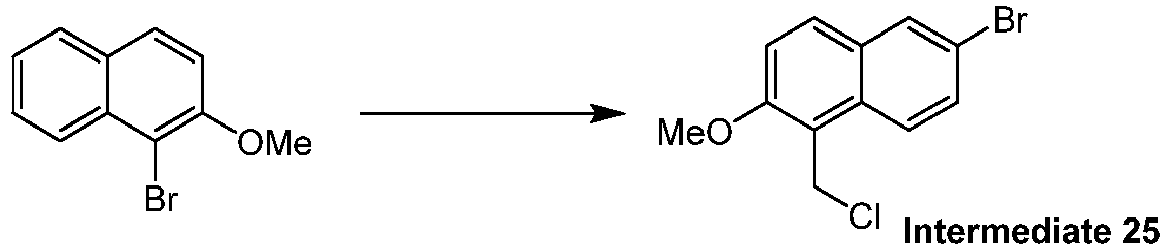
- HCl (gas) was bubbled into a mixture of 1-bromo-2-methoxynaphthalene (20.0 g, 84 mmol), glacial acetic acid (60 ml), 37% aqueous formaldehyde (11.0 g, 134 mmol) and concentrated hydrochloride acid (42 mL) while at 60°C for 2 hours. After cooling to room temperature, the crude product was collected by filtration and then recrystallized in acetone to give the the title compound (13.0 g, 54% yield) as a purple solid.
-

- To a stirred and cooled (0 °C) solution of 6-bromo-2-naphthol (5.00 g, 22.4 mmol) in DMF (50 mL) was added sodium dydride (60%, 1.16 g, 29.1 mmol) in portions. After addition, stirring was continued for 15 min, and then benzyl bromide (3.5 g, 20.2 mmol) was added. The reaction mixture was stirred at room temperature for 18 h. The mixture was quenched by addition of saturated aqueous NH4Cl (100 mL) and then extracted with ethyl acetate (3 x 150 mL). The combined organic layers were washed with water (3 × 100 mL), brine (100 mL), dried (Na2SO4) and concentrated under reduced pressure. The residue was purified by silica-gel chromatography (petroleum ether: ethyl acetate = 10: 1) to give the title compound (5.0 g, 71% yield) as a white solid.
- In many of the Examples below, enantiomers and diastereomers are exemplified by alphabetical designations following the numerical designation. For example, 1a and 1b designations would refer to the two enantiomers of example 1. In addition, 2a, 2b, 2c, and 2d designations would refer to the four diastereomers of example 2. Moreover, when enantiomers or diastereomers are designated, super-fluid chromatography (SFC) using the conditions described per example were used for purification. When racemic mixtures are exemplified, purification by methods other than SFC were used and enantiomers or diastereomers were not separated.
-

- To a stirred and cooled (-78 °C) solution of 1-bromo-3-methoxybenzene (187 mg, 1.0 mmol) in THF (10 mL) was added n-BuLi (2.5 M in hexane, 0.4 mL, 1.0 mmol). After addition, stirring at -78 °C was continued for 1 h, and then a solution of tert-butyl 3-(methoxy(methyl)carbamoyl)piperidine-1-carboxylate (Intermediate 10) (272 mg, 1.0 mmol) in THF (5 mL) was added dropwise. The resulting mixture was warmed up to room temperature and stirred for additional 2 h, at which time TLC indicated the reaction was completed. The mixture was quenched by addition of saturated aqueous NH4Cl (10 mL) and extracted with ethyl acetate (3 x 30 mL). The combined organic layers were washed with brine, dried over Na2SO4 and concentrated under reduced pressure, to give crude tert-butyl 3-(3-methoxybenzoyl)piperidine-1-carboxylate (160 mg, 50% yield). This crude was used directly without further purification.
- To a solution of tert-butyl 3-(3-methoxybenzoyl)piperidine-1-carboxylate (160 mg, 0.5 mmol) in ethyl acetate (5 mL) was added HCl/ethyl acetate (2 M, 5 mL, 10 mmol). The mixture was stirred for 1 h at room temperature. The solvent was removed under reduced pressure to give the crude (3-methoxyphenyl)(piperidin-3-yl) methanone hydrochloride (128 mg, 99% yield). This crude was used directly in next step without further purification.
- A solution of (3-methoxyphenyl)(piperidin-3-yl)methanone hydrochloride (128 mg, 0.5 mmol), cyclopropanecarbaldehyde (70 mg, 1.0 mmol) and triethyl amine (2 mL) in dichloromethane (10 mL) was stirred at room temperature for 1 h before NaBH(OAc)3 (212 mg, 1.0 mmol) was added to the mixture. The mixture was stirred for another 1 h and then quenched by addition of saturated aqueous NH4Cl (5 mL). The solution was extracted with dichloromethane (2 x 20 mL). The combined organic layers were dried (Na2SO4) and concentrated under reduced pressure. The crude was first purified by reverse phase HPLC, then the enantiomers were separated by supercritical fluid chromatography (SFC) to provide 26.7 mg of 109a and 46.3 mg of 109b.
- SFC conditions: CHIRALPAK AD (250 x 30 mm, 5 µm particle size) at 50% MeOH w/0.1%NH4OH; 80 mL/min, 100 bars, 40 °C.
- 109a: 1H NMR (400 MHz, CD3OD) δ 7.57 (d, J = 7.6 Hz, 1 H), 7.47-7.41 (m, 2 H), 7.17 (dd, J = 8.4 Hz, 2.4 Hz, 1 H), 3.85 (s, 3 H), 3.65-3.62 (m, 1 H), 3.21-3.12 (m, 2 H), 2.32-2.31 (m, 2 H), 2.18-2.13 (m, 1 H), 2.04-1.90 (m, 2 H), 1.82-1.78 (m, 2 H), 1.45-1.42 (m, 1 H), 0.90-0.88 (m, 1 H), 0.56-0.52 (m, 2 H), 0.16-0.14 (m, 2 H); LCMS m/z 273.9 (M + H); SFC retention time: 4.15 min.
- 109b: 1H NMR (400 MHz, CD3OD) δ 7.57 (d, J = 7.6 Hz, 1 H), 7.48-7.41 (m, 2 H), 7.17 (dd, J = 8.4 Hz, 2.4 Hz, 1 H), 3.85 (s, 3 H), 3.65-3.62 (m, 1 H), 3.21-3.18 (m, 2 H), 2.32-2.31 (m, 2 H), 2.18-2.13 (m, 1 H), 2.03-1.90 (m, 2 H), 1.82-1.78 (m, 2 H), 1.45-1.42 (m, 1 H), 0.90-0.88 (m, 1 H), 0.56-0.52 (m, 2 H), 0.15-0.12 (m, 2 H); LCMS m/z 273.9 (M + H); SFC retention time: 4.75 min.
-

- Prepared in an analogous manner to (1-(cyclopropylmethyl)piperidin-3-yl) (3-methoxyphenyl) methanone (Examples 109a and 109b), replacing 1-bromo- 3-methoxybenzene with 1-bromo-4-methoxybenzene.
- SFC conditions: CHIRALPAK AD (250 x 30 mm, 5 µm particle size) at 20% MeOH w/0.1%NH4OH; 60 mL/min, 100 bars, 40 °C.
- 110a: 1H NMR (400 MHz, CD3OD) δ 7.98 (d, J = 8.8 Hz, 2 H), 7.03 (d, J = 9.2 Hz, 2 H), 3.88 (s, 3 H), 3.66-3.62 (m, 1 H), 3.20-3.12 (m, 2 H), 2.34-2.32 (m, 2 H), 2.17-2.16 (m, 1 H), 2.05-2.04 (m, 1 H), 1.96-1.92 (m, 1 H), 1.82-1.79 (m, 2 H), 1.46-1.45 (m, 1 H), 0.91-0.90 (m, 1 H), 0.57-0.52 (m, 2 H), 0.17-0.14 (m, 2 H); LCMS m/z 274.2 (M + H); SFC retention time: 6.87 min.
- 110b: 1H NMR (400 MHz, CD3OD) δ 7.99 (d, J = 8.8 Hz, 2 H), 7.04 (d, J = 8.8 Hz, 2 H), 3.89 (s, 3 H), 3.68-3.66 (m, 1 H), 3.25-3.10 (m, 2 H), 2.44-2.42 (m, 2 H), 2.30-2.29 (m, 1 H), 2.29-2.09 (m, 1 H), 1.94-1.92 (m, 1 H), 1.85-1.82 (m, 2 H), 1.56-1.47 (m, 1 H), 0.95-0.93 (m, 1 H), 0.60-0.56 (m, 2 H), 0.21-0.19 (m, 2 H); LCMS m/z 274.2 (M + H); SFC retention time: 6.19 min.
-

- Prepared in an analogous manner to (1-(cyclopropylmethyl)piperidin-3-yl) (3-methoxyphenyl) methanone (Examples 109a and 109b), replacing 1-bromo- 3-methoxybenzene with 1-bromo-2-methoxybenzene.
- SFC conditions: CHIRALPAK AD (250 x 30 mm, 5 µm particle size) at 25% MeOH w/0.1%NH4OH; 60 mL/min, 100 bars, 40 °C.
- 111: 1H NMR (400 MHz, CD3OD) δ 7.54-7.50 (m, 2 H), 7.13 (d, J = 8.8 Hz, 1 H), 7.02 (t, J = 7.4 Hz, 1 H), 3.94 (s, 3 H), 3.73-3.68 (m, 1 H), 3.15-3.11 (m, 1 H), 2.49-2.47 (m, 3 H), 2.35-2.33 (m, 1 H), 1.95-1.92 (m, 2 H), 1.80-1.74 (m, 2 H), 1.44-1.40 (m, 1 H), 0.97-0.93 (m, 1 H), 0.59-0.57 (m, 2 H), 0.22-0.20 (m, 2 H); LCMS m/z 273.9 (M + H); SFC retention time: 5.18 min.
-

- Prepared in an analogous manner to (1-(cyclopropylmethyl)piperidin-3-yl) (3-methoxyphenyl) methanone (Examples 109a and 109b), replacing 1-bromo- 3-methoxybenzene with 6-bromo-1-phenoxynaphthalene (Intermediate 23).
1H NMR (400 MHz, CD3OD) δ 8.56 (s, 1 H), 8.05 (d, J = 8.8 Hz, 1 H), 7.95 (d, J = 8.8 Hz, 1 H), 7.75 (d, J = 8.8 Hz, 1 H), 7.41(d, J = 8.8 Hz, 2 H), 7.31-7.25 (m, 1 H), 7.25-7.21 (m, 2 H), 7.11-7.09 (m, 2 H), 3.82-3.77 (m, 1 H), 3.31-3.16 (m, 2 H), 2.35-2.33 (m, 2 H), 2.24-2.23 (m, 1 H), 2.07-1.99 (m, 2 H), 1.85-1.80 (m, 2 H), 1.55-1.45 (m, 1 H), 0.91-0.89 (m, 1 H), 0.56-0.52 (m, 2 H), 0.19-0.14 (m, 2 H); LCMS m/z 386.2 (M + H). -

- Prepared in an analogous manner to (1-(cyclopropylmethyl)piperidin-3-yl) (3-methoxyphenyl) methanone (Examples 109a and 109b), replacing 1-bromo- 3-methoxybenzene with 1-bromo-2-chlorobenzene. 1H NMR (400 MHz, CD3OD) δ 7.50-7.40 (m, 4 H), 3.39-3.36 (m, 1 H), 3.22-3.19 (m, 1 H), 3.03-3.00 (m, 1 H), 2.30-2.29 (m, 2 H), 2.21-2.19 (m, 1 H), 2.07-2.06 (m, 1 H), 1.91-1.90 (m, 1 H), 1.78-1.77 (m, 1 H), 1.68-1.65 (m, 1 H), 1.47-1.43 (m, 1 H), 0.88-0.84 (m, 1 H), 0.54-0.49 (m, 2 H), 0.13-0.12 (m, 2 H); LCMS m/z 277.8 (M + H).
-
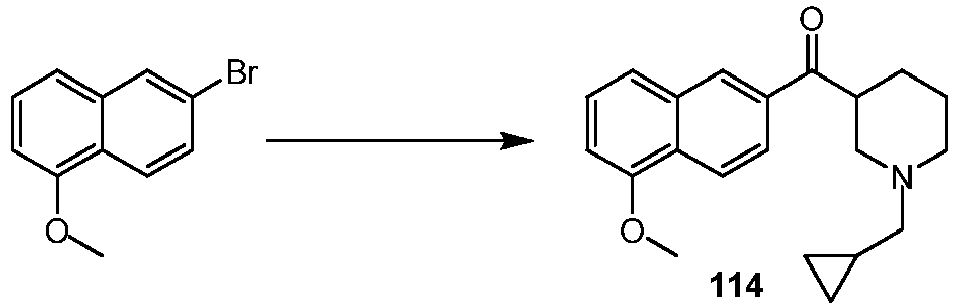
- Prepared in an analogous manner to (1-(cyclopropylmethyl)piperidin-3-yl) (3-methoxyphenyl) methanone (Examples 109a and 109b), replacing 1-bromo- 3-methoxybenzene with 6-bromo-1-methoxynaphthalene. 1H NMR (400 MHz, CD3OD) δ 8.44 (s, 1 H), 7.91-7.84 (m, 2 H), 7.75 (d, J = 8.8 Hz, 1 H), 7.20 (s, 1 H), 7.15 (dd, J = 8.8 Hz, 2.4 Hz, 1 H), 3.88 (s, 3 H), 3.74-3.71 (m, 1 H), 3.20-3.17 (m, 1 H), 3.13-3.10 (m, 1 H), 2.28-2.21 (m, 2 H), 2.18-2.15 (m, 1 H), 1.97-1.95 (m, 2 H), 1.77-1.76 (m, 2 H), 1.45-1.35 (m, 1 H), 0.51-0.48 (m, 2 H), 0.11-0.09 (m, 2 H); LCMS m/z 324.2 (M + H).
-

- Prepared in an analogous manner to (1-(cyclopropylmethyl)piperidin-3-yl) (3-methoxyphenyl)methanone (Examples 109a and 109b), replacing 1-bromo-3-methoxybenzene with 2-bromo-1-methylnaphthalene. 1H NMR (400 MHz, CD3OD) δ 8.30-8.28 (m, 1 H), 8.03-8.01 (m, 1 H), 7.74 (d, J = 8.8 Hz, 1 H), 7.51-7.48 (m, 2 H), 7.33 (d, J = 8.8 Hz, 1 H), 3.53-3.52 (m, 1 H), 3.26-3.15 (m, 1 H), 3.01-2.96 (m, 1 H), 2.65 (s, 3 H), 2.20-2.13 (m, 3 H), 1.95-1.94 (m, 1 H), 1.86-1.85 (m, 1 H), 1.70-1.68 (m, 1 H), 1.42-1.41 (m, 1 H), 0.77-0.75 (m, 1 H), 0.43-0.40 (m, 2 H), 0.03-0.02 (m, 2 H); LCMS m/z 308.2 (M + H).
-

- Prepared in an analogous manner to (1-(cyclopropylmethyl)piperidin-3-yl) (3-methoxyphenyl) methanone (Examples 109a and 109b), replacing 1-bromo- 3-methoxybenzene with 1-bromo-4-chlorobenzene. SFC conditions: CHIRALPAK AD (250 x 30 mm, 5 µm particle size) at 25% EtOH w/0.1%NH4OH; 60 mL/min, 100 bars, 40 °C. 1H NMR (400 MHz, CD3OD) δ 7.97 (dd, J = 6.8 Hz, 1.6 Hz, 2 H), 7.53 (dd, J = 6.8 Hz, 1.6 Hz, 2 H), 3.62-3.61 (m, 1 H), 3.20-3.13 (m, 2 H), 2.34-2.32 (m, 2 H), 2.21-2.20 (m, 1 H), 2.06-2.05 (m, 1 H), 1.90-1.83 (m, 1 H), 1.82-1.79 (m, 2 H), 1.45-1.41 (m, 1 H), 0.91-0.90 (m, 1 H), 0.56-0.53 (m, 2 H), 0.17-0.14 (m, 2 H); LCMS m/z 278.1 (M + H); SFC retention time: 5.66 min.
- 1H NMR (400 MHz, CD3OD) δ 7.99 (d, J = 8.8 Hz, 2 H), 7.54 (d, J = 8.8 Hz, 2 H), 3.69-3.67 (m, 1 H), 3.32-3.19 (m, 2 H), 2.47-2.45 (m, 2 H), 2.23-2.22 (m, 1 H), 2.11-2.10 (m, 1 H), 2.05-1.92 (m, 1 H), 1.86-1.83 (m, 2 H), 1.51-1.49 (m, 1 H), 0.96-0.94 (m, 1 H), 0.61-0.57 (m, 2 H), 0.22-0.20 (m, 2 H); LCMS m/z 278.1 (M + H); SFC retention time: 6.51 min.
-

- Prepared in an analogous manner to (1-(cyclopropylmethyl)piperidin-3-yl) (3-methoxyphenyl) methanone (Examples 109a and 109b), replacing 1-bromo-3-methoxybenzene with 2-bromoquinoline. SFC conditions: CHIRALPAK AD (250 x 30 mm, 20 µm particle size) at 30% MeOH w/0.1%NH4OH; 80 mL/min, 100 bars, 40 °C.
- 117a: 1H NMR (400 MHz, CD3OD) δ 8.44 (d, J = 8.8 Hz, 1 H), 8.17 (d, J = 8.4 Hz, 1 H), 8.08 (d, J = 8.8 Hz, 1 H), 7.99 (d, J = 8.4 Hz, 1 H), 7.84-7.83 (m, 1 H), 7.73-7.72 (m, 1 H), 4.50-4.45 (m, 1 H), 3.42-3.39 (m, 1 H), 3.18-3.15 (m, 1 H), 2.37-2.35 (m, 2 H), 2.26-2.25 (m, 1 H), 2.10-2.07 (m, 2 H), 1.87-1.84 (m, 2 H), 1.55-1.45 (m, 1 H), 0.93-0.92 (m, 1 H), 0.55-0.51 (m, 2 H), 0.18-0.13 (m, 2 H); LCMS m/z 295.2 (M + H); SFC retention time: 6.81 min.
- 117b: 1H NMR (400 MHz, CD3OD) δ 8.43 (d, J = 8.4 Hz, 1 H), 8.17 (d, J = 8.8 Hz, 1 H), 8.08 (d, J = 8.8 Hz, 1 H), 7.99 (d, J = 8.4 Hz, 1 H), 7.84-7.82 (m, 1 H), 7.73-7.71 (m, 1 H), 4.52-4.46 (m, 1 H), 3.45-3.42 (m, 1 H), 3.18-3.17 (m, 1 H), 2.43-2.41 (m, 2 H), 2.41-2.40 (m, 1 H), 2.25-2.23 (m, 1 H), 2.15-2.10 (m, 1 H), 1.89-1.84 (m, 2 H), 1.55-1.45 (m, 1 H), 0.97-0.95 (m, 1 H), 0.58-0.54 (m, 2 H), 0.20-0.17 (m, 2 H); LCMS m/z 295.2 (M + H); SFC retention time: 5.50 min.
-

- Prepared in an analogous manner to (1-(cyclopropylmethyl)piperidin-3-yl) (3-methoxyphenyl) methanone (Examples 109a and 109b), replacing 1-bromo-3-methoxybenzene with 1-bromo-3-chlorobenzene.
- SFC conditions: CHIRALPAK AD (250 x 30 mm, 20 µm particle size) at 30% MeOH w/0.1%NH4OH; 80 mL/min, 100 bars, 40 °C.
- 118a: 1H NMR (400 MHz, CD3OD) δ 7.95-7.91 (m, 2 H), 7.64-7.62 (m, 1 H), 7.54-7.50 (m, 1 H), 3.62-3.61 (m, 1 H), 3.21-3.13 (m, 2 H), 2.36-2.34 (m, 2 H), 2.18-2.13 (m, 1 H), 2.09-2.08 (m, 1 H), 1.98-1.95 (m, 1 H), 1.83-1.79 (m, 2 H), 1.45-1.44 (m, 1 H), 0.91-0.89 (m, 1 H), 0.57-0.54 (m, 2 H), 0.17-0.16 (m, 2 H); LCMS m/z 277.9 (M + H); SFC retention time: 3.97 min. 118b: 1H NMR (400 MHz, CD3OD) δ 7.95-7.91 (m, 2 H), 7.65-7.62 (m, 1 H), 7.55-7.51 (m, 1 H), 3.64-3.61 (m, 1 H), 3.21-3.14 (m, 2 H), 2.36-2.34 (m, 2 H), 2.18-2.13 (m, 1 H), 2.09-2.08 (m, 1 H), 1.98-1.95 (m, 1 H), 1.83-1.79 (m, 2 H), 1.45-1.42 (m, 1 H), 0.91-0.89 (m, 1 H), 0.57-0.53 (m, 2 H), 0.18-0.16 (m, 2 H); LCMS m/z 278.1 (M + H); SFC retention time: 4.26 min.
-

- Prepared in an analogous manner to (1-(cyclopropylmethyl)piperidin-3-yl) (3-methoxyphenyl)methanone (Examples 109a and 109b), replacing 1-bromo-3-methoxybenzene with 6-bromo-1-methyl-1H-indole.
1H NMR (400 MHz, CD3OD) δ 8.09 (s, 1 H), 7.69 (d, J = 8.0 Hz, 1 H), 7.61 (d, J = 8.0 Hz, 1 H), 7.40 (d, J = 4.0 Hz, 1 H), 6.50 (d, J = 4.0 Hz, 1 H), 3.89 (s, 3 H), 3.81-3.78 (m, 1 H), 3.24-3.15 (m, 2 H), 2.38-2.37 (m, 2 H), 2.01-1.98 (m, 1 H), 1.85-1.79 (m, 2 H), 1.27 (s, 1 H), 0.93-0.88 (m, 1 H), 0.58-0.52 (m, 2 H), 0.16-0.15 (m, 2 H); LCMS m/z 297.2 (M + H). -

- Prepared in an analogous manner to (1-(cyclopropylmethyl)piperidin-3-yl) (3-methoxyphenyl) methanone (Examples 109a and 109b), replacing 1-bromo- 3-methoxybenzene with 2-bromobenzo[b]thiophene.
1H NMR (400 MHz, CD3OD) δ 8.26 (s, 1 H), 8.01-7.99 (m, 1 H), 7.94-7.92 (m, 1 H), 7.52-7.48 (m, 1 H), 7.47-7.43 (m, 1 H), 3.70-3.67 (m, 1 H), 3.32-3.31 (m, 1 H), 3.31-3.25 (m, 1 H), 2.36-2.34 (m, 2 H), 2.25-2.24 (m, 1 H), 2.08-2.04 (m, 2 H), 1.85-1.84 (m, 2 H), 1.56-1.53 (m, 1 H), 0.93-0.92 (m, 1 H), 0.58-0.54 (m, 2 H), 0.17-0.16 (m, 2 H); LCMS m/z 299.8 (M + H). -

- Prepared in an analogous manner to (1-(cyclopropylmethyl)piperidin-3-yl) (3-methoxyphenyl) methanone (Examples 109a and 109b), replacing 1-bromo-3-methoxybenzene with 7-bromo-3-methoxyisoquinoline.
1H NMR (400 MHz, CD3OD) δ 9.13 (s, 1 H), 8.72 (s, 1 H), 8.11 (d, J = 8.8 Hz, 1 H), 7.83 (d, J = 8.8 Hz, 1 H), 7.16 (s, 1 H), 4.04 (s, 3 H), 3.82-3.79 (m, 1 H), 3.26-3.17 (m, 2 H), 2.37-2.27 (m, 2 H), 2.26-2.25 (m, 1 H), 2.08-2.01 (m, 2 H), 1.87-1.84 (m, 2 H), 1.55-1.45 (m, 1 H), 0.93-0.91 (m, 1 H), 0.57-0.52 (m, 2 H), 0.17-0.14 (m, 2 H); LCMS m/z 325.2 (M + H). -

- Prepared in an analogous manner to (1-(cyclopropylmethyl)piperidin-3-yl) (3-methoxyphenyl) methanone (Examples 109a and 109b), replacing 1-bromo- 3-methoxybenzene with 6-bromo-2-methoxyquinoline.
1H NMR (400 MHz, CD3OD) δ 8.50 (s, 1 H), 8.25 (d, J = 8.8 Hz, 1 H), 8.16 (dd, J = 8.8 Hz, 2.0 Hz, 1 H), 7.86 (d, J = 8.8 Hz, 1 H), 7.02 (d, J = 8.8 Hz, 1 H), 4.07 (s, 3 H), 3.81-3.78 (m, 1 H), 3.32-3.31 (m, 1 H), 3.26-3.17 (m, 1 H), 2.36-2.35 (m, 2 H), 2.29-2.26 (m, 1 H), 2.08-2.05 (m, 2 H), 1.86-1.83 (m, 2 H), 1.51-1.48 (m, 1 H), 0.92-0.90 (m, 1 H), 0.57-0.52 (m, 2 H), 0.18-0.15 (m, 2 H); LCMS m/z 325.2 (M+H). -
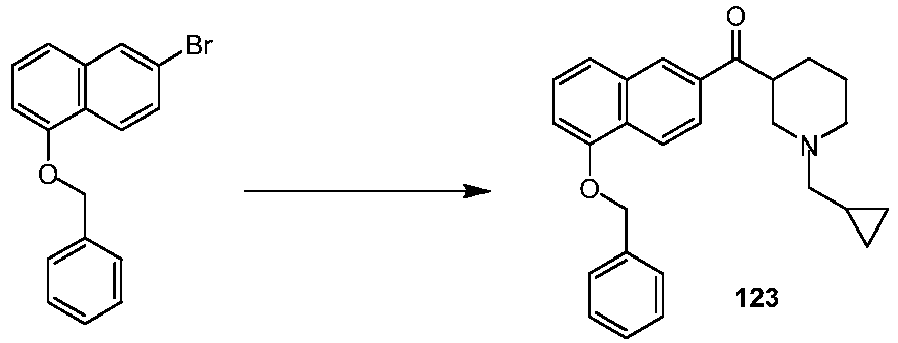
- Prepared in an analogous manner to (1-(cyclopropylmethyl)piperidin-3-yl) (3-methoxyphenyl) methanone (Examples 109a and 109b), replacing 1-bromo-3-methoxybenzene with 1-(benzyloxy)-6-bromonaphthalene (Intermediate 26)
1H NMR (400 MHz, CD3OD) δ 8.53 (s, 1 H), 7.98-7.95 (m, 2 H), 7.85-7.84 (m, 1 H), 7.51-7.49 (m, 2 H), 7.40-7.34 (m, 3 H), 7.32-7.31 (m, 2 H), 5.24 (s, 2 H), 3.85-3.79 (m, 1 H), 3.31-3.28 (m, 1 H), 3.28-3.18 (m, 1 H), 2.39-2.34 (m, 2 H), 2.15-2.10 (m, 1 H), 2.04-2.01 (m, 1 H), 1.87-1.82 (m, 2 H), 1.53-1.48 (m, 2 H), 0.95-0.92 (m, 1 H), 0.57-0.49 (m, 2 H), 0.20-0.17 (m, 2 H); LCMS m/z 400.2 (M + H). -

- Prepared in an analogous manner to (1-(cyclopropylmethyl)piperidin-3-yl) (3-methoxyphenyl) methanone (Examples 109a and 109b), replacing 1-bromo-3-methoxybenzene with 4-bromo-1-phenyl-1-pyrazole.
1H NMR (400 MHz, CD3OD) δ 8.95 (s, 1 H), 8.19 (s, 1 H), 7.86 (d, J = 8.0 Hz, 2 H), 7.55 (t, J = 8.0 Hz, 2 H), 7.42 (t, J = 7.2 Hz, 1 H), 3.40-3.33 (m, 1 H), 3.24-3.16 (m, 2 H), 2.37-2.35 (m, 2 H), 2.23-2.22 (m, 1 H), 2.07-2.01 (m, 2 H), 1.85-1.82 (m, 2 H), 1.52-1.48 (m, 1 H), 0.96-0.92 (m, 1 H), 0.58-0.56 (m, 2 H), 0.18-0.17 (m, 2 H); LCMS m/z 310.1 (M + H). -

- Prepared in an analogous manner to (1-(cyclopropylmethyl)piperidin-3-yl) (3-methoxyphenyl) methanone (Examples 109a and 109b), replacing 1-bromo-3-methoxybenzene with 3-bromoquinoline.
1H NMR (400 MHz, CD3OD) δ 9.32 (s, 1 H), 9.04 (s, 1 H), 8.16 (d, J = 8.4 Hz, 1 H), 8.11 (d, J = 8.4 Hz, 1 H), 7.94 (t, J = 7.2 Hz, 1 H), 7.76 (t, J = 7.2 Hz, 1 H), 3.84-3.78 (m, 1 H), 3.32-3.30 (m, 1 H), 3.26-3.17 (m, 1 H), 2.39-2.34 (m, 2 H), 2.34-2.33 (m, 1 H), 2.20-2.10 (m, 2 H), 1.90-1.86 (m, 2 H), 1.58-1.45 (m, 1 H), 0.93-0.91 (m, 1 H), 0.57-0.53 (m, 2 H), 0.20-0.17 (m, 2 H); LCMS m/z 295.2 (M + H). -

- Prepared in an analogous manner to (1-(cyclopropylmethyl)piperidin-3-yl) (3-methoxyphenyl) methanone (Examples 109a and 109b), replacing 1-bromo-3-methoxybenzene with 1-bromonaphthalene.
1H NMR (400 MHz, CD3OD) δ 8.27-8.25 (m, 1 H), 8.02 (d, J = 8.4 Hz, 1 H), 7.91-7.87 (m, 2 H), 7.55-7.51 (m, 3 H), 3.65-3.60 (m, 1 H), 3.28-3.23 (m, 1 H), 3.11-3.08 (m, 1 H), 2.41-2.36 (m, 3 H), 2.28-2.27 (m, 1 H), 1.93-1.89 (m, 1 H), 1.78-1.68 (m, 2 H), 1.51-1.48 (m, 1 H), 0.87-0.84 (m, 1 H), 0.51-0.47 (m, 2 H), 0.15-0.11 (m, 2 H); LCMS m/z 294.2 (M+H). -

- Prepared in an analogous manner to (1-(cyclopropylmethyl)piperidin-3-yl) (3-methoxyphenyl) methanone (Examples 109a and 109b), replacing 1-bromo-3-methoxybenzene with 1-bromo-4-fluoronaphthalene.
1H NMR (400 MHz, CD3OD) δ 8.82-8.80 (m, 0.3 H), 8.61-8.59 (m, 0.6 H), 8.22-8.16 (m, 2 H), 7.73-7.69 (m, 2 H), 7.38-7.34 (m, 1 H), 4.30-3.75 (m, 3 H), 3.45-3.00 (m, 4 H), 2.13-1.63 (m, 4 H), 1.23-1.22 (m, 1 H), 0.87-0.80 (m, 2 H), 0.62-0.51 (m, 2 H); LCMS m/z 311.9 (M + H). -

- Prepared in an analogous manner to (1-(cyclopropylmethyl)piperidin-3-yl) (3-methoxyphenyl) methanone (Examples 109a and 109b), replacing 1-bromo-3-methoxybenzene with 2-bromo-1-fluoronaphthalene.
1H NMR (400 MHz, CD3OD) δ 8.15-8.13 (m, 1 H), 7.88-7.87 (m, 1 H), 7.70-7.61 (m, 4 H), 3.60-3.55 (m, 1 H), 3.31-3.23 (m, 1 H), 3.04-3.01(m, 1 H), 2.26-2.18 (m, 3 H), 2.02-1.98 (m, 2 H), 1.77-1.75 (m, 2 H), 1.39-1.38 (m, 1 H), 0.84-0.82 (m, 1 H), 0.48-0.46 (m, 2 H), 0.10-0.08 (m, 2 H); LCMS m/z 312.2(M + H). -

- Prepared in an analogous manner to (1-(cyclopropylmethyl)piperidin-3-yl) (3-methoxyphenyl) methanone (Examples 109a and 109b), replacing 1-bromo-3-methoxybenzene with 6-bromo-3-methylbenzo[d]isoxazole.
1H NMR (400 MHz, CD3OD) δ 8.18 (s, 1 H), 7.93 (d, J = 8.4 Hz, 1 H), 7.88 (d, J = 8.4 Hz, 1 H), 3.75-3.71 (m, 1 H), 3.24-3.22 (m, 1 H), 3.17-3.14 (m, 1 H), 2.59 (s, 3 H), 2.37-2.30 (m, 2 H), 2.28-2.26 (m, 1 H), 2.11-2.10 (m, 1 H), 2.02-2.01 (m, 1 H), 1.84-1.81 (m, 2 H), 1.47-1.44 (m, 1 H), 0.92-0.89 (m, 1 H), 0.56-0.51 (m, 2 H), 0.17-0.15 (m, 2 H); LCMS m/z 298.8 (M + H). -

- Prepared in an analogous manner to (1-(cyclopropylmethyl)piperidin-3-yl) (3-methoxyphenyl) methanone (Examples 109a and 109b), replacing 1-bromo-3-methoxybenzene with 5-bromo-1,3-dimethyl-1H-benzo[d]imidazol-2(3H)-one.
1H NMR (400 MHz, CD3OD) δ 7.87 (d, J = 8.4 Hz, 1 H), 7.74 (s, 1 H), 7.23 (d, J = 8.4 Hz, 1 H), 3.73-3.63 (m, 1 H), 3.46 (s, 3 H), 3.45 (s, 3 H), 3.23-3.16 (m, 2 H), 2.36-2.35 (m, 2 H), 2.23-2.22 (m, 1 H), 2.09-2.07 (m, 1 H), 1.99-1.95 (m, 1 H), 1.83-1.78 (m, 2 H), 1.49-1.45 (m, 1 H), 0.93-0.90 (m, 1 H), 0.56-0.53 (m, 2 H), 0.18-0.15 (m, 2 H); LCMS m/z 328.2 (M + H). -

- Prepared in an analogous manner to (1-(cyclopropylmethyl)piperidin-3-yl) (3-methoxyphenyl) methanone (Examples 109a and 109b), replacing 1-bromo-3-methoxybenzene with 2,6-dibromonaphthalene.
- SFC conditions: CHIRALPAK OJ (250 x 30 mm, 5 µm particle size) at 20% MeOH w/0.1%NH4OH; 60 mL/min, 100 bars, 40 °C.
131a: 1H NMR (400 MHz, CD3OD) δ 8.60 (s, 1 H), 8.16 (s, 1 H), 8.05-7.98 (m, 2 H), 7.93 (d, J = 8.4 Hz, 1 H), 7.70 (d, J = 8.4 Hz, 1 H), 3.84-3.80 (m, 1 H), 3.26- 3.17 (m, 2 H), 2.37-2.35 (m, 3 H), 2.05-2.01 (m, 2 H), 1.87-1.83 (m, 2 H), 1.52-1.48 (m, 1 H), 1.20-1.16 (m, 1 H), 0.94-0.90 (m, 1 H), 0.57-0.52 (m, 2 H), 0.17-0.15 (m, 2 H); LCMS m/z 373.6 (M+H); SFC retention time: 3.38 min.
131b: 1H NMR (400 MHz, CD3OD) δ 8.60 (s, 1 H), 8.15 (s, 1 H), 8.05-7.99 (m, 2 H), 7.93 (d, J =8.8 Hz, 1 H), 7.70 (d, J=8.8 Hz, 1 H), 3.84-3.81 (m, 1 H), 3.27-3.17 (m, 2 H), 2.38-2.36 (m, 3 H), 2.05-2.01 (m, 2 H), 1.88-1.84 (m, 2 H), 1.52-1.48 (m, 1 H), 0.94-0.90 (m, 1 H), 0.56-0.53 (m, 2 H), 0.17-0.16 (m, 2 H); LCMS m/z 373.7 (M+H); SFC retention time: 3.99 min. -

- Prepared in an analogous manner to (1-(cyclopropylmethyl)piperidin-3-yl) (3-methoxyphenyl) methanone (Examples 109a and 109b), replacing 1-bromo-3-methoxybenzene with 2-bromo-6,7,8,9-tetrahydro-5H-benzo[7]annulene (Intermediate 23), and cyclopropanecarbaldehyde with cyclobutanone.
1H NMR (400 MHz, CD3OD) δ 7.69-7.68 (m, 2 H), 7.23-7.21 (m, 1 H), 3.56-3.55 (m, 1 H), 2.95-2.86 (m, 7 H), 2.17-2.03 (m, 2 H), 1.90-1.86 (m, 6 H), 1.78-1.73 (m, 5 H), 1.65-1.55 (m, 4 H), 1.42-1.28 (m, 1 H); LCMS m/z 312.2 (M + H). -

- Prepared in an analogous manner to (1-(cyclopropylmethyl)piperidin-3-yl) (3-methoxyphenyl) methanone (Examples 109a and 109b), replacing 1-bromo-3-methoxybenzene with 6-bromo-1,2,3,4-tetrahydronaphthalene, and cyclopropanecarbaldehyde with cyclobutanone. It should be noted that the halide- lithium exchange step should be controlled within 15 min.
1H NMR (400 MHz, CD3OD) δ 7.69-7.68 (m, 2 H), 7.20 (d, J = 8.8 Hz, 1 H), 3.87-3.82(m, 1 H), 3.66-3.62 (m, 1 H), 3.40-3.32(m, 1 H), 3.05-3.01 (m, 1 H), 2.82-2.75 (m, 5 H), 2.33-2.27 (m, 4 H), 2.19-2.14 (m, 1 H), 1.87-1.81(m, 9 H), 1.62-1.58 (m, 1 H); LCMS m/z 297.9 (M + H). -

- Prepared in an analogous manner to (1-(cyclopropylmethyl)piperidin-3-yl) (3-methoxyphenyl) methanone (Examples 109a and 109b), replacing 1-bromo-3-methoxybenzene with 1-bromo-4-methoxybenzene, and cyclopropanecarbaldehyde with propionaldehyde.
1H NMR (400 MHz, CD3OD) δ 8.03-7.98 (m, 2 H), 7.05-7.03 (m, 2 H), 3.92-3.81 (m, 4 H), 3.63-3.60 (m, 1 H), 3.33-3.29 (m, 2 H), 3.17-3.10 (m, 4 H), 2.17-2.06 (m, 2 H), 1.88-1.81 (m, 3 H), 1.09-1.00 (m, 3 H); LCMS m/z 261.9 (M + H). -

- Prepared in an analogous manner to (1-(cyclopropylmethyl)piperidin-3-yl) (3-methoxyphenyl) methanone (Examples 109a and 109b), replacing 1-bromo-3-methoxybenzene with 6-bromoisoquinoline, and cyclopropanecarbaldehyde with cyclobutanone.
1H NMR (400 MHz, CD3OD) δ 9.32 (s, 1 H), 8.60 (s, 1 H), 8.55 (d, J = 6.0 Hz, 1 H), 8.20-8.19 (m, 1 H), 8.16-8.15 (m, 1 H), 8.01 (d, J = 6.0 Hz, 1 H), 3.75-3.74 (m, 1 H), 3.06-3.02 (m, 1 H), 2.95-2.90 (m, 1 H), 2.85-2.83 (m, 1 H), 2.08-2.01 (m, 4 H), 1.91-1.75 (m, 5 H), 1.75-1.72 (m, 2 H), 1.47-1.43 (m, 1 H); LCMS m/z 295.1 (M + H). -

- Prepared in an analogous manner to (1-(cyclopropylmethyl)piperidin-3-yl) (3-methoxyphenyl)methanone (Examples 109a and 109b), replacing 1-bromo- 3-methoxybenzene with 6-bromo-1-methoxynaphthalene, and tert-butyl 3-(methoxy (methyl)carbamoyl)piperidine-1-carboxylate with tert-butyl 3-(methoxy(methyl) carbamoyl)-4-methylpiperidine-1-carboxylate (Intermediate 10). 129a and 129b correspond to the cis-enantiomers.
- SFC conditions: CHIRALPAK AD (250 x 30 mm, 5 µm particle size) at 50% MeOH w/0.1%NH4OH; 80 mL/min, 100 bars, 40 °C.
- 129a: 1H NMR (400 MHz, CD3OD) δ 8.50 (s, 1 H), 8.00-7.94 (m, 2 H), 7.87 (d, J = 8.8 Hz, 1 H), 7.32 (d, J = 2.0 Hz, 1 H), 7.24 (d, J = 8.8 Hz, 1 H), 4.00-3.94 (m, 4 H), 3.00-2.91 (m, 2 H), 2.75-2.61 (m, 1 H), 2.43-2.34 (m, 4 H), 2.20-2.17 (m, 1 H), 1.70-1.67 (m, 1 H), 0.97-0.92 (m, 1 H), 0.83-0.82 (m, 3 H), 0.60-0.58 (m, 2 H), 0.26-0.22 (m, 2 H); LCMS m/z 337.9 (M + H); SFC retention time: 6.35 min.
- 129b: 1H NMR (400 MHz, CD3OD) δ 8.50 (s, 1 H), 8.00 (d, J = 8.8 Hz, 2 H), 7.92 (d, J = 8.8 Hz, 1 H), 7.36 (d , J = 2.0 Hz, 1 H), 7.28 (dd , J = 8.8 Hz, 2.4 Hz, 1 H), 4.29-4.28 (m, 1 H), 3.96 (s, 3 H), 3.58-3.50 (m, 2 H), 3.15-3.13 (m, 2 H), 2.63-2.40 (m, 1 H), 1.91-1.81 (m, 1 H), 1.39-1.21 (m, 3 H), 0.92-0.90 (m, 4 H), 0.83-0.80 (m, 2 H), 0.55-0.45 (m, 2 H); LCMS m/z 337.9 (M+H); SFC retention time: 7.46 min.
-

- Prepared in an analogous manner to (1-(cyclopropylmethyl)piperidin-3-yl) (3-methoxyphenyl)methanone (Examples 109a and 109b), replacing 1-bromo-3-methoxybenzene with 2-bromo-6-methoxynaphthalene, and tert-butyl 3-(methoxy (methyl)carbamoyl)piperidine-1-carboxylate with tert-butyl 3-(methoxy(methyl) carbamoyl)-4-methylpiperidine-1-carboxylate (Intermediate 10). SFC conditions: CHIRALPAK AD (250 x 30 mm, 10 µm particle size) at 30% EtOH w/0.1%NH4OH; 80 mL/min, 100 bars, 40 °C.
- 137a: 1H NMR (400 MHz, CD3OD) δ 8.46 (s, 1 H), 7.96-7.91 (m, 2 H), 7.84 (d, J = 8.8 Hz, 1 H), 7.29 (s, 1 H), 7.21 (d, J = 9.2 Hz, 1 H), 3.96 (s, 3 H), 2.96-2.94 (m, 2 H), 2.86-2.82 (m, 1 H), 2.42-2.37 (m, 4 H), 2.15-2.11 (m, 1 H), 1.68-1.64 (m, 1 H), 0.91-0.78 (m, 4 H), 0.56-0.51 (m, 2 H), 0.22-0.16 (m, 2 H); LCMS m/z 337.9 (M + H); SFC retention time: 3.21 min.
- 137b: 1H NMR (400 MHz, CD3OD) δ 8.53 (s, 1 H), 7.95-7.91 (m, 2 H), 7.82 (d, J = 8.8 Hz, 1 H), 7.27 (d, J = 2.4 Hz, 1 H), 7.18 (d, J = 2.4 Hz, 1 H), 3.91 (s, 3 H), 3.59-3.57 (m, 1 H) 3.19-3.13 (m, 2 H), 2.30-2.28 (m, 2 H), 2.12-2.07 (m, 1 H), 1.97-1.94 (m, 1 H), 1.92-1.88 (m, 1 H), 1.53-1.49 (m, 1 H), 1.26-1.22 (m, 1 H), 0.85 (d, J = 6.4 Hz, 4 H), 0.51-0.46 (m, 2 H), 0.10-0.06 (m, 2 H); LCMS m/z 337.9 (M + H); SFC retention time: 2.77 min.
- 137c: 1H NMR (400 MHz, CD3OD) δ 8.44 (s, 1 H), 7.91-7.88 (m, 2 H), 7.81 (d, J = 8.8 Hz, 1 H), 7.27 (s, 1 H), 7.19 (d, J = 9.2 Hz, 1 H), 3.94-3.91 (m, 4 H), 2.93-2.91 (m, 2 H), 2.86-2.82 (m, 1 H), 2.39-2.34 (m, 4 H), 2.15-2.11 (m, 1 H), 1.66-1.62 (m, 1 H), 0.89-0.76 (m, 4 H), 0.54-0.52 (m, 2 H), 0.19-0.16 (m, 2 H); LCMS m/z 337.9 (M + H); SFC retention time: 3.63 min. 137d: 1H NMR (400 MHz, CD3OD) δ 8.53 (s, 1 H), 7.95-7.91 (m, 2 H), 7.82 (d, J = 8.8 Hz, 1 H), 7.27 (d, J = 2.4 Hz, 1 H), 7.18 (d, J = 9.2 Hz, 1 H), 3.91 (s, 3 H), 3.59-3.57 (m, 1 H), 3.19-3.13 (m, 2 H), 2.30-2.28 (m, 2 H), 2.12-2.07 (m, 1 H), 1.97-1.94 (m, 1 H), 1.92-1.88 (m, 1 H), 1.53-1.49 (m, 1 H), 1.26-1.22 (m, 1 H), 0.88-0.82 (m, 4 H), 0.51-0.46 (m, 2 H), 0.11-0.10 (m, 2 H); LCMS m/z 337.9 (M + H); SFC retention time: 3.13 min.
-

- Prepared in an analogous manner to (1-(cyclopropylmethyl)piperidin-3-yl) (3-methoxyphenyl)methanone (Examples 109a and 109b), replacing 1-bromo-3-methoxybenzene with 2-bromo-6-methoxynaphthalene, and tert-butyl 3-(methoxy (methyl)carbamoyl)piperidine-1-carboxylate with tert-butyl 3-(methoxy(methyl) carbamoyl)-5-(trifluoromethyl) piperidine-1-carboxylate (Intermediate 12). 138a and 138b correspond to the cis-enantiomers.
- SFC conditions: CHIRALPAK AD (250 x 30 mm, 20 µm particle size) at 30% MeOH w/0.1%NH4OH; 80 mL/min, 100 bars, 40 °C.
- 138a: 1H NMR (400 MHz, CD3OD) δ 8.56 (s, 1 H), 7.99 (d, J = 9.2 Hz, 2 H), 7.90 (d, J = 9.2 Hz, 1 H), 7.35 (d, J = 2.0 Hz, 1 H), 7.28-7.26 (m, 1 H), 4.14-4.08 (m, 1 H), 3.98 (s, 3 H), 3.30-3.27 (m, 1 H), 2.97-2.93 (m, 1 H), 2.39-2.37 (m, 2 H), 2.24-2.11 (m, 3 H), 1.93-1.89 (m, 1 H), 1.33-1.29 (m, 1 H), 0.94-0.90 (m, 1 H), 0.57-0.53 (m, 2 H), 0.17-0.12 (m, 2 H); LCMS m/z 391.9 (M + H); SFC retention time: 3.74 min.
- 138b: 1H NMR (400 MHz, CD3OD) δ 8.56 (s, 1 H), 7.99 (d, J = 9.2 Hz, 2 H), 7.90 (d, J = 9.2 Hz, 1 H), 7.35 (d, J = 2.0 Hz, 1 H), 7.27 (dd, J = 9.2 Hz, 2.4 Hz, 1 H), 4.14-4.08 (m, 1 H), 3.98 (s, 3H), 3.38-3.30 (m, 2 H), 2.97-2.93 (m, 1 H), 2.39-2.37 (m, 2 H), 2.24-2.11 (m, 3 H), 1.93-1.89 (m, 1 H), 0.93-0.92 (m, 1 H), 0.62-0.51 (m, 2 H), 0.25-0.18 (m, 2 H); LCMS m/z 391.9 (M + H); SFC retention time: 4.27 min.
-

- Prepared in an analogous manner to (1-(cyclopropylmethyl)piperidin-3-yl)(3-methoxyphenyl)methanone (Examples 109a and 109b), replacing 1-bromo-3-methoxybenzene with 2-bromo-6-methoxynaphthalene, and tert-butyl 3-(methoxy (methyl)carbamoyl)piperidine-1-carboxylate with 3-(methoxy(methyl)carbamoyl) -5-methylpiperidine-1-carboxylate (Intermediate 11). 139a and 139b correspond to the cis-enantiomers.
- 139a: 1H NMR (400 MHz, CD3OD) δ 8.54 (s, 1 H), 7.99-7.95 (m, 2 H), 7.86 (d, J = 8.4 Hz, 1 H), 7.32 (s, 1 H), 7.23 (dd, J = 8.4 Hz, 2.0 Hz, 1 H), 3.96 (s, 3 H), 3.86-3.83 (m, 1 H), 3.29-3.27 (m, 1 H), 3.18-3.15 (m, 1 H), 2.42-2.37 (m, 2 H), 2.19-2.14 (m, 1 H), 2.03-2.00 (m, 2 H), 1.73-1.70 (m, 1 H), 1.16-1.13 (m, 1 H), 0.99-0.95 (m, 4 H), 0.59-0.56 (m, 2 H), 0.19-0.17 (m, 2 H); LCMS m/z 337.9 (M + H).
- 139b: 1H NMR (400 MHz, CD3OD) δ 8.46 (s, 1 H), 7.94 (d, J = 8.8 Hz, 2 H), 7.87 (d, J = 9.2 Hz, 1 H), 7.32 (s, 1 H), 7.22 (d, J = 2.0 Hz, 1 H), 3.97-3.92 (m, 4 H), 3.03-2.99 (m, 1 H), 2.79-2.77 (m, 1 H), 2.60-2.55 (m, 1 H), 2.36-2.31 (m, 2 H), 2.16-2.12 (m, 2 H), 2.03-2.00 (m, 1 H), 1.56-1.52 (m, 1 H), 1.13-1.10 (d, J = 7.2 Hz, 3 H), 0.96-0.94 (m, 1 H), 0.44-0.42 (m, 2 H), 0.12-0.09 (m, 2 H); LCMS m/z 337.9 (M + H).
-

- Prepared in an analogous manner to (1-(cyclopropylmethyl)piperidin-3-yl) (3-methoxyphenyl)methanone (Examples 109a and 109b), replacing 1-bromo-3-methoxybenzene with 2-bromo-6-methoxynaphthalene, tert-butyl 3-(methoxy (methyl)carbamoyl)piperidine-1-carboxylate with 3-(methoxy(methyl)carbamoyl) -4-propylpiperidine-1-carboxylate (Intermediate 13), and cyclopropanecarbaldehyde with cyclobutanone.
- SFC conditions: CHIRALPAK AD (250 x 30 mm, 5 µm particle size) at 15% MeOH w/0.1%NH4OH; 50 mL/min, 100 bars, 40 °C.
- 140a: 1H NMR (400 MHz, CD3OD) δ 8.44 (s, 1 H), 7.91 (dd, J = 8.8 Hz, 2.4 Hz, 2 H), 7.82 (d, J = 8.8 Hz, 1 H), 7.27 (d, J = 2.4 Hz, 1 H), 7.21-7.19 (m, 1 H), 3.93 (s, 3 H), 3.87-3.84 (m, 1 H), 2.84-2.83 (m, 1 H), 2.74-2.73 (m, 1 H), 2.65-2.55 (m, 1 H), 2.45-2.35 (m, 1 H), 2.20-2.06 (m, 4 H), 1.91-1.84 (m, 4 H), 1.73-1.71 (m, 2 H), 1.39-1.31 (m, 1 H), 1.25-1.15 (m, 1 H), 0.96-0.94 (m, 2 H), 0.65 (t, J = 7.6 Hz, 3 H); LCMS m/z 366.1 (M + H); SFC retention time: 5.08 min.
- 140b: 1H NMR (400 MHz, CD3OD) δ 8.56 (s, 1 H), 8.01-7.95 (m, 2 H), 7.87 (d, J = 8.8 Hz, 1 H), 7.33 (s, 1 H), 7.27-7.24 (m, 1 H), 3.97 (s, 3 H), 3.70-3.64 (m, 1 H), 3.05-2.96 (m, 2 H), 2.84-2.80 (m, 1 H), 2.13-2.09 (m, 1 H), 1.99-1.88 (m, 7 H), 1.74-1.72 (m, 2 H), 1.40-1.39 (m, 2 H), 1.30-1.20 (m, 4 H), 0.80 (t, J = 7.2 Hz, 3 H); LCMS m/z 366.1 (M + H); SFC retention time: 4.39 min.
- 140c: 1H NMR (400 MHz, CD3OD) δ 8.50 (s, 1 H), 7.97-7.93 (m, 2 H), 7.87 (d, J = 8.8 Hz, 1 H), 7.32 (d, J = 2.4 Hz, 1 H), 7.24 (dd, J = 8.8 Hz, 2.4 Hz, 1 H), 4.03-4.01 (m, 1 H), 3.96 (s, 3 H), 3.29-3.20 (m, 1 H), 2.97-2.91 (m, 1 H), 2.89-2.83 (m, 1 H), 2.60-2.50 (m, 1 H), 2.22-2.19 (m, 3 H), 2.19-2.02 (m, 3 H), 1.95-1.85 (m, 1 H), 1.82-1.80 (m, 2 H), 1.48-1.29 (m, 3 H), 1.01-0.98 (m, 2 H), 0.67 (t, J = 6.8 Hz, 3 H); LCMS m/z 366.1 (M + H); SFC retention time: 5.84 min.
- 140d: 1H NMR (400 MHz, CD3OD) δ 8.56 (s, 1 H), 8.01-7.95 (m, 2 H), 7.87 (d, J = 8.8 Hz, 1 H), 7.33 (s, 1 H), 7.24 (dd, J = 9.2 Hz, 2.4 Hz, 1 H), 3.97 (s, 3 H), 3.70-3.64 (m, 1 H), 3.05-2.96 (m, 2 H), 2.84-2.80 (m, 1 H), 2.13-2.09 (m, 1 H), 1.99-1.88 (m, 7 H), 1.74-1.72 (m, 2 H), 1.40-1.39 (m, 2 H), 1.30-1.20 (m, 4 H), 0.80 (t, J = 7.2 Hz, 3 H); LCMS m/z 366.0 (M + H); SFC retention time: 4.97 min.
-

- Prepared in an analogous manner to (1-(cyclopropylmethyl)piperidin-3-yl) (3-methoxyphenyl)methanone (Examples 109a and 109b), replacing 1-bromo-3-methoxybenzene with 2-bromo-6-methoxynaphthalene, tert-butyl 3-(methoxy (methyl)carbamoyl)piperidine-1-carboxylate with 3-(methoxy(methyl)carbamoyl)-4-phenylpiperidine-1-carboxylate (Intermediate 16), and cyclopropanecarbaldehyde with cyclobutanone. 141a and 141b correspond to the cis-enantiomers.
- SFC conditions: CHIRALPAK AD (250 x 30 mm, 5 µm particle size) at 40% IPA w/0.1%NH4OH; 80 mL/min, 100 bars, 40 °C.
- 141a: 1H NMR (400 MHz, CD3OD) δ 8.29 (s, 1 H), 7.85 (d, J = 8.8 Hz, 1 H), 7.74 (s, 2 H), 7.29-7.23 (m, 3 H), 7.16-7.12 (m, 3 H), 7.02-6.95 (m, 1 H), 4.30 (t, J = 4.4 Hz, 1 H), 3.91 (s, 3 H), 3.20-3.17 (m, 1 H), 3.10-3.06 (m, 1H), 2.91-2.82 (m, 1 H), 2.80-2.48 (m, 3 H), 2.19-2.09 (m, 1 H), 2.02-1.90 (m, 4 H), 1.64-1.60 (m, 3 H); LCMS m/z 400.0 (M + H); SFC retention time: 7.39 min.
- 141b: 1H NMR (400 MHz, CD3OD) δ 8.29 (s, 1 H), 7.85 (d, J = 9.2 Hz, 1 H), 7.74 (s, 2 H), 7.28-7.23 (m, 3 H), 7.17-7.12 (m, 3 H), 7.02-6.95 (m, 1 H), 4.29-4.28 (m, 1 H), 3.90 (s, 3 H), 3.19-3.12 (m, 1 H), 3.10-3.07 (m, 1H), 2.86-2.80 (m, 1 H), 2.76-2.51 (m, 3 H), 2.17-2.14 (m, 1 H), 2.00-1.90 (m, 4 H), 1.65-1.49 (m, 3 H); LCMS m/z 399.9 (M + H); SFC retention time: 9.22 min.
-

- Prepared in an analogous manner to (1-(cyclopropylmethyl)piperidin-3-yl) (3-methoxyphenyl)methanone (Examples 109a and 109b), replacing 1-bromo-3-methoxybenzene with 2-bromo-6-methoxynaphthalene, tert-butyl 3-(methoxy (methyl)carbamoyl)piperidine-1-carboxylate with 3-(methoxy(methyl)carbamoyl)-4-ethylpiperidine-1-carboxylate (Intermediate 15), and cyclopropanecarbaldehyde with cyclobutanone.
- SFC conditions: CHIRALPAK OJ (250 x 30 mm, 5 µm particle size) at 20% IPA w/0.1%NH4OH; 60 mL/min, 100 bars, 40 °C.
- 142a: 1H NMR (400 MHz, CD3OD) δ 8.54 (s, 1 H), 7.99-7.95 (m, 2 H), 7.86 (d, J = 8.8 Hz, 1 H), 7.31 (d, J = 2.8 Hz, 1 H), 7.24 (dd, J = 8.8 Hz, 2.4 Hz, 1 H), 3.96 (s, 3 H), 3.65-3.62 (m, 1 H), 3.01-2.95 (m, 2 H), 2.81-2.79 (m, 1 H), 2.12-2.08 (m, 1 H), 1.98-1.70 (m, 9 H), 1.40-1.38 (m, 2 H), 1.17-1.13 (m, 1 H), 0.84 (t, J = 7.6 Hz, 3 H); LCMS m/z 351.9 (M + H); SFC retention time: 5.28 min.
- 142b: 1H NMR (400 MHz, CD3OD) δ 8.54 (s, 1 H), 7.99-7.95 (m, 2 H), 7.86 (d, J = 8.8 Hz, 1 H), 7.31 (d, J = 2.8 Hz, 1 H), 7.23 (dd, J = 8.8 Hz, 2.4 Hz, 1 H), 3.96 (s, 3 H), 3.65-3.62 (m, 1 H), 3.01-2.95 (m, 2 H), 2.81-2.79 (m, 1 H), 2.12-2.08 (m, 1 H), 1.98-1.70 (m, 9 H), 1.40-1.38 (m, 2 H), 1.17-1.13 (m, 1 H), 0.84 (t, J= 7.6 Hz, 3 H); LCMS m/z 351.9 (M + H); SFC retention time: 5.93 min.
- 142c: 1H NMR (400 MHz, CD3OD) δ 8.50 (s, 1 H), 7.98-7.94 (m, 2 H), 7.87 (d, J = 8.8 Hz, 1 H), 7.33 (d, J = 2.0 Hz, 1 H), 7.26-7.23 (m, 1 H), 4.00-3.97 (m, 4 H), 3.08-3.01 (m, 1 H), 2.92-2.88 (m, 1 H), 2.75-2.65 (m, 2 H), 2.17-2.13 (m, 3 H), 2.03-1.96 (m, 4 H), 1.80-1.77 (m, 2 H), 1.42-1.38 (m, 1 H), 1.22-1.18 (m, 2 H), 0.73 (t, J = 7.6 Hz, 3 H); LCMS m/z 352.2 (M + H); SFC retention time: 7.65 min.
- 142d: 1H NMR (400 MHz, CD3OD) δ 8.51 (s, 1 H), 7.98-7.95 (m, 2 H), 7.87 (d, J = 9.2 Hz, 1 H), 7.33 (d, J = 2.8 Hz, 1 H), 7.24 (dd, J = 7.6 Hz, 2.4 Hz, 1 H), 4.04-3.97 (m, 4 H), 3.14-3.12 (m, 1 H), 2.92-2.88 (m, 1 H), 2.75-2.65 (m, 2 H), 2.17-2.12 (m, 3 H), 2.02-1.96 (m, 4 H), 1.82-1.79 (m, 2 H), 1.42-1.38 (m, 1 H), 1.20-1.17 (m, 2 H), 0.73 (t, J = 7.6 Hz, 3 H); LCMS m/z 352.2 (M + H); SFC retention time: 8.25 min.
-

- Prepared in an analogous manner to (1-(cyclopropylmethyl)piperidin-3-yl) (3-methoxyphenyl)methanone (Examples 109a and 109b), replacing 1-bromo-3-methoxybenzene with 2-bromo-6-methoxynaphthalene, tert-butyl 3-(methoxy(methyl)carbamoyl)piperidine-1-carboxylate with 3-(methoxy(methyl)carbamoyl)-4-isopropylpiperidine-1-carboxylate (Intermediate 17), and cyclopropanecarbaldehyde with cyclobutanone. 143a and 143b correspond to the cis-enantiomers.
- SFC conditions: CHIRALPAK AD (250 x 30 mm, 10 µm particle size) at 45% IPA w/0.1% NH4OH; 80 mL/min, 100 bars, 40 °C.
- 143a: 1H NMR (400 MHz, CD3OD) δ 8.41 (s, 1 H), 7.93-7.89 (m, 2 H), 7.82 (d, J = 8.8 Hz, 1 H), 7.28 (d, J = 2.4 Hz, 1 H), 7.19 (dd, J = 8.8 Hz, 2.4 Hz, 1 H), 3.97-3.96 (m, 1 H), 3.92 (s, 3 H), 3.08-3.05 (m, 1 H), 2.85-2.82 (m, 1 H), 2.60-2.50 (m, 1 H), 2.19-2.16 (m, 2 H), 1.90-1.75 (m, 6 H), 1.59-1.45 (m, 2 H), 1.41-1.31 (m, 1 H), 1.29-1.19 (m, 1 H), 0.94 (d, J = 6.8 Hz, 3 H), 0.79 (d, J = 6.8 Hz, 3 H); LCMS m/z 366.2 (M + H); SFC retention time: 2.63 min.
- 143b: 1H NMR (400 MHz, CD3OD) δ 8.63 (s, 1 H), 8.02-7.96 (m, 2 H), 7.90 (d, J = 8.4 Hz, 1 H), 7.33 (d, J = 5.6 Hz, 1 H), 7.43 (dd, J = 8.8 Hz, 2.4 Hz, 1 H), 4.48-4.45 (m, 1 H), 3.95 (s, 3 H), 3.70-3.60 (m, 2 H), 3.19-3.16 (m, 1H), 2.90-2.81 (m, 1 H), 2.50-2.27 (m, 4 H), 2.15-1.98 (m, 3 H), 1.89-1.79 (m, 3 H), 1.52-1.41 (m, 1 H), 1.29-1.19 (m, 1 H), 0.89 (d, J = 6.4 Hz, 3 H), 0.77(d, J = 6.4 Hz, 3 H); LCMS m/z 365.9 (M + H); SFC retention time: 6.34 min.
-

- Prepared in an analogous manner to (1-(cyclopropylmethyl)piperidin-3-yl) (3-methoxyphenyl)methanone (Examples 109a and 109b), replacing 1-bromo-3-methoxybenzene with 2-bromo-6-methoxynaphthalene, tert-butyl 3-(methoxy(methyl)carbamoyl)piperidine-1-carboxylate with 3-(methoxy(methyl)carbamoyl)-4-isobutylpiperidine-1-carboxylate (Intermediate 14), and cyclopropanecarbaldehyde with cyclobutanone.
- SFC conditions: CHIRALPAK AD (250 x 30 mm, 10 µm particle size) at 30% EtOH w/0.1%NH4OH; 80 mL/min, 100 bars, 40 °C.
- 144a: 1H NMR (400 MHz, CD3OD) δ 8.36 (s, 1 H), 7.86-7.74 (m, 3 H), 7.21 (d, J = 2.4 Hz, 1H), 7.14-7.11 (m, 1 H), 3.85 (s, 3 H), 3.78-3.75 (m, 1 H), 2.81-2.72 (m, 1 H), 2.70-2.62 (m, 1 H), 2.59-2.50 (m, 1H), 2.35-2.22 (m, 1 H), 2.19-2.11 (m, 1 H), 2.05-1.92 (m, 3 H), 1.85-1.75 (m, 3 H), 1.68-1.64 (m, 3 H), 1.27-1.18 (m, 3 H), 0.64 (d, J = 6.4 Hz, 3 H), 0.32 (d, J = 6.4 Hz, 3 H); LCMS m/z 380.0 (M + H); SFC retention time: 6.87 min.
- 144b: 1H NMR (400 MHz, DMSO-d6) δ 8.50 (s, 1 H), 8.08 (d, J = 9.2 Hz, 1 H), 7.93-7.85 (m, 2H), 7.42 (d, J = 1.6 Hz, 1 H), 7.29 (dd, J = 8.4 Hz, 2.0 Hz, 1 H), 4.40-4.38 (m, 1 H), 3.95 (s, 3H), 3.26-3.21 (m, 2 H), 2.82-2.79 (m, 1 H), 2.42-2.32 (m, 5 H), 2.22-2.18 (m, 2 H), 1.83-1.71 (m, 3 H), 1.45-1.27 (m, 2 H), 0.78-0.72 (m, 4 H), 0.42 (d, J = 5.2 Hz, 3 H); LCMS m/z 380.0 (M + H); SFC retention time: 5.88 min.
-

- Prepared in an analogous manner to (1-(cyclopropylmethyl)piperidin-3-yl) (3-methoxyphenyl)methanone (Examples 109a and 109b), replacing 1-bromo- 3-methoxybenzene with 2-bromo-6-methoxynaphthalene, and tert-butyl 3-(methoxy (methyl)carbamoyl)piperidine-1-carboxylate with 3-(methoxy(methyl)carbamoyl)-4-phenylpiperidine-1-carboxylate (Intermediate 16).
1H NMR (400 MHz, CD3OD) δ 7.81 (s, 1 H), 7.64-7.60 (m, 1 H), 7.59-7.56 (m, 2 H), 7.13-7.08 (m, 4 H), 6.96-6.94 (m, 2 H), 6.79-6.71 (m, 1 H), 4.57-4.51 (m, 1 H), 4.09-4.05 (m, 1 H), 3.88 (s, 3H), 3.75-3.72 (m, 1 H), 3.59-3.55 (m, 1 H), 3.46-3.42 (m, 1 H), 3.13 (d, J = 7.6 Hz, 2 H), 2.68-2.61 (m, 1 H), 2.04-1.95 (m, 1 H), 1.27-1.10 (m, 2 H), 0.85-0.76 (m ,2 H), 0.56-0.50 (m, 2H); LCMS m/z 399.9 (M + H). -

- Prepared in an analogous manner to (1-(cyclopropylmethyl)piperidin-3-yl) (3-methoxyphenyl)methanone (Examples 109a and 109b), replacing 1-bromo- 3-methoxybenzene with 2-bromo-6-methoxynaphthalene, and tert-butyl 3-(methoxy (methyl)carbamoyl)piperidine-1-carboxylate with 3-(methoxy(methyl)carbamoyl) -4-methoxypiperidine-1-carboxylate (Intermediate 18). 146a and 146b correspond to the cis-enantiomers.
- SFC conditions: CHIRALPAK AD (250 x 30 mm, 5 µm particle size) at 25% MeOH w/0.1%NH4OH; 55 mL/min, 100 bars, 40 °C.
- 146a: 1H NMR (400 MHz, CD3OD) δ 8.42 (s, 1 H), 7.87-7.80 (m, 2 H), 7.71 (d, J = 8.8 Hz, 1 H), 7.17 (s, 1 H), 7.10-7.08 (m, 1 H), 3.82-3.79 (m, 4 H), 3.57-3.54 (m, 1 H), 3.18 (s, 3 H), 3.06-3.02 (m, 1 H), 2.21-2.07 (m, 5 H), 1.53-1.52 (m, 1 H), 1.15 (s, 1 H), 0.77-0.74 (m, 1 H), 0.42-0.37 (m, 2 H), 0.02-0.00 (m, 2 H); LCMS m/z 353.9 (M + H); SFC retention time: 3.60 min.
- 146b: 1H NMR (400 MHz, CD3OD) δ 8.42 (s, 1 H), 7.87-7.81 (m, 2 H), 7.72 (d, J= 8.8 Hz, 1 H), 7.18 (d, J = 2.4 Hz, 1 H), 7.09 (dd, J = 9.2 Hz, 2.0 Hz, 1 H), 3.82-3.80 (m, 4 H), 3.55-3.54 (m, 1 H), 3.18 (s, 3 H), 3.05-3.02 (m, 1 H), 2.21-2.07 (m, 5 H), 1.53-1.52 (m, 1 H), 1.15 (s, 1 H), 0.77-0.74 (m, 1 H), 0.41-0.37 (m, 2 H), 0.02-0.00 (m, 2 H); LCMS m/z 353.9 (M + H); SFC retention time: 4.18 min.
-

- Prepared in an analogous manner to (1-(cyclopropylmethyl)piperidin-3-yl) (3-methoxyphenyl)methanone (Examples 109a and 109b), replacing 1-bromo- 3-methoxybenzene with 2-bromo-6-methoxynaphthalene, tert-butyl 3-(methoxy(methyl)carbamoyl)piperidine-1-carboxylate with 3-(methoxy(methyl)carbamoyl)-4-ethylpiperidine-1-carboxylate (Intermediate 15), and cyclopropanecarbaldehyde with (1-ethoxycyclopropoxy)trimethylsilane. 147a and 147b correspond to the cis-enantiomers.
- SFC conditions: CHIRALPAK AD (250 x 50 mm, 10 µm particle size) at 25% IPA w/0.1%NH4OH; 80 mL/min, 100 bars, 40 °C.
- 147a: 1H NMR (400 MHz, CD3OD) δ 8.42 (s, 1 H), 7.92-7.88 (m, 2 H), 7.82 (d, J = 8.8 Hz, 1 H), 7.28 (d, J = 2.4 Hz, 1 H), 7.20 (dd, J = 9.2 Hz, 2.8 Hz, 1 H), 3.93 (s, 3 H), 3.88-3.82 (m, 1 H), 2.87-2.85 (m, 2 H), 2.74-2.71 (m, 1 H), 2.53-2.48 (m, 1 H), 2.01-1.98 (m, 1 H), 1.88-1.84 (m,2 H), 1.73-1.72 (m, 1 H), 1.52-1.43 (m, 1 H), 1.15-1.10 (m, 1 H), 0.70 (t, J = 7.6 Hz, 3 H), 0.49-0.40(m, 3 H), 0.29-0.23 (m, 1 H); LCMS m/z 337.9 (M + H); SFC retention time: 6.75 min.
- 147b: 1H NMR (400 MHz, CD3OD) δ 8.42 (s, 1 H), 7.93-7.88 (m, 2 H), 7.83 (d, J = 8.4 Hz, 1 H), 7.28 (d, J = 2.4 Hz, 1 H), 7.20 (dd, J = 9.2 Hz, 2.8 Hz, 1 H), 3.93 (s, 3 H), 3.88-3.83 (m, 1 H), 2.89-2.88 (m, 2 H), 2.76-2.73 (m, 1 H), 2.53-2.48 (m, 1 H), 2.03-2.00 (m, 1 H), 1.90-1.85 (m, 2 H), 1.78-1.75 (m, 1 H), 1.49-1.43 (m, 1 H), 1.18-1.14 (m, 1 H), 0.71 (t, J = 7.6 Hz, 3 H), 0.49-0.43 (m, 3 H), 0.31-0.28 (m, 1 H); LCMS m/z 337.9 (M + H); SFC retention time: 7.26 min.
-

- To a stirred and cooled (0 °C) solution of tert-butyl 3-(2-benzyl-1,2,3,4-tetrahydro isoquinoline-6-carbonyl)piperidine-1-carboxylate (430 mg, 1.0 mmol) and Et3N (1.5 mL) in dichloromethane (30 mL) was added 1-chloroethyl carbonochloridate (0.5 mL). The mixture was stirred at room temperature for 3 h and the solvent was evaporated. The residue was dissolved in MeOH (30 mL), stirred for another 16 h and then evaporated under reduced pressure to give crude tert-butyl 3-(2-(methylsulfonyl)-1,2,3,4-tetrahydroisoquinoline-6-carbonyl)piperidine-1-carboxylate (200 mg, 58% yield).
- To a solution of the above crude and Et3N (1.5 mL) in dichloromethane (10 mL) was added MsCl (0.5mL). The mixture was stirred for 12 h and then evaporated under reduced pressure to give crude tert-butyl 3-(2-(methylsulfonyl)-1,2,3,4-tetrahydro isoquinoline-6-carbonyl)piperidine-1-carboxylate (240 mg, 99% yield).
- To a solution of tert-butyl 3-(2-(methylsulfonyl)-1,2,3,4-tetrahydroisoquinoline-6-carbonyl) piperidine-1-carboxylate (211 mg, 0.5 mmol) in ethyl acetate (5 mL) was added HCl (2 N in ethyl acetate, 5 mL). The mixture was stirred at room temperature for 1 h and then evaporated under reduced pressure to give the title compound (177 mg, 99% yield).
- A solution of (2-(methylsulfonyl)-1,2,3,4-tetrahydroisoquinolin-6-yl)(piperidin-3-yl) methanone hydrochloride (177 mg, 0.5 mmol), cyclobutanone (70 mg, 1.0 mmol) and Et3N (2 mL) in dichloromethane (10 mL) was stirred at room temperature for 1 h. Then NaBH(OAc)3 (212 mg, 1.0 mmol) was added and stirring was continued for another 1 h. The reaction was quenched by addition of saturated aqueous NH4Cl (10 mL) and extracted with dichloromethane (3 x 20 mL). The combined organic layers were dried (Na2SO4) and concentrated under reduced pressure. The residue was purified by reverse phase HPLC (Phenomenx Gemini NX, 20-60% ACN in 0.1% NH4OH (aq)) to provide 7.3 mg (11 % yield) of the title compund as a white solid.
1H NMR (400 MHz, CD3OD) δ 7.88-7.83 (m, 2 H), 7.36-7.34 (m, 1 H), 4.93-4.91 (m, 1 H), 4.52 (s, 2 H), 3.90-3.59 (m, 2 H), 3.57-3.56 (m, 3 H), 3.31-3.29 (m, 1 H), 3.08-3.04 (m, 3 H), 2.94 (s, 3 H), 2.80-2.75 (m, 1 H), 2.38-1.89 (m, 9 H); LCMS m/z 377.1 (M + H). -

- A mixture of (5-(benzyloxy)naphthalen-2-yl)(1-(cyclopropylmethyl)piperidin-3-yl) methanone (Example 15) (39 mg, 0.1 mmol) and Pd/C (50 mg) in methanol (20 mL) was stirred for 12 h under H2 atmosphere (15 psi). The reaction mixture was filtered and concentrated under reduced pressure. The residue was purified by preparative HPLC (Phenomenx Gemini NX, 20-60% ACN in 0.1% NH4OH (aq)) to afford the title compound (22.2 mg, 71%) as a white solid. 1H NMR (400 MHz, CD3OD) δ 8.50 (s, 1 H), 7.91 (d, J = 8.8 Hz, 2 H), 7.72 (d, J = 8.8 Hz, 1 H), 7.16 (d, J = 8.0 Hz, 2 H), 3.84-3.81(m, 1 H), 3.31-3.19 (m, 2 H), 2.39-2.38 (m, 2 H), 2.32-2.29 (m, 1 H), 2.12-2.11 (m, 1 H), 2.04-2.01 (m, 1 H), 1.87-1.85 (m, 2 H), 1.53-1.50 (m, 1 H), 0.96-0.92 (m, 1 H), 0.57-0.55 (m, 2 H), 0.18-0.17 (m, 2 H); LCMS m/z 309.9 (M + H).
-

- Prepared in an analogous manner to (1-(cyclopropylmethyl)piperidin-3-yl) (5-hydroxynaphthalen-2-yl)methanone (Example 150), replacing tert-butyl 3-(methoxy (methyl)carbamoyl)piperidine-1-carboxylate with 3-(methoxy(methyl)carbamoyl)-4-methylpiperidine-1-carboxylate (Intermediate 10). 151a and 151b correspond to the cis-enantiomers.
- SFC conditions: CHIRALPAK AD (250 x 30 mm, 20 µm particle size) at 50% MeOH w/0.1%NH4OH; 80 mL/min, 100 bars, 40 °C.
- 151a: 1H NMR (400 MHz, CD3OD) δ 8.30 (s, 1 H), 7.70 (t, J = 8.0 Hz, 2 H), 7.51 (d, J = 8.4 Hz, 1 H), 6.96 (d, J = 8.0 Hz, 2 H), 4.00-3.94 (m, 1 H), 3.11-3.01 (m, 2 H), 2.85-2.80 (m, 1 H), 2.69-2.67(m, 2 H), 2.27-2.23 (m, 1 H), 1.95-1.90 (m, 1 H), 1.60-1.57 (m, 1 H), 1.05-0.90 (m, 2 H), 0.65-0.63 (m, 3 H), 0.51-0.49 (m, 2 H), 0.20-0.19 (m,2 H); LCMS m/z 323.9 (M + H); SFC retention time: 1.93 min.
- 151b: 1H NMR (400 MHz, CD3OD) δ 8.44 (s, 1 H), 7.84 (t, J = 8.0 Hz, 2 H), 7.64 (d, J = 8.8 Hz, 1 H), 7.08 (d, J = 8.0 Hz, 2 H), 4.15-4.11 (m, 1 H), 3.54-3.11 (m, 3 H), 2.94-2.92 (m, 2 H), 2.42-2.38 (m, 1 H), 2.05-2.02 (m, 1 H), 1.76-1.71 (m, 1 H), 1.19-1.15 (m, 1 H), 1.06-0.97 (m, 1 H), 0.78-0.73 (m, 3 H), 0.67-0.65 (m, 2 H), 0.38-0.35 (m, 2 H); LCMS m/z 323.9 (M + H); SFC retention time: 4.74 min
-

- Prepared in an analogous manner to (1-(cyclopropylmethyl)piperidin-3-yl) (3-methoxyphenyl)methanone (Examples 109a and 109b), replacing 1-bromo- 3-methoxybenzene with ((6-bromonaphthalen-2-yl)methoxy)(tert-butyl)dimethyl silane (Intermediate 24). 1H NMR (400 MHz, CD3OD) δ 8.68 (d, J = 1.6 Hz, 1 H), 8.12-7.94 (m, 4 H), 7.64 (d, J = 8.0 Hz, 1 H), 4.84 (s, 2 H), 4.19-4.13 (m, 1 H), 3.86-3.82 (m, 1 H), 3.31-3.28 (m, 1 H), 3.17-3.04 (m, 3 H), 2.33-2.20 (m, 3 H), 1.90-1.62 (m, 2 H), 1.26-1.22 (m, 1 H), 0.86-0.80 (m, 2 H), 0.53-0.51 (m, 2 H); LCMS m/z 324 (M + H).
-

- Prepared in an analogous manner to (1-(cyclopropylmethyl)piperidin-3-yl) (3-methoxyphenyl)methanone (Examples 109a and 109b), replacing 1-bromo-3-methoxybenzene with ((6-bromonaphthalen-2-yl)methoxy)(tert-butyl)dimethyl silane (Intermediate 24), and cyclopropanecarbaldehyde with cyclobutanone.
1H NMR (400 MHz, CD3OD) δ 8.66 (d, J = 5.6 Hz, 1 H), 8.13-7.94 (m, 4 H), 7.64 (d, J = 8.4 Hz, 1 H), 4.84 (s, 2 H), 4.12-4.09 (m, 1 H), 3.80-3.78 (m, 1.5 H), 3.66-3.63 (m, 1.5 H), 3.12-3.10 (m, 1 H), 2.83-2.79 (m, 1 H), 2.42-2.34 (m, 5 H), 2.13-2.12 (m, 2 H), 1.93-1.91 (m, 2 H), 1.63-1.60 (m, 1 H); LCMS m/z 324 (M + H). -
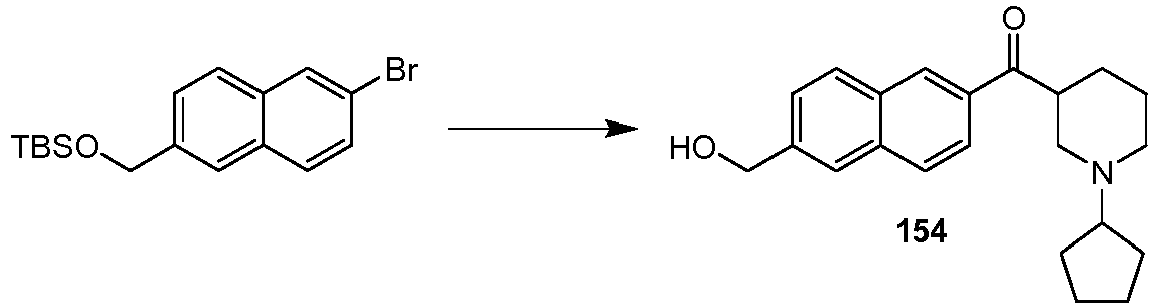
- Prepared in an analogous manner to (1-(cyclopropylmethyl)piperidin-3-yl) (3-methoxyphenyl)methanone (Examples 109a and 109b), replacing 1-bromo-3-methoxybenzene with ((6-bromonaphthalen-2-yl)methoxy)(tert-butyl)dimethyl silane (Intermediate 24), and cyclopropanecarbaldehyde with cyclopentanone.
1H NMR (400 MHz, CD3OD) δ 8.64 (d, J = 4.0 Hz, 1 H), 8.07 (d, J = 8.4 Hz, 1 H), 8.04-7.96 (m, 2 H), 7.91 (s, 1 H), 7.61 (d, J = 8.8 Hz, 1 H), 4.81 (s, 2 H), 4.11-4.10 (m, 1 H), 3.78-3.62 (m, 3 H), 3.27-3.24 (m, 0.5 H), 3.03-2.97 (m, 1.5 H), 2.25-2.12 (m, 5 H), 1.88-1.61 (m, 7 H); LCMS m/z 338 (M + H). -
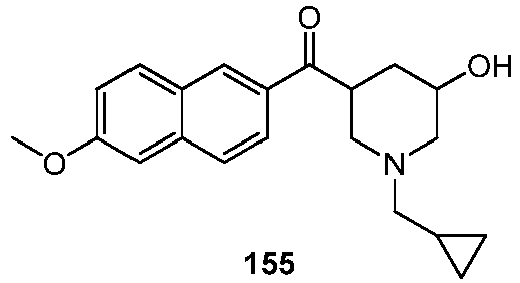
- Prepared in an analogous manner to (1-(cyclopropylmethyl)piperidin-3-yl) (3-methoxyphenyl)methanone (Examples 109a and 109b), replacing tert-butyl 3-(methoxy (methyl)carbamoyl)piperidine-1-carboxylate with tert-butyl 3-((tert-butyldimethyl silyl)oxy)-5-(methoxy(methyl)carbamoyl)piperidine-1-carboxylate (Intermediate 20).
1H NMR (400 MHz, CD3OD) δ 8.50 (s, 1 H), 7.95-7.91 (m, 2 H), 7.83 (d, J = 8.8 Hz, 1 H), 7.29 (d, J = 2.4 Hz, 1 H), 7.19 (dd, J = 8.8 Hz, 2.4 Hz, 1 H), 3.92 (s, 3 H), 3.90-3.80 (m, 2 H), 3.19-3.16 (m, 1 H), 2.38-2.33 (m, 2 H), 2.21-2.12 (m, 2 H), 1.86 (t, J = 10.4 Hz, 1 H), 1.44-1.26 (m, 2 H), 0.90-0.87 (m, 1 H), 0.54-0.50 (m, 2 H), 0.14-0.07 (m, 2 H); LCMS m/z 340.2 (M + H). -

- To a stirred and cooled (-78 °C) solution of 2-bromo-6-methoxynaphthalene (2.36 g, 10.0 mmol) in THF (30 mL) was added n-BuLi (2.5 M in hexane, 4.0 mL, 10.0 mmol). After addition, stirring at -78 °C was continued for 1 h, and then a solution of tert-butyl 3-(methoxy(methyl)carbamoyl)piperidine-1-carboxylate (Intermediate 10) (2.72 g, 10.0 mmol) in THF (10 mL) was added dropwise. The resulting mixture was warmed to room temperature and stirred for an additional 2 h. The mixture was quenched by addition of saturated aqueous NH4Cl (20 mL) and extracted with ethyl acetate (3 x 100 mL). The combined organic layers were washed with brine, dried (Na2SO4) and concentrated under reduced pressure to give crude tert-butyl 3-(6-methoxy-2-naphthoyl)piperidine-1-carboxylate (1.9 g, 51% yield). This crude was used directly without further purification.
- To a stirred and cooled (-78 °C) solution of tert-butyl 3-(6-methoxy-2-naphthoyl) piperidine-1-carboxylate (369 mg, 1.0 mmol) in THF (10 mL) was added LiHMDS (1 N, 1.1 mL, 1.1 mmol). After addition, stirring was continued for 30 min and then MeI (282 mg, 2.0 mmol) was added. The mixture was warmed up to room temperature and stirred for another 2 h. The reaction was quenched by the addition of saturated aqueous NH4Cl (10 mL) and then extracted with ethyl acetate (3 x 20 mL). The combined organic layers were washed with water (10 mL), brine (10 mL), dried (Na2SO4), and concentrated under reduced pressure. The residue was purified by silica-gel chromatography (petroleum ether: ethyl acetate = 5:1) to give tert-butyl 3-(6-methoxy-2-naphthoyl)-3-methyl piperidine-1-carboxylate (200 mg, 52.2 % yield) as an oil.
- To a solution of tert-butyl 3-(6-methoxy-2-naphthoyl)-3-methylpiperidine-1-carboxylate (200 mg, 0.52 mmol) in ethyl aceate (10 mL) was added HCl (2 N in ethyl aceate, 10 mL, 20 mmol). The reaction mixture was stirred at ambient temperature for 2 h and then concentrated under reduced pressure to give crude (6-methoxynaphthalen-2-yl)(3-methylpiperidin-3-yl) methanone hydrochloride (165 mg, 99.6% yield) as an oil.
- A solution of (6-methoxynaphthalen-2-yl)(3-methylpiperidin-3-yl)methanone hydrochloride (160 mg, 0.50 mmol), cyclopropanecarbaldehyde (42 mg, 0.60 mmol) and Et3N (2 mL) in dichloroethane (10 mL) was stirred at room temperature for 1 h. Then NaBH(OAc)3 (127 mg, 0.60 mmol) was added to the mixture. The mixture was stirred for another 1 h and then quenched by addition of saturated aqueous NH4Cl (5 mL). The solution was extracted with dichloromethane (2 x 20 mL). The combined organic layers were dried (Na2SO4) and concentrated under reduced pressure. The residue was purified by reverse phase HPLC (base) then the enantiomers were separated by supercritical fluid chromatography (SFC) to provide 11.1 mg (7% yield) of 155a and 9.4 mg (6% yield) of 155b.
- SFC conditions: CHIRALPAK IC (250 x 50 mm, 5 µm particle size) at 40% EtOH w/0.1%NH4OH; 80 mL/min, 100 bars, 40 °C.
- 156a: 1H NMR (400 MHz, CD3OD) δ 8.27 (s, 1 H), 7.87 (d, J = 9.2 Hz, 1 H), 7.82-7.77 (m, 2 H), 7.28 (d, J = 2.4 Hz, 1 H), 7.20 (dd, J = 8.8 Hz, 2.4 Hz, 1 H), 3.94 (s, 3 H), 3.64-3.60 (m, 1 H), 2.81-2.76 (m, 1 H), 2.42-2.04 (m, 4 H), 1.63-1.59 (m, 2 H), 1.47 (s, 3 H), 1.38-1.27 (m, 2 H), 0.59-0.55 (m, 1 H), 0.37-0.30 (m, 2 H), 0.10-0.03 (m, 2 H); LCMS m/z 338.2 (M + H); SFC retention time: 8.58 min.
- 156b: 1H NMR (400 MHz, CD3OD) δ 8.23 (s, 1 H), 7.87 (d, J = 9.2 Hz, 1 H), 7.82-7.77 (m, 2 H), 7.26 (d, J = 2.4 Hz, 1 H), 7.18 (dd, J = 8.8 Hz, 2.4 Hz, 1 H), 3.94 (s, 3 H), 3.64-3.60 (m, 1 H), 2.81-2.76 (m, 1 H), 2.42-2.04 (m, 4 H), 1.63-1.59 (m, 2 H), 1.44 (s, 3 H), 1.38-1.27 (m, 2 H), 0.59-0.55 (m, 1 H), 0.37-0.30 (m, 2 H), 0.10-0.03 (m, 2 H); LCMS m/z 338.2 (M + H); SFC retention time: 6.93 min.
-

- Prepared in an analogous manner to (1-(cyclopropylmethyl)-3-methylpiperidin-3-yl) (6-methoxynaphthalen-2-yl)methanone (Examples 156a and 156b), replacing iodomethane with N-Fluorodibenzenesulfonimide. Only one enantiomer was obtained due to stability issue.
- SFC conditions: CHIRALPAK OJ (250 x 30 mm, 5 µm particle size) at 25% IPAw/0.1%NH4OH; 60 mL/min, 100 bars, 40 °C.
1H NMR (400 MHz, CDCl3) δ 8.71 (s, 1 H), 8.08-8.05 (m, 1 H), 7.86 (d, J = 8.8 Hz, 1 H), 7.76 (d, J = 8.8 Hz, 1 H), 7.22-7.19 (m, 1 H), 7.19-7.15 (m, 1 H), 3.96 (s, 3 H), 3.44-3.41 (m, 1 H), 3.13-3.10 (m, 1 H), 2.73-2.65 (m, 1 H), 2.41-2.38 (m, 2 H), 2.22-2.10 (m, 2 H), 2.09-1.97 (m, 2 H), 1.79-1.78 (m, 1 H), 0.93-0.90 (m, 1 H), 0.52-0.50 (m, 2 H), 0.12-0.09 (m, 2 H); LCMS m/z 341.9 (M + H); SFC retention time: 6.20 min. -

- A solution of 6-methoxy-2-naphthaldehyde (1.0 g, 5.4 mmol), propane-1,3-dithiol (618 mg, 6 mmol) and 4-methylbenzenesulfonic acid (172 mg, 1 mmol) in toluene (50 mL) was heated at 120°C for 16 h. The solvent was removed under reduced pressure, and the residue was purified by silica-gel chromatography (petroleum ether: ethyl acetate = 5:1) to give 2-(6-methoxynaphthalen-2-yl)-1,3-dithiane (400 mg, 26.8 % yield) as an oil.
- To a stirred and cooled (0 °C) solution of 2-(6-methoxynaphthalen-2-yl)-1,3-dithiane (400 mg, 1.45 mmol) in THF (10 mL) was added LDA (2N, 0.8 mL, 1.6 mmol). After being stirred at -20 °C for 30 min, the mixture was cooled to -78 °C and a solution of tert-butyl 3-oxopiperidine-1-carboxylate (289 mg, 1.45 mmol) in THF (5 mL) was added. The resulting mixture was stirred for another 2 h, and then quenched by the addition of saturated aqueous NH4Cl (10 mL). The mixture was extracted with ethyl acetate (3 x 20 mL). The combined organic layers were washed with water (15 mL), brine (15 mL), dried (Na2SO4), and concentrated under reduced pressure. The residue was purified by silica-gel chromatography (petroleum ether: ethyl acetate = 3:1) to give tert-butyl 3-hydroxy-3-(2-(6-methoxynaphthalen-2-yl)-1,3-dithian-2-yl) piperidine-1-carboxylate (200 mg, 29.0 % yield) as an oil.
- A mixture of tert-butyl 3-hydroxy-3-(2-(6-methoxynaphthalen-2-yl)-1,3-dithian-2-yl)piperidine-1-carboxylate (180 mg, 0.38 mmol), pyridinium bromide perbromide (242 mg, 0.76 mmol) and Tetrabutylammonium bromide (15 mg) in dichloromethane (10 mL) and H2O (3 mL) was stirred at room temperature for 8 h. The reaction mixture was extracted with dichloromethane (3 x 10 mL). The combined organic layers were dried (Na2SO4) and concentrated under reduced pressure. The residue was purified by chromatography (petroleum ether: ethyl acetate = 3: 1) to give tert-butyl 3-hydroxy-3-(6-methoxy-2-naphthoyl) piperidine-1-carboxylate (120 mg, 82.1 % yield) as a yellow oil.
- To a solution of tert-butyl 3-hydroxy-3-(6-methoxy-2-naphthoyl)piperidine-1-carboxylate (100 mg, 0.26 mmol) in ethyl aceate (10 mL) was added HCl (2 N in ethyl aceate, 10 mL, 20 mmol). The reaction mixture was stirred at ambient temperature for 2 h and then concentrated under reduced pressure to give crude (3-hydroxypiperidin-3-yl)(6-methoxynaphthalen-2-yl) methanone hydrochloride (83 mg, 99.6% yield) as a yellow oil.
- A solution of (3-hydroxypiperidin-3-yl)(6-methoxynaphthalen-2-yl)methanone hydrochloride (83 mg, 0.26 mmol), cyclopropanecarbaldehyde (28 mg, 0.40 mmol) and Et3N (1 mL) in dichloroethane (10 mL) was stirred at room temperature for 1 h before NaBH(OAc)3 (84 mg, 0.40 mmol) was added to the mixture. The mixture was stirred for another 1 h and then quenched by addition of saturated aqueous NH4Cl (5 mL). The solution was extracted with dichloromethane (2 x 20 mL). The combined organic layers were dried (Na2SO4) and concentrated under reduced pressure. The residue was purified by reverse phase HPLC then the enantiomers were separated by supercritical fluid chromatography (SFC) to provide 7.5 mg (11% yield) of 158a and 5.0 mg (9% yield) of 158b.
- SFC conditions: CHIRALPAK AS (250 x 30 mm, 5 µm particle size) at 30% MeOH w/0.1%NH4OH; 60 mL/min, 100 bars, 40 °C.
- 158a: 1H NMR (400 MHz, CD3OD) δ 8.86 (s, 1 H), 8.13-8.10 (m, 1 H), 7.87 (d, J = 9.2 Hz, 1 H), 7.79 (d, J = 9.2 Hz, 1 H), 7.27 (d, J = 2.4 Hz, 1 H), 7.18 (dd, J = 9.2 Hz, 2.8 Hz, 1 H), 3.94 (s, 3H), 3.00-2.98 (m, 1 H), 2.82-2.78 (m, 2 H), 2.37-2.27 (m, 3 H), 2.00-1.92 (m, 3 H), 1.76-1.71 (m, 1 H), 0.81-0.78 (m, 1 H), 0.46-0.42 (m, 2 H), 0.09-0.06 (m, 2 H); LCMS m/z 339.8 (M + H); SFC retention time: 7.10 min.
- 158b: 1H NMR (400 MHz, CD3OD) δ 8.70 (s, 1 H), 8.14-8.11 (m, 1 H), 7.88 (d, J = 9.2 Hz, 1 H), 7.80 (d, J = 9.2 Hz, 1 H), 7.28 (d, J = 2.4 Hz, 1 H), 7.19 (dd, J = 9.2 Hz, 2.8 Hz, 1 H), 3.94 (s, 3H), 3.00-2.98 (m, 1 H), 2.82-2.78 (m, 2 H), 2.37-2.27 (m, 3 H), 2.00-1.92 (m, 3 H), 1.76-1.71 (m, 1 H), 0.81-0.78 (m, 1 H), 0.46-0.42 (m, 2 H), 0.09-0.06 (m, 2 H); LCMS m/z 340.2 (M + H); SFC retention time: 6.24 min.
-

- To a stirred and cooled (-78 °C) solution of 2,6-dibromonaphthalene (2.84 g, 10 mmol) in THF (30 mL) was added n-BuLi (2.5 M in hexane, 4.0 mL, 10.0 mmol). After the addition, stirring at -78 °C was continued for 1 h, and then a solution of tert-butyl 3-(methoxy(methyl)carbamoyl)piperidine-1-carboxylate (Intermediate 10) (3.264 g, 12 mmol) in THF (20 mL) was added dropwise. The resulting mixture was warmed up to room temperature and stirred for additional 2 h. The mixture was quenched by addition of saturated aqueous NH4Cl (50 mL) and extracted with ethyl acetate (3 x 50 mL). The combined organic layers were washed with brine, dried over Na2SO4 and concentrated under reduced pressure. The residue was purified by silica-gel chromatography (petroleum ether: ethyl acetate = 5: 1) to give tert-butyl 3-(6-bromo -2-naphthoyl)piperidine-1-carboxylate (3.0 g, 71.9% yield) as a yellow oil.
- A mixture of tert-butyl 3-(6-bromo-2-naphthoyl)piperidine-1-carboxylate (209 mg, 0.5 mmol), Zn(CN)2 (116 mg, 1.0 mmol), Xant-phos (58 mg, 0.1 mmol), Pd2(dba)3 (46 mg, 0.05 mmol) and Cs2CO3 (650 mg, 2.0 mmol) in dioxane (15.0 mL) was heated at 120 °C for 30 min under microwave conditions. The solvent was evaporated under reduced pressure, and the residue was purified by silica-gel chromatography (petroleum ether: ethyl acetate = 5: 1) to give tert-butyl 3-(6-cyano-2-naphthoyl) piperidine-1-carboxylate (0.15 g, 82.4 % yield).
- To a solution of tert-butyl 3-(6-cyano-2-naphthoyl)piperidine-1-carboxylate (0.15 g, 0.41 mmol) in ethyl aceate (5.0 mL) was added HCl (2 N in ethyl aceate, 5.0 mL, 10 mmol). The reaction mixture was stirred at 25 °C for 2 h and then concentrated under reduced pressure to give crude 6-(piperidine-3-carbonyl)-2-naphthonitrile hydrochloride (0.12 g, 97.1% yield).
- A solution of 6-(piperidine-3-carbonyl)-2-naphthonitrile hydrochloride (0.12 g, 0.4 mmol), cyclopropanecarbaldehyde (56 mg, 0.8 mmol) and Et3N (1 mL) in dichloroethane (10 mL) was stirred at room temperature for 1 h before NaBH(OAc)3 (254 mg, 1.2 mmol) was added to the mixture. The mixture was stirred for another 1 h and then quenched by the addition of saturated aqueous NH4Cl (5 mL). The solution was extracted with dichloromethane (2 x 20 mL). The combined organic layers were dried (Na2SO4) and concentrated under reduced pressure. The residue was purified by preparative HPLC HPLC (Phenomenx Gemini NX, 20-60% ACN in 0.1% NH4OH (aq)) to give 20.6 mg (15% yield) of the title compound as a white solid. 1H NMR (400 MHz, CD3OD) δ 8.76 (s, 1 H), 8.42 (d, J =9.6 Hz, 1 H), 8.26-8.08 (m, 3 H), 7.75 (d, J =7.2 Hz, 1 H), 4.26-4.23 (m, 1 H), 3.85-3.76 (m, 1 H), 3.24-3.20 (m, 2 H), 3.16-3.01 (m, 3 H), 2.28-2.11 (m, 3 H), 1.65-1.59 (m, 1 H), 1.24-1.22 (m, 1 H), 0.81-0.77 (m, 2 H), 0.52-0.46 (m, 2 H); LCMS: m/z 318.9 (M + H).
-

- Prepared in an analogous manner to 6-(1-(cyclopropylmethyl)piperidine-3-carbonyl)-2-naphthonitrile (Example 158), replacing tert-butyl 3-(methoxy (methyl)carbamoyl)piperidine-1-carboxylate with tert-butyl 3-(methoxy(methyl) carbamoyl)-4-methylpiperidine-1-carboxylate (Intermediate 10). 160a and 160b correspond to the cis-enantiomers.
- SFC conditions: CHIRALPAK AD (250 x 30 mm, 5 µm particle size) at 25% EtOH w/0.1%NH4OH; 60mL/min, 100 bars, 40 °C.
- 160a: 1H NMR (400 MHz, CD3OD) δ 8.74 (s, 1 H), 8.47 (s, 1 H), 8.27 (d, J = 8.4 Hz, 1 H), 8.18-8.12 (m, 2 H), 7.80 (d, J = 8.8 Hz, 1 H), 3.63-3.60 (m, 1 H), 3.31-3.21 (m, 2 H), 2.36 (d, J = 6.4 Hz, 1.5 H), 2.20-2.15 (m, 1.5 H), 1.96-1.92 (m, 1 H), 1.87-1.83 (m, 1 H), 1.57-1.54 (m, 1 H), 1.18 (t, J = 7.2 Hz, 2 H), 0.91 (d, J = 6.4 Hz, 4 H), 0.55-0.51 (m, 2 H), 0.16-0.12 (m, 2 H); LCMS m/z 333.0 (M + H); SFC retention time: 5.84 min.
- 160b: 1H NMR (400 MHz, CD3OD) δ 8.74 (s, 1 H), 8.47 (s, 1 H), 8.27 (d, J = 8.8 Hz, 1 H), 8.18-8.12 (m, 2 H), 7.80 (d, J = 8.8 Hz, 1 H), 3.63-3.60 (m, 1 H), 3.31-3.21 (m, 2 H), 2.36 (d, J = 6.4 Hz, 1.5 H), 2.20-2.15 (m, 1.5 H), 1.96-1.92 (m, 1 H), 1.87-1.83 (m, 1 H), 1.57-1.54 (m, 1 H), 1.17 (t, J = 7.2 Hz, 2 H), 0.91 (d, J = 6.8 Hz, 4 H), 0.55-0.51 (m, 2 H), 0.16-0.12 (m, 2 H); LCMS m/z 333.2 (M + H); SFC retention time: 6.33 min.
-

- Prepared in an analogous manner to 6-(1-(cyclopropylmethyl)piperidine-3-carbonyl)-2-naphthonitrile (Example 158), replacing tert-butyl 3-(methoxy (methyl)carbamoyl)piperidine-1-carboxylate with tert-butyl 3-(methoxy(methyl)carbamoyl)-4-methylpiperidine-1-carboxylate (Intermediate 10), and cyclopropanecarbaldehyde with cyclobutanone. 161a and 161b correspond to the cis-enantiomers.
- SFC conditions: CHIRALPAK OJ (200 x 30 mm, 5 µm particle size) at 15%EtOH w/0.1%NH4OH; 50 mL/min, 100 bars, 40 °C.
- 161a: 1H NMR (400 MHz, CD3OD) δ 8.74 (s, 1 H), 8.48 (s, 1 H), 8.28 (d, J = 8.4 Hz, 1 H), 8.19-8.13 (m, 2 H), 7.81 (d, J = 8.4 Hz, 1 H), 3.62-3.58 (m, 1 H), 3.03-3.00 (m, 2 H), 2.85-2.80 (m, 1 H), 2.12-2.10 (m, 1 H), 1.97-1.91 (m, 7 H), 1.76-1.73 (m, 2 H), 1.54-1.50 (m, 1 H), 0.92 (d, J = 6.4 Hz, 3 H); LCMS m/z 332.9 (M + H); SFC retention time: 3.59 min.
- 161b: 1H NMR (400 MHz, CD3OD) δ 8.73 (s, 1 H), 8.48 (s, 1 H), 8.29 (d, J = 8.4 Hz, 1 H), 8.18-8.13 (m, 2 H), 7.81 (d, J = 8.4 Hz, 1 H), 3.62-3.58 (m, 1 H), 3.03-3.00 (m, 2 H), 2.85-2.80 (m, 1 H), 2.12-2.10 (m, 1 H), 1.97-1.91 (m, 7 H), 1.76-1.73 (m, 2 H), 1.54-1.50 (m, 1 H), 0.92 (d, J = 6.4 Hz, 3 H); LCMS m/z 332.9 (M + H); SFC retention time: 3.81 min.
-

- Prepared in an analogous manner to 6-(1-(cyclopropylmethyl)piperidine-3-carbonyl)-2-naphthonitrile (Example 158), replacing tert-butyl 3-(methoxy (methyl)carbamoyl)piperidine-1-carboxylate with tert-butyl 3-(methoxy(methyl) carbamoyl)-4-methylpiperidine-1-carboxylate (Intermediate 10), and cyclopropanecarbaldehyde with cyclopentanone. 162a and 162b correspond to the cis-enantiomers.
- SFC conditions: CHIRALPAK AD (250 x 30 mm, 5 µm particle size) at 30% MeOH w/0.1%NH4OH; 60mL/min, 100 bars, 40 °C.
- 162a: 1H NMR (400 MHz, CD3OD) δ 8.71 (s, 1 H), 8.45 (s, 1 H), 8.25 (d, J = 8.4 Hz, 1 H), 8.14-8.10 (m, 2 H), 7.78 (dd, J = 1.6 Hz, 8.4 Hz, 1 H), 3.60-3.58 (m, 1 H), 3.16-3.13 (m, 2 H), 2.64-2.60 (m, 1 H), 2.13-2.07 (m, 2 H), 1.94-1.92 (m, 2 H), 1.84-1.83 (m, 2 H), 1.76-1.74 (m, 2 H), 1.60-1.56 (m, 2 H), 1.50-1.40 (m, 2 H), 1.18-1.14 (m, 1 H), 0.87 (d, J = 6.4 Hz, 3 H); LCMS m/z 347.0 (M+H); SFC retention time: 6.15 min.
- 162b: 1H NMR (400 MHz, CD3OD) δ 8.71 (s, 1 H), 8.45 (s, 1 H), 8.25 (d, J = 8.4 Hz, 1 H), 8.14-8.10 (m, 2 H), 7.78 (dd, J = 1.6 Hz, 8.4 Hz, 1 H), 3.60-3.58 (m, 1 H), 3.16-3.13 (m, 2 H), 2.64-2.60 (m, 1 H), 2.13-2.07 (m, 2 H), 1.94-1.92 (m, 2 H), 1.84-1.83 (m, 2 H), 1.76-1.74v(m, 2 H), 1.60-1.56 (m, 2 H), 1.50-1.40 (m, 2 H), 1.18-1.14 (m, 1 H), 0.87 (d, J = 6.4 Hz, 3 H); LCMS m/z 347.0 (M + H); SFC retention time: 6.53 min.
-

- Prepared in an analogous manner to 6-(1-(cyclopropylmethyl)piperidine-3-carbonyl)-2-naphthonitrile (Example 158), replacing tert-butyl 3-(methoxy (methyl)carbamoyl)piperidine-1-carboxylate with tert-butyl 3-(methoxy(methyl) carbamoyl)-4-methylpiperidine-1-carboxylate (Intermediate 10), and cyclopropanecarbaldehyde with propionaldehyde. 163a and 163b correspond to the cis-enantiomers.
- SFC conditions: CHIRALPAK AD (250 x 30 mm, 5 µm particle size) at 20% IPA w/0.1%NH4OH; 60mL/min, 100 bars, 40 °C.
- 163a: 1H NMR (400 MHz, CD3OD) δ 8.77 (s, 1 H), 8.48 (s, 1 H), 8.29 (d, J = 8.4 Hz, 1 H), 8.17-8.13 (m, 2 H), 7.81 (dd, J = 1.2 Hz, 8.8 Hz, 1 H), 3.72-3.68 (m, 1 H), 3.16-3.13 (m, 2 H), 2.49-2.45 (m, 2 H), 2.21-2.17 (m, 2 H), 1.98-1.96 (m, 1 H), 1.88-1.85 (m, 1 H), 1.62-1.56 (m, 3 H), 0.96-0.91 (m, 6 H); LCMS m/z 320.9 (M + H); SFC retention time: 5.05 min.
- 163b: 1H NMR (400 MHz, CD3OD) δ 8.76 (s, 1 H), 8.49 (s, 1 H), 8.28 (d, J = 8.4 Hz, 1 H), 8.19-8.13 (m, 2 H), 7.81 (dd, J = 1.6 Hz, 8.4 Hz, 1 H), 3.69-3.66 (m, 1 H), 3.14-3.11 (m, 2 H), 2.49-2.45 (m, 2 H), 2.21-2.17 (m, 2 H), 1.98-1.96 (m, 1 H), 1.88-1.84 (m, 1 H), 1.60-1.54 (m, 3 H), 0.96-0.91 (m, 6 H); LCMS m/z 320.9 (M + H); SFC retention time: 5.63 min.
-

- A solution of (6-bromonaphthalen-2-yl)(piperidin-3-yl) methanone hydrochloride (Examples 23a and 23b) (129 mg, 0.43 mmol), 1-(bromomethyl)-2-methyl cyclopropane (126 mg, 0.85 mmol) and DIPEA (110 mg, 0.85 mmol) in dichloromethane (10 mL) was stirred at room temperature for 3 h. The solvent was evaporated under reduced pressure to give crude (6-bromonaphthalen-2-yl)(1-((2-methylcyclopropyl) methyl)piperidin-3-yl)methanone (100 mg, 61% yield).
- A mixture of (6-bromonaphthalen-2-yl)(1-((2-methylcyclopropyl)methyl)piperidin-3-yl)methanone (100 mg, 0.26 mmol), Zn(CN)2 (45 mg, 0.388 mmol), Xant-phos (30 mg, 0.052 mmol), Pd2(dba)3 (24 mg, 0.026 mmol) and Cs2CO3 (169 mg, 0.52mmol) in dioxane (5.0 mL) was heated at 120°C for 30 min under microwave conditions. After cooling to room temperature, the mixture was filtered and the filtrate was concentrated under reduced pressure. The residue was purified by reverse phase HPLC (Phenomenx Gemini NX, 20-60% ACN in 0.1% Formic Aid (aq)) to give 20.2 mg (21.2% yield) of example 164.
1H NMR (400 MHz, CD3OD) δ 8.77 (s, 1 H), 8.45 (d, J = 7.2 Hz, 1 H), 8.26 (t, J = 8.8 Hz, 1 H), 8.18-8.13 (m, 2 H), 7.78 (d, J = 7.6 Hz, 1 H), 4.39-4.37 (m, 0.5 H), 4.21-4.17 (m, 0.5 H), 4.09-4.05 (m, 0.5 H), 3.83-3.76 (m, 1.5 H), 3.30-2.98 (m, 3 H), 2.29-2.12 (m, 3 H), 1.82-1.78 (m, 0.5 H), 1.65-1.59 (m, 1.5 H), 1.17-1.09 (m, 3 H), 0.90-0.88 (m, 2 H), 0.65-0.55 (m, 2 H); LCMS: m/z 333.0 (M + H). -

- A mixture of tert-butyl 3-(6-bromo-2-naphthoyl)piperidine-1-carboxylate (Example 51) (450 mg, 1.10 mmol), Pd(PPh3)4 (112 mg, 0.11 mmol), 2,4,6-trimethyl-1,3,5,2,4,6-trioxatriborinane (411 mg, 3.24 mmol) and Cs2CO3 (708 mg, 2.20 mmol) in DMF (10 mL) was heated at 100 °C for 16 h, at which time TLC showed the completion of the reaction. After cooled, the reaction mixture was diluted with water (20 mL) and extracted with dichloromethane (3 x 30 ml). The combined organic layers were dried (Na2SO4) and concentrated under reduced pressure. The residue was purified by silica-gel chromatography (petroleum ether: ethyl acetate = 10:1) to give tert-butyl 3-(6-methyl-2-naphthoyl)piperidine -1-carboxylate (300 mg, 77% yield).
- To the solution of tert-butyl 3-(6-methyl-2-naphthoyl)piperidine-1-carboxylate (300 mg, 0.85 mmol) in ethyl acetate (20 mL) was added HCl (2 N in ethyl acetate, 15 mL, 30 mmol). The resulting mixture was stirred at ambient temperature for 1 h and then concentrated under reduced pressure to give crude (6-methylnaphthalen-2-yl) (piperidin-3-yl)methanone hydrochloride (244 mg, 99% yield).
- A mxiture of (6-methylnaphthalen-2-yl)(piperidin-3-yl)methanone hydrochloride (100 mg, 0.35 mmol), cyclobutanone (50 mg, 0.70 mmol) and Et3N (0.5 ml) in dichloromethane (10 mL) was stirred at room temperature for 1 h, then NaBH(OAc)3 (171 mg, 1.04 mmol) was added. The mixture was stirred for another 1 h and then quenched by addition of saturated aqueous NH4Cl (5 mL). The solution was extracted with dichloromethane (3 x 20 mL). The combined organic layers were dried (Na2SO4) and concentrated under reduced pressure. The residue was purified by preparative HPLC (Phenomenx Gemini NX, 20-60% ACN in 0.1% Formic Acid (aq)) to give 28.0 mg (26.4% yield) of the title compound as a white solid.
1H NMR (400 MHz, CDCl3) δ 12.54 (br. s, 1 H), 8.56 (s, 1 H), 7.97-7.94 (m, 2 H), 7.79 (d, J = 8.4 Hz, 1 H), 7.63 (s, 1 H), 7.40 (d, J = 7.6 Hz, 1 H), 4.66-4.64 (m, 1 H), 3.60-3.57 (m, 2 H), 3.41-3.25 (m, 1 H), 2.84-2.79 (m, 3 H), 2.63-2.58 (m, 1 H), 2.53 (s, 3 H), 2.43-2.41 (m, 1 H), 2.29-2.26 (m, 3 H), 1.99-1.96 (m, 3 H), 1.79-1.77 (m, 1 H); LCMS m/z 307.8 (M + H). -

- Prepared in an analogous manner to (1-cyclobutylpiperidin-3-yl)(6-methyl naphthalen-2-yl)methanone hydrochloride (example 164), replacing cyclobutanone with cyclopentanone. 1H NMR (400 MHz, CDCl3) δ 12.28 (br. s, 1 H), 8.59 (s, 1 H), 7.98-7.96 (m, 2 H), 7.80 (d, J = 8.4 Hz, 1 H), 7.63 (s, 1 H), 7.40 (d, J = 6.8 Hz, 1 H), 4.79-4.61 (m, 1 H), 3.81-3.65 (m, 2 H), 3.42-3.20 (m, 1 H), 3.05-2.91 (m, 1 H), 2.72-2.58 (m, 2 H), 2.53 (s, 3 H), 2.28-2.14 (m, 5 H), 2.03-1.87 (m, 5 H), 1.63-1.64 (m, 1 H); LCMS m/z 321.8 (M + H).
-

- A mixture of (6-bromonaphthalen-2-yl)(1-(cyclopropylmethyl)piperidin-3-yl) methanone (100 mg, 0.27 mmol), Pd(PPh3)4 (28 mg, 0.03 mmol), 2,4,6-trimethyl-1,3,5,2,4,6-trioxatriborinane (108 mg , 0.81 mmol) and Cs2CO3 (176 mg, 0.54 mmol) in DMF (10 mL) was heated at 100 °C for 16 h, at which time TLC showed the completion of the reaction. After cooling to room temperature, the reaction mixture was diluted with water (20 mL) and extracted with dichloromethane (3 x 30 ml). The combined organic layers were dried (Na2SO4) and concentrated under reduced pressure. The residue was purified by preparative HPLC HPLC (Phenomenx Gemini NX, 20-60% ACN in 0.1% NH4OH (aq)) to afford the title compound (19.0 mg, 22.9% yield) as a white solid.
1H NMR (400 MHz, CDCl3) δ 8.47 (s, 1 H), 7.99 (dd, J = 8.4 Hz, 1.6 Hz, 1 H), 7.85 (d, J = 8.4 Hz, 1 H), 7.80 (d, J = 8.4 Hz, 1 H), 7.64 (s, 1 H), 7.39 (d, J = 8.4 Hz, 1 H), 3.81-3.79 (m, 1 H), 3.28-3.25 (m, 1 H), 3.16-3.13 (m, 1 H), 2.54 (s, 3 H), 2.36-2.22 (m, 3 H), 2.02-1.95 (m, 2 H), 1.85-1.82 (m, 2 H), 1.56-1.45 (m, 1 H), 0.89-0.87 (m, 1 H), 0.52-0.48 (m, 2 H), 0.11-0.98 (m, 2 H); LCMS m/z 308 (M + H). -

- Prepared in an analogous manner to (1-(cyclopropylmethyl)piperidin-3-yl)(6-methyl naphthalen-2-yl)methanone (Example 167), replacing 2,4,6-trimethyl-1,3,5,2,4,6-trioxatriborinane with 2-pyridyl boronic acid.
1H NMR (400 MHz, CD3OD) δ 8.96 (d, J = 6.0 Hz, 1 H), 8.90-8.88 (m, 1 H), 8.79-8.77 (m, 1 H), 8.67-8.65 (m, 1 H), 8.62-8.60 (m, 1 H), 8.46-8.42 (m, 1 H), 8.24-8.13 (m, 4 H), 4.44-4.32 (m, 1 H), 3.88-3.79 (m, 2 H), 3.17-3.15 (m, 2 H), 3.04-3.00 (m, 1 H) 2.31-2.14 (m, 3 H), 1.80-1.60 (m, 2 H), 1.27-1.23 (m, 1 H), 0.82-0.78 (m, 2 H), 0.54-0.51 (m, 2 H); LCMS m/z 370.9 (M + H). -

- A mixture of tert-butyl 3-(6-bromo-2-naphthoyl)piperidine-1-carboxylate (Example 51) (800 mg, 1.92 mmol), NaSO2Me (391 mg, 3.84 mmol), S-proline (350 mg, 1.92 mmol) and CuI (733 mg, 3.84 mmol) in DMSO (30 ml) was heated at 110 °C for 8 h. After cooling to room temperature, the reaction mixture was diluted with water (30 mL) and extracted with dichloromethane (3 x 50 ml). The combined organic layers were dried (Na2SO4) and concentrated under reduced pressure. The residue was purified by silica-gel chromatography (petroleum ether: ethyl acetate = 10:1) to give tert-butyl 3-(6-(methylsulfonyl)-2-naphthoyl) piperidine-1-carboxylate (700 mg, 87.5% yield).
- To a solution of tert-butyl 3-(6-(methylsulfonyl)-2-naphthoyl)piperidine -1-carboxylate (209 mg, 0.5 mmol) in ethyl acetate (5 mL) was added HCl (2 N in ethyl acetate, 5 mL, 10 mmol). The mixture was stirred at ambient temperature for 1 h and then evaporated under reduced pressure to give crude (6-(methylsulfonyl) naphthalene-2-yl)(piperidin-3-yl)methanone hydrochloride (177 mg, 99% yield).
- A solution of (6-(methylsulfonyl)naphthalen-2-yl)(piperidin-3-yl)methanone hydrochloride (177 mg, 0.5 mmol), cyclopropanecarbaldehyde (70 mg, 1.0 mmol) and Et3N (2 mL) in dichloromethane (10 mL) was stirred at room temperature for 1 h before NaBH(OAc)3 (212 mg, 1.0 mmol) was added. The mixture was stirred for another 1 h and then quenched by the addition of saturated aqueous NH4Cl (5 mL). The solution was extracted with dichloromethane (3 x 20 mL). The combined organic layers were dried (Na2SO4) and concentrated under reduced pressure. The residue was purified by reverse phase HPLC (Phenomenx Gemini NX, 20-60% ACN in 0.1% NH4OH (aq)) to provide 39.8 mg (41 % yield) of the title compound.
1H NMR (400 MHz, CD3OD) δ 8.79 (s, 1 H), 8.60 (d, J = 4.8 Hz, 1 H), 8.32 (t, J = 9.2 Hz, 1 H), 8.22-8.16 (m, 2 H), 8.05-8.03 (m, 1 H), 4.38-4.32 (m, 0.5 H), 4.21-4.10 (m, 1 H), 3.86-3.75 (m, 1.5 H), 3.49-3.43 (m, 0.5 H), 3.25 (s, 3 H), 3.15-3.12 (m, 2 H), 3.01-2.96 (m, 1 H), 2.26-2.12 (m, 3 H), 1.86-1.81 (m, 0.5 H), 1.71-1.50 (m, 1 H), 1.23-1.21 (m, 1 H), 0.81-0.77(m, 2 H), 0.51-0.48 (m, 2 H); LCMS m/z 371.8 (M + H). -

- Prepared in an analogous manner to (1-(cyclopropylmethyl)piperidin-3-yl) (6-(methylsulfonyl)naphthalen-2-yl)methanone (Example 169), replacing cyclopropanecarbaldehyde with cyclobutanone.
1H NMR (400 MHz, CD3OD) δ 8.77 (s, 1 H), 8.62 (d, J = 4.4 Hz, 1 H), 8.34 (d, J = 8.8 Hz, 1 H), 8.22-8.15 (m, 2 H), 8.06-8.05 (m, 1 H), 4.38-4.35 (m, 0.5 H), 4.14-4.08 (m, 1 H), 3.82-3.51 (m, 3 H), 3.38-3.35 (m, 0.5 H), 3.22 (s, 3 H), 3.14-3.06 (m, 1 H), 2.89-2.72 (m, 1 H), 2.37-2.25 (m, 5 H), 2.12-2.08 (m, 2 H), 1.94-1.87 (m, 2 H), 1.59-1.55 (m, 1 H); LCMS m/z 371.9 (M + H). -
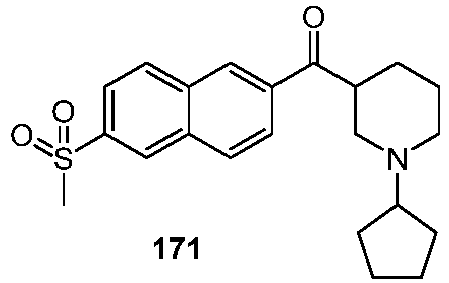
- Prepared in an analogous manner to (1-(cyclopropylmethyl)piperidin-3-yl) (6-(methylsulfonyl)naphthalen-2-yl)methanone (Example 169), replacing cyclopropanecarbaldehyde with cyclopentanone.
1H NMR (400 MHz, CD3OD) δ 8.78 (s, 1 H), 8.61 (s, 1 H), 8.35-8.33 (m, 1 H), 8.23-8.17 (m, 2 H), 8.05 (d, J = 8.4 Hz, 1 H), 4.33-4.30 (m, 0.5 H), 4.17-4.11 (m, 1 H), 3.80-3.68 (m, 3 H), 3.64-3.62 (m, 0.5 H), 3.22 (s, 3 H), 2.99-2.95 (m, 1 H), 2.25-2.11 (m, 5 H), 1.85-1.79 (m, 4 H), 1.70-1.53 (m, 3 H); LCMS m/z 385.9 (M + H). -

- A mixture of (6-bromonaphthalen-2-yl)(1-(cyclopropylmethyl)piperidin-3-yl) methanone (50 mg, 0.13 mmol), dimethylamine hydrochloride (32 mg, 0.39 mmol), Xant-phos (6 mg, 0.01 mmol), Pd2(dba)3 (18 mg, 0.02 mmol) and Cs2CO3 (127 mg, 0.39 mmol) in dioxane (5.0 mL) was heated at 120 °C for 30 min under microwave conditions. The solvent was evaporated under reduced pressure, and the residue was purified by preparative HPLC (Phenomenx Gemini NX, 20-60% ACN in 0.1% Formic Acid (aq)) to give 2.4 mg (4.8% yield) of the title compound as a white solid.
1H NMR (400 MHz, CD3OD) δ 8.65 (d, J = 9.2 Hz, 1 H), 8.20-7.96 (m, 3 H), 7.64-7.57 (m, 2 H), 4.34-4.32 (m, 1 H), 4.13-4.09 (m, 1 H), 3.79-3.76 (m, 1 H), 3.31 (s, 6 H), 3.30-3.28 (m, 1 H), 3.14-3.01 (m, 3 H), 2.26-2.14 (m, 2 H), 1.97-1.95 (m, 1 H), 1.75-1.65 (m, 1 H), 1.29-1.21 (m, 1 H), 0.81-0.79 (m, 2 H), 0.60-0.49 (m, 2 H); LCMS m/z 336.9 (M + H). -

- Prepared in an analogous manner to (1-(cyclopropylmethyl)piperidin-3-yl) (3-methoxyphenyl)methanone (Examples 109a and 109b), replacing 1-bromo-3-methoxybenzene with 6-bromo-2-methylquinoline.
1H NMR (400 MHz, CD3OD) δ 8.63 (s, 1 H), 8.43 (d, J = 8.8 Hz, 1 H), 8.25 (dd, J = 8.8 Hz, 1.6 Hz, 1 H), 8.03 (d, J = 8.8 Hz, 1 H), 7.54 (d, J = 8.8 Hz, 1 H), 3.85-3.82 (m, 1 H), 3.35-3.24 (m, 1 H), 3.20-3.17 (m, 1 H), 2.76 (s, 3 H), 2.37-2.36 (m, 2 H), 2.29-2.27 (m, 1 H), 2.06-2.03 (m, 2 H), 1.88-1.85 (m, 2 H), 1.50-1.49 (m, 1 H), 0.94-0.91 (m, 1 H), 0.56-0.53 (m, 2 H), 0.17-0.16 (m, 2 H); LCMS m/z 309.2 (M + H). -

- A mixture of (6-bromonaphthalen-2-yl)(1-(cyclopropylmethyl)piperidin-3-yl) methanone (200 mg, 0.54 mmol), tert-butyl carbamate (126 mg, 1.08 mmol), Xant-phos (69.5 mg, 0.12 mmol), Pd2(dba)3 (55 mg, 0.06 mmol) and Cs2CO3 (352 mg, 1.08 mmol) in dioxane (5.0 mL) was heated at 120 °C for 30 min under microwave conditions. The solvent was evaporated under reduced pressure, and the residue was purified by silica-gel chromatography (petroleum ether: ethyl acetate = 2: 1) to give tert-butyl (6-(1-(cyclopropylmethyl) piperidine-3-carbonyl)naphthalene-2-yl) carbamate (150 mg, 68.2% yield).
- To a solution of tert-butyl (6-(1-(cyclopropylmethyl)piperidine-3-carbonyl) naphthalen-2-yl)carbamate (150 mg, 0.37 mmol) in ethyl acetate (5 mL) was added HCl (2 N in ethyl acetate, 5.0 mL, 10.0 mmol). The resulting mixture was stirred at ambient temperature for 2 h. The solvent was evaporated under reduced pressure to give the crude (6-aminonaphthalen-2-yl)(1-(cyclopropylmethyl)piperidin-3-yl) methanone hydrochloride (126 mg, 100% yield) as a white solid.
- To a solution of (6-aminonaphthalen-2-yl)(1-(cyclopropylmethyl)piperidin-3-yl) methanone hydrochloride (60 mg, 0.17 mmol) and Et3N (52 mg, 0.51 mmol) in THF (5 mL) was added acetic anhydride (35 mg, 0.34 mmol). After the addition, the reaction mixture was stirred at ambient temperature for 3 h and then evaporated under reduced pressure. The residue was purified by preparative HPLC (Phenomenx Gemini NX, 20-60% ACN in 0.1% Formic Acid (aq)) to give 4.9 mg (7.3% yield) of the title compound as a white solid.
1H NMR (400 MHz, CD3OD) δ 8.60 (d, J = 11.6 Hz, 1 H), 8.35 (d, J = 11.2 Hz, 1 H), 8.05-8.02 (m, 2 H), 7.98-7.90 (m, 1 H), 7.68 (d, J = 8.8 Hz, 1 H), 4.13-4.10 (m, 1 H), 3.82-3.79 (m, 1 H), 3.14-3.06 (m, 3 H), 2.30-2.13 (m, 6 H), 1.90-1.60 (m, 2 H), 1.30-1.20 (m, 2 H), 0.82-0.78 (m, 2 H), 0.50-0.48 (m, 2 H); LCMS m/z 350.9 (M + H). -

- Prepared in an analogous manner to N-(6-(1-(cyclopropylmethyl)piperidine-3-carbonyl)naphthaalen-2-yl)acetamide (Example 174), replacing acetic anhydride with cyclopropanecarbonyl chloride.
1HNMR (400 MHz, CD3OD) δ 8.57 (d, J = 15.6 Hz, 1 H), 8.31 (d, J = 7.6 Hz, 1 H), 8.03-7.96 (m, 2 H), 7.88 (d, J = 5.2 Hz, 1 H), 7.69 (d, J = 8.8 Hz, 1 H), 4.11-4.08 (m, 1 H), 3.77-3.74 (m, 1 H), 3.13-2.99 (m, 3 H), 2.17-2.10 (m, 3 H), 1.84-1.55 (m, 3 H), 1.28-1.16 (m, 2 H), 1.00-0.99 (m, 2 H), 0.92-0.90 (m, 2 H), 0.80-0.79 (m, 2 H), 0.47-0.46 (m, 2 H); LCMS m/z 377.0 (M + H). -

- A mixture of tert-butyl 3-(6-bromo-2-naphthoyl)piperidine-1-carboxylate (300 mg, 0.72 mmol), Pd(OAc)2 (73 mg, 0.07 mmol), dimethylamine hydrochloride (116.6 mg, 1.44 mmol), Na2CO3 (153 mg, 1.44 mmol) and Xantphos (70 mg, 0.14 mmol) in toluene (30 mL) was heated at 80 °C for 16 h under a CO atmosphere. After cooling to room temperature, the reaction mixture was diluted with water (30 mL) and extracted with dichloromethane (3 x 30 mL). The combined organic layers were dried (Na2SO4) and concentrated under reduced pressure. The residue was purified by silica-gel chromatography (petroleum ether: ethyl acetate = 10:1) to give tert-butyl 3-(6-(dimethylcarbamoyl)-2-naphthoyl)piperidine-1-carboxylate (260 mg, 87.7% yield).
- To a solution of tert-butyl 3-(6-(dimethylcarbamoyl)-2-naphthoyl)piperidine-1-carboxylate (205 mg, 0.5 mmol) in ethyl acetate (5 mL) was added HCl (2 N in ethyl acetate, 5 mL, 10 mmol). The resulting mixture was stirred at ambient temperature for 1 h and then concentrated under reduced pressure to give crude N,N-dimethyl-6-(piperidine-3-carbonyl)-2-naphthamide hydrochloride (173 mg, 99% yield).
- A solution of N,N-dimethyl-6-(piperidine-3-carbonyl)-2-naphthamide hydrochloride (173 mg, 0.5 mmol), cyclopropanecarbaldehyde (70 mg, 1.0 mmol) and Et3N (2 mL) in dichloromethane (10 mL) was stirred at room temperature for 1 h before NaBH(OAc)3 (212 mg, 1.0 mmol) was added. The mixture was stirred for another 1 h and then quenched by the addition of saturated aqueous NH4Cl (5 mL). The solution was extracted with dichloromethane (3 x 20 mL). The combined organic layers were dried (Na2SO4) and concentrated under reduced pressure. The residue was purified by reverse phase HPLC (Phenomenx Gemini NX, 20-60% ACN in 0.1% NH4OH (aq)) to give 9.8 mg (12% yield) of the title compound.
1H NMR (400 MHz, CD3OD) δ 8.72 (s, 1 H), 8.20 (d, J= 8.4 Hz, 1 H), 8.17-8.10 (m, 2 H), 8.03 (s, 1 H), 7.63 (d, J= 8.4 Hz, 1 H), 4.37-4.31 (m, 0.5 H), 4.17-4.09 (m, 1 H), 3.83-3.75 (m, 1 H), 3.48-3.39 (m, 0.5 H), 3.16 (s, 3 H), 3.13-3.07 (m, 2 H), 3.04 (s, 3 H), 2.26-2.12 (m, 3 H), 1.82-1.51 (m, 2 H), 1.23-1.18 (m, 1 H), 0.82-0.77 (m, 2 H), 0.51-0.47 (m, 2 H); LCMS m/z 364.9 (M + H). -

- Prepared in an analogous manner to 6-(1-(cyclopropylmethyl)piperidine-3-carbonyl)-N,N-dimethyl-2-naphthamide (Example 176), replacing cyclopropanecarbaldehyde with cyclobutanone.
1H NMR (400 MHz, CD3OD) δ 8.70 (s, 1 H), 8.19 (d, J = 8.4 Hz, 1 H), 8.07-8.02 (m, 3 H), 7.62 (d, J = 8.4 Hz, 1 H), 4.12-4.06 (m, 1 H), 3.81-3.49 (m, 3 H), 3.40-3.37 (m, 1 H), 3.16 (s, 3 H), 3.04 (s, 3 H), 2.84-2.77 (m, 1 H), 2.37-2.27 (m, 5 H), 2.23-2.05 (m, 2 H), 1.92-1.87 (m, 2 H), 1.59-1.55 (m, 1 H); LCMS m/z 364.9 (M + H). -
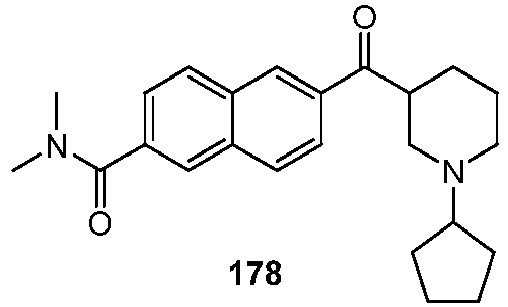
- Prepared in an analogous manner to 6-(1-(cyclopropylmethyl)piperidine-3-carbonyl)-N,N-dimethyl-2-naphthamide (Example 176), replacing cyclopropanecarbaldehyde with cyclopentanone.
1H NMR (400 MHz, CD3OD) δ 8.71 (s, 1 H), 8.18 (t, J = 8.8 Hz, 1 H), 8.10-8.02 (m, 3 H), 7.62 (d, J = 8.4 Hz, 1 H), 4.32-4.16 (m, 1 H), 3.88-3.68 (m, 3 H), 3.63-3.60 (m, 0.5 H), 3.26 (s, 3 H), 3.04 (s, 3 H), 3.01-2.93 (m, 0.5 H), 2.28-2.15 (m, 5 H), 1.98-1.75 (m, 5 H), 1.69-1.50 (m, 3 H); LCMS m/z 378.9 (M + H). -

- To a stirred and cooled (-78 °C) solution of 6-bromo-1-(chloromethyl)-2-methoxy naphthalene (1.5 g, 5.3 mmol) in tetrahydrofuran (50 mL) was added n-BuLi (2.5 M in hexane, 2.6 mL, 6.4 mmol). After the addition, stirring at -78 °C was continued for 1 h, and then a solution of tert-butyl 3-(methoxy(methyl)carbamoyl)piperidine-1-carboxylate (Intermediate 19) (1.4 g, 5.3 mmol) in THF (5 mL) was added dropwise. The resulting mixture was warmed to room temperature and stirred for additional 2 h. The mixture was quenched by the addition of saturated aqueous NH4Cl (30 mL) and extracted with ethyl acetate (3 x 50 mL). The combined organic layers were washed with brine, dried over Na2SO4 and concentrated under reduced pressure. The residue was purified by silica-gel chromatography (petroleum ether: ethyl acetate = 5: 1) to give tert-butyl 3-(5-(chloromethyl)-6-methoxy-2-naphthoyl)piperidine-1-carboxylate (1.0 g, 45%) as a yellow solid.
- To a solution of tert-butyl 3-(5-(chloromethyl)-6-methoxy-2-naphthoyl)piperidine-1-carboxylate (1.0 g, 2.4 mmol) in acetonitrile (20 mL) was added TMSCN (0.29 g, 2.9 mmol) and Me4NF (0.27 g, 2.9 mmol). The reaction mixture was stirred at room temperature for 18 h. The reaction was diluted with water (50 mL) and extracted with dichloromethane (3 x 50 mL). The combined organic layers were washed with brine (50 mL), dried (Na2SO4) and concentrated under reduced pressure. The crude was purified by silica-gel chromatography (petroleum ether: ethyl acetate = 2: 1) to give tert-butyl 3-(5-(cyanomethyl)-6-methoxy-2-naphthoyl)piperidine-1-carboxylate (0.5 g, 51%) as a yellow solid.
- To a stirred and cooled (0 °C) solution of tert-butyl 3-(5-(cyanomethyl)-6-methoxy-2-naphthoyl)piperidine-1-carboxylate (500 mg, 1.2 mmol) in dichloromethane (10 mL) was added trifluoroacetic acid (2 mL). The resulting mixture was stirred at ambient temperature for 2 h and then evaporated under reduced pressure to give crude 2-(2-methoxy-6-(piperidine-3-carbonyl)naphthalen-1-yl)acetonitrile 2,2,2-trifluoroacetate (496 mg, 100%).
- A solution of 2-(2-methoxy-6-(piperidine-3-carbonyl)naphthalen-1-yl)acetonitrile 2,2,2-trifluoroacetate (496 mg, 1.2 mmol), cyclobutanone (85 mg, 1.2 mmol) and Et3N (2 mL) in dichloromethane (10 mL) was stirred at room temperature for 1 h before NaBH(OAc)3 (254 mg, 1.2 mmol) was added. The mixture was stirred for another 1 h and then quenched by the addition of saturated aqueous NH4Cl (10 mL). The solution was extracted with dichloromethane (3 x 20 mL). The combined organic layers were dried (Na2SO4) and concentrated under reduced pressure. The residue was purified by reverse phase HPLC (Phenomenx Gemini NX, 20-60% ACN in 0.1% NH4OH (aq)) to afford a racemic mixture of 179a nad 179b. The enantiomers were separated by supercritical fluid chromatography (SFC) to provide 88.3 mg of 179a (41% yield) and 64.6 mg (38% yield) of 179b.
- SFC conditions: CHIRALPAK AD (250 x 30 mm, 10 µm particle size) at 35% MeOH w/0.1%NH4OH; 80 mL/min, 100 bars, 40 °C.
- 179a: 1H NMR (400 MHz, CDCl3) δ 8.43 (s, 1 H), 8.05 (d, J = 8.8 Hz, 1 H), 7.93 (d, J = 9.2 Hz, 1 H), 7.86 (d, J = 9.2 Hz, 1 H), 7.30 (d, J = 8.8 Hz, 1 H), 4.05 (s, 2 H), 3.98 (s, 3 H), 3.04-2.73 (m, 2 H), 1.99-1.36 (m, 14 H); LCMS m/z 363.1 (M + H); SFC retention time: 7.72 min.
- 179b: 1H NMR (400 MHz, CDCl3) δ 8.47 (s, 1 H), 8.09 (d, J = 8.4 Hz, 1 H), 7.98 (d, J = 9.2 Hz, 1 H), 7.91 (d, J = 9.2 Hz, 1 H), 7.35 (d, J = 9.2 Hz, 1 H), 4.10 (s, 2 H), 4.03 (s, 3 H), 3.71-3.68 (m, 1 H), 3.08-3.05 (m, 1 H), 2.96-2.94 (m, 1 H), 2.79-2.75 (m, 1 H), 2.01-1.49 (m, 12 H); LCMS m/z 363.1 (M + H); SFC retention time: 9.46 min.
-

- Prepared in an analogous manner to 2-(6-(1-cyclobutylpiperidine-3-carbonyl)-2-methoxynaphthalen-1-yl)acetonitrile (Examples 179a and 179b), replacing cyclobutanone with propionaldehyde.
1H NMR (400 MHz, CDCl3) δ 8.48 (s, 1 H), 8.11 (d, J = 8.8 Hz, 1 H), 8.03-7.88 (m, 2 H), 7.35 (d, J = 8.4 Hz, 1 H), 4.11 (s, 2 H), 4.04 (s, 3 H), 3.73-3.71 (m, 1 H), 3.17-2.93 (m, 2 H), 2.36-2.34 (m, 2 H), 2.20-2.14 (m, 1 H), 2.02-2.98 (m, 2 H), 1.85-1.70 (m, 2 H), 1.65-1.45 (m, 3 H), 0.89 (s, 3 H); LCMS m/z 350.9 (M + H). -

- Prepared in an analogous manner to 2-(6-(1-cyclobutylpiperidine-3-carbonyl)-2-methoxynaphthalen-1-yl)acetonitrile (Examples 180a and 180b), replacing tert-butyl 3-(methoxy(methyl)carbamoyl)piperidine-1-carboxylate (Intermediate 19) with tert-butyl 3-(methoxy(methyl)carbamoyl)-4-methylpiperidine-1-carboxylate (Intermediate 10), and cyclobutanone with propionaldehyde. 181a and 181b correspond to the cis-enantiomers.
- SFC conditions: CHIRALPAK AD (250 X 30 mm, 20 µm particle size) at 40% MeOH w/0.1%NH4OH; 80 mL/min, 100 bars, 40 °C.
- 181a: 1H NMR (400 MHz, CD3OD) δ 8.71 (s, 1 H), 8.22 (d, J = 9.2 Hz, 1 H), 8.13-8.10 (m, 2 H), 7.62 (d, J = 9.2 Hz, 1 H), 4.61 (s, 1 H), 4.39-4.37 (m, 1 H), 4.28 (s, 2 H), 4.12 (s, 3 H), 3.51-3.35 (m, 2 H), 3.22-3.16 (m, 2 H), 2.61-2.48 (m, 1 H), 1.88-1.86 (m, 3 H), 1.55-1.31(m, 2 H), 1.07 (t, J = 7.6 Hz, 3 H), 0.90 (d, J = 6.8 Hz, 3 H); LCMS m/z 365.2 (M + H); SFC retention time: 8.76 min.
- 181b: 1H NMR (400 MHz, CD3OD) δ 8.70 (s, 1 H), 8.22 (d, J = 9.2 Hz, 1 H), 8.13-8.11 (m, 2 H), 7.62 (d, J = 9.2 Hz, 1 H), 4.61 (s, 1 H), 4.28 (s, 2 H), 4.12 (s, 3 H), 4.08 (s, 1 H), 3.50-3.32 (m, 2 H), 3.24-3.15 (m, 2 H), 2.22-2.18 (m, 1 H), 1.88-1.86 (m, 3 H), 1.48-1.31 (m, 2 H), 1.05 (t, J = 7.2 Hz, 3 H), 0.90 (d, J = 7.2 Hz, 3 H); LCMS m/z 365.2 (M + H); SFC retention time: 7.29 min.
-

- Prepared in an analogous manner to 2-(6-(1-cyclobutylpiperidine-3-carbonyl)-2-methoxynaphthalen-1-yl)acetonitrile (Examples 179a and 179b), replacing tert-butyl 3-(methoxy(methyl)carbamoyl)piperidine-1-carboxylate (Intermediate 19) with tert-butyl 3-(methoxy(methyl)carbamoyl)-4-methylpiperidine-1-carboxylate (Intermediate 10). 182a and 182b correspond to the cis-enantiomers.
- SFC conditions: CHIRALPAK AD (250 x 30 mm, 5 µm particle size) at 50% MeOH w/0.1%NH4OH; 80 mL/min, 100 bars, 40 °C.
- 182a: 1H NMR (400 MHz, CDCl3) δ 8.41 (s, 1 H), 8.07 (d, J = 8.8 Hz, 1 H), 7.99 (d, J = 8.8 Hz, 1 H), 7.93 (d, J = 8.8 Hz, 1 H), 7.36 (d, J = 9.2 Hz, 1 H), 4.12 (s, 2 H), 4.05 (s, 3 H), 3.88-3.85 (m, 1 H), 2.87-2.83 (m, 2 H), 2.78-2.75 (m, 1 H), 2.41-2.38 (m, 2 H), 2.12-2.08 (m, 4 H), 1.92-1.89 (m, 2 H), 1.73-1.70 (m, 3 H), 0.80 (d, J = 3.2 Hz, 3 H); LCMS m/z 376.9 (M + H); SFC retention time: 5.07 min.
- 182b: 1H NMR (400 MHz, CDCl3) δ 8.41 (s, 1 H), 8.07 (d, J = 8.8 Hz, 1 H), 7.99 (d, J = 8.8 Hz, 1 H), 7.93 (d, J = 8.8 Hz, 1 H), 7.36 (d, J = 9.6 Hz, 1 H), 4.12 (s, 2 H), 4.05 (s, 3 H), 3.88-3.85 (m, 1 H), 2.87-2.83 (m, 2 H), 2.78-2.75 (m, 1 H), 2.41-2.38 (m, 2 H), 2.12-2.08 (m, 4 H), 1.92-1.89 (m, 2 H), 1.73-1.70 (m, 3 H), 0.80 (d, J = 2.8 Hz, 3 H); LCMS m/z 376.9 (M + H); SFC retention time: 5.70 min.
-

- Prepared in an analogous manner to 2-(6-(1-cyclobutylpiperidine-3-carbonyl)-2-methoxynaphthalen-1-yl)acetonitrile (Examples 179a and 179b), replacing tert-butyl 3-(methoxy(methyl)carbamoyl)piperidine-1-carboxylate (Intermediate 19) with tert-butyl 3-(methoxy(methyl)carbamoyl)-4-ethylpiperidine-1-carboxylate (Intermediate 15).
- SFC conditions: CHIRALPAK AD (250 x 30 mm, 5 µm particle size) at 20% MeOH 183a: 1H NMR (400 MHz, CD3OD) δ 8.63 (s, 1 H), 8.18 (d, J = 9.2 Hz, 1 H), 8.13-8.06 (m, 2 H), 7.58 (d, J = 9.2 Hz, 1 H), 4.25 (s, 2 H), 4.09 (s, 3 H), 3.69-3.65 (m, 1 H), 3.06-2.97 (m, 2 H), 2.84-2.80 (m, 1 H), 2.13-2.10 (m, 1 H), 2.00-1.89 (m, 6 H), 1.73-1.71 (m, 3 H), 1.41-1.36 (m, 2 H), 1.38-1.35 (m, 1 H), 0.84 (t, J = 7.2 Hz, 3 H); LCMS m/z 391.0 (M + H); SFC retention time: 4.75 min.
- 183b: 1H NMR (400 MHz, CD3OD) δ 8.66 (s, 1 H), 8.20 (d, J = 9.6 Hz, 1 H), 8.15-8.08 (m, 2 H), 7.60 (d, J = 9.2 Hz, 1 H), 4.27 (s, 2 H), 4.11 (s, 3 H), 3.72-3.68 (m, 1 H), 3.07-2.98 (m, 2 H), 2.84-2.82 (m, 1 H), 2.15-2.05 (m, 1 H), 2.01-1.87 (m, 6 H), 1.75-1.73 (m, 3 H), 1.40-1.37 (m, 2 H), 1.40-1.37 (m, 1 H), 0.86 (t, J = 7.6 Hz, 3 H); LCMS m/z 391.1 (M + H); SFC retention time: 5.10 min.
- 183c: 1H NMR (400 MHz, CD3OD) δ 8.56 (s, 1 H), 8.15 (d, J = 9.2 Hz, 1 H), 8.06 (s, 2 H), 7.56 (d, J = 9.2 Hz, 1 H), 4.24 (s, 2 H), 4.08 (s, 3 H), 3.91-3.89 (m, 1 H), 2.86-2.84 (m, 1 H), 2.80-2.76 (m, 1 H), 2.60-2.56 (m, 1 H), 2.52-2.46 (m, 1 H), 2.15-2.03 (m, 4 H), 1.95-1.86 (m, 4 H), 1.75-1.72 (m, 2 H), 1.47-1.43 (m, 1 H), 1.12-1.10 (m, 1 H), 0.69 (t, J = 7.6 Hz, 3 H); LCMS m/z 391.0 (M + H); SFC retention time: 5.68 min.
- 183d: 1H NMR (400 MHz, CD3OD) δ 8.56 (s, 1 H), 8.15 (d, J = 9.2 Hz, 1 H), 8.06 (s, 2 H), 7.56 (d, J = 9.2 Hz, 1 H), 4.24 (s, 2 H), 4.08 (s, 3 H), 3.92-3.89 (m, 1 H), 2.86-2.84 (m, 1 H), 2.80-2.76 (m, 1 H), 2.60-2.56 (m, 1 H), 2.52-2.46 (m, 1 H), 2.15-2.03 (m, 4 H), 1.95-1.86 (m, 4 H), 1.75-1.72 (m, 2 H), 1.47-1.43 (m, 1 H), 1.12-1.10 (m, 1 H), 0.69 (t, J = 7.6 Hz, 3 H); LCMS m/z 391.2 (M + H); SFC retention time: 6.35 min.
-
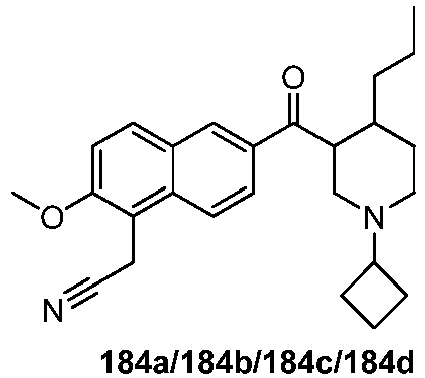
- Prepared in an analogous manner to 2-(6-(1-cyclobutylpiperidine-3-carbonyl)-2-methoxynaphthalen-1-yl)acetonitrile (Examples 179a and 179b), replacing tert-butyl 3-(methoxy(methyl)carbamoyl)piperidine-1-carboxylate (Intermediate 19) with tert-butyl 3-(methoxy(methyl)carbamoyl)-4-propylpiperidine-1-carboxylate (Intermediate 13).
- SFC conditions: CHIRALPAK AD (250 x 30 mm, 10 µm particle size) at 35% MeOH w/0.1%NH4OH; 80 mL/min, 100 bars, 40 °C.
- 184a: 1H NMR (400 MHz, CDCl3) δ 8.42 (s, 1 H), 8.08 (d, J = 8.0 Hz, 1 H), 8.01 (d, J = 8.8 Hz, 1 H), 7.94 (d, J = 9.2 Hz, 1 H), 7.37 (d, J = 8.8 Hz, 1 H), 4.13 (s, 2 H), 4.06 (s, 3 H), 3.93-3.91 (m, 1 H), 2.88-2.81 (m, 2 H), 2.50-2.44 (m, 1 H), 2.18-1.95 (m, 9 H), 1.74-1.70 (m, 2 H), 0.98-0.85 (m, 4 H), 0.70 (t, J = 7.6 Hz, 3 H); LCMS m/z 405.0 (M + H); SFC retention time: 8.72 min.
- 184b: 1H NMR (400 MHz, CDCl3) δ 8.41 (s, 1 H), 8.07 (d, J = 9.2 Hz, 1 H), 8.00 (d, J = 9.2 Hz, 1 H), 7.93 (d, J = 8.8 Hz, 1 H), 7.36 (d, J = 9.2 Hz, 1 H), 4.12 (s, 2 H), 4.05 (s, 3 H), 3.90-3.88 (m, 1 H), 2.86-2.82 (m, 2 H), 2.50-2.44 (m, 1 H), 2.08-1.69 (m, 11 H), 1.73-1.69 (m, 1 H), 0.97-0.94 (m, 3 H), 0.69 (t, J = 7.2 Hz, 3 H); LCMS m/z 405.0 (M + H); SFC retention time: 9.46 min.
- 184c: 1H NMR (400 MHz, CD3OD) δ 8.66 (s, 1 H), 8.20 (d, J = 9.2 Hz, 1 H), 8.15-8.08 (m, 2 H), 7.60 (d, J = 9.2 Hz, 1 H), 4.27 (s, 2 H), 4.11 (s, 3 H), 3.68-3.66 (m, 1 H), 3.06-2.97 (m, 2 H), 2.82-2.80 (m, 1 H), 2.15-2.10 (m, 1 H), 2.00-1.88 (m, 7 H), 1.73-1.72 (m, 2 H), 1.41-1.25 (m, 5 H), 0.80 (t, J = 6.8 Hz, 3 H); LCMS m/z 405.0 (M + H); SFC retention time: 7.26 min.
- 184d: 1H NMR (400 MHz, CD3OD) δ 8.63 (s, 1 H), 8.18 (d, J = 9.2 Hz, 1 H), 8.13-8.06 (m, 2 H), 7.57 (d, J = 9.2 Hz, 1 H), 4.25 (s, 2 H), 4.09 (s, 3 H), 3.66-3.63 (m, 1 H), 3.04-2.96 (m, 2 H), 2.80-2.78 (m, 1 H), 2.12-2.08 (m, 1 H), 1.98-1.87 (m, 7 H), 1.70-1.70 (m, 2 H), 1.38-1.14 (m, 5 H), 0.78 (t, J = 7.2 Hz, 3 H); LCMS m/z 405.0 (M + H); SFC retention time: 8.34 min.
-

- Prepared in an analogous manner to 2-(6-(1-cyclobutylpiperidine-3-carbonyl)-2-methoxynaphthalen-1-yl)acetonitrile (Examples 179a and 179b), replacing tert-butyl 3-(methoxy(methyl)carbamoyl)piperidine-1-carboxylate (Intermediate 19) with tert-butyl 3-(methoxy(methyl)carbamoyl)-4-isobutylpiperidine-1-carboxylate (Intermediate 14).
- SFC conditions: CHIRALPAK OD (250 x 30 mm, 5 µm particle size) at 30% MeOH w/0.1%NH4OH; 50 mL/min, 100 bars, 40 °C. 185a and 185b correspond to the cis-enantiomers. 185a: 1H NMR (400 MHz, CD3OD) δ 8.46 (s, 1 H), 8.09-8.05 (m, 1 H), 7.98 (d, J = 8.8 Hz, 2 H), 7.46 (d, J = 9.2 Hz, 1 H), 4.15 (s, 2 H), 3.98 (s, 3 H), 3.83-3.80 (m, 1 H), 2.86-2.80 (m, 1 H), 2.72-2.69 (m, 1 H), 2.52-2.61 (m, 1H), 2.41-2.25 (m, 1 H), 2.20-2.11 (m, 1 H), 2.09-1.91 (m, 3 H), 1.89-1.81 (m, 3 H), 1.67-1.65 (m, 3 H), 1.28-1.24 (m, 3 H), 0.82-0.63 (m, 3 H), 0.33 (d, J= 6.0 Hz, 3 H); LCMS m/z 419.0 (M + H); SFC retention time: 4.61 min.
- 185b: 1H NMR (400 MHz, CD3OD) δ 8.55 (s, 1 H), 8.15 (d, J = 9.2 Hz, 1 H), 8.06 (d, J = 8.8 Hz, 2 H), 7.56 (d, J = 9.2 Hz, 1 H), 4.24 (s, 2 H), 4.07 (s, 3 H), 3.91-3.87 (m, 1 H), 2.93-2.82 (m, 1 H), 2.80-2.75 (m, 1 H), 2.69-2.61 (m, 1H), 2.47-2.36 (m, 1 H), 2.31-2.21 (m, 1 H), 2.20-2.05 (m, 3 H), 1.97-1.89 (m, 3 H), 1.76-1.73 (m, 3 H), 1.37-1.33 (m, 3 H), 0.87-0.72 (m, 3 H), 0.41 (d, J= 6.4 Hz, 3 H); LCMS m/z 419.1 (M + H); SFC retention time: 5.26 min.
-

- Prepared in an analogous manner to 2-(6-(1-cyclobutylpiperidine-3-carbonyl)-2-methoxynaphthalen-1-yl)acetonitrile (Examples 179a and 179b), replacing tert-butyl 3-(methoxy(methyl)carbamoyl)piperidine-1-carboxylate (Intermediate 19) with tert-butyl 3-(methoxy(methyl)carbamoyl)-4-isopropylpiperidine-1-carboxylate (Intermediate 17). 186a and 186b correspond to the cis-enantiomers.
- SFC conditions: CHIRALPAK AD (250 x 30 mm, 10 µm particle size) at 15% IPA w/0.1%NH4OH; 80 mL/min, 100 bars, 40 °C.
- 186a: 1H NMR (400 MHz, CD3OD) δ 8.52 (s, 1 H), 8.13-8.03 (m, 3 H), 7.58-7.45 (m, 1 H), 4.24 (s, 2 H), 4.07 (s, 3 H), 4.01-3.98 (m, 1 H), 3.11-3.08 (m, 1 H), 2.83-2.78 (m, 1 H), 2.63-2.51 (m, 1H), 2.21-2.12 (m, 2 H), 1.91-1.76 (m, 6 H), 1.54-1.52 (m, 2 H), 1.45-1.21 (m, 2 H), 0.95 (d, J = 6.8 Hz, 3 H), 0.81 (d, J = 6.4 Hz, 3 H); LCMS m/z 404.9 (M + H); SFC retention time: 1.84 min.
- 186b: 1H NMR (400 MHz, CD3OD) δ 8.52 (s, 1 H), 8.13-8.03 (m, 3 H), 7.53 (d, J = 9.2 Hz, 1 H), 4.23 (s, 2 H), 4.06 (s, 3 H), 4.00-3.99 (m, 1 H), 3.10-3.07 (m, 1 H), 2.89-2.81 (m, 1 H), 2.61-2.56 (m, 1H), 2.20-2.16 (m, 2 H), 1.90-1.70 (m, 6 H), 1.62-1.45 (m, 2 H), 1.41-1.30 (m, 2 H), 0.95 (d, J = 6.8 Hz, 3 H), 0.81 (d, J = 6.8 Hz, 3 H); LCMS m/z 405.0 (M + H); SFC retention time: 4.26 min.
-

- To a solution of tert-butyl 3-(5-(chloromethyl)-6-methoxy-2-naphthoyl)piperidine-1-carboxylate (Examples 71a and 71b) (600 mg, 1.44 mmol) in dioxane (30 mL) and H2O (30 mL) was added CaCO3 (720 mg, 7.2 mmol). The reaction mixture was heated at 85 °C for 12 h. The mixture was filtered while hot and the filtrate was concentrated under reduced pressure to give crude tert-butyl 3-(5-(hydroxymethyl)-6-methoxy-2-naphthoyl) piperidine-1-carboxylate (550 mg, 95.6% yield).
- To a solution of tert-butyl 3-(5-(hydroxymethyl)-6-methoxy-2-naphthoyl)piperidine-1-carboxylate (200 mg, 0.5 mmol) in ethyl acetate (5 mL) was added HCl (2 N in ethyl acetate, 5 mL, 10 mmol). The resulting mixture was stirred at ambient temperature for 1 h and then concentrated under reduced pressure to give crude (5-(hydroxymethyl)-6-methoxynaphthalen-2-yl)(piperidin-3-yl)methanone hydrochloride (168 mg, 99% yield).
- A solution of (5-(hydroxymethyl)-6-methoxynaphthalen-2-yl)(piperidin-3-yl) methanone hydrochloride (168 mg, 0.5 mmol), cyclopropanecarbaldehyde (70 mg, 1.0 mmol) and Et3N (2 mL) in dichloromethane (10 mL) was stirred at room temperature for 1 h before NaBH(OAc)3 (212 mg, 1.0 mmol) was added. The mixture was stirred for another 1 h and then quenched by the addition of saturated aqueous NH4Cl (10 mL). The solution was extracted with dichloromethane (3 x 20 mL). The combined organic layers were dried (Na2SO4) and concentrated under reduced pressure. The residue was purified by reverse phase HPLC to provide 3.0 mg (2% yield) of the title compound.
1H NMR (400 MHz, DMSO-d6) δ 10.3 (br. s, 1 H), 8.39-8.30 (m, 1 H), 7.88-7.77 (m, 2 H), 7.67-7.65 (m, 1 H), 7.25-7.20 (m, 1 H), 4.84 (s, 2 H), 3.89-3.80 (m, 1 H), 3.64-3.57 (m, 3 H), 3.29-3.22 (m, 2 H), 2.75-2.52 (m, 4 H), 1.73-1.55 (m, 3 H), 1.12-1.01 (m, 1 H), 0.80-0.69 (m, 1 H), 0.24-0.23 (m, 2 H), 0.02-0.00 (m, 2 H); LCMS m/z 353.9 (M + H). -

- Prepared in an analogous manner to (1-(cyclopropylmethyl)piperidin-3-yl)(5-(hydroxymethyl)-6-methoxynaphthalen-2-yl)methanone hydrochloride (Example 184), replacing cyclopropanecarbaldehyde with cyclobutanone.
1H NMR (400 MHz, DMSO-d6) δ 11.1 (br. s, 1 H), 8.71 (s, 1 H), 8.26-8.23 (m, 1 H), 8.17-8.15 (m, 1 H), 8.04-8.02 (m, 1 H), 7.63-7.60 (m, 1 H), 5.22 (s, 2 H), 4.23-4.17 (m, 1 H), 4.02 (s, 3 H), 3.65-3.61 (m, 1 H), 2.92-2.89 (m, 2 H), 2.75-2.61 (m, 2 H), 2.44-2.37 (m, 2 H), 2.18-2.09 (m, 4 H), 1.93-1.89 (m, 1 H), 1.75-1.60 (m, 2 H), 1.55-1.45 (m, 1 H); LCMS m/z 353.9 (M + H). -

- 1-benzyl 4-tert-butyl 2-methyl piperazine-1,2,4-tricarboxylate (10.0 g, 73.0 mmol) was dissolved in 150 ml of methanol and eluted over a cartridge of 10% Pd/C charged with H2 at a pressure of 20 bar. The eluent was then concentrated in vacuo to afford the crude desired product.
- To a solution of 1-tert-butyl 3-methyl piperazine-1,3-dicarboxylate (10.0 g, 70 mmol) in THF (200 mL) was added triethyl amine and benzyl bromide. The mixture was then stirred at room temperature for 12 hours and concentrated in vacuo. The residue was then diluted with ethyl acetate and water. The aqueous layer was discarded and the organic layer was washed once with water, dried over Na2SO4, filtered, and concentrated in vacuo. The residue was then purified by silica-gel chromatography (0 - 10 % MeOH in DCM) to afford the desired product.
- To a mixture of N,O-Dimethylamine Hydrochloride (3.5g, 36 mmol) cooled to -78°C in THF (100 ml) was added a 2M isopropyl magnesium chloride in THF solution (36 ml, 72 mmol) dropwise. After addition, stirring was continued at -78°C for 5 minutes. The mixture was then warmed to 0□C and stirred at □□C for 5 minutes. The mixture was then recooled to -78□C and charged dropwise with a solution of 1-tert-butyl 3-methyl 4-benzylpiperazine-1,3-dicarboxylate (6.0 g, 18 mmol) in 20ml of THF. The mixture was then warmed to room temperature and stirred at room temperature for 30 minutes. The mixture was then diluted with ethyl acetate and water. The aqueous layer was discarded and the organic layer was washed once with water, dried over Na2SO4, filtered, and concentrated in vacuo. The residue was then purified by silica-gel chromatography (1 -10% MeOH in DCM) to afford the title compound (6.5 g, 100% yield).
- A solution of 2-bromo-6-methoxynaphthalene (3.9 g, 17 mmol) in THF was cooled to -78□C and charged with 2.5 M n-BuLi (7 ml, 17.5 mmol). The mixture was then stirred at -78□C for 5 minutes and then charged dropwise with a solution of 1-tert-butyl 3-methyl 4-benzylpiperazine-1,3-dicarboxylate(1.5g, 4.1 mmol) in 5ml of THF. The mixture was then warmed to room temperature and stirred at room temperature for 30 minutes. The mixture was then diluted with ethyl acetate and 1M NaHCO3. The aqueous layer was discarded and the organic was washed once with water, dried over Na2SO4, filtered, and concentrated in vacuo. The residue was then purified by silica-gel chromatography (1 -10% MeOH in DCM) to afford the title compound (1.52 g, 80 % yield).
- A solution of 1-tert-butyl-4-benzyl-3-(6-methoxy-2-naphthoyl)piperazine-1-carboxylate (640 mg, 1.4 mmol) in 5ml of DCM was charged with (9H-fluoren-9-yl)methyl chloroformate (1.4g, 5.6 mmol) and heated at 120□C for 3 hours. The mixture was then directly loaded onto silica and purified by silica-gel chromatography (25 to 50% ethyl acetate in heptane) to afford the title compound (500 mg, 60% yield).
- A solution of 1-(9H-fluoren-9-yl) methyl-4-tert-butyl-2-(6-methoxy-2-naphthoyl)piperazine-1,4-dicarboxylate (750 mg, 1.5 mmol) was dissolved in 5 ml of DCM and charged with 5 ml of TFA. The mixture was then stirred at room temperature for 1 hour, concentrated in vacuo, and azeotroped twice with methanol.
- The crude residue was then diluted with 5 ml of DCM and charged with cyclobutanone (420 mg, 6.0 mmol) and sodium triacetoxyborohydride (1.3 g, 6.0 mmol). The mixture was then stirred at room temperature for one hour and concentrated in vacuo. The residue was then diluted with ethyl acetate and water. The aqueous was discarded and the organic was washed once with water, dried over Na2SO4, filtered, and concentrated in vacuo. The residue was then purified by silica-gel chromatography (1 -10% MeOH in DCM) to afford the title compound.
- To a solution of 4-cyclobutyl-2-(6-methoxynaphthalene-2-carbonyl)piperazine-1-carboxylate (150 mg, 0.27 mmol) in 500 ul of DCM was added 500 ul of Diethylamine. The mixture was stirred at room temperature for one hour and concentrated in vacuo to afford the title compound (100 mg, 100 % yield).
-

- To a solution of (4-cyclobutylpiperazin-2-yl)-(6-methoxy-2-naphthyl)methanone (30 mg, 0.09 mmol) in 200 ul of THF was added triethylamine (47 mg, 0.46 mmol) and iodoethane (72 mg, 0.46 mmol). The mixture was then stirred at room temperature for one hour. It was then diluted with ethyl acetate and saturated NaHCO3. The aqueous layer was discarded and the organic layer was dried over magnesium sulfate and concentrated in vacuo. The residue was then purified by silica-gel chromatography (0-10% MeOH in DCM) to afford the title compound (12 mg, 30% yield). 1H NMR (400 MHz, DMSO-d6) δ 8.80 (s, 1H), 8.04 (dd, J = 9.0, 2.7 Hz, 2H), 7.94 - 7.70 (m, 2H), 7.40 (d, J = 2.6 Hz, 1H), 7.26 (dd, J = 8.9, 2.5 Hz, 1H), 4.09 (s, 1H), 3.92 (s, 3H), 3.28 (s, 1H), 3.12 (d, J = 11.0 Hz, 1H), 2.68 (t, J = 7.3 Hz, 1H), 2.66 - 2.51 (m, 3H), 2.37 - 2.25 (m, 2H), 2.18 (dt, J = 19.5, 10.0 Hz, 2H), 2.05 - 1.94 (m, 1H), 1.79 - 1.51 (m, 3H), 0.96 (dt, J = 21.1, 7.2 Hz, 3H). M+1 (m/z) = 353.2.
-
Example Compound Name 1H NMR m/z (M+H) 191 (1-benzyl-4-cyclobutyl-piperazin-2-yl)-(6-methoxy-2-naphthyl)methanone 1H NMR (400 MHz, DMSO-d6) δ 8.79 (s, 1H), 8.10 - 8.00 (m, 1H), 7.91 (d, J = 8.8 Hz, 1H), 7.41 (d, J = 2.5 Hz, 1H), 7.37 - 7.17 (m, 1H), 5.75 (s, 1H), 4.24 (s, 1H), 3.92 (s, 3H), 3.78 (d, J = 13.4 Hz, 1H), 3.36 (d, J = 13.4 Hz, 1H), 3.28 (s, 0H), 2.93 (s, 1H), 2.73 - 2.65 (m, 2H), 2.51 (s, 2H), 2.32 (dt, J = 21.1, 9.6 Hz, 2H), 2.15 (t, J = 9.7 Hz, 1H), 1.76 - 1.67 (m, 1H), 1.57 (s, 3H). 415 192 [4-cyclobutyl-1-(cyclopropylmethyl)piperazin-2-yl]-(6-methoxy-2-naphthyl)methanone 1H NMR (400 MHz, DMSO-d6) δ 8.78 (s, 1H), 8.08 - 7.95 (m, 2H), 7.95 - 7.66 (m, 2H), 7.43 - 7.15 (m, 1H), 5.75 (s, 1H), 4.17 (s, 1H), 3.90 (d, J = 8.3 Hz, 2H), 3.37 (q, J = 7.2 Hz, 2H), 3.27 (s, 2H), 3.21 (s, 1H), 3.01 (s, 1H), 2.73 - 2.54 (m, 3H), 2.49 - 2.39 (m, 2H), 2.14 (dd, J = 12.6, 7.2 Hz, 1H), 2.07 - 1.94 (m, 1H), 1.79 - 1.53 (m, 2H), 1.23 (t, J = 7.2 Hz, 3H), 1.04 - 0.94 (m, 1H), 0.45 - 0.29 (m, 1H), 0.38 (s, 1H), 0.06 (d, J = 5.4 Hz, 1H), -0.08 (d, J = 4.6 Hz, 2H). 440 193 3-[[4-cyclobutyl-2-(6-methoxynaphthalene-2-carbonyl)piperazin-1-yl]methyl]benzonitrile 1H NMR (400 MHz, DMSO-d6) δ 8.74 (s, 1H), 8.07 (d, J = 9.1 Hz, 1H), 8.03 - 7.95 (m, 1H), 7.90 (d, J = 8.6 Hz, 1H), 7.74 - 7.61 (m, 4H), 7.51 (q, J = 8.1 Hz, 1H), 7.41 (d, J = 2.6 Hz, 1H), 7.27 (dd, J = 9.0, 2.5 Hz, 1H), 3.92 (s, 3H), 3.81 (d, J = 14.2 Hz, 1H), 3.48 (d, J = 14.1 Hz, 1H), 3.29 (d, J = 18.7 Hz, 4H), 2.69 (d, J = 10.5 Hz, 3H), 2.36 (s, 2H), 2.20 (d, J = 10.7 Hz, 1H),1.72 (d, J = 10.0 Hz, 1H), 1.56 (s, 4H), 1.24 (s, 1H). 338 194 (4-cyclobutyl-1-methyl-piperazin-2-yl)-(6-methoxy-2-naphthyl)methanone 1H NMR (400 MHz, DMSO-d6) δ 8.78 (s, 1H), 8.10 - 7.99 (m, 2H), 7.89 (d, J = 8.6 Hz, 1H), 7.40 (d, J = 2.5 Hz, 1H), 7.26 (dd, J = 8.9, 2.5 Hz, 1H), 3.92 (s, 3H), 2.95 (d, J = 11.2 Hz, 1H), 2.69 (dt, J = 21.4, 8.9 Hz, 3H), 2.32 (t, J = 10.8 Hz, 1H), 2.19 - 2.02 (m, 5H), 1.88 (s, 2H), 1.71 (td, J = 18.0, 17.2, 8.0 Hz, 2H), 1.62 - 1.52 (m, 2H), 1.28 - 1.15 (m, 1H). 440 195 2-[[4-cyclobutyl-2-(6-methoxynaphthalene-2-carbonyl)piperazin-1-yl]methyl]benzonitrile 1H NMR (400 MHz, DMSO-d6) δ 8.65 (s, 1H), 8.05 (d, J = 9.0 Hz, 1H), 7.98 - 7.86 (m, 2H), 7.76 (t, J = 6.5 Hz, 1H), 7.67 (s, 1H), 7.75 - 7.56 (m, 2H), 1H, 4.66 (d, J = 5.5 Hz, 1H), 4.10 - 3.95 (m, 2H), 3.92 (s, 3H), 3.27 (s, 2H), 3.17 (d, J = 5.2 Hz, 2H), 2.65 (t, J = 7.5 Hz, 1H), 2.58 (s, 1H), 2.51 - 2.42 (m, 1H), 2.31 (s, 3H), 1.66 (q, J = 9.2 Hz, 1H), 1.51 (s, 1H), 1.52 - 1.39 (m, 1H), 1.23 (s, 1H), 0.98 (t, J = 7.1 Hz, 1H). 429 196 [4-cyclobutyl-1-(p-tolylmethyl)piperazin-2-yl]-(6-methoxy-2-naphthyl)methanone 1H NMR (400 MHz, DMSO-d6) δ 8.79 (s, 1H), 8.10 - 7.98 (m, 1H), 7.97 - 7.80 (m, 2H),7.17 - 7.01 (m, 6H), 4.18 (d, J = 7.9 Hz, 1H), 3.92 (s, 3H), 3.96 - 3.82 (m, 1H), 3.17 (s, 2H), 2.96 - 2.87 (m, 1H), 2.76 - 2.60 (m, 3H), 2.37 - 2.24 (m, 1H), 2.25 (s, 1H), 1.88 (d, J = 15.9 Hz, 1H), 1.78 - 1.66 (m, 1H), 1.60 - 1.50 (m, 3H), 1.23 (s, 1H), 1.14 - 0.94 (m, 1H). 429 197 [4-cyclobutyl-1 -(2-naphthylmethyl)piperazin-2-yl]-(6-methoxy-2-naphthyl)methanone 1H NMR (400 MHz, DMSO-d6) δ 8.82 (s, 1H), 8.06 (t, J = 8.8 Hz, 2H), 7.99 - 7.66 (m, 4H), 7.59 - 7.34 (m, 5H), 7.27 (dd, J = 9.0, 2.6 Hz, 1H), 4.30 (s, 1H), 3.93 (d, J = 18.7 Hz, 1H), 3.92 (s, 3H), 3.29 - 3.14 (m, 4H), 2.98 (d, J = 12.2 Hz, 1H), 2.89 (s, 3H), 2.19 (d, J = 10.0 Hz, 1H), 1.86 (s, 3H), 1.57 (s, 4H), 1.24 (s, 2H). 465 198 [4-cyclobutyl-1-[[3-(trifluoromethyl)phenyl]methyl] piperazin-2-yl]-(6-methoxy-2-naphthyl)methanone 1H NMR (400 MHz, DMSO-d6) δ 8.79 (s, 1H), 8.10 - 7.98 (m, 2H), 7.97 - 7.80 (m, 2H), 7.46 - 7.17 (m, 3H), 7.17 - 7.01 (m, 6H), 4.18 (d, J = 7.9 Hz, 1H), 3.92 (s, 3H), 3.96 - 3.82 (m, 1H), 3.78 - 3.68 (m, 1H), 3.17 (s, 2H), 2.96 - 2.87 (m, 1H), 2.76 - 2.60 (m, 3H), 2.37 - 2.24 (m, 1H), 2.25 (s, 3H), 2.13 (t, J = 10.3 Hz, 1H), 1.88 (d, J = 15.9 Hz, 3H), 1.78 - 1.66 (m, 1H), 1.60 - 1.50 (m, 3H), 1.23 (s, 1H), 1.14 - 0.94 (m, 1H). 483 199 4-[[4-cyclobutyl-2-(6-methoxynaphthalene-2-carbonyl)piperazin-1-yl]methyl]benzonitrile 1H NMR (400 MHz, DMSO-d6) δ 8.72 (s, 1H), 8.06 (d, J = 9.0 Hz, 1H), 8.02 - 7.95 (m, 1H), 7.90 (d, J = 8.7 Hz, 1H), 7.75 (dd, J = 8.0, 1.6 Hz, 2H), 7.56 - 7.49 (m, 2H), 7.40 (d, J = 2.5 Hz, 1H), 7.27 (dd, J = 8.9, 2.5 Hz, 1H), 4.05 (q, J = 5.3 Hz, 3H), 3.85 (d, J = 14.4 Hz, 1H), 3.52 (d, J = 14.5 Hz, 1H), 3.17 (dd, J = 5.3, 1.5 Hz, 3H), 2.94 (s, 1H), 2.68 (d, J = 10.3 Hz, 2H), 2.43 (s, 1H), 2.20 (d, J = 9.6 Hz, 1H), 1.84 (s, 2H), 1.71 (d, J = 10.2 Hz, 1H), 1.55 (s, 3H). 440 - Full length KDM2B was cloned, expressed, and purified to homogeneity. Compound inhibition of KDM2B demethylase activity was assessed by monitoring the methylation status of a biotin-H3K36me2 peptide substrate (H2N-RKSAPATGGV(KMe2)KPHRYRPGTV-NTPEGBiot; New England Peptide) in the presence of α-keotglutarate (2-OG) and iron (Fe2+) using the TR-FRET assay technology (Cisbio). Specifically, in a 384 well ProxiPlate KDM2B (5 mM final), ascorbate (500 µM final) and DTT (2 mM final) were combined with the biotin-H3K36me2 peptide substrate (200 nM final), 2-OG (0.3 µM or 6 µM final; Sigma K2010) and Fe2+ (100 µM final; Sigma F1543) in 50 mM HEPES (pH 6.5) and 0.01% Triton-X 100 either in the presence of DMSO (final 0.25% DMSO) or compound dilution series in DMSO and mixed. After a two hour incubation at room temperature, a mixture of EU-anti-H3K36me1 antibody (2 nM final; Cisbio #64CUSKAZ), and Streptavidin-d2 (50 nM final; Cisbio #64CUS000) in 200 mM KF, 200 mM EDTA, 0.1% BSA and 50 mM HEPES (pH 6.5) was added. After 1 hour incubation, the plates were read on an Envision instrument, the readouts were transformed into % inhibition, and IC50 values were generated using a four parameter logistic model (XLFIT5). The KDM2B TR-FRET Assay described above represents an additional embodiment of the invention.
- Data for representative compounds from the assay described in Example 200 is provided in the following Table. Example 69 is a Comparative Example.
Table Example Structure KDM2B HTRF IC50 (uM) 1 
0.25 3 
23 5 
2.5 6 
2.6 7 
0.123 8 
2.7 9 
3 10 
0.0566 11 
0.153 12 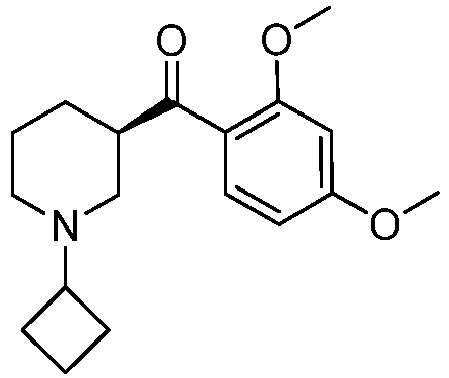
9 13 
0.713 14 
1.2 15 
0.43 18 
0.161 21 
0.461 22 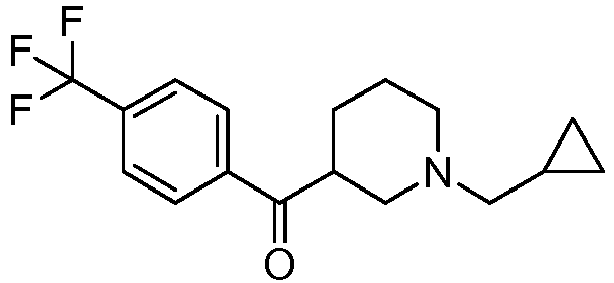
1.4 23 
2.1 24 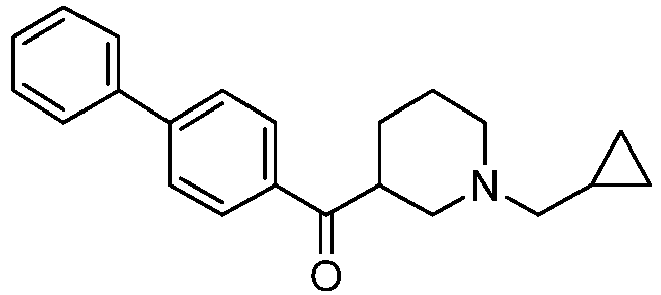
25++ 25 
1.4 26 
0.551 27 
0.221 28 
1.7 29 
0.148 30 
5.9 31 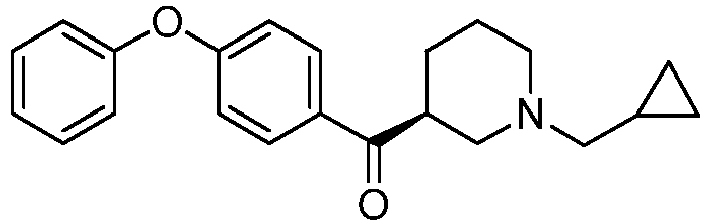
0.136 32 
4.1 33 
0.0954 34 
0.402 35 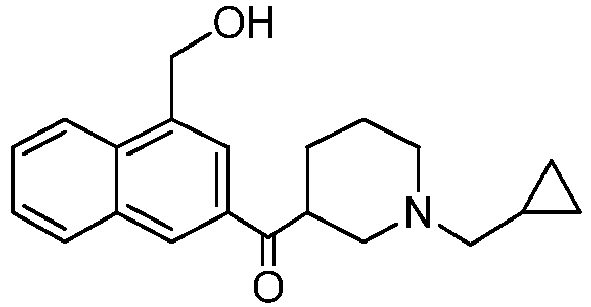
0.169 36 
0.533 37 
0.62 38 
0.596 39 
0.46 40 
0.626 41 
0.7 42 
0.243 43 
0.143 44 
0.101 45 
0.267 46 
0.209 47 
0.0997 48 
0.18 49 
0.163 50 
0.026 51 
0.118 52 
0.0394 53 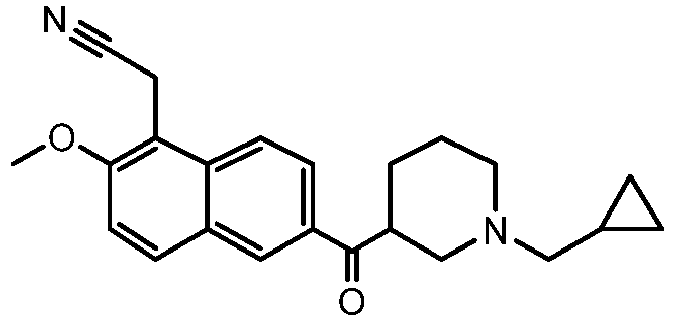
0.0335 54 
0.0395 55 
0.0132 56 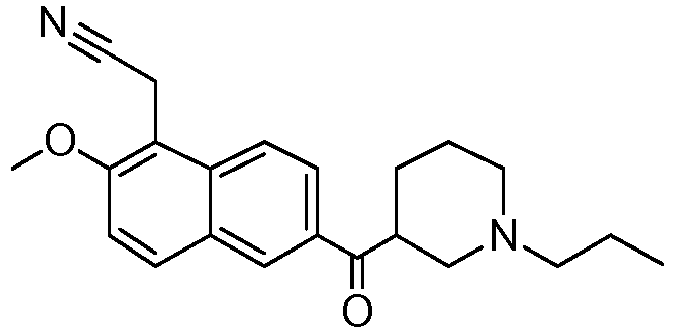
0.27 57 
0.125 58 
0.0476 59 
0.169 60 
0.125 61 
0.174 62 
0.103 63 
0.15 64 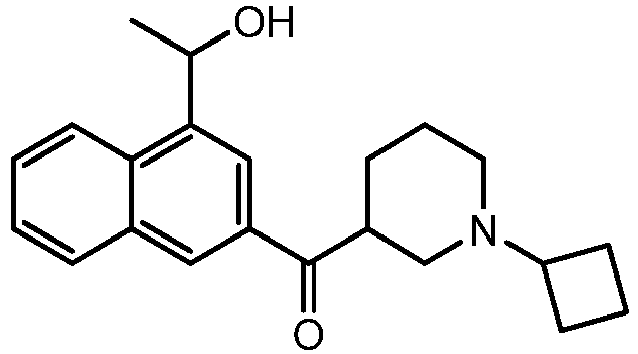
0.0438 65 
0.309 66 
0.0675 67 
0.148 68 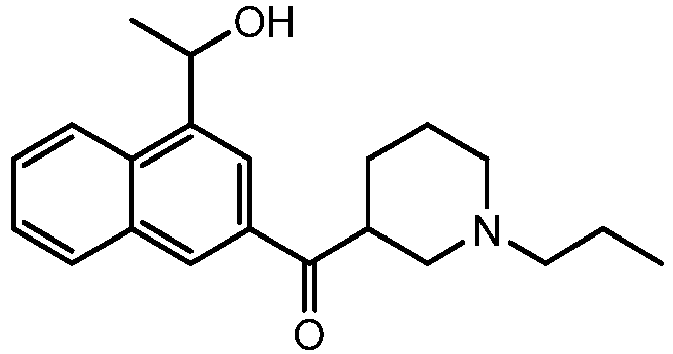
0.0762 69 
0.15 70 
0.0918 71 
0.132 72 
0.0875 73 
0.327 74 
1.15 76 
0.619 77 
0.208 78 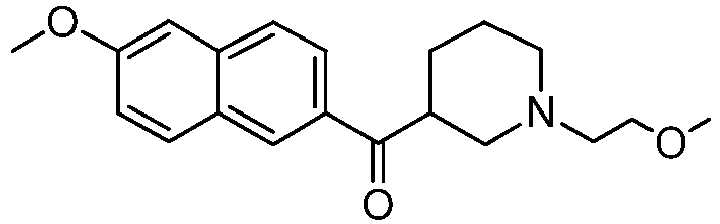
2.4 79 
1.8 81 
6.5 84 
0.709 85 
25++ 87 
88 
89 
90 
1.6 91 
1.6 92 
0.723 93 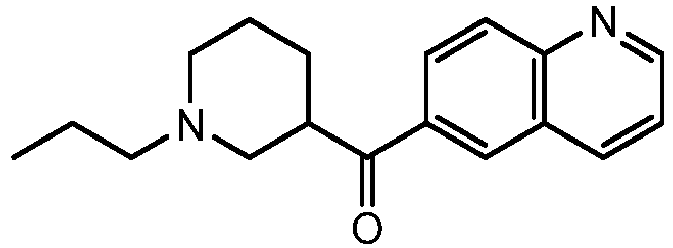
94 
0.122 95 
0.823 96 
97 
0.93 98 
1.6 99 
5.5 100 
1.2 101 
0.279 102 
5.8 103 
2 104 
0.744 105 
0.272 106 
0.247 107 
0.0998 108 
0.297 109a 
14.1 109b 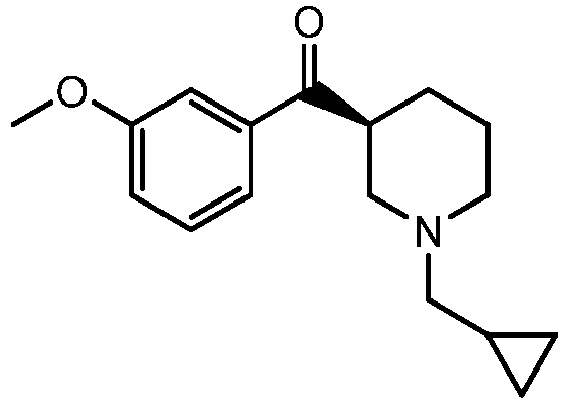
1.3 110a 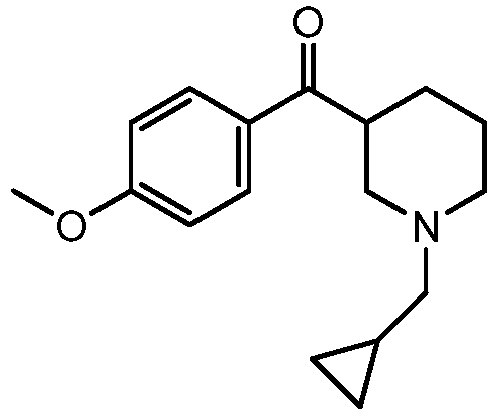
2 110b 
5.3 111 
3.1 112 
0.175 113 
5.4 114 
0.22 115 
0.439 116a 
5.8 116b 
1.4 117a 
0.356 117b 
0.75 118a 
6.8 118b 
0.661 119 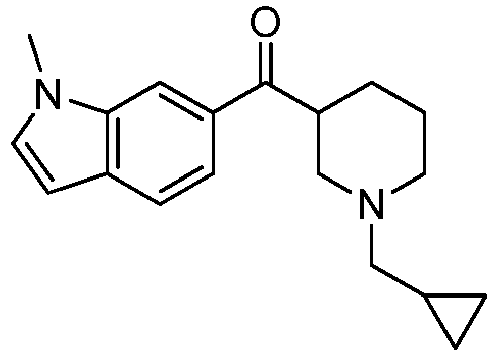
2.3 120 
0.389 121 
0.38 122 
0.205 123 
0.0909 124 
0.656 125 
0.489 126 
3.8 127 
1.9 128 
0.133 129 
0.492 130 
0.442 131a 
0.226 131b 
0.181 132 
0.0553 133 
0.103 134 
135 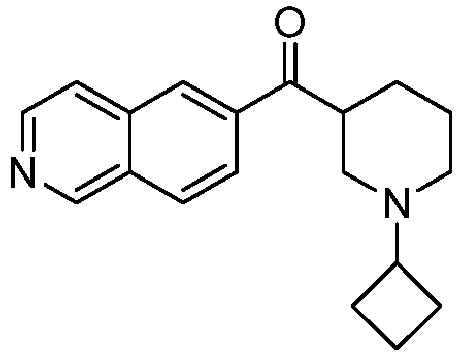
0.226 136a 
0.0414 136b 
1.2 137a 
0.0706 137b 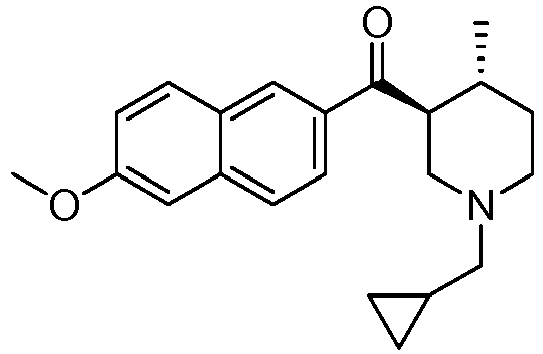
0.0928 137c 
1.1 137d 
3.3 138a 
0.137 138b 
4.8 139a 
0.333 139b 
9.7+ 140a 
0.31 140b 
0.328 140c 
0.00548 140d 
0.00996 141a 
1 141b 
0.0987 142a 
0.0114 142b 
0.349 142c 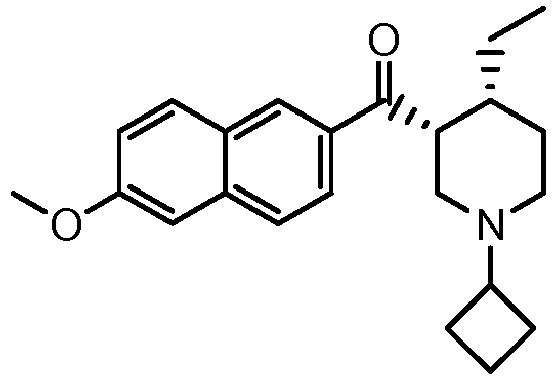
0.207 142d 
0.00656 143a 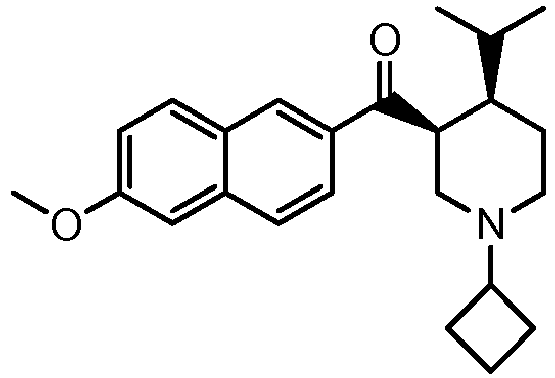
0.635 143b 
0.0159 144a 
0.0056 144b 
0.269 145 
0.312 146a 
0.382 146b 
0.129 147a 
2 147b 
0.0049 149 
0.163 150 
0.133 151a 
0.315 151b 
0.0395 152 
0.234 153 
0.409 154 
0.183 155 
0.779 156a 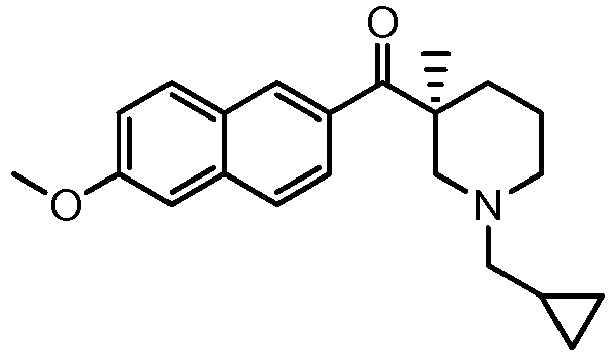
25++ 156b 
25++ 157 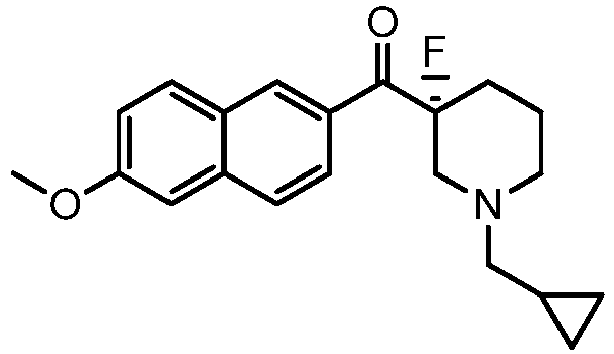
6.1 158a 
1.9 158b 
11.5 159 
0.0688 160a 
1.7 160b 
0.113 161a 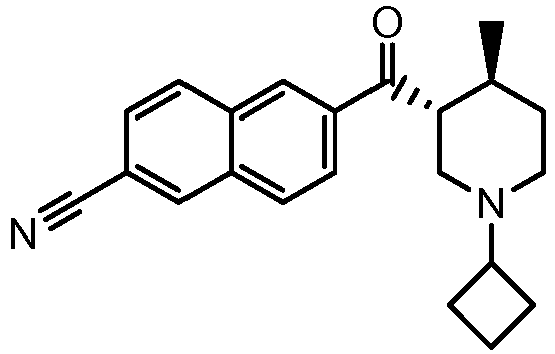
3 161b 
0.0123 162a 
0.814 162b 
0.0857 163a 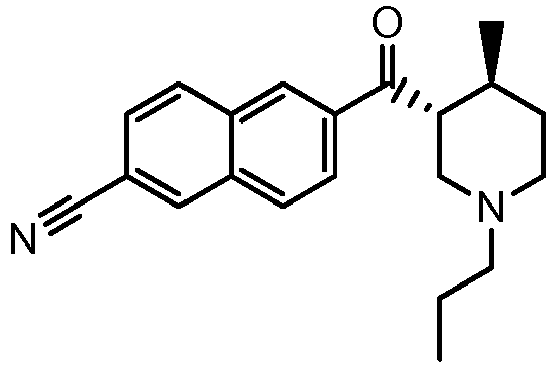
0.993 163b 
0.0454 164 
0.436 165 
0.163 166 
0.24 167 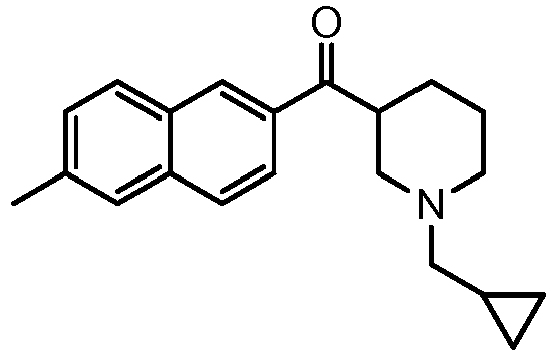
0.171 168 
0.182 169 
0.112 170 
0.0426 171 
0.102 172 
0.316 173 
0.255 174 
1.8 175 
0.355 176 
0.214 177 
0.113 178 
0.188 179a 
0.00565 179b 
0.361 180 
181a 
1.3 181b 
0.0123 182a 
0.29 182b 
0.00112 183a 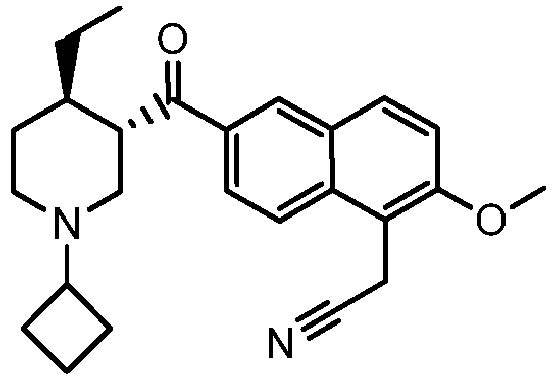
0.0552 183b 
0.00206 183c 
0.078 183d 
0.00153 184a 
0.0774 184b 
0.00141 184c 
0.00313 184d 
0.263 185a 
0.0535 185b 
0.002 186a 
0.0701 186b 
0.00212 188 
0.133 189 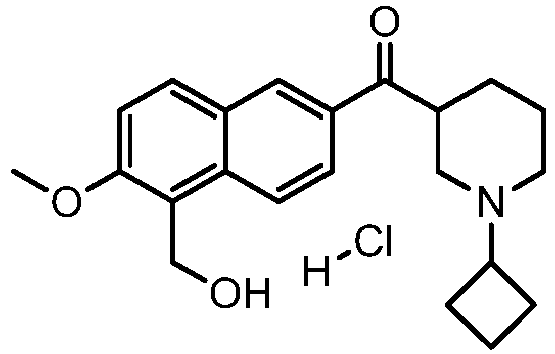
0.0553 190 
0.979 191 
0.102 192 
0.385 193 
0.0223 194 
1.7 195 
0.176 196 
0.138 197 
0.165 198 
0.302 199 
0.0309
Claims (13)
- A compound of formula (I):
 R1 is:a)


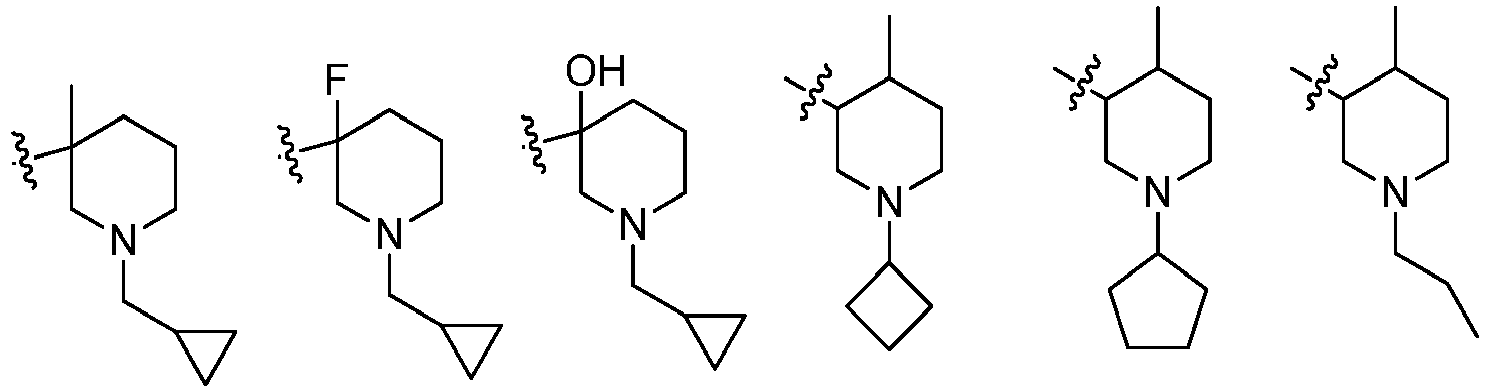


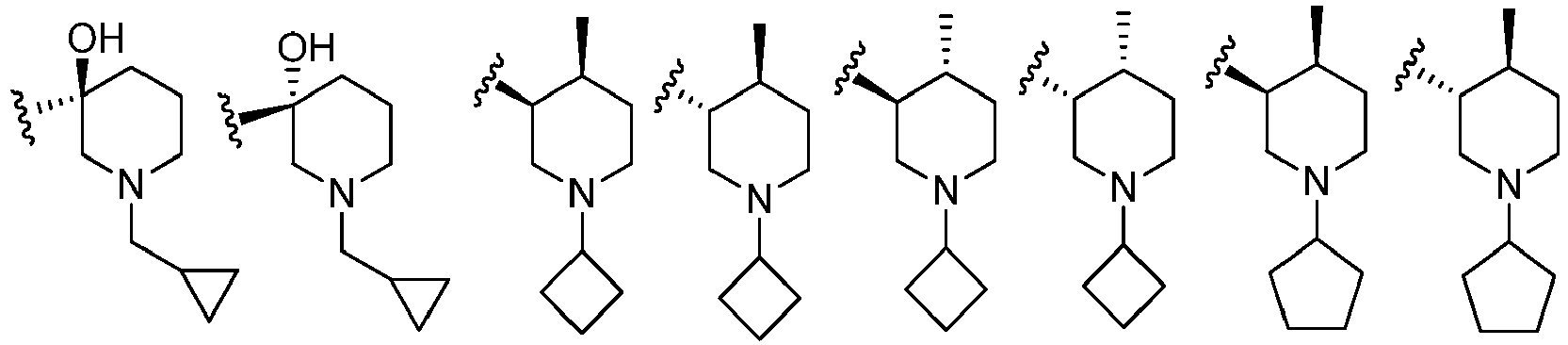


 b) a carbon-linked piperazine ring that is substituted with one or more groups independently selected from the group consisting of C1-6alkyl, C2-6alkenyl, C2-6alkynyl, C3-8carbocycle, 3-8 membered heterocycle, aryl, heteroaryl, halo, -NO2, -N(Rb)2, -CN, -C(O)-N(Rb)2, -S(O)-N(Rb)2, -S(O)2-N(Rb)2, -O-Rb, -S-Rb,-O-C(O)-Rb, -C(O)-Rb, -C(O)-ORb, -S(O)-Rb, -S(O)2-Rb, -N(Rb)-C(O)-Rb, -N(Rb)-S(O)-Rb, -N(Rb)-C(O)-N(Rb)2, and -N(Rb)-S(O)2-Rb; wherein each C1-6alkyl, C2-6alkenyl, C2-6alkynyl, C3-8carbocycle, 3-8 membered heterocycle, aryl, and heteroaryl is optionally substituted with one or more groups independently selected from the group consisting of halo, -NO2-N(Rb)2, -CN, -C(O)-N(Rb)2, -S(O)-N(Rb)2, -S(O)2-N(Rb)2, -O-Rb, -S-Rb, -O-C(O)-Rb, -C(O)-Rb, -C(O)-ORb, -S(O)-Rb, -S(O)2-Rb, -N(Rb)-C(O)-Rb, -N(Rb)-S(O)-Rb, -N(Rb)-C(O)-N(Rb)2, -N(Rb)-S(O)2-Rb, and C1-6alkyl that is optionally substituted with one or more groups independently selected from halo;each Rb is independently selected from the group consisting of hydrogen, C1-6alkyl, C2-6alkenyl, aryl, and C2-6alkynyl, wherein each C1-6alkyl, C2-6alkenyl, aryl, and C2-6alkynyl is optionally substituted with one or more groups independently selected from the group consisting of halo, -N(Rc)2, -CN, -C(O)-N(Rc)2, -S(O)-N(Rc)2, -S(O)2-N(Rc)2, -O-Rc, -S-Rc, -O-C(O)-Rc, -C(O)-Rc, -C(O)-ORc, -S(O)-Rc, -S(O)2-Rc, -N(Rc)-C(O)-Rc, -N(Rc)-S(O)-Rc, -N(Rc)-C(O)-N(Rc)2, and -N(Rc)-S(O)2-Rc; or two Rb are taken together with the nitrogen to which they are attached to form a pyrrolidino, piperidino, or piperazino ring;each Rc is independently selected from the group consisting of hydrogen, C1-6alkyl, C2-6alkenyl, and C2-6alkynyl, wherein each C1-6alkyl, C2-6alkenyl, and C2-6alkynyl is optionally substituted with one or more groups independently selected from the group consisting of oxo, halo, amino, hydroxy, and C1-6alkoxy; or two Rc are taken together with the nitrogen to which they are attached to form a heterocyclyl that is optionally substituted with one or more groups independently selected from the group consisting of oxo, halo and C1-3alkyl that is optionally substituted with one or more groups independently selected from the group consisting of oxo and halo;R2 is a 5-10 membered heteroaryl or a 6-12 membered aryl, which 5-10 membered heteroaryl, and 6-12 membered aryl is optionally substituted with one or more groups independently selected from the group consisting of C1-6alkyl, C2-6alkenyl, C2-6alkynyl, carbocycle, heterocycle, aryl, heteroaryl, halo, -NO2, -N(Rd)2, -CN, -C(O)-N(Rd)2, -S(O)-N(Rd)2, -S(O)2-N(Rd)2, -O-Rd, -S-Rd, -O-C(O)-Rd, -C(O)-Rd, -C(O)-ORd, -S(O)-Rd, -S(O)2-Rd, -N(Rd)-C(O)-Rd, -N(Rd)-S(O)-Rd, -N(Rd)-C(O)-N(Rd)2, and -N(Rd)-S(O)2-Rd; wherein each C1-6alkyl, C2-6alkenyl, C2-6alkynyl, carbocycle, heterocycle, aryl, and heteroaryl is optionally substituted with one or more groups independently selected from the group consisting of halo, -NO2-N(Rd)2, -CN, -C(O)-N(Rd)2, -S(O)-N(Rd)2, -S(O)2-N(Rd)2, -O-Rd, -S-Rd, -O-C(O)-Rd, -C(O)-Rd, -C(O)-ORd, -S(O)-Rd, -S(O)2-Rd, -N(Rd)-C(O)-Rd, -N(Rd)-S(O)-Rd, -N(Rd)-C(O)-N(Rd)2, -N(Rd)-S(O)2-Rd, and C1-6alkyl that is optionally substituted with one or more groups independently selected from halo;each Rd is independently selected from the group consisting of hydrogen, C1-6alkyl, C2-6alkenyl, aryl, and C2-6alkynyl, wherein each C1-6alkyl, C2-6alkenyl, aryl, and C2-6alkynyl is optionally substituted with one or more groups independently selected from the group consisting of halo, -N(Re)2, -CN, -C(O)-N(Re)2, -S(O)-N(Re)2, -S(O)2-N(Re)2, -O-Re, -S-Re, -O-C(O)-Re, -C(O)-Re, -C(O)-ORe, -S(O)-Re, -S(O)2-Re, -N(Re)-C(O)-Re, -N(Rc)-S(O)-Re, -N(Re)-C(O)-N(Re)2, and -N(Re)-S(O)2-Re; or two Rd are taken together with the nitrogen to which they are attached to form a pyrrolidino, piperidino, or piperazino ring; andeach Re is independently selected from the group consisting of hydrogen, C1-6alkyl, C2-6alkenyl, and C2-6alkynyl, wherein each C1-6alkyl, C2-6alkenyl, and C2-6alkynyl is optionally substituted with one or more groups independently selected from the group consisting of oxo, halo, amino, hydroxy, and C1-6alkoxy; or two Re are taken together with the nitrogen to which they are attached to form a heterocyclyl that is optionally substituted with one or more groups independently selected from the group consisting of oxo, halo and C1-3alkyl that is optionally substituted with one or more groups independently selected from the group consisting of oxo and halo;provided that when R2 is 6-methoxy-2-naphthyl, then R1 is not 1-(cyclopropylmethyl)piperidin-3-yl, 1 -(cyclobutyl)piperidin-3 -yl, 1 -(cyclopentyl)piperidin-3 -yl, or 1-(tetrahydropyranyl)piperidin-3-yl; andprovided that when R2 is phenyl, naphthyl, 4-quinolyl, 5-quinolyl, 6-quinolyl, 7-quinolyl, 8-quinolyl, 2-methyl-6-quinolyl, 1,5-benzodioxepin-7-yl, benzo[b]thien-7-yl, 2,3-dihydro-1,4-benzodioxin-6-yl, 1H-1-(tert-butoxycarbonyl)-4-bromo-indol-2-yl, 1H-1-(tert-butoxycarbonyl)-4-cyano-indol-2-yl, 3,4-dihydroxyphenyl, 3-methoxy-4-hydroxyphenyl, 3,4-dimethoxyphenyl, 3-methoxycarbonyl-4-hydroxyphenyl, 4-hydroxyphenyl, or 2-hydroxyphenyl, then R1 is not substituted piperazin-2-yl; orthe compound of Formula (I) is
- The compound of claim 1 which is a compound of formula (Ic): or a salt thereof, wherein;
 each Rf is independently selected from the group consisting of H, C1-6alkyl, C2-6alkenyl, C2-6alkynyl, C3-8carbocycle, 3-8 membered heterocycle, aryl, heteroaryl, halo, -NO2, -N(Rb)2, -CN, -C(O)-N(Rb)2, -S(O)-N(Rb)2, -S(O)2-N(Rb)2, -O-Rb, -S-Rb, -O-C(O)-Rb, -C(O)-Rb, -C(O)-ORb, -S(O)-Rb, -S(O)2-Rb, -N(Rb)-C(O)-Rb, -N(Rb)-S(O)-Rb, -N(Rb)-C(O)-N(Rb)2, and -N(Rb)-S(O)2-Rb; wherein each C1-6alkyl, C2-6alkenyl, C2-6alkynyl, C3-8carbocycle, 3-8 membered heterocycle, aryl, and heteroaryl is optionally substituted with one or more groups independently selected from the group consisting of halo, -NO2-N(Rb)2, -CN, -C(O)-N(Rb)2, -S(O)-N(Rb)2, -S(O)2-N(Rb)2, -O-Rb, -S-Rb, -O-C(O)-Rb, -C(O)-Rb, -C(O)-ORb, -S(O)-Rb, -S(O)2-Rb, -N(Rb)-C(O)-Rb, -N(Rb)-S(O)-Rb, -N(Rb)-C(O)-N(Rb)2, -N(Rb)-S(O)2-Rb, and C1-6alkyl that is optionally substituted with one or more groups independently selected from halo; andeach Rk is independently selected from the group consisting of H, C1-6alkyl, C2-6alkenyl, C2-6alkynyl, C3-8carbocycle, 3-8 membered heterocycle, aryl, and heteroaryl, wherein each C1-6alkyl, C2-6alkenyl, C2-6alkynyl, C3-8carbocycle, 3-8 membered heterocycle, aryl, and heteroaryl is optionally substituted with one or more groups independently selected from the group consisting of halo, -NO2-N(Rb)2, -CN, -C(O)-N(Rb)2, -S(O)-N(Rb)2, -S(O)2-N(Rb)2, -O-Rb, -S-Rb,-O-C(O)-Rb, -C(O)-Rb, -C(O)-ORb, -S(O)-Rb, -S(O)2-Rb, -N(Rb)-C(O)-Rb, -N(Rb)-S(O)-Rb, -N(Rb)-C(O)-N(Rb)2, -N(Rb)-S(O)2-Rb, and C1-6alkyl that is optionally substituted with one or more groups independently selected from halo,provided that Rf and Rk are not both H.
 - The compound of claim 1 wherein R1 is selected from the group consisting of:


- The compound of any one of claims 1-3 wherein R2 is a ring selected from the group consisting of naphthyl, tetralinyl, phenyl, benzisoxazolyl, benzo[7]annulenyl, 1,4-benzodioxinyl, benzimidazolyl-2-one, indolyl, indazolyl, thiophenyl, pyridyl, quinolyl, tetrahydroquinolyl, isoquinolyl, tetrahydroisoquinolyl, and pyrazolyl; which ring is optionally substituted with one or more groups independently selected from the group consisting of C1-6alkyl, C2-6alkenyl, C2-6alkynyl, carbocycle, heterocycle, aryl, heteroaryl, halo, -NO2, -N(Rd)2, -CN, -C(O)-N(Rd)2, -S(O)-N(Rd)2, -S(O)2-N(Rd)2, -O-Rd, -S-Rd, -O-C(O)-Rd, -C(O)-Rd, -C(O)-ORd, -S(O)-Rd, -S(O)2-Rd, -N(Rd)-C(O)-Rd, -N(Rd)-S(O)-Rd, -N(Rd)-C(O)-N(Rd)2, and -N(Rd)-S(O)2-Rd; wherein each C1-6alkyl, C2-6alkenyl, C2-6alkynyl, carbocycle, heterocycle, aryl, and heteroaryl is optionally substituted with one or more groups independently selected from the group consisting of halo, -NO2-N(Rd)2, -CN, -C(O)-N(Rd)2, -S(O)-N(Rd)2, -S(O)2-N(Rd)2, -O-Rd, -S-Rd, -O-C(O)-Rd, -C(O)-Rd, -C(O)-ORd, -S(O)-Rd, -S(O)2-Rd, -N(Rd)-C(O)-Rd, -N(Rd)-S(O)-Rd, -N(Rd)-C(O)-N(Rd)2, -N(Rd)-S(O)2-Rd, and C1-6alkyl that is optionally substituted with one or more groups independently selected from halo.
- The compound of any one of claims 1-3 wherein R2 is a ring selected from the group consisting of:


- The compound of any one of claims 1-3 wherein R2 is a naphthyl ring that is optionally substituted with one or more groups independently selected from the group consisting of C1-6alkyl, C2-6alkenyl, C2-6alkynyl, carbocycle, heterocycle, aryl, heteroaryl, halo, -NO2, -N(Rd)2, -CN, -C(O)-N(Rd)2, -S(O)-N(Rd)2, -S(O)2-N(Rd)2, -O-Rd, -S-Rd, -O-C(O)-Rd, -C(O)-Rd, -C(O)-ORd, -S(O)-Rd, -S(O)2-Rd, -N(Rd)-C(O)-Rd, -N(Rd)-S(O)-Rd, -N(Rd)-C(O)-N(Rd)2, and -N(Rd)-S(O)2-Rd; wherein each C1-6alkyl, C2-6alkenyl, C2-6alkynyl, carbocycle, heterocycle, aryl, and heteroaryl is optionally substituted with one or more groups independently selected from the group consisting of halo, -NO2-N(Rd)2, -CN, -C(O)-N(Rd)2, -S(O)-N(Rd)2, -S(O)2-N(Rd)2, -O-Rd, -S-Rd, -O-C(O)-Rd, -C(O)-Rd, -C(O)-ORd, -S(O)-Rd, -S(O)2-Rd, -N(Rd)-C(O)-Rd, -N(Rd)-S(O)-Rd, -N(Rd)-C(O)-N(Rd)2, -N(Rd)-S(O)2-Rd, and C1-6alkyl that is optionally substituted with one or more groups independently selected from halo; or
R2 is a naphthyl ring that is optionally substituted with one or more groups independently selected from the group consisting of C1-6alkyl, carbocycle, aryl, halo, -NO2, -N(Rd)2, -CN, -C(O)-N(Rd)2, -S(O)-N(Rd)2, -S(O)2-N(Rd)2, -O-Rd, -S-Rd, -O-C(O)-Rd, -C(O)-Rd, -C(O)-ORd, -S(O)-Rd, -S(O)2-Rd, -N(Rd)-C(O)-Rd, -N(Rd)-S(O)-Rd, -N(Rd)-C(O)-N(Rd)2, and -N(Rd)-S(O)2-Rd; wherein each C1-6alkyl, C2-6alkenyl, C2-6alkynyl, carbocycle, heterocycle, aryl, and heteroaryl is optionally substituted with one or more groups independently selected from the group consisting of halo, -NO2-N(Rd)2, -CN, -C(O)-N(Rd)2, -S(O)-N(Rd)2, -S(O)2-N(Rd)2, -O-Rd, -S-Rd, -O-C(O)-Rd, -C(O)-Rd, -C(O)-ORd, -S(O)-Rd, -S(O)2-Rd, -N(Rd)-C(O)-Rd, -N(Rd)-S(O)-Rd, -N(Rd)-C(O)-N(Rd)2, -N(Rd)-S(O)2-Rd, and C1-6alkyl that is optionally substituted with one or more groups independently selected from halo. - The compound of any one of claims 1-3 wherein R2 is a phenyl ring that is optionally substituted with one or more groups independently selected from the group consisting of C1-6alkyl, C2-6alkenyl, C2-6alkynyl, carbocycle, heterocycle, aryl, heteroaryl, halo, -NO2, -N(Rd)2, -CN, -C(O)-N(Rd)2, -S(O)-N(Rd)2, -S(O)2-N(Rd)2, -O-Rd, -S-Rd, -O-C(O)-Rd, -C(O)-Rd, -C(O)-ORd, -S(O)-Rd, -S(O)2-Rd, -N(Rd)-C(O)-Rd, -N(Rd)-S(O)-Rd, -N(Rd)-C(O)-N(Rd)2, and -N(Rd)-S(O)2-Rd; wherein each C1-6alkyl, C2-6alkenyl, C2-6alkynyl, carbocycle, heterocycle, aryl, and heteroaryl is optionally substituted with one or more groups independently selected from the group consisting of halo, -NO2-N(Rd)2, -CN, -C(O)-N(Rd)2, -S(O)-N(Rd)2, -S(O)2-N(Rd)2, -O-Rd, -S-Rd, -O-C(O)-Rd, -C(O)-Rd, -C(O)-ORd, -S(O)-Rd, -S(O)2-Rd, -N(Rd)-C(O)-Rd, -N(Rd)-S(O)-Rd, -N(Rd)-C(O)-N(Rd)2, -N(Rd)-S(O)2-Rd, and C1-6alkyl that is optionally substituted with one or more groups independently selected from halo; or
wherein R2 is a phenyl ring that is optionally substituted with one or more groups independently selected from the group consisting of C1-6alkyl, carbocycle, aryl, halo, -NO2, -N(Rd)2, -CN, -C(O)-N(Rd)2, -S(O)-N(Rd)2, -S(O)2-N(Rd)2, -O-Rd, -S-Rd, -O-C(O)-Rd, -C(O)-Rd, -C(O)-ORd, -S(O)-Rd, -S(O)2-Rd, -N(Rd)-C(O)-Rd, -N(Rd)-S(O)-Rd, -N(Rd)-C(O)-N(Rd)2, and -N(Rd)-S(O)2-Rd; wherein each C1-6alkyl, C2-6alkenyl, C2-6alkynyl, carbocycle, heterocycle, aryl, and heteroaryl is optionally substituted with one or more groups independently selected from the group consisting of halo, -NO2-N(Rd)2, -CN, -C(O)-N(Rd)2, -S(O)-N(Rd)2, -S(O)2-N(Rd)2, -O-Rd, -S-Rd, -O-C(O)-Rd, -C(O)-Rd, -C(O)-ORd, -S(O)-Rd, -S(O)2-Rd, -N(Rd)-C(O)-Rd, -N(Rd)-S(O)-Rd, -N(Rd)-C(O)-N(Rd)2, -N(Rd)-S(O)2-Rd, and C1-6alkyl that is optionally substituted with one or more groups independently selected from halo. - The compound of any one of claims 1-3 wherein R2 is a quinolyl or isoquinolyl ring, which ring is optionally substituted with one or more groups independently selected from the group consisting of C1-6alkyl, C2-6alkenyl, C2-6alkynyl, carbocycle, heterocycle, aryl, heteroaryl, halo, -NO2, -N(Rd)2, -CN, -C(O)-N(Rd)2, -S(O)-N(Rd)2, -S(O)2-N(Rd)2, -O-Rd, -S-Rd, -O-C(O)-Rd, -C(O)-Rd, -C(O)-ORd, -S(O)-Rd, -S(O)2-Rd, -N(Rd)-C(O)-Rd, -N(Rd)-S(O)-Rd, -N(Rd)-C(O)-N(Rd)2, and -N(Rd)-S(O)2-Rd; wherein each C1-6alkyl, C2-6alkenyl, C2-6alkynyl, carbocycle, heterocycle, aryl, and heteroaryl is optionally substituted with one or more groups independently selected from the group consisting of halo, -NO2-N(Rd)2, -CN, -C(O)-N(Rd)2, -S(O)-N(Rd)2, -S(O)2-N(Rd)2, -O-Rd, -S-Rd, -O-C(O)-Rd, -C(O)-Rd, -C(O)-ORd, -S(O)-Rd, -S(O)2-Rd, -N(Rd)-C(O)-Rd, -N(Rd)-S(O)-Rd, -N(Rd)-C(O)-N(Rd)2, -N(Rd)-S(O)2-Rd, and C1-6alkyl that is optionally substituted with one or more groups independently selected from halo; or
R2 is a quinolyl or isoquinolyl ring, which ring is optionally substituted with one or more groups independently selected from the group consisting of C1-6alkyl, carbocycle, halo, -NO2, -N(Rd)2, -CN, -C(O)-N(Rd)2, -S(O)-N(Rd)2, -S(O)2-N(Rd)2, -O-Rd, -S-Rd, -O-C(O)-Rd, -C(O)-Rd, -C(O)-ORd, -S(O)-Rd, -S(O)2-Rd, -N(Rd)-C(O)-Rd, -N(Rd)-S(O)-Rd, -N(Rd)-C(O)-N(Rd)2, and -N(Rd)-S(O)2-Rd; wherein each C1-6alkyl, C2-6alkenyl, C2-6alkynyl, carbocycle, heterocycle, aryl, and heteroaryl is optionally substituted with one or more groups independently selected from the group consisting of halo, -NO2-N(Rd)2, -CN, -C(O)-N(Rd)2, -S(O)-N(Rd)2, -S(O)2-N(Rd)2, -O-Rd, -S-Rd, -O-C(O)-Rd, -C(O)-Rd, -C(O)-ORd, -S(O)-Rd, -S(O)2-Rd, -N(Rd)-C(O)-Rd, -N(Rd)-S(O)-Rd, -N(Rd)-C(O)-N(Rd)2, -N(Rd)-S(O)2-Rd, and C1-6alkyl that is optionally substituted with one or more groups independently selected from halo. - The compound of any one of claims 1-3 wherein R2 is selected from the group consisting of:


- The compound of claim 1 selected from the group consisting of:









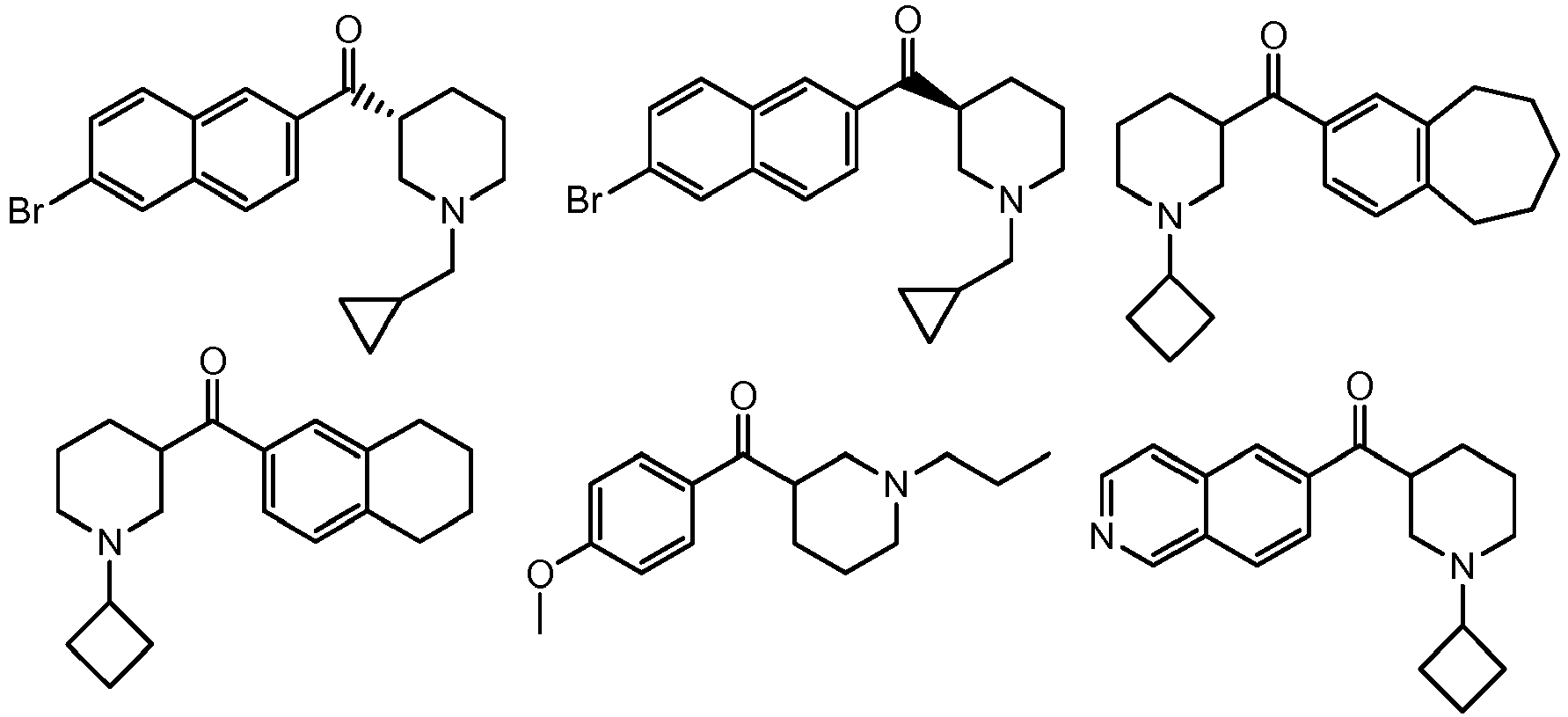


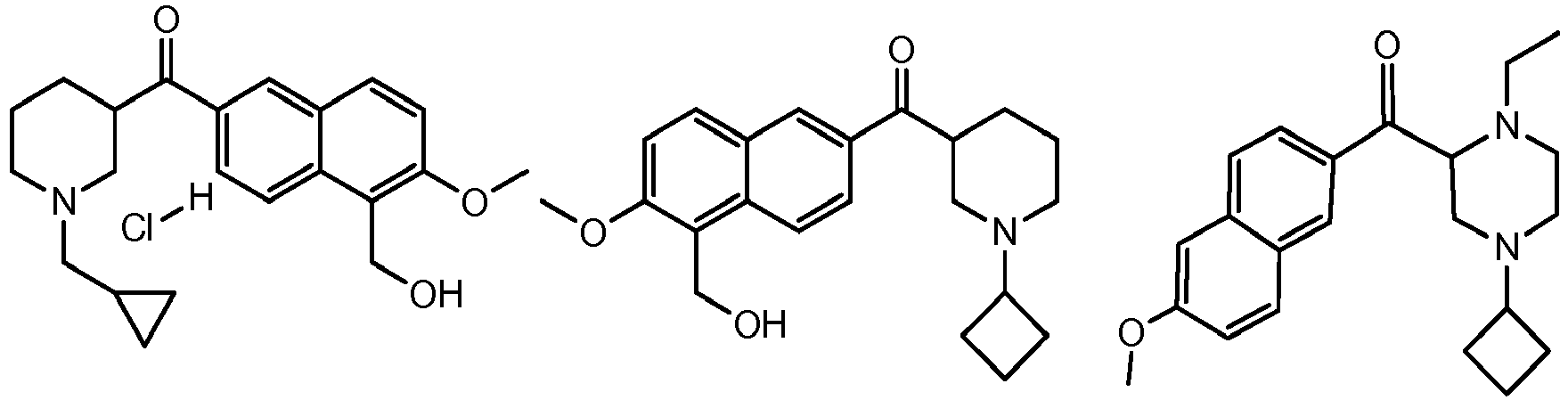


- A composition comprising a compound as described in any one of claims 1-10, or a pharmaceutically acceptable salt thereof, and a pharmaceutically acceptable adjuvant, carrier, or vehicle.
- A compound as described in any one of claim 1-10, or a pharmaceutically acceptable salt thereof; or compound of formula (I):
 R1 is:c) a carbon-linked piperidine ring that is substituted on the piperidine ring nitrogen with a group Rx and that is optionally further substituted with one or more groups independently selected from the group consisting of C1-6alkyl, C2-6alkenyl, C2-6alkynyl, C3-8carbocycle, 3-8 membered heterocycle, aryl, heteroaryl, halo, -NO2, -N(Rb)2, -CN, -C(O)-N(Rb)2, -S(O)-N(Rb)2, -S(O)2-N(Rb)2, -O-Rb, -S-Rb, -O-C(O)-Rb, -C(O)-Rb, -C(O)-ORb, -S(O)-Rb, -S(O)2-Rb, -N(Rb)-C(O)-Rb, -N(Rb)-S(O)-Rb, -N(Rb)-C(O)-N(Rb)2, and -N(Rb)-S(O)2-Rb; wherein each C1-6alkyl, C2-6alkenyl, C2-6alkynyl, C3-8carbocycle, 3-8 membered heterocycle, aryl, and heteroaryl is optionally substituted with one or more groups independently selected from the group consisting of halo, -NO2-N(Rb)2, -CN, -C(O)-N(Rb)2, -S(O)-N(Rb)2, -S(O)2-N(Rb)2, -O-Rb, -S-Rb,-O-C(O)-Rb, -C(O)-Rb, -C(O)-ORb, -S(O)-Rb, -S(O)2-Rb, -N(Rb)-C(O)-Rb, -N(Rb)-S(O)-Rb, -N(Rb)-C(O)-N(Rb)2, -N(Rb)-S(O)2-Rb, and C1-6alkyl that is optionally substituted with one or more groups independently selected from halo; ord) a carbon-linked piperazine ring that is substituted with one or more groups independently selected from the group consisting of C1-6alkyl, C2-6alkenyl, C2-6alkynyl, C3-8carbocycle, 3-8 membered heterocycle, aryl, heteroaryl, halo, -NO2, -N(Rb)2, -CN, -C(O)-N(Rb)2, -S(O)-N(Rb)2, -S(O)2-N(Rb)2, -O-Rb, -S-Rb,-O-C(O)-Rb, -C(O)-Rb, -C(O)-ORb, -S(O)-Rb, -S(O)2-Rb, -N(Rb)-C(O)-Rb, -N(Rb)-S(O)-Rb, -N(Rb)-C(O)-N(Rb)2, and -N(Rb)-S(O)2-Rb; wherein each C1-6alkyl, C2-6alkenyl, C2-6alkynyl, C3-8carbocycle, 3-8 membered heterocycle, aryl, and heteroaryl is optionally substituted with one or more groups independently selected from the group consisting of halo, -NO2-N(Rb)2, -CN, -C(O)-N(Rb)2, -S(O)-N(Rb)2, -S(O)2-N(Rb)2, -O-Rb, -S-Rb, -O-C(O)-Rb, -C(O)-Rb, -C(O)-ORb, -S(O)-Rb, -S(O)2-Rb, -N(Rb)-C(O)-Rb, -N(Rb)-S(O)-Rb, -N(Rb)-C(O)-N(Rb)2, -N(Rb)-S(O)2-Rb, and C1-6alkyl that is optionally substituted with one or more groups independently selected from halo;each Rb is independently selected from the group consisting of hydrogen, C1-6alkyl, C2-6alkenyl, aryl, and C2-6alkynyl, wherein each C1-6alkyl, C2-6alkenyl, aryl, and C2-6alkynyl is optionally substituted with one or more groups independently selected from the group consisting of halo, -N(Rc)2, -CN, -C(O)-N(Rc)2, -S(O)-N(Rc)2, -S(O)2-N(Rc)2, -O-Rc, -S-Rc, -O-C(O)-Rc, -C(O)-Rc, -C(O)-ORc, -S(O)-Rc, -S(O)2-Rc, -N(Rc)-C(O)-Rc, -N(Rc)-S(O)-Rc, -N(Rc)-C(O)-N(Rc)2, and -N(Rc)-S(O)2-Rc; or two Rb are taken together with the nitrogen to which they are attached to form a pyrrolidino, piperidino, or piperazino ring;each Rc is independently selected from the group consisting of hydrogen, C1-6alkyl, C2-6alkenyl, and C2-6alkynyl, wherein each C1-6alkyl, C2-6alkenyl, and C2-6alkynyl is optionally substituted with one or more groups independently selected from the group consisting of oxo, halo, amino, hydroxy, and C1-6alkoxy; or two Rc are taken together with the nitrogen to which they are attached to form a heterocyclyl that is optionally substituted with one or more groups independently selected from the group consisting of oxo, halo and C1-3alkyl that is optionally substituted with one or more groups independently selected from the group consisting of oxo and halo;Rx is C1-6alkyl, C2-6alkenyl, C2-6alkynyl, C3-8carbocycle, oxetanyl, tetrahydrofuranyl, or tetrahydropyranyl, wherein each C1-6alkyl, C2-6alkenyl, C2-6alkynyl, C3-8carbocycle is optionally substituted with one or more groups independently selected from the group consisting of halo, -CN, C1-3alkoxy, oxetanyl, tetrahydrofuranyl, tetrahydropyranyl, and C3-8carbocycle that is optionally substituted with one or more groups independently selected from the group consisting of halo and C1-3alkyl;R2 is a 5-10 membered heteroaryl or a 6-12 membered aryl, which 5-10 membered heteroaryl, and 6-12 membered aryl is optionally substituted with one or more groups independently selected from the group consisting of C1-6alkyl, C2-6alkenyl, C2-6alkynyl, carbocycle, heterocycle, aryl, heteroaryl, halo, -NO2, -N(Rd)2, -CN, -C(O)-N(Rd)2, -S(O)-N(Rd)2, -S(O)2-N(Rd)2, -O-Rd, -S-Rd, -O-C(O)-Rd, -C(O)-Rd, -C(O)-ORd, -S(O)-Rd, -S(O)2-Rd, -N(Rd)-C(O)-Rd, -N(Rd)-S(O)-Rd, -N(Rd)-C(O)-N(Rd)2, and -N(Rd)-S(O)2-Rd; wherein each C1-6alkyl, C2-6alkenyl, C2-6alkynyl, carbocycle, heterocycle, aryl, and heteroaryl is optionally substituted with one or more groups independently selected from the group consisting of halo, -NO2-N(Rd)2, -CN, -C(O)-N(Rd)2, -S(O)-N(Rd)2, -S(O)2-N(Rd)2, -O-Rd, -S-Rd, -O-C(O)-Rd, -C(O)-Rd, -C(O)-ORd, -S(O)-Rd, -S(O)2-Rd, -N(Rd)-C(O)-Rd, -N(Rd)-S(O)-Rd, -N(Rd)-C(O)-N(Rd)2, -N(Rd)-S(O)2-Rd, and C1-6alkyl that is optionally substituted with one or more groups independently selected from halo;each Rd is independently selected from the group consisting of hydrogen, C1-6alkyl, C2-6alkenyl, aryl, and C2-6alkynyl, wherein each C1-6alkyl, C2-6alkenyl, aryl, and C2-6alkynyl is optionally substituted with one or more groups independently selected from the group consisting of halo, -N(Re)2, -CN, -C(O)-N(Re)2, -S(O)-N(Re)2, -S(O)2-N(Re)2, -O-Re, -S-Re, -O-C(O)-Re, -C(O)-Re, -C(O)-ORe, -S(O)-Re, -S(O)2-Re, -N(Re)-C(O)-Re, -N(Rc)-S(O)-Re, -N(Re)-C(O)-N(Re)2, and -N(Re)-S(O)2-Re; or two Rd are taken together with the nitrogen to which they are attached to form a pyrrolidino, piperidino, or piperazino ring; andeach Re is independently selected from the group consisting of hydrogen, C1-6alkyl, C2-6alkenyl, and C2-6alkynyl, wherein each C1-6alkyl, C2-6alkenyl, and C2-6alkynyl is optionally substituted with one or more groups independently selected from the group consisting of oxo, halo, amino, hydroxy, and C1-6alkoxy; or two Re are taken together with the nitrogen to which they are attached to form a heterocyclyl that is optionally substituted with one or more groups independently selected from the group consisting of oxo, halo and C1-3alkyl that is optionally substituted with one or more groups independently selected from the group consisting of oxo and halo.
 - A compound as described in any one of claims 1-10, or a pharmaceutically acceptable salt thereof, for use in medical therapy.
Applications Claiming Priority (2)
| Application Number | Priority Date | Filing Date | Title |
|---|---|---|---|
| US201562101927P | 2015-01-09 | 2015-01-09 | |
| PCT/US2016/012638 WO2016112284A1 (en) | 2015-01-09 | 2016-01-08 | (piperidin-3-yl)(naphthalen-2-yl)methanone derivatives and related compounds as inhibitors of the histone demethylase kdm2b for the treatment of cancer |
Publications (2)
| Publication Number | Publication Date |
|---|---|
| EP3242872A1 EP3242872A1 (en) | 2017-11-15 |
| EP3242872B1 true EP3242872B1 (en) | 2019-07-03 |
Family
ID=55299746
Family Applications (1)
| Application Number | Title | Priority Date | Filing Date |
|---|---|---|---|
| EP16702830.7A Active EP3242872B1 (en) | 2015-01-09 | 2016-01-08 | (piperidin-3-yl)(naphthalen-2-yl)methanone derivatives and related compounds as inhibitors of the histone demethylase kdm2b for the treatment of cancer |
Country Status (5)
| Country | Link |
|---|---|
| US (1) | US10280149B2 (en) |
| EP (1) | EP3242872B1 (en) |
| JP (1) | JP6855379B2 (en) |
| CN (1) | CN107406414B (en) |
| WO (1) | WO2016112284A1 (en) |
Families Citing this family (3)
| Publication number | Priority date | Publication date | Assignee | Title |
|---|---|---|---|---|
| JP7788208B2 (en) * | 2017-03-29 | 2025-12-18 | パデュー リサーチ ファウンデイション | Kinase network inhibitors and uses thereof |
| DK3765461T3 (en) * | 2018-03-14 | 2023-11-20 | Prelude Therapeutics Inc | SELECTIVE PROTEIN ARGININE METHYL TRANSFERASE 5 (PRMT5) INHIBITORS |
| EP4149917B1 (en) * | 2020-05-12 | 2025-07-30 | Merck Sharp & Dohme LLC | Factor xi activation inhibitors |
Family Cites Families (38)
| Publication number | Priority date | Publication date | Assignee | Title |
|---|---|---|---|---|
| CU22545A1 (en) | 1994-11-18 | 1999-03-31 | Centro Inmunologia Molecular | OBTAINING A CHEMICAL AND HUMANIZED ANTIBODY AGAINST THE RECEPTOR OF THE EPIDERMAL GROWTH FACTOR FOR DIAGNOSTIC AND THERAPEUTIC USE |
| LU77659A1 (en) * | 1977-06-30 | 1979-03-26 | Byk Gulden Lomberg Chem Fab | PIPERIDINOADAMANTANE, THE METHOD OF MANUFACTURING IT AND THE MEDICINAL PRODUCTS CONTAINING IT |
| US4943533A (en) | 1984-03-01 | 1990-07-24 | The Regents Of The University Of California | Hybrid cell lines that produce monoclonal antibodies to epidermal growth factor receptor |
| WO1991003489A1 (en) | 1989-09-08 | 1991-03-21 | The Johns Hopkins University | Structural alterations of the egf receptor gene in human gliomas |
| AU661533B2 (en) | 1992-01-20 | 1995-07-27 | Astrazeneca Ab | Quinazoline derivatives |
| GB9314893D0 (en) | 1993-07-19 | 1993-09-01 | Zeneca Ltd | Quinazoline derivatives |
| PT659439E (en) | 1993-12-24 | 2002-04-29 | Merck Patent Gmbh | IMUNOCONJUGADOS |
| US5654307A (en) | 1994-01-25 | 1997-08-05 | Warner-Lambert Company | Bicyclic compounds capable of inhibiting tyrosine kinases of the epidermal growth factor receptor family |
| IL112249A (en) | 1994-01-25 | 2001-11-25 | Warner Lambert Co | Pharmaceutical compositions containing di and tricyclic pyrimidine derivatives for inhibiting tyrosine kinases of the epidermal growth factor receptor family and some new such compounds |
| IL112248A0 (en) | 1994-01-25 | 1995-03-30 | Warner Lambert Co | Tricyclic heteroaromatic compounds and pharmaceutical compositions containing them |
| EP0772609B1 (en) | 1994-07-21 | 1999-02-24 | Akzo Nobel N.V. | Cyclic ketone peroxide formulations |
| US5804396A (en) | 1994-10-12 | 1998-09-08 | Sugen, Inc. | Assay for agents active in proliferative disorders |
| EP2163546B1 (en) | 1995-03-30 | 2016-06-01 | Pfizer Products Inc. | Quinazoline derivatives |
| GB9508565D0 (en) | 1995-04-27 | 1995-06-14 | Zeneca Ltd | Quiazoline derivative |
| GB9508538D0 (en) | 1995-04-27 | 1995-06-14 | Zeneca Ltd | Quinazoline derivatives |
| US5747498A (en) | 1996-05-28 | 1998-05-05 | Pfizer Inc. | Alkynyl and azido-substituted 4-anilinoquinazolines |
| JPH11507535A (en) | 1995-06-07 | 1999-07-06 | イムクローン システムズ インコーポレイテッド | Antibodies and antibody fragments that suppress tumor growth |
| TR199800012T1 (en) | 1995-07-06 | 1998-04-21 | Novartis Ag | Pyrolopyrimidines and applications for preparation. |
| US5760041A (en) | 1996-02-05 | 1998-06-02 | American Cyanamid Company | 4-aminoquinazoline EGFR Inhibitors |
| GB9603095D0 (en) | 1996-02-14 | 1996-04-10 | Zeneca Ltd | Quinazoline derivatives |
| DE69710712T3 (en) | 1996-04-12 | 2010-12-23 | Warner-Lambert Co. Llc | REVERSIBLE INHIBITORS OF TYROSINE KINASEN |
| EP0912559B1 (en) | 1996-07-13 | 2002-11-06 | Glaxo Group Limited | Fused heterocyclic compounds as protein tyrosine kinase inhibitors |
| ID18494A (en) | 1996-10-02 | 1998-04-16 | Novartis Ag | PIRAZOLA DISTRIBUTION IN THE SEQUENCE AND THE PROCESS OF MAKING IT |
| US6002008A (en) | 1997-04-03 | 1999-12-14 | American Cyanamid Company | Substituted 3-cyano quinolines |
| UA73073C2 (en) | 1997-04-03 | 2005-06-15 | Уайт Холдінгз Корпорейшн | Substituted 3-cyan chinolines |
| US6235883B1 (en) | 1997-05-05 | 2001-05-22 | Abgenix, Inc. | Human monoclonal antibodies to epidermal growth factor receptor |
| AU7165698A (en) | 1997-05-06 | 1998-11-27 | American Cyanamid Company | Use of quinazoline compounds for the treatment of polycystic kidney disease |
| ZA986729B (en) | 1997-07-29 | 1999-02-02 | Warner Lambert Co | Irreversible inhibitors of tyrosine kinases |
| ZA986732B (en) | 1997-07-29 | 1999-02-02 | Warner Lambert Co | Irreversible inhibitiors of tyrosine kinases |
| TW436485B (en) | 1997-08-01 | 2001-05-28 | American Cyanamid Co | Substituted quinazoline derivatives |
| HUP0004286A3 (en) | 1997-11-06 | 2002-01-28 | American Cyanamid Co Madison | Use of quinazoline derivatives for producing pharmaceutical compositions for treating colonic polyps |
| JP3687900B2 (en) | 1998-11-19 | 2005-08-24 | ワーナー−ランバート・カンパニー、リミテッド、ライアビリティ、カンパニー | N- [4- (3-Chloro-4-fluorophenylamino) -7- (3-morpholin-4-ylpropoxy) quinazolin-6-yl] acrylamide is an irreversible inhibitor of tyrosine kinase |
| CA2389049A1 (en) * | 1999-09-27 | 2001-04-05 | Georgetown University | Dopamine transporter inhibitors and their use |
| PE20071079A1 (en) * | 2005-11-15 | 2007-12-16 | Cytokinetics Inc | PIPERIDINE COMPOUNDS AS INHIBITORS OF CELLULAR PROLIFERATION |
| WO2010054279A1 (en) * | 2008-11-10 | 2010-05-14 | Schering Corporation | Compounds for the treatment of inflammatory disorders |
| WO2012071469A2 (en) * | 2010-11-23 | 2012-05-31 | Nevada Cancer Institute | Histone demethylase inhibitors and uses thereof for treatment o f cancer |
| WO2013123411A1 (en) * | 2012-02-17 | 2013-08-22 | Board Of Regents, The University Of Texas System | Methods for diagnosing and treating cancer |
| PT2970211T (en) * | 2013-03-15 | 2017-10-31 | Quanticel Pharmaceuticals Inc | HISTONE INHIBITORS DEMETILASE |
-
2016
- 2016-01-08 EP EP16702830.7A patent/EP3242872B1/en active Active
- 2016-01-08 JP JP2017536302A patent/JP6855379B2/en not_active Expired - Fee Related
- 2016-01-08 WO PCT/US2016/012638 patent/WO2016112284A1/en not_active Ceased
- 2016-01-08 CN CN201680014364.2A patent/CN107406414B/en not_active Expired - Fee Related
-
2017
- 2017-07-07 US US15/643,808 patent/US10280149B2/en active Active
Non-Patent Citations (1)
| Title |
|---|
| None * |
Also Published As
| Publication number | Publication date |
|---|---|
| JP2018501288A (en) | 2018-01-18 |
| CN107406414B (en) | 2022-04-19 |
| EP3242872A1 (en) | 2017-11-15 |
| US10280149B2 (en) | 2019-05-07 |
| WO2016112284A1 (en) | 2016-07-14 |
| JP6855379B2 (en) | 2021-04-07 |
| HK1247198A1 (en) | 2018-09-21 |
| CN107406414A (en) | 2017-11-28 |
| US20180022727A1 (en) | 2018-01-25 |
Similar Documents
| Publication | Publication Date | Title |
|---|---|---|
| EP3204379B1 (en) | Pyrrolidine amide compounds as histone demethylase inhibitors | |
| EP2970307B1 (en) | Pyrazolo compounds and uses thereof | |
| EP3204360B1 (en) | Therapeutic compounds and uses thereof | |
| EP3464270B1 (en) | Heterocyclic inhibitors of cbp/ep300 and their use in the treatment of cancer | |
| EP3224258B1 (en) | 4,5,6,7-tetrahydro-1h-pyrazolo[4,3-c]pyridin-3-amine compounds as cbp and/or ep300 inhibitors | |
| EP3262036B1 (en) | Therapeutic pyridazine compounds and uses thereof | |
| EP3218375B1 (en) | Substituted pyrrolopyrdines as inhibitors of bromodomain | |
| EP3250552B1 (en) | Therapeutic compounds and uses thereof | |
| EP3189049B1 (en) | Phthalazine derivatives of formula (i) as pcaf and gcn5 inhibitors for use in the treatment of cancer | |
| EP3041474B1 (en) | Antiproliferative compounds | |
| WO2022265974A1 (en) | Aminoheterocycle-substituted tricyclic kras inhibitors | |
| EP3189046B1 (en) | Therapeutic compounds and uses thereof | |
| EP3250571B1 (en) | Therapeutic compounds and uses thereof | |
| WO2015049325A1 (en) | Therapeutic inhibitors of cdk8 and uses thereof | |
| WO2015135094A1 (en) | Therapeutic compounds and uses thereof | |
| US10280149B2 (en) | Therapeutic compounds and uses thereof | |
| US10202354B2 (en) | Therapeutic compounds and uses thereof | |
| HK1247198B (en) | (piperidin-3-yl)(naphthalen-2-yl)methanone derivatives as inhibitors of the histone demethylase kdm2b for the treatment of cancer | |
| HK1247194B (en) | 4,5-dihydroimidazole derivatives and their use as histone demethylase (kdm2b) inhibitors | |
| HK1247194A1 (en) | 4,5-dihydroimidazole derivatives and their use as histone demethylase (kdm2b) inhibitors |
Legal Events
| Date | Code | Title | Description |
|---|---|---|---|
| STAA | Information on the status of an ep patent application or granted ep patent |
Free format text: STATUS: THE INTERNATIONAL PUBLICATION HAS BEEN MADE |
|
| PUAI | Public reference made under article 153(3) epc to a published international application that has entered the european phase |
Free format text: ORIGINAL CODE: 0009012 |
|
| STAA | Information on the status of an ep patent application or granted ep patent |
Free format text: STATUS: REQUEST FOR EXAMINATION WAS MADE |
|
| 17P | Request for examination filed |
Effective date: 20170727 |
|
| AK | Designated contracting states |
Kind code of ref document: A1 Designated state(s): AL AT BE BG CH CY CZ DE DK EE ES FI FR GB GR HR HU IE IS IT LI LT LU LV MC MK MT NL NO PL PT RO RS SE SI SK SM TR |
|
| AX | Request for extension of the european patent |
Extension state: BA ME |
|
| DAV | Request for validation of the european patent (deleted) | ||
| DAX | Request for extension of the european patent (deleted) | ||
| STAA | Information on the status of an ep patent application or granted ep patent |
Free format text: STATUS: EXAMINATION IS IN PROGRESS |
|
| 17Q | First examination report despatched |
Effective date: 20180803 |
|
| GRAP | Despatch of communication of intention to grant a patent |
Free format text: ORIGINAL CODE: EPIDOSNIGR1 |
|
| STAA | Information on the status of an ep patent application or granted ep patent |
Free format text: STATUS: GRANT OF PATENT IS INTENDED |
|
| INTG | Intention to grant announced |
Effective date: 20190118 |
|
| GRAS | Grant fee paid |
Free format text: ORIGINAL CODE: EPIDOSNIGR3 |
|
| GRAA | (expected) grant |
Free format text: ORIGINAL CODE: 0009210 |
|
| STAA | Information on the status of an ep patent application or granted ep patent |
Free format text: STATUS: THE PATENT HAS BEEN GRANTED |
|
| AK | Designated contracting states |
Kind code of ref document: B1 Designated state(s): AL AT BE BG CH CY CZ DE DK EE ES FI FR GB GR HR HU IE IS IT LI LT LU LV MC MK MT NL NO PL PT RO RS SE SI SK SM TR |
|
| REG | Reference to a national code |
Ref country code: GB Ref legal event code: FG4D |
|
| REG | Reference to a national code |
Ref country code: CH Ref legal event code: EP Ref country code: AT Ref legal event code: REF Ref document number: 1150844 Country of ref document: AT Kind code of ref document: T Effective date: 20190715 |
|
| REG | Reference to a national code |
Ref country code: IE Ref legal event code: FG4D |
|
| REG | Reference to a national code |
Ref country code: DE Ref legal event code: R096 Ref document number: 602016016256 Country of ref document: DE |
|
| REG | Reference to a national code |
Ref country code: NL Ref legal event code: MP Effective date: 20190703 |
|
| REG | Reference to a national code |
Ref country code: LT Ref legal event code: MG4D |
|
| REG | Reference to a national code |
Ref country code: AT Ref legal event code: MK05 Ref document number: 1150844 Country of ref document: AT Kind code of ref document: T Effective date: 20190703 |
|
| PG25 | Lapsed in a contracting state [announced via postgrant information from national office to epo] |
Ref country code: NL Free format text: LAPSE BECAUSE OF FAILURE TO SUBMIT A TRANSLATION OF THE DESCRIPTION OR TO PAY THE FEE WITHIN THE PRESCRIBED TIME-LIMIT Effective date: 20190703 Ref country code: PT Free format text: LAPSE BECAUSE OF FAILURE TO SUBMIT A TRANSLATION OF THE DESCRIPTION OR TO PAY THE FEE WITHIN THE PRESCRIBED TIME-LIMIT Effective date: 20191104 Ref country code: SE Free format text: LAPSE BECAUSE OF FAILURE TO SUBMIT A TRANSLATION OF THE DESCRIPTION OR TO PAY THE FEE WITHIN THE PRESCRIBED TIME-LIMIT Effective date: 20190703 Ref country code: NO Free format text: LAPSE BECAUSE OF FAILURE TO SUBMIT A TRANSLATION OF THE DESCRIPTION OR TO PAY THE FEE WITHIN THE PRESCRIBED TIME-LIMIT Effective date: 20191003 Ref country code: HR Free format text: LAPSE BECAUSE OF FAILURE TO SUBMIT A TRANSLATION OF THE DESCRIPTION OR TO PAY THE FEE WITHIN THE PRESCRIBED TIME-LIMIT Effective date: 20190703 Ref country code: AT Free format text: LAPSE BECAUSE OF FAILURE TO SUBMIT A TRANSLATION OF THE DESCRIPTION OR TO PAY THE FEE WITHIN THE PRESCRIBED TIME-LIMIT Effective date: 20190703 Ref country code: LT Free format text: LAPSE BECAUSE OF FAILURE TO SUBMIT A TRANSLATION OF THE DESCRIPTION OR TO PAY THE FEE WITHIN THE PRESCRIBED TIME-LIMIT Effective date: 20190703 Ref country code: BG Free format text: LAPSE BECAUSE OF FAILURE TO SUBMIT A TRANSLATION OF THE DESCRIPTION OR TO PAY THE FEE WITHIN THE PRESCRIBED TIME-LIMIT Effective date: 20191003 Ref country code: CZ Free format text: LAPSE BECAUSE OF FAILURE TO SUBMIT A TRANSLATION OF THE DESCRIPTION OR TO PAY THE FEE WITHIN THE PRESCRIBED TIME-LIMIT Effective date: 20190703 Ref country code: FI Free format text: LAPSE BECAUSE OF FAILURE TO SUBMIT A TRANSLATION OF THE DESCRIPTION OR TO PAY THE FEE WITHIN THE PRESCRIBED TIME-LIMIT Effective date: 20190703 |
|
| PG25 | Lapsed in a contracting state [announced via postgrant information from national office to epo] |
Ref country code: IS Free format text: LAPSE BECAUSE OF FAILURE TO SUBMIT A TRANSLATION OF THE DESCRIPTION OR TO PAY THE FEE WITHIN THE PRESCRIBED TIME-LIMIT Effective date: 20191103 Ref country code: GR Free format text: LAPSE BECAUSE OF FAILURE TO SUBMIT A TRANSLATION OF THE DESCRIPTION OR TO PAY THE FEE WITHIN THE PRESCRIBED TIME-LIMIT Effective date: 20191004 Ref country code: ES Free format text: LAPSE BECAUSE OF FAILURE TO SUBMIT A TRANSLATION OF THE DESCRIPTION OR TO PAY THE FEE WITHIN THE PRESCRIBED TIME-LIMIT Effective date: 20190703 Ref country code: RS Free format text: LAPSE BECAUSE OF FAILURE TO SUBMIT A TRANSLATION OF THE DESCRIPTION OR TO PAY THE FEE WITHIN THE PRESCRIBED TIME-LIMIT Effective date: 20190703 Ref country code: AL Free format text: LAPSE BECAUSE OF FAILURE TO SUBMIT A TRANSLATION OF THE DESCRIPTION OR TO PAY THE FEE WITHIN THE PRESCRIBED TIME-LIMIT Effective date: 20190703 Ref country code: LV Free format text: LAPSE BECAUSE OF FAILURE TO SUBMIT A TRANSLATION OF THE DESCRIPTION OR TO PAY THE FEE WITHIN THE PRESCRIBED TIME-LIMIT Effective date: 20190703 |
|
| PG25 | Lapsed in a contracting state [announced via postgrant information from national office to epo] |
Ref country code: TR Free format text: LAPSE BECAUSE OF FAILURE TO SUBMIT A TRANSLATION OF THE DESCRIPTION OR TO PAY THE FEE WITHIN THE PRESCRIBED TIME-LIMIT Effective date: 20190703 |
|
| PG25 | Lapsed in a contracting state [announced via postgrant information from national office to epo] |
Ref country code: EE Free format text: LAPSE BECAUSE OF FAILURE TO SUBMIT A TRANSLATION OF THE DESCRIPTION OR TO PAY THE FEE WITHIN THE PRESCRIBED TIME-LIMIT Effective date: 20190703 Ref country code: DK Free format text: LAPSE BECAUSE OF FAILURE TO SUBMIT A TRANSLATION OF THE DESCRIPTION OR TO PAY THE FEE WITHIN THE PRESCRIBED TIME-LIMIT Effective date: 20190703 Ref country code: IT Free format text: LAPSE BECAUSE OF FAILURE TO SUBMIT A TRANSLATION OF THE DESCRIPTION OR TO PAY THE FEE WITHIN THE PRESCRIBED TIME-LIMIT Effective date: 20190703 Ref country code: RO Free format text: LAPSE BECAUSE OF FAILURE TO SUBMIT A TRANSLATION OF THE DESCRIPTION OR TO PAY THE FEE WITHIN THE PRESCRIBED TIME-LIMIT Effective date: 20190703 Ref country code: PL Free format text: LAPSE BECAUSE OF FAILURE TO SUBMIT A TRANSLATION OF THE DESCRIPTION OR TO PAY THE FEE WITHIN THE PRESCRIBED TIME-LIMIT Effective date: 20190703 |
|
| PG25 | Lapsed in a contracting state [announced via postgrant information from national office to epo] |
Ref country code: SK Free format text: LAPSE BECAUSE OF FAILURE TO SUBMIT A TRANSLATION OF THE DESCRIPTION OR TO PAY THE FEE WITHIN THE PRESCRIBED TIME-LIMIT Effective date: 20190703 Ref country code: SM Free format text: LAPSE BECAUSE OF FAILURE TO SUBMIT A TRANSLATION OF THE DESCRIPTION OR TO PAY THE FEE WITHIN THE PRESCRIBED TIME-LIMIT Effective date: 20190703 Ref country code: IS Free format text: LAPSE BECAUSE OF FAILURE TO SUBMIT A TRANSLATION OF THE DESCRIPTION OR TO PAY THE FEE WITHIN THE PRESCRIBED TIME-LIMIT Effective date: 20200224 |
|
| REG | Reference to a national code |
Ref country code: DE Ref legal event code: R097 Ref document number: 602016016256 Country of ref document: DE |
|
| PLBE | No opposition filed within time limit |
Free format text: ORIGINAL CODE: 0009261 |
|
| STAA | Information on the status of an ep patent application or granted ep patent |
Free format text: STATUS: NO OPPOSITION FILED WITHIN TIME LIMIT |
|
| PG2D | Information on lapse in contracting state deleted |
Ref country code: IS |
|
| 26N | No opposition filed |
Effective date: 20200603 |
|
| PG25 | Lapsed in a contracting state [announced via postgrant information from national office to epo] |
Ref country code: SI Free format text: LAPSE BECAUSE OF FAILURE TO SUBMIT A TRANSLATION OF THE DESCRIPTION OR TO PAY THE FEE WITHIN THE PRESCRIBED TIME-LIMIT Effective date: 20190703 Ref country code: MC Free format text: LAPSE BECAUSE OF FAILURE TO SUBMIT A TRANSLATION OF THE DESCRIPTION OR TO PAY THE FEE WITHIN THE PRESCRIBED TIME-LIMIT Effective date: 20190703 |
|
| REG | Reference to a national code |
Ref country code: BE Ref legal event code: MM Effective date: 20200131 |
|
| PG25 | Lapsed in a contracting state [announced via postgrant information from national office to epo] |
Ref country code: LU Free format text: LAPSE BECAUSE OF NON-PAYMENT OF DUE FEES Effective date: 20200108 |
|
| PG25 | Lapsed in a contracting state [announced via postgrant information from national office to epo] |
Ref country code: BE Free format text: LAPSE BECAUSE OF NON-PAYMENT OF DUE FEES Effective date: 20200131 |
|
| PG25 | Lapsed in a contracting state [announced via postgrant information from national office to epo] |
Ref country code: IE Free format text: LAPSE BECAUSE OF NON-PAYMENT OF DUE FEES Effective date: 20200108 |
|
| PG25 | Lapsed in a contracting state [announced via postgrant information from national office to epo] |
Ref country code: MT Free format text: LAPSE BECAUSE OF FAILURE TO SUBMIT A TRANSLATION OF THE DESCRIPTION OR TO PAY THE FEE WITHIN THE PRESCRIBED TIME-LIMIT Effective date: 20190703 Ref country code: CY Free format text: LAPSE BECAUSE OF FAILURE TO SUBMIT A TRANSLATION OF THE DESCRIPTION OR TO PAY THE FEE WITHIN THE PRESCRIBED TIME-LIMIT Effective date: 20190703 |
|
| PG25 | Lapsed in a contracting state [announced via postgrant information from national office to epo] |
Ref country code: MK Free format text: LAPSE BECAUSE OF FAILURE TO SUBMIT A TRANSLATION OF THE DESCRIPTION OR TO PAY THE FEE WITHIN THE PRESCRIBED TIME-LIMIT Effective date: 20190703 |
|
| PGFP | Annual fee paid to national office [announced via postgrant information from national office to epo] |
Ref country code: GB Payment date: 20231219 Year of fee payment: 9 |
|
| PGFP | Annual fee paid to national office [announced via postgrant information from national office to epo] |
Ref country code: FR Payment date: 20231219 Year of fee payment: 9 |
|
| PGFP | Annual fee paid to national office [announced via postgrant information from national office to epo] |
Ref country code: DE Payment date: 20231219 Year of fee payment: 9 Ref country code: CH Payment date: 20240202 Year of fee payment: 9 |
|
| REG | Reference to a national code |
Ref country code: DE Ref legal event code: R119 Ref document number: 602016016256 Country of ref document: DE |
|
| REG | Reference to a national code |
Ref country code: CH Ref legal event code: PL |
|
| GBPC | Gb: european patent ceased through non-payment of renewal fee |
Effective date: 20250108 |
|
| PG25 | Lapsed in a contracting state [announced via postgrant information from national office to epo] |
Ref country code: DE Free format text: LAPSE BECAUSE OF NON-PAYMENT OF DUE FEES Effective date: 20250801 |
|
| PG25 | Lapsed in a contracting state [announced via postgrant information from national office to epo] |
Ref country code: GB Free format text: LAPSE BECAUSE OF NON-PAYMENT OF DUE FEES Effective date: 20250108 |
|
| PG25 | Lapsed in a contracting state [announced via postgrant information from national office to epo] |
Ref country code: FR Free format text: LAPSE BECAUSE OF NON-PAYMENT OF DUE FEES Effective date: 20250131 |
|
| PG25 | Lapsed in a contracting state [announced via postgrant information from national office to epo] |
Ref country code: CH Free format text: LAPSE BECAUSE OF NON-PAYMENT OF DUE FEES Effective date: 20250131 |