US7947676B2 - Pyrazolo[3,4-d]pyrimidine compounds as antitumor agents - Google Patents
Pyrazolo[3,4-d]pyrimidine compounds as antitumor agents Download PDFInfo
- Publication number
- US7947676B2 US7947676B2 US11/792,921 US79292105A US7947676B2 US 7947676 B2 US7947676 B2 US 7947676B2 US 79292105 A US79292105 A US 79292105A US 7947676 B2 US7947676 B2 US 7947676B2
- Authority
- US
- United States
- Prior art keywords
- pyrazolo
- pyrimidin
- oxy
- phenyl
- amino
- Prior art date
- Legal status (The legal status is an assumption and is not a legal conclusion. Google has not performed a legal analysis and makes no representation as to the accuracy of the status listed.)
- Expired - Fee Related, expires
Links
- 0 [1*]C1=NC2=C(C(O*C)=NN2)C(N([2*])C2=C(C)C(C)=C(CC)C(C)=C2C)=N1 Chemical compound [1*]C1=NC2=C(C(O*C)=NN2)C(N([2*])C2=C(C)C(C)=C(CC)C(C)=C2C)=N1 0.000 description 30
- GEFFRGKJYZQIIZ-UHFFFAOYSA-N CCC1=C(C)C(C)=C(N)C(C)=C1C.CCC1=C(C)C(C)=C([N+](=O)[O-])C(C)=C1C.CCC1=C(C)C(C)=C([N+](=O)[O-])C(C)=C1C.I[IH]I.[H]CC Chemical compound CCC1=C(C)C(C)=C(N)C(C)=C1C.CCC1=C(C)C(C)=C([N+](=O)[O-])C(C)=C1C.CCC1=C(C)C(C)=C([N+](=O)[O-])C(C)=C1C.I[IH]I.[H]CC GEFFRGKJYZQIIZ-UHFFFAOYSA-N 0.000 description 1
Classifications
-
- C—CHEMISTRY; METALLURGY
- C07—ORGANIC CHEMISTRY
- C07D—HETEROCYCLIC COMPOUNDS
- C07D487/00—Heterocyclic compounds containing nitrogen atoms as the only ring hetero atoms in the condensed system, not provided for by groups C07D451/00 - C07D477/00
- C07D487/02—Heterocyclic compounds containing nitrogen atoms as the only ring hetero atoms in the condensed system, not provided for by groups C07D451/00 - C07D477/00 in which the condensed system contains two hetero rings
- C07D487/04—Ortho-condensed systems
-
- A—HUMAN NECESSITIES
- A61—MEDICAL OR VETERINARY SCIENCE; HYGIENE
- A61P—SPECIFIC THERAPEUTIC ACTIVITY OF CHEMICAL COMPOUNDS OR MEDICINAL PREPARATIONS
- A61P35/00—Antineoplastic agents
-
- A—HUMAN NECESSITIES
- A61—MEDICAL OR VETERINARY SCIENCE; HYGIENE
- A61P—SPECIFIC THERAPEUTIC ACTIVITY OF CHEMICAL COMPOUNDS OR MEDICINAL PREPARATIONS
- A61P35/00—Antineoplastic agents
- A61P35/04—Antineoplastic agents specific for metastasis
-
- A—HUMAN NECESSITIES
- A61—MEDICAL OR VETERINARY SCIENCE; HYGIENE
- A61P—SPECIFIC THERAPEUTIC ACTIVITY OF CHEMICAL COMPOUNDS OR MEDICINAL PREPARATIONS
- A61P43/00—Drugs for specific purposes, not provided for in groups A61P1/00-A61P41/00
Definitions
- the invention concerns certain novel pyrazolopyrimidine compounds, or pharmaceutically acceptable salts thereof, which possess anti-tumour activity and are accordingly useful in methods of treatment of the human or animal body.
- the invention also concerns processes for the manufacture of the pyrazolopyrimidine compounds, to pharmaceutical compositions containing them and to their use in therapeutic methods, for example in the manufacture of medicaments for use in the prevention or treatment of solid tumour disease in a warm-blooded animal such as man.
- Eukaryotic cells are continually responding to many diverse extracellular signals that enable communication between cells within an organism. These signals regulate a wide variety of physical responses in the cell including proliferation, differentiation, apoptosis and motility.
- the extracellular signals take the form of a diverse variety of soluble factors including growth factors and other autocrine, paracrine and endocrine factors.
- these ligands By binding to specific transmembrane receptors, these ligands integrate the extracellular signal to the intracellular signalling pathways, therefore transducing the signal across the plasma membrane and allowing the individual cell to respond to its extracellular signals. Many of these signal transduction processes utilise the reversible process of the phosphorylation of proteins that are involved in the promotion of these diverse cellular responses.
- tyrosine kinases are mutated to constitutively active forms and/or when over-expressed result in the transformation of a variety of human cells. These mutated and over-expressed forms of the kinase are present in a large proportion of human tumours (reviewed in Kolibaba et al, Biochimica et Biophysica Acta, 1997, 133, F217-F248).
- tyrosine kinases play fundamental roles in the proliferation and differentiation of a variety of tissues, much focus has centred on these enzymes in the development of novel anti-cancer therapies.
- This family of enzymes is divided into two groups—receptor and non-receptor tyrosine kinases, for example EGF Receptors and the SRC family respectively. From the results of a large number of studies including the Human Genome Project, about 90 tyrosine kinase have been identified in the human genome, of this 58 are of the receptor type and 32 are of the non-receptor type. These can be compartmentalised in to 20 receptor tyrosine kinase and 10 non-receptor tyrosine kinase sub-families (Robinson et al, Oncogene, 2000, 19, 5548-5557).
- the receptor tyrosine kinases are of particular importance in the transmission of mitogenic signals that initiate cellular replication. These large glycoproteins, which span the plasma membrane of the cell, possess an extracellular binding domain for their specific ligands (such as Epidermal Growth Factor (EGF) for the EGF Receptor). Binding of ligand results in the activation of the receptor's kinase enzymatic activity that resides in the intracellular portion of the receptor. This activity phosphorylates key tyrosine amino acids in target proteins, resulting in the transduction of proliferative signals across the plasma membrane of the cell.
- EGF Epidermal Growth Factor
- erbB family of receptor tyrosine kinases which include EGFR, erbB2, erbB3 and erbB4, are frequently involved in driving the proliferation and survival of tumour cells (reviewed in Olayioye et al., EMBO J., 2000, 19 3159).
- One mechanism in which this can be accomplished is by overexpression of the receptor at the protein level, generally as a result of gene amplification. This has been observed in many common human cancers (reviewed in Klapper et al., Adv. Cancer Res., 2000, 77, 25) such as breast cancer (Sainsbury et al., Brit. J.
- NSCLCs non-small cell lung cancers
- adenocarcinomas Cerny et al., Brit. J. Cancer, 1986, 54, 265; Reubi et al., Int. J.
- tumours become clinically more aggressive and so correlate with a poorer prognosis for the patient (Brabender et al, Clin. Cancer Res., 2001, 7, 1850; Ross et al, Cancer Investigation, 2001, 19, 554, Yu et al., Bioessays, 2000, 22.7, 673).
- tumour cell lines overexpress one or more of the erbB receptors and that EGFR or erbB2 when transfected into non-tumour cells have the ability to transform these cells.
- This tumourigenic potential has been further verified as transgenic mice that overexpress erbB2 spontaneously develop tumours in the mammary gland.
- inhibitors of these receptor tyrosine kinases should be of value as a selective inhibitor of the proliferation of mammalian cancer cells (Yaish et al.
- EGFR tyrosine kinase inhibitors Iressa also known as gefitinib and ZD1839
- Tarceva also known as erlotinib and CP-358,774
- inhibitory antibodies against EGFR and erbB2 erbitux (c-225/cetuximab) and herceptin (trastuzumab) respectively
- erbitux c-225/cetuximab
- herceptin trastuzumab
- NSCLCs non-small cell lung cancers
- Amplification and/or activity of members of the ErbB type receptor tyrosine kinases have been detected and so have been implicated to play a role in a number of non-malignant proliferative disorders such as psoriasis (Ben-Bassat, Curr. Pharm. Des., 2000, 6, 933; Elder et al., Science, 1989, 243, 811), benign prostatic hyperplasia (BPH) (Kumar et al., Int. Urol. Nephrol., 2000, 32,73), atherosclerosis and restenosis (Bokemeyer et al., Kidney Int., 2000, 58, 549). It is therefore expected that inhibitors of erbB type receptor tyrosine kinases will be useful in the treatment of these and other non-malignant disorders of excessive cellular proliferation.
- WO-96/31510 and WO-98/14449 each discloses 4-amino-1H-pyrazolo[3,4-d]pyrimidine derivatives and their use as anti-tumour agents.
- WO-98/14451 discloses 3-(3-aminobenzylamino)-4-(3-chlorophenylamino)-1H-pyrazolo[3,4-d]pyrimidine, its use as an anti-tumour agent and its use in cases of epidermal hyperproliferation.
- WO-98/14450 discloses 4-amino-1H-pyrazolo[3,4-d]pyrimidine derivatives that carry a nitrogen-linked substituent at the 3-position on the pyrazolo[3,4-d]pyrimidine ring, and their use as anti-tumour agents.
- WO-95/19774 discloses bicyclic pyrimidine derivatives and their use as inhibitors of the EGF, erbB2 and erbB4 receptor tyrosine kinases.
- a pyrazolo[3,4-d]pyrimidine derivative is disclosed that includes an amino-aryl group at the 4-position on the pyrazolo[3,4-d]pyrimidine ring but no substituent at the 3-position.
- Makarov et al. discloses the reaction of 3,5-di-( N , N -dimethylaminomethylene)amino-4-methoxycarbonylpyrazole and 3,5-di-( N , N -dimethylaminomethylene)amino-4-cyanopyrazole compounds with certain amines to form pyrazolo[3,4-d]pyrimidine compounds.
- pyrazolopyrimidine compounds 4-anilino-1H-pyrazolo[3,4-d]pyrimidine compounds substituted at the 3-position with a substituent containing an alkoxy group possess potent anti-tumour activity.
- pyrazolopyrimidine compounds possess pharmacological activity only by virtue of an effect on a single biological process, it is believed that the compounds provide an anti-tumour effect by way of inhibition of one or more of the erbB family of receptor tyrosine kinases that are involved in the signal transduction steps which lead to the proliferation of tumour cells.
- the compounds of the present invention provide an anti-tumour effect by way of inhibition of EGF and/or erbB2 receptor tyrosine kinases.
- erbB receptors particularly erbB2
- mutation includes, but is not limited to, gene amplification, nucleotide in-frame deletions or substitutions in one or more of the exons that encode receptors such as erbB2.
- the compounds of the present invention possess potent inhibitory activity against the erbB receptor tyrosine kinase family, for example by inhibition of EGF and/or erbB2 and/or erbB4 receptor tyrosine kinases, whilst possessing less potent inhibitory activity against other kinases. Furthermore, generally the compounds of the present invention possess substantially better potency against the erbB2 over that of the EGF receptor tyrosine kinase, thus potentially providing effective treatment for erbB2 driven tumours.
- R 1 is selected from hydrogen, trifluoromethyl, (1-3C)alkyl and (1-3C)alkoxy;
- R 2 is selected from hydrogen and (1-6C)alkyl
- L is —CR 3 R 4 ) y —, wherein y is 1, 2, 3 or 4 and each R 3 and R 4 is, independently, selected from hydrogen and (1-6C)alkyl;
- R 5 and R 6 are independently selected from hydrogen, (1-6C)alkyl, (2-6C)alkanoyl and (1-6C)alkoxycarbonyl, or R 5 and R 6 together with the nitrogen atom to which they are attached form a saturated 4, 5, 6 or 7 membered heterocyclyl group which optionally contains one or more additional heteroatoms independently selected from nitrogen, oxygen and sulfur,
- adjacent carbon atoms in any (2-6C)alkylene chain within the Q 1 -L- group are optionally separated by the insertion into the chain of a group selected from O, S, SO, SO 2 , N(R 7 ), CO, CH(OR 7 ), CON(R 7 ), N(R 7 )CO, SO 2 N(R 7 ), N(R 7 )SO 2 , CH ⁇ CH and C ⁇ C, wherein R 7 is hydrogen or (1-6C)alkyl,
- any CH 2 or CH 3 group within the Q 1 -L- group, other than within a (3-8C)cycloalkyl, (3-8C)cycloalkenyl or heterocyclyl group optionally bears on each said CH 2 or CH 3 group one or more substituents, which may be the same or different, selected from halogeno, hydroxy, cyano, amino, carboxy, carbamoyl, (1-6C)alkyl, (1-6C)alkoxy, (1-6C)alkylthio, (1-6C)alkylsulfinyl, (1-6C)alkylsulfonyl, (1-6C)alkylsulfonyloxy, (1-6C)alkylsulfinyloxy, (1-6C)alkylamino, di-[(1-6C)alkyl]amino, (1-6C)alkoxycarbonyl, N -(1-6C)alkylcarbamoyl, N , N -di-[(1-6C
- X 1 is a direct bond or is selected from O, S, SO, SO 2 , N(R 8 ), CO, CH(OR 8 ), CON(R 8 ), N(R 8 )CO, SO 2 N(R 8 ), N(R 8 )SO 2 , C(R 8 ) 2 O, C(R 8 ) 2 S and N(R 8 )C(R 8 ) 2 , wherein each R 8 is independently hydrogen or (1-6C)alkyl, and Q 2 is selected from aryl, aryl-(1-6C)alkyl, (3-8C)cycloalkyl, (3-8C)cycloalkyl-(1-6C)alkyl, (3-8C)cycloalkenyl, (3-8C)cycloalkenyl-(1-6C)alkyl, heteroaryl, heteroaryl-(1-6C)alkyl, heterocyclyl or heterocyclyl-(1-6C)alkyl,
- any (3-8C)cycloalkyl, (3-8C)cycloalkenyl, heterocyclyl, aryl or heteroaryl group within the Q 1 -L- group optionally bears one or more substituents, which may be the same or different, selected from halogeno, trifluoromethyl, cyano, nitro, hydroxy, amino, carboxy, carbamoyl, formyl, (1-6C)alkyl, (2-8C)alkenyl, (2-8C)alkynyl, (1-6C)alkoxy, (2-6C)alkenyloxy, (2-6C)alkynyloxy, (1-6C)alkylthio, (1-6C)alkylsulfinyl, (1-6C)alkylsulfonyl, (1-6C)alkylamino, di-[(1-6C)alkyl]amino, (1-6C)alkoxycarbonyl, N -(1-6C)alkylcarbamoyl, N , N
- X 2 is a direct bond or is selected from O and N(R 10 ), wherein R 10 is hydrogen or (1-6C)alkyl, and R 9 is selected from halogeno-(1-6C)alkyl, hydroxy-(1-6C)alkyl, (1-6C)alkoxy-(1-6C)alkyl, cyano-(1-6C)alkyl, carboxy-(1-6C)alkyl, amino-(1-6C)alkyl, N -(1-6C)alkylamino-(1-6C)alkyl, N , N -di-[(1-6C)alkyl]amino-(1-6C)alkyl, carbamoyl-(1-6C)alkyl, N -(1-6C)alkylcarbamoyl-(1-6C)alkyl, N , N -di-[(1-6C)alkyl]carbamoyl-(1-6C)alkyl, (2-6C)alkanoyl-(1-6C)alkyl
- X 3 is a direct bond or is selected from O, CO and N(R 11 ), wherein R 11 is hydrogen or (1-6C)alkyl, and Q 3 is selected from aryl, aryl-(1-6C)alkyl, heteroaryl, heteroaryl-(1-6C)alkyl, (3-8C)cycloalkyl, (3-8C)cycloalkyl-(1-6C)alkyl, heterocyclyl or heterocyclyl-(1-6C)alkyl which Q 3 group optionally bears one or more substituents, which may be the same or different, selected from halogeno, (1-6C)alkyl and (1-6C)alkoxy,
- any heterocyclyl or isoindolyl group within the Q 1 -L- group optionally bears 1 or 2 oxo or thioxo substituents;
- G 1 and G 2 are each, independently, selected from hydrogen and halogeno;
- G 3 and G 4 are each, independently, selected from hydrogen, halogeno, trifluoromethyl, cyano, nitro, hydroxy, amino, carboxy, carbamoyl, (1-6C)alkyl, (2-8C)alkenyl, (2-8C)alkynyl, (1-6C)alkoxy, (2-6C)alkenyloxy, (2-6C)alkynyloxy, (1-6C)alkylamino, di-[(1-6C)alkyl]amino, aryl and heteroaryl,
- any aryl or heteroaryl group within any of G 3 and G 4 optionally bears one or more substituents, which may be the same or different, selected from halogeno, trifluoromethyl, cyano, nitro, hydroxy, amino, carboxy, carbamoyl, (1-6C)alkyl, (2-8C)alkenyl, (2-8C)alkynyl, (1-6C)alkoxy, (2-6C)alkenyloxy, (2-6C)alkynyloxy, (1-6C)alkylthio, (1-6C)alkylsulfinyl, (1-6C)alkylsulfonyl, (1-6C)alkylamino and di-[(1-6C)alkyl]amino;
- Z is a direct bond or is selected from O, S, SO, SO 2 , N(R 12 ), CH(OR 12 ), CO, CON(R 12 ), N(R 12 )CO, SO 2 N(R 12 ), N(R 12 )SO 2 , C(R 12 ) 2 , OC(R 12 ) 2 , C(R 12 ) 2 O, SC(R 12 ) 2 , C(R 12 ) 2 S, CO, C(R 12 ) 2 N(R 12 ) and N(R 12 )C(R 12 ) 2 wherein each R 12 is, independently, hydrogen or (1-6C)alkyl,
- Q 4 is aryl or heteroaryl, which aryl or heteroaryl optionally bears one or more substituents, which may be the same or different, selected from halogeno, trifluoromethyl, cyano, nitro, hydroxy, amino, carboxy, formyl, carbamoyl, sulfamoyl, mercapto, (1-6C)alkyl, (2-8C)alkenyl, (2-8C)alkynyl, (1-6C)alkoxy, (2-6C)alkenyloxy, (2-6C)alkynyloxy, (1-6C)alkylthio, (1-6C)alkylsulfinyl, (1-6C)alkylsulfonyl, (1-6C)alkylamino, di-[(1-6C)alkyl]amino, (1-6C)alkoxycarbonyl, N -(1-6C)alkylcarbamoyl, N , N -di-[(1-6C)alkyl
- X 4 is a direct bond or is selected from O and N(R 14 ), wherein R 14 is hydrogen or (1-6C)alkyl, and R 13 is selected from halogeno-(1-6C)alkyl, hydroxy-(1-6C)alkyl, (1-6C)alkoxy-(1-6C)alkyl, cyano-(1-6C)alkyl, carboxy-(1-6C)alkyl, amino-(1-6C)alkyl, N -(1-6C)alkylamino-(1-6C)alkyl, N , N -di-[(1-6C)alkyl]amino-(1-6C)alkyl, carbamoyl-(1-6C)alkyl, N -(1-6C)alkylcarbamoyl-(1-6C)alkyl, N , N -di-[(1-6C)alkyl]carbamoyl-(1-6C)alkyl, (2-6C)alkanoyl-(1-6C)alkyl
- Q 5 is selected from aryl, heteroaryl or heterocyclyl, which Q 5 group is optionally substituted by one or more substituents, which may be the same or different, selected from halogeno, hydroxy, (1-6C)alkyl, (1-6C)alkoxy, amino, (1-6C)alkylamino and di-[(1-6C)alkyl]amino,
- any heterocyclyl group within the Q 4 -Z- group optionally bears 1 or 2 oxo or thioxo substituents;
- alkyl includes both straight-chain and branched-chain alkyl groups such as propyl, isopropyl and tert-butyl.
- references to individual alkyl groups such as “propyl” are specific for the straight-chain version only and references to individual branched-chain alkyl groups such as “isopropyl” are specific for the branched-chain version only.
- (1-6C)alkoxy includes methoxy, ethoxy and isopropoxy
- (1-6C)alkylamino includes methylamino, ethylamino and isopropylamino
- di-[(1-6C)alkyl]amino includes dimethylamino, diethylamino and N -isopropyl- N -methylamino.
- Suitable values for the generic radicals referred to above include those set out below.
- a suitable value for any one of the substituents herein (for example G 3 , G 4 , Q 2 , Q 3 , Q 4 and/or Q 5 ) when it is aryl is, for example, phenyl or naphthyl, preferably phenyl.
- a suitable value for any one of the substituents herein when it is a (3-8C)cycloalkyl group is, for example, cyclopropyl, cyclobutyl, cyclopentyl, cyclohexyl, cycloheptyl, cyclo-octyl or bicyclo[2.2.1]heptyl.
- a suitable value for any one of the substituents herein, when it is (3-8C)cycloalkenyl group (for example Q 1 and/or Q 2 ) is, for example, cyclobutenyl, cyclopentenyl, cyclohexenyl, cycloheptenyl or cyclo-octenyl.
- a suitable value for any one of the substituents herein when it is heteroaryl is, for example, an aromatic 5 or 6 membered monocyclic ring or an aromatic 9 or 10 membered bicyclic ring with up to five ring heteroatoms selected from oxygen, nitrogen and sulfur, for example furyl, pyrrolyl, thienyl, oxazolyl, isoxazolyl, imidazolyl, pyrazolyl, thiazolyl, isothiazolyl, oxadiazolyl, thiadiazolyl, triazolyl, tetrazolyl, pyridyl, pyridazinyl, pyrimidinyl, pyrazinyl, 1,3,5-triazenyl, 1,3-benzodioxolyl, benzofuranyl, indolyl, benzothienyl, benzoxazolyl, benzimid
- heteroaryl groups include, for example, pyridyl, pyrimidyl, pyrazinyl, pyridazinyl, thiazolyl, pyrazolyl, imidazolyl, oxazolyl and isoxazolyl.
- More suitable heterocyclyl groups of the sub-formula (i) may include, for example, (optionally substituted) saturated 4, 5, 6 or 7 membered monocyclic heterocyclyl rings optionally containing 1 or 2 additional heteroatoms independently selected from nitrogen, oxygen and sulfur (particularly selected from nitrogen and oxygen).
- Examples of such groups include azetidinyl, pyrrolidinyl, morpholinyl, imidazolidinyl, pyrazolidinyl, thiomorpholinyl, piperidinyl, piperazinyl, oxazolidinyl, diazepanyl or oxazepanyl, particularly pyrrolidinyl, morpholinyl, imidazolidinyl, piperidinyl, piperazinyl, oxazolidinyl, or oxazepanyl, more particularly pyrrolidinyl, morpholinyl, piperidinyl, piperazinyl or oxazolidinyl.
- a nitrogen or sulfur atom within a heterocyclyl group of sub-formula (i) may be oxidized to give the corresponding N or S oxide, for example 1,1-dioxo-thiomorpholinyl.
- a suitable value for the heterocyclyl group of sub-formula (i) which bears 1 or 2 oxo or thioxo substituents is, for example, 3-oxomorpholinyl, 2-oxo-oxazolidinyl, 2-oxopyrrolidinyl, 2-thioxopyrrolidinyl, 2-oxoimidazolidinyl, 2-thioxoimidazolidinyl, 2-oxopiperidinyl, 2,5-dioxopyrrolidinyl, 2,5-dioxoimidazolidinyl, 2,6-dioxopiperidinyl, 2,4-dioxoimidazolidinyl or 2-oxopiperazinyl.
- heterocyclyl groups of the sub-formula (i) include, for example, (optionally substituted) saturated 5 or 6 membered monocyclic heterocyclyl rings optionally containing 1 or 2 additional heteroatoms independently selected from nitrogen, oxygen and sulfur (more particularly selected from nitrogen and oxygen). Further particular heterocyclyl groups of the sub-formula (i) include, for example, (optionally substituted) saturated 5 or 6 membered monocyclic heterocyclyl rings optionally containing 1 additional heteroatom selected from nitrogen, oxygen and sulfur (more particularly selected from nitrogen and oxygen).
- Examples of such groups include pyrrolidinyl, morpholinyl, imidazolidinyl, pyrazolidinyl, thiomorpholinyl, piperidinyl, piperazinyl or oxazolidinyl, particularly pyrrolidinyl, morpholinyl, imidazolidinyl, piperidinyl, piperazinyl or oxazolidinyl.
- a suitable value for any one of the substituents other than the group of sub-formula (i) as hereinbefore defined is a (optionally substituted) non-aromatic saturated (i.e. ring systems with the maximum degree of saturation) or partially saturated (i.e. ring systems retaining some, but not the full, degree of unsaturation) 3 to 10 membered monocyclic or bicyclic ring with up to five heteroatoms independently selected from oxygen, nitrogen and sulfur, which, unless specified otherwise, may be carbon or nitrogen linked.
- heterocyclyl groups include oxiranyl, oxetanyl, azetidinyl, dihydrofuranyl, tetrahydrofuranyl, 1,3-dioxolanyl, tetrahydropyranyl, 1,4-dioxanyl, oxepanyl, pyrrolinyl, pyrrolidinyl, morpholinyl, imidazolidinyl, oxazolidinyl, thiomorpholinyl, piperidinyl, homopiperidinyl, piperazinyl, homopiperazinyl, dihydropyridinyl, tetrahydropyridinyl, dihydropyrimidinyl, tetrahydropyrimidinyl, tetrahydrothienyl, tetrahydrothiopyranyl, oxazepanyl, pyrazolidinyl, diazepanyl, decahydrois
- a nitrogen or sulfur atom within a heterocyclyl group may be oxidized to give the corresponding N or S oxide, for example 1,1-dioxo-thiomorpholinyl, 1,1-dioxotetrahydrothienyl, 1-oxotetrahydrothienyl, 1,1-dioxotetrahydrothiopyranyl or 1-oxotetrahydrothiopyranyl.
- a suitable value for a heterocyclyl group which bears 1 or 2 oxo or thioxo substituents is, for example, 2-oxopyrrolidinyl, 2-thioxopyrrolidinyl, 2-oxoimidazolidinyl, 2-thioxoimidazolidinyl, 2-oxopiperidinyl, 2,5-dioxopyrrolidinyl, 2,5-dioxoimidazolidinyl, 2,6-dioxopiperidinyl, 2,4-dioxoimidazolidinyl or 2-oxo-oxazolidinyl.
- heterocyclyl groups include, for example, (optionally substituted) non-aromatic saturated or partially saturated 3, 4, 5, 6 or 7 membered monocyclic heterocyclyl rings with 1 ring nitrogen or sulfur heteroatom and optionally 1 or 2 heteroatoms selected from nitrogen, oxygen and sulfur.
- Such rings include azetidinyl, oxazepanyl, pyrrolinyl, pyrrolidinyl, morpholinyl, imidazolidinyl, oxazolidinyl, piperidinyl, homopiperidinyl, piperazinyl, homopiperazinyl, dihydropyridinyl, tetrahydropyridinyl, dihydropyrimidinyl, tetrahydropyrimidinyl, tetrahydrothienyl, tetrahydrothiopyranyl, thiomorpholinyl, pyrazolidinyl and diazepanyl.
- heterocyclyl groups include, for example, (optionally substituted) non-aromatic saturated or partially saturated 4, 5, 6 or 7 membered monocyclic heterocyclyl rings containing 1 or 2 heteroatoms independently selected from oxygen, nitrogen and sulfur such as oxetanyl, azetidinyl, dihydrofuranyl, tetrahydrofuranyl, 1,3-dioxolanyl, tetrahydropyranyl, 1,4-dioxanyl, oxepanyl, oxazepanyl, pyrrolinyl, pyrrolidinyl, morpholinyl, imidazolidinyl, oxazolidinyl, thiomorpholinyl piperidinyl, homopiperidinyl, piperazinyl, homopiperazinyl, dihydropyridinyl, tetrahydropyridinyl, dihydropyrimidinyl, tetrahydropyrimidiny
- heterocyclyl groups include, for example (optionally substituted) non-aromatic saturated or partially saturated 4, 5, 6 or 7 membered monocyclic heterocyclyl rings containing 1 nitrogen atom and optionally 1 heteroatom selected from nitrogen, oxygen and sulfur such as piperazinyl, pyrrolidinyl, piperidinyl or morpholinyl.
- heterocyclyl groups include, for example, (optionally substituted) non-aromatic saturated or partially saturated 4, 5, 6 or 7 membered monocyclic heterocyclyl rings containing 1 or 2 oxygen atoms such as oxetanyl, tetrahydrofuranyl, 1,3-dioxolanyl, 1,4-dioxanyl, oxepanyl or tetrahydropyranyl, particularly tetrahydrofuranyl, 1,3-dioxolanyl or tetrahydropyranyl (for example tetrahydrofuran-2-yl and tetrahydropyran-4-yl).
- a suitable value for a substituent herein when it is heterocyclyl-(1-6C)alkyl is, for example, heterocyclylmethyl, 2-heterocyclylethyl and 3-heterocyclylpropyl.
- the invention comprises corresponding suitable values for other substituents when, for example, rather than a heterocyclyl-(1-6C)alkyl group, an (3-8C)cycloalkyl-(1-6C)alkyl or (3-8C)cycloalkenyl-(1-6C)alkyl group is present.
- Suitable values for any of the substituents herein, for example the ‘R’ groups (R 1 to R 14 ), the ‘Q’ groups (Q 1 to Q 5 ) or the ‘G’ groups (G 1 to G 4 ) include:—
- (1-4C)alkyl group refers to alkyl groups containing up to 4 carbon atoms.
- (1-6C)alkyl that contain up to 4 carbon atoms, such as methyl, ethyl, propyl, isopropyl, butyl and tert-butyl.
- reference to a (1-3C)alkyl group refers to alkyl groups containing up to 3 carbon atoms such as methyl, ethyl, propyl and isopropyl.
- a similar convention is adopted for the other groups listed such as (1-4C)alkoxy, (2-4C)alkenyl, (2-4C)alkynyl and (2-4C)alkanoyl.
- Z is, for example, a OC(R 12 ) 2 linking group, it is the oxygen atom, not the carbon atom, of the OC(R 12 ) 2 linking group which is attached to the phenyl ring in the formula I and the carbon atom which is attached to the Q 4 group.
- Z is a N(R 12 )C(R 12 ) 2 linking group, the nitrogen atom of the N(R 12 )C(R 12 ) 2 group is attached to the phenyl ring in the formula I and the carbon atom is attached to the Q 4 group.
- references herein to adjacent carbon atoms in any (2-6C)alkylene chain within the Q 1 -L- group being optionally separated by the insertion into the chain of a group such as O or C ⁇ C refer to insertion of the specified group between two carbon atoms in an alkylene chain.
- L is a —(CH 2 CH 2 )— group
- insertion of a C ⁇ C group into the ethylene chain gives rise to a but-2-ynyl group.
- references herein to substituents on CH 2 or CH 3 groups within the Q 1 -L- group refer to substituents on any CH 2 and/or CH 3 group that is present in a Q 1 and/or an L group, i.e. when the Q 1 and/or the L group is defined so as to include a CH 2 and/or a CH 3 group.
- substituents on CH 2 and/or CH 3 groups within the Q 1 -L- group refer to substituents on any CH 2 and/or CH 3 group that is present in a Q 1 and/or an L group, i.e. when the Q 1 and/or the L group is defined so as to include a CH 2 and/or a CH 3 group.
- halogeno substituents so formed include, for example, halogeno-substituted (1-6C)alkyl groups such as 2-chloroethyl and 3-chloroethyl.
- the pyrazolopyrimidine ring in the formula I carries a hydrogen atom at the 1-position.
- the invention relates to all tautomeric forms of the compounds of the formula I that exhibit an inhibitory effect on an erbB receptor tyrosine kinase, such as anti-proliferative activity.
- a suitable pharmaceutically acceptable salt of a compound of the formula I is, for example, an acid-addition salt of a compound of the formula I, for example an acid-addition salt with an inorganic or organic acid such as hydrochloric, hydrobromic, sulfuric, trifluoroacetic, citric or maleic acid; or, for example, a salt of a compound of the formula I which is sufficiently acidic, for example an alkali or alkaline earth metal salt such as a calcium or magnesium salt, or an ammonium salt, or a salt with an organic base such as methylamine, dimethylamine, trimethylamine, piperidine, morpholine or tris-(2-hydroxyethyl)amine.
- an acid-addition salt of a compound of the formula I for example an acid-addition salt with an inorganic or organic acid such as hydrochloric, hydrobromic, sulfuric, trifluoroacetic, citric or maleic acid
- a salt of a compound of the formula I which is sufficiently acidic
- novel compounds of the invention include, for example, pyrazolopyrimidine compounds of the formula I, or pharmaceutically acceptable salts thereof, wherein, unless otherwise stated, each of R 1 , R 2 , L, Q 1 , G 1 , G 2 , G 3 , G 4 , Z and Q 4 has any of the meanings defined hereinbefore or in paragraphs (a) to (jjj) hereinafter:—
- any (3-8C)cycloalkyl, (3-8C)cycloalkenyl, heterocyclyl, aryl or heteroaryl group within the Q 1 -L- group optionally bears one or more substituents (for example 1, 2 or 3), which may be the same or different, as hereinbefore defined,
- any heterocyclyl or isoindolyl group within the Q 1 -L- group optionally bears 1 or 2 oxo or thioxo substituents;
- any (3-8C)cycloalkyl, (3-8C)cycloalkenyl, heterocyclyl, aryl or heteroaryl group within the Q 1 -L- group optionally bears one or more substituents (for example 1, 2 or 3), which may be the same or different, as hereinbefore defined,
- any heterocyclyl or isoindolyl group within the Q 1 -L- group optionally bears 1 or 2 oxo or thioxo substituents;
- R 5 and R 6 are independently selected from hydrogen, (1-4C)alkyl, (2-4C)alkanoyl and (1-4C)alkoxycarbonyl, or R 5 and R 6 together with the nitrogen atom to which they are attached form a saturated 5, 6 or 7 (particularly 5 or 6) membered heterocyclyl group which optionally contains one or more additional heteroatoms independently selected from nitrogen, oxygen and sulfur,
- any CH 2 or CH 3 group within the Q 1 -L- group, other than within a (3-8C)cycloalkyl, (3-8C)cycloalkenyl or heterocyclyl group optionally bears on each said CH 2 or CH 3 group one or more substituents (for example 1 or 2), which may be the same or different, selected from halogeno, hydroxy, cyano, amino, carboxy, carbamoyl, (1-6C)alkyl, (1-6C)alkoxy, (1-6C)alkylthio, (1-6C)alkylsulfinyl, (1-6C)alkylsulfonyl, (1-6C)alkylsulfonyloxy, (1-6C)alkylsulfinyloxy, (1-6C)alkylamino, di-[(1-6C)alkyl]amino, (1-6C)alkoxycarbonyl, N -(1-6C)alkylcarbamoyl, N , N -d
- any (3-8C)cycloalkyl, (3-8C)cycloalkenyl or heterocyclyl group within the Q 1 -L- group optionally bears one or more substituents (for example 1, 2 or 3), which may be the same or different, selected from halogeno, trifluoromethyl, cyano, nitro, hydroxy, amino, carboxy, carbamoyl, formyl, (1-6C)alkyl, (2-8C)alkenyl, (2-8C)alkynyl, (1-6C)alkoxy, (2-6C)alkenyloxy, (2-6C)alkynyloxy, (1-6C)alkylthio, (1-6C)alkylsulfinyl, (1-6C)alkylsulfonyl, (1-6C)alkylamino, di-[(1-6C)alkyl]amino, (1-6C)alkoxycarbonyl, N -(1-6C)alkylcarbamoyl, N , N
- X 2 is a direct bond or is selected from O and N(R 10 ), wherein R 10 is hydrogen or (1-3C)alkyl, and R 9 is selected from halogeno-(1-6C)alkyl, hydroxy-(1-6C)alkyl, (1-6C)alkoxy-(1-6C)alkyl and cyano-(1-6C)alkyl, or from a group of the formula: —X 3 -Q 3
- X 3 is a direct bond or is selected from O, CO and N(R 11 ), wherein R 11 is hydrogen or (1-3C)alkyl, and Q 3 is selected from (3-8C)cycloalkyl, (3-8C)cycloalkyl-(1-6C)alkyl, heterocyclyl or heterocyclyl-(1-6C)alkyl which Q 3 group optionally bears one or more substituents, which may be the same or different, selected from halogeno, (1-3C)alkyl and (1-3C)alkoxy,
- any heterocyclyl or isoindolyl group within the Q 1 -L- group optionally bears 1 or 2 oxo or thioxo substituents;
- any heterocyclyl group within the Q 1 -L- group optionally bears one or more substituents (for example 1, 2 or 3), which may be the same or different, as hereinbefore defined in (j),
- any heterocyclyl or isoindolyl group within the Q 1 -L- group optionally bears 1 or 2 oxo or thioxo substituents;
- any heterocyclyl group within the Q 1 -L- group optionally bears one or more substituents (for example 1, 2 or 3), which may be the same or different, as hereinbefore defined in (j),
- any heterocyclyl group within the Q 1 -L- group optionally bears 1 or 2 oxo or thioxo substituents;
- R 5 and R 6 are independently selected from hydrogen, (1-4C)alkyl, (2-4C)alkanoyl and (1-4C)alkoxycarbonyl, or R 5 and R 6 together with the nitrogen atom to which they are attached form a saturated 5, 6 or 7 (particularly 5 or 6) membered heterocyclyl group which optionally contains one or more additional heteroatoms independently selected from nitrogen, oxygen and sulfur,
- any (3-8C)cycloalkyl, (3-8C)cycloalkenyl or heterocyclyl group within the Q 1 -L- group optionally bears one or more substituents (for example 1, 2 or 3), which may be the same or different, selected from halogeno, hydroxy, (1-6C)alkyl, (1-6C)alkoxy and (2-6C)alkanoyl, or from a group of the formula: —X 2 —R 9
- X 2 is a direct bond and R 9 is selected from hydroxy-(1-6C)alkyl and (1-6C)alkoxy-(1-6C)alkyl, or from a group of the formula: —X 3 -Q 3
- any heterocyclyl or isoindolyl group within the Q 1 -L- group optionally bears 1 or 2 oxo substituents;
- any heterocyclyl group within the Q 1 -L- group optionally bears one or more substituents (for example 1, 2 or 3), which may be the same or different, as hereinbefore defined in (m),
- any heterocyclyl or isoindolyl group within the Q 1 -L- group optionally bears 1 or 2 oxo substituents;
- any heterocyclyl group within the Q 1 -L- group optionally bears one or more substituents (for example 1, 2 or 3), which may be the same or different, as hereinbefore defined in (m),
- any heterocyclyl group within the Q 1 -L- group optionally bears 1 or 2 oxo substituents;
- R 5 and R 6 are independently selected from hydrogen, (1-4C)alkyl, (2-4C)alkanoyl and (1-4C)alkoxycarbonyl, or R 5 and R 6 together with the nitrogen atom to which they are attached form a saturated 5, 6 or 7 (particularly 5 or 6) membered heterocyclyl group which optionally contains one or more additional heteroatoms independently selected from nitrogen, oxygen and sulfur,
- any CH 2 or CH 3 group within the Q 1 -L- group, other than within a (3-8C)cycloalkyl, (3-8C)cycloalkenyl or heterocyclyl group optionally bears on each said CH 2 or CH 3 group one or more substituents (for example 1 or 2), which may be the same or different, selected from halogeno, hydroxy, (1-6C)alkoxy and (1-6C)alkylsulfonyloxy, and wherein any (3-8C)cycloalkyl, (3-8C)cycloalkenyl or heterocyclyl group within the Q 1 -L- group optionally bears one or more substituents (for example 1, 2 or 3), which may be the same or different, selected from halogeno, hydroxy, (1-6C)alkyl, (1-6C)alkoxy and (2-6C)alkanoyl, or from a group of the formula: —X 2 —R 9
- X 2 is a direct bond and R 9 is selected from hydroxy-(1-6C)alkyl and (1-6C)alkoxy-(1-6C)alkyl, or from a group of the formula: —X 3 -Q 3
- any heterocyclyl or isoindolyl group within the Q 1 -L- group optionally bears 1 or 2 oxo substituents;
- any heterocyclyl group within the Q 1 -L- group optionally bears one or more substituents (for example 1, 2 or 3), which may be the same or different, as hereinbefore defined in (p),
- any heterocyclyl or isoindolyl group within the Q 1 -L- group optionally bears 1 or 2 oxo substituents;
- any heterocyclyl group within the Q 1 -L- group optionally bears one or more substituents (for example 1, 2 or 3), which may be the same or different, as hereinbefore defined in (p),
- any heterocyclyl group within the Q 1 -L- group optionally bears 1 or 2 oxo substituents;
- R 5 and R 6 are independently selected from hydrogen, (1-4C)alkyl and (2-4C)alkanoyl, or R 5 and R 6 together with the nitrogen atom to which they are attached form a saturated 5, 6 or 7 (particularly 5 or 6) membered heterocyclyl group which optionally contains one or more additional heteroatoms independently selected from nitrogen and oxygen,
- any heterocyclyl group within the Q 1 -L- group optionally bears one or more substituents (for example 1, 2 or 3), which may be the same or different, selected from hydroxy and (1-4C)alkyl, or from a group of the formula: —X 2 —R 9
- X 2 is a direct bond and R 9 is selected from hydroxy-(1-4C)alkyl and (1-4C)alkoxy-(1-4C)alkyl, or from a group of the formula: —X 3 -Q 3
- any heterocyclyl or isoindolyl group within the Q 1 -L- group optionally bears 1 or 2 oxo substituents;
- any heterocyclyl group within the Q 1 -L- group optionally bears one or more substituents (for example 1, 2 or 3), which may be the same or different, as hereinbefore defined in (s),
- any heterocyclyl group within the Q 1 -L- group optionally bears 1 or 2 oxo substituents;
- R 5 and R 6 are independently selected from hydrogen, (1-6C)alkyl and (2-6C)alkanoyl, or R 5 and R 6 together with the nitrogen atom to which they are attached form a saturated 5, 6 or 7 (particularly 5 or 6) membered heterocyclyl group which optionally contains one or more additional heteroatoms independently selected from nitrogen, oxygen and sulfur (particularly selected from nitrogen and oxygen),
- any heterocyclyl group within the Q 1 -L- group optionally bears one or more substituents (for example 1, 2 or 3), which may be the same or different, selected from halogeno, trifluoromethyl, cyano, nitro, hydroxy, amino, carboxy, carbamoyl, formyl, (1-6C)alkyl, (2-8C)alkenyl, (2-8C)alkynyl, (1-6C)alkoxy, (2-6C)alkanoyl and (2-6C)alkanoyloxy, or from a group of the formula: —X 2 —R 9
- X 2 is a direct bond or is selected from O and N(R 10 ), wherein R 10 is hydrogen or (1-3C)alkyl, and R 9 is selected from halogeno-(1-6C)alkyl, hydroxy-(1-6C)alkyl, (1-6C)alkoxy-(1-6C)alkyl and cyano-(1-6C)alkyl, or from a group of the formula: —X 3 -Q 3
- X 3 is a direct bond or is selected from O, CO and N(R 11 ), wherein R 11 is hydrogen or (1-3C)alkyl, and Q 3 is selected from aryl, aryl-(1-3C)alkyl, heteroaryl, heteroaryl-(1-3C)alkyl, (3-6C)cycloalkyl, (3-6C)cycloalkyl-(1-3C)alkyl, heterocyclyl or heterocyclyl-(1-3C)alkyl which Q 3 group optionally bears one or more substituents, which may be the same or different, selected from halogeno, (1-3C)alkyl and (1-3C)alkoxy,
- any heterocyclyl group within the Q 1 -L- group optionally bears 1 or 2 oxo substituents;
- R 5 and R 6 are independently selected from hydrogen, (1-4C)alkyl and (2-4C)alkanoyl, or R 5 and R 6 together with the nitrogen atom to which they are attached form a saturated 5, 6 or 7 (particularly 5 or 6) membered heterocyclyl group which optionally contains one or more additional heteroatoms independently selected from nitrogen and oxygen,
- any heterocyclyl group within the Q 1 -L- group optionally bears one or more substituents (for example 1, 2 or 3), which may be the same or different, selected from hydroxy and (1-4C)alkyl, or from a group of the formula: —X 2 —R 9
- X 2 is a direct bond and R 9 is selected from hydroxy-(1-4C)alkyl and (1-4C)alkoxy-(1-6C)alkyl, or from a group of the formula: —X 3 -Q3
- any heterocyclyl group within the Q 1 -L- group optionally bears 1 or 2 oxo substituents;
- any aryl or heteroaryl group within G 3 or G 4 optionally bears one or more substituents (for example 1, 2 or 3), which may be the same or different, selected from halogeno, trifluoromethyl, cyano, nitro, hydroxy, amino, carboxy, carbamoyl, (1-6C)alkyl, (2-8C)alkenyl, (2-8C)alkynyl, (1-6C)alkoxy, (2-6C)alkenyloxy, (2-6C)alkynyloxy, (1-6C)alkylthio, (1-6C)alkylsulfinyl, (1-6C)alkylsulfonyl, (1-6C)alkylamino and di-[(1-6C)alkyl]amino;
- substituents for example 1, 2 or 3
- Q 4 optionally bears one or more substituents (for example 1, 2 or 3), which may be the same or different, selected from halogeno, trifluoromethyl, cyano, nitro, hydroxy, amino, carboxy, formyl, carbamoyl, sulfamoyl, mercapto, (1-6C)alkyl, (2-8C)alkenyl, (2-8C)alkynyl, (1-6C)alkoxy, (2-6C)alkenyloxy, (2-6C)alkynyloxy, (1-6C)alkylthio, (1-6C)alkylsulfinyl, (1-6C)alkylsulfonyl, (1-6C)alkylamino, di-[(1-6C)alkyl]amino, (1-6C)alkoxycarbonyl, N -(1-6C)alkylcarbamoyl, N , N -di-[(1-6C)alkyl]carbamoyl,
- X 4 is a direct bond or is selected from O and N(R 14 ), wherein R 14 is hydrogen or (1-6C)alkyl, and R 13 is selected from halogeno-(1-6C)alkyl, hydroxy-(1-6C)alkyl, (1-6C)alkoxy-(1-6C)alkyl, cyano-(1-6C)alkyl, carboxy-(1-6C)alkyl, amino-(1-6C)alkyl, N -(1-6C)alkylamino-(1-6C)alkyl, N , N -di-[(1-6C)alkyl]amino-(1-6C)alkyl, carbamoyl-(1-6C)alkyl, N -(1-6C)alkylcarbamoyl-(1-6C)alkyl, N , N -di-[(1-6C)alkyl]carbamoyl-(1-6C)alkyl, (2-6C)alkanoyl-(1-6C)alkyl
- Q 5 is selected from aryl, heteroaryl or heterocyclyl, which Q 5 group is optionally substituted by one or more substituents, which may be the same or different, selected from halogeno, hydroxy, (1-6C)alkyl, (1-6C)alkoxy, amino, (1-6C)alkylamino and di-[(1-6C)alkyl]amino,
- any heterocyclyl group within the Q 4 -Z- group optionally bears 1 or 2 oxo or thioxo substituents;
- Q 4 optionally bears one or more substituents (for example 1, 2 or 3), which may be the same or different, as hereinbefore defined in (pp);
- Q 4 optionally bears one or more substituents (for example 1, 2 or 3), which may be the same or different, as hereinbefore defined in (pp);
- Q 4 optionally bears one or more substituents (for example 1, 2 or 3), which may be the same or different, as hereinbefore defined in (pp);
- Q 4 optionally bears one or more substituents (for example 1, 2 or 3), which may be the same or different, selected from halogeno, trifluoromethyl, cyano, nitro, hydroxy, amino, carboxy, formyl, carbamoyl, sulfamoyl, mercapto, (1-6C)alkyl, (2-8C)alkenyl, (2-8C)alkynyl, (1-6C)alkoxy, (2-6C)alkenyloxy, (2-6C)alkynyloxy, (1-6C)alkylthio, (1-6C)alkylsulfinyl, (1-6C)alkylsulfonyl, (1-6C)alkylamino, di-[(1-6C)alkyl]amino, (1-6C)alkoxycarbonyl, N -(1-6C)alkylcarbamoyl, N , N -di-[(1-6C)alkyl]carbamoyl,
- Q 4 optionally bears one or more substituents (for example 1, 2 or 3), which may be the same or different, as hereinbefore defined in (tt);
- Q 4 optionally bears one or more substituents (for example 1, 2 or 3), which may be the same or different, as hereinbefore defined in (tt);
- Q 4 optionally bears one or more substituents (for example 1, 2 or 3), which may be the same or different, selected from fluoro, chloro, bromo, hydroxy, carboxy, cyano, nitro, amino, methyl, ethyl, isopropyl, methoxy, ethoxy, vinyl, alkyl, ethynyl, 2-propynyl, methylthio, methylsulfinyl, methylsulfonyl, acetyl, propionyl, methylamino, ethylamino, N , N -dimethylamino, N , N -diethylamino, N -methyl- N -ethylamino methoxycarbonyl, ethoxycarbonyl, carbamoyl, N -methylcarbamoyl, N , N -dimethylcarbamoyl, acetoxy, acetamido, fluoro, chlor
- Q 4 optionally bears one or more substituents (for example 1, 2 or 3), which may be the same or different, as hereinbefore defined in (xx);
- Q 4 optionally bears one or more substituents (for example 1, 2 or 3), which may be the same or different, selected from fluoro, chloro, hydroxy, cyano, nitro, methyl, ethyl, isopropyl, methoxy and ethoxy (particularly selected from fluoro and methyl);
- substituents for example 1, 2 or 3
- Q 4 optionally bears one or more substituents (for example 1, 2 or 3), which may be the same or different, as hereinbefore defined in (zz);
- Q 4 optionally bears one or more substituents (for example 1, 2 or 3), which may be the same or different, selected from fluoro, chloro, hydroxy, cyano, nitro, methyl, ethyl, isopropyl, methoxy and ethoxy (particularly selected from fluoro and methyl),
- substituents for example 1, 2 or 3
- R 12 is, independently, hydrogen or (1-3C)alkyl
- Q 4 optionally bears one or more substituents (for example 1, 2 or 3), which may be the same or different, as hereinbefore defined in (hhh),
- Z is OC(R 12 ) 2 , wherein each R 12 is, independently, hydrogen or (1-3C)alkyl;
- Q 4 optionally bears one or more substituents (for example 1, 2 or 3), which may be the same or different, as hereinbefore defined in (hhh),
- R 1 is selected from hydrogen, trifluoromethyl, (1-3C)alkyl and (1-3C)alkoxy;
- R 2 is selected from hydrogen and (1-6C)alkyl
- L is —CR 3 R 4 ) y —, wherein y is 2, 3 or 4 and each R 3 and R 4 is, independently, selected from hydrogen and (1-6C)alkyl;
- R 5 and R 6 are independently selected from hydrogen, (1-6C)alkyl, (2-6C)alkanoyl and (1-6C)alkoxycarbonyl, or R 5 and R 6 together with the nitrogen atom to which they are attached form a saturated 4, 5, 6 or 7 membered heterocyclyl group which optionally contains one or more additional heteroatoms independently selected from nitrogen, oxygen and sulfur,
- X 1 is a direct bond or is selected from O, S, SO, SO 2 , N(R 8 ), CO, CH(OR 8 ), CON(R 8 ), N(R 8 )CO, SO 2 N(R 8 ), N(R 8 )SO 2 , C(R 8 ) 2 O, C(R 8 ) 2 S and N(R 8 )C(R 8 ) 2 , wherein each R 8 is independently hydrogen or (1-6C)alkyl, and Q 2 is selected from aryl, aryl-(1-6C)alkyl, (3-8C)cycloalkyl, (3-8C)cycloalkyl-(1-6C)alkyl, (3-8C)cycloalkenyl, (3-8C)cycloalkenyl-(1-6C)alkyl, heteroaryl, heteroaryl-(1-6C)alkyl, heterocyclyl or heterocyclyl-(1-6C)alkyl,
- any (3-8C)cycloalkyl, (3-8C)cycloalkenyl, heterocyclyl, aryl or heteroaryl group within the R 5 R 6 N-L- group optionally bears one or more substituents, which may be the same or different, selected from halogeno, trifluoromethyl, cyano, nitro, hydroxy, amino, carboxy, carbamoyl, formyl, (1-6C)alkyl, (2-8C)alkenyl, (2-8C)alkynyl, (1-6C)alkoxy, (2-6C)alkenyloxy, (2-6C)alkynyloxy, (1-6C)alkylthio, (1-6C)alkylsulfinyl, (1-6C)alkylsulfonyl, (1-6C)alkylamino, di-[(1-6C)alkyl]amino, (1-6C)alkoxycarbonyl, N -(1-6C)alkylcarbamoyl, N
- X 2 is a direct bond or is selected from O and N(R 10 ), wherein R 10 is hydrogen or (1-6C)alkyl, and R 9 is selected from halogeno-(1-6C)alkyl, hydroxy-(1-6C)alkyl, (1-6C)alkoxy-(1-6C)alkyl, cyano-(1-6C)alkyl, carboxy-(1-6C)alkyl, amino-(1-6C)alkyl, N -(1-6C)alkylamino-(1-6C)alkyl, N , N -di-[(1-6C)alkyl]amino-(1-6C)alkyl, carbamoyl-(1-6C)alkyl, N -(1-6C)alkylcarbamoyl-(1-6C)alkyl, N , N -di-[(1-6C)alkyl]carbamoyl-(1-6C)alkyl, (2-6C)alkanoyl-(1-6C)alkyl
- X 3 is a direct bond or is selected from O, CO and N(R 11 ), wherein R 11 is hydrogen or (1-6C)alkyl, and Q 3 is selected from aryl, aryl-(1-6C)alkyl, heteroaryl, heteroaryl-(1-6C)alkyl, (3-8C)cycloalkyl, (3-8C)cycloalkyl-(1-6C)alkyl, heterocyclyl or heterocyclyl-(1-6C)alkyl which Q 3 group optionally bears one or more substituents, which may be the same or different, selected from halogeno, (1-6C)alkyl and (1-6C)alkoxy,
- any heterocyclyl or isoindolyl group within the R 5 R 6 N-L- group optionally bears 1 or 2 oxo or thioxo substituents;
- G 1 and G 2 are each, independently, selected from hydrogen and halogeno;
- G 3 and G 4 are each, independently, selected from hydrogen, halogeno, trifluoromethyl, cyano, nitro, hydroxy, amino, carboxy, carbamoyl, (1-6C)alkyl, (2-8C)alkenyl, (2-8C)alkynyl, (1-6C)alkoxy, (2-6C)alkenyloxy, (2-6C)alkynyloxy, (1-6C)alkylamino, di-[(1-6C)alkyl]amino, aryl and heteroaryl,
- any aryl or heteroaryl group within any of G 3 and G 4 optionally bears one or more substituents, which may be the same or different, selected from halogeno, trifluoromethyl, cyano, nitro, hydroxy, amino, carboxy, carbamoyl, (1-6C)alkyl, (2-8C)alkenyl, (2-8C)alkynyl, (1-6C)alkoxy, (2-6C)alkenyloxy, (2-6C)alkynyloxy, (1-6C)alkylthio, (1-6C)alkylsulfinyl, (1-6C)alkylsulfonyl, (1-6C)alkylamino and di-[(1-6C)alkyl]amino;
- Z is a direct bond or is selected from O, S, SO, SO 2 , N(R 12 ), CH(OR 12 ), CO, CON(R 12 ), N(R 12 )CO, SO 2 N(R 12 ), N(R 12 )SO 2 , C(R 12 ) 2 , OC(R 12 ) 2 , C(R 12 ) 2 O, SC(R 12 ) 2 , C(R 12 ) 2 S, CO, C(R 12 ) 2 N(R 12 ) and N(R 12 )C(R 12 ) 2 wherein each R 12 is, independently, hydrogen or (1-6C)alkyl,
- Q 4 is aryl or heteroaryl, which aryl or heteroaryl optionally bears one or more substituents, which may be the same or different, selected from halogeno, trifluoromethyl, cyano, nitro, hydroxy, amino, carboxy, formyl, carbamoyl, sulfamoyl, mercapto, (1-6C)alkyl, (2-8C)alkenyl, (2-8C)alkynyl, (1-6C)alkoxy, (2-6C)alkenyloxy, (2-6C)alkynyloxy, (1-6C)alkylthio, (1-6C)alkylsulfinyl, (1-6C)alkylsulfonyl, (1-6C)alkylamino, di-[(1-6C)alkyl]amino, (1-6C)alkoxycarbonyl, N -(1-6C)alkylcarbamoyl, N , N -di-[(1-6C)alkyl
- X 4 is a direct bond or is selected from O and N(R 14 ), wherein R 14 is hydrogen or (1-6C)alkyl, and R 13 is selected from halogeno-(1-6C)alkyl, hydroxy-(1-6C)alkyl, (1-6C)alkoxy-(1-6C)alkyl, cyano-(1-6C)alkyl, carboxy-(1-6C)alkyl, amino-(1-6C)alkyl, N -(1-6C)alkylamino-(1-6C)alkyl, N , N -di-[(1-6C)alkyl]amino-(1-6C)alkyl, carbamoyl-(1-6C)alkyl, N -(1-6C)alkylcarbamoyl-(1-6C)alkyl, N , N -di-[(1-6C)alkyl]carbamoyl-(1-6C)alkyl, (2-6C)alkanoyl-(1-6C)alkyl
- Q 5 is selected from aryl, heteroaryl or heterocyclyl, which Q 5 group is optionally substituted by one or more substituents, which may be the same or different, selected from halogeno, hydroxy, (1-6C)alkyl, (1-6C)alkoxy, amino, (1-6C)alkylamino and di-[(1-6C)alkyl]amino,
- any heterocyclyl group within the Q 4 -Z- group optionally bears 1 or 2 oxo or thioxo substituents,
- the pyrazolopyrimidine ring in the formula Ia carries a hydrogen atom at the 1-position.
- the group R 1 is selected from hydrogen and (1-3C)alkyl. Particularly, the group R 1 is hydrogen.
- the group R 2 is selected from hydrogen and (1-3C)alkyl. Particularly, the group R 2 is hydrogen.
- the group L is —(CR 3 R 4 ) y —, wherein y is 2 or 3 and each R 3 and R 4 is, independently, selected from hydrogen and (1-3C)alkyl.
- y is 2 or 3 and R 3 and R 4 are both hydrogen. More particularly, y is 2 and R 3 and R 4 are both hydrogen.
- the groups R 5 and R 6 are independently selected from hydrogen, (1-4C)alkyl, (2-4C)alkanoyl and (1-4C)alkoxycarbonyl, or R 5 and R 6 together with the nitrogen atom to which they are attached form a saturated 5, 6 or 7 (particularly 5 or 6) membered heterocyclyl group which optionally contains one or more additional heteroatoms independently selected from nitrogen, oxygen and sulfur (particularly selected from nitrogen and oxygen),
- any heterocyclyl group within the R 5 R 6 N-L- group optionally bears one or more substituents (for example 1, 2 or 3), which may be the same or different, selected from halogeno, trifluoromethyl, cyano, nitro, hydroxy, amino, carboxy, carbamoyl, formyl, (1-6C)alkyl, (2-8C)alkenyl, (2-8C)alkynyl, (1-6C)alkoxy, (2-6C)alkenyloxy, (2-6C)alkynyloxy, (1-6C)alkylthio, (1-6C)alkylsulfinyl, (1-6C)alkylsulfonyl, (1-6C)alkylamino, di-[(1-6C)alkyl]amino, (1-6C)alkoxycarbonyl, N -(1-6C)alkylcarbamoyl, N , N -di-[(1-6C)alkyl]carbamoyl
- X 2 is a direct bond or is selected from O and N(R 10 ), wherein R 10 is hydrogen or (1-3C)alkyl, and R 9 is selected from halogeno-(1-6C)alkyl, hydroxy-(1-6C)alkyl, (1-6C)alkoxy-(1-6C)alkyl and cyano-(1-6C)alkyl, or from a group of the formula: —X 3 -Q 3
- X 3 is a direct bond or is selected from O, CO and N(R 1 ), wherein R 11 is hydrogen or (1-3C)alkyl, and Q 3 is selected from (3-8C)cycloalkyl, (3-8C)cycloalkyl-(1-6C)alkyl, heterocyclyl or heterocyclyl-(1-6C)alkyl which Q 3 group optionally bears one or more substituents, which may be the same or different, selected from halogeno, (1-6C)alkyl and (1-6C)alkoxy,
- any heterocyclyl group within the R 5 R 6 N-L- group optionally bears 1 or 2 oxo or thioxo substituents.
- Examples of particular groups R 6 R 5 N-L- in the compounds of the formula Ia include 2-aminoethyl, 2-(methylamino)ethyl, 2-[(2-hydroxyethyl)amino]ethyl, 2-[(2-hydroxyethyl)(methyl)amino]ethyl, 2-[di-(2-hydroxyethyl)amino]ethyl, 2-[(2-methoxyethyl)(methyl)amino]ethyl, 2-(2-hydroxy-N-methylacetamido)ethyl, 2-[(2-hydroxyethyl)acetamido]ethyl, 2-pyrrolidin-1-ylethyl, 3-pyrrolidin-1-ylpropyl, 2-(2-oxopyrrolidin-1-yl)ethyl, 2-(2-hydroxymethylpyrrolidin-1-yl)ethyl, 3-(2-hydroxymethylpyrrolidin-1-yl)propyl, 2-(
- At least one of the groups G 1 and G 2 is hydrogen. In particular, both G 1 and G 2 are hydrogen.
- At least one of the groups G 3 and G 4 is hydrogen and the other is selected from hydrogen, halogeno, trifluoromethyl, cyano, nitro, hydroxy, amino, (1-6C)alkyl, (2-8C)alkenyl, (2-8C)alkynyl, (1-6C)alkoxy, (2-6C)alkenyloxy and (2-6C)alkynyloxy.
- at least one of the groups G 3 and G 4 is hydrogen and the other is selected from hydrogen, halogeno, (1-6C)alkyl and (1-6C)alkoxy (particularly selected from chloro, fluoro, methyl, ethyl and methoxy).
- Z is selected from O and OC(R 12 ) 2 , wherein each R 12 is, independently, hydrogen or (1-3C)alkyl (particularly each R 12 is hydrogen).
- the group Q 4 is selected from an optionally substituted, phenyl or 5 or 6 membered monocyclic heteroaryl ring, which heteroaryl ring contains 1, 2 or 3 (particularly 1 or 2, more particularly 1) heteroatoms independently selected from oxygen, nitrogen and sulfur.
- Q 4 is selected from (optionally substituted) phenyl and pyridinyl.
- R 1 is selected from hydrogen, trifluoromethyl, (1-3C)alkyl and (1-3C)alkoxy;
- R 2 is selected from hydrogen and (1-6C)alkyl
- L is —(CR 3 R 4 ) y —, wherein y is 1, 2, 3 or 4 and each R 3 and R 4 is, independently, selected from hydrogen and (1-6C)alkyl;
- Q 1 is selected from hydroxy, isoindolyl, (1-6C)alkyl, (3-8C)cycloalkyl and (3-8C)cycloalkenyl, or Q 1 is a group of sub-formula (i):
- R 5 and R 6 are independently selected from hydrogen, (1-6C)alkyl, (2-6C)alkanoyl and (1-6C)alkoxycarbonyl, or R 5 and R 6 together with the nitrogen atom to which they are attached form a saturated 4, 5, 6 or 7 membered heterocyclyl group which optionally contains one or more additional heteroatoms independently selected from nitrogen, oxygen and sulfur,
- adjacent carbon atoms in any (2-6C)alkylene chain within the Q 1 -L- group are optionally separated by the insertion into the chain of a group selected from O, S, SO, SO 2 , N(R 7 ), CO, CH(OR 7 ), CON(R 7 ), N(R 7 )CO, SO 2 N(R 7 ), N(R 7 )SO 2 , CH ⁇ CH and C ⁇ C, wherein R 7 is hydrogen or (1-6C)alkyl,
- any CH 2 or CH 3 group within the Q 1 -L- group, other than within a (3-8C)cycloalkyl, (3-8C)cycloalkenyl or heterocyclyl group optionally bears on each said CH 2 or CH 3 group one or more substituents, which may be the same or different, selected from halogeno, hydroxy, cyano, amino, carboxy, carbamoyl, (1-6C)alkyl, (1-6C)alkoxy, (1-6C)alkylthio, (1-6C)alkylsulfinyl, (1-6C)alkylsulfonyl, (1-6C)alkylsulfonyloxy, (1-6C)alkylsulfinyloxy, (1-6C)alkylamino, di-[(1-6C)alkyl]amino, (1-6C)alkoxycarbonyl, N -(1-6C)alkylcarbamoyl, N , N -di-[(1-6C
- X 1 is a direct bond or is selected from O, S, SO, SO 2 , N(R 8 ), CO, CH(OR 8 ), CON(R 8 ), N(R 8 )CO, SO 2 N(R 8 ), N(R 8 )SO 2 , C(R 8 ) 2 O, C(R 8 ) 2 S and N(R 8 )C(R 8 ) 2 , wherein each R 8 is independently hydrogen or (1-6C)alkyl, and Q 2 is selected from aryl, aryl-(1-6C)alkyl, (3-8C)cycloalkyl, (3-8C)cycloalkyl-(1-6C)alkyl, (3-8C)cycloalkenyl, (3-8C)cycloalkenyl-(1-6C)alkyl, heteroaryl, heteroaryl-(1-6C)alkyl, heterocyclyl or heterocyclyl-(1-6C)alkyl,
- any (3-8C)cycloalkyl, (3-8C)cycloalkenyl, heterocyclyl, aryl or heteroaryl group within the Q 1 -L- group optionally bears one or more substituents, which may be the same or different, selected from halogeno, trifluoromethyl, cyano, nitro, hydroxy, amino, carboxy, carbamoyl, formyl, (1-6C)alkyl, (2-8C)alkenyl, (2-8C)alkynyl, (1-6C)alkoxy, (2-6C)alkenyloxy, (2-6C)alkynyloxy, (1-6C)alkylthio, (1-6C)alkylsulfinyl, (1-6C)alkylsulfonyl, (1-6C)alkylamino, di-[(1-6C)alkyl]amino, (1-6C)alkoxycarbonyl, N -(1-6C)alkylcarbamoyl, N , N
- X 2 is a direct bond or is selected from O and N(R 10 ), wherein R 10 is hydrogen or (1-6C)alkyl, and R 9 is selected from halogeno-(1-6C)alkyl, hydroxy-(1-6C)alkyl, (1-6C)alkoxy-(1-6C)alkyl, cyano-(1-6C)alkyl, carboxy-(1-6C)alkyl, amino-(1-6C)alkyl, N -(1-6C)alkylamino-(1-6C)alkyl, N , N -di-[(1-6C)alkyl]amino-(1-6C)alkyl, carbamoyl-(1-6C)alkyl, N -(1-6C)alkylcarbamoyl-(1-6C)alkyl, N , N -di-[(1-6C)alkyl]carbamoyl-(1-6C)alkyl, (2-6C)alkanoyl-(1-6C)alkyl
- X 3 is a direct bond or is selected from O, CO and N(R 11 ), wherein R 11 is hydrogen or (1-6C)alkyl, and Q 3 is selected from aryl, aryl-(1-6C)alkyl, heteroaryl, heteroaryl-(1-6C)alkyl, (3-8C)cycloalkyl, (3-8C)cycloalkyl-(1-6C)alkyl, heterocyclyl or heterocyclyl-(1-6C)alkyl which Q 3 group optionally bears one or more substituents, which may be the same or different, selected from halogeno, (1-6C)alkyl and (1-6C)alkoxy,
- any heterocyclyl or isoindolyl group within the Q 1 -L- group optionally bears 1 or 2 oxo or thioxo substituents;
- G 1 and G 2 are each, independently, selected from hydrogen and halogeno;
- G 3 and G 4 are each, independently, selected from hydrogen, halogeno, trifluoromethyl, cyano, nitro, hydroxy, amino, carboxy, carbamoyl, (1-6C)alkyl, (2-8C)alkenyl, (2-8C)alkynyl, (1-6C)alkoxy, (2-6C)alkenyloxy, (2-6C)alkynyloxy, (1-6C)alkylamino, di-[(1-6C)alkyl]amino, aryl and heteroaryl,
- any aryl or heteroaryl group within any of G 3 and G 4 optionally bears one or more substituents, which may be the same or different, selected from halogeno, trifluoromethyl, cyano, nitro, hydroxy, amino, carboxy, carbamoyl, (1-6C)alkyl, (2-8C)alkenyl, (2-8C)alkynyl, (1-6C)alkoxy, (2-6C)alkenyloxy, (2-6C)alkynyloxy, (1-6C)alkylthio, (1-6C)alkylsulfinyl, (1-6C)alkylsulfonyl, (1-6C)alkylamino and di-[(1-6C)alkyl]amino;
- Q 4 is aryl or heteroaryl, which aryl or heteroaryl optionally bears one or more substituents, which may be the same or different, selected from halogeno, trifluoromethyl, cyano, nitro, hydroxy, amino, carboxy, formyl, carbamoyl, sulfamoyl, mercapto, (1-6C)alkyl, (2-8C)alkenyl, (2-8C)alkynyl, (1-6C)alkoxy, (2-6C)alkenyloxy, (2-6C)alkynyloxy, (1-6C)alkylthio, (1-6C)alkylsulfinyl, (1-6C)alkylsulfonyl, (1-6C)alkylamino, di-[(1-6C)alkyl]amino, (1-6C)alkoxycarbonyl, N -(1-6C)alkylcarbamoyl, N , N -di-[(1-6C)alkyl
- X 4 is a direct bond or is selected from O and N(R 14 ), wherein R 14 is hydrogen or (1-6C)alkyl, and R 13 is selected from halogeno-(1-6C)alkyl, hydroxy-(1-6C)alkyl, (1-6C)alkoxy-(1-6C)alkyl, cyano-(1-6C)alkyl, carboxy-(1-6C)alkyl, amino-(1-6C)alkyl, N -(1-6C)alkylamino-(1-6C)alkyl, N , N -di-[(1-6C)alkyl]amino-(1-6C)alkyl, carbamoyl-(1-6C)alkyl, N -(1-6C)alkylcarbamoyl-(1-6C)alkyl, N , N -di-[(1-6C)alkyl]carbamoyl-(1-6C)alkyl, (2-6C)alkanoyl-(1-6C)alkyl
- Q 5 is selected from aryl, heteroaryl or heterocyclyl, which Q 5 group is optionally substituted by one or more substituents, which may be the same or different, selected from halogeno, hydroxy, (1-6C)alkyl, (1-6C)alkoxy, amino, (1-6C)alkylamino and di-[(1-6C)alkyl]amino,
- any heterocyclyl group within the Q 4 -CH 2 O— group optionally bears 1 or 2 oxo or thioxo substituents;
- the pyrazolopyrimidine ring in the formula Ib carries a hydrogen atom at the 1-position.
- the group R 1 is selected from hydrogen and (1-3C)alkyl. Particularly, the group R 1 is hydrogen.
- the group R 2 is selected from hydrogen and (1-3C)alkyl. Particularly, the group R 2 is hydrogen.
- the group L is —(CR 3 R 4 ) y —, wherein y is 1, 2 or 3 and each R 3 and R 4 is, independently, selected from hydrogen and (1-3C)alkyl.
- y is 2 or 3 and R 3 and R 4 are both hydrogen. More particularly, y is 2 and R 3 and R 4 are both hydrogen.
- the group Q 1 is selected from hydroxy, isoindolyl, (1-6C)alkyl, (3-8C)cycloalkyl and (3-8C)cycloalkenyl, or Q 1 is a group of sub-formula (i):
- R 5 and R 6 are independently selected from hydrogen, (1-4C)alkyl, (2-4C)alkanoyl and (1-4C)alkoxycarbonyl, or R 5 and R 6 together with the nitrogen atom to which they are attached form a saturated 5, 6 or 7 (particularly 5 or 6) membered heterocyclyl group which optionally contains one or more additional heteroatoms independently selected from nitrogen, oxygen and sulfur,
- any CH 2 or CH 3 group within the Q 1 -L- group, other than within a (3-8C)cycloalkyl, (3-8C)cycloalkenyl or heterocyclyl group optionally bears on each said CH 2 or CH 3 group one or more substituents (for example 1 or 2), which may be the same or different, selected from halogeno, hydroxy, cyano, amino, carboxy, carbamoyl, (1-6C)alkyl, (1-6C)alkoxy, (1-6C)alkylthio, (1-6C)alkylsulfinyl, (1-6C)alkylsulfonyl, (1-6C)alkylsulfonyloxy, (1-6C)alkylsulfinyloxy, (1-6C)alkylamino, di-[(1-6C)alkyl]amino, (1-6C)alkoxycarbonyl, N -(1-6C)alkylcarbamoyl, N , N -d
- any (3-8C)cycloalkyl, (3-8C)cycloalkenyl or heterocyclyl group within the Q 1 -L- group optionally bears one or more substituents (for example 1, 2 or 3), which may be the same or different, selected from halogeno, trifluoromethyl, cyano, nitro, hydroxy, amino, carboxy, carbamoyl, formyl, (1-6C)alkyl, (2-8C)alkenyl, (2-8C)alkynyl, (1-6C)alkoxy, (2-6C)alkenyloxy, (2-6C)alkynyloxy, (1-6C)alkylthio, (1-6C)alkylsulfinyl, (1-6C)alkylsulfonyl, (1-6C)alkylamino, di-[(1-6C)alkyl]amino, (1-6C)alkoxycarbonyl, N -(1-6C)alkylcarbamoyl, N , N
- X 2 is a direct bond or is selected from O and N(R 10 ), wherein R 10 is hydrogen or (1-3C)alkyl, and R 9 is selected from halogeno-(1-6C)alkyl, hydroxy-(1-6C)alkyl, (1-6C)alkoxy-(1-6C)alkyl and cyano-(1-6C)alkyl, or from a group of the formula: —X 3 -Q 3
- X 3 is a direct bond or is selected from O, CO and N(R 11 ), wherein R 11 is hydrogen or (1-3C)alkyl, and Q 3 is selected from (3-8C)cycloalkyl-(1-6C)alkyl, heterocyclyl or heterocyclyl-(1-6C)alkyl which Q 3 group optionally bears one or more substituents, which may be the same or different, selected from halogeno, (1-6C)alkyl and (1-6C)alkoxy,
- any heterocyclyl or isoindolyl group within the Q 1 -L- group optionally bears 1 or 2 oxo or thioxo substituents.
- Examples of particular groups Q 1 -L- in the compounds of the formula Ib include 2-hydroxyethyl, 3-hydroxypropyl, 2-chloroethyl, 3-chloropropyl, 2-(methanesulfonyloxy)ethyl, 2-aminoethyl, 2-(methylamino)ethyl, 2-[(2-hydroxyethyl)amino]ethyl, 2-[(2-hydroxyethyl)(methyl)amino]ethyl, 2-[di-(2-hydroxyethyl)amino]ethyl, 2-[(2-methoxyethyl)(methyl)amino]ethyl, 2-(2-hydroxy-N-methylacetamido)ethyl, 2-[(2-hydroxyethyl)acetamido]ethyl, 2-pyrrolidin-1-ylethyl, 3-pyrrolidin-1-ylpropyl, 2-(2-oxopyrrolidin-1-y
- At least one of the groups G 1 and G 2 is hydrogen. In particular, both G 1 and G 2 are hydrogen.
- At least one of the groups G 3 and G 4 is hydrogen and the other is selected from hydrogen, halogeno, trifluoromethyl, cyano, nitro, hydroxy, amino, (1-6C)alkyl, (2-8C)alkenyl, (2-8C)alkynyl, (1-6C)alkoxy, (2-6C)alkenyloxy and (2-6C)alkynyloxy.
- at least one of the groups G 3 and G 4 is hydrogen and the other is selected from hydrogen, halogeno, (1-6C)alkyl and (1-6C)alkoxy (particularly selected from chloro, fluoro, methyl, ethyl and methoxy).
- the group Q 4 is selected from an optionally substituted, phenyl or 5 or 6 membered monocyclic heteroaryl ring, which heteroaryl ring contains 1, 2 or 3 (particularly 1 or 2, more particularly 1) heteroatom independently selected from oxygen, nitrogen and sulfur.
- Q 4 is selected from (optionally substituted) phenyl and pyridinyl (such as pyridin-2-yl).
- R 1 is selected from hydrogen, trifluoromethyl, (1-3C)alkyl and (1-3C)alkoxy;
- R 2 is selected from hydrogen and (1-6C)alkyl
- L is —(CR 3 R 4 ) y —, wherein y is 1, 2, 3 or 4 and each R 3 and R 4 is, independently, selected from hydrogen and (1-6C)alkyl;
- Q 1 is selected from hydroxy, isoindolyl, (1-6C)alkyl, (3-8C)cycloalkyl and (3-8C)cycloalkenyl, or Q 1 is a group of sub-formula (i):
- R 5 and R 6 are independently selected from hydrogen, (1-6C)alkyl, (2-6C)alkanoyl and (1-6C)alkoxycarbonyl, or R 5 and R 6 together with the nitrogen atom to which they are attached form a saturated 4, 5, 6 or 7 membered heterocyclyl group which optionally contains one or more additional heteroatoms independently selected from nitrogen, oxygen and sulfur,
- adjacent carbon atoms in any (2-6C)alkylene chain within the Q 1 -L- group are optionally separated by the insertion into the chain of a group selected from O, S, SO, SO 2 , N(R 7 ), CO, CH(OR 7 ), CON(R 7 ), N(R 7 )CO, SO 2 N(R 7 ), N(R 7 )SO 2 , CH ⁇ CH and C ⁇ C, wherein R 7 is hydrogen or (1-6C)alkyl,
- any CH 2 or CH 3 group within the Q 1 -L- group, other than within a (3-8C)cycloalkyl, (3-8C)cycloalkenyl or heterocyclyl group optionally bears on each said CH 2 or CH 3 group one or more substituents, which may be the same or different, selected from halogeno, hydroxy, cyano, amino, carboxy, carbamoyl, (1-6C)alkyl, (1-6C)alkoxy, (1-6C)alkylthio, (1-6C)alkylsulfinyl, (1-6C)alkylsulfonyl, (1-6C)alkylsulfonyloxy, (1-6C)alkylsulfinyloxy, (1-6C)alkylamino, di-[(1-6C)alkyl]amino, (1-6C)alkoxycarbonyl, N -(1-6C)alkylcarbamoyl, N , N -di-[(1-6C
- X 1 is a direct bond or is selected from O, S, SO, SO 2 , N(R 8 ), CO, CH(OR 8 ), CON(R 8 ), N(R 8 )CO, SO 2 N(R 8 ), N(R 8 )SO 2 , C(R 8 ) 2 O, C(R 8 ) 2 S and N(R 8 )C(R 8 ) 2 , wherein each R 8 is independently hydrogen or (1-6C)alkyl, and Q 2 is selected from aryl, aryl-(1-6C)alkyl, (3-8C)cycloalkyl, (3-8C)cycloalkyl-(1-6C)alkyl, (3-8C)cycloalkenyl, (3-8C)cycloalkenyl-(1-6C)alkyl, heteroaryl, heteroaryl-(1-6C)alkyl, heterocyclyl or heterocyclyl-(1-6C)alkyl,
- any (3-8C)cycloalkyl, (3-8C)cycloalkenyl, heterocyclyl, aryl or heteroaryl group within the Q 1 -L- group optionally bears one or more substituents, which may be the same or different, selected from halogeno, trifluoromethyl, cyano, nitro, hydroxy, amino, carboxy, carbamoyl, formyl, (1-6C)alkyl, (2-8C)alkenyl, (2-8C)alkynyl, (1-6C)alkoxy, (2-6C)alkenyloxy, (2-6C)alkynyloxy, (1-6C)alkylthio, (1-6C)alkylsulfinyl, (1-6C)alkylsulfonyl, (1-6C)alkylamino, di-[(1-6C)alkyl]amino, (1-6C)alkoxycarbonyl, N -(1-6C)alkylcarbamoyl, N , N
- X 2 is a direct bond or is selected from O and N(R 10 ), wherein R 10 is hydrogen or (1-6C)alkyl, and R 9 is selected from halogeno-(1-6C)alkyl, hydroxy-(1-6C)alkyl, (1-6C)alkoxy-(1-6C)alkyl, cyano-(1-6C)alkyl, carboxy-(1-6C)alkyl, amino-(1-6C)alkyl, N -(1-6C)alkylamino-(1-6C)alkyl, N , N -di-[(1-6C)alkyl]amino-(1-6C)alkyl, carbamoyl-(1-6C)alkyl, N -(1-6C)alkylcarbamoyl-(1-6C)alkyl, N , N -di-[(1-6C)alkyl]carbamoyl-(1-6C)alkyl, (2-6C)alkanoyl-(1-6C)alkyl
- X 3 is a direct bond or is selected from O, CO and N(R 11 ), wherein R 11 is hydrogen or (1-6C)alkyl, and Q 3 is selected from aryl, aryl-(1-6C)alkyl, heteroaryl, heteroaryl-(1-6C)alkyl, (3-8C)cycloalkyl, (3-8C)cycloalkyl-(1-6C)alkyl, heterocyclyl or heterocyclyl-(1-6C)alkyl which Q 3 group optionally bears one or more substituents, which may be the same or different, selected from halogeno, (1-6C)alkyl and (1-6C)alkoxy,
- any heterocyclyl or isoindolyl group within the Q 1 -L- group optionally bears 1 or 2 oxo or thioxo substituents;
- G 1 and G 2 are each, independently, selected from hydrogen and halogeno;
- G 3 and G 4 are each, independently, selected from hydrogen, halogeno, trifluoromethyl, cyano, nitro, hydroxy, amino, carboxy, carbamoyl, (1-6C)alkyl, (2-8C)alkenyl, (2-8C)alkynyl, (1-6C)alkoxy, (2-6C)alkenyloxy, (2-6C)alkynyloxy, (1-6C)alkylamino, di-[(1-6C)alkyl]amino, aryl and heteroaryl,
- any aryl or heteroaryl group within any of G 3 and G 4 optionally bears one or more substituents, which may be the same or different, selected from halogeno, trifluoromethyl, cyano, nitro, hydroxy, amino, carboxy, carbamoyl, (1-6C)alkyl, (2-8C)alkenyl, (2-8C)alkynyl, (1-6C)alkoxy, (2-6C)alkenyloxy, (2-6C)alkynyloxy, (1-6C)alkylthio, (1-6C)alkylsulfinyl, (1-6C)alkylsulfonyl, (1-6C)alkylamino and di-[(1-6C)alkyl]amino;
- Q 4 is aryl or heteroaryl, which aryl or heteroaryl optionally bears one or more substituents, which may be the same or different, selected from halogeno, trifluoromethyl, cyano, nitro, hydroxy, amino, carboxy, formyl, carbamoyl, sulfamoyl, mercapto, (1-6C)alkyl, (2-8C)alkenyl, (2-8C)alkynyl, (1-6C)alkoxy, (2-6C)alkenyloxy, (2-6C)alkynyloxy, (1-6C)alkylthio, (1-6C)alkylsulfinyl, (1-6C)alkylsulfonyl, (1-6C)alkylamino, di-[(1-6C)alkyl]amino, (1-6C)alkoxycarbonyl, N -(1-6C)alkylcarbamoyl, N , N -di-[(1-6C)alkyl
- X 4 is a direct bond or is selected from O and N(R 14 ), wherein R 14 is hydrogen or (1-6C)alkyl, and R 13 is selected from halogeno-(1-6C)alkyl, hydroxy-(1-6C)alkyl, (1-6C)alkoxy-(1-6C)alkyl, cyano-(1-6C)alkyl, carboxy-(1-6C)alkyl, amino-(1-6C)alkyl, N -(1-6C)alkylamino-(1-6C)alkyl, N , N -di-[(1-6C)alkyl]amino-(1-6C)alkyl, carbamoyl-(1-6C)alkyl, (1-6C)alkylcarbamoyl-(1-6C)alkyl, N , N -di-[(1-6C)alkyl]carbamoyl-(1-6C)alkyl, (2-6C)alkanoyl-(1-6C)alkyl or (
- Q 5 is selected from aryl, heteroaryl or heterocyclyl, which Q 5 group is optionally substituted by one or more substituents, which may be the same or different, selected from halogeno, hydroxy, (1-6C)alkyl, (1-6C)alkoxy, amino, (1-6C)alkylamino and di-[(1-6C)alkyl]amino,
- any heterocyclyl group within the Q 4 -O— group optionally bears 1 or 2 oxo or thioxo substituents;
- the pyrazolopyrimidine ring in the formula Ic carries a hydrogen atom at the 1-position.
- the group R 1 is selected from hydrogen and (1-3C)alkyl. Particularly, the group R 1 is hydrogen.
- the group R 2 is selected from hydrogen and (1-3C)alkyl. Particularly, the group R 2 is hydrogen.
- the group L is —(CR 3 R 4 ) y —, wherein y is 1, 2 or 3 and each R 3 and R 4 is, independently, selected from hydrogen and (1-3C)alkyl.
- y is 2 or 3 and R 3 and R 4 are both hydrogen. More particularly, y is 2 and R 3 and R 4 are both hydrogen.
- the group Q 1 is selected from hydroxy, isoindolyl, (1-6C)alkyl, (3-8C)cycloalkyl and (3-8C)cycloalkenyl, or Q′ is a group of sub-formula (i):
- R 5 and R 6 are independently selected from hydrogen, (1-4C)alkyl, (2-4C)alkanoyl and (1-4C)alkoxycarbonyl, or R 5 and R 6 together with the nitrogen atom to which they are attached form a saturated 5, 6 or 7 (particularly 5 or 6) membered heterocyclyl group which optionally contains one or more additional heteroatoms independently selected from nitrogen, oxygen and sulfur,
- any CH 2 or CH 3 group within the Q 1 -L- group, other than within a (3-8C)cycloalkyl, (3-8C)cycloalkenyl or heterocyclyl group optionally bears on each said CH 2 or CH 3 group one or more substituents (for example 1 or 2), which may be the same or different, selected from halogeno, hydroxy, cyano, amino, carboxy, carbamoyl, (1-6C)alkyl, (1-6C)alkoxy, (1-6C)alkylthio, (1-6C)alkylsulfinyl, (1-6C)alkylsulfonyl, (1-6C)alkylsulfonyloxy, (1-6C)alkylsulfinyloxy, (1-6C)alkylamino, di-[(1-6C)alkyl]amino, (1-6C)alkoxycarbonyl, N -(1-6C)alkylcarbamoyl, N , N -d
- any (3-8C)cycloalkyl, (3-8C)cycloalkenyl or heterocyclyl group within the Q 1 -L- group optionally bears one or more substituents (for example 1, 2 or 3), which may be the same or different, selected from halogeno, trifluoromethyl, cyano, nitro, hydroxy, amino, carboxy, carbamoyl, formyl, (1-6C)alkyl, (2-8C)alkenyl, (2-8C)alkynyl, (1-6C)alkoxy, (2-6C)alkenyloxy, (2-6C)alkynyloxy, (1-6C)alkylthio, (1-6C)alkylsulfinyl, (1-6C)alkylsulfonyl, (1-6C)alkylamino, di-[(1-6C)alkyl]amino, (1-6C)alkoxycarbonyl, N -(1-6C)alkylcarbamoyl, N , N
- X 2 is a direct bond or is selected from O and N(R 10 ), wherein R 10 is hydrogen or (1-3C)alkyl, and R 9 is selected from halogeno-(1-6C)alkyl, hydroxy-(1-6C)alkyl, (1-6C)alkoxy-(1-6C)alkyl and cyano-(1-6C)alkyl, or from a group of the formula: —X 3 -Q 3
- X 3 is a direct bond or is selected from O, CO and N(R 11 ), wherein R 11 is hydrogen or (1-3C)alkyl, and Q 3 is selected from (3-8C)cycloalkyl, (3-8C)cycloalkyl-(1-6C)alkyl, heterocyclyl or heterocyclyl-(1-6C)alkyl which Q 3 group optionally bears one or more substituents, which may be the same or different, selected from halogeno, (1-6C)alkyl and (1-6C)alkoxy,
- any heterocyclyl or isoindolyl group within the Q 1 -L- group optionally bears 1 or 2 oxo or thioxo substituents.
- Examples of particular groups Q 1 -L- in the compounds of the formula Ic include 2-hydroxyethyl, 3-hydroxypropyl, 2-chloroethyl, 3-chloropropyl, 2-(methanesulfonyloxy)ethyl, 2-aminoethyl, 2-(methylamino)ethyl, 2-[(2-hydroxyethyl)amino]ethyl, 2-[(2-hydroxyethyl)(methyl)amino]ethyl, 2-[di-(2-hydroxyethyl)amino]ethyl, 2-[(2-methoxyethyl)(methyl)amino]ethyl, 2-(2-hydroxy-N-methylacetamido)ethyl, 2-[(2-hydroxyethyl)acetamido]ethyl, 2-pyrrolidin-1-ylethyl, 3-pyrrolidin-1-ylpropyl, 2-(2-oxopyrrolidin-1-y
- At least one of the groups G 1 and G 2 is hydrogen. In particular, both G 1 and G 2 are hydrogen.
- At least one of the groups G 3 and G 4 is hydrogen and the other is selected from hydrogen, halogeno, trifluoromethyl, cyano, nitro, hydroxy, amino, (1-6C)alkyl, (2-8C)alkenyl, (2-8C)alkynyl, (1-6C)alkoxy, (2-6C)alkenyloxy and (2-6C)alkynyloxy.
- at least one of the groups G 3 and G 4 is hydrogen and the other is selected from hydrogen, halogeno, (1-6C)alkyl and (1-6C)alkoxy (particularly selected from chloro, fluoro, methyl, ethyl and methoxy).
- the group Q 4 is selected from an optionally substituted phenyl or 5 or 6 membered monocyclic heteroaryl ring, which heteroaryl ring contains 1, 2 or 3 (particularly 1 or 2, more particularly 1) heteroatom independently selected from oxygen, nitrogen and sulfur.
- Q 4 is selected from phenyl and pyridinyl (such as pyridin-3-yl).
- a particular compound of the invention is, for example, one or more pyrazolopyrimidine compounds of the formula I selected from:
- a pyrazolopyrimidine compound of the formula I, or a pharmaceutically acceptable salt thereof, may be prepared by any process known to be applicable to the preparation of chemically-related compounds. Such processes, when used to prepare a pyrazolopyrimidine compound of the formula I are provided as a further feature of the invention and are illustrated by the following representative process variants in which, unless otherwise stated, R 1 , R 2 , L, Q 1 , G 1 , G 2 , G 3 , G 4 , Z and Q 4 have any of the meanings defined hereinbefore.
- Necessary starting materials may be obtained by standard procedures of organic chemistry. The preparation of such starting materials is described in conjunction with the following representative process variants and within the accompanying Examples. Alternatively necessary starting materials are obtainable by analogous procedures to those illustrated, which are within the ordinary skill of an organic chemist.
- X represents —NR 2 or —OR and R represents (1-6C)alkyl, such as methyl or ethyl, and Q 1 and L have any of the meanings defined hereinbefore except that any functional group is protected if necessary, with an aniline of the formula III:
- R 2 , G 1 , G 2 , G 3 , G 4 , Z and Q 4 have any of the meanings defined hereinbefore except that any functional group is protected if necessary;
- Z 1 is O, S or N(R 12 ) and R 1 , R 2 , R 12 , L, Q 1 , G 1 , G 2 , G 3 and G 4 have any of the meanings defined hereinbefore except that any functional group is protected if necessary, with a compound of the formula V: Q 4 -C(R 12 ) 2 -Lg 1 V
- Lg 1 is a suitable displaceable group and Q 4 and R 12 have any of the meanings defined hereinbefore except that any functional group is protected if necessary; or
- R 1 , R 2 , Q 1 , L, G 1 , G 2 , G 3 and G 4 have any of the meanings defined hereinbefore except that any functional group is protected if necessary, with 2-bromopyridine, 4-bromopyridine, 2-chloropyrimidine, 4-chloropyrimidine, 2-chloropyrazine or 3-chloropyridazine; or
- Lg 2 is a suitable displaceable group and R 1 , R 2 , L, G 1 , G 2 , G 1 , G 4 , Z and Q 4 , have any of the meanings defined hereinbefore except that any functional group is protected if necessary, with an amine of the formula VIII: H—NR 5 R 6 VIII
- R 5 and R 6 have any of the meanings defined hereinbefore except that any functional group is protected if necessary;
- Lg 3 is a suitable displaceable group and R 1 , Q 1 and L have any of the meanings defined hereinbefore except that any functional group is protected if necessary, with an aniline of the formula III as hereinbefore defined; or
- R 1 , R 2 , L, G 1 , G 2 , G 3 , G 4 , Z and Q 4 have any of the meanings defined hereinbefore except that any functional group is protected if necessary, with a nucleophile suitable for the Mitsunobu reaction, such as hydantoin or phthalimide, wherein any functional group is protected if necessary;
- Process (a) is conveniently carried out in the presence of a suitable acid.
- a suitable acid is, for example, acetic acid, formic acid or propionic acid.
- the reaction of Process (a) is conveniently carried out in the absence of an inert solvent or diluent.
- the reaction of Process (a) may alternatively be carried out in the presence of an inert solvent or diluent for example an alcohol such as methanol or ethanol, or a dipolar aprotic solvent such as N , N -dimethylformamide, N , N -dimethylacetamide or N -methylpyrrolidin-2-one.
- the reaction is conveniently carried out at a temperature in the range, for example, from room temperature to 200° C., conveniently at or near 150° C.
- reaction may also be carried out by heating the reactants in a sealed vessel using a suitable heating apparatus such as a microwave heater.
- a suitable heating apparatus such as a microwave heater.
- the compound of the formula II wherein X is —NR 2 (wherein R is (1-6C)alkyl) may be prepared by reaction of the compound of the formula Ia with di(1-6C)alkylformamide di(1-6C)alkylacetal.
- R is (1-6C)alkyl
- the compound of the formula II when X is —N(CH 3 ) 2 may be prepared by reaction of the compound of the formula Ia with dimethylformamide dimethylacetal.
- the compound of the formula II wherein X is —OR (wherein R is (1-6C)alkyl) may be prepared by reaction of the compound of the formula Ia with tri(1-6C)alkyl-orthoformate optionally in the presence of acetic anhydride.
- R is (1-6C)alkyl
- the compound of the formula II when X is —OCH 3 may be prepared by reaction of the compound of the formula Ia with trimethylorthoformate, optionally in the presence of acetic anhydride.
- reaction is conveniently carried out in the presence of a suitable inert diluent or solvent, for example an ether such as tetrahydrofuran or 1,4-dioxane, or a dipolar aprotic solvent such as acetonitrile, N , N -dimethylformamide, N , N -dimethylacetamide, N -methylpyrrolidin-2-one or dimethylsulfoxide.
- a suitable inert diluent or solvent for example an ether such as tetrahydrofuran or 1,4-dioxane, or a dipolar aprotic solvent such as acetonitrile, N , N -dimethylformamide, N , N -dimethylacetamide, N -methylpyrrolidin-2-one or dimethylsulfoxide.
- a suitable inert diluent or solvent for example an ether such as tetrahydrofuran or 1,4-diox
- the reaction is conveniently carried out at a temperature in the range, for example, from room temperature to 100° C., conveniently at or near 80° C.
- the aniline of the formula III may be obtained by conventional procedures.
- R 2 is hydrogen and Z is OC(R 12 ) 2 , SC(R 12 ) 2 or N(R 12 )C(R 12 ) 2
- the aniline of the formula III may be prepared as illustrated in Reaction Scheme 2:
- Lg 4 is a suitable displaceable group
- Z 2 is O, S or N(R 12 )
- G 1 , G 2 , G 3 , G 4 , R 12 and Q 4 are as hereinbefore defined, except any functional group is protected if necessary during the reaction set out above, which protecting group(s) are removed if necessary at an appropriate stage in Reaction Scheme 2.
- a suitable displaceable group Lg 4 in the compound of the Q 4 -C(R 12 ) 2 -Lg 4 is, for example, a halogeno or a sulfonyloxy group, for example a chloro, bromo, iodo, methylsulfonyloxy or toluene-4-sulfonyloxy group.
- a particular displaceable group Lg 4 is bromo.
- step (i) is conveniently carried out in the presence of a suitable base and in the presence of a suitable inert diluent or solvent.
- Suitable reaction conditions, solvents and bases for use in step (i) are analogous to those used in Process (b) described below.
- the reduction of the nitro group in step (ii) may be carried out under standard conditions, for example by catalytic hydrogenation over a platinum/carbon, platinum oxide, palladium/carbon or nickel catalyst, treatment with a metal such as iron, titanium chloride, tin II chloride or indium, or treatment with another suitable reducing agent such as sodium dithionite.
- the compounds of the formula IIIa and of the formula Q 4 -C(R 12 ) 2 -Lg 4 are commercially available, or they are known in the literature, or can be prepared using well known processes in the art.
- the aniline of the formula III wherein Z is OC(R 12 ) 2 , SC(R 12 ) 2 or N(R 2 )C(R 12 ) 2 may be prepared as illustrated in Reaction Scheme 3:
- Lg 5 is a suitable displaceable group
- Z 3 is O, S or N(R 12 )
- G 1 , G 2 , G 3 , G 4 , R 2 , R 12 and Q 4 are as hereinbefore defined, except any functional group is protected if necessary during the reaction set out above, which protecting group(s) are removed if necessary at an appropriate stage in Reaction Scheme 3.
- a suitable displaceable group Lg 5 in the compound of the Q 4 -C(R 12 ) 2 -Lg 5 is, for example, a halogeno or a sulfonyloxy group, for example a chloro, bromo, iodo, methylsulfonyloxy or toluene-4-sulfonyloxy group.
- a particular displaceable group Lg 5 is bromo.
- reaction is conveniently carried out in the presence of a suitable base and in the presence of a suitable inert diluent or solvent.
- Suitable reaction conditions, solvents and bases for use in Reaction Scheme 3 are analogous to those used in Process (b) described below.
- the compounds of the formula IIIb and of the formula Q 4 -C(R 12 ) 2 -Lg 5 are commercially available, or they are known in the literature, or can be prepared using well known processes in the art.
- Lg 6 is a suitable displaceable group
- Z 4 is O, S or N(R 12 )
- n is 0 or 1
- G 1 , G 2 , G 3 , G 4 , R 12 and Q 4 are as hereinbefore defined, except any functional group is protected if necessary during the reaction set out above, which protecting group(s) are removed if necessary at an appropriate stage in Reaction Scheme 4.
- a suitable displaceable group Lg 6 in the compound of the formula IIIc is, for example, a halogeno or a sulfonyloxy group, for example a chloro, bromo, iodo, methylsulfonyloxy or toluene-4-sulfonyloxy group.
- a particular displaceable group Lg 6 is fluoro.
- step (i) is conveniently carried out in the presence of a suitable base and in the presence of a suitable inert diluent or solvent.
- Suitable reaction conditions, solvents and bases for use in step (i) are analogous to those used in Process (b) described below.
- step (ii) The reduction of the nitro group in step (ii) may be carried out under standard conditions, for example using analogous conditions to those used in step (ii) of Reaction Scheme 2 above.
- a suitable displaceable group Lg 1 in the compound of the formula V is for example a halogeno or a sulfonyloxy group, for example a chloro, bromo, methylsulfonyloxy or toluene-4-sulfonyloxy group.
- a particular displaceable group Lg 1 is chloro or methylsulfonyloxy.
- Suitable bases include, for example, an organic amine base such as pyridine, 2,6-lutidine, collidine, 4-dimethylaminopyridine, triethylamine, di-isopropylethylamine, N-methylmorpholine or diazabicyclo[5.4.0]undec-7-ene, or, for example, an alkali or alkaline earth metal carbonate such as sodium carbonate, potassium carbonate, cesium carbonate or calcium carbonate, or, for example, an alkali metal hydride such as sodium hydride.
- a particular base is an alkali or alkaline earth metal carbonate, for example potassium carbonate.
- the reaction of the compound of the formula IV and the compound of the formula V is conveniently carried out in the presence of a suitable inert solvent or diluent, for example a halogenated solvent such as methylene chloride or chloroform, an ether such as tetrahydrofuran or 1,4-dioxane, an aromatic solvent such as toluene, or a dipolar aprotic solvent such as N , N -dimethylformamide, N , N -dimethylacetamide, N -methylpyrrolidin-2-one or dimethylsulfoxide.
- a suitable inert solvent or diluent for example a halogenated solvent such as methylene chloride or chloroform, an ether such as tetrahydrofuran or 1,4-dioxane, an aromatic solvent such as toluene, or a dipolar aprotic solvent such as N , N -dimethylformamide, N , N -dimethyl
- reaction of the compound of the formula IV and the compound of the formula V is conveniently carried out in the presence of a suitable catalyst, for example a crown ether such as 18-crown-6 or a copper (I) salt such as copper iodide.
- a suitable catalyst for example a crown ether such as 18-crown-6 or a copper (I) salt such as copper iodide.
- the compound of the formula IV may be prepared using conventional methods, for example, in accordance with Process (a) described above.
- Process (c) is conveniently carried out in the presence of a suitable base and in the presence of a suitable inert diluent or solvent.
- a catalyst may be used as appropriate.
- Suitable reaction conditions, solvents, bases and catalysts for use in Process (c) are analogous to those used in Process (b) described above.
- the reaction may also be carried out by heating the reactants in a sealed vessel using a suitable heating apparatus such as a microwave heater.
- a suitable heating apparatus such as a microwave heater.
- the compound of the formula VI may be obtained by conventional procedures, for example in accordance with Process (a) described above.
- the 2-bromopyridine, 4-bromopyridine, 2-chloropyrimidine, 4-chloropyrimidine, 2-chloropyrazine and 3-chloropyridazine reagents are commercially available compounds or they are known in the literature, or they can be can be prepared by standard processes known in the art.
- a suitable displaceable group Lg 2 in the compound of the formula VII is for example a halogeno or a sulfonyloxy group, for example a chloro, bromo, methylsulfonyloxy or toluene-4-sulfonyloxy group.
- a particular displaceable group Lg 2 is chloro or methylsulfonyloxy.
- the compound of the formula VII may correspond to the compound of the formula I.
- the Process (d) can be considered to be a conversion of a pyrazolopyrimidine compound of the formula I into another pyrazolopyrimidine compound of the formula I.
- the displaceable group Lg 2 may be selected so that the compound of the formula VII does not correspond to the compound of the formula I.
- the reaction of the compound of the formula VII with the amine of the formula VIII may conveniently be carried out in the presence of a suitable base.
- a suitable base is, for example, an organic amine base such as pyridine, 2,6-lutidine, collidine, 4-dimethylaminopyridine, triethylamine, di-isopropylethylamine, N -methylmorpholine or diazabicyclo[5.4.0]undec-7-ene, or an alkali or alkaline earth metal carbonate such as sodium carbonate, potassium carbonate, cesium carbonate or calcium carbonate, or an alkali metal hydride such as sodium hydride.
- the reaction may use an excess of the amine of the formula VIII in place of the aforementioned suitable base.
- reaction may conveniently be carried out in the presence of a suitable catalyst, for example tetrabutylammonium iodide or potassium iodide.
- a suitable catalyst for example tetrabutylammonium iodide or potassium iodide.
- the reaction of the compound of the formula VII and the amine of the formula VIII is conveniently carried out in the presence of a suitable inert solvent or diluent, for example an ether such as tetrahydrofuran or 1,4-dioxane, an aromatic solvent such as toluene, a dipolar aprotic solvent such as N , N -dimethylformamide, N , N -dimethylacetamide, N -methylpyrrolidin-2-one or dimethylsulfoxide, or an alcohol such as ethanol.
- a suitable inert solvent or diluent for example an ether such as tetrahydrofuran or 1,4-dioxane, an aromatic solvent such as toluene, a dipolar aprotic solvent such as N , N -dimethylformamide, N , N -dimethylacetamide, N -methylpyrrolidin-2-one or dimethylsulfoxide, or an alcohol such as ethanol.
- the compound of the formula VII may be obtained by conventional procedures, for example in accordance with Process (a) described above.
- the amines of the formula VIII are commercially available compounds or they are known in the literature, or they can be can be prepared by standard processes known in the art.
- a suitable displaceable group Lg 3 in the compound of the formula IX is for example a halogeno, an alkylthio or a sulfonyloxy group, for example a fluoro, chloro, methylthio, methylsulfonyloxy or toluene-4-sulfonyloxy group.
- a particular group Lg 3 is chloro.
- the reaction of the compound of the formula IX with the aniline of the formula III is conveniently carried out in the presence of an acid.
- Suitable acids include, for example hydrogen chloride gas (conveniently dissolved in a suitable inert solvent such as diethyl ether or dioxane) or hydrochloric acid.
- the reaction of the compound of the formula IX with the aniline of the formula III may be carried out in the presence of a suitable base.
- a suitable base is, for example, an organic amine base such as pyridine, 2,6-lutidine, collidine, 4-dimethylaminopyridine, triethylamine, di-isopropylethylamine, N -methylmorpholine or diazabicyclo[5.4.0]undec-7-ene, or, for example, an alkali or alkaline earth metal carbonate such as sodium carbonate, potassium carbonate, cesium carbonate or calcium carbonate, or, for example, an alkali metal hydride such as sodium hydride.
- the compound of the formula IX wherein Lg 3 is halogeno (for example chloro) may be reacted with the aniline of the formula III in the absence of an acid or a base.
- Lg 3 is halogeno (for example chloro)
- the aniline of the formula III in the absence of an acid or a base.
- displacement of the halogeno leaving group Lg 3 results in the formation of the acid HLg 3 in-situ and the autocatalysis of the reaction.
- the above reactions are conveniently carried out in the presence of a suitable inert solvent or diluent, for example an alcohol or ester such as methanol, ethanol, isopropanol or ethyl acetate, a halogenated solvent such as methylene chloride, chloroform or carbon tetrachloride, an ether such as tetrahydrofuran or 1,4-dioxan, an aromatic solvent such as toluene, or a dipolar aprotic solvent such as N , N -dimethylformamide, N , N -dimethylacetamide, N -methylpyrrolidin-2-one or dimethylsulfoxide.
- a suitable inert solvent or diluent for example an alcohol or ester such as methanol, ethanol, isopropanol or ethyl acetate, a halogenated solvent such as methylene chloride, chloroform or carbon tetrachloride, an ether such
- the aniline of the formula III may be obtained by conventional procedures, as discussed above.
- Lg 3 is a suitable displaceable group as hereinbefore defined and R 1 , Q 1 and L are as hereinbefore defined, except any functional group is protected if necessary during the reaction set out above, which protecting group(s) are removed if necessary at an appropriate stage in Reaction Scheme 5.
- the pyrimidone of the formula IXa may be reacted with a suitable halogenating agent such as thionyl chloride, phosphoryl chloride or a mixture of carbon tetrachloride and triphenylphosphine.
- a suitable halogenating agent such as thionyl chloride, phosphoryl chloride or a mixture of carbon tetrachloride and triphenylphosphine.
- Another suitable halogenating agent may be, for example, phosphorous trichloride or phosphorus pentachloride.
- the pyrimidone of the formula IXa can be prepared using conventional methods (see, for example, J. Heterocyclic Chem., 23, 1869 (1986)).
- a nucleophile that is suitable for the Mitsunobu reaction may, for example, have the structure:
- suitable nucleophiles include hydantoin and phthalimide.
- Suitable Mitsunobu conditions include, for example, reaction in the presence of a suitable tertiary phosphine and a di-alkylazodicarboxylate.
- the reaction is conveniently carried out in an organic solvent such as THF or N , N -dimethylformamide, or suitably dichloromethane, and in the temperature range 0° C. to 60° C., but conveniently at ambient temperature.
- a suitable tertiary phosphine includes for example tri-n-butylphosphine or tri-phenylphosphine.
- a suitable di-alkylazodicarboxylate includes for example diethyl azodicarboxylate (DEAD) or di-tert-butyl azodicarboxylate (DTAD). Details of Mitsunobu reactions are contained in Tet. Letts., 31, 699, (1990); The Mitsunobu Reaction, D. L. Hughes, Organic Reactions, 1992, Vol. 42, 335-656 and Progress in the Mitsunobu Reaction, D. L. Hughes, Organic Preparations and Procedures International, 1996, Vol. 28, 127-164.
- DEAD diethyl azodicarboxylate
- DTAD di-tert-butyl azodicarboxylate
- the compound of the formula I wherein Q 1 is hydroxy may be obtained by any of the processes as herein defined, for example in accordance with Process (a) described above.
- Phthalimide and hydantoin are commercially available compounds or they are known in the literature, or they can be can be prepared by standard processes known in the art.
- the pyrazolopyrimidine compound of the formula I may be obtained from the above processes in the form of the free base or alternatively it may be obtained in the form of a salt, such as an acid addition salt.
- the salt may be treated with a suitable base, for example, an alkali or alkaline earth metal carbonate or hydroxide, for example sodium carbonate, potassium carbonate, calcium carbonate, sodium hydroxide or potassium hydroxide, or by treatment with ammonia for example using a methanolic ammonia solution such as 7N ammonia in methanol.
- protecting groups used in the processes above may in general be chosen from any of the groups described in the literature or known to the skilled chemist as appropriate for the protection of the group in question and may be introduced by conventional methods.
- Protecting groups may be removed by any convenient method as described in the literature or known to the skilled chemist as appropriate for the removal of the protecting group in question, such methods being chosen so as to effect removal of the protecting group with minimum disturbance of groups elsewhere in the molecule.
- protecting groups are given below for the sake of convenience, in which “lower”, as in, for example, lower alkyl, signifies that the group to which it is applied preferably has 1 to 4 carbon atoms. It will be understood that these examples are not exhaustive. Where specific examples of methods for the removal of protecting groups are given below these are similarly not exhaustive. The use of protecting groups and methods of deprotection not specifically mentioned are, of course, within the scope of the invention.
- a carboxy protecting group may be the residue of an ester-forming aliphatic or arylaliphatic alcohol or of an ester-forming silanol (the said alcohol or silanol preferably containing 1 to 20 carbon atoms).
- carboxy protecting groups include straight or branched chain (1-12C)alkyl groups (for example isopropyl, and tert-butyl); lower alkoxy-lower alkyl groups (for example methoxymethyl, ethoxymethyl and isobutoxymethyl); lower acyloxy-lower alkyl groups, (for example acetoxymethyl, propionyloxymethyl, butyryloxymethyl and pivaloyloxymethyl); lower alkoxycarbonyloxy-lower alkyl groups (for example 1-methoxycarbonyloxyethyl and 1-ethoxycarbonyloxyethyl); aryl-lower alkyl groups (for example benzyl, 4-methoxybenzyl, 2-nitrobenzyl, 4-nitrobenzyl,
- hydroxy protecting groups include lower alkyl groups (for example tert-butyl), lower alkenyl groups (for example allyl); lower alkanoyl groups (for example acetyl); lower alkoxycarbonyl groups (for example tert-butoxycarbonyl); lower alkenyloxycarbonyl groups (for example allyloxycarbonyl); aryl-lower alkoxycarbonyl groups (for example benzyloxycarbonyl, 4-methoxybenzyloxycarbonyl, 2-nitrobenzyloxycarbonyl and 4-nitrobenzyloxycarbonyl); tri(lower alkyl)silyl (for example trimethylsilyl and tert-butyldimethylsilyl) and aryl-lower alkyl (for example benzyl) groups.
- lower alkyl groups for example tert-butyl
- lower alkenyl groups for example allyl
- lower alkanoyl groups for example acetyl
- amino protecting groups include formyl, aryl-lower alkyl groups (for example benzyl and substituted benzyl, 4-methoxybenzyl, 2-nitrobenzyl and 2,4-dimethoxybenzyl, and triphenylmethyl); lower alkenyl groups (for example allyl); di-4-anisylmethyl and furylmethyl groups; lower alkoxycarbonyl (for example tert-butoxycarbonyl); lower alkenyloxycarbonyl (for example allyloxycarbonyl); aryl-lower alkoxycarbonyl groups (for example benzyloxycarbonyl, 4-methoxybenzyloxycarbonyl, 2-nitrobenzyloxycarbonyl and 4-nitrobenzyloxycarbonyl); lower alkanoyloxyalkyl groups (for example pivaloyloxymethyl); trialkylsilyl (for example trimethylsilyl and tert-butyldimethylsilyl); alkylidene (for example methylidene
- Methods appropriate for removal of hydroxy and amino protecting groups include, for example, acid-, base-, metal- or enzymically-catalysed hydrolysis for groups such as 2-nitrobenzyloxycarbonyl and allyl, hydrogenation for groups such as benzyl and photolytically for groups such as 2-nitrobenzyloxycarbonyl.
- a tert-butoxycarbonyl protecting group may be removed from an amino group by an acid catalysed hydrolysis using trifluoroacetic acid.
- Examples of the types of conversion reactions that may be used include introduction of a substituent by means of an aromatic substitution reaction or of a nucleophilic substitution reaction, reduction of substituents, alkylation of substituents and oxidation of substituents.
- the reagents and reaction conditions for such procedures are well known in the chemical art.
- aromatic substitution reactions include the introduction of an alkyl group using an alkyl halide and Lewis acid (such as aluminium trichloride) under Friedel Crafts conditions; and the introduction of a halogeno group using standard conditions.
- Lewis acid such as aluminium trichloride
- nucleophilic substitution reactions include the introduction of an alkoxy group, a halogeno group, an alkylsulfonyloxy group or of an alkylamino group, a dialkyamino group or a N-containing heterocycle using standard conditions.
- reduction reactions include the reduction of a nitro group to an amino group by catalytic hydrogenation with a nickel catalyst or by treatment with iron in the presence of hydrochloric acid with heating; and particular examples of oxidation reactions include oxidation of alkylthio to alkylsulfinyl or alkylsulfonyl.
- An example of a suitable conversion reaction is the conversion of a compound of the formula I wherein the Q 1 group is a group Lg 7 -(C 1-6 )alkyl (wherein Lg 7 is a suitable displaceable group, for example a halogeno or sulfonyloxy group, such as a chloro, bromo, iodo, methylsulfonyloxy or toluene-4-sulfonyloxy group) to a compound of the formula I wherein the Q 1 group is a group of the sub-formula (i) as hereinbefore defined.
- Such a conversion may be achieved using standard procedures, for example using a suitable catalyst if necessary.
- Another example of a suitable conversion reaction is the conversion of a compound of the formula I wherein the Q 1 group is a group of the sub-formula (i) wherein R 5 is hydrogen and R 6 is hydrogen or (1-6C)alkyl to a compound of the formula I wherein R 5 is an optionally substituted (2-6C)alkanoyl group and R 6 remains hydrogen or (1-6C)alkyl.
- Such a conversion may be achieved using standard procedures, for example by reaction with a suitable carboxylic acid conveniently in the presence of a suitable coupling agent (such as a carbodiimide, or a suitable peptide coupling agent, for example O-(7-azabenzotriazol-1-yl)-N,N,N′,N′-tetramethyluronium hexafluoro-phosphate (HATU) or a carbodiimide such as dicyclohexylcarbodiimide), optionally in the presence of a catalyst (such as dimethylaminopyridine or 4-pyrrolidinopyridine) and/or optionally in the presence of a suitable base (such as organic amine base, for example, triethylamine or di-isopropylethylamine, or an alkali or alkaline earth metal carbonate, for example sodium carbonate or potassium carbonate).
- a suitable coupling agent such as a carbodiimide, or a suitable peptide coupling agent,
- a suitable conversion reaction is the conversion of a compound of the formula I wherein the Q 1 group is hydroxy to a compound of the formula I wherein Q 1 is an optionally substituted isoindolyl group.
- a conversion may be achieved using standard procedures, for example by reaction with phthalimide under suitable Mitsunobu conditions.
- Suitable Mitsunobu conditions include, for example, reaction in the presence of a suitable tertiary phosphine and a di-alkylazodicarboxylate in an organic solvent such as tetrahydrofuran or N , N -dimethylformamide, or suitably dichloromethane and in the temperature range 0° C. to 60° C., but conveniently at ambient temperature.
- a suitable tertiary phosphine includes, for example, tri-n-butylphosphine or triphenylphosphine.
- a suitable di-alkylazodicarboxylate includes, for example, diethyl azodicarboxylate (DEAD) or di-tert-butyl azodicarboxylate (DTAD). Details of Mitsunobu reactions are contained in Tet. Letts., 31, 699, (1990); The Mitsunobu Reaction, D. L. Hughes, Organic Reactions, 1992, Vol. 42, 335-656 and Progress in the Mitsunobu Reaction, D. L. Hughes, Organic Preparations and Procedures International, 1996, Vol. 28, 127-164.
- aromatic substitution reactions include the introduction of a nitro group using concentrated nitric acid, the introduction of an acyl group using, for example, an acyl halide and Lewis acid (such as aluminium trichloride) under Friedel Crafts conditions; the introduction of an alkyl group using an alkyl halide and Lewis acid (such as aluminium trichloride) under Friedel Crafts conditions; and the introduction of a halogeno group.
- a pharmaceutically acceptable salt of a pyrazolopyrimidine compound of the formula I for example an acid-addition salt, it may be obtained by, for example, reaction of the pyrazolopyrimidine compound with a suitable acid using a conventional procedure.
- stereoisomers may be separated using conventional techniques, e.g. chromatography or fractional crystallisation.
- the enantiomers may be isolated by separation of a racemate for example by fractional crystallisation, resolution or HPLC.
- the diastereoisomers may be isolated by separation by virtue of the different physical properties of the diastereoisomers, for example, by fractional crystallisation, HPLC or flash chromatography.
- particular stereoisomers may be made by chiral synthesis from chiral starting materials under conditions that will not cause racemisation or epimerisation, or by derivatisation, with a chiral reagent.
- a specific stereoisomer is isolated it is suitably isolated substantially free of other stereoisomers, for example containing less than 20%, particularly less than 10% and more particularly less than 5% by weight of other stereoisomers.
- inert solvent refers to a solvent that does not react with the starting materials, reagents, intermediates or products in a manner that adversely affects the yield of the desired product.
- a compound of the formula IV, VI and/or VII as hereinbefore defined or a salt thereof.
- the intermediate may be in the form of a salt of the intermediate.
- Such salts need not be a pharmaceutically acceptable salt.
- inhibitory activities of compounds were assessed in non-cell based protein tyrosine kinase assays as well as in cell based proliferation assays before their in vivo activity was assessed in Xenograft studies.
- This test measures the ability of a test compound to inhibit the phosphorylation of a tyrosine containing polypeptide substrate by EGFR, erbB2 and erbB4 tyrosine kinase enzyme.
- Recombinant intracellular fragments of EGFR, erbB2 and erbB4 were cloned and expressed in the baculovirus/Sf21 system.
- Lysates were prepared from these cells by treatment with ice-cold lysis buffer (20 mM N-2-hydroxyethylpiperizine-N′-2-ethanesulfonic acid (HEPES) pH7.5, 150 mM NaCl, 10% glycerol, 1% Triton X-100, 1.5 mM MgCl 2 , 1 mM ethylene glycol-bis( ⁇ -aminoethyl ether) N′,N′,N′,N′-tetraacetic acid (EGTA), plus protease inhibitors and then cleared by centrifugation.
- HEPES N-2-hydroxyethylpiperizine-N′-2-ethanesulfonic acid
- EGTA ethylene glycol-bis( ⁇ -aminoethyl ether) N′,N′,N′,N′-tetraacetic acid
- Constitutive kinase activity of these recombinant proteins was determined by their ability to phosphorylate a synthetic peptide (made up of a random co-polymer of Glutamic Acid, Alanine and Tyrosine in the ratio of 6:3:1). Specifically, MaxisorbTM 96-well immunoplates were coated with synthetic peptide (0.2 ⁇ g of peptide in a 100 ⁇ l phosphate buffered saline (PBS) solution and incubated at 4° C. overnight). Plates were washed in 50 mM HEPES pH 7.4 at room temperature to remove any excess unbound synthetic peptide.
- PBS phosphate buffered saline
- EGFR or erbB2 activities were assessed by incubation in peptide coated plates for 20 minutes at room temperature in 50 mM HEPES pH 7.4 at room temperature, adenosine trisphosphate (ATP) at Km concentration for the respective enzyme, 10 mM MnCl 2 , 0.05 mM Na 3 VO 4 , 0.1 mM DL-dithiothreitol (DTT), 0.05% Triton X-100 with test compound in DMSO (final concentration of 2.5%). Reactions were terminated by the removal of the liquid components of the assay followed by washing of the plates with PBS-T (phosphate buffered saline with 0.05% Tween 20).
- PBS-T phosphate buffered saline with 0.05% Tween 20.
- the immobilised phospho-peptide product of the reaction was detected by immunological methods. Firstly, plates were incubated for 90 minutes at room temperature with anti-phosphotyrosine primary antibodies that were raised in the mouse (4G 10 from Upstate Biotechnology). Following extensive washing, plates were treated with Horseradish Peroxidase (HRP) conjugated sheep anti-mouse secondary antibody (NXA931 from Amersham) for 60 minutes at room temperature. After further washing, HRP activity in each well of the plate was measured colorimetrically using 22′-Azino-di-[3-ethylbenzthiazoline sulfonate (6)] diammonium salt crystals (ABTSTM from Roche) as a substrate.
- HRP Horseradish Peroxidase
- NXA931 horseradish Peroxidase conjugated sheep anti-mouse secondary antibody
- HRP activity in each well of the plate was measured colorimetrically using 22′-Azino-di-[3-ethylbenzthiazoline s
- This assay measures the ability of a test compound to inhibit the proliferation of human tumour cell line, KB obtained from the American Type Culture Collection (ATCC)).
- KB cells were cultured in Dulbecco's modified Eagle's medium (DMEM) containing 10% foetal calf serum, 2 mM glutamine and non-essential amino acids at 37° C. in a 7.5% CO 2 air incubator.
- DMEM Dulbecco's modified Eagle's medium
- EDTA Trypsin/ethylaminediaminetetraacetic acid
- Cell density was measured using a haemocytometer and viability was calculated using trypan blue solution before being seeded at a density of 1.25 ⁇ 10 3 cells per well of a 96 well plate in DMEM containing 2.5% charcoal stripped serum, 1 mM glutamine and non-essential amino acids at 37° C. in 7.5% CO 2 and allowed to settle for 4 hours.
- the cells are treated with or without EGF (final concentration of 1 ng/ml) and with or without compound at a range of concentrations in dimethylsulfoxide (DMSO) (0.1% final) before incubation for 4 days.
- DMSO dimethylsulfoxide
- cell numbers were determined by addition of 50 ⁇ l of 3-(4,5-dDimethylthiazol-2-yl)-2,5-diphenyltetrazolium bromide (MTT) (stock 5 mg/ml) for 2 hours.
- MTT solution was then tipped off, the plate gently tapped dry and the cells dissolved upon the addition of 100 ⁇ l of DMSO.
- IC 50 value Absorbance of the solubilised cells was read at 540 nm using a Molecular Devices ThermoMax microplate reader. Inhibition of proliferation was expressed as an IC 50 value. This was determined by calculation of the concentration of compound that was required to give 50% inhibition of proliferation. The range of proliferation was calculated from the positive (vehicle plus EGF) and negative (vehicle minus EGF) control values.
- This assay measures the ability of a test compound to inhibit the phosphorylation of EGFR in KB cells (human naso-pharangeal carcinoma obtained from the American Type Culture Collection (ATCC).
- KB cells were cultured in Dulbecco's modified Eagle's medium (DMEM) containing 10% foetal calf serum, 2 mM glutamine and non-essential amino acids at 37° C. in a 7.5% CO 2 air incubator.
- DMEM Dulbecco's modified Eagle's medium
- EDTA Trypsin/ethylaminediaminetetraacetic acid
- Cell density was measured using a haemocytometer and viability was calculated using trypan blue solution before being seeded at a density of 2 ⁇ 10 5 cells per well of a 6 well plate in DMEM containing 2.5% charcoal stripped serum, 2 mM glutamine and non-essential amino acids at 37° C. in 7.5% CO 2 and allowed to settle for 72 hours.
- the stripped serum containing media was then replaced with serum-free media (DMEM containing 2 mM glutamine and non-essential amino acids) and incubated at 37° C. in 7.5% CO 2 for 72 hours.
- DMEM serum-free media
- the cells were treated with or without compound at a range of concentrations in dimethylsulfoxide (DMSO) (0.1% final) in serum free DMEM.
- DMSO dimethylsulfoxide
- EGF final concentration of 1 ⁇ g/ml
- the media was then removed and the cells washed twice in ice cold Phosphate Buffered Saline before lysis of the cells with 1 ml of ice cold lysis buffer containing 120 mM NaCl 2 , 25 mM HEPES, pH 7.6, 5 mM B-Glycerophosphate, 2.5 mM MgCl 2 , 1 mM EGTA, 0.2 mM EDTA, 1 mM Na 3 VO 4 , 1% Triton X-100, 100 mM NaF, 1 mM DTT, 1 mM PMSF, 10 ⁇ g/ml Leupeptin and 10g/ml Benzamidine.
- the lysates were centrifuged in a microfuge at 13000 rpm for 15 minutes and the supernatants taken before analysis by sandwich Elisa.
- Nunc Maxisorb F96 Immunoplates were coated with EGFR capture antibody (sc-120, Santa Cruz Biotechnology, Inc.) by incubation at a concentration of 0.16 ⁇ g/ml in 100 ⁇ l of 50 mM carbonate/bicarbonate buffer, pH 9.6. The plates were incubated at 4° C. overnight with a gentle shaking action. Following overnight incubation, the plates were washed extensively with PBS containing 0.05% Tween before blocking with Superblock (Pierce). 100 ⁇ l of lysate was then added to each well and incubated overnight at 4° C. before extensive washing with PBS containing 0.05% Tween.
- EGFR capture antibody sc-120, Santa Cruz Biotechnology, Inc.
- the immobilised EGFR was then probed with an anti-phosphotyrosine HRP conjugated antibody (4G10, Upstate Biotechnology Inc.) at a dilution of 1 in 800 in PBS containing 0.05% Tween plus 0.5% Bovine Serum Albumen. After further washing, HRP activity in each well of the plate was measured colorimetrically using Tetra Methyl Benzidine (TMB) from Bushranger (Roche Applied Sciences) in phosphate-citrate-perborate buffer containing 10% DMSO as a substrate. This reaction was stopped by the addition of 100 ul of 1M H 2 SO 4 after 12 minutes and quantified by measurement of the absorbance at 450 nm using a Molecular Devices ThermoMax microplate reader.
- TMB Tetra Methyl Benzidine
- Inhibition of EGFR phosphorylation for a given compound was expressed as an IC 50 value. This was determined by calculation of the concentration of compound that was required to give 50% inhibition of phosphorylation in this assay. The range of phosphorylation was calculated from the positive (vehicle plus EGF) and negative (vehicle minus EGF) control values.
- This immunofluorescence end point assay measures the ability of a test compound to inhibit the phosphorylation of erbB2 in a MCF7 (breast carcinoma) derived cell line which was generated by transfecting MCF7 cells with the full length erbB2 gene using standard methods to give a cell line that overexpresses full length wild type erbB2 protein (hereinafter ‘Clone 24’ cells).
- MCF7 breast carcinoma
- Clone 24 cells were cultured in Growth Medium (phenol red free Dulbecco's modified Eagle's medium (DMEM) containing 10% foetal bovine serum, 2 mM glutamine and 1.2 mg/ml G418) in a 7.5% CO 2 air incubator at 37° C.
- DMEM phenol red free Dulbecco's modified Eagle's medium
- Cells were harvested from T75 stock flasks by washing once in PBS (phosphate buffered saline, pH7.4, Gibco No. 10010-015) and harvested using 2 ml of Trypsin (1.25 mg/ml)/ethylaminediaminetetraacetic acid (EDTA) (0.8 mg/ml) solution. The cells were resuspended in Growth Medium.
- PBS phosphate buffered saline, pH7.4, Gibco No. 10010-015
- Trypsin (1.25 mg/ml
- EDTA ethylaminediaminetetraacetic
- Cell density was measured using a haemocytometer and viability was calculated using Trypan Blue solution before being further diluted in Growth Medium and seeded at a density of 1 ⁇ 10 4 cells per well (in 100 ul) into clear bottomed 96 well plates (Packard, No. 6005182).
- Immunostaining was performed at room temperature. Cells were washed once with 200 ⁇ l PBS/Tween 20 (made by adding 1 sachet of PBS/Tween dry powder (Sigma, No. P3563) to 1 L of double distilled H 2 O) using a plate washer, then 100 ⁇ l of 0.5% Triton X-100/PBS was added to each well to permeabalise the cells. After 10 minutes, the plates were washed with 200 ⁇ l PBS/Tween 20 and then 100 ⁇ l Blocking Solution (5% Marvel dried skimmed milk (Nestle) in PBS) was added per well and plates were incubated for 15 minutes.
- PBS/Tween 20 made by adding 1 sachet of PBS/Tween dry powder (Sigma, No. P3563) to 1 L of double distilled H 2 O) using a plate washer, then 100 ⁇ l of 0.5% Triton X-100/PBS was added to each well to permeabalise the
- A-11008 diluted 1:750 in Blocking Solution
- Blocking Solution was added to each well. From now onwards, wherever possible, plates were protected from light exposure, at this stage by sealing with black backing tape. The plates were incubated for 45 minutes and then the secondary antibody solution was removed from the wells followed by three 200 ⁇ l PBS/Tween 20 washes using a plate washer. Then 100 ml PBS was added to each plate, incubated for 10 minutes and then removed using a plate washer. Then 50 ⁇ l of PBS was added to each well and plates were resealed with black backing tape and stored at 4° C. before analysis. Plates were analysed within six hours of completing the immunostaining.
- the instrument was set to measure the number of fluorescent objects above a pre-set threshold value and this provided a measure of the phosphorylation status of erbB2 protein.
- Fluorescence dose response data obtained with each compound was exported into a suitable software package (such as Origin) to perform curve fitting analysis. Inhibition of erbB2 phosphorylation was expressed as an IC 50 value. This was determined by calculation of the concentration of compound that was required to give 50% inhibition of erbB2 phosphorylation signal.
- This assay measures the ability of a test compound to inhibit the growth of a specific variant of the BT474 tumour cell line grown as a xenograft in Female Swiss athymic mice (Alderley Park, nu/nu genotype) (Baselga, J. et al. (1998) Cancer Research, 58, 2825-2831).
- the BT474 tumour cell line (human mammary carcinoma) was obtained from Dr Baselga (at Laboratorio Recerca Oncologica, Paseo Vall D'Hebron 119-129, Barcelona 08035, Spain). This cell line was subcloned and a certain population (hereinafter referred to as “BT474C) was obtained.
- mice Female Swiss athymic (nu/nu genotype) mice were bred and maintained in Alderley Park in negative pressure Isolators (PFI Systems Ltd.). Mice were housed in a barrier facility with 12 hour light/dark cycles and provided with sterilised food and water ad libitum. All procedures were performed on mice of at least 8 weeks of age.
- BT474C tumour cell xenografts were established in the hind flank of donor mice by sub-cutaneous injections of 1 ⁇ 10 7 freshly cultured cells in 100 ⁇ l of serum free media with 50% Matrigel per animal.
- mice were randomised into groups of 10 prior to the treatment with compound or vehicle control that was administered once daily at 0.1 ml/10 g body weight. Tumour volume was assessed twice weekly by bilateral Vernier calliper measurement, using the formula (length ⁇ width) ⁇ (length ⁇ width) ⁇ ( ⁇ /6), where length was the longest diameter across the tumour, and width was the corresponding perpendicular. Growth inhibition from start of treatment was calculated by comparison of the mean changes in tumour volume for the control and treated groups, and statistical significance between the two groups was evaluated using a Students t test.
- This assay determines the ability of a test compound to inhibit the tail current flowing through the human ether-a-go-go-related-gene (hERG)-encoded potassium channel.
- HEK cells expressing the hERG-encoded channel were grown in Minimum Essential Medium Eagle (EMEM; Sigma-Aldrich catalogue number M2279), supplemented with 10% Foetal Calf Serum (Labtech International; product number 4-101-500), 10% M1 serum-free supplement (Egg Technologies; product number 70916) and 0.4 mg/ml Geneticin G 418 (Sigma-Aldrich; catalogue number G7034).
- EMEM Minimum Essential Medium Eagle
- FES Biologicals Accutase
- a glass coverslip containing the cells was placed at the bottom of a Perspex chamber containing bath solution (see below) at room temperature ( ⁇ 20° C.). This chamber was fixed to the stage of an inverted, phase-contrast microscope. Immediately after placing the coverslip in the chamber, bath solution was perfused into the chamber from a gravity-fed reservoir for 2 minutes at a rate of ⁇ 2 ml/min. After this time, perfusion was stopped.
- the pipette was connected to the headstage of the patch clamp amplifier (Axopatch 200B, Axon Instruments) via a silver/silver chloride wire.
- the headstage ground was connected to the earth electrode. This consisted of a silver/silver chloride wire embedded in 3% agar made up with 0.85% sodium chloride.
- the cell was recorded in the whole cell configuration of the patch clamp technique. Following “break-in”, which was done at a holding potential of ⁇ 80 mV (set by the amplifier), and appropriate adjustment of series resistance and capacitance controls, electrophysiology software (Clampex, Axon Instruments) was used to set a holding potential ( ⁇ 80 mV) and to deliver a voltage protocol. This protocol was applied every 15 seconds and consisted of a 1 s step to +40 mV followed by a 1 s step to ⁇ 50 mV. The current response to each imposed voltage protocol was low pass filtered by the amplifier at 1 kHz. The filtered signal was then acquired, on line, by digitising this analogue signal from the amplifier with an analogue to digital converter.
- the digitised signal was then captured on a computer running Clampex software (Axon Instruments). During the holding potential and the step to +40 mV the current was sampled at 1 kHz. The sampling rate was then set to 5 kHz for the remainder of the voltage protocol.
- compositions, pH and osmolarity of the bath and pipette solution are tabulated below.
- the amplitude of the hERG-encoded potassium channel tail current following the step from +40 mV to ⁇ 50 mV was recorded on-line by Clampex software (Axon Instruments). Following stabilisation of the tail current amplitude, bath solution containing the vehicle for the test substance was applied to the cell. Providing the vehicle application had no significant effect on tail current amplitude, a cumulative concentration effect curve to the compound was then constructed.
- the effect of each concentration of test compound was quantified by expressing the tail current amplitude in the presence of a given concentration of test compound as a percentage of that in the presence of vehicle.
- Test compound potency (IC 50 ) was determined by fitting the percentage inhibition values making up the concentration-effect to a four parameter Hill equation using a standard data-fitting package. If the level of inhibition seen at the highest test concentration did not exceed 50%, no potency value was produced and a percentage inhibition value at that concentration was quoted.
- Test (e) No physiologically unacceptable toxicity was observed in Test (e) at the effective dose for compounds tested of the present invention. Additionally, test (f) shows a safe margin between target and hERG activity, suggesting the unlikelihood of arrhythmia caused by inhibition of the hERG channel. Accordingly no untoward toxicological effects are expected when a compound of the formula I, or a pharmaceutically acceptable salt thereof, as defined hereinbefore is administered at the dosage ranges defined hereinafter.
- Table A illustrates the activity of representative compounds according to the invention.
- Column 2 of Table A shows IC 50 data from Test (a) described above for the inhibition of EGFR tyrosine kinase protein phosphorylation;
- column 3 shows IC 50 data from Test (a) described above for the inhibition of erbB2 tyrosine kinase protein phosphorylation;
- column 4 shows IC 50 data from Test (b) described above for the inhibition of the proliferation of KB cells (human naso-pharangeal carcinoma);
- column 5 shows IC 50 data from Test (d) described above for the inhibition of phosphorylation of erbB2 in a MCF7 derived cell line:
- a pharmaceutical composition which comprises a pyrazolopyrimidine compound of the formula I, or a pharmaceutically acceptable thereof, as defined hereinbefore in association with a pharmaceutically acceptable diluent or carrier.
- compositions of the invention may be in a form suitable for oral use (for example as tablets, lozenges, hard or soft capsules, aqueous or oily suspensions, emulsions, dispersible powders or granules, syrups or elixirs), for topical use (for example as creams, ointments, gels, or aqueous or oily solutions or suspensions), for administration by inhalation (for example as a finely divided powder or a liquid aerosol), for administration by insufflation (for example as a finely divided powder) or for parenteral administration (for example as a sterile aqueous or oily solution for intravenous, subcutaneous, intramuscular or intramuscular dosing or as a suppository for rectal dosing).
- oral use for example as tablets, lozenges, hard or soft capsules, aqueous or oily suspensions, emulsions, dispersible powders or granules, syrups or elixir
- compositions of the invention may be obtained by conventional procedures using conventional pharmaceutical excipients, well known in the art.
- compositions intended for oral use may contain, for example, one or more colouring, sweetening, flavouring and/or preservative agents.
- a formulation intended for oral administration to humans will generally contain, for example, from 0.5 mg to 0.5 g of active agent (more suitably from 0.5 to 100 mg, for example from 1 to 30 mg) compounded with an appropriate and convenient amount of excipients which may vary from about 5 to about 98 percent by weight of the total composition.
- a pyrazolopyrimidine compound of the formula I for therapeutic or prophylactic purposes it will generally be administered so that a daily dose in the range, for example, 0.1 mg/kg to 75 mg/kg body weight is received, given if required in divided doses. In general lower doses will be administered when a parenteral route is employed. Thus, for example, for intravenous administration, a dose in the range, for example, 0.1 mg/kg to 30 mg/kg body weight will generally be used. Similarly, for administration by inhalation, a dose in the range, for example, 0.05 mg/kg to 25 mg/kg body weight will be used. Oral administration is however preferred, particularly in tablet form. Typically, unit dosage forms will contain about 0.5 mg to 0.5 g of a compound of this invention.
- the compounds of the present invention possess anti-proliferative properties such as anti-cancer properties that are believed to arise from their erb-B, particularly EGF and more particularly erbB2 receptor tyrosine kinase inhibitory activity. Furthermore, certain of the compounds according to the present invention possess substantially better potency against the erbB2 receptor tyrosine kinase, than against other tyrosine kinases enzymes, such as EGFR tyrosine kinase.
- Such compounds possess sufficient potency against the erbB2 receptor tyrosine kinase that they may be used in an amount sufficient to inhibit erbB2 receptor tyrosine kinase whilst demonstrating little, or significantly lower, activity against other tyrosine kinases such as EGFR.
- Such compounds are likely to be useful for the selective inhibition of erbB2 receptor tyrosine kinase and are likely to be useful for the effective treatment of, for example erbB2 driven tumours.
- the compounds of the present invention are expected to be useful in the treatment of diseases or medical conditions mediated alone or in part by and erb-B, particularly erbB2 receptor tyrosine kinases, i.e. the compounds may be used to produce a erb-B, particularly an erbB2, receptor tyrosine kinase inhibitory effect in a warm-blooded animal in need of such treatment.
- the compounds of the present invention provide a method for the treatment of malignant cells characterised by inhibition of the erb-B, particularly erbB2, receptor tyrosine kinase.
- the compounds of the invention may be used to produce an anti-proliferative and/or pro-apoptotic and/or anti-invasive effect mediated alone or in part by the inhibition of erb-B, particularly erbB2, receptor tyrosine kinases.
- the compounds of the present invention are expected to be useful in the prevention or treatment of those tumours that are sensitive to inhibition of an erb-B, particularly the erbB2, receptor tyrosine kinase that are involved in the signal transduction steps which drive proliferation and survival of these tumour cells.
- the compounds of the present invention are expected to be useful in the treatment and/or prevention of a number of hyperproliferative disorders by providing an anti-proliferative effect.
- hyperproliferative disorders include, for example psoriasis, benign prostatic hyperplasia (BPH), atherosclerosis and restenosis and, in particular, erb-B, more particularly erbB2, receptor tyrosine kinase driven tumours.
- Such benign or malignant tumours may affect any tissue and include non-solid tumours such as leukaemia, multiple myeloma or lymphoma, and also solid tumours, for example bile duct, bone, bladder, brain/CNS, breast, colorectal, cervical, endometrial, gastric, head and neck, hepatic, lung, muscle, neuronal, oesophageal, ovarian, pancreatic, pleural/peritoneal membranes, prostate, renal, skin, testicular, thyroid, uterine and vulval tumours.
- non-solid tumours such as leukaemia, multiple myeloma or lymphoma
- solid tumours for example bile duct, bone, bladder, brain/CNS, breast, colorectal, cervical, endometrial, gastric, head and neck, hepatic, lung, muscle, neuronal, oesophageal, ovarian, pancreatic, pleural/peritoneal membranes, prostate, renal
- a pyrazolopyrimidine compound of the formula I for use as a medicament.
- a method for producing an anti-proliferative effect in a warm-blooded animal, such as man, in need of such treatment which comprises administering to said animal an effective amount of a pyrazolopyrimidine compound of the formula I, or a pharmaceutically acceptable salt thereof, as hereinbefore defined.
- a pyrazolopyrimidine compound of the formula I, or a pharmaceutically acceptable salt thereof for use in the production of an anti-proliferative effect in a warm-blooded animal such as man.
- a method for producing an anti-proliferative effect which effect is produced alone or in part by inhibiting erbB2 receptor tyrosine kinase in a warm-blooded animal, such as man, in need of such treatment which comprises administering to said animal an effective amount of a pyrazolopyrimidine compound of the formula I, or a pharmaceutically acceptable salt thereof, as hereinbefore defined.
- a pyrazolopyrimidine compound of the formula I, or a pharmaceutically acceptable salt thereof for use in the production of an anti-proliferative effect which effect is produced alone or in part by inhibiting erbB2 receptor tyrosine kinase in a warm-blooded animal such as man.
- a method for treating a disease or medical condition for example a cancer as mentioned herein
- a disease or medical condition for example a cancer as mentioned herein
- erb-B particularly erbB2
- receptor tyrosine kinase in a warm-blooded animal, such as man, in need of such treatment, which comprises administering to said animal an effective amount of a pyrazolopyrimidine compound of the formula I, or a pharmaceutically acceptable salt thereof, as defined hereinbefore.
- a pyrazolopyrimidine compound of the formula I for use in the treatment of a disease or medical condition (for example a cancer as mentioned herein) mediated alone or in part by erb-B, particularly erbB2, receptor tyrosine kinase.
- erbB2 receptor tyrosine kinases such as EGF and/or erbB2 and/or erbB4 (especially erbB2) receptor tyrosine kinase
- erbB2 receptor tyrosine kinases such as EGF and/or erbB2 and/or erbB4 (especially erbB2) receptor tyrosine kinase
- a pyrazolopyrimidine compound of the formula I for use in the prevention or treatment of those tumours which are sensitive to inhibition of one or more erbB2 receptor tyrosine kinases, such as EGF and/or erbB2 and/or erbB4 (especially erbB2) receptor tyrosine kinase, that are involved in the signal transduction steps which lead to the proliferation and/or survival of tumour cells.
- erbB2 receptor tyrosine kinases such as EGF and/or erbB2 and/or erbB4 (especially erbB2) receptor tyrosine kinase
- a pyrazolopyrimidine compound of the formula I or a pharmaceutically acceptable salt thereof, as defined hereinbefore in the manufacture of a medicament for use in providing an EGF and/or erbB2 and/or erbB4 (especially erbB2) receptor tyrosine kinase inhibitory effect.
- a method for providing an EGF and/or erbB2 and/or erbB4 (especially erbB2) receptor tyrosine kinase inhibitory effect in a warm-blooded animal, such as man, in need of such treatment which comprises administering to said animal an effective amount of a pyrazolopyrimidine compound of the formula I, or a pharmaceutically acceptable salt thereof, as defined hereinbefore.
- a pyrazolopyrimidine compound of the formula I for use in providing an EGF and/or erbB2 and/or erbB4 (especially erbB2) receptor tyrosine kinase inhibitory effect.
- a pyrazolopyrimidine compound of the formula I or a pharmaceutically acceptable salt thereof, as defined hereinbefore in the manufacture of a medicament for use in providing a selective erbB2 kinase inhibitory effect.
- a method for providing a selective erbB2 kinase inhibitory effect in a warm-blooded animal, such as man, in need of such treatment which comprises administering to said animal an effective amount of a pyrazolopyrimidine compound of the formula I, or a pharmaceutically acceptable salt thereof, as defined hereinbefore.
- a selective erbB2 kinase inhibitory effect is meant that the pyrazolopyrimidine compound of the formula I is more potent against erbB2 receptor tyrosine kinase than it is against other kinases.
- some of the compounds according to the invention are more potent against erbB2 receptor kinase than it is against other tyrosine kinases such as other erb-B receptor tyrosine kinases, particularly EGFR tyrosine kinase.
- a selective erbB2 kinase inhibitor according to the invention is at least 5 times, preferably at least 10 times, more preferably at least 100 times more potent against erbB2 receptor tyrosine kinase than it is against EGFR tyrosine kinase, as determined from the relative IC 50 values in suitable assays (for example the by comparing the IC 50 value from the Clone 24 phospho-erbB2 cell assay (assay d) described above which measure the inhibition of erbB2 phosphorylation in cells) with the IC 50 from the KB cellular EGFR phosphorylation assay (assay c) described above which measures the inhibition of EGFR phosphorylation in cells) for a given test compound as described above).
- suitable assays for example the by comparing the IC 50 value from the Clone 24 phospho-erbB2 cell assay (assay d) described above which measure the inhibition of erbB2 phosphorylation in cells
- a pyrazolopyrimidine compound of the formula I, or a pharmaceutically acceptable salt thereof, as defined hereinbefore in the manufacture of a medicament for use in the treatment of a cancer for example a cancer selected from leukaemia, multiple myeloma, lymphoma, bile duct, bone, bladder, brain/CNS, breast, colorectal, cervical, endometrial, gastric, head and neck, hepatic, lung, muscle, neuronal, oesophageal, ovarian, pancreatic, pleural/peritoneal membranes, prostate, renal, skin, testicular, thyroid, uterine and vulval cancer.
- a cancer selected from leukaemia, multiple myeloma, lymphoma, bile duct, bone, bladder, brain/CNS, breast, colorectal, cervical, endometrial, gastric, head and neck, hepatic, lung, muscle, neuronal, oesophageal, ovarian, pancre
- a method for treating a cancer for example a cancer selected from selected from leukaemia, multiple myeloma, lymphoma, bile duct, bone, bladder, brain/CNS, breast, colorectal, cervical, endometrial, gastric, head and neck, hepatic, lung, muscle, neuronal, oesophageal, ovarian, pancreatic, pleural/peritoneal membranes, prostate, renal, skin, testicular, thyroid, uterine and vulval cancer in a warm-blooded animal, such as man, in need of such treatment, which comprises administering to said animal an effective amount of a pyrazolopyrimidine compound of the formula I, or a pharmaceutically acceptable salt thereof, as defined hereinbefore.
- a cancer selected from selected from leukaemia, multiple myeloma, lymphoma, bile duct, bone, bladder, brain/CNS, breast, colorectal, cervical, endometrial, gastric, head and neck,
- a pyrazolopyrimidine compound of the formula I for use in the treatment of a cancer, for example a cancer selected from leukaemia, multiple myeloma, lymphoma, bile duct, bone, bladder, brain/CNS, breast, colorectal, cervical, endometrial, gastric, head and neck, hepatic, lung, muscle, neuronal, oesophageal, ovarian, pancreatic, pleural/peritoneal membranes, prostate, renal, skin, testicular, thyroid, uterine and vulval cancer.
- a cancer selected from leukaemia, multiple myeloma, lymphoma, bile duct, bone, bladder, brain/CNS, breast, colorectal, cervical, endometrial, gastric, head and neck, hepatic, lung, muscle, neuronal, oesophageal, ovarian, pancreatic, pleural/peritoneal membranes, prostate, renal, skin, testicular
- the size of the dose required for the therapeutic or prophlyactic treatment of a particular disease will necessarily be varied depending upon, amongst other things, the host treated, the route of administration and the severity of the illness being treated.
- the compounds of the invention may be administered in the form of a pro-drug, by which we mean a compound that is broken down in a warm-blooded animal, such as man, to release a compound of the invention.
- a pro-drug may be used to alter the physical properties and/or the pharmacokinetic properties of a compound of the invention.
- a pro-drug can be formed when the compound of the invention contains a suitable group or substituent to which a property-modifying group can be attached.
- the present invention includes those compounds of the formula I as defined hereinbefore when made available by organic synthesis and when made available within the human or animal body by way of cleavage of a pro-drug thereof. Accordingly, the present invention includes those compounds of the formula I that are produced by organic synthetic means and also such compounds that are produced in the human or animal body by way of metabolism of a precursor compound, that is a compound of the formula I may be a synthetically-produced compound or a metabolically-produced compound.
- a suitable pharmaceutically-acceptable pro-drug of a compound of the formula I is one that is based on reasonable medical judgement as being suitable for administration to the human or animal body without undesirable pharmacological activities and without undue toxicity.
- anti-proliferative treatment may be applied as a sole therapy or may involve, in addition to the pyrazolopyrimidine compound of the invention, conventional surgery or radiotherapy or chemotherapy.
- chemotherapy may include one or more of the following categories of anti-tumour agents:—
- Such conjoint treatment may be achieved by way of the simultaneous, sequential or separate dosing of the individual components of the treatment.
- Such combination products employ the compounds of this invention within the dosage range described hereinbefore and the other pharmaceutically-active agent within its approved dosage range.
- a pharmaceutical product comprising a pyrazolopyrimidine compound of the formula I as defined hereinbefore and an additional anti-tumour agent as defined hereinbefore for the conjoint treatment of cancer.
- the compounds of the formula I are primarily of value as therapeutic agents for use in warm-blooded animals (including man), they are also useful whenever it is required to inhibit the effects of the erbB receptor tyrosine protein kinases. Thus, they are useful as pharmacological standards for use in the development of new biological tests and in the search for new pharmacological agents.
- N′-[4-cyano-3-(2-hydroxyethoxy)-1H-pyrazol-5-yl]-N,N-dimethylimidoformamide used as starting material was prepared as follows:
- Example 2 The procedure described in Example 1 was repeated using N′-[4-cyano-3-(2-hydroxyethoxy)-1H-pyrazol-5-yl]-N,N-dimethylimidoformamide (2.0 g, 8.96 mmol) and 3-methyl-4-[(3-fluorobenzyl)oxy]aniline (2.5 g, 10.8 mmol) to give the title compound as a white solid (2.12 g, 58%); NMR Spectrum: 2.24 (s, 3H), 3.79 (s, 2H), 4.30 (t, 2H), 5.17 (s, 2H), 7.02 (d, 1H), 7.15 (td, 1H), 7.31 (m, 2H), 7.42 (m, 3H), 7.85 (t, 1H), 8.23 (s, 1H), 8.21 (s, 1H), 8.33 (s, 1H); Mass Spectrum: 410 (MH + ).
- 3-fluorobenzyl bromide (3.35 ml, 27.3 mmol) was added to a solution of 2-methyl-4-nitrolphenol (3.8 g, 24.8 mmol) and potassium carbonate (6.85, 49.6 mmol) in DMF (35 ml). The mixture was stirred at room temperature for 20 hours.
- Example 2 The procedure described in Example 1 was repeated using N′-[4-cyano-3-(2-hydroxyethoxy)-1H-pyrazol-5-yl]-N,N-dimethylimidoformamide (2.0 g, 8.96 mmol) and 3-methoxy-4-[(3-fluorobenzyl)oxy]aniline (2.67 g, 10.8 mmol) to give the title compound as a white solid (2.06 g, 54%); NMR Spectrum: 3.79 (t, 2H), 3.80 (s, 3H), 4.31 (t, 2H), 5.12 (s, 2H), 7.03 (d, 1H), 7.18 (m, 2H), 7.29 (m, 2H), 7.35 (d, 1H), 7.45 (q, 1H), 8.22 (s, 1H); Mass Spectrum: 426 (MH + ).
- the 3-methoxy-4-[(3-fluorobenzyl)oxy]aniline used as starting material was prepared using an analogous procedure as for 3-methyl-4-[(3-fluorobenzyl)oxy]aniline (Example 2, preparation of starting materials) using 3-fluorobenzyl bromide and 2-methoxy-4-nitrophenol.
- Example 2 The procedure described in Example 1 was repeated using N′-[4-cyano-3-(2-hydroxyethoxy)-1H-pyrazol-5-yl]-N,N-dimethylimidoformamide (1.50 g, 6.72 mmol) and 3-chloro-4-(pyridin-2-ylmethoxy)aniline (1.58 g, 6.72 mmol) to give the title compound as a while solid (2.40 g, 87%); NMR Spectrum: 3.80 (t, 2H), 4.32 (t, 2H), 5.30 (s, 2H), 7.26 (d, 1H), 7.36-7.38 (m, 1H), 7.55-7.59 (m, 2H), 7.86-7.90 (m, 2H), 8.28 (s, 1H), 8.48 (br s, 1H), 8.59 (d, 1H); Mass Spectrum: 413 (MH + ).
- Example 2 The procedure described in Example 1 was repeated using N′-[4-cyano-3-(2-hydroxyethoxy)-1H-pyrazol-5-yl]-N,N-dimethylimidoformamide (200 mg, 0.9 mmol) and 3-methyl-4-(pyridin-2-ylmethoxy)aniline (231 mg, 1.08 mmol) to give the title compound as a white solid (317 mg, 90%); NMR Spectrum: 2.27 (s, 3H), 3.79 (s, 2H), 4.30 (t, 2H), 5.20 (s, 2H), 7.01 (d, 1H), 7.35 (dd, 1H), 7.40 (s+d, 2H), 7.74 (d, 1H), 7.84 (t, 1H), 8.21 (s, 1H), 8.33 (s, 1H), 8.59 (d, 1H); Mass Spectrum: 393 (MH + ).
- the 3-methyl-4-(pyridin-2-ylmethoxy)aniline used as starting material was prepared using an analogous procedure as for 3-chloro-4-(pyridin-2-ylmethoxy)aniline (Example 4, preparation of starting materials) using 4-amino-2-methylphenol and picolyl chloride.HCl.
- Example 2 The procedure described in Example 1 was repeated using N′-[4-cyano-3-(2-hydroxyethoxy)-1H-pyrazol-5-yl]-N,N-dimethylimidoformamide (655 mg, 2.82 mmol) and 3-ethyl-4-(pyridin-2-ylmethoxy)aniline (786 mg, 3.10 mmol) to give the title compound as a white solid (625 mg, 55%); NMR spectrum: 1.20 (t, 3H), 2.66 (q, 2H), 3.79 (d, 2H), 4.30 (td, 2H), 5.21 (s, 2H), 7.02 (d, 1H), 7.36 (m, 2H), 7.43 (dd, 1H), 7.85 (td, 1H), 8.20 (s, 1H), 8.35 (s, 1H), 8.60 (d, 1H); Mass Spectrum: 407 (MH + ).
- Methyltriphenylphosphonium bromide (4.97 g, 13.9 mmol) was dissolved in dry THF (30 ml) and a solution of n-BuLi (1.6 M in hexane, 8.69 ml, 13.9 mmol) was added drop-wise. After 15 minutes, 5-nitro-2-(pyridin-2-ylmethoxy)benzaldehyde (3.0 g, 11.6 mmol) dissolved in dry DMA was added. After 1 hour, the reaction was quenched with saturated sodium bicarbonate and the mixture was extracted with ethyl acetate.
- Example 2 The procedure described in Example 1 was repeated using N′-[4-cyano-3-(2-hydroxyethoxy)-1H-pyrazol-5-yl]-N,N-dimethylimidoformamide (200 mg, 0.9 mmol) and 3-methoxy-4-(pyridin-2-ylmethoxy)aniline (249 mg, 1.08 mmol) to give the title compound as a white solid (262 mg, 72%); NMR Spectrum: 3.80 (s+t, 5H), 4.31 (t, 2H), 5.15 (s, 2H), 7.04 (d, 1H), 7.16 (dd, 1H), 7.35 (s+d, 2H), 7.54 (d, 1H), 7.85 (t, 1H), 8.23 (s, 1H), 8.39 (s, 1H), 8.33 (s, 1H), 8.58 (d, 1H); Mass Spectrum: 409 (MH + ).
- the 3-methoxy-4-(pyridin-2-ylmethoxy)aniline used as starting material was prepared using an analogous procedure as for 3-chloro-4-(pyridin-2-ylmethoxy)aniline (Example 4, preparation of starting materials) using 4-amino-2-methoxyphenol and picolyl chloride.HCl.
- Example 2 The procedure described in Example 1 was repeated using N′-[4-cyano-3-(2-hydroxyethoxy)-1H-pyrazol-5-yl]-N,N-dimethylimidoformamide (1.50 g, 6.72 mmol) and 3-methyl-4-[(6-methylpyridin-3-yl)oxy]aniline (1.44 g, 6.72 mmol) to give the title compound as a white solid (2.16 g, 82%); NMR Spectrum: 2.20 (s, 3H), 2.44 (s, 3H), 3.81 (br t, 2H), 4.32 (t, 2H), 5.14 (br s, 1H), 6.96 (d, 1H), 7.19 (dd, 1H), 7.24 (d, 1H), 7.58 (dd, 1H), 7.62 (s, 1H), 8.17 (d, 1H) 8.28 (s, 1H), 8.44 (br s, 1H); Mass Spectrum: 393 (MH + ).
- Example 2 The procedure described in Example 1 was repeated using N′-[4-cyano-3-(2-hydroxyethoxy)-1H-pyrazol-5-yl]-N,N-dimethylimidoformamide (800 mg, 3.58 mmol) and 3-chloro-4-[(6-methylpyridin-3-yl)oxy]aniline (925 mg, 3.94 mmol) to give the title compound as a white solid (770 mg, 52%); NMR Spectrum: 2.45 (s, 3H), 3.81 (br t, 2H), 4.34 (t, 2H), 5.13 (br s, 1H), 7.21 (d, 1H), 7.26 (s, 1H), 7.27 (s, 1H), 7.71 (dd, 1H), 8.10 (d, 1H) 8.21 (s, 1H), 8.34 (s, 1H), 8.62 (br s, 1H); Mass Spectrum: 413 (MH + ).
- the 3-chloro-4-[(6-methylpyridin-3-yl)oxy]aniline used as starting material was prepared using an analogous procedure as for 3-methyl-4-[(6-methylpyridin-3-yl)oxy]aniline (Example 8, preparation of starting materials) using 5-hydroxy-2-methylpyridine and 1-fluoro-2-chloro-4-nitrobenzene.
- Example 2 The procedure described in Example 1 was repeated using N′-[4-cyano-3-(2-hydroxyethoxy)-1H-pyrazol-5-yl]-N,N-dimethylimidoformamide (900 mg, 4.03 mmol) and 3-fluoro-4-[(6-methylpyridin-3-yl)oxy]aniline (967 mg, 4.43 mmol) to give the title compound as a white solid (800 mg, 50%); NMR Spectrum: 2.44 (s, 3H), 3.81 (br t, 2H), 4.34 (t, 2H), 5.13 (br s, 1H), 7.24-7.31 (m, 3H), 7.55 (dd, 1H), 7.98 (dd, 1H) 8.24 (d, 1H), 8.35 (s, 1H), 8.61 (br s, 1H); Mass Spectrum: 397 (MH + ).
- the 3-fluoro-4-[(6-methylpyridin-3-yl)oxy]aniline used as starting material was prepared using an analogous procedure as for 3-chloro-4-[(6-methylpyridin-3-yl)oxy]aniline (Example 9, preparation of starting materials) using 5-hydroxy-2-methylpyridine and 1,2-difluoro-4-nitrobenzene.
- Example 2 The procedure described in Example 1 was repeated using N′-[4-cyano-3-(3-hydroxypropoxy)-1H-pyrazol-5-yl]-N,N-dimethylimidoformamide (150 mg, 0.63 mmol) and 3-chloro-4-(pyridin-2-ylmethoxy)aniline (148 mg, 0.63 mmol) to give the title compound as a white solid (140 mg, 52%); NMR Spectrum: 1.94-1.98 (m, 2H), 3.59-3.62 (m, 2H), 4.39 (t, 2H), 4.62 (br s, 1H), 5.29 (s, 2H), 7.23 (d, 1H), 7.35-7.38 (m, 1H), 7.54-7.59 (m, 2H), 7.86-7.91 (m, 2H), 8.28 (s, 1H), 8.43 (s, 1H), 8.59 (d, 1H); Mass Spectrum: 427 (MH + ).
- N′-[4-cyano-3-(3-hydroxypropoxy)-1H-pyrazol-5-yl]-N,N-dimethylimidoformamide used as starting material was prepared as follows:
- Example 12 The procedure described in Example 12 was repeated using 2-[(4- ⁇ [3-chloro-4-(pyridin-2-ylmethoxy)phenyl]amino ⁇ -1H-pyrazolo[3,4-d]pyrimidin-3-yl)oxy]ethanol (prepared as described in Example 4/1.54 g, 3.73 mmol) to give the title compound as a hydrochloride salt (1.7 g, 98% yield); NMR Spectrum: 4.04 (t, 2H), 4.58 (t, 2H), 5.41 (s, 2H), 7.31 (d, 1H), 7.54-7.60 (m, 2H), 7.77 (d, 1H), 7.87 (s, 1H), 8.13 (t, 1H), 8.33 (br s, 1H), 8.72 (d, 1H); Mass Spectrum: 431 (MH + ).
- Example 12 The procedure described in Example 12 was repeated using 2-[(4- ⁇ [3-methyl-4-(pyridin-2-ylmethoxy)phenyl]amino ⁇ -1H-pyrazolo[3,4-d]pyrimidin-3-yl)oxy]ethanol (prepared as described in Example 5/3.70 g, 9.42 mmol) to give the title compound as a hydrochloride salt (3.85 g, 91% yield); NMR Spectrum: 2.24 (s, 3H), 4.07 (t, 2H), 4.57 (t, 2H), 5.20 (s, 2H), 7.01 (d, 1H), 7.35 (dd, 1H), 7.45 (s+d, 2H); 7.54 (d, 1H); 7.84 (t, 1H); 8.20 (s, 1H); 8.25 (s, 1H); 8.58 (d, 1H); Mass Spectrum: 411 (MH + ).
- Example 15 The procedure described in Example 15 was repeated using 2- ⁇ [4-( ⁇ 3-chloro-4-[(6-methylpyridin-3-yl)oxy]phenyl ⁇ amino)-1H-pyrazolo[3,4-d]pyrimidin-3-yl]oxy ⁇ ethanol (prepared as described in Example 9/770 mg, 1.87 mmol) to give the title compound (709 mg, 88%); NMR Spectrum: 2.45 (s, 3H), 4.09 (t, 2H), 4.61 (t, 2H), 7.21 (d, 1H), 7.26 (br s, 2H), 7.72 (d, 1H), 8.10 (s, 1H), 8.21 (s, 1H), 8.37 (s, 1H), 8.59 (br s, 1H); Mass Spectrum: 431 (MH + ).
- Example 12 The procedure described in Example 12 was repeated using 3-[(4- ⁇ [3-chloro-4-(pyridin-2-ylmethoxy)phenyl]amino ⁇ -1H-pyrazolo[3,4-d]pyrimidin-3-yl)oxy]propan-1-ol (prepared as described in Example 11/140 mg, 0.33 mmol) to give the title compound as a hydrochloride salt (157 mg, 99%); NMR Spectrum: 2.22-2.26 (m, 2H), 3.87 (t, 2H), 4.43 (t, 2H), 5.38 (s, 2H), 7.31 (d, 1H), 7.50-7.53 (m, 2H), 7.70 (d, 1H), 7.82 (s, 1H), 8.04 (t, 1H), 8.29 (s, 1H), 8.68 (d, 1H); Mass Spectrum: 445 (MH + ).
- Example 18 The procedure described in Example 18 was repeated using 2- ⁇ [4-( ⁇ 3-fluoro-4-[(6-methylpyridin-3-yl)oxy]phenyl ⁇ amino)-1H-pyrazolo[3,4-d]pyrimidin-3-yl]oxy ⁇ ethanol (prepared as described in Example 10/780 mg, 1.97 mmol) to give the title compound (700 mg, 75%); NMR Spectrum: 2.45 (s, 3H), 3.28 (s, 3H), 4.61 (t, 2H), 4.70 (t, 2H), 7.23-7.32 (m, 3H), 7.58 (d, 1H), 8.03 (dd, 1H), 8.25 (d, 1H), 8.39 (s, 1H), 8.43 (s, 1H); Mass Spectrum: 474 (MH + ).
- Example 18 The procedure described in Example 18 was repeated using 2- ⁇ [4-( ⁇ 4-[(3-fluorobenzyl)oxy]-3-methylphenyl ⁇ amino)-1H-pyrazolo[3,4-d]pyrimidin-3-yl]oxy ⁇ ethanol (prepared as described in Example 2/500 mg, 1.22 mmol) to give the title compound (485 mg, 82%); NMR Spectrum: 3.27 (s, 3H), 4.57 (dd, 2H), 4.68 (dd, 2H), 5.16 (s, 2H), 6.99 (d, 1H), 7.16 (td, 1H), 7.31 (m, 2H), 7.46 (m, 3H), 8.12 (s, 1H), 8.26 (s, 1H); Mass Spectrum: 488 (MH + ).
- Example 18 The procedure described in Example 18 was repeated using 2- ⁇ [4-( ⁇ 4-[(3-fluorobenzyl)oxy]-3-methoxyphenyl ⁇ amino)-1H-pyrazolo[3,4-d]pyrimidin-3-yl]oxy ⁇ ethanol (prepared as described in Example 3/500 mg, 1.18 mmol) to give the title compound (421 mg, 71%); NMR Spectrum: 3.28 (s, 3H), 3.79 (s, 3H), 4.57 (dd, 2H), 4.69 (dd, 2H), 5.13 (s, 2H), 7.03 (d, 1H), 7.16 (t, 1H), 7.32 (m, 4H), 7.44 (q, 1H), 8.29 (s, 1H); Mass Spectrum: 504 (MH + ).
- Example 23 The procedure described in Example 23 was repeated using 3-(2-chloroethoxy)-N-[3-chloro-4-(pyridin-2-ylmethoxy)phenyl]-1H-pyrazolo[3,4-d]pyrimidin-4-amine and methylamine (40% in water) to give the title compound in 10% yield; NMR Spectrum: 2.63 (s, 3H), 3.25 (t, 2H), 4.07 (t, 2H), 5.24 (s, 2H), 7.16 (d, 1H), 7.36 (t, 1H), 7.48 (d, 1H), 7.57 (d, 1H), 7.87 (t, 1H), 7.98 (s, 1H), 8.22 (s, 1H), 8.24 (br s, 1H), 8.58 (d, 1H); Mass Spectrum: 426 (MH + ).
- Example 23 The procedure described in Example 23 was repeated using 3-(2-chloroethoxy)-N-[3-chloro-4-(pyridin-2-ylmethoxy)phenyl]-1H-pyrazolo[3,4-d]pyrimidin-4-amine and piperazinone to give the title compound in 28% yield; NMR Spectrum: 2.70 (t, 2H), 2.89 (t, 2H), 3.09 (s, 2H), 3.14-3.17 (m, 2H), 4.45 (t, 2H), 5.29 (s, 2H), 7.23 (d, 1H), 7.37 (t, 1H), 7.55-7.58 (m, 2H), 7.73 (br s, 1H), 7.87 (t, 1H), 7.92 (s, 1H), 8.29 (s, 1H), 8.48 (br s, 1H), 8.59 (s, 1H); Mass Spectrum: 495 (MH + ).
- Example 23 The procedure described in Example 23 was repeated using 3-(2-chloroethoxy)-N-[3-chloro-4-(pyridin-2-ylmethoxy)phenyl]-1H-pyrazolo[3,4-d]pyrimidin-4-amine and morpholine to give the title compound in 40% yield; NMR Spectrum: 2.50 (hidden by DMSO, 4H), 2.80 (t, 2H), 3.55 (br s, 4H), 4.44 (t, 2H), 5.29 (s, 2H), 7.25 (d, 1H), 7.37 (t, 1H), 7.55-7.58 (m, 2H), 7.86-7.92 (m, 2H), 8.29 (s, 1H), 8.45 (s, 1H), 8.59 (d, 1H); Mass Spectrum: 482 (MH + ).
- Example 23 The procedure described in Example 23 was repeated using 3-(2-chloroethoxy)-N-[3-chloro-4-(pyridin-2-ylmethoxy)phenyl]-1H-pyrazolo[3,4-d]pyrimidin-4-amine and N-methylethanolamine to give the title compound in 44% yield; NMR Spectrum: 2.30 (s, 3H), 2.52-2.55 (m, 2H), 2.88 (t, 2H), 3.47-3.50 (m, 2H), 4.39 (t, 2H), 5.28 (s, 2H), 7.25 (d, 1H), 7.35-7.38 (m, 1H), 7.55-7.58 (m, 2H), 7.87 (t, 1H), 7.93 (d, 1H), 8.29 (s, 1H), 8.44 (s, 1H), 8.59 (d, 1H); Mass Spectrum: 470 (MH + ).
- Example 23 The procedure described in Example 23 was repeated using 3-(2-chloroethoxy)-N-[3-chloro-4-(pyridin-2-ylmethoxy)phenyl]-1H-pyrazolo[3,4-d]pyrimidin-4-amine and N-methylpiperazine to give the title compound in 30% yield; NMR Spectrum: 2.10 (s, 3H), 2.27 (br s, 4H), 2.50 (hidden under DMSO, 4H), 2.78 (t, 2H), 4.41 (t, 2H), 5.28 (s, 2H), 7.24 (d, 1H), 7.36 (t, 1H), 7.56 (s, 1H), 7.58 (s, 1H), 7.86-7.91 (m, 2H), 8.29 (s, 1H), 8.42 (s, 1H), 8.59 (d, 1H); Mass Spectrum: 495 (MH + ).
- Example 23 The procedure described in Example 23 was repeated using 3-(2-chloroethoxy)-N-[3-chloro-4-(pyridin-2-ylmethoxy)phenyl]-1H-pyrazolo[3,4-d]pyrimidin-4-amine and (R)-2-pyrrolidinemethanol to give the title compound in 37% yield; NMR Spectrum: 1.49-1.53 (m, 1H), 1.60-1.66 (m, 2H), 1.77-1.82 (m, 1H), 2.33-2.36 (m, 1H), 2.58 (br s, 1H), 2.77-2.79 (m, 1H), 3.13-3.15 (m, 1H), 3.26-3.29 (m, 2H), 3.37-3.41 (m, 1H), 4.39 (t, 2H), 4.44 (br s, 1H), 5.28 (s, 2H), 7.24 (d, 1H), 7.36 (t, 1H), 7.56 (s, 1H), 7.58 (s, 1H), 7.87 (t
- Example 23 The procedure described in Example 23 was repeated using 3-(2-chloroethoxy)-N-[3-chloro-4-(pyridin-2-ylmethoxy)phenyl]-1H-pyrazolo[3,4-d]pyrimidin-4-amine and (S)-2-pyrrolidinemethanol to give the title compound in 41% yield; NMR Spectrum: 1.49-1.53 (m, 1H), 1.60-1.66 (m, 2H), 1.77-1.82 (m, 1H), 2.33-2.36 (m, 1H), 2.58 (br s, 1H), 2.77-2.79 (m, 1H), 3.13-3.15 (m, 1H), 3.26-3.29 (m, 2H), 3.37-3.41 (m, 1H), 4.39 (t, 2H), 4.44 (br s, 1H), 5.28 (s, 2H), 7.24 (d, 1H), 7.36 (t, 1H), 7.56 (s, 1H), 7.58 (s, 1H), 7.87 (t
- Example 23 The procedure described in Example 23 was repeated using 3-(2-chloroethoxy)-N-[3-chloro-4-(pyridin-2-ylmethoxy)phenyl]-1H-pyrazolo[3,4-d]pyrimidin-4-amine and 4-hydroxypiperidine to give the title compound in 25% yield; NMR Spectrum: 1.34-1.37 (m, 2H), 1.66-1.69 (m, 2H), 2.15 (t, 2H), 2.76-2.80 (m, 4H), 4.40 (t, 2H), 5.28 (s, 2H), 7.24 (d, 1H), 7.37 (t, 1H), 7.54-7.58 (m, 2H), 7.87-7.91 (m, 2H), 8.29 (s, 1H), 8.47 (br s, 1H), 8.59 (d, 1H); Mass Spectrum: 496 (MH + ).
- Example 23 The procedure described in Example 23 was repeated using 3-(2-chloroethoxy)-N-[3-chloro-4-(pyridin-2-ylmethoxy)phenyl]-1H-pyrazolo[3,4-d]pyrimidin-4-amine and N-acetylpiperazine to give the title compound in 46% yield; NMR Spectrum: 1.96 (s, 3H), 2.44 (t, 2H), 2.50 (hidden by DSMO, 2H), 2.83 (t, 2H), 3.37-3.41 (m, 4H), 4.43 (t, 2H), 5.28 (s, 2H), 7.24 (d, 1H), 7.37 (t, 1H), 7.55-7.58 (m, 2H), 7.86-7.91 (m, 2H), 8.29 (s, 1H), 8.46 (s, 1H), 8.59 (d, 1H); Mass Spectrum: 523 (MH + ).
- Example 23 The procedure described in Example 23 was repeated using 3-(2-chloroethoxy)-N-[3-chloro-4-(pyridin-2-ylmethoxy)phenyl]-1H-pyrazolo[3,4-d]pyrimidin-4-amine and (S)-3-pyrrolidinol to give the title compound in 17% yield; NMR Spectrum: 1.50-1.54 (m, 1H), 1.91-1.96 (m, 1H), 2.40 (dd, 1H), 2.55 (dd, 1H), 2.66 (dd, 1H), 2.80-2.89 (m, 3H), 4.16 (br s, 1H), 4.40 (t, 2H), 4.69 (br s, 1H), 5.28 (s, 2H), 7.24 (d, 1H), 7.37 (t, 1H), 7.55-7.58 (m, 2H), 7.87 (t, 1H), 7.92 (d, 1H), 8.29 (s, 1H), 8.45 (s, 1H), 8.59 (d,
- Example 23 The procedure described in Example 23 was repeated using 3-(2-chloroethoxy)-N-[3-chloro-4-(pyridin-2-ylmethoxy)phenyl]-1H-pyrazolo[3,4-d]pyrimidin-4-amine and (R)-3-pyrrolidinol to give the title compound in 17% yield; NMR Spectrum: 1.50-1.54 (m, 1H), 1.91-1.96 (m, 1H), 2.40 (dd, 1H), 2.55 (dd, 1H), 2.66 (dd, 1H), 2.80-2.89 (m, 3H), 4.16 (br s, 1H), 4.40 (t, 2H), 4.69 (br s, 1H), 5.28 (s, 2H), 7.24 (d, 1H), 7.37 (t, 1H), 7.55-7.58 (m, 2H), 7.87 (t, 1H), 7.92 (d, 1H), 8.29 (s, 1H), 8.45 (s, 1H), 8.59 (d,
- Example 23 The procedure described in Example 23 was repeated using 3-(2-chloroethoxy)-N-[3-chloro-4-(pyridin-2-ylmethoxy)phenyl]-1H-pyrazolo[3,4-d]pyrimidin-4-amine and ethanolamine to give the title compound in 28% yield; NMR Spectrum: 2.68 (t, 2H), 2.98-3.00 (m, 2H), 3.46-3.49 (m, 2H), 4.36 (t, 2H), 5.29 (s, 2H), 7.23 (d, 1H), 7.37 (t, 1H), 7.54-7.58 (m, 2H), 7.86-7.93 (m, 2H), 8.27 (s, 1H), 8.59 (d, 1H), 8.65 (br s, 1H); Mass Spectrum: 456 (MH + ).
- Example 23 The procedure described in Example 23 was repeated using 3-(2-chloroethoxy)-N-[3-chloro-4-(pyridin-2-ylmethoxy)phenyl]-1H-pyrazolo[3,4-d]pyrimidin-4-amine and N-ethylpiperazine to give the title compound in 45% yield; NMR Spectrum: 0.95 (t, 3H), 2.25 (q, 2H), 2.32 (br s, 4H), 2.50 (hidden under DMSO, 4H), 2.78 (t, 2H), 4.41 (t, 2H), 5.28 (s, 2H), 7.24 (d, 1H), 7.36 (t, 1H), 7.56 (s, 1H), 7.58 (s, 1H), 7.86-7.91 (m, 2H), 8.29 (s, 1H), 8.48 (br s, 1H), 8.59 (d, 1H); Mass Spectrum: 509 (MH + ).
- Example 23 The procedure described in Example 23 was repeated using 3-(2-chloroethoxy)-N-[3-chloro-4-(pyridin-2-ylmethoxy)phenyl]-1H-pyrazolo[3,4-d]pyrimidin-4-amine and N-isopropylpiperazine to give the title compound in 35% yield; NMR Spectrum: 0.91 (d, 6H), 2.38 (br s, 4H), 2.50 (hidden under DMSO, 4H), 2.51-2.56 (m, 1H), 2.76 (t, 2H), 4.41 (t, 2H), 5.28 (s, 2H), 7.24 (d, 1H), 7.36 (t, 1H), 7.56 (s, 1H), 7.58 (s, 1H), 7.86-7.91 (m, 2H), 8.29 (s, 1H), 8.47 (br s, 1H), 8.59 (d, 1H); Mass Spectrum: 523 (MH + ).
- Example 23 The procedure described in Example 23 was repeated using 3-(2-chloroethoxy)-N-[3-chloro-4-(pyridin-2-ylmethoxy)phenyl]-1H-pyrazolo[3,4-d]pyrimidin-4-amine and piperazine to give the title compound in 42% yield; NMR Spectrum: 2.40 (br s, 4H), 2.64-2.65 (m, 4H), 2.75 (t, 2H), 4.41 (t, 2H), 5.28 (s, 2H), 7.24 (d, 1H), 7.36 (t, 1H), 7.55-7.58 (m, 2H), 7.86-7.91 (m, 2H), 8.29 (s, 1H), 8.51 (br s, 1H), 8.59 (d, 1H); Mass Spectrum: 481 (MH + ).
- Example 23 The procedure described in Example 23 was repeated using 3-(2-chloroethoxy)-N- ⁇ 3-methyl-4-[(6-methylpyridin-3-yl)oxy]phenyl ⁇ -1H-pyrazolo[3,4-d]pyrimidin-4-amine (prepared as described in Example 15) and pyrrolidine to give the title compound in 47% yield; NMR Spectrum: 1.67 (br s, 4H), 2.19 (s, 3H), 2.44 (s, 3H), 2.56 (br s, 4H), 2.89 (t, 2H), 4.44 (t, 2H), 6.95 (d, 1H), 7.18-7.25 (m, 2H), 7.60-7.64 (m, 2H), 8.16 (s, 1H), 8.31 (s, 1H); Mass Spectrum: 446 (MH + ).
- Example 23 The procedure described in Example 23 was repeated using 3-(2-chloroethoxy)-N- ⁇ 3-methyl-4-[(6-methylpyridin-3-yl)oxy]phenyl ⁇ -1H-pyrazolo[3,4-d]pyrimidin-4-amine and piperazinone to give the title compound in 25% yield; NMR Spectrum: 2.19 (s, 3H), 2.44 (s, 3H), 2.71 (t, 2H), 2.90 (t, 2H), 3.12 (s, 2H), 3.14 (br s, 1H), 4.47 (t, 2H), 6.95 (d, 1H), 7.18-7.25 (m, 2H), 7.63 (br s, 1H), 7.64 (s, 1H), 7.74 (br s, 1H), 8.17 (s, 1H), 8.31 (s, 1H); Mass Spectrum: 475 (MH + ).
- Example 23 The procedure described in Example 23 was repeated using 3-(2-chloroethoxy)-N- ⁇ 3-methyl-4-[(6-methylpyridin-3-yl)oxy]phenyl ⁇ -1H-pyrazolo[3,4-d]pyrimidin-4-amine and morpholine to give the title compound in 9% yield; NMR Spectrum: 2.19 (s, 3H), 2.44 (s, 3H), 2.50 (hidden by DMSO, 4H), 2.81 (t, 2H), 3.55 (br s, 4H), 4.45 (t, 2H), 6.95 (d, 1H), 7.18-7.25 (m, 2H), 7.60 (d, 1H), 7.65 (s, 1H), 8.16 (s, 1H), 8.30 (s, 1H), 8.32 (s, 1H); Mass Spectrum: 462 (MH + ).
- Example 23 The procedure described in Example 23 was repeated using 3-(2-chloroethoxy)-N- ⁇ 3-methyl-4-[(6-methylpyridin-3-yl)oxy]phenyl ⁇ -1H-pyrazolo[3,4-d]pyrimidin-4-amine and N-methylpiperazine to give the title compound in 30% yield; NMR Spectrum: 2.10 (s, 3H), 2.19 (s, 3H), 2.30 (br s, 4H), 2.43 (s, 3H), 2.50 (hidden under DMSO, 4H), 2.79 (t, 2H), 4.43 (t, 2H), 6.96 (d, 1H), 7.17-7.24 (m, 2H), 7.61-7.64 (m, 2H), 8.16 (s, 1H), 8.30 (s, 1H), 8.34 (s, 1H); Mass Spectrum: 475 (MH + ).
- Example 23 The procedure described in Example 23 was repeated using 3-(2-chloroethoxy)-N- ⁇ 3-methyl-4-[(6-methylpyridin-3-yl)oxy]phenyl ⁇ -1H-pyrazolo[3,4-d]pyrimidin-4-amine and (R)-2-pyrrolidinemethanol to give the title compound in 13% yield; NMR Spectrum: 1.50-1.54 (m, 1H), 1.61-1.67 (m, 2H), 1.77-1.82 (m, 1H), 2.19 (s, 3H), 2.32-2.36 (m, 1H), 2.43 (s, 3H), 2.55-2.60 (m, 1H), 2.77-2.80 (m, 1H), 3.15 (br t, 1H), 3.25-3.29 (m, 2H), 3.37-3.42 (m, 1H), 4.40 (t, 2H), 6.95 (d, 1H), 7.18-7.24 (m, 2H), 7.63-7.66 (m, 2H), 8.16 (s, 1H), 8.28
- Example 23 The procedure described in Example 23 was repeated using 3-(2-chloroethoxy)-N- ⁇ 3-methyl-4-[(6-methylpyridin-3-yl)oxy]phenyl ⁇ -1H-pyrazolo[3,4-d]pyrimidin-4-amine and (S)-2-pyrrolidinemethanol to give the title compound in 7% yield; NMR Spectrum: 1.50-1.54 (m, 1H), 1.61-1.67 (m, 2H), 1.77-1.82 (m, 1H), 2.19 (s, 3H), 2.32-2.36 (m, 1H), 2.43 (s, 3H), 2.55-2.60 (m, 1H), 2.77-2.80 (m, 1H), 3.15 (br t, 1H), 3.25-3.29 (m, 2H), 3.37-3.42 (m, 1H), 4.40 (t, 2H), 6.95 (d, 1H), 7.18-7.24 (m, 2H), 7.63-7.66 (m, 2H), 8.16 (s, 1H), 8.28
- Example 23 The procedure described in Example 23 was repeated using 3-(2-chloroethoxy)-N- ⁇ 3-methyl-4-[(6-methylpyridin-3-yl)oxy]phenyl ⁇ -1H-pyrazolo[3,4-d]pyrimidin-4-amine and 4-hydroxypiperidine to give the title compound in 25% yield; NMR Spectrum: 1.35-1.39 (m, 2H), 1.67-1.69 (m, 2H), 2.15-2.19 (m, 2H), 2.19 (s, 3H), 2.43 (s, 3H), 2.77-2.82 (m, 4H), 3.39-3.42 (m, 1H), 4.42 (t, 2H), 4.53 (br s, 1H), 6.95 (d, 1H), 7.18-7.24 (m, 2H), 7.60-7.63 (m, 2H), 8.17 (s, 1H), 8.30 (s, 1H), 8.33 (s, 1H); Mass Spectrum: 476 (MH + ).
- Example 23 The procedure described in Example 23 was repeated using 3-(2-chloroethoxy)-N- ⁇ 3-methyl-4-[(6-methylpyridin-3-yl)oxy]phenyl ⁇ -1H-pyrazolo[3,4-d]pyrimidin-4-amine and N-acetylpiperazine to give the title compound in 36% yield; NMR Spectrum: 1.96 (s, 3H), 2.19 (s, 3H), 2.44 (s, 3H), 2.46 (t, 2H), 2.50 (hidden by DSMO, 2H), 2.86 (t, 2H), 3.36-3.42 (m, 4H), 4.46 (t, 2H), 6.95 (d, 1H), 7.17-7.25 (m, 2H), 7.60 (d, 1H), 7.65 (s, 1H), 8.16 (s, 1H), 8.30 (s, 1H), 8.34 (s, 1H); Mass Spectrum: 503 (MH + ).
- Example 23 The procedure described in Example 23 was repeated using 3-(2-chloroethoxy)-N- ⁇ 3-chloro-4-[(6-methylpyridin-3-yl)oxy]phenyl ⁇ -1H-pyrazolo[3,4-d]pyrimidin-4-amine (prepared as described in Example 16) and morpholine to give the title compound in 17% yield; NMR Spectrum: 2.45 (s, 3H), 2.50 (hidden by DMSO, 4H), 2.82 (t, 2H), 3.55-3.56 (m, 4H), 4.46 (t, 2H), 7.20 (d, 1H), 7.27 (s, 2H), 7.71 (d, 1H), 8.12 (s, 1H), 8.20 (s, 1H), 8.35 (s, 1H), 8.60 (br s, 1H); Mass Spectrum: 482 (MH + ).
- Example 23 The procedure described in Example 23 was repeated using 3-(2-chloroethoxy)-N- ⁇ 3-chloro-4-[(6-methylpyridin-3-yl)oxy]phenyl ⁇ -1H-pyrazolo[3,4-d]pyrimidin-4-amine and pyrrolidine to give the title compound in 17% yield; NMR Spectrum: 1.66-1.68 (m, 4H), 2.45 (s, 3H), 2.51-2.56 (m, 4H), 2.90 (t, 2H), 4.44 (t, 2H), 7.20 (d, 1H), 7.27 (br s, 2H), 7.71 (d, 1H), 8.11 (s, 1H), 8.20 (s, 1H), 8.36 (s, 1H), 8.68 (br s, 1H; Mass Spectrum: 466 (MH + ).
- Example 23 The procedure described in Example 23 was repeated using 3-(2-chloroethoxy)-N- ⁇ 3-chloro-4-[(6-methylpyridin-3-yl)oxy]phenyl ⁇ -1H-pyrazolo[3,4-d]pyrimidin-4-amine and N-methylpiperazine to give the title compound in 42% yield; NMR Spectrum: 2.11 (s, 3H), 2.28 (br s, 4H), 2.45 (s, 3H), 2.50 (hidden by DMSO, 4H), 2.80 (t, 2H), 4.44 (t, 2H), 7.20 (d, 1H), 7.26 (br s, 2H), 7.72 (d, 1H), 8.11 (s, 1H), 8.20 (s, 1H), 8.36 (s, 1H), 8.59 (br s, 1H); Mass Spectrum: 495 (MH + ).
- Example 23 The procedure described in Example 23 was repeated using 3-(2-chloroethoxy)-N- ⁇ 3-chloro-4-[(6-methylpyridin-3-yl)oxy]phenyl ⁇ -1H-pyrazolo[3,4-d]pyrimidin-4-amine and 4-hydroxypiperidine to give the title compound in 36% yield; NMR Spectrum: 1.32-1.38 (m, 2H), 1.67-1.69 (m, 2H), 2.16 (t, 2H), 2.45 (s, 3H), 2.79 (m, 4H), 3.40-3.44 (m, 1H), 4.43 (t, 2H), 4.52 (br s, 1H), 7.20 (d, 1H), 7.26 (br s, 2H), 7.71 (d, 1H), 8.12 (s, 1H), 8.21 (s, 1H), 8.35 (s, 1H), 8.61 (br s, 1H); Mass Spectrum: 496 (MH + ).
- Example 23 The procedure described in Example 23 was repeated using 3-(2-chloroethoxy)-N- ⁇ 3-chloro-4-[(6-methylpyridin-3-yl)oxy]phenyl ⁇ -1H-pyrazolo[3,4-d]pyrimidin-4-amine and N-acetylpiperazine to give the title compound in 32% yield; NMR Spectrum: 1.96 (s, 3H), 2.45 (s, 3H), 2.46-2.53 (m, partially hidden by DMSO, 8H), 2.86 (t, 2H), 4.47 (t, 2H), 6.05 (br s, 1H), 7.20 (d, 1H), 7.26 (br s, 2H), 7.71 (d, 1H), 8.12 (s, 1H), 8.20 (s, 1H), 8.36 (s, 1H); Mass Spectrum: 523 (MH + ).
- Example 23 The procedure described in Example 23 was repeated (except that potassium iodide was not used) using 2- ⁇ [4-( ⁇ 3-fluoro-4-[(6-methylpyridin-3-yl)oxy]phenyl ⁇ amino)-1H-pyrazolo[3,4-d]pyrimidin-3-yl]oxy ⁇ ethyl methanesulfonate (prepared as described in Example 20) and (R)-2-pyrrolidinemethanol to give the title compound in 30% yield; NMR Spectrum: 1.51 (m, 1H), 1.65 (m, 2H), 1.80 (m, 1H), 2.33 (q, 1H), 2.45 (s, 3H), 2.57 (m, 1H), 2.78 (dt, 1H), 3.14 (t, 1H), 3.28 (hidden by DMSO, 2H), 4.41 (t, 2H), 4.47 (br s, 1H), 7.25 (m, 3H), 7.56 (d, 1H), 7.85 (td, 1H), 8.01 (d
- Example 23 The procedure described in Example 23 was repeated (except that potassium iodide was not used) using 2- ⁇ [4-( ⁇ 3-fluoro-4-[(6-methylpyridin-3-yl)oxy]phenyl ⁇ amino)-1H-pyrazolo[3,4-d]pyrimidin-3-yl]oxy ⁇ ethyl methanesulfonate and pyrrolidine to give the title compound in 54% yield; NMR Spectrum: 1.67 (s, 4H), 2.45 (s, 3H), 2.54 (hidden by DMSO, 4H), 2.89 (t, 2H), 4.45 (t, 2H), 7.23 (m, 3H), 7.53 (dd, 1H), 8.01 (dd, 1H), 8.24 (d, 1H), 8.36 (s, 1H), 8.70 (br s, 1H); Mass Spectrum: 450 (MH + ).
- Example 23 The procedure described in Example 23 was repeated (except that potassium iodide was not used) using 2- ⁇ [4-( ⁇ 3-fluoro-4-[(6-methylpyridin-3-yl)oxy]phenyl ⁇ amino)-1H-pyrazolo[3,4-d]pyrimidin-3-yl]oxy ⁇ ethyl methanesulfonate and N-methylpiperazine to give the title compound in 54% yield; NMR Spectrum: 2.11 (s, 3H), 2.44 (s, 8H), 2.08 (t, 2H), 3.31 (hidden by water, 3H), 4.46 (t, 2H), 7.26 (m, 3H), 7.55 (dd, 1H), 8.01 (dd, 1H), 8.24 (d, 1H), 8.36 (s, 1H), 8.60 (br s, 1H); Mass Spectrum: 479 (MH + ).
- Example 23 The procedure described in Example 23 was repeated (except that potassium iodide was not used) using 2- ⁇ [4-( ⁇ 3-fluoro-4-[(6-methylpyridin-3-yl)oxy]phenyl ⁇ amino)-1H-pyrazolo[3,4-d]pyrimidin-3-yl]oxy ⁇ ethyl methanesulfonate and 4-hydroxypiperidine to give the title compound in 39% yield; NMR Spectrum: 1.37 (m, 1H), 1.67 (d, 1H), 2.16 (t, 1H), 2.45 (s, 3H), 2.78 (t, 2H), 4.42 (t, 2H), 4.54 (d, 1H), 7.23 (m, 3H), 7.56 (dd, 1H), 8.01 (dd, 1H), 8.24 (d, 1H), 8.36 (s, 1H), 8.66 (br s, 1H); Mass Spectrum: 480 (MH + ).
- Example 23 The procedure described in Example 23 was repeated (except that potassium iodide was not used) using 2- ⁇ [4-( ⁇ 3-fluoro-4-[(6-methylpyridin-3-yl)oxy]phenyl ⁇ amino)-1H-pyrazolo[3,4-d]pyrimidin-3-yl]oxy ⁇ ethyl methanesulfonate and morpholine to give the title compound in 46% yield; NMR Spectrum: 2.45 (s, 3H), 2.51 (hidden by DMSO, 4H), 2.84 (t, 2H), 3.57 (s, 4H), 4.46 (t, 2H), 7.27 (m, 3H), 7.56 (dd, 1H), 8.00 (dd, 1H), 8.24 (d, 1H), 8.36 (s, 1H), 8.62 (br s, 1H); Mass Spectrum: 466 (MH + ).
- Methylamine in water (40% solution, 2 ml) was added to a suspension of 3-(2-chloroethoxy)-N- ⁇ 3-chloro-4-[(3-fluorobenzyl)oxy]phenyl ⁇ -1H-pyrazolo[3,4-d]pyrimidin-4-amine (prepared as described in Example 12/0.4 g, 0.89 mmol) in ethanol (4 ml) and the reaction mixture was heated at 120° C. for 5 minutes in a microwave reactor.
- Example 23 The procedure described in Example 23 was repeated using 3-(2-chloroethoxy)-N- ⁇ 3-chloro-4-[(3-fluorobenzyl)oxy]phenyl ⁇ -1H-pyrazolo[3,4-d]pyrimidin-4-amine (prepared as described in Example 12) and N-methylpiperazine to give the title compound in 16% yield; NMR Spectrum: 2.10 (s, 3H), 2.28 (br s, 4H), 2.50 (hidden by DMSO, 4H), 2.77 (t, 2H), 4.41 (t, 2H), 5.25 (s, 2H), 7.19 (t, 1H), 7.23 (d, 1H), 7.29-7.33 (m, 2H), 7.44-7.48 (m, 1H), 7.57 (d, 1H), 7.89-7.91 (m, 1H), 8.29 (s, 1H), 8.53 (br s, 1H); Mass Spectrum: 512 (MH + ).
- Example 23 The procedure described in Example 23 was repeated using 3-(2-chloroethoxy)-N- ⁇ 3-chloro-4-[(3-fluorobenzyl)oxy]phenyl ⁇ -1H-pyrazolo[3,4-d]pyrimidin-4-amine and 4-hydroxypiperidine to give the title compound in 39% yield; NMR Spectrum: 1.32-1.39 (m, 2H), 1.66-1.69 (m, 2H), 2.15 (t, 2H), 2.75-2.80 (m, 4H), 3.40-3.44 (m, 1H), 4.40 (t, 2H), 4.53 (br s, 1H), 5.25 (s, 2H), 7.18 (t, 1H), 7.23 (d, 1H), 7.29-7.33 (m, 2H), 7.44-7.47 (m, 1H), 7.56 (d, 1H), 7.90 (s, 1H), 8.29 (s, 1H), 8.50 (br s, 1H); Mass Spectrum: 513 (MH + ).
- Example 23 The procedure described in Example 23 was repeated using 3-(3-chloropropoxy)-N-[3-chloro-4-(pyridin-2-ylmethoxy)phenyl]-1H-pyrazolo[3,4-d]pyrimidin-4-amine (prepared as described in Example 17) and pyrrolidine to give the title compound in 39% yield; NMR Spectrum: 1.66 (br s, 4H), 1.95-2.01 (m, 2H), 2.42 (br s, 4H), 2.53 (t, 2H), 4.35 (t, 2H), 5.29 (s, 2H), 7.23 (d, 1H), 7.35-7.38 (t, 1H), 7.54-7.58 (m, 2H), 7.86-7.89 (m, 2H), 8.27 (s, 1H), 8.44 (s, 1H), 8.59 (d, 1H); Mass Spectrum: 480 (MH + ).
- Example 23 The procedure described in Example 23 was repeated using 3-(3-chloropropoxy)-N-[3-chloro-4-(pyridin-2-ylmethoxy)phenyl]-1H-pyrazolo[3,4-d]pyrimidin-4-amine and morpholine to give the title compound in 30% yield; NMR Spectrum: 1.95-2.01 (m, 2H), 2.36 (br s, 4H), 2.44 (t, 2H), 3.55 (br s, 4H), 4.35 (t, 2H), 5.29 (s, 2H), 7.24 (d, 1H), 7.36-7.38 (m, 1H), 7.54-7.58 (m, 2H), 7.87-7.89 (m, 2H), 8.27 (s, 1H), 8.44 (s, 1H), 8.59 (d, 1H); Mass Spectrum: 496 (MH + ).
- Example 23 The procedure described in Example 23 was repeated using 3-(3-chloropropoxy)-N-[3-chloro-4-(pyridin-2-ylmethoxy)phenyl]-1H-pyrazolo[3,4-d]pyrimidin-4-amine and 4-hydroxypiperidine to give the title compound in 16% yield; NMR Spectrum: 1.32-1.39 (m, 2H), 1.67-1.70 (m, 2H), 1.93-2.00 (m, 4H), 2.40 (t, 2H), 2.70-2.72 (m, 2H), 4.33 (t, 2H), 5.29 (s, 2H), 7.24 (d, 1H), 7.37 (t, 1H), 7.54-7.58 (m, 2H), 7.87-7.89 (m, 2H), 8.27 (s, 1H), 8.43 (br s, 1H), 8.59 (d, 1H); Mass Spectrum: 510 (MH + ).
- Example 23 The procedure described in Example 23 was repeated using 3-(3-chloropropoxy)-N-[3-chloro-4-(pyridin-2-ylmethoxy)phenyl]-1H-pyrazolo[3,4-d]pyrimidin-4-amine and N-acetylpiperazine to give the title compound in 14% yield; NMR Spectrum: 1.97 (s, 3H), 1.97-2.01 (m, 2H), 2.31 (t, 2H), 2.38 (t, 2H), 2.45 (t, 2H), 3.33-3.40 (m, 4H), 4.35 (t, 2H), 5.29 (s, 2H), 7.23 (d, 1H), 7.37 (t, 1H), 7.54-7.58 (m, 2H), 7.86-7.90 (m, 2H), 8.27 (s, 1H), 8.45 (br s, 1H), 8.60 (d, 1H); Mass Spectrum: 537 (MH + ).
- Example 23 The procedure described in Example 23 was repeated using 3-(3-chloropropoxy)-N-[3-chloro-4-(pyridin-2-ylmethoxy)phenyl]-1H-pyrazolo[3,4-d]pyrimidin-4-amine and N-methylpiperazine to give the title compound in 22% yield; NMR Spectrum: 1.95-1.99 (m, 2H), 2.12 (s, 3H), 2.20-2.50 (m, partially hidden by DMSO, 8H), 4.33 (t, 2H), 5.29 (s, 2H), 7.23 (d, 1H), 7.37 (t, 1H), 7.54-7.58 (m, 2H), 7.86-7.89 (m, 2H), 8.27 (s, 1H), 8.44 (br s, 1H), 8.59 (d, 1H); Mass Spectrum: 509 (MH + ).
- Example 23 The procedure described in Example 23 was repeated using 3-(3-chloropropoxy)-N-[3-chloro-4-(pyridin-2-ylmethoxy)phenyl]-1H-pyrazolo[3,4-d]pyrimidin-4-amine and (R)-2-pyrrolidinemethanol to give the title compound in 14% yield; NMR Spectrum (DMSO+TFA): 1.77-1.81 (m, 1H), 1.89-1.93 (m, 1H), 1.99-2.04 (m, 1H), 2.09-2.14 (m, 1H), 2.25 (br s, 2H), 3.14-3.19 (m, 1H), 3.26 (br s, 1H), 3.58-3.65 (m, 4H), 3.76-3.79 (m, 1H), 4.48 (br s, 2H), 5.62 (s, 2H), 7.45 (d, 1H), 7.56 (d, 1H), 7.80 (s, 1H), 7.98 (t, 1H), 8.12 (d,
- Example 23 The procedure described in Example 23 was repeated using 3-(2-chloroethoxy)-N-[3-methyl-4-(pyridin-2-ylmethoxy)phenyl]-1H-pyrazolo[3,4-d]pyrimidin-4-amine (prepared as described in Example 14) and pyrrolidine to give the title compound in 40% yield; NMR Spectrum: 1.66 (s, 4H), 2.25 (s, 3H), 2.54 (s, 4H), 2.86 (t, 2H), 4.40 (t, 2H), 5.19 (s, 2H), 6.97 (d, 1H), 7.34 (t, 1H), 7.44 (s+d, 2H), 7.54 (d, 1H), 7.84 (t, 1H), 8.23 (s, 1H), 8.49 (s, 1H), 8.59 (d, 1H); Mass Spectrum: 446 (MH + ).
- Example 23 The procedure described in Example 23 was repeated using 3-(2-chloroethoxy)-N-[3-methyl-4-(pyridin-2-ylmethoxy)phenyl]-1H-pyrazolo[3,4-d]pyrimidin-4-amine and N-methylpiperazine to give the title compound in 28% yield; NMR Spectrum: 2.11 (s, 3H), 2.24 (s, 7H), 2.51 (hidden by DMSO, 4H), 2.77 (t, 2H), 4.41 (t, 2H), 5.21 (s, 2H), 6.99 (d, 1H), 7.35 (t, 1H), 7.44 (s+d, 2H), 7.54 (d, 1H), 7.84 (t, 1H), 8.21 (s, 1H), 8.24 (s, 1H), 8.59 (d, 1H); Mass Spectrum: 475 (MH + ).
- Example 23 The procedure described in Example 23 was repeated using 3-(2-chloroethoxy)-N-[3-methyl-4-(pyridin-2-ylmethoxy)phenyl]-1H-pyrazolo[3,4-d]pyrimidin-4-amine and morpholine to give the title compound in 41% yield; NMR Spectrum: 2.26 (s, 3H), 2.51 (hidden by DMSO, 4H), 2.79 (t, 2H), 3.55 (t, 4H), 4.43 (t, 2H), 5.21 (s, 2H), 7.00 (d, 1H), 7.35 (t, 1H), 7.44 (m, 2H), 7.55 (d, 1H), 7.86 (t, 1H), 8.24 (s, 1H), 8.28 (s, 1H), 8.59 (d, 1H); Mass Spectrum: 462 (MH + ).
- Example 55 The procedure described in Example 55 was repeated using 2-[(4- ⁇ [3-methoxy-4-(pyridin-2-ylmethoxy)phenyl]amino ⁇ -1H-pyrazolo[3,4-d]pyrimidin-3-yl)oxy]ethyl methanesulfonate (prepared as described in Example 18) and pyrrolidine to give the title compound in 61% yield; NMR Spectrum: 1.65 (s, 4H), 2.54 (s, 4H), 2.87 (t, 2H), 3.82 (s, 3H), 4.42 (t, 2H), 5.16 (s, 2H), 7.02 (d, 1H), 7.20 (dd, 1H), 7.36 (t+d, 2H), 7.54 (d, 1H), 7.85 (td, 1H), 8.25 (s, 1H), 8.48 (s, 1H), 8.58 (d, 1H); Mass Spectrum: 462 (MH + ).
- Example 55 The procedure described in Example 55 was repeated using 2-[(4- ⁇ [3-methoxy-4-(pyridin-2-ylmethoxy)phenyl]amino ⁇ -1H-pyrazolo[3,4-d]pyrimidin-3-yl)oxy]ethyl methanesulfonate and N-methylpiperazine to give the title compound in 59% yield; NMR Spectrum: 2.10 (s, 3H), 2.52 (hidden by DMSO, 8H), 2.78 (t, 2H), 3.81 (s, 3H), 4.42 (t, 2H), 5.16 (s, 2H), 7.01 (d, 1H), 7.20 (dd, 1H), 7.36 (t+d, 2H), 7.54 (d, 1H), 7.84 (td, 1H), 8.26 (s, 1H), 8.36 (s, 1H), 8.58 (d, 1H); Mass Spectrum: 491 (MH + ).
- Example 55 The procedure described in Example 55 was repeated using 2- ⁇ [4-( ⁇ 4-[(3-fluorobenzyl)oxy]-3-methoxyphenyl ⁇ amino)-1H-pyrazolo[3,4-d]pyrimidin-3-yl]oxy ⁇ ethyl methanesulfonate (prepared as described in Example 22) and pyrrolidine to give the title compound in 30% yield; NMR Spectrum: 1.66 (s, 4H), 2.55 (s, 4H), 2.88 (t, 2H), 3.80 (s, 3H), 4.42 (t, 2H), 5.11 (s, 2H), 7.00 (d, 1H), 7.16 (m, 2H), 7.29 (m, 2H), 7.38 (d, 1H), 7.45 (q, 1H), 8.25 (s, 1H), 8.52 (s, 1H); Mass Spectrum: 479 (MH + ).
- Example 55 The procedure described in Example 55 was repeated using 2- ⁇ [4-( ⁇ 4-[(3-fluorobenzyl)oxy]-3-methoxyphenyl ⁇ amino)-1H-pyrazolo[3,4-d]pyrimidin-3-yl]oxy ⁇ ethyl methanesulfonate and N-methylpiperazine to give the title compound in 44% yield; NMR Spectrum: 2.10 (s, 3H), 2.50 (s, 4H), 2.78 (t, 2H), 3.80 (s, 3H), 4.42 (t, 2H), 5.12 (s, 2H), 7.00 (d, 1H), 7.16 (m, 2H), 7.23 (m, 2H), 7.38 (d, 1H), 7.44 (q, 1H), 8.25 (s, 1H), 8.44 (s, 1H); Mass Spectrum: 508 (MH + ).
- Example 55 The procedure described in Example 55 was repeated using 2- ⁇ [4-( ⁇ 4-[(3-fluorobenzyl)oxy]-3-methoxyphenyl ⁇ amino)-1H-pyrazolo[3,4-d]pyrimidin-3-yl]oxy ⁇ ethyl methanesulfonate and 4-hydroxypiperidine to give the title compound in 46% yield; NMR Spectrum: 1.36 (d, 2H), 1.69 (d, 2H), 2.18 (t, 2H), 2.78 (m, 4H), 3.80 (s, 3H), 4.42 (t, 2H), 4.55 (d, 1H), 5.11 (s, 2H), 7.02 (d, 1H), 7.16 (m, 2H), 7.30 (m, 2H), 7.36 (d, 1H), 7.44 (q, 1H), 8.25 (s, 1H), 8.45 (s, 1H); Mass Spectrum: 509 (MH + ).
- Example 55 The procedure described in Example 55 was repeated using 2- ⁇ [4-( ⁇ 4-[(3-fluorobenzyl)oxy]-3-methylphenyl ⁇ amino)-1H-pyrazolo[3,4-d]pyrimidin-3-yl]oxy ⁇ ethyl methanesulfonate (prepared as described in Example 21) and N-methylpiperazine to give the title compound in 23% yield; NMR Spectrum: 2.09 (s, 3H), 2.28 (s, 3H), 2.50 (s, 4H), 2.77 (t, 2H), 4.42 (t, 2H), 5.16 (s, 2H), 7.00 (d, 1H), 7.16 (td, 1H), 7.31 (m, 2H), 7.43 (m, 3H), 8.16 (s, 1H), 8.24 (s, 1H); Mass Spectrum: 492 (MH + ).
- Example 85 The procedure described in Example 85 was repeated using N-[3-chloro-4-(pyridiN-2-ylmethoxy)phenyl]-3-[2-(methylamino)ethoxy]-1H-pyrazolo[3,4-d]pyrimidin-4-amine (prepared as described in Example 24) and glycolic acid to give the title compound in 100% yield; Mass Spectrum: 483.8 (M + /retention time 1.30 minutes).
- N-[3-chloro-4-(pyridin-2-ylmethoxy)phenyl]-3-[2-(methylamino)ethoxy]-1H-pyrazolo[3,4-d]pyrimidin-4-amine (prepared as described in Example 24/50 mg, 0.12 mmol) was dissolved in DMA (1 ml) and 4-bromobutyryl chloride (14 ⁇ l, 0.12 mmol) was added drop-wise at ⁇ 15° C. After 1 hour at room temperature, sodium hydride (60%, 29 mg) was added to the mixture and stirring was continued for 3 hours.
- Example 55 The procedure described in Example 55 was repeated using 2-[(4- ⁇ [3-ethyl-4-(pyridin-2-ylmethoxy)phenyl]amino ⁇ -1H-pyrazolo[3,4-d]pyrimidin-3-yl)oxy]ethyl methanesulfonate (prepared as described in Example 19) and (R)-2-pyrrolidinemethanol to give the title compound in 41% yield; NMR Spectrum: 1.20 (t, 3H), 1.49-1.81 (m, 4H), 2.33 (dd, 1H), 2.55-2.58 (m, 1H), 2.67 (q, 2H), 2.74-2.79 (m, 1H), 3.11-3.19 (m, 1H), 3.24-3.28 (m, 2H), 3.30-3.34 (m, 1H), 4.39 (t, 2H), 5.20 (s, 2H), 7.02 (d, 1H), 7.36 (m, 1H), 7.42 (d, 1H), 7.52-7.55 (m, 2H
- Example 55 The procedure described in Example 55 was repeated using 2-[(4- ⁇ [3-ethyl-4-(pyridin-2-ylmethoxy)phenyl]amino ⁇ -1H-pyrazolo[3,4-d]pyrimidin-3-yl)oxy]ethyl methanesulfonate (prepared as described in Example 19) and pyrrolidine to give the title compound in 57% yield; NMR Spectrum: 1.29 (t, 3H), 1.64-1.67 (m, 4H), 2.52-2.54 (m, 4H), 2.65 (q, 2H), 2.86 (t, 2H), 4.40 (t, 2H), 5.20 (s, 2H), 7.01 (d, 1H), 7.36 (m, 2H), 7.48-7.54 (m, 2H), 7.85 (td, 1H), 8.23 (s, 1H), 8.38 (s, 1H), 8.59 (d, 1H); Mass Spectrum: 460 (MH + ).
- Example 55 The procedure described in Example 55 was repeated using 2-[(4- ⁇ [3-ethyl-4-(pyridin-2-ylmethoxy)phenyl]amino ⁇ -1H-pyrazolo[3,4-d]pyrimidin-3-yl)oxy]ethyl methanesulfonate (prepared as described in Example 19) and N-methylpiperazine to give the title compound in 44% yield; NMR Spectrum: 1.20 (t, 3H), 2.10 (s, 3H), 2.20-2.35 (m, 4H), 2.40-2.55 (m, 4H), 2.65 (q, 2H), 2.77 (t, 2H), 4.40 (t, 2H), 5.20 (s, 2H), 7.01 (d, 1H), 7.34-7.40 (m, 2H), 7.48-7.54 (m, 2H), 7.85 (td, 1H), 8.23 (s, 1H), 8.26 (s, 1H), 8.59 (d, 1H); Mass Spectrum: 489 (MH + ).
- Example 55 The procedure described in Example 55 was repeated using 2-[(4- ⁇ [3-ethyl-4-(pyridin-2-ylmethoxy)phenyl]amino ⁇ -1H-pyrazolo[3,4-d]pyrimidin-3-yl)oxy]ethyl methanesulfonate (prepared as described in Example 19) and 4-hydroxypiperidine to give the title compound in 46% yield; NMR Spectrum: 1.20 (t, 3H), 1.32-1.39 (m, 2H), 1.66-1.69 (m, 2H), 2.16 (t, 2H), 2.67 (q, 2H), 2.75-2.81 (m, 4H), 4.39 (t, 2H), 4.52 (d, 1H), 5.20 (s, 2H), 7.01 (d, 1H), 7.34-7.40 (m, 1H), 7.44 (d, 1H), 7.50-7.55 (m, 2H), 7.85 (td, 1H), 8.24 (s, 1H), 8.25 (s, 1H), 8.
- Example 55 The procedure described in Example 55 was repeated using 2-[(4- ⁇ [3-ethyl-4-(pyridin-2-ylmethoxy)phenyl]amino ⁇ -1H-pyrazolo[3,4-d]pyrimidin-3-yl)oxy]ethyl methanesulfonate (prepared as described in Example 19) and morpholine to give the title compound in 45% yield; NMR Spectrum: 1.20 (t, 3H), 2.50-2.52 (m, 4H), 2.66 (q, 2H), 2.78 (t, 2H), 3.54-3.56 (m, 4H), 4.42 (t, 2H), 5.20 (s, 2H), 7.01 (d, 1H), 7.34-7.38 (m, 1H), 7.41 (d, 1H), 7.49-7.55 (m, 2H), 7.85 (td, 1H), 8.23 (s, 1H), 8.28 (s, 1H), 8.59 (d, 1H); Mass Spectrum: 476 (MH + ).
- Example 23 The procedure described in Example 23 was repeated using 3-(2-chloroethoxy)-N-[3-chloro-4-(pyridin-2-ylmethoxy)phenyl]-1H-pyrazolo[3,4-d]pyrimidin-4-amine (prepared as described in Example 13) and 4-fluoropiperidine to give the title compound in 38% yield; NMR Spectrum: 1.68-1.72 (m, 2H), 1.78-1.87 (m, 2H), 2.41-2.44 (m, 2H), 2.62-2.66 (m, 2H), 2.81 (t, 2H), 4.42 (t, 2H), 4.65 (dm, 1H), 5.29 (s, 2H), 7.24 (d, 1H), 7.36-7.38 (m, 1H), 7.55-7.58 (m, 2H), 7.85-7.91 (m, 2H), 8.29 (s, 1H), 8.51 (s, 1H), 8.59 (d, 1H); Mass Spectrum: 498 (MH + ).
- Example 23 The procedure described in Example 23 was repeated using 3-(2-chloroethoxy)-N- ⁇ 3-chloro-4-[(6-methylpyridin-3-yl)oxy]phenyl ⁇ -1H-pyrazolo[3,4-d]pyrimidin-4-amine (prepared as described in Example 16) and N-ethylpiperazine to give the title compound in 70% yield; NMR Spectrum: 0.95 (t, 3H), 2.25 (q, 2H), 2.32 (br s, 4H), 2.45 (s, 3H), 2.50 (hidden by DMSO, 4H), 2.80 (t, 2H), 4.45 (t, 2H), 7.20 (d, 1H), 7.26 (br s, 2H), 7.73 (d, 1H), 8.11 (s, 1H), 8.21 (s, 1H), 8.36 (s, 1H), 8.62 (br s, 1H); Mass Spectrum: 509 (MH + ).
- Example 23 The procedure described in Example 23 was repeated using 3-(2-chloroethoxy)-N- ⁇ 3-chloro-4-[(6-methylpyridin-3-yl)oxy]phenyl ⁇ -1H-pyrazolo[3,4-d]pyrimidin-4-amine (prepared as described in Example 16) and N-isopropylpiperazine to give the title compound in 71% yield; NMR Spectrum: 0.91 (d, 6H), 2.39 (br s, 4H), 2.45 (s, 3H), 2.50 (hidden by DMSO, 4H), 2.55 (m, 1H), 2.78 (t, 2H), 4.44 (t, 2H), 7.20 (d, 1H), 7.25 (br s, 2H), 7.73 (d, 1H), 8.11 (s, 1H), 8.21 (s, 1H), 8.36 (s, 1H), 8.62 (br s, 1H); Mass Spectrum: 523 (MH + ).
- Example 23 The procedure described in Example 23 was repeated using 3-(2-chloroethoxy)-N- ⁇ 3-chloro-4-[(6-methylpyridin-3-yl)oxy]phenyl ⁇ -1H-pyrazolo[3,4-d]pyrimidin-4-amine (prepared as described in Example 16) and N-cyclopropylpiperazine to give the title compound in 28% yield; NMR Spectrum: 0.23-0.25 (m, 2H), 0.35-0.38 (m, 2H), 1.51-1.55 (m, 1H), 2.45 (s, 3H), 2.50 (hidden by DMSO, 8H), 2.78 (t, 2H), 4.44 (t, 2H), 7.20 (d, 1H), 7.25 (br s, 2H), 7.73 (d, 1H), 8.11 (s, 1H), 8.21 (s, 1H), 8.36 (s, 1H), 8.62 (br s, 1H); Mass Spectrum: 521 (MH + ).
- Example 23 The procedure described in Example 23 was repeated using 3-(2-chloroethoxy)-N- ⁇ 3-chloro-4-[(6-methylpyridin-3-yl)oxy]phenyl ⁇ -1H-pyrazolo[3,4-d]pyrimidin-4-amine (prepared as described in Example 16) and 4-fluoropiperidine to give the title compound in 43% yield; NMR Spectrum: 1.66-1.70 (m, 2H), 1.80-1.87 (m, 2H), 2.41-2.44 (m, 2H), 2.45 (s, 3H), 2.64-2.68 (m, 2H), 2.83 (t, 2H), 4.44 (t, 2H), 4.65 (dm, 1H), 7.20 (d, 1H), 7.25 (br s, 2H), 7.73 (d, 1H), 8.11 (s, 1H), 8.21 (s, 1H), 8.36 (s, 1H), 8.62 (br s, 1H); Mass Spectrum: 498 (MH + ).
- Example 23 The procedure described in Example 23 was repeated using 3-(2-chloroethoxy)-N- ⁇ 3-chloro-4-[(6-methylpyridin-3-yl)oxy]phenyl ⁇ -1H-pyrazolo[3,4-d]pyrimidin-4-amine (prepared as described in Example 16) and (R)-2-pyrrolidinemethanol to give the title compound in 45% yield; NMR Spectrum: 1.50-1.81 (m, 4H), 2.33 (dd, 1H), 2.45 (s, 3H), 2.58 (m, 1H), 2.74-2.79 (m, 1H), 3.11-3.19 (m, 1H), 3.24-3.32 (m, 3H), 4.44 (t, 2H), 7.20 (d, 1H), 7.27 (br s, 2H), 7.73 (d, 1H), 8.14 (s, 1H), 8.21 (s, 1H), 8.36 (s, 1H), 8.62 (br s, 1H); Mass Spectrum: 496 (MH + ).
- Example 23 The procedure described in Example 23 was repeated using 3-(2-chloroethoxy)-N- ⁇ 3-chloro-4-[(6-methylpyridin-3-yl)oxy]phenyl ⁇ -1H-pyrazolo[3,4-d]pyrimidin-4-amine (prepared as described in Example 16) and (2R)-2-(methoxymethyl)pyrrolidine to give the title compound in 58% yield; NMR Spectrum: 1.43-1.49 (m, 1H), 1.61-1.70 (m, 2H), 1.81-1.87 (m, 1H), 2.32 (dd, 1H), 2.45 (s, 3H), 2.68 (m, 1H), 2.74-2.80 (m, 1H), 3.13-3.16 (m, 2H), 3.17 (s, 3H), 3.28-3.31 (m, 2H), 4.44 (t, 2H), 7.20 (d, 1H), 7.27 (br s, 2H), 7.73 (d, 1H), 8.14 (s, 1H), 8.21 (s,
- Example 23 The procedure described in Example 23 was repeated using 3-(2-chloroethoxy)-N- ⁇ 3-chloro-4-[(6-methylpyridin-3-yl)oxy]phenyl ⁇ -1H-pyrazolo[3,4-d]pyrimidin-4-amine (prepared as described in Example 16) and N-methylethanolamine to give the title compound in 34% yield; NMR Spectrum: 2.31 (s, 3H), 2.45 (s, 3H), 2.54 (t, 2H), 2.88 (t, 2H), 3.49 (t, 2H), 4.41 (t, 2H), 7.19 (d, 1H), 7.26 (br s, 2H), 7.72 (d, 1H), 8.14 (s, 1H), 8.21 (s, 1H), 8.36 (s, 1H), 8.62 (br s, 1H); Mass Spectrum: 470 (MH + ).
- Example 23 The procedure described in Example 23 was repeated using 3-(2-chloroethoxy)-N- ⁇ 3-chloro-4-[(6-methylpyridin-3-yl)oxy]phenyl ⁇ -1H-pyrazolo[3,4-d]pyrimidin-4-amine (prepared as described in Example 16) and (2-methoxyethyl)methylamine to give the title compound in 52% yield; NMR Spectrum: 2.30 (s, 3H), 2.45 (s, 3H), 2.62 (t, 2H), 2.86 (t, 2H), 3.17 (s, 3H), 3.41 (t, 2H), 4.41 (t, 2H), 7.19 (d, 1H), 7.26 (br s, 2H), 7.72 (d, 1H), 8.14 (s, 1H), 8.21 (s, 1H), 8.36 (s, 1H), 8.62 (br s, 1H); Mass Spectrum: 484 (MH + ).
- Example 55 The procedure described in Example 55 was repeated using 2- ⁇ [4-( ⁇ 4-[(3-fluorobenzyl)oxy]-3-methylphenyl ⁇ amino)-1H-pyrazolo[3,4-d]pyrimidin-3-yl]oxy ⁇ ethyl methanesulfonate (prepared as described in Example 21) and N-ethylpiperazine to give the title compound in 57% yield; NMR Spectrum: 0.95 (t, 3H), 2.26 (s, 3H), 2.26-2.55 (m, 10H), 2.77 (t, 2H), 4.41 (t, 2H), 5.16 (s, 2H), 7.00 (d, 1H), 7.16 (td, 1H), 7.30 (m, 2H), 7.43 (m, 3H), 8.17 (s, 1H), 8.24 (s, 1H); Mass Spectrum: 506 (MH + ).
- Example 2 The procedure described in Example 1 was repeated using N′-[4-cyano-3-(2-hydroxyethoxy)-1H-pyrazol-5-yl]-N,N-dimethylimidoformamide (2.0 g, 8.96 mmol) and 3-methyl-4-benzyloxyaniline (2.1 g, 9.87 mmol) to give the title compound as a white solid (2.25 g, 64%); NMR Spectrum: 2.23 (s, 3H), 3.79 (t, 2H), 4.30 (t, 2H), 5.15 (s, 2H), 7.03 (d, 1H), 7.32-7.48 (m, 7H), 8.21 (s, 1H), 8.33 (s, 1H); Mass Spectrum: 392 (MH + ).
- the 3-methyl-4-benzyloxyaniline used as starting material was prepared using an analogous procedure as for 3-methyl-4-[(3-fluorobenzyl)oxy]aniline (Example 2, preparation of starting materials) using benzyl bromide and 2-methyl-4-nitrophenol; NMR Spectrum: 2.21 (s, 3H), 3.27 (br s, 2H), 4.98 (s, 2H), 6.46 (d, 1H), 6.54 (s, 1H), 6.71 (d, 1H), 7.28-7.43 (m, 5H).
- Example 55 The procedure described in Example 55 was repeated using 2-[(4- ⁇ [4-(benzyloxy)-3-methylphenyl]amino ⁇ -1H-pyrazolo[3,4-d]pyrimidin-3-yl)oxy]ethyl methanesulfonate (prepared as described in Example 110) and N-methylpiperazine to give the title compound in 55% yield; NMR Spectrum: 2.10 (s, 3H), 2.22 (s, 3H), 2.22-2.55 (m, 8H), 2.77 (t, 2H), 4.41 (t, 2H), 5.13 (s, 2H), 7.01 (d, 1H), 7.31-7.48 (m, 7H), 8.17 (s, 1H), 8.24 (s, 1H); Mass Spectrum: 474 (MH + ).
- Example 55 The procedure described in Example 55 was repeated using 2-[(4- ⁇ [4-(benzyloxy)-3-methylphenyl]amino ⁇ -1H-pyrazolo[3,4-d]pyrimidin-3-yl)oxy]ethyl methanesulfonate (prepared as described in Example 110) and N-ethylpiperazine to give the title compound in 61% yield; NMR Spectrum: 0.95 (t, 3H), 2.22 (s, 3H), 2.24 (q, 2H), 2.22-2.55 (m, 8H), 2.77 (t, 2H), 4.41 (t, 2H), 5.13 (s, 2H), 7.01 (d, 1H), 7.31-7.48 (m, 7H), 8.17 (s, 1H), 8.24 (s, 1H); Mass Spectrum: 488 (MH + ).
- Example 55 The procedure described in Example 55 was repeated using 2-[(4- ⁇ [4-(benzyloxy)-3-methylphenyl]amino ⁇ -1H-pyrazolo[3,4-d]pyrimidin-3-yl)oxy]ethyl methanesulfonate (prepared as described in Example 110) and 4-hydroxypiperidine to give the title compound in 60% yield; NMR Spectrum: 1.34-1.40 (m, 2H), 1.66-1.69 (m, 2H), 2.16 (t, 2H), 2.22 (s, 3H), 2.75-2.81 (m, 4H), 3.40-3.43 (m, 1H), 4.39 (t, 2H), 4.53 (d, 1H), 5.13 (s, 2H), 7.01 (d, 1H), 7.32-7.48 (m, 7H), 8.19 (s, 1H), 8.24 (s, 1H); Mass Spectrum: 475 (MH + ).
- Example 55 The procedure described in Example 55 was repeated using 2-[(4- ⁇ [4-(benzyloxy)-3-methylphenyl]amino ⁇ -1H-pyrazolo[3,4-d]pyrimidin-3-yl)oxy]ethyl methanesulfonate (prepared as described in Example 110) and morpholine to give the title compound in 58% yield; NMR Spectrum: 2.22 (s, 3H), 2.50-2.52 (m, 4H), 2.79 (t, 2H), 3.54-3.56 (m, 4H), 4.42 (t, 2H), 5.14 (s, 2H), 7.02 (d, 1H), 7.32-7.48 (m, 7H), 8.20 (s, 1H), 8.24 (s, 1H); Mass Spectrum: 461 (MH + ).
- Example 23 The procedure described in Example 23 was repeated using 3-(2-chloroethoxy)-N-[3-chloro-4-(pyridin-2-ylmethoxy)phenyl]-1H-pyrazolo[3,4-d]pyrimidin-4-amine (prepared as described in Example 13) and homomorpholine to give the title compound in 20% yield; NMR Spectrum: 1.74-1.79 (m, 2H), 2.75-2.78 (m, 4H), 2.97 (t, 2H), 3.56-3.58 (m, 2H), 3.61-3.64 (m, 2H), 4.41 (t, 2H), 5.29 (s, 2H), 7.24 (d, 1H), 7.36-7.38 (m, 1H), 7.55-7.58 (m, 2H), 7.86-7.91 (m, 2H), 8.29 (s, 1H), 8.45 (s, 1H), 8.59 (d, 1H); Mass Spectrum: 496 (MH + ).
- Example 55 The procedure described in Example 55 was repeated using 2-[(4- ⁇ [4-(benzyloxy)-3-methylphenyl]amino ⁇ -1H-pyrazolo[3,4-d]pyrimidin-3-yl)oxy]ethyl methanesulfonate (prepared as described in Example 110) and homomorpholine to give the title compound in 22% yield; NMR Spectrum: 1.75-1.79 (m, 2H), 2.22 (s, 3H), 2.76-2.78 (m, 4H), 2.97 (t, 2H), 3.57-3.59 (m, 2H), 3.62-3.64 (m, 2H), 4.40 (t, 2H), 5.13 (s, 2H), 7.02 (d, 1H), 7.32-7.48 (m, 7H), 8.21 (s, 1H), 8.24 (s, 1H); Mass Spectrum: 475 (MH+).
- Example 55 The procedure described in Example 55 was repeated using 2- ⁇ [4-( ⁇ 4-[(3-fluorobenzyl)oxy]-3-methylphenyl ⁇ amino)-1H-pyrazolo[3,4-d]pyrimidin-3-yl]oxy ⁇ ethyl methanesulfonate (prepared as described in Example 21) and homomorpholine to give the title compound in 25% yield; NMR Spectrum: 1.74-1.79 (m, 2H), 2.23 (s, 3H), 2.76-2.79 (m, 4H), 2.98 (t, 2H), 3.57-3.59 (m, 2H), 3.62-3.64 (m, 2H), 4.40 (t, 2H), 5.16 (s, 2H), 7.00 (d, 1H), 7.16 (td, 1H), 7.28-7.33 (m, 2H), 7.44-7.47 (m, 3H), 8.17 (s, 1H), 8.24 (s, 1H); Mass Spectrum: 493 (MH + ).
- Example 55 The procedure described in Example 55 was repeated using 2- ⁇ [4-( ⁇ 4-[(3-fluorobenzyl)oxy]-3-methylphenyl ⁇ amino)-1H-pyrazolo[3,4-d]pyrimidin-3-yl)oxy ⁇ ethyl methanesulfonate (prepared as described in Example 21) and 4-methoxypiperidine to give the title compound in 27% yield; NMR Spectrum: 1.36-1.41 (m, 2H), 1.78-1.80 (m, 2H), 2.18-2.23 (m, 2H), 2.23 (s, 3H), 2.76-2.78 (m, 4H), 3.12-3.15 (m, 1H), 3.19 (s, 3H), 4.39 (t, 2H), 5.16 (s, 2H), 7.00 (d, 1H), 7.16 (td, 1H), 7.28-7.32 (m, 2H), 7.42-7.47 (m, 3H), 8.21 (s, 1H), 8.24 (s, 1H); Mass Spectrum:
- the 4-methoxypiperidine used as starting material was prepared as follows:
- N-tert-butyloxycarbonyl-4-methoxypiperidine was dissolved in methanol (15 ml), a saturated solution of HCl in isopropanol (15 ml) was then added and the mixture was stirred overnight.
- Example 23 The procedure described in Example 23 was repeated using 3-(2-chloroethoxy)-N-[3-chloro-4-(pyridin-2-ylmethoxy)phenyl]-1H-pyrazolo[3,4-d]pyrimidin-4-amine (prepared as described in Example 13) and 4-methoxypiperidine (prepared as described in Example 118, starting material) to give the title compound in 35% yield; NMR Spectrum: 1.35-1.42 (m, 2H), 1.78-1.80 (m, 2H), 2.18-2.22 (m, 2H), 2.77-2.79 (m, 4H), 3.11-3.16 (m, 1H), 3.20 (s, 3H), 4.40 (t, 2H), 5.29 (s, 2H), 7.24 (d, 1H), 7.36-7.38 (m, 1H), 7.55-7.58 (m, 2H), 7.86-7.90 (m, 2H), 8.29 (s, 1H), 8.50 (s, 1H), 8.59 (d, 1H); Mass
- Example 55 The procedure described in Example 55 was repeated using 2-[(4- ⁇ [4-(benzyloxy)-3-methylphenyl]amino ⁇ -1H-pyrazolo[3,4-d]pyrimidin-3-yl)oxy]ethyl methanesulfonate (prepared as described in Example 110) and 4-methoxypiperidine (prepared as described in Example 118, starting material) to give the title compound in 37% yield; NMR Spectrum: 1.37-1.43 (m, 2H), 1.78-1.81 (m, 2H), 2.18-2.22 (m, 2H), 2.22 (s, 3H), 2.75-2.78 (m, 4H), 3.12-3.16 (m, 1H), 3.20 (s, 3H), 4.40 (t, 2H), 5.13 (s, 2H), 7.01 (d, 1H), 7.31-7.48 (m, 7H), 8.23 (s, 1H), 8.32 (s, 1H); Mass Spectrum: 489 (MH + ).
Landscapes
- Chemical & Material Sciences (AREA)
- Organic Chemistry (AREA)
- Health & Medical Sciences (AREA)
- Chemical Kinetics & Catalysis (AREA)
- Life Sciences & Earth Sciences (AREA)
- General Chemical & Material Sciences (AREA)
- Medicinal Chemistry (AREA)
- Nuclear Medicine, Radiotherapy & Molecular Imaging (AREA)
- Veterinary Medicine (AREA)
- Pharmacology & Pharmacy (AREA)
- Public Health (AREA)
- Animal Behavior & Ethology (AREA)
- General Health & Medical Sciences (AREA)
- Engineering & Computer Science (AREA)
- Bioinformatics & Cheminformatics (AREA)
- Oncology (AREA)
- Pharmaceuticals Containing Other Organic And Inorganic Compounds (AREA)
- Nitrogen Condensed Heterocyclic Rings (AREA)
- Medicines That Contain Protein Lipid Enzymes And Other Medicines (AREA)
Abstract

Description

wherein:

—X1-Q2
—X2—R9
—X3-Q3
—X4—R13
-Q5
| for halogeno | fluoro, chloro, bromo and iodo; |
| for (1-6C)alkyl: | methyl, ethyl, propyl, isopropyl and tert-butyl; |
| for (2-8C)alkenyl: | vinyl, isopropenyl, allyl and but-2-enyl; |
| for (2-8C)alkynyl: | ethynyl, 2-propynyl and but-2-ynyl; |
| for (1-6C)alkoxy: | methoxy, ethoxy, propoxy, isopropoxy and butoxy; |
| for (2-6C)alkenyloxy: | vinyloxy and allyloxy; |
| for (2-6C)alkynyloxy: | ethynyloxy and 2-propynyloxy; |
| for (1-6C)alkylthio: | methylthio, ethylthio and propylthio; |
| for (1-6C)alkylsulfinyl: | methylsulfinyl and ethylsulfinyl; |
| for (1-6C)alkylsulfonyl: | methylsulfonyl and ethylsulfonyl; |
| for (1-6C)alkylsulfinyloxy: | methylsulfinyloxy and ethylsulfinyloxy; |
| for (1-6C)alkylsulfonyloxy: | methylsulfonyloxy and ethylsulfonyloxy; |
| for (1-6C)alkylamino: | methylamino, ethylamino, propylamino, |
| isopropylamino and butylamino; | |
| for di-[(1-6C)alkyl]amino: | dimethylamino, diethylamino, N-ethyl- |
| N-methylamino and diisopropylamino; | |
| for (1-6C)alkoxycarbonyl: | methoxycarbonyl, ethoxycarbonyl, propoxycarbonyl |
| and tert-butoxycarbonyl; | |
| for N-(1-6C)alkylcarbamoyl: | N-methylcarbamoyl, N-ethylcarbamoyl and |
| N-propylcarbamoyl; | |
| for N,N-di-[(1-6C)alkyl]carbamoyl: | N,N-dimethylcarbamoyl, N-ethyl- |
| N-methylcarbamoyl and N,N-diethylcarbamoyl; | |
| for (2-6C)alkanoyl: | acetyl, propionyl, butyryl and isobutyryl; |
| for (2-6C)alkanoyloxy: | acetoxy and propionyloxy; |
| for (2-6C)alkanoylamino: | acetamido and propionamido; |
| for amino(2-6C)alkanoyl: | aminoacetyl and aminopropionyl; |
| for N-(1-6C)alkyl-(2-6C)alkanoylamino: | N-methylacetamido and N-methylpropionamido; |
| for N-(1-6C)alkylamino(2-6C)alkanoyl: | N-methylaminoacetyl and N-ethylaminoacetyl; |
| for N,N-di-[(1-6C)alkyl]amino(2-6C)alkanoyl: | N,N-dimethylaminoacetyl and N,N- |
| diethylaminoacetyl; | |
| for N-(1-6C)alkylsulfamoyl: | N-methylsulfamoyl and N-ethylsulfamoyl; |
| for N,N-di-[(1-6C)alkyl]sulfamoyl: | N,N-dimethylsulfamoyl; |
| for (1-6C)alkanesulfonylamino: | methanesulfonylamino and ethanesulfonylamino; |
| for N-(1-6C)alkyl-(1-6C)alkanesulfonylamino: | N-methylmethanesulfonylamino and |
| N-methylethanesulfonylamino; | |
| for amino-(1-6C)alkyl: | aminomethyl, 2-aminoethyl, 1-aminoethyl and |
| 3-aminopropyl; | |
| for N-(1-6C)alkylamino-(1-6C)alkyl: | methylaminomethyl, ethylaminomethyl, |
| 1-methylaminoethyl, 2-methylaminoethyl, | |
| 2-ethylaminoethyl and 3-methylaminopropyl; | |
| for N,N-di-[(1-6C)alkyl]amino-(1-6C)alkyl: | dimethylaminomethyl, diethylaminomethyl, |
| 1-dimethylaminoethyl, 2-dimethylaminoethyl and | |
| 3-dimethylaminopropyl; | |
| for halogeno-(1-6C)alkyl: | chloromethyl, 2-chloroethyl, 1-chloroethyl and |
| 3-chloropropyl; | |
| for hydroxy-(1-6C)alkyl: | hydroxymethyl, 2-hydroxyethyl, 1-hydroxyethyl and |
| 3-hydroxypropyl; | |
| for (1-6C)alkoxy-(1-6C)alkyl: | methoxymethyl, ethoxymethyl, 1-methoxyethyl, |
| 2-methoxyethyl, 2-ethoxyethyl and | |
| 3-methoxypropyl; | |
| for carboxy-(1-6C)alkyl: | carboxymethyl and 2-carboxyethyl; |
| for cyano-(1-6C)alkyl: | cyanomethyl, 2-cyanoethyl, 1-cyanoethyl and |
| 3-cyanopropyl; | |
| for (1-6C)alkoxycarbonyl-(1-6C)alkyl: | methoxycarbonylmethyl, 2-(methoxycarbonyl)ethyl, |
| ethoxycarbonylmethyl, 2-(ethoxycarbonyl)ethyl, | |
| propoxycarbonylmethyl and | |
| tert-butoxycarbonylethyl; | |
| for (2-6C)alkanoyl-(1-6C)alkyl: | acetylmethyl and 2-acetylethyl; |
| for carbamoyl-(1-6C)alkyl: | carbamoylmethyl, 1-carbamoylethyl, |
| 2-carbamoylethyl and 3-carbamoylpropyl; | |
| for N-(1-6C)alkylcarbamoyl-(1-6C)alkyl: | N-methylcarbamoylmethyl, |
| N-ethylcarbamoylmethyl, | |
| N-propylcarbamoylmethyl, | |
| 1-(N-methylcarbamoyl)ethyl, | |
| 1-(N-ethylcarbamoyl)ethyl, | |
| 2-(N-methylcarbamoyl)ethyl, | |
| 2-(N-ethylcarbamoyl)ethyl and | |
| 3-(N-methylcarbamoyl)propyl; and | |
| for N,N-di[(1-6C)alkyl]carbamoyl-(1-6C)alkyl: | N,N-dimethylcarbamoylmethyl, |
| N,N-diethylcarbamoylmethyl, | |
| 2-(N,N-dimethylcarbamoyl)ethyl, and | |
| 3-(N,N-dimethylcarbamoyl)propyl. | |
- (a) R1 is selected from hydrogen and (1-3C)alkyl;
- (b) R1 is hydrogen;
- (c) R2 is selected from hydrogen and (1-3C)alkyl;
- (d) R2 is hydrogen;
- (e) R1 and R2 are both hydrogen;
- (f) L is —(CR3R4)y—, wherein y is 1, 2 or 3 and each R3 and R4 is, independently, selected from hydrogen and (1-4C)alkyl (such as (1-3C)alkyl);
- (g) L is —(CH2)y—, wherein y is 1, 2 or 3 (particularly y is 2 or 3, more particularly y is 2);
- (h) Q1 is selected from hydroxy, isoindolyl, (3-8C)cycloalkyl and (3-8C)cycloalkenyl, or Q1 is a group of sub-formula (i) as hereinbefore defined,
- (i) Q1 is selected from hydroxy, isoindolyl and (1-6C)alkyl, or Q1 is a group of sub-formula (i) as hereinbefore defined,
- (j) Q1 is selected from hydroxy, isoindolyl, (1-6C)alkyl, (3-8C)cycloalkyl and (3-8C)cycloalkenyl, or Q1 is a group of sub-formula (i):

X2—R9
—X3-Q3
- (k) Q1 is selected from hydroxy, isoindolyl and (1-6C)alkyl, or Q1 is a group of sub-formula (i) as hereinbefore defined in (j),
- (l) Q1 is selected from hydroxy and (1-4C)alkyl, or Q1 is a group of sub-formula (i) as hereinbefore defined in (j),
- (m) Q1 is selected from hydroxy, isoindolyl, (1-6C)alkyl, (3-8C)cycloalkyl and (3-8C)cycloalkenyl, or Q1 is a group of sub-formula (i):

—X2—R9
—X3-Q3
- (n) Q1 is selected from hydroxy, isoindolyl and (1-6C)alkyl, or Q1 is a group of sub-formula (i) as hereinbefore defined in (m),
- (o) Q1 is selected from hydroxy and (1-4C)alkyl, or Q1 is a group of sub-formula (i) as hereinbefore defined in (m),
- (p) Q1 is selected from hydroxy, isoindolyl, (1-6C)alkyl, (3-8C)cycloalkyl and (3-8C)cycloalkenyl, or Q1 is a group of sub-formula (i):

—X2—R9
—X3-Q3
- (q) Q1 is selected from hydroxy, isoindolyl and (1-6C)alkyl, or Q1 is a group of sub-formula (i) as hereinbefore defined in (p),
- (r) Q1 is selected from hydroxy and (1-4C)alkyl, or Q1 is a group of sub-formula (i) as hereinbefore defined in (p),
- (s) Q1 is selected from hydroxy, isoindolyl and (1-4C)alkyl, or Q1 is a group of sub-formula (i):

—X2—R9
—X3-Q3
- (t) Q1 is selected from hydroxy and (1-4C)alkyl, or Q1 is a group of sub-formula (i) as hereinbefore defined in (s),
- (u) Q1 is a group of sub-formula (i):

—X2—R9
—X3-Q3
- (v) Q1 is a group of sub-formula (i):
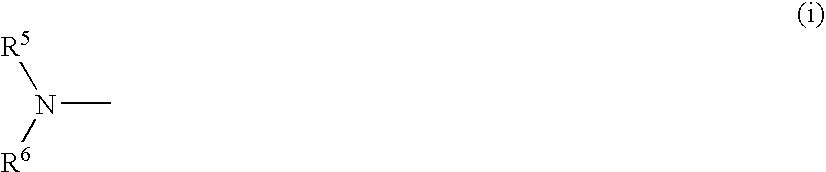
—X2—R9
—X3-Q3
- (w) L is —(CH2)y— wherein y is selected from 1, 2 or 3 and Q1 is as hereinbefore defined in any one of (h) to (v), provided that when Q1 is hydroxy, isoindolyl or a group of sub-formula (i), then y is not 1;
- (x) The Q1-L- group is selected from 2-hydroxyethyl, 3-hydroxypropyl, 2-chloroethyl, 3-chloropropyl, 2-(methanesulfonyloxy)ethyl, 2-aminoethyl, 2-(methylamino)ethyl, 2-[(2-hydroxyethyl)amino]ethyl, 2-[(2-hydroxyethyl)(methyl)amino]ethyl, 2-[di-(2-hydroxyethyl)amino]ethyl, 2-[(2-methoxyethyl)(methyl)amino]ethyl, 2-(2-hydroxy-N-methylacetamido)ethyl, 2-[(2-hydroxyethyl)acetamido]ethyl, 2-pyrrolidin-1-ylethyl, 3-pyrrolidin-1-ylpropyl, 2-(2-oxopyrrolidin-1-yl)ethyl, 2-(2-hydroxymethylpyrrolidin-1-yl)ethyl, 3-(2-hydroxymethylpyrrolidin-1-yl)propyl, 2-(2-methoxymethylpyrrolidin-1-yl)ethyl, 2-(3-hydroxypyrrolidin-1-yl)ethyl, 2-piperazin-1-ylethyl, 2-(4-methylpiperazin-1-yl)ethyl, 3-(4-methylpiperazin-1-yl)propyl, 2-(4-ethylpiperazin-1-yl)ethyl, 2-(4-isopropylpiperazin-1-yl)ethyl, 2-(4-cyclopropylpiperazin-1-yl)ethyl, 2-(2-oxopiperazin-4-yl)ethyl, 2-(4-acetylpiperazin-1-yl)ethyl, 3-(4-acetylpiperazin-1-yl)propyl, 2-(4-hydroxypiperidin-1-yl)ethyl, 3-(4-hydroxypiperidin-1-yl)propyl, 2-(4-fluoropiperidin-1-yl)ethyl, 2-morpholin-4-ylethyl, 2-(3-oxomorpholin-4-yl)ethyl, 3-morpholin-4-ylpropyl, 2-(2-oxo-oxazolidin-3-yl)ethyl and 2-(1,3-dioxo-isoindol-2-yl)ethyl;
- (y) The Q1-L- group is selected from 2-hydroxyethyl, 3-hydroxypropyl, 2-chloroethyl, 3-chloropropyl, 2-(methanesulfonyloxy)ethyl, 2-aminoethyl, 2-(methylamino)ethyl, 2-[(2-hydroxyethyl)amino]ethyl, 2-[(2-hydroxyethyl)(methyl)amino]ethyl, 2-[di-(2-hydroxyethyl)amino]ethyl, 2-[(2-methoxyethyl)(methyl)amino]ethyl, 2-(2-hydroxy-N-methylacetamido)ethyl, 2-[(2-hydroxyethyl)acetamido]ethyl, 2-pyrrolidin-1-ylethyl, 3-pyrrolidin-1-ylpropyl, 2-(2-oxopyrrolidin-1-yl)ethyl, 2-(2-hydroxymethylpyrrolidin-1-yl)ethyl, 3-(2-hydroxymethylpyrrolidin-1-yl)propyl, 2-(2-methoxymethylpyrrolidin-1-yl)ethyl, 2-(3-hydroxypyrrolidin-1-yl)ethyl, 2-piperazin-1-ylethyl, 2-(4-methylpiperazin-1-yl)ethyl, 3-(4-methylpiperazin-1-yl)propyl, 2-(4-ethylpiperazin-1-yl)ethyl, 2-(4-isopropylpiperazin-1-yl)ethyl, 2-(4-cyclopropylpiperazin-1-yl)ethyl, 2-(2-oxopiperazin-4-yl)ethyl, 2-(4-acetylpiperazin-1-yl)ethyl, 3-(4-acetylpiperazin-1-yl)propyl, 2-(4-hydroxypiperidin-1-yl)ethyl, 3-(4-hydroxypiperidin-1-yl)propyl, 2-(4-fluoropiperidin-1-yl)ethyl, 2-morpholin-4-ylethyl, 2-(3-oxomorpholin-4-yl)ethyl, 3-morpholin-4-ylpropyl, 2-(2-oxo-oxazolidin-3-yl)ethyl, 2-(1,3-dioxo-isoindol-2-yl)ethyl, 2-(4-methoxypiperidin-1-yl)ethyl, 2-(2,4-dioxo-imidazolidin-3-yl)ethyl and 2-(1,4-oxazepan-4-yl)ethyl;
- (z) At least one of G1 and G2 is hydrogen;
- (aa) G1 and G2 are both hydrogen;
- (bb) One of G3 and G4 is hydrogen and the other is selected from halogeno, trifluoromethyl, cyano, nitro, hydroxy, amino, carboxy, carbamoyl, (1-6C)alkyl, (2-8C)alkenyl, (2-8C)alkynyl, (1-6C)alkoxy, (2-6C)alkenyloxy, (2-6C)alkynyloxy, (1-6C)alkylamino, di-[(1-6C)alkyl]amino, aryl and heteroaryl,
- (cc) G3 and G4 are each, independently, selected from hydrogen, halogeno, trifluoromethyl, cyano, nitro, hydroxy, amino, (1-6C)alkyl, (2-8C)alkenyl, (2-8C)alkynyl, (1-6C)alkoxy, (2-6C)alkenyloxy and (2-6C)alkynyloxy;
- (dd) One of G3 and G4 is hydrogen and the other is selected from hydrogen, halogeno, trifluoromethyl, cyano, nitro, hydroxy, amino, (1-6C)alkyl, (2-8C)alkenyl, (2-8C)alkynyl, (1-6C)alkoxy, (2-6C)alkenyloxy and (2-6C)alkynyloxy;
- (ee) G3 and G4 are each, independently, selected from hydrogen, halogeno, (1-6C)alkyl and (1-6C)alkoxy (particularly hydrogen, chloro, fluoro, (1-3C)alkyl and (1-3C)alkoxy);
- (ff) One of G3 and G4 is hydrogen and the other is selected from hydrogen, halogeno, (1-6C)alkyl and (1-6C)alkoxy;
- (gg) G3 and G4 are each, independently, selected from hydrogen, chloro, fluoro, methyl, ethyl and methoxy;
- (hh) One of G3 and G4 is hydrogen and the other is selected from chloro, fluoro, methyl, ethyl and methoxy;
- (ii) One of G3 and G4 is hydrogen and the other is selected from chloro and methyl;
- (jj) One of G3 and G4 is hydrogen and the other is chloro;
- (kk) One of G3 and G4 is hydrogen and the other is methyl;
- (ll) Z is selected from O, S, SO, SO2, N(R12), CH(OR12), CO, CON(R12), N(R12)CO, SO2N(R12), N(R12)SO2, C(R12)2, OC(R12)2, C(R12)2O, SC(R12)2, C(R12)2S, CO, C(R12)2N(R2) and N(R12)C(R12)2 wherein each R12 is, independently, hydrogen or (1-3C)alkyl;
- (mm) Z is selected from 0 and OC(R12)2, wherein each R12 is, independently, hydrogen or (1-3C)alkyl (particularly each R12 is hydrogen);
- (nn) Z is O;
- (oo) Z is OC(R12)2, wherein each R12 is, independently, hydrogen or (1-3C)alkyl (particularly each R12 is hydrogen);
- (pp) Q4 is selected from phenyl and a 5 or 6 membered monocyclic heteroaryl ring, which heteroaryl ring contains 1, 2 or 3 heteroatoms independently selected from oxygen, nitrogen and sulfur,
—X4—R13
-Q5
- (qq) Q4 is selected from phenyl and a 5 or 6 membered monocyclic heteroaryl ring, which heteroaryl ring contains 1 heteroatom selected from oxygen, nitrogen and sulfur (particularly selected from oxygen and nitrogen, more particularly nitrogen),
- (rr) Q4 is selected from phenyl, pyridinyl, pyrazinyl, pyrimidinyl, pyridazinyl, 1,3-thiazolyl, 1H-imidazolyl, 1H-pyrazolyl, 1,3-oxazolyl and isoxazolyl,
- (ss) Q4 is selected from phenyl and pyridinyl (such as pyridin-2-yl or pyridin-3-yl),
- (tt) Q4 is selected from phenyl and a 5 or 6 membered monocyclic heteroaryl ring, which heteroaryl ring contains 1, 2 or 3 heteroatoms independently selected from oxygen, nitrogen and sulfur,
- (uu) Q4 is selected from phenyl and a 5 or 6 membered monocyclic heteroaryl ring, which heteroaryl ring contains 1 heteroatom selected from oxygen, nitrogen and sulfur (particularly selected from oxygen and nitrogen, more particularly nitrogen), and wherein Q4 optionally bears one or more substituents (for example 1, 2 or 3), which may be the same or different, as hereinbefore defined in (tt);
- (vv) Q4 is selected from phenyl, pyridinyl, pyrazinyl, pyrimidinyl, pyridazinyl, 1,3-thiazolyl, 1H-imidazolyl, 1H-pyrazolyl, 1,3-oxazolyl and isoxazolyl,
- (ww) Q4 is selected from phenyl and pyridinyl (such as pyridin-2-yl or pyridin-3-yl),
- (xx) Q4 is selected from phenyl, pyridinyl, pyrazinyl, pyrimidinyl, pyridazinyl, 1,3-thiazolyl, 1H-imidazolyl, 1H-pyrazolyl, 1,3-oxazolyl and isoxazolyl,
- (yy) Q4 is selected from phenyl and pyridinyl (such as pyridin-2-yl or pyridin-3-yl),
- (zz) Q4 is selected from phenyl, pyridinyl, pyrazinyl, pyrimidinyl, pyridazinyl, 1,3-thiazolyl, 1H-imidazolyl, 1H-pyrazolyl, 1,3-oxazolyl and isoxazolyl,
- (aaa) Q4 is selected from phenyl and pyridinyl (such as pyridin-2-yl or pyridin-3-yl),
- (bbb) Q4 is selected from phenyl, 3-fluorophenyl, pyridin-2-yl and 6-methylpyridin-3-yl;
- (ccc) Q4 is selected from 3-fluorophenyl, pyridin-2-yl and 6-methylpyridin-3-yl;
- (ddd) Q4 is 3-fluorophenyl;
- (eee) Q4 is pyridin-2-yl,
- (fff) Q4 is 6-methylpyridin-3-yl;
- (ggg) Q4 is phenyl;
- (hhh) Q4 is selected from phenyl, pyridinyl, pyrazinyl, pyrimidinyl, pyridazinyl, 1,3-thiazolyl, 1H-imidazolyl, 1H-pyrazolyl, 1,3-oxazolyl and isoxazolyl,
- (iii) Q4 is selected from phenyl and pyridinyl (particularly pyridin-2-yl),
- (jjj) Q4 is pyridinyl (particularly pyridin-3-yl),

wherein:
—X1-Q2
—X2—R9
—X3-Q3
X4—R13
-Q5
—X2—R9
—X3-Q3

wherein:

—X1-Q2
—X2—R9
—X3-Q3
—X4—R13
-Q5

—X2—R9
—X3-Q3

wherein:

—X1-Q2
—X2—R9
—X3-Q3
—X4—R13
-Q5

—X2—R9
—X3-Q3
- 2-{[4-({3-chloro-4-[(3-fluorobenzyl)oxy]phenyl}amino)-1H-pyrazolo[3,4-d]pyrimidin-3-yl]oxy}ethanol;
- 2-{[4-({4-[(3-fluorobenzyl)oxy]-3-methylphenyl}amino)-1H-pyrazolo[3,4-d]pyrimidin-3-yl]oxy}ethanol;
- 2-{[4-({4-[(3-fluorobenzyl)oxy]-3-methoxyphenyl}amino)-1H-pyrazolo[3,4-d]pyrimidin-3-yl]oxy}ethanol;
- 2-[(4-{[3-chloro-4-(pyridin-2-ylmethoxy)phenyl]amino}-1H-pyrazolo[3,4-d]pyrimidin-3-yl)oxy]ethanol;
- 2-[(4-{[3-methyl-4-(pyridin-2-ylmethoxy)phenyl]amino}-1H-pyrazolo[3,4-d]pyrimidin-3-yl)oxy]ethanol;
- 2-[(4-{[3-ethyl-4-(pyridin-2-ylmethoxy)phenyl]amino}-1H-pyrazolo[3,4-d]pyrimidin-3-yl)oxy]ethanol;
- 2-[(4-{[3-methoxy-4-(pyridin-2-ylmethoxy)phenyl]amino}-1H-pyrazolo[3,4-d]pyrimidin-3-yl)oxy]ethanol;
- 2-{[4-({3-methyl-4-[(6-methylpyridin-3-yl)oxy]phenyl}amino)-1H-pyrazolo[3,4-d]pyrimidin-3-yl]oxy}ethanol;
- 2-{[4-({3-chloro-4-[(6-methylpyridin-3-yl)oxy]phenyl}amino)-1H-pyrazolo[3,4-d]pyrimidin-3-yl]oxy}ethanol;
- 2-{[4-({3-fluoro-4-[(6-methylpyridin-3-yl)oxy]phenyl}amino)-1H-pyrazolo[3,4-d]pyrimidin-3-yl]oxy}ethanol;
- 3-[(4-{[3-chloro-4-(pyridin-2-ylmethoxy)phenyl]amino}-1H-pyrazolo[3,4-d]pyrimidin-3-yl)oxy]propan-1-ol;
- 3-(2-chloroethoxy)-N-{3-chloro-4-[(3-fluorobenzyl)oxy]phenyl}-1H-pyrazolo[3,4-d]pyrimidin-4-amine;
- 3-(2-chloroethoxy)-N-[3-chloro-4-(pyridin-2-ylmethoxy)phenyl]-1H-pyrazolo[3,4-d]pyrimidin-4-amine;
- 3-(2-chloroethoxy)-N-[3-methyl-4-(pyridin-2-ylmethoxy)phenyl]-1H-pyrazolo[3,4-d]pyrimidin-4-amine;
- 3-(2-chloroethoxy)-N-{3-methyl-4-[(6-methylpyridin-3-yl)oxy]phenyl}-1H-pyrazolo[3,4-d]pyrimidin-4-amine;
- 3-(2-chloroethoxy)-N-{3-chloro-4-[(6-methylpyridin-3-yl)oxy]phenyl}-1H-pyrazolo[3,4-d]pyrimidin-4-amine;
- 3-(3-chloropropoxy)-N-[3-chloro-4-(pyridin-2-ylmethoxy)phenyl]-1H-pyrazolo[3,4-d]pyrimidin-4-amine;
- 2-[(4-{[3-methoxy-4-(pyridin-2-ylmethoxy)phenyl]amino}-1H-pyrazolo[3,4-d]pyrimidin-3-yl)oxy]ethyl methanesulfonate;
- 2-[(4-{[3-ethyl-4-(pyridin-2-ylmethoxy)phenyl]amino}-1H-pyrazolo[3,4-d]pyrimidin-3-yl)oxy]ethyl methanesulfonate;
- 2-{[4-({3-fluoro-4-[(6-methylpyridin-3-yl)oxy]phenyl}amino)-1H-pyrazolo[3,4-d]pyrimidin-3-yl]oxy}ethyl methanesulfonate;
- 2-{[4-({4-[(3-fluorobenzyl)oxy]-3-methylphenyl}amino)-1H-pyrazolo[3,4-d]pyrimidin-3-yl]oxy}ethyl methanesulfonate;
- 2-{[4-({4-[(3-fluorobenzyl)oxy]-3-methoxyphenyl}amino)-1H-pyrazolo[3,4-d]pyrimidin-3-yl]oxy}ethyl methanesulfonate;
- N-[3-chloro-4-(pyridin-2-ylmethoxy)phenyl]-3-(2-pyrrolidin-1-ylethoxy)-1H-pyrazolo[3,4-d]pyrimidin-4-amine;
- N-[3-chloro-4-(pyridin-2-ylmethoxy)phenyl]-3-[2-(methylamino)ethoxy]-1H-pyrazolo[3,4-d]pyrimidin-4-amine;
- 4-{2-[(4-{[3-chloro-4-(pyridin-2-ylmethoxy)phenyl]amino}-1H-pyrazolo[3,4-d]pyrimidin-3-yl)oxy]ethyl}piperazin-2-one;
- N-[3-chloro-4-(pyridin-2-ylmethoxy)phenyl]-3-(2-morpholin-4-ylethoxy)-1H-pyrazolo[3,4-d]pyrimidin-4-amine;
- 2-[{2-[(4-{[3-chloro-4-(pyridin-2-ylmethoxy)phenyl]amino}-1H-pyrazolo[3,4-d]pyrimidin-3-yl)oxy]ethyl}(methyl)amino]ethanol;
- N-[3-chloro-4-(pyridin-2-ylmethoxy)phenyl]-3-[2-(4-methylpiperazin-1-yl)ethoxy]-1H-pyrazolo[3,4-d]pyrimidin-4-amine;
- ((2R)-1-{2-[(4-{[3-chloro-4-(pyridin-2-ylmethoxy)phenyl]amino}-1H-pyrazolo[3,4-d]pyrimidin-3-yl)oxy]ethyl}pyrrolidin-2-yl)methanol;
- ((2S)-1-{2-[(4-{[3-chloro-4-(pyridin-2-ylmethoxy)phenyl]amino}-1H-pyrazolo[3,4-d]pyrimidin-3-yl)oxy]ethyl}pyrrolidin-2-yl)methanol;
- 1-{2-[(4-{[3-chloro-4-(pyridin-2-ylmethoxy)phenyl]amino}-1H-pyrazolo[3,4-d]pyrimidin-3-yl)oxy]ethyl}piperidin-4-ol;
- 2,2′-({2-[(4-{[3-chloro-4-(pyridin-2-ylmethoxy)phenyl]amino}-1H-pyrazolo[3,4-d]pyrimidin-3-yl)oxy]ethyl}imino)diethanol;
- 3-[2-(4-acetylpiperazin-1-yl)ethoxy]-N-[3-chloro-4-(pyridin-2-ylmethoxy)phenyl]-1H-pyrazolo[3,4-d]pyrimidin-4-amine;
- (3S)-1-{2-[(4-{[3-chloro-4-(pyridin-2-ylmethoxy)phenyl]amino}-1H-pyrazolo[3,4-d]pyrimidin-3-yl)oxy]ethyl}pyrrolidin-3-ol;
- (3R)-1-{2-[(4-{[3-chloro-4-(pyridin-2-ylmethoxy)phenyl]amino}-1H-pyrazolo[3,4-d]pyrimidin-3-yl)oxy]ethyl}pyrrolidin-3-ol;
- 2-({2-[(4-{[3-chloro-4-(pyridin-2-ylmethoxy)phenyl]amino}-1H-pyrazolo[3,4-d]pyrimidin-3-yl)oxy]ethyl}amino)ethanol;
- N-[3-chloro-4-(pyridin-2-ylmethoxy)phenyl]-3-[2-(4-ethylpiperazin-1-yl)ethoxy]-1H-pyrazolo[3,4-d]pyrimidin-4-amine;
- N-[3-chloro-4-(pyridin-2-ylmethoxy)phenyl]-3-[2-(4-isopropylpiperazin-1-yl)ethoxy]-1H-pyrazolo[3,4-d]pyrimidin-4-amine;
- N-[3-chloro-4-(pyridin-2-ylmethoxy)phenyl]-3-(2-piperazin-1-ylethoxy)-1H-pyrazolo[3,4-d]pyrimidin-4-amine;
- N-{3-methyl-4-[(6-methylpyridin-3-yl)oxy]phenyl}-3-(2-pyrrolidin-1-ylethoxy)-1H-pyrazolo[3,4-d]pyrimidin-4-amine;
- 4-(2-{[4-({3-methyl-4-[(6-methylpyridin-3-yl)oxy]phenyl}amino)-1H-pyrazolo[3,4-d]pyrimidin-3-yl]oxy}ethyl)piperazin-2-one;
- N-{3-methyl-4-[(6-methylpyridin-3-yl)oxy]phenyl}-3-(2-morpholin-4-ylethoxy)-1H-pyrazolo[3,4-d]pyrimidin-4-amine;
- N-{3-methyl-4-[(6-methylpyridin-3-yl)oxy]phenyl}-3-[2-(4-methylpiperazin-1-yl)ethoxy]-1H-pyrazolo[3,4-d]pyrimidin-4-amine;
- [(2R)-1-(2-{[4-({3-methyl-4-[(6-methylpyridin-3-yl)oxy]phenyl}amino)-1H-pyrazolo[3,4-d]pyrimidin-3-yl]oxy}ethyl)pyrrolidin-2-yl]methanol;
- [(2S)-1-(2-{[4-({3-methyl-4-[(6-methylpyridin-3-yl)oxy]phenyl}amino)-1H-pyrazolo[3,4-d]pyrimidin-3-yl]oxy}ethyl)pyrrolidin-2-yl]methanol;
- 1-(2-{[4-({3-methyl-4-[(6-methylpyridin-3-yl)oxy]phenyl}amino)-1H-pyrazolo[3,4-d]pyrimidin-3-yl]oxy}ethyl)piperidin-4-ol;
- 3-[2-(4-acetylpiperazin-1-yl)ethoxy]-N-{3-methyl-4-[(6-methylpyridin-3-yl)oxy]phenyl}-1H-pyrazolo[3,4-d]pyrimidin-4-amine;
- (2S)-1-(2-{[4-({3-methyl-4-[(6-methylpyridin-3-yl)oxy]phenyl}amino)-1H-pyrazolo[3,4-d]pyrimidin-3-yl]oxy}ethyl)pyrrolidin-2-ol;
- (2R)-1-(2-{[4-({3-methyl-4-[(6-methylpyridin-3-yl)oxy]phenyl}amino)-1H-pyrazolo[3,4-d]pyrimidin-3-yl]oxy}ethyl)pyrrolidin-2-ol;
- N-{3-chloro-4-[(6-methylpyridin-3-yl)oxy]phenyl}-3-(2-morpholin-4-ylethoxy)-1H-pyrazolo[3,4-d]pyrimidin-4-amine;
- N-{3-chloro-4-[(6-methylpyridin-3-yl)oxy]phenyl}-3-(2-pyrrolidin-1-ylethoxy)-1H-pyrazolo[3,4-d]pyrimidin-4-amine;
- N-{3-chloro-4-[(6-methylpyridin-3-yl)oxy]phenyl}-3-[2-(4-methylpiperazin-1-yl)ethoxy]-1H-pyrazolo[3,4-d]pyrimidin-4-amine;
- 1-(2-{[4-({3-chloro-4-[(6-methylpyridin-3-yl)oxy]phenyl}amino)-1H-pyrazolo[3,4-d]pyrimidin-3-yl]oxy}ethyl)piperidin-4-ol;
- 3-[2-(4-acetylpiperazin-1-yl)ethoxy]-N-{3-chloro-4-[(6-methylpyridin-3-yl)oxy]phenyl}-1H-pyrazolo[3,4-d]pyrimidin-4-amine;
- [(2R)-1-(2-{[4-({3-fluoro-4-[(6-methylpyridin-3-yl)oxy]phenyl}amino)-1H-pyrazolo[3,4-d]pyrimidin-3-yl]oxy}ethyl)pyrrolidin-2-yl]methanol;
- N-{3-fluoro-4-[(6-methylpyridin-3-yl)oxy]phenyl}-3-(2-pyrrolidin-1-ylethoxy)-1H-pyrazolo[3,4-d]pyrimidin-4-amine;
- N-{3-fluoro-4-[(6-methylpyridin-3-yl)oxy]phenyl}-3-[2-(4-methylpiperazin-1-yl)ethoxy]-1H-pyrazolo[3,4-d]pyrimidin-4-amine;
- 1-(2-{[4-({3-fluoro-4-[(6-methylpyridin-3-yl)oxy]phenyl}amino)-1H-pyrazolo[3,4-d]pyrimidin-3-yl]oxy}ethyl)piperidin-4-ol;
- N-{3-fluoro-4-[(6-methylpyridin-3-yl)oxy]phenyl}-3-(2-morpholin-4-ylethoxy)-1H-pyrazolo[3,4-d]pyrimidin-4-amine;
- N-{3-chloro-4-[(3-fluorobenzyl)oxy]phenyl}-3-[2-(methylamino)ethoxy]-1H-pyrazolo[3,4-d]pyrimidin-4-amine;
- N-{3-chloro-4-[(3-fluorobenzyl)oxy]phenyl}-3-(2-pyrrolidin-1-ylethoxy)-1H-pyrazolo[3,4-d]pyrimidin-4-amine;
- N-{3-chloro-4-[(3-fluorobenzyl)oxy]phenyl}-3-[2-(4-methylpiperazin-1-yl)ethoxy]-1H-pyrazolo[3,4-d]pyrimidin-4-amine;
- 1-(2-{[4-({3-chloro-4-[(3-fluorobenzyl)oxy]phenyl}amino)-1H-pyrazolo[3,4-d]pyrimidin-3-yl]oxy}ethyl)piperidin-4-ol;
- N-[3-chloro-4-(pyridin-2-ylmethoxy)phenyl]-3-(3-pyrrolidin-1-ylpropoxy)-1H-pyrazolo[3,4-d]pyrimidin-4-amine;
- N-[3-chloro-4-(pyridin-2-ylmethoxy)phenyl]-3-(3-morpholin-4-ylpropoxy)-1H-pyrazolo[3,4-d]pyrimidin-4-amine;
- 1-{3-[(4-{[3-chloro-4-(pyridin-2-ylmethoxy)phenyl]amino}-1H-pyrazolo[3,4-d]pyrimidin-3-yl)oxy]propyl}piperidin-4-ol;
- 3-[3-(4-acetylpiperazin-1-yl)propoxy]-N-[3-chloro-4-(pyridin-2-ylmethoxy)phenyl]-1H-pyrazolo[3,4-d]pyrimidin-4-amine;
- N-[3-chloro-4-(pyridin-2-ylmethoxy)phenyl]-3-[3-(4-methylpiperazin-1-yl)propoxy]-1H-pyrazolo[3,4-d]pyrimidin-4-amine;
- ((2R)-1-{3-[(4-{[3-chloro-4-(pyridin-2-ylmethoxy)phenyl]amino}-1H-pyrazolo[3,4-d]pyrimidin-3-yl)oxy]propyl}pyrrolidin-2-yl)methanol;
- N-[3-methyl-4-(pyridin-2-ylmethoxy)phenyl]-3-(2-pyrrolidin-1-ylethoxy)-1H-pyrazolo[3,4-d]pyrimidin-4-amine;
- 3-[2-(4-methylpiperazin-1-yl)ethoxy]-N-[3-methyl-4-(pyridin-2-ylmethoxy)phenyl]-1H-pyrazolo[3,4-d]pyrimidin-4-amine;
- 1-{2-[(4-{[3-methyl-4-(pyridin-2-ylmethoxy)phenyl]amino}-1H-pyrazolo[3,4-d]pyrimidin-3-yl)oxy]ethyl}piperidin-4-ol;
- N-[3-methyl-4-(pyridin-2-ylmethoxy)phenyl]-3-(2-morpholin-4-ylethoxy)-1H-pyrazolo[3,4-d]pyrimidin-4-amine;
- N-[3-methoxy-4-(pyridin-2-ylmethoxy)phenyl]-3-(2-pyrrolidin-1-ylethoxy)-1H-pyrazolo[3,4-d]pyrimidin-4-amine;
- N-[3-methoxy-4-(pyridin-2-ylmethoxy)phenyl]-3-[2-(4-methylpiperazin-1-yl)ethoxy]-1H-pyrazolo[3,4-d]pyrimidin-4-amine;
- 1-{2-[(4-{[3-methoxy-4-(pyridin-2-ylmethoxy)phenyl]amino}-1H-pyrazolo[3,4-d]pyrimidin-3-yl)oxy]ethyl}piperidin-4-ol;
- ((2R)-1-{2-[(4-{[3-methoxy-4-(pyridin-2-ylmethoxy)phenyl]amino}-1H-pyrazolo[3,4-d]pyrimidin-3-yl)oxy]ethyl}pyrrolidin-2-yl)methanol;
- N-{4-[(3-fluorobenzyl)oxy]-3-methoxyphenyl}-3-(2-pyrrolidin-1-ylethoxy)-1H-pyrazolo[3,4-d]pyrimidin-4-amine;
- N-{4-[(3-fluorobenzyl)oxy]-3-methoxyphenyl}-3-[2-(4-methylpiperazin-1-yl)ethoxy]-1H-pyrazolo[3,4-d]pyrimidin-4-amine;
- 1-(2-{[4-({4-[(3-fluorobenzyl)oxy]-3-methoxyphenyl}amino)-1H-pyrazolo[3,4-d]pyrimidin-3-yl]oxy}ethyl)piperidin-4-ol;
- [(2R)-1-(2-{[4-({4-[(3-fluorobenzyl)oxy]-3-methoxyphenyl}amino)-1H-pyrazolo[3,4-d]pyrimidin-3-yl]oxy}ethyl)pyrrolidin-2-yl]methanol;
- N-{4-[(3-fluorobenzyl)oxy]-3-methylphenyl}-3-[2-(4-methylpiperazin-1-yl)ethoxy]-1H-pyrazolo[3,4-d]pyrimidin-4-amine;
- 1-(2-{[4-({4-[(3-fluorobenzyl)oxy]-3-methylphenyl}amino)-1H-pyrazolo[3,4-d]pyrimidin-3-yl]oxy}ethyl)piperidin-4-ol;
- [(2R)-1-(2-{[4-({4-[(3-fluorobenzyl)oxy]-3-methylphenyl}amino)-1H-pyrazolo[3,4-d]pyrimidin-3-yl]oxy}ethyl)pyrrolidin-2-yl]methanol;
- N-(2-{[4-({3-chloro-4-[(3-fluorobenzyl)oxy]phenyl}amino)-1H-pyrazolo[3,4-d]pyrimidin-3-yl]oxy}ethyl)-2-hydroxy-N-methylacetamide;
- N-{2-[(4-{[3-chloro-4-(pyridin-2-ylmethoxy)phenyl]amino}-1H-pyrazolo[3,4-d]pyrimidin-3-yl)oxy]ethyl}-2-hydroxy-N-methylacetamide;
- N-{2-[(4-{[3-chloro-4-(pyridin-2-ylmethoxy)phenyl]amino}-1H-pyrazolo[3,4-d]pyrimidin-3-yl)oxy]ethyl}-N-(2-hydroxyethyl)acetamide;
- 4-{2-[(4-{[3-chloro-4-(pyridin-2-ylmethoxy)phenyl]amino}-1H-pyrazolo[3,4-d]pyrimidin-3-yl)oxy]ethyl}morpholin-3-one;
- 3-{2-[(4-{[3-chloro-4-(pyridin-2-ylmethoxy)phenyl]amino}-1H-pyrazolo[3,4-d]pyrimidin-3-yl)oxy]ethyl}-1,3-oxazolidin-2-one;
- 2-{2-[(4-[3-chloro-4-(pyridin-2-ylmethoxy)phenyl]amino)-1H-pyrazolo[3,4-d]pyrimidin-3-yl)oxy]ethyl}-1H-isoindole-1,3(2H)-dione;
- 3-(2-aminoethoxy)-N-[3-chloro-4-(pyridin-2-ylmethoxy)phenyl]-1H-pyrazolo[3,4-d]pyrimidin-4-amine;
- 1-{2-[(4-[3-chloro-4-(pyridin-2-ylmethoxy)phenyl]amino-1H-pyrazolo[3,4-d]pyrimidin-3-yl)oxy]ethyl}pyrrolidin-2-one;
- 3-{2-[(4-{[3-chloro-4-(pyridin-2-ylmethoxy)phenyl]amino}-1H-pyrazolo[3,4-d]pyrimidin-3-yl)oxy]ethyl}imidazolidine-2,4-dione;
- ((2R)-1-{2-[(4-{[3-ethyl-4-(pyridin-2-ylmethoxy)phenyl]amino}-1H-pyrazolo[3,4-d]pyrimidin-3-yl)oxy]ethyl}pyrrolidin-2-yl)methanol;
- N-[3-ethyl-4-(pyridin-2-ylmethoxy)phenyl]-3-(2-pyrrolidin-1-ylethoxy)-1H-pyrazolo[3,4-d]pyrimidin-4-amine;
- N-[3-ethyl-4-(pyridin-2-ylmethoxy)phenyl]-3-[2-(4-methylpiperazin-1-yl)ethoxy]-1H-pyrazolo[3,4-d]pyrimidin-4-amine;
- 1-{2-[(4-{[3-ethyl-4-(pyridin-2-ylmethoxy)phenyl]amino}-1H-pyrazolo[3,4-d]pyrimidin-3-yl)oxy]ethyl}piperidin-4-ol;
- N-[3-ethyl-4-(pyridin-2-ylmethoxy)phenyl]-3-(2-morpholin-4-ylethoxy)-1H-pyrazolo[3,4-d]pyrimidin-4-amine;
- N-[3-chloro-4-(pyridin-2-ylmethoxy)phenyl]-3-[2-(4-fluoropiperidin-1-yl)ethoxy]-1H-pyrazolo[3,4-d]pyrimidin-4-amine;
- N-{3-chloro-4-[(6-methylpyridin-3-yl)oxy]phenyl}-3-[2-(4-ethylpiperazin-1-yl)ethoxy]-1H-pyrazolo[3,4-d]pyrimidin-4-amine;
- N-{3-chloro-4-[(6-methylpyridin-3-yl)oxy]phenyl}-3-[2-(4-isopropylpiperazin-1-yl)ethoxy]-1H-pyrazolo[3,4-d]pyrimidin-4-amine;
- N-{3-chloro-4-[(6-methylpyridin-3-yl)oxy]phenyl}-3-[2-(4-cyclopropylpiperazin-1-yl)ethoxy]-1H-pyrazolo[3,4-d]pyrimidin-4-amine;
- N-{3-chloro-4-[(6-methylpyridin-3-yl)oxy]phenyl}-3-[2-(4-fluoropiperidin-1-yl)ethoxy]-1H-pyrazolo[3,4-d]pyrimidin-4-amine;
- [(2R)-1-(2-{[4-({3-chloro-4-[(6-methylpyridin-3-yl)oxy]phenyl}amino)-1H-pyrazolo[3,4-d]pyrimidin-3-yl]oxy}ethyl)pyrrolidin-2-yl]methanol;
- N-{3-chloro-4-[(6-methylpyridin-3-yl)oxy]phenyl}-3-{2-[(2R)-2-(methoxymethyl)pyrrolidin-1-yl]ethoxy}-1H-pyrazolo[3,4-d]pyrimidin-4-amine;
- 2-[(2-{[4-({3-chloro-4-[(6-methylpyridin-3-yl)oxy]phenyl}amino)-1H-pyrazolo[3,4-d]pyrimidin-3-yl]oxy}ethyl)(methyl)amino]ethanol;
- N-{3-chloro-4-[(6-methylpyridin-3-yl)oxy]phenyl}-3-{2-[(2-methoxyethyl)(methyl)amino]ethoxy}-1H-pyrazolo[3,4-d]pyrimidin-4-amine;
- N-{4-[(3-fluorobenzyl)oxy]-3-methylphenyl}-3-[2-(4-ethylpiperazin-1-yl)ethoxy]-1H-pyrazolo[3,4-d]pyrimidin-4-amine;
- 2-[(4-{[4-(benzyloxy)-3-methylphenyl]amino}-1H-pyrazolo[3,4-d]pyrimidin-3-yl)oxy]ethanol;
- 2-[(4-{[4-(benzyloxy)-3-methylphenyl]amino}-1H-pyrazolo[3,4-d]pyrimidin-3-yl)oxy]ethyl methanesulfonate;
- N-[4-(benzyloxy)-3-methylphenyl]-3-[2-(4-methylpiperazin-1-yl)ethoxy]-1H-pyrazolo[3,4-d]pyrimidin-4-amine;
- N-[4-(benzyloxy)-3-methylphenyl]-3-[2-(4-ethylpiperazin-1-yl)ethoxy]-1H-pyrazolo[3,4-d]pyrimidin-4-amine;
- 1-{2-[(4-{[4-(benzyloxy)-3-methylphenyl]amino}-1H-pyrazolo[3,4-d]pyrimidin-3-yl)oxy]ethyl}piperidin-4-ol;
- N-[4-(benzyloxy)-3-methylphenyl]-3-(2-morpholin-4-ylethoxy)-1H-pyrazolo[3,4-d]pyrimidin-4-amine;
- N-[3-chloro-4-(pyridin-2-ylmethoxy)phenyl]-3-[2-(1,4-oxazepan-4-yl)ethoxy]-1H-pyrazolo[3,4-d]pyrimidin-4-amine;
- N-[4-(benzyloxy)-3-methylphenyl]-3-[2-(1,4-oxazepan-4-yl)ethoxy]-1H-pyrazolo[3,4-d]pyrimidin-4-amine;
- N-{4-[(3-fluorobenzyl)oxy]-3-methylphenyl}-3-[2-(1,4-oxazepan-4-yl)ethoxy]-1H-pyrazolo[3,4-d]pyrimidin-4-amine;
- N-{4-[(3-fluorobenzyl)oxy]-3-methylphenyl}-3-[2-(4-methoxypiperidin-1-yl)ethoxy]-1H-pyrazolo[3,4-d]pyrimidin-4-amine;
- N-[3-chloro-4-(pyridin-2-ylmethoxy)phenyl]-3-[2-(4-methoxypiperidin-1-yl)ethoxy]-1H-pyrazolo[3,4-d]pyrimidin-4-amine; and
- N-[4-(benzyloxy)-3-methylphenyl]-3-[2-(4-methoxypiperidin-1-yl)ethoxy]-1H-pyrazolo[3,4-d]pyrimidin-4-amine;
or a pharmaceutically acceptable salt thereof.


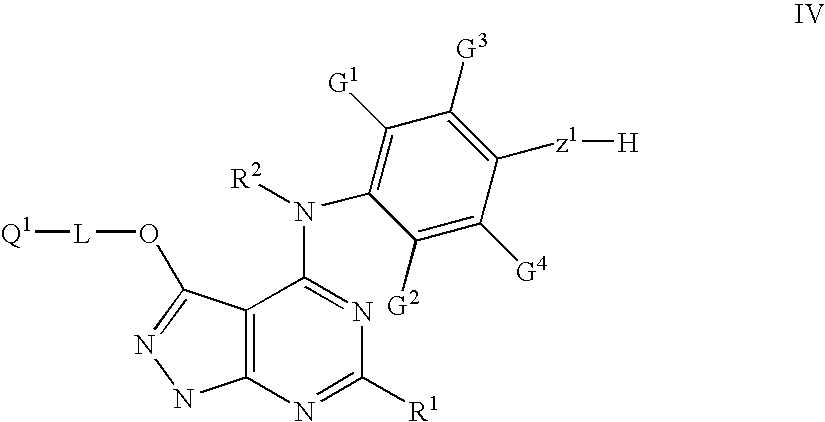
Q4-C(R12)2-Lg1 V


H—NR5R6 VIII


- (i) converting a pyrazolopyrimidine compound of the formula I into another pyrazolopyrimidine compound of the formula I; and/or
- (ii) removing any protecting group that is present by conventional means; and/or
- (iii) forming a pharmaceutically acceptable salt.


| Salt | Pipette (mM) | Bath (mM) | ||
| NaCl | — | 137 | ||
| KCl | 130 | 4 | ||
| MgCl2 | 1 | 1 | ||
| CaCl2 | — | 1.8 | ||
| HEPES | 10 | 10 | ||
| glucose | — | 10 | ||
| Na2ATP | 5 | — | ||
| EGTA | 5 | — | ||
| Parameter | Pipette | Bath | ||
| pH | 7.18-7.22 | 7.40 | ||
| pH adjustment with | 1M KOH | 1M NaOH | ||
| Osmolarity (mOsm) | 275-285 | 285-295 | ||
| TABLE A | ||||
| IC50 (μM) | IC50 (μM) | |||
| Test (a): | Test (a): | IC50 (μM) | IC50 (μM) | |
| Inhibition of | Inhibition of | Test (b): | Test (d): | |
| EGFR tyrosine | erbB2 tyrosine | Inhibition of | Inhibition of | |
| Example | kinase protein | kinase protein | proliferation of | phosphorylation of |
| Number | phosphorylation | phosphorylation | KB cells | erbB2 |
| 23 | 0.010 | 0.002 | 1.080 | 0.010 |
| 42 | 0.710 | 0.027 | — | 0.083 |
- a) Methods in Enzymology, Vol. 42, p. 309 to 396, edited by K. Widder, et al. (Academic Press, 1985);
- b) Design of Pro-drugs, edited by H. Bundgaard, (Elsevier, 1985);
- c) A Textbook of Drug Design and Development, edited by Krogsgaard-Larsen and H. Bundgaard, Chapter 5 “Design and Application of Pro-drugs”, edited by H. Bundgaard, p. 113 to 191 (1991);
- d) H. Bundgaard, Advanced Drug Delivery Reviews, 8, 1 to 38 (1992); and
- e) H. Bundgaard, et al., Journal of Pharmaceutical Sciences, 77, 285 (1988).
- (i) antiproliferative/antineoplastic drugs and combinations thereof, as used in medical oncology, such as alkylating agents (for example cis-platin, carboplatin, cyclophosphamide, nitrogen mustard, melphalan, chlorambucil, busulfan and nitrosoureas); antimetabolites (for example antifolates such as fluoropyrimidines like 5-fluorouracil and tegafur, raltitrexed, methotrexate, cytosine arabinoside and hydroxyurea; antitumour antibiotics (for example anthracyclines like adriamycin, bleomycin, doxorubicin, daunomycin, epirubicin, idarubicin, mitomycin-C, dactinomycin and mithramycin); antimitotic agents (for example vinca alkaloids like vincristine, vinblastine, vindesine and vinorelbine and taxoids like taxol and taxotere); and topoisomerase inhibitors (for example epipodophyllotoxins like etoposide and teniposide, amsacrine, topotecan and camptothecin);
- (ii) cytostatic agents such as antioestrogens (for example tamoxifen, toremifene, raloxifene, droloxifene and iodoxyfene), oestrogen receptor down regulators (for example fulvestrant), antiandrogens (for example bicalutamide, flutamide, nilutamide and cyproterone acetate), LHRH antagonists or LHRH agonists (for example goserelin, leuprorelin and buserelin), progestogens (for example megestrol acetate), aromatase inhibitors (for example as anastrozole, letrozole, vorazole and exemestane) and inhibitors of 5α-reductase such as finasteride;
- (iii) agents which inhibit cancer cell invasion (for example metalloproteinase inhibitors like marimastat and inhibitors of urokinase plasminogen activator receptor function);
- (iv) inhibitors of growth factor function, for example such inhibitors include growth factor antibodies, growth factor receptor antibodies (for example the anti-erbB2 antibody trastuzumab [Herceptin™] and the anti-erbB1 antibody cetuximab [C225]), farnesyl transferase inhibitors, tyrosine kinase inhibitors and serine/threonine kinase inhibitors, for example other inhibitors of the epidermal growth factor family (for example EGFR family tyrosine kinase inhibitors such as N-(3-chloro-4-fluorophenyl)-7-methoxy-6-(3-morpholinopropoxy)quinazolin-4-amine (gefitinib, AZD1839), N-(3-ethynylphenyl)-6,7-bis(2-methoxyethoxy)quinazolin-4-amine (erlotinib, OSI-774) and 6-acrylamido-N-(3-chloro-4-fluorophenyl)-7-(3-morpholinopropoxy)quinazolin-4-amine (CI 1033)), for example inhibitors of the platelet-derived growth factor family and for example inhibitors of the hepatocyte growth factor family;
- (v) antiangiogenic agents such as those which inhibit the effects of vascular endothelial growth factor, (for example the anti-vascular endothelial cell growth factor antibody bevacizumab [Avastin™], compounds such as those disclosed in International Patent Applications WO 97/22596, WO 97/30035, WO 97/32856 and WO 98/13354) and compounds that work by other mechanisms (for example linomide, inhibitors of integrin αvβ3 function and angiostatin);
- (vi) vascular damaging agents such as Combretastatin A4 and compounds disclosed in International Patent Applications WO 99/02166, WO 00/40529, WO 00/41669, WO 01/92224, WO 02/04434 and WO 02/08213;
- (vii) antisense therapies, for example those which are directed to the targets listed above, such as ISIS 2503, an anti-ras antisense;
- (viii) gene therapy approaches, including for example approaches to replace aberrant genes such as aberrant p53 or aberrant BRCA1 or BRCA2, GDEPT (gene-directed enzyme pro-drug therapy) approaches such as those using cytosine deaminase, thymidine kinase or a bacterial nitroreductase enzyme and approaches to increase patient tolerance to chemotherapy or radiotherapy such as multi-drug resistance gene therapy; and
- (ix) immunotherapy approaches, including for example ex-vivo and in-vivo approaches to increase the immunogenicity of patient tumour cells, such as transfection with cytokines such as interleukin 2, interleukin 4 or granulocyte-macrophage colony stimulating factor, approaches to decrease T-cell energy, approaches using transfected immune cells such as cytokine-transfected dendritic cells, approaches using cytokine-transfected tumour cell lines and approaches using anti-idiotypic antibodies.
- (i) temperatures are given in degrees Celsius (° C.);
- (ii) organic solutions were dried over anhydrous magnesium sulfate; evaporation of solvent was carried out using a rotary evaporator under reduced pressure (600-4000 Pascals; 4.5-30 mmHg) with a bath temperature of up to 80° C.;
- (iii) chromatography means flash chromatography on silica gel; thin layer chromatography (TLC) was carried out on silica gel plates;
- (iv) in general, the course of reactions was followed by TLC and/or analytical LC-MS, and reaction times are given for illustration only;
- (v) final products had satisfactory proton nuclear magnetic resonance (NMR) spectra and/or mass spectral data;
- (vi) yields are given for illustration only and are not necessarily those which can be obtained by diligent process development; preparations were repeated if more material was required;
- (vii) when given, NMR data is in the form of delta values for major diagnostic protons, given in parts per million (ppm) relative to tetramethylsilane (TMS) as an internal standard, determined at 500 MHz using perdeuterio dimethyl sulfoxide (DMSO-d6) as solvent unless otherwise indicated; the following abbreviations have been used: s, singlet; d, doublet; t, triplet; q, quartet; m, multiplet; br, broad;
- (viii) chemical symbols have their usual meanings; SI units and symbols are used;
- (ix) solvent ratios are given in volume:volume (v/v) terms; and
- (x) mass spectra were run with an electron energy of 70 electron volts in the chemical ionization (CI) mode using a direct exposure probe; where indicated ionization was effected by electron impact (EI), fast atom bombardment (FAB) or electrospray (ESP); values for m/z are given; generally, only ions which indicate the parent mass are reported; and unless otherwise stated, the mass ion quoted is (MH)+ which refers to the protonated mass ion; reference to M+ is to the mass ion generated by loss of an electron; and reference to M-H+ is to the mass ion generated by loss of a proton;
- (xi) unless stated otherwise compounds containing an asymmetrically substituted carbon and/or sulfur atom have not been resolved;
- (xii) where a synthesis is described as being analogous to that described in a previous example the amounts used are the millimolar ratio equivalents to those used in the previous example;
- (xiii) all microwave reactions were carried out in a EMRYS Optimizer EXP™ microwave reactor;
- (xiv) preparative high performance liquid chromatography (HPLC) was performed on a Waters instrument using the following conditions:
| Column: | 21 mm × 10 cm Termoelectron | ||
| Hypersil beta-basic | |||
| Solvent A: | Water | ||
| Solvent B: | Acetonitrile | ||
| Elution with 2 g/l | |||
| of ammonium carbonate | |||
| Flow rate: | 25 ml/min | ||
| Run time: | 10 minutes with a 7.5 minute | ||
| gradient from 20-95% B | |||
| Electrospray detection | |||
| Injection volume | 1.0-2.0 ml; | ||
- (xv) the following abbreviations have been used:
| BuLi | butyl lithium; |
| EtOAc | ethyl acetate; |
| TFA | trifluoroacetic acid; |
| HATU | O-(7-azabenzotriazol-1-yl)-N,N,N′,N′-tetramethyluronium |
| hexafluoro-phosphate; | |
| THF | tetrahydrofuran; |
| DMF | N,N-dimethylformamide; |
| DMA | N,N-dimethylacetamide; |
| DCM | dichloromethane; |
| DIPEA | N,N-diisopropylethylamine; |
| DMSO | dimethylsulfoxide; |
| IPA | isopropyl alcohol; and |
| ether | diethyl ether. |
Claims (3)
Applications Claiming Priority (7)
| Application Number | Priority Date | Filing Date | Title |
|---|---|---|---|
| EP04292982.8 | 2004-12-14 | ||
| EP04292982 | 2004-12-14 | ||
| EP04292982 | 2004-12-14 | ||
| EP05291158.3 | 2005-05-30 | ||
| EP05291158 | 2005-05-30 | ||
| EP05291158 | 2005-05-30 | ||
| PCT/GB2005/004770 WO2006064196A1 (en) | 2004-12-14 | 2005-12-12 | Pyrazolopyrimidine compounds as antitumor agents |
Publications (2)
| Publication Number | Publication Date |
|---|---|
| US20080108613A1 US20080108613A1 (en) | 2008-05-08 |
| US7947676B2 true US7947676B2 (en) | 2011-05-24 |
Family
ID=35826513
Family Applications (1)
| Application Number | Title | Priority Date | Filing Date |
|---|---|---|---|
| US11/792,921 Expired - Fee Related US7947676B2 (en) | 2004-12-14 | 2005-12-12 | Pyrazolo[3,4-d]pyrimidine compounds as antitumor agents |
Country Status (7)
| Country | Link |
|---|---|
| US (1) | US7947676B2 (en) |
| EP (1) | EP1838712B8 (en) |
| JP (1) | JP4881875B2 (en) |
| CN (1) | CN101124228B (en) |
| AT (1) | ATE501148T1 (en) |
| DE (1) | DE602005026865D1 (en) |
| WO (1) | WO2006064196A1 (en) |
Families Citing this family (9)
| Publication number | Priority date | Publication date | Assignee | Title |
|---|---|---|---|---|
| MXPA06002964A (en) | 2003-09-16 | 2006-06-14 | Astrazeneca Ab | Quinazoline derivatives as tyrosine kinase inhibitors. |
| GB0322409D0 (en) * | 2003-09-25 | 2003-10-29 | Astrazeneca Ab | Quinazoline derivatives |
| GB0326459D0 (en) | 2003-11-13 | 2003-12-17 | Astrazeneca Ab | Quinazoline derivatives |
| EP1713781B1 (en) | 2004-02-03 | 2008-11-05 | AstraZeneca AB | Quinazoline derivatives |
| JP2008231004A (en) * | 2007-03-19 | 2008-10-02 | Sumitomo Seika Chem Co Ltd | Method for producing alkoxy-2-mercaptobenzothiazole |
| MX2015005506A (en) | 2012-11-08 | 2015-08-05 | Pfizer | Heteroaromatic compounds as dopamine d1 ligands. |
| WO2015091645A1 (en) | 2013-12-18 | 2015-06-25 | Basf Se | Azole compounds carrying an imine-derived substituent |
| US9616063B2 (en) * | 2014-12-01 | 2017-04-11 | Astrazeneca Ab | 1-[2-(aminomethyl)benzyl]-2-thioxo-1,2,3,5-tetrahydro-4H-pyrrolo[3,2-d]pyrimidin-4-ones as inhibitors of myeloperoxidase |
| EA201892368A1 (en) * | 2016-04-19 | 2019-05-31 | Дзе Риджентс Оф Дзе Юниверсити Оф Калифорниа | ERBB INHIBITORS AND THEIR APPLICATION |
Citations (102)
| Publication number | Priority date | Publication date | Assignee | Title |
|---|---|---|---|---|
| US4322420A (en) | 1978-09-11 | 1982-03-30 | Sankyo Company Limited | Method of using 4-anilinoquinazoline derivatives as analgesic and anti-inflammatory agents |
| US4335127A (en) | 1979-01-08 | 1982-06-15 | Janssen Pharmaceutica, N.V. | Piperidinylalkyl quinazoline compounds, composition and method of use |
| US4640920A (en) | 1984-06-14 | 1987-02-03 | John Wyeth & Brother Limited | 4-(cinnolinylamino or quinazolinylamino)benzenesulphonamides and intermediates therefor |
| WO1988002365A1 (en) | 1986-09-30 | 1988-04-07 | Eisai Co., Ltd. | Cyclic amine derivatives |
| EP0326330A2 (en) | 1988-01-29 | 1989-08-02 | DowElanco | Quinoline, quinazoline, and cinnoline fungicides |
| US4921863A (en) | 1988-02-17 | 1990-05-01 | Eisai Co., Ltd. | Cyclic amine derivatives |
| WO1992020642A1 (en) | 1991-05-10 | 1992-11-26 | Rhone-Poulenc Rorer International (Holdings) Inc. | Bis mono-and bicyclic aryl and heteroaryl compounds which inhibit egf and/or pdgf receptor tyrosine kinase |
| EP0520722A1 (en) | 1991-06-28 | 1992-12-30 | Zeneca Limited | Therapeutic preparations containing quinazoline derivatives |
| WO1993008170A1 (en) | 1991-10-24 | 1993-04-29 | American Home Products Corporation | Substituted heterocycles as angiotensin ii antagonists |
| WO1993017682A1 (en) | 1992-03-04 | 1993-09-16 | Abbott Laboratories | Angiotensin ii receptor antagonists |
| EP0566226A1 (en) | 1992-01-20 | 1993-10-20 | Zeneca Limited | Quinazoline derivatives |
| EP0602851A1 (en) | 1992-12-10 | 1994-06-22 | Zeneca Limited | Quinazoline derivatives |
| US5405843A (en) | 1988-10-06 | 1995-04-11 | Mitsui Toatsu Chemicals, Incorporated | Quinoline derivatives |
| WO1995015758A1 (en) | 1993-12-10 | 1995-06-15 | Rhone-Poulenc Rorer Pharmaceuticals Inc. | Aryl and heteroaryl quinazoline compounds which inhibit csf-1r receptor tyrosine kinase |
| WO1995019774A1 (en) | 1994-01-25 | 1995-07-27 | Warner-Lambert Company | Bicyclic compounds capable of inhibiting tyrosine kinases of the epidermal growth factor receptor family |
| JPH083144A (en) | 1994-06-21 | 1996-01-09 | Chugai Pharmaceut Co Ltd | Quinazoline and quinoline derivatives |
| WO1996009294A1 (en) | 1994-09-19 | 1996-03-28 | The Wellcome Foundation Limited | Substituted heteroaromatic compounds and their use in medicine |
| WO1996015118A1 (en) | 1994-11-12 | 1996-05-23 | Zeneca Limited | Aniline derivatives |
| GB2295387A (en) | 1994-11-23 | 1996-05-29 | Glaxo Inc | Quinazoline antagonists of alpha 1c adrenergic receptors |
| WO1996016960A1 (en) | 1994-11-30 | 1996-06-06 | Zeneca Limited | Quinazoline derivatives |
| WO1996030347A1 (en) | 1995-03-30 | 1996-10-03 | Pfizer Inc. | Quinazoline derivatives |
| WO1996031510A1 (en) | 1995-04-03 | 1996-10-10 | Novartis Ag | Pyrazole derivatives and processes for the preparation thereof |
| WO1996033980A1 (en) | 1995-04-27 | 1996-10-31 | Zeneca Limited | Quinazoline derivatives |
| WO1996033977A1 (en) | 1995-04-27 | 1996-10-31 | Zeneca Limited | Quinazoline derivatives |
| WO1996033979A1 (en) | 1995-04-27 | 1996-10-31 | Zeneca Limited | Quinazoline derivatives |
| WO1996033981A1 (en) | 1995-04-27 | 1996-10-31 | Zeneca Limited | Quinazoline derivative |
| WO1996033978A1 (en) | 1995-04-27 | 1996-10-31 | Zeneca Limited | Quinazoline derivative |
| WO1996039145A1 (en) | 1995-06-06 | 1996-12-12 | Rhone-Poulenc Rorer Pharmaceuticals Inc. | Protein tyrosine kinase aryl and heteroaryl quinazoline compounds having selective inhibition of her-2 autophosphorylation properties |
| WO1997003069A1 (en) | 1995-07-13 | 1997-01-30 | Glaxo Group Limited | Heterocyclic compounds and pharmaceutical compositions containing them |
| WO1997011692A2 (en) | 1995-09-11 | 1997-04-03 | Osteoarthritis Sciences, Inc. | Protein tyrosine kinase inhibitors for treating osteoarthritis |
| WO1997013771A1 (en) | 1995-10-11 | 1997-04-17 | Glaxo Group Limited | Bicyclic heteroaromatic compounds as protein tyrosine kinase inhibitors |
| WO1997022596A1 (en) | 1995-12-18 | 1997-06-26 | Zeneca Limited | Quinazoline derivatives |
| EP0787722A1 (en) | 1996-02-05 | 1997-08-06 | American Cyanamid Company | Substituted quinazoline derivatives |
| WO1997030044A1 (en) | 1996-02-14 | 1997-08-21 | Zeneca Limited | Quinazoline compounds |
| WO1997030034A1 (en) | 1996-02-14 | 1997-08-21 | Zeneca Limited | Quinazoline derivatives as antitumor agents |
| WO1997030035A1 (en) | 1996-02-13 | 1997-08-21 | Zeneca Limited | Quinazoline derivatives as vegf inhibitors |
| WO1997038994A1 (en) | 1996-04-13 | 1997-10-23 | Zeneca Limited | Quinazoline derivatives |
| WO1997038983A1 (en) | 1996-04-12 | 1997-10-23 | Warner-Lambert Company | Irreversible inhibitors of tyrosine kinases |
| WO1998002438A1 (en) | 1996-07-13 | 1998-01-22 | Glaxo Group Limited | Bicyclic heteroaromatic compounds as protein tyrosine kinase inhibitors |
| WO1998002434A1 (en) | 1996-07-13 | 1998-01-22 | Glaxo Group Limited | Fused heterocyclic compounds as protein tyrosine kinase inhibitors |
| WO1998002437A1 (en) | 1996-07-13 | 1998-01-22 | Glaxo Group Limited | Bicyclic heteroaromatic compounds as protein tyrosine kinase inhibitors |
| WO1998013354A1 (en) | 1996-09-25 | 1998-04-02 | Zeneca Limited | Quinazoline derivatives and pharmaceutical compositions containing them |
| WO1998014451A1 (en) | 1996-10-02 | 1998-04-09 | Novartis Ag | Fused pyrazole derivative and process for its preparation |
| WO1998014449A1 (en) | 1996-10-02 | 1998-04-09 | Novartis Ag | Fused pyrazole derivatives and processes for their preparation |
| WO1998014450A1 (en) | 1996-10-02 | 1998-04-09 | Novartis Ag | Pyrimidine derivatives and processes for the preparation thereof |
| EP0837063A1 (en) | 1996-10-17 | 1998-04-22 | Pfizer Inc. | 4-Aminoquinazoline derivatives |
| US5747498A (en) | 1996-05-28 | 1998-05-05 | Pfizer Inc. | Alkynyl and azido-substituted 4-anilinoquinazolines |
| WO1998038984A2 (en) | 1997-03-05 | 1998-09-11 | Sugen, Inc. | Formulations for hydrophobic pharmaceutical agents |
| WO1998050038A1 (en) | 1997-05-06 | 1998-11-12 | American Cyanamid Company | Use of quinazoline compounds for the treatment of polycystic kidney disease |
| WO1998050370A1 (en) | 1997-05-02 | 1998-11-12 | Sugen, Inc. | Methods of modulating serine/threonine protein kinase function with quinazoline-based compounds |
| WO1999006378A1 (en) | 1997-07-29 | 1999-02-11 | Warner-Lambert Company | Irreversible inhibitors of tyrosine kinases |
| WO1999009016A1 (en) | 1997-08-01 | 1999-02-25 | American Cyanamid Company | Substituted quinazoline derivatives and their use as tyrosine kinase inhibitors |
| WO1999024037A1 (en) | 1997-11-06 | 1999-05-20 | American Cyanamid Company | Use of quinazoline derivatives as tyrosine kinase inhibitors for treating colonic polyps |
| JPH11189586A (en) | 1997-12-25 | 1999-07-13 | Kirin Brewery Co Ltd | Quinoline derivatives, isoquinoline derivatives and cinnoline derivatives, and anti-inflammatory and anti-allergic agents |
| WO1999035146A1 (en) | 1998-01-12 | 1999-07-15 | Glaxo Group Limited | Bicyclic heteroaromatic compounds as protein tyrosine kinase inhibitors |
| WO1999035132A1 (en) | 1998-01-12 | 1999-07-15 | Glaxo Group Limited | Heterocyclic compounds |
| US5929080A (en) | 1997-05-06 | 1999-07-27 | American Cyanamid Company | Method of treating polycystic kidney disease |
| WO1999061428A1 (en) | 1998-05-28 | 1999-12-02 | Parker Hughes Institute | Quinazolines for treating brain tumor |
| US6004967A (en) | 1996-09-13 | 1999-12-21 | Sugen, Inc. | Psoriasis treatment with quinazoline compounds |
| WO2000000202A1 (en) | 1998-06-30 | 2000-01-06 | Parker Hughes Institute | Method for inhibiting c-jun expression using jak-3 inhibitors |
| US6046206A (en) | 1995-06-07 | 2000-04-04 | Cell Pathways, Inc. | Method of treating a patient having a precancerous lesions with amide quinazoline derivatives |
| US6117433A (en) | 1996-01-31 | 2000-09-12 | Dsm N.V. | Use of compositions comprising stabilized biologically effective compounds |
| US6297258B1 (en) | 1998-09-29 | 2001-10-02 | American Cyanamid Company | Substituted 3-cyanoquinolines |
| US6313130B1 (en) | 1999-03-05 | 2001-11-06 | Parker Hughes Institute | JAK-3 inhibitors for treating allergic disorders |
| US6384223B1 (en) | 1998-07-30 | 2002-05-07 | American Home Products Corporation | Substituted quinazoline derivatives |
| US20020082270A1 (en) | 2000-08-26 | 2002-06-27 | Frank Himmelsbach | Aminoquinazolines which inhibit signal transduction mediated by tyrosine kinases |
| EP1230919A2 (en) | 2001-02-12 | 2002-08-14 | Warner-Lambert Company | Use of a composition comprising a retinoid and an erb inhibitor in the preparation of a medicament for the treatment of retinoid skin damage |
| US20020128553A1 (en) | 2001-03-12 | 2002-09-12 | Hadasit Medical Research Services And Development Ltd. | Radiolabeled irreversible inhibitors of epidermal growth factor receptor tyrosine kinase and their use in radioimaging and radiotherapy |
| US20030186995A1 (en) | 1999-01-27 | 2003-10-02 | Pfizer Inc. | Substituted bicyclic derivatives useful as anticancer agents |
| CA2476008A1 (en) | 2002-03-30 | 2003-10-09 | Boehringer Ingelheim Pharma Gmbh & Co. Kg | Bicyclic heterocyclic compounds, pharmaceutical compositions containing these compounds, their use and process for preparing them |
| EP1369418A1 (en) | 2001-02-21 | 2003-12-10 | Mitsubishi Pharma Corporation | Quinazoline derivatives |
| US20040048880A1 (en) | 2002-03-30 | 2004-03-11 | Boehringer Ingelheim Pharma Gmbh & Co. Kg | Bicyclic heterocyclic compounds, pharmaceutical compositions containing these compounds, their use and process for preparing them |
| US20040176361A1 (en) | 2001-05-23 | 2004-09-09 | Masakazu Fujio | Fused heterocyclic compound and medicinal use thereof |
| US20050043336A1 (en) | 2001-11-03 | 2005-02-24 | Hennequin Laurent Francois Andre | Quinazoline derivatives as antitumor agents |
| US20050054662A1 (en) | 2001-11-03 | 2005-03-10 | Hennequin Laurent Francois Andre | Quinazoline derivatives as antitumor agents |
| CA2543649A1 (en) | 2003-10-30 | 2005-05-12 | Boehringer Ingelheim International Gmbh | Use of tyrosine kinase inhibitors for the treatment of inflammatory processes |
| US20050215574A1 (en) | 2002-03-28 | 2005-09-29 | Bradbury Robert H | 4-anilino quinazoline derivatives as antiproliferative agents |
| US6972288B1 (en) | 1999-02-27 | 2005-12-06 | Boehringer Ingelheim Pharma Kg | 4-amino-quinazoline and quinoline derivatives having an inhibitory effect on signal transduction mediated by tyrosine kinases |
| US7049438B2 (en) * | 2000-06-06 | 2006-05-23 | Astrazeneca Ab | Quinazoline derivatives for treatment of tumours |
| US20060211714A1 (en) | 2003-04-30 | 2006-09-21 | Hennequin Laurent F A | Quinazoline derivatives and their use in the treatment of cancer |
| US7148230B2 (en) | 2003-07-29 | 2006-12-12 | Astrazeneca Ab | Quinazoline derivatives |
| US20060287295A1 (en) | 2003-09-25 | 2006-12-21 | Barlaam Bernard C | Quinazoline derivatives as antiproliferative agents |
| US20070015743A1 (en) | 2003-09-16 | 2007-01-18 | Bradbury Robert H | Quinazoline derivatives as antitumor agents |
| US20070032513A1 (en) | 2003-09-16 | 2007-02-08 | Hennequin Laurent F A | Quinazoline derivatives |
| US20070032508A1 (en) | 2003-09-16 | 2007-02-08 | Bradbury Robert H | Quinazoline derivatives as tyrosine kinase inhibitors |
| US20070037837A1 (en) | 2003-09-19 | 2007-02-15 | Hennequin Laurent Francois A | Quinazoline derivatives |
| US20070043009A1 (en) | 2003-09-16 | 2007-02-22 | Hennequin Laurent Francois A | Quinazoline derivatives as tyrosine kinase inhibitors |
| US20070043010A1 (en) | 2003-09-25 | 2007-02-22 | Astrazeneca Uk Limited | Quinazoline derivatives |
| US20070099943A1 (en) | 2003-07-29 | 2007-05-03 | Astrazeneca Ab | Quinazoline derivatives |
| US20070149546A1 (en) | 2003-04-22 | 2007-06-28 | Bradbury Robert H | 4-Anilino-quinazoline derivatives as antiproliferative agents |
| US20070232607A1 (en) | 2004-06-04 | 2007-10-04 | Bradbury Robert H | Quinazoline Derivatives as Erbb Receptor Tyrosine kinases |
| US20070244136A1 (en) | 2003-11-13 | 2007-10-18 | Hennequin Laurent F A | Quinazoline Derivatives |
| US20070293490A1 (en) | 2004-02-03 | 2007-12-20 | Benedicte Delouvrie | Quinazoline Derivatives |
| US20080096881A1 (en) * | 2003-09-19 | 2008-04-24 | Astrazeneca Ab | Quinazoline Derivatives |
| US20080234263A1 (en) * | 2003-09-16 | 2008-09-25 | Laurent Francois Andre Hennequin | Quinazoline Derivatives |
| US20090023759A1 (en) * | 2005-04-29 | 2009-01-22 | Robert Hugh Bradbury | Quinazoline Derivatives as Inhibitors of EGF and/or erbB2 Receptor Tyrosine Kinase |
| US20090029968A1 (en) * | 2005-12-02 | 2009-01-29 | Bernard Christophe Barlaam | Quinazoline derivatives used as inhibitors of erbb tyrosine kinase |
| US20090048251A1 (en) * | 2005-09-20 | 2009-02-19 | Robert Hugh Bradbury | 4-(1h-indazol-5-yl-amino)-quinazoline compounds as erbb receptor tyrosine kinase inhibitors for the treatment of cancer |
| US20090137615A1 (en) * | 2005-03-04 | 2009-05-28 | Robert Hugh Bradbury | Indazolylamino quinazoline derivatives as antitumour agents |
| US20090221616A1 (en) * | 2005-04-29 | 2009-09-03 | Rober Hugh Bradbury | Quinazoline derivatives as egf and/or erbb2 tyrosine kinase inhibitors |
| US20090239861A1 (en) * | 2005-09-20 | 2009-09-24 | Robert Hugh Bradbury | Quinazoline derivatives as anticancer agents |
| US20100029696A1 (en) * | 2005-03-04 | 2010-02-04 | Robert Hugh Bradbury | Indolylamino quinazoline derivatives as antitumor agents |
Family Cites Families (1)
| Publication number | Priority date | Publication date | Assignee | Title |
|---|---|---|---|---|
| DK0831829T3 (en) * | 1995-06-07 | 2003-12-15 | Pfizer | Heterocyclic, ring-condensed pyrimidine derivatives |
-
2005
- 2005-12-12 US US11/792,921 patent/US7947676B2/en not_active Expired - Fee Related
- 2005-12-12 CN CN2005800483311A patent/CN101124228B/en not_active Expired - Fee Related
- 2005-12-12 EP EP05818622A patent/EP1838712B8/en not_active Expired - Lifetime
- 2005-12-12 AT AT05818622T patent/ATE501148T1/en not_active IP Right Cessation
- 2005-12-12 JP JP2007546165A patent/JP4881875B2/en not_active Expired - Fee Related
- 2005-12-12 WO PCT/GB2005/004770 patent/WO2006064196A1/en not_active Ceased
- 2005-12-12 DE DE602005026865T patent/DE602005026865D1/en not_active Expired - Lifetime
Patent Citations (116)
| Publication number | Priority date | Publication date | Assignee | Title |
|---|---|---|---|---|
| US4322420A (en) | 1978-09-11 | 1982-03-30 | Sankyo Company Limited | Method of using 4-anilinoquinazoline derivatives as analgesic and anti-inflammatory agents |
| US4335127A (en) | 1979-01-08 | 1982-06-15 | Janssen Pharmaceutica, N.V. | Piperidinylalkyl quinazoline compounds, composition and method of use |
| US4640920A (en) | 1984-06-14 | 1987-02-03 | John Wyeth & Brother Limited | 4-(cinnolinylamino or quinazolinylamino)benzenesulphonamides and intermediates therefor |
| WO1988002365A1 (en) | 1986-09-30 | 1988-04-07 | Eisai Co., Ltd. | Cyclic amine derivatives |
| EP0288563A1 (en) | 1986-09-30 | 1988-11-02 | Eisai Co., Ltd. | Cyclic amine derivatives |
| EP0326330A2 (en) | 1988-01-29 | 1989-08-02 | DowElanco | Quinoline, quinazoline, and cinnoline fungicides |
| US4921863A (en) | 1988-02-17 | 1990-05-01 | Eisai Co., Ltd. | Cyclic amine derivatives |
| US5405843A (en) | 1988-10-06 | 1995-04-11 | Mitsui Toatsu Chemicals, Incorporated | Quinoline derivatives |
| WO1992020642A1 (en) | 1991-05-10 | 1992-11-26 | Rhone-Poulenc Rorer International (Holdings) Inc. | Bis mono-and bicyclic aryl and heteroaryl compounds which inhibit egf and/or pdgf receptor tyrosine kinase |
| US5721237A (en) | 1991-05-10 | 1998-02-24 | Rhone-Poulenc Rorer Pharmaceuticals Inc. | Protein tyrosine kinase aryl and heteroaryl quinazoline compounds having selective inhibition of HER-2 autophosphorylation properties |
| EP0520722A1 (en) | 1991-06-28 | 1992-12-30 | Zeneca Limited | Therapeutic preparations containing quinazoline derivatives |
| WO1993008170A1 (en) | 1991-10-24 | 1993-04-29 | American Home Products Corporation | Substituted heterocycles as angiotensin ii antagonists |
| EP0566226A1 (en) | 1992-01-20 | 1993-10-20 | Zeneca Limited | Quinazoline derivatives |
| WO1993017682A1 (en) | 1992-03-04 | 1993-09-16 | Abbott Laboratories | Angiotensin ii receptor antagonists |
| EP0602851A1 (en) | 1992-12-10 | 1994-06-22 | Zeneca Limited | Quinazoline derivatives |
| WO1995015758A1 (en) | 1993-12-10 | 1995-06-15 | Rhone-Poulenc Rorer Pharmaceuticals Inc. | Aryl and heteroaryl quinazoline compounds which inhibit csf-1r receptor tyrosine kinase |
| WO1995019774A1 (en) | 1994-01-25 | 1995-07-27 | Warner-Lambert Company | Bicyclic compounds capable of inhibiting tyrosine kinases of the epidermal growth factor receptor family |
| JPH083144A (en) | 1994-06-21 | 1996-01-09 | Chugai Pharmaceut Co Ltd | Quinazoline and quinoline derivatives |
| WO1996009294A1 (en) | 1994-09-19 | 1996-03-28 | The Wellcome Foundation Limited | Substituted heteroaromatic compounds and their use in medicine |
| WO1996015118A1 (en) | 1994-11-12 | 1996-05-23 | Zeneca Limited | Aniline derivatives |
| GB2295387A (en) | 1994-11-23 | 1996-05-29 | Glaxo Inc | Quinazoline antagonists of alpha 1c adrenergic receptors |
| WO1996016960A1 (en) | 1994-11-30 | 1996-06-06 | Zeneca Limited | Quinazoline derivatives |
| WO1996030347A1 (en) | 1995-03-30 | 1996-10-03 | Pfizer Inc. | Quinazoline derivatives |
| WO1996031510A1 (en) | 1995-04-03 | 1996-10-10 | Novartis Ag | Pyrazole derivatives and processes for the preparation thereof |
| WO1996033981A1 (en) | 1995-04-27 | 1996-10-31 | Zeneca Limited | Quinazoline derivative |
| WO1996033979A1 (en) | 1995-04-27 | 1996-10-31 | Zeneca Limited | Quinazoline derivatives |
| WO1996033977A1 (en) | 1995-04-27 | 1996-10-31 | Zeneca Limited | Quinazoline derivatives |
| WO1996033978A1 (en) | 1995-04-27 | 1996-10-31 | Zeneca Limited | Quinazoline derivative |
| WO1996033980A1 (en) | 1995-04-27 | 1996-10-31 | Zeneca Limited | Quinazoline derivatives |
| WO1996039145A1 (en) | 1995-06-06 | 1996-12-12 | Rhone-Poulenc Rorer Pharmaceuticals Inc. | Protein tyrosine kinase aryl and heteroaryl quinazoline compounds having selective inhibition of her-2 autophosphorylation properties |
| US6046206A (en) | 1995-06-07 | 2000-04-04 | Cell Pathways, Inc. | Method of treating a patient having a precancerous lesions with amide quinazoline derivatives |
| WO1997003069A1 (en) | 1995-07-13 | 1997-01-30 | Glaxo Group Limited | Heterocyclic compounds and pharmaceutical compositions containing them |
| WO1997011692A2 (en) | 1995-09-11 | 1997-04-03 | Osteoarthritis Sciences, Inc. | Protein tyrosine kinase inhibitors for treating osteoarthritis |
| WO1997013771A1 (en) | 1995-10-11 | 1997-04-17 | Glaxo Group Limited | Bicyclic heteroaromatic compounds as protein tyrosine kinase inhibitors |
| WO1997022596A1 (en) | 1995-12-18 | 1997-06-26 | Zeneca Limited | Quinazoline derivatives |
| US5962458A (en) | 1995-12-18 | 1999-10-05 | Zeneca Limited | Substituted quinazolines |
| US6117433A (en) | 1996-01-31 | 2000-09-12 | Dsm N.V. | Use of compositions comprising stabilized biologically effective compounds |
| EP0787722A1 (en) | 1996-02-05 | 1997-08-06 | American Cyanamid Company | Substituted quinazoline derivatives |
| WO1997030035A1 (en) | 1996-02-13 | 1997-08-21 | Zeneca Limited | Quinazoline derivatives as vegf inhibitors |
| WO1997030034A1 (en) | 1996-02-14 | 1997-08-21 | Zeneca Limited | Quinazoline derivatives as antitumor agents |
| WO1997030044A1 (en) | 1996-02-14 | 1997-08-21 | Zeneca Limited | Quinazoline compounds |
| WO1997038983A1 (en) | 1996-04-12 | 1997-10-23 | Warner-Lambert Company | Irreversible inhibitors of tyrosine kinases |
| WO1997038994A1 (en) | 1996-04-13 | 1997-10-23 | Zeneca Limited | Quinazoline derivatives |
| US5747498A (en) | 1996-05-28 | 1998-05-05 | Pfizer Inc. | Alkynyl and azido-substituted 4-anilinoquinazolines |
| WO1998002438A1 (en) | 1996-07-13 | 1998-01-22 | Glaxo Group Limited | Bicyclic heteroaromatic compounds as protein tyrosine kinase inhibitors |
| WO1998002437A1 (en) | 1996-07-13 | 1998-01-22 | Glaxo Group Limited | Bicyclic heteroaromatic compounds as protein tyrosine kinase inhibitors |
| WO1998002434A1 (en) | 1996-07-13 | 1998-01-22 | Glaxo Group Limited | Fused heterocyclic compounds as protein tyrosine kinase inhibitors |
| US6004967A (en) | 1996-09-13 | 1999-12-21 | Sugen, Inc. | Psoriasis treatment with quinazoline compounds |
| WO1998013354A1 (en) | 1996-09-25 | 1998-04-02 | Zeneca Limited | Quinazoline derivatives and pharmaceutical compositions containing them |
| WO1998014449A1 (en) | 1996-10-02 | 1998-04-09 | Novartis Ag | Fused pyrazole derivatives and processes for their preparation |
| WO1998014450A1 (en) | 1996-10-02 | 1998-04-09 | Novartis Ag | Pyrimidine derivatives and processes for the preparation thereof |
| WO1998014451A1 (en) | 1996-10-02 | 1998-04-09 | Novartis Ag | Fused pyrazole derivative and process for its preparation |
| EP0837063A1 (en) | 1996-10-17 | 1998-04-22 | Pfizer Inc. | 4-Aminoquinazoline derivatives |
| WO1998038984A2 (en) | 1997-03-05 | 1998-09-11 | Sugen, Inc. | Formulations for hydrophobic pharmaceutical agents |
| WO1998050370A1 (en) | 1997-05-02 | 1998-11-12 | Sugen, Inc. | Methods of modulating serine/threonine protein kinase function with quinazoline-based compounds |
| US5929080A (en) | 1997-05-06 | 1999-07-27 | American Cyanamid Company | Method of treating polycystic kidney disease |
| WO1998050038A1 (en) | 1997-05-06 | 1998-11-12 | American Cyanamid Company | Use of quinazoline compounds for the treatment of polycystic kidney disease |
| WO1999006378A1 (en) | 1997-07-29 | 1999-02-11 | Warner-Lambert Company | Irreversible inhibitors of tyrosine kinases |
| WO1999009016A1 (en) | 1997-08-01 | 1999-02-25 | American Cyanamid Company | Substituted quinazoline derivatives and their use as tyrosine kinase inhibitors |
| WO1999024037A1 (en) | 1997-11-06 | 1999-05-20 | American Cyanamid Company | Use of quinazoline derivatives as tyrosine kinase inhibitors for treating colonic polyps |
| JPH11189586A (en) | 1997-12-25 | 1999-07-13 | Kirin Brewery Co Ltd | Quinoline derivatives, isoquinoline derivatives and cinnoline derivatives, and anti-inflammatory and anti-allergic agents |
| WO1999035132A1 (en) | 1998-01-12 | 1999-07-15 | Glaxo Group Limited | Heterocyclic compounds |
| WO1999035146A1 (en) | 1998-01-12 | 1999-07-15 | Glaxo Group Limited | Bicyclic heteroaromatic compounds as protein tyrosine kinase inhibitors |
| WO1999061428A1 (en) | 1998-05-28 | 1999-12-02 | Parker Hughes Institute | Quinazolines for treating brain tumor |
| WO2000000202A1 (en) | 1998-06-30 | 2000-01-06 | Parker Hughes Institute | Method for inhibiting c-jun expression using jak-3 inhibitors |
| US6384223B1 (en) | 1998-07-30 | 2002-05-07 | American Home Products Corporation | Substituted quinazoline derivatives |
| US6297258B1 (en) | 1998-09-29 | 2001-10-02 | American Cyanamid Company | Substituted 3-cyanoquinolines |
| US20030186995A1 (en) | 1999-01-27 | 2003-10-02 | Pfizer Inc. | Substituted bicyclic derivatives useful as anticancer agents |
| US6972288B1 (en) | 1999-02-27 | 2005-12-06 | Boehringer Ingelheim Pharma Kg | 4-amino-quinazoline and quinoline derivatives having an inhibitory effect on signal transduction mediated by tyrosine kinases |
| US6313130B1 (en) | 1999-03-05 | 2001-11-06 | Parker Hughes Institute | JAK-3 inhibitors for treating allergic disorders |
| US6326373B1 (en) | 1999-03-05 | 2001-12-04 | Parker Hughes Institute | JAK-3 inhibitors for treating allergic disorders |
| US7049438B2 (en) * | 2000-06-06 | 2006-05-23 | Astrazeneca Ab | Quinazoline derivatives for treatment of tumours |
| US7696214B2 (en) * | 2000-06-06 | 2010-04-13 | Astrazeneca Ab | Quinazoline derivatives for the treatment of tumours |
| US20020082270A1 (en) | 2000-08-26 | 2002-06-27 | Frank Himmelsbach | Aminoquinazolines which inhibit signal transduction mediated by tyrosine kinases |
| EP1230919A2 (en) | 2001-02-12 | 2002-08-14 | Warner-Lambert Company | Use of a composition comprising a retinoid and an erb inhibitor in the preparation of a medicament for the treatment of retinoid skin damage |
| EP1369418A1 (en) | 2001-02-21 | 2003-12-10 | Mitsubishi Pharma Corporation | Quinazoline derivatives |
| US20020128553A1 (en) | 2001-03-12 | 2002-09-12 | Hadasit Medical Research Services And Development Ltd. | Radiolabeled irreversible inhibitors of epidermal growth factor receptor tyrosine kinase and their use in radioimaging and radiotherapy |
| US6562319B2 (en) | 2001-03-12 | 2003-05-13 | Yissum Research Development Company Of The Hebrew University Of Jerusalem | Radiolabeled irreversible inhibitors of epidermal growth factor receptor tyrosine kinase and their use in radioimaging and radiotherapy |
| US20040176361A1 (en) | 2001-05-23 | 2004-09-09 | Masakazu Fujio | Fused heterocyclic compound and medicinal use thereof |
| US20050054662A1 (en) | 2001-11-03 | 2005-03-10 | Hennequin Laurent Francois Andre | Quinazoline derivatives as antitumor agents |
| US20050043336A1 (en) | 2001-11-03 | 2005-02-24 | Hennequin Laurent Francois Andre | Quinazoline derivatives as antitumor agents |
| US20070082921A1 (en) | 2001-11-03 | 2007-04-12 | Astrazeneca Ab | Quinazoline derivatives as antitumor agents |
| US20070088044A1 (en) | 2001-11-03 | 2007-04-19 | Astrazeneca Ab | Quinazoline derivatives as antitumor agents |
| US20050215574A1 (en) | 2002-03-28 | 2005-09-29 | Bradbury Robert H | 4-anilino quinazoline derivatives as antiproliferative agents |
| US20080269487A1 (en) * | 2002-03-28 | 2008-10-30 | Astrazeneca Ab | 4-anilino quinazoline derivatives as antiproliferative agents |
| CA2476008A1 (en) | 2002-03-30 | 2003-10-09 | Boehringer Ingelheim Pharma Gmbh & Co. Kg | Bicyclic heterocyclic compounds, pharmaceutical compositions containing these compounds, their use and process for preparing them |
| US20040048880A1 (en) | 2002-03-30 | 2004-03-11 | Boehringer Ingelheim Pharma Gmbh & Co. Kg | Bicyclic heterocyclic compounds, pharmaceutical compositions containing these compounds, their use and process for preparing them |
| US20070149546A1 (en) | 2003-04-22 | 2007-06-28 | Bradbury Robert H | 4-Anilino-quinazoline derivatives as antiproliferative agents |
| US20060211714A1 (en) | 2003-04-30 | 2006-09-21 | Hennequin Laurent F A | Quinazoline derivatives and their use in the treatment of cancer |
| US7659279B2 (en) * | 2003-04-30 | 2010-02-09 | Astrazeneca Ab | Quinazoline derivatives and their use in the treatment of cancer |
| US7148230B2 (en) | 2003-07-29 | 2006-12-12 | Astrazeneca Ab | Quinazoline derivatives |
| US20070099943A1 (en) | 2003-07-29 | 2007-05-03 | Astrazeneca Ab | Quinazoline derivatives |
| US20070015743A1 (en) | 2003-09-16 | 2007-01-18 | Bradbury Robert H | Quinazoline derivatives as antitumor agents |
| US20080234263A1 (en) * | 2003-09-16 | 2008-09-25 | Laurent Francois Andre Hennequin | Quinazoline Derivatives |
| US20070043009A1 (en) | 2003-09-16 | 2007-02-22 | Hennequin Laurent Francois A | Quinazoline derivatives as tyrosine kinase inhibitors |
| US20070032508A1 (en) | 2003-09-16 | 2007-02-08 | Bradbury Robert H | Quinazoline derivatives as tyrosine kinase inhibitors |
| US20090312343A1 (en) * | 2003-09-16 | 2009-12-17 | Hennequin Laurent Francois And | Quinazoline derivatives as tyrosine kinase inhibitors |
| US7569577B2 (en) * | 2003-09-16 | 2009-08-04 | Astrazeneca Ab | Quinazoline derivatives as tyrosine kinase inhibitors |
| US20070032513A1 (en) | 2003-09-16 | 2007-02-08 | Hennequin Laurent F A | Quinazoline derivatives |
| US20070037837A1 (en) | 2003-09-19 | 2007-02-15 | Hennequin Laurent Francois A | Quinazoline derivatives |
| US20080096881A1 (en) * | 2003-09-19 | 2008-04-24 | Astrazeneca Ab | Quinazoline Derivatives |
| US20060287295A1 (en) | 2003-09-25 | 2006-12-21 | Barlaam Bernard C | Quinazoline derivatives as antiproliferative agents |
| US20070043010A1 (en) | 2003-09-25 | 2007-02-22 | Astrazeneca Uk Limited | Quinazoline derivatives |
| CA2543649A1 (en) | 2003-10-30 | 2005-05-12 | Boehringer Ingelheim International Gmbh | Use of tyrosine kinase inhibitors for the treatment of inflammatory processes |
| US20070244136A1 (en) | 2003-11-13 | 2007-10-18 | Hennequin Laurent F A | Quinazoline Derivatives |
| US7625908B2 (en) * | 2003-11-13 | 2009-12-01 | Astrazeneca Ab | Quinazoline derivatives |
| US20070293490A1 (en) | 2004-02-03 | 2007-12-20 | Benedicte Delouvrie | Quinazoline Derivatives |
| US7632840B2 (en) * | 2004-02-03 | 2009-12-15 | Astrazeneca Ab | Quinazoline compounds for the treatment of hyperproliferative disorders |
| US20070232607A1 (en) | 2004-06-04 | 2007-10-04 | Bradbury Robert H | Quinazoline Derivatives as Erbb Receptor Tyrosine kinases |
| US20090137615A1 (en) * | 2005-03-04 | 2009-05-28 | Robert Hugh Bradbury | Indazolylamino quinazoline derivatives as antitumour agents |
| US20100029696A1 (en) * | 2005-03-04 | 2010-02-04 | Robert Hugh Bradbury | Indolylamino quinazoline derivatives as antitumor agents |
| US20090023759A1 (en) * | 2005-04-29 | 2009-01-22 | Robert Hugh Bradbury | Quinazoline Derivatives as Inhibitors of EGF and/or erbB2 Receptor Tyrosine Kinase |
| US20090221616A1 (en) * | 2005-04-29 | 2009-09-03 | Rober Hugh Bradbury | Quinazoline derivatives as egf and/or erbb2 tyrosine kinase inhibitors |
| US20090239861A1 (en) * | 2005-09-20 | 2009-09-24 | Robert Hugh Bradbury | Quinazoline derivatives as anticancer agents |
| US20090048251A1 (en) * | 2005-09-20 | 2009-02-19 | Robert Hugh Bradbury | 4-(1h-indazol-5-yl-amino)-quinazoline compounds as erbb receptor tyrosine kinase inhibitors for the treatment of cancer |
| US20090029968A1 (en) * | 2005-12-02 | 2009-01-29 | Bernard Christophe Barlaam | Quinazoline derivatives used as inhibitors of erbb tyrosine kinase |
Non-Patent Citations (33)
Also Published As
| Publication number | Publication date |
|---|---|
| CN101124228A (en) | 2008-02-13 |
| HK1112462A1 (en) | 2008-09-05 |
| CN101124228B (en) | 2011-06-15 |
| US20080108613A1 (en) | 2008-05-08 |
| WO2006064196A1 (en) | 2006-06-22 |
| JP4881875B2 (en) | 2012-02-22 |
| ATE501148T1 (en) | 2011-03-15 |
| EP1838712B1 (en) | 2011-03-09 |
| EP1838712B8 (en) | 2011-10-12 |
| DE602005026865D1 (en) | 2011-04-21 |
| EP1838712A1 (en) | 2007-10-03 |
| JP2008523134A (en) | 2008-07-03 |
Similar Documents
| Publication | Publication Date | Title |
|---|---|---|
| US20070232607A1 (en) | Quinazoline Derivatives as Erbb Receptor Tyrosine kinases | |
| EP1667996B1 (en) | Quinazoline derivatives | |
| US20070032508A1 (en) | Quinazoline derivatives as tyrosine kinase inhibitors | |
| US7632840B2 (en) | Quinazoline compounds for the treatment of hyperproliferative disorders | |
| US20090312343A1 (en) | Quinazoline derivatives as tyrosine kinase inhibitors | |
| US7625908B2 (en) | Quinazoline derivatives | |
| US7659279B2 (en) | Quinazoline derivatives and their use in the treatment of cancer | |
| US20080234263A1 (en) | Quinazoline Derivatives | |
| US7947676B2 (en) | Pyrazolo[3,4-d]pyrimidine compounds as antitumor agents | |
| US20090239861A1 (en) | Quinazoline derivatives as anticancer agents | |
| ES2361032T3 (en) | PIRAZOLOPIRIMIDINE COMPOUNDS AS ANTITUMOR AGENTS. | |
| HK1112462B (en) | Pyrazolopyrimidine compounds as antitumor agents | |
| KR20070023630A (en) | Quinazolin Derivatives as Tyrosine Kinase Inhibitors | |
| HK1087613B (en) | Quinazoline derivatives and their use in the treatment of cancer |
Legal Events
| Date | Code | Title | Description |
|---|---|---|---|
| AS | Assignment |
Owner name: ASTRAZENECA AB, SWEDEN Free format text: ASSIGNMENT OF ASSIGNORS INTEREST;ASSIGNORS:BARLAAM, BERNARD CHRISTOPHE;DUCRAY, RICHARD;KETTLE, JASON GRANT;SIGNING DATES FROM 20070426 TO 20070510;REEL/FRAME:025174/0405 |
|
| FEPP | Fee payment procedure |
Free format text: PAYOR NUMBER ASSIGNED (ORIGINAL EVENT CODE: ASPN); ENTITY STATUS OF PATENT OWNER: LARGE ENTITY |
|
| REMI | Maintenance fee reminder mailed | ||
| LAPS | Lapse for failure to pay maintenance fees | ||
| STCH | Information on status: patent discontinuation |
Free format text: PATENT EXPIRED DUE TO NONPAYMENT OF MAINTENANCE FEES UNDER 37 CFR 1.362 |
|
| STCH | Information on status: patent discontinuation |
Free format text: PATENT EXPIRED DUE TO NONPAYMENT OF MAINTENANCE FEES UNDER 37 CFR 1.362 |
|
| FP | Lapsed due to failure to pay maintenance fee |
Effective date: 20150524 |