EP1521747B1 - Receptor-type kinase modulators and methods of use - Google Patents
Receptor-type kinase modulators and methods of use Download PDFInfo
- Publication number
- EP1521747B1 EP1521747B1 EP03764599.1A EP03764599A EP1521747B1 EP 1521747 B1 EP1521747 B1 EP 1521747B1 EP 03764599 A EP03764599 A EP 03764599A EP 1521747 B1 EP1521747 B1 EP 1521747B1
- Authority
- EP
- European Patent Office
- Prior art keywords
- quinazolin
- methyloxy
- amino
- dianhydro
- methyl
- Prior art date
- Legal status (The legal status is an assumption and is not a legal conclusion. Google has not performed a legal analysis and makes no representation as to the accuracy of the status listed.)
- Expired - Lifetime
Links
- 108091000080 Phosphotransferase Proteins 0.000 title claims description 32
- 102000020233 phosphotransferase Human genes 0.000 title claims description 32
- 238000000034 method Methods 0.000 title description 42
- 150000001875 compounds Chemical class 0.000 claims description 238
- -1 4-bromo-3-chlorophenyl Chemical group 0.000 claims description 170
- 125000002924 primary amino group Chemical group [H]N([H])* 0.000 claims description 102
- 229920006395 saturated elastomer Polymers 0.000 claims description 81
- 125000002496 methyl group Chemical group [H]C([H])([H])* 0.000 claims description 70
- 125000004122 cyclic group Chemical group 0.000 claims description 64
- IJGRMHOSHXDMSA-UHFFFAOYSA-N nitrogen Substances N#N IJGRMHOSHXDMSA-UHFFFAOYSA-N 0.000 claims description 51
- 230000000694 effects Effects 0.000 claims description 44
- 208000037265 diseases, disorders, signs and symptoms Diseases 0.000 claims description 42
- 201000010099 disease Diseases 0.000 claims description 41
- 102000012803 ephrin Human genes 0.000 claims description 39
- 108060002566 ephrin Proteins 0.000 claims description 39
- 125000000217 alkyl group Chemical group 0.000 claims description 37
- 102000052116 epidermal growth factor receptor activity proteins Human genes 0.000 claims description 37
- 108700015053 epidermal growth factor receptor activity proteins Proteins 0.000 claims description 37
- 125000004169 (C1-C6) alkyl group Chemical group 0.000 claims description 35
- YOHYSYJDKVYCJI-UHFFFAOYSA-N n-[3-[[6-[3-(trifluoromethyl)anilino]pyrimidin-4-yl]amino]phenyl]cyclopropanecarboxamide Chemical compound FC(F)(F)C1=CC=CC(NC=2N=CN=C(NC=3C=C(NC(=O)C4CC4)C=CC=3)C=2)=C1 YOHYSYJDKVYCJI-UHFFFAOYSA-N 0.000 claims description 34
- 150000003839 salts Chemical class 0.000 claims description 34
- 229910052799 carbon Inorganic materials 0.000 claims description 32
- 229910052757 nitrogen Inorganic materials 0.000 claims description 31
- 206010028980 Neoplasm Diseases 0.000 claims description 30
- DRYRBWIFRVMRPV-UHFFFAOYSA-N quinazolin-4-amine Chemical compound C1=CC=C2C(N)=NC=NC2=C1 DRYRBWIFRVMRPV-UHFFFAOYSA-N 0.000 claims description 30
- OKTJSMMVPCPJKN-UHFFFAOYSA-N Carbon Chemical compound [C] OKTJSMMVPCPJKN-UHFFFAOYSA-N 0.000 claims description 28
- 125000003118 aryl group Chemical group 0.000 claims description 27
- 125000000623 heterocyclic group Chemical group 0.000 claims description 26
- 125000001495 ethyl group Chemical group [H]C([H])([H])C([H])([H])* 0.000 claims description 23
- 125000004429 atom Chemical group 0.000 claims description 22
- 201000011510 cancer Diseases 0.000 claims description 21
- 229910052760 oxygen Inorganic materials 0.000 claims description 21
- 229910052801 chlorine Inorganic materials 0.000 claims description 20
- 125000005842 heteroatom Chemical group 0.000 claims description 20
- 238000011282 treatment Methods 0.000 claims description 20
- 229910052794 bromium Inorganic materials 0.000 claims description 19
- 229910052736 halogen Inorganic materials 0.000 claims description 17
- 150000002367 halogens Chemical group 0.000 claims description 17
- 102000004022 Protein-Tyrosine Kinases Human genes 0.000 claims description 16
- 108090000412 Protein-Tyrosine Kinases Proteins 0.000 claims description 16
- 125000002294 quinazolinyl group Chemical group N1=C(N=CC2=CC=CC=C12)* 0.000 claims description 16
- 125000004432 carbon atom Chemical group C* 0.000 claims description 15
- 125000004193 piperazinyl group Chemical group 0.000 claims description 15
- 125000000999 tert-butyl group Chemical group [H]C([H])([H])C(*)(C([H])([H])[H])C([H])([H])[H] 0.000 claims description 15
- 125000004170 methylsulfonyl group Chemical group [H]C([H])([H])S(*)(=O)=O 0.000 claims description 14
- QJGQUHMNIGDVPM-UHFFFAOYSA-N nitrogen group Chemical group [N] QJGQUHMNIGDVPM-UHFFFAOYSA-N 0.000 claims description 13
- 229910052717 sulfur Inorganic materials 0.000 claims description 13
- QVGXLLKOCUKJST-UHFFFAOYSA-N atomic oxygen Chemical compound [O] QVGXLLKOCUKJST-UHFFFAOYSA-N 0.000 claims description 12
- 239000001301 oxygen Substances 0.000 claims description 12
- ZNKFCCNXFVRXHC-AGUYFDCRSA-N 7-[[(3as,6ar)-1,2,3,3a,4,5,6,6a-octahydrocyclopenta[c]pyrrol-5-yl]methoxy]-n-(4-bromo-3-chloro-2-fluorophenyl)-6-methoxyquinazolin-4-amine Chemical compound N1=CN=C2C=C(OCC3C[C@H]4CNC[C@H]4C3)C(OC)=CC2=C1NC1=CC=C(Br)C(Cl)=C1F ZNKFCCNXFVRXHC-AGUYFDCRSA-N 0.000 claims description 11
- 229910052731 fluorine Inorganic materials 0.000 claims description 11
- 125000000449 nitro group Chemical group [O-][N+](*)=O 0.000 claims description 11
- 239000003937 drug carrier Substances 0.000 claims description 10
- 230000005764 inhibitory process Effects 0.000 claims description 10
- 229910052698 phosphorus Inorganic materials 0.000 claims description 10
- 229960002920 sorbitol Drugs 0.000 claims description 10
- 125000004953 trihalomethyl group Chemical group 0.000 claims description 10
- 125000004093 cyano group Chemical group *C#N 0.000 claims description 9
- GRVDJDISBSALJP-UHFFFAOYSA-N methyloxidanyl Chemical group [O]C GRVDJDISBSALJP-UHFFFAOYSA-N 0.000 claims description 9
- 239000008194 pharmaceutical composition Substances 0.000 claims description 9
- 125000001997 phenyl group Chemical group [H]C1=C([H])C([H])=C(*)C([H])=C1[H] 0.000 claims description 9
- 238000006467 substitution reaction Methods 0.000 claims description 9
- 125000006273 (C1-C3) alkyl group Chemical group 0.000 claims description 8
- VEIQGMIXACRMMO-MQVJKMGUSA-N 7-[[(3as,6ar)-2-ethyl-3,3a,4,5,6,6a-hexahydro-1h-cyclopenta[c]pyrrol-5-yl]methoxy]-n-(4-bromo-3-chloro-2-fluorophenyl)-6-methoxyquinazolin-4-amine Chemical compound C([C@H]1CN(C[C@H]1C1)CC)C1COC(C(=CC1=2)OC)=CC1=NC=NC=2NC1=CC=C(Br)C(Cl)=C1F VEIQGMIXACRMMO-MQVJKMGUSA-N 0.000 claims description 7
- ZYDWOISDXFZQRM-ALOPSCKCSA-N 7-[[(3as,6ar)-2-propan-2-yl-3,3a,4,5,6,6a-hexahydro-1h-cyclopenta[c]pyrrol-5-yl]methoxy]-n-(4-bromo-3-chloro-2-fluorophenyl)-6-methoxyquinazolin-4-amine Chemical compound N1=CN=C2C=C(OCC3C[C@@H]4CN(C[C@@H]4C3)C(C)C)C(OC)=CC2=C1NC1=CC=C(Br)C(Cl)=C1F ZYDWOISDXFZQRM-ALOPSCKCSA-N 0.000 claims description 7
- ZTASYFQODPYQIW-FNAHDJPLSA-N 7-[[(3s,3ar,6s,6ar)-3-methoxy-2,3,3a,5,6,6a-hexahydrofuro[3,2-b]furan-6-yl]oxy]-n-(3-chloro-2-methylphenyl)-6-methoxyquinazolin-4-amine Chemical compound O([C@@H]1[C@H]2OC[C@@H]([C@H]2OC1)OC)C(C(=CC1=2)OC)=CC1=NC=NC=2NC1=CC=CC(Cl)=C1C ZTASYFQODPYQIW-FNAHDJPLSA-N 0.000 claims description 7
- 201000004681 Psoriasis Diseases 0.000 claims description 7
- 108010053099 Vascular Endothelial Growth Factor Receptor-2 Proteins 0.000 claims description 7
- 125000006727 (C1-C6) alkenyl group Chemical group 0.000 claims description 6
- 125000006728 (C1-C6) alkynyl group Chemical group 0.000 claims description 6
- 125000004189 3,4-dichlorophenyl group Chemical group [H]C1=C([H])C(Cl)=C(Cl)C([H])=C1* 0.000 claims description 6
- OGNKTNDFGPEFFD-PWRODBHTSA-N 7-[[(3s,3as,6ar)-6-methylidene-2,3,3a,6a-tetrahydrofuro[3,2-b]furan-3-yl]oxy]-n-(4-bromo-3-chlorophenyl)-6-methoxyquinazolin-4-amine Chemical compound N1=CN=C2C=C(O[C@@H]3[C@@H]4[C@@H](C(CO4)=C)OC3)C(OC)=CC2=C1NC1=CC=C(Br)C(Cl)=C1 OGNKTNDFGPEFFD-PWRODBHTSA-N 0.000 claims description 6
- 201000009030 Carcinoma Diseases 0.000 claims description 6
- 125000003545 alkoxy group Chemical group 0.000 claims description 6
- 208000005017 glioblastoma Diseases 0.000 claims description 6
- ZQHJAAMMKABEBS-UHFFFAOYSA-N morpholin-2-one Chemical group O=C1CNCCO1 ZQHJAAMMKABEBS-UHFFFAOYSA-N 0.000 claims description 6
- 125000006413 ring segment Chemical group 0.000 claims description 6
- 125000001424 substituent group Chemical group 0.000 claims description 6
- SPUVKXRMQZAIAZ-MQVJKMGUSA-N 1-[(3as,6ar)-5-[[4-(4-bromo-3-chloro-2-fluoroanilino)-6-methoxyquinazolin-7-yl]oxymethyl]-3,3a,4,5,6,6a-hexahydro-1h-cyclopenta[c]pyrrol-2-yl]ethanone Chemical compound N1=CN=C2C=C(OCC3C[C@@H]4CN(C[C@@H]4C3)C(C)=O)C(OC)=CC2=C1NC1=CC=C(Br)C(Cl)=C1F SPUVKXRMQZAIAZ-MQVJKMGUSA-N 0.000 claims description 5
- RZKGVOJSKFTTBA-UHFFFAOYSA-N 7-(2,3,4,6,7,8,9,9a-octahydro-1h-quinolizin-3-ylmethoxy)-n-(3,4-dichloro-2-fluorophenyl)-6-methoxyquinazolin-4-amine Chemical compound N1=CN=C2C=C(OCC3CN4CCCCC4CC3)C(OC)=CC2=C1NC1=CC=C(Cl)C(Cl)=C1F RZKGVOJSKFTTBA-UHFFFAOYSA-N 0.000 claims description 5
- RFKWUHOHGOAWTQ-AYHJJNSGSA-N 7-[[(3as,6ar)-2-(2-methylpropyl)-3,3a,4,5,6,6a-hexahydro-1h-cyclopenta[c]pyrrol-5-yl]methoxy]-n-(3,4-dichloro-2-fluorophenyl)-6-methoxyquinazolin-4-amine Chemical compound N1=CN=C2C=C(OCC3C[C@@H]4CN(CC(C)C)C[C@@H]4C3)C(OC)=CC2=C1NC1=CC=C(Cl)C(Cl)=C1F RFKWUHOHGOAWTQ-AYHJJNSGSA-N 0.000 claims description 5
- WQHZIFFISAIJEF-AYHJJNSGSA-N 7-[[(3as,6ar)-2-(2-methylpropyl)-3,3a,4,5,6,6a-hexahydro-1h-cyclopenta[c]pyrrol-5-yl]methoxy]-n-(4-bromo-3-chloro-2-fluorophenyl)-6-methoxyquinazolin-4-amine Chemical compound N1=CN=C2C=C(OCC3C[C@@H]4CN(CC(C)C)C[C@@H]4C3)C(OC)=CC2=C1NC1=CC=C(Br)C(Cl)=C1F WQHZIFFISAIJEF-AYHJJNSGSA-N 0.000 claims description 5
- QHBIMTBQLBHDHJ-MQVJKMGUSA-N 7-[[(3as,6ar)-2-ethyl-3,3a,4,5,6,6a-hexahydro-1h-cyclopenta[c]pyrrol-5-yl]methoxy]-n-(3,4-dichloro-2-fluorophenyl)-6-methoxyquinazolin-4-amine Chemical compound C([C@H]1CN(C[C@H]1C1)CC)C1COC(C(=CC1=2)OC)=CC1=NC=NC=2NC1=CC=C(Cl)C(Cl)=C1F QHBIMTBQLBHDHJ-MQVJKMGUSA-N 0.000 claims description 5
- HVXKQKFEHMGHSL-GOOCMWNKSA-N 7-[[(3as,6ar)-2-methyl-3,3a,4,5,6,6a-hexahydro-1h-cyclopenta[c]pyrrol-5-yl]methoxy]-n-(3,4-dichloro-2-fluorophenyl)-6-methoxyquinazolin-4-amine Chemical compound N1=CN=C2C=C(OCC3C[C@@H]4CN(C)C[C@@H]4C3)C(OC)=CC2=C1NC1=CC=C(Cl)C(Cl)=C1F HVXKQKFEHMGHSL-GOOCMWNKSA-N 0.000 claims description 5
- UKKBXHWKVGSVEV-ALOPSCKCSA-N 7-[[(3as,6ar)-2-propan-2-yl-3,3a,4,5,6,6a-hexahydro-1h-cyclopenta[c]pyrrol-5-yl]methoxy]-n-(3,4-dichloro-2-fluorophenyl)-6-methoxyquinazolin-4-amine Chemical compound N1=CN=C2C=C(OCC3C[C@@H]4CN(C[C@@H]4C3)C(C)C)C(OC)=CC2=C1NC1=CC=C(Cl)C(Cl)=C1F UKKBXHWKVGSVEV-ALOPSCKCSA-N 0.000 claims description 5
- BVPDJKPURONCRY-ZCLUNYJNSA-N 7-[[(3s,3ar,6s,6ar)-3-methoxy-2,3,3a,5,6,6a-hexahydrofuro[3,2-b]furan-6-yl]oxy]-n-(4-bromo-3-chloro-2-fluorophenyl)-6-methoxyquinazolin-4-amine Chemical compound O([C@@H]1[C@H]2OC[C@@H]([C@H]2OC1)OC)C(C(=CC1=2)OC)=CC1=NC=NC=2NC1=CC=C(Br)C(Cl)=C1F BVPDJKPURONCRY-ZCLUNYJNSA-N 0.000 claims description 5
- 206010012689 Diabetic retinopathy Diseases 0.000 claims description 5
- RWRDLPDLKQPQOW-UHFFFAOYSA-N Pyrrolidine Chemical group C1CCNC1 RWRDLPDLKQPQOW-UHFFFAOYSA-N 0.000 claims description 5
- 125000003386 piperidinyl group Chemical group 0.000 claims description 5
- 206010039073 rheumatoid arthritis Diseases 0.000 claims description 5
- VVBWNVLZHKGPDL-ALOPSCKCSA-N tert-butyl (3as,6ar)-5-[[4-(3,4-dichloro-2-fluoroanilino)-6-methoxyquinazolin-7-yl]oxymethyl]-3,3a,4,5,6,6a-hexahydro-1h-cyclopenta[c]pyrrole-2-carboxylate Chemical compound N1=CN=C2C=C(OCC3C[C@@H]4CN(C[C@@H]4C3)C(=O)OC(C)(C)C)C(OC)=CC2=C1NC1=CC=C(Cl)C(Cl)=C1F VVBWNVLZHKGPDL-ALOPSCKCSA-N 0.000 claims description 5
- GRLIOVHKUGNPEB-ALOPSCKCSA-N tert-butyl (3as,6ar)-5-[[4-(4-bromo-3-chloro-2-fluoroanilino)-6-methoxyquinazolin-7-yl]oxymethyl]-3,3a,4,5,6,6a-hexahydro-1h-cyclopenta[c]pyrrole-2-carboxylate Chemical compound N1=CN=C2C=C(OCC3C[C@@H]4CN(C[C@@H]4C3)C(=O)OC(C)(C)C)C(OC)=CC2=C1NC1=CC=C(Br)C(Cl)=C1F GRLIOVHKUGNPEB-ALOPSCKCSA-N 0.000 claims description 5
- 125000002023 trifluoromethyl group Chemical group FC(F)(F)* 0.000 claims description 5
- VXJCKEGWFQFYGD-SJCJKPOMSA-N (3s,8as)-3-[[4-(3,4-dichloro-2-fluoroanilino)-6-methoxyquinazolin-7-yl]oxymethyl]-3,4,6,7,8,8a-hexahydro-2h-pyrrolo[1,2-a]pyrazin-1-one Chemical compound N1=CN=C2C=C(OC[C@H]3NC(=O)[C@@H]4CCCN4C3)C(OC)=CC2=C1NC1=CC=C(Cl)C(Cl)=C1F VXJCKEGWFQFYGD-SJCJKPOMSA-N 0.000 claims description 4
- XJAYAHAZZKYCJC-MQVJKMGUSA-N 7-[[(3as,6ar)-2-methyl-3,3a,4,5,6,6a-hexahydro-1h-cyclopenta[c]pyrrol-5-yl]methoxy]-n-(3,4-dichlorophenyl)-6-methoxyquinazolin-4-amine Chemical compound N1=CN=C2C=C(OCC3C[C@@H]4CN(C)C[C@@H]4C3)C(OC)=CC2=C1NC1=CC=C(Cl)C(Cl)=C1 XJAYAHAZZKYCJC-MQVJKMGUSA-N 0.000 claims description 4
- KDAFZLQNEAKVCC-GOOCMWNKSA-N 7-[[(3as,6ar)-2-methyl-3,3a,4,5,6,6a-hexahydro-1h-cyclopenta[c]pyrrol-5-yl]methoxy]-n-(3-chloro-2,4-difluorophenyl)-6-methoxyquinazolin-4-amine Chemical compound N1=CN=C2C=C(OCC3C[C@@H]4CN(C)C[C@@H]4C3)C(OC)=CC2=C1NC1=CC=C(F)C(Cl)=C1F KDAFZLQNEAKVCC-GOOCMWNKSA-N 0.000 claims description 4
- URLSAFHMCNOLOZ-GOOCMWNKSA-N 7-[[(3as,6ar)-2-methyl-3,3a,4,5,6,6a-hexahydro-1h-cyclopenta[c]pyrrol-5-yl]methoxy]-n-(4,5-dichloro-2-fluorophenyl)-6-methoxyquinazolin-4-amine Chemical compound N1=CN=C2C=C(OCC3C[C@@H]4CN(C)C[C@@H]4C3)C(OC)=CC2=C1NC1=CC(Cl)=C(Cl)C=C1F URLSAFHMCNOLOZ-GOOCMWNKSA-N 0.000 claims description 4
- NPSLABWCQNFJHJ-GOOCMWNKSA-N 7-[[(3as,6ar)-2-methyl-3,3a,4,5,6,6a-hexahydro-1h-cyclopenta[c]pyrrol-5-yl]methoxy]-n-(4-bromo-3-chloro-2-fluorophenyl)-6-methoxyquinazolin-4-amine Chemical compound N1=CN=C2C=C(OCC3C[C@@H]4CN(C)C[C@@H]4C3)C(OC)=CC2=C1NC1=CC=C(Br)C(Cl)=C1F NPSLABWCQNFJHJ-GOOCMWNKSA-N 0.000 claims description 4
- QHXZJCIGDNUSOB-GOOCMWNKSA-N 7-[[(3as,6ar)-2-methyl-3,3a,4,5,6,6a-hexahydro-1h-cyclopenta[c]pyrrol-5-yl]methoxy]-n-(4-bromo-5-chloro-2-fluorophenyl)-6-methoxyquinazolin-4-amine Chemical compound N1=CN=C2C=C(OCC3C[C@@H]4CN(C)C[C@@H]4C3)C(OC)=CC2=C1NC1=CC(Cl)=C(Br)C=C1F QHXZJCIGDNUSOB-GOOCMWNKSA-N 0.000 claims description 4
- DYYJQOFBFXWRDD-GOOCMWNKSA-N 7-[[(3as,6ar)-2-methylsulfonyl-3,3a,4,5,6,6a-hexahydro-1h-cyclopenta[c]pyrrol-5-yl]methoxy]-n-(4-bromo-3-chloro-2-fluorophenyl)-6-methoxyquinazolin-4-amine Chemical compound N1=CN=C2C=C(OCC3C[C@@H]4CN(C[C@@H]4C3)S(C)(=O)=O)C(OC)=CC2=C1NC1=CC=C(Br)C(Cl)=C1F DYYJQOFBFXWRDD-GOOCMWNKSA-N 0.000 claims description 4
- RVMLSAUWFLLGAT-FNAHDJPLSA-N 7-[[(3s,3ar,6s,6ar)-3-ethoxy-2,3,3a,5,6,6a-hexahydrofuro[3,2-b]furan-6-yl]oxy]-n-(4-bromo-3-chlorophenyl)-6-methoxyquinazolin-4-amine Chemical compound O([C@@H]1[C@H]2OC[C@@H]([C@H]2OC1)OCC)C(C(=CC1=2)OC)=CC1=NC=NC=2NC1=CC=C(Br)C(Cl)=C1 RVMLSAUWFLLGAT-FNAHDJPLSA-N 0.000 claims description 4
- IOXJGKZLPLFOBF-ZCLUNYJNSA-N 7-[[(3s,3ar,6s,6ar)-3-methoxy-2,3,3a,5,6,6a-hexahydrofuro[3,2-b]furan-6-yl]oxy]-6-methoxy-n-(2,3,4-trichlorophenyl)quinazolin-4-amine Chemical compound O([C@@H]1[C@H]2OC[C@@H]([C@H]2OC1)OC)C(C(=CC1=2)OC)=CC1=NC=NC=2NC1=CC=C(Cl)C(Cl)=C1Cl IOXJGKZLPLFOBF-ZCLUNYJNSA-N 0.000 claims description 4
- KURAWEFNNHDHOM-ZCLUNYJNSA-N 7-[[(3s,3ar,6s,6ar)-3-methoxy-2,3,3a,5,6,6a-hexahydrofuro[3,2-b]furan-6-yl]oxy]-n-(3,4-dichloro-2-fluorophenyl)-6-methoxyquinazolin-4-amine Chemical compound O([C@@H]1[C@H]2OC[C@@H]([C@H]2OC1)OC)C(C(=CC1=2)OC)=CC1=NC=NC=2NC1=CC=C(Cl)C(Cl)=C1F KURAWEFNNHDHOM-ZCLUNYJNSA-N 0.000 claims description 4
- GAKPIAPJVGZESM-FNAHDJPLSA-N 7-[[(3s,3ar,6s,6ar)-3-methoxy-2,3,3a,5,6,6a-hexahydrofuro[3,2-b]furan-6-yl]oxy]-n-(3-bromo-2-methylphenyl)-6-methoxyquinazolin-4-amine Chemical compound O([C@@H]1[C@H]2OC[C@@H]([C@H]2OC1)OC)C(C(=CC1=2)OC)=CC1=NC=NC=2NC1=CC=CC(Br)=C1C GAKPIAPJVGZESM-FNAHDJPLSA-N 0.000 claims description 4
- SJEYKCLWHCAMQL-ZCLUNYJNSA-N 7-[[(3s,3ar,6s,6ar)-3-methoxy-2,3,3a,5,6,6a-hexahydrofuro[3,2-b]furan-6-yl]oxy]-n-(3-chloro-2,4-difluorophenyl)-6-methoxyquinazolin-4-amine Chemical compound O([C@@H]1[C@H]2OC[C@@H]([C@H]2OC1)OC)C(C(=CC1=2)OC)=CC1=NC=NC=2NC1=CC=C(F)C(Cl)=C1F SJEYKCLWHCAMQL-ZCLUNYJNSA-N 0.000 claims description 4
- MBKCHTMJAMAWPC-FMWKFLBASA-N 7-[[(3s,3ar,6s,6ar)-3-methoxy-2,3,3a,5,6,6a-hexahydrofuro[3,2-b]furan-6-yl]oxy]-n-(3-chloro-2-fluorophenyl)-6-methoxyquinazolin-4-amine Chemical compound O([C@@H]1[C@H]2OC[C@@H]([C@H]2OC1)OC)C(C(=CC1=2)OC)=CC1=NC=NC=2NC1=CC=CC(Cl)=C1F MBKCHTMJAMAWPC-FMWKFLBASA-N 0.000 claims description 4
- FDJOKRBUPKWJTB-UWHLTILDSA-N 7-[[(3s,3ar,6s,6ar)-3-methoxy-2,3,3a,5,6,6a-hexahydrofuro[3,2-b]furan-6-yl]oxy]-n-(4,5-dichloro-2-fluorophenyl)-6-methoxyquinazolin-4-amine Chemical compound O([C@@H]1[C@H]2OC[C@@H]([C@H]2OC1)OC)C(C(=CC1=2)OC)=CC1=NC=NC=2NC1=CC(Cl)=C(Cl)C=C1F FDJOKRBUPKWJTB-UWHLTILDSA-N 0.000 claims description 4
- ZLFBWBUGVAULCA-ZCLUNYJNSA-N 7-[[(3s,3ar,6s,6ar)-3-methoxy-2,3,3a,5,6,6a-hexahydrofuro[3,2-b]furan-6-yl]oxy]-n-(4-bromo-2,3-dichlorophenyl)-6-methoxyquinazolin-4-amine Chemical compound O([C@@H]1[C@H]2OC[C@@H]([C@H]2OC1)OC)C(C(=CC1=2)OC)=CC1=NC=NC=2NC1=CC=C(Br)C(Cl)=C1Cl ZLFBWBUGVAULCA-ZCLUNYJNSA-N 0.000 claims description 4
- OUEOJFCFMCXADD-UWHLTILDSA-N 7-[[(3s,3ar,6s,6ar)-3-methoxy-2,3,3a,5,6,6a-hexahydrofuro[3,2-b]furan-6-yl]oxy]-n-(4-bromo-3-chlorophenyl)-6-methoxyquinazolin-4-amine Chemical compound O([C@@H]1[C@H]2OC[C@@H]([C@H]2OC1)OC)C(C(=CC1=2)OC)=CC1=NC=NC=2NC1=CC=C(Br)C(Cl)=C1 OUEOJFCFMCXADD-UWHLTILDSA-N 0.000 claims description 4
- UUILILXZMGYNLD-UWHLTILDSA-N 7-[[(3s,3ar,6s,6ar)-3-methoxy-2,3,3a,5,6,6a-hexahydrofuro[3,2-b]furan-6-yl]oxy]-n-(4-bromo-5-chloro-2-fluorophenyl)-6-methoxyquinazolin-4-amine Chemical compound O([C@@H]1[C@H]2OC[C@@H]([C@H]2OC1)OC)C(C(=CC1=2)OC)=CC1=NC=NC=2NC1=CC(Cl)=C(Br)C=C1F UUILILXZMGYNLD-UWHLTILDSA-N 0.000 claims description 4
- XHBINYIIFGVWSM-VNTMZGSJSA-N 7-[[(3s,3ar,6s,6ar)-6-(difluoromethoxy)-2,3,3a,5,6,6a-hexahydrofuro[3,2-b]furan-3-yl]oxy]-n-(4-bromo-3-chlorophenyl)-6-methoxyquinazolin-4-amine Chemical compound N1=CN=C2C=C(O[C@@H]3[C@H]4OC[C@@H]([C@H]4OC3)OC(F)F)C(OC)=CC2=C1NC1=CC=C(Br)C(Cl)=C1 XHBINYIIFGVWSM-VNTMZGSJSA-N 0.000 claims description 4
- 150000001721 carbon Chemical group 0.000 claims description 4
- 201000001441 melanoma Diseases 0.000 claims description 4
- VXJCKEGWFQFYGD-YVEFUNNKSA-N (3s,8ar)-3-[[4-(3,4-dichloro-2-fluoroanilino)-6-methoxyquinazolin-7-yl]oxymethyl]-3,4,6,7,8,8a-hexahydro-2h-pyrrolo[1,2-a]pyrazin-1-one Chemical compound N1=CN=C2C=C(OC[C@H]3NC(=O)[C@H]4CCCN4C3)C(OC)=CC2=C1NC1=CC=C(Cl)C(Cl)=C1F VXJCKEGWFQFYGD-YVEFUNNKSA-N 0.000 claims description 3
- ZDTMGSSRQLKYTK-SCLBCKFNSA-N (3s,9ar)-3-[[4-(3,4-dichloro-2-fluoroanilino)-6-methoxyquinazolin-7-yl]oxymethyl]-2,3,4,6,7,8,9,9a-octahydropyrido[1,2-a]pyrazin-1-one Chemical compound N1=CN=C2C=C(OC[C@H]3NC(=O)[C@H]4CCCCN4C3)C(OC)=CC2=C1NC1=CC=C(Cl)C(Cl)=C1F ZDTMGSSRQLKYTK-SCLBCKFNSA-N 0.000 claims description 3
- ZDTMGSSRQLKYTK-UGSOOPFHSA-N (3s,9as)-3-[[4-(3,4-dichloro-2-fluoroanilino)-6-methoxyquinazolin-7-yl]oxymethyl]-2,3,4,6,7,8,9,9a-octahydropyrido[1,2-a]pyrazin-1-one Chemical compound N1=CN=C2C=C(OC[C@H]3NC(=O)[C@@H]4CCCCN4C3)C(OC)=CC2=C1NC1=CC=C(Cl)C(Cl)=C1F ZDTMGSSRQLKYTK-UGSOOPFHSA-N 0.000 claims description 3
- VENHPOQTVRCHJV-YCZXQPQTSA-N 7-[[(3ar,6as)-6-methoxy-2,3,3a,5,6,6a-hexahydrofuro[3,2-b]furan-3-yl]methoxy]-n-(3,4-dichlorophenyl)-6-methoxyquinazolin-4-amine Chemical compound C1([C@H]2OCC([C@H]2OC1)OC)COC(C(=CC1=2)OC)=CC1=NC=NC=2NC1=CC=C(Cl)C(Cl)=C1 VENHPOQTVRCHJV-YCZXQPQTSA-N 0.000 claims description 3
- JJQTYTQYXOULRB-UXPWSPDFSA-N 7-[[(3ar,6s,6as)-2,3,3a,5,6,6a-hexahydrofuro[3,2-b]furan-6-yl]oxy]-n-(4-bromo-3-chlorophenyl)-6-methoxyquinazolin-4-amine Chemical compound N1=CN=C2C=C(O[C@@H]3[C@H]4OCC[C@H]4OC3)C(OC)=CC2=C1NC1=CC=C(Br)C(Cl)=C1 JJQTYTQYXOULRB-UXPWSPDFSA-N 0.000 claims description 3
- XUCWVTDFYWWXFG-DIUUEDGKSA-N 7-[[(3ar,6s,6as)-6-methoxy-2,3,3a,5,6,6a-hexahydrofuro[3,2-b]furan-3-yl]methoxy]-n-(3,4-dichloro-2-fluorophenyl)-6-methoxyquinazolin-4-amine Chemical compound C1([C@H]2OC[C@@H]([C@H]2OC1)OC)COC(C(=CC1=2)OC)=CC1=NC=NC=2NC1=CC=C(Cl)C(Cl)=C1F XUCWVTDFYWWXFG-DIUUEDGKSA-N 0.000 claims description 3
- JRFNNCFUXZAXOL-DIUUEDGKSA-N 7-[[(3ar,6s,6as)-6-methoxy-2,3,3a,5,6,6a-hexahydrofuro[3,2-b]furan-3-yl]methoxy]-n-(3-chloro-2,4-difluorophenyl)-6-methoxyquinazolin-4-amine Chemical compound C1([C@H]2OC[C@@H]([C@H]2OC1)OC)COC(C(=CC1=2)OC)=CC1=NC=NC=2NC1=CC=C(F)C(Cl)=C1F JRFNNCFUXZAXOL-DIUUEDGKSA-N 0.000 claims description 3
- FIJYWRPWHKFPLQ-DIUUEDGKSA-N 7-[[(3ar,6s,6as)-6-methoxy-2,3,3a,5,6,6a-hexahydrofuro[3,2-b]furan-3-yl]methoxy]-n-(4-bromo-3-chloro-2-fluorophenyl)-6-methoxyquinazolin-4-amine Chemical compound C1([C@H]2OC[C@@H]([C@H]2OC1)OC)COC(C(=CC1=2)OC)=CC1=NC=NC=2NC1=CC=C(Br)C(Cl)=C1F FIJYWRPWHKFPLQ-DIUUEDGKSA-N 0.000 claims description 3
- ZFGGQFYLMRFDEB-QOPSNYKOSA-N 7-[[(3ar,6s,6as)-6-methoxy-2,3,3a,5,6,6a-hexahydrofuro[3,2-b]furan-3-yl]methoxy]-n-(4-bromo-5-chloro-2-fluorophenyl)-6-methoxyquinazolin-4-amine Chemical compound C1([C@H]2OC[C@@H]([C@H]2OC1)OC)COC(C(=CC1=2)OC)=CC1=NC=NC=2NC1=CC(Cl)=C(Br)C=C1F ZFGGQFYLMRFDEB-QOPSNYKOSA-N 0.000 claims description 3
- BLBVISQGOQQTND-GOOCMWNKSA-N 7-[[(3as,6ar)-2-methyl-3,3a,4,5,6,6a-hexahydro-1h-cyclopenta[c]pyrrol-5-yl]methoxy]-n-(4-bromo-2,3-dichlorophenyl)-6-methoxyquinazolin-4-amine Chemical compound N1=CN=C2C=C(OCC3C[C@@H]4CN(C)C[C@@H]4C3)C(OC)=CC2=C1NC1=CC=C(Br)C(Cl)=C1Cl BLBVISQGOQQTND-GOOCMWNKSA-N 0.000 claims description 3
- NGRFKPHUUUCTAT-ZIAGYGMSSA-N 7-[[(3r,8ar)-3,4,6,7,8,8a-hexahydro-1h-pyrrolo[2,1-c][1,4]oxazin-3-yl]methoxy]-n-(4-bromo-5-chloro-2-fluorophenyl)-6-methoxyquinazolin-4-amine Chemical compound N1=CN=C2C=C(OC[C@@H]3OC[C@H]4CCCN4C3)C(OC)=CC2=C1NC1=CC(Cl)=C(Br)C=C1F NGRFKPHUUUCTAT-ZIAGYGMSSA-N 0.000 claims description 3
- NJKVUYJCCZCQNK-UKPGDCENSA-N 7-[[(3s,3ar,5r,6r,6as)-5,6-dimethoxy-2,3,3a,5,6,6a-hexahydrofuro[3,2-b]furan-3-yl]oxy]-n-(4-bromo-3-chlorophenyl)-6-methoxyquinazolin-4-amine Chemical compound O([C@@H]1[C@H]2O[C@H]([C@@H]([C@H]2OC1)OC)OC)C(C(=CC1=2)OC)=CC1=NC=NC=2NC1=CC=C(Br)C(Cl)=C1 NJKVUYJCCZCQNK-UKPGDCENSA-N 0.000 claims description 3
- NJKVUYJCCZCQNK-FPQOSCNCSA-N 7-[[(3s,3ar,5s,6r,6as)-5,6-dimethoxy-2,3,3a,5,6,6a-hexahydrofuro[3,2-b]furan-3-yl]oxy]-n-(4-bromo-3-chlorophenyl)-6-methoxyquinazolin-4-amine Chemical compound O([C@@H]1[C@H]2O[C@@H]([C@@H]([C@H]2OC1)OC)OC)C(C(=CC1=2)OC)=CC1=NC=NC=2NC1=CC=C(Br)C(Cl)=C1 NJKVUYJCCZCQNK-FPQOSCNCSA-N 0.000 claims description 3
- VENHPOQTVRCHJV-JXBRRONGSA-N 7-[[(3s,3ar,6s,6as)-6-methoxy-2,3,3a,5,6,6a-hexahydrofuro[3,2-b]furan-3-yl]methoxy]-n-(3,4-dichlorophenyl)-6-methoxyquinazolin-4-amine Chemical compound C([C@H]1[C@H]2OC[C@@H]([C@H]2OC1)OC)OC(C(=CC1=2)OC)=CC1=NC=NC=2NC1=CC=C(Cl)C(Cl)=C1 VENHPOQTVRCHJV-JXBRRONGSA-N 0.000 claims description 3
- KTBQYTJFMLOVMP-VNTFJFIFSA-N 7-[[(3s,3ar,6s,6as)-6-methoxy-2,3,3a,5,6,6a-hexahydrofuro[3,2-b]furan-3-yl]methoxy]-n-(4,5-dichloro-2-fluorophenyl)-6-methoxyquinazolin-4-amine Chemical compound C([C@H]1[C@H]2OC[C@@H]([C@H]2OC1)OC)OC(C(=CC1=2)OC)=CC1=NC=NC=2NC1=CC(Cl)=C(Cl)C=C1F KTBQYTJFMLOVMP-VNTFJFIFSA-N 0.000 claims description 3
- QTWKCJAINLFWKV-ZMQOCNJZSA-N 7-[[(3s,3ar,6s,6as)-6-methoxy-2,3,3a,5,6,6a-hexahydrofuro[3,2-b]furan-3-yl]methoxy]-n-(4-bromo-2,3-dichlorophenyl)-6-methoxyquinazolin-4-amine Chemical compound C([C@H]1[C@H]2OC[C@@H]([C@H]2OC1)OC)OC(C(=CC1=2)OC)=CC1=NC=NC=2NC1=CC=C(Br)C(Cl)=C1Cl QTWKCJAINLFWKV-ZMQOCNJZSA-N 0.000 claims description 3
- YTGFCYJRAIFFGH-KBPBESRZSA-N 7-[[(3s,8as)-3,4,6,7,8,8a-hexahydro-1h-pyrrolo[2,1-c][1,4]oxazin-3-yl]methoxy]-n-(4,5-dichloro-2-fluorophenyl)-6-methoxyquinazolin-4-amine Chemical compound N1=CN=C2C=C(OC[C@H]3OC[C@@H]4CCCN4C3)C(OC)=CC2=C1NC1=CC(Cl)=C(Cl)C=C1F YTGFCYJRAIFFGH-KBPBESRZSA-N 0.000 claims description 3
- VEZBREXQDQRJTD-KBPBESRZSA-N 7-[[(3s,8as)-3,4,6,7,8,8a-hexahydro-1h-pyrrolo[2,1-c][1,4]oxazin-3-yl]methoxy]-n-(4-bromo-3-chloro-2-fluorophenyl)-6-methoxyquinazolin-4-amine Chemical compound N1=CN=C2C=C(OC[C@H]3OC[C@@H]4CCCN4C3)C(OC)=CC2=C1NC1=CC=C(Br)C(Cl)=C1F VEZBREXQDQRJTD-KBPBESRZSA-N 0.000 claims description 3
- 101100381481 Caenorhabditis elegans baz-2 gene Proteins 0.000 claims description 3
- 208000034578 Multiple myelomas Diseases 0.000 claims description 3
- 206010029260 Neuroblastoma Diseases 0.000 claims description 3
- 206010033128 Ovarian cancer Diseases 0.000 claims description 3
- 206010035226 Plasma cell myeloma Diseases 0.000 claims description 3
- 101100372762 Rattus norvegicus Flt1 gene Proteins 0.000 claims description 3
- 208000035250 cutaneous malignant susceptibility to 1 melanoma Diseases 0.000 claims description 3
- 125000005843 halogen group Chemical group 0.000 claims description 3
- 210000000653 nervous system Anatomy 0.000 claims description 3
- 201000008968 osteosarcoma Diseases 0.000 claims description 3
- OEGXYNWEJSFYPO-SJCJKPOMSA-N (3s,8as)-3-[[4-(4-bromo-3-chloro-2-fluoroanilino)-6-methoxyquinazolin-7-yl]oxymethyl]-3,4,6,7,8,8a-hexahydro-2h-pyrrolo[1,2-a]pyrazin-1-one Chemical compound N1=CN=C2C=C(OC[C@H]3NC(=O)[C@@H]4CCCN4C3)C(OC)=CC2=C1NC1=CC=C(Br)C(Cl)=C1F OEGXYNWEJSFYPO-SJCJKPOMSA-N 0.000 claims description 2
- FXAZERRXKZHILF-UHFFFAOYSA-N 7-(1,3,5,6,8,8a-hexahydro-[1,3]thiazolo[4,3-c][1,4]oxazin-3-ylmethoxy)-n-(3,4-dichlorophenyl)-6-methoxyquinazolin-4-amine Chemical compound N1=CN=C2C=C(OCC3N4CCOCC4CS3)C(OC)=CC2=C1NC1=CC=C(Cl)C(Cl)=C1 FXAZERRXKZHILF-UHFFFAOYSA-N 0.000 claims description 2
- ZJFHLSCSEWIASA-UHFFFAOYSA-N 7-(3,4,6,7,9,9a-hexahydro-1h-[1,4]oxazino[3,4-c][1,4]oxazin-3-ylmethoxy)-n-(3,4-dichlorophenyl)-6-methoxyquinazolin-4-amine Chemical compound N1=CN=C2C=C(OCC3OCC4COCCN4C3)C(OC)=CC2=C1NC1=CC=C(Cl)C(Cl)=C1 ZJFHLSCSEWIASA-UHFFFAOYSA-N 0.000 claims description 2
- DVEHRUCQBHJWFA-MZBDJJRSSA-N 7-[[(3as,6ar)-2-methyl-3,3a,4,5,6,6a-hexahydro-1h-cyclopenta[c]pyrrol-5-yl]oxy]-n-(3,4-dichlorophenyl)-6-methoxyquinazolin-4-amine Chemical compound N1=CN=C2C=C(OC3C[C@@H]4CN(C)C[C@@H]4C3)C(OC)=CC2=C1NC1=CC=C(Cl)C(Cl)=C1 DVEHRUCQBHJWFA-MZBDJJRSSA-N 0.000 claims description 2
- ABXIBRWZRWHJCZ-ARLHGKGLSA-N 7-[[(3r)-3,4,6,7,9,9a-hexahydro-1h-[1,4]oxazino[3,4-c][1,4]oxazin-3-yl]methoxy]-n-(3,4-dichloro-2-fluorophenyl)-6-methoxyquinazolin-4-amine Chemical compound N1=CN=C2C=C(OC[C@@H]3OCC4COCCN4C3)C(OC)=CC2=C1NC1=CC=C(Cl)C(Cl)=C1F ABXIBRWZRWHJCZ-ARLHGKGLSA-N 0.000 claims description 2
- IFVXCNKRSUKURE-ARLHGKGLSA-N 7-[[(3r)-3,4,6,7,9,9a-hexahydro-1h-[1,4]oxazino[3,4-c][1,4]oxazin-3-yl]methoxy]-n-(3-chloro-2,4-difluorophenyl)-6-methoxyquinazolin-4-amine Chemical compound N1=CN=C2C=C(OC[C@@H]3OCC4COCCN4C3)C(OC)=CC2=C1NC1=CC=C(F)C(Cl)=C1F IFVXCNKRSUKURE-ARLHGKGLSA-N 0.000 claims description 2
- CMTRUERFSJKMJQ-ARLHGKGLSA-N 7-[[(3r)-3,4,6,7,9,9a-hexahydro-1h-[1,4]oxazino[3,4-c][1,4]oxazin-3-yl]methoxy]-n-(4-bromo-3-chloro-2-fluorophenyl)-6-methoxyquinazolin-4-amine Chemical compound N1=CN=C2C=C(OC[C@@H]3OCC4COCCN4C3)C(OC)=CC2=C1NC1=CC=C(Br)C(Cl)=C1F CMTRUERFSJKMJQ-ARLHGKGLSA-N 0.000 claims description 2
- NJQIBYWJBXKSRO-ARLHGKGLSA-N 7-[[(3r)-3,4,6,7,9,9a-hexahydro-1h-[1,4]oxazino[3,4-c][1,4]oxazin-3-yl]methoxy]-n-(4-bromo-5-chloro-2-fluorophenyl)-6-methoxyquinazolin-4-amine Chemical compound N1=CN=C2C=C(OC[C@@H]3OCC4COCCN4C3)C(OC)=CC2=C1NC1=CC(Cl)=C(Br)C=C1F NJQIBYWJBXKSRO-ARLHGKGLSA-N 0.000 claims description 2
- OUEOJFCFMCXADD-PLACYPQZSA-N 7-[[(3r,3ar,6s,6ar)-3-methoxy-2,3,3a,5,6,6a-hexahydrofuro[3,2-b]furan-6-yl]oxy]-n-(4-bromo-3-chlorophenyl)-6-methoxyquinazolin-4-amine Chemical compound O([C@@H]1[C@H]2OC[C@H]([C@H]2OC1)OC)C(C(=CC1=2)OC)=CC1=NC=NC=2NC1=CC=C(Br)C(Cl)=C1 OUEOJFCFMCXADD-PLACYPQZSA-N 0.000 claims description 2
- PDTLXTDXRUZIGN-PDDAWLJDSA-N 7-[[(3r,3as,6r,6ar)-6-fluoro-2,3,3a,5,6,6a-hexahydrofuro[3,2-b]furan-3-yl]oxy]-6-methoxy-n-(2,3,4-trichlorophenyl)quinazolin-4-amine Chemical compound N1=CN=C2C=C(O[C@H]3[C@@H]4OC[C@@H](F)[C@@H]4OC3)C(OC)=CC2=C1NC1=CC=C(Cl)C(Cl)=C1Cl PDTLXTDXRUZIGN-PDDAWLJDSA-N 0.000 claims description 2
- GESHUZBGGLGNGZ-YFMMTPMMSA-N 7-[[(3r,3as,6r,6ar)-6-fluoro-2,3,3a,5,6,6a-hexahydrofuro[3,2-b]furan-3-yl]oxy]-6-methoxy-n-(2,4,5-trifluorophenyl)quinazolin-4-amine Chemical compound N1=CN=C2C=C(O[C@H]3[C@@H]4OC[C@@H](F)[C@@H]4OC3)C(OC)=CC2=C1NC1=CC(F)=C(F)C=C1F GESHUZBGGLGNGZ-YFMMTPMMSA-N 0.000 claims description 2
- SYTDXYNETZANOI-PTLICHBZSA-N 7-[[(3r,3as,6r,6ar)-6-fluoro-2,3,3a,5,6,6a-hexahydrofuro[3,2-b]furan-3-yl]oxy]-6-methoxy-n-(2,4,6-trifluorophenyl)quinazolin-4-amine Chemical compound N1=CN=C2C=C(O[C@H]3[C@@H]4OC[C@@H](F)[C@@H]4OC3)C(OC)=CC2=C1NC1=C(F)C=C(F)C=C1F SYTDXYNETZANOI-PTLICHBZSA-N 0.000 claims description 2
- XVPSLKGHDHFMEM-PTLICHBZSA-N 7-[[(3r,3as,6r,6ar)-6-fluoro-2,3,3a,5,6,6a-hexahydrofuro[3,2-b]furan-3-yl]oxy]-6-methoxy-n-(3,4,5-trichlorophenyl)quinazolin-4-amine Chemical compound N1=CN=C2C=C(O[C@H]3[C@@H]4OC[C@@H](F)[C@@H]4OC3)C(OC)=CC2=C1NC1=CC(Cl)=C(Cl)C(Cl)=C1 XVPSLKGHDHFMEM-PTLICHBZSA-N 0.000 claims description 2
- MNDLFEMDUVUZEA-GISJFGRKSA-N 7-[[(3r,3as,6r,6ar)-6-fluoro-2,3,3a,5,6,6a-hexahydrofuro[3,2-b]furan-3-yl]oxy]-n-(2,3-difluorophenyl)-6-methoxyquinazolin-4-amine Chemical compound N1=CN=C2C=C(O[C@H]3[C@@H]4OC[C@@H](F)[C@@H]4OC3)C(OC)=CC2=C1NC1=CC=CC(F)=C1F MNDLFEMDUVUZEA-GISJFGRKSA-N 0.000 claims description 2
- VPMFDTGNFBVOSP-YFMMTPMMSA-N 7-[[(3r,3as,6r,6ar)-6-fluoro-2,3,3a,5,6,6a-hexahydrofuro[3,2-b]furan-3-yl]oxy]-n-(2,4-dichlorophenyl)-6-methoxyquinazolin-4-amine Chemical compound N1=CN=C2C=C(O[C@H]3[C@@H]4OC[C@@H](F)[C@@H]4OC3)C(OC)=CC2=C1NC1=CC=C(Cl)C=C1Cl VPMFDTGNFBVOSP-YFMMTPMMSA-N 0.000 claims description 2
- PBZBHUPNRAUVJF-YFMMTPMMSA-N 7-[[(3r,3as,6r,6ar)-6-fluoro-2,3,3a,5,6,6a-hexahydrofuro[3,2-b]furan-3-yl]oxy]-n-(2,4-difluorophenyl)-6-methoxyquinazolin-4-amine Chemical compound N1=CN=C2C=C(O[C@H]3[C@@H]4OC[C@@H](F)[C@@H]4OC3)C(OC)=CC2=C1NC1=CC=C(F)C=C1F PBZBHUPNRAUVJF-YFMMTPMMSA-N 0.000 claims description 2
- IXUDYVHGCQIEDJ-YFMMTPMMSA-N 7-[[(3r,3as,6r,6ar)-6-fluoro-2,3,3a,5,6,6a-hexahydrofuro[3,2-b]furan-3-yl]oxy]-n-(2,5-dichlorophenyl)-6-methoxyquinazolin-4-amine Chemical compound N1=CN=C2C=C(O[C@H]3[C@@H]4OC[C@@H](F)[C@@H]4OC3)C(OC)=CC2=C1NC1=CC(Cl)=CC=C1Cl IXUDYVHGCQIEDJ-YFMMTPMMSA-N 0.000 claims description 2
- KNQFEIWYUMJEJW-YFMMTPMMSA-N 7-[[(3r,3as,6r,6ar)-6-fluoro-2,3,3a,5,6,6a-hexahydrofuro[3,2-b]furan-3-yl]oxy]-n-(2,5-difluorophenyl)-6-methoxyquinazolin-4-amine Chemical compound N1=CN=C2C=C(O[C@H]3[C@@H]4OC[C@@H](F)[C@@H]4OC3)C(OC)=CC2=C1NC1=CC(F)=CC=C1F KNQFEIWYUMJEJW-YFMMTPMMSA-N 0.000 claims description 2
- BLZCIAZUKSOFTP-KAJMWERUSA-N 7-[[(3r,3as,6r,6ar)-6-fluoro-2,3,3a,5,6,6a-hexahydrofuro[3,2-b]furan-3-yl]oxy]-n-(2,5-dimethoxyphenyl)-6-methoxyquinazolin-4-amine Chemical compound COC1=CC=C(OC)C(NC=2C3=CC(OC)=C(O[C@H]4[C@@H]5OC[C@@H](F)[C@@H]5OC4)C=C3N=CN=2)=C1 BLZCIAZUKSOFTP-KAJMWERUSA-N 0.000 claims description 2
- WFNAULMUNPRODX-PTLICHBZSA-N 7-[[(3r,3as,6r,6ar)-6-fluoro-2,3,3a,5,6,6a-hexahydrofuro[3,2-b]furan-3-yl]oxy]-n-(2,6-difluorophenyl)-6-methoxyquinazolin-4-amine Chemical compound N1=CN=C2C=C(O[C@H]3[C@@H]4OC[C@@H](F)[C@@H]4OC3)C(OC)=CC2=C1NC1=C(F)C=CC=C1F WFNAULMUNPRODX-PTLICHBZSA-N 0.000 claims description 2
- IVTMGIFJCKLZRO-YFMMTPMMSA-N 7-[[(3r,3as,6r,6ar)-6-fluoro-2,3,3a,5,6,6a-hexahydrofuro[3,2-b]furan-3-yl]oxy]-n-(2-bromo-4-fluorophenyl)-6-methoxyquinazolin-4-amine Chemical compound N1=CN=C2C=C(O[C@H]3[C@@H]4OC[C@@H](F)[C@@H]4OC3)C(OC)=CC2=C1NC1=CC=C(F)C=C1Br IVTMGIFJCKLZRO-YFMMTPMMSA-N 0.000 claims description 2
- NAOSUZSDORYMKP-YFMMTPMMSA-N 7-[[(3r,3as,6r,6ar)-6-fluoro-2,3,3a,5,6,6a-hexahydrofuro[3,2-b]furan-3-yl]oxy]-n-(2-bromophenyl)-6-methoxyquinazolin-4-amine Chemical compound N1=CN=C2C=C(O[C@H]3[C@@H]4OC[C@@H](F)[C@@H]4OC3)C(OC)=CC2=C1NC1=CC=CC=C1Br NAOSUZSDORYMKP-YFMMTPMMSA-N 0.000 claims description 2
- UQJWQNWEZPXTRQ-YFMMTPMMSA-N 7-[[(3r,3as,6r,6ar)-6-fluoro-2,3,3a,5,6,6a-hexahydrofuro[3,2-b]furan-3-yl]oxy]-n-(2-chloro-4-fluorophenyl)-6-methoxyquinazolin-4-amine Chemical compound N1=CN=C2C=C(O[C@H]3[C@@H]4OC[C@@H](F)[C@@H]4OC3)C(OC)=CC2=C1NC1=CC=C(F)C=C1Cl UQJWQNWEZPXTRQ-YFMMTPMMSA-N 0.000 claims description 2
- UIELDVYKNRNSEM-YFMMTPMMSA-N 7-[[(3r,3as,6r,6ar)-6-fluoro-2,3,3a,5,6,6a-hexahydrofuro[3,2-b]furan-3-yl]oxy]-n-(2-chlorophenyl)-6-methoxyquinazolin-4-amine Chemical compound N1=CN=C2C=C(O[C@H]3[C@@H]4OC[C@@H](F)[C@@H]4OC3)C(OC)=CC2=C1NC1=CC=CC=C1Cl UIELDVYKNRNSEM-YFMMTPMMSA-N 0.000 claims description 2
- GNBFLDHHHUBBFG-YFMMTPMMSA-N 7-[[(3r,3as,6r,6ar)-6-fluoro-2,3,3a,5,6,6a-hexahydrofuro[3,2-b]furan-3-yl]oxy]-n-(2-fluorophenyl)-6-methoxyquinazolin-4-amine Chemical compound N1=CN=C2C=C(O[C@H]3[C@@H]4OC[C@@H](F)[C@@H]4OC3)C(OC)=CC2=C1NC1=CC=CC=C1F GNBFLDHHHUBBFG-YFMMTPMMSA-N 0.000 claims description 2
- CQIIIEIHBWOUOM-PDDAWLJDSA-N 7-[[(3r,3as,6r,6ar)-6-fluoro-2,3,3a,5,6,6a-hexahydrofuro[3,2-b]furan-3-yl]oxy]-n-(3,4-dichloro-2-fluorophenyl)-6-methoxyquinazolin-4-amine Chemical compound N1=CN=C2C=C(O[C@H]3[C@@H]4OC[C@@H](F)[C@@H]4OC3)C(OC)=CC2=C1NC1=CC=C(Cl)C(Cl)=C1F CQIIIEIHBWOUOM-PDDAWLJDSA-N 0.000 claims description 2
- ZDHUWTTUQHECMO-FCDRMGDPSA-N 7-[[(3r,3as,6r,6ar)-6-fluoro-2,3,3a,5,6,6a-hexahydrofuro[3,2-b]furan-3-yl]oxy]-n-(3,4-dichlorophenyl)-6-methoxyquinazolin-4-amine Chemical compound N1=CN=C2C=C(O[C@H]3[C@@H]4OC[C@@H](F)[C@@H]4OC3)C(OC)=CC2=C1NC1=CC=C(Cl)C(Cl)=C1 ZDHUWTTUQHECMO-FCDRMGDPSA-N 0.000 claims description 2
- HZOGQCYCMSFESW-FCDRMGDPSA-N 7-[[(3r,3as,6r,6ar)-6-fluoro-2,3,3a,5,6,6a-hexahydrofuro[3,2-b]furan-3-yl]oxy]-n-(3,4-difluorophenyl)-6-methoxyquinazolin-4-amine Chemical compound N1=CN=C2C=C(O[C@H]3[C@@H]4OC[C@@H](F)[C@@H]4OC3)C(OC)=CC2=C1NC1=CC=C(F)C(F)=C1 HZOGQCYCMSFESW-FCDRMGDPSA-N 0.000 claims description 2
- NWWJHGTVZUZRMP-FCDRMGDPSA-N 7-[[(3r,3as,6r,6ar)-6-fluoro-2,3,3a,5,6,6a-hexahydrofuro[3,2-b]furan-3-yl]oxy]-n-(3,5-difluorophenyl)-6-methoxyquinazolin-4-amine Chemical compound N1=CN=C2C=C(O[C@H]3[C@@H]4OC[C@@H](F)[C@@H]4OC3)C(OC)=CC2=C1NC1=CC(F)=CC(F)=C1 NWWJHGTVZUZRMP-FCDRMGDPSA-N 0.000 claims description 2
- MBPRKKURYAKGON-XXMUNEJQSA-N 7-[[(3r,3as,6r,6ar)-6-fluoro-2,3,3a,5,6,6a-hexahydrofuro[3,2-b]furan-3-yl]oxy]-n-(3,5-dimethylphenyl)-6-methoxyquinazolin-4-amine Chemical compound N1=CN=C2C=C(O[C@H]3[C@@H]4OC[C@@H](F)[C@@H]4OC3)C(OC)=CC2=C1NC1=CC(C)=CC(C)=C1 MBPRKKURYAKGON-XXMUNEJQSA-N 0.000 claims description 2
- PFBDUGXDPNHKAM-IDCXYZFESA-N 7-[[(3r,3as,6r,6ar)-6-fluoro-2,3,3a,5,6,6a-hexahydrofuro[3,2-b]furan-3-yl]oxy]-n-(3-bromo-4-methylphenyl)-6-methoxyquinazolin-4-amine Chemical compound N1=CN=C2C=C(O[C@H]3[C@@H]4OC[C@@H](F)[C@@H]4OC3)C(OC)=CC2=C1NC1=CC=C(C)C(Br)=C1 PFBDUGXDPNHKAM-IDCXYZFESA-N 0.000 claims description 2
- HAVVSQSFGAQFOW-FCDRMGDPSA-N 7-[[(3r,3as,6r,6ar)-6-fluoro-2,3,3a,5,6,6a-hexahydrofuro[3,2-b]furan-3-yl]oxy]-n-(3-bromophenyl)-6-methoxyquinazolin-4-amine Chemical compound N1=CN=C2C=C(O[C@H]3[C@@H]4OC[C@@H](F)[C@@H]4OC3)C(OC)=CC2=C1NC1=CC=CC(Br)=C1 HAVVSQSFGAQFOW-FCDRMGDPSA-N 0.000 claims description 2
- QKKRTUHQIAZEDD-PDDAWLJDSA-N 7-[[(3r,3as,6r,6ar)-6-fluoro-2,3,3a,5,6,6a-hexahydrofuro[3,2-b]furan-3-yl]oxy]-n-(3-chloro-2,4-difluorophenyl)-6-methoxyquinazolin-4-amine Chemical compound N1=CN=C2C=C(O[C@H]3[C@@H]4OC[C@@H](F)[C@@H]4OC3)C(OC)=CC2=C1NC1=CC=C(F)C(Cl)=C1F QKKRTUHQIAZEDD-PDDAWLJDSA-N 0.000 claims description 2
- GBVHHGINCYVVRZ-GISJFGRKSA-N 7-[[(3r,3as,6r,6ar)-6-fluoro-2,3,3a,5,6,6a-hexahydrofuro[3,2-b]furan-3-yl]oxy]-n-(3-chloro-2-fluorophenyl)-6-methoxyquinazolin-4-amine Chemical compound N1=CN=C2C=C(O[C@H]3[C@@H]4OC[C@@H](F)[C@@H]4OC3)C(OC)=CC2=C1NC1=CC=CC(Cl)=C1F GBVHHGINCYVVRZ-GISJFGRKSA-N 0.000 claims description 2
- RJGUQSMXHFQXPD-PLBGURBNSA-N 7-[[(3r,3as,6r,6ar)-6-fluoro-2,3,3a,5,6,6a-hexahydrofuro[3,2-b]furan-3-yl]oxy]-n-(3-chloro-2-methylphenyl)-6-methoxyquinazolin-4-amine Chemical compound N1=CN=C2C=C(O[C@H]3[C@@H]4OC[C@@H](F)[C@@H]4OC3)C(OC)=CC2=C1NC1=CC=CC(Cl)=C1C RJGUQSMXHFQXPD-PLBGURBNSA-N 0.000 claims description 2
- VQRNHLREZMWHGF-FCDRMGDPSA-N 7-[[(3r,3as,6r,6ar)-6-fluoro-2,3,3a,5,6,6a-hexahydrofuro[3,2-b]furan-3-yl]oxy]-n-(3-chloro-4-fluorophenyl)-6-methoxyquinazolin-4-amine Chemical compound N1=CN=C2C=C(O[C@H]3[C@@H]4OC[C@@H](F)[C@@H]4OC3)C(OC)=CC2=C1NC1=CC=C(F)C(Cl)=C1 VQRNHLREZMWHGF-FCDRMGDPSA-N 0.000 claims description 2
- DJXUANYGYXJJAE-FCDRMGDPSA-N 7-[[(3r,3as,6r,6ar)-6-fluoro-2,3,3a,5,6,6a-hexahydrofuro[3,2-b]furan-3-yl]oxy]-n-(3-chlorophenyl)-6-methoxyquinazolin-4-amine Chemical compound N1=CN=C2C=C(O[C@H]3[C@@H]4OC[C@@H](F)[C@@H]4OC3)C(OC)=CC2=C1NC1=CC=CC(Cl)=C1 DJXUANYGYXJJAE-FCDRMGDPSA-N 0.000 claims description 2
- RNMZCDDYUSJWBE-YFMMTPMMSA-N 7-[[(3r,3as,6r,6ar)-6-fluoro-2,3,3a,5,6,6a-hexahydrofuro[3,2-b]furan-3-yl]oxy]-n-(4,5-dichloro-2-fluorophenyl)-6-methoxyquinazolin-4-amine Chemical compound N1=CN=C2C=C(O[C@H]3[C@@H]4OC[C@@H](F)[C@@H]4OC3)C(OC)=CC2=C1NC1=CC(Cl)=C(Cl)C=C1F RNMZCDDYUSJWBE-YFMMTPMMSA-N 0.000 claims description 2
- UUPSSROUZJUAGT-PDDAWLJDSA-N 7-[[(3r,3as,6r,6ar)-6-fluoro-2,3,3a,5,6,6a-hexahydrofuro[3,2-b]furan-3-yl]oxy]-n-(4-bromo-2,3-dichlorophenyl)-6-methoxyquinazolin-4-amine Chemical compound N1=CN=C2C=C(O[C@H]3[C@@H]4OC[C@@H](F)[C@@H]4OC3)C(OC)=CC2=C1NC1=CC=C(Br)C(Cl)=C1Cl UUPSSROUZJUAGT-PDDAWLJDSA-N 0.000 claims description 2
- REFNEWGQRNQDHZ-YFMMTPMMSA-N 7-[[(3r,3as,6r,6ar)-6-fluoro-2,3,3a,5,6,6a-hexahydrofuro[3,2-b]furan-3-yl]oxy]-n-(4-bromo-2-chlorophenyl)-6-methoxyquinazolin-4-amine Chemical compound N1=CN=C2C=C(O[C@H]3[C@@H]4OC[C@@H](F)[C@@H]4OC3)C(OC)=CC2=C1NC1=CC=C(Br)C=C1Cl REFNEWGQRNQDHZ-YFMMTPMMSA-N 0.000 claims description 2
- UOXGDSKFAKYBGU-YFMMTPMMSA-N 7-[[(3r,3as,6r,6ar)-6-fluoro-2,3,3a,5,6,6a-hexahydrofuro[3,2-b]furan-3-yl]oxy]-n-(4-bromo-2-fluorophenyl)-6-methoxyquinazolin-4-amine Chemical compound N1=CN=C2C=C(O[C@H]3[C@@H]4OC[C@@H](F)[C@@H]4OC3)C(OC)=CC2=C1NC1=CC=C(Br)C=C1F UOXGDSKFAKYBGU-YFMMTPMMSA-N 0.000 claims description 2
- HQHKCYQAKIHFNI-PDDAWLJDSA-N 7-[[(3r,3as,6r,6ar)-6-fluoro-2,3,3a,5,6,6a-hexahydrofuro[3,2-b]furan-3-yl]oxy]-n-(4-bromo-3-chloro-2-fluorophenyl)-6-methoxyquinazolin-4-amine Chemical compound N1=CN=C2C=C(O[C@H]3[C@@H]4OC[C@@H](F)[C@@H]4OC3)C(OC)=CC2=C1NC1=CC=C(Br)C(Cl)=C1F HQHKCYQAKIHFNI-PDDAWLJDSA-N 0.000 claims description 2
- WSMGNYODPMGZLL-PTLICHBZSA-N 7-[[(3r,3as,6r,6ar)-6-fluoro-2,3,3a,5,6,6a-hexahydrofuro[3,2-b]furan-3-yl]oxy]-n-(4-bromo-3-chloro-5-fluorophenyl)-6-methoxyquinazolin-4-amine Chemical compound N1=CN=C2C=C(O[C@H]3[C@@H]4OC[C@@H](F)[C@@H]4OC3)C(OC)=CC2=C1NC1=CC(F)=C(Br)C(Cl)=C1 WSMGNYODPMGZLL-PTLICHBZSA-N 0.000 claims description 2
- YALKSQBVLCYSFM-YFMMTPMMSA-N 7-[[(3r,3as,6r,6ar)-6-fluoro-2,3,3a,5,6,6a-hexahydrofuro[3,2-b]furan-3-yl]oxy]-n-(4-bromo-5-chloro-2-fluorophenyl)-6-methoxyquinazolin-4-amine Chemical compound N1=CN=C2C=C(O[C@H]3[C@@H]4OC[C@@H](F)[C@@H]4OC3)C(OC)=CC2=C1NC1=CC(Cl)=C(Br)C=C1F YALKSQBVLCYSFM-YFMMTPMMSA-N 0.000 claims description 2
- COWKEXRPFBNPOQ-FCDRMGDPSA-N 7-[[(3r,3as,6r,6ar)-6-fluoro-2,3,3a,5,6,6a-hexahydrofuro[3,2-b]furan-3-yl]oxy]-n-(4-bromophenyl)-6-methoxyquinazolin-4-amine Chemical compound N1=CN=C2C=C(O[C@H]3[C@@H]4OC[C@@H](F)[C@@H]4OC3)C(OC)=CC2=C1NC1=CC=C(Br)C=C1 COWKEXRPFBNPOQ-FCDRMGDPSA-N 0.000 claims description 2
- SLWMPPADXCAMND-TVKMXBCISA-N 7-[[(3r,3as,6r,6ar)-6-fluoro-2,3,3a,5,6,6a-hexahydrofuro[3,2-b]furan-3-yl]oxy]-n-(4-chloro-2,5-dimethoxyphenyl)-6-methoxyquinazolin-4-amine Chemical compound C1=C(Cl)C(OC)=CC(NC=2C3=CC(OC)=C(O[C@H]4[C@@H]5OC[C@@H](F)[C@@H]5OC4)C=C3N=CN=2)=C1OC SLWMPPADXCAMND-TVKMXBCISA-N 0.000 claims description 2
- PQYBSOBFELGWEF-YFMMTPMMSA-N 7-[[(3r,3as,6r,6ar)-6-fluoro-2,3,3a,5,6,6a-hexahydrofuro[3,2-b]furan-3-yl]oxy]-n-(4-chloro-2-fluorophenyl)-6-methoxyquinazolin-4-amine Chemical compound N1=CN=C2C=C(O[C@H]3[C@@H]4OC[C@@H](F)[C@@H]4OC3)C(OC)=CC2=C1NC1=CC=C(Cl)C=C1F PQYBSOBFELGWEF-YFMMTPMMSA-N 0.000 claims description 2
- LMPSDBKQPWYZFY-PLBGURBNSA-N 7-[[(3r,3as,6r,6ar)-6-fluoro-2,3,3a,5,6,6a-hexahydrofuro[3,2-b]furan-3-yl]oxy]-n-(4-chloro-2-methylphenyl)-6-methoxyquinazolin-4-amine Chemical compound N1=CN=C2C=C(O[C@H]3[C@@H]4OC[C@@H](F)[C@@H]4OC3)C(OC)=CC2=C1NC1=CC=C(Cl)C=C1C LMPSDBKQPWYZFY-PLBGURBNSA-N 0.000 claims description 2
- YXCHYSQVLDVUOJ-FCDRMGDPSA-N 7-[[(3r,3as,6r,6ar)-6-fluoro-2,3,3a,5,6,6a-hexahydrofuro[3,2-b]furan-3-yl]oxy]-n-(4-chlorophenyl)-6-methoxyquinazolin-4-amine Chemical compound N1=CN=C2C=C(O[C@H]3[C@@H]4OC[C@@H](F)[C@@H]4OC3)C(OC)=CC2=C1NC1=CC=C(Cl)C=C1 YXCHYSQVLDVUOJ-FCDRMGDPSA-N 0.000 claims description 2
- FSNXDZZUWFZSPA-FCDRMGDPSA-N 7-[[(3r,3as,6r,6ar)-6-fluoro-2,3,3a,5,6,6a-hexahydrofuro[3,2-b]furan-3-yl]oxy]-n-(4-fluorophenyl)-6-methoxyquinazolin-4-amine Chemical compound N1=CN=C2C=C(O[C@H]3[C@@H]4OC[C@@H](F)[C@@H]4OC3)C(OC)=CC2=C1NC1=CC=C(F)C=C1 FSNXDZZUWFZSPA-FCDRMGDPSA-N 0.000 claims description 2
- IIBGPAMZGFHRRY-TVKMXBCISA-N 7-[[(3r,3as,6r,6ar)-6-fluoro-2,3,3a,5,6,6a-hexahydrofuro[3,2-b]furan-3-yl]oxy]-n-(5-chloro-2,4-dimethoxyphenyl)-6-methoxyquinazolin-4-amine Chemical compound C1=C(Cl)C(OC)=CC(OC)=C1NC1=NC=NC2=CC(O[C@H]3[C@@H]4OC[C@@H](F)[C@@H]4OC3)=C(OC)C=C12 IIBGPAMZGFHRRY-TVKMXBCISA-N 0.000 claims description 2
- IUKSUNXUYRVVIQ-YFMMTPMMSA-N 7-[[(3r,3as,6r,6ar)-6-fluoro-2,3,3a,5,6,6a-hexahydrofuro[3,2-b]furan-3-yl]oxy]-n-(5-chloro-2-fluorophenyl)-6-methoxyquinazolin-4-amine Chemical compound N1=CN=C2C=C(O[C@H]3[C@@H]4OC[C@@H](F)[C@@H]4OC3)C(OC)=CC2=C1NC1=CC(Cl)=CC=C1F IUKSUNXUYRVVIQ-YFMMTPMMSA-N 0.000 claims description 2
- HMKNXLABKFFLGV-YFMMTPMMSA-N 7-[[(3r,3as,6r,6ar)-6-fluoro-2,3,3a,5,6,6a-hexahydrofuro[3,2-b]furan-3-yl]oxy]-n-[2-bromo-4-(trifluoromethyl)phenyl]-6-methoxyquinazolin-4-amine Chemical compound N1=CN=C2C=C(O[C@H]3[C@@H]4OC[C@@H](F)[C@@H]4OC3)C(OC)=CC2=C1NC1=CC=C(C(F)(F)F)C=C1Br HMKNXLABKFFLGV-YFMMTPMMSA-N 0.000 claims description 2
- IXLSYYGZAKKXCH-YFMMTPMMSA-N 7-[[(3r,3as,6r,6ar)-6-fluoro-2,3,3a,5,6,6a-hexahydrofuro[3,2-b]furan-3-yl]oxy]-n-[2-bromo-5-(trifluoromethyl)phenyl]-6-methoxyquinazolin-4-amine Chemical compound N1=CN=C2C=C(O[C@H]3[C@@H]4OC[C@@H](F)[C@@H]4OC3)C(OC)=CC2=C1NC1=CC(C(F)(F)F)=CC=C1Br IXLSYYGZAKKXCH-YFMMTPMMSA-N 0.000 claims description 2
- SMLYFAJYRKAOPL-YFMMTPMMSA-N 7-[[(3r,3as,6r,6ar)-6-fluoro-2,3,3a,5,6,6a-hexahydrofuro[3,2-b]furan-3-yl]oxy]-n-[2-chloro-5-(trifluoromethyl)phenyl]-6-methoxyquinazolin-4-amine Chemical compound N1=CN=C2C=C(O[C@H]3[C@@H]4OC[C@@H](F)[C@@H]4OC3)C(OC)=CC2=C1NC1=CC(C(F)(F)F)=CC=C1Cl SMLYFAJYRKAOPL-YFMMTPMMSA-N 0.000 claims description 2
- VWCXCYRYWPKZNG-GISJFGRKSA-N 7-[[(3r,3as,6r,6ar)-6-fluoro-2,3,3a,5,6,6a-hexahydrofuro[3,2-b]furan-3-yl]oxy]-n-[2-fluoro-3-(trifluoromethyl)phenyl]-6-methoxyquinazolin-4-amine Chemical compound N1=CN=C2C=C(O[C@H]3[C@@H]4OC[C@@H](F)[C@@H]4OC3)C(OC)=CC2=C1NC1=CC=CC(C(F)(F)F)=C1F VWCXCYRYWPKZNG-GISJFGRKSA-N 0.000 claims description 2
- FSSHDIKQMARYSU-FCDRMGDPSA-N 7-[[(3r,3as,6r,6ar)-6-fluoro-2,3,3a,5,6,6a-hexahydrofuro[3,2-b]furan-3-yl]oxy]-n-[3-bromo-5-(trifluoromethyl)phenyl]-6-methoxyquinazolin-4-amine Chemical compound N1=CN=C2C=C(O[C@H]3[C@@H]4OC[C@@H](F)[C@@H]4OC3)C(OC)=CC2=C1NC1=CC(Br)=CC(C(F)(F)F)=C1 FSSHDIKQMARYSU-FCDRMGDPSA-N 0.000 claims description 2
- XXVRAEWUOFARHO-HOLAQXKLSA-N 7-[[(3r,3as,6r,6ar)-6-fluoro-2,3,3a,5,6,6a-hexahydrofuro[3,2-b]furan-3-yl]oxy]-n-[4-(4-chlorophenoxy)-3,5-difluorophenyl]-6-methoxyquinazolin-4-amine Chemical compound N1=CN=C2C=C(O[C@H]3[C@@H]4OC[C@@H](F)[C@@H]4OC3)C(OC)=CC2=C1NC(C=C1F)=CC(F)=C1OC1=CC=C(Cl)C=C1 XXVRAEWUOFARHO-HOLAQXKLSA-N 0.000 claims description 2
- OGAXAZKIMMCTIZ-FCDRMGDPSA-N 7-[[(3r,3as,6r,6ar)-6-fluoro-2,3,3a,5,6,6a-hexahydrofuro[3,2-b]furan-3-yl]oxy]-n-[4-chloro-3-(trifluoromethyl)phenyl]-6-methoxyquinazolin-4-amine Chemical compound N1=CN=C2C=C(O[C@H]3[C@@H]4OC[C@@H](F)[C@@H]4OC3)C(OC)=CC2=C1NC1=CC=C(Cl)C(C(F)(F)F)=C1 OGAXAZKIMMCTIZ-FCDRMGDPSA-N 0.000 claims description 2
- PSMXKRAQDFGMBM-FCDRMGDPSA-N 7-[[(3r,3as,6r,6ar)-6-fluoro-2,3,3a,5,6,6a-hexahydrofuro[3,2-b]furan-3-yl]oxy]-n-[4-fluoro-3-(trifluoromethyl)phenyl]-6-methoxyquinazolin-4-amine Chemical compound N1=CN=C2C=C(O[C@H]3[C@@H]4OC[C@@H](F)[C@@H]4OC3)C(OC)=CC2=C1NC1=CC=C(F)C(C(F)(F)F)=C1 PSMXKRAQDFGMBM-FCDRMGDPSA-N 0.000 claims description 2
- FSJDACURTSWGHC-HZPDHXFCSA-N 7-[[(3r,8ar)-3,4,6,7,8,8a-hexahydro-1h-pyrrolo[2,1-c][1,4]oxazin-3-yl]methoxy]-n-(3,4-dichlorophenyl)-6-methoxyquinazolin-4-amine Chemical compound N1=CN=C2C=C(OC[C@@H]3OC[C@H]4CCCN4C3)C(OC)=CC2=C1NC1=CC=C(Cl)C(Cl)=C1 FSJDACURTSWGHC-HZPDHXFCSA-N 0.000 claims description 2
- FSJDACURTSWGHC-JKSUJKDBSA-N 7-[[(3r,8as)-3,4,6,7,8,8a-hexahydro-1h-pyrrolo[2,1-c][1,4]oxazin-3-yl]methoxy]-n-(3,4-dichlorophenyl)-6-methoxyquinazolin-4-amine Chemical compound N1=CN=C2C=C(OC[C@@H]3OC[C@@H]4CCCN4C3)C(OC)=CC2=C1NC1=CC=C(Cl)C(Cl)=C1 FSJDACURTSWGHC-JKSUJKDBSA-N 0.000 claims description 2
- ABXIBRWZRWHJCZ-KZUDCZAMSA-N 7-[[(3s)-3,4,6,7,9,9a-hexahydro-1h-[1,4]oxazino[3,4-c][1,4]oxazin-3-yl]methoxy]-n-(3,4-dichloro-2-fluorophenyl)-6-methoxyquinazolin-4-amine Chemical compound N1=CN=C2C=C(OC[C@H]3OCC4COCCN4C3)C(OC)=CC2=C1NC1=CC=C(Cl)C(Cl)=C1F ABXIBRWZRWHJCZ-KZUDCZAMSA-N 0.000 claims description 2
- IFVXCNKRSUKURE-KZUDCZAMSA-N 7-[[(3s)-3,4,6,7,9,9a-hexahydro-1h-[1,4]oxazino[3,4-c][1,4]oxazin-3-yl]methoxy]-n-(3-chloro-2,4-difluorophenyl)-6-methoxyquinazolin-4-amine Chemical compound N1=CN=C2C=C(OC[C@H]3OCC4COCCN4C3)C(OC)=CC2=C1NC1=CC=C(F)C(Cl)=C1F IFVXCNKRSUKURE-KZUDCZAMSA-N 0.000 claims description 2
- KHSJGHHCLKKKKU-KZUDCZAMSA-N 7-[[(3s)-3,4,6,7,9,9a-hexahydro-1h-[1,4]oxazino[3,4-c][1,4]oxazin-3-yl]methoxy]-n-(4,5-dichloro-2-fluorophenyl)-6-methoxyquinazolin-4-amine Chemical compound N1=CN=C2C=C(OC[C@H]3OCC4COCCN4C3)C(OC)=CC2=C1NC1=CC(Cl)=C(Cl)C=C1F KHSJGHHCLKKKKU-KZUDCZAMSA-N 0.000 claims description 2
- QPNYAXXXUXFKDG-KZUDCZAMSA-N 7-[[(3s)-3,4,6,7,9,9a-hexahydro-1h-[1,4]oxazino[3,4-c][1,4]oxazin-3-yl]methoxy]-n-(4-bromo-2,3-dichlorophenyl)-6-methoxyquinazolin-4-amine Chemical compound N1=CN=C2C=C(OC[C@H]3OCC4COCCN4C3)C(OC)=CC2=C1NC1=CC=C(Br)C(Cl)=C1Cl QPNYAXXXUXFKDG-KZUDCZAMSA-N 0.000 claims description 2
- CMTRUERFSJKMJQ-KZUDCZAMSA-N 7-[[(3s)-3,4,6,7,9,9a-hexahydro-1h-[1,4]oxazino[3,4-c][1,4]oxazin-3-yl]methoxy]-n-(4-bromo-3-chloro-2-fluorophenyl)-6-methoxyquinazolin-4-amine Chemical compound N1=CN=C2C=C(OC[C@H]3OCC4COCCN4C3)C(OC)=CC2=C1NC1=CC=C(Br)C(Cl)=C1F CMTRUERFSJKMJQ-KZUDCZAMSA-N 0.000 claims description 2
- NJQIBYWJBXKSRO-KZUDCZAMSA-N 7-[[(3s)-3,4,6,7,9,9a-hexahydro-1h-[1,4]oxazino[3,4-c][1,4]oxazin-3-yl]methoxy]-n-(4-bromo-5-chloro-2-fluorophenyl)-6-methoxyquinazolin-4-amine Chemical compound N1=CN=C2C=C(OC[C@H]3OCC4COCCN4C3)C(OC)=CC2=C1NC1=CC(Cl)=C(Br)C=C1F NJQIBYWJBXKSRO-KZUDCZAMSA-N 0.000 claims description 2
- ZAMYFBONNUIDDG-UWHLTILDSA-N 7-[[(3s,3ar,6s,6ar)-3-methoxy-2,3,3a,5,6,6a-hexahydrofuro[3,2-b]furan-6-yl]oxy]-n-(3,4-dichlorophenyl)-6-methoxyquinazolin-4-amine Chemical compound O([C@@H]1[C@H]2OC[C@@H]([C@H]2OC1)OC)C(C(=CC1=2)OC)=CC1=NC=NC=2NC1=CC=C(Cl)C(Cl)=C1 ZAMYFBONNUIDDG-UWHLTILDSA-N 0.000 claims description 2
- FSJDACURTSWGHC-CVEARBPZSA-N 7-[[(3s,8ar)-3,4,6,7,8,8a-hexahydro-1h-pyrrolo[2,1-c][1,4]oxazin-3-yl]methoxy]-n-(3,4-dichlorophenyl)-6-methoxyquinazolin-4-amine Chemical compound N1=CN=C2C=C(OC[C@H]3OC[C@H]4CCCN4C3)C(OC)=CC2=C1NC1=CC=C(Cl)C(Cl)=C1 FSJDACURTSWGHC-CVEARBPZSA-N 0.000 claims description 2
- REMMHMJADZNMGO-KBPBESRZSA-N 7-[[(3s,8as)-3,4,6,7,8,8a-hexahydro-1h-pyrrolo[2,1-c][1,4]oxazin-3-yl]methoxy]-n-(3,4-dichloro-2-fluorophenyl)-6-methoxyquinazolin-4-amine Chemical compound N1=CN=C2C=C(OC[C@H]3OC[C@@H]4CCCN4C3)C(OC)=CC2=C1NC1=CC=C(Cl)C(Cl)=C1F REMMHMJADZNMGO-KBPBESRZSA-N 0.000 claims description 2
- FSJDACURTSWGHC-HOTGVXAUSA-N 7-[[(3s,8as)-3,4,6,7,8,8a-hexahydro-1h-pyrrolo[2,1-c][1,4]oxazin-3-yl]methoxy]-n-(3,4-dichlorophenyl)-6-methoxyquinazolin-4-amine Chemical compound N1=CN=C2C=C(OC[C@H]3OC[C@@H]4CCCN4C3)C(OC)=CC2=C1NC1=CC=C(Cl)C(Cl)=C1 FSJDACURTSWGHC-HOTGVXAUSA-N 0.000 claims description 2
- AFHNMWQBLLGGSP-KBPBESRZSA-N 7-[[(3s,8as)-3,4,6,7,8,8a-hexahydro-1h-pyrrolo[2,1-c][1,4]oxazin-3-yl]methoxy]-n-(3-chloro-2,4-difluorophenyl)-6-methoxyquinazolin-4-amine Chemical compound N1=CN=C2C=C(OC[C@H]3OC[C@@H]4CCCN4C3)C(OC)=CC2=C1NC1=CC=C(F)C(Cl)=C1F AFHNMWQBLLGGSP-KBPBESRZSA-N 0.000 claims description 2
- LTXUQGNDYGUYMC-KBPBESRZSA-N 7-[[(3s,8as)-3,4,6,7,8,8a-hexahydro-1h-pyrrolo[2,1-c][1,4]oxazin-3-yl]methoxy]-n-(4-bromo-2,3-dichlorophenyl)-6-methoxyquinazolin-4-amine Chemical compound N1=CN=C2C=C(OC[C@H]3OC[C@@H]4CCCN4C3)C(OC)=CC2=C1NC1=CC=C(Br)C(Cl)=C1Cl LTXUQGNDYGUYMC-KBPBESRZSA-N 0.000 claims description 2
- RFGYFZFUMBQSCW-GICMACPYSA-N 7-[[(8ar)-1,3,5,6,8,8a-hexahydro-[1,3]thiazolo[4,3-c][1,4]oxazin-6-yl]methoxy]-n-(3,4-dichlorophenyl)-6-methoxyquinazolin-4-amine Chemical compound N1=CN=C2C=C(OCC3OC[C@@H]4CSCN4C3)C(OC)=CC2=C1NC1=CC=C(Cl)C(Cl)=C1 RFGYFZFUMBQSCW-GICMACPYSA-N 0.000 claims description 2
- 206010014733 Endometrial cancer Diseases 0.000 claims description 2
- 206010014759 Endometrial neoplasm Diseases 0.000 claims description 2
- XKMRRTOUMJRJIA-UHFFFAOYSA-N ammonia nh3 Chemical compound N.N XKMRRTOUMJRJIA-UHFFFAOYSA-N 0.000 claims description 2
- 125000001246 bromo group Chemical group Br* 0.000 claims description 2
- 208000003362 bronchogenic carcinoma Diseases 0.000 claims description 2
- 125000001309 chloro group Chemical group Cl* 0.000 claims description 2
- 125000000816 ethylene group Chemical group [H]C([H])([*:1])C([H])([H])[*:2] 0.000 claims description 2
- 125000004005 formimidoyl group Chemical group [H]\N=C(/[H])* 0.000 claims description 2
- 208000028867 ischemia Diseases 0.000 claims description 2
- 125000001434 methanylylidene group Chemical group [H]C#[*] 0.000 claims description 2
- BKBIBLPFCFCOQQ-UHFFFAOYSA-N n-(3,4-dichlorophenyl)-6-methoxy-7-[2-[(8-methyl-8-azabicyclo[3.2.1]octan-3-yl)amino]ethoxy]quinazolin-4-amine Chemical compound N1=CN=C2C=C(OCCNC3CC4CCC(N4C)C3)C(OC)=CC2=C1NC1=CC=C(Cl)C(Cl)=C1 BKBIBLPFCFCOQQ-UHFFFAOYSA-N 0.000 claims description 2
- 206010058467 Lung neoplasm malignant Diseases 0.000 claims 4
- 201000005202 lung cancer Diseases 0.000 claims 4
- 208000020816 lung neoplasm Diseases 0.000 claims 4
- 206010017993 Gastrointestinal neoplasms Diseases 0.000 claims 3
- NIFBNIANYCOETB-UHFFFAOYSA-N 8-methyl-n-(2-phenylethyl)-8-azabicyclo[3.2.1]octan-3-amine Chemical compound CN1C(C2)CCC1CC2NCCC1=CC=CC=C1 NIFBNIANYCOETB-UHFFFAOYSA-N 0.000 claims 2
- 206010005003 Bladder cancer Diseases 0.000 claims 2
- 206010008342 Cervix carcinoma Diseases 0.000 claims 2
- 206010009944 Colon cancer Diseases 0.000 claims 2
- 208000000461 Esophageal Neoplasms Diseases 0.000 claims 2
- 206010030155 Oesophageal carcinoma Diseases 0.000 claims 2
- 206010061535 Ovarian neoplasm Diseases 0.000 claims 2
- 206010061902 Pancreatic neoplasm Diseases 0.000 claims 2
- 206010060862 Prostate cancer Diseases 0.000 claims 2
- 208000000236 Prostatic Neoplasms Diseases 0.000 claims 2
- 208000007097 Urinary Bladder Neoplasms Diseases 0.000 claims 2
- 208000006105 Uterine Cervical Neoplasms Diseases 0.000 claims 2
- 201000010881 cervical cancer Diseases 0.000 claims 2
- 201000004101 esophageal cancer Diseases 0.000 claims 2
- 208000015486 malignant pancreatic neoplasm Diseases 0.000 claims 2
- 201000002528 pancreatic cancer Diseases 0.000 claims 2
- 208000008443 pancreatic carcinoma Diseases 0.000 claims 2
- 201000005112 urinary bladder cancer Diseases 0.000 claims 2
- RPLCLUCJTHAIOW-UGSOOPFHSA-N (3s,8as)-3-[[4-(3,4-dichloro-2-fluoroanilino)-6-methoxyquinazolin-7-yl]oxymethyl]-2-methyl-3,4,6,7,8,8a-hexahydropyrrolo[1,2-a]pyrazin-1-one Chemical compound N1=CN=C2C=C(OC[C@H]3N(C(=O)[C@@H]4CCCN4C3)C)C(OC)=CC2=C1NC1=CC=C(Cl)C(Cl)=C1F RPLCLUCJTHAIOW-UGSOOPFHSA-N 0.000 claims 1
- RNOVGJWJVRESAA-UHFFFAOYSA-N 4-fluoro-2-(trifluoromethyl)phenol Chemical group OC1=CC=C(F)C=C1C(F)(F)F RNOVGJWJVRESAA-UHFFFAOYSA-N 0.000 claims 1
- KHSJGHHCLKKKKU-ARLHGKGLSA-N 7-[[(3r)-3,4,6,7,9,9a-hexahydro-1h-[1,4]oxazino[3,4-c][1,4]oxazin-3-yl]methoxy]-n-(4,5-dichloro-2-fluorophenyl)-6-methoxyquinazolin-4-amine Chemical compound N1=CN=C2C=C(OC[C@@H]3OCC4COCCN4C3)C(OC)=CC2=C1NC1=CC(Cl)=C(Cl)C=C1F KHSJGHHCLKKKKU-ARLHGKGLSA-N 0.000 claims 1
- QPNYAXXXUXFKDG-ARLHGKGLSA-N 7-[[(3r)-3,4,6,7,9,9a-hexahydro-1h-[1,4]oxazino[3,4-c][1,4]oxazin-3-yl]methoxy]-n-(4-bromo-2,3-dichlorophenyl)-6-methoxyquinazolin-4-amine Chemical compound N1=CN=C2C=C(OC[C@@H]3OCC4COCCN4C3)C(OC)=CC2=C1NC1=CC=C(Br)C(Cl)=C1Cl QPNYAXXXUXFKDG-ARLHGKGLSA-N 0.000 claims 1
- ZNTUEQOGCBDJQV-PDDAWLJDSA-N 7-[[(3r,3as,6r,6ar)-6-fluoro-2,3,3a,5,6,6a-hexahydrofuro[3,2-b]furan-3-yl]oxy]-6-methoxy-n-(2,3,4-trifluorophenyl)quinazolin-4-amine Chemical compound N1=CN=C2C=C(O[C@H]3[C@@H]4OC[C@@H](F)[C@@H]4OC3)C(OC)=CC2=C1NC1=CC=C(F)C(F)=C1F ZNTUEQOGCBDJQV-PDDAWLJDSA-N 0.000 claims 1
- HJOMYFVOXGNASK-PTLICHBZSA-N 7-[[(3r,3as,6r,6ar)-6-fluoro-2,3,3a,5,6,6a-hexahydrofuro[3,2-b]furan-3-yl]oxy]-n-(2-bromo-4,6-difluorophenyl)-6-methoxyquinazolin-4-amine Chemical compound N1=CN=C2C=C(O[C@H]3[C@@H]4OC[C@@H](F)[C@@H]4OC3)C(OC)=CC2=C1NC1=C(F)C=C(F)C=C1Br HJOMYFVOXGNASK-PTLICHBZSA-N 0.000 claims 1
- 208000005718 Stomach Neoplasms Diseases 0.000 claims 1
- 206010046431 Urethral cancer Diseases 0.000 claims 1
- 206010046458 Urethral neoplasms Diseases 0.000 claims 1
- 230000002526 effect on cardiovascular system Effects 0.000 claims 1
- PLTBBZBWBKAMPZ-MQVJKMGUSA-N ethyl (3as,6ar)-5-[[4-(4-bromo-3-chloro-2-fluoroanilino)-6-methoxyquinazolin-7-yl]oxymethyl]-3,3a,4,5,6,6a-hexahydro-1h-cyclopenta[c]pyrrole-2-carboxylate Chemical compound C([C@H]1CN(C[C@H]1C1)C(=O)OCC)C1COC(C(=CC1=2)OC)=CC1=NC=NC=2NC1=CC=C(Br)C(Cl)=C1F PLTBBZBWBKAMPZ-MQVJKMGUSA-N 0.000 claims 1
- 206010017758 gastric cancer Diseases 0.000 claims 1
- 201000011549 stomach cancer Diseases 0.000 claims 1
- OKKJLVBELUTLKV-UHFFFAOYSA-N Methanol Chemical compound OC OKKJLVBELUTLKV-UHFFFAOYSA-N 0.000 description 383
- XEKOWRVHYACXOJ-UHFFFAOYSA-N Ethyl acetate Chemical compound CCOC(C)=O XEKOWRVHYACXOJ-UHFFFAOYSA-N 0.000 description 311
- 239000000243 solution Substances 0.000 description 155
- 238000005160 1H NMR spectroscopy Methods 0.000 description 148
- 239000000203 mixture Substances 0.000 description 144
- YMWUJEATGCHHMB-UHFFFAOYSA-N Dichloromethane Chemical compound ClCCl YMWUJEATGCHHMB-UHFFFAOYSA-N 0.000 description 142
- 238000002330 electrospray ionisation mass spectrometry Methods 0.000 description 142
- XLYOFNOQVPJJNP-UHFFFAOYSA-N water Substances O XLYOFNOQVPJJNP-UHFFFAOYSA-N 0.000 description 116
- IAZDPXIOMUYVGZ-WFGJKAKNSA-N Dimethyl sulfoxide Chemical compound [2H]C([2H])([2H])S(=O)C([2H])([2H])[2H] IAZDPXIOMUYVGZ-WFGJKAKNSA-N 0.000 description 101
- 229910001868 water Inorganic materials 0.000 description 101
- ZMXDDKWLCZADIW-UHFFFAOYSA-N N,N-Dimethylformamide Chemical compound CN(C)C=O ZMXDDKWLCZADIW-UHFFFAOYSA-N 0.000 description 95
- HEDRZPFGACZZDS-MICDWDOJSA-N Trichloro(2H)methane Chemical compound [2H]C(Cl)(Cl)Cl HEDRZPFGACZZDS-MICDWDOJSA-N 0.000 description 88
- 239000000460 chlorine Substances 0.000 description 84
- 239000007787 solid Substances 0.000 description 78
- UIIMBOGNXHQVGW-UHFFFAOYSA-M Sodium bicarbonate Chemical compound [Na+].OC([O-])=O UIIMBOGNXHQVGW-UHFFFAOYSA-M 0.000 description 68
- VLKZOEOYAKHREP-UHFFFAOYSA-N n-Hexane Chemical compound CCCCCC VLKZOEOYAKHREP-UHFFFAOYSA-N 0.000 description 66
- 239000011541 reaction mixture Substances 0.000 description 63
- PMZURENOXWZQFD-UHFFFAOYSA-L Sodium Sulfate Chemical compound [Na+].[Na+].[O-]S([O-])(=O)=O PMZURENOXWZQFD-UHFFFAOYSA-L 0.000 description 59
- VYPSYNLAJGMNEJ-UHFFFAOYSA-N Silicium dioxide Chemical compound O=[Si]=O VYPSYNLAJGMNEJ-UHFFFAOYSA-N 0.000 description 58
- BWHMMNNQKKPAPP-UHFFFAOYSA-L potassium carbonate Chemical compound [K+].[K+].[O-]C([O-])=O BWHMMNNQKKPAPP-UHFFFAOYSA-L 0.000 description 58
- ZMANZCXQSJIPKH-UHFFFAOYSA-N Triethylamine Chemical compound CCN(CC)CC ZMANZCXQSJIPKH-UHFFFAOYSA-N 0.000 description 56
- RTZKZFJDLAIYFH-UHFFFAOYSA-N Diethyl ether Chemical compound CCOCC RTZKZFJDLAIYFH-UHFFFAOYSA-N 0.000 description 54
- VEXZGXHMUGYJMC-UHFFFAOYSA-N Hydrochloric acid Chemical compound Cl VEXZGXHMUGYJMC-UHFFFAOYSA-N 0.000 description 54
- 239000003795 chemical substances by application Substances 0.000 description 54
- 239000012044 organic layer Substances 0.000 description 53
- WEVYAHXRMPXWCK-UHFFFAOYSA-N Acetonitrile Chemical compound CC#N WEVYAHXRMPXWCK-UHFFFAOYSA-N 0.000 description 49
- 239000002904 solvent Substances 0.000 description 46
- WYURNTSHIVDZCO-UHFFFAOYSA-N Tetrahydrofuran Chemical compound C1CCOC1 WYURNTSHIVDZCO-UHFFFAOYSA-N 0.000 description 38
- 239000012267 brine Substances 0.000 description 34
- HPALAKNZSZLMCH-UHFFFAOYSA-M sodium;chloride;hydrate Chemical compound O.[Na+].[Cl-] HPALAKNZSZLMCH-UHFFFAOYSA-M 0.000 description 34
- CSCPPACGZOOCGX-UHFFFAOYSA-N Acetone Chemical compound CC(C)=O CSCPPACGZOOCGX-UHFFFAOYSA-N 0.000 description 33
- LFQSCWFLJHTTHZ-UHFFFAOYSA-N Ethanol Chemical compound CCO LFQSCWFLJHTTHZ-UHFFFAOYSA-N 0.000 description 33
- WSFSSNUMVMOOMR-UHFFFAOYSA-N Formaldehyde Chemical compound O=C WSFSSNUMVMOOMR-UHFFFAOYSA-N 0.000 description 33
- 230000027455 binding Effects 0.000 description 33
- 238000004440 column chromatography Methods 0.000 description 32
- 238000001914 filtration Methods 0.000 description 32
- RYHBNJHYFVUHQT-UHFFFAOYSA-N 1,4-Dioxane Chemical compound C1COCCO1 RYHBNJHYFVUHQT-UHFFFAOYSA-N 0.000 description 31
- 229910000030 sodium bicarbonate Inorganic materials 0.000 description 31
- HEMHJVSKTPXQMS-UHFFFAOYSA-M Sodium hydroxide Chemical compound [OH-].[Na+] HEMHJVSKTPXQMS-UHFFFAOYSA-M 0.000 description 30
- IXCSERBJSXMMFS-UHFFFAOYSA-N hydrogen chloride Substances Cl.Cl IXCSERBJSXMMFS-UHFFFAOYSA-N 0.000 description 30
- 229910000041 hydrogen chloride Inorganic materials 0.000 description 30
- 229910000027 potassium carbonate Inorganic materials 0.000 description 29
- 239000000047 product Substances 0.000 description 27
- 235000017557 sodium bicarbonate Nutrition 0.000 description 27
- 239000010410 layer Substances 0.000 description 25
- 239000003153 chemical reaction reagent Substances 0.000 description 24
- 239000000377 silicon dioxide Substances 0.000 description 22
- QTBSBXVTEAMEQO-UHFFFAOYSA-N Acetic acid Chemical compound CC(O)=O QTBSBXVTEAMEQO-UHFFFAOYSA-N 0.000 description 21
- 239000003921 oil Substances 0.000 description 21
- 235000019198 oils Nutrition 0.000 description 21
- 102000004169 proteins and genes Human genes 0.000 description 21
- 108090000623 proteins and genes Proteins 0.000 description 21
- 229910052938 sodium sulfate Inorganic materials 0.000 description 21
- DTQVDTLACAAQTR-UHFFFAOYSA-N Trifluoroacetic acid Chemical compound OC(=O)C(F)(F)F DTQVDTLACAAQTR-UHFFFAOYSA-N 0.000 description 20
- BDAGIHXWWSANSR-UHFFFAOYSA-N methanoic acid Natural products OC=O BDAGIHXWWSANSR-UHFFFAOYSA-N 0.000 description 20
- 235000018102 proteins Nutrition 0.000 description 20
- 239000011347 resin Substances 0.000 description 19
- 229920005989 resin Polymers 0.000 description 19
- 239000000725 suspension Substances 0.000 description 19
- 0 CNC(COC12)C1OC(*)C2(*)N Chemical compound CNC(COC12)C1OC(*)C2(*)N 0.000 description 18
- HEDRZPFGACZZDS-UHFFFAOYSA-N Chloroform Chemical compound ClC(Cl)Cl HEDRZPFGACZZDS-UHFFFAOYSA-N 0.000 description 18
- FAPWRFPIFSIZLT-UHFFFAOYSA-M Sodium chloride Chemical compound [Na+].[Cl-] FAPWRFPIFSIZLT-UHFFFAOYSA-M 0.000 description 17
- 238000003556 assay Methods 0.000 description 17
- 230000004663 cell proliferation Effects 0.000 description 15
- 238000006243 chemical reaction Methods 0.000 description 15
- 239000000706 filtrate Substances 0.000 description 15
- 150000003254 radicals Chemical class 0.000 description 15
- 235000011152 sodium sulphate Nutrition 0.000 description 15
- 102000004190 Enzymes Human genes 0.000 description 14
- 108090000790 Enzymes Proteins 0.000 description 14
- 229910052681 coesite Inorganic materials 0.000 description 14
- 229910052906 cristobalite Inorganic materials 0.000 description 14
- 235000019441 ethanol Nutrition 0.000 description 14
- 239000012071 phase Substances 0.000 description 14
- 229910052682 stishovite Inorganic materials 0.000 description 14
- 229910052905 tridymite Inorganic materials 0.000 description 14
- 102000001253 Protein Kinase Human genes 0.000 description 13
- 238000004128 high performance liquid chromatography Methods 0.000 description 13
- PEDCQBHIVMGVHV-UHFFFAOYSA-N Glycerine Chemical compound OCC(O)CO PEDCQBHIVMGVHV-UHFFFAOYSA-N 0.000 description 12
- 239000012359 Methanesulfonyl chloride Substances 0.000 description 12
- JUJWROOIHBZHMG-UHFFFAOYSA-N Pyridine Chemical group C1=CC=NC=C1 JUJWROOIHBZHMG-UHFFFAOYSA-N 0.000 description 12
- 125000002915 carbonyl group Chemical group [*:2]C([*:1])=O 0.000 description 12
- QARBMVPHQWIHKH-UHFFFAOYSA-N methanesulfonyl chloride Chemical compound CS(Cl)(=O)=O QARBMVPHQWIHKH-UHFFFAOYSA-N 0.000 description 12
- 102000005962 receptors Human genes 0.000 description 12
- 108020003175 receptors Proteins 0.000 description 12
- 238000010992 reflux Methods 0.000 description 12
- WSLDOOZREJYCGB-UHFFFAOYSA-N 1,2-Dichloroethane Chemical compound ClCCCl WSLDOOZREJYCGB-UHFFFAOYSA-N 0.000 description 11
- CSNNHWWHGAXBCP-UHFFFAOYSA-L Magnesium sulfate Chemical compound [Mg+2].[O-][S+2]([O-])([O-])[O-] CSNNHWWHGAXBCP-UHFFFAOYSA-L 0.000 description 11
- FXHOOIRPVKKKFG-UHFFFAOYSA-N N,N-Dimethylacetamide Chemical compound CN(C)C(C)=O FXHOOIRPVKKKFG-UHFFFAOYSA-N 0.000 description 11
- 210000004027 cell Anatomy 0.000 description 11
- 239000012230 colorless oil Substances 0.000 description 11
- 229910052739 hydrogen Inorganic materials 0.000 description 11
- 239000003446 ligand Substances 0.000 description 11
- 108060006633 protein kinase Proteins 0.000 description 11
- 239000000741 silica gel Substances 0.000 description 11
- 229910002027 silica gel Inorganic materials 0.000 description 11
- 239000000758 substrate Substances 0.000 description 11
- QZNJGYDZZZKADH-UHFFFAOYSA-N 4-(3,4-dichloroanilino)-6-methoxyquinazolin-7-ol Chemical compound N1=CN=C2C=C(O)C(OC)=CC2=C1NC1=CC=C(Cl)C(Cl)=C1 QZNJGYDZZZKADH-UHFFFAOYSA-N 0.000 description 10
- OSWFIVFLDKOXQC-UHFFFAOYSA-N 4-(3-methoxyphenyl)aniline Chemical compound COC1=CC=CC(C=2C=CC(N)=CC=2)=C1 OSWFIVFLDKOXQC-UHFFFAOYSA-N 0.000 description 10
- IKHGUXGNUITLKF-UHFFFAOYSA-N Acetaldehyde Chemical compound CC=O IKHGUXGNUITLKF-UHFFFAOYSA-N 0.000 description 10
- RWSOTUBLDIXVET-UHFFFAOYSA-N Dihydrogen sulfide Chemical compound S RWSOTUBLDIXVET-UHFFFAOYSA-N 0.000 description 10
- 102000050554 Eph Family Receptors Human genes 0.000 description 10
- 108091008815 Eph receptors Proteins 0.000 description 10
- UFHFLCQGNIYNRP-UHFFFAOYSA-N Hydrogen Chemical compound [H][H] UFHFLCQGNIYNRP-UHFFFAOYSA-N 0.000 description 10
- 230000002159 abnormal effect Effects 0.000 description 10
- DHKHKXVYLBGOIT-UHFFFAOYSA-N acetaldehyde Diethyl Acetal Natural products CCOC(C)OCC DHKHKXVYLBGOIT-UHFFFAOYSA-N 0.000 description 10
- 230000015572 biosynthetic process Effects 0.000 description 10
- LYCAIKOWRPUZTN-UHFFFAOYSA-N ethylene glycol Natural products OCCO LYCAIKOWRPUZTN-UHFFFAOYSA-N 0.000 description 10
- 235000019253 formic acid Nutrition 0.000 description 10
- 239000001257 hydrogen Substances 0.000 description 10
- KWGKDLIKAYFUFQ-UHFFFAOYSA-M lithium chloride Chemical compound [Li+].[Cl-] KWGKDLIKAYFUFQ-UHFFFAOYSA-M 0.000 description 10
- 238000000746 purification Methods 0.000 description 10
- FYSNRJHAOHDILO-UHFFFAOYSA-N thionyl chloride Chemical compound ClS(Cl)=O FYSNRJHAOHDILO-UHFFFAOYSA-N 0.000 description 10
- 230000004614 tumor growth Effects 0.000 description 10
- QMNUDYFKZYBWQX-UHFFFAOYSA-N 1H-quinazolin-4-one Chemical compound C1=CC=C2C(=O)N=CNC2=C1 QMNUDYFKZYBWQX-UHFFFAOYSA-N 0.000 description 9
- ZKHQWZAMYRWXGA-UHFFFAOYSA-N Adenosine triphosphate Natural products C1=NC=2C(N)=NC=NC=2N1C1OC(COP(O)(=O)OP(O)(=O)OP(O)(O)=O)C(O)C1O ZKHQWZAMYRWXGA-UHFFFAOYSA-N 0.000 description 9
- UHOVQNZJYSORNB-UHFFFAOYSA-N Benzene Chemical compound C1=CC=CC=C1 UHOVQNZJYSORNB-UHFFFAOYSA-N 0.000 description 9
- 239000011780 sodium chloride Substances 0.000 description 9
- 239000000126 substance Substances 0.000 description 9
- 125000000547 substituted alkyl group Chemical group 0.000 description 9
- SUNMBRGCANLOEG-UHFFFAOYSA-N 1,3-dichloroacetone Chemical compound ClCC(=O)CCl SUNMBRGCANLOEG-UHFFFAOYSA-N 0.000 description 8
- 229910018105 SCl2 Inorganic materials 0.000 description 8
- 125000002947 alkylene group Chemical group 0.000 description 8
- 125000003710 aryl alkyl group Chemical group 0.000 description 8
- 238000001816 cooling Methods 0.000 description 8
- 229910000037 hydrogen sulfide Inorganic materials 0.000 description 8
- 239000000463 material Substances 0.000 description 8
- 125000004043 oxo group Chemical group O=* 0.000 description 8
- 239000000546 pharmaceutical excipient Substances 0.000 description 8
- 230000019491 signal transduction Effects 0.000 description 8
- YLQBMQCUIZJEEH-UHFFFAOYSA-N tetrahydrofuran Natural products C=1C=COC=1 YLQBMQCUIZJEEH-UHFFFAOYSA-N 0.000 description 8
- VHYFNPMBLIVWCW-UHFFFAOYSA-N 4-Dimethylaminopyridine Chemical compound CN(C)C1=CC=NC=C1 VHYFNPMBLIVWCW-UHFFFAOYSA-N 0.000 description 7
- 206010025323 Lymphomas Diseases 0.000 description 7
- 206010039491 Sarcoma Diseases 0.000 description 7
- 229960000583 acetic acid Drugs 0.000 description 7
- 208000009956 adenocarcinoma Diseases 0.000 description 7
- 125000001118 alkylidene group Chemical group 0.000 description 7
- 230000033115 angiogenesis Effects 0.000 description 7
- 239000011324 bead Substances 0.000 description 7
- 239000013078 crystal Substances 0.000 description 7
- XLYOFNOQVPJJNP-UHFFFAOYSA-M hydroxide Chemical group [OH-] XLYOFNOQVPJJNP-UHFFFAOYSA-M 0.000 description 7
- 238000011534 incubation Methods 0.000 description 7
- 239000003112 inhibitor Substances 0.000 description 7
- 229920001223 polyethylene glycol Polymers 0.000 description 7
- 239000002244 precipitate Substances 0.000 description 7
- 108091008598 receptor tyrosine kinases Proteins 0.000 description 7
- 102000027426 receptor tyrosine kinases Human genes 0.000 description 7
- 238000012216 screening Methods 0.000 description 7
- 125000005415 substituted alkoxy group Chemical group 0.000 description 7
- HZTHSLKFOQDQPN-UHFFFAOYSA-N 4-(3,4-dichloroanilino)-6-methoxyquinazolin-7-ol 2,2,2-trifluoroacetic acid Chemical compound FC(C(=O)O)(F)F.ClC=1C=C(C=CC1Cl)NC1=NC=NC2=CC(=C(C=C12)OC)O HZTHSLKFOQDQPN-UHFFFAOYSA-N 0.000 description 6
- IAZDPXIOMUYVGZ-UHFFFAOYSA-N Dimethylsulphoxide Chemical compound CS(C)=O IAZDPXIOMUYVGZ-UHFFFAOYSA-N 0.000 description 6
- 208000033962 Fontaine progeroid syndrome Diseases 0.000 description 6
- OUYCCCASQSFEME-QMMMGPOBSA-N L-tyrosine Chemical compound OC(=O)[C@@H](N)CC1=CC=C(O)C=C1 OUYCCCASQSFEME-QMMMGPOBSA-N 0.000 description 6
- 239000007832 Na2SO4 Substances 0.000 description 6
- MUBZPKHOEPUJKR-UHFFFAOYSA-N Oxalic acid Chemical compound OC(=O)C(O)=O MUBZPKHOEPUJKR-UHFFFAOYSA-N 0.000 description 6
- ISWSIDIOOBJBQZ-UHFFFAOYSA-N Phenol Chemical compound OC1=CC=CC=C1 ISWSIDIOOBJBQZ-UHFFFAOYSA-N 0.000 description 6
- DNIAPMSPPWPWGF-UHFFFAOYSA-N Propylene glycol Chemical compound CC(O)CO DNIAPMSPPWPWGF-UHFFFAOYSA-N 0.000 description 6
- CDBYLPFSWZWCQE-UHFFFAOYSA-L Sodium Carbonate Chemical compound [Na+].[Na+].[O-]C([O-])=O CDBYLPFSWZWCQE-UHFFFAOYSA-L 0.000 description 6
- QAOWNCQODCNURD-UHFFFAOYSA-N Sulfuric acid Chemical compound OS(O)(=O)=O QAOWNCQODCNURD-UHFFFAOYSA-N 0.000 description 6
- 230000001413 cellular effect Effects 0.000 description 6
- KRKNYBCHXYNGOX-UHFFFAOYSA-N citric acid Chemical compound OC(=O)CC(O)(C(O)=O)CC(O)=O KRKNYBCHXYNGOX-UHFFFAOYSA-N 0.000 description 6
- 125000000753 cycloalkyl group Chemical group 0.000 description 6
- 238000003818 flash chromatography Methods 0.000 description 6
- 238000002290 gas chromatography-mass spectrometry Methods 0.000 description 6
- UMJSCPRVCHMLSP-UHFFFAOYSA-N pyridine Natural products COC1=CC=CN=C1 UMJSCPRVCHMLSP-UHFFFAOYSA-N 0.000 description 6
- 238000003756 stirring Methods 0.000 description 6
- JOXIMZWYDAKGHI-UHFFFAOYSA-N toluene-4-sulfonic acid Chemical compound CC1=CC=C(S(O)(=O)=O)C=C1 JOXIMZWYDAKGHI-UHFFFAOYSA-N 0.000 description 6
- 229960004441 tyrosine Drugs 0.000 description 6
- 229910014265 BrCl Inorganic materials 0.000 description 5
- KFZMGEQAYNKOFK-UHFFFAOYSA-N Isopropanol Chemical compound CC(C)O KFZMGEQAYNKOFK-UHFFFAOYSA-N 0.000 description 5
- JGFZNNIVVJXRND-UHFFFAOYSA-N N,N-Diisopropylethylamine (DIPEA) Chemical compound CCN(C(C)C)C(C)C JGFZNNIVVJXRND-UHFFFAOYSA-N 0.000 description 5
- 102000009484 Vascular Endothelial Growth Factor Receptors Human genes 0.000 description 5
- 102100033177 Vascular endothelial growth factor receptor 2 Human genes 0.000 description 5
- 150000001412 amines Chemical class 0.000 description 5
- 239000007864 aqueous solution Substances 0.000 description 5
- 125000001797 benzyl group Chemical group [H]C1=C([H])C([H])=C(C([H])=C1[H])C([H])([H])* 0.000 description 5
- 125000003178 carboxy group Chemical group [H]OC(*)=O 0.000 description 5
- 239000002552 dosage form Substances 0.000 description 5
- 239000003814 drug Substances 0.000 description 5
- 239000003480 eluent Substances 0.000 description 5
- 230000002255 enzymatic effect Effects 0.000 description 5
- 150000002148 esters Chemical class 0.000 description 5
- 238000010438 heat treatment Methods 0.000 description 5
- 125000004435 hydrogen atom Chemical group [H]* 0.000 description 5
- 125000002887 hydroxy group Chemical group [H]O* 0.000 description 5
- 239000002207 metabolite Substances 0.000 description 5
- 239000000843 powder Substances 0.000 description 5
- 239000000651 prodrug Substances 0.000 description 5
- 229940002612 prodrug Drugs 0.000 description 5
- 125000001436 propyl group Chemical group [H]C([*])([H])C([H])([H])C([H])([H])[H] 0.000 description 5
- JWVCLYRUEFBMGU-UHFFFAOYSA-N quinazoline Chemical compound N1=CN=CC2=CC=CC=C21 JWVCLYRUEFBMGU-UHFFFAOYSA-N 0.000 description 5
- 206010041823 squamous cell carcinoma Diseases 0.000 description 5
- 125000003107 substituted aryl group Chemical group 0.000 description 5
- 238000003786 synthesis reaction Methods 0.000 description 5
- FPGGTKZVZWFYPV-UHFFFAOYSA-M tetrabutylammonium fluoride Chemical compound [F-].CCCC[N+](CCCC)(CCCC)CCCC FPGGTKZVZWFYPV-UHFFFAOYSA-M 0.000 description 5
- OUYCCCASQSFEME-UHFFFAOYSA-N tyrosine Natural products OC(=O)C(N)CC1=CC=C(O)C=C1 OUYCCCASQSFEME-UHFFFAOYSA-N 0.000 description 5
- RPLCLUCJTHAIOW-FZKQIMNGSA-N (3r,8ar)-3-[[4-(3,4-dichloro-2-fluoroanilino)-6-methoxyquinazolin-7-yl]oxymethyl]-2-methyl-3,4,6,7,8,8a-hexahydropyrrolo[1,2-a]pyrazin-1-one Chemical compound N1=CN=C2C=C(OC[C@@H]3N(C(=O)[C@H]4CCCN4C3)C)C(OC)=CC2=C1NC1=CC=C(Cl)C(Cl)=C1F RPLCLUCJTHAIOW-FZKQIMNGSA-N 0.000 description 4
- UCDANKIMQBZXSO-JGVFFNPUSA-N (3s,8as)-3-(chloromethyl)-3,4,6,7,8,8a-hexahydro-1h-pyrrolo[2,1-c][1,4]oxazine Chemical compound C1O[C@H](CCl)CN2CCC[C@H]21 UCDANKIMQBZXSO-JGVFFNPUSA-N 0.000 description 4
- SSMNLBMTCPCHEW-RYUDHWBXSA-N (3s,8as)-3-[[tert-butyl(dimethyl)silyl]oxymethyl]-3,4,6,7,8,8a-hexahydro-2h-pyrrolo[1,2-a]pyrazin-1-one Chemical compound O=C1N[C@H](CO[Si](C)(C)C(C)(C)C)CN2CCC[C@H]21 SSMNLBMTCPCHEW-RYUDHWBXSA-N 0.000 description 4
- HZAXFHJVJLSVMW-UHFFFAOYSA-N 2-Aminoethan-1-ol Chemical compound NCCO HZAXFHJVJLSVMW-UHFFFAOYSA-N 0.000 description 4
- 102100031983 Ephrin type-B receptor 4 Human genes 0.000 description 4
- BRLQWZUYTZBJKN-UHFFFAOYSA-N Epichlorohydrin Chemical compound ClCC1CO1 BRLQWZUYTZBJKN-UHFFFAOYSA-N 0.000 description 4
- 102000009024 Epidermal Growth Factor Human genes 0.000 description 4
- ZHNUHDYFZUAESO-UHFFFAOYSA-N Formamide Chemical compound NC=O ZHNUHDYFZUAESO-UHFFFAOYSA-N 0.000 description 4
- DHMQDGOQFOQNFH-UHFFFAOYSA-N Glycine Chemical compound NCC(O)=O DHMQDGOQFOQNFH-UHFFFAOYSA-N 0.000 description 4
- AVXURJPOCDRRFD-UHFFFAOYSA-N Hydroxylamine Chemical compound ON AVXURJPOCDRRFD-UHFFFAOYSA-N 0.000 description 4
- 206010024612 Lipoma Diseases 0.000 description 4
- 108060001084 Luciferase Proteins 0.000 description 4
- 239000005089 Luciferase Substances 0.000 description 4
- AFVFQIVMOAPDHO-UHFFFAOYSA-N Methanesulfonic acid Chemical compound CS(O)(=O)=O AFVFQIVMOAPDHO-UHFFFAOYSA-N 0.000 description 4
- PCLIMKBDDGJMGD-UHFFFAOYSA-N N-bromosuccinimide Chemical compound BrN1C(=O)CCC1=O PCLIMKBDDGJMGD-UHFFFAOYSA-N 0.000 description 4
- JRNVZBWKYDBUCA-UHFFFAOYSA-N N-chlorosuccinimide Chemical compound ClN1C(=O)CCC1=O JRNVZBWKYDBUCA-UHFFFAOYSA-N 0.000 description 4
- KDLHZDBZIXYQEI-UHFFFAOYSA-N Palladium Chemical compound [Pd] KDLHZDBZIXYQEI-UHFFFAOYSA-N 0.000 description 4
- 239000002202 Polyethylene glycol Substances 0.000 description 4
- WQDUMFSSJAZKTM-UHFFFAOYSA-N Sodium methoxide Chemical compound [Na+].[O-]C WQDUMFSSJAZKTM-UHFFFAOYSA-N 0.000 description 4
- 125000002252 acyl group Chemical group 0.000 description 4
- WPYMKLBDIGXBTP-UHFFFAOYSA-N benzoic acid Chemical compound OC(=O)C1=CC=CC=C1 WPYMKLBDIGXBTP-UHFFFAOYSA-N 0.000 description 4
- 230000037396 body weight Effects 0.000 description 4
- RYYVLZVUVIJVGH-UHFFFAOYSA-N caffeine Chemical compound CN1C(=O)N(C)C(=O)C2=C1N=CN2C RYYVLZVUVIJVGH-UHFFFAOYSA-N 0.000 description 4
- 239000000969 carrier Substances 0.000 description 4
- 239000003054 catalyst Substances 0.000 description 4
- 230000012292 cell migration Effects 0.000 description 4
- 238000000576 coating method Methods 0.000 description 4
- 230000001419 dependent effect Effects 0.000 description 4
- 239000006185 dispersion Substances 0.000 description 4
- OAYLNYINCPYISS-UHFFFAOYSA-N ethyl acetate;hexane Chemical compound CCCCCC.CCOC(C)=O OAYLNYINCPYISS-UHFFFAOYSA-N 0.000 description 4
- 239000007789 gas Substances 0.000 description 4
- 235000011187 glycerol Nutrition 0.000 description 4
- NOESYZHRGYRDHS-UHFFFAOYSA-N insulin Chemical compound N1C(=O)C(NC(=O)C(CCC(N)=O)NC(=O)C(CCC(O)=O)NC(=O)C(C(C)C)NC(=O)C(NC(=O)CN)C(C)CC)CSSCC(C(NC(CO)C(=O)NC(CC(C)C)C(=O)NC(CC=2C=CC(O)=CC=2)C(=O)NC(CCC(N)=O)C(=O)NC(CC(C)C)C(=O)NC(CCC(O)=O)C(=O)NC(CC(N)=O)C(=O)NC(CC=2C=CC(O)=CC=2)C(=O)NC(CSSCC(NC(=O)C(C(C)C)NC(=O)C(CC(C)C)NC(=O)C(CC=2C=CC(O)=CC=2)NC(=O)C(CC(C)C)NC(=O)C(C)NC(=O)C(CCC(O)=O)NC(=O)C(C(C)C)NC(=O)C(CC(C)C)NC(=O)C(CC=2NC=NC=2)NC(=O)C(CO)NC(=O)CNC2=O)C(=O)NCC(=O)NC(CCC(O)=O)C(=O)NC(CCCNC(N)=N)C(=O)NCC(=O)NC(CC=3C=CC=CC=3)C(=O)NC(CC=3C=CC=CC=3)C(=O)NC(CC=3C=CC(O)=CC=3)C(=O)NC(C(C)O)C(=O)N3C(CCC3)C(=O)NC(CCCCN)C(=O)NC(C)C(O)=O)C(=O)NC(CC(N)=O)C(O)=O)=O)NC(=O)C(C(C)CC)NC(=O)C(CO)NC(=O)C(C(C)O)NC(=O)C1CSSCC2NC(=O)C(CC(C)C)NC(=O)C(NC(=O)C(CCC(N)=O)NC(=O)C(CC(N)=O)NC(=O)C(NC(=O)C(N)CC=1C=CC=CC=1)C(C)C)CC1=CN=CN1 NOESYZHRGYRDHS-UHFFFAOYSA-N 0.000 description 4
- HQKMJHAJHXVSDF-UHFFFAOYSA-L magnesium stearate Chemical compound [Mg+2].CCCCCCCCCCCCCCCCCC([O-])=O.CCCCCCCCCCCCCCCCCC([O-])=O HQKMJHAJHXVSDF-UHFFFAOYSA-L 0.000 description 4
- 230000001404 mediated effect Effects 0.000 description 4
- PUQXMHMLGKCVRB-GJZGRUSLSA-N methyl (2s)-1-[(2s)-3-hydroxy-2-(phenylmethoxycarbonylamino)propyl]pyrrolidine-2-carboxylate Chemical compound COC(=O)[C@@H]1CCCN1C[C@@H](CO)NC(=O)OCC1=CC=CC=C1 PUQXMHMLGKCVRB-GJZGRUSLSA-N 0.000 description 4
- 238000013508 migration Methods 0.000 description 4
- CTSLXHKWHWQRSH-UHFFFAOYSA-N oxalyl chloride Chemical compound ClC(=O)C(Cl)=O CTSLXHKWHWQRSH-UHFFFAOYSA-N 0.000 description 4
- SCVFZCLFOSHCOH-UHFFFAOYSA-M potassium acetate Chemical compound [K+].CC([O-])=O SCVFZCLFOSHCOH-UHFFFAOYSA-M 0.000 description 4
- 108090000765 processed proteins & peptides Proteins 0.000 description 4
- 230000009467 reduction Effects 0.000 description 4
- 239000012321 sodium triacetoxyborohydride Substances 0.000 description 4
- 239000012265 solid product Substances 0.000 description 4
- GETQZCLCWQTVFV-UHFFFAOYSA-N trimethylamine Chemical compound CN(C)C GETQZCLCWQTVFV-UHFFFAOYSA-N 0.000 description 4
- 239000003039 volatile agent Substances 0.000 description 4
- 238000005406 washing Methods 0.000 description 4
- YYNFEAXISPPISG-OMKQZNDVSA-N (3r,3as,5s,6s,6ar)-5,6-dimethoxy-2,3,3a,5,6,6a-hexahydrofuro[3,2-b]furan-3-ol Chemical compound O[C@@H]1CO[C@H]2[C@H](OC)[C@@H](OC)O[C@H]21 YYNFEAXISPPISG-OMKQZNDVSA-N 0.000 description 3
- YFQSZFRZMNFZGB-BQBZGAKWSA-N (3s,8as)-3-(hydroxymethyl)-3,4,6,7,8,8a-hexahydro-2h-pyrrolo[1,2-a]pyrazin-1-one Chemical compound O=C1N[C@H](CO)CN2CCC[C@H]21 YFQSZFRZMNFZGB-BQBZGAKWSA-N 0.000 description 3
- PTSFHCVPJIAAAR-ULUSZKPHSA-N (8ar)-6-(chloromethyl)-1,3,5,6,8,8a-hexahydro-[1,3]thiazolo[4,3-c][1,4]oxazine Chemical compound C1OC(CCl)CN2CSC[C@H]21 PTSFHCVPJIAAAR-ULUSZKPHSA-N 0.000 description 3
- YJYHAHZIQBZRCN-UHFFFAOYSA-N 2,3,4,6,7,8,9,9a-octahydro-1h-quinolizin-3-ylmethanol Chemical compound C1CCCN2CC(CO)CCC21 YJYHAHZIQBZRCN-UHFFFAOYSA-N 0.000 description 3
- FIHGAURLYZXHHM-UHFFFAOYSA-N 7-(2-aminoethoxy)-n-(3,4-dichlorophenyl)-6-methoxyquinazolin-4-amine;hydrochloride Chemical compound Cl.N1=CN=C2C=C(OCCN)C(OC)=CC2=C1NC1=CC=C(Cl)C(Cl)=C1 FIHGAURLYZXHHM-UHFFFAOYSA-N 0.000 description 3
- NJKVUYJCCZCQNK-YBNCXLCVSA-N 7-[[(3r,3as,5s,6s,6ar)-5,6-dimethoxy-2,3,3a,5,6,6a-hexahydrofuro[3,2-b]furan-3-yl]oxy]-n-(4-bromo-3-chlorophenyl)-6-methoxyquinazolin-4-amine Chemical compound O([C@H]1[C@@H]2O[C@@H]([C@H]([C@@H]2OC1)OC)OC)C(C(=CC1=2)OC)=CC1=NC=NC=2NC1=CC=C(Br)C(Cl)=C1 NJKVUYJCCZCQNK-YBNCXLCVSA-N 0.000 description 3
- YKDOJZIQVDJIDD-LMRHVHIWSA-N 7-[[(3r,9as)-3,4,6,7,9,9a-hexahydro-1h-[1,4]oxazino[3,4-c][1,4]oxazin-3-yl]methoxy]-n-(4-bromo-3-chloro-2-fluorophenyl)-6-methoxyquinazolin-4-amine;hydrochloride Chemical compound Cl.N1=CN=C2C=C(OC[C@@H]3OC[C@@H]4COCCN4C3)C(OC)=CC2=C1NC1=CC=C(Br)C(Cl)=C1F YKDOJZIQVDJIDD-LMRHVHIWSA-N 0.000 description 3
- YVDKJGMUVLJFGE-IODNYQNNSA-N 7-[[(3s,8as)-3,4,6,7,8,8a-hexahydro-1h-pyrrolo[2,1-c][1,4]oxazin-3-yl]methoxy]-n-(3,4-dichloro-2-fluorophenyl)-6-methoxyquinazolin-4-amine;hydrochloride Chemical compound Cl.N1=CN=C2C=C(OC[C@H]3OC[C@@H]4CCCN4C3)C(OC)=CC2=C1NC1=CC=C(Cl)C(Cl)=C1F YVDKJGMUVLJFGE-IODNYQNNSA-N 0.000 description 3
- SSEBWWIMKCALLS-IODNYQNNSA-N 7-[[(3s,8as)-3,4,6,7,8,8a-hexahydro-1h-pyrrolo[2,1-c][1,4]oxazin-3-yl]methoxy]-n-(4-bromo-2,3-dichlorophenyl)-6-methoxyquinazolin-4-amine;hydrochloride Chemical compound Cl.N1=CN=C2C=C(OC[C@H]3OC[C@@H]4CCCN4C3)C(OC)=CC2=C1NC1=CC=C(Br)C(Cl)=C1Cl SSEBWWIMKCALLS-IODNYQNNSA-N 0.000 description 3
- HBAQYPYDRFILMT-UHFFFAOYSA-N 8-[3-(1-cyclopropylpyrazol-4-yl)-1H-pyrazolo[4,3-d]pyrimidin-5-yl]-3-methyl-3,8-diazabicyclo[3.2.1]octan-2-one Chemical class C1(CC1)N1N=CC(=C1)C1=NNC2=C1N=C(N=C2)N1C2C(N(CC1CC2)C)=O HBAQYPYDRFILMT-UHFFFAOYSA-N 0.000 description 3
- 108091003079 Bovine Serum Albumin Proteins 0.000 description 3
- 102000001301 EGF receptor Human genes 0.000 description 3
- 108060006698 EGF receptor Proteins 0.000 description 3
- 201000008808 Fibrosarcoma Diseases 0.000 description 3
- WHUUTDBJXJRKMK-UHFFFAOYSA-N Glutamic acid Natural products OC(=O)C(N)CCC(O)=O WHUUTDBJXJRKMK-UHFFFAOYSA-N 0.000 description 3
- DGAQECJNVWCQMB-PUAWFVPOSA-M Ilexoside XXIX Chemical compound C[C@@H]1CC[C@@]2(CC[C@@]3(C(=CC[C@H]4[C@]3(CC[C@@H]5[C@@]4(CC[C@@H](C5(C)C)OS(=O)(=O)[O-])C)C)[C@@H]2[C@]1(C)O)C)C(=O)O[C@H]6[C@@H]([C@H]([C@@H]([C@H](O6)CO)O)O)O.[Na+] DGAQECJNVWCQMB-PUAWFVPOSA-M 0.000 description 3
- 241001465754 Metazoa Species 0.000 description 3
- 235000019502 Orange oil Nutrition 0.000 description 3
- 102000004160 Phosphoric Monoester Hydrolases Human genes 0.000 description 3
- 108090000608 Phosphoric Monoester Hydrolases Proteins 0.000 description 3
- 101710098940 Pro-epidermal growth factor Proteins 0.000 description 3
- OFOBLEOULBTSOW-UHFFFAOYSA-N Propanedioic acid Natural products OC(=O)CC(O)=O OFOBLEOULBTSOW-UHFFFAOYSA-N 0.000 description 3
- 229920002472 Starch Polymers 0.000 description 3
- NINIDFKCEFEMDL-UHFFFAOYSA-N Sulfur Chemical compound [S] NINIDFKCEFEMDL-UHFFFAOYSA-N 0.000 description 3
- 206010043276 Teratoma Diseases 0.000 description 3
- YXFVVABEGXRONW-UHFFFAOYSA-N Toluene Chemical compound CC1=CC=CC=C1 YXFVVABEGXRONW-UHFFFAOYSA-N 0.000 description 3
- 108091008605 VEGF receptors Proteins 0.000 description 3
- TYFSQJSCZDFYMA-DTWKUNHWSA-N [(3r,9as)-3,4,6,7,9,9a-hexahydro-1h-[1,4]oxazino[3,4-c][1,4]oxazin-3-yl]methyl methanesulfonate Chemical compound C1COC[C@H]2CO[C@@H](COS(=O)(=O)C)CN21 TYFSQJSCZDFYMA-DTWKUNHWSA-N 0.000 description 3
- SNDFBMZJYGYZDQ-YUMQZZPRSA-N [(3s,8as)-3,4,6,7,8,8a-hexahydro-1h-pyrrolo[2,1-c][1,4]oxazin-3-yl]methanol Chemical compound C1O[C@H](CO)CN2CCC[C@H]21 SNDFBMZJYGYZDQ-YUMQZZPRSA-N 0.000 description 3
- USFGZYHXXXYUIA-UWVGGRQHSA-N [(3s,8as)-3,4,6,7,8,8a-hexahydro-1h-pyrrolo[2,1-c][1,4]oxazin-3-yl]methyl acetate Chemical compound C1O[C@H](COC(=O)C)CN2CCC[C@H]21 USFGZYHXXXYUIA-UWVGGRQHSA-N 0.000 description 3
- VTDJDXOAGJTAKU-IUCAKERBSA-N [(3s,8as)-3,4,6,7,8,8a-hexahydro-1h-pyrrolo[2,1-c][1,4]oxazin-3-yl]methyl methanesulfonate Chemical compound C1O[C@H](COS(=O)(=O)C)CN2CCC[C@H]21 VTDJDXOAGJTAKU-IUCAKERBSA-N 0.000 description 3
- 239000002671 adjuvant Substances 0.000 description 3
- 235000008206 alpha-amino acids Nutrition 0.000 description 3
- 238000003016 alphascreen Methods 0.000 description 3
- 230000004075 alteration Effects 0.000 description 3
- 150000001408 amides Chemical group 0.000 description 3
- 238000003782 apoptosis assay Methods 0.000 description 3
- 230000006907 apoptotic process Effects 0.000 description 3
- 239000008346 aqueous phase Substances 0.000 description 3
- 239000002585 base Substances 0.000 description 3
- 125000001584 benzyloxycarbonyl group Chemical group C(=O)(OCC1=CC=CC=C1)* 0.000 description 3
- 125000002619 bicyclic group Chemical group 0.000 description 3
- 239000011230 binding agent Substances 0.000 description 3
- 230000036983 biotransformation Effects 0.000 description 3
- 239000012455 biphasic mixture Substances 0.000 description 3
- 229940098773 bovine serum albumin Drugs 0.000 description 3
- 229940045348 brown mixture Drugs 0.000 description 3
- 230000005587 bubbling Effects 0.000 description 3
- 239000000872 buffer Substances 0.000 description 3
- 125000000484 butyl group Chemical group [H]C([*])([H])C([H])([H])C([H])([H])C([H])([H])[H] 0.000 description 3
- 230000010261 cell growth Effects 0.000 description 3
- 239000011248 coating agent Substances 0.000 description 3
- 239000012043 crude product Substances 0.000 description 3
- 238000002425 crystallisation Methods 0.000 description 3
- 230000008025 crystallization Effects 0.000 description 3
- 238000011161 development Methods 0.000 description 3
- 230000018109 developmental process Effects 0.000 description 3
- 238000006073 displacement reaction Methods 0.000 description 3
- 229940000406 drug candidate Drugs 0.000 description 3
- LJQKCYFTNDAAPC-UHFFFAOYSA-N ethanol;ethyl acetate Chemical compound CCO.CCOC(C)=O LJQKCYFTNDAAPC-UHFFFAOYSA-N 0.000 description 3
- 206010016629 fibroma Diseases 0.000 description 3
- 239000012065 filter cake Substances 0.000 description 3
- 239000012362 glacial acetic acid Substances 0.000 description 3
- 201000011066 hemangioma Diseases 0.000 description 3
- 125000004415 heterocyclylalkyl group Chemical group 0.000 description 3
- FFUAGWLWBBFQJT-UHFFFAOYSA-N hexamethyldisilazane Chemical compound C[Si](C)(C)N[Si](C)(C)C FFUAGWLWBBFQJT-UHFFFAOYSA-N 0.000 description 3
- NPZTUJOABDZTLV-UHFFFAOYSA-N hydroxybenzotriazole Substances O=C1C=CC=C2NNN=C12 NPZTUJOABDZTLV-UHFFFAOYSA-N 0.000 description 3
- 239000005457 ice water Substances 0.000 description 3
- YLMAHDNUQAMNNX-UHFFFAOYSA-N imatinib methanesulfonate Chemical compound CS(O)(=O)=O.C1CN(C)CCN1CC1=CC=C(C(=O)NC=2C=C(NC=3N=C(C=CN=3)C=3C=NC=CC=3)C(C)=CC=2)C=C1 YLMAHDNUQAMNNX-UHFFFAOYSA-N 0.000 description 3
- 230000003993 interaction Effects 0.000 description 3
- 239000012528 membrane Substances 0.000 description 3
- NVDBEFZLSGLWSJ-JTGIGXABSA-N methyl (1r)-2-[(2s)-3-[4-(3,4-dichloro-2-fluoroanilino)-6-methoxyquinazolin-7-yl]oxy-2-(phenylmethoxycarbonylamino)propyl]cyclopentane-1-carboxylate Chemical compound COC(=O)[C@@H]1CCCC1C[C@H](NC(=O)OCC=1C=CC=CC=1)COC1=CC2=NC=NC(NC=3C(=C(Cl)C(Cl)=CC=3)F)=C2C=C1OC NVDBEFZLSGLWSJ-JTGIGXABSA-N 0.000 description 3
- WVCAYXOTVLLXMU-UHFFFAOYSA-N n-(3,4-dichlorophenyl)-6-methoxy-7-(4,5,6,7-tetrahydro-[1,3]thiazolo[5,4-c]pyridin-2-ylmethoxy)quinazolin-4-amine Chemical compound N1=CN=C2C=C(OCC=3SC=4CNCCC=4N=3)C(OC)=CC2=C1NC1=CC=C(Cl)C(Cl)=C1 WVCAYXOTVLLXMU-UHFFFAOYSA-N 0.000 description 3
- PRVHVZIMFXZSQV-UHFFFAOYSA-N n-(3,4-dichlorophenyl)-6-methoxy-7-(morpholin-2-ylmethoxy)quinazolin-4-amine Chemical compound N1=CN=C2C=C(OCC3OCCNC3)C(OC)=CC2=C1NC1=CC=C(Cl)C(Cl)=C1 PRVHVZIMFXZSQV-UHFFFAOYSA-N 0.000 description 3
- NYIGUQNAOHAUFR-UHFFFAOYSA-N n-(3,4-dichlorophenyl)-6-methoxy-7-[(2-piperidin-4-yl-1,3-thiazol-4-yl)methoxy]quinazolin-4-amine Chemical compound N1=CN=C2C=C(OCC=3N=C(SC=3)C3CCNCC3)C(OC)=CC2=C1NC1=CC=C(Cl)C(Cl)=C1 NYIGUQNAOHAUFR-UHFFFAOYSA-N 0.000 description 3
- LFVVFUDFYJQWPX-UHFFFAOYSA-N n-(3,4-dichlorophenyl)-6-methoxy-7-[(5-piperidin-4-yl-1,2,4-oxadiazol-3-yl)methoxy]quinazolin-4-amine Chemical compound N1=CN=C2C=C(OCC=3N=C(ON=3)C3CCNCC3)C(OC)=CC2=C1NC1=CC=C(Cl)C(Cl)=C1 LFVVFUDFYJQWPX-UHFFFAOYSA-N 0.000 description 3
- NLASQQGOHZWAKY-UHFFFAOYSA-N n-(3,4-dichlorophenyl)-6-methoxy-7-[[5-(1-methylpiperidin-4-yl)-1,2,4-oxadiazol-3-yl]methoxy]quinazolin-4-amine Chemical compound N1=CN=C2C=C(OCC=3N=C(ON=3)C3CCN(C)CC3)C(OC)=CC2=C1NC1=CC=C(Cl)C(Cl)=C1 NLASQQGOHZWAKY-UHFFFAOYSA-N 0.000 description 3
- 239000010502 orange oil Substances 0.000 description 3
- 230000003647 oxidation Effects 0.000 description 3
- 238000007254 oxidation reaction Methods 0.000 description 3
- 239000006187 pill Substances 0.000 description 3
- 238000002953 preparative HPLC Methods 0.000 description 3
- 230000005522 programmed cell death Effects 0.000 description 3
- 230000035755 proliferation Effects 0.000 description 3
- 125000006239 protecting group Chemical group 0.000 description 3
- 239000013014 purified material Substances 0.000 description 3
- 238000004007 reversed phase HPLC Methods 0.000 description 3
- 238000000926 separation method Methods 0.000 description 3
- 239000011734 sodium Substances 0.000 description 3
- 229910052708 sodium Inorganic materials 0.000 description 3
- 229910000029 sodium carbonate Inorganic materials 0.000 description 3
- 239000007909 solid dosage form Substances 0.000 description 3
- 230000009870 specific binding Effects 0.000 description 3
- 238000001228 spectrum Methods 0.000 description 3
- 235000019698 starch Nutrition 0.000 description 3
- 238000005556 structure-activity relationship Methods 0.000 description 3
- 125000000475 sulfinyl group Chemical group [*:2]S([*:1])=O 0.000 description 3
- 125000000472 sulfonyl group Chemical group *S(*)(=O)=O 0.000 description 3
- 239000011593 sulfur Substances 0.000 description 3
- 125000004434 sulfur atom Chemical group 0.000 description 3
- 239000000829 suppository Substances 0.000 description 3
- 239000003826 tablet Substances 0.000 description 3
- PEPVPLRKPVJCCP-YOGCLGLASA-N tert-butyl (3ar,6as)-5-(methylsulfonyloxymethyl)-3,3a,4,5,6,6a-hexahydro-1h-cyclopenta[c]pyrrole-2-carboxylate Chemical compound C1C(COS(C)(=O)=O)C[C@@H]2CN(C(=O)OC(C)(C)C)C[C@@H]21 PEPVPLRKPVJCCP-YOGCLGLASA-N 0.000 description 3
- HJWIRJGCSNBOJJ-ZACCUICWSA-N tert-butyl (3ar,6as)-5-methylsulfonyloxy-3,3a,4,5,6,6a-hexahydro-1h-cyclopenta[c]pyrrole-2-carboxylate Chemical compound C1C(OS(C)(=O)=O)C[C@@H]2CN(C(=O)OC(C)(C)C)C[C@@H]21 HJWIRJGCSNBOJJ-ZACCUICWSA-N 0.000 description 3
- XRNJMGKDWQLIJX-FGWVZKOKSA-N tert-butyl (3as,6ar)-5-(hydroxymethyl)-3,3a,4,5,6,6a-hexahydro-1h-cyclopenta[c]pyrrole-2-carboxylate Chemical compound C1C(CO)C[C@@H]2CN(C(=O)OC(C)(C)C)C[C@@H]21 XRNJMGKDWQLIJX-FGWVZKOKSA-N 0.000 description 3
- DIDQRACXWWEPDZ-ULKQDVFKSA-N tert-butyl (3as,6ar)-5-hydroxy-3,3a,4,5,6,6a-hexahydro-1h-cyclopenta[c]pyrrole-2-carboxylate Chemical compound C1C(O)C[C@@H]2CN(C(=O)OC(C)(C)C)C[C@@H]21 DIDQRACXWWEPDZ-ULKQDVFKSA-N 0.000 description 3
- SYYMSDGOIXLMBC-UHFFFAOYSA-N tert-butyl 4-[3-[[4-(3,4-dichloroanilino)-6-methoxyquinazolin-7-yl]oxymethyl]-1,2,4-oxadiazol-5-yl]piperidine-1-carboxylate Chemical compound N1=CN=C2C=C(OCC=3N=C(ON=3)C3CCN(CC3)C(=O)OC(C)(C)C)C(OC)=CC2=C1NC1=CC=C(Cl)C(Cl)=C1 SYYMSDGOIXLMBC-UHFFFAOYSA-N 0.000 description 3
- CXWXQJXEFPUFDZ-UHFFFAOYSA-N tetralin Chemical compound C1=CC=C2CCCCC2=C1 CXWXQJXEFPUFDZ-UHFFFAOYSA-N 0.000 description 3
- YBJHBAHKTGYVGT-ZKWXMUAHSA-N (+)-Biotin Chemical compound N1C(=O)N[C@@H]2[C@H](CCCCC(=O)O)SC[C@@H]21 YBJHBAHKTGYVGT-ZKWXMUAHSA-N 0.000 description 2
- PUPZLCDOIYMWBV-UHFFFAOYSA-N (+/-)-1,3-Butanediol Chemical compound CC(O)CCO PUPZLCDOIYMWBV-UHFFFAOYSA-N 0.000 description 2
- MTCFGRXMJLQNBG-REOHCLBHSA-N (2S)-2-Amino-3-hydroxypropansäure Chemical compound OC[C@H](N)C(O)=O MTCFGRXMJLQNBG-REOHCLBHSA-N 0.000 description 2
- JNYAEWCLZODPBN-JGWLITMVSA-N (2r,3r,4s)-2-[(1r)-1,2-dihydroxyethyl]oxolane-3,4-diol Chemical compound OC[C@@H](O)[C@H]1OC[C@H](O)[C@H]1O JNYAEWCLZODPBN-JGWLITMVSA-N 0.000 description 2
- UCDANKIMQBZXSO-YUMQZZPRSA-N (3r,8as)-3-(chloromethyl)-3,4,6,7,8,8a-hexahydro-1h-pyrrolo[2,1-c][1,4]oxazine Chemical compound C1O[C@@H](CCl)CN2CCC[C@H]21 UCDANKIMQBZXSO-YUMQZZPRSA-N 0.000 description 2
- VKPHHMBMJQKPRP-YUMQZZPRSA-N (3r,9as)-3-(chloromethyl)-3,4,6,7,9,9a-hexahydro-1h-[1,4]oxazino[3,4-c][1,4]oxazine Chemical compound C1COC[C@H]2CO[C@@H](CCl)CN21 VKPHHMBMJQKPRP-YUMQZZPRSA-N 0.000 description 2
- CZARQGWAPJFVJH-YUMQZZPRSA-N (3s,8as)-3-(hydroxymethyl)-2-methyl-3,4,6,7,8,8a-hexahydropyrrolo[1,2-a]pyrazin-1-one Chemical compound O=C1N(C)[C@H](CO)CN2CCC[C@H]21 CZARQGWAPJFVJH-YUMQZZPRSA-N 0.000 description 2
- KRNLDGREVSUHFN-STQMWFEESA-N (3s,8as)-3-[[tert-butyl(dimethyl)silyl]oxymethyl]-2-methyl-3,4,6,7,8,8a-hexahydropyrrolo[1,2-a]pyrazin-1-one Chemical compound O=C1N(C)[C@H](CO[Si](C)(C)C(C)(C)C)CN2CCC[C@H]21 KRNLDGREVSUHFN-STQMWFEESA-N 0.000 description 2
- BDISVVCDKDRSNT-UHFFFAOYSA-N 1-[4-(chloromethyl)-1,3-thiazol-2-yl]-n,n-dimethylmethanamine;dihydrochloride Chemical compound Cl.Cl.CN(C)CC1=NC(CCl)=CS1 BDISVVCDKDRSNT-UHFFFAOYSA-N 0.000 description 2
- VBICKXHEKHSIBG-UHFFFAOYSA-N 1-monostearoylglycerol Chemical compound CCCCCCCCCCCCCCCCCC(=O)OCC(O)CO VBICKXHEKHSIBG-UHFFFAOYSA-N 0.000 description 2
- WGLLSSPDPJPLOR-UHFFFAOYSA-N 2,3-dimethylbut-2-ene Chemical compound CC(C)=C(C)C WGLLSSPDPJPLOR-UHFFFAOYSA-N 0.000 description 2
- XCUQQNRWWCWVOP-UHFFFAOYSA-N 2-(4-methylpiperazin-1-yl)acetonitrile Chemical compound CN1CCN(CC#N)CC1 XCUQQNRWWCWVOP-UHFFFAOYSA-N 0.000 description 2
- KAUKVYOVJQGSKW-UHFFFAOYSA-N 2-(4-methylpiperazin-1-yl)ethanethioamide Chemical compound CN1CCN(CC(N)=S)CC1 KAUKVYOVJQGSKW-UHFFFAOYSA-N 0.000 description 2
- GQGHFSJGSKEKJZ-UHFFFAOYSA-N 2-(dimethylamino)ethanethioamide Chemical compound CN(C)CC(N)=S GQGHFSJGSKEKJZ-UHFFFAOYSA-N 0.000 description 2
- JKMHFZQWWAIEOD-UHFFFAOYSA-N 2-[4-(2-hydroxyethyl)piperazin-1-yl]ethanesulfonic acid Chemical compound OCC[NH+]1CCN(CCS([O-])(=O)=O)CC1 JKMHFZQWWAIEOD-UHFFFAOYSA-N 0.000 description 2
- PCDSPJFGGTYOGS-UHFFFAOYSA-N 2-[4-(3,4-dichloroanilino)-6-methoxyquinazolin-7-yl]oxy-n'-hydroxyethanimidamide Chemical compound N1=CN=C2C=C(OCC(=N)NO)C(OC)=CC2=C1NC1=CC=C(Cl)C(Cl)=C1 PCDSPJFGGTYOGS-UHFFFAOYSA-N 0.000 description 2
- MCAVZJMBDBLPES-UHFFFAOYSA-N 2-[4-(3,4-dichloroanilino)-6-methoxyquinazolin-7-yl]oxyacetonitrile Chemical compound N1=CN=C2C=C(OCC#N)C(OC)=CC2=C1NC1=CC=C(Cl)C(Cl)=C1 MCAVZJMBDBLPES-UHFFFAOYSA-N 0.000 description 2
- LWJADHADKSPQMG-UHFFFAOYSA-N 2-[4-(3,4-dichloroanilino)-6-methoxyquinazolin-7-yl]oxyethanethioamide Chemical compound N1=CN=C2C=C(OCC(N)=S)C(OC)=CC2=C1NC1=CC=C(Cl)C(Cl)=C1 LWJADHADKSPQMG-UHFFFAOYSA-N 0.000 description 2
- REXUYBKPWIPONM-UHFFFAOYSA-N 2-bromoacetonitrile Chemical compound BrCC#N REXUYBKPWIPONM-UHFFFAOYSA-N 0.000 description 2
- YGGSOGJTEGANMM-UHFFFAOYSA-N 2-morpholin-4-ylethanethioamide Chemical compound NC(=S)CN1CCOCC1 YGGSOGJTEGANMM-UHFFFAOYSA-N 0.000 description 2
- BMCUERANXGNXQY-UHFFFAOYSA-N 3,4,6,7,9,9a-hexahydro-1h-[1,4]oxazino[3,4-c][1,4]oxazin-3-ylmethyl acetate Chemical compound C1COCC2COC(COC(=O)C)CN21 BMCUERANXGNXQY-UHFFFAOYSA-N 0.000 description 2
- VKPHHMBMJQKPRP-UHFFFAOYSA-N 3-(chloromethyl)-3,4,6,7,9,9a-hexahydro-1h-[1,4]oxazino[3,4-c][1,4]oxazine Chemical compound C1COCC2COC(CCl)CN21 VKPHHMBMJQKPRP-UHFFFAOYSA-N 0.000 description 2
- YBXUMLIVBZNEFN-UHFFFAOYSA-N 4-(3,4-dichloro-2-fluoroanilino)-6-methoxyquinazolin-7-ol 2,2,2-trifluoroacetic acid Chemical compound OC(=O)C(F)(F)F.N1=CN=C2C=C(O)C(OC)=CC2=C1NC1=CC=C(Cl)C(Cl)=C1F YBXUMLIVBZNEFN-UHFFFAOYSA-N 0.000 description 2
- VQMKDBZFBGOUNE-UHFFFAOYSA-N 4-(3,4-dichloro-2-fluoroanilino)-6-methoxyquinazolin-7-ol hydrochloride Chemical compound Cl.N1=CN=C2C=C(O)C(OC)=CC2=C1NC1=CC=C(Cl)C(Cl)=C1F VQMKDBZFBGOUNE-UHFFFAOYSA-N 0.000 description 2
- HVUXGGGWYMWBTE-UHFFFAOYSA-N 4-(4-bromo-3-chloroanilino)-6-methoxyquinazolin-7-ol Chemical compound N1=CN=C2C=C(O)C(OC)=CC2=C1NC1=CC=C(Br)C(Cl)=C1 HVUXGGGWYMWBTE-UHFFFAOYSA-N 0.000 description 2
- QGQXZIXICQDKHB-UHFFFAOYSA-N 4-(4-bromo-3-chloroanilino)-6-methoxyquinazolin-7-ol 2,2,2-trifluoroacetic acid Chemical compound FC(C(=O)O)(F)F.BrC1=C(C=C(C=C1)NC1=NC=NC2=CC(=C(C=C12)OC)O)Cl QGQXZIXICQDKHB-UHFFFAOYSA-N 0.000 description 2
- VCELKXXLHZXYBO-UHFFFAOYSA-N 4-(chloromethyl)-2-[(4-methylpiperazin-1-yl)methyl]-1,3-thiazole;hydrochloride Chemical compound Cl.C1CN(C)CCN1CC1=NC(CCl)=CS1 VCELKXXLHZXYBO-UHFFFAOYSA-N 0.000 description 2
- SFWUIYQXQXPORR-UHFFFAOYSA-N 4-[[4-(chloromethyl)-1,3-thiazol-2-yl]methyl]morpholine;hydrochloride Chemical compound Cl.ClCC1=CSC(CN2CCOCC2)=N1 SFWUIYQXQXPORR-UHFFFAOYSA-N 0.000 description 2
- QUDDVDXFQIWBKM-UHFFFAOYSA-N 7-[(4-benzylmorpholin-2-yl)methoxy]-n-(3,4-dichlorophenyl)-6-methoxyquinazolin-4-amine Chemical compound N1=CN=C2C=C(OCC3OCCN(CC=4C=CC=CC=4)C3)C(OC)=CC2=C1NC1=CC=C(Cl)C(Cl)=C1 QUDDVDXFQIWBKM-UHFFFAOYSA-N 0.000 description 2
- CMTRUERFSJKMJQ-UONOGXRCSA-N 7-[[(3r,9as)-3,4,6,7,9,9a-hexahydro-1h-[1,4]oxazino[3,4-c][1,4]oxazin-3-yl]methoxy]-n-(4-bromo-3-chloro-2-fluorophenyl)-6-methoxyquinazolin-4-amine Chemical compound N1=CN=C2C=C(OC[C@@H]3OC[C@@H]4COCCN4C3)C(OC)=CC2=C1NC1=CC=C(Br)C(Cl)=C1F CMTRUERFSJKMJQ-UONOGXRCSA-N 0.000 description 2
- KOTOPRJXGMOMMX-FUISWZMFSA-N 7-[[(8ar)-1,3,5,6,8,8a-hexahydro-[1,3]thiazolo[4,3-c][1,4]oxazin-6-yl]methoxy]-n-(3,4-dichlorophenyl)-6-methoxyquinazolin-4-amine;2,2,2-trifluoroacetic acid Chemical compound OC(=O)C(F)(F)F.N1=CN=C2C=C(OCC3OC[C@@H]4CSCN4C3)C(OC)=CC2=C1NC1=CC=C(Cl)C(Cl)=C1 KOTOPRJXGMOMMX-FUISWZMFSA-N 0.000 description 2
- SNZSSCZJMVIOCR-UHFFFAOYSA-N 7-azabicyclo[2.2.1]heptane Chemical compound C1CC2CCC1N2 SNZSSCZJMVIOCR-UHFFFAOYSA-N 0.000 description 2
- 229920001817 Agar Polymers 0.000 description 2
- NLXLAEXVIDQMFP-UHFFFAOYSA-N Ammonia chloride Chemical compound [NH4+].[Cl-] NLXLAEXVIDQMFP-UHFFFAOYSA-N 0.000 description 2
- QGZKDVFQNNGYKY-UHFFFAOYSA-O Ammonium Chemical compound [NH4+] QGZKDVFQNNGYKY-UHFFFAOYSA-O 0.000 description 2
- 201000003076 Angiosarcoma Diseases 0.000 description 2
- 239000004475 Arginine Substances 0.000 description 2
- 208000032791 BCR-ABL1 positive chronic myelogenous leukemia Diseases 0.000 description 2
- 239000005711 Benzoic acid Substances 0.000 description 2
- OYPRJOBELJOOCE-UHFFFAOYSA-N Calcium Chemical compound [Ca] OYPRJOBELJOOCE-UHFFFAOYSA-N 0.000 description 2
- VTYYLEPIZMXCLO-UHFFFAOYSA-L Calcium carbonate Chemical compound [Ca+2].[O-]C([O-])=O VTYYLEPIZMXCLO-UHFFFAOYSA-L 0.000 description 2
- 208000005623 Carcinogenesis Diseases 0.000 description 2
- 208000024172 Cardiovascular disease Diseases 0.000 description 2
- ZAMOUSCENKQFHK-UHFFFAOYSA-N Chlorine atom Chemical group [Cl] ZAMOUSCENKQFHK-UHFFFAOYSA-N 0.000 description 2
- 208000010833 Chronic myeloid leukaemia Diseases 0.000 description 2
- IGXWBGJHJZYPQS-SSDOTTSWSA-N D-Luciferin Chemical compound OC(=O)[C@H]1CSC(C=2SC3=CC=C(O)C=C3N=2)=N1 IGXWBGJHJZYPQS-SSDOTTSWSA-N 0.000 description 2
- CYCGRDQQIOGCKX-UHFFFAOYSA-N Dehydro-luciferin Natural products OC(=O)C1=CSC(C=2SC3=CC(O)=CC=C3N=2)=N1 CYCGRDQQIOGCKX-UHFFFAOYSA-N 0.000 description 2
- OKKJLVBELUTLKV-MZCSYVLQSA-N Deuterated methanol Chemical compound [2H]OC([2H])([2H])[2H] OKKJLVBELUTLKV-MZCSYVLQSA-N 0.000 description 2
- XBPCUCUWBYBCDP-UHFFFAOYSA-N Dicyclohexylamine Chemical compound C1CCCCC1NC1CCCCC1 XBPCUCUWBYBCDP-UHFFFAOYSA-N 0.000 description 2
- GKQLYSROISKDLL-UHFFFAOYSA-N EEDQ Chemical compound C1=CC=C2N(C(=O)OCC)C(OCC)C=CC2=C1 GKQLYSROISKDLL-UHFFFAOYSA-N 0.000 description 2
- BJGNCJDXODQBOB-UHFFFAOYSA-N Fivefly Luciferin Natural products OC(=O)C1CSC(C=2SC3=CC(O)=CC=C3N=2)=N1 BJGNCJDXODQBOB-UHFFFAOYSA-N 0.000 description 2
- VZCYOOQTPOCHFL-OWOJBTEDSA-N Fumaric acid Chemical compound OC(=O)\C=C\C(O)=O VZCYOOQTPOCHFL-OWOJBTEDSA-N 0.000 description 2
- 108010010803 Gelatin Proteins 0.000 description 2
- 241000206672 Gelidium Species 0.000 description 2
- 208000032612 Glial tumor Diseases 0.000 description 2
- 206010018338 Glioma Diseases 0.000 description 2
- WQZGKKKJIJFFOK-GASJEMHNSA-N Glucose Natural products OC[C@H]1OC(O)[C@H](O)[C@@H](O)[C@@H]1O WQZGKKKJIJFFOK-GASJEMHNSA-N 0.000 description 2
- 239000004471 Glycine Substances 0.000 description 2
- AEMRFAOFKBGASW-UHFFFAOYSA-N Glycolic acid Chemical compound OCC(O)=O AEMRFAOFKBGASW-UHFFFAOYSA-N 0.000 description 2
- ZRALSGWEFCBTJO-UHFFFAOYSA-N Guanidine Chemical compound NC(N)=N ZRALSGWEFCBTJO-UHFFFAOYSA-N 0.000 description 2
- 208000001258 Hemangiosarcoma Diseases 0.000 description 2
- MHAJPDPJQMAIIY-UHFFFAOYSA-N Hydrogen peroxide Chemical compound OO MHAJPDPJQMAIIY-UHFFFAOYSA-N 0.000 description 2
- 102000004877 Insulin Human genes 0.000 description 2
- 108090001061 Insulin Proteins 0.000 description 2
- XEEYBQQBJWHFJM-UHFFFAOYSA-N Iron Chemical compound [Fe] XEEYBQQBJWHFJM-UHFFFAOYSA-N 0.000 description 2
- LPHGQDQBBGAPDZ-UHFFFAOYSA-N Isocaffeine Natural products CN1C(=O)N(C)C(=O)C2=C1N(C)C=N2 LPHGQDQBBGAPDZ-UHFFFAOYSA-N 0.000 description 2
- QNAYBMKLOCPYGJ-REOHCLBHSA-N L-alanine Chemical compound C[C@H](N)C(O)=O QNAYBMKLOCPYGJ-REOHCLBHSA-N 0.000 description 2
- ODKSFYDXXFIFQN-BYPYZUCNSA-P L-argininium(2+) Chemical compound NC(=[NH2+])NCCC[C@H]([NH3+])C(O)=O ODKSFYDXXFIFQN-BYPYZUCNSA-P 0.000 description 2
- HNDVDQJCIGZPNO-YFKPBYRVSA-N L-histidine Chemical compound OC(=O)[C@@H](N)CC1=CN=CN1 HNDVDQJCIGZPNO-YFKPBYRVSA-N 0.000 description 2
- KDXKERNSBIXSRK-YFKPBYRVSA-N L-lysine Chemical compound NCCCC[C@H](N)C(O)=O KDXKERNSBIXSRK-YFKPBYRVSA-N 0.000 description 2
- COLNVLDHVKWLRT-QMMMGPOBSA-N L-phenylalanine Chemical compound OC(=O)[C@@H](N)CC1=CC=CC=C1 COLNVLDHVKWLRT-QMMMGPOBSA-N 0.000 description 2
- 239000005517 L01XE01 - Imatinib Substances 0.000 description 2
- 208000018142 Leiomyosarcoma Diseases 0.000 description 2
- DDWFXDSYGUXRAY-UHFFFAOYSA-N Luciferin Natural products CCc1c(C)c(CC2NC(=O)C(=C2C=C)C)[nH]c1Cc3[nH]c4C(=C5/NC(CC(=O)O)C(C)C5CC(=O)O)CC(=O)c4c3C DDWFXDSYGUXRAY-UHFFFAOYSA-N 0.000 description 2
- KDXKERNSBIXSRK-UHFFFAOYSA-N Lysine Natural products NCCCCC(N)C(O)=O KDXKERNSBIXSRK-UHFFFAOYSA-N 0.000 description 2
- 239000004472 Lysine Substances 0.000 description 2
- TWRXJAOTZQYOKJ-UHFFFAOYSA-L Magnesium chloride Chemical compound [Mg+2].[Cl-].[Cl-] TWRXJAOTZQYOKJ-UHFFFAOYSA-L 0.000 description 2
- 241000124008 Mammalia Species 0.000 description 2
- BZLVMXJERCGZMT-UHFFFAOYSA-N Methyl tert-butyl ether Chemical compound COC(C)(C)C BZLVMXJERCGZMT-UHFFFAOYSA-N 0.000 description 2
- 208000033761 Myelogenous Chronic BCR-ABL Positive Leukemia Diseases 0.000 description 2
- SJRJJKPEHAURKC-UHFFFAOYSA-N N-Methylmorpholine Chemical compound CN1CCOCC1 SJRJJKPEHAURKC-UHFFFAOYSA-N 0.000 description 2
- LFTLOKWAGJYHHR-UHFFFAOYSA-N N-methylmorpholine N-oxide Chemical compound CN1(=O)CCOCC1 LFTLOKWAGJYHHR-UHFFFAOYSA-N 0.000 description 2
- 238000005481 NMR spectroscopy Methods 0.000 description 2
- 229910004068 NO2Cl Inorganic materials 0.000 description 2
- UFWIBTONFRDIAS-UHFFFAOYSA-N Naphthalene Chemical compound C1=CC=CC2=CC=CC=C21 UFWIBTONFRDIAS-UHFFFAOYSA-N 0.000 description 2
- GRYLNZFGIOXLOG-UHFFFAOYSA-N Nitric acid Chemical compound O[N+]([O-])=O GRYLNZFGIOXLOG-UHFFFAOYSA-N 0.000 description 2
- 208000015914 Non-Hodgkin lymphomas Diseases 0.000 description 2
- URLKBWYHVLBVBO-UHFFFAOYSA-N Para-Xylene Chemical group CC1=CC=C(C)C=C1 URLKBWYHVLBVBO-UHFFFAOYSA-N 0.000 description 2
- 208000034038 Pathologic Neovascularization Diseases 0.000 description 2
- NBIIXXVUZAFLBC-UHFFFAOYSA-N Phosphoric acid Chemical compound OP(O)(O)=O NBIIXXVUZAFLBC-UHFFFAOYSA-N 0.000 description 2
- OAICVXFJPJFONN-UHFFFAOYSA-N Phosphorus Chemical group [P] OAICVXFJPJFONN-UHFFFAOYSA-N 0.000 description 2
- GLUUGHFHXGJENI-UHFFFAOYSA-N Piperazine Chemical compound C1CNCCN1 GLUUGHFHXGJENI-UHFFFAOYSA-N 0.000 description 2
- NQRYJNQNLNOLGT-UHFFFAOYSA-N Piperidine Chemical compound C1CCNCC1 NQRYJNQNLNOLGT-UHFFFAOYSA-N 0.000 description 2
- 239000004793 Polystyrene Substances 0.000 description 2
- ZLMJMSJWJFRBEC-UHFFFAOYSA-N Potassium Chemical compound [K] ZLMJMSJWJFRBEC-UHFFFAOYSA-N 0.000 description 2
- 108010014608 Proto-Oncogene Proteins c-kit Proteins 0.000 description 2
- 102000016971 Proto-Oncogene Proteins c-kit Human genes 0.000 description 2
- LCTONWCANYUPML-UHFFFAOYSA-N Pyruvic acid Chemical compound CC(=O)C(O)=O LCTONWCANYUPML-UHFFFAOYSA-N 0.000 description 2
- 108091005682 Receptor kinases Proteins 0.000 description 2
- MTCFGRXMJLQNBG-UHFFFAOYSA-N Serine Natural products OCC(N)C(O)=O MTCFGRXMJLQNBG-UHFFFAOYSA-N 0.000 description 2
- KEAYESYHFKHZAL-UHFFFAOYSA-N Sodium Chemical compound [Na] KEAYESYHFKHZAL-UHFFFAOYSA-N 0.000 description 2
- PXIPVTKHYLBLMZ-UHFFFAOYSA-N Sodium azide Chemical compound [Na+].[N-]=[N+]=[N-] PXIPVTKHYLBLMZ-UHFFFAOYSA-N 0.000 description 2
- 108010090804 Streptavidin Proteins 0.000 description 2
- CZMRCDWAGMRECN-UGDNZRGBSA-N Sucrose Chemical compound O[C@H]1[C@H](O)[C@@H](CO)O[C@@]1(CO)O[C@@H]1[C@H](O)[C@@H](O)[C@H](O)[C@@H](CO)O1 CZMRCDWAGMRECN-UGDNZRGBSA-N 0.000 description 2
- 229930006000 Sucrose Natural products 0.000 description 2
- 239000013504 Triton X-100 Substances 0.000 description 2
- 229920004890 Triton X-100 Polymers 0.000 description 2
- XSQUKJJJFZCRTK-UHFFFAOYSA-N Urea Chemical compound NC(N)=O XSQUKJJJFZCRTK-UHFFFAOYSA-N 0.000 description 2
- 108010053096 Vascular Endothelial Growth Factor Receptor-1 Proteins 0.000 description 2
- 102100033178 Vascular endothelial growth factor receptor 1 Human genes 0.000 description 2
- BMCUERANXGNXQY-VHSXEESVSA-N [(3r,9as)-3,4,6,7,9,9a-hexahydro-1h-[1,4]oxazino[3,4-c][1,4]oxazin-3-yl]methyl acetate Chemical compound C1COC[C@H]2CO[C@@H](COC(=O)C)CN21 BMCUERANXGNXQY-VHSXEESVSA-N 0.000 description 2
- QCNOWXWASIYCFT-IUCAKERBSA-N [(3s,8as)-2-methyl-1-oxo-3,4,6,7,8,8a-hexahydropyrrolo[1,2-a]pyrazin-3-yl]methyl methanesulfonate Chemical compound O=C1N(C)[C@H](COS(C)(=O)=O)CN2CCC[C@H]21 QCNOWXWASIYCFT-IUCAKERBSA-N 0.000 description 2
- 238000010521 absorption reaction Methods 0.000 description 2
- 239000002253 acid Substances 0.000 description 2
- 230000009471 action Effects 0.000 description 2
- 230000004913 activation Effects 0.000 description 2
- 235000010419 agar Nutrition 0.000 description 2
- 235000004279 alanine Nutrition 0.000 description 2
- 125000004453 alkoxycarbonyl group Chemical group 0.000 description 2
- 125000003282 alkyl amino group Chemical group 0.000 description 2
- 230000029936 alkylation Effects 0.000 description 2
- 238000005804 alkylation reaction Methods 0.000 description 2
- 150000001371 alpha-amino acids Chemical class 0.000 description 2
- 229940024606 amino acid Drugs 0.000 description 2
- VZTDIZULWFCMLS-UHFFFAOYSA-N ammonium formate Chemical compound [NH4+].[O-]C=O VZTDIZULWFCMLS-UHFFFAOYSA-N 0.000 description 2
- RWZYAGGXGHYGMB-UHFFFAOYSA-N anthranilic acid Chemical class NC1=CC=CC=C1C(O)=O RWZYAGGXGHYGMB-UHFFFAOYSA-N 0.000 description 2
- ODKSFYDXXFIFQN-UHFFFAOYSA-N arginine Natural products OC(=O)C(N)CCCNC(N)=N ODKSFYDXXFIFQN-UHFFFAOYSA-N 0.000 description 2
- 229960003121 arginine Drugs 0.000 description 2
- 238000003491 array Methods 0.000 description 2
- 125000004104 aryloxy group Chemical group 0.000 description 2
- 239000012131 assay buffer Substances 0.000 description 2
- 230000001580 bacterial effect Effects 0.000 description 2
- 230000008901 benefit Effects 0.000 description 2
- 239000000440 bentonite Substances 0.000 description 2
- 235000012216 bentonite Nutrition 0.000 description 2
- 229910000278 bentonite Inorganic materials 0.000 description 2
- SVPXDRXYRYOSEX-UHFFFAOYSA-N bentoquatam Chemical compound O.O=[Si]=O.O=[Al]O[Al]=O SVPXDRXYRYOSEX-UHFFFAOYSA-N 0.000 description 2
- 235000010233 benzoic acid Nutrition 0.000 description 2
- SESFRYSPDFLNCH-UHFFFAOYSA-N benzyl benzoate Chemical compound C=1C=CC=CC=1C(=O)OCC1=CC=CC=C1 SESFRYSPDFLNCH-UHFFFAOYSA-N 0.000 description 2
- WQZGKKKJIJFFOK-VFUOTHLCSA-N beta-D-glucose Chemical compound OC[C@H]1O[C@@H](O)[C@H](O)[C@@H](O)[C@@H]1O WQZGKKKJIJFFOK-VFUOTHLCSA-N 0.000 description 2
- 230000004071 biological effect Effects 0.000 description 2
- 239000008280 blood Substances 0.000 description 2
- 210000004369 blood Anatomy 0.000 description 2
- 229960001948 caffeine Drugs 0.000 description 2
- VJEONQKOZGKCAK-UHFFFAOYSA-N caffeine Natural products CN1C(=O)N(C)C(=O)C2=C1C=CN2C VJEONQKOZGKCAK-UHFFFAOYSA-N 0.000 description 2
- 239000011575 calcium Substances 0.000 description 2
- 229910052791 calcium Inorganic materials 0.000 description 2
- 230000036952 cancer formation Effects 0.000 description 2
- 239000002775 capsule Substances 0.000 description 2
- 125000003917 carbamoyl group Chemical group [H]N([H])C(*)=O 0.000 description 2
- 125000002837 carbocyclic group Chemical group 0.000 description 2
- 231100000504 carcinogenesis Toxicity 0.000 description 2
- 208000002458 carcinoid tumor Diseases 0.000 description 2
- 230000004709 cell invasion Effects 0.000 description 2
- 230000033077 cellular process Effects 0.000 description 2
- OSASVXMJTNOKOY-UHFFFAOYSA-N chlorobutanol Chemical compound CC(C)(O)C(Cl)(Cl)Cl OSASVXMJTNOKOY-UHFFFAOYSA-N 0.000 description 2
- OEYIOHPDSNJKLS-UHFFFAOYSA-N choline Chemical compound C[N+](C)(C)CCO OEYIOHPDSNJKLS-UHFFFAOYSA-N 0.000 description 2
- 229960001231 choline Drugs 0.000 description 2
- 238000007796 conventional method Methods 0.000 description 2
- 208000029078 coronary artery disease Diseases 0.000 description 2
- AMCQNAFTZBNILI-UHFFFAOYSA-N cyanomethyl benzoate Chemical compound N#CCOC(=O)C1=CC=CC=C1 AMCQNAFTZBNILI-UHFFFAOYSA-N 0.000 description 2
- 235000005911 diet Nutrition 0.000 description 2
- 230000037213 diet Effects 0.000 description 2
- 235000014113 dietary fatty acids Nutrition 0.000 description 2
- FAMRKDQNMBBFBR-BQYQJAHWSA-N diethyl azodicarboxylate Substances CCOC(=O)\N=N\C(=O)OCC FAMRKDQNMBBFBR-BQYQJAHWSA-N 0.000 description 2
- HPNMFZURTQLUMO-UHFFFAOYSA-N diethylamine Chemical compound CCNCC HPNMFZURTQLUMO-UHFFFAOYSA-N 0.000 description 2
- 230000004069 differentiation Effects 0.000 description 2
- 239000003085 diluting agent Substances 0.000 description 2
- 229960001760 dimethyl sulfoxide Drugs 0.000 description 2
- XBDQKXXYIPTUBI-UHFFFAOYSA-N dimethylselenoniopropionate Natural products CCC(O)=O XBDQKXXYIPTUBI-UHFFFAOYSA-N 0.000 description 2
- 238000010494 dissociation reaction Methods 0.000 description 2
- 230000005593 dissociations Effects 0.000 description 2
- 229940079593 drug Drugs 0.000 description 2
- 239000003995 emulsifying agent Substances 0.000 description 2
- 239000000839 emulsion Substances 0.000 description 2
- 239000002532 enzyme inhibitor Substances 0.000 description 2
- 229940125532 enzyme inhibitor Drugs 0.000 description 2
- 239000000284 extract Substances 0.000 description 2
- 229930195729 fatty acid Natural products 0.000 description 2
- 239000000194 fatty acid Substances 0.000 description 2
- 108091071773 flk family Proteins 0.000 description 2
- 239000006260 foam Substances 0.000 description 2
- 238000004108 freeze drying Methods 0.000 description 2
- 125000000524 functional group Chemical group 0.000 description 2
- 238000001030 gas--liquid chromatography Methods 0.000 description 2
- 230000002496 gastric effect Effects 0.000 description 2
- 239000008273 gelatin Substances 0.000 description 2
- 229920000159 gelatin Polymers 0.000 description 2
- 235000019322 gelatine Nutrition 0.000 description 2
- 235000011852 gelatine desserts Nutrition 0.000 description 2
- 230000014509 gene expression Effects 0.000 description 2
- 229940080856 gleevec Drugs 0.000 description 2
- 230000036541 health Effects 0.000 description 2
- 206010073071 hepatocellular carcinoma Diseases 0.000 description 2
- 125000001072 heteroaryl group Chemical group 0.000 description 2
- 125000004051 hexyl group Chemical group [H]C([H])([H])C([H])([H])C([H])([H])C([H])([H])C([H])([H])C([H])([H])* 0.000 description 2
- HNDVDQJCIGZPNO-UHFFFAOYSA-N histidine Natural products OC(=O)C(N)CC1=CN=CN1 HNDVDQJCIGZPNO-UHFFFAOYSA-N 0.000 description 2
- 229960002885 histidine Drugs 0.000 description 2
- 239000012456 homogeneous solution Substances 0.000 description 2
- 125000001183 hydrocarbyl group Chemical group 0.000 description 2
- 230000007062 hydrolysis Effects 0.000 description 2
- 238000006460 hydrolysis reaction Methods 0.000 description 2
- 208000026278 immune system disease Diseases 0.000 description 2
- 230000006872 improvement Effects 0.000 description 2
- 238000000338 in vitro Methods 0.000 description 2
- 238000001727 in vivo Methods 0.000 description 2
- PQNFLJBBNBOBRQ-UHFFFAOYSA-N indane Chemical compound C1=CC=C2CCCC2=C1 PQNFLJBBNBOBRQ-UHFFFAOYSA-N 0.000 description 2
- 230000002401 inhibitory effect Effects 0.000 description 2
- 229940125396 insulin Drugs 0.000 description 2
- 230000003834 intracellular effect Effects 0.000 description 2
- 230000009545 invasion Effects 0.000 description 2
- INQOMBQAUSQDDS-UHFFFAOYSA-N iodomethane Chemical compound IC INQOMBQAUSQDDS-UHFFFAOYSA-N 0.000 description 2
- 230000000302 ischemic effect Effects 0.000 description 2
- 125000000959 isobutyl group Chemical group [H]C([H])([H])C([H])(C([H])([H])[H])C([H])([H])* 0.000 description 2
- 125000001449 isopropyl group Chemical group [H]C([H])([H])C([H])(*)C([H])([H])[H] 0.000 description 2
- JJWLVOIRVHMVIS-UHFFFAOYSA-N isopropylamine Chemical compound CC(C)N JJWLVOIRVHMVIS-UHFFFAOYSA-N 0.000 description 2
- 201000010260 leiomyoma Diseases 0.000 description 2
- 239000007788 liquid Substances 0.000 description 2
- 238000004811 liquid chromatography Methods 0.000 description 2
- 239000008297 liquid dosage form Substances 0.000 description 2
- 210000004185 liver Anatomy 0.000 description 2
- 239000000314 lubricant Substances 0.000 description 2
- 235000018977 lysine Nutrition 0.000 description 2
- 208000002780 macular degeneration Diseases 0.000 description 2
- 235000019359 magnesium stearate Nutrition 0.000 description 2
- 238000004519 manufacturing process Methods 0.000 description 2
- 238000005259 measurement Methods 0.000 description 2
- 206010027191 meningioma Diseases 0.000 description 2
- 230000004060 metabolic process Effects 0.000 description 2
- BVWTXUYLKBHMOX-UHFFFAOYSA-N methyl vanillate Chemical compound COC(=O)C1=CC=C(O)C(OC)=C1 BVWTXUYLKBHMOX-UHFFFAOYSA-N 0.000 description 2
- 230000005012 migration Effects 0.000 description 2
- 238000002156 mixing Methods 0.000 description 2
- 125000002950 monocyclic group Chemical group 0.000 description 2
- OCKWQPYGAAJALM-UHFFFAOYSA-N n'-hydroxy-2-(4-methylpiperazin-1-yl)ethanimidamide Chemical compound CN1CCN(C\C(N)=N\O)CC1 OCKWQPYGAAJALM-UHFFFAOYSA-N 0.000 description 2
- ZPDJVHLHIVCBBN-UHFFFAOYSA-N n-(3,4-dichlorophenyl)-6-methoxy-7-(1,4-oxazepan-2-ylmethoxy)quinazolin-4-amine Chemical compound N1=CN=C2C=C(OCC3OCCCNC3)C(OC)=CC2=C1NC1=CC=C(Cl)C(Cl)=C1 ZPDJVHLHIVCBBN-UHFFFAOYSA-N 0.000 description 2
- DBWXBQMIFHEQTK-UHFFFAOYSA-N n-(3,4-dichlorophenyl)-6-methoxy-7-(oxan-2-ylmethoxy)quinazolin-4-amine Chemical compound N1=CN=C2C=C(OCC3OCCCC3)C(OC)=CC2=C1NC1=CC=C(Cl)C(Cl)=C1 DBWXBQMIFHEQTK-UHFFFAOYSA-N 0.000 description 2
- ZWRRWHLGGOBSMY-UHFFFAOYSA-N n-(3,4-dichlorophenyl)-6-methoxy-7-[(4-methyl-1,4-oxazepan-2-yl)methoxy]quinazolin-4-amine Chemical compound N1=CN=C2C=C(OCC3OCCCN(C)C3)C(OC)=CC2=C1NC1=CC=C(Cl)C(Cl)=C1 ZWRRWHLGGOBSMY-UHFFFAOYSA-N 0.000 description 2
- QMONPAAOIIDBIL-UHFFFAOYSA-N n-(3,4-dichlorophenyl)-6-methoxy-7-[(4-methylmorpholin-2-yl)methoxy]quinazolin-4-amine Chemical compound N1=CN=C2C=C(OCC3OCCN(C)C3)C(OC)=CC2=C1NC1=CC=C(Cl)C(Cl)=C1 QMONPAAOIIDBIL-UHFFFAOYSA-N 0.000 description 2
- PCRLTROAULDNDE-UHFFFAOYSA-N n-(3,4-dichlorophenyl)-6-methoxy-7-[(5-piperidin-2-yl-1,2,4-oxadiazol-3-yl)methoxy]quinazolin-4-amine Chemical compound N1=CN=C2C=C(OCC=3N=C(ON=3)C3NCCCC3)C(OC)=CC2=C1NC1=CC=C(Cl)C(Cl)=C1 PCRLTROAULDNDE-UHFFFAOYSA-N 0.000 description 2
- SHKAUSIXYOWPKS-UHFFFAOYSA-N n-(3,4-dichlorophenyl)-6-methoxy-7-[(5-piperidin-3-yl-1,2,4-oxadiazol-3-yl)methoxy]quinazolin-4-amine Chemical compound N1=CN=C2C=C(OCC=3N=C(ON=3)C3CNCCC3)C(OC)=CC2=C1NC1=CC=C(Cl)C(Cl)=C1 SHKAUSIXYOWPKS-UHFFFAOYSA-N 0.000 description 2
- FHIBAEXVTBNHSY-UHFFFAOYSA-N n-(3,4-dichlorophenyl)-6-methoxy-7-[[2-(1-methylpiperidin-4-yl)-1,3-thiazol-4-yl]methoxy]quinazolin-4-amine;hydrochloride Chemical compound Cl.N1=CN=C2C=C(OCC=3N=C(SC=3)C3CCN(C)CC3)C(OC)=CC2=C1NC1=CC=C(Cl)C(Cl)=C1 FHIBAEXVTBNHSY-UHFFFAOYSA-N 0.000 description 2
- NXAKWDCTFOBSDD-UHFFFAOYSA-N n-(3,4-dichlorophenyl)-6-methoxy-7-[[2-(morpholin-4-ylmethyl)-1,3-thiazol-4-yl]methoxy]quinazolin-4-amine Chemical compound N1=CN=C2C=C(OCC=3N=C(CN4CCOCC4)SC=3)C(OC)=CC2=C1NC1=CC=C(Cl)C(Cl)=C1 NXAKWDCTFOBSDD-UHFFFAOYSA-N 0.000 description 2
- XVTSCHKVNZMZDN-UHFFFAOYSA-N n-(3,4-dichlorophenyl)-6-methoxy-7-[[2-[(4-methylpiperazin-1-yl)methyl]-1,3-thiazol-4-yl]methoxy]quinazolin-4-amine Chemical compound N1=CN=C2C=C(OCC=3N=C(CN4CCN(C)CC4)SC=3)C(OC)=CC2=C1NC1=CC=C(Cl)C(Cl)=C1 XVTSCHKVNZMZDN-UHFFFAOYSA-N 0.000 description 2
- RORFVUDLEIRGQY-UHFFFAOYSA-N n-(3,4-dichlorophenyl)-6-methoxy-7-[[3-(morpholin-4-ylmethyl)-1,2,4-oxadiazol-5-yl]methoxy]quinazolin-4-amine Chemical compound N1=CN=C2C=C(OCC=3ON=C(CN4CCOCC4)N=3)C(OC)=CC2=C1NC1=CC=C(Cl)C(Cl)=C1 RORFVUDLEIRGQY-UHFFFAOYSA-N 0.000 description 2
- OZDWKTRNNHXKQT-UHFFFAOYSA-N n-(3,4-dichlorophenyl)-6-methoxy-7-[[3-[(4-methylpiperazin-1-yl)methyl]-1,2,4-oxadiazol-5-yl]methoxy]quinazolin-4-amine Chemical compound N1=CN=C2C=C(OCC=3ON=C(CN4CCN(C)CC4)N=3)C(OC)=CC2=C1NC1=CC=C(Cl)C(Cl)=C1 OZDWKTRNNHXKQT-UHFFFAOYSA-N 0.000 description 2
- WUCSNTVXKXMTBP-UHFFFAOYSA-N n-(3,4-dichlorophenyl)-6-methoxy-7-[[5-(1-methylpiperidin-3-yl)-1,2,4-oxadiazol-3-yl]methoxy]quinazolin-4-amine Chemical compound N1=CN=C2C=C(OCC=3N=C(ON=3)C3CN(C)CCC3)C(OC)=CC2=C1NC1=CC=C(Cl)C(Cl)=C1 WUCSNTVXKXMTBP-UHFFFAOYSA-N 0.000 description 2
- JTXCYFDOIAYNMP-UHFFFAOYSA-N n-(3,4-dichlorophenyl)-7-[(5-ethyl-6,7-dihydro-4h-[1,3]thiazolo[5,4-c]pyridin-2-yl)methoxy]-6-methoxyquinazolin-4-amine;hydrochloride Chemical compound Cl.S1C=2CN(CC)CCC=2N=C1COC(C(=CC1=2)OC)=CC1=NC=NC=2NC1=CC=C(Cl)C(Cl)=C1 JTXCYFDOIAYNMP-UHFFFAOYSA-N 0.000 description 2
- HCRJKMJHVOURDK-UHFFFAOYSA-N n-(3,4-dichlorophenyl)-7-[[2-(1-ethylpiperidin-4-yl)-1,3-thiazol-4-yl]methoxy]-6-methoxyquinazolin-4-amine;hydrochloride Chemical compound Cl.C1CN(CC)CCC1C1=NC(COC=2C(=CC3=C(NC=4C=C(Cl)C(Cl)=CC=4)N=CN=C3C=2)OC)=CS1 HCRJKMJHVOURDK-UHFFFAOYSA-N 0.000 description 2
- IAICYTQZOAOBBB-UHFFFAOYSA-N n-(3,4-dichlorophenyl)-7-[[2-[(dimethylamino)methyl]-1,3-thiazol-4-yl]methoxy]-6-methoxyquinazolin-4-amine Chemical compound N1=CN=C2C=C(OCC=3N=C(CN(C)C)SC=3)C(OC)=CC2=C1NC1=CC=C(Cl)C(Cl)=C1 IAICYTQZOAOBBB-UHFFFAOYSA-N 0.000 description 2
- DBXVNVVGMHBBOC-UHFFFAOYSA-N n-(3,4-dichlorophenyl)-7-[[3-[(dimethylamino)methyl]-1,2,4-oxadiazol-5-yl]methoxy]-6-methoxyquinazolin-4-amine Chemical compound N1=CN=C2C=C(OCC=3ON=C(CN(C)C)N=3)C(OC)=CC2=C1NC1=CC=C(Cl)C(Cl)=C1 DBXVNVVGMHBBOC-UHFFFAOYSA-N 0.000 description 2
- PWCBBEMFFOGHOA-UHFFFAOYSA-N n-(3,4-dichlorophenyl)-7-[[5-[(dimethylamino)methyl]-1,2,4-oxadiazol-3-yl]methoxy]-6-methoxyquinazolin-4-amine Chemical compound N1=CN=C2C=C(OCC=3N=C(CN(C)C)ON=3)C(OC)=CC2=C1NC1=CC=C(Cl)C(Cl)=C1 PWCBBEMFFOGHOA-UHFFFAOYSA-N 0.000 description 2
- 229930014626 natural product Natural products 0.000 description 2
- 208000015122 neurodegenerative disease Diseases 0.000 description 2
- 238000006386 neutralization reaction Methods 0.000 description 2
- 125000004433 nitrogen atom Chemical group N* 0.000 description 2
- 239000004006 olive oil Substances 0.000 description 2
- 235000008390 olive oil Nutrition 0.000 description 2
- 230000000771 oncological effect Effects 0.000 description 2
- 230000002018 overexpression Effects 0.000 description 2
- 235000006408 oxalic acid Nutrition 0.000 description 2
- 239000002245 particle Substances 0.000 description 2
- 230000001575 pathological effect Effects 0.000 description 2
- 229940124531 pharmaceutical excipient Drugs 0.000 description 2
- 230000000144 pharmacologic effect Effects 0.000 description 2
- COLNVLDHVKWLRT-UHFFFAOYSA-N phenylalanine Natural products OC(=O)C(N)CC1=CC=CC=C1 COLNVLDHVKWLRT-UHFFFAOYSA-N 0.000 description 2
- UYWQUFXKFGHYNT-UHFFFAOYSA-N phenylmethyl ester of formic acid Natural products O=COCC1=CC=CC=C1 UYWQUFXKFGHYNT-UHFFFAOYSA-N 0.000 description 2
- 239000011574 phosphorus Chemical group 0.000 description 2
- 230000026731 phosphorylation Effects 0.000 description 2
- 238000006366 phosphorylation reaction Methods 0.000 description 2
- 229940068917 polyethylene glycols Drugs 0.000 description 2
- 108010040003 polyglutamine Proteins 0.000 description 2
- 229920001282 polysaccharide Polymers 0.000 description 2
- 239000005017 polysaccharide Substances 0.000 description 2
- 150000004804 polysaccharides Chemical class 0.000 description 2
- 229920002223 polystyrene Polymers 0.000 description 2
- 239000011591 potassium Substances 0.000 description 2
- 229910052700 potassium Inorganic materials 0.000 description 2
- 235000011056 potassium acetate Nutrition 0.000 description 2
- NROKBHXJSPEDAR-UHFFFAOYSA-M potassium fluoride Chemical compound [F-].[K+] NROKBHXJSPEDAR-UHFFFAOYSA-M 0.000 description 2
- 238000002360 preparation method Methods 0.000 description 2
- 235000013772 propylene glycol Nutrition 0.000 description 2
- 229960004063 propylene glycol Drugs 0.000 description 2
- 150000003212 purines Chemical class 0.000 description 2
- ZDYVRSLAEXCVBX-UHFFFAOYSA-N pyridinium p-toluenesulfonate Chemical compound C1=CC=[NH+]C=C1.CC1=CC=C(S([O-])(=O)=O)C=C1 ZDYVRSLAEXCVBX-UHFFFAOYSA-N 0.000 description 2
- BWDCBBZUYJDNJZ-UHFFFAOYSA-N quinazolin-7-ol Chemical compound C1=NC=NC2=CC(O)=CC=C21 BWDCBBZUYJDNJZ-UHFFFAOYSA-N 0.000 description 2
- 230000002285 radioactive effect Effects 0.000 description 2
- 238000001953 recrystallisation Methods 0.000 description 2
- YGSDEFSMJLZEOE-UHFFFAOYSA-N salicylic acid Chemical compound OC(=O)C1=CC=CC=C1O YGSDEFSMJLZEOE-UHFFFAOYSA-N 0.000 description 2
- 238000007423 screening assay Methods 0.000 description 2
- 125000002914 sec-butyl group Chemical group [H]C([H])([H])C([H])([H])C([H])(*)C([H])([H])[H] 0.000 description 2
- 238000010898 silica gel chromatography Methods 0.000 description 2
- 239000002002 slurry Substances 0.000 description 2
- 229940126586 small molecule drug Drugs 0.000 description 2
- 239000012279 sodium borohydride Substances 0.000 description 2
- 229910000033 sodium borohydride Inorganic materials 0.000 description 2
- BEOOHQFXGBMRKU-UHFFFAOYSA-N sodium cyanoborohydride Chemical compound [Na+].[B-]C#N BEOOHQFXGBMRKU-UHFFFAOYSA-N 0.000 description 2
- 239000012312 sodium hydride Substances 0.000 description 2
- 229910000104 sodium hydride Inorganic materials 0.000 description 2
- 238000004611 spectroscopical analysis Methods 0.000 description 2
- 239000008107 starch Substances 0.000 description 2
- 229940032147 starch Drugs 0.000 description 2
- 125000005346 substituted cycloalkyl group Chemical group 0.000 description 2
- 239000005720 sucrose Substances 0.000 description 2
- 230000004083 survival effect Effects 0.000 description 2
- DYHSDKLCOJIUFX-UHFFFAOYSA-N tert-butoxycarbonyl anhydride Chemical compound CC(C)(C)OC(=O)OC(=O)OC(C)(C)C DYHSDKLCOJIUFX-UHFFFAOYSA-N 0.000 description 2
- MDKZPBNFQKMRPF-BYICEURKSA-N tert-butyl (3as,6ar)-5-[4-(3,4-dichloroanilino)-6-methoxyquinazolin-7-yl]oxy-3,3a,4,5,6,6a-hexahydro-1h-cyclopenta[c]pyrrole-2-carboxylate Chemical compound N1=CN=C2C=C(OC3C[C@@H]4CN(C[C@@H]4C3)C(=O)OC(C)(C)C)C(OC)=CC2=C1NC1=CC=C(Cl)C(Cl)=C1 MDKZPBNFQKMRPF-BYICEURKSA-N 0.000 description 2
- RFKVWIIIHOKUPS-UHFFFAOYSA-N tert-butyl 2-(chloromethyl)morpholine-2-carboxylate Chemical compound CC(C)(C)OC(=O)C1(CCl)CNCCO1 RFKVWIIIHOKUPS-UHFFFAOYSA-N 0.000 description 2
- RGWGRRBHQUREDE-UHFFFAOYSA-N tert-butyl 3-bromo-4-oxopiperidine-1-carboxylate Chemical compound CC(C)(C)OC(=O)N1CCC(=O)C(Br)C1 RGWGRRBHQUREDE-UHFFFAOYSA-N 0.000 description 2
- OHJRUCKAUDVDHL-UHFFFAOYSA-N tert-butyl 4-(n'-hydroxycarbamimidoyl)piperazine-1-carboxylate Chemical compound CC(C)(C)OC(=O)N1CCN(C(=N)NO)CC1 OHJRUCKAUDVDHL-UHFFFAOYSA-N 0.000 description 2
- OISDRMFIITXOTB-UHFFFAOYSA-N tert-butyl 4-[4-(chloromethyl)-1,3-thiazol-2-yl]piperidine-1-carboxylate Chemical compound C1CN(C(=O)OC(C)(C)C)CCC1C1=NC(CCl)=CS1 OISDRMFIITXOTB-UHFFFAOYSA-N 0.000 description 2
- WSHYBJLMWFITNP-UHFFFAOYSA-N tert-butyl 4-[4-[[4-(3,4-dichloroanilino)-6-methoxyquinazolin-7-yl]oxymethyl]-1,3-thiazol-2-yl]piperidine-1-carboxylate Chemical compound N1=CN=C2C=C(OCC=3N=C(SC=3)C3CCN(CC3)C(=O)OC(C)(C)C)C(OC)=CC2=C1NC1=CC=C(Cl)C(Cl)=C1 WSHYBJLMWFITNP-UHFFFAOYSA-N 0.000 description 2
- GPJVJYRNZIUFMT-UHFFFAOYSA-N tert-butyl 4-[5-(acetyloxymethyl)-1,2,4-oxadiazol-3-yl]piperazine-1-carboxylate Chemical compound O1C(COC(=O)C)=NC(N2CCN(CC2)C(=O)OC(C)(C)C)=N1 GPJVJYRNZIUFMT-UHFFFAOYSA-N 0.000 description 2
- WXKQBDVBBKCVDR-UHFFFAOYSA-N tert-butyl 4-[5-(chloromethyl)-1,2,4-oxadiazol-3-yl]piperazine-1-carboxylate Chemical compound C1CN(C(=O)OC(C)(C)C)CCN1C1=NOC(CCl)=N1 WXKQBDVBBKCVDR-UHFFFAOYSA-N 0.000 description 2
- VTHIFCGYYPSWDK-UHFFFAOYSA-N tert-butyl 4-[5-(hydroxymethyl)-1,2,4-oxadiazol-3-yl]piperazine-1-carboxylate Chemical compound C1CN(C(=O)OC(C)(C)C)CCN1C1=NOC(CO)=N1 VTHIFCGYYPSWDK-UHFFFAOYSA-N 0.000 description 2
- VVDWMCFFRNYWGL-UHFFFAOYSA-N tert-butyl 4-[5-[[4-(3,4-dichloroanilino)-6-methoxyquinazolin-7-yl]oxymethyl]-1,2,4-oxadiazol-3-yl]piperazine-1-carboxylate Chemical compound N1=CN=C2C=C(OCC=3ON=C(N=3)N3CCN(CC3)C(=O)OC(C)(C)C)C(OC)=CC2=C1NC1=CC=C(Cl)C(Cl)=C1 VVDWMCFFRNYWGL-UHFFFAOYSA-N 0.000 description 2
- GDPSCFYDXPEIEE-UHFFFAOYSA-N tert-butyl 4-cyanopiperazine-1-carboxylate Chemical compound CC(C)(C)OC(=O)N1CCN(C#N)CC1 GDPSCFYDXPEIEE-UHFFFAOYSA-N 0.000 description 2
- TZRQZPMQUXEZMC-UHFFFAOYSA-N tert-butyl n-(2-bromoethyl)carbamate Chemical compound CC(C)(C)OC(=O)NCCBr TZRQZPMQUXEZMC-UHFFFAOYSA-N 0.000 description 2
- YAPQBXQYLJRXSA-UHFFFAOYSA-N theobromine Chemical compound CN1C(=O)NC(=O)C2=C1N=CN2C YAPQBXQYLJRXSA-UHFFFAOYSA-N 0.000 description 2
- 230000001225 therapeutic effect Effects 0.000 description 2
- 238000002560 therapeutic procedure Methods 0.000 description 2
- 125000003396 thiol group Chemical group [H]S* 0.000 description 2
- VZCYOOQTPOCHFL-UHFFFAOYSA-N trans-butenedioic acid Natural products OC(=O)C=CC(O)=O VZCYOOQTPOCHFL-UHFFFAOYSA-N 0.000 description 2
- AQRLNPVMDITEJU-UHFFFAOYSA-N triethylsilane Chemical compound CC[SiH](CC)CC AQRLNPVMDITEJU-UHFFFAOYSA-N 0.000 description 2
- PYOKUURKVVELLB-UHFFFAOYSA-N trimethyl orthoformate Chemical compound COC(OC)OC PYOKUURKVVELLB-UHFFFAOYSA-N 0.000 description 2
- QQXLDOJGLXJCSE-KNVOCYPGSA-N tropinone Chemical compound C1C(=O)C[C@H]2CC[C@@H]1N2C QQXLDOJGLXJCSE-KNVOCYPGSA-N 0.000 description 2
- 125000000391 vinyl group Chemical group [H]C([*])=C([H])[H] 0.000 description 2
- 239000001993 wax Substances 0.000 description 2
- 238000009736 wetting Methods 0.000 description 2
- 239000000080 wetting agent Substances 0.000 description 2
- HZDNNJABYXNPPV-UHFFFAOYSA-N (2-chloro-2-oxoethyl) acetate Chemical compound CC(=O)OCC(Cl)=O HZDNNJABYXNPPV-UHFFFAOYSA-N 0.000 description 1
- QBYIENPQHBMVBV-HFEGYEGKSA-N (2R)-2-hydroxy-2-phenylacetic acid Chemical compound O[C@@H](C(O)=O)c1ccccc1.O[C@@H](C(O)=O)c1ccccc1 QBYIENPQHBMVBV-HFEGYEGKSA-N 0.000 description 1
- BSVHTRRLCAVQCZ-JDEXMCKMSA-N (2s)-1-[(2s)-1-[(2s)-1-[(2s)-1-[(2s)-1-[(2s)-1-[(2s)-2-[[(2s)-1-[(2s)-2-[[(2s)-2-amino-3-(4-hydroxyphenyl)propanoyl]amino]-3-carboxypropanoyl]pyrrolidine-2-carbonyl]amino]propanoyl]pyrrolidine-2-carbonyl]pyrrolidine-2-carbonyl]pyrrolidine-2-carbonyl]pyrro Chemical compound C([C@H](N)C(=O)N[C@@H](CC(O)=O)C(=O)N1CCC[C@H]1C(=O)N[C@@H](C)C(=O)N1[C@@H](CCC1)C(=O)N1[C@@H](CCC1)C(=O)N1[C@@H](CCC1)C(=O)N1[C@@H](CCC1)C(=O)N1[C@@H](CCC1)C(=O)N1[C@@H](CCC1)C(O)=O)C1=CC=C(O)C=C1 BSVHTRRLCAVQCZ-JDEXMCKMSA-N 0.000 description 1
- HSNBGFVFXQYLMI-UHFFFAOYSA-N (3-cyanophenyl) acetate Chemical compound CC(=O)OC1=CC=CC(C#N)=C1 HSNBGFVFXQYLMI-UHFFFAOYSA-N 0.000 description 1
- UCDANKIMQBZXSO-SFYZADRCSA-N (3r,8ar)-3-(chloromethyl)-3,4,6,7,8,8a-hexahydro-1h-pyrrolo[2,1-c][1,4]oxazine Chemical compound C1O[C@@H](CCl)CN2CCC[C@@H]21 UCDANKIMQBZXSO-SFYZADRCSA-N 0.000 description 1
- UCDANKIMQBZXSO-HTQZYQBOSA-N (3s,8ar)-3-(chloromethyl)-3,4,6,7,8,8a-hexahydro-1h-pyrrolo[2,1-c][1,4]oxazine Chemical compound C1O[C@H](CCl)CN2CCC[C@@H]21 UCDANKIMQBZXSO-HTQZYQBOSA-N 0.000 description 1
- VKPHHMBMJQKPRP-JGVFFNPUSA-N (3s,9as)-3-(chloromethyl)-3,4,6,7,9,9a-hexahydro-1h-[1,4]oxazino[3,4-c][1,4]oxazine Chemical compound C1COC[C@H]2CO[C@H](CCl)CN21 VKPHHMBMJQKPRP-JGVFFNPUSA-N 0.000 description 1
- 125000004209 (C1-C8) alkyl group Chemical group 0.000 description 1
- ICLYJLBTOGPLMC-KVVVOXFISA-N (z)-octadec-9-enoate;tris(2-hydroxyethyl)azanium Chemical compound OCCN(CCO)CCO.CCCCCCCC\C=C/CCCCCCCC(O)=O ICLYJLBTOGPLMC-KVVVOXFISA-N 0.000 description 1
- UKAUYVFTDYCKQA-UHFFFAOYSA-N -2-Amino-4-hydroxybutanoic acid Natural products OC(=O)C(N)CCO UKAUYVFTDYCKQA-UHFFFAOYSA-N 0.000 description 1
- WBYWAXJHAXSJNI-VOTSOKGWSA-M .beta-Phenylacrylic acid Natural products [O-]C(=O)\C=C\C1=CC=CC=C1 WBYWAXJHAXSJNI-VOTSOKGWSA-M 0.000 description 1
- NENLYAQPNATJSU-UHFFFAOYSA-N 1,2,3,4,4a,5,6,7,8,8a-decahydroisoquinoline Chemical compound C1NCCC2CCCCC21 NENLYAQPNATJSU-UHFFFAOYSA-N 0.000 description 1
- XLOVPKCQAPHUKK-UHFFFAOYSA-N 1,2,3,4,4a,5,8,8a-octahydronaphthalene Chemical compound C1C=CCC2CCCCC21 XLOVPKCQAPHUKK-UHFFFAOYSA-N 0.000 description 1
- 229940058015 1,3-butylene glycol Drugs 0.000 description 1
- BDNKZNFMNDZQMI-UHFFFAOYSA-N 1,3-diisopropylcarbodiimide Chemical compound CC(C)N=C=NC(C)C BDNKZNFMNDZQMI-UHFFFAOYSA-N 0.000 description 1
- WEERVPDNCOGWJF-UHFFFAOYSA-N 1,4-bis(ethenyl)benzene Chemical group C=CC1=CC=C(C=C)C=C1 WEERVPDNCOGWJF-UHFFFAOYSA-N 0.000 description 1
- VXNZUUAINFGPBY-UHFFFAOYSA-N 1-Butene Chemical group CCC=C VXNZUUAINFGPBY-UHFFFAOYSA-N 0.000 description 1
- LMDZBCPBFSXMTL-UHFFFAOYSA-N 1-Ethyl-3-(3-dimethylaminopropyl)carbodiimide Substances CCN=C=NCCCN(C)C LMDZBCPBFSXMTL-UHFFFAOYSA-N 0.000 description 1
- JWOHBPPVVDQMKB-UHFFFAOYSA-N 1-[(2-methylpropan-2-yl)oxycarbonyl]piperidine-4-carboxylic acid Chemical compound CC(C)(C)OC(=O)N1CCC(C(O)=O)CC1 JWOHBPPVVDQMKB-UHFFFAOYSA-N 0.000 description 1
- VJJZXQCIDAQYNQ-UHFFFAOYSA-N 1-[4-(chloromethyl)-1,3-thiazol-2-yl]-n,n-dimethylmethanamine;hydrochloride Chemical compound Cl.CN(C)CC1=NC(CCl)=CS1 VJJZXQCIDAQYNQ-UHFFFAOYSA-N 0.000 description 1
- IIZPXYDJLKNOIY-JXPKJXOSSA-N 1-palmitoyl-2-arachidonoyl-sn-glycero-3-phosphocholine Chemical compound CCCCCCCCCCCCCCCC(=O)OC[C@H](COP([O-])(=O)OCC[N+](C)(C)C)OC(=O)CCC\C=C/C\C=C/C\C=C/C\C=C/CCCCC IIZPXYDJLKNOIY-JXPKJXOSSA-N 0.000 description 1
- HEWZVZIVELJPQZ-UHFFFAOYSA-N 2,2-dimethoxypropane Chemical compound COC(C)(C)OC HEWZVZIVELJPQZ-UHFFFAOYSA-N 0.000 description 1
- UZURTQHPMXADGG-UHFFFAOYSA-N 2,3,3a,4,7,7a-hexahydro-1h-indene Chemical compound C1C=CCC2CCCC21 UZURTQHPMXADGG-UHFFFAOYSA-N 0.000 description 1
- XBNGYFFABRKICK-UHFFFAOYSA-N 2,3,4,5,6-pentafluorophenol Chemical compound OC1=C(F)C(F)=C(F)C(F)=C1F XBNGYFFABRKICK-UHFFFAOYSA-N 0.000 description 1
- XTGOWLIKIQLYRG-UHFFFAOYSA-N 2,3,4,5,6-pentafluoropyridine Chemical group FC1=NC(F)=C(F)C(F)=C1F XTGOWLIKIQLYRG-UHFFFAOYSA-N 0.000 description 1
- FWUJIDULGWIBPD-UHFFFAOYSA-N 2-(1-phenylhex-5-en-1-yn-3-yl)naphthalene Chemical compound C=1C=C2C=CC=CC2=CC=1C(CC=C)C#CC1=CC=CC=C1 FWUJIDULGWIBPD-UHFFFAOYSA-N 0.000 description 1
- PLXBWEPPAAQASG-UHFFFAOYSA-N 2-(Dimethylamino)acetonitrile Chemical compound CN(C)CC#N PLXBWEPPAAQASG-UHFFFAOYSA-N 0.000 description 1
- DFFKLRFMZMGFBM-UHFFFAOYSA-N 2-(chloromethyl)morpholine Chemical compound ClCC1CNCCO1 DFFKLRFMZMGFBM-UHFFFAOYSA-N 0.000 description 1
- KCGTXHCPPMDHIJ-UHFFFAOYSA-N 2-[2-[4-(3,4-dichloroanilino)-6-methoxyquinazolin-7-yl]oxyethyl]isoindole-1,3-dione Chemical compound N1=CN=C2C=C(OCCN3C(C4=CC=CC=C4C3=O)=O)C(OC)=CC2=C1NC1=CC=C(Cl)C(Cl)=C1 KCGTXHCPPMDHIJ-UHFFFAOYSA-N 0.000 description 1
- QKNYBSVHEMOAJP-UHFFFAOYSA-N 2-amino-2-(hydroxymethyl)propane-1,3-diol;hydron;chloride Chemical compound Cl.OCC(N)(CO)CO QKNYBSVHEMOAJP-UHFFFAOYSA-N 0.000 description 1
- MSWZFWKMSRAUBD-IVMDWMLBSA-N 2-amino-2-deoxy-D-glucopyranose Chemical compound N[C@H]1C(O)O[C@H](CO)[C@@H](O)[C@@H]1O MSWZFWKMSRAUBD-IVMDWMLBSA-N 0.000 description 1
- BFSVOASYOCHEOV-UHFFFAOYSA-N 2-diethylaminoethanol Chemical compound CCN(CC)CCO BFSVOASYOCHEOV-UHFFFAOYSA-N 0.000 description 1
- 229940013085 2-diethylaminoethanol Drugs 0.000 description 1
- YEDUAINPPJYDJZ-UHFFFAOYSA-N 2-hydroxybenzothiazole Chemical compound C1=CC=C2SC(O)=NC2=C1 YEDUAINPPJYDJZ-UHFFFAOYSA-N 0.000 description 1
- WRFPVMFCRNYQNR-UHFFFAOYSA-N 2-hydroxyphenylalanine Chemical compound OC(=O)C(N)CC1=CC=CC=C1O WRFPVMFCRNYQNR-UHFFFAOYSA-N 0.000 description 1
- BKOOMYPCSUNDGP-UHFFFAOYSA-N 2-methylbut-2-ene Chemical group CC=C(C)C BKOOMYPCSUNDGP-UHFFFAOYSA-N 0.000 description 1
- OOSOCAXREAGIGA-UHFFFAOYSA-N 2-morpholin-4-ylacetonitrile Chemical compound N#CCN1CCOCC1 OOSOCAXREAGIGA-UHFFFAOYSA-N 0.000 description 1
- 125000006088 2-oxoazepinyl group Chemical group 0.000 description 1
- 125000004638 2-oxopiperazinyl group Chemical group O=C1N(CCNC1)* 0.000 description 1
- 125000004637 2-oxopiperidinyl group Chemical group O=C1N(CCCC1)* 0.000 description 1
- 125000000094 2-phenylethyl group Chemical group [H]C1=C([H])C([H])=C(C([H])=C1[H])C([H])([H])C([H])([H])* 0.000 description 1
- 125000003903 2-propenyl group Chemical group [H]C([*])([H])C([H])=C([H])[H] 0.000 description 1
- JMTMSDXUXJISAY-UHFFFAOYSA-N 2H-benzotriazol-4-ol Chemical group OC1=CC=CC2=C1N=NN2 JMTMSDXUXJISAY-UHFFFAOYSA-N 0.000 description 1
- KWPQTFXULUUCGD-UHFFFAOYSA-N 3,4,5,7,8,9,10,10a-octahydropyrido[1,2-a][1,4]diazepine Chemical compound C1CCN=CC2CCCCN21 KWPQTFXULUUCGD-UHFFFAOYSA-N 0.000 description 1
- JBIHMFNMKHDTEE-UHFFFAOYSA-N 3,4,6,7,8,8a-hexahydro-2h-pyrrolo[1,2-a]pyrazin-1-one Chemical compound O=C1NCCN2CCCC12 JBIHMFNMKHDTEE-UHFFFAOYSA-N 0.000 description 1
- SDYWXFYBZPNOFX-UHFFFAOYSA-N 3,4-dichloroaniline Chemical compound NC1=CC=C(Cl)C(Cl)=C1 SDYWXFYBZPNOFX-UHFFFAOYSA-N 0.000 description 1
- FPQQSJJWHUJYPU-UHFFFAOYSA-N 3-(dimethylamino)propyliminomethylidene-ethylazanium;chloride Chemical compound Cl.CCN=C=NCCCN(C)C FPQQSJJWHUJYPU-UHFFFAOYSA-N 0.000 description 1
- BMYNFMYTOJXKLE-UHFFFAOYSA-N 3-azaniumyl-2-hydroxypropanoate Chemical compound NCC(O)C(O)=O BMYNFMYTOJXKLE-UHFFFAOYSA-N 0.000 description 1
- DNNBOEXYZDJDMY-UHFFFAOYSA-N 3-chloro-2-fluoroaniline;hydrochloride Chemical compound Cl.NC1=CC=CC(Cl)=C1F DNNBOEXYZDJDMY-UHFFFAOYSA-N 0.000 description 1
- NHQDETIJWKXCTC-UHFFFAOYSA-N 3-chloroperbenzoic acid Chemical compound OOC(=O)C1=CC=CC(Cl)=C1 NHQDETIJWKXCTC-UHFFFAOYSA-N 0.000 description 1
- PTQJALWSQDXGQO-UHFFFAOYSA-N 4-(4-bromo-2,3-dichloroanilino)-6-methoxyquinazolin-7-ol 2,2,2-trifluoroacetic acid Chemical compound OC(=O)C(F)(F)F.N1=CN=C2C=C(O)C(OC)=CC2=C1NC1=CC=C(Br)C(Cl)=C1Cl PTQJALWSQDXGQO-UHFFFAOYSA-N 0.000 description 1
- OSFZHQHKFDGFPN-UHFFFAOYSA-N 4-(4-bromo-3-chloro-2-fluoroanilino)-6-methoxyquinazolin-7-ol 2,2,2-trifluoroacetic acid Chemical compound FC(C(=O)O)(F)F.BrC1=C(C(=C(C=C1)NC1=NC=NC2=CC(=C(C=C12)OC)O)F)Cl OSFZHQHKFDGFPN-UHFFFAOYSA-N 0.000 description 1
- NKQJPVLAQQXJIP-UHFFFAOYSA-N 4-(4-bromo-3-chloro-2-fluoroanilino)-6-methoxyquinazolin-7-ol hydrochloride Chemical compound Cl.N1=CN=C2C=C(O)C(OC)=CC2=C1NC1=CC=C(Br)C(Cl)=C1F NKQJPVLAQQXJIP-UHFFFAOYSA-N 0.000 description 1
- QMAHVAFURJBOFV-UHFFFAOYSA-N 4-(bromomethyl)-3-nitrobenzoic acid Chemical group OC(=O)C1=CC=C(CBr)C([N+]([O-])=O)=C1 QMAHVAFURJBOFV-UHFFFAOYSA-N 0.000 description 1
- UUIXGSJVFOSOLI-UHFFFAOYSA-N 4-(dipropylamino)but-2-yn-1-ol Chemical compound CCCN(CCC)CC#CCO UUIXGSJVFOSOLI-UHFFFAOYSA-N 0.000 description 1
- GVWRZZNYCOTWNN-UHFFFAOYSA-N 4-benzyl-2-(chloromethyl)morpholine Chemical compound C1COC(CCl)CN1CC1=CC=CC=C1 GVWRZZNYCOTWNN-UHFFFAOYSA-N 0.000 description 1
- NSNFLSUFJFOYIJ-UHFFFAOYSA-N 4-chloro-6-methoxy-7-phenylmethoxyquinazoline;hydrochloride Chemical compound Cl.COC1=CC2=C(Cl)N=CN=C2C=C1OCC1=CC=CC=C1 NSNFLSUFJFOYIJ-UHFFFAOYSA-N 0.000 description 1
- 229960000549 4-dimethylaminophenol Drugs 0.000 description 1
- CDBYUYPJONEINY-UHFFFAOYSA-N 4-methoxy-6-methyl-1,3-diazinane-2-thione Chemical compound COC1CC(C)NC(=S)N1 CDBYUYPJONEINY-UHFFFAOYSA-N 0.000 description 1
- 125000005986 4-piperidonyl group Chemical group 0.000 description 1
- XZIIFPSPUDAGJM-UHFFFAOYSA-N 6-chloro-2-n,2-n-diethylpyrimidine-2,4-diamine Chemical compound CCN(CC)C1=NC(N)=CC(Cl)=N1 XZIIFPSPUDAGJM-UHFFFAOYSA-N 0.000 description 1
- CXDSLDBKSMLCJA-UHFFFAOYSA-N 7-(3,4,6,7,9,9a-hexahydro-1h-[1,4]oxazino[3,4-c][1,4]oxazin-3-ylmethoxy)-n-(3,4-dichlorophenyl)-6-methoxyquinazolin-4-amine;hydrochloride Chemical compound Cl.N1=CN=C2C=C(OCC3OCC4COCCN4C3)C(OC)=CC2=C1NC1=CC=C(Cl)C(Cl)=C1 CXDSLDBKSMLCJA-UHFFFAOYSA-N 0.000 description 1
- ZDOPWPQLWDULEV-HBMCJLEFSA-N 7-[(3's,3'ar,6'as)-spiro[1,3-dioxolane-2,6'-3,3a,5,6a-tetrahydro-2h-furo[3,2-b]furan]-3'-yl]oxy-n-(4-bromo-3-chlorophenyl)-6-methoxyquinazolin-4-amine Chemical compound N1=CN=C2C=C(O[C@@H]3[C@@H]4[C@@H](C5(OCCO5)CO4)OC3)C(OC)=CC2=C1NC1=CC=C(Br)C(Cl)=C1 ZDOPWPQLWDULEV-HBMCJLEFSA-N 0.000 description 1
- VKRSAHZIVGFNMU-IEHHRWIQSA-N 7-[[(3bs,6s,6ar,7ar)-2,2-dimethyl-3a,3b,5,6,6a,7a-hexahydrofuro[2,3]furo[2,4-b][1,3]dioxol-6-yl]oxy]-n-(4-bromo-3-chlorophenyl)-6-methoxyquinazolin-4-amine Chemical compound N1=CN=C2C=C(O[C@@H]3[C@@H]4[C@@H](C5OC(C)(C)O[C@H]5O4)OC3)C(OC)=CC2=C1NC1=CC=C(Br)C(Cl)=C1 VKRSAHZIVGFNMU-IEHHRWIQSA-N 0.000 description 1
- QPQAGSRLQDSAGQ-YFMMTPMMSA-N 7-[[(3r,3as,6r,6ar)-6-fluoro-2,3,3a,5,6,6a-hexahydrofuro[3,2-b]furan-3-yl]oxy]-n-[4-fluoro-2-(trifluoromethyl)phenyl]-6-methoxyquinazolin-4-amine Chemical compound N1=CN=C2C=C(O[C@H]3[C@@H]4OC[C@@H](F)[C@@H]4OC3)C(OC)=CC2=C1NC1=CC=C(F)C=C1C(F)(F)F QPQAGSRLQDSAGQ-YFMMTPMMSA-N 0.000 description 1
- IFTINGFMWWSRLM-QNBGGDODSA-N 7-[[(3r,8ar)-3,4,6,7,8,8a-hexahydro-1h-pyrrolo[2,1-c][1,4]oxazin-3-yl]methoxy]-n-(3,4-dichlorophenyl)-6-methoxyquinazolin-4-amine;hydrochloride Chemical compound Cl.N1=CN=C2C=C(OC[C@@H]3OC[C@H]4CCCN4C3)C(OC)=CC2=C1NC1=CC=C(Cl)C(Cl)=C1 IFTINGFMWWSRLM-QNBGGDODSA-N 0.000 description 1
- IFTINGFMWWSRLM-IDVLALEDSA-N 7-[[(3r,8as)-3,4,6,7,8,8a-hexahydro-1h-pyrrolo[2,1-c][1,4]oxazin-3-yl]methoxy]-n-(3,4-dichlorophenyl)-6-methoxyquinazolin-4-amine;hydrochloride Chemical compound Cl.N1=CN=C2C=C(OC[C@@H]3OC[C@@H]4CCCN4C3)C(OC)=CC2=C1NC1=CC=C(Cl)C(Cl)=C1 IFTINGFMWWSRLM-IDVLALEDSA-N 0.000 description 1
- UJKIFFDLCBWXGT-LMRHVHIWSA-N 7-[[(3r,9as)-3,4,6,7,9,9a-hexahydro-1h-[1,4]oxazino[3,4-c][1,4]oxazin-3-yl]methoxy]-n-(3,4-dichloro-2-fluorophenyl)-6-methoxyquinazolin-4-amine;hydrochloride Chemical compound Cl.N1=CN=C2C=C(OC[C@@H]3OC[C@@H]4COCCN4C3)C(OC)=CC2=C1NC1=CC=C(Cl)C(Cl)=C1F UJKIFFDLCBWXGT-LMRHVHIWSA-N 0.000 description 1
- QPSWMCBZQUBVAJ-LMRHVHIWSA-N 7-[[(3r,9as)-3,4,6,7,9,9a-hexahydro-1h-[1,4]oxazino[3,4-c][1,4]oxazin-3-yl]methoxy]-n-(3-chloro-2,4-difluorophenyl)-6-methoxyquinazolin-4-amine;hydrochloride Chemical compound Cl.N1=CN=C2C=C(OC[C@@H]3OC[C@@H]4COCCN4C3)C(OC)=CC2=C1NC1=CC=C(F)C(Cl)=C1F QPSWMCBZQUBVAJ-LMRHVHIWSA-N 0.000 description 1
- KHSJGHHCLKKKKU-UONOGXRCSA-N 7-[[(3r,9as)-3,4,6,7,9,9a-hexahydro-1h-[1,4]oxazino[3,4-c][1,4]oxazin-3-yl]methoxy]-n-(4,5-dichloro-2-fluorophenyl)-6-methoxyquinazolin-4-amine Chemical compound N1=CN=C2C=C(OC[C@@H]3OC[C@@H]4COCCN4C3)C(OC)=CC2=C1NC1=CC(Cl)=C(Cl)C=C1F KHSJGHHCLKKKKU-UONOGXRCSA-N 0.000 description 1
- BDISJKNTINPGPN-LMRHVHIWSA-N 7-[[(3r,9as)-3,4,6,7,9,9a-hexahydro-1h-[1,4]oxazino[3,4-c][1,4]oxazin-3-yl]methoxy]-n-(4,5-dichloro-2-fluorophenyl)-6-methoxyquinazolin-4-amine;hydrochloride Chemical compound Cl.N1=CN=C2C=C(OC[C@@H]3OC[C@@H]4COCCN4C3)C(OC)=CC2=C1NC1=CC(Cl)=C(Cl)C=C1F BDISJKNTINPGPN-LMRHVHIWSA-N 0.000 description 1
- QVNIXWFAKUQPTJ-LMRHVHIWSA-N 7-[[(3r,9as)-3,4,6,7,9,9a-hexahydro-1h-[1,4]oxazino[3,4-c][1,4]oxazin-3-yl]methoxy]-n-(4-bromo-2,3-dichlorophenyl)-6-methoxyquinazolin-4-amine;hydrochloride Chemical compound Cl.N1=CN=C2C=C(OC[C@@H]3OC[C@@H]4COCCN4C3)C(OC)=CC2=C1NC1=CC=C(Br)C(Cl)=C1Cl QVNIXWFAKUQPTJ-LMRHVHIWSA-N 0.000 description 1
- APWYSPVCYMUNOW-LMRHVHIWSA-N 7-[[(3r,9as)-3,4,6,7,9,9a-hexahydro-1h-[1,4]oxazino[3,4-c][1,4]oxazin-3-yl]methoxy]-n-(4-bromo-5-chloro-2-fluorophenyl)-6-methoxyquinazolin-4-amine;hydrochloride Chemical compound Cl.N1=CN=C2C=C(OC[C@@H]3OC[C@@H]4COCCN4C3)C(OC)=CC2=C1NC1=CC(Cl)=C(Br)C=C1F APWYSPVCYMUNOW-LMRHVHIWSA-N 0.000 description 1
- IFTINGFMWWSRLM-RCPFAERMSA-N 7-[[(3s,8ar)-3,4,6,7,8,8a-hexahydro-1h-pyrrolo[2,1-c][1,4]oxazin-3-yl]methoxy]-n-(3,4-dichlorophenyl)-6-methoxyquinazolin-4-amine;hydrochloride Chemical compound Cl.N1=CN=C2C=C(OC[C@H]3OC[C@H]4CCCN4C3)C(OC)=CC2=C1NC1=CC=C(Cl)C(Cl)=C1 IFTINGFMWWSRLM-RCPFAERMSA-N 0.000 description 1
- IFTINGFMWWSRLM-MOGJOVFKSA-N 7-[[(3s,8as)-3,4,6,7,8,8a-hexahydro-1h-pyrrolo[2,1-c][1,4]oxazin-3-yl]methoxy]-n-(3,4-dichlorophenyl)-6-methoxyquinazolin-4-amine;hydrochloride Chemical compound Cl.N1=CN=C2C=C(OC[C@H]3OC[C@@H]4CCCN4C3)C(OC)=CC2=C1NC1=CC=C(Cl)C(Cl)=C1 IFTINGFMWWSRLM-MOGJOVFKSA-N 0.000 description 1
- ZEIWRSFZAFTMNJ-IODNYQNNSA-N 7-[[(3s,8as)-3,4,6,7,8,8a-hexahydro-1h-pyrrolo[2,1-c][1,4]oxazin-3-yl]methoxy]-n-(3-chloro-2,4-difluorophenyl)-6-methoxyquinazolin-4-amine;hydrochloride Chemical compound Cl.N1=CN=C2C=C(OC[C@H]3OC[C@@H]4CCCN4C3)C(OC)=CC2=C1NC1=CC=C(F)C(Cl)=C1F ZEIWRSFZAFTMNJ-IODNYQNNSA-N 0.000 description 1
- UJKIFFDLCBWXGT-IODNYQNNSA-N 7-[[(3s,9as)-3,4,6,7,9,9a-hexahydro-1h-[1,4]oxazino[3,4-c][1,4]oxazin-3-yl]methoxy]-n-(3,4-dichloro-2-fluorophenyl)-6-methoxyquinazolin-4-amine;hydrochloride Chemical compound Cl.N1=CN=C2C=C(OC[C@H]3OC[C@@H]4COCCN4C3)C(OC)=CC2=C1NC1=CC=C(Cl)C(Cl)=C1F UJKIFFDLCBWXGT-IODNYQNNSA-N 0.000 description 1
- QPSWMCBZQUBVAJ-IODNYQNNSA-N 7-[[(3s,9as)-3,4,6,7,9,9a-hexahydro-1h-[1,4]oxazino[3,4-c][1,4]oxazin-3-yl]methoxy]-n-(3-chloro-2,4-difluorophenyl)-6-methoxyquinazolin-4-amine;hydrochloride Chemical compound Cl.N1=CN=C2C=C(OC[C@H]3OC[C@@H]4COCCN4C3)C(OC)=CC2=C1NC1=CC=C(F)C(Cl)=C1F QPSWMCBZQUBVAJ-IODNYQNNSA-N 0.000 description 1
- BDISJKNTINPGPN-IODNYQNNSA-N 7-[[(3s,9as)-3,4,6,7,9,9a-hexahydro-1h-[1,4]oxazino[3,4-c][1,4]oxazin-3-yl]methoxy]-n-(4,5-dichloro-2-fluorophenyl)-6-methoxyquinazolin-4-amine;hydrochloride Chemical compound Cl.N1=CN=C2C=C(OC[C@H]3OC[C@@H]4COCCN4C3)C(OC)=CC2=C1NC1=CC(Cl)=C(Cl)C=C1F BDISJKNTINPGPN-IODNYQNNSA-N 0.000 description 1
- QVNIXWFAKUQPTJ-IODNYQNNSA-N 7-[[(3s,9as)-3,4,6,7,9,9a-hexahydro-1h-[1,4]oxazino[3,4-c][1,4]oxazin-3-yl]methoxy]-n-(4-bromo-2,3-dichlorophenyl)-6-methoxyquinazolin-4-amine;hydrochloride Chemical compound Cl.N1=CN=C2C=C(OC[C@H]3OC[C@@H]4COCCN4C3)C(OC)=CC2=C1NC1=CC=C(Br)C(Cl)=C1Cl QVNIXWFAKUQPTJ-IODNYQNNSA-N 0.000 description 1
- YKDOJZIQVDJIDD-IODNYQNNSA-N 7-[[(3s,9as)-3,4,6,7,9,9a-hexahydro-1h-[1,4]oxazino[3,4-c][1,4]oxazin-3-yl]methoxy]-n-(4-bromo-3-chloro-2-fluorophenyl)-6-methoxyquinazolin-4-amine;hydrochloride Chemical compound Cl.N1=CN=C2C=C(OC[C@H]3OC[C@@H]4COCCN4C3)C(OC)=CC2=C1NC1=CC=C(Br)C(Cl)=C1F YKDOJZIQVDJIDD-IODNYQNNSA-N 0.000 description 1
- APWYSPVCYMUNOW-IODNYQNNSA-N 7-[[(3s,9as)-3,4,6,7,9,9a-hexahydro-1h-[1,4]oxazino[3,4-c][1,4]oxazin-3-yl]methoxy]-n-(4-bromo-5-chloro-2-fluorophenyl)-6-methoxyquinazolin-4-amine;hydrochloride Chemical compound Cl.N1=CN=C2C=C(OC[C@H]3OC[C@@H]4COCCN4C3)C(OC)=CC2=C1NC1=CC(Cl)=C(Br)C=C1F APWYSPVCYMUNOW-IODNYQNNSA-N 0.000 description 1
- ZCYVEMRRCGMTRW-UHFFFAOYSA-N 7553-56-2 Chemical group [I] ZCYVEMRRCGMTRW-UHFFFAOYSA-N 0.000 description 1
- ZKHQWZAMYRWXGA-KQYNXXCUSA-J ATP(4-) Chemical compound C1=NC=2C(N)=NC=NC=2N1[C@@H]1O[C@H](COP([O-])(=O)OP([O-])(=O)OP([O-])([O-])=O)[C@@H](O)[C@H]1O ZKHQWZAMYRWXGA-KQYNXXCUSA-J 0.000 description 1
- 244000215068 Acacia senegal Species 0.000 description 1
- 235000006491 Acacia senegal Nutrition 0.000 description 1
- 208000024893 Acute lymphoblastic leukemia Diseases 0.000 description 1
- 208000014697 Acute lymphocytic leukaemia Diseases 0.000 description 1
- 206010001233 Adenoma benign Diseases 0.000 description 1
- 108010088751 Albumins Proteins 0.000 description 1
- 102000009027 Albumins Human genes 0.000 description 1
- GUBGYTABKSRVRQ-XLOQQCSPSA-N Alpha-Lactose Chemical compound O[C@@H]1[C@@H](O)[C@@H](O)[C@@H](CO)O[C@H]1O[C@@H]1[C@@H](CO)O[C@H](O)[C@H](O)[C@H]1O GUBGYTABKSRVRQ-XLOQQCSPSA-N 0.000 description 1
- 239000005995 Aluminium silicate Substances 0.000 description 1
- USFZMSVCRYTOJT-UHFFFAOYSA-N Ammonium acetate Chemical compound N.CC(O)=O USFZMSVCRYTOJT-UHFFFAOYSA-N 0.000 description 1
- 102000007299 Amphiregulin Human genes 0.000 description 1
- 108010033760 Amphiregulin Proteins 0.000 description 1
- DCXYFEDJOCDNAF-UHFFFAOYSA-N Asparagine Natural products OC(=O)C(N)CC(N)=O DCXYFEDJOCDNAF-UHFFFAOYSA-N 0.000 description 1
- 241000416162 Astragalus gummifer Species 0.000 description 1
- 206010003571 Astrocytoma Diseases 0.000 description 1
- 208000010839 B-cell chronic lymphocytic leukemia Diseases 0.000 description 1
- 206010004146 Basal cell carcinoma Diseases 0.000 description 1
- WVDDGKGOMKODPV-UHFFFAOYSA-N Benzyl alcohol Chemical compound OCC1=CC=CC=C1 WVDDGKGOMKODPV-UHFFFAOYSA-N 0.000 description 1
- 102400001242 Betacellulin Human genes 0.000 description 1
- 101800001382 Betacellulin Proteins 0.000 description 1
- KWIUHFFTVRNATP-UHFFFAOYSA-N Betaine Natural products C[N+](C)(C)CC([O-])=O KWIUHFFTVRNATP-UHFFFAOYSA-N 0.000 description 1
- 206010073106 Bone giant cell tumour malignant Diseases 0.000 description 1
- 208000003174 Brain Neoplasms Diseases 0.000 description 1
- WKBOTKDWSSQWDR-UHFFFAOYSA-N Bromine atom Chemical group [Br] WKBOTKDWSSQWDR-UHFFFAOYSA-N 0.000 description 1
- UZHVXJZEHGSWQV-UHFFFAOYSA-N C(C1)CC2C1CNC2 Chemical compound C(C1)CC2C1CNC2 UZHVXJZEHGSWQV-UHFFFAOYSA-N 0.000 description 1
- XJAYAHAZZKYCJC-MUJYYYPQSA-N CN1C[C@H](C[C@@H](COc2cc3ncnc(Nc(cc4Cl)ccc4Cl)c3cc2OC)C2)[C@H]2C1 Chemical compound CN1C[C@H](C[C@@H](COc2cc3ncnc(Nc(cc4Cl)ccc4Cl)c3cc2OC)C2)[C@H]2C1 XJAYAHAZZKYCJC-MUJYYYPQSA-N 0.000 description 1
- BKMDJNHMHZZZED-MDMXATFFSA-N COc(c(O[C@H](COC12)C1OCC2=C)c1)cc2c1ncnc2Nc(ccc(Cl)c1Cl)c1Cl Chemical compound COc(c(O[C@H](COC12)C1OCC2=C)c1)cc2c1ncnc2Nc(ccc(Cl)c1Cl)c1Cl BKMDJNHMHZZZED-MDMXATFFSA-N 0.000 description 1
- KTJGGFYHAOWIMA-HPJZBDCMSA-N COc(c(O[C@H](COC12)C1OC[C@H]2N)c1)cc2c1ncnc2Nc(cc1)cc(Cl)c1Br Chemical compound COc(c(O[C@H](COC12)C1OC[C@H]2N)c1)cc2c1ncnc2Nc(cc1)cc(Cl)c1Br KTJGGFYHAOWIMA-HPJZBDCMSA-N 0.000 description 1
- ZGKFSDHTYWDAHA-NQKNOSNGSA-N COc(c(O[C@H]1C2OCCC2OC1)c1)cc2c1ncnc2Nc(cccc1)c1Br Chemical compound COc(c(O[C@H]1C2OCCC2OC1)c1)cc2c1ncnc2Nc(cccc1)c1Br ZGKFSDHTYWDAHA-NQKNOSNGSA-N 0.000 description 1
- MVOZRTNDONETDF-ODFWGIBRSA-N COc(c(O[C@H]1[C@@H]2OCCC2OC1)c1)cc2c1ncnc2Nc(cc1)cc(F)c1F Chemical compound COc(c(O[C@H]1[C@@H]2OCCC2OC1)c1)cc2c1ncnc2Nc(cc1)cc(F)c1F MVOZRTNDONETDF-ODFWGIBRSA-N 0.000 description 1
- FSJDACURTSWGHC-LYKKTTPLSA-N COc(cc1c(Nc(cc2)cc(Cl)c2Cl)ncnc1c1)c1OC[C@H]1OCC(CCC2)N2C1 Chemical compound COc(cc1c(Nc(cc2)cc(Cl)c2Cl)ncnc1c1)c1OC[C@H]1OCC(CCC2)N2C1 FSJDACURTSWGHC-LYKKTTPLSA-N 0.000 description 1
- KXDHJXZQYSOELW-UHFFFAOYSA-M Carbamate Chemical compound NC([O-])=O KXDHJXZQYSOELW-UHFFFAOYSA-M 0.000 description 1
- 208000009458 Carcinoma in Situ Diseases 0.000 description 1
- GAKPIAPJVGZESM-XVQIHIMPSA-N Cc(c(Nc1ncnc(cc2O[C@@H](CO[C@@H]34)[C@H]3OCC4OC)c1cc2OC)ccc1)c1Br Chemical compound Cc(c(Nc1ncnc(cc2O[C@@H](CO[C@@H]34)[C@H]3OCC4OC)c1cc2OC)ccc1)c1Br GAKPIAPJVGZESM-XVQIHIMPSA-N 0.000 description 1
- 206010008263 Cervical dysplasia Diseases 0.000 description 1
- 201000005262 Chondroma Diseases 0.000 description 1
- 208000005243 Chondrosarcoma Diseases 0.000 description 1
- 201000009047 Chordoma Diseases 0.000 description 1
- 208000006332 Choriocarcinoma Diseases 0.000 description 1
- WBYWAXJHAXSJNI-SREVYHEPSA-N Cinnamic acid Chemical compound OC(=O)\C=C/C1=CC=CC=C1 WBYWAXJHAXSJNI-SREVYHEPSA-N 0.000 description 1
- RGJOEKWQDUBAIZ-IBOSZNHHSA-N CoASH Chemical compound O[C@@H]1[C@H](OP(O)(O)=O)[C@@H](COP(O)(=O)OP(O)(=O)OCC(C)(C)[C@@H](O)C(=O)NCCC(=O)NCCS)O[C@H]1N1C2=NC=NC(N)=C2N=C1 RGJOEKWQDUBAIZ-IBOSZNHHSA-N 0.000 description 1
- 206010048832 Colon adenoma Diseases 0.000 description 1
- 206010010356 Congenital anomaly Diseases 0.000 description 1
- RYGMFSIKBFXOCR-UHFFFAOYSA-N Copper Chemical compound [Cu] RYGMFSIKBFXOCR-UHFFFAOYSA-N 0.000 description 1
- 229920002785 Croscarmellose sodium Polymers 0.000 description 1
- FBPFZTCFMRRESA-FSIIMWSLSA-N D-Glucitol Natural products OC[C@H](O)[C@H](O)[C@@H](O)[C@H](O)CO FBPFZTCFMRRESA-FSIIMWSLSA-N 0.000 description 1
- FBPFZTCFMRRESA-KVTDHHQDSA-N D-Mannitol Chemical compound OC[C@@H](O)[C@@H](O)[C@H](O)[C@H](O)CO FBPFZTCFMRRESA-KVTDHHQDSA-N 0.000 description 1
- FBPFZTCFMRRESA-JGWLITMVSA-N D-glucitol Chemical compound OC[C@H](O)[C@@H](O)[C@H](O)[C@H](O)CO FBPFZTCFMRRESA-JGWLITMVSA-N 0.000 description 1
- FEWJPZIEWOKRBE-JCYAYHJZSA-N Dextrotartaric acid Chemical compound OC(=O)[C@H](O)[C@@H](O)C(O)=O FEWJPZIEWOKRBE-JCYAYHJZSA-N 0.000 description 1
- 235000019739 Dicalciumphosphate Nutrition 0.000 description 1
- LTMHDMANZUZIPE-AMTYYWEZSA-N Digoxin Natural products O([C@H]1[C@H](C)O[C@H](O[C@@H]2C[C@@H]3[C@@](C)([C@@H]4[C@H]([C@]5(O)[C@](C)([C@H](O)C4)[C@H](C4=CC(=O)OC4)CC5)CC3)CC2)C[C@@H]1O)[C@H]1O[C@H](C)[C@@H](O[C@H]2O[C@@H](C)[C@H](O)[C@@H](O)C2)[C@@H](O)C1 LTMHDMANZUZIPE-AMTYYWEZSA-N 0.000 description 1
- 206010013710 Drug interaction Diseases 0.000 description 1
- 208000007033 Dysgerminoma Diseases 0.000 description 1
- 208000000471 Dysplastic Nevus Syndrome Diseases 0.000 description 1
- KCXVZYZYPLLWCC-UHFFFAOYSA-N EDTA Chemical compound OC(=O)CN(CC(O)=O)CCN(CC(O)=O)CC(O)=O KCXVZYZYPLLWCC-UHFFFAOYSA-N 0.000 description 1
- LVGKNOAMLMIIKO-UHFFFAOYSA-N Elaidinsaeure-aethylester Natural products CCCCCCCCC=CCCCCCCCC(=O)OCC LVGKNOAMLMIIKO-UHFFFAOYSA-N 0.000 description 1
- 201000009051 Embryonal Carcinoma Diseases 0.000 description 1
- 241000196324 Embryophyta Species 0.000 description 1
- 206010014967 Ependymoma Diseases 0.000 description 1
- 108010055196 EphA2 Receptor Proteins 0.000 description 1
- 102100030340 Ephrin type-A receptor 2 Human genes 0.000 description 1
- 101800003838 Epidermal growth factor Proteins 0.000 description 1
- VGGSQFUCUMXWEO-UHFFFAOYSA-N Ethene Chemical compound C=C VGGSQFUCUMXWEO-UHFFFAOYSA-N 0.000 description 1
- 239000005977 Ethylene Substances 0.000 description 1
- PIICEJLVQHRZGT-UHFFFAOYSA-N Ethylenediamine Chemical compound NCCN PIICEJLVQHRZGT-UHFFFAOYSA-N 0.000 description 1
- 208000006168 Ewing Sarcoma Diseases 0.000 description 1
- 208000007659 Fibroadenoma Diseases 0.000 description 1
- 206010053717 Fibrous histiocytoma Diseases 0.000 description 1
- 239000004606 Fillers/Extenders Substances 0.000 description 1
- 208000000527 Germinoma Diseases 0.000 description 1
- 208000007569 Giant Cell Tumors Diseases 0.000 description 1
- 201000005409 Gliomatosis cerebri Diseases 0.000 description 1
- 206010018404 Glucagonoma Diseases 0.000 description 1
- 206010018691 Granuloma Diseases 0.000 description 1
- 229920000084 Gum arabic Polymers 0.000 description 1
- 239000007821 HATU Substances 0.000 description 1
- 239000007995 HEPES buffer Substances 0.000 description 1
- 229910004373 HOAc Inorganic materials 0.000 description 1
- 208000002927 Hamartoma Diseases 0.000 description 1
- 101800001649 Heparin-binding EGF-like growth factor Proteins 0.000 description 1
- 102400001369 Heparin-binding EGF-like growth factor Human genes 0.000 description 1
- 206010019629 Hepatic adenoma Diseases 0.000 description 1
- 208000017604 Hodgkin disease Diseases 0.000 description 1
- 208000010747 Hodgkins lymphoma Diseases 0.000 description 1
- 241000282412 Homo Species 0.000 description 1
- 101001005128 Homo sapiens LIM domain kinase 1 Proteins 0.000 description 1
- 101001012157 Homo sapiens Receptor tyrosine-protein kinase erbB-2 Proteins 0.000 description 1
- CPELXLSAUQHCOX-UHFFFAOYSA-N Hydrogen bromide Chemical compound Br CPELXLSAUQHCOX-UHFFFAOYSA-N 0.000 description 1
- PMMYEEVYMWASQN-DMTCNVIQSA-N Hydroxyproline Chemical compound O[C@H]1CN[C@H](C(O)=O)C1 PMMYEEVYMWASQN-DMTCNVIQSA-N 0.000 description 1
- PJZKJOKZLUWTKQ-UHFFFAOYSA-N IC(C1)CC2C1CN[IH]C2 Chemical compound IC(C1)CC2C1CN[IH]C2 PJZKJOKZLUWTKQ-UHFFFAOYSA-N 0.000 description 1
- VILFQTPFUINHNR-UHFFFAOYSA-N IC1C(CC2)NC2C1 Chemical compound IC1C(CC2)NC2C1 VILFQTPFUINHNR-UHFFFAOYSA-N 0.000 description 1
- 206010061218 Inflammation Diseases 0.000 description 1
- 208000005045 Interdigitating dendritic cell sarcoma Diseases 0.000 description 1
- 208000002260 Keloid Diseases 0.000 description 1
- SNDPXSYFESPGGJ-BYPYZUCNSA-N L-2-aminopentanoic acid Chemical compound CCC[C@H](N)C(O)=O SNDPXSYFESPGGJ-BYPYZUCNSA-N 0.000 description 1
- XUJNEKJLAYXESH-REOHCLBHSA-N L-Cysteine Chemical compound SC[C@H](N)C(O)=O XUJNEKJLAYXESH-REOHCLBHSA-N 0.000 description 1
- ONIBWKKTOPOVIA-BYPYZUCNSA-N L-Proline Chemical compound OC(=O)[C@@H]1CCCN1 ONIBWKKTOPOVIA-BYPYZUCNSA-N 0.000 description 1
- ZGUNAGUHMKGQNY-ZETCQYMHSA-N L-alpha-phenylglycine zwitterion Chemical compound OC(=O)[C@@H](N)C1=CC=CC=C1 ZGUNAGUHMKGQNY-ZETCQYMHSA-N 0.000 description 1
- DCXYFEDJOCDNAF-REOHCLBHSA-N L-asparagine Chemical compound OC(=O)[C@@H](N)CC(N)=O DCXYFEDJOCDNAF-REOHCLBHSA-N 0.000 description 1
- CKLJMWTZIZZHCS-REOHCLBHSA-N L-aspartic acid Chemical compound OC(=O)[C@@H](N)CC(O)=O CKLJMWTZIZZHCS-REOHCLBHSA-N 0.000 description 1
- WHUUTDBJXJRKMK-VKHMYHEASA-N L-glutamic acid Chemical compound OC(=O)[C@@H](N)CCC(O)=O WHUUTDBJXJRKMK-VKHMYHEASA-N 0.000 description 1
- ZDXPYRJPNDTMRX-VKHMYHEASA-N L-glutamine Chemical compound OC(=O)[C@@H](N)CCC(N)=O ZDXPYRJPNDTMRX-VKHMYHEASA-N 0.000 description 1
- FFFHZYDWPBMWHY-VKHMYHEASA-N L-homocysteine Chemical compound OC(=O)[C@@H](N)CCS FFFHZYDWPBMWHY-VKHMYHEASA-N 0.000 description 1
- JTTHKOPSMAVJFE-VIFPVBQESA-N L-homophenylalanine Chemical compound OC(=O)[C@@H](N)CCC1=CC=CC=C1 JTTHKOPSMAVJFE-VIFPVBQESA-N 0.000 description 1
- UKAUYVFTDYCKQA-VKHMYHEASA-N L-homoserine Chemical compound OC(=O)[C@@H](N)CCO UKAUYVFTDYCKQA-VKHMYHEASA-N 0.000 description 1
- AGPKZVBTJJNPAG-WHFBIAKZSA-N L-isoleucine Chemical compound CC[C@H](C)[C@H](N)C(O)=O AGPKZVBTJJNPAG-WHFBIAKZSA-N 0.000 description 1
- ROHFNLRQFUQHCH-YFKPBYRVSA-N L-leucine Chemical compound CC(C)C[C@H](N)C(O)=O ROHFNLRQFUQHCH-YFKPBYRVSA-N 0.000 description 1
- JZKXXXDKRQWDET-QMMMGPOBSA-N L-m-tyrosine Chemical compound OC(=O)[C@@H](N)CC1=CC=CC(O)=C1 JZKXXXDKRQWDET-QMMMGPOBSA-N 0.000 description 1
- FFEARJCKVFRZRR-BYPYZUCNSA-N L-methionine Chemical compound CSCC[C@H](N)C(O)=O FFEARJCKVFRZRR-BYPYZUCNSA-N 0.000 description 1
- SNDPXSYFESPGGJ-UHFFFAOYSA-N L-norVal-OH Natural products CCCC(N)C(O)=O SNDPXSYFESPGGJ-UHFFFAOYSA-N 0.000 description 1
- LRQKBLKVPFOOQJ-YFKPBYRVSA-N L-norleucine Chemical compound CCCC[C@H]([NH3+])C([O-])=O LRQKBLKVPFOOQJ-YFKPBYRVSA-N 0.000 description 1
- AYFVYJQAPQTCCC-GBXIJSLDSA-N L-threonine Chemical compound C[C@@H](O)[C@H](N)C(O)=O AYFVYJQAPQTCCC-GBXIJSLDSA-N 0.000 description 1
- QIVBCDIJIAJPQS-VIFPVBQESA-N L-tryptophane Chemical compound C1=CC=C2C(C[C@H](N)C(O)=O)=CNC2=C1 QIVBCDIJIAJPQS-VIFPVBQESA-N 0.000 description 1
- KZSNJWFQEVHDMF-BYPYZUCNSA-N L-valine Chemical compound CC(C)[C@H](N)C(O)=O KZSNJWFQEVHDMF-BYPYZUCNSA-N 0.000 description 1
- 102100026023 LIM domain kinase 1 Human genes 0.000 description 1
- GUBGYTABKSRVRQ-QKKXKWKRSA-N Lactose Natural products OC[C@H]1O[C@@H](O[C@H]2[C@H](O)[C@@H](O)C(O)O[C@@H]2CO)[C@H](O)[C@@H](O)[C@H]1O GUBGYTABKSRVRQ-QKKXKWKRSA-N 0.000 description 1
- ROHFNLRQFUQHCH-UHFFFAOYSA-N Leucine Natural products CC(C)CC(N)C(O)=O ROHFNLRQFUQHCH-UHFFFAOYSA-N 0.000 description 1
- WHXSMMKQMYFTQS-UHFFFAOYSA-N Lithium Chemical compound [Li] WHXSMMKQMYFTQS-UHFFFAOYSA-N 0.000 description 1
- 208000002404 Liver Cell Adenoma Diseases 0.000 description 1
- 208000031422 Lymphocytic Chronic B-Cell Leukemia Diseases 0.000 description 1
- FYYHWMGAXLPEAU-UHFFFAOYSA-N Magnesium Chemical compound [Mg] FYYHWMGAXLPEAU-UHFFFAOYSA-N 0.000 description 1
- 208000006644 Malignant Fibrous Histiocytoma Diseases 0.000 description 1
- 240000003183 Manihot esculenta Species 0.000 description 1
- 235000016735 Manihot esculenta subsp esculenta Nutrition 0.000 description 1
- 229930195725 Mannitol Natural products 0.000 description 1
- 208000000172 Medulloblastoma Diseases 0.000 description 1
- 206010027476 Metastases Diseases 0.000 description 1
- 229920000168 Microcrystalline cellulose Polymers 0.000 description 1
- 101100268066 Mus musculus Zap70 gene Proteins 0.000 description 1
- 201000003793 Myelodysplastic syndrome Diseases 0.000 description 1
- 208000014767 Myeloproliferative disease Diseases 0.000 description 1
- KWIUHFFTVRNATP-UHFFFAOYSA-O N,N,N-trimethylglycinium Chemical compound C[N+](C)(C)CC(O)=O KWIUHFFTVRNATP-UHFFFAOYSA-O 0.000 description 1
- UEEJHVSXFDXPFK-UHFFFAOYSA-N N-dimethylaminoethanol Chemical compound CN(C)CCO UEEJHVSXFDXPFK-UHFFFAOYSA-N 0.000 description 1
- HTLZVHNRZJPSMI-UHFFFAOYSA-N N-ethylpiperidine Chemical compound CCN1CCCCC1 HTLZVHNRZJPSMI-UHFFFAOYSA-N 0.000 description 1
- CHJJGSNFBQVOTG-UHFFFAOYSA-N N-methyl-guanidine Natural products CNC(N)=N CHJJGSNFBQVOTG-UHFFFAOYSA-N 0.000 description 1
- MBBZMMPHUWSWHV-BDVNFPICSA-N N-methylglucamine Chemical compound CNC[C@H](O)[C@@H](O)[C@H](O)[C@H](O)CO MBBZMMPHUWSWHV-BDVNFPICSA-N 0.000 description 1
- SGTAPICETYXHKG-UHFFFAOYSA-N N1=CN=C2C=C(OCC(O)=O)C(OC)=CC2=C1NC1=CC=C(Cl)C(Cl)=C1 Chemical compound N1=CN=C2C=C(OCC(O)=O)C(OC)=CC2=C1NC1=CC=C(Cl)C(Cl)=C1 SGTAPICETYXHKG-UHFFFAOYSA-N 0.000 description 1
- 229910017912 NH2OH Inorganic materials 0.000 description 1
- 229910019501 NaVO3 Inorganic materials 0.000 description 1
- 102400000058 Neuregulin-1 Human genes 0.000 description 1
- 108090000556 Neuregulin-1 Proteins 0.000 description 1
- 201000004404 Neurofibroma Diseases 0.000 description 1
- 239000000020 Nitrocellulose Substances 0.000 description 1
- 101710163270 Nuclease Proteins 0.000 description 1
- 239000004677 Nylon Substances 0.000 description 1
- 208000022873 Ocular disease Diseases 0.000 description 1
- 201000010133 Oligodendroglioma Diseases 0.000 description 1
- 108091034117 Oligonucleotide Proteins 0.000 description 1
- 102000015636 Oligopeptides Human genes 0.000 description 1
- 108010038807 Oligopeptides Proteins 0.000 description 1
- 108700020796 Oncogene Proteins 0.000 description 1
- 206010031149 Osteitis Diseases 0.000 description 1
- 208000000035 Osteochondroma Diseases 0.000 description 1
- 229910019142 PO4 Inorganic materials 0.000 description 1
- 101100272976 Panax ginseng CYP716A53v2 gene Proteins 0.000 description 1
- 235000019483 Peanut oil Nutrition 0.000 description 1
- 108010067902 Peptide Library Proteins 0.000 description 1
- 108010077495 Peptide oostatic hormone Proteins 0.000 description 1
- 208000007641 Pinealoma Diseases 0.000 description 1
- 102000001393 Platelet-Derived Growth Factor alpha Receptor Human genes 0.000 description 1
- 108010068588 Platelet-Derived Growth Factor alpha Receptor Proteins 0.000 description 1
- 229920003171 Poly (ethylene oxide) Polymers 0.000 description 1
- 229920001213 Polysorbate 20 Polymers 0.000 description 1
- 208000006664 Precursor Cell Lymphoblastic Leukemia-Lymphoma Diseases 0.000 description 1
- ONIBWKKTOPOVIA-UHFFFAOYSA-N Proline Natural products OC(=O)C1CCCN1 ONIBWKKTOPOVIA-UHFFFAOYSA-N 0.000 description 1
- IWYDHOAUDWTVEP-UHFFFAOYSA-N R-2-phenyl-2-hydroxyacetic acid Natural products OC(=O)C(O)C1=CC=CC=C1 IWYDHOAUDWTVEP-UHFFFAOYSA-N 0.000 description 1
- 229940127361 Receptor Tyrosine Kinase Inhibitors Drugs 0.000 description 1
- 102100030086 Receptor tyrosine-protein kinase erbB-2 Human genes 0.000 description 1
- 102100029986 Receptor tyrosine-protein kinase erbB-3 Human genes 0.000 description 1
- 101710100969 Receptor tyrosine-protein kinase erbB-3 Proteins 0.000 description 1
- 102100029981 Receptor tyrosine-protein kinase erbB-4 Human genes 0.000 description 1
- 101710100963 Receptor tyrosine-protein kinase erbB-4 Proteins 0.000 description 1
- 201000000582 Retinoblastoma Diseases 0.000 description 1
- 208000005678 Rhabdomyoma Diseases 0.000 description 1
- 201000010208 Seminoma Diseases 0.000 description 1
- 208000000097 Sertoli-Leydig cell tumor Diseases 0.000 description 1
- UIIMBOGNXHQVGW-DEQYMQKBSA-M Sodium bicarbonate-14C Chemical compound [Na+].O[14C]([O-])=O UIIMBOGNXHQVGW-DEQYMQKBSA-M 0.000 description 1
- DBMJMQXJHONAFJ-UHFFFAOYSA-M Sodium laurylsulphate Chemical compound [Na+].CCCCCCCCCCCCOS([O-])(=O)=O DBMJMQXJHONAFJ-UHFFFAOYSA-M 0.000 description 1
- 235000002595 Solanum tuberosum Nutrition 0.000 description 1
- 244000061456 Solanum tuberosum Species 0.000 description 1
- SSZBUIDZHHWXNJ-UHFFFAOYSA-N Stearinsaeure-hexadecylester Natural products CCCCCCCCCCCCCCCCCC(=O)OCCCCCCCCCCCCCCCC SSZBUIDZHHWXNJ-UHFFFAOYSA-N 0.000 description 1
- 208000006011 Stroke Diseases 0.000 description 1
- KDYFGRWQOYBRFD-UHFFFAOYSA-N Succinic acid Natural products OC(=O)CCC(O)=O KDYFGRWQOYBRFD-UHFFFAOYSA-N 0.000 description 1
- FEWJPZIEWOKRBE-UHFFFAOYSA-N Tartaric acid Natural products [H+].[H+].[O-]C(=O)C(O)C(O)C([O-])=O FEWJPZIEWOKRBE-UHFFFAOYSA-N 0.000 description 1
- AYFVYJQAPQTCCC-UHFFFAOYSA-N Threonine Natural products CC(O)C(N)C(O)=O AYFVYJQAPQTCCC-UHFFFAOYSA-N 0.000 description 1
- 239000004473 Threonine Substances 0.000 description 1
- 229920001615 Tragacanth Polymers 0.000 description 1
- 102400001320 Transforming growth factor alpha Human genes 0.000 description 1
- 101800004564 Transforming growth factor alpha Proteins 0.000 description 1
- OKJPEAGHQZHRQV-UHFFFAOYSA-N Triiodomethane Natural products IC(I)I OKJPEAGHQZHRQV-UHFFFAOYSA-N 0.000 description 1
- QIVBCDIJIAJPQS-UHFFFAOYSA-N Tryptophan Natural products C1=CC=C2C(CC(N)C(O)=O)=CNC2=C1 QIVBCDIJIAJPQS-UHFFFAOYSA-N 0.000 description 1
- 208000015778 Undifferentiated pleomorphic sarcoma Diseases 0.000 description 1
- 208000009311 VIPoma Diseases 0.000 description 1
- KZSNJWFQEVHDMF-UHFFFAOYSA-N Valine Natural products CC(C)C(N)C(O)=O KZSNJWFQEVHDMF-UHFFFAOYSA-N 0.000 description 1
- 102000005789 Vascular Endothelial Growth Factors Human genes 0.000 description 1
- 108010019530 Vascular Endothelial Growth Factors Chemical group 0.000 description 1
- 208000008383 Wilms tumor Diseases 0.000 description 1
- 206010048214 Xanthoma Diseases 0.000 description 1
- 206010048215 Xanthomatosis Diseases 0.000 description 1
- 240000008042 Zea mays Species 0.000 description 1
- 235000005824 Zea mays ssp. parviglumis Nutrition 0.000 description 1
- 235000002017 Zea mays subsp mays Nutrition 0.000 description 1
- HCHKCACWOHOZIP-UHFFFAOYSA-N Zinc Chemical compound [Zn] HCHKCACWOHOZIP-UHFFFAOYSA-N 0.000 description 1
- 239000001089 [(2R)-oxolan-2-yl]methanol Substances 0.000 description 1
- HVVNJUAVDAZWCB-YFKPBYRVSA-N [(2s)-pyrrolidin-2-yl]methanol Chemical compound OC[C@@H]1CCCN1 HVVNJUAVDAZWCB-YFKPBYRVSA-N 0.000 description 1
- NEZPIKJPDZBQQS-UHFFFAOYSA-N [(2z)-2-amino-2-hydroxyiminoethyl] benzoate Chemical compound ONC(=N)COC(=O)C1=CC=CC=C1 NEZPIKJPDZBQQS-UHFFFAOYSA-N 0.000 description 1
- UCDFBOLUCCNTDQ-RXMQYKEDSA-N [(3r)-morpholin-3-yl]methanol Chemical compound OC[C@@H]1COCCN1 UCDFBOLUCCNTDQ-RXMQYKEDSA-N 0.000 description 1
- BMCUERANXGNXQY-UWVGGRQHSA-N [(3s,9as)-3,4,6,7,9,9a-hexahydro-1h-[1,4]oxazino[3,4-c][1,4]oxazin-3-yl]methyl acetate Chemical compound C1COC[C@H]2CO[C@H](COC(=O)C)CN21 BMCUERANXGNXQY-UWVGGRQHSA-N 0.000 description 1
- PNWWDRJAZASPST-SCSAIBSYSA-N [(4r)-1,3-thiazolidin-4-yl]methanol Chemical compound OC[C@@H]1CSCN1 PNWWDRJAZASPST-SCSAIBSYSA-N 0.000 description 1
- JLCPHMBAVCMARE-UHFFFAOYSA-N [3-[[3-[[3-[[3-[[3-[[3-[[3-[[3-[[3-[[3-[[3-[[5-(2-amino-6-oxo-1H-purin-9-yl)-3-[[3-[[3-[[3-[[3-[[3-[[5-(2-amino-6-oxo-1H-purin-9-yl)-3-[[5-(2-amino-6-oxo-1H-purin-9-yl)-3-hydroxyoxolan-2-yl]methoxy-hydroxyphosphoryl]oxyoxolan-2-yl]methoxy-hydroxyphosphoryl]oxy-5-(5-methyl-2,4-dioxopyrimidin-1-yl)oxolan-2-yl]methoxy-hydroxyphosphoryl]oxy-5-(6-aminopurin-9-yl)oxolan-2-yl]methoxy-hydroxyphosphoryl]oxy-5-(6-aminopurin-9-yl)oxolan-2-yl]methoxy-hydroxyphosphoryl]oxy-5-(6-aminopurin-9-yl)oxolan-2-yl]methoxy-hydroxyphosphoryl]oxy-5-(6-aminopurin-9-yl)oxolan-2-yl]methoxy-hydroxyphosphoryl]oxyoxolan-2-yl]methoxy-hydroxyphosphoryl]oxy-5-(5-methyl-2,4-dioxopyrimidin-1-yl)oxolan-2-yl]methoxy-hydroxyphosphoryl]oxy-5-(4-amino-2-oxopyrimidin-1-yl)oxolan-2-yl]methoxy-hydroxyphosphoryl]oxy-5-(5-methyl-2,4-dioxopyrimidin-1-yl)oxolan-2-yl]methoxy-hydroxyphosphoryl]oxy-5-(5-methyl-2,4-dioxopyrimidin-1-yl)oxolan-2-yl]methoxy-hydroxyphosphoryl]oxy-5-(6-aminopurin-9-yl)oxolan-2-yl]methoxy-hydroxyphosphoryl]oxy-5-(6-aminopurin-9-yl)oxolan-2-yl]methoxy-hydroxyphosphoryl]oxy-5-(4-amino-2-oxopyrimidin-1-yl)oxolan-2-yl]methoxy-hydroxyphosphoryl]oxy-5-(4-amino-2-oxopyrimidin-1-yl)oxolan-2-yl]methoxy-hydroxyphosphoryl]oxy-5-(4-amino-2-oxopyrimidin-1-yl)oxolan-2-yl]methoxy-hydroxyphosphoryl]oxy-5-(6-aminopurin-9-yl)oxolan-2-yl]methoxy-hydroxyphosphoryl]oxy-5-(4-amino-2-oxopyrimidin-1-yl)oxolan-2-yl]methyl [5-(6-aminopurin-9-yl)-2-(hydroxymethyl)oxolan-3-yl] hydrogen phosphate Polymers Cc1cn(C2CC(OP(O)(=O)OCC3OC(CC3OP(O)(=O)OCC3OC(CC3O)n3cnc4c3nc(N)[nH]c4=O)n3cnc4c3nc(N)[nH]c4=O)C(COP(O)(=O)OC3CC(OC3COP(O)(=O)OC3CC(OC3COP(O)(=O)OC3CC(OC3COP(O)(=O)OC3CC(OC3COP(O)(=O)OC3CC(OC3COP(O)(=O)OC3CC(OC3COP(O)(=O)OC3CC(OC3COP(O)(=O)OC3CC(OC3COP(O)(=O)OC3CC(OC3COP(O)(=O)OC3CC(OC3COP(O)(=O)OC3CC(OC3COP(O)(=O)OC3CC(OC3COP(O)(=O)OC3CC(OC3COP(O)(=O)OC3CC(OC3COP(O)(=O)OC3CC(OC3COP(O)(=O)OC3CC(OC3COP(O)(=O)OC3CC(OC3CO)n3cnc4c(N)ncnc34)n3ccc(N)nc3=O)n3cnc4c(N)ncnc34)n3ccc(N)nc3=O)n3ccc(N)nc3=O)n3ccc(N)nc3=O)n3cnc4c(N)ncnc34)n3cnc4c(N)ncnc34)n3cc(C)c(=O)[nH]c3=O)n3cc(C)c(=O)[nH]c3=O)n3ccc(N)nc3=O)n3cc(C)c(=O)[nH]c3=O)n3cnc4c3nc(N)[nH]c4=O)n3cnc4c(N)ncnc34)n3cnc4c(N)ncnc34)n3cnc4c(N)ncnc34)n3cnc4c(N)ncnc34)O2)c(=O)[nH]c1=O JLCPHMBAVCMARE-UHFFFAOYSA-N 0.000 description 1
- 239000003655 absorption accelerator Substances 0.000 description 1
- 235000010489 acacia gum Nutrition 0.000 description 1
- 150000001241 acetals Chemical class 0.000 description 1
- DPXJVFZANSGRMM-UHFFFAOYSA-N acetic acid;2,3,4,5,6-pentahydroxyhexanal;sodium Chemical compound [Na].CC(O)=O.OCC(O)C(O)C(O)C(O)C=O DPXJVFZANSGRMM-UHFFFAOYSA-N 0.000 description 1
- 125000002777 acetyl group Chemical group [H]C([H])([H])C(*)=O 0.000 description 1
- 150000007513 acids Chemical class 0.000 description 1
- 125000000641 acridinyl group Chemical group C1(=CC=CC2=NC3=CC=CC=C3C=C12)* 0.000 description 1
- 239000012042 active reagent Substances 0.000 description 1
- 239000013543 active substance Substances 0.000 description 1
- 230000001154 acute effect Effects 0.000 description 1
- 125000004442 acylamino group Chemical group 0.000 description 1
- 230000010933 acylation Effects 0.000 description 1
- 238000005917 acylation reaction Methods 0.000 description 1
- 125000004423 acyloxy group Chemical group 0.000 description 1
- 125000005073 adamantyl group Chemical group C12(CC3CC(CC(C1)C3)C2)* 0.000 description 1
- 208000002718 adenomatoid tumor Diseases 0.000 description 1
- 230000001919 adrenal effect Effects 0.000 description 1
- 239000003463 adsorbent Substances 0.000 description 1
- 239000000443 aerosol Substances 0.000 description 1
- 206010064930 age-related macular degeneration Diseases 0.000 description 1
- 150000001298 alcohols Chemical class 0.000 description 1
- 235000010443 alginic acid Nutrition 0.000 description 1
- 239000000783 alginic acid Substances 0.000 description 1
- 229920000615 alginic acid Polymers 0.000 description 1
- 229960001126 alginic acid Drugs 0.000 description 1
- 150000004781 alginic acids Chemical class 0.000 description 1
- 125000003342 alkenyl group Chemical group 0.000 description 1
- 125000005907 alkyl ester group Chemical group 0.000 description 1
- 150000001350 alkyl halides Chemical class 0.000 description 1
- 125000004390 alkyl sulfonyl group Chemical group 0.000 description 1
- 125000004414 alkyl thio group Chemical group 0.000 description 1
- 125000005530 alkylenedioxy group Chemical group 0.000 description 1
- 125000000304 alkynyl group Chemical group 0.000 description 1
- 150000001370 alpha-amino acid derivatives Chemical class 0.000 description 1
- 229910052782 aluminium Inorganic materials 0.000 description 1
- XAGFODPZIPBFFR-UHFFFAOYSA-N aluminium Chemical compound [Al] XAGFODPZIPBFFR-UHFFFAOYSA-N 0.000 description 1
- 229910000147 aluminium phosphate Inorganic materials 0.000 description 1
- 235000012211 aluminium silicate Nutrition 0.000 description 1
- 150000001409 amidines Chemical class 0.000 description 1
- 150000007854 aminals Chemical class 0.000 description 1
- 235000001014 amino acid Nutrition 0.000 description 1
- 150000001413 amino acids Chemical class 0.000 description 1
- NMVVJCLUYUWBSZ-UHFFFAOYSA-N aminomethylideneazanium;chloride Chemical compound Cl.NC=N NMVVJCLUYUWBSZ-UHFFFAOYSA-N 0.000 description 1
- 235000019270 ammonium chloride Nutrition 0.000 description 1
- 239000004037 angiogenesis inhibitor Substances 0.000 description 1
- 239000003242 anti bacterial agent Substances 0.000 description 1
- 238000011122 anti-angiogenic therapy Methods 0.000 description 1
- 230000000844 anti-bacterial effect Effects 0.000 description 1
- 230000001093 anti-cancer Effects 0.000 description 1
- 230000001028 anti-proliverative effect Effects 0.000 description 1
- 238000011394 anticancer treatment Methods 0.000 description 1
- 239000003429 antifungal agent Substances 0.000 description 1
- 229940121375 antifungal agent Drugs 0.000 description 1
- 229940030600 antihypertensive agent Drugs 0.000 description 1
- 239000002220 antihypertensive agent Substances 0.000 description 1
- 239000004599 antimicrobial Substances 0.000 description 1
- 239000003963 antioxidant agent Substances 0.000 description 1
- 238000013459 approach Methods 0.000 description 1
- 238000007080 aromatic substitution reaction Methods 0.000 description 1
- 125000002102 aryl alkyloxo group Chemical group 0.000 description 1
- 235000009582 asparagine Nutrition 0.000 description 1
- 229960001230 asparagine Drugs 0.000 description 1
- 235000003704 aspartic acid Nutrition 0.000 description 1
- 238000002820 assay format Methods 0.000 description 1
- 238000011914 asymmetric synthesis Methods 0.000 description 1
- 230000035578 autophosphorylation Effects 0.000 description 1
- 125000002785 azepinyl group Chemical group 0.000 description 1
- 125000002393 azetidinyl group Chemical group 0.000 description 1
- 208000001119 benign fibrous histiocytoma Diseases 0.000 description 1
- 125000003785 benzimidazolyl group Chemical group N1=C(NC2=C1C=CC=C2)* 0.000 description 1
- 125000002047 benzodioxolyl group Chemical group O1OC(C2=C1C=CC=C2)* 0.000 description 1
- 125000000499 benzofuranyl group Chemical group O1C(=CC2=C1C=CC=C2)* 0.000 description 1
- 125000004619 benzopyranyl group Chemical group O1C(C=CC2=C1C=CC=C2)* 0.000 description 1
- 125000001164 benzothiazolyl group Chemical group S1C(=NC2=C1C=CC=C2)* 0.000 description 1
- 125000004541 benzoxazolyl group Chemical group O1C(=NC2=C1C=CC=C2)* 0.000 description 1
- 125000003236 benzoyl group Chemical group [H]C1=C([H])C([H])=C(C([H])=C1[H])C(*)=O 0.000 description 1
- 229960004217 benzyl alcohol Drugs 0.000 description 1
- 229960002903 benzyl benzoate Drugs 0.000 description 1
- 125000000051 benzyloxy group Chemical group [H]C1=C([H])C([H])=C(C([H])=C1[H])C([H])([H])O* 0.000 description 1
- 102000012740 beta Adrenergic Receptors Human genes 0.000 description 1
- 108010079452 beta Adrenergic Receptors Proteins 0.000 description 1
- MSWZFWKMSRAUBD-UHFFFAOYSA-N beta-D-galactosamine Natural products NC1C(O)OC(CO)C(O)C1O MSWZFWKMSRAUBD-UHFFFAOYSA-N 0.000 description 1
- OQFSQFPPLPISGP-UHFFFAOYSA-N beta-carboxyaspartic acid Natural products OC(=O)C(N)C(C(O)=O)C(O)=O OQFSQFPPLPISGP-UHFFFAOYSA-N 0.000 description 1
- 229960003237 betaine Drugs 0.000 description 1
- 239000012867 bioactive agent Substances 0.000 description 1
- 238000010170 biological method Methods 0.000 description 1
- 229960002685 biotin Drugs 0.000 description 1
- 235000020958 biotin Nutrition 0.000 description 1
- 239000011616 biotin Substances 0.000 description 1
- 230000002051 biphasic effect Effects 0.000 description 1
- 230000000903 blocking effect Effects 0.000 description 1
- 230000036760 body temperature Effects 0.000 description 1
- 210000000988 bone and bone Anatomy 0.000 description 1
- 208000018339 bone inflammation disease Diseases 0.000 description 1
- UWTDFICHZKXYAC-UHFFFAOYSA-N boron;oxolane Chemical compound [B].C1CCOC1 UWTDFICHZKXYAC-UHFFFAOYSA-N 0.000 description 1
- 201000009480 botryoid rhabdomyosarcoma Diseases 0.000 description 1
- 210000004556 brain Anatomy 0.000 description 1
- 201000003149 breast fibroadenoma Diseases 0.000 description 1
- GDTBXPJZTBHREO-UHFFFAOYSA-N bromine Chemical group BrBr GDTBXPJZTBHREO-UHFFFAOYSA-N 0.000 description 1
- 201000002143 bronchus adenoma Diseases 0.000 description 1
- 239000006172 buffering agent Substances 0.000 description 1
- 235000019437 butane-1,3-diol Nutrition 0.000 description 1
- KDYFGRWQOYBRFD-NUQCWPJISA-N butanedioic acid Chemical compound O[14C](=O)CC[14C](O)=O KDYFGRWQOYBRFD-NUQCWPJISA-N 0.000 description 1
- FJDQFPXHSGXQBY-UHFFFAOYSA-L caesium carbonate Chemical compound [Cs+].[Cs+].[O-]C([O-])=O FJDQFPXHSGXQBY-UHFFFAOYSA-L 0.000 description 1
- 229910000024 caesium carbonate Inorganic materials 0.000 description 1
- 229910000019 calcium carbonate Inorganic materials 0.000 description 1
- 235000010216 calcium carbonate Nutrition 0.000 description 1
- 239000001506 calcium phosphate Substances 0.000 description 1
- CJZGTCYPCWQAJB-UHFFFAOYSA-L calcium stearate Chemical compound [Ca+2].CCCCCCCCCCCCCCCCCC([O-])=O.CCCCCCCCCCCCCCCCCC([O-])=O CJZGTCYPCWQAJB-UHFFFAOYSA-L 0.000 description 1
- 239000008116 calcium stearate Substances 0.000 description 1
- 235000013539 calcium stearate Nutrition 0.000 description 1
- 239000004202 carbamide Substances 0.000 description 1
- 125000003739 carbamimidoyl group Chemical group C(N)(=N)* 0.000 description 1
- 150000001720 carbohydrates Chemical class 0.000 description 1
- 125000005518 carboxamido group Chemical group 0.000 description 1
- 125000004181 carboxyalkyl group Chemical group 0.000 description 1
- 150000007942 carboxylates Chemical group 0.000 description 1
- 150000001732 carboxylic acid derivatives Chemical group 0.000 description 1
- 230000000747 cardiac effect Effects 0.000 description 1
- 239000005018 casein Substances 0.000 description 1
- BECPQYXYKAMYBN-UHFFFAOYSA-N casein, tech. Chemical compound NCCCCC(C(O)=O)N=C(O)C(CC(O)=O)N=C(O)C(CCC(O)=N)N=C(O)C(CC(C)C)N=C(O)C(CCC(O)=O)N=C(O)C(CC(O)=O)N=C(O)C(CCC(O)=O)N=C(O)C(C(C)O)N=C(O)C(CCC(O)=N)N=C(O)C(CCC(O)=N)N=C(O)C(CCC(O)=N)N=C(O)C(CCC(O)=O)N=C(O)C(CCC(O)=O)N=C(O)C(COP(O)(O)=O)N=C(O)C(CCC(O)=N)N=C(O)C(N)CC1=CC=CC=C1 BECPQYXYKAMYBN-UHFFFAOYSA-N 0.000 description 1
- 235000021240 caseins Nutrition 0.000 description 1
- 239000004359 castor oil Substances 0.000 description 1
- 235000019438 castor oil Nutrition 0.000 description 1
- 230000015556 catabolic process Effects 0.000 description 1
- 230000024245 cell differentiation Effects 0.000 description 1
- 238000001516 cell proliferation assay Methods 0.000 description 1
- 230000003833 cell viability Effects 0.000 description 1
- 239000001913 cellulose Substances 0.000 description 1
- 235000010980 cellulose Nutrition 0.000 description 1
- 229920002678 cellulose Polymers 0.000 description 1
- 208000019065 cervical carcinoma Diseases 0.000 description 1
- 210000003679 cervix uteri Anatomy 0.000 description 1
- 229960000541 cetyl alcohol Drugs 0.000 description 1
- 238000010382 chemical cross-linking Methods 0.000 description 1
- 150000005829 chemical entities Chemical class 0.000 description 1
- 125000003636 chemical group Chemical group 0.000 description 1
- 238000007385 chemical modification Methods 0.000 description 1
- 239000007795 chemical reaction product Substances 0.000 description 1
- 239000012069 chiral reagent Substances 0.000 description 1
- 229960004926 chlorobutanol Drugs 0.000 description 1
- 208000006990 cholangiocarcinoma Diseases 0.000 description 1
- 201000005217 chondroblastoma Diseases 0.000 description 1
- 238000004587 chromatography analysis Methods 0.000 description 1
- 230000001684 chronic effect Effects 0.000 description 1
- 208000032852 chronic lymphocytic leukemia Diseases 0.000 description 1
- 235000013985 cinnamic acid Nutrition 0.000 description 1
- 229930016911 cinnamic acid Natural products 0.000 description 1
- 125000000259 cinnolinyl group Chemical group N1=NC(=CC2=CC=CC=C12)* 0.000 description 1
- 229960004106 citric acid Drugs 0.000 description 1
- 235000015165 citric acid Nutrition 0.000 description 1
- 208000009060 clear cell adenocarcinoma Diseases 0.000 description 1
- 229940110456 cocoa butter Drugs 0.000 description 1
- 235000019868 cocoa butter Nutrition 0.000 description 1
- RGJOEKWQDUBAIZ-UHFFFAOYSA-N coenzime A Natural products OC1C(OP(O)(O)=O)C(COP(O)(=O)OP(O)(=O)OCC(C)(C)C(O)C(=O)NCCC(=O)NCCS)OC1N1C2=NC=NC(N)=C2N=C1 RGJOEKWQDUBAIZ-UHFFFAOYSA-N 0.000 description 1
- 239000005516 coenzyme A Substances 0.000 description 1
- 229940093530 coenzyme a Drugs 0.000 description 1
- 238000011284 combination treatment Methods 0.000 description 1
- 238000012875 competitive assay Methods 0.000 description 1
- 230000009137 competitive binding Effects 0.000 description 1
- 230000000295 complement effect Effects 0.000 description 1
- 238000010276 construction Methods 0.000 description 1
- 239000012059 conventional drug carrier Substances 0.000 description 1
- 229910052802 copper Inorganic materials 0.000 description 1
- 239000010949 copper Substances 0.000 description 1
- 235000005822 corn Nutrition 0.000 description 1
- 235000012343 cottonseed oil Nutrition 0.000 description 1
- 239000002385 cottonseed oil Substances 0.000 description 1
- 239000006071 cream Substances 0.000 description 1
- 229960001681 croscarmellose sodium Drugs 0.000 description 1
- 235000010947 crosslinked sodium carboxy methyl cellulose Nutrition 0.000 description 1
- 201000010305 cutaneous fibrous histiocytoma Diseases 0.000 description 1
- ATDGTVJJHBUTRL-UHFFFAOYSA-N cyanogen bromide Chemical compound BrC#N ATDGTVJJHBUTRL-UHFFFAOYSA-N 0.000 description 1
- 125000001995 cyclobutyl group Chemical group [H]C1([H])C([H])([H])C([H])(*)C1([H])[H] 0.000 description 1
- 125000004210 cyclohexylmethyl group Chemical group [H]C([H])(*)C1([H])C([H])([H])C([H])([H])C([H])([H])C([H])([H])C1([H])[H] 0.000 description 1
- 125000001511 cyclopentyl group Chemical group [H]C1([H])C([H])([H])C([H])([H])C([H])(*)C1([H])[H] 0.000 description 1
- 125000001559 cyclopropyl group Chemical group [H]C1([H])C([H])([H])C1([H])* 0.000 description 1
- 235000018417 cysteine Nutrition 0.000 description 1
- XUJNEKJLAYXESH-UHFFFAOYSA-N cysteine Natural products SCC(N)C(O)=O XUJNEKJLAYXESH-UHFFFAOYSA-N 0.000 description 1
- 125000005507 decahydroisoquinolyl group Chemical group 0.000 description 1
- 230000003111 delayed effect Effects 0.000 description 1
- KDTSHFARGAKYJN-UHFFFAOYSA-N dephosphocoenzyme A Natural products OC1C(O)C(COP(O)(=O)OP(O)(=O)OCC(C)(C)C(O)C(=O)NCCC(=O)NCCS)OC1N1C2=NC=NC(N)=C2N=C1 KDTSHFARGAKYJN-UHFFFAOYSA-N 0.000 description 1
- 230000003831 deregulation Effects 0.000 description 1
- 239000002274 desiccant Substances 0.000 description 1
- 238000013461 design Methods 0.000 description 1
- 238000001514 detection method Methods 0.000 description 1
- 239000003599 detergent Substances 0.000 description 1
- 239000008121 dextrose Substances 0.000 description 1
- UQLDLKMNUJERMK-UHFFFAOYSA-L di(octadecanoyloxy)lead Chemical compound [Pb+2].CCCCCCCCCCCCCCCCCC([O-])=O.CCCCCCCCCCCCCCCCCC([O-])=O UQLDLKMNUJERMK-UHFFFAOYSA-L 0.000 description 1
- 229940039227 diagnostic agent Drugs 0.000 description 1
- 239000000032 diagnostic agent Substances 0.000 description 1
- 125000004663 dialkyl amino group Chemical group 0.000 description 1
- NEFBYIFKOOEVPA-UHFFFAOYSA-K dicalcium phosphate Chemical compound [Ca+2].[Ca+2].[O-]P([O-])([O-])=O NEFBYIFKOOEVPA-UHFFFAOYSA-K 0.000 description 1
- 229940038472 dicalcium phosphate Drugs 0.000 description 1
- 229910000390 dicalcium phosphate Inorganic materials 0.000 description 1
- 230000029087 digestion Effects 0.000 description 1
- LTMHDMANZUZIPE-PUGKRICDSA-N digoxin Chemical compound C1[C@H](O)[C@H](O)[C@@H](C)O[C@H]1O[C@@H]1[C@@H](C)O[C@@H](O[C@@H]2[C@H](O[C@@H](O[C@@H]3C[C@@H]4[C@]([C@@H]5[C@H]([C@]6(CC[C@@H]([C@@]6(C)[C@H](O)C5)C=5COC(=O)C=5)O)CC4)(C)CC3)C[C@@H]2O)C)C[C@@H]1O LTMHDMANZUZIPE-PUGKRICDSA-N 0.000 description 1
- 229960005156 digoxin Drugs 0.000 description 1
- LTMHDMANZUZIPE-UHFFFAOYSA-N digoxine Natural products C1C(O)C(O)C(C)OC1OC1C(C)OC(OC2C(OC(OC3CC4C(C5C(C6(CCC(C6(C)C(O)C5)C=5COC(=O)C=5)O)CC4)(C)CC3)CC2O)C)CC1O LTMHDMANZUZIPE-UHFFFAOYSA-N 0.000 description 1
- 125000004982 dihaloalkyl group Chemical group 0.000 description 1
- 125000004655 dihydropyridinyl group Chemical group N1(CC=CC=C1)* 0.000 description 1
- UGMCXQCYOVCMTB-UHFFFAOYSA-K dihydroxy(stearato)aluminium Chemical compound CCCCCCCCCCCCCCCCCC(=O)O[Al](O)O UGMCXQCYOVCMTB-UHFFFAOYSA-K 0.000 description 1
- BGRWYRAHAFMIBJ-UHFFFAOYSA-N diisopropylcarbodiimide Natural products CC(C)NC(=O)NC(C)C BGRWYRAHAFMIBJ-UHFFFAOYSA-N 0.000 description 1
- 238000010790 dilution Methods 0.000 description 1
- 239000012895 dilution Substances 0.000 description 1
- 125000000118 dimethyl group Chemical group [H]C([H])([H])* 0.000 description 1
- XNMQEEKYCVKGBD-UHFFFAOYSA-N dimethylacetylene Natural products CC#CC XNMQEEKYCVKGBD-UHFFFAOYSA-N 0.000 description 1
- SWSQBOPZIKWTGO-UHFFFAOYSA-N dimethylaminoamidine Natural products CN(C)C(N)=N SWSQBOPZIKWTGO-UHFFFAOYSA-N 0.000 description 1
- 125000005879 dioxolanyl group Chemical group 0.000 description 1
- 229940042399 direct acting antivirals protease inhibitors Drugs 0.000 description 1
- 208000035475 disorder Diseases 0.000 description 1
- PMMYEEVYMWASQN-UHFFFAOYSA-N dl-hydroxyproline Natural products OC1C[NH2+]C(C([O-])=O)C1 PMMYEEVYMWASQN-UHFFFAOYSA-N 0.000 description 1
- 231100000673 dose–response relationship Toxicity 0.000 description 1
- 239000000890 drug combination Substances 0.000 description 1
- 238000009510 drug design Methods 0.000 description 1
- 238000007876 drug discovery Methods 0.000 description 1
- 239000003596 drug target Substances 0.000 description 1
- 238000001035 drying Methods 0.000 description 1
- 230000008482 dysregulation Effects 0.000 description 1
- 239000012039 electrophile Substances 0.000 description 1
- 238000002337 electrophoretic mobility shift assay Methods 0.000 description 1
- 230000013020 embryo development Effects 0.000 description 1
- 201000009409 embryonal rhabdomyosarcoma Diseases 0.000 description 1
- 230000001804 emulsifying effect Effects 0.000 description 1
- 201000003914 endometrial carcinoma Diseases 0.000 description 1
- 239000003623 enhancer Substances 0.000 description 1
- 239000002702 enteric coating Substances 0.000 description 1
- 238000009505 enteric coating Methods 0.000 description 1
- 229940116977 epidermal growth factor Drugs 0.000 description 1
- 230000008472 epithelial growth Effects 0.000 description 1
- 210000003238 esophagus Anatomy 0.000 description 1
- 230000032050 esterification Effects 0.000 description 1
- 238000005886 esterification reaction Methods 0.000 description 1
- CCIVGXIOQKPBKL-UHFFFAOYSA-M ethanesulfonate Chemical compound CCS([O-])(=O)=O CCIVGXIOQKPBKL-UHFFFAOYSA-M 0.000 description 1
- BEFDCLMNVWHSGT-UHFFFAOYSA-N ethenylcyclopentane Chemical compound C=CC1CCCC1 BEFDCLMNVWHSGT-UHFFFAOYSA-N 0.000 description 1
- DQYBDCGIPTYXML-UHFFFAOYSA-N ethoxyethane;hydrate Chemical compound O.CCOCC DQYBDCGIPTYXML-UHFFFAOYSA-N 0.000 description 1
- ICWZXKPBSHGFEO-UHFFFAOYSA-N ethyl 2,3,4,6,7,8,9,9a-octahydro-1h-quinolizine-3-carboxylate Chemical compound C1CCCN2CC(C(=O)OCC)CCC21 ICWZXKPBSHGFEO-UHFFFAOYSA-N 0.000 description 1
- 229940093499 ethyl acetate Drugs 0.000 description 1
- RIFGWPKJUGCATF-UHFFFAOYSA-N ethyl chloroformate Chemical compound CCOC(Cl)=O RIFGWPKJUGCATF-UHFFFAOYSA-N 0.000 description 1
- FAMRKDQNMBBFBR-UHFFFAOYSA-N ethyl n-ethoxycarbonyliminocarbamate Chemical compound CCOC(=O)N=NC(=O)OCC FAMRKDQNMBBFBR-UHFFFAOYSA-N 0.000 description 1
- LVGKNOAMLMIIKO-QXMHVHEDSA-N ethyl oleate Chemical compound CCCCCCCC\C=C/CCCCCCCC(=O)OCC LVGKNOAMLMIIKO-QXMHVHEDSA-N 0.000 description 1
- 229940093471 ethyl oleate Drugs 0.000 description 1
- 229940012017 ethylenediamine Drugs 0.000 description 1
- 230000029142 excretion Effects 0.000 description 1
- 238000002474 experimental method Methods 0.000 description 1
- 239000003885 eye ointment Substances 0.000 description 1
- 150000004665 fatty acids Chemical class 0.000 description 1
- 230000001605 fetal effect Effects 0.000 description 1
- 239000000945 filler Substances 0.000 description 1
- 239000012530 fluid Substances 0.000 description 1
- RMBPEFMHABBEKP-UHFFFAOYSA-N fluorene Chemical compound C1=CC=C2C3=C[CH]C=CC3=CC2=C1 RMBPEFMHABBEKP-UHFFFAOYSA-N 0.000 description 1
- 239000011737 fluorine Substances 0.000 description 1
- 125000001153 fluoro group Chemical group F* 0.000 description 1
- 125000003709 fluoroalkyl group Chemical group 0.000 description 1
- 238000009472 formulation Methods 0.000 description 1
- 239000012458 free base Substances 0.000 description 1
- 239000001530 fumaric acid Substances 0.000 description 1
- 235000011087 fumaric acid Nutrition 0.000 description 1
- 238000002825 functional assay Methods 0.000 description 1
- 230000002538 fungal effect Effects 0.000 description 1
- 125000002541 furyl group Chemical group 0.000 description 1
- 238000004817 gas chromatography Methods 0.000 description 1
- 208000015419 gastrin-producing neuroendocrine tumor Diseases 0.000 description 1
- 201000000052 gastrinoma Diseases 0.000 description 1
- 210000001035 gastrointestinal tract Anatomy 0.000 description 1
- 239000007903 gelatin capsule Substances 0.000 description 1
- 201000003115 germ cell cancer Diseases 0.000 description 1
- 239000011521 glass Substances 0.000 description 1
- 229960002442 glucosamine Drugs 0.000 description 1
- 239000008103 glucose Substances 0.000 description 1
- 235000001727 glucose Nutrition 0.000 description 1
- 235000013922 glutamic acid Nutrition 0.000 description 1
- 239000004220 glutamic acid Substances 0.000 description 1
- ZDXPYRJPNDTMRX-UHFFFAOYSA-N glutamine Natural products OC(=O)C(N)CCC(N)=O ZDXPYRJPNDTMRX-UHFFFAOYSA-N 0.000 description 1
- 229960002743 glutamine Drugs 0.000 description 1
- YQEMORVAKMFKLG-UHFFFAOYSA-N glycerine monostearate Natural products CCCCCCCCCCCCCCCCCC(=O)OC(CO)CO YQEMORVAKMFKLG-UHFFFAOYSA-N 0.000 description 1
- SVUQHVRAGMNPLW-UHFFFAOYSA-N glycerol monostearate Natural products CCCCCCCCCCCCCCCCC(=O)OCC(O)CO SVUQHVRAGMNPLW-UHFFFAOYSA-N 0.000 description 1
- ZEMPKEQAKRGZGQ-XOQCFJPHSA-N glycerol triricinoleate Natural products CCCCCC[C@@H](O)CC=CCCCCCCCC(=O)OC[C@@H](COC(=O)CCCCCCCC=CC[C@@H](O)CCCCCC)OC(=O)CCCCCCCC=CC[C@H](O)CCCCCC ZEMPKEQAKRGZGQ-XOQCFJPHSA-N 0.000 description 1
- 239000008187 granular material Substances 0.000 description 1
- 239000003102 growth factor Substances 0.000 description 1
- 229940093915 gynecological organic acid Drugs 0.000 description 1
- 230000002489 hematologic effect Effects 0.000 description 1
- 208000006359 hepatoblastoma Diseases 0.000 description 1
- 201000002735 hepatocellular adenoma Diseases 0.000 description 1
- 231100000844 hepatocellular carcinoma Toxicity 0.000 description 1
- 125000005844 heterocyclyloxy group Chemical group 0.000 description 1
- BXWNKGSJHAJOGX-UHFFFAOYSA-N hexadecan-1-ol Chemical compound CCCCCCCCCCCCCCCCO BXWNKGSJHAJOGX-UHFFFAOYSA-N 0.000 description 1
- 238000013537 high throughput screening Methods 0.000 description 1
- 210000005260 human cell Anatomy 0.000 description 1
- 239000003906 humectant Substances 0.000 description 1
- XGIHQYAWBCFNPY-AZOCGYLKSA-N hydrabamine Chemical compound C([C@@H]12)CC3=CC(C(C)C)=CC=C3[C@@]2(C)CCC[C@@]1(C)CNCCNC[C@@]1(C)[C@@H]2CCC3=CC(C(C)C)=CC=C3[C@@]2(C)CCC1 XGIHQYAWBCFNPY-AZOCGYLKSA-N 0.000 description 1
- 150000002430 hydrocarbons Chemical group 0.000 description 1
- WGCNASOHLSPBMP-UHFFFAOYSA-N hydroxyacetaldehyde Natural products OCC=O WGCNASOHLSPBMP-UHFFFAOYSA-N 0.000 description 1
- 125000005113 hydroxyalkoxy group Chemical group 0.000 description 1
- 229960002591 hydroxyproline Drugs 0.000 description 1
- 229960003685 imatinib mesylate Drugs 0.000 description 1
- 125000002632 imidazolidinyl group Chemical group 0.000 description 1
- 125000002636 imidazolinyl group Chemical group 0.000 description 1
- 125000002883 imidazolyl group Chemical group 0.000 description 1
- 238000003018 immunoassay Methods 0.000 description 1
- 239000012535 impurity Substances 0.000 description 1
- 201000004933 in situ carcinoma Diseases 0.000 description 1
- 238000012750 in vivo screening Methods 0.000 description 1
- 238000010348 incorporation Methods 0.000 description 1
- 125000003392 indanyl group Chemical group C1(CCC2=CC=CC=C12)* 0.000 description 1
- 125000003387 indolinyl group Chemical group N1(CCC2=CC=CC=C12)* 0.000 description 1
- 125000003406 indolizinyl group Chemical group C=1(C=CN2C=CC=CC12)* 0.000 description 1
- 125000001041 indolyl group Chemical group 0.000 description 1
- 208000027866 inflammatory disease Diseases 0.000 description 1
- 230000002757 inflammatory effect Effects 0.000 description 1
- 230000004054 inflammatory process Effects 0.000 description 1
- 239000004615 ingredient Substances 0.000 description 1
- 238000002347 injection Methods 0.000 description 1
- 239000007924 injection Substances 0.000 description 1
- 150000007529 inorganic bases Chemical class 0.000 description 1
- 230000008611 intercellular interaction Effects 0.000 description 1
- 210000002570 interstitial cell Anatomy 0.000 description 1
- 238000007918 intramuscular administration Methods 0.000 description 1
- 238000001990 intravenous administration Methods 0.000 description 1
- 201000010985 invasive ductal carcinoma Diseases 0.000 description 1
- 229910052740 iodine Chemical group 0.000 description 1
- 239000011630 iodine Chemical group 0.000 description 1
- 239000003456 ion exchange resin Substances 0.000 description 1
- 229920003303 ion-exchange polymer Polymers 0.000 description 1
- 229910052742 iron Inorganic materials 0.000 description 1
- 125000004594 isoindolinyl group Chemical group C1(NCC2=CC=CC=C12)* 0.000 description 1
- 125000000904 isoindolyl group Chemical group C=1(NC=C2C=CC=CC12)* 0.000 description 1
- 238000002955 isolation Methods 0.000 description 1
- 229960000310 isoleucine Drugs 0.000 description 1
- AGPKZVBTJJNPAG-UHFFFAOYSA-N isoleucine Natural products CCC(C)C(N)C(O)=O AGPKZVBTJJNPAG-UHFFFAOYSA-N 0.000 description 1
- 125000002183 isoquinolinyl group Chemical group C1(=NC=CC2=CC=CC=C12)* 0.000 description 1
- 125000005956 isoquinolyl group Chemical group 0.000 description 1
- 125000004628 isothiazolidinyl group Chemical group S1N(CCC1)* 0.000 description 1
- 125000001786 isothiazolyl group Chemical group 0.000 description 1
- 239000007951 isotonicity adjuster Substances 0.000 description 1
- 125000003965 isoxazolidinyl group Chemical group 0.000 description 1
- 125000000842 isoxazolyl group Chemical group 0.000 description 1
- NLYAJNPCOHFWQQ-UHFFFAOYSA-N kaolin Chemical compound O.O.O=[Al]O[Si](=O)O[Si](=O)O[Al]=O NLYAJNPCOHFWQQ-UHFFFAOYSA-N 0.000 description 1
- 210000001117 keloid Anatomy 0.000 description 1
- 210000003734 kidney Anatomy 0.000 description 1
- 229940043355 kinase inhibitor Drugs 0.000 description 1
- 239000008101 lactose Substances 0.000 description 1
- 239000000787 lecithin Substances 0.000 description 1
- 235000010445 lecithin Nutrition 0.000 description 1
- 229940067606 lecithin Drugs 0.000 description 1
- 208000032839 leukemia Diseases 0.000 description 1
- 230000000670 limiting effect Effects 0.000 description 1
- 125000005647 linker group Chemical group 0.000 description 1
- 206010024627 liposarcoma Diseases 0.000 description 1
- 229910052744 lithium Inorganic materials 0.000 description 1
- 239000012280 lithium aluminium hydride Substances 0.000 description 1
- 231100000053 low toxicity Toxicity 0.000 description 1
- 210000004072 lung Anatomy 0.000 description 1
- 239000008176 lyophilized powder Substances 0.000 description 1
- 229960003646 lysine Drugs 0.000 description 1
- 239000011777 magnesium Substances 0.000 description 1
- 229910052749 magnesium Inorganic materials 0.000 description 1
- 229910001629 magnesium chloride Inorganic materials 0.000 description 1
- 159000000003 magnesium salts Chemical class 0.000 description 1
- 239000006249 magnetic particle Substances 0.000 description 1
- 238000012423 maintenance Methods 0.000 description 1
- VZCYOOQTPOCHFL-UPHRSURJSA-N maleic acid Chemical compound OC(=O)\C=C/C(O)=O VZCYOOQTPOCHFL-UPHRSURJSA-N 0.000 description 1
- 239000011976 maleic acid Substances 0.000 description 1
- 201000004593 malignant giant cell tumor Diseases 0.000 description 1
- 201000000289 malignant teratoma Diseases 0.000 description 1
- 229960002510 mandelic acid Drugs 0.000 description 1
- 239000000594 mannitol Substances 0.000 description 1
- 235000010355 mannitol Nutrition 0.000 description 1
- 230000007246 mechanism Effects 0.000 description 1
- 102000006240 membrane receptors Human genes 0.000 description 1
- 108020004084 membrane receptors Proteins 0.000 description 1
- 210000002418 meninge Anatomy 0.000 description 1
- JZKXXXDKRQWDET-UHFFFAOYSA-N meta-tyrosine Natural products OC(=O)C(N)CC1=CC=CC(O)=C1 JZKXXXDKRQWDET-UHFFFAOYSA-N 0.000 description 1
- 230000002503 metabolic effect Effects 0.000 description 1
- 230000009401 metastasis Effects 0.000 description 1
- 229940098779 methanesulfonic acid Drugs 0.000 description 1
- 229930182817 methionine Natural products 0.000 description 1
- WCYWZMWISLQXQU-UHFFFAOYSA-N methyl Chemical compound [CH3] WCYWZMWISLQXQU-UHFFFAOYSA-N 0.000 description 1
- HQEIPVHJHZTMDP-JEDNCBNOSA-N methyl (2s)-pyrrolidine-2-carboxylate;hydrochloride Chemical compound Cl.COC(=O)[C@@H]1CCCN1 HQEIPVHJHZTMDP-JEDNCBNOSA-N 0.000 description 1
- QTURZBDHRRMAQY-UHFFFAOYSA-N methyl 2-[4-(3,4-dichloroanilino)-6-methoxyquinazolin-7-yl]oxyacetate Chemical compound C=12C=C(OC)C(OCC(=O)OC)=CC2=NC=NC=1NC1=CC=C(Cl)C(Cl)=C1 QTURZBDHRRMAQY-UHFFFAOYSA-N 0.000 description 1
- YDCHPLOFQATIDS-UHFFFAOYSA-N methyl 2-bromoacetate Chemical compound COC(=O)CBr YDCHPLOFQATIDS-UHFFFAOYSA-N 0.000 description 1
- JHYKOXJKJHTKTE-UHFFFAOYSA-N methyl 3-pyrrolidin-1-ylpropanoate Chemical compound COC(=O)CCN1CCCC1 JHYKOXJKJHTKTE-UHFFFAOYSA-N 0.000 description 1
- WBYWAXJHAXSJNI-UHFFFAOYSA-N methyl p-hydroxycinnamate Natural products OC(=O)C=CC1=CC=CC=C1 WBYWAXJHAXSJNI-UHFFFAOYSA-N 0.000 description 1
- 244000005700 microbiome Species 0.000 description 1
- 229940016286 microcrystalline cellulose Drugs 0.000 description 1
- 235000019813 microcrystalline cellulose Nutrition 0.000 description 1
- 239000008108 microcrystalline cellulose Substances 0.000 description 1
- 230000001617 migratory effect Effects 0.000 description 1
- 150000007522 mineralic acids Chemical class 0.000 description 1
- 239000003607 modifier Substances 0.000 description 1
- 239000002808 molecular sieve Substances 0.000 description 1
- CQDGTJPVBWZJAZ-UHFFFAOYSA-N monoethyl carbonate Chemical compound CCOC(O)=O CQDGTJPVBWZJAZ-UHFFFAOYSA-N 0.000 description 1
- 125000002757 morpholinyl group Chemical group 0.000 description 1
- 208000010492 mucinous cystadenocarcinoma Diseases 0.000 description 1
- 238000007040 multi-step synthesis reaction Methods 0.000 description 1
- 201000006417 multiple sclerosis Diseases 0.000 description 1
- 208000025113 myeloid leukemia Diseases 0.000 description 1
- 208000009091 myxoma Diseases 0.000 description 1
- TWEREBKHCXWDBW-UHFFFAOYSA-N n-(3,4-dichlorophenyl)-6-methoxy-7-[(5-methyl-6,7-dihydro-4h-[1,3]thiazolo[5,4-c]pyridin-2-yl)methoxy]quinazolin-4-amine;hydrochloride Chemical compound Cl.N1=CN=C2C=C(OCC=3SC=4CN(C)CCC=4N=3)C(OC)=CC2=C1NC1=CC=C(Cl)C(Cl)=C1 TWEREBKHCXWDBW-UHFFFAOYSA-N 0.000 description 1
- LRMHPDHDCVAOHM-UHFFFAOYSA-N n-(3,4-dichlorophenyl)-6-methoxy-7-[(5-piperidin-2-yl-1,2,4-oxadiazol-3-yl)methoxy]quinazolin-4-amine;hydrochloride Chemical compound Cl.N1=CN=C2C=C(OCC=3N=C(ON=3)C3NCCCC3)C(OC)=CC2=C1NC1=CC=C(Cl)C(Cl)=C1 LRMHPDHDCVAOHM-UHFFFAOYSA-N 0.000 description 1
- UAHJYZIKOGTHIW-UHFFFAOYSA-N n-(3,4-dichlorophenyl)-6-methoxy-7-[(8-methyl-8-azabicyclo[3.2.1]octan-3-yl)methoxy]quinazolin-4-amine Chemical compound N1=CN=C2C=C(OCC3CC4CCC(N4C)C3)C(OC)=CC2=C1NC1=CC=C(Cl)C(Cl)=C1 UAHJYZIKOGTHIW-UHFFFAOYSA-N 0.000 description 1
- AXFITPBCUMOSEI-UHFFFAOYSA-N n-(3,4-dichlorophenyl)-6-methoxy-7-[(8-methyl-8-azabicyclo[3.2.1]octan-3-yl)oxy]quinazolin-4-amine Chemical compound N1=CN=C2C=C(OC3CC4CCC(N4C)C3)C(OC)=CC2=C1NC1=CC=C(Cl)C(Cl)=C1 AXFITPBCUMOSEI-UHFFFAOYSA-N 0.000 description 1
- KLDWSPPOKXJTIT-UHFFFAOYSA-N n-(3,4-dichlorophenyl)-6-methoxy-7-[2-(8-methyl-8-azabicyclo[3.2.1]octan-3-yl)ethoxy]quinazolin-4-amine Chemical compound N1=CN=C2C=C(OCCC3CC4CCC(N4C)C3)C(OC)=CC2=C1NC1=CC=C(Cl)C(Cl)=C1 KLDWSPPOKXJTIT-UHFFFAOYSA-N 0.000 description 1
- JVJKGDUZNRRKIX-UHFFFAOYSA-N n-(3,4-dichlorophenyl)-6-methoxy-7-[[1-methyl-3-(trifluoromethyl)-3a,6a-dihydrothieno[2,3-c]pyrazol-5-yl]methoxy]quinazolin-4-amine Chemical compound N1=CN=C2C=C(OCC=3SC4C(C(=NN4C)C(F)(F)F)C=3)C(OC)=CC2=C1NC1=CC=C(Cl)C(Cl)=C1 JVJKGDUZNRRKIX-UHFFFAOYSA-N 0.000 description 1
- UNVZWJFKXAEDKM-UHFFFAOYSA-N n-(3,4-dichlorophenyl)-6-methoxy-7-[[3-(4-methylpiperazin-1-yl)-1,2,4-oxadiazol-5-yl]methoxy]quinazolin-4-amine Chemical compound N1=CN=C2C=C(OCC=3ON=C(N=3)N3CCN(C)CC3)C(OC)=CC2=C1NC1=CC=C(Cl)C(Cl)=C1 UNVZWJFKXAEDKM-UHFFFAOYSA-N 0.000 description 1
- UTRRJXMHQNYIDM-UHFFFAOYSA-N n-(3,4-dichlorophenyl)-6-methoxy-7-[[3-(4-methylpiperazin-1-yl)-1,2,4-oxadiazol-5-yl]methoxy]quinazolin-4-amine;hydrochloride Chemical compound Cl.N1=CN=C2C=C(OCC=3ON=C(N=3)N3CCN(C)CC3)C(OC)=CC2=C1NC1=CC=C(Cl)C(Cl)=C1 UTRRJXMHQNYIDM-UHFFFAOYSA-N 0.000 description 1
- SUWHOJVHZNVYPL-UHFFFAOYSA-N n-(3,4-dichlorophenyl)-6-methoxy-7-[[5-(1-methylpiperidin-2-yl)-1,2,4-oxadiazol-3-yl]methoxy]quinazolin-4-amine Chemical compound N1=CN=C2C=C(OCC=3N=C(ON=3)C3N(CCCC3)C)C(OC)=CC2=C1NC1=CC=C(Cl)C(Cl)=C1 SUWHOJVHZNVYPL-UHFFFAOYSA-N 0.000 description 1
- UQTSFOQWVDWQFK-UHFFFAOYSA-N n-(3,4-dichlorophenyl)-6-methoxy-7-[[5-(1-methylpiperidin-2-yl)-1,2,4-oxadiazol-3-yl]methoxy]quinazolin-4-amine;hydrochloride Chemical compound Cl.N1=CN=C2C=C(OCC=3N=C(ON=3)C3N(CCCC3)C)C(OC)=CC2=C1NC1=CC=C(Cl)C(Cl)=C1 UQTSFOQWVDWQFK-UHFFFAOYSA-N 0.000 description 1
- MFDBYZZHGZIOBM-UHFFFAOYSA-N n-(3,4-dichlorophenyl)-7-[(4-ethyl-1,4-oxazepan-2-yl)methoxy]-6-methoxyquinazolin-4-amine;hydrochloride Chemical compound Cl.C1N(CC)CCCOC1COC1=CC2=NC=NC(NC=3C=C(Cl)C(Cl)=CC=3)=C2C=C1OC MFDBYZZHGZIOBM-UHFFFAOYSA-N 0.000 description 1
- HWVSRMDGVAMEAT-UHFFFAOYSA-N n-(3,4-dichlorophenyl)-7-[[3-(4-ethylpiperazin-1-yl)-1,2,4-oxadiazol-5-yl]methoxy]-6-methoxyquinazolin-4-amine;hydrochloride Chemical compound Cl.C1CN(CC)CCN1C1=NOC(COC=2C(=CC3=C(NC=4C=C(Cl)C(Cl)=CC=4)N=CN=C3C=2)OC)=N1 HWVSRMDGVAMEAT-UHFFFAOYSA-N 0.000 description 1
- JVRWGFXHNQHDEX-UHFFFAOYSA-N n-(3,4-dichlorophenyl)-7-[[5-(1-ethylpiperidin-2-yl)-1,2,4-oxadiazol-3-yl]methoxy]-6-methoxyquinazolin-4-amine;hydrochloride Chemical compound Cl.CCN1CCCCC1C1=NC(COC=2C(=CC3=C(NC=4C=C(Cl)C(Cl)=CC=4)N=CN=C3C=2)OC)=NO1 JVRWGFXHNQHDEX-UHFFFAOYSA-N 0.000 description 1
- UJTDMNARLIOVGT-UHFFFAOYSA-N n-(4-bromo-3-chlorophenyl)-6-methoxy-7-(1-methylpyrrolidin-3-yl)oxyquinazolin-4-amine Chemical compound N1=CN=C2C=C(OC3CN(C)CC3)C(OC)=CC2=C1NC1=CC=C(Br)C(Cl)=C1 UJTDMNARLIOVGT-UHFFFAOYSA-N 0.000 description 1
- 125000004108 n-butyl group Chemical group [H]C([H])([H])C([H])([H])C([H])([H])C([H])([H])* 0.000 description 1
- 125000004123 n-propyl group Chemical group [H]C([H])([H])C([H])([H])C([H])([H])* 0.000 description 1
- 125000004593 naphthyridinyl group Chemical group N1=C(C=CC2=CC=CN=C12)* 0.000 description 1
- 239000013642 negative control Substances 0.000 description 1
- 208000007538 neurilemmoma Diseases 0.000 description 1
- 201000004662 neurofibroma of spinal cord Diseases 0.000 description 1
- 230000007935 neutral effect Effects 0.000 description 1
- 208000004649 neutrophil actin dysfunction Diseases 0.000 description 1
- 238000006396 nitration reaction Methods 0.000 description 1
- 229910017604 nitric acid Inorganic materials 0.000 description 1
- 229920001220 nitrocellulos Polymers 0.000 description 1
- 239000012299 nitrogen atmosphere Substances 0.000 description 1
- 231100000344 non-irritating Toxicity 0.000 description 1
- 208000002154 non-small cell lung carcinoma Diseases 0.000 description 1
- FBUKVWPVBMHYJY-UHFFFAOYSA-N nonanoic acid Chemical compound CCCCCCCCC(O)=O FBUKVWPVBMHYJY-UHFFFAOYSA-N 0.000 description 1
- 239000012457 nonaqueous media Substances 0.000 description 1
- 231100000252 nontoxic Toxicity 0.000 description 1
- 230000003000 nontoxic effect Effects 0.000 description 1
- 125000002868 norbornyl group Chemical group C12(CCC(CC1)C2)* 0.000 description 1
- 150000007523 nucleic acids Chemical group 0.000 description 1
- 239000012038 nucleophile Substances 0.000 description 1
- 229920001778 nylon Polymers 0.000 description 1
- NIHNNTQXNPWCJQ-UHFFFAOYSA-N o-biphenylenemethane Natural products C1=CC=C2CC3=CC=CC=C3C2=C1 NIHNNTQXNPWCJQ-UHFFFAOYSA-N 0.000 description 1
- 125000005060 octahydroindolyl group Chemical group N1(CCC2CCCCC12)* 0.000 description 1
- 125000005061 octahydroisoindolyl group Chemical group C1(NCC2CCCCC12)* 0.000 description 1
- 125000002347 octyl group Chemical group [H]C([*])([H])C([H])([H])C([H])([H])C([H])([H])C([H])([H])C([H])([H])C([H])([H])C([H])([H])[H] 0.000 description 1
- 239000004533 oil dispersion Substances 0.000 description 1
- 239000002674 ointment Substances 0.000 description 1
- 230000003287 optical effect Effects 0.000 description 1
- 150000007524 organic acids Chemical class 0.000 description 1
- 235000005985 organic acids Nutrition 0.000 description 1
- 150000007530 organic bases Chemical class 0.000 description 1
- 150000002894 organic compounds Chemical class 0.000 description 1
- 150000002895 organic esters Chemical class 0.000 description 1
- 208000003388 osteoid osteoma Diseases 0.000 description 1
- 208000008798 osteoma Diseases 0.000 description 1
- 210000001672 ovary Anatomy 0.000 description 1
- 210000003101 oviduct Anatomy 0.000 description 1
- 125000001715 oxadiazolyl group Chemical group 0.000 description 1
- 125000000160 oxazolidinyl group Chemical group 0.000 description 1
- 125000005968 oxazolinyl group Chemical group 0.000 description 1
- 125000002971 oxazolyl group Chemical group 0.000 description 1
- LVSJDHGRKAEGLX-UHFFFAOYSA-N oxolane;2,2,2-trifluoroacetic acid Chemical compound C1CCOC1.OC(=O)C(F)(F)F LVSJDHGRKAEGLX-UHFFFAOYSA-N 0.000 description 1
- 125000005476 oxopyrrolidinyl group Chemical group 0.000 description 1
- 239000006179 pH buffering agent Substances 0.000 description 1
- 210000000496 pancreas Anatomy 0.000 description 1
- FJKROLUGYXJWQN-UHFFFAOYSA-N papa-hydroxy-benzoic acid Natural products OC(=O)C1=CC=C(O)C=C1 FJKROLUGYXJWQN-UHFFFAOYSA-N 0.000 description 1
- 239000012188 paraffin wax Substances 0.000 description 1
- 239000000312 peanut oil Substances 0.000 description 1
- IZUPBVBPLAPZRR-UHFFFAOYSA-N pentachloro-phenol Natural products OC1=C(Cl)C(Cl)=C(Cl)C(Cl)=C1Cl IZUPBVBPLAPZRR-UHFFFAOYSA-N 0.000 description 1
- 125000001147 pentyl group Chemical group C(CCCC)* 0.000 description 1
- 239000000137 peptide hydrolase inhibitor Substances 0.000 description 1
- 239000008177 pharmaceutical agent Substances 0.000 description 1
- 239000002831 pharmacologic agent Substances 0.000 description 1
- 125000001791 phenazinyl group Chemical group C1(=CC=CC2=NC3=CC=CC=C3N=C12)* 0.000 description 1
- 229960003742 phenol Drugs 0.000 description 1
- 125000001484 phenothiazinyl group Chemical group C1(=CC=CC=2SC3=CC=CC=C3NC12)* 0.000 description 1
- 125000001644 phenoxazinyl group Chemical group C1(=CC=CC=2OC3=CC=CC=C3NC12)* 0.000 description 1
- 125000000951 phenoxy group Chemical group [H]C1=C([H])C([H])=C(O*)C([H])=C1[H] 0.000 description 1
- WVDDGKGOMKODPV-ZQBYOMGUSA-N phenyl(114C)methanol Chemical compound O[14CH2]C1=CC=CC=C1 WVDDGKGOMKODPV-ZQBYOMGUSA-N 0.000 description 1
- NBIIXXVUZAFLBC-UHFFFAOYSA-K phosphate Chemical compound [O-]P([O-])([O-])=O NBIIXXVUZAFLBC-UHFFFAOYSA-K 0.000 description 1
- 239000010452 phosphate Substances 0.000 description 1
- LFGREXWGYUGZLY-UHFFFAOYSA-N phosphoryl Chemical group [P]=O LFGREXWGYUGZLY-UHFFFAOYSA-N 0.000 description 1
- 238000003566 phosphorylation assay Methods 0.000 description 1
- 239000003757 phosphotransferase inhibitor Substances 0.000 description 1
- 125000004592 phthalazinyl group Chemical group C1(=NN=CC2=CC=CC=C12)* 0.000 description 1
- 208000024724 pineal body neoplasm Diseases 0.000 description 1
- 201000004123 pineal gland cancer Diseases 0.000 description 1
- 239000004033 plastic Substances 0.000 description 1
- 229920003023 plastic Polymers 0.000 description 1
- 229920000768 polyamine Polymers 0.000 description 1
- 125000003367 polycyclic group Chemical group 0.000 description 1
- 229920000155 polyglutamine Polymers 0.000 description 1
- 108091033319 polynucleotide Proteins 0.000 description 1
- 102000040430 polynucleotide Human genes 0.000 description 1
- 239000002157 polynucleotide Substances 0.000 description 1
- 229920005862 polyol Polymers 0.000 description 1
- 150000003077 polyols Chemical class 0.000 description 1
- 239000000256 polyoxyethylene sorbitan monolaurate Substances 0.000 description 1
- 235000010486 polyoxyethylene sorbitan monolaurate Nutrition 0.000 description 1
- 239000001267 polyvinylpyrrolidone Substances 0.000 description 1
- 235000013855 polyvinylpyrrolidone Nutrition 0.000 description 1
- 229920000036 polyvinylpyrrolidone Polymers 0.000 description 1
- 238000010837 poor prognosis Methods 0.000 description 1
- 239000013641 positive control Substances 0.000 description 1
- 239000011698 potassium fluoride Substances 0.000 description 1
- 235000003270 potassium fluoride Nutrition 0.000 description 1
- 238000001556 precipitation Methods 0.000 description 1
- 239000002243 precursor Substances 0.000 description 1
- 239000003755 preservative agent Substances 0.000 description 1
- 230000002265 prevention Effects 0.000 description 1
- 150000003140 primary amides Chemical class 0.000 description 1
- 150000003141 primary amines Chemical class 0.000 description 1
- MFDFERRIHVXMIY-UHFFFAOYSA-N procaine Chemical compound CCN(CC)CCOC(=O)C1=CC=C(N)C=C1 MFDFERRIHVXMIY-UHFFFAOYSA-N 0.000 description 1
- 229960004919 procaine Drugs 0.000 description 1
- 230000008569 process Effects 0.000 description 1
- 102000004196 processed proteins & peptides Human genes 0.000 description 1
- SSOLNOMRVKKSON-UHFFFAOYSA-N proguanil Chemical compound CC(C)\N=C(/N)N=C(N)NC1=CC=C(Cl)C=C1 SSOLNOMRVKKSON-UHFFFAOYSA-N 0.000 description 1
- 230000002062 proliferating effect Effects 0.000 description 1
- 229960002429 proline Drugs 0.000 description 1
- 230000002035 prolonged effect Effects 0.000 description 1
- IAHIMVFWYADCJJ-UHFFFAOYSA-N prop-1-enylcyclohexane Chemical group CC=CC1CCCCC1 IAHIMVFWYADCJJ-UHFFFAOYSA-N 0.000 description 1
- 239000003380 propellant Substances 0.000 description 1
- 125000004368 propenyl group Chemical group C(=CC)* 0.000 description 1
- 235000019260 propionic acid Nutrition 0.000 description 1
- 125000001501 propionyl group Chemical group O=C([*])C([H])([H])C([H])([H])[H] 0.000 description 1
- QQONPFPTGQHPMA-UHFFFAOYSA-N propylene Natural products CC=C QQONPFPTGQHPMA-UHFFFAOYSA-N 0.000 description 1
- 125000004805 propylene group Chemical group [H]C([H])([H])C([H])([*:1])C([H])([H])[*:2] 0.000 description 1
- 210000002307 prostate Anatomy 0.000 description 1
- 238000000159 protein binding assay Methods 0.000 description 1
- 125000001042 pteridinyl group Chemical group N1=C(N=CC2=NC=CN=C12)* 0.000 description 1
- 125000000561 purinyl group Chemical group N1=C(N=C2N=CNC2=C1)* 0.000 description 1
- 125000003373 pyrazinyl group Chemical group 0.000 description 1
- 125000003072 pyrazolidinyl group Chemical group 0.000 description 1
- 125000003226 pyrazolyl group Chemical group 0.000 description 1
- 125000002098 pyridazinyl group Chemical group 0.000 description 1
- 125000004076 pyridyl group Chemical group 0.000 description 1
- 150000003230 pyrimidines Chemical class 0.000 description 1
- 125000000714 pyrimidinyl group Chemical group 0.000 description 1
- 125000000719 pyrrolidinyl group Chemical group 0.000 description 1
- 125000000168 pyrrolyl group Chemical group 0.000 description 1
- 229940107700 pyruvic acid Drugs 0.000 description 1
- 150000003856 quaternary ammonium compounds Chemical class 0.000 description 1
- NBEWMBVUHSPONV-UHFFFAOYSA-N quinazolin-4-amine;2,2,2-trifluoroacetic acid Chemical compound OC(=O)C(F)(F)F.C1=CC=C2C(N)=NC=NC2=C1 NBEWMBVUHSPONV-UHFFFAOYSA-N 0.000 description 1
- IUVKMZGDUIUOCP-BTNSXGMBSA-N quinbolone Chemical compound O([C@H]1CC[C@H]2[C@H]3[C@@H]([C@]4(C=CC(=O)C=C4CC3)C)CC[C@@]21C)C1=CCCC1 IUVKMZGDUIUOCP-BTNSXGMBSA-N 0.000 description 1
- 125000002943 quinolinyl group Chemical group N1=C(C=CC2=CC=CC=C12)* 0.000 description 1
- 125000005493 quinolyl group Chemical group 0.000 description 1
- 125000001567 quinoxalinyl group Chemical group N1=C(C=NC2=CC=CC=C12)* 0.000 description 1
- 125000004621 quinuclidinyl group Chemical group N12C(CC(CC1)CC2)* 0.000 description 1
- 229940124617 receptor tyrosine kinase inhibitor Drugs 0.000 description 1
- 238000006722 reduction reaction Methods 0.000 description 1
- 230000002829 reductive effect Effects 0.000 description 1
- 230000001105 regulatory effect Effects 0.000 description 1
- 208000037803 restenosis Diseases 0.000 description 1
- 208000029922 reticulum cell sarcoma Diseases 0.000 description 1
- 230000002441 reversible effect Effects 0.000 description 1
- 201000009410 rhabdomyosarcoma Diseases 0.000 description 1
- 229960004889 salicylic acid Drugs 0.000 description 1
- 206010039667 schwannoma Diseases 0.000 description 1
- 150000003335 secondary amines Chemical class 0.000 description 1
- 208000004548 serous cystadenocarcinoma Diseases 0.000 description 1
- 239000008159 sesame oil Substances 0.000 description 1
- 235000011803 sesame oil Nutrition 0.000 description 1
- 230000011664 signaling Effects 0.000 description 1
- 150000004760 silicates Chemical class 0.000 description 1
- RMAQACBXLXPBSY-UHFFFAOYSA-N silicic acid Chemical compound O[Si](O)(O)O RMAQACBXLXPBSY-UHFFFAOYSA-N 0.000 description 1
- 235000012239 silicon dioxide Nutrition 0.000 description 1
- VFWRGKJLLYDFBY-UHFFFAOYSA-N silver;hydrate Chemical compound O.[Ag].[Ag] VFWRGKJLLYDFBY-UHFFFAOYSA-N 0.000 description 1
- 210000003625 skull Anatomy 0.000 description 1
- 150000003384 small molecules Chemical class 0.000 description 1
- URGAHOPLAPQHLN-UHFFFAOYSA-N sodium aluminosilicate Chemical compound [Na+].[Al+3].[O-][Si]([O-])=O.[O-][Si]([O-])=O URGAHOPLAPQHLN-UHFFFAOYSA-N 0.000 description 1
- 239000001509 sodium citrate Substances 0.000 description 1
- NLJMYIDDQXHKNR-UHFFFAOYSA-K sodium citrate Chemical compound O.O.[Na+].[Na+].[Na+].[O-]C(=O)CC(O)(CC([O-])=O)C([O-])=O NLJMYIDDQXHKNR-UHFFFAOYSA-K 0.000 description 1
- 235000019333 sodium laurylsulphate Nutrition 0.000 description 1
- CMZUMMUJMWNLFH-UHFFFAOYSA-N sodium metavanadate Chemical compound [Na+].[O-][V](=O)=O CMZUMMUJMWNLFH-UHFFFAOYSA-N 0.000 description 1
- 239000002195 soluble material Substances 0.000 description 1
- 239000004334 sorbic acid Substances 0.000 description 1
- 235000010199 sorbic acid Nutrition 0.000 description 1
- 229940075582 sorbic acid Drugs 0.000 description 1
- 229940035044 sorbitan monolaurate Drugs 0.000 description 1
- 239000000600 sorbitol Substances 0.000 description 1
- 238000010183 spectrum analysis Methods 0.000 description 1
- 125000003003 spiro group Chemical group 0.000 description 1
- 239000007921 spray Substances 0.000 description 1
- 239000007858 starting material Substances 0.000 description 1
- 150000003431 steroids Chemical class 0.000 description 1
- 210000002784 stomach Anatomy 0.000 description 1
- 238000007920 subcutaneous administration Methods 0.000 description 1
- 235000000346 sugar Nutrition 0.000 description 1
- 150000008163 sugars Chemical class 0.000 description 1
- 125000000446 sulfanediyl group Chemical group *S* 0.000 description 1
- 229940124530 sulfonamide Drugs 0.000 description 1
- 150000003456 sulfonamides Chemical class 0.000 description 1
- 125000005420 sulfonamido group Chemical group S(=O)(=O)(N*)* 0.000 description 1
- 150000003457 sulfones Chemical class 0.000 description 1
- 239000004094 surface-active agent Substances 0.000 description 1
- 239000000375 suspending agent Substances 0.000 description 1
- 208000024891 symptom Diseases 0.000 description 1
- 230000002195 synergetic effect Effects 0.000 description 1
- 239000006188 syrup Substances 0.000 description 1
- 235000020357 syrup Nutrition 0.000 description 1
- 230000009897 systematic effect Effects 0.000 description 1
- 230000009885 systemic effect Effects 0.000 description 1
- 239000000454 talc Substances 0.000 description 1
- 229910052623 talc Inorganic materials 0.000 description 1
- 235000012222 talc Nutrition 0.000 description 1
- 239000011975 tartaric acid Substances 0.000 description 1
- 235000002906 tartaric acid Nutrition 0.000 description 1
- 208000001608 teratocarcinoma Diseases 0.000 description 1
- VHJBYIJBWDYIKV-YSEZWWCESA-N tert-butyl (3ar,6as)-5-(methylsulfonyloxymethyl)-3,3a,4,5,6,6a-hexahydro-1h-cyclopenta[c]pyrrole-2-carboxylate;methanesulfonyl chloride Chemical compound CS(Cl)(=O)=O.C1C(COS(C)(=O)=O)C[C@@H]2CN(C(=O)OC(C)(C)C)C[C@@H]21 VHJBYIJBWDYIKV-YSEZWWCESA-N 0.000 description 1
- GGNDIMLSSMWKDR-DTORHVGOSA-N tert-butyl (3ar,6as)-5-oxo-1,3,3a,4,6,6a-hexahydrocyclopenta[c]pyrrole-2-carboxylate Chemical compound C1C(=O)C[C@H]2CN(C(=O)OC(C)(C)C)C[C@H]21 GGNDIMLSSMWKDR-DTORHVGOSA-N 0.000 description 1
- QCJGDXIONIXKEH-PHIMTYICSA-N tert-butyl (3as,6ar)-5-methylidene-1,3,3a,4,6,6a-hexahydrocyclopenta[c]pyrrole-2-carboxylate Chemical compound C1C(=C)C[C@H]2CN(C(=O)OC(C)(C)C)C[C@H]21 QCJGDXIONIXKEH-PHIMTYICSA-N 0.000 description 1
- QFEUXSBOVSOXOY-UHFFFAOYSA-N tert-butyl 2-[[4-(3,4-dichloroanilino)-6-methoxyquinazolin-7-yl]oxymethyl]morpholine-4-carboxylate Chemical compound N1=CN=C2C=C(OCC3OCCN(C3)C(=O)OC(C)(C)C)C(OC)=CC2=C1NC1=CC=C(Cl)C(Cl)=C1 QFEUXSBOVSOXOY-UHFFFAOYSA-N 0.000 description 1
- SCGQNJHAAYUQOO-UHFFFAOYSA-N tert-butyl 4-carbamothioylpiperidine-1-carboxylate Chemical compound CC(C)(C)OC(=O)N1CCC(C(N)=S)CC1 SCGQNJHAAYUQOO-UHFFFAOYSA-N 0.000 description 1
- CWXPZXBSDSIRCS-UHFFFAOYSA-N tert-butyl piperazine-1-carboxylate Chemical compound CC(C)(C)OC(=O)N1CCNCC1 CWXPZXBSDSIRCS-UHFFFAOYSA-N 0.000 description 1
- BCNZYOJHNLTNEZ-UHFFFAOYSA-N tert-butyldimethylsilyl chloride Chemical compound CC(C)(C)[Si](C)(C)Cl BCNZYOJHNLTNEZ-UHFFFAOYSA-N 0.000 description 1
- 125000001981 tert-butyldimethylsilyl group Chemical group [H]C([H])([H])[Si]([H])(C([H])([H])[H])[*]C(C([H])([H])[H])(C([H])([H])[H])C([H])([H])[H] 0.000 description 1
- 150000003512 tertiary amines Chemical class 0.000 description 1
- 238000012360 testing method Methods 0.000 description 1
- 210000001550 testis Anatomy 0.000 description 1
- 125000003718 tetrahydrofuranyl group Chemical group 0.000 description 1
- BSYVTEYKTMYBMK-UHFFFAOYSA-N tetrahydrofurfuryl alcohol Chemical compound OCC1CCCO1 BSYVTEYKTMYBMK-UHFFFAOYSA-N 0.000 description 1
- 125000001412 tetrahydropyranyl group Chemical group 0.000 description 1
- 125000004853 tetrahydropyridinyl group Chemical group N1(CCCC=C1)* 0.000 description 1
- 229960004559 theobromine Drugs 0.000 description 1
- 229940124597 therapeutic agent Drugs 0.000 description 1
- 125000001113 thiadiazolyl group Chemical group 0.000 description 1
- 125000006090 thiamorpholinyl sulfone group Chemical group 0.000 description 1
- 125000006089 thiamorpholinyl sulfoxide group Chemical group 0.000 description 1
- 125000001984 thiazolidinyl group Chemical group 0.000 description 1
- 125000002769 thiazolinyl group Chemical group 0.000 description 1
- 125000000335 thiazolyl group Chemical group 0.000 description 1
- 125000001544 thienyl group Chemical group 0.000 description 1
- 150000003555 thioacetals Chemical class 0.000 description 1
- 150000003573 thiols Chemical class 0.000 description 1
- 125000004568 thiomorpholinyl group Chemical group 0.000 description 1
- 125000000341 threoninyl group Chemical group [H]OC([H])(C([H])([H])[H])C([H])(N([H])[H])C(*)=O 0.000 description 1
- 238000011200 topical administration Methods 0.000 description 1
- 235000010487 tragacanth Nutrition 0.000 description 1
- 239000000196 tragacanth Substances 0.000 description 1
- 229940116362 tragacanth Drugs 0.000 description 1
- FGMPLJWBKKVCDB-UHFFFAOYSA-N trans-L-hydroxy-proline Natural products ON1CCCC1C(O)=O FGMPLJWBKKVCDB-UHFFFAOYSA-N 0.000 description 1
- 238000012546 transfer Methods 0.000 description 1
- 230000009466 transformation Effects 0.000 description 1
- 206010044412 transitional cell carcinoma Diseases 0.000 description 1
- 102000027257 transmembrane receptors Human genes 0.000 description 1
- 108091008578 transmembrane receptors Proteins 0.000 description 1
- 125000001425 triazolyl group Chemical group 0.000 description 1
- 229940117013 triethanolamine oleate Drugs 0.000 description 1
- ITMCEJHCFYSIIV-UHFFFAOYSA-M triflate Chemical compound [O-]S(=O)(=O)C(F)(F)F ITMCEJHCFYSIIV-UHFFFAOYSA-M 0.000 description 1
- WJKHJLXJJJATHN-UHFFFAOYSA-N triflic anhydride Chemical compound FC(F)(F)S(=O)(=O)OS(=O)(=O)C(F)(F)F WJKHJLXJJJATHN-UHFFFAOYSA-N 0.000 description 1
- YFTHZRPMJXBUME-UHFFFAOYSA-N tripropylamine Chemical compound CCCN(CCC)CCC YFTHZRPMJXBUME-UHFFFAOYSA-N 0.000 description 1
- 238000001665 trituration Methods 0.000 description 1
- 125000002221 trityl group Chemical group [H]C1=C([H])C([H])=C([H])C([H])=C1C([*])(C1=C(C(=C(C(=C1[H])[H])[H])[H])[H])C1=C([H])C([H])=C([H])C([H])=C1[H] 0.000 description 1
- 229960004799 tryptophan Drugs 0.000 description 1
- 208000022271 tubular adenoma Diseases 0.000 description 1
- 208000029729 tumor suppressor gene on chromosome 11 Diseases 0.000 description 1
- 230000007306 turnover Effects 0.000 description 1
- 108010002164 tyrosine receptor Proteins 0.000 description 1
- 125000001493 tyrosinyl group Chemical group [H]OC1=C([H])C([H])=C(C([H])=C1[H])C([H])([H])C([H])(N([H])[H])C(*)=O 0.000 description 1
- 210000003708 urethra Anatomy 0.000 description 1
- VBEQCZHXXJYVRD-GACYYNSASA-N uroanthelone Chemical compound C([C@@H](C(=O)N[C@H](C(=O)N[C@@H](CS)C(=O)N[C@@H](CC(N)=O)C(=O)N[C@@H](CS)C(=O)N[C@H](C(=O)N[C@@H]([C@@H](C)CC)C(=O)NCC(=O)N[C@@H](CC=1C=CC(O)=CC=1)C(=O)N[C@@H](CO)C(=O)NCC(=O)N[C@@H](CC(O)=O)C(=O)N[C@@H](CCCNC(N)=N)C(=O)N[C@@H](CS)C(=O)N[C@@H](CCC(N)=O)C(=O)N[C@@H]([C@@H](C)O)C(=O)N[C@@H](CCCNC(N)=N)C(=O)N[C@@H](CC(O)=O)C(=O)N[C@@H](CC(C)C)C(=O)N[C@@H](CCCNC(N)=N)C(=O)N[C@@H](CC=1C2=CC=CC=C2NC=1)C(=O)N[C@@H](CC=1C2=CC=CC=C2NC=1)C(=O)N[C@@H](CCC(O)=O)C(=O)N[C@@H](CC(C)C)C(=O)N[C@@H](CCCNC(N)=N)C(O)=O)C(C)C)[C@@H](C)O)NC(=O)[C@H](CO)NC(=O)[C@H](CC(O)=O)NC(=O)[C@H](CC(C)C)NC(=O)[C@H](CO)NC(=O)[C@H](CCC(O)=O)NC(=O)[C@@H](NC(=O)[C@H](CC=1NC=NC=1)NC(=O)[C@H](CCSC)NC(=O)[C@H](CS)NC(=O)[C@@H](NC(=O)CNC(=O)CNC(=O)[C@H](CC(N)=O)NC(=O)[C@H](CC(C)C)NC(=O)[C@H](CS)NC(=O)[C@H](CC=1C=CC(O)=CC=1)NC(=O)CNC(=O)[C@H](CC(O)=O)NC(=O)[C@H](CC=1C=CC(O)=CC=1)NC(=O)[C@H](CO)NC(=O)[C@H](CO)NC(=O)[C@H]1N(CCC1)C(=O)[C@H](CS)NC(=O)CNC(=O)[C@H]1N(CCC1)C(=O)[C@H](CC=1C=CC(O)=CC=1)NC(=O)[C@H](CO)NC(=O)[C@@H](N)CC(N)=O)C(C)C)[C@@H](C)CC)C1=CC=C(O)C=C1 VBEQCZHXXJYVRD-GACYYNSASA-N 0.000 description 1
- 210000004291 uterus Anatomy 0.000 description 1
- 210000001215 vagina Anatomy 0.000 description 1
- 239000004474 valine Substances 0.000 description 1
- 235000015112 vegetable and seed oil Nutrition 0.000 description 1
- 239000008158 vegetable oil Substances 0.000 description 1
- 239000003981 vehicle Substances 0.000 description 1
- 208000009540 villous adenoma Diseases 0.000 description 1
- 229920002554 vinyl polymer Polymers 0.000 description 1
- 210000003905 vulva Anatomy 0.000 description 1
- 230000029663 wound healing Effects 0.000 description 1
- 239000011701 zinc Substances 0.000 description 1
- 229910052725 zinc Inorganic materials 0.000 description 1
Classifications
-
- C—CHEMISTRY; METALLURGY
- C07—ORGANIC CHEMISTRY
- C07D—HETEROCYCLIC COMPOUNDS
- C07D403/00—Heterocyclic compounds containing two or more hetero rings, having nitrogen atoms as the only ring hetero atoms, not provided for by group C07D401/00
- C07D403/02—Heterocyclic compounds containing two or more hetero rings, having nitrogen atoms as the only ring hetero atoms, not provided for by group C07D401/00 containing two hetero rings
- C07D403/12—Heterocyclic compounds containing two or more hetero rings, having nitrogen atoms as the only ring hetero atoms, not provided for by group C07D401/00 containing two hetero rings linked by a chain containing hetero atoms as chain links
-
- A—HUMAN NECESSITIES
- A61—MEDICAL OR VETERINARY SCIENCE; HYGIENE
- A61K—PREPARATIONS FOR MEDICAL, DENTAL OR TOILETRY PURPOSES
- A61K31/00—Medicinal preparations containing organic active ingredients
- A61K31/33—Heterocyclic compounds
- A61K31/395—Heterocyclic compounds having nitrogen as a ring hetero atom, e.g. guanethidine or rifamycins
- A61K31/495—Heterocyclic compounds having nitrogen as a ring hetero atom, e.g. guanethidine or rifamycins having six-membered rings with two or more nitrogen atoms as the only ring heteroatoms, e.g. piperazine or tetrazines
- A61K31/505—Pyrimidines; Hydrogenated pyrimidines, e.g. trimethoprim
- A61K31/517—Pyrimidines; Hydrogenated pyrimidines, e.g. trimethoprim ortho- or peri-condensed with carbocyclic ring systems, e.g. quinazoline, perimidine
-
- A—HUMAN NECESSITIES
- A61—MEDICAL OR VETERINARY SCIENCE; HYGIENE
- A61K—PREPARATIONS FOR MEDICAL, DENTAL OR TOILETRY PURPOSES
- A61K31/00—Medicinal preparations containing organic active ingredients
- A61K31/33—Heterocyclic compounds
- A61K31/395—Heterocyclic compounds having nitrogen as a ring hetero atom, e.g. guanethidine or rifamycins
- A61K31/535—Heterocyclic compounds having nitrogen as a ring hetero atom, e.g. guanethidine or rifamycins having six-membered rings with at least one nitrogen and one oxygen as the ring hetero atoms, e.g. 1,2-oxazines
- A61K31/5375—1,4-Oxazines, e.g. morpholine
- A61K31/5377—1,4-Oxazines, e.g. morpholine not condensed and containing further heterocyclic rings, e.g. timolol
-
- A—HUMAN NECESSITIES
- A61—MEDICAL OR VETERINARY SCIENCE; HYGIENE
- A61K—PREPARATIONS FOR MEDICAL, DENTAL OR TOILETRY PURPOSES
- A61K31/00—Medicinal preparations containing organic active ingredients
- A61K31/33—Heterocyclic compounds
- A61K31/395—Heterocyclic compounds having nitrogen as a ring hetero atom, e.g. guanethidine or rifamycins
- A61K31/535—Heterocyclic compounds having nitrogen as a ring hetero atom, e.g. guanethidine or rifamycins having six-membered rings with at least one nitrogen and one oxygen as the ring hetero atoms, e.g. 1,2-oxazines
- A61K31/5375—1,4-Oxazines, e.g. morpholine
- A61K31/5383—1,4-Oxazines, e.g. morpholine ortho- or peri-condensed with heterocyclic ring systems
-
- A—HUMAN NECESSITIES
- A61—MEDICAL OR VETERINARY SCIENCE; HYGIENE
- A61K—PREPARATIONS FOR MEDICAL, DENTAL OR TOILETRY PURPOSES
- A61K31/00—Medicinal preparations containing organic active ingredients
- A61K31/33—Heterocyclic compounds
- A61K31/395—Heterocyclic compounds having nitrogen as a ring hetero atom, e.g. guanethidine or rifamycins
- A61K31/55—Heterocyclic compounds having nitrogen as a ring hetero atom, e.g. guanethidine or rifamycins having seven-membered rings, e.g. azelastine, pentylenetetrazole
- A61K31/551—Heterocyclic compounds having nitrogen as a ring hetero atom, e.g. guanethidine or rifamycins having seven-membered rings, e.g. azelastine, pentylenetetrazole having two nitrogen atoms, e.g. dilazep
- A61K31/5513—1,4-Benzodiazepines, e.g. diazepam or clozapine
-
- A—HUMAN NECESSITIES
- A61—MEDICAL OR VETERINARY SCIENCE; HYGIENE
- A61K—PREPARATIONS FOR MEDICAL, DENTAL OR TOILETRY PURPOSES
- A61K31/00—Medicinal preparations containing organic active ingredients
- A61K31/33—Heterocyclic compounds
- A61K31/395—Heterocyclic compounds having nitrogen as a ring hetero atom, e.g. guanethidine or rifamycins
- A61K31/55—Heterocyclic compounds having nitrogen as a ring hetero atom, e.g. guanethidine or rifamycins having seven-membered rings, e.g. azelastine, pentylenetetrazole
- A61K31/553—Heterocyclic compounds having nitrogen as a ring hetero atom, e.g. guanethidine or rifamycins having seven-membered rings, e.g. azelastine, pentylenetetrazole having at least one nitrogen and one oxygen as ring hetero atoms, e.g. loxapine, staurosporine
-
- A—HUMAN NECESSITIES
- A61—MEDICAL OR VETERINARY SCIENCE; HYGIENE
- A61K—PREPARATIONS FOR MEDICAL, DENTAL OR TOILETRY PURPOSES
- A61K31/00—Medicinal preparations containing organic active ingredients
- A61K31/70—Carbohydrates; Sugars; Derivatives thereof
- A61K31/7042—Compounds having saccharide radicals and heterocyclic rings
- A61K31/7052—Compounds having saccharide radicals and heterocyclic rings having nitrogen as a ring hetero atom, e.g. nucleosides, nucleotides
- A61K31/706—Compounds having saccharide radicals and heterocyclic rings having nitrogen as a ring hetero atom, e.g. nucleosides, nucleotides containing six-membered rings with nitrogen as a ring hetero atom
- A61K31/7064—Compounds having saccharide radicals and heterocyclic rings having nitrogen as a ring hetero atom, e.g. nucleosides, nucleotides containing six-membered rings with nitrogen as a ring hetero atom containing condensed or non-condensed pyrimidines
-
- A—HUMAN NECESSITIES
- A61—MEDICAL OR VETERINARY SCIENCE; HYGIENE
- A61P—SPECIFIC THERAPEUTIC ACTIVITY OF CHEMICAL COMPOUNDS OR MEDICINAL PREPARATIONS
- A61P1/00—Drugs for disorders of the alimentary tract or the digestive system
- A61P1/04—Drugs for disorders of the alimentary tract or the digestive system for ulcers, gastritis or reflux esophagitis, e.g. antacids, inhibitors of acid secretion, mucosal protectants
-
- A—HUMAN NECESSITIES
- A61—MEDICAL OR VETERINARY SCIENCE; HYGIENE
- A61P—SPECIFIC THERAPEUTIC ACTIVITY OF CHEMICAL COMPOUNDS OR MEDICINAL PREPARATIONS
- A61P17/00—Drugs for dermatological disorders
- A61P17/06—Antipsoriatics
-
- A—HUMAN NECESSITIES
- A61—MEDICAL OR VETERINARY SCIENCE; HYGIENE
- A61P—SPECIFIC THERAPEUTIC ACTIVITY OF CHEMICAL COMPOUNDS OR MEDICINAL PREPARATIONS
- A61P19/00—Drugs for skeletal disorders
- A61P19/02—Drugs for skeletal disorders for joint disorders, e.g. arthritis, arthrosis
-
- A—HUMAN NECESSITIES
- A61—MEDICAL OR VETERINARY SCIENCE; HYGIENE
- A61P—SPECIFIC THERAPEUTIC ACTIVITY OF CHEMICAL COMPOUNDS OR MEDICINAL PREPARATIONS
- A61P25/00—Drugs for disorders of the nervous system
-
- A—HUMAN NECESSITIES
- A61—MEDICAL OR VETERINARY SCIENCE; HYGIENE
- A61P—SPECIFIC THERAPEUTIC ACTIVITY OF CHEMICAL COMPOUNDS OR MEDICINAL PREPARATIONS
- A61P27/00—Drugs for disorders of the senses
- A61P27/02—Ophthalmic agents
-
- A—HUMAN NECESSITIES
- A61—MEDICAL OR VETERINARY SCIENCE; HYGIENE
- A61P—SPECIFIC THERAPEUTIC ACTIVITY OF CHEMICAL COMPOUNDS OR MEDICINAL PREPARATIONS
- A61P29/00—Non-central analgesic, antipyretic or antiinflammatory agents, e.g. antirheumatic agents; Non-steroidal antiinflammatory drugs [NSAID]
-
- A—HUMAN NECESSITIES
- A61—MEDICAL OR VETERINARY SCIENCE; HYGIENE
- A61P—SPECIFIC THERAPEUTIC ACTIVITY OF CHEMICAL COMPOUNDS OR MEDICINAL PREPARATIONS
- A61P35/00—Antineoplastic agents
-
- A—HUMAN NECESSITIES
- A61—MEDICAL OR VETERINARY SCIENCE; HYGIENE
- A61P—SPECIFIC THERAPEUTIC ACTIVITY OF CHEMICAL COMPOUNDS OR MEDICINAL PREPARATIONS
- A61P37/00—Drugs for immunological or allergic disorders
- A61P37/02—Immunomodulators
- A61P37/06—Immunosuppressants, e.g. drugs for graft rejection
-
- A—HUMAN NECESSITIES
- A61—MEDICAL OR VETERINARY SCIENCE; HYGIENE
- A61P—SPECIFIC THERAPEUTIC ACTIVITY OF CHEMICAL COMPOUNDS OR MEDICINAL PREPARATIONS
- A61P43/00—Drugs for specific purposes, not provided for in groups A61P1/00-A61P41/00
-
- A—HUMAN NECESSITIES
- A61—MEDICAL OR VETERINARY SCIENCE; HYGIENE
- A61P—SPECIFIC THERAPEUTIC ACTIVITY OF CHEMICAL COMPOUNDS OR MEDICINAL PREPARATIONS
- A61P9/00—Drugs for disorders of the cardiovascular system
-
- A—HUMAN NECESSITIES
- A61—MEDICAL OR VETERINARY SCIENCE; HYGIENE
- A61P—SPECIFIC THERAPEUTIC ACTIVITY OF CHEMICAL COMPOUNDS OR MEDICINAL PREPARATIONS
- A61P9/00—Drugs for disorders of the cardiovascular system
- A61P9/10—Drugs for disorders of the cardiovascular system for treating ischaemic or atherosclerotic diseases, e.g. antianginal drugs, coronary vasodilators, drugs for myocardial infarction, retinopathy, cerebrovascula insufficiency, renal arteriosclerosis
-
- C—CHEMISTRY; METALLURGY
- C07—ORGANIC CHEMISTRY
- C07D—HETEROCYCLIC COMPOUNDS
- C07D239/00—Heterocyclic compounds containing 1,3-diazine or hydrogenated 1,3-diazine rings
- C07D239/70—Heterocyclic compounds containing 1,3-diazine or hydrogenated 1,3-diazine rings condensed with carbocyclic rings or ring systems
- C07D239/72—Quinazolines; Hydrogenated quinazolines
- C07D239/86—Quinazolines; Hydrogenated quinazolines with hetero atoms directly attached in position 4
- C07D239/94—Nitrogen atoms
-
- C—CHEMISTRY; METALLURGY
- C07—ORGANIC CHEMISTRY
- C07D—HETEROCYCLIC COMPOUNDS
- C07D401/00—Heterocyclic compounds containing two or more hetero rings, having nitrogen atoms as the only ring hetero atoms, at least one ring being a six-membered ring with only one nitrogen atom
- C07D401/02—Heterocyclic compounds containing two or more hetero rings, having nitrogen atoms as the only ring hetero atoms, at least one ring being a six-membered ring with only one nitrogen atom containing two hetero rings
- C07D401/12—Heterocyclic compounds containing two or more hetero rings, having nitrogen atoms as the only ring hetero atoms, at least one ring being a six-membered ring with only one nitrogen atom containing two hetero rings linked by a chain containing hetero atoms as chain links
-
- C—CHEMISTRY; METALLURGY
- C07—ORGANIC CHEMISTRY
- C07D—HETEROCYCLIC COMPOUNDS
- C07D405/00—Heterocyclic compounds containing both one or more hetero rings having oxygen atoms as the only ring hetero atoms, and one or more rings having nitrogen as the only ring hetero atom
- C07D405/02—Heterocyclic compounds containing both one or more hetero rings having oxygen atoms as the only ring hetero atoms, and one or more rings having nitrogen as the only ring hetero atom containing two hetero rings
- C07D405/12—Heterocyclic compounds containing both one or more hetero rings having oxygen atoms as the only ring hetero atoms, and one or more rings having nitrogen as the only ring hetero atom containing two hetero rings linked by a chain containing hetero atoms as chain links
-
- C—CHEMISTRY; METALLURGY
- C07—ORGANIC CHEMISTRY
- C07D—HETEROCYCLIC COMPOUNDS
- C07D413/00—Heterocyclic compounds containing two or more hetero rings, at least one ring having nitrogen and oxygen atoms as the only ring hetero atoms
- C07D413/02—Heterocyclic compounds containing two or more hetero rings, at least one ring having nitrogen and oxygen atoms as the only ring hetero atoms containing two hetero rings
- C07D413/12—Heterocyclic compounds containing two or more hetero rings, at least one ring having nitrogen and oxygen atoms as the only ring hetero atoms containing two hetero rings linked by a chain containing hetero atoms as chain links
-
- C—CHEMISTRY; METALLURGY
- C07—ORGANIC CHEMISTRY
- C07D—HETEROCYCLIC COMPOUNDS
- C07D417/00—Heterocyclic compounds containing two or more hetero rings, at least one ring having nitrogen and sulfur atoms as the only ring hetero atoms, not provided for by group C07D415/00
- C07D417/02—Heterocyclic compounds containing two or more hetero rings, at least one ring having nitrogen and sulfur atoms as the only ring hetero atoms, not provided for by group C07D415/00 containing two hetero rings
- C07D417/12—Heterocyclic compounds containing two or more hetero rings, at least one ring having nitrogen and sulfur atoms as the only ring hetero atoms, not provided for by group C07D415/00 containing two hetero rings linked by a chain containing hetero atoms as chain links
-
- C—CHEMISTRY; METALLURGY
- C07—ORGANIC CHEMISTRY
- C07D—HETEROCYCLIC COMPOUNDS
- C07D451/00—Heterocyclic compounds containing 8-azabicyclo [3.2.1] octane, 9-azabicyclo [3.3.1] nonane, or 3-oxa-9-azatricyclo [3.3.1.0<2,4>] nonane ring systems, e.g. tropane or granatane alkaloids, scopolamine; Cyclic acetals thereof
- C07D451/02—Heterocyclic compounds containing 8-azabicyclo [3.2.1] octane, 9-azabicyclo [3.3.1] nonane, or 3-oxa-9-azatricyclo [3.3.1.0<2,4>] nonane ring systems, e.g. tropane or granatane alkaloids, scopolamine; Cyclic acetals thereof containing not further condensed 8-azabicyclo [3.2.1] octane or 3-oxa-9-azatricyclo [3.3.1.0<2,4>] nonane ring systems, e.g. tropane; Cyclic acetals thereof
- C07D451/04—Heterocyclic compounds containing 8-azabicyclo [3.2.1] octane, 9-azabicyclo [3.3.1] nonane, or 3-oxa-9-azatricyclo [3.3.1.0<2,4>] nonane ring systems, e.g. tropane or granatane alkaloids, scopolamine; Cyclic acetals thereof containing not further condensed 8-azabicyclo [3.2.1] octane or 3-oxa-9-azatricyclo [3.3.1.0<2,4>] nonane ring systems, e.g. tropane; Cyclic acetals thereof with hetero atoms directly attached in position 3 of the 8-azabicyclo [3.2.1] octane or in position 7 of the 3-oxa-9-azatricyclo [3.3.1.0<2,4>] nonane ring system
- C07D451/06—Oxygen atoms
-
- C—CHEMISTRY; METALLURGY
- C07—ORGANIC CHEMISTRY
- C07D—HETEROCYCLIC COMPOUNDS
- C07D471/00—Heterocyclic compounds containing nitrogen atoms as the only ring hetero atoms in the condensed system, at least one ring being a six-membered ring with one nitrogen atom, not provided for by groups C07D451/00 - C07D463/00
- C07D471/02—Heterocyclic compounds containing nitrogen atoms as the only ring hetero atoms in the condensed system, at least one ring being a six-membered ring with one nitrogen atom, not provided for by groups C07D451/00 - C07D463/00 in which the condensed system contains two hetero rings
- C07D471/04—Ortho-condensed systems
-
- C—CHEMISTRY; METALLURGY
- C07—ORGANIC CHEMISTRY
- C07D—HETEROCYCLIC COMPOUNDS
- C07D487/00—Heterocyclic compounds containing nitrogen atoms as the only ring hetero atoms in the condensed system, not provided for by groups C07D451/00 - C07D477/00
- C07D487/02—Heterocyclic compounds containing nitrogen atoms as the only ring hetero atoms in the condensed system, not provided for by groups C07D451/00 - C07D477/00 in which the condensed system contains two hetero rings
- C07D487/04—Ortho-condensed systems
-
- C—CHEMISTRY; METALLURGY
- C07—ORGANIC CHEMISTRY
- C07D—HETEROCYCLIC COMPOUNDS
- C07D493/00—Heterocyclic compounds containing oxygen atoms as the only ring hetero atoms in the condensed system
- C07D493/02—Heterocyclic compounds containing oxygen atoms as the only ring hetero atoms in the condensed system in which the condensed system contains two hetero rings
- C07D493/04—Ortho-condensed systems
Definitions
- This invention relates to compounds for modulating protein kinase enzymatic activity for use in modulating cellular activities such as proliferation, differentiation, programmed cell death, migration and chemoinvasion. Even more specifically, the invention relates to quinazolines which inhibit, regulate and/or modulate kinase receptor signal transduction pathways related to the changes in cellular activities as mentioned above, compositions which contain these compounds, and these compounds and compositions for use in methods to treat kinase-dependent diseases and conditions.
- Protein kinases are enzymes that catalyze the phosphorylation of proteins, in particular, hydroxy groups on tyrosine, serine and threonine residues of proteins. The consequences of this seemingly simple activity are staggering; cell differentiation and proliferation; i.e., virtually all aspects of cell life in one-way or another depend on protein kinase activity. Furthermore, abnormal protein kinase activity has been related to a host of disorders, ranging from relatively non-life threatening diseases such as psoriasis to extremely virulent diseases such as glioblastoma (brain cancer).
- Protein kinases can be categorized as receptor type or non-receptor type.
- Receptor-type tyrosine kinases have an extracellular, a transmembrane, and an intracellular domain, while non-receptor type tyrosine kinases are wholly intracellular.
- Receptor-type tyrosine kinases are comprised of a large number of transmembrane receptors with diverse biological activity. In fact, about twenty different subfamilies of receptor-type tyrosine kinases have been identified.
- Ligands of this subfamily of receptors identified so far include epithelial growth factor, TGF-alpha, amphiregulin, HB-EGF, betacellulin and heregulin.
- Another subfamily of these receptor-type tyrosine kinases is the insulin subfamily, which includes INS-R, IGF-IR, and IR-R.
- the PDGF subfamily includes the PDGF-alpha and beta-receptors, CSFIR, c-kit and FLK-II.
- FLK family which is comprised of the kinase insert domain receptor (KDR), fetal liver kinase-1 (FLK-1), fetal liver kinase-4 (FLK-4) and the fms-like tyrosine kinase-1 (flt-1).
- KDR kinase insert domain receptor
- FLK-1 fetal liver kinase-1
- FLK-4 fetal liver kinase-4
- flt-1 fms-like tyrosine kinase-1
- the non-receptor type of tyrosine kinases is also comprised of numerous subfamilies, including Src, Frk, Btk, Csk, Abl, Zap70, Fes/Fps, Fak, Jak, Ack, and LIMK. Each of these subfamilies is further sub-divided into varying receptors.
- the Src subfamily is one of the largest and includes Src, Yes, Fyn, Lyn, Lck, Blk, Hck, Fgr, and Yrk.
- the Src subfamily of enzymes has been linked to oncogenesis.
- kinase modulation relates to oncological indications.
- modulation of protein kinase activity for the treatment of cancer has been demonstrated successfully with the FDA approval of Gleevec® (imatinib mesylate, produced by Novartis Pharmaceutical Corporation of East Hanover, NJ) for the treatment of Chronic Myeloid Leukemia (CML) and gastrointestinal stroma cancers (GIST).
- Gleevec is a c-Kit and Abl kinase inhibitor.
- Anti-angiogenic therapy represents a potentially important approach for the treatment of solid tumors and other diseases associated with dysregulated vascularization, including ischemic coronary artery disease, diabetic retinopathy, psoriasis and rheumatoid arthritis. As well, cell antiproliferative agents are desirable to slow or stop the growth of tumors.
- VEGF receptors are previously described targets for small molecule inhibition.
- Eph receptors comprise the largest family of receptor tyrosine kinases and are divided into two groups, EphA and EphB, based on their sequence homology.
- the ligands for the Eph receptors are ephrin, which are membrane anchored. Ephrin A ligands bind preferentially to EphA receptors whilst ephrin B ligands bind to EphB receptors. Binding of ephrin to Eph receptors causes receptor autophosphorylation and typically requires a cell-cell interaction since both receptor and ligand are membrane bound.
- Eph receptor tyrosine kinases and their ephrin ligands play important roles in a variety of processes during embryonic development and also in pathological angiogenesis and potentially metastasis. Therefore modulation of Eph receptor kinase activity should provide means to treat or prevent disease states associated with abnormal cell proliferation such as those described above.
- the epidermal growth factor receptor (EGFR, HER1, erbB1) is part of a family of plasmam membrane receptor tyrosine kinases that control cellular growth, proliferation and apoptosis.
- the ligand for EGFR is the epidermal growth factor and dysregulation of the EGFR signal transduction pathway has been implicated in tumorigenesis and cancer progression thus making it a clinically relevant target for novel anticancer treatments Drevs J et al 2003 Curr Drug Targets 4, 113-121 ; Ciardiello F and Tortora G. 2001 Clin. Cancer Res. 7, 2958-2970 ; Thomas M. 2002 Semin Onc. Nurs. 18, 20-27 ).
- EGFR is overexpressed in different human cancers especially non-small cell lung cancer and glioblastomas. In these cancers, EGFR overexpression is commonly associated with advanced disease and poor prognosis ( Baselga J et al 1999 Semin. Oncol. 26, 78-83 ).
- WO 01/77085A , WO 98/13354A , and US-B1-6184225 each describe quinazoline derivatives which may be used to inhibit VEGF receptor tyrosine kinase or EGF receptor tyrosine kinase.
- US-A-5962458 and Hennequin et al., J. Med. Chem., 42 (1999) 5369-5389 each describe quinazoline derivatives with inhibitory effects against VEGF receptor tyrosine kinase.
- WO 01/32651A describes VEGF receptor tyrosine kinase inhibitors and their use in treatment of various diseases associated with angiogenesis.
- WO 01/74360A describes combination treatment of diseases associated with angiogenesis using an anti-angiogenic agent which may be a VEGF receptor tyrosine kinase inhibitor, which may be a quinazoline derivative, together with an anti-hypertensive agent.
- an anti-angiogenic agent which may be a VEGF receptor tyrosine kinase inhibitor, which may be a quinazoline derivative, together with an anti-hypertensive agent.
- the identification of small-molecule compounds that specifically inhibit, regulate and/or modulate the signal transduction of tyrosine kinases, particularly ephrin and EGFR receptor kinases, is desirable as a means to treat or prevent disease states associated with abnormal cell proliferation and is an object of this invention.
- the present invention provides compounds as defined in claims 1 and 52, which are suitable for modulating kinase activity, particularly ephrin receptor kinase (from herein denoted “ephrin”) activity and/or EGFR activity; such compounds for use in the treatment of diseases as defined in claims 66 and 75, and pharmaceutical compositions thereof.
- Diseases mediated by ephrin include diseases characterized in part by abnormal cell migration and invasion and angiogenesis associated with tumor growth.
- Diseases mediated by EGF driven signal transduction include diseases characterized by abnormal levels of cell proliferation (i.e. tumor growth) and programmed cell death (apoptosis).
- Diseases mediated by both ephrin and EGF include diseases characterized by both abnormal cell proliferation and angiogenesis which are associated with tumor growth.
- the invention is defined by the claims. Any subject-matters falling outside the scope of the claims is provided for information only.
- Inhibitors that are selective for a particular kinase are included in this invention.
- another aspect of the invention are compounds that inhibit, regulate and/or modulate the signal transduction receptor tyrosine kinase families, family members, or otherwise related sets of kinases.
- Such related kinase families may include receptor-type tyrosine kinases of the HER, FLK and insulin subfamilies, which demonstrate similarity in both structure and broad biochemical function.
- quinazolines of the invention include "spectrum selective" kinase modulators.
- “Spectrum selective” kinase modulators are defined as quinazolines of the invention that inhibit, regulate and/or modulate signal transduction across various subfamilies of receptor-type tyrosine kinases including those of ephrin and EGFR receptor tyrosine kinase subfamilies.
- the methods comprise combining a composition of the invention, a receptor tyrosine kinase, and at least one candidate agent and determining the effect of the candidate agent on the kinase activity.
- kits comprising one or more containers filled with one or more of the ingredients of pharmaceutical compounds and/or compositions of the present invention, including, one or more tyrosine receptor kinase activity modulators as described herein.
- kits can also include, for example, other compounds and/or compositions (for example, diluents, permeation enhancers, lubricants, and the like), a device(s) for administering the compounds and/or compositions, and written instructions in a form prescribed by a governmental agency regulating the manufacture, use or sale of pharmaceuticals or biological products, which instructions can also reflects approval by the agency of manufacture, use or sale for human administration.
- a diagnostic agent comprising a compound of the invention and, optionally, pharmaceutically acceptable adjuvants and excipients.
- compositions of the invention are used to treat diseases associated with abnormal and or unregulated cellular activities.
- Disease states which can be treated by the methods and compositions provided herein include cancer (further discussed below), immunological disorders such as rheumatoid arthritis, graft-host diseases, multiple sclerosis, psoriasis; cardiovascular diseases such as artheroscrosis, myocardioinfarction, ischemia, stroke and restenosis; other inflammatory and degenerative diseases such as interbowel diseases, osteoarthritus, macular degeneration, diabetic retinopathy.
- cancer cancer
- immunological disorders such as rheumatoid arthritis, graft-host diseases, multiple sclerosis, psoriasis
- cardiovascular diseases such as artheroscrosis, myocardioinfarction, ischemia, stroke and restenosis
- other inflammatory and degenerative diseases such as interbowel diseases, osteoarthritus, macular degeneration, diabetic retinopathy.
- the cells may not be in a hyper- or hypo-proliferative and/or migratory state (abnormal state) and still require treatment.
- the cells may be proliferating "normally", but proliferation and migration enhancement may be desired.
- reduction in "normal” cell proliferation and/or migration rate may be desired.
- the compound is according to embodiment 1, wherein Z is -NR 5 -.
- the compound is according to embodiment 2, wherein R 1 is CH 3 -.
- the compound is according to embodiment 3, wherein of I is selected from: wherein R 2a is selected from -H, F, Cl, and Br; and R 2b and R 2c are each independently selected from F, Cl, and Br.
- the compound is according to embodiment 1, wherein of I is
- M 1 -M 2 -M 3 -M 4 - together are according to formula II;
- the compound is according to embodiment 1, wherein Z is -NR 5 -.
- the compound is according to embodiment 6, wherein R 2 is selected from halogen, trihalomethyl, -CN, -NO 2 , -OR 3 , and C 1 -C 6 alkyl.
- the compound is according to embodiment 7, wherein R 1 is an unsubstituted C 1-3 alkyl.
- the compound is according to embodiment 8, wherein the saturated bridged ring system has a geometry selected from the group consisting of [4.4.0], [4.3.0], [4.2.0], [4.1.0], [3.3.0], [3.2.0], [3.1.0], [3.3.3], [3.3.2], [3.3.1], [3.2.2], [3.2.1], [2.2.2], and [2.2.1].
- the compound is according to embodiment 9, wherein Y is selected from -CH 2 CH 2 -, -CH 2 -, and absent.
- the compound is according to embodiment 11, wherein R 5 is -H.
- the compound is according to embodiment 12, wherein R 1 is methyl.
- the compound is according to embodiment 13, wherein the saturated bridged ring system has a geometry selected from the group consisting of [4.4.0], [4.3.0], [4.2.0], [4.1.0], [3.3.0], [3.2.0], and [3.1.0].
- the compound is according to embodiment 14, wherein said saturated bridged ring system contains one or two annular nitrogens, said one or two annular nitrogens are selected from -NR 8 -, when X 1 , and a bridgehead nitrogen, when X 2 .
- the compound is according to embodiment 15, wherein E is absent.
- the compound is according to embodiment 16, wherein said saturated bridged ring system is according to formula III ; wherein A is selected from -O-, -S(O) 0-2 -, -NR 8 -, and absent; and e is 0 or 1.
- the compound is according to embodiment 17, wherein Y is -CH 2 -.
- the compound is according to embodiment 18, wherein A is selected from -NR 8 -, wherein R 8 is selected from -H, C 1 -C 6 alkyl, -CO 2 R 3 , -C(O)N(R 3 )R 4 , -SO 2 R 4 , and -C(O)R 3 ; -O-; and absent.
- the compound is according to embodiment 19, wherein of I is selected from: wherein R 2a , R 2b , and R 2c are each independently selected from F, Cl, and Br.
- the compound is according to embodiment 20, wherein R 2a is F, R 2b is Cl, and R 2c is either Cl or Br.
- the present invention also comprises a compound of formula Ia:
- the compound is according to embodiment 22, wherein Y is either -CH 2 - or absent.
- the compound is according to embodiment 23, wherein one of R 11 and R 12 is -OR 13 , wherein R 13 is selected from -H, -C(O)R 4 , and C 1 -C 6 alkyl; and R 10 and the other of R 11 and R 12 are both -H.
- the compound is according to embodiment 23, wherein one of R 11 and R 12 is -F; and R 10 and the other of R 11 and R 12 are both -H.
- the compound is according to embodiment 23, wherein q is two or three.
- each R 2 is independently selected from -F, -Cl, -Br, -CF 3 , -CH 3 , and -OR 25 ; wherein R 25 is either methyl or aryl, each optionally substituted with one to three halogens.
- the compound is according to embodiment 15, wherein said saturated bridged ring system is according to either formula V or formula VI; wherein R 8 is selected from -H, C 1 -C 6 alkyl, -CO 2 R 3 , -C(O)N(R 3 )R 4 , -SO 2 R 4 , and -C(O)R 3 .
- the compound is according to embodiment 29, wherein Y is either -CH 2 - or absent.
- the compound is according to embodiment 30, wherein of I is selected from: wherein R 2a , R 2b , and R 2c are each independently selected from F, Cl, and Br.
- the compound is according to embodiment 31, wherein R 2a is F, R 2b is Cl, and R 2c is either Cl or Br.
- the compound is according to embodiment 32, wherein R 8 is methyl or ethyl.
- the compound is according to embodiment 16, wherein said saturated bridged ring system is according to formula VII; wherein A is selected from -O-, -S(O) 0-2 -, -NR 8 -, -CR 6 R 7 -, and absent.
- the compound is according to embodiment 34, wherein R 3 is selected from -H and C 1 -C 6 alkyl.
- the compound is according to embodiment 35, wherein A is either -C(R 6 )R 7 - or absent.
- the compound is according to embodiment 36, wherein A is either -CH 2 - or absent.
- the compound is according to embodiment 37, wherein Y is -CH 2 -.
- the compound is according to embodiment 38, wherein q is 3.
- the compound is according to embodiment 39, wherein of I is selected from: wherein R 2a , R 2b , and R 2c are each independently selected from F, Cl, and Br.
- the compound is according to embodiment 40, wherein R 2a is F, R 2b is Cl, and R 2c is either Cl or Br.
- the compound is according to embodiment 13, wherein the saturated bridged ring system has a geometry selected from the group consisting of [3.3.1], [3.2.1], and [2.2.1].
- the compound is according to embodiment 42, wherein said saturated bridged ring system contains one or two annular nitrogens, said one or two annular nitrogens are selected from -NR 8 -, when X 1 , and a bridgehead nitrogen, when X 2 .
- the compound is according to embodiment 43, wherein said saturated bridged ring system is according to formula VIII or formula IX; wherein R 8 is selected from -H, C 1 -C 6 alkyl, -CO 2 R 3 , -C(O)N(R 3 )R 4 , -SO 2 R 4 , and -C(O)R 3 ; and R 26 is C 1-3 alkyl.
- the compound is according to embodiment 44, wherein Y is -CH 2 CH 2 -; and E is either absent or -N(R 9 )-.
- the compound is according to embodiment 45, wherein q is 3.
- the compound is according to embodiment 46, wherein of I is selected from: wherein R 2a , R 2b , and R 2c are each independently selected from F, Cl, and Br.
- the compound is according to embodiment 47, wherein R 2a is F, R 2b is Cl, and R 2c is either Cl or Br.
- the compound is according to embodiment 48, wherein R 8 is methyl or ethyl.
- the compound is according to formula I or Ia, selected from
- Embodiment 51 Another aspect of the invention is a pharmaceutical composition comprising a compound according to any one of embodiments 1 to 50 and a pharmaceutically acceptable carrier.
- Embodiment 52 Another aspect of the invention is a compound according to any one of embodiments 1 to 50, optionally together with a pharmaceutically acceptable carrier for usein the treatment of cancer.
- Embodiment 53 Another aspect of the invention is a compound according to embodiment 52, wherein the use in the treatment of cancer comprises the inhibition of one or more kinases selected from ephrin and EGFR.
- Emdbodiment 54 Another aspect of the invention is a compound according to any one of embodiments 1 to 50, optionally together with a pharmaceutically acceptable carrier, for usein the treatment of a disease selected from ischemic coronary artery disease, diabetic retinopathy, psoriasis and rheumatoid arthritis.
- a disease selected from ischemic coronary artery disease, diabetic retinopathy, psoriasis and rheumatoid arthritis.
- a substituent "R” may reside on any atom of the fused ring system, assuming replacement of a depicted (for example the -NH- in the formula above), implied (for example as in the formula above, where the hydrogens are not shown but understood to be present), or expressly defined hydrogen (for example where in the formula above, "X" equals -CH-) from one of the ring atoms, so long as a stable structure is formed.
- the "R” group may reside on either the 5-membered or the 6-membered ring of the fused ring system.
- the two "R's" may reside on any two atoms of the ring system, again assuming each replaces a depicted, implied, or expressly defined hydrogen on the ring.
- Alkyl is intended to include linear, branched, or cyclic hydrocarbon structures and combinations thereof, inclusively.
- C 8 alkyl may refer to an n -octyl, iso -octyl, cyclohexylethyl, and the like.
- Lower alkyl refers to alkyl groups of from one to six carbon atoms. Examples of lower alkyl groups include methyl, ethyl, propyl, isopropyl, butyl, s -butyl, t -butyl, isobutyl, pentyl, hexyl and the like.
- Higher alkyl refers to alkyl groups containing more that eight carbon atoms.
- alkyl groups are those of C 20 or below.
- Cycloalkyl is a subset of alkyl and includes cyclic hydrocarbon groups of from three to thirteen carbon atoms. Examples of cycloalkyl groups include c-propyl, c-butyl, c-pentyl, norbornyl, adamantyl and the like.
- alkyl refers to alkanyl, alkenyl, and alkynyl residues (and combinations thereof); it is intended to include cyclohexylmethyl, vinyl, allyl, isoprenyl, and the like.
- alkyl residue having a specific number of carbons all geometric isomers having that number of carbons are intended to be encompassed; thus, for example, either “butyl” or “C 4 alkyl” is meant to include n -butyl, sec -butyl, isobutyl, t -butyl, isobutenyl and but-2-yne radicals; and "propyl” or “C 3 alkyl” each include n -propyl, propenyl, and isopropyl.
- Alkylene refers to straight or branched chain divalent radical consisting solely of carbon and hydrogen atoms, containing no unsaturation and having from one to ten carbon atoms, for example, methylene, ethylene, propylene, n-butylene and the like. Alkylene is a subset of alkyl, referring to the same residues as alkyl, but having two points of attachment and, specifically, fully saturated. Examples of alkylene include ethylene (-CH 2 CH 2 -), propylene (-CH 2 CH 2 CH 2 -), dimethylpropylene (-CH 2 C(CH 3 ) 2 CH 2 -), and cyclohexylpropylene (-CH 2 CH 2 CH(C 6 H 13 )).
- Alkylidene refers to a straight or branched chain unsaturated divalent radical consisting solely of carbon and hydrogen atoms, having from two to ten carbon atoms, for example, ethylidene, propylidene, n -butylidene, and the like. Alkylidene is a subset of alkyl, referring to the same residues as alkyl, but having two points of attachment and, specifically, double bond unsaturation. The unsaturation present includes at least one double bond and a double bond can exist between the first carbon of the chain and a carbon atom of the rest of the molecule to which it is attached.
- Alkylidyne refers to a straight or branched chain unsaturated divalent radical consisting solely of carbon and hydrogen atoms having from two to ten carbon atoms, for example, propylid-2-ynyl, n -butylid-1-ynyl, and the like. Alkylidyne is a subset of alkyl, referring to the same residues as alkyl, but having two points of attachment and, specifically, triple bond unsaturation. The unsaturation present includes at least one triple bond and a triple bond can exist between the first carbon of the chain and a carbon atom of the rest of the molecule to which it is attached.
- alkylene when optionally substituted, may contain alkyl substitution which itself contains unsaturation.
- 2-(2-phenylethynyl-but-3-enyl)-naphthalene (IUPAC name) contains an n -butylid-3-ynyl radical with a vinyl substituent at the 2-position of said radical.
- Alkoxy refers to the group -O-alkyl, for example including from one to eight carbon atoms of a straight, branched, cyclic configuration, unsaturated chains, and combinations thereof attached to the parent structure through an oxygen. Examples include methoxy, ethoxy, propoxy, isopropoxy, cyclopropyloxy, cyclohexyloxy and the like. Lower-alkoxy refers to groups containing one to six carbons.
- Substituted alkoxy refers to the group -O-(substituted alkyl), the substitution on the alkyl group generally containing more than only carbon (as defined by alkoxy).
- One exemplary substituted alkoxy group is "polyalkoxy” or -O-optionally substituted alkylene-optionally substituted alkoxy, and includes groups such as -OCH 2 CH 2 OCH 3 , and glycol ethers such as polyethyleneglycol and -O(CH 2 CH 2 O) x CH 3 , where x is an integer of between about two and about twenty, in another example, between about two and about ten, and in a further example between about two and about five.
- Another exemplary substituted alkoxy group is hydroxyalkoxy or -OCH 2 (CH 2 ) y OH, where y is for example an integer of between about one and about ten, in another example y is an integer of between about one and about four.
- Acyl refers to groups of from one to ten carbon atoms of a straight, branched, cyclic configuration, saturated, unsaturated and aromatic and combinations thereof, attached to the parent structure through a carbonyl functionality. One or more carbons in the acyl residue may be replaced by nitrogen, oxygen or sulfur as long as the point of attachment to the parent remains at the carbonyl. Examples include acetyl, benzoyl, propionyl, isobutyryl, t-butoxycarbonyl, benzyloxycarbonyl and the like. Lower-acyl refers to groups containing one to six carbons.
- ⁇ -Amino Acids refer to naturally occurring and commercially available amino acids and optical isomers thereof. Typical natural and commercially available ⁇ -amino acids are glycine, alanine, serine, homoserine, threonine, valine, norvaline, leucine, isoleucine, norleucine, aspartic acid, glutamic acid, lysine, omithine, histidine, arginine, cysteine, homocysteine, methionine, phenylalanine, homophenylalanine, phenylglycine, ortho-tyrosine, meta-tyrosine, para-tyrosine, tryptophan, glutamine, asparagine, proline and hydroxyproline.
- a "side chain of an a-amino acid” refers to the radical found on the ⁇ -carbon of an ⁇ -amino acid as defined above, for example, hydrogen (for glycine), methyl (for alanine), benzyl (for phenylalanine), and the like.
- Amino refers to the group -NH 2 .
- Substituted amino refers to the group -N(H)R or -N(R)R where each R is independently selected from the group: optionally substituted alkyl, optionally substituted alkoxy, optionally substituted aryl, optionally substituted heterocyclyl, acyl, carboxy, alkoxycarbonyl, sulfanyl, sulfinyl and sulfonyl, for example, diethylamino, methylsulfonylamino, furanyl-oxy-sulfonamino.
- Aryl refers to aromatic six- to fourteen-membered carbocyclic rings include, for example, benzene, naphthalene, indane, tetralin, fluorene and the like.
- Arylalkyl refers to a residue in which an aryl moiety is attached to a parent structure via one of an alkylene, alkylidene, or alkylidyne radical. Examples include benzyl, phenethyl, phenylvinyl, phenylallyl and the like. The aryl, alkylene, alkylidene, or alkylidyne radical portion of an arylalkyl group may be optionally substituted. "Lower arylalkyl” refers to an arylalkyl where the "alkyl" portion of the group has one to six carbons.
- Exo-alkenyl refers to a double bond that emanates from an annular carbon, and is not within the ring system, for example the double bond depicted in the formula below.
- fused-polycyclic or “fused ring system” refers to a polycyclic ring system that contains bridged or fused rings; that is, where two rings have more than one shared atom in their ring structures. Typically, but not necessarily, fused-polycyclics share a vicinal set of atoms. Typically, a spiro ring system is not a fused-polycyclic by this definition, but fused polycyclic ring systems of the invention may themselves have spiro rings attached thereto via a single ring atom of the fused-polycyclic.
- Halogen refers to fluorine, chlorine, bromine or iodine.
- Dihaloaryl, dihaloalkyl, trihaloaryl etc. refer to aryl and alkyl substituted with a plurality of halogens, but not necessarily a plurality of the same halogen; thus 4-chloro-3-fluorophenyl is within the scope of dihaloaryl.
- Heteroatom refers to O, S, N, or P.
- Heterocyclyl refers to a stable three- to fifteen-membered ring radical that consists of carbon atoms and from one to five heteroatoms selected from the group consisting of nitrogen, phosphorus, oxygen and sulfur.
- the heterocyclyl radical may be a monocyclic, bicyclic or tricyclic ring system, which may include fused or bridged ring systems, and the nitrogen, phosphorus, carbon or sulfur atoms in the heterocyclyl radical may be optionally oxidized to various oxidation states.
- the nitrogen atom may be optionally quaternized; and the ring radical may be partially or fully saturated or aromatic.
- heterocyclyl radicals include, azetidinyl, acridinyl, benzodioxolyl, benzodioxanyl, benzofuranyl, carbazoyl, cinnolinyl, dioxolanyl, indolizinyl, naphthyridinyl, perhydroazepinyl, phenazinyl, phenothiazinyl, phenoxazinyl, phthalazinyl, pteridinyl, purinyl, quinazolinyl, quinoxalinyl, quinolinyl, isoquinolinyl, tetrazoyl, tetrahydroisoquinolyl, piperidinyl, piperazinyl, 2-oxopiperazinyl, 2-oxopiperidinyl, 2-oxopyrrolidinyl, 2-oxoazepinyl, azepinyl, pyrrol
- Heteroalicyclic refers specifically to a non-aromatic heterocyclyl system radical.
- Heteroaryl refers specifically to an aromatic heterocyclyl system radical.
- Heterocyclylalkyl refers to a residue in which a heterocyclyl is attached to a parent structure via one of an alkylene, alkylidene, or alkylidyne radical. Examples include (4-methylpiperazin-1-yl) methyl, (morpholin-4-yl) methyl, 2-(oxazolin-2-yl) ethyl, 4-(4-methylpiperazin-1-yl)-2-butenyl, and the like.
- the heterocyclyl, alkylene, alkylidene, or alkylidyne radical portion of an arylalkyl group may be optionally substituted.
- “Lower heterocyclylalkyl” refers to an arylalkyl where the "alkyl" portion of the group has one to six carbons.
- Hydrocarbyl refers to a hydrocarbon residue, generally.
- hydrocarbyl can be modified to mean more specific structures, for example "a saturated or mono- or poly-unsaturated C 3 -C 14 mono- or fused-polycyclic hydrocarbyl optionally containing one, two, or three annular heteroatoms per ring” means a mono- or polycyclic (for example a bridged bicyclic) ring system, having between three and fourteen-ring atoms, that contains only carbon ring atoms, but optionally can contain up to three heteratoms per ring and/or unsaturation.
- Optionally substituted refers to all subsequent modifiers in a term, for example, in the term “optionally substituted arylC 1-8 alkyl” optional substitution may occur on both the “C 1-8 alkyl” portion and the “aryl” portion of the molecule; and for example, optionally substituted alkyl includes optionally substituted cycloalkyl groups, which in turn are defined as including optionally substituted alkyl groups.
- optional substitution examples include, alkyl, halogen, alkoxy, hydroxy, oxo, carbamyl, acylamino, sulfonamido, carboxy, alkoxycarbonyl, acyl, alkylthio, alkylsulfonyl, nitro, cyano, amino, alkylamino, cycloalkyl and the like.
- “Saturated bridged ring system” refers to a bicyclic or polycyclic ring system that is not aromatic. Such a system may contain isolated or conjugated unsaturation, but not aromatic or heteroaromatic rings in its core structure (but may have aromatic substitution thereon). For example, 2,3,3a,4,7,7a-hexahydro-1H-indene, 7-aza-bicyclo[2.2.1]heptane and 1,2,3,4,4a,5,8,8a-octahydro-naphthalene are all included in the class "saturated bridged ring system.”
- Spirocyclyl or “spirocyclic ring” refers to a ring originating from a particular annular carbon of another ring.
- a ring atom of the aforementioned saturated bridged ring system can be a shared atom between the saturated bridged ring system (rings B and B') and a spirocyclyl (ring A) attached thereto, as depicted below.
- a spirocyclyl can be either carbocyclic or heterocyclic
- Substituted alkyl, aryl, and heterocyclyl refer respectively to alkyl, aryl, and heterocyclyl, wherein one or more (for example up to about five, in another example, up to about three) hydrogen atoms are replaced by a substituent independently selected from the group: optionally substituted alkyl (for example, fluoroalkyl), optionally substituted alkoxy, alkylenedioxy (for example methylenedioxy), optionally substituted amino (for example, alkylamino and dialkylamino), optionally substituted amidino, optionally substituted aryl (for example, phenyl), optionally substituted arylalkyl (for example, benzyl), optionally substituted aryloxy (for example, phenoxy), optionally substituted arylalkyloxy (for example, benzyloxy), carboxy (-COOH), carboalkoxy (i.e., acyloxy or -OOCR), -OOCR), carboxyalkyl
- “Sulfanyl” refers to the groups: -S-(optionally substituted alkyl), -S-(optionally substituted aryl), and -S-(optionally substituted heterocyclyl).
- “Sulfinyl” refers to the groups: -S(O)-H, -S(O)-(optionally substituted alkyl), -S(O)-optionally substituted aryl), and -S(O)-(optionally substituted heterocyclyl).
- “Sulfonyl” refers to the groups: -S(O 2 )-H, -S(O 2 )-(optionally substituted alkyl), -S(O 2 )-optionally substituted aryl), -S(O 2 )-(optionally substituted heterocyclyl), -S(O 2 )-(optionally substituted alkoxy), -S(O 2 )-optionally substituted aryloxy), and -S(O 2 )-(optionally substituted heterocyclyloxy).
- Yield for each of the reactions described herein is expressed as a percentage of the theoretical yield.
- two adjacent groups on an aromatic system may be fused together to form a ring structure.
- the fused ring structure may contain heteroatoms and may be optionally substituted with one or more groups.
- saturated carbons of such fused groups i.e. saturated ring structures
- Some of the compounds of the invention may have imino, amino, oxo or hydroxy substituents off aromatic heterocyclyl systems.
- imino, amino, oxo or hydroxy substituents may exist in their corresponding tautomeric form, i.e., amino, imino, hydroxy or oxo, respectively.
- ACD/Name available from Advanced Chemistry Development, Inc. of Toronto, Canada. This software derives names from chemical structures according to systematic application of the nomenclature rules agreed upon by the International Union of Pure and Applied Chemistry (IUPAC), International Union of Biochemistry and Molecular Biology (IUBMB), and the Chemical Abstracts Service (CAS).
- IUPAC International Union of Pure and Applied Chemistry
- IUBMB International Union of Biochemistry and Molecular Biology
- CAS Chemical Abstracts Service
- the compounds of the invention may have asymmetric carbon atoms, oxidized sulfur atoms or quaternized nitrogen atoms in their structure.
- the compounds of the invention and their pharmaceutically acceptable salts may exist as single stereoisomers, racemates, and as mixtures of enantiomers and diastereomers.
- the compounds may also exist as geometric isomers. All such single stereoisomers, racemates and mixtures thereof, and geometric isomers are intended to be within the scope of this invention.
- Stable constructs for the saturated bridged ring system as represented by X 1 , X 2 , and optionally X 3 of formula II include motifs such as: 1) where heteroatoms of a ring or bridge thereon are bonded directly to each other, for example a bridge containing a sulfonamide, 2) where heteroatoms of a ring or bridge thereon are separated by only one carbon, for example a urea, carbamate, acetal, aminal, thioacetal, thioaminal, amidine, guanidine, and the like, 3) where heteroatoms of a ring or bridge thereon are separated by two or more carbons, for example an -NHCH 2 CH 2 O- bridge, and the like, and 4) where heteroatoms in the bridged ring system are separated by more than two carbon atoms, for example wherein the bridged ring system is a decahydro-isoquinoline.
- optically active (R)- and (S)- isomers may be prepared using chiral synthons or chiral reagents, or resolved using conventional techniques.
- the R- and S-isomers may be resolved by methods known to those skilled in the art, for example by: formation of diastereoisomeric salts or complexes which may be separated, for example, by crystallization; via formation of diastereoisomeric derivatives which may be separated, for example, by crystallization, gas-liquid or liquid chromatography; selective reaction of one enantiomer with an enantiomer-specific reagent, for example enzymatic oxidation or reduction, followed by separation of the modified and unmodified enantiomers; or gas-liquid or liquid chromatography in a chiral environment, for example on a chiral support, such as silica with a bound chiral ligand or in the presence of a chiral solvent.
- enantiomer may be synthesized by asymmetric synthesis using optically active reagents, substrates, catalysts or solvents, or by converting on enantiomer to the other by asymmetric transformation.
- enantiomers enriched in a particular enantiomer, the major component enantiomer may be further enriched (with concomitant loss in yield) by recrystallization.
- Patient for the purposes of the present invention includes humans and other animals, particularly mammals, and other organisms. Thus the compounds disclosed herein can be used in both human therapy and veterinary applications. In a preferred embodiment the patient is a mammal, and in a most preferred embodiment the patient is human.
- Kinase-dependent diseases or conditions refer to pathologic conditions that depend on the activity of one or more protein kinases. Kinases either directly or indirectly participate in the signal transduction pathways of a variety of cellular activities including proliferation, adhesion, migration, differentiation and invasion. Diseases associated with kinase activities include tumor growth, the pathologic neovascularization that supports solid tumor growth, and associated with other diseases where excessive local vascularization is involved such as ocular diseases (diabetic retinopathy, age-related macular degeneration, and the like) and inflammation (psoriasis, rheumatoid arthritis, and the like).
- ocular diseases diabetic retinopathy, age-related macular degeneration, and the like
- inflammation psoriasis, rheumatoid arthritis, and the like.
- phosphatases can also play a role in "kinase-dependent diseases or conditions" as cognates of kinases; that is, kinases phosphorylate and phosphatases dephosphorylate, for example protein substrates. Therefore compounds of the invention, while modulating kinase activity as described herein, may also modulate, either directly or indirectly, phosphatase activity. This additional modulation, if present, may be synergistic (or not) to activity of compounds of the invention toward a related or otherwise interdependent kinase or kinase family. In any case, as stated previously, the compounds of the invention are useful for treating diseases characterized in part by abnormal levels of cell proliferation (i.e. tumor growth), programmed cell death (apoptosis), cell migration and invasion and angiogenesis associated with tumor growth.
- abnormal levels of cell proliferation i.e. tumor growth
- apoptosis programmed cell death
- “Therapeutically effective amount” is an amount of a compound of the invention, that when administered to a patient, ameliorates a symptom of the disease.
- the amount of a compound of the invention which constitutes a “therapeutically effective amount” will vary depending on the compound, the disease state and its severity, the age of the patient to be treated, and the like.
- the therapeutically effective amount can be determined routinely by one of ordinary skill in the art having regard to his own knowledge and to this disclosure.
- “Cancer” refers to cellular-proliferative disease states, including: Cardiac: sarcoma (angiosarcoma, fibrosarcoma, rhabdomyosarcoma, liposarcoma), myxoma, rhabdomyoma, fibroma, lipoma and teratoma; Lung: bronchogenic carcinoma (squamous cell, undifferentiated small cell, undifferentiated large cell, adenocarcinoma), alveolar (bronchiolar) carcinoma, bronchial adenoma, sarcoma, lymphoma, chondromatous hanlartoma, inesothelioma; Gastrointestinal: esophagus (squamous cell carcinoma, adenocarcinoma, leiomyosarcoma, lymphoma), stomach (carcinoma, lymphoma, leiomyosarcoma), pancreas (ductal a
- “Pharmaceutically acceptable acid addition salt” refers to those salts that retain the biological effectiveness of the free bases and that are not biologically or otherwise undesirable, formed with inorganic acids such as hydrochloric acid, hydrobromic acid, sulfuric acid, nitric acid, phosphoric acid, and the like, as well as organic acids such as acetic acid, trifluoroacetic acid, propionic acid, glycolic acid, pyruvic acid, oxalic acid, maleic acid, malonic acid, succinic acid, fumaric acid, tartaric acid, citric acid, benzoic acid, cinnamic acid, mandelic acid, methanesulfonic acid, ethanesulfonic acid, p-toluenesulfonic acid, salicylic acid and the like.
- inorganic acids such as hydrochloric acid, hydrobromic acid, sulfuric acid, nitric acid, phosphoric acid, and the like
- organic acids such as acetic acid, trifluoro
- “Pharmaceutically acceptable base addition salts” include those derived from inorganic bases such as sodium, potassium, lithium, ammonium, calcium, magnesium, iron, zinc, copper, manganese, aluminum salts and the like. Exemplary salts are the ammonium, potassium, sodium, calcium, and magnesium salts.
- Salts derived from pharmaceutically acceptable organic non-toxic bases include salts of primary, secondary, and tertiary amines, substituted amines including naturally occurring substituted amines, cyclic amines and basic ion exchange resins, such as isopropylamine, trimethylamine, diethylamine, triethylamine, tripropylamine, ethanolamine, 2-dimethylaminoethanol, 2-diethylaminoethanol, dicyclohexylamine, lysine, arginine, histidine, caffeine, procaine, hydrabamine, choline, betaine, ethylenediamine, glucosamine, methylglucamine, theobromine, purines, piperazine, piperidine, N-ethylpiperidine, polyamine resins, and the like.
- basic ion exchange resins such as isopropylamine, trimethylamine, diethylamine, triethylamine, tripropylamine, ethanolamine,
- Exemplary organic bases are isopropylamine, diethylamine, ethanolamine, trimethylamine, dicyclohexylamine, choline, and caffeine. (See, for example, S. M. Berge, et al., "Pharmaceutical Salts,” J. Pharm. Sci., 1977;66:1-19 ).
- Prodrug refers to compounds that are transformed (typically rapidly) in vivo to yield the parent compound of the above formulae, for example, by hydrolysis in blood. Common examples include ester and amide forms of a compound having an active form bearing a carboxylic acid moiety.
- Examples of pharmaceutically acceptable esters of the compounds of this invention include alkyl esters (for example with between about one and about six carbons) wherein the alkyl group is a straight or branched chain. Acceptable esters also include cycloalkyl esters and arylalkyl esters such as benzyl.
- Examples of pharmaceutically acceptable amides of the compounds of this invention include primary amides, and secondary and tertiary alkyl amides (for example with between about one and about six carbons).
- Amides and esters of the compounds of the present invention may be prepared according to conventional methods. A thorough discussion of prodrugs is provided in T. Higuchi and V. Stella, "Pro-drugs as Novel Delivery Systems," Vol 14 of the A.C.S. Symposium Series, and in Bioreversible Carriers in Drug Design, ed. Edward B. Roche, American Pharmaceutical Association and Pergamon Press, 1987 .
- Methodabolite refers to the break-down or end product of a compound or its salt produced by metabolism or biotransformation in the animal or human body; for example, biotransformation to a more polar molecule such as by oxidation, reduction, or hydrolysis, or to a conjugate (see Goodman and Gilman, "The Pharmacological Basis of Therapeutics” 8.sup.th Ed., Pergamon Press, Gilman et al. (eds), 1990 for a discussion of biotransformation).
- the metabolite of a compound of the invention or its salt may be the biologically active form of the compound in the body.
- a prodrug may be used such that the biologically active form, a metabolite, is released in vivo.
- a biologically active metabolite is discovered serendipitously, that is, no prodrug design per se was undertaken.
- An assay for activity of a metabolite of a compound of the present invention is known to one of skill in the art in light of the present disclosure.
- the compounds of the present invention can exist in unsolvated as well as solvated forms with pharmaceutically acceptable solvents such as water, ethanol, and the like.
- the solvated forms are considered equivalent to the unsolvated forms for the purposes of the present invention.
- the present invention cover compounds made either using standard organic synthetic techniques, including combinatorial chemistry or by biological methods, such as bacterial digestion, metabolism, enzymatic conversion, and the like.
- Treating covers the treatment of a disease-state in a human, which disease-state is characterized by abnormal cellular proliferation, and invasion and includes at least one of: (i) preventing the disease-state from occurring in a human, in particular, when such human is predisposed to the disease-state but has not yet been diagnosed as having it; (ii) inhibiting the disease-state, i.e., arresting its development; and (iii) relieving the disease-state, i.e., causing regression of the disease-state.
- Administration of the compounds of the invention, or their pharmaceutically acceptable salts, in pure form or in an appropriate pharmaceutical composition can be carried out via any of the accepted modes of administration or agents for serving similar utilities.
- administration can be, for example, orally, nasally, parenterally (intravenous, intramuscular, or subcutaneous), topically, transdermally, intravaginally, intravesically, intracistemally, or rectally, in the form of solid, semi-solid, lyophilized powder, or liquid dosage forms, such as for example, tablets, suppositories, pills, soft elastic and hard gelatin capsules, powders, solutions, suspensions, or aerosols, or the like, preferably in unit dosage forms suitable for simple administration of precise dosages.
- compositions will include a conventional pharmaceutical carrier or excipient and a compound of the invention as the/an active agent, and, in addition, may include other medicinal agents, pharmaceutical agents, carriers, adjuvants, etc.
- Compositions of the invention may be used in combination with anticancer or other agents that are generally administered to a patient being treated for cancer.
- Adjuvants include preserving, wetting, suspending, sweetening, flavoring, perfuming, emulsifying, and dispensing agents. Prevention of the action of microorganisms can be ensured by various antibacterial and antifungal agents, for example, parabens, chlorobutanol, phenol, sorbic acid, and the like. It may also be desirable to include isotonic agents, for example sugars, sodium chloride, and the like. Prolonged absorption of the injectable pharmaceutical form can be brought about by the use of agents delaying absorption, for example, aluminum monostearate and gelatin.
- a pharmaceutical composition of the invention may also contain minor amounts of auxiliary substances such as wetting or emulsifying agents, pH buffering agents, antioxidants, and the like, such as, for example, citric acid, sorbitan monolaurate, triethanolamine oleate, butylalted hydroxytoluene, etc.
- auxiliary substances such as wetting or emulsifying agents, pH buffering agents, antioxidants, and the like, such as, for example, citric acid, sorbitan monolaurate, triethanolamine oleate, butylalted hydroxytoluene, etc.
- compositions suitable for parenteral injection may comprise physiologically acceptable sterile aqueous or nonaqueous solutions, dispersions, suspensions or emulsions, and sterile powders for reconstitution into sterile injectable solutions or dispersions.
- suitable aqueous and nonaqueous carriers, diluents, solvents or vehicles include water, ethanol, polyols (propyleneglycol, polyethyleneglycol, glycerol, and the like), suitable mixtures thereof, vegetable oils (such as olive oil) and injectable organic esters such as ethyl oleate.
- Proper fluidity can be maintained, for example, by the use of a coating such as lecithin, by the maintenance of the required particle size in the case of dispersions and by the use of surfactants.
- One preferable route of administration is oral, using a convenient daily dosage regimen that can be adjusted according to the degree of severity of the disease-state to be treated.
- Solid dosage forms for oral administration include capsules, tablets, pills, powders, and granules.
- the active compound is admixed with at least one inert customary excipient (or carrier) such as sodium citrate or dicalcium phosphate or
- fillers or extenders as for example, starches, lactose, sucrose, glucose, mannitol, and silicic acid
- binders as for example, cellulose derivatives, starch, alignates, gelatin, polyvinylpyrrolidone, sucrose, and gum acacia
- humectants as for example, glycerol
- disintegrating agents as for example, agar-agar, calcium carbonate, potato or tapioca starch, alginic acid, croscarmellose sodium, complex silicates, and sodium carbonate
- solution retarders as for example paraffin
- absorption accelerators as for example, quaternary
- Solid dosage forms as described above can be prepared with coatings and shells, such as enteric coatings and others well known in the art. They may contain pacifying agents, and can also be of such composition that they release the active compound or compounds in a certain part of the intestinal tract in a delayed manner. Examples of embedded compositions that can be used are polymeric substances and waxes. The active compounds can also be in microencapsulated form, if appropriate, with one or more of the above-mentioned excipients.
- Liquid dosage forms for oral administration include pharmaceutically acceptable emulsions, solutions, suspensions, syrups, and elixirs. Such dosage forms are prepared, for example, by dissolving, dispersing, etc., a compound(s) of the invention, or a pharmaceutically acceptable salt thereof, and optional pharmaceutical adjuvants in a carrier, such as, for example, water, saline, aqueous dextrose, glycerol, ethanol and the like; solubilizing agents and emulsifiers, as for example, ethyl alcohol, isopropyl alcohol, ethyl carbonate, ethyl acetate, benzyl alcohol, benzyl benzoate, propyleneglycol, 1,3-butyleneglycol, dimethylformamide; oils, in particular, cottonseed oil, groundnut oil, corn germ oil, olive oil, castor oil and sesame oil, glycerol, tetrahydrofurfuryl alcohol, polyethylene
- Suspensions in addition to the active compounds, may contain suspending agents, as for example, ethoxylated isostearyl alcohols, polyoxyethylene sorbitol and sorbitan esters, microcrystalline cellulose, aluminum metahydroxide, bentonite, agar-agar and tragacanth, or mixtures of these substances, and the like.
- suspending agents as for example, ethoxylated isostearyl alcohols, polyoxyethylene sorbitol and sorbitan esters, microcrystalline cellulose, aluminum metahydroxide, bentonite, agar-agar and tragacanth, or mixtures of these substances, and the like.
- compositions for rectal administrations are, for example, suppositories that can be prepared by mixing the compounds of the present invention with for example suitable non-irritating excipients or carriers such as cocoa butter, polyethyleneglycol or a suppository wax, which are solid at ordinary temperatures but liquid at body temperature and therefore, melt while in a suitable body cavity and release the active component therein.
- suitable non-irritating excipients or carriers such as cocoa butter, polyethyleneglycol or a suppository wax, which are solid at ordinary temperatures but liquid at body temperature and therefore, melt while in a suitable body cavity and release the active component therein.
- Dosage forms for topical administration of a compound of this invention include ointments, powders, sprays, and inhalants.
- the active component is admixed under sterile conditions with a physiologically acceptable carrier and any preservatives, buffers, or propellants as may be required.
- Ophthalmic formulations, eye ointments, powders, and solutions are also contemplated as being within the scope of this invention.
- the pharmaceutically acceptable compositions will contain about 1% to about 99% by weight of a compound(s) of the invention, or a pharmaceutically acceptable salt thereof, and 99% to 1% by weight of a suitable pharmaceutical excipient.
- the composition will be between about 5% and about 75% by weight of a compound(s) of the invention, or a pharmaceutically acceptable salt thereof, with the rest being suitable pharmaceutical excipients.
- composition to be administered will, in any event, contain a therapeutically effective amount of a compound of the invention, or a pharmaceutically acceptable salt thereof, for treatment of a disease-state in accordance with the teachings of this invention.
- the compounds of the invention are administered in a therapeutically effective amount which will vary depending upon a variety of factors including the activity of the specific compound employed, the metabolic stability and length of action of the compound, the age, body weight, general health, sex, diet, mode and time of administration, rate of excretion, drug combination, the severity of the particular disease-states, and the host undergoing therapy.
- the compounds of the present invention can be administered to a patient at dosage levels in the range of about 0.1 to about 1,000 mg per day. For a normal human adult having a body weight of about 70 kilograms, a dosage in the range of about 0.01 to about 100 mg per kilogram of body weight per day is an example.
- the specific dosage used can vary. For example, the dosage can depend on a number of factors including the requirements of the patient, the severity of the condition being treated, and the pharmacological activity of the compound being used. The determination of optimum dosages for a particular patient is well known to those skilled in the art.
- the protein is bound to a support, and a compound of the invention is added to the assay.
- the compound of the invention is bound to the support and the protein is added.
- Classes of candidate agents among which novel binding agents may be sought include specific antibodies, non-natural binding agents identified in screens of chemical libraries, peptide analogs, etc. Of particular interest are screening assays for candidate agents that have a low toxicity for human cells.
- assays may be used for this purpose, including labeled in vitro protein-protein binding assays, electrophoretic mobility shift assays, immunoassays for protein binding, functional assays (phosphorylation assays, etc.) and the like.
- the determination of the binding of the candidate agent to, for example ephrin or EGFR protein may be done in a number of ways.
- the candidate agent (the compound of the invention) is labeled, for example, with a fluorescent or radioactive moiety and binding determined directly.
- a labeled agent for example a compound of the invention in which at least one atom has been replaced by a detectable isotope
- washing off excess reagent for example a compound of the invention in which at least one atom has been replaced by a detectable isotope
- Various blocking and washing steps may be utilized as is known in the art.
- label herein is meant that the compound is either directly or indirectly labeled with a label which provides a detectable signal, for example, radioisotope, fluorescent tag, enzyme, antibodies, particles such as magnetic particles, chemiluminescent tag, or specific binding molecules, etc.
- Specific binding molecules include pairs, such as biotin and streptavidin, digoxin and antidigoxin etc.
- the complementary member would normally be labeled with a molecule which provides for detection, in accordance with known procedures, as outlined above.
- the label can directly or indirectly provide a detectable signal.
- ephrin or EGFR protein may be labeled at tyrosine positions using 125 I, or with fluorophores.
- more than one component may be labeled with different labels; using 125 I for the proteins, for example, and a fluorophor for the candidate agents.
- the compounds of the invention may also be used as competitors to screen for additional drug candidates.
- "Candidate bioactive agent” or “drug candidate” or grammatical equivalents as used herein describe any molecule, for example, protein, oligopeptide, small organic molecule, polysaccharide, polynucleotide, etc., to be tested for bioactivity. They may be capable of directly or indirectly altering the cellular proliferation phenotype or the expression of a cellular proliferation sequence, including both nucleic acid sequences and protein sequences. In other cases, alteration of cellular proliferation protein binding and/or activity is screened. In the case where protein binding or activity is screened, some embodiments exclude molecules already known to bind to that particular protein.
- exogenous agents include candidate agents, which do not bind the target protein in its endogenous native state, termed herein as "exogenous" agents.
- exogenous agents further exclude antibodies to ephrin or EGFR.
- Candidate agents can encompass numerous chemical classes, though typically they are organic molecules having a molecular weight of more than about 100 and less than about 2,500 daltons.
- Candidate agents comprise functional groups necessary for structural interaction with proteins, particularly hydrogen bonding and lipophilic binding, and typically include at least an amine, carbonyl, hydroxyl, ether, or carboxyl group, for example at least two of the functional chemical groups.
- the candidate agents often comprise cyclical carbon or heterocyclyl structures and/or aromatic or polyaromatic structures substituted with one or more of the above functional groups.
- Candidate agents are also found among biomolecules including peptides, saccharides, fatty acids, steroids, purines, pyrimidines, derivatives, structural analogs, or combinations thereof.
- Candidate agents are obtained from a wide variety of sources including libraries of synthetic or natural compounds. For example, numerous means are available for random and directed synthesis of a wide variety of organic compounds and biomolecules, including expression of randomized oligonucleotides. Alternatively, libraries of natural compounds in the form of bacterial, fungal, plant and animal extracts are available or readily produced. Additionally, natural or synthetically produced libraries and compounds are readily modified through conventional chemical, physical and biochemical means. Known pharmacological agents may be subjected to directed or random chemical modifications, such as acylation, alkylation, esterification, amidification to produce structural analogs.
- the binding of the candidate agent is determined through the use of competitive binding assays.
- the competitor is a binding moiety known to bind to ephrin or EGFR, such as an antibody, peptide, binding partner, ligand, etc. Under certain circumstances, there may be competitive binding as between the candidate agent and the binding moiety, with the binding moiety displacing the candidate agent.
- the candidate agent is labeled. Either the candidate agent, or the competitor, or both, is added first to ephrin or EGFR for a time sufficient to allow binding, if present. Incubations may be performed at any temperature that facilitates optimal activity, typically between 4°C and 40°C.
- Incubation periods are selected for optimum activity, but may also be optimized to facilitate rapid high throughput screening. Typically between 0.1 and 1 hour will be sufficient. Excess reagent is generally removed or washed away. The second component is then added, and the presence or absence of the labeled component is followed, to indicate binding.
- the competitor is added first, followed by the candidate agent.
- Displacement of the competitor is an indication the candidate agent is binding to ephrin or EGFR and thus is capable of binding to, and potentially modulating, the activity of ephrin or EGFR.
- either component can be labeled.
- the presence of label in the wash solution indicates displacement by the agent.
- the candidate agent is labeled, the presence of the label on the support indicates displacement.
- the candidate agent is added first, with incubation and washing, followed by the competitor.
- the absence of binding by the competitor may indicate the candidate agent is bound to ephrin or EGFR with a higher affinity.
- the candidate agent is labeled, the presence of the label on the support, coupled with a lack of competitor binding, may indicate the candidate agent is capable of binding to ephrin or EGFR.
- ephrin or EGFR may be of value to identify the binding site of, for example, ephrin or EGFR. This can be done in a variety of ways. In one embodiment, once ephrin or EGFR has been identified as binding to the candidate agent, ephrin or EGFR is fragmented or modified and the assays repeated to identify the necessary components for binding.
- Modulation is tested by screening for candidate agents capable of modulating the activity of ephrin or EGFR comprising the steps of combining a candidate agent with ephrin or EGFR, as above, and determining an alteration in the biological activity of ephrin or EGFR.
- the candidate agent should both bind to (although this may not be necessary), and alter its biological or biochemical activity as defined herein.
- the methods include both in vitro screening methods and in vivo screening of cells for alterations in cell viability, morphology, and the like.
- differential screening may be used to identify drug candidates that bind to native ephrin or EGFR, but cannot bind to modified ephrin or EGFR.
- Positive controls and negative controls may be used in the assays. For example, all control and test samples are performed in at least triplicate to obtain statistically significant results. Incubation of samples is for a time sufficient for the binding of the agent to the protein. Following incubation, samples are washed free of non-specifically bound material and the amount of bound, generally labeled agent determined. For example, where a radiolabel is employed, the samples may be counted in a scintillation counter to determine the amount of bound compound.
- reagents may be included in the screening assays. These include reagents like salts, neutral proteins, for example, albumin, detergents, etc which may be used to facilitate optimal protein-protein binding and/or reduce non-specific or background interactions. Also reagents that otherwise improve the efficiency of the assay, such as protease inhibitors, nuclease inhibitors, anti-microbial agents, etc., may be used. The mixture of components may be added in any order that provides for the requisite binding.
- Scheme 1 depicts a general synthetic route for compounds of the invention and is not intended to be limiting. Specific examples are described subsequently to this general synthetic description.
- a benzoic ester 1 where R is typically but not necessarily a methyl radical and P is typically but not necessarily an alkyl group, is O-alkylated at the oxygen para to the carboxylate group with an electrophile to afford a substituted derivative 2.
- P is typically a lower alkyl group, but can be a protecting group that is removed later in a synthesis. When P is a lower alkyl group it can possess functionality initially, or be derivitized to contain such functionality at various stages of the synthesis.
- the group, E 1 represents either a protecting group, for example benzyl, or a group that either has moieties present in compounds of the invention or possesses functionality that serve as a precursors to such groups.
- Aromatic ring nitration and reduction of the corresponding nitro group are carried out in a regio- and chemoselective manner by methods well known in the art to give anthranilate derivative 3.
- Formation of quinazolin-4-one 4 is carried out by methods well known in the art, for example by heating 3 in formamide solution in the presence of ammonium formate, or for another example by heating directly with formamidine hydrochloride.
- Introduction of 4-position functionality is carried out by methods known in the art.
- quinazolin-4-one 4 is converted to an intermediate quinazoline 5, where "L” represents a leaving group, for example chlorine.
- Quinazoline 5 is then converted to 6 by reaction with a range of nucleophiles, for example amines, alcohols, and thiols.
- group "Z" is either left “as is” or converted at some subsequent stage to a derivative thereof.
- Z is -NH-
- the hydrogen on the nitrogen may optionally be replaced with an alkyl group, or when Z is sulfur, then that sulfur atom may be oxidized to, for example, a sulfone.
- Compound 6 may represent a compound of the invention or, for example when E 1 serves as a protecting group, E 1 may be removed to provide phenol 7.
- Introduction of a group E 2 is carried out by methods well established in the art, for example alkylation with an appropriately derivatized alkyl halide.
- 1,4:3,6-dianhydro-2- O -methyl-5- O -(methylsulfonyl)-D-glucitol To a solution of 1,4:3,6-dianhydro-2- O -methyl-D-glucitol (1.19g, 7.4 mmol) in dichloromethane was added pyridine (1mL, 12.36 mmol) followed by methanesulfonyl chloride (0.69mL, 8.92 mmol) and the mixture was allowed to stir at room temperature over 12 hours. The solvent was removed and the amorphous residue was partitioned between ethyl acetate and aqueous hydrochloric acid (for example 0.1M HCl).
- reaction mixture was poured into water (100mL), and extracted with ethyl acetate (3 x 50mL). The organic layers were washed with 5% LiCl (2 x 50mL), and brine (50mL) then dried over anhydrous sodium sulfate. Filtration, concentration and column chromatography on silica (97:3 dichloromethane/methanol) gave a solid, which was dissolved in methanol (50mL), and treated with 4M HCl in 1,4-dioxane (5mL).
- 1,4:3,6-dianhydro-5- O -(phenylcarbonyl)-D-fructose ethylene glycol acetal A solution of 1,4:3,6-dianhydro-5- O -(phenylcarbonyl)-D-fructose (2.00g, 8.06 mmol), ethylene glycol (5.00g, 80.6 mmol), and p -toluenesulfonic acid (1.53g, 8.06 mmol) in benzene (100mL) was refluxed for 90 min using a Dean-Stark Trap apparatus.
- reaction mixture was diluted with ethyl acetate (100mL), washed with saturated aqueous sodium bicarbonate (2 x 50mL) then brine (50mL), and dried over anhydrous sodium sulfate. Filtration, concentration and column chromatography on silica (1:1 hexane/ethyl acetate) provided 1.44g (61% yield) of 1,4:3,6-dianhydro-5- O -(phenylcarbonyl)-D-fructose ethylene glycol acetal as a colorless solid.
- 1,4:3,6-dianhydro-D-fructose ethylene glycol acetal To a solution of 1,4:3,6-dianhydro-5- O -(phenylcarbonyl)-D-fructose ethylene glycol acetal (1.44g, 4.93 mmol) in methanol (40mL) was added 50% aqueous sodium hydroxide (0.38 g, 4.75 mmol) and the mixture was stirred at room temperature for 30 minutes.
- 1,4:3,6-dianhydro-5- O -(methylsulfonyl)-D-fructose ethylene glycol acetal To a solution of 1,4:3,6-dianhydro-D-fructose ethylene glycol acetal (0.74g, 3.93 mmol) and triethylamine (1.20g, 11.86 mmol) in dichloromethane (40mL) was added methanesulfonyl chloride (0.90g, 7.88 mmol) at 0°C under nitrogen. The solution was warmed to room temperature and stirred for 13 h.
- reaction mixture was poured into water (50mL), and extracted with ethyl acetate (3 x 30mL). The organic layers were washed with 5% LiCl (2 x 25mL), and brine (25mL) then dried over anhydrous sodium sulfate and concentrated.
- 1,4:3,6-dianhydro-2-deoxy-2-methylidene-D- arabino -hexitol To a solution of 1,4:3,6-dianhydro-2-deoxy-2-methylidene-5- O -(phenylcarbonyl)-D- arabino -hexitol (329mg, 1.34 mmol) in methanol (10mL) was added 50% aqueous sodium hydroxide (95mg, 1.19 mmol) and the mixture was stirred at room temperature for 30 minutes.
- 1,4:3,6-dianhydro-2-deoxy-2-methylidene-5- O -(methylsulfonyl)-D- arabino- hexitol To a solution of 1,4:3,6-dianhydro-2-deoxy-2-methylidene-D- arabino -hexitol (135mg, 0.95 mmol) and triethylamine (288mg, 2.85 mmol) in dichloromethane (10mL) was added methanesulfonyl chloride (222mg, 1.94 mmol) at 0°C under nitrogen. The solution was warmed to room temperature and stirred for 18 h.
- Methyl 3,6-anhydro-5- O -(phenylcarbonyl)- ⁇ -L-glucofuranoside To a solution of 1,4:3,6-dianhydro-2-deoxy-5- O -(phenylcarbonyl)-L-arabino-hex-1-enitol (1.00g, 4.3 mmol) in methanol (17 mL) at -4°C was added 3-chloroperoxybenzoic acid (85%, 1.35g, 8.6 mmol), and the resulting mixture was slowly warmed to room temperature and stirred for 18 hours.
- Methyl 3,6-anhydro-2- O -methyl-5- O -(phenylcarbonyl)- ⁇ -L-glucofuranoside A mixture of methyl 3,6-anhydro-5- O -(phenylcarbonyl)- ⁇ -L-glucofuranoside (1.03g, 3.7 mmol), silver (I) oxide (0.85g, 3.7 mmol) and methyl iodide (0.34 mL, 5.5 mmol) in DMF (2 mL) was heated at 60°C for 1 hour.
- Methyl 3,6-anhydro-2- O -methyl- ⁇ -D-idofuranoside A solution of methyl 3,6-anhydro-2- O -methyl-5- O -(phenylcarbonyl)- ⁇ -L-glucofuranoside (820mg, 3.1mmol) and 50% sodium hydroxide (248 mg, 3.1 mmol) in methanol (10mL) was stirred at room temperature for 30 minutes.
- Methyl 3,6-anhydro-2- O -methyl-5- O -(methylsulfonyl)- ⁇ -L-glucofuranoside Methyl 3,6-anhydro-2- O -methyl- ⁇ -D-idofuranoside (420 mg, 2.6 mmol) was dissolved in dichloromethane (10 mL) and pyridine (0.36 mL, 3.7 mmol) at 0°C. Methanesulfonyl chloride (0.14 mL, 3.1 mmol) was added and the resulting mixture was stirred at 0°C for 1 hour then at room temperature for 2 hours.
- reaction mixture was cooled then adsorbed on silica gel (10g) and purified by flash chromatography (silica gel, 5-35% ethyl acetate in hexanes) to give 3,6-anhydro-1,2- O -(1-methylethylidene)-5- O -(phenylcarbonyl)- ⁇ -L-glucofuranose as colorless oil, 0.85g, 74% yield.
- 3,6-Anhydro-1,2- O -(1-methylethylidene)-5- O -(methylsulfonyl)- ⁇ -L-glucofuranose A solution of 3,6-anhydro-1,2- O -(1-methylethylidene)-5- O -(phenylcarbonyl)- ⁇ -L-glucofuranose (850mg) and 50% sodium hydroxide (111 mg) in methanol (10mL) was stirred at room temperature for 30 minutes.
- the mixture was then adsorbed on silica gel (5g) and passed through a short column (15% ethyl acetate in hexanes to 5% methanol in ethyl acetate) and the alcohol intermediate, 390 mg, 70% yield, was used immediately in the next step.
- the alcohol was dissolved in dichloromethane (10 mL) and pyridine (0.32 mL) at 0°C. Methanesulfonyl chloride (0.12 mL) was added and the resulting mixture was stirred at 0°C for 1 hour then at room temperature for 2 hours.
- (3 S ,8a S )-Hexahydro-1 H -pyrrolo[2,1- c ][1,4]oxazin-3-ylmethyl acetate (3 S ,8a S )-3-(Chloromethyl)hexahydro-1 H -pyrrolo[2,1- c ][1,4]oxazine (2.30 g, 13.1 mmol) and potassium acetate (12.8 g, 131 mmol) were stirred in dimethylformamide (25 mL) at 140°C for 20 h. The mixture was partitioned between ethyl acetate and water.
- (3 S ,8a S )-Hexahydro-1 H -pyrrolo[2,1- c ][1,4]oxazin-3-ylmethanol (3 S ,8a S )-Hexahydro-1 H -pyrrolo[2,1- c ][1,4]oxazin-3-ylmethyl acetate (2.36 g, 11.9 mmol) was treated with sodium methoxide (25 wt% solution in methanol; 2.7 mL) for 0.5 h. The mixture was cooled in an ice bath and a solution of 4M HCl in 1,4-dioxane (3 mL, 12.0 mmol) was added slowly.
- (3 S ,8a S )-hexahydro-1 H -pyrrolo[2,1- c ][1,4]oxazin-3-ylmethyl methanesulfonate (3 S ,8a S )-Hexahydro-1 H -pyrrolo[2,1- c ][1,4]oxazin-3-ylmethanol (1.00 g, 6.37 mmol) was dissolved in dichloromethane (10 mL) and triethylamine (2.4 mL, 17.3 mmol) was added at 0°C followed by dropwise addition of methanesulfonyl chloride (0.93 mL, 12.0 mmol).
- Octahydro-2 H -quinolizin-3-ylmethyl methanesulfonate Octahydro-2 H -quinolizin-3-ylmethanol (600 mg, 3.55 mmol) was dissolved in dichloromethane (8 mL) and triethylamine (1.5 mL, 10.8 mmol) was added at 0°C followed by dropwise addition of methanesulfonyl chloride (0.56 mL, 7.16 mmol). The solution was warmed to room temperature and stirred for 1.25 h and then was concentrated in vacuo. The residue was partitioned between ethyl acetate and saturated sodium bicarbonate solution. The aqueous portion was extracted with ethyl acetate.
- (3 S ,8a S )-3-( ⁇ [(1,1-Dimethylethyl)(dimethyl)silyl]oxy ⁇ methyl)hexahydropyrrolo [1,2- a ]pyrazin-1(2 H )-one To a solution of (3 S ,8a S )-3-(hydroxymethyl) hexahydropyrrolo[1,2- a ]pyrazin-1(2 H )-one (1.49 g, 8.82 mmol) in dimethylformamide (20 mL) was added triethylamine (2.45 mL, 17.6 mmol) and 4-dimethylaminopyridine (90 mg, 0.882 mmol).
- 1,2-Dideoxy-1-[(2 S )-2-(methoxycarbonyl)-1-pyrrolidinyl]-2-[[(phenylmethoxy) carbonyl]amino]-D- glycero -hexitol To a solution of 2-deoxy-2- ⁇ [(phenylmethyloxy) carbonyl]amino ⁇ -D-glycero-hexopyranose (5.0 g, 0.016 mol) in methanol (500 mL) was added L-proline methyl ester hydrochloride (2.8 g, 0.022 mol) and sodium cyanoborohydride (3.4 g, 0.054 mol). The solution was heated to 64 °C for 14 h.
- Methyl 1-[(2 S )-3-hydroxy-2-( ⁇ [(phenylmethyl)oxy]carbonyl ⁇ amino)propyl]-L-prolinate 1,2-dideoxy-1-[(2 S )-2-(methoxycarbonyl)-1-pyrrolidinyl]-2-[[(phenylmethoxy) carbonyl]amino]-D- glycero -hexitol (6.81 g, 0.016 mol) was taken into water (100 mL) and the resulting solution was cooled to 0°C. Sodium periodiate (14.8 g, 0.069 mol) dissolved in water was added dropwise and the resulting mixture was stirred at 0°C for 2 h.
- the reaction mixture was partitioned with dichloromethane (3x100 mL), dried over anhydrous magnesium sulfate, filtered and concentrated in vacuo. The residue was taken up in methanol (200 mL) and the resulting solution was cooled to 0°C. Sodium borohydride (1.98 g, 0.052 mol) was added and the reaction mixture was stirred for 1 h at 0°C. The reaction mixture was concentrated in vacuo and partitioned with dichloromethane and saturated aqueous ammonium chloride. The organic layer was dried over anhydrous magnesium sulfate, filtered and concentrated in vacuo.
- Methyl 1-[(2 S )-3-[(methylsulfonyl)oxy]-2-( ⁇ [(phenylmethyl)oxy]carbonyl ⁇ amino) propyl]-L-prolinate Methyl 1-[(2 S )-3-hydroxy-2-( ⁇ [(phenylmethyl)oxy]carbonyl ⁇ amino) propyl]-L-prolinate (200 mg, 0.594 mmol) was dissolved in dichloromethane (5 mL) followed by the addition of 4-(dimethylamino)pyridine (3.6 mg, 0.039 mmol) and triethylamine (0.125 mL, 0.891 mmol) and the resulting mixture was cooled to 0 °C.
- 1,1-Dimethylethyl (3a R ,6a S )-5-(hydroxymethyl)hexahydrocyclopenta[ c ]pyrrole-2(1 H )-carboxylate Under a nitrogen atmosphere, borane tetrahydrofuran complex (1M in THF, 42 mL, 41.9 mmol) was diluted with tetrahydrofuran (42 mL) and cooled with an ice bath. Neat 2,3-dimethylbut-2-ene (5.0 mL, 41.9 mmol) was added in portions over 0.25 h and the solution was stirred at 0°C for 3 h.
- the crude reaction mixture was diluted with 100 mL of 10% methanol in ethyl acetate and washed with water (5 x 30 mL). The organic layer was dried over anhydrous sodium sulfate, filtered and concentrated in vacuo.
- the crude reaction mixture was diluted with 100 mL 10% methanol in ethyl acetate and washed with saturated aqueous sodium bicarbonate (1x 30 mL), water (1 x 30 mL) and brine (1 x 30 mL). The organic layer was dried over anhydrous sodium sulfate, filtered and concentrated in vacuo.
- the solution was heated to 95°C for 12 h.
- the reaction mixture was concentrated in vacuo.
- the residue was taken up in a mixture of 10% methanol in ethyl acetate (100 mL) and washed with saturated aqueous sodium bicarbonate (2x 30 mL) and brine.
- the organic layer was dried over anhydrous sodium sulfate, filtered then concentrated and purified by HPLC (reverse-phase, water/acetonitrile/0.1% TFA). Upon removal of solvent the product was taken up in 10% methanol in ethyl acetate (100 mL) and washed with saturated aqueous sodium bicarbonate (2x 30 mL) and brine.
- the solution was warmed to room temperature and stirred for 1.5 h.
- the solvents were removed and the residue was partitioned between water and 10% methanol in ethyl acetate.
- the layers were separated and the aqueous layer was extracted with 10% methanol in ethyl acetate (3 x 50 mL).
- the combined organic layers were dried over anhydrous sodium sulfate, filtered and concentrated.
- 1,1-Dimethylethyl (3a R ,6a S )-5-(hydroxy)-hexahydrocyclopenta[ c ]pyrrole-2(1 H )-carboxylate Sodium borohydride (0.15 g, 4.00 mmol), was added to a solution of 1,1-dimethylethyl (3a R ,6a S )-5-oxo-hexahydrocyclopenta[ c ]pyrrole-2(1 H )-carboxylate (0.45 g, 2.00 mmol) in 10 mL methanol at 0°C and the reaction mixture was stirred for 1 h at this temperature.
- 1,1-Dimethylethyl (3a R ,6a S )-5- ⁇ [(methylsulfonyl)oxy] ⁇ hexahydrocyclo-penta[ c ]pyrrole-2(1 H )-carboxylate Methanesulfonyl chloride (0.18 mL, 2.33 mmol), was added dropwise to a solution of 1,1-dimethylethyl (3a R ,6a S )-5-(hydroxy)-hexahydrocyclopenta[ c ]pyrrole-2(1 H )-carboxylate (0.44 g, 1.94 mmol) and triethylamine (0.81 mL, 5.81 mmol) in 10 mL dichloromethane at 0°C and the reaction mixture was stirred for 1 h at room temperature.
- the crude reaction mixture was diluted with 100 mL 10% methanol in ethyl acetate and washed with saturated aqueous sodium bicarbonate (1x 30 mL), water (1 x 30 mL) and brine (1 x 30 mL). The organic layer was dried over anhydrous sodium sulfate, filtered and concentrated.
- the solution was heated to 95°C for 12 h.
- the reaction mixture was concentrated in vacuo.
- the residue was taken up in a mixture of 10% methanol in ethyl acetate (100 mL) and washed with saturated aqueous sodium bicarbonate (2x 30 mL) and brine.
- the organic layer was dried over anhydrous sodium sulfate, filtered and concentrated.
- the residue was purified by HPLC (reverse-phase, acetonitrile/water/0.1% TFA). Upon removal of solvent the product was taken up in a mixture of 10% methanol in ethyl acetate (100 mL) and washed with saturated aqueous sodium bicarbonate (2x 30 mL) and brine.
- Hexahydro-1 H -[1,4]oxazino[3,4- c ][1,4]oxazin-3-ylmethyl acetate A suspension of (3 R ,9a S )-3-(chloromethyl)hexahydro-1 H -[1,4]oxazino[3,4- c ][1,4]oxazine (1.97 g, 10.3 mmol) and potassium acetate (10.1 g, 102 mmol) in DMF (20.0 mL) was stirred at 140°C for 16 h, and then at 150°C for another 12 h.
- the reaction mixture was concentrated in vacuo and the residue was partitioned between 10% methanol in ethyl acetate and saturated aqueous sodium bicarbonate. The layers were separated and the aqueous layer was extracted (3 x 50 mL 10% methanol in ethyl acetate). The combined organic layers were dried over anhydrous sodium sulfate, filtered and concentrated in vacuo.
- the crude residue was purified by HPLC (reverse-phase, acetonitrile/water/0.1% TFA). Upon removal of solvent the product was taken up in methanol and treated with Bio-Rad AG 1-X8 resin (hydroxide form) until pH 8.
- N -(3,4-Dichlorophenyl)-7-[(2- ⁇ [(3- endo )-8-methyl-8-azabicyclo[3.2.1]oct-3-yl] amino ⁇ ethyl)oxy]-6-(methyloxy)quinazolin-4-amine To a DMF solution (3.0 mL) of 7-[(2-aminoethyl)oxy]- N -(3,4-dichlorophenyl)-6-(methyloxy)quinazolin-4-amine hydrochloride (56.8 mg, 0.137 mmol) at room temperature, was added glacial acetic acid (3 drops), (1 R ,5 S )-8-methyl-8-azabicyclo[3.2.1]octan-3-one (49.0 mg, 0.137 mmol), and sodium triacetoxyborohydride (43.0 mg, 0.205 mmol).
- N -(3,4-Dichlorophenyl)-7- ⁇ [(3- exo )-8-methyl-8-azabicyclo[3.2.1]oct-3-yl]oxy ⁇ -6-(methyloxy)quinazolin-4-amine hydrochloride A solution of 4-[(3,4-dichlorophenyl)amino]-6-(methyloxy)quinazolin-7-ol trifluoroacetate (salt) (0.150 g, 0.322 mmol), (3- endo )-3-[(methylsulfonyl)oxy]-8-azabicyclo[3.2.1]octane (0.106 g, 0.483 mmol), and potassium carbonate (0.220 g, 1.60 mmol) in N,N-dimethylacetamide (1.1 mL) was heated in a sealed tube at 100°C for 12 h, followed by 48 h at room temperature.
- the crude reaction mixture was filtered through celite using methanol eluent, and the solvents were removed in vacuo.
- the residue was purified by HPLC (reverse-phase, acetonitrile/water/0.1% TFA). Upon removal of solvent, the product was taken up in methanol and treated with Bio-Rad AG 1-X8 resin (hydroxide form) until pH 8. The product was filtered and concentrated in vacuo, then taken up in methanol and treated with 4.0 M hydrogen chloride in dioxane (0.050 mL).
- Solvent was removed in vacuo and the residue partitioned with 10% methanol in ethyl acetate and water.
- the aqueous layer was made basic with saturated aqueous sodium bicarbonate.
- the layers were separated and the aqueous layer was further extracted with 10% methanol in ethyl acetate (2x).
- the combined organic extracts were dried over anhydrous sodium sulfate, filtered and the concentrated in vacuo.
- the resulting mixture was heated to 200°C for 0.5 h then poured carefully onto wet ice, which was allowed to melt.
- the aqueous solution was carefully made basic using solid sodium bicarbonate and the resulting mixture was filtered using water and 10% methanol in ethyl acetate as eluent. The layers were separated and the aqueous layer was extracted with 10% methanol in ethyl acetate.
- N -(3,4-Dichlorophenyl)-6-(methyloxy)-7- ⁇ [(8a R )-tetrahydro-1 H -[1,3]thiazolo[4,3- c ][1,4]oxazin-6-ylmethyl]oxy ⁇ quinazolin-4-amine trifluoroacetate A solution of (8a R )-6-(chloromethyl)tetrahydro-1 H -[1,3]thiazolo[4,3- c ][1,4]oxazine (11.6 mg, 0.0599 mmol), 4-[(3,4-dichlorophenyl)amino]-6-(methyloxy)quinazolin-7-ol trifluoroacetate (salt) (30.0 mg, 0.0644 mmol), and potassium carbonate (45.0 mg, 0.326 mmol) in N,N-dimethylacetamide (1.0 mL) was heated in a sealed tube to 150°C for 12 h.
- 1,1-Dimethylethyl (3- endo )-3- ⁇ 2-[(methylsulfonyl)oxy]ethyl ⁇ -8-azabicyclo[3.2.1] octane-8-carboxylate To a solution of 1,1-dimethylethyl (3- endo )-3-(2-hydroxyethyl)-8-azabicyclo[3.2.1]octane-8-carboxylate (30.3 mg, 1.19 mmol) in dichloromethane (4.0 mL), was added triethylamine (0.5 mL, 3.56 mmol) and the solution was cooled to 0°C under nitrogen.
- Methanesulfonyl chloride (0.11 mL, 1.42 mmol) was added slowly and mixture was allowed to warm to room temperature and stirred for 1h. The reaction mixture was partitioned between dichloromethane and water. The aqueous phase was extracted with dichloromethane (2 x 100 mL). The combined organic layers were dried over anhydrous sodium sulfate, filtered and concentrated in vacuo to provide 35.1 mg (89%) of 1,1-dimethylethyl (3 -endo )-3- ⁇ 2-[(methylsulfonyl)oxy]ethyl ⁇ -8-azabicyclo[3.2.1]octane-8-carboxylate, which was carried forward without purification.
- 1,1-Dimethylethyl (3- endo )-3-(2- ⁇ [4-[(3,4-dichlorophenyl)amino]-6-(methyloxy)quinazolin-7-yl]oxy ⁇ ethyl)-8-azabicyclo[3.2.1]octane-8-carboxylate To a solution of 1,1-dimethylethyl (3- endo )-3- ⁇ 2-[(methylsulfonyl)oxy]ethyl ⁇ -8-azabicyclo[3.2.1]octane-8-carboxylate (0.175 g, 0.526 mmol) in N,N-dimethylacetamide (3.5 mL) was added 4-[(3,4-dichlorophenyl)amino]-6-(methyloxy)quinazolin-7-ol trifluoroacetate (salt) (0.490 g, 1.05 mmol) and potassium carbonate (0.728 g, 5.26 mmol), and the reaction
- N -(3,4-Dichlorophenyl)-7-( ⁇ 2-[(3- endo )-8-methyl-8-azabicyclo[3.2.1]oct-3-yl]ethyl ⁇ oxy)-6-(methyloxy)quinazolin-4-amine hydrochloride To a solution of 7-( ⁇ 2-[(3- endo )-8-azabicyclo[3.2.1]oct-3-yl]ethyl ⁇ oxy)- N -(3,4-dichlorophenyl)-6-(methyloxy) quinazolin-4-amine hydrochloride (0.346 g, 0.678 mmol) in formic acid (2.7 mL), was added aqueous formaldehyde (37%, 0.27 mL, 4.07 mmol) and the mixture was heated to 110°C for 5h, then allowed to cool to room temperature.
- the solution was concentrated in vacuo and the residue was taken up in methanol and treated with AG 1-X8 resin (hydroxide form) to pH 8.
- the mixture was filtered and concentrated then the residue purified by HPLC (reverse-phase, acetonitrile/water/0.1% TFA) and the pure fractions lyophillized.
- the residue was taken up in methanol and neutralized with AG 1-X8 resin (hydroxide form) to pH 8 then filtered and concentrated.
- the residue was taken into methanol (3 mL) and treated with 4.0 M hydrogen chloride in dioxane to pH 2.
- 1,4:3,6-dianhydro-2- O -[4-(methyloxy)carbonyl-2-(methyloxy)phenyl]-5- O- (methylsulfonyl)-D-glucitol (4.38 g, 11.3 mmol) was taken into methyl sulfoxide (30 mL) followed by addition of potassium fluoride (7.5 g, 128 mmol) and the mixture was heated to 180°C over 12 hours. The mixture was cooled to room temperature and partitioned with ethyl acetate and water. The organic layer was washed with water (3x) then brine and dried over anhydrous magnesium sulfate.
- 1,4:3,6-Dianhydro-2-deoxy-2-fluoro-5- O - ⁇ 2-(methyloxy)-4-[(methyloxy)carbonyl] phenyl ⁇ -L-iditol (4.8 g, 15.4 mmol) was taken into dichloromethane (45 mL) and the solution cooled to 0°C. Fuming nitric acid (90% reagent, 1.3 mL) was added dropwise to the solution followed by addition of concentrated sulfuric acid (0.3 mL). Two additional aliquots of both acids were added at ten minute intervals and the mixture was allowed to warm to room temperature with stirring an additional 20 minutes.
- the material was hydrogenated at 50 psi hydrogen gas pressure in a Parr apparatus in methanol solution (50 mL) using 10% Pd/C catalyst (1.0 g) over 12 hours. Filtration of the catalyst and concentration of the organic solution afforded 5- O - ⁇ 5-amino-2-(methyloxy)-4-[(methyloxy)carbonyl]phenyl ⁇ -1,4:3,6-dianhydro-2-deoxy-2-fluoro-L-iditol (4.5 g, 90% overall yield) as a solid.
- 1,4:3,6-Dianhydro-2-deoxy-2-fluoro-5- O -[6-(methyloxy)-4-oxo-3,4-dihydro-quinazolin-7-yl]-L-iditol (3.61 g, 11.2 mmol.) was suspended in chloroform (50 mL) followed by addition of DMF (1.0 mL) and oxalyl chloride (2.0 mL) then the mixture was brought to reflux for 10 minutes then cooled followed by addition of DMF (0.5 mL) and oxalyl chloride (1.0 mL) and the mixture was brought to reflux an additional hour.
- N- ⁇ [4-(chloromethyl)-1,3-thiazol-2-yl]methyl ⁇ -N,N-dimethylamine hydrochloride hydrochloride (0.019 g, 0.084 mmol) was added and the mixture was stirred at 70°C for a further 25 h.
- the reaction mixture was concentrated in vacuo. and the residue was partitioned between ethyl acetate and brine. The organic portion was washed with 1 N aqueous sodium hydroxide, brine, dried over sodium sulfate, filtered and concentrated in vacuo. to afford a brown solid.
- Morpholin-4-ylacetonitrile (1.03 g, 8.17 mmol) was added to a mixture of DMF (3.5 mL) and triethylamine (1.4 mL). Hydrogen sulfide gas was bubbled into the solution until the solution was light green. The solution was then heated at 70°C for 0.5 h. Excess hydrogen sulfide was removed from the system by bubbling nitrogen into the solution and then the volatiles were removed in vacuo to afford brown crystals. These crystals were triturated with ethanol to afford 2-morpholin-4-ylethanethioamide as very pale brown crystals (0.525 g, 3.28 mmol, 40% yield).
- Aqueous formaldehyde (37%, 894 ml, 12.0 mmol) was added to a solution of N-(3,4-dichlorophenyl)-6-(methyloxy)-7- ⁇ [(5-piperidin-4-yl-1,2,4-oxadiazol-3-yl)methyl]oxy ⁇ quinazolin-4-amine (1g, 2.0mmol) in formic acid (2ml).
- the mixture was heated at 95°C for two hours. The volatiles were removed under vacuum, the residue was dissolved in CH 3 OH and the pH of the solution was adjusted to 9 by addition of Biorad AG® 1-X8 hydroxide form resin.
- 1,1-Dimethylethyl 1-piperazinecarboxylate (25g, 134.2 mmol) was taken into THF (100mL) followed by addition of triethylamine (25mL, 178 mmol). The solution was cooled to 0°C follwed by addition dropwise addition of cyanogen bromide (15.6g, 147.6 mmol) in THF (100mL) and the resulting mixture was allowed to warm to room temperature then stirred an additional 12 hours. The reaction mixture was concentrated in vacuo and partitioned with ethyl ether and water.
- 1,1-Dimethylethyl 4-cyanopiperazine-1-carboxylate (10g, 47.1 mmol) was taken into ethanol (100mL) and the resulting solution was cooled to 0°C. Hydroxylamine (50% aqueous solution, 3.5mL, 56.5 mmol) was added and the mixture was allowed to warm to room temperature then stirred an additional hour. The mixture was then concentrated in vacuo to a paste and suspended in 1:1 ethyl ether / hexane (100mL) and the solid product collected by filtration.
- 1,1-Dimethylethyl 4-[(hydroxyamino)(imino)methyl]piperazine-1-carboxylate (3.58g, 14.6 mmol) was suspended in THF (50mL) followed by the addition of diisopropylethylamine (3.0mL, 17.5 mmol) and the mixture was cooled to 0°C.
- Acetoxyacetyl chloride (1.6mL, 14.6 mmol) was added by syringe and the mixture was allowed to stir an additional 30 minutes at 0°C. The resulting homogeneous solution was allowed to warm to room temperature then concentrated in vacuo to afford a white solid residue.
- the material was suspended in water (50ml) and the solid product was collected by filtration, washed with additional water then hexanes and dried in vacuo.
- the intermediate O-acyl derivative was then suspended in THF (50mL) followed by addition of TBAF (1.0M in THF, 3.5mL) and the mixture was stirred for 30 minutes at room temperature.
- the homogeneous solution obtained was concentrated in vacuo and the residue partitioned with ethyl ether and water.
- the organic layer was washed twice with additional water then with saturated aqueous sodium chloride and dried over anhydrous magnesium sulfate.
- 1,1-Dimethylethyl 4- ⁇ 5-[(acetoxy)methyl]-1,2,4-oxadiazol-3-yl ⁇ piperazine-1-carboxylate (13.57g, 41.6 mmol) was dissolved in methanol (100mL) followed by addition of aqueous sodium hydroxide (4M, 10.4mL) and the mixture was stirred for 30 minutes at room temperature. The reaction mixture was then concentrated in vacuo and the residue partitioned with ethyl acetate and 0.1M aqueous hydrochloric acid. The organic layer was then washed with saturated aqueous sodium chloride then dried over anhydrous magnesium sulfate.
- 1,1-Dimethylethyl 4-[5-(hydroxymethyl)-1,2,4-oxadiazol-3-yl]piperazine-1-carboxylate (7.4g, 26 mmol) was taken into dichloromethane (100mL) followed by addition of pyridine (5.3mL, 65 mmol) and the solution was cooled to 0°C. Thionyl chloride (2.3mL, 31.2 mmol) was added by syringe and the mixture was allowed to warm to room temperature and stirred an additional 12 hours. The mixture was then concentrated in vacuo and the residue partitioned with ethyl acetate and water.
- 1,1-dimethylethyl 4-[5-( ⁇ [4-[(3,4-dichlorophenyl)amino]-6-(methyloxy)quinazolin-7-yl]oxy ⁇ methyl)-1,2,4-oxadiazol-3-yl]piperazine-1-carboxylate (170mg, 0.28 mmol) was taken into methanol (2.5mL) followed by addition of anhydrous hydrogen chloride in dioxane (4M, 2.5mL) and the mixture was brought to reflux then immediately allowed to cool to room temperature over 5 minutes. The mixture was then concentrated in vacuo to a slurry followed by addition of excess ethyl ether.
- N-(3,4-dichlorophenyl)-6-(methyloxy)-7- ⁇ [(3-piperazin-1-yl-1,2,4-oxadiazol-5-yl)methyl ⁇ oxyquinazolin-4-amine hydrochloride (66mg, 0.12 mmol) was suspended in methanol (5mL) followed by addition of Bio-Rad AG®1-X8 hydroxide form resin until pH 8. The resin was then removed by filtration and the methanol solution was concentrated in vacuo. The residue was taken into formic acid (2mL) and 37W% aqueous formaldehyde (50uL, 0.6 mmol) was added. The mixture was heated to 90°C for 2.5 hours then concentrated in vacuo.
- N -(3,4-Dichlorophenyl)-6-(methyloxy)-7-[(4,5,6,7-tetrahydro[1,3]thiazolo[5,4- c ]pyridin-2-ylmethyl)oxy]quinazolin-4-amine (0.247 g, 0.506 mmol) was combined with 37% aqueous formaldehyde (0.23 mL, 3.1 mmol) in formic acid (2 mL) and the solution was heated at 95°C for 1 h. The solvent was removed in vacuo and the residue was purified via HPLC (reverse-phase, CH 3 CN/H 2 O with 0.1% TFA).
- N -(3,4-Dichlorophenyl)-6-(methyloxy)-7-[(4,5,6,7-tetrahydro[1,3]thiazolo[5,4-c]pyridin-2-ylmethyl)oxy]quinazolin-4-amine (0.249 g, 0.510 mmol) was taken up in 50% THF/MeOH (10 mL) and the solution was cooled with an ice bath. Acetaldehyde (0.057 mL, 1.0 mmol), followed by NaCNBH 3 (0.038 g, 0.61 mmol) were added. The solution was allowed to warm to room temperature.
- 1,1-Dimethylethyl 4-(aminocarbonothioyl)piperidine-1-carboxylate (1.50 g, 6.14 mmol), NaHCO 3 (0.570 g, 6.78 mmol) and 1,3-dichloroacetone (0.860 g, 6.77 mmol) were combined in 1,2-dichloroethane (4 mL) and the reaction mixture was stirred at room temperature for 12 h.
- the crude reaction mixture was filtered using CH 2 Cl 2 and the filtrate was concentrated in vacuo until approximately 30 mL of solvent remained. To this solution was added pyridine (0.75 mL, 9.2 mmol), and the solution was cooled with an ice bath.
- N -(3,4-Dichlorophenyl)-6-(methyloxy)-7- ⁇ [(2-piperidin-4-yl-1,3-thiazol-4-yl)methyl]oxy ⁇ quinazolin-4-amine (0.078 g, 0.15 mmol) was combined with 37% aqueous formaldehyde (0.025 mL, 0.34 mmol) in formic acid (2 mL) and the solution was heated to 95°C for 1 h. The solvent was removed in vacuo and the residue was taken up in 10% MeOH/ethyl acetate (100 mL) and washed with saturated NaHCO 3 (aq) (100 mL).
- N -(3,4-Dichlorophenyl)-6-(methyloxy)-7- ⁇ [(2-piperidin-4-yl-1,3-thiazol-4-yl)methyl]oxy ⁇ quinazolin-4-amine (0.230 g, 0.445 mmol) was taken up in 50% MeOH/THF (10 mL) and cooled with an ice bath. Acetaldehyde (0.050 mL, 0.89 mmol) was added, followed by NaCNBH 3 (0.034 g, 0.54 mmol) and the solution was allowed to warm to room temperature. After 1.5 h, 0.016 g (0.25 mmol) of additional NaCNBH 3 was added and the solution was stirred for 12 h.
- reaction mixture was poured into ethyl acetate (100 mL), washed with saturated NaHCO 3 (aq) (50 mL) and dried (Na 2 SO 4 ). Filtratation and concentration in vacuo was followed by preparative HPLC (reverse-phase, CH 3 CN/H 2 O with 0.01% TFA). This product was neutralized (NaHCO 3 ) to give 0.167 g (0.306 mmol) of free amine, which was taken up in MeOH (50 mL) and treated with 4.0 M HCl/dioxane (0.077 mL, 0.31 mmol).
- Lyophilization provided 0.105 g (41%) of N -(3,4-dichlorophenyl)-7-( ⁇ [2-(1-ethylpiperidin-4-yl)-1,3-thiazol-4-yl]methyl ⁇ oxy)-6-(methyloxy)quinazolin-4-amine hydrochloride as a pale yellow solid.
- ephrin, EGFR, or a compound according to the invention is non-diffusably bound to an insoluble support having isolated sample-receiving areas (for example, a microtiter plate, an array, etc.).
- the insoluble support may be made of any composition to which the compositions can be bound, is readily separated from soluble material, and is otherwise compatible with the overall method of screening.
- the surface of such supports may be solid or porous and of any convenient shape. Examples of suitable insoluble supports include microtiter plates, arrays, membranes and beads. These are typically made of glass, plastic (for example, polystyrene), polysaccharides, nylon or nitrocellulose, TeflonTM, etc.
- Microtiter plates and arrays are especially convenient because a large number of assays can be carried out simultaneously, using small amounts of reagents and samples.
- the particular manner of binding of the composition is not crucial so long as it is compatible with the reagents and overall methods of the invention, maintains the activity of the composition and is nondiffusable.
- Exemplary methods of binding include the use of antibodies (which do not sterically block either the ligand binding site or activation sequence when the protein is bound to the support), direct binding to "sticky" or ionic supports, chemical crosslinking, the synthesis of the protein or agent on the surface, etc. Following binding of the protein or agent, excess unbound material is removed by washing. The sample receiving areas may then be blocked through incubation with bovine serum albumin (BSA), casein or other innocuous protein or other moiety.
- BSA bovine serum albumin
- K i is defined as the dissociation rate constant for the interaction of the agent with ephrin or EGFR.
- Exemplary compositions have K i 's of, for example, less than about 100 ⁇ M, less than about 10 ⁇ M, less than about 1 ⁇ M, and further for example having K i 's of less than about 100 nM, and still further, for example, less than about 10 nM.
- the K i for a compound is determined from the IC 50 based on three assumptions. First, only one compound molecule binds to the enzyme and there is no cooperativity.
- the concentrations of active enzyme and the compound tested are known (i.e., there are no significant amounts of impurities or inactive forms in the preparations).
- the enzymatic rate of the enzyme-inhibitor complex is zero.
- V is the observed rate
- V max is the rate of the free enzyme
- I 0 is the inhibitor concentration
- E 0 is the enzyme concentration
- K d is the dissociation constant of the enzyme-inhibitor complex.
- GI 50 defined as the concentration of the compound that results in a decrease in the rate of cell growth by fifty percent.
- Exemplary compounds have GI 50 's of, for example, less than about 1 mM, less than about 10 ⁇ M, less than about 1 ⁇ M, and further, for example, having GI 50 's of less than about 100 nM, still further having GI 50 's of less than about 10 nM.
- Measurement of GI 50 is done using a cell proliferation assay.
- Tyrosine kinase activity is determined by 1) measurement of kinase-dependent ATP consumption by in the presence of a generic substrate such as polyglutamine, tyrosine (pEY), by luciferase/luciferin-mediated chemiluminescence or; 2) incorporation of radioactive phosphate derived from 33 P-ATP into a generic substrate which has been adsorbed onto the well surface of polystyrene microtiter plates. Phosphorylated substrate products are quantified by scintillation spectrometry.
- a generic substrate such as polyglutamine, tyrosine (pEY)
- luciferase/luciferin-mediated chemiluminescence or incorporation of radioactive phosphate derived from 33 P-ATP into a generic substrate which has been adsorbed onto the well surface of polystyrene microtiter plates.
- Phosphorylated substrate products are quantified by scintillation spectrometry.
- ATP concentrations are selected near its Michaelis-Menten constant (K M ) for each individual kinase.
- K M Michaelis-Menten constant
- Y Min + Max ⁇ Min / 1 + X / IC 50 ⁇ H
- Y Min + Max ⁇ Min / 1 + X / IC 50 ⁇ H
- X the inhibitor concentration
- Min the background signal in the absence of enzyme (0% enzyme activity)
- Max the signal in the absence of inhibitor (100% enzyme activity)
- IC 50 the inhibitor concentration at 50% enzyme inhibition
- H represents the empirical Hill's slope to measure the cooperativity. Typically H is close to unity.
- Greiner 384-well white clear bottom high binding plates (available from Greiner Bio-One, Inc., of Longwood, Florida) are coated with 2 ⁇ g/well of protein or peptide substrate in a 50 ⁇ L volume overnight at ambient temperature.
- the coating buffer contains 40 ⁇ g/mL substrate, 22.5 mM Na 2 CO 3 , 27.5 mM NaHCO 3 , 150 mM NaCl and 3 mM NaN 3 .
- the coating solution is aspirated and the plates are washed once with 50 ⁇ L of assay buffer and padded dry. Subsequently compounds and enzymes are mixed with ⁇ 33 P-ATP (3.3 ⁇ Ci/nmol) in a total volume of 20 uL in suitable assay buffers (see Table 2).
- the final EphB4 reaction solution contains 20 mM TrisHCl, pH 7.5, 10 mM MgCl 2 , 0.01% Triton X-100, 0.1 mM NaVO 3 , 5 nM EphB4 enzyme and 5 ⁇ M ATP.
- the mixture is incubated at ambient temperature for 1.5-2.5 hrs as indicated in Table 2 and stopped by aspirating using an EMBLA 96-head washer.
- the plates are subsequently washed 6-12 times with PBST or TBS buffer.
- kinase activity is measured by the ATP consumption that is accurately measured by luciferase-coupled chemiluminescence.
- Greiner 384-well white clear bottom medium binding plates are used for LCCA. Briefly the kinase reaction is initiated by mixing compounds, ATP and kinases in a 20 ⁇ L volume. The mixture is incubated at ambient temperature for 2-4 hrs as indicated in Table 2. At the end of the kinase reaction, a 20 ⁇ L luciferase-luciferin mix is added and the chemiluminescent signal is read on a Wallac Victor 2 reader.
- the luciferase-luciferin mix consists of 50 mM HEPES, pH 7.8, 8.5 ug/mL oxalic acid (pH 7.8), 5 (or 50) mM DTT, 0.4% Triton X-100, 0.25 mg/mL coenzyme A, 63 ⁇ M AMP, 28 ug/mL luciferin and 40,000 units of light/mL luciferase.
- the ATP consumption has been kept at 25-45%, where the decrease in substrate concentration has less than 35% effect on IC 50 values compared to the "theoretical" values with no substrate turnover.
- the IC 50 values correlates well with those of radiometric assays.
- Enzymes were purchased from Proqinase (of Freiburg, Germany) and Panvera (of Madison, Wisconsin).
- Tables 3 and and 6 show structure activity relationship data for selected compounds of the invention.
- Table 5 shows structure activity relationship data for selected other compounds.
- EphB4 and EphA2 refer to ephrin receptor tyrosine kinse family members ephrin B4 and A2; KDR, kinase insert domain receptor tyrosine kinase, and Flt-1, fms-like tyrosine kinase-1, are representative of the FLK family or receptor tyrosine kinases; EGFR, epidermal growth factor receptor tyrosine kinase, and ErbB2 are representative of the HER family of receptor tyrosine kinases.
- EphB4 IC 50 1 N-(3,4-dichlorophenyl)-6-(methyloxy)-7-[(tetrahydro-2H-pyran-2-ylmethyl)oxy]quinazolin-4-amine
- a 2 N-(3,4-dichlorophenyl)-7-[( ⁇ 5-[(dimethylamino)methyl]-1,2,4-oxadiazol-3-yl ⁇ methyl)oxy]-6-(methyloxy)quinazolin-4-amine
- a 3 N-(3,4-dichlorophenyl)-7-[( ⁇ 3-[(dimethylamino)methyl]-1,2,4-oxadiazol-5-yl ⁇ methyl)oxy]-6-(methyloxy)quinazolin-4-amine
- B 4 N-(3,4-dichlorophenyl)-6-(methyloxy)-7-[( ⁇ 3-[(4-methylpiperazin-1-yl)methyl]-1,2,4-oxadiazol-5-yl ⁇
Landscapes
- Chemical & Material Sciences (AREA)
- Organic Chemistry (AREA)
- Health & Medical Sciences (AREA)
- Life Sciences & Earth Sciences (AREA)
- General Health & Medical Sciences (AREA)
- Veterinary Medicine (AREA)
- Medicinal Chemistry (AREA)
- Public Health (AREA)
- Pharmacology & Pharmacy (AREA)
- Animal Behavior & Ethology (AREA)
- Epidemiology (AREA)
- General Chemical & Material Sciences (AREA)
- Engineering & Computer Science (AREA)
- Bioinformatics & Cheminformatics (AREA)
- Chemical Kinetics & Catalysis (AREA)
- Nuclear Medicine, Radiotherapy & Molecular Imaging (AREA)
- Immunology (AREA)
- Molecular Biology (AREA)
- Rheumatology (AREA)
- Cardiology (AREA)
- Heart & Thoracic Surgery (AREA)
- Ophthalmology & Optometry (AREA)
- Orthopedic Medicine & Surgery (AREA)
- Transplantation (AREA)
- Biomedical Technology (AREA)
- Neurology (AREA)
- Neurosurgery (AREA)
- Vascular Medicine (AREA)
- Urology & Nephrology (AREA)
- Dermatology (AREA)
- Pain & Pain Management (AREA)
- Physical Education & Sports Medicine (AREA)
- Pharmaceuticals Containing Other Organic And Inorganic Compounds (AREA)
- Nitrogen Condensed Heterocyclic Rings (AREA)
- Nitrogen And Oxygen Or Sulfur-Condensed Heterocyclic Ring Systems (AREA)
- Saccharide Compounds (AREA)
- Plural Heterocyclic Compounds (AREA)
- Heterocyclic Carbon Compounds Containing A Hetero Ring Having Oxygen Or Sulfur (AREA)
Description
- This invention relates to compounds for modulating protein kinase enzymatic activity for use in modulating cellular activities such as proliferation, differentiation, programmed cell death, migration and chemoinvasion. Even more specifically, the invention relates to quinazolines which inhibit, regulate and/or modulate kinase receptor signal transduction pathways related to the changes in cellular activities as mentioned above, compositions which contain these compounds, and these compounds and compositions for use in methods to treat kinase-dependent diseases and conditions.
- Improvements in the specificity of agents used to treat cancer is of considerable interest because of the therapeutic benefits which would be realized if the side effects associated with the administration of these agents could be reduced. Traditionally, dramatic improvements in the treatment of cancer are associated with identification of therapeutic agents acting through novel mechanisms.
- Protein kinases are enzymes that catalyze the phosphorylation of proteins, in particular, hydroxy groups on tyrosine, serine and threonine residues of proteins. The consequences of this seemingly simple activity are staggering; cell differentiation and proliferation; i.e., virtually all aspects of cell life in one-way or another depend on protein kinase activity. Furthermore, abnormal protein kinase activity has been related to a host of disorders, ranging from relatively non-life threatening diseases such as psoriasis to extremely virulent diseases such as glioblastoma (brain cancer).
- Protein kinases can be categorized as receptor type or non-receptor type. Receptor-type tyrosine kinases have an extracellular, a transmembrane, and an intracellular domain, while non-receptor type tyrosine kinases are wholly intracellular.
- Receptor-type tyrosine kinases are comprised of a large number of transmembrane receptors with diverse biological activity. In fact, about twenty different subfamilies of receptor-type tyrosine kinases have been identified. One tyrosine kinase subfamily, designated the HER subfamily, is comprised of EGFR (HER1), HER2, HER3, and HER4.
- Ligands of this subfamily of receptors identified so far include epithelial growth factor, TGF-alpha, amphiregulin, HB-EGF, betacellulin and heregulin. Another subfamily of these receptor-type tyrosine kinases is the insulin subfamily, which includes INS-R, IGF-IR, and IR-R. The PDGF subfamily includes the PDGF-alpha and beta-receptors, CSFIR, c-kit and FLK-II. Additionally there is the FLK family, which is comprised of the kinase insert domain receptor (KDR), fetal liver kinase-1 (FLK-1), fetal liver kinase-4 (FLK-4) and the fms-like tyrosine kinase-1 (flt-1). The PDGF and FLK families are usually considered together due to the similarities of the two groups. For a detailed discussion of the receptor-type tyrosine kinases, see Plowman et al., DN&P 7(6): 334-339, 1994.
- The non-receptor type of tyrosine kinases is also comprised of numerous subfamilies, including Src, Frk, Btk, Csk, Abl, Zap70, Fes/Fps, Fak, Jak, Ack, and LIMK. Each of these subfamilies is further sub-divided into varying receptors. For example, the Src subfamily is one of the largest and includes Src, Yes, Fyn, Lyn, Lck, Blk, Hck, Fgr, and Yrk. The Src subfamily of enzymes has been linked to oncogenesis. For a more detailed discussion of the non-receptor type of tyrosine kinases, see Bolen, Oncogene, 8:2025-2031 (1993).
- Since protein kinases and their ligands play critical roles in various cellular activities, deregulation of protein kinase enzymatic activity can lead to altered cellular properties, such as uncontrolled cell growth associated with cancer. In addition to oncological indications, altered kinase signaling is implicated in numerous other pathological diseases. These include: immunological disorders, cardiovascular diseases, inflammatory diseases, and degenerative diseases. Therefore, both receptor and non-receptor protein kinases are attractive targets for small molecule drug discovery.
- One particularly attractive goal for therapeutic use of kinase modulation relates to oncological indications. For example, modulation of protein kinase activity for the treatment of cancer has been demonstrated successfully with the FDA approval of Gleevec® (imatinib mesylate, produced by Novartis Pharmaceutical Corporation of East Hanover, NJ) for the treatment of Chronic Myeloid Leukemia (CML) and gastrointestinal stroma cancers (GIST). Gleevec is a c-Kit and Abl kinase inhibitor.
- Modulation (particularly inhibition) of cell proliferation and angiogenesis, two key cellular processes needed for tumor growth and survival (Matter A. Drug Disc Technol 2001 6, 1005-1024), is an attractive goal for development of small-molecule drugs. Anti-angiogenic therapy represents a potentially important approach for the treatment of solid tumors and other diseases associated with dysregulated vascularization, including ischemic coronary artery disease, diabetic retinopathy, psoriasis and rheumatoid arthritis. As well, cell antiproliferative agents are desirable to slow or stop the growth of tumors.
- Inhibition of EGF, VEGF and ephrin signal transduction will prevent cell proliferation and angiogenesis, two key cellular processes needed for tumor growth and survival (Matter A. Drug Disc Technol 2001 6, 1005-1024). VEGF receptors are previously described targets for small molecule inhibition.
- The Eph receptors comprise the largest family of receptor tyrosine kinases and are divided into two groups, EphA and EphB, based on their sequence homology. The ligands for the Eph receptors are ephrin, which are membrane anchored. Ephrin A ligands bind preferentially to EphA receptors whilst ephrin B ligands bind to EphB receptors. Binding of ephrin to Eph receptors causes receptor autophosphorylation and typically requires a cell-cell interaction since both receptor and ligand are membrane bound.
- Overexpression of Eph receptors has been linked to increased cell proliferation in a variety of tumors (Zhou R 1998 Pharmacol Ther. 77, 151-181; Kiyokawa E, Takai S, Tanaka M et al 1994 Cancer Res 54, 3645-3650; Takai N Miyazaki T, Fujisawa K, Nasu K and Miyakawa. 2001 Oncology reports 8, 567-573). The family of Eph receptor tyrosine kinases and their ephrin ligands play important roles in a variety of processes during embryonic development and also in pathological angiogenesis and potentially metastasis. Therefore modulation of Eph receptor kinase activity should provide means to treat or prevent disease states associated with abnormal cell proliferation such as those described above.
- The epidermal growth factor receptor (EGFR, HER1, erbB1) is part of a family of plasmam membrane receptor tyrosine kinases that control cellular growth, proliferation and apoptosis. The ligand for EGFR is the epidermal growth factor and dysregulation of the EGFR signal transduction pathway has been implicated in tumorigenesis and cancer progression thus making it a clinically relevant target for novel anticancer treatments Drevs J et al 2003 Curr Drug Targets 4, 113-121; Ciardiello F and Tortora G. 2001 Clin. Cancer Res. 7, 2958-2970; Thomas M. 2002 Semin Onc. Nurs. 18, 20-27).
- EGFR is overexpressed in different human cancers especially non-small cell lung cancer and glioblastomas. In these cancers, EGFR overexpression is commonly associated with advanced disease and poor prognosis (Baselga J et al 1999 Semin. Oncol. 26, 78-83).
-
WO 01/77085A WO 98/13354A US-B1-6184225 each describe quinazoline derivatives which may be used to inhibit VEGF receptor tyrosine kinase or EGF receptor tyrosine kinase.US-A-5962458 and Hennequin et al., J. Med. Chem., 42 (1999) 5369-5389 each describe quinazoline derivatives with inhibitory effects against VEGF receptor tyrosine kinase.WO 01/32651A WO 01/74360A - Accordingly, the identification of small-molecule compounds that specifically inhibit, regulate and/or modulate the signal transduction of tyrosine kinases, particularly ephrin and EGFR receptor kinases, is desirable as a means to treat or prevent disease states associated with abnormal cell proliferation and is an object of this invention.
- In one aspect, the present invention provides compounds as defined in claims 1 and 52, which are suitable for modulating kinase activity, particularly ephrin receptor kinase (from herein denoted "ephrin") activity and/or EGFR activity; such compounds for use in the treatment of diseases as defined in claims 66 and 75, and pharmaceutical compositions thereof. Diseases mediated by ephrin include diseases characterized in part by abnormal cell migration and invasion and angiogenesis associated with tumor growth. Diseases mediated by EGF driven signal transduction include diseases characterized by abnormal levels of cell proliferation (i.e. tumor growth) and programmed cell death (apoptosis). Diseases mediated by both ephrin and EGF include diseases characterized by both abnormal cell proliferation and angiogenesis which are associated with tumor growth. The invention is defined by the claims. Any subject-matters falling outside the scope of the claims is provided for information only.
- Inhibitors that are selective for a particular kinase, for example ephrin and EGFR, are included in this invention. However, another aspect of the invention are compounds that inhibit, regulate and/or modulate the signal transduction receptor tyrosine kinase families, family members, or otherwise related sets of kinases. Such related kinase families may include receptor-type tyrosine kinases of the HER, FLK and insulin subfamilies, which demonstrate similarity in both structure and broad biochemical function. Thus quinazolines of the invention include "spectrum selective" kinase modulators. "Spectrum selective" kinase modulators are defined as quinazolines of the invention that inhibit, regulate and/or modulate signal transduction across various subfamilies of receptor-type tyrosine kinases including those of ephrin and EGFR receptor tyrosine kinase subfamilies.
- Also disclosed herein are methods of screening for modulators of receptor tyrosine kinase activity, for example activity of ephrin and EGFR. The methods comprise combining a composition of the invention, a receptor tyrosine kinase, and at least one candidate agent and determining the effect of the candidate agent on the kinase activity.
- Also disclosed herein are pharmaceutical kits comprising one or more containers filled with one or more of the ingredients of pharmaceutical compounds and/or compositions of the present invention, including, one or more tyrosine receptor kinase activity modulators as described herein. Such kits can also include, for example, other compounds and/or compositions (for example, diluents, permeation enhancers, lubricants, and the like), a device(s) for administering the compounds and/or compositions, and written instructions in a form prescribed by a governmental agency regulating the manufacture, use or sale of pharmaceuticals or biological products, which instructions can also reflects approval by the agency of manufacture, use or sale for human administration.
- Also disclosed herein is a diagnostic agent comprising a compound of the invention and, optionally, pharmaceutically acceptable adjuvants and excipients.
- These and other features and advantages will be described in more detail below with reference to the associated drawings.
- The compositions of the invention are used to treat diseases associated with abnormal and or unregulated cellular activities. Disease states which can be treated by the methods and compositions provided herein include cancer (further discussed below), immunological disorders such as rheumatoid arthritis, graft-host diseases, multiple sclerosis, psoriasis; cardiovascular diseases such as artheroscrosis, myocardioinfarction, ischemia, stroke and restenosis; other inflammatory and degenerative diseases such as interbowel diseases, osteoarthritus, macular degeneration, diabetic retinopathy.
- It is appreciated that in some cases the cells may not be in a hyper- or hypo-proliferative and/or migratory state (abnormal state) and still require treatment. For example, during wound healing, the cells may be proliferating "normally", but proliferation and migration enhancement may be desired. Alternatively, reduction in "normal" cell proliferation and/or migration rate may be desired.
- Embodiment 1: The present invention comprises a compound of formula I, which is suitable for modulating tyrosine kinase activity

R1 is C1-C3 alkyl optionally substituted with between one and three R50 substituents;
R2 is selected from halogen, trihalomethyl, -CN, -NH2, -NO2, -OR3, -N(R3)R4, -S(O)0-2R4, -SO2N(R3)R4, -CO2R3, -C(=O)N(R3)R4, -N(R3)SO2R4, -N(R3)C(=O)R3, -N(R3)CO2R4, -C(=O)R3, C1-C6 alkyl, C1-C6 alkenyl, and C1-C6 alkynyl;
R3 is -H or R4;
R4 is selected from C1-C6 alkyl, aryl, unsubstituted aryl C1-C6 alkyl, heterocyclyl, and heterocyclyl C1-C6 alkyl; or
R3 and R4, when taken together with a common nitrogen to which they are attached, form a five-to seven-membered heterocyclyl, optionally containing at least one additional heteroatom selected from N, O, S, and P;
q is zero to five;
Z is selected from -O-, -S(O)0-2-, and -NR5-;
R5 is -H or C1-C6 alkyl;
M1-M2-M3-M4- together are formula II as described in paragraph [0029];
R9 is -H or C1-C6 alkyl;
R50 is -H, halo, trihalomethyl, -OR3, -N(R3)R4, -S(O)0-2R4, -SO2N(R3)R4, -CO2R3, -C(=O)N(R3)R4, -C(=NR25)N(R3)R4, -C(=NR25)R4, -N(R3)SO2R4, -N(R3)C(O)R3, -NCO2R3, -C(=O)R3, alkoxy, C1-C6 alkyl, aryl, unsubtituted aryl C1-C6 alkyl, heterocyclyl, heterocyclyl C1-C6 alkyl; or
two of R50, when taken together on the same carbon are oxo; or
two of R50, when taken together with a common carbon to which they are attached, form a three- to seven-membered spirocyclyl, optionally containing at least one additional heteroatom selected from N, O, S, and P; and
R25 is selected from -H, -CN, -NO2, -OR3, -S(O)0-2R4, -CO2R3, C1-C6 alkyl, C1-C6 alkenyl, and C1-C6 alkynyl. - In another embodiment 2, the compound is according to embodiment 1, wherein Z is -NR5-.
- In another embodiment 3, the compound is according to embodiment 2, wherein R1 is CH3-.
- In another embodiment 4, the compound is according to embodiment 3, wherein

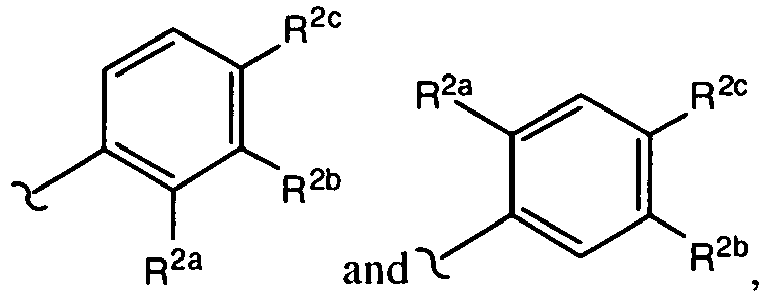
- In another embodiment 5, the compound is according to embodiment 1, wherein


- In the compound according to embodiment 1, M1-M2-M3-M4- together are according to formula II;

- wherein X1, X2, and optionally X3, represent the atoms of a saturated bridged ring system, said saturated bridged ring system containing up to three annular heteroatoms represented by any of X1, X2, and X3; wherein,
- each X1 is independently selected from -C(R6)R7-, -O-, -S(O)0-2-, and -NR8-;
- each X2 is independently a bridgehead methine optionally substituted with R6, or a bridgehead nitrogen;
- each X3 is independently selected from -C(R6)R7-, -O-, -S(O)0-2-, and -NR8-;
- provided, for X1, X2, and X3, there are no nitrogen-nitrogen annular bonds nor geminal di-nitrogen substitutions;
- E is selected from -NR9-, -O-, and absent;
- Y is either:
- a C1-3 alkylene linker, between the oxygen at the 7-position of the quinazoline ring system of I and either E, or when E is absent, any ring atom of the saturated bridged ring system except X2, when X2 is a bridgehead nitrogen; provided there are at least two carbon atoms between the oxygen at the 7-position of the quinazoline ring system of I and either E, or when E is absent, any heteroatom represented by X1, X2 or X3; or
- Y is absent, when Y is absent, E is also absent; said saturated bridged ring system is directly attached to the oxygen at the 7-position of the quinazoline ring system of I via a carbon atom of said saturated bridged ring system;
- m and p are each independently between one and four;
- n is between zero and two, when n is zero, then there is a direct single bond between the two bridgehead X2's;
- R6 and R7 are each independently selected from -H, halogen, trihalomethyl, -CN, -NH2, -NO2, -OR3, -N(R3)R4, -S(O)0-2R4, -SO2N(R3)R4, -CO2R3, -C(O)N(R3)R4, -N(R3)SO2R4, -N(R3)C(O)R3, -NCO2R3, -C(O)R3, C1-C6alkyl, aryl, unsubstituted aryl C1-C6alkyl, heterocyclyl, heterocyclyl C1-C6 alkyl; or
- R6 and R7, when taken together are oxo; or
- R6 and R7, when taken together with a common carbon to which they are attached, form a three-to seven-membered spirocyclyl, optionally containing at least one additional heteroatom selected from N, O, S, and P; and
- R8 is selected from R3, -SO2N(R3)R4, -CO2R3, -C(O)N(R3)R4, -SO2R4, and -C(O)R3.
- with the proviso that when Y is a C1-3 alkylene linker; E is absent, Z is -NH- or -N(CH3)-; R1 is a C1-3 alkyl; R2 is halogen; n = 0; and, the atoms, X1, of one bridge of the saturated bridged ring system, when combined with both bridgehead atoms, X2, of the saturated bridged ring system, represent:
- either a pyrrolidine ring or a piperidine ring, and any atom, X1 or X2, of either of said pyrrolidine ring or said piperidine ring is attached to Y, then the other bridge of said saturated bridged ring system cannot be any one of -OC(O)CH2-, -CH2OC(O)-, -OC(O)CH2CH2-, -CH2OC(O)CH2-, -CH2CH2OC(O)-, -OC(O)CH2NH-, -OC(O)CH2N(C1-4alkyl)-, and -OC(O)CH2O-; or
- either a piperazine ring or a 4-(C1-4 alkyl)-piperazine ring, and any atom, X1 or X2, of either of said piperazine ring or said 4-(C1-4 alkyl)-piperazine ring is attached to Y, then the other bridge of said saturated bridged ring system, when attached via the 2- and the 3-position of either of said piperazine ring or said 4-(C1-4 alkyl)-piperazine ring, cannot be -CH2OC(O)CH2-, -CH2CH2OC(O)-, or either of the two aforementioned bridges substituted by one or two C1-2alkyl groups; or
- a piperazine ring, and any atom, X1 or X2, of said piperazine ring is attached to Y, then the other bridge of said saturated bridged ring system, only when attached via the 3-position of said piperazine ring via its left-hand end as depicted above and to the 4-position of said piperazine ring, cannot be -C(O)OCH2CH2-, -CH2OC(O)CH2-, or either of the two aforementioned bridges substituted by one or two C1-2 alkyl groups; or
- a 2-oxomorpholine ring, said 2-oxomorpholine ring attached to Y via its 4-position, then the other bridge of said saturated bridged ring system, only when attached via the 5- and the 6-position of said 2-oxomorpholine ring, cannot be one of -(CH2)g-, -CH2WCH2-, -CH2WCH2CH2-, and -CH2CH2WCH2-, wherein W is -O-, -S(O)0-2-, -NH-, or -N(C1-4 alkyl)- wherein g is 2, 3, or 4.
- In embodiment 6, the compound is according to embodiment 1, wherein Z is -NR5-.
- In another embodiment 7, the compound is according to embodiment 6, wherein R2 is selected from halogen, trihalomethyl, -CN, -NO2, -OR3, and C1-C6 alkyl.
- In another embodiment 8, the compound is according to embodiment 7, wherein R1 is an unsubstituted C1-3 alkyl.
- In another embodiment 9, the compound is according to embodiment 8, wherein the saturated bridged ring system has a geometry selected from the group consisting of [4.4.0], [4.3.0], [4.2.0], [4.1.0], [3.3.0], [3.2.0], [3.1.0], [3.3.3], [3.3.2], [3.3.1], [3.2.2], [3.2.1], [2.2.2], and [2.2.1].
- In another embodiment 10, the compound is according to embodiment 9, wherein Y is selected from -CH2CH2-, -CH2-, and absent.
- In another embodiment 11, the compound is according to embodiment 10, wherein q = one to three.
- In another embodiment 12, the compound is according to embodiment 11, wherein R5 is -H.
- In another embodiment 13, the compound is according to embodiment 12, wherein R1 is methyl.
- In another embodiment 14, the compound is according to embodiment 13, wherein the saturated bridged ring system has a geometry selected from the group consisting of [4.4.0], [4.3.0], [4.2.0], [4.1.0], [3.3.0], [3.2.0], and [3.1.0].
- In another embodiment 15, the compound is according to embodiment 14, wherein said saturated bridged ring system contains one or two annular nitrogens, said one or two annular nitrogens are selected from -NR8-, when X1, and a bridgehead nitrogen, when X2.
- In another embodiment 16, the compound is according to embodiment 15, wherein E is absent.
- In another embodiment 17, the compound is according to embodiment 16, wherein said saturated bridged ring system is according to formula III;

- In another embodiment 18, the compound is according to embodiment 17, wherein Y is -CH2-.
- In another embodiment 19, the compound is according to embodiment 18, wherein A is selected from -NR8-, wherein R8 is selected from -H, C1-C6alkyl, -CO2R3, -C(O)N(R3)R4, -SO2R4, and -C(O)R3; -O-; and absent.
- In another embodiment 20, the compound is according to embodiment 19, wherein


- In another embodiment 21, the compound is according to embodiment 20, wherein R2a is F, R2b is Cl, and R2c is either Cl or Br.
- In another embodiment 22, the present invention also comprises a compound of formula Ia:

- or a single geometric isomer, stereoisomer, racemate, enantiomer, or diasteriomer, thereof and optionally as a pharmaceutically acceptable salt or hydrate thereof,
- wherein R10 is selected from -H, alkyl, and -OR13; and R11 and R12 are each independently selected from -H, -CF3, -F, -N(R3)R4, -N(C=O)R3, -N(R3)SO2R3, -S(O)0-2R13, and -OR13; or R10 is selected from -H, and -OR13; and
- R11 and R12, when taken together, are oxo, exo-alkenyl, or when taken together with the carbon to which they are attached, form a three- to seven-membered spirocyclyl;
- R13 is selected from -H, -C(=O)R4, C1-C6 alkynyl, unsubsituted aryl C1-C6 alkynyl, heterocyclyl C1-C6 alkynyl, C1-C6 alkenyl, unsubstituted aryl C1-C6 alkenyl, heterocyclyl C1-C6 alkenyl, C1-C6 alkyl, unsubstituted aryl C1-C6 alkyl, aryl, heterocycyl C1-C6 alkyl and heterocyclyl;
- or two R13's, when taken together, form 1) a corresponding spirocyclic ketal from R11, R12 and the carbon to which they are attached, when R11 and R12 are both -OR13, or 2) a corresponding cyclic ketal from R10 and one of R11 and R12, and the corresponding carbons to which they are attached, when R10 is -OR13, and at least one of R11 and R12 is also -OR13;
- q is 1 to 3;
- R2 is selected from halogen, trihalomethyl, -CN, -NO2, -OR3, and C1-C6 alkyl;
- Y is either:
-CH2CH2- or -CH2- provided there are at least two carbon atoms between the oxygen at the 7-position of the quinazoline ring system of Ia and E, when E is -NR9- or -O-; or Y is absent, and when Y is absent, E is also absent; - E is selected from -NR9-, -O-, and absent;
- R3 is -H or R4;
- R4 is selected from C1-C6 alkyl, aryl, unsubstituted aryl C1-C6 alkyl, heterocyclyl, and heterocyclyl C1-C6 alkyl; or
- R3 and R4, when taken together with a common nitrogen to which they are attached, form a five-to seven-membered heterocyclyl optionally containing at least one additional heteroatom selected from N, O, S, and P;
- R9 is -H or C1-C6 alkyl;
- R10 is selected from -H, alkyl, and -OR13; and R11 and R12 are each independently selected from -H, -CF3, -F, -N(R3)R4, -N(C=O)R3, -N(R3)SO2R3, -S(O)0-2R13, and -OR13; or
- R10 is selected from -H, and -OR13; and R11 and R12, when taken together, are oxo, exo-alkenyl, or when taken together with the carbon to which they are attached, form a three- to seven-membered spirocyclyl.
- In another embodiment 23, the compound is according to embodiment 22, wherein Y is either -CH2- or absent.
- In another embodiment 24, the compound is according to embodiment 23, wherein one of R11 and R12 is -OR13, wherein R13 is selected from -H, -C(O)R4, and C1-C6 alkyl; and R10 and the other of R11 and R12 are both -H.
- In another embodiment 25, the compound is according to embodiment 23, wherein one of R11 and R12 is -F; and R10 and the other of R11 and R12 are both -H.
- In another embodiment 27, the compound is according to embodiment 23, wherein q is two or three.
- In another embodiment 28, the compound is according to embodiment 27, wherein each R2 is independently selected from -F, -Cl, -Br, -CF3, -CH3, and -OR25; wherein R25 is either methyl or aryl, each optionally substituted with one to three halogens.
- In another embodiment 29, the compound is according to embodiment 15, wherein said saturated bridged ring system is according to either formula V or formula VI;

- In another embodiment 30, the compound is according to embodiment 29, wherein Y is either -CH2- or absent.
- In another embodiment 31, the compound is according to embodiment 30, wherein

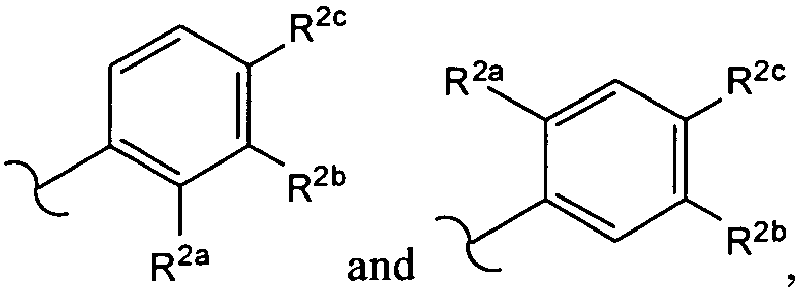
- In another embodiment 32, the compound is according to embodiment 31, wherein R2a is F, R2b is Cl, and R2c is either Cl or Br.
- In another embodiment 33, the compound is according to embodiment 32, wherein R8 is methyl or ethyl.
- In another embodiment 34, the compound is according to embodiment 16, wherein said saturated bridged ring system is according to formula VII;

- In another embodiment 35, the compound is according to embodiment 34, wherein R3 is selected from -H and C1-C6 alkyl.
- In another embodiment 36, the compound is according to embodiment 35, wherein A is either -C(R6)R7- or absent.
- In another embodiment 37, the compound is according to embodiment 36, wherein A is either -CH2- or absent.
- In another embodiment 38, the compound is according to embodiment 37, wherein Y is -CH2-.
- In another embodiment 39, the compound is according to embodiment 38, wherein q is 3.
- In another embodiment 40, the compound is according to embodiment 39, wherein


- In another embodiment 41, the compound is according to embodiment 40, wherein R2a is F, R2b is Cl, and R2c is either Cl or Br.
- In another embodiment 42, the compound is according to embodiment 13, wherein the saturated bridged ring system has a geometry selected from the group consisting of [3.3.1], [3.2.1], and [2.2.1].
- In another embodiment 43, the compound is according to embodiment 42, wherein said saturated bridged ring system contains one or two annular nitrogens, said one or two annular nitrogens are selected from -NR8-, when X1, and a bridgehead nitrogen, when X2.
- In another embodiment 44, the compound is according to embodiment 43, wherein said saturated bridged ring system is according to formula VIII or formula IX;

- In another embodiment 45, the compound is according to embodiment 44, wherein Y is -CH2CH2-; and E is either absent or -N(R9)-.
- In another embodiment 46, the compound is according to embodiment 45, wherein q is 3.
- In another embodiment 47, the compound is according to embodiment 46, wherein
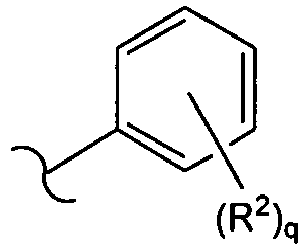

- In another embodiment 48, the compound is according to embodiment 47, wherein R2a is F, R2b is Cl, and R2c is either Cl or Br.
- In another embodiment 49, the compound is according to embodiment 48, wherein R8 is methyl or ethyl.
- In another embodiment 50, the compound is according to formula I or Ia, selected from
-
Table 1 Entry Name Structure 1 N-(3,4-dichloro-2-fluorophenyl)-7-({[(3aR,5r,6aS)-2-(1-methylethyl)octahydrocyclopenta[c]pyrrol-5-yl]methyl}oxy)-6-(methyloxy)quinazolin-4-amine; 
N-(3,4-dichloro-2-fluorophenyl)-7-({[(3aR,6aS)-2-(1-methylethyl)octahydrocyclopenta[c]pyrrol-5-yl]methyl}oxy)-6-(methyloxy)quinazolin-4-amine 
2 N-(4-bromo-3-chloro-2-fluorophenyl)-7-({[(3aR,5r,6aS)-2-(1-methylethyl)octahydrocyclopenta[c]pyrrol-5-yl] methyl }oxy)-6-(methyloxy)quinazolin-4-amine; 
N-(4-bromo-3-chloro-2-fluorophenyl)-7-({[(3aR,6aS)-2-(1-methylethyl)octahydrocyclopenta[c]pyrrol-5-yl]methyl}oxy)-6-(methyloxy)quinazolin-4-amine 
3 7-({[(3aR,5r,6aS)-2-acetyloctahydrocyclopenta[c]pyrrol-5-yl]methyl}oxy)-N-(4-bromo-3-chloro-2-fluorophenyl)-6-(methyloxy)quinazolin-4-amine; 
7-({[(3aR,6aS)-2-acetyloctahydrocyclopenta[c]pyrrol-5-yl]methyl}oxy)-N-(4-bromo-3-chloro-2-fluorophenyl)-6-(methyloxy)quinazolin-4-amine 
4 N-(4-bromo-3-chloro-2-fluorophenyl)-6-(methyloxy)-7-{[(3aR,5r,6aS)-octahydrocyclopenta[c]pyrrol-5-ylmethyl]oxy}quinazolin-4-amine; 
N-(4-bromo-3-chloro-2-fluorophenyl)-6-(methyloxy)-7-{[(3aR,6aS)-octahydrocyclopenta[c]pyrrol-5-ylmethyl]oxy}quinazolin-4-amine 
5 ethyl (3aR,6aS)-5-({[4-[(4-bromo-3-chloro-2-fluorophenyl)amino]-6-(methyloxy)quinazolin-7-yl]oxy} methyl)hexahydrocyclopenta[c]pyrro le-2(1H)-carboxylate 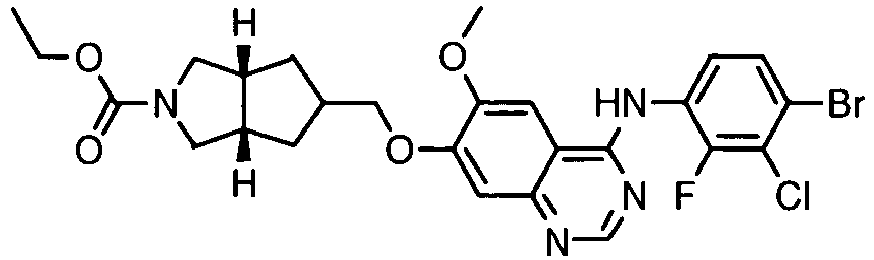
6 N-(4-bromo-3-chloro-2-fluorophenyl)-6-(methyloxy)-7-({[(3aR,5r,6aS)-2-(methylsulfonyl)octahydrocyclopenta[c]pyrr ol-5-yl]methyl}oxy)quinazolin-4-amine; 
N-(4-bromo-3-chloro-2-fluorophenyl)-6-(methyloxy)-7-({[(3aR,6aS)-2-(methylsulfonyl)octahydrocyclopenta[c]pyrr ol-5-yl]methyl}oxy)quinazolin-4-amine 
7 N-(3,4-dichloro-2-fluorophenyl)-7-({[(3aR,5r,6aS)-2-ethyloctahydrocyclopenta[c]pyrrol-5-yl]methyl}oxy)-6-(methyloxy)quinazolin-4-amine; 
N-(3,4-dichloro-2-fluorophenyl)-7-({[(3aR,6aS)-2-ethyloctahydrocyclopenta[c]pyrrol-5-yl]methyl}oxy)-6-(methyloxy)quinazolin-4-amine 
8 N-(3,4-dichloro-2-fluorophenyl)-6-(methyloxy)-7-({[(3aR,5r,6aS)-2-(2-methylpropyl)octahydrocyclopenta[c]pyrrol-5-yl]methyl}oxy)quinazolin-4-amine; 
N-(3,4-dichloro-2-fluorophenyl)-6-(methyloxy)-7-({[(3aR,6aS)-2-(2-methylpropyl)octahydrocyclopenta[c]pyrrol-5-yl]methyl}oxy)quinazolin-4-amine 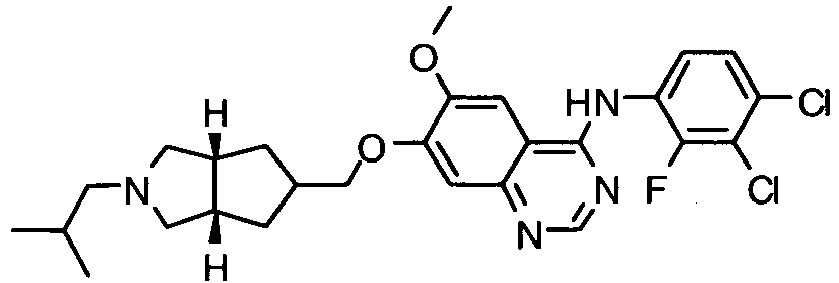
9 N-(3,4-dichloro-2-fluorophenyl)-7-({[(3aR,5s,6aS)-2-methyloctahydrocyclopenta[c]pyrrol-5-yl]methyl}oxy)-6-(methyloxy)quinazolin-4-amine; 
N-(3,4-dichloro-2-fluorophenyl)-7-({[(3aR,6aS)-2-methyloctahydrocyclopenta[c]pyrrol-5-yl]methyl}oxy)-6-(methyloxy)quinazolin-4-amine 
10 N-(4-bromo-3-chloro-2-fluorophenyl)-7-({[(3aR,5s,6aS)-2-methyloctahydrocyclopenta[c]pyrrol-5-yl]methyl}oxy)-6-(methyloxy)quinazolin-4-amine; 
N-(4-bromo-3-chloro-2-fluorophenyl)-7-({[(3aR,6aS)-2-methyloctahydrocyclopenta[c]pyrrol-5-yl]methyl}oxy)-6-(methyloxy)quinazolin-4-amine 
11 N-(3-chloro-2,4-difluorophenyl)-7-({[(3aR,5s,6aS)-2-methyloctahydrocyclopenta[c]pyrrol-5-yl]methyl}oxy)-6-(methyloxy)quinazolin-4-amine; 
N-(3-chloro-2,4-difluorophenyl)-7-({[(3aR,6aS)-2-methyloctahydrocyclopenta[c]pyrrol-5-yl]methyl}oxy)-6-(methyloxy)quinazolin-4-amine 
12 N-(4,5-dichloro-2-fluorophenyl)-7-({[(3aR,5s,6aS)-2-methyloctahydrocyclopenta[c]pyrrol-5-yl]methyl}oxy)-6-(methyloxy)quinazolin-4-amine; 
N-(4,5-dichloro-2-fluorophenyl)-7-({[(3aR,6aS)-2-methyloctahydrocyclopenta[c]pyrrol-5-yl]methyl}oxy)-6-(methyloxy)quinazolin-4-amine 
13 N-(4-bromo-5-chloro-2-fluorophenyl)-7-({[(3aR,5s,6aS)-2-methyloctahydrocyclopenta[c]pyrrol-5-yl]methyl}oxy)-6-(methyloxy)quinazolin-4-amine; 
N-(4-bromo-5-chloro-2-fluorophenyl)-7-({[(3aR,6aS)-2-methyloctahydrocyclopenta[c]pyrrol-5-yl]methyl}oxy)-6-(methyloxy)quinazolin-4-amine 
14 N-(4-bromo-2,3-dichlorophenyl)-7-({ [(3aR,5s,6aS)-2-methyloctahydrocyclopenta[c]pyrrol-5-yl]methyl}oxy)-6-(methyloxy)quinazolin-4-amine; 
N-(4-bromo-2,3-dichlorophenyl)-7-({[(3aR,6aS)-2-methyloctahydrocyclopenta[c]pyrrol-5-yl]methyl}oxy)-6-(methyloxy)quinazolin-4-amine 
15 N-(3,4-dichlorophenyl)-7-({[(3aR,5s,6aS)-2-methyloctahydrocyclopenta[c]pyrrol-5-yl]methyl}oxy)-6-(methyloxy)quinazolin-4-amine; 
N-(3,4-dichlorophenyl)-7-({[(3aR,6aS)-2-methyloctahydrocyclopenta[c]pyrrol-5-yl]methyl}oxy)-6-(methyloxy)quinazolin-4-amine 
16 N-(4-bromo-3-chloro-2-fluorophenyl)-7-({[(3aR,5r,6aS)-2-ethyloctahydrocyclopenta[c]pyrrol-5-yl]methyl}oxy)-6-(methyloxy)quinazolin-4-amine; 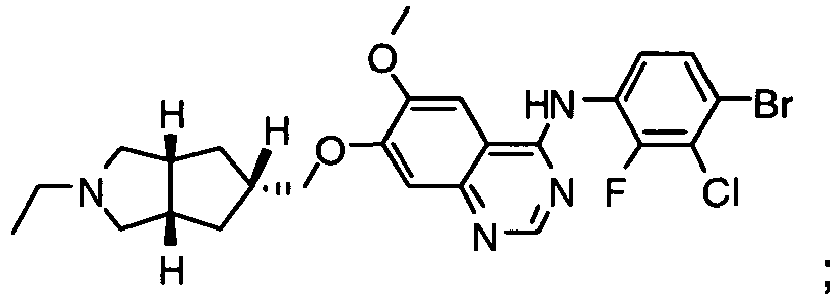
N-(4-bromo-3-chloro-2-fluorophenyl)-7-({[(3aR,6aS)-2-ethyloctahydrocyclopenta[c]pyrrol-5-yl]methyl}oxy)-6-(methyloxy)quinazolin-4-amine 
17 N-(4-bromo-3-chloro-2-fluorophenyl)-6-(methyloxy)-7-({[(3aR,5r,6aS)-2-(2-methylpropyl)octahydrocyclopenta[c]pyrrol-5-yl]methyl}oxy)quinazolin-4-amine; 
N-(4-bromo-3-chloro-2-fluorophenyl)-6-(methyloxy)-7-({[(3aR,6aS)-2-(2-methylpropyl)octahydrocyclopenta[c]pyrrol-5-yl]methyl}oxy)quinazolin-4-amine 
18 N-(4-bromo-2,3-dichlorophenyl)-7-{ [(3R,9aS)-hexahydro-1H-[1,4]oxazino[3,4-c][1,4]oxazin-3-ylmethyl]oxy}-6-(methyloxy)quinazolin-4-amine 
19 N-(4,5-dichloro-2-fluorophenyl)-7-{ [(3R,9aS)-hexahydro-1H-[ 1,4]oxazino[3,4-c][1,4]oxazin-3-ylmethyl]oxy}-6-(methyloxy)quinazolin-4-amine 
20 N-(4-bromo-5-chloro-2-fluorophenyl)-7-([(3R,9aS)-hexahydro-1H-[ 1,4]oxazino[3,4-c][1,4]oxazin-3-ylmethyl]oxy}-6-(methyloxy)quinazolin-4-amine 
21 N-(3-chloro-2,4-difluorophenyl)-7-{[(3R,9aS)-hexahydro-1H-[ 1,4]oxazino[3,4-c][1,4]oxazin-3-ylmethyl]oxy}-6-(methyloxy)quinazolin-4-amine 
22 N-(3,4-dichloro-2-fluorophenyl)-7-{[(3S,9aS)-hexahydro-1H-[1,4]oxazino[3,4-c][1,4]oxazin-3-ylmethyl]oxy}-6-(methyloxy)quinazolin-4-amine 
23 N-(4-bromo-3-chloro-2-fluorophenyl)-7-{[(3S,9aS)-hexahydro-1H-[1,4]oxazino[3,4-c][1,4]oxazin-3-ylmethyl]oxy}-6-(methyloxy)quinazolin-4-amine 
24 N-(3-chloro-2,4-difluorophenyl)-7-{[(3S,9aS)-hexahydro-1H-[1,4]oxazino[3,4-c][1,4]oxazin-3-ylmethyl]oxy}-6-(methyloxy)quinazolin-4-amine 
25 N-(3,4-dichlorophenyl)-7-[(hexahydro-1H-[1,4]oxazino[3,4-c][1,4]oxazin-3-ylmethyl)oxy]-6-(methyloxy)quinazolin-4-amine 
26 N-(4,5-dichloro-2-fluorophenyl)-7-{[(3S,9aS)-hexahydro-1H-[1,4]oxazino[3,4-c][1,4]oxazin-3-ylmethyl]oxy}-6-(methyloxy)quinazolin-4-amine 
27 N-(4-bromo-2,3-dichlorophenyl)-7-{[(3S,9aS)-hexahydro-1H-[1,4]oxazino[3,4-c][1,4]oxazin-3-ylmethyl]oxy}-6-(methyloxy)quinazolin-4-amine 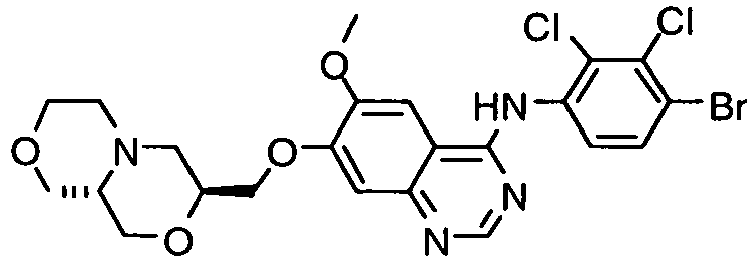
28 N-(4-bromo-5-chloro-2-fluorophenyl)-7-{[(3S,9aS)-hexahydro-1H-[1,4]oxazino[3,4-c][1,4]oxazin-3-ylmethyl]oxy}-6-(methyloxy)quinazolin-4-amine 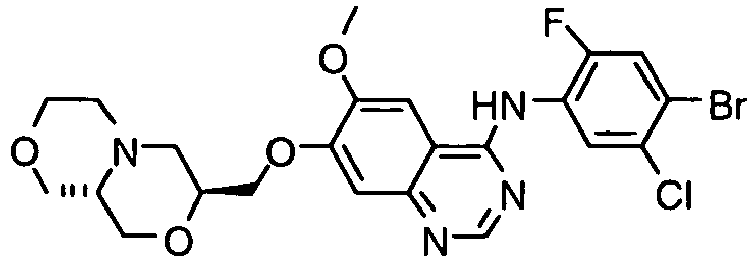
29 N-(3,4-dichloro-2-fluorophenyl)-7-{[(3R,9aS)-hexahydro-1H-[1,4]oxazino[3,4-c][1,4]oxazin-3-ylmethyl]oxy}-6-(methyloxy)quinazolin-4-amine 
30 N-(4-bromo-3-chloro-2-fluorophenyl)-7-{[(3R,9aS)-hexahydro-1H-[1,4]oxazino[3,4-c][1,4]oxazin-3-ylmethyl]oxy}-6-(methyloxy)quinazolin-4-amine 
31 N-(3,4-dichlorophenyl)-7-{ [(3R,8aR)-hexahydro-1H-pyrrolo[2,1-c][1,4]oxazin-3-ylmethyl]oxy}-6-(methyloxy)quinazolin-4-amine 
32 N-(4-bromo-5-chloro-2-fluorophenyl)-7-{[(3S,8aS)-hexahydro-1H-pyrrolo[2,1-c][1,4]oxazin-3-ylmethyl]oxy}-6-(methyloxy)quinazolin-4-amine 
33 N-(3,4-dichlorophenyl)-7-{[(3S,8aR)-hexahydro-1H-pyrrolo[2,1-c][1,4]oxazin-3-ylmethyl]oxy}-6-(methyloxy)quinazolin-4-amine 
34 N-(3,4-dichlorophenyl)-7-{[(3S,8aS)-hexahydro-1H-pyrrolo[2,1-c][1,4]oxazin-3-ylmethyl]oxy}-6-(methyloxy)quinazolin-4-amine 
35 N-(3,4-dichlorophenyl)-7-{[(3R,8aS)-hexahydro-1H-pyrrolo[2,1-c][1,4]oxazin-3-ylmethyl]oxy}-6-(methyloxy)quinazolin-4-amine 
36 N-(3,4-dichloro-2-fluorophenyl)-7-{ [(3S,8aS)-hexahydro-1H-pyrrolo[2, 1-c][1,4]oxazin-3-ylmethyl]oxy}-6-(methyloxy)quinazolin-4-amine 
37 N-(4-bromo-3-chloro-2-fluorophenyl)-7-{[(3S,8aS)-hexahydro-1H-pyrrolo[2,1-c][1,4]oxazin-3-ylmethyl]oxy}-6-(methyloxy)quinazolin-4-amine 
38 N-(3-chloro-2,4-difluorophenyl)-7-{[(3S,8aS)-hexahydro-1H-pyrrolo[2,1-c][1,4]oxazin-3-ylmethyl]oxy}-6-(methyloxy)quinazolin-4-amine 
39 N-(4-bromo-2,3-dichlorophenyl)-7-{[(3S,8aS)-hexahydro-1H-pyrrolo[2,1-c][1,4]oxazin-3-ylmethyl]oxy}-6-(methyloxy)quinazolin-4-amine 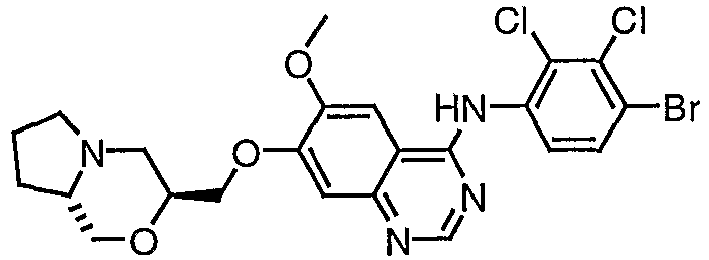
40 N-(4,5-dichloro-2-fluorophenyl)-7-{[(3S,8aS)-hexahydro-1H-pyrrolo[2,1-c][1,4]oxazin-3-ylmethyl]oxy}-6-(methyloxy)quinazolin-4-amine 
41 1,4:3,6-dianhydro-5-({[4-[(4-bromo-5-chloro-2-fluorophenyl)amino]-6-(methyloxy)quinazolin-7-yl]oxy}methyl)-5-deoxy-2-O-methyl-D-xylo-hexitol 
42 1,4:3,6-dianhydro-5-deoxy-5-({[4-[(3,4-dichlorophenyl)amino]-6-(methyloxy)quinazolin-7-yl]oxy}methyl)-2-O-methyl-D-glucitol 
43 1,4:3,6-dianhydro-5-deoxy-5-({[4-[(3,4-dichloro-2-fluorophenyl)amino]-6-(methyloxy)quinazolin-7-yl]oxy}methyl)-2-O-methyl-D-xylo-hexitol 
44 1,4:3,6-dianhydro-5-({[4-[(4-bromo-3-chloro-2-fluorophenyl)amino]-6-(methyloxy)quinazolin-7-yl]oxy}methyl)-5-deoxy-2-O-methyl-D-xylo-hexitol 
45 1,4:3,6-dianhydro-5-({[4-[(3-chloro-2,4-difluorophenyl)amino]-6-(methyloxy)quinazolin-7-yl]oxy}methyl)-5-deoxy-2-O-methyl-D-xylo-hexitol 
46 1,4:3,6-dianhydro-5-({[4-[(4-bromo-2,3-dichlorophenyl)amino]-6-(methyloxy)quinazolin-7-yl]oxy}methyl)-5-deoxy-2-O-methyl-D-glucitol 
47 1,4:3,6-dianhydro-2-deoxy-2-({[4-[(3,4-dichlorophenyl)amino]-6-(methyloxy)quinazolin-7-yl]oxy}methyl)-5-O-methyl-D-threo-hexitol 
48 1,4:3,6-dianhydro-5-deoxy-5-({[4-[(4,5-dichloro-2-fluorophenyl)amino]-6-(methyloxy)quinazolin-7-yl]oxy}methyl)-2-O-methyl-D-glucitol 
49 (3S,9aS)-3-({[4-[(3,4-dichloro-2-fluorophenyl)amino]-6-(methyloxy)quinazolin-7-yl]oxy}methyl)hexahydro-2H-pyrido[1,2-a]pyrazin-1(6H)-one 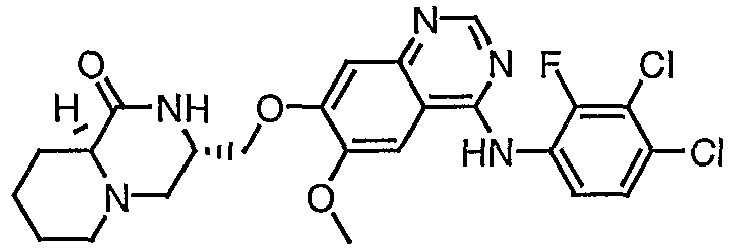
50 (3S,9aR)-3-({[4-[(3,4-dichloro-2-fluorophenyl)amino]-6-(methyloxy)quinazolin-7-yl]oxy}methyl)hexahydro-2H-pyrido[1,2-a]pyrazin-1(6H)-one 
51 (3S,8aS)-3-({[4-[(3,4-dichloro-2-fluorophenyl)amino]-6-(methyloxy)quinazolin-7-yl]oxy}methyl)hexahydropyrrolo[1,2-a]pyrazin-1(2H)-one 
52 (3S,8aR)-3-({[4-[(3,4-dichloro-2-fluorophenyl)amino]-6-(methyloxy)quinazolin-7-yl]oxy}methyl)hexahydropyrrolo[1,2-a]pyrazin-1(2H)-one 
53 (3S,8aS)-3-({[4-[(4-bromo-3-chloro-2-fluorophenyl)amino]-6-(methyloxy)quinazolin-7-yl]oxy}methyl)hexahydropyrrolo[1,2-a]pyrazin-1(2H)-one 
54 (3S,8aS)-3-({[4-[(3,4-dichloro-2-fluorophenyl)amino]-6-(methyloxy)quinazolin-7-yl]oxy}methyl)-2-methylhexahydropyrrolo[1,2-a]pyrazin-1(2H)-one 
55 N-(3,4-dichlorophenyl)-7-({2-[(8-methyl-8-azabicyclo[3.2.1]oct-3-yl)amino]ethyl}oxy)-6-(methyloxy)quinazolin-4-amine 
56 N-(3,4-dichlorophenyl)-6-(methyloxy)-7-{[(8aR)-tetrahydro-1H-[1,3]thiazolo[4,3-c][1,4]oxazin-6-ylmethyl]oxy}quinazolin-4-amine; 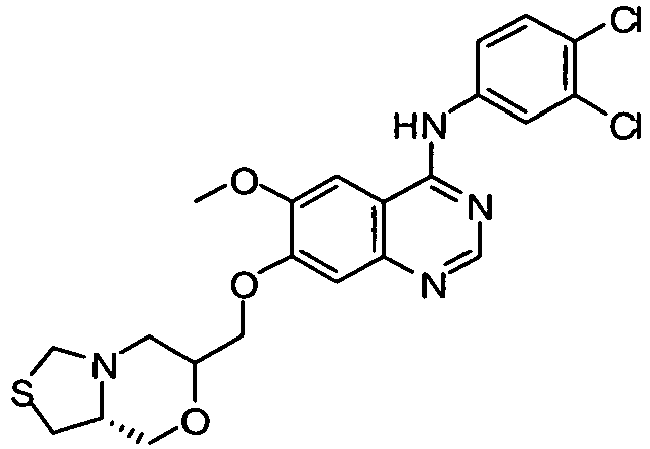
N-(3,4-dichlorophenyl)-6-(methyloxy)-7-[(tetrahydro-1H-[1,3]thiazolo[4,3-c][1,4]oxazin-3-ylmethyl)oxy]quinazolin-4-amine 
57 N-(3,4-dichlorophenyl)-7-{[2-(8-methyl-8-azabicyclo[3.2.1]oct-3-yl)ethyl]oxy}-6-(methyloxy)quinazolin-4-amine 
58 N-(3,4-dichlorophenyl)-7-{[(8-methyl-8-azabicyclo[3.2.1]oct-3-yl)methyl]oxy}-6-(methyloxy)quinazolin-4-amine 
59 N-(3,4-dichlorophenyl)-7-{[(3aR,6aS)-2-methyloctahydrocyclopenta[c]pyrrol-5-yl]oxy}-6-(methyloxy)quinazolin-4-amine 
60 N-(3,4-dichlorophenyl)-7-[(8-methyl-8-azabicyclo[3.2.1]oct-3-yl)oxy]-6-(methyloxy)quinazolin-4-amine 
61 1,4:3,6-dianhydro-2-O-[4-[(4-bromo-5-chloro-2-fluorophenyl)amino]-6-(methyloxy)quinazolin-7-yl]-5-O-methyl-L-iditol 
62 1,4:3,6-dianhydro-2-O-[4-[(3,4-dichloro-2-fluorophenyl)amino]-6-(methyloxy)quinazolin-7-yl]-5-O-methyl-L-iditol 
63 1,4:3,6-dianhydro-2-O-[4-[(4-bromo-3-chloro-2-fluorophenyl)amino]-6-(methyloxy)quinazolin-7-yl]-5-O-methyl-L-iditol 
64 1,4:3,6-dianhydro-2-O-methyl-5-O-{6-(methyloxy)-4-[(2,3,4-trichlorophenyl)amino]quinazolin-7-yl}-L-iditol 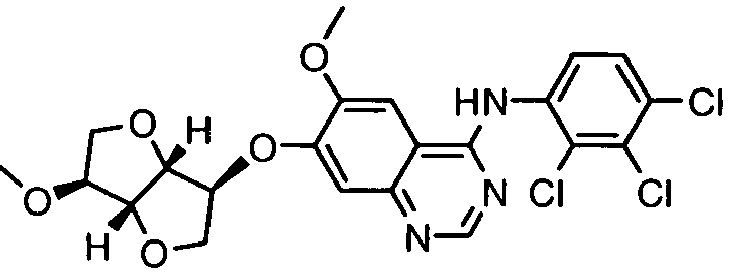
65 1,4:3,6-dianhydro-5-O-[4-[(3,4-dichlorophenyl)amino]-6-(methyloxy)quinazolin-7-yl]-2-O-methyl-D-xylo-hexitol 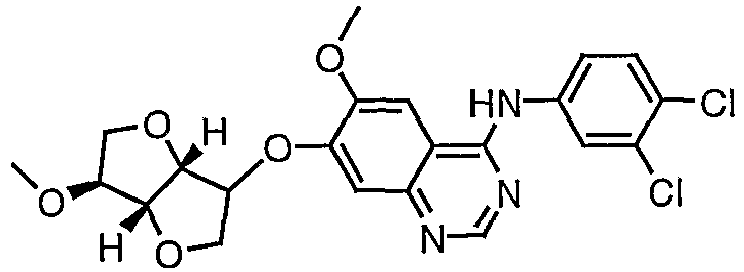
66 1,4:3,6-dianhydro-2-O-[4-[(4-bromo-2,3-dichlorophenyl)amino]-6-(methyloxy)quinazolin-7-yl]-5-O-methyl-L-iditol 
67 dianhydro-5-O-[4-[(4-bromo-3-chlorophenyl)amino]-6-(methyloxy)-quinazolin-7-yl]-L-sorbose ethylene glycol acetal 
68 1,4:3,6-dianhydro-2-O-[4-[(3-chloro-2,4-difluorophenyl)amino]-6-(methyloxy)quinazolin-7-yl]-5-O-methyl-L-iditol 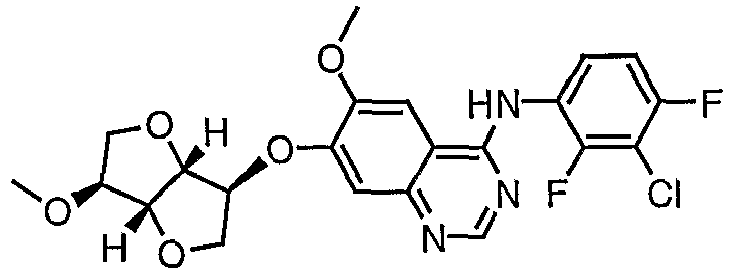
69 1,4:3,6-dianhydro-2-O-[4-[(4,5-dichloro-2-fluorophenyl)amino]-6-(methyloxy)quinazolin-7-yl]-5-O-methyl-L-iditol 
70 1,4:3,6-dianhydro-2-O-[4-[(4-bromo-3-chlorophenyl)amino]-6-(methyloxy)quinazolin-7-yl]-5-O-(difluoromethyl)-L-iditol 
71 1,4:3,6-dianhydro-2-O-[4-[(3-chloro-2-fluorophenyl)amino]-6-(methyloxy)quinazolin-7-yl]-5-O-methyl-L-iditol 
72 1,4:3,6-dianhydro-2-O-[4-[(3,4-dichlorophenyl)amino]-6-(methyloxy)quinazolin-7-yl]-5-O-methyl-L-iditol 
73 1,4:3,6-dianhydro-2-O-[4-[(4-bromo-3-chlorophenyl)amino]-6-(methyloxy)quinazolin-7-yl]-5-O-methyl-L-iditol 
74 1,4:3,6-dianhydro-2-O-[4-[(4-bromo-3-chlorophenyl)amino]-6-(methyloxy)quinazolin-7-yl]-5-O-ethyl-L-iditol 
75 1,4:3,6-dianhydro-2-O-[4-[(3-bromo-2-methylphenyl)amino]-6-(methyloxy)quinazolin-7-yl]-5-O-methyl-L-iditol 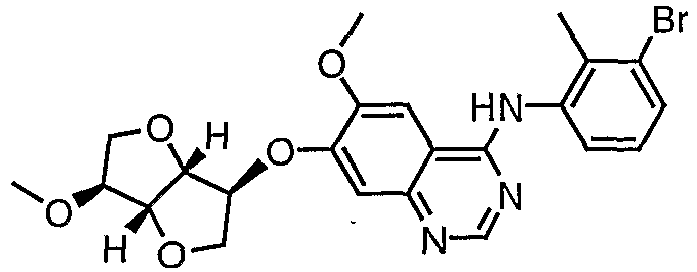
76 1,4:3,6-dianhydro-2-O-[4-[(3-chloro-2-methylphenyl)amino]-6-(methyloxy)quinazolin-7-yl]-5-O-methyl-L-iditol 
77 1,4:3,6-dianhydro-2-O-[4-[(4-bromo-3-chlorophenyl)amino]-6-(methyloxy)quinazolin-7-yl]-5-deoxy-D-xylohexitol 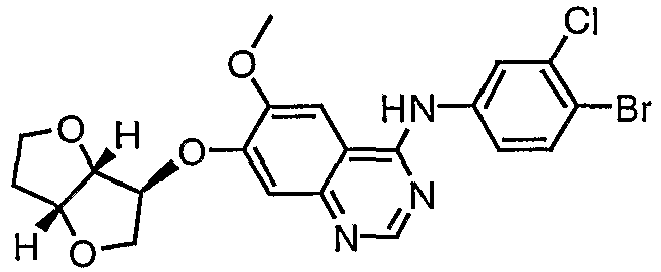
78 1,4:3,6-dianhydro-2-O-[4-[(4-bromo-3-chlorophenyl)amino]-6-(methyloxy)quinazolin-7-yl]-5-O-methyl-D-glucitol 
79 methyl 3,6-anhydro-5-O-[4-[(4-bromo-3-chlorophenyl)amino]-6-(methyloxy)quinazolin-7-yl]-2-O-methyl-alpha-L-idofuranoside 
80 3,6-anhydro-5-O-[4-[(4-bromo-3-chlorophenyl)amino]-6-(methyloxy)quinazolin-7-yl]-1,2-O-(1-methylethylidene)-beta-L-xylo-hexofuranose 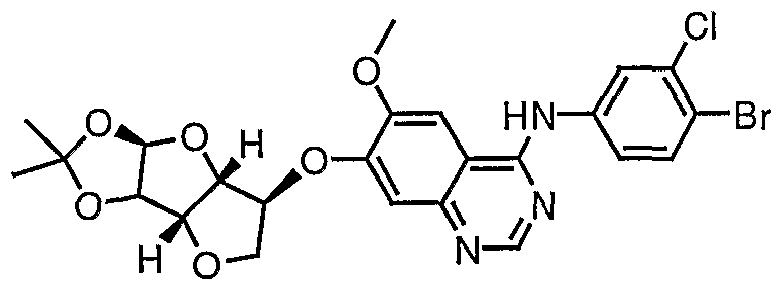
81 1,4:3,6-dianhydro-2-O-[4-[(4-bromo-3-chlorophenyl)amino]-6-(methyloxy)quinazolin-7-yl]-5-deoxy-5-methylidene-D-xylo-hexitol 
82 methyl 3,6-anhydro-5-O-[4-[(4-bromo-3-chlorophenyl)amino]-6-(methyloxy)quinazolin-7-yl]-2-O-methyl-beta-L-idofuranoside 
83 N-(3,4-dichloro-2-fluorophenyl)-6-(methyloxy)-7-[(octahydro-2H-quinolizin-3-ylmethyl)oxy]quinazolin-4-amine 
84 1,4:3,6-dianhydro-2-deoxy-2-fluoro-5-O-{6-(methyloxy)-4-(2,3,4-trifluorophenyl)amino]quinazolin-7-yl}-D-iditol 
85 1,4:3,6-dianhydro-5-O-[4-[(2-chloro-4-fluorophenyl)amino]-6-(methyloxy)quinazolin-7-yl]-2-deoxy-2-fluoro-D-iditol 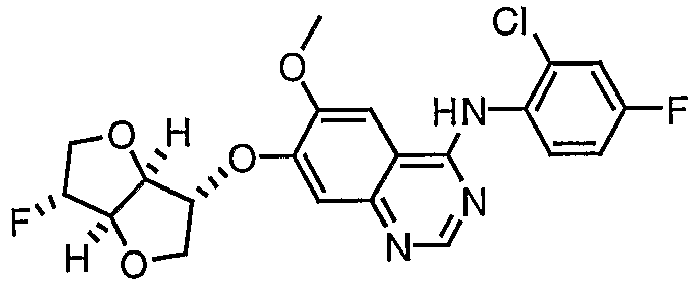
86 1,4:3,6-dianhydro-5-O-[4-[(2-bromo-4-fluorophenyl)amino]-6-(methyloxy)quinazolin-7-yl]-2-deoxy-2-fluoro-D-iditol 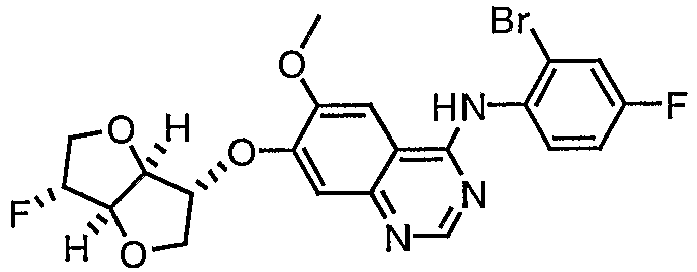
87 1,4:3,6-dianhydro-2-deoxy-5-O-[4-[(2,6-difluorophenyl)amino]-6-(methyloxy)quinazolin-7-yl]-2-fluoro-D-iditol 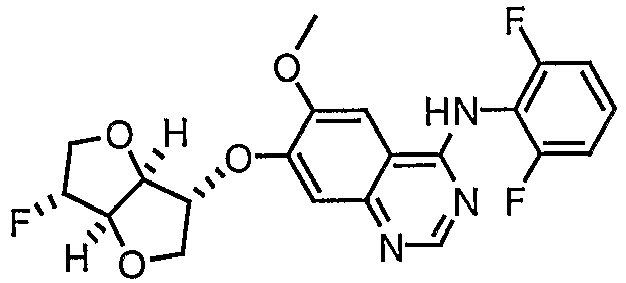
88 1,4:3,6-dianhydro-5-O-[4-[(3-chloro-2-fluorophenyl)amino]-6-(methyloxy)quinazolin-7-yl]-2-deoxy-2-fluoro-D-iditol 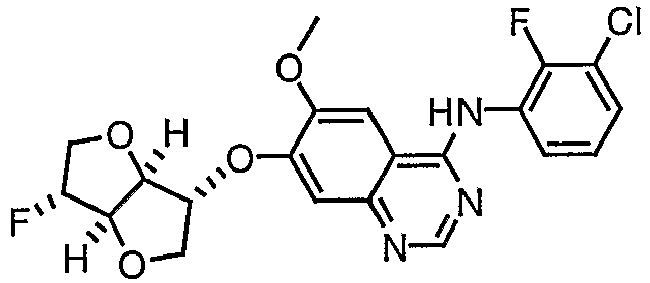
89 1,4:3,6-dianhydro-2-deoxy-2-fluoro-5-O-[4-{[4-fluoro-3-(trifluoromethyl)phenyl]amino}-6-(methyloxy)quinazolin-7-yl]-D-iditol 
90 1,4:3,6-dianhydro-2-deoxy-5-O-[4-[(2,4-difluorophenyl)amino]-6-(methyloxy)quinazolin-7-yl]-2-fluoro-D-iditol 
91 1,4:3,6-dianhydro-2-deoxy-5-O-[4-[(2,5-difluorophenyl)amino]-6-(methyloxy)quinazolin-7-yl]-2-fluoro-D-iditol 
92 1,4:3,6-dianhydro-2-deoxy-5-O-[4-[(2,3-difluorophenyl)amino]-6-(methyloxy)quinazolin-7-yl]-2-fluoro-D-iditol 
93 1,4:3,6-dianhydro-5-O-[4-[(5-chloro-2-fluorophenyl)amino]-6-(methyloxy)quinazolin-7-yl]-2-deoxy-2-fluoro-D-iditol 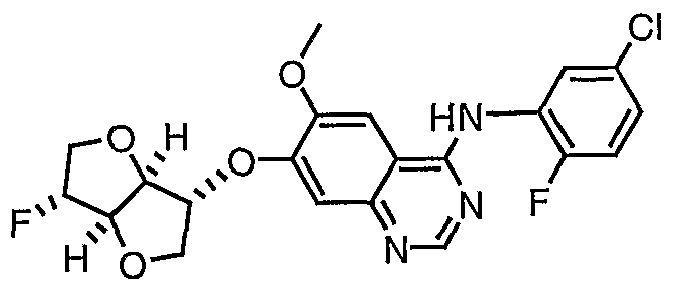
94 1,4:3,6-dianhydro-2-deoxy-5-O-[4-[(3,5-difluorophenyl)amino]-6-(methyloxy)quinazolin-7-yl]-2-fluoro-D-iditol 
95 1,4:3,6-dianhydro-5-O-[4-[(3-chloro-4-fluorophenyl)amino]-6-(methyloxy)quinazolin-7-yl]-2-deoxy-2-fluoro-D-iditol 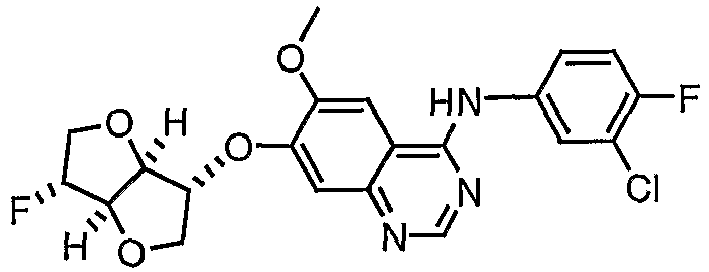
96 1,4:3,6-dianhydro-5-O-[4-[(4-bromo-2-chlorophenyl)amino]-6-(methyloxy)quinazolin-7-yl]-2-deoxy-2-fluoro-D-iditol 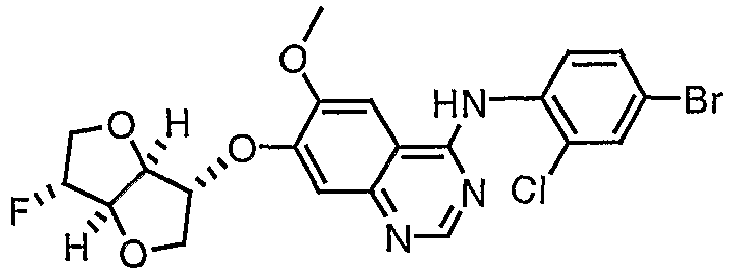
97 1,4:3,6-dianhydro-2-deoxy-5-O-[4-[(3,4-dichloro-2-fluorophenyl)amino]-6-(methyloxy)quinazolin-7-yl]-2-fluoro-D-iditol 
98 1,4:3,6-dianhydro-5-O-[4-[(4-bromo-5-chloro-2-fluorophenyl)amino]-6-(methyloxy)quinazolin-7-yl]-2-deoxy-2-fluoro-D-iditol 
99 1,4:3,6-dianhydro-2-deoxy-2-fluoro-5-O-{6-(methyloxy)-4-[(2,4,5-trifluorophenyl)amino]quinazolin-7-yl}-D-iditol 
100 1,4:3,6-dianhydro-2-deoxy-2-fluoro-5-O-{6-(methyloxy)-4-[(2,4,6-trifluorophenyl)amino]quinazolin-7-yl}-D-iditol 
101 1,4:3,6-dianhydro-5-O-[4-({4-[(4-chlorophenyl)oxy]-3,5-difluorophenyl}amino)-6-(methyloxy)quinazolin-7-yl]-2-deoxy-2-fluoro-D-iditol 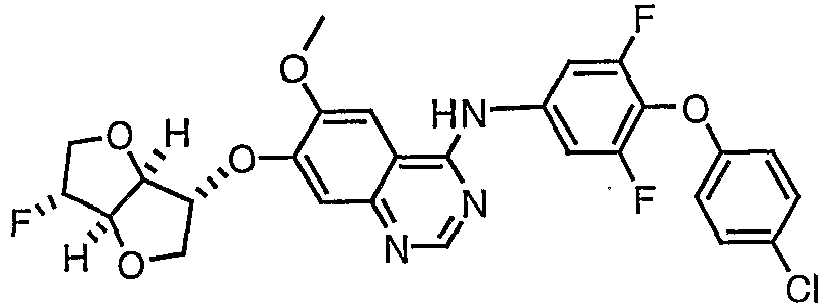
102 1,4:3,6-dianhydro-5-O-[4-[(4-bromo-3-chloro-2-fluorophenyl)amino]-6-(methyloxy)quinazolin-7-yl]-2-deoxy-2-fluoro-D-iditol 
103 1,4:3,6-dianhydro-5-O-[4-[(4-bromo-2,3-dichlorophenyl)amino]-6-(methyloxy)quinazolin-7-yl]-2-deoxy-2-fluoro-D-iditol 
104 1,4:3,6-dianhydro-5-O-[4-[(4-bromo-3-chloro-5-fluorophenyl)amino]-6-(methyloxy)quinazolin-7-yl]-2-deoxy-2-fluoro-D-iditol 
105 1,4:3,6-dianhydro-2-deoxy-5-O-[4-[(4,5-dichloro-2-fluorophenyl)amino]-6-(methyloxy)quinazolin-7-yl]-2-fluoro-D-iditol 
106 1,4:3,6-dianhydro-2-deoxy-2-fluoro-5-O-{6-(methyloxy)-4-[(2,3,4-trichlorophenyl)amino]quinazolin-7-yl}-D-iditol 
107 1,4:3,6-dianhydro-2-deoxy-2-fluoro-5-O-{6-(methyloxy)-4-[(3,4,5-trichlorophenyl)amino]quinazolin-7-yl}-D-iditol 
108 1,4:3,6-dianhydro-5-O-[4-[(4-bromo-2-fluorophenyl)amino]-6-(methyloxy)quinazolin-7-yl]-2-deoxy-2-fluoro-D-iditol 
109 1,4:3,6-dianhydro-5-O-[4-[(4-chloro-2-fluorophenyl)amino]-6-(methyloxy)quinazolin-7-yl]-2-deoxy-2-fluoro-D-iditol 
110 1,4:3,6-dianhydro-5-O-[4-[(3-chloro-2-methylphenyl)amino]-6-(methyloxy)quinazolin-7-yl]-2-deoxy-2-fluoro-D-iditol 
111 1,4:3,6-dianhydro-2-deoxy-5-O-[4-[(3,4-difluorophenyl)amino]-6-(methyloxy)quinazolin-7-yl]-2-fluoro-D-iditol 
112 1,4:3,6-dianhydro-5-O-[4-[(2-chlorophenyl)amino]-6-(methyloxy)quinazolin-7-yl]-2-deoxy-2-fluoro-D-iditol 
113 1,4:3,6-dianhydro-2-deoxy-2-fluoro-5-O-[4-[(2-fluorophenyl)amino]-6-(methyloxy)quinazolin-7-yl]-D-iditol 
114 1,4:3,6-dianhydro-5-O-[4-[(3-chlorophenyl)amino]-6-(methyloxy)quinazolin-7-yl]-2-deoxy-2-fluoro-D-iditol 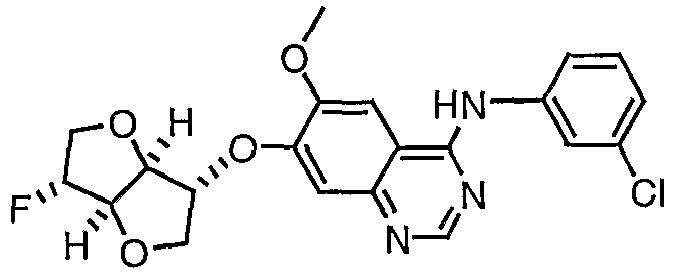
115 1,4:3,6-dianhydro-2-deoxy-2-fluoro-5-O-[4-[(4-fluorophenyl)amino]-6-(methyloxy)quinazolin-7-yl]-D-iditol 
116 1,4:3,6-dianhydro-5-O-[4-[(4-chlorophenyl)amino]-6-(methyloxy)quinazolin-7-yl]-2-deoxy-2-fluoro-D-iditol 
117 1,4:3,6-dianhydro-2-deoxy-5-O-[4-[(2,4-dichlorophenyl)amino]-6-(methyloxy)quinazolin-7-yl]-2-fluoro-D-iditol 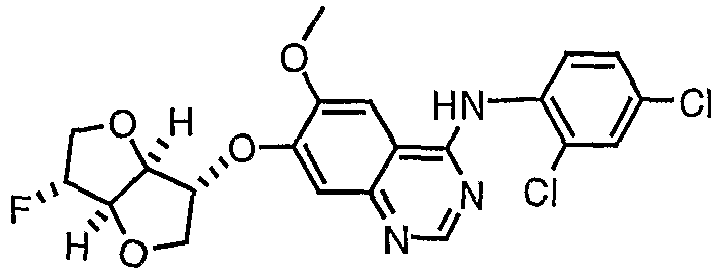
118 1,4:3,6-dianhydro-2-deoxy-5-O-[4-[(2,5-dichlorophenyl)amino]-6-(methyloxy)quinazolin-7-yl]-2-fluoro-D-iditol 
119 1,4:3,6-dianhydro-2-deoxy-5-O-[4-[(3,4-dichlorophenyl)amino]-6-(methyloxy)quinazolin-7-yl]-2-fluoro-D-iditol 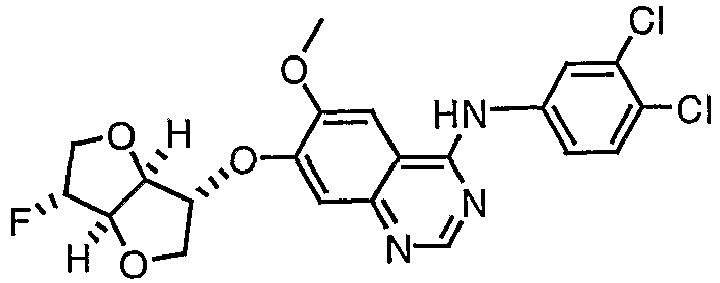
120 1,4:3,6-dianhydro-5-O-[4-[(2-bromo-4,6-difluorophenyl)amino]-6-(methyloxy)quinazolin-7-y)]-2-deoxy-2-fluoro-D-iditol 
121 1,4:3,6-dianhydro-5-O-[4-{[4-chloro-3-(trifluoromethyl)phenyl]amino}-6-(methyloxy)quinazolin-7-yl]-2-deoxy-2-fluoro-D-iditol 
122 1,4:3,6-dianhydro-5-O-[4-{[2-chloro-5-(trifluoromethyl)phenyl]amino}-6-(methyloxy)quinazolin-7-yl]-2-deoxy-2-fluoro-D-iditol 
123 1,4:3,6-dianhydro-2-deoxy-2-fluoro-5-O-[4-{[2-fluoro-3-(trifluoromethyl)phenyl]amino}-6-(methyloxy)quinazolin-7-yl]-D-iditol 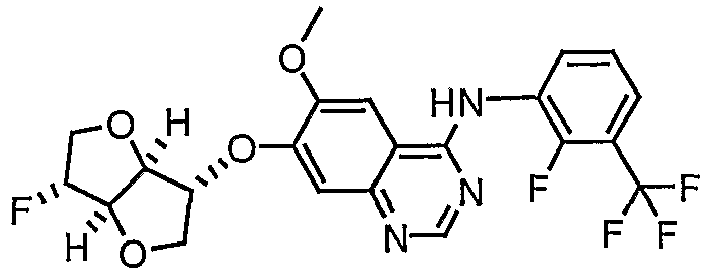
124 1,4:3,6-dianhydro-5-O-[4-{[2-bromo-5-(trifluoromethyl)phenyl]amino}-6-(methyloxy)quinazolin-7-yl]-2-deoxy-2-fluoro-D-iditol 
125 1,4:3,6-dianhydro-5-O-[4-{[2-bromo-4-(trifluoromethyl)phenyl]amino}-6-(methyloxy)quinazolin-7-yl]-2-deoxy-2-fluoro-D-iditol 
126 1,4:3,6-dianhydro-2-deoxy-2-fluoro-5-O-[4-{[4-fluoro-2-(trifluoromethyl)phenyl]amino}-6-(methyloxy)quinazolin-7-yl]-D-iditol 
127 1,4:3,6-dianhydro-5-O-[4-{[3-bromo-5-(trifluoromethyl)phenyl]amino}-6-(methyloxy)quinazolin-7-yl]-2-deoxy-2-fluoro-D-iditol 
128 1,4:3,6-dianhydro-5-O-[4-[(2-bromophenyl)amino]-6-(methyloxy)quinazolin-7-yl]-2-deoxy-2-fluoro-D-iditol 
129 1,4:3,6-dianhydro-5-O-[4-[(3-bromophenyl)amino]-6-(methyloxy)quinazolin-7-yl]-2-deoxy-2-fluoro-D-iditol 
130 1,4:3,6-dianhydro-5-O-[4-[(4-bromophenyl)amino]-6-(methyloxy)quinazolin-7-yl]-2-deoxy-2-fluoro-D-iditol 
131 1,4:3,6-dianhydro-5-O-[4-[(3-bromo-4-methylphenyl)amino]-6-(methyloxy)quinazolin-7-yl]-2-deoxy-2-fluoro-D-iditol 
132 1,4:3,6-dianhydro-5-O-[4-[(5-chloro-2-methylphenyl)amino]-6-(methyloxy)quinazolin-7-yl]-2-deoxy-2-fluoro-D-iditol 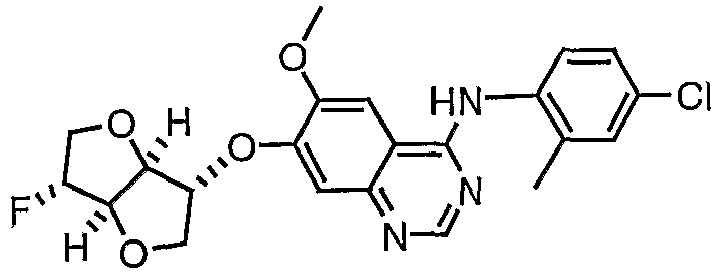
133 1,4:3,6-dianhydro-2-deoxy-5-O-[4-[(3,5-dimethylphenyl)amino]-6-(methyloxy)quinazolin-7-yl]-2-fluoro-D-iditol 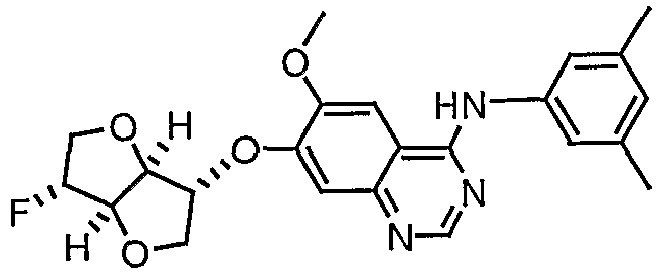
134 1,4:3,6-dianhydro-5-O-[4-{[2,5-bis(methyloxy)phenyl]amino}-6-(methyloxy)quinazolin-7-yl]-2-deoxy-2-fluoro-D-iditol 
135 1,4:3,6-dianhydro-5-O-[4-{[5-chloro-2,4-bis(methyloxy)phenyl]amino}-6-(methyloxy)quinazolin-7-yl]-2-deoxy-2-fluoro-D-iditol 
136 1,4:3,6-dianhydro-5-O-[4-{[4-chloro-2,5-bis(methyloxy)phenyl]amino}-6-(methyloxy)quinazolin-7-yl]-2-deoxy-2-fluoro-D-iditol 
137 1,4:3,6-dianhydro-5-O-[4-[(3-chloro-2,4-difluorophenyl)amino]-6-(methyloxy)quinazolin-7-yl]-2-deoxy-2-fluoro-D-iditol 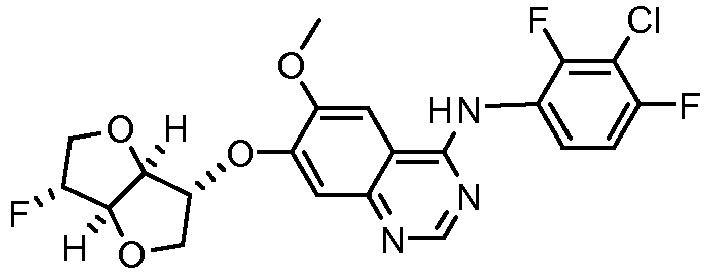
176 N-(3,4-dichlorophenyl)-6-(methyloxy)-7-({[1-methyl-3-(trifluoromethyl)-1H-thieno[2,3-c]pyrazol-5-yl]methyl}oxy)quinazolin-4-amine 
193 2-(2-{[4-[(3,4-dichlorophenyl)amino]-6-(methyloxy)quinazolin-7-yl]oxy}ethyl)-1H-isoindole-1,3(2H)-dione 
440 N-(4-bromo-3-chlorophenyl)-7-{[(3a'S,4R,6'S,6a'R)-2,2-dimethyltetrahydrospiro[1,3-dioxolane-4,3'-furo[3,2-b]furan]-6'-yl]oxy}-6-(methyloxy)quinazolin-4-amine 
441 1,4:3,6-dianhydro-2-O-[4-[(4-bromo-3-chlorophenyl)amino]-6-(methyloxy)quinazolin-7-yl]-5-O-methyl-5-C-[(methyloxy)methyl]-L-glucitol 
443 1,4:3,6-dianhydro-2-O-[4-[(4-bromo-3-chlorophenyl)amino]-6-(methyloxy)quinazolin-7-yl]-L-glucitol 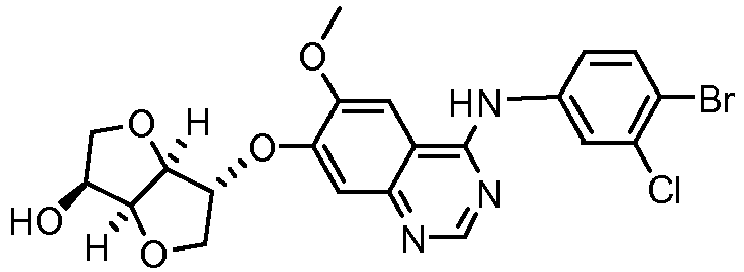
444 1,4:3,6-dianhydro-2-O-[4-[(4-bromo-3-chlorophenyl)amino]-6-(methyloxy)quinazolin-7-yl]-5-S-methyl-5-thio-D-iditol 
445 1,4:3,6-dianhydro-5-O-[4-[(4-bromo-3-chlorophenyl)amino]-6-(methyloxy)quinazolin-7-yl]-2-deoxy-2-morpholin-4-yl-D-iditol 
446 1,4:3,6-dianhydro-5-O-[4-[(4-bromo-3-chlorophenyl)amino]-6-(methyloxy)quinazolin-7-yl]-2-deoxy-2-(4-methylpiperazin-1-yl)-D-iditol 
447 1,4:3,6-dianhydro-5-O-[4-[(4-bromo-3-chlorophenyl)amino]-6-(methyloxy)quinazolin-7-yl]-2-deoxy-2-pyrrolidin-1-yl-D-iditol 
449 1,4:3,6-dianhydro-2-O-[4-[(4-bromo-3-chlorophenyl)amino]-6-(methyloxy)quinazolin-7-yl]-D-iditol 
450 1,4:3,6-dianhydro-5-O-[4-[(4-bromo-3-chlorophenyl)amino]-6-(methyloxy)quinazolin-7-yl]-2-deoxy-2-(methylsulfonyl)-D-iditol 
451 2-amino-1,4:3,6-dianhydro-5-O-[4-[(4-bromo-3-chlorophenyl)amino]-6-(methyloxy)quinazolin-7-yl]-2-deoxy-D-iditol 
452 1,4:3,6-dianhydro-5-O-[4-[(4-bromo-3-chlorophenyl)amino]-6-(methyloxy)quinazolin-7-yl]-2-deoxy-2-(dimethylamino)-D-iditol 
453 1,4:3,6-dianhydro-5-O-[4-[(4-bromo-3-chlorophenyl)amino]-6-(methyloxy)quinazolin-7-yl]-2-deoxy-2-(diethylamino)-D-iditol 
454 1,4:3,6-dianhydro-5-O-[4-[(4-bromo-3-chlorophenyl)amino]-6-(methyloxy)quinazolin-7-yl]-2-deoxy-2-piperidin-1-yl-D-iditol 
455 2-(acetylamino)-1,4:3,6-dianhydro-5-O-[4-[(4-bromo-3-chlorophenyl)amino]-6-(methyloxy)quinazolin-7-yl]-2-deoxy-D-iditol 
456 1,4:3,6-dianhydro-2-O-[4-[(4-bromo-3-chlorophenyl)amino]-6-(methyloxy)quinazolin-7-yl]-5-O-methyl-5-C-(trifluoromethyl)-L-glucitol 
457 1,4:3,6-dianhydro-5-O-[4-[(4-bromo-3-chlorophenyl)amino]-6-(methyloxy)quinazolin-7-yl]-2-deoxy-2-[(methylsulfonyl)amino]-D-iditol 
458 N-(4-bromo-3-chlorophenyl)-6-(methyloxy)-7-[(1-methylpyrrolidin-3-yl)oxy]quinazolin-4-amine 
459 N-(4-bromo-3-chlorophenyl)-6-(methyloxy)-7-[(3 R)-tetrahyd rofuran-3-yloxy]quinazolin-4-amine 
461 1,4:3,6-dianhydro-2-deoxy-2-fluoro-5-O-(6-(m ethyloxy)-4-{[4-(4-methylpiperazin-1-yl)phenyl]amino}quinazolin-7-yl)-D-iditol 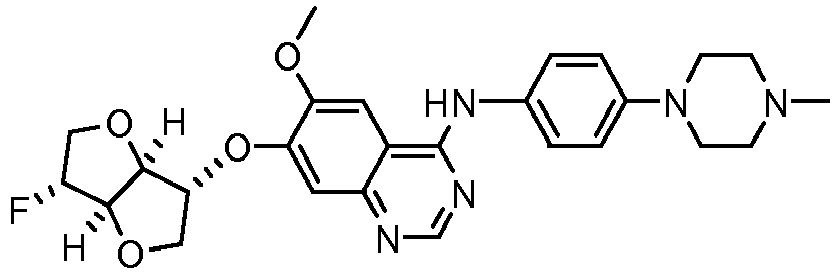
462 1,4:3,6-dianhydro-2-deoxy-2-fluoro-5-O-[4-{[3-fluoro-4-(4-methylpiperazin-1-yl)phenyl]amino}-6-(methyloxy)quinazolin-7-yl]-D-iditol 
463 1,4:3,6-dianhydro-2-deoxy-5-O-[4-{[2,3-dichloro-4-(4-methylpiperazin-1-yl)phenyl]amino}-6-(methyloxy)quinazolin-7-yl]-2-fluoro-D-iditol 
464 1,4:3,6-dianhydro-2-deoxy-5-O-[4-{[3,4-dichloro-2-(4-methylpiperazin-1-yl)phenyl]amino}-6-(methyloxy)quinazolin-7-yl]-2-fluoro-D-iditol 
465 1,4:3,6-dianhydro-2-O-[4-[(4-bromo-3-chlorophenyl)amino]-6-(methyloxy)quinazolin-7-yl]-5-C-(trifluoromethyl)-D-glucitol 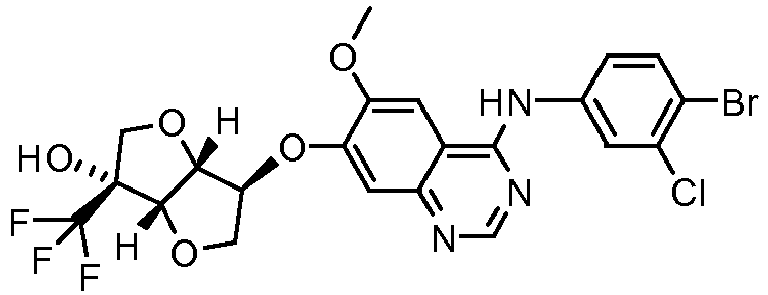
- Embodiment 51: Another aspect of the invention is a pharmaceutical composition comprising a compound according to any one of embodiments 1 to 50 and a pharmaceutically acceptable carrier.
- Embodiment 52: Another aspect of the invention is a compound according to any one of embodiments 1 to 50, optionally together with a pharmaceutically acceptable carrier for usein the treatment of cancer.
- Embodiment 53: Another aspect of the invention is a compound according to embodiment 52, wherein the use in the treatment of cancer comprises the inhibition of one or more kinases selected from ephrin and EGFR.
- Emdbodiment 54: Another aspect of the invention is a compound according to any one of embodiments 1 to 50, optionally together with a pharmaceutically acceptable carrier, for usein the treatment of a disease selected from ischemic coronary artery disease, diabetic retinopathy, psoriasis and rheumatoid arthritis.
- As used in the present specification, the following words and phrases are generally intended to have the meanings as set forth below, except to the extent that the context in
which they are used indicates otherwise or they are expressly defined to mean something different. - The atom numbering convention for the quinazoline structure is as follows:

- The symbol "-" means a single bond, "=" means a double bond, "≡" means a triple bond. The symbol "" refers to a group on a double-bond as occupying either position on the terminus of a double bond to which the symbol is attached; that is, the geometry, E- or Z-, of the double bond is ambiguous. When a group is depicted removed from its parent formula, the "
 " symbol will be used at the end of the bond which was theoretically cleaved in order to separate the group from its parent structural formula.
- If a group "R" is depicted as "floating" on a ring system, as for example in the formula:

- If a group "R" is depicted as floating on a fused ring system, as for example in the formulae:

- When there are more than one such depicted "floating" groups, as for example in the formulae:

- When a group "R" is depicted as existing on a ring system containing saturated carbons, as for example in the formula:


- "Alkyl" is intended to include linear, branched, or cyclic hydrocarbon structures and combinations thereof, inclusively. For example, "C8 alkyl" may refer to an n-octyl, iso-octyl, cyclohexylethyl, and the like. Lower alkyl refers to alkyl groups of from one to six carbon atoms. Examples of lower alkyl groups include methyl, ethyl, propyl, isopropyl, butyl, s-butyl, t-butyl, isobutyl, pentyl, hexyl and the like. Higher alkyl refers to alkyl groups containing more that eight carbon atoms. Exemplary alkyl groups are those of C20 or below. Cycloalkyl is a subset of alkyl and includes cyclic hydrocarbon groups of from three to thirteen carbon atoms. Examples of cycloalkyl groups include c-propyl, c-butyl, c-pentyl, norbornyl, adamantyl and the like. In this application, alkyl refers to alkanyl, alkenyl, and alkynyl residues (and combinations thereof); it is intended to include cyclohexylmethyl, vinyl, allyl, isoprenyl, and the like. Thus when an alkyl residue having a specific number of carbons is named, all geometric isomers having that number of carbons are intended to be encompassed; thus, for example, either "butyl" or "C4 alkyl" is meant to include n-butyl, sec-butyl, isobutyl, t-butyl, isobutenyl and but-2-yne radicals; and "propyl" or "C3 alkyl" each include n-propyl, propenyl, and isopropyl.
- "Alkylene" refers to straight or branched chain divalent radical consisting solely of carbon and hydrogen atoms, containing no unsaturation and having from one to ten carbon atoms, for example, methylene, ethylene, propylene, n-butylene and the like. Alkylene is a subset of alkyl, referring to the same residues as alkyl, but having two points of attachment and, specifically, fully saturated. Examples of alkylene include ethylene (-CH2CH2-), propylene (-CH2CH2CH2-), dimethylpropylene (-CH2C(CH3)2CH2-), and cyclohexylpropylene (-CH2CH2CH(C6H13)).
- "Alkylidene" refers to a straight or branched chain unsaturated divalent radical consisting solely of carbon and hydrogen atoms, having from two to ten carbon atoms, for example, ethylidene, propylidene, n-butylidene, and the like. Alkylidene is a subset of alkyl, referring to the same residues as alkyl, but having two points of attachment and, specifically, double bond unsaturation. The unsaturation present includes at least one double bond and a double bond can exist between the first carbon of the chain and a carbon atom of the rest of the molecule to which it is attached.
- "Alkylidyne" refers to a straight or branched chain unsaturated divalent radical consisting solely of carbon and hydrogen atoms having from two to ten carbon atoms, for example, propylid-2-ynyl, n-butylid-1-ynyl, and the like. Alkylidyne is a subset of alkyl, referring to the same residues as alkyl, but having two points of attachment and, specifically, triple bond unsaturation. The unsaturation present includes at least one triple bond and a triple bond can exist between the first carbon of the chain and a carbon atom of the rest of the molecule to which it is attached.
- Any of the above radicals, "alkylene," "alkylidene" and "alkylidyne," when optionally substituted, may contain alkyl substitution which itself contains unsaturation. For example, 2-(2-phenylethynyl-but-3-enyl)-naphthalene (IUPAC name) contains an n-butylid-3-ynyl radical with a vinyl substituent at the 2-position of said radical.
- "Alkoxy" or "alkoxyl" refers to the group -O-alkyl, for example including from one to eight carbon atoms of a straight, branched, cyclic configuration, unsaturated chains, and combinations thereof attached to the parent structure through an oxygen. Examples include methoxy, ethoxy, propoxy, isopropoxy, cyclopropyloxy, cyclohexyloxy and the like. Lower-alkoxy refers to groups containing one to six carbons.
- "Substituted alkoxy" refers to the group -O-(substituted alkyl), the substitution on the alkyl group generally containing more than only carbon (as defined by alkoxy). One exemplary substituted alkoxy group is "polyalkoxy" or -O-optionally substituted alkylene-optionally substituted alkoxy, and includes groups such as -OCH2CH2OCH3, and glycol ethers such as polyethyleneglycol and -O(CH2CH2O)xCH3, where x is an integer of between about two and about twenty, in another example, between about two and about ten, and in a further example between about two and about five. Another exemplary substituted alkoxy group is hydroxyalkoxy or -OCH2(CH2)yOH, where y is for example an integer of between about one and about ten, in another example y is an integer of between about one and about four.
- "Acyl" refers to groups of from one to ten carbon atoms of a straight, branched, cyclic configuration, saturated, unsaturated and aromatic and combinations thereof, attached to the parent structure through a carbonyl functionality. One or more carbons in the acyl residue may be replaced by nitrogen, oxygen or sulfur as long as the point of attachment to the parent remains at the carbonyl. Examples include acetyl, benzoyl, propionyl, isobutyryl, t-butoxycarbonyl, benzyloxycarbonyl and the like. Lower-acyl refers to groups containing one to six carbons.
- "α-Amino Acids" refer to naturally occurring and commercially available amino acids and optical isomers thereof. Typical natural and commercially available α-amino acids are glycine, alanine, serine, homoserine, threonine, valine, norvaline, leucine, isoleucine, norleucine, aspartic acid, glutamic acid, lysine, omithine, histidine, arginine, cysteine, homocysteine, methionine, phenylalanine, homophenylalanine, phenylglycine, ortho-tyrosine, meta-tyrosine, para-tyrosine, tryptophan, glutamine, asparagine, proline and hydroxyproline. A "side chain of an a-amino acid" refers to the radical found on the α-carbon of an α-amino acid as defined above, for example, hydrogen (for glycine), methyl (for alanine), benzyl (for phenylalanine), and the like.
- "Amino" refers to the group -NH2. "Substituted amino," refers to the group -N(H)R or -N(R)R where each R is independently selected from the group: optionally substituted alkyl, optionally substituted alkoxy, optionally substituted aryl, optionally substituted heterocyclyl, acyl, carboxy, alkoxycarbonyl, sulfanyl, sulfinyl and sulfonyl, for example, diethylamino, methylsulfonylamino, furanyl-oxy-sulfonamino.
- "Aryl" refers to aromatic six- to fourteen-membered carbocyclic rings include, for example, benzene, naphthalene, indane, tetralin, fluorene and the like.
- "Arylalkyl" refers to a residue in which an aryl moiety is attached to a parent structure via one of an alkylene, alkylidene, or alkylidyne radical. Examples include benzyl, phenethyl, phenylvinyl, phenylallyl and the like. The aryl, alkylene, alkylidene, or alkylidyne radical portion of an arylalkyl group may be optionally substituted. "Lower arylalkyl" refers to an arylalkyl where the "alkyl" portion of the group has one to six carbons.
- "Exo-alkenyl" refers to a double bond that emanates from an annular carbon, and is not within the ring system, for example the double bond depicted in the formula below.
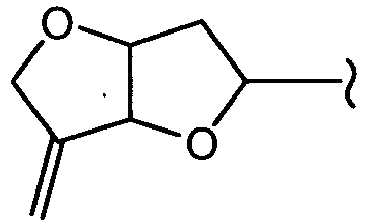
- "Fused-polycyclic" or "fused ring system" refers to a polycyclic ring system that contains bridged or fused rings; that is, where two rings have more than one shared atom in their ring structures. Typically, but not necessarily, fused-polycyclics share a vicinal set of atoms. Typically, a spiro ring system is not a fused-polycyclic by this definition, but fused polycyclic ring systems of the invention may themselves have spiro rings attached thereto via a single ring atom of the fused-polycyclic.
- "Halogen" or "halo" refers to fluorine, chlorine, bromine or iodine. Dihaloaryl, dihaloalkyl, trihaloaryl etc. refer to aryl and alkyl substituted with a plurality of halogens, but not necessarily a plurality of the same halogen; thus 4-chloro-3-fluorophenyl is within the scope of dihaloaryl.
- "Heteroatom" refers to O, S, N, or P.
- "Heterocyclyl" refers to a stable three- to fifteen-membered ring radical that consists of carbon atoms and from one to five heteroatoms selected from the group consisting of nitrogen, phosphorus, oxygen and sulfur. For purposes of this invention, the heterocyclyl radical may be a monocyclic, bicyclic or tricyclic ring system, which may include fused or bridged ring systems, and the nitrogen, phosphorus, carbon or sulfur atoms in the heterocyclyl radical may be optionally oxidized to various oxidation states. In addition, the nitrogen atom may be optionally quaternized; and the ring radical may be partially or fully saturated or aromatic. Examples of such heterocyclyl radicals include, azetidinyl, acridinyl, benzodioxolyl, benzodioxanyl, benzofuranyl, carbazoyl, cinnolinyl, dioxolanyl, indolizinyl, naphthyridinyl, perhydroazepinyl,
phenazinyl, phenothiazinyl, phenoxazinyl, phthalazinyl, pteridinyl, purinyl, quinazolinyl, quinoxalinyl, quinolinyl, isoquinolinyl, tetrazoyl, tetrahydroisoquinolyl, piperidinyl, piperazinyl, 2-oxopiperazinyl, 2-oxopiperidinyl, 2-oxopyrrolidinyl, 2-oxoazepinyl, azepinyl, pyrrolyl, 4-piperidonyl, pyrrolidinyl, pyrazolyl, pyrazolidinyl, imidazolyl, imidazolinyl, imidazolidinyl, dihydropyridinyl, tetrahydropyridinyl, pyridinyl, pyrazinyl, pyrimidinyl, pyridazinyl, oxazolyl, oxazolinyl, oxazolidinyl, triazolyl, indanyl, isoxazolyl, isoxazolidinyl, morpholinyl, thiazolyl, thiazolinyl, thiazolidinyl, isothiazolyl, quinuclidinyl, isothiazolidinyl, indolyl, isoindolyl, indolinyl, isoindolinyl, octahydroindolyl, octahydroisoindolyl, quinolyl, isoquinolyl, decahydroisoquinolyl, benzimidazolyl, thiadiazolyl, benzopyranyl, benzothiazolyl, benzoxazolyl, furyl, tetrahydrofuryl, tetrahydropyranyl, thienyl, benzothieliyl, thiamorpholinyl, thiamorpholinyl sulfoxide, thiamorpholinyl sulfone, dioxaphospholanyl, and oxadiazolyl. - "Heteroalicyclic" refers specifically to a non-aromatic heterocyclyl system radical.
- "Heteroaryl" refers specifically to an aromatic heterocyclyl system radical.
- "Heterocyclylalkyl" refers to a residue in which a heterocyclyl is attached to a parent structure via one of an alkylene, alkylidene, or alkylidyne radical. Examples include (4-methylpiperazin-1-yl) methyl, (morpholin-4-yl) methyl, 2-(oxazolin-2-yl) ethyl, 4-(4-methylpiperazin-1-yl)-2-butenyl, and the like. The heterocyclyl, alkylene, alkylidene, or alkylidyne radical portion of an arylalkyl group may be optionally substituted. "Lower heterocyclylalkyl" refers to an arylalkyl where the "alkyl" portion of the group has one to six carbons.
- "Hydrocarbyl" refers to a hydrocarbon residue, generally. The term "hydrocarbyl" can be modified to mean more specific structures, for example "a saturated or mono- or poly-unsaturated C3-C14 mono- or fused-polycyclic hydrocarbyl optionally containing one, two, or three annular heteroatoms per ring" means a mono- or polycyclic (for example a bridged bicyclic) ring system, having between three and fourteen-ring atoms, that contains only carbon ring atoms, but optionally can contain up to three heteratoms per ring and/or unsaturation.
- "Optional" or "optionally" means that the subsequently described event or circumstance may or may not occur, and that the description includes instances where said event or circumstance occurs and instances in which it does not. It will be understood by those skilled in the art with respect to any group containing one or more substituents that such groups are not intended to introduce any substitution or substitution patterns (for example, substituted alkyl includes optionally substituted cycloalkyl groups, which in turn are defined as including optionally substituted alkyl groups, that are sterically impractical and/or synthetically non-feasible. "Optionally substituted" refers to all subsequent modifiers in a term, for example, in the term "optionally substituted arylC1-8 alkyl" optional substitution may occur on both the "C1-8 alkyl" portion and the "aryl" portion of the molecule; and for example, optionally substituted alkyl includes optionally substituted cycloalkyl groups, which in turn are defined as including optionally substituted alkyl groups. Examples of optional substitution include, alkyl, halogen, alkoxy, hydroxy, oxo, carbamyl, acylamino, sulfonamido, carboxy, alkoxycarbonyl, acyl, alkylthio, alkylsulfonyl, nitro, cyano, amino, alkylamino, cycloalkyl and the like.
- "Saturated bridged ring system" refers to a bicyclic or polycyclic ring system that is not aromatic. Such a system may contain isolated or conjugated unsaturation, but not aromatic or heteroaromatic rings in its core structure (but may have aromatic substitution thereon). For example, 2,3,3a,4,7,7a-hexahydro-1H-indene, 7-aza-bicyclo[2.2.1]heptane and 1,2,3,4,4a,5,8,8a-octahydro-naphthalene are all included in the class "saturated bridged ring system."
- "Spirocyclyl" or "spirocyclic ring" refers to a ring originating from a particular annular carbon of another ring. For example, a ring atom of the aforementioned saturated bridged ring system, but not a bridgehead atom, can be a shared atom between the saturated bridged ring system (rings B and B') and a spirocyclyl (ring A) attached thereto, as depicted below. A spirocyclyl can be either carbocyclic or heterocyclic

- "Substituted" alkyl, aryl, and heterocyclyl, refer respectively to alkyl, aryl, and heterocyclyl, wherein one or more (for example up to about five, in another example, up to about three) hydrogen atoms are replaced by a substituent independently selected from the group: optionally substituted alkyl (for example, fluoroalkyl), optionally substituted alkoxy, alkylenedioxy (for example methylenedioxy), optionally substituted amino (for example, alkylamino and dialkylamino), optionally substituted amidino, optionally substituted aryl (for example, phenyl), optionally substituted arylalkyl (for example, benzyl), optionally substituted aryloxy (for example, phenoxy), optionally substituted arylalkyloxy (for example, benzyloxy), carboxy (-COOH), carboalkoxy (i.e., acyloxy or -OOCR),
-OOCR), carboxyalkyl (i.e., esters or -COOR), carboxamido, aminocarbonyl, benzyloxycarbonylamino (CBZ-amino), cyano, carbonyl, halogen, hydroxy, optionally substituted heterocyclylalkyl, optionally substituted heterocyclyl, nitro, sulfanyl, sulfinyl, sulfonyl, and thio. - "Sulfanyl" refers to the groups: -S-(optionally substituted alkyl), -S-(optionally substituted aryl), and -S-(optionally substituted heterocyclyl).
- "Sulfinyl" refers to the groups: -S(O)-H, -S(O)-(optionally substituted alkyl), -S(O)-optionally substituted aryl), and -S(O)-(optionally substituted heterocyclyl).
- "Sulfonyl" refers to the groups: -S(O2)-H, -S(O2)-(optionally substituted alkyl), -S(O2)-optionally substituted aryl), -S(O2)-(optionally substituted heterocyclyl), -S(O2)-(optionally substituted alkoxy), -S(O2)-optionally substituted aryloxy), and -S(O2)-(optionally substituted heterocyclyloxy).
- "Yield" for each of the reactions described herein is expressed as a percentage of the theoretical yield.
- In some embodiments, as will be appreciated by those skilled in the art, two adjacent groups on an aromatic system may be fused together to form a ring structure. The fused ring structure may contain heteroatoms and may be optionally substituted with one or more groups. It should additionally be noted that saturated carbons of such fused groups (i.e. saturated ring structures) can contain two substitution groups.
- Some of the compounds of the invention may have imino, amino, oxo or hydroxy substituents off aromatic heterocyclyl systems. For purposes of this disclosure, it is understood that such imino, amino, oxo or hydroxy substituents may exist in their corresponding tautomeric form, i.e., amino, imino, hydroxy or oxo, respectively.
- Compounds of the invention are generally named using ACD/Name (available from Advanced Chemistry Development, Inc. of Toronto, Canada). This software derives names from chemical structures according to systematic application of the nomenclature rules agreed upon by the International Union of Pure and Applied Chemistry (IUPAC), International Union of Biochemistry and Molecular Biology (IUBMB), and the Chemical Abstracts Service (CAS).
- The compounds of the invention, or their pharmaceutically acceptable salts, may have asymmetric carbon atoms, oxidized sulfur atoms or quaternized nitrogen atoms in their structure.
- The compounds of the invention and their pharmaceutically acceptable salts may exist as single stereoisomers, racemates, and as mixtures of enantiomers and diastereomers. The compounds may also exist as geometric isomers. All such single stereoisomers, racemates and mixtures thereof, and geometric isomers are intended to be within the scope of this invention.
- It is assumed that when considering generic descriptions of compounds of the invention for the purpose of constructing a compound, such construction results in the creation of a stable structure. That is, one skilled in the art would recognize that there can theoretically be some constructs which would not normally be considered as stable compounds. Stable constructs for the saturated bridged ring system as represented by X1, X2, and optionally X3 of formula II include motifs such as: 1) where heteroatoms of a ring or bridge thereon are bonded directly to each other, for example a bridge containing a sulfonamide, 2) where heteroatoms of a ring or bridge thereon are separated by only one carbon, for example a urea, carbamate, acetal, aminal, thioacetal, thioaminal, amidine, guanidine, and the like, 3) where heteroatoms of a ring or bridge thereon are separated by two or more carbons, for example an -NHCH2CH2O- bridge, and the like, and 4) where heteroatoms in the bridged ring system are separated by more than two carbon atoms, for example wherein the bridged ring system is a decahydro-isoquinoline.
- When a particular group with its bonding stucture is denoted as being bonded to two partners, for example a linking group such as -OCH2-, then it is understood that either of the two partners may be bound to the particular group at one end, and the other partner is necessarily bound to the other end of the particular group, unless stated explicitly otherwise.
- Methods for the preparation and/or separation and isolation of single stereoisomers from racemic mixtures or non-racemic mixtures of stereoisomers are well known in the art. For example, optically active (R)- and (S)- isomers may be prepared using chiral synthons or chiral reagents, or resolved using conventional techniques. When desired, the R- and S-isomers may be resolved by methods known to those skilled in the art, for example by: formation of diastereoisomeric salts or complexes which may be separated, for example, by crystallization; via formation of diastereoisomeric derivatives which may be separated, for example, by crystallization, gas-liquid or liquid chromatography; selective reaction of one enantiomer with an enantiomer-specific reagent, for example enzymatic oxidation or reduction, followed by separation of the modified and unmodified enantiomers; or gas-liquid or liquid chromatography in a chiral environment, for example on a chiral support, such as silica with a bound chiral ligand or in the presence of a chiral solvent. It will be appreciated that where a desired enantiomer is converted into another chemical entity by one of the separation procedures described above, a further step may be required to liberate the desired enantiomeric form. Alternatively, specific enantiomer may be synthesized by asymmetric synthesis using optically active reagents, substrates, catalysts or solvents, or by converting on enantiomer to the other by asymmetric transformation. For a mixture of enantiomers, enriched in a particular enantiomer, the major component enantiomer may be further enriched (with concomitant loss in yield) by recrystallization.
- "Patient" for the purposes of the present invention includes humans and other animals, particularly mammals, and other organisms. Thus the compounds disclosed herein can be used in both human therapy and veterinary applications. In a preferred embodiment the patient is a mammal, and in a most preferred embodiment the patient is human.
- "Kinase-dependent diseases or conditions" refer to pathologic conditions that depend on the activity of one or more protein kinases. Kinases either directly or indirectly participate in the signal transduction pathways of a variety of cellular activities including proliferation, adhesion, migration, differentiation and invasion. Diseases associated with kinase activities include tumor growth, the pathologic neovascularization that supports solid tumor growth, and associated with other diseases where excessive local vascularization is involved such as ocular diseases (diabetic retinopathy, age-related macular degeneration, and the like) and inflammation (psoriasis, rheumatoid arthritis, and the like).
- While not wishing to be bound to theory, phosphatases can also play a role in "kinase-dependent diseases or conditions" as cognates of kinases; that is, kinases phosphorylate and phosphatases dephosphorylate, for example protein substrates. Therefore compounds of the invention, while modulating kinase activity as described herein, may also modulate, either directly or indirectly, phosphatase activity. This additional modulation, if present, may be synergistic (or not) to activity of compounds of the invention toward a related or otherwise interdependent kinase or kinase family. In any case, as stated previously, the compounds of the invention are useful for treating diseases characterized in part by abnormal levels of cell proliferation (i.e. tumor growth), programmed cell death (apoptosis), cell migration and invasion and angiogenesis associated with tumor growth.
- "Therapeutically effective amount" is an amount of a compound of the invention, that when administered to a patient, ameliorates a symptom of the disease. The amount of a compound of the invention which constitutes a "therapeutically effective amount" will vary depending on the compound, the disease state and its severity, the age of the patient to be treated, and the like. The therapeutically effective amount can be determined routinely by one of ordinary skill in the art having regard to his own knowledge and to this disclosure.
- "Cancer" refers to cellular-proliferative disease states, including: Cardiac: sarcoma (angiosarcoma, fibrosarcoma, rhabdomyosarcoma, liposarcoma), myxoma, rhabdomyoma, fibroma, lipoma and teratoma; Lung: bronchogenic carcinoma (squamous cell, undifferentiated small cell, undifferentiated large cell, adenocarcinoma), alveolar (bronchiolar) carcinoma, bronchial adenoma, sarcoma, lymphoma, chondromatous hanlartoma, inesothelioma; Gastrointestinal: esophagus (squamous cell carcinoma, adenocarcinoma, leiomyosarcoma, lymphoma), stomach (carcinoma, lymphoma, leiomyosarcoma), pancreas (ductal adenocarcinoma, insulinorna, glucagonoma, gastrinoma, carcinoid tumors, vipoma), small bowel (adenocarcinorna, lymphoma, carcinoid tumors, Karposi's sarcoma, leiomyoma, hemangioma, lipoma, neurofibroma, fibroma), large bowel (adenocarcinoma, tubular adenoma, villous adenoma, hamartoma, leiomyoma); Genitourinary tract: kidney (adenocarcinoma, Wilm's tumor [neplrroblastoma], lymphoma, leukemia), bladder and urethra (squamous cell carcinoma, transitional cell carcinoma, adenocarcinoma), prostate (adenocarcinoma, sarcoma), testis (seminoma, teratoma, embryonal carcinoma, teratocarcinoma, choriocarcinoma, sarcoma, interstitial cell carcinoma, fibroma, fibroadenoma, adenomatoid tumors, lipoma); Liver: hepatoma (hepatocellular carcinoma), cholangiocarcinoma, hepatoblastoma, angiosarcoma, hepatocellular adenoma, hemangioma; Bone: osteogenic sarcoma (osteosarcoma), fibrosarcoma, malignant fibrous histiocytoma, chondrosarcoma, Ewing's sarcoma, malignant lymphoma (reticulum cell sarcoma), multiple myeloma, malignant giant cell tumor chordoma, osteochronfroma (osteocartilaginous exostoses), benign chondroma, chondroblastoma, chondromyxofibroma, osteoid osteoma and giant cell tumors; Nervous system: skull (osteoma, hemangioma, granuloma, xanthoma, osteitis defornians), meninges (meningioma, meningiosarcoma, gliomatosis), brain (astrocytoma, medulloblastoma, glioma, ependymoma, germinoma [pinealoma], glioblastoma multiform, oligodendroglioma, schwannoma, retinoblastoma, congenital tumors), spinal cord neurofibroma, meningioma, glioma, sarcoma); Gynecological: uterus (endometrial carcinoma), cervix (cervical carcinoma, pre-tumor cervical dysplasia), ovaries (ovarian carcinoma [serous cystadenocarcinoma, mucinous cystadenocarcinoma, unclassified carcinoma], granulosa-thecal cell tumors, SertoliLeydig cell tumors, dysgerminoma, malignant teratoma), vulva (squamous cell carcinoma, intraepithelial carcinoma, adenocarcinoma, fibrosarcoma, melanoma), vagina (clear cell carcinoma, squamous cell carcinoma, botryoid sarcoma (embryonal rhabdomyosarcoma], fallopian tubes (carcinoma); Hematologic: blood (myeloid leukemia [acute and chronic], acute lymphoblastic leukemia, chronic lymphocytic leukemia, myeloproliferative diseases, multiple myeloma, myelodysplastic syndrome), Hodgkin's disease, non-Hodgkin's lymphoma [malignant lymphoma]; Skin: malignant melanoma, basal cell carcinoma, squamous cell carcinoma, Karposi's sarcoma, moles dysplastic nevi, lipoma, angioma, dermatofibroma, keloids, psoriasis; and Adrenal lands: neuroblastoma. Thus, the term "cancerous cell" as provided herein, includes a cell afflicted by any one of the above-identified conditions.
- "Pharmaceutically acceptable acid addition salt" refers to those salts that retain the biological effectiveness of the free bases and that are not biologically or otherwise undesirable, formed with inorganic acids such as hydrochloric acid, hydrobromic acid, sulfuric acid, nitric acid, phosphoric acid, and the like, as well as organic acids such as acetic acid, trifluoroacetic acid, propionic acid, glycolic acid, pyruvic acid, oxalic acid, maleic acid, malonic acid, succinic acid, fumaric acid, tartaric acid, citric acid, benzoic acid, cinnamic acid, mandelic acid, methanesulfonic acid, ethanesulfonic acid, p-toluenesulfonic acid, salicylic acid and the like.
- "Pharmaceutically acceptable base addition salts" include those derived from inorganic bases such as sodium, potassium, lithium, ammonium, calcium, magnesium, iron, zinc, copper, manganese, aluminum salts and the like. Exemplary salts are the ammonium, potassium, sodium, calcium, and magnesium salts. Salts derived from pharmaceutically acceptable organic non-toxic bases include salts of primary, secondary, and tertiary amines, substituted amines including naturally occurring substituted amines, cyclic amines and basic ion exchange resins, such as isopropylamine, trimethylamine, diethylamine, triethylamine, tripropylamine, ethanolamine, 2-dimethylaminoethanol, 2-diethylaminoethanol, dicyclohexylamine, lysine, arginine, histidine, caffeine, procaine, hydrabamine, choline, betaine, ethylenediamine, glucosamine, methylglucamine, theobromine, purines, piperazine, piperidine, N-ethylpiperidine, polyamine resins, and the like. Exemplary organic bases are isopropylamine, diethylamine, ethanolamine, trimethylamine, dicyclohexylamine, choline, and caffeine. (See, for example, S. M. Berge, et al., "Pharmaceutical Salts," J. Pharm. Sci., 1977;66:1-19).
- "Prodrug" refers to compounds that are transformed (typically rapidly) in vivo to yield the parent compound of the above formulae, for example, by hydrolysis in blood. Common examples include ester and amide forms of a compound having an active form bearing a carboxylic acid moiety. Examples of pharmaceutically acceptable esters of the compounds of this invention include alkyl esters (for example with between about one and about six carbons) wherein the alkyl group is a straight or branched chain. Acceptable esters also include cycloalkyl esters and arylalkyl esters such as benzyl. Examples of pharmaceutically acceptable amides of the compounds of this invention include primary amides, and secondary and tertiary alkyl amides (for example with between about one and about six carbons). Amides and esters of the compounds of the present invention may be prepared according to conventional methods. A thorough discussion of prodrugs is provided in T. Higuchi and V. Stella, "Pro-drugs as Novel Delivery Systems," Vol 14 of the A.C.S. Symposium Series, and in Bioreversible Carriers in Drug Design, ed. Edward B. Roche, American Pharmaceutical Association and Pergamon Press, 1987.
- "Metabolite" refers to the break-down or end product of a compound or its salt produced by metabolism or biotransformation in the animal or human body; for example, biotransformation to a more polar molecule such as by oxidation, reduction, or hydrolysis, or to a conjugate (see Goodman and Gilman, "The Pharmacological Basis of Therapeutics" 8.sup.th Ed., Pergamon Press, Gilman et al. (eds), 1990 for a discussion of biotransformation). As used herein, the metabolite of a compound of the invention or its salt may be the biologically active form of the compound in the body. In one example, a prodrug may be used such that the biologically active form, a metabolite, is released in vivo. In another example, a biologically active metabolite is discovered serendipitously, that is, no prodrug design per se was undertaken. An assay for activity of a metabolite of a compound of the present invention is known to one of skill in the art in light of the present disclosure.
- In addition, the compounds of the present invention can exist in unsolvated as well as solvated forms with pharmaceutically acceptable solvents such as water, ethanol, and the like. In general, the solvated forms are considered equivalent to the unsolvated forms for the purposes of the present invention.
- In addition, it is intended that the present invention cover compounds made either using standard organic synthetic techniques, including combinatorial chemistry or by biological methods, such as bacterial digestion, metabolism, enzymatic conversion, and the like.
- "Treating" or "treatment" as used herein covers the treatment of a disease-state in a human, which disease-state is characterized by abnormal cellular proliferation, and invasion and includes at least one of: (i) preventing the disease-state from occurring in a human, in particular, when such human is predisposed to the disease-state but has not yet been diagnosed as having it; (ii) inhibiting the disease-state, i.e., arresting its development; and (iii) relieving the disease-state, i.e., causing regression of the disease-state. As is known in the art, adjustments for systemic versus localized delivery, age, body weight, general health, sex, diet, time of administration, drug interaction and the severity of the condition may be necessary, and will be ascertainable with routine experimentation by those skilled in the art.
- Administration of the compounds of the invention, or their pharmaceutically acceptable salts, in pure form or in an appropriate pharmaceutical composition, can be carried out via any of the accepted modes of administration or agents for serving similar utilities. Thus, administration can be, for example, orally, nasally, parenterally (intravenous, intramuscular, or subcutaneous), topically, transdermally, intravaginally, intravesically, intracistemally, or rectally, in the form of solid, semi-solid, lyophilized powder, or liquid dosage forms, such as for example, tablets, suppositories, pills, soft elastic and hard gelatin capsules, powders, solutions, suspensions, or aerosols, or the like, preferably in unit dosage forms suitable for simple administration of precise dosages.
- The compositions will include a conventional pharmaceutical carrier or excipient and a compound of the invention as the/an active agent, and, in addition, may include other medicinal agents, pharmaceutical agents, carriers, adjuvants, etc. Compositions of the invention may be used in combination with anticancer or other agents that are generally administered to a patient being treated for cancer. Adjuvants include preserving, wetting, suspending, sweetening, flavoring, perfuming, emulsifying, and dispensing agents. Prevention of the action of microorganisms can be ensured by various antibacterial and antifungal agents, for example, parabens, chlorobutanol, phenol, sorbic acid, and the like. It may also be desirable to include isotonic agents, for example sugars, sodium chloride, and the like. Prolonged absorption of the injectable pharmaceutical form can be brought about by the use of agents delaying absorption, for example, aluminum monostearate and gelatin.
- If desired, a pharmaceutical composition of the invention may also contain minor amounts of auxiliary substances such as wetting or emulsifying agents, pH buffering agents, antioxidants, and the like, such as, for example, citric acid, sorbitan monolaurate, triethanolamine oleate, butylalted hydroxytoluene, etc.
- Compositions suitable for parenteral injection may comprise physiologically acceptable sterile aqueous or nonaqueous solutions, dispersions, suspensions or emulsions, and sterile powders for reconstitution into sterile injectable solutions or dispersions. Examples of suitable aqueous and nonaqueous carriers, diluents, solvents or vehicles include water, ethanol, polyols (propyleneglycol, polyethyleneglycol, glycerol, and the like), suitable mixtures thereof, vegetable oils (such as olive oil) and injectable organic esters such as ethyl oleate. Proper fluidity can be maintained, for example, by the use of a coating such as lecithin, by the maintenance of the required particle size in the case of dispersions and by the use of surfactants.
- One preferable route of administration is oral, using a convenient daily dosage regimen that can be adjusted according to the degree of severity of the disease-state to be treated.
- Solid dosage forms for oral administration include capsules, tablets, pills, powders, and granules. In such solid dosage forms, the active compound is admixed with at least one inert customary excipient (or carrier) such as sodium citrate or dicalcium phosphate or (a) fillers or extenders, as for example, starches, lactose, sucrose, glucose, mannitol, and silicic acid, (b) binders, as for example, cellulose derivatives, starch, alignates, gelatin, polyvinylpyrrolidone, sucrose, and gum acacia, (c) humectants, as for example, glycerol, (d) disintegrating agents, as for example, agar-agar, calcium carbonate, potato or tapioca starch, alginic acid, croscarmellose sodium, complex silicates, and sodium carbonate, (e) solution retarders, as for example paraffin, (f) absorption accelerators, as for example, quaternary ammonium compounds, (g) wetting agents, as for example, cetyl alcohol, and glycerol monostearate, magnesium stearate and the like (h) adsorbents, as for example, kaolin and bentonite, and (i) lubricants, as for example, talc, calcium stearate, magnesium stearate, solid polyethylene glycols, sodium lauryl sulfate, or mixtures thereof. In the case of capsules, tablets, and pills, the dosage forms may also comprise buffering agents.
- Solid dosage forms as described above can be prepared with coatings and shells, such as enteric coatings and others well known in the art. They may contain pacifying agents, and can also be of such composition that they release the active compound or compounds in a certain part of the intestinal tract in a delayed manner. Examples of embedded compositions that can be used are polymeric substances and waxes. The active compounds can also be in microencapsulated form, if appropriate, with one or more of the above-mentioned excipients.
- Liquid dosage forms for oral administration include pharmaceutically acceptable emulsions, solutions, suspensions, syrups, and elixirs. Such dosage forms are prepared, for example, by dissolving, dispersing, etc., a compound(s) of the invention, or a pharmaceutically acceptable salt thereof, and optional pharmaceutical adjuvants in a carrier, such as, for example, water, saline, aqueous dextrose, glycerol, ethanol and the like; solubilizing agents and emulsifiers, as for example, ethyl alcohol, isopropyl alcohol, ethyl carbonate, ethyl acetate, benzyl alcohol, benzyl benzoate, propyleneglycol, 1,3-butyleneglycol, dimethylformamide; oils, in particular, cottonseed oil, groundnut oil, corn germ oil, olive oil, castor oil and sesame oil, glycerol, tetrahydrofurfuryl alcohol, polyethyleneglycols and fatty acid esters of sorbitan; or mixtures of these substances, and the like, to thereby form a solution or suspension.
- Suspensions, in addition to the active compounds, may contain suspending agents, as for example, ethoxylated isostearyl alcohols, polyoxyethylene sorbitol and sorbitan esters, microcrystalline cellulose, aluminum metahydroxide, bentonite, agar-agar and tragacanth, or mixtures of these substances, and the like.
- Compositions for rectal administrations are, for example, suppositories that can be prepared by mixing the compounds of the present invention with for example suitable non-irritating excipients or carriers such as cocoa butter, polyethyleneglycol or a suppository wax, which are solid at ordinary temperatures but liquid at body temperature and therefore, melt while in a suitable body cavity and release the active component therein.
- Dosage forms for topical administration of a compound of this invention include ointments, powders, sprays, and inhalants. The active component is admixed under sterile conditions with a physiologically acceptable carrier and any preservatives, buffers, or propellants as may be required. Ophthalmic formulations, eye ointments, powders, and solutions are also contemplated as being within the scope of this invention.
- Generally, depending on the intended mode of administration, the pharmaceutically acceptable compositions will contain about 1% to about 99% by weight of a compound(s) of the invention, or a pharmaceutically acceptable salt thereof, and 99% to 1% by weight of a suitable pharmaceutical excipient. In one example, the composition will be between about 5% and about 75% by weight of a compound(s) of the invention, or a pharmaceutically acceptable salt thereof, with the rest being suitable pharmaceutical excipients.
- Actual methods of preparing such dosage forms are known, or will be apparent, to those skilled in this art; for example, see Remington's Pharmaceutical Sciences, 18th Ed., (Mack Publishing Company, Easton, Pa., 1990). The composition to be administered will, in any event, contain a therapeutically effective amount of a compound of the invention, or a pharmaceutically acceptable salt thereof, for treatment of a disease-state in accordance with the teachings of this invention.
- The compounds of the invention, or their pharmaceutically acceptable salts, are administered in a therapeutically effective amount which will vary depending upon a variety of factors including the activity of the specific compound employed, the metabolic stability and length of action of the compound, the age, body weight, general health, sex, diet, mode and time of administration, rate of excretion, drug combination, the severity of the particular disease-states, and the host undergoing therapy. The compounds of the present invention can be administered to a patient at dosage levels in the range of about 0.1 to about 1,000 mg per day. For a normal human adult having a body weight of about 70 kilograms, a dosage in the range of about 0.01 to about 100 mg per kilogram of body weight per day is an example. The specific dosage used, however, can vary. For example, the dosage can depend on a number of factors including the requirements of the patient, the severity of the condition being treated, and the pharmacological activity of the compound being used. The determination of optimum dosages for a particular patient is well known to those skilled in the art.
- To employ the compounds of the invention in a method of screening for candidate agents that bind to, for example ephrin or EGFR receptor kinase, the protein is bound to a support, and a compound of the invention is added to the assay. Alternatively, the compound of the invention is bound to the support and the protein is added. Classes of candidate agents among which novel binding agents may be sought include specific antibodies, non-natural binding agents identified in screens of chemical libraries, peptide analogs, etc. Of particular interest are screening assays for candidate agents that have a low toxicity for human cells. A wide variety of assays may be used for this purpose, including labeled in vitro protein-protein binding assays, electrophoretic mobility shift assays, immunoassays for protein binding, functional assays (phosphorylation assays, etc.) and the like.
- The determination of the binding of the candidate agent to, for example ephrin or EGFR protein, may be done in a number of ways. In one example, the candidate agent (the compound of the invention) is labeled, for example, with a fluorescent or radioactive moiety and binding determined directly. For example, thus may be done by attaching all or a portion of ephrin or EGFR protein to a solid support, adding a labeled agent (for example a compound of the invention in which at least one atom has been replaced by a detectable isotope), washing off excess reagent, and determining whether the amount of the label is that present on the solid support. Various blocking and washing steps may be utilized as is known in the art.
- By "labeled" herein is meant that the compound is either directly or indirectly labeled with a label which provides a detectable signal, for example, radioisotope, fluorescent tag, enzyme, antibodies, particles such as magnetic particles, chemiluminescent tag, or specific binding molecules, etc. Specific binding molecules include pairs, such as biotin and streptavidin, digoxin and antidigoxin etc. For the specific binding members, the complementary member would normally be labeled with a molecule which provides for detection, in accordance with known procedures, as outlined above. The label can directly or indirectly provide a detectable signal.
- In some embodiments, only one of the components is labeled. For example, ephrin or EGFR protein may be labeled at tyrosine positions using 125I, or with fluorophores. Alternatively, more than one component may be labeled with different labels; using 125I for the proteins, for example, and a fluorophor for the candidate agents.
- The compounds of the invention may also be used as competitors to screen for additional drug candidates. "Candidate bioactive agent" or "drug candidate" or grammatical equivalents as used herein describe any molecule, for example, protein, oligopeptide, small organic molecule, polysaccharide, polynucleotide, etc., to be tested for bioactivity. They may be capable of directly or indirectly altering the cellular proliferation phenotype or the expression of a cellular proliferation sequence, including both nucleic acid sequences and protein sequences. In other cases, alteration of cellular proliferation protein binding and/or activity is screened. In the case where protein binding or activity is screened, some embodiments exclude molecules already known to bind to that particular protein. Exemplary embodiments of assays described herein include candidate agents, which do not bind the target protein in its endogenous native state, termed herein as "exogenous" agents. In one example, exogenous agents further exclude antibodies to ephrin or EGFR.
- Candidate agents can encompass numerous chemical classes, though typically they are organic molecules having a molecular weight of more than about 100 and less than about 2,500 daltons. Candidate agents comprise functional groups necessary for structural interaction with proteins, particularly hydrogen bonding and lipophilic binding, and typically include at least an amine, carbonyl, hydroxyl, ether, or carboxyl group, for example at least two of the functional chemical groups. The candidate agents often comprise cyclical carbon or heterocyclyl structures and/or aromatic or polyaromatic structures substituted with one or more of the above functional groups. Candidate agents are also found among biomolecules including peptides, saccharides, fatty acids, steroids, purines, pyrimidines, derivatives, structural analogs, or combinations thereof.
- Candidate agents are obtained from a wide variety of sources including libraries of synthetic or natural compounds. For example, numerous means are available for random and directed synthesis of a wide variety of organic compounds and biomolecules, including expression of randomized oligonucleotides. Alternatively, libraries of natural compounds in the form of bacterial, fungal, plant and animal extracts are available or readily produced. Additionally, natural or synthetically produced libraries and compounds are readily modified through conventional chemical, physical and biochemical means. Known pharmacological agents may be subjected to directed or random chemical modifications, such as acylation, alkylation, esterification, amidification to produce structural analogs.
- In one example, the binding of the candidate agent is determined through the use of competitive binding assays. In this example, the competitor is a binding moiety known to bind to ephrin or EGFR, such as an antibody, peptide, binding partner, ligand, etc. Under certain circumstances, there may be competitive binding as between the candidate agent and the binding moiety, with the binding moiety displacing the candidate agent.
- In some embodiments, the candidate agent is labeled. Either the candidate agent, or the competitor, or both, is added first to ephrin or EGFR for a time sufficient to allow binding, if present. Incubations may be performed at any temperature that facilitates optimal activity, typically between 4°C and 40°C.
- Incubation periods are selected for optimum activity, but may also be optimized to facilitate rapid high throughput screening. Typically between 0.1 and 1 hour will be sufficient. Excess reagent is generally removed or washed away. The second component is then added, and the presence or absence of the labeled component is followed, to indicate binding.
- In one example, the competitor is added first, followed by the candidate agent. Displacement of the competitor is an indication the candidate agent is binding to ephrin or EGFR and thus is capable of binding to, and potentially modulating, the activity of ephrin or EGFR. In this embodiment, either component can be labeled. Thus, for example, if the competitor is labeled, the presence of label in the wash solution indicates displacement by the agent. Alternatively, if the candidate agent is labeled, the presence of the label on the support indicates displacement.
- In an alternative embodiment, the candidate agent is added first, with incubation and washing, followed by the competitor. The absence of binding by the competitor may indicate the candidate agent is bound to ephrin or EGFR with a higher affinity. Thus, if the candidate agent is labeled, the presence of the label on the support, coupled with a lack of competitor binding, may indicate the candidate agent is capable of binding to ephrin or EGFR.
- It may be of value to identify the binding site of, for example, ephrin or EGFR. This can be done in a variety of ways. In one embodiment, once ephrin or EGFR has been identified as binding to the candidate agent, ephrin or EGFR is fragmented or modified and the assays repeated to identify the necessary components for binding.
- Modulation is tested by screening for candidate agents capable of modulating the activity of ephrin or EGFR comprising the steps of combining a candidate agent with ephrin or EGFR, as above, and determining an alteration in the biological activity of ephrin or EGFR. Thus, in this embodiment, the candidate agent should both bind to (although this may not be necessary), and alter its biological or biochemical activity as defined herein. The methods include both in vitro screening methods and in vivo screening of cells for alterations in cell viability, morphology, and the like.
- Alternatively, differential screening may be used to identify drug candidates that bind to native ephrin or EGFR, but cannot bind to modified ephrin or EGFR.
- Positive controls and negative controls may be used in the assays. For example, all control and test samples are performed in at least triplicate to obtain statistically significant results. Incubation of samples is for a time sufficient for the binding of the agent to the protein. Following incubation, samples are washed free of non-specifically bound material and the amount of bound, generally labeled agent determined. For example, where a radiolabel is employed, the samples may be counted in a scintillation counter to determine the amount of bound compound.
- A variety of other reagents may be included in the screening assays. These include reagents like salts, neutral proteins, for example, albumin, detergents, etc which may be used to facilitate optimal protein-protein binding and/or reduce non-specific or background interactions. Also reagents that otherwise improve the efficiency of the assay, such as protease inhibitors, nuclease inhibitors, anti-microbial agents, etc., may be used. The mixture of components may be added in any order that provides for the requisite binding.
- The following abbreviations and terms have the indicated meanings throughout:
- Ac
- = acetyl
- ATP
- = adenosine triphosphate
- BNB
- = 4-bromomethyl-3-nitrobenzoic acid
- Boc
- = t-butyloxycarbonyl
- br
- = broad
- Bu
- = butyl
- C
- = degrees Celsius
- c-
- = cyclo
- CBZ
- = carbobenzoxy = benzyloxycarbonyl
- d
- = doublet
- dd
- = doublet of doublet
- dt
- = doublet of triplet
- DBU
- = diazabicyclo[5.4.0]undec-7-ere
- DCM
- = dichloromethane = methylene chloride = CH2Cl2
- DCE
- = 1,2-dichloroethane
- DEAD
- = diethyl azodicarboxylate
- DIC
- = diisopropylcarbodiimide
- DIEA
- = N,N-diisopropylethylamine
- DMAP
- = 4-N,N-dimethylaminopyridine
- DMF
- = N,N-dimethylformamide
- DMSO
- = dimethyl sulfoxide
- DVB
- = 1,4-divinylbenzene
- EEDQ
- = 2-ethoxy-1-ethoxycarbonyl-1,2-dihydroquinoline
- EI
- = Electron Impact ionization
- Et
- = ethyl
- Fmoc
- = 9-fluorenylmethoxycarbonyl
- g
- = gram(s)
- GC
- = gas chromatography
- h or hr
- = hour(s)
- HATU
- = 0-(7-Azabenzotriazol-1-yl)-1,1,3,3-tetramethyluronium hexafluorophosphate
- HMDS
- = hexamethyldisilazane
- HOAc
- = acetic acid
- HOBt
- = hydroxybenzotriazole
- HPLC
- = high pressure liquid chromatography
- L
- = liter(s)
- M
- = molar or molarity
- m
- = multiplet
- Me
- = methyl
- mesyl
- = methanesulfonyl
- mg
- = milligram(s)
- MHz
- = megahertz (frequency)
- Min
- = minute(s)
- mL
- = milliliter(s)
- mM
- = millimolar
- mmol
- = millimole(s)
- mol
- = mole(s)
- MS
- = mass spectral analysis
- MTBE
- = methyl t-butyl ether
- N
- = normal or normality
- NBS
- = N-bromosuccinimide
- NCS
- = N-chlorosuccinimide
- nM
- = nanomolar
- NMO
- = N-methylmorpholine oxide
- NMR
- = nuclear magnetic resonance spectroscopy
- PEG
- = polyethylene glycol
- pEY
- = poly-glutamine, tyrosine
- Ph
- = phenyl
- PhOH
- = phenol
- PfP
- = pentafluorophenol
- PfPy
- = pentafluoropyridine
- PPTS
- = pyridinium p-toluenesulfonate
- Py
- = pyridine
- PyBroP
- = bromo-tris-pyrrolidino-phosphonium hexafluorophosphate
- q
- = quartet
- RT
- = room temperature
- Sat'd
- = saturated
- s
- = singlet
- s-
- = secondary
- t-
- = tertiary
- t or tr
- = triplet
- TBDMS
- = t-butyldimethylsilyl
- TES
- = triethylsilane
- TFA
- = trifluoroacetic acid
- THF
- = tetrahydrofuran
- TMOF
- = trimethyl orthoformate
- TMS
- = trimethylsilyl
- tosyl
- = p-toluenesulfonyl
- Trt
- = triphenylmethyl
- uL
- = microliter(s)
- uM
- = micromole(s) or micromolar
-

- Scheme 1 depicts a general synthetic route for compounds of the invention and is not intended to be limiting. Specific examples are described subsequently to this general synthetic description. A benzoic ester 1, where R is typically but not necessarily a methyl radical and P is typically but not necessarily an alkyl group, is O-alkylated at the oxygen para to the carboxylate group with an electrophile to afford a substituted derivative 2. P is typically a lower alkyl group, but can be a protecting group that is removed later in a synthesis. When P is a lower alkyl group it can possess functionality initially, or be derivitized to contain such functionality at various stages of the synthesis. The group, E1, represents either a protecting group, for example benzyl, or a group that either has moieties present in compounds of the invention or possesses functionality that serve as a precursors to such groups. Aromatic ring nitration and reduction of the corresponding nitro group are carried out in a regio- and chemoselective manner by methods well known in the art to give anthranilate derivative 3. Formation of quinazolin-4-one 4 is carried out by methods well known in the art, for example by heating 3 in formamide solution in the presence of ammonium formate, or for another example by heating directly with formamidine hydrochloride. Introduction of 4-position functionality is carried out by methods known in the art. For example, quinazolin-4-one 4 is converted to an intermediate quinazoline 5, where "L" represents a leaving group, for example chlorine. Quinazoline 5 is then converted to 6 by reaction with a range of nucleophiles, for example amines, alcohols, and thiols. After formation of 6, group "Z" is either left "as is" or converted at some subsequent stage to a derivative thereof. For example when Z is -NH-, then the hydrogen on the nitrogen may optionally be replaced with an alkyl group, or when Z is sulfur, then that sulfur atom may be oxidized to, for example, a sulfone. Compound 6 may represent a compound of the invention or, for example when E1 serves as a protecting group, E1 may be removed to provide phenol 7. Introduction of a group E2 is carried out by methods well established in the art, for example alkylation with an appropriately derivatized alkyl halide.
- The following examples serve to more fully describe the manner of using the above-described invention, as well as to set forth the best modes contemplated for carrying out various aspects of the invention. Generally, each example set out below describes a multi-step synthesis as outlined above.
- 1,4:3,6-dianhydro-2-O-methyl-5-O-(methylsulfonyl)-D-glucitol: To a solution of 1,4:3,6-dianhydro-2-O-methyl-D-glucitol (1.19g, 7.4 mmol) in dichloromethane was added pyridine (1mL, 12.36 mmol) followed by methanesulfonyl chloride (0.69mL, 8.92 mmol) and the mixture was allowed to stir at room temperature over 12 hours. The solvent was removed and the amorphous residue was partitioned between ethyl acetate and aqueous hydrochloric acid (for example 0.1M HCl). The aqueous phase was extracted once with additional ethyl acetate and the combined organic layers were washed with saturated aqueous sodium chloride then dried over anhydrous magnesium sulfate. Filtration and concentration followed by drying in vacuo afforded 1,4:3,6-dianhydro-2-O-methyl-5-O-(methylsulfonyl)-D-glucitol (1.67g, 94% yield) as a colorless oil. GCMS calculated for C8H14SO6: 238 (M+).
- 4-[(3,4-dichlorophenyl)amino]-6-(methyloxy)quinazolin-7-ol: 4-Chloro-6-(methyl-oxy)-7-[(phenylmethyl)oxy]quinazoline hydrochloride (22.91g, 67.9 mmol) was suspended in isopropanol followed by addition of 3,4-dichloroaniline (13.2g, 81.5 mmol) and concentrated aqueous hydrochloric acid (1mL). The mixture was brought to reflux over 12 hours and diluted with ethyl ether (150mL). The solid was collected by filtration, washed with additional ethyl ether and dried. The material was then taken into trifluoroacetic acid (150mL) and brought to reflux over 1 hour. The solution was cooled to room temperature then concentrated in vacuo to give a crystalline residue. The residue was suspended in acetonitrile (100mL) followed by addition of ethyl ether (100mL). The solid was collected by filtration and washed with additional ethyl ether then dried in vacuo to give 4-[(3,4-dichlorophenyl)amino]-6-(methyloxy)quinazolin-7-ol (21.49g, 64% yield) as a tan solid. 1H NMR (400 MHz, d6-DMSO): 11.09 (br s, 1H), 8.87 (s, 1H), 8.07 (d, 1H), 8.00 (s, 1H), 7.23 (s, 1H), 3.98 (s, 3H); MS (EI) for C15H11N3O2Cl2: 337 (MH+).
- 1,4:3,6-dianhydro-2-O-[4-[(3-chloro-2-methylphenyl)amino]-6-(methyloxy) quinazolin-7-yl]-5-O-methyl-L-iditol hydrochloride: A suspension of 4-[(3,4-dichlorophenyl)amino]-6-(methyloxy)quinazolin-7-ol (1.70g, 3.78 mmol), 1,4:3,6-dianhydro-2-O-methyl-5-O-(methylsulfonyl)-D-glucitol (1.00g, 4.20 mmol), and potassium carbonate (2.64g, 19.10 mmol) in DMF (20mL) was stirred at 80°C under nitrogen for 15 h. The reaction mixture was poured into water (100mL), and extracted with ethyl acetate (3 x 50mL). The organic layers were washed with 5% LiCl (2 x 50mL), and brine (50mL) then dried over anhydrous sodium sulfate. Filtration, concentration and column chromatography on silica (97:3 dichloromethane/methanol) gave a solid, which was dissolved in methanol (50mL), and treated with 4M HCl in 1,4-dioxane (5mL). The resulting precipitation was filtered, washed with methanol (2 x 20mL), and dried to afford 0.99g (51%) of 1,4:3,6-dianhydro-2-O-[4-[(3-chloro-2-methylphenyl)amino]-6-(methyloxy)quinazolin-7-yl]-5-O-methyl-L-iditol hydrochloride as a yellow solid. 1H NMR (400 MHz, d6-DMSO): 11.51 (br s, 1H), 8.91 (s, 1H), 8.38 (s, 1H), 8.16 (d, 1H), 7.82 (dd, 1H), 7.76 (d, 1H), 7.42 (s, 1H), 5.03 (m, 1H), 4.66 (m, 2H), 4.11 (m, 1H), 4.04 (s, 3H), 4.02 (m, 1H), 3.90 (m, 3H), 3.31 (s, 3H); MS (EI) for C22H21N3O5Cl2: 478 (MH+).
- Using the same or analogous synthetic techniques and/or substituting with alternative reagents, the following compounds of the invention were prepared:
- 1,4:3,6-dianhydro-2-O-[4-[(4-bromo-3-chloro-2-fluorophenyl)amino]-6-(methyloxy)quinazolin-7-yl]-5-O-methyl-L-iditol: 1H NMR (400 MHz, d6-DMSO): 8.76 (s, 1H), 8.09 (s, 1H), 7.79 (dd, 1H), 7.55 (t, 1H), 7.39 (s, 1H), 5.10-5.06 (m, 1H), 4.65 (s, 2H), 4.11 (dd, 1H), 4.04-4.02 (m, 1H), 4.00 (s, 3H), 3.94-3.91 (m, 1H), 3.90-3.87 (m, 2H), 3.31 (s, 3H); MS (EI) for C22H20BrClFN3O5: 540 (MH+).
- 1,4:3,6-dianhydro-2-O-[4-[(4-bromo-2,3-dichlorophenyl)amino]-6-(methyloxy)quinazolin-7-yl]-5-O-methyl-L-iditol: 1H NMR (400 MHz, d6-DMSO): 8.77 (s, 1H), 8.13 (s, 1H), 7.96 (d, 1H), 7.56 (d, 1H), 7.42 (s, 1H), 5.10-5.06 (m, 1H), 4.66 (s, 2H), 4.12 (dd, 1H), 4.05-4.02 (m, 1H), 4.00 (s, 3H), 3.94-3.91 (m, 1H), 3.90-3.87 (m, 2H), 3.31 (s, 3H); MS (EI) for C22H20BrCl2N3O5: 556 (MH+).
- 1,4:3,6-Dianhydro-2-O-[4-[(3-chloro-2-methylphenyl)amino]-6-(methyloxy)quinazolin-7-yl]-5-O-methyl-L-iditol: 1H NMR (400 MHz, d6-DMSO): 9.63 (s, 1H), 8.30 (s, 1H), 7.86 (s, 1H), 7.41 (m, 1H), 7.30 (m, 2H), 7.26 (s, 1H), 5.05 (br s, 1H), 4.63 (dd, 2H), 4.03 (ddd AB, 2H), 3.95 (s, 3H), 3.91 (s, 1H), 3.86 (d, 2H), 3.31 (s, 3H), 2.19 (s, 3H); MS (EI) for C23H24N3O5Cl: 458 (MH+).
- 1,4:3,6-Dianhydro-2-O-[4-[(4-bromo-5-chloro-2-fluorophenyl)amino]-6-(methyloxy)quinazolin-7-yl]-5-O-methyl-L-iditol: 1H NMR (400 MHz, d6-DMSO): 9.69 (s, 1H), 8.42 (s, 1H), 7.94-7.91 (m, 2H), 7.82 (s, 1H), 7.29 (s, 1H), 5.06 (br s, 1H), 4.63 (dd, 2H), 4.03 (ddd AB, 2H), 3.95 (s, 3H), 3.91-3.86 (m, 3H), 3.31 (s, 3H); MS (EI) for C22H20N3O5BrClF: 542 (MH+).
- 1,4:3,6-Dianhydro-2-O-[4-[(3-chloro-2,4-difluorophenyl)amino]-6-(methyloxy)quinazolin-7-yl]-5-O-methyl-L-iditol: 1H NMR (400 MHz, d6-DMSO): 11.20 (br s, 1H), 8.81 (s, 1H), 8.06 (s, 1H), 7.68-7.62 (m, 1H), 7.51 (d tr, 1H), 7.43 (s, 1H), 5.09 (br s, 1H), 4.66 (s, 2H), 4.07 (ddd AB 2H), 3.94 (s, 3H), 4.00-3.88 (m, 3H) 3.31 (s, 3H); MS (EI) for C22H20N3O5ClF2: 480 (MH+).
- 1,4:3,6-Dianhydro-2-O-[4-[(4,5-dichloro-2-fluorophenyl)amino]-6-(methyloxy)quinazolin-7-yl]-5-O-methyl-L-iditol: 1H NMR (400 MHz, d6-DMSO): 9.69 (s, 1H), 8.42 (s, 1H), 7.94 (d, 1H), 7.84 (d, 1H), 7.82 (s, 1H), 7.29 (s, 1H), 4.63 (m, 2H), 4.03 (ddd AB, 2H), 3.95 (s, 3H), 3.91-3.86 (m, 3H), 3.31 (s, 3H); MS (EI) for C22H20N3O5Cl2F: 496 (MH+).
- 1,4:3,6-Dianhydro-2-O-[4-[(3-chloro-2-fluorophenyl)amino]-6-(methyloxy)quinazolin-7-yl]-5-O-methyl-L-iditol: 1H NMR (400 MHz, d6-DMSO): 9.68 (s, 1H), 8.37 (s, 1H), 7.82 (s, 1H), 7.52-7.45 (m, 2H), 7.27 (d tr, 1H), 5.04 (br s, 1H), 4.63 (dd, 2H), 4.02 (ddd AB, 2H), 3.94 (s, 3H), 3.89 (br s, 1H), 3.87 (d 2H), 3.30 (s, 3H); MS (EI) for C22H21N3O5ClF: 462 (MH+).
- 1,4:3,6-Dianhydro-2-O-[4-[(4-bromo-3-chlorophenyl)amino]-6-(methyloxy)quinazolin-7-yl]-5-O-methyl-L-iditol: 1H NMR (400 MHz, d6-DMSO): 9.58 (s, 1H), 8.52 (s, 1H), 8.23 (d, 1H), 7.82-7.79 (m, 2H) 7.74 (d, 1H), 7.26 (s, 1H) 5.03 (br s, 1H), 4.62 (dd AB, 2H), 4.02 (ddd AB, 2H), 3.96 (s, 3H), 3.89 (br s, 1H), 3.85 (d, 2H) 3.30 (s, 3H); MS (EI) for C22H21N3O5BrCl: 524 (MH+).
- 1,4:3,6-Dianhydro-2-O-[4-[(3-bromo-2-methylphenyl)amino]-6-(methyloxy)quinazolin-7-yl]-5-O-methyl-L-iditol: 1H NMR (400 MHz, d6-DMSO): 9.65 (s, 1H), 8.30 (s, 1H), 7.86 (s, 1H), 7.57 (dd, 1H), 7.33 (d, 1H), 7.26-7.21 (m, 2H), 5.04 (br s, 1H), 4.63 (dd AB, 2H), 4.03 (ddd AB, 2H), 3.94 (s, 3H), 3.91 (br s, 1H), 3.87 (d, 2H), 3.31 (s, 3H); MS (EI) for C23H24N3O5Br: 502 (MH+).
- 1,4:3,6-Dianhydro-5-O-[4-[(3,4-dichlorophenyl)amino]-6-(methyloxy)quinazolin-7-yl]-2-O-methyl-D-glucitol: MS (EI) for C22H21N3O5Cl2: 478 (MH+).
- 1,4:3,6-Dianhydro-2-O-[4-[(4-bromo-3-chlorophenyl)amino]-6-(methyloxy)quinazolin-7-yl]-5-O-(difluoromethyl)-L-iditol: 1H NMR (400 MHz, d6-DMSO): 9.64 (s, 1H), 8.56 (s, 1H), 8.26 (d, 1H), 7.86-7.82 (m, 2H), 7.77 (d, 1H), 7.31 (s, 1H), 6.84 (tr, 1H), 5.12 (br s, 1H), 4.74 (m, 2H), 4.06 (ddd AB, 2H), 3.98-3.90 (m, 6H); MS (EI) for C22H19N3O5BrClF2: 558 (MH+).
- 1,4:3,6-Dianhydro-2-O-[4-[(4-bromo-3-chlorophenyl)amino]-6-(methyloxy)quinazolin-7-yl]-5-O-ethyl-L-iditol: 1H NMR (400 MHz, d6-DMSO): 9.62 (s, 1H), 8.55 (s, 1H), 8.26 (d, 1H), 7.85-7.82 (m, 2H), 7.76 (d, 1H), 5.04 (br s, 1H), 4.62 (dd AB, 2H), 4.15-4.09 (m, 1H), 4.00-3.95 (m, 5H), 3.95-3.82 (m, 2H), 3.57-3.48 (m, 2H), 1.13 (tr, 3H); MS (EI) for C23H23N3O5BrCl: 536 (MH+).
- 1,4:3,6-Dianhydro-5-deoxy-2-O-[4-[(4-bromo-3-chlorophenyl)amino]-6-(methyloxy)quinazolin-7-yl]-D-xylo-hexitol: 1H NMR (400 MHz, d6-DMSO): 9.62 (s, 1H), 8.55 (s, 1H), 8.26 (s, 1H), 7.85-7.82 (m, 2H), 7.76 (d, 1H), 7.30 (s, 1H), 4.98 (m, 1H), 4.80 (m, 1H), 4.51 (m, 1H), 4.18-4.14 (m, 1H), 3.97 (s, 3H), 3.92-3.81 (m, 3H), 2.01-1.97 (m, 2H); MS (EI) for C21H19N3O4BrCl: 492 (MH+).
- 1,4:3,6-Dianhydro-2-O-methyl-5-O-{6-(methyloxy)-4-[(2,3,4-trichlorophenyl)amino]quinazolin-7-yl}-L-iditol: 1H NMR (400MHz; DMSO-d6): 9.82 (br s, 1H), 8.36 (s, 1H), 8.86 (s, 1H), 7.75-7.73 (d, 1H), 7.60-7.58 (d, 1H), 7.29 (s, 1H), 5.06 (br s, 1H), 5.64-5.62 (m, 2H), 4.10-4.07 (dd, 1H), 4.02-4.01 (d, 1H), 3.97-3.94 (m, 1H), 3.95 (s, 3H), 3.93-3.90 (m, 1H), 3.88 (br m, 1H), 3.31 (s, 3H); MS (EI) for C22H20Cl3N3O5: 511.91 (MH+).
- 1,4:3,6-Dianhydro-2-O-[4-[(3,4-dichloro-2-fluorophenyl)amino]-6-(methyloxy)quinazolin-7-yl]-5-O-methyl-L-iditol hydrochloride: 1H NMR (400MHz; DMSO-d6): 8.75 (s, 1H), 8.03 (s, 1H), 7.70-7.53 (m, 2H), 7.38 (s, 1H), 5.09-5.07 (m, 1H), 4.64-4.63 (br, 1H), 4.13-4.10 (dd, 1H), 4.02-4.01 (d, 1H), 3.99 (s, 3H), 3.93-3.92 (m, 1H), 3.89-3.88 (m, 2H), 3.31 (s, 3H); MS (EI) for C22H20Cl2FN3O5: 495.96 (MH+).
- 1,4:3,6-dianhydro-5-O-(phenylcarbonyl)-D-fructose ethylene glycol acetal: A solution of 1,4:3,6-dianhydro-5-O-(phenylcarbonyl)-D-fructose (2.00g, 8.06 mmol), ethylene glycol (5.00g, 80.6 mmol), and p-toluenesulfonic acid (1.53g, 8.06 mmol) in benzene (100mL) was refluxed for 90 min using a Dean-Stark Trap apparatus. The reaction mixture was diluted with ethyl acetate (100mL), washed with saturated aqueous
sodium bicarbonate (2 x 50mL) then brine (50mL), and dried over anhydrous sodium sulfate. Filtration, concentration and column chromatography on silica (1:1 hexane/ethyl acetate) provided 1.44g (61% yield) of 1,4:3,6-dianhydro-5-O-(phenylcarbonyl)-D-fructose ethylene glycol acetal as a colorless solid. 1H NMR (400 MHz; CDCl3): 8.08 (m, 2H), 7.58 (m, 1H), 7.54 (m, 2H), 5.38 (dd, 1H), 4.97 (t, 1H), 4.21-4.02 (m, 7H), 3.86 (d, 1H), 3.75 (d, 1H). - 1,4:3,6-dianhydro-D-fructose ethylene glycol acetal: To a solution of 1,4:3,6-dianhydro-5-O-(phenylcarbonyl)-D-fructose ethylene glycol acetal (1.44g, 4.93 mmol) in methanol (40mL) was added 50% aqueous sodium hydroxide (0.38 g, 4.75 mmol) and the mixture was stirred at room temperature for 30 minutes. Neutralization with 1M HCl, followed by concentration and column chromatography on silica (1:2 hexane/ethyl acetate) provided 0.74g (80% yield) of 1,4:3,6-dianhydro-D-fructose ethylene glycol acetal as a colorless solid. 1H NMR (400 MHz; CDCl3): 4.60 (t, 1H), 4.32 (m, 1H), 4.14 (d, 1H), 4.05-3.98 (m, 5H), 3.82 (s, 2H), 3.62 (dd, 1H), 2.65 (d, 1H).
- 1,4:3,6-dianhydro-5-O-(methylsulfonyl)-D-fructose ethylene glycol acetal: To a solution of 1,4:3,6-dianhydro-D-fructose ethylene glycol acetal (0.74g, 3.93 mmol) and triethylamine (1.20g, 11.86 mmol) in dichloromethane (40mL) was added methanesulfonyl chloride (0.90g, 7.88 mmol) at 0°C under nitrogen. The solution was warmed to room temperature and stirred for 13 h. Dichloromethane (50mL) was added, and the organic layer was washed with saturated aqueous sodium bicarbonate (30mL), water (30mL), and brine (30mL) then dried over anhydrous sodium sulfate. Filtration and concentration provided 1.02g (97%) of 1,4:3,6-dianhydro-5-O-(methylsulfonyl)-D-fructose ethylene glycol acetal as a yellow oil. 1H NMR (400 MHz; CDCl3): 5.08 (m, 1H), 4.82 (t, 1H), 4.13 (dd, 1H), 4.04 (m, 4H), 3.93 (dd, 1H), 3.87 (d, 1H), 3.81 (d, 1H), 3.13 (s, 3H).
- 1,4:3,6-dianhydro-5-O-[4-[(4-bromo-3-chlorophenyl)amino]-6-(methyloxy)-quinazolin-7-yl]-L-sorbose ethylene glycol acetal: A suspension of 4-[(4-bromo-3-chlorophenyl)amino]-6-(methyloxy)quinazolin-7-ol (235mg, 0.48 mmol), 1,4:3,6-dianhydro-5-O-(methylsulfonyl)-D-fructose ethylene glycol acetal (190mg, 0.71 mmol), and potassium carbonate (329mg, 2.38 mmol) in DMF (10 mL) was stirred at 130°C under nitrogen for 14 h. The reaction mixture was poured into water (50mL), and extracted with ethyl acetate (3 x 30mL). The organic layers were washed with 5% LiCl (2 x 25mL), and brine (25mL) then dried over anhydrous sodium sulfate and concentrated. Filtration and column chromatography on silica (9:1 dichloromethane/acetone to 7:3 dichloromethane/acetone) gave 77mg (29%) of 1,4:3,6-dianhydro-5-O-[4-[(4-bromo-3-chlorophenyl)amino]-6-(methyloxy)quinazolin-7-yl]-L-sorbose ethylene glycol acetal as a off-white solid. 1H NMR (400 MHz, CDCl3): 8.70 (s, 1H), 8.00 (d, 1H), 7.61 (d, 1H), 7.52 (dd, 1H), 7.31 (s, 1H), 7.14 (s, 1H), 7.00 (s, 1H), 4.98 (m, 1H), 4.86 (d, 1H), 4.42 (d, 1H), 4.32-4.23 (m, 2H), 4.10-4.05 (m, 4H), 4.00 (s, 3H), 3.86 (d, 1H), 3.78 (d, 1H); MS (EI) for C23H21N3O6BrCl: 550 (MH+).
- 1,4:3,6-dianhydro-2-deoxy-2-methylidene-D-arabino-hexitol: To a solution of 1,4:3,6-dianhydro-2-deoxy-2-methylidene-5-O-(phenylcarbonyl)-D-arabino-hexitol (329mg, 1.34 mmol) in methanol (10mL) was added 50% aqueous sodium hydroxide (95mg, 1.19 mmol) and the mixture was stirred at room temperature for 30 minutes. Neutralization with 4M hydrogen chloride in 1,4-dioxane, followed by concentration and column chromatography on silica (1:1 hexane/ethyl acetate) provided 141mg (74%) of 1,4:3,6-dianhydro-2-deoxy-2-methylidene-D-arabino-hexitol as a colorless solid. 1H NMR (400 MHz; CDCl3): 5.37 (m, 1H), 5.20 (m, 1H), 4.80 (m, 1H), 4.54 (m, 2H), 4.43 (m, 1H), 4.26 (m, 1H), 3.95 (dd, 1H), 3.54 (dd, 1H), 2.70 (d, 1H).
- 1,4:3,6-dianhydro-2-deoxy-2-methylidene-5-O-(methylsulfonyl)-D-arabino-hexitol: To a solution of 1,4:3,6-dianhydro-2-deoxy-2-methylidene-D-arabino-hexitol (135mg, 0.95 mmol) and triethylamine (288mg, 2.85 mmol) in dichloromethane (10mL) was added methanesulfonyl chloride (222mg, 1.94 mmol) at 0°C under nitrogen. The solution was warmed to room temperature and stirred for 18 h. Dichloromethane (50mL) was added and the organic layer was washed with saturated aqueous sodium bicarbonate (2 x 25mL), water (25mL) and brine (25mL) then dried over anhydrous sodium sulfate. Filtration and concentration provided 213mg (72%) of 1,4:3,6-dianhydro-2-deoxy-2-methylidene-5-O-(methylsulfonyl)-D-arabino-hexitol as a yellow oil. 1H NMR (400 MHz; CDCl3): 5.40 (m, 1H), 5.23 (m, 1H), 5.04 (m, 1H), 4.85 (m, 1H), 4.73 (t, 1H), 4.58 (m, 1H), 4.41 (m, 1H), 4.08 (dd, 1H), 3.86 (dd, 1H), 3.14 (s, 3H).
- 1,4:3,6-dianhydro-2-O-[4-[(4-bromo-3-chlorophenyl)amino]-6-(methyloxy)-quinazolin-7-yl]-5-deoxy-5-methylidene-D-xylo-hexitol: A suspension of 4-[(4-bromo-3-chlorophenyl)amino]-6-(methyloxy)quinazolin-7-ol (425mg, 0.86 mmol), 1,4:3,6-dianhydro-2-deoxy-2-methylidene-5-O-(methylsulfonyl)-D-arabino-hexitol (208mg, 0.94 mmol), and potassium carbonate (594mg, 4.30 mmol) in DMF (10 mL) was stirred at 130°C under nitrogen for 15 h. The reaction mixture was poured into water (50mL), and extracted with ethyl acetate (3 x 30mL). The organic layers were washed with 5% LiCl (2 x 25mL), and brine (25mL), dried over anhydrous sodium sulfate then filtered and concentrated. Column chromatography on silica (97:3 dichloromethane/ methanol) gave 234mg (54%) of 1,4:3,6-dianhydro-2-O-[4-[(4-bromo-3-chlorophenyl)amino]-6-(methyloxy)quinazolin-7-yl]-5-deoxy-5-methylidene-D-xylo-hexitol as a yellow solid. 1H NMR (400 MHz, CDCl3): 8.70 (s, 1H), 8.01 (d, 1H), 7.61 (d, 1H), 7.51 (dd, 1H), 7.36 (s, 1H), 7.14 (s, 1H), 7.01 (s, 1H), 5.42 (m, 1H), 5.23 (m, 1H), 5.04 (d, 1H), 4.97 (t, 1H), 4.74 (d, 1H), 4.55 (m, 1H), 4.35 (m, 1H), 4.22 (m, 2H), 4.01 (s, 3H); MS (EI) for C22H19N3O4BrCl: 504 (MH+).
- To a mixture of 1,4:3,6-dianhydro-5-O-(phenylcarbonyl)-(D)-glucitol (4.32g, 17.3 mmol), triethylamine (4.91 mL, 35.3 mmol) and 4-dimethylaminopyridine (0.63g, 5.2 mmol) in dichloromethane (50 mL) at -10° to -15° was added trifluromethanesulfonic anhydride (3.48mL, 20.7 mmol) dropwise over ten minutes and the resulting mixture was stirred at this temperature for 3 hours. The mixture was poured into 100 mL of ice-water and extracted with dichloromethane (3 x 50 mL). The combined organic layers were washed with brine, dried over anhydrous sodium sulfate, filtered then concentrated. The crude triflate was suspended in toluene (50 mL) followed by addition of 1,8-diazabicyclo[4,5,0]undec-7-ene (5.25 mL, 34.6 mmol) and the mixture was stirred at room temperature for 18 hours. The reaction mixture was poured into ice-water and partitioned then the aqueous portion was extracted with dichloromethane (3 x 50 mL). The combined organic portion was washed with brine, dried over anhydrous sodium sulfate, filtered and concentrated. The residue was purified by flashed chromatography (silica gel, 5-20% ethyl acetate-hexane) to give 1,4:3,6-dianhydro-2-deoxy-5-O-(phenylcarbonyl)-L-arabino-hex-1-enitol, as a white solid, 3.10g, 77% yield. 1H NMR (400MHz; CDCl3): 8.08-8.06 (m, 2H), 7.61-7.57 (m, 1H), 7.56-7.43 (m, 2H), 6.62-6.61 (d, 1H), 5.48-5.46 (m,1H), 5.32-5.26 (m,1H), 5.13-5.10 (m, 2H), 4.18-4.14 (tr,1H), 3.61-3.56 (tr, 1H).
- Methyl 3,6-anhydro-5-O-(phenylcarbonyl)-β-L-glucofuranoside: To a solution of 1,4:3,6-dianhydro-2-deoxy-5-O-(phenylcarbonyl)-L-arabino-hex-1-enitol (1.00g, 4.3 mmol) in methanol (17 mL) at -4°C was added 3-chloroperoxybenzoic acid (85%, 1.35g, 8.6 mmol), and the resulting mixture was slowly warmed to room temperature and stirred for 18 hours. The reaction mixture was concentrated, diluted with dichloromthane (50 mL), washed with saturated aqueous sodium bicarbonate solution, dried over sodium sulfate, filtered and concentrated. The residue was purified by flash chromatography (silica gel, 25-60% ethyl acetate-hexane) to give methyl 3,6-anhydro-5-O-(phenylcarbonyl)-β-L-glucofuranoside as a white solid, 1.03g, 83% yield. 1H NMR (400MHz; CDCl3): 8.11-8.08 (d, 2H), 7.61-7.56 (tr, 1H), 7.48-7.44 (m, 2H), 5.24-5.17 (m, 2H), 4.96 (s, 1H), 4.57-4.56 (d, 1H), 4.27 (s, 1H), 4.22-4.18 (dd, 1H), 4.08-4.04 (dd, 1H) 3.36 (s, 3H).
- Methyl 3,6-anhydro-2-O-methyl-5-O-(phenylcarbonyl)-β-L-glucofuranoside: A mixture of methyl 3,6-anhydro-5-O-(phenylcarbonyl)-β-L-glucofuranoside (1.03g, 3.7 mmol), silver (I) oxide (0.85g, 3.7 mmol) and methyl iodide (0.34 mL, 5.5 mmol) in DMF (2 mL) was heated at 60°C for 1 hour. After cooling to room temperature the reaction mixture was diluted with ethyl acetate (50 mL), filtered over celite, adsorbed on silica gel (10g) and purified by flash chromatography (silica gel, 5-30% ethyl acetate-hexane) to give methyl 3,6-anhydro-2-O-methyl-5-O-(phenylcarbonyl)-β-L-glucofuranoside as a colorless oil, 0.82g, 76% yield. 1H NMR (400MHz; CDCl3): 8.11-8.09 (d, 2H), 7.60-7.56 (m, 1H), 7.46-7.44 (m, 2H), 5.24-5.20 (m, 1H), 5.18-5.09 (tr, 1H), 4.99 (s, 1H), 4.61-4.60 (d, 1H), 4.21-4.17 (tr, 1H), 4.08-4.03 (tr, 1H), 3.81 (s, 1H), 3.40 (s, 3H), 3.57 (s, 3H).
- Methyl 3,6-anhydro-2-O-methyl-α-D-idofuranoside: A solution of methyl 3,6-anhydro-2-O-methyl-5-O-(phenylcarbonyl)-β-L-glucofuranoside (820mg, 3.1mmol) and 50% sodium hydroxide (248 mg, 3.1 mmol) in methanol (10mL) was stirred at room temperature for 30 minutes. The material was adsorbed on silica gel (5g) and passed through a short column (15% ethyl acetate in hexanes to 5% methanol in ethyl acetate) to give methyl 3,6-anhydro-2-O-methyl-α-D-idofuranoside as a colorless oil, 420 mg, 85% yield. 1H NMR (400MHz; CDCl3): 5.04 (s, 1H), 5.84-5.81 (tr, 1H), 4.44-4.42 (tr, 1H), 4.25-4.19 (m, 1H), 3.85-3.75 (m, 1H), 3.49 (s, 3H), 3.43 (s, 3H), 2.75-2.72 (d, 1H).
- Methyl 3,6-anhydro-2-O-methyl-5-O-(methylsulfonyl)-β-L-glucofuranoside: Methyl 3,6-anhydro-2-O-methyl-α-D-idofuranoside (420 mg, 2.6 mmol) was dissolved in dichloromethane (10 mL) and pyridine (0.36 mL, 3.7 mmol) at 0°C. Methanesulfonyl chloride (0.14 mL, 3.1 mmol) was added and the resulting mixture was stirred at 0°C for 1 hour then at room temperature for 2 hours. The reaction mixture was washed with water and saturated aqueous sodium bicarbonate solution, dried over anhydrous sodium sulfate, filtered and concentrated to give methyl 3,6-anhydro-2-O-methyl-5-O-(methylsulfonyl)-β-L-glucofuranoside as a colorless oil, 669mg, 95% yield, which was used without further purification.
- Methyl 3,6-anhydro-5-O-[4-[(4-bromo-3-chlorophenyl)amino]-6-(methyloxy) quinazolin-7-yl]-2-O-methyl-α-D-idofuranoside: Methyl 3,6-anhydro-2-O-methyl-5-O-(methylsulfonyl)-β-L-glucofuranoside (314 mg, 1.1 mmol) was dissolved in DMF (3mL). To this solution was added potassium carbonate (404 mg, 2.9 mmol) and 4-[(4-bromo-3-chlorophenyl)amino]-6-methyloxy-7-hydroxyquinazoline trifluoroacetate (280 mg, 0.59 mmol). The resulting mixture was heated at 135°C for 18h. After cooling to room temperature the reaction mixture was diluted with ethyl acetate (15 mL), washed with water, dried over anhydrous sodium sulfate, filtered and concentrated. The residue was purified by flash chromatography (silica gel, 2-7% methanol in 1:1 ethyl acetate:hexanes) to give methyl 3,6-anhydro-5-O-[4-[(4-bromo-3-chlorophenyl)amino]-6-(methyloxy)quinazolin-7-yl]-2-O-methyl-α-D-idofuranoside as a white solid, 181 mg, 28% yield. 1H NMR (400MHz; Methanol-d4): 8.75 (s, 1H), 8.04-8.06 (d, 1H), 7.99 (s, 1H), 7.78-7.75 (d, 1H), 7.64-7.61 (d, 1H), 7.35 (s, 1H), 5.16-5.14 (d, 1H), 5.02 (s, 1H), 4.89 (br, 1H), 4.69-4.68 (d, 1H) 4.46-4.42 (dd, 1H), 4.09 (br, 1H), 4.06 (s, 3H), 3.69(s, 1H), 3.48(s, 3H), 3.42 (s, 3H); MS (EI) for C23H23BrClN3O6: 551.88 (MH+).
- 3,6-Anhydro-1,2-O-(1-methylethylidene)-5-O-(phenylcarbonyl)-α-L-glucofuranose A mixture of 3,6-anhydro-5-O-(phenylcarbonyl)-α-L-glucofuranose (1.00g), 2,2-dimethoxy propane (0.63 mL), p-toluenesulfonic acid (20 mg) and benzene (10 mL) was heated at reflux for 3 hours. The reaction mixture was cooled then adsorbed on silica gel (10g) and purified by flash chromatography (silica gel, 5-35% ethyl acetate in hexanes) to give 3,6-anhydro-1,2-O-(1-methylethylidene)-5-O-(phenylcarbonyl)-α-L-glucofuranose as colorless oil, 0.85g, 74% yield. 1H NMR (400MHz; CDCl3): 8.08-8.06 (d, 2H), 7.59-7.56 (tr, 1H), 7.46-7.42 (m, 2H), 5.99-5.98 (d, 1H), 5.35-5.31 (tr, 1H), 5.10-5.08 (d, 1H), 4.66-4.65 (d, 1H), 4.61-4.60 (d, 1H), 4.20-4.16 (dd, 1H), 3.91-3.74 (tr, 1H,), 1.50 (s, 3H), 1.34 (s, 3H).
- 3,6-Anhydro-1,2-O-(1-methylethylidene)-5-O-(methylsulfonyl)-α-L-glucofuranose: A solution of 3,6-anhydro-1,2-O-(1-methylethylidene)-5-O-(phenylcarbonyl)-α-L-glucofuranose (850mg) and 50% sodium hydroxide (111 mg) in methanol (10mL) was stirred at room temperature for 30 minutes. The mixture was then adsorbed on silica gel (5g) and passed through a short column (15% ethyl acetate in
hexanes to 5% methanol in ethyl acetate) and the alcohol intermediate, 390 mg, 70% yield, was used immediately in the next step. The alcohol was dissolved in dichloromethane (10 mL) and pyridine (0.32 mL) at 0°C. Methanesulfonyl chloride (0.12 mL) was added and the resulting mixture was stirred at 0°C for 1 hour then at room temperature for 2 hours. The reaction mixture was washed with water and saturated aqueous sodium bicarbonate solution, dried over anhydrous sodium sulfate, filtered and concentrated to give 3,6-anhydro-1,2-O-(1-methylethylidene)-5-O-(methylsulfonyl)-α-L-glucofuranose as a colorless oil, 485 mg, 90% yield, which was immediately employed in the next step. - 3,6-Anhydro-5-O-[4-[(4-bromo-3-chlorophenyl)amino]-6-(methyloxy)quinazolin-7-yl]-1,2-O-(1-methylethylidene)-β-D-idofuranose: 3,6-Anhydro-1,2-O-(1-methylethylidene)-5-O-(methylsulfonyl)-α-L-glucofuranose, (85 mg, 0.30 mmol) was dissolved in DMF (3mL). To this solution was added potassium carbonate (168 mg, 1.21 mmol) and 4-[(4-bromo-3-chlorophenyl)amino]-6-methyloxy-7-hydroxyquinazoline trifluoroacetate (145 mg, 0.30 mmol). The resulting mixture was heated at 135°C for 18h. After cooling to room temperature, the reaction mixture was diluted with ethyl acetate (15 mL), washed with water, dried over anhydrous sodium sulfate, filtered, concentrated. The residue was purified by flash chromatography (silica gel, 2-7% Methanol in 1:1 ethyl acetate:hexanes) to give 3,6-anhydro-5-O-[4-[(4-bromo-3-chlorophenyl)amino]-6-(methyloxy)quinazolin-7-yl]-1,2-O-(1-methylethylidene)-β-D-idofuranose, 121 mg, 77% yield, as a white solid. 1H NMR (400MHz; Methanol-d4): 8.48 (s, 1H), 8.17-8.16 (d, 1H), 7.76 (s, 1H), 7.70-7.61 (m, 2H), 7.19 (s, 1H), 5.95-5.94 (d, 1H), 5.18-5.17 (d, 1H), 4.93-4.91 (m, 1H), 4.70-4.62 (m, 2H), 4.28-4.22 (dd, 1H), 4.08-4.06 (d, 1H), 4.03 (s, 3H), 1.44 (s, 3H), 1.32 (s, 3H); MS (EI) for C24H23BrClN3O6: 563.83 (MH+).
- (S)-(+)-Prolinol (6.00 g, 59.3 mmol) was added to epichlorohydrin (47 mL, 600 mmol) at 0°C. The solution was stirred at 40°C for 0.5 h and then concentrated in vacuo. The residual oil was cooled in an ice bath and concentrated sulfuric acid (18 mL) was added dropwise with stirring. The mixture was heated at 170-180°C for 1.5 h, poured into ice (300 mL) and then basified with sodium carbonate to pH∼8. The mixture was partitioned with ethyl acetate/hexanes and filtered. The filtrate was separated and the aqueous portion was extracted twice with ethyl acetate. The combined organic portion was dried over sodium sulfate, filtered and concentrated in vacuo to afford an oil which was purified by column chromatography (ethyl acetate for less polar product and then 30% methanol in ethyl acetate). (3S,8aS)-3-(Chloromethyl)hexahydro-1H-pyrrolo[2,1-c][1,4]oxazine (less polar product) (1.87 g, 10.7 mmol, 18% yield): 1H NMR (400 MHz, CDCl3): 4.06 (dd, 1H), 3.79-3.71 (m, 1H), 3.60-3.48 (m, 2H), 3.36 (dd, 1H), 3.15 (dd, 1H), 3.13-3.06 (m, 1H), 2.21-2.01 (m, 3H), 1.90-1.68 (m, 3H), 1.39-1.24 (m, 1H); MS (EI) for C8H14NOCl: 176 (MH+). (3R,8aS)-3-(Chloromethyl)hexahydro-1H-pyrrolo[2,1-c][1,4]oxazine (1.54 g, 8.77 mmol, 15% yield): 1H NMR (400 MHz, CDCl3): 3.94-3.77 (m, 4H), 3.55 (dd, 1H), 3.02-2.93 (m, 2H), 2.45 (dd, 1H), 2.29-2.15 (m, 2H), 1.88-1.64 (m, 3H), 1.49-1.38 (m, 1H); MS (EI) for C8H14NOCl: 176 (MH+).
- Using the same or analogous synthetic techniques and/or substituting with alternative starting materials, the following reagents were prepared:
- (3R,8aR)-3-(Chloromethyl)hexahydro-1H-pyrrolo[2,1-c][1,4]oxazine: 1H NMR (400 MHz, CDCl3): 4.05 (dd, 1H), 3.79-3.70 (m, 1H), 3.61-3.48 (m, 2H), 3.35 (dd, 1H), 3.15 (dd, 1H), 3.13-3.07 (m, 1H), 2.21-2.01 (m, 3H), 1.89-1.67 (m, 3H), 1.39-1.25 (m, 1H); MS (EI) for C8H14NOCl: 176 (MH+).
- (3S,8aR)-3-(Chloromethyl)hexahydro-1H-pyrrolo[2,1-c][1,4]oxazine: 1H NMR (400 MHz, CDCl3): 3.93-3.77 (m, 4H), 3.55 (dd, 1H), 3.02-2.93 (m, 2H), 2.45 (dd, 1H), 2.30-2.15 (m, 2H), 1.88-1.64 (m, 3H), 1.49-1.37 (m, 1H); MS (EI) for C8H14NOCl: 176 (MH+).
- N-(4-bromo-2,3-dichlorophenyl)-7-{[(3S,8aS)-hexahydro-1H-pyrrolo[2,1-c][1,4]oxazin-3-ylmethyl]oxy} -6-(methyloxy)quinazolin-4-amine hydrochloride: (3S,8aS)-3-(Chloromethyl)hexahydro-1H-pyrrolo[2,1-c][1,4]oxazine (115 mg, 0.655 mmol) and 4-[(4-bromo-2,3-dichlorophenyl)amino]-6-(methyloxy)quinazolin-7-ol trifluoroacetic acid salt (347 mg, 0.655 mmol) were dissolved in dimethylacetamide (0.8 mL) and potassium carbonate (452 mg, 3.28 mmol) was added. The mixture was stirred at 130°C for 36 h. The mixture was cooled to room temperature and the mixture was partitioned between ethyl acetate and water. The aqueous portion was extracted with ethyl acetate and the combined organic portion was washed with brine, dried over sodium sulfate, filtered and concentrated in vacuo to afford a brown oil which was purified by column chromatography (ethyl acetate-ethanol 1:1). The purified material was dissolved in ethanol and treated with 4M solution of HCl in 1,4-dioxane (0.25 mL) and the mixture was concentrated in vacuo. The residue was dissolved in water and lyophilized to afford N-(4-bromo-2,3-dichlorophenyl)-7-{[(3S,8aS)-hexahydro-1H-pyrrolo[2,1-c][1,4]oxazin-3-ylmethyl]oxy}-6-(methyloxy)quinazolin-4-amine hydrochloride as a brown solid (131 mg, 0.222 mmol, 34% yield). 1H NMR (400 MHz, d6-DMSO): 11.9-11.5 (m, 2H), 8.79 (s, 1H), 8.34 (s, 1H), 7.96 (d, 1H), 7.54 (d, 1H), 7.41 (s, 1H), 4.47-4.25 (m, 4H), 4.03 (s, 3H) 3.96-3.00 (m, 6H), 2.18-1.88 (m, 3H), 1.73-1.57 (m, 1H); MS (EI) for C23H23N4O3Cl2Br: 553 (MH+).
- Using the same or analogous synthetic techniques and/or substituting with alternative reagents, the following compounds were prepared:
- N-(3,4-Dichlorophenyl)-7-{[(3S,8aS)-hexahydro-1H-pyrrolo[2,1-c][1,4]oxazin-3-ylmethyl]oxy}-6-(methyloxy)quinazolin-4-amine hydrochloride: 1H NMR (400 MHz, d6-DMSO): 11.5-11.2 (m, 2H), 8.86 (s, 1H), 8.32 (s, 1H), 8.13 (s, 1H), 7.79 (dd, 1H), 7.73 (d, 1H), 7.37 (s, 1H), 4.45-4.24 (m, 4H), 4.03 (s, 3H) 3.93-3.00 (m, 6H), 2.20-1.90 (m, 3H), 1.74-1.56 (m, 1H); MS (EI) for C23H24N4O3Cl2: 475 (MH+).
- N-(3,4-Dichlorophenyl)-7-{[(3R,8aR)-hexahydro-1H-pyrrolo[2,1-c][1,4]oxazin-3-ylmethyl]oxy}-6-(methyloxy)quinazolin-4-amine hydrochloride: 1H NMR (400 MHz, d6-DMSO): 11.6-11.3 (m, 2H), 8.86 (s, 1H), 8.32 (s, 1H), 8.14 (s, 1H), 7.80 (dd, 1H), 7.73 (d, 1H), 7.35 (s, 1H), 4.45-4.25 (m, 4H), 4.03 (s, 3H) 3.96-2.98 (m, 6H), 2.19-1.89 (m, 3H), 1.72-1.57 (m, 1H); MS (EI) for C23H24N4O3Cl2: 475 (MH+).
- N-(3,4-Dichlorophenyl)-7-{[(3R,8aS)-hexahydro-1H-pyrrolo[2,1-c][1,4]oxazin-3-ylmethyl]oxy}-6-(methyloxy)quinazolin-4-amine hydrochloride: 1H NMR (400 MHz, d6-DMSO): 11.6-11.4 (m, 2H), 8.89 (s, 1H), 8.42 (s, 1H), 8.18 (d, 1H), 7.84 (dd, 1H), 7.75 (d, 1H), 7.40 (s, 1H), 4.32 (d, 2H), 4.23-4.15 (m, 1H), 4.09-3.95 (m, 2H), 4.05 (s, 3H), 3.70-3.03 (m, 5H), 2.14-2.04 (m, 4H); MS (EI) for C23H24N4O3Cl2: 475 (MH+).
- N-(3,4-Dichlorophenyl)-7-{[(3S,8aR)-hexahydro-1H-pyrrolo[2,1-c][1,4]oxazin-3-ylmethyl]oxy}-6-(methyloxy)quinazolin-4-amine hydrochloride: 1H NMR (400 MHz, d6-DMSO): 11.7-11.5 (m, 2H), 8.90 (s, 1H), 8.49 (s, 1H), 8.18 (d, 1H), 7.86 (dd, 1H), 7.75 (d, 1H), 7.42 (s, 1H), 4.31 (d, 2H), 4.24-4.16 (m, 1H), 4.09-3.95 (m, 2H), 4.06 (s, 3H), 3.69-3.04 (m, 5H), 2.14-2.03 (m, 4H); MS (EI) for C23H24N4O3Cl2: 475 (MH+).
- (3S,8aS)-Hexahydro-1H-pyrrolo[2,1-c][1,4]oxazin-3-ylmethyl acetate: (3S,8aS)-3-(Chloromethyl)hexahydro-1H-pyrrolo[2,1-c][1,4]oxazine (2.30 g, 13.1 mmol) and potassium acetate (12.8 g, 131 mmol) were stirred in dimethylformamide (25 mL) at 140°C for 20 h. The mixture was partitioned between ethyl acetate and water. The organic portion was washed twice with water, then with brine, dried over sodium sulfate, filtered and concentrated in vacuo to afford (3S,8aS)-hexahydro-1H-pyrrolo[2,1-c][1,4]oxazin-3-ylmethyl acetate as a brown oil (2.53 g, 12.7 mmol, 97% yield). 1H NMR (400 MHz, CDCl3): 4.14-4.02 (m, 3H), 3.81-3.72 (m, 1H), 3.37-3.31 (m, 1H), 3.09 (dt, 1H), 3.00 (dd, 1H), 2.21-2.00 (m, 3H), 2.10 (s, 3H), 1.90-1.67 (m, 3H), 1.39-1.24 (m, 1H); MS (EI) for C10H17NO3: 200 (MH+).
- (3S,8aS)-Hexahydro-1H-pyrrolo[2,1-c][1,4]oxazin-3-ylmethanol: (3S,8aS)-Hexahydro-1H-pyrrolo[2,1-c][1,4]oxazin-3-ylmethyl acetate (2.36 g, 11.9 mmol) was treated with sodium methoxide (25 wt% solution in methanol; 2.7 mL) for 0.5 h. The mixture was cooled in an ice bath and a solution of 4M HCl in 1,4-dioxane (3 mL, 12.0 mmol) was added slowly. The mixture was stirred at room temperature for 5 minutes and then was concentrated in vacuo to afford a suspension which was diluted with dichloromethane, filtered and the filtrate was concentrated in vacuo to afford (3S,8aS)-hexahydro-1H-pyrrolo[2,1-c][1,4]oxazin-3-ylmethanol as a brown oil (1.93 g, >100% yield). 1H NMR (400 MHz, CDCl3): 4.05 (dd, 1H), 3.73-3.65 (m, 2H), 3.62-3.56 (m, 1H), 3.39-3.34 (m, 1H), 3.10 (dt, 1H), 3.00-2.95 (m, 1H), 2.24-1.98 (m, 4H), 1.97-1.70 (m, 3H), 1.44-1.28 (m, 1H); MS (EI) for C8H15NO2: 158 (MH+).
- (3S,8aS)-hexahydro-1H-pyrrolo[2,1-c][1,4]oxazin-3-ylmethyl methanesulfonate: (3S,8aS)-Hexahydro-1H-pyrrolo[2,1-c][1,4]oxazin-3-ylmethanol (1.00 g, 6.37 mmol) was dissolved in dichloromethane (10 mL) and triethylamine (2.4 mL, 17.3 mmol) was added at 0°C followed by dropwise addition of methanesulfonyl chloride (0.93 mL, 12.0 mmol). The solution was warmed to room temperature and stirred for 1.25 h and then was concentrated in vacuo. The residue was partitioned between ethyl acetate and saturated sodium bicarbonate solution. The organic portion was washed with saturated sodium bicarbonate solution. The combined aqueous portion was extracted with ethyl acetate. The combined organic portion was washed with brine, dried over sodium sulfate, filtered and concentrated in vacuo to afford (3S,8aS)-hexahydro-1H-pyrrolo[2,1-c][1,4]oxazin-3-ylmethyl methanesulfonate as an orange-brown oil (1.20 g, 5.1 mmol, 80% yield). MS (EI) for C9H17NO4S: 236 (MH+).
- N-(3,4-dichloro-2-fluorophenyl)-7-{[(3S,8aS)-hexahydro-1H-pyrrolo[2,1-c][1,4]oxazin-3-ylmethyl]oxy}-6-(methyloxy)quinazolin-4-amine hydrochloride: 4-[(3,4-Dichloro-2-fluorophenyl)amino]-6-(methyloxy)quinazolin-7-ol trifluoroacetic acid salt (307 mg, 0.655 mmol) was dissolved in dimethylformamide (1 mL) and potassium carbonate (452 mg, 3.28 mmol) was added followed by (3S,8aS)-hexahydro-1H-pyrrolo[2,1-c][1,4]oxazin-3-ylmethyl methanesulfonate (250 mg, 1.06 mmol). The mixture was stirred at 70°C for 41 h and then was partitioned between ethyl acetate and water. The aqueous portion was extracted with ethyl acetate. The combined organic portion was dried over sodium sulfate, filtered and concentrated in vacuo to afford an orange oil which was purified by column chromatography (ethyl acetate-ethanol 1:1). The purified material was dissolved in methanol and treated with 4M solution of HCl in 1,4-dioxane (0.1 mL) and the mixture was concentrated in vacuo to afford N-(3,4-dichloro-2-fluorophenyl)-7-{[(3S,8aS)-hexahydro-1H-pyrrolo[2,1-c][1,4]oxazin-3-ylmethyl]oxy}-6-(methyloxy)quinazolin-4-amine hydrochloride as a pale yellow solid (66 mg, 0.125 mmol, 19% yield). 1H NMR (400 MHz, d6-DMSO): 11.9-11.5 (m, 2H), 8.83 (s, 1H), 8.39-8.35 (m, 1H), 7.69 (dd, 1H), 7.62 (dd, 1H), 7.43 (s, 1H), 4.48-4.24 (m, 4H), 4.04 (s, 3H), 3.97-3.85 (m, 1H), 3.78-2.96 (m, 5H), 2.17-1.90 (m, 3H), 1.72-1.58 (m, 1H); MS (EI) for C23H23N4O3FCl2: 493 (MH+).
- Using the same or analogous synthetic techniques and/or substituting with alternative reagents, the following compounds were prepared:
- N-(3-Chloro-2,4-difluorophenyl)-7-{[(3S,8aS)-hexahydro-1H-pyrrolo[2,1-c][1,4]oxazin-3-ylmethyl]oxy}-6-(methyloxy)quinazolin-4-amine hydrochloride: 1H NMR (400 MHz, d6-DMSO): 11.9-11.6 (m, 2H), 8.84 (s, 1H), 8.41-8.37 (m, 1H), 7.67-7.60 (m, 1H), 7.51 (dt, 1H), 7.41 (s, 1H), 4.48-4.24 (m, 4H), 4.04 (s, 3H), 3.97-3.86 (m, 1H), 3.80-2.96 (m, 5H), 2.18-1.90 (m, 3H), 1.72-1.59 (m, 1H); MS (EI) for C23H23N4O3F2Cl: 477 (MH+).
- N-(4-Bromo-3-chloro-2-fluorophenyl)-7-{[(3S,8aS)-hexahydro-1H-pyrrolo[2,1-c][1,4]oxazin-3-ylmethyl]oxy}-6-(methyloxy)quinazolin-4-amine: 1H NMR (400 MHz, CDCl3): 8.70 (s, 1H), 8.49 (dd, 1H), 7.49 (dd, 1H), 7.29 (s, 1H), 6.98 (s, 1H), 4.25 (dd, 1H), 4.17 (dd, 1H), 4.13-4.06 (m, 2H), 4.03 (s, 3H), 3.46-3.38 (m, 1H), 3.20 (dd, 1H), 3.14 (dt, 1H), 2.28-2.17 (m, 2H), 2.17-2.07 (m, 1H), 1.90-1.71 (m, 3H), 1.42-1.30 (m, 1H); MS (EI) for C23H23N4O3FClBr: 537 (MH+).
- N-(4,5-Dichloro-2-fluorophenyl)-7-{[(3S,8aS)-hexahydro-1H-pyrrolo[2,1-c][1,4]oxazin-3-ylmethyl]oxy}-6-(methyloxy)quinazolin-4-amine: 1H NMR (400 MHz, CDCl3): 8.91 (d, 1H), 8.71 (s, 1H), 7.29-7.26 (m, 2H), 6.94 (s, 1H), 4.24 (dd, 1H), 4.16 (dd, 1H), 4.11-4.04 (m, 2H), 4.02 (s, 3H), 3.44-3.38 (m, 1H), 3.19 (dd, 1H), 3.13 (dt, 1H), 2.28-2.17 (m, 2H), 2.16-2.07 (m, 1H), 1.91-1.69 (m, 3H), 1.42-1.30 (m, 1H); MS (EI) for C23H23N4O3FCl2: 493 (MH+).
- N-(4-Bromo-5-chloro-2-fluorophenyl)-7-{[(3S,8aS)-hexahydro-1H-pyrrolo[2,1-c][1,4]oxazin-3-ylmethyl]oxy}-6-(methyloxy)quinazolin-4-amine: 1H NMR (400 MHz, CDCl3): 8.95 (d, 1H), 8.72 (s, 1H), 7.43 (d, 1H), 7.28 (s, 1H), 6.93 (s, 1H), 4.24 (dd, 1H), 4.15 (dd, 1H), 4.12-4.04 (m, 2H), 4.02 (s, 3H), 3.44-3.37 (m, 1H), 3.19 (dd, 1H), 3.13 (dt, 1H), 2.27-2.16 (m, 2H), 2.16-2.06 (m, 1H), 1.90-1.69 (m, 3H), 1.42-1.28 (m, 1H); MS (EI) for C23H23N4O3FClBr: 537 (MH+).
- Octahydro-2H-quinolizin-3-ylmethanol: Ethyl octahydro-2H-quinolizine-3-carboxylate (2.35 g, 11.1 mmol) was added dropwise to a stirred suspension of lithium aluminum hydride (1 M solution in tetrahydrofuran, 33 mL, 33 mmol) in tetrahydrofuran (50 mL) at 0°C. The reaction was stirred at room temperature for 3 h. The mixture was cooled in an ice bath and ethyl acetate (6 mL) was added slowly, followed by water (1.25 mL), 15% aqueous sodium hydroxide solution (5 mL) and water (1.25 mL). The mixture was filtered through a pad of celite and washed with ether. The filtrate was concentrated in vacuo and dried rigorously to afford octahydro-2H-quinolizin-3-ylmethanol as a yellow oil (1.66 g, 9.82 mmol, 88% yield). MS (EI) for C10H19NO: 170 (MH+).
- Octahydro-2H-quinolizin-3-ylmethyl methanesulfonate: Octahydro-2H-quinolizin-3-ylmethanol (600 mg, 3.55 mmol) was dissolved in dichloromethane (8 mL) and triethylamine (1.5 mL, 10.8 mmol) was added at 0°C followed by dropwise addition of methanesulfonyl chloride (0.56 mL, 7.16 mmol). The solution was warmed to room temperature and stirred for 1.25 h and then was concentrated in vacuo. The residue was partitioned between ethyl acetate and saturated sodium bicarbonate solution. The aqueous portion was extracted with ethyl acetate. The combined organic portion was washed with brine, dried over sodium sulfate, filtered and concentrated in vacuo to afford octahydro-2H-quinolizin-3-ylmethyl methanesulfonate as an orange oil (796 mg, 3.22 mmol, 91% yield). MS (EI) for C11H21NO3S: 248 (MH+).
- N-(3,4-dichloro-2-fluorophenyl)-6-(methyloxy)-7-[(octahydro-2H-quinolizin-3-ylmethyl)oxy]quinazolin-4-amine: 4-[(3,4-Dichloro-2-fluorophenyl)amino]-6-(methyloxy)quinazolin-7-ol hydrochloride (469 mg, 1.20 mmol) was dissolved in dimethylformamide (1 mL) and potassium carbonate (828 mg, 6.00 mmol) was added followed by octahydro-2H-quinolizin-3-ylmethyl methanesulfonate (466 mg, 1.89 mmol) in dimethylformamide (1 mL). The mixture was stirred at 70°C for 38 h and then was partitioned between ethyl acetate and water. The aqueous portion was extracted with ethyl acetate. The combined organic portion was dried over sodium sulfate, filtered and concentrated in vacuo to afford a brown oil which was purified by column chromatography (15-20% methanol in dichloromethane). The purified material was crystallized from methanol to afford N-(3,4-dichloro-2-fluorophenyl)-6-(methyloxy)-7-[(octahydro-2H-quinolizin-3-ylmethyl)oxy]quinazolin-4-amine as a cream colored solid (83.4 mg, 0.165 mmol, 14% yield). 1H NMR (400 MHz, CDCl3): 8.69 (s, 1H), 8.53 (t, 1H), 7.34 (dd, 1H), 7.28-7.22 (m, 1H), 7.23 (s, 1H), 6.98 (s, 1H), 4.06-3.95 (m, 2H), 4.02 (s, 3H), 3.09 (d, 1H), 2.87 (d, 1H), 2.43-2.27 (m, 1H), 2.10-1.97 (m, 1H), 1.95-1.84 (m, 2H), 1.80-1.52 (m, 5H), 1.46-0.95 (m, 5H); MS (EI) for C25H27N4O2FCl2: 505 (MH+).
- (3S,8aS)-3-(Hydroxymethyl)hexahydropyrrolo[1,2-a]pyrazin-1(2H)-one: A solution of methyl 1-[(2S)-3-hydroxy-2-({[(phenylmethyl)oxy]carbonyl}amino)propyl]-L-prolinate (3.50 g, 10.4 mmol) in methanol was added to 5% palladium on carbon (50 wt.% in water) in methanol and treated with hydrogen at 40 psi for 1 h. The mixture was filtered and the filtrate was brought to reflux briefly and then cooled and concentrated in vacuo to afford (3S,8aS)-3-(hydroxymethyl)hexahydropyrrolo[1,2-a]pyrazin-1(2H)-one as a colorless solid (1.50 g, 8.83 mmol, 85% yield). 1H NMR (400 MHz, CDCl3): 7.28-7.22 (m, 1H), 3.83-3.75 (m, 1H), 3.69 (dd, 1H), 3.56 (dd, 1H), 3.31 (t, 1H), 3.08 (dd, 1H), 2.92 (dt, 1H), 2.76-2.70 (m, 1H), 2.66 (dd, 1H), 2.28-2.16 (m, 1H), 2.02-1.73 (m, 3H); MS (EI) for C8H14N2O2: 171 (MH+).
- (3S,8aS)-3-({[(1,1-Dimethylethyl)(dimethyl)silyl]oxy}methyl)hexahydropyrrolo [1,2-a]pyrazin-1(2H)-one: To a solution of (3S,8aS)-3-(hydroxymethyl) hexahydropyrrolo[1,2-a]pyrazin-1(2H)-one (1.49 g, 8.82 mmol) in dimethylformamide (20 mL) was added triethylamine (2.45 mL, 17.6 mmol) and 4-dimethylaminopyridine (90 mg, 0.882 mmol). The solution was cooled in an ice bath and tert-butyldimethylsilyl chloride (2.66 g, 17.6 mmol) was added. The mixture was warmed to room temperature and stirred for 14 h. The mixture was concentrated in vacuo and the residue was partitioned between ethyl acetate and water. The aqueous portion was extracted twice with ethyl acetate. The combined organic portion was dried over sodium sulfate, filtered and concentrated in vacuo to afford a pale brown solid which was triturated with ethyl acetate to afford (3S,8aS)-3-({[(1,1-dimethylethyl)(dimethyl)silyl]oxy}methyl) hexahydropyrrolo[1,2-a]pyrazin-1(2H)-one as an off-white solid (1.74 g, 5.84 mmol, 66% yield). 1H NMR (400 MHz, CDCl3): 6.09-5.90 (m, 1H), 3.86-3.76 (m, 1H), 3.63 (dd, 1H), 3.44 (dd, 1H), 3.25 (t, 1H), 3.10 (ddd, 1H), 2.98-2.90 (m, 1H), 2.68-2.60 (m, 1H), 2.52 (dd, 1H), 2.28-2.18 (m, 1H), 2.06-1.95 (m, 1H), 1.93-1.74 (m, 2H), 0.90 (s, 9H), 0.07 (s, 6H); MS (EI) for C14H28N2O2Si: 285 (MH+).
- (3S,8aS)-3-({[(1,1-Dimethylethyl)(dimethyl)silyl]oxy}methyl)-2-methylhexahydro pyrrolo[1,2-a]pyrazin-1(2H)-one: (3S,8aS)-3-({[(1,1-Dimethylethyl)(dimethyl)silyl]oxy} methyl)hexahydropyrrolo[1,2-a]pyrazin-1(2H)-one (1.51g, 5.32mmol) in dimethylformamide (8 mL) was added to an ice-cooled suspension of sodium hydride (60 wt.% dispersion in oil; 213 mg, 5.32 mmol) in dimethylformamide (8 mL). The mixture was stirred at 0°C for 0.25 h and then iodomethane (0.332 mL, 5.32 mmol) was added dropwise. The mixture was stirred at room temperature for 0.5 h and then was stirred at 70°C for 2 h. The mixture was concentrated in vacuo and the residue was partitioned between ethyl acetate and water. The aqueous portion was extracted with ethyl acetate. The combined organic portion was dried over sodium sulfate, filtered and concentrated in vacuo to afford (3S,8aS)-3-({[(1,1-dimethylethyl)(dimethyl)silyl]oxy}methyl)-2-methylhexahydropyrrolo[1,2-a]pyrazin-1(2H)-one as a yellow oil (1.552 g, 5.21 mmol) which was dissolved in tetrahydrofuran (20 mL) and treated with tetrabutylammonium fluoride (1.0M solution in tetrahydrofuran; 10.4 mL, 10.4 mmol) for 2 h at room temperature. The mixture was concentrated in vacuo and purified by column chromatography (10% methanol in dichloromethane) to afford (3S,8aS)-3-(hydroxymethyl)-2-methylhexahydropyrrolo[1,2-a]pyrazin-1(2H)-one as a yellow oil (496mg, 2.70mmol, 51% yield from (3S,8aS)-3-({[(1,1-dimethylethyl)(dimethyl)silyl]oxy}methyl)hexahydropyrrolo[1,2-a]pyrazin-1(2H)-one). 1H NMR (400 MHz, CDCl3): 3.98-3.93 (m, 1H), 3.86 (dd, 1H), 3.61-3.55 (m, 1H), 3.29-3.25 (m, 1H), 3.09-3.03 (m, 1H), 3.03-2.97 (m, 1H), 3.02 (s, 3H), 2.93 (dd, 1H), 2.87-2.79 (m, 1H), 2.32-2.21 (m, 1H), 2.00-1.86 (m, 2H), 1.83-1.64 (m, 1H); MS (EI) for C9H16N2O2: 185 (MH+).
- (3S,8aS)-3-({[4-[(3,4-Dichloro-2-fluorophenyl)amino]-6-(methyloxy)quinazolin-7-yl]oxy}methyl)-2-methylhexahydropyrrolo[1,2-a]pyrazin-1(2H)-one: (3S,8aS)-3-(Hydroxymethyl)-2-methylhexahydropyrrolo[1,2-a]pyrazin-1(2H)-one (505 mg, 2.74 mmol) was dissolved in dichloromethane (10 mL) and triethylamine (0.8 mL, 5.75 mmol) was added at 0°C followed by dropwise addition of methanesulfonyl chloride (0.45 mL, 5.81 mmol). The solution was warmed to room temperature and stirred for 1.25 h and then was concentrated in vacuo. The residue was partitioned between ethyl acetate and saturated sodium bicarbonate solution. The aqueous portion was extracted with ethyl acetate. The combined organic portion was washed with brine, dried over sodium sulfate, filtered and concentrated in vacuo to afford [(3S,8aS)-2-methyl-1-oxooctahydropyrrolo[1,2-a]pyrazin-3-yl]methyl methanesulfonate as an orange oil (538 mg, 2.05 mmol, 75% yield). 4-[(3,4-Dichloro-2-fluorophenyl)amino]-6-(methyloxy)quinazolin-7-ol hydrochloride (469 mg, 1.20 mmol) was dissolved in dimethylformamide (1 mL) and potassium carbonate (828 mg, 6.00 mmol) was added followed by [(3S,8aS)-2-methyl-1-oxooctahydropyrrolo[1,2-a]pyrazin-3-yl]methyl methanesulfonate (538 mg, 2.05 mmol) in dimethylformamide (1 mL). The mixture was stirred at 70°C for 34 h and then was concentrated in vacuo. The residue was partitioned between ethyl acetate and water. The aqueous portion was extracted with ethyl acetate. The combined organic portion was dried over sodium sulfate, filtered and concentrated in vacuo to afford a brown oil which was purified by column chromatography (6-8% methanol in dichloromethane) to afford a yellow foam (300 mg, 0.577 mmol, 48% yield). The yellow foam (100 mg) was purified further by column chromatography (ethyl acetate-ethanol 1:1) to afford (3S,8aS)-3-({[4-[(3,4-dichloro-2-fluorophenyl)amino]-6-(methyloxy)quinazolin-7-yl]oxy}methyl)-2-methylhexahydropyrrolo[1,2-a]pyrazin-1(2H)-one as a yellow solid (60 mg). 1H NMR (400 MHz, CDCl3): 8.71 (s, 1H), 8.52 (dd, 1H), 7.36-7.32 (m, 2H), 7.01 (s, 1H), 4.49 (dd, 1H), 4.34 (dd, 1H), 4.03 (s, 3H), 3.90-3.84 (m, 1H), 3.47 (t, 1H), 3.13 (s, 3H), 3.05 (dd, 1H), 2.95 (dd, 1H), 2.93-2.83 (m, 2H), 2.29-2.19 (m, 1H), 2.03-1.84 (m, 2H), 1.83-1.70 (m, 1H); MS (EI) for C24H24N5O3FCl2: 520 (MH+).
- 1,2-Dideoxy-1-[(2S)-2-(methoxycarbonyl)-1-pyrrolidinyl]-2-[[(phenylmethoxy) carbonyl]amino]-D-glycero-hexitol: To a solution of 2-deoxy-2-{[(phenylmethyloxy) carbonyl]amino}-D-glycero-hexopyranose (5.0 g, 0.016 mol) in methanol (500 mL) was added L-proline methyl ester hydrochloride (2.8 g, 0.022 mol) and sodium cyanoborohydride (3.4 g, 0.054 mol). The solution was heated to 64 °C for 14 h. After cooling to room temperature, the reaction mixture was concentrated in vacuo to afford 1,2-dideoxy-1-[(2S)-2-(methoxycarbonyl)-1-pyrrolidinyl]-2-[[(phenylmethoxy)carbonyl]amino]-D-glycero-hexitol (6.81 g, 100%) as a clear and colorless oil. MS (EI) for C20H31N2O8: 427 (MH+).
- Methyl 1-[(2S)-3-hydroxy-2-({[(phenylmethyl)oxy]carbonyl}amino)propyl]-L-prolinate: 1,2-dideoxy-1-[(2S)-2-(methoxycarbonyl)-1-pyrrolidinyl]-2-[[(phenylmethoxy) carbonyl]amino]-D-glycero-hexitol (6.81 g, 0.016 mol) was taken into water (100 mL) and the resulting solution was cooled to 0°C. Sodium periodiate (14.8 g, 0.069 mol) dissolved in water was added dropwise and the resulting mixture was stirred at 0°C for 2 h. The reaction mixture was partitioned with dichloromethane (3x100 mL), dried over anhydrous magnesium sulfate, filtered and concentrated in vacuo. The residue was taken up in methanol (200 mL) and the resulting solution was cooled to 0°C. Sodium borohydride (1.98 g, 0.052 mol) was added and the reaction mixture was stirred for 1 h at 0°C. The reaction mixture was concentrated in vacuo and partitioned with dichloromethane and saturated aqueous ammonium chloride. The organic layer was dried over anhydrous magnesium sulfate, filtered and concentrated in vacuo. The resulting crude product was purified by column chromatography (5% methanol in dichloromethane) to yield methyl 1-[(2S)-3-hydroxy-2-({[(phenylmethyl)oxy]carbonyl}amino)propyl]-L-prolinate (4.9 g, 92%) as a white solid. MS (EI) for C17H25N2O5: 337 (MH+).
- Methyl 1-[(2S)-3-[(methylsulfonyl)oxy]-2-({[(phenylmethyl)oxy]carbonyl}amino) propyl]-L-prolinate: Methyl 1-[(2S)-3-hydroxy-2-({[(phenylmethyl)oxy]carbonyl}amino) propyl]-L-prolinate (200 mg, 0.594 mmol) was dissolved in dichloromethane (5 mL) followed by the addition of 4-(dimethylamino)pyridine (3.6 mg, 0.039 mmol) and triethylamine (0.125 mL, 0.891 mmol) and the resulting mixture was cooled to 0 °C. Methanesulfonyl chloride (0.060 mL, 0.773 mmol) was added dropwise and the reaction mixture was stirred for 1 h at 0°C. The mixture was partitioned between dichloromethane and saturated aqueous sodium bicarbonate. The organic layer was dried over anhydrous magnesium sulfate, filtered and concentrated in vacuo to afford methyl 1-[(2S)-3-[(methylsulfonyl)oxy]-2-({[(phenylmethyl)oxy]carbonyl}amino)propyl]-L-prolinate (246 mg, 100%) as a clear and colorless oil. MS (EI) for C18H27N2O7S: 415 (MH+).
- methyl (1R)-2-[(2S)-3-{[4-[(3,4-dichloro-2-fluorophenyl)amino]-6-(methyloxy) quinazolin-7-yl]oxy}-2-({[(phenylmethyl)oxy]carbonyl}amino)propyl]cyclopentane carboxylate: 4-[(3,4-dichloro-2-fluorophenyl)amino-6-(methyloxy)quinazolin-7-ol hydrochloride (400 mg, 1.02 mmol) and methyl 1-[(2S)-3-[(methylsulfonyl)oxy]-2-({[(phenylmethyl)oxy]carbonyl}amino)propyl]-L-prolinate (603 mg, 1.45 mmol) were suspended in DMF (5 mL) and powdered potassium carbonate (705 mg, 5.10 mmol) was added. The mixture was stirred at 70°C for 12 h. The reaction mixture was filtered and concentrated in vacuo. The crude residue was purified by column chromatography (10% methanol in dichloromethane) to yield methyl (1R)-2-[(2S)-3-{[4-[(3,4-dichloro-2-fluorophenyl)amino]-6-(methyloxy)quinazolin-7-yl]oxy}-2-({[(phenylmethyl)oxy] carbonyl}amino)propyl]cyclopentanecarboxylate (686 mg, 100%) as a yellow oil. MS (EI) for C32H32Cl2FN5O6: 672 (M+).
- (3S,8aS)-3-({[4-[(3,4-dichloro-2-fluorophenyl)amino]-6-(methyloxy)quinazolin-7-yl]oxy}methyl)hexahydropyrrolo[1,2-a]pyrazin-1(2H)-one: Methyl (1R)-2-[(2S)-3-{[4-[(3,4-dichloro-2-fluorophenyl)amino]-6-(methyloxy)quinazolin-7-yl]oxy}-2-({[(phenylmethyl)oxy]carbonyl}amino)propyl]cyclopentanecarboxylate (686mg, 1.02 mmol) was diluted with glacial acetic acid (3 mL) and 30wt% hydrogen bromide in acetic acid (2 mL) was added. The resulting mixture was stirred for 13 h and then concentrated in vacuo. The crude residue was taken up in methanol (5 mL) followed the addition of powdered potassium carbonate (700 mg, 5.07 mmol) at room temperature. The resulting mixture was stirred for 7 h, filtered, and concentrated in vacuo. The crude residue was purified by column chromatography (10% methanol in dichloromethane) to yield the title compound (181 mg, 35%) as a yellow solid. 1H NMR (400 MHz, d4-MeOH): 8.34 (s, 1H), 7.75 (s, 1H), 7.76-7.55 (m, 1H), 7.45-7.40 (dd, 1H), 7.17 (s, 1H), 4.30-4.25 (m, 1H), 4.20-4.15 (m, 2H), 4.03 (s, 3H), 3.78-3.70 (m, 1H), 3.65-3.60 (m, 1H), 3.55-3.50 (m, 1H), 3.32-3.29 (m, 2H), 3.00-2.95 (m, 2H), 2.83-2.78 (m, 2H), 2.25-2.15 (m, 2H); MS (EI) for C23H23Cl2FN5O3: 507 (MH+).
- Using the same or analogous synthetic techniques and/or substituting with alternative reagents, the following compounds were prepared:
- (3S,8aR)-3-({[4-[(3,4-dichloro-2-fluorophenyl)amino]-6-(methyloxy)quinazolin-7-yl]oxy}methyl)hexahydropyrrolo[1,2-a]pyrazin-1(2H)-one: C23H23Cl2FN5O3: 507 (MH+).
- (3S, 8aS)-3-({4-[(4-bromo-3-chloro-2-fluorophenyl)amino]-6-(methyloxy)quinazolin-7-yl]oxy}-methyl)hexahydropyrrolo[1,2-a]pyrazin-1-(2H)-one: 1H NMR (400 MHz, d4-MeOH): 8.36 (s, 1H), 7.71 (s, 1H). 7.60-7.55 (m, 2H), 7.18 (s, 1H), 4.29-4.22 (m, 1H), 4.19-4.14 (m, 1H), 4.02 (s, 3H), 3.99-3.92 (m, 1H), 3.36-3.30 (m, 1H), 3.32-3.90 (m, 2H), 2.82-2.74 (m, 1H), 2.26-2.10 (m, 1H), 2.19-2.18 (m, 3H), 1.30-1.20 (m, 2H), 0.90-0.80 (m, 1H); MS (EI) for C23H23BrClN5O3: 551 (MH+).
- (3S, 9aS)-3-({[4-[(3,4-dichloro-2-fluorophenyl)amino]-6-(methyloxy)quinazolin-7-yl]oxy}methyl)hexahydro-2H-pyrido[1,2-a]pyrazin-1(6H)-one: C24H25Cl2FN5O3: 521 (MH+).
- (3S, 9aR)-3-({[4-[(3,4-dichloro-2-fluorophenyl)amino]-6-(methyloxy)quinazolin-7-yl]oxy}methyl)hexahydro-2H-pyrido[1,2-a]pyrazin-1(6H)-one: C24H25Cl2FN5O3: 521 (MH+).
- 1,1-Dimethylethyl (3aR,6aS)-5-(hydroxymethyl)hexahydrocyclopenta[c]pyrrole-2(1H)-carboxylate: Under a nitrogen atmosphere, borane tetrahydrofuran complex (1M in THF, 42 mL, 41.9 mmol) was diluted with tetrahydrofuran (42 mL) and cooled with an ice bath. Neat 2,3-dimethylbut-2-ene (5.0 mL, 41.9 mmol) was added in portions over 0.25 h and the solution was stirred at 0°C for 3 h. A solution of 1,1-dimethylethyl (3aR,6aS)-5-methylidenehexahydrocyclopenta[c]pyrrole-2(1H)-carboxylate (1.98 g, 8.88 mmol) in tetrahydrofuran (10 mL) was added slowly, and the solution was warmed to room temperature and stirred 12 h. After cooling to 0°C, 10% aqueous sodium hydroxide (17 mL, 41.7 mmol) was added slowly, followed by 30% aqueous hydrogen peroxide (13 mL, 128 mmol) and the solution was warmed to room temperature. The solvent was removed in vacuo and the solution was partitioned between water and diethyl ether. The layers were separated and the aqueous layer was further extracted (3 x 50 mL diethyl ether). The combined organic layers were dried over anhydrous sodium sulfate, filtered and concentrated in vacuo to provide 2.04 (95%) of 1,1-dimethylethyl (3aR,6aS)-5-(hydroxymethyl)hexahydrocyclopenta[c]pyrrole-2(1H)-carboxylate, which was used without purification. 1H NMR (400 MHz, CDCl3): 8.50 (broad s, 1H), 3.66-3.46 (m, 3H), 3.20-3.00 (m, 2H), 2.70-2.59 (m, 2H), 2.37-2.18 (m, 1H), 2.04 (m, 1H), 1.84 (broad s, 1H), 1.70-1.55 (m, 1H), 1.46 (s, 9H), 1.17 (m, 1H), 0.93 (m, 1H).
- 1,1-Dimethylethyl (3aR,6aS)-5-{[(methylsulfonyl)oxy]methyl}hexahydrocyclo-penta[c]pyrrole-2(1H)-carboxylate Methanesulfonyl chloride (0.2mL, 2.48mmol), was added dropwise to a solution of 1,1-dimethylethyl (3aR,6aS)-5-(hydroxymethyl)hexahydro cyclopenta[c]pyrrole-2(1H)-carboxylate (0.40 g, 1.65 mmol) and triethylamine (0.69 mL, 4.95 mmol) in 20 mL dichloromethane at 0°C and the reaction mixture was stirred for 1 h at room temperature. The solvent was evaporated, the resulting crude mixture was diluted with 100 mL ethyl acetate and washed with water (30 mL), 1M aqueous sodium hydroxide, brine, 1M aqueous hydrochloric acid and brine again. The organic layer was dried over anhydrous sodium sulfate, filtered and concentrated in vacuo. The resulting 1,1-dimethylethyl (3aR,6aS)-5-{[(methylsulfonyl)oxy]methyl}hexahydrocyclopenta[c]pyrrole-2(1H)-carboxylate was used without further purification. MS (EI) for C14H25NO5S: 320 (MH+), 264 (M-tBu).
- 1,1-Dimethylethyl (3aR,6aS)-5-({[4-[(4-bromo-3-chloro-2-fluorophenyl)amino]-6-(methyloxy)quinazolin-7-yl]oxy}methyl)hexahydrocyclopenta[c]pyrrole-2(1H)-carboxylate: A solution of 4-[(4-bromo-3-chloro-2-fluorophenyl)amino]-6-(methyloxy)quinazolin-7-ol trifluoroacetate (salt) (0.217g, 0.425mmol), 1,1-dimethylethyl (3aR,6aS)-5-{[(methylsulfonyl)oxy]methyl}hexahydrocyclopenta[c]pyrrole-2(1H)-carboxylate (0.163g, 0.510 mmol), potassium carbonate (0.290 g, 2.12 mmol) in N,N-dimethylacetamide (1.6 mL) was heated in a sealed reaction tube at 90°C for 12 h. The crude reaction mixture was diluted with 100 mL of 10% methanol in ethyl acetate and washed with water (5 x 30 mL). The organic layer was dried over anhydrous sodium sulfate, filtered and concentrated in vacuo. Column chromatography (SiO2, 3:1 hexanes:acetone) provided 1,1-dimethylethyl (3aR,6aS)-5-({[4-[(4-bromo-3-chloro-2-fluorophenyl)amino]-6-(methyloxy)quinazolin-7-yl]oxy}methyl)hexahydrocyclopenta [c]pyrrole-2(1H)-carboxylate which was used directly in the next step. MS (EI) for C28H31N4O4FClBr: 623 (MH+).
- N-(4-Bromo-3-chloro-2-fluorophenyl)-6-(methyloxy)-7-{[(3aR,5r,6aS)-octahydro-cyclopenta[c]pyrrol-5-ylmethyl]oxy}quinazolin-4-amine hydrochloride: 1,1-Dimethylethyl (3aR,6aS)-5-({[4-[(4-bromo-3-chloro-2-fluorophenyl)amino]-6-(methyl-oxy)quinazolin-7-yl]oxy}methyl)hexahydrocyclopenta[c]pyrrole-2(1H)-carboxylate derivative was taken up in methanol (50 mL) and treated with 4.0M hydrogen chloride in dioxane (excess) and heated briefly to reflux. Concentration in vacuo gave N-(4-bromo-3-chloro-2-fluorophenyl)-6-(methyloxy)-7-{[(3aR,5r,6aS)-octahydrocyclopenta[c]pyrrol-5-ylmethyl]oxy}quinazolin-4-amine hydrochloride which was used directly in the next step. 1H NMR (400 MHz, d4-MeOH): 8.70 (s, 1H), 7.97 (s, 1H), 7.68 (d, 1H), 7.49 (t, 1H), 7.28 (s, 1H), 4.25 (m, 2H), 4.08 (s, 3H), 3.57 (m, 1H), 3.02 (m, 4H), 2.80-2.60 (m, 2H), 2.35 (m, 1H), 1.89 (m, 4H), 1.40 (m, 1). MS (EI) for C23H23N4O2FClBr: 522 (MH+).
- N-(4-bromo-3-chloro-2-fluorophenyl)-7-({[(3aR,5r,6aS)-2-methyloctahydrocyclo-penta[c]pyrrol-5-yl]methyl}oxy)-6-(methyloxy)quinazolin-4-amine hydrochloride: N-(4-Bromo-3-chloro-2-fluorophenyl)-6-(methyloxy)-7-{[(3aR,5r,6aS)-octahydrocyclopenta-[c]pyrrol-5-ylmethyl]oxy}quinazolin-4-amine hydrochloride was solubilized in formic acid (3.0 mL) and 37% aqueous formaldehyde (0.5 mL, 2.55 mmol) was added. The solution was heated to 95°C for 12 h and additional formaldehyde (1.0 mL, 5.10 mmol) was added. After heating an additional 12 h, the reaction mixture was concentrated in vacuo. The residue was taken up in methanol and treated with Bio-Rad AG 1-X8 resin hydroxide form until pH 8. The product was filtered, concentrated in vacuo, and purified by HPLC (reverse-phase, water/acetonitrile/0.1% TFA). Upon removal of solvent, the product was taken up in methanol and treated with Bio-Rad AG 1-X8 resin hydroxide form until pH 8. The product was filtered and concentrated in vacuo then taken up in fresh methanol and treated with 4.0 M hydrogen chloride in dioxane (0.05 mL). Removal of solvent in vacuo provided 54.1 mg (24%) of N-(4-bromo-3-chloro-2-fluorophenyl)-7-({[(3aR,5r,6aS)-2-methyloctahydro-cyclopenta[c]pyrrol-5-yl]methyl}oxy)-6-(methyloxy)quinazolin-4-amine hydrochloride. 1H NMR (400 MHz, d6-DMSO): 8.83 (d, 1H), 8.33 (s, 1H), 7.80 (d, 1H), 7.56 (t, 1H), 7.40 (s, 1H), 4.16 (m, 2), 4.01 (s, 3H), 3.80-3.68 (m, 1H), 3.05 (m, 2H), 2.90-2.70 (m, 5H), 2.34 (m, 1H), 2.15 (m, 2H), 1.75 (m, 1H), 1.57 (m, 2H), 1.35 (m, 1H). MS (EI) for C24H25N4O2FClBr: 537 (MH+).
- Using the same or analogous synthetic techniques and/or substituting with alternative reagents, the following compounds were prepared:
- N-(4-bromo-5-chloro-2-fluorophenyl)-7-({[(3aR,5r,6aS)-2-methyloctahydrocyclo-penta[c]pyrrol-5-yl]methyl}oxy)-6-(methyloxy)quinazolin-4-amine hydrochloride: 1H NMR (400 MHz, d6-DMSO): 8.83 (d, 1H), 8.33 (s, 1H), 8.03 (d, 1H), 7.93 (d, 1H), 7.41 (m, 1H), 4.16 (m, 2), 4.02 (s, 3H), 3.70 (m, 1H), 3.05 (m, 2H), 2.91-2.75 (m, 5H), 2.34 (m, 1H), 2.16 (m, 2H), 1.75 (m, 1H), 1.57 (m, 2H), 1.35 (m, 1H). MS (EI) for C24H25N4O2FClBr: 537 (MH+).
- N-(3-chloro-2,4-difluorophenyl)-7-({[(3aR,5r,6aS)-2-methyloctahydrocyclopenta-[c]pyrrol-5-yl]methyl}oxy)-6-(methyloxy)quinazolin-4-amine hydrochloride: 1H NMR (400 MHz, d6-DMSO): 8.81 (d, 1H), 8.39 (d, 1H), 7.61 (m, 1H), 7.47 (m, 1H), 7.42 (s, 1H), 4.17 (m, 2), 4.02 (s, 3H), 3.67 (m, 1H), 3.05 (m, 2H), 2.91-2.75 (m, 5H), 2.34 (m, 1H), 2.16 (m, 2H), 1.75 (m, 1H), 1.57 (m, 2H), 1.35 (m, 1H). MS (EI) for C24H25N4O2F2Cl: 475 (M+).
- 1,1-Dimethylethyl (3aR,6aS)-5-({[4-[(3,4-dichloro-2-fluorophenyl)amino]-6-(methyloxy)quinazolin-7-yl]oxy}methyl)hexahydrocyclopenta[c]pyrrole-2(1H)-carboxyl-ate: A solution of 4-[(3,4-dichloro-2-fluorophenyl)amino]-6-(methyloxy)quinazolin-7-ol trifluoroacetate (salt) (0.22 g, 0.47 mmol), 1,1-dimethylethyl (3aR,6aS)-5-{[(methylsulfonyl)oxy]methyl}hexahydrocyclopenta[c]pyrrole-2(1H)-carboxylate (0.16 g, 0.51 mmol), K2CO3 (0.33 g, 2.36 mmol) in N,N-dimethylacetamide (5 mL) was heated in a sealed reaction tube at 90°C for 12 h. The crude reaction mixture was diluted with 100 mL 10% methanol in ethyl acetate and washed with saturated aqueous sodium bicarbonate (1x 30 mL), water (1 x 30 mL) and brine (1 x 30 mL). The organic layer was dried over anhydrous sodium sulfate, filtered and concentrated in vacuo. Column chromatography (SiO2, 3:2 hexanes:acetone) provided 1,1-dimethylethyl (3aR,6aS)-5-({[4-[(3,4-dichloro-2-fluorophenyl)amino]-6-(methyloxy)quinazolin-7-yl]oxy}methyl)hexahydrocyclopenta-[c]pyrrole-2(1H)-carboxylate which was used directly in the next step. MS (EI) for C28H31Cl2FN4O4: 577, 579 (MH+).
- N-(3,4-dichloro-2-fluorophenyl)-6-(methyloxy)-7-{[(3aR,5r,6aS)-octahydrocyclo-penta[c]pyrrol-5-yl]methyl]oxy}quinazolin-4-amine hydrochloride: 1,1-Dimethylethyl (3aR,6aS)-5-({ [4-[(3,4-dichloro-2-fluorophenyl)amino]-6-(methyloxy)quinazolin-7-yl]-oxy}methyl)hexahydrocyclopenta[c]pyrrole-2(1H)-carboxylate was taken up in methanol (10 mL) and treated with 4.0M hydrogen chloride in dioxane (excess) and heated briefly to reflux. Concentration in vacuo provided N-(3,4-dichloro-2-fluorophenyl)-6-(methyloxy)-7-{[[(3aR,5r,6aS)-octahydrocyclopenta[c]pyrrol-5-yl]methyl]oxy}quinazolin-4-amine hydro-chloride. MS (EI) for C23H23Cl2FN4O2: 477, 479 (MH+).
- N-(3,4-Dichloro-2-fluorophenyl)-7-({[(3aR,5r,6aS)-2-methyloctahydrocyclo-penta[c]pyrrol-5-yl]methyl}oxy)-6-(methyloxy)quinazolin-4-amine hydrochloride: N-(3,4-Dichloro-2-fluorophenyl)-6-(methyloxy)-7-{[(3aR,5r,6aS)-octahydrocyclopenta[c]pyrrol-5-yl]methyl]oxy}quinazolin-4-amine hydrochloride was solubilized in formic acid (5.0 mL) and 37% aqueous formaldehyde (1 mL) was added. The solution was heated to 95°C for 12 h. The reaction mixture was concentrated in vacuo. The residue was taken up in a mixture of 10% methanol in ethyl acetate (100 mL) and washed with saturated aqueous sodium bicarbonate (2x 30 mL) and brine. The organic layer was dried over anhydrous sodium sulfate, filtered then concentrated and purified by HPLC (reverse-phase, water/acetonitrile/0.1% TFA). Upon removal of solvent the product was taken up in 10% methanol in ethyl acetate (100 mL) and washed with saturated aqueous sodium bicarbonate (2x 30 mL) and brine. The organic layer was dried over anhydrous sodium sulfate, filtered and concentrated then taken up in methanol and treated with 4.0 M hydrogen chloride in dioxane (1eq.). Removal of solvent in vacuo provided 78.3 mg (25%) of N-(3,4-dichloro-2-fluorophenyl)-7-({[(3aR,5r,6aS)-2-methyloctahydrocyclopenta[c]pyrrol-5-yl]methyl}oxy)-6-(methyloxy)quinazolin-4-amine hydrochloride. 1H NMR (400 MHz, d6-DMSO): 11.00 (bs, 1H), 8.36 (d, 1H), 8.10 (s, 1H), 7.58 (s, 2H), 7.20 (d, 1H), 4.16 (m, 2H), 4.00 (s, 3H), 3.35 (bs, 3H), 2.50 (m, 2H), 2.21 (m, 3H), 2.03 (m, 2H), 1.60 (m, 2H), 1.12 (m, 2H). MS (EI) for C24H25Cl2FN4O2: 491, 493 (MH+).
- Using the same or analogous synthetic techniques and/or substituting with alternative reagents, the following compounds were prepared:
- N-(4,5-dichloro-2-fluorophenyl)-7-({[(3aR,5r,6aS)-2-methyloctahydrocyclo-penta[c]pyrrol-5-yl]methyl}oxy)-6-(methyloxy)quinazolin-4-amine hydrochloride: 1H NMR (400 MHz, d6-DMSO): 10.9 (bs, 1H), 8.46 (d, 1H), 8.10 (s, 1H), 8.04 (s, 1H), 7.93 (s, 1H), 7.54 (s, 1H), 4.18 (m, 2H), 4.01 (s, 3H), 3.33 (bs, 3H), 2.46 (m, 2H), 2.23 (s, 3H), 2.04 (m, 2H), 1.58 (m, 2H), 1.14 (m, 2H). MS (EI) for C24H25Cl2FN4O2: 491 (MH+).
- N-(4-bromo-2,3-dichlorophenyl)-7-({[(3aR,5r,6aS)-2-methyloctahydrocyclo-penta[c]pyrrol-5-yl]methyl}oxy)-6-(methyloxy)quinazolin-4-amine hydrochloride: 1H NMR (400 MHz, d6-DMSO): 11.0 (bs, 1H), 8.60 (s, 1H), 8.14 (s, 1H), 7.76 (d, 1H), 7.44 (t, 1H), 7.24 (s, 1H), 4.16 (m, 2H), 4.00 (s, 3H), 3.35 (bs, 3H), 2.50 (m, 2H), 2.18 (m, 3H), 2.03 (m, 2H), 1.60 (m, 2H), 1.12 (m, 2H). MS (EI) for C24H25BrCl2N4O2: 550, 552 (MH+).
- N-(3,4-dichlorophenyl)-7-({[(3aR,5r,6aS)-2-methyloctahydrocyclopenta[c]pyrrol-5-yl]methyl}oxy)-6-(methyloxy)quinazolin-4-amine hydrochloride: 1H NMR (400 MHz, d6-DMSO): 10.98 (bs, 1H), 8.88 (s, 1H), 8.41 (s, 1H), 8.20 (d, 1H), 7.86 (d, 1H), 7.75 (s, 1H), 7.46 (s, 1H), 4.08 (m, 2H), 3.98 (s, 3H), 3.28 (m, 2H), 2.54 (m, 2H), 2.20 (s,m, 4H), 2.18 (m, 2H), 1.62 (m, 2H), 1.24 (m, 2H). MS (EI) for C24H26Cl2N4O2: 473 (MH+).
- N-(4-bromo-3-chloro-2-fluorophenyl)-7-({[(3aR,5r,6aS)-2-(1-methylethyl)octa-hydro-cyclopenta[c]pyrrol-5-yl]methyl}oxy)-6-(methyloxy)quinazolin-4-amine hydrochloride: A solution of N-(4-bromo-3-chloro-2-fluorophenyl)-6-(methyloxy)-7-{[(3aR,5r,6aS)-octahydrocyclopenta[c]pyrrol-5-ylmethyl]oxy}quinazolin-4-amine hydrobromide (0.1 g, 0.166 mmol), acetone (0.024 mL, 0.332 mmol), and glacial acetic acid (5 drops) in acetonitrile:water (3:1) was cooled to 0°C and sodium triacetoxyborohydride (53.0 mg, 0.249 mmol) was added. The solution was warmed to room temperature and stirred 12 h. Additional acetic acid (5 drops), acetone (0.30 mL, 6.54 mmol), sodium triacetoxyborohydride (0.300 g, 1.42 mmol) was added in portions over 12 h. The acetonitrile was removed in vacuo and the aqueous layer was diluted with saturated aqueous sodium bicarbonate and 10% methanol in ethyl acetate then the layers were separated. The aqueous layer was extracted with 10% methanol in ethyl acetate (2 x 75 mL). The combined organic layers were dried over anhydrous sodium sulfate, filtered and concentrated. Column chromatography (SiO2, gradient of 30-50% methanol in chloroform) followed by concentration and treatment in methanol with 4.0 M hydrogen chloride in dioxane (0.05 mL) and concentration provided N-(4-bromo-3-chloro-2-fluorophenyl)-7-({[(3aR,5r,6aS)-2-(1-methylethyl)octahydrocyclopenta[c]pyrrol-5-yl]methyl}oxy)-6-(methyloxy)quinazolin-4-amine hydrochloride (75.7 mg, 76% yield). 1H NMR (400 MHz, d4-MeOH): 8.69 (s, 1H), 7.97 (s, 1H), 7.67 (d, 1H), 7.50 (t, 1H), 7.28 (s, 1H), 4.27 (d, 2H), 4.07 (s, 3H), 3.84-3.20 (m, 4H), 3.01 (m, 3H), 2.80 (m, 1H) 2.34 (m, 3H), 1.52 (m, 2H), 1.42 (dd, 6H); MS (EI) for C26H29N4O2FClBr: 565 (MH+).
- Using the same synthetic techniques and/or substituting with alternative reagents, the following compound of the invention was also prepared.
- N-(3,4-dichloro-2-fluorophenyl)-7-({[(3aR,5r,6aS)-2-(1-methylethyl)octahydrocyclo-penta[c]pyrrol-5-yl]methyl}oxy)-6-(methyloxy)quinazolin-4-amine hydrochloride: 1H NMR (400 MHz, d4-MeOH): 8.68 (broad s, 1H), 7.98 (broad s, 1H), 7.54 (m, 3H), 7.32 (broad s, 1H), 4.27 (d, 2H), 4.07 (s, 3H), 3.84-3.20 (m, 4H), 3.01 (m, 3H), 2.80 (m, 1H) 2.34 (m, 3H), 1.93-1.75 (m, 2H), 1.42 (dd, 6H); MS (EI) for C26H29N4O2FCl2: 519 (MH+).
- N-(4-Bromo-3-chloro-2-fluorophenyl)-7-({[(3aR,5r,6aS)-2-ethyloctahydrocyclo-penta[c]pyrrol-5-yl]methyl}oxy)-6-(methyloxy)quinazolin-4-amine hydrochloride: A solution of N-(4-bromo-3-chloro-2-fluorophenyl)-6-(methyloxy)-7-{[(3aR,5r,6aS)-octahydrocyclopenta[c]pyrrol-5-ylmethyl]oxy}quinazolin-4-amine hydrobromide (0.1 g, 0.166 mmol) and acetaldehyde (0.010 mL, 0.249 mmol) in 50% methanol in tetrahydrofuran was cooled to 0°C and sodium cyanoborohydride (1 M in THF, 0.10 mL, 0.200 mmol) was added. The solution was warmed to room temperature and stirred for 1.5 h. The solvents were removed and the residue was partitioned between water and 10% methanol in ethyl acetate. The layers were separated and the aqueous layer was extracted with 10% methanol in ethyl acetate (3 x 50 mL). The combined organic layers were dried over anhydrous sodium sulfate, filtered and concentrated. Column chromatography (SiO2, gradient of 5-10% methanol in chloroform), followed by treatment in methanol with 4.0 M hydrogen chloride in dioxane (0.05 mL) and concentration provided N-(4-bromo-3-chloro-2-fluorophenyl)-7-({[(3aR,5r,6aS)-2-ethyloctahydrocyclopenta[c]pyrrol-5-yl]methyl} oxy)-6-(methyloxy) quinazolin-4-amine hydrochloride (37.5 mg, 36% yield). 1H NMR (400 MHz, d6-DMSO): 8.75 (d, 1H), 8.21 (broad s, 1H), 7.75 (d, 3H), 7.54 (t, 1H), 7.34 (m, 1H), 7.12 (d, 1H), 4.16 (d, 2H), 4.00 (s, 3H), 3.75 (m, 1H), 3.11-2.65 (m, 3H), 2.40 (m, 1H), 2.15 (m, 2H), 1.61 (m, 2H), 1.26 (m, 5); MS (EI) for C25H27N4O2FClBr: 551 (MH+).
- Using the same synthetic techniques and/or substituting with alternative reagents, the following compound of the invention were prepared:
- N-(4-bromo-3-chloro-2-fluorophenyl)-6-(methyloxy)-7-({[(3aR,5r,6aS)-2-(2-methylpropyl)octahydrocyclopenta[c]pyrrol-5-yl]methyl}oxy)quinazolin-4-amine hydrochloride: 1H NMR (400 MHz, d6-DMSO): 8.73 (d, 1H), 8.32 (broad s, 1H), 7.76 (d, 1H), 7.54 (t, 1H), 7.41 (m, 1H), 7.22 (d, 1H), 4.18 (d, 2H), 4.01 (s, 3H), 3.74 (m, 1H), 3.11 (m, 1H), 2.94 (m, 5H), 2.65 (m, 1H), 2.40 (m, 1H), 2.13 (m, 2H), 2.00 (m, 1H), 1.69 (m, 1H), 1.36 (m, 1H), 0.98 (t, 6H); MS (EI) for C27H31N4O2FClBr: 579 (MH+).
- N-(3,4-dichloro-2-fluorophenyl)-7-({[(3aR,5r,6aS)-2-ethyloctahydrocyclopenta[c]pyrrol-5-yl]methyl}oxy)-6-(methyloxy)quinazolin-4-amine hydrochloride: 1H NMR (400 MHz, d6-DMSO): 8.77 (d, 1H), 8.36 (broad s, 1H), 7.63 (m, 2H), 7.42 (m, 1H), 7.20 (d, 1H), 4.17 (d, 2H), 4.02 (s, 3H), 3.74 (m, 1H), 3.11-2.75 (m, 4H), 2.66 (m, 1H), 2.36 (m, 1H), 2.14 (m, 2H), 1.80 (m, 1H), 1.65 (m, 1H), 1.28 (m, 5H); MS (EI) for C25H27N4O2FCl2: 505 (MH+).
- N-(3,4-dichloro-2-fluorophenyl)-6-(methyloxy)-7-({[(3aR,5r,6aS)-2-(2-methylpropyl)octahydrocyclopenta[c]pyrrol-5-yl]methyl}oxy)quinazolin-4-amine hydrochloride: 1H NMR (400 MHz, d6-DMSO): 8.83 (d, 1H), 8.36 (d, 1H), 7.68 (d, 1H), 7.62 (t, 1H), 7.43 (d, 1H), 7.30 (d, 1H), 4.18 (d, 2H), 4.01 (s, 3H), 3.75 (m, 1H), 3.11 (m, 1H), 2.95 (m, 5H), 2.67 (m, 1H), 2.40 (m, 1H), 2.14 (m, 2H), 2.00 (m, 1H), 1.69 (m, 1H), 1.36 (m, 1H), 0.98 (t, 6H); MS (EI) for C27H31N4O2FCl2: 533 (MH+).
- Ethyl (3aR,5r,6aS)-5-({[4-[(4-bromo-3-chloro-2-fluorophenyl)amino]-6-(methyloxy) quinazolin-7-yl]oxy}methyl)hexahydrocyclopenta[c]pyrrole-2(1H)-carboxylate hydrochloride: A solution of N-(4-bromo-3-chloro-2-fluorophenyl)-6-(methyloxy)-7-{[(3aR,5r,6aS)-octahydrocyclopenta[c]pyrrol-5-ylmethyl]oxy}quinazolin-4-amine hydrobromide (0.050 g, 0.0830 mmol), triethylamine (0.046 mL, 0.0332 mmol) in 2.0 mL dichloromethane was cooled to 0°C and ethyl chloridocarbonate (0.010 mL, 0.0913 mmol) was added. The solution was stirred for 0.5 h at low temperature and quenched with saturated aqueous sodium bicarbonate. The reaction mixture was then partitioned between dichloromethane and saturated aqueous sodium bicarbonate. The layers were separated and the aqueous layer was extracted with dichloromethane (2 x 75 mL). The combined organic layers were dried over anhydrous sodium sulfate, filtered and concentrated in vacuo. Column chromatography (SiO2, 5% methanol in dichloromethane), followed by treatment in methanol with 4.0 M hydrogen chloride in dioxane (0.05 mL) and concentration provided ethyl (3aR,5r,6aS)-5-({[4-[(4-bromo-3-chloro-2-fluorophenyl)amino]-6-(methyloxy)quinazolin-7-yl]oxy}methyl)hexahydrocyclopenta[c]pyrrole-2(1H)-carboxylate hydrochloride (27.7 mg, 53% yield). 1H NMR (400 MHz, d4-MeOH): 8.59 (s, 1H), 7.83 (s, 1H), 7.60 (d, 1H), 7.41 (t, 1H), 7.12 (s, 1H), 4.14 (d, 2H), 4.11 (m, 2H), 4.09 (s, 3H), 3.45 (dd, 2H), 3.30 (dd, 2H), 2.67 (m, 2H), 2.58 (m, 1H), 2.12 (m, 2H), 1.74 (m, 1H), 1.36 (m, 2H), 1.18 (t, 3H); MS (EI) for C26H27N4O4FClBr: 595 (MH+).
- Using the same synthetic techniques and/or substituting with alternative reagents, the following compound of the invention were prepared:
- N-(4-bromo-3-chloro-2-fluorophenyl)-6-(methyloxy)-7-({[(3aR,5r,6aS)-2-(methylsulfonyl)octahydrocyclopenta[c]pyrrol-5-yl]methyl)oxy)quinazolin-4-amine hydrochloride: 1H NMR (400 MHz, d4-MeOH): 8.70 (s, 1H), 7.94 (s, 1H), 7.69 (d, 1H), 7.49 (t, 1H), 7.23 (s, 1H), 4.24 (d, 2H), 4.18 (m, 2H), 4.09 (s, 3H), 3.45 (dd, 2H), 2.90 (s, 3H), 2.87 (m, 3H), 2.59 (m, 1H), 2.28 (m, 2H), 1.43 (m, 2H); MS (EI) for C24H25N4O4FSClBr: 601 (MH+).
- 7-({[(3aR,5r,6aS)-2-acetyloctahydrocyclopenta[c]pyrrol-5-yl]methyl}oxy)-N-(4-bromo-3-chloro-2-fluorophenyl)-6-(methyloxy)quinazolin-4-amine hydrochloride: 1H NMR (400 MHz, d4-MeOH): 8.70 (s, 1H), 7.97 (s, 1H), 7.69 (d, 1H), 7.49 (t, 1H), 7.28 (s, 1H), 4.14 (d, 2H), 4.25 (m, 2H), 4.08 (s, 3H), 3.31 (m, 1H), 3.02 (m, 4H), 2.78 (m, 2H), 2.36 (m, 1H), 1.93 (m, 3H), 1.43 (m, 2H); MS (EI) for C25H25N4O3FClBr: 565 (MH+).
- 1,1-Dimethylethyl (3aR,6aS)-5-(hydroxy)-hexahydrocyclopenta[c]pyrrole-2(1H)-carboxylate: Sodium borohydride (0.15 g, 4.00 mmol), was added to a solution of 1,1-dimethylethyl (3aR,6aS)-5-oxo-hexahydrocyclopenta[c]pyrrole-2(1H)-carboxylate (0.45 g, 2.00 mmol) in 10 mL methanol at 0°C and the reaction mixture was stirred for 1 h at this temperature. The solvent was evaporated, the crude mixture was diluted with 100 mL ethyl acetate and washed with water (30 mL), 1M aqueous hydrochloric acid and brine. The organic layer was dried over anhydrous sodium sulfate, filtered and concentrated to give 1,1-dimethylethyl (3aR,6aS)-5-(hydroxy)-hexahydrocyclopenta[c]pyrrole-2(1H)-carboxylate (0.44g, 98%). 1H NMR (400 MHz, d6-DMSO): 4.08 (m, 1H), 3.40 (m, 2H), 3.30 (m, 2H), 2.50 (m, 2H), 1.98 (m, 2H), 1.40 (s, 9H), 1.30 (m, 2H). MS (EI) for C12H21NO3: 228 (MH+).
- 1,1-Dimethylethyl (3aR,6aS)-5-{[(methylsulfonyl)oxy]}hexahydrocyclo-penta[c]pyrrole-2(1H)-carboxylate: Methanesulfonyl chloride (0.18 mL, 2.33 mmol), was added dropwise to a solution of 1,1-dimethylethyl (3aR,6aS)-5-(hydroxy)-hexahydrocyclopenta[c]pyrrole-2(1H)-carboxylate (0.44 g, 1.94 mmol) and triethylamine (0.81 mL, 5.81 mmol) in 10 mL dichloromethane at 0°C and the reaction mixture was stirred for 1 h at room temperature. The solvent was evaporated, the resulting crude mixture was diluted with 100 mL ethyl acetate and washed with water (30 mL), brine, 1M aqueous hydrochloric acid and brine again. The organic layer was dried over anhydrous sodium sulfate, filtered and concentrated. The resulting crude 1,1-dimethylethyl (3aR,6aS)-5-{[(methylsulfonyl)oxy]}hexahydrocyclopenta[c]pyrrole-2(1H)-carboxylate was used without further purification. MS (EI) for C13H23NO5S: 306 (MH+).
- 1,1-dimethylethyl (3aR,6aS)-5-({[4-[(3,4-dichlorophenyl)amino]-6-(methyloxy) quinazolin-7-yl]oxy})hexahydrocyclopenta[c]pyrrole-2(1H)-carboxylate: A solution of 4-[(3,4-dichlorophenyl)amino]-6-(methyloxy)quinazolin-7-ol trifluoroacetate (salt) (0.22 g, 0.49mmol), 1,1-dimethylethyl (3aR,6aS)-5-{[(methylsulfonyl)oxy]}hexahydro-cyclopenta[c]pyrrole-2(1H)-carboxylate (0.15 g, 0.45 mmol), potassium carbonate (0.34 g, 2.50 mmol) in N,N-dimethylacetamide (5 mL) was heated in a sealed reaction tube at 90°C for 12 h. The crude reaction mixture was diluted with 100 mL 10% methanol in ethyl acetate and washed with saturated aqueous sodium bicarbonate (1x 30 mL), water (1 x 30 mL) and brine (1 x 30 mL). The organic layer was dried over anhydrous sodium sulfate, filtered and concentrated. Column chromatography (SiO2, 3:2 hexanes:acetone) provided 1,1-dimethylethyl (3aR,6aS)-5-({[4-[(3,4-dichlorophenyl)amino]-6-(methyloxy)quinazolin-7-yl]oxy})hexahydrocyclopenta[c]pyrrole-2(1H)-carboxylate (0.23 g, 98%). 1H NMR (400 MHz, d6-DMSO): 9.57 (s, 1H), 8.52 (s, 1H), 8.24 (d, 1H), 7.88 (dd, 1H), 7.78 (s, 1H), 7.62 (d, 1H), 7.13 (s, 1H), 5.15 (m, 1H), 3.96 (s, 3H), 3.42 (m, 2H), 3.36 (m, 2H), 2.80 (bs, 2H), 2.06 (m, 2H), 1.94 (m, 2H), 1.40 (s, 9H). MS (EI) for C27H30Cl2N4O4: 547 (MH+).
- N-(3,4-dichloro-phenyl)-6-(methyloxy)-7-{[(3aR,5r,6aS)-octahydrocyclo-penta[c]pyrrol-5-yl]oxy}quinazolin-4-amine hydrochloride: 1,1-Dimethylethyl (3aR,6aS)-5-({[4-[(3,4-dichlorophenyl)amino]-6-(methyloxy)quinazolin-7-yl]oxy}hexahydrocyclo-penta[c]yrrole-2(1H)-carboxylate (0.23 g, 0.42 mmol) was taken up in methanol (10 mL) and treated with 4.0M hydrogen chloride in dioxane (excess) and heated briefly to reflux. Concentration in vacuo provided N-(3,4-dichloro-phenyl)-6-(methyloxy)-7-{[(3aR,5r,6aS)-octahydrocyclopenta[c]pyrrol-5-yl]oxy} quinazolin-4-amine hydrochloride (0.20 g, 100%). MS (EI) for C22H22Cl2N4O2: 445 (MH+).
- N-(3,4-Dichlorophenyl)-7-({[(3aR,5r,6aS)-2-methyloctahydrocyclopenta[c]pyrrol-5-yl]}oxy)-6-(methyloxy)quinazolin-4-amine hydrochloride: N-(3,4-Dichloro-phenyl)-6-(methyloxy)-7-{[(3aR,5r,6aS)-octahydrocyclopenta-[c]pyrrol-5-yl]oxy}quinazolin-4-amine hydrochloride (0.20 g, 0.42 mmol) was solubilized in formic acid (5.0 mL) and 37% aqueous formaldehyde (1 mL) was added. The solution was heated to 95°C for 12 h. The reaction mixture was concentrated in vacuo. The residue was taken up in a mixture of 10% methanol in ethyl acetate (100 mL) and washed with saturated aqueous sodium bicarbonate (2x 30 mL) and brine. The organic layer was dried over anhydrous sodium sulfate, filtered and concentrated. The residue was purified by HPLC (reverse-phase, acetonitrile/water/0.1% TFA). Upon removal of solvent the product was taken up in a mixture of 10% methanol in ethyl acetate (100 mL) and washed with saturated aqueous sodium bicarbonate (2x 30 mL) and brine. The organic layer was dried over anhydrous sodium sulfate, filtered and concentrated then the product was taken up in methanol and treated with 4.0 M hydrogen chloride in dioxane (1eq.). Removal of solvent in vacuo provided 116 mg (56%) of N-(3,4-dichlorophenyl)-7-({[(3aR,5r,6aS)-2-methyloctahydrocyclopenta[c]pyrrol-5-yl]}oxy)-6-(methyloxy)quinazolin-4-amine hydrochloride. 1H NMR (400 MHz, d6-DMSO): 11.05 (bs, 1H), 8.90 (s, 1H), 8.44 (s, 1H), 8.18 (d, 1H), 7.84 (dd, 1H), 7.76 (s, 1H), 7.48 (s, 1H), 5.30 (m, 1H), 4.00 (s, 3H), 3.35 (m, 2H), 2.90 (m, 2H), 2.24 (m, 5H), 2.10 (m, 2H), 1.24 (m, 2H). MS (EI) for C23H24Cl2N4O2: 459,461 (MH+).
- 3-(Chloromethyl)hexahydro-1H-[1,4]oxazino[3,4-c][1,4]oxazine: A solution of (3R)-morpholin-3-ylmethanol (4.21 g, 36.0 mmol) in 2-(chloromethyl)oxirane (28.2 mL, 0.360 mol) was heated to 40°C for 3 h and then the solution was concentrated in vacuo. The intermediate was cooled in an ice bath and treated with 30.0 mL of concentrated sulfuric acid. The mixture was heated to 170°C for 2 h and then allowed to cool to room temperature. The mixture was poured into ice-water and solid sodium bicarbonate was carefully added until the solution was basic. 10% methanol in ethyl acetate was added and the biphasic mixture was filtered. The layers were separated and the aqueous layer was extracted (3 x 100 mL 10% methanol in ethyl acetate). The combined organic layers were dried over anhydrous sodium sulfate, filtered and concentrated in vacuo. Column chromatography (SiO2, 2:5 hexanes:ethyl acetate) provided 3-(chloromethyl)hexahydro-1H-[1,4]oxazino[3,4-c][1,4]oxazine 2.44g (35%) as two separated diastereomers. (3R,9aS)-3-(chloromethyl)hexahydro-1H-[1,4]oxazino[3,4-c][1,4]oxazine: (0.886 g, 13% yield): 1H NMR (400 MHz, CDCl3): 3.91 (m, 3H), 3.82 (m, 1H), 3.68 (dt, 1H), 3.61 (dd, 1H), 3.47 (dd, 1H), 3.35 (t, 1H), 3.19 (t, 1H), 2.80 (d, 1H), 2.54 (m, 2H), 2.40 (m, 2H); MS (EI) for C8H14NO2Cl: 192 (MH+). (3S,9aS)-3-(chloromethyl)hexahydro-1H-[1,4]oxazino[3,4-c][1,4]oxazine: (1.55 g, 22% yield): 1H NMR (400 MHz, CDCl3): 3.85 (m, 2H), 3.73 (m, 3H), 3.50 (m, 2H), 3.29 (t, 1H), 3.18 (t, 1H), 2.85 (dd, 1H), 2.64 (dd, 1H), 2.40 (m, 2H), 2.17 (t, 1H); MS (EI) for C8H14NO2Cl: 192 (MH+).
- Hexahydro-1H-[1,4]oxazino[3,4-c][1,4]oxazin-3-ylmethyl acetate: A suspension of (3R,9aS)-3-(chloromethyl)hexahydro-1H-[1,4]oxazino[3,4-c][1,4]oxazine (1.97 g, 10.3 mmol) and potassium acetate (10.1 g, 102 mmol) in DMF (20.0 mL) was stirred at 140°C for 16 h, and then at 150°C for another 12 h. The reaction mixture was partitioned between water (250 mL) and ethyl acetate (250 mL), the organic layer was washed with 5% lithium chloride (2 x 100 mL) and brine (100 mL) then dried over anhydrous sodium sulfate and concentrated in vacuo. Column chromatography (SiO2, 1:1 hexane:ethyl acetate, then 100% ethyl acetate) afforded 0.92 g (42%) of hexahydro-1H-[1,4]oxazino[3,4-c][1,4]oxazin-3-ylmethyl acetate as a yellow oil. Distinct diastereomers as described above were converted in this step to give: (3R,9aS)-hexahydro-1H-[1,4]oxazino[3,4-c][1,4]oxazin-3-ylmethyl acetate: 1H NMR (400 MHz, CDCl3): 4.18 (dd, 1H), 4.00 (m, 1H), 3.80 (dd, 1H), 3.68 (dt, 1H), 3.60 (dd, 1H), 3.46 (m, 2H), 3.22 (t, 1H), 2.64 (dd, 1H), 2.53 (m, 2H), 2.43-2.35 (m, 2H), 2.10 (s, 3H), and (3S,9aS)-hexahydro-1H-[1,4]oxazino[3,4-c][1,4]oxazin-3-ylmethyl acetate: 1H NMR (400 MHz, CDCl3): 4.09 (d, 2H), 3.90-3.82 (m, 2H), 3.75-3.64 (m, 3H), 3.27 (t, 1H), 3.18 (t, 1H), 2.69 (dd, 1H), 2.63 (m, 1H), 2.46-2.33 (m, 2H), 2.16 (t, 1H), 2.10 (s, 3H).
- (3R,9aS)-Hexahydro-1H-[1,4]oxazino[3,4-c][1,4]oxazin-3-ylmethyl methanesulfonate: To a solution of (3R,9aS)-hexahydro-1H-[1,4]oxazino[3,4-c][1,4]oxazin-3-ylmethyl acetate (0.922 g, 4.28 mmol) in methanol (14.0 mL) was added 1.03 mL (4.50 mmol) of sodium methoxide (25% wt. in methanol) dropwise at room temperature. After 5 min., 1.6 mL (6.43 mmol) of 4.0M hydrogen chloride in dioxane was added and a pink precipitate formed. The solution was concentrated in vacuo and the pink solid was taken up in 30.0 mL dichloromethane. This slurry was cooled in an ice bath and triethylamine (3.0 mL, 21.5 mmol) was added, followed by methanesulfonyl chloride (0.37 mL, 4.71 mmol). The resultant yellow solution was stirred for 30 minutes at room temperature. The mixture was then partitioned between dichloromethane and saturated aqueous sodium bicarbonate then the aqueous layer was extracted (3 x 50 mL dichloromethane). The combined organic layers were dried over anhydrous sodium sulfate, filtered and concentrated in vacuo to provide crude (3R,9aS)-hexahydro-1H-[1,4]oxazino[3,4-c][1,4]oxazin-3-ylmethyl methanesulfonate which was taken on to the following reaction without purification.
- N-(4-Bromo-3-chloro-2-fluorophenyl)-7-{[(3R,9aS)-hexahydro-1H-[1,4]oxazino[3,4-c][1,4]oxazin-3-ylmethyl]oxy}-6-(methyloxy)quinazolin-4-amine hydrochloride: A solution of (3R,9aS)-hexahydro-1H-[1,4]oxazino[3,4-c][1,4]oxazin-3-ylmethyl methanesulfonate (0.215 g, 0.856 mmol), 4-[(4-bromo-3-chloro-2-fluorophenyl)amino]-6-(methyloxy)quinazolin-7-ol hydrochloride (0.247 g, 0.570 mmol), and potassium carbonate (0.400 g, 2.90 mmol) in DMF (1.9 mL) was heated in a sealed reaction tube at 75°C for 12 h, then 90°C for 12 h. The reaction mixture was concentrated in vacuo and the residue was partitioned between 10% methanol in ethyl acetate and saturated aqueous sodium bicarbonate. The layers were separated and the aqueous layer was extracted (3 x 50 mL 10% methanol in ethyl acetate). The combined organic layers were dried over anhydrous sodium sulfate, filtered and concentrated in vacuo. The crude residue was purified by HPLC (reverse-phase, acetonitrile/water/0.1% TFA). Upon removal of solvent the product was taken up in methanol and treated with Bio-Rad AG 1-X8 resin (hydroxide form) until pH 8. The product was filtered and concentrated in vacuo then taken up in methanol and treated with 4.0 M hydrogen chloride in dioxane (0.10 mL). Removal of solvent in vacuo provided 32.1 mg (10%) of N-(4-bromo-3-chloro-2-fluorophenyl)-7-{[(3R,9aS)-hexahydro-1H-[1,4]oxazino[3,4-c][1,4]oxazin-3-ylmethyl]oxy}-6-(methyloxy)quinazolin-4-amine hydrochloride. MS (EI) for C23H23N4O4FClBr: 554 (M+).
- Using the same or analogous synthetic techniques and/or substituting with alternative reagents, the following compounds were prepared:
- N-(3,4-dichlorophenyl)-7-[(hexahydro-1H-[1,4]oxazino[3,4-c][1,4]oxazin-3-ylmethyl)oxy]-6-(methyloxy)quinazolin-4-amine hydrochloride: 1H NMR (400 MHz, d6-DMSO): 8.90 (s, 1H), 8.50 (s, 1H), 8.19 (d, 1H), 7.85 (d, 1H), 7.75 (d, 1H), 7.42 (s, 1H), 4.51 (m, 1H), 4.32 (m, 2H), 4.04 (s, 3H), 4.00-3.62 (m, 4H); MS (EI) for C23H24N4O4Cl2B: 491 (MH+).
- N-(3,4-dichloro-2-fluorophenyl)-7-{[(3S,9aS)-hexahydro-1H-[1,4]oxazino[3,4-c][1,4]oxazin-3-ylmethyl]oxy}-6-(methyloxy)quinazolin-4-amine hydrochloride: 1H NMR (400 MHz, d4-MeOH): 8.71 (s, 1H), 7.99 (s, 1H), 7.58-7.52 (m, 2H), 7.33 (s, 1H), 4.50 (m, 1H), 4.44 (d, 2H), 4.17-3.94 (m, 4H), 4.09 (s, 3H), 3.82-3.59 (m, 5H), 3.54-3.37 (m, 2H); MS (EI) for C23H23N4O4Cl2F: 509 (MH+).
- N-(4-bromo-3-chloro-2-fluorophenyl)-7-{[(3S,9aS)-hexahydro-1H-[1,4]oxazino[3,4-c][1,4]oxazin-3-ylmethyl]oxy}-6-(methyloxy)quinazolin-4-amine hydrochloride: 1H NMR (400 MHz, d4-MeOH): 8.71 (s, 1H), 7.99 (s, 1H), 7.69 (d, 1H), 7.49 (t, 1H), 7.32 (s, 1H), 4.49 (m, 1H), 4.44 (m, 2H), 4.16-3.95 (m, 4H), 4.10 (s, 3H), 3.82-3.58 (m, 5H), 3.54-3.35 (m, 2H); MS (EI) for C23H23N4O4BrClF: 553 (MH+).
- N-(3-chloro-2,4-difluorophenyl)-7-{[(3S,9aS)-hexahydro-1H-[1,4]oxazino[3,4-c][1,4]oxazin-3-ylmethyl]oxy}-6-(methyloxy)quinazolin-4-amine hydrochloride: MS (EI) for C23H23N4O4ClF2: 493 (MH+).
- N-(4,5-dichloro-2-fluorophenyl)-7-{[(3S,9aS)-hexahydro-1H-[1,4]oxazino[3,4-c][1,4]oxazin-3-ylmethyl]oxy}-6-(methyloxy)quinazolin-4-amine hydrochloride: 1H NMR (400 MHz, d4-MeOH): 8.73 (s, 1H), 7.99 (s, 1H), 7.86 (d, 1H), 7.64 (d, 1H), 7.33 (s, 1H), 4.51 (m, 1H), 4.44 (d, 2H), 4.16-3.94 (m, 4H), 4.10 (s, 3H), 3.84-3.60 (m, 5H), 3.54-3.36 (m, 2H); MS (EI) for C23H23N4O4ClF2: 509 (MH+).
- N-(4-bromo-5-chloro-2-fluorophenyl)-7-{[(3S,9aS)-hexahydro-1H-[1,4]oxazino[3,4-c][1,4]oxazin-3-ylmethyl]oxy}-6-(methyloxy)quinazolin-4-amine hydrochloride: 1H NMR (400 MHz, d4-MeOH): 8.73 (s, 1H), 7.98 (s, 1H), 7.85 (d, 1H), 7.76 (d, 1H), 7.33 (s, 1H), 4.49 (m, 1H), 4.44 (d, 2H), 4.16-3.94 (m, 4H), 4.09 (s, 3H), 3.82-3.60 (m, 5H), 3.53-3.35 (m, 2H); MS (EI) for C23H23N4O4BrClF: 553 (MH+).
- N-(4-bromo-2,3-dichlorophenyl)-7-{[(3S,9aS)-hexahydro-1H-[1,4]oxazino[3,4-c][1,4]oxazin-3-ylmethyl]oxy}-6-(methyloxy)quinazolin-4-amine hydrochloride: 1H NMR (400 MHz, d4-MeOH): 8.67 (s, 1H), 8.00 (s, 1H), 7.84 (d, 1H), 7.48 (d, 1H), 7.34 (s, 1H), 4.51 (m, 1H), 4.44 (d, 2H), 4.09 (s, 3H), 4.15-4.00 (m, 4H), 3.82-3.63 (m, 5H), 3.63-3.38 (m, 2H); MS (EI) for C23H23N4O4Cl2Br: 570 (MH+).
- N-(4-bromo-2,3-dichlorophenyl)-7-{[(3R,9aS)-hexahydro-1H-[1,4]oxazino[3,4-c][1,4]oxazin-3-ylmethyl]oxy}-6-(methyloxy)quinazolin-4-amine hydrochloride: MS (EI) for C23H23N4O4Cl2Br: 570 (MH+).
- N-(3,4-dichloro-2-fluorophenyl)-7-{[(3R,9aS)-hexahydro-1H-[1,4]oxazino[3,4-c][1,4]oxazin-3-ylmethyl]oxy}-6-(methyloxy)quinazolin-4-amine hydrochloride: MS (EI) for C23H23N4O4FCl2: 509 (MH+).
- N-(4-bromo-5-chloro-2-fluorophenyl)-7-{[(3R,9aS)-hexahydro-1H-[1,4]oxazino[3,4-c][1,4]oxazin-3-ylmethyl]oxy}-6-(methyloxy)quinazolin-4-amine hydrochloride: MS (EI) for C23H23N4O4FClBr: 554 (MH+).
- N-(4,5-dichloro-2-fluorophenyl)-7-{[(3R,9aS)-hexahydro-1H-[1,4]oxazino[3,4-c][1,4]oxazin-3-ylmethyl]oxy}-6-(methyloxy)quinazolin-4-amine hydrochloride: 1H NMR (400 MHz, d4-MeOH): 8.74 (s, 1H), 8.00 (s, 1H), 7.86 (d, 1H), 7.64 (d, 1H), 7.35 (broad s, 1H), 4.51 (m, 2H), 4.44 (m, 1H), 4.25-3.95 (m, 4H), 4.09 (s, 3H), 3.82-3.63 (m, 5H), 3.63-3.38 (m, 2H); MS (EI) for C23H23N4O4FCl2: 509 (MH+).
- N-(3-chloro-2,4-difluorophenyl)-7-{[(3R,9aS)-hexahydro-1H-[1,4]oxazino[3,4-c][1,4]oxazin-3-ylmethyl]oxy}-6-(methyloxy)quinazolin-4-amine hydrochloride: MS (EI) for C23H23N4O4F2Cl: 493 (MH+).
- 7-[(2-Aminoethyl)oxy]-N-(3,4-dichlorophenyl)-6-(methyloxy)quinazolin-4-amine hydrochloride: A solution of 4-[(3,4-dichlorophenyl)amino]-6-(methyloxy)quinazolin-7-ol trifluoroacetate (salt) (1.00 g, 2.15 mmol), 1,1-dimethylethyl (2-bromoethyl)carbamate (0.480 g, 2.15 mmol), and potassium carbonate (1.78 g, 12.9 mmol) in N,N-dimethylacetamide (2.2 mL) was heated to 100°C for 2.5 h. An additional 0.23 g (1.03 mmol) of 1,1-dimethylethyl (2-bromoethyl)carbamate was added and the reaction mixture was further heated to 100°C for a total of 7 h. The crude reaction mixture was partitioned between water and ethyl acetate and the layers were separated. The aqueous layer was extracted with ethyl acetate (3 x 100 mL). The combined organic layers were dried over anhydrous sodium sulfate, filtered, and concentrated in vacuo. Column chromatography (SiO2, 3:2 hexanes:acetone) gave N-Boc product, which was then taken up in methanol and treated with 4M hydrogen chloride in dioxane while heating. Dilution with ethyl ether precipitated a pale yellow solid, which was collected by filtration and dried to give 0.761 g (94%) of 7-[(2-aminoethyl)oxy]-N-(3,4-dichlorophenyl)-6-(methyloxy)quinazolin-4-amine hydrochloride. 1H NMR (400 MHz, d6-DMSO): 12.01 (s, 1H), 8.94 (s, 1H), 8.67 (s, 1H), 8.35 (broad s, 2H), 8.21 (s, 1H), 7.90 (dd, 1H), 7.75 (d, 1H), 7.53 (s, 1H), 4.43 (t, 2H), 4.08 (s, 3H), 3.36 (m, 2H).
- N-(3,4-Dichlorophenyl)-7-[(2-{[(3-endo)-8-methyl-8-azabicyclo[3.2.1]oct-3-yl] amino}ethyl)oxy]-6-(methyloxy)quinazolin-4-amine: To a DMF solution (3.0 mL) of 7-[(2-aminoethyl)oxy]-N-(3,4-dichlorophenyl)-6-(methyloxy)quinazolin-4-amine hydrochloride (56.8 mg, 0.137 mmol) at room temperature, was added glacial acetic acid (3 drops), (1R,5S)-8-methyl-8-azabicyclo[3.2.1]octan-3-one (49.0 mg, 0.137 mmol), and sodium triacetoxyborohydride (43.0 mg, 0.205 mmol). After stirring for 12 h, additional (1R,5S)-8-methyl-8-azabicyclo[3.2.1]octan-3-one (50.0 mg, 0.140 mmol), acetic acid (3 drops) and sodium triacetoxyborohydride were added. The solution was quenched with water, filtered and purified by HPLC (reverse-phase, acetonitrile/water/0.1% TFA). Upon removal of solvent, the product was taken up in methanol and treated with Bio-Rad AG 1-X8 resin (hydroxide form) until pH 8. The product was filtered and concentrated in vacuo, to provide 45.1 mg (66%) of N-(3,4-dichlorophenyl)-7-[(2-{[(3-endo)-8-methyl-8-azabicyclo[3.2.1]oct-3-yl]amino}ethyl)oxy]-6-(methyloxy)quinazolin-4-amine. 1H NMR (400 MHz, d6-DMSO): 9.63 (s, 1H), 8.55 (s, 1H), 8.26 (d, 1H), 7.90 (dd, 1H), 7.83 (s, 1H), 7.65 (s, 1H), 7.23 (d, 1H), 4.20 (t, 1H), 4.15 (t, 3H), 3.97 (s, 1H), 3.03 (m, 1H), 2.91 (t, 2H), 2.81 (t, 1H), 2.17 (s, 3H), 2.00-1.84 (m, 6H), 1.67-1.32 (m, 4H); MS (EI) for C25H29N5O2Cl2: 502 (MH+).
- N-(3,4-Dichlorophenyl)-7-{[(3-exo)-8-methyl-8-azabicyclo[3.2.1]oct-3-yl]oxy}-6-(methyloxy)quinazolin-4-amine hydrochloride: A solution of 4-[(3,4-dichlorophenyl)amino]-6-(methyloxy)quinazolin-7-ol trifluoroacetate (salt) (0.150 g, 0.322 mmol), (3-endo)-3-[(methylsulfonyl)oxy]-8-azabicyclo[3.2.1]octane (0.106 g, 0.483 mmol), and potassium carbonate (0.220 g, 1.60 mmol) in N,N-dimethylacetamide (1.1 mL) was heated in a sealed tube at 100°C for 12 h, followed by 48 h at room temperature. The crude reaction mixture was filtered through celite using methanol eluent, and the solvents were removed in vacuo. The residue was purified by HPLC (reverse-phase, acetonitrile/water/0.1% TFA). Upon removal of solvent, the product was taken up in methanol and treated with Bio-Rad AG 1-X8 resin (hydroxide form) until pH 8. The product was filtered and concentrated in vacuo, then taken up in methanol and treated with 4.0 M hydrogen chloride in dioxane (0.050 mL). Removal of solvent in vacuo provided 48.7 mg (31%) of N-(3,4-dichlorophenyl)-7-{[(3-exo)-8-methyl-8-azabicyclo[3.2.1]oct-3-yl]oxy}-6-(methyloxy)quinazolin-4-amine hydrochloride. 1H NMR (400 MHz, d6-DMSO): 10.69 (s, 1H), 8.92 (s, 1H), 8.32 (s, 1H), 8.17 (d, 1H), 7.81
(m, 2H), 7.75 (d, 1H), 5.05 (m, 1H), 4.02 (s, 3H), 2.69 (d, 2H), 2.39 (m, 1H), 2.29-2.18 (m, 6H); MS (EI) for C23H24N4O2Cl2: 459 (MH+). - 7-{[(3-endo)-8-Azabicyclo[3.2.1]oct-3-ylmethyl]oxy}-N-(3,4-dichlorophenyl)-6-(methyloxy)quinazolin-4-amine hydrochloride: A solution of 4-[(3,4-dichlorophenyl)amino]-6-(methyloxy)quinazolin-7-ol trifluoroacetate (salt) (0.200 g, 0.429 mmol), 1,1-dimethylethyl (3-endo)-3-{[(methylsulfonyl)oxy]methyl}-8-azabicyclo[3.2.1]octane-8-carboxylate (0.200 g, 0.626 mmol), and potassium carbonate (0.300 g, 2.17 mmol) in N,N-dimethylacetamide (1.4 mL) was heated in a sealed tube at 110°C for 12 h. Additional mesylate (0.430 g, 1.35 mmol) was added and the mixture was heated for 2 h at 110°C. The crude reaction mixture was partitioned between 10% methanol in ethyl acetate (50 mL) and water (50 mL). The layers were separated and the organic layer was washed with water (2 x 50 mL) and 1M aqueous sodium hydroxide (1 x 50 mL). The organic layer was dried over anhydrous sodium sulfate and the solvent was removed in vacuo. The residue was purified by column chromatography (SiO2, 2:1 hexanes:ethyl acetate), followed by HPLC (reverse-phase, acetnitrile/water/0.1% TFA). Solvent was removed in vacuo and the residue partitioned with 10% methanol in ethyl acetate and water. The aqueous layer was made basic with saturated aqueous sodium bicarbonate. The layers were separated and the aqueous layer was further extracted with 10% methanol in ethyl acetate (2x). The combined organic extracts were dried over anhydrous sodium sulfate, filtered and the concentrated in vacuo. The residue was taken up in methanol and treated with 4.0 M hydrogen chloride in dioxane then concentrated to provide 7-{[(3-endo)-8-azabicyclo[3.2.1]oct-3-ylmethyl]oxy}-N-(3,4-dichlorophenyl)-6-(methyloxy)quinazolin-4-amine hydrochloride (0.104 g, 53%). MS (EI) for C23H24N4O2Cl2: 459 (MH+).
- N-(3,4-Dichlorophenyl)-7-({[(3-endo)-8-methyl-8-azabicyclo[3.2.1]oct-3-yl]methyl}oxy)-6-(methyloxy)quinazolin-4-amine hydrochloride: 7-{[(3-Endo)-8-azabicyclo[3.2.1]oct-3-ylmethyl]oxy}-N-(3,4-dichlorophenyl)-6-(methyloxy)quinazolin-4-amine hydrochloride, (0.104 g, 0.210 mmol) was combined with 37% aqueous formaldehyde (0.10 mL, 1.26 mmol) in formic acid (1.0 mL) and the solution was heated to 110°C for 12 h. The solvent was removed in vacuo and the residue was taken up in methanol and treated with Bio-Rad AG 1-X8 resin (hydroxide form) until pH 8. The product was filtered and concentrated in vacuo. The residue was purified by HPLC (reverse-phase, acetonitrile/water/0.1% TFA). Upon removal of solvent, the product was taken up in methanol and treated with Bio-Rad AG 1-X8 resin (hydroxide form) until pH 8. The product was filtered and concentrated in vacuo, then taken up in methanol and treated with 4.0 M hydrogen chloride in dioxane (0.10 mL). Removal of solvent in vacuo provided 41.4 mg (39%) of N-(3,4-dichlorophenyl)-7-({[(3-endo)-8-methyl-8-azabicyclo[3.2.1]oct-3-yl]methyl}oxy)-6-(methyloxy)quinazolin-4-amine hydrochloride. 1H NMR (400 MHz, d6-DMSO): 8.89 (s, 2H), 8.45 (s, 1H), 8.20 (s, 1H), 7.86 (d, 1H), 7.75 (d, 1H), 7.46 (s, 1H), 4.24 (m, 2H), 4.04 (s, 3H), 3.97 (broad s, 1H), 3.85 (broad s, 1H), 2.65 (d, 1H), 2.25-2.51 (m, 6H), 2.03-1.80 (m, 5H); MS (EI) for C24H26N4O2Cl2: 473 (MH+).
- (8aR)-6-(Chloromethyl)tetrahydro-1H-[1,3]thiazolo[4,3-c][1,4]oxazine: A solution of (4R)-1,3-thiazolidin-4-ylmethanol (0.300 g, 2.52 mmol) in 2-(chloromethyl)oxirane (2.0 mL, 25.5 mmol) was heated under nitrogen to 40°C for 12 h. The solution was then cooled to room temperature and 2-(chloromethyl)oxirane was removed in vacuo. The crude intermediate was cooled in ice, and was taken up in 2.0 mL of concentrated sulfuric acid. The resulting mixture was heated to 200°C for 0.5 h then poured carefully onto wet ice, which was allowed to melt. The aqueous solution was carefully made basic using solid sodium bicarbonate and the resulting mixture was filtered using water and 10% methanol in ethyl acetate as eluent. The layers were separated and the aqueous layer was extracted with 10% methanol in ethyl acetate. The combined organic layers were dried over anhydrous sodium sulfate, filtered, and concentrated in vacuo to give 11.6 mg (2.4% yield) of crude (8aR)-6-(chloromethyl)tetrahydro-1H-[1,3]thiazolo[4,3-c][1,4]oxazine as a mixture of diastereomers which was directly taken on to the next step.
- N-(3,4-Dichlorophenyl)-6-(methyloxy)-7-{[(8aR)-tetrahydro-1H-[1,3]thiazolo[4,3-c][1,4]oxazin-6-ylmethyl]oxy}quinazolin-4-amine trifluoroacetate: A solution of (8aR)-6-(chloromethyl)tetrahydro-1H-[1,3]thiazolo[4,3-c][1,4]oxazine (11.6 mg, 0.0599 mmol), 4-[(3,4-dichlorophenyl)amino]-6-(methyloxy)quinazolin-7-ol trifluoroacetate (salt) (30.0 mg, 0.0644 mmol), and potassium carbonate (45.0 mg, 0.326 mmol) in N,N-dimethylacetamide (1.0 mL) was heated in a sealed tube to 150°C for 12 h. The crude reaction mixture was directly purified via reverse-phase preparative HPLC (acetonitrile/water/0.1% TFA). Lyophillization of the pure fractions yielded 3.5 mg (8.9%) of N-(3,4-dichlorophenyl)-6-(methyloxy)-7-{[(8aR)-tetrahydro-1H-[1,3]thiazolo[4,3-c][1,4]oxazin-6-ylmethyl]oxyl quinazolin-4-amine trifluoroacetate. 1H NMR (400 MHz, d6-DMSO): 8.80 (s, 1H), 8.11 (s, 1H), 7.99 (s, 1H), 7.74 (s, 2H), 7.29 (s, 1H), 4.29 (d, 2H), 4.11 (m, 2H), 4.00 (s, 3H), 3.96 (m, 1H), 2.99 (m, 2H), 2.56 (t, 1H), 2.367 (m, 1H); MS (EI) for C22H22N4O3SCl2: 492 (MH+).
- 1,1-Dimethylethyl (3-endo)-3-{2-[(methylsulfonyl)oxy]ethyl}-8-azabicyclo[3.2.1] octane-8-carboxylate: To a solution of 1,1-dimethylethyl (3-endo)-3-(2-hydroxyethyl)-8-azabicyclo[3.2.1]octane-8-carboxylate (30.3 mg, 1.19 mmol) in dichloromethane (4.0 mL), was added triethylamine (0.5 mL, 3.56 mmol) and the solution was cooled to 0°C under nitrogen. Methanesulfonyl chloride (0.11 mL, 1.42 mmol) was added slowly and mixture was allowed to warm to room temperature and stirred for 1h. The reaction mixture was partitioned between dichloromethane and water. The aqueous phase was extracted with dichloromethane (2 x 100 mL). The combined organic layers were dried over anhydrous sodium sulfate, filtered and concentrated in vacuo to provide 35.1 mg (89%) of 1,1-dimethylethyl (3-endo)-3-{2-[(methylsulfonyl)oxy]ethyl}-8-azabicyclo[3.2.1]octane-8-carboxylate, which was carried forward without purification.
- 1,1-Dimethylethyl (3-endo)-3-(2-{[4-[(3,4-dichlorophenyl)amino]-6-(methyloxy)quinazolin-7-yl]oxy}ethyl)-8-azabicyclo[3.2.1]octane-8-carboxylate: To a solution of 1,1-dimethylethyl (3-endo)-3-{2-[(methylsulfonyl)oxy]ethyl}-8-azabicyclo[3.2.1]octane-8-carboxylate (0.175 g, 0.526 mmol) in N,N-dimethylacetamide (3.5 mL) was added 4-[(3,4-dichlorophenyl)amino]-6-(methyloxy)quinazolin-7-ol trifluoroacetate (salt) (0.490 g, 1.05 mmol) and potassium carbonate (0.728 g, 5.26 mmol), and the reaction was stirred at 110°C for 18h. An additional portion of 1,1-dimethylethyl (3-endo)-3-{2-[(methylsulfonyl)oxy]ethyl}-8-azabicyclo[3.2.1]octane-8-carboxylate (0.175 g, 0.526 mmol) was added and the mixture was stirred at 140°C for 2h. Another portion of the mesylate (0.300 g, 1.05 mmol) in N,N-dimethylacetamide (4.0 mL) was added and the mixture continued to stir at 140°C for a further 18h. The reaction mixture was concentrated in vacuo, and the residue was partitioned between 10% methanol in ethyl acetate and water. The organic layer was washed (3 x 50 mL water) and the combined aqueous portions were extracted (2 x 100 mL 10% methanol in ethyl acetate). All organic layers were combined, dried over anhydrous sodium sulfate, filtered and concentrated in vacuo. The residue was purified by HPLC (reverse-phase, acetonitrile/water/0.1% TFA). Upon concentration the remaining aqueous layer was neutralized with solid sodium bicarbonate, extracted (100 mL 10% methanol in ethyl acetate), dried over anhydrous sodium sulfate then filtered and concentrated in vacuo to afford 1,1-dimethylethyl (3-endo)-3-(2-{[4-[(3,4-dichlorophenyl)amino]-6-(methyloxy)quinazolin-7-yl]oxy}ethyl)-8-azabicyclo[3.2.1]octane-8-carboxylate (39.9 mg, 66% yield). 1H NMR (400 MHz; d6-DMSO): 9.43 (broad s, 1H), 8.48 (s, 1H), 7.87 (s, 1H), 7.61 (d, 1H), 7.53 (s, 1H), 7.22 (d, 1H), 7.02 (s, 1H), 4.23-3.82 (m, 4H), 3.80 (s, 3H), 2.19 (m, 1H), 1.93 (s, 6H), 1.69-1.42 (m, 3H), 1.36 (s, 9H), 1.22 (m, 1H).
- 7-({2-[(3-endo)-8-Azabicyclo[3.2.1]oct-3-yl]ethyl}oxy)-N-(3,4-dichlorophenyl)-6-(methyloxy)quinazolin-4-amine hydrochloride: 1,1-Dimethylethyl (3-endo)-3-(2-{[4-[(3,4-dichlorophenyl)amino]-6-(methyloxy)quinazolin-7-yl]oxy}ethyl)-8-azabicyclo[3.2.1]octane-8-carboxylate was solubilized in methanol (2.3 mL) and treated with 4.0 M hydrogen chloride in dioxane (2.3 mL). The solution was heated to reflux then immediately allowed to cool to room temperature. The solution was then concentrated in vacuo to give 7-({2-[(3-endo)-8-azabicyclo[3.2.1]oct-3-yl]ethyl}oxy)-N-(3,4-dichlorophenyl)-6-(methyloxy)quinazolin-4-amine hydrochloride (34.6 mg, 98% yield). MS (EI) for C24H26Cl2N4O2: 473 (MH+).
- N-(3,4-Dichlorophenyl)-7-({2-[(3-endo)-8-methyl-8-azabicyclo[3.2.1]oct-3-yl]ethyl}oxy)-6-(methyloxy)quinazolin-4-amine hydrochloride: To a solution of 7-({2-[(3-endo)-8-azabicyclo[3.2.1]oct-3-yl]ethyl}oxy)-N-(3,4-dichlorophenyl)-6-(methyloxy) quinazolin-4-amine hydrochloride (0.346 g, 0.678 mmol) in formic acid (2.7 mL), was added aqueous formaldehyde (37%, 0.27 mL, 4.07 mmol) and the mixture was heated to 110°C for 5h, then allowed to cool to room temperature. The solution was concentrated in vacuo and the residue was taken up in methanol and treated with AG 1-X8 resin (hydroxide form) to pH 8. The mixture was filtered and concentrated then the residue purified by HPLC (reverse-phase, acetonitrile/water/0.1% TFA) and the pure fractions lyophillized. The residue was taken up in methanol and neutralized with AG 1-X8 resin (hydroxide form) to pH 8 then filtered and concentrated. The residue was taken into methanol (3 mL) and treated with 4.0 M hydrogen chloride in dioxane to pH 2. Concentration in vacuo afforded the title compound N-(3,4-dichlorophenyl)-7-({2-[(3-endo)-8-methyl-8-azabicyclo[3.2.1]oct-3-yl]ethyl}oxy)-6-(methyloxy)quinazolin-4-amine hydrochloride (12.5 mg, 36% yield). 1H NMR (400 MHz; d6-DMSO): 8.86 (s, 2H), 8.40 (s, 1H), 8.16 (t, 1H), 7.82 (d, 1H), 7.73 (d, 1H), 7.38 (s, 1H). 4.22 (m, 2H), 4.03 (s, 3H), 3.92 (broad s, 2H), 2.28 (m, 2H), 2.12-1.91 (m, 6H)0, 1.88-1.58 (m, 6H); MS (EI) for C25H28Cl2N4O2: 485 (MH+).
- 1,4:3,6-dianhydro-2-O-[4-(methyloxy)carbonyl-2-(methyloxy)phenyl]-5-O-(methylsulfonyl)-D-glucitol: 1,4:3,6-dianhydro-2,5-bis-O-(methylsulfonyl)-D-mannitol (15.6 g, 51.7 mmol) and methyl vanillate (9.40 g, 51.7 mmol) were dissolved in DMF (60 mL) and cesium carbonate (33.7 g, 103 mmmol) was added. The mixture was stirred at 100°C for 2.5 h then cooled to room temperature and filtered. The filtrate was concentrated in vacuo and the residue was partitioned between ethyl acetate and water. Hexanes were added to the biphasic mixture and the precipitate was removed by filtration and discarded. From the filtrate a second crop of precipitate was obtained (8.7g) and the material was purified by silica gel column chromatography using 30% ethyl acetate in chloroform eluent to afford 1,4:3,6-dianhydro-2-O-[4-(methyloxy)carbonyl-2-(methyloxy)phenyl]-5-O-(methylsulfonyl)-D-glucitol as a colorless solid (3.08 g, 15% yield). 1H-NMR (400 MHz, CDCl3): 7.65 (dd, 1H), 7.57 (d, 1H), 6.95 (d, 1H), 5.12 (q, 1H), 4.95 (t, 1H), 4.93-4.90 (m, 1H), 4.67 (d, 1H), 4.28-4.23 (m, 1H), 4.19 (dd, 1H), 4.03 (dd, 1H), 3.95 (dd, 1H), 3.90 (2 x s, 6H), 3.15 (s, 3H).
- 1,4:3,6-dianhydro-2-O-[4-(methyloxy)carbonyl-2-(methyloxy)phenyl]-5-O-(methylsulfonyl)-D-glucitol (4.38 g, 11.3 mmol) was taken into methyl sulfoxide (30 mL) followed by addition of potassium fluoride (7.5 g, 128 mmol) and the mixture was heated to 180°C over 12 hours. The mixture was cooled to room temperature and partitioned with ethyl acetate and water. The organic layer was washed with water (3x) then brine and dried over anhydrous magnesium sulfate. Filtration and concentration of the organic solution followed by further purification by silica gel column chromatography using hexanes:ethyl acetate (2:1) eluent afforded 1,4:3,6-dianhydro-2-deoxy-2-fluoro-5-O-{2-(methyloxy)-4-[(methyloxy)carbonyl]phenyl}-L-iditol (1.5g, 43% yield) as a colorless oil which was employed in the next step without further purification. GCMS: Calculated for C15H17O6F: 312 (M+).
- 1,4:3,6-Dianhydro-2-deoxy-2-fluoro-5-O-{2-(methyloxy)-4-[(methyloxy)carbonyl] phenyl}-L-iditol (4.8 g, 15.4 mmol) was taken into dichloromethane (45 mL) and the solution cooled to 0°C. Fuming nitric acid (90% reagent, 1.3 mL) was added dropwise to the solution followed by addition of concentrated sulfuric acid (0.3 mL). Two additional aliquots of both acids were added at ten minute intervals and the mixture was allowed to warm to room temperature with stirring an additional 20 minutes. An excess of ethyl acetate (100 mL) was added to the mixture followed by water (50 mL) and the organic layer subsequently washed with water (1x), saturated aqueous sodium bicarbonate (2x) and brine then dried over anhydrous magnesium sulfate, filtered and concentrated to give 1,4:3,6-dianhydro-2-deoxy-2-fluoro-5-O-{2-(methyloxy)-4-[(methyloxy)carbonyl]-5-nitrophenyl}-L-iditol (5.0g, 91% yield) as a yellow amorphous residue. The material was hydrogenated at 50 psi hydrogen gas pressure in a Parr apparatus in methanol solution (50 mL) using 10% Pd/C catalyst (1.0 g) over 12 hours. Filtration of the catalyst and concentration of the organic solution afforded 5-O-{5-amino-2-(methyloxy)-4-[(methyloxy)carbonyl]phenyl}-1,4:3,6-dianhydro-2-deoxy-2-fluoro-L-iditol (4.5 g, 90% overall yield) as a solid. 1H-NMR (400 MHz, CDCl3): 7.32 (s, 1H), 6.24 (s, 1H), 5.55-5.62 (br s, 2H), 5.10 (dd, 1H), 4.82 (d, 2H), 4.79 (m, 1H), 4.81-4.03 (m, 4H), 3.93 (dd, 1H), 3.85 (s, 3H), 3.78 (s, 3H). MS (EI) for C15H18NO6F: 328 (MH+).
- 5-O-{5-Amino-2-(methyloxy)-4-[(methyloxy)carbonyl]phenyl}-1,4:3,6-dianhydro-2-deoxy-2-fluoro-L-iditol (4.5 g 13.7 mmol.) was taken into formamide (40 mL) followed by addition of ammonium formate (1.7g, 27.5 mmol.) and the mixture was heated to 165°C for 2.5 hours. The mixture was then cooled to room temperature and partitioned with ethyl acetate:hexanes (1:1) and water to give a biphasic suspension. The residue was collected by filtration, washed with water then ethyl ether and dried in vacuo to give 1,4:3,6-dianhydro-2-deoxy-2-fluoro-5-O-[6-(methyloxy)-4-oxo-3,4-dihydroquinazolin-7-yl]-L-iditol (3.61 g, 82% yield) as a tan solid. MS (EI) for C15H15N2O5F: 323 (MH+).
- 1,4:3,6-Dianhydro-2-deoxy-2-fluoro-5-O-[6-(methyloxy)-4-oxo-3,4-dihydro-quinazolin-7-yl]-L-iditol (3.61 g, 11.2 mmol.) was suspended in chloroform (50 mL) followed by addition of DMF (1.0 mL) and oxalyl chloride (2.0 mL) then the mixture was brought to reflux for 10 minutes then cooled followed by addition of DMF (0.5 mL) and oxalyl chloride (1.0 mL) and the mixture was brought to reflux an additional hour. The mixture was again allowed to cool to room temperature and neutralized by slow addition of saturated aqueous sodium bicarbonate. The mixture was extracted with chloroform (2x) then ethyl acetate (1x) and the combined organic layers were dried over anhydrous magnesium sulfate, filtered and concentrated to give 1,4:3,6-dianhydro-5-O-[4-chloro-6-(methyloxy)quinazolin-7-yl]-2-deoxy-2-fluoro-L-iditol (3.34 g, 88% yield). 1H-NMR (400 MHz, d6-DMSO): 8.91 (s, 1H), 7.57 (s, 1H), 7.45 (s, 1H), 5.24 (dd, 1H), 5.24 (br s, 1H), 4.84-4.79 (m, 2H), 4.17-3.87 (m, 4H), 4.01 (s, 3H). MS (EI) for C15H14N2O4FCl: 341 (MH+).
- 1,4:3,6-Dianhydro-5-O-[4-chloro-6-(methyloxy)quinazolin-7-yl]-2-deoxy-2-fluoro-L-iditol (3.34 g, 9.8 mmol.) and 3-chloro-2-fluoroaniline hydrochloride (2.0 g, 10.8 mmol.) were taken into acetonitrile (50 mL) and the mixture was brought to reflux for 2.5 hours. The resulting suspension was cooled to room temperature and diluted with an excess of ethyl ether. The solid product was collected by filtration and recrystallized from a minimum of warm methanol with addition of ethyl ether. The solid was collected by filtration and dried in vacuo to give 1,4:3,6-dianhydro-5-O-{4-[(3-chloro-2-fluorophenyl)amino]-6-(methyloxy)quinazolin-7-yl}-2-deoxy-2-fluoro-L-iditol (4.2 g, 95% yield) as an off white solid. 1H-NMR (400 MHz, d6-DMSO): 12.11 (s, 1H), 8.84 (s, 1H), 8.52 (s, 1H), 7.64 (tr, 1H), 7.53 (tr, 1H), 7.50 (s, 1H), 7.35 (tr, 1H), 5.24 (dd, 1H), 5.11 (tr, 1H), 4.16-3.89 (m, 4H), 4.02 (s, 3H). MS (EI) for C21H18N3O4F2Cl: 450 (MH+).
- A solution of 2-(chloromethyl)-4-(phenylmethyl)morpholine (498 mg, 2.21 mmol) in methanol (20 mL) was hydrogenated over 10% Pd-C (120 mg) for 17 h. The catalyst was filtered off, and the filtrate was concentrated to give 2-(chloromethyl)morpholine as a colorless oil. To a solution of this oil in methanol (20 mL) was added di-tert-butyl dicarbonate (425 mg, 1.95 mmol), and the reaction mixture was stirred at room temperature for 5 h. Concentration and purification by column chromatography on silica
(9:1 hexanes/ethyl acetate) provided 1,1-dimethylethyl 2-(chloromethyl)morpholine-2-carboxylate 283 mg (54%) as a colorless solid. 1H NMR (400 MHz, d4-MeOH): 4.02 (d, 1H), 3.88 (d, 1H), 3.81 (m, 1H), 3.61-3.47 (m, 4H), 2.95 (br. s, 1H), 2.75 (br. s, 1H), 1.46 (s, 9H). - To a solution of 4-[(3,4-dichlorophenyl)amino]-6-(methyloxy)quinazolin-7-ol (12.95 g, 38.52 mmol) in dimethylacetamide (80 mL) was added 1,1-dimethylethyl 2-(chloromethyl)morpholine-2-carboxylate (11.94 g, 50.66 mmol) and potassium carbonate (15.97 g, 115.55 mmol), and the reaction mixture was stirred at 130°C under nitrogen for 13 h. After cooling to room temperature, the mixture was partitioned between water (500 mL) and ethyl acetate (250 mL). The layers were separated, the organic layer diluted with hexanes (250 mL) and washed with water (200 mL). The combined aqueous layers were further extracted with ethyl acetate (2 x 200 mL). Some product precipitated from the combined organic layers and was filtered. The solid was washed with methanol (2 x 50 mL) and dried to give 4.77 g (25%) of 1,1-dimethylethyl 2-({[4-[(3,4-dichlorophenyl)amino]-6-(methyloxy)quinazolin-7-yl]oxy}morpholine-4-carboxylate as a tan solid. The methanol washes were concentrated, combined with the filtrate, washed with 5% lithium chloride (2 x 200 mL) and brine (200 mL), dried over sodium sulfate and concentrated. Crystallization from methanol gave another 6.86 g (36%). 1H NMR (400 MHz, d4-MeOH): 8.47 (s, 1H), 8.15 (d, 1H), 7.74 (dd, 1H), 7.70 (s, 1H), 7.49 (d, 1H), 7.15 (s, 1H), 4.24-4.06 (m, 3H), 4.02 (s, 3H), 3.98-3.82 (m, 3H), 3.59 (m, 1H), 3.00 (br.s, 2H), 1.48 (s, 9H); MS (EI) for C25H28N4O5Cl2: 535 (MH+).
- To a suspension of 1,1-dimethylethyl 2-({[4-[(3,4-dichlorophenyl)amino]-6-(methoxy)quinazolin-7-yl]oxy}morpholine-4-carboxylate (4.77 g, 8.91 mmol) in methanol (50 mL) was added a 4M solution of HCl in 1,4-dioxane (50 mL), and the reaction mixture was refluxed for 5 min. After cooling to room temperature, diethyl ether (100 mL) was added and the precipitate was filtered and dried. The solid was dissolved in methanol (200 mL) and treated with Bio-Rad 1-X8 resin hydroxide form until pH 8. Filtration and concentration in vacuo provided 3.32 g (86%) of N-(3,4-dichlorophenyl)-6-(methyloxy)-7-[(morpholin-2-ylmethyl)oxy]quinazolin-4-amine as a brown solid. 1H NMR (400 MHz, d4-MeOH): 8.47 (s, 1H), 8.14 (d, 1H), 7.73 (m, 2H), 7.49 (d, 1H), 7.15 (s, 1H), 4.24-4.13 (m, 2H), 4.09-3.97 (m, 5H), 3.76 (m, 1H), 3.22 (dd, 1H), 3.02-2.90 (m, 3H); MS (EI) for C20H20N4O3Cl2: 435 (MH+).
- To a solution of N-(3,4-dichlorophenyl)-6-(methyloxy)-7-[(morpholin-2-ylmethyl)oxy]quinazolin-4-amine (3.32 g, 7.7 mmol) in formic acid (33.2 mL) was added a 37wt% solution of formaldehyde in water (3.32 mL), and the reaction mixture was heated at 95°C for 2.5 h. After cooling to room temperature, the reaction mixture was concentrated. The residue was dissolved in methanol and treated with Bio-Rad AG®1-X8 hydroxide form resin until pH 8. Filtration and concentration in vacuo afforded 3.11 g (91%) of the title compound as a yellow-brown solid. 1H NMR (400 MHz, d4-MeOH): 8.46 (s, 1H), 8.14 (d, 1H), 7.73 (dd, 1H), 7.68 (s, 1H), 7.48 (d, 1H), 7.13 (s, 1H), 4.21-4.09 (m, 2H), 4.02 (s, 3H), 4.01-3.91 (m, 3H), 2.96 (m, 1H), 2.75 (m, 1H), 2.35 (s, 3H), 2.22 (m, 1H), 2.11 (t, 1H); MS (EI) for C21H22N4O3Cl2: 449 (MH+).
- Using the same or analogous synthetic techniques and/or substituting with alternative reagents, the following compounds were prepared:
- N-(3,4-dichlorophenyl)-6-(methyloxy)-7-({[4-(phenylmethyl)morpholin-2-yl]methyl}oxy)quinazolin-4-amine: 1H NMR (400 MHz, d4-MeOH): 8.48 (s, 1H), 8.15 (d, 1H), 7.74 (m, 2H), 7.50 (d, 1H), 7.38-7.24 (m, 5H), 7.16 (s, 1H), 4.21-4.09 (m, 2H), 4.06-3.99 (m, 4H), 3.91 (m, 1H), 3.72 (m, 1H), 3.58 (s, 2H), 2.96 (m, 1H), 2.73 (m, 1H), 2.25 (m, 1H), 2.16 (t, 1H); MS (EI) for C27H26N4O3Cl2: 525 (MH+).
- N-(3,4-dichlorophenyl)-6-(methyloxy)-7-[(1,4-oxazepan-2-ylmethyl)oxy]quinazolin-4-amine: 1H NMR (400 MHz, d4-MeOH): 8.47 (s, 1H), 8.14 (d, 1H), 7.73 (m, 2H), 7.49 (d, 1H), 7.15 (s, 1H), 4.20-4.00 (m, 7H), 3.80 (m, 1H), 3.21 (dd, 1H), 2.95 (m, 3H), 1.91 (m, 2H); MS (EI) for C21H22N4O3Cl2: 449 (MH+).
- N-(3,4-dichlorophenyl)-7-{[(4-methyl-1,4-oxazepan-2-yl)methyl]oxy}-6-(methyloxy)quinazolin-4-amine: 1H NMR (400 MHz, d4-MeOH): 8.46 (s, 1H), 8.14 (d, 1H), 7.73 (dd, 1H), 7.70 (s, 1H), 7.49 (d, 1H), 7.14 (s, 1H), 4.23-4.13 (m, 2H), 4.09-3.93 (m, 5H), 3.87 (m, 1H), 3.08 (d, 1H), 2.88 (m, 1H), 2.65 (m, 2H), 2.46 (s, 3H), 2.05 (m, 1H), 1.92 (m, 1H); MS (EI) for C22H24N4O3Cl2: 463 (MH+).
- N-(3,4-dichlorophenyl)-7-{[(4-ethyl-1,4-oxazepan-2-yl)methyl]oxy}-6-(methyloxy)quinazolin-4-amine hydrochloride: 1H NMR (400 MHz, d4-MeOH): 8.77 (s, 1H), 8.06-8.05 (m, 2H), 7.72 (dd, 1H), 7.60 (d, 1H), 7.31 (s, 1H), 4.62-4.32 (m, 3H), 4.30 (s, 3H), 4.04-3.36 (m, 8H), 2.40-2.08 (m, 2H), 1.45 (tr, 3H); MS (EI) for C23H26N4O3Cl2: 477 (MH+).
- N-(3,4-dichlorophenyl)-6-(methyloxy)-7-[(tetrahydro-2H-pyran-2-ylmethyl)oxy]quinazolin-4-amine: 1H NMR (400MHz, d6-DMSO): 9.55 (s, 1H), 8.51 (s, 1H), 8.24 (d, 1H), 7.88 (dd, 1H), 7.77 (s, 1H), 7.61 (d, 1H), 7.17 (s, 1H), 4.05 (m, 2H), 3.97 (s, 3H), 3.92-3.88 (m, 1H), 3.73-3.65 (m, 1H), 3.42-3.38 (m, 2H), 1.88-1.81 (m, 1H), 1.70-1.64 (m, 1H), 1.53-1.35 (m, 3H); MS (EI) for C21H20N3O3Cl2: 434 (MH+).
- (Dimethylamino)acetonitrile (1.16 mL, 11.9 mmol) was added to a mixture of DMF (5 mL) and triethylamine (2 mL). Hydrogen sulfide gas was bubbled into the solution until the solution was dark green. The solution was then heated at 70°C for 0.5 h. Excess hydrogen sulfide was removed from the system by bubbling nitrogen into the solution and then the volatiles were removed in vacuo. to afford 2-(dimethylamino)ethanethioamide as burgundy crystals (0.660 g, 5.59 mmol, 47% yield). 1H NMR (400 MHz; CDCl3): 2.30 (s, 6H); 3.37 (s, 2H); 7.80 (br s, 1H); 8.80 (br s, 1H); GCMS for C4H10N2S: 118 (M+).
- 2-(Dimethylamino)ethanethioamide (0.382 g, 3.24 mmol), 1,3-dichloroacetone (0.453 g, 3.56 mmol) and sodium bicarbonate (0.301 g, 3.56 mmol) was stirred in 1,2-dichloroethane (4 mL) at room temperature for 24 h. The reaction mixture was filtered and the filter cake was washed with 1,2-dichloroethane. The filtrate was added dropwise to a cooled (ice bath) solution of thionyl chloride (0.260 mL, 3.56 mmol) in 1,2-dichloroethane (2 mL). The solution was stirred at 70°C for 0.5 h and then cooled to room temperature. The brown mixture was filtered and washed with 1,2-dichloroethane to afford N-{[4-(chloromethyl)-1,3-thiazol-2-yl]methyl}-N,N-dimethylamine hydrochloride as a brown solid (0.550 g, 2.42 mmol, 75% yield). 1H NMR (400 MHz; D2O): 2.79 (s, 6H); 4.52 (s, 2H); 4.61 (s, 2H); 7.60 (s, 1H).
- N-{[4-(Chloromethyl)-1,3-thiazol-2-yl]methyl}-N,N-dimethylamine hydrochloride hydrochloride (0.050 g, 0.220 mmol) and 4-[(3,4-dichlorophenyl)amino]-6-(methoxy)quinazolin-7-ol (0.074 g, 0.220 mmol) were suspended in DMF (4 mL) and potassium carbonate (0.152 g, 1.10 mmol) was added. The mixture was stirred at room temperature for 50 h and then at 70°C for 3.5 h. An additional portion of N-{[4-(chloromethyl)-1,3-thiazol-2-yl]methyl}-N,N-dimethylamine hydrochloride hydrochloride (0.019 g, 0.084 mmol) was added and the mixture was stirred at 70°C for a further 25 h. The reaction mixture was concentrated in vacuo. and the residue was partitioned between ethyl acetate and brine. The organic portion was washed with 1 N aqueous sodium hydroxide, brine, dried over sodium sulfate, filtered and concentrated in vacuo. to afford a brown solid. Recrystallization from ethyl acetate / diethyl ether afforded the title compound as a pale brown solid (0.016 g, 0.033 mmol, 15% yield). 1H NMR (400 MHz; CDCl3): 2.37 (s, 6H); 3.79 (s, 2H); 4.00 (s, 3H); 5.34 (s, 2H); 7.00 (s, 1H); 7.15 (br s, 1H); 7.34-7.37 (m, 2H); 7.55 (d, 1H); 7.57 (d, 1H); 7.96 (d, 1H); 8.66 (s, 1H); MS (EI) for C22H21Cl2N5O2S: 490 (MH+).
- Morpholin-4-ylacetonitrile (1.03 g, 8.17 mmol) was added to a mixture of DMF (3.5 mL) and triethylamine (1.4 mL). Hydrogen sulfide gas was bubbled into the solution until the solution was light green. The solution was then heated at 70°C for 0.5 h. Excess hydrogen sulfide was removed from the system by bubbling nitrogen into the solution and then the volatiles were removed in vacuo to afford brown crystals. These crystals were triturated with ethanol to afford 2-morpholin-4-ylethanethioamide as very pale brown crystals (0.525 g, 3.28 mmol, 40% yield). 1H NMR (400 MHz; CDCl3): 2.53-2.58 (m, 4H); 3.44 (s, 2H); 3.70-3.74 (m, 4H); 7.74 (br s, 1H); 8.70 (br s, 1H); GCMS for C6H12N2OS: 160 (M+).
- 2-Morpholin-4-ylethanethioamide (0.403 g, 2.52 mmol), 1,3-dichloroacetone (0.353 g, 2.77 mmol) and sodium bicarbonate (0.234 g, 2.77 mmol) was stirred in 1,2-dichloroethane (4 mL) at room temperature for 74 h at which point 1,4-dioxane was added in an attempt to improve solubility and the mixture was stirred for a further 30 h. The reaction mixture was filtered and the filter cake was washed with 1,2-dichloroethane. The filtrate was added dropwise to a cooled (ice bath) solution of thionyl chloride (0.202 mL, 2.77 mmol) in 1,2-dichloroethane (3 mL). The solution was stirred at 70°C for 0.5 h and then cooled to room temperature. The brown mixture was filtered and washed with 1,2-dichloroethane to afford 4-{[4-(chloromethyl)-1,3-thiazol-2-yl]methyl}morpholine hydrochloride as a very pale brown solid (0.024 g, 0.091 mmol, 4% yield). 1H NMR (400 MHz; D2O): 3.29-3.39 (m, 4H); 3.78-3.92 (m, 4H); 4.63 (s, 2H); 4.67 (s, 2H); 7.67 (s, 1H); MS (EI) for C9H13ClN2OS: 233 (MH+).
- 4-{[4-(Chloromethyl)-1,3-thiazol-2-yl]methyl}morpholine hydrochloride (0.024 g, 0.089 mmol) and 4-[(3,4-dichlorophenyl)amino]-6-(methyloxy)quinazolin-7-ol (0.030 g, 0.089 mmol) were suspended in DMF (2 mL) and potassium carbonate (0.062 g, 0.449 mmol) was added. The mixture was stirred at 70°C for 21 h. The reaction mixture was concentrated in vacuo and the residue was purified by reverse phase HPLC to afford the title compound as a colorless solid (0.026 g, 0.049 mmol, 54% yield). 1H NMR (400 MHz; CDCl3): 2.50 (br s, 1H); 2.57-2.64 (m, 4H); 3.75 (t, 4H); 3.84 (s, 2H); 3.96 (s, 3H); 5.28 (s, 2H); 7.09 (s, 1H); 7.31 (s, 1H); 7.37 (s, 1H); 7.43 (d, 1H); 7.60 (dd, 1H); 7.97 (d, 1H); 8.61 (s, 1H); MS (EI) for C24H23Cl2N5O3S: 532 (MH+).
- (4-Methylpiperazin-1-yl)acetonitrile (1.03 g, 7.42 mmol) was added to a mixture of DMF (5 mL) and triethylamine (2 mL). Hydrogen sulfide gas was bubbled into the solution until the solution was dark green. The solution was then heated at 70°C for 1 h. Excess hydrogen sulfide was removed from the system by bubbling nitrogen into the solution and then the volatiles were removed in vacuo to afford brown crystals. These crystals were triturated with ethanol to afford 2-(4-methylpiperazin-1-yl)ethanethioamide as very pale brown crystals (0.455 g, 2.63 mmol, 35% yield). 1H NMR (400 MHz; CDCl3): 2.29 (s, 3H); 2.38-2.66 (m, 8H); 3.44 (s, 2H); 7.72 (br s, 1H); 8.76 (br s, 1H); GCMS for C7H15N3S: 173 (M+).
- 2-(4-Methylpiperazin-1-yl)ethanethioamide (0.438 g, 2.53 mmol), 1,3-dichloroacetone (0.355 g, 2.78 mmol) and sodium bicarbonate (0.236 g, 2.78 mmol) was stirred in chloroform (4 mL) at room temperature for 48 h. The reaction mixture was filtered and the filter cake was washed with chloroform. The filtrate was added dropwise to a cooled (ice bath) solution of thionyl chloride (0.205 mL, 2.78 mmol) in chloroform (2 mL). The solution was stirred at 60°C for 0.5 h and then cooled to room temperature. The brown mixture was filtered and washed with chloroform to afford 1-{[4-(chloromethyl)-1,3-thiazol-2-yl]methyl}-4-methylpiperazine hydrochloride as a brown solid (0.421 g, 1.49 mmol, 59% yield). 1H NMR (400 MHz; D2O): 2.89 (s, 3H); 3.18-3.43 (m, 4H); 3.56-3.78 (m, 4H); 4.56 (s, 2H); 4.67 (s, 2H); 7.66 (s, 1H); MS (EI) for C10H16ClN3S: 246 (MH+).
- 1-{[4-(Chloromethyl)-1,3-thiazol-2-yl]methyl}-4-methylpiperazine hydrochloride (0.067 g, 0.238 mmol) and 4-[(3,4-dichlorophenyl)amino]-6-(methoxy)quinazolin-7-ol (0.080 g, 0.238 mmol) were suspended in DMF (4 mL) and potassium carbonate (0.164 g, 1.19 mmol) was added. The mixture was stirred at 70°C for 21 h. The reaction mixture was concentrated in vacuo and the residue was purified by reverse phase HPLC to afford the title compound as a colorless solid (0.025 g, 0.046 mmol, 19% yield). 1H NMR (400 MHz; CDCl3): 2.08 (s, 5H); 2.39 (s, 3H); 2.59-2.74 (m, 6H); 3.44-3.78 (m, 5H); 3.86 (s, 2H); 3.98 (s, 3H); 5.30 (s, 2H); 7.10 (s, 1H); 7.33 (s, 1H); 7.37 (s, 1H); 7.43 (d, 1H); 7.61 (dd, 1H); 7.99 (d, 1H); 8.60 (s, 1H); MS (EI) for C25H26Cl2N6O2S: 545 (MH+).
- Bromoacetonitrile (2.1 ml, 30.1 mmol) was added to a mixture of 4-[(3,4-dichlorophenyl)amino]-6-(methyloxy)quinazolin-7-ol (10.12 g; 30.1 mmol) and potassium carbonate (16.6g; 120.1 mmol) in DMF (200 ml). The mixture was stirred at room temperature overnight. The solvent was removed under high vacuum and the residue was triturated with water, filtered, washed with a mixture of hexane and ether (1/1) and dried under vacuum to give {[4-[(3,4-dichlorophenyl)amino]-6-(methyloxy)quinazolin-7-yl]oxy}acetonitrile (9.6 g; 91% yield). 1H NMR (400MHz; DMSO-d6): 3.99 (s, 3H), 5.40 (s, 2H), 7.41 (s, 1H), 7.64 (d, 1H), 7.87 (dd, 1H), 7.90 (s, 1H), 8.23 (d, 1H), 8.57 (s, 1H), 9.69 (s, 1H); MS (EI) for C17H12Cl2N4O2: 375.06 (MH+).
- To a suspension of {[4-[(3,4-dichlorophenyl)amino]-6-(methyloxy)quinazolin-7-yl]oxy}acetonitrile (14.7g; 39.3 mmol) in EtOH (600 ml) was added a 50% aqueous solution of NH2OH (24.1 ml; 393 mmol) and the reaction mixture was refluxed for 2 hours. The solvent was evaporated off and the residue was triturated with ether, collected by filtration and dried under vacuum to give 2-{[4-[(3,4-dichlorophenyl)amino]-6-(methyloxy)quinazolin-7-yl]oxy}-N-hydroxyethanimidamide (14.5 g; 90% yield). 1H NMR (400MHz; DMSO-d6): 3.98 (s, 3H), 4.58 (s, 2H), 5.70 (s, 2H), 7.38 (s, 1H), 7.65 (d, 1H), 7.84 (s, 1H), 7.89 (dd, 1H), 8.26 (d, 1H), 8.55 (s, 1H), 9.41 (s, 1H), 9.64 (s, 1H); MS (EI) for C17H15Cl2N5O3: 408.05 (MH+).
- To a solution of Boc-isonipecotic acid (4.72g; 20.6 mmol) and 4-methylmorpholine (5.7 ml; 51.5 mmol) in DMF (200ml) were added HOBT (3.06g; 22.7 mmol) and EDCI (4.35g; 22.7 mmol) and the solution was stirred at room temperature for 30 minutes. To the reaction mixture 2-{[4-[(3,4-dichlorophenyl)amino]-6-(methyloxy)quinazolin-7-yl]oxy}-N-hydroxyethanimidamide (7g; 17.1 mmol) was added and the solution was stirred at room temperature overnight. The solvent was removed under vacuum and the residue was dissolved in ethyl acetate. The organic layer was washed with saturated aqueous NaHCO3 , brine, dried over NaSO4 and concentrated.
- Procedure a) To the residue was added p-xylene (200ml) and the suspension was refluxed for two hours. The solvent was removed under vacuum and the residue was purified by column chromatography (SiO2, hexanes/acetone from 4/1 to 1/1) to give 1,1-dimethylethyl 4-[3-({[4-[(3,4-dichlorophenyl)amino]-6-(methyloxy)quinazolin-7-yl]oxy}methyl)-1,2,4-oxadiazol-5-yl]piperidine-1-carboxylate (8.3 g; 81% yield over two steps)
- Procedure b) The residue was dissolved in THF (400ml) and n-Bu4NF (1M in THF; 17.1ml; 17.1mmol) was added. The reaction mixture was stirred at room temperature for 2h. The solvent was evaporated off and the residue was dissolved in ethyl acetate; the organic layer was washed with H2O, brine, dried over Na2SO4 and concentrated in vacuo. The residue was purified by column chromatography (SiO2, hexanes/acetone) to give 1,1-dimethylethyl 4-[3-({[4-[(3,4-dichlorophenyl)amino]-6-(methyloxy)quinazolin-7-yl]oxy}methyl)-1,2,4-oxadiazol-5-yl]piperidine-1-carboxylate (6.9 g; 66% overall yield). 1H NMR (400MHz; DMSO-d6): 1.40 (s, 9H), 1.55-1.67 (m, 2H), 2.01-2.08 (m, 2H), 2.83-3.05 (br s, 2H), 3.33 (m, 1H), 3.88-3.96 (m, 2H), 3.99 (s, 3H), 5.53 (s, 2H), 7.43 (s, 1H), 7.73 (s, 2H), 8.02 (s, 1H), 8.1 (s, 1H), 8.81 (s, 1H), 10.74 (br s, 1H); MS (EI) for C28H30Cl2N6O5: 601.09 (MH+)
- 1,1-Dimethylethyl 4-[3-({[4-[(3,4-dichlorophenyl)amino]-6-(methyloxy)quinazolin -7-yl]oxy}methyl)-1,2,4-oxadiazol-5-yl]piperidine-1-carboxylate (12.3g, 20.4 mmol) was dissolved in MeOH (100ml) and HCl (4M in dioxane; 65ml) was added. The solution was stirred at room temperature for 10 min and concentrated to half the initial volume. Ethyl ether was added to the suspension obtained and the precipitate was collected by filtration, washed with ether and concentrated to dryness to give 8g of N-(3,4-dichlorophenyl)-6-(methyloxy)-7-{[(5-piperidin-4-yl-1,2,4-oxadiazol-3-yl)methyl]oxy}quinazolin-4-amine (78% yield). 1H NMR (400MHz; DMSO-d6): 1.61 (qd, 2H), 1.94 (m, 2H), 2.07-2.19 (br s, 1H), 2.57 (td, 2H), 2.95 (dt, 2H), 3.17 (m, 1H), 3.97 (s, 3H), 5.44 (s, 2H), 7.40 (s, 1H), 7.63 (d, 1H), 7.85 (s, 1H), 7.87 (dd, 1H), 8.23 (d, 1H), 8.54 (s, 1H), 9.64 (s, 1H); MS (EI) for C23H22Cl2N6O3: 501.07 (MH+)
- Aqueous formaldehyde (37%, 894 ml, 12.0 mmol) was added to a solution of N-(3,4-dichlorophenyl)-6-(methyloxy)-7-{[(5-piperidin-4-yl-1,2,4-oxadiazol-3-yl)methyl]oxy}quinazolin-4-amine (1g, 2.0mmol) in formic acid (2ml). The mixture was heated at 95°C for two hours. The volatiles were removed under vacuum, the residue was dissolved in CH3OH and the pH of the solution was adjusted to 9 by addition of Biorad AG® 1-X8 hydroxide form resin. The solution was filtered, concentrated in vacuo and the residue was crystallized from MeOH/H2O to give N-(3,4-dichlorophenyl)-6-(methyloxy)-7-({[5-(1-methylpiperidin-4-yl)-1,2,4-oxadiazol-3-yl]methyl}oxy)quinazolin-4-amine (714 mg; 69% yield). 1H NMR (400MHz; DMSO-d6): 1.69-1.82 (m, 2H), 1.97-2.05 (m, 4H), 2.16 (s, 3H), 2.71-2.78 (m, 2H), 2.98-3.10 (m, 1H), 3.96 (s, 3H), 5.44 (s, 2H), 7.39 (s, 1H), 7.62 (d, 1H), 7.83 (s, 1H), 7.87 (dd, 1H), 8.22 (d, 1H), 8.53 (s, 1H), 9.63 (s, 1H); MS (EI) for C24H24Cl2N6O3: 515.07 (MH+)
- Using the same or analogous synthetic techniques and/or substituting with alternative reagents, the following compounds were prepared:
- N-(3,4-dichlorophenyl)-7-[({5-[(dimethylamino)methyl]-1,2,4-oxadiazol-3-yl}methyl)oxy]-6-(methyloxy)quinazolin-4-amine: 1H NMR (400MHz; DMSO-d6): 2.26 (s, 6H), 3.87 (s, 2H), 3.97 (s, 3H), 5.49 (s, 2H), 7.39 (s, 1H), 7.85-7.90 (m, 2H), 8.23 (d, 1H), 8.53 (s, 1H), 9.67 (s, 1H); MS (EI) for C21H20Cl2N6O3: 475.06 (MH+).
- N-(3,4-dichlorophenyl)-6-(methyloxy)-7-{[(5-piperidin-3-yl-1,2,4-oxadiazol-3-yl)methyl]oxy}quinazolin-4-amine: 1H NMR (400MHz; DMSO-d6): 1.37-1.82 (m, 4H), 2.04-2.14 (m, 1H), 2.20-2.34 (m, 1H), 2.70-2.87 (m, 2H), 3.07-3.22 (m, 2H), 3.97 (s, 3H), 5.44 (s, 2H), 7.40 (s, 1H), 7.63 (d, 1H), 7.85 (s, 1H), 7.87 (dd, 1H), 8.23 (d, 1H), 8.54 (s, 1H), 9.64 (s, 1H); MS (EI) for C23H22Cl2N6O3: 501.03 (MH+).
- N-(3,4-dichlorophenyl)-6-(methyloxy)-7-({[5-(1-methylpiperidin-3-yl)-1,2,4-oxadiazol-3-yl]methyl}oxy)quinazolin-4-amine: 1H NMR (400MHz; DMSO-d6): 1.51-1.76 (m, 4H), 1.92-2.12 (m, 2H), 2.18 (s, 3H), 2.30-2.40 (m, 1H), 2.51-2.58 (m, 1H), 2.87-2.94 (m, 1H) 3.97 (s, 3H), 5.44 (s, 2H), 7.40 (s, 1H), 7.63 (d, 1H), 7.83-7.90 (m, 2H), 8.23 (d, 1H), 8.54 (s, 1H), 9.64 (s, 1H); MS (EI) for C24H24Cl2N6O3: 515.06 (MH+).
- N-(3,4-dichlorophenyl)-6-(methyloxy)-7-({[5-(piperidin-2-yl)-1,2,4-oxadiazol-3-yl]methyl}oxy)quinazolin-4-amine: 1H NMR (400MHz; DMSO-d6): 1.26-1.50 (m, 4H), 1.52-1.72 (m, 2H), 1.82-1.90 (m, 1H), 2.50-2.64 (m, 1H), 2.80-2.90 (m, 1H), 3.91 (s, 3H), 5.41 (s, 2H), 7.35 (s, 1H), 7.58 (d, 1H), 7.80-7.86 (m, 2H), 8.19 (d, 1H), 8.49 (s, 1H), 9.60 (s, 1H); MS (EI) for C23H22Cl2N6O3: 501.11 (MH+).
- N-(3,4-dichlorophenyl)-6-(methyloxy)-7-({[5-(1-methylpiperidin-2-yl)-1,2,4-oxadiazol-3-yl]methyl}oxy)quinazolin-4-amine hydrochloride: 1H NMR (400MHz; DMSO-d6): 1.61 (br m, 1H), 1.75-1.88 (br m, 3H), 2.08 (br m, 1H), 2.28 (br d, 1H), 2.75 (s, 3H), 3.24 (br m, 1H), 3.49 (br m, 2H), 4.05 (s, 3H), 5.08 (br s, 1H), 5.64 (s, 2H), 7.62 (s, 1H), 7.71 (d, 1H), 7.87 (dd, 1H), 8.18 (d, 1H), 8.65 (s, 1H), 8.88 (s, 1H), 11.95 (s, 1H); MS (EI) for C24H24Cl2N6O3: 515.11 (MH+).
- N-(3,4-dichlorophenyl)-6-(methyloxy)-7-({ [5-(1-ethylpiperidin-2-yl)-1,2,4-oxadiazol-3-yl]methyl}oxy)quinazolin-4-amine hydrochloride: 1H NMR (400MHz; DMSO-d6): 11.80 (br s, 1H), 8.87 (s, 1H), 8.56 (s, 1H), 8.18 (d, 1H), 7.85 (dd, 1H), 7.73 (d, 1H), 7.60 (s, 1H), 5.65 (s, 2H), 5.10 (br s, 1H), 4.05 (s, 3H), 3.80-3.50 (br m, 4H), 3.20-3.00 (br m, 2H), 2.30-2.00 (br m, 1H), 1.95 (br m, 2H), 1.65 (br m, 1H), 1.20 (br m, 3H); MS (EI) for C25H26Cl2N6O3: 529 (MH)+.
- To a suspension of 50.0 g (0.41 mol) benzoic acid in 150 mL N,N-dimethylformamide 70.0g (0.50 mol) potassium carbonate was added and the mixture was stirred until the evolution of gas has ceased. The reaction mixture was cooled to 0°C and a solution of 29.0 mL (0.41 mol) bromoacetonitrile in 50 mL N,N-dimethylformamide was added dropwise. The reaction mixture was stirred overnight at room temperature. The solvent was evaporated and the residue was dissolved in 500 mL ethyl acetate. It was washed with water (3x150 mL), saturated aqueous sodium hydrogencarbonate (150 mL) and brine. The organic layer was separated and dried over anhydrous sodium sulfate. The drying agent was filtered off and the solvent was evaporated. The resulting crude product was purified by column chromatography (hexane-ethyl acetate 9:1 to 4:1) to yield cyanomethyl benzoate 62.6 g (95%). 1H-NMR (400MHz; DMSO-d6): 7.98 (m, 2H), 7.69 (m, 1H), 7.54 (m, 2H), 5.20 (s, 2H); GCMS for C9H7NO2: 161 (M+).
- Cyanomethyl benzoate (22.2g, 138 mmol) was dissolved in ethanol (250mL) followed by addition of 50% aqueous hydroxylamine (16.9mL, 276mmol) and the mixture was stirred for 15 minutes at room temperature. Concentration followed by addition of water (250mL) afforded a colorless crystalline solid that was collected by filtration and washed with additional water then dried in vacuo to give 2-(hydroxyamino)-2-iminoethyl benzoate (23.69g, 88% yield). 1H-NMR (400MHz; DMSO-d6): 9.37 (s, 1H), 7.98 (m, 2H), 7.65 (m, 1H), 7.54 (tr, 2H), 5.69 (br s, 2H), 4.64 (s, 2H).
- A mixture of 4-[(3,4-dichlorophenyl)amino]-6-(methyloxy)quinazolin-7-ol (3.67g), methyl bromoacetate (0.81 mL), and potassium carbonate (4.66g) in DMF (21mL) was stirred at room temperature for 18 hours. The reaction mixture was diluted with ethyl acetate and filtered. The solid was combined with the filtrate and washed with water, dried over sodium sulfate and evaporated to give a brown solid which was recrystallized in methanol to give methyl {[4-[(3,4-dichlorophenyl)amino]-6-(methyloxy)quinazolin-7-yl]oxy}acetate (2.80g). 1H-NMR (400MHz; DMSO-d6): 9.62 (s, 1H), 8.46 (s, 1H), 8.24 (s, 1H), 7.94-7.85 (m, 2H), 7.63 (d, 1H), 7.17 (s, 1H), 5.04 (s, 2H), 4.00 (s, 3H), 3.72 (s, 3H); MS (EI) for C18H15N3O4Cl2: 408 (MH+).
- A mixture (4-methylpiperazin-1-yl)acetonitrile (400 mg), hydroxylamine (50% aqueous solution, 2.0mL) and ethanol (10.0 mL), was stirred at room temperature for 18 hours. The reaction mixture was evaporated to dryness to give a crystalline solid that was washed with hexane and dried under vacuum to give N-hydroxy-2-(4-methylpiperazin-1-yl)ethanimidamide (405 mg). 1H-NMR (400MHz; CDCl3): 5.19 (br s, 3H), 3.00 (s, 2H), 2.75-2.28 (br m, 8H), 2.70 (s, 3H).
- Sodium hydride (60% oil dispersion, 30 mg) was added to a mixture of N-hydroxy-2-(4-methylpiperazin-1-yl)ethanimidamide (50mg) and 3A molecular sieves (110 mg) in 1 mL of DMF. After the initial hydrogen evolution had stopped, the mixture was heated at 60°C for 30 minutes. {[4-[(3,4-Dichlorophenyl)amino]-6-(methyloxy)quinazolin-7-yl]oxy}acetate (50mg) was added to the reaction mixture and the heating was continued at 90°C for one hour. The reaction was cooled to room temperature, diluted with methanol, and filtered. The filtrate was purified by reverse phase HPLC, and the eluent containing the expected product was concentrated to dryness and isolated as the TFA salt. The salt was taken into methanol and treated with Biorad AG® 1-X8 hydroxide form resin then filtered and the filtrate concentrated and dried in vacuo to give the title compound (25.0 mg) 1H-NMR (400MHz, DMSO-d6): 10.60 (br s, 1H), 8.78 (s, 1H), 8.17 (s, 1H), 8.02 (s, 1H), 7.79 (d, 1H), 7.70 (d, 1H), 7.22 (s, 1H), 5.78 (s, 2H), 4.00 (s, 3H), 3.82 (s, 2H), 3.15-2.90 (br m, 4H), 2.80 (s, 3H), 2.60-2.45 (br m, 4H); MS (EI) for C24H25N7O3Cl2: 530 (MH+).
- Using the same or analogous synthetic techniques and/or substituting with alternative reagents, the following compounds were prepared:
- N-(3,4-dichlorophenyl)-7-[({3-[(dimethylamino)methyl]-1,2,4-oxadiazol-5-yl}methyl)oxy]-6-(methyloxy)quinazolin-4-amine: 1H-NMR (400MHz; DMSO-d6): 10.48 (br s, 1H), 8.75 (s, 1H), 8.20 (s, 1H), 8.05 (s, 1H), 7.81 (d, 1H), 7.72 (d, 1H), 7.25
(s, 1H), 5.85 (s, 2H), 4.85 (s, 2H), 4.00 (s, 3H), 2.88 (s, 6H); MS (EI) for C21H20N6O3Cl2: 475 (MH+). - N-(3,4-dichlorophenyl)-6-(methyloxy)-7-({[3-(morpholin-4-ylmethyl)-1,2,4-oxadiazol-5-yl]methyl}oxy)quinazolin-4-amine: 1H-NMR (400MHz, DMSO-d6): 10.50 (br s, 1H), 8.78 (s, 1H), 8.18 (s, 1H), 8.04 (s, 1H), 7.79 (d, 1H), 7.70 (d, 1H), 7.22 (s, 1H), 5.82 (s, 2H), 4.37 (s, 2H), 4.00 (s, 3H), 3.78-3.70 (br m, 4H), 2.15-2.95 (br m, 4H); MS (EI) for C24H25N7O3Cl2: 517 (MH+).
- 1,1-Dimethylethyl 1-piperazinecarboxylate (25g, 134.2 mmol) was taken into THF (100mL) followed by addition of triethylamine (25mL, 178 mmol). The solution was cooled to 0°C follwed by addition dropwise addition of cyanogen bromide (15.6g, 147.6 mmol) in THF (100mL) and the resulting mixture was allowed to warm to room temperature then stirred an additional 12 hours. The reaction mixture was concentrated in vacuo and partitioned with ethyl ether and water. The organic layer was washed once with saturated aqueous NaCl then dried over anhydrous magnesium sulfate followed by concentration to afford 1,1-dimethylethyl 4-cyanopiperazine-1-carboxylate (24.5g, 86% yield) as a colorless crystalline solid. 1H-NMR (400MHz, CDCl3): 3.51 (tr, 4H), 3.19 (tr, 4H), 1.46 (s, 9H).
- 1,1-Dimethylethyl 4-cyanopiperazine-1-carboxylate (10g, 47.1 mmol) was taken into ethanol (100mL) and the resulting solution was cooled to 0°C. Hydroxylamine (50% aqueous solution, 3.5mL, 56.5 mmol) was added and the mixture was allowed to warm to room temperature then stirred an additional hour. The mixture was then concentrated in vacuo to a paste and suspended in 1:1 ethyl ether / hexane (100mL) and the solid product collected by filtration. The solid was washed with an additional portion of ethyl ether / hexane then dried to give 1,1-dimethylethyl 4-[(hydroxyamino)(imino)methyl]piperazine-1-carboxylate (9.64g, 83% yield) as a white solid. 1H-NMR (400MHz, DMSO-d6): 8.34 (s, 1H), 5.19 (s, 2H), 3.30 (tr, 4H), 2.91 (tr, 4H), 1.39 (s, 9H).
- 1,1-Dimethylethyl 4-[(hydroxyamino)(imino)methyl]piperazine-1-carboxylate (3.58g, 14.6 mmol) was suspended in THF (50mL) followed by the addition of diisopropylethylamine (3.0mL, 17.5 mmol) and the mixture was cooled to 0°C. Acetoxyacetyl chloride (1.6mL, 14.6 mmol) was added by syringe and the mixture was allowed to stir an additional 30 minutes at 0°C. The resulting homogeneous solution was allowed to warm to room temperature then concentrated in vacuo to afford a white solid residue. The material was suspended in water (50ml) and the solid product was collected by filtration, washed with additional water then hexanes and dried in vacuo. The intermediate O-acyl derivative was then suspended in THF (50mL) followed by addition of TBAF (1.0M in THF, 3.5mL) and the mixture was stirred for 30 minutes at room temperature. The homogeneous solution obtained was concentrated in vacuo and the residue partitioned with ethyl ether and water. The organic layer was washed twice with additional water then with saturated aqueous sodium chloride and dried over anhydrous magnesium sulfate. Filtration and concentration gave 1,1-dimethylethyl 4-{5-[(acetoxy)methyl]-1,2,4-oxadiazol-3-yl}piperazine-1-carboxylate (3.6g, 76% yield) as a colorless crystalline solid. 1H-NMR (400MHz, CDCl3): 5.14 (s, 2H), 3.51 (tr, 4H), 3.42 (tr, 4H), 2.18 (s, 3H), 1.48 (s, 9H).
- 1,1-Dimethylethyl 4-{5-[(acetoxy)methyl]-1,2,4-oxadiazol-3-yl}piperazine-1-carboxylate (13.57g, 41.6 mmol) was dissolved in methanol (100mL) followed by addition of aqueous sodium hydroxide (4M, 10.4mL) and the mixture was stirred for 30 minutes at room temperature. The reaction mixture was then concentrated in vacuo and the residue partitioned with ethyl acetate and 0.1M aqueous hydrochloric acid. The organic layer was then washed with saturated aqueous sodium chloride then dried over anhydrous magnesium sulfate. Filtration and concentration afforded 1,1-dimethylethyl 4-[5-(hydroxymethyl)-1,2,4-oxadiazol-3-yl]piperazine-1-carboxylate (10.51g, 89% yield) as a colorless crystalline solid. 1H-NMR (400MHz, CDCl3): 4.75 (s, 2H), 3.53-3.50 (m, 4H), 3.44-3.42 (m, 4H), 3.20 (br s, 1H), 1.48 (s, 9H).
- 1,1-Dimethylethyl 4-[5-(hydroxymethyl)-1,2,4-oxadiazol-3-yl]piperazine-1-carboxylate (7.4g, 26 mmol) was taken into dichloromethane (100mL) followed by addition of pyridine (5.3mL, 65 mmol) and the solution was cooled to 0°C. Thionyl chloride (2.3mL, 31.2 mmol) was added by syringe and the mixture was allowed to warm to room temperature and stirred an additional 12 hours. The mixture was then concentrated in vacuo and the residue partitioned with ethyl acetate and water. The aqueous phase was extracted twice with ethyl acetate and the combined organic layers were washed once with 0.1M aqueous hydrochloric acid then saturatedaqueous sodium chloride and dried over anhydrous magnesium sulfate. Filtration, concentration and purification of the residue by silica gel flash chromatography using 3:1 hexanes:ethyl acetate provided 1,1-dimethylethyl 4-[5-(chloromethyl)-1,2,4-oxadiazol-3-yl]piperazine-1-carboxylate (4.82g, 61% yield) as a slightly yellow crystalline solid. 1H-NMR (400MHz, CDCl3): 4.53 (s, 2H), 3.51 (tr, 4H), 3.43 (tr, 4H), 1.48 (s, 9H).
- 1,1-dimethylethyl 4-[5-(chloromethyl)-1,2,4-oxadiazol-3-yl]piperazine-1-carboxylate (173.6mg, 0.57 mmol), 4-[(3,4-dichlorophenyl)amino]-6-(methyloxy)quinazolin-7-ol (154mg, 0.46 mmol) and potassium carbonate (315mg, 2.85 mmol) were taken into DMF (2mL) and the mixture was heated to 50°C for one hour. The mixture was then cooled to room temperature and partitioned with ethyl acetate and water. The organic layer was washed once more with water and the organic layer was partitioned again with water. A precipitate forms in the organic layer at this point and hexanes was added to the biphasic mixture in portions until formation of the precipitate is complete. The solid product was then collected by filtration. The solid residue was suspended in hot methanol and diluted with water followed by collection of the solid by filtration. The solid was washed with ethyl ether and dried in vacuo to give 1,1-dimethylethyl 4-[5-({[4-[(3,4-dichlorophenyl)amino]-6-(methyloxy)quinazolin-7-yl]oxy}methyl)-1,2,4-oxadiazol-3-yl]piperazine-1-carboxylate (170.7mg, 62% yield) as a tan solid. 1H-NMR (400MHz, DMSO-d6): 9.65 (s, 1H), 8.54 (s, 1H), 8.23 (d, 1H), 7.88-7.86 (m, 2H), 7.63 (d, 1H), 7.32 (s, 1H), 5.58 (s, 2H), 3.98 (s, 3H), 3.43-3.40 (m, 4H), 3.34-3.32 (m, 4H), 1.41 (s, 9H); MS (EI) for C27H29Cl2N7O5: 602 (MH+).
- 1,1-dimethylethyl 4-[5-({[4-[(3,4-dichlorophenyl)amino]-6-(methyloxy)quinazolin-7-yl]oxy}methyl)-1,2,4-oxadiazol-3-yl]piperazine-1-carboxylate (170mg, 0.28 mmol) was taken into methanol (2.5mL) followed by addition of anhydrous hydrogen chloride in dioxane (4M, 2.5mL) and the mixture was brought to reflux then immediately allowed to cool to room temperature over 5 minutes. The mixture was then concentrated in vacuo to a slurry followed by addition of excess ethyl ether. The solid residue was collected by filtration and dried in vacuo to give N-(3,4-dichlorophenyl)-6-(methyloxy)-7-{[(3-piperazin-1-yl-1,2,4-oxadiazol-5-yl)methyl}oxyquinazolin-4-amine hydrochloride (145mg, 100% yield) as a tan solid. 1H-NMR (400MHz, DMSO-d6): (hydrochloride) 11.98 (s, 1H), 9.54 (br s, 2 H), 8.87 (s, 1H), 8.66 (s, 1H), 8.17 (d, 1H), 7.86 (dd, 1H), 7.70 (d, 1H), 7.47 (s, 1H), 5.66 (s, 2H), 4.06 (s, 3H), 3.64-3.61 (m, 4H), 3.19-3.16 (m, 4H); (free base) 9.69 (s, 1H), 8.53 (s, 1H), 8.24 (d, 1H), 7.90-7.87 (m, 2H), 7.62 (d, 1H), 7.31 (s, 1H), 5.56 (s, 2H), 3.99 (s, 3H), 3.31-3.29 (m, 4H), 2.81-2.79 (m, 4H); MS (EI) for C22H21Cl2N7O3: 502 (MH+).
- N-(3,4-dichlorophenyl)-6-(methyloxy)-7-{[(3-piperazin-1-yl-1,2,4-oxadiazol-5-yl)methyl}oxyquinazolin-4-amine hydrochloride (66mg, 0.12 mmol) was suspended in methanol (5mL) followed by addition of Bio-Rad AG®1-X8 hydroxide form resin until pH 8. The resin was then removed by filtration and the methanol solution was concentrated in vacuo. The residue was taken into formic acid (2mL) and 37W% aqueous formaldehyde (50uL, 0.6 mmol) was added. The mixture was heated to 90°C for 2.5 hours then concentrated in vacuo. The residue was taken into 1mL of methanol and the solution acidified by addition of 4M anhydrous hydrogen chloride in dioxane to pH 2. Portionwise addition of ethyl ether afforded a crystalline solid that was collected by filtration and dried to give N-(3,4-dichlorophenyl)-6-(methyloxy)-7-({[3-(4-methylpiperazin-1-yl)-1,2,4-oxadiazol-5-yl]methyl}oxy)quinazolin-4-amine hydrochloride (53.9mg, 80% yield) as a tan solid. 1H-NMR (400MHz, DMSO-d6): 11.98 (s, 1H), 11.39 (s, 1H), 8.87 (s, 1H), 8.65 (s, 1H), 8.17 (d, 1H), 7.86 (dd, 1H), 7.69 (d, 1H), 7.48 (s, 1H), 5.67 (s, 2H), 4.06 (s, 3H), 3.95 (br d, 2H), 3.49-3.46 (m, 4H), 3.15 (br m, 2H), 2.78 (s, 3H); MS (EI) for C23H23Cl2N7O3: 516 (MH+).
- Using the same or analogous synthetic techniques and/or substituting with alternative reagents, the following compounds were prepared:
N-(3,4-dichlorophenyl)-6-(methyloxy)-7-({[3-(4-ethylpiperazin-1-yl)-1,2,4-oxadiazol-5-yl]methyl}oxy)quinazolin-4-amine hydrochloride: 1H-NMR (400MHz, DMSO-d6): - To a solution of {[4-[3,4-dichlorophenyl)amino]-6-(methyloxy)quinazolin-7-yl]oxy}acetonitrile (0.450 g, 1.20 mmol) in DMF (2 mL) was added NEt3 (0.30 mL, 2.2 mmol). Hydrogen sulfide (g) was bubbled through the solution until saturation (5 min.). The solution was then heated to 70°C and it turned dark green. After 0.5 h, the solution was cooled to room temperature, 0.20 mL NEt3 (1.4 mmol) was added, and H2S (g) was bubbled through for 5 min. The solution was again heated to 70°C for 1.5 h. The solvent was removed in vacuo and the product was crystallized from MeOH to yield 0.459 g (94%) of 2-{[4-[(3,4-dichlorophenyl)amino]-6-(methyloxy)quinazolin-7-yl]oxy}ethanethioamide as a yellow solid. 1H NMR (400 MHz, d6-DMSO): 10.07 (s, 1H), 9.68 (s, 1H), 9.29 (s, 1H), 8.55 (s, 1H), 8.26 (d, 1H), 7.91 (m, 2H), 7.66 (d, 1H), 7.10 (s, 1H), 4.96 (s, 1H), 4.01 (s, 3H), 2.73 (d, 2H); MS (EI) for C17H14N4O2SCl2: 409 (M+).
- To a solution of 2-{[4-[(3,4-dichlorophenyl)amino]-6-(methyloxy)quinazolin-7-yl]oxy}ethanethioamide (0.300 g, 0.733 mmol) in DMF (5 mL) was added 1,1-dimethylethyl 3-bromo-4-oxopiperidine-1-carboxylate (0.310 g, 1.11 mmol). The solution was stirred at 60°C for 72 h. An additional 0.100 g (0.360 mmol) of 1,1-dimethylethyl 3-bromo-4-oxopiperidine-1-carboxylate was added to the reaction mixture, which was then heated at 60°C for an additional 24 h. The solvent was removed in vacuo and the crude reaction mixture was purified via column chromatography (SiO2, 50% hexanes/ethyl acetate). This intermediate was then subjected to 10% TFA in CH2Cl2 at room temperature. After removal of the solvent, the crude amine salt was taken up in fresh MeOH and treated with Bio-Rad AG 1-X8 resin hydroxide form until pH 8. Filtration and concentration in vacuo provided 0.247 g (69%) of N-(3,4-dichlorophenyl)-6-(methyloxy)-7-[(4,5,6,7-tetrahydro[1,3]thiazolo[5,4-c]pyridin-2-ylmethyl)oxy]quinazolin-4-amine as a brown oil.
- 1H NMR (400 MHz, d6-DMSO): 9.68 (s, 1H), 8.43 (s, 1H), 8.24 (d, 1H), 7.89 (d, 1H), 7.87 (d, 1H), 7.62 (d, 1H), 7.37 (s, 1H), 5.54 (s, 2H), 3.98 (s, 3H), 3.87 (s, 2H), 2.97 (t, 2H), 2.66 (t, 2H); MS (EI) for C22H19N5O2SCl2: 488 (M+)
- N-(3,4-Dichlorophenyl)-6-(methyloxy)-7-[(4,5,6,7-tetrahydro[1,3]thiazolo[5,4-c]pyridin-2-ylmethyl)oxy]quinazolin-4-amine (0.247 g, 0.506 mmol) was combined with 37% aqueous formaldehyde (0.23 mL, 3.1 mmol) in formic acid (2 mL) and the solution was heated at 95°C for 1 h. The solvent was removed in vacuo and the residue was purified via HPLC (reverse-phase, CH3CN/H2O with 0.1% TFA). Upon removal of CH3CN/H2O, the product was taken up in MeOH and treated with Bio-Rad AG 1-X8 resin hydroxide form until pH 8. The product was filtered and concentrated in vacuo, then taken up in fresh MeOH and treated with 4.0 M HCl/dioxane (0.050 mL). Removal of solvent in vacuo provided 0.085 g (31%) of N-(3,4-dichlorophenyl)-6-(methyloxy)-7-{[(5-methyl-4,5,6,7-tetrahydro[1,3]thiazolo[5,4-c]pyridin-2-yl)methyl]oxy}quinazolin-4-amine hydrochloride as a pale yellow solid. 1H NMR (400 MHz, d6-DMSO): 8.69 (s, 1H), 8.24 (d, 1H), 8.11 (s, 1H), 7.89 (dd, 1H), 7.70 (d, 1H), 7.42 (s, 1H), 5.65 (s, 3H), 4.65 (m, 1H), 4.40 (m, 1H), 4.02 (s, 3H), 3.70 (m, 1H), 3.12 (m, 2H), 2.94 (s, 4H); MS (EI) for C23H21N5O2SCl2: 502 (M+).
- N-(3,4-Dichlorophenyl)-6-(methyloxy)-7-[(4,5,6,7-tetrahydro[1,3]thiazolo[5,4-c]pyridin-2-ylmethyl)oxy]quinazolin-4-amine (0.249 g, 0.510 mmol) was taken up in 50% THF/MeOH (10 mL) and the solution was cooled with an ice bath. Acetaldehyde (0.057 mL, 1.0 mmol), followed by NaCNBH3 (0.038 g, 0.61 mmol) were added. The solution was allowed to warm to room temperature. After 4 h, additional acetaldehyde (0.050 mL, 0.89 mmol) and NaCNBH3 (0.040 g, 0.64 mmol) were added and the solution was stirred for 12 h. An additional 0.050 mL (0.89 mmol) of acetaldehyde and NaCNBH3 (0.020 g, 0.32 mmol) were added. The solution was poured into 10% MeOH/ethyl acetate (100 mL) and washed once with H2O (100 mL). The organic layer was dried (Na2SO4); filtered and the solvent was removed in vacuo. The crude product was purified via preparative HPLC (reverse phase, CH3CN/H2O/NH4OAc/AcOH). The solvents were removed, the product was taken up in MeOH and treated with 4.0M HCl/dioxane (0.025 mL), and lyophilized to provide 0.036 g (12%) of N-(3,4-dichlorophenyl)-7-{[(5-ethyl-4,5,6,7-tetrahydro[1,3]thiazolo[5,4-c]pyridin-2-yl)methyl]oxy}-6-(methyloxy)quinazolin-4-amine hydrochloride as a yellow solid.
- 1H NMR (400 MHz, d6-DMSO): 9.56 (broad s, 1H), 8.85 (s, 1H), 8.37 (broad s, 1H), 8.15 (d, 1H), 7.81 (dd, 1H), 7.73 (d, 1H), 7.48 (s, 1H), 5.66 (s, 2H), 4.71 (d, 1H), 4.36 (m, 1H), 4.04 (s, 3H), 3.74 (m, 1H), 3.13 (m, 3H), 1.32 (t, 3H); MS (EI) for C24H23N5O2SCl2: 516 (M+).
- 1,1-Dimethylethyl 4-(aminocarbonothioyl)piperidine-1-carboxylate (1.50 g, 6.14 mmol), NaHCO3 (0.570 g, 6.78 mmol) and 1,3-dichloroacetone (0.860 g, 6.77 mmol) were combined in 1,2-dichloroethane (4 mL) and the reaction mixture was stirred at room temperature for 12 h. The crude reaction mixture was filtered using CH2Cl2 and the filtrate was concentrated in vacuo until approximately 30 mL of solvent remained. To this solution was added pyridine (0.75 mL, 9.2 mmol), and the solution was cooled with an ice bath. Thionyl chloride (0.49 mL, 6.8 mmol) was added and the solution was allowed to warm slowly to room temperature. The solvent was removed in vacuo and the residue was taken up in 10% MeOH/ethyl acetate (100 mL). The organic layer was washed with H2O (100 mL) and brine (100 mL), dried (Na2SO4), filtered, and concentrated in vacuo to yield 2.24 g (>100%) of crude 1,1-dimethylethyl 4-[4-(chloromethyl)-1,3-thiazol-2-yl]piperidine-1-carboxylate as a colorless oil. 1H NMR (400 MHz, d6-DMSO): 7.62 (s, 1H), 4.60 (s, 2H), 3.98 (m, 1H), 3.63 (dd, 2H), 3.16 (m, 1H), 2.90 (broad s, 2H), 2.01 (dd, 1H), 1.51 (m, 2H),1.40 (s, 9H). MS (EI) for C14H21N2O2SCl: 261 (M - tBu).
- To a solution of 4-[3,4-dichlorophenyl)amino]-6-(methyloxy)quinazolin-7-ol (1.00 g, 2.97 mmol) in DMF (10 mL) was added 1,1-dimethylethyl 4-[4-(chloromethyl)-1,3-thiazol-2-yl]piperidine-1-carboxylate (1.04 g, 3.28 mmol) and K2CO3 (2.06 g, 14.9 mmol). The solution was heated to 70°C for 12 h, and then the solvent was removed in vacuo. The residue was taken up in 10% MeOH/ethyl acetate (100 mL) and washed with H2O (100 mL). The organic layer was dried (Na2SO4), filtered and concentrated in vacuo. Column chromatography (SiO2, 50% hexanes/acetone) yielded 0.642 g (35%) of crude 1,1-dimethylethyl 4-[4-({[4-[(3,4-dichlorophenyl)amino]-6-(methyloxy)quinazolin-7-yl]oxy}methyl)-1,3-thiazol-2-yl]piperidine-1-carboxylate. Half of this intermediate (0.300 g) was then subjected to 10% TFA in CH2Cl2 at room temperature for 1 h, then concentrated in vacuo. The residue was dissolved in MeOH (50 mL) and treated with Bio-Rad AG 1-X8 resin hydroxide form to pH 8. Filtration and concentration in vacuo provided 0.230 g (92% from 1,1-dimethylethyl 4-[4-({[4-[(3,4-dichlorophenyl)amino]-6-(methyloxy)quinazolin-7-yl]oxy}methyl)-1,3-thiazol-2-yl]piperidine-1-carboxylate) of N-(3,4-dichlorophenyl)-6-(methyloxy)-7-{[(2-piperidin-4-yl-1,3-thiazol-4-yl)methyl]oxy}quinazolin-4-amine as a brown oil. MS (EI) for C24H23N5O2SCl2: 516 (M+).
- N-(3,4-Dichlorophenyl)-6-(methyloxy)-7-{[(2-piperidin-4-yl-1,3-thiazol-4-yl)methyl]oxy}quinazolin-4-amine (0.078 g, 0.15 mmol) was combined with 37% aqueous formaldehyde (0.025 mL, 0.34 mmol) in formic acid (2 mL) and the solution was heated to 95°C for 1 h. The solvent was removed in vacuo and the residue was taken up in 10% MeOH/ethyl acetate (100 mL) and washed with saturated NaHCO3 (aq) (100 mL). The organic layer was dried (Na2SO4), filtered, and concentrated in vacuo. Trituration from MeOH and treatment of the resultant yellow solid with 4.0 M HCl/dioxane (0.050 mL) in MeOH, followed by lyophilization, provided 0.032 g (37%) of N-(3,4-dichlorophenyl)-6-(methyloxy)-7-({[2-(1-methylpiperidin-4-yl)-1,3-thiazol-4-yl]methyl}oxy)quinazolin-4-amine hydrochloride as a pale yellow solid. 1H NMR (400 MHz, d6-DMSO): 8.55 (s, 1H), 8.25 (d, 1H), 7.89 (dd, 2H), 7.76 (s, 1H), 7.63 (d, 1H), 7.41 (s, 1H), 5.30 (s, 2H), 3.96 (s, 3H), 3.52 (d, 2H), 3.29 (m, 2H), 3.08 (m, 1H), 2.79 (s, 3H), 2.29 (d, 2H), 1.95 (m, 2H); MS (EI) for C26H25N5O2SCl2: 530 (M+).
- N-(3,4-Dichlorophenyl)-6-(methyloxy)-7-{[(2-piperidin-4-yl-1,3-thiazol-4-yl)methyl]oxy}quinazolin-4-amine (0.230 g, 0.445 mmol) was taken up in 50% MeOH/THF (10 mL) and cooled with an ice bath. Acetaldehyde (0.050 mL, 0.89 mmol) was added, followed by NaCNBH3 (0.034 g, 0.54 mmol) and the solution was allowed to warm to room temperature. After 1.5 h, 0.016 g (0.25 mmol) of additional NaCNBH3 was added and the solution was stirred for 12 h. The reaction mixture was poured into ethyl acetate (100 mL), washed with saturated NaHCO3 (aq) (50 mL) and dried (Na2SO4). Filtratation and concentration in vacuo was followed by preparative HPLC (reverse-phase, CH3CN/H2O with 0.01% TFA). This product was neutralized (NaHCO3) to give 0.167 g (0.306 mmol) of free amine, which was taken up in MeOH (50 mL) and treated with 4.0 M HCl/dioxane (0.077 mL, 0.31 mmol). Lyophilization provided 0.105 g (41%) of N-(3,4-dichlorophenyl)-7-({[2-(1-ethylpiperidin-4-yl)-1,3-thiazol-4-yl]methyl}oxy)-6-(methyloxy)quinazolin-4-amine hydrochloride as a pale yellow solid. 1H NMR (400 MHz, d6-DMSO): 8.65 (broad s, 1H), 8.23 (d, 1H), 8.08 (broad s, 1H), 7.88 (d, 1H), 7.78 (s, 1H), 7.66 (d, 1H), 7.47 (s, 1H), 5.32 (s, 2H), 3.98 (s, 3H), 3.55 (d, 2H), 3.01-3.11 (m, 5H), 2.29 (m, 2H), 2.04 (m, 2H), 1.26 (t, 3H); MS (EI) for C26H27N5O2SCl2: 544 (M+).
- Generally for assay of activity, either ephrin, EGFR, or a compound according to the invention is non-diffusably bound to an insoluble support having isolated sample-receiving areas (for example, a microtiter plate, an array, etc.). The insoluble support may be made of any composition to which the compositions can be bound, is readily separated from soluble material, and is otherwise compatible with the overall method of screening. The surface of such supports may be solid or porous and of any convenient shape. Examples of suitable insoluble supports include microtiter plates, arrays, membranes and beads. These are typically made of glass, plastic (for example, polystyrene), polysaccharides, nylon or nitrocellulose, Teflon™, etc. Microtiter plates and arrays are especially convenient because a large number of assays can be carried out simultaneously, using small amounts of reagents and samples. The particular manner of binding of the composition is not crucial so long as it is compatible with the reagents and overall methods of the invention, maintains the activity of the composition and is nondiffusable. Exemplary methods of binding include the use of antibodies (which do not sterically block either the ligand binding site or activation sequence when the protein is bound to the support), direct binding to "sticky" or ionic supports, chemical crosslinking, the synthesis of the protein or agent on the surface, etc. Following binding of the protein or agent, excess unbound material is removed by washing. The sample receiving areas may then be blocked through incubation with bovine serum albumin (BSA), casein or other innocuous protein or other moiety.
- One measure of inhibition is Ki. For compounds with IC50's less than 1 µM, the Ki or Kd is defined as the dissociation rate constant for the interaction of the agent with ephrin or EGFR. Exemplary compositions have Ki's of, for example, less than about 100 µM, less than about 10 µM, less than about 1 µM, and further for example having Ki's of less than about 100 nM, and still further, for example, less than about 10 nM. The Ki for a compound is determined from the IC50 based on three assumptions. First, only one compound molecule binds to the enzyme and there is no cooperativity. Second, the concentrations of active enzyme and the compound tested are known (i.e., there are no significant amounts of impurities or inactive forms in the preparations). Third, the enzymatic rate of the enzyme-inhibitor complex is zero. The rate (i.e., compound concentration) data are fitted to the equation:

- Another measure of inhibition is GI50, defined as the concentration of the compound that results in a decrease in the rate of cell growth by fifty percent. Exemplary compounds have GI50's of, for example, less than about 1 mM, less than about 10 µM, less than about 1 µM, and further, for example, having GI50's of less than about 100 nM, still further having GI50's of less than about 10 nM. Measurement of GI50 is done using a cell proliferation assay.
- Tyrosine kinase activity is determined by 1) measurement of kinase-dependent ATP consumption by in the presence of a generic substrate such as polyglutamine, tyrosine (pEY), by luciferase/luciferin-mediated chemiluminescence or; 2) incorporation of radioactive phosphate derived from 33P-ATP into a generic substrate which has been adsorbed onto the well surface of polystyrene microtiter plates. Phosphorylated substrate products are quantified by scintillation spectrometry.
- Kinase activity and compound inhibition are investigated using one or more of the three assay formats described below. A brief summary of assay conditions is listed in Table 2. The ATP concentrations are selected near its Michaelis-Menten constant (KM) for each individual kinase. Dose-response experiments are performed at ten different inhibitor concentrations in a 384-well plate format. The data are fitted to a standard four-parameter equation listed below:

- Greiner 384-well white clear bottom high binding plates (available from Greiner Bio-One, Inc., of Longwood, Florida) are coated with 2 µg/well of protein or peptide substrate in a 50 µL volume overnight at ambient temperature. The coating buffer contains 40 µg/mL substrate, 22.5 mM Na2CO3, 27.5 mM NaHCO3, 150 mM NaCl and 3 mM NaN3. The coating solution is aspirated and the plates are washed once with 50 µL of assay buffer and padded dry. Subsequently compounds and enzymes are mixed with γ33P-ATP (3.3µCi/nmol) in a total volume of 20 uL in suitable assay buffers (see Table 2). For example the final EphB4 reaction solution contains 20 mM TrisHCl, pH 7.5, 10 mM MgCl2, 0.01% Triton X-100, 0.1 mM NaVO3, 5 nM EphB4 enzyme and 5 µM ATP. The mixture is incubated at ambient temperature for 1.5-2.5 hrs as indicated in Table 2 and stopped by aspirating using an EMBLA 96-head washer. The plates are subsequently washed 6-12 times with PBST or TBS buffer. Scintillation fluid (50µl/well) is then added, the plates are sealed and activity assessed by liquid scintillation spectrometry on a Perkin Elmer MicroBeta TriLux (available from PerkinElmer Life and Analytical Sciences, Inc., of Boston Massachusetts).
- In the LCCA assays, kinase activity is measured by the ATP consumption that is accurately measured by luciferase-coupled chemiluminescence. Greiner 384-well white clear bottom medium binding plates are used for LCCA. Briefly the kinase reaction is initiated by mixing compounds, ATP and kinases in a 20 µL volume. The mixture is incubated at ambient temperature for 2-4 hrs as indicated in Table 2. At the end of the kinase reaction, a 20 µL luciferase-luciferin mix is added and the chemiluminescent signal is read on a Wallac Victor2 reader. The luciferase-luciferin mix consists of 50 mM HEPES, pH 7.8, 8.5 ug/mL oxalic acid (pH 7.8), 5 (or 50) mM DTT, 0.4% Triton X-100, 0.25 mg/mL coenzyme A, 63 µM AMP, 28 ug/mL luciferin and 40,000 units of light/mL luciferase. For the LCCA assays, the ATP consumption has been kept at 25-45%, where the decrease in substrate concentration has less than 35% effect on IC50 values compared to the "theoretical" values with no substrate turnover. The IC50 values correlates well with those of radiometric assays.
- In AlphaScreen, when the donor and acceptor beads are close in proximity, a series of photochemical events will give rise to a fluorescent signal upon light activation. Here we use biotinylated poly-(Glu, Tyr) 4:1 as the kinase substrate, streptavidin-coated donor beads and anti-phosphortyrosine antibody PY100-coated acceptor beads. Upon phosphorylation, the peptide substrate can bind to both donor and acceptor beads, thus gives rise to fluorescence. Compounds, ATP, biotinylated poly-(Glu, Tyr) and kinases are mixed in a volume of 20 µL for 1 hr at ambient temperature using Greiner 384-well white clear bottom medium binding plates. Then 10 uL solution containing 15-30 mg/mL AlphaScreen beads, 75 mM Hepes, pH 7.4, 300 mM NaCl, 120 mM EDTA, 0.3% BSA and 0.03% Tween-20 is added to each well. After 2-16 hr incubation of the beads, plates are read in a Perkin Elmer AlphaQuest reader (available from PerkinElmer Life and Analytical Sciences, Inc., of Boston Massachusetts). The IC50 values correlate well with those of radiometric assays.
- Enzymes were purchased from Proqinase (of Freiburg, Germany) and Panvera (of Madison, Wisconsin).

- Tables 3 and and 6 show structure activity relationship data for selected compounds of the invention. Table 5 shows structure activity relationship data for selected other compounds. As the data indicates, compounds of the invention fall into different classes; some are "spectrum selective" (supra), some are selective for Ephrin, some selective for EGFR, and some inhibit Ephrin and EGFR selectively, for example. Inhibition is indicated as IC50 with the following key: A = IC50 less than 50 nM, B = IC50 greater than 50 nM, but less than 1000 nM, C = IC50 greater than 1000 nM, but less than 20,000 nM, and D = IC50 greater than 20,000 nM. Abbreviations for enzymes listed in Tables 3 - 6 are defined as follows: EphB4 and EphA2 refer to ephrin receptor tyrosine kinse family members ephrin B4 and A2; KDR, kinase insert domain receptor tyrosine kinase, and Flt-1, fms-like tyrosine kinase-1, are representative of the FLK family or receptor tyrosine kinases; EGFR, epidermal growth factor receptor tyrosine kinase, and ErbB2 are representative of the HER family of receptor tyrosine kinases.


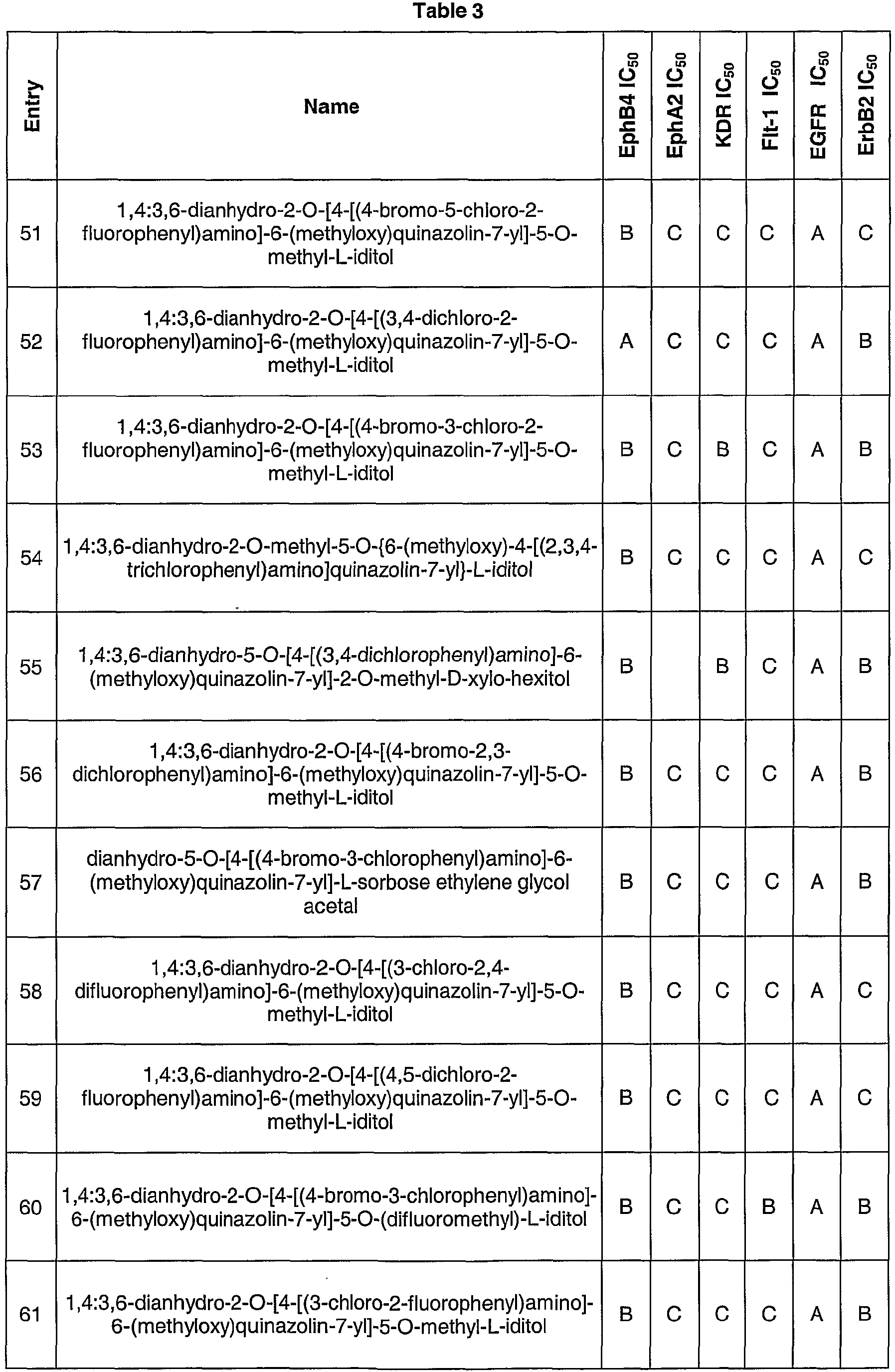

Table 5 Entry Name EphB4 IC50 1 N-(3,4-dichlorophenyl)-6-(methyloxy)-7-[(tetrahydro-2H-pyran-2-ylmethyl)oxy]quinazolin-4-amine A 2 N-(3,4-dichlorophenyl)-7-[({5-[(dimethylamino)methyl]-1,2,4-oxadiazol-3-yl}methyl)oxy]-6-(methyloxy)quinazolin-4-amine A 3 N-(3,4-dichlorophenyl)-7-[({3-[(dimethylamino)methyl]-1,2,4-oxadiazol-5-yl}methyl)oxy]-6-(methyloxy)quinazolin-4-amine B 4 N-(3,4-dichlorophenyl)-6-(methyloxy)-7-[({3-[(4-methylpiperazin-1-yl)methyl]-1,2,4-oxadiazol-5-yl}methyl)oxy]quinazolin-4-amine B 5 N-(3,4-dichlorophenyl)-6-(methyloxy)-7-{[(5-piperidin-4-yl-1,2,4-oxadiazol-3-yl)methyl]oxy}quinazolin-4-amine A 6 N-(3,4-dichlorophenyl)-6-(methyloxy)-7-({[5-(1-methylpiperidin-4-yl)-1,2,4-oxadiazol-3-yl]methyl}oxy)quinazolin-4-amine A 7 N-(3,4-dichlorophenyl)-6-(methyloxy)-7-({[3-(morpholin-4-ylmethyl)-1,2,4-oxadiazol-5-yl]methyl}oxy)quinazolin-4-amine B 8 N-(3,4-dichlorophenyl)-6-(methyloxy)-7-[(morpholin-2-ylmethyl)oxy]quinazolin-4-amine A 9 N-(3,4-dichlorophenyl)-6-(methyloxy)-7-{[(5-piperidin-2-yl-1,2,4-oxadiazol-3-yl)methyl]oxy}quinazolin-4-amine A 10 N-(3,4-dichlorophenyl)-7-[({2-[(dimethylamino)methyl]-1,3-thiazol-4-yl}methyl)oxy]-6-(methyloxy)quinazolin-4-amine B 11 N-(3,4-dichlorophenyl)-6-(methyloxy)-7-({[4-(phenylmethyl)morpholin-2-yl]methyl}oxy)quinazolin-4-amine B 12 1,1-dimethylethyl 2-({[4-[(3,4-dichlorophenyl)amino]-6-(methyloxy)quinazolin-7-yl]oxy}methyl)morpholine-4-carboxylate B 13 N-(3,4-dichlorophenyl)-6-(methyloxy)-7-({[2-(morpholin-4-ylmethyl)-1,3-thiazol-4-yl]methyl}oxy)quinazolin-4-amine B 14 N-(3,4-dichlorophenyl)-6-(methyloxy)-7-[({2-[(4-methylpiperazin-1-yl)methyl]-1,3-thiazol-4-yl}methyl)oxy]quinazolin-4-amine A 15 N-(3,4-dichlorophenyl)-7-{[(4-methylmorpholin-2-yl)methyl]oxy}-6-(methyloxy)quinazolin-4-amine A 16 N-(3,4-dichlorophenyl)-6-(methyloxy)-7-[(1,4-oxazepan-2-ylmethyl)oxy]quinazolin-4-amine A 17 N-(3,4-dichlorophenyl)-6-(methyloxy)-7-{[(5-piperidin-3-yl-1,2,4-oxadiazol-3-yl)methyl]oxy}quinazolin-4-amine A 18 N-(3,4-dichlorophenyl)-6-(methyloxy)-7-({[5-(1-methylpiperidin-2-yl)-1,2,4-oxadiazol-3-yl]methyl}oxy)quinazolin-4-amine A 19 N-(3,4-dichlorophenyl)-7-{[(4-methyl-1,4-oxazepan-2-yl)methyl]oxy}-6-(methyloxy)quinazolin-4-amine A 20 N-(3,4-dichlorophenyl)-6-(methyloxy)-7-({[5-(1-methylpiperidin-3-yl)-1,2,4-oxadiazol-3-yl]methyl}oxy)quinazolin-4-amine A 


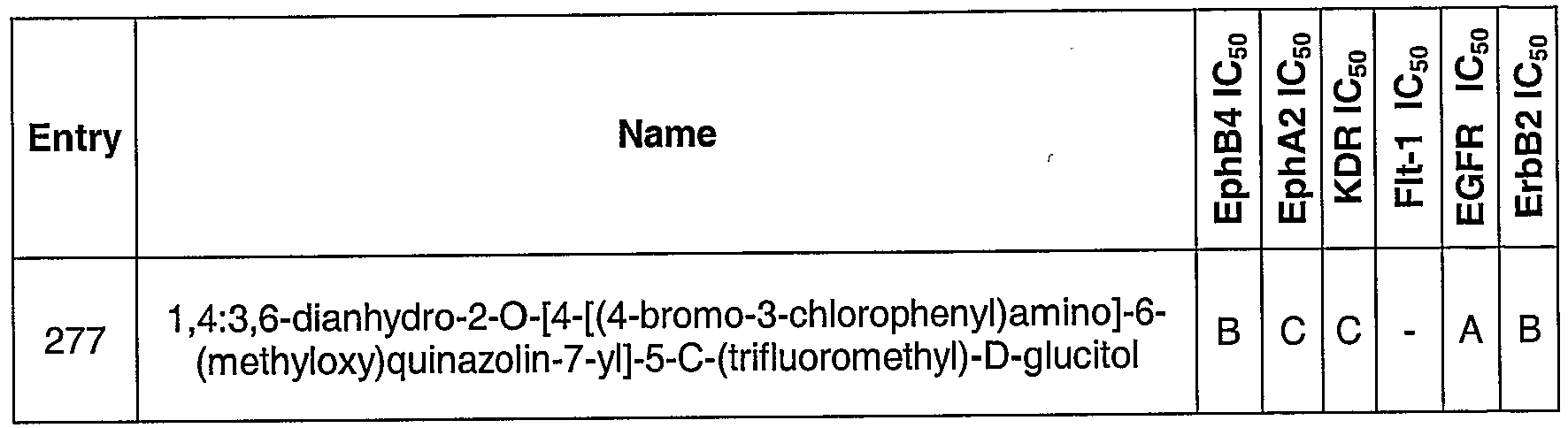
Claims (75)
- A compound for modulating tyrosine kinase activity of Formula I,
 or a single geometric isomer, stereoisomer, racemate, enantiomer, or diastereomer, thereof and optionally as a pharmaceutically acceptable salt or hydrate thereof, wherein,R1 is C1-C3 alkyl optionally substituted with between one and three R50 substituents;R2 is selected from halogen, trihalomethyl, -CN, -NH2, -NO2, -OR3, -N(R3)R4, -S(O)0-2R4, -SO2N(R3)R4, -CO2R3, -C(=O)N(R3)R4, -N(R3)SO2R4, -N(R3)C(=O)R3, -N(R3)CO2R4, -C(=O)R3, C1-C6 alkyl, C1-C6 alkenyl, and C1-C6 alkynyl;R3 is -H or R4;R4 is selected from C1-C6 alkyl, aryl, unsubstituted aryl C1-C6 alkyl, heterocyclyl, and heterocyclyl C1-C6 alkyl; orR3 and R4, when taken together with a common nitrogen to which they are attached, form a five- to seven-membered heterocyclyl optionally containing at least one additional heteroatom selected from N, O, S, and P;q is 0 to 5;Z is selected from -O-, -S(O)0-2-, and -NR5-;R5 is -H or C1-C6 alkyl;R50 is -H, halo, trihalomethyl, -OR3, -N(R3)R4, -S(O)0-2R4, -SO2N(R3)R4, -CO2R3, -C(=O)N(R3)R4, -C(=NR25)N(R3)R4, -C(=NR25)R4, -N(R3)SO2R4, -N(R3)C(O)R3, -NCO2R3, -C(=O)R3, alkoxy, C1-C6 alkyl, aryl, unsubstituted aryl C1-C6 alkyl, heterocyclyl, and heterocyclyl C1-C6 alkyl; ortwo of R50, when taken together on the same carbon are oxo; ortwo of R50, when taken together with a common carbon to which they are attached, form a three- to seven-membered spirocyclyl optionally containing at least one additional heteroatom selected from N, O, S, and P;R25 is selected from -H, -CN, -NO2, -OR3, -S(O)0-2R4, -CO2R3, C1-C6 alkyl, C1-C6 alkenyl, and C1-C6 alkynyl;M1-M2-M3-M4- together are according to formula II:
 wherein X1, X2, and optionally X3, represent the atoms of a saturated bridged ring system, said saturated bridged ring system containing up to three annular heteroatoms represented by any of X1, X2, and X3; wherein,each X1 is independently selected from -C(R6)R7-, -O-, -S(O)0-2-, and -NR8-;each X2 is independently a bridgehead methine optionally substituted with R6, or a bridgehead nitrogen;each X3 is independently selected from -C(R6)R7-, -O-, -S(O)0-2-, and -NR8-;provided, for X1, X2, and X3, there are no nitrogen-nitrogen annular bonds nor geminal di-nitrogen substitutions;E is selected from -NR9-, -O-, and absent;Y is either:a C1-3 alkylene linker, between the oxygen at the 7-position of the quinazoline ring system of I and either E, or when E is absent, any ring atom of the saturated bridged ring system except X2, when X2 is a bridgehead nitrogen; provided there are at least two carbon atoms between the oxygen at the 7-position of the quinazoline ring system of I and either E, or when E is absent, any heteroatom represented by X1, X2 or X3; orY is absent, when Y is absent, E is also absent; said saturated bridged ring system is directly attached to the oxygen at the 7-position of the quinazoline ring system of I via a carbon atom of said saturated bridged ring system;m and p are each independently from one to four;n is from zero to two, when n is zero, then there is a direct single bond between the two bridgehead X2's;R6 and R7 are each independently selected from -H, halogen, trihalomethyl, -CN, -NH2, -NO2, -OR3, -N(R3)R4, -S(O)0-2R4, -SO2N(R3)R4, -CO2R3, -C(O)N(R3)R4, -N(R3)SO2R4, -N(R3)C(O)R3, -NCO2R3, -C(O)R3, C1-C6 alkyl, aryl, unsubstituted aryl C1-C6 alkyl, heterocyclyl, and heterocyclyl C1-C6 alkyl; orR6 and R7, when taken together are oxo; orR6 and R7, when taken together with a common carbon to which they are attached, form a three- to seven-membered spirocyclyl optionally containing at least one additional heteroatom selected from N, O, S, and P; andR8 is selected from R3, -SO2N(R3)R4, -CO2R3, -C(O)N(R3)R4, -SO2R4, and -C(O)R3;R9 is -H or C1-C6 alkyl;with the proviso that when Y is a C1-3 alkylene linker, E is absent, Z is -NH- or -N(CH3)-, R1 is a C1-3 alkyl, R2 is halogen, n = 0, and the atoms X1 of one bridge of the saturated bridged ring system, when combined with both bridgehead atoms, X2, of the saturated bridged ring system, represent:either a pyrrolidine ring or a piperidine ring, and any atom, X1 or X2, of either of said pyrrolidine ring or said piperidine ring is attached to Y; then the other bridge of said saturated bridged ring system cannot be any one of -OC(O)CH2-, -CH2OC(O)-, -OC(O)CH2CH2-, -CH2OC(O)CH2-,
-CH2CH2OC(O)-, -OC(O)CH2NH-, -OC(O)CH2N(C1-4alkyl)-, and -OC(O)CH2O-;either a piperazine ring or a 4-(C1-4 alkyl)-piperazine ring, and any atom, X1 or X2, of either of said piperazine ring or said 4-(C1-4 alkyl)-piperazine ring is attached to Y; then the other bridge of said saturated bridged ring system, when attached via the 2- and the 3-position of either of said piperazine ring or said 4-(C1-4 alkyl)-piperazine ring, cannot be -CH2OC(O)CH2-, -CH2CH2OC(O)-, or either of the two aforementioned bridges substituted by one or two C1-2alkyl groups;a piperazine ring, and any atom, X1 or X2, of said piperazine ring is attached to Y, then the other bridge of said saturated bridged ring system, when attached via the 3- position of said piperazine ring via its left-hand end as depicted above and to the 4-position of said piperazine ring, cannot be -C(O)OCH2CH2-, -CH2OC(O)CH2-, or either of the two aforementioned bridges substituted by one or two C1-2 alkyl groups; anda 2-oxomorpholine ring, said 2-oxomorpholine ring attached to Y via its 4-position; then the other bridge of said saturated bridged ring system, only when attached via the 5- and the 6-position of said 2-oxomorpholine ring, cannot be one of -(CH2)g-, -CH2WCH2-, -CH2WCH2CH2-, and -CH2CH2WCH2-, wherein W is -O-, -S(O)0-2-, -NH-, or -N(C1-4 alkyl)- and wherein g is 2, 3, or 4. - The compound according to claim 1, wherein Z is -NR5-.
- The Compound of Claim 2 selected from
N-(3,4-dichlorophenyl)-6-(methyloxy)-7-{[(8aR)-tetrahydro-1H-[1,3]thiazolo[4,3-c][1,4]oxazin-6-ylmethyl]oxy}quinazolin-4-amine; N-(3,4-dichlorophenyl)-6-(methyloxy)-7-[(tetrahydro-1H-[1,3]thiazolo[4,3-c][1,4]oxazin-3-ylmethyl)oxy] quinazolin-4-amine N-(3,4-dichloro-2-fluorophenyl)-6-(methyloxy)-7-[(octahydro-2H-quinolizin-3-ylmethyl)oxy]quinazolin-4-amine; 2-amino-1,4:3,6-dianhydro-5-O-[4-[(4-bromo-3-chlorophenyl)amino]-6-(methyloxy)quinazolin-7-yl]-2-deoxy-D-iditol; and 2-amino-1,4:3,6-dianhydro-5-O-[4-[(4-bromo-3-chlorophenyl)amino]-6-(methyloxy)quinazolin-7-yl]-2-deoxy-L-iditol. - The compound according to claim 2, wherein R2 is selected from halogen, trihalomethyl, -CN, -NO2, -OR3, and C1-C6 alkyl.
- The compound according to claim 4, wherein R1 is an unsubstituted C1-3 alkyl.
- The compound according to claim 5, wherein the saturated bridged ring system has a geometry selected from the group consisting of [4.4.0], [4.3.0], [4.2.0], [4.1.0], [3.3.0], [3.2.0], [3.1.0], [3.3.3], [3.3.2], [3.3.1], [3.2.2], [3.2.1], [2.2.2], and [2.2.1].
- The compound according to claim 6, wherein Y is selected from -CH2CH2-, -CH2-, and absent.
- The compound according to claim 7, wherein q is 1 to 3.
- The compound according to claim 8, wherein R5 is -H.
- The compound according to claim 9, wherein R1 is methyl.
- The compound according to claim 10, wherein the saturated bridged ring system has a geometry selected from the group consisting of [4.4.0], [4.3.0], [4.2.0], [4.1.0], [3.3.0], [3.2.0], and [3.1.0].
- The compound according to claim 11, wherein said saturated bridged ring system contains one or two annular nitrogens, said one or two annular nitrogens are selected from -NR8-, when X1, and a bridgehead nitrogen, when X2.
- The compound according to claim 12, wherein E is absent.
- The compound according to claim 13, wherein said saturated bridged ring system is according to formula III;

- The compound according to claim 14, wherein Y is -CH2-.
- The compound according to claim 15, wherein A is selected from -NR8-, wherein R8 is selected from -H, C1-C6 alkyl, -CO2R3, -C(O)N(R3)R4, -SO2R4, and -C(O)R3; -O-; and absent.
- The Compound of Claim 16 selected from
N-(4-bromo-2,3-dichlorophenyl)-7-{[(3R,9aS)-hexahydro-1H-[1,4]oxazino[3,4-c][1,4]oxazin-3-ylmethyl]oxy}-6-(methyloxy)quinazolin-4-amine; N-(4,5-dichloro-2-fluorophenyl)-7-{[(3R,9aS)-hexahydro-1H-[1,4]oxazino[3,4-c][1,4]oxazin-3-ylmethyl]oxy}-6-(methyloxy)quinazolin-4-amine; N-(4-bromo-5-chloro-2-fluorophenyl)-7-{[(3R,9aS)-hexahydro-1H-[1,4]oxazino[3,4-c][1,4]oxazin-3-ylmethyl]oxy}-6-(methyloxy)quinazolin-4-amine; N-(3-chloro-2,4-difluorophenyl)-7-{[(3R,9aS)-hexahydro-1H-[1,4]oxazino[3,4-c][1,4]oxazin-3-ylmethyl]oxy}-6-(methyloxy)quinazolin-4-amine; N-(3,4-dichloro-2-fluorophenyl)-7-{[(3S,9aS)-hexahydro-1H-[1,4]oxazino[3,4-c][1,4]oxazin-3-ylmethyl]oxy}-6-(methyloxy)quinazolin-4-amine; N-(4-bromo-3-chloro-2-fluorophenyl)-7-{[(3S,9aS)-hexahydro-1H-[1,4]oxazino[3,4-c][1,4]oxazin-3-ylmethyl]oxy}-6-(methyloxy)quinazolin-4-amine; N-(3-chloro-2,4-difluorophenyl)-7-{[(3S,9aS)-hexahydro-1H-[1,4]oxazino[3,4-c][1,4]oxazin-3-ylmethyl]oxy}-6-(methyloxy)quinazolin-4-amine; N-(3,4-dichlorophenyl)-7-[(hexahydro-1H-[1,4]oxazino[3,4-c][1,4]oxazin-3-ylmethyl)oxy]-6-(methyloxy)quinazolin-4-amine; N-(4,5-dichloro-2-fluorophenyl)-7-{[(3S,9aS)-hexahydro-1H-[1,4]oxazino[3,4-c][1,4]oxazin-3-ylmethyl]oxy}-6-(methyloxy)quinazolin-4-amine; N-(4-bromo-2,3-dichlorophenyl)-7-{[(3S,9aS)-hexahydro-1H-[1,4]oxazino[3,4-c][1,4]oxazin-3-ylmethyl]oxy}-6-(methyloxy)quinazolin-4-amine; N-(4-bromo-5-chloro-2-fluorophenyl)-7-{[(3S,9aS)-hexahydro-1H-[1,4]oxazino[3,4-c][1,4]oxazin-3-ylmethyl]oxy}-6-(methyloxy)quinazolin-4-amine; N-(3,4-dichloro-2-fluorophenyl)-7-{[(3R,9aS)-hexahydro-1H-[1,4]oxazino[3,4-c][1,4]oxazin-3-ylmethyl]oxy}-6-(methyloxy)quinazolin-4-amine; and N-(4-bromo-3-chloro-2-fluorophenyl)-7-{[(3R,9aS)-hexahydro-1H-[1,4]oxazino[3,4-c][1,4]oxazin-3-ylmethyl]oxy}-6-(methyloxy)quinazolin-4-amine. - The Compound of Claim 16 selected from
N-(3,4-dichlorophenyl)-7-{[(3R,8aR)-hexahydro-1H-pyrrolo[2,1-c][1,4]oxazin-3-ylmethyl]oxy}-6-(methyloxy)quinazolin-4-amine; N-(4-bromo-5-chloro-2-fluorophenyl)-7-{[(3S,8aS)-hexahydro-1H-pyrrolo[2,1-c][1,4]oxazin-3-ylmethyl]oxy}-6-(methyloxy)quinazolin-4-amine; N(3,4-dichlorophenyl)-7-{[(3S,8aR)-hexahydro-1H-pyrrolo[2,1-c][1,4]oxazin-3-ylmethyl]oxy}-6-(methyloxy)quinazolin-4-amine; N-(3,4-dichlorophenyl)-7-{[(3S,8aS)-hexahydro-1H-pyrrolo[2,1-c][1,4]oxazin-3-ylmethyl]oxy}-6-(methyloxy)quinazolin-4-amine; N-(3,4-dichlorophenyl)-7-{[(3R,8aS)-hexahydro-1H-pyrrolo[2,1-c][1,4]oxazin-3-ylmethyl]oxy}-6-(methyloxy)quinazolin-4-amine; N-(3,4-dichloro-2-fluorophenyl)-7-{[(3S,8aS)-hexahydro-1H-pyrrolo[2,1-c][1,4]oxazin-3-ylmethyl]oxy}-6-(methyloxy)quinazolin-4-amine; N-(4-bromo-3-chloro-2-fluorophenyl)-7-{[(3S,8aS)-hexahydro-1H-pyrrolo[2,1-c][1,4]oxazin-3-ylmethyl]oxy}-6-(methyloxy)quinazolin-4-amine; N-(3-chloro-2,4-difluorophenyl)-7-{[(3S,8aS)-hexahydro-1H-pyrrolo[2,1-c][1,4]oxazin-3-ylmethyl]oxy}-6-(methyloxy)quinazolin-4-amine; N-(4-bromo-2,3-dichlorophenyl)-7-{[(3S,8aS)-hexahydro-1H-pyrrolo[2,1-c][1,4]oxazin-3-ylmethyl]oxy}-6-(methyloxy)quinazolin-4-amine; and N-(4,5-dichloro-2-fluorophenyl)-7-{[(3S,8aS)-hexahydro-1H-pyrrolo[2,1-c][1,4]oxazin-3-ylmethyl]oxy}-6-(methyloxy)quinazolin-4-amine. - The compound according to claim 16, wherein


- The compound according to claim 19, wherein R2a is F, R2b is Cl, and R2c is either Cl or Br.
- The compound according to claim 12, wherein said saturated bridged ring system is according to either formula V or formula VI;
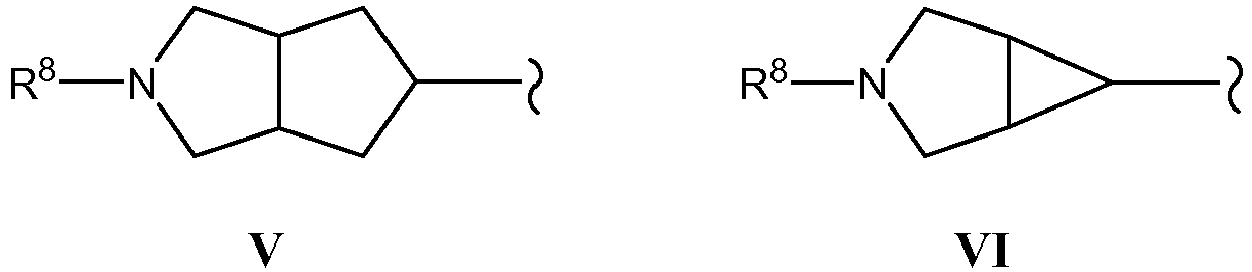
- The compound according to claim 21, wherein Y is either -CH2- or absent.
- The Compound of Claim 22 selected from
N-(3,4-dichloro-2-fluorophenyl)-7-({[(3aR,6aS)-2-(1-methylethyl)octahydrocyclopenta[c]pyrrol-5-yl]methyl}oxy)-6-(methyloxy)quinazolin-4-amine; N-(4-bromo-3-chloro-2-fluorophenyl)-7-({[(3aR,6aS)-2-(1-methylethyl)octahydrocyclopenta[c]pyrrol-5-yl]methyl}oxy)-6-(methyloxy)quinazolin-4-amine; 7-({[(3aR,6aS)-2-acetyloctahydrocyclopenta[c]pyrrol-5-yl]methyl}oxy)-N-(4-bromo-3-chloro-2-fluorophenyl)-6-(methyloxy)quinazolin-4-amine; N-(4-bromo-3-chloro-2-fluorophenyl)-6-(methyloxy)-7-{[(3aR,6aS)-octahydrocyclopenta[c]pyrrol-5-ylmethyl]oxy} quinazolin-4-amine; N-(4-bromo-3-chloro-2-fluorophenyl)-6-(methyloxy)-7-({[(3aR,6aS)-2-(methylsulfonyl)octahydrocyclopenta[c]pyrrol-5-yl]methyl}oxy)quinazolin-4-amine; N-(3,4-dichloro-2-fluorophenyl)-7-({[(3aR,6aS)-2-ethyloctahydrocyclopenta[c]pyrrol-5-yl]methyl}oxy)-6-(methyloxy)quinazolin-4-amine; N-(3,4-dichloro-2-fluorophenyl)-6-(methyloxy)-7-({[(3aR,6aS)-2-(2-methylpropyl)octahydrocyclopenta[c]pyrrol-5-yl]methyl}oxy)quinazolin-4-amine; N(3,4-dichloro-2-fluorophenyl)-7-({[(3aR,6aS)-2-methyloctahydrocyclopenta[c]pyrrol-5-yl]methyl}oxy)-6-(methyloxy)quinazolin-4-amine; N-(4-bromo-3-chloro-2-fluorophenyl)-7-({[(3aR,6aS)-2-methyloctahydrocyclopenta[c]pyrrol-5-yl]methyl}oxy)-6-(methyloxy)quinazolin-4-amine; N-(3-chloro-2,4-difluorophenyl)-7-( { [(3aR,6aS)-2-methyloctahydrocyclopenta[c]pyrrol-5-yl]methyl}oxy)-6-(methyloxy)quinazolin-4-amine; N(4,5-dichloro-2-fluorophenyl)-7-({[(3aR,6aS)-2-methyloctahydrocyclopenta[c]pyrrol-5-yl]methyl}oxy)-6-(methyloxy)quinazolin-4-amine; N-(4-bromo-5-chloro-2-fluorophenyl)-7-({[(3aR,6aS)-2-methyloctahydrocyclopenta[c]pyrrol-5-yl]methyl}oxy)-6-(methyloxy)quinazolin-4-amine; N-(4-bromo-2,3-dichlorophenyl)-7-({[(3aR,6aS)-2-methyloctahydrocyclopenta[c]pyrrol-5-yl]methyl}oxy)-6-(methyloxy)quinazolin-4-amine; N-(3,4-dichlorophenyl)-7-({[(3aR,6aS)-2-methyloctahydrocyclopenta[c]pyrrol-5-yl]methyl}oxy)-6-(methyloxy)quinazolin-4-amine; N-(4-bromo-3-chloro-2-fluorophenyl)-7-({[(3aR,6aS)-2-ethyloctahydrocyclopenta[c]pyrrol-5-yl]methyl}oxy)-6-(methyloxy)quinazolin-4-amine; and N-(4-bromo-3-chloro-2-fluorophenyl)-6-(methyloxy)-7-({[(3aR,6aS)-2-(2-methylpropyl)octahydrocyclopenta[c]pyrrol-5-yl]methyl}oxy)quinazolin-4-amine. - The Compound of Claim 22 selected from
N-(3-chloro-2,4-difluorophenyl)-7-({[(3aR,5s,6aS)-2-methyloctahydrocyclopenta[c]pyrrol-5-yl]methyl}oxy)-6-(methyloxy)quinazolin-4-amine; N-(3-chloro-2,4-difluorophenyl)-7-({[(3aR,5r,6aS)-2-methyloctahydrocyclopenta-[c]pyrrol-5-yl]methyl}oxy)-6-(methyloxy)quinazolin-4-amine; N-(4-bromo-2,3-dichlorophenyl)-7-({[(3aR,5s,6aS)-2-methyloctahydrocyclopenta[c]pyrrol-5-yl]methyl}oxy)-6-(methyloxy)quinazolin-4-amine; N-(4-bromo-2,3-dichlorophenyl)-7-({[(3aR,5r,6aS)-2-methyloctahydrocyclo-penta[c]pyrrol-5-yl]methyl}oxy)-6-(methyloxy)quinazolin-4-amine; N-(3,4-dichlorophenyl)-7-({[(3aR,5s,6aS)-2-methyloctahydrocyclopenta[c]pyrrol-5-yl]methyl}oxy)-6-(methyloxy)quinazolin-4-amine; N-(3,4-dichlorophenyl)-7-({[(3aR,5r,6aS)-2-methyloctahydrocyclopenta[c]pyrrol-5-yl]methyl}oxy)-6-(methyloxy)quinazolin-4-amine; and N-(3,4-dichlorophenyl)-7-{[(3aR,6aS)-2-methyloctahydrocyclopenta[c]pyrrol-5-yl]oxy}-6-(methyloxy)quinazolin-4-amine. - The compound according to claim 22, wherein


- The compound according to claim 25, wherein R2a is F, R2b is Cl, and R2c is either Cl or Br.
- The Compound of Claim 26 selected from
N-(3,4-dichloro-2-fluorophenyl)-7-({[(3aR,5r,6aS)-2-(1-methylethyl)octahydrocyclopenta[c]pyrrol-5-yl]methyl}oxy)-6-(methyloxy)quinazolin-4-amine; N-(4-bromo-3-chloro-2-fluorophenyl)-7-({[(3aR,5r,6aS)-2-(1-methylethyl)octahydrocyclopenta[c]pyrrol-5-yl]methyl}oxy)-6-(methyloxy)quinazolin-4-amine; 7-({[(3aR,5r,6aS)-2-acetyloctahydrocyclopenta[c]pyrrol-5-yl]methyl}oxy)-N-(4-bromo-3-chloro-2-fluorophenyl)-6-(methyloxy)quinazolin-4-amine; N-(4-bromo-3-chloro-2-fluorophenyl)-6-(methyloxy)-7-{[(3aR,5r,6aS)-octahydrocyclopenta[c]pyrrol-5-ylmethyl]oxy} quinazolin-4-amine; ethyl (3aR,6aS)-5-({[4-[(4-bromo-3-chloro-2-fluorophenyl)amino]-6-(methyloxy)quinazolin-7-yl]oxy}methyl)hexahydrocyclopenta[c]pyrrole-2(1H)-carboxylate; ethyl (3aR,5r,6aS)-5-[({4-[(4-bromo-3-chloro-2-fluorophenyl)amino]-6-(methyloxy)quinazolin-7-yl}oxy)methyl]hexahydrocyclopenta[c]pyrrole-2(1H)-carboxylate; N-(4-bromo-3-chloro-2-fluorophenyl)-6-(methyloxy)-7-({[(3aR,5r,6aS)-2-(methylsulfonyl)octahydrocyclopenta[c]pyrrol-5-yl]methyl}oxy)quinazolin-4-amine; N-(3,4-dichloro-2-fluorophenyl)-7-({[(3aR,5r,6aS)-2-ethyloctahydrocyclopenta[c]pyrrol-5-yl]methyl}oxy)-6-(methyloxy)quinazolin-4-amine; N-(3,4-dichloro-2-fluorophenyl)-6-(methyloxy)-7-({[(3aR,5r,6aS)-2-(2-methylpropyl)octahydrocyclopenta[c]pyrrol-5-yl]methyl}oxy)quinazolin-4-amine; N-(3,4-dichloro-2-fluorophenyl)-7-({[(3aR,5s,6aS)-2-methyloctahydrocyclopenta[c]pyrrol-5-yl]methyl}oxy)-6-(methyloxy)quinazolin-4-amine; N-(3,4-dichloro-2-fluorophenyl)-7-({[(3aR,5r,6aS)-2-methyloctahydrocyclopenta[c]pyrrol-5-yl]methyl}oxy)-6-(methyloxy)quinazolin-4-amine; N-(4-bromo-3-chloro-2-fluorophenyl)-7-({[(3aR,5s,6aS)-2-methyloctahydrocyclopenta[c]pyrrol-5-yl]methyl}oxy)-6-(methyloxy)quinazolin-4-amine; N-(4-bromo-3-chloro-2-fluorophenyl)-7-({[(3aR,5r,6aS)-2-methyloctahydrocyclo-penta[c]pyrrol-5-yl]methyl}oxy)-6-(methyloxy)quinazolin-4-amine; N-(4,5-dichloro-2-fluorophenyl)-7-({[(3aR,5s,6aS)-2-methyloctahydrocyclopenta[c]pyrrol-5-yl]methyl}oxy)-6-(methyloxy)quinazolin-4-amine; N-(4,5-dichloro-2-fluorophenyl)-7-({[(3aR,5r,6aS)-2-methyloctahydrocyclo-penta[c]pyrrol-5-yl]methyl}oxy)-6-(methyloxy)quinazolin-4-amine; N-(4-bromo-5-chloro-2-fluorophenyl)-7-({[(3aR,5s,6aS)-2-methyloctahydrocyclopenta[c]pyrrol-5-yl]methyl}oxy)-6-(methyloxy)quinazolin-4-amine; N-(4-bromo-5-chloro-2-fluorophenyl)-7-({[(3aR,5r,6aR)-2-methyloctahydrocyclo-penta[c]pyrrol-5-yl]methyl}oxy)-6-(methyloxy)quinazolin-4-amine; N-(4-bromo-3-chloro-2-fluorophenyl)-7-({[(3aR,5r,6aS)-2-ethyloctahydrocyclopenta[c]pyrrol-5-yl]methyl}oxy)-6-(methyloxy)quinazolin-4-amine; N-(4-bromo-3-chloro-2-fluorophenyl)-6-(methyloxy)-7-({[(3aR,5r,6aS)-2-(2-methylpropyl)octahydrocyclopenta[c]pyrrol-5-yl]methyl}oxy)quinazolin-4-amine; 1,1-dimethylethyl(3aR,6aS)-5-({[4-[(4-bromo-3-chloro-2-fluorophenyl)amino]-6-(methyl-oxy)quinazolin-7-yl]oxy}methyl)hexahydrocyclopenta[c]pyrrole-2(1H)-carboxylate; N-(3,4-dichloro-2-fluorophenyl)-6-(methyloxy)-7-{[[(3aR,5r,6aS)-octahydrocyclopenta[c]pyrrol-5-yl]methyl]oxy}quinazolin-4-amine; and 1,1-dimethylethyl(3aR,6aS)-5-({[4-[(3,4-dichloro-2-fluorophenyl)amino]-6-(methyloxy)quinazolin-7-yl]oxy}methyl) hexahydrocyclopenta-[c]pyrrole-2(1H)-carboxylate. - The Compound of Claim 27 selected from 1,1-dimethylethyl (3aR,6aS)-5-({[4-[(4-bromo-3-chloro-2-fluorophenyl)amino]-6-(methyl-oxy)quinazolin-7-yl]oxy}methyl)hexahydrocyclopenta[c]pyrrole-2(1H)-carboxylate; N-(4-bromo-3-chloro-2-fluorophenyl)-6-(methyloxy)-7-{[(3aR,5r,6aS)-octahydrocyclopenta[c]pyrrol-5-ylmethyl]oxy}quinazolin-4-amine; N-(3,4-dichloro-2-fluorophenyl)-6-(methyloxy)-7-{[[(3aR,5r,6aS)-octahydrocyclopenta[c]pyrrol-5-yl]methyl]oxy}quinazolin-4-amine; and 1,1-dimethylethyl (3aR,6aS)-5-({[4-[(3,4-dichloro-2-fluorophenyl)amino]-6-(methyloxy)quinazolin-7-yl]oxy}methyl) hexahydrocyclopenta-[c]pyrrole-2(1H)-carboxylate.
- The compound according to claim 26, wherein R8 is methyl or ethyl.
- The Compound of Claim 29 selected from N-(3,4-dichloro-2-fluorophenyl)-7-({[(3aR,5r,6aS)-2-methyloctahydrocyclopenta[c]pyrrol-5-yl]methyl}oxy)-6-(methyloxy)quinazolin-4-amine; N-(4-bromo-3-chloro-2-fluorophenyl)-7-({[(3aR,5r,6aS)-2-methyloctahydrocyclo-penta[c]pyrrol-5-yl]methyl}oxy)-6-(methyloxy)quinazolin-4-amine; and N-(3,4-dichloro-2-fluorophenyl)-7-({[(3aR,5s,6aS)-2-methyloctahydrocyclopenta[c]pyrrol-5-yl]methyl}oxy)-6-(methyloxy)quinazolin-4-amine.
- The Compound of Claim 30 named N-(3,4-dichloro-2- fluorophenyl)-7-({[(3aR,5r,6aS)-2-methyloctahydrocyclopenta[c]pyrrol-5-yl]methyl}oxy)-6-(methyloxy)quinazolin-4-amine.
- The Compound of Claim 1 selected from N-(3,4-dichloro-2-fluorophenyl)-7-({[(3aR,5r,6aS)-2-methyloctahydrocyclopenta[c]pyrrol-5-yl]methyl}oxy)-6-(methyloxy)quinazolin-4-amine; N-(4-bromo-3-chloro-2-fluorophenyl)-7-({[(3aR,5r,6aS)-2-methyloctahydrocyclo-penta[c]pyrrol-5-yl]methyl}oxy)-6-(methyloxy)quinazolin-4-amine; and N-(3,4-dichloro-2-fluorophenyl)-7-({[(3aR,5s,6aS)-2-methyloctahydrocyclopenta[c]pyrrol-5-yl]methyl}oxy)-6-(methyloxy)quinazolin-4-amine; and optionally as a pharmaceutically acceptable salt or hydrate thereof.
- The Compound of Claim 32 named N-(3,4-dichloro-2-fluorophenyl)-7-({[(3aR,5r,6aS)-2-methyloctahydrocyclopenta[c]pyrrol-5-yl]methyl}oxy)-6-(methyloxy)quinazolin-4-amine optionally as a pharmaceutically acceptable salt or hydrate thereof.
- The compound according to claim 13, wherein said saturated bridged ring system is according to formula VII;

- The compound according to claim 34, wherein R3 is selected from -H and C1-C6 alkyl.
- The compound according to claim 35 wherein A is either -C(R6)R7- or absent.
- The compound according to claim 36, wherein A is either -CH2- or absent.
- The compound according to claim 37, wherein Y is -CH2-.
- The compound according to claim 38, wherein q is 3.
- The compound according to claim 39, wherein


- The compound according to claim 40, wherein R2a is F, R2b is Cl, and R2c is either Cl or Br.
- The Compound of Claim 41 selected from
(3S,9aS)-3-({[4-[(3,4-dichloro-2-fluorophenyl)amino]-6-(methyloxy)quinazolin-7-yl]oxy}methyl)hexahydro-2H-pyrido[1,2-a]pyrazin-1(6H)-one; (3S,9aR)-3-({[4-[(3,4-dichloro-2-fluorophenyl)amino]-6-(methyloxy)quinazolin-7-yl]oxy}methyl)hexahydro-2H-pyrido[1,2-a]pyrazin-1(6H)-one; (3S,8aS)-3-({[4-[(3,4-dichloro-2-fluorophenyl)amino]-6-(methyloxy)quinazolin-7-yl]oxy}methyl)hexahydropyrrolo[1,2-a]pyrazin-1(2H)-one; (3S,8aR)-3-({[4-[(3,4-dichloro-2-fluorophenyl)amino]-6-(methyloxy)quinazolin-7-yl]oxy}methyl)hexahydropyrrolo[1,2-a]pyrazin-1(2H)-one; (3S,8aS)-3-({[4-[(4-bromo-3-chloro-2-fluorophenyl)amino]-6-(methyloxy)quinazolin-7-yl]oxy}methyl)hexahydropyrrolo[1,2-a]pyrazin-1(2H)-one; and (3S,8aS)-3-( {[4-[(3,4-dichloro-2-fluorophenyl)amino]-6-(methyloxy)quinazolin-7-yl]oxy}methyl)-2-methylhexahydropyrrolo[1,2-a]pyrazin-1(2H)-one. - The compound according to claim 10, wherein the saturated bridged ring system has a geometry selected from the group consisting of [3.3.1], [3.2.1], and [2.2.1].
- The compound according to claim 43, wherein said saturated bridged ring system contains one or two annular nitrogens, said one or two annular nitrogens are selected from -NR8-, when X1, and a bridgehead nitrogen, when X2.
- The compound according to claim 44, wherein said saturated bridged ring system is according to formula VIII or formula IX;

- The Compound of Claim 45 selected from
N-(3,4-dichlorophenyl)-7-({2-[(8-methyl-8-azabicyclo[3.2.1]oct-3-yl)amino] ethyl}oxy)-6-(methyloxy)quinazolin-4-amine; N-(3,4-dichlorophenyl)-7-[(2-{[(3-endo)-8-methyl-8-azabicyclo[3.2.1]oct-3-yl]amino} ethyl)oxy]-6-(methyloxy)quinazolin-4-amine; N-(3,4-dichlorophenyl)-7-{[2-(8-methyl-8-azabicyclo[3.2.1]oct-3-yl)ethyl]oxy}-6-(methylo xy)quinazolin-4-amine; N-(3,4-dichlorophenyl)-7-({2-[(3-endo)-8-methyl-8-azabicyclo[3.2.1]oct-3-yl]ethyl}oxy)-6-(methyloxy)quinazolin-4-amine; N-(3,4-dichlorophenyl)-7-{[(8-methyl-8-azabicyclo[3.2.1]oct-3-yl)methyl]oxy}-6-(methylo xy)quinazolin-4-amine; N-(3,4-dichlorophenyl)-7-({[(3-endo)-8-methyl-8-azabicyclo[3.2.1]oct-3-yl]methyl}oxy)-6-(methyloxy)quinazolin-4-amine; N-(3,4-dichlorophenyl)-7-{[8-methyl-8-azabicyclo[3.2.1]oct-3-yl]oxy}-6-(methylo xy)quinazolin-4-amine; N-(3,4-dichlorophenyl)-7-{[(3-exo)-8-methyl-8-azabicyclo[3.2.1]oct-3-yl]oxy}-6-(methylo xy)quinazolin-4-amine; 7-{[(3-endo)-8-azabicyclo[3.2.1]oct-3-ylmethyl]oxy}-N-(3,4-dichlorophenyl)-6-(methylo xy)quinazolin-4-amine; 1,1-dimethylethyl(3-endo)-3-(2-{[4-[(3,4-dichlorophenyl)amino]-6-(methyloxy)quinazolin-7-yl]oxy}ethyl)-8-azabicyclo[3.2.1]octane-8-carboxylate; and 7-({2-[(3-endo)-8-azabicyclo[3.2.1]oct-3-yl]ethyl}oxy)-N-(3,4-dichlorophenyl)-6-(methyloxy) quinazolin-4-amine. - The compound according to claim 45, wherein Y is -CH2CH2-; and E is either absent or -N(R9)-.
- The compound according to claim 47, wherein q is 3.
- The compound according to claim 48, wherein
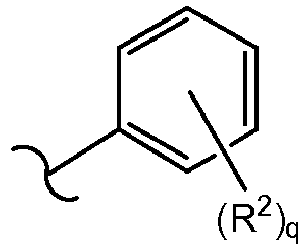

- The compound according to claim 49, wherein R2a is F, R2b is Cl, and R2c is either Cl or Br.
- The compound according to claim 50, wherein R8 is methyl or ethyl.
- A compound of Formula Ia,
 or a single geometric isomer, stereoisomer, racemate, enantiomer, or diastereomer, thereof and optionally as a pharmaceutically acceptable salt or hydrate thereof, wherein,q is 1 to 3;R2 is selected from halogen, trihalomethyl, -CN, -NO2, -OR3, and C1-C6 alkyl;Y is either:-CH2CH2- or -CH2- provided there are at least two carbon atoms between the oxygen at the 7-position of the quinazoline ring system of Ia and E, when E is -NR9- or -O-; orY is absent, and when Y is absent, E is also absent;E is selected from -NR9-, -O-, and absent;R3 is -H or R4;R4 is selected from C1-C6 alkyl, aryl, unsubstituted aryl C1-C6 alkyl, heterocyclyl, and heterocyclyl C1-C6 alkyl; orR3 and R4, when taken together with a common nitrogen to which they are attached, form a five- to seven-membered heterocyclyl optionally containing at least one additional heteroatom selected from N, O, S, and P;R9 is -H or C1-C6 alkyl;R10 is selected from -H, alkyl, and -OR13; and R11 and R12 are each independently selected from -H, -CF3, -F, -N(R3)R4, -N(C=O)R3, -N(R3)SO2R3, -S(O)0-2R13, and -OR13; orR10 is selected from -H, and -OR13; and R11 and R12, when taken together, are oxo, exo-alkenyl, or when taken together with the carbon to which they are attached, form a three- to seven-membered spirocyclyl; andR13 is selected from -H, -C(=O)R4, C1-C6 alkynyl, unsubstituted aryl C1-C6 alkynyl, heterocyclyl C1-C6 alkynyl, C1-C6 alkenyl, unsubstituted aryl C1-C6 alkenyl, heterocyclyl C1-C6 alkenyl, C1-C6 alkyl, unsubstituted aryl C1-C6 alkyl, aryl, heterocyclyl C1-C6 alkyl, and heterocyclyl; ortwo R13's, when taken together, form 1) a corresponding spirocyclic ketal from R11, R12 and the carbon to which they are attached, when R11 and R12 are both -OR13, or 2) a corresponding cyclic ketal from R10 and one of R11 and R12, and the corresponding carbons to which they are attached, when R10 is -OR13, and at least one of R11 and R12 is also -OR13.
 - The compound according to claim 52, wherein Y is either -CH2- or absent.
- The compound according to claim 53, wherein one of R11 and R12 is -OR13, wherein R13 is selected from -H, -C(O)R4, and C1-C6 alkyl; and R10 and the other of R11 and R12 are both -H.
- The compound according to claim 53, wherein one of R11 and R12 is -F; and R10 and the other of R11 and R12 are both -H.
- The compound according to claim 53, wherein q is 2 or 3.
- The compound according to claim 56, wherein each R2 is independently selected from -F, -Cl, -Br, -CF3, -CH3, and -OR25; wherein R25 is either methyl or aryl, each optionally substituted with one to three halogens.
- The Compound of Claim 52 selected from
1,4:3,6-dianhydro-5-({[4-[(4-bromo-5-chloro-2-fluorophenyl)amino]-6-(methyloxy)quinazolin-7-yl]oxy}methyl)-5-deoxy-2-O-methyl-D-xylo-hexitol; 1,4:3,6-dianhydro-5-deoxy-5-({[4-[(3,4-dichlorophenyl)amino]-6-(methyloxy)quinazolin-7-yl]oxy}methyl)-2-O-methyl-D-glucitol; 1,4:3,6-dianhydro-5-deoxy-5-({[4-[(3,4-dichloro-2-fluorophenyl)amino]-6-(methyloxy)quinazolin-7-yl]oxy}methyl)-2-O-methyl-D-xylo-hexitol; 1,4:3,6-dianhydro-5-({[4-[(4-bromo-3-chloro-2-fluorophenyl)amino]-6-(methyloxy)quinazolin-7-yl]oxy}methyl)-5-deoxy-2-O-methyl-D-xylo-hexitol; 1,4:3,6-dianhydro-5-({[4-[(3-chloro-2,4-difluorophenyl)amino]-6-(methyloxy)quinazolin-7-yl]oxy}methyl)-5-deoxy-2-O-methyl-D-xylo-hexitol; 1,4:3,6-dianhydro-5-({[4-[(4-bromo-2,3-dichlorophenyl)amino]-6-(methyloxy)quinazolin-7-yl]oxy}methyl)-5-deoxy-2-O-methyl-D-glucitol; 1,4:3,6-dianhydro-2-deoxy-2-({[4-[(3,4-dichlorophenyl)amino]-6-(methyloxy)quinazolin-7-yl]oxy}methyl)-5-O-methyl-D-threo-hexitol; 1,4:3,6-dianhydro-5-deoxy-5-({[4-[(4,5-dichloro-2-fluorophenyl)amino]-6-(methyloxy)quinazolin-7-yl]oxy}methyl)-2-O-methyl-D-glucitol; 1,4:3,6-dianhydro-2-O-[4-[(4-bromo-5-chloro-2-fluorophenyl)amino]-6-(methyloxy)quinazolin-7-yl]-5-O-methyl-L-iditol; 1,4:3,6-dianhydro-2-O-[4-[(3,4-dichloro-2-fluorophenyl)amino]-6-(methyloxy)quinazolin-7-yl]-5-O-methyl-L-iditol; 1,4:3,6-dianhydro-2-O-[4-[(4-bromo-3-chloro-2-fluorophenyl)amino]-6-(methyloxy)quinazolin-7-yl]-5-O-methyl-L-iditol; 1,4:3,6-dianhydro-2-O-methyl-5-O-{6-(methyloxy)-4-[(2,3,4-trichlorophenyl)amino]quinazolin-7-yl}-L-iditol; 1,4:3,6-dianhydro-5-O-[4-[(3,4-dichlorophenyl)amino]-6-(methyloxy)quinazolin-7-yl]-2-O-methyl-D-xylo-hexitol; 1,4:3,6-dianhydro-2-O-[4-[(4-bromo-2,3-dichlorophenyl)amino]-6-(methyloxy)quinazolin-7-yl]-5-O-methyl-L-iditol; 1,4:3,6-dianhydro-5-O-[4-[(4-bromo-3-chlorophenyl)amino]-6-(methyloxy)-quinazolin-7-yl]-L-sorbose ethylene glycol acetal; 1,4:3,6-dianhydro-2-O-[4-[(3-chloro-2,4-difluorophenyl)amino]-6-(methyloxy)quinazolin-7-yl]-5-O-methyl-L-iditol; 1,4:3,6-dianhydro-2-O-[4-[(4,5-dichloro-2-fluorophenyl)amino]-6-(methyloxy)quinazolin-7-yl]-5-O-methyl-L-iditol; 1,4:3,6-dianhydro-2-O-[4-[(3-chloro-2-fluorophenyl)amino]-6-(methyloxy)quinazolin-7-yl]-5-O-methyl-L-iditol; 1,4:3,6-dianhydro-2-O-[4-[(3,4-dichlorophenyl)amino]-6-(methyloxy)quinazolin-7-yl]-5-O-methyl-L-iditol; 1,4:3,6-dianhydro-2-O-[4-[(4-bromo-3-chlorophenyl)amino]-6-(methyloxy)quinazolin-7-yl]-5-O-methyl-L-iditol; 1,4:3,6-dianhydro-2-O-[4-[(4-bromo-3-chlorophenyl)amino]-6-(methyloxy)quinazolin-7-yl]-5-O-ethyl-L-iditol; 1,4:3,6-dianhydro-2-O-[4-[(3-bromo-2-methylphenyl)amino]-6-(methyloxy)quinazolin-7-yl]-5-O-methyl-L-iditol; 1,4:3,6-dianhydro-2-O-[4-[(3-chloro-2-methylphenyl)amino]-6-(methyloxy)quinazolin-7-yl]-5-O-methyl-L-iditol; 1,4:3,6-dianhydro-2-O-[4-[(4-bromo-3-chlorophenyl)amino]-6-(methyloxy)quinazolin-7-yl]-5-deoxy-D-xylo-hexitol; 1,4:3,6-dianhydro-2-O-[4-[(4-bromo-3-chlorophenyl)amino]-6-(methyloxy)quinazolin-7-yl]-5-O-methyl-D-glucitol; methyl 3,6-anhydro-5-O-[4-[(4-bromo-3-chlorophenyl)amino]-6-(methyloxy)quinazolin-7-yl]-2-O-methyl-alpha-L-idofuranoside; 1,4:3,6-dianhydro-2-O-[4-[(4-bromo-3-chlorophenyl)amino]-6-(methyloxy)quinazolin-7-yl]-5-deoxy-5-methylidene-D-xylo-hexitol; methyl 3,6-anhydro-5-O-[4-[(4-bromo-3-chlorophenyl)amino]-6-(methyloxy)quinazolin-7-yl]-2-O-methyl-beta-L-idofuranoside; 1,4:3,6-dianhydro-2-deoxy-2-fluoro-5-O-{6-(methyloxy)-4-[(2,3,4-trifluorophenyl)amino]quinazolin-7-yl}-D-iditol; 1,4:3,6-dianhydro-5-O-[4-[(2-chloro-4-fluorophenyl)amino]-6-(methyloxy)quinazolin-7-yl]-2-deoxy-2-fluoro-D-iditol; 1,4:3,6-dianhydro-5-O-[4-[(2-bromo-4-fluorophenyl)amino]-6-(methyloxy)quinazolin-7-yl]-2-deoxy-2-fluoro-D-iditol; 1,4:3,6-dianhydro-2-deoxy-5-O-[4-[(2,6-difluorophenyl)amino]-6-(methyloxy)quinazolin-7-yl]-2-fluoro-D-iditol; 1,4:3,6-dianhydro-5-O-[4-[(3-chloro-2-fluorophenyl)amino]-6-(methyloxy)quinazolin-7-yl]-2-deoxy-2-fluoro-D-iditol; 1,4:3,6-dianhydro-2-deoxy-2-fluoro-5-O-[4-{[4-fluoro-3-(trifluoromethyl)phenyl]amino} -6-(methyloxy)quinazolin-7-yl] -D-iditol; 1,4:3,6-dianhydro-2-deoxy-5-O-[4-[(2,4-difluorophenyl)amino]-6-(methyloxy)quinazolin-7-yl]-2-fluoro-D-iditol; 1,4:3,6-dianhydro-2-deoxy-5-O-[4-[(2,5-difluorophenyl)amino]-6-(methyloxy)quinazolin-7-yl]-2-fluoro-D-iditol; 1,4:3,6-dianhydro-2-deoxy-5-O-[4-[(2,3-difluorophenyl)amino]-6-(methyloxy)quinazolin-7-yl]-2-fluoro-D-iditol; 1,4:3,6-dianhydro-5-O-[4-[(5-chloro-2-fluorophenyl)amino]-6-(methyloxy)quinazolin-7-yl]-2-deoxy-2-fluoro-D-iditol; 1,4:3,6-dianhydro-2-deoxy-5-O-[4-[(3,5-difluorophenyl)amino]-6-(methyloxy)quinazolin-7-yl]-2-fluoro-D-iditol; 1,4:3,6-dianhydro-5-O-[4-[(3-chloro-4-fluorophenyl)amino]-6-(methyloxy)quinazolin-7-yl]-2-deoxy-2-fluoro-D-iditol; 1,4:3,6-dianhydro-5-O-[4-[(4-bromo-2-chlorophenyl)amino]-6-(methyloxy)quinazolin-7-yl]-2-deoxy-2-fluoro-D-iditol; 1,4:3,6-dianhydro-2-deoxy-5-O-[4-[(3,4-dichloro-2-fluorophenyl)amino]-6-(methyloxy)quinazolin-7-yl]-2-fluoro-D-iditol; 1,4:3,6-dianhydro-5-O-[4-[(4-bromo-5-chloro-2-fluorophenyl)amino]-6-(methyloxy)quinazolin-7-yl]-2-deoxy-2-fluoro-D-iditol; 1,4:3,6-dianhydro-2-deoxy-2-fluoro-5-O-{6-(methyloxy)-4-[(2,4,5-trifluorophenyl)amino]quinazolin-7-yl}-D-iditol; 1,4:3,6-dianhydro-2-deoxy-2-fluoro-5-O-{6-(methyloxy)-4-[(2,4,6-trifluorophenyl)amino]quinazolin-7-yl}-D-iditol; 1,4:3,6-dianhydro-5-O-[4-[(4-bromo-3-chloro-2-fluorophenyl)amino]-6-(methyloxy)quinazolin-7-yl]-2-deoxy-2-fluoro-D-iditol; 1,4:3,6-dianhydro-5-O-[4-[(4-bromo-2,3-dichlorophenyl)amino]-6-(methyloxy)quinazolin-7-yl]-2-deoxy-2-fluoro-D-iditol; 1,4:3,6-dianhydro-5-O-[4-[(4-bromo-3-chloro-5-fluorophenyl)amino]-6-(methyloxy)quinazolin-7-yl]-2-deoxy-2-fluoro-D-iditol; 1,4:3,6-dianhydro-2-deoxy-5-O-[4-[(4,5-dichloro-2-fluorophenyl)amino]-6-(methyloxy)quinazolin-7-yl]-2-fluoro-D-iditol; 1,4:3,6-dianhydro-2-deoxy-2-fluoro-5-O-{6-(methyloxy)-4-[(2,3,4-trichlorophenyl)amino]quinazolin-7-yl}-D-iditol; 1,4:3,6-dianhydro-2-deoxy-2-fluoro-5-O-{6-(methyloxy)-4-[(3,4,5-trichlorophenyl)amino]quinazolin-7-yl}-D-iditol; 1,4:3,6-dianhydro-5-O-[4-[(4-bromo-2-fluorophenyl)amino]-6-(methyloxy)quinazolin-7-yl]-2-deoxy-2-fluoro-D-iditol; 1,4:3,6-dianhydro-5-O-[4-[(4-chloro-2-fluorophenyl)amino]-6-(methyloxy)quinazolin-7-yl]-2-deoxy-2-fluoro-D-iditol; 1,4:3,6-dianhydro-5-O-[4-[(3-chloro-2-methylphenyl)amino]-6-(methyloxy)quinazolin-7-yl]-2-deoxy-2-fluoro-D-iditol; 1,4:3,6-dianhydro-2-deoxy-5-O-[4-[(3,4-difluorophenyl)amino]-6-(methyloxy)quinazolin-7-yl]-2-fluoro-D-iditol; 1,4:3,6-dianhydro-5-O-[4-[(2-chlorophenyl)amino]-6-(methyloxy)quinazolin-7-yl]-2-deoxy-2-fluoro-D-iditol; 1,4:3,6-dianhydro-2-deoxy-2-fluoro-5-O-[4-[(2-fluorophenyl)amino]-6-(methyloxy)quinazolin-7-yl]-D-iditol; 1,4:3,6-dianhydro-5-O-[4-[(3-chlorophenyl)amino]-6-(methyloxy)quinazolin-7-yl]-2-deoxy-2-fluoro-D-iditol; 1,4:3,6-dianhydro-2-deoxy-2-fluoro-5-O-[4-[(4-fluorophenyl)amino]-6-(methyloxy)quinazolin-7-yl]-D-iditol; 1,4:3,6-dianhydro-5-O-[4-[(4-chlorophenyl)amino]-6-(methyloxy)quinazolin-7-yl]-2-deoxy-2-fluoro-D-iditol; 1,4:3,6-dianhydro-2-deoxy-5-O-[4-[(2,4-dichlorophenyl)amino]-6-(methyloxy)quinazolin-7-yl]-2-fluoro-D-iditol; 1,4:3,6-dianhydro-2-deoxy-5-O-[4-[(2,5-dichlorophenyl)amino]-6-(methyloxy)quinazolin-7-yl]-2-fluoro-D-iditol; 1,4:3,6-dianhydro-2-deoxy-5-O-[4-[(3,4-dichlorophenyl)amino]-6-(methyloxy)quinazolin-7-yl]-2-fluoro-D-iditol; 1,4:3,6-dianhydro-5-O-[4-[(2-bromo-4,6-difluorophenyl)amino]-6-(methyloxy)quinazolin-7-yl]-2-deoxy-2-fluoro-D-iditol; 1,4:3,6-dianhydro-5-O-[4-{[4-chloro-3-(trifluoromethyl)phenyl]amino}-6-(methyloxy)quinazolin-7-yl]-2-deoxy-2-fluoro-D-iditol; 1,4:3,6-dianhydro-5-O-[4-{[2-chloro-5-(trifluoromethyl)phenyl]amino}-6-(methyloxy)quinazolin-7-yl]-2-deoxy-2-fluoro-D-iditol; 1,4:3,6-dianhydro-2-deoxy-2-fluoro-5-O-[4-{[2-fluoro-3-(trifluoromethyl)phenyl]amino} -6-(methyloxy)quinazolin-7-yl] -D-iditol; 1,4:3,6-dianhydro-5-O-[4-{[2-bromo-5-(trifluoromethyl)phenyl]amino}-6-(methyloxy)quinazolin-7-yl]-2-deoxy-2-fluoro-D-iditol; 1,4:3,6-dianhydro-5-O-[4-{[2-bromo-4-(trifluoromethyl)phenyl]amino}-6-(methyloxy)quinazolin-7-yl]-2-deoxy-2-fluoro-D-iditol; 1,4:3,6-dianhydro-2-deoxy-2-fluoro-5-O-[4-{ [4-fluoro-2-(trifluoromethyl)phenyl]amino} -6-(methyloxy)quinazolin-7-yl] -D-iditol; 1,4:3,6-dianhydro-5-O-[4-{[3-bromo-5-(trifluoromethyl)phenyl]amino}-6-(methyloxy)quinazolin-7-yl]-2-deoxy-2-fluoro-D-iditol; 1,4:3,6-dianhydro-5-O-[4-[(2-bromophenyl)amino]-6-(methyloxy)quinazolin-7-yl]-2-deoxy-2-fluoro-D-iditol; 1,4:3,6-dianhydro-5-O-[4-[(3-bromophenyl)amino]-6-(methyloxy)quinazolin-7-yl]-2-deoxy-2-fluoro-D-iditol; 1,4:3,6-dianhydro-5-O-[4-[(4-bromophenyl)amino]-6-(methyloxy)quinazolin-7-yl]-2-deoxy-2-fluoro-D-iditol; 1,4:3,6-dianhydro-5-O-[4-[(3-bromo-4-methylphenyl)amino]-6-(methyloxy)quinazolin-7-yl]-2-deoxy-2-fluoro-D-iditol; 1,4:3,6-dianhydro-5-O-[4-[(5-chloro-2-methylphenyl)amino]-6-(methyloxy)quinazolin-7-yl]-2-deoxy-2-fluoro-D-iditol; 1,4:3,6-dianhydro-2-deoxy-5-O-[4-[(3,5-dimethylphenyl)amino]-6-(methyloxy)quinazolin-7-yl]-2-fluoro-D-iditol; 1,4:3,6-dianhydro-5-O-[4-{[2,5-bis(methyloxy)phenyl]amino}-6-(methyloxy)quinazolin-7-yl]-2-deoxy-2-fluoro-D-iditol; 1,4:3,6-dianhydro-5-O-[4-{[5-chloro-2,4-bis(methyloxy)phenyl]amino}-6-(methyloxy)quinazolin-7-yl]-2-deoxy-2-fluoro-D-iditol; 1,4:3,6-dianhydro-5-O-[4-{[4-chloro-2,5-bis(methyloxy)phenyl]amino}-6-(methyloxy)quinazolin-7-yl]-2-deoxy-2-fluoro-D-iditol; 1,4:3,6-dianhydro-5-O-[4-[(3-chloro-2,4-difluorophenyl)amino]-6-(methyloxy)quinazolin-7-yl]-2-deoxy-2-fluoro-D-iditol; 1,4:3,6-dianhydro-2-O-[4-[(4-bromo-3-chlorophenyl)amino]-6-(methyloxy)quinazolin-7-yl]-L-glucitol; 1,4:3,6-dianhydro-2-O-[4-[(4-bromo-3-chlorophenyl)amino]-6-(methyloxy)quinazolin-7-yl]-5-S-methyl-5-thio-D-iditol; 1,4:3,6-dianhydro-5-O-[4-[(4-bromo-3-chlorophenyl)amino]-6-(methyloxy)quinazolin-7-yl] -2-deoxy-2-morpho lin-4-yl-D-iditol; 1,4:3,6-dianhydro-5-O-[4-[(4-bromo-3-chlorophenyl)amino]-6-(methyloxy)quinazolin-7-yl]-2-deoxy-2-pyrrolidin-1-yl-D-iditol; 2-O-acetyl-1,4:3,6-dianhydro-5-O-[4-[(4-bromo-3-chlorophenyl)amino]-6-(methyloxy)quinazolin-7-yl]-D-iditol; 1,4:3,6-dianhydro-2-O-[4-[(4-bromo-3-chlorophenyl)amino]-6-(methyloxy)quinazolin-7-yl]-D-iditol; 1,4:3,6-dianhydro-5-O-[4-[(4-bromo-3-chlorophenyl)amino]-6-(methyloxy)quinazolin-7-yl]-2-deoxy-2-(methylsulfonyl)-D-iditol; 1,4:3,6-dianhydro-5-O-[4-[(4-bromo-3-chlorophenyl)amino]-6-(methyloxy)quinazolin-7-yl]-2-deoxy-2-(dimethylamino)-D-iditol; 1,4:3,6-dianhydro-5-O-[4-[(4-bromo-3-chlorophenyl)amino]-6-(methyloxy)quinazolin-7-yl]-2-deoxy-2-(diethylamino)-D-iditol; 1,4:3,6-dianhydro-5-O-[4-[(4-bromo-3-chlorophenyl)amino]-6-(methyloxy)quinazolin-7-yl]-2-deoxy-2-piperidin-1-yl-D-iditol; 2-(acetylamino)-1,4:3,6-dianhydro-5-O-[4-[(4-bromo-3-chlorophenyl)amino]-6-(methyloxy)quinazolin-7-yl]-2-deoxy-D-iditol; 1,4:3,6-dianhydro-2-O-[4-[(4-bromo-3-chlorophenyl)amino]-6-(methyloxy)quinazolin-7-yl]-5-O-methyl-5-C-(trifluoromethyl)-L-glucitol; 1,4:3,6-dianhydro-5-O-[4-[(4-bromo-3-chlorophenyl)amino]-6-(methyloxy)quinazolin-7-yl]-2-deoxy-2-[(methylsulfonyl)amino]-D-iditol; 1,4:3,6-dianhydro-2-O-[4-[(4-bromo-3-chlorophenyl)amino]-6-(methyloxy)quinazolin-7-yl]-5-C-(trifluoromethyl)-D-glucitol; 1,4:3,6-Dianhydro-5-O-[4-[(3,4-dichlorophenyl)amino]-6-(methyloxy)quinazolin-7-yl]-2-O-methyl-D-glucitol; 1,4:3,6-dianhydro-5-O-{4-[(3-chloro-2-fluorophenyl)amino]-6-(methyloxy)quin-azolin-7-yl}-2-deoxy-2-fluoro-L-iditol; 1,4:3,6-dianhydro-2-O-[4-[(4-bromo-3-chlorophenyl)amino]-6-(methyloxy)quinazolin-7-yl] -D-glucitol; 1,4:3,6-dianhydro-2-O-[4-[(4-bromo-3-chlorophenyl)amino]-6-(methyloxy)quinazolin-7-yl]-5-S-methyl-5-thio-L-iditol; 1,4:3,6-dianhydro-5-O-[4-[(4-bromo-3-chlorophenyl)amino]-6-(methyloxy)quinazolin-7-yl] -2-deoxy-2-morpho lin-4-yl-L-idito l; 1,4:3,6-dianhydro-5-O-[4-[(4-bromo-3-chlorophenyl)amino]-6-(methyloxy)quinazolin-7-yl]-2-deoxy-2-pyrrolidin-1-yl-L-iditol; 2-O-acetyl-1,4:3,6-dianhydro-5-O-[4-[(4-bromo-3-chlorophenyl)amino]-6-(methyloxy)quinazolin-7-yl]-L-iditol; 1,4:3,6-dianhydro-2-O-[4-[(4-bromo-3-chlorophenyl)amino]-6-(methyloxy)quinazolin-7-yl]-L-iditol; 1,4:3,6-dianhydro-5-O-[4-[(4-bromo-3-chlorophenyl)amino]-6-(methyloxy)quinazolin-7-yl]-2-deoxy-2-(methylsulfonyl)-L-iditol; 1,4:3,6-dianhydro-5-O-[4-[(4-bromo-3-chlorophenyl)amino]-6-(methyloxy)quinazolin-7-yl]-2-deoxy-2-(dimethylamino)-L-iditol; 1,4:3,6-dianhydro-5-O-[4-[(4-bromo-3-chlorophenyl)amino]-6-(methyloxy)quinazolin-7-yl]-2-deoxy-2-(diethylamino)-L-iditol; 1,4:3,6-dianhydro-5-O-[4-[(4-bromo-3-chlorophenyl)amino]-6-(methyloxy)quinazolin-7-yl]-2-deoxy-2-piperidin-1-yl-L-iditol; 2-(acetylamino)-1,4:3,6-dianhydro-5-O-[4-[(4-bromo-3-chlorophenyl)amino]-6-(methylo xy)quinazolin-7-yl]-2-deoxy-L-iditol; 1,4:3,6-dianhydro-2-O-[4-[(4-bromo-3-chlorophenyl)amino]-6-(methyloxy)quinazolin-7-yl]-5-O-methyl-5-C-(trifluoromethyl)-D-glucitol; and 1,4:3,6-dianhydro-5-O-[4-[(4-bromo-3-chlorophenyl)amino]-6-(methyloxy)quinazolin-7-yl]-2-deoxy-2-[(methylsulfonyl)amino]-L-iditol. - The compound of Claim 58 selected from:
1,4:3,6-dianhydro-5-({[4-[(4-bromo-5-chloro-2-fluorophenyl)amino]-6-(methyloxy)quinazolin-7-yl]oxy}methyl)-5-deoxy-2-O-methyl-D-xylo-hexitol; 1,4:3,6-dianhydro-5-deoxy-5-({[4-[(3,4-dichlorophenyl)amino]-6-(methyloxy)quinazolin-7-yl]oxy}methyl)-2-O-methyl-D-glucitol; 1,4:3,6-dianhydro-5-deoxy-5-({[4-[(3,4-dichloro-2-fluorophenyl)amino]-6-(methyloxy)quinazolin-7-yl]oxy}methyl)-2-O-methyl-D-xylo-hexitol; 1,4:3,6-dianhydro-5-({[4-[(4-bromo-3-chloro-2-fluorophenyl)amino]-6-(methyloxy)quinazolin-7-yl]oxy}methyl)-5-deoxy-2-O-methyl-D-xylo-hexitol; 1,4:3,6-dianhydro-5-({[4-[(3-chloro-2,4-difluorophenyl)amino]-6-(methyloxy)quinazolin-7-yl]oxy}methyl)-5-deoxy-2-O-methyl-D-xylo-hexitol; 1,4:3,6-dianhydro-5-({[4-[(4-bromo-2,3-dichlorophenyl)amino]-6-(methyloxy)quinazolin-7-yl]oxy}methyl)-5-deoxy-2-O-methyl-D-glucitol; 1,4:3,6-dianhydro-2-deoxy-2-({[4-[(3,4-dichlorophenyl)amino]-6-(methyloxy)quinazolin-7-yl]oxy}methyl)-5-O-methyl-D-threo-hexitol; 1,4:3,6-dianhydro-5-deoxy-5-({[4-[(4,5-dichloro-2-fluorophenyl)amino]-6-(methyloxy)quinazolin-7-yl]oxy}methyl)-2-O-methyl-D-glucitol; 1,4:3,6-dianhydro-2-O-[4-[(4-bromo-5-chloro-2-fluorophenyl)amino]-6-(methyloxy)quinazolin-7-yl]-5-O-methyl-L-iditol; 1,4:3,6-dianhydro-2-O-[4-[(3,4-dichloro-2-fluorophenyl)amino]-6-(methyloxy)quinazolin-7-yl]-5-O-methyl-L-iditol; 1,4:3,6-dianhydro-2-O-[4-[(4-bromo-3-chloro-2-fluorophenyl)amino]-6-(methyloxy)quinazolin-7-yl]-5-O-methyl-L-iditol; 1,4:3,6-dianhydro-2-O-methyl-5-O-{6-(methyloxy)-4-[(2,3,4-trichlorophenyl)amino]quinazolin-7-yl}-L-iditol; 1,4:3,6-dianhydro-2-O-[4-[(4-bromo-2,3-dichlorophenyl)amino]-6-(methyloxy)quinazolin-7-yl]-5-O-methyl-L-iditol; 1,4:3,6-dianhydro-5-O-[4-[(4-bromo-3-chlorophenyl)amino]-6-(methyloxy)quinazolin-7-yl]-L-sorbose ethylene glycol acetal; 1,4:3,6-dianhydro-2-O-[4-[(3-chloro-2,4-difluorophenyl)amino]-6-(methyloxy)quinazolin-7-yl]-5-O-methyl-L-iditol; 1,4:3,6-dianhydro-2-O-[4-[(4,5-dichloro-2-fluorophenyl)amino]-6-(methyloxy)quinazolin-7-yl]-5-O-methyl-L-iditol; 1,4:3,6-dianhydro-2-O-[4-[(3-chloro-2-fluorophenyl)amino]-6-(methyloxy)quinazolin-7-yl]-5-O-methyl-L-iditol; 1,4:3,6-dianhydro-2-O-[4-[(3,4-dichlorophenyl)amino]-6-(methyloxy)quinazolin-7-yl]-5-O-methyl-L-iditol; 1,4:3,6-dianhydro-2-O-[4-[(4-bromo-3-chlorophenyl)amino]-6-(methyloxy)quinazolin-7-yl]-5-O-methyl-L-iditol; 1,4:3,6-dianhydro-2-O-[4-[(4-bromo-3-chlorophenyl)amino]-6-(methyloxy)quinazolin-7-yl]-5-O-ethyl-L-iditol; 1,4:3,6-dianhydro-2-O-[4-[(3-bromo-2-methylphenyl)amino]-6-(methyloxy)quinazolin-7-yl]-5-O-methyl-L-iditol; 1,4:3,6-dianhydro-2-O-[4-[(3-chloro-2-methylphenyl)amino]-6-(methyloxy)quinazolin-7-yl]-5-O-methyl-L-iditol; 1,4:3,6-dianhydro-2-O-[4-[(4-bromo-3-chlorophenyl)amino]-6-(methyloxy)quinazolin-7-yl]-5-deoxy-D-xylo-hexitol; 1,4:3,6-dianhydro-2-O-[4-[(4-bromo-3-chlorophenyl)amino]-6-(methyloxy)quinazolin-7-yl]-5-0-methyl-D-glucitol; methyl 3,6-anhydro-5-O-[4-[(4-bromo-3-chlorophenyl)amino]-6-(methyloxy)quinazolin-7-yl]-2-O-methyl-alpha-L-idofuranoside; 1,4:3,6-dianhydro-2-O-[4-[(4-bromo-3-chlorophenyl)amino]-6-(methyloxy)quinazolin-7-yl]-5-deoxy-5-methylidene-D-xylo-hexitol; methyl 3,6-anhydro-5-O-[4-[(4-bromo-3-chlorophenyl)amino]-6-(methyloxy)quinazolin-7-yl]-2-O-methyl-beta-L-idofuranoside; 1,4:3,6-dianhydro-2-O-[4-[(4-bromo-3-chlorophenyl)amino]-6-(methyloxy)quinazolin-7-yl]-5-C-(trifluoromethyl)-D-glucitol; 1,4:3,6-dianhydro-5-O-[4-[(3,4-dichlorophenyl)amino]-6-(methyloxy)quinazolin-7-yl]-2-O-methyl-D-glucitol; 1,4:3,6-dianhydro-5-O-{4-[(3-chloro-2-fluorophenyl)amino]-6-(methyloxy)quinazolin-7-yl}-2-deoxy-2-fluoro-L-iditol; 1,4:3,6-dianhydro-2-O-[4-[(4-bromo-3-chlorophenyl)amino]-6-(methyloxy)quinazolin-7-yl]-D-glucitol; 1,4:3,6-dianhydro-2-O-[4-[(4-bromo-3-chlorophenyl)amino]-6-(methyloxy)quinazolin-7-yl]-5-S-methyl-5-thio-L-iditol; 1,4:3,6-dianhydro-5-O-[4-[(4-bromo-3-chlorophenyl)amino]-6-(methyloxy)quinazolin-7-yl]-2-deoxy-2-morpholin-4-yl-L-iditol; 1,4:3,6-dianhydro-5-O-[4-[(4-bromo-3-chlorophenyl)amino]-6-(methyloxy)quinazolin-7-yl]-2-deoxy-2-pyrrolidin-1-yl-L-iditol; 2-O-acetyl-1,4:3,6-dianhydro-5-O-[4-[(4-bromo-3-chlorophenyl)amino]-6-(methyloxy)quinazolin-7-yl]-L-iditol; 1,4:3,6-dianhydro-2-O-[4-[(4-bromo-3-chlorophenyl)amino]-6-(methyloxy)quinazolin-7-yl]-L-iditol; 1,4:3,6-dianhydro-5-O-[4-[(4-bromo-3-chlorophenyl)amino]-6-(methyloxy)quinazolin-7-yl]-2-deoxy-2-(methylsulfonyl)-L-iditol; 1,4:3,6-dianhydro-5-O-[4-[(4-bromo-3-chlorophenyl)amino]-6-(methyloxy)quinazolin-7-yl]-2-deoxy-2-(dimethylamino)-L-iditol; 1,4:3,6-dianhydro-5-O-[4-[(4-bromo-3-chlorophenyl)amino]-6-(methyloxy)quinazolin-7-yl]-2-deoxy-2-(diethylamino)-L-iditol; 1,4:3,6-dianhydro-5-O-[4-[(4-bromo-3-chlorophenyl)amino]-6-(methyloxy)quinazolin-7-yl]-2-deoxy-2-piperidin-1-yl-L-iditol; 2-(acetylamino)-1,4:3,6-dianhydro-5-O-[4-[(4-bromo-3-chlorophenyl)amino]-6-(methylo xy)quinazolin-7-yl] -2-deoxy-L-iditol; 1,4:3,6-dianhydro-2-O-[4-[(4-bromo-3-chlorophenyl)amino]-6-(methyloxy)quinazolin-7-yl]-5-O-methyl-5-C-(trifluoromethyl)-D-glucitol; and 1,4:3,6-dianhydro-5-O-[4-[(4-bromo-3-chlorophenyl)amino]-6-(methyloxy)quinazolin-7-yl]-2-deoxy-2-[(methylsulfonyl)amino]-L-iditol. - A Compound selected from
1,4:3,6-dianhydro-2-O-[4-[(4-bromo-3-chlorophenyl)amino]-6-(methyloxy)quinazolin-7-yl]-5-O-(difluoromethyl)-L-iditol; 1,4:3,6-dianhydro-5-O-[4-({4-[(4-chlorophenyl)oxy]-3,5-difluorophenyl}amino)-6-(methyloxy)quinazolin-7-yl]-2-deoxy-2-fluoro-D-iditol; N-(4-bromo-3-chlorophenyl)-7-{[(3a'S,4R,6'S,6a'R)-2,2-dimethyltetrahydrospiro[1,3-dioxolane-4,3'-furo[3,2-b]furan]-6'-yl]oxy}-6-(methylo xy)quinazolin-4-amine; 1,4:3,6-dianhydro-2-O-[4-[(4-bromo-3-chlorophenyl)amino]-6-(methyloxy)quinazolin-7-yl]-5-O-methyl-5-C-[(methyloxy)methyl]-L-glucitol; 1,4:3,6-dianhydro-2-O-[4-[(4-bromo-3-chlorophenyl)amino]-6-(methyloxy)quinazolin-7-yl]-5-O-methyl-5-C-[(methyloxy)methyl]-D-glucitol; 1,4:3,6-dianhydro-5-O-{4-[(4-bromo-3-chlorophenyl)amino]-6-(methyloxy)quinazolin-7-yl}-2-O-methyl-2-C-[(methyloxy)methyl]-D-iditol; 1,4:3,6-dianhydro-2-O-[4-[(4-bromo-3-chlorophenyl)amino]-6-(methyloxy)quinazolin-7-yl]-5-O-(methylsulfonyl)-L-glucitol; 1,4:3,6-dianhydro-2-O-[4-[(4-bromo-3-chlorophenyl)amino]-6-(methyloxy)quinazolin-7-yl]-5-O-(methylsulfonyl)-D-glucitol; 1,4:3,6-dianhydro-5-O-[4-[(4-bromo-3-chlorophenyl)amino]-6-(methyloxy)quinazolin-7-yl]-2-deoxy-2-(4-methylpiperazin-1-yl)-D-iditol; 1,4:3,6-dianhydro-5-O-[4-[(4-bromo-3-chlorophenyl)amino]-6-(methyloxy)quinazolin-7-yl]-2-deoxy-2-(4-methylpiperazin-1-yl)-L-iditol; 1,4:3,6-dianhydro-2-deoxy-5-O-[4-{[3,4-dichloro-2-(4-methylpiperazin-1-yl)phenyl]amino}-6-(methyloxy)quinazolin-7-yl]-2-fluoro-D-iditol; and 1,4:3,6-dianhydro-2-deoxy-5-O-[4-{[3,4-dichloro-2-(4-methylpiperazin-1-yl)phenyl]amino}-6-(methyloxy)quinazolin-7-yl]-2-fluoro-L-iditol. - A pharmaceutical composition comprising a compound of Formula I as defined in Claims 1 to 51 or Ia as defined in Claims 52 to 59 or a compound as defined in Claim 60 and a pharmaceutically acceptable carrier.
- The pharmaceutical composition comprising a compound of Formula I as defined in Claim 30 and a pharmaceutically acceptable carrier.
- The pharmaceutical composition comprising a compound of Formula I as defined in Claim 31 and a pharmaceutically acceptable carrier.
- The pharmaceutical composition comprising a compound of Formula I as defined in Claim 32 and a pharmaceutically acceptable carrier.
- The pharmaceutical composition comprising a compound of Formula I as defined in Claim 33 and a pharmaceutically acceptable carrier.
- A compound of Formula I as defined in Claims 1 to 51 or Ia as defined in Claims 52 to 59 or a compound as defined in Claim 60 optionally together with a pharmaceutically acceptable carrier for use in the treatment of cancer.
- The compound of Claim 66 in which the use in the treatment of cancer comprises the inhibition of one or more kinases selected from ephrin, KDR, Flt-1, EGFR, and ErbB2.
- The compound of Claim 66 where the cancer is selected from lung cancer, glioblastoma multiform, pancreatic cancer, cancer of the nervous system, cancer of the large bowel, multiple myeloma, undifferentiated small cell bronchogenic carcinoma, gastrointestinal cancer, esophageal cancer, malignant melanoma, neuroblastoma, osteosarcoma, ovarian cancer, endometrial cancer, cervical cancer, bladder cancer, urethral cancer, and prostate cancer.
- The compound of Claim 66 where the cancer is selected from lung cancer, glioblastoma multiform, pancreatic cancer, cancer of the nervous system, cancer of the large bowel, neuroblastoma, and gastrointestinal cancer.
- The compound of Claim 66 where the cancer is selected from ovarian cancer, cervical cancer, bladder cancer, esophageal cancer, and malignant melanoma, and prostate cancer.
- The compound of Claim 66 where the cancer is lung cancer.
- The compound of Claim 66 where the lung cancer is selected from squamous cell, undifferentiated large cell, adrenocarcinoma and alveolar (bronchiolar) carcinoma.
- The compound of Claim 66 where the cancer is glioblastoma multiform.
- The compound of Claim 68 where the gastrointestinal cancer is stomach cancer.
- A compound of Formula I as defined in Claims 1 to 51 or Ia as defined in Claims 52 to 59 or a compound as defined in Claim 60 optionally together with a pharmaceutically acceptable carrier for use in the treatment of a disease selected from cardiovascular ischemia, diabetic retinopathy, psoriasis and rheumatoid arthritis.
Priority Applications (2)
| Application Number | Priority Date | Filing Date | Title |
|---|---|---|---|
| EP10183590A EP2277867B1 (en) | 2002-07-15 | 2003-07-14 | Compounds, pharmaceutical compositions thereof and their use in treating cancer |
| EP10184164.1A EP2280003B1 (en) | 2002-07-15 | 2003-07-14 | Process for preparing receptor-type kinase modulators |
Applications Claiming Priority (5)
| Application Number | Priority Date | Filing Date | Title |
|---|---|---|---|
| US39626902P | 2002-07-15 | 2002-07-15 | |
| US396269P | 2002-07-15 | ||
| US44721203P | 2003-02-13 | 2003-02-13 | |
| US447212P | 2003-02-13 | ||
| PCT/US2003/021923 WO2004006846A2 (en) | 2002-07-15 | 2003-07-14 | Receptor-type kinase modulators and methods of use |
Related Child Applications (3)
| Application Number | Title | Priority Date | Filing Date |
|---|---|---|---|
| EP10183590A Division-Into EP2277867B1 (en) | 2002-07-15 | 2003-07-14 | Compounds, pharmaceutical compositions thereof and their use in treating cancer |
| EP10184164.1A Division EP2280003B1 (en) | 2002-07-15 | 2003-07-14 | Process for preparing receptor-type kinase modulators |
| EP10184164.1A Division-Into EP2280003B1 (en) | 2002-07-15 | 2003-07-14 | Process for preparing receptor-type kinase modulators |
Publications (3)
| Publication Number | Publication Date |
|---|---|
| EP1521747A2 EP1521747A2 (en) | 2005-04-13 |
| EP1521747A4 EP1521747A4 (en) | 2006-10-11 |
| EP1521747B1 true EP1521747B1 (en) | 2018-09-05 |
Family
ID=30118575
Family Applications (3)
| Application Number | Title | Priority Date | Filing Date |
|---|---|---|---|
| EP03764599.1A Expired - Lifetime EP1521747B1 (en) | 2002-07-15 | 2003-07-14 | Receptor-type kinase modulators and methods of use |
| EP10184164.1A Expired - Lifetime EP2280003B1 (en) | 2002-07-15 | 2003-07-14 | Process for preparing receptor-type kinase modulators |
| EP10183590A Expired - Lifetime EP2277867B1 (en) | 2002-07-15 | 2003-07-14 | Compounds, pharmaceutical compositions thereof and their use in treating cancer |
Family Applications After (2)
| Application Number | Title | Priority Date | Filing Date |
|---|---|---|---|
| EP10184164.1A Expired - Lifetime EP2280003B1 (en) | 2002-07-15 | 2003-07-14 | Process for preparing receptor-type kinase modulators |
| EP10183590A Expired - Lifetime EP2277867B1 (en) | 2002-07-15 | 2003-07-14 | Compounds, pharmaceutical compositions thereof and their use in treating cancer |
Country Status (7)
| Country | Link |
|---|---|
| US (5) | US7576074B2 (en) |
| EP (3) | EP1521747B1 (en) |
| JP (2) | JP4703183B2 (en) |
| AU (2) | AU2003249212C1 (en) |
| CA (1) | CA2491191C (en) |
| ES (1) | ES2400339T3 (en) |
| WO (1) | WO2004006846A2 (en) |
Families Citing this family (70)
| Publication number | Priority date | Publication date | Assignee | Title |
|---|---|---|---|---|
| EP1521747B1 (en) * | 2002-07-15 | 2018-09-05 | Symphony Evolution, Inc. | Receptor-type kinase modulators and methods of use |
| CA2527017A1 (en) * | 2003-05-27 | 2004-12-09 | Pfizer Products Inc. | Quinazolines and pyrido [3,4-d] pyrimidines as receptor tyrosine kinase inhibitors |
| JP2007505871A (en) * | 2003-09-16 | 2007-03-15 | アストラゼネカ アクチボラグ | Quinazoline derivatives |
| MXPA06002964A (en) | 2003-09-16 | 2006-06-14 | Astrazeneca Ab | Quinazoline derivatives as tyrosine kinase inhibitors. |
| JP4036885B2 (en) | 2003-09-19 | 2008-01-23 | アストラゼネカ アクチボラグ | Quinazoline derivatives |
| GB0322409D0 (en) * | 2003-09-25 | 2003-10-29 | Astrazeneca Ab | Quinazoline derivatives |
| ES2925655T3 (en) | 2003-09-26 | 2022-10-19 | Exelixis Inc | c-Met modulators and methods of use |
| WO2005048953A2 (en) * | 2003-11-13 | 2005-06-02 | Ambit Biosciences Corporation | Amide derivatives as kinase modulators |
| GB0326459D0 (en) | 2003-11-13 | 2003-12-17 | Astrazeneca Ab | Quinazoline derivatives |
| JP4988592B2 (en) * | 2004-12-22 | 2012-08-01 | バイエル ファーマ アクチエンゲゼルシャフト | Quinoline derivatives, their use, manufacture and pharmaceutical agents containing them |
| FR2889200B1 (en) | 2005-07-27 | 2008-01-04 | Inst Vaisseaux Et Du Sang Ass | CELLULAR / LIGAND MARKER SYSTEM, WHERE THE MARKER IS OF THE EPH TYPE, CELLULAR MATERIAL COMPRISING SAID SYSTEM, PROCESS FOR THE PREPARATION AND PROANGIOGENIC USE |
| ATE483972T1 (en) * | 2006-02-16 | 2010-10-15 | Ventana Med Syst Inc | REAGENTS AND METHODS FOR CANCER PROGNOSIS AND PATHOLOGICAL GRADING |
| WO2008020302A2 (en) * | 2006-08-17 | 2008-02-21 | Pfizer Products Inc. | Heteroaromatic quinoline-based compounds as phosphodiesterase (pde) inhibitors |
| TR201900306T4 (en) | 2006-12-14 | 2019-02-21 | Exelixis Inc | Methods of using Mek inhibitors. |
| US7638541B2 (en) * | 2006-12-28 | 2009-12-29 | Metabolex Inc. | 5-ethyl-2-{4-[4-(4-tetrazol-1-yl-phenoxymethyl)-thiazol-2-yl]-piperidin-1-yl}-pyrimidine |
| US8513266B2 (en) * | 2007-04-10 | 2013-08-20 | Exelixis, Inc. | Methods of treating cancer using pyridopyrimidinone inhibitors of PI3K alpha |
| DE102007024470A1 (en) | 2007-05-24 | 2008-11-27 | Bayer Schering Pharma Aktiengesellschaft | New sulfoximine-substituted quinoline and/or quinazoline derivatives are erythropoietin-producing hepatoma amplified sequence-receptor kinase inhibitors useful to prepare medicaments to e.g. treat endometriosis and stenosis |
| KR20100033419A (en) | 2007-07-19 | 2010-03-29 | 메타볼렉스, 인코포레이티드 | N-azacyclic substituted pyrrole, pyrazole, imidazole, triazole and tetrazole derivatives as agonists of the rup3 or gpr119 receptor for the treatment of diabetes and metabolic disorders |
| EP2072502A1 (en) | 2007-12-20 | 2009-06-24 | Bayer Schering Pharma Aktiengesellschaft | Sulfoximide substituted chinolin and chinazolin derivatives as kinase inhibitors |
| TWI429404B (en) * | 2008-03-03 | 2014-03-11 | Senomyx Inc | Isosorbide derivatives and their use as flavor modifiers, tastants, and taste enhancers |
| SG10201608813PA (en) | 2008-03-17 | 2016-12-29 | Ambit Biosciences Corp | Quinazoline derivatives as raf kinase modulators and methods of use thereof |
| BRPI0920261A8 (en) * | 2008-10-14 | 2016-01-19 | Xi Ning | COMPOUND, PHARMACEUTICAL COMPOSITION, USE OF COMPOUND, AND METHOD FOR INHIBITING OR MODULATE PROTEIN KINASE ACTIVITY IN A BIOLOGICAL SAMPLE |
| KR20250123237A (en) | 2009-01-16 | 2025-08-14 | 엑셀리시스, 인코포레이티드 | Malate salt of n-(4-{[6,7-bis(methyloxy)quinolin-4-yl]oxy}phenyl)-n'-(4-fluorophenyl)cyclopropane-1,1-dicarboxamide, and crystalline forms thereof for the treatment of cancer |
| CN102316875A (en) | 2009-02-13 | 2012-01-11 | 贝林格尔.英格海姆国际有限公司 | SGLT-2 inhibitors for the treatment of type 1 diabetes, type 2 diabetes, impaired glucose tolerance or hyperglycemia |
| MX2011009926A (en) * | 2009-03-21 | 2012-01-27 | Ning Xi | Amino ester derivatives, salts thereof and methods of use. |
| WO2010120889A1 (en) * | 2009-04-14 | 2010-10-21 | Ampla Pharmaceuticals Inc. | Treatment of metabolic syndrome with cyclic amides |
| FR2945534B1 (en) * | 2009-05-12 | 2012-11-16 | Sanofi Aventis | CYCLOPENTAL [c] PYRROLE-2-CARBOXYLATE DERIVATIVES, THEIR PREPARATION AND THEIR THERAPEUTIC USE |
| EP2272846A1 (en) * | 2009-06-23 | 2011-01-12 | Bayer CropScience AG | Thiazolylpiperidine derivatives as fungicide |
| UA108618C2 (en) | 2009-08-07 | 2015-05-25 | APPLICATION OF C-MET-MODULATORS IN COMBINATION WITH THEMOSOLOMID AND / OR RADIATION THERAPY FOR CANCER TREATMENT | |
| EP2467387B1 (en) | 2009-08-20 | 2015-01-07 | Karus Therapeutics Limited | Tricyclic heterocyclic compounds as phosphoinositide 3-kinase inhibitors. |
| US8410127B2 (en) | 2009-10-01 | 2013-04-02 | Metabolex, Inc. | Substituted tetrazol-1-yl-phenoxymethyl-thiazol-2-yl-piperidinyl-pyrimidine salts |
| WO2011075537A1 (en) * | 2009-12-15 | 2011-06-23 | Neurop, Inc. | Compounds for the treatment of neurologic disorders |
| WO2011149841A1 (en) | 2010-05-25 | 2011-12-01 | Janssen Pharmaceutica Nv | SUBSTITUTED THIAZOLIDINEDIONE INDAZOLES, INDOLES AND BENZOTRIAZOLES AS ESTROGEN-RELATED RECEPTOR-α MODULATORS |
| JP5931876B2 (en) * | 2010-08-26 | 2016-06-08 | シンフォニー エボリューション, インコーポレイテッド | Use of receptor-type kinase modulators to treat polycystic kidney disease |
| CN102382065B (en) * | 2010-08-30 | 2014-05-28 | 山东轩竹医药科技有限公司 | Aniline substituted quinazoline derivative |
| CN102382106A (en) * | 2010-08-30 | 2012-03-21 | 黄振华 | Aniline substituted quinazoline derivative |
| WO2012068096A2 (en) | 2010-11-15 | 2012-05-24 | Exelixis, Inc. | Benzoxazepines as inhibitors of pi3k/mtor and methods of their use and manufacture |
| SG10201913982WA (en) | 2011-03-04 | 2020-03-30 | Newgen Therapeutics Inc | Alkyne Substituted Quinazoline Compound And Methods Of Use |
| CN102918029B (en) * | 2011-05-17 | 2015-06-17 | 江苏康缘药业股份有限公司 | 4-phenylamino-6-butenamide-7-alkyloxy quinazoline derivatives, preparative method and use thereof |
| TWI577671B (en) | 2011-11-14 | 2017-04-11 | Sunshine Lake Pharma Co Ltd | Aminoquinazoline derivatives and salts thereof and methods of use thereof |
| EP2797628A4 (en) * | 2011-12-27 | 2015-07-29 | Kadmon Corp Llc | METHODS OF TREATING BREAST CANCER NOT RESPONDING TO TRASTUZUMAB |
| CN102643268B (en) * | 2011-12-30 | 2014-05-21 | 沈阳药科大学 | Quinolines and cinnolines and their applications |
| GB201204125D0 (en) | 2012-03-08 | 2012-04-25 | Karus Therapeutics Ltd | Compounds |
| CN103804308A (en) * | 2012-11-06 | 2014-05-21 | 天津药物研究院 | 7-substituted cyclohexyl quinazoline derivatives and preparing method and uses thereof |
| CA2812519A1 (en) | 2013-04-05 | 2014-10-05 | Boehringer Ingelheim International Gmbh | Pharmaceutical composition, methods for treating and uses thereof |
| HK1213818A1 (en) | 2013-04-05 | 2016-07-15 | 勃林格殷格翰国际有限公司 | Therapeutic uses of empagliflozin |
| ES2702174T3 (en) | 2013-04-05 | 2019-02-27 | Boehringer Ingelheim Int | Therapeutic uses of empagliflozin |
| US11813275B2 (en) | 2013-04-05 | 2023-11-14 | Boehringer Ingelheim International Gmbh | Pharmaceutical composition, methods for treating and uses thereof |
| DK2986304T3 (en) | 2013-04-18 | 2022-04-04 | Boehringer Ingelheim Int | PHARMACEUTICAL COMPOSITION, TREATMENT PROCEDURES AND USES. |
| WO2014210354A1 (en) * | 2013-06-28 | 2014-12-31 | Genentech, Inc. | Azaindazole compounds as inhibitors of t790m containing egfr mutants |
| GB201402431D0 (en) | 2014-02-12 | 2014-03-26 | Karus Therapeutics Ltd | Compounds |
| WO2015138420A1 (en) | 2014-03-10 | 2015-09-17 | Kadmon Corporation, Llc | Treatment of brain and central nervous system tumors |
| CN105330653A (en) * | 2014-08-11 | 2016-02-17 | 石药集团中奇制药技术(石家庄)有限公司 | Quinazoline derivatives |
| JP2018504441A (en) * | 2015-02-03 | 2018-02-15 | トリリウム セラピューティクス インコーポレイテッド | Novel fluorinated derivatives as EGFR inhibitors useful in the treatment of cancer |
| TWI704145B (en) | 2015-06-05 | 2020-09-11 | 芬蘭商奧利安公司 | New pharmaceutical compounds |
| GB201514754D0 (en) | 2015-08-19 | 2015-09-30 | Karus Therapeutics Ltd | Compounds |
| GB201514758D0 (en) | 2015-08-19 | 2015-09-30 | Karus Therapeutics Ltd | Formulation |
| GB201514751D0 (en) | 2015-08-19 | 2015-09-30 | Karus Therapeutics Ltd | Compounds |
| GB201514760D0 (en) | 2015-08-19 | 2015-09-30 | Karus Therapeutics Ltd | Compounds and method of use |
| US20170066778A1 (en) | 2015-09-04 | 2017-03-09 | Aunova Medchem LLC | Solubility for target compounds |
| CN105294495A (en) * | 2015-09-21 | 2016-02-03 | 苏州大学 | Preparation method of cyanomethyl ester |
| AU2016333987A1 (en) | 2015-10-05 | 2018-05-10 | Ny State Psychiatric Institute | Activators of autophagic flux and phospholipase D and clearance of protein aggregates including tau and treatment of proteinopathies |
| US10292983B2 (en) | 2016-08-03 | 2019-05-21 | Cymabay Therapeutics, Inc. | Oxymethylene aryl compounds for treating inflammatory gastrointestinal diseases or gastrointestinal conditions |
| CN109922813A (en) | 2016-11-10 | 2019-06-21 | 勃林格殷格翰国际有限公司 | Pharmaceutical composition, treatment method and application thereof |
| CN110191705A (en) | 2016-12-01 | 2019-08-30 | 亚尼塔公司 | Methods of treating cancer |
| KR20250037575A (en) * | 2017-10-20 | 2025-03-17 | 반더빌트유니버시티 | Antagonists of the muscarinic acetylcholine receptor m4 |
| CA3081324A1 (en) | 2017-10-31 | 2019-05-09 | Vanderbilt University | Antagonists of the muscarinic acetylcholine receptor m4 |
| IL276411B2 (en) | 2018-02-02 | 2024-04-01 | Univ Vanderbilt | Antagonists of the muscarinic acetylcholine receptor m4 |
| CN110229172B (en) * | 2018-03-06 | 2020-12-25 | 北京赛特明强医药科技有限公司 | Acyl-substituted oxazine quinazoline compound, preparation method and application thereof |
| CN112442045B (en) * | 2019-09-03 | 2022-02-18 | 北京赛特明强医药科技有限公司 | Acyl-substituted oxazine quinazoline compound, preparation method and application thereof |
Family Cites Families (118)
| Publication number | Priority date | Publication date | Assignee | Title |
|---|---|---|---|---|
| FR2705832B1 (en) | 1993-05-28 | 1995-06-30 | Commissariat Energie Atomique | Method for producing a sealing bead and mechanical strength between a substrate and a chip hybridized by balls on the substrate. |
| GB9510757D0 (en) | 1994-09-19 | 1995-07-19 | Wellcome Found | Therapeuticaly active compounds |
| TW321649B (en) | 1994-11-12 | 1997-12-01 | Zeneca Ltd | |
| GB9508538D0 (en) | 1995-04-27 | 1995-06-14 | Zeneca Ltd | Quinazoline derivatives |
| US5747498A (en) * | 1996-05-28 | 1998-05-05 | Pfizer Inc. | Alkynyl and azido-substituted 4-anilinoquinazolines |
| CA2222545A1 (en) | 1995-06-07 | 1996-12-19 | Sugen, Inc. | Quinazolines and pharmaceutical compositions |
| US5650415A (en) | 1995-06-07 | 1997-07-22 | Sugen, Inc. | Quinoline compounds |
| GB9514265D0 (en) | 1995-07-13 | 1995-09-13 | Wellcome Found | Hetrocyclic compounds |
| GB9523675D0 (en) | 1995-11-20 | 1996-01-24 | Celltech Therapeutics Ltd | Chemical compounds |
| GB9624482D0 (en) | 1995-12-18 | 1997-01-15 | Zeneca Phaema S A | Chemical compounds |
| NZ325248A (en) | 1995-12-23 | 1999-09-29 | Pfizer Res & Dev | Quinoline and quinazoline compounds useful in therapy |
| AU719434B2 (en) | 1996-02-13 | 2000-05-11 | Astrazeneca Ab | Quinazoline derivatives as VEGF inhibitors |
| GB9603095D0 (en) | 1996-02-14 | 1996-04-10 | Zeneca Ltd | Quinazoline derivatives |
| ES2169355T3 (en) | 1996-03-05 | 2002-07-01 | Astrazeneca Ab | DERIVATIVES OF 4-ANILINOQUINAZOLINA. |
| WO1997034876A1 (en) | 1996-03-15 | 1997-09-25 | Zeneca Limited | Cinnoline derivatives and use as medicine |
| DE69710712T3 (en) | 1996-04-12 | 2010-12-23 | Warner-Lambert Co. Llc | REVERSIBLE INHIBITORS OF TYROSINE KINASEN |
| HRP970371A2 (en) | 1996-07-13 | 1998-08-31 | Kathryn Jane Smith | Heterocyclic compounds |
| EP0912559B1 (en) | 1996-07-13 | 2002-11-06 | Glaxo Group Limited | Fused heterocyclic compounds as protein tyrosine kinase inhibitors |
| GB9718972D0 (en) | 1996-09-25 | 1997-11-12 | Zeneca Ltd | Chemical compounds |
| CN1252054C (en) | 1996-09-25 | 2006-04-19 | 曾尼卡有限公司 | Qinoline derivatives inhibiting effect of growth factors such as VEGF |
| GB9700504D0 (en) | 1997-01-11 | 1997-02-26 | Pfizer Ltd | Pharmaceutical compounds |
| GB9705361D0 (en) | 1997-03-14 | 1997-04-30 | Celltech Therapeutics Ltd | Chemical compounds |
| UA73073C2 (en) | 1997-04-03 | 2005-06-15 | Уайт Холдінгз Корпорейшн | Substituted 3-cyan chinolines |
| JP2002501492A (en) | 1997-04-22 | 2002-01-15 | ジヤンセン・フアーマシユーチカ・ナームローゼ・フエンノートシヤツプ | Quino- and quinazolines as CRF antagonists |
| GB9708917D0 (en) | 1997-05-01 | 1997-06-25 | Pfizer Ltd | Compounds useful in therapy |
| ZA986732B (en) | 1997-07-29 | 1999-02-02 | Warner Lambert Co | Irreversible inhibitiors of tyrosine kinases |
| US6294532B1 (en) | 1997-08-22 | 2001-09-25 | Zeneca Limited | Oxindolylquinazoline derivatives as angiogenesis inhibitors |
| RS49779B (en) | 1998-01-12 | 2008-06-05 | Glaxo Group Limited, | BICYCLIC HETEROAROMATIC COMPOUNDS AS PROTEIN TYROSINE KINASE INHIBITORS |
| HUP0102793A3 (en) | 1998-05-28 | 2002-07-29 | Parker Hughes Inst St Paul | Quinazolines for treating brain tumor and medicaments containing them |
| ES2342240T3 (en) | 1998-08-11 | 2010-07-02 | Novartis Ag | ISOQUINOLINE DERIVATIVES WITH ACTIVITY INHIBITED BY ANGIOGENIA. |
| KR20010089171A (en) | 1998-08-21 | 2001-09-29 | 추후제출 | Quinazoline derivatives |
| US6184226B1 (en) | 1998-08-28 | 2001-02-06 | Scios Inc. | Quinazoline derivatives as inhibitors of P-38 α |
| WO2000018761A1 (en) | 1998-09-29 | 2000-04-06 | American Cyanamid Company | Substituted 3-cyanoquinolines as protein tyrosine kinases inhibitors |
| US6288082B1 (en) | 1998-09-29 | 2001-09-11 | American Cyanamid Company | Substituted 3-cyanoquinolines |
| EP1117653B1 (en) | 1998-10-01 | 2003-02-05 | AstraZeneca AB | Quinoline and quinazoline derivatives and their use as inhibitors of cytokine mediated diseases |
| HK1039126B (en) | 1998-10-08 | 2005-09-30 | 阿斯特拉曾尼卡有限公司 | Quinazoline derivatives |
| JP3687900B2 (en) | 1998-11-19 | 2005-08-24 | ワーナー−ランバート・カンパニー、リミテッド、ライアビリティ、カンパニー | N- [4- (3-Chloro-4-fluorophenylamino) -7- (3-morpholin-4-ylpropoxy) quinazolin-6-yl] acrylamide is an irreversible inhibitor of tyrosine kinase |
| ES2281591T3 (en) | 1999-01-22 | 2007-10-01 | Kirin Beer Kabushiki Kaisha | DERIVATIVES OF N - ((QUINOLINIL) OXIL) -PENYL) -UREA AND N - ((QUINAZOLINIL) OXIL) -PENYL) -UREA WITH ANTITUMORAL ACTIVITY. |
| MXPA01008182A (en) | 1999-02-10 | 2003-08-20 | Astrazeneca Ab | Quinazoline derivatives as angiogenesis inhibitors. |
| GB9904103D0 (en) | 1999-02-24 | 1999-04-14 | Zeneca Ltd | Quinoline derivatives |
| US6080747A (en) | 1999-03-05 | 2000-06-27 | Hughes Institute | JAK-3 inhibitors for treating allergic disorders |
| DE19911509A1 (en) | 1999-03-15 | 2000-09-21 | Boehringer Ingelheim Pharma | Bicyclic heterocycles, medicaments containing these compounds, their use and processes for their preparation |
| AU3630100A (en) | 1999-03-19 | 2000-10-09 | Parker Hughes Institute | Quinazoline formulations and therapeutic use thereof |
| US6258820B1 (en) | 1999-03-19 | 2001-07-10 | Parker Hughes Institute | Synthesis and anti-tumor activity of 6,7-dialkoxy-4-phenylamino-quinazolines |
| YU13200A (en) | 1999-03-31 | 2002-10-18 | Pfizer Products Inc. | Process and intermediates for preparing anti-cancer compounds |
| GB9910577D0 (en) | 1999-05-08 | 1999-07-07 | Zeneca Ltd | Chemical compounds |
| US6126917A (en) | 1999-06-01 | 2000-10-03 | Hadasit Medical Research Services And Development Ltd. | Epidermal growth factor receptor binding compounds for positron emission tomography |
| MEP45508A (en) | 1999-06-21 | 2011-02-10 | Boehringer Ingelheim Pharma | Bicyclic heterocycles, medicaments containing these compounds, their use and methods for the production thereof |
| KR20020032612A (en) * | 1999-09-21 | 2002-05-03 | 다비드 에 질레스 | Quinazoline Derivatives And Their Use As Pharmaceuticals |
| SK3832002A3 (en) | 1999-09-21 | 2002-11-06 | Astrazeneca Ab | Quinazoline compounds and pharmaceutical compositions containing them |
| GB9922173D0 (en) | 1999-09-21 | 1999-11-17 | Zeneca Ltd | Chemical compounds |
| EP1676845B1 (en) * | 1999-11-05 | 2008-06-11 | AstraZeneca AB | New quinazoline derivatives |
| US6759410B1 (en) | 1999-11-23 | 2004-07-06 | Smithline Beecham Corporation | 3,4-dihydro-(1H)-quinazolin-2-ones and their use as CSBP/p38 kinase inhibitors |
| JP2003518023A (en) | 1999-11-30 | 2003-06-03 | パーカー ヒューズ インスティテュート | Inhibitors of thrombin-induced platelet aggregation |
| US7135466B2 (en) | 1999-12-24 | 2006-11-14 | Kirin Beer Kabushiki Kaisha | Quinoline and quinazoline derivatives and drugs containing the same |
| US6525046B1 (en) | 2000-01-18 | 2003-02-25 | Boehringer Ingelheim Pharmaceuticals, Inc. | Aromatic heterocyclic compounds as antiinflammatory agents |
| CA2402742C (en) | 2000-03-13 | 2009-05-12 | American Cyanamid Company | Method of treating or inhibiting colonic polyps |
| US6521618B2 (en) | 2000-03-28 | 2003-02-18 | Wyeth | 3-cyanoquinolines, 3-cyano-1,6-naphthyridines, and 3-cyano-1,7-naphthyridines as protein kinase inhibitors |
| US6608048B2 (en) | 2000-03-28 | 2003-08-19 | Wyeth Holdings | Tricyclic protein kinase inhibitors |
| GB0008269D0 (en) * | 2000-04-05 | 2000-05-24 | Astrazeneca Ab | Combination chemotherapy |
| DK1274692T3 (en) | 2000-04-07 | 2006-10-30 | Astrazeneca Ab | quinazoline |
| US6627634B2 (en) | 2000-04-08 | 2003-09-30 | Boehringer Ingelheim Pharma Kg | Bicyclic heterocycles, pharmaceutical compositions containing them, their use, and processes for preparing them |
| US6602836B2 (en) | 2000-05-11 | 2003-08-05 | Unilever Home & Personal Care Usa, A Division Of Conopco, Inc. | Machine dishwashing compositions containing cationic bleaching agents and water-soluble polymers incorporating cationic groups |
| UA73993C2 (en) | 2000-06-06 | 2005-10-17 | Астразенека Аб | Quinazoline derivatives for the treatment of tumours and a pharmaceutical composition |
| JP4044839B2 (en) | 2000-06-22 | 2008-02-06 | ファイザー・プロダクツ・インク | Substituted bicyclic derivatives for treating abnormal cell proliferation |
| EP1174118A1 (en) | 2000-06-28 | 2002-01-23 | Cognis France S.A. | Use of inulin and derivatives thereof |
| RU2283311C2 (en) | 2000-06-28 | 2006-09-10 | Астразенека Аб | Quinazoline substituted derivatives and their using as inhibitors |
| CA2419301C (en) | 2000-08-21 | 2009-12-08 | Astrazeneca Ab | Quinazoline derivatives |
| US6617329B2 (en) | 2000-08-26 | 2003-09-09 | Boehringer Ingelheim Pharma Kg | Aminoquinazolines and their use as medicaments |
| US6403580B1 (en) | 2000-08-26 | 2002-06-11 | Boehringer Ingelheim Pharma Kg | Quinazolines, pharmaceutical compositions containing these compounds, their use and processes for preparing them |
| US6653305B2 (en) | 2000-08-26 | 2003-11-25 | Boehringer Ingelheim Pharma Kg | Bicyclic heterocycles, pharmaceutical compositions containing them, their use, and processes for preparing them |
| DE10042059A1 (en) * | 2000-08-26 | 2002-03-07 | Boehringer Ingelheim Pharma | Bicyclic heterocycles, medicaments containing these compounds, their use and processes for their preparation |
| DE10042058A1 (en) | 2000-08-26 | 2002-03-07 | Boehringer Ingelheim Pharma | Bicyclic heterocycles, medicaments containing these compounds, their use and processes for their preparation |
| US6740651B2 (en) | 2000-08-26 | 2004-05-25 | Boehringer Ingelheim Pharma Kg | Aminoquinazolines which inhibit signal transduction mediated by tyrosine kinases |
| US6656946B2 (en) | 2000-08-26 | 2003-12-02 | Boehringer Ingelheim Pharma Kg | Aminoquinazolines which inhibit signal transduction mediated by tyrosine kinases |
| AU2001292137A1 (en) | 2000-10-13 | 2002-04-22 | Astrazeneca Ab | Quinazoline derivatives |
| AU2001292138A1 (en) | 2000-10-13 | 2002-04-22 | Astrazeneca Ab | Quinazoline derivatives with anti-tumour activity |
| US20040063733A1 (en) | 2000-10-25 | 2004-04-01 | Lambert Christine Marie Paul | Quinazoline derivatives |
| AU2002212697A1 (en) | 2000-11-02 | 2002-05-15 | Nippon Shinyaku Co. Ltd. | Quinazoline derivatives and drugs |
| WO2002036570A1 (en) | 2000-11-02 | 2002-05-10 | Astrazeneca Ab | 4-substituted quinolines as antitumor agents |
| JP2004514718A (en) | 2000-11-02 | 2004-05-20 | アストラゼネカ アクチボラグ | Substituted quinolines as anticancer agents |
| US7019012B2 (en) | 2000-12-20 | 2006-03-28 | Boehringer Ingelheim International Pharma Gmbh & Co. Kg | Quinazoline derivatives and pharmaceutical compositions containing them |
| US6900220B2 (en) | 2001-01-02 | 2005-05-31 | Syntex (U.S.A.) Llc | Quinazolone derivatives as alpha 1A/B adrenergic receptor antagonists |
| WO2002085895A1 (en) | 2001-04-19 | 2002-10-31 | Astrazeneca Ab | Quinazoline derivatives |
| PL209822B1 (en) | 2001-04-27 | 2011-10-31 | Kirin Pharma Kk | Quinoline derivative having azolyl group and quinazoline derivative |
| SE0101675D0 (en) | 2001-05-11 | 2001-05-11 | Astrazeneca Ab | Novel composition |
| WO2002092579A1 (en) | 2001-05-14 | 2002-11-21 | Astrazeneca Ab | 4-anilinoquinazoline derivatives |
| WO2002092577A1 (en) | 2001-05-14 | 2002-11-21 | Astrazeneca Ab | Quinazoline derivatives |
| WO2002092578A1 (en) | 2001-05-14 | 2002-11-21 | Astrazeneca Ab | Quinazoline derivatives |
| US7132427B2 (en) | 2001-06-21 | 2006-11-07 | Ariad Pharmaceuticals, Inc. | Quinazolines and uses thereof |
| KR100883731B1 (en) | 2001-06-22 | 2009-02-12 | 기린 파마 가부시끼가이샤 | Quinoline derivatives and quinazoline derivatives that inhibit hepatocellular growth factor receptor autophosphorylation and pharmaceutical compositions containing them |
| KR100397792B1 (en) | 2001-06-28 | 2003-09-13 | 한국과학기술연구원 | 4-(phenylamino)-[1,4]dioxano[2,3-g]quinazoline Derivatives and Process for Preparing the Same |
| GB0118752D0 (en) | 2001-08-01 | 2001-09-26 | Pfizer Ltd | Process for the production of quinazolines |
| WO2003037252A2 (en) | 2001-10-30 | 2003-05-08 | Merck & Co., Inc. | Tyrosine kinase inhibitors |
| GB0126433D0 (en) | 2001-11-03 | 2002-01-02 | Astrazeneca Ab | Compounds |
| GB0128108D0 (en) | 2001-11-23 | 2002-01-16 | Astrazeneca Ab | Therapeutic use |
| MXPA04004969A (en) | 2001-11-27 | 2004-08-11 | Wyeth Corp | 3-cyanoquinolines as inhibitors of egf-r and her2 kinases. |
| WO2003047584A1 (en) | 2001-12-05 | 2003-06-12 | Astrazeneca Ab | Quinoline derivatives |
| GB0129099D0 (en) | 2001-12-05 | 2002-01-23 | Astrazeneca Ab | Chemical compounds |
| AU2002347336A1 (en) | 2001-12-05 | 2003-06-17 | Astrazeneca Ab | Quinoline derivatives |
| WO2003050108A1 (en) | 2001-12-12 | 2003-06-19 | Pfizer Products Inc. | Salt forms of e-2-methoxy-n-(3-(4-(3-methyl-pyridin-3-yloxy)-phenylamino)-quinazolin-6-yl)-allyl)-acetamide, its preparation and its use against cancer |
| HRP20040529A2 (en) | 2001-12-12 | 2004-10-31 | Pfizer Prod Inc | Quinazoline derivatives for the treatment of abnormal cell growth |
| WO2003055866A1 (en) | 2001-12-21 | 2003-07-10 | Bayer Pharmaceuticals Corporation | Quinazoline and quinoline derivative compounds as inhibitors of prolylpeptidase, inducers of apoptosis and cancer treatment agents |
| TW200301123A (en) | 2001-12-21 | 2003-07-01 | Astrazeneca Uk Ltd | New use |
| RU2323215C2 (en) | 2001-12-24 | 2008-04-27 | Астразенека Аб | Substituted derivatives of quinazoline as aurorakinase inhibitors |
| JP4508650B2 (en) | 2002-01-29 | 2010-07-21 | グラクソ グループ リミテッド | Aminopiperidine compound, process for producing the compound and pharmaceutical composition containing the compound |
| EP1470125A1 (en) | 2002-01-29 | 2004-10-27 | Glaxo Group Limited | Aminopiperidine derivatives |
| US7268230B2 (en) | 2002-02-01 | 2007-09-11 | Astrazeneca Ab | Quinazoline compounds |
| DE10204462A1 (en) | 2002-02-05 | 2003-08-07 | Boehringer Ingelheim Pharma | Use of tyrosine kinase inhibitors for the treatment of inflammatory processes |
| TWI324597B (en) | 2002-03-28 | 2010-05-11 | Astrazeneca Ab | Quinazoline derivatives |
| RS85404A (en) * | 2002-03-30 | 2007-02-05 | Boehringer Ingelheim Pharma Gmbh. & Co.Kg., | 4-(n-phenylamino)- quinazolines/quinolines as tyrosine kinase inhibitors |
| DE10217689A1 (en) | 2002-04-19 | 2003-11-13 | Boehringer Ingelheim Pharma | Bicyclic heterocycles, medicaments containing these compounds, their use and processes for their preparation |
| EP1521747B1 (en) * | 2002-07-15 | 2018-09-05 | Symphony Evolution, Inc. | Receptor-type kinase modulators and methods of use |
| JP3763414B2 (en) | 2002-10-21 | 2006-04-05 | 麒麟麦酒株式会社 | Crystal form of N- {2-chloro-4-[(6,7-dimethoxy-4-quinolyl) oxy] phenyl} -N '-(5-methyl-3-isoxazolyl) urea salt |
| ES2300619T3 (en) | 2002-11-04 | 2008-06-16 | Astrazeneca Ab | QUINOLINE DERIVATIVES AS INHIBITORS OF SRC THYROSINE QUINASE. |
| TW200418480A (en) | 2002-12-13 | 2004-10-01 | Neurogen Corp | 2-substituted quinazolin-4-ylamine analogues |
| RU2005119172A (en) | 2002-12-18 | 2006-01-20 | Пфайзер Продактс Инк. (Us) | 4-ANILINKHINAZOLINE DERIVATIVES FOR TREATMENT OF PATHOLOGICAL CELL GROWTH |
| AU2003299943A1 (en) | 2002-12-23 | 2004-07-22 | Ariad Pharmaceuticals, Inc. | Heterocycles and uses thereof |
-
2003
- 2003-07-14 EP EP03764599.1A patent/EP1521747B1/en not_active Expired - Lifetime
- 2003-07-14 AU AU2003249212A patent/AU2003249212C1/en not_active Expired
- 2003-07-14 JP JP2004521770A patent/JP4703183B2/en not_active Expired - Fee Related
- 2003-07-14 EP EP10184164.1A patent/EP2280003B1/en not_active Expired - Lifetime
- 2003-07-14 ES ES10183590T patent/ES2400339T3/en not_active Expired - Lifetime
- 2003-07-14 EP EP10183590A patent/EP2277867B1/en not_active Expired - Lifetime
- 2003-07-14 US US10/522,004 patent/US7576074B2/en active Active
- 2003-07-14 CA CA2491191A patent/CA2491191C/en not_active Expired - Lifetime
- 2003-07-14 WO PCT/US2003/021923 patent/WO2004006846A2/en not_active Ceased
-
2009
- 2009-06-08 US US12/455,867 patent/US8658654B2/en not_active Expired - Lifetime
-
2010
- 2010-10-01 AU AU2010226916A patent/AU2010226916B2/en not_active Expired
- 2010-11-19 JP JP2010259281A patent/JP2011079844A/en active Pending
-
2013
- 2013-10-22 US US14/060,123 patent/US9359332B2/en not_active Expired - Fee Related
-
2015
- 2015-09-04 US US14/845,763 patent/US9796704B2/en not_active Expired - Fee Related
-
2017
- 2017-08-31 US US15/692,445 patent/US10266518B2/en not_active Expired - Lifetime
Non-Patent Citations (1)
| Title |
|---|
| PENG HU ET AL: "Transtinib, a potent tyrosine kinase inhibitor inhibits L858R/T790M mutant NSCLC cell lines and xenografts", ONCOTARGET, vol. 7, 2 February 2016 (2016-02-02), XP055364496, DOI: 10.18632/oncotarget.7140 * |
Also Published As
| Publication number | Publication date |
|---|---|
| US9359332B2 (en) | 2016-06-07 |
| US9796704B2 (en) | 2017-10-24 |
| CA2491191C (en) | 2014-02-04 |
| US10266518B2 (en) | 2019-04-23 |
| EP1521747A2 (en) | 2005-04-13 |
| US20160129032A1 (en) | 2016-05-12 |
| EP2277867A2 (en) | 2011-01-26 |
| AU2003249212B2 (en) | 2010-07-01 |
| AU2010226916A1 (en) | 2010-10-28 |
| EP2277867B1 (en) | 2012-12-05 |
| AU2003249212C1 (en) | 2011-10-27 |
| EP2280003A3 (en) | 2011-03-30 |
| JP2011079844A (en) | 2011-04-21 |
| JP2006505509A (en) | 2006-02-16 |
| WO2004006846A3 (en) | 2004-07-15 |
| US20180118724A1 (en) | 2018-05-03 |
| US8658654B2 (en) | 2014-02-25 |
| AU2010226916B2 (en) | 2013-05-16 |
| EP2280003A2 (en) | 2011-02-02 |
| EP2280003B1 (en) | 2014-04-02 |
| US7576074B2 (en) | 2009-08-18 |
| US20140155418A1 (en) | 2014-06-05 |
| US20060069077A1 (en) | 2006-03-30 |
| EP2277867A3 (en) | 2011-03-23 |
| JP4703183B2 (en) | 2011-06-15 |
| CA2491191A1 (en) | 2004-01-22 |
| ES2400339T3 (en) | 2013-04-09 |
| WO2004006846A2 (en) | 2004-01-22 |
| US20090318373A1 (en) | 2009-12-24 |
| AU2003249212A1 (en) | 2004-02-02 |
| EP1521747A4 (en) | 2006-10-11 |
Similar Documents
| Publication | Publication Date | Title |
|---|---|---|
| EP1521747B1 (en) | Receptor-type kinase modulators and methods of use | |
| US7977345B2 (en) | c-MET modulators and method of use | |
| EP1848719B1 (en) | [1h-pyrazolo[3,4-d]pyrimidin-4-yl]-piperidine or -piperazine compounds as serine-threonine kinase modulators (p70s6k, atk1 and atk2) for the treatment of immunological, inflammatory and proliferative diseases | |
| US7872014B2 (en) | Anaplastic lymphoma kinase modulators and methods of use | |
| US7626031B2 (en) | Substituted 3-(diarylmethylene)indolin-2-ones and methods of their use | |
| HK1148277A (en) | Process for preparing receptor-type kinase modulators | |
| HK1147484A (en) | Compounds, pharmaceutical compositions thereof and their use in treating cancer |
Legal Events
| Date | Code | Title | Description |
|---|---|---|---|
| PUAI | Public reference made under article 153(3) epc to a published international application that has entered the european phase |
Free format text: ORIGINAL CODE: 0009012 |
|
| 17P | Request for examination filed |
Effective date: 20041223 |
|
| AK | Designated contracting states |
Kind code of ref document: A2 Designated state(s): AT BE BG CH CY CZ DE DK EE ES FI FR GB GR HU IE IT LI LU MC NL PT RO SE SI SK TR |
|
| AX | Request for extension of the european patent |
Extension state: AL LT LV MK |
|
| A4 | Supplementary search report drawn up and despatched |
Effective date: 20060912 |
|
| RIN1 | Information on inventor provided before grant (corrected) |
Inventor name: PETO, CSABA, J. Inventor name: BUSSENIUS, JOERG Inventor name: RICE, KENNETH, D. Inventor name: KENNEDY, ABIGAIL, R. Inventor name: BLAZEY, CHARLES, M. Inventor name: TSANG, TSZE, H. Inventor name: COSTANZO, SIMONA Inventor name: ANAND, NEEL, KUMAR Inventor name: KIM, ANGIE, I. |
|
| 17Q | First examination report despatched |
Effective date: 20080509 |
|
| RAP1 | Party data changed (applicant data changed or rights of an application transferred) |
Owner name: SYMPHONY EVOLUTION, INC. |
|
| STAA | Information on the status of an ep patent application or granted ep patent |
Free format text: STATUS: EXAMINATION IS IN PROGRESS |
|
| GRAP | Despatch of communication of intention to grant a patent |
Free format text: ORIGINAL CODE: EPIDOSNIGR1 |
|
| STAA | Information on the status of an ep patent application or granted ep patent |
Free format text: STATUS: GRANT OF PATENT IS INTENDED |
|
| INTG | Intention to grant announced |
Effective date: 20180320 |
|
| GRAS | Grant fee paid |
Free format text: ORIGINAL CODE: EPIDOSNIGR3 |
|
| GRAA | (expected) grant |
Free format text: ORIGINAL CODE: 0009210 |
|
| STAA | Information on the status of an ep patent application or granted ep patent |
Free format text: STATUS: THE PATENT HAS BEEN GRANTED |
|
| AK | Designated contracting states |
Kind code of ref document: B1 Designated state(s): AT BE BG CH CY CZ DE DK EE ES FI FR GB GR HU IE IT LI LU MC NL PT RO SE SI SK TR |
|
| AX | Request for extension of the european patent |
Extension state: AL LT LV MK |
|
| REG | Reference to a national code |
Ref country code: GB Ref legal event code: FG4D |
|
| REG | Reference to a national code |
Ref country code: CH Ref legal event code: EP |
|
| REG | Reference to a national code |
Ref country code: AT Ref legal event code: REF Ref document number: 1037635 Country of ref document: AT Kind code of ref document: T Effective date: 20180915 |
|
| REG | Reference to a national code |
Ref country code: IE Ref legal event code: FG4D |
|
| REG | Reference to a national code |
Ref country code: DE Ref legal event code: R096 Ref document number: 60351447 Country of ref document: DE |
|
| REG | Reference to a national code |
Ref country code: CH Ref legal event code: NV Representative=s name: MURGITROYD AND COMPANY, CH |
|
| REG | Reference to a national code |
Ref country code: NL Ref legal event code: MP Effective date: 20180905 |
|
| REG | Reference to a national code |
Ref country code: LT Ref legal event code: MG9D |
|
| PG25 | Lapsed in a contracting state [announced via postgrant information from national office to epo] |
Ref country code: BG Free format text: LAPSE BECAUSE OF FAILURE TO SUBMIT A TRANSLATION OF THE DESCRIPTION OR TO PAY THE FEE WITHIN THE PRESCRIBED TIME-LIMIT Effective date: 20181205 Ref country code: SE Free format text: LAPSE BECAUSE OF FAILURE TO SUBMIT A TRANSLATION OF THE DESCRIPTION OR TO PAY THE FEE WITHIN THE PRESCRIBED TIME-LIMIT Effective date: 20180905 Ref country code: GR Free format text: LAPSE BECAUSE OF FAILURE TO SUBMIT A TRANSLATION OF THE DESCRIPTION OR TO PAY THE FEE WITHIN THE PRESCRIBED TIME-LIMIT Effective date: 20181206 Ref country code: FI Free format text: LAPSE BECAUSE OF FAILURE TO SUBMIT A TRANSLATION OF THE DESCRIPTION OR TO PAY THE FEE WITHIN THE PRESCRIBED TIME-LIMIT Effective date: 20180905 |
|
| REG | Reference to a national code |
Ref country code: AT Ref legal event code: MK05 Ref document number: 1037635 Country of ref document: AT Kind code of ref document: T Effective date: 20180905 |
|
| PG25 | Lapsed in a contracting state [announced via postgrant information from national office to epo] |
Ref country code: ES Free format text: LAPSE BECAUSE OF FAILURE TO SUBMIT A TRANSLATION OF THE DESCRIPTION OR TO PAY THE FEE WITHIN THE PRESCRIBED TIME-LIMIT Effective date: 20180905 |
|
| PG25 | Lapsed in a contracting state [announced via postgrant information from national office to epo] |
Ref country code: CZ Free format text: LAPSE BECAUSE OF FAILURE TO SUBMIT A TRANSLATION OF THE DESCRIPTION OR TO PAY THE FEE WITHIN THE PRESCRIBED TIME-LIMIT Effective date: 20180905 Ref country code: IT Free format text: LAPSE BECAUSE OF FAILURE TO SUBMIT A TRANSLATION OF THE DESCRIPTION OR TO PAY THE FEE WITHIN THE PRESCRIBED TIME-LIMIT Effective date: 20180905 Ref country code: NL Free format text: LAPSE BECAUSE OF FAILURE TO SUBMIT A TRANSLATION OF THE DESCRIPTION OR TO PAY THE FEE WITHIN THE PRESCRIBED TIME-LIMIT Effective date: 20180905 Ref country code: EE Free format text: LAPSE BECAUSE OF FAILURE TO SUBMIT A TRANSLATION OF THE DESCRIPTION OR TO PAY THE FEE WITHIN THE PRESCRIBED TIME-LIMIT Effective date: 20180905 Ref country code: AT Free format text: LAPSE BECAUSE OF FAILURE TO SUBMIT A TRANSLATION OF THE DESCRIPTION OR TO PAY THE FEE WITHIN THE PRESCRIBED TIME-LIMIT Effective date: 20180905 Ref country code: RO Free format text: LAPSE BECAUSE OF FAILURE TO SUBMIT A TRANSLATION OF THE DESCRIPTION OR TO PAY THE FEE WITHIN THE PRESCRIBED TIME-LIMIT Effective date: 20180905 |
|
| PG25 | Lapsed in a contracting state [announced via postgrant information from national office to epo] |
Ref country code: SK Free format text: LAPSE BECAUSE OF FAILURE TO SUBMIT A TRANSLATION OF THE DESCRIPTION OR TO PAY THE FEE WITHIN THE PRESCRIBED TIME-LIMIT Effective date: 20180905 Ref country code: PT Free format text: LAPSE BECAUSE OF FAILURE TO SUBMIT A TRANSLATION OF THE DESCRIPTION OR TO PAY THE FEE WITHIN THE PRESCRIBED TIME-LIMIT Effective date: 20190105 |
|
| REG | Reference to a national code |
Ref country code: DE Ref legal event code: R097 Ref document number: 60351447 Country of ref document: DE |
|
| PLBE | No opposition filed within time limit |
Free format text: ORIGINAL CODE: 0009261 |
|
| STAA | Information on the status of an ep patent application or granted ep patent |
Free format text: STATUS: NO OPPOSITION FILED WITHIN TIME LIMIT |
|
| PG25 | Lapsed in a contracting state [announced via postgrant information from national office to epo] |
Ref country code: DK Free format text: LAPSE BECAUSE OF FAILURE TO SUBMIT A TRANSLATION OF THE DESCRIPTION OR TO PAY THE FEE WITHIN THE PRESCRIBED TIME-LIMIT Effective date: 20180905 |
|
| 26N | No opposition filed |
Effective date: 20190606 |
|
| PG25 | Lapsed in a contracting state [announced via postgrant information from national office to epo] |
Ref country code: SI Free format text: LAPSE BECAUSE OF FAILURE TO SUBMIT A TRANSLATION OF THE DESCRIPTION OR TO PAY THE FEE WITHIN THE PRESCRIBED TIME-LIMIT Effective date: 20180905 |
|
| PG25 | Lapsed in a contracting state [announced via postgrant information from national office to epo] |
Ref country code: MC Free format text: LAPSE BECAUSE OF FAILURE TO SUBMIT A TRANSLATION OF THE DESCRIPTION OR TO PAY THE FEE WITHIN THE PRESCRIBED TIME-LIMIT Effective date: 20180905 |
|
| PG25 | Lapsed in a contracting state [announced via postgrant information from national office to epo] |
Ref country code: TR Free format text: LAPSE BECAUSE OF FAILURE TO SUBMIT A TRANSLATION OF THE DESCRIPTION OR TO PAY THE FEE WITHIN THE PRESCRIBED TIME-LIMIT Effective date: 20180905 |
|
| REG | Reference to a national code |
Ref country code: BE Ref legal event code: MM Effective date: 20190731 |
|
| PG25 | Lapsed in a contracting state [announced via postgrant information from national office to epo] |
Ref country code: BE Free format text: LAPSE BECAUSE OF NON-PAYMENT OF DUE FEES Effective date: 20190731 Ref country code: LU Free format text: LAPSE BECAUSE OF NON-PAYMENT OF DUE FEES Effective date: 20190714 |
|
| PG25 | Lapsed in a contracting state [announced via postgrant information from national office to epo] |
Ref country code: CY Free format text: LAPSE BECAUSE OF FAILURE TO SUBMIT A TRANSLATION OF THE DESCRIPTION OR TO PAY THE FEE WITHIN THE PRESCRIBED TIME-LIMIT Effective date: 20180905 |
|
| PG25 | Lapsed in a contracting state [announced via postgrant information from national office to epo] |
Ref country code: HU Free format text: LAPSE BECAUSE OF FAILURE TO SUBMIT A TRANSLATION OF THE DESCRIPTION OR TO PAY THE FEE WITHIN THE PRESCRIBED TIME-LIMIT; INVALID AB INITIO Effective date: 20030714 |
|
| PGFP | Annual fee paid to national office [announced via postgrant information from national office to epo] |
Ref country code: IE Payment date: 20220609 Year of fee payment: 20 Ref country code: GB Payment date: 20220606 Year of fee payment: 20 |
|
| PGFP | Annual fee paid to national office [announced via postgrant information from national office to epo] |
Ref country code: FR Payment date: 20220609 Year of fee payment: 20 |
|
| PGFP | Annual fee paid to national office [announced via postgrant information from national office to epo] |
Ref country code: DE Payment date: 20220531 Year of fee payment: 20 |
|
| PGFP | Annual fee paid to national office [announced via postgrant information from national office to epo] |
Ref country code: CH Payment date: 20220801 Year of fee payment: 20 |
|
| REG | Reference to a national code |
Ref country code: DE Ref legal event code: R071 Ref document number: 60351447 Country of ref document: DE Ref country code: CH Ref legal event code: PL |
|
| REG | Reference to a national code |
Ref country code: GB Ref legal event code: PE20 Expiry date: 20230713 |
|
| REG | Reference to a national code |
Ref country code: IE Ref legal event code: MK9A |
|
| PG25 | Lapsed in a contracting state [announced via postgrant information from national office to epo] |
Ref country code: IE Free format text: LAPSE BECAUSE OF EXPIRATION OF PROTECTION Effective date: 20230714 Ref country code: GB Free format text: LAPSE BECAUSE OF EXPIRATION OF PROTECTION Effective date: 20230713 |