EP1233943B1 - Ionizable indolinone derivatives and their use as ptk ligands - Google Patents
Ionizable indolinone derivatives and their use as ptk ligands Download PDFInfo
- Publication number
- EP1233943B1 EP1233943B1 EP00982228A EP00982228A EP1233943B1 EP 1233943 B1 EP1233943 B1 EP 1233943B1 EP 00982228 A EP00982228 A EP 00982228A EP 00982228 A EP00982228 A EP 00982228A EP 1233943 B1 EP1233943 B1 EP 1233943B1
- Authority
- EP
- European Patent Office
- Prior art keywords
- pharmaceutically acceptable
- formulation
- group
- acid
- indolinone
- Prior art date
- Legal status (The legal status is an assumption and is not a legal conclusion. Google has not performed a legal analysis and makes no representation as to the accuracy of the status listed.)
- Expired - Lifetime
Links
- JYGFTBXVXVMTGB-UHFFFAOYSA-N indolin-2-one Chemical class C1=CC=C2NC(=O)CC2=C1 JYGFTBXVXVMTGB-UHFFFAOYSA-N 0.000 title claims abstract description 122
- 239000003446 ligand Substances 0.000 title 1
- 239000000203 mixture Substances 0.000 claims abstract description 293
- 238000009472 formulation Methods 0.000 claims abstract description 236
- 150000001875 compounds Chemical class 0.000 claims abstract description 136
- 239000003937 drug carrier Chemical class 0.000 claims abstract description 38
- 239000002253 acid Substances 0.000 claims abstract description 33
- 102000001253 Protein Kinase Human genes 0.000 claims abstract description 25
- 108060006633 protein kinase Proteins 0.000 claims abstract description 25
- LFQSCWFLJHTTHZ-UHFFFAOYSA-N Ethanol Chemical compound CCO LFQSCWFLJHTTHZ-UHFFFAOYSA-N 0.000 claims description 83
- HEMHJVSKTPXQMS-UHFFFAOYSA-M Sodium hydroxide Chemical compound [OH-].[Na+] HEMHJVSKTPXQMS-UHFFFAOYSA-M 0.000 claims description 76
- 239000000872 buffer Substances 0.000 claims description 69
- NHFDRBXTEDBWCZ-ZROIWOOFSA-N 3-[2,4-dimethyl-5-[(z)-(2-oxo-1h-indol-3-ylidene)methyl]-1h-pyrrol-3-yl]propanoic acid Chemical group OC(=O)CCC1=C(C)NC(\C=C/2C3=CC=CC=C3NC\2=O)=C1C NHFDRBXTEDBWCZ-ZROIWOOFSA-N 0.000 claims description 64
- 239000000243 solution Substances 0.000 claims description 58
- XLYOFNOQVPJJNP-UHFFFAOYSA-N water Substances O XLYOFNOQVPJJNP-UHFFFAOYSA-N 0.000 claims description 57
- 238000000034 method Methods 0.000 claims description 55
- 150000003839 salts Chemical class 0.000 claims description 53
- 206010028980 Neoplasm Diseases 0.000 claims description 52
- 235000019441 ethanol Nutrition 0.000 claims description 44
- 208000037265 diseases, disorders, signs and symptoms Diseases 0.000 claims description 40
- VEXZGXHMUGYJMC-UHFFFAOYSA-N Hydrochloric acid Chemical compound Cl VEXZGXHMUGYJMC-UHFFFAOYSA-N 0.000 claims description 34
- 239000003921 oil Substances 0.000 claims description 30
- 235000019198 oils Nutrition 0.000 claims description 30
- -1 polyoxyethylene Polymers 0.000 claims description 30
- 208000035475 disorder Diseases 0.000 claims description 29
- 239000004094 surface-active agent Substances 0.000 claims description 29
- DNIAPMSPPWPWGF-UHFFFAOYSA-N Propylene glycol Chemical compound CC(O)CO DNIAPMSPPWPWGF-UHFFFAOYSA-N 0.000 claims description 27
- 239000008180 pharmaceutical surfactant Substances 0.000 claims description 26
- 229920001223 polyethylene glycol Polymers 0.000 claims description 26
- 239000007787 solid Substances 0.000 claims description 25
- WVDDGKGOMKODPV-UHFFFAOYSA-N Benzyl alcohol Chemical compound OCC1=CC=CC=C1 WVDDGKGOMKODPV-UHFFFAOYSA-N 0.000 claims description 24
- QTBSBXVTEAMEQO-UHFFFAOYSA-N Acetic acid Chemical compound CC(O)=O QTBSBXVTEAMEQO-UHFFFAOYSA-N 0.000 claims description 23
- PEDCQBHIVMGVHV-UHFFFAOYSA-N Glycerine Chemical compound OCC(O)CO PEDCQBHIVMGVHV-UHFFFAOYSA-N 0.000 claims description 22
- 239000003814 drug Substances 0.000 claims description 22
- ZMANZCXQSJIPKH-UHFFFAOYSA-N Triethylamine Chemical compound CCN(CC)CC ZMANZCXQSJIPKH-UHFFFAOYSA-N 0.000 claims description 21
- CIWBSHSKHKDKBQ-JLAZNSOCSA-N Ascorbic acid Chemical compound OC[C@H](O)[C@H]1OC(=O)C(O)=C1O CIWBSHSKHKDKBQ-JLAZNSOCSA-N 0.000 claims description 16
- NBIIXXVUZAFLBC-UHFFFAOYSA-N Phosphoric acid Chemical compound OP(O)(O)=O NBIIXXVUZAFLBC-UHFFFAOYSA-N 0.000 claims description 16
- LYCAIKOWRPUZTN-UHFFFAOYSA-N Ethylene glycol Chemical compound OCCO LYCAIKOWRPUZTN-UHFFFAOYSA-N 0.000 claims description 15
- 239000003795 chemical substances by application Substances 0.000 claims description 13
- 239000003755 preservative agent Substances 0.000 claims description 13
- 239000008159 sesame oil Substances 0.000 claims description 13
- 235000011803 sesame oil Nutrition 0.000 claims description 13
- DHMQDGOQFOQNFH-UHFFFAOYSA-N Glycine Chemical compound NCC(O)=O DHMQDGOQFOQNFH-UHFFFAOYSA-N 0.000 claims description 12
- 229920002472 Starch Polymers 0.000 claims description 12
- 239000003963 antioxidant agent Substances 0.000 claims description 12
- 235000006708 antioxidants Nutrition 0.000 claims description 12
- 239000003979 granulating agent Substances 0.000 claims description 12
- WVDDGKGOMKODPV-ZQBYOMGUSA-N phenyl(114C)methanol Chemical compound O[14CH2]C1=CC=CC=C1 WVDDGKGOMKODPV-ZQBYOMGUSA-N 0.000 claims description 12
- 150000001298 alcohols Chemical class 0.000 claims description 11
- 239000007864 aqueous solution Substances 0.000 claims description 11
- 201000011510 cancer Diseases 0.000 claims description 11
- 239000004359 castor oil Substances 0.000 claims description 11
- 239000003623 enhancer Substances 0.000 claims description 11
- 229940068886 polyethylene glycol 300 Drugs 0.000 claims description 11
- 235000019698 starch Nutrition 0.000 claims description 11
- QAOWNCQODCNURD-UHFFFAOYSA-N Sulfuric acid Chemical compound OS(O)(=O)=O QAOWNCQODCNURD-UHFFFAOYSA-N 0.000 claims description 10
- 235000011187 glycerol Nutrition 0.000 claims description 10
- 150000002632 lipids Chemical class 0.000 claims description 10
- 239000000314 lubricant Substances 0.000 claims description 10
- HQKMJHAJHXVSDF-UHFFFAOYSA-L magnesium stearate Chemical compound [Mg+2].CCCCCCCCCCCCCCCCCC([O-])=O.CCCCCCCCCCCCCCCCCC([O-])=O HQKMJHAJHXVSDF-UHFFFAOYSA-L 0.000 claims description 10
- 229920000036 polyvinylpyrrolidone Polymers 0.000 claims description 10
- 235000013855 polyvinylpyrrolidone Nutrition 0.000 claims description 10
- CDBYLPFSWZWCQE-UHFFFAOYSA-L sodium carbonate Substances [Na+].[Na+].[O-]C([O-])=O CDBYLPFSWZWCQE-UHFFFAOYSA-L 0.000 claims description 10
- 239000008107 starch Substances 0.000 claims description 10
- 229940032147 starch Drugs 0.000 claims description 10
- 239000002202 Polyethylene glycol Substances 0.000 claims description 9
- VYPSYNLAJGMNEJ-UHFFFAOYSA-N Silicium dioxide Chemical compound O=[Si]=O VYPSYNLAJGMNEJ-UHFFFAOYSA-N 0.000 claims description 9
- 239000011230 binding agent Substances 0.000 claims description 9
- 235000019438 castor oil Nutrition 0.000 claims description 9
- YMKDRGPMQRFJGP-UHFFFAOYSA-M cetylpyridinium chloride Chemical compound [Cl-].CCCCCCCCCCCCCCCC[N+]1=CC=CC=C1 YMKDRGPMQRFJGP-UHFFFAOYSA-M 0.000 claims description 9
- 239000003085 diluting agent Substances 0.000 claims description 9
- 239000007884 disintegrant Substances 0.000 claims description 9
- ZEMPKEQAKRGZGQ-XOQCFJPHSA-N glycerol triricinoleate Natural products CCCCCC[C@@H](O)CC=CCCCCCCCC(=O)OC[C@@H](COC(=O)CCCCCCCC=CC[C@@H](O)CCCCCC)OC(=O)CCCCCCCC=CC[C@H](O)CCCCCC ZEMPKEQAKRGZGQ-XOQCFJPHSA-N 0.000 claims description 9
- 229960004063 propylene glycol Drugs 0.000 claims description 9
- 235000013772 propylene glycol Nutrition 0.000 claims description 9
- 239000000375 suspending agent Substances 0.000 claims description 9
- AFVFQIVMOAPDHO-UHFFFAOYSA-N Methanesulfonic acid Chemical compound CS(O)(=O)=O AFVFQIVMOAPDHO-UHFFFAOYSA-N 0.000 claims description 8
- 229910000147 aluminium phosphate Inorganic materials 0.000 claims description 8
- 235000010323 ascorbic acid Nutrition 0.000 claims description 8
- 239000011668 ascorbic acid Substances 0.000 claims description 8
- 235000019445 benzyl alcohol Nutrition 0.000 claims description 8
- 229920001577 copolymer Polymers 0.000 claims description 8
- 229960005150 glycerol Drugs 0.000 claims description 8
- JVTAAEKCZFNVCJ-UHFFFAOYSA-N lactic acid Chemical compound CC(O)C(O)=O JVTAAEKCZFNVCJ-UHFFFAOYSA-N 0.000 claims description 8
- BDAGIHXWWSANSR-UHFFFAOYSA-N methanoic acid Natural products OC=O BDAGIHXWWSANSR-UHFFFAOYSA-N 0.000 claims description 8
- 239000002736 nonionic surfactant Substances 0.000 claims description 8
- 239000001267 polyvinylpyrrolidone Substances 0.000 claims description 8
- 239000012266 salt solution Substances 0.000 claims description 8
- 235000011054 acetic acid Nutrition 0.000 claims description 7
- 238000011065 in-situ storage Methods 0.000 claims description 7
- 238000007911 parenteral administration Methods 0.000 claims description 7
- 229920000136 polysorbate Polymers 0.000 claims description 7
- VTYYLEPIZMXCLO-UHFFFAOYSA-L Calcium carbonate Chemical compound [Ca+2].[O-]C([O-])=O VTYYLEPIZMXCLO-UHFFFAOYSA-L 0.000 claims description 6
- 208000032612 Glial tumor Diseases 0.000 claims description 6
- 206010018338 Glioma Diseases 0.000 claims description 6
- 239000004471 Glycine Substances 0.000 claims description 6
- WHUUTDBJXJRKMK-VKHMYHEASA-N L-glutamic acid Chemical compound OC(=O)[C@@H](N)CCC(O)=O WHUUTDBJXJRKMK-VKHMYHEASA-N 0.000 claims description 6
- MBBZMMPHUWSWHV-BDVNFPICSA-N N-methylglucamine Chemical compound CNC[C@H](O)[C@@H](O)[C@H](O)[C@H](O)CO MBBZMMPHUWSWHV-BDVNFPICSA-N 0.000 claims description 6
- ISWSIDIOOBJBQZ-UHFFFAOYSA-N Phenol Chemical compound OC1=CC=CC=C1 ISWSIDIOOBJBQZ-UHFFFAOYSA-N 0.000 claims description 6
- 239000007903 gelatin capsule Substances 0.000 claims description 6
- 229930195712 glutamate Natural products 0.000 claims description 6
- 235000010979 hydroxypropyl methyl cellulose Nutrition 0.000 claims description 6
- 239000001866 hydroxypropyl methyl cellulose Substances 0.000 claims description 6
- 229920003088 hydroxypropyl methyl cellulose Polymers 0.000 claims description 6
- UFVKGYZPFZQRLF-UHFFFAOYSA-N hydroxypropyl methyl cellulose Chemical compound OC1C(O)C(OC)OC(CO)C1OC1C(O)C(O)C(OC2C(C(O)C(OC3C(C(O)C(O)C(CO)O3)O)C(CO)O2)O)C(CO)O1 UFVKGYZPFZQRLF-UHFFFAOYSA-N 0.000 claims description 6
- 238000004519 manufacturing process Methods 0.000 claims description 6
- LXCFILQKKLGQFO-UHFFFAOYSA-N methylparaben Chemical compound COC(=O)C1=CC=C(O)C=C1 LXCFILQKKLGQFO-UHFFFAOYSA-N 0.000 claims description 6
- 229920000642 polymer Polymers 0.000 claims description 6
- QKNYBSVHEMOAJP-UHFFFAOYSA-N 2-amino-2-(hydroxymethyl)propane-1,3-diol;hydron;chloride Chemical compound Cl.OCC(N)(CO)CO QKNYBSVHEMOAJP-UHFFFAOYSA-N 0.000 claims description 5
- QTBSBXVTEAMEQO-UHFFFAOYSA-M Acetate Chemical compound CC([O-])=O QTBSBXVTEAMEQO-UHFFFAOYSA-M 0.000 claims description 5
- VHUUQVKOLVNVRT-UHFFFAOYSA-N Ammonium hydroxide Chemical compound [NH4+].[OH-] VHUUQVKOLVNVRT-UHFFFAOYSA-N 0.000 claims description 5
- KRKNYBCHXYNGOX-UHFFFAOYSA-K Citrate Chemical compound [O-]C(=O)CC(O)(CC([O-])=O)C([O-])=O KRKNYBCHXYNGOX-UHFFFAOYSA-K 0.000 claims description 5
- FBPFZTCFMRRESA-KVTDHHQDSA-N D-Mannitol Chemical compound OC[C@@H](O)[C@@H](O)[C@H](O)[C@H](O)CO FBPFZTCFMRRESA-KVTDHHQDSA-N 0.000 claims description 5
- 229930195725 Mannitol Natural products 0.000 claims description 5
- 229920000168 Microcrystalline cellulose Polymers 0.000 claims description 5
- WHNWPMSKXPGLAX-UHFFFAOYSA-N N-Vinyl-2-pyrrolidone Chemical compound C=CN1CCCC1=O WHNWPMSKXPGLAX-UHFFFAOYSA-N 0.000 claims description 5
- DBMJMQXJHONAFJ-UHFFFAOYSA-M Sodium laurylsulphate Chemical compound [Na+].CCCCCCCCCCCCOS([O-])(=O)=O DBMJMQXJHONAFJ-UHFFFAOYSA-M 0.000 claims description 5
- 239000007983 Tris buffer Substances 0.000 claims description 5
- 239000000908 ammonium hydroxide Substances 0.000 claims description 5
- 239000003945 anionic surfactant Substances 0.000 claims description 5
- 229940072107 ascorbate Drugs 0.000 claims description 5
- 239000001768 carboxy methyl cellulose Substances 0.000 claims description 5
- OEYIOHPDSNJKLS-UHFFFAOYSA-N choline Chemical compound C[N+](C)(C)CCO OEYIOHPDSNJKLS-UHFFFAOYSA-N 0.000 claims description 5
- 229960001231 choline Drugs 0.000 claims description 5
- 239000000594 mannitol Substances 0.000 claims description 5
- 235000010355 mannitol Nutrition 0.000 claims description 5
- 239000008108 microcrystalline cellulose Substances 0.000 claims description 5
- 229940016286 microcrystalline cellulose Drugs 0.000 claims description 5
- 235000019813 microcrystalline cellulose Nutrition 0.000 claims description 5
- WWZKQHOCKIZLMA-UHFFFAOYSA-N octanoic acid Chemical compound CCCCCCCC(O)=O WWZKQHOCKIZLMA-UHFFFAOYSA-N 0.000 claims description 5
- 229910000029 sodium carbonate Inorganic materials 0.000 claims description 5
- 235000019333 sodium laurylsulphate Nutrition 0.000 claims description 5
- 239000001488 sodium phosphate Substances 0.000 claims description 5
- 229910000162 sodium phosphate Inorganic materials 0.000 claims description 5
- 235000011008 sodium phosphates Nutrition 0.000 claims description 5
- 150000003626 triacylglycerols Chemical class 0.000 claims description 5
- LENZDBCJOHFCAS-UHFFFAOYSA-N tris Chemical compound OCC(N)(CO)CO LENZDBCJOHFCAS-UHFFFAOYSA-N 0.000 claims description 5
- RYFMWSXOAZQYPI-UHFFFAOYSA-K trisodium phosphate Chemical compound [Na+].[Na+].[Na+].[O-]P([O-])([O-])=O RYFMWSXOAZQYPI-UHFFFAOYSA-K 0.000 claims description 5
- 235000015112 vegetable and seed oil Nutrition 0.000 claims description 5
- 239000008158 vegetable oil Substances 0.000 claims description 5
- BJEPYKJPYRNKOW-REOHCLBHSA-N (S)-malic acid Chemical compound OC(=O)[C@@H](O)CC(O)=O BJEPYKJPYRNKOW-REOHCLBHSA-N 0.000 claims description 4
- OSWFIVFLDKOXQC-UHFFFAOYSA-N 4-(3-methoxyphenyl)aniline Chemical compound COC1=CC=CC(C=2C=CC(N)=CC=2)=C1 OSWFIVFLDKOXQC-UHFFFAOYSA-N 0.000 claims description 4
- WSVLPVUVIUVCRA-KPKNDVKVSA-N Alpha-lactose monohydrate Chemical compound O.O[C@@H]1[C@@H](O)[C@@H](O)[C@@H](CO)O[C@H]1O[C@@H]1[C@@H](CO)O[C@H](O)[C@H](O)[C@H]1O WSVLPVUVIUVCRA-KPKNDVKVSA-N 0.000 claims description 4
- 208000023275 Autoimmune disease Diseases 0.000 claims description 4
- 208000026310 Breast neoplasm Diseases 0.000 claims description 4
- PIICEJLVQHRZGT-UHFFFAOYSA-N Ethylenediamine Chemical compound NCCN PIICEJLVQHRZGT-UHFFFAOYSA-N 0.000 claims description 4
- 206010058467 Lung neoplasm malignant Diseases 0.000 claims description 4
- GSEJCLTVZPLZKY-UHFFFAOYSA-N Triethanolamine Chemical compound OCCN(CCO)CCO GSEJCLTVZPLZKY-UHFFFAOYSA-N 0.000 claims description 4
- BJEPYKJPYRNKOW-UHFFFAOYSA-N alpha-hydroxysuccinic acid Natural products OC(=O)C(O)CC(O)=O BJEPYKJPYRNKOW-UHFFFAOYSA-N 0.000 claims description 4
- 150000001719 carbohydrate derivatives Chemical class 0.000 claims description 4
- 150000001720 carbohydrates Chemical class 0.000 claims description 4
- 235000014633 carbohydrates Nutrition 0.000 claims description 4
- GHVNFZFCNZKVNT-UHFFFAOYSA-N decanoic acid Chemical compound CCCCCCCCCC(O)=O GHVNFZFCNZKVNT-UHFFFAOYSA-N 0.000 claims description 4
- 206010012601 diabetes mellitus Diseases 0.000 claims description 4
- XXJWXESWEXIICW-UHFFFAOYSA-N diethylene glycol monoethyl ether Chemical compound CCOCCOCCO XXJWXESWEXIICW-UHFFFAOYSA-N 0.000 claims description 4
- 235000019253 formic acid Nutrition 0.000 claims description 4
- 239000004310 lactic acid Substances 0.000 claims description 4
- 235000014655 lactic acid Nutrition 0.000 claims description 4
- 235000019359 magnesium stearate Nutrition 0.000 claims description 4
- 239000001630 malic acid Substances 0.000 claims description 4
- 235000011090 malic acid Nutrition 0.000 claims description 4
- 201000001441 melanoma Diseases 0.000 claims description 4
- 229940098779 methanesulfonic acid Drugs 0.000 claims description 4
- 125000005702 oxyalkylene group Chemical group 0.000 claims description 4
- 229940068918 polyethylene glycol 400 Drugs 0.000 claims description 4
- 229920001184 polypeptide Polymers 0.000 claims description 4
- 102000004196 processed proteins & peptides Human genes 0.000 claims description 4
- 108090000765 processed proteins & peptides Proteins 0.000 claims description 4
- 229960001866 silicon dioxide Drugs 0.000 claims description 4
- 239000000454 talc Substances 0.000 claims description 4
- 229910052623 talc Inorganic materials 0.000 claims description 4
- 235000012222 talc Nutrition 0.000 claims description 4
- 229920003169 water-soluble polymer Polymers 0.000 claims description 4
- 206010003571 Astrocytoma Diseases 0.000 claims description 3
- 206010006187 Breast cancer Diseases 0.000 claims description 3
- 206010009944 Colon cancer Diseases 0.000 claims description 3
- 208000001333 Colorectal Neoplasms Diseases 0.000 claims description 3
- KCXVZYZYPLLWCC-UHFFFAOYSA-N EDTA Chemical compound OC(=O)CN(CC(O)=O)CCN(CC(O)=O)CC(O)=O KCXVZYZYPLLWCC-UHFFFAOYSA-N 0.000 claims description 3
- 206010016654 Fibrosis Diseases 0.000 claims description 3
- 208000007766 Kaposi sarcoma Diseases 0.000 claims description 3
- 229920000881 Modified starch Polymers 0.000 claims description 3
- 206010061535 Ovarian neoplasm Diseases 0.000 claims description 3
- 208000000236 Prostatic Neoplasms Diseases 0.000 claims description 3
- KDYFGRWQOYBRFD-UHFFFAOYSA-N Succinic acid Natural products OC(=O)CCC(O)=O KDYFGRWQOYBRFD-UHFFFAOYSA-N 0.000 claims description 3
- 208000007097 Urinary Bladder Neoplasms Diseases 0.000 claims description 3
- 230000033115 angiogenesis Effects 0.000 claims description 3
- 229960005070 ascorbic acid Drugs 0.000 claims description 3
- SRSXLGNVWSONIS-UHFFFAOYSA-N benzenesulfonic acid Chemical compound OS(=O)(=O)C1=CC=CC=C1 SRSXLGNVWSONIS-UHFFFAOYSA-N 0.000 claims description 3
- 229940092714 benzenesulfonic acid Drugs 0.000 claims description 3
- KDYFGRWQOYBRFD-NUQCWPJISA-N butanedioic acid Chemical compound O[14C](=O)CC[14C](O)=O KDYFGRWQOYBRFD-NUQCWPJISA-N 0.000 claims description 3
- 229910000019 calcium carbonate Inorganic materials 0.000 claims description 3
- 235000010216 calcium carbonate Nutrition 0.000 claims description 3
- 229960001927 cetylpyridinium chloride Drugs 0.000 claims description 3
- 239000003240 coconut oil Substances 0.000 claims description 3
- 235000019864 coconut oil Nutrition 0.000 claims description 3
- 229960000913 crospovidone Drugs 0.000 claims description 3
- 229960001617 ethyl hydroxybenzoate Drugs 0.000 claims description 3
- 239000004403 ethyl p-hydroxybenzoate Substances 0.000 claims description 3
- 235000010228 ethyl p-hydroxybenzoate Nutrition 0.000 claims description 3
- NUVBSKCKDOMJSU-UHFFFAOYSA-N ethylparaben Chemical compound CCOC(=O)C1=CC=C(O)C=C1 NUVBSKCKDOMJSU-UHFFFAOYSA-N 0.000 claims description 3
- 230000004761 fibrosis Effects 0.000 claims description 3
- 208000005017 glioblastoma Diseases 0.000 claims description 3
- 201000005202 lung cancer Diseases 0.000 claims description 3
- 208000020816 lung neoplasm Diseases 0.000 claims description 3
- 239000004292 methyl p-hydroxybenzoate Substances 0.000 claims description 3
- 235000010270 methyl p-hydroxybenzoate Nutrition 0.000 claims description 3
- 229960002216 methylparaben Drugs 0.000 claims description 3
- 238000002156 mixing Methods 0.000 claims description 3
- 229950008882 polysorbate Drugs 0.000 claims description 3
- 235000013809 polyvinylpolypyrrolidone Nutrition 0.000 claims description 3
- 229920000523 polyvinylpolypyrrolidone Polymers 0.000 claims description 3
- 208000037803 restenosis Diseases 0.000 claims description 3
- HRZFUMHJMZEROT-UHFFFAOYSA-L sodium disulfite Chemical compound [Na+].[Na+].[O-]S(=O)S([O-])(=O)=O HRZFUMHJMZEROT-UHFFFAOYSA-L 0.000 claims description 3
- 229940001584 sodium metabisulfite Drugs 0.000 claims description 3
- 235000010262 sodium metabisulphite Nutrition 0.000 claims description 3
- OKMWKBLSFKFYGZ-UHFFFAOYSA-N 1-behenoylglycerol Chemical compound CCCCCCCCCCCCCCCCCCCCCC(=O)OCC(O)CO OKMWKBLSFKFYGZ-UHFFFAOYSA-N 0.000 claims description 2
- BHIZVZJETFVJMJ-UHFFFAOYSA-N 2-hydroxypropyl dodecanoate Chemical compound CCCCCCCCCCCC(=O)OCC(C)O BHIZVZJETFVJMJ-UHFFFAOYSA-N 0.000 claims description 2
- 206010005003 Bladder cancer Diseases 0.000 claims description 2
- 239000005632 Capric acid (CAS 334-48-5) Substances 0.000 claims description 2
- 239000005635 Caprylic acid (CAS 124-07-2) Substances 0.000 claims description 2
- 229920002134 Carboxymethyl cellulose Polymers 0.000 claims description 2
- 206010017993 Gastrointestinal neoplasms Diseases 0.000 claims description 2
- 206010018910 Haemolysis Diseases 0.000 claims description 2
- 206010033128 Ovarian cancer Diseases 0.000 claims description 2
- 229920003171 Poly (ethylene oxide) Polymers 0.000 claims description 2
- 206010060862 Prostate cancer Diseases 0.000 claims description 2
- 201000004681 Psoriasis Diseases 0.000 claims description 2
- 206010039491 Sarcoma Diseases 0.000 claims description 2
- 206010041067 Small cell lung cancer Diseases 0.000 claims description 2
- 235000021355 Stearic acid Nutrition 0.000 claims description 2
- OGBUMNBNEWYMNJ-UHFFFAOYSA-N batilol Chemical class CCCCCCCCCCCCCCCCCCOCC(O)CO OGBUMNBNEWYMNJ-UHFFFAOYSA-N 0.000 claims description 2
- 229960003563 calcium carbonate Drugs 0.000 claims description 2
- 239000001506 calcium phosphate Substances 0.000 claims description 2
- 229910000389 calcium phosphate Inorganic materials 0.000 claims description 2
- 235000011010 calcium phosphates Nutrition 0.000 claims description 2
- 235000010948 carboxy methyl cellulose Nutrition 0.000 claims description 2
- 239000008112 carboxymethyl-cellulose Substances 0.000 claims description 2
- 229940075614 colloidal silicon dioxide Drugs 0.000 claims description 2
- 150000005690 diesters Chemical class 0.000 claims description 2
- MVPICKVDHDWCJQ-UHFFFAOYSA-N ethyl 3-pyrrolidin-1-ylpropanoate Chemical compound CCOC(=O)CCN1CCCC1 MVPICKVDHDWCJQ-UHFFFAOYSA-N 0.000 claims description 2
- 229940049654 glyceryl behenate Drugs 0.000 claims description 2
- 150000002334 glycols Chemical class 0.000 claims description 2
- 201000010536 head and neck cancer Diseases 0.000 claims description 2
- 208000014829 head and neck neoplasm Diseases 0.000 claims description 2
- 230000008588 hemolysis Effects 0.000 claims description 2
- 208000026278 immune system disease Diseases 0.000 claims description 2
- 208000027866 inflammatory disease Diseases 0.000 claims description 2
- 229960001021 lactose monohydrate Drugs 0.000 claims description 2
- 239000002480 mineral oil Substances 0.000 claims description 2
- QIQXTHQIDYTFRH-UHFFFAOYSA-N octadecanoic acid Chemical compound CCCCCCCCCCCCCCCCCC(O)=O QIQXTHQIDYTFRH-UHFFFAOYSA-N 0.000 claims description 2
- OQCDKBAXFALNLD-UHFFFAOYSA-N octadecanoic acid Natural products CCCCCCCC(C)CCCCCCCCC(O)=O OQCDKBAXFALNLD-UHFFFAOYSA-N 0.000 claims description 2
- 229960002446 octanoic acid Drugs 0.000 claims description 2
- 201000008482 osteoarthritis Diseases 0.000 claims description 2
- 239000001814 pectin Substances 0.000 claims description 2
- 235000010987 pectin Nutrition 0.000 claims description 2
- 229920001277 pectin Polymers 0.000 claims description 2
- 229960000292 pectin Drugs 0.000 claims description 2
- 229960003742 phenol Drugs 0.000 claims description 2
- 229940069328 povidone Drugs 0.000 claims description 2
- 229940026235 propylene glycol monolaurate Drugs 0.000 claims description 2
- 206010039073 rheumatoid arthritis Diseases 0.000 claims description 2
- 239000000377 silicon dioxide Substances 0.000 claims description 2
- 235000012239 silicon dioxide Nutrition 0.000 claims description 2
- 208000000587 small cell lung carcinoma Diseases 0.000 claims description 2
- 229940045902 sodium stearyl fumarate Drugs 0.000 claims description 2
- 206010041823 squamous cell carcinoma Diseases 0.000 claims description 2
- 239000008117 stearic acid Substances 0.000 claims description 2
- QORWJWZARLRLPR-UHFFFAOYSA-H tricalcium bis(phosphate) Chemical compound [Ca+2].[Ca+2].[Ca+2].[O-]P([O-])([O-])=O.[O-]P([O-])([O-])=O QORWJWZARLRLPR-UHFFFAOYSA-H 0.000 claims description 2
- 201000005112 urinary bladder cancer Diseases 0.000 claims description 2
- 208000006542 von Hippel-Lindau disease Diseases 0.000 claims description 2
- 208000030507 AIDS Diseases 0.000 claims 1
- 208000024172 Cardiovascular disease Diseases 0.000 claims 1
- 229920002153 Hydroxypropyl cellulose Polymers 0.000 claims 1
- 239000007900 aqueous suspension Substances 0.000 claims 1
- 229940093476 ethylene glycol Drugs 0.000 claims 1
- 239000001863 hydroxypropyl cellulose Substances 0.000 claims 1
- 235000010977 hydroxypropyl cellulose Nutrition 0.000 claims 1
- 229940057948 magnesium stearate Drugs 0.000 claims 1
- 230000000063 preceeding effect Effects 0.000 claims 1
- 229920003109 sodium starch glycolate Polymers 0.000 claims 1
- 239000008109 sodium starch glycolate Substances 0.000 claims 1
- 229940079832 sodium starch glycolate Drugs 0.000 claims 1
- 229960004274 stearic acid Drugs 0.000 claims 1
- KAESVJOAVNADME-UHFFFAOYSA-N 1H-pyrrole Natural products C=1C=CNC=1 KAESVJOAVNADME-UHFFFAOYSA-N 0.000 abstract description 9
- 125000000168 pyrrolyl group Chemical group 0.000 abstract description 7
- 150000007513 acids Chemical class 0.000 abstract description 6
- 125000001183 hydrocarbyl group Chemical group 0.000 abstract 1
- 239000002585 base Substances 0.000 description 30
- 210000004027 cell Anatomy 0.000 description 30
- YMWUJEATGCHHMB-UHFFFAOYSA-N Dichloromethane Chemical compound ClCCl YMWUJEATGCHHMB-UHFFFAOYSA-N 0.000 description 27
- ZMXDDKWLCZADIW-UHFFFAOYSA-N N,N-Dimethylformamide Chemical compound CN(C)C=O ZMXDDKWLCZADIW-UHFFFAOYSA-N 0.000 description 24
- IAZDPXIOMUYVGZ-UHFFFAOYSA-N Dimethylsulphoxide Chemical compound CS(C)=O IAZDPXIOMUYVGZ-UHFFFAOYSA-N 0.000 description 23
- FKLJPTJMIBLJAV-UHFFFAOYSA-N Compound IV Chemical compound O1N=C(C)C=C1CCCCCCCOC1=CC=C(C=2OCCN=2)C=C1 FKLJPTJMIBLJAV-UHFFFAOYSA-N 0.000 description 19
- XEKOWRVHYACXOJ-UHFFFAOYSA-N Ethyl acetate Chemical compound CCOC(C)=O XEKOWRVHYACXOJ-UHFFFAOYSA-N 0.000 description 18
- 239000008194 pharmaceutical composition Substances 0.000 description 18
- 238000007920 subcutaneous administration Methods 0.000 description 18
- 230000000694 effects Effects 0.000 description 17
- 239000002904 solvent Substances 0.000 description 17
- XBDQKXXYIPTUBI-UHFFFAOYSA-N Propionic acid Substances CCC(O)=O XBDQKXXYIPTUBI-UHFFFAOYSA-N 0.000 description 16
- 230000002159 abnormal effect Effects 0.000 description 15
- 241001465754 Metazoa Species 0.000 description 14
- 241000699670 Mus sp. Species 0.000 description 14
- 229940079593 drug Drugs 0.000 description 14
- 239000000047 product Substances 0.000 description 14
- 238000006243 chemical reaction Methods 0.000 description 13
- 230000005764 inhibitory process Effects 0.000 description 13
- 230000004614 tumor growth Effects 0.000 description 13
- RWRDLPDLKQPQOW-UHFFFAOYSA-N Pyrrolidine Chemical compound C1CCNC1 RWRDLPDLKQPQOW-UHFFFAOYSA-N 0.000 description 12
- 230000002209 hydrophobic effect Effects 0.000 description 12
- 239000000126 substance Substances 0.000 description 12
- 230000001225 therapeutic effect Effects 0.000 description 12
- 239000003981 vehicle Substances 0.000 description 12
- 201000010099 disease Diseases 0.000 description 11
- KWYUFKZDYYNOTN-UHFFFAOYSA-M Potassium hydroxide Chemical compound [OH-].[K+] KWYUFKZDYYNOTN-UHFFFAOYSA-M 0.000 description 10
- 230000015572 biosynthetic process Effects 0.000 description 10
- 235000010482 polyoxyethylene sorbitan monooleate Nutrition 0.000 description 10
- 229920000053 polysorbate 80 Polymers 0.000 description 10
- 239000000725 suspension Substances 0.000 description 10
- 238000003828 vacuum filtration Methods 0.000 description 10
- 230000003442 weekly effect Effects 0.000 description 10
- 230000012010 growth Effects 0.000 description 9
- 238000002347 injection Methods 0.000 description 9
- 239000007924 injection Substances 0.000 description 9
- 239000000463 material Substances 0.000 description 9
- 239000000244 polyoxyethylene sorbitan monooleate Substances 0.000 description 9
- 229940068968 polysorbate 80 Drugs 0.000 description 9
- 239000003586 protic polar solvent Substances 0.000 description 9
- GUBGYTABKSRVRQ-XLOQQCSPSA-N Alpha-Lactose Chemical compound O[C@@H]1[C@@H](O)[C@@H](O)[C@@H](CO)O[C@H]1O[C@@H]1[C@@H](CO)O[C@H](O)[C@H](O)[C@H]1O GUBGYTABKSRVRQ-XLOQQCSPSA-N 0.000 description 8
- 229910052783 alkali metal Inorganic materials 0.000 description 8
- 150000001340 alkali metals Chemical class 0.000 description 8
- 238000002474 experimental method Methods 0.000 description 8
- 238000002513 implantation Methods 0.000 description 8
- 230000002401 inhibitory effect Effects 0.000 description 8
- 239000010410 layer Substances 0.000 description 8
- 125000002496 methyl group Chemical group [H]C([H])([H])* 0.000 description 8
- 239000008363 phosphate buffer Substances 0.000 description 8
- XHXFXVLFKHQFAL-UHFFFAOYSA-N phosphoryl trichloride Chemical compound ClP(Cl)(Cl)=O XHXFXVLFKHQFAL-UHFFFAOYSA-N 0.000 description 8
- 239000002244 precipitate Substances 0.000 description 8
- 230000002335 preservative effect Effects 0.000 description 8
- 239000011541 reaction mixture Substances 0.000 description 8
- 238000004809 thin layer chromatography Methods 0.000 description 8
- 229920002556 Polyethylene Glycol 300 Polymers 0.000 description 7
- FAPWRFPIFSIZLT-UHFFFAOYSA-M Sodium chloride Chemical compound [Na+].[Cl-] FAPWRFPIFSIZLT-UHFFFAOYSA-M 0.000 description 7
- 229960000583 acetic acid Drugs 0.000 description 7
- 230000003078 antioxidant effect Effects 0.000 description 7
- 239000002775 capsule Substances 0.000 description 7
- 238000004113 cell culture Methods 0.000 description 7
- 239000006184 cosolvent Substances 0.000 description 7
- 125000004435 hydrogen atom Chemical group [H]* 0.000 description 7
- 150000007529 inorganic bases Chemical class 0.000 description 7
- 239000002502 liposome Substances 0.000 description 7
- 229910052757 nitrogen Inorganic materials 0.000 description 7
- 239000000546 pharmaceutical excipient Substances 0.000 description 7
- 230000036470 plasma concentration Effects 0.000 description 7
- 238000002360 preparation method Methods 0.000 description 7
- 230000002062 proliferating effect Effects 0.000 description 7
- 230000019491 signal transduction Effects 0.000 description 7
- 239000011734 sodium Substances 0.000 description 7
- 229910052708 sodium Inorganic materials 0.000 description 7
- UHOVQNZJYSORNB-UHFFFAOYSA-N Benzene Chemical compound C1=CC=CC=C1 UHOVQNZJYSORNB-UHFFFAOYSA-N 0.000 description 6
- CURLTUGMZLYLDI-UHFFFAOYSA-N Carbon dioxide Chemical compound O=C=O CURLTUGMZLYLDI-UHFFFAOYSA-N 0.000 description 6
- IAZDPXIOMUYVGZ-WFGJKAKNSA-N Dimethyl sulfoxide Chemical compound [2H]C([2H])([2H])S(=O)C([2H])([2H])[2H] IAZDPXIOMUYVGZ-WFGJKAKNSA-N 0.000 description 6
- 241000282412 Homo Species 0.000 description 6
- DGAQECJNVWCQMB-PUAWFVPOSA-M Ilexoside XXIX Chemical compound C[C@@H]1CC[C@@]2(CC[C@@]3(C(=CC[C@H]4[C@]3(CC[C@@H]5[C@@]4(CC[C@@H](C5(C)C)OS(=O)(=O)[O-])C)C)[C@@H]2[C@]1(C)O)C)C(=O)O[C@H]6[C@@H]([C@H]([C@@H]([C@H](O6)CO)O)O)O.[Na+] DGAQECJNVWCQMB-PUAWFVPOSA-M 0.000 description 6
- NQRYJNQNLNOLGT-UHFFFAOYSA-N Piperidine Chemical compound C1CCNCC1 NQRYJNQNLNOLGT-UHFFFAOYSA-N 0.000 description 6
- 108090000412 Protein-Tyrosine Kinases Proteins 0.000 description 6
- 102000004022 Protein-Tyrosine Kinases Human genes 0.000 description 6
- YXFVVABEGXRONW-UHFFFAOYSA-N Toluene Chemical compound CC1=CC=CC=C1 YXFVVABEGXRONW-UHFFFAOYSA-N 0.000 description 6
- 239000000969 carrier Substances 0.000 description 6
- 230000004663 cell proliferation Effects 0.000 description 6
- 235000014113 dietary fatty acids Nutrition 0.000 description 6
- UAOMVDZJSHZZME-UHFFFAOYSA-N diisopropylamine Chemical compound CC(C)NC(C)C UAOMVDZJSHZZME-UHFFFAOYSA-N 0.000 description 6
- 239000000194 fatty acid Substances 0.000 description 6
- 229930195729 fatty acid Natural products 0.000 description 6
- 238000001727 in vivo Methods 0.000 description 6
- VLKZOEOYAKHREP-UHFFFAOYSA-N n-Hexane Chemical compound CCCCCC VLKZOEOYAKHREP-UHFFFAOYSA-N 0.000 description 6
- IJGRMHOSHXDMSA-UHFFFAOYSA-N nitrogen Substances N#N IJGRMHOSHXDMSA-UHFFFAOYSA-N 0.000 description 6
- 239000008389 polyethoxylated castor oil Substances 0.000 description 6
- 238000010992 reflux Methods 0.000 description 6
- 238000003756 stirring Methods 0.000 description 6
- 238000003786 synthesis reaction Methods 0.000 description 6
- 239000003826 tablet Substances 0.000 description 6
- NHBKXEKEPDILRR-UHFFFAOYSA-N 2,3-bis(butanoylsulfanyl)propyl butanoate Chemical compound CCCC(=O)OCC(SC(=O)CCC)CSC(=O)CCC NHBKXEKEPDILRR-UHFFFAOYSA-N 0.000 description 5
- RUILENPFHDHTRC-UHFFFAOYSA-N 3-(5-formyl-2,4-dimethyl-1h-pyrrol-3-yl)propanoic acid Chemical compound CC=1NC(C=O)=C(C)C=1CCC(O)=O RUILENPFHDHTRC-UHFFFAOYSA-N 0.000 description 5
- 241000282472 Canis lupus familiaris Species 0.000 description 5
- 108010010803 Gelatin Proteins 0.000 description 5
- 239000004480 active ingredient Substances 0.000 description 5
- 150000001299 aldehydes Chemical class 0.000 description 5
- 239000000010 aprotic solvent Substances 0.000 description 5
- 239000000839 emulsion Substances 0.000 description 5
- 238000001914 filtration Methods 0.000 description 5
- 230000006870 function Effects 0.000 description 5
- 229920000159 gelatin Polymers 0.000 description 5
- 239000008273 gelatin Substances 0.000 description 5
- 235000019322 gelatine Nutrition 0.000 description 5
- 235000011852 gelatine desserts Nutrition 0.000 description 5
- 239000007788 liquid Substances 0.000 description 5
- 239000012053 oil suspension Substances 0.000 description 5
- 229910052760 oxygen Inorganic materials 0.000 description 5
- 239000001301 oxygen Substances 0.000 description 5
- 159000000000 sodium salts Chemical class 0.000 description 5
- 208000024891 symptom Diseases 0.000 description 5
- 238000012360 testing method Methods 0.000 description 5
- 239000008215 water for injection Substances 0.000 description 5
- 238000005160 1H NMR spectroscopy Methods 0.000 description 4
- QGZKDVFQNNGYKY-UHFFFAOYSA-N Ammonia Chemical compound N QGZKDVFQNNGYKY-UHFFFAOYSA-N 0.000 description 4
- PAYRUJLWNCNPSJ-UHFFFAOYSA-N Aniline Chemical compound NC1=CC=CC=C1 PAYRUJLWNCNPSJ-UHFFFAOYSA-N 0.000 description 4
- OYPRJOBELJOOCE-UHFFFAOYSA-N Calcium Chemical compound [Ca] OYPRJOBELJOOCE-UHFFFAOYSA-N 0.000 description 4
- HEDRZPFGACZZDS-UHFFFAOYSA-N Chloroform Chemical compound ClC(Cl)Cl HEDRZPFGACZZDS-UHFFFAOYSA-N 0.000 description 4
- RTZKZFJDLAIYFH-UHFFFAOYSA-N Diethyl ether Chemical compound CCOCC RTZKZFJDLAIYFH-UHFFFAOYSA-N 0.000 description 4
- WQZGKKKJIJFFOK-GASJEMHNSA-N Glucose Natural products OC[C@H]1OC(O)[C@H](O)[C@@H](O)[C@@H]1O WQZGKKKJIJFFOK-GASJEMHNSA-N 0.000 description 4
- ZDXPYRJPNDTMRX-VKHMYHEASA-N L-glutamine Chemical compound OC(=O)[C@@H](N)CCC(N)=O ZDXPYRJPNDTMRX-VKHMYHEASA-N 0.000 description 4
- 229930182816 L-glutamine Natural products 0.000 description 4
- 241000124008 Mammalia Species 0.000 description 4
- OFBQJSOFQDEBGM-UHFFFAOYSA-N Pentane Chemical compound CCCCC OFBQJSOFQDEBGM-UHFFFAOYSA-N 0.000 description 4
- JUJWROOIHBZHMG-UHFFFAOYSA-N Pyridine Chemical compound C1=CC=NC=C1 JUJWROOIHBZHMG-UHFFFAOYSA-N 0.000 description 4
- WYURNTSHIVDZCO-UHFFFAOYSA-N Tetrahydrofuran Chemical compound C1CCOC1 WYURNTSHIVDZCO-UHFFFAOYSA-N 0.000 description 4
- 230000002378 acidificating effect Effects 0.000 description 4
- WQZGKKKJIJFFOK-VFUOTHLCSA-N beta-D-glucose Chemical compound OC[C@H]1O[C@@H](O)[C@H](O)[C@@H](O)[C@@H]1O WQZGKKKJIJFFOK-VFUOTHLCSA-N 0.000 description 4
- 230000004071 biological effect Effects 0.000 description 4
- 239000011575 calcium Substances 0.000 description 4
- 229910052791 calcium Inorganic materials 0.000 description 4
- 235000001465 calcium Nutrition 0.000 description 4
- 229910002092 carbon dioxide Inorganic materials 0.000 description 4
- 230000001413 cellular effect Effects 0.000 description 4
- 239000002552 dosage form Substances 0.000 description 4
- 239000008298 dragée Substances 0.000 description 4
- 239000000706 filtrate Substances 0.000 description 4
- 239000001257 hydrogen Substances 0.000 description 4
- 229910052739 hydrogen Inorganic materials 0.000 description 4
- 238000007918 intramuscular administration Methods 0.000 description 4
- 238000001990 intravenous administration Methods 0.000 description 4
- 239000002609 medium Substances 0.000 description 4
- 150000005623 oxindoles Chemical class 0.000 description 4
- 239000003880 polar aprotic solvent Substances 0.000 description 4
- 230000002265 prevention Effects 0.000 description 4
- 239000011780 sodium chloride Substances 0.000 description 4
- 239000012064 sodium phosphate buffer Substances 0.000 description 4
- 239000003381 stabilizer Substances 0.000 description 4
- 235000000346 sugar Nutrition 0.000 description 4
- VZGDMQKNWNREIO-UHFFFAOYSA-N tetrachloromethane Chemical compound ClC(Cl)(Cl)Cl VZGDMQKNWNREIO-UHFFFAOYSA-N 0.000 description 4
- 231100000419 toxicity Toxicity 0.000 description 4
- 230000001988 toxicity Effects 0.000 description 4
- GETQZCLCWQTVFV-UHFFFAOYSA-N trimethylamine Chemical compound CN(C)C GETQZCLCWQTVFV-UHFFFAOYSA-N 0.000 description 4
- SAGABBLUUSFKNW-UHFFFAOYSA-N 3-(2,4-dimethyl-1h-pyrrol-3-yl)propanoic acid Chemical compound CC1=CNC(C)=C1CCC(O)=O SAGABBLUUSFKNW-UHFFFAOYSA-N 0.000 description 3
- BTBUEUYNUDRHOZ-UHFFFAOYSA-N Borate Chemical compound [O-]B([O-])[O-] BTBUEUYNUDRHOZ-UHFFFAOYSA-N 0.000 description 3
- 108091007914 CDKs Proteins 0.000 description 3
- 102000003903 Cyclin-dependent kinases Human genes 0.000 description 3
- 108090000266 Cyclin-dependent kinases Proteins 0.000 description 3
- FBPFZTCFMRRESA-FSIIMWSLSA-N D-Glucitol Natural products OC[C@H](O)[C@H](O)[C@@H](O)[C@H](O)CO FBPFZTCFMRRESA-FSIIMWSLSA-N 0.000 description 3
- FBPFZTCFMRRESA-JGWLITMVSA-N D-glucitol Chemical compound OC[C@H](O)[C@@H](O)[C@H](O)[C@H](O)CO FBPFZTCFMRRESA-JGWLITMVSA-N 0.000 description 3
- GUBGYTABKSRVRQ-QKKXKWKRSA-N Lactose Natural products OC[C@H]1O[C@@H](O[C@H]2[C@H](O)[C@@H](O)C(O)O[C@@H]2CO)[C@H](O)[C@@H](O)[C@H]1O GUBGYTABKSRVRQ-QKKXKWKRSA-N 0.000 description 3
- OKKJLVBELUTLKV-UHFFFAOYSA-N Methanol Chemical compound OC OKKJLVBELUTLKV-UHFFFAOYSA-N 0.000 description 3
- 229910019142 PO4 Inorganic materials 0.000 description 3
- 229920001214 Polysorbate 60 Polymers 0.000 description 3
- 241000700159 Rattus Species 0.000 description 3
- DPXJVFZANSGRMM-UHFFFAOYSA-N acetic acid;2,3,4,5,6-pentahydroxyhexanal;sodium Chemical compound [Na].CC(O)=O.OCC(O)C(O)C(O)C(O)C=O DPXJVFZANSGRMM-UHFFFAOYSA-N 0.000 description 3
- 150000001408 amides Chemical class 0.000 description 3
- 238000010171 animal model Methods 0.000 description 3
- 238000003556 assay Methods 0.000 description 3
- 235000010980 cellulose Nutrition 0.000 description 3
- 229920002678 cellulose Polymers 0.000 description 3
- 239000001913 cellulose Substances 0.000 description 3
- 230000001419 dependent effect Effects 0.000 description 3
- 238000011161 development Methods 0.000 description 3
- 230000018109 developmental process Effects 0.000 description 3
- 239000008121 dextrose Substances 0.000 description 3
- BNIILDVGGAEEIG-UHFFFAOYSA-L disodium hydrogen phosphate Chemical compound [Na+].[Na+].OP([O-])([O-])=O BNIILDVGGAEEIG-UHFFFAOYSA-L 0.000 description 3
- 229910000397 disodium phosphate Inorganic materials 0.000 description 3
- 235000019800 disodium phosphate Nutrition 0.000 description 3
- 239000012530 fluid Substances 0.000 description 3
- 239000012458 free base Substances 0.000 description 3
- 239000007789 gas Substances 0.000 description 3
- 239000000499 gel Substances 0.000 description 3
- 238000005469 granulation Methods 0.000 description 3
- 230000003179 granulation Effects 0.000 description 3
- XLYOFNOQVPJJNP-UHFFFAOYSA-M hydroxide Chemical compound [OH-] XLYOFNOQVPJJNP-UHFFFAOYSA-M 0.000 description 3
- 238000000338 in vitro Methods 0.000 description 3
- 239000003112 inhibitor Substances 0.000 description 3
- 238000007912 intraperitoneal administration Methods 0.000 description 3
- 239000008101 lactose Substances 0.000 description 3
- 229960001375 lactose Drugs 0.000 description 3
- 239000002207 metabolite Substances 0.000 description 3
- 125000000896 monocarboxylic acid group Chemical group 0.000 description 3
- 125000004433 nitrogen atom Chemical group N* 0.000 description 3
- 150000007530 organic bases Chemical class 0.000 description 3
- 239000012044 organic layer Substances 0.000 description 3
- 239000008177 pharmaceutical agent Substances 0.000 description 3
- 230000000144 pharmacologic effect Effects 0.000 description 3
- 235000021317 phosphate Nutrition 0.000 description 3
- 229920000570 polyether Polymers 0.000 description 3
- 229920002451 polyvinyl alcohol Polymers 0.000 description 3
- 239000000843 powder Substances 0.000 description 3
- 239000000651 prodrug Substances 0.000 description 3
- 229940002612 prodrug Drugs 0.000 description 3
- WRHZVMBBRYBTKZ-UHFFFAOYSA-N pyrrole-2-carboxylic acid Chemical class OC(=O)C1=CC=CN1 WRHZVMBBRYBTKZ-UHFFFAOYSA-N 0.000 description 3
- 125000001453 quaternary ammonium group Chemical group 0.000 description 3
- 239000002002 slurry Substances 0.000 description 3
- 235000019812 sodium carboxymethyl cellulose Nutrition 0.000 description 3
- 229920001027 sodium carboxymethylcellulose Polymers 0.000 description 3
- BBMHARZCALWXSL-UHFFFAOYSA-M sodium dihydrogenphosphate monohydrate Chemical compound O.[Na+].OP(O)([O-])=O BBMHARZCALWXSL-UHFFFAOYSA-M 0.000 description 3
- 230000003381 solubilizing effect Effects 0.000 description 3
- 239000000600 sorbitol Substances 0.000 description 3
- 230000001954 sterilising effect Effects 0.000 description 3
- 150000008163 sugars Chemical class 0.000 description 3
- 238000013268 sustained release Methods 0.000 description 3
- 239000012730 sustained-release form Substances 0.000 description 3
- 231100001274 therapeutic index Toxicity 0.000 description 3
- 210000001519 tissue Anatomy 0.000 description 3
- 210000004881 tumor cell Anatomy 0.000 description 3
- JNYAEWCLZODPBN-JGWLITMVSA-N (2r,3r,4s)-2-[(1r)-1,2-dihydroxyethyl]oxolane-3,4-diol Chemical class OC[C@@H](O)[C@H]1OC[C@H](O)[C@H]1O JNYAEWCLZODPBN-JGWLITMVSA-N 0.000 description 2
- GVJHHUAWPYXKBD-IEOSBIPESA-N (R)-alpha-Tocopherol Natural products OC1=C(C)C(C)=C2O[C@@](CCC[C@H](C)CCC[C@H](C)CCCC(C)C)(C)CCC2=C1C GVJHHUAWPYXKBD-IEOSBIPESA-N 0.000 description 2
- ZORQXIQZAOLNGE-UHFFFAOYSA-N 1,1-difluorocyclohexane Chemical compound FC1(F)CCCCC1 ZORQXIQZAOLNGE-UHFFFAOYSA-N 0.000 description 2
- LMDZBCPBFSXMTL-UHFFFAOYSA-N 1-ethyl-3-(3-dimethylaminopropyl)carbodiimide Chemical compound CCN=C=NCCCN(C)C LMDZBCPBFSXMTL-UHFFFAOYSA-N 0.000 description 2
- IIZPXYDJLKNOIY-JXPKJXOSSA-N 1-palmitoyl-2-arachidonoyl-sn-glycero-3-phosphocholine Chemical compound CCCCCCCCCCCCCCCC(=O)OC[C@H](COP([O-])(=O)OCC[N+](C)(C)C)OC(=O)CCC\C=C/C\C=C/C\C=C/C\C=C/CCCCC IIZPXYDJLKNOIY-JXPKJXOSSA-N 0.000 description 2
- 239000000263 2,3-dihydroxypropyl (Z)-octadec-9-enoate Substances 0.000 description 2
- XLMXUUQMSMKFMH-UZRURVBFSA-N 2-hydroxyethyl (z,12r)-12-hydroxyoctadec-9-enoate Chemical compound CCCCCC[C@@H](O)C\C=C/CCCCCCCC(=O)OCCO XLMXUUQMSMKFMH-UZRURVBFSA-N 0.000 description 2
- RZRNAYUHWVFMIP-GDCKJWNLSA-N 3-oleoyl-sn-glycerol Chemical compound CCCCCCCC\C=C/CCCCCCCC(=O)OC[C@H](O)CO RZRNAYUHWVFMIP-GDCKJWNLSA-N 0.000 description 2
- 201000001320 Atherosclerosis Diseases 0.000 description 2
- BVKZGUZCCUSVTD-UHFFFAOYSA-M Bicarbonate Chemical class OC([O-])=O BVKZGUZCCUSVTD-UHFFFAOYSA-M 0.000 description 2
- OKTJSMMVPCPJKN-UHFFFAOYSA-N Carbon Chemical compound [C] OKTJSMMVPCPJKN-UHFFFAOYSA-N 0.000 description 2
- 241000282693 Cercopithecidae Species 0.000 description 2
- 102000015792 Cyclin-Dependent Kinase 2 Human genes 0.000 description 2
- 108010024986 Cyclin-Dependent Kinase 2 Proteins 0.000 description 2
- RGHNJXZEOKUKBD-SQOUGZDYSA-N D-gluconic acid Chemical compound OC[C@@H](O)[C@@H](O)[C@H](O)[C@@H](O)C(O)=O RGHNJXZEOKUKBD-SQOUGZDYSA-N 0.000 description 2
- 241000282326 Felis catus Species 0.000 description 2
- 241001272567 Hominoidea Species 0.000 description 2
- 208000008839 Kidney Neoplasms Diseases 0.000 description 2
- WHXSMMKQMYFTQS-UHFFFAOYSA-N Lithium Chemical compound [Li] WHXSMMKQMYFTQS-UHFFFAOYSA-N 0.000 description 2
- FYYHWMGAXLPEAU-UHFFFAOYSA-N Magnesium Chemical compound [Mg] FYYHWMGAXLPEAU-UHFFFAOYSA-N 0.000 description 2
- CSNNHWWHGAXBCP-UHFFFAOYSA-L Magnesium sulfate Chemical compound [Mg+2].[O-][S+2]([O-])([O-])[O-] CSNNHWWHGAXBCP-UHFFFAOYSA-L 0.000 description 2
- 206010027476 Metastases Diseases 0.000 description 2
- PCKPVGOLPKLUHR-UHFFFAOYSA-N OH-Indolxyl Natural products C1=CC=C2C(O)=CNC2=C1 PCKPVGOLPKLUHR-UHFFFAOYSA-N 0.000 description 2
- 108091000080 Phosphotransferase Proteins 0.000 description 2
- RVGRUAULSDPKGF-UHFFFAOYSA-N Poloxamer Chemical compound C1CO1.CC1CO1 RVGRUAULSDPKGF-UHFFFAOYSA-N 0.000 description 2
- 239000004721 Polyphenylene oxide Substances 0.000 description 2
- 239000004372 Polyvinyl alcohol Substances 0.000 description 2
- ZLMJMSJWJFRBEC-UHFFFAOYSA-N Potassium Chemical compound [K] ZLMJMSJWJFRBEC-UHFFFAOYSA-N 0.000 description 2
- 208000005718 Stomach Neoplasms Diseases 0.000 description 2
- 238000000692 Student's t-test Methods 0.000 description 2
- CZMRCDWAGMRECN-UGDNZRGBSA-N Sucrose Chemical compound O[C@H]1[C@H](O)[C@@H](CO)O[C@@]1(CO)O[C@@H]1[C@H](O)[C@@H](O)[C@H](O)[C@@H](CO)O1 CZMRCDWAGMRECN-UGDNZRGBSA-N 0.000 description 2
- 229930006000 Sucrose Natural products 0.000 description 2
- GWEVSGVZZGPLCZ-UHFFFAOYSA-N Titan oxide Chemical compound O=[Ti]=O GWEVSGVZZGPLCZ-UHFFFAOYSA-N 0.000 description 2
- 108010053099 Vascular Endothelial Growth Factor Receptor-2 Proteins 0.000 description 2
- 238000010521 absorption reaction Methods 0.000 description 2
- YRKCREAYFQTBPV-UHFFFAOYSA-N acetylacetone Chemical compound CC(=O)CC(C)=O YRKCREAYFQTBPV-UHFFFAOYSA-N 0.000 description 2
- 239000003929 acidic solution Substances 0.000 description 2
- 239000000443 aerosol Substances 0.000 description 2
- 229940087168 alpha tocopherol Drugs 0.000 description 2
- 229910021529 ammonia Inorganic materials 0.000 description 2
- 230000001093 anti-cancer Effects 0.000 description 2
- 125000003118 aryl group Chemical group 0.000 description 2
- QVGXLLKOCUKJST-UHFFFAOYSA-N atomic oxygen Chemical compound [O] QVGXLLKOCUKJST-UHFFFAOYSA-N 0.000 description 2
- 229910052788 barium Inorganic materials 0.000 description 2
- DSAJWYNOEDNPEQ-UHFFFAOYSA-N barium atom Chemical compound [Ba] DSAJWYNOEDNPEQ-UHFFFAOYSA-N 0.000 description 2
- 239000003637 basic solution Substances 0.000 description 2
- QAOWNCQODCNURD-UHFFFAOYSA-M bisulphate group Chemical group S([O-])(O)(=O)=O QAOWNCQODCNURD-UHFFFAOYSA-M 0.000 description 2
- 238000009835 boiling Methods 0.000 description 2
- AXCZMVOFGPJBDE-UHFFFAOYSA-L calcium dihydroxide Chemical compound [OH-].[OH-].[Ca+2] AXCZMVOFGPJBDE-UHFFFAOYSA-L 0.000 description 2
- 239000001569 carbon dioxide Substances 0.000 description 2
- 229960004424 carbon dioxide Drugs 0.000 description 2
- 150000004649 carbonic acid derivatives Chemical class 0.000 description 2
- 230000008859 change Effects 0.000 description 2
- 239000003153 chemical reaction reagent Substances 0.000 description 2
- 238000000576 coating method Methods 0.000 description 2
- 208000029742 colonic neoplasm Diseases 0.000 description 2
- 229940043279 diisopropylamine Drugs 0.000 description 2
- 238000010790 dilution Methods 0.000 description 2
- 239000012895 dilution Substances 0.000 description 2
- 238000004090 dissolution Methods 0.000 description 2
- 238000001647 drug administration Methods 0.000 description 2
- ZYNJVGCLOFPWFZ-UHFFFAOYSA-N ethyl 4-(3-ethoxy-3-oxopropyl)-3,5-dimethyl-1h-pyrrole-2-carboxylate Chemical compound CCOC(=O)CCC1=C(C)NC(C(=O)OCC)=C1C ZYNJVGCLOFPWFZ-UHFFFAOYSA-N 0.000 description 2
- MLUBCFKZELZSHV-UHFFFAOYSA-N ethyl 5-methyl-4,6-dioxoheptanoate Chemical compound CCOC(=O)CCC(=O)C(C)C(C)=O MLUBCFKZELZSHV-UHFFFAOYSA-N 0.000 description 2
- 150000004665 fatty acids Chemical class 0.000 description 2
- 239000010685 fatty oil Substances 0.000 description 2
- 239000000945 filler Substances 0.000 description 2
- 238000012395 formulation development Methods 0.000 description 2
- 210000001035 gastrointestinal tract Anatomy 0.000 description 2
- 238000010438 heat treatment Methods 0.000 description 2
- 150000004679 hydroxides Chemical class 0.000 description 2
- 230000003463 hyperproliferative effect Effects 0.000 description 2
- 235000010445 lecithin Nutrition 0.000 description 2
- 239000000787 lecithin Substances 0.000 description 2
- 229940067606 lecithin Drugs 0.000 description 2
- 230000000670 limiting effect Effects 0.000 description 2
- 229910052744 lithium Inorganic materials 0.000 description 2
- 208000014018 liver neoplasm Diseases 0.000 description 2
- 231100000053 low toxicity Toxicity 0.000 description 2
- 239000007937 lozenge Substances 0.000 description 2
- 239000011777 magnesium Substances 0.000 description 2
- 229910052749 magnesium Inorganic materials 0.000 description 2
- 238000010907 mechanical stirring Methods 0.000 description 2
- 229960003194 meglumine Drugs 0.000 description 2
- 230000009401 metastasis Effects 0.000 description 2
- RZRNAYUHWVFMIP-UHFFFAOYSA-N monoelaidin Natural products CCCCCCCCC=CCCCCCCCC(=O)OCC(O)CO RZRNAYUHWVFMIP-UHFFFAOYSA-N 0.000 description 2
- QJGQUHMNIGDVPM-UHFFFAOYSA-N nitrogen group Chemical group [N] QJGQUHMNIGDVPM-UHFFFAOYSA-N 0.000 description 2
- 208000002154 non-small cell lung carcinoma Diseases 0.000 description 2
- 125000001477 organic nitrogen group Chemical group 0.000 description 2
- 239000003960 organic solvent Substances 0.000 description 2
- 125000004430 oxygen atom Chemical group O* 0.000 description 2
- 230000035699 permeability Effects 0.000 description 2
- 150000003013 phosphoric acid derivatives Chemical class 0.000 description 2
- 102000020233 phosphotransferase Human genes 0.000 description 2
- 229920001983 poloxamer Polymers 0.000 description 2
- 229920001993 poloxamer 188 Polymers 0.000 description 2
- 150000003077 polyols Chemical group 0.000 description 2
- 229940068984 polyvinyl alcohol Drugs 0.000 description 2
- 229910052700 potassium Inorganic materials 0.000 description 2
- 239000011591 potassium Substances 0.000 description 2
- 230000003389 potentiating effect Effects 0.000 description 2
- 230000008569 process Effects 0.000 description 2
- 238000012545 processing Methods 0.000 description 2
- UMJSCPRVCHMLSP-UHFFFAOYSA-N pyridine Natural products COC1=CC=CN=C1 UMJSCPRVCHMLSP-UHFFFAOYSA-N 0.000 description 2
- 108091008598 receptor tyrosine kinases Proteins 0.000 description 2
- 102000027426 receptor tyrosine kinases Human genes 0.000 description 2
- 230000001105 regulatory effect Effects 0.000 description 2
- YGSDEFSMJLZEOE-UHFFFAOYSA-N salicylic acid Chemical compound OC(=O)C1=CC=CC=C1O YGSDEFSMJLZEOE-UHFFFAOYSA-N 0.000 description 2
- 239000000741 silica gel Substances 0.000 description 2
- 229910002027 silica gel Inorganic materials 0.000 description 2
- DAEPDZWVDSPTHF-UHFFFAOYSA-M sodium pyruvate Chemical compound [Na+].CC(=O)C([O-])=O DAEPDZWVDSPTHF-UHFFFAOYSA-M 0.000 description 2
- 239000007905 soft elastic gelatin capsule Substances 0.000 description 2
- 239000008247 solid mixture Substances 0.000 description 2
- 235000011069 sorbitan monooleate Nutrition 0.000 description 2
- 239000001593 sorbitan monooleate Substances 0.000 description 2
- 229940035049 sorbitan monooleate Drugs 0.000 description 2
- 230000000087 stabilizing effect Effects 0.000 description 2
- 238000010561 standard procedure Methods 0.000 description 2
- 239000005720 sucrose Substances 0.000 description 2
- 230000004083 survival effect Effects 0.000 description 2
- YLQBMQCUIZJEEH-UHFFFAOYSA-N tetrahydrofuran Natural products C=1C=COC=1 YLQBMQCUIZJEEH-UHFFFAOYSA-N 0.000 description 2
- 229940124597 therapeutic agent Drugs 0.000 description 2
- 229960000984 tocofersolan Drugs 0.000 description 2
- JOXIMZWYDAKGHI-UHFFFAOYSA-N toluene-4-sulfonic acid Chemical compound CC1=CC=C(S(O)(=O)=O)C=C1 JOXIMZWYDAKGHI-UHFFFAOYSA-N 0.000 description 2
- 231100000331 toxic Toxicity 0.000 description 2
- 230000002588 toxic effect Effects 0.000 description 2
- 208000029729 tumor suppressor gene on chromosome 11 Diseases 0.000 description 2
- JABYJIQOLGWMQW-UHFFFAOYSA-N undec-4-ene Chemical compound CCCCCCC=CCCC JABYJIQOLGWMQW-UHFFFAOYSA-N 0.000 description 2
- 229920002554 vinyl polymer Polymers 0.000 description 2
- 239000002076 α-tocopherol Substances 0.000 description 2
- 235000004835 α-tocopherol Nutrition 0.000 description 2
- LNAZSHAWQACDHT-XIYTZBAFSA-N (2r,3r,4s,5r,6s)-4,5-dimethoxy-2-(methoxymethyl)-3-[(2s,3r,4s,5r,6r)-3,4,5-trimethoxy-6-(methoxymethyl)oxan-2-yl]oxy-6-[(2r,3r,4s,5r,6r)-4,5,6-trimethoxy-2-(methoxymethyl)oxan-3-yl]oxyoxane Chemical compound CO[C@@H]1[C@@H](OC)[C@H](OC)[C@@H](COC)O[C@H]1O[C@H]1[C@H](OC)[C@@H](OC)[C@H](O[C@H]2[C@@H]([C@@H](OC)[C@H](OC)O[C@@H]2COC)OC)O[C@@H]1COC LNAZSHAWQACDHT-XIYTZBAFSA-N 0.000 description 1
- UAKWLVYMKBWHMX-RVDMUPIBSA-N (3e)-3-[[4-(dimethylamino)phenyl]methylidene]-1h-indol-2-one Chemical compound C1=CC(N(C)C)=CC=C1\C=C\1C2=CC=CC=C2NC/1=O UAKWLVYMKBWHMX-RVDMUPIBSA-N 0.000 description 1
- DDMOUSALMHHKOS-UHFFFAOYSA-N 1,2-dichloro-1,1,2,2-tetrafluoroethane Chemical compound FC(F)(Cl)C(F)(F)Cl DDMOUSALMHHKOS-UHFFFAOYSA-N 0.000 description 1
- ASOKPJOREAFHNY-UHFFFAOYSA-N 1-Hydroxybenzotriazole Chemical compound C1=CC=C2N(O)N=NC2=C1 ASOKPJOREAFHNY-UHFFFAOYSA-N 0.000 description 1
- AXTGDCSMTYGJND-UHFFFAOYSA-N 1-dodecylazepan-2-one Chemical compound CCCCCCCCCCCCN1CCCCCC1=O AXTGDCSMTYGJND-UHFFFAOYSA-N 0.000 description 1
- IXPNQXFRVYWDDI-UHFFFAOYSA-N 1-methyl-2,4-dioxo-1,3-diazinane-5-carboximidamide Chemical compound CN1CC(C(N)=N)C(=O)NC1=O IXPNQXFRVYWDDI-UHFFFAOYSA-N 0.000 description 1
- NZJXADCEESMBPW-UHFFFAOYSA-N 1-methylsulfinyldecane Chemical compound CCCCCCCCCCS(C)=O NZJXADCEESMBPW-UHFFFAOYSA-N 0.000 description 1
- GZCWLCBFPRFLKL-UHFFFAOYSA-N 1-prop-2-ynoxypropan-2-ol Chemical compound CC(O)COCC#C GZCWLCBFPRFLKL-UHFFFAOYSA-N 0.000 description 1
- FRUWMYWEARDNTC-UHFFFAOYSA-N 2,3,3a,4-tetrahydro-1h-indole Chemical compound C1C=CC=C2NCCC21 FRUWMYWEARDNTC-UHFFFAOYSA-N 0.000 description 1
- WEEMDRWIKYCTQM-UHFFFAOYSA-N 2,6-dimethoxybenzenecarbothioamide Chemical compound COC1=CC=CC(OC)=C1C(N)=S WEEMDRWIKYCTQM-UHFFFAOYSA-N 0.000 description 1
- KZDCMKVLEYCGQX-UDPGNSCCSA-N 2-(diethylamino)ethyl 4-aminobenzoate;(2s,5r,6r)-3,3-dimethyl-7-oxo-6-[(2-phenylacetyl)amino]-4-thia-1-azabicyclo[3.2.0]heptane-2-carboxylic acid;hydrate Chemical compound O.CCN(CC)CCOC(=O)C1=CC=C(N)C=C1.N([C@H]1[C@H]2SC([C@@H](N2C1=O)C(O)=O)(C)C)C(=O)CC1=CC=CC=C1 KZDCMKVLEYCGQX-UDPGNSCCSA-N 0.000 description 1
- PJBFHGHMMOGYNF-UHFFFAOYSA-N 2-amino-3-ethoxy-3-oxopropanoic acid;hydrochloride Chemical compound Cl.CCOC(=O)C(N)C(O)=O PJBFHGHMMOGYNF-UHFFFAOYSA-N 0.000 description 1
- HZLCGUXUOFWCCN-UHFFFAOYSA-N 2-hydroxynonadecane-1,2,3-tricarboxylic acid Chemical compound CCCCCCCCCCCCCCCCC(C(O)=O)C(O)(C(O)=O)CC(O)=O HZLCGUXUOFWCCN-UHFFFAOYSA-N 0.000 description 1
- SBDFRXXEISAEJB-UHFFFAOYSA-N 2H-indol-2-id-3-one Chemical class C1=CC=C2C(=O)[C-]=NC2=C1 SBDFRXXEISAEJB-UHFFFAOYSA-N 0.000 description 1
- XCGXAWJRNVHWAI-UHFFFAOYSA-N 3-(1h-indol-3-ylmethylidene)-1h-indol-2-one Chemical compound C1=CC=C2C(C=C3C4=CC=CC=C4NC3=O)=CNC2=C1 XCGXAWJRNVHWAI-UHFFFAOYSA-N 0.000 description 1
- FJRYXVMTCWCJLA-UHFFFAOYSA-N 3-[2-[(4-bromophenyl)methyl]-1h-inden-1-yl]-1,3-dihydroindol-2-one Chemical compound C1=CC(Br)=CC=C1CC1=CC2=CC=CC=C2C1C1C2=CC=CC=C2NC1=O FJRYXVMTCWCJLA-UHFFFAOYSA-N 0.000 description 1
- SFABCKYJDANNMU-UHFFFAOYSA-N 3-[3,5-dimethyl-2-[(2-oxo-1h-indol-3-ylidene)methyl]pyrrol-1-yl]propanoic acid Chemical group C1=C(C)N(CCC(O)=O)C(C=C2C3=CC=CC=C3NC2=O)=C1C SFABCKYJDANNMU-UHFFFAOYSA-N 0.000 description 1
- BMYNFMYTOJXKLE-UHFFFAOYSA-N 3-azaniumyl-2-hydroxypropanoate Chemical compound NCC(O)C(O)=O BMYNFMYTOJXKLE-UHFFFAOYSA-N 0.000 description 1
- 125000001397 3-pyrrolyl group Chemical group [H]N1C([H])=C([*])C([H])=C1[H] 0.000 description 1
- DBTMGCOVALSLOR-UHFFFAOYSA-N 32-alpha-galactosyl-3-alpha-galactosyl-galactose Natural products OC1C(O)C(O)C(CO)OC1OC1C(O)C(OC2C(C(CO)OC(O)C2O)O)OC(CO)C1O DBTMGCOVALSLOR-UHFFFAOYSA-N 0.000 description 1
- 244000215068 Acacia senegal Species 0.000 description 1
- 102000013563 Acid Phosphatase Human genes 0.000 description 1
- 108010051457 Acid Phosphatase Proteins 0.000 description 1
- 229920001817 Agar Polymers 0.000 description 1
- QGZKDVFQNNGYKY-UHFFFAOYSA-O Ammonium Chemical compound [NH4+] QGZKDVFQNNGYKY-UHFFFAOYSA-O 0.000 description 1
- 241000416162 Astragalus gummifer Species 0.000 description 1
- GUBGYTABKSRVRQ-DCSYEGIMSA-N Beta-Lactose Chemical compound OC[C@H]1O[C@@H](O[C@H]2[C@H](O)[C@@H](O)[C@H](O)O[C@@H]2CO)[C@H](O)[C@@H](O)[C@H]1O GUBGYTABKSRVRQ-DCSYEGIMSA-N 0.000 description 1
- 206010005949 Bone cancer Diseases 0.000 description 1
- 208000018084 Bone neoplasm Diseases 0.000 description 1
- 241000283690 Bos taurus Species 0.000 description 1
- 208000003174 Brain Neoplasms Diseases 0.000 description 1
- JGLMVXWAHNTPRF-CMDGGOBGSA-N CCN1N=C(C)C=C1C(=O)NC1=NC2=CC(=CC(OC)=C2N1C\C=C\CN1C(NC(=O)C2=CC(C)=NN2CC)=NC2=CC(=CC(OCCCN3CCOCC3)=C12)C(N)=O)C(N)=O Chemical compound CCN1N=C(C)C=C1C(=O)NC1=NC2=CC(=CC(OC)=C2N1C\C=C\CN1C(NC(=O)C2=CC(C)=NN2CC)=NC2=CC(=CC(OCCCN3CCOCC3)=C12)C(N)=O)C(N)=O JGLMVXWAHNTPRF-CMDGGOBGSA-N 0.000 description 1
- 241000283707 Capra Species 0.000 description 1
- BVKZGUZCCUSVTD-UHFFFAOYSA-L Carbonate Chemical compound [O-]C([O-])=O BVKZGUZCCUSVTD-UHFFFAOYSA-L 0.000 description 1
- 241000700198 Cavia Species 0.000 description 1
- 229920002261 Corn starch Polymers 0.000 description 1
- RGHNJXZEOKUKBD-UHFFFAOYSA-N D-gluconic acid Natural products OCC(O)C(O)C(O)C(O)C(O)=O RGHNJXZEOKUKBD-UHFFFAOYSA-N 0.000 description 1
- RXVWSYJTUUKTEA-UHFFFAOYSA-N D-maltotriose Natural products OC1C(O)C(OC(C(O)CO)C(O)C(O)C=O)OC(CO)C1OC1C(O)C(O)C(O)C(CO)O1 RXVWSYJTUUKTEA-UHFFFAOYSA-N 0.000 description 1
- 229920002307 Dextran Polymers 0.000 description 1
- FEWJPZIEWOKRBE-JCYAYHJZSA-N Dextrotartaric acid Chemical compound OC(=O)[C@H](O)[C@@H](O)C(O)=O FEWJPZIEWOKRBE-JCYAYHJZSA-N 0.000 description 1
- 239000004338 Dichlorodifluoromethane Substances 0.000 description 1
- LCGLNKUTAGEVQW-UHFFFAOYSA-N Dimethyl ether Chemical compound COC LCGLNKUTAGEVQW-UHFFFAOYSA-N 0.000 description 1
- MYMOFIZGZYHOMD-UHFFFAOYSA-N Dioxygen Chemical compound O=O MYMOFIZGZYHOMD-UHFFFAOYSA-N 0.000 description 1
- 239000006144 Dulbecco’s modified Eagle's medium Substances 0.000 description 1
- LVGKNOAMLMIIKO-UHFFFAOYSA-N Elaidinsaeure-aethylester Natural products CCCCCCCCC=CCCCCCCCC(=O)OCC LVGKNOAMLMIIKO-UHFFFAOYSA-N 0.000 description 1
- 241000792859 Enema Species 0.000 description 1
- 102000004190 Enzymes Human genes 0.000 description 1
- 108090000790 Enzymes Proteins 0.000 description 1
- 241000283086 Equidae Species 0.000 description 1
- JIGUQPWFLRLWPJ-UHFFFAOYSA-N Ethyl acrylate Chemical compound CCOC(=O)C=C JIGUQPWFLRLWPJ-UHFFFAOYSA-N 0.000 description 1
- 108091008794 FGF receptors Proteins 0.000 description 1
- 102000044168 Fibroblast Growth Factor Receptor Human genes 0.000 description 1
- 229920000084 Gum arabic Polymers 0.000 description 1
- 238000010268 HPLC based assay Methods 0.000 description 1
- 101001034652 Homo sapiens Insulin-like growth factor 1 receptor Proteins 0.000 description 1
- 101000692455 Homo sapiens Platelet-derived growth factor receptor beta Proteins 0.000 description 1
- 102100039688 Insulin-like growth factor 1 receptor Human genes 0.000 description 1
- 239000005909 Kieselgur Substances 0.000 description 1
- QAQJMLQRFWZOBN-LAUBAEHRSA-N L-ascorbyl-6-palmitate Chemical compound CCCCCCCCCCCCCCCC(=O)OC[C@H](O)[C@H]1OC(=O)C(O)=C1O QAQJMLQRFWZOBN-LAUBAEHRSA-N 0.000 description 1
- 235000000072 L-ascorbyl-6-palmitate Nutrition 0.000 description 1
- 239000011786 L-ascorbyl-6-palmitate Substances 0.000 description 1
- JVTAAEKCZFNVCJ-UHFFFAOYSA-M Lactate Chemical compound CC(O)C([O-])=O JVTAAEKCZFNVCJ-UHFFFAOYSA-M 0.000 description 1
- 235000019759 Maize starch Nutrition 0.000 description 1
- 241001529936 Murinae Species 0.000 description 1
- 208000007727 Muscle Tissue Neoplasms Diseases 0.000 description 1
- FXHOOIRPVKKKFG-UHFFFAOYSA-N N,N-Dimethylacetamide Chemical compound CN(C)C(C)=O FXHOOIRPVKKKFG-UHFFFAOYSA-N 0.000 description 1
- 229920002274 Nalgene Polymers 0.000 description 1
- GRYLNZFGIOXLOG-UHFFFAOYSA-N Nitric acid Chemical compound O[N+]([O-])=O GRYLNZFGIOXLOG-UHFFFAOYSA-N 0.000 description 1
- 239000004677 Nylon Substances 0.000 description 1
- 241000283973 Oryctolagus cuniculus Species 0.000 description 1
- 108091008606 PDGF receptors Proteins 0.000 description 1
- 229910019213 POCl3 Inorganic materials 0.000 description 1
- 206010061902 Pancreatic neoplasm Diseases 0.000 description 1
- 235000019483 Peanut oil Nutrition 0.000 description 1
- 241001494479 Pecora Species 0.000 description 1
- JGSARLDLIJGVTE-MBNYWOFBSA-N Penicillin G Natural products N([C@H]1[C@H]2SC([C@@H](N2C1=O)C(O)=O)(C)C)C(=O)CC1=CC=CC=C1 JGSARLDLIJGVTE-MBNYWOFBSA-N 0.000 description 1
- 239000004107 Penicillin G sodium Substances 0.000 description 1
- 102000010780 Platelet-Derived Growth Factor Human genes 0.000 description 1
- 108010038512 Platelet-Derived Growth Factor Proteins 0.000 description 1
- 102000011653 Platelet-Derived Growth Factor Receptors Human genes 0.000 description 1
- 102100026547 Platelet-derived growth factor receptor beta Human genes 0.000 description 1
- 229920000604 Polyethylene Glycol 200 Polymers 0.000 description 1
- 229920002873 Polyethylenimine Polymers 0.000 description 1
- 229920002685 Polyoxyl 35CastorOil Polymers 0.000 description 1
- 229920002690 Polyoxyl 40 HydrogenatedCastorOil Polymers 0.000 description 1
- 229920001213 Polysorbate 20 Polymers 0.000 description 1
- 229920001219 Polysorbate 40 Polymers 0.000 description 1
- 101100519432 Rattus norvegicus Pdzd2 gene Proteins 0.000 description 1
- 206010038389 Renal cancer Diseases 0.000 description 1
- 235000019485 Safflower oil Nutrition 0.000 description 1
- MTCFGRXMJLQNBG-UHFFFAOYSA-N Serine Natural products OCC(N)C(O)=O MTCFGRXMJLQNBG-UHFFFAOYSA-N 0.000 description 1
- BLRPTPMANUNPDV-UHFFFAOYSA-N Silane Chemical group [SiH4] BLRPTPMANUNPDV-UHFFFAOYSA-N 0.000 description 1
- 208000000453 Skin Neoplasms Diseases 0.000 description 1
- KEAYESYHFKHZAL-UHFFFAOYSA-N Sodium Chemical compound [Na] KEAYESYHFKHZAL-UHFFFAOYSA-N 0.000 description 1
- PMZURENOXWZQFD-UHFFFAOYSA-L Sodium Sulfate Chemical compound [Na+].[Na+].[O-]S([O-])(=O)=O PMZURENOXWZQFD-UHFFFAOYSA-L 0.000 description 1
- VMHLLURERBWHNL-UHFFFAOYSA-M Sodium acetate Chemical compound [Na+].CC([O-])=O VMHLLURERBWHNL-UHFFFAOYSA-M 0.000 description 1
- UIIMBOGNXHQVGW-UHFFFAOYSA-M Sodium bicarbonate Chemical class [Na+].OC([O-])=O UIIMBOGNXHQVGW-UHFFFAOYSA-M 0.000 description 1
- 229920002125 Sokalan® Polymers 0.000 description 1
- 241000287181 Sturnus vulgaris Species 0.000 description 1
- QAOWNCQODCNURD-UHFFFAOYSA-L Sulfate Chemical compound [O-]S([O-])(=O)=O QAOWNCQODCNURD-UHFFFAOYSA-L 0.000 description 1
- 208000024770 Thyroid neoplasm Diseases 0.000 description 1
- 229920001615 Tragacanth Polymers 0.000 description 1
- 102000016549 Vascular Endothelial Growth Factor Receptor-2 Human genes 0.000 description 1
- 102100033177 Vascular endothelial growth factor receptor 2 Human genes 0.000 description 1
- 235000010489 acacia gum Nutrition 0.000 description 1
- 239000000205 acacia gum Substances 0.000 description 1
- 239000008186 active pharmaceutical agent Substances 0.000 description 1
- 230000002411 adverse Effects 0.000 description 1
- 239000008272 agar Substances 0.000 description 1
- 235000010419 agar Nutrition 0.000 description 1
- 229940040563 agaric acid Drugs 0.000 description 1
- 238000006136 alcoholysis reaction Methods 0.000 description 1
- 235000010443 alginic acid Nutrition 0.000 description 1
- 229920000615 alginic acid Polymers 0.000 description 1
- 239000000783 alginic acid Substances 0.000 description 1
- 229960001126 alginic acid Drugs 0.000 description 1
- 150000004781 alginic acids Chemical class 0.000 description 1
- 125000000217 alkyl group Chemical group 0.000 description 1
- 125000000304 alkynyl group Chemical group 0.000 description 1
- 230000009435 amidation Effects 0.000 description 1
- 238000007112 amidation reaction Methods 0.000 description 1
- 150000001412 amines Chemical class 0.000 description 1
- 238000004458 analytical method Methods 0.000 description 1
- 230000001028 anti-proliverative effect Effects 0.000 description 1
- 239000002246 antineoplastic agent Substances 0.000 description 1
- 239000008346 aqueous phase Substances 0.000 description 1
- 239000008135 aqueous vehicle Substances 0.000 description 1
- 206010003246 arthritis Diseases 0.000 description 1
- 239000012298 atmosphere Substances 0.000 description 1
- 230000004888 barrier function Effects 0.000 description 1
- 230000008901 benefit Effects 0.000 description 1
- 208000021592 benign granular cell tumor Diseases 0.000 description 1
- FCPVYOBCFFNJFS-LQDWTQKMSA-M benzylpenicillin sodium Chemical compound [Na+].N([C@H]1[C@H]2SC([C@@H](N2C1=O)C([O-])=O)(C)C)C(=O)CC1=CC=CC=C1 FCPVYOBCFFNJFS-LQDWTQKMSA-M 0.000 description 1
- 238000004166 bioassay Methods 0.000 description 1
- 230000003115 biocidal effect Effects 0.000 description 1
- 229920000249 biocompatible polymer Polymers 0.000 description 1
- 238000012925 biological evaluation Methods 0.000 description 1
- 210000004204 blood vessel Anatomy 0.000 description 1
- 210000004556 brain Anatomy 0.000 description 1
- 210000000481 breast Anatomy 0.000 description 1
- 239000012267 brine Substances 0.000 description 1
- 239000000920 calcium hydroxide Substances 0.000 description 1
- 229910001861 calcium hydroxide Inorganic materials 0.000 description 1
- 235000011116 calcium hydroxide Nutrition 0.000 description 1
- 230000000711 cancerogenic effect Effects 0.000 description 1
- 239000007963 capsule composition Substances 0.000 description 1
- 229910052799 carbon Inorganic materials 0.000 description 1
- 150000001732 carboxylic acid derivatives Chemical group 0.000 description 1
- 125000002843 carboxylic acid group Chemical group 0.000 description 1
- 230000007541 cellular toxicity Effects 0.000 description 1
- 238000002512 chemotherapy Methods 0.000 description 1
- 238000004587 chromatography analysis Methods 0.000 description 1
- 229940110456 cocoa butter Drugs 0.000 description 1
- 235000019868 cocoa butter Nutrition 0.000 description 1
- 238000009833 condensation Methods 0.000 description 1
- 230000005494 condensation Effects 0.000 description 1
- 238000001816 cooling Methods 0.000 description 1
- 230000008878 coupling Effects 0.000 description 1
- 238000010168 coupling process Methods 0.000 description 1
- 238000005859 coupling reaction Methods 0.000 description 1
- 231100000433 cytotoxic Toxicity 0.000 description 1
- 229940127089 cytotoxic agent Drugs 0.000 description 1
- 230000001472 cytotoxic effect Effects 0.000 description 1
- 230000003247 decreasing effect Effects 0.000 description 1
- 239000003405 delayed action preparation Substances 0.000 description 1
- 230000003111 delayed effect Effects 0.000 description 1
- PXBRQCKWGAHEHS-UHFFFAOYSA-N dichlorodifluoromethane Chemical compound FC(F)(Cl)Cl PXBRQCKWGAHEHS-UHFFFAOYSA-N 0.000 description 1
- 229940042935 dichlorodifluoromethane Drugs 0.000 description 1
- 235000019404 dichlorodifluoromethane Nutrition 0.000 description 1
- 229940087091 dichlorotetrafluoroethane Drugs 0.000 description 1
- HPNMFZURTQLUMO-UHFFFAOYSA-N diethylamine Chemical compound CCNCC HPNMFZURTQLUMO-UHFFFAOYSA-N 0.000 description 1
- 230000004069 differentiation Effects 0.000 description 1
- 238000007865 diluting Methods 0.000 description 1
- 229940113088 dimethylacetamide Drugs 0.000 description 1
- 239000002270 dispersing agent Substances 0.000 description 1
- 239000012153 distilled water Substances 0.000 description 1
- 229940000406 drug candidate Drugs 0.000 description 1
- 238000012377 drug delivery Methods 0.000 description 1
- 238000001035 drying Methods 0.000 description 1
- 230000001804 emulsifying effect Effects 0.000 description 1
- 239000007920 enema Substances 0.000 description 1
- 229940079360 enema for constipation Drugs 0.000 description 1
- 238000005516 engineering process Methods 0.000 description 1
- 102000052116 epidermal growth factor receptor activity proteins Human genes 0.000 description 1
- 108700015053 epidermal growth factor receptor activity proteins Proteins 0.000 description 1
- 238000011067 equilibration Methods 0.000 description 1
- 239000003797 essential amino acid Substances 0.000 description 1
- 235000020776 essential amino acid Nutrition 0.000 description 1
- 230000032050 esterification Effects 0.000 description 1
- 238000005886 esterification reaction Methods 0.000 description 1
- HQPMKSGTIOYHJT-UHFFFAOYSA-N ethane-1,2-diol;propane-1,2-diol Chemical compound OCCO.CC(O)CO HQPMKSGTIOYHJT-UHFFFAOYSA-N 0.000 description 1
- CCIVGXIOQKPBKL-UHFFFAOYSA-M ethanesulfonate Chemical compound CCS([O-])(=O)=O CCIVGXIOQKPBKL-UHFFFAOYSA-M 0.000 description 1
- 150000002170 ethers Chemical class 0.000 description 1
- LVGKNOAMLMIIKO-QXMHVHEDSA-N ethyl oleate Chemical compound CCCCCCCC\C=C/CCCCCCCC(=O)OCC LVGKNOAMLMIIKO-QXMHVHEDSA-N 0.000 description 1
- 229940093471 ethyl oleate Drugs 0.000 description 1
- 229940117927 ethylene oxide Drugs 0.000 description 1
- 239000000284 extract Substances 0.000 description 1
- 150000002191 fatty alcohols Chemical class 0.000 description 1
- 230000003176 fibrotic effect Effects 0.000 description 1
- 238000010579 first pass effect Methods 0.000 description 1
- 238000009093 first-line therapy Methods 0.000 description 1
- 239000011888 foil Substances 0.000 description 1
- 230000009246 food effect Effects 0.000 description 1
- 230000037406 food intake Effects 0.000 description 1
- 239000013022 formulation composition Substances 0.000 description 1
- 125000002485 formyl group Chemical group [H]C(*)=O 0.000 description 1
- 239000012634 fragment Substances 0.000 description 1
- 206010017758 gastric cancer Diseases 0.000 description 1
- 239000012362 glacial acetic acid Substances 0.000 description 1
- 239000000174 gluconic acid Substances 0.000 description 1
- 235000012208 gluconic acid Nutrition 0.000 description 1
- 239000008103 glucose Substances 0.000 description 1
- 125000005456 glyceride group Chemical group 0.000 description 1
- 150000002314 glycerols Chemical class 0.000 description 1
- 239000008187 granular material Substances 0.000 description 1
- 238000000227 grinding Methods 0.000 description 1
- 239000001963 growth medium Substances 0.000 description 1
- 229940093915 gynecological organic acid Drugs 0.000 description 1
- 201000005787 hematologic cancer Diseases 0.000 description 1
- 208000024200 hematopoietic and lymphoid system neoplasm Diseases 0.000 description 1
- 230000036571 hydration Effects 0.000 description 1
- 238000006703 hydration reaction Methods 0.000 description 1
- 230000007062 hydrolysis Effects 0.000 description 1
- 238000006460 hydrolysis reaction Methods 0.000 description 1
- 229920001600 hydrophobic polymer Polymers 0.000 description 1
- 239000005457 ice water Substances 0.000 description 1
- 239000007943 implant Substances 0.000 description 1
- 239000005414 inactive ingredient Substances 0.000 description 1
- 125000001041 indolyl group Chemical group 0.000 description 1
- 238000001802 infusion Methods 0.000 description 1
- 239000003978 infusion fluid Substances 0.000 description 1
- 230000000977 initiatory effect Effects 0.000 description 1
- 230000000968 intestinal effect Effects 0.000 description 1
- 238000010255 intramuscular injection Methods 0.000 description 1
- 239000007927 intramuscular injection Substances 0.000 description 1
- 238000007913 intrathecal administration Methods 0.000 description 1
- 238000007914 intraventricular administration Methods 0.000 description 1
- 239000003456 ion exchange resin Substances 0.000 description 1
- 229920003303 ion-exchange polymer Polymers 0.000 description 1
- 150000008040 ionic compounds Chemical class 0.000 description 1
- 150000002500 ions Chemical class 0.000 description 1
- FZWBNHMXJMCXLU-BLAUPYHCSA-N isomaltotriose Chemical compound O[C@@H]1[C@@H](O)[C@H](O)[C@@H](CO)O[C@@H]1OC[C@@H]1[C@@H](O)[C@H](O)[C@@H](O)[C@@H](OC[C@@H](O)[C@@H](O)[C@H](O)[C@@H](O)C=O)O1 FZWBNHMXJMCXLU-BLAUPYHCSA-N 0.000 description 1
- 201000010982 kidney cancer Diseases 0.000 description 1
- 229940043355 kinase inhibitor Drugs 0.000 description 1
- 238000002372 labelling Methods 0.000 description 1
- 239000004922 lacquer Substances 0.000 description 1
- 231100000636 lethal dose Toxicity 0.000 description 1
- 229940057995 liquid paraffin Drugs 0.000 description 1
- 201000007270 liver cancer Diseases 0.000 description 1
- 210000004072 lung Anatomy 0.000 description 1
- 201000005296 lung carcinoma Diseases 0.000 description 1
- 159000000003 magnesium salts Chemical class 0.000 description 1
- 229910052943 magnesium sulfate Inorganic materials 0.000 description 1
- 238000003760 magnetic stirring Methods 0.000 description 1
- 230000014759 maintenance of location Effects 0.000 description 1
- VZCYOOQTPOCHFL-UPHRSURJSA-N maleic acid Chemical compound OC(=O)\C=C/C(O)=O VZCYOOQTPOCHFL-UPHRSURJSA-N 0.000 description 1
- FYGDTMLNYKFZSV-UHFFFAOYSA-N mannotriose Natural products OC1C(O)C(O)C(CO)OC1OC1C(CO)OC(OC2C(OC(O)C(O)C2O)CO)C(O)C1O FYGDTMLNYKFZSV-UHFFFAOYSA-N 0.000 description 1
- 206010027191 meningioma Diseases 0.000 description 1
- 208000030159 metabolic disease Diseases 0.000 description 1
- 229910052751 metal Inorganic materials 0.000 description 1
- 239000002184 metal Substances 0.000 description 1
- 229920000609 methyl cellulose Polymers 0.000 description 1
- 235000010981 methylcellulose Nutrition 0.000 description 1
- 239000001923 methylcellulose Substances 0.000 description 1
- 150000007522 mineralic acids Chemical class 0.000 description 1
- 201000004130 myoblastoma Diseases 0.000 description 1
- YOHYSYJDKVYCJI-UHFFFAOYSA-N n-[3-[[6-[3-(trifluoromethyl)anilino]pyrimidin-4-yl]amino]phenyl]cyclopropanecarboxamide Chemical compound FC(F)(F)C1=CC=CC(NC=2N=CN=C(NC=3C=C(NC(=O)C4CC4)C=CC=3)C=2)=C1 YOHYSYJDKVYCJI-UHFFFAOYSA-N 0.000 description 1
- 239000006199 nebulizer Substances 0.000 description 1
- 230000014399 negative regulation of angiogenesis Effects 0.000 description 1
- 230000000926 neurological effect Effects 0.000 description 1
- 230000003472 neutralizing effect Effects 0.000 description 1
- 229910017604 nitric acid Inorganic materials 0.000 description 1
- 229920001778 nylon Polymers 0.000 description 1
- 229920001542 oligosaccharide Polymers 0.000 description 1
- 150000002482 oligosaccharides Chemical class 0.000 description 1
- 239000004006 olive oil Substances 0.000 description 1
- 235000008390 olive oil Nutrition 0.000 description 1
- 238000003305 oral gavage Methods 0.000 description 1
- NHFDRBXTEDBWCZ-UHFFFAOYSA-N orantinib Chemical group OC(=O)CCC1=C(C)NC(C=C2C3=CC=CC=C3NC2=O)=C1C NHFDRBXTEDBWCZ-UHFFFAOYSA-N 0.000 description 1
- 150000007524 organic acids Chemical class 0.000 description 1
- 235000005985 organic acids Nutrition 0.000 description 1
- 229920000620 organic polymer Polymers 0.000 description 1
- 239000003791 organic solvent mixture Substances 0.000 description 1
- 230000002611 ovarian Effects 0.000 description 1
- 230000003647 oxidation Effects 0.000 description 1
- 238000007254 oxidation reaction Methods 0.000 description 1
- XLYOFNOQVPJJNP-UHFFFAOYSA-O oxonium Chemical compound [OH3+] XLYOFNOQVPJJNP-UHFFFAOYSA-O 0.000 description 1
- 238000010979 pH adjustment Methods 0.000 description 1
- 238000004806 packaging method and process Methods 0.000 description 1
- FJKROLUGYXJWQN-UHFFFAOYSA-N papa-hydroxy-benzoic acid Natural products OC(=O)C1=CC=C(O)C=C1 FJKROLUGYXJWQN-UHFFFAOYSA-N 0.000 description 1
- 239000003182 parenteral nutrition solution Substances 0.000 description 1
- 230000036961 partial effect Effects 0.000 description 1
- 238000005192 partition Methods 0.000 description 1
- 230000037361 pathway Effects 0.000 description 1
- 239000000312 peanut oil Substances 0.000 description 1
- 230000000149 penetrating effect Effects 0.000 description 1
- 230000035515 penetration Effects 0.000 description 1
- 235000019369 penicillin G sodium Nutrition 0.000 description 1
- 229940056360 penicillin g Drugs 0.000 description 1
- PNJWIWWMYCMZRO-UHFFFAOYSA-N pent‐4‐en‐2‐one Natural products CC(=O)CC=C PNJWIWWMYCMZRO-UHFFFAOYSA-N 0.000 description 1
- 150000002978 peroxides Chemical class 0.000 description 1
- 239000000825 pharmaceutical preparation Substances 0.000 description 1
- 239000012071 phase Substances 0.000 description 1
- 239000010452 phosphate Substances 0.000 description 1
- NBIIXXVUZAFLBC-UHFFFAOYSA-K phosphate Chemical compound [O-]P([O-])([O-])=O NBIIXXVUZAFLBC-UHFFFAOYSA-K 0.000 description 1
- 239000003757 phosphotransferase inhibitor Substances 0.000 description 1
- 239000002504 physiological saline solution Substances 0.000 description 1
- 239000000049 pigment Substances 0.000 description 1
- 239000006187 pill Substances 0.000 description 1
- 229920003023 plastic Polymers 0.000 description 1
- 239000004033 plastic Substances 0.000 description 1
- 239000004014 plasticizer Substances 0.000 description 1
- 229960000502 poloxamer Drugs 0.000 description 1
- 235000010486 polyoxyethylene sorbitan monolaurate Nutrition 0.000 description 1
- 229920001282 polysaccharide Polymers 0.000 description 1
- 239000005017 polysaccharide Substances 0.000 description 1
- 150000004804 polysaccharides Chemical class 0.000 description 1
- 235000019422 polyvinyl alcohol Nutrition 0.000 description 1
- BITYAPCSNKJESK-UHFFFAOYSA-N potassiosodium Chemical compound [Na].[K] BITYAPCSNKJESK-UHFFFAOYSA-N 0.000 description 1
- 229920001592 potato starch Polymers 0.000 description 1
- 238000003918 potentiometric titration Methods 0.000 description 1
- 239000002243 precursor Substances 0.000 description 1
- 239000000955 prescription drug Substances 0.000 description 1
- MFDFERRIHVXMIY-UHFFFAOYSA-N procaine Chemical compound CCN(CC)CCOC(=O)C1=CC=C(N)C=C1 MFDFERRIHVXMIY-UHFFFAOYSA-N 0.000 description 1
- 229960004919 procaine Drugs 0.000 description 1
- 230000035755 proliferation Effects 0.000 description 1
- 230000002035 prolonged effect Effects 0.000 description 1
- 239000003380 propellant Substances 0.000 description 1
- 125000001436 propyl group Chemical group [H]C([*])([H])C([H])([H])C([H])([H])[H] 0.000 description 1
- 150000003233 pyrroles Chemical class 0.000 description 1
- 238000011084 recovery Methods 0.000 description 1
- 239000013558 reference substance Substances 0.000 description 1
- 238000002271 resection Methods 0.000 description 1
- 238000004007 reversed phase HPLC Methods 0.000 description 1
- 229940100486 rice starch Drugs 0.000 description 1
- 238000002390 rotary evaporation Methods 0.000 description 1
- 239000003813 safflower oil Substances 0.000 description 1
- 235000005713 safflower oil Nutrition 0.000 description 1
- 229960004889 salicylic acid Drugs 0.000 description 1
- 238000007127 saponification reaction Methods 0.000 description 1
- 238000012216 screening Methods 0.000 description 1
- 229910052710 silicon Inorganic materials 0.000 description 1
- 239000010703 silicon Substances 0.000 description 1
- 210000003491 skin Anatomy 0.000 description 1
- 201000000849 skin cancer Diseases 0.000 description 1
- 239000001632 sodium acetate Substances 0.000 description 1
- 235000017281 sodium acetate Nutrition 0.000 description 1
- 235000010413 sodium alginate Nutrition 0.000 description 1
- 239000000661 sodium alginate Substances 0.000 description 1
- 229940005550 sodium alginate Drugs 0.000 description 1
- PPASLZSBLFJQEF-RKJRWTFHSA-M sodium ascorbate Substances [Na+].OC[C@@H](O)[C@H]1OC(=O)C(O)=C1[O-] PPASLZSBLFJQEF-RKJRWTFHSA-M 0.000 description 1
- 235000010378 sodium ascorbate Nutrition 0.000 description 1
- 229960005055 sodium ascorbate Drugs 0.000 description 1
- 229940054269 sodium pyruvate Drugs 0.000 description 1
- 229940080313 sodium starch Drugs 0.000 description 1
- PPASLZSBLFJQEF-RXSVEWSESA-M sodium-L-ascorbate Chemical compound [Na+].OC[C@H](O)[C@H]1OC(=O)C(O)=C1[O-] PPASLZSBLFJQEF-RXSVEWSESA-M 0.000 description 1
- HPALAKNZSZLMCH-UHFFFAOYSA-M sodium;chloride;hydrate Chemical compound O.[Na+].[Cl-] HPALAKNZSZLMCH-UHFFFAOYSA-M 0.000 description 1
- 239000007901 soft capsule Substances 0.000 description 1
- 239000012439 solid excipient Substances 0.000 description 1
- 239000012265 solid product Substances 0.000 description 1
- 238000001179 sorption measurement Methods 0.000 description 1
- 239000007921 spray Substances 0.000 description 1
- 239000007858 starting material Substances 0.000 description 1
- 238000007619 statistical method Methods 0.000 description 1
- 239000008227 sterile water for injection Substances 0.000 description 1
- 201000011549 stomach cancer Diseases 0.000 description 1
- 229960002385 streptomycin sulfate Drugs 0.000 description 1
- 125000001424 substituent group Chemical group 0.000 description 1
- KDYFGRWQOYBRFD-UHFFFAOYSA-L succinate(2-) Chemical compound [O-]C(=O)CCC([O-])=O KDYFGRWQOYBRFD-UHFFFAOYSA-L 0.000 description 1
- 238000000967 suction filtration Methods 0.000 description 1
- 239000006228 supernatant Substances 0.000 description 1
- 239000013589 supplement Substances 0.000 description 1
- 239000000829 suppository Substances 0.000 description 1
- 239000002511 suppository base Substances 0.000 description 1
- 238000010189 synthetic method Methods 0.000 description 1
- 239000006188 syrup Substances 0.000 description 1
- 235000020357 syrup Nutrition 0.000 description 1
- 238000007910 systemic administration Methods 0.000 description 1
- 230000009885 systemic effect Effects 0.000 description 1
- 229940095064 tartrate Drugs 0.000 description 1
- 238000003419 tautomerization reaction Methods 0.000 description 1
- 238000002560 therapeutic procedure Methods 0.000 description 1
- 239000004408 titanium dioxide Substances 0.000 description 1
- AOBORMOPSGHCAX-DGHZZKTQSA-N tocofersolan Chemical compound OCCOC(=O)CCC(=O)OC1=C(C)C(C)=C2O[C@](CCC[C@H](C)CCC[C@H](C)CCCC(C)C)(C)CCC2=C1C AOBORMOPSGHCAX-DGHZZKTQSA-N 0.000 description 1
- 230000000699 topical effect Effects 0.000 description 1
- VZCYOOQTPOCHFL-UHFFFAOYSA-N trans-butenedioic acid Natural products OC(=O)C=CC(O)=O VZCYOOQTPOCHFL-UHFFFAOYSA-N 0.000 description 1
- CYRMSUTZVYGINF-UHFFFAOYSA-N trichlorofluoromethane Chemical compound FC(Cl)(Cl)Cl CYRMSUTZVYGINF-UHFFFAOYSA-N 0.000 description 1
- 229940029284 trichlorofluoromethane Drugs 0.000 description 1
- VLPFTAMPNXLGLX-UHFFFAOYSA-N trioctanoin Chemical compound CCCCCCCC(=O)OCC(OC(=O)CCCCCCC)COC(=O)CCCCCCC VLPFTAMPNXLGLX-UHFFFAOYSA-N 0.000 description 1
- JLEXUIVKURIPFI-UHFFFAOYSA-N tris phosphate Chemical compound OP(O)(O)=O.OCC(N)(CO)CO JLEXUIVKURIPFI-UHFFFAOYSA-N 0.000 description 1
- 229940121358 tyrosine kinase inhibitor Drugs 0.000 description 1
- 239000005483 tyrosine kinase inhibitor Substances 0.000 description 1
- 230000004862 vasculogenesis Effects 0.000 description 1
- 238000005550 wet granulation Methods 0.000 description 1
- 239000000080 wetting agent Substances 0.000 description 1
- 229940100445 wheat starch Drugs 0.000 description 1
- 125000001020 α-tocopherol group Chemical group 0.000 description 1
- FYGDTMLNYKFZSV-BYLHFPJWSA-N β-1,4-galactotrioside Chemical compound O[C@@H]1[C@@H](O)[C@H](O)[C@@H](CO)O[C@H]1O[C@@H]1[C@H](CO)O[C@@H](O[C@@H]2[C@@H](O[C@@H](O)[C@H](O)[C@H]2O)CO)[C@H](O)[C@H]1O FYGDTMLNYKFZSV-BYLHFPJWSA-N 0.000 description 1
Classifications
-
- A—HUMAN NECESSITIES
- A61—MEDICAL OR VETERINARY SCIENCE; HYGIENE
- A61K—PREPARATIONS FOR MEDICAL, DENTAL OR TOILETRY PURPOSES
- A61K31/00—Medicinal preparations containing organic active ingredients
- A61K31/33—Heterocyclic compounds
- A61K31/395—Heterocyclic compounds having nitrogen as a ring hetero atom, e.g. guanethidine or rifamycins
- A61K31/40—Heterocyclic compounds having nitrogen as a ring hetero atom, e.g. guanethidine or rifamycins having five-membered rings with one nitrogen as the only ring hetero atom, e.g. sulpiride, succinimide, tolmetin, buflomedil
- A61K31/403—Heterocyclic compounds having nitrogen as a ring hetero atom, e.g. guanethidine or rifamycins having five-membered rings with one nitrogen as the only ring hetero atom, e.g. sulpiride, succinimide, tolmetin, buflomedil condensed with carbocyclic rings, e.g. carbazole
- A61K31/404—Indoles, e.g. pindolol
-
- A—HUMAN NECESSITIES
- A61—MEDICAL OR VETERINARY SCIENCE; HYGIENE
- A61K—PREPARATIONS FOR MEDICAL, DENTAL OR TOILETRY PURPOSES
- A61K31/00—Medicinal preparations containing organic active ingredients
- A61K31/33—Heterocyclic compounds
- A61K31/395—Heterocyclic compounds having nitrogen as a ring hetero atom, e.g. guanethidine or rifamycins
- A61K31/41—Heterocyclic compounds having nitrogen as a ring hetero atom, e.g. guanethidine or rifamycins having five-membered rings with two or more ring hetero atoms, at least one of which being nitrogen, e.g. tetrazole
- A61K31/415—1,2-Diazoles
-
- A—HUMAN NECESSITIES
- A61—MEDICAL OR VETERINARY SCIENCE; HYGIENE
- A61K—PREPARATIONS FOR MEDICAL, DENTAL OR TOILETRY PURPOSES
- A61K31/00—Medicinal preparations containing organic active ingredients
- A61K31/33—Heterocyclic compounds
- A61K31/395—Heterocyclic compounds having nitrogen as a ring hetero atom, e.g. guanethidine or rifamycins
- A61K31/435—Heterocyclic compounds having nitrogen as a ring hetero atom, e.g. guanethidine or rifamycins having six-membered rings with one nitrogen as the only ring hetero atom
- A61K31/44—Non condensed pyridines; Hydrogenated derivatives thereof
- A61K31/445—Non condensed piperidines, e.g. piperocaine
- A61K31/4523—Non condensed piperidines, e.g. piperocaine containing further heterocyclic ring systems
- A61K31/454—Non condensed piperidines, e.g. piperocaine containing further heterocyclic ring systems containing a five-membered ring with nitrogen as a ring hetero atom, e.g. pimozide, domperidone
-
- A—HUMAN NECESSITIES
- A61—MEDICAL OR VETERINARY SCIENCE; HYGIENE
- A61K—PREPARATIONS FOR MEDICAL, DENTAL OR TOILETRY PURPOSES
- A61K31/00—Medicinal preparations containing organic active ingredients
- A61K31/33—Heterocyclic compounds
- A61K31/395—Heterocyclic compounds having nitrogen as a ring hetero atom, e.g. guanethidine or rifamycins
- A61K31/495—Heterocyclic compounds having nitrogen as a ring hetero atom, e.g. guanethidine or rifamycins having six-membered rings with two or more nitrogen atoms as the only ring heteroatoms, e.g. piperazine or tetrazines
- A61K31/4965—Non-condensed pyrazines
- A61K31/497—Non-condensed pyrazines containing further heterocyclic rings
-
- A—HUMAN NECESSITIES
- A61—MEDICAL OR VETERINARY SCIENCE; HYGIENE
- A61K—PREPARATIONS FOR MEDICAL, DENTAL OR TOILETRY PURPOSES
- A61K31/00—Medicinal preparations containing organic active ingredients
- A61K31/33—Heterocyclic compounds
- A61K31/395—Heterocyclic compounds having nitrogen as a ring hetero atom, e.g. guanethidine or rifamycins
- A61K31/535—Heterocyclic compounds having nitrogen as a ring hetero atom, e.g. guanethidine or rifamycins having six-membered rings with at least one nitrogen and one oxygen as the ring hetero atoms, e.g. 1,2-oxazines
- A61K31/5375—1,4-Oxazines, e.g. morpholine
- A61K31/5377—1,4-Oxazines, e.g. morpholine not condensed and containing further heterocyclic rings, e.g. timolol
-
- A—HUMAN NECESSITIES
- A61—MEDICAL OR VETERINARY SCIENCE; HYGIENE
- A61K—PREPARATIONS FOR MEDICAL, DENTAL OR TOILETRY PURPOSES
- A61K47/00—Medicinal preparations characterised by the non-active ingredients used, e.g. carriers or inert additives; Targeting or modifying agents chemically bound to the active ingredient
- A61K47/02—Inorganic compounds
-
- A—HUMAN NECESSITIES
- A61—MEDICAL OR VETERINARY SCIENCE; HYGIENE
- A61K—PREPARATIONS FOR MEDICAL, DENTAL OR TOILETRY PURPOSES
- A61K47/00—Medicinal preparations characterised by the non-active ingredients used, e.g. carriers or inert additives; Targeting or modifying agents chemically bound to the active ingredient
- A61K47/06—Organic compounds, e.g. natural or synthetic hydrocarbons, polyolefins, mineral oil, petrolatum or ozokerite
- A61K47/08—Organic compounds, e.g. natural or synthetic hydrocarbons, polyolefins, mineral oil, petrolatum or ozokerite containing oxygen, e.g. ethers, acetals, ketones, quinones, aldehydes, peroxides
- A61K47/10—Alcohols; Phenols; Salts thereof, e.g. glycerol; Polyethylene glycols [PEG]; Poloxamers; PEG/POE alkyl ethers
-
- A—HUMAN NECESSITIES
- A61—MEDICAL OR VETERINARY SCIENCE; HYGIENE
- A61K—PREPARATIONS FOR MEDICAL, DENTAL OR TOILETRY PURPOSES
- A61K47/00—Medicinal preparations characterised by the non-active ingredients used, e.g. carriers or inert additives; Targeting or modifying agents chemically bound to the active ingredient
- A61K47/44—Oils, fats or waxes according to two or more groups of A61K47/02-A61K47/42; Natural or modified natural oils, fats or waxes, e.g. castor oil, polyethoxylated castor oil, montan wax, lignite, shellac, rosin, beeswax or lanolin
-
- A—HUMAN NECESSITIES
- A61—MEDICAL OR VETERINARY SCIENCE; HYGIENE
- A61K—PREPARATIONS FOR MEDICAL, DENTAL OR TOILETRY PURPOSES
- A61K9/00—Medicinal preparations characterised by special physical form
- A61K9/0012—Galenical forms characterised by the site of application
- A61K9/0019—Injectable compositions; Intramuscular, intravenous, arterial, subcutaneous administration; Compositions to be administered through the skin in an invasive manner
-
- A—HUMAN NECESSITIES
- A61—MEDICAL OR VETERINARY SCIENCE; HYGIENE
- A61K—PREPARATIONS FOR MEDICAL, DENTAL OR TOILETRY PURPOSES
- A61K9/00—Medicinal preparations characterised by special physical form
- A61K9/20—Pills, tablets, discs, rods
- A61K9/2004—Excipients; Inactive ingredients
- A61K9/2013—Organic compounds, e.g. phospholipids, fats
-
- A—HUMAN NECESSITIES
- A61—MEDICAL OR VETERINARY SCIENCE; HYGIENE
- A61K—PREPARATIONS FOR MEDICAL, DENTAL OR TOILETRY PURPOSES
- A61K9/00—Medicinal preparations characterised by special physical form
- A61K9/20—Pills, tablets, discs, rods
- A61K9/2004—Excipients; Inactive ingredients
- A61K9/2013—Organic compounds, e.g. phospholipids, fats
- A61K9/2018—Sugars, or sugar alcohols, e.g. lactose, mannitol; Derivatives thereof, e.g. polysorbates
-
- A—HUMAN NECESSITIES
- A61—MEDICAL OR VETERINARY SCIENCE; HYGIENE
- A61K—PREPARATIONS FOR MEDICAL, DENTAL OR TOILETRY PURPOSES
- A61K9/00—Medicinal preparations characterised by special physical form
- A61K9/20—Pills, tablets, discs, rods
- A61K9/2004—Excipients; Inactive ingredients
- A61K9/2022—Organic macromolecular compounds
- A61K9/205—Polysaccharides, e.g. alginate, gums; Cyclodextrin
- A61K9/2059—Starch, including chemically or physically modified derivatives; Amylose; Amylopectin; Dextrin
-
- A—HUMAN NECESSITIES
- A61—MEDICAL OR VETERINARY SCIENCE; HYGIENE
- A61K—PREPARATIONS FOR MEDICAL, DENTAL OR TOILETRY PURPOSES
- A61K9/00—Medicinal preparations characterised by special physical form
- A61K9/48—Preparations in capsules, e.g. of gelatin, of chocolate
- A61K9/4841—Filling excipients; Inactive ingredients
- A61K9/4858—Organic compounds
-
- A—HUMAN NECESSITIES
- A61—MEDICAL OR VETERINARY SCIENCE; HYGIENE
- A61K—PREPARATIONS FOR MEDICAL, DENTAL OR TOILETRY PURPOSES
- A61K9/00—Medicinal preparations characterised by special physical form
- A61K9/48—Preparations in capsules, e.g. of gelatin, of chocolate
- A61K9/4841—Filling excipients; Inactive ingredients
- A61K9/4866—Organic macromolecular compounds
-
- A—HUMAN NECESSITIES
- A61—MEDICAL OR VETERINARY SCIENCE; HYGIENE
- A61P—SPECIFIC THERAPEUTIC ACTIVITY OF CHEMICAL COMPOUNDS OR MEDICINAL PREPARATIONS
- A61P17/00—Drugs for dermatological disorders
- A61P17/06—Antipsoriatics
-
- A—HUMAN NECESSITIES
- A61—MEDICAL OR VETERINARY SCIENCE; HYGIENE
- A61P—SPECIFIC THERAPEUTIC ACTIVITY OF CHEMICAL COMPOUNDS OR MEDICINAL PREPARATIONS
- A61P19/00—Drugs for skeletal disorders
- A61P19/02—Drugs for skeletal disorders for joint disorders, e.g. arthritis, arthrosis
-
- A—HUMAN NECESSITIES
- A61—MEDICAL OR VETERINARY SCIENCE; HYGIENE
- A61P—SPECIFIC THERAPEUTIC ACTIVITY OF CHEMICAL COMPOUNDS OR MEDICINAL PREPARATIONS
- A61P29/00—Non-central analgesic, antipyretic or antiinflammatory agents, e.g. antirheumatic agents; Non-steroidal antiinflammatory drugs [NSAID]
-
- A—HUMAN NECESSITIES
- A61—MEDICAL OR VETERINARY SCIENCE; HYGIENE
- A61P—SPECIFIC THERAPEUTIC ACTIVITY OF CHEMICAL COMPOUNDS OR MEDICINAL PREPARATIONS
- A61P3/00—Drugs for disorders of the metabolism
- A61P3/08—Drugs for disorders of the metabolism for glucose homeostasis
- A61P3/10—Drugs for disorders of the metabolism for glucose homeostasis for hyperglycaemia, e.g. antidiabetics
-
- A—HUMAN NECESSITIES
- A61—MEDICAL OR VETERINARY SCIENCE; HYGIENE
- A61P—SPECIFIC THERAPEUTIC ACTIVITY OF CHEMICAL COMPOUNDS OR MEDICINAL PREPARATIONS
- A61P35/00—Antineoplastic agents
-
- A—HUMAN NECESSITIES
- A61—MEDICAL OR VETERINARY SCIENCE; HYGIENE
- A61P—SPECIFIC THERAPEUTIC ACTIVITY OF CHEMICAL COMPOUNDS OR MEDICINAL PREPARATIONS
- A61P37/00—Drugs for immunological or allergic disorders
- A61P37/02—Immunomodulators
-
- A—HUMAN NECESSITIES
- A61—MEDICAL OR VETERINARY SCIENCE; HYGIENE
- A61P—SPECIFIC THERAPEUTIC ACTIVITY OF CHEMICAL COMPOUNDS OR MEDICINAL PREPARATIONS
- A61P43/00—Drugs for specific purposes, not provided for in groups A61P1/00-A61P41/00
-
- A—HUMAN NECESSITIES
- A61—MEDICAL OR VETERINARY SCIENCE; HYGIENE
- A61P—SPECIFIC THERAPEUTIC ACTIVITY OF CHEMICAL COMPOUNDS OR MEDICINAL PREPARATIONS
- A61P9/00—Drugs for disorders of the cardiovascular system
-
- A—HUMAN NECESSITIES
- A61—MEDICAL OR VETERINARY SCIENCE; HYGIENE
- A61P—SPECIFIC THERAPEUTIC ACTIVITY OF CHEMICAL COMPOUNDS OR MEDICINAL PREPARATIONS
- A61P9/00—Drugs for disorders of the cardiovascular system
- A61P9/10—Drugs for disorders of the cardiovascular system for treating ischaemic or atherosclerotic diseases, e.g. antianginal drugs, coronary vasodilators, drugs for myocardial infarction, retinopathy, cerebrovascula insufficiency, renal arteriosclerosis
Definitions
- the instant invention provides formulations of 3-[2,4-dimethyl-5-(2-oxo-1,2-dihydro-indol-3-ylidenemethyl)-1H-pyrrol-3-yl]-propionic acid, which is ionizable as free acid or free base. Also provided are methods of making and using the formulations of the invention.
- parenteral administration includes intravenous, subcutaneous, intraperitoneal, intramuscular, intraosseous, and intramedullary injection.
- the chosen mode of administration should take into account the nature of the therapeutic compound and the illness being treated.
- Certain potential pharmaceuticals are hydrophobic and typically have very low aqueous solubility and hence low oral bioavailability.
- Different techniques concerned with solubilizing hydrophobic compounds include those described by Praveen et al., U.S. Patent No. 5,314,685 , and Fernandes et al., U.S. Patent No. 4,992,271
- U.S. Patent No. 5,886,020 discloses 3-(4-dimethylaminobenzylidenyl)-2-indolinone and analogues thereof as organic molecules capable of modulating tyrosine kinases signal transduction in order to regulate, modulate and/or inhibit abnormal cell proliferation.
- U.S. Patent No. 5883116 discloses 3-(2-alkoxybenzylidenyl)-2-indolinone and analogues thereof as organic molecules capable of modulating tyrosine kinase signal transduction in order to regulate, modulate and/or inhibit abnormal cell proliferation.
- U.S. Patent No. 5883113 discloses 3-(4-Bromobenzylindenyl)-2-indolinone and analogues thereof as organic molecules capable of modulating tyrosine kinase signal transduction in order to regulate, modulate and/or inhibit abnormal cell proliferation.
- WO 98/50356 discloses 2-indolidone derivatives and physiologically acceptable salts and prodrugs thereof which modulate the activity of protein kinases and therefore are expected to be useful in the prevention and treatment of protein kinase related cellular disorders such as cancer.
- WO 98/07695 discloses indolidone combinatorial Libraries and related products and methods for the treatment of disease. Specifically, it relates to organic molecules capable of modulating, regulating and/or inhibiting protein kinase signal transduction. Such compounds are useful for the treatment of diseases related to unregulated protein kinase signal transduction, including cell proliferative diseases such as cancer, atherosclerosis, arthritis and restenosis and metabolic diseases such as diabetes.
- the document features indolinone compounds that potentially inhibit protein kinases and related products and methods.
- Inhibitors specific to the FLK protein kinase can be obtained by adding chemical substituents to the 3-[(indole-3-yl)methylene]-2-indolinone, in particular at the 1' position of the indole ring.
- Indolinone compounds that specifically inhibit the FLK and platelet derived growth factor protein kinases can harbor a tetrahydroindole or cyclopentano-b-pyrrol moiety.
- WO 99/61422 discloses pyrrole substituted 2-indolinone compounds and physiologically acceptable salts and prodrugs thereof which modulate the activity of protein kinases and therefore are expected to be useful in the prevention and treatment of protein kinase related cellular disorders such as cancer.
- WO 00/56709 discloses indolidone compounds as kinase inhibitors. Specifically, it relates to certain indolinone compounds, their method of synthesis, and a combinatorial library consisting of the disclosed indolinone compounds. It also relates to methods of modulating the function of protein kinases using indolinone compounds disclosed therein and methods of treating diseases by modulating the function of protein kinases and related signal transduction pathways.
- WO 99/38519 relates to an anticancer composition.
- an anticancer pharmaceutical suppressive preparation is useful in treating cancer.
- the preparation bas an affinity to stop division and differentiation of cancerogenous cells.
- the preparation consists of animal extracts.
- WO 00/35908 relates to 4-alkenyl (and alkynyl) oxindoles as inhibitors of cyclin-dependent kinases, in particular CDK2.
- the document discloses 4-alkenyl,- and 4-alkynyl oxindoles having specified formulas and the pharmaceutically acceptable salts thereof,
- the compounds inhibit cyclin-dependent kinases (CDKs), in particular CDK2 and are useful as anti-proliferative agents in the treatment or control of cell proliferative disorders, in particular breast and colon tumors.
- CDKs cyclin-dependent kinases
- WO 00/08202 relates to 3-methylidenyl-2-indolinone modulators of protein kinase. Disclosed are 3-methylidenyl-2-indolinone compounds and physiologically acceptable salts and prodrugs thereof which modulate the activity of protein kinases and therefore are expected to be useful in the prevention and treatment of protein kinase related cellular disorders such as cancer.
- One measure of the potential usefulness of an oral formulation of a new pharmaceutical agent is the bioavailability observed after oral administration of the formulation.
- Various factors can affect the oral bioavailability of the drug. These factors include aqueous solubility, drug absorption throughout the gastrointestinal tract, drug stability in gastrointestinal tract, and first pass effect.
- Aqueous solubility is one of the most important factors.
- the oral bioavailability of an aqueous solution formulation of a drug is generally used as the standard or the ideal bioavailability against which other oral formulations are measured.
- Formulations of drugs that increase the relative bioavailability of the drug as compared to an aqueous solution are desirable, especially with hydrophobic compounds.
- the instant invention features formulations of 3-[2,4-dimethyl-5-(2-oxo-1,2-dihydro-indol-3-ylidenemethyl)-1H-pyrrol-3-yl]-propionic acid, which is ionizable as free acid or free base.
- the invention features a formulation suitable for parenteral or oral administration, said formulation comprising an ionizable substituted indolinone, and a pharmaceutically acceptable carrier therefor.
- ionizable substituted indolinone refers to 3-[2,4-dimethyl-5-(2 oxo-1,2-dihydro-indol-3-ylidenemethyl)-1H-pyrrol-3-yl]-propionic acid.
- Physiologically acceptable salts of the compound are also within the scope of this invention.
- the chemical formulae referred to herein may exhibit the phenomena of tautomerism and structural isomerism.
- the compounds described herein may adopt an E or a Z configuration about the double bond connecting the 2-indolinone moiety to the pyrrole moiety or they may be a mixture of E and Z.
- This invention encompasses any tautomeric or structural isomeric form and mixtures thereof which possess the ability to modulate receptor tyrosine kinase (RTK), cellular tyrosine kinase (CTK) and/or serine tyrosine kinase (STK) activity and is not limited to any one tautomeric or structural isomeric form.
- a method for the synthesis of 3-[2,4-dimethyl-5-(2-oxo-1,2-dihydro-indol-3-ylidenemethyl)-1H-pyrrol-3-yl]propionic acid suitable for use as a "pyrrole substituted 2-indolinones" in this invention comprises reacting 2-oxindole with 3-(2-Carboxyethyl)-2,4-dimethyl-5-formylpyrrole in a solvent, preferably in the presence of a base.
- the reaction may be carried out in the presence of a base.
- the base may be an organic or an inorganic base. If an organic base is used, preferably it is a nitrogen base. Examples of organic nitrogen bases include, but are not limited to, diisopropylamine, trimethylamine, triethylamine, aniline, pyridine, 1,8-diazabicyclo[5.4.1]undec-7-ene, pyrrolidine and piperidine.
- inorganic bases are, without limitation, ammonia, alkali metal or alkaline earth hydroxides, phosphates, carbonates, bicarbonates, bisulfates and amides.
- the alkali metals include, lithium, sodium and potassium while the alkaline earths include calcium, magnesium and barium.
- the base is an alkali metal or an alkaline earth inorganic base, preferably, a alkali metal or an alkaline earth hydroxide.
- the solvent in which the reaction is carried out may be a protic or an aprotic solvent, preferably it is a protic solvent.
- a “protic solvent” is a solvent which has hydrogen atom(s) covalently bonded to oxygen or nitrogen atoms which renders the hydrogen atoms appreciably acidic and thus capable of being “shared” with a solute through hydrogen bonding.
- Examples of protic solvents include, without limitation, water and alcohols.
- aprotic solvent may be polar or non-polar but, in either case, does not contain acidic hydrogens and therefore is not capable of hydrogen bonding with solutes.
- non-polar aprotic solvents are pentane, hexane, benzene, toluene, methylene chloride and carbon tetrachloride.
- polar aprotic solvents are chloroform, tetrahydro- furan, dimethylsulfoxide and dimethylformamide.
- the solvent is a protic solvent, preferably water or an alcohol such as ethanol.
- the reaction is carried out at temperatures greater than room temperature.
- the temperature is generally from about 30° C to about 150° C, preferably about 80°C to about 100°. C, most preferable about 75° C to about 85° C, which is about the boiling point of ethanol.
- about is meant that the temperature range is preferably within 10° C of the indicated temperature, more preferably within 5° C of the indicated temperature and, most preferably, within 2° C of the indicated temperature.
- about 75° C is meant 75° C ⁇ 10° C, preferably 75° C ⁇ 5° C and most preferably, 75° C ⁇ 2° C.
- the ionizable substituted indolinone is 3-[2,4-dimethyl-5-(2-oxo-1,2-dihydro-indol-3-ylidenemethyl)-1H-pyrrol-3-yl]-propionic acid (compound IV), pharmaceutically active salts and derivatives thereof (cf. also Table 1). TABLE 1 Example Structure 1 2
- the term "pharmaceutically acceptable salt” includes formulations of a compound that do not abrogate the biological activity and properties of the compound.
- Pharmaceutically acceptable salts can be obtained by reacting a pyrrole substituted 2-indolinone contemplated for use in the invention with inorganic or organic acids such as hydrochloric acid, hydrobromic acid, sulfuric acid, nitric acid, phosphoric acid, methanesulfonic acid, ethanesulfonic acid, p-toluenesulfonic acid, salicylic acid and the like, or with inorganic or organic bases such as sodium hydroxide, potassium hydroxide, ammonium hydroxide, calcium hydroxide, choline, n-methyl glucamine, diethylamine, procaine and the like.
- inorganic or organic acids such as hydrochloric acid, hydrobromic acid, sulfuric acid, nitric acid, phosphoric acid, methanesulfonic acid, ethanesulfonic
- the pharmaceutically acceptable salts which the compounds of this invention may form include the negatively or the positively charged species.
- Examples of salts in which the compound forms the positively charged moiety include, without limitation, quaternary ammonium (defined elsewhere herein), salts such as the hydrochloride, sulfate, carbonate, lactate, tartrate, maleate, succinate wherein the nitrogen atom of the quaternary ammonium group is a nitrogen of the selected compound of this invention which has reacted with the appropriate acid.
- Salts in which a compound of this invention forms the negatively charged species include, without limitation, the sodium potassium, calcium and magnesium salts formed by the reaction of a carboxylic acid group in the compound with an appropriate base (e.g.
- quaternary ammonium includes a quaternized nitrogen (e.g., -NRR'R", where each of R,R' and R" is independently selected from H, aryl, alkyl, and the like), a quaternized nitrogen containing heterocyclic aryl, and the like.
- a therapeutically effective amount of the ionizable substituted indolinone is utilized in the invention formulation.
- a "pharmaceutically acceptable carrier” refers to a carrier or diluent that does not abrogate the biological activity and/or properties of the administered compound while facilitating administration by, for example, stabilizing or solubilizing the compound.
- Suitable pharmaceutically acceptable carriers include, without limitation, one or more polyoxyhydrocarbyl compounds, one or more buffers, one or more pharmaceutically acceptable surfactant, one or more pharmaceutically acceptable preservatives, one or more antioxidants, one or more pharmaceutically acceptable alcohols, one or more pharmaceutically acceptable aqueous solutions, one or more pharmaceutically acceptable oils, liposomes, one or more polyglycolized lipids, one or more pharmaceutically acceptable granulating agents, one or more pharmaceutically acceptable diluents, one or more pharmaceutically acceptable binders, one or more pharmaceutically acceptable disintegrants, one or more pharmaceutically acceptable lubricants, one or more pharmaceutically acceptable flow enhancers, one or more pharmaceutically acceptable suspending agents, and suitable combinations of any two or more thereof.
- pharmaceutically acceptable refers to solutions or components of the formulation that do not prevent the therapeutic compound from exerting a therapeutic effect and do not cause unacceptable adverse side effects.
- pharmaceutically acceptable reagents are provided in The United Stares Pharmacopeia The National Formulary, United States Pharmacopeial Convention, Inc., Rockville, MD 1990 and FDA Inactive Ingredient Guide 1990, 1996 issued by the Division of Drug Information Resources . Unacceptable side effects vary for different diseases. Generally, the more severe the disease the more toxic effects which will be tolerated. Unacceptable side effects for different diseases are known in the art.
- the formulation is suitable for parenteral adminstration.
- the ionizable substituted indolinone is 3-[2,4-dimethyl-5-(2-oxo-1,2-dihydro-indol-3-ylidenemethyl)-1H-pyrrol-3-yl]-propionic acid (compound IV), and pharmaceutically active salts and derivatives thereof.
- the pharmaceutically acceptable carrier comprises one or more polyoxyhydrocarbyl compounds.
- the ionizable substituted indolinone is 3-[2,4-dimethyl-5-(2-oxo-1,2-dihydro-indol-3-ylidenemethyl)-1H-pyrrol-3-yl]-propionic acid (compound IV), and pharmaceutically active salts and derivatives thereof.
- the formulation includes permeability and penetrating enhancers.
- permeability and penetrating enhancers include ionic compounds (e.g., 3,5-diidosalicylate sodium) dimethylsulfoxide and related compounds (e-g., decylmethyl sulfoxide) azone, and related compounds (e.g., N-alkyl-dihydro-1,4-oxazepine-5,7-diones), solvents, and related compounds (e.g., ethanol, dimethyl acetamide, dimethylformamide) fatty alcohols, fatty acids and enzymes (e.g.; acid phosphatase and papin).
- permeability and pentration enhancers can be found in Pharmaceutical Skin Penetration. Enhancement, K.A. Walters and J. Hadgraft, Eds. (Dekker, New York, 1993 ).
- polyoxyhydrocarbyl compound includes without limitation water soluble carbohydrates (such as glucose, sucrose, maltotriose, and the like); water soluble carbohydrate derivatives (such as gluconic acid and mannitol and oligosaccharides, and the like); water soluble polypeptides; water soluble polymers (such as polyvinylpyrrolidone, poly(vinyl alcohol), and in particular, polyethers such as other polyoxyalkylenes including poly(ethylene glycol) and the like); water soluble mixed oxyalkylene polymers; and the polymeric forms of ethylene glycol; and the like; and suitable combinations of two or more thereof.
- polyoxyhydrocarbyl compounds preferably contain more than one carbon, oxygen, and hydrogen atom, some molecules such as poly(ethyleneimine) are also included.
- a particularly preferred class of solubilizing polyoxyhydrocarbyl compounds comprises poly(ethylene glycol) (PEG) and PEG derivatives, such as PEG monomethyl ether.
- PEG derivatives include PEG-silicon deprived ethers.
- Many of these polymers are commercially available in a variety of molecular weights. Others may be conveniently prepared from commercially available materials, such as by coupling of an amino-PEG moiety to a haloalkyl silyl or silane moiety.
- Suitable PEGs may vary in molecular weight from about 200 g/mol to about 20,000 g/mol or more, more preferably 200 g/mol to 5,000 g/mol, even more preferably 250 g/mol to 1,000 g/mol, and most preferably 250 g/mol to 500 g/mol.
- the choice of a particular molecular weight may depend on the particular ionizable substituted indolinone chosen and its molecular weight and degree of hydrophobicity, as well as the particular application for which the formulation is to be used.
- the one or more polyoxyhydrocarbyl compounds can be selected from the group consisting of polyethylene glycol 300, polyethylene glycol 400, propylene glycol, and glycerin, and the like, and suitable combinations of two or more hereof.
- each of the one or more polyoxyhydrocarbyl compounds is polyethylene glycol 300.
- the ionizable substituted indolinone is solubilized by combining it with a molar equivalent of a base solution or an acid solution, wherein the ionizable substituted indolinone is 3-[2,4-dimethyl-5-(2-oxo-1,2-dihydro-indol-3-ylidenemethyl)-1H-pyrro-3-yl]-propionic acid (compound IV), and pharmaceutically active salts and derivatives thereof.
- solubilized refers to dissolving of a substance in a fluid and/or adsorption of fluid molecules on the surface of the substance to assist in such dissolving. In one aspect, “solubilized” refers to hydration of a substance in water.
- molar equivalent refers to equal or similar molar amounts of a test substance as compared to a reference substance.
- base solution refers to a basic solution, typically one which has a pH higher than 7 and is capable of reacting with an acidic solution.
- the base in the base solution is selected from the group consisting of sodium hydroxide, ammonium hydroxide, triethylamine, ethylenediamine, N-methyl-D-glucamine, choline, triethanolamine, and the like, and suitable combinations of two or more hereof.
- acid solution refers to an acidic solution, typically one which has a pH lower than 7 and is capable of reacting with a basic solution.
- the acid in the acid solution is selected from the group consisting of hydrochloric acid, sulfuric acid, formic acid, lactic acid, malic acid, succinic acid, acetic acid, methane sulfonic acid, benzene sulfonic acid, phosphoric acid, and the like, and suitable combinations of two or more hereof.
- the pharmaceutically acceptable carrier further comprises one or more buffers, wherein the ionizable substituted indolinone is 3-[2,4-dimethyl-5-(2-oxo-1,2-dihydro-indol-3-ylidenemethyl)-1H-pyrrol-3-yl]-propionic acid (compound IV), and pharmaceutically active salts and derivatives thereof.
- buffer refers to a substance, preferably in a solution, that resists a change of quality.
- a buffer is a solution that resists a change to a pH, such as a substance in a solution capable of neutralizing both acids and bases and therefore maintaining an original acidity or basicity of a solution.
- Suitable buffers include acetate, citrate, phosphate buffer, ascorbate, hydrochloric acid buffer, Tris-HCl buffer, sodium phosphate, sodium carbonate, sodium hydroxide, glutamate, glycine, Tris base buffers, and the like, and suitable combinations of two or more hereof.
- the buffer is sodium phosphate buffer.
- the buffer pH is three pH units higher than the pka of the ionizable substituted indolinone, or three pH units lower than the pkb of the ionizable substituted indolinone.
- the buffer has a molarity (i.e., molar concentration, measured in moles per liter (M)) between 0.01 M and 0.1 M.
- pH refers to the negative logarithm of the acidity constant, the acidity constant being the product of the concentration of the hydronium ion and the concentration of the conjugated base, divided by the concentration of the acid (the acidity constant is also sometimes referred to as the equilibrium constant).
- pkb refers to the negative logarithm of the basicity constant, the basicity constant being the product of the concentration of the hydroxyl ion and the concentration of the conjugated acid, divided by the concentration of the base (the basicity constant is also sometimes referred to as the equilibrium constant).
- the pharmaceutically acceptable carrier further comprises one or more pharmaceutically acceptable surfactants, wherein the ionizable substituted indolinone is 3-[2,4-dimethyl-5-(2-oxo-1,2-dihydro-indol-3-ylidenemethyl)-1H-pyrrol-3-yl]-propionic acid (compound IV), and pharmaceutically active salts and derivatives thereof.
- Suitable surfactant refers to a compound that can solubilize hydrophobic compounds into aqueous solutions.
- Suitable surfactants include non-ionic surfactants, anionic surfactants, and the like, and suitable combinations of two or more thereof.
- the surfactant is a non-ionic surfactant.
- non-ionic surfactants include but are not limited to polyoxyethylene sorbitan fatty acid esters (e.g., POLYSORBATE 80®, and the like), glyceryl monooleate, sorbitan monooleate, lecithin, polyvinyl alcohol, ethylene oxide copolymers (such as PLURONICTM (a polyether), TETRONICTM (BASF), and the like), polyol moieties, sorbitan esters, and the like, and suitable combinations of two or more hereof.
- ethoxylated castor oils such as CREMOPHOR EL ®
- hydrophobic pharmaceutical agents such as the ionizable substituted indolinones contemplated for use in the present invention.
- ethoxylated castor oil refers to castor oil that is modified with at least one oxygen containing moiety. In particular the term refers to castor oil comprising at least one ethoxyl moiety.
- pharmaceutically acceptable surfactant includes pharmaceutically acceptable non-ionic surfactants such as copolymers of ethylene glycol nd propylene glycol (for example, polyoxyethylenepolypropylene glycols (such as POLOXAMER® 68 (BASF Corp.)) or a mono fatty acid ester of polyoxyethylene (20) sorbitan monooleate (TWEEN® 80), polyoxyethylene (20) sorbitan monostearate (TWEEN® 60), polyoxyethylene (20) sorbitan monopalmitate (TWEEN® 40), polyoxyethylene (20) sorbitan monolaurate (TWEEN® 20), and the like); polyoxyethylene castor oil derivatives (such as polyoxyethyleneglycerol-triricinoleate, polyoxyl 35 castor oil (CREMOPHOR® EL, BASF Corp.), and the like); polyoxyethyleneglycerol oxystearate (such as CREMOPHOR® R
- the pharmaceutically acceptable carrier further comprises one or more pharmaceutically acceptable preservatives, wherein the ionizable substituted indolinone is 3-[2,4-dimethyl-5-(2-oxo-1,2-dihydro-indol-3-ylidenemethyl)-1H-pyrrol-3-yl]-propionic acid (compound IV), and pharmaceutically active salts and derivatives thereof.
- each of the one or more pharmaceutically acceptable preservatives is selected from the group consisting of benzyl alcohol, methyl paraben, ethyl paraben, propyl paraban, phenol, and the like, and suitable combinations of two or more hereof.
- a most preferred preservative is benzyl alcohol.
- the pharmaceutically acceptable carrier further comprises one or more antioxidants, wherein the ionizable substituted indolinone is 3-[2,4-dimethyl-5-(2-oxo-1,2-dihydro-indol-3-ylidenemethyl)-1H-pyrrol-3-yl]-propionic acid (compound IV), and pharmaceutically active salts and derivatives thereof.
- antioxidant refers to a substance that inhibits oxidation or reactions promoted by, for example, oxygen or peroxides.
- Suitable antioxidants include sodium meta-bisulfite, EDTA, sodium ascorbate, ascorbic acid, ascorbic acid palmitate, benzyl alcohol, alpha-tocopherol and the like, and suitable combinations of two or more hereof.
- the antioxidant is alpha-tocopherol.
- the pharmaceutically acceptable carrier further comprises one or more pharmaceutically acceptable alcohols, wherein the ionizable substituted indolinone is 3-[2,4-dimethyl-5-(2-oxo-1,2-dihydro-indol-3-ylidenemethyl)-1H-pyrrol-3-yl]-propionic acid (compound IV), and pharmaceutically active salts and derivatives thereof.
- pharmaceutically acceptable alcohol refers to alcohols which are liquids at about room temperature (approximately 20°C). These include propylene glycol, ethanol, 2-(2-ethoxyethoxy)ethanol (TRANSCUTOL®, Gattefosse, (Westwood, NJ)), benzyl alcohol, glycerol, and the like, and suitable combinations of two or more hereof.
- each of the one or more pharmaceutically acceptable alcohols is independently selected from the group consisting of ethanol, benzyl alcohol, propylene glycol, 2-(2-ethoxyethoxy)ethanol, and glycerol.
- each of the pharmaceutically acceptable alcohols is ethanol or polyethylene glycol.
- the formulation including one or more pharmaceutically acceptable alcohols should be dissolved in a sufficient amount of a pharmaceutically acceptable aqueous solution prior to patient administration to avoid toxic effects due to the alcohol content.
- the added amount of a pharmaceutically acceptable aqueous solution should be sufficient to avoid hemolysis.
- suitable pharmaceutically acceptable aqueous solutions such as WFI (water for injection) and solutions containing isotonic saline are known in the art.
- Pharmaceutically acceptable aqueous solutions include 0.45% N saline, WFI (water for injection), D5W (5% dextrose in water), D5W 0.45% N saline, and the like, and suitable combinations of two or more hereof.
- the pharmaceutically acceptable carrier further comprises one or more pharmaceutically acceptable oils, wherein the ionizable substituted indolinone is 3-[2,4-dimethyl-5-(2-oxo-1,2-dihydro-indol-3-ylidenemethyl)-1H-pyrrol-3-yl]-propionic acid (compound IV), and pharmaceutically active salts and derivatives thereof.
- Suitable pharmaceutically acceptable oils include mineral oils, vegetable oils (e.g., safflower oil, peanut oil, olive oil, sesame oil, coconut oil, and the like, and suitable combinations of two or more hereof), fractionated coconut oil, propyleneglycol monolaurate, and mixed triglycerides with caprylic acid and capric acid, and the like, and suitable combinations of two or more hereof.
- the oil is Miglyol 812 (a mixture of triestyer of glycerin and caprylic and capric acids-capric/caprylic triglyceride).
- the oil is sesame oil.
- the invention features a formulation suitable for parenteral administration, the formulation comprising: (a) 3-[2,4-dimethyl-5-(2-oxo-1,2-dihydro-indol-3-ylidenemethyl)-1H-pyrrol-3-yl]-propionic acid; (b) polyethylene glycol 300; and (c) sodium phosphate buffer.
- the parenteral formulation also contains benzyl alcohol, and 3-[2,4-dimethyl-5-(2-oxo-1,2-dihydro-indol-3-ylidenemethyl)-1H-pyrrol-3-yl]-propionic acid is solubilized with sodium hydroxide.
- the formulation comprising an ionizable substituted indolinone and a pharmaceutically acceptable carrier is suitable for oral administration, wherein the ionizable substituted indolinone is 3-[2,4-dimethyl-5-(2-oxo-1,2-dihydro-indol-3-ylidenemethyl)-1H-pyrrol-3-yl]-propionic acid (compound IV), and pharmaceutically active salts and derivative thereof.
- the pharmaceutically acceptable carrier comprises one or more polyoxyhydrocarbyl compounds, wherein the ionizable substituted indolinone is 3-[2,4-dimethyl-5-(2-oxo-1,2-dihydro-indol-3-yildenemethyl)-1H-pyrrol-3-yl]-propionic acid (compound IV), and pharmaceutically active salts and derivatives thereof.
- the one or more polyoxyhydrocarbyl compounds are independently selected from the group consisting of: water soluble carbohydrates, water soluble carbohydrate derivatives, polypeptides, water soluble polymers, water soluble mixed oxyalkylene polymers, and the polymeric form of ethylene glycol.
- the one or more polyoxyhydrocarbyl compounds are poly(ethylene glycol) (PEG) or PEG derivatives. More preferably, PEG may vary in molecular weight from about 200 daltons to about 20,000 daltons.
- the pharmaceutically acceptable carrier comprises one or more polyglycolized lipids, wherein the ionizable substituted indolinone is 3-[2,4-dimethyl-5-(2-oxo-1,2-dihydro-indol-3-ylidenemethyl)-1H-pyrrol-3-yl]-propionic acid (compound IV), and pharmaceutically active salts derivatives thereof.
- polyglycolized lipids refers to mixtures of monoglycerides, diglycerides, or triglycerides and polyethyleneglycol monoesters and diesters formed by the partial alcoholysis of vegetable oil using PEG of 200 g/mol to 2,000 g/mol or by the esterification of fatty acids using PEG 200 g/mol to 2,000 g/mol and glycerols.
- these include GELUCIRE® 35/10, GELUCIRE® 44/14, GELUCIRE® 46/07, GELUCIRE® 50/13, GELUCIRE® 53/10, and LABRASOL®.
- the pharmaceutically acceptable carrier comprises one or more pharmaceutically acceptable surfactants, wherein the ionizable substituted indolinone is 3-[2,4-dimethyl-5-(2-oxo-1,2-dihydro-indol-3-ylidenemethyl)-1H-pyrrol-3-yl]-propionic acid (compound IV), and pharmaceutically active salts and derivatives thereof.
- the pharmaceutically acceptable carrier comprises one or more pharmaceutically acceptable granulating agents, wherein the ionizable substituted indolinone is 3-[2,4-dimethyl-5-(2-oxo-1,2-dihydro-indol-3-ylidenemethyl)-1H-pyrrol-3-yl]-propionic acid (compound IV), and pharmaceutically active salts and derivatives thereof.
- Suitable granulating agents include without limitation silicon dioxide, microcrystalline cellulose, starch, calcium carbonate, pectin, crospovidone, polyplasdone; and the like, and suitable combinations of two or more thereof.
- the pharmaceutically acceptable carrier comprises suitable combinations of two or more of the members of the group comprising one or more polyoxyhydrocarbyl compounds, one or more polyglycolized lipids, one or more surfactants, and one or more granulating agents.
- the pharmaceutically acceptable carrier comprises one or more polyoxyhydrocarbyl compounds, one or more polyglycolized lipids, and one or more surfactants.
- the invention provides pharmaceutically acceptable compositions containing an ionizable substituted indolinone.
- Preferred pharmaceutically acceptable compositions of the present invention are selected from the group comprising the invention formulation suitable for oral administration, a hard gelatin capsule filled with the invention formulation suitable for oral administration, a soft gelatin capsule filled with the invention formulation suitable for oral administration, and a hard gelatin capsule filled with the invention formulation suitable for oral administration admixed with a granulating agent to form a dry solid composition.
- a solution comprising the invention formulation suitable for oral administration is encapsulated in a soft elastic gelatin capsule (SEC) or a hard gelatin capsule.
- a solid composition of the formulation can be prepared by mixing the invention formulation in a liquefied state with a pharmaceutically acceptable granulating agent or a mixture of pharmaceutically acceptable granulating agents.
- the formulation is solid and the pharmaceutically acceptable carrier comprises one or more pharmaceutically acceptable diluents, one or more pharmaceutically acceptable binders, one or more pharmaceutically acceptable disintegrants, one or more pharmaceutically acceptable surfactants, one or more pharmaceutically acceptable lubricants and one or more pharmaceutically acceptable flow enhancers, wherein the ionizable substituted indolinone is 3-[2,4-dimethyl-5-(2-oxo-1,2-dihydro-indol-3-ylidenemethyl)-1H-pyrrol-yl]-propionic acid (compound IV), and pharmaceutically active salts and derivatives thereof.
- the pharmaceutically acceptable carrier comprises one or more pharmaceutically acceptable diluents, one or more pharmaceutically acceptable binders, one or more pharmaceutically acceptable disintegrants, one or more pharmaceutically acceptable surfactants, one or more pharmaceutically acceptable lubricants and one or more pharmaceutically acceptable flow enhancers, wherein the ionizable substituted indolinone is 3-[2,4-dimethyl-5-
- Suitable pharmaceutically acceptable diluents include without limitation pregelatinized starch, lactose, monohydrate or lactose anhydrous, mannitol, microcrystalline cellulose, and the like, and suitable combinations of two or more thereof.
- Suitable pharmaceutically acceptable binders include without limitation polyvinylpyrrolidone, hydroxylpropyl cellulose, hydroxypropylmethylcellulose, starch, and the like, and suitable combinations of two or more thereof.
- Suitable pharmaceutically acceptable disintegrants include without limitation sodium starch glycollate, crosscarmellose, crospovidone, sodium carboxymethylcellulose, calcium carboxymethylcellulose, starch and the like, and suitable combinations of two or more thereof.
- Suitable pharmaceutically acceptable surfactants are as described herein, and further include without limitation sodium lauryl sulfate, cetylpyridinium chloride, polysorbate 80, polyoxyethylene stearates, and the like, and suitable combinations of two or more thereof.
- Suitable pharmaceutically acceptable lubricants include without limitation magnesium stearate, stearic acid, sodium stearyl fumarate, PEG (3,000-10,000), glyceryl behenate and the like, and suitable combinations of any two or more thereof.
- Suitable pharmaceutically acceptable flow enhancers include without limitation colloidal silicon dioxide, talc, and the like, and suitable combinations of any two or more thereof.
- the formulation is a solution and the pharmaceutically acceptable carrier comprises one or more polyoxyhydrocarbyl compounds, one or more surfactants and one or more buffers, wherein the ionizable substituted indolinone is 3-[2,4-dimethyl-5-(2-oxo-1,2-dihydro-indol-3-ylidenthyl)-1H-pyrrol-3-yl]-propionic acid, and pharmaceutically active salts and derivatives thereof.
- the formulation is a suspension and the pharmaceutically acceptable carrier comprises one or more pharmaceutically acceptable suspending agents, one or more pharmaceutically acceptable salt solutions and one or more pharmaceutically acceptable surfactants, wherein the ionizable substituted indolinone is 3-[2,4-dimethyl-5-(2-oxo-1,2-dihydro-indol-3-ylidenemethyl)-1H-pyrrol-3-yl]-propionic acid, and pharmaceutically active salts and derivatives thereof.
- Suitable pharmaceutically acceptable suspending agents include without limitation povidone, carboxylmethycellulose (CMC) and hydroxypropylmethyl cellulose (HPMC).
- the formulation is a solution and the pharmaceutically acceptable carrier comprises one or more pharmaceutically acceptable oils, and one or more pharmaceutically acceptable surfactants, wherein the ionizable substituted indolinone is 3-[2,4-dimethyl-5-(2-oxo-1,2-dihydro-indol-3-ylidenemethyl)-1H-pyrrol-3-yl]-propionic acid, and pharmaceutically active salts and derivatives thereof.
- each of the one or more pharmaceutically acceptable oils is a sesame oil
- each of the one or more pharmaceutically acceptable surfactants is an ethylene oxide copolymer (e.g., PLURONICTM F68, and the like, as described above).
- the pharmaceutically acceptable carrier comprises one or more pharmaceutically acceptable surfactants and one or more pharmaceutically acceptable oils, wherein the ionizable substituted indolinone is 3-[2,4-dimethyl-5-(2-oxo-1,2-dihydro-indol-3-ylidenemethyl)-1H-pyrrol-3-yl]-propionic acid (compound IV), and pharmaceutically active salts and derivatives thereof.
- the pharmaceutically acceptable surfactant comprises ethylene oxide copolymer (e.g., PLURONICTM F68, and the like) and the pharmaceutically acceptable oil comprises sesame oil.
- the invention features a method of preparing a formulation for parenteral or oral administration comprising adding to a salt solution, formed in situ by admixing a molar equivalent of a base solution or an acid solution with an ionizable substituted indolinone, one or more polyoxyhydrocarbyl compounds and/or one or more buffers.
- both the one or more polyoxyhydrocarbyl compounds and the one or more buffers are added to the salt solution, wherein the ionizable substituted indolinone is 3-[2,4-dimethyl-5-(2-oxo-1,2-dihydro-indol-3-ylidenemetyl)-1H-pyrrol-3-yl]-propionic acid, and pharmaceutically active salts and derivatives thereof.
- the acid solution is selected from the group consisting of hydrochloric acid, sulfuric acid, formic acid, lactic acid, malic acid, and the like, and suitable combinations of two or more hereof
- the base solution is selected from the group consisting of sodium hydroxide, ammonium hydroxide, meglumine, triethylamine, triethanolamine, and the like, and suitable combinations of two or more hereof.
- the base solution is sodium hydroxide.
- the one or more polyoxyhydrocarbyl compounds is selected from the group consisting of polyethylene glycol 300, polyethylene glycol 400, propyleneglycol, glycerin, and the like, and suitable combinations of two or more thereof, although polyoxyhydrocarbyl compounds listed previously can also be used in some cases.
- the one or more polyoxyhydrocarbyl compounds is polyethylene glycol 300.
- the bluffer pH is three pH units higher than the pka of the ionizable substituted indolinone or three pH units tower than the pkb of the ionizable substituted indolinone, and has a polarity between 0.01 M and 0,1 M.
- the buffer is selected from the group consisting of acetate, citrate, phosphoric acid buffer, ascorbate, hydrochloric acid buffer, and Tris-HCl buffer, and the like, and suitable combinations of two or more hereof.
- the buffer is selected from the group consisting of sodium phosphate, sodium carbonate, sodium hydroxide, glutamate, glycine, Tris base buffers, and the like, and suitable combinations of two or more hereof.
- the method also includes sterilizing the solution.
- the sterilizing is done by filtration
- a particular embodiment of the method of preparing a Formulation aspect of the invention features a method of preparing a formulation, the method comprising adding to a salt solution, formed in situ via addition of a molar equivalent of sodium hydroxide to 3-[2,4-dimethyl-5-(2-oxo-1,2-dihydro-indol-3-ylidenemethyl)-1H-pyrrol-3-yl]-propionic acid, polyethylene glycol 300 and a sodium phosphate buffer.
- the method also includes adding benzyl alcohol to the salt solution, and/or sterilizing the resulting formulation by filtration.
- the invention features a method of preparing a formulation suitable for oral administration, the method comprising admixing an ionizable substituted indolinone, one or more pharmaceutically acceptable surfactants, and one or more pharmaceutically acceptable oils, wherein the ionizable substituted indolinone is 3-[2,4-dimethyl-5-(2-oxo-1,2-dihydro-indol-3-ylidenemethyl)-1H-pyrrol-3-yl]-propionic acid, and pharmaceutically active salts and derivatives thereof.
- each of the one or more pharmaceutically acceptable oils is a vegetable oil (e.g., sesame oil, and the like, as described above), and/or each of the one or more pharmaceutically acceptable surfactants is an ethylene oxide copolymer (e.g., PLURONICTM F68, and the like, as described above).
- a vegetable oil e.g., sesame oil, and the like, as described above
- each of the one or more pharmaceutically acceptable surfactants is an ethylene oxide copolymer (e.g., PLURONICTM F68, and the like, as described above).
- the ionizable substituted indolinones may be further formulated in liposomes in addition to the above-mentioned components. Liposomes have been shown to enhance the delivery of compounds into cells. However, because the formulations have been shown to have a therapeutic effect with only the components described herein, formulations of the present invention may also "consist essentially of" or “consist of” these components.
- the formulations are effective in treating or preventing an abnormal condition in a patient in need of such treatment.
- the patient is preferably a mammal and more preferably a human.
- the formulations are parenteral. Parenteral administration includes intravenous, subcutaneous, intraperitoneal, intramuscular, intraosseous, and intramedullary injection, and the like, and suitable combinations of two or more hereof.
- preventing refers to administering the formulation to a patient before the abnormal condition manifests itself in that patient.
- treating refers to the use of the ionizable substituted indolinone having a therapeutic effect and at least partially alleviating or abrogating the abnormal condition in the organism (e.g., patient).
- therapeutic effect refers to inhibition of the abnormal condition.
- therapeutic effect also refers to the inhibition of factors causing or contributing to the abnormal condition.
- a therapeutic effect relieves to some extent one or more of the symptoms of the abnormal condition.
- mammal as used herein preferably refers to the organisms of the class known as "mammalia”, such as mice, rats, rabbits, guinea pigs, goats, sheep, horses, cows, dogs, cats, monkeys, apes, humans, and the like; more preferably dogs, cats, monkeys, apes, humans, and the like; and most preferably humans.
- mimmalia such as mice, rats, rabbits, guinea pigs, goats, sheep, horses, cows, dogs, cats, monkeys, apes, humans, and the like; more preferably dogs, cats, monkeys, apes, humans, and the like; and most preferably humans.
- abnormal condition refers to a function in the cells or tissues of a patient that deviates from normal functions in that patient.
- An abnormal condition can relate to cell proliferation (e.g., be a cell proliferative disorder) as described herein.
- cell proliferative disorder refers to a disorder where an excess cell proliferation of one or more subset of cells in a multicellular organism occurs resulting in harm (e.g., discomfort or decreased life expectancy) to the multicellular organism.
- the excess cell proliferation can be determined by reference to the general population and/or by reference to a particular patient (e.g., at an earlier point in the patient's life).
- Hyper-proliferative cell disorders can occur in different types of animals and in humans, and produce different physical manifestations depending upon the affected cells. Hyper-proliferative cell disorders include without limitation cancers, blood vessel proliferative disorders, fibrotic disorders, autoimmune disorders, and the like.
- Cell proliferative disorders suitable for treatment in accordance with the present invention include without limitation cancers (e.g., erythroblastoma, glioblastoma, meningioma, astrocytoma, melanoma, myoblastoma, breast cancers, gastric cancers, ovarian cancers, renal cancers, hepatic cancers, pancreatic cancers, bladder cancers, thyroid cancers, prostate cancers, colorectal cancers, solid tumor cancers, colon cancer, brain cancer, blood cancers, bone cancers, liver cancer, kidney cancer, stomach cancer, lung cancer, Kaposi's sarcoma, non-small cell lung cancer, skin cancer, and the like, non-small cell lung cancers, and the like).
- cancers e.g., erythroblastoma, glioblastoma, meningioma, astrocytoma, melanoma, myoblastoma, breast cancers, gastric cancers, ovarian cancer
- a therapeutic effect refers to one or more of the following: (a) reducing tumor size; (b) inhibiting (e.g, slowing or stopping) tumor metastasis; (c) inhibiting tumor growth; and (d) relieving to some extent one or more of the symptoms associated with the abnormal condition.
- the present invention features a parenteral formulation comprising an ionizable substituted indolinone, one or more polyoxyhydrocarbyl compounds, and a buffer for preventing or treating an abnormal condition in a patient in need of treatment comprising: (a) diluting said parenteral formulation into a pharmaceutically acceptable solution; and (b) parenterally administering said diluted formulation to said patient, wherein the ionizable substituted indolinone is 3-[2,4-dimethyl-5-(2-oxo-1,2-dihydro-indol-3-ylidenemethyl)-1H-pyrrol-3-yl]-propionic acid, and pharmaceutically active salts and derivatives thereof.
- the ionizable substituted indolinone is solubilized by combining with a molar equivalent of a base solution or an acid solution.
- the base solution is selected from the group consisting of sodium hydroxide, ammonium hydroxide, triethylamine, ethylenediamine, N-methyl-D-glucamine, choline, triethanolamine, and the like, and suitable combinations of two or more hereof
- the acid solution is selected from the group consisting of hydrochloric acid, sulfuric acid, formic acid, lactic acid, malic acid, succinic acid, acetic acid, methane sulfonic acid, benzene sulfonic acid, phosphoric acid, and the like, and suitable combinations of two or more hereof.
- the one or more polyoxyhydrocarbyl compounds is selected from the group consisting of polyethylene glycol 300, polyethylene glycol 400, propyleneglycol, glycerin, and the like, and suitable combinations of two or more hereof.
- the one or more polyoxyhydrocarbyl compounds is polyethylene glycol 300.
- the buffer pH is three pH units higher than the pka of said ionizable substituted indolinone, or three pH units lower than the pkb of said ionizable substituted indolinone.
- the buffer has a molarity between 0.01 M and 0.1 M, and is selected from the group consisting of acetate, citrate, phosphoric acid buffer, ascorbate, hydrochloric acid buffer, Tris-HCl buffer, and the like, and suitable combinations of two or more hereof.
- the buffer is selected from the group consisting of sodium phosphate, sodium carbonate, sodium hydroxide, glutamate, glycine, Tris base buffers, and the like, and suitable combinations of two or more hereof.
- the buffer is sodium phosphate buffer.
- the formulation also contains one or more pharmaceutically acceptable surfactants.
- pharmaceutically acceptable surfactants include but are not limited to POLYSORBATE 80 and other polyoxyethylene sorbitan fatty acid esters, glyceryl monooleate, sorbitan monooleate, pluronic F68, lecithin, polyvinyl alcohol, ethylene oxide copolymers such as PLURONICTM (a polyether) and TETRONICTM (BASF), polyol moieties, sorbitan esters, and the like, and suitable combinations of two or more hereof.
- ethoxylated castor oils such as CREMOPHOR EL ® , are used for the formulation of hydrophobic pharmaceutical agents.
- the formulation also contains a pharmaceutically acceptable preservative.
- the preservative is selected from the group consisting of benzyl alcohol, methyl paraben, ethyl paraben, phenol, and the like, and suitable combinations of two or more hereof. Most preferably, the preservative is benzyl alcohol.
- the formulation also contains an antioxidant.
- the antioxidant is selected from the group consisting of sodium meta-bisulfite, EDTA, ascorbic acid, benzyl alcohol, and the like, and suitable combinations of two or more hereof, and preferably is benzyl alcohol.
- the patient is a mammal, preferably a human.
- the present invention features an oral formulation comprising an ionizable substituted indolinone, one or more pharmaceutically acceptable surfactants, and one or more pharmaceutically acceptable oils for preventing or treating an abnormal condition in a patient in need of treatment comprising orally administering to the patient the formulation wherein the ionizable substituted indolinone is 3-[2,4-dimethyl-5-(2-oxo-1,2-dihydro-indol-3-ylidenemethyl)-1H-pyrrol-3-yl]-propionic acid, and pharmaceutically active salts and derivatives thereof.
- each of the one or more pharmaceutically acceptable oils is a vegetable oil (e.g., sesame oil, and the like, as described above), and/or each of the one or more pharmaceutically acceptable surfactants is an ethylene oxide copolymer (e.g., PLURONICTM F68, and the like, as described above).
- a vegetable oil e.g., sesame oil, and the like, as described above
- each of the one or more pharmaceutically acceptable surfactants is an ethylene oxide copolymer (e.g., PLURONICTM F68, and the like, as described above).
- the ionizable substituted indolinone is 3-[2,4-dimethyl-5-(2-oxo-1,2-dihydro-indol-3-ylidenemethyl)-1H-pyrrol-3-yl]-propionic acid (compound IV), and pharmaceutically active salts and derivatives thereof.
- the instant invention features parenteral and oral formulations for indolinone compounds that are ionizable as free acids or free bases.
- the formulations aid the administration of indolinones that are ionizable as free acids or free bases to patients in need of treatment.
- 3-[2,4-Dimethyl-5-(2-oxo-1,2-dihydro-indol-3-ylidenemethyl)-1H-pyrrol-3-yl]-propionic acid is an indolinone compound that is a potent inhibitor of signal transduction via Flk-1/KDR, PDGF receptor, and FGF receptor. It is also efficacious in inhibiting SC growth of multiple tumor types and inhibited the growth of established tumors.
- This compound is a preferred compound for use in the formulations of the present invention. Properties of formulations comprising this compound are set forth in the experimental materials that follow.
- a compound or combination of the present invention or a physiologically acceptable salt of the compound can be administered as such to a human patient or it can be administered in pharmaceutical compositions or formulations in which the foregoing materials are mixed with suitable carriers or excipient(s).
- suitable carriers or excipient(s) suitable carriers or excipient(s).
- Suitable routes of administration may include, without limitation, oral, rectal, transmucosal or intestinal administration or intramuscular, subcutaneous, intramedullary, intrathecal, direct intraventricular, intravenous, intraperitoneal, intranasal, or intraocular injections.
- the preferred routes of administration are oral and parenteral.
- a targeted drug delivery system for example, in a liposome coated with tumor-specific antibody.
- the Liposomes will be targeted to and taken up selectively by the tumor.
- compositions and formulations of the present invention may be manufactured by processes well know in the art; e.g., by means of conventional mixing, dissolving, granulating, dragee-making, levigating, emulsifying, encapsulating, entrapping or lyophilizing processes.
- compositions and formulations for use in accordance with the present invention may be formulated in conventional manner using one or more physiologically acceptable carriers comprising excipients and auxiliaries which facilitate processing of the active compounds into preparations which can be used pharmaceutically. Proper formulation is dependent upon the route of administration chosen.
- the compounds of the invention may be formulated in aqueous solutions, preferably in physiologically compatible buffers such as Hanks' solution, Ringers solution, or physiological saline bluffer.
- physiologically compatible buffers such as Hanks' solution, Ringers solution, or physiological saline bluffer.
- penetrants appropriate to the barrier to be permeated are used in the formulation. Such penetrants are generally known in the art.
- the compounds can be formulated by combining the active compounds with pharmaceutically acceptable carriers well known in the art.
- Such carriers enable the compounds of the invention to be formulated as tablets, pills, lozenges, dragees, capsules, liquids, gels, syrups, slurries, suspensions and the like, for oral ingestion by a patient.
- Pharmaceutical preparations and formulations for oral use can be made using a solid excipient, optionally grinding the resulting mixture, and processing the mixture of granules, after adding other suitable auxiliaries if desired, to obtain tablets or dragee cores.
- Useful excipients are, in particular, fillers such as sugars, including lactose, sucrose, mannitol, or sorbitol; cellulose preparations such as, for example, maize starch, wheat starch, rice starch and potato starch and other materials such as gelatin, gum tragacanth, methyl cellulose, hydroxypropylmethylcellulose, sodium carboxymethylcellulose, and/or polyvinylpyrrolidone (PVP).
- disintegrating agents may be added, such as cross-linked polyvinylpyrrolidone, agar, or alginic acid. A salt such as sodium alginate may also be used.
- Dragee cores are provided with suitable coatings.
- suitable coatings may be used which may optionally contain gum arabic, talc, polyvinyl pyrrolidone, carbopol gel, polyethylene glycol, and/or titanium dioxide, lacquer solutions, and suitable organic solvents or solvent mixtures.
- Dyestuffs or pigments may be added to the tablets or dragee coatings for identification or to characterize different combinations of active compound doses.
- compositions and formulations which can be used orally include push-fit capsules made of gelatin, as well as soft, sealed capsules made of gelatin and a plasticizer, such as glycerol or sorbitol.
- the push-fit capsules can contain the active ingredients in admixture with a filler such as lactose, a binder such as starch, and/or a lubricant such as talc or magnesium stearate and, optionally, stabilizers.
- the active compounds may be dissolved or suspended in suitable liquids, such as fatty oils, liquid paraffin, or liquid polyethylene glycols. Stabilizers may be added in these formulations, also.
- compositions and formulations may take the form of tablets or lozenges formulated in conventional manner.
- the compounds for use according to the present invention are conveniently delivered in the form of an aerosol spray using a pressurized pack or a nebulizer and a suitable propellant, e.g., without limitation, dichlorodifluoromethane, trichlorofluoromethane, dichlorotetra- fluoroethane or carbon dioxide.
- a suitable propellant e.g., without limitation, dichlorodifluoromethane, trichlorofluoromethane, dichlorotetra- fluoroethane or carbon dioxide.
- the dosage unit may be controlled by providing a valve to deliver a metered amount.
- Capsules and cartridges of, for example, gelatin for use in an inhaler or insufflator may be formulated containing a powder mix of the compound and a suitable powder base such as lactose or starch.
- the compounds may also be formulated for parenteral administration, e.g., by bolus injection or continuous infusion.
- Formulations for injection may be presented in unit dosage form, e.g-, in ampoules or in multi-dose containers, with an added preservative.
- the compositions may take such forms as suspensions, solutions or emulsions in oily or aqueous vehicles, and may contain formulating materials such as suspending, stabilizing and/or dispersing agents.
- compositions and formulations for parenteral administration include aqueous solutions of a water soluble form, such as, without limitation, a salt, of the active compound.
- suspensions of the active compounds may be prepared in a lipophilic vehicle.
- Suitable lipophilic vehicles include fatty oils such as sesame oil, synthetic fatty acid esters such as ethyl oleate and triglycerides, or materials such as liposomes.
- Aqueous injection suspensions may contain substances which increase the viscosity of the suspension, such as sodium carboxymethyl cellulose, sorbitol, or dextran.
- the suspension may also contain suitable stabilizers and/or agents that increase the solubility of the compounds to allow for the preparation of highly concentrated solutions.
- the active ingredient may be in powder form for constitution with a suitable vehicle, e.g., sterile, pyrogen-free water, before use.
- a suitable vehicle e.g., sterile, pyrogen-free water
- the compounds may also be formulated in rectal compositions such as suppositories or retention enemas, using, e.g., conventional suppository bases such as cocoa butter or other glycerides.
- the compounds may also be formulated as depot preparations. Such long acting formulations may be administered by implantation (for example, subcutaneously or intramuscularly) or by intramuscular injection.
- a compound of this invention may be formulated for this route of administration with suitable polymeric or hydrophobic materials (for instance, in an emulsion with a pharmacologically acceptable oil), with ion exchange resins, or as a sparingly soluble derivative such as, without limitation, a sparingly soluble salt.
- a non-limiting example of a pharmaceutical carrier for the hydrophobic compounds of the invention is a cosolvent system comprising benzyl alcohol, a nonpolar surfactant, a water-miscible organic polymer and an aqueous phase such as the VPD co-solvent system.
- VPD is a solution of 3% w/v benzyl alcohol, 8% w/v of the nonpolar surfactant Polysorbate 80TM, and 65% w/v polyethylene glycol 300, made up to volume in absolute ethanol.
- the VPD co-solvent system (VPD:D5W) consists of VPD diluted 1:1 with a 5% dextrose in water solution.
- This co-solvent system dissolves hydrophobic compounds well, and itself produces low toxicity upon systemic administration,
- the proportions of such a co-solvent system may be varied considerably without destroying its solubility and toxicity characteristics.
- identity of the co-solvent components may be varied: for example, other low-toxicity nonpolar surfactants may be used instead of Polysorbate 80TM, the fraction size of polyethylene glycol may be varied; other biocompatible polymers may replace polyethylene glycol, e.g., polyvinyl pyrrolidone; and other sugars of polysaccharides may substitute for dextrose.
- hydrophobic pharmaceutical compounds may be employed.
- Liposomes and emulsions are well known examples of delivery vehicles or carriers for hydrophobic drugs.
- certain organic solvents such as dimethylsulfoxide also may be employed, although often at the cost of greater toxicity.
- the compounds and formulations may be delivered using a sustained-release system, such as semi-permeable matrices of solid hydrophobic polymers containing the therapeutic agent.
- sustained-release materials have been established and are well known by those skilled in the art.
- compositions and formulation herein also may comprise suitable solid or gel phase carriers or excipients.
- suitable solid or gel phase carriers or excipients include, but are not limited to, calcium carbonate, calcium phosphate, various sugars, starches, cellulose derivatives, gelatin, and polymers such as polyethylene glycols.
- the compound of the invention may be provided as a salt with pharmaceutically compatible counterions.
- Pharmaceutically compatible salts may be formed with many acids, including but not limited to hydrochloric, sulfuric, acetic, lactic, tartaric, malic, succinic, etc. Salts tend to be more soluble in aqueous or other protonic solvents than are the corresponding free base forms.
- This compound may be formulate as any of the compositions and formulations described above.
- Presently preferred formulations comprise 3-[2,4-Dimethyl-5-(2-oxo-1,2-dihydro-indol-3-ylidenemethyl)-1H-pyrro1-3-yl]-propionic acid composition in sufficient sterile parenteral solution to afford a final concentration of about 10 mg/ml.
- compositions wherein the active ingredients are contained in an amount sufficient to achieve the intended purpose; i.e., the modulation of protein kinases (PK) activity or the treatment or prevention of a PK-related disorder.
- PK protein kinases
- the above referenced protein kinase related disorder is selected from the group consisting of an EGFR related disorder, a PDGFR related disorder, an IGFR related disorder and a flk related disorder.
- the above referenced protein kinase related disorder is a cancer selected from the group consisting of squamous cell carcinoma, sarcomas such as Kaposi's sarcoma, astrocytoma, glioblastoma, lung cancer, bladder cancer, colorectal cancer, gastrointestinal cancer, head and neck cancer, melanoma, ovarian cancer, prostate cancer, breast cancer, small-cell lung cancer and glioma in a further aspect of this invention.
- squamous cell carcinoma sarcomas such as Kaposi's sarcoma, astrocytoma, glioblastoma, lung cancer, bladder cancer, colorectal cancer, gastrointestinal cancer, head and neck cancer, melanoma, ovarian cancer, prostate cancer, breast cancer, small-cell lung cancer and glioma in a further aspect of this invention.
- the above referenced protein kinase related disorder is selected from the group consisting of diabetes, a hyper- proliferation disorder, von Hippel-Lindau disease, restenosis, fibrosis, psoriasis, osteoarthritis, rheumatoid arthritis, an inflammatory disorder and angiogenesis in yet another aspect of this invention.
- Additional disorders which may be treated or prevented using the compounds of this invention are immunological disorders such as autoimmune disease (AIDS) and cardiovasular disorders such as atherosclerosis.
- immunological disorders such as autoimmune disease (AIDS) and cardiovasular disorders such as atherosclerosis.
- cardiovasular disorders such as atherosclerosis.
- a therapeutically effective amount means an amount of compound effective to prevent, alleviate or ameliorate symptoms of disease or prolong the survival of the subject being treated.
- the therapeutically effective amount or dose can be estimated initially from cell culture assays. Then, the dosage can be formulated for use in animal models so as to achieve a circulating concentration range that includes the IC 50 as determined in cell culture (i,e., the concentration of the test compound which achieves a half-maximal inhibition of the PK activity). Such information can then be used to more accurately determine useful doses in humans.
- Toxicity and therapeutic efficacy of the compounds described herein can be determined by standard pharmaceutical procedures in cell cultures or experimental animals, e.g., by determining the IC 50 and the LD 50 (both of which are discussed elsewhere herein) for a subject compound.
- the data obtained from these cell culture assays and animal studies can be used in formulating a range of dosage for use in humans.
- the dosage may vary depending upon the dosage form employed and the route of administration utilized. The exact formulation, route of administration and dosage can be chosen by the individual physician in view of the patient's condition. (See e.g., Fingl, et al., 1975, in "The Pharmacological Basis of Therapeutics", Ch. 1 p.1 .
- Therapeutic compounds should be more potent in inhibiting preceptor tyrosine kinase activity than in exerting a cytotoxic effect
- a measure of the effectiveness and cell toxicity of a compound can be obtained by determining the therapeutic index; i.e., IC 50 /LD 50.
- IC 50 the dose required to achieve 50% inhibition, can be measured using standard techniques such as those described herein.
- LD 50 the dosage which results in 50% toxicity, can also be measured by standard techniques as well( Mossman, 1983, J. Immunol. Methods. 65-55-63 ), by measuring the amount of LDH released ( Korzeniewski and Callewaert, 1983, J. Immunol.
- a preferred dosage of the compounds, agents, combinations, and pharmaceutical compositions contemplated for use in the invention requires the therapeutic index of each active component to be greater than 2, preferably, at least 10, more preferably, at least 50.
- Dosage amount and interval may be adjusted individually to provide plasma levels of the active species, which are sufficient to maintain the kinase modulating effects. These plasma levels are referred to as minimal effective concentrations (MBCs).
- MECs minimal effective concentrations
- the MEC will vary for each compound but can be estimated from in vitro data; e.g., the concentration necessary to achieve 30-90% inhibition of a kinase may be ascertained using the assays described herein. Dosages necessary to achieve the MEC will depend on individual characteristics and route of administration. HPLC assays or bioassays can be used to determine plasma concentrations.
- Dosage-intervals can also be determined using MEC value.
- Compounds should be administered using a regimen that maintains plasma levels above the MEC for 10-90% of the time, preferably between 30-90% and most preferably between 50-90%.
- the effective local concentration of the drug may not be related to plasma concentration and other procedures known in the art may be employed to determine the correct dosage amount and interval.
- the amount of a composition administered will, of course, be dependent on the subject being treated, the severity of the affliction, the manner of administration, the judgment of the prescribing physician, etc.
- a “therapeutically effective amounts” refers to that amount of an agent or its metabolite which is effective to prevent, alleviate, reduce or ameliorate symptoms of disease and/or the undesired side effects attributable to treatment of disease with another agent or its metabolite, or to prolong the survival of the patient being treated.
- a therapeutically effective amount refers to that amount which has the effect of (1) reducing the size of (or preferably eliminating) the tumor; (2) inhibiting (that is, slowing to some extent, preferably stopping) tumor metastasis; (3) inhibiting to some extent (that is slowing to some extent, preferably stopping) tumor growth; and/or, (4) relieving to some extent (or preferably eliminating) one or more symptoms associated with the cancer and/or one or more undesired side effects attributable to treatment of the cancer with another agent or its metabolite.
- therapeutically effective amounts of particular agents and compounds contemplated for use in the present invention are further described below,
- a "therapeutically effective amount” of an agent is meant any amount administered in any manner and in any treatment regime as may be currently recognized in the medical arts or as may come about as the result of future developments regarding the use of these agents.
- a “treatment regime” refers to specific quantities of the ionizable substituted indolinone contemplated for use in this invention) administered at set times in a set manner over an established time period.
- consecutive days means consecutive calendar days; i.e., Monday, Tuesday, Wednesday, etc.
- Sttaggered days means calendar days with other calendar days between them, e.g., without limitation, Monday, Wednesday, Saturday, etc.
- a "therapeutically elective amount" of an ionizable substituted indolinone refers to an amount of the compound sufficient to inhibit the growth, size and vascularization; i.e., angiogenesis and/or vasculogenesis, of tumors during the "recovery" period, i.e., the periods in a treatment regime when no other chemotherapeutic agent is being administered to a patient.
- the compound may be administered in doses ranging from about 1 mg/m 2 to about 3000 mg/m 2 .
- the dosage is between about 50 mg/m 2 and about 2400 mg/m 2 .
- therapeutically effective amounts of 3-[2,4-Dimethyl-5-(2-oxo-1,2-dihydm-indol-3-ylidenemethyl)-1H-pyrrol-3-yl]-propionic acid composition comprise from about 50 to about 800 mg/m 2 .
- patient specific factor e.g., weight
- dosing regimen e.g., frequency, route of administration, effect of food
- the formulation(s) described in the above composition section may be administered to a patient at a rate of from about 0.1 to about 200 cc/hour.
- the rate of administration for a particular patient is dependent on achieving therapeutically relevant plasma levels for the particular indication.
- the prescribing physician is skilled in making such as determination.
- the 3-[2,4-Dimethyl-5-(2-oxo-1,2-dihydra-indol-3-ylidenemethyl)-1H-pyrrol-3-yl]-propionic acid composition dose is administered during rest periods when no other agent is being administered to a patient.
- Component Broadest Range of Component Concentration in Formulation Preferred Range of Component Concentration in Formulation Most Preferred Range or Component Concentration in Formulations Ionizable Substituted Indolinone 5-90% 40.80% 50-70% Granulating Agent 10-95% 20-60% 30-50%
- Component Broadest Range of Component Concentration in Formulation Preferred Range of Component Concentration in Formulation Most Preferred Range of Component Concentration in Formulation Ionizable Substituted Indolinone 5-90% 10-80% 15-75% Surfactant 0-10% 0.1-8.0% 1-5% Blinder 5-95% 15-85% 20-75% Disintegrant 1-20% 4-15% 4-10% Lubricant 0.3-2.0% 0.5.1.5% 1.0-1.5% Flow Enhancer 0-1.0% 0.3-1.0% 0.3-0.8%
- Component Broadest Range of Component Concentration in Formulation Preferred Range of Component Concentration in Formulation Most Preferred Range of Component Concentration in Formulation Ionizable Substituted Indolinone 10-30% 10-25% 10-20% Surfactants 0.10% 3-8% 5% Oil 50-80% 60-80% 70-80%
- Component Broadest Range of Component Concentration in Formulation Made By Method Preferred Range of Component Concentration in Formulation Made By Method Most Preferred Range of Component Concentration in Formulation Made By Method Ionizable Substituted 1-1000 mg 10-900 mg 50-750 mg Indolinone Surfactant 1-100 mg 10-90 mg 45-55 mg Oil 10-1000 mg 10-900 mg 200-900 mg
- compositions may, if desired, be presented in a pack or dispenser device, such as an FDA approved kit, which may contain one or more unit dosage forms containing the active ingredient.
- the pack may for example comprise metal or plastic foil, such as a blister pack.
- the pack or dispenser device may be accompanied by instructions for administration.
- the pack or dispenser may also be accompanied by a notice associated with the container in a form prescribed by a governmental agency regulating the manufactured, use or sale of pharmaceuticals, which notice is reflective of approval by the agency of the form of the compositions or of human or veterinary administration.
- Such notice for example, may be of the labeling approved by the U.S. Food and Drug Administration for prescription drugs or of an approved product insert.
- compositions comprising a compound of the invention formulated in a compatible pharmaceutical carrier may also be prepared, placed in an appropriate container, and labeled fur treatment of an indicated condition.
- Suitable conditions indicated on the label may include treatment of a tumor, inhibition of angiogenesis, treatment of fibrosis, diabetes, and the like.
- the compounds of this invention may be readily synthesized using techniques well known in the chemical arts. It will be appreciated by those skilled in the art that other synthetic pathways for forming the compounds of the invention are available and that the following is offered by way of example and not limitation.
- the appropriately substituted 2-oxindole (1 equiv.), the appropriately substituted aldehyde (1.2 equiv.) and a base (0.1 equiv.) are mixed in a solvent (1-2 ml/mmol 2-oxindole) and the mixtures is then heated for from about 2 to about 12 hours. After cooling, the precipitate that forms is filtered, washed with cold ethanol or ether and vacuum dried to give the solid product. If no precipitate forms, the reaction mixture is concentrated and the residue is triturated with dichloromethane/ether, the resulting solid is collected by filtration and then dried. The product may optionally be further purified by chromatography.
- the base may be an organic or an inorganic base. If an organic base is used, preferably it is a nitrogen base.
- organic nitrogen bases include, but are not limited to, diisopropylamine, trimethylamine, triethylamine, aniline, pyridine, 1,8.diazabicyclo[5.4.1]undec-7-ene, pyrrolidine and piperidine.
- inorganic bases are, without limitation, ammonia, alkali metal or alkaline earth hydroxides, phosphates, carbonates, bicarbonates, bisulfates and amides.
- the alkali metals include, lithium, sodium and potassium while the alkaline earths include calcium, magnesium and barium.
- the base is an alkali metal or an alkaline earth inorganic base, preferably, a alkali metal or an alkaline earth hydroxide.
- the solvent in which the reaction is carried out may be a protic or an aprotic solvent, preferably it is a protic solvent.
- a "aprotic solvent” is a solvent which has hydrogen atom(s) covalently bonded to oxygen or nitrogen atoms which renders the hydrogen atoms appreciably acidic and thus capable of being “shared” with a solute through hydrogen bonding.
- Examples of protic solvents include, without limitation, water and alcohols.
- aprotic solvent may be polar or non-polar but, in either case, does not contain acidic hydrogens and therefore is not capable of hydrogen bonding with solutes.
- non-polar aprotic solvents are pentane, hexane, benzene, toluene, methylene chloride and carbon tetrachloride.
- polar aprotic solvents are chloroform, tetrahydro- furan, dimethylsulfoxide and dimethylformamide.
- the solvent is a protic solvent, preferably water or an alcohol such as ethanol.
- the reaction is carried out at temperatures greater than room temperature.
- the temperature is generally from about 30° C to about 150° C, preferably about 80°C to about 100° C, most preferable about 75° C to about 85° C, which is about the boiling point of ethanol.
- about is meant that the temperature range is preferably within 10 degrees Celcius of the indicated temperature, more preferably within 5 degrees Celcius of the indicated temperature and, most preferably, within 2 degrees Celcius of the indicated temperature.
- about 75° C is meant 75° C ⁇ 10° C, preferably 75° C ⁇ 5° C and most preferably, 75° C ⁇ 2° C.
- POCl 3 (1.1 equiv.) is added dropwise to dimethylformamide (3 equiv.)at-10° C followed by addition of the appropriate pyrrole dissolved in dimethylformamide. After stirring for two hours, the reaction mixture is diluted with H 2 O and basified to pH 11 with 10 N KOH. The precipitate which forms is collected by filtration, washed with H 2 O and dried in a vacuum oven to give the desired aldehyde.
- the distillate was redistilled using a 10 inch vacuum jacketed Vigreux column to give 518 g of ethyl 5-acetyl-4-oxohexanoate, BP 84 - 92 °C at 0.2 - 0.7 mm.
- the precipitate was collected by vacuum filtration, washed with 400 mL water, and dissolved in 1 L of hot 95 % ethanol. The solution was treated with 20 g of Darco G-60, hot-filtered, and cooled to room temperature. The crystalline solid was collected by vacuum filtration, washed twice on the filter with 200 mL of 50 % ethanol and dried under vacuum at 70°C to give 285 g (64 % yield) of 2-ethoxycarbonyl-4-(2-ethoxycarbonylethyl)-3,5-dimethylpyrrole. The filtrate was refrigerated overnight to give another 53.1 g (11.9 % yield) of product for a total yield of 75.9%).
- the maximum temperature reached by the mixture was 7°C.
- the reddish-black mixture was stirred for 30 minutes more and then heated to reflux for 1 hour.
- the mixture was cooled to 15 °C and 300 mL of water was added leading to a vigorous reaction during which the temperature increased.
- the mixture was stirred and cooled to 22°C and the layers separated and saved.
- the organic layer was extracted with 100 mL of water and the aqueous layers combined and washed with 50 ml of dichloromethane. The organic layers were discarded.
- the aqueous layer was adjusted to pH 11 with ⁇ 180 mL of 10 N sodium hydroxide.
- the temperature increased to 40 °C.
- the mixture was stirred for 30 minutes at which time the temperature was 27 °C.
- dimethylformamide 124 mL
- dichloromethane 750 mL
- a thermometer and a dropping funnel was cooled in an ice-salt bath to -9 °C.
- Phosphorus oxychloride 114 mL was added rapidly via the dropping funnel which was flushed into the reaction mixture with 50 mL of dichloromethane. The maximum temperature reached by the mixture was -4 °C.
- Solid 3-(2-carboxyethyl)-2,4-dimethylpyrrole 133.6 g was added in portions over 20 minutes. The maximum temperature reached by the mixture was 3°C.
- the dark reddish mixture was heated to reflux for 1 minute and then cooled to -1°C.
- the mixture was cooled to 1 °C and 800 mL of ice water was rapidly added. The maximum temperature reached was 15 °C.
- the organic layer was separated and discarded.
- the aqueous layer was slowly adjusted to pH 12 - 13 with -800 mL of 10 N potassium hydroxide, adding ice to control the temperature. The temperature increased to 37 °C.
- the mixture was stirred for 90 minutes at ambient temperature at which time thin layer chromatography showed only a trace of light-colored material at the origin with the product at Rf 0.3.
- the mixture was cooled to 0 °C.
- the mixture was acidified to pH 3 with ⁇ 600 mL of 10 N hydrochloric acid ice being added to control the temperature. The maximum temperature reached was 10 °C. The mixture was stirred for 1 hour in the cold. The solid was collected by vacuum filtration, washed 4 times with 100 mL of water and dried under vacuum at 50 - 60 °C to give 140.6 g (90 % yield) of 3-(2-carboxyethyl-2,4-dimethyl-5-formylpyrrole as a brown solid.
- the thick mixture was diluted with 50 mL of ethanol and cooled to 10 °C.
- the solid was collected by vacuum filtration and washed with 50 mL of ethanol.
- the solid was stirred in 125 ml of ethanol at reflux for 10 minutes, cooled to 10 °C, collected by vacuum filtration and washed with 50 mL of ethanol.
- the product was dried overnight at 45 °C under vacuum to give 25.5 g (88 % yield) of 3-(2,4-dimethyl-3-(2-carboxyethyl) pyrrol-5-methylidenyl]-2-indolinone as an orange solid.
- the examples given below are not limiting and are merely representative of various aspects and features of the present invention.
- the examples demonstrate parenteral and oral formulations, methods of making such formulations and uses of the formulations.
- the ionizable free acid, 3-[2,4-Dimethyl-5-(2-oxo-1,2-dihydro-indol-3-ylidenemethyl)-1H-pyrrol-3-yl]-propionic acid, is used as a representative example for the genus of ionizable free acids and free bases.
- SKOV3 and A431 cell lines were purchased from the American Type Culture Collection (Rockville, MD).
- SF763 and SF767 cells were obtained from Dr. Michael Berens (Barrow Neurological Institute).
- SF763T, SF767T, and SKOV3TP5 are tumor-derived sublines of SF763, SF767, and SKOV3 cells, respectively.
- SF763T, SF767T, and SKOV3TP5 were derived by implanting the parental cells SC into BALB/c nu/nu mice. Tumors that displayed desirable growth characteristics were resected and finely minced in a sterile petri dish.
- SF763T and SF767T cell lines two to five mL of appropriate medium was added to the slurry and the tumor pieces were further mechanically teased apart.
- the resulting suspension was placed into tissue culture flasks and incubated with the appropriate culture medium supplemented with 100 unit/mL penicillin G sodium and 100 ⁇ g/mL streptomycin sulfate (Gibco, Grand Island, NY). Medium was changed every two to three days. After three to five passages, the antibiotic supplements were removed and the cells maintained in antibiotic-free medium.
- SKOV3TP5 cells fragments of resected tumors were injected SC into mice for in vivo passaging. This procedure was repeated five times before cells were returned to culture as described above.
- C6 cells were cultured in Ham's F-10 supplemented with 5% FBS and 2mM L-glutamine.
- A375, A431 and EpH4-VEGF1 cells were cultured in DMEM supplemented with 10% FBS and 2 mM L-glutamine.
- SKOV3TF5 cells were cultured in McCoy's 5A medium supplemented with 10% FBS and 2mM L-glutamine, Calu-6, SF763T and SF767T cells were cultured in MEM supplemented with 10% FBS, 2 mM L-glutamine, 1 mM sodium pyruvate and 0.1 mM MEM non-essential amino acids. All cell cultures were maintained at 37°C in a humidified atmosphere of 5-10% CO 2 .
- mice received a 50 ⁇ L IP bolus injection of either 3-[2,4-Dimethyl-5-(2-oxo-1,2-dihydro-indol-3-ylidenemethyl)-1H-pyrrol-3-yl]-propionic acid in DMSO or DMSO alone for the indicated number of days. In most experiments, compound was administered daily. In the dosing regimen studies, compound was administered according to the schedules outlined in Table 2.
- 3-[2,4-Dimethyl-5-(2-oxo-1,2-dihydro-indol-3-ylidenemethyl)-1H-pyrrol-3-yl]-propionic acid was delivered by oral gavage (PO) at 200 mg/kg in a Labrasol®-containing vehicle.
- Tumor growth was measured using venier calipers. Tumor volumes were calculated as the product of length x width x height. Statistical analysis was carried out using Student's t-test.
- C6 cells were implanted SC into athymic mice on day zero. When measurable tumors had developed in a majority of the animals (Day 7), they were divided into 3 groups: Group 1 received daily IP administration of compound (75 mg/kg/day) from Day 7 through Day 16, Group 2 received daily IP administration of compound (75 mg/kg/day) from Day 7 through Day 22, and Group 3 received daily IP administration of DMSO from Day 7 though Day 16. On Day 16, all Group 3 animals were humanely sacrificed due to tumor burden (mean tumor diameter approximately 1300 mm 3 ), and the growth of tumors in Groups 1 and 2 was monitored until the mean tumor burden of each group reached 1300 mm 3 .
- E01592 50 Daily 27 (18) ns E01592 75 Daily 53 (18) 0.002 E01592 100 Daily 65 (18) 0.004 E01590 25 Daily X 5 1(18) ns E01590 50 Daily X 5 68 (18) 0.0000 E01590 75 Daily X 5 54 (18) 0.0004 E01590 50 Twice weekly 36 (19) 0.0175 E01590 75 Twice weekly 26 (19) ns E01590 100 Twice weekly 38 (19) 0.0188 E01590 50 Three times weekly 25 (18) ns E01590 75 Three times weekly 29 (18) ns E01590 100 Three times weekly 40 (18) 0.0042 E01605 100 Daily X 5 followed by Once weekly 42(15) 0.0327 E01605 150 Daily X 5 followed by once weekly 51 (15) 0.0128 Table 3.
- 3-[2,4-Dimethyl-5-(2-oxo-1,2-dihydro-indol-3-ylidenemethyl)-1H-pyrrol-3-yl]-propionic acid can be delivered using a dosing regimen that is less frequent than daily administration. For example, doses of 50 to 75 mg/kg delivered Daily X 5 yielded efficacy similar to that seen when 100 mg/kg was administered Daily X 7. Also, a dose of 100 mg/kg was administered twice weekly or three times weekly yielded statistically significant tumor growth inhibition of approximately 40%.
- Solubility was determined at room temperature by shaking an excess amount of 3-[2,4-dimethyl-5-(2-oxo-1,2-dihydro-indol-3-ylidenetnethyl)-1H-pyrrol-3-yl]-propionic acid in solvent for over 24 hours.
- the solution was filtered, appropriate dilutions made and the concentration of the compound in the supernatant was analyzed by a reverse phase HPLC method. The results are tabulated in Table 4.
- 3-[2,4-Dimethyl-5-(2-oxo-1,2-dihydro-indol-3-ylidenemethyl)-1H-pyrrol-3-yl]-propionic acid is a hydrophobic ionizable weak acid.
- the pKa is 5.02.
- Log P and Log D (at pH 7.4) are 3.85 and 1.5, respectively.
- pKa, Log P, and Log D values were determined by potentiometric titration at Robertson Microlit Laboratories, New Jersey. pka was calculated using the Seiler method.
- a high aqueous solubility of the drug candidate is desirable.
- the solubility of 3-[2,4-Dimethyl-5-(2-oxo-1,2-dihydro-indol-3-ylidenemethyl)-1H-pyrrol-3-yl]-propionic acid was enhanced several folds by salt formation.
- the sodium salt of 3-[2,4-Dimethyl-5-(2-oxo-1,2-dihydro-indol-3-ylidenemethyl)-1H-pyrrol-3-yl]-propionic acid has a solubility of 20 mg/mL compared to the less than 0.1 mg/mL of the free acid.
- the formulation was buffered with various solutions, including glutamate, glycine, tris-phosphate and sodium hydroxide solutions, at pH ranging from 8-9 at different buffer strengths (0.01, 0.05, and 0.1 M).
- Some water miscible cosolvents like PEG-300 in varying amounts (0% to 40%) were used to enhance the solubility and to stabilize the formulations.
- composition of an exemplary formulations are given in Table 7, below.
- the formulation if it does not contain any Cremophor® or Polysorbate-80 should be diluted 1:1 (one part formulation to 1 part IV fluid) with intravenous fluid such as sterile water for injection, containing 0.45% sodium chloride, before administration.
- the dilution is much higher (1:1 to 1: 50) depending on the concentration of Polyethoxylated 35 Castor Oil (Cremophor® EL) and Polysorbate-80
- Cremophor® EL Polyethoxylated 35 Castor Oil
- COMPOUND IV 50mg/gm-formulation F 3 and 250 mg/gm
- Both formulations contain 50 mg/gm of Pluronic F-68.
- the formulation at 50 mg/gm of COMPOUND IV contains 900 mgs of sesame oil and the one that contains 250 mg/gm of COMPOUND IV contains 700 mgs of sesame oil.
- composition F 4 Another formulation composed of as high as 750 mg/gm drug load of COMPOUND IV (formulation F 4 ) was developed using wet granulation.
- the formulation contains 200 mgs sesame oil.
- An emulsion of oil in water was prepared with 50 mg/gm PLURONICTM F68 as emulsion agent and used as granulating liquid.
- Table 8 Example of Composition.
- Composition Formulation F 3 Formulation F 4 COMPOUND IV 50 mg 750 mg
- Pluronic 50 mg 50 mg Sesame Oil 900 mg 200 nag Table 9 Mean AUC (fasted) (mcg*min/ml) sd Tablet (wet granulated) 471 478 Oil Suspension (50mg/g) 919 230 Hi load Oil suspension (250mg/g) 927 308
- AUC refers to the area under the curve of the plasma concentration time curve and represents oral bioavilability (BA). Higher AUC indicates higher BA. Table 9 indicates that the oil suspensions provide higher BA than a conventional wet granulated tablet
- formulations according to the present invention have improved stability and have increased bioavailability.
- the in vivo data suggest that the formulations are effective in treating PK related disorders such as tumor growth.
Landscapes
- Health & Medical Sciences (AREA)
- Chemical & Material Sciences (AREA)
- Life Sciences & Earth Sciences (AREA)
- Medicinal Chemistry (AREA)
- General Health & Medical Sciences (AREA)
- Veterinary Medicine (AREA)
- Public Health (AREA)
- Pharmacology & Pharmacy (AREA)
- Animal Behavior & Ethology (AREA)
- Epidemiology (AREA)
- Chemical Kinetics & Catalysis (AREA)
- General Chemical & Material Sciences (AREA)
- Organic Chemistry (AREA)
- Nuclear Medicine, Radiotherapy & Molecular Imaging (AREA)
- Engineering & Computer Science (AREA)
- Bioinformatics & Cheminformatics (AREA)
- Immunology (AREA)
- Diabetes (AREA)
- Heart & Thoracic Surgery (AREA)
- Rheumatology (AREA)
- Molecular Biology (AREA)
- Biophysics (AREA)
- Oil, Petroleum & Natural Gas (AREA)
- Cardiology (AREA)
- Dermatology (AREA)
- Obesity (AREA)
- Pain & Pain Management (AREA)
- Orthopedic Medicine & Surgery (AREA)
- Physical Education & Sports Medicine (AREA)
- Vascular Medicine (AREA)
- Urology & Nephrology (AREA)
- Hematology (AREA)
- Inorganic Chemistry (AREA)
- Endocrinology (AREA)
- Emergency Medicine (AREA)
- Pharmaceuticals Containing Other Organic And Inorganic Compounds (AREA)
- Medicinal Preparation (AREA)
- Plural Heterocyclic Compounds (AREA)
Abstract
Description
- The present application claims priority to
U.S. App. Ser. No. 60/167,544, filed November 24,1999 - The instant invention provides formulations of 3-[2,4-dimethyl-5-(2-oxo-1,2-dihydro-indol-3-ylidenemethyl)-1H-pyrrol-3-yl]-propionic acid, which is ionizable as free acid or free base. Also provided are methods of making and using the formulations of the invention.
- The following description of the background of the invention is provided to aid in understanding the invention, but is not admitted to describe or constitute prior art to the invention. Various methods are available for administering therapeutic agents to a patient. Such methods include parenteral, oral, ocular, nasal, topical, and transmucosal administration. Variations of these different types of administrations exist. For example, parenteral administration includes intravenous, subcutaneous, intraperitoneal, intramuscular, intraosseous, and intramedullary injection. The chosen mode of administration should take into account the nature of the therapeutic compound and the illness being treated.
- Certain potential pharmaceuticals are hydrophobic and typically have very low aqueous solubility and hence low oral bioavailability. Different techniques concerned with solubilizing hydrophobic compounds include those described by
Praveen et al., U.S. Patent No. 5,314,685 , andFernandes et al., U.S. Patent No. 4,992,271 -
U.S. Patent No. 5,886,020 discloses 3-(4-dimethylaminobenzylidenyl)-2-indolinone and analogues thereof as organic molecules capable of modulating tyrosine kinases signal transduction in order to regulate, modulate and/or inhibit abnormal cell proliferation. -
U.S. Patent No. 5883116 discloses 3-(2-alkoxybenzylidenyl)-2-indolinone and analogues thereof as organic molecules capable of modulating tyrosine kinase signal transduction in order to regulate, modulate and/or inhibit abnormal cell proliferation. -
U.S. Patent No. 5883113 discloses 3-(4-Bromobenzylindenyl)-2-indolinone and analogues thereof as organic molecules capable of modulating tyrosine kinase signal transduction in order to regulate, modulate and/or inhibit abnormal cell proliferation. -
WO 98/50356 -
WO 98/07695 -
WO 99/61422 -
WO 00/56709 -
WO 99/38519 -
WO 00/35908 -
WO 00/08202 - One measure of the potential usefulness of an oral formulation of a new pharmaceutical agent is the bioavailability observed after oral administration of the formulation. Various factors can affect the oral bioavailability of the drug. These factors include aqueous solubility, drug absorption throughout the gastrointestinal tract, drug stability in gastrointestinal tract, and first pass effect. Aqueous solubility is one of the most important factors. The oral bioavailability of an aqueous solution formulation of a drug is generally used as the standard or the ideal bioavailability against which other oral formulations are measured. Formulations of drugs that increase the relative bioavailability of the drug as compared to an aqueous solution are desirable, especially with hydrophobic compounds.
- The instant invention features formulations of 3-[2,4-dimethyl-5-(2-oxo-1,2-dihydro-indol-3-ylidenemethyl)-1H-pyrrol-3-yl]-propionic acid, which is ionizable as free acid or free base.
- In one aspect, the invention features a formulation suitable for parenteral or oral administration, said formulation comprising an ionizable substituted indolinone, and a pharmaceutically acceptable carrier therefor.
- The term "ionizable substituted indolinone" as used herein refers to 3-[2,4-dimethyl-5-(2 oxo-1,2-dihydro-indol-3-ylidenemethyl)-1H-pyrrol-3-yl]-propionic acid. Physiologically acceptable salts of the compound are also within the scope of this invention.
- The chemical formulae referred to herein may exhibit the phenomena of tautomerism and structural isomerism. For example, the compounds described herein may adopt an E or a Z configuration about the double bond connecting the 2-indolinone moiety to the pyrrole moiety or they may be a mixture of E and Z. This invention encompasses any tautomeric or structural isomeric form and mixtures thereof which possess the ability to modulate receptor tyrosine kinase (RTK), cellular tyrosine kinase (CTK) and/or serine tyrosine kinase (STK) activity and is not limited to any one tautomeric or structural isomeric form.
- A method for the synthesis of 3-[2,4-dimethyl-5-(2-oxo-1,2-dihydro-indol-3-ylidenemethyl)-1H-pyrrol-3-yl]propionic acid suitable for use as a "pyrrole substituted 2-indolinones" in this invention comprises reacting 2-oxindole with 3-(2-Carboxyethyl)-2,4-dimethyl-5-formylpyrrole in a solvent, preferably in the presence of a base.
- The reaction may be carried out in the presence of a base. The base may be an organic or an inorganic base. If an organic base is used, preferably it is a nitrogen base. Examples of organic nitrogen bases include, but are not limited to, diisopropylamine, trimethylamine, triethylamine, aniline, pyridine, 1,8-diazabicyclo[5.4.1]undec-7-ene, pyrrolidine and piperidine.
- Examples of inorganic bases are, without limitation, ammonia, alkali metal or alkaline earth hydroxides, phosphates, carbonates, bicarbonates, bisulfates and amides. The alkali metals include, lithium, sodium and potassium while the alkaline earths include calcium, magnesium and barium.
- In a presently preferred aspect of this method, when the solvent is a protic solvent, such as water or alcohol, the base is an alkali metal or an alkaline earth inorganic base, preferably, a alkali metal or an alkaline earth hydroxide.
- It will be clear to those skilled in the art, based both on known general principles of organic synthesis and on the disclosures herein which base would be most appropriate for the reaction contemplated.
- The solvent in which the reaction is carried out may be a protic or an aprotic solvent, preferably it is a protic solvent. A "protic solvent" is a solvent which has hydrogen atom(s) covalently bonded to oxygen or nitrogen atoms which renders the hydrogen atoms appreciably acidic and thus capable of being "shared" with a solute through hydrogen bonding. Examples of protic solvents include, without limitation, water and alcohols.
- An "aprotic solvent" may be polar or non-polar but, in either case, does not contain acidic hydrogens and therefore is not capable of hydrogen bonding with solutes. Examples, without limitation, of non-polar aprotic solvents, are pentane, hexane, benzene, toluene, methylene chloride and carbon tetrachloride. Examples of polar aprotic solvents are chloroform, tetrahydro- furan, dimethylsulfoxide and dimethylformamide.
- In a presently preferred aspect of this method, the solvent is a protic solvent, preferably water or an alcohol such as ethanol.
- The reaction is carried out at temperatures greater than room temperature. The temperature is generally from about 30° C to about 150° C, preferably about 80°C to about 100°. C, most preferable about 75° C to about 85° C, which is about the boiling point of ethanol. By "about" is meant that the temperature range is preferably within 10° C of the indicated temperature, more preferably within 5° C of the indicated temperature and, most preferably, within 2° C of the indicated temperature. Thus, for example, by "about 75° C" is meant 75° C± 10° C, preferably 75° C± 5° C and most preferably, 75° C ± 2° C.
- The ionizable substituted indolinone is 3-[2,4-dimethyl-5-(2-oxo-1,2-dihydro-indol-3-ylidenemethyl)-1H-pyrrol-3-yl]-propionic acid (compound IV), pharmaceutically active salts and derivatives thereof (cf. also Table 1).
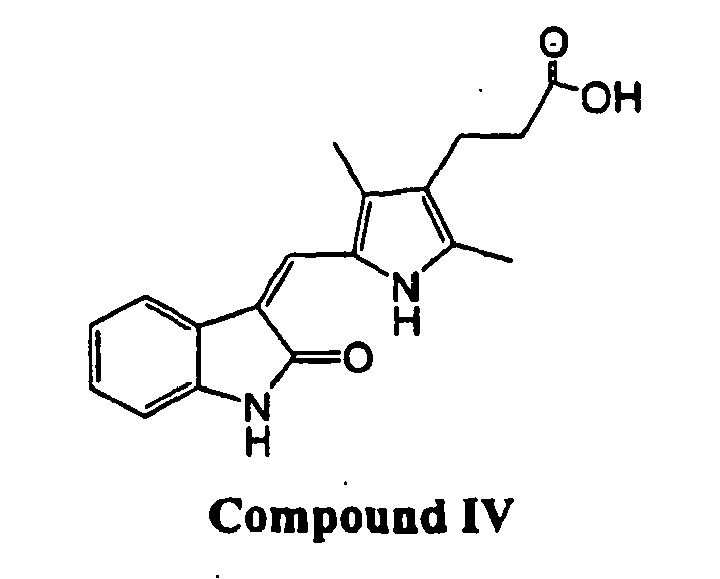
TABLE 1 Example Structure 1 
2 
- As utilized herein, the term "pharmaceutically acceptable salt" includes formulations of a compound that do not abrogate the biological activity and properties of the compound. Pharmaceutically acceptable salts can be obtained by reacting a pyrrole substituted 2-indolinone contemplated for use in the invention with inorganic or organic acids such as hydrochloric acid, hydrobromic acid, sulfuric acid, nitric acid, phosphoric acid, methanesulfonic acid, ethanesulfonic acid, p-toluenesulfonic acid, salicylic acid and the like, or with inorganic or organic bases such as sodium hydroxide, potassium hydroxide, ammonium hydroxide, calcium hydroxide, choline, n-methyl glucamine, diethylamine, procaine and the like. The pharmaceutically acceptable salts which the compounds of this invention may form include the negatively or the positively charged species. Examples of salts in which the compound forms the positively charged moiety include, without limitation, quaternary ammonium (defined elsewhere herein), salts such as the hydrochloride, sulfate, carbonate, lactate, tartrate, maleate, succinate wherein the nitrogen atom of the quaternary ammonium group is a nitrogen of the selected compound of this invention which has reacted with the appropriate acid. Salts in which a compound of this invention forms the negatively charged species include, without limitation, the sodium potassium, calcium and magnesium salts formed by the reaction of a carboxylic acid group in the compound with an appropriate base (e.g. sodium hydroxide (NaOH), potassium hydroxide (KOH), calcium hydroxide (Ca(OH)2), etc.). As utilized herein, "quaternary ammonium" includes a quaternized nitrogen (e.g., -NRR'R", where each of R,R' and R" is independently selected from H, aryl, alkyl, and the like), a quaternized nitrogen containing heterocyclic aryl, and the like.
- In one aspect of the invention formulation, a therapeutically effective amount of the ionizable substituted indolinone is utilized in the invention formulation.
- As used herein, a "pharmaceutically acceptable carrier" refers to a carrier or diluent that does not abrogate the biological activity and/or properties of the administered compound while facilitating administration by, for example, stabilizing or solubilizing the compound. Suitable pharmaceutically acceptable carriers include, without limitation, one or more polyoxyhydrocarbyl compounds, one or more buffers, one or more pharmaceutically acceptable surfactant, one or more pharmaceutically acceptable preservatives, one or more antioxidants, one or more pharmaceutically acceptable alcohols, one or more pharmaceutically acceptable aqueous solutions, one or more pharmaceutically acceptable oils, liposomes, one or more polyglycolized lipids, one or more pharmaceutically acceptable granulating agents, one or more pharmaceutically acceptable diluents, one or more pharmaceutically acceptable binders, one or more pharmaceutically acceptable disintegrants, one or more pharmaceutically acceptable lubricants, one or more pharmaceutically acceptable flow enhancers, one or more pharmaceutically acceptable suspending agents, and suitable combinations of any two or more thereof.
- The term "pharmaceutically acceptable" or "pharmaceutical" as used herein refers to solutions or components of the formulation that do not prevent the therapeutic compound from exerting a therapeutic effect and do not cause unacceptable adverse side effects. Examples of pharmaceutically acceptable reagents are provided in The United Stares Pharmacopeia The National Formulary, United States Pharmacopeial Convention, Inc., Rockville, MD 1990 and FDA Inactive Ingredient Guide 1990, 1996 issued by the Division of Drug Information Resources. Unacceptable side effects vary for different diseases. Generally, the more severe the disease the more toxic effects which will be tolerated. Unacceptable side effects for different diseases are known in the art.
- Although all pennutations of specific components within the invention formulations are contemplated to be within the scope of the present invention, the following combinations of one or more specific pharmaceutically acceptable carrier) and specific ionizable substituted indolinones are preferred in one aspect of the invention.
- In one aspect of the invention formulation, the formulation is suitable for parenteral adminstration. The ionizable substituted indolinone is 3-[2,4-dimethyl-5-(2-oxo-1,2-dihydro-indol-3-ylidenemethyl)-1H-pyrrol-3-yl]-propionic acid (compound IV), and pharmaceutically active salts and derivatives thereof.
- In another aspect of the invention formulation suitable for parenteral or oral administration, the pharmaceutically acceptable carrier comprises one or more polyoxyhydrocarbyl compounds. The ionizable substituted indolinone is 3-[2,4-dimethyl-5-(2-oxo-1,2-dihydro-indol-3-ylidenemethyl)-1H-pyrrol-3-yl]-propionic acid (compound IV), and pharmaceutically active salts and derivatives thereof.
- In another aspect of the invention, the formulation includes permeability and penetrating enhancers. These include ionic compounds (e.g., 3,5-diidosalicylate sodium) dimethylsulfoxide and related compounds (e-g., decylmethyl sulfoxide) azone, and related compounds (e.g., N-alkyl-dihydro-1,4-oxazepine-5,7-diones), solvents, and related compounds (e.g., ethanol, dimethyl acetamide, dimethylformamide) fatty alcohols, fatty acids and enzymes (e.g.; acid phosphatase and papin). These are other examples of permeability and pentration enhancers can be found in Pharmaceutical Skin Penetration. Enhancement, K.A. Walters and J. Hadgraft, Eds. (Dekker, New York, 1993).
- The term "polyoxyhydrocarbyl compound" as used herein includes without limitation water soluble carbohydrates (such as glucose, sucrose, maltotriose, and the like); water soluble carbohydrate derivatives (such as gluconic acid and mannitol and oligosaccharides, and the like); water soluble polypeptides; water soluble polymers (such as polyvinylpyrrolidone, poly(vinyl alcohol), and in particular, polyethers such as other polyoxyalkylenes including poly(ethylene glycol) and the like); water soluble mixed oxyalkylene polymers; and the polymeric forms of ethylene glycol; and the like; and suitable combinations of two or more thereof. Although polyoxyhydrocarbyl compounds preferably contain more than one carbon, oxygen, and hydrogen atom, some molecules such as poly(ethyleneimine) are also included.
- A particularly preferred class of solubilizing polyoxyhydrocarbyl compounds comprises poly(ethylene glycol) (PEG) and PEG derivatives, such as PEG monomethyl ether. Other suitable PEG derivatives include PEG-silicon deprived ethers. Many of these polymers are commercially available in a variety of molecular weights. Others may be conveniently prepared from commercially available materials, such as by coupling of an amino-PEG moiety to a haloalkyl silyl or silane moiety.
- Suitable PEGs may vary in molecular weight from about 200 g/mol to about 20,000 g/mol or more, more preferably 200 g/mol to 5,000 g/mol, even more preferably 250 g/mol to 1,000 g/mol, and most preferably 250 g/mol to 500 g/mol. The choice of a particular molecular weight may depend on the particular ionizable substituted indolinone chosen and its molecular weight and degree of hydrophobicity, as well as the particular application for which the formulation is to be used.
- Thus, the one or more polyoxyhydrocarbyl compounds can be selected from the group consisting of polyethylene glycol 300, polyethylene glycol 400, propylene glycol, and glycerin, and the like, and suitable combinations of two or more hereof. Preferably, each of the one or more polyoxyhydrocarbyl compounds is polyethylene glycol 300.
- In another aspect of the invention formulation suitable for parenteral or oral administration, the ionizable substituted indolinone is solubilized by combining it with a molar equivalent of a base solution or an acid solution, wherein the ionizable substituted indolinone is 3-[2,4-dimethyl-5-(2-oxo-1,2-dihydro-indol-3-ylidenemethyl)-1H-pyrro-3-yl]-propionic acid (compound IV), and pharmaceutically active salts and derivatives thereof.
- The term "solubilized" as used herein refers to dissolving of a substance in a fluid and/or adsorption of fluid molecules on the surface of the substance to assist in such dissolving. In one aspect, "solubilized" refers to hydration of a substance in water.
- The term "molar equivalent" as used herein refers to equal or similar molar amounts of a test substance as compared to a reference substance.
- The term "base solution" as used herein refers to a basic solution, typically one which has a pH higher than 7 and is capable of reacting with an acidic solution. Preferably the base in the base solution is selected from the group consisting of sodium hydroxide, ammonium hydroxide, triethylamine, ethylenediamine, N-methyl-D-glucamine, choline, triethanolamine, and the like, and suitable combinations of two or more hereof.
- The term "acid solution" as used herein refers to an acidic solution, typically one which has a pH lower than 7 and is capable of reacting with a basic solution. Preferably the acid in the acid solution is selected from the group consisting of hydrochloric acid, sulfuric acid, formic acid, lactic acid, malic acid, succinic acid, acetic acid, methane sulfonic acid, benzene sulfonic acid, phosphoric acid, and the like, and suitable combinations of two or more hereof.
- In another aspect of the invention formulation suitable for parenteral or oral administration, the pharmaceutically acceptable carrier further comprises one or more buffers, wherein the ionizable substituted indolinone is 3-[2,4-dimethyl-5-(2-oxo-1,2-dihydro-indol-3-ylidenemethyl)-1H-pyrrol-3-yl]-propionic acid (compound IV), and pharmaceutically active salts and derivatives thereof.
- The term "buffer" as used herein refers to a substance, preferably in a solution, that resists a change of quality. Preferably a buffer is a solution that resists a change to a pH, such as a substance in a solution capable of neutralizing both acids and bases and therefore maintaining an original acidity or basicity of a solution. Suitable buffers include acetate, citrate, phosphate buffer, ascorbate, hydrochloric acid buffer, Tris-HCl buffer, sodium phosphate, sodium carbonate, sodium hydroxide, glutamate, glycine, Tris base buffers, and the like, and suitable combinations of two or more hereof. Most preferably, the buffer is sodium phosphate buffer.
- In one embodiment, the buffer pH is three pH units higher than the pka of the ionizable substituted indolinone, or three pH units lower than the pkb of the ionizable substituted indolinone. Preferably, the buffer has a molarity (i.e., molar concentration, measured in moles per liter (M)) between 0.01 M and 0.1 M.
- The term "pka" as used herein refers to the negative logarithm of the acidity constant, the acidity constant being the product of the concentration of the hydronium ion and the concentration of the conjugated base, divided by the concentration of the acid (the acidity constant is also sometimes referred to as the equilibrium constant).
- The term "pkb" as used herein refers to the negative logarithm of the basicity constant, the basicity constant being the product of the concentration of the hydroxyl ion and the concentration of the conjugated acid, divided by the concentration of the base (the basicity constant is also sometimes referred to as the equilibrium constant).
- In another aspect of the invention formulation suitable for parenteral or oral administration, the pharmaceutically acceptable carrier further comprises one or more pharmaceutically acceptable surfactants, wherein the ionizable substituted indolinone is 3-[2,4-dimethyl-5-(2-oxo-1,2-dihydro-indol-3-ylidenemethyl)-1H-pyrrol-3-yl]-propionic acid (compound IV), and pharmaceutically active salts and derivatives thereof.
- The term "pharmaceutically acceptable surfactant" as used herein with respect to both oral and parenteral formulations refers to a compound that can solubilize hydrophobic compounds into aqueous solutions. Suitable surfactants include non-ionic surfactants, anionic surfactants, and the like, and suitable combinations of two or more thereof.
- Preferably for parenteral formulations, the surfactant is a non-ionic surfactant. Examples of pharmaceutically acceptable non-ionic surfactants include but are not limited to polyoxyethylene sorbitan fatty acid esters (e.g., POLYSORBATE 80®, and the like), glyceryl monooleate, sorbitan monooleate, lecithin, polyvinyl alcohol, ethylene oxide copolymers (such as PLURONIC™ (a polyether), TETRONIC™ (BASF), and the like), polyol moieties, sorbitan esters, and the like, and suitable combinations of two or more hereof. Preferably ethoxylated castor oils, such as CREMOPHOR EL®, are used for the formulation of hydrophobic pharmaceutical agents, such as the ionizable substituted indolinones contemplated for use in the present invention. The term "ethoxylated castor oil" as used herein refers to castor oil that is modified with at least one oxygen containing moiety. In particular the term refers to castor oil comprising at least one ethoxyl moiety.
- Further, the term "pharmaceutically acceptable surfactant", as used herein in reference to oral formulations, includes pharmaceutically acceptable non-ionic surfactants such as copolymers of ethylene glycol nd propylene glycol (for example, polyoxyethylenepolypropylene glycols (such as POLOXAMER® 68 (BASF Corp.)) or a mono fatty acid ester of polyoxyethylene (20) sorbitan monooleate (TWEEN® 80), polyoxyethylene (20) sorbitan monostearate (TWEEN® 60), polyoxyethylene (20) sorbitan monopalmitate (TWEEN® 40), polyoxyethylene (20) sorbitan monolaurate (TWEEN® 20), and the like); polyoxyethylene castor oil derivatives (such as polyoxyethyleneglycerol-triricinoleate, polyoxyl 35 castor oil (CREMOPHOR® EL, BASF Corp.), and the like); polyoxyethyleneglycerol oxystearate (such as CREMOPHOR® RH 40 (polyethyleneglycol 40 hydrogenated castor oil), CREMOPHOR® RH 60 (polyethyleneglycol 60 hydrogenated castor oil), BASF Corp.), and the like); and the like); pharmaceutically acceptable anionic surfactants, e.g., sodiumlauryl sulfate (SLS); and the like; and suitable combinations of two or more hereof.
- In a further aspect of the invention formulation suitable for parenteral or oral administration, the pharmaceutically acceptable carrier further comprises one or more pharmaceutically acceptable preservatives, wherein the ionizable substituted indolinone is 3-[2,4-dimethyl-5-(2-oxo-1,2-dihydro-indol-3-ylidenemethyl)-1H-pyrrol-3-yl]-propionic acid (compound IV), and pharmaceutically active salts and derivatives thereof.
- Preferably, each of the one or more pharmaceutically acceptable preservatives is selected from the group consisting of benzyl alcohol, methyl paraben, ethyl paraben, propyl paraban, phenol, and the like, and suitable combinations of two or more hereof. A most preferred preservative is benzyl alcohol.
- In yet another aspect of the invention formulation suitable for parenteral or oral administration, the pharmaceutically acceptable carrier further comprises one or more antioxidants, wherein the ionizable substituted indolinone is 3-[2,4-dimethyl-5-(2-oxo-1,2-dihydro-indol-3-ylidenemethyl)-1H-pyrrol-3-yl]-propionic acid (compound IV), and pharmaceutically active salts and derivatives thereof.
- The term "antioxidant" as used herein refers to a substance that inhibits oxidation or reactions promoted by, for example, oxygen or peroxides. Suitable antioxidants include sodium meta-bisulfite, EDTA, sodium ascorbate, ascorbic acid, ascorbic acid palmitate, benzyl alcohol, alpha-tocopherol and the like, and suitable combinations of two or more hereof. Preferably the antioxidant is alpha-tocopherol.
- In yet a further aspect of the invention formulation suitable for parenteral or oral administration, the pharmaceutically acceptable carrier further comprises one or more pharmaceutically acceptable alcohols, wherein the ionizable substituted indolinone is 3-[2,4-dimethyl-5-(2-oxo-1,2-dihydro-indol-3-ylidenemethyl)-1H-pyrrol-3-yl]-propionic acid (compound IV), and pharmaceutically active salts and derivatives thereof.
- The term "pharmaceutically acceptable alcohol" as used herein refers to alcohols which are liquids at about room temperature (approximately 20°C). These include propylene glycol, ethanol, 2-(2-ethoxyethoxy)ethanol (TRANSCUTOL®, Gattefosse, (Westwood, NJ)), benzyl alcohol, glycerol, and the like, and suitable combinations of two or more hereof. Preferably, each of the one or more pharmaceutically acceptable alcohols is independently selected from the group consisting of ethanol, benzyl alcohol, propylene glycol, 2-(2-ethoxyethoxy)ethanol, and glycerol. Most preferably, each of the pharmaceutically acceptable alcohols is ethanol or polyethylene glycol.
- The formulation including one or more pharmaceutically acceptable alcohols should be dissolved in a sufficient amount of a pharmaceutically acceptable aqueous solution prior to patient administration to avoid toxic effects due to the alcohol content. The added amount of a pharmaceutically acceptable aqueous solution should be sufficient to avoid hemolysis. Examples of suitable pharmaceutically acceptable aqueous solutions such as WFI (water for injection) and solutions containing isotonic saline are known in the art. Pharmaceutically acceptable aqueous solutions include 0.45% N saline, WFI (water for injection), D5W (5% dextrose in water), D5W 0.45% N saline, and the like, and suitable combinations of two or more hereof.
- In a separate aspect of the invention is a formulation suitable for parenteral (especially subcutaneous or intramuscular) or oral administration, the pharmaceutically acceptable carrier further comprises one or more pharmaceutically acceptable oils, wherein the ionizable substituted indolinone is 3-[2,4-dimethyl-5-(2-oxo-1,2-dihydro-indol-3-ylidenemethyl)-1H-pyrrol-3-yl]-propionic acid (compound IV), and pharmaceutically active salts and derivatives thereof.
- Suitable pharmaceutically acceptable oils include mineral oils, vegetable oils (e.g., safflower oil, peanut oil, olive oil, sesame oil, coconut oil, and the like, and suitable combinations of two or more hereof), fractionated coconut oil, propyleneglycol monolaurate, and mixed triglycerides with caprylic acid and capric acid, and the like, and suitable combinations of two or more hereof. In a preferred embodiment, the oil is Miglyol 812 (a mixture of triestyer of glycerin and caprylic and capric acids-capric/caprylic triglyceride). In another preferred embodiment, the oil is sesame oil.
- In a particular aspect, the invention features a formulation suitable for parenteral administration, the formulation comprising: (a) 3-[2,4-dimethyl-5-(2-oxo-1,2-dihydro-indol-3-ylidenemethyl)-1H-pyrrol-3-yl]-propionic acid; (b) polyethylene glycol 300; and (c) sodium phosphate buffer. In preferred embodiments, the parenteral formulation also contains benzyl alcohol, and 3-[2,4-dimethyl-5-(2-oxo-1,2-dihydro-indol-3-ylidenemethyl)-1H-pyrrol-3-yl]-propionic acid is solubilized with sodium hydroxide.
- In a further aspect of the invention formulation, the formulation comprising an ionizable substituted indolinone and a pharmaceutically acceptable carrier is suitable for oral administration, wherein the ionizable substituted indolinone is 3-[2,4-dimethyl-5-(2-oxo-1,2-dihydro-indol-3-ylidenemethyl)-1H-pyrrol-3-yl]-propionic acid (compound IV), and pharmaceutically active salts and derivative thereof.
- In one aspect of the invention formulation suitable for oral administration, the pharmaceutically acceptable carrier comprises one or more polyoxyhydrocarbyl compounds, wherein the ionizable substituted indolinone is 3-[2,4-dimethyl-5-(2-oxo-1,2-dihydro-indol-3-yildenemethyl)-1H-pyrrol-3-yl]-propionic acid (compound IV), and pharmaceutically active salts and derivatives thereof.
- In preferred embodiments of this aspect of the invention formulation suitable for oral administration, the one or more polyoxyhydrocarbyl compounds are independently selected from the group consisting of: water soluble carbohydrates, water soluble carbohydrate derivatives, polypeptides, water soluble polymers, water soluble mixed oxyalkylene polymers, and the polymeric form of ethylene glycol.. Preferably, the one or more polyoxyhydrocarbyl compounds are poly(ethylene glycol) (PEG) or PEG derivatives. More preferably, PEG may vary in molecular weight from about 200 daltons to about 20,000 daltons.
- In another aspect of the invention formulation suitable for oral administration, the pharmaceutically acceptable carrier comprises one or more polyglycolized lipids, wherein the ionizable substituted indolinone is 3-[2,4-dimethyl-5-(2-oxo-1,2-dihydro-indol-3-ylidenemethyl)-1H-pyrrol-3-yl]-propionic acid (compound IV), and pharmaceutically active salts derivatives thereof.
- The term "polyglycolized lipids" as used herein refers to mixtures of monoglycerides, diglycerides, or triglycerides and polyethyleneglycol monoesters and diesters formed by the partial alcoholysis of vegetable oil using PEG of 200 g/mol to 2,000 g/mol or by the esterification of fatty acids using PEG 200 g/mol to 2,000 g/mol and glycerols. Preferably these include GELUCIRE® 35/10, GELUCIRE® 44/14, GELUCIRE® 46/07, GELUCIRE® 50/13, GELUCIRE® 53/10, and LABRASOL®.
- In another aspect of the invention formulation suitable for oral administration, the pharmaceutically acceptable carrier comprises one or more pharmaceutically acceptable surfactants, wherein the ionizable substituted indolinone is 3-[2,4-dimethyl-5-(2-oxo-1,2-dihydro-indol-3-ylidenemethyl)-1H-pyrrol-3-yl]-propionic acid (compound IV), and pharmaceutically active salts and derivatives thereof.
- In an additional aspect of the invention formulation suitable for oral administration, the pharmaceutically acceptable carrier comprises one or more pharmaceutically acceptable granulating agents, wherein the ionizable substituted indolinone is 3-[2,4-dimethyl-5-(2-oxo-1,2-dihydro-indol-3-ylidenemethyl)-1H-pyrrol-3-yl]-propionic acid (compound IV), and pharmaceutically active salts and derivatives thereof. Suitable granulating agents include without limitation silicon dioxide, microcrystalline cellulose, starch, calcium carbonate, pectin, crospovidone, polyplasdone; and the like, and suitable combinations of two or more thereof.
- In an additional aspect of the invention formulation suitable for oral administration, the pharmaceutically acceptable carrier comprises suitable combinations of two or more of the members of the group comprising one or more polyoxyhydrocarbyl compounds, one or more polyglycolized lipids, one or more surfactants, and one or more granulating agents. Preferably, the pharmaceutically acceptable carrier comprises one or more polyoxyhydrocarbyl compounds, one or more polyglycolized lipids, and one or more surfactants. These oral formulations have advantageous solubility characteristics and oral bioavailability, and allow for the oral administration of the ionizable substituted indolinones for testing.
- In an additional aspect, the invention provides pharmaceutically acceptable compositions containing an ionizable substituted indolinone. Preferred pharmaceutically acceptable compositions of the present invention are selected from the group comprising the invention formulation suitable for oral administration, a hard gelatin capsule filled with the invention formulation suitable for oral administration, a soft gelatin capsule filled with the invention formulation suitable for oral administration, and a hard gelatin capsule filled with the invention formulation suitable for oral administration admixed with a granulating agent to form a dry solid composition. In preferred embodiments, a solution comprising the invention formulation suitable for oral administration is encapsulated in a soft elastic gelatin capsule (SEC) or a hard gelatin capsule.
- A solid composition of the formulation can be prepared by mixing the invention formulation in a liquefied state with a pharmaceutically acceptable granulating agent or a mixture of pharmaceutically acceptable granulating agents.
- In an additional aspect of the invention formulation suitable for oral administration, the formulation is solid and the pharmaceutically acceptable carrier comprises one or more pharmaceutically acceptable diluents, one or more pharmaceutically acceptable binders, one or more pharmaceutically acceptable disintegrants, one or more pharmaceutically acceptable surfactants, one or more pharmaceutically acceptable lubricants and one or more pharmaceutically acceptable flow enhancers, wherein the ionizable substituted indolinone is 3-[2,4-dimethyl-5-(2-oxo-1,2-dihydro-indol-3-ylidenemethyl)-1H-pyrrol-yl]-propionic acid (compound IV), and pharmaceutically active salts and derivatives thereof.
- Suitable pharmaceutically acceptable diluents include without limitation pregelatinized starch, lactose, monohydrate or lactose anhydrous, mannitol, microcrystalline cellulose, and the like, and suitable combinations of two or more thereof. Suitable pharmaceutically acceptable binders include without limitation polyvinylpyrrolidone, hydroxylpropyl cellulose, hydroxypropylmethylcellulose, starch, and the like, and suitable combinations of two or more thereof. Suitable pharmaceutically acceptable disintegrants include without limitation sodium starch glycollate, crosscarmellose, crospovidone, sodium carboxymethylcellulose, calcium carboxymethylcellulose, starch and the like, and suitable combinations of two or more thereof. Suitable pharmaceutically acceptable surfactants are as described herein, and further include without limitation sodium lauryl sulfate, cetylpyridinium chloride, polysorbate 80, polyoxyethylene stearates, and the like, and suitable combinations of two or more thereof. Suitable pharmaceutically acceptable lubricants include without limitation magnesium stearate, stearic acid, sodium stearyl fumarate, PEG (3,000-10,000), glyceryl behenate and the like, and suitable combinations of any two or more thereof. Suitable pharmaceutically acceptable flow enhancers include without limitation colloidal silicon dioxide, talc, and the like, and suitable combinations of any two or more thereof.
- In another aspect of the invention formulation suitable for oral administration, the formulation is a solution and the pharmaceutically acceptable carrier comprises one or more polyoxyhydrocarbyl compounds, one or more surfactants and one or more buffers, wherein the ionizable substituted indolinone is 3-[2,4-dimethyl-5-(2-oxo-1,2-dihydro-indol-3-ylidenthyl)-1H-pyrrol-3-yl]-propionic acid, and pharmaceutically active salts and derivatives thereof.
- In a further aspect of the invention formulation suitable for oral administration, the formulation is a suspension and the pharmaceutically acceptable carrier comprises one or more pharmaceutically acceptable suspending agents, one or more pharmaceutically acceptable salt solutions and one or more pharmaceutically acceptable surfactants, wherein the ionizable substituted indolinone is 3-[2,4-dimethyl-5-(2-oxo-1,2-dihydro-indol-3-ylidenemethyl)-1H-pyrrol-3-yl]-propionic acid, and pharmaceutically active salts and derivatives thereof.
- Suitable pharmaceutically acceptable suspending agents include without limitation povidone, carboxylmethycellulose (CMC) and hydroxypropylmethyl cellulose (HPMC).
- In yet another aspect of the invention formulation suitable for oral administration, the formulation is a solution and the pharmaceutically acceptable carrier comprises one or more pharmaceutically acceptable oils, and one or more pharmaceutically acceptable surfactants, wherein the ionizable substituted indolinone is 3-[2,4-dimethyl-5-(2-oxo-1,2-dihydro-indol-3-ylidenemethyl)-1H-pyrrol-3-yl]-propionic acid, and pharmaceutically active salts and derivatives thereof. In other preferred embodiments, each of the one or more pharmaceutically acceptable oils is a sesame oil, and each of the one or more pharmaceutically acceptable surfactants is an ethylene oxide copolymer (e.g., PLURONIC™ F68, and the like, as described above).
- In yet a further aspect of the invention formulation suitable for oral administration, the pharmaceutically acceptable carrier comprises one or more pharmaceutically acceptable surfactants and one or more pharmaceutically acceptable oils, wherein the ionizable substituted indolinone is 3-[2,4-dimethyl-5-(2-oxo-1,2-dihydro-indol-3-ylidenemethyl)-1H-pyrrol-3-yl]-propionic acid (compound IV), and pharmaceutically active salts and derivatives thereof. In a preferred embodiment, the pharmaceutically acceptable surfactant comprises ethylene oxide copolymer (e.g., PLURONIC™ F68, and the like) and the pharmaceutically acceptable oil comprises sesame oil.
- In an additional aspect, the invention features a method of preparing a formulation for parenteral or oral administration comprising adding to a salt solution, formed in situ by admixing a molar equivalent of a base solution or an acid solution with an ionizable substituted indolinone, one or more polyoxyhydrocarbyl compounds and/or one or more buffers. In a preferred embodiment, both the one or more polyoxyhydrocarbyl compounds and the one or more buffers are added to the salt solution, wherein the ionizable substituted indolinone is 3-[2,4-dimethyl-5-(2-oxo-1,2-dihydro-indol-3-ylidenemetyl)-1H-pyrrol-3-yl]-propionic acid, and pharmaceutically active salts and derivatives thereof.
- In a preferred embodiment of the method of preparing a formulation, the acid solution is selected from the group consisting of hydrochloric acid, sulfuric acid, formic acid, lactic acid, malic acid, and the like, and suitable combinations of two or more hereof, and the base solution is selected from the group consisting of sodium hydroxide, ammonium hydroxide, meglumine, triethylamine, triethanolamine, and the like, and suitable combinations of two or more hereof. Preferably, the base solution is sodium hydroxide.
- In another preferred embodiments of the method of preparing a formulation, the one or more polyoxyhydrocarbyl compounds is selected from the group consisting of polyethylene glycol 300, polyethylene glycol 400, propyleneglycol, glycerin, and the like, and suitable combinations of two or more thereof, although polyoxyhydrocarbyl compounds listed previously can also be used in some cases. Preferably, the one or more polyoxyhydrocarbyl compounds is polyethylene glycol 300.
- In a further preferred embodiment of the method of preparing a formulation, the bluffer pH is three pH units higher than the pka of the ionizable substituted indolinone or three pH units tower than the pkb of the ionizable substituted indolinone, and has a polarity between 0.01 M and 0,1 M. Preferably, the buffer is selected from the group consisting of acetate, citrate, phosphoric acid buffer, ascorbate, hydrochloric acid buffer, and Tris-HCl buffer, and the like, and suitable combinations of two or more hereof. Alternatively, the buffer is selected from the group consisting of sodium phosphate, sodium carbonate, sodium hydroxide, glutamate, glycine, Tris base buffers, and the like, and suitable combinations of two or more hereof.
- In a further preferred embodiment of the method of preparing a formulation, the method also includes sterilizing the solution. Preferably, the sterilizing is done by filtration
- Thus, a particular embodiment of the method of preparing a Formulation aspect of the invention features a method of preparing a formulation, the method comprising adding to a salt solution, formed in situ via addition of a molar equivalent of sodium hydroxide to 3-[2,4-dimethyl-5-(2-oxo-1,2-dihydro-indol-3-ylidenemethyl)-1H-pyrrol-3-yl]-propionic acid, polyethylene glycol 300 and a sodium phosphate buffer. In preferred embodiments of this method of preparing a formulation, the method also includes adding benzyl alcohol to the salt solution, and/or sterilizing the resulting formulation by filtration.
- In an additional aspect, the invention features a method of preparing a formulation suitable for oral administration, the method comprising admixing an ionizable substituted indolinone, one or more pharmaceutically acceptable surfactants, and one or more pharmaceutically acceptable oils, wherein the ionizable substituted indolinone is 3-[2,4-dimethyl-5-(2-oxo-1,2-dihydro-indol-3-ylidenemethyl)-1H-pyrrol-3-yl]-propionic acid, and pharmaceutically active salts and derivatives thereof. In other preferred embodiments, each of the one or more pharmaceutically acceptable oils is a vegetable oil (e.g., sesame oil, and the like, as described above), and/or each of the one or more pharmaceutically acceptable surfactants is an ethylene oxide copolymer (e.g., PLURONIC™ F68, and the like, as described above).
- Other components can also be added to the invention formulations to enhance their therapeutic effects. For example, the ionizable substituted indolinones may be further formulated in liposomes in addition to the above-mentioned components. Liposomes have been shown to enhance the delivery of compounds into cells. However, because the formulations have been shown to have a therapeutic effect with only the components described herein, formulations of the present invention may also "consist essentially of" or "consist of" these components.
- In preferred embodiments of the invention, the formulations are effective in treating or preventing an abnormal condition in a patient in need of such treatment. The patient is preferably a mammal and more preferably a human. In a highly preferred embodiment, the formulations are parenteral. Parenteral administration includes intravenous, subcutaneous, intraperitoneal, intramuscular, intraosseous, and intramedullary injection, and the like, and suitable combinations of two or more hereof.
- The term "preventing" as used herein refers to administering the formulation to a patient before the abnormal condition manifests itself in that patient.
- The term "treating" as used herein refers to the use of the ionizable substituted indolinone having a therapeutic effect and at least partially alleviating or abrogating the abnormal condition in the organism (e.g., patient).
- The term "therapeutic effect" as used herein refers to inhibition of the abnormal condition. The term "therapeutic effect" also refers to the inhibition of factors causing or contributing to the abnormal condition. A therapeutic effect relieves to some extent one or more of the symptoms of the abnormal condition.
- The term "mammal" as used herein preferably refers to the organisms of the class known as "mammalia", such as mice, rats, rabbits, guinea pigs, goats, sheep, horses, cows, dogs, cats, monkeys, apes, humans, and the like; more preferably dogs, cats, monkeys, apes, humans, and the like; and most preferably humans.
- The term "abnormal condition" refers to a function in the cells or tissues of a patient that deviates from normal functions in that patient. An abnormal condition can relate to cell proliferation (e.g., be a cell proliferative disorder) as described herein.
- The term "cell proliferative disorder" as used herein refers to a disorder where an excess cell proliferation of one or more subset of cells in a multicellular organism occurs resulting in harm (e.g., discomfort or decreased life expectancy) to the multicellular organism. The excess cell proliferation can be determined by reference to the general population and/or by reference to a particular patient (e.g., at an earlier point in the patient's life). Hyper-proliferative cell disorders can occur in different types of animals and in humans, and produce different physical manifestations depending upon the affected cells. Hyper-proliferative cell disorders include without limitation cancers, blood vessel proliferative disorders, fibrotic disorders, autoimmune disorders, and the like. Cell proliferative disorders suitable for treatment in accordance with the present invention include without limitation cancers (e.g., erythroblastoma, glioblastoma, meningioma, astrocytoma, melanoma, myoblastoma, breast cancers, gastric cancers, ovarian cancers, renal cancers, hepatic cancers, pancreatic cancers, bladder cancers, thyroid cancers, prostate cancers, colorectal cancers, solid tumor cancers, colon cancer, brain cancer, blood cancers, bone cancers, liver cancer, kidney cancer, stomach cancer, lung cancer, Kaposi's sarcoma, non-small cell lung cancer, skin cancer, and the like, non-small cell lung cancers, and the like).
- In reference to the treatment of abnormal conditions caused, in whole or in part, by a cell proliferative disorder, a therapeutic effect refers to one or more of the following: (a) reducing tumor size; (b) inhibiting (e.g, slowing or stopping) tumor metastasis; (c) inhibiting tumor growth; and (d) relieving to some extent one or more of the symptoms associated with the abnormal condition.
- Thus, the present invention features a parenteral formulation comprising an ionizable substituted indolinone, one or more polyoxyhydrocarbyl compounds, and a buffer for preventing or treating an abnormal condition in a patient in need of treatment comprising: (a) diluting said parenteral formulation into a pharmaceutically acceptable solution; and (b) parenterally administering said diluted formulation to said patient, wherein the ionizable substituted indolinone is 3-[2,4-dimethyl-5-(2-oxo-1,2-dihydro-indol-3-ylidenemethyl)-1H-pyrrol-3-yl]-propionic acid, and pharmaceutically active salts and derivatives thereof.
- In preferred embodiments thereof, the ionizable substituted indolinone is solubilized by combining with a molar equivalent of a base solution or an acid solution. Preferably, the base solution is selected from the group consisting of sodium hydroxide, ammonium hydroxide, triethylamine, ethylenediamine, N-methyl-D-glucamine, choline, triethanolamine, and the like, and suitable combinations of two or more hereof, and the acid solution is selected from the group consisting of hydrochloric acid, sulfuric acid, formic acid, lactic acid, malic acid, succinic acid, acetic acid, methane sulfonic acid, benzene sulfonic acid, phosphoric acid, and the like, and suitable combinations of two or more hereof.
- In yet other preferred embodiments thereof, the one or more polyoxyhydrocarbyl compounds is selected from the group consisting of polyethylene glycol 300, polyethylene glycol 400, propyleneglycol, glycerin, and the like, and suitable combinations of two or more hereof. Preferably, the one or more polyoxyhydrocarbyl compounds is polyethylene glycol 300.
- In other preferred embodiments thereof, the buffer pH is three pH units higher than the pka of said ionizable substituted indolinone, or three pH units lower than the pkb of said ionizable substituted indolinone. Preferably, the buffer has a molarity between 0.01 M and 0.1 M, and is selected from the group consisting of acetate, citrate, phosphoric acid buffer, ascorbate, hydrochloric acid buffer, Tris-HCl buffer, and the like, and suitable combinations of two or more hereof. Alternatively, the buffer is selected from the group consisting of sodium phosphate, sodium carbonate, sodium hydroxide, glutamate, glycine, Tris base buffers, and the like, and suitable combinations of two or more hereof. Preferably, the buffer is sodium phosphate buffer.
- In other preferred embodiments thereof, the formulation also contains one or more pharmaceutically acceptable surfactants. Preferably, pharmaceutically acceptable surfactants include but are not limited to POLYSORBATE 80 and other polyoxyethylene sorbitan fatty acid esters, glyceryl monooleate, sorbitan monooleate, pluronic F68, lecithin, polyvinyl alcohol, ethylene oxide copolymers such as PLURONIC™ (a polyether) and TETRONIC™ (BASF), polyol moieties, sorbitan esters, and the like, and suitable combinations of two or more hereof. Preferably ethoxylated castor oils, such as CREMOPHOR EL®, are used for the formulation of hydrophobic pharmaceutical agents. In other preferred embodiments thereof, the formulation also contains a pharmaceutically acceptable preservative. Preferably, the preservative is selected from the group consisting of benzyl alcohol, methyl paraben, ethyl paraben, phenol, and the like, and suitable combinations of two or more hereof. Most preferably, the preservative is benzyl alcohol.
- In other preferred embodiments thereof, the formulation also contains an antioxidant. Preferably, the antioxidant is selected from the group consisting of sodium meta-bisulfite, EDTA, ascorbic acid, benzyl alcohol, and the like, and suitable combinations of two or more hereof, and preferably is benzyl alcohol.
- In yet other preferred embodiments thereof, the patient is a mammal, preferably a human.
- Further, the present invention features an oral formulation comprising an ionizable substituted indolinone, one or more pharmaceutically acceptable surfactants, and one or more pharmaceutically acceptable oils for preventing or treating an abnormal condition in a patient in need of treatment comprising orally administering to the patient the formulation wherein the ionizable substituted indolinone is 3-[2,4-dimethyl-5-(2-oxo-1,2-dihydro-indol-3-ylidenemethyl)-1H-pyrrol-3-yl]-propionic acid, and pharmaceutically active salts and derivatives thereof. In other preferred embodiments, each of the one or more pharmaceutically acceptable oils is a vegetable oil (e.g., sesame oil, and the like, as described above), and/or each of the one or more pharmaceutically acceptable surfactants is an ethylene oxide copolymer (e.g., PLURONIC™ F68, and the like, as described above).
- The ionizable substituted indolinone is 3-[2,4-dimethyl-5-(2-oxo-1,2-dihydro-indol-3-ylidenemethyl)-1H-pyrrol-3-yl]-propionic acid (compound IV), and pharmaceutically active salts and derivatives thereof.
- Other features and advantages of the invention will be apparent from the following description of the preferred embodiments and from the claims.
- The instant invention features parenteral and oral formulations for indolinone compounds that are ionizable as free acids or free bases. In particular, the formulations aid the administration of indolinones that are ionizable as free acids or free bases to patients in need of treatment.
- 3-[2,4-Dimethyl-5-(2-oxo-1,2-dihydro-indol-3-ylidenemethyl)-1H-pyrrol-3-yl]-propionic acid, is an indolinone compound that is a potent inhibitor of signal transduction via Flk-1/KDR, PDGF receptor, and FGF receptor. It is also efficacious in inhibiting SC growth of multiple tumor types and inhibited the growth of established tumors. This compound is a preferred compound for use in the formulations of the present invention. Properties of formulations comprising this compound are set forth in the experimental materials that follow.
- A compound or combination of the present invention or a physiologically acceptable salt of the compound can be administered as such to a human patient or it can be administered in pharmaceutical compositions or formulations in which the foregoing materials are mixed with suitable carriers or excipient(s). Techniques for formulation and administration of drugs may be found in "Remington's Pharmacological Sciences," Mack Publishing Co., Easton, PA, latest edition.
- Suitable routes of administration may include, without limitation, oral, rectal, transmucosal or intestinal administration or intramuscular, subcutaneous, intramedullary, intrathecal, direct intraventricular, intravenous, intraperitoneal, intranasal, or intraocular injections. The preferred routes of administration are oral and parenteral.
- Alternatively, one may administer the compound in a local rather than systemic manner, for example, via injection of the compound directly into a solid tumor, often in a depot or sustained release formulation.
- Furthermore, one may administer the drug in a targeted drug delivery system, for example, in a liposome coated with tumor-specific antibody. The Liposomes will be targeted to and taken up selectively by the tumor.
- Pharmaceutical compositions and formulations of the present invention may be manufactured by processes well know in the art; e.g., by means of conventional mixing, dissolving, granulating, dragee-making, levigating, emulsifying, encapsulating, entrapping or lyophilizing processes.
- Pharmaceutical compositions and formulations for use in accordance with the present invention may be formulated in conventional manner using one or more physiologically acceptable carriers comprising excipients and auxiliaries which facilitate processing of the active compounds into preparations which can be used pharmaceutically. Proper formulation is dependent upon the route of administration chosen.
- For injection, the compounds of the invention may be formulated in aqueous solutions, preferably in physiologically compatible buffers such as Hanks' solution, Ringers solution, or physiological saline bluffer. For transmucosal administration, penetrants appropriate to the barrier to be permeated are used in the formulation. Such penetrants are generally known in the art.
- For oral administration, the compounds can be formulated by combining the active compounds with pharmaceutically acceptable carriers well known in the art. Such carriers enable the compounds of the invention to be formulated as tablets, pills, lozenges, dragees, capsules, liquids, gels, syrups, slurries, suspensions and the like, for oral ingestion by a patient. Pharmaceutical preparations and formulations for oral use can be made using a solid excipient, optionally grinding the resulting mixture, and processing the mixture of granules, after adding other suitable auxiliaries if desired, to obtain tablets or dragee cores. Useful excipients are, in particular, fillers such as sugars, including lactose, sucrose, mannitol, or sorbitol; cellulose preparations such as, for example, maize starch, wheat starch, rice starch and potato starch and other materials such as gelatin, gum tragacanth, methyl cellulose, hydroxypropylmethylcellulose, sodium carboxymethylcellulose, and/or polyvinylpyrrolidone (PVP). If desired, disintegrating agents may be added, such as cross-linked polyvinylpyrrolidone, agar, or alginic acid. A salt such as sodium alginate may also be used.
- Dragee cores are provided with suitable coatings. For this purpose, concentrated sugar solutions may be used which may optionally contain gum arabic, talc, polyvinyl pyrrolidone, carbopol gel, polyethylene glycol, and/or titanium dioxide, lacquer solutions, and suitable organic solvents or solvent mixtures. Dyestuffs or pigments may be added to the tablets or dragee coatings for identification or to characterize different combinations of active compound doses.
- Pharmaceutical compositions and formulations which can be used orally include push-fit capsules made of gelatin, as well as soft, sealed capsules made of gelatin and a plasticizer, such as glycerol or sorbitol. The push-fit capsules can contain the active ingredients in admixture with a filler such as lactose, a binder such as starch, and/or a lubricant such as talc or magnesium stearate and, optionally, stabilizers. In soft capsules, the active compounds may be dissolved or suspended in suitable liquids, such as fatty oils, liquid paraffin, or liquid polyethylene glycols. Stabilizers may be added in these formulations, also.
- For buccal administration, the compositions and formulations may take the form of tablets or lozenges formulated in conventional manner.
- For administration by inhalation, the compounds for use according to the present invention are conveniently delivered in the form of an aerosol spray using a pressurized pack or a nebulizer and a suitable propellant, e.g., without limitation, dichlorodifluoromethane, trichlorofluoromethane, dichlorotetra- fluoroethane or carbon dioxide. In the case of a pressurized aerosol, the dosage unit may be controlled by providing a valve to deliver a metered amount. Capsules and cartridges of, for example, gelatin for use in an inhaler or insufflator may be formulated containing a powder mix of the compound and a suitable powder base such as lactose or starch.
- The compounds may also be formulated for parenteral administration, e.g., by bolus injection or continuous infusion. Formulations for injection may be presented in unit dosage form, e.g-, in ampoules or in multi-dose containers, with an added preservative. The compositions may take such forms as suspensions, solutions or emulsions in oily or aqueous vehicles, and may contain formulating materials such as suspending, stabilizing and/or dispersing agents.
- Pharmaceutical compositions and formulations for parenteral administration include aqueous solutions of a water soluble form, such as, without limitation, a salt, of the active compound. Additionally, suspensions of the active compounds may be prepared in a lipophilic vehicle. Suitable lipophilic vehicles include fatty oils such as sesame oil, synthetic fatty acid esters such as ethyl oleate and triglycerides, or materials such as liposomes. Aqueous injection suspensions may contain substances which increase the viscosity of the suspension, such as sodium carboxymethyl cellulose, sorbitol, or dextran. Optionally, the suspension may also contain suitable stabilizers and/or agents that increase the solubility of the compounds to allow for the preparation of highly concentrated solutions.
- Alternatively, the active ingredient may be in powder form for constitution with a suitable vehicle, e.g., sterile, pyrogen-free water, before use.
- The compounds may also be formulated in rectal compositions such as suppositories or retention enemas, using, e.g., conventional suppository bases such as cocoa butter or other glycerides.
- In addition to the formulations described previously, the compounds may also be formulated as depot preparations. Such long acting formulations may be administered by implantation (for example, subcutaneously or intramuscularly) or by intramuscular injection. A compound of this invention may be formulated for this route of administration with suitable polymeric or hydrophobic materials (for instance, in an emulsion with a pharmacologically acceptable oil), with ion exchange resins, or as a sparingly soluble derivative such as, without limitation, a sparingly soluble salt.
- A non-limiting example of a pharmaceutical carrier for the hydrophobic compounds of the invention is a cosolvent system comprising benzyl alcohol, a nonpolar surfactant, a water-miscible organic polymer and an aqueous phase such as the VPD co-solvent system. VPD is a solution of 3% w/v benzyl alcohol, 8% w/v of the nonpolar surfactant Polysorbate 80™, and 65% w/v polyethylene glycol 300, made up to volume in absolute ethanol. The VPD co-solvent system (VPD:D5W) consists of VPD diluted 1:1 with a 5% dextrose in water solution. This co-solvent system dissolves hydrophobic compounds well, and itself produces low toxicity upon systemic administration, The proportions of such a co-solvent system may be varied considerably without destroying its solubility and toxicity characteristics. Furthermore, the identity of the co-solvent components may be varied: for example, other low-toxicity nonpolar surfactants may be used instead of Polysorbate 80™, the fraction size of polyethylene glycol may be varied; other biocompatible polymers may replace polyethylene glycol, e.g., polyvinyl pyrrolidone; and other sugars of polysaccharides may substitute for dextrose.
- Alternatively, other delivery systems for hydrophobic pharmaceutical compounds may be employed. Liposomes and emulsions are well known examples of delivery vehicles or carriers for hydrophobic drugs. In addition, certain organic solvents such as dimethylsulfoxide also may be employed, although often at the cost of greater toxicity.
- Additionally, the compounds and formulations may be delivered using a sustained-release system, such as semi-permeable matrices of solid hydrophobic polymers containing the therapeutic agent. Various sustained-release materials have been established and are well known by those skilled in the art.
- The pharmaceutical compositions and formulation herein also may comprise suitable solid or gel phase carriers or excipients. Examples of such carriers or excipients include, but are not limited to, calcium carbonate, calcium phosphate, various sugars, starches, cellulose derivatives, gelatin, and polymers such as polyethylene glycols.
- The compound of the invention may be provided as a salt with pharmaceutically compatible counterions. Pharmaceutically compatible salts may be formed with many acids, including but not limited to hydrochloric, sulfuric, acetic, lactic, tartaric, malic, succinic, etc. Salts tend to be more soluble in aqueous or other protonic solvents than are the corresponding free base forms.
- This compound may be formulate as any of the compositions and formulations described above. Presently preferred formulations, however, comprise 3-[2,4-Dimethyl-5-(2-oxo-1,2-dihydro-indol-3-ylidenemethyl)-1H-pyrro1-3-yl]-propionic acid composition in sufficient sterile parenteral solution to afford a final concentration of about 10 mg/ml.
- Compounds, combinations, and pharmaceutical compositions and formulations suitable for use in the present invention include compositions wherein the active ingredients are contained in an amount sufficient to achieve the intended purpose; i.e., the modulation of protein kinases (PK) activity or the treatment or prevention of a PK-related disorder.
- The above referenced protein kinase related disorder is selected from the group consisting of an EGFR related disorder, a PDGFR related disorder, an IGFR related disorder and a flk related disorder.
- The above referenced protein kinase related disorder is a cancer selected from the group consisting of squamous cell carcinoma, sarcomas such as Kaposi's sarcoma, astrocytoma, glioblastoma, lung cancer, bladder cancer, colorectal cancer, gastrointestinal cancer, head and neck cancer, melanoma, ovarian cancer, prostate cancer, breast cancer, small-cell lung cancer and glioma in a further aspect of this invention.
- The above referenced protein kinase related disorder is selected from the group consisting of diabetes, a hyper- proliferation disorder, von Hippel-Lindau disease, restenosis, fibrosis, psoriasis, osteoarthritis, rheumatoid arthritis, an inflammatory disorder and angiogenesis in yet another aspect of this invention.
- Additional disorders which may be treated or prevented using the compounds of this invention are immunological disorders such as autoimmune disease (AIDS) and cardiovasular disorders such as atherosclerosis.
- More specifically, a therapeutically effective amount means an amount of compound effective to prevent, alleviate or ameliorate symptoms of disease or prolong the survival of the subject being treated.
- Determination of a therapeutically effective amount is well within the capability of those skilled in the art, especially in light of the detailed disclosure provided herein.
- For any compound used according to the invention, the therapeutically effective amount or dose can be estimated initially from cell culture assays. Then, the dosage can be formulated for use in animal models so as to achieve a circulating concentration range that includes the IC50 as determined in cell culture (i,e., the concentration of the test compound which achieves a half-maximal inhibition of the PK activity). Such information can then be used to more accurately determine useful doses in humans.
- Toxicity and therapeutic efficacy of the compounds described herein can be determined by standard pharmaceutical procedures in cell cultures or experimental animals, e.g., by determining the IC50 and the LD50 (both of which are discussed elsewhere herein) for a subject compound. The data obtained from these cell culture assays and animal studies can be used in formulating a range of dosage for use in humans. The dosage may vary depending upon the dosage form employed and the route of administration utilized. The exact formulation, route of administration and dosage can be chosen by the individual physician in view of the patient's condition. (See e.g., Fingl, et al., 1975, in "The Pharmacological Basis of Therapeutics", Ch. 1 p.1.
- Therapeutic compounds should be more potent in inhibiting preceptor tyrosine kinase activity than in exerting a cytotoxic effect A measure of the effectiveness and cell toxicity of a compound can be obtained by determining the therapeutic index; i.e., IC50/LD50. IC50, the dose required to achieve 50% inhibition, can be measured using standard techniques such as those described herein. LD50, the dosage which results in 50% toxicity, can also be measured by standard techniques as well(Mossman, 1983, J. Immunol. Methods. 65-55-63), by measuring the amount of LDH released (Korzeniewski and Callewaert, 1983, J. Immunol. Methods, 64:313; Decker and Lohmann-Matthes, 1988, J. Immunol. Methods, 115:61), or by measuring the lethal dose in animal models. Compounds with a large therapeutic index are preferred. Thus, in one aspect of the invention, a preferred dosage of the compounds, agents, combinations, and pharmaceutical compositions contemplated for use in the invention requires the therapeutic index of each active component to be greater than 2, preferably, at least 10, more preferably, at least 50.
- Dosage amount and interval may be adjusted individually to provide plasma levels of the active species, which are sufficient to maintain the kinase modulating effects. These plasma levels are referred to as minimal effective concentrations (MBCs). The MEC will vary for each compound but can be estimated from in vitro data; e.g., the concentration necessary to achieve 30-90% inhibition of a kinase may be ascertained using the assays described herein. Dosages necessary to achieve the MEC will depend on individual characteristics and route of administration. HPLC assays or bioassays can be used to determine plasma concentrations.
- Dosage-intervals can also be determined using MEC value. Compounds should be administered using a regimen that maintains plasma levels above the MEC for 10-90% of the time, preferably between 30-90% and most preferably between 50-90%.
- In cases of local administration or selective uptake, the effective local concentration of the drug may not be related to plasma concentration and other procedures known in the art may be employed to determine the correct dosage amount and interval.
- The amount of a composition administered will, of course, be dependent on the subject being treated, the severity of the affliction, the manner of administration, the judgment of the prescribing physician, etc.
- In general, a "therapeutically effective amounts" refers to that amount of an agent or its metabolite which is effective to prevent, alleviate, reduce or ameliorate symptoms of disease and/or the undesired side effects attributable to treatment of disease with another agent or its metabolite, or to prolong the survival of the patient being treated. More particularly, in reference to the treatment of cancer, a therapeutically effective amount refers to that amount which has the effect of (1) reducing the size of (or preferably eliminating) the tumor; (2) inhibiting (that is, slowing to some extent, preferably stopping) tumor metastasis; (3) inhibiting to some extent (that is slowing to some extent, preferably stopping) tumor growth; and/or, (4) relieving to some extent (or preferably eliminating) one or more symptoms associated with the cancer and/or one or more undesired side effects attributable to treatment of the cancer with another agent or its metabolite. Non-limiting examples of therapeutically effective amounts of particular agents and compounds contemplated for use in the present invention are further described below,
- In addition to the above general definition, by a "therapeutically effective amount" of an agent is meant any amount administered in any manner and in any treatment regime as may be currently recognized in the medical arts or as may come about as the result of future developments regarding the use of these agents.
- A "treatment regime" refers to specific quantities of the ionizable substituted indolinone contemplated for use in this invention) administered at set times in a set manner over an established time period.
- When referring to "set times" of administration within a treatment regime, "consecutive days" means consecutive calendar days; i.e., Monday, Tuesday, Wednesday, etc. "Staggered" days means calendar days with other calendar days between them, e.g., without limitation, Monday, Wednesday, Saturday, etc.
- Furthermore, with regard to a "therapeutically elective amount" of an ionizable substituted indolinone, the phrase refers to an amount of the compound sufficient to inhibit the growth, size and vascularization; i.e., angiogenesis and/or vasculogenesis, of tumors during the "recovery" period, i.e., the periods in a treatment regime when no other chemotherapeutic agent is being administered to a patient.
- Based on the pharmacological data obtained regarding 3-[2,4-Dimethyl-5-(2-oxo-1,2-dihydro-indol-3-ylidonemethyl)-1H-pyrrol-3-yl]-propionic acid composition (see above), the compound may be administered in doses ranging from about 1 mg/m2 to about 3000 mg/m2. In a presently preferred embodiment, the dosage is between about 50 mg/m2 and about 2400 mg/m2. In another preferred embodiment, therapeutically effective amounts of 3-[2,4-Dimethyl-5-(2-oxo-1,2-dihydm-indol-3-ylidenemethyl)-1H-pyrrol-3-yl]-propionic acid composition comprise from about 50 to about 800 mg/m2. Of course, the dose would depend on a number os factors, including patient specific factor, e.g., weight, dosing regimen (e.g., frequency, route of administration, effect of food) etc.
- The formulation(s) described in the above composition section may be administered to a patient at a rate of from about 0.1 to about 200 cc/hour. The rate of administration for a particular patient is dependent on achieving therapeutically relevant plasma levels for the particular indication. The prescribing physician is skilled in making such as determination.
- By "about," wherever the term appears herein, is meant ±10%; i.e., about 175 cc/hour means from 157.5 cc/hour to 192.5 cc/hour, etc.
- In a presently preferred embodiment, the 3-[2,4-Dimethyl-5-(2-oxo-1,2-dihydra-indol-3-ylidenemethyl)-1H-pyrrol-3-yl]-propionic acid composition dose is administered during rest periods when no other agent is being administered to a patient.
- The following tables set forth the ranges of components useful in the formulation of the compounds disclosed herein.
-
Component Broadest Range of Component Concentration in Formulation Preferred Range of Component Concentration in Formulation Most Preferred Range of Component Concentration in Formulation Ionizable Substituted Indolinone 0.01-10% 0.01-7.5% 0.01-5.0% Polyoxyhydrocarbyl Compounds 5.0-70% 5.0-45% 15-45% Buffer 0-3% 0-1.0% 0-0.5% Surfactant 0-50.0% 0-50.0% 0-31.5% preservative 0-3.0% 0-2.0% 0.5-2.0% Antioxidant 0-3.0% 0-2.0% 0.1-1.0% Alcohol 0-40.0% 0-30.0% 0-25.0% Oil 5-75% 10-25% 15-20% Granulating Agent 10-95% 20-60% 30-50% Diluent 5-95% 10-80% 20-60% Binder 0-15% 0-8% 0-5% Disintegrant 1-20% 4-15% 4-10% Lubricant 0.3-2.0% 0.5-1,5% 1.0-1.5% Flow Enhancer 0-1.0% 0.3-1.0% 0.3.0.8% Suspending Agent 0-2.0% 0-1.0% 0-0.5% -
Component Broadest Range of Component Concentration in Formulation Preferred Range of Component Concentration in Formulation Most Preferred Range of Component Concentration in Formulation Ionizable Substituted Indolinone 0.01-10.0% 0.01-7.5% 0.01-5.0% Polyoxyhydrocarbyl Compounds 1.0-70.0% 5.0.45% 15.0-45.0% -
Component Broadest Range of Component Concentration in Formulation preferred Range of Component Concentration in Formulation Most Preferred Range of Component Concentration in Formulation Ionizable Substituted Indolinone 0.01-10.0% 0.01-7.5% 0.01-5-0% Buffer 0,01M-1M 0.05-0.5M 0.2-0.5M -
Component Broadest Range of Component Concentration in Formulation Preferred Range of Component Concentration in Formulation Most Preferred Range of Component Concentration in Formulation Ionizable Substituted Indolinone 0.01-10.0% 0.01-7.5% 0.01-5.0% Preservative 0-3.0% 0-2.0% 0.5-2.0% -
Component Broadest Range of Component Concentration in Formulation Preferred Range of Component Concentration in Formulation Most Preferred Range of Component Concentration in Formulation Ionizable Substituted Indolinone 0.41-10.0% 0.0-7.5% 0.01-3.0% Antioxidant 0-3.0% 0-2.0% 0.1-1,0% -
Component Broadest Range of Component Concentration in Formulation Preferred Range of Component Concentration in Formulation Most Preferred Range of Component Concentration in Formulation Ionizable Substituted Indolinone 0.01-10% 0.01-7.5% 0.01-5.0% Alcohol 0-40.0% 0-30.0% 0-25.0% -
Component Broadest Range of Component Concentration in Formulation Preferred Range of Component Concentration in Formulation Most Preferred Range of Component Concentration in Formulation Ionizable Substituted Indolinone 5-75% 10-25% 15% Oil 20-90% 70-85% 80% -
Component Broadest Range of Component Concentration in Formulation Preferred Range of Component Concentration in Formulation Most Preferred Range of Component Concentration in Formulation Ionizable Substituted Indolinone 0.01-10.0% 0.01-7.5% 0.01-5.0% Surfactant 0-50.0% 0-40.0% 0-31.5% -
Component Broadest Range of Component Concentration in Formulation Preferred Range of Component Concentration in Formulation Most Preferred Range or Component Concentration in Formulations Ionizable Substituted Indolinone 5-90% 40.80% 50-70% Granulating Agent 10-95% 20-60% 30-50% -
Component Broadest Range of Component Concentration in Formulation Preferred Range of Component Concentration in Formulation Most Preferred Range of Component Concentration in Formulation Ionizable Substituted Indolinone 0.01-10.0% 0.01-7.5% 0.01-5.0% Polyoxyhydrocarbyl Compounds 5.0-70% 5-45% 1 5.0-45.0% Surfactant 0-50% 0-40% 0-31.5 -
Component Broadest Range of Component Concentration in Formulation Preferred Range of Component Concentration in Formulation Most Preferred Range of Component Concentration in Formulation Ionizable Substituted Indolinone 5-90% 10-80% 15-75% Surfactant 0-10% 0.1-8.0% 1-5% Blinder 5-95% 15-85% 20-75% Disintegrant 1-20% 4-15% 4-10% Lubricant 0.3-2.0% 0.5.1.5% 1.0-1.5% Flow Enhancer 0-1.0% 0.3-1.0% 0.3-0.8% -
Component Broadest Range of Component Concentration in Formulation Preferred Range of Component Concentration in Formulation Most Preferred Range of Component Concentration in Formulation Ionizable Substituted Indolinone 0.01.10.0% 0.01-7.5% 0.01-5.0% Polyoxyhydrocarbyl Compounds 5-70% 5-45% 15-45% Buffer 0-3% 0-1% 0-0.5% Surfactant 0-50% 0-40% 0-31.5% -
Component Broadest Range of Component Concentration in Formulation Preferred Range of Component Concentration in Formulation Most Preferred Range of Component Concentration in Formulation Ionizable Substituted Indolinone 0.01-10% 0.01-7.5% 0.01-5.0% Surfactant 0-50% 0.1-1.0% 0.1-0.5% Salt Solution 0.5-1% 0.5-1% 0.5-1% Suspending Agent 0-2% 0-1% 0-0.5% -
Component Broadest Range of Component Concentration in Formulation Preferred Range of Component Concentration in Formulation Most Preferred Range of Component Concentration in Formulation Ionizable Substituted Indolinone 10-30% 10-25% 10-20% Surfactants 0.10% 3-8% 5% Oil 50-80% 60-80% 70-80% -
Component Broadest Range of Component Concentration in Formulation Made By Method Preferred Range of Component Concentration in Formulation Made By Method Most Preferred Range of Component Concentration in Formulation Made By Method lonizable Substituted Indolinone 0.01-10% 0.01-7.5% 0.01-5% Polyoxyhydrocarbyl Compounds 5-70% 5-50% 5-45% Buffer 0-3% 0-1% 0-0.05% -
Component Broadest Range of Component Concentration in Formulation Made By Method Preferred Range of Component Concentration in Formulation Made By Method Most Preferred Range of Component Concentration in Formulation Made By Method Ionizable Substituted 1-1000 mg 10-900 mg 50-750 mg Indolinone Surfactant 1-100 mg 10-90 mg 45-55 mg Oil 10-1000 mg 10-900 mg 200-900 mg - The compositions may, if desired, be presented in a pack or dispenser device, such as an FDA approved kit, which may contain one or more unit dosage forms containing the active ingredient. The pack may for example comprise metal or plastic foil, such as a blister pack. The pack or dispenser device may be accompanied by instructions for administration. The pack or dispenser may also be accompanied by a notice associated with the container in a form prescribed by a governmental agency regulating the manufactured, use or sale of pharmaceuticals, which notice is reflective of approval by the agency of the form of the compositions or of human or veterinary administration. Such notice, for example, may be of the labeling approved by the U.S. Food and Drug Administration for prescription drugs or of an approved product insert. Compositions comprising a compound of the invention formulated in a compatible pharmaceutical carrier may also be prepared, placed in an appropriate container, and labeled fur treatment of an indicated condition. Suitable conditions indicated on the label may include treatment of a tumor, inhibition of angiogenesis, treatment of fibrosis, diabetes, and the like.
- Additional methods of preparing pharmaceutical formulations of the compounds, methods of determining the amounts of compounds to be administered to a patient, and modes of administering compounds to an organism are disclosed in
U.S. Application Serial No. 08/702,232 by Tang, et al. WO 96/22976, by Buzzetti, et al. - The compounds of this invention, as well as the precursor 2-oxindoles and aldehydes, may be readily synthesized using techniques well known in the chemical arts. It will be appreciated by those skilled in the art that other synthetic pathways for forming the compounds of the invention are available and that the following is offered by way of example and not limitation.
- The following general methodology may be employed to prepare the compounds of this invention:
- The appropriately substituted 2-oxindole (1 equiv.), the appropriately substituted aldehyde (1.2 equiv.) and a base (0.1 equiv.) are mixed in a solvent (1-2 ml/mmol 2-oxindole) and the mixtures is then heated for from about 2 to about 12 hours. After cooling, the precipitate that forms is filtered, washed with cold ethanol or ether and vacuum dried to give the solid product. If no precipitate forms, the reaction mixture is concentrated and the residue is triturated with dichloromethane/ether, the resulting solid is collected by filtration and then dried. The product may optionally be further purified by chromatography.
- The base may be an organic or an inorganic base. If an organic base is used, preferably it is a nitrogen base. Examples of organic nitrogen bases include, but are not limited to, diisopropylamine, trimethylamine, triethylamine, aniline, pyridine, 1,8.diazabicyclo[5.4.1]undec-7-ene, pyrrolidine and piperidine.
- Examples of inorganic bases are, without limitation, ammonia, alkali metal or alkaline earth hydroxides, phosphates, carbonates, bicarbonates, bisulfates and amides. The alkali metals include, lithium, sodium and potassium while the alkaline earths include calcium, magnesium and barium.
- In a presently preferred embodiment of this invention, when the solvent is a protic solvent, such as water or alcohol, the base is an alkali metal or an alkaline earth inorganic base, preferably, a alkali metal or an alkaline earth hydroxide.
- It will be clear to those spilled in the art, based both on know general principles of organic synthesis and on the disclosures herein which base would be most appropriate for the reaction contemplated.
- The solvent in which the reaction is carried out may be a protic or an aprotic solvent, preferably it is a protic solvent. A "aprotic solvent" is a solvent which has hydrogen atom(s) covalently bonded to oxygen or nitrogen atoms which renders the hydrogen atoms appreciably acidic and thus capable of being "shared" with a solute through hydrogen bonding. Examples of protic solvents include, without limitation, water and alcohols.
- An "aprotic solvent" may be polar or non-polar but, in either case, does not contain acidic hydrogens and therefore is not capable of hydrogen bonding with solutes. Examples, without limitation, of non-polar aprotic solvents, are pentane, hexane, benzene, toluene, methylene chloride and carbon tetrachloride. Examples of polar aprotic solvents are chloroform, tetrahydro- furan, dimethylsulfoxide and dimethylformamide.
- In a presently preferred embodiment of this invention, the solvent is a protic solvent, preferably water or an alcohol such as ethanol.
- The reaction is carried out at temperatures greater than room temperature. The temperature is generally from about 30° C to about 150° C, preferably about 80°C to about 100° C, most preferable about 75° C to about 85° C, which is about the boiling point of ethanol. By "about" is meant that the temperature range is preferably within 10 degrees Celcius of the indicated temperature, more preferably within 5 degrees Celcius of the indicated temperature and, most preferably, within 2 degrees Celcius of the indicated temperature. Thus, for example, by "about 75° C" is meant 75° C± 10° C, preferably 75° C± 5° C and most preferably, 75° C±2° C.
- POCl3 (1.1 equiv.) is added dropwise to dimethylformamide (3 equiv.)at-10° C followed by addition of the appropriate pyrrole dissolved in dimethylformamide. After stirring for two hours, the reaction mixture is diluted with H2O and basified to pH 11 with 10 N KOH. The precipitate which forms is collected by filtration, washed with H2O and dried in a vacuum oven to give the desired aldehyde.
- A mixture of a pyrrolecarboxylic acid ester and koh (2-4 equiv.) In etoh is refluxed until reaction completion is indicated by thin layer chromatography (tlc). The cooled reaction mixture is acidified to ph 3 with 1 n hcl. The precipitate which formes is collected by filtration, washed with h2O and dried in a vacuum oven to give the desired pyrrolecarboxylic acid.
- To a stirred solution of a pyrrolecarboxylic acid dissolved in dimethylformamide(0.3M) is added 1-ethyl-3-(3-dimethylaminopropyl)carbodiimide (1.2 equiv.), 1-hydroxybenzotriazole (1.2 equiv.), and triethylamine (2 equiv.). The appropriate amine is added (1 equiv.) and the reaction stirred until completion is indicated by TLC. Ethyl acetate is then added to the reaction mixture and the solution washed with saturated NaHCO3 and brine (with extra salt), dried over anhydrous MgSO4 and concentrated to afford the desired amide.
- A mixture of the oxindole (1 equivalent), 1 equivalent of the aldehyde and 1 - 3 equivalents of piperidine (or pyrrolidine) in ethanol (0.4 M) is stirred at 90-100° C until reaction completion is indicated by TLC. The mixture is then concentrated and the residue acidified with 2N HCl. The precipitate that forms is washed with H2O and EtOH and then dried in a vacuum oven to give the product.
- Sodium metal (1.5 g) was placed in a 3 L 3-neck round bottom flask equipped with a thermometer, reflux condenser and mechanical stirring and placed in an oil bath. Absolute ethanol (1 L) was added with stirring. When the sodium had dissolved, 350 g of pentan-2,4-dione was added all at once and then 310 g of ethyl acrylate added over 30 minutes. The mixture was refluxed for 2.5 hours and then allowed to cool to room temperature overnight. Glacial acetic acid (3 mL) was added and the solvent removed by rotary evaporation. The residue was filtered through a pad of diatomaceous earth and distilled in a wiped film still at 0-1 mm. The distillate was redistilled using a 10 inch vacuum jacketed Vigreux column to give 518 g of ethyl 5-acetyl-4-oxohexanoate, BP 84 - 92 °C at 0.2 - 0.7 mm.
- To a 5 L three-neck flask equipped with a thermometer and a mechanical stirrer and heated on a steam bath was added 350 g ethyl 5-acetyl-4-oxohexanoate, 329 g ethyl aminomalonate hydrochloride, 133 g sodium acetate and 1.2 L acetic acid. The mixture was heated to 99 °C over 37 minutes. By 62°C, carbon dioxide evolution was already rapid. After a total of 35 minutes at 99 °C gas, CO2 evolution had greatly slowed. After another hour, the mixture was cooled, sodium chloride removed by vacuum filtration, and the solvent evaporated. The residue was mixed with 1 L of cold water. The precipitate was collected by vacuum filtration, washed with 400 mL water, and dissolved in 1 L of hot 95 % ethanol. The solution was treated with 20 g of Darco G-60, hot-filtered, and cooled to room temperature. The crystalline solid was collected by vacuum filtration, washed twice on the filter with 200 mL of 50 % ethanol and dried under vacuum at 70°C to give 285 g (64 % yield) of 2-ethoxycarbonyl-4-(2-ethoxycarbonylethyl)-3,5-dimethylpyrrole. The filtrate was refrigerated overnight to give another 53.1 g (11.9 % yield) of product for a total yield of 75.9%).
- 2,4-Dimethyl-5-ethoxycarbonyl-3-(2-ethoxycarbonylethyl)-pyrrole (1.07 kg) and 3.2 L 5 N sodium hydroxide were mechanically stirred in a 12 L three-neck round bottom flask equipped with a reflux condenser and an addition funnel and heated in an oil bath. The mixture was refluxed for 3 hours after which time the internal temperature was 96°C, all solids were dissolved and thin layer chromatography showed hydrolysis to be complete. The heating bath was removed and the mixture cooled to 50°C in a water bath 12N Hydrochloric acid (~1.3 L) was slowly added. After about 50% of the acid was added gas evolution began and the temperature reached 60 °C. As more acid was added, gas evolution increased and a yellow precipitate formed. The final pH was adjusted to 3.5 with hydrochloric acid. The mixture was cooled in an ice bath to 8 °C. The solids were collected by vacuum filtration, washed twice with 0.5 L of distilled water and dried for 48 hours in a vacuum oven at 55-60 °C to give 677 g (101% yield) of 3-(2-carboxyethyl)-2,4-dimethylpyrrole.
1HNMR (d6-DMSO) δ 11.9(s,1H, COOH), 9.9(s, 1H, NH), 6.2(s, 1H, aromatic), 2.5 (t, 2H, CH2), 2.2 (t, 2H, CH2), 2.0(s, 3H, CH3), 1.9(s, 3H, CH3); MP 134-136°C. - Dimethylformamide (28.5 g) in 250 mL of dichloromethane in a 1 L three neck round bottom flask equipped with magnetic stirring, a thermometer and a dropping funnel was cooled in an ice-salt bath to -1 °C. Phosphorus oxychloride (59-3 g) was placed in the dropping funnel and slowly added to the reaction mixture. The funnel was flushed with 25 mL of dichloromethane to be sure all the phosphorus oxychloride. The maximum temperature reached by the mixture was 5 °C. The mixture was stirred for 1 minutes at which time the temperature was -3 °C. Solid 3-(2-Carboxyethyl)-2,4-dimethylpyrrole (32.6 g) was added in portions over 15 minutes. The maximum temperature reached by the mixture was 7°C. The reddish-black mixture was stirred for 30 minutes more and then heated to reflux for 1 hour. The mixture was cooled to 15 °C and 300 mL of water was added leading to a vigorous reaction during which the temperature increased. The mixture was stirred and cooled to 22°C and the layers separated and saved. The organic layer was extracted with 100 mL of water and the aqueous layers combined and washed with 50 ml of dichloromethane. The organic layers were discarded. The aqueous layer was adjusted to pH 11 with ~180 mL of 10 N sodium hydroxide. The temperature increased to 40 °C. The mixture was stirred for 30 minutes at which time the temperature was 27 °C. The mixture was acidified to pH 2 with ~120 mL) of 10 N hydrochloric acid which increased the temperature to 30 °C. Ethyl acetate (150 mL) was added and the mixture was stirred to extract the product. During stirring a considerable amount of black solid appeared on top of the water layer. The ethyl acetate layer was separated and the aqueous layer and solid was extracted twice with 100 mL of ethyl acetate. The solid still present was collected by vacuum filtration, washed thoroughly with water and dried under vacuum at 40 °C to give 12 g (31 % yield) of 3-(2-carboxyethyl)-2,4-dimethyl-5-formylpyrrole as a brownish-black solid. Thin layer chromatography (dichloro-methane:acetic acid, 95:5, silica gel) showed a spot at Rf 0.7 and a colored spot at the origin. The ethyl acetate layers were combined, dried over anhydrous sodium sulfate, and evaporated to a brownish-black solid which was dried under vacuum at 40 °C to give 21 g (55 % yield, total yield 86 %) of 3-(2-carboxyethyl)-2,4-dimethyl-5-formylpyrrole, identical in appearance to the previous solid by thin layer chromatography.
- Alternatively, dimethylformamide (124 mL) in 750 mL of dichloromethane in a 5 L three-neck round bottom flask equipped with mechanical stirring, a thermometer and a dropping funnel was cooled in an ice-salt bath to -9 °C. Phosphorus oxychloride (114 mL) was added rapidly via the dropping funnel which was flushed into the reaction mixture with 50 mL of dichloromethane. The maximum temperature reached by the mixture was -4 °C. Solid 3-(2-carboxyethyl)-2,4-dimethylpyrrole (133.6 g) was added in portions over 20 minutes. The maximum temperature reached by the mixture was 3°C. The dark reddish mixture was heated to reflux for 1 minute and then cooled to -1°C. The mixture was cooled to 1 °C and 800 mL of ice water was rapidly added. The maximum temperature reached was 15 °C. The organic layer was separated and discarded. The aqueous layer was slowly adjusted to pH 12 - 13 with -800 mL of 10 N potassium hydroxide, adding ice to control the temperature. The temperature increased to 37 °C. The mixture was stirred for 90 minutes at ambient temperature at which time thin layer chromatography showed only a trace of light-colored material at the origin with the product at Rf 0.3. The mixture was cooled to 0 °C. The mixture was acidified to pH 3 with ~600 mL of 10 N hydrochloric acid ice being added to control the temperature. The maximum temperature reached was 10 °C. The mixture was stirred for 1 hour in the cold. The solid was collected by vacuum filtration, washed 4 times with 100 mL of water and dried under vacuum at 50 - 60 °C to give 140.6 g (90 % yield) of 3-(2-carboxyethyl-2,4-dimethyl-5-formylpyrrole as a brown solid.
1HNMR (d6-DMSO): δ 12.0(s, 1H, COOH), 11.3(s, 1H, NH), 9.4(s, 1H, CHO), 2.6 (t, 2H, CH2), 2.3 (t,2H, CH2), 2-2(s, 3H, CH3), 2.1(s, 3H, CH3). MP 145-147 °C. - 3-(2-Carboxyethyl)-2,4-dimethyl-5-formylpyrrole (18.2 g) and 11-7 g 2-oxindole were dissolved in 100 mL of ethanol by heating in a 250 mL round bottom flask equipped with a magnetic stirrer and a reflux condenser in an oil bath. Pyrrolidine (7.0 g) was added and the reaction mixture refluxed for 2 hours at which time a large quantity of brown-black solid was present. Thin layer chromatography (ethyl acetate:ethanol:acetic acid 96:2:2, silica gel) showed the absence of oxindole starting material. Eight mL of acetic acid was added and the mixture refluxed for 15 minutes. The thick mixture was diluted with 50 mL of ethanol and cooled to 10 °C. The solid was collected by vacuum filtration and washed with 50 mL of ethanol. The solid was stirred in 125 ml of ethanol at reflux for 10 minutes, cooled to 10 °C, collected by vacuum filtration and washed with 50 mL of ethanol. The product was dried overnight at 45 °C under vacuum to give 25.5 g (88 % yield) of 3-(2,4-dimethyl-3-(2-carboxyethyl) pyrrol-5-methylidenyl]-2-indolinone as an orange solid.
- Alternatively, a mixture of 3-(5-formyl-2,4-dimethyl-1H-pyrrol-3-yl)-propionic acid (10 g, 51 mmol), 2-oxindole (6.5 g, 49 mmol) and sodium hydroxide (40 g, 58 mmol) dissolved in 50 ml of water was stirred at 50 °C for 4 hours. The reaction mixture was cooled to room temperature, filtered and the filtrate acidified with to pH 3 with 12 N hydrochloric acid. The solid which precipitated was collected by vacuum filtration, washed with 10 ml of water and dried under vacuum overnight. The crude solid slurry washed with hot ethanol twice. The solid was then collected by vacuum filtration, washed with 10 ml of ethanol and dried under vacuum to give 13.8 g (91 %) of 3-[2,4-4imethyl-3-(2-oxo-1-dihydro-indol-3-ylidenemethyl)-1H-pyrrol-3-yl]-propionic acid.
1HNMR (360 MHz, DMSO-d6): δ 13.38 (s, br, 1H, NH-1'), 12.05 (s, br,1H, COOH), 10.70 (s, br, 1H, NH-1), 7.69 (d, J = 7.39Hz, 1H, H-4), 7.53 (s, 1H, H-vinyl), 7.06 (t, J=7.39 Hz, 1H, H-6), 6.95 (t, J= 7.39 Hz, 1H, H-5), 6.85 (d. J= 7.39 Hz, 1H, H-7), 2.63 (t, J= 7.45 Hz, 2H, CH2CH2COOH), 2.34 (t, J= 7.45 Hz, 2H, CH2CH2COOH), 2.28 (s, 3H, CH3), 2.24 (s, 3H, CH3); MS m/z (relative intensity, %) 311 ([M+1]+, 100). - A suspension of 8 g of 3-[2,4-dimethyl-5-(2-oxo-1,2-dihydroindol-3-ylidenemethyl)-1H-pyrrol-3-yl]-propionic acid in 60 mL of water was added to 0.98 g of sodium hydroxide in 10 ml of water. The mixture was stirred at RT for 30 minutes and filtered. The filtrate was frozen and lyophilized to give 8 g of the title compound.
- Alternatively, a suspension of 117g of 318-005 in 470 mL of water was added to 16.47 g of sodium hydroxide in 74 mL water. The mixture was stirred at room temperature for 15 minutes and filtered. The filtrate was added to 210 mL of ethanol and the resulting precipitate which formed was collected by suction filtration. After drying, a total of 106 g of the title compound was obtained.
1HNMR (360 MHz, DMSO-d6): δ 13.34 (s, br, 1H, NH-1'), 10.82 (s, br, 1H, NH-1), 7.65 (d, J=7-52Hz, 1H, H-4), 7.5 (s,1H, H-vinyl), 7.04 (t, J=7.52 Hz,1H, H-6), 6.93 (t, J= 7.52 Hz, 1H, H-5), 6.85 (d, J= 7.52 Hz, 1H, H-7), 2.55 (t, J=6.95 Hz, 2H, CH2CH2COOH), 2.28 (s, 3H, CH3), 2.24 (s, 3H, CH3), and 1.99 (t, J= 6.95 Hz, 2H, CH2CH2COOH). - The examples given below are not limiting and are merely representative of various aspects and features of the present invention. The examples demonstrate parenteral and oral formulations, methods of making such formulations and uses of the formulations. The ionizable free acid, 3-[2,4-Dimethyl-5-(2-oxo-1,2-dihydro-indol-3-ylidenemethyl)-1H-pyrrol-3-yl]-propionic acid, is used as a representative example for the genus of ionizable free acids and free bases.
- The ability of 3-(2,4-Dimethyl-5-(2-oxo-1,2-dihydro-indol-3-ylidenemethyl)-1H-pymol-3-yl]-propionic acid to inhibit subcutaneous (SC) growth of multiple tumor types in athymic mice was evaluated.
- C6, SKOV3 and A431 cell lines were purchased from the American Type Culture Collection (Rockville, MD). SF763 and SF767 cells were obtained from Dr. Michael Berens (Barrow Neurological Institute). SF763T, SF767T, and SKOV3TP5 are tumor-derived sublines of SF763, SF767, and SKOV3 cells, respectively.
- SF763T, SF767T, and SKOV3TP5 were derived by implanting the parental cells SC into BALB/c nu/nu mice. Tumors that displayed desirable growth characteristics were resected and finely minced in a sterile petri dish.
- For the SF763T and SF767T cell lines, two to five mL of appropriate medium was added to the slurry and the tumor pieces were further mechanically teased apart. The resulting suspension was placed into tissue culture flasks and incubated with the appropriate culture medium supplemented with 100 unit/mL penicillin G sodium and 100 µg/mL streptomycin sulfate (Gibco, Grand Island, NY). Medium was changed every two to three days. After three to five passages, the antibiotic supplements were removed and the cells maintained in antibiotic-free medium.
- For the SKOV3TP5 cells, fragments of resected tumors were injected SC into mice for in vivo passaging. This procedure was repeated five times before cells were returned to culture as described above.
- All reagents and media for cell culture were obtained from Life Technologies, Inc. (Gaithersburg, MD). C6 cells were cultured in Ham's F-10 supplemented with 5% FBS and 2mM L-glutamine. A375, A431 and EpH4-VEGF1 cells were cultured in DMEM supplemented with 10% FBS and 2 mM L-glutamine. SKOV3TF5 cells were cultured in McCoy's 5A medium supplemented with 10% FBS and 2mM L-glutamine, Calu-6, SF763T and SF767T cells were cultured in MEM supplemented with 10% FBS, 2 mM L-glutamine, 1 mM sodium pyruvate and 0.1 mM MEM non-essential amino acids. All cell cultures were maintained at 37°C in a humidified atmosphere of 5-10% CO2.
- Experiments were conducted in accordance with Institutional Animal Care and Use Committee (IACUC) guidelines as listed under protocol SAF029. Tumor cell lines (0.6 - 10 x 106 cells/animal; n = 8-20 animals/group) were implanted SC in the hindflank region of 8-12 week old BALB/c nu/nu female mice. With the exception of experiments where the efficacy of 3-[2,4-Dimethyl-5-(2-oxo-1,2-dihydro-indol-3-ylidenemethyl)-1H-pyrrol-3-yl]-propionic acid on established tumors was evaluated, treatment with either 3-[2,4-Dimethyl-5-(2-oxo-1,2-dihydro-indol-3-ylidenemethyl)-1H-pyrrol-3-yl]-propionic acid or vehicle commenced one day post-implantation.
- For parenteral dosing, animals received a 50 µL IP bolus injection of either 3-[2,4-Dimethyl-5-(2-oxo-1,2-dihydro-indol-3-ylidenemethyl)-1H-pyrrol-3-yl]-propionic acid in DMSO or DMSO alone for the indicated number of days. In most experiments, compound was administered daily. In the dosing regimen studies, compound was administered according to the schedules outlined in Table 2.
- For oral administration, 3-[2,4-Dimethyl-5-(2-oxo-1,2-dihydro-indol-3-ylidenemethyl)-1H-pyrrol-3-yl]-propionic acid was delivered by oral gavage (PO) at 200 mg/kg in a Labrasol®-containing vehicle.
- Tumor growth was measured using venier calipers. Tumor volumes were calculated as the product of length x width x height. Statistical analysis was carried out using Student's t-test.
- Significant inhibition of SC tumor growth of Calu-6 (human lung carcinoma) cells in BALB/c nu/nu mice was observed following IP administration of 3-[2,4-Dimethyl-5-(2-oxo-1,2-dihydro-indol-3-ylidenemethyl)-1H-pyrrol-3-yl]-propionic acid at 75 and 100 mg/kg/day. At the conclusion of the experiment (Day 25), inhibition of tumor growth was 79 to 86% compared to vehicle-treated control animals, and mortality was 12.5% at both doses.
- In subsequent experiments, 3-[2,4-Dimethyl-5-(2-oxo-1,2-dihydro-indol-3-ylidenemethyl)-1H-pyrrol-3-yl]-propionic acid was administered IP to mice which had received implants of tumor xenografts representing several different tissue origins. The results of these studies are summarized in Table 2.
Table 2 Effect of TP administered 3-[2,4-Dimethyl-5-(2-oxo-1,2-dihydro-indol-3-ylidenemethyl)-1H-pyrrol-3-yl]-propionic acid on SC growth of a panel of tumor xenografts in BALB/c nu/nu mice Test Facility Number Cell Line Tumor Type Compound Dose (mg/kg/d) % Inhibition @ (day) P value % Mortality E01591 A375 human melanoma 75* 56(29) 0.4386 0 E01592 C6 rat glioma 100 65 (18) 0.0004 12.5 E01606 SF763T human glioma 75 48 (21) 0.0037 12.5 E01607 SF767T human glioma 75 46 (21) 0.0041 12.5 E01668 SKOV3TP5 human ovarian 75 9 (25) ns 25 E01656 A431 human epidermal 100 84 (24) <0.0001 12.5 E01661 EpH4-VEGF1 murine epithelial 75 34 (18) 0.0339 0 Table 2. Daily administration (except where indicated by *, dosed 3x/week) at the indicated doses (mg/kg/day) in DMSO began one day post-implantation. Percent inhibition compared to the vehicle-treated control group was calculated on the indicated days post-implantation. P values were calculated by comparing mean tumor size of the treated group to mean tumor size of the vehicle control group using the Student's t-test as = not significant (P > 0.05). - Including the Calu-6 data depicted in Table 2, 3-[2,4-Dimethyl-5-(2-oxo-1,2-dihydro-indol-3-ylidenemethyl)-1H-pyrrol-3-yl]-propionic acid significantly inhibited the SC growth of 6 to 7 tumor cell lines tested, representing tumors of skin, brain, and lung origin. These results suggest that 3-[2,4-Dimethyl-5-(2-oxo-1,2-dihydro-indol-3-ylidenemethyl)-1H-pyrrol-3-yl]-propionic acid inbibits the in vivo growth of multiple tumor types when administered systemically in a daily regimen.
- The studies described above demonstrated that 3-[2,4-Dimettlyl-5-(2-oxo-1,2-dihydro-indol-3-ylidenemethyl)-1H-pyrrol-3-yl]-propionic acid was efficacious at inhibiting the growth of several tumor types in vivo if drug administration began one day post-implantation. In the clinical scenario, this might simulate therapy on regrowth of tumors following tumor shrinkage by surgical resection or chemotherapy, or following metastastis of cancer.
- To evaluate the efficacy of 3-[2,4-Dimethyl-5-(2-oxo-1,2-dihydro-indol-3, ylidenemethyl)-1H-pyrrol-3-yl]-propionic acid as first line therapy, that is, its effect on tumors that are already established, tumors were implanted and allowed to grow to a measurable size (approximately 100 mm3) prior to initiation of drug administration.
- C6 cells were implanted SC into athymic mice on day zero. When measurable tumors had developed in a majority of the animals (Day 7), they were divided into 3 groups: Group 1 received daily IP administration of compound (75 mg/kg/day) from Day 7 through Day 16, Group 2 received daily IP administration of compound (75 mg/kg/day) from Day 7 through Day 22, and Group 3 received daily IP administration of DMSO from Day 7 though Day 16. On Day 16, all Group 3 animals were humanely sacrificed due to tumor burden (mean tumor diameter approximately 1300 mm3), and the growth of tumors in Groups 1 and 2 was monitored until the mean tumor burden of each group reached 1300 mm3.
- The results demonstrate that 3-[2,4-Dimethyl-5-(2-oxo-1,2-dihydro-indol-3-ylidenemethyl)-1H-pyrrol-3-yl]-propionic acid was efficacious even when the onset of administration was delayed until measurable tumors were present. Furthermore, there was a finite window of efficacy (Days 7 through 21, Group 1) that was not significantly prolonged by continued dosing beyond Day 16 (Group 2).
- To assist in the development of a clinical dosing plan, dosing regimen studies were conducted to determine if tumor growth could be inhibited by dosing less frequently than daily. The results are summarized in Table 3. For comparison, the results obtained with daily dosing are included.
Table 3 In vivo dosing regimen studies with IP administered 3-[2,4-Dimethyl-5-(2-oxo-1,2-dihydro-indol-3-ylidenemethyl)-1H-pyrrol-3-yl]-propionic acid Test Facility Number Dose (mg/kg) Dosing Regimen % Inhibition (at day). P Value E01592 50 Daily 27 (18) ns E01592 75 Daily 53 (18) 0.002 E01592 100 Daily 65 (18) 0.004 E01590 25 Daily X 5 1(18) ns E01590 50 Daily X 5 68 (18) 0.0000 E01590 75 Daily X 5 54 (18) 0.0004 E01590 50 Twice weekly 36 (19) 0.0175 E01590 75 Twice weekly 26 (19) ns E01590 100 Twice weekly 38 (19) 0.0188 E01590 50 Three times weekly 25 (18) ns E01590 75 Three times weekly 29 (18) ns E01590 100 Three times weekly 40 (18) 0.0042 E01605 100 Daily X 5 followed by Once weekly 42(15) 0.0327 E01605 150 Daily X 5 followed by once weekly 51 (15) 0.0128 Table 3. C6 cells were implanted SC in BALB/c nu/nu mice. Beginning one day post-implantation, animals received the indicated doses of compound, administered IP according to the schedules indicated. Control animals were dosed with vehicle (DMSO) according to the same schedules. Tumor volumes were measured and percent inhibition was calculated as described in the legend to Figure 1. n = 8 - 16 animals/group. ns =not significant (P > 0.05). - These data suggest that 3-[2,4-Dimethyl-5-(2-oxo-1,2-dihydro-indol-3-ylidenemethyl)-1H-pyrrol-3-yl]-propionic acid can be delivered using a dosing regimen that is less frequent than daily administration. For example, doses of 50 to 75 mg/kg delivered Daily X 5 yielded efficacy similar to that seen when 100 mg/kg was administered Daily X 7. Also, a dose of 100 mg/kg was administered twice weekly or three times weekly yielded statistically significant tumor growth inhibition of approximately 40%. Thus, daily administration of 3-[2,4-Dimethyl-5-(2-oxo-1,2-dihydro-indol-3-ylidenemethyl)-1H-pyrrol-3-yl]-propionic acid is not necessary to achieve significant efficacy in preclinical models.
- The efficacy of 3-[2,4-Dimethyl-5-(2-oxo-1,2-dihydro-indol-3-ylidenemethyl)-1H-pyrrol-3-yl]-propionic acid by the oral route of administration was examined in the C6 (rat glioma) SC xenograft model in athymic mice. Beginning one day post-implantation, compound (200 mg/kg/day in solution in a Labrasol®-containing vehicle) was administered to mice PO. Tumor growth was measured using venier calipers and tumor volumes were calculated as the product of length x width x height.
- In this SC xenograft model, significant inhibition of tumor growth occurred following oral treatment of mice with 3-[2,4-Dimethyl-5-(2-oxo-1,2-dihydro-indol-3-ylidenemethyl)-1H-pyrrol-3-yl]-propionic acid at 200 mg/kg/day. On Day 18 post-implantation, tumor growth was inhibited by 82% compared to vehicle-treated animals, with only 10% mortality. These data demonstrate that 3-[2,4-Dimethyl-5-(2-oxo-1,2-dihydro-indol-3-ylidenemelhyl)-1H-pyrrol-3-yl]-propionic acid effectively inhibited tumor growth when administered PO
- Preformulation studies evaluate the physico-chemical properties of the compound and enable formulation development of the compound.
- Solubility was determined at room temperature by shaking an excess amount of 3-[2,4-dimethyl-5-(2-oxo-1,2-dihydro-indol-3-ylidenetnethyl)-1H-pyrrol-3-yl]-propionic acid in solvent for over 24 hours. The solution was filtered, appropriate dilutions made and the concentration of the compound in the supernatant was analyzed by a reverse phase HPLC method. The results are tabulated in Table 4.
Table 4 Solubility of 3-[2,4-Dimethyl-5-(2-oxo-1,2-dihydro-indol-3-ylidenemethyl)-1H-pyrrol-3-yl]-propionic acid Solvent Solubility (mg/mL) Water* 0.03 0.1N HCl <0.0001 0-1N NaOH* 20.8 pH 6 buffer** 0.002 pH 7 buffier** 0.009 pH 8 buffer** 0.085 PH 9 buffer** 1.60 PEG-300* 6.8 15% PEG 300 in pH 8.2 buffer** 1.4 30% PEG 300 in pH 8.2 buffer** 32 15% PEG 300,1% Benzyl alcohol in pH 8.2 buffer** 1.8 30% PEG 300, 1% Benzyl alcohol in pH 8.2 buffer** 3.7 10% Propylene glycol in pH 8.2 buffer** 0.4 2% aqueous Polysorbate - 80 0.13 Ethanol 1.2 Methanol 0.6 2% Polysorbate-80 0-13 *Average solubility of 3 lots. ** Average of 2 lots.
Buffer pH 6-8.2 is 0.1 M phosphate buffer; buffer pH 9 is 0.1 M borate buffer - The solubility of two lots of 3-[2,4-Dimethyl-5-(2-oxo-1,2-dihydro-indol-3-ylidenemethyl)-1H-pyrrol-3-yl]-propionic acid was determined at pH 6.0, 6.5, 7.0, 7-5 and 8.0 of phosphate buffer and pH 9 of borate buffer. The results are indicated in Table 5 and show that the solubility increases with pH. Ionic strength of the solution and common ion effect can affect solubility.
Table 5 Solubility of 3-[2,4-Dimethyl-5-(2-oxo-1,2-dihydro-indol-3-ylidenemethyl)-1H-pyrrol-3-yl]-propionic acid as a function of pH pH of Buffer Average pH at Equilibrium Average Solubility (mg/mL) 6.0 6.06 0.0024 6.5 6.52 0.004 7.0 6.96 0.009 7.4 7.39 0.019 8.0 8.06 0.085 8.2 n/t 0.13 9.0 8.79 1.6 Buffer pH 6-8.2 was 0.1 M phosphate buffer; buffer pH 9 was 0.1 M borate buffer. "pH at equilibrium" was measured after 24 hours of equilibration, just before analysis. n/t = not tested. - 3-[2,4-Dimethyl-5-(2-oxo-1,2-dihydro-indol-3-ylidenemethyl)-1H-pyrrol-3-yl]-propionic acid is a hydrophobic ionizable weak acid. The pKa is 5.02. Log P and Log D (at pH 7.4) are 3.85 and 1.5, respectively. pKa, Log P, and Log D values were determined by potentiometric titration at Robertson Microlit Laboratories, New Jersey. pka was calculated using the Seiler method.
Table 6 Solubility of In situ 3-[2,4-dimethyl-5-(2-oxo-1,2-dihydro-indol-3-ylidenemethyl)-1H-pyrrol-3-yl]-propionic acid salt formation Salt Solubility mg/ml pH Sodium 23.9 8.56 Ammonium 3.85 9.2 Ethylenediamine 7.1 9.3 Choline 6.5 8.2 Meglumine 7.9 9.3 Buffer pH 8 (free acid) 0.085 8.06 Buffer pH 8.8 (free acid) 1.6 8.8 Sodium salt 17-25 8.6-8.9 - The preformulation studies indicated that the aqueous solubility of the compound could be enhanced about 1000 times by in situ salt formation (e.g., the sodium salt has a solubility of about 25 mg/ml in comparison to the free acid which is about 30 µg/ml). This strategy was used in the formulation development.
- To be used as a parenteral formulation, and especially an intravenous formulation, a high aqueous solubility of the drug candidate is desirable. The solubility of 3-[2,4-Dimethyl-5-(2-oxo-1,2-dihydro-indol-3-ylidenemethyl)-1H-pyrrol-3-yl]-propionic acid was enhanced several folds by salt formation. The sodium salt of 3-[2,4-Dimethyl-5-(2-oxo-1,2-dihydro-indol-3-ylidenemethyl)-1H-pyrrol-3-yl]-propionic acid has a solubility of 20 mg/mL compared to the less than 0.1 mg/mL of the free acid. The solubility of 3-[2,4-Dimethyl-5-(2-oxo-1,2-dihydro-indol-3-ylidenemethyl)-1H-pyrrol-3-yl]-propionic acid was either enhanced by using the sodium salt of 3-[2,4-Dimethyl-5-(2-oxo-1,2-dihydro-indol-3-ylidenemethyl)-1H-pyrrol-3-yl]-propionic acid or by in situ salt formation using acid equivalents of sodium hydroxide during manufacture of the formulation.
- Following salt formation, the formulation was buffered with various solutions, including glutamate, glycine, tris-phosphate and sodium hydroxide solutions, at pH ranging from 8-9 at different buffer strengths (0.01, 0.05, and 0.1 M). Some water miscible cosolvents like PEG-300 in varying amounts (0% to 40%) were used to enhance the solubility and to stabilize the formulations. Addition of other solubilizers, such as Polysorbate 80, was also tested
- The composition of an exemplary formulations are given in Table 7, below. The formulation if it does not contain any Cremophor® or Polysorbate-80 should be diluted 1:1 (one part formulation to 1 part IV fluid) with intravenous fluid such as sterile water for injection, containing 0.45% sodium chloride, before administration. The dilution is much higher (1:1 to 1: 50) depending on the concentration of Polyethoxylated 35 Castor Oil (Cremophor® EL) and Polysorbate-80 These parenteral formulations can also be administered orally.
Table 7 Parenteral Formulation Composition Component **Concentration Percent(w/v) Formula 1 Formula 2 *3-[2,4-Dimethyl-5-2-oxo-1,2-dihydro-indol-3-ylidenemethyl)-1H-pirrol-3-yl]-propionic acid 0.05-1.5 0.05-5.0 Polyethylene Glycol 300, NF Most Preferred 30.0% Most Preferred 45.0% More preferably 1.0-70.0% More preferably 1.0-70.0% Preferably 10-50 Preferably 25-65% Benzyl Alcohol, USP/NF Most Preferred 1.0% Most Preferred 1.0% More preferably 0-3.0 % More preferably 0-3.0 % Preferably 0.9-2.0 % Preferably 0.9-2.0 % Polyethoxylated 35 castor oil Most Preferred 0% Most Preferred 31.5% (Cremophor® EL) or Polysorbate 80 More preferably 0-50% More preferably 0-50% Preferably 0-10% Preferably 0-31.5% Sodium Phosphate Dibasic, anhydrous, USP/NF Most Preferred 0.47% Most Preferred 0% More preferably 0-1.0% More preferably 0-1.0% Preferably 0.3-0.5 % Preferably 0.3-0.5 % Sodium Phosphate Monobasic, monohydrate, USP/NF Most Preferred 0.016% Most Preferred 0% More preferably 0-0.25 % More preferably 0-0.25 % Preferably 0.01-0.02 % Preferably 0.01-0.02 % Water for Injection, USP QS to 100% QS to 1.0 mL pH adjustment by NaoH or HCl More preferably 7.5-10.0% More preferably 7.5-10.0% Preferably 9.0-9.5% Preferably 9.0-9.5% **drug conc. equivalent to 12 mg/mL of 3-[2,4-Dimethyl-5-(2-oxo-1,2-dihydro-indol-3-ylidenemethyl)-1H-pyrrol-3-yl]-propionic acid. *When the free acid is used to manufacture the formulation, a 1:1 molar equivalent of sodium hydroxide is added for in situ salt formation. Values in the first level of parenthesis represent concentration ranges according to preferred embodiments of the invention. The second level of parenthesis are the most preferred embodiments of the invention. -
- Prepare 100 mL, 0.05 M Phosphate buffer, pH 8.0-9.0, preferably pH 8.2 using sodium phosphate monobasic (monohydrate) and sodium phosphate dibasic (anhydrous).
- Weigh the sodium salt of 3-[2,4-dimethyl-5-(2-oxo-1,2-dihydro-indol-3-ylidenemethyl)-1H-pyrrol-3-yl]-propionic acid the free. If using the free acid (3-[2,4-dimethyl-5-(2-oxo-1,2-dihydro-indol-3-ylidenemethyl)-1H-pyrrol-3-yl]-propionic acid), add a molar equivalent of sodium hydroxide.
- Add 50-60 mL 0-05 M Phosphate buffer.
- Stir until dissolved on a magnetic stirrer.
- Add PEG-300 to this mixture. If the formulation contains Cremophor or Surfactant, add it after the addition of PEG-300.
- Stir until homogenous.
- Add Benzyl Alcohol.
- Stir until homogenous.
- Qs with phosphate bluffer, pH 8-9.0, preferably pH 8.2
- Filter through 0.2 µm nylon filter
(disposable Nalgene filter unit). -
- Prepare 0.05 M sodium phosphate monobasic (monohydrate) solution to give solution 1.
- Prepare 0.05 M sodium phosphate dibasic (anhydrous) solution to give solution 2.
- Mix solution 1: solution 2 (0.034:1) to give pH 8.2 phosphate buffer. Check pH and adjust to 8.2 with either solution 1 or solution.
- The formulation described below enhance the oral bioaviability of COMPOUND IV in beagle dogs, a preclinical absorption model. At higher doses in fasted conditions, bioavailability studies in beagle dogs indicated that COMPOUND IV coiuld have a low bioavailability due to its poor solubility.
- Two oral oil suspension formulations of COMPOUND IV (50mg/gm-formulation F3 and 250 mg/gm) were developed and evaluated in dogs for oral bioavailability. Both formulations contain 50 mg/gm of Pluronic F-68. The formulation at 50 mg/gm of COMPOUND IV contains 900 mgs of sesame oil and the one that contains 250 mg/gm of COMPOUND IV contains 700 mgs of sesame oil.
- Another formulation composed of as high as 750 mg/gm drug load of COMPOUND IV (formulation F4) was developed using wet granulation. The formulation contains 200 mgs sesame oil. An emulsion of oil in water was prepared with 50 mg/gm PLURONIC™ F68 as emulsion agent and used as granulating liquid.
Table 8 Example of Composition. (50 mg/gm to 750 mg/gm) Composition Formulation F3 Formulation F4 COMPOUND IV 50 mg 750 mg Pluronic 50 mg 50 mg Sesame Oil 900 mg 200 nag Table 9 Mean AUC (fasted) (mcg*min/ml) sd Tablet (wet granulated) 471 478 Oil Suspension (50mg/g) 919 230 Hi load Oil suspension (250mg/g) 927 308 - AUC refers to the area under the curve of the plasma concentration time curve and represents oral bioavilability (BA). Higher AUC indicates higher BA. Table 9 indicates that the oil suspensions provide higher BA than a conventional wet granulated tablet
- The following formulation screening experiments identified preferred formulations.
- Experiments were designed to screen various granulations of 3-[2,4-Dimethyl-5-(2-oxo-1,2-dihydro-indol-3-ylidenemethyl)-1H-pyrrol-3-yl]-propionic acid made using different proportions of components and the active pharmaceutical ingredient, with respect to their in vitro dissolution performance, as capsule dosage form. A total of 16 formulations were manufactured at 10 g scale each. These are listed in Table 10. Each formulation was tested for a period of 45 minutes.
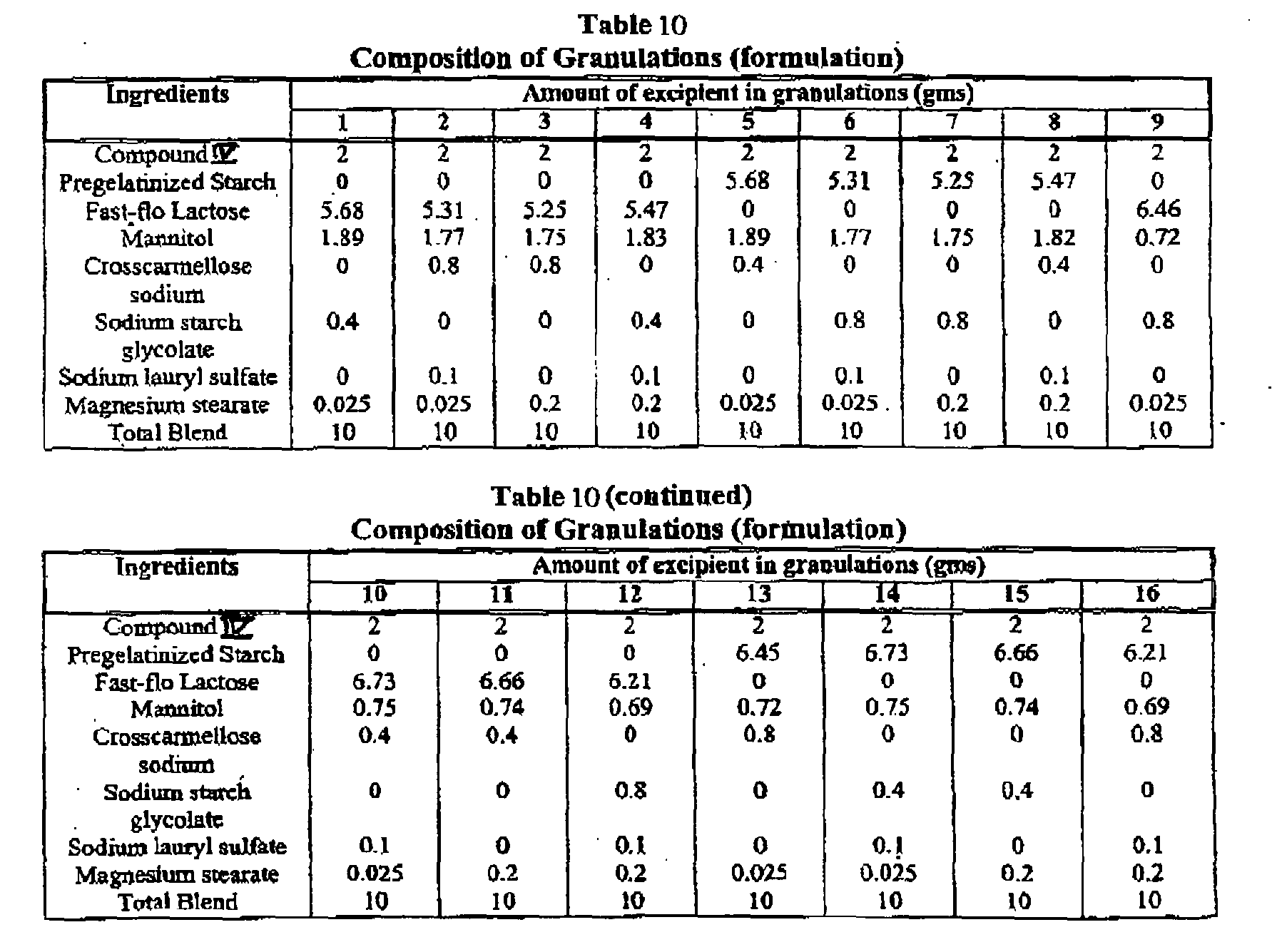
- Based on the in-vitro dissolution performance of these granulations, the preferred 4 were identified and these are listed in Table 11. The four preferred dormulations listed in Table 11 were evaluated for stability. These formuations can be encapsulated in different size capsules (e.g., 0, 1, 2, 3 or 4) or tabletted at different strengths.
Table 11 Clinical Capsule Formulation Candidates Excipients Amout of excipient in granulations (% w/w) F5 (Dry) F6 (Dry) F7 (Dry) F8 (Wet) Compound IV(1) 28.0 28.0 28.0 28.0 Pregelatinized Starch (2) 0 60.0 0 30.0 Fast-flo Lactose (2) 65.5 0 33.5 0 Lactose monohydrate regular grade (2) 0 0 0 33.5 Mannitol(2) 0 6.0 0 0 Microcrystalline cellulose (2) 0 0 32.0 0 Polyvinylpyroolidone (3) 0 0 0 2.0 Crosscarmellose sodium (4) 4.0 4.0 4.0 4.0 Sodium lauryl sulfate (5) 1.0 1.0 0 1.0 Cetylpyridinium chloride (5) 0 0 1.0 0 Magnesium stearate (6) 1.0 0.5 1.0 1.0 Colloidal silcon dioxide (7) 0.5 0.5 0.5 0.5 Total Blend 100 100 100 100 Note: (1) active ingredient; (2) diluent; (3) binder; (4) disintegrant; (5) wetting agent; (6) lubricant; (7) flow enhancer - The data suggest that formulations according to the present invention have improved stability and have increased bioavailability. The in vivo data suggest that the formulations are effective in treating PK related disorders such as tumor growth.
Claims (31)
- A formulation suitable for parenteral or oral administration, said formulation comprising(a) an ionizable substituted indolinone, wherein the ionizable substituted indolinone is 3-[2,4-dimethyl-5-(2-oxo-1,2-dihydro-indol-3-ylidenemethyl)-1H-pyrrol-3-yl]-propionic acid, or a pharmaceutically acceptable salt or derivative thereof;(b) one or more polyoxyhydrocarbyl compounds; and(c) a pharmaceutically acceptable carrier.
- The formulation of claim 1, wherein said ionizable substituted indolinone is solubilized by combining said indolinone with a molar equivalent of a base solution or an acid solution.
- The formulation of claim 1, wherein said formulation is suitable for parenteral administration.
- The formulation of claim 1, wherein said formulation is suitable for oral administration.
- The formulation of any one of claims 1-4, wherein each of said one or more polyoxyhydrocarbyl compounds is independently selected from the group consisting of water soluble carbohydrates, water soluble carbohydrate derivatives, water soluble polypeptides, water soluble polymers, water soluble mixed oxyalkylene polymers, the polymeric forms of ethylene glycol, polyethylene glycol 300, polyethylene glycol 400, propyleneglycol, glycerin, and combinations thereof.
- The formulation of claim 2, wherein said base solution is selected from the group consisting of sodium hydroxide, ammonium hydroxide, triethylamine, ethylenediamine, N-methyl-D-glucamine, choline, and triethanolamine.
- The formulation of claim 2, wherein said acid solution is selected from the group consisting of hydrochloric acid, sulfuric acid, formic acid, lactic acid, malic acid, succinic acid, acetic acid, methane sulfonic acid, benzene sulfonic acid, and phosphoric acid.
- The formulation of any one of claims 1-7, wherein said pharmaceutically acceptable carrier further comprises(a) one or more buffers;(b) one or more pharmaceutically acceptable surfactants;(c) one or more pharmaceutically acceptable preservatives;(d) one or more antioxidants;(e) one or more pharmaceutically acceptable alcohols;(f) one or more pharmaceutically acceptable oils;(g) one or more polyglycolized lipids;(h) one or more pharmaceutically acceptable granulating agents; or(i) any combination thereof.
- The formulation of claim 8, wherein each of said one or more buffers is independently selected from the group consisting of acetate, citrate, phosphoric acid buffer, ascorbate, hydrochloric acid buffer, Tris-HCl buffer, sodium phosphate, sodium carbonate, sodium hydroxide, glutamate, glycine, and Tris base buffers.
- The formulation of claim 8 or 9, wherein each of said one or more pharmaceutically acceptable surfactants is independently selected from the group consisting of pharmaceutically acceptable non-ionic surfactants and pharmaceutically acceptable anionic surfactants.
- The formulation of any one of claims 8-10, wherein each of said one or more pharmaceutically acceptable surfactants is a non-ionic surfactant independently selected from the group consisting of polyoxyethylenepolypropylene glycols, polyoxyethylene castor oil derivatives, polyoxyethyleneglycerol oxystearate.
- The formulation of any one of claims 8-11, wherein each of said one or more pharmaceutically acceptable preservatives is independently selected from the group consisting of benzyl alcohol, methyl paraben, ethyl paraben, and phenol.
- The formulation of any one of claims 8-12, wherein each of said one or more antioxidants is independently selected from the group consisting of sodium meta-bisulfite, EDTA, ascorbic acid, and benzyl alcohol.
- The formulation of any one of claims 8-13, wherein each of said one or more pharmaceutically acceptable alcohols is independently selected from the group consisting of ethanol, benzyl alcohol, propylene glycol, 2-(2-ethoxyethoxy)ethanol, and glycerol.
- The formulation of any one of claims 8-14, wherein the pharmaceutically acceptable carrier further comprises one or more pharmaceutically acceptable alcohols, and wherein the pharmaceutically acceptable carrier further comprises an amount of pharmaceutically acceptable aqueous solution effective to prevent hemolysis on parenteral administration to a patient in need thereof.
- The formulation of any one of claims 8-15, wherein each of said one or more pharmaceutically acceptable oils is independently selected from the group consisting of mineral oils, vegetable oils, fractionated coconut oils, sesame oil, propyleneglycol monolaurate, and mixed triglycerides with caprylic acid and capric acid.
- The formulation of any one of claims 8-16, wherein each of said one or more polyglycolized lipids is independently selected from the group consisting of monoglycerides, diglycerides, triglycerides, polyethyleneglycol monoesters, and polyethyleneglycol diesters.
- The formulation of any one of claims 8-17, wherein each of said pharmaceutically acceptable granulating agents is selected from the group consisting of silicon dioxide, microcrystalline cellulose, starch, calcium carbonate, pectin, crospovidone, water, alcohol and polyplasdone or a combination of any of the preceeding.
- The formulation of claim 4, wherein said pharmaceutically acceptable carrier comprises two or more of the members of the group consisting of one or more polyoxyhydrocarbyl compounds, one or more polyglycolized lipids, one or more sufactants, and one or more granulizing agents.
- The formulation of claim 19, wherein said pharmaceutically acceptable carrier comprises one or more polyoxyhydrocarbyl compounds, one or more polyglycolized lipids, and one or more surfactants.
- The formulation of claim 4, wherein said formulation is solid, and wherein said pharmaceutically acceptable carriers comprise one or more pharmaceutically acceptable diluents, one or more pharmaceutically acceptable binders, one or more pharmaceutically acceptable disintegrants, one or more pharmaceutically acceptable surfactants, one or more pharmaceutically acceptable lubricants, and one or more pharmaceutically acceptable flow enhancers.
- The formulation of claim 21, wherein(a) each of said one or more pharmaceutically acceptable diluents is selected from the group consisting of pregelatinized starch, lactose monohydrate, lactose, monohydrate regular grade, mannitol, calcium phosphate and microcrystalline cellulose;(b) each of said one or more pharmaceutically acceptable binders is selected from the group consisting of polyvinylpyrrolidone, hydroxypropylmethyl cellulose, hydroxypropylcellulose and starch;(c) each of said one or more pharmaceutically acceptable disintegrants is selected from the group consisting of crosscarmellose sdoium, sodium starch glycolate, gospovidone, and starch;(d) each of said one or more pharmaceutically acceptable surfactants is selected from the group consisting of sodium lauryl sulfate, polysorbate and cetylpyridinium chloride;(e) each of said one or more pharmaceutically acceptable lubricants is selected from the group consisting of magnesium stearate, sodium stearyl fumarate, glyceryl behenate and stearic acid; or(f) each of said one or more pharmaceutically acceptable flow enhancers is selected from the group consisting of colloidal silicon dioxide and talc.
- The formulation of claim 4, wherein said formulation is a solution, and wherein(a) said pharmaceutically acceptable carrier comprises one or more polyoxyhydrocarbyl compounds, one or more surfactants, and one or more buffers;(b) the polyoxyhydrocarbyl compound is selected from the group consisting of water soluble carbohydrates, water soluble carbohydrate derivatives, water soluble polypeptides, water soluble polymers, water soluble mixed oxyalkylene polymers, the polymeric forms of ethylene glycol, and combinations thereof;(c) the surfactant is selected from the group consisting of pharmaceutically acceptable non-ionic surfactants and pharmaceutically acceptable anionic surfactants; or(d) the buffer is selected from the group consisting of acetate, citrate, phosphoric acid buffer, ascorbate, hydrochloric acid buffer, Tris-HCl buffer, sodium phosphate, sodium carbonate, sodium hydroxide, glutamate, glycine, and Tris base buffers.
- The formulation of claim 4, wherein said formulation is an aqueous suspension, and wherein(a) the pharmaceutically acceptable carrier comprises a suspending agent and a surfactant;(b) the suspending agent is selected from the group consisting of carboxymethylcellulose, hydroxypropylmethylcellulose, povidone and starch; or(c) the surfactant is selected from the group consisting of pharmaceutically acceptable non-ionic surfactants and pharmaceutically acceptable anionic surfactants.
- The formulation of claim 3, wherein(a) pharmaceutically acceptable carrier comprises one or more pharmaceutically acceptable surfactants and one or more pharmaceutically acceptable oils;(b) the pharmaceutically acceptable surfactant comprises an ethylene oxide copolymer and said pharmaceutically acceptable oil comprises sesame oil;(c) the ionizable substituted indolinone is present in a concentration selected from the range of about 50 mg/gm to about 750 mg/gm;(d) the ionizable substituted indolinone is present in a concentration selected from the range of about 50 mg/gm to about 500 mg/gm; or(e) the ionizable substituted indolinone is present in a concentration selected from the range of about 50 mg/gm to about 200 mg/gm.
- The formulation of any one of claims 1-25 formulated into a hard gelatin capsule or a soft gelatin capsule.
- Use of a formulation according to any one of claims 1-26 for the manufacture of a medicament.
- The use of claim 27, wherein the medicament is useful in preventing or treating a protein kinase related disorder, wherein the protein kinase related disorder is disorder selected from the group consisting of: (a) a cancer which is selected from the group consisting of squamous cell carcinoma, a sarcoma, Kaposi's sarcoma, astrocytoma, glioblastoma, lung cancer, bladder cancer, colorectal cancer, gastrointestinal cancer, head and neck cancer, melanoma, ovarian cancer, prostate cancer, breast cancer, small-cell lung cancer and glioma; (b) diabetes; (c) a hyper-proliferation disorder; (d) von Hippel-Lindau disease; (e) restenosis; (f) fibrosis; (g) psoriasis; (h) osteoarthritis; (i) rheumatoid arthritis; (j) an inflammatory disorder; (k) angiogenesis; (l) an immunological disorder selected from the group consisting of autoimmune disease and AIDS; and (m) a cardiovascular disorder.
- The use of claim 27 or 28, wherein the ionizable substituted indolinone is present in the medicament at(a) a concentration in the range from about 50 mg/gm to about 750 mg/gm;(b) a concentration in the range from about 50 mg/gm to about 500 mg/gm; or(c) a concentration in the range from about 50 mg/gm to about 250 mg/gm.
- A method of preparing a formulation comprising:(a) adding to a salt solution, formed in situ by admixing a molar equivalent of a base solution or an acid solution with an ionizable substituted indolinone, wherein said ionizable substituted indolinone is 3-[2,4-dimethyl-5-(2-oxo-1,2-dihydro-indol-3-ylidenemethyl)-1H-pyrrol-3-yl]-propionic acid, or a pharmaceutically acceptable salt or derivative thereof; and(b) mixing the solution of the ionized substituted indolinone with one or more polyoxyhydrocarbyl compounds and/or one or more buffers.
- A method of making a formulation suitable for oral administration comprising admixing(a) an ionizable substituted indolinone, wherein said ionizable substituted indolinone is 3-[2,4-dimethyl-5-(2-oxo-1,2-dihydro-indol-3-ylidenemethyl)-1H-pyrrol-3-yl]-propionic acid, or a pharmaceutically acceptable salt or derivative thereof;(b) one or more pharmaceutically acceptable surfactants; and(c) one or more pharmaceutically acceptable oils.
Priority Applications (1)
| Application Number | Priority Date | Filing Date | Title |
|---|---|---|---|
| CY20111100743T CY1112346T1 (en) | 1999-11-24 | 2011-08-02 | IONIZED INDOLINONINE PRODUCERS AND USE THESE AS RTK CONNECTORS |
Applications Claiming Priority (3)
| Application Number | Priority Date | Filing Date | Title |
|---|---|---|---|
| US16754499P | 1999-11-24 | 1999-11-24 | |
| PCT/US2000/032277 WO2001037820A2 (en) | 1999-11-24 | 2000-11-22 | Ionizable indolinone derivatives and their use as ptk ligands |
| US167544P | 2009-04-08 |
Publications (2)
| Publication Number | Publication Date |
|---|---|
| EP1233943A2 EP1233943A2 (en) | 2002-08-28 |
| EP1233943B1 true EP1233943B1 (en) | 2011-06-29 |
Family
ID=22607804
Family Applications (1)
| Application Number | Title | Priority Date | Filing Date |
|---|---|---|---|
| EP00982228A Expired - Lifetime EP1233943B1 (en) | 1999-11-24 | 2000-11-22 | Ionizable indolinone derivatives and their use as ptk ligands |
Country Status (12)
| Country | Link |
|---|---|
| EP (1) | EP1233943B1 (en) |
| JP (1) | JP5336686B2 (en) |
| AR (1) | AR026593A1 (en) |
| AT (1) | ATE514676T1 (en) |
| AU (1) | AU1928501A (en) |
| CO (1) | CO5271700A1 (en) |
| CY (1) | CY1112346T1 (en) |
| DK (1) | DK1233943T3 (en) |
| ES (1) | ES2367007T3 (en) |
| PT (1) | PT1233943E (en) |
| TW (1) | TWI265029B (en) |
| WO (1) | WO2001037820A2 (en) |
Families Citing this family (105)
| Publication number | Priority date | Publication date | Assignee | Title |
|---|---|---|---|---|
| PT1255536E (en) * | 1999-12-22 | 2006-09-29 | Sugen Inc | DERIVATIVES OF INDOLINONE FOR THE MODULATION OF TYROSINE PROTEIN CINASE TYPE C-KIT |
| PT1255752E (en) * | 2000-02-15 | 2007-10-17 | Pharmacia & Upjohn Co Llc | Pyrrole substituted 2-indolinone protein kinase inhibitors |
| WO2002055517A2 (en) | 2000-12-20 | 2002-07-18 | Jingrong Cui | 4-(hetero)aryl substituted indolinones |
| US8960183B2 (en) | 2001-02-16 | 2015-02-24 | Solar Solutions Llc | Solar water pasteurizer |
| WO2002070478A1 (en) | 2001-03-06 | 2002-09-12 | Astrazeneca Ab | Indolone derivatives having vascular-damaging activity |
| WO2003000251A1 (en) | 2001-06-21 | 2003-01-03 | Ariad Pharmaceuticals, Inc. | Novel idolinones and uses thereof |
| DK3168218T3 (en) | 2001-08-15 | 2019-01-14 | Pharmacia & Upjohn Co Llc | Crystalline comprising an L-malic acid salt of N- [2- (DIETHYLAMINO) ETHYL] -5 - [(5-FLUOR-1,2-DIHYDRO-2-OXO-3H-INDOL-3-YLIDE) METHYL] -2,4 -DIMETHYL-1H-PYRROL-3-CARBOXAMIDE FOR USE AS A MEDICINE |
| MXPA04003385A (en) * | 2001-10-10 | 2005-04-11 | Sugen Inc | 3-[4-(substituted heterocyclyl)-pyrrol-2-ylmethylidene]-2-indolinone derivatives as kinase inhibitors. |
| US20060166982A1 (en) * | 2002-08-01 | 2006-07-27 | Danilo Giribone | Isotopically labelly indlinone derivatives and process for their preparation |
| HN2003000272A (en) * | 2002-09-10 | 2008-07-29 | Pharmacia Italia Spa | FORMULATIONS THAT INCLUDE AN INDOLINONE COMPOUND |
| AR042042A1 (en) * | 2002-11-15 | 2005-06-08 | Sugen Inc | COMBINED ADMINISTRATION OF AN INDOLINONE WITH A CHEMOTHERAPEUTIC AGENT FOR CELL PROLIFERATION DISORDERS |
| CA2506546A1 (en) | 2002-11-15 | 2004-06-17 | Exelixis, Inc. | Kinase modulators |
| US7157577B2 (en) | 2003-03-07 | 2007-01-02 | Sugen Inc. | 5-sulfonamido-substituted indolinone compounds as protein kinase inhibitors |
| DK1648998T3 (en) | 2003-07-18 | 2015-01-05 | Amgen Inc | Specific binding agents for hepatocyte growth factor |
| JP2008521900A (en) | 2004-11-30 | 2008-06-26 | アムジエン・インコーポレーテツド | Quinolines and quinazoline analogues and their use as medicaments for the treatment of cancer |
| US20080108664A1 (en) | 2005-12-23 | 2008-05-08 | Liu Belle B | Solid-state form of AMG 706 and pharmaceutical compositions thereof |
| AR059066A1 (en) | 2006-01-27 | 2008-03-12 | Amgen Inc | COMBINATIONS OF THE ANGIOPOYETINE INHIBITOR -2 (ANG2) AND THE VASCULAR ENDOTELIAL GROWTH FACTOR INHIBITOR (VEGF) |
| ES2353482T3 (en) | 2006-02-10 | 2011-03-02 | Amgen, Inc | HYGRATE FORMS OF AMG706. |
| US8217177B2 (en) | 2006-07-14 | 2012-07-10 | Amgen Inc. | Fused heterocyclic derivatives and methods of use |
| PE20121506A1 (en) | 2006-07-14 | 2012-11-26 | Amgen Inc | TRIAZOLOPYRIDINE COMPOUNDS AS C-MET INHIBITORS |
| EP2125781A2 (en) | 2006-12-20 | 2009-12-02 | Amgen Inc. | Substituted heterocycles and methods of use |
| WO2008086014A2 (en) | 2007-01-09 | 2008-07-17 | Amgen Inc. | Bis-aryl amide derivatives useful for the treatment of cancer |
| MX2009008531A (en) | 2007-02-16 | 2009-08-26 | Amgen Inc | Nitrogen-containing heterocyclyl ketones and methods of use. |
| EP3330292A1 (en) | 2007-08-21 | 2018-06-06 | Amgen, Inc | Human c-fms antigen binding proteins |
| WO2009030270A1 (en) * | 2007-09-03 | 2009-03-12 | Novartis Ag | Dihydroindole derivatives useful in parkinson's disease |
| BRPI0705564B8 (en) * | 2007-10-10 | 2021-05-25 | Embrapa Pesquisa Agropecuaria | continuous liquid crystal type system containing co-solvents carrying sparingly soluble substances in water, its process of obtaining and its uses |
| US8383818B2 (en) | 2008-02-21 | 2013-02-26 | Merck Sharp & Dohme Corp. | Functionally selective alpha2C adrenoreceptor agonists |
| EP2138167A1 (en) * | 2008-06-24 | 2009-12-30 | ratiopharm GmbH | Pharmaceutical composition comprising N-[2-(Diethylamino)ethyl]-5-[(5-fluoro-1,2-dihydro-2-oxo-3H-indol-3-ylidene) methyl]-2,4-dimethyl-1H-pyrrole-3-carboxamide |
| EP2181991A1 (en) * | 2008-10-28 | 2010-05-05 | LEK Pharmaceuticals D.D. | Novel salts of sunitinib |
| EP2186809A1 (en) * | 2008-11-13 | 2010-05-19 | LEK Pharmaceuticals D.D. | New crystal form of sunitinib malate |
| HUE043862T2 (en) | 2009-05-19 | 2021-12-28 | Celgene Corp | Preparations containing 4-amino-2- (2,6-dioxopiperidin-3-yl) isoindoline-1,3-dione |
| EP2264027A1 (en) | 2009-05-27 | 2010-12-22 | Ratiopharm GmbH | Process for the preparation of N-[2-(Diethylamino)ethyl]-5-[(5-fluoro-1,2-dihydro-2-oxo-3H-indol-3-ylidene) methyl]-2,4-dimethyl-1H-pyrrole-3-carboxamide |
| WO2011161217A2 (en) | 2010-06-23 | 2011-12-29 | Palacký University in Olomouc | Targeting of vegfr2 |
| MX2013010871A (en) | 2011-03-23 | 2014-01-31 | Amgen Inc | FUSIONED DOUBLE TRICICLIC INHIBITORS OF CDK 4/6 AND FLT3. |
| WO2013025939A2 (en) | 2011-08-16 | 2013-02-21 | Indiana University Research And Technology Corporation | Compounds and methods for treating cancer by inhibiting the urokinase receptor |
| AR090263A1 (en) | 2012-03-08 | 2014-10-29 | Hoffmann La Roche | COMBINED ANTIBODY THERAPY AGAINST HUMAN CSF-1R AND USES OF THE SAME |
| US9505749B2 (en) | 2012-08-29 | 2016-11-29 | Amgen Inc. | Quinazolinone compounds and derivatives thereof |
| FR3008900B1 (en) * | 2013-07-25 | 2018-03-30 | Centre Nat Rech Scient | MULTICOMPARTIMIZED LIPID NANOPARTICLES |
| ES2887474T3 (en) | 2015-01-08 | 2021-12-22 | Univ Leland Stanford Junior | Factors and cells that provide induction of bone, bone marrow and cartilage |
| EA201991528A1 (en) | 2016-12-22 | 2020-01-16 | Эмджен Инк. | Benzisothiazole, isothiazole [3,4-b] pyridine, quinazoline, phthalazine, pyrido [2,3-d] pyridazine and pyrido [2,3-d] pyrimidine derivatives in a red herbal solution COLORECTAL CANCER |
| JOP20190272A1 (en) | 2017-05-22 | 2019-11-21 | Amgen Inc | Kras g12c inhibitors and methods of using the same |
| ES2985118T3 (en) | 2017-09-08 | 2024-11-04 | Amgen Inc | KRAS G12C inhibitors and methods of using them |
| CA3099118A1 (en) | 2018-05-04 | 2019-11-07 | Amgen Inc. | Kras g12c inhibitors and methods of using the same |
| EP3788038B1 (en) | 2018-05-04 | 2023-10-11 | Amgen Inc. | Kras g12c inhibitors and methods of using the same |
| MA52564A (en) | 2018-05-10 | 2021-03-17 | Amgen Inc | KRAS G12C INHIBITORS FOR CANCER TREATMENT |
| MX2020012731A (en) | 2018-06-01 | 2021-02-22 | Amgen Inc | Kras g12c inhibitors and methods of using the same. |
| EP4268898A3 (en) | 2018-06-11 | 2024-01-17 | Amgen Inc. | Kras g12c inhibitors for treating cancer |
| EP3807276B1 (en) | 2018-06-12 | 2025-12-10 | Amgen Inc. | Kras g12c inhibitors encompassing a piperazine ring and use thereof in the treatment of cancer |
| TWI826492B (en) * | 2018-07-27 | 2023-12-21 | 加拿大商愛彼特生物製藥公司 | Substituted tetrahydrocyclopenta[c]pyrroles, substituted dihydropyrrolizines, analogues thereof, and methods using same |
| JP7516029B2 (en) | 2018-11-16 | 2024-07-16 | アムジエン・インコーポレーテツド | Improved synthesis of key intermediates for KRAS G12C inhibitor compounds |
| JP7377679B2 (en) | 2018-11-19 | 2023-11-10 | アムジエン・インコーポレーテツド | Combination therapy comprising a KRASG12C inhibitor and one or more additional pharmaceutically active agents for the treatment of cancer |
| JP7454572B2 (en) | 2018-11-19 | 2024-03-22 | アムジエン・インコーポレーテツド | KRAS G12C inhibitor and its use |
| MX419368B (en) | 2018-12-20 | 2025-01-14 | Amgen Inc | Heteroaryl amides useful as kif18a inhibitors |
| US12441736B2 (en) | 2018-12-20 | 2025-10-14 | Amgen Inc. | KIF18A inhibitors |
| US12459932B2 (en) | 2018-12-20 | 2025-11-04 | Amgen Inc. | KIF18A inhibitors |
| KR102875569B1 (en) | 2018-12-20 | 2025-10-23 | 암젠 인크 | KIF18A inhibitor |
| EP3930845A1 (en) | 2019-03-01 | 2022-01-05 | Revolution Medicines, Inc. | Bicyclic heterocyclyl compounds and uses thereof |
| WO2020180768A1 (en) | 2019-03-01 | 2020-09-10 | Revolution Medicines, Inc. | Bicyclic heteroaryl compounds and uses thereof |
| EP3738593A1 (en) | 2019-05-14 | 2020-11-18 | Amgen, Inc | Dosing of kras inhibitor for treatment of cancers |
| KR20250159270A (en) | 2019-05-21 | 2025-11-10 | 암젠 인크 | Solid state forms |
| WO2021026100A1 (en) | 2019-08-02 | 2021-02-11 | Amgen Inc. | Pyridine derivatives as kif18a inhibitors |
| EP4007752B1 (en) | 2019-08-02 | 2025-09-24 | Amgen Inc. | Kif18a inhibitors |
| WO2021026101A1 (en) | 2019-08-02 | 2021-02-11 | Amgen Inc. | Kif18a inhibitors |
| WO2021026099A1 (en) | 2019-08-02 | 2021-02-11 | Amgen Inc. | Kif18a inhibitors |
| MX2022004656A (en) | 2019-10-24 | 2022-05-25 | Amgen Inc | PYRIDOPYRIMIDINE DERIVATIVES USEFUL AS INHIBITORS OF KRAS G12C AND KRAS G12D IN THE TREATMENT OF CANCER. |
| PH12022550988A1 (en) | 2019-11-04 | 2023-10-09 | Revolution Medicines Inc | Ras inhibitors |
| CN114901366A (en) | 2019-11-04 | 2022-08-12 | 锐新医药公司 | RAS inhibitors |
| KR20220109408A (en) | 2019-11-04 | 2022-08-04 | 레볼루션 메디슨즈, 인크. | RAS inhibitors |
| WO2021092115A1 (en) | 2019-11-08 | 2021-05-14 | Revolution Medicines, Inc. | Bicyclic heteroaryl compounds and uses thereof |
| CA3161156A1 (en) | 2019-11-14 | 2021-05-20 | Amgen Inc. | Improved synthesis of kras g12c inhibitor compound |
| AR120457A1 (en) | 2019-11-14 | 2022-02-16 | Amgen Inc | ENHANCED SYNTHESIS OF KRAS G12C INHIBITOR COMPOUND |
| WO2021108683A1 (en) | 2019-11-27 | 2021-06-03 | Revolution Medicines, Inc. | Covalent ras inhibitors and uses thereof |
| WO2021142026A1 (en) | 2020-01-07 | 2021-07-15 | Revolution Medicines, Inc. | Shp2 inhibitor dosing and methods of treating cancer |
| MX2022016355A (en) | 2020-06-18 | 2023-04-03 | Revolution Medicines Inc | Methods for delaying, preventing, and treating acquired resistance to ras inhibitors. |
| CA3187757A1 (en) | 2020-09-03 | 2022-03-24 | Ethan AHLER | Use of sos1 inhibitors to treat malignancies with shp2 mutations |
| IL301298A (en) | 2020-09-15 | 2023-05-01 | Revolution Medicines Inc | Indole derivatives as ras inhibitors in the treatment of cancer |
| AU2021409816A1 (en) | 2020-12-22 | 2023-07-06 | Qilu Regor Therapeutics Inc. | Sos1 inhibitors and uses thereof |
| AR125787A1 (en) | 2021-05-05 | 2023-08-16 | Revolution Medicines Inc | RAS INHIBITORS |
| WO2022235866A1 (en) | 2021-05-05 | 2022-11-10 | Revolution Medicines, Inc. | Covalent ras inhibitors and uses thereof |
| AR125782A1 (en) | 2021-05-05 | 2023-08-16 | Revolution Medicines Inc | RAS INHIBITORS |
| AR127308A1 (en) | 2021-10-08 | 2024-01-10 | Revolution Medicines Inc | RAS INHIBITORS |
| CN119212994A (en) | 2021-12-17 | 2024-12-27 | 建新公司 | Pyrazolopyrazine compounds as SHP2 inhibitors |
| EP4227307A1 (en) | 2022-02-11 | 2023-08-16 | Genzyme Corporation | Pyrazolopyrazine compounds as shp2 inhibitors |
| JP2025509217A (en) | 2022-03-07 | 2025-04-11 | アムジエン・インコーポレーテツド | Process for preparing 4-methyl-2-propan-2-yl-pyridine-3-carbonitrile |
| WO2023172940A1 (en) | 2022-03-08 | 2023-09-14 | Revolution Medicines, Inc. | Methods for treating immune refractory lung cancer |
| CN120504682A (en) | 2022-06-10 | 2025-08-19 | 锐新医药公司 | Macrocyclic RAS inhibitors |
| JP2025536257A (en) | 2022-10-14 | 2025-11-05 | ブラック ダイアモンド セラピューティクス,インコーポレイティド | Methods of treating cancer using isoquinoline or 6-AZA-quinoline derivatives |
| KR20250164828A (en) | 2023-03-30 | 2025-11-25 | 레볼루션 메디슨즈, 인크. | Composition for inducing RAS GTP hydrolysis and use thereof |
| CN121263418A (en) | 2023-04-07 | 2026-01-02 | 锐新医药公司 | Macrocyclic RAS inhibitors |
| KR20260005904A (en) | 2023-04-07 | 2026-01-12 | 레볼루션 메디슨즈, 인크. | macrocyclic RAS inhibitors |
| CN121100123A (en) | 2023-04-14 | 2025-12-09 | 锐新医药公司 | Crystalline form of Ras inhibitors |
| TW202448897A (en) | 2023-04-14 | 2024-12-16 | 美商銳新醫藥公司 | Crystalline forms of ras inhibitors, compositions containing the same, and methods of use thereof |
| TW202508595A (en) | 2023-05-04 | 2025-03-01 | 美商銳新醫藥公司 | Combination therapy for a ras related disease or disorder |
| US20250049810A1 (en) | 2023-08-07 | 2025-02-13 | Revolution Medicines, Inc. | Methods of treating a ras protein-related disease or disorder |
| WO2025080946A2 (en) | 2023-10-12 | 2025-04-17 | Revolution Medicines, Inc. | Ras inhibitors |
| TW202542151A (en) | 2023-12-22 | 2025-11-01 | 美商銳格醫藥有限公司 | Sos1 inhibitors and uses thereof |
| WO2025171296A1 (en) | 2024-02-09 | 2025-08-14 | Revolution Medicines, Inc. | Ras inhibitors |
| WO2025240847A1 (en) | 2024-05-17 | 2025-11-20 | Revolution Medicines, Inc. | Ras inhibitors |
| WO2025255438A1 (en) | 2024-06-07 | 2025-12-11 | Revolution Medicines, Inc. | Methods of treating a ras protein-related disease or disorder |
| WO2025265060A1 (en) | 2024-06-21 | 2025-12-26 | Revolution Medicines, Inc. | Therapeutic compositions and methods for managing treatment-related effects |
| WO2026006747A1 (en) | 2024-06-28 | 2026-01-02 | Revolution Medicines, Inc. | Ras inhibitors |
| WO2026015801A1 (en) | 2024-07-12 | 2026-01-15 | Revolution Medicines, Inc. | Methods of treating a ras related disease or disorder |
| WO2026015825A1 (en) | 2024-07-12 | 2026-01-15 | Revolution Medicines, Inc. | Use of ras inhibitor for treating pancreatic cancer |
| WO2026015796A1 (en) | 2024-07-12 | 2026-01-15 | Revolution Medicines, Inc. | Methods of treating a ras related disease or disorder |
| WO2026015790A1 (en) | 2024-07-12 | 2026-01-15 | Revolution Medicines, Inc. | Methods of treating a ras related disease or disorder |
Family Cites Families (9)
| Publication number | Priority date | Publication date | Assignee | Title |
|---|---|---|---|---|
| US5880141A (en) * | 1995-06-07 | 1999-03-09 | Sugen, Inc. | Benzylidene-Z-indoline compounds for the treatment of disease |
| DE69734521T9 (en) * | 1996-08-23 | 2006-12-07 | Sugen, Inc., South San Francisco | COMBINATIVE INDOLINO LIBRARIES AND RELATED PRODUCTS AND METHOD FOR THE TREATMENT OF DISEASES |
| EP0984930B1 (en) * | 1997-05-07 | 2005-04-06 | Sugen, Inc. | 2-indolinone derivatives as modulators of protein kinase activity |
| EP1066257A2 (en) * | 1998-03-26 | 2001-01-10 | Sugen, Inc. | Heterocylic classes of compounds for the modulating tyrosine protein kinase |
| HUP0103617A2 (en) * | 1998-05-29 | 2002-02-28 | Sugen, Inc. | Pyrrole substituted 2-indolinone protein kinase inhibitors, pharmaceutical compositions containing the compounds and their use |
| JP2002522452A (en) * | 1998-08-04 | 2002-07-23 | スージェン・インコーポレーテッド | Regulator of protein kinase 3-methylidenyl-2-indolinone |
| JP2002532492A (en) * | 1998-12-17 | 2002-10-02 | エフ.ホフマン−ラ ロシュ アーゲー | 4-Alkenyl (and alkynyl) oxidols as inhibitors of cyclin-dependent kinases, especially CDK2 |
| CN1356872A (en) * | 1998-12-31 | 2002-07-03 | 苏根公司 | 3-heteroarylidenyl-2-indolinone compounds for modulating protein kinase activity and for use in cancer chemotherapy |
| WO2000056709A1 (en) * | 1999-03-24 | 2000-09-28 | Sugen, Inc. | Indolinone compounds as kinase inhibitors |
-
2000
- 2000-11-22 EP EP00982228A patent/EP1233943B1/en not_active Expired - Lifetime
- 2000-11-22 AU AU19285/01A patent/AU1928501A/en not_active Abandoned
- 2000-11-22 AT AT00982228T patent/ATE514676T1/en active
- 2000-11-22 ES ES00982228T patent/ES2367007T3/en not_active Expired - Lifetime
- 2000-11-22 JP JP2001539435A patent/JP5336686B2/en not_active Expired - Fee Related
- 2000-11-22 WO PCT/US2000/032277 patent/WO2001037820A2/en not_active Ceased
- 2000-11-22 DK DK00982228.9T patent/DK1233943T3/en active
- 2000-11-22 PT PT00982228T patent/PT1233943E/en unknown
- 2000-11-23 TW TW089124929A patent/TWI265029B/en not_active IP Right Cessation
- 2000-11-23 AR ARP000106194A patent/AR026593A1/en not_active Application Discontinuation
- 2000-11-24 CO CO00090148A patent/CO5271700A1/en active IP Right Grant
-
2011
- 2011-08-02 CY CY20111100743T patent/CY1112346T1/en unknown
Also Published As
| Publication number | Publication date |
|---|---|
| DK1233943T3 (en) | 2011-08-15 |
| PT1233943E (en) | 2011-09-01 |
| ES2367007T3 (en) | 2011-10-27 |
| AU1928501A (en) | 2001-06-04 |
| EP1233943A2 (en) | 2002-08-28 |
| CY1112346T1 (en) | 2015-12-09 |
| WO2001037820A2 (en) | 2001-05-31 |
| TWI265029B (en) | 2006-11-01 |
| CO5271700A1 (en) | 2003-04-30 |
| WO2001037820A3 (en) | 2001-12-13 |
| ATE514676T1 (en) | 2011-07-15 |
| JP5336686B2 (en) | 2013-11-06 |
| AR026593A1 (en) | 2003-02-19 |
| JP2003514851A (en) | 2003-04-22 |
Similar Documents
| Publication | Publication Date | Title |
|---|---|---|
| EP1233943B1 (en) | Ionizable indolinone derivatives and their use as ptk ligands | |
| EP1014953B1 (en) | Formulations for hydrophobic pharmaceutical agents | |
| CA1165689A (en) | Method of increasing oral absorption of polar bioactive agents | |
| ES2496144T5 (en) | Pirfenidone capsule formulation and pharmaceutically acceptable excipients | |
| US20210393626A1 (en) | Pharmaceutical Composition Comprising PARP Inhibitors | |
| US6878733B1 (en) | Formulations for pharmaceutical agents ionizable as free acids or free bases | |
| EP3104844B1 (en) | Complexes of sirolimus and its derivatives, process for the preparation thereof and pharmaceutical compositions containing them | |
| JP2021506797A (en) | HSP90 targeted conjugate and its preparation | |
| EP3458448B1 (en) | Fasn inhibitors for use in treating non-alcoholic steatohepatitis | |
| EP1324755B1 (en) | Pharmaceutical solutions of modafinil compounds | |
| US20230102146A1 (en) | Multi-target tyrosine kinase inhibitor | |
| CA2985379A1 (en) | Micronized pharmaceutical compositions for treatment of angiogenisis conditions | |
| US20100093725A1 (en) | Semi-solid formulations of phospholipase enzyme inhibitors | |
| JP5936609B2 (en) | Oral preparation of kinase inhibitor | |
| KR20090028983A (en) | New Pharmaceutical Compositions for the Treatment of Hyperlipidemia | |
| US20100056520A1 (en) | Formulations of phospholipase enzyme inhibitors | |
| KR20190137904A (en) | Induction method of cartilage formation | |
| KR20010034114A (en) | Potassium channel activators | |
| EP1685137B1 (en) | Particle-forming compositions containing fused pyrrolocarbazoles | |
| CN120247799B (en) | Amorphous substance of pentazocine pamoate and pharmaceutical composition thereof | |
| US20080207745A1 (en) | Orally-absorbed formulation for paromomycin | |
| WO2026012350A1 (en) | Use of chromenone compound | |
| EP2047851A1 (en) | Drug formulation containing fibrate medicament and process for producing the same | |
| HK1028548B (en) | Formulations for hydrophobic pharmaceutical agents | |
| CN111053742A (en) | Pitavastatin calcium oral spray and preparation and use method thereof |
Legal Events
| Date | Code | Title | Description |
|---|---|---|---|
| PUAI | Public reference made under article 153(3) epc to a published international application that has entered the european phase |
Free format text: ORIGINAL CODE: 0009012 |
|
| 17P | Request for examination filed |
Effective date: 20020624 |
|
| AK | Designated contracting states |
Kind code of ref document: A2 Designated state(s): AT BE CH CY DE DK ES FI FR GB GR IE IT LI LU MC NL PT SE TR |
|
| AX | Request for extension of the european patent |
Free format text: AL;LT;LV;MK;RO;SI |
|
| RIN1 | Information on inventor provided before grant (corrected) |
Inventor name: SHENOY, NARMADA Inventor name: SORASUCHART, WARANUSH SUGEN, INC. Inventor name: KOPARKAR, ARUN |
|
| 17Q | First examination report despatched |
Effective date: 20030829 |
|
| RAP1 | Party data changed (applicant data changed or rights of an application transferred) |
Owner name: SUGEN, INC. |
|
| GRAP | Despatch of communication of intention to grant a patent |
Free format text: ORIGINAL CODE: EPIDOSNIGR1 |
|
| GRAJ | Information related to disapproval of communication of intention to grant by the applicant or resumption of examination proceedings by the epo deleted |
Free format text: ORIGINAL CODE: EPIDOSDIGR1 |
|
| GRAP | Despatch of communication of intention to grant a patent |
Free format text: ORIGINAL CODE: EPIDOSNIGR1 |
|
| RIN1 | Information on inventor provided before grant (corrected) |
Inventor name: KOPARKAR, ARUN Inventor name: SORASUCHART, WARANUSH Inventor name: SHENOY, NARMADA |
|
| GRAS | Grant fee paid |
Free format text: ORIGINAL CODE: EPIDOSNIGR3 |
|
| GRAA | (expected) grant |
Free format text: ORIGINAL CODE: 0009210 |
|
| AK | Designated contracting states |
Kind code of ref document: B1 Designated state(s): AT BE CH CY DE DK ES FI FR GB GR IE IT LI LU MC NL PT SE TR |
|
| REG | Reference to a national code |
Ref country code: GB Ref legal event code: FG4D |
|
| REG | Reference to a national code |
Ref country code: CH Ref legal event code: NV Representative=s name: E. BLUM & CO. AG PATENT- UND MARKENANWAELTE VSP Ref country code: CH Ref legal event code: EP |
|
| REG | Reference to a national code |
Ref country code: IE Ref legal event code: FG4D |
|
| REG | Reference to a national code |
Ref country code: DK Ref legal event code: T3 |
|
| REG | Reference to a national code |
Ref country code: DE Ref legal event code: R096 Ref document number: 60046152 Country of ref document: DE Effective date: 20110818 |
|
| REG | Reference to a national code |
Ref country code: PT Ref legal event code: SC4A Free format text: AVAILABILITY OF NATIONAL TRANSLATION Effective date: 20110822 |
|
| REG | Reference to a national code |
Ref country code: SE Ref legal event code: TRGR |
|
| REG | Reference to a national code |
Ref country code: NL Ref legal event code: VDEP Effective date: 20110629 |
|
| REG | Reference to a national code |
Ref country code: GR Ref legal event code: EP Ref document number: 20110402000 Country of ref document: GR Effective date: 20110916 |
|
| REG | Reference to a national code |
Ref country code: ES Ref legal event code: FG2A Ref document number: 2367007 Country of ref document: ES Kind code of ref document: T3 Effective date: 20111027 |
|
| REG | Reference to a national code |
Ref country code: NL Ref legal event code: BK Free format text: ONTERECHT VERVALLEN OP 29.06.2011PUBLIKATIE VERVAL I.E. 19.10.2011I.E. 2011/42 |
|
| REG | Reference to a national code |
Ref country code: NL Ref legal event code: T3 |
|
| PLBE | No opposition filed within time limit |
Free format text: ORIGINAL CODE: 0009261 |
|
| STAA | Information on the status of an ep patent application or granted ep patent |
Free format text: STATUS: NO OPPOSITION FILED WITHIN TIME LIMIT |
|
| 26N | No opposition filed |
Effective date: 20120330 |
|
| PG25 | Lapsed in a contracting state [announced via postgrant information from national office to epo] |
Ref country code: MC Free format text: LAPSE BECAUSE OF NON-PAYMENT OF DUE FEES Effective date: 20111130 |
|
| REG | Reference to a national code |
Ref country code: DE Ref legal event code: R097 Ref document number: 60046152 Country of ref document: DE Effective date: 20120330 |
|
| PGFP | Annual fee paid to national office [announced via postgrant information from national office to epo] |
Ref country code: LU Payment date: 20141119 Year of fee payment: 15 Ref country code: DK Payment date: 20141027 Year of fee payment: 15 |
|
| PGFP | Annual fee paid to national office [announced via postgrant information from national office to epo] |
Ref country code: DE Payment date: 20141201 Year of fee payment: 15 Ref country code: SE Payment date: 20141107 Year of fee payment: 15 Ref country code: IE Payment date: 20141031 Year of fee payment: 15 Ref country code: TR Payment date: 20141023 Year of fee payment: 15 Ref country code: ES Payment date: 20141111 Year of fee payment: 15 Ref country code: FI Payment date: 20141106 Year of fee payment: 15 Ref country code: CH Payment date: 20141027 Year of fee payment: 15 Ref country code: FR Payment date: 20141027 Year of fee payment: 15 Ref country code: GB Payment date: 20141027 Year of fee payment: 15 Ref country code: GR Payment date: 20141030 Year of fee payment: 15 |
|
| PGFP | Annual fee paid to national office [announced via postgrant information from national office to epo] |
Ref country code: AT Payment date: 20141027 Year of fee payment: 15 Ref country code: CY Payment date: 20141021 Year of fee payment: 15 Ref country code: NL Payment date: 20141111 Year of fee payment: 15 Ref country code: PT Payment date: 20141029 Year of fee payment: 15 |
|
| PGFP | Annual fee paid to national office [announced via postgrant information from national office to epo] |
Ref country code: IT Payment date: 20141119 Year of fee payment: 15 |
|
| PGFP | Annual fee paid to national office [announced via postgrant information from national office to epo] |
Ref country code: BE Payment date: 20141120 Year of fee payment: 15 |
|
| REG | Reference to a national code |
Ref country code: PT Ref legal event code: MM4A Free format text: LAPSE DUE TO NON-PAYMENT OF FEES Effective date: 20160523 |
|
| REG | Reference to a national code |
Ref country code: DE Ref legal event code: R119 Ref document number: 60046152 Country of ref document: DE |
|
| REG | Reference to a national code |
Ref country code: DK Ref legal event code: EBP Effective date: 20151130 |
|
| PG25 | Lapsed in a contracting state [announced via postgrant information from national office to epo] |
Ref country code: LU Free format text: LAPSE BECAUSE OF NON-PAYMENT OF DUE FEES Effective date: 20151122 |
|
| REG | Reference to a national code |
Ref country code: CH Ref legal event code: PL |
|
| REG | Reference to a national code |
Ref country code: AT Ref legal event code: MM01 Ref document number: 514676 Country of ref document: AT Kind code of ref document: T Effective date: 20151122 |
|
| GBPC | Gb: european patent ceased through non-payment of renewal fee |
Effective date: 20151122 |
|
| PG25 | Lapsed in a contracting state [announced via postgrant information from national office to epo] |
Ref country code: CH Free format text: LAPSE BECAUSE OF NON-PAYMENT OF DUE FEES Effective date: 20151130 Ref country code: LI Free format text: LAPSE BECAUSE OF NON-PAYMENT OF DUE FEES Effective date: 20151130 Ref country code: CY Free format text: LAPSE BECAUSE OF NON-PAYMENT OF DUE FEES Effective date: 20151122 Ref country code: IT Free format text: LAPSE BECAUSE OF NON-PAYMENT OF DUE FEES Effective date: 20151122 Ref country code: GR Free format text: LAPSE BECAUSE OF NON-PAYMENT OF DUE FEES Effective date: 20160602 |
|
| REG | Reference to a national code |
Ref country code: NL Ref legal event code: MM Effective date: 20151201 |
|
| REG | Reference to a national code |
Ref country code: IE Ref legal event code: MM4A |
|
| REG | Reference to a national code |
Ref country code: FR Ref legal event code: ST Effective date: 20160729 |
|
| PG25 | Lapsed in a contracting state [announced via postgrant information from national office to epo] |
Ref country code: SE Free format text: LAPSE BECAUSE OF NON-PAYMENT OF DUE FEES Effective date: 20151123 Ref country code: PT Free format text: LAPSE BECAUSE OF NON-PAYMENT OF DUE FEES Effective date: 20160523 Ref country code: AT Free format text: LAPSE BECAUSE OF NON-PAYMENT OF DUE FEES Effective date: 20151122 |
|
| PG25 | Lapsed in a contracting state [announced via postgrant information from national office to epo] |
Ref country code: NL Free format text: LAPSE BECAUSE OF NON-PAYMENT OF DUE FEES Effective date: 20151201 |
|
| REG | Reference to a national code |
Ref country code: GR Ref legal event code: ML Ref document number: 20110402000 Country of ref document: GR Effective date: 20160602 |
|
| PG25 | Lapsed in a contracting state [announced via postgrant information from national office to epo] |
Ref country code: DE Free format text: LAPSE BECAUSE OF NON-PAYMENT OF DUE FEES Effective date: 20160601 Ref country code: GB Free format text: LAPSE BECAUSE OF NON-PAYMENT OF DUE FEES Effective date: 20151122 Ref country code: DK Free format text: LAPSE BECAUSE OF NON-PAYMENT OF DUE FEES Effective date: 20151130 Ref country code: IE Free format text: LAPSE BECAUSE OF NON-PAYMENT OF DUE FEES Effective date: 20151122 |
|
| PG25 | Lapsed in a contracting state [announced via postgrant information from national office to epo] |
Ref country code: FR Free format text: LAPSE BECAUSE OF NON-PAYMENT OF DUE FEES Effective date: 20151130 |
|
| REG | Reference to a national code |
Ref country code: ES Ref legal event code: FD2A Effective date: 20161228 |
|
| PG25 | Lapsed in a contracting state [announced via postgrant information from national office to epo] |
Ref country code: ES Free format text: LAPSE BECAUSE OF NON-PAYMENT OF DUE FEES Effective date: 20151123 |
|
| PG25 | Lapsed in a contracting state [announced via postgrant information from national office to epo] |
Ref country code: FI Free format text: LAPSE BECAUSE OF NON-PAYMENT OF DUE FEES Effective date: 20151122 |
|
| PG25 | Lapsed in a contracting state [announced via postgrant information from national office to epo] |
Ref country code: BE Free format text: LAPSE BECAUSE OF NON-PAYMENT OF DUE FEES Effective date: 20151130 |
|
| PG25 | Lapsed in a contracting state [announced via postgrant information from national office to epo] |
Ref country code: TR Free format text: LAPSE BECAUSE OF NON-PAYMENT OF DUE FEES Effective date: 20151122 |