JP2024529474A - Chimeric Tim4 receptor and uses thereof - Google Patents
Chimeric Tim4 receptor and uses thereof Download PDFInfo
- Publication number
- JP2024529474A JP2024529474A JP2024505181A JP2024505181A JP2024529474A JP 2024529474 A JP2024529474 A JP 2024529474A JP 2024505181 A JP2024505181 A JP 2024505181A JP 2024505181 A JP2024505181 A JP 2024505181A JP 2024529474 A JP2024529474 A JP 2024529474A
- Authority
- JP
- Japan
- Prior art keywords
- cell
- cells
- chimeric
- inhibitor
- cancer
- Prior art date
- Legal status (The legal status is an assumption and is not a legal conclusion. Google has not performed a legal analysis and makes no representation as to the accuracy of the status listed.)
- Pending
Links
Classifications
-
- A—HUMAN NECESSITIES
- A61—MEDICAL OR VETERINARY SCIENCE; HYGIENE
- A61K—PREPARATIONS FOR MEDICAL, DENTAL OR TOILETRY PURPOSES
- A61K31/00—Medicinal preparations containing organic active ingredients
- A61K31/33—Heterocyclic compounds
- A61K31/395—Heterocyclic compounds having nitrogen as a ring hetero atom, e.g. guanethidine or rifamycins
- A61K31/495—Heterocyclic compounds having nitrogen as a ring hetero atom, e.g. guanethidine or rifamycins having six-membered rings with two or more nitrogen atoms as the only ring heteroatoms, e.g. piperazine or tetrazines
- A61K31/505—Pyrimidines; Hydrogenated pyrimidines, e.g. trimethoprim
- A61K31/519—Pyrimidines; Hydrogenated pyrimidines, e.g. trimethoprim ortho- or peri-condensed with heterocyclic rings
-
- A—HUMAN NECESSITIES
- A61—MEDICAL OR VETERINARY SCIENCE; HYGIENE
- A61K—PREPARATIONS FOR MEDICAL, DENTAL OR TOILETRY PURPOSES
- A61K31/00—Medicinal preparations containing organic active ingredients
- A61K31/33—Heterocyclic compounds
- A61K31/395—Heterocyclic compounds having nitrogen as a ring hetero atom, e.g. guanethidine or rifamycins
- A61K31/495—Heterocyclic compounds having nitrogen as a ring hetero atom, e.g. guanethidine or rifamycins having six-membered rings with two or more nitrogen atoms as the only ring heteroatoms, e.g. piperazine or tetrazines
- A61K31/505—Pyrimidines; Hydrogenated pyrimidines, e.g. trimethoprim
- A61K31/506—Pyrimidines; Hydrogenated pyrimidines, e.g. trimethoprim not condensed and containing further heterocyclic rings
-
- A—HUMAN NECESSITIES
- A61—MEDICAL OR VETERINARY SCIENCE; HYGIENE
- A61K—PREPARATIONS FOR MEDICAL, DENTAL OR TOILETRY PURPOSES
- A61K40/00—Cellular immunotherapy
- A61K40/10—Cellular immunotherapy characterised by the cell type used
- A61K40/11—T-cells, e.g. tumour infiltrating lymphocytes [TIL] or regulatory T [Treg] cells; Lymphokine-activated killer [LAK] cells
-
- A—HUMAN NECESSITIES
- A61—MEDICAL OR VETERINARY SCIENCE; HYGIENE
- A61K—PREPARATIONS FOR MEDICAL, DENTAL OR TOILETRY PURPOSES
- A61K40/00—Cellular immunotherapy
- A61K40/20—Cellular immunotherapy characterised by the effect or the function of the cells
- A61K40/24—Antigen-presenting cells [APC]
-
- A—HUMAN NECESSITIES
- A61—MEDICAL OR VETERINARY SCIENCE; HYGIENE
- A61K—PREPARATIONS FOR MEDICAL, DENTAL OR TOILETRY PURPOSES
- A61K40/00—Cellular immunotherapy
- A61K40/30—Cellular immunotherapy characterised by the recombinant expression of specific molecules in the cells of the immune system
- A61K40/31—Chimeric antigen receptors [CAR]
-
- A—HUMAN NECESSITIES
- A61—MEDICAL OR VETERINARY SCIENCE; HYGIENE
- A61K—PREPARATIONS FOR MEDICAL, DENTAL OR TOILETRY PURPOSES
- A61K40/00—Cellular immunotherapy
- A61K40/30—Cellular immunotherapy characterised by the recombinant expression of specific molecules in the cells of the immune system
- A61K40/32—T-cell receptors [TCR]
-
- A—HUMAN NECESSITIES
- A61—MEDICAL OR VETERINARY SCIENCE; HYGIENE
- A61K—PREPARATIONS FOR MEDICAL, DENTAL OR TOILETRY PURPOSES
- A61K40/00—Cellular immunotherapy
- A61K40/40—Cellular immunotherapy characterised by antigens that are targeted or presented by cells of the immune system
- A61K40/41—Vertebrate antigens
- A61K40/42—Cancer antigens
- A61K40/4202—Receptors, cell surface antigens or cell surface determinants
-
- A—HUMAN NECESSITIES
- A61—MEDICAL OR VETERINARY SCIENCE; HYGIENE
- A61K—PREPARATIONS FOR MEDICAL, DENTAL OR TOILETRY PURPOSES
- A61K40/00—Cellular immunotherapy
- A61K40/40—Cellular immunotherapy characterised by antigens that are targeted or presented by cells of the immune system
- A61K40/41—Vertebrate antigens
- A61K40/42—Cancer antigens
- A61K40/4202—Receptors, cell surface antigens or cell surface determinants
- A61K40/421—Immunoglobulin superfamily
- A61K40/4211—CD19 or B4
-
- A—HUMAN NECESSITIES
- A61—MEDICAL OR VETERINARY SCIENCE; HYGIENE
- A61K—PREPARATIONS FOR MEDICAL, DENTAL OR TOILETRY PURPOSES
- A61K40/00—Cellular immunotherapy
- A61K40/40—Cellular immunotherapy characterised by antigens that are targeted or presented by cells of the immune system
- A61K40/41—Vertebrate antigens
- A61K40/42—Cancer antigens
- A61K40/4256—Tumor associated carbohydrates
- A61K40/4257—Mucins, e.g. MUC-1
-
- A—HUMAN NECESSITIES
- A61—MEDICAL OR VETERINARY SCIENCE; HYGIENE
- A61K—PREPARATIONS FOR MEDICAL, DENTAL OR TOILETRY PURPOSES
- A61K40/00—Cellular immunotherapy
- A61K40/40—Cellular immunotherapy characterised by antigens that are targeted or presented by cells of the immune system
- A61K40/41—Vertebrate antigens
- A61K40/4285—Lipids; Lipoproteins
-
- A—HUMAN NECESSITIES
- A61—MEDICAL OR VETERINARY SCIENCE; HYGIENE
- A61K—PREPARATIONS FOR MEDICAL, DENTAL OR TOILETRY PURPOSES
- A61K40/00—Cellular immunotherapy
- A61K40/40—Cellular immunotherapy characterised by antigens that are targeted or presented by cells of the immune system
- A61K40/46—Viral antigens
-
- A—HUMAN NECESSITIES
- A61—MEDICAL OR VETERINARY SCIENCE; HYGIENE
- A61K—PREPARATIONS FOR MEDICAL, DENTAL OR TOILETRY PURPOSES
- A61K45/00—Medicinal preparations containing active ingredients not provided for in groups A61K31/00 - A61K41/00
- A61K45/06—Mixtures of active ingredients without chemical characterisation, e.g. antiphlogistics and cardiaca
-
- A—HUMAN NECESSITIES
- A61—MEDICAL OR VETERINARY SCIENCE; HYGIENE
- A61P—SPECIFIC THERAPEUTIC ACTIVITY OF CHEMICAL COMPOUNDS OR MEDICINAL PREPARATIONS
- A61P35/00—Antineoplastic agents
-
- C—CHEMISTRY; METALLURGY
- C07—ORGANIC CHEMISTRY
- C07K—PEPTIDES
- C07K14/00—Peptides having more than 20 amino acids; Gastrins; Somatostatins; Melanotropins; Derivatives thereof
- C07K14/435—Peptides having more than 20 amino acids; Gastrins; Somatostatins; Melanotropins; Derivatives thereof from animals; from humans
- C07K14/46—Peptides having more than 20 amino acids; Gastrins; Somatostatins; Melanotropins; Derivatives thereof from animals; from humans from vertebrates
- C07K14/47—Peptides having more than 20 amino acids; Gastrins; Somatostatins; Melanotropins; Derivatives thereof from animals; from humans from vertebrates from mammals
- C07K14/4701—Peptides having more than 20 amino acids; Gastrins; Somatostatins; Melanotropins; Derivatives thereof from animals; from humans from vertebrates from mammals not used
- C07K14/4727—Mucins, e.g. human intestinal mucin
-
- C—CHEMISTRY; METALLURGY
- C07—ORGANIC CHEMISTRY
- C07K—PEPTIDES
- C07K14/00—Peptides having more than 20 amino acids; Gastrins; Somatostatins; Melanotropins; Derivatives thereof
- C07K14/435—Peptides having more than 20 amino acids; Gastrins; Somatostatins; Melanotropins; Derivatives thereof from animals; from humans
- C07K14/705—Receptors; Cell surface antigens; Cell surface determinants
- C07K14/70503—Immunoglobulin superfamily
-
- C—CHEMISTRY; METALLURGY
- C07—ORGANIC CHEMISTRY
- C07K—PEPTIDES
- C07K14/00—Peptides having more than 20 amino acids; Gastrins; Somatostatins; Melanotropins; Derivatives thereof
- C07K14/435—Peptides having more than 20 amino acids; Gastrins; Somatostatins; Melanotropins; Derivatives thereof from animals; from humans
- C07K14/705—Receptors; Cell surface antigens; Cell surface determinants
- C07K14/70503—Immunoglobulin superfamily
- C07K14/7051—T-cell receptor (TcR)-CD3 complex
-
- C—CHEMISTRY; METALLURGY
- C07—ORGANIC CHEMISTRY
- C07K—PEPTIDES
- C07K14/00—Peptides having more than 20 amino acids; Gastrins; Somatostatins; Melanotropins; Derivatives thereof
- C07K14/435—Peptides having more than 20 amino acids; Gastrins; Somatostatins; Melanotropins; Derivatives thereof from animals; from humans
- C07K14/705—Receptors; Cell surface antigens; Cell surface determinants
- C07K14/70503—Immunoglobulin superfamily
- C07K14/70521—CD28, CD152
-
- C—CHEMISTRY; METALLURGY
- C07—ORGANIC CHEMISTRY
- C07K—PEPTIDES
- C07K16/00—Immunoglobulins [IGs], e.g. monoclonal or polyclonal antibodies
- C07K16/18—Immunoglobulins [IGs], e.g. monoclonal or polyclonal antibodies against material from animals or humans
- C07K16/28—Immunoglobulins [IGs], e.g. monoclonal or polyclonal antibodies against material from animals or humans against receptors, cell surface antigens or cell surface determinants
- C07K16/2851—Immunoglobulins [IGs], e.g. monoclonal or polyclonal antibodies against material from animals or humans against receptors, cell surface antigens or cell surface determinants against the lectin superfamily, e.g. CD23, CD72
-
- C—CHEMISTRY; METALLURGY
- C12—BIOCHEMISTRY; BEER; SPIRITS; WINE; VINEGAR; MICROBIOLOGY; ENZYMOLOGY; MUTATION OR GENETIC ENGINEERING
- C12N—MICROORGANISMS OR ENZYMES; COMPOSITIONS THEREOF; PROPAGATING, PRESERVING, OR MAINTAINING MICROORGANISMS; MUTATION OR GENETIC ENGINEERING; CULTURE MEDIA
- C12N5/00—Undifferentiated human, animal or plant cells, e.g. cell lines; Tissues; Cultivation or maintenance thereof; Culture media therefor
- C12N5/06—Animal cells or tissues; Human cells or tissues
- C12N5/0602—Vertebrate cells
- C12N5/0634—Cells from the blood or the immune system
- C12N5/0636—T lymphocytes
-
- A—HUMAN NECESSITIES
- A61—MEDICAL OR VETERINARY SCIENCE; HYGIENE
- A61K—PREPARATIONS FOR MEDICAL, DENTAL OR TOILETRY PURPOSES
- A61K2239/00—Indexing codes associated with cellular immunotherapy of group A61K40/00
- A61K2239/10—Indexing codes associated with cellular immunotherapy of group A61K40/00 characterized by the structure of the chimeric antigen receptor [CAR]
- A61K2239/11—Antigen recognition domain
- A61K2239/15—Non-antibody based
-
- A—HUMAN NECESSITIES
- A61—MEDICAL OR VETERINARY SCIENCE; HYGIENE
- A61K—PREPARATIONS FOR MEDICAL, DENTAL OR TOILETRY PURPOSES
- A61K2239/00—Indexing codes associated with cellular immunotherapy of group A61K40/00
- A61K2239/10—Indexing codes associated with cellular immunotherapy of group A61K40/00 characterized by the structure of the chimeric antigen receptor [CAR]
- A61K2239/22—Intracellular domain
-
- A—HUMAN NECESSITIES
- A61—MEDICAL OR VETERINARY SCIENCE; HYGIENE
- A61K—PREPARATIONS FOR MEDICAL, DENTAL OR TOILETRY PURPOSES
- A61K2239/00—Indexing codes associated with cellular immunotherapy of group A61K40/00
- A61K2239/46—Indexing codes associated with cellular immunotherapy of group A61K40/00 characterised by the cancer treated
- A61K2239/48—Blood cells, e.g. leukemia or lymphoma
-
- C—CHEMISTRY; METALLURGY
- C07—ORGANIC CHEMISTRY
- C07K—PEPTIDES
- C07K2317/00—Immunoglobulins specific features
- C07K2317/60—Immunoglobulins specific features characterized by non-natural combinations of immunoglobulin fragments
- C07K2317/62—Immunoglobulins specific features characterized by non-natural combinations of immunoglobulin fragments comprising only variable region components
- C07K2317/622—Single chain antibody (scFv)
-
- C—CHEMISTRY; METALLURGY
- C07—ORGANIC CHEMISTRY
- C07K—PEPTIDES
- C07K2319/00—Fusion polypeptide
- C07K2319/01—Fusion polypeptide containing a localisation/targetting motif
- C07K2319/02—Fusion polypeptide containing a localisation/targetting motif containing a signal sequence
-
- C—CHEMISTRY; METALLURGY
- C07—ORGANIC CHEMISTRY
- C07K—PEPTIDES
- C07K2319/00—Fusion polypeptide
- C07K2319/01—Fusion polypeptide containing a localisation/targetting motif
- C07K2319/03—Fusion polypeptide containing a localisation/targetting motif containing a transmembrane segment
-
- C—CHEMISTRY; METALLURGY
- C12—BIOCHEMISTRY; BEER; SPIRITS; WINE; VINEGAR; MICROBIOLOGY; ENZYMOLOGY; MUTATION OR GENETIC ENGINEERING
- C12N—MICROORGANISMS OR ENZYMES; COMPOSITIONS THEREOF; PROPAGATING, PRESERVING, OR MAINTAINING MICROORGANISMS; MUTATION OR GENETIC ENGINEERING; CULTURE MEDIA
- C12N2510/00—Genetically modified cells
Landscapes
- Health & Medical Sciences (AREA)
- Life Sciences & Earth Sciences (AREA)
- Chemical & Material Sciences (AREA)
- General Health & Medical Sciences (AREA)
- Organic Chemistry (AREA)
- Public Health (AREA)
- Veterinary Medicine (AREA)
- Animal Behavior & Ethology (AREA)
- Epidemiology (AREA)
- Immunology (AREA)
- Medicinal Chemistry (AREA)
- Genetics & Genomics (AREA)
- Zoology (AREA)
- Biochemistry (AREA)
- Biophysics (AREA)
- Proteomics, Peptides & Aminoacids (AREA)
- Molecular Biology (AREA)
- Toxicology (AREA)
- Gastroenterology & Hepatology (AREA)
- Cell Biology (AREA)
- Pharmacology & Pharmacy (AREA)
- Engineering & Computer Science (AREA)
- Biomedical Technology (AREA)
- Wood Science & Technology (AREA)
- Biotechnology (AREA)
- Bioinformatics & Cheminformatics (AREA)
- Chemical Kinetics & Catalysis (AREA)
- General Chemical & Material Sciences (AREA)
- Nuclear Medicine, Radiotherapy & Molecular Imaging (AREA)
- Microbiology (AREA)
- Hematology (AREA)
- General Engineering & Computer Science (AREA)
- Medicines That Contain Protein Lipid Enzymes And Other Medicines (AREA)
- Medicines Containing Material From Animals Or Micro-Organisms (AREA)
- Micro-Organisms Or Cultivation Processes Thereof (AREA)
- Pharmaceuticals Containing Other Organic And Inorganic Compounds (AREA)
- Peptides Or Proteins (AREA)
Abstract

本開示は、キメラTim4受容体、キメラTim4受容体分子を含むように改変された宿主細胞、ならびにそのような受容体分子および改変細胞を製造および使用する方法に関する。
The present disclosure relates to chimeric Tim4 receptors, host cells modified to contain chimeric Tim4 receptor molecules, and methods of making and using such receptor molecules and modified cells.
Description
電子的配列リストに対する参照
電子的配列リスト(200265_41801WO_SequenceListing.xml;サイズ:266,847バイト;および作成日:2022年7月28日)の内容は、その全体を参照により本明細書に組み込む。
REFERENCE TO ELECTRONIC SEQUENCE LISTING The contents of the electronic sequence listing (200265_41801WO_SequenceListing.xml; size: 266,847 bytes; and creation date: July 28, 2022) are hereby incorporated by reference in their entirety.
抗原への曝露に際して、ナイーブ抗原特異的T細胞は、それらのクローン拡大増殖、分化、および同族抗原を発現する細胞(例えば腫瘍細胞)を死滅させることができる機能的エフェクターT細胞への発達を促進する活性化を受ける。抗原クリアランス後、エフェクターT細胞のうちの大部分がアポトーシスを受け、生存するエフェクターT細胞のサブセットが、抗原再曝露に対する長期的保護を与え得るメモリーT細胞へと分化する。しかしながら、延長された抗原曝露は、T細胞疲弊を引き起こし、腫瘍細胞の持続性を可能にし得る。T細胞疲弊とは、免疫チェックポイント分子(例えばPD-1、CTLA-4、Tim-3)のアップレギュレートされた発現、エフェクター機能の低下、乏しい増殖、および代謝障害によって特徴付けられる持続的TCR刺激を受けるT細胞により獲得される機能不全状態を意味する。キメラ抗原受容体(CAR)を発現する操作されたT細胞もまた、疲弊を発達させ得る。 Upon exposure to antigen, naive antigen-specific T cells undergo activation that promotes their clonal expansion, differentiation, and development into functional effector T cells capable of killing cells expressing the cognate antigen (e.g., tumor cells). After antigen clearance, the majority of effector T cells undergo apoptosis, and a subset of surviving effector T cells differentiate into memory T cells that can confer long-term protection against antigen reexposure. However, prolonged antigen exposure can cause T cell exhaustion, allowing tumor cell persistence. T cell exhaustion refers to a dysfunctional state acquired by T cells that undergo persistent TCR stimulation characterized by upregulated expression of immune checkpoint molecules (e.g., PD-1, CTLA-4, Tim-3), reduced effector function, poor proliferation, and metabolic disorders. Engineered T cells expressing chimeric antigen receptors (CARs) can also develop exhaustion.
一態様においては、本開示は、(a)Tim4結合ドメインを含む細胞外ドメインと;(b)CD28シグナル伝達ドメイン、CD3ζシグナル伝達ドメイン、およびTLR2シグナル伝達ドメインを含む細胞内シグナル伝達ドメインと;(c)細胞外ドメインと細胞内シグナル伝達ドメインとの間に位置し、かつこれらを接続するCD28膜貫通ドメインとを含む、単鎖キメラタンパク質を含むキメラTim4受容体を提供する。一部の実施形態においては、本明細書において説明するキメラTim4受容体の細胞外ドメインは、結合ドメインと膜貫通ドメインとの間に位置し、かつこれらを接続する細胞外スペーサードメインを含んでもよい。一部の実施形態においては、TLR2シグナル伝達ドメインは、配列番号17に示されるアミノ酸配列を含むかまたはからなるTLR2 TIRシグナル伝達ドメインである。 In one aspect, the disclosure provides a chimeric Tim4 receptor comprising a single-chain chimeric protein comprising: (a) an extracellular domain comprising a Tim4 binding domain; (b) an intracellular signaling domain comprising a CD28 signaling domain, a CD3ζ signaling domain, and a TLR2 signaling domain; and (c) a CD28 transmembrane domain located between and connecting the extracellular domain and the intracellular signaling domain. In some embodiments, the extracellular domain of the chimeric Tim4 receptor described herein may comprise an extracellular spacer domain located between and connecting the binding domain and the transmembrane domain. In some embodiments, the TLR2 signaling domain is a TLR2 TIR signaling domain comprising or consisting of the amino acid sequence set forth in SEQ ID NO: 17.
一部の実施形態においては、キメラTim4受容体は、(a)配列番号6のアミノ酸配列を含むTim4結合ドメインを含む細胞外ドメインと、(b)(i)配列番号12のアミノ酸配列を含む一次CD28細胞内シグナル伝達ドメイン、配列番号17のアミノ酸配列を含む二次TLR2 TIR細胞内シグナル伝達ドメイン、および配列番号14のアミノ酸配列を含む三次CD3ζ細胞内シグナル伝達ドメイン;または(ii)配列番号12のアミノ酸配列を含む一次CD28細胞内シグナル伝達ドメイン、配列番号14のアミノ酸配列を含む二次CD3ζ細胞内シグナル伝達ドメイン、および配列番号17のアミノ酸配列を含む三次TLR2 TIR細胞内シグナル伝達ドメインを含む細胞内シグナル伝達ドメインと;(c)細胞外ドメインとCD28細胞内シグナル伝達ドメインとの間に位置し、かつこれらを接続する、配列番号11のアミノ酸配列を含むCD28膜貫通ドメインとを含む。 In some embodiments, the chimeric Tim4 receptor comprises: (a) an extracellular domain comprising a Tim4 binding domain comprising the amino acid sequence of SEQ ID NO:6; (b) (i) a primary CD28 intracellular signaling domain comprising the amino acid sequence of SEQ ID NO:12, a secondary TLR2 TIR intracellular signaling domain comprising the amino acid sequence of SEQ ID NO:17, and a tertiary CD3ζ intracellular signaling domain comprising the amino acid sequence of SEQ ID NO:14; or (ii) an intracellular signaling domain comprising a primary CD28 intracellular signaling domain comprising the amino acid sequence of SEQ ID NO:12, a secondary CD3ζ intracellular signaling domain comprising the amino acid sequence of SEQ ID NO:14, and a tertiary TLR2 TIR intracellular signaling domain comprising the amino acid sequence of SEQ ID NO:17; and (c) a CD28 transmembrane domain comprising the amino acid sequence of SEQ ID NO:11, located between and connecting the extracellular domain and the CD28 intracellular signaling domain.
一部の実施形態においては、キメラTim4受容体は、配列番号18またはアミノ酸1~24を欠く配列番号18のアミノ酸配列を含む。 In some embodiments, the chimeric Tim4 receptor comprises the amino acid sequence of SEQ ID NO:18 or SEQ ID NO:18 lacking amino acids 1-24.
一部の実施形態においては、キメラTim4受容体は、配列番号19またはアミノ酸1~24を欠く配列番号19のアミノ酸配列を含む。 In some embodiments, the chimeric Tim4 receptor comprises the amino acid sequence of SEQ ID NO:19 or SEQ ID NO:19 lacking amino acids 1-24.
本開示のキメラTim4受容体をコードするポリヌクレオチド、キメラTim4受容体をコードするポリヌクレオチドを含むベクター、およびキメラTim4受容体を発現する宿主細胞もまた、本明細書において提供される。 Also provided herein are polynucleotides encoding the chimeric Tim4 receptors of the present disclosure, vectors containing polynucleotides encoding the chimeric Tim4 receptors, and host cells expressing the chimeric Tim4 receptors.
適宜追加の治療剤と組み合わせた、対象を治療する方法のための、キメラTim4受容体をコードするポリヌクレオチド、キメラTim4受容体ベクター、またはキメラTim4受容体を発現する宿主細胞の使用方法もまた、本明細書において提供される。一部の実施形態においては、方法は、がんを治療するために使用される。 Also provided herein are methods of using a polynucleotide encoding a chimeric Tim4 receptor, a chimeric Tim4 receptor vector, or a host cell expressing a chimeric Tim4 receptor, optionally in combination with an additional therapeutic agent, for treating a subject. In some embodiments, the methods are used to treat cancer.
一態様においては、本開示は、キメラ貪食受容体(CER)とも称されるキメラT細胞免疫グロブリンムチンタンパク質4(Tim4)受容体を提供する。本開示のキメラTim4受容体は、キメラTim4受容体改変宿主細胞(例えばT細胞)に貪食および/または細胞傷害活性を与え、細胞傷害活性は、その標的抗原であるホスファチジルセリンに対するキメラTim4受容体の結合に際して誘導される。一部の実施形態においては、キメラTim4受容体は、改変宿主細胞(例えばT細胞)に、貪食、細胞傷害性、ならびに向上された抗原捕捉、抗原プロセシング、および抗原提示活性を与える。 In one aspect, the present disclosure provides a chimeric T cell immunoglobulin mucin protein 4 (Tim4) receptor, also referred to as a chimeric phagocytic receptor (CER). The chimeric Tim4 receptor of the present disclosure confers phagocytic and/or cytotoxic activity to a chimeric Tim4 receptor modified host cell (e.g., a T cell), with cytotoxic activity being induced upon binding of the chimeric Tim4 receptor to its target antigen, phosphatidylserine. In some embodiments, the chimeric Tim4 receptor confers phagocytic, cytotoxic, and improved antigen capture, antigen processing, and antigen presentation activity to a modified host cell (e.g., a T cell).
一部の実施形態においては、本明細書において説明するキメラTim4受容体は、(a)(i)Tim4 IgVドメインおよびTim4ムチンドメインを含む結合ドメインを含む細胞外ドメインと;(b)免疫受容体チロシンベース活性化モチーフ(ITAM)含有シグナル伝達ドメイン、共刺激性シグナル伝達ドメイン;およびTLRシグナル伝達ドメインを含む細胞内シグナル伝達ドメインと含む単鎖キメラタンパク質を含む。 In some embodiments, the chimeric Tim4 receptor described herein comprises a single-chain chimeric protein comprising: (a) an extracellular domain comprising (i) a binding domain comprising a Tim4 IgV domain and a Tim4 mucin domain; and (b) an intracellular signaling domain comprising an immunoreceptor tyrosine-based activation motif (ITAM)-containing signaling domain, a costimulatory signaling domain; and a TLR signaling domain.
一部の実施形態においては、本明細書において説明するキメラTim4受容体の細胞外ドメインは、結合ドメインと膜貫通ドメインとの間に位置し、かつこれらを接続する細胞外スペーサードメインを含んでもよい。 In some embodiments, the extracellular domain of a chimeric Tim4 receptor described herein may include an extracellular spacer domain located between and connecting the binding domain and the transmembrane domain.
一部の実施形態においては、キメラTim4受容体は、(a)Tim4結合ドメインを含む細胞外ドメインと;(b)CD28シグナル伝達ドメイン、CD3ζシグナル伝達ドメイン、およびTLR2シグナル伝達ドメインを含む細胞内シグナル伝達ドメインと;(c)細胞外ドメインと細胞内シグナル伝達ドメインとの間に位置し、かつこれらを接続するCD28膜貫通ドメインとを含む、単鎖キメラタンパク質を含む。ある特定の実施形態においては、本明細書において記載するキメラTim4受容体の細胞外ドメインは、結合ドメインと膜貫通ドメインとの間に位置し、かつこれらを接続する細胞外スペーサードメインを含んでもよい。ある特定の実施形態においては、TLR2シグナル伝達ドメインは、配列番号17に示されるアミノ酸配列を含むかまたはからなるTLR2 TIRシグナル伝達ドメインである。 In some embodiments, the chimeric Tim4 receptor comprises a single-chain chimeric protein comprising: (a) an extracellular domain comprising a Tim4 binding domain; (b) an intracellular signaling domain comprising a CD28 signaling domain, a CD3ζ signaling domain, and a TLR2 signaling domain; and (c) a CD28 transmembrane domain located between and connecting the extracellular domain and the intracellular signaling domain. In certain embodiments, the extracellular domain of the chimeric Tim4 receptor described herein may comprise an extracellular spacer domain located between and connecting the binding domain and the transmembrane domain. In certain embodiments, the TLR2 signaling domain is a TLR2 TIR signaling domain comprising or consisting of the amino acid sequence set forth in SEQ ID NO: 17.
一部の実施形態においては、キメラTim4受容体は、N末端からC末端へと、(a)Tim4結合ドメインを含む細胞外ドメインと;(b)CD28膜貫通ドメインと;(b)CD28シグナル伝達ドメインを含む細胞内シグナル伝達ドメインと;(c)CD3ζシグナル伝達ドメインと、(d)TLR2シグナル伝達ドメインとを含む、単鎖キメラタンパク質を含む。ある特定の実施形態においては、TLR2シグナル伝達ドメインは、配列番号17に示されるアミノ酸配列を含むかまたはからなるTLR2 TIRシグナル伝達ドメインである。一部の実施形態においては、そのようなキメラTim4受容体は、配列番号19に示されるアミノ酸配列を含むかまたはからなる。 In some embodiments, the chimeric Tim4 receptor comprises a single-chain chimeric protein comprising, from N-terminus to C-terminus, (a) an extracellular domain comprising a Tim4 binding domain; (b) a CD28 transmembrane domain; (b) an intracellular signaling domain comprising a CD28 signaling domain; (c) a CD3ζ signaling domain; and (d) a TLR2 signaling domain. In certain embodiments, the TLR2 signaling domain is a TLR2 TIR signaling domain comprising or consisting of the amino acid sequence set forth in SEQ ID NO: 17. In some embodiments, such a chimeric Tim4 receptor comprises or consists of the amino acid sequence set forth in SEQ ID NO: 19.
一部の実施形態においては、キメラTim4受容体は、N末端からC末端へと、(a)Tim4結合ドメインを含む細胞外ドメインと;(b)CD28膜貫通ドメインと;(b)CD28シグナル伝達ドメインを含む細胞内シグナル伝達ドメインと;(c)TLR2シグナル伝達ドメインと、(d)CD3ζシグナル伝達ドメインとを含む、単鎖キメラタンパク質を含む。ある特定の実施形態においては、TLR2シグナル伝達ドメインは、配列番号17に示されるアミノ酸配列を含むかまたはからなるTLR2 TIRシグナル伝達ドメインである。一部の実施形態においては、そのようなキメラTim4受容体は、配列番号18に示されるアミノ酸配列を含むかまたはからなる。 In some embodiments, the chimeric Tim4 receptor comprises a single-chain chimeric protein comprising, from N-terminus to C-terminus, (a) an extracellular domain comprising a Tim4 binding domain; (b) a CD28 transmembrane domain; (b) an intracellular signaling domain comprising a CD28 signaling domain; (c) a TLR2 signaling domain; and (d) a CD3ζ signaling domain. In certain embodiments, the TLR2 signaling domain is a TLR2 TIR signaling domain comprising or consisting of the amino acid sequence set forth in SEQ ID NO: 17. In some embodiments, such a chimeric Tim4 receptor comprises or consists of the amino acid sequence set forth in SEQ ID NO: 18.
一部の実施形態においては、T細胞などの宿主細胞において発現される場合、本開示のキメラTim4受容体はまた、宿主細胞に対して貪食活性も与える。例えば、ある特定のそのような実施形態においては、ホスファチジルセリン標的に対する宿主細胞において発現されるキメラTim4受容体の結合は、宿主細胞による細胞溶解応答および貪食応答の両方を誘導することができる。本明細書において説明する改変宿主細胞の特定の実施形態においては、キメラTim4受容体を用いる改変前に、宿主細胞は、天然には貪食表現型を示さない。 In some embodiments, when expressed in a host cell, such as a T cell, the chimeric Tim4 receptor of the present disclosure also confers phagocytic activity to the host cell. For example, in certain such embodiments, binding of the chimeric Tim4 receptor expressed in the host cell to a phosphatidylserine target can induce both a cytolytic response and a phagocytic response by the host cell. In certain embodiments of the modified host cells described herein, prior to modification with the chimeric Tim4 receptor, the host cell does not naturally exhibit a phagocytic phenotype.
別の態様においては、本開示のキメラTim4受容体を用いて改変された宿主細胞は、例えばがんの治療のために、表面曝露されたホスファチジルセリンを保持する標的細胞を除去するための方法において用いることができる。正常な健康細胞において、ホスファチジルセリンは、形質膜の内側リーフレット中に位置する。しかしながら、損傷、アポトーシス、壊死、およびストレスなどのある特定の細胞イベントは、細胞表面上にホスファチジルセリンを迅速に曝露させる「スクランブラーゼ」を活性化し、スクランブラーゼは、Tim4などの受容体に結合することができる。内因性腫瘍特異的Tエフェクター細胞は、細胞溶解中にターゲティングされる腫瘍細胞の外膜上でのホスファチジルセリンの曝露を誘導することができる。さらに、ある特定のがん療法(例えば化学療法、分子ターゲティング療法、放射線療法、CAR-T細胞など)は、アポトーシス、細胞ストレス、細胞損傷などを誘導することにより、ターゲティングされた腫瘍細胞または腫瘍微小環境中の細胞上でのホスファチジルセリンの曝露を誘導することができる。本開示のキメラTim4受容体を発現する操作された宿主細胞は、表面曝露されたホスファチジルセリンを保持する腫瘍細胞におけるアポトーシスを誘導することにより、表面曝露されたホスファチジルセリンを保持する、損傷腫瘍細胞、ストレスを受けた腫瘍細胞、アポトーシス腫瘍細胞、または壊死腫瘍細胞を一掃することができる。ある特定の実施形態においては、本明細書において開示されるキメラTim4受容体を発現する宿主細胞は、アポトーシスを誘導することにより、および貪食により、表面曝露されたホスファチジルセリンを保持する損傷腫瘍細胞、ストレスを受けた腫瘍細胞、アポトーシス腫瘍細胞、または壊死腫瘍細胞を一掃する。本説明に記載のキメラTim4受容体を含む操作された宿主細胞は、単独で、または例えばCAR-T細胞、TCR、抗体、放射線療法、化学療法、分子ターゲティング療法、小分子、腫瘍溶解性ウイルス、電気パルス療法等を含む1つもしくは複数の追加の治療剤と組み合わせて、対象に投与され得る。 In another aspect, host cells modified with the chimeric Tim4 receptor of the present disclosure can be used in methods to eliminate target cells that retain surface-exposed phosphatidylserine, for example, for the treatment of cancer. In normal healthy cells, phosphatidylserine is located in the inner leaflet of the plasma membrane. However, certain cellular events, such as injury, apoptosis, necrosis, and stress, activate "scramblerase" that rapidly exposes phosphatidylserine on the cell surface, and the scramblase can bind to receptors such as Tim4. Endogenous tumor-specific T effector cells can induce exposure of phosphatidylserine on the outer membrane of targeted tumor cells during cell lysis. Additionally, certain cancer therapies (e.g., chemotherapy, molecular targeting therapy, radiation therapy, CAR-T cells, etc.) can induce exposure of phosphatidylserine on targeted tumor cells or cells in the tumor microenvironment by inducing apoptosis, cell stress, cell damage, etc. Engineered host cells expressing the chimeric Tim4 receptor of the present disclosure can clear damaged, stressed, apoptotic, or necrotic tumor cells that retain surface-exposed phosphatidylserine by inducing apoptosis in tumor cells that retain surface-exposed phosphatidylserine. In certain embodiments, host cells expressing the chimeric Tim4 receptor disclosed herein clear damaged, stressed, apoptotic, or necrotic tumor cells that retain surface-exposed phosphatidylserine by inducing apoptosis and by phagocytosis. Engineered host cells containing the chimeric Tim4 receptor described herein can be administered to a subject alone or in combination with one or more additional therapeutic agents, including, for example, CAR-T cells, TCRs, antibodies, radiation therapy, chemotherapy, molecular targeting therapy, small molecules, oncolytic viruses, electric pulse therapy, and the like.
別の態様においては、本開示のキメラTim4受容体により改変した宿主細胞は、エフェクター応答(例えば腫瘍特異的免疫応答)を向上させるための方法において使用され得る。実施形態においては、本開示のキメラTim4受容体により改変した宿主細胞は、抗腫瘍有効性(例えば腫瘍輸送、拡大増殖および持続性)を向上させるための方法において使用され得る。本開示のキメラTim4受容体の実施形態は、ホスファチジルセリンの結合に際して、少なくとも1つの共刺激性シグナル伝達経路を介して、T細胞を共刺激することができる。ある特定の実施形態においては、本明細書において説明するキメラTim4受容体は、少なくとも2つの異なるシグナル伝達経路を介して、共刺激性シグナルを提供する。ある特定の実施形態においては、向上したエフェクター応答は、向上したT細胞増殖、サイトカイン産生、細胞傷害活性、持続性またはそれらの任意の組合せである。本説明に記載のキメラTim4受容体を発現する宿主細胞は、単独で、または例えばCAR-T細胞、TCR、抗体、放射線療法、化学療法、小分子、腫瘍溶解性ウイルス、電気パルス療法等を含む1つもしくは複数の追加の治療剤と組み合わせて、対象に投与され得る。 In another aspect, host cells modified with the chimeric Tim4 receptor of the present disclosure may be used in methods for improving effector responses (e.g., tumor-specific immune responses). In embodiments, host cells modified with the chimeric Tim4 receptor of the present disclosure may be used in methods for improving anti-tumor efficacy (e.g., tumor trafficking, expansion and persistence). The chimeric Tim4 receptor embodiments of the present disclosure can costimulate T cells via at least one costimulatory signaling pathway upon binding of phosphatidylserine. In certain embodiments, the chimeric Tim4 receptor described herein provides costimulatory signals via at least two different signaling pathways. In certain embodiments, the improved effector response is improved T cell proliferation, cytokine production, cytotoxic activity, persistence, or any combination thereof. Host cells expressing the chimeric Tim4 receptor described herein can be administered to a subject alone or in combination with one or more additional therapeutic agents, including, for example, CAR-T cells, TCRs, antibodies, radiation therapy, chemotherapy, small molecules, oncolytic viruses, electrical pulse therapy, etc.
別の態様においては、本開示のキメラTim4受容体により改変した宿主細胞は、免疫細胞疲弊を阻害または低減するための方法において使用され得る。ある特定の実施形態においては、免疫細胞疲弊は、T細胞疲弊、NK細胞疲弊、またはその両方を指す。腫瘍細胞は、多くの場合、免疫細胞疲弊(例えば低減した増殖能力、低減したエフェクター機能および免疫抑制性分子のアップレギュレーション)を生じ得る共刺激性リガンドの非存在下において、免疫細胞に対して連続的な抗原刺激を提供し得る。また、がん療法、例として化学療法、分子ターゲティング療法、放射線療法、CAR-T細胞療法等は、共刺激性シグナルの非存在下において、または共刺激性シグナルの強度もしくは持続期間が制限される場合に、抗原刺激延長を提供し得る。本開示のキメラTim4受容体は、ホスファチジルセリンの結合に際して、少なくとも1つの共刺激性シグナル伝達ドメインを介して、免疫細胞を共刺激することができる。ある特定の実施形態においては、キメラTim4受容体は、少なくとも2つの異なるシグナル伝達経路を介して、共刺激性シグナルを提供する。キメラTim4受容体を発現する宿主細胞は、単独で、または例えばCAR-T細胞、TCR、抗体、放射線療法、化学療法、小分子、腫瘍溶解性ウイルス、電気パルス療法等を含む1つもしくは複数の追加の治療剤と組み合わせて、対象に投与され得る。 In another aspect, host cells modified with the chimeric Tim4 receptor of the present disclosure can be used in methods for inhibiting or reducing immune cell exhaustion. In certain embodiments, immune cell exhaustion refers to T cell exhaustion, NK cell exhaustion, or both. Tumor cells can often provide continuous antigen stimulation to immune cells in the absence of costimulatory ligands that can result in immune cell exhaustion (e.g., reduced proliferation capacity, reduced effector function, and upregulation of immunosuppressive molecules). Also, cancer therapies, such as chemotherapy, molecular targeting therapy, radiation therapy, CAR-T cell therapy, etc., can provide extended antigen stimulation in the absence of costimulatory signals or when the strength or duration of costimulatory signals is limited. The chimeric Tim4 receptor of the present disclosure can costimulate immune cells via at least one costimulatory signaling domain upon binding of phosphatidylserine. In certain embodiments, the chimeric Tim4 receptor provides costimulatory signals via at least two different signaling pathways. Host cells expressing the chimeric Tim4 receptor can be administered to a subject alone or in combination with one or more additional therapeutic agents, including, for example, CAR-T cells, TCRs, antibodies, radiation therapy, chemotherapy, small molecules, oncolytic viruses, electrical pulse therapy, etc.
一部の実施形態においては、本開示のキメラTim4受容体により改変した宿主細胞(例えばT細胞)は、向上した抗原捕捉、抗原プロセシングおよび/または抗原提示活性を示す。キメラTim4受容体の食作用受容体部分へのリガンド結合は、T細胞活性化、シグナル伝達、細胞溶解機能、サイトカインおよびケモカインの産生、標的細胞の部分的貪食、および標的細胞抗原の提示をもたらす下流転写プログラムを含む事象のカスケードを媒介する。非食作用性または弱食作用性免疫細胞、例として成熟ポリクローナルT細胞におけるキメラTim4受容体の発現は、標的細胞断片の貪食を通した抗原特異的捕捉を可能にし、かつこれを向上させ得る。一部の実施形態においては、キメラTim4受容体媒介抗原捕捉の追加される機能性は、プライミングされた腫瘍細胞標的に対する直接的な細胞溶解活性を誘発しながら、非ターゲティング抗原の向上された提示を支持する。 In some embodiments, host cells (e.g., T cells) modified with the chimeric Tim4 receptor of the present disclosure exhibit improved antigen capture, antigen processing and/or antigen presentation activity. Ligand binding to the phagocytic receptor portion of the chimeric Tim4 receptor mediates a cascade of events including T cell activation, signal transduction, cytolytic function, cytokine and chemokine production, partial phagocytosis of the target cell, and downstream transcriptional programs resulting in presentation of target cell antigens. Expression of the chimeric Tim4 receptor in non-phagocytic or weakly phagocytic immune cells, such as mature polyclonal T cells, can enable and enhance antigen-specific capture through phagocytosis of target cell fragments. In some embodiments, the added functionality of chimeric Tim4 receptor-mediated antigen capture supports improved presentation of non-targeted antigens while inducing direct cytolytic activity against primed tumor cell targets.
本説明に記載のキメラTim4受容体と細胞免疫療法、例えばCARまたはTCRとを含む組合せ療法組成物および方法のために、キメラTim4受容体および細胞免疫療法剤(例えばCARまたはTCR)は、二重特異性多機能性操作細胞を生成するために、別々の操作細胞上に発現されるか、または同じ操作細胞上に発現され得る。同じ操作細胞上に発現されるキメラTim4受容体および細胞免疫療法剤は、別々のベクターから、またはマルチシストロン性コンストラクトと同じベクター上で発現され得る。 For combination therapy compositions and methods including the chimeric Tim4 receptor and a cellular immunotherapy, such as a CAR or TCR, described herein, the chimeric Tim4 receptor and the cellular immunotherapy (e.g., CAR or TCR) can be expressed on separate engineered cells or expressed on the same engineered cell to generate bispecific multifunctional engineered cells. The chimeric Tim4 receptor and the cellular immunotherapy expressed on the same engineered cell can be expressed from separate vectors or on the same vector as a multicistronic construct.
別の態様においては、本開示のキメラTim4受容体により改変した宿主細胞は、細胞ストレス、損傷、壊死またはアポトーシスを誘導する治療剤の効果を向上させるために使用され得る。例えば、ある特定の治療剤、例として化学療法、がんと関連付けられるドライバー変異の特異的阻害剤(例えば分子ターゲティング療法、例としてBRAF阻害剤、EGFR阻害剤、ALK/ROS1キナーゼ阻害剤、BTK阻害剤、PARP阻害剤)、放射線療法、UV光療法、電気パルス療法、養子細胞免疫療法(例えば、CAR-T細胞、TCR)および腫瘍溶解性ウイルス療法は、腫瘍細胞または疾患細胞において細胞損傷または細胞死を誘導し得る。本明細書において説明するキメラTim4受容体を発現する細胞は、そのような治療剤のうちの任意の1つまたは複数から生じる損傷細胞または死滅過程の細胞の外側リーフレット上に曝露されるホスファチジルセリン部分に結合し、かつターゲティングされた細胞の細胞溶解または細胞溶解と貪食との両方を誘導することができる。 In another aspect, host cells modified with the chimeric Tim4 receptor of the present disclosure can be used to improve the effectiveness of therapeutic agents that induce cell stress, damage, necrosis or apoptosis. For example, certain therapeutic agents, such as chemotherapy, specific inhibitors of driver mutations associated with cancer (e.g., molecular targeting therapy, e.g., BRAF inhibitors, EGFR inhibitors, ALK/ROS1 kinase inhibitors, BTK inhibitors, PARP inhibitors), radiation therapy, UV light therapy, electric pulse therapy, adoptive cellular immunotherapy (e.g., CAR-T cells, TCR), and oncolytic virus therapy, can induce cell damage or cell death in tumor or diseased cells. Cells expressing the chimeric Tim4 receptor described herein can bind to phosphatidylserine moieties exposed on the outer leaflet of damaged or dying cells resulting from any one or more of such therapeutic agents, and induce cytolysis or both cytolysis and phagocytosis of targeted cells.
別の態様においては、本開示は、がんを有する対象においてCCR7+発現T細胞を向上させるための方法を提供し、がんは、乳がん、卵巣がん、結腸直腸がん、卵管がん、腹膜がん、前立腺がん、肺がん、または黒色腫であり、方法は、有効量の本説明に記載のキメラTim4受容体および(ii)ポリADP-リボースポリメラーゼ(PARP)阻害剤を対象に投与することを含む。一部の実施形態においては、キメラTim4受容体は、(a)Tim4結合ドメインを含む細胞外ドメインと;(b)CD28シグナル伝達ドメイン、CD3ζシグナル伝達ドメイン、およびTLR2シグナル伝達ドメインを含む細胞内シグナル伝達ドメインと;(c)細胞外ドメインと細胞内シグナル伝達ドメインとの間に位置し、かつこれらを接続するCD28膜貫通ドメインとを含む。ある特定の実施形態においては、TLR2シグナル伝達ドメインは、配列番号17に示されるアミノ酸配列を含むかまたはからなるTLR2 TIRシグナル伝達ドメインである。ケモカイン受容体CCR7は、早期分化状態のT細胞、例えば、ナイーブ、幹細胞メモリー(TSCM)およびセントラルメモリー(TCM)T細胞上で発現される。治療用T細胞を用いる初期前臨床研究は、ナイーブおよび早期分化型T細胞が、長期持続性に対する向上した能力を有し、かつ強力な抗腫瘍応答を誘発することができるT細胞を有することを示してきた。したがって、CCR7キメラTim4受容体T細胞を向上させることは、インビボにおける貪食および持続性もまた向上させる可能性がある。 In another aspect, the disclosure provides a method for enhancing CCR7+ expressing T cells in a subject having cancer, wherein the cancer is breast cancer, ovarian cancer, colorectal cancer, fallopian tube cancer, peritoneal cancer, prostate cancer, lung cancer, or melanoma, the method comprising administering to the subject an effective amount of a chimeric Tim4 receptor as described herein and (ii) a poly ADP-ribose polymerase (PARP) inhibitor. In some embodiments, the chimeric Tim4 receptor comprises (a) an extracellular domain comprising a Tim4 binding domain; (b) an intracellular signaling domain comprising a CD28 signaling domain, a CD3ζ signaling domain, and a TLR2 signaling domain; and (c) a CD28 transmembrane domain located between and connecting the extracellular domain and the intracellular signaling domain. In certain embodiments, the TLR2 signaling domain is a TLR2 TIR signaling domain comprising or consisting of the amino acid sequence set forth in SEQ ID NO: 17. The chemokine receptor CCR7 is expressed on T cells in early differentiation states, such as naive, stem cell memory ( TSCM ) and central memory ( TCM ) T cells. Early preclinical studies using therapeutic T cells have shown that naive and early differentiation T cells have improved capacity for long-term persistence and have T cells that can induce strong anti-tumor responses. Therefore, improving CCR7 chimeric Tim4 receptor T cells may also improve phagocytosis and persistence in vivo.
別の態様においては、本開示は、がんを有する対象においてCD4/CD8 T細胞比を向上させるための方法を提供し、がんは、乳がん、卵巣がん、結腸直腸がん、卵管がん、腹膜がん、前立腺がん、肺がん、または黒色腫であり、方法は、有効量の本説明に記載のキメラTim4受容体および適宜のポリADP-リボースポリメラーゼ(PARP)阻害剤を対象に投与することを含む。一部の実施形態においては、キメラTim4受容体は、(a)Tim4結合ドメインを含む細胞外ドメインと;(b)CD28シグナル伝達ドメイン、CD3ζシグナル伝達ドメイン、およびTLR2シグナル伝達ドメインを含む細胞内シグナル伝達ドメインと;(c)細胞外ドメインと細胞内シグナル伝達ドメインとの間に位置し、かつこれらを接続するCD28膜貫通ドメインとを含む。ある特定の実施形態においては、TLR2シグナル伝達ドメインは、配列番号17に示されるアミノ酸配列を含むかまたはからなるTLR2 TIRシグナル伝達ドメインである。CD4 T細胞は、そのヘルパー機能に関して公知であり、サイトカイン産生を通してCD8 T細胞活性を向上させることにより細胞溶解活性を誘発する。しかしながら、CD4 T細胞[キメラ抗原受容体(CAR)]を用いる養子細胞療法は、インビトロおよびインビボの両方において標的腫瘍細胞の直接的な死滅における同等な有効性を実証した。CD4 T細胞(CAR)を用いる養子細胞療法は、抗原曝露後に比較的良好な持続性をCD4 CAR T細胞に与えるCD8対応物と比較して、当初のゆっくりとしたグランザイムB分泌および腫瘍死滅を示すが、活性化誘導型細胞死および疲弊に対する傾向が少ない。したがって、キメラTim4受容体養子細胞療法のためのCD4 T細胞サブセットを向上させることは、改善された持続性および比較的弱い疲弊を与える可能性がある。 In another aspect, the disclosure provides a method for improving the CD4/CD8 T cell ratio in a subject having cancer, the cancer being breast cancer, ovarian cancer, colorectal cancer, fallopian tube cancer, peritoneal cancer, prostate cancer, lung cancer, or melanoma, the method comprising administering to the subject an effective amount of a chimeric Tim4 receptor as described herein and an optional poly ADP-ribose polymerase (PARP) inhibitor. In some embodiments, the chimeric Tim4 receptor comprises: (a) an extracellular domain comprising a Tim4 binding domain; (b) an intracellular signaling domain comprising a CD28 signaling domain, a CD3ζ signaling domain, and a TLR2 signaling domain; and (c) a CD28 transmembrane domain located between and connecting the extracellular domain and the intracellular signaling domain. In certain embodiments, the TLR2 signaling domain is a TLR2 TIR signaling domain comprising or consisting of the amino acid sequence set forth in SEQ ID NO: 17. CD4 T cells are known for their helper function and induce cytolytic activity by enhancing CD8 T cell activity through cytokine production. However, adoptive cell therapy using CD4 T cells [chimeric antigen receptor (CAR)] has demonstrated comparable efficacy in direct killing of target tumor cells both in vitro and in vivo. Adoptive cell therapy using CD4 T cells (CAR) shows slow initial granzyme B secretion and tumor killing compared to their CD8 counterparts, which endows CD4 CAR T cells with relatively good persistence after antigen exposure, but with less tendency towards activation-induced cell death and exhaustion. Thus, enhancing CD4 T cell subsets for chimeric Tim4 receptor adoptive cell therapy may provide improved persistence and relatively weak exhaustion.
別の態様においては、本明細書に開示されるキメラTim受容体を発現する宿主細胞は、アポトーシスを誘導することにより、および貪食により、表面曝露されたホスファチジルセリンを保持する損傷腫瘍細胞、ストレスを受けた腫瘍細胞、アポトーシス腫瘍細胞、または壊死腫瘍細胞を一掃する。別の態様においては、本開示のキメラTim受容体により改変した宿主細胞は、細胞ストレス、損傷、壊死、またはアポトーシスを誘導するPARP阻害剤の効果を向上させるために使用され得る。例えば、PARP阻害剤の投与は、表面ホスファチジルセリンのレベルを増大させ、したがって、相乗的組合せをもたらし得る。本明細書において説明するキメラTim受容体を発現する細胞は、PARP阻害剤の投与から生じる損傷細胞または死滅過程の細胞の外側リーフレット上に曝露されるホスファチジルセリン部分に結合し、かつターゲティングされた細胞の細胞溶解または細胞溶解と貪食との両方を誘導することができる。 In another aspect, host cells expressing the chimeric Tim receptors disclosed herein clear damaged, stressed, apoptotic, or necrotic tumor cells that retain surface-exposed phosphatidylserine by inducing apoptosis and by phagocytosis. In another aspect, host cells modified with the chimeric Tim receptors disclosed herein can be used to improve the effect of PARP inhibitors in inducing cell stress, damage, necrosis, or apoptosis. For example, administration of a PARP inhibitor can increase the level of surface phosphatidylserine, thus resulting in a synergistic combination. Cells expressing the chimeric Tim receptors described herein can bind to phosphatidylserine moieties exposed on the outer leaflet of damaged or dying cells resulting from administration of a PARP inhibitor, and induce cytolysis or both cytolysis and phagocytosis of targeted cells.
別の態様においては、本開示は、ポリ(ADP-リボース)ポリメラーゼ(PARP)の阻害剤と組み合わせたキメラTim4受容体を投与することを含む、対象におけるがんの治療のための方法を提供する。キメラTim4受容体は、キメラTim受容体、キメラTim4受容体をコードするポリヌクレオチド、キメラTim4受容体をコードするポリヌクレオチドを含むベクター、またはキメラTim4受容体を含む操作された宿主細胞、キメラTim4受容体をコードするポリヌクレオチドを含むベクターのキメラTim4受容体をコードするポリヌクレオチドを含む組成物であって、薬学的に許容される賦形剤をさらに含んでもよい組成物として投与(administred)され得る。PARP阻害剤は、治療量未満の投与量で投与され得る。別の態様においては、本開示は、キメラTim4受容体とPARP阻害剤とを含む医薬組成物または組合せを提供する。本開示の組成物および方法において有用なキメラTim4受容体は、キメラTim4受容体改変宿主細胞(例えばT細胞)に貪食、細胞傷害性および/または抗原提示活性を与え、細胞傷害活性は、その標的抗原であるホスファチジルセリンに対するキメラTim4受容体の結合に際して誘導される。DNA損傷剤、例としてPARP阻害剤は、キメラTim4受容体のエフェクター機能、例として貪食、細胞傷害性、共刺激活性、抗原提示、またはそれらの組合せを誘導する、細胞損傷およびホスファチジルセリンの外面化により、キメラTim4受容体との相乗作用を示し得る。 In another aspect, the disclosure provides a method for the treatment of cancer in a subject comprising administering a chimeric Tim4 receptor in combination with an inhibitor of poly(ADP-ribose) polymerase (PARP). The chimeric Tim4 receptor may be administered as a chimeric Tim receptor, a polynucleotide encoding the chimeric Tim4 receptor, a vector comprising a polynucleotide encoding the chimeric Tim4 receptor, or an engineered host cell comprising the chimeric Tim4 receptor, a composition comprising a polynucleotide encoding the chimeric Tim4 receptor of a vector comprising a polynucleotide encoding the chimeric Tim4 receptor, which may further comprise a pharma- ceutically acceptable excipient. The PARP inhibitor may be administered in a sub-therapeutic dose. In another aspect, the disclosure provides a pharmaceutical composition or combination comprising the chimeric Tim4 receptor and a PARP inhibitor. The chimeric Tim4 receptor useful in the compositions and methods of the present disclosure confer phagocytic, cytotoxic and/or antigen-presenting activity to chimeric Tim4 receptor-modified host cells (e.g., T cells), with cytotoxic activity being induced upon binding of the chimeric Tim4 receptor to its target antigen, phosphatidylserine. DNA damaging agents, such as PARP inhibitors, may synergize with the chimeric Tim4 receptor by inducing cell damage and externalization of phosphatidylserine, inducing effector functions of the chimeric Tim4 receptor, such as phagocytosis, cytotoxicity, costimulatory activity, antigen presentation, or a combination thereof.
本開示をより詳細に示す前に、本明細書において使用されるある特定の用語の定義を提供することは本開示の理解に役立ち得る。 Before setting forth this disclosure in more detail, it may be helpful to an understanding of the disclosure to provide definitions of certain terms used herein.
本説明において、任意の濃度範囲、割合範囲、比の範囲または整数範囲は、別に示されない限り、列挙される範囲内の任意の整数の値、および適切な場合、その分数(例として整数の10分の1および100分の1)を含むと理解されるべきである。また、任意の物理的特色、例としてポリマーサブユニット、サイズまたは厚さに関する本明細書において列挙される任意の数値範囲は、別に示されない限り、列挙される範囲内の任意の整数を含むと理解されるべきである。本明細書において使用されるとき、「約」という用語は、別に示されない限り、示される範囲、値または構造の±20%を意味する。「a」および「an」という用語は、本明細書において使用されるとき、列挙される成分のうちの「1つまたは複数」を指すことが理解されるべきである。選択肢[例えば「または(or)」]の使用は、選択肢のいずれか1つ、両方またはその任意の組合せを意味すると理解されるべきである。本明細書において使用されるとき、「~を含む(include)」、「~を有する(have)」および「~を含む(comprise)」という用語は、同義的に使用され、その用語およびその変形は、非限定的であると解釈されることが意図される。 In this description, any concentration range, percentage range, ratio range or integer range should be understood to include any integer value within the recited range, and, where appropriate, fractions thereof (e.g., tenths and hundredths of integers), unless otherwise indicated. Also, any numerical range recited herein for any physical feature, e.g., polymer subunit, size or thickness, should be understood to include any integer within the recited range, unless otherwise indicated. As used herein, the term "about" means ±20% of the recited range, value or structure, unless otherwise indicated. The terms "a" and "an" as used herein should be understood to refer to "one or more" of the recited components. The use of alternatives [e.g., "or"] should be understood to mean any one, both or any combination of the alternatives. As used herein, the terms "include," "have," and "comprise" are used interchangeably and it is intended that the terms and variations thereof be construed as open-ended.
抗体技術の分野における当業者によって理解される用語は各々、本明細書において明確に異なって定義されない限り、当該技術分野において得られる意味を与えられる。「抗体」という用語は、最も広範な意味において使用され、ポリクローナルおよびモノクローナル抗体を含む。「抗体」とは、ジスルフィド結合によって相互接続された少なくとも2つの重鎖(H)および2つの軽鎖(L)を含むインタクトな抗体、および標的分子を結合する能力を有するか、または保持するインタクトな抗体の抗原結合性部分(または抗原結合性ドメイン)を指し得る。抗体は、免疫グロブリンの天然、組換え産生、遺伝子操作または改変形態、例えばイントラボディ、ペプチボディ(peptibody)、ナノボディ、単一ドメイン抗体、SMIP、多重特異性抗体(例えば二重特異性抗体、ディアボディ、トリアボディ、テトラボディ、タンデムジ-scFv、タンデムトリ-scFv、ADAPTIR)であり得る。モノクローナル抗体またはその抗原結合性部分は、非ヒト、キメラ、ヒト化またはヒトモノクローナル抗体またはその抗原結合性部分、好ましくはヒト化またはヒトモノクローナル抗体またはその抗原結合性部分であり得る。免疫グロブリン構造および機能は、例えばHarlow et al., Eds., Antibodies: A Laboratory Manual, Chapter 14 (Cold Spring Harbor Laboratory, Cold Spring Harbor, 1988)において概略されている。インタクトな抗体の「抗原結合性部分」または「抗原結合性ドメイン」は、「抗体断片」を包含することを意味し、これは、インタクトな抗体の一部を示し、インタクトな抗体の抗原性決定可変領域または相補性決定領域を指す。抗体断片の例には、Fab、Fab’、F(ab’)2およびFv断片、Fab’-SH、F(ab’)2、ディアボディ、線形抗体、scFv抗体、VHならびに抗体断片から形成された多重特異性抗体が含まれるが、これらに限定されない。「Fab(fragment antigen binding)」は、抗原に結合する抗体の一部であり、可変性領域と鎖間ジスルフィド結合を介して軽鎖に連結された重鎖のCH1とを含む。抗体は、IgGおよびそのサブクラス(IgG1、IgG2、IgG3、IgG4)、IgM、IgE、IgAならびにIgDを含む任意のクラスまたはサブクラスの抗体であり得る。 Each term understood by those of skill in the art of antibody technology is given the meaning it acquires in the art, unless expressly defined differently herein. The term "antibody" is used in the broadest sense and includes polyclonal and monoclonal antibodies. "Antibody" can refer to an intact antibody comprising at least two heavy (H) and two light (L) chains interconnected by disulfide bonds, and to an antigen-binding portion (or antigen-binding domain) of an intact antibody that has or retains the ability to bind a target molecule. Antibodies can be naturally occurring, recombinantly produced, engineered or modified forms of immunoglobulins, such as intrabodies, peptibodies, nanobodies, single domain antibodies, SMIPs, multispecific antibodies (e.g., bispecific antibodies, diabodies, triabodies, tetrabodies, tandem di-scFv, tandem tri-scFv, ADAPTIR). The monoclonal antibody or antigen-binding portion thereof may be a non-human, chimeric, humanized or human monoclonal antibody or antigen-binding portion thereof, preferably a humanized or human monoclonal antibody or antigen-binding portion thereof. Immunoglobulin structure and function are outlined, for example, in Harlow et al., Eds., Antibodies: A Laboratory Manual, Chapter 14 (Cold Spring Harbor Laboratory, Cold Spring Harbor, 1988). An "antigen-binding portion" or "antigen-binding domain" of an intact antibody is meant to encompass "antibody fragments", which refers to a portion of an intact antibody and refers to the antigenic determining variable regions or complementarity determining regions of the intact antibody. Examples of antibody fragments include, but are not limited to, Fab, Fab', F(ab') 2 and Fv fragments, Fab'-SH, F(ab') 2 , diabodies, linear antibodies, scFv antibodies, VH and multispecific antibodies formed from antibody fragments. "Fab (fragment antigen binding)" is the portion of an antibody that binds an antigen and comprises the variable region and CH1 of the heavy chain linked to the light chain via an interchain disulfide bond. The antibody can be of any class or subclass, including IgG and its subclasses ( IgG1 , IgG2 , IgG3 , IgG4 ), IgM, IgE, IgA, and IgD.
「可変領域」または「可変ドメイン」という用語は、抗体の抗原への結合に関与する抗体重鎖または軽鎖のドメインを指す。ネイティブ抗体の重鎖および軽鎖の可変ドメイン(それぞれ、VHおよびVL)は一般的に、同様の構造を有し、各ドメインは4つの保存されたフレームワーク領域(FR:framework region)および3つのCDRを含む[例えばKindt et al. Kuby Immunology, 6th ed., W.H. Freeman and Co., page 91 (2007)を参照のこと]。単一のVHまたはVLドメインは、抗原結合特異性を与えるために十分であり得る。さらに、特定の抗原に結合する抗体は、抗原に結合する抗体からのVHまたはVLドメインを使用して単離され、それぞれ、相補的VLまたはVHドメインのライブラリーをスクリーニングしてもよい。例えばPortolano et al., J. Immunol. 150:880-887 (1993); Clarkson et al., Nature 352:624-628 (1991)を参照されたい。 The term "variable region" or "variable domain" refers to the domain of an antibody heavy or light chain that is involved in binding the antibody to an antigen. The heavy and light chain variable domains of native antibodies (VH and VL, respectively) generally have a similar structure, with each domain containing four conserved framework regions (FR) and three CDRs [see, e.g., Kindt et al. Kuby Immunology, 6th ed., W.H. Freeman and Co., page 91 (2007)]. A single VH or VL domain may be sufficient to confer antigen-binding specificity. Furthermore, antibodies that bind to a particular antigen may be isolated using a VH or VL domain from an antibody that binds the antigen, and screening a library of complementary VL or VH domains, respectively. See, e.g., Portolano et al., J. Immunol. 150:880-887 (1993); Clarkson et al., Nature 352:624-628 (1991).
「超可変領域」または「HVR」と同義である「相補性決定領域」および「CDR」という用語は、抗原特異性および/または結合親和性を与える、抗体可変領域内のアミノ酸の非連続配列を指すことが当該技術分野において公知である。一般的に、各重鎖可変領域における3つのCDR(HCDR1、HCDR2、HCDR3)および各軽鎖可変領域における3つのCDR(LCDR1、LCDR2、LCDR3)が存在する。 The terms "complementarity determining region" and "CDR", which are synonymous with "hypervariable region" or "HVR", are known in the art to refer to noncontiguous sequences of amino acids within an antibody variable region that confer antigen specificity and/or binding affinity. Generally, there are three CDRs in each heavy chain variable region (HCDR1, HCDR2, HCDR3) and three CDRs in each light chain variable region (LCDR1, LCDR2, LCDR3).
本明細書において使用されるとき、「結合ドメイン」、「結合領域」および「結合部分」という用語は、標的分子(例えばホスファチジルセリン)と特異的かつ非共有結合的に結合、会合、合体、認識または合同する能力を有する分子、例としてペプチド、オリゴペプチド、ポリペプチドまたはタンパク質を指す。結合ドメインは、目的の生体分子または他の標的についての任意の天然、合成、半合成または組換え産生結合パートナーを含む。一部の実施形態においては、結合ドメインは、抗原結合性ドメイン、例として抗体またはその機能的結合ドメインもしくは抗原結合性部分である。例示的な結合ドメインには、単鎖抗体可変領域(例えばドメイン抗体、sFv、scFv、Fab)、受容体外部ドメイン(例えばTim4)、リガンド(例えばサイトカイン、ケモカイン)または生体分子に結合する特異的能力について選択される合成ポリペプチドが含まれる。 As used herein, the terms "binding domain," "binding region," and "binding moiety" refer to a molecule, e.g., a peptide, oligopeptide, polypeptide, or protein, that has the ability to specifically and non-covalently bind, associate, combine, recognize, or associate with a target molecule (e.g., phosphatidylserine). A binding domain includes any natural, synthetic, semi-synthetic, or recombinantly produced binding partner for a biomolecule or other target of interest. In some embodiments, a binding domain is an antigen-binding domain, e.g., an antibody or a functional binding domain or antigen-binding portion thereof. Exemplary binding domains include single chain antibody variable regions (e.g., domain antibodies, sFv, scFv, Fab), receptor ectodomains (e.g., Tim4), ligands (e.g., cytokines, chemokines), or synthetic polypeptides selected for their specific ability to bind to a biomolecule.
「T細胞受容体」(TCR:T cell receptor)とは、一般的に主要組織適合抗原複合体(MHC:major histocompatibility complex)分子に結合した抗原を認識することの原因である、T細胞(Tリンパ球とも呼ばれる)の表面上に見られる分子を指す。TCRは一般的に、ほとんどのT細胞において高度に可変性のαおよびβ鎖(それぞれ、TCRαおよびTCRβとしても公知)のジスルフィド結合ヘテロ二量体からなる。T細胞の小サブセットにおいては、TCRは、γおよびδ鎖(それぞれ、TCRγおよびTCRδとしても公知)のヘテロ二量体からなる。TCRの各鎖は、免疫グロブリンスーパーファミリーの一員であり、1つのN末端免疫グロブリン可変ドメイン、1つの免疫グロブリン定常ドメイン、膜貫通領域およびC末端の短い細胞質尾部を有する(Janeway et al., Immunobiology: The Immune System in Health and Disease, 3rd Ed., Current Biology Publications, p. 4:33, 1997を参照のこと)。本開示のTCRは、ヒト、マウス、ラット、ネコ、イヌ、ヤギ、ウマまたは他の哺乳動物を含む様々な動物種からのTCRであり得る。TCRは、細胞結合性(すなわち、膜貫通領域またはドメインを有する)であっても、可溶性形態であってもよい。TCRには、例えばscTCR、可溶性TCR、TCR融合コンストラクト[TRuC(商標);米国特許出願公開第2017/0166622号を参照のこと]を含むTCRの組換え産生、遺伝子操作、融合または改変形態が含まれる。 "T cell receptor" (TCR) refers to a molecule found on the surface of T cells (also called T lymphocytes) that is generally responsible for recognizing antigens bound to major histocompatibility complex (MHC) molecules. TCRs generally consist of disulfide-linked heterodimers of highly variable α and β chains (also known as TCRα and TCRβ, respectively) in most T cells. In a small subset of T cells, the TCR consists of a heterodimer of γ and δ chains (also known as TCRγ and TCRδ, respectively). Each chain of the TCR is a member of the immunoglobulin superfamily and has an N-terminal immunoglobulin variable domain, an immunoglobulin constant domain, a transmembrane region, and a short C-terminal cytoplasmic tail (see Janeway et al., Immunobiology: The Immune System in Health and Disease, 3rd Ed., Current Biology Publications, p. 4:33, 1997). The TCRs of the present disclosure can be TCRs from various animal species, including human, mouse, rat, cat, dog, goat, horse, or other mammals. The TCRs can be cell-associated (i.e., have a transmembrane region or domain) or in soluble form. TCRs include recombinantly produced, engineered, fused, or modified forms of TCRs, including, for example, scTCRs, soluble TCRs, TCR fusion constructs [TRuC™; see U.S. Patent Application Publication No. 2017/0166622].
TCR α鎖(Vα)およびβ鎖(Vβ)、またはγδTCRのVγおよびVδの「可変領域」または「可変ドメイン」という用語は、TCRの抗原への結合に関与する。ネイティブTCRのVαおよびVβは一般的に、同様の構造を有し、各可変ドメインは4つの保存されたFRおよび3つのCDRを含む。Vαドメインは、2つの別々のDNAセグメントである、可変遺伝子セグメント(V遺伝子)および接合遺伝子セグメント(J遺伝子)によってコードされ;Vβドメインは、3つの別々のDNAセグメントである、可変遺伝子セグメント(V遺伝子)、多様性遺伝子セグメント(D遺伝子)および接合遺伝子セグメント(J遺伝子)によってコードされる。単一のVαまたはVβドメインは、抗原結合特異性を与えるために十分であり得る。「主要組織適合抗原複合体分子(MHC分子)」とは、ペプチド抗原を細胞表面へデリバリーする糖タンパク質を指す。MHCクラスI分子は、膜貫通α鎖(3つのαドメインを有する)および非共有結合的に会合したβ2ミクログロブリンからなるヘテロ二量体である。MHCクラスII分子は、2つの膜貫通糖タンパク質、αおよびβからなり、その両方は膜を貫通している。各鎖は、2つのドメインを有する。MHCクラスI分子は、細胞質ゾルに起源を有するペプチドを細胞表面へデリバリーし、細胞表面においてペプチド:MHC複合体は、CD8+T細胞によって認識される。MHCクラスII分子は、小胞系に起源を有するペプチドを細胞表面へデリバリーし、細胞表面においてそれらは、CD4+T細胞によって認識される。MHC分子は、ヒト、マウス、ラットまたは他の哺乳動物を含む様々な動物種からのMHC分子であり得る。 The term "variable region" or "variable domain" of the TCR α chain (Vα) and β chain (Vβ), or Vγ and Vδ of a γδ TCR, is responsible for binding of the TCR to antigen. The Vα and Vβ of native TCRs generally have similar structures, with each variable domain containing four conserved FRs and three CDRs. The Vα domain is encoded by two separate DNA segments, the variable gene segment (V gene) and the joining gene segment (J gene); the Vβ domain is encoded by three separate DNA segments, the variable gene segment (V gene), the diversity gene segment (D gene), and the joining gene segment (J gene). A single Vα or Vβ domain may be sufficient to confer antigen-binding specificity. "Major histocompatibility complex molecule (MHC molecule)" refers to a glycoprotein that delivers peptide antigens to the cell surface. MHC class I molecules are heterodimers consisting of a transmembrane α chain (with three α domains) and non-covalently associated β2 microglobulin. MHC class II molecules consist of two transmembrane glycoproteins, α and β, both of which span the membrane. Each chain has two domains. MHC class I molecules deliver peptides originating from the cytosol to the cell surface where the peptide:MHC complexes are recognized by CD8 + T cells. MHC class II molecules deliver peptides originating from the vesicular system to the cell surface where they are recognized by CD4 + T cells. The MHC molecules can be from various animal species, including human, mouse, rat, or other mammals.
「キメラ抗原受容体」(CAR)とは、2つまたはそれよりも多い別個のドメインを含むキメラタンパク質を指し、細胞表面上に発現した場合、受容体として機能し得る。CARは一般的に、標的抗原に結合する結合ドメインを含む細胞外ドメイン、適宜の細胞外スペーサードメイン、膜貫通ドメイン、および細胞内シグナル伝達ドメイン[例えば免疫受容体チロシンベース活性化モチーフ(ITAM:immunoreceptor tyrosine-based activation motif)含有T細胞活性化モチーフ、および適宜、細胞内共刺激性ドメイン]からなる。ある特定の実施形態においては、CARの細胞内シグナル伝達ドメインは、ITAM含有T細胞活性化ドメイン(例えばCD3ζ)および細胞内共刺激性ドメイン(例えばCD28)を有する。ある特定の実施形態においては、CARは、単一のポリペプチド鎖として合成されるか、または単鎖ポリペプチドとして核酸分子によってコードされる。 "Chimeric antigen receptor" (CAR) refers to a chimeric protein that contains two or more distinct domains and can function as a receptor when expressed on the cell surface. CARs generally consist of an extracellular domain that contains a binding domain that binds to a target antigen, an optional extracellular spacer domain, a transmembrane domain, and an intracellular signaling domain (e.g., an immunoreceptor tyrosine-based activation motif (ITAM)-containing T cell activation motif, and optionally, an intracellular costimulatory domain). In certain embodiments, the intracellular signaling domain of a CAR has an ITAM-containing T cell activation domain (e.g., CD3ζ) and an intracellular costimulatory domain (e.g., CD28). In certain embodiments, a CAR is synthesized as a single polypeptide chain or encoded by a nucleic acid molecule as a single-chain polypeptide.
特定の標的に特異的に結合する本開示の結合ドメインを特定するため、および結合ドメイン親和性を決定するための様々なアッセイ、例としてウェスタンブロット、ELISA、およびBIACORE(登録商標)分析が公知である(また、例えばScatchard et al., Ann. N.Y. Acad. Sci. 51:660, 1949;および米国特許第5,283,173号、同第5,468,614号またはその均等物を参照のこと)。本明細書において使用されるとき、「特異的に結合する」とは、結合ドメインまたはその融合タンパク質の、標的分子への、105M-1に等しいか、またはそれよりも大きい親和性またはKa(すなわち、1/Mの単位による特定の結合相互作用の平衡会合定数)による会合または合体であって、一方で、試料中の他の任意の分子または成分とは顕著に会合または合体しないことを指す。 A variety of assays are known for identifying binding domains of the present disclosure that specifically bind to a particular target and for determining binding domain affinity, such as Western blots, ELISA, and BIACORE® analysis (see also, e.g., Scatchard et al., Ann. NY Acad. Sci. 51:660, 1949; and U.S. Pat. Nos. 5,283,173, 5,468,614, or equivalents). As used herein, "specifically binds" refers to association or association of a binding domain or its fusion protein to a target molecule with an affinity or K a (i.e., the equilibrium association constant of a particular binding interaction in units of 1/M) equal to or greater than 10 5 M -1 , while not significantly associating or associating with any other molecules or components in a sample.
「抗原」および「Ag」という用語は、免疫応答を誘導することができる分子を指す。誘導される免疫応答は、抗体産生、特異的免疫学的コンピテント細胞の活性化またはこの両方を含み得る。タンパク質、糖タンパク質および糖脂質を含む高分子は、抗原として働き得る。抗原は、組換えまたはゲノムDNAに由来し得る。本明細書において企図されるとき、抗原は、(i)遺伝子の全長ヌクレオチド配列によって単独で、または(ii)「遺伝子」によって、コードされる必要は全くない。抗原は生成されても、合成されてもよく、または抗原は生体試料に由来してもよい。そのような生体試料は、組織試料、腫瘍試料、細胞または生体体液を含み得るが、これらに限定されない。 The terms "antigen" and "Ag" refer to a molecule capable of inducing an immune response. The induced immune response may include antibody production, activation of specific immunologically competent cells, or both. Macromolecules including proteins, glycoproteins, and glycolipids may serve as antigens. Antigens may be derived from recombinant or genomic DNA. As contemplated herein, an antigen need not be encoded solely (i) by the full-length nucleotide sequence of a gene, or (ii) by a "gene". Antigens may be generated, synthesized, or may be derived from a biological sample. Such biological samples may include, but are not limited to, tissue samples, tumor samples, cells, or biological fluids.
「エピトープ」または「抗原性エピトープ」という用語には、同族免疫結合分子、例として抗体もしくはその断片(例えばscFv)、T細胞受容体(TCR)、キメラTim4受容体または他の結合分子、ドメインもしくはタンパク質が特異的に結合する任意の分子、構造、アミノ酸配列または抗原内のタンパク質決定基が含まれる。エピトープ決定基は一般的に、分子の化学的活性表面群、例としてアミノ酸または糖側鎖を含有し、特異的三次元構造特徴および特異的電荷特徴を有し得る。エピトープは、線形エピトープまたはコンフォメーションエピトープであり得る。 The term "epitope" or "antigenic epitope" includes any molecule, structure, amino acid sequence, or protein determinant within an antigen to which a cognate immune binding molecule, such as an antibody or fragment thereof (e.g., scFv), T cell receptor (TCR), chimeric Tim4 receptor, or other binding molecule, domain, or protein specifically binds. Epitope determinants generally contain chemically active surface groups of a molecule, such as amino acids or sugar side chains, and may have specific three-dimensional structural characteristics and specific charge characteristics. Epitopes may be linear or conformational epitopes.
本明細書において使用されるとき、「TimD4」としても知られる「Tim4」(T細胞免疫グロブリンおよびムチンドメイン含有タンパク質4)という用語は、マクロファージおよび樹状細胞などの抗原提示細胞上に典型的に発現されるホスファチジルセリン受容体を指す。Tim4は、細胞膜の外表面(外側)リーフレット上にホスファチジルセリン(PtdSer)を提示する、アポトーシス細胞、壊死細胞、損傷細胞、傷害細胞、またはストレスを受けた細胞の食作用を媒介する。Tim4はまた、T細胞の表面上に発現するTim1に結合し、かつ増殖および生存を誘導することもできる。ある特定の実施形態においては、Tim4とは、ヒトTim4を指す。例示的なヒトTim4タンパク質は、配列番号1のアミノ酸配列を含む。 As used herein, the term "Tim4" (T-cell immunoglobulin and mucin domain-containing protein 4), also known as "TimD4", refers to a phosphatidylserine receptor typically expressed on antigen-presenting cells such as macrophages and dendritic cells. Tim4 mediates phagocytosis of apoptotic, necrotic, damaged, injured, or stressed cells that present phosphatidylserine (PtdSer) on the outer (outer) leaflet of the cell membrane. Tim4 can also bind to Tim1 expressed on the surface of T cells and induce proliferation and survival. In certain embodiments, Tim4 refers to human Tim4. An exemplary human Tim4 protein comprises the amino acid sequence of SEQ ID NO:1.
本明細書において使用されるとき、「Tim4結合ドメイン」という用語は、PtdSerに選択的に結合する金属イオン依存的ポケットを保有する、Tim4のN末端免疫グロブリンフォールドドメインを指す。例示的なヒトTim4結合ドメインは配列番号5のアミノ酸配列を含み、かつ例示的なマウスTim4結合ドメインは配列番号2のアミノ酸配列を含む。 As used herein, the term "Tim4 binding domain" refers to the N-terminal immunoglobulin fold domain of Tim4 that possesses a metal ion-dependent pocket that selectively binds PtdSer. An exemplary human Tim4 binding domain comprises the amino acid sequence of SEQ ID NO:5, and an exemplary mouse Tim4 binding domain comprises the amino acid sequence of SEQ ID NO:2.
Tim4結合ドメインは、可変免疫グロブリン(IgV)様ドメイン(「IgVドメイン」と本明細書において呼ばれる)およびムチン様ドメイン(「ムチンドメイン」と本明細書において呼ばれる)を含む。例示的なヒトTim4 IgVドメインは配列番号3のアミノ酸配列を含み、かつ例示的なヒトTim4ムチンドメインは配列番号4のアミノ酸配列を含む。ある特定の実施形態においては、Tim4結合ドメインは、シグナルペプチドを含まない。例示的なヒトTim4シグナルペプチドは、配列番号7のアミノ酸配列を有する。例示的なマウスTim4シグナルペプチドは、配列番号8のアミノ酸配列を有する。 The Tim4 binding domain comprises a variable immunoglobulin (IgV)-like domain (referred to herein as the "IgV domain") and a mucin-like domain (referred to herein as the "mucin domain"). An exemplary human Tim4 IgV domain comprises the amino acid sequence of SEQ ID NO:3, and an exemplary human Tim4 mucin domain comprises the amino acid sequence of SEQ ID NO:4. In certain embodiments, the Tim4 binding domain does not comprise a signal peptide. An exemplary human Tim4 signal peptide has the amino acid sequence of SEQ ID NO:7. An exemplary mouse Tim4 signal peptide has the amino acid sequence of SEQ ID NO:8.
本明細書において使用されるとき、「エフェクタードメイン」は、適切なシグナルを受容した場合エフェクタードメインを発現する細胞内の生物応答または生理応答を直接的または間接的に促進し得る融合タンパク質または受容体の細胞内部分である。ある特定の実施形態においては、エフェクタードメインは、結合した場合シグナルを受容するタンパク質またはタンパク質複合体の部分であるか、またはエフェクタードメインからのシグナルを誘発する標的分子に直接的に結合する。エフェクタードメインは、それが免疫受容体チロシンベース活性化モチーフ(ITAM)などの1つまたは複数のシグナル伝達ドメインまたはモチーフを含有する場合、細胞応答を直接的に促進し得る。他の実施形態においては、エフェクタードメインは、細胞応答を直接的に促進する1つまたは複数の他のタンパク質と会合することによって細胞応答を間接的に促進する。 As used herein, an "effector domain" is an intracellular portion of a fusion protein or receptor that can directly or indirectly promote a biological or physiological response in a cell expressing the effector domain upon receipt of an appropriate signal. In certain embodiments, the effector domain is a portion of a protein or protein complex that receives a signal when bound, or binds directly to a target molecule that elicits a signal from the effector domain. An effector domain can directly promote a cellular response if it contains one or more signaling domains or motifs, such as an immunoreceptor tyrosine-based activation motif (ITAM). In other embodiments, an effector domain indirectly promotes a cellular response by associating with one or more other proteins that directly promote the cellular response.
本明細書において使用されるとき、「共刺激性シグナル伝達ドメイン」とは、主要な、または古典的な(例えばITAM駆動)活性化シグナル(例えば、CD3ζ細胞内シグナル伝達ドメインにより提供される)と共に活性化された場合、T細胞応答、例としてT細胞活性化、サイトカイン産生、増殖、分化、生存、エフェクター機能、またはそれらの組合せを促進する、または向上させる、共刺激分子の細胞内シグナル伝達ドメイン、またはその機能的部分を指す。共刺激性シグナル伝達ドメインには、例えばCD27、CD28、CD40L、GITR、NKG2C、CARD1、CD2、CD7、CD27、CD30、CD40、CD54(ICAM)、CD83、CD134(OX-40)、CD137(4-1BB)、CD150(SLAMF1)、CD152(CTLA4)、CD223(LAG3)、CD226、CD270(HVEM)、CD273(PD-L2)、CD274(PD-L1)、CD278(ICOS)、DAP10、LAT、LFA-1、LIGHT、NKG2C、SLP76、TRIM、またはそれらの任意の組合せが含まれる。 As used herein, a "costimulatory signaling domain" refers to an intracellular signaling domain of a costimulatory molecule, or a functional portion thereof, that when activated in conjunction with a primary or classical (e.g., ITAM-driven) activation signal (e.g., provided by the CD3ζ intracellular signaling domain), promotes or enhances a T cell response, including T cell activation, cytokine production, proliferation, differentiation, survival, effector function, or a combination thereof. Costimulatory signaling domains include, for example, CD27, CD28, CD40L, GITR, NKG2C, CARD1, CD2, CD7, CD27, CD30, CD40, CD54 (ICAM), CD83, CD134 (OX-40), CD137 (4-1BB), CD150 (SLAMF1), CD152 (CTLA4), CD223 (LAG3), CD226, CD270 (HVEM), CD273 (PD-L2), CD274 (PD-L1), CD278 (ICOS), DAP10, LAT, LFA-1, LIGHT, NKG2C, SLP76, TRIM, or any combination thereof.
本明細書において使用されるとき、「免疫受容体チロシンベース活性化モチーフ(ITAM)活性化ドメイン」とは、免疫細胞受容体もしくは細胞表面マーカー上に天然または内因的に存在し、かつ少なくとも1つの免疫受容体チロシンベース活性化モチーフ(ITAM)を含む細胞内シグナル伝達ドメイン、またはその機能的部分を指す。ITAMとは、YXXL/I-X6-8-YXXL/Iの保存されたモチーフを指す。ある特定の実施形態においては、ITAMシグナル伝達ドメインは、1、2、3、4つまたはそれよりも多いITAMを含有する。ITAMシグナル伝達ドメインは、抗原結合またはリガンドエンゲージメント後、T細胞活性化シグナル伝達を開始し得る。ITAMシグナル伝達ドメインには、例えばCD3γ、CD3δ、CD3ε、CD3ζ、CD79a、およびCD66dの細胞内シグナル伝達ドメインが含まれる。 As used herein, "immunoreceptor tyrosine-based activation motif (ITAM) activation domain" refers to an intracellular signaling domain, or a functional portion thereof, that is naturally or endogenously present on an immune cell receptor or cell surface marker and contains at least one immunoreceptor tyrosine-based activation motif (ITAM). ITAM refers to the conserved motif of YXXL/I-X 6-8 -YXXL/I. In certain embodiments, an ITAM signaling domain contains one, two, three, four or more ITAMs. An ITAM signaling domain can initiate T cell activation signaling following antigen binding or ligand engagement. ITAM signaling domains include, for example, the intracellular signaling domains of CD3γ, CD3δ, CD3ε, CD3ζ, CD79a, and CD66d.
「接合部アミノ酸」または「接合部アミノ酸残基」とは、ポリペプチドの2つの隣接モチーフ、領域またはドメイン間の1つまたは複数の(例えば約2~20個の)アミノ酸残基を指す。接合部アミノ酸は、キメラタンパク質のコンストラクト設計から生じ得る(例えばキメラタンパク質をコードする核酸分子の構築中の制限酵素部位の使用から生じるアミノ酸残基)。 "Junction amino acid" or "junction amino acid residue" refers to one or more (e.g., about 2-20) amino acid residues between two adjacent motifs, regions, or domains of a polypeptide. Junction amino acids can result from the chimeric protein construct design (e.g., amino acid residues resulting from the use of a restriction enzyme site during construction of a nucleic acid molecule encoding the chimeric protein).
「核酸分子」および「ポリヌクレオチド」は、RNA、またはcDNA、ゲノムDNAおよび合成DNAを含むDNAの形態であり得る。核酸分子は、天然ヌクレオチド(例としてデオキシリボヌクレオチドおよびリボヌクレオチド)、天然ヌクレオチドのアナログ(例えば天然ヌクレオチドのα-エナンチオマー形態)またはその両方の組合せからなり得る。修飾ヌクレオチドは、糖部分、またはピリミジンもしくはプリン塩基部分における修飾またはこれらの部分の置換を有し得る。核酸モノマーは、ホスホジエステル結合またはそのような結合のアナログによって連結され得る。ホスホジエステル結合のアナログには、ホスホロチオエート、ホスホロジチオエート、ホスホロセレノエート(phosphoroselenoate)、ホスホロジセレノエート(phosphorodiselenoate)、ホスホロアニロチオエート(phosphoroanilothioate)、ホスホラニリデート(phosphoranilidate)、ホスホラミデート(phosphoramidate)等が含まれる。核酸分子は、二本鎖であっても、一本鎖であってもよく、一本鎖の場合、コード鎖であっても、非コード(アンチセンス鎖)であってもよい。コード分子は、当該技術分野において公知のコード配列と同一のコード配列を有してもよく、または遺伝子コードの重複または縮重の結果として、またはスプライシングによって、同じポリペプチドをコードし得る異なるコード配列を有してもよい。 "Nucleic acid molecules" and "polynucleotides" can be in the form of RNA or DNA, including cDNA, genomic DNA, and synthetic DNA. Nucleic acid molecules can be composed of naturally occurring nucleotides (e.g., deoxyribonucleotides and ribonucleotides), analogs of naturally occurring nucleotides (e.g., α-enantiomeric forms of naturally occurring nucleotides), or combinations of both. Modified nucleotides can have modifications in or substitutions of sugar moieties, or pyrimidine or purine base moieties. Nucleic acid monomers can be linked by phosphodiester bonds or analogs of such bonds. Analogs of phosphodiester bonds include phosphorothioates, phosphorodithioates, phosphoroselenoates, phosphorodiselenoates, phosphoroanilothioates, phosphoranilidates, phosphoramidates, and the like. Nucleic acid molecules can be double-stranded or single-stranded, and if single-stranded, can be the coding strand or non-coding (antisense) strand. Coding molecules can have a coding sequence identical to a coding sequence known in the art, or can have a different coding sequence that can code for the same polypeptide as a result of redundancy or degeneracy in the genetic code or by splicing.
「コードする」とは、特定のポリヌクレオチド配列、例としてDNA、cDNAおよびmRNA配列の、生物学的プロセスにおいて規定のヌクレオチド配列(すなわち、rRNA、tRNAおよびmRNA)または規定のアミノ酸配列のいずれかを有する他のポリマーおよび高分子の合成のための鋳型として働く固有の特性、およびそれから生じる生物学的特性を指す。したがって、ポリヌクレオチドは、細胞または他の生体系においてそのポリヌクレオチドに対応するmRNAの転写および翻訳がタンパク質を産生する場合、タンパク質をコードする。コード鎖および非コード鎖の両方は、タンパク質またはポリヌクレオチドの他の生成物をコードすると言及され得る。別に指定しない限り、「アミノ酸配列をコードするヌクレオチド配列」には、互いの縮重型であり、同じアミノ酸配列をコードする全てのヌクレオチド配列が含まれる。 "Encoding" refers to the inherent property of a particular polynucleotide sequence, e.g., DNA, cDNA, and mRNA sequences, to serve as a template for the synthesis of other polymers and macromolecules having either a defined nucleotide sequence (i.e., rRNA, tRNA, and mRNA) or a defined amino acid sequence in biological processes, and the biological properties resulting therefrom. Thus, a polynucleotide encodes a protein when transcription and translation of the mRNA corresponding to that polynucleotide produces the protein in a cell or other living system. Both coding and non-coding strands may be referred to as encoding a protein or other product of the polynucleotide. Unless otherwise specified, a "nucleotide sequence encoding an amino acid sequence" includes all nucleotide sequences that are degenerate versions of each other and that encode the same amino acid sequence.
本明細書において使用されるとき、「ペプチド」、「ポリペプチド」および「タンパク質」という用語は、互換的に使用され、ペプチド結合によって共有結合されたアミノ酸残基からなる化合物を指す。タンパク質またはペプチドは、少なくとも2つのアミノ酸を含有しなければならず、タンパク質の配列またはペプチドの配列を構成し得るアミノ酸の最大数について限定はない。ポリペプチドには、ペプチド結合によって互いに接合された2つまたはそれよりも多いアミノ酸を含む任意のペプチドまたはタンパク質が含まれる。本明細書において使用されるとき、この用語は、当該技術分野において例えばペプチド、オリゴペプチドおよびオリゴマーとも通常呼ばれる短鎖、および一般的に当該技術分野においてタンパク質と呼ばれ、多くの種類がある長鎖の両方を指す。「ポリペプチド」には、中でも、例えば生物活性断片、実質的同種ポリペプチド、オリゴペプチド、ホモ二量体、ヘテロ二量体、ポリペプチドの変異型、改変ポリペプチド、誘導体、アナログ、融合タンパク質が含まれる。ポリペプチドには、天然ペプチド、組換えペプチド、合成ペプチドまたはそれらの組合せが含まれる。 As used herein, the terms "peptide", "polypeptide" and "protein" are used interchangeably and refer to compounds consisting of amino acid residues covalently linked by peptide bonds. A protein or peptide must contain at least two amino acids, and there is no limit on the maximum number of amino acids that may make up a protein's or peptide's sequence. A polypeptide includes any peptide or protein that contains two or more amino acids joined together by peptide bonds. As used herein, the term refers to both short chains, also commonly referred to in the art as peptides, oligopeptides and oligomers, for example, and longer chains, which are generally referred to in the art as proteins and of which there are many varieties. "Polypeptides" include, for example, biologically active fragments, substantially homologous polypeptides, oligopeptides, homodimers, heterodimers, mutant forms of polypeptides, modified polypeptides, derivatives, analogs, fusion proteins, among others. A polypeptide includes natural peptides, recombinant peptides, synthetic peptides, or combinations thereof.
本明細書において使用されるとき、「成熟ポリペプチド」または「成熟タンパク質」という用語は、分泌されるか、または細胞膜に、またはある特定の細胞小器官(例えば小胞体、ゴルジ体またはエンドソーム)内に局在化し、かつN末端シグナルペプチドを含まないタンパク質またはポリペプチドを指す。 As used herein, the term "mature polypeptide" or "mature protein" refers to a protein or polypeptide that is secreted or localized to the cell membrane or within a particular cellular organelle (e.g., the endoplasmic reticulum, the Golgi apparatus, or an endosome) and does not contain an N-terminal signal peptide.
「シグナルペプチド」は、「シグナル配列」、「リーダー配列」、「リーダーペプチド」、「局在化シグナル」または「局在化配列」とも呼ばれ、分泌経路に運命付けられた新規合成タンパク質のN末端に存在する短いペプチド(長さが通常15~30個のアミノ酸)である。シグナルペプチドは典型的に、N末端における短い範囲の親水性正電荷アミノ酸、5~15個の残基の中心疎水性ドメインおよびシグナルペプチダーゼのための切断部位を有するC末端領域を含む。真核生物においては、シグナルペプチドは、新規合成タンパク質の小胞体への移行を誘発し、小胞体においてそれはシグナルペプチダーゼによって切断され、成熟タンパク質を創出し、その後成熟タンパク質はその適切な目的地へ進行する。 A "signal peptide", also called a "signal sequence", "leader sequence", "leader peptide", "localization signal" or "localization sequence", is a short peptide (usually 15-30 amino acids in length) present at the N-terminus of newly synthesized proteins destined for the secretory pathway. Signal peptides typically contain a short stretch of hydrophilic positively charged amino acids at the N-terminus, a central hydrophobic domain of 5-15 residues and a C-terminal region with a cleavage site for a signal peptidase. In eukaryotes, the signal peptide triggers translocation of the newly synthesized protein to the endoplasmic reticulum where it is cleaved by the signal peptidase to create the mature protein which then proceeds to its appropriate destination.
「キメラ」という用語は、内因性ではなく、かつ天然においては通常、互いに接合または連結されたかたちでは見られない、互いに接合または連結された配列を含む、任意の核酸分子またはタンパク質を指す。例えば、キメラ核酸分子は、異なる供給源に由来する調節配列およびコード配列、または同じ供給源に由来するが、天然に見られる様式とは異なる様式において配置されている調節配列およびコード配列を含み得る。 The term "chimeric" refers to any nucleic acid molecule or protein that contains sequences joined or linked to each other that are not endogenous and that are not normally found joined or linked to each other in nature. For example, a chimeric nucleic acid molecule can contain regulatory and coding sequences that are derived from different sources, or regulatory and coding sequences that are derived from the same source but arranged in a manner that is different from how they are found in nature.
本明細書において使用されるとき、「内因性」または「ネイティブ」という用語は、遺伝子、タンパク質、化合物、分子または活性の天然変異型を含む、宿主または宿主細胞に通常存在する遺伝子、タンパク質、化合物、分子または活性を指す。 As used herein, the term "endogenous" or "native" refers to a gene, protein, compound, molecule, or activity that is normally present in a host or host cell, including naturally occurring variants of the gene, protein, compound, molecule, or activity.
本明細書において使用されるとき、「同種の」または「ホモログ」とは、宿主細胞からの、例えば同じ宿主細胞からの、異なる宿主細胞からの、異なる生物からの、異なる系統からの、異なる種からの、第2の遺伝子または活性に祖先によって関連する分子または活性を指す。例えば、異種の分子、または分子をコードする異種の遺伝子は、それぞれ、ネイティブ宿主細胞分子または分子をコードする遺伝子と同種である場合があり、変更された構造、配列、発現レベルまたはその任意の組合せを有してもよい。 As used herein, "homologous" or "homolog" refers to a molecule or activity that is ancestrally related to a second gene or activity from a host cell, e.g., from the same host cell, from a different host cell, from a different organism, from a different lineage, from a different species. For example, a heterologous molecule, or a heterologous gene encoding a molecule, may be homologous to a native host cell molecule or gene encoding a molecule, respectively, and may have an altered structure, sequence, expression level, or any combination thereof.
本明細書において使用されるとき、「異種の」核酸分子、コンストラクトまたは配列とは、宿主細胞にとってネイティブではないが、宿主細胞からの核酸分子または核酸分子の部分にとって同種であり得る核酸分子または核酸分子の部分を指す。異種の核酸分子、コンストラクトまたは配列の供給源は、異なる属または種からの供給源であり得る。一部の実施形態においては、異種の核酸分子は、天然ではない。ある特定の実施形態においては、異種の核酸分子は、例えばコンジュゲーション、形質転換、トランスフェクション、形質導入、エレクトロポレーションその他によって、宿主細胞または宿主ゲノムに添加され(すなわち、内因性またはネイティブではなく)、添加された分子は、宿主細胞ゲノムに統合されても、染色体外遺伝子材料として(例えばプラスミドまたは自己複製ベクターの他の形態として)存在してもよく、多数のコピーにおいて存在してもよい。加えて、「異種の」とは、宿主細胞が同種のタンパク質または活性をコードするとしても、宿主細胞に導入された非内因性核酸分子によってコードされる非ネイティブ酵素、タンパク質または他の活性を指す。 As used herein, a "heterologous" nucleic acid molecule, construct, or sequence refers to a nucleic acid molecule or a portion of a nucleic acid molecule that is not native to the host cell, but may be homologous to the nucleic acid molecule or portion of the nucleic acid molecule from the host cell. The source of the heterologous nucleic acid molecule, construct, or sequence may be from a different genus or species. In some embodiments, the heterologous nucleic acid molecule is not naturally occurring. In certain embodiments, the heterologous nucleic acid molecule is added to the host cell or host genome (i.e., is not endogenous or native), for example, by conjugation, transformation, transfection, transduction, electroporation, etc., and the added molecule may be integrated into the host cell genome, may exist as extrachromosomal genetic material (e.g., as a plasmid or other form of self-replicating vector), or may exist in multiple copies. In addition, "heterologous" refers to a non-native enzyme, protein, or other activity encoded by a non-endogenous nucleic acid molecule introduced into the host cell, even if the host cell encodes the homologous protein or activity.
本明細書において使用されるとき、「操作した」、「組換え」、「改変」または「非天然」という用語は、異種の核酸分子の導入によって改変された生物、微生物、細胞、核酸分子またはベクターを指すか、あるいはヒトの介入によって遺伝子操作された、すなわち、異種の核酸分子の導入によって改変された細胞または微生物を指すか、あるいは内因性核酸分子または遺伝子の発現が制御されるか、調節解除されるか、もしくは構成的であるように変更され、そのような変更または改変が遺伝子操作によって導入され得る細胞または微生物を指す。ヒトが生成した遺伝子変更は、例えば、1つまたは複数のタンパク質、キメラ受容体または酵素をコードする核酸分子(プロモーター等の発現制御エレメントを含み得る)を導入する改変;または他の核酸分子の付加、欠失、置換;または細胞の遺伝子材料の他の機能的破壊もしくは細胞の遺伝子材料への付加を含み得る。例示的な改変は、コード領域またはその機能的断片における改変、参照分子または親分子とは異種の、または同種のポリペプチドを含む。追加の例示的な改変には、例えば、改変が遺伝子またはオペロンの発現を変更する、非コード調節領域における改変が含まれる。 As used herein, the terms "engineered," "recombinant," "modified," or "non-naturally occurring" refer to an organism, microorganism, cell, nucleic acid molecule, or vector that has been modified by the introduction of a heterologous nucleic acid molecule, or to a cell or microorganism that has been genetically engineered by human intervention, i.e., modified by the introduction of a heterologous nucleic acid molecule, or to a cell or microorganism in which the expression of an endogenous nucleic acid molecule or gene has been altered to be controlled, deregulated, or constitutive, and such alteration or modification can be introduced by genetic engineering. Human-generated genetic modifications can include, for example, modifications that introduce nucleic acid molecules (which may include expression control elements such as promoters) that code for one or more proteins, chimeric receptors, or enzymes; additions, deletions, substitutions of other nucleic acid molecules; or other functional disruptions or additions to the genetic material of a cell. Exemplary modifications include modifications in coding regions or functional fragments thereof, polypeptides that are heterologous or homologous to a reference or parent molecule. Additional exemplary modifications include modifications in non-coding regulatory regions, for example, where the modification alters the expression of a gene or operon.
本明細書において使用されるとき、「導入遺伝子」という用語は、発現が宿主細胞において所望され、遺伝子操作技術によって細胞に移行された、目的のタンパク質(例えばキメラTim4受容体)をコードする遺伝子またはポリヌクレオチドを指す。導入遺伝子は、治療目的のタンパク質、およびレポーター、タグ、マーカー、自殺タンパク質等であるタンパク質をコードし得る。導入遺伝子は、天然供給源からの導入遺伝子、天然遺伝子の改変であってもよく、組換えまたは合成分子であってもよい。ある特定の実施形態においては、導入遺伝子は、ベクターの成分である。 As used herein, the term "transgene" refers to a gene or polynucleotide encoding a protein of interest (e.g., a chimeric Tim4 receptor) whose expression is desired in a host cell and that has been transferred to the cell by genetic engineering techniques. Transgenes can encode proteins of therapeutic interest, as well as proteins that are reporters, tags, markers, suicide proteins, and the like. Transgenes may be transgenes from natural sources, modifications of natural genes, or may be recombinant or synthetic molecules. In certain embodiments, the transgene is a component of a vector.
「過剰発現した」抗原または抗原の「過剰発現」という用語は、細胞における異常に高レベルの抗原を指す。過剰発現した抗原または抗原の過剰発現は多くの場合、血液系腫瘍、および対象の特定の組織または器官内の固形腫瘍を形成する細胞における疾患状態等の、疾患状態と関連付けられる。腫瘍抗原の過剰発現によって特徴付けられる固形腫瘍または血液系腫瘍は、当該技術分野において公知の標準のアッセイによって決定することができる。 The term "overexpressed" antigen or "overexpression" of an antigen refers to abnormally high levels of an antigen in a cell. Overexpressed antigens or overexpression of antigens are often associated with disease states, such as hematological tumors, and disease states in cells that form solid tumors within a particular tissue or organ of a subject. Solid tumors or hematological tumors characterized by overexpression of tumor antigens can be determined by standard assays known in the art.
2つまたはそれよりも多い核酸またはアミノ酸配列間の「同一性パーセント」は、2つまたはそれよりも多い配列の整列を最適化するために導入する必要があるギャップの数および各ギャップの長さを考慮に入れた、それらの配列によって共有される同一の位置の数の関数である(すなわち、同一性%=同一の位置の数/位置の総数x100)。2つまたはそれよりも多い配列間の配列の比較および同一性パーセントの決定は、BLASTおよびGapped BLASTプログラム等の数学的アルゴリズムをそれらのデフォルトパラメータを用いて使用して達成することができる(例えばAltschul et al., J. Mol. Biol. 215:403, 1990;また、www.ncbi.nlm.nih.gov/BLASTのBLASTNを参照のこと)。 The "percent identity" between two or more nucleic acid or amino acid sequences is a function of the number of identical positions shared by the two or more sequences, taking into account the number of gaps and the length of each gap that need to be introduced to optimize the alignment of the two or more sequences (i.e., % identity = number of identical positions/total number of positions x 100). Comparison of sequences and determination of percent identity between two or more sequences can be accomplished using a mathematical algorithm, such as the BLAST and Gapped BLAST programs, with their default parameters (e.g., Altschul et al., J. Mol. Biol. 215:403, 1990; see also BLASTN at www.ncbi.nlm.nih.gov/BLAST).
「保存的置換」は、当該技術分野において、1つのアミノ酸の、同様の特性を有する別のアミノ酸への置換として認識されている。例示的な保存的置換は、当該技術分野において周知である[例えば1997年3月13日公開のWO97/09433、10ページ;Lehninger, Biochemistry, Second Edition; Worth Publishers, Inc. NY:NY (1975), pp.71-77;Lewin, Genes IV, Oxford University Press, NY and Cell Press, Cambridge, MA (1990), p. 8を参照のこと]。 A "conservative substitution" is recognized in the art as the substitution of one amino acid for another amino acid with similar properties. Exemplary conservative substitutions are well known in the art [see, e.g., WO 97/09433, published March 13, 1997, p. 10; Lehninger, Biochemistry, Second Edition; Worth Publishers, Inc. NY:NY (1975), pp. 71-77; Lewin, Genes IV, Oxford University Press, NY and Cell Press, Cambridge, MA (1990), p. 8].
「プロモーター」という用語は、本明細書において使用されるとき、細胞の合成機構によって認識されるか、または合成機構に導入される、ポリヌクレオチド配列の特異的転写を開始するために必要とされるDNA配列として定義される。 The term "promoter" as used herein is defined as a DNA sequence that is recognized by or introduced into the synthetic machinery of a cell and is required to initiate the specific transcription of a polynucleotide sequence.
本明細書において使用されるとき、「プロモーター/調節配列」という用語は、プロモーター/調節配列に作動可能に連結された遺伝子産物の発現に必要とされる核酸配列を意味する。一部の場合、この配列は、コアプロモーター配列であってもよく、他の場合、また、この配列は、エンハンサー配列、および遺伝子産物の発現に必要とされる他の調節エレメントを含んでもよい。プロモーター/調節配列は、例えば、組織特異的様式において遺伝子産物を発現するプロモーター/調節配列であってもよい。 As used herein, the term "promoter/regulatory sequence" refers to a nucleic acid sequence required for expression of a gene product operably linked to the promoter/regulatory sequence. In some cases, this sequence may be a core promoter sequence, and in other cases, this sequence may also include enhancer sequences and other regulatory elements required for expression of the gene product. The promoter/regulatory sequence may be, for example, a promoter/regulatory sequence that expresses a gene product in a tissue-specific manner.
「構成的」プロモーターは、遺伝子産物をコードするか、または特定するポリヌクレオチドと作動可能に連結された場合、細胞のほとんどまたは全ての生理学的条件下において遺伝子産物が細胞内で産生されることをもたらすヌクレオチド配列である。 A "constitutive" promoter is a nucleotide sequence that, when operably linked to a polynucleotide encoding or specifying a gene product, causes the gene product to be produced in a cell under most or all physiological conditions of the cell.
「誘導性」プロモーターは、遺伝子産物をコードするか、または特定するポリヌクレオチドと作動可能に連結された場合、実質的にプロモーターに対応するインデューサーが細胞内に存在する場合のみ、遺伝子産物が細胞内で産生されることをもたらすヌクレオチド配列である。 An "inducible" promoter is a nucleotide sequence that, when operably linked to a polynucleotide encoding or specifying a gene product, causes the gene product to be produced in a cell only if an inducer corresponding to the promoter is present in the cell.
「組織特異的」プロモーターは、遺伝子をコードするか、または遺伝子によって特定されるポリヌクレオチドと作動可能に連結された場合、実質的に細胞がプロモーターに対応する組織タイプの細胞である場合のみ、遺伝子産物が細胞内で産生されることをもたらすヌクレオチド配列である。 A "tissue-specific" promoter is a nucleotide sequence that, when operably linked to a polynucleotide encoding or specified by a gene, causes a gene product to be produced in a cell substantially only if the cell is a cell of the tissue type corresponding to the promoter.
「転写制御下」または「作動可能に連結された」という句は、本明細書において使用されるとき、プロモーターが、RNAポリメラーゼによる転写の開始およびポリヌクレオチドの発現を制御するためにポリヌクレオチドに関して正しい場所および方向において存在することを意味する。 The phrases "under transcriptional control" or "operably linked" as used herein mean that the promoter is in the correct location and orientation relative to the polynucleotide to control initiation of transcription by RNA polymerase and expression of the polynucleotide.
「ベクター」は、別の核酸を輸送することができる核酸分子である。ベクターは、例えばプラスミド、コスミド、ウイルスまたはファージであり得る。また、この用語は、核酸の細胞への移行を促進する非プラスミドおよび非ウイルス化合物を含むと解釈されるべきである。「発現ベクター」は、ベクターが適切な環境に存在する場合、ベクターが有する1つまたは複数の遺伝子によってコードされるタンパク質の発現を方向付けることができるベクターである。 A "vector" is a nucleic acid molecule capable of transporting another nucleic acid. A vector can be, for example, a plasmid, cosmid, virus, or phage. The term should also be construed to include non-plasmid and non-viral compounds that facilitate the transfer of a nucleic acid into a cell. An "expression vector" is a vector that is capable of directing the expression of a protein encoded by one or more genes carried by the vector when the vector is present in the appropriate environment.
ある特定の実施形態においては、ベクターは、ウイルスベクターである。ウイルスベクターの例には、アデノウイルスベクター、アデノ随伴ウイルスベクター、レトロウイルスベクター、ガンマレトロウイルスベクターおよびレンチウイルスベクターが含まれるが、これらに限定されない。「レトロウイルス」は、RNAゲノムを有するウイルスである。「ガンマレトロウイルス」とは、レトロウイルス科ファミリーの属を指す。ガンマレトロウイルスの例には、マウス幹細胞ウイルス、マウス白血病ウイルス、ネコ白血病ウイルス、ネコ肉腫ウイルスおよび鳥類細網内皮症ウイルスが含まれる。「レンチウイルス」とは、分裂細胞および非分裂細胞に感染することができるレトロウイルスの属を指す。レンチウイルスの例には、HIV(human immunodeficiency virus)(HIV1型およびHIV2型を含むヒト免疫不全ウイルス)、ウマ伝染性貧血ウイルス、ネコ免疫不全ウイルス(FIV:feline immunodeficiency virus)、ウシ免疫不全ウイルス(BIV:bovine immune deficiency virus)およびサル免疫不全ウイルス(SIV:simian immunodeficiency virus)が含まれるが、これらに限定されない。 In certain embodiments, the vector is a viral vector. Examples of viral vectors include, but are not limited to, adenoviral vectors, adeno-associated viral vectors, retroviral vectors, gamma retroviral vectors, and lentiviral vectors. A "retrovirus" is a virus that has an RNA genome. "Gamma retrovirus" refers to a genus in the Retroviridae family. Examples of gamma retroviruses include mouse stem cell virus, murine leukemia virus, feline leukemia virus, feline sarcoma virus, and avian reticuloendotheliosis virus. "Lentivirus" refers to a genus of retroviruses that can infect dividing and non-dividing cells. Examples of lentiviruses include, but are not limited to, HIV (human immunodeficiency virus) (including HIV types 1 and 2), equine infectious anemia virus, feline immunodeficiency virus (FIV), bovine immunodeficiency virus (BIV), and simian immunodeficiency virus (SIV).
他の実施形態においては、ベクターは、非ウイルスベクターである。非ウイルスベクターの例には、脂質ベースのDNAベクター、修飾mRNA(modRNA)、自己増幅mRNA、閉鎖末端直鎖状二本鎖(CELiD:closed-ended linear duplex)DNAおよびトランスポゾン媒介遺伝子移行(PiggyBac、Sleeping Beauty)が含まれる。非ウイルスデリバリー系が使用される場合、デリバリー媒体は、リポソームであり得る。脂質製剤は、インビトロ、エクスビボまたはインビボで核酸を宿主細胞に導入するために使用され得る。核酸は、リポソームの内部に封入されていてもよく、リポソームの脂質二重層内に散在していてもよく、リポソームおよび核酸の両方と会合する連結分子を介してリポソームに結合していてもよく、ミセルに含有されるか、もしくはミセルと複合体形成していてもよく、別の方法で脂質と会合していてもよい。 In other embodiments, the vector is a non-viral vector. Examples of non-viral vectors include lipid-based DNA vectors, modified mRNA (modRNA), self-amplifying mRNA, closed-ended linear duplex (CELiD) DNA, and transposon-mediated gene transfer (PiggyBac, Sleeping Beauty). When a non-viral delivery system is used, the delivery vehicle can be a liposome. The lipid formulation can be used to introduce the nucleic acid into a host cell in vitro, ex vivo, or in vivo. The nucleic acid can be encapsulated inside the liposome, interspersed within the lipid bilayer of the liposome, attached to the liposome via a linking molecule associated with both the liposome and the nucleic acid, contained in or complexed with a micelle, or otherwise associated with a lipid.
本明細書において使用されるとき、「貪食」という用語は、直径が100nmを超える内因性または外因性細胞または粒子が、本開示の食細胞または宿主細胞によって内部移行される、受容体媒介プロセスを指す。貪食は典型的に、多ステップ:(1)貪食受容体の、標的細胞または粒子上のプロ貪食マーカーまたは抗原性マーカーへの直接的または間接的(架橋分子を介する)結合を介する標的細胞または粒子の繋留;および(2)標的細胞全体もしくは粒子全体またはそれらの部分の内部移行または貪食からなる。ある特定の実施形態においては、内部移行は、食細胞または宿主細胞の細胞骨格再配置を介して起こり、内部移行された標的を含有する膜結合区画であるファゴソームを形成し得る。貪食は、ファゴソームがますます酸性になり、リソソームと融合する(ファゴリソソームを形成する)ファゴソームの成熟をさらに含む場合があり、これに際して、貪食された標的は分解される(例えば「食作用」)。あるいは、ファゴソーム-リソソーム融合は、貪食において観察されない場合がある。また別の実施形態においては、ファゴソームは、その内容物を、完全な分解前に細胞外環境へ吐き戻すか、または排出し得る。一部の実施形態においては、貪食とは、食作用を指す。一部の実施形態においては、貪食は、本開示の宿主細胞の食細胞による標的細胞または粒子の繋留を含むが、内部移行は含まない。一部の実施形態においては、貪食は、本開示の宿主細胞の食細胞による標的細胞または粒子の繋留、および標的細胞または粒子の部分の内部移行を含む。 As used herein, the term "phagocytosis" refers to a receptor-mediated process in which endogenous or exogenous cells or particles greater than 100 nm in diameter are internalized by phagocytes or host cells of the present disclosure. Phagocytosis typically consists of multiple steps: (1) tethering of the target cell or particle through direct or indirect (through a bridging molecule) binding of a phagocytic receptor to a pro-phagocytic or antigenic marker on the target cell or particle; and (2) internalization or engulfment of the entire target cell or particle or portions thereof. In certain embodiments, internalization may occur through cytoskeletal rearrangements of the phagocyte or host cell to form a phagosome, a membrane-bound compartment that contains the internalized target. Phagocytosis may further include maturation of the phagosome, where the phagosome becomes increasingly acidic and fuses with a lysosome (forming a phagolysosome), during which the engulfed target is degraded (e.g., "phagocytosis"). Alternatively, phagosome-lysosome fusion may not be observed in phagocytosis. In yet another embodiment, the phagosome may regurgitate or expel its contents into the extracellular environment before complete degradation. In some embodiments, phagocytosis refers to ingesting. In some embodiments, phagocytosis includes tethering of a target cell or particle by a phagocyte of a host cell of the present disclosure, but does not include internalization. In some embodiments, phagocytosis includes tethering of a target cell or particle by a phagocyte of a host cell of the present disclosure, and internalization of a portion of the target cell or particle.
本明細書において使用されるとき、「食作用」という用語は、標的細胞または粒子の繋留、標的細胞または粒子の貪食および内部移行された標的細胞または粒子の分解が起こる、細胞または大粒子(0.5μm以上)の貪食プロセスを指す。ある特定の実施形態においては、食作用は、内部移行された標的細胞または粒子を包含するファゴソームの形成、および中の内容物が分解されるファゴリソソームを形成するリソソームとのファゴソーム融合を含む。ある特定の実施形態においては、食作用中に、標的細胞または粒子によって発現されるホスファチジルセリンへの本開示の宿主細胞上に発現するキメラTim4受容体の結合後、食作用シナプスが形成され;食作用シナプスにおいてアクチンリッチ食作用カップが生成し;細胞骨格再配置を通して食作用アームが標的細胞または粒子の周囲に伸長し;最終的に、モータータンパク質によって生成した力を通して標的細胞または粒子が食細胞または宿主細胞に引き込まれる。本明細書において使用されるとき、「食作用」には、非炎症様式におけるアポトーシス細胞または壊死細胞の食作用を特に指す「エフェロサイトーシス」のプロセスが含まれる。 As used herein, the term "phagocytosis" refers to the process of engulfment of cells or large particles (0.5 μm or larger), which involves tethering of the target cell or particle, engulfment of the target cell or particle, and degradation of the internalized target cell or particle. In certain embodiments, phagocytosis involves the formation of a phagosome that contains the internalized target cell or particle, and phagosome fusion with a lysosome to form a phagolysosome, in which the contents are degraded. In certain embodiments, during phagocytosis, a phagocytic synapse is formed after binding of the chimeric Tim4 receptor expressed on the host cell of the present disclosure to phosphatidylserine expressed by the target cell or particle; an actin-rich phagocytic cup is generated at the phagocytic synapse; phagocytic arms extend around the target cell or particle through cytoskeletal rearrangements; and finally, the target cell or particle is drawn into the phagocyte or host cell through forces generated by motor proteins. As used herein, "phagocytosis" includes the process of "efferocytosis," which specifically refers to the phagocytosis of apoptotic or necrotic cells in a non-inflammatory manner.
「免疫系細胞」または「免疫細胞」という用語は、骨髄の造血幹細胞に由来する免疫系の任意の細胞を意味する。造血幹細胞は、2つの主要な系統:骨髄系前駆細胞(骨髄細胞、例として単球、マクロファージ、樹状細胞、巨核球および顆粒球を生じる)およびリンパ球前駆細胞[リンパ球細胞、例としてT細胞、B細胞およびナチュラルキラー(NK)細胞を生じる]を生じる。例示的な免疫系細胞には、CD4+T細胞、CD8+T細胞、CD4-CD8-二種陰性T細胞、γδT細胞、制御性T細胞、ナチュラルキラー細胞および樹状細胞が含まれる。マクロファージおよび樹状細胞は、「抗原提示細胞」または「APC(antigen presenting cell)」とも呼ばれる場合があり、これらは、ペプチドと複合体形成したAPCの表面上の主要組織適合抗原複合体(MHC)受容体が、T細胞の表面上のTCRと相互作用するとき、T細胞を活性化し得る特殊化細胞である。 The term "immune system cell" or "immune cell" refers to any cell of the immune system that is derived from hematopoietic stem cells in the bone marrow. Hematopoietic stem cells give rise to two major lineages: myeloid progenitors (which give rise to myeloid cells, e.g., monocytes, macrophages, dendritic cells, megakaryocytes, and granulocytes) and lymphoid progenitors (which give rise to lymphoid cells, e.g., T cells, B cells, and natural killer (NK) cells). Exemplary immune system cells include CD4+ T cells, CD8+ T cells, CD4-CD8- double negative T cells, gamma delta T cells, regulatory T cells, natural killer cells, and dendritic cells. Macrophages and dendritic cells may also be referred to as "antigen presenting cells" or "APCs," which are specialized cells that can activate T cells when major histocompatibility complex (MHC) receptors on the surface of APCs complexed with peptides interact with TCRs on the surface of T cells.
「T細胞」という用語は、T細胞系統の細胞を指す。「T細胞系統の細胞」とは、細胞を他のリンパ球および赤血球系統または骨髄系統の細胞から区別する、T細胞またはその前駆体もしくは前駆細胞の少なくとも1つの表現型特徴を示す細胞を指す。そのような表現型特徴は、T細胞に特異的な1つまたは複数のタンパク質(例えばCD3+、CD4+、CD8+)の発現、またはT細胞に特異的な生理学的、形態学的、機能的または免疫学的特色を含み得る。例えば、T細胞系統の細胞は、T細胞系統にコミットされた前駆細胞もしくは前駆体細胞;CD25+未成熟かつ不活性化T細胞;CD4またはCD8系統コミットメントを受けた細胞;CD4+CD8+二種陽性である胸腺前駆細胞;単一陽性CD4+もしくはCD8+;TCRαβもしくはTCRγδ;または成熟かつ機能的もしくは活性化T細胞であり得る。「T細胞」という用語は、ナイーブT細胞(CD45 RA+、CCR7+、CD62L+、CD27+、CD45RO-)、セントラルメモリーT細胞(CD45RO+、CD62L+、CD8+)、エフェクターメモリーT細胞(CD45RA+、CD45RO-、CCR7-、CD62L-、CD27-)、粘膜関連インバリアントT(MAIT)細胞、Treg、ナチュラルキラーT細胞および組織レジデントT細胞を包含する。 The term "T cell" refers to a cell of the T cell lineage. A "cell of the T cell lineage" refers to a cell that displays at least one phenotypic characteristic of a T cell or its precursor or progenitor cell that distinguishes the cell from other cells of lymphoid and erythroid or myeloid lineages. Such phenotypic characteristics may include expression of one or more proteins specific to T cells (e.g., CD3 + , CD4 + , CD8 + ), or physiological, morphological, functional, or immunological traits specific to T cells. For example, a cell of the T cell lineage may be a precursor or progenitor cell committed to the T cell lineage; a CD25 + immature and inactivated T cell; a cell that has undergone CD4 or CD8 lineage commitment; a thymic progenitor cell that is CD4 + CD8 + double positive; a single positive CD4 + or CD8 + ; TCR αβ or TCR γδ; or a mature and functional or activated T cell. The term "T cells" includes naive T cells (CD45RA+, CCR7+, CD62L+, CD27+, CD45RO-), central memory T cells (CD45RO + , CD62L + , CD8 + ), effector memory T cells (CD45RA+, CD45RO-, CCR7-, CD62L-, CD27-), mucosal-associated invariant T (MAIT) cells, Tregs, natural killer T cells and tissue resident T cells.
「B細胞」という用語は、B細胞系統の細胞を指す。「B細胞系統の細胞」とは、細胞を他のリンパ球および赤血球系統または骨髄系統の細胞から区別する、B細胞またはその前駆体もしくは前駆細胞の少なくとも1つの表現型特徴を示す細胞を指す。そのような表現型特徴は、B細胞に特異的な1つまたは複数のタンパク質(例えばCD19+、CD72+、CD24+、CD20+)の発現、またはB細胞に特異的な生理学的、形態学的、機能的または免疫学的特色を含み得る。例えば、B細胞系統の細胞は、B細胞系統にコミットされた前駆細胞もしくは前駆体細胞(例えばプレプロB細胞、プロB細胞およびプレB細胞);未成熟かつ不活性化B細胞;または成熟かつ機能的もしくは活性化B細胞であり得る。したがって、「B細胞」は、ナイーブB細胞、形質細胞、制御性B細胞、辺縁帯B細胞、濾胞性B細胞、リンパ形質細胞性細胞、形質芽細胞およびメモリーB細胞(例えばCD27+、IgD-)を包含する。 The term "B cell" refers to a cell of the B cell lineage. A "cell of the B cell lineage" refers to a cell that displays at least one phenotypic characteristic of a B cell or its precursor or progenitor cell that distinguishes the cell from other cells of the lymphoid and erythroid or myeloid lineages. Such phenotypic characteristics may include expression of one or more proteins specific for B cells (e.g., CD19 + , CD72 + , CD24 + , CD20 + ), or physiological, morphological, functional, or immunological traits specific for B cells. For example, a cell of the B cell lineage may be a precursor or progenitor cell committed to the B cell lineage (e.g., a prepro-B cell, a pro-B cell, and a pre-B cell); an immature and inactivated B cell; or a mature and functional or activated B cell. Thus, "B cells" include naive B cells, plasma cells, regulatory B cells, marginal zone B cells, follicular B cells, lymphoplasmocytic cells, plasmablasts and memory B cells (eg, CD27 + , IgD - ).
表面上に免疫受容体(例えばTCR)または本開示に記載されるキメラTim4受容体を発現する細胞(例えばT細胞またはNK細胞)についての「細胞傷害活性」という用語は、「細胞溶解活性」とも呼ばれ、細胞が、抗原特異的シグナル伝達に際して(例えばTCR、キメラTim4受容体を介して)、標的細胞がアポトーシスを受けるように誘導することを意味する。一部の実施形態においては、細胞傷害性細胞は、顆粒からの細胞毒、例としてパーフォリン、グランザイムおよびグラニュライシンの放出を介して標的細胞においてアポトーシスを誘導し得る。パーフォリンは、標的細胞膜に挿入し、水および塩が標的細胞に迅速に入ることを可能にする孔を形成する。グランザイムは、標的細胞においてアポトーシスを誘導するセリンプロテアーゼである。また、グラニュライシンは、標的細胞膜において孔を形成することができ、炎症促進性分子である。一部の実施形態においては、細胞傷害性細胞は、抗原特異的シグナル伝達後にT細胞上でアップレギュレートされるFasリガンドと、標的細胞上に発現されるFas分子との相互作用を介して、標的細胞においてアポトーシスを誘導し得る。Fasは、いくつかの異なる細胞の表面上のアポトーシスシグナル伝達受容体分子である。 The term "cytotoxic activity" for cells (e.g., T cells or NK cells) expressing an immune receptor (e.g., TCR) or a chimeric Tim4 receptor described in this disclosure on their surface, also referred to as "cytolytic activity," means that the cells induce the target cell to undergo apoptosis upon antigen-specific signaling (e.g., via the TCR, chimeric Tim4 receptor). In some embodiments, the cytotoxic cells can induce apoptosis in the target cell through the release of cytotoxins, such as perforin, granzymes, and granulysin, from granules. Perforin inserts into the target cell membrane and forms pores that allow water and salts to rapidly enter the target cell. Granzymes are serine proteases that induce apoptosis in the target cell. Granulysin can also form pores in the target cell membrane and is a pro-inflammatory molecule. In some embodiments, the cytotoxic cells can induce apoptosis in the target cell through the interaction of Fas ligand, which is upregulated on T cells after antigen-specific signaling, with Fas molecules expressed on the target cell. Fas is an apoptosis signaling receptor molecule on the surface of several different cells.
免疫細胞についての「疲弊」という用語は、乏しいエフェクター機能(例えば低減したサイトカイン産生、低減した細胞傷害活性)、低減した増殖能力、免疫チェックポイント分子の増大した発現、および機能的なエフェクター細胞またはメモリー細胞のものとは異なる転写状態により定義される免疫細胞機能不全の状態を指す。ある特定の実施形態においては、疲弊した免疫細胞は、その標的抗原の存在に対して非応答性となる。免疫細胞疲弊は、標的抗原への慢性的曝露から(例えば慢性感染から生じ得る通り)、またはそれが免疫抑制性環境(例えば腫瘍微小環境)に侵入した場合に、生じ得る。ある特定の実施形態においては、免疫細胞疲弊とは、T細胞疲弊、NK細胞疲弊、またはその両方を指す。ある特定の実施形態においては、疲弊したT細胞は、(a)PD-1、TIGIT、LAG3、TIM3、もしくはそれらの任意の組合せの増大した発現;(b)IFN-γ、IL-2、TNF-α、もしくはそれらの任意の組合せの減少した産生;または(a)と(b)との両方を示す。ある特定の実施形態においては、疲弊したNK細胞は、(a)PD-1、NKG2A、TIM3、もしくはそれらの任意の組合せの増大した発現;(b)IFN-γ、TNF-α、もしくはその両方の減少した産生;または(a)と(b)との両方を示す。 The term "exhaustion" with respect to immune cells refers to a state of immune cell dysfunction defined by poor effector function (e.g., reduced cytokine production, reduced cytotoxic activity), reduced proliferative capacity, increased expression of immune checkpoint molecules, and a transcriptional state that differs from that of functional effector or memory cells. In certain embodiments, an exhausted immune cell becomes non-responsive to the presence of its target antigen. Immune cell exhaustion can result from chronic exposure to a target antigen (e.g., as may result from chronic infection) or when it enters an immunosuppressive environment (e.g., the tumor microenvironment). In certain embodiments, immune cell exhaustion refers to T cell exhaustion, NK cell exhaustion, or both. In certain embodiments, exhausted T cells exhibit (a) increased expression of PD-1, TIGIT, LAG3, TIM3, or any combination thereof; (b) decreased production of IFN-γ, IL-2, TNF-α, or any combination thereof; or both (a) and (b). In certain embodiments, exhausted NK cells exhibit: (a) increased expression of PD-1, NKG2A, TIM3, or any combination thereof; (b) decreased production of IFN-γ, TNF-α, or both; or both (a) and (b).
「疾患」は、対象が恒常性を維持することができない、かつ疾患が改善しない場合その後、対象の健康が悪化し続ける、対象の健康状態である。対照的に、対象における「障害」または「望ましくない状態」は、対象が恒常性を維持することができるが、対象の健康状態が、それが障害または望ましくない状態の非存在下にある場合よりも好ましくない、健康状態である。処置されないままの場合、障害または望ましくない状態は、対象の健康状態のさらなる減少を必ずしももたらさない。 A "disease" is a state of health in a subject in which the subject is unable to maintain homeostasis and in which the subject's health continues to deteriorate if the disease is not improved thereafter. In contrast, a "disorder" or "undesirable condition" in a subject is a state of health in which the subject is able to maintain homeostasis, but in which the subject's health state is less favorable than it would be in the absence of the disorder or undesirable condition. If left untreated, the disorder or undesirable condition does not necessarily result in a further decrease in the subject's health state.
「がん」という用語は、本明細書において使用されるとき、異常な細胞の迅速かつ制御されていない増殖によって特徴付けられる疾患として定義される。異常な細胞は、固形腫瘍を形成するか、または血液系腫瘍を構成し得る。がん細胞は、局所的に、または血流およびリンパ系を通して身体の他の部分に広がり得る。様々ながんの例には、乳がん、前立腺がん、卵巣がん、子宮頸がん、皮膚がん、膵がん、結腸直腸がん、腎がん、肝がん、脳がん、リンパ腫、白血病、肺がん等が含まれるが、これらに限定されない。 The term "cancer" as used herein is defined as a disease characterized by the rapid and uncontrolled growth of abnormal cells. The abnormal cells may form solid tumors or constitute hematologic tumors. The cancer cells may spread locally or through the bloodstream and lymphatic system to other parts of the body. Examples of various cancers include, but are not limited to, breast cancer, prostate cancer, ovarian cancer, cervical cancer, skin cancer, pancreatic cancer, colorectal cancer, renal cancer, liver cancer, brain cancer, lymphoma, leukemia, lung cancer, etc.
「対象」、「患者」および「個体」という用語は、本明細書において互換的に使用され、免疫応答が誘発され得る生存生物(例えば哺乳動物)を含むと意図される。対象の例には、ヒト、霊長類、ウシ、ウマ、ヒツジ、イヌ、ネコ、マウス、ラット、ウサギ、モルモット、ブタおよびそのトランスジェニック種が含まれる。 The terms "subject," "patient," and "individual" are used interchangeably herein and are intended to include living organisms in which an immune response can be elicited, such as mammals. Examples of subjects include humans, primates, cows, horses, sheep, dogs, cats, mice, rats, rabbits, guinea pigs, pigs, and transgenic species thereof.
「養子細胞免疫療法」または「養子免疫療法」は、天然の、または遺伝子操作した、疾患抗原特異的免疫細胞(例えばT細胞)の投与を指す。養子細胞免疫療法は、自家(免疫細胞が受容者からの細胞である)、同種異系(免疫細胞が同じ種のドナーからの細胞である)または同系(免疫細胞が受容者と遺伝的に同一のドナーからの細胞である)であり得る。 "Adoptive cellular immunotherapy" or "adoptive immunotherapy" refers to the administration of natural or genetically engineered disease antigen-specific immune cells (e.g., T cells). Adoptive cellular immunotherapy can be autologous (wherein the immune cells are cells from the recipient), allogeneic (wherein the immune cells are cells from a donor of the same species) or syngeneic (wherein the immune cells are cells from a donor who is genetically identical to the recipient).
「自家」とは、材料が後に再導入される同じ対象に由来する任意の材料(例えば器官、組織、細胞のグラフト)を指す。 "Autologous" refers to any material (e.g., organ, tissue, or cell grafts) derived from the same subject into which the material is subsequently reintroduced.
「同種異系」とは、同じ種の異なる対象に由来するグラフトを指す。 "Allogeneic" refers to a graft derived from a different subject of the same species.
本開示のキメラタンパク質またはキメラタンパク質を発現する細胞(例えばキメラTim4受容体またはキメラTim4受容体を発現する細胞)の「治療有効量」または「有効量」とは、治療される疾患、障害または望ましくない状態の1つまたは複数の症状の改善をもたらすために十分なタンパク質または細胞の量を指す。単独で投与される、個々の活性成分、または単一の活性成分を発現する細胞について言及する場合、治療有効用量とは、その成分またはその成分を発現する細胞の単独の効果を指す。組合せについて言及する場合、治療有効用量とは、連続投与されるか、同時投与されるかにかかわらず、治療効果をもたらす、活性成分または組み合わせた付属の活性成分の、活性成分を発現する細胞と組み合わせた量を指す。 A "therapeutically effective amount" or "effective amount" of a chimeric protein or a cell expressing a chimeric protein of the present disclosure (e.g., a chimeric Tim4 receptor or a cell expressing a chimeric Tim4 receptor) refers to an amount of protein or cells sufficient to result in amelioration of one or more symptoms of the disease, disorder, or undesirable condition being treated. When referring to an individual active ingredient administered alone, or a cell expressing a single active ingredient, a therapeutically effective dose refers to the effect of that ingredient or the cell expressing that ingredient alone. When referring to a combination, a therapeutically effective dose refers to the amount of active ingredient or the combined accessory active ingredients, in combination with the cells expressing the active ingredients, that results in a therapeutic effect, whether administered sequentially or simultaneously.
「治療する」または「治療」または「改善する」とは、対象の疾患、障害または望ましくない状態の医療管理を指す。一般的に、本開示のキメラタンパク質を発現する宿主細胞を含む適切な用量または治療レジメンは、治療利益または予防利益を誘発するために十分な量において投与される。治療利益または予防/防止利益には、臨床アウトカムの改善;疾患、障害または望ましくない状態と関連付けられる症状の減少または軽減;症状の発生の減少;クオリティ・オブ・ライフの改善;より長い無疾患状態;疾患、障害または望ましくない状態の程度の縮減;疾患状態の安定化;疾患進行の遅延;寛解;生存;生存延長;またはそれらの任意の組合せが含まれる。 "Treating" or "treatment" or "ameliorating" refers to the medical management of a disease, disorder, or undesirable condition of a subject. In general, an appropriate dose or treatment regimen comprising a host cell expressing a chimeric protein of the present disclosure is administered in an amount sufficient to induce a therapeutic or prophylactic benefit. Therapeutic or prophylactic/preventative benefit includes improved clinical outcome; reduction or alleviation of symptoms associated with a disease, disorder, or undesirable condition; reduced incidence of symptoms; improved quality of life; a longer disease-free state; reduced severity of a disease, disorder, or undesirable condition; stabilization of a disease state; delayed disease progression; remission; survival; extended survival; or any combination thereof.
「抗腫瘍効果」という用語は、腫瘍容量における減少、腫瘍細胞数の減少、転移数の減少、平均余命の増加またはがん性状態と関連付けられる様々な生理学的症状の改善によって証明され得る生物学的効果を指す。また、「抗腫瘍効果」は、血液系腫瘍または腫瘍形成の予防によって証明され得る。 The term "anti-tumor effect" refers to a biological effect that may be evidenced by a reduction in tumor volume, a reduction in tumor cell number, a reduction in the number of metastases, an increase in life expectancy, or an improvement in various physiological symptoms associated with a cancerous condition. An "anti-tumor effect" may also be evidenced by the prevention of hematologic tumors or tumor formation.
「自己免疫疾患」とは、自己免疫応答から生じる障害を指す。自己免疫疾患は、自己抗原に対する不適切に過剰な応答の結果である。自己免疫応答は、自己抗体、自己反応性T細胞、またはその両方を生成する自己反応性B細胞を含み得る。本明細書において使用されるとき、「自己抗体」は、これもまた対象により生成される自己抗原に結合する、対象によって生成される抗体である。 "Autoimmune disease" refers to a disorder resulting from an autoimmune response. An autoimmune disease is the result of an inappropriately excessive response to a self-antigen. An autoimmune response can involve autoreactive B cells that produce autoantibodies, autoreactive T cells, or both. As used herein, an "autoantibody" is an antibody produced by a subject that binds to an autoantigen that is also produced by the subject.
追加の定義は、本開示全体を通して提供される。 Additional definitions are provided throughout this disclosure.
キメラTim4受容体
本開示は、(a)Tim4 IgVドメインおよびTim4ムチンドメインを含む結合ドメインを含む細胞外ドメインと;(b)免疫受容体チロシンベース活性化モチーフ(ITAM)含有シグナル伝達ドメイン、共刺激性シグナル伝達ドメイン;およびTLRシグナル伝達ドメインを含む細胞内シグナル伝達ドメインと;細胞外ドメインと細胞内シグナル伝達ドメインとの間に位置し、かつこれらを接続するCD28膜貫通ドメインとを含む、単鎖キメラタンパク質を含むキメラTim4受容体を提供する。
Chimeric Tim4 Receptor The present disclosure provides a chimeric Tim4 receptor comprising a single-chain chimeric protein comprising: (a) an extracellular domain comprising a binding domain comprising a Tim4 IgV domain and a Tim4 mucin domain; (b) an intracellular signaling domain comprising an immunoreceptor tyrosine-based activation motif (ITAM)-containing signaling domain, a costimulatory signaling domain, and a TLR signaling domain; and a CD28 transmembrane domain located between and connecting the extracellular domain and the intracellular signaling domain.
一部の実施形態においては、キメラTim4受容体は、(a)Tim4結合ドメインを含む細胞外ドメインと;(b)CD28シグナル伝達ドメイン、CD3ζシグナル伝達ドメイン、およびTLR2シグナル伝達ドメインを含む細胞内シグナル伝達ドメインと;(c)細胞外ドメインと細胞内シグナル伝達ドメインとの間に位置し、かつこれらを接続するCD28膜貫通ドメインとを含む、単鎖キメラタンパク質を含む。ある特定の実施形態においては、TLR2シグナル伝達ドメインは、配列番号17に示されるアミノ酸配列を含むかまたはからなるTLR2 TIRシグナル伝達ドメインである。ある特定の実施形態においては、本明細書において説明するキメラTim4受容体の細胞外ドメインは、結合ドメインと膜貫通ドメインとの間に位置し、かつこれらを接続する細胞外スペーサードメインを含んでもよい。 In some embodiments, the chimeric Tim4 receptor comprises a single-chain chimeric protein comprising: (a) an extracellular domain comprising a Tim4 binding domain; (b) an intracellular signaling domain comprising a CD28 signaling domain, a CD3ζ signaling domain, and a TLR2 signaling domain; and (c) a CD28 transmembrane domain located between and connecting the extracellular domain and the intracellular signaling domain. In certain embodiments, the TLR2 signaling domain is a TLR2 TIR signaling domain comprising or consisting of the amino acid sequence set forth in SEQ ID NO: 17. In certain embodiments, the extracellular domain of the chimeric Tim4 receptor described herein may comprise an extracellular spacer domain located between and connecting the binding domain and the transmembrane domain.
一部の実施形態においては、キメラTim4受容体は、N末端からC末端へと、(a)Tim4結合ドメインを含む細胞外ドメインと;(b)CD28膜貫通ドメインと;(b)CD28シグナル伝達ドメインを含む細胞内シグナル伝達ドメインと;(c)CD3ζシグナル伝達ドメインと、(d)TLR2シグナル伝達ドメインとを含む、単鎖キメラタンパク質を含む。一部の実施形態においては、TLR2シグナル伝達ドメインは、配列番号17に示されるアミノ酸配列を含むかまたはからなるTLR2 TIRシグナル伝達ドメインである。 In some embodiments, the chimeric Tim4 receptor comprises a single-chain chimeric protein comprising, from N-terminus to C-terminus, (a) an extracellular domain comprising a Tim4 binding domain; (b) a CD28 transmembrane domain; (b) an intracellular signaling domain comprising a CD28 signaling domain; (c) a CD3ζ signaling domain; and (d) a TLR2 signaling domain. In some embodiments, the TLR2 signaling domain is a TLR2 TIR signaling domain comprising or consisting of the amino acid sequence set forth in SEQ ID NO:17.
一部の実施形態においては、キメラTim4受容体は、N末端からC末端へと、(a)Tim4結合ドメインを含む細胞外ドメインと;(b)CD28膜貫通ドメインと;(b)CD28シグナル伝達ドメインを含む細胞内シグナル伝達ドメインと;(c)TLR2シグナル伝達ドメインと、(d)CD3ζシグナル伝達ドメインとを含む、単鎖キメラタンパク質を含む。一部の実施形態においては、TLR2シグナル伝達ドメインは、配列番号17に示されるアミノ酸配列を含むかまたはからなるTLR2 TIRシグナル伝達ドメインである。 In some embodiments, the chimeric Tim4 receptor comprises a single-chain chimeric protein comprising, from N-terminus to C-terminus, (a) an extracellular domain comprising a Tim4 binding domain; (b) a CD28 transmembrane domain; (b) an intracellular signaling domain comprising a CD28 signaling domain; (c) a TLR2 signaling domain; and (d) a CD3ζ signaling domain. In some embodiments, the TLR2 signaling domain is a TLR2 TIR signaling domain comprising or consisting of the amino acid sequence set forth in SEQ ID NO:17.
追加のキメラTim4受容体が、本開示において提供される。 Additional chimeric Tim4 receptors are provided in the present disclosure.
ある特定の実施形態においては、本明細書において説明するキメラTim4受容体の細胞外ドメインは、結合ドメインと膜貫通ドメインとの間に位置し、かつこれらを接続する細胞外スペーサードメインを含んでもよい。 In certain embodiments, the extracellular domain of a chimeric Tim4 receptor described herein may include an extracellular spacer domain located between and connecting the binding domain and the transmembrane domain.
宿主細胞において発現される場合、本開示のキメラTim4受容体は、食作用ならびに抗原プロセシングおよび提示の生得的機能を有する、改変された宿主細胞、例としてT細胞に対して、ホスファチジルセリン特異的なT細胞の細胞傷害性を与え得る(例えば、宿主細胞が、その表面上にホスファチジルセリンを発現するストレスを受けた細胞、損傷細胞、傷害細胞、アポトーシス細胞、または壊死細胞に対して細胞傷害性になる)。細胞内CD28シグナル伝達ドメインおよびCD3ζシグナル伝達ドメインは、T細胞アクチベーターとして機能する。細胞内TLR2シグナル伝達ドメインは、外因性可溶性抗原を提示し、かつクラスI制限T細胞を活性化する宿主細胞の能力を向上させる。一部の実施形態においては、キメラTim4受容体は、グランザイム、パーフォリン、グラニュライシン、またはそれらの任意の組合せの放出を介してターゲティングされた細胞においてアポトーシスを誘導する。一部の実施形態においては、本説明に記載のキメラTim4受容体を発現する細胞は、ホスファチジルセリン提示細胞に対して特異的な貪食表現型を示す。一部の実施形態においては、本開示に記載のキメラTim4受容体を発現する細胞、例えばT細胞は、向上した抗原提示活性を示す。理論に拘泥することを望まないが、単一T細胞におけるT細胞抗原捕捉および提示能力と誘導性かつ標的特異的細胞傷害機能との組合せは、内因性抗腫瘍免疫の活性化および向上を介する二次的免疫応答の可能性を示唆する。 When expressed in a host cell, the chimeric Tim4 receptor of the present disclosure can confer phosphatidylserine-specific T cell cytotoxicity to modified host cells, e.g., T cells, that have the innate functions of phagocytosis and antigen processing and presentation (e.g., the host cell becomes cytotoxic to stressed, damaged, injured, apoptotic, or necrotic cells that express phosphatidylserine on their surface). The intracellular CD28 signaling domain and the CD3ζ signaling domain function as T cell activators. The intracellular TLR2 signaling domain improves the host cell's ability to present exogenous soluble antigens and activate class I restricted T cells. In some embodiments, the chimeric Tim4 receptor induces apoptosis in targeted cells via the release of granzymes, perforin, granulysin, or any combination thereof. In some embodiments, cells expressing the chimeric Tim4 receptor described herein exhibit a phagocytic phenotype specific to phosphatidylserine-presenting cells. In some embodiments, cells, e.g., T cells, expressing the chimeric Tim4 receptor described in the present disclosure exhibit enhanced antigen presentation activity. Without wishing to be bound by theory, the combination of T cell antigen capture and presentation capacity and inducible and target-specific cytotoxicity function in a single T cell suggests the possibility of a secondary immune response through activation and enhancement of endogenous antitumor immunity.
N末端からC末端へと、(a)Tim4結合ドメインを含む細胞外ドメインと;(b)CD28膜貫通ドメインと;(b)CD28シグナル伝達ドメインを含む細胞内シグナル伝達ドメインと;(c)CD3ζシグナル伝達ドメインと、(d)TLR2 TIRシグナル伝達ドメインとを含むキメラTim4受容体、例として、例えば、配列番号19に示されるアミノ酸配列を含むキメラTim4受容体を含むT細胞は、インビトロにおいて追加の抗原曝露に際して再活性化される能力を示し、このことは、インビボにおける持続的な作用を示唆する。さらに、N末端からC末端へと、(a)Tim4結合ドメインを含む細胞外ドメインと;(b)CD28膜貫通ドメインと;(b)CD28シグナル伝達ドメインを含む細胞内シグナル伝達ドメインと;(c)CD3ζシグナル伝達ドメインと、(d)TLR2 TIRシグナル伝達ドメインとを含むキメラTim4受容体、例として、例えば、配列番号19に示されるアミノ酸配列を含むキメラTim4受容体は、N末端からC末端へと、(a)Tim4結合ドメインを含む細胞外ドメインと;(b)CD28膜貫通ドメインと;(b)CD28シグナル伝達ドメインを含む細胞内シグナル伝達ドメインと;(c)TLR2シグナル伝達ドメインと、(d)CD3ζシグナル伝達ドメインとを含むキメラTim4受容体、例として、例えば、配列番号18に示されるアミノ酸配列を含むキメラTim4受容体と比較して、より一貫した抗原提示機能を示した。 T cells containing a chimeric Tim4 receptor comprising, from N-terminus to C-terminus, (a) an extracellular domain comprising a Tim4 binding domain; (b) a CD28 transmembrane domain; (b) an intracellular signaling domain comprising a CD28 signaling domain; (c) a CD3ζ signaling domain; and (d) a TLR2 TIR signaling domain, e.g., a chimeric Tim4 receptor comprising the amino acid sequence shown in SEQ ID NO: 19, exhibit the ability to be reactivated upon additional antigen exposure in vitro, suggesting sustained action in vivo. Furthermore, a chimeric Tim4 receptor comprising, from the N-terminus to the C-terminus, (a) an extracellular domain comprising a Tim4 binding domain; (b) a CD28 transmembrane domain; (b) an intracellular signaling domain comprising a CD28 signaling domain; (c) a CD3ζ signaling domain; and (d) a TLR2 TIR signaling domain, for example, a chimeric Tim4 receptor comprising the amino acid sequence shown in SEQ ID NO: 19, showed a more consistent antigen-presenting function compared to a chimeric Tim4 receptor comprising, from the N-terminus to the C-terminus, (a) an extracellular domain comprising a Tim4 binding domain; (b) a CD28 transmembrane domain; (b) an intracellular signaling domain comprising a CD28 signaling domain; (c) a TLR2 signaling domain; and (d) a CD3ζ signaling domain, for example, a chimeric Tim4 receptor comprising the amino acid sequence shown in SEQ ID NO: 18.
細胞内シグナル伝達ドメインは、キメラTim4受容体の細胞外ドメインのホスファチジルセリンへの結合に応答して、機能的シグナルを細胞に伝達することができる、1つまたは複数のエフェクタードメインを含み得る。細胞内シグナル伝達ドメインによるシグナル伝達は、ホスファチジルセリンへの細胞外ドメインの結合により誘発される。細胞内シグナル伝達ドメインによって伝達されるシグナルは、キメラTim4受容体含有細胞のエフェクター機能を促進する。エフェクター機能の例には、細胞傷害活性、サイトカインの分泌、増殖、抗アポトーシスシグナル伝達、持続性、拡大増殖、その表面上にホスファチジルセリンを発現する標的細胞もしくは粒子の貪食、抗原提示、またはそれらの任意の組合せが含まれる。 The intracellular signaling domain may include one or more effector domains capable of transmitting a functional signal to a cell in response to binding of the extracellular domain of the chimeric Tim4 receptor to phosphatidylserine. Signaling by the intracellular signaling domain is triggered by binding of the extracellular domain to phosphatidylserine. The signal transmitted by the intracellular signaling domain promotes effector functions of the chimeric Tim4 receptor-containing cell. Examples of effector functions include cytotoxic activity, cytokine secretion, proliferation, anti-apoptotic signaling, persistence, expansion, phagocytosis of target cells or particles expressing phosphatidylserine on their surface, antigen presentation, or any combination thereof.
ある特定の実施形態においては、細胞内シグナル伝達ドメインは、第1の細胞内シグナル伝達ドメインを含む。実施形態においては、細胞内シグナル伝達ドメインは、第1の細胞内シグナル伝達ドメインと、第2の細胞内シグナル伝達ドメインとを含む。一部の実施形態においては、細胞内シグナル伝達ドメインは、第1の細胞内シグナル伝達ドメインと、第2の細胞内シグナル伝達ドメインと、第3の細胞内シグナル伝達ドメインとを含む。本開示に記載のキメラTim4受容体は、細胞免疫応答を向上させるか、免疫細胞疲弊を低減させるか、またはその両方を行う共刺激を提供しながら、アポトーシス細胞、壊死細胞、損傷細胞、またはストレスを受けた細胞のクリアランスが有益である、様々な治療方法において用いることができる。 In certain embodiments, the intracellular signaling domain comprises a first intracellular signaling domain. In embodiments, the intracellular signaling domain comprises a first intracellular signaling domain and a second intracellular signaling domain. In some embodiments, the intracellular signaling domain comprises a first intracellular signaling domain, a second intracellular signaling domain, and a third intracellular signaling domain. The chimeric Tim4 receptor described in the present disclosure can be used in a variety of therapeutic methods in which clearance of apoptotic, necrotic, damaged, or stressed cells is beneficial while providing costimulation to enhance cellular immune responses, reduce immune cell exhaustion, or both.
本開示の融合タンパク質の成分部分は、本明細書において詳細にさらに説明される。 The component parts of the fusion proteins of the present disclosure are further described in detail herein.
細胞外ドメイン
本明細書において説明する通り、キメラTim4受容体は、Tim4結合ドメインを含む細胞外ドメインを含む。Tim4結合ドメインは、負に荷電した頭部基を有するリン脂質であり、かつ細胞膜の成分であるホスファチジルセリン(PtdSer)に対する特異性を与える。健康な細胞においては、ホスファチジルセリンは、細胞膜の内側リーフレットにおいて優勢的に見出される。しかしながら、細胞がストレスを受けるか、損傷するかまたはアポトーシスもしくは壊死を受けたとき、ホスファチジルセリンは細胞膜の外側リーフレット上に曝露される。したがって、ホスファチジルセリンは、ストレスを受けた細胞、損傷細胞、アポトーシス細胞、壊死細胞、ピロトーシス細胞、または腫張細胞を区別するためのマーカーとして用いることができる。Tim結合ドメインによるホスファチジルセリンの結合は、ホスファチジルセリンと別の分子との間の相互作用を遮断し、かつ例えば、ホスファチジルセリンのある特定の機能(例えばシグナル伝達)を妨害、低減または除去し得る。一部の実施形態においては、ホスファチジルセリンの結合は、除去のために、ある特定の生物学的経路を誘導するか、またはホスファチジルセリン分子またはホスファチジルセリンを発現する細胞を特定し得る。
Extracellular domain As described herein, the chimeric Tim4 receptor comprises an extracellular domain that includes a Tim4 binding domain. The Tim4 binding domain confers specificity to phosphatidylserine (PtdSer), a phospholipid with a negatively charged head group and a component of the cell membrane. In healthy cells, phosphatidylserine is found predominantly in the inner leaflet of the cell membrane. However, when cells are stressed, damaged, or undergo apoptosis or necrosis, phosphatidylserine is exposed on the outer leaflet of the cell membrane. Thus, phosphatidylserine can be used as a marker to distinguish stressed cells, damaged cells, apoptotic cells, necrotic cells, pyroptotic cells, or swollen cells. The binding of phosphatidylserine by the Tim binding domain can block the interaction between phosphatidylserine and another molecule, and can, for example, interfere with, reduce, or eliminate a certain function of phosphatidylserine (e.g., signal transduction). In some embodiments, binding of phosphatidylserine may direct certain biological pathways or identify phosphatidylserine molecules or cells expressing phosphatidylserine for removal.
本開示のキメラTim4受容体における使用のために好適なTim4結合ドメインは、ホスファチジルセリンに特異的に結合するTim4分子に由来する任意のポリペプチドまたはペプチドであり得る。実施形態においては、Tim4結合ドメインは、Tim4に由来するIgVドメイン、およびTim4に由来するムチンドメインを含む。 A Tim4 binding domain suitable for use in the chimeric Tim4 receptor of the present disclosure can be any polypeptide or peptide derived from the Tim4 molecule that specifically binds to phosphatidylserine. In embodiments, the Tim4 binding domain includes an IgV domain derived from Tim4 and a mucin domain derived from Tim4.
ホスファチジルセリン結合は一般的に、IgVドメインによって調節される。コアホスファチジルセリン結合ドメインは、IgVドメインにおける4つのアミノ酸配列(例えば配列番号3のアミノ酸95~98)である。Tim4結合ドメインは、低ホスファチジルセリン密度を有する細胞に最小限に結合する。 Phosphatidylserine binding is generally regulated by the IgV domain. The core phosphatidylserine binding domain is a four amino acid sequence in the IgV domain (e.g., amino acids 95-98 of SEQ ID NO:3). The Tim4 binding domain binds minimally to cells with low phosphatidylserine density.
一部の実施形態においては、Tim4結合ドメインは、ヒトTim4から取得されるかまたはこれに由来する。例示的なヒトTim4分子は、Uniprot.Ref.Q96H15(配列番号1)において提供される。例示的なヒトTim4結合ドメインは、配列番号5または配列番号6のアミノ酸配列を含むかまたはからなる。例示的なマウスTim4結合ドメインは、配列番号2または配列番号2のアミノ酸23~279のアミノ酸配列を含むかまたはからなる。ある特定の実施形態においては、Tim4結合ドメインは、配列番号5、配列番号6、配列番号2または配列番号2のアミノ酸23~279について少なくとも約75%、80%、85%、90%、91%、92%、93%、94%、95%、96%、97%、98%、99%、99.5%または100%の同一性を有するアミノ酸配列を含むかまたはからなる。ある特定の実施形態においては、Tim4結合ドメインは、配列番号5、配列番号6、配列番号2または配列番号2のアミノ酸23~279のアミノ酸配列について少なくとも約1、2、3、4、5、6、7、8、9、10、11、12、13、14、15、16、17、18、19、または20箇所のアミノ酸改変(例えば欠失、付加、置換)を有するアミノ酸配列を含む。 In some embodiments, the Tim4 binding domain is obtained or derived from human Tim4. An exemplary human Tim4 molecule is provided in Uniprot. Ref. Q96H15 (SEQ ID NO:1). An exemplary human Tim4 binding domain comprises or consists of the amino acid sequence of SEQ ID NO:5 or SEQ ID NO:6. An exemplary mouse Tim4 binding domain comprises or consists of the amino acid sequence of SEQ ID NO:2 or amino acids 23-279 of SEQ ID NO:2. In certain embodiments, the Tim4 binding domain comprises or consists of an amino acid sequence having at least about 75%, 80%, 85%, 90%, 91%, 92%, 93%, 94%, 95%, 96%, 97%, 98%, 99%, 99.5% or 100% identity to SEQ ID NO:5, SEQ ID NO:6, SEQ ID NO:2 or amino acids 23-279 of SEQ ID NO:2. In certain embodiments, the Tim4 binding domain comprises an amino acid sequence having at least about 1, 2, 3, 4, 5, 6, 7, 8, 9, 10, 11, 12, 13, 14, 15, 16, 17, 18, 19, or 20 amino acid modifications (e.g., deletions, additions, substitutions) relative to the amino acid sequence of SEQ ID NO:5, SEQ ID NO:6, SEQ ID NO:2, or amino acids 23 to 279 of SEQ ID NO:2.
一部の実施形態においては、Tim4結合ドメインは、Tim4由来のIgVドメインを含む。例示的なヒトTim4 IgVドメインは、配列番号3において提供される。一部の実施形態においては、Tim4 IgVドメインは、配列番号3について少なくとも約75%、80%、85%、90%、91%、92%、93%、94%、95%、96%、97%、98%、99%、99.5%または100%の同一性を有するアミノ酸配列を含むかまたはからなる。ある特定の実施形態においては、Tim4 IgVドメインは、配列番号3のアミノ酸配列について少なくとも約1、2、3、4、5、6、7、8、9、10、11、12、13、14、15、16、17、18、19、または20箇所のアミノ酸改変(例えば欠失、付加、置換)を有するアミノ酸配列を含む。 In some embodiments, the Tim4 binding domain comprises an IgV domain from Tim4. An exemplary human Tim4 IgV domain is provided in SEQ ID NO:3. In some embodiments, the Tim4 IgV domain comprises or consists of an amino acid sequence having at least about 75%, 80%, 85%, 90%, 91%, 92%, 93%, 94%, 95%, 96%, 97%, 98%, 99%, 99.5% or 100% identity to SEQ ID NO:3. In certain embodiments, the Tim4 IgV domain comprises an amino acid sequence having at least about 1, 2, 3, 4, 5, 6, 7, 8, 9, 10, 11, 12, 13, 14, 15, 16, 17, 18, 19, or 20 amino acid modifications (e.g., deletions, additions, substitutions) to the amino acid sequence of SEQ ID NO:3.
一部の実施形態においては、Tim4結合ドメインは、Tim4由来のムチンドメインを含む。例示的なヒトTim4ムチンドメインは、配列番号4において提供される。ある特定の実施形態においては、Tim4ムチンドメインは、配列番号4について少なくとも約75%、80%、85%、90%、91%、92%、93%、94%、95%、96%、97%、98%、99%、99.5%または100%の同一性を有するアミノ酸配列を含むかまたはからなる。ある特定の実施形態においては、Tim4ムチンドメインは、配列番号4のアミノ酸配列について少なくとも約1、2、3、4、5、6、7、8、9、10、11、12、13、14、15、16、17、18、19、または20箇所のアミノ酸改変(例えば欠失、付加、置換)を有するアミノ酸配列を含む。 In some embodiments, the Tim4 binding domain comprises a mucin domain from Tim4. An exemplary human Tim4 mucin domain is provided in SEQ ID NO:4. In certain embodiments, the Tim4 mucin domain comprises or consists of an amino acid sequence having at least about 75%, 80%, 85%, 90%, 91%, 92%, 93%, 94%, 95%, 96%, 97%, 98%, 99%, 99.5% or 100% identity to SEQ ID NO:4. In certain embodiments, the Tim4 mucin domain comprises an amino acid sequence having at least about 1, 2, 3, 4, 5, 6, 7, 8, 9, 10, 11, 12, 13, 14, 15, 16, 17, 18, 19, or 20 amino acid modifications (e.g., deletions, additions, substitutions) to the amino acid sequence of SEQ ID NO:4.
一部の実施形態においては、Tim結合ドメインは、Tim4 IgVドメインおよびTim4ムチンドメインを含む。一部の実施形態においては、Tim4 IgVドメインは配列番号3に示されるアミノ酸配列を含むかまたはからなり、かつTim4ムチンドメインは配列番号4に示されるアミノ酸配列を含むかまたはからなる。一部の実施形態においては、Tim4 IgVドメインとTim4ムチンドメインとが共に、配列番号5または配列番号6に示されるアミノ酸配列を含むかまたはからなる。一部の実施形態においては、Tim4結合ドメインまたはTim4 IgVドメインは、配列番号7のTim4シグナル配列をさらに含む。 In some embodiments, the Tim binding domain comprises a Tim4 IgV domain and a Tim4 mucin domain. In some embodiments, the Tim4 IgV domain comprises or consists of the amino acid sequence set forth in SEQ ID NO:3, and the Tim4 mucin domain comprises or consists of the amino acid sequence set forth in SEQ ID NO:4. In some embodiments, the Tim4 IgV domain and the Tim4 mucin domain together comprise or consist of the amino acid sequence set forth in SEQ ID NO:5 or SEQ ID NO:6. In some embodiments, the Tim4 binding domain or the Tim4 IgV domain further comprises the Tim4 signal sequence of SEQ ID NO:7.
一部の実施形態においては、細胞外ドメインは、細胞外非シグナル伝達スペーサーまたはリンカードメインを含んでもよい。含まれる場合、そのようなスペーサーまたはリンカードメインは、結合ドメインを宿主細胞表面から離れるように位置させて、適切な細胞/細胞接触、結合および活性化をさらに可能にし得る。本明細書において説明するキメラ受容体に含まれる場合、細胞外スペーサードメインは一般的に、キメラTim4受容体の細胞外結合ドメインと膜貫通ドメインとの間に位置する。細胞外スペーサーの長さは、選択された標的分子、選択された結合エピトープ、結合ドメインサイズおよび親和性に基づいて、標的分子結合を最適化するために変動し得る(例えばGuest et al., J. Immunother. 28:203-11, 2005;PCT公開公報WO2014/031687号を参照のこと)。一部の実施形態においては、細胞外スペーサードメインは、免疫グロブリンヒンジ領域(例えばIgG1、IgG2、IgG3、IgG4、IgA、IgD)である。免疫グロブリンヒンジ領域は、野生型免疫グロブリンヒンジ領域、または変更された野生型免疫グロブリンヒンジ領域であり得る。変更されたIgG4ヒンジ領域は、PCT公開公報WO2014/031687号において説明されており、当該ヒンジ領域は、その全体を参照により本明細書に組み込む。一部の実施形態においては、細胞外スペーサードメインは、ESKYGPPCPPCP(配列番号9)のアミノ酸配列を有する改変IgG4ヒンジ領域を含む。本明細書において説明するキメラTim4受容体において使用され得るヒンジ領域の他の例には、野生型またはその変異型であり得る1型膜タンパク質、例としてCD8a、CD4、CD28およびCD7の細胞外領域からのヒンジ領域が含まれる。一部の実施形態においては、細胞外スペーサードメインは、配列番号10のアミノ酸配列を有するCD28ヒンジ領域を含む。一部の実施形態においては、細胞外スペーサードメインは、CH1ドメイン、CH2ドメイン、CH3ドメインまたはそれらの組合せから選択される免疫グロブリンFcドメインの全てまたは一部を含む(例えばPCT公開公報WO2014/031687号を参照されたく、当該スペーサーは、その全体を参照により本明細書に組み込む)。一部の実施形態においては、細胞外スペーサードメインは、II型Cレクチンの柄領域(C型レクチンドメインと膜貫通ドメインとの間に位置する細胞外ドメイン)を含み得る。II型Cレクチンには、CD23、CD69、CD72、CD94、NKG2AおよびNKG2Dが含まれる。 In some embodiments, the extracellular domain may include an extracellular non-signaling spacer or linker domain. If included, such a spacer or linker domain may position the binding domain away from the host cell surface to further enable proper cell/cell contact, binding and activation. When included in the chimeric receptors described herein, the extracellular spacer domain is generally located between the extracellular binding domain and the transmembrane domain of the chimeric Tim4 receptor. The length of the extracellular spacer may be varied to optimize target molecule binding based on the selected target molecule, the selected binding epitope, the binding domain size and affinity (see, e.g., Guest et al., J. Immunother. 28:203-11, 2005; PCT Publication WO2014/031687). In some embodiments, the extracellular spacer domain is an immunoglobulin hinge region (e.g., IgG1, IgG2, IgG3, IgG4, IgA, IgD). The immunoglobulin hinge region may be a wild-type immunoglobulin hinge region or a modified wild-type immunoglobulin hinge region. Modified IgG 4 hinge regions are described in PCT Publication WO 2014/031687, which is incorporated herein by reference in its entirety. In some embodiments, the extracellular spacer domain comprises a modified IgG 4 hinge region having the amino acid sequence of ESKYGPPCPPCP (SEQ ID NO: 9). Other examples of hinge regions that may be used in the chimeric Tim4 receptors described herein include hinge regions from the extracellular regions of type 1 membrane proteins, such as CD8a, CD4, CD28 and CD7, which may be wild-type or mutant versions thereof. In some embodiments, the extracellular spacer domain comprises a CD28 hinge region having the amino acid sequence of SEQ ID NO: 10. In some embodiments, the extracellular spacer domain comprises all or a portion of an immunoglobulin Fc domain selected from a CH1 domain, a CH2 domain, a CH3 domain, or a combination thereof (see, e.g., PCT Publication WO 2014/031687, which is incorporated herein by reference in its entirety). In some embodiments, the extracellular spacer domain may comprise the stalk region of a type II C lectin (the extracellular domain located between the C-type lectin domain and the transmembrane domain). Type II C lectins include CD23, CD69, CD72, CD94, NKG2A, and NKG2D.
一部の実施形態においては、細胞外ドメインは、ヒト、霊長類、ウシ、ウマ、ヤギ、ヒツジ、イヌ、ネコ、マウス、ラット、ウサギ、モルモット、ブタ、それらのトランスジェニック種またはそれらの任意の組合せを含む任意の哺乳動物種に由来するアミノ酸配列を含む。ある特定の実施形態においては、細胞外ドメインは、マウス、ヒトまたはキメラである。 In some embodiments, the extracellular domain comprises an amino acid sequence derived from any mammalian species, including human, primate, bovine, equine, caprine, ovine, canine, feline, mouse, rat, rabbit, guinea pig, porcine, transgenic species thereof, or any combination thereof. In certain embodiments, the extracellular domain is murine, human, or chimeric.
細胞内シグナル伝達ドメイン
本明細書において説明するキメラTim4受容体の細胞内シグナル伝達ドメインは、細胞内エフェクタードメインであり、キメラTim4受容体の細胞外ドメインのホスファチジルセリンへの結合に応答して、機能的シグナルを細胞に伝達することができる。細胞内シグナル伝達ドメインによって伝達されるシグナルは、キメラTim4受容体含有細胞のエフェクター機能を促進する。エフェクター機能の例には、細胞傷害活性、サイトカインの分泌、増殖、抗アポトーシスシグナル伝達、持続性、拡大増殖、その表面上にホスファチジルセリンを発現する標的細胞もしくは粒子の貪食、抗原捕捉、抗原プロセシング、抗原提示、またはそれらの任意の組合せが含まれる。
Intracellular signaling domain The intracellular signaling domain of the chimeric Tim4 receptor described herein is an intracellular effector domain, which can transmit functional signals to cells in response to the binding of the extracellular domain of the chimeric Tim4 receptor to phosphatidylserine.The signal transmitted by the intracellular signaling domain promotes the effector function of the chimeric Tim4 receptor-containing cell.Examples of effector functions include cytotoxic activity, secretion of cytokines, proliferation, anti-apoptotic signaling, persistence, expansion, phagocytosis of target cells or particles expressing phosphatidylserine on their surface, antigen capture, antigen processing, antigen presentation, or any combination thereof.
細胞内シグナル伝達ドメインは、一次細胞内シグナル伝達ドメインを含む。一部の実施形態においては、細胞内シグナル伝達ドメインは、一次細胞内シグナル伝達ドメインと、二次細胞内シグナル伝達ドメインとを含む。一部の実施形態においては、細胞内シグナル伝達ドメインは、一次細胞内シグナル伝達ドメインと、二次細胞内シグナル伝達ドメインと、三次細胞内シグナル伝達ドメインとを含む。一次、二次、および/または三次細胞内シグナル伝達ドメインは独立して、十分なシグナル伝達活性を保持するシグナル伝達分子の任意の部分であり得る。一部の実施形態においては、全長シグナル伝達分子またはシグナル伝達分子の全長細胞内成分が使用される。一部の実施形態においては、シグナル伝達分子またはシグナル伝達分子の細胞内成分の切断部分が使用され、但し、その切断部分は十分なシグナル伝達活性を保持する。一部の実施形態においては、シグナル伝達ドメインは、シグナル伝達分子の全部分または切断部分の変異型であり、但し、その変異型は十分なシグナル伝達活性を保持する(すなわち、機能的変異型である)。 The intracellular signaling domain comprises a primary intracellular signaling domain. In some embodiments, the intracellular signaling domain comprises a primary intracellular signaling domain and a secondary intracellular signaling domain. In some embodiments, the intracellular signaling domain comprises a primary intracellular signaling domain, a secondary intracellular signaling domain, and a tertiary intracellular signaling domain. The primary, secondary, and/or tertiary intracellular signaling domains can independently be any portion of a signaling molecule that retains sufficient signaling activity. In some embodiments, a full-length signaling molecule or a full-length intracellular component of a signaling molecule is used. In some embodiments, a truncated portion of a signaling molecule or an intracellular component of a signaling molecule is used, provided that the truncated portion retains sufficient signaling activity. In some embodiments, the signaling domain is a variant of the full or truncated portion of a signaling molecule, provided that the variant retains sufficient signaling activity (i.e., is a functional variant).
一部の実施形態においては、細胞内シグナル伝達ドメインは、CD28シグナル伝達ドメイン、TLR2シグナル伝達ドメイン、およびCD3ζシグナル伝達ドメインを含む。一部の実施形態においては、TLR2シグナル伝達ドメインは、TLR2 TIRシグナル伝達ドメインを含む。一部の実施形態においては、TLR2 TIRシグナル伝達ドメインは、TLR2シグナル伝達ドメインのN末端からHRFHGLWYMKMMWAWLQAKRKPRKAPSRNのペプチド配列が除去されたTLR2シグナル伝達ドメインである。 In some embodiments, the intracellular signaling domain comprises a CD28 signaling domain, a TLR2 signaling domain, and a CD3ζ signaling domain. In some embodiments, the TLR2 signaling domain comprises a TLR2 TIR signaling domain. In some embodiments, the TLR2 TIR signaling domain is a TLR2 signaling domain with the peptide sequence HRFHGLWYMKMMWAWLQAKRKPRKAPSRN removed from the N-terminus of the TLR2 signaling domain.
本明細書において使用されるとき、一次、二次、および三次細胞内シグナル伝達ドメインの指定には、キメラTim4受容体の細胞内部分のN末端における一次細胞内シグナル伝達ドメイン、中央における二次細胞内シグナル伝達ドメイン、およびC末端における三次細胞内シグナル伝達ドメインの配置が含まれるが、これらに限定されない。したがって、一次細胞内シグナル伝達ドメインの指定は、キメラTim4受容体の細胞内部分のN末端における選択された細胞内シグナル伝達ドメインの使用を限定しない。二次細胞内シグナル伝達ドメインの指定は、キメラTim4受容体の細胞内部分の中央における(または2つの細胞内シグナル伝達ドメインのみを有するそれらのキメラTim4受容体に関してC末端における)選択された細胞内シグナル伝達ドメインの使用を限定しない。三次細胞内シグナル伝達ドメインの指定は、キメラTim4受容体の細胞内部分のC末端における選択された細胞内シグナル伝達ドメインの使用を限定しない。したがって、キメラTim4受容体の細胞内部分内の一次、二次、および/または三次細胞内シグナル伝達ドメインの異なる配置が企図される。 As used herein, the designations of primary, secondary, and tertiary intracellular signaling domains include, but are not limited to, the placement of the primary intracellular signaling domain at the N-terminus, the secondary intracellular signaling domain in the middle, and the tertiary intracellular signaling domain at the C-terminus of the intracellular portion of the chimeric Tim4 receptor. Thus, the designation of the primary intracellular signaling domain does not limit the use of the selected intracellular signaling domain at the N-terminus of the intracellular portion of the chimeric Tim4 receptor. The designation of the secondary intracellular signaling domain does not limit the use of the selected intracellular signaling domain at the middle (or at the C-terminus for those chimeric Tim4 receptors having only two intracellular signaling domains) of the intracellular portion of the chimeric Tim4 receptor. The designation of the tertiary intracellular signaling domain does not limit the use of the selected intracellular signaling domain at the C-terminus of the intracellular portion of the chimeric Tim4 receptor. Thus, different placements of the primary, secondary, and/or tertiary intracellular signaling domains within the intracellular portion of the chimeric Tim4 receptor are contemplated.
例示的なCD28シグナル伝達ドメインは、配列番号12または配列番号13のアミノ酸配列を含むかまたはからなる。例示的なCD3ζシグナル伝達ドメインは、配列番号14または配列番号15のアミノ酸配列を含むかまたはからなる。例示的なTLR2シグナル伝達ドメインは、配列番号16または配列番号17のアミノ酸配列を含むかまたはからなる。 An exemplary CD28 signaling domain comprises or consists of the amino acid sequence of SEQ ID NO:12 or SEQ ID NO:13. An exemplary CD3ζ signaling domain comprises or consists of the amino acid sequence of SEQ ID NO:14 or SEQ ID NO:15. An exemplary TLR2 signaling domain comprises or consists of the amino acid sequence of SEQ ID NO:16 or SEQ ID NO:17.
一部の実施形態においては、CD28シグナル伝達ドメインは、配列番号12に示されるアミノ酸配列を含むかまたはからなる。一部の実施形態においては、CD28シグナル伝達ドメインは、配列番号13に示されるアミノ酸配列を含むかまたはからなる。一部の実施形態においては、CD3ζシグナル伝達ドメインは、配列番号14に示されるアミノ酸配列を含むかまたはからなる。一部の実施形態においては、CD3ζシグナル伝達ドメインは、配列番号15に示されるアミノ酸配列を含むかまたはからなる。一部の実施形態においては、TLR2シグナル伝達ドメインは、配列番号16に示されるアミノ酸配列を含むかまたはからなる。一部の実施形態においては、TLR2シグナル伝達ドメインは、配列番号17に示されるアミノ酸配列を含むかまたはからなるTLR2 TIRシグナル伝達ドメインである。 In some embodiments, the CD28 signaling domain comprises or consists of the amino acid sequence set forth in SEQ ID NO: 12. In some embodiments, the CD28 signaling domain comprises or consists of the amino acid sequence set forth in SEQ ID NO: 13. In some embodiments, the CD3ζ signaling domain comprises or consists of the amino acid sequence set forth in SEQ ID NO: 14. In some embodiments, the CD3ζ signaling domain comprises or consists of the amino acid sequence set forth in SEQ ID NO: 15. In some embodiments, the TLR2 signaling domain comprises or consists of the amino acid sequence set forth in SEQ ID NO: 16. In some embodiments, the TLR2 signaling domain is a TLR2 TIR signaling domain comprising or consisting of the amino acid sequence set forth in SEQ ID NO: 17.
一部の実施形態においては、細胞内シグナル伝達ドメインは、N末端からC末端へと、CD28一次細胞内シグナル伝達ドメイン、TLR2二次細胞内シグナル伝達ドメイン、およびCD3ζ三次細胞内シグナル伝達ドメインを含む。一部の実施形態においては、細胞内シグナル伝達ドメインは、N末端からC末端へと、CD28一次細胞内シグナル伝達ドメイン、CD3ζ二次細胞内シグナル伝達ドメイン、およびTLR2三次細胞内シグナル伝達ドメインを含む。一部の実施形態においては、TLR2細胞内シグナル伝達ドメインは、TLR2 TIRシグナル伝達ドメインである。 In some embodiments, the intracellular signaling domain comprises, from N-terminus to C-terminus, a CD28 primary intracellular signaling domain, a TLR2 secondary intracellular signaling domain, and a CD3ζ tertiary intracellular signaling domain. In some embodiments, the intracellular signaling domain comprises, from N-terminus to C-terminus, a CD28 primary intracellular signaling domain, a CD3ζ secondary intracellular signaling domain, and a TLR2 tertiary intracellular signaling domain. In some embodiments, the TLR2 intracellular signaling domain is a TLR2 TIR signaling domain.
一部の実施形態においては、細胞内シグナル伝達ドメインは、配列番号39または配列番号40に示される一次、二次、および三次細胞内シグナル伝達ドメインの組合せを含む。 In some embodiments, the intracellular signaling domain comprises a combination of the primary, secondary, and tertiary intracellular signaling domains set forth in SEQ ID NO:39 or SEQ ID NO:40.
細胞内シグナル伝達ドメインは、ヒト、霊長類、ウシ、ウマ、ヤギ、ヒツジ、イヌ、ネコ、マウス、ラット、ウサギ、モルモット、ブタおよびそれらのトランスジェニック種を含む哺乳動物種に由来し得る。 The intracellular signaling domain may be derived from any mammalian species, including human, primate, cow, horse, goat, sheep, dog, cat, mouse, rat, rabbit, guinea pig, pig and transgenic species thereof.
膜貫通ドメイン
キメラTim4受容体の膜貫通ドメインは、細胞外ドメインと細胞内シグナル伝達ドメインとを接続し、かつこれらの間に位置する。膜貫通ドメインは、宿主細胞膜を横断する疎水性アルファヘリックスである。膜貫通ドメインは、結合ドメインに、または存在する場合細胞外スペーサードメインに直接的に融合され得る。ある特定の実施形態においては、膜貫通ドメインは、膜内在性タンパク質[例えば受容体、表面抗原分類(CD)分子、酵素、トランスポーター、細胞接着分子その他]に由来する。一実施形態では、膜貫通ドメインは、細胞外ドメインが由来する分子と同じ分子から選択される。別の実施形態においては、膜貫通ドメインは、細胞内シグナル伝達ドメインが由来する分子と同じ分子から選択される。例えば、キメラTim4受容体は、CD28膜貫通ドメインおよびCD28共刺激性シグナル伝達ドメインを含み得る。ある特定の実施形態においては、膜貫通ドメインおよび細胞外ドメインが異なる分子に由来するか;膜貫通ドメインおよび細胞内シグナル伝達ドメインが異なる分子に由来するか;または膜貫通ドメイン、細胞外ドメイン、および細胞内シグナル伝達ドメインの全部が異なる分子に由来する。一部の実施形態においては、膜貫通ドメインは、CD28膜貫通ドメインである。例示的なCD28膜貫通ドメインは、配列番号11のアミノ酸配列を含むかまたはからなる。ある特定の実施形態においては、膜貫通ドメインは、配列番号11について少なくとも約75%、80%、85%、90%、91%、92%、93%、94%、95%、96%、97%、98%、99%、99.5%または100%の同一性を有するアミノ酸配列を含むかまたはからなる。ある特定の実施形態においては、膜貫通ドメインは、配列番号11のアミノ酸配列について少なくとも約1、2、3、4、5、6、7、8、9、または10箇所のアミノ酸改変(例えば欠失、付加、置換)を有するアミノ酸配列を含む。
Transmembrane domain The transmembrane domain of the chimeric Tim4 receptor connects and is located between the extracellular domain and the intracellular signaling domain. The transmembrane domain is a hydrophobic alpha helix that crosses the host cell membrane. The transmembrane domain can be fused directly to the binding domain or, if present, to the extracellular spacer domain. In certain embodiments, the transmembrane domain is derived from an integral membrane protein, such as a receptor, a cluster of differentiation (CD) molecule, an enzyme, a transporter, a cell adhesion molecule, etc. In one embodiment, the transmembrane domain is selected from the same molecule from which the extracellular domain is derived. In another embodiment, the transmembrane domain is selected from the same molecule from which the intracellular signaling domain is derived. For example, the chimeric Tim4 receptor can include a CD28 transmembrane domain and a CD28 costimulatory signaling domain. In certain embodiments, the transmembrane domain and the extracellular domain are derived from different molecules; the transmembrane domain and the intracellular signaling domain are derived from different molecules; or all of the transmembrane domain, the extracellular domain, and the intracellular signaling domain are derived from different molecules. In some embodiments, the transmembrane domain is a CD28 transmembrane domain. An exemplary CD28 transmembrane domain comprises or consists of the amino acid sequence of SEQ ID NO: 11. In certain embodiments, the transmembrane domain comprises or consists of an amino acid sequence having at least about 75%, 80%, 85%, 90%, 91%, 92%, 93%, 94%, 95%, 96%, 97%, 98%, 99%, 99.5% or 100% identity to SEQ ID NO: 11. In certain embodiments, the transmembrane domain comprises an amino acid sequence having at least about 1, 2, 3, 4, 5, 6, 7, 8, 9, or 10 amino acid modifications (e.g., deletions, additions, substitutions) to the amino acid sequence of SEQ ID NO: 11.
膜貫通ドメインは、ヒト、霊長類、ウシ、ウマ、ヤギ、ヒツジ、イヌ、ネコ、マウス、ラット、ウサギ、モルモット、ブタ、およびそれらのトランスジェニック種を含む任意の哺乳動物種に由来し得る。 The transmembrane domain may be derived from any mammalian species, including human, primate, cow, horse, goat, sheep, dog, cat, mouse, rat, rabbit, guinea pig, pig, and transgenic species thereof.
ある特定の実施形態においては、キメラTim4受容体は、ヒト、霊長類、ウシ、ウマ、ヤギ、ヒツジ、イヌ、ネコ、マウス、ラット、ウサギ、モルモット、ブタ、それらのトランスジェニック種、またはそれらの任意の組合せを含む任意の哺乳動物種に由来するポリヌクレオチド配列によりコードされる。ある特定の実施形態においては、キメラTim4受容体は、マウス、キメラ、ヒトまたはヒト化である。 In certain embodiments, the chimeric Tim4 receptor is encoded by a polynucleotide sequence derived from any mammalian species, including human, primate, cow, horse, goat, sheep, dog, cat, mouse, rat, rabbit, guinea pig, pig, transgenic species thereof, or any combination thereof. In certain embodiments, the chimeric Tim4 receptor is murine, chimeric, human, or humanized.
本明細書において説明するキメラTim4受容体の1つのドメインの別のドメインへの直接的融合は、介在性接合部アミノ酸の存在を排除しないと理解される。接合部アミノ酸は、天然または非天然(例えばキメラタンパク質のコンストラクト設計から生じる)であり得る。例えば、接合部アミノ酸は、1つのドメインの別のドメインへの接合またはベクターへのキメラTim4受容体をコードするポリヌクレオチドのクローニングのために用いられる制限酵素部位から生じ得る。 It is understood that the direct fusion of one domain to another of the chimeric Tim4 receptors described herein does not preclude the presence of intervening junction amino acids. Junction amino acids can be natural or non-natural (e.g., resulting from the chimeric protein construct design). For example, junction amino acids can result from a restriction enzyme site used for joining one domain to another or cloning a polynucleotide encoding a chimeric Tim4 receptor into a vector.
例示的キメラTim4受容体
例示的キメラTim4受容体および成分配列は、表1および表2において記載される。一部の実施形態においては、キメラTim4受容体は、配列番号18のアミノ酸配列またはシグナル配列(アミノ酸1~24)を欠く配列番号18のアミノ酸配列を含む。一部の実施形態においては、キメラTim4受容体は、配列番号19のアミノ酸配列またはシグナル配列(アミノ酸1~24)を欠く配列番号19のアミノ酸配列を含む。
Exemplary Chimeric Tim4 Receptors Exemplary chimeric Tim4 receptor and component sequences are set forth in Tables 1 and 2. In some embodiments, the chimeric Tim4 receptor comprises the amino acid sequence of SEQ ID NO: 18 or the amino acid sequence of SEQ ID NO: 18 lacking the signal sequence (amino acids 1-24). In some embodiments, the chimeric Tim4 receptor comprises the amino acid sequence of SEQ ID NO: 19 or the amino acid sequence of SEQ ID NO: 19 lacking the signal sequence (amino acids 1-24).


一部の実施形態においては、キメラTim4受容体は、Tim4結合ドメイン、CD28膜貫通ドメイン、CD28一次細胞内シグナル伝達ドメイン、TLR2 TIR二次細胞内シグナル伝達ドメイン、およびCD3ζ三次細胞内シグナル伝達ドメインを含む。一部の実施形態においては、キメラTim4受容体は、配列番号5を含むTim4結合ドメイン、配列番号11を含むCD28膜貫通ドメイン、配列番号12を含むCD28一次細胞内シグナル伝達ドメイン、配列番号17を含むTLR2 TIR二次細胞内シグナル伝達ドメイン、および配列番号14を含むCD3ζ三次細胞内シグナル伝達ドメインを含む。一部の実施形態においては、キメラTim4受容体は、配列番号7のN末端シグナルペプチドをさらに含む。一部の実施形態においては、キメラTim4受容体は、配列番号18またはシグナルペプチド(アミノ酸1~24)を欠く配列番号18を含むかまたはからなる。 In some embodiments, the chimeric Tim4 receptor comprises a Tim4 binding domain, a CD28 transmembrane domain, a CD28 primary intracellular signaling domain, a TLR2 TIR secondary intracellular signaling domain, and a CD3ζ tertiary intracellular signaling domain. In some embodiments, the chimeric Tim4 receptor comprises a Tim4 binding domain comprising SEQ ID NO:5, a CD28 transmembrane domain comprising SEQ ID NO:11, a CD28 primary intracellular signaling domain comprising SEQ ID NO:12, a TLR2 TIR secondary intracellular signaling domain comprising SEQ ID NO:17, and a CD3ζ tertiary intracellular signaling domain comprising SEQ ID NO:14. In some embodiments, the chimeric Tim4 receptor further comprises an N-terminal signal peptide of SEQ ID NO:7. In some embodiments, the chimeric Tim4 receptor comprises or consists of SEQ ID NO:18 or SEQ ID NO:18 lacking the signal peptide (amino acids 1-24).
一部の実施形態においては、キメラTim4受容体は、Tim4結合ドメイン、CD28膜貫通ドメイン、CD28一次細胞内シグナル伝達ドメイン、CD3ζ二次細胞内シグナル伝達ドメイン、およびTLR2 TIR三次細胞内シグナル伝達ドメインを含む。一部の実施形態においては、キメラTim4受容体は、配列番号5を含むTim4結合ドメイン、配列番号11を含むCD28膜貫通ドメイン、配列番号12を含むCD28一次細胞内シグナル伝達ドメイン、配列番号14を含むCD3ζ二次細胞内シグナル伝達ドメイン、および配列番号17を含むTLR2 TIR三次細胞内シグナル伝達ドメインを含む。一部の実施形態においては、キメラTim4受容体は、配列番号7のN末端シグナルペプチドをさらに含む。一部の実施形態においては、キメラTim4受容体は、配列番号19またはシグナルペプチド(アミノ酸1~24)を欠く配列番号19を含むかまたはからなる。 In some embodiments, the chimeric Tim4 receptor comprises a Tim4 binding domain, a CD28 transmembrane domain, a CD28 primary intracellular signaling domain, a CD3ζ secondary intracellular signaling domain, and a TLR2 TIR tertiary intracellular signaling domain. In some embodiments, the chimeric Tim4 receptor comprises a Tim4 binding domain comprising SEQ ID NO:5, a CD28 transmembrane domain comprising SEQ ID NO:11, a CD28 primary intracellular signaling domain comprising SEQ ID NO:12, a CD3ζ secondary intracellular signaling domain comprising SEQ ID NO:14, and a TLR2 TIR tertiary intracellular signaling domain comprising SEQ ID NO:17. In some embodiments, the chimeric Tim4 receptor further comprises an N-terminal signal peptide of SEQ ID NO:7. In some embodiments, the chimeric Tim4 receptor comprises or consists of SEQ ID NO:19 or SEQ ID NO:19 lacking the signal peptide (amino acids 1-24).
特異的ドメインならびにN末端からC末端へとTim4結合ドメイン、CD28膜貫通ドメイン、CD28一次細胞内シグナル伝達ドメイン、CD3ζ二次細胞内シグナル伝達ドメイン、およびTLR2 TIR三次細胞内シグナル伝達ドメインの配置を有するキメラTim4受容体、例として配列番号19またはシグナルペプチド(アミノ酸1~24)を欠く配列番号19に示されるアミノ酸配列により提供されるものは、同じドメインを含むが、TLR2 TIRシグナル伝達ドメインおよびCD3ζシグナル伝達ドメインの位置が交換されているキメラTim4受容体、例として配列番号18またはシグナルペプチド(アミノ酸1~24)を欠く配列番号18に示されるアミノ酸配列により提供されるもの(CER1234とも呼ばれる)と比較して改善された特性を有し得る。CER1236 T細胞とも呼ばれる、配列番号19またはシグナルペプチド(アミノ酸1~24)を欠く配列番号19に記載のキメラ貪食受容体によって形質導入されたT細胞は、以下:(i)多数のドナーT細胞試料にわたるホスファチジルセリン刺激に応答したより一貫しかつより高い(higer)誘導性;(ii)より一貫した抗原提示機能;(iii)CER1234 T細胞と比較して多数のドナーにわたるより高いCD4:CD8 T細胞比の任意の組合せを示す。さらに、配列番号19またはシグナルペプチド(アミノ酸1~24)を欠く配列番号19に記載のキメラ貪食受容体によって形質導入されたT細胞は、PARP阻害剤、BTK阻害剤、またはEGFR阻害剤と組み合わせた場合に、主にセントラルメモリーおよびエフェクターメモリーである表現型、連続的ホスファチジルセリン曝露に応答した反復的活性化、ならびに標的細胞に対する相乗的活性を示した。 A chimeric Tim4 receptor having specific domains and an arrangement from N-terminus to C-terminus of a Tim4 binding domain, a CD28 transmembrane domain, a CD28 primary intracellular signaling domain, a CD3ζ secondary intracellular signaling domain, and a TLR2 TIR tertiary intracellular signaling domain, such as that provided by the amino acid sequence shown in SEQ ID NO: 19 or SEQ ID NO: 19 lacking the signal peptide (amino acids 1-24), may have improved properties compared to a chimeric Tim4 receptor containing the same domains but in which the positions of the TLR2 TIR signaling domain and the CD3ζ signaling domain are swapped, such as that provided by the amino acid sequence shown in SEQ ID NO: 18 or SEQ ID NO: 18 lacking the signal peptide (amino acids 1-24) (also referred to as CER1234). T cells transduced with SEQ ID NO:19 or a chimeric phagocytic receptor described in SEQ ID NO:19 lacking the signal peptide (amino acids 1-24), also referred to as CER1236 T cells, exhibit any combination of the following: (i) more consistent and higher inducibility in response to phosphatidylserine stimulation across multiple donor T cell samples; (ii) more consistent antigen presentation function; (iii) higher CD4:CD8 T cell ratio across multiple donors compared to CER1234 T cells. Furthermore, T cells transduced with SEQ ID NO:19 or a chimeric phagocytic receptor described in SEQ ID NO:19 lacking the signal peptide (amino acids 1-24) exhibited a predominantly central and effector memory phenotype, repeated activation in response to continuous phosphatidylserine exposure, and synergistic activity against target cells when combined with PARP inhibitors, BTK inhibitors, or EGFR inhibitors.

ポリヌクレオチド、ベクターおよび宿主細胞
本開示は、本明細書において説明するキメラTim4受容体のうちの任意の1つまたは複数をコードする核酸分子を提供する。核酸とは、一本鎖または二本鎖DNA、cDNAまたはRNAを指す場合があり、アンチセンスDNA、cDNAおよびRNAを含む互いに相補する核酸の正の鎖および負の鎖を含み得る。核酸は、DNAまたはRNAの天然形態または合成形態であり得る。所望のキメラTim4受容体をコードする核酸配列は、例えばSambrook et al. (1989 and 2001 editions; Molecular Cloning: A Laboratory Manual, Cold Spring Harbor Laboratory Press, NY)およびAusubel et al. (Current Protocols in Molecular Biology, 2003)において説明される通り、標準技術を使用する当該技術分野において公知の組換え法を使用して、例として所望の配列またはその一部を発現する細胞からのライブラリーをスクリーニングすることによって、所望の配列またはその一部を含むことが公知のベクターからの配列を派生させることによって、または所望の配列またはその一部を含有する細胞または組織から直接的に配列またはその一部を単離することによって、取得または産生することができる。あるいは、目的の配列は、クローニングするのではなく、合成産生することができる。
Polynucleotides, Vectors and Host Cells The present disclosure provides nucleic acid molecules encoding any one or more of the chimeric Tim4 receptors described herein. Nucleic acid may refer to single-stranded or double-stranded DNA, cDNA or RNA, and may include positive and negative strands of complementary nucleic acids, including antisense DNA, cDNA and RNA. Nucleic acid may be natural or synthetic forms of DNA or RNA. The nucleic acid sequence encoding the desired chimeric Tim4 receptor can be obtained or produced using recombinant methods known in the art using standard techniques, for example by screening libraries from cells expressing the desired sequence or a portion thereof, by deriving the sequence from a vector known to contain the desired sequence or a portion thereof, or by isolating the sequence or a portion thereof directly from cells or tissues containing the desired sequence or a portion thereof, as described, for example, in Sambrook et al. (1989 and 2001 editions; Molecular Cloning: A Laboratory Manual, Cold Spring Harbor Laboratory Press, NY) and Ausubel et al. (Current Protocols in Molecular Biology, 2003). Alternatively, the sequence of interest can be produced synthetically rather than cloned.
本明細書において提供されるキメラTim4受容体組成をコードするポリヌクレオチドは、任意の動物、例としてヒト、霊長類、ウシ、ウマ、ヒツジ、イヌ、ネコ、マウス、ラット、ウサギ、モルモット、ブタまたはそれらの組合せに由来し得る。ある特定の実施形態においては、キメラTim4受容体をコードするポリヌクレオチドは、ポリヌクレオチドが挿入される宿主細胞と同じ動物種からのポリヌクレオチドである。 The polynucleotides encoding the chimeric Tim4 receptor compositions provided herein can be derived from any animal, including humans, primates, cows, horses, sheep, dogs, cats, mice, rats, rabbits, guinea pigs, pigs, or combinations thereof. In certain embodiments, the polynucleotides encoding the chimeric Tim4 receptors are from the same animal species as the host cell into which the polynucleotide is inserted.
本開示のキメラTim4受容体をコードするポリヌクレオチドは、発現制御配列に作動可能に連結することができる。発現制御配列には、適切な転写開始、終止、プロモーターおよびエンハンサー配列;効率的なRNAプロセシングシグナル、例としてスプライシングおよびポリアデニル化シグナル;細胞質mRNAを安定化する配列;翻訳効率を向上させる配列(すなわち、コザックコンセンサス配列);タンパク質安定性を向上させる配列;および場合によって、タンパク質分泌を向上させる配列が含まれ得る。 The polynucleotide encoding the chimeric Tim4 receptor of the present disclosure can be operably linked to an expression control sequence. The expression control sequence can include appropriate transcription initiation, termination, promoter and enhancer sequences; efficient RNA processing signals, such as splicing and polyadenylation signals; sequences that stabilize cytoplasmic mRNA; sequences that improve translation efficiency (i.e., Kozak consensus sequences); sequences that improve protein stability; and, in some cases, sequences that improve protein secretion.
ある特定の実施形態においては、キメラTim4受容体をコードするポリヌクレオチドは、前駆体タンパク質の分泌経路へのターゲティングのための5’末端におけるシグナルペプチド(リーダーペプチドまたはシグナル配列とも呼ばれる)をコードする配列を含む。シグナルペプチドは、細胞プロセシングおよびキメラTim4受容体の宿主細胞膜への局在化中に細胞外ドメインのN末端から切断されてもよい。シグナルペプチド配列が切断または除去されたポリペプチドは、成熟ポリペプチドとも呼ばれ得る。本開示のキメラTim4受容体において使用され得るシグナルペプチドの例には、例えばGM-CSF(配列番号27のアミノ酸配列)、Tim1(配列番号28のアミノ酸配列)またはTim4(配列番号7または8のアミノ酸配列)を含む、内因性分泌タンパク質由来のシグナルペプチドが含まれる。ある特定の実施形態においては、ポリヌクレオチド配列が成熟キメラTim4受容体ポリペプチドをコードするか、またはポリペプチド配列が成熟キメラTim4受容体ポリペプチドを含む。シグナルペプチド配列を含む本明細書において開示される配列について、シグナルペプチド配列は、コードされるタンパク質を細胞外膜へ輸送することができる別のシグナルペプチドで置き換えてもよいことが当業者によって理解される。 In certain embodiments, the polynucleotide encoding the chimeric Tim4 receptor includes a sequence encoding a signal peptide (also referred to as a leader peptide or signal sequence) at the 5' end for targeting of the precursor protein to the secretory pathway. The signal peptide may be cleaved from the N-terminus of the extracellular domain during cellular processing and localization of the chimeric Tim4 receptor to the host cell membrane. A polypeptide from which the signal peptide sequence has been cleaved or removed may also be referred to as a mature polypeptide. Examples of signal peptides that may be used in the chimeric Tim4 receptor of the present disclosure include signal peptides from endogenously secreted proteins, including, for example, GM-CSF (amino acid sequence of SEQ ID NO:27), Tim1 (amino acid sequence of SEQ ID NO:28) or Tim4 (amino acid sequence of SEQ ID NO:7 or 8). In certain embodiments, the polynucleotide sequence encodes a mature chimeric Tim4 receptor polypeptide or the polypeptide sequence includes a mature chimeric Tim4 receptor polypeptide. For sequences disclosed herein that include a signal peptide sequence, it will be understood by those skilled in the art that the signal peptide sequence may be replaced with another signal peptide capable of transporting the encoded protein to the outer cell membrane.
ある特定の実施形態においては、本開示のポリヌクレオチドをコードするキメラTim4受容体は、ポリヌクレオチドを含む標的宿主細胞における効率的な発現のためにコドン最適化される[例えばScholten et al., Clin. Immunol. 119:135-145 (2006)を参照のこと]。本明細書において使用されるとき、「コドン最適化した」ポリヌクレオチドは、目的の宿主細胞におけるtRNAの存在量に対応するサイレント変異により改変したコドンを有する異種のポリヌクレオチドを含む。 In certain embodiments, the chimeric Tim4 receptor encoding polynucleotides of the present disclosure are codon-optimized for efficient expression in a target host cell containing the polynucleotide [see, e.g., Scholten et al., Clin. Immunol. 119:135-145 (2006)]. As used herein, a "codon-optimized" polynucleotide includes a heterologous polynucleotide having codons altered by silent mutations that correspond to the abundance of tRNAs in the host cell of interest.
単一のポリヌクレオチド分子が、本明細書において開示される実施形態のうちのいずれかに記載の1つ、2つ、またはそれよりも多いキメラTim4受容体をコードし得る。2つ以上の導入遺伝子をコードするポリヌクレオチドは、マルチシストロン性発現のために各遺伝子間に配置される配列(例えばIRES、ウイルス2Aペプチド)を含み得る。 A single polynucleotide molecule may encode one, two, or more chimeric Tim4 receptors according to any of the embodiments disclosed herein. Polynucleotides encoding two or more transgenes may include sequences (e.g., IRES, viral 2A peptide) located between each gene for multicistronic expression.
本開示において提供される少なくとも2つの導入遺伝子(例えばキメラTim4受容体およびCAR)をコードするポリヌクレオチドは、タンデム発現カセットを構成するために使用され得る。タンデム発現カセットとは、少なくとも2つの導入遺伝子のタンデム発現または共発現のための、同じ組の調節配列の制御下の、または同じ組の調節配列に作動可能に連結された少なくとも2つの導入遺伝子を含むベクター核酸の成分を指す。本開示のタンデム発現カセットにおいて使用され得る調節配列には、適切な転写開始、終止、プロモーターおよびエンハンサー配列;効率的なRNAプロセシングシグナル、例としてスプライシングおよびポリアデニル化シグナル;細胞質mRNAを安定化する配列;翻訳効率を向上させる配列(すなわち、コザックコンセンサス配列);タンパク質安定性を向上させる配列;タンパク質分泌を向上させる配列;またはそれらの任意の組合せが含まれる。 The polynucleotides encoding at least two transgenes (e.g., chimeric Tim4 receptor and CAR) provided in the present disclosure can be used to construct a tandem expression cassette. A tandem expression cassette refers to a component of a vector nucleic acid that contains at least two transgenes under the control of or operably linked to the same set of regulatory sequences for tandem or co-expression of the at least two transgenes. Regulatory sequences that can be used in the tandem expression cassettes of the present disclosure include appropriate transcription initiation, termination, promoter and enhancer sequences; efficient RNA processing signals, such as splicing and polyadenylation signals; sequences that stabilize cytoplasmic mRNA; sequences that improve translation efficiency (i.e., Kozak consensus sequences); sequences that improve protein stability; sequences that improve protein secretion; or any combination thereof.
一態様においては、本開示は、本開示のキメラTim4受容体をコードするポリヌクレオチドと、細胞免疫療法剤(例えばCAR、TCR等)をコードするポリヌクレオチドとを含むタンデム発現カセットを提供する。 In one aspect, the present disclosure provides a tandem expression cassette comprising a polynucleotide encoding a chimeric Tim4 receptor of the present disclosure and a polynucleotide encoding a cellular immunotherapeutic agent (e.g., CAR, TCR, etc.).
ある特定の実施形態においては、タンデム発現カセットは、空間的制御および時間的制御を最適化するように構築され得る。例えば、タンデム発現カセットは、空間的制御および時間的制御を最適化するプロモーターエレメントを含み得る。一部の実施形態においては、タンデム発現カセットは、タンデム発現カセットの器官、細胞種(例えば免疫細胞)または病理学的微小環境、例として腫瘍または感染組織への特異的誘導を可能にする組織特異的プロモーターまたはエンハンサーを含む。「エンハンサー」は、協同的に、または独立して機能して転写を活性化し得る追加のプロモーターエレメントである。ある特定の実施形態においては、タンデム発現カセットは、構成的プロモーターを含む。本開示のタンデム発現カセットにおける使用のための例示的な構成的プロモーターは、EF-1αプロモーターである。ある特定の実施形態においては、タンデム発現カセットは、誘導性プロモーターを含む。ある特定の実施形態においては、タンデム発現カセットは、組織特異的プロモーターを含む。 In certain embodiments, tandem expression cassettes may be constructed to optimize spatial and temporal control. For example, tandem expression cassettes may include promoter elements that optimize spatial and temporal control. In some embodiments, tandem expression cassettes include tissue-specific promoters or enhancers that allow specific targeting of the tandem expression cassette to an organ, a cell type (e.g., immune cells) or a pathological microenvironment, such as a tumor or infected tissue. An "enhancer" is an additional promoter element that may function cooperatively or independently to activate transcription. In certain embodiments, tandem expression cassettes include a constitutive promoter. An exemplary constitutive promoter for use in the tandem expression cassettes of the present disclosure is the EF-1α promoter. In certain embodiments, tandem expression cassettes include an inducible promoter. In certain embodiments, tandem expression cassettes include a tissue-specific promoter.
タンデム発現カセット内に含有される少なくとも2つの導入遺伝子は、任意の順序で存在し得る。例えば、キメラTim4受容体をコードするポリヌクレオチドとCARをコードするポリヌクレオチドとを含むタンデム発現カセットは、5’~3’へ:キメラTim4受容体-CARまたはCAR-キメラTim4受容体のように配置され得る。 The at least two transgenes contained within the tandem expression cassette may be present in any order. For example, a tandem expression cassette containing a polynucleotide encoding a chimeric Tim4 receptor and a polynucleotide encoding a CAR may be arranged 5' to 3' as follows: chimeric Tim4 receptor-CAR or CAR-chimeric Tim4 receptor.
ある特定の実施形態においては、会合して多量体または複合体を形成する2つまたはそれよりも多いポリペプチド鎖を含む受容体は、タンデム発現コンストラクト内の2つまたはそれよりも多いポリヌクレオチド分子によってコードされ得る。本開示のタンデム発現コンストラクトにおいて発現のために企図される例示的な多量体受容体には、多重鎖CAR、TCR、TCR-CARおよびTRuC(商標)コンストラクトが含まれる。したがって、キメラTim4受容体およびTCRをコードする例示的なタンデム発現カセット実施形態は、キメラTim4受容体をコードするポリヌクレオチド、TCRα鎖ポリペプチドをコードするポリヌクレオチドおよびTCRβ鎖ポリペプチドをコードするポリヌクレオチドを含み得る。 In certain embodiments, receptors comprising two or more polypeptide chains that associate to form a multimer or complex may be encoded by two or more polynucleotide molecules in a tandem expression construct. Exemplary multimeric receptors contemplated for expression in the tandem expression constructs of the present disclosure include multi-chain CAR, TCR, TCR-CAR and TRuC™ constructs. Thus, exemplary tandem expression cassette embodiments encoding chimeric Tim4 receptors and TCRs may include a polynucleotide encoding a chimeric Tim4 receptor, a polynucleotide encoding a TCR alpha chain polypeptide and a polynucleotide encoding a TCR beta chain polypeptide.
ある特定の実施形態においては、本開示のタンデム発現カセットは、単一のmRNAからの多数のタンパク質の共発現を可能にするために、タンデム発現カセット内に含有される各ポリヌクレオチド間に配置される配列内リボソーム進入部位(IRES)またはペプチド切断部位、例としてフューリン切断部位またはウイルス2Aペプチドを含み得る。例えば、IRES、フューリン切断部位またはウイルス2Aペプチドは、タンデム発現カセット内のキメラTim4受容体をコードするポリヌクレオチドとCARをコードするポリヌクレオチドとの間に配置され得る。別の例においては、IRES、フューリン切断部位またはウイルス2Aペプチドは、キメラTim4受容体をコードするポリヌクレオチド、TCRα鎖ポリペプチドをコードするポリヌクレオチドおよびTCRβ鎖ポリペプチドをコードするポリヌクレオチドの各々の間に配置され得る。ある特定の実施形態においては、ウイルス2Aペプチドは、ブタテッショウウイルス-1(P2A)、トセア・アシグナ(Thosea asigna)ウイルス(T2A)、ウマ鼻炎Aウイルス(E2A)、口蹄疫ウイルス(F2A)またはそれらの変異型である。例示的なT2Aペプチドは、配列番号29~33のうちのいずれか1つのアミノ酸配列を含む。例示的なP2Aペプチドは、配列番号34または35のアミノ酸配列を含む。例示的なE2Aペプチド配列は、配列番号36のアミノ酸配列を含む。例示的なF2Aペプチド配列は、配列番号37のアミノ酸配列を含む。 In certain embodiments, the tandem expression cassette of the present disclosure may include an internal ribosome entry site (IRES) or peptide cleavage site, such as a furin cleavage site or a viral 2A peptide, located between each polynucleotide contained within the tandem expression cassette to allow for co-expression of multiple proteins from a single mRNA. For example, an IRES, a furin cleavage site, or a viral 2A peptide may be located between the polynucleotide encoding the chimeric Tim4 receptor and the polynucleotide encoding the CAR within the tandem expression cassette. In another example, an IRES, a furin cleavage site, or a viral 2A peptide may be located between each of the polynucleotide encoding the chimeric Tim4 receptor, the polynucleotide encoding the TCRα chain polypeptide, and the polynucleotide encoding the TCRβ chain polypeptide. In certain embodiments, the viral 2A peptide is Porcine Teschovirus-1 (P2A), Thosea asigna virus (T2A), Equine rhinitis A virus (E2A), Foot and Mouth Disease virus (F2A), or variants thereof. An exemplary T2A peptide comprises the amino acid sequence of any one of SEQ ID NOs:29-33. An exemplary P2A peptide comprises the amino acid sequence of SEQ ID NO:34 or 35. An exemplary E2A peptide sequence comprises the amino acid sequence of SEQ ID NO:36. An exemplary F2A peptide sequence comprises the amino acid sequence of SEQ ID NO:37.
本開示のタンデム発現カセットのある特定の実施形態は、標的抗原(例えば腫瘍抗原)に対して特異的なCAR/またはTCRをコードするポリヌクレオチドと、本開示のキメラTim4受容体をコードするポリヌクレオチドとを含む。CAR/またはTCRによる標的抗原を発現する標的細胞の結合に際して、そのようなタンデム発現カセットを発現するように改変した細胞は、標的細胞のアポトーシスを誘導する。アポトーシスは、標的細胞上のプロ貪食マーカー、例としてホスファチジルセリンの曝露を誘導し、その後、ホスファチジルセリンは、損傷細胞またはアポトーシス細胞をキメラTim4受容体による貪食にターゲティングし得る。 Certain embodiments of the tandem expression cassettes of the present disclosure include a polynucleotide encoding a CAR/TCR specific for a target antigen (e.g., a tumor antigen) and a polynucleotide encoding a chimeric Tim4 receptor of the present disclosure. Upon binding of a target cell expressing the target antigen by the CAR/TCR, cells engineered to express such a tandem expression cassette induce apoptosis of the target cell. Apoptosis induces exposure of pro-phagocytic markers, such as phosphatidylserine, on the target cell, which can then target damaged or apoptotic cells for phagocytosis by the chimeric Tim4 receptor.
所望のキメラTim4受容体をコードするポリヌクレオチドは、目的の宿主細胞(例えば免疫細胞)への導入のために、適切なベクター、例えばウイルスベクター、非ウイルスプラスミドベクターおよび非ウイルスベクター、例として脂質ベースのDNAベクター、修飾mRNA(modRNA)、自己増幅mRNA、CELiDおよびトランスポゾン媒介遺伝子移行(PiggyBac、Sleeping Beauty)に挿入され得る。本開示のキメラTim4受容体をコードするポリヌクレオチドは、任意の好適なベクター、例として発現ベクター、複製ベクター、プローブ生成ベクターまたはシークエンシングベクターにクローニングされ得る。ある特定の実施形態においては、細胞外ドメインをコードするポリヌクレオチド、膜貫通ドメインをコードするポリヌクレオチド、および細胞内シグナル伝達ドメインをコードするポリヌクレオチドは、互いに接合されて単一のポリヌクレオチドになり、その後、ベクターに挿入される。他の実施形態においては、細胞外ドメインをコードするポリヌクレオチド、膜貫通ドメインをコードするポリヌクレオチド、および細胞内シグナル伝達ドメインをコードするポリヌクレオチドは、発現されるアミノ酸配列が機能的キメラTim4受容体を産生するように、ベクターに別々に挿入され得る。キメラTim4受容体をコードするベクターは、「キメラTim4受容体ベクター」と本明細書において呼ばれる。 The polynucleotide encoding the desired chimeric Tim4 receptor can be inserted into a suitable vector, such as viral vectors, non-viral plasmid vectors and non-viral vectors, such as lipid-based DNA vectors, modified mRNA (modRNA), self-amplifying mRNA, CELiD and transposon-mediated gene transfer (PiggyBac, Sleeping Beauty), for introduction into a host cell of interest (e.g., immune cell). The polynucleotide encoding the chimeric Tim4 receptor of the present disclosure can be cloned into any suitable vector, such as an expression vector, a replication vector, a probe generation vector or a sequencing vector. In certain embodiments, the polynucleotide encoding the extracellular domain, the polynucleotide encoding the transmembrane domain, and the polynucleotide encoding the intracellular signaling domain are joined together into a single polynucleotide and then inserted into a vector. In other embodiments, the polynucleotide encoding the extracellular domain, the polynucleotide encoding the transmembrane domain, and the polynucleotide encoding the intracellular signaling domain can be inserted separately into a vector such that the expressed amino acid sequence produces a functional chimeric Tim4 receptor. A vector encoding a chimeric Tim4 receptor is referred to herein as a "chimeric Tim4 receptor vector."
ある特定の実施形態においては、ベクターは、1つのキメラTim4受容体をコードするポリヌクレオチドを含む。ある特定の実施形態においては、ベクターは、2つまたはそれよりも多いキメラTim4受容体をコードする1つのポリヌクレオチドを含む。ある特定の実施形態においては、2つまたはそれよりも多いキメラTim4受容体をコードする単一のポリヌクレオチドがクローニング部位にクローニングされ、かつ単一のプロモーターから発現され、各キメラTim4受容体配列は、単一のオープンリーディングフレームからの複数遺伝子の共発現を可能にするために(例えばマルチシストロン性ベクター)、配列内リボソーム進入部位(IRES)、フューリン切断部位またはウイルス2Aペプチドによって互いに分離されている。ある特定の実施形態においては、ウイルス2Aペプチドは、ブタテッショウウイルス-1(P2A)、トセア・アシグナ(Thosea asigna)ウイルス(T2A)、ウマ鼻炎Aウイルス(E2A)、口蹄疫ウイルス(F2A)またはそれらの変異型である。例示的なT2Aペプチドは、配列番号29~33のうちのいずれか1つのアミノ酸配列を含む。例示的なP2Aペプチドは、配列番号34または35のアミノ酸配列を含む。例示的なE2Aペプチド配列は、配列番号36のアミノ酸配列を含む。例示的なF2Aペプチド配列は、配列番号37のアミノ酸配列を含む。 In certain embodiments, the vector comprises a polynucleotide encoding one chimeric Tim4 receptor. In certain embodiments, the vector comprises a polynucleotide encoding two or more chimeric Tim4 receptors. In certain embodiments, a single polynucleotide encoding two or more chimeric Tim4 receptors is cloned into a cloning site and expressed from a single promoter, with each chimeric Tim4 receptor sequence separated from the others by an internal ribosome entry site (IRES), a furin cleavage site, or a viral 2A peptide to allow co-expression of multiple genes from a single open reading frame (e.g., a multicistronic vector). In certain embodiments, the viral 2A peptide is porcine teschovirus-1 (P2A), Thosea asigna virus (T2A), equine rhinitis A virus (E2A), foot and mouth disease virus (F2A), or a variant thereof. An exemplary T2A peptide comprises the amino acid sequence of any one of SEQ ID NOs:29-33. An exemplary P2A peptide comprises the amino acid sequence of SEQ ID NO:34 or 35. An exemplary E2A peptide sequence comprises the amino acid sequence of SEQ ID NO:36. An exemplary F2A peptide sequence comprises the amino acid sequence of SEQ ID NO:37.
ある特定の実施形態においては、ベクターは、各ポリヌクレオチドがキメラTim4受容体をコードする、2つまたはそれよりも多いポリヌクレオチドを含む。キメラTim4受容体をコードする2つまたはそれよりも多いポリヌクレオチドは、異なるクローニング部位においてベクターへと連続的にクローニングすることができ、各キメラTim4受容体は、異なるプロモーターの調節下で発現される。ある特定の実施形態においては、導入遺伝子の長期統合および娘細胞への伝播を可能にするベクターが利用される。例には、ウイルスベクター、例として、アデノウイルス、アデノ随伴ウイルス、ワクシニアウイルス、ヘルペスウイルス、サイトメガロウイルス、ポックスウイルスまたはレトロウイルス、例としてレンチウイルスベクターが含まれる。レンチウイルスに由来するベクターは、長期遺伝子移行を達成するために使用され、非増殖細胞、例として肝細胞に形質導入する能力、および低免疫原性を含む、ベクターに優る付加利益を有し得る。 In certain embodiments, the vector comprises two or more polynucleotides, each encoding a chimeric Tim4 receptor. Two or more polynucleotides encoding chimeric Tim4 receptors can be sequentially cloned into the vector at different cloning sites, with each chimeric Tim4 receptor being expressed under the control of a different promoter. In certain embodiments, vectors are utilized that allow for long-term integration and transmission of the transgene to daughter cells. Examples include viral vectors, such as adenovirus, adeno-associated virus, vaccinia virus, herpes virus, cytomegalovirus, pox virus or retroviruses, such as lentiviral vectors. Lentiviral-derived vectors can be used to achieve long-term gene transfer and have additional benefits over vectors, including the ability to transduce non-proliferating cells, such as hepatocytes, and low immunogenicity.
ある特定の実施形態においては、ベクターは、キメラTim4受容体をコードするポリヌクレオチドおよび細胞免疫療法剤(例えばキメラ抗原受容体、組換えTCR等)をコードするポリヌクレオチドを含む。ある特定の実施形態においては、キメラTim4受容体および細胞免疫療法剤(例えばCAR)をコードする単一のポリヌクレオチドが、クローニング部位にクローニングされ、かつ単一のプロモーターから発現され、キメラTim4受容体配列と細胞免疫療法剤(例えばCAR)配列とは、単一のオープンリーディングフレームからの複数遺伝子の共発現を可能にするために(例えばマルチシストロン性ベクター)、配列内リボソーム進入部位(IRES)、フューリン切断部位またはウイルス2Aペプチドによって互いに分離されている。ある特定の実施形態においては、ウイルス2Aペプチドは、ブタテッショウウイルス-1(P2A)、トセア・アシグナウイルス(T2A)、ウマ鼻炎Aウイルス(E2A)、口蹄疫ウイルス(F2A)またはそれらの変異型である。例示的なT2Aペプチドは、配列番号29~33のアミノ酸配列を含む。例示的なP2Aペプチドは、配列番号34または35のアミノ酸配列を含む。例示的なE2Aペプチド配列は、配列番号36のアミノ酸配列を含む。例示的なF2Aペプチド配列は、配列番号37のアミノ酸配列を含む。 In certain embodiments, the vector comprises a polynucleotide encoding a chimeric Tim4 receptor and a polynucleotide encoding a cellular immunotherapeutic agent (e.g., a chimeric antigen receptor, a recombinant TCR, etc.). In certain embodiments, a single polynucleotide encoding the chimeric Tim4 receptor and the cellular immunotherapeutic agent (e.g., a CAR) is cloned into a cloning site and expressed from a single promoter, and the chimeric Tim4 receptor sequence and the cellular immunotherapeutic agent (e.g., a CAR) sequence are separated from each other by an internal ribosome entry site (IRES), a furin cleavage site, or a viral 2A peptide to allow for co-expression of multiple genes from a single open reading frame (e.g., a multicistronic vector). In certain embodiments, the viral 2A peptide is porcine teschovirus-1 (P2A), tosea asignavirus (T2A), equine rhinitis A virus (E2A), foot and mouth disease virus (F2A), or variants thereof. Exemplary T2A peptides comprise the amino acid sequences of SEQ ID NOs: 29-33. An exemplary P2A peptide comprises the amino acid sequence of SEQ ID NO: 34 or 35. An exemplary E2A peptide sequence comprises the amino acid sequence of SEQ ID NO: 36. An exemplary F2A peptide sequence comprises the amino acid sequence of SEQ ID NO: 37.
ある特定の実施形態においては、キメラTim4受容体をコードするポリヌクレオチドおよび細胞免疫療法剤(例えばCAR)結合タンパク質をコードするポリヌクレオチドは、互いに接合されて単一のポリヌクレオチドになり、その後、ベクターに挿入される。他の実施形態においては、CERをコードするポリヌクレオチドおよびCARまたはTCR結合タンパク質をコードするポリヌクレオチドは、発現されるアミノ酸配列が機能的CERおよびCAR/またはTCRを産生するように、同じかまたは異なるクローニング部位においてベクターに別々に挿入され得る。タンデム発現カセットをコードするベクターは、「タンデム発現ベクター」と本明細書において呼ばれる。 In certain embodiments, the polynucleotide encoding the chimeric Tim4 receptor and the polynucleotide encoding the cellular immunotherapeutic (e.g., CAR) binding protein are joined together into a single polynucleotide that is then inserted into a vector. In other embodiments, the polynucleotide encoding the CER and the polynucleotide encoding the CAR or TCR binding protein can be separately inserted into a vector at the same or different cloning sites such that the expressed amino acid sequences produce functional CER and CAR/or TCR. A vector encoding a tandem expression cassette is referred to herein as a "tandem expression vector."
ある特定の実施形態においては、ベクターは、キメラTim4受容体をコードするポリヌクレオチドおよび細胞免疫療法剤(例えばCAR)をコードするポリヌクレオチドを含む。キメラTim4受容体および細胞免疫療法剤(例えばCAR)をコードするポリヌクレオチドは、異なるクローニング部位においてベクターに連続的にクローニングすることができ、キメラTim4受容体および細胞免疫療法剤(例えばCAR)は、異なるプロモーターの調節下で発現される。 In certain embodiments, the vector comprises a polynucleotide encoding a chimeric Tim4 receptor and a polynucleotide encoding a cellular immunotherapeutic agent (e.g., CAR). The polynucleotides encoding the chimeric Tim4 receptor and the cellular immunotherapeutic agent (e.g., CAR) can be sequentially cloned into the vector at different cloning sites, and the chimeric Tim4 receptor and the cellular immunotherapeutic agent (e.g., CAR) are expressed under the control of different promoters.
コアウイルスをコードするベクターは、「ウイルスベクター」と本明細書において呼ばれる。ヒト遺伝子療法適用のために特定されたウイルスベクターを含む、本開示の組成物との使用のために好適な多数の使用可能なウイルスベクターがある(Pfeifer and Verme, Ann. Rev. Genomics Hum. Genet. 2:177, 2001を参照のこと)。好適なウイルスベクターには、RNAウイルスに基づくベクター、例としてレトロウイルス由来ベクター、例えばマロニーマウス白血病ウイルス(MLV:Maloney murine leukemia virus)由来ベクターが含まれ、より複雑なレトロウイルス由来ベクター、例えばレンチウイルス由来ベクターが含まれる。HIV-1由来ベクターは、このカテゴリーに属する。他の例には、HIV-2、FIV、ウマ伝染性貧血ウイルス、SIVおよびマエディビスナウイルス(ヒツジレンチウイルス)に由来するレンチウイルスベクターが含まれる。レトロウイルス性およびレンチウイルス性ウイルスベクターを使用する方法、および哺乳動物宿主細胞にキメラ受容体導入遺伝子を含有するウイルス粒子を形質導入するための細胞をパッケージングする方法は、当該技術分野において公知であり、例えば米国特許第8,119,772号;Walchli et al., PLoS One 6:327930, 2011;Zhao et al., J. Immunol. 174:4415, 2005;Engels et al., Hum. Gene Ther. 14:1155, 2003;Frecha et al., Mol. Ther. 18:1748, 2010;Verhoeyen et al., Methods Mol. Biol. 506:97, 2009において以前に説明されている。また、レトロウイルスベクターおよびレンチウイルスベクターのコンストラクトおよび発現系は、市販されている。 Vectors encoding the core virus are referred to herein as "viral vectors." There are numerous viral vectors available that are suitable for use with the compositions of the present disclosure, including viral vectors identified for human gene therapy applications (see Pfeifer and Verme, Ann. Rev. Genomics Hum. Genet. 2:177, 2001). Suitable viral vectors include vectors based on RNA viruses, such as retrovirus-derived vectors, e.g., Maloney murine leukemia virus (MLV)-derived vectors, and more complex retrovirus-derived vectors, e.g., lentivirus-derived vectors. HIV-1-derived vectors fall into this category. Other examples include lentivirus vectors derived from HIV-2, FIV, equine infectious anemia virus, SIV, and Maedi-visna virus (ovine lentivirus). Methods of using retroviral and lentiviral viral vectors and packaging cells for transducing mammalian host cells with viral particles containing chimeric receptor transgenes are known in the art and have been previously described, for example, in U.S. Pat. No. 8,119,772; Walchli et al., PLoS One 6:327930, 2011; Zhao et al., J. Immunol. 174:4415, 2005; Engels et al., Hum. Gene Ther. 14:1155, 2003; Frecha et al., Mol. Ther. 18:1748, 2010; Verhoeyen et al., Methods Mol. Biol. 506:97, 2009. Retroviral and lentiviral vector constructs and expression systems are also commercially available.
ある特定の実施形態においては、ウイルスベクターは、キメラTim4受容体をコードする非内因性ポリヌクレオチドを宿主細胞に導入するために使用される。ウイルスベクターは、レトロウイルスベクターまたはレンチウイルスベクターであり得る。また、ウイルスベクターは、形質導入についてのマーカーをコードする核酸配列を含み得る。ウイルスベクターのための形質導入マーカーは、当該技術分野において公知であり、薬物抵抗性を与え得る選択マーカー、または検出可能なマーカー、例として蛍光マーカー、もしくはフローサイトメトリー等の方法によって検出され得る細胞表面タンパク質を含む。特定の実施形態においては、ウイルスベクターは、蛍光タンパク質(例えば緑色、黄色)を含む形質導入についての遺伝子マーカー、ヒトCD2の細胞外ドメインまたは切断型ヒトEGFR(EGFRtまたはtEGFR;Wang et al., Blood 118:1255, 2011を参照のこと)をさらに含む。例示的なtEGFRは、配列番号38のアミノ酸配列を含む。ウイルスベクターゲノムが単一の転写産物からの別個のタンパク質として宿主細胞において発現される複数の遺伝子を含む場合、ウイルスベクターはまた、マルチシストロン性発現を可能にする2つの(またはそれよりも多い)遺伝子間に追加の配列も含み得る。ウイルスベクターにおいて用いられるそのような配列の例には、配列内リボソーム進入部位(IRES)、フューリン切断部位、ウイルス2Aペプチド(例えばT2A、P2A、E2A、F2A)、またはそれらの任意の組合せが含まれる。 In certain embodiments, a viral vector is used to introduce a non-endogenous polynucleotide encoding a chimeric Tim4 receptor into a host cell. The viral vector may be a retroviral or lentiviral vector. The viral vector may also include a nucleic acid sequence encoding a marker for transduction. Transduction markers for viral vectors are known in the art and include selectable markers that can confer drug resistance, or detectable markers, such as fluorescent markers, or cell surface proteins that can be detected by methods such as flow cytometry. In certain embodiments, the viral vector further includes a genetic marker for transduction that includes a fluorescent protein (e.g., green, yellow), the extracellular domain of human CD2, or a truncated human EGFR (EGFRt or tEGFR; see Wang et al., Blood 118:1255, 2011). An exemplary tEGFR includes the amino acid sequence of SEQ ID NO:38. If the viral vector genome contains multiple genes that are expressed in the host cell as separate proteins from a single transcript, the viral vector may also contain additional sequences between the two (or more) genes that allow for multicistronic expression. Examples of such sequences used in viral vectors include an internal ribosome entry site (IRES), a furin cleavage site, a viral 2A peptide (e.g., T2A, P2A, E2A, F2A), or any combination thereof.
また、ポリヌクレオチドデリバリーのために、例えばアデノウイルスベースのベクターおよびアデノ随伴ウイルス(AAV:adeno-associated virus)ベースのベクター;アンプリコンベクター、複製欠損HSVおよび弱毒化HSVを含む単純ヘルペスウイルス(HSV:herpes simplex virus)由来のベクターを含むDNAウイルスベクターを含む他のウイルスベクターを使用することができる(Krisky et al., Gene Ther. 5: 1517, 1998)。 Other viral vectors can also be used for polynucleotide delivery, including, for example, adenovirus-based vectors and adeno-associated virus (AAV)-based vectors; DNA viral vectors, including amplicon vectors, vectors derived from herpes simplex virus (HSV), including replication-deficient HSV and attenuated HSV (Krisky et al., Gene Ther. 5: 1517, 1998).
また、遺伝子療法のために最近開発された他のウイルスベクターは、本開示の組成物および方法と共に使用することができる。そのようなベクターには、バキュロウイルスおよびα-ウイルス由来のベクター(Jolly, D J. 1999. Emerging Viral Vectors. pp 209-40, Friedmann T. ed. The Development of Human Gene Therapy. New York: Cold Spring Harbor Lab)またはプラスミドベクター(例としてsleeping beautyまたは他のトランスポゾンベクター)が含まれる。 Other recently developed viral vectors for gene therapy can also be used with the compositions and methods of the present disclosure. Such vectors include baculovirus and alpha-virus derived vectors (Jolly, D J. 1999. Emerging Viral Vectors. pp 209-40, Friedmann T. ed. The Development of Human Gene Therapy. New York: Cold Spring Harbor Lab) or plasmid vectors (e.g., sleeping beauty or other transposon vectors).
ある特定の実施形態においては、キメラTim4受容体ベクターは、空間的制御および時間的制御を最適化するように構築され得る。例えば、キメラTim4受容体ベクターは、空間的制御および時間的制御を最適化するプロモーターエレメントを含み得る。一部の実施形態においては、キメラTim4受容体ベクターは、キメラTim4受容体の器官、細胞種(例えば免疫細胞)または病理学的微小環境、例として腫瘍または感染組織への特異的誘導を可能にする組織特異的プロモーターまたはエンハンサーを含む。「エンハンサー」は、協同的に、または独立して機能して転写を活性化し得る追加のプロモーターエレメントである。ある特定の実施形態においては、キメラTim4受容体ベクターは、構成的プロモーターを含む。ある特定の実施形態においては、キメラTim4受容体ベクターは、誘導性プロモーターを含む。ある特定の実施形態においては、キメラTim4受容体ベクターは、組織特異的プロモーターを含む。 In certain embodiments, the chimeric Tim4 receptor vector may be constructed to optimize spatial and temporal control. For example, the chimeric Tim4 receptor vector may include promoter elements that optimize spatial and temporal control. In some embodiments, the chimeric Tim4 receptor vector includes tissue-specific promoters or enhancers that allow specific targeting of the chimeric Tim4 receptor to an organ, a cell type (e.g., immune cells) or a pathological microenvironment, such as a tumor or infected tissue. An "enhancer" is an additional promoter element that may function cooperatively or independently to activate transcription. In certain embodiments, the chimeric Tim4 receptor vector includes a constitutive promoter. In certain embodiments, the chimeric Tim4 receptor vector includes an inducible promoter. In certain embodiments, the chimeric Tim4 receptor vector includes a tissue-specific promoter.
ある特定の実施形態においては、キメラTim4受容体ベクターは、インビボにおけるホーミングおよび抗腫瘍活性を改善するために、ホーミング受容体、例としてCCR4またはCXCR4をコードする遺伝子を含み得る。 In certain embodiments, the chimeric Tim4 receptor vector may include a gene encoding a homing receptor, e.g., CCR4 or CXCR4, to improve homing and antitumor activity in vivo.
時間的な制御が所望される場合、キメラTim4受容体ベクターは、形質導入された細胞の誘導性枯渇を可能にするエレメントを含み得る。例えば、そのようなベクターは、誘導性自殺遺伝子を含み得る。自殺遺伝子は、アポトーシス遺伝子または剤(例えば薬物)への感受性を与える遺伝子であり得る。例示的な自殺遺伝子には、化学誘導性カスパーゼ9(iCASP9)(米国特許公開公報第2013/0071414号)、化学誘導性Fas、またはガンシクロビルへの感受性を与える単純ヘルペスウイルスチミジンキナーゼ(HSV-TK)が含まれる。さらなる実施形態においては、キメラTim4受容体ベクターは、関連抗体の注入に際して、形質導入された細胞の枯渇を可能にする公知の細胞表面抗原を発現するように設計され得る。形質導入された細胞の枯渇のために使用され得る細胞表面抗原およびそれらの関連抗体の例には、CD20およびリツキシマブ、RQR8(CD34選択および抗CD20枯渇を可能にする混合CD34およびCD20エピトープ)およびリツキシマブ、ならびにEGFRおよびセツキシマブが含まれる。 If temporal control is desired, the chimeric Tim4 receptor vector may contain elements that allow for inducible depletion of transduced cells. For example, such vectors may contain an inducible suicide gene. The suicide gene may be an apoptotic gene or a gene that confers sensitivity to an agent (e.g., a drug). Exemplary suicide genes include chemically inducible caspase 9 (iCASP9) (U.S. Patent Publication No. 2013/0071414), chemically inducible Fas, or herpes simplex virus thymidine kinase (HSV-TK), which confers sensitivity to ganciclovir. In further embodiments, the chimeric Tim4 receptor vector may be designed to express a known cell surface antigen that allows for depletion of transduced cells upon injection of the relevant antibody. Examples of cell surface antigens and their associated antibodies that can be used for depletion of transduced cells include CD20 and rituximab, RQR8 (a mixed CD34 and CD20 epitope that allows for CD34 selection and anti-CD20 depletion) and rituximab, and EGFR and cetuximab.
また、誘導性ベクター系、例として、ドキシサイクリンにより導入遺伝子発現を活性化するテトラサイクリン(Tet)-Onベクター系(Heinz et al., Hum. Gene Ther. 2011, 22:166-76)は、誘導性のキメラTim4受容体発現のために使用され得る。また、誘導性のキメラTim4受容体発現は、キメラTim4受容体構造に導入したフックおよびストレプトアビジン結合タンパク質を通して小胞体膜に固定したストレプトアビジンに基づく選択フック(RUSH)系を使用する保持を介して達成することができ、ここでは、ビオチンの系への添加は、小胞体からのキメラTim4受容体の放出をもたらす[Agaugue et al., 2015, Mol. Ther. 23(Suppl. 1):S88]。 Also, inducible vector systems, such as the tetracycline (Tet)-On vector system that activates transgene expression with doxycycline (Heinz et al., Hum. Gene Ther. 2011, 22:166-76), can be used for inducible chimeric Tim4 receptor expression. Inducible chimeric Tim4 receptor expression can also be achieved via retention using the streptavidin-based selection hook (RUSH) system, which is anchored to the endoplasmic reticulum membrane through a hook introduced into the chimeric Tim4 receptor structure and a streptavidin-binding protein, where addition of biotin to the system results in the release of the chimeric Tim4 receptor from the endoplasmic reticulum [Agaugue et al., 2015, Mol. Ther. 23(Suppl. 1):S88].
ある特定の実施形態においては、また、キメラTim4受容体改変宿主細胞は、1つまたは複数の小GTPアーゼを共発現するように改変され得る。Rho GTPアーゼ、小(約21kDa)シグナル伝達Gタンパク質のファミリーおよびまた、Rasスーパーファミリーのサブファミリーは、様々な細胞種におけるアクチン細胞骨格組織化を調節し、食作用中の偽足伸長およびファゴソーム閉鎖を促進する(例えばCastellano et al., 2000, J. Cell Sci. 113:2955-2961を参照のこと)。貪食は、繋ぎ止められた細胞または粒子の下のF-アクチン動員、および細胞または粒子内部移行をもたらす膜伸長を可能にするF-アクチン再配置を必要とする。Rho GTPアーゼには、RhoA、Rac1、Rac2、RhoGおよびCDC42が含まれる。他の小GTPアーゼ、例としてRap1は、補体媒介食作用の調節に関与する。小GTPアーゼとキメラTim4受容体との共発現は、宿主細胞による標的細胞または粒子内部移行および/またはファゴソーム形成を促進し得る。一部の実施形態においては、GTPアーゼをコードする組換え核酸分子は、キメラTim4受容体含有ベクターとは別々のベクターにコードされる。他の実施形態においては、GTPアーゼをコードする組換え核酸分子は、キメラTim4受容体と同じベクターにコードされる。GTPアーゼおよびキメラTim4受容体は、同じベクターの異なるプロモーターの調節下で(例えば異なるマルチクローニング部位において)発現され得る。あるいは、キメラTim4受容体およびGTPアーゼは、マルチシストロン性ベクターにおいて1つのプロモーターの調節下で発現され得る。キメラTim4受容体をコードするポリヌクレオチド配列および小GTPアーゼをコードするポリヌクレオチド配列は、マルチシストロン性ベクターにおいてIRESまたはウイルス2Aペプチドにより互いに分離され得る。例示的な2Aペプチドには、T2A(配列番号29~33)、P2A(配列番号34または35)、E2A(配列番号36)、F2A(配列番号37)が含まれる。キメラTim4受容体と共に共発現され得るGTPアーゼの例には、Rac1、Rac2、Rab5(Rab5aとも呼ばれる)、Rab7、Rap1、RhoA、RhoG、CDC42またはそれらの任意の組合せが含まれる。特定の実施形態においては、GTPアーゼは、配列番号41のRac1アミノ酸配列、配列番号42のRab5アミノ酸配列、配列番号43のRab7アミノ酸配列、配列番号44のRap1アミノ酸配列、配列番号45のRhoAアミノ酸配列、配列番号46のCDC42アミノ酸配列またはそれらの任意の組合せと少なくとも90%、少なくとも91%、少なくとも92%、少なくとも93%、少なくとも94%、少なくとも95%、少なくとも96%、少なくとも97%、少なくとも98%、少なくとも99%、少なくとも99.5%または100%同一である配列を含むか、またはその配列である。 In certain embodiments, chimeric Tim4 receptor modified host cells may also be modified to co-express one or more small GTPases. Rho GTPases, a family of small (approximately 21 kDa) signaling G proteins and also a subfamily of the Ras superfamily, regulate actin cytoskeleton organization in various cell types and promote pseudopod extension and phagosome closure during phagocytosis (see, e.g., Castellano et al., 2000, J. Cell Sci. 113:2955-2961). Phagocytosis requires F-actin recruitment beneath the tethered cell or particle, and F-actin rearrangement that allows membrane extension leading to cell or particle internalization. Rho GTPases include RhoA, Rac1, Rac2, RhoG, and CDC42. Other small GTPases, such as Rap1, are involved in the regulation of complement-mediated phagocytosis. Co-expression of small GTPase and chimeric Tim4 receptor can promote target cell or particle internalization and/or phagosome formation by host cells. In some embodiments, the recombinant nucleic acid molecule encoding GTPase is encoded in a vector separate from the chimeric Tim4 receptor-containing vector. In other embodiments, the recombinant nucleic acid molecule encoding GTPase is encoded in the same vector as the chimeric Tim4 receptor. The GTPase and the chimeric Tim4 receptor can be expressed under the control of different promoters in the same vector (e.g., in different multiple cloning sites). Alternatively, the chimeric Tim4 receptor and the GTPase can be expressed under the control of one promoter in a multicistronic vector. The polynucleotide sequence encoding the chimeric Tim4 receptor and the polynucleotide sequence encoding the small GTPase can be separated from each other in the multicistronic vector by an IRES or a viral 2A peptide. Exemplary 2A peptides include T2A (SEQ ID NOs:29-33), P2A (SEQ ID NOs:34 or 35), E2A (SEQ ID NO:36), F2A (SEQ ID NO:37). Examples of GTPases that may be co-expressed with the chimeric Tim4 receptor include Rac1, Rac2, Rab5 (also called Rab5a), Rab7, Rap1, RhoA, RhoG, CDC42, or any combination thereof. In certain embodiments, the GTPase comprises or is a sequence that is at least 90%, at least 91%, at least 92%, at least 93%, at least 94%, at least 95%, at least 96%, at least 97%, at least 98%, at least 99%, at least 99.5% or 100% identical to the Rac1 amino acid sequence of SEQ ID NO:41, the Rab5 amino acid sequence of SEQ ID NO:42, the Rab7 amino acid sequence of SEQ ID NO:43, the Rap1 amino acid sequence of SEQ ID NO:44, the RhoA amino acid sequence of SEQ ID NO:45, the CDC42 amino acid sequence of SEQ ID NO:46, or any combination thereof.
ある特定の実施形態においては、対象から得られた免疫細胞等の細胞は、本明細書において説明するキメラTim4受容体をコードするポリヌクレオチドを導入することによって、非天然または組換え細胞(例えば非天然または組換え免疫細胞)へと操作される場合があり、それによって、細胞は、細胞表面局在化キメラTim4受容体を発現する。ある特定の実施形態においては、宿主細胞は、免疫細胞、例として骨髄系前駆細胞またはリンパ球前駆細胞である。キメラTim4受容体をコードするポリヌクレオチドまたはキメラTim4受容体をコードするポリヌクレオチドを含むベクターを含むように改変され得る例示的な免疫細胞には、T細胞、ナチュラルキラー細胞、B細胞、リンパ球前駆体細胞、抗原提示細胞、樹状細胞、ランゲルハンス細胞、骨髄系前駆体細胞、成熟骨髄細胞、単球またはマクロファージが含まれる。 In certain embodiments, cells, such as immune cells obtained from a subject, may be engineered into non-native or recombinant cells (e.g., non-native or recombinant immune cells) by introducing a polynucleotide encoding a chimeric Tim4 receptor described herein, such that the cell expresses a cell surface-localized chimeric Tim4 receptor. In certain embodiments, the host cell is an immune cell, such as a myeloid progenitor cell or a lymphoid progenitor cell. Exemplary immune cells that may be modified to contain a polynucleotide encoding a chimeric Tim4 receptor or a vector comprising a polynucleotide encoding a chimeric Tim4 receptor include T cells, natural killer cells, B cells, lymphoid precursor cells, antigen-presenting cells, dendritic cells, Langerhans cells, myeloid precursor cells, mature myeloid cells, monocytes, or macrophages.
ある特定の実施形態においては、B細胞は、1つまたは複数のキメラTim4受容体を発現するように遺伝子改変される。B細胞は、炎症部位への輸送、抗原を内部移行および提示することができること、T細胞を共刺激することができること、高増殖性および自己再生性(生涯持続する)を含む宿主細胞として有益であり得るある特定の特性を有する。ある特定の実施形態においては、キメラTim4受容体改変B細胞は、貪食された標的細胞または貪食された標的粒子をより小さいペプチドに消化し、それらを、MHC分子を介してT細胞に提示することができる。キメラTim4受容体改変B細胞による抗原提示は、免疫応答の非ターゲティング抗原への抗原拡張に寄与し得る。B細胞は、B細胞系統にコミットされた前駆細胞もしくは前駆体細胞(例えばプレプロB細胞、プロB細胞およびプレB細胞);未成熟かつ不活性化B細胞;または成熟かつ機能的もしくは活性化B細胞を含む。ある特定の実施形態においては、B細胞は、ナイーブB細胞、形質細胞、制御性B細胞、辺縁帯B細胞、濾胞性B細胞、リンパ形質細胞性細胞、形質芽細胞、メモリーB細胞またはそれらの任意の組合せであり得る。メモリーB細胞は、ナイーブB細胞においては非存在であるCD27の発現によってナイーブB細胞から区別され得る。ある特定の実施形態においては、B細胞は、ヒト、マウス、ラットまたは他の哺乳動物由来の初代細胞または細胞系であり得る。B細胞系は、当該技術分野において周知である。哺乳動物から得られる場合、B細胞は、血液、骨髄、脾臓、リンパ節または他の組織もしくは体液を含む多くの供給源から得ることができる。B細胞組成物は、富化または精製され得る。 In certain embodiments, B cells are genetically modified to express one or more chimeric Tim4 receptors. B cells have certain properties that may be beneficial as host cells, including trafficking to sites of inflammation, being able to internalize and present antigens, being able to costimulate T cells, being highly proliferative and self-renewing (lasting a lifetime). In certain embodiments, chimeric Tim4 receptor modified B cells can digest phagocytosed target cells or phagocytosed target particles into smaller peptides and present them to T cells via MHC molecules. Antigen presentation by chimeric Tim4 receptor modified B cells may contribute to antigen expansion to non-targeted antigens of the immune response. B cells include precursor or progenitor cells committed to the B cell lineage (e.g., prepro B cells, pro B cells, and pre B cells); immature and inactivated B cells; or mature and functional or activated B cells. In certain embodiments, the B cells may be naive B cells, plasma cells, regulatory B cells, marginal zone B cells, follicular B cells, lymphoplasmocytic cells, plasmablasts, memory B cells, or any combination thereof. Memory B cells may be distinguished from naive B cells by expression of CD27, which is absent in naive B cells. In certain embodiments, the B cells may be primary cells or cell lines from human, mouse, rat, or other mammals. B cell lines are well known in the art. When obtained from a mammal, the B cells may be obtained from a number of sources, including blood, bone marrow, spleen, lymph nodes, or other tissues or fluids. The B cell composition may be enriched or purified.
ある特定の実施形態においては、T細胞は、1つまたは複数のキメラTim4受容体を発現するように遺伝子改変される。例示的なT細胞には、CD4+ヘルパー、CD8+エフェクター(細胞傷害性)、ナイーブ(CD45 RA+、CCR7+、CD62L+、CD27+、CD45RO-)、セントラルメモリー(CD45RO+、CD62L+、CD8+)、エフェクターメモリー(CD45RA+、CD45RO-、CCR7-、CD62L-、CD27-)、Tメモリー幹、制御性、粘膜関連インバリアント(MAIT)、γδ(gd)、組織レジデントT細胞、ナチュラルキラーT細胞またはそれらの任意の組合せが含まれる。ある特定の実施形態においては、T細胞は、ヒト、マウス、ラットまたは他の哺乳動物由来の初代細胞または細胞系であり得る。哺乳動物から得られる場合、T細胞は、血液、骨髄、リンパ節、胸腺または他の組織もしくは体液を含む多くの供給源から得ることができる。T細胞組成物は、富化または精製され得る。T細胞系は、当該技術分野において周知であり、それらのうちの一部は、Sandberg et al., Leukemia 21:230, 2000において説明されている。ある特定の実施形態においては、T細胞は、TCRα遺伝子、TCRβ遺伝子またはそれらの両方の内因性発現を欠く。そのようなT細胞は、TCRαおよびβ鎖の内因性発現を天然に欠いていてもよく、発現を遮断するように(例えば、TCRαおよびβ鎖を発現しないトランスジェニックマウスからのT細胞、またはTCRαおよびβ鎖の発現を阻害するように操作された細胞)、またはTCRα鎖、TCRβ鎖またはそれらの両方の遺伝子をノックアウトするように改変されていてもよい。 In certain embodiments, the T cells are genetically modified to express one or more chimeric Tim4 receptors. Exemplary T cells include CD4 + helper, CD8 + effector (cytotoxic), naive (CD45RA+, CCR7+, CD62L+, CD27+, CD45RO-), central memory (CD45RO+, CD62L + , CD8 + ), effector memory (CD45RA + , CD45RO-, CCR7-, CD62L-, CD27-), T memory stem, regulatory, mucosal associated invariant (MAIT), gamma delta (gd), tissue resident T cells, natural killer T cells, or any combination thereof. In certain embodiments, the T cells can be primary cells or cell lines from human, mouse, rat, or other mammals. If obtained from a mammal, the T cells can be obtained from a number of sources including blood, bone marrow, lymph nodes, thymus, or other tissues or fluids. The T cell composition may be enriched or purified. T cell lines are well known in the art, some of which are described in Sandberg et al., Leukemia 21:230, 2000. In certain embodiments, the T cells lack endogenous expression of the TCR alpha gene, the TCR beta gene, or both. Such T cells may naturally lack endogenous expression of the TCR alpha and beta chains, or may be modified to block expression (e.g., T cells from transgenic mice that do not express the TCR alpha and beta chains, or cells engineered to inhibit expression of the TCR alpha and beta chains), or to knock out the TCR alpha chain, TCR beta chain, or both genes.
ある特定の実施形態においては、細胞表面上に本開示のキメラTimタンパク質を発現する宿主細胞は、T細胞またはT細胞系統の細胞ではないが、細胞表面抗CD3を発現するように改変された前駆細胞、幹細胞または細胞である、細胞である。 In certain embodiments, the host cell expressing the chimeric Tim protein of the present disclosure on its cell surface is a cell that is not a T cell or a cell of the T cell lineage, but is a progenitor cell, stem cell, or cell that has been modified to express cell surface anti-CD3.
ある特定の実施形態においては、また、キメラTim4受容体改変宿主細胞は、細胞免疫療法剤(例えばCAR、TCR等)を共発現するように改変され得る。一部の実施形態においては、細胞免疫療法剤は、キメラ抗原受容体(CAR)を含む。CARは、一般的に:標的抗原に結合する結合ドメインを含む細胞外ドメイン;細胞内シグナル伝達ドメイン(例えば、ITAM含有細胞内シグナル伝達ドメインおよび適宜の細胞内共刺激性ドメインを含む)、および細胞外ドメインと細胞内シグナル伝達ドメインとの間に位置し、かつこれらを接続する膜貫通ドメインを含む組換え受容体である。 In certain embodiments, the chimeric Tim4 receptor modified host cells may also be modified to co-express a cellular immunotherapeutic agent (e.g., CAR, TCR, etc.). In some embodiments, the cellular immunotherapeutic agent comprises a chimeric antigen receptor (CAR). A CAR is generally a recombinant receptor that comprises: an extracellular domain that includes a binding domain that binds to a target antigen; an intracellular signaling domain (e.g., including an ITAM-containing intracellular signaling domain and an optional intracellular costimulatory domain), and a transmembrane domain located between and connecting the extracellular domain and the intracellular signaling domain.
本開示のCARにおける使用のために好適な結合ドメインには、任意の抗原結合性ポリペプチドが含まれる。結合ドメインは、例えば全長重鎖、Fab断片、Fab’、F(ab’)2、sFv、VHドメイン、VLドメイン、dAb、VHH、CDRおよびscFvを含む抗体またはその抗原結合性断片を含み得る。ある特定の実施形態においては、CAR結合ドメインは、マウス、キメラ、ヒトまたはヒト化CAR結合ドメインである。 Binding domains suitable for use in the CAR of the present disclosure include any antigen-binding polypeptide. The binding domain may include, for example, an antibody or antigen-binding fragment thereof, including a full-length heavy chain, a Fab fragment, a Fab', a F(ab') 2 , a sFv, a VH domain, a VL domain, a dAb, a VHH, a CDR, and a scFv. In certain embodiments, the CAR binding domain is a murine, chimeric, human, or humanized CAR binding domain.
ある特定の実施形態においては、CARの結合ドメインは、がんまたは腫瘍抗原をターゲティングする。CARがターゲティングし得る例示的な抗原には、CD138、CD38、CD33、CD123、CD72、CD79a、CD79b、メソテリン、PSMA、BCMA、ROR1、MUC-16、L1CAM、CD22、CD19、CD20、CD23、CD24、CD37、CD30、CA125、CD56、c-Met、EGFR、GD-3、HPV E6、HPV E7、MUC-1、HER2、葉酸受容体α、CD97、CD171、CD179a、CD44v6、WT1、VEGF-α、VEGFR1、IL-13Rα1、IL-13Rα2、IL-11Rα、PSA、FcRH5、NKG2Dリガンド、NY-ESO-1、TAG-72、CEA、エフリンA2、エフリンB2、ルイス式A抗原、ルイス式Y抗原、MAGE、MAGE-A1、RAGE-1、葉酸受容体β、EGFRviii、VEGFR-2、LGR5、SSX2、AKAP-4、FLT3、フコシルGM1、GM3、o-アセチル-GD2およびGD2が含まれる。 In certain embodiments, the binding domain of the CAR targets a cancer or tumor antigen. Exemplary antigens that the CAR may target include CD138, CD38, CD33, CD123, CD72, CD79a, CD79b, mesothelin, PSMA, BCMA, ROR1, MUC-16, L1CAM, CD22, CD19, CD20, CD23, CD24, CD37, CD30, CA125, CD56, c-Met, EGFR, GD-3, HPV E6, HPV These include E7, MUC-1, HER2, folate receptor alpha, CD97, CD171, CD179a, CD44v6, WT1, VEGF-alpha, VEGFR1, IL-13Rα1, IL-13Rα2, IL-11Rα, PSA, FcRH5, NKG2D ligand, NY-ESO-1, TAG-72, CEA, ephrin A2, ephrin B2, Lewis A antigen, Lewis Y antigen, MAGE, MAGE-A1, RAGE-1, folate receptor beta, EGFRviii, VEGFR-2, LGR5, SSX2, AKAP-4, FLT3, fucosyl GM1, GM3, o-acetyl-GD2 and GD2.
ある特定の実施形態においては、本開示において提供されるCARの細胞外ドメインは、細胞外非シグナル伝達スペーサーまたはリンカードメインを含んでもよい。含まれる場合、そのようなスペーサーまたはリンカードメインは、結合ドメインを、宿主細胞表面から離れるように位置させて、適切な細胞-細胞接触、結合および活性化をさらに可能にし得る。細胞外スペーサードメインは一般的に、CARの細胞外結合ドメインと膜貫通ドメインとの間に位置する。細胞外スペーサーの長さは、選択された標的分子、選択された結合エピトープ、結合ドメインサイズおよび親和性に基づいて、標的分子結合を最適化するために変動し得る(例えばGuest et al., J. Immunother. 28:203-11, 2005;PCT公開公報WO2014/031687号を参照のこと)。ある特定の実施形態においては、細胞外スペーサードメインは、免疫グロブリンヒンジ領域(例えばIgG1、IgG2、IgG3、IgG4、IgA、IgD)である。免疫グロブリンヒンジ領域は、野生型免疫グロブリンヒンジ領域または変更された野生型免疫グロブリンヒンジ領域であり得る。変更されたIgG4ヒンジ領域は、PCT公開公報WO2014/031687号において説明されており、当該ヒンジ領域は、その全体を参照により本明細書に組み込む。特定の実施形態においては、細胞外スペーサードメインは、配列番号9のアミノ酸配列を有する改変IgG4ヒンジ領域を含む。 In certain embodiments, the extracellular domain of the CAR provided in the present disclosure may include an extracellular non-signaling spacer or linker domain. If included, such a spacer or linker domain may position the binding domain away from the host cell surface to further enable proper cell-cell contact, binding and activation. The extracellular spacer domain is generally located between the extracellular binding domain and the transmembrane domain of the CAR. The length of the extracellular spacer may be varied to optimize target molecule binding based on the selected target molecule, the selected binding epitope, the binding domain size and affinity (see, e.g., Guest et al., J. Immunother. 28:203-11, 2005; PCT Publication WO 2014/031687). In certain embodiments, the extracellular spacer domain is an immunoglobulin hinge region (e.g., IgG1, IgG2, IgG3, IgG4, IgA, IgD). The immunoglobulin hinge region can be a wild-type immunoglobulin hinge region or an altered wild-type immunoglobulin hinge region. Altered IgG4 hinge regions are described in PCT Publication WO2014/031687, which is incorporated by reference in its entirety. In certain embodiments, the extracellular spacer domain comprises a modified IgG4 hinge region having the amino acid sequence of SEQ ID NO:9.
本明細書において説明するCARにおいて使用され得るヒンジ領域の他の例には、野生型またはその変異型であり得る1型膜タンパク質、例としてCD8a、CD4、CD28およびCD7の細胞外領域からのヒンジ領域が含まれる。特定の実施形態においては、細胞外スペーサードメインは、配列番号172のアミノ酸配列を有するCD8aヒンジ領域を含む。別の特定の実施形態においては、細胞外スペーサードメインは、配列番号10のアミノ酸配列を有するCD28ヒンジ領域を含む。さらなる実施形態においては、細胞外スペーサードメインは、CH1ドメイン、CH2ドメイン、CH3ドメインまたはそれらの組合せから選択される免疫グロブリンFcドメインの全てまたは一部を含む(例えばPCT公開公報WO2014/031687号を参照されたく、当該スペーサーは、その全体を参照により本明細書に組み込む)。またさらなる実施形態においては、細胞外スペーサードメインは、II型Cレクチンの柄領域(C型レクチンドメインと膜貫通ドメインとの間に位置する細胞外ドメイン)を含み得る。II型Cレクチンには、CD23、CD69、CD72、CD94、NKG2AおよびNKG2Dが含まれる。 Other examples of hinge regions that may be used in the CARs described herein include hinge regions from the extracellular regions of type 1 membrane proteins, e.g., CD8a, CD4, CD28, and CD7, which may be wild-type or mutated versions thereof. In a particular embodiment, the extracellular spacer domain comprises a CD8a hinge region having the amino acid sequence of SEQ ID NO: 172. In another particular embodiment, the extracellular spacer domain comprises a CD28 hinge region having the amino acid sequence of SEQ ID NO: 10. In a further embodiment, the extracellular spacer domain comprises all or a portion of an immunoglobulin Fc domain selected from a CH1 domain, a CH2 domain, a CH3 domain, or a combination thereof (see, e.g., PCT Publication WO 2014/031687, which is incorporated herein by reference in its entirety). In yet a further embodiment, the extracellular spacer domain may comprise the stalk region of a type II C lectin (the extracellular domain located between the C-type lectin domain and the transmembrane domain). Type II C lectins include CD23, CD69, CD72, CD94, NKG2A and NKG2D.
本開示のCARは、細胞外ドメインと細胞内シグナル伝達ドメインとを接続し、かつこれらの間に位置する膜貫通ドメインを含む。膜貫通ドメインは、約15アミノ酸~約30アミノ酸の長さの範囲である。膜貫通ドメインは、宿主細胞膜を横断し、かつ宿主細胞膜においてCARを固定する疎水性アルファヘリックスである。膜貫通ドメインは、結合ドメインに、または存在する場合細胞外スペーサードメインに直接的に融合され得る。ある特定の実施形態においては、膜貫通ドメインは、膜内在性タンパク質[例えば受容体、表面抗原分類(CD:cluster of differentiation)分子、酵素、トランスポーター、細胞接着分子その他]に由来する。膜貫通ドメインは、細胞外ドメインまたは細胞内シグナル伝達ドメインと同じ分子から選択され得る(例えば、CARはCD28共刺激性シグナル伝達ドメインおよびCD28膜貫通ドメインを含む)。ある特定の実施形態においては、膜貫通ドメインおよび細胞外ドメインは各々、異なる分子から選択される。他の実施形態においては、膜貫通ドメインおよび細胞内シグナル伝達ドメインは各々、異なる分子から選択される。また他の実施形態においては、膜貫通ドメイン、細胞外ドメインおよび細胞内シグナル伝達ドメインは各々、異なる分子から選択される。 The CAR of the present disclosure comprises a transmembrane domain that connects and is located between the extracellular domain and the intracellular signaling domain. The transmembrane domain ranges in length from about 15 amino acids to about 30 amino acids. The transmembrane domain is a hydrophobic alpha helix that traverses and anchors the CAR in the host cell membrane. The transmembrane domain may be fused directly to the binding domain or to the extracellular spacer domain, if present. In certain embodiments, the transmembrane domain is derived from an integral membrane protein, such as a receptor, a cluster of differentiation (CD) molecule, an enzyme, a transporter, a cell adhesion molecule, etc. The transmembrane domain may be selected from the same molecule as the extracellular domain or the intracellular signaling domain (e.g., the CAR comprises a CD28 costimulatory signaling domain and a CD28 transmembrane domain). In certain embodiments, the transmembrane domain and the extracellular domain are each selected from different molecules. In other embodiments, the transmembrane domain and the intracellular signaling domain are each selected from different molecules. In yet other embodiments, the transmembrane domain, the extracellular domain, and the intracellular signaling domain are each selected from different molecules.
本開示のCARにおける使用のための例示的な膜貫通ドメインには、CD28、CD2、CD4、CD8a、CD5、CD3ε、CD3δ、CD3ζ、CD9、CD16、CD22、CD25、CD27、CD33、CD37、CD40、CD45、CD64、CD79A、CD79B、CD80、CD86、CD95(Fas)、CD134(OX40)、CD137(4-1BB)、CD150(SLAMF1)、CD152(CTLA4)、CD154(CD40L)、CD200R、CD223(LAG3)、CD270(HVEM)、CD272(BTLA)、CD273(PD-L2)、CD274(PD-L1)、CD278(ICOS)、CD279(PD-1)、CD300、CD357(GITR)、A2aR、DAP10、FcRα、FcRβ、FcRγ、Fyn、GAL9、KIR、Lck、LAT、LRP、NKG2D、NOTCH1、NOTCH2、NOTCH3、NOTCH4、PTCH2、ROR2、Ryk、Slp76、SIRPα、pTα、TCRα、TCRβ、TIM3、TRIM、LPA5およびZap70膜貫通ドメインが含まれる。例示的なCD28膜貫通ドメインは、配列番号11のアミノ酸配列を含む。特定の実施形態においては、膜貫通ドメインは、配列番号174のアミノ酸配列を有するCD8a膜貫通ドメインを含む。 Exemplary transmembrane domains for use in the CARs of the present disclosure include CD28, CD2, CD4, CD8a, CD5, CD3ε, CD3δ, CD3ζ, CD9, CD16, CD22, CD25, CD27, CD33, CD37, CD40, CD45, CD64, CD79A, CD79B, CD80, CD86, CD95 (Fas), CD134 (OX40), CD137 (4-1BB), CD150 (SLAMF1), CD152 (CTLA4), CD154 (CD40L), CD200R, CD223 (LAG3), CD270 (HVEM ), CD272 (BTLA), CD273 (PD-L2), CD274 (PD-L1), CD278 (ICOS), CD279 (PD-1), CD300, CD357 (GITR), A2aR, DAP10, FcRα, FcRβ, FcRγ, Fyn, GAL9, KIR, Lck, LAT, LRP, NKG2D, NOTCH1, NOTCH2, NOTCH3, NOTCH4, PTCH2, ROR2, Ryk, Slp76, SIRPα, pTα, TCRα, TCRβ, TIM3, TRIM, LPA5, and Zap70 transmembrane domains. An exemplary CD28 transmembrane domain comprises the amino acid sequence of SEQ ID NO:11. In certain embodiments, the transmembrane domain comprises a CD8a transmembrane domain having the amino acid sequence of SEQ ID NO: 174.
CARの細胞内シグナル伝達ドメインは、細胞内エフェクタードメインであり、CARの細胞外ドメインの標的分子(例えばがん抗原)への結合に応答して、機能的シグナルを細胞に伝達し、かつCARを発現するように操作された免疫細胞、例えばT細胞の通常のエフェクター機能または応答のうちの少なくとも1つを活性化することができる。一部の実施形態においては、CARは、T細胞の機能、例として、細胞溶解活性またはTヘルパー活性、例として、サイトカインまたは他の因子の分泌を誘導する。細胞内シグナル伝達ドメインは、十分なシグナル伝達活性を保持する細胞内シグナル伝達分子の任意の部分であり得る。一部の実施形態においては、細胞内シグナル伝達ドメインは、抗原受容体成分(例えばTCR)または共刺激性分子から得られる。一部の実施形態においては、抗原受容体または共刺激性分子の全長細胞内シグナル伝達ドメインが使用される。一部の実施形態においては、抗原受容体または共刺激性分子の細胞内シグナル伝達ドメインの切断部分が使用され、但し、その切断部分は十分なシグナル伝達活性を保持する。さらなる実施形態においては、細胞内シグナル伝達ドメインは、抗原受容体共刺激性分子の細胞内シグナル伝達ドメインの全長または切断部分の変異型であり、但し、その変異型は十分なシグナル伝達活性を保持する(すなわち、機能的変異型である)。 The intracellular signaling domain of the CAR is an intracellular effector domain that, in response to binding of the extracellular domain of the CAR to a target molecule (e.g., a cancer antigen), can transmit a functional signal to the cell and activate at least one of the normal effector functions or responses of an immune cell, e.g., a T cell, engineered to express the CAR. In some embodiments, the CAR induces a T cell function, e.g., cytolytic activity or T helper activity, e.g., secretion of cytokines or other factors. The intracellular signaling domain can be any portion of an intracellular signaling molecule that retains sufficient signaling activity. In some embodiments, the intracellular signaling domain is obtained from an antigen receptor component (e.g., a TCR) or a costimulatory molecule. In some embodiments, the full-length intracellular signaling domain of an antigen receptor or costimulatory molecule is used. In some embodiments, a truncated portion of the intracellular signaling domain of an antigen receptor or costimulatory molecule is used, provided that the truncated portion retains sufficient signaling activity. In further embodiments, the intracellular signaling domain is a variant of the full-length or truncated intracellular signaling domain of an antigen receptor costimulatory molecule, provided that the variant retains sufficient signaling activity (i.e., is a functional variant).
一部の実施形態においては、CARの細胞内シグナル伝達ドメインは、免疫受容体チロシンベース活性化モチーフ(ITAM)含有シグナル伝達ドメインを含む。ITAM含有シグナル伝達ドメインは一般的に、少なくとも1つの(1、2、3、4つまたはそれよりも多い)ITAMを含有し、これは、YXXL/I-X6-8-YXXL/Iの保存されたモチーフを指す。ITAM含有シグナル伝達ドメインは、抗原結合またはリガンドエンゲージメント後、T細胞活性化シグナル伝達を開始し得る。ITAMシグナル伝達ドメインには、例えばCD3γ、CD3δ、CD3ε、CD3ζ、CD5、CD22、CD79a、CD278(ICOS)、DAP12、FcRγおよびCD66dの細胞内シグナル伝達ドメインが含まれる。本開示のCARにおいて使用され得る例示的なCD3ζシグナル伝達ドメインは、配列番号177または配列番号178のアミノ酸配列を含む。 In some embodiments, the intracellular signaling domain of the CAR comprises an immunoreceptor tyrosine-based activation motif (ITAM)-containing signaling domain. An ITAM-containing signaling domain generally contains at least one (1, 2, 3, 4 or more) ITAM, which refers to the conserved motif of YXXL/I-X 6-8 -YXXL/I. An ITAM-containing signaling domain can initiate T cell activation signaling after antigen binding or ligand engagement. ITAM signaling domains include, for example, the intracellular signaling domains of CD3γ, CD3δ, CD3ε, CD3ζ, CD5, CD22, CD79a, CD278 (ICOS), DAP12, FcRγ, and CD66d. An exemplary CD3ζ signaling domain that may be used in the CAR of the present disclosure comprises the amino acid sequence of SEQ ID NO: 177 or SEQ ID NO: 178.
CAR細胞内シグナル伝達ドメインは、主要な、または古典的な(例えばITAM駆動)活性化シグナルと共に活性化された場合、T細胞応答、例としてT細胞活性化、サイトカイン産生、増殖、分化、生存、エフェクター機能またはそれらの組合せを促進する、または向上させる共刺激性シグナル伝達ドメインを含んでもよい。CARにおける使用のための共刺激性シグナル伝達ドメインには、例えばCD27、CD28、CD40L、GITR、NKG2C、CARD1、CD2、CD7、CD27、CD30、CD40、CD54(ICAM)、CD83、CD134(OX-40)、CD137(4-1BB)、CD150(SLAMF1)、CD152(CTLA4)、CD223(LAG3)、CD226、CD270(HVEM)、CD273(PD-L2)、CD274(PD-L1)、CD278(ICOS)、DAP10、LAT、LFA-1、LIGHT、NKG2C、SLP76、TRIM、ZAP70またはそれらの任意の組合せが含まれる。一部の実施形態においては、共刺激性シグナル伝達ドメインは、OX40、CD2、CD27、CD28、ICAM-1、LFA-1(CD11a/CD18)、ICOS(CD278)、または4-1BB(CD137)シグナル伝達ドメインを含む。本開示のCARにおいて使用され得る例示的なCD28共刺激性シグナル伝達ドメインは、配列番号179または180のアミノ酸配列を含む。例示的な4-1BB共刺激性シグナル伝達ドメインは、配列番号181のアミノ酸配列を含む。ある特定の実施形態においては、CARは、1、2つまたはそれよりも多い共刺激性シグナル伝達ドメインを含む。 The CAR intracellular signaling domain may include a costimulatory signaling domain that, when activated in conjunction with a primary or classical (e.g., ITAM-driven) activation signal, promotes or enhances a T cell response, including T cell activation, cytokine production, proliferation, differentiation, survival, effector function, or a combination thereof. Costimulatory signaling domains for use in the CAR include, for example, CD27, CD28, CD40L, GITR, NKG2C, CARD1, CD2, CD7, CD27, CD30, CD40, CD54 (ICAM), CD83, CD134 (OX-40), CD137 (4-1BB), CD150 (SLAMF1), CD152 (CTLA4), CD223 (LAG3), CD226, CD270 (HVEM), CD273 (PD-L2), CD274 (PD-L1), CD278 (ICOS), DAP10, LAT, LFA-1, LIGHT, NKG2C, SLP76, TRIM, ZAP70, or any combination thereof. In some embodiments, the costimulatory signaling domain comprises an OX40, CD2, CD27, CD28, ICAM-1, LFA-1 (CD11a/CD18), ICOS (CD278), or 4-1BB (CD137) signaling domain. An exemplary CD28 costimulatory signaling domain that may be used in the CARs of the present disclosure comprises the amino acid sequence of SEQ ID NO: 179 or 180. An exemplary 4-1BB costimulatory signaling domain comprises the amino acid sequence of SEQ ID NO: 181. In certain embodiments, the CAR comprises one, two or more costimulatory signaling domains.
一部の実施形態においては、CARは、抗体に由来するscFv結合ドメイン、膜貫通ドメイン、および細胞内シグナル伝達ドメインからなる組換え受容体である。一部の実施形態においては、細胞内シグナル伝達ドメインは、TCRに由来する。 In some embodiments, the CAR is a recombinant receptor consisting of an scFv binding domain, a transmembrane domain, and an intracellular signaling domain derived from an antibody. In some embodiments, the intracellular signaling domain is derived from a TCR.
ある特定の実施形態においては、キメラ抗原受容体は、ヒト、霊長類、ウシ、ウマ、ヤギ、ヒツジ、イヌ、ネコ、マウス、ラット、ウサギ、モルモット、ブタ、それらのトランスジェニック種またはそれらの任意の組合せを含む任意の哺乳動物種に由来するアミノ酸配列を含む。ある特定の実施形態においては、キメラ抗原受容体は、マウス、キメラ、ヒトまたはヒト化である。 In certain embodiments, the chimeric antigen receptor comprises an amino acid sequence derived from any mammalian species, including human, primate, bovine, equine, caprine, ovine, canine, feline, mouse, rat, rabbit, guinea pig, porcine, transgenic species thereof, or any combination thereof. In certain embodiments, the chimeric antigen receptor is murine, chimeric, human, or humanized.
ある特定の実施形態においては、CARは、第1世代CAR、第2世代CARまたは第3世代CARである。第1世代CARは一般的に、CD3ζ、FcγRIの細胞内シグナル伝達ドメインまたは他のITAM含有活性化ドメインを含む細胞内シグナル伝達ドメインを有して、T細胞活性化シグナルを提供する。第2世代CARは、共刺激性シグナル伝達ドメイン(例えば内因性T細胞共刺激性受容体、例としてCD28、4-1BBまたはICOSからの共刺激性シグナル伝達ドメイン)をさらに含む。第3世代CARは、ITAM含有活性化ドメイン、第1の共刺激性シグナル伝達ドメインおよび第2の共刺激性シグナル伝達ドメインを含む。 In certain embodiments, the CAR is a first generation CAR, a second generation CAR, or a third generation CAR. First generation CARs generally have an intracellular signaling domain that includes an intracellular signaling domain of CD3ζ, FcγRI, or other ITAM-containing activation domain to provide a T cell activation signal. Second generation CARs further include a costimulatory signaling domain (e.g., a costimulatory signaling domain from an endogenous T cell costimulatory receptor, e.g., CD28, 4-1BB, or ICOS). Third generation CARs include an ITAM-containing activation domain, a first costimulatory signaling domain, and a second costimulatory signaling domain.
一部の実施形態においては、細胞外ドメイン、結合ドメイン、リンカー、膜貫通ドメイン、細胞内シグナル伝達ドメイン、または共刺激性ドメインのうちの1つまたは複数は、接合部アミノ酸を含む。「接合部アミノ酸」または「接合部アミノ酸残基」とは、タンパク質の2つの隣接ドメイン、モチーフ、領域、モジュールまたは断片間、例として結合ドメインと隣接リンカーとの間、膜貫通ドメインと隣接細胞外もしくは細胞内ドメインとの間、あるいは2つのドメイン、モチーフ、領域、モジュールもしくは断片を連結するリンカーの一方または両方の末端(例えばリンカーと隣接結合ドメインとの間またはリンカーと隣接ヒンジとの間)の1つまたは複数の(例えば約2~20個の)アミノ酸残基を指す。接合部アミノ酸は、融合タンパク質のコンストラクト設計から生じ得る(例えば融合タンパク質をコードするポリヌクレオチドの構築中の制限酵素部位または自己切断ペプチド配列の使用から生じるアミノ酸残基)。例えば、融合タンパク質の膜貫通ドメインは、アミノ末端、カルボキシ末端、またはその両方において、1つまたは複数の接合部アミノ酸を有し得る。 In some embodiments, one or more of the extracellular domain, binding domain, linker, transmembrane domain, intracellular signaling domain, or costimulatory domain comprises a junction amino acid. A "junction amino acid" or "junction amino acid residue" refers to one or more (e.g., about 2-20) amino acid residues between two adjacent domains, motifs, regions, modules, or fragments of a protein, such as between a binding domain and an adjacent linker, between a transmembrane domain and an adjacent extracellular or intracellular domain, or at one or both ends of a linker connecting two domains, motifs, regions, modules, or fragments (e.g., between a linker and an adjacent binding domain or between a linker and an adjacent hinge). Junction amino acids may result from the fusion protein construct design (e.g., amino acid residues resulting from the use of a restriction enzyme site or a self-cleaving peptide sequence during construction of a polynucleotide encoding the fusion protein). For example, a transmembrane domain of a fusion protein may have one or more junction amino acids at the amino terminus, carboxy terminus, or both.
ある特定の実施形態においては、操作された宿主細胞は、キメラTim4受容体および抗CD72 CARを共発現する。 In certain embodiments, the engineered host cell co-expresses the chimeric Tim4 receptor and the anti-CD72 CAR.
ある特定の実施形態においては、キメラTim4受容体改変宿主細胞は、組換えTCRを共発現する。組換えTCRタンパク質には、α鎖ポリペプチドとβ鎖ポリペプチドとのヘテロ二量体またはγ鎖ポリペプチドとδ鎖ポリペプチドとのヘテロ二量体からなる「伝統的な」TCR、例えば単鎖TCR、単一ドメインTCR、可溶性TCR融合TCRタンパク質およびTCR融合コンストラクト[TRuC(商標)]を含む、その結合性断片および融合タンパク質が含まれる。ある特定の実施形態においては、タンデム発現カセットは、TCRベータ可変領域およびTCRベータ定常領域を含む組換えTCRベータ鎖をコードするポリヌクレオチドと、TCRアルファ可変領域およびTCRアルファ定常領域を含む組換えTCRアルファ鎖をコードするポリヌクレオチドとを含む。ある特定の実施形態においては、組換えTCRは、高親和性TCRである。一実施形態においては、組換えTCRは、高親和性TCRである。 In certain embodiments, the chimeric Tim4 receptor modified host cell co-expresses a recombinant TCR. The recombinant TCR proteins include "traditional" TCRs consisting of a heterodimer of α and β chain polypeptides or a heterodimer of γ and δ chain polypeptides, binding fragments and fusion proteins thereof, including single chain TCRs, single domain TCRs, soluble TCR fusion TCR proteins and TCR fusion constructs [TRuC™]. In certain embodiments, the tandem expression cassette comprises a polynucleotide encoding a recombinant TCR beta chain comprising a TCR beta variable region and a TCR beta constant region, and a polynucleotide encoding a recombinant TCR alpha chain comprising a TCR alpha variable region and a TCR alpha constant region. In certain embodiments, the recombinant TCR is a high affinity TCR. In one embodiment, the recombinant TCR is a high affinity TCR.
ある特定の実施形態においては、組換えTCR結合タンパク質は、フレキシブルリンカーによってVβに接合されたVαを含む単鎖TCR(scTCR:single chain TCR)である。一部の実施形態においては、scTCRは、Vα-リンカー-Vβポリペプチドを含む。他の実施形態においては、scTCRは、Vβ-リンカー-Vαポリペプチドを含む。 In certain embodiments, the recombinant TCR binding protein is a single chain TCR (scTCR) that comprises a Vα joined to a Vβ by a flexible linker. In some embodiments, the scTCR comprises a Vα-linker-Vβ polypeptide. In other embodiments, the scTCR comprises a Vβ-linker-Vα polypeptide.
ある特定の実施形態においては、また、キメラTim4受容体改変宿主細胞は、単鎖TCR(scTCR)融合タンパク質を共発現するように改変され得る。scTCR融合タンパク質は、scTCRを含む結合ドメイン(TCR Vβドメインに連結したTCR Vαドメイン)と、適宜の細胞外スペーサーと、膜貫通ドメインと、T細胞活性化シグナル(例えばCD3ζ ITAM含有活性化ドメイン)および適宜の共刺激性シグナル伝達ドメインを提供する単一の細胞内シグナル伝達ドメインを含む細胞内成分とを含む(Aggen et al., 2012, Gene Ther. 19:365-374;Stone et al., Cancer Immunol. Immunother. 2014, 63:1163-76を参照のこと)。 In certain embodiments, chimeric Tim4 receptor modified host cells can also be modified to co-express a single chain TCR (scTCR) fusion protein. The scTCR fusion protein includes a binding domain (TCR Vα domain linked to TCR Vβ domain) that includes the scTCR, an optional extracellular spacer, a transmembrane domain, and an intracellular component that includes a single intracellular signaling domain that provides a T cell activation signal (e.g., a CD3ζ ITAM-containing activation domain) and an optional costimulatory signaling domain (see Aggen et al., 2012, Gene Ther. 19:365-374; Stone et al., Cancer Immunol. Immunother. 2014, 63:1163-76).
ある特定の実施形態においては、また、キメラTim4受容体改変宿主細胞は、T細胞受容体ベースのキメラ抗原受容体(TCR-CAR)を共発現するように改変され得る。TCR-CARは、可溶性TCRを一般的に含むヘテロ二量体融合タンパク質であり(VαドメインおよびCαドメインを含むポリペプチド鎖、およびVβドメインおよびCβドメインを含むポリペプチド鎖)、VβCβポリペプチド鎖は、膜貫通ドメインおよび細胞内シグナル伝達成分(例えばITAM含有活性化ドメインおよび適宜、共刺激性シグナル伝達ドメイン)に連結されている(例えばWalseng et al., 2017 Scientific Reports 7:10713を参照のこと)。 In certain embodiments, the chimeric Tim4 receptor modified host cells may also be modified to co-express a T cell receptor-based chimeric antigen receptor (TCR-CAR). A TCR-CAR is a heterodimeric fusion protein that generally comprises a soluble TCR (a polypeptide chain comprising a Vα domain and a Cα domain, and a polypeptide chain comprising a Vβ domain and a Cβ domain), where the VβCβ polypeptide chain is linked to a transmembrane domain and intracellular signaling components (e.g., an ITAM-containing activation domain and, optionally, a costimulatory signaling domain) (see, e.g., Walseng et al., 2017 Scientific Reports 7:10713).
ある特定の実施形態においては、キメラTim4受容体と細胞免疫療法剤(例えばCAR、TCR等)とを共発現する操作された宿主細胞は、キメラTim4受容体をコードする組換え核酸および細胞免疫療法剤をコードする組換え核酸分子を、操作された宿主細胞内で別々のベクター上に含む。 In certain embodiments, an engineered host cell that co-expresses a chimeric Tim4 receptor and a cellular immunotherapeutic agent (e.g., CAR, TCR, etc.) comprises a recombinant nucleic acid encoding the chimeric Tim4 receptor and a recombinant nucleic acid molecule encoding the cellular immunotherapeutic agent on separate vectors within the engineered host cell.
一部の実施形態においては、キメラTim4受容体と細胞免疫療法剤(例えばCAR、TCR等)とを共発現する操作された宿主細胞は、キメラTim4受容体をコードする組換え核酸および細胞免疫療法剤をコードする組換え核酸分子を、操作された宿主細胞内でキメラTim4受容体と同じベクター上に含む。キメラTim4受容体および細胞免疫療法剤は、同じベクターの異なるプロモーターの調節下で(例えば異なるマルチクローニング部位において)発現され得る。あるいは、キメラTim4受容体および細胞免疫療法剤は、マルチシストロン性ベクター(例えばタンデム発現ベクター)において1つのプロモーターの調節下で発現され得る。キメラTim4受容体をコードするポリヌクレオチド配列および細胞免疫療法剤をコードするポリヌクレオチド配列は、マルチシストロン性ベクターにおいてIRESまたはウイルス2Aペプチドにより分離され得る。 In some embodiments, an engineered host cell that co-expresses a chimeric Tim4 receptor and a cellular immunotherapeutic agent (e.g., CAR, TCR, etc.) comprises a recombinant nucleic acid encoding the chimeric Tim4 receptor and a recombinant nucleic acid molecule encoding the cellular immunotherapeutic agent on the same vector as the chimeric Tim4 receptor in the engineered host cell. The chimeric Tim4 receptor and the cellular immunotherapeutic agent may be expressed under the control of different promoters on the same vector (e.g., in different multiple cloning sites). Alternatively, the chimeric Tim4 receptor and the cellular immunotherapeutic agent may be expressed under the control of a single promoter in a multicistronic vector (e.g., a tandem expression vector). The polynucleotide sequence encoding the chimeric Tim4 receptor and the polynucleotide sequence encoding the cellular immunotherapeutic agent may be separated by an IRES or a viral 2A peptide in the multicistronic vector.
タンデム発現カセット、タンデム発現ベクター、およびそれを含む操作された宿主細胞は、その全体を参照により本明細書に組み込む、国際出願公開公報WO2019/191339号において説明されている。 Tandem expression cassettes, tandem expression vectors, and engineered host cells containing same are described in International Publication No. WO2019/191339, which is incorporated herein by reference in its entirety.
ある特定の実施形態においては、宿主細胞ゲノムを本開示のキメラTim4受容体をコードするポリヌクレオチドを含むように改変するために、遺伝子編集法が使用される。遺伝子編集またはゲノム編集は、遺伝子操作エンドヌクレアーゼを使用してDNAが挿入されるか、置き換えられるか、または宿主細胞のゲノムから除去される遺伝子操作法である。ヌクレアーゼは、ゲノムにおけるターゲティングされた遺伝子座において特異的二本鎖切断を創出する。その後、宿主細胞の内因性DNA修復経路は、例えば非相同末端結合(NHEJ:non-homologous ending joining)および相同組換えによって、誘導された切断(複数可)を修復する。遺伝子編集に有用な例示的なエンドヌクレアーゼには、ジンクフィンガーヌクレアーゼ(ZFN:zinc finger nuclease)、転写アクチベーター様エフェクター(TALE:transcription activator-like effector)ヌクレアーゼ、CRISPR(clustered regularly interspaced short palindromic repeats:クラスター化規則的配置短回文反復配列)/Casヌクレアーゼ系(例えばCRISPR-Cas9)、メガヌクレアーゼまたはそれらの組合せが含まれる。遺伝子編集エンドヌクレアーゼを使用して、B細胞およびT細胞を含む免疫細胞において遺伝子または遺伝子発現を破壊またはノックアウトする方法は、当該技術分野において公知であり、例えば国際出願公開公報WO2015/066262号;WO2013/074916号;WO2014/059173号;Cheong et al., Nat. Comm. 2016 7:10934;Chu et al., Proc. Natl. Acad. Sci. USA 2016 113:12514-12519において説明されており、そのうちの各々からの方法は、その全体を参照により本明細書に組み込む。 In certain embodiments, gene editing methods are used to modify a host cell genome to include a polynucleotide encoding a chimeric Tim4 receptor of the present disclosure. Gene editing or genome editing is a genetic engineering method in which DNA is inserted, replaced, or removed from the genome of a host cell using genetic engineering endonucleases. The nucleases create specific double-stranded breaks at targeted loci in the genome. Endogenous DNA repair pathways of the host cell then repair the induced break(s), for example, by non-homologous ending joining (NHEJ) and homologous recombination. Exemplary endonucleases useful for gene editing include zinc finger nucleases (ZFNs), transcription activator-like effector (TALE) nucleases, clustered regularly interspaced short palindromic repeats (CRISPR)/Cas nuclease systems (e.g., CRISPR-Cas9), meganucleases, or combinations thereof. Methods for disrupting or knocking out genes or gene expression in immune cells, including B cells and T cells, using gene editing endonucleases are known in the art and are described, for example, in International Publication Nos. WO 2015/066262; WO 2013/074916; WO 2014/059173; Cheong et al., Nat. Comm. 2016 7:10934; Chu et al., Proc. Natl. Acad. Sci. USA 2016 113:12514-12519, the methods from each of which are incorporated herein by reference in their entirety.
ある特定の実施形態においては、宿主細胞の内因性遺伝子の発現は、阻害、ノックダウンまたはノックアウトされる。B細胞において阻害、ノックダウンまたはノックアウトされ得る内因性遺伝子の例には、IGH、IGκ、IGλまたはそれらの任意の組合せが含まれる。T細胞において阻害、ノックダウンまたはノックアウトされ得る内因性遺伝子の例には、TCR遺伝子(TRAまたはTRB)、HLA遺伝子(HLAクラスI遺伝子またはHLAクラスII遺伝子)、免疫チェックポイント分子(PD-L1、PD-L2、CD80、CD86、B7-H3、B7-H4、HVEM、アデノシン、GAL9、VISTA、CEACAM-1、CEACAM-3、CEACAM-5、PVRL2、PD-1、CTLA-4、BTLA、KIR、LAG3、TIM3、A2aR、CD244/2B4、CD160、TIGIT、LAIR-1またはPVRIG/CD112R)またはそれらの任意の組合せが含まれる。内因性遺伝子の発現は、遺伝子レベル、転写レベル、翻訳レベルまたはそれらの組合せにおいて阻害、ノックダウンまたはノックアウトされ得る。内因性遺伝子を阻害、ノックダウンまたはノックアウトする方法は、例えばRNA干渉剤(例えばsiRNA、shRNA、miRNA等)もしくは操作されたエンドヌクレアーゼ[例えばCRISPR/Casヌクレアーゼ系、ジンクフィンガーヌクレアーゼ(ZFN)、転写アクチベーター様エフェクターヌクレアーゼ(TALEN)、メガヌクレアーゼ]またはそれらの任意の組合せによって達成され得る。ある特定の実施形態においては、内因性B細胞遺伝子(例えばIGH、IGκまたはIGλ)は、操作されたエンドヌクレアーゼを介する等の、本開示のキメラTim4受容体をコードするポリヌクレオチドの内因性B細胞遺伝子の遺伝子座への挿入によってノックアウトされる。ある特定の実施形態においては、内因性T細胞遺伝子(例えばTCR遺伝子、HLA遺伝子または免疫チェックポイント分子遺伝子)は、操作されたエンドヌクレアーゼを介する等の、本開示のキメラTim4受容体をコードするポリヌクレオチドの内因性T細胞遺伝子の遺伝子座への挿入によってノックアウトされる。 In certain embodiments, expression of an endogenous gene of the host cell is inhibited, knocked down or knocked out. Examples of endogenous genes that can be inhibited, knocked down or knocked out in B cells include IGH, IGκ, IGλ, or any combination thereof. Examples of endogenous genes that may be inhibited, knocked down or knocked out in T cells include TCR genes (TRA or TRB), HLA genes (HLA class I genes or HLA class II genes), immune checkpoint molecules (PD-L1, PD-L2, CD80, CD86, B7-H3, B7-H4, HVEM, adenosine, GAL9, VISTA, CEACAM-1, CEACAM-3, CEACAM-5, PVRL2, PD-1, CTLA-4, BTLA, KIR, LAG3, TIM3, A2aR, CD244/2B4, CD160, TIGIT, LAIR-1 or PVRIG/CD112R), or any combination thereof. Expression of endogenous genes may be inhibited, knocked down or knocked out at the gene level, transcriptional level, translational level or any combination thereof. Methods for inhibiting, knocking down or knocking out endogenous genes can be achieved, for example, by RNA interference agents (e.g., siRNA, shRNA, miRNA, etc.) or engineered endonucleases (e.g., CRISPR/Cas nuclease system, zinc finger nucleases (ZFNs), transcription activator-like effector nucleases (TALENs), meganucleases), or any combination thereof. In certain embodiments, endogenous B cell genes (e.g., IGH, IGκ or IGλ) are knocked out by inserting a polynucleotide encoding the chimeric Tim4 receptor of the present disclosure into the locus of the endogenous B cell gene, such as via an engineered endonuclease. In certain embodiments, an endogenous T cell gene (e.g., a TCR gene, an HLA gene, or an immune checkpoint molecule gene) is knocked out by insertion, such as via an engineered endonuclease, of a polynucleotide encoding the chimeric Tim4 receptor of the present disclosure into the locus of the endogenous T cell gene.
ある特定の実施形態においては、宿主細胞は、1種類のキメラTim4受容体を発現するように遺伝子改変することができる。他の実施形態においては、宿主細胞は、少なくとも2つまたはそれよりも多い異なるキメラTim4受容体を発現し得る。 In certain embodiments, the host cell can be genetically modified to express one chimeric Tim4 receptor. In other embodiments, the host cell can express at least two or more different chimeric Tim4 receptors.
また、本開示は、キメラTim4受容体改変宿主細胞の集団を含む組成物を提供する。ある特定の実施形態においては、キメラTim4受容体改変宿主細胞の集団は、B細胞集団、T細胞集団、ナチュラルキラー細胞集団、リンパ球前駆体細胞集団、抗原提示細胞集団、樹状細胞集団、ランゲルハンス細胞集団、骨髄前駆体細胞集団、成熟骨髄細胞集団またはそれらの任意の組合せであり得る。さらに、特定の細胞種のキメラTim4受容体改変宿主細胞の集団は、1つまたは複数のサブタイプからなり得る。例えば、B細胞集団は、キメラTim4受容体改変ナイーブB細胞、形質細胞、制御性B細胞、辺縁帯B細胞、濾胞性B細胞、リンパ形質細胞性細胞、形質芽細胞、メモリーB細胞またはそれらの任意の組合せからなり得る。別の例においては、T細胞集団は、キメラTim4受容体改変CD4+ヘルパーT細胞、CD8+エフェクター(細胞傷害性)T細胞、ナイーブ(CD45 RA+、CCR7+、CD62L+、CD27+、CD45RO-)T細胞、セントラルメモリー(CD45RO+、CD62L+、CD8+)T細胞、エフェクターメモリー(CD45RA+、CD45RO-、CCR7-、CD62L-、CD27-)T細胞、Tメモリー幹細胞、制御性T細胞、粘膜関連インバリアントT細胞(MAIT)、γδ(gd)細胞、組織レジデントT細胞、ナチュラルキラーT細胞またはそれらの任意の組合せからなり得る。 The present disclosure also provides compositions comprising a population of chimeric Tim4 receptor modified host cells. In certain embodiments, the population of chimeric Tim4 receptor modified host cells can be a B cell population, a T cell population, a natural killer cell population, a lymphoid precursor cell population, an antigen presenting cell population, a dendritic cell population, a Langerhans cell population, a myeloid precursor cell population, a mature myeloid cell population, or any combination thereof. Furthermore, the population of chimeric Tim4 receptor modified host cells of a particular cell type can consist of one or more subtypes. For example, the B cell population can consist of chimeric Tim4 receptor modified naive B cells, plasma cells, regulatory B cells, marginal zone B cells, follicular B cells, lymphoplasmocytic cells, plasmablasts, memory B cells, or any combination thereof. In another example, the T cell population can consist of chimeric Tim4 receptor modified CD4 + helper T cells, CD8 + effector (cytotoxic) T cells, naive (CD45RA+, CCR7+, CD62L+, CD27+, CD45RO-) T cells, central memory (CD45RO + , CD62L + , CD8 + ) T cells, effector memory (CD45RA+, CD45RO-, CCR7-, CD62L-, CD27-) T cells, T memory stem cells, regulatory T cells, mucosal associated invariant T cells (MAIT), gamma delta (gd) cells, tissue resident T cells, natural killer T cells, or any combination thereof.
ある特定の実施形態においては、宿主細胞集団は、各々が同じキメラTim4受容体を発現する細胞からなる。他の実施形態においては、宿主細胞集団は、宿主細胞の2つまたはそれよりも多いサブ集団の混合物からなり、各サブ集団は、異なるキメラTim4受容体またはキメラTim4受容体のセットを発現する。 In certain embodiments, the host cell population consists of cells that each express the same chimeric Tim4 receptor. In other embodiments, the host cell population consists of a mixture of two or more subpopulations of host cells, each subpopulation expressing a different chimeric Tim4 receptor or set of chimeric Tim4 receptors.
ある特定の実施形態においては、キメラTim4受容体改変宿主細胞、例えばB細胞またはT細胞を調製する場合、宿主細胞、例えばB細胞またはT細胞の増殖を促進する1つまたは複数の増殖因子サイトカインが、細胞培養物に添加され得る。サイトカインは、ヒトまたは非ヒトサイトカインであり得る。T細胞増殖を促進するために使用され得る例示的な増殖因子サイトカインには、IL-2、IL-15その他が含まれる。B細胞増殖を促進するために使用され得る例示的な増殖因子サイトカインには、CD40L、IL-2、IL-4、IL-15、IL-21、BAFFその他が含まれる。 In certain embodiments, when preparing chimeric Tim4 receptor modified host cells, e.g., B cells or T cells, one or more growth factor cytokines that promote proliferation of the host cells, e.g., B cells or T cells, may be added to the cell culture. The cytokines may be human or non-human cytokines. Exemplary growth factor cytokines that may be used to promote T cell proliferation include IL-2, IL-15, and others. Exemplary growth factor cytokines that may be used to promote B cell proliferation include CD40L, IL-2, IL-4, IL-15, IL-21, BAFF, and others.
宿主細胞のキメラTim4受容体ベクターによる遺伝子改変の前に、宿主細胞(例えばT細胞、B細胞、ナチュラルキラー細胞等)の供給源は、対象から得られ(例えば全血、末梢血単核球、骨髄、リンパ節組織、臍帯血、胸腺組織、感染部位からの組織、腹水、胸水、脾臓組織)、これらから宿主細胞が、当該技術分野において公知の方法を使用して単離される。特定の宿主細胞サブセットは、抗体への親和性結合、フローサイトメトリーおよび/または免疫磁気選択等の公知の技術に従って収集され、公知の技術によって富化または枯渇され得る。富化および/または枯渇工程ならびにキメラTim4受容体の導入後、公知の技術または当業者に明らかであるその変形に従って、所望の改変宿主細胞のインビトロ拡大増殖を行ってもよい。 Prior to genetic modification of host cells with the chimeric Tim4 receptor vector, a source of host cells (e.g., T cells, B cells, natural killer cells, etc.) is obtained from a subject (e.g., whole blood, peripheral blood mononuclear cells, bone marrow, lymph node tissue, umbilical cord blood, thymus tissue, tissue from a site of infection, ascites, pleural effusion, spleen tissue) from which the host cells are isolated using methods known in the art. Specific host cell subsets may be collected and enriched or depleted by known techniques, such as affinity binding to antibodies, flow cytometry, and/or immunomagnetic selection. After the enrichment and/or depletion steps and introduction of the chimeric Tim4 receptor, in vitro expansion of the desired modified host cells may be performed according to known techniques or variations thereof that will be apparent to one of skill in the art.
本開示のキメラTim4受容体は、ホスファチジルセリンに特異的なキメラTim4受容体を発現する宿主細胞に対して、細胞傷害活性を与える。したがって、標的細胞の表面上に曝露されたホスファチジルセリンへの結合に際して、キメラTim4受容体を発現する宿主細胞は、標的細胞のアポトーシスを誘導することができる。ある特定の実施形態においては、キメラTim4受容体を発現する宿主細胞は、グランザイム、パーフォリン、グラニュライシンまたはそれらの任意の組合せの放出;Fasリガンド-Fas相互作用;またはその両方を介して、標的細胞のアポトーシスを誘導する。さらなる実施形態においては、キメラTim4受容体は、キメラTim4受容体を発現する宿主細胞に対して、ホスファチジルセリン特異的貪食活性をさらに与える。またさらなる実施形態においては、宿主細胞は、キメラTim4受容体による改変前に、天然に貪食表現型を示さない。 The chimeric Tim4 receptor of the present disclosure confers cytotoxic activity to a host cell expressing the chimeric Tim4 receptor specific for phosphatidylserine. Thus, upon binding to phosphatidylserine exposed on the surface of a target cell, the host cell expressing the chimeric Tim4 receptor can induce apoptosis of the target cell. In certain embodiments, the host cell expressing the chimeric Tim4 receptor induces apoptosis of the target cell through the release of granzymes, perforin, granulysin, or any combination thereof; Fas ligand-Fas interactions; or both. In further embodiments, the chimeric Tim4 receptor further confers phosphatidylserine-specific phagocytic activity to the host cell expressing the chimeric Tim4 receptor. In yet further embodiments, the host cell does not naturally exhibit a phagocytic phenotype prior to modification with the chimeric Tim4 receptor.
本開示のキメラTim4受容体はまた、少なくとも1つのシグナル伝達経路を介してT細胞を共刺激することもできる場合がある。ある特定の実施形態においては、キメラTim4受容体は、少なくとも2つの異なるシグナル伝達経路を介して(例えばキメラTim4受容体中の選択された共刺激性シグナル伝達ドメインを介して)、T細胞に共刺激性シグナルを提供する。例えば、CD28共刺激性シグナル伝達ドメインを含むキメラTim4受容体は、CD28およびTim1を介して共刺激性シグナルを提供することができる場合がある。ある特定の実施形態においては、キメラTim4受容体を発現する宿主免疫細胞は、免疫細胞疲弊の低減または阻害を示す。ある特定の実施形態においては、宿主免疫細胞は、T細胞またはNK細胞である。ある特定の実施形態においては、疲弊したT細胞は、(a)PD-1、TIGIT、LAG3、TIM3、もしくはそれらの任意の組合せの増大した発現;(b)IFN-γ、IL-2、TNF-α、もしくはそれらの任意の組合せの減少した産生;または(a)と(b)との両方を示す。ある特定の実施形態においては、疲弊したNK細胞は、(a)PD-1、NKG2A、TIM3、もしくはそれらの任意の組合せの増大した発現;(b)IFN-γ、TNF-α、もしくはその両方の減少した産生;または(a)と(b)との両方を示す。 The chimeric Tim4 receptor of the present disclosure may also be capable of costimulating T cells through at least one signaling pathway. In certain embodiments, the chimeric Tim4 receptor provides costimulatory signals to T cells through at least two different signaling pathways (e.g., through selected costimulatory signaling domains in the chimeric Tim4 receptor). For example, a chimeric Tim4 receptor that includes a CD28 costimulatory signaling domain may be capable of providing costimulatory signals through CD28 and Tim1. In certain embodiments, host immune cells expressing the chimeric Tim4 receptor exhibit reduced or inhibited immune cell exhaustion. In certain embodiments, the host immune cells are T cells or NK cells. In certain embodiments, exhausted T cells exhibit (a) increased expression of PD-1, TIGIT, LAG3, TIM3, or any combination thereof; (b) decreased production of IFN-γ, IL-2, TNF-α, or any combination thereof; or both (a) and (b). In certain embodiments, exhausted NK cells exhibit: (a) increased expression of PD-1, NKG2A, TIM3, or any combination thereof; (b) decreased production of IFN-γ, TNF-α, or both; or both (a) and (b).
ある特定の実施形態においては、キメラTim4受容体を発現する宿主細胞は、向上されたエフェクター応答(例えば腫瘍特異的)を示す。ある特定の実施形態においては、エフェクター応答は、向上されたT細胞増殖、サイトカイン産生(例えばIFN-γ、IL-2、TNF-α)、細胞傷害活性、持続性、またはそれらの任意の組合せである。 In certain embodiments, host cells expressing the chimeric Tim4 receptor exhibit an improved effector response (e.g., tumor-specific). In certain embodiments, the effector response is improved T cell proliferation, cytokine production (e.g., IFN-γ, IL-2, TNF-α), cytotoxic activity, persistence, or any combination thereof.
キメラTim4受容体を発現する宿主細胞は、単独で、または例えばCAR-T細胞、TCR、抗体、放射線療法、化学療法、小分子、腫瘍溶解性ウイルス、電気パルス療法等を含む他の治療剤と組み合わせて、対象に投与され得る。 Host cells expressing the chimeric Tim4 receptor can be administered to a subject alone or in combination with other therapeutic agents, including, for example, CAR-T cells, TCRs, antibodies, radiation therapy, chemotherapy, small molecules, oncolytic viruses, electrical pulse therapy, etc.
ある特定の実施形態においては、キメラTim4受容体を発現する宿主細胞は、ホスファチジルセリンに対する低減した免疫抑制性応答を示す。ホスファチジルセリンは、食細胞に対して「食せよ」というシグナルを送る、主要なアポトーシス性細胞リガンドのうちの1つである。食細胞によるアポトーシス細胞の除去は一般的に、抗炎症性サイトカインIL-10およびTGF-βの分泌、ならびに炎症性サイトカインTNF-α、IL-1β、およびIL-12の分泌の減少を介する炎症性応答を低減させるかまたは妨げる。したがって、ホスファチジルセリンは、アポトーシス細胞のクリアランス中に免疫抑制性シグナルとして作用し得る。ある特定の実施形態においては、ホスファチジルセリンへの結合時に、キメラTim4受容体改変宿主細胞は、増大した抗原特異的サイトカイン産生(例えばIFN-γ、IL-2、TNF-α)を示し、それによって、ホスファチジルセリンに対する免疫抑制性応答を低減させる。 In certain embodiments, host cells expressing chimeric Tim4 receptors exhibit a reduced immunosuppressive response to phosphatidylserine. Phosphatidylserine is one of the major apoptotic cell ligands that signals phagocytes to "eat me." Removal of apoptotic cells by phagocytes generally reduces or prevents the inflammatory response through decreased secretion of anti-inflammatory cytokines IL-10 and TGF-β, and inflammatory cytokines TNF-α, IL-1β, and IL-12. Thus, phosphatidylserine may act as an immunosuppressive signal during the clearance of apoptotic cells. In certain embodiments, upon binding to phosphatidylserine, chimeric Tim4 receptor modified host cells exhibit increased antigen-specific cytokine production (e.g., IFN-γ, IL-2, TNF-α), thereby reducing the immunosuppressive response to phosphatidylserine.
一部の実施形態においては、キメラTim4受容体を発現するT細胞は、増大したまたは向上された抗原捕捉、抗原プロセシングおよび/または抗原提示活性を示す。標的ペプチド抗原を提示しかつ標的ペプチド特異的T細胞に対して標的ペプチド特異的活性化を誘導するキメラTim4受容体T細胞の能力を測定する方法は、実施例2および4において説明されている。 In some embodiments, T cells expressing chimeric Tim4 receptors exhibit increased or improved antigen capture, antigen processing and/or antigen presentation activity. Methods for measuring the ability of chimeric Tim4 receptor T cells to present target peptide antigens and induce target peptide-specific activation in target peptide-specific T cells are described in Examples 2 and 4.
宿主細胞上でのキメラTim4受容体の発現は、T細胞結合、活性化または誘導の決定を含む、およびまた、抗原特異的であるT細胞応答の決定を含む、宿主細胞(例えばT細胞)活性をアッセイするための多数の当該技術分野において許容される方法のいずれかに従って機能的に特徴付けてもよい。例は、T細胞増殖、T細胞サイトカイン放出、抗原特異的T細胞刺激、CTL活性(例えば、事前にロードした標的細胞からの51Crまたはユーロピウム放出を検出することによって)、T細胞表現型マーカー発現の変化およびT細胞機能の他の測定値の決定を含む。これらおよび同様のアッセイを行うための手技は、例えばLefkovits (Immunology Methods Manual: The Comprehensive Sourcebook of Techniques, 1998)において見出すことができる。また、Current Protocols in Immunology; Weir, Handbook of Experimental Immunology, Blackwell Scientific, Boston, MA (1986);Mishell and Shigii (eds.) Selected Methods in Cellular Immunology, Freeman Publishing, San Francisco, CA (1979);Green and Reed, Science 281:1309 (1998)およびそれらの中で引用される参考文献を参照されたい。サイトカインレベルは、例えばELISA、ELISPOT、細胞内サイトカイン染色、フローサイトメトリーおよびそれらの任意の組合せ(例えば細胞内サイトカイン染色およびフローサイトメトリー)を含む当該技術分野において公知の方法に従って決定され得る。免疫応答の抗原特異的誘発または刺激から生ずる免疫細胞増殖およびクローン拡大増殖は、末梢血細胞またはリンパ節からの細胞の試料中の循環リンパ球等のリンパ球を単離し、細胞を抗原により刺激し、トリチウム化チミジンの組込みまたはMTTアッセイ等の非放射性アッセイ等による等、サイトカイン産生、細胞増殖および/または細胞生存率を測定することによって決定され得る。 Expression of the chimeric Tim4 receptor on a host cell may be functionally characterized according to any of a number of art-accepted methods for assaying host cell (e.g., T cell) activity, including determining T cell binding, activation or induction, and also determining T cell responses that are antigen-specific. Examples include determining T cell proliferation, T cell cytokine release, antigen-specific T cell stimulation, CTL activity (e.g., by detecting 51 Cr or europium release from preloaded target cells), changes in T cell phenotypic marker expression, and other measures of T cell function. Procedures for performing these and similar assays can be found, for example, in Lefkovits (Immunology Methods Manual: The Comprehensive Sourcebook of Techniques, 1998). See also Current Protocols in Immunology; Weir, Handbook of Experimental Immunology, Blackwell Scientific, Boston, MA (1986); Mishell and Shigii (eds.) Selected Methods in Cellular Immunology, Freeman Publishing, San Francisco, CA (1979); Green and Reed, Science 281:1309 (1998) and references cited therein. Cytokine levels can be determined according to methods known in the art, including, for example, ELISA, ELISPOT, intracellular cytokine staining, flow cytometry, and any combination thereof (e.g., intracellular cytokine staining and flow cytometry). Immune cell proliferation and clonal expansion resulting from antigen-specific induction or stimulation of an immune response can be determined by isolating lymphocytes, such as circulating lymphocytes, in a sample of peripheral blood cells or cells from lymph nodes, stimulating the cells with antigen, and measuring cytokine production, cell proliferation and/or cell viability, such as by tritiated thymidine incorporation or non-radioactive assays such as MTT assays.
ある特定の実施形態においては、キメラTim4受容体改変宿主細胞は、標的細胞について約20~約1,500の食作用指数を有する。「食作用指数」は、培地中の標的細胞または粒子とキメラTim4受容体改変宿主細胞との懸濁液のインキュベーションの設定期間中の、キメラTim4受容体改変宿主細胞当たりの摂取された標的細胞または粒子の数をカウントすることによって決定される、形質導入された宿主細胞の食作用活性の測定値である。食作用指数は、[貪食された標的細胞の総数/カウントされたキメラTim4受容体改変細胞の総数(例えば食作用頻度)]x[キメラTim4受容体+宿主細胞当たりの標的細胞または粒子染色の平均面積x100(例えばハイブリッドキャプチャー)]または[貪食された粒子の総数/カウントされたキメラTim4受容体改変宿主細胞の総数]x[貪食された粒子を含有するキメラTim4受容体改変宿主細胞数/カウントされたキメラTim4受容体+細胞の総数]x100を掛けることによって計算され得る。ある特定の実施形態においては、キメラTim4受容体改変細胞は、約30~約1,500;約40~約1,500;約50~約1,500;約75~約1,500;約100~約1,500;約200~約1,500;約300~約1,500;約400~約1,500;約500~約1,500;約20~約1,400;約30~約1,400;約40~約1,400;約50~約1,400;約100~約1,400;約200~約1,400;約300~約1,400;約400~約1,400;約500~約1,400;約20~約1,300;約30~約1,300;約40~約1,300;約50~約1,300;約100~約1,300;約200~約1,300;約300~約1,300;約400~約1,300;約500~約1,300;約20~約1,200;約30~約1,200;約40~約1,200;約50~約1,200;約100~約1,200;約200~約1,200;約300~約1,200;約400~約1,200;約500~約1,200;約20~約1,100;約30~約1,100;約40~約1,100;約50~約1,100;約100~約1,100;約200~約1,100;約300~約1,100;約400~約1,100;または約500~約1,100;約20~約1,000;約30~約1,000;約40~約1,000;約50~約1,000;約100~約1,000;約200~約1,000;約300~約1,000;約400~約1,000;または約500~約1,000;約20~約750;約30~約750;約40~約750;約50~約750;約100~約750;約200~約750;約300~約750;約400~約750;または約500~約750;約20~約500;約30~約500;約40~約500;約50~約500;約100~約500;約200~約500;または約300~約500の食作用指数を有する。さらなる実施形態においては、インキュベーション時間は、約2時間~約4時間、約2時間、約3時間または約4時間である。またさらなる実施形態においては、キメラTim4受容体改変細胞は、切断型EGFR対照を形質導入した細胞よりも統計的に有意に高い食作用指数を示す。食作用指数は、フローサイトメトリーまたは蛍光顕微鏡による定量を含む、当該技術分野において公知の、かつ実施例およびPCT出願PCT/US2017/053553号(その全体を参照により本明細書に組み込む)においてさらに説明される方法を使用して計算され得る。 In certain embodiments, the chimeric Tim4 receptor modified host cells have a phagocytic index for target cells of about 20 to about 1,500. "Phagocytic index" is a measure of the phagocytic activity of transduced host cells determined by counting the number of ingested target cells or particles per chimeric Tim4 receptor modified host cell during a set period of incubation of a suspension of target cells or particles and chimeric Tim4 receptor modified host cells in medium. The phagocytic index may be calculated by multiplying the total number of phagocytosed target cells/total number of chimeric Tim4 receptor modified cells counted (e.g., phagocytosis frequency) x the average area of target cell or particle staining per chimeric Tim4 receptor + host cell x 100 (e.g., hybrid capture) or the total number of phagocytosed particles/total number of chimeric Tim4 receptor modified host cells counted x the number of chimeric Tim4 receptor modified host cells containing phagocytosed particles/total number of chimeric Tim4 receptor + cells counted x 100. In certain embodiments, the chimeric Tim4 receptor modified cells have a mAb concentration of about 30 to about 1,500; about 40 to about 1,500; about 50 to about 1,500; about 75 to about 1,500; about 100 to about 1,500; about 200 to about 1,500; about 300 to about 1,500; about 400 to about 1,500; about 500 to about 1,500; about 20 to about 1,400; about 30 to about 1,400; about 40 to about 1,400; about 50 to about 1,400; about 100 to about 1,400; about 20 to about 1,400; ~ about 1,400; about 400 to about 1,400; about 500 to about 1,400; about 20 to about 1,300; about 30 to about 1,300; about 40 to about 1,300; about 50 to about 1,300; about 100 to about 1,300; about 200 to about 1,300; about 300 to about 1,300; about 400 to about 1,300; about 500 to about 1,300; about 20 to about 1,200; about 30 to about 1,200; about 40 to about 1,200; about 50 to about 1,200; about 100 to about 1,200; about 20 to about 1,200; about 30 0 to about 1,200; about 400 to about 1,200; about 500 to about 1,200; about 20 to about 1,100; about 30 to about 1,100; about 40 to about 1,100; about 50 to about 1,100; about 100 to about 1,100; about 200 to about 1,100; about 300 to about 1,100; about 400 to about 1,100; or about 500 to about 1,100; about 20 to about 1,000; about 30 to about 1,000; about 40 to about 1,000; about 50 to about 1,000; about 100 to about 1,000; about 20 to about 1,000 phagocytic index of about 300 to about 1,000; about 400 to about 1,000; or about 500 to about 1,000; about 20 to about 750; about 30 to about 750; about 40 to about 750; about 50 to about 750; about 100 to about 750; about 200 to about 750; about 300 to about 750; about 400 to about 750; or about 500 to about 750; about 20 to about 500; about 30 to about 500; about 40 to about 500; about 50 to about 500; about 100 to about 500; about 200 to about 500; or about 300 to about 500. In further embodiments, the incubation time is about 2 hours to about 4 hours, about 2 hours, about 3 hours or about 4 hours. In yet further embodiments, the chimeric Tim4 receptor modified cells exhibit a statistically significantly higher phagocytic index than cells transduced with a truncated EGFR control. The phagocytic index can be calculated using methods known in the art and further described in the Examples and PCT Application No. PCT/US2017/053553, which is incorporated herein by reference in its entirety, including quantification by flow cytometry or fluorescence microscopy.
宿主細胞は、動物、例としてヒト、霊長類、ウシ、ウマ、ヒツジ、イヌ、ネコ、マウス、ラット、ウサギ、モルモット、ブタまたはそれらの組合せからの宿主細胞であり得る。好ましい実施形態においては、動物は、ヒトである。宿主細胞は、健康な対象、または抗原の発現または過剰発現と関連付けられる疾患を有する対象から得てもよい。 The host cells may be from an animal, such as a human, a primate, a cow, a horse, a sheep, a dog, a cat, a mouse, a rat, a rabbit, a guinea pig, a pig, or a combination thereof. In a preferred embodiment, the animal is a human. The host cells may be obtained from a healthy subject or a subject having a disease associated with expression or overexpression of the antigen.
使用方法
一態様においては、本開示は、本明細書において説明する実施形態のうちのいずれかに記載の少なくとも1つのキメラTim4受容体をコードする核酸分子またはキメラTim4受容体ベクターを宿主細胞に導入することと;宿主細胞において少なくとも1つのキメラTim4受容体を発現させることとを含む、細胞のホスファチジルセリン特異的細胞傷害活性を与えるかまたは向上させるための方法を提供し、少なくとも1つのキメラTim4受容体は、キメラTim4受容体を発現するための改変前の宿主細胞と比較して、宿主細胞のホスファチジルセリン特異的細胞傷害活性を向上させる。ある特定の実施形態においては、宿主細胞の細胞傷害活性は、キメラTim4受容体をコードする核酸分子またはキメラTim4受容体ベクターによる改変前の宿主細胞と比較して、少なくとも約10%、15%、20%、25%、30%、35%、40%、50%、55%、60%、65%、70%、75%、80%、85%、90%、95%、100%、110%、120%、130%、140%、150%、160%、170%、180%、190%、200%またはそれよりも多く増大する。一部の実施形態においては、宿主細胞は、免疫細胞である。一部の実施形態においては、宿主細胞は、T細胞またはNK細胞である。宿主細胞、特にT細胞およびNK細胞等の免疫細胞の細胞傷害活性を測定する方法には、標的細胞死およびエフェクター細胞活性を媒介する、クロミウム(51Cr)放出アッセイ、β-galまたはホタルルシフェラーゼ放出アッセイ、フローサイトメトリー法が含まれる(例えばExpert Rev. Vaccines, 2010, 9:601-616を参照のこと)。
Method of Use In one aspect, the present disclosure provides a method for conferring or enhancing phosphatidylserine-specific cytotoxic activity of a cell, comprising introducing into a host cell a nucleic acid molecule encoding at least one chimeric Tim4 receptor or a chimeric Tim4 receptor vector described in any of the embodiments described herein; and expressing at least one chimeric Tim4 receptor in the host cell, wherein the at least one chimeric Tim4 receptor enhances the phosphatidylserine-specific cytotoxic activity of the host cell compared to the host cell prior to modification to express the chimeric Tim4 receptor. In certain embodiments, the cytotoxic activity of the host cell is increased by at least about 10%, 15%, 20%, 25%, 30%, 35%, 40%, 50%, 55%, 60%, 65%, 70%, 75%, 80%, 85%, 90%, 95%, 100%, 110%, 120%, 130%, 140%, 150%, 160%, 170%, 180%, 190%, 200% or more compared to the host cell before modification with the nucleic acid molecule encoding the chimeric Tim4 receptor or the chimeric Tim4 receptor vector. In some embodiments, the host cell is an immune cell. In some embodiments, the host cell is a T cell or an NK cell. Methods for measuring the cytotoxic activity of host cells, particularly immune cells such as T cells and NK cells, which mediate target cell death and effector cell activity, include chromium (51Cr) release assays, β-gal or firefly luciferase release assays, and flow cytometry methods (see, e.g., Expert Rev. Vaccines, 2010, 9:601-616).
ある特定の実施形態においては、細胞のホスファチジルセリン特異的細胞傷害活性を与えるかまたは向上させるための方法は、少なくとも1つのキメラTim4受容体を発現する宿主細胞のホスファチジルセリン特異的貪食活性を与えるかまたは向上させることをさらに含む。ある特定のそのような実施形態においては、宿主細胞は、キメラTim4受容体による改変前に、天然には貪食表現型を示さない。例えば、ある特定のそのような実施形態においては、宿主細胞の貪食活性は、キメラTim4受容体ベクターを発現するための改変前の宿主細胞と比較して、少なくとも約10%、15%、20%、25%、30%、35%、40%、50%、55%、60%、65%、70%、75%、80%、85%、90%、95%、100%、110%、120%、130%、140%、150%、160%、170%、180%、190%、200%またはそれよりも多く増大する。ある特定の実施形態においては、宿主細胞は、天然には貪食活性を有しない。一部の実施形態においては、宿主細胞は、免疫細胞である。一部の実施形態においては、宿主細胞は、T細胞またはNK細胞である。宿主細胞の貪食活性を測定する方法は、国際出願公開公報WO2018/064076(その全体を参照により本明細書に組み込む)に説明される方法を含む。 In certain embodiments, the method for conferring or enhancing phosphatidylserine-specific cytotoxic activity of a cell further comprises conferring or enhancing phosphatidylserine-specific phagocytic activity of a host cell expressing at least one chimeric Tim4 receptor. In certain such embodiments, the host cell does not naturally exhibit a phagocytic phenotype prior to modification with the chimeric Tim4 receptor. For example, in certain such embodiments, the phagocytic activity of the host cell is increased by at least about 10%, 15%, 20%, 25%, 30%, 35%, 40%, 50%, 55%, 60%, 65%, 70%, 75%, 80%, 85%, 90%, 95%, 100%, 110%, 120%, 130%, 140%, 150%, 160%, 170%, 180%, 190%, 200% or more compared to the host cell before modification to express the chimeric Tim4 receptor vector. In certain embodiments, the host cell does not naturally have phagocytic activity. In some embodiments, the host cell is an immune cell. In some embodiments, the host cell is a T cell or an NK cell. Methods for measuring the phagocytic activity of a host cell include those described in International Application Publication WO2018/064076, which is incorporated herein by reference in its entirety.
別の態様においては、本明細書において提供される実施形態のいずれかに記載のキメラTim4受容体、キメラTim4受容体をコードするポリヌクレオチド、キメラTim4受容体ベクター、またはキメラTim4受容体を発現する宿主細胞は、宿主細胞のエフェクター機能を向上させる方法において使用され得る。ある特定の実施形態においては、向上されたエフェクター機能は、増大した細胞傷害活性、増大した抗原特異的サイトカイン産生(例えばIFN-γ、IL-2、TNF-αまたはそれらの任意の組合せである)、増大した抗アポトーシスシグナル伝達、増大した持続性、増大した拡大増殖、増大した増殖、またはそれらの任意の組合せを含む。ある特定の実施形態においては、宿主細胞のエフェクター機能は、キメラTim4受容体をコードする核酸分子またはキメラTim4受容体ベクターにより改変されていない宿主細胞と比較して、少なくとも約10%、15%、20%、25%、30%、35%、40%、50%、55%、60%、65%、70%、75%、80%、85%、90%、95%、100%、110%、120%、130%、140%、150%、160%、170%、180%、190%、200%またはそれよりも多く向上される。一部の実施形態においては、宿主細胞は、免疫細胞である。ある特定の実施形態においては、宿主細胞は、T細胞またはNK細胞である。 In another aspect, the chimeric Tim4 receptor, the polynucleotide encoding the chimeric Tim4 receptor, the chimeric Tim4 receptor vector, or the host cell expressing the chimeric Tim4 receptor according to any of the embodiments provided herein may be used in a method of improving the effector function of a host cell. In certain embodiments, the improved effector function includes increased cytotoxic activity, increased antigen-specific cytokine production (e.g., IFN-γ, IL-2, TNF-α, or any combination thereof), increased anti-apoptotic signaling, increased persistence, increased expansion, increased proliferation, or any combination thereof. In certain embodiments, the effector function of the host cell is improved by at least about 10%, 15%, 20%, 25%, 30%, 35%, 40%, 50%, 55%, 60%, 65%, 70%, 75%, 80%, 85%, 90%, 95%, 100%, 110%, 120%, 130%, 140%, 150%, 160%, 170%, 180%, 190%, 200% or more compared to a host cell that is not modified with a nucleic acid molecule encoding a chimeric Tim4 receptor or a chimeric Tim4 receptor vector. In some embodiments, the host cell is an immune cell. In certain embodiments, the host cell is a T cell or an NK cell.
別の態様においては、本開示のキメラTim4受容体により改変した宿主細胞は、免疫細胞疲弊を阻害または低減するための方法において使用され得る。一部の実施形態においては、免疫細胞は、T細胞またはNK細胞である。ある特定の実施形態においては、T細胞における低減した疲弊は、(a)T細胞におけるPD-1、TIGIT、LAG3、TIM3、もしくはそれらの任意の組合せの減少した発現;(b)T細胞におけるIFN-γ、IL-2、TNF-α、もしくはそれらの任意の組合せの増大した産生;または(a)と(b)との両方を含む。ある特定の実施形態においては、NK細胞における低減した疲弊は、(a)NK細胞におけるPD-1、NKG2A、TIM3、もしくはそれらの任意の組合せの減少した発現;(b)NK細胞におけるIFN-γ、TNF-α、もしくはその両方の増大した産生;または(a)と(b)との両方を含む。ある特定の実施形態においては、免疫チェックポイント分子の発現は、キメラTim4受容体をコードする核酸分子またはキメラTim4受容体ベクターにより改変されていない宿主免疫細胞と比較して、キメラTim4受容体を発現する宿主免疫細胞において少なくとも約5%、10%、15%、20%、25%、30%、35%、40%、50%、55%、60%、65%、70%、75%、80%、85%、90%、95%、または100%減少する。ある特定の実施形態においては、サイトカインの発現は、キメラTim4受容体をコードする核酸分子またはキメラTim4受容体ベクターにより改変されていない宿主免疫細胞と比較して、キメラTim4受容体を発現する宿主免疫細胞において少なくとも約5%、10%、15%、20%、25%、30%、35%、40%、50%、55%、60%、65%、70%、75%、80%、85%、90%、95%、100%、110%、120%、130%、140%、150%、160%、170%、180%、190%、200%またはそれよりも多く増大する。 In another aspect, host cells modified with the chimeric Tim4 receptor of the present disclosure may be used in methods for inhibiting or reducing immune cell exhaustion. In some embodiments, the immune cells are T cells or NK cells. In certain embodiments, reduced exhaustion in T cells includes (a) reduced expression of PD-1, TIGIT, LAG3, TIM3, or any combination thereof in T cells; (b) increased production of IFN-γ, IL-2, TNF-α, or any combination thereof in T cells; or both (a) and (b). In certain embodiments, reduced exhaustion in NK cells includes (a) reduced expression of PD-1, NKG2A, TIM3, or any combination thereof in NK cells; (b) increased production of IFN-γ, TNF-α, or both in NK cells; or both (a) and (b). In certain embodiments, expression of immune checkpoint molecules is reduced by at least about 5%, 10%, 15%, 20%, 25%, 30%, 35%, 40%, 50%, 55%, 60%, 65%, 70%, 75%, 80%, 85%, 90%, 95%, or 100% in host immune cells expressing the chimeric Tim4 receptor compared to host immune cells that are not modified with a nucleic acid molecule encoding the chimeric Tim4 receptor or a chimeric Tim4 receptor vector. In certain embodiments, cytokine expression is increased by at least about 5%, 10%, 15%, 20%, 25%, 30%, 35%, 40%, 50%, 55%, 60%, 65%, 70%, 75%, 80%, 85%, 90%, 95%, 100%, 110%, 120%, 130%, 140%, 150%, 160%, 170%, 180%, 190%, 200% or more in host immune cells expressing the chimeric Tim4 receptor compared to host immune cells not modified with a nucleic acid molecule encoding the chimeric Tim4 receptor or a chimeric Tim4 receptor vector.
別の態様においては、本明細書において提供される実施形態のいずれかに記載のキメラTim4受容体、キメラTim4受容体をコードするポリヌクレオチド、キメラTim4受容体ベクター、またはキメラTim4受容体を発現する宿主細胞は、宿主細胞においてホスファチジルセリンに対する免疫抑制性応答を低減させる方法において使用され得る。ある特定の実施形態においては、免疫抑制性応答は、抗炎症性サイトカイン(例えばIL-10、TGF-β、またはその両方)の分泌、炎症性サイトカイン(例えばTNF-α、IL-1β、およびIL-12)の分泌の減少、またはその両方を含む。ある特定の実施形態においては、ホスファチジルセリンに対する宿主細胞の免疫抑制性応答は、キメラTim4受容体をコードする核酸分子またはキメラTim4受容体ベクターにより改変されていない宿主細胞と比較して、少なくとも約5%、10%、15%、20%、25%、30%、35%、40%、50%、55%、60%、65%、70%、75%、80%、85%、90%、95%、100%減少する。一部の実施形態においては、宿主細胞は、免疫細胞である。ある特定の実施形態においては、宿主細胞は、T細胞またはNK細胞である。 In another aspect, the chimeric Tim4 receptor, the polynucleotide encoding the chimeric Tim4 receptor, the chimeric Tim4 receptor vector, or the host cell expressing the chimeric Tim4 receptor described in any of the embodiments provided herein may be used in a method of reducing an immunosuppressive response to phosphatidylserine in a host cell. In certain embodiments, the immunosuppressive response includes a decrease in the secretion of anti-inflammatory cytokines (e.g., IL-10, TGF-β, or both), the secretion of inflammatory cytokines (e.g., TNF-α, IL-1β, and IL-12), or both. In certain embodiments, the immunosuppressive response of the host cell to phosphatidylserine is reduced by at least about 5%, 10%, 15%, 20%, 25%, 30%, 35%, 40%, 50%, 55%, 60%, 65%, 70%, 75%, 80%, 85%, 90%, 95%, 100% compared to a host cell that is not modified with a nucleic acid molecule encoding a chimeric Tim4 receptor or a chimeric Tim4 receptor vector. In some embodiments, the host cell is an immune cell. In certain embodiments, the host cell is a T cell or an NK cell.
また別の態様においては、本明細書において提供される実施形態のいずれかに記載のキメラTim4受容体、キメラTim4受容体をコードするポリヌクレオチド、キメラTim4受容体ベクター、またはキメラTim4受容体を発現する宿主細胞は、表面曝露されたホスファチジルセリンを保持する標的細胞を除去するための、例えば、表面提示されたホスファチジルセリンを保持するがん細胞を除去するための方法において使用され得る。ある特定の実施形態においては、標的細胞は、表面曝露されたホスファチジルセリンを保持する損傷細胞、ストレスを受けた細胞、アポトーシス細胞、壊死細胞(例えば腫瘍細胞)である。ある特定の実施形態においては、キメラTim4受容体を発現する宿主細胞は、アポトーシスを誘導すること、またはアポトーシスおよび貪食の両方を誘導することを介して、表面曝露されたホスファチジルセリンを保持する損傷標的細胞、ストレスを受けた標的細胞、アポトーシス標的細胞、または壊死標的細胞を一掃する。キメラTim4受容体を発現する宿主細胞は、単独で、または例えばCAR-T細胞、TCR、抗体、放射線療法、化学療法、小分子、腫瘍溶解性ウイルス、電気パルス療法等を含む他の治療剤と組み合わせて、対象に投与され得る。 In another aspect, the chimeric Tim4 receptor, the polynucleotide encoding the chimeric Tim4 receptor, the chimeric Tim4 receptor vector, or the host cell expressing the chimeric Tim4 receptor according to any of the embodiments provided herein may be used in a method for eliminating target cells that have surface-exposed phosphatidylserine, for example, for eliminating cancer cells that have surface-displayed phosphatidylserine. In certain embodiments, the target cells are damaged, stressed, apoptotic, or necrotic cells (e.g., tumor cells) that have surface-exposed phosphatidylserine. In certain embodiments, the host cell expressing the chimeric Tim4 receptor clears damaged, stressed, apoptotic, or necrotic target cells that have surface-exposed phosphatidylserine via inducing apoptosis or inducing both apoptosis and phagocytosis. Host cells expressing the chimeric Tim4 receptor can be administered to a subject alone or in combination with other therapeutic agents, including, for example, CAR-T cells, TCRs, antibodies, radiation therapy, chemotherapy, small molecules, oncolytic viruses, electrical pulse therapy, etc.
別の態様においては、本明細書において提供される実施形態のいずれかに記載のキメラTim4受容体、キメラTim4受容体をコードするポリヌクレオチド、キメラTim4受容体ベクター、またはキメラTim4受容体を発現する宿主細胞は、細胞ストレス、損傷、壊死、またはアポトーシスを誘導する治療剤の効果を向上させるための方法において使用され得る。ある特定の療法、例として化学療法、放射線療法、UV光療法、電気パルス療法、養子細胞免疫療法(例えばCAR-T細胞、TCR)および腫瘍溶解性ウイルス療法は、腫瘍細胞、疾患細胞、およびそれらの周囲環境における細胞に対して、細胞損傷または細胞死を誘導し得る。キメラTim4受容体を発現する細胞は、ターゲティング細胞の外側リーフレット上に曝露されたホスファチジルセリン部分に結合する細胞損傷性/細胞傷害性療法と組み合わせて投与され、かつストレスを受けた細胞、損傷細胞、疾患細胞、アポトーシス細胞、壊死細胞を一掃することができる。 In another aspect, the chimeric Tim4 receptor, the polynucleotide encoding the chimeric Tim4 receptor, the chimeric Tim4 receptor vector, or the host cell expressing the chimeric Tim4 receptor according to any of the embodiments provided herein may be used in a method for improving the effect of a therapeutic agent that induces cell stress, damage, necrosis, or apoptosis. Certain therapies, such as chemotherapy, radiation therapy, UV light therapy, electric pulse therapy, adoptive cellular immunotherapy (e.g., CAR-T cells, TCR), and oncolytic virus therapy, may induce cell damage or cell death to tumor cells, diseased cells, and cells in their surrounding environment. Cells expressing the chimeric Tim4 receptor may be administered in combination with a cell damaging/cytotoxic therapy that binds to phosphatidylserine moieties exposed on the outer leaflet of the targeting cells, and clear stressed, damaged, diseased, apoptotic, necrotic cells.
別の態様においては、本開示は、本明細書において説明する実施形態のうちのいずれかに記載の少なくとも1つのキメラTim4受容体をコードする核酸分子またはキメラTim4受容体ベクターを宿主細胞に導入することと;宿主細胞において少なくとも1つのキメラTim4受容体を発現させることとを含む、細胞の抗原捕捉、抗原プロセシング、および/もしくは抗原提示活性を与えるかまたは向上させるための方法を提供し、少なくとも1つのキメラTim4受容体は、キメラTim4受容体を発現するための改変前の宿主細胞と比較して、宿主細胞の抗原捕捉、抗原プロセシング、および/または抗原提示活性を向上させる。 In another aspect, the present disclosure provides a method for imparting or enhancing antigen capture, antigen processing, and/or antigen presentation activity of a cell, comprising introducing into a host cell a nucleic acid molecule encoding at least one chimeric Tim4 receptor or a chimeric Tim4 receptor vector according to any of the embodiments described herein; and expressing in the host cell at least one chimeric Tim4 receptor, wherein the at least one chimeric Tim4 receptor enhances the antigen capture, antigen processing, and/or antigen presentation activity of the host cell compared to the host cell prior to modification to express the chimeric Tim4 receptor.
本明細書において提供される実施形態のいずれかに記載のキメラTim4受容体、キメラTim受容体をコードするポリヌクレオチド、キメラTim受容体ベクター、キメラTim受容体を発現する宿主細胞、またはその医薬組成物は、適宜PARP阻害剤と組み合わせて、がんを有する対象においてCCR7+発現T細胞を向上させるための方法において使用され得る。一部の実施形態においては、がんは、乳がん、卵巣がん、結腸直腸がん、卵管がん、腹膜がん、前立腺がん、肺がん、または黒色腫である。一部の実施形態においては、キメラTim4受容体は、(a)Tim4結合ドメインを含む細胞外ドメインと;(b)CD28シグナル伝達ドメイン、CD3ζシグナル伝達ドメイン、およびTLR2 TIRシグナル伝達ドメインを含む細胞内シグナル伝達ドメインと;(c)細胞外ドメインと細胞内シグナル伝達ドメインとの間に位置し、かつこれらを接続するCD28膜貫通ドメインとを含む、単鎖キメラタンパク質である。 The chimeric Tim4 receptor, polynucleotide encoding the chimeric Tim receptor, chimeric Tim receptor vector, host cell expressing the chimeric Tim receptor, or pharmaceutical composition thereof according to any of the embodiments provided herein, optionally in combination with a PARP inhibitor, may be used in a method for enhancing CCR7+ expressing T cells in a subject having cancer. In some embodiments, the cancer is breast cancer, ovarian cancer, colorectal cancer, fallopian tube cancer, peritoneal cancer, prostate cancer, lung cancer, or melanoma. In some embodiments, the chimeric Tim4 receptor is a single-chain chimeric protein comprising: (a) an extracellular domain comprising a Tim4 binding domain; (b) an intracellular signaling domain comprising a CD28 signaling domain, a CD3ζ signaling domain, and a TLR2 TIR signaling domain; and (c) a CD28 transmembrane domain located between and connecting the extracellular domain and the intracellular signaling domain.
キメラTim4発現T細胞上でのCCR7発現の向上は、PARP阻害剤と共に投与されないキメラTim4発現T細胞上での発現と比較した場合に、少なくとも10%、20%、25%、30%、35%、40%、45%、50%、55%、60%、65%、70%、75%、80%、85%、90%、95%、100%、125%、150%、175%、200%、225%、250%、275%、300%、325%、350%、375%、400%またはそれ以上のCCR7発現(expresion)であり得る。 The improvement in CCR7 expression on chimeric Tim4-expressing T cells can be at least 10%, 20%, 25%, 30%, 35%, 40%, 45%, 50%, 55%, 60%, 65%, 70%, 75%, 80%, 85%, 90%, 95%, 100%, 125%, 150%, 175%, 200%, 225%, 250%, 275%, 300%, 325%, 350%, 375%, 400% or more CCR7 expression when compared to expression on chimeric Tim4-expressing T cells not administered with a PARP inhibitor.
本明細書において提供される実施形態のいずれかに記載のキメラTim4受容体、キメラTim受容体をコードするポリヌクレオチド、キメラTim受容体ベクター、キメラTim受容体を発現する宿主細胞、またはその医薬組成物は、適宜PARP阻害剤と組み合わせて、がんを有する対象においてCD4/CD8 T細胞比を向上するための方法において使用され得る。一部の実施形態(embodimetns)においては、がんは、乳がん、卵巣がん、結腸直腸がん、卵管がん、腹膜がん、前立腺がん、肺がん、または黒色腫である。一部の実施形態においては、キメラTim4受容体は、(a)Tim4結合ドメインを含む細胞外ドメインと;(b)CD28シグナル伝達ドメイン、CD3ζシグナル伝達ドメイン、およびTLR2 TIRシグナル伝達ドメインを含む細胞内シグナル伝達ドメインと;(c)細胞外ドメインと細胞内シグナル伝達ドメインとの間に位置し、かつこれらを接続するCD28膜貫通ドメインとを含む、単鎖キメラタンパク質である。 The chimeric Tim4 receptor, polynucleotide encoding the chimeric Tim receptor, chimeric Tim receptor vector, host cell expressing the chimeric Tim receptor, or pharmaceutical composition thereof according to any of the embodiments provided herein, optionally in combination with a PARP inhibitor, may be used in a method for improving the CD4/CD8 T cell ratio in a subject having cancer. In some embodiments, the cancer is breast cancer, ovarian cancer, colorectal cancer, fallopian tube cancer, peritoneal cancer, prostate cancer, lung cancer, or melanoma. In some embodiments, the chimeric Tim4 receptor is a single-chain chimeric protein comprising: (a) an extracellular domain comprising a Tim4 binding domain; (b) an intracellular signaling domain comprising a CD28 signaling domain, a CD3ζ signaling domain, and a TLR2 TIR signaling domain; and (c) a CD28 transmembrane domain located between and connecting the extracellular domain and the intracellular signaling domain.
キメラTim4発現T細胞におけるCD4/CD8 T細胞比の向上は、PARP阻害剤と共に投与されないキメラTim4発現T細胞上での発現と比較した場合に、少なくとも10%、20%、25%、30%、35%、40%、45%、50%、55%、60%、65%、70%、75%、80%、85%、90%、95%、100%、またはそれ以上のCD4/CD8 T細胞比であり得る。 The improvement in the CD4/CD8 T cell ratio in chimeric Tim4 expressing T cells can be at least 10%, 20%, 25%, 30%, 35%, 40%, 45%, 50%, 55%, 60%, 65%, 70%, 75%, 80%, 85%, 90%, 95%, 100% or more CD4/CD8 T cell ratio when compared to that in chimeric Tim4 expressing T cells not administered with a PARP inhibitor.
本明細書において提供される実施形態のいずれかに記載のPARP阻害剤と組み合わせたキメラTim受容体、キメラTim受容体をコードするポリヌクレオチド、キメラTim受容体ベクター、またはキメラTim受容体を発現する宿主細胞は、疾患、障害または望ましくない状態を患う対象を治療する方法において使用され得る。これらの方法の実施形態は、(i)治療有効量の、本説明に記載の1つもしくは複数のキメラTim受容体、1つもしくは複数のキメラTim受容体をコードするポリヌクレオチド、1つもしくは複数のキメラTim受容体をコードするポリヌクレオチドを含むベクター、または1つもしくは複数のキメラTim受容体を発現するように遺伝子改変された宿主細胞集団を含む医薬組成物;および(ii)治療有効量の、PARP阻害剤を含む医薬組成物を対象に投与することを含む。 The chimeric Tim receptor, polynucleotides encoding the chimeric Tim receptor, chimeric Tim receptor vectors, or host cells expressing the chimeric Tim receptor in combination with a PARP inhibitor as described in any of the embodiments provided herein may be used in methods of treating a subject suffering from a disease, disorder, or undesirable condition. These method embodiments include: (i) administering to the subject a therapeutically effective amount of a pharmaceutical composition comprising one or more chimeric Tim receptors, polynucleotides encoding one or more chimeric Tim receptors, vectors comprising polynucleotides encoding one or more chimeric Tim receptors, or a host cell population genetically modified to express one or more chimeric Tim receptors as described herein; and (ii) administering to the subject a therapeutically effective amount of a pharmaceutical composition comprising a PARP inhibitor.
本明細書において説明するキメラTim4受容体組成物は、PARP阻害剤療法の前(例えばPARP阻害剤療法の1日~30日前またはそれよりも前)、PARP阻害剤療法と同時(同日)、またはPARP阻害剤療法の後(例えばPARP阻害剤療法の1日~30日後またはそれよりも後)に投与され得る。ある特定の実施形態においては、キメラTim4受容体改変細胞は、PARP阻害剤の投与後に投与される。さらなる実施形態においては、キメラTim4受容体改変細胞は、PARP阻害剤の投与の1、2、3、4、5、6、7、8、9、10、11、12、13、14、15、16、17、18、19、20、21、22、23、24、25、26、27、28、29または30日後に投与される。またさらなる実施形態においては、キメラTim4受容体改変細胞は、PARP阻害剤療法の投与後4週間以内、3週間以内、2週間以内または1週間以内に投与される。PARP阻害剤療法が多数の用量を含む場合、キメラTim受容体改変細胞は、PARP阻害剤の初回用量後に、PARP阻害剤の最終用量後に、またはPARP阻害剤の多数の用量間において投与され得る。 The chimeric Tim4 receptor compositions described herein can be administered prior to PARP inhibitor therapy (e.g., 1 to 30 days or more prior to PARP inhibitor therapy), concurrently with (the same day of) PARP inhibitor therapy, or following PARP inhibitor therapy (e.g., 1 to 30 days or more after PARP inhibitor therapy). In certain embodiments, the chimeric Tim4 receptor modified cells are administered following administration of the PARP inhibitor. In further embodiments, the chimeric Tim4 receptor modified cells are administered 1, 2, 3, 4, 5, 6, 7, 8, 9, 10, 11, 12, 13, 14, 15, 16, 17, 18, 19, 20, 21, 22, 23, 24, 25, 26, 27, 28, 29, or 30 days after administration of the PARP inhibitor. In yet further embodiments, the chimeric Tim4 receptor modified cells are administered within 4 weeks, 3 weeks, 2 weeks, or 1 week after administration of the PARP inhibitor therapy. If the PARP inhibitor therapy includes multiple doses, the chimeric Tim receptor modified cells can be administered after the first dose of the PARP inhibitor, after the last dose of the PARP inhibitor, or between multiple doses of the PARP inhibitor.
別の態様においては、本明細書において提供される実施形態のいずれかに記載のキメラTim4受容体、キメラTim4受容体をコードするポリヌクレオチド、キメラTim4受容体ベクター、またはキメラTim4受容体を発現する宿主細胞は、疾患、障害または望ましくない状態を患う対象を治療する方法において使用され得る。これらの方法の実施形態は、治療有効量の、本説明に記載の1つもしくは複数のキメラTim4受容体、1つもしくは複数のキメラTim4受容体をコードするポリヌクレオチド、1つもしくは複数のキメラTim4受容体をコードするポリヌクレオチドを含むベクター、または1つもしくは複数のキメラTim4受容体を発現するように遺伝子改変された宿主細胞集団を含む医薬組成物を対象に投与することを含む。 In another aspect, the chimeric Tim4 receptor, polynucleotides encoding the chimeric Tim4 receptor, chimeric Tim4 receptor vectors, or host cells expressing the chimeric Tim4 receptor described in any of the embodiments provided herein may be used in methods of treating a subject suffering from a disease, disorder, or undesirable condition. These method embodiments include administering to the subject a therapeutically effective amount of one or more chimeric Tim4 receptors described herein, a polynucleotide encoding one or more chimeric Tim4 receptors, a vector comprising a polynucleotide encoding one or more chimeric Tim4 receptors, or a pharmaceutical composition comprising a host cell population genetically modified to express one or more chimeric Tim4 receptors.
本開示において説明するキメラTim4受容体を発現する細胞により治療され得る疾患は、がんおよび感染性疾患(ウイルス感染、細菌感染、真菌感染、原生動物感染)を含む。養子免疫療法および遺伝子療法は、様々な種類のがん(Morgan et al., Science 314:126, 2006;Schmitt et al., Hum. Gene Ther. 20:1240, 2009;June, J. Clin. Invest. 117:1466, 2007)および感染性疾患(Kitchen et al., PLoS One 4:38208, 2009;Rossi et al., Nat. Biotechnol. 25:1444, 2007;Zhang et al., PLoS Pathog. 6:e1001018, 2010;Luo et al., J. Mol. Med. 89:903, 2011)のための有望な治療である。 Diseases that may be treated by cells expressing the chimeric Tim4 receptor described in this disclosure include cancer and infectious diseases (viral, bacterial, fungal, protozoan infections). Adoptive immunotherapy and gene therapy are promising treatments for various types of cancer (Morgan et al., Science 314:126, 2006; Schmitt et al., Hum. Gene Ther. 20:1240, 2009; June, J. Clin. Invest. 117:1466, 2007) and infectious diseases (Kitchen et al., PLoS One 4:38208, 2009; Rossi et al., Nat. Biotechnol. 25:1444, 2007; Zhang et al., PLoS Pathog. 6:e1001018, 2010; Luo et al., J. Mol. Med. 89:903, 2011).
固形腫瘍および白血病を含む多種多様ながんは、本明細書において開示される組成物および方法に適している。本明細書において説明する受容体、改変宿主細胞および組成物を使用して治療され得る例示的ながんには、乳房、前立腺および結腸の腺癌;全ての形態の気管支原性肺癌;骨髄性白血病;黒色腫;肝細胞腫;神経芽細胞腫;乳頭腫;アプドーマ;分離腫;鰓腫;悪性カルチノイド症候群;カルチノイド心疾患;ならびに癌腫(例えば、ウォーカー癌腫、基底細胞癌、基底扁平細胞癌、ブラウン・ピアース癌、腺管癌、エールリッヒ癌、クレブス2癌、メルケル細胞癌、粘液性癌、非小細胞肺癌、燕麦細胞癌、乳頭癌、硬性癌、細気管支癌、気管支原性肺癌、扁平上皮癌および移行上皮癌)が含まれる。本明細書において説明する受容体、改変宿主細胞および組成物を使用して治療され得る追加のがんの種類は、組織球性障害;悪性組織球症;白血病;ホジキン病;免疫増殖性小(immunoproliferative small);非ホジキンリンパ腫;形質細胞腫;多発性骨髄腫;慢性骨髄性白血病(CML);急性骨髄性白血病(AML);形質細胞腫;細網内皮症;黒色腫;軟骨芽細胞腫;軟骨腫;軟骨肉腫;線維腫;線維肉腫;巨細胞腫;組織球腫;脂肪腫;脂肪肉腫;中皮腫;粘液腫;粘液肉腫;骨腫;骨肉腫;脊索腫;頭蓋咽頭腫;未分化胚細胞腫;過誤腫;間葉腫;中腎腫;筋肉腫;エナメル上皮腫;セメント質腫;歯牙腫;奇形腫;胸腺腫;絨毛性腫瘍を含む。さらに、また、以下の種類のがん:腺腫;胆管腫;真珠腫;円柱腫(cyclindroma);嚢胞腺癌;嚢胞腺腫;顆粒膜細胞腫;男性胚腫;肝細胞腫;汗腺腫;膵島腫瘍;ライディッヒ細胞腫;乳頭腫;セルトリ細胞腫;莢膜細胞腫;平滑筋腫(leimyoma);平滑筋肉腫;筋芽細胞腫;筋腫(myomma);筋肉腫;横紋筋腫;横紋筋肉腫;上衣腫;神経節腫;神経膠腫;髄芽腫;髄膜腫;神経鞘腫;神経芽細胞腫;神経上皮腫;神経線維腫;神経腫;傍神経節腫;非クローム親和性傍神経節腫は、本明細書において説明する受容体、改変宿主細胞および組成物を使用する治療に適することが企図される。また、治療され得るがんの種類は、被角血管腫;好酸球増加症を伴う血管リンパ様過形成;硬化性血管腫;血管腫症;グロムス血管腫;血管内皮腫;血管腫;血管外皮腫;血管肉腫;リンパ管腫;リンパ管筋腫;リンパ管肉腫;松果体腫;癌肉腫;軟骨肉腫;葉状嚢胞肉腫;線維肉腫;血管肉腫;平滑筋肉腫;白血肉腫;脂肪肉腫;リンパ管肉腫;筋肉腫;粘液肉腫;卵巣癌;横紋筋肉腫;肉腫;新生物;神経線維腫症(nerofibromatosis);子宮頸部異形成、および腹膜がんを含む。 A wide variety of cancers, including solid tumors and leukemias, are suitable for the compositions and methods disclosed herein. Exemplary cancers that may be treated using the receptors, modified host cells and compositions described herein include adenocarcinomas of the breast, prostate and colon; all forms of bronchogenic lung carcinoma; myeloid leukemia; melanoma; hepatocellular carcinoma; neuroblastoma; papilloma; apdoma; stratoma; branchiocarcinoma; malignant carcinoid syndrome; carcinoid heart disease; and carcinomas (e.g., Walker carcinoma, basal cell carcinoma, basosquamous cell carcinoma, Brown-Pierce carcinoma, ductal carcinoma, Ehrlich carcinoma, Krebs 2 carcinoma, Merkel cell carcinoma, mucinous carcinoma, non-small cell lung carcinoma, oat cell carcinoma, papillary carcinoma, scirrhous carcinoma, bronchiolar carcinoma, bronchogenic lung carcinoma, squamous cell carcinoma and transitional cell carcinoma). Additional cancer types that may be treated using the receptors, modified host cells and compositions described herein include histiocytic disorders; malignant histiocytosis; leukemia; Hodgkin's disease; immunoproliferative small; non-Hodgkin's lymphoma; plasmacytoma; multiple myeloma; chronic myelogenous leukemia (CML); acute myelogenous leukemia (AML); plasmacytoma; reticuloendotheliosis; melanoma; chondroblastoma; chondroma; chondrosarcoma; fibroma; fibrosarcoma; giant cell tumor; histiocytoma; lipoma; liposarcoma; mesothelioma; myxoma; myxosarcoma; osteoma; osteosarcoma; chordoma; craniopharyngioma; dysgerminoma; hamartoma; mesenchymoma; mesonephroma; sarcoma; ameloblastoma; cementoma; odontoma; teratoma; thymoma; trophoblastic tumor. Additionally, the following types of cancer are also contemplated to be suitable for treatment using the receptors, modified host cells, and compositions described herein: adenoma; cholangiocarcinoma; cholangiocarcinoma; cystadenoma; granulosa cell tumor; male germinoma; hepatocellular carcinoma; hidradenoma; pancreatic islet tumor; Leydig cell tumor; papilloma; Sertoli cell tumor; theca cell tumor; leiomyoma; leiomyosarcoma; myoblastoma; myoma; sarcoma; rhabdomyoma; rhabdomyosarcoma; ependymoma; ganglioneuroma; glioma; medulloblastoma; meningioma; schwannoma; neuroblastoma; neuroepithelioma; neurofibroma; neuroma; paraganglioma; nonchromaffin paraganglioma. Additionally, types of cancer that may be treated include angiokeratoma; angiolymphoid hyperplasia with eosinophilia; sclerosing hemangioma; angiomatosis; glomus angiomata; hemangioendothelioma; hemangioma; hemangiopericytoma; angiosarcoma; lymphangioma; lymphangioleiomyoma; lymphangiosarcoma; pinealoma; carcinosarcoma; chondrosarcoma; phyllodes cyst sarcoma; fibrosarcoma; angiosarcoma; leiomyosarcoma; leukemia sarcoma; liposarcoma; lymphangiosarcoma; myxosarcoma; ovarian cancer; rhabdomyosarcoma; sarcoma; neoplasm; neurofibromatosis; cervical dysplasia, and peritoneal cancer.
本明細書において説明する受容体、改変宿主細胞および組成物を使用する治療に適する高増殖性障害の例には、B細胞リンパ腫[例として様々な形態のホジキン病、非ホジキンリンパ腫(NHL)または中枢神経系リンパ腫]を含むB細胞がん(B細胞腫瘍)、白血病[例として急性リンパ芽球性白血病(ALL)、慢性リンパ性白血病(CLL)、有毛細胞白血病、慢性骨髄性白血病のB細胞芽細胞化、急性骨髄性白血病(AML)、慢性骨髄性白血病]および骨髄腫(例として多発性骨髄腫)が含まれる。本明細書において説明する受容体、改変宿主細胞および組成物を使用して治療され得る追加のB細胞がんには、小リンパ球性リンパ腫、小リンパ球性白血病、ワルデンストレームマクログロブリン血症、B細胞性前リンパ球性白血病、リンパ形質細胞性リンパ腫、脾性辺縁帯リンパ腫、形質細胞性骨髄腫、骨の孤立性形質細胞腫、骨外性形質細胞腫、粘膜関連リンパ組織(MALT)の節外性辺縁帯B細胞リンパ腫、結節性辺縁帯B細胞リンパ腫、濾胞性リンパ腫、マントル細胞リンパ腫、びまん性大細胞型B細胞リンパ腫、縦隔(胸腺)大細胞型B細胞リンパ腫、血管内大細胞型B細胞リンパ腫、原発性滲出液リンパ腫、バーキットリンパ腫/白血病、悪性化の可能性をもつB細胞増殖、リンパ腫様肉芽腫症および移植後リンパ増殖性障害が含まれる。 Examples of hyperproliferative disorders suitable for treatment using the receptors, modified host cells and compositions described herein include B cell cancers (B cell neoplasms), including B cell lymphomas (e.g., various forms of Hodgkin's disease, non-Hodgkin's lymphoma (NHL) or central nervous system lymphoma), leukemias (e.g., acute lymphoblastic leukemia (ALL), chronic lymphocytic leukemia (CLL), hairy cell leukemia, B cell blastic transformation of chronic myeloid leukemia, acute myeloid leukemia (AML), chronic myelogenous leukemia) and myelomas (e.g., multiple myeloma). Additional B cell cancers that may be treated using the receptors, modified host cells and compositions described herein include small lymphocytic lymphoma, small lymphocytic leukemia, Waldenstrom's macroglobulinemia, B cell prolymphocytic leukemia, lymphoplasmacytic lymphoma, splenic marginal zone lymphoma, plasma cell myeloma, isolated plasmacytoma of bone, extraskeletal plasmacytoma, extranodal marginal zone B cell lymphoma of mucosa-associated lymphoid tissue (MALT), nodal marginal zone B cell lymphoma, follicular lymphoma, mantle cell lymphoma, diffuse large B cell lymphoma, mediastinal (thymic) large B cell lymphoma, intravascular large B cell lymphoma, primary effusion lymphoma, Burkitt's lymphoma/leukemia, potentially malignant B cell proliferation, lymphomatoid granulomatosis, and post-transplant lymphoproliferative disorder.
一部の実施形態においては、本明細書において提供される実施形態のいずれかに記載のキメラTim4受容体、キメラTim4受容体をコードするポリヌクレオチド、キメラTim4受容体ベクター、またはキメラTim4受容体を発現する宿主細胞およびPARP阻害剤を含む組合せ療法は、固形腫瘍を治療するために有用である。一部の実施形態においては、固形腫瘍がんは、乳がん、卵巣がん、結腸直腸がん、卵管がん、腹膜がん、または前立腺がんである。一部の実施形態においては、乳がんは、トリプルネガティブ乳がんである。一部の実施形態においては、卵巣がんは、進行卵巣がんである。一部の実施形態においては、前立腺がんは、進行前立腺がんである。一部の実施形態においては、固形腫瘍がんは、黒色腫である。一部の実施形態においては、固形腫瘍がんは、肺がんである。一部の実施形態においては、肺がんは、非小細胞肺がんである。一部の実施形態においては、固形腫瘍がんは、Breast cancer(BRCA)変異がんである。一部の実施形態においては、がんは、BRCA1変異がん、BRCA2変異がん、またはその両方である。 In some embodiments, a combination therapy comprising a chimeric Tim4 receptor, a polynucleotide encoding a chimeric Tim4 receptor, a chimeric Tim4 receptor vector, or a host cell expressing a chimeric Tim4 receptor according to any of the embodiments provided herein and a PARP inhibitor is useful for treating a solid tumor. In some embodiments, the solid tumor cancer is breast cancer, ovarian cancer, colorectal cancer, fallopian tube cancer, peritoneal cancer, or prostate cancer. In some embodiments, the breast cancer is triple-negative breast cancer. In some embodiments, the ovarian cancer is advanced ovarian cancer. In some embodiments, the prostate cancer is advanced prostate cancer. In some embodiments, the solid tumor cancer is melanoma. In some embodiments, the solid tumor cancer is lung cancer. In some embodiments, the lung cancer is non-small cell lung cancer. In some embodiments, the solid tumor cancer is a Breast cancer (BRCA) mutant cancer. In some embodiments, the cancer is a BRCA1 mutant cancer, a BRCA2 mutant cancer, or both.
感染性疾患は、感染病原体と関連付けられる感染性疾患を含み、様々な細菌[例えば病原性大腸菌(E.coli)、ネズミチフス菌(S.typhimurium)、緑膿菌(P.aeruginosa)、炭疽菌(B.anthracis)、ボツリヌス菌(C.botulinum)、ディフィシル菌(C.difficile)、ウェルシュ菌(C.perfringens)、ピロリ菌(H.pylori)、コレラ菌(V.cholerae)、リステリア属種(Listeria spp.)、リケッチア属種(Rickettsia spp.)、クラミジア属種(Chlamydia spp.)等]、マイコバクテリアおよび寄生生物(原生動物の公知の任意の寄生性メンバーを含む)のいずれかを含む。感染性ウイルスには、真核細胞ウイルス、例としてアデノウイルス、ブニヤウイルス、ヘルペスウイルス、パポーバウイルス、パピローマウイルス(例えばHPV)、パラミクソウイルス、ピコルナウイルス、ラブドウイルス(例えば狂犬病)、オルトミクソウイルス(例えばインフルエンザ)、ポックスウイルス(例えばワクシニア)、レオウイルス、レトロウイルス、レンチウイルス(例えばHIV)、フラビウイルス(例えばHCV、HBV)その他が含まれる。ある特定の実施形態においては、本開示に記載のキメラTim4受容体を含む組成物は、対象において持続的感染を確立することができる微生物による感染を治療するために使用される。 Infectious diseases include infectious diseases associated with infectious agents, including any of a variety of bacteria (e.g., pathogenic E. coli, S. typhimurium, P. aeruginosa, B. anthracis, C. botulinum, C. difficile, C. perfringens, H. pylori, V. cholerae, Listeria spp., Rickettsia spp., Chlamydia spp., etc.), mycobacteria, and parasites (including any known parasitic members of the protozoa). Infectious viruses include eukaryotic viruses, such as adenoviruses, bunyaviruses, herpes viruses, papovaviruses, papilloma viruses (e.g., HPV), paramyxoviruses, picornaviruses, rhabdoviruses (e.g., rabies), orthomyxoviruses (e.g., influenza), poxviruses (e.g., vaccinia), reoviruses, retroviruses, lentiviruses (e.g., HIV), flaviviruses (e.g., HCV, HBV), and others. In certain embodiments, compositions comprising the chimeric Tim4 receptors described herein are used to treat infections with microorganisms capable of establishing a persistent infection in a subject.
本開示のキメラTim4受容体は、細胞結合形態(例えば標的細胞集団の遺伝子療法)において対象に投与され得る。したがって、例えば、本開示のキメラTim4受容体は、それらのサブセットを含むT細胞、ナチュラルキラー細胞、ナチュラルキラーT細胞、B細胞、リンパ球前駆体細胞、抗原提示細胞、樹状細胞、ランゲルハンス細胞、骨髄系前駆体細胞、成熟骨髄細胞、またはそれらの任意の組合せの表面上に発現されて、対象に投与され得る。ある特定の実施形態においては、対象を治療する方法は、有効量のキメラTim4受容体改変細胞(すなわち、1つまたは複数のキメラTim4受容体を発現する組換え細胞)を投与することを含む。キメラTim4受容体改変細胞は、対象にとって異種、同系、同種異系または自家であり得る。 The chimeric Tim4 receptor of the present disclosure may be administered to a subject in a cell-bound form (e.g., gene therapy of a target cell population). Thus, for example, the chimeric Tim4 receptor of the present disclosure may be expressed on the surface of T cells, natural killer cells, natural killer T cells, B cells, lymphoid precursor cells, antigen-presenting cells, dendritic cells, Langerhans cells, myeloid precursor cells, mature myeloid cells, or any combination thereof, including subsets thereof, and administered to a subject. In certain embodiments, a method of treating a subject includes administering an effective amount of chimeric Tim4 receptor modified cells (i.e., recombinant cells expressing one or more chimeric Tim4 receptors). The chimeric Tim4 receptor modified cells may be xenogeneic, syngeneic, allogeneic, or autologous to the subject.
キメラTim4受容体改変細胞を含む医薬組成物は、医療分野の熟練者によって決定される通り、治療(または予防)されるべき疾患または状態に適切な様式において投与され得る。組成物の適切な用量、好適な持続期間および投与頻度は、患者の状態、サイズ、体重、体表面積、年齢、性別、疾患の種類および重症度、投与される特定の治療、活性成分の特定の形態、投与時間および方法ならびに同時に投与される他の薬物等の因子によって決定される。本開示は、キメラTim4受容体改変細胞および薬学的に許容される担体、希釈剤または賦形剤を含む医薬組成物を提供する。好適な賦形剤には、水、生理食塩水、デキストロース、グリセロールその他およびそれらの組合せが含まれる。他の好適な点滴媒体は、生理食塩水、Normosol R(Abbott)、Plasma-Lyte A(Baxter)、水中の5%デキストロースまたは乳酸リンゲル液を含む任意の等張媒体製剤であり得る。 Pharmaceutical compositions comprising chimeric Tim4 receptor modified cells may be administered in a manner appropriate to the disease or condition to be treated (or prevented) as determined by those skilled in the medical field. The appropriate dose, suitable duration and frequency of administration of the composition will be determined by factors such as the patient's condition, size, weight, body surface area, age, sex, type and severity of disease, the particular treatment administered, the particular form of the active ingredient, the time and method of administration and other drugs administered concomitantly. The present disclosure provides pharmaceutical compositions comprising chimeric Tim4 receptor modified cells and a pharma- ceutically acceptable carrier, diluent or excipient. Suitable excipients include water, saline, dextrose, glycerol and others and combinations thereof. Other suitable infusion vehicles may be any isotonic vehicle formulation including saline, Normosol R (Abbott), Plasma-Lyte A (Baxter), 5% dextrose in water or lactated Ringer's solution.
医薬組成物中の治療有効量の細胞は、少なくとも1つの細胞(例えば1つのキメラTim4受容体改変T細胞)であるか、またはより典型的には102個の細胞よりも多く、例えば最高で106個、最高で107個、最高で108個の細胞、最高で109個の細胞、最高で1010個の細胞もしくは最高で1011個の細胞またはそれよりも多い。ある特定の実施形態においては、細胞は、約106個~約1010個の細胞/m2の範囲内、好ましくは約107個~約109個の細胞/m2の範囲内で投与される。細胞数は、組成物に含まれる細胞種はもちろん、組成物が意図される最終使用に依存する。例えば、キメラTim4受容体を含有するように改変された細胞を含む組成物は、約5%~約95%またはそれよりも多くのそのような細胞を含有する細胞集団を含む。ある特定の実施形態においては、キメラTim4受容体改変細胞を含む組成物は、少なくとも5%、10%、15%、20%、25%、30%、35%、40%、45%、50%、55%、60%、65%、70%、75%、80%、85%、90%、95%またはそれよりも多くのそのような細胞を含む細胞集団を含む。本明細書において提供される使用のために、細胞は一般的に、1リットルもしくはそれ未満、500mlもしくはそれ未満、250mlもしくはそれ未満、または100mlもしくはそれ未満の容量において存在する。それゆえ、所望の細胞の密度は典型的に、104個の細胞/mlよりも高く、一般的には107個の細胞/mlよりも高く、一般的に108個の細胞/mlまたはそれよりも高い。細胞は、1回の点滴として、またはある時間範囲にわたる多数回の点滴において投与され得る。キメラTim4受容体改変細胞の反復点滴は、日、週、月またはさらには疾患または疾患活性の再発が存在する場合には年単位で分離され得る。臨床関連免疫細胞数は、累積的に106、107、108、109、1010または1011個の細胞に等しいか、またはこれを超える多数回点滴に配分され得る。本明細書において説明する組換え発現ベクターを含む宿主細胞の投与のために好ましい用量は、約107個の細胞/m2、約5x107個の細胞/m2、約108個の細胞/m2、約5x108個の細胞/m2、約109個の細胞/m2、約5x109個の細胞/m2、約1010個の細胞/m2、約5x1010個の細胞/m2または約1011個の細胞/m2である。 A therapeutically effective amount of cells in a pharmaceutical composition will be at least one cell (e.g., one chimeric Tim4 receptor modified T cell) or more typically greater than 102 cells, e.g., up to 106 , up to 107 , up to 108 cells, up to 109 cells, up to 1010 cells, or up to 1011 cells or more. In certain embodiments, cells are administered in the range of about 106 to about 1010 cells/ m2 , preferably in the range of about 107 to about 109 cells/ m2 . The number of cells will depend on the cell type included in the composition as well as the end use for which the composition is intended. For example, a composition comprising cells modified to contain a chimeric Tim4 receptor will comprise a cell population containing from about 5% to about 95% or more of such cells. In certain embodiments, compositions comprising chimeric Tim4 receptor modified cells comprise a cell population comprising at least 5%, 10%, 15%, 20%, 25%, 30%, 35%, 40%, 45%, 50%, 55%, 60%, 65%, 70%, 75%, 80%, 85%, 90%, 95% or more of such cells. For the uses provided herein, the cells are generally present in a volume of 1 liter or less, 500 ml or less, 250 ml or less, or 100 ml or less. Thus, the desired cell density is typically greater than 10 4 cells/ml, generally greater than 10 7 cells/ml, generally greater than 10 8 cells/ml or more. The cells may be administered as a single infusion or in multiple infusions over a period of time. Repeated infusions of chimeric Tim4 receptor modified cells can be separated by days, weeks, months, or even years if there is a recurrence of disease or disease activity. Clinically relevant immune cell numbers can be distributed over multiple infusions that cumulatively equal or exceed 106 , 107 , 108 , 109 , 1010 , or 1011 cells. Preferred doses for administration of host cells comprising recombinant expression vectors described herein are about 107 cells/ m2 , about 5x10⁷ cells/ m2 , about 108 cells/ m2 , about 5x10⁸ cells/ m2 , about 109 cells/ m2 , about 5x10⁹ cells / m2 , about 1010 cells/ m2 , about 5x10¹⁰ cells/ m2 , or about 1011 cells/ m2 .
本明細書において説明するキメラTim4受容体組成物は、静脈内に、腹腔内に、鼻内に、腫瘍内に、骨髄中に、リンパ節中に、および/または脳脊髄液中に投与され得る。 The chimeric Tim4 receptor compositions described herein may be administered intravenously, intraperitoneally, intranasally, intratumorally, into bone marrow, into lymph nodes, and/or into cerebrospinal fluid.
キメラTim4受容体組成物は、1つまたは複数の追加の治療剤と組み合わせて、対象に投与され得る。本説明に記載のキメラTim組成物と組み合わせて投与され得る治療剤の例には、放射線療法、養子細胞免疫療法剤(例えば組換えTCR、高親和性TCR、CAR、TCR-CAR、scTCR融合タンパク質、樹状細胞ワクチン)、抗体療法、免疫チェックポイント分子阻害剤療法、UV光療法、電気パルス療法、高密度焦点式超音波療法、腫瘍溶解性ウイルス療法または医薬療法、例として化学療法剤、治療用ペプチド、ホルモン、アプタマー、抗生物質、抗ウイルス剤、抗真菌剤、抗炎症剤、小分子療法、またはそれらの任意の組合せが含まれる。ある特定の実施形態においては、キメラTim4受容体改変宿主細胞は、1つまたは複数の追加の治療剤により誘導される表面ホスファチジルセリンを提示する、ストレスを受けた細胞、損傷細胞、アポトーシス細胞、壊死細胞、感染細胞、死亡細胞を一掃し得る。 The chimeric Tim4 receptor composition may be administered to a subject in combination with one or more additional therapeutic agents. Examples of therapeutic agents that may be administered in combination with the chimeric Tim compositions described herein include radiation therapy, adoptive cellular immunotherapeutic agents (e.g., recombinant TCR, high affinity TCR, CAR, TCR-CAR, scTCR fusion proteins, dendritic cell vaccines), antibody therapy, immune checkpoint molecule inhibitor therapy, UV light therapy, electric pulse therapy, high intensity focused ultrasound therapy, oncolytic virus therapy or pharmaceutical therapy, such as chemotherapeutic agents, therapeutic peptides, hormones, aptamers, antibiotics, antiviral agents, antifungal agents, anti-inflammatory agents, small molecule therapy, or any combination thereof. In certain embodiments, the chimeric Tim4 receptor modified host cells may clear stressed, damaged, apoptotic, necrotic, infected, dead cells that display surface phosphatidylserine induced by one or more additional therapeutic agents.
ある特定の実施形態においては、キメラTim4受容体および養子細胞免疫療法剤(例えば、上記に説明するCAR、TCR-CAR、TCR等)は、同じ宿主細胞または異なる宿主細胞において対象に投与される。ある特定の実施形態においては、キメラTim4受容体および養子細胞免疫療法剤は、同じベクターからまたは別々のベクターから、同じ宿主細胞において発現される。ある特定の実施形態においては、キメラTim4受容体および養子細胞免疫療法剤は、マルチシストロン性ベクターから、同じ宿主細胞において発現される。ある特定の実施形態においては、キメラTim4受容体は、養子細胞免疫療法剤と同じ宿主細胞種において発現される(例えば、キメラTim4受容体がCD4 T細胞において発現され、かつCAR/またはTCRがCD4 T細胞において発現されるか、またはキメラTim4受容体がCD8 T細胞において発現され、かつCAR/またはTCRがCD8 T細胞において発現される)。他の実施形態においては、キメラTim4受容体は、養子免疫療法剤とは異なる宿主細胞種において発現される(例えば、キメラTim4受容体がCD4 T細胞において発現され、かつCAR/またはTCRがCD8 T細胞において発現される)。キメラTim4受容体により操作された免疫細胞または細胞サブセットと細胞免疫療法剤(例えばCAR、TCR等)との組合せを含む細胞免疫療法組成物、製造方法、および使用方法は、その全体を参照により本明細書に組み込む、PCT国際公開公報WO2019/191340号において説明されている。 In certain embodiments, the chimeric Tim4 receptor and the adoptive cellular immunotherapeutic agent (e.g., CAR, TCR-CAR, TCR, etc., as described above) are administered to the subject in the same host cell or in different host cells. In certain embodiments, the chimeric Tim4 receptor and the adoptive cellular immunotherapeutic agent are expressed in the same host cell, either from the same vector or from separate vectors. In certain embodiments, the chimeric Tim4 receptor and the adoptive cellular immunotherapeutic agent are expressed in the same host cell from a multicistronic vector. In certain embodiments, the chimeric Tim4 receptor is expressed in the same host cell type as the adoptive cellular immunotherapeutic agent (e.g., the chimeric Tim4 receptor is expressed in CD4 T cells and the CAR/or TCR is expressed in CD4 T cells, or the chimeric Tim4 receptor is expressed in CD8 T cells and the CAR/or TCR is expressed in CD8 T cells). In other embodiments, the chimeric Tim4 receptor is expressed in a different host cell type than the adoptive immunotherapeutic agent (e.g., the chimeric Tim4 receptor is expressed in CD4 T cells and the CAR/or TCR is expressed in CD8 T cells). Cellular immunotherapy compositions, methods of manufacture, and methods of use, including combinations of immune cells or cell subsets engineered with the chimeric Tim4 receptor and cellular immunotherapeutic agents (e.g., CAR, TCR, etc.), are described in PCT International Publication No. WO2019/191340, which is incorporated herein by reference in its entirety.
組換えTCR、高親和性TCR、CAR、TCR-CAR、またはscTCR融合タンパク質がターゲティングし得る例示的な抗原には、WT-1、メソテリン、MART-1、NY-ESO-1、MAGE-A3、HPV E7、サバイビン、α-フェトプロテインおよび腫瘍特異的新生抗原が含まれる。 Exemplary antigens that the recombinant TCR, high affinity TCR, CAR, TCR-CAR, or scTCR fusion proteins may target include WT-1, mesothelin, MART-1, NY-ESO-1, MAGE-A3, HPV E7, survivin, α-fetoprotein, and tumor-specific neoantigens.
本開示のCARは、ウイルス抗原、細菌抗原、真菌抗原、寄生生物抗原、腫瘍抗原、自己免疫疾患抗原を含む様々な抗原をターゲティングし得る。CARがターゲティングし得る例示的な抗原には、CD138、CD38、CD33、CD123、CD72、CD79a、CD79b、メソテリン、PSMA、BCMA、ROR1、MUC-16、L1CAM、CD22、CD19、CD20、CD23、CD24、CD37、CD30、CA125、CD56、c-Met、EGFR、GD-3、HPV E6、HPV E7、MUC-1、HER2、葉酸受容体α、CD97、CD171、CD179a、CD44v6、WT1、VEGF-α、VEGFR1、IL-13Rα1、IL-13Rα2、IL-11Rα、PSA、FcRH5、NKG2Dリガンド、NY-ESO-1、TAG-72、CEA、エフリンA2、エフリンB2、ルイス式A抗原、ルイス式Y抗原、MAGE、MAGE-A1、RAGE-1、葉酸受容体β、EGFRviii、VEGFR-2、LGR5、SSX2、AKAP-4、FLT3、フコシルGM1、GM3、o-アセチル-GD2およびGD2が含まれる。 The CARs of the present disclosure may target a variety of antigens, including viral antigens, bacterial antigens, fungal antigens, parasitic antigens, tumor antigens, and autoimmune disease antigens. Exemplary antigens that the CARs may target include CD138, CD38, CD33, CD123, CD72, CD79a, CD79b, mesothelin, PSMA, BCMA, ROR1, MUC-16, L1CAM, CD22, CD19, CD20, CD23, CD24, CD37, CD30, CA125, CD56, c-Met, EGFR, GD-3, HPV E6, HPV These include E7, MUC-1, HER2, folate receptor alpha, CD97, CD171, CD179a, CD44v6, WT1, VEGF-alpha, VEGFR1, IL-13Rα1, IL-13Rα2, IL-11Rα, PSA, FcRH5, NKG2D ligand, NY-ESO-1, TAG-72, CEA, ephrin A2, ephrin B2, Lewis A antigen, Lewis Y antigen, MAGE, MAGE-A1, RAGE-1, folate receptor beta, EGFRviii, VEGFR-2, LGR5, SSX2, AKAP-4, FLT3, fucosyl GM1, GM3, o-acetyl-GD2 and GD2.
一部の実施形態においては、本開示のキメラTim4受容体は、CD72特異的CARと組み合わせて対象に投与される。一部の実施形態においては、CD72特異的CARの結合ドメインは、
(i)配列番号101に示されるアミノ酸配列を含む重鎖相補性決定領域1(HCDR-1);配列番号102に示されるアミノ酸配列を含む重鎖相補性決定領域2(HCDR-2);および配列番号103に示されるアミノ酸配列を含む重鎖相補性決定領域3(HCDR-3)を含む重鎖可変(VH)領域;ならびに配列番号104に示されるアミノ酸配列を含む軽鎖相補性決定領域1(LCDR-1);配列番号105に示されるアミノ酸配列を含む軽鎖相補性決定領域2(LCDR-2);および配列番号106に示されるアミノ酸配列を含む軽鎖相補性決定領域3(LCDR-3)を含む軽鎖可変(VL)領域;
(ii)配列番号107に示されるアミノ酸配列を含む重鎖相補性決定領域1(HCDR-1);配列番号108に示されるアミノ酸配列を含む重鎖相補性決定領域2(HCDR-2);および配列番号109に示されるアミノ酸配列を含む重鎖相補性決定領域3(HCDR-3)を含む重鎖可変(VH)領域;ならびに配列番号110に示されるアミノ酸配列を含む軽鎖相補性決定領域1(LCDR-1);配列番号111に示されるアミノ酸配列を含む軽鎖相補性決定領域2(LCDR-2);および配列番号112に示されるアミノ酸配列を含む軽鎖相補性決定領域3(LCDR-3)を含む軽鎖可変(VL)領域;
(iii)配列番号302に示されるアミノ酸配列を含む重鎖相補性決定領域1(HCDR-1);配列番号303に示されるアミノ酸配列を含む重鎖相補性決定領域2(HCDR-2);および配列番号304に示されるアミノ酸配列を含む重鎖相補性決定領域3(HCDR-3)を含む重鎖可変(VH)領域;ならびに配列番号305に示されるアミノ酸配列を含む軽鎖相補性決定領域1(LCDR-1);配列番号306に示されるアミノ酸配列を含む軽鎖相補性決定領域2(LCDR-2);および配列番号307に示されるアミノ酸配列を含む軽鎖相補性決定領域3(LCDR-3)を含む軽鎖可変(VL)領域;
(iv)配列番号308に示されるアミノ酸配列を含む重鎖相補性決定領域1(HCDR-1);配列番号309に示されるアミノ酸配列を含む重鎖相補性決定領域2(HCDR-2);および配列番号310に示されるアミノ酸配列を含む重鎖相補性決定領域3(HCDR-3)を含む重鎖可変(VH)領域;ならびに配列番号311に示されるアミノ酸配列を含む軽鎖相補性決定領域1(LCDR-1);配列番号312に示されるアミノ酸配列を含む軽鎖相補性決定領域2(LCDR-2);および配列番号313に示されるアミノ酸配列を含む軽鎖相補性決定領域3(LCDR-3)を含む軽鎖可変(VL)領域;
(v)配列番号314に示されるアミノ酸配列を含む重鎖相補性決定領域1(HCDR-1);配列番号315に示されるアミノ酸配列を含む重鎖相補性決定領域2(HCDR-2);および配列番号316に示されるアミノ酸配列を含む重鎖相補性決定領域3(HCDR-3)を含む重鎖可変(VH)領域;ならびに配列番号317に示されるアミノ酸配列を含む軽鎖相補性決定領域1(LCDR-1);配列番号318に示されるアミノ酸配列を含む軽鎖相補性決定領域2(LCDR-2);および配列番号319に示されるアミノ酸配列を含む軽鎖相補性決定領域3(LCDR-3)を含む軽鎖可変(VL)領域;
(vi)配列番号320に示されるアミノ酸配列を含む重鎖相補性決定領域1(HCDR-1);配列番号321に示されるアミノ酸配列を含む重鎖相補性決定領域2(HCDR-2);および配列番号322に示されるアミノ酸配列を含む重鎖相補性決定領域3(HCDR-3)を含む重鎖可変(VH)領域;ならびに配列番号323に示されるアミノ酸配列を含む軽鎖相補性決定領域1(LCDR-1);配列番号324に示されるアミノ酸配列を含む軽鎖相補性決定領域2(LCDR-2);および配列番号325に示されるアミノ酸配列を含む軽鎖相補性決定領域3(LCDR-3)を含む軽鎖可変(VL)領域;
(vii)配列番号326に示されるアミノ酸配列を含む重鎖相補性決定領域1(HCDR-1);配列番号327に示されるアミノ酸配列を含む重鎖相補性決定領域2(HCDR-2);および配列番号328に示されるアミノ酸配列を含む重鎖相補性決定領域3(HCDR-3)を含む重鎖可変(VH)領域;ならびに配列番号329に示されるアミノ酸配列を含む軽鎖相補性決定領域1(LCDR-1);配列番号330に示されるアミノ酸配列を含む軽鎖相補性決定領域2(LCDR-2);および配列番号331に示されるアミノ酸配列を含む軽鎖相補性決定領域3(LCDR-3)を含む軽鎖可変(VL)領域;
(viii)配列番号332に示されるアミノ酸配列を含む重鎖相補性決定領域1(HCDR-1);配列番号333に示されるアミノ酸配列を含む重鎖相補性決定領域2(HCDR-2);および配列番号334に示されるアミノ酸配列を含む重鎖相補性決定領域3(HCDR-3)を含む重鎖可変(VH)領域;ならびに配列番号335に示されるアミノ酸配列を含む軽鎖相補性決定領域1(LCDR-1);配列番号336に示されるアミノ酸配列を含む軽鎖相補性決定領域2(LCDR-2);および配列番号337に示されるアミノ酸配列を含む軽鎖相補性決定領域3(LCDR-3)を含む軽鎖可変(VL)領域;
(ix)配列番号338に示されるアミノ酸配列を含む重鎖相補性決定領域1(HCDR-1);配列番号339に示されるアミノ酸配列を含む重鎖相補性決定領域2(HCDR-2);および配列番号340に示されるアミノ酸配列を含む重鎖相補性決定領域3(HCDR-3)を含む重鎖可変(VH)領域;ならびに配列番号341に示されるアミノ酸配列を含む軽鎖相補性決定領域1(LCDR-1);配列番号342に示されるアミノ酸配列を含む軽鎖相補性決定領域2(LCDR-2);および配列番号343に示されるアミノ酸配列を含む軽鎖相補性決定領域3(LCDR-3)を含む軽鎖可変(VL)領域;または
(x)配列番号344に示されるアミノ酸配列を含む重鎖相補性決定領域1(HCDR-1);配列番号345に示されるアミノ酸配列を含む重鎖相補性決定領域2(HCDR-2);および配列番号346に示されるアミノ酸配列を含む重鎖相補性決定領域3(HCDR-3)を含む重鎖可変(VH)領域;ならびに配列番号347に示されるアミノ酸配列を含む軽鎖相補性決定領域1(LCDR-1);配列番号348に示されるアミノ酸配列を含む軽鎖相補性決定領域2(LCDR-2);および配列番号349に示されるアミノ酸配列を含む軽鎖相補性決定領域3(LCDR-3)を含む軽鎖可変(VL)領域
を含む。
In some embodiments, the chimeric Tim4 receptor of the present disclosure is administered to a subject in combination with a CD72-specific CAR. In some embodiments, the binding domain of the CD72-specific CAR is
(i) a heavy chain variable (VH) region comprising a heavy chain complementarity determining region 1 (HCDR-1) comprising the amino acid sequence set forth in SEQ ID NO: 101; a heavy chain complementarity determining region 2 (HCDR-2) comprising the amino acid sequence set forth in SEQ ID NO: 102; and a heavy chain complementarity determining region 3 (HCDR-3) comprising the amino acid sequence set forth in SEQ ID NO: 103; and a light chain variable (VL) region comprising a light chain complementarity determining region 1 (LCDR-1) comprising the amino acid sequence set forth in SEQ ID NO: 104; a light chain complementarity determining region 2 (LCDR-2) comprising the amino acid sequence set forth in SEQ ID NO: 105; and a light chain variable (VL) region comprising a light chain complementarity determining region 3 (LCDR-3) comprising the amino acid sequence set forth in SEQ ID NO: 106;
(ii) a heavy chain variable (VH) region comprising a heavy chain complementarity determining region 1 (HCDR-1) comprising the amino acid sequence set forth in SEQ ID NO: 107; a heavy chain complementarity determining region 2 (HCDR-2) comprising the amino acid sequence set forth in SEQ ID NO: 108; and a heavy chain complementarity determining region 3 (HCDR-3) comprising the amino acid sequence set forth in SEQ ID NO: 109; and a light chain variable (VL) region comprising a light chain complementarity determining region 1 (LCDR-1) comprising the amino acid sequence set forth in SEQ ID NO: 110; a light chain complementarity determining region 2 (LCDR-2) comprising the amino acid sequence set forth in SEQ ID NO: 111; and a light chain complementarity determining region 3 (LCDR-3) comprising the amino acid sequence set forth in SEQ ID NO: 112;
(iii) a heavy chain variable (VH) region comprising a heavy chain complementarity determining region 1 (HCDR-1) comprising the amino acid sequence set forth in SEQ ID NO: 302; a heavy chain complementarity determining region 2 (HCDR-2) comprising the amino acid sequence set forth in SEQ ID NO: 303; and a heavy chain complementarity determining region 3 (HCDR-3) comprising the amino acid sequence set forth in SEQ ID NO: 304; and a light chain variable (VL) region comprising a light chain complementarity determining region 1 (LCDR-1) comprising the amino acid sequence set forth in SEQ ID NO: 305; a light chain complementarity determining region 2 (LCDR-2) comprising the amino acid sequence set forth in SEQ ID NO: 306; and a light chain variable (VL) region comprising a light chain complementarity determining region 3 (LCDR-3) comprising the amino acid sequence set forth in SEQ ID NO: 307;
(iv) a heavy chain variable (VH) region comprising a heavy chain complementarity determining region 1 (HCDR-1) comprising the amino acid sequence set forth in SEQ ID NO: 308; a heavy chain complementarity determining region 2 (HCDR-2) comprising the amino acid sequence set forth in SEQ ID NO: 309; and a heavy chain complementarity determining region 3 (HCDR-3) comprising the amino acid sequence set forth in SEQ ID NO: 310; and a light chain variable (VL) region comprising a light chain complementarity determining region 1 (LCDR-1) comprising the amino acid sequence set forth in SEQ ID NO: 311; a light chain complementarity determining region 2 (LCDR-2) comprising the amino acid sequence set forth in SEQ ID NO: 312; and a light chain complementarity determining region 3 (LCDR-3) comprising the amino acid sequence set forth in SEQ ID NO: 313;
(v) a heavy chain variable (VH) region comprising a heavy chain complementarity determining region 1 (HCDR-1) comprising the amino acid sequence set forth in SEQ ID NO: 314; a heavy chain complementarity determining region 2 (HCDR-2) comprising the amino acid sequence set forth in SEQ ID NO: 315; and a heavy chain complementarity determining region 3 (HCDR-3) comprising the amino acid sequence set forth in SEQ ID NO: 316; and a light chain variable (VL) region comprising a light chain complementarity determining region 1 (LCDR-1) comprising the amino acid sequence set forth in SEQ ID NO: 317; a light chain complementarity determining region 2 (LCDR-2) comprising the amino acid sequence set forth in SEQ ID NO: 318; and a light chain variable (VL) region comprising a light chain complementarity determining region 3 (LCDR-3) comprising the amino acid sequence set forth in SEQ ID NO: 319;
(vi) a heavy chain variable (VH) region comprising a heavy chain complementarity determining region 1 (HCDR-1) comprising the amino acid sequence set forth in SEQ ID NO: 320; a heavy chain complementarity determining region 2 (HCDR-2) comprising the amino acid sequence set forth in SEQ ID NO: 321; and a heavy chain complementarity determining region 3 (HCDR-3) comprising the amino acid sequence set forth in SEQ ID NO: 322; and a light chain variable (VL) region comprising a light chain complementarity determining region 1 (LCDR-1) comprising the amino acid sequence set forth in SEQ ID NO: 323; a light chain complementarity determining region 2 (LCDR-2) comprising the amino acid sequence set forth in SEQ ID NO: 324; and a light chain variable (VL) region comprising a light chain complementarity determining region 3 (LCDR-3) comprising the amino acid sequence set forth in SEQ ID NO: 325;
(vii) a heavy chain variable (VH) region comprising a heavy chain complementarity determining region 1 (HCDR-1) comprising the amino acid sequence set forth in SEQ ID NO: 326; a heavy chain complementarity determining region 2 (HCDR-2) comprising the amino acid sequence set forth in SEQ ID NO: 327; and a heavy chain complementarity determining region 3 (HCDR-3) comprising the amino acid sequence set forth in SEQ ID NO: 328; and a light chain variable (VL) region comprising a light chain complementarity determining region 1 (LCDR-1) comprising the amino acid sequence set forth in SEQ ID NO: 329; a light chain complementarity determining region 2 (LCDR-2) comprising the amino acid sequence set forth in SEQ ID NO: 330; and a light chain complementarity determining region 3 (LCDR-3) comprising the amino acid sequence set forth in SEQ ID NO: 331;
(viii) a heavy chain variable (VH) region comprising a heavy chain complementarity determining region 1 (HCDR-1) comprising the amino acid sequence set forth in SEQ ID NO: 332; a heavy chain complementarity determining region 2 (HCDR-2) comprising the amino acid sequence set forth in SEQ ID NO: 333; and a heavy chain complementarity determining region 3 (HCDR-3) comprising the amino acid sequence set forth in SEQ ID NO: 334; and a light chain variable (VL) region comprising a light chain complementarity determining region 1 (LCDR-1) comprising the amino acid sequence set forth in SEQ ID NO: 335; a light chain complementarity determining region 2 (LCDR-2) comprising the amino acid sequence set forth in SEQ ID NO: 336; and a light chain variable (VL) region comprising a light chain complementarity determining region 3 (LCDR-3) comprising the amino acid sequence set forth in SEQ ID NO: 337;
(ix) a heavy chain variable (VH) region comprising a heavy chain complementarity determining region 1 (HCDR-1) comprising the amino acid sequence set forth in SEQ ID NO: 338; a heavy chain complementarity determining region 2 (HCDR-2) comprising the amino acid sequence set forth in SEQ ID NO: 339; and a heavy chain complementarity determining region 3 (HCDR-3) comprising the amino acid sequence set forth in SEQ ID NO: 340; and a light chain variable (VL) region comprising a light chain complementarity determining region 1 (LCDR-1) comprising the amino acid sequence set forth in SEQ ID NO: 341; a light chain complementarity determining region 2 (LCDR-2) comprising the amino acid sequence set forth in SEQ ID NO: 342; and a light chain complementarity determining region 3 (LCDR-3) comprising the amino acid sequence set forth in SEQ ID NO: 343; or (x) a heavy chain variable (VH) region comprising a heavy chain complementarity determining region 1 (HCDR-1) comprising the amino acid sequence set forth in SEQ ID NO: 344; a heavy chain complementarity determining region 2 (HCDR-2) comprising the amino acid sequence set forth in SEQ ID NO: 345; and a heavy chain complementarity determining region 3 (HCDR-3) comprising the amino acid sequence set forth in SEQ ID NO: 346; and a light chain variable (VL) region comprising a light chain complementarity determining region 1 (LCDR-1) comprising the amino acid sequence set forth in SEQ ID NO: 347; a light chain complementarity determining region 2 (LCDR-2) comprising the amino acid sequence set forth in SEQ ID NO: 348; and a light chain variable (VL) region comprising a light chain complementarity determining region 3 (LCDR-3) comprising the amino acid sequence set forth in SEQ ID NO: 349.
一部の実施形態においては、CARの結合ドメインは、
(i)配列番号113に示されるアミノ酸配列または配列番号113について少なくとも90%、91%、92%、93%、94%、95%、96%、97%、98%、もしくは99%の配列同一性を有する配列を含むVH領域、および配列番号114に示されるアミノ酸配列または配列番号114について少なくとも90%、91%、92%、93%、94%、95%、96%、97%、98%、もしくは99%の配列同一性を有する配列を含むVL領域;
(ii)配列番号115に示されるアミノ酸配列または配列番号115について少なくとも90%、91%、92%、93%、94%、95%、96%、97%、98%、もしくは99%の配列同一性を有する配列を含むVH領域、および配列番号116に示されるアミノ酸配列または配列番号116について少なくとも90%、91%、92%、93%、94%、95%、96%、97%、98%、もしくは99%の配列同一性を有する配列を含むVL領域;
(iii)配列番号117に示されるアミノ酸配列または配列番号117について少なくとも90%、91%、92%、93%、94%、95%、96%、97%、98%、もしくは99%の配列同一性を有する配列を含むVH領域、および配列番号118に示されるアミノ酸配列または配列番号118について少なくとも90%、91%、92%、93%、94%、95%、96%、97%、98%、もしくは99%の配列同一性を有する配列を含むVL領域;
(iv)配列番号119に示されるアミノ酸配列または配列番号119について少なくとも90%、91%、92%、93%、94%、95%、96%、97%、98%、もしくは99%の配列同一性を有する配列を含むVH領域、および配列番号120に示されるアミノ酸配列または配列番号120について少なくとも90%、91%、92%、93%、94%、95%、96%、97%、98%、もしくは99%の配列同一性を有する配列を含むVL領域;
(v)配列番号121に示されるアミノ酸配列または配列番号121について少なくとも90%、91%、92%、93%、94%、95%、96%、97%、98%、もしくは99%の配列同一性を有する配列を含むVH領域、および配列番号122に示されるアミノ酸配列または配列番号122について少なくとも90%、91%、92%、93%、94%、95%、96%、97%、98%、もしくは99%の配列同一性を有する配列を含むVL領域;
(vi)配列番号123に示されるアミノ酸配列または配列番号123について少なくとも90%、91%、92%、93%、94%、95%、96%、97%、98%、もしくは99%の配列同一性を有する配列を含むVH領域、および配列番号124に示されるアミノ酸配列または配列番号124について少なくとも90%、91%、92%、93%、94%、95%、96%、97%、98%、もしくは99%の配列同一性を有する配列を含むVL領域;
(vii)配列番号125に示されるアミノ酸配列または配列番号125について少なくとも90%、91%、92%、93%、94%、95%、96%、97%、98%、もしくは99%の配列同一性を有する配列を含むVH領域、および配列番号126に示されるアミノ酸配列または配列番号126について少なくとも90%、91%、92%、93%、94%、95%、96%、97%、98%、もしくは99%の配列同一性を有する配列を含むVL領域;
(viii)配列番号127に示されるアミノ酸配列または配列番号127について少なくとも90%、91%、92%、93%、94%、95%、96%、97%、98%、もしくは99%の配列同一性を有する配列を含むVH領域、および配列番号128に示されるアミノ酸配列または配列番号128について少なくとも90%、91%、92%、93%、94%、95%、96%、97%、98%、もしくは99%の配列同一性を有する配列を含むVL領域;あるいは
(ix)配列番号129に示されるアミノ酸配列または配列番号129について少なくとも90%、91%、92%、93%、94%、95%、96%、97%、98%、もしくは99%の配列同一性を有する配列を含むVH領域、および配列番号130に示されるアミノ酸配列または配列番号130について少なくとも90%、91%、92%、93%、94%、95%、96%、97%、98%、もしくは99%の配列同一性を有する配列を含むVL領域
を含む。
In some embodiments, the binding domain of the CAR comprises:
(i) a VH region comprising the amino acid sequence set forth in SEQ ID NO: 113, or a sequence having at least 90%, 91%, 92%, 93%, 94%, 95%, 96%, 97%, 98%, or 99% sequence identity to SEQ ID NO: 113, and a VL region comprising the amino acid sequence set forth in SEQ ID NO: 114, or a sequence having at least 90%, 91%, 92%, 93%, 94%, 95%, 96%, 97%, 98%, or 99% sequence identity to SEQ ID NO: 114;
(ii) a VH region comprising the amino acid sequence set forth in SEQ ID NO:115, or a sequence having at least 90%, 91%, 92%, 93%, 94%, 95%, 96%, 97%, 98%, or 99% sequence identity to SEQ ID NO:115, and a VL region comprising the amino acid sequence set forth in SEQ ID NO:116, or a sequence having at least 90%, 91%, 92%, 93%, 94%, 95%, 96%, 97%, 98%, or 99% sequence identity to SEQ ID NO:116;
(iii) a VH region comprising the amino acid sequence set forth in SEQ ID NO: 117, or a sequence having at least 90%, 91%, 92%, 93%, 94%, 95%, 96%, 97%, 98%, or 99% sequence identity to SEQ ID NO: 117, and a VL region comprising the amino acid sequence set forth in SEQ ID NO: 118, or a sequence having at least 90%, 91%, 92%, 93%, 94%, 95%, 96%, 97%, 98%, or 99% sequence identity to SEQ ID NO: 118;
(iv) a VH region comprising the amino acid sequence set forth in SEQ ID NO: 119, or a sequence having at least 90%, 91%, 92%, 93%, 94%, 95%, 96%, 97%, 98%, or 99% sequence identity to SEQ ID NO: 119, and a VL region comprising the amino acid sequence set forth in SEQ ID NO: 120, or a sequence having at least 90%, 91%, 92%, 93%, 94%, 95%, 96%, 97%, 98%, or 99% sequence identity to SEQ ID NO: 120;
(v) a VH region comprising the amino acid sequence set forth in SEQ ID NO: 121, or a sequence having at least 90%, 91%, 92%, 93%, 94%, 95%, 96%, 97%, 98%, or 99% sequence identity to SEQ ID NO: 121, and a VL region comprising the amino acid sequence set forth in SEQ ID NO: 122, or a sequence having at least 90%, 91%, 92%, 93%, 94%, 95%, 96%, 97%, 98%, or 99% sequence identity to SEQ ID NO: 122;
(vi) a VH region comprising the amino acid sequence set forth in SEQ ID NO: 123 or a sequence having at least 90%, 91%, 92%, 93%, 94%, 95%, 96%, 97%, 98%, or 99% sequence identity to SEQ ID NO: 123, and a VL region comprising the amino acid sequence set forth in SEQ ID NO: 124 or a sequence having at least 90%, 91%, 92%, 93%, 94%, 95%, 96%, 97%, 98%, or 99% sequence identity to SEQ ID NO: 124;
(vii) a VH region comprising the amino acid sequence set forth in SEQ ID NO: 125 or a sequence having at least 90%, 91%, 92%, 93%, 94%, 95%, 96%, 97%, 98%, or 99% sequence identity to SEQ ID NO: 125, and a VL region comprising the amino acid sequence set forth in SEQ ID NO: 126 or a sequence having at least 90%, 91%, 92%, 93%, 94%, 95%, 96%, 97%, 98%, or 99% sequence identity to SEQ ID NO: 126;
(viii) a VH region comprising the amino acid sequence set forth in SEQ ID NO: 127 or a sequence having at least 90%, 91%, 92%, 93%, 94%, 95%, 96%, 97%, 98%, or 99% sequence identity to SEQ ID NO: 127, and a VL region comprising the amino acid sequence set forth in SEQ ID NO: 128 or a sequence having at least 90%, 91%, 92%, 93%, 94%, 95%, 96%, 97%, 98%, or 99% sequence identity to SEQ ID NO: 128; or (ix) a VH region comprising the amino acid sequence set forth in SEQ ID NO: 129 or a sequence having at least 90%, 91%, 92%, 93%, 94%, 95%, 96%, 97%, 98%, or 99% sequence identity to SEQ ID NO: 129, and a VL region comprising the amino acid sequence set forth in SEQ ID NO: 130 or a sequence having at least 90%, 91%, 92%, 93%, 94%, 95%, 96%, 97%, 98%, or 99% sequence identity to SEQ ID NO: 130.
一部の実施形態においては、VH領域およびVL領域は、フレキシブルリンカーにより接合される。一部の実施形態においては、結合ドメインは、VH-リンカー-VL方向またはVL-リンカー-VH方向(orientiation)であり得る、VH領域、VL領域、およびフレキシブルリンカーを含むscFvを含む。一部の実施形態においては、フレキシブルリンカーは、約5~約50アミノ酸長を有し、かつグリシン、セリン、および/またはトレオニンがリッチな配列を含む。例示的リンカーには、(GGGGS)xまたは(GGGS)x、式中x=2~5を有するリンカーが含まれる。一部の実施形態においては、フレキシブルリンカーは、配列番号165~170のうちのいずれか1つに示されるアミノ酸配列を含む。 In some embodiments, the VH and VL regions are joined by a flexible linker. In some embodiments, the binding domain comprises a scFv comprising a VH region, a VL region, and a flexible linker, which may be in a VH-linker-VL or VL-linker-VH orientation. In some embodiments, the flexible linker has a length of about 5 to about 50 amino acids and comprises a sequence rich in glycine, serine, and/or threonine. Exemplary linkers include linkers having (GGGGS) x or (GGGS) x , where x=2-5. In some embodiments, the flexible linker comprises an amino acid sequence set forth in any one of SEQ ID NOs: 165-170.
一部の実施形態においては、結合ドメインは、配列番号131~164のうちのいずれか1つに示されるアミノ酸配列または配列番号131~164のうちのいずれか1つに示されるアミノ酸配列について少なくとも90%、91%、92%、93%、94%、95%、96%、97%、98%、もしくは99%の配列同一性を有する配列を含む。 In some embodiments, the binding domain comprises an amino acid sequence set forth in any one of SEQ ID NOs: 131-164 or a sequence having at least 90%, 91%, 92%, 93%, 94%, 95%, 96%, 97%, 98%, or 99% sequence identity to an amino acid sequence set forth in any one of SEQ ID NOs: 131-164.
ある特定の実施形態においては、本開示において提供されるCARの細胞外ドメインは、結合ドメインと膜貫通ドメインとの間に細胞外非シグナル伝達スペーサーまたはリンカードメインを含んでもよい。含まれる場合、そのようなスペーサーまたはリンカードメインは、結合ドメインを、宿主細胞表面から離れるように位置させて、適切な細胞-細胞接触、結合および活性化をさらに可能にし得る。細胞外スペーサードメインは一般的に、CARの細胞外結合ドメインと膜貫通ドメインとの間に位置する。細胞外スペーサーの長さは、選択された標的分子、選択された結合エピトープ、結合ドメインサイズおよび親和性に基づいて、標的分子結合を最適化するために変動し得る(例えばGuest et al., J. Immunother. 28:203-11, 2005;PCT公開公報WO2014/031687号を参照のこと)。ある特定の実施形態においては、細胞外スペーサードメインは、免疫グロブリンヒンジ領域(例えばIgG1、IgG2、IgG3、IgG4、IgA、IgD)である。免疫グロブリンヒンジ領域は、野生型免疫グロブリンヒンジ領域または変更された野生型免疫グロブリンヒンジ領域であり得る。変更されたIgG4ヒンジ領域は、PCT公開公報WO2014/031687号において説明されており、当該ヒンジ領域は、その全体を参照により本明細書に組み込む。一部の実施形態においては、細胞外スペーサードメインは、ESKYGPPCPPCP(配列番号9)のアミノ酸配列を有する改変IgG4ヒンジ領域を含む。 In certain embodiments, the extracellular domain of the CAR provided in the present disclosure may include an extracellular non-signaling spacer or linker domain between the binding domain and the transmembrane domain. If included, such a spacer or linker domain may position the binding domain away from the host cell surface to further enable proper cell-cell contact, binding and activation. The extracellular spacer domain is generally located between the extracellular binding domain and the transmembrane domain of the CAR. The length of the extracellular spacer may be varied to optimize target molecule binding based on the selected target molecule, the selected binding epitope, the binding domain size and affinity (see, e.g., Guest et al., J. Immunother. 28:203-11, 2005; PCT Publication WO2014/031687). In certain embodiments, the extracellular spacer domain is an immunoglobulin hinge region (e.g., IgG1, IgG2, IgG3, IgG4, IgA, IgD). The immunoglobulin hinge region can be a wild-type immunoglobulin hinge region or an altered wild-type immunoglobulin hinge region. Altered IgG4 hinge regions are described in PCT Publication WO 2014/031687, which is incorporated by reference in its entirety. In some embodiments, the extracellular spacer domain comprises a modified IgG4 hinge region having the amino acid sequence ESKYGPPCPPCP (SEQ ID NO: 9).
本明細書において説明するCARにおいて使用され得るヒンジ領域の他の例には、野生型またはその変異型であり得る1型膜タンパク質、例としてCD8a、CD4、CD28およびCD7の細胞外領域からのヒンジ領域が含まれる。例示的なCD8aヒンジ領域は、配列番号22に示されるアミノ酸配列を含む。例示的なCD28ヒンジ領域は、配列番号10に示されるアミノ酸配列を含む。一部の実施形態においては、細胞外スペーサードメインは、CH1ドメイン、CH2ドメイン、CH3ドメインまたはそれらの組合せから選択される免疫グロブリンFcドメインの全てまたは一部を含む(例えばPCT公開公報WO2014/031687号を参照されたく、当該スペーサーは、その全体を参照により本明細書に組み込む)。またさらなる実施形態においては、細胞外スペーサードメインは、II型Cレクチンの柄領域(C型レクチンドメインと膜貫通ドメインとの間に位置する細胞外ドメイン)を含み得る。II型Cレクチンには、CD23、CD69、CD72、CD94、NKG2AおよびNKG2Dが含まれる。 Other examples of hinge regions that may be used in the CARs described herein include hinge regions from the extracellular regions of type 1 membrane proteins, e.g., CD8a, CD4, CD28, and CD7, which may be wild-type or mutant versions thereof. An exemplary CD8a hinge region comprises the amino acid sequence set forth in SEQ ID NO: 22. An exemplary CD28 hinge region comprises the amino acid sequence set forth in SEQ ID NO: 10. In some embodiments, the extracellular spacer domain comprises all or a portion of an immunoglobulin Fc domain selected from a CH1 domain, a CH2 domain, a CH3 domain, or a combination thereof (see, e.g., PCT Publication WO 2014/031687, which is incorporated herein by reference in its entirety). In still further embodiments, the extracellular spacer domain may comprise the stalk region of a type II C lectin (the extracellular domain located between the C-type lectin domain and the transmembrane domain). Type II C lectins include CD23, CD69, CD72, CD94, NKG2A and NKG2D.
本開示のCARは、細胞外ドメインと細胞内シグナル伝達ドメインとを接続し、かつこれらの間に位置する膜貫通ドメインを含む。膜貫通ドメインは、約15アミノ酸~約30アミノ酸の長さの範囲である。膜貫通ドメインは、宿主細胞膜を横断し、かつ宿主細胞膜においてCARを固定する疎水性アルファヘリックスである。膜貫通ドメインは、結合ドメインに、または存在する場合細胞外スペーサードメインに直接的に融合され得る。ある特定の実施形態においては、膜貫通ドメインは、膜内在性タンパク質[例えば受容体、表面抗原分類(CD:cluster of differentiation)分子、酵素、トランスポーター、細胞接着分子その他]に由来する。膜貫通ドメインは、細胞外ドメインまたは細胞内シグナル伝達ドメインと同じ分子から選択され得る(例えば、CD28共刺激性シグナル伝達ドメインおよびCD28膜貫通ドメインを含むCAR)。一部の実施形態においては、膜貫通ドメインおよび細胞外ドメインは各々、異なる分子から選択される。一部の実施形態においては、膜貫通ドメインおよび細胞内シグナル伝達ドメインは各々、異なる分子から選択される。また他の実施形態においては、膜貫通ドメイン、細胞外ドメインおよび細胞内シグナル伝達ドメインは各々、異なる分子から選択される。 The CAR of the present disclosure comprises a transmembrane domain that connects and is located between the extracellular domain and the intracellular signaling domain. The transmembrane domain ranges in length from about 15 amino acids to about 30 amino acids. The transmembrane domain is a hydrophobic alpha helix that traverses and anchors the CAR in the host cell membrane. The transmembrane domain may be fused directly to the binding domain or to the extracellular spacer domain, if present. In certain embodiments, the transmembrane domain is derived from an integral membrane protein, such as a receptor, a cluster of differentiation (CD) molecule, an enzyme, a transporter, a cell adhesion molecule, etc. The transmembrane domain may be selected from the same molecule as the extracellular domain or the intracellular signaling domain (e.g., a CAR comprising a CD28 costimulatory signaling domain and a CD28 transmembrane domain). In some embodiments, the transmembrane domain and the extracellular domain are each selected from different molecules. In some embodiments, the transmembrane domain and the intracellular signaling domain are each selected from different molecules. In yet other embodiments, the transmembrane domain, the extracellular domain, and the intracellular signaling domain are each selected from different molecules.
本開示のCARにおける使用のための例示的な膜貫通ドメインには、CD28、CD2、CD4、CD8a、CD5、CD3ε、CD3δ、CD3ζ、CD9、CD16、CD22、CD25、CD27、CD33、CD37、CD40、CD45、CD64、CD79A、CD79B、CD80、CD86、CD95(Fas)、CD134(OX40)、CD137(4-1BB)、CD150(SLAMF1)、CD152(CTLA4)、CD154(CD40L)、CD200R、CD223(LAG3)、CD270(HVEM)、CD272(BTLA)、CD273(PD-L2)、CD274(PD-L1)、CD278(ICOS)、CD279(PD-1)、CD300、CD357(GITR)、A2aR、DAP10、FcRα、FcRβ、FcRγ、Fyn、GAL9、KIR、Lck、LAT、LRP、NKG2D、NOTCH1、NOTCH2、NOTCH3、NOTCH4、PTCH2、ROR2、Ryk、Slp76、SIRPα、pTα、TCRα、TCRβ、TIM3、TRIM、LPA5およびZap70膜貫通ドメインが含まれる。例示的なCD8a膜貫通ドメインは、配列番号174のアミノ酸配列を含む。例示的なCD28膜貫通ドメインは、配列番号11のアミノ酸配列を含む。 Exemplary transmembrane domains for use in the CARs of the present disclosure include CD28, CD2, CD4, CD8a, CD5, CD3ε, CD3δ, CD3ζ, CD9, CD16, CD22, CD25, CD27, CD33, CD37, CD40, CD45, CD64, CD79A, CD79B, CD80, CD86, CD95 (Fas), CD134 (OX40), CD137 (4-1BB), CD150 (SLAMF1), CD152 (CTLA4), CD154 (CD40L), CD200R, CD223 (LAG3), CD270 (HVEM ), CD272 (BTLA), CD273 (PD-L2), CD274 (PD-L1), CD278 (ICOS), CD279 (PD-1), CD300, CD357 (GITR), A2aR, DAP10, FcRα, FcRβ, FcRγ, Fyn, GAL9, KIR, Lck, LAT, LRP, NKG2D, NOTCH1, NOTCH2, NOTCH3, NOTCH4, PTCH2, ROR2, Ryk, Slp76, SIRPα, pTα, TCRα, TCRβ, TIM3, TRIM, LPA5, and Zap70 transmembrane domains. An exemplary CD8a transmembrane domain comprises the amino acid sequence of SEQ ID NO: 174. An exemplary CD28 transmembrane domain comprises the amino acid sequence of SEQ ID NO: 11.
CARの細胞内シグナル伝達ドメインは、細胞内エフェクタードメインであり、CARの細胞外ドメインの標的分子(例えばCD72)への結合に応答して、機能的シグナルを細胞に伝達し、かつCARを発現するように操作された免疫細胞、例えばT細胞の通常のエフェクター機能または応答のうちの少なくとも1つを活性化することができる。一部の実施形態においては、CARは、T細胞の機能、例として、細胞溶解活性またはTヘルパー活性、例として、サイトカインまたは他の因子の分泌を誘導する。細胞内シグナル伝達ドメインは、十分なシグナル伝達活性を保持する細胞内シグナル伝達分子の任意の部分であり得る。一部の実施形態においては、細胞内シグナル伝達ドメインは、抗原受容体成分(例えばTCR)または共刺激性分子から得られる。一部の実施形態においては、抗原受容体または共刺激性分子の全長細胞内シグナル伝達ドメインが使用される。一部の実施形態においては、抗原受容体または共刺激性分子の細胞内シグナル伝達ドメインの切断部分が使用され、但し、その切断部分は十分なシグナル伝達活性を保持する。さらなる実施形態においては、細胞内シグナル伝達ドメインは、抗原受容体共刺激性分子の細胞内シグナル伝達ドメインの全長または切断部分の変異型であり、但し、その変異型は十分なシグナル伝達活性を保持する(すなわち、機能的変異型である)。 The intracellular signaling domain of the CAR is an intracellular effector domain that, in response to binding of the extracellular domain of the CAR to a target molecule (e.g., CD72), can transmit a functional signal to the cell and activate at least one of the normal effector functions or responses of an immune cell, e.g., a T cell, engineered to express the CAR. In some embodiments, the CAR induces a T cell function, e.g., cytolytic activity or T helper activity, e.g., secretion of cytokines or other factors. The intracellular signaling domain can be any portion of an intracellular signaling molecule that retains sufficient signaling activity. In some embodiments, the intracellular signaling domain is obtained from an antigen receptor component (e.g., a TCR) or a costimulatory molecule. In some embodiments, the full-length intracellular signaling domain of an antigen receptor or costimulatory molecule is used. In some embodiments, a truncated portion of the intracellular signaling domain of an antigen receptor or costimulatory molecule is used, provided that the truncated portion retains sufficient signaling activity. In further embodiments, the intracellular signaling domain is a variant of the full-length or truncated intracellular signaling domain of an antigen receptor costimulatory molecule, provided that the variant retains sufficient signaling activity (i.e., is a functional variant).
ある特定の実施形態においては、CARの細胞内シグナル伝達ドメインは、免疫受容体チロシンベース活性化モチーフ(ITAM)含有シグナル伝達ドメインを含む。ITAM含有シグナル伝達ドメインは一般的に、少なくとも1つの(1、2、3、4つまたはそれよりも多い)ITAMを含有し、これは、YXXL/I-X6-8-YXXL/Iの保存されたモチーフを指す。ITAM含有シグナル伝達ドメインは、抗原結合またはリガンドエンゲージメント後、T細胞活性化シグナル伝達を開始し得る。ITAMシグナル伝達ドメインには、例えば、CD3γ、CD3δ、CD3ε、CD3ζ、CD5、CD22、CD79a、CD278(ICOS)、DAP10、DAP12、FcRγおよびCD66dの細胞内シグナル伝達ドメインが含まれる。本開示のCARにおいて使用され得る例示的なCD3ζシグナル伝達ドメインは、配列番号177または配列番号178のアミノ酸配列を含む。 In certain embodiments, the intracellular signaling domain of the CAR comprises an immunoreceptor tyrosine-based activation motif (ITAM)-containing signaling domain. An ITAM-containing signaling domain generally contains at least one (1, 2, 3, 4 or more) ITAM, which refers to the conserved motif of YXXL/I-X 6-8 -YXXL/I. An ITAM-containing signaling domain can initiate T cell activation signaling after antigen binding or ligand engagement. ITAM signaling domains include, for example, the intracellular signaling domains of CD3γ, CD3δ, CD3ε, CD3ζ, CD5, CD22, CD79a, CD278 (ICOS), DAP10, DAP12, FcRγ, and CD66d. An exemplary CD3ζ signaling domain that may be used in the CAR of the present disclosure comprises the amino acid sequence of SEQ ID NO:177 or SEQ ID NO:178.
CAR細胞内シグナル伝達ドメインは、主要な、または古典的な(例えばITAM駆動)活性化シグナルと共に活性化された場合、T細胞応答、例としてT細胞活性化、サイトカイン産生、増殖、分化、生存、エフェクター機能またはそれらの組合せを促進する、または向上させる共刺激性シグナル伝達ドメインを含んでもよい。CARにおける使用のための共刺激性シグナル伝達ドメインには、例えば、CD27、CD28、CD40L、GITR、NKG2C、CARD1、CD2、CD7、CD27、CD30、CD40、CD54(ICAM)、CD83、CD134(OX-40)、CD137(4-1BB)、CD150(SLAMF1)、CD152(CTLA4)、CD223(LAG3)、CD226、CD270(HVEM)、CD273(PD-L2)、CD274(PD-L1)、CD278(ICOS)、DAP10、LAT、LFA-1、LIGHT、NKG2C、SLP76、TRIM、ZAP70またはそれらの任意の組合せが含まれる。特定の実施形態においては、共刺激性シグナル伝達ドメインは、OX40、CD2、CD27、CD28、ICAM-1、LFA-1(CD11a/CD18)、ICOS(CD278)、または4-1BB(CD137)シグナル伝達ドメインを含む。本開示のCARにおいて使用され得る例示的なCD28共刺激性シグナル伝達ドメインは、配列番号179または配列番号180に示されるアミノ酸配列(ネイティブCD28タンパク質のL186G、L187G変異を含有する変異型)を含む。例示的な4-1BB共刺激性シグナル伝達ドメインは、配列番号181のアミノ酸配列を含む。ある特定の実施形態においては、CARは、1、2つまたはそれよりも多い共刺激性シグナル伝達ドメインを含む。 The CAR intracellular signaling domain may include a costimulatory signaling domain that, when activated in conjunction with a primary or classical (e.g., ITAM-driven) activation signal, promotes or enhances a T cell response, including T cell activation, cytokine production, proliferation, differentiation, survival, effector function, or a combination thereof. Costimulatory signaling domains for use in the CAR include, for example, CD27, CD28, CD40L, GITR, NKG2C, CARD1, CD2, CD7, CD27, CD30, CD40, CD54 (ICAM), CD83, CD134 (OX-40), CD137 (4-1BB), CD150 (SLAMF1), CD152 (CTLA4), CD223 (LAG3), CD226, CD270 (HVEM), CD273 (PD-L2), CD274 (PD-L1), CD278 (ICOS), DAP10, LAT, LFA-1, LIGHT, NKG2C, SLP76, TRIM, ZAP70, or any combination thereof. In certain embodiments, the costimulatory signaling domain comprises an OX40, CD2, CD27, CD28, ICAM-1, LFA-1 (CD11a/CD18), ICOS (CD278), or 4-1BB (CD137) signaling domain. An exemplary CD28 costimulatory signaling domain that may be used in the CARs of the present disclosure comprises the amino acid sequence set forth in SEQ ID NO: 179 or SEQ ID NO: 180 (mutated versions containing the L186G, L187G mutations of the native CD28 protein). An exemplary 4-1BB costimulatory signaling domain comprises the amino acid sequence of SEQ ID NO: 181. In certain embodiments, the CAR comprises one, two or more costimulatory signaling domains.
一部の実施形態においては、本開示のCARは、第1世代CAR、第2世代CARまたは第3世代CARである。第1世代CARは一般的に、CD3ζ、FcγRIの細胞内シグナル伝達ドメインまたは他のITAM含有活性化ドメインを含む細胞内シグナル伝達ドメインを有して、T細胞活性化シグナルを提供する。第2世代CARは、共刺激性シグナル伝達ドメイン(例えば内因性T細胞共刺激性受容体、例としてCD28、4-1BBまたはICOSからの共刺激性シグナル伝達ドメイン)をさらに含む。第3世代CARは、ITAM含有活性化ドメイン、第1の共刺激性シグナル伝達ドメインおよび第2の共刺激性シグナル伝達ドメインを含む。 In some embodiments, the CAR of the present disclosure is a first generation CAR, a second generation CAR, or a third generation CAR. First generation CARs generally have an intracellular signaling domain including an intracellular signaling domain of CD3ζ, FcγRI, or other ITAM-containing activation domain to provide a T cell activation signal. Second generation CARs further include a costimulatory signaling domain (e.g., a costimulatory signaling domain from an endogenous T cell costimulatory receptor, e.g., CD28, 4-1BB, or ICOS). Third generation CARs include an ITAM-containing activation domain, a first costimulatory signaling domain, and a second costimulatory signaling domain.
一部の実施形態においては、細胞外ドメイン、結合ドメイン、リンカー、膜貫通ドメイン、細胞内シグナル伝達ドメイン、または共刺激性ドメインのうちの1つまたは複数は、接合部アミノ酸を含む。「接合部アミノ酸」または「接合部アミノ酸残基」とは、タンパク質の2つの隣接ドメイン、モチーフ、領域、モジュールまたは断片間、例として結合ドメインと隣接リンカーとの間、膜貫通ドメインと隣接細胞外もしくは細胞内ドメインとの間、あるいは2つのドメイン、モチーフ、領域、モジュールもしくは断片を連結するリンカーの一方または両方の末端(例えばリンカーと隣接結合ドメインとの間またはリンカーと隣接ヒンジとの間)の1つまたは複数の(例えば約2~20個の)アミノ酸残基を指す。接合部アミノ酸は、融合タンパク質のコンストラクト設計から生じ得る(例えば融合タンパク質をコードするポリヌクレオチドの構築中の制限酵素部位または自己切断ペプチド配列の使用から生じるアミノ酸残基)。例えば、融合タンパク質の膜貫通ドメインは、アミノ末端、カルボキシ末端、またはその両方において、1つまたは複数の接合部アミノ酸を有し得る。 In some embodiments, one or more of the extracellular domain, binding domain, linker, transmembrane domain, intracellular signaling domain, or costimulatory domain comprises a junction amino acid. A "junction amino acid" or "junction amino acid residue" refers to one or more (e.g., about 2-20) amino acid residues between two adjacent domains, motifs, regions, modules, or fragments of a protein, such as between a binding domain and an adjacent linker, between a transmembrane domain and an adjacent extracellular or intracellular domain, or at one or both ends of a linker connecting two domains, motifs, regions, modules, or fragments (e.g., between a linker and an adjacent binding domain or between a linker and an adjacent hinge). Junction amino acids may result from the fusion protein construct design (e.g., amino acid residues resulting from the use of a restriction enzyme site or a self-cleaving peptide sequence during construction of a polynucleotide encoding the fusion protein). For example, a transmembrane domain of a fusion protein may have one or more junction amino acids at the amino terminus, carboxy terminus, or both.
本開示のCARは、ヒト、霊長類、ウシ、ウマ、ヤギ、ヒツジ、イヌ、ネコ、マウス、ラット、ウサギ、モルモット、ブタ、それらのトランスジェニック種、またはそれらの任意の組合せを含む任意の哺乳動物種に由来するポリヌクレオチド配列を含み得る。一部の実施形態においては、キメラ抗原受容体は、マウス、キメラ、ヒトまたはヒト化である。 The CAR of the present disclosure may comprise a polynucleotide sequence derived from any mammalian species, including human, primate, bovine, equine, caprine, ovine, canine, feline, mouse, rat, rabbit, guinea pig, porcine, transgenic species thereof, or any combination thereof. In some embodiments, the chimeric antigen receptor is murine, chimeric, human, or humanized.
本開示に記載の例示的なCARは、配列番号131に示されるアミノ酸配列を含むscFvを含む細胞外ドメインおよびIgG4ヒンジを含む細胞外スペーサードメイン、CD28膜貫通ドメイン、CD28共刺激性シグナル伝達ドメイン、およびCD3ζシグナル伝達ドメインを含む。一実施形態においては、CARは、配列番号182またはアミノ酸1~21を含まない配列番号182に示されるアミノ酸配列を含む。 An exemplary CAR described in the present disclosure comprises an extracellular domain comprising an scFv comprising the amino acid sequence set forth in SEQ ID NO:131 and an extracellular spacer domain comprising an IgG4 hinge, a CD28 transmembrane domain, a CD28 costimulatory signaling domain, and a CD3ζ signaling domain. In one embodiment, the CAR comprises the amino acid sequence set forth in SEQ ID NO:182 or SEQ ID NO:182 without amino acids 1-21.
本開示に記載の例示的なCARは、配列番号132に示されるアミノ酸配列を含むscFvを含む細胞外ドメインおよびIgG4ヒンジを含む細胞外スペーサードメイン、CD28膜貫通ドメイン、CD28共刺激性シグナル伝達ドメイン、およびCD3ζシグナル伝達ドメインを含む。一実施形態においては、CARは、配列番号183またはアミノ酸1~21を含まない配列番号183に示されるアミノ酸配列を含む。 An exemplary CAR described in the present disclosure comprises an extracellular domain comprising an scFv comprising the amino acid sequence set forth in SEQ ID NO:132 and an extracellular spacer domain comprising an IgG4 hinge, a CD28 transmembrane domain, a CD28 costimulatory signaling domain, and a CD3ζ signaling domain. In one embodiment, the CAR comprises the amino acid sequence set forth in SEQ ID NO:183 or SEQ ID NO:183 without amino acids 1-21.
本開示に記載の例示的なCARは、配列番号131に示されるアミノ酸配列を含むscFvを含む細胞外ドメインおよびIgG4ヒンジを含む細胞外スペーサードメイン、CD28膜貫通ドメイン、4-1BB共刺激性シグナル伝達ドメイン、およびCD3ζシグナル伝達ドメインを含む。一実施形態においては、CARは、配列番号184またはアミノ酸1~21を含まない配列番号184に示されるアミノ酸配列を含む。 An exemplary CAR described in the present disclosure comprises an extracellular domain comprising an scFv comprising the amino acid sequence set forth in SEQ ID NO:131 and an extracellular spacer domain comprising an IgG4 hinge, a CD28 transmembrane domain, a 4-1BB costimulatory signaling domain, and a CD3ζ signaling domain. In one embodiment, the CAR comprises SEQ ID NO:184 or the amino acid sequence set forth in SEQ ID NO:184 without amino acids 1-21.
本開示に記載の例示的なCARは、配列番号132に示されるアミノ酸配列を含むscFvを含む細胞外ドメインおよびIgG4ヒンジを含む細胞外スペーサードメイン、CD28膜貫通ドメイン、4-1BB共刺激性シグナル伝達ドメイン、およびCD3ζシグナル伝達ドメインを含む。一実施形態においては、CARは、配列番号185またはアミノ酸1~21を含まない配列番号185に示されるアミノ酸配列を含む。 An exemplary CAR described in the present disclosure comprises an extracellular domain comprising an scFv comprising the amino acid sequence set forth in SEQ ID NO:132 and an extracellular spacer domain comprising an IgG4 hinge, a CD28 transmembrane domain, a 4-1BB costimulatory signaling domain, and a CD3ζ signaling domain. In one embodiment, the CAR comprises the amino acid sequence set forth in SEQ ID NO:185 or SEQ ID NO:185 without amino acids 1-21.
本開示に記載の例示的なCARは、配列番号131に示されるアミノ酸配列を含むscFvを含む細胞外ドメインおよびCD28ヒンジを含む細胞外スペーサードメイン、CD28膜貫通ドメイン、CD28共刺激性シグナル伝達ドメイン、およびCD3ζシグナル伝達ドメインを含む。一実施形態においては、CARは、配列番号186またはアミノ酸1~21を含まない配列番号186に示されるアミノ酸配列を含む。 An exemplary CAR described in the present disclosure comprises an extracellular domain comprising an scFv comprising the amino acid sequence set forth in SEQ ID NO:131 and an extracellular spacer domain comprising a CD28 hinge, a CD28 transmembrane domain, a CD28 costimulatory signaling domain, and a CD3ζ signaling domain. In one embodiment, the CAR comprises the amino acid sequence set forth in SEQ ID NO:186 or SEQ ID NO:186 without amino acids 1-21.
本開示に記載の例示的なCARは、配列番号132に示されるアミノ酸配列を含むscFvを含む細胞外ドメインおよびCD28ヒンジを含む細胞外スペーサードメイン、CD28膜貫通ドメイン、CD28共刺激性シグナル伝達ドメイン、およびCD3ζシグナル伝達ドメインを含む。一実施形態においては、CARは、配列番号187またはアミノ酸1~21を含まない配列番号187に示されるアミノ酸配列を含む。 An exemplary CAR described herein comprises an extracellular domain comprising an scFv comprising the amino acid sequence set forth in SEQ ID NO:132, an extracellular spacer domain comprising a CD28 hinge, a CD28 transmembrane domain, a CD28 costimulatory signaling domain, and a CD3ζ signaling domain. In one embodiment, the CAR comprises the amino acid sequence set forth in SEQ ID NO:187 or SEQ ID NO:187 without amino acids 1-21.
本開示に記載の例示的なCARは、配列番号131に示されるアミノ酸配列を含むscFvを含む細胞外ドメインおよびCD28ヒンジを含む細胞外スペーサードメイン、CD28膜貫通ドメイン、4-1BB共刺激性シグナル伝達ドメイン、およびCD3ζシグナル伝達ドメインを含む。一実施形態においては、CARは、配列番号188またはアミノ酸1~21を含まない配列番号188に示されるアミノ酸配列を含む。 An exemplary CAR described in the present disclosure comprises an extracellular domain comprising an scFv comprising the amino acid sequence set forth in SEQ ID NO:131 and an extracellular spacer domain comprising a CD28 hinge, a CD28 transmembrane domain, a 4-1BB costimulatory signaling domain, and a CD3ζ signaling domain. In one embodiment, the CAR comprises the amino acid sequence set forth in SEQ ID NO:188 or SEQ ID NO:188 without amino acids 1-21.
本開示に記載の例示的なCARは、配列番号132に示されるアミノ酸配列を含むscFvを含む細胞外ドメインおよびCD28ヒンジを含む細胞外スペーサードメイン、CD28膜貫通ドメイン、4-1BB共刺激性シグナル伝達ドメイン、およびCD3ζシグナル伝達ドメインを含む。一実施形態においては、CARは、配列番号189またはアミノ酸1~21を含まない配列番号189に示されるアミノ酸配列を含む。 An exemplary CAR described in the present disclosure comprises an extracellular domain comprising an scFv comprising the amino acid sequence set forth in SEQ ID NO:132 and an extracellular spacer domain comprising a CD28 hinge, a CD28 transmembrane domain, a 4-1BB costimulatory signaling domain, and a CD3ζ signaling domain. In one embodiment, the CAR comprises the amino acid sequence set forth in SEQ ID NO:189 or SEQ ID NO:189 without amino acids 1-21.
本開示に記載の例示的なCARは、配列番号131に示されるアミノ酸配列を含むscFvを含む細胞外ドメインおよびIgG4ヒンジを含む細胞外スペーサードメイン、CD8a膜貫通ドメイン、CD28共刺激性シグナル伝達ドメイン、およびCD3ζシグナル伝達ドメインを含む。一実施形態においては、CARは、配列番号190またはアミノ酸1~21を含まない配列番号190に示されるアミノ酸配列を含む。 An exemplary CAR described herein comprises an extracellular domain comprising an scFv comprising the amino acid sequence set forth in SEQ ID NO:131 and an extracellular spacer domain comprising an IgG4 hinge, a CD8a transmembrane domain, a CD28 costimulatory signaling domain, and a CD3ζ signaling domain. In one embodiment, the CAR comprises SEQ ID NO:190 or the amino acid sequence set forth in SEQ ID NO:190 without amino acids 1-21.
本開示に記載の例示的なCARは、配列番号132に示されるアミノ酸配列を含むscFvを含む細胞外ドメインおよびIgG4ヒンジを含む細胞外スペーサードメイン、CD8a膜貫通ドメイン、CD28共刺激性シグナル伝達ドメイン、およびCD3ζシグナル伝達ドメインを含む。一実施形態においては、CARは、配列番号191またはアミノ酸1~21を含まない配列番号191に示されるアミノ酸配列を含む。 An exemplary CAR described herein comprises an extracellular domain comprising an scFv comprising the amino acid sequence set forth in SEQ ID NO:132 and an extracellular spacer domain comprising an IgG4 hinge, a CD8a transmembrane domain, a CD28 costimulatory signaling domain, and a CD3ζ signaling domain. In one embodiment, the CAR comprises the amino acid sequence set forth in SEQ ID NO:191 or SEQ ID NO:191 without amino acids 1-21.
本開示に記載の例示的なCARは、配列番号131に示されるアミノ酸配列を含むscFvを含む細胞外ドメインおよびCD8aヒンジを含む細胞外スペーサードメイン、CD8a膜貫通ドメイン、CD28共刺激性シグナル伝達ドメイン、およびCD3ζシグナル伝達ドメインを含む。一実施形態においては、CARは、配列番号192またはアミノ酸1~21を含まない配列番号192に示されるアミノ酸配列を含む。 An exemplary CAR described in the present disclosure comprises an extracellular domain comprising an scFv comprising the amino acid sequence set forth in SEQ ID NO:131 and an extracellular spacer domain comprising a CD8a hinge, a CD8a transmembrane domain, a CD28 costimulatory signaling domain, and a CD3ζ signaling domain. In one embodiment, the CAR comprises the amino acid sequence set forth in SEQ ID NO:192 or SEQ ID NO:192 without amino acids 1-21.
本開示に記載の例示的なCARは、配列番号132に示されるアミノ酸配列を含むscFvを含む細胞外ドメインおよびCD8aヒンジを含む細胞外スペーサードメイン、CD8a膜貫通ドメイン、CD28共刺激性シグナル伝達ドメイン、およびCD3ζシグナル伝達ドメインを含む。一実施形態においては、CARは、配列番号193またはアミノ酸1~21を含まない配列番号193に示されるアミノ酸配列を含む。 An exemplary CAR described herein comprises an extracellular domain comprising an scFv comprising the amino acid sequence set forth in SEQ ID NO:132 and an extracellular spacer domain comprising a CD8a hinge, a CD8a transmembrane domain, a CD28 costimulatory signaling domain, and a CD3ζ signaling domain. In one embodiment, the CAR comprises the amino acid sequence set forth in SEQ ID NO:193 or SEQ ID NO:193 without amino acids 1-21.
本開示に記載の例示的なCARは、配列番号131に示されるアミノ酸配列を含むscFvを含む細胞外ドメインおよびIgG4ヒンジを含む細胞外スペーサードメイン、CD8a膜貫通ドメイン、4-1BB共刺激性シグナル伝達ドメイン、およびCD3ζシグナル伝達ドメインを含む。一実施形態においては、CARは、配列番号194またはアミノ酸1~21を含まない配列番号194に示されるアミノ酸配列を含む。 An exemplary CAR described in the present disclosure comprises an extracellular domain comprising an scFv comprising the amino acid sequence set forth in SEQ ID NO:131 and an extracellular spacer domain comprising an IgG4 hinge, a CD8a transmembrane domain, a 4-1BB costimulatory signaling domain, and a CD3ζ signaling domain. In one embodiment, the CAR comprises SEQ ID NO:194 or the amino acid sequence set forth in SEQ ID NO:194 without amino acids 1-21.
本開示に記載の例示的なCARは、配列番号132に示されるアミノ酸配列を含むscFvを含む細胞外ドメインおよびIgG4ヒンジを含む細胞外スペーサードメイン、CD8a膜貫通ドメイン、4-1BB共刺激性シグナル伝達ドメイン、およびCD3ζシグナル伝達ドメインを含む。一実施形態においては、CARは、配列番号195またはアミノ酸1~21を含まない配列番号195に示されるアミノ酸配列を含む。 An exemplary CAR described in the present disclosure comprises an extracellular domain comprising an scFv comprising the amino acid sequence set forth in SEQ ID NO:132 and an extracellular spacer domain comprising an IgG4 hinge, a CD8a transmembrane domain, a 4-1BB costimulatory signaling domain, and a CD3ζ signaling domain. In one embodiment, the CAR comprises the amino acid sequence set forth in SEQ ID NO:195 or SEQ ID NO:195 without amino acids 1-21.
本開示に記載の例示的なCARは、配列番号131に示されるアミノ酸配列を含むscFvを含む細胞外ドメインおよびCD8aヒンジを含む細胞外スペーサードメイン、CD8a膜貫通ドメイン、4-1BB共刺激性シグナル伝達ドメイン、およびCD3ζシグナル伝達ドメインを含む。一実施形態においては、CARは、配列番号196またはアミノ酸1~21を含まない配列番号196に示されるアミノ酸配列を含む。 An exemplary CAR described in the present disclosure comprises an extracellular domain comprising an scFv comprising the amino acid sequence set forth in SEQ ID NO:131 and an extracellular spacer domain comprising a CD8a hinge, a CD8a transmembrane domain, a 4-1BB costimulatory signaling domain, and a CD3ζ signaling domain. In one embodiment, the CAR comprises SEQ ID NO:196 or the amino acid sequence set forth in SEQ ID NO:196 without amino acids 1-21.
本開示に記載の例示的なCARは、配列番号132に示されるアミノ酸配列を含むscFvを含む細胞外ドメインおよびCD8aヒンジを含む細胞外スペーサードメイン、CD8a膜貫通ドメイン、4-1BB共刺激性シグナル伝達ドメイン、およびCD3ζシグナル伝達ドメインを含む。一実施形態においては、CARは、配列番号197またはアミノ酸1~21を含まない配列番号197に示されるアミノ酸配列を含む。 An exemplary CAR described in the present disclosure comprises an extracellular domain comprising an scFv comprising the amino acid sequence set forth in SEQ ID NO:132 and an extracellular spacer domain comprising a CD8a hinge, a CD8a transmembrane domain, a 4-1BB costimulatory signaling domain, and a CD3ζ signaling domain. In one embodiment, the CAR comprises the amino acid sequence set forth in SEQ ID NO:197 or SEQ ID NO:197 without amino acids 1-21.
本開示に記載の例示的なCARは、配列番号132に示されるアミノ酸配列を含むscFvを含む細胞外ドメインおよびIgG4ヒンジを含む細胞外スペーサードメイン、CD28膜貫通ドメイン、4-1BB共刺激性シグナル伝達ドメイン、およびCD3ζシグナル伝達ドメインを含む。一実施形態においては、CARは、配列番号198またはアミノ酸1~21を含まない配列番号198に示されるアミノ酸配列を含む。 An exemplary CAR described herein comprises an extracellular domain comprising an scFv comprising the amino acid sequence set forth in SEQ ID NO:132 and an extracellular spacer domain comprising an IgG4 hinge, a CD28 transmembrane domain, a 4-1BB costimulatory signaling domain, and a CD3ζ signaling domain. In one embodiment, the CAR comprises the amino acid sequence set forth in SEQ ID NO:198 or SEQ ID NO:198 without amino acids 1-21.
本開示に記載の例示的なCARは、配列番号132に示されるアミノ酸配列を含むscFvを含む細胞外ドメインおよびIgG4ヒンジを含む細胞外スペーサードメイン、CD28膜貫通ドメイン、4-1BB共刺激性シグナル伝達ドメイン、およびCD3ζシグナル伝達ドメインを含む。一実施形態においては、CARは、配列番号199またはアミノ酸1~20を含まない配列番号199に示されるアミノ酸配列を含む。 An exemplary CAR described in the present disclosure comprises an extracellular domain comprising an scFv comprising the amino acid sequence set forth in SEQ ID NO:132 and an extracellular spacer domain comprising an IgG4 hinge, a CD28 transmembrane domain, a 4-1BB costimulatory signaling domain, and a CD3ζ signaling domain. In one embodiment, the CAR comprises the amino acid sequence set forth in SEQ ID NO:199 or SEQ ID NO:199 without amino acids 1-20.
本開示に記載の例示的なCARは、配列番号132に示されるアミノ酸配列を含むscFvを含む細胞外ドメインおよびIgG4ヒンジを含む細胞外スペーサードメイン、CD28膜貫通ドメイン、4-1BB共刺激性シグナル伝達ドメイン、およびCD3ζシグナル伝達ドメインを含む。一実施形態においては、CARは、配列番号200またはアミノ酸1~18を含まない配列番号200に示されるアミノ酸配列を含む。 An exemplary CAR described herein comprises an extracellular domain comprising an scFv comprising the amino acid sequence set forth in SEQ ID NO:132 and an extracellular spacer domain comprising an IgG4 hinge, a CD28 transmembrane domain, a 4-1BB costimulatory signaling domain, and a CD3ζ signaling domain. In one embodiment, the CAR comprises the amino acid sequence set forth in SEQ ID NO:200 or SEQ ID NO:200 without amino acids 1-18.
本開示に記載の例示的なCARは、配列番号132に示されるアミノ酸配列を含むscFvを含む細胞外ドメインおよびIgG4ヒンジを含む細胞外スペーサードメイン、CD28膜貫通ドメイン、4-1BB共刺激性シグナル伝達ドメイン、およびCD3ζシグナル伝達ドメインを含む。一実施形態においては、CARは、配列番号201またはアミノ酸1~20を含まない配列番号201に示されるアミノ酸配列を含む。 An exemplary CAR described in the present disclosure comprises an extracellular domain comprising an scFv comprising the amino acid sequence set forth in SEQ ID NO:132 and an extracellular spacer domain comprising an IgG4 hinge, a CD28 transmembrane domain, a 4-1BB costimulatory signaling domain, and a CD3ζ signaling domain. In one embodiment, the CAR comprises the amino acid sequence set forth in SEQ ID NO:201 or SEQ ID NO:201 without amino acids 1-20.
一部の実施形態においては、CARは、表3、例えば配列番号182~234のうちのいずれか1つに示されるCARのアミノ酸配列、またはシグナルペプチドを欠く配列番号182~234のうちのいずれか1つに示されるアミノ酸配列を含む。 In some embodiments, the CAR comprises the amino acid sequence of a CAR set forth in Table 3, e.g., any one of SEQ ID NOs: 182-234, or the amino acid sequence set forth in any one of SEQ ID NOs: 182-234 lacking the signal peptide.
本開示のCARにおける使用のためのシグナルペプチド、結合ドメイン、細胞外スペーサー、膜貫通ドメイン、および細胞内シグナル伝達ドメインに関する例示的配列および例示的CAR配列は、表3に示される。 Exemplary sequences for signal peptides, binding domains, extracellular spacers, transmembrane domains, and intracellular signaling domains for use in the CARs of the present disclosure and exemplary CAR sequences are shown in Table 3.


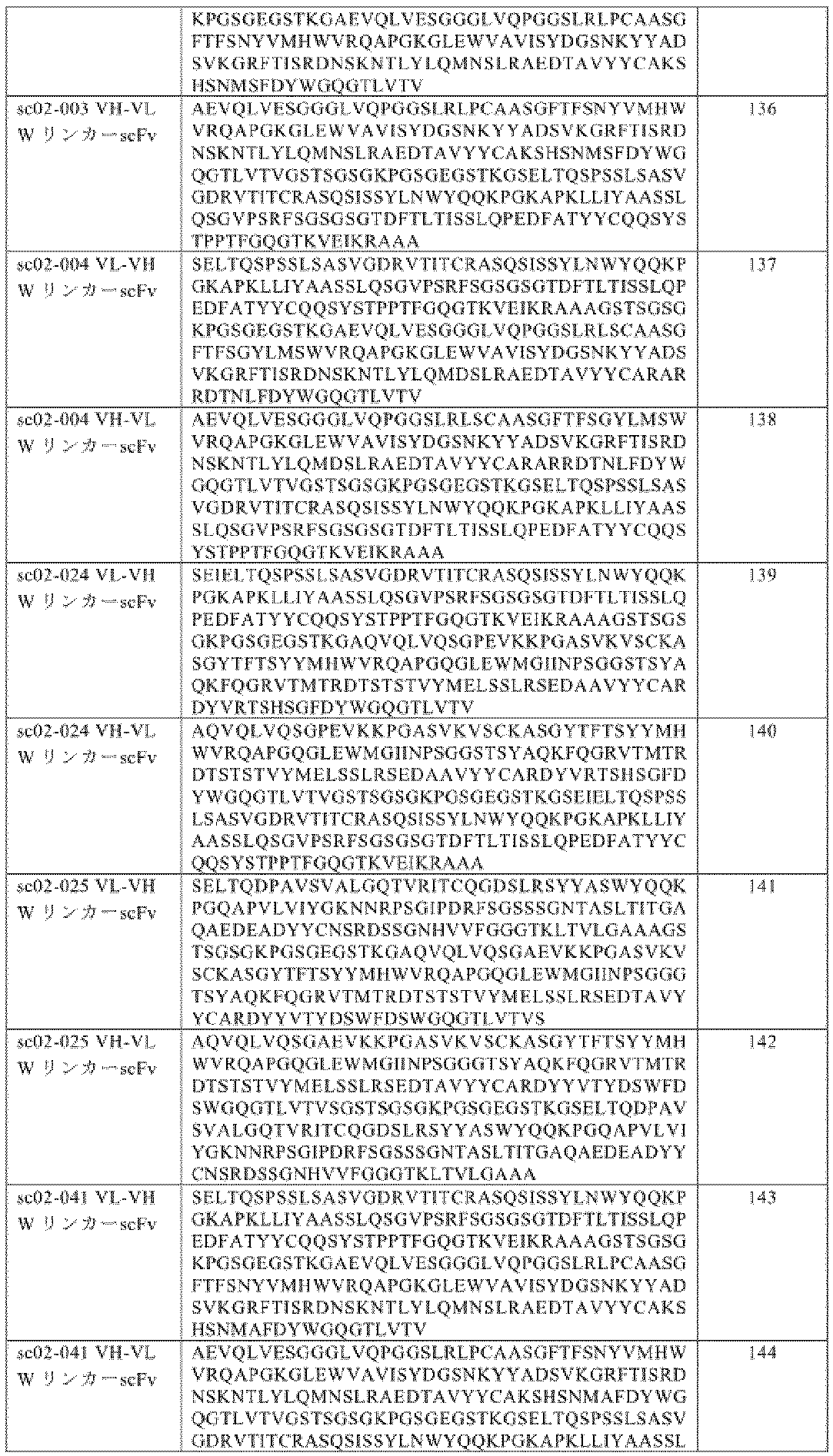


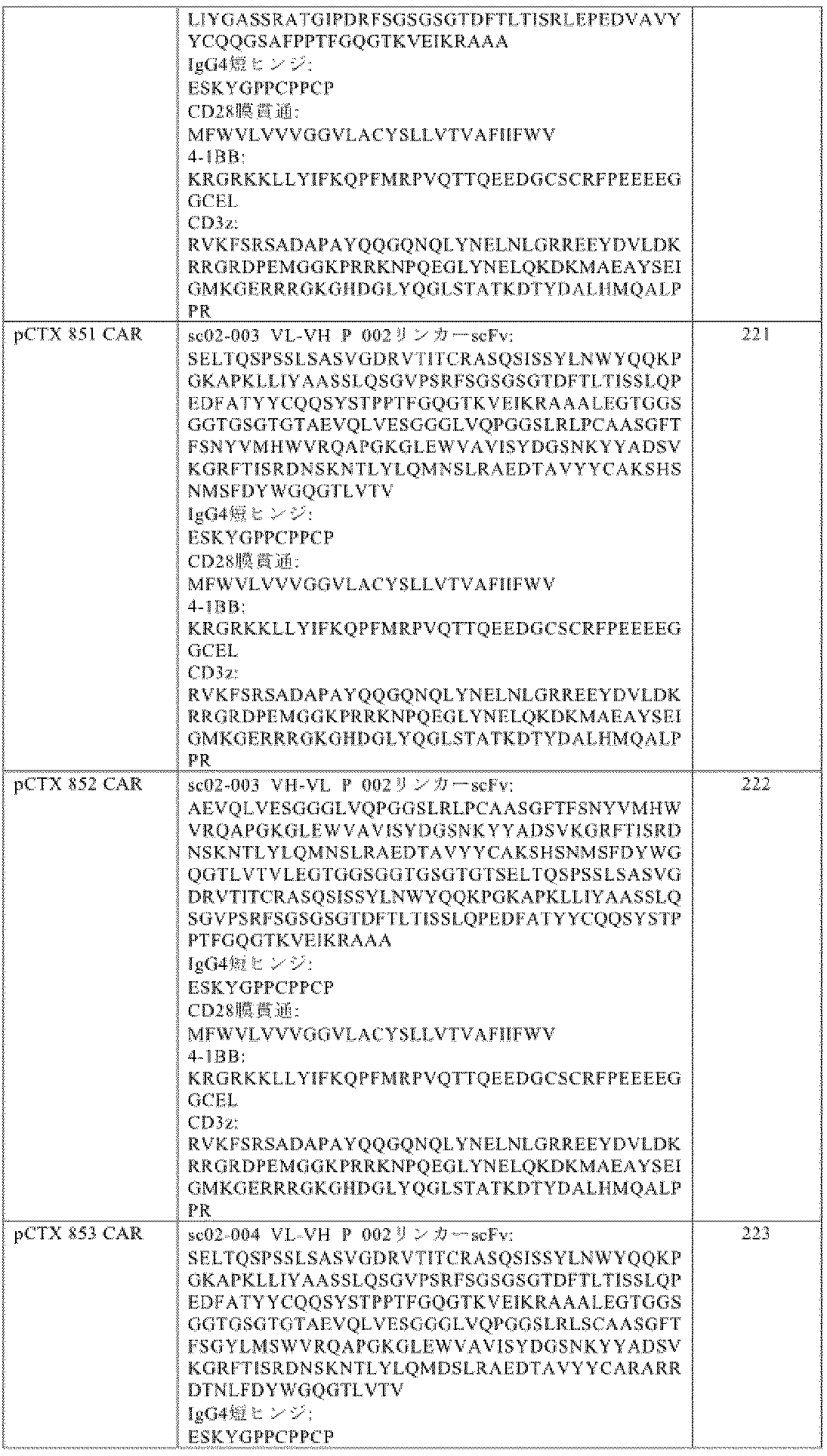

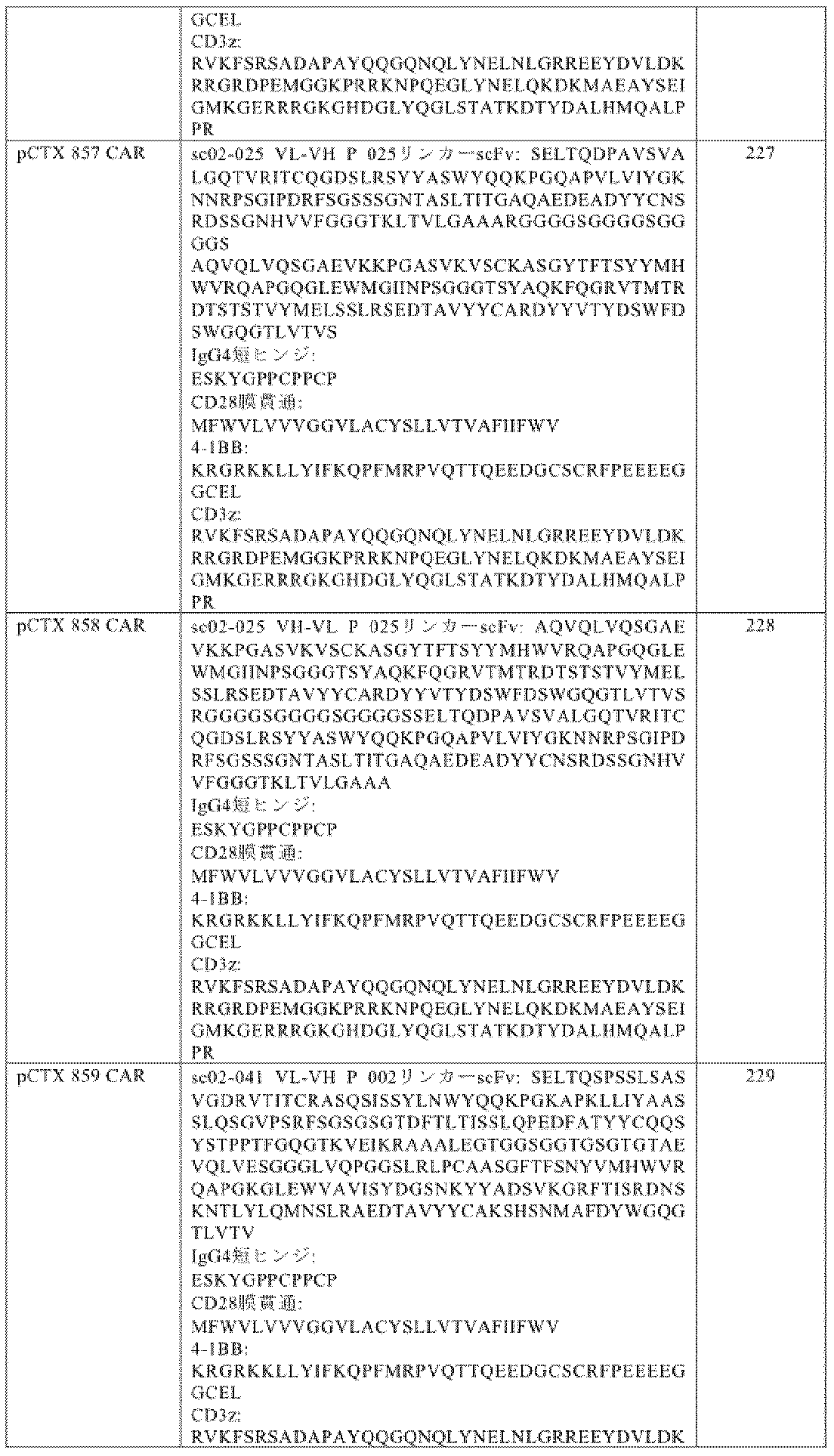


一部の実施形態においては、本開示のCD72 CARは、ペプチドタグ、例として、例えばMycタグ(配列番号239)を含有する。一部の実施形態においては、Mycタグは、シグナルペプチドの後ろであるが、scFv結合ドメインの第1の可変領域の前で、CD72 CARへと挿入される。Mycタグを含む本明細書において提供されるCAR配列に関して、配列内に挿入されたMycタグを含まない同じCAR配列が企図されることが理解される。 In some embodiments, the CD72 CAR of the present disclosure contains a peptide tag, such as, for example, a Myc tag (SEQ ID NO: 239). In some embodiments, the Myc tag is inserted into the CD72 CAR after the signal peptide but before the first variable region of the scFv binding domain. It is understood that with respect to the CAR sequences provided herein that include a Myc tag, the same CAR sequence is contemplated without the Myc tag inserted within the sequence.
放射線療法には、体外照射療法(例えば従来型体外照射療法、定位放射線、3次元原体照射療法、強度変調放射線療法、強度変調振子照射療法、粒子線療法、陽子線療法およびオーガー療法)、近接照射療法、体系的放射性同位体療法、手術中の放射線療法またはそれらの任意の組合せが含まれる。 Radiation therapy includes external beam radiation therapy (e.g., conventional external beam radiation therapy, stereotactic radiation therapy, three-dimensional conformal radiation therapy, intensity-modulated radiation therapy, intensity-modulated pendulum radiation therapy, particle beam therapy, proton beam therapy, and auger beam therapy), brachytherapy, systematic radioisotope therapy, intraoperative radiation therapy, or any combination thereof.
本明細書において説明するキメラTim組成物と組み合わせた使用のための例示的な抗体には、リツキシマブ(rituxmab)、ペルツズマブ、トラスツズマブ、アレムツズマブ、イブリツモマブチウキセタン、ブレンツキシマブベドチン、セツキシマブ、ベバシズマブ、アブシキシマブ、アダリムマブ、アレファセプト、バシリキシマブ(basilizimab)、ベリムマブ、ベズロトクスマブ、カナキヌマブ、セルトリズマブペゴル、ダクリズマブ、デノスマブ、エファリズマブ、ゴリムマブ、オララツマブ、パリビズマブ、パニツムマブおよびトシリズマブが含まれる。 Exemplary antibodies for use in combination with the chimeric Tim compositions described herein include rituximab, pertuzumab, trastuzumab, alemtuzumab, ibritumomab tiuxetan, brentuximab vedotin, cetuximab, bevacizumab, abciximab, adalimumab, alefacept, basiliximab, belimumab, bezlotoxumab, canakinumab, certolizumab pegol, daclizumab, denosumab, efalizumab, golimumab, olaratumab, palivizumab, panitumumab, and tocilizumab.
本明細書において説明するキメラTim組成物と組み合わせた使用のためであり得る例示的な免疫チェックポイント分子の阻害剤には、PD-L1、PD-L2、CD80、CD86、B7-H3、B7-H4、HVEM、アデノシン、GAL9、VISTA、CEACAM-1、CEACAM-3、CEACAM-5、PVRL2、PD-1、CTLA-4、BTLA、KIR、LAG3、TIM3、A2aR、CD244/2B4、CD160、TIGIT、LAIR-1、PVRIG/CD112Rまたはそれらの任意の組合せをターゲティングするチェックポイント阻害剤が含まれる。ある特定の実施形態においては、免疫チェックポイント阻害剤は、抗体、ペプチド、RNAi剤または小分子であり得る。CTLA-4に特異的な抗体は、イピリムマブまたはトレメリムマブであり得る。PD-1に特異的な抗体は、ピディリズマブ、ニボルマブまたはペンブロリズマブであり得る。PD-L1に特異的な抗体は、デュルバルマブ、アテゾリズマブまたはアベルマブであり得る。 Exemplary inhibitors of immune checkpoint molecules that may be for use in combination with the chimeric Tim compositions described herein include checkpoint inhibitors targeting PD-L1, PD-L2, CD80, CD86, B7-H3, B7-H4, HVEM, adenosine, GAL9, VISTA, CEACAM-1, CEACAM-3, CEACAM-5, PVRL2, PD-1, CTLA-4, BTLA, KIR, LAG3, TIM3, A2aR, CD244/2B4, CD160, TIGIT, LAIR-1, PVRIG/CD112R, or any combination thereof. In certain embodiments, the immune checkpoint inhibitor may be an antibody, peptide, RNAi agent, or small molecule. The antibody specific for CTLA-4 may be ipilimumab or tremelimumab. The antibody specific for PD-1 can be pidilizumab, nivolumab, or pembrolizumab. The antibody specific for PD-L1 can be durvalumab, atezolizumab, or avelumab.
本明細書において説明するキメラTim4受容体組成物と組み合わせた使用のための例示的な化学療法剤は、アルキル化剤、プラチナベースの剤、細胞傷害剤、クロマチン機能の阻害剤、トポイソメラーゼ阻害剤、微小管阻害薬、DNA損傷剤、代謝拮抗薬(例として葉酸アンタゴニスト、ピリミジンアナログ、プリンアナログおよび糖修飾アナログ)、DNA合成阻害剤、DNA相互作用剤(例として挿入剤)およびDNA修復阻害剤を含み得る。 Exemplary chemotherapeutic agents for use in combination with the chimeric Tim4 receptor compositions described herein may include alkylating agents, platinum-based agents, cytotoxic agents, inhibitors of chromatin function, topoisomerase inhibitors, microtubule inhibitors, DNA damaging agents, metabolic antagonists (e.g., folate antagonists, pyrimidine analogs, purine analogs, and sugar-modifying analogs), DNA synthesis inhibitors, DNA interacting agents (e.g., intercalating agents), and DNA repair inhibitors.
化学療法剤には、有糸分裂または細胞分裂を阻害する非特異的細胞傷害剤、および腫瘍増殖、進行および転移に関与する特定の分子(例えば癌遺伝子)をターゲティングすることによってがん細胞の増殖および広がりを遮断する分子ターゲティング療法が含まれる。本明細書において説明する発現カセット組成物と組み合わせた使用のための例示的な非特異的化学療法剤は、アルキル化剤、プラチナベースの剤、細胞傷害剤、クロマチン機能の阻害剤、トポイソメラーゼ阻害剤、微小管阻害薬、DNA損傷剤、代謝拮抗薬(例として葉酸アンタゴニスト、ピリミジンアナログ、プリンアナログおよび糖修飾アナログ)、DNA合成阻害剤、DNA相互作用剤(例として挿入剤)、低メチル化剤およびDNA修復阻害剤を含み得る。 Chemotherapeutic agents include non-specific cytotoxic agents that inhibit mitosis or cell division, and molecular targeting therapies that block the growth and spread of cancer cells by targeting specific molecules (e.g., oncogenes) involved in tumor growth, progression and metastasis. Exemplary non-specific chemotherapeutic agents for use in combination with the expression cassette compositions described herein may include alkylating agents, platinum-based agents, cytotoxic agents, inhibitors of chromatin function, topoisomerase inhibitors, microtubule inhibitors, DNA damaging agents, metabolic antagonists (e.g., folate antagonists, pyrimidine analogs, purine analogs and sugar-modifying analogs), DNA synthesis inhibitors, DNA interacting agents (e.g., intercalating agents), hypomethylating agents and DNA repair inhibitors.
本明細書において企図される組合せ療法における使用のために考えられる化学療法剤の例には、ベムラフェニブ、ダブラフェニブ、トラメチニブ、コビメチニブ、アナストロゾール[アリミデックス(登録商標)]、ビカルタミド[カソデックス(登録商標)]、硫酸ブレオマイシン[ブレノキサン(Blenoxane)(登録商標)]、ブスルファン[ミレラン(登録商標)]、ブスルファン注射[ブスルフェクス(登録商標)]、カペシタビン[ゼローダ(登録商標)]、N4-ペントキシカルボニル-5-デオキシ-5-フルオロシチジン、カルボプラチン[パラプラチン(登録商標)]、カルムスチン[BiCNU(登録商標)]、クロラムブシル[ロイケラン(登録商標)]、シスプラチン[プラチノール(登録商標)]、クラドリビン[ロイスタチン(登録商標)]、シクロホスファミド[シトキサン(登録商標)またはネオサル(Neosar)(登録商標)]、シタラビン、シトシンアラビノシド[シトサル(Cytosar)-U(登録商標)]、シタラビンリポソーム注射[デポサイト(登録商標)]、ダカルバジン[DTIC-Dome(登録商標)]、ダクチノマイシン[アクチノマイシンD、コスメゲン(Cosmegan)]、ダウノルビシン塩酸塩[セルビジン(登録商標)]、クエン酸ダウノルビシンリポソーム注射[ダウノゾーム(DaunoXome)(登録商標)]、デキサメタゾン、ドセタキセル[タキソテール(登録商標)]、ドキソルビシン塩酸塩[アドリアマイシン(登録商標)、ルベックス(Rubex)(登録商標)]、エトポシド[ベプシド(登録商標)]、リン酸フルダラビン[フルダラ(登録商標)]、5-フルオロウラシル[アドルシル(Adrucil)(登録商標)、エフデックス(Efudex)(登録商標)]、フルタミド[ユーレキシン(Eulexin)(登録商標)]、テザシチビン(tezacitibine)、ゲムシタビン(ジフルオロデオキシシチジン)、ヒドロキシ尿素[ハイドレア(登録商標)]、イダルビシン[イダマイシン(登録商標)]、イホスファミド[IFEX(登録商標)]、イリノテカン[カンプト(Camptosar)(登録商標)]、L-アスパラギナーゼ[ELSPAR(登録商標)]、ロイコボリンカルシウム、メルファラン[アルケラン(登録商標)]、6-メルカプトプリン[ピュリネソール(登録商標)]、メトトレキセート[フォレックス(Folex)(登録商標)]、ミトキサントロン[ノバントロン(登録商標)]、マイロターグ、パクリタキセル[タキソール(登録商標)]、フェニックス(イットリウム90/MX-DTPA)、ペントスタチン、ポリフェプロザン20カルムスチンインプラント[ギリアデル(登録商標)]、fdabraクエン酸タモキシフェン[ノルバデックス(登録商標)]、テニポシド[ブモン(Vumon)(登録商標)]、6-チオグアニン、チオテパ、チラパザミン[チラゾン(Tirazone)(登録商標)]、トポテカン塩酸塩注射[ハイカムチン(Hycamptin)(登録商標)]、ビンブラスチン[ベルバン(登録商標)]、ビンクリスチン[オンコビン(登録商標)]、イブルチニブ、ベネトクラクス、クリゾチニブ、アレクチニブ、ブリガチニブ、セリチニブおよびビノレルビン[ナベルビン(登録商標)]が含まれる。 Examples of chemotherapeutic agents contemplated for use in the combination therapy contemplated herein include vemurafenib, dabrafenib, trametinib, cobimetinib, anastrozole [Arimidex®], bicalutamide [Casodex®], bleomycin sulfate [Blenoxane®], busulfan [Myleran®], busulfan injection [Busulfex®], capecitabine [Xeloda®], N4-pentoxycarbonyl-5-deoxy-5-fluorocytidine, carboplatin [Paraplatin®], carmustine [BiCNU®], chlorambucil [Leukeran®], cisplatin [Platinol®], cladribine [Leustatin®], ], cyclophosphamide [Cytoxan® or Neosar®], cytarabine, cytosine arabinoside [Cytosar-U®], cytarabine liposome injection [DepoCyte®], dacarbazine [DTIC-Dome®], dactinomycin [Actinomycin D, Cosmegan], daunorubicin [D-Tetracycline, Cosmegan® ... Rubicin hydrochloride [Cerbidine®], daunorubicin citrate liposome injection [DaunoXome®], dexamethasone, docetaxel [Taxotere®], doxorubicin hydrochloride [Adriamycin®, Rubex®], etoposide [Bepcid®], fludarabine phosphate [Fludara®], [Trademark], 5-fluorouracil [Adrucil®, Efudex®], flutamide [Eulexin®], tezacitibine, gemcitabine (difluorodeoxycytidine), hydroxyurea [Hydrea®], idarubicin [Idamycin®], ifosfamide [IFEX®], irinotecan [Camptosar®], L-asparaginase [ELSPAR®], leucovorin calcium, melphalan [Alkeran®], 6-mercaptopurine [Purinesol®], methotrexate [Folex®], mitoxantrone [Novantrone ( ®)], Mylotarg, paclitaxel [Taxol®], Phoenix (Yttrium 90/MX-DTPA), pentostatin, porifeprozan 20 carmustine implant [Gliadel®], fdabra tamoxifen citrate [Nolvadex®], teniposide [Vumon®], 6-thioguanine, thiotepa, tirapazamine [Tirazone®], topotecan hydrochloride injection [Hycamptin®], vinblastine [Velban®], vincristine [Oncovin®], ibrutinib, venetoclax, crizotinib, alectinib, brigatinib, ceritinib, and vinorelbine [Navelbine®].
本明細書において企図される組合せ療法における使用のための例示的なアルキル化剤には、ナイトロジェンマスタード、エチレンイミン誘導体、アルキルスルホネート、ニトロソ尿素およびトリアゼン:ウラシルマスタード[アミノウラシルマスタード(登録商標)、クロレタミナシル(Chlorethaminacil)(登録商標)、デメチルドパン(Demethyldopan)(登録商標)、デスメチルドパン(Desmethyldopan)(登録商標)、ヘマンタミン(Haemanthamine)(登録商標)、ノルドパン(Nordopan)(登録商標)、ウラシルナイトロジェンマスタード(登録商標)、ウラシロスト(Uracillost)(登録商標)、ウラシルモスタザ(Uracilmostaza)(登録商標)、ウラムスチン(Uramustin)(登録商標)、ウラムスチン(Uramustine)(登録商標)]、クロルメチン[マスタージェン(Mustargen)(登録商標)]、シクロホスファミド[シトキサン(登録商標)、ネオサル(登録商標)、クラフェン(Clafen)(登録商標)、エンドキサン(登録商標)、プロサイトクス(Procytox)(登録商標)、レビミューン(Revimmune)(商標)]、イホスファミド[ミトキサナ(Mitoxana)(登録商標)]、メルファラン[アルケラン(登録商標)]、クロラムブシル[ロイケラン(登録商標)]、ピポブロマン[アメデール(登録商標)、バーサイト(Vercyte)(登録商標)]、トリエチレンメラミン[ヘメル(登録商標)、ヘキサレン(Hexalen)(登録商標)、ヘキサスタット(Hexastat)(登録商標)]、トリエチレンチオホスホラミン、テモゾロミド[テモダール(登録商標)]、チオテパ[チオプレックス(Thioplex)(登録商標)]、ブスルファン[ブシルベックス(Busilvex)(登録商標)、ミレラン(登録商標)]、カルムスチン[BiCNU(登録商標)]、ロムスチン[CeeNU(登録商標)]、ストレプトゾシン[ザノサー(Zanosar)(登録商標)]およびダカルバジン[DTIC-Dome(登録商標)]が含まれる。本明細書において企図される組合せ療法における使用のための追加の例示的なアルキル化剤には、オキサリプラチン[エロキサチン(登録商標)];テモゾロミド[テモダール(Temodar)(登録商標)およびテモダール(Temodal)(登録商標)];ダクチノマイシン[アクチノマイシン-Dとしても公知、コスメゲン(登録商標)];メルファラン[L-PAM、L-サルコリシンおよびフェニルアラニンマスタードとしても公知、アルケラン(登録商標)];アルトレタミン[ヘキサメチルメラミン(HMM:hexamethylmelamine)としても公知、ヘキサレン(登録商標)];カルムスチン[BiCNU(登録商標)];ベンダムスチン[トレアンダ(登録商標)];ブスルファン[ブスルフェクス(登録商標)およびミレラン(登録商標)];カルボプラチン[パラプラチン(登録商標)];ロムスチン[CCNUとしても公知、CeeNU(登録商標)];シスプラチン[CDDPとしても公知、プラチノール(登録商標)およびプラチノール(登録商標)-AQ];クロラムブシル[ロイケラン(登録商標)];シクロホスファミド[シトキサン(登録商標)およびネオサル(登録商標)];ダカルバジン[DTIC、DICおよびイミダゾールカルボキサミドとしても公知、DTIC-Dome(登録商標)];アルトレタミン[ヘキサメチルメラミン(HMM)としても公知、ヘキサレン(登録商標)];イホスファミド[イフェクス(Ifex)(登録商標)];プレドニムスチン(Prednumustine);プロカルバジン[マチュレーン(Matulane)(登録商標)];メクロレタミン[ナイトロジェンマスタード、ムスチンおよびメクロレタミン塩酸塩としても公知、マスタージェン(登録商標)];ストレプトゾシン[ザノサー(登録商標)];チオテパ[チオホスホアミド(thiophosphoamide)、TESPAおよびTSPAとしても公知、チオプレックス(Thioplex)(登録商標)];シクロホスファミド[エンドキサン(登録商標)、シトキサン(登録商標)、ネオサル(登録商標)、プロシトクス(登録商標)、レビミューン(登録商標)];およびベンダムスチンHCl[トレアンダ(登録商標)]が含まれるが、これらに限定されない。 Exemplary alkylating agents for use in the combination therapies contemplated herein include nitrogen mustards, ethylenimine derivatives, alkylsulfonates, nitrosoureas, and triazenes: uracil mustard [Aminouracil Mustard®, Chlorethaminocil®, Demethyldopan®, Desmethyldopan®, Haemanthamin®, ne) (registered trademark), Nordopan (registered trademark), Uracil Nitrogen Mustard (registered trademark), Uracillost (registered trademark), Uracilmostaza (registered trademark), Uramustine (registered trademark), Uramustine (registered trademark)], chlormethine (Mustargen (registered trademark)), cyclophosphamide (Cytoxan (registered trademark), Neosal (registered trademark), Clafen (Clafen®, Endoxan®, Procytox®, Revimmune™)], ifosfamide [Mitoxana®], melphalan [Alkeran®], chlorambucil [Leukeran®], pipobroman [Amedal®, Vercyte®], triethylenemelamine [Hemel®, Hexalen®, Hexane®], Examples of anti-inflammatory drugs include rifabutinib, ribavirinib, rifampinib, ribavir ... Additional exemplary alkylating agents for use in the combination therapies contemplated herein include oxaliplatin (Eloxatin®); temozolomide (Temodar® and Temodal®); dactinomycin (also known as Actinomycin-D, Cosmegen®); melphalan (also known as L-PAM, L-sarcolysin, and phenylalanine mustard, Alkeran®); altretamine (hexamethylmelamine (HMM)); methylmelamine), Hexalen®]; carmustine [BiCNU®]; bendamustine [Treanda®]; busulfan [Busulfex® and Myleran®]; carboplatin [Paraplatin®]; lomustine [also known as CCNU, CeeNU®]; cisplatin [also known as CDDP, Platinol® and Platinol®-AQ]; chlorambucil [Leukeran®]; cyclophosphamide tetracycline (Trimethylolpropane, Cytoxan® and Neosal®); dacarbazine (also known as DTIC, DIC and imidazole carboxamide, DTIC-Dome®); altretamine (also known as hexamethylmelamine (HMM), Hexalene®); ifosfamide (Ifex®); prednimustine; procarbazine (Matulane®); mechlorethamine (nitrogen mustard, mustine and mechlorethamine) These include, but are not limited to, bromine hydrochloride (also known as Mastergen®); streptozocin (Zanosar®); thiotepa (thiophosphoamide, also known as TESPA and TSPA, Thioplex®); cyclophosphamide (Endoxan®, Cytoxan®, Neosal®, Procytox®, Revimmune®); and bendamustine HCl (Treanda®).
本明細書において企図される組合せ療法における使用のための例示的なプラチナベースの剤には、カルボプラチン、シスプラチン、オキサリプラチン、ネダプラチン、ピコプラチン、サトラプラチン、フェナントリプラチン(phenanthriplatin)およびトリプラチン四硝酸塩(triplatin tetranitrate)が含まれる。 Exemplary platinum-based agents for use in the combination therapies contemplated herein include carboplatin, cisplatin, oxaliplatin, nedaplatin, picoplatin, satraplatin, phenanthriplatin, and triplatin tetranitrate.
組合せ療法における使用のための例示的な低メチル化剤には、アザシチジンおよびデシタビンが含まれる。 Exemplary hypomethylating agents for use in combination therapy include azacitidine and decitabine.
本明細書において説明するキメラTim4受容体組成物と組み合わせた使用のための例示的な分子ターゲティング阻害剤には、例えば受容体チロシンキナーゼ阻害剤、RAF阻害剤、BCL-2阻害剤、ABL阻害剤、TRK阻害剤、c-KIT阻害剤、c-MET阻害剤、CDK4/6阻害剤、FAK阻害剤、FGFR阻害剤、FLT3阻害剤、IDH1阻害剤、IDH2阻害剤、PDGFRA阻害剤およびRET阻害剤を含むがん細胞増殖および生存に関与する分子をターゲティングする小分子が含まれる。 Exemplary molecular targeting inhibitors for use in combination with the chimeric Tim4 receptor compositions described herein include small molecules that target molecules involved in cancer cell proliferation and survival, including, for example, receptor tyrosine kinase inhibitors, RAF inhibitors, BCL-2 inhibitors, ABL inhibitors, TRK inhibitors, c-KIT inhibitors, c-MET inhibitors, CDK4/6 inhibitors, FAK inhibitors, FGFR inhibitors, FLT3 inhibitors, IDH1 inhibitors, IDH2 inhibitors, PDGFRA inhibitors, and RET inhibitors.
例示的な分子ターゲティング療法には、ホルモンアンタゴニスト、シグナル伝達阻害剤、遺伝子発現阻害剤(例えば翻訳阻害剤)、アポトーシスインデューサー、血管新生阻害剤(例えばVEGF経路阻害剤)、チロシンキナーゼ阻害剤(例えばEGF/EGFR経路阻害剤)、増殖因子阻害剤、GTPアーゼ阻害剤、セリン/トレオニンキナーゼ阻害剤、転写因子阻害剤、がんと関連付けられるドライバー変異の阻害剤、B-Raf阻害剤、RAF阻害剤、MEK阻害剤、mTOR阻害剤、アデノシン経路阻害剤、EGFR阻害剤、PI3K阻害剤、BCL2阻害剤、VEGFR阻害剤、MET阻害剤、MYC阻害剤、BCR-ABL阻害剤、ABL阻害剤、HER2阻害剤、H-RAS阻害剤、K-RAS阻害剤、PDGFR阻害剤、ALK阻害剤、ROS1阻害剤、BTK阻害剤、TRK阻害剤、c-KIT阻害剤、c-MET阻害剤、CDK4/6阻害剤、FAK阻害剤、FGFR阻害剤、FLT3阻害剤、IDH1阻害剤、IDH2阻害剤、PARP阻害剤、PDGFRA阻害剤およびRET阻害剤が含まれる。ある特定の実施形態においては、分子ターゲティング療法の使用は、分子標的に特異的な分子ターゲティング療法を、分子標的(例えばドライバー癌遺伝子)を有する腫瘍を有すると特定された対象に投与することを含む。ある特定の実施形態においては、分子標的は、活性化変異を有する。ある特定の実施形態においては、分子ターゲティング阻害剤と組み合わせたキメラTim4受容体改変細胞の使用は、抗腫瘍応答の大きさ、抗腫瘍応答の持続力またはこれらの両方を増大する。ある特定の実施形態においては、典型的な用量よりも低い分子ターゲティング療法が、キメラTim4受容体改変細胞と組み合わせて使用される。 Exemplary molecular targeting therapies include hormone antagonists, signal transduction inhibitors, gene expression inhibitors (e.g., translation inhibitors), apoptosis inducers, angiogenesis inhibitors (e.g., VEGF pathway inhibitors), tyrosine kinase inhibitors (e.g., EGF/EGFR pathway inhibitors), growth factor inhibitors, GTPase inhibitors, serine/threonine kinase inhibitors, transcription factor inhibitors, inhibitors of driver mutations associated with cancer, B-Raf inhibitors, RAF inhibitors, MEK inhibitors, mTOR inhibitors, and adenosine pathway inhibitors. agents, EGFR inhibitors, PI3K inhibitors, BCL2 inhibitors, VEGFR inhibitors, MET inhibitors, MYC inhibitors, BCR-ABL inhibitors, ABL inhibitors, HER2 inhibitors, H-RAS inhibitors, K-RAS inhibitors, PDGFR inhibitors, ALK inhibitors, ROS1 inhibitors, BTK inhibitors, TRK inhibitors, c-KIT inhibitors, c-MET inhibitors, CDK4/6 inhibitors, FAK inhibitors, FGFR inhibitors, FLT3 inhibitors, IDH1 inhibitors, IDH2 inhibitors, PARP inhibitors, PDGFRA inhibitors, and RET inhibitors. In certain embodiments, the use of molecular targeting therapy includes administering a molecular target-specific molecular targeting therapy to a subject identified as having a tumor with a molecular target (e.g., a driver oncogene). In certain embodiments, the molecular target has an activating mutation. In certain embodiments, the use of chimeric Tim4 receptor modified cells in combination with molecular targeting inhibitors increases the magnitude of the anti-tumor response, the durability of the anti-tumor response, or both. In certain embodiments, lower than typical doses of molecular targeting therapy are used in combination with chimeric Tim4 receptor modified cells.
例示的な血管新生阻害剤は、A6(Angstrom Pharmaceuticals)、ABT-510(Abbott Laboratories)、ABT-627(アトラセンタン)(Abbott Laboratories/Xinlay)、ABT-869(Abbott Laboratories)、アクチミド(Actimid)(CC4047、ポマリドマイド)(Celgene Corporation)、AdGVPEDF.11D(GenVec)、ADH-1[エキセリン(Exherin)](Adherex Technologies)、AEE788(Novartis)、AG-013736(アキシチニブ)(Pfizer)、AG3340(プリノマスタット)(Agouron Pharmaceuticals)、AGX1053(AngioGenex)、AGX51(AngioGenex)、ALN-VSP(ALN-VSP O2)(Alnylam Pharmaceuticals)、AMG386(Amgen)、AMG706(Amgen)、アパチニブ(Apatinib)(YN968D1)(Jiangsu Hengrui Medicine)、AP23573(リダフォロリムス/MK8669)(Ariad Pharmaceuticals)、AQ4N(Novavea)、ARQ197(ArQule)、ASA404(Novartis/Antisoma)、アチプリモド(Callisto Pharmaceuticals)、ATN-161(Attenuon)、AV-412(Aveo Pharmaceuticals)、AV-951(Aveo Pharmaceuticals)、アバスチン(ベバシズマブ)(Genentech)、AZD2171[セディラニブ/レセンチン(Recentin)](AstraZeneca)、BAY 57-9352[テラチニブ(Telatinib)](Bayer)、BEZ235(Novartis)、BIBF1120(Boehringer Ingelheim Pharmaceuticals)、BIBW2992(Boehringer Ingelheim Pharmaceuticals)、BMS-275291(Bristol-Myers Squibb)、BMS-582664(ブリバニブ)(Bristol-Myers Squibb)、BMS-690514(Bristol-Myers Squibb)、カルシトリオール、CCI-779(トーリセル)(Wyeth)、CDP-791(ImClone Systems)、セフラトニン(Ceflatonin)(ホモハリントニン/HHT)(ChemGenex Therapeutics)、セレブレックス(セレコキシブ)(Pfizer)、CEP-7055(Cephalon/Sanofi)、CHIR-265(Chiron Corporation)、NGR-TNF、COL-3[メタスタット(Metastat)](Collagenex Pharmaceuticals)、コンブレタスタチン(Oxigene)、CP-751,871(フィギツムマブ)(Pfizer)、CP-547,632(Pfizer)、CS-7017(第一三共)、CT-322[アンジオセプト(Angiocept)](Adnexus)、クルクミン、ダルテパリン(フラグミン)(Pfizer)、ジスルフィラム(Antabuse)、E7820(エーザイ株式会社)、E7080(エーザイ株式会社)、EMD 121974(シレンジタイド)(EMD Pharmaceuticals)、ENMD-1198(EntreMed)、ENMD-2076(EntreMed)、エンドスター(Endostar)(Simcere)、アービタックス(ImClone/Bristol-Myers Squibb)、EZN-2208(Enzon Pharmaceuticals)、EZN-2968(Enzon Pharmaceuticals)、GC1008(Genzyme)、ゲニステイン、GSK1363089[フォレチニブ(Foretinib)](GlaxoSmithKline)、GW786034(パゾパニブ)(GlaxoSmithKline)、GT-111(Vascular Biogenics Ltd.)、IMC-1121B(ラムシルマブ)(ImClone Systems)、IMC-18F1(ImClone Systems)、IMC-3G3(ImClone LLC)、INCB007839(Incyte Corporation)、INGN 241(Introgen Therapeutics)、イレッサ(ZD1839/ゲフィチニブ)、LBH589[ファリダク(Faridak)/パノビノスタット(Panobinostst)](Novartis)、ルセンティス(ラニビズマブ)(Genentech/Novartis)、LY317615(エンザスタウリン)(Eli Lilly and Company)、マクジェン(ペガプタニブ)(Pfizer)、MEDI522[アベグリン(Abegrin)](MedImmune)、MLN518(タンデュチニブ)(Millennium)、ネオバスタット(Neovastat)(AE941/ベネフィン)(Aeterna Zentaris)、ネクサバール(Bayer/Onyx)、NM-3(Genzyme Corporation)、ノスカピン(Cougar Biotechnology)、NPI-2358(Nereus Pharmaceuticals)、OSI-930(OSI)、パロミド(Palomid)529(Paloma Pharmaceuticals,Inc.)、パンゼム(Panzem)カプセル(2ME2)(EntreMed)、パンゼムNCD(2ME2)(EntreMed)、PF-02341066(Pfizer)、PF-04554878(Pfizer)、PI-88(Progen Industries/Medigen Biotechnology)、PKC412(Novartis)、ポリフェノンE(緑茶抽出物)(Polypheno E International,Inc)、PPI-2458(Praecis Pharmaceuticals)、PTC299(PTC Therapeutics)、PTK787(バタラニブ)(Novartis)、PXD101(ベリノスタット)(CuraGen Corporation)、RAD001(エベロリムス)(Novartis)、RAF265(Novartis)、レゴラフェニブ(BAY73-4506)(Bayer)、レブリミド(Celgene)、レタアネ(Retaane)(Alcon Research)、SN38(リポソーム製剤)(Neopharm)、SNS-032(BMS-387032)(Sunesis)、SOM230(パシレオチド)(Novartis)、スクアラミン(Genaera)、スラミン、スーテント(Pfizer)、タルセバ(Genentech)、TB-403(Thrombogenics)、テムポスタチン(Tempostatin)(Collard Biopharmaceuticals)、テトラチオモリブデート(Sigma-Aldrich)、TG100801(TargeGen)、サリドマイド(Celgene Corporation)、チンザパリンナトリウム、TKI258(Novartis)、TRC093(Tracon Pharmaceuticals Inc.)、VEGF Trap(アフリバーセプト)(Regeneron Pharmaceuticals)、VEGF Trap-Eye(Regeneron Pharmaceuticals)、ベグリン(Veglin)(VasGene Therapeutics)、ボルテゾミブ(Millennium)、XL184(Exelixis)、XL647(Exelixis)、XL784(Exelixis)、XL820(Exelixis)、XL999(Exelixis)、ZD6474(AstraZeneca)、ボリノスタット(Merck)およびZSTK474を含むが、これらに限定されない。 Exemplary angiogenesis inhibitors include A6 (Angstrom Pharmaceuticals), ABT-510 (Abbott Laboratories), ABT-627 (atrasentan) (Abbott Laboratories/Xinlay), ABT-869 (Abbott Laboratories), Actimid (CC4047, pomalidomide) (Celgene Corporation), AdGVPEDF. 11D (GenVec), ADH-1 [Exherin] (Adherex Technologies), AEE788 (Novartis), AG-013736 (Axitinib) (Pfizer), AG3340 (Prinomastat) (Agouron Pharmaceuticals), AGX1053 (AngioGenex), AGX51 (AngioGenex), ALN-VSP (ALN-VSP O2) (Alnylam Pharmaceuticals), AMG386 (Amgen), AMG706 (Amgen), Apatinib (YN968D1) (Jiangsu Hengrui Medicine), AP23573 (ridaforolimus/MK8669) (Ariad Pharmaceuticals), AQ4N (Novavea), ARQ197 (ArQule), ASA404 (Novartis/Antisoma), atiprimod (Callisto Pharmaceuticals), ATN-161 (Attenuon), AV-412 (Aveo Pharmaceuticals), AV-951 (Aveo Pharmaceuticals), Avastin (bevacizumab) (Genentech), AZD2171 [cediranib/Recentin] (AstraZeneca), BAY 57-9352 [telatinib] (Bayer), BEZ235 (Novartis), BIBF1120 (Boehringer Ingelheim Pharmaceuticals), BIBW2992 (Boehringer Ingelheim Pharmaceuticals), BMS-275291 (Bristol-Myers Squibb), Squibb), BMS-582664 (brivanib) (Bristol-Myers Squibb), BMS-690514 (Bristol-Myers Squibb), calcitriol, CCI-779 (Torisel) (Wyeth), CDP-791 (ImClone Systems), ceflatonin (homoharringtonine/HHT) (ChemGenex Therapeutics), Celebrex (celecoxib) (Pfizer), CEP-7055 (Cephalon/Sanofi), CHIR-265 (Chiron Corporation), NGR-TNF, COL-3 [Metastat] (Collagenex Pharmaceuticals), combretastatin (Oxigene), CP-751,871 (figitumumab) (Pfizer), CP-547,632 (Pfizer), CS-7017 (Daiichi Sankyo), CT-322 [Angiocept] (Adnexus), curcumin, dalteparin (Fragmin) (Pfizer), disulfiram (Antabuse), E7820 (Eisai Co., Ltd.), E7080 (Eisai Co., Ltd.), EMD 121974 (Cilenitide) (EMD Pharmaceuticals), ENMD-1198 (EntreMed), ENMD-2076 (EntreMed), Endostar (Simcere), Erbitux (ImClone/Bristol-Myers Squibb), EZN-2208 (Enzon Pharmaceuticals), EZN-2968 (Enzon Pharmaceuticals), GC1008 (Genzyme), genistein, GSK1363089 [Foretinib] (GlaxoSmithKline), GW786034 (pazopanib) (GlaxoSmithKline), GT-111 (Vascular Biogenics Ltd. ), IMC-1121B (ramucirumab) (ImClone Systems), IMC-18F1 (ImClone Systems), IMC-3G3 (ImClone LLC), INCB007839 (Incyte Corporation), INGN 241 (Introgen Therapeutics), Iressa (ZD1839/gefitinib), LBH589 [Faridak/panobinostat] (Novartis), Lucentis (ranibizumab) (Genentech/Novartis), LY317615 (enzastaurin) (Eli Lilly and Company), Macugen (pegaptanib) (Pfizer), MEDI522 [Abegrin] (MedImmune), MLN518 (tandutinib) (Millennium), Neovastat (AE941/Benefin) (Aeterna Zentaris), Nexavar (Bayer/Onyx), NM-3 (Genzyme Corporation), noscapine (Cougar Biotechnology), NPI-2358 (Nereus Pharmaceuticals), OSI-930 (OSI), Palomid 529 (Paloma Pharmaceuticals, Inc.), Panzem Capsules (2ME2) (EntreMed), Panzem NCD (2ME2) (EntreMed), PF-02341066 (Pfizer), PF-04554878 (Pfizer), PI-88 (Progen Industries/Medigen Biotechnology), PKC412 (Novartis), Polyphenon E (green tea extract) (Polypheno E International, Inc), PPI-2458 (Praecis Pharmaceuticals), PTC299 (PTC Therapeutics), PTK787 (vatalanib) (Novartis), PXD101 (belinostat) (CuraGen Corporation), RAD001 (everolimus) (Novartis), RAF265 (Novartis), regorafenib (BAY73-4506) (Bayer), Revlimid (Celgene), Retaane (Alcon Research), SN38 (liposomal formulation) (Neopharm), SNS-032 (BMS-387032) (Sunesis), SOM230 (pasireotide) (Novartis), squalamine (Genaera), suramin, Sutent (Pfizer), Tarceva (Genentech), TB-403 (Thrombogenics), Tempostatin (Collard Biopharmaceuticals), tetrathiomolybdate (Sigma-Aldrich), TG100801 (TargeGen), thalidomide (Celgene) Corporation), tinzaparin sodium, TKI258 (Novartis), TRC093 (Tracon Pharmaceuticals Inc. ), VEGF Trap (aflibercept) (Regeneron Pharmaceuticals), VEGF Trap-Eye (Regeneron Pharmaceuticals), Veglin (VasGene Therapeutics), bortezomib (Millennium), XL184 (Exelixis), XL647 (Exelixis), XL784 (Exelixis), XL820 (Exelixis), XL999 (Exelixis), ZD6474 (AstraZeneca), vorinostat (Merck) and ZSTK474.
例示的なB-Raf阻害剤には、ベムラフェニブ、ダブラフェニブおよびエンコラフェニブが含まれる。 Exemplary B-Raf inhibitors include vemurafenib, dabrafenib and encorafenib.
例示的なMEK阻害剤には、ビニメチニブ、コビメチニブ、レファメチニブ、セルメチニブおよびトラメチニブが含まれる。 Exemplary MEK inhibitors include binimetinib, cobimetinib, refametinib, selumetinib and trametinib.
例示的なBTK阻害剤には、イブルチニブ、ピルトブルチニブ(Loxo-305)、チラブルチニブ、トレブルチニブ、エボブルチニブ、フェネブルチニブ(GDC-0853)、アカラブルチニブ、ベカブルチニブ(SNS-062)、ONO-4059、スペブルチニブ、ザヌブルチニブ(BGB-3111)、HM71224およびM7583が含まれる。 Exemplary BTK inhibitors include ibrutinib, pirtobrutinib (Loxo-305), tirabrutinib, trebrutinib, evobrutinib, fenebrutinib (GDC-0853), acalabrutinib, becabrutinib (SNS-062), ONO-4059, spebrutinib, zanubrutinib (BGB-3111), HM71224 and M7583.
例示的なTRK阻害剤には、エヌトレクチニブ、ラロトレクチニブ、CH7057288、ONO-7579、LOXO-101、レスタウルチニブおよびLOXO-195が含まれる。 Exemplary TRK inhibitors include entrectinib, larotrectinib, CH7057288, ONO-7579, LOXO-101, lestaurtinib and LOXO-195.
例示的なc-KIT阻害剤には、イマチニブ(imatinb)、スニチニブ(sunitinb)およびポナチニブが含まれる。 Exemplary c-KIT inhibitors include imatinib, sunitinib, and ponatinib.
例示的なc-MET阻害剤には、カプマチニブ、クリゾチニブ、チバンチニブ、オナルツズマブ、INCB28060、AMG-458、サボリチニブおよびテポチニブが含まれる。 Exemplary c-MET inhibitors include capmatinib, crizotinib, tivantinib, onartuzumab, INCB28060, AMG-458, savolitinib and tepotinib.
例示的なCDK4/6阻害剤には、パルボシクリブ、リボシクリブ、アベマシクリブおよびトリラシクリブが含まれる。 Exemplary CDK4/6 inhibitors include palbociclib, ribociclib, abemaciclib and trilaciclib.
例示的なFAK阻害剤には、デファクチニブ、GSK2256098、BI853520およびPF-00562271が含まれる。 Exemplary FAK inhibitors include defactinib, GSK2256098, BI853520 and PF-00562271.
例示的なFGFR阻害剤には、エルダフィチニブ、ペミガチニブ、インフィグラチニブ、ロガラチニブ、AZD4547、BGJ398、FP-1039およびARQ 087が含まれる。 Exemplary FGFR inhibitors include erdafitinib, pemigatinib, infigratinib, rogaratinib, AZD4547, BGJ398, FP-1039 and ARQ 087.
例示的なFLT-3阻害剤には、キザルチニブ、クレノラニブ、ギルテリチニブ、ミドスタウリンおよびレスタウルチニブが含まれる。 Exemplary FLT-3 inhibitors include quizartinib, crenolanib, gilteritinib, midostaurin and lestaurtinib.
例示的なIDH1阻害剤には、イボシデニブ、BAY-1436032およびAGI-5198が含まれる。 Exemplary IDH1 inhibitors include ivosidenib, BAY-1436032 and AGI-5198.
例示的なIDH2阻害剤には、エナシデニブが含まれる。 Exemplary IDH2 inhibitors include enasidenib.
例示的なPARP阻害剤には、タラゾパリブ、ニラパリブ、ルカパリブ、オラパリブ(AZ 2281またはKU59436)、ベリパリブ(ABT 888)、CEP9722、E7016、AG014699、MK4827、BMN-673、およびパミパリブ(BGB-290)が含まれる。例示的なPDGFRA阻害剤には、イマチニブ、レゴラフェニブ、クレノラニブおよびオララツマブが含まれる。 Exemplary PARP inhibitors include talazoparib, niraparib, rucaparib, olaparib (AZ 2281 or KU59436), veliparib (ABT 888), CEP9722, E7016, AG014699, MK4827, BMN-673, and pamiparib (BGB-290). Exemplary PDGFRA inhibitors include imatinib, regorafenib, crenolanib, and olaratumab.
例示的な汎RAF阻害剤には、ベルバラフェニブ(belvarafenib)、LXH254、LY3009120、INU-152およびHM95573が含まれる。 Exemplary pan-RAF inhibitors include belvarafenib, LXH254, LY3009120, INU-152 and HM95573.
例示的なRET阻害剤には、レンバチニブ、アレクチニブ、バンデタニブ、カボザンチニブ、BLU-667およびLOXO-292が含まれる。 Exemplary RET inhibitors include lenvatinib, alectinib, vandetanib, cabozantinib, BLU-667 and LOXO-292.
例示的なROS1阻害剤には、セリチニブ、ロルラチニブ、エヌトレクチニブ、クリゾチニブ、TPX-0005およびDS-6051bが含まれる。 Exemplary ROS1 inhibitors include ceritinib, lorlatinib, entrectinib, crizotinib, TPX-0005 and DS-6051b.
例示的な血管内皮増殖因子(VEGF:Vascular Endothelial Growth Factor)受容体阻害剤は、ベバシズマブ[アバスチン(登録商標)]、アキシチニブ[インライタ(登録商標)];ブリバニブアラニネート[BMS-582664、(S)-((R)-1-(4-(4-フルオロ-2-メチル-1H-インドール-5-イルオキシ)-5-メチルピロロ[2,1-f][1,2,4]トリアジン-6-イルオキシ)プロパン-2-イル)2-アミノプロパノエート];ソラフェニブ[ネクサバール(登録商標)];パゾパニブ[ヴォトリエント(登録商標)];リンゴ酸スニチニブ[スーテント(登録商標)];セディラニブ(AZD2171、CAS 288383-20-1);バラガテフ(Vargatef)(BIBF1120、CAS 928326-83-4);フォレチニブ(GSK1363089);テラチニブ(BAY57-9352、CAS 332012-40-5);アパチニブ(YN968D1、CAS 811803-05-1);イマチニブ[グリベック(登録商標)];ポナチニブ(AP24534、CAS 943319-70-8);チボザニブ(AV951、CAS 475108-18-0);レゴラフェニブ(BAY73-4506、CAS 755037-03-7);バタラニブ二塩酸塩(PTK787、CAS 212141-51-0);ブリバニブ(BMS-540215、CAS 649735-46-6);バンデタニブ[カプレルサ(登録商標)またはAZD6474];モテサニブ二リン酸塩[AMG706、CAS 857876-30-3、PCT公開公報WO02/066470号において説明されているN-(2,3-ジヒドロ-3,3-ジメチル-1H-インドール-6-イル)-2-[(4-ピリジニルメチル)アミノ]-3-ピリジンカルボキサミド];ドビチニブ二乳酸(Dovitinib dilactic acid)(TKI258、CAS 852433-84-2);リンファニブ(Linfanib)(ABT869、CAS 796967-16-3);カボザンチニブ(XL184、CAS 849217-68-1);レスタウルチニブ(CAS 111358-88-4);N-[5-[[[5-(1,1-ジメチルエチル)-2-オキサゾリル]メチル]チオ]-2-チアゾリル]-4-ピペリジンカルボキサミド(BMS38703、CAS 345627-80-7);(3R,4R)-4-アミノ-1-((4-((3-メトキシフェニル)アミノ)ピロロ[2,1-f][1,2,4]トリアジン-5-イル)メチル)ピペリジン-3-オール(BMS690514);N-(3,4-ジクロロ-2-フルオロフェニル)-6-メトキシ-7-[[(3aα,5β,6aα)-オクタヒドロ-2-メチルシクロペンタ[c]ピロール-5-イル]メトキシ]-4-キナゾリンアミン(XL647、CAS 781613-23-8);4-メチル-3-[[1-メチル-6-(3-ピリジニル)-1H-ピラゾロ[3,4-d]ピリミジン-4-イル]アミノ]-N-[3-(トリフルオロメチル)フェニル]-ベンザミド(BHG712、CAS 940310-85-0);およびアフリバーセプト[アイリーア(登録商標)]を含むが、これらに限定されない。 Exemplary vascular endothelial growth factor (VEGF) receptor inhibitors include bevacizumab [Avastin®], axitinib [Inlyta®]; brivanib alaninate [BMS-582664, (S)-((R)-1-(4-(4-fluoro-2-methyl-1H-indol-5-yloxy)-5-methylpyrrolo[2,1-f][1,2,4]triazin-6-yloxy)propan-2-yl)2-aminopropanoate]; sorafenib [Nexavar®]; pazopanib [Votrient®]; sunitinib malate [Sutent®]; cediranib (AZD2171, CAS 288383-20-1); Vargatef (BIBF1120, CAS 928326-83-4); Foretinib (GSK1363089); Telatinib (BAY57-9352, CAS 332012-40-5); Apatinib (YN968D1, CAS 811803-05-1); Imatinib [Gleevec®]; Ponatinib (AP24534, CAS 943319-70-8); Tivozanib (AV951, CAS 475108-18-0); Regorafenib (BAY73-4506, CAS 755037-03-7); vatalanib dihydrochloride (PTK787, CAS 212141-51-0); brivanib (BMS-540215, CAS 649735-46-6); vandetanib [Caprelsa® or AZD6474]; motesanib diphosphate [AMG706, CAS 857876-30-3, N-(2,3-dihydro-3,3-dimethyl-1H-indol-6-yl)-2-[(4-pyridinylmethyl)amino]-3-pyridinecarboxamide] described in PCT Publication WO 02/066470; dovitinib dilactic acid acid) (TKI258, CAS 852433-84-2); Linfanib (ABT869, CAS 796967-16-3); Cabozantinib (XL184, CAS 849217-68-1); Lestaurtinib (CAS 111358-88-4); N-[5-[[[5-(1,1-dimethylethyl)-2-oxazolyl]methyl]thio]-2-thiazolyl]-4-piperidinecarboxamide (BMS38703, CAS 345627-80-7); (3R,4R)-4-amino-1-((4-((3-methoxyphenyl)amino)pyrrolo[2,1-f][1,2,4]triazin-5-yl)methyl)piperidin-3-ol (BMS690514); N-(3,4-dichloro-2-fluorophenyl)-6-methoxy-7-[[(3aα,5β,6aα)-octahydro-2-methylcyclopenta[c]pyrrol-5-yl]methoxy]-4-quinazolinamine (XL647, CAS 781613-23-8); 4-methyl-3-[[1-methyl-6-(3-pyridinyl)-1H-pyrazolo[3,4-d]pyrimidin-4-yl]amino]-N-[3-(trifluoromethyl)phenyl]-benzamide (BHG712, CAS 940310-85-0); and aflibercept [Eylea®].
例示的なEGF経路阻害剤は、チルホスチン46、EKB-569、エルロチニブ[タルセバ(登録商標)]、ゲフィチニブ[イレッサ(登録商標)]、アービタックス、ニモツズマブ、ラパチニブ[タイケルブ(登録商標)]、セツキシマブ(抗EGFR mAb)、188Re-標識ニモツズマブ(抗EGFR mAb)およびWO97/02266、EP0564409、WO99/03854、EP0520722、EP0566226、EP0787722、EP0837063、米国特許第5,747,498号、WO98/10767、WO97/30034、WO97/49688、WO97/38983およびWO96/33980において一般的かつ特異的に開示されている化合物を含むが、これらに限定されない。例示的なEGFR抗体には、セツキシマブ[アービタックス(登録商標)];パニツムマブ[ベクチビックス(登録商標)];マツズマブ(EMD-72000);トラスツズマブ[ハーセプチン(登録商標)];ニモツズマブ(hR3);ザルツムマブ;TheraCIM h-R3;MDX0447(CAS 339151-96-1);およびch806(mAb-806、CAS 946414-09-1)が含まれるが、これらに限定されない。例示的な上皮増殖因子受容体(EGFR)阻害剤には、エルロチニブ塩酸塩[タルセバ(登録商標)]、セリチニブ、ブリグチニブ、オシメルチニブ、ダコミチニブ、イコチニブ、ゲフィチニブ[イレッサ(登録商標)];N-[4-[(3-クロロ-4-フルオロフェニル)アミノ]-7-[[(3’’S’’)-テトラヒドロ-3-フラニル]オキシ]-6-キナゾリニル]-4(ジメチルアミノ)-2-ブテンアミド、トボック(Tovok)(登録商標);バンデタニブ[カプレルサ(登録商標)];ラパチニブ[タイケルブ(登録商標)];(3R,4R)-4-アミノ-1-((4-((3-メトキシフェニル)アミノ)ピロロ[2,1-f][1,2,4]トリアジン-5-イル)メチル)ピペリジン-3-オール(BMS690514);カネルチニブ二塩酸塩(CI-1033);6-[4-[(4-エチル-1-ピペラジニル)メチル]フェニル]-N-[(1R)-1-フェニルエチル]-7H-ピロロ[2,3-d]ピリミジン-4-アミン(AEE788、CAS 497839-62-0);ムブリチニブ(TAK165);ペリチニブ(Pelitinib)(EKB569);アファチニブ(BIBW2992);ネラチニブ(HKI-272);N-[4-[[1-[(3-フルオロフェニル)メチル]-1H-インダゾール-5-イル]アミノ]-5-メチルピロロ[2,1-f][1,2,4]トリアジン-6-イル]-カルバミン酸、(3S)-3-モルホリニルメチルエステル(BMS599626);N-(3,4-ジクロロ-2-フルオロフェニル)-6-メトキシ-7-[[(3aα,5β,6aα)-オクタヒドロ-2-メチルシクロペンタ[c]ピロール-5-イル]メトキシ]-4-キナゾリンアミン(XL647、CAS 781613-23-8);4-[4-[[(1R)-1-フェニルエチル]アミノ]-7H-ピロロ[2,3-d]ピリミジン-6-イル]-フェノール(PKI166、CAS 187724-61-4);ロシレチニブ(rocelitinib)が含まれるが、これらに限定されない。 Exemplary EGF pathway inhibitors include tyrphostin 46, EKB-569, erlotinib [Tarceva®], gefitinib [Iressa®], Erbitux, nimotuzumab, lapatinib [Tykerb®], cetuximab (anti-EGFR mAb), 188 Re-labeled nimotuzumab (anti-EGFR mAbs) and the compounds disclosed generally and specifically in WO 97/02266, EP 0564409, WO 99/03854, EP 0520722, EP 0566226, EP 0787722, EP 0837063, U.S. Pat. No. 5,747,498, WO 98/10767, WO 97/30034, WO 97/49688, WO 97/38983 and WO 96/33980. Exemplary EGFR antibodies include, but are not limited to, cetuximab (Erbitux®); panitumumab (Vectibix®); matuzumab (EMD-72000); trastuzumab (Herceptin®); nimotuzumab (hR3); zalutumumab; TheraCIM h-R3; MDX0447 (CAS 339151-96-1); and ch806 (mAb-806, CAS 946414-09-1). Exemplary epidermal growth factor receptor (EGFR) inhibitors include erlotinib hydrochloride [Tarceva®], ceritinib, brigutinib, osimertinib, dacomitinib, icotinib, gefitinib [Iressa®]; N-[4-[(3-chloro-4-fluorophenyl)amino]-7-[[(3″S″)-tetrahydro-3-furanyl]oxy]-6-quinazolinyl]-4(dimethylamino)-2-butenamide, Tovok®; vandetanib [Caprelsa®]; lapatinib [Tykerb®]; (3R,4R)-4-amino-1-((4-((3-methoxyphenyl)amino)pyrrolo[2,1-f][1,2,4]triazin-5-yl)methyl)piperidin-3-ol (BMS690514); canertinib dihydrochloride (CI-1033); 6-[4-[(4-ethyl-1-piperazinyl)methyl]phenyl]-N-[(1R)-1-phenylethyl]-7H-pyrrolo[2,3-d]pyrimidin-4-amine (AEE788, CAS 497839-62-0); mubritinib (TAK165); pelitinib (EKB569); afatinib (BIBW2992); neratinib (HKI-272); N-[4-[[1-[(3-fluorophenyl)methyl]-1H-indazol-5-yl]amino]-5-methylpyrrolo[2,1-f][1,2,4]tolyl riazin-6-yl]-carbamic acid, (3S)-3-morpholinylmethyl ester (BMS 599626); N-(3,4-dichloro-2-fluorophenyl)-6-methoxy-7-[[(3aα,5β,6aα)-octahydro-2-methylcyclopenta[c]pyrrol-5-yl]methoxy]-4-quinazolinamine (XL647, CAS 781613-23-8); 4-[4-[[(1R)-1-phenylethyl]amino]-7H-pyrrolo[2,3-d]pyrimidin-6-yl]-phenol (PKI166, CAS 187724-61-4); rocelitinib.
例示的なmTOR阻害剤は、ラパマイシン[ラパミューン(登録商標)]ならびにそのアナログおよび誘導体;SDZ-RAD;テムシロリムス[トーリセル(登録商標);CCI-779としても公知];リダフォロリムス[デフォロリムス(deferolimus)として以前に公知、(1R,2R,4S)-4-[(2R)-2[(1R,9S,12S,15R,16E,18R,19R,21R,23S,24E,26E,28Z,30S,32S,35R)-1,18-ジヒドロキシ-19,30-ジメトキシ-15,17,21,23,29,35-ヘキサメチル-2,3,10,14,20-ペンタオキソ-11,36-ジオキサ-4-アザトリシクロ[30.3.1.04,9]ヘキサトリアコンタ-16,24,26,28-テトラエン-12-イル]プロピル]-2-メトキシシクロヘキシルジメチルホスフィネート、AP23573およびMK8669としても公知であり、PCT公開公報WO03/064383号において説明されている];エベロリムス[アフィニトール(登録商標)またはRAD001];ラパマイシン[AY22989、シロリムス(登録商標)];シマピモド(Simapimod)(CAS 164301-51-3);(5-{2,4-ビス[(3S)-3-メチルモルホリン-4-イル]ピリド[2,3-d]ピリミジン-7-イル}-2-メトキシフェニル)メタノール(AZD8055);2-アミノ-8-[トランス-4-(2-ヒドロキシエトキシ)シクロヘキシル]-6-(6-メトキシ-3-ピリジニル)-4-メチル-ピリド[2,3-d]ピリミジン-7(8H)-オン(PF04691502、CAS 1013101-36-4);およびN2-[1,4-ジオキソ-[[4-(4-オキソ-8-フェニル-4H-1-ベンゾピラン-2-イル)モルホリニウム-4-イル]メトキシ]ブチル]-L-アルギニルグリシル-L-α-アスパルチルL-セリン-,分子内塩(SF1126、CAS 936487-67-1)を含むが、これらに限定されない。 Exemplary mTOR inhibitors include rapamycin (Rapamune®) and its analogs and derivatives; SDZ-RAD; temsirolimus (Torisel®; also known as CCI-779); ridaforolimus (formerly known as deferolimus, (1R,2R,4S)-4-[(2R)-2[(1R ,9S,12S,15R,16E,18R,19R,21R,23S,24E,26E,28Z,30S,32S,35R)-1,18-dihydroxy-19,30-dimethoxy-15,17,21,23,29,35-hexamethyl-2,3,10,14,20-pentaoxo-11,36-dioxa-4-azatricyclo[30.3.1.0 4,9 ]hexatriaconta-16,24,26,28-tetraen-12-yl]propyl]-2-methoxycyclohexyl dimethylphosphinate, also known as AP23573 and MK8669, and described in PCT Publication WO 03/064383]; everolimus [Afinitor® or RAD001]; rapamycin [AY22989, Sirolimus®]; simapimod (CAS 0111122-1); 164301-51-3); (5-{2,4-bis[(3S)-3-methylmorpholin-4-yl]pyrido[2,3-d]pyrimidin-7-yl}-2-methoxyphenyl)methanol (AZD8055); 2-amino-8-[trans-4-(2-hydroxyethoxy)cyclohexyl]-6-(6-methoxy-3-pyridinyl)-4-methyl-pyrido[2,3-d]pyrimidin-7(8H)-one (PF04691502, CAS 1013101-36-4); and N 2 -[1,4-dioxo-[[4-(4-oxo-8-phenyl-4H-1-benzopyran-2-yl)morpholinium-4-yl]methoxy]butyl]-L-arginylglycyl-L-α-aspartyl L-serine-, inner salt (SF1126, CAS 936487-67-1).
例示的なホスホイノシチド3キナーゼ(PI3K)阻害剤は、デュベリシブ、イデラリシブ、4-[2-(1H-インダゾール-4-イル)-6-[[4-(メチルスルホニル)ピペラジン-1-イル]メチル]チエノ[3,2-d]ピリミジン-4-イル]モルホリン(GDC 0941としても公知であり、PCT公開公報WO09/036082号およびWO09/055730号において説明されている);2-メチル-2-[4-[3-メチル-2-オキソ-8-(キノリン-3-イル)-2,3-ジヒドロイミダゾ[4,5-c]キノリン-1-イル]フェニル]プロピオニトリル(BEZ 235またはNVP-BEZ 235としても公知であり、PCT公開公報WO06/122806号において説明されている);4-(トリフルオロメチル)-5-(2,6-ジモルホリノピリミジン-4-イル)ピリジン-2-アミン(BKM120またはNVP-BKM120としても公知であり、PCT公開公報WO2007/084786号において説明されている);トザセルチブ(Tozasertib)(VX680またはMK-0457、CAS 639089-54-6);(5Z)-5-[[4-(4-ピリジニル)-6-キノリニル]メチレン]-2,4-チアゾリジンジオン(GSK1059615、CAS 958852-01-2);(1E,4S,4aR,5R,6aS,9aR)-5-(アセチルオキシ)-1-[(ジ-2-プロペニルアミノ)メチレン]-4,4a,5,6,6a,8,9,9a-オクタヒドロ-11-ヒドロキシ-4-(メトキシメチル)-4a,6a-ジメチル-シクロペンタ[5,6]ナフト[1,2-c]ピラン-2,7,10(1H)-トリオン(PX866、CAS 502632-66-8);および8-フェニル-2-(モルホリン-4-イル)-クロメン-4-オン(LY294002、CAS 154447-36-6)を含むが、これらに限定されない。例示的なタンパク質キナーゼB(PKB:Protein Kinase B)またはAKT阻害剤には、8-[4-(1-アミノシクロブチル)フェニル]-9-フェニル-1,2,4-トリアゾロ[3,4-f][1,6]ナフチリジン-3(2H)-オン(MK-2206、CAS 1032349-93-1);ペリホシン(KRX0401);4-ドデシル-N-1,3,4-チアジアゾール-2-イル-ベンゼンスルホンアミド(PHT-427、CAS 1191951-57-1);4-[2-(4-アミノ-1,2,5-オキサジアゾール-3-イル)-1-エチル-7-[(3S)-3-ピペリジニルメトキシ]-1H-イミダゾ[4,5-c]ピリジン-4-イル]-2-メチル-3-ブチン-2-オール(GSK690693、CAS 937174-76-0);8-(1-ヒドロキシエチル)-2-メトキシ-3-[(4-メトキシフェニル)メトキシ]-6H-ジベンゾ[b,d]ピラン-6-オン(パロミド529、P529またはSG-00529);トリシルビン(Tricirbine)(6-アミノ-4-メチル-8-(β-D-リボフラノシル)-4H,8H-ピロロ[4,3,2-デ]ピリミド[4,5-c]ピリダジン);(αS)-α-[[[5-(3-メチル-1H-インダゾール-5-イル)-3-ピリジニル]オキシ]メチル]-ベンゼンエタンアミン(A674563、CAS 552325-73-2);4-[(4-クロロフェニル)メチル]-1-(7H-ピロロ[2,3-d]ピリミジン-4-イル)-4-ピペリジンアミン(CCT128930、CAS 885499-61-6);4-(4-クロロフェニル)-4-[4-(1Hピラゾール-4-イル)フェニル]-ピペリジン(AT7867、CAS 857531-00-1);およびアルケキシン(Archexin)(RX-0201、CAS 663232-27-7)が含まれるが、これらに限定されない。 Exemplary phosphoinositide 3-kinase (PI3K) inhibitors include duvelisib, idelalisib, 4-[2-(1H-indazol-4-yl)-6-[[4-(methylsulfonyl)piperazin-1-yl]methyl]thieno[3,2-d]pyrimidin-4-yl]morpholine (also known as GDC 0941 and described in PCT Publication Nos. WO 09/036082 and WO 09/055730); 2-methyl-2-[4-[3-methyl-2-oxo-8-(quinolin-3-yl)-2,3-dihydroimidazo[4,5-c]quinolin-1-yl]phenyl]propionitrile (BEZ 235 or NVP-BEZ 235 and described in PCT Publication WO 06/122806); 4-(trifluoromethyl)-5-(2,6-dimorpholinopyrimidin-4-yl)pyridin-2-amine (also known as BKM120 or NVP-BKM120 and described in PCT Publication WO 2007/084786); Tozasertib (VX680 or MK-0457, CAS 639089-54-6); (5Z)-5-[[4-(4-pyridinyl)-6-quinolinyl]methylene]-2,4-thiazolidinedione (GSK1059615, CAS 958852-01-2); (1E,4S,4aR,5R,6aS,9aR)-5-(acetyloxy)-1-[(di-2-propenylamino)methylene]-4,4a,5,6,6a,8,9,9a-octahydro-11-hydroxy-4-(methoxymethyl)-4a,6a-dimethyl-cyclopenta[5,6]naphtho[1,2-c]pyran-2,7,10(1H)-trione (PX866, CAS 502632-66-8); and 8-phenyl-2-(morpholin-4-yl)-chromen-4-one (LY294002, CAS 154447-36-6). Exemplary Protein Kinase B (PKB) or AKT inhibitors include 8-[4-(1-aminocyclobutyl)phenyl]-9-phenyl-1,2,4-triazolo[3,4-f][1,6]naphthyridin-3(2H)-one (MK-2206, CAS 1032349-93-1); perifosine (KRX0401); 4-dodecyl-N-1,3,4-thiadiazol-2-yl-benzenesulfonamide (PHT-427, CAS 1191951-57-1); 4-[2-(4-amino-1,2,5-oxadiazol-3-yl)-1-ethyl-7-[(3S)-3-piperidinylmethoxy]-1H-imidazo[4,5-c]pyridin-4-yl]-2-methyl-3-butyn-2-ol (GSK690693, CAS 937174-76-0); 8-(1-hydroxyethyl)-2-methoxy-3-[(4-methoxyphenyl)methoxy]-6H-dibenzo[b,d]pyran-6-one (Palomid 529, P529 or SG-00529); Tricirbine (6-amino-4-methyl-8-(β-D-ribofuranosyl)-4H,8H-pyrrolo[4,3,2-de]pyrimido[4,5-c]pyridazine); (αS)-α-[[[5-(3-methyl-1H-indazol-5-yl)-3-pyridinyl]oxy]methyl]-benzeneethanamine (A674563, CAS 552325-73-2); 4-[(4-chlorophenyl)methyl]-1-(7H-pyrrolo[2,3-d]pyrimidin-4-yl)-4-piperidinamine (CCT128930, CAS 885499-61-6); 4-(4-chlorophenyl)-4-[4-(1H-pyrazol-4-yl)phenyl]-piperidine (AT7867, CAS 857531-00-1); and Archexin (RX-0201, CAS 663232-27-7).
ある特定の実施形態においては、キメラTim4受容体改変細胞と組み合わせて使用されるチロシンキナーゼ阻害剤は、未分化リンパ腫キナーゼ(ALK:anaplastic lymphoma kinase)阻害剤である。例示的なALK阻害剤には、クリゾチニブ、セリチニブ、アレクチニブ、ブリガチニブ、ダランテルセプト(dalantercept)、エントレクチニブ(entrectinib)およびロルラチニブが含まれる。 In certain embodiments, the tyrosine kinase inhibitor used in combination with the chimeric Tim4 receptor modified cells is an anaplastic lymphoma kinase (ALK) inhibitor. Exemplary ALK inhibitors include crizotinib, ceritinib, alectinib, brigatinib, dalantercept, entrectinib, and lorlatinib.
キメラTim4受容体改変細胞が1つまたは複数の追加の療法と組み合わせて投与されるある特定の実施形態においては、1つまたは複数の追加の療法は、別の方法で単独療法として投与された場合に治療量未満であると考えられ得る用量において投与され得る。そのような実施形態においては、1つまたは複数の追加の療法がより低い用量において投与され得るように、キメラTim4受容体組成物は、相加的または相乗的効果を提供し得る。組合せ療法は、追加の療法の前(例えば追加の療法の1日~30日前またはそれよりも前)の、追加の療法と同時(同日)の、または追加の療法の後(例えば追加の療法の1日~30日後またはそれよりも後)の本明細書において説明するキメラTim4受容体組成物の投与を含む。ある特定の実施形態においては、キメラTim4受容体改変細胞は、1つまたは複数の追加の療法の投与後に投与される。さらなる実施形態においては、キメラTim4受容体改変細胞は、1つまたは複数の追加の療法の投与の1、2、3、4、5、6、7、8、9、10、11、12、13、14、15、16、17、18、19、20、21、22、23、24、25、26、27、28、29または30日後に投与される。またさらなる実施形態においては、キメラTim4受容体改変細胞は、1つまたは複数の追加の療法の投与後4週間以内、3週間以内、2週間以内または1週間以内に投与される。1つまたは複数の追加の療法が多数の用量を含む場合、キメラTim4受容体改変細胞は、1つまたは複数の追加の療法の初回用量後に、1つまたは複数の追加の療法の最終用量後に、または1つまたは複数の追加の療法の多数の用量間において投与され得る。 In certain embodiments in which the chimeric Tim4 receptor modified cells are administered in combination with one or more additional therapies, the one or more additional therapies may be administered at doses that would otherwise be considered sub-therapeutic if administered as monotherapy. In such embodiments, the chimeric Tim4 receptor composition may provide an additive or synergistic effect such that the one or more additional therapies may be administered at lower doses. Combination therapy includes administration of a chimeric Tim4 receptor composition as described herein prior to the additional therapy (e.g., 1-30 days or more prior to the additional therapy), concurrently (on the same day) with the additional therapy, or after the additional therapy (e.g., 1-30 days or more after the additional therapy). In certain embodiments, the chimeric Tim4 receptor modified cells are administered after administration of the one or more additional therapies. In further embodiments, the chimeric Tim4 receptor modified cells are administered 1, 2, 3, 4, 5, 6, 7, 8, 9, 10, 11, 12, 13, 14, 15, 16, 17, 18, 19, 20, 21, 22, 23, 24, 25, 26, 27, 28, 29 or 30 days after administration of one or more additional therapies. In yet further embodiments, the chimeric Tim4 receptor modified cells are administered within 4 weeks, 3 weeks, 2 weeks or 1 week after administration of one or more additional therapies. If the one or more additional therapies include multiple doses, the chimeric Tim4 receptor modified cells may be administered after the first dose of the one or more additional therapies, after the final dose of the one or more additional therapies, or between multiple doses of the one or more additional therapies.
ある特定の実施形態においては、本開示の方法は、枯渇工程を含む。キメラTim4受容体を対象から除去するための枯渇工程は、対象への毒性を軽減するために、治療利益に十分な時間後に行い得る。そのような実施形態においては、キメラTim4受容体ベクターは、誘導性自殺遺伝子、例としてiCASP9、誘導性FasまたはHSV-TKを含み得る。同様に、キメラTim4受容体ベクターは、関連付けられるモノクローナル抗体(mAb)、例えばCD20についてのリツキシマブまたはEGFRについてのセツキシマブの点滴を通して、形質導入された細胞の枯渇を促進する公知の細胞表面抗原、例としてCD20または切断型EGFR(配列番号38)の発現のために設計され得る。また、成熟リンパ球の表面上に存在するCD52をターゲティングするアレムツズマブは、形質導入されたB細胞、T細胞またはナチュラルキラー細胞を枯渇するために使用され得る。 In certain embodiments, the method of the present disclosure includes a depletion step. The depletion step to remove the chimeric Tim4 receptor from the subject may be performed after a time sufficient for therapeutic benefit to reduce toxicity to the subject. In such an embodiment, the chimeric Tim4 receptor vector may include an inducible suicide gene, such as iCASP9, inducible Fas or HSV-TK. Similarly, the chimeric Tim4 receptor vector may be designed for expression of a known cell surface antigen, such as CD20 or truncated EGFR (SEQ ID NO: 38), which facilitates depletion of the transduced cells through infusion of a related monoclonal antibody (mAb), such as rituximab for CD20 or cetuximab for EGFR. Also, alemtuzumab, which targets CD52 present on the surface of mature lymphocytes, may be used to deplete transduced B cells, T cells or natural killer cells.
本開示の組成物および方法によって治療され得る対象には、動物、例としてヒト、霊長類、ウシ、ウマ、ヒツジ、イヌ、ネコ、マウス、ラット、ウサギ、モルモットまたはブタが含まれる。対象は、男性であっても、女性であってもよく、幼児、若年、青年、成人および老年の対象を含む任意の好適な年齢であり得る。 Subjects that may be treated by the compositions and methods of the present disclosure include animals, such as humans, primates, cows, horses, sheep, dogs, cats, mice, rats, rabbits, guinea pigs, or pigs. Subjects may be male or female and of any suitable age, including infants, juveniles, adolescents, adults, and geriatric subjects.
[実施例1]
CER-T細胞はプライミングされたPTD-SER+腫瘍細胞に対して細胞傷害効果を誘発する
TLR含有キメラTim4受容体T細胞は、上昇したレベルの細胞膜ストレスシグナル、ホスファチジルセリン(Ptd-Ser)を提示する細胞をターゲティングするように操作される。Ptd-Serは、形質細胞膜の内側リーフレット上に通常見出されるリン脂質である。ある特定の下流シグナルの活性化(例えばカスパーゼ3/7活性化)に際して、Ptd-Serは外側細胞膜へと外面化される。プロフェッショナル食細胞/抗原提示細胞(APC)上のPtd-Ser特異的受容体によるそのエンゲージメントは、多成分シグナル伝達複合体を誘発し、これは最終的にアクチン細胞骨格の再構成につながる。Tim-4(T細胞免疫グロブリンムチン-4)は、Ptd-Serに特異的に結合する数種類の受容体のうちの1つである。常在および腹腔マクロファージにおけるその発現は、正常組織ホメオスタシス中にアポトーシス細胞のクリアランスに関係している。樹状細胞(DC)においては、Tim-4-Ptd-Ser相互作用は、T細胞の交差プライミングのための抗原の捕捉および貪食を媒介する。
[Example 1]
CER-T cells induce cytotoxic effects against primed PTD-SER+ tumor cells TLR-containing chimeric Tim4 receptor T cells are engineered to target cells displaying elevated levels of the cell membrane stress signal, phosphatidylserine (Ptd-Ser). Ptd-Ser is a phospholipid normally found on the inner leaflet of plasma membranes. Upon activation of certain downstream signals (e.g., caspase 3/7 activation), Ptd-Ser is externalized to the outer cell membrane. Its engagement by Ptd-Ser-specific receptors on professional phagocytes/antigen-presenting cells (APCs) triggers a multicomponent signaling complex that ultimately leads to reorganization of the actin cytoskeleton. Tim-4 (T cell immunoglobulin mucin-4) is one of several receptors that specifically bind Ptd-Ser. Its expression in resident and peritoneal macrophages has been implicated in the clearance of apoptotic cells during normal tissue homeostasis. In dendritic cells (DCs), Tim-4-Ptd-Ser interactions mediate the capture and phagocytosis of antigens for cross-priming of T cells.
様々な腫瘍細胞株上でPtd-Serを効率よく誘導またはプライミングするために、数種類の戦略を開発した。このプライミング工程は、細胞ストレスおよび/またはアポトーシスを誘導するために、ケア治療剤の標準、例としてターゲティングされた小分子阻害剤を用いる。誘導されたら、Ptd-Serは、キメラTim4受容体-T細胞エンゲージメント、活性化および細胞溶解機能に対する標的として働く。この二工程「プライミング-死滅」戦略は、様々な小分子阻害剤-キメラTim4受容体-T細胞生成物の組合せ、ならびに操作されたCAR TおよびTCR生成物との組合せを用いて示される。 Several strategies have been developed to efficiently induce or prime Ptd-Ser on various tumor cell lines. The priming step uses standard of care therapeutics, e.g. targeted small molecule inhibitors, to induce cell stress and/or apoptosis. Once induced, Ptd-Ser serves as a target for chimeric Tim4 receptor-T cell engagement, activation and cytolytic function. This two-step "prime-kill" strategy is demonstrated using various small molecule inhibitor-chimeric Tim4 receptor-T cell product combinations, as well as with engineered CAR T and TCR products.
卵巣腫瘍においては、ポリ(ADP-リボース)ポリメラーゼ(PARP)阻害剤、例としてニラパリブは、DNA損傷応答経路をターゲティングする、臨床的に承認された薬物である。奏効は稀にしか完全奏効でなく、かつ治療後の再発が一般的である。Ptd-Ser曝露を誘導するために、BRCA-2変異Kuramochi細胞株を、治療用量のPARP阻害剤ニラパリブを用いて処理した。ニラパリブへの簡潔な曝露は、用量依存的様式で膜リン脂質対称性における変化を誘発し、Kuramochi細胞の増殖の阻害において有効である(図7A)。低いエフェクター:標的比(1:1)におけるキメラTim4受容体pCTX133(Tim4結合ドメイン-TLR2シグナル伝達ドメイン-CD3zシグナル伝達ドメイン)の添加は、形質導入対照と比較して、インビトロでニラパリブの効力を向上させ、このことは、標的細胞に対して直接的な細胞傷害効果を誘発するpCTX133の能力を実証した(図7B)。 In ovarian tumors, poly(ADP-ribose) polymerase (PARP) inhibitors, such as niraparib, are clinically approved drugs that target the DNA damage response pathway. Responses are rarely complete, and relapse after treatment is common. To induce Ptd-Ser exposure, BRCA-2 mutant Kuramochi cell lines were treated with therapeutic doses of the PARP inhibitor niraparib. Brief exposure to niraparib induced changes in membrane phospholipid symmetry in a dose-dependent manner and was effective in inhibiting Kuramochi cell proliferation (Figure 7A). Addition of the chimeric Tim4 receptor pCTX133 (Tim4 binding domain-TLR2 signaling domain-CD3z signaling domain) at a low effector:target ratio (1:1) improved the potency of niraparib in vitro compared to transduced controls, demonstrating the ability of pCTX133 to induce a direct cytotoxic effect on target cells (Figure 7B).
マントル細胞リンパ腫においては、ブルトン型チロシンキナーゼ(BTK)阻害剤、例としてイブルチニブは、プロサバイバルキナーゼをターゲティングする、臨床的に承認された薬物である。奏効は稀にしか完全奏効でなく、かつ治療後の再発が一般的である。イブルチニブを用いるJeKo-1 MCLの処理は、組換えマウスTim4タンパク質を用いる免疫組織化学により決定される場合に、Ptd-Serを曝露する(図8A)。JeKo-1マントル細胞リンパ腫細胞株を、25μMイブルチニブによって24時間処理し、続いて、薬物を洗い流し、3:1、2:1または1:1のE:T比において、キメラTim4受容体pCTX136(Tim4結合ドメイン-CD28シグナル伝達ドメイン-CD3zシグナル伝達ドメイン)または対照細胞と共に、0.5μMイブルチニブを用いて共培養した。キメラTim4受容体細胞との共培養は、イブルチニブ処理または対照T細胞を用いる処理と比較して、JeKo-1標的細胞の除去を概ね誘導した(図8B)。 In mantle cell lymphoma, Bruton's tyrosine kinase (BTK) inhibitors, such as ibrutinib, are clinically approved drugs that target pro-survival kinases. Responses are rarely complete and relapse after treatment is common. Treatment of JeKo-1 MCL with ibrutinib exposes Ptd-Ser as determined by immunohistochemistry with recombinant mouse Tim4 protein (Figure 8A). JeKo-1 mantle cell lymphoma cell lines were treated with 25 μM ibrutinib for 24 hours, followed by drug washout and co-culture with 0.5 μM ibrutinib with chimeric Tim4 receptor pCTX136 (Tim4 binding domain-CD28 signaling domain-CD3z signaling domain) or control cells at E:T ratios of 3:1, 2:1 or 1:1. Co-culture with chimeric Tim4 receptor cells largely induced elimination of JeKo-1 target cells compared with ibrutinib treatment or treatment with control T cells (Figure 8B).
TLR2細胞内シグナル伝達ドメインまたはTLR8細胞内シグナル伝達ドメイン、およびCD28細胞内シグナル伝達ドメインまたはCD3ζ細胞内シグナル伝達ドメインを有するキメラTim-4受容体を、腫瘍細胞獲得を促進し、かつ細胞傷害機能およびAPC様機能を誘発するそれらの能力について試験した。抗原獲得を評価するために、標的細胞を、キメラTim-4受容体T細胞と共に共培養し、透過型電子顕微鏡観察(TEM)またはフローサイトメトリーにより評価した。標的細胞を、Ptd-Ser外面化を誘導するために小分子阻害剤を用いて処理し、かつpH指示色素(pHrodo Red)を用いてリソソーム取り込みについて評価した。 Chimeric Tim-4 receptors bearing TLR2 or TLR8 intracellular signaling domains and CD28 or CD3ζ intracellular signaling domains were tested for their ability to promote tumor cell acquisition and induce cytotoxic and APC-like functions. To assess antigen acquisition, target cells were co-cultured with chimeric Tim-4 receptor T cells and assessed by transmission electron microscopy (TEM) or flow cytometry. Target cells were treated with small molecule inhibitors to induce Ptd-Ser externalization and assessed for lysosomal uptake using a pH indicator dye (pHrodo Red).
代替的なプライミング-死滅治療剤戦略は、TLR含有キメラTim4受容体-T細胞とキメラ抗原受容体-T(CAR)-T細胞とを組み合わせる。この組合せアプローチは、腫瘍細胞を特異的にターゲティングするためにCARを利用し、これはPtd-Serのアップレギュレーションをもたらす。CD19 CAR-T細胞生成物(抗CD19 scFv- -CD28共刺激性シグナル伝達ドメイン-CD3ζシグナル伝達ドメイン;「1928z CAR」)は、用量依存的様式において、CD19+マントル細胞リンパ腫(MCL)細胞上で迅速にPtd-Serを誘導する(図5A)。共培養研究においては、incucyteおよびFACSにより測定される場合、1928z CAR-T細胞(pCTX184)とpCTX131(Tim4-TLR8-CD3z)との組合せは、高い効力を示した。1928z CAR T細胞を、pCTX131(Tim4-TLR8-CD3z)細胞を用いて、複数のCAR:CER比において、低いエフェクター:標的比で組み合わせた(図5B、図6A)。pCTX156は、切断型EGFR(EGFRt)対照である。炎症性サイトカイン、例としてIFN-γの増加が、観察された細胞溶解機能の増大と並行して、上清から観察された(図5C)。加えて、共培養研究においては、incucyteにより測定される場合、1928z CAR-T細胞とpCTX131(Tim4-TLR8-CD3z)との組合せは、標的細胞において切断型カスパーゼの向上した誘導を示した。1928z CAR T細胞を、pCTX131(Tim4-TLR8-CD3z)細胞を用いて、複数のCAR:CER比において、低いエフェクター:標的比で組み合わせた(図6B)。 An alternative prime-kill therapeutic strategy combines TLR-containing chimeric Tim4 receptor-T cells with chimeric antigen receptor-T (CAR)-T cells. This combinatorial approach utilizes CAR to specifically target tumor cells, which results in upregulation of Ptd-Ser. The CD19 CAR-T cell product (anti-CD19 scFv- -CD28 costimulatory signaling domain-CD3ζ signaling domain; "1928z CAR") rapidly induces Ptd-Ser on CD19+ mantle cell lymphoma (MCL) cells in a dose-dependent manner (Figure 5A). In coculture studies, the combination of 1928z CAR-T cells (pCTX184) with pCTX131 (Tim4-TLR8-CD3z) showed high potency as measured by incucyte and FACS. 1928z CAR T cells were combined with pCTX131 (Tim4-TLR8-CD3z) cells at multiple CAR:CER ratios at low effector:target ratios (Figure 5B, Figure 6A). pCTX156 is a truncated EGFR (EGFRt) control. Increases in inflammatory cytokines, such as IFN-γ, were observed from the supernatants in parallel with the observed increased cytolytic function (Figure 5C). Additionally, in co-culture studies, the combination of 1928z CAR-T cells with pCTX131 (Tim4-TLR8-CD3z) showed improved induction of cleaved caspases in target cells as measured by incucyte. 1928z CAR T cells were combined with pCTX131 (Tim4-TLR8-CD3z) cells at multiple CAR:CER ratios and low effector:target ratios (Figure 6B).
したがって、この実施例は、pCTX133およびpCTX131(TLR2およびTLR8)含有キメラTim4受容体-T細胞が、細胞表面Ptd-Serを発現するプライミングされた固形腫瘍および血液系標的細胞株に向かう細胞溶解活性を誘発し、かつ小分子およびCARベース治療剤アプローチを強化し得る。 Thus, this example demonstrates that pCTX133 and pCTX131 (TLR2 and TLR8)-containing chimeric Tim4 receptor-T cells induce cytolytic activity directed against primed solid tumor and hematological target cell lines expressing cell surface Ptd-Ser and can potentiate small molecule and CAR-based therapeutic approaches.
[実施例2]
キメラTim4受容体-T細胞は抗原捕捉および提示を媒介する
活性化されたT細胞は、クラスII分子を発現し、細胞表面上に抗原を提示し、かつ他のT細胞へと共刺激性シグナルを送達し得るので10、Agプロセシングおよび提示が可能であることが示されている。しかしながら、プロフェッショナルAPCとは異なり、T細胞は、可溶性抗原のそれらの非効率な捕捉により制限される9。対照的に、APCは、その後の分解およびMHCロードのために抗原を捕捉および貪食するために、構成的に発現されたAg取り込み受容体を利用する1213。可溶性抗原の捕捉は、高親和性を有するAgに結合する表面受容体の存在下では、103倍まで、より効率的であり得る14。
[Example 2]
Chimeric Tim4 receptor-T cells mediate antigen capture and presentation Activated T cells have been shown to be capable of Ag processing and presentation because they express class II molecules, present antigens on the cell surface, and can deliver costimulatory signals to other T cells10. However, unlike professional APCs, T cells are limited by their inefficient capture of soluble antigens9. In contrast, APCs utilize constitutively expressed Ag uptake receptors to capture and phagocytose antigens for subsequent degradation and MHC loading1213 . Capture of soluble antigens can be up to 103 - fold more efficient in the presence of surface receptors that bind Ag with high affinity14 .
樹状細胞(DC)においては、Tim-4-Ptd-Ser相互作用は、抗原の捕捉、貪食および濃縮を媒介し、DCが高い効率を伴ってT細胞へと抗原を提示することを可能にする。実際には、前臨床的NSCLCモデルにおけるTim-4受容体遮断は、腫瘍特異的CD8+ T細胞の活性化を傷害し、かつ腫瘍進行を促進する12。さらに、遺伝子発現プロファイリングは、進行腫瘍細胞におけるTim-4発現のダウンレギュレーションを示し、低下した抗原取り込み、提示およびT細胞活性化と合致する。 In dendritic cells (DCs), Tim-4-Ptd-Ser interactions mediate antigen capture, phagocytosis, and concentration, allowing DCs to present antigens to T cells with high efficiency. Indeed, Tim-4 receptor blockade in preclinical NSCLC models impairs the activation of tumor-specific CD8+ T cells and promotes tumor progression. 12 Furthermore, gene expression profiling showed downregulation of Tim-4 expression in progressive tumor cells, consistent with reduced antigen uptake, presentation, and T cell activation.
本明細書において提示される実験結果は、T細胞が、それらの抗原取り込み、捕捉および共刺激能力を向上させることにより、免疫療法のための抗原提示T細胞として再方向付けされ得ることを示す。抗原取り込みならびに抗原プロセシングおよび提示を駆動する細胞内シグナル伝達配列へのヒトTim4食作用取り込み受容体の融合は、向上されたAPC能力をT細胞に加える。キメラTim4受容体のモジュール設計は、多成分シグナル伝達複合体、例としてCD3ζ、CD28、4-1BB、ITAMおよびTLRシグナル伝達を駆動して、細胞活性化、細胞溶解機能、サイトカインおよびケモカインの分泌、接着および共刺激性分子のアップレギュレーション、ならびに効率的なT細胞活性化を媒介するために必要とされる抗原分解プロセスを誘導する細胞内ドメインを組み込む15。 Experimental results presented herein show that T cells can be reoriented as antigen-presenting T cells for immunotherapy by improving their antigen uptake, capture and costimulatory capabilities. Fusion of the human Tim4 phagocytic uptake receptor to intracellular signaling sequences that drive antigen uptake and antigen processing and presentation adds improved APC capabilities to T cells. The modular design of the chimeric Tim4 receptor incorporates intracellular domains that drive multicomponent signaling complexes, e.g., CD3ζ, CD28, 4-1BB, ITAM and TLR signaling to induce cell activation, cytolytic function, secretion of cytokines and chemokines, upregulation of adhesion and costimulatory molecules, and antigen degradation processes required to mediate efficient T cell activation .
キメラTim4受容体-T細胞を、可溶性抗原を捕捉および提示し、かつ共培養系において組換えE7制限T細胞クローンの活性化および増殖を誘発することができるか否かを決定するために試験した。最初に、Tim4の発現を、フローサイトメトリーによって、形質導入CER T細胞上で確認した。Tim4結合ドメイン-CD28膜貫通-CD28シグナル伝達ドメイン-CD3zシグナル伝達ドメイン(CTX247、CER1161とも呼ばれる)およびTim4結合ドメイン-CD28シグナル伝達ドメイン-CD3zシグナル伝達ドメイン-TLR2シグナル伝達ドメイン(CTX1107、CER1107またはCER1236とも呼ばれる-配列番号19)を、Tim4および各ベクター上にコードされる形質導入マーカーであるEGFRについて染色した。CER1107およびCER1236は、同じアミノ酸配列を有するが、異なるベクター骨格を有する。Tim4発現は、CTX247またはCTX1107形質導入細胞上で観察されたが、モック形質導入対照では観察されなかった(図4)。E7制限TCRは、HPV16由来E7タンパク質をターゲティングし、かつ配列番号241において提供されるTCRα鎖およびTCRβ鎖配列を有する。E7 TCRは、MHCクラスIを通して、E7ペプチドを用いてパルスされたAPCに応答して増殖する。自家APCに関して、異なるTim-4キメラ受容体によって形質導入されたCD4+およびCD8+キメラTim4受容体T細胞生成物を、HPV16由来E7タンパク質に由来する11mer重複部を含む15merペプチドのプールまたは媒体を用いてパルスした。キメラTim4受容体T細胞を、E7ペプチドを用いて37℃で4時間パルスし、E7特異的活性化および増殖を誘発するそれらの能力について試験した。E7-TCR細胞表面活性化マーカー応答を、キメラTim4受容体-T細胞生成物との共培養の24時間後に、フローサイトメトリーにより評価した。さらなる5日間の共培養後、増殖応答を、Cell Trace(CT)Violet希釈物により評価した。 Chimeric Tim4 receptor-T cells were tested to determine whether they could capture and present soluble antigen and induce activation and proliferation of recombinant E7-restricted T cell clones in a co-culture system. First, expression of Tim4 was confirmed on transduced CER T cells by flow cytometry. Tim4 binding domain-CD28 transmembrane-CD28 signaling domain-CD3z signaling domain (also called CTX247, CER1161) and Tim4 binding domain-CD28 signaling domain-CD3z signaling domain-TLR2 signaling domain (also called CTX1107, CER1107 or CER1236 - SEQ ID NO: 19) were stained for Tim4 and EGFR, a transduction marker encoded on each vector. CER1107 and CER1236 have the same amino acid sequence but different vector backbones. Tim4 expression was observed on CTX247 or CTX1107 transduced cells, but not mock transduced controls (Figure 4). The E7 restricted TCR targets the HPV16 derived E7 protein and has the TCRα and TCRβ chain sequences provided in SEQ ID NO:241. The E7 TCR proliferates in response to APCs pulsed with E7 peptide through MHC class I. For autologous APCs, CD4+ and CD8+ chimeric Tim4 receptor T cell products transduced with different Tim-4 chimeric receptors were pulsed with a pool of 15mer peptides containing 11mer overlaps derived from the HPV16 derived E7 protein or with vehicle. Chimeric Tim4 receptor T cells were pulsed with E7 peptide for 4 hours at 37°C and tested for their ability to induce E7 specific activation and proliferation. E7-TCR cell surface activation marker responses were assessed by flow cytometry 24 hours after co-culture with the chimeric Tim4 receptor-T cell product. After an additional 5 days of co-culture, proliferative responses were assessed by Cell Trace (CT) Violet dilutions.
図1B~図1Dは、pCTX1107(Tim4結合ドメイン-CD28細胞内シグナル伝達ドメイン-CD3ζ細胞内シグナル伝達ドメイン-TLR2細胞内シグナル伝達ドメイン;配列番号19)CER T細胞が、E7特異的T細胞に対して実際に刺激性であったが、pCTX247(Tim4結合ドメイン-CD28細胞内シグナル伝達ドメイン-CD3ζ細胞内シグナル伝達ドメイン)または未形質導入T細胞は、高濃度のE7ペプチドによってパルスした場合でさえ、刺激性でなかったことを示す。これらの実験においては、pCTX247とpCTX1107との間のコンストラクト設計における唯一の差異は、TLR-2細胞内配列の付加であり(図1A)、このことは、可溶性抗原のT細胞提示の増幅、およびE7 TCRの誘発におけるTLRシグナル伝達を暗示した。CER T細胞誘導型増殖はHLA依存的であり、CER媒介活性における抗原提示の役割を確認する。 Figures 1B-1D show that pCTX1107 (Tim4 binding domain-CD28 intracellular signaling domain-CD3 ζ intracellular signaling domain-TLR2 intracellular signaling domain; SEQ ID NO: 19) CER T cells were indeed stimulatory to E7-specific T cells, whereas pCTX247 (Tim4 binding domain-CD28 intracellular signaling domain-CD3 ζ intracellular signaling domain) or untransduced T cells were not, even when pulsed with high concentrations of E7 peptide. In these experiments, the only difference in the construct design between pCTX247 and pCTX1107 was the addition of the TLR-2 intracellular sequence (Figure 1A), implying amplified T cell presentation of soluble antigen and TLR signaling in triggering the E7 TCR. CER T cell-induced proliferation was HLA-dependent, confirming the role of antigen presentation in CER-mediated activity.
pCTX1107がE7特異的活性化について強く刺激性である証拠はまた、フローサイトメトリーにより測定されるCD25およびCD69アップレギュレーションにおいても見られた(図2)。より高い頻度のE7-TCR含有T細胞が、共培養の24時間後に、両方の活性化マーカーを発現した(図2)。E7 TCR-T細胞表面活性化マーカーCD25およびCD69は、キメラTim4受容体-Tとの共培養の24時間後に、対照と比較して41.2%および23.1%アップレギュレートされ、6日間までの分裂E7-TCR-T細胞のパーセンテージは、TIM4/CD28/CD3z/TLR2キメラTim4受容体T細胞に関して44%であり、対照に関して8%であった。 Evidence that pCTX1107 is strongly stimulatory for E7-specific activation was also seen in CD25 and CD69 upregulation measured by flow cytometry (Figure 2). A higher frequency of E7-TCR-containing T cells expressed both activation markers after 24 hours of coculture (Figure 2). E7 TCR-T cell surface activation markers CD25 and CD69 were upregulated by 41.2% and 23.1% after 24 hours of coculture with chimeric Tim4 receptor-T compared to controls, and the percentage of dividing E7-TCR-T cells by 6 days was 44% for TIM4/CD28/CD3z/TLR2 chimeric Tim4 receptor T cells and 8% for controls.
Cell Trace Violet標識E7特異的TCR T細胞を、HPV16 E7タンパク質由来の11aa重複部を含む15merペプチドのプール(100ng各ペプチド)の存在下で、1:2:2比において、未形質導入T細胞(UT)、Tim4-CD28-CD3zコンストラクト(CTX247)またはTim4-CD28-CD3z-TLR2コンストラクト(CTX1107)によって形質導入したT細胞およびJeKo-1細胞と共に、4日間培養した。二重反復培養物を、培養の持続期間にわたって、HLA A、B、C遮断抗体(クローンW6/32)またはマッチしたマウスIgG2a抗体と共にインキュベートした。図10は、マウスTCRb+細胞の染色に基づくフローサイトメトリーによって決定される場合、生存細胞のうちの培養中のE7 TCR細胞のパーセントを示す。キメラTim4受容体抗原提示により媒介されるE7特異的TCR T細胞の活性化は、抗HLA-I抗体により遮断される。 Cell Trace Violet-labeled E7-specific TCR T cells were cultured for 4 days with untransduced T cells (UT), T cells transduced with Tim4-CD28-CD3z construct (CTX247) or Tim4-CD28-CD3z-TLR2 construct (CTX1107) and JeKo-1 cells in a 1:2:2 ratio in the presence of a pool of 15-mer peptides containing 11aa overlaps derived from the HPV16 E7 protein (100 ng each peptide). Duplicate cultures were incubated with HLA A,B,C blocking antibodies (clone W6/32) or matched mouse IgG2a antibodies for the duration of the culture. Figure 10 shows the percentage of E7 TCR cells in culture among viable cells as determined by flow cytometry based on staining of mouse TCRb+ cells. Activation of E7-specific TCR T cells mediated by chimeric Tim4 receptor antigen presentation is blocked by anti-HLA-I antibodies.
[実施例3]
キメラTim4受容体を用いるT細胞のトランスフェクション
キメラTim4受容体pCTX1183、pCTX1161、pCTX1189、pCTX1184、pCTX1163、pCTX1162、pCTX1190、pCTX1186、pCTX1187、pCTX1164、pCTX1185、およびpCTX1165(表8を参照のこと)を、Jurkat Tリンパ球細胞株へとトランスフェクトした(図9A~図9B)。
[Example 3]
Transfection of T Cells with Chimeric Tim4 Receptors Chimeric Tim4 receptors pCTX1183, pCTX1161, pCTX1189, pCTX1184, pCTX1163, pCTX1162, pCTX1190, pCTX1186, pCTX1187, pCTX1164, pCTX1185, and pCTX1165 (see Table 8) were transfected into the Jurkat T lymphocyte cell line (Figures 9A-B).
[実施例4]
キメラTim4受容体T細胞による向上された抗原捕捉、抗原提示細胞様機能、および細胞傷害応答
方法:
様々な膜貫通ドメインおよび細胞内シグナル伝達ドメインに融合されたTim4受容体を含有するキメラTim4受容体T細胞(CER T細胞とも呼ばれる)を、健康ドナーT細胞を用いて生成した(図11)。CER1234は、配列番号18に示されるアミノ酸配列を有する。CER1107(CTX1107またはCER1236とも本明細書において呼ばれる)は、配列番号19に示されるアミノ酸配列を有する。CER1107およびCER1236は、同じアミノ酸配列を有するが、それらのレンチウイルス骨格によって異なる。CER247およびCER1161(Tim4結合ドメイン-CD28tm-CD28icd-CD3zICD、配列番号21)は、同じアミノ酸配列を有するが、それらのレンチウイルス骨格およびプロモーター系によって異なる。
[Example 4]
Improved antigen capture, antigen-presenting cell-like function, and cytotoxic response by chimeric Tim4 receptor T cells.
Chimeric Tim4 receptor T cells (also called CER T cells) containing Tim4 receptor fused to various transmembrane and intracellular signaling domains were generated using healthy donor T cells (FIG. 11). CER1234 has the amino acid sequence shown in SEQ ID NO: 18. CER1107 (also called CTX1107 or CER1236 herein) has the amino acid sequence shown in SEQ ID NO: 19. CER1107 and CER1236 have the same amino acid sequence but differ by their lentiviral backbone. CER247 and CER1161 (Tim4 binding domain-CD28tm-CD28icd-CD3zICD, SEQ ID NO: 21) have the same amino acid sequence but differ by their lentiviral backbone and promoter system.
CER T細胞生成物を、形質導入後6日目に、Tim-4、CD45RA、CCR7の発現、およびCD4/CD8比に関して特性決定し、全てを市販の蛍光色素コンジュゲート化抗体を用いるフローサイトメトリー(FC)により測定した。 CER T cell products were characterized 6 days after transduction for expression of Tim-4, CD45RA, CCR7, and CD4/CD8 ratios, all measured by flow cytometry (FC) using commercially available fluorochrome-conjugated antibodies.
イブルチニブによって処理したREC-1およびJeKo-1マントル細胞リンパ腫(MCL)細胞株の表面ホスファチジルセリン発現の誘導を、ヒスチジンタグ付け組換えマウスTim4を用いるFCによって測定し;二次検出を、抗ヒスチジン抗体を用いて行った。 Induction of surface phosphatidylserine expression in REC-1 and JeKo-1 mantle cell lymphoma (MCL) cell lines treated with ibrutinib was measured by FC using histidine-tagged recombinant mouse Tim4; secondary detection was performed with an anti-histidine antibody.
食作用をCER T細胞とのREC-1細胞の共培養アッセイにおいて評価した。REC-1細胞を、10μMイブルチニブによって24時間にわたって前処理し、pHrodo redによって標識し、0.1~1のエフェクター:標的(E:T)比で未形質導入T細胞またはCER T細胞と共に培養した。pHrodo red陽性細胞のパーセンテージを、共培養の16時間または40時間後にフローサイトメトリーにより決定した。CER T細胞リソソーム区画における腫瘍断片の局在化を、pHrodo greenによって標識したREC-1細胞を用いる別々の実験において評価し;共培養後、全ての細胞を、Lyso-tracker redによって標識した。貪食の可視化を、蛍光顕微鏡により行った。ダネット事後検定による一元配置分散分析を、未形質導入T細胞と比較して行った。 Phagocytosis was assessed in a co-culture assay of REC-1 cells with CER T cells. REC-1 cells were pretreated with 10 μM ibrutinib for 24 h, labeled with pHrodo red, and cultured with untransduced or CER T cells at effector:target (E:T) ratios of 0.1 to 1. The percentage of pHrodo red positive cells was determined by flow cytometry after 16 or 40 h of co-culture. Localization of tumor fragments in the CER T cell lysosomal compartment was assessed in a separate experiment with REC-1 cells labeled with pHrodo green; after co-culture, all cells were labeled with Lyso-tracker red. Visualization of phagocytosis was performed by fluorescence microscopy. One-way ANOVA with Dunnett's post-hoc test was performed compared to untransduced T cells.
CER T細胞の細胞傷害機能を、REC-1細胞との共培養アッセイにおいて、Incucyte(登録商標)生存細胞分析系を用いて評価した。mCherryを構成的に発現するように操作されたREC-1細胞(REC-1 mCherry)を、10μMイブルチニブまたは媒体(20%2-OH β-シクロデキストリン)によって24時間にわたって前処理した。イブルチニブを洗い流し、その後、CER T細胞と共に共培養した。CER T細胞(形質導入後6日間拡大増殖)を、0.5μMイブルチニブまたは媒体の存在下で、1:1のE:T比でイブルチニブ前処理REC-1細胞と共に共培養した。REC-1 mCherry細胞の総蛍光は、細胞傷害性が生じると減少した。 The cytotoxic function of CER T cells was assessed in a co-culture assay with REC-1 cells using the Incucyte® Viable Cell Assay System. REC-1 cells engineered to constitutively express mCherry (REC-1 mCherry) were pretreated with 10 μM ibrutinib or vehicle (20% 2-OH β-cyclodextrin) for 24 hours. Ibrutinib was washed out and then co-cultured with CER T cells. CER T cells (expanded for 6 days post-transduction) were co-cultured with ibrutinib-pretreated REC-1 cells at an E:T ratio of 1:1 in the presence of 0.5 μM ibrutinib or vehicle. The total fluorescence of REC-1 mCherry cells decreased upon cytotoxicity.
T細胞活性化マーカーであるプログラム細胞死-1(PD-1)および4-1BBを、市販の蛍光色素コンジュゲート化抗体を用いるフローサイトメトリーにより、生存CD3+T細胞に対して評価した。REC-1 mCherry細胞を、10μMイブルチニブまたは媒体によって24時間にわたって前処理し;洗浄後、0.5μMイブルチニブまたは媒体を用いて共培養を開始した。REC-1細胞とのCER T細胞の共培養の開始96時間後に、アッセイを行った。 T cell activation markers programmed cell death-1 (PD-1) and 4-1BB were assessed on viable CD3+ T cells by flow cytometry using commercially available fluorochrome-conjugated antibodies. REC-1 mCherry cells were pretreated with 10 μM ibrutinib or vehicle for 24 h; after washing, co-culture was initiated with 0.5 μM ibrutinib or vehicle. Assays were performed 96 h after initiation of co-culture of CER T cells with REC-1 cells.
サイトカイン誘導を、上記に説明する細胞傷害性アッセイにおいて、96時間後に回収した馴化上清を用いるマルチパラメトリックELISAによって評価した。 Cytokine induction was assessed by multiparametric ELISA using conditioned supernatants harvested after 96 hours in the cytotoxicity assay described above.
CER T細胞の抗原提示細胞(APC)様機能を、以下の通りに評価した(図1A)。Cell trace violet(CTV)標識E7 T細胞受容体(TCR)T細胞を、HPV16 E7タンパク質由来の11アミノ酸重複部を含む15merペプチドのプール(100ng各ペプチド)の存在下で、1:2:2比において、未形質導入T細胞またはCER T細胞およびJeKo-1細胞と共に、6日間培養した。主要組織適合性複合体(MHC)クラスI抗原提示の役割を実証するために、上記に説明する通りの培養物を、分析前の4日間にわたって、マウス抗ヒト白血球抗原(HLA)クラスI(A、B、およびC)遮断抗体(クローンW6/32)またはマッチしたマウスIgG2a抗体と共にインキュベートした。 The antigen-presenting cell (APC)-like function of CER T cells was evaluated as follows (Figure 1A). Cell trace violet (CTV)-labeled E7 T cell receptor (TCR) T cells were cultured with untransduced T cells or CER T cells and JeKo-1 cells in a 1:2:2 ratio in the presence of a pool of 15-mer peptides containing 11 amino acid overlaps derived from the HPV16 E7 protein (100 ng each peptide) for 6 days. To demonstrate the role of major histocompatibility complex (MHC) class I antigen presentation, cultures as described above were incubated with mouse anti-human leukocyte antigen (HLA) class I (A, B, and C) blocking antibodies (clone W6/32) or matched mouse IgG2a antibodies for 4 days prior to analysis.
結果:
CERを、T細胞により発現させた(表4)。高比率のCER T細胞が、操作されたTim4受容体を発現する。CER T細胞の形質導入および拡大増殖後のCD4/CD8比は、未形質導入T細胞と同様であった。CER T細胞は、CCR7およびCD45RAにより測定する場合に、主にセントラルメモリーおよびエフェクターメモリーである表現型を示す。
result:
CER was expressed by T cells (Table 4). A high percentage of CER T cells express the engineered Tim4 receptor. CD4/CD8 ratios after transduction and expansion of CER T cells were similar to untransduced T cells. CER T cells display a phenotype that is primarily central and effector memory as measured by CCR7 and CD45RA.

イブルチニブはREC-1およびJEKO-1細胞においてホスファチジルセリン曝露を誘導する
イブルチニブ(0.05~50μM、24~48時間)は、フローサイトメトリーにより測定されるPS曝露を誘導した(図12A~図12B)。REC-1細胞は、イブルチニブ誘導型ホスファチジルセリン曝露に対してJeKo-1細胞よりも感受性であった。
Ibrutinib induces phosphatidylserine exposure in REC-1 and JEKO-1 cells Ibrutinib (0.05-50 μM, 24-48 h) induced PS exposure as measured by flow cytometry (FIGS. 12A-B). REC-1 cells were more sensitive to ibrutinib-induced phosphatidylserine exposure than JeKo-1 cells.
CER1161およびCER1234 T細胞は食作用機能を示す
CER-1161およびCER-1234 T細胞は、フローサイトメトリーおよび蛍光顕微鏡により測定される場合に、16時間および40時間の共培養後に、未形質導入T細胞と比較してpHrodo red+標的細胞の貪食を増大させた(図13A~図13D)。細胞内シグナル伝達ドメイン(すなわち、CD28、CD3ζ、TLR2)を含有するCERコンストラクトは、細胞溶解機能を向上させ、向上した食作用をもたらし得る。
CER1161 and CER1234 T cells exhibit phagocytic function CER-1161 and CER-1234 T cells enhanced phagocytosis of pHrodo red+ target cells compared to untransduced T cells after 16 and 40 hours of co-culture as measured by flow cytometry and fluorescence microscopy (FIGS. 13A-D). CER constructs containing intracellular signaling domains (i.e., CD28, CD3ζ, TLR2) may improve cytolytic function, resulting in improved phagocytosis.
CER1234 T細胞はイブルチニブによる細胞傷害活性を示す
腫瘍細胞死滅は、CER-1234 T細胞とイブルチニブの組合せによって向上された(前処理、共培養中、またはその両方;図14Aおよび図14B)。0.5μMイブルチニブを含む共培養は、標準的投薬(560mg、1日1回)後の濃度(Cmax)を反映し、かつイブルチニブによる前処理単独または前処理と共培養の両方と同様の細胞傷害作用を有した。CER-1183 T細胞(細胞内シグナル伝達ドメインなし)は、イブルチニブによる相加作用を示さない。CER-1234 T細胞単独では、制限された細胞傷害活性を示した。
CER1234 T Cells Exhibit Cytotoxic Activity with Ibrutinib Tumor cell killing was enhanced by the combination of CER-1234 T cells with ibrutinib (pretreatment, during co-culture, or both; Figures 14A and 14B). Co-culture with 0.5 μM ibrutinib mirrored the concentration (Cmax) following standard dosing (560 mg once daily) and had a similar cytotoxic effect as ibrutinib pretreatment alone or both pretreatment and co-culture. CER-1183 T cells (without the intracellular signaling domain) show no additive effect with ibrutinib. CER-1234 T cells alone showed limited cytotoxic activity.
CER1234 T細胞はイブルチニブ処理REC-1細胞と共培養される場合にT細胞活性化の細胞表面マーカーを発現する
0.5μMイブルチニブの存在下でのCER-1234 T細胞と標的REC-1細胞との共培養は、T細胞表面上でのPD-1および4-1BB発現を増大させた(図15AおよびB)。PD-1および4-1BBは、細胞内シグナル伝達ドメインを欠くCER-1183 T細胞を含有する共培養においては増大しなかった。
CER1234 T Cells Express Cell Surface Markers of T Cell Activation When Cocultured with Ibrutinib-Treated REC-1 Cells Coculture of CER-1234 T cells with target REC-1 cells in the presence of 0.5 μM ibrutinib increased PD-1 and 4-1BB expression on the T cell surface (FIGS. 15A and B). PD-1 and 4-1BB were not increased in cocultures containing CER-1183 T cells, which lack the intracellular signaling domain.
サイトカイン発現はCER1234 T細胞とイブルチニブ処理REC1細胞との共培養において誘導された
以下のカテゴリーのサイトカインが、0.5μMイブルチニブの存在下でCER-1234 T細胞と標的REC-1細胞との共培養において誘導された(図16A~図16H):T1-腫瘍壊死因子アルファ(TNF-α)、インターフェロンガンマ(IFN-γ)、およびインターロイキン(IL)-10;T2-IL-5;エフェクター-グランザイムB。サイトカイン発現は、Tim4を含有するが細胞内シグナル伝達ドメインを欠くCER-1183 T細胞を含有する共培養において誘導されなかった。IL-2(恒常性)、IL-4(T2)、およびIL-6(炎症性)は、名目上増大した。IL-12p70(APC)、IL-17A(炎症性)、およびIL-1β(炎症性)は、全ての共培養条件に関して検出限界であった。
Cytokine expression was induced in cocultures of CER1234 T cells with ibrutinib-treated REC1 cells The following categories of cytokines were induced in cocultures of CER-1234 T cells with target REC-1 cells in the presence of 0.5 μM ibrutinib (FIGS. 16A-H): T1-tumor necrosis factor alpha (TNF-α), interferon gamma (IFN-γ), and interleukin (IL)-10; T2-IL-5; effector-granzyme B. Cytokine expression was not induced in cocultures containing CER-1183 T cells, which contain Tim4 but lack the intracellular signaling domain. IL-2 (homeostatic), IL-4 (T2), and IL-6 (inflammatory) were nominally increased. IL-12p70 (APC), IL-17A (proinflammatory), and IL-1β (proinflammatory) were at the limit of detection for all co-culture conditions.
[実施例5]
キメラTim4受容体T細胞療法はホスファチジルセリン依存的細胞傷害性および抗原提示細胞様機能を誘発し、かつ血液系腫瘍に対する承認されたBTK阻害剤との相乗作用を示す
腫瘍微小環境は、部分的には抗原提示の機能不全に起因して、免疫応答を大きく抑制する。活性化された従来型αβT細胞は、名目上は抗原をプロセシングおよび提示することができるが、不十分な抗原捕捉に起因して、抗原提示能力は限られている。キメラTim4受容体は、抗原提示細胞(APC)様機能を促進し、かつ標的依存的細胞傷害応答を与える。腫瘍抗原取り込みを駆動し、かつAPC様機能を向上させるために、樹状細胞のサブセットにおける交差提示において中心的な役割を果たすホスファチジルセリン(PS)受容体Tim4を、生得的シグナル伝達ドメインと融合させた。toll/インターロイキン-1(TIR)ドメインならびにT細胞由来シグナル伝達ドメインCD28およびCD3ζと融合させたTim4結合ドメインにより操作されたキメラTim4受容体T細胞を用いて、APC様応答および細胞傷害応答を、マントル細胞リンパ腫(MCL)細胞株に対して試験した。
[Example 5]
Chimeric Tim4 receptor T cell therapy induces phosphatidylserine-dependent cytotoxicity and antigen-presenting cell-like functions and shows synergy with approved BTK inhibitors for hematological tumors The tumor microenvironment largely suppresses immune responses, in part due to dysfunction in antigen presentation. Activated conventional αβ T cells are nominally capable of processing and presenting antigens, but due to insufficient antigen capture, they have limited antigen-presenting capacity. Chimeric Tim4 receptor promotes antigen-presenting cell (APC)-like functions and confers target-dependent cytotoxic responses. To drive tumor antigen uptake and improve APC-like functions, the phosphatidylserine (PS) receptor Tim4, which plays a central role in cross-presentation in a subset of dendritic cells, was fused with an innate signaling domain. Chimeric Tim4 receptor T cells engineered with a Tim4 binding domain fused to the toll/interleukin-1 (TIR) domain and the T cell-derived signaling domains CD28 and CD3ζ were used to test APC-like and cytotoxic responses against mantle cell lymphoma (MCL) cell lines.
標的依存的食作用および細胞傷害性を向上させるために、キメラTim4受容体コンストラクトを設計した。構成的ホスファチジルセリン曝露を有する操作されたTMEM30aリン脂質フリッパーゼノックアウトJeKo-1リンパ腫細胞株(JeKo-1 PS+)を用いて、腫瘍断片取り込み、細胞傷害性、サイトカイン分泌(GrB、IFN-γ、およびTNF-α)、およびAPC様活性を、インビトロで評価した。腫瘍細胞の取り込みを定量化するために、JeKo-1 PS+細胞を、pH感受性pHrodo(商標)色素によって標識した。キメラTim4受容体T細胞を、JeKo PS+細胞およびHPV由来ペプチドとのキメラTim4受容体T細胞共培養後の自家HPV E7 TCR T細胞活性化および増殖を評価することにより、抗原提示能力に関して試験した。最後に、キメラTim4受容体T細胞抗腫瘍活性を、異種移植されたMCLモデルにおいて調べた。統計解析を、二元配置分散分析を用いて行った。 Chimeric Tim4 receptor constructs were designed to improve target-dependent phagocytosis and cytotoxicity. Tumor fragment uptake, cytotoxicity, cytokine secretion (GrB, IFN-γ, and TNF-α), and APC-like activity were assessed in vitro using an engineered TMEM30a phospholipid flippase knockout JeKo-1 lymphoma cell line (JeKo-1 PS + ) with constitutive phosphatidylserine exposure. To quantify tumor cell uptake, JeKo-1 PS + cells were labeled with a pH-sensitive pHrodo™ dye. Chimeric Tim4 receptor T cells were tested for antigen-presenting capacity by assessing autologous HPV E7 TCR T cell activation and proliferation following co-culture of JeKo PS + cells and chimeric Tim4 receptor T cells with HPV-derived peptides. Finally, the chimeric Tim4 receptor T cell antitumor activity was examined in a xenografted MCL model. Statistical analysis was performed using two-way ANOVA.
CER-1234(配列番号18)およびCER-1236(配列番号19)発現T細胞を、細胞表面上にTim4を直ちに発現し、かつT細胞由来シグナル伝達ドメインCD28およびCD3ζに対するTLR2 TIRシグナル伝達ドメインの方向において異なるように操作した。CER1234およびCER1236 T細胞の両方が、インビトロにおいて共培養に際してJeKo-1 PS+腫瘍細胞断片の増大した取り込みを示した(p<0.001)。pHrodo+JeKo-1断片の内部移行は、ホスファチジルセリン(PS)結合に依存し、かつアクチン重合の阻害剤であるサイトカラシンD、またはリソソーム阻害剤であるバフィロマイシンAによる処理は、腫瘍細胞断片取り込みを遮断した(p<0.0001およびp<0.0001)。BTK阻害剤(BTKi)によってプライミングされたREC-1細胞において、CER-1234内部移行断片は、リソソーム区画に局在化した。 CER-1234 (SEQ ID NO:18) and CER-1236 (SEQ ID NO:19) expressing T cells were engineered to readily express Tim4 on the cell surface and differ in the orientation of the TLR2 TIR signaling domain relative to the T cell derived signaling domains CD28 and CD3ζ. Both CER1234 and CER1236 T cells showed increased uptake of JeKo-1 PS + tumor cell fragments upon co-culture in vitro (p<0.001). Internalization of pHrodo + JeKo-1 fragments was dependent on phosphatidylserine (PS) binding, and treatment with cytochalasin D, an inhibitor of actin polymerization, or bafilomycin A, a lysosomal inhibitor, blocked tumor cell fragment uptake (p<0.0001 and p<0.0001, respectively). In REC-1 cells primed with a BTK inhibitor (BTKi), the CER-1234 internalization fragment localized to the lysosomal compartment.
JeKo-1 PS+細胞とのインビトロ共培養に際して、両方のCER T細胞コンストラクトが細胞傷害機能を示し、CER-1234は低いエフェクター:標的(E:T)比において96時間で標的のうちの90%を除去し、CER-1234と組み合わせたBTKi処理は、90%超の細胞傷害性を示し、Th1サイトカイン(GrB、IFN-γ、およびTNF-α)の産生を伴った。最後に、CER T細胞を、インビトロにおいてAPC様活性に関して評価した。HPV E7 TCR T細胞は、対照と比較して72時間で増殖の有意な増大を示し(p<0.05)、このことは、Tim4 CER T細胞が抗原特異的T細胞のプロセシング、提示、および増殖を誘発できることを示した。インビボにおいて、CER T細胞は、観察された明白な病的状態を伴わずに、MCLの異種移植片モデルにおいて、対照と比較して腫瘍量を低減させた。 Upon in vitro co-culture with JeKo-1 PS + cells, both CER T cell constructs demonstrated cytotoxic function, with CER-1234 eliminating 90% of targets at 96 hours at low effector:target (E:T) ratios, and BTKi treatment in combination with CER-1234 demonstrated >90% cytotoxicity accompanied by production of Th1 cytokines (GrB, IFN-γ, and TNF-α). Finally, CER T cells were assessed for APC-like activity in vitro. HPV E7 TCR T cells showed significantly increased proliferation at 72 hours compared to controls (p<0.05), indicating that Tim4 CER T cells can induce antigen-specific T cell processing, presentation, and proliferation. In vivo, CER T cells reduced tumor burden compared to controls in a xenograft model of MCL, with no overt morbidity observed.
CER1234および/またはCER1236 T細胞は、抗原獲得、APC様機能、および細胞傷害応答を向上させることにより、腫瘍微小環境における抗原提示障害を克服する。これらのCER T細胞は、インビトロにおいてこれらの組み合わせた機能を示し、BTK阻害との相乗作用を示し、かつマントル細胞リンパ腫の臨床関連モデルと比較して顕著な抗腫瘍効果をインビボにおいて媒介する。 CER1234 and/or CER1236 T cells overcome impaired antigen presentation in the tumor microenvironment by improving antigen acquisition, APC-like function, and cytotoxic responses. These CER T cells exhibit these combined functions in vitro, show synergy with BTK inhibition, and mediate striking antitumor effects in vivo compared to clinically relevant models of mantle cell lymphoma.
単一T細胞において誘導性かつ標的特異的細胞傷害機能と組み合わせたT細胞抗原捕捉および提示能力は、内因性抗腫瘍免疫の活性化および向上を介する二次的免疫応答に関する可能性を示唆する。 The T cell antigen capture and presentation capacity combined with inducible and target-specific cytotoxic function in single T cells suggests the possibility of secondary immune responses through activation and enhancement of endogenous antitumor immunity.
方法
様々な膜貫通ドメインおよび細胞内シグナル伝達ドメインに融合されたT細胞免疫グロブリンおよびムチンドメイン含有-4(TIM-4)受容体を含有するCER T細胞を、健康ドナーT細胞を用いて生成した(以下の表5を参照のこと)。
Methods CER T cells containing the T cell immunoglobulin and mucin domain-containing-4 (TIM-4) receptor fused to various transmembrane and intracellular signaling domains were generated using healthy donor T cells (see Table 5 below).

CER T細胞活性化を、プレートおよび細胞に基づくアッセイによってIFN-ガンマの誘導を測定することにより評価した。単回誘導プレートアッセイ:ホスファチジルセリン(PS)またはホスファチジルエタノールアミン(PE)の濃度を変更して、野生型TIM-4(wtTIM-4)により認識されない対照膜リン脂質を、高結合性組織培養プレート上にコーティングした。CER T細胞を添加し、IFN-γレベルを、ELISAによってリガンド曝露の24時間後に測定した。EC50濃度を、非線形回帰により決定した[アゴニスト対応答-可変勾配(4パラメータ)]。反復刺激による誘導のプレートアッセイ:CER T細胞をホスファチジルセリンコーティングプレートに添加した(2.5~20μg/mL PSコーティング)。5日後、CER T細胞を、新鮮T細胞optimizer培地と共に、24時間にわたって未コーティングプレートへと移した。続いて、CER T細胞を、新たなPSコーティングプレートへと再び移した。再刺激中の様々な時点(24、72、および120時間)で、ELISAによってIFN-γ誘導を評価するために、上清を回収した。細胞ベースアッセイ:サイトカイン誘導を、以下に説明する細胞傷害性アッセイから120時間後に回収された馴化上清を用いるマルチパラメトリックELISAにより評価した。 CER T cell activation was assessed by measuring induction of IFN-gamma by plate and cell-based assays. Single induction plate assay: Varying concentrations of phosphatidylserine (PS) or phosphatidylethanolamine (PE), a control membrane phospholipid not recognized by wild-type TIM-4 (wtTIM-4), were coated onto high-binding tissue culture plates. CER T cells were added and IFN-gamma levels were measured 24 hours after ligand exposure by ELISA. EC50 concentrations were determined by nonlinear regression [agonist vs. response - variable slope (4 parameters)]. Repeated stimulation induction plate assay: CER T cells were added to phosphatidylserine-coated plates (2.5-20 μg/mL PS coating). After 5 days, CER T cells were transferred to uncoated plates for 24 hours with fresh T cell optimizer medium. CER T cells were then transferred back to new PS-coated plates. At various time points during restimulation (24, 72, and 120 hours), supernatants were collected to assess IFN-γ induction by ELISA. Cell-based assay: Cytokine induction was assessed by multiparametric ELISA using conditioned supernatants collected 120 hours after the cytotoxicity assay described below.
CER T細胞の細胞傷害機能を、Jeko1 TMEM30A-/-細胞[TMEM30A遺伝子(ホスファチジルセリン(PS)内部移行に必要とされるフリッパーゼシャペロン)のノックアウトによって操作された]またはREC-1 MCL細胞との共培養アッセイにおいて、Incucyte(登録商標)生存細胞分析系を用いて評価した。mCherryを構成的に発現するように操作されたREC-1 MCL細胞を、100nMイブルチニブによって、または薬物なしで、96時間にわたって前処理した。IL-2、IL-7、およびIL-15を含有するT細胞optimizer培地中のCER T細胞(形質導入後に6日間拡大増殖させた)を、同じ濃度のイブルチニブの存在下で、0.25:1のエフェクター:標的(E:T)比においてA2780細胞と共に共培養した。 The cytotoxic function of CER T cells was assessed using the Incucyte® Viable Cell Analysis System in co-culture assays with Jeko1 TMEM30A −/− cells [engineered by knockout of the TMEM30A gene, a flippase chaperone required for phosphatidylserine (PS) internalization] or REC-1 MCL cells. REC-1 MCL cells engineered to constitutively express mCherry were pretreated with 100 nM ibrutinib or without drug for 96 hours. CER T cells (expanded for 6 days after transduction) in T cell optimizer medium containing IL-2, IL-7, and IL-15 were co-cultured with A2780 cells at an effector:target (E:T) ratio of 0.25:1 in the presence of the same concentration of ibrutinib.
TIM-4、CD45RA、およびCCR7の発現ならびにCD4/CD8比を、市販の蛍光色素コンジュゲート化抗体を用いるフローサイトメトリーにより評価した。共培養の終了時に生存T細胞の絶対的カウントを決定するために、precision countビーズを用いるフローサイトメトリーにより、増殖を測定した。T細胞増殖は、0時間と比較して120時間でのT細胞カウントの拡大増殖倍率として報告される。 Expression of TIM-4, CD45RA, and CCR7 and CD4/CD8 ratios were assessed by flow cytometry using commercially available fluorochrome-conjugated antibodies. Proliferation was measured by flow cytometry using precision count beads to determine absolute counts of viable T cells at the end of coculture. T cell proliferation is reported as the fold expansion of T cell counts at 120 hours compared to 0 hours.
CER T細胞の抗原提示細胞(APC)様機能を、ホスファチジルセリン陽性E7がんタンパク質陽性細胞との48時間の共培養後に評価した。T細胞を分離し、cell trace violet標識E7 TCR T細胞と共に4日間共培養した。E7 TCR T細胞上の活性化マーカーHLA-DRを、フローサイトメトリーを用いて分析した。ホスファチジルセリン陽性SCC152扁平上皮癌細胞を、TMEM30A遺伝子(PS内部移行に必要とされるフリッパーゼシャペロン)のノックアウトにより操作した。APC様機能におけるHLA-Iの役割を、HLA-I遮断抗体または対応するアイソタイプ抗体の存在下で同じ実験を行うことにより決定した。 Antigen-presenting cell (APC)-like function of CER T cells was assessed after 48 h of co-culture with phosphatidylserine-positive E7 oncoprotein-positive cells. T cells were isolated and co-cultured with cell trace violet-labeled E7 TCR T cells for 4 days. The activation marker HLA-DR on E7 TCR T cells was analyzed using flow cytometry. Phosphatidylserine-positive SCC152 squamous cell carcinoma cells were engineered by knockout of the TMEM30A gene, a flippase chaperone required for PS internalization. The role of HLA-I in APC-like function was determined by performing the same experiment in the presence of HLA-I blocking or corresponding isotype antibodies.
結果:
表5に記載のCER(CER1234およびCER1236)を構築し、T細胞において発現させた。CER T細胞は、形質導入6日後に形質導入T細胞上でTIM-4を直ちに発現する(図17A)。CER T細胞の形質導入および拡大増殖後のCD4:CD8比は、未形質導入T細胞と同様であった。CER1234またはCER1236 T細胞は、CCR7およびCD45RA発現により測定される場合に、主にナイーブおよびセントラルメモリーである表現型を示した(図18)。
result:
CERs (CER1234 and CER1236) described in Table 5 were constructed and expressed in T cells. CER T cells readily express TIM-4 on transduced T cells 6 days after transduction (FIG. 17A). CD4:CD8 ratios after transduction and expansion of CER T cells were similar to untransduced T cells. CER1234 or CER1236 T cells displayed a predominantly naive and central memory phenotype as measured by CCR7 and CD45RA expression (FIG. 18).
CER1234またはCER1236 T細胞は、ホスファチジルセリン(PS)に対する結合に応答して、用量依存的様式でIFN-γを特異的に産生するが、ホスファチジルエタノールアミン(PE)に対する結合に応答しては産生しない(図19A~図19B)。細胞内T細胞シグナル伝達部分を欠くwtTIM-4は、ホスファチジルセリン刺激に際してIFN-γを誘導しなかった。CER-1236 T細胞は、ホスファチジルセリンへの曝露の3回の連続ラウンドに際して、反復するIFN-γ応答を誘発した(図19C)。アッセイ設計を、図43に示す。インビトロにおいて追加の抗原曝露に際して再活性化されるCER-1236 T細胞の能力は、インビボでの持続的作用を示唆する。 CER1234 or CER1236 T cells specifically produced IFN-γ in a dose-dependent manner in response to binding to phosphatidylserine (PS) but not to phosphatidylethanolamine (PE) (Figures 19A-B). wtTIM-4, which lacks the intracellular T cell signaling moiety, did not induce IFN-γ upon phosphatidylserine stimulation. CER-1236 T cells elicited recurrent IFN-γ responses upon three successive rounds of exposure to phosphatidylserine (Figure 19C). The assay design is shown in Figure 43. The ability of CER-1236 T cells to be reactivated upon additional antigen exposure in vitro suggests sustained action in vivo.
CER1234 T細胞によるpHrodo色素標識腫瘍細胞(Jeko1 TMEM30A-/-細胞)食作用およびエンドサイトーシスのFACSおよびイメージングベースの検出を、図20に示す。 FACS and imaging-based detection of phagocytosis and endocytosis of pHrodo dye-labeled tumor cells (Jeko1 TMEM30A −/− cells) by CER1234 T cells is shown in FIG.
CER1236 T細胞は、Jeko1 TMEM30A-/-細胞の増大した貪食を示した(図21)。貪食は、wtTIM-4 T細胞と比較してCER1236 T細胞に関して向上される。貪食は、TIM-4ホスファチジルセリン結合ドメイン(CER1250)の変異またはアクチン重合阻害剤によって遮断される。CER-1250(Tim-4結合性突然変異体/CD28/TLR2/CD3z;配列番号24)は、CER1236と同じ細胞内シグナル伝達ドメインを有するが、ホスファチジルセリン結合性を破棄するためにAAAA置換によって変異したIgVドメインを有する。取り込み(食作用指数)のより高い頻度および大きさが、wtTim-4、CER1250およびCER1236+アクチン重合阻害剤と比較して、CER-1236 T細胞により観察された。 CER1236 T cells showed increased phagocytosis of Jeko1 TMEM30A −/− cells ( FIG. 21 ). Phagocytosis is enhanced for CER1236 T cells compared to wtTIM-4 T cells. Phagocytosis is blocked by mutation of the TIM-4 phosphatidylserine binding domain (CER1250) or an actin polymerization inhibitor. CER-1250 (Tim-4 binding mutant/CD28/TLR2/CD3z; SEQ ID NO:24) has the same intracellular signaling domain as CER1236, but has the IgV domain mutated by an AAAA substitution to abolish phosphatidylserine binding. A higher frequency and magnitude of uptake (phagocytic index) was observed by CER-1236 T cells compared to wtTim-4, CER1250 and CER1236 plus actin polymerization inhibitor.
CER1234またはCER1236 T細胞は、共培養アッセイにおいてJeko1 TMEM30A-/-細胞を効率よく除去する(図22)。 CER1234 or CER1236 T cells efficiently eliminate Jeko1 TMEM30A −/− cells in co-culture assays ( FIG. 22 ).
CER1236 Tは、REC-1マントル細胞リンパ腫細胞の死滅を向上させるために、イブルチニブとの相乗作用を示す。BTK経路阻害は、細胞ストレスおよび膜ホスファチジルセリン曝露を誘発する。プライミングされたら、CER1236 T細胞は、腫瘍細胞を除去する(図23)。CER1236 T細胞は、イブルチニブ処理されたREC-1 MCL細胞に対しては、向上され、かつより完全な細胞傷害作用を有するが、未処理REC-1 MCL細胞に対しては有しない(図38)。未処理REC-1細胞に対する幾分かのCER1236 T細胞傷害性が観察され、この細胞株に対して測定される構成的なホスファチジルセリン曝露と合致する。CER1251(Tim-4結合性突然変異体/CD28/CD3z/TLR2;配列番号25)は、CER1236と同じ細胞内シグナル伝達ドメインおよび方向を有するが、ホスファチジルセリン結合性を破棄するためにAAAA置換によって変異したIgVドメインを有する。 CER1236 T synergizes with ibrutinib to enhance killing of REC-1 mantle cell lymphoma cells. BTK pathway inhibition induces cell stress and membrane phosphatidylserine exposure. Once primed, CER1236 T cells eliminate tumor cells (Figure 23). CER1236 T cells have enhanced and more complete cytotoxicity against ibrutinib-treated, but not untreated, REC-1 MCL cells (Figure 38). Some CER1236 T cytotoxicity against untreated REC-1 cells is observed, consistent with the constitutive phosphatidylserine exposure measured against this cell line. CER1251 (Tim-4 binding mutant/CD28/CD3z/TLR2; SEQ ID NO:25) has the same intracellular signaling domain and orientation as CER1236, but has the IgV domain mutated with an AAAA substitution to abolish phosphatidylserine binding.
細胞傷害性相乗作用と並行して、CER1234細胞またはCER1236細胞+イブルチニブによるBTK阻害は、誘導性サイトカイン産生を示す(図24および図37)。 In parallel with cytotoxic synergy, BTK inhibition in CER1234 or CER1236 cells + ibrutinib shows inducible cytokine production (Figures 24 and 37).
CER1236 T細胞は、インビトロ系において抗原提示細胞様機能を示す。E7 HLA2制限TCR系において、CER1236-T細胞は、自家E7 TCR T細胞のより大きな活性化を支持し、このことは、未形質導入T細胞または抗CD19 CAR T細胞と比較した場合、CER-1236 T細胞により向上したE7抗原提示を示した(図25A)。CER1236 T細胞誘導型E7 TCR活性化は、HLAクラスI系を介する抗原提示に依存する(図25B)。CER1236 T細胞は抗原を獲得することができ、この機能は、ナイーブT細胞に対して抗原をプロセシングおよび提示するそれらの能力における障壁であると考えられた。CER1236 T細胞の操作された抗原提示細胞(APC)機能は、インビボにおいて二次免疫応答の開始をもたらし得る。 CER1236 T cells exhibit antigen-presenting cell-like functions in vitro. In the E7 HLA2-restricted TCR system, CER1236-T cells supported greater activation of autologous E7 TCR T cells, indicating improved E7 antigen presentation by CER-1236 T cells when compared to untransduced T cells or anti-CD19 CAR T cells (Figure 25A). CER1236 T cell-induced E7 TCR activation is dependent on antigen presentation via the HLA class I system (Figure 25B). CER1236 T cells are capable of acquiring antigen, and this function was thought to be a barrier in their ability to process and present antigen to naive T cells. The engineered antigen-presenting cell (APC) function of CER1236 T cells may result in the initiation of secondary immune responses in vivo.
CER1236 T細胞は、マントル細胞リンパ腫マウスモデルにおけるJeko1 TMEM30A-/-細胞皮下腫瘍生着に対する抗腫瘍効果を示した(図26)。 CER1236 T cells demonstrated anti-tumor effects against Jeko1 TMEM30A −/− cell subcutaneous tumor engraftment in a mantle cell lymphoma mouse model ( FIG. 26 ).
[実施例6]
PARP阻害剤および標的卵巣がん細胞と共に共培養されたキメラTim4受容体形質導入T細胞に対するT細胞表現型決定
本明細書において説明するアッセイに関して、A2780(ヒト卵巣がん細胞株)細胞をプレートし、接着させ、-2日目に25%の細胞を死滅させた有効濃度(EC25)でのPARP阻害剤(PARPi)、0.5μMでのニラパリブまたは1.5μMでのオラパリブによって(wotj)処理した。0日目に、培地を交換し、CER-1234、CER-1236、または対照CER-1183(図27A)によって形質導入された3名の対象由来のドナーT細胞(図28)を、様々なエフェクター:標的比で、PARPiによって処理されたA2780細胞に添加し、キメラTim4受容体T細胞活性化、サイトカイン産生、増殖、および細胞傷害応答を評価した。キメラTim4受容体T細胞免疫表現型決定およびバルク上清分析を、共培養の開始後2日目および5日目に行った。
[Example 6]
T cell phenotyping for chimeric Tim4 receptor transduced T cells co-cultured with PARP inhibitors and target ovarian cancer cells For the assay described herein, A2780 (human ovarian cancer cell line) cells were plated, allowed to attach, and treated (wotj) with PARP inhibitors (PARPi), niraparib at 0.5 μM or olaparib at 1.5 μM at the effective concentration that killed 25% of the cells (EC25) on day -2. On day 0, media was changed and donor T cells from three subjects (FIG. 28) transduced with CER-1234, CER-1236, or control CER-1183 (FIG. 27A) were added to the PARPi-treated A2780 cells at various effector:target ratios to assess chimeric Tim4 receptor T cell activation, cytokine production, proliferation, and cytotoxic responses. Chimeric Tim4 receptor T cell immunophenotyping and bulk supernatant analysis were performed on days 2 and 5 after initiation of co-culture.
Tim4+T細胞において%CCR7+細胞を測定することにより、120時間の共培養後にCCR7発現を測定した(図29A~図29C)。オラパリブ処理A2780細胞と共に共培養されたCER-1234およびCER-1236を発現するT細胞に対して、より高いCCR7発現が観察された。CCR7は、ナイーブおよびセントラルメモリーT細胞上で高レベルで発現されて、恒常性(homestasis)T細胞サブセットが再循環し、リンパ器官、例として脾臓およびリンパ節の白髄領域中のT細胞領域へとホーミングすることを可能にする。CCR7発現T細胞は、早期分化状態のT細胞の集団を反映し得る。 CCR7 expression was measured after 120 hours of co-culture by measuring % CCR7+ cells in Tim4+ T cells (Figures 29A-C). Higher CCR7 expression was observed for CER-1234 and CER-1236 expressing T cells co-cultured with olaparib-treated A2780 cells. CCR7 is expressed at high levels on naive and central memory T cells, allowing homeostatic T cell subsets to recirculate and home to T cell areas in lymphoid organs, such as the spleen and white pulp region of lymph nodes. CCR7 expressing T cells may reflect a population of T cells in an early differentiation state.
PARPiによって処理されたA280細胞との120時間の共培養後に、CD4/CD8比を測定した(図30A~図30C)。CER-1236形質導入T細胞は、ドナー38およびドナー41試料の両方において、CER-1234または対照CER-1183によって形質導入されたT細胞と比較して、高いCD4/CD8比を有した。 After 120 hours of co-culture with PARPi-treated A280 cells, CD4/CD8 ratios were measured (Figures 30A-C). CER-1236-transduced T cells had higher CD4/CD8 ratios compared to T cells transduced with CER-1234 or the control CER-1183 in both donor 38 and donor 41 samples.
[実施例7]
Tim4キメラ受容体T細胞はホスファチジルセリン依存的細胞傷害性および生得的様機能を誘発し、かつ卵巣がんモデルにおいて承認されたPARP阻害剤との相乗作用を示す
CER T細胞を、PARP感受性卵巣がんモデルにおいて、ポリ(ADP-リボース)ポリメラーゼ(PARP)酵素の承認された小分子阻害剤と組み合わせて評価した。
[Example 7]
Tim4 Chimeric Receptor T Cells Induce Phosphatidylserine-Dependent Cytotoxicity and Innate-Like Functions and Show Synergy with Approved PARP Inhibitors in Ovarian Cancer Models CER T cells were evaluated in combination with an approved small molecule inhibitor of the poly(ADP-ribose) polymerase (PARP) enzyme in a PARP-sensitive ovarian cancer model.
小分子PARP阻害剤ニラパリブまたはオラパリブによる処理に際するA2780卵巣がん細胞上でのホスファチジルセリン曝露を、アネキシンv染色により評価し、適切な薬物用量を決定した。細胞傷害性および標的依存的腫瘍細胞断片取り込みを向上させるために設計されたホスファチジルセリンターゲティングTim-4 CERコンストラクトを操作した。CER T細胞設計は、以下の通りであった:CER-1234(Tim-4/CD28/TLR2/CD3z;配列番号18);CER-1236(Tim-4/CD28/CD3z/TLR2;配列番号19);およびCER-1250(Tim-4結合性突然変異体/CD28/TLR2/CD3z;配列番号24)。CER-1250は、CER1236と同じ細胞内シグナル伝達ドメインを有するが、ホスファチジルセリン結合性を破棄するためにAAAA置換によって変異したIgVドメインを有する。ニラパリブ(0.5μM)およびオラパリブ(1.5μM)を用いて、CER T細胞認識および細胞傷害性のためのA2780細胞の表面上にホスファチジルセリンを曝露させ、T細胞活性化、およびサイトカイン応答を評価した。CER-1236 T細胞による抗原の取り込みを、ヒトパピローマウイルスE7抗原発現性扁平上皮癌(SCC152)TMEM30Aリン脂質フリッパーゼノックアウト細胞を用いてモデル化した。これらの細胞は、外表面ホスファチジルセリンを構成的に曝露した。CER-1236 T細胞によるE7抗原提示を、自家HLA-A2制限E7 TCR T細胞上でのT細胞活性化のマーカーであるHLA-DRの表面発現によりアッセイした。 Phosphatidylserine exposure on A2780 ovarian cancer cells upon treatment with the small molecule PARP inhibitors niraparib or olaparib was assessed by Annexin V staining to determine appropriate drug doses. Phosphatidylserine-targeting Tim-4 CER constructs designed to improve cytotoxicity and target-dependent tumor cell fragment uptake were engineered. The CER T cell designs were: CER-1234 (Tim-4/CD28/TLR2/CD3z; SEQ ID NO:18); CER-1236 (Tim-4/CD28/CD3z/TLR2; SEQ ID NO:19); and CER-1250 (Tim-4 binding mutant/CD28/TLR2/CD3z; SEQ ID NO:24). CER-1250 has the same intracellular signaling domain as CER1236, but with the IgV domain mutated by an AAAA substitution to abolish phosphatidylserine binding. Niraparib (0.5 μM) and olaparib (1.5 μM) were used to expose phosphatidylserine on the surface of A2780 cells for CER T cell recognition and cytotoxicity, T cell activation, and cytokine responses were evaluated. Antigen uptake by CER-1236 T cells was modeled using human papillomavirus E7 antigen-expressing squamous cell carcinoma (SCC152) TMEM30A phospholipid flippase knockout cells. These cells constitutively exposed outer surface phosphatidylserine. E7 antigen presentation by CER-1236 T cells was assayed by surface expression of HLA-DR, a marker of T cell activation, on autologous HLA-A2-restricted E7 TCR T cells.
PARP阻害剤は、96時間の処置後の生存A2780細胞において治療用量未満で、外側細胞表面上でのホスファチジルセリン曝露を誘導した。未処理細胞と比較して、ニラパリブの添加後にA2780細胞のうちの23%が除去され、オラパリブ添加後に34%が除去された。CER-1234またはCER-1236は、それぞれ、39%または19%までA2780細胞を除去した。ニラパリブはCER-1234またはCER-1236との相乗作用を示し、5日間の共培養後に58%または81%までA2780細胞を除去したが、オラパリブはCER-1234によって標的のうちの66%またはCER-1236によって73%を除去した。薬物なしでのCER-1234と比較して、96時間でCER-1234と組み合わせたいずれかの薬物に関して、インターフェロン-γは7倍増大し、グランザイムBは5~7倍増大した。CER-1236 T細胞単独と比較して、TMEM30A-SCC152がん細胞に曝露されたCER-1236 T細胞は、E7 TCR T細胞の活性化状態を5倍増大させ、このことは、HLA-A2同族ペプチドの部分的貪食、抗原プロセシングおよび提示を示した。 PARP inhibitors induced phosphatidylserine exposure on the outer cell surface at sub-therapeutic doses in viable A2780 cells after 96 hours of treatment. Compared to untreated cells, 23% of A2780 cells were ablated after addition of Niraparib and 34% after addition of Olaparib. CER-1234 or CER-1236 ablated A2780 cells by 39% or 19%, respectively. Niraparib synergized with CER-1234 or CER-1236, ablated A2780 cells by 58% or 81% after 5 days of co-culture, while Olaparib ablated 66% of targets with CER-1234 or 73% with CER-1236. Interferon-γ was increased 7-fold and granzyme B was increased 5-7-fold for either drug in combination with CER-1234 at 96 hours compared to CER-1234 without drug. Compared to CER-1234 alone, CER-1236 T cells exposed to TMEM30A - SCC152 cancer cells increased the activation state of E7 TCR T cells 5-fold, indicating partial phagocytosis, antigen processing and presentation of HLA-A2 cognate peptides.
CER1234およびCER1236 T細胞は、適応的および生得的機能性を示す。CER1234およびCER1236 T細胞は、治療用量未満のPARP阻害剤によって処理されたA2780卵巣がん細胞に対する細胞溶解活性を示した。CER1236は、HPV E7モデルにおいて示された向上したAPC様機能性を示した。CER T細胞生成物の組み合わせた機能性は、承認されたPARP阻害剤を投与されている卵巣がんを有する患者に対する治療オプションとして、有望な臨床応用を提供する。 CER1234 and CER1236 T cells exhibit adaptive and innate functionality. CER1234 and CER1236 T cells exhibited cytolytic activity against A2780 ovarian cancer cells treated with subtherapeutic doses of PARP inhibitors. CER1236 exhibited improved APC-like functionality shown in the HPV E7 model. The combined functionality of the CER T cell product offers promising clinical application as a treatment option for patients with ovarian cancer receiving approved PARP inhibitors.
方法
PARP阻害剤オラパリブおよびニラパリブによって処理されたA2780卵巣細胞上での表面ホスファチジルセリン発現の誘導を、アネキシンVを用いるフローサイトメトリー(FC)によって測定した。
Methods Induction of surface phosphatidylserine expression on A2780 ovarian cells treated with the PARP inhibitors olaparib and niraparib was measured by flow cytometry (FC) using Annexin V.
様々な膜貫通ドメインおよび細胞内シグナル伝達ドメインに融合されたT細胞免疫グロブリンおよびムチンドメイン含有-4(TIM-4)受容体を含有するCER T細胞を、健康ドナーT細胞を用いて生成した(表5を参照のこと)。 CER T cells containing the T cell immunoglobulin and mucin domain-containing-4 (TIM-4) receptor fused to various transmembrane and intracellular signaling domains were generated using healthy donor T cells (see Table 5).
CER T細胞活性化を、プレートおよび細胞に基づくアッセイによってIFN-ガンマの誘導を測定することにより評価した。単回誘導プレートアッセイ:ホスファチジルセリン(PS)またはホスファチジルエタノールアミン(PE)の濃度を変更して、野生型TIM-4(wtTIM-4)により認識されない対照膜リン脂質を、高結合性組織培養プレート上にコーティングした。CER T細胞を添加し、IFN-γレベルを、ELISAによってリガンド曝露の24時間後に測定した。EC50濃度を、非線形回帰により決定した[アゴニスト対応答-可変勾配(4パラメータ)]。反復刺激による誘導のプレートアッセイ:CER T細胞をホスファチジルセリンコーティングプレートに添加した(2.5~20μg/mL PSコーティング)。5日後、CER T細胞を、新鮮T細胞optimizer培地と共に、24時間にわたって未コーティングプレートへと移した。続いて、CER T細胞を、新たなPSコーティングプレートへと再び移した。再刺激中の様々な時点(24、72、および120時間)で、ELISAによってIFN-γ誘導を評価するために、上清を回収した。細胞ベースアッセイ:サイトカイン誘導を、以下に説明する細胞傷害性アッセイから120時間後に回収された馴化上清を用いるマルチパラメトリックELISAにより評価した。 CER T cell activation was assessed by measuring induction of IFN-gamma by plate and cell-based assays. Single induction plate assay: Varying concentrations of phosphatidylserine (PS) or phosphatidylethanolamine (PE), a control membrane phospholipid not recognized by wild-type TIM-4 (wtTIM-4), were coated onto high-binding tissue culture plates. CER T cells were added and IFN-gamma levels were measured 24 hours after ligand exposure by ELISA. EC50 concentrations were determined by nonlinear regression [agonist vs. response - variable slope (4 parameters)]. Repeated stimulation induction plate assay: CER T cells were added to phosphatidylserine-coated plates (2.5-20 μg/mL PS coating). After 5 days, CER T cells were transferred to uncoated plates for 24 hours with fresh T cell optimizer medium. CER T cells were then transferred back to new PS-coated plates. At various time points during restimulation (24, 72, and 120 hours), supernatants were collected to assess IFN-γ induction by ELISA. Cell-based assay: Cytokine induction was assessed by multiparametric ELISA using conditioned supernatants collected 120 hours after the cytotoxicity assay described below.
CER T細胞の細胞傷害機能を、A2780細胞との共培養アッセイにおいて、Incucyte(登録商標)生存細胞分析系を用いて評価した。mCherryを構成的に発現するように操作されたA2780細胞を、1.5μMオラパリブ、0.5μMニラパリブによって、または薬物なしで、96時間にわたって前処理した。IL-2、IL-7、およびIL-15を含有するT細胞optimizer培地中のCER T細胞(形質導入後に6日間拡大増殖させた)を、同じ濃度のオラパリブまたはニラパリブの存在下で、1:2のエフェクター:標的(E:T)比においてA2780細胞と共に共培養した。 The cytotoxic function of CER T cells was assessed in a co-culture assay with A2780 cells using the Incucyte® Viable Cell Analysis System. A2780 cells engineered to constitutively express mCherry were pretreated with 1.5 μM olaparib, 0.5 μM niraparib, or no drug for 96 hours. CER T cells (expanded for 6 days after transduction) in T cell optimizer medium containing IL-2, IL-7, and IL-15 were co-cultured with A2780 cells at an effector:target (E:T) ratio of 1:2 in the presence of the same concentrations of olaparib or niraparib.
TIM-4、CD45RA、およびCCR7の発現ならびにCD4/CD8比を、市販の蛍光色素コンジュゲート化抗体を用いるフローサイトメトリーにより評価した。共培養の終了時に生存T細胞の絶対的カウントを決定するために、precision countビーズを用いるフローサイトメトリーにより、増殖を測定した。T細胞増殖は、0時間と比較して120時間でのT細胞カウントの拡大増殖倍率として報告される。 Expression of TIM-4, CD45RA, and CCR7 and CD4/CD8 ratios were assessed by flow cytometry using commercially available fluorochrome-conjugated antibodies. Proliferation was measured by flow cytometry using precision count beads to determine absolute counts of viable T cells at the end of coculture. T cell proliferation is reported as the fold expansion of T cell counts at 120 hours compared to 0 hours.
CER T細胞の抗原提示細胞(APC)様機能を、ホスファチジルセリン陽性E7がんタンパク質陽性細胞との48時間の共培養後に評価した。T細胞を分離し、cell trace violet標識E7 TCR T細胞と共に4日間共培養した。E7 TCR T細胞上の活性化マーカーHLA-DRを、フローサイトメトリーを用いて分析した。ホスファチジルセリン陽性SCC152扁平上皮癌細胞を、TMEM30A遺伝子(PS内部移行に必要とされるフリッパーゼシャペロン)のノックアウトにより操作した。APC様機能におけるHLA-Iの役割を、HLA-I遮断抗体または対応するアイソタイプ抗体の存在下で同じ実験を行うことにより決定した。 Antigen-presenting cell (APC)-like function of CER T cells was assessed after 48 h of co-culture with phosphatidylserine-positive E7 oncoprotein-positive cells. T cells were isolated and co-cultured with cell trace violet-labeled E7 TCR T cells for 4 days. The activation marker HLA-DR on E7 TCR T cells was analyzed using flow cytometry. Phosphatidylserine-positive SCC152 squamous cell carcinoma cells were engineered by knockout of the TMEM30A gene, a flippase chaperone required for PS internalization. The role of HLA-I in APC-like function was determined by performing the same experiment in the presence of HLA-I blocking or corresponding isotype antibodies.
結果
治療用量未満のニラパリブおよびオラパリブは、生存A2780細胞上でのホスファチジルセリン曝露を誘導する(図31A~図31B)。これらの曲線に基づいて、点線により示される通りのCER T細胞との組合せ療法のために、オラパリブに関して1.5μMの用量を選択し、ニラパリブに関して0.5μMの用量を選択した。
Results Sub-therapeutic doses of Niraparib and Olaparib induce phosphatidylserine exposure on viable A2780 cells (FIGS. 31A-B). Based on these curves, a dose of 1.5 μM for Olaparib and a dose of 0.5 μM for Niraparib were selected for combination therapy with CER T cells as indicated by the dotted lines.
CERコンストラクトを、表5に記載の単鎖キメラタンパク質として設計した。CER T細胞の表現型は、2名のドナー間で概ね一致した(図32)。高比率のCER T細胞が、操作されたTim4受容体を発現する。CER T細胞の形質導入および拡大増殖後のCD4:CD8比は、未形質導入T細胞と同様であった。CER1234またはCER1236 T細胞は、CCR7およびCD45RA発現により測定する場合に、主にナイーブおよびセントラルメモリーである表現型を示した。 CER constructs were designed as single-chain chimeric proteins as described in Table 5. The phenotype of CER T cells was largely consistent between the two donors (Figure 32). A high percentage of CER T cells express the engineered Tim4 receptor. CD4:CD8 ratios after transduction and expansion of CER T cells were similar to untransduced T cells. CER1234 or CER1236 T cells displayed a predominantly naive and central memory phenotype as measured by CCR7 and CD45RA expression.
CER1234およびCER1236 T細胞は、ホスファチジルセリンによる刺激に際して、濃度依存的なIFN-γ応答を生じた(図33A~図33B)。CER T細胞は、ホスファチジルセリンに対しては標的特異的サイトカイン誘導を示したが、ホスファチジルエタノールアミンに対しては示さなかった。CER T細胞によるIFN-γ誘導の飽和は、5~10μg/mLのホスファチジルセリンで起こった。細胞内T細胞シグナル伝達部分を欠くwtTIM-4は、ホスファチジルセリン刺激に際してIFN-γを誘導しなかった。CER-1236 T細胞は、ホスファチジルセリンへの曝露の3回の連続ラウンドに際して、反復するIFN-γ応答を誘発した(図33C)。インビトロにおいて追加の抗原曝露に際して再活性化されるCER-1236 T細胞の能力は、インビボでの持続的作用を示唆する。 CER1234 and CER1236 T cells generated concentration-dependent IFN-γ responses upon stimulation with phosphatidylserine (Figures 33A-B). CER T cells showed target-specific cytokine induction in response to phosphatidylserine but not to phosphatidylethanolamine. Saturation of IFN-γ induction by CER T cells occurred at 5-10 μg/mL phosphatidylserine. wtTIM-4, which lacks the intracellular T cell signaling moiety, did not induce IFN-γ upon phosphatidylserine stimulation. CER-1236 T cells elicited recurrent IFN-γ responses upon three successive rounds of exposure to phosphatidylserine (Figure 33C). The ability of CER-1236 T cells to be reactivated upon additional antigen exposure in vitro suggests a sustained effect in vivo.
CER1234またはCER1236 T細胞は、A2780細胞に対する(aginst)ニラパリブおよびオラパリブとの相乗的細胞傷害活性を示した。腫瘍細胞死滅は、CER1236またはCER1234 T細胞とニラパリブまたはオラパリブとの組合せにより向上した(図34A~図34B)。wtTIM-4 T細胞(細胞内シグナル伝達ドメインなし)は、ニラパリブまたはオラパリブとの相加作用を示さない。CER1236およびCER1234 T細胞単独では、制限された細胞傷害活性を示した。CER1234およびCER1236は、wtTIM-4発現T細胞との共培養または薬物なしと比較して、PARPiによって処理された共培養において増殖した(prolilferated)(図34C)。共培養の0日間、0時間、および0分間に対して標準化(正規化)した。A2780細胞はmCherryを発現する。エフェクター:標的(E:T)比は、図34Aおよび図34Bに関して1:2である。E:T比は、図34Cに関して1:1である。ニラパリブ=0.5μM、オラパリブ=1.5μM。 CER1234 or CER1236 T cells showed synergistic cytotoxic activity with niraparib and olaparib against A2780 cells. Tumor cell killing was improved by the combination of CER1236 or CER1234 T cells with niraparib or olaparib (Figure 34A-B). wtTIM-4 T cells (without the intracellular signaling domain) showed no additive effect with niraparib or olaparib. CER1236 and CER1234 T cells alone showed limited cytotoxic activity. CER1234 and CER1236 proliferated in co-cultures treated with PARPi compared to co-cultures with wtTIM-4 expressing T cells or no drug (Figure 34C). Normalized to 0 days, 0 hours, and 0 minutes of co-culture. A2780 cells express mCherry. Effector:target (E:T) ratio is 1:2 for Figures 34A and 34B. E:T ratio is 1:1 for Figure 34C. Niraparib = 0.5 μM, Olaparib = 1.5 μM.
CER1234またはCER1236 T細胞は、PARP阻害剤処理されたA2780卵巣がん細胞との共培養に応答して、活性化され、かつIFN-γを産生する。TNF-α(図35A)、IFN-γ(図35B)、グランザイムB(図35C)は、CER1234またはCER1236 T細胞によって誘導されたが、未形質導入またはwtTIM-4 T細胞によっては誘導されなかった。TNF-α、IFN-γ、およびグランザイムBは、PARP阻害剤の存在下で誘導されたが、媒体によっては誘導されなかった。エフェクター:標的比は、1:1である;ニラパリブ。ニラパリブ=0.5μM、オラパリブ=1.5μM。 CER1234 or CER1236 T cells are activated and produce IFN-γ in response to co-culture with PARP inhibitor-treated A2780 ovarian cancer cells. TNF-α (Figure 35A), IFN-γ (Figure 35B), and Granzyme B (Figure 35C) were induced by CER1234 or CER1236 T cells, but not by untransduced or wtTIM-4 T cells. TNF-α, IFN-γ, and Granzyme B were induced in the presence of PARP inhibitors, but not by vehicle. Effector:target ratio is 1:1; Niraparib. Niraparib=0.5 μM, Olaparib=1.5 μM.
CER1236 T細胞は、インビトロ系における抗原提示細胞様機能を示す。E7 HLA2制限TCR系においては、CER1236-T細胞は、自家E7 TCR T細胞のより大きな活性化を支持し、このことは、未形質導入T細胞または抗CD19 CAR T細胞と比較した場合、CER-1236 T細胞により向上したE7抗原提示を示した(図36A)。CER1236 T細胞誘導型E7 TCR活性化は、HLAクラスI系を介する抗原提示に依存する(図36B)。CER1236 T細胞は抗原を獲得することができ、この機能は、ナイーブT細胞に対して抗原をプロセシングおよび提示するそれらの能力における障壁であると考えられた。CER1236 T細胞の操作された抗原提示細胞(APC)機能は、インビボにおいて二次免疫応答の開始をもたらし得る。 CER1236 T cells exhibit antigen-presenting cell-like functions in vitro. In the E7 HLA2-restricted TCR system, CER1236-T cells supported greater activation of autologous E7 TCR T cells, indicating improved E7 antigen presentation by CER-1236 T cells when compared to untransduced T cells or anti-CD19 CAR T cells (Figure 36A). CER1236 T cell-induced E7 TCR activation is dependent on antigen presentation via the HLA class I system (Figure 36B). CER1236 T cells are capable of acquiring antigen, and this function was thought to be a barrier in their ability to process and present antigen to naive T cells. The engineered antigen-presenting cell (APC) function of CER1236 T cells may result in the initiation of secondary immune responses in vivo.
[実施例8]
オシメルチニブと組み合わせたCER1236 T細胞のインビトロ研究
CER1236 T細胞を、非小細胞肺がん(NSCLC)細胞株に対して、EGFRチロシンキナーゼ阻害剤オシメルチニブと組み合わせて試験した。1万個のNSCLC H1975細胞を、100nMオシメルチニブまたは媒体(DMSO)と共に24時間培養し、続いて、4.88nMオシメルチニブまたは媒体の存在下または非存在下において、0.25:1のエフェクター:標的細胞比で2500個のCER1236 T細胞と共に共培養した。腫瘍細胞増殖を、Incucyteアッセイにおいて120時間に関して示される通りにモニタリングした。図39に示される通り、オシメルチニブとCER1236 T細胞との組合せは、インビトロにおいてH1975 NSCLC細胞を阻害するために相乗作用を示す。
[Example 8]
In Vitro Study of CER1236 T Cells in Combination with Osimertinib CER1236 T cells were tested in combination with the EGFR tyrosine kinase inhibitor osimertinib against non-small cell lung cancer (NSCLC) cell lines. Ten thousand NSCLC H1975 cells were cultured with 100 nM osimertinib or vehicle (DMSO) for 24 hours, followed by co-culture with 2500 CER1236 T cells at an effector:target cell ratio of 0.25:1 in the presence or absence of 4.88 nM osimertinib or vehicle. Tumor cell growth was monitored as indicated for 120 hours in an Incucyte assay. As shown in Figure 39, the combination of osimertinib and CER1236 T cells shows synergy to inhibit H1975 NSCLC cells in vitro.
オシメルチニブまたは媒体によって前処理したH1975 NSCLC細胞と共に共培養したCER1236 T細胞において、サイトカイン産生も測定した。1万個のNSCLC H1975細胞を、100nMオシメルチニブまたは媒体(DMSO)と共に24時間培養し、続いて、4.88nMオシメルチニブまたは媒体の存在下または非存在下において、1:4のE:Tで96時間にわたってCER T細胞と共培養した。エフェクター:標的比は1:4であり、H1975細胞は10,000細胞/ウェルでプレートした。サイトカイン産生を、Ellaアッセイにより決定した。図40に示される通り、増大したサイトカイン産生(グランザイムB、TNFα、IL-6およびIFNγ)が、CER1236 T細胞+媒体およびオシメルチニブを伴うかまたは伴わない未形質導入T細胞と比較して、CER1236 T細胞+オシメルチニブで観察された。 Cytokine production was also measured in CER1236 T cells co-cultured with H1975 NSCLC cells pretreated with osimertinib or vehicle. Ten thousand NSCLC H1975 cells were cultured with 100 nM osimertinib or vehicle (DMSO) for 24 h, followed by co-culture with CER T cells at E:T of 1:4 for 96 h in the presence or absence of 4.88 nM osimertinib or vehicle. The effector:target ratio was 1:4, and H1975 cells were plated at 10,000 cells/well. Cytokine production was determined by Ella assay. As shown in FIG. 40, increased cytokine production (granzyme B, TNFα, IL-6, and IFNγ) was observed in CER1236 T cells + osimertinib compared to CER1236 T cells + vehicle and untransduced T cells with or without osimertinib.
オシメルチニブまたは媒体によって前処理したH1975 NSCLC細胞と共に共培養したCER1236 T細胞の増殖もまた測定した。NSCLC H1975細胞を、100nMオシメルチニブまたはDMSOによって24時間前処理し、続いて、1:4のエフェクター:標的比の未形質導入T細胞またはCER-1236 T細胞の存在下で連続的な比較的低用量の4.88nMオシメルチニブ/DMSO処理を行った。総CD3+ T細胞拡大増殖倍率を、時間経過(48時間、96時間、120時間、および144時間)にわたる定量化ビーズを用いる定量的フローサイトメトリーにより決定した。実験は2回行い、1回は5,000個の標的H1975細胞を用い、1回は10,000個の標的H1975細胞を用いた。図41に示される通り、オシメルチニブは、CER1236 T細胞+媒体およびオシメルチニブを伴うかまたは伴わない未形質導入T細胞と比較して、CER1236 T細胞増殖を駆動した。 Proliferation of CER1236 T cells co-cultured with H1975 NSCLC cells pretreated with osimertinib or vehicle was also measured. NSCLC H1975 cells were pretreated with 100 nM osimertinib or DMSO for 24 h, followed by continuous lower dose 4.88 nM osimertinib/DMSO treatment in the presence of untransduced or CER-1236 T cells at an effector:target ratio of 1:4. Total CD3+ T cell expansion fold was determined by quantitative flow cytometry using quantification beads over a time course (48, 96, 120, and 144 h). Experiments were performed in duplicate, once with 5,000 target H1975 cells and once with 10,000 target H1975 cells. As shown in FIG. 41, osimertinib drove CER1236 T cell proliferation compared to CER1236 T cells plus vehicle and untransduced T cells with or without osimertinib.
図42は、フローサイトメトリーにより測定される場合の、オシメルチニブまたは媒体によって前処理したH1975 NSCLC細胞(4:1 エフェクター:標的比)と共に120時間共培養したCER1236 T細胞を用いる実験における、CD3+T細胞の拡大増殖およびH1975標的細胞の低減を示す。図42、下側行に示される通り、オシメルチニブによって処理されたH1975細胞と共に共培養されたCER1236 T細胞を含む試料において、CD3+T細胞増殖は最も高く、かつH1975細胞数は最も低かった。 Figure 42 shows CD3+ T cell expansion and reduction of H1975 target cells in an experiment using CER1236 T cells co-cultured for 120 hours with H1975 NSCLC cells (4:1 effector:target ratio) pretreated with osimertinib or vehicle, as measured by flow cytometry. As shown in Figure 42, bottom row, CD3+ T cell expansion was highest and H1975 cell counts were lowest in samples containing CER1236 T cells co-cultured with H1975 cells treated with osimertinib.
[実施例9]
CER1234 T細胞とCER1236 T細胞との比較
3名の異なるドナーから取得したT細胞を、CER1234またはCER1236によって形質導入し、滴定用量のプレート結合型ホスファチジルセリン上でインキュベートした。図44に示される通り、プレート結合型ホスファチジルセリンは、CER1236によって形質導入した全てのドナーT細胞においてIFNγを誘導することができ、この誘導された応答は、CER1234 T細胞よりもCER1236 T細胞においてより一貫しているように見える。図45は、漸増用量のプレート結合型ホスファチジルセリンに応答して、ドナーによるCER1234 T細胞またはCER1236 T細胞におけるIFNγ産生を示す。全てのドナー由来のCER1236 T細胞は、強力な活性化を示す。CER1234 T細胞は、ドナー32および38に対して比較的低い活性化を示したが、ドナー31由来のCER1234 T細胞は合格しなかった。図46は、融解後14日目での漸増用量のプレート結合型ホスファチジルセリンに応答した、ドナーによるCER1234 T細胞またはCER1236 T細胞におけるIFNγ産生を示す。ここで再び、CER1236 T細胞は、CER1234 T細胞と比較して、全てのドナー間でより多くのIFNγを産生する。
[Example 9]
Comparison of CER1234 and CER1236 T Cells T cells obtained from three different donors were transduced with CER1234 or CER1236 and incubated on titrated doses of plate-bound phosphatidylserine. As shown in FIG. 44, plate-bound phosphatidylserine was able to induce IFNγ in all donor T cells transduced with CER1236, and this induced response appears to be more consistent in CER1236 T cells than in CER1234 T cells. FIG. 45 shows IFNγ production in CER1234 or CER1236 T cells by donor in response to increasing doses of plate-bound phosphatidylserine. CER1236 T cells from all donors show potent activation. CER1234 T cells showed relatively low activation against donors 32 and 38, while CER1234 T cells from donor 31 did not pass. Figure 46 shows IFNγ production in CER1234 or CER1236 T cells by donor in response to increasing doses of plate-bound phosphatidylserine at day 14 post-thaw. Here again, CER1236 T cells produce more IFNγ across all donors compared to CER1234 T cells.
図47は、漸増用量のプレート結合型ホスファチジルセリンに応答した、CER1236 T細胞におけるT細胞拡大増殖(左側)、IFNγ産生(中央)、および細胞生存率(右側)を示す。プレート結合型ホスファチジルセリンによる24時間のIFNγ刺激は、CER1236 T細胞に関して活性化後5日目での拡大増殖と一致する。図48は、漸増用量のプレート結合型ホスファチジルセリンに応答した、CER1234 T細胞におけるT細胞拡大増殖(左側)、IFNγ産生(中央)、および細胞生存率(右側)を示す。プレート結合型ホスファチジルセリンによる24時間のIFNγ刺激は、CER1234 T細胞に関して活性化後5日目での拡大増殖と一致する。 Figure 47 shows T cell expansion (left), IFNγ production (middle), and cell viability (right) in CER1236 T cells in response to increasing doses of plate-bound phosphatidylserine. 24 hours of IFNγ stimulation with plate-bound phosphatidylserine is consistent with expansion at 5 days post-activation for CER1236 T cells. Figure 48 shows T cell expansion (left), IFNγ production (middle), and cell viability (right) in CER1234 T cells in response to increasing doses of plate-bound phosphatidylserine. 24 hours of IFNγ stimulation with plate-bound phosphatidylserine is consistent with expansion at 5 days post-activation for CER1234 T cells.
未形質導入T細胞またはCER1183、CER1161、CER1234もしくはCER1236 T細胞(コンストラクトの模式図に関して、図49)の抗原提示細胞(APC)様機能を、48時間にわたる単独での培養またはホスファチジルセリン陽性HPV E7がんタンパク質陽性細胞(TMEM30A-/- SCC152)との共培養、およびそれに続くT細胞の陽性選択およびcell trace violet標識HPV E7 TCR T細胞との4~6日間の期間にわたる共培養後に評価した。E7 TCR T細胞上の活性化マーカーHLA-DRおよびCD25を、反復実験においてフローサイトメトリーを用いて分析した(図50~図54)。 Antigen-presenting cell (APC)-like function of untransduced T cells or CER1183, CER1161, CER1234 or CER1236 T cells (Figure 49 for schematic representation of constructs) was assessed after 48 hours of culture alone or co-culture with phosphatidylserine-positive HPV E7 oncoprotein-positive cells (TMEM30A-/- SCC152), followed by positive selection of T cells and co-culture with cell trace violet-labeled HPV E7 TCR T cells for a period of 4-6 days. Activation markers HLA-DR and CD25 on E7 TCR T cells were analyzed using flow cytometry in repeated experiments (Figures 50-54).
図50において、HLA-DR MFIにおける有意差が、未形質導入T細胞とCER1236 T細胞との間で観察された。CER1234 T細胞とCER1236 T細胞との間では、有意差は観察されなかった。図51において、HLA-DR MFIにおける有意差が、未形質導入T細胞とCER1236 T細胞との間で観察され、かつCER1236は、2回の異なる実験においてCER1234よりも良好な抗原提示機能を有するように見える。図52において、CER1234 T細胞とCER1236 T細胞の両方が、未形質導入T細胞よりも良好な抗原提示機能を示す。CER1234とCER1236との間では、有意差は観察されなかった。図53において、CER1234 T細胞とCER1236 T細胞の両方が、未形質導入T細胞よりも良好な抗原提示機能を示す。CER1234とCER1236との間では、有意差は観察されなかった。図54において、HLA-DR MFIにおける有意差が、未形質導入T細胞とCER1236 T細胞との間で観察された。CER1236 T細胞はまた、CER1234 T細胞と比較して、CD25およびHLA-DRにより測定される場合に、改善された抗原提示機能を示した。 In Figure 50, a significant difference in HLA-DR MFI was observed between untransduced and CER1236 T cells. No significant difference was observed between CER1234 and CER1236 T cells. In Figure 51, a significant difference in HLA-DR MFI was observed between untransduced and CER1236 T cells, and CER1236 appears to have better antigen-presenting function than CER1234 in two different experiments. In Figure 52, both CER1234 and CER1236 T cells show better antigen-presenting function than untransduced T cells. No significant difference was observed between CER1234 and CER1236. In FIG. 53, both CER1234 and CER1236 T cells show better antigen presenting function than untransduced T cells. No significant difference was observed between CER1234 and CER1236. In FIG. 54, a significant difference in HLA-DR MFI was observed between untransduced and CER1236 T cells. CER1236 T cells also showed improved antigen presenting function as measured by CD25 and HLA-DR compared to CER1234 T cells.
全体として、これらの結果は、CER1236 T細胞が、未形質導入T細胞またはホスファチジルセリン(phoshatidylserine)に結合できなかったコンストラクトを有するT細胞と比較して、一貫してより良好な抗原提示機能を有したことを示す。CER1234は、一部の実験において、未形質導入T細胞と比較して、いかなる抗原提示機能も示さなかった。CER1234 T細胞と比較して、CER1236 T細胞は、一貫して抗原提示機能を示した。 Overall, these results show that CER1236 T cells consistently had better antigen-presenting function compared to untransduced T cells or T cells bearing constructs that were unable to bind phosphatidylserine. CER1234 did not show any antigen-presenting function compared to untransduced T cells in some experiments. Compared to CER1234 T cells, CER1236 T cells consistently showed antigen-presenting function.
実施例5において上述した通り、CER-1236 T細胞は、ホスファチジルセリンへの曝露の3回の連続ラウンドに際して、反復するIFN-γ応答を示した(図19C)。インビトロにおいて追加の抗原曝露に際して再活性化されるCER-1236 T細胞の能力は、インビボでの持続的作用を示唆する。 As described above in Example 5, CER-1236 T cells demonstrated recurrent IFN-γ responses upon three successive rounds of exposure to phosphatidylserine (FIG. 19C). The ability of CER-1236 T cells to be reactivated upon additional antigen exposure in vitro suggests a sustained effect in vivo.
(参考文献)
上記に説明する様々な実施形態を組み合わせて、さらなる実施形態を提供することができる。2021年7月28日出願の米国仮特許出願第63/226,643号、2021年7月28日出願の米国仮特許出願第63/226,712号、2021年7月28日出願の米国仮特許出願第63/226,736号、2022年2月16日出願の米国仮特許出願第63/311,016号、2022年2月16日出願の米国仮特許出願第63/311,042号、2022年2月16日出願の米国仮特許出願第63/311,043号、2022年2月16日出願の米国仮特許出願第63/311,045号、2022年4月29日出願の米国仮特許出願第63/336,972号、2022年4月29日出願の米国仮特許出願第63/336,980号、2022年5月13日出願の米国仮特許出願第63/341,999号、2022年5月13日出願の米国仮特許出願第63/342,031号、2021年8月13日出願の国際特許出願PCT/US2021/046043号、2021年8月13日出願の国際特許出願PCT/US2021/046014号、および2021年8月13日出願の国際特許出願PCT/US2021/046041号を含む、本明細書において参照および/または出願データシートに列挙される全ての米国特許、米国特許出願公開公報、米国特許出願、外国特許、外国特許出願および非特許刊行物は、その全体を参照により本明細書に組み込む。実施形態の態様は、様々な特許、出願および刊行物の概念を用いて、またさらなる実施形態を提供するために必要な場合、改変され得る。
(References)
The various embodiments described above can be combined to provide further embodiments. U.S. Provisional Patent Application No. 63/226,643, filed July 28, 2021, U.S. Provisional Patent Application No. 63/226,712, filed July 28, 2021, U.S. Provisional Patent Application No. 63/226,736, filed July 28, 2021, U.S. Provisional Patent Application No. 63/311,016, filed February 16, 2022, U.S. Provisional Patent Application No. 63/311,016, filed February 16, 2022, U.S. Provisional Patent Application No. 63/311,042, U.S. Provisional Patent Application No. 63/311,043 filed February 16, 2022, U.S. Provisional Patent Application No. 63/311,045 filed February 16, 2022, U.S. Provisional Patent Application No. 63/336,972 filed April 29, 2022, U.S. Provisional Patent Application No. 63/336 filed April 29, 2022 All U.S. patents, U.S. patent application publications, U.S. patent applications, foreign patents, foreign patent applications and non-patent publications referenced herein and/or listed in the Application Data Sheets, including U.S. Provisional Patent Application No. 63/341,999, filed May 13, 2022, U.S. Provisional Patent Application No. 63/342,031, filed May 13, 2022, International Patent Application No. PCT/US2021/046043, filed August 13, 2021, International Patent Application No. PCT/US2021/046014, filed August 13, 2021, and International Patent Application No. PCT/US2021/046041, filed August 13, 2021, are incorporated herein by reference in their entirety. Aspects of the embodiments may be modified, if necessary, to employ concepts from various patents, applications and publications and to provide further embodiments.
これらおよび他の変化は、上記に詳述される説明に照らして実施形態についてなされ得る。一般的に、以下の特許請求の範囲において、使用される用語は、特許請求の範囲を、明細書および特許請求の範囲において開示されている特定の実施形態に限定すると解釈されるべきではないが、そのような特許請求の範囲が権利を与える均等物の全範囲に沿った全ての可能な実施形態を含むと解釈されるべきである。したがって、特許請求の範囲は、本開示によって限定されない。 These and other changes can be made to the embodiments in light of the description detailed above. In general, in the following claims, the terms used should not be construed to limit the claims to the specific embodiments disclosed in the specification and claims, but should be construed to include all possible embodiments along with the full scope of equivalents to which such claims are entitled. Therefore, the claims are not limited by this disclosure.
Claims (76)
(b)(i)配列番号12のアミノ酸配列を含む一次CD28細胞内シグナル伝達ドメイン、配列番号17のアミノ酸配列を含む二次TLR2 TIR細胞内シグナル伝達ドメイン、および配列番号14のアミノ酸配列を含む三次CD3ζ細胞内シグナル伝達ドメイン;または
(ii)配列番号12のアミノ酸配列を含む一次CD28細胞内シグナル伝達ドメイン、配列番号14のアミノ酸配列を含む二次CD3ζ細胞内シグナル伝達ドメイン、および配列番号17のアミノ酸配列を含む三次TLR2 TIR細胞内シグナル伝達ドメイン
を含む細胞内シグナル伝達ドメインと;
(c)細胞外ドメインとCD28細胞内シグナル伝達ドメインとの間に位置し、かつこれらを接続する、配列番号11のアミノ酸配列を含むCD28膜貫通ドメインと
を含む単鎖キメラタンパク質を含む、キメラT細胞免疫グロブリンおよびムチン4(Tim4)受容体。 (a) an extracellular domain comprising a Tim4-binding domain comprising the amino acid sequence of SEQ ID NO:6;
(b) (i) a primary CD28 intracellular signaling domain comprising the amino acid sequence of SEQ ID NO: 12, a secondary TLR2 TIR intracellular signaling domain comprising the amino acid sequence of SEQ ID NO: 17, and a tertiary CD3ζ intracellular signaling domain comprising the amino acid sequence of SEQ ID NO: 14; or (ii) an intracellular signaling domain comprising a primary CD28 intracellular signaling domain comprising the amino acid sequence of SEQ ID NO: 12, a secondary CD3ζ intracellular signaling domain comprising the amino acid sequence of SEQ ID NO: 14, and a tertiary TLR2 TIR intracellular signaling domain comprising the amino acid sequence of SEQ ID NO: 17;
(c) A chimeric T cell immunoglobulin and mucin 4 (Tim4) receptor, comprising a single-chain chimeric protein comprising an extracellular domain and a CD28 transmembrane domain comprising the amino acid sequence of SEQ ID NO:11, the CD28 transmembrane domain being positioned between and connecting the extracellular domain and the CD28 intracellular signaling domain.
Applications Claiming Priority (29)
| Application Number | Priority Date | Filing Date | Title |
|---|---|---|---|
| US202163226712P | 2021-07-28 | 2021-07-28 | |
| US202163226736P | 2021-07-28 | 2021-07-28 | |
| US202163226643P | 2021-07-28 | 2021-07-28 | |
| US63/226,712 | 2021-07-28 | ||
| US63/226,736 | 2021-07-28 | ||
| US63/226,643 | 2021-07-28 | ||
| PCT/US2021/046041 WO2022036285A1 (en) | 2020-08-14 | 2021-08-13 | Compositions and methods for treating cancer with chimeric tim receptors in combination with inhibitors of poly (adp-ribose) polymerase |
| PCT/US2021/046014 WO2022036265A1 (en) | 2020-08-14 | 2021-08-13 | Chimeric tim receptors and uses thereof |
| USPCT/US2021/046014 | 2021-08-13 | ||
| USPCT/US2021/046043 | 2021-08-13 | ||
| USPCT/US2021/046041 | 2021-08-13 | ||
| PCT/US2021/046043 WO2022036287A1 (en) | 2020-08-14 | 2021-08-13 | Anti-cd72 chimeric receptors and uses thereof |
| US202263311043P | 2022-02-16 | 2022-02-16 | |
| US202263311045P | 2022-02-16 | 2022-02-16 | |
| US202263311042P | 2022-02-16 | 2022-02-16 | |
| US202263311016P | 2022-02-16 | 2022-02-16 | |
| US63/311,042 | 2022-02-16 | ||
| US63/311,016 | 2022-02-16 | ||
| US63/311,045 | 2022-02-16 | ||
| US63/311,043 | 2022-02-16 | ||
| US202263336980P | 2022-04-29 | 2022-04-29 | |
| US202263336972P | 2022-04-29 | 2022-04-29 | |
| US63/336,972 | 2022-04-29 | ||
| US63/336,980 | 2022-04-29 | ||
| US202263342031P | 2022-05-13 | 2022-05-13 | |
| US202263341999P | 2022-05-13 | 2022-05-13 | |
| US63/342,031 | 2022-05-13 | ||
| US63/341,999 | 2022-05-13 | ||
| PCT/US2022/074281 WO2023010097A1 (en) | 2021-07-28 | 2022-07-28 | Chimeric tim4 receptors and uses thereof |
Publications (2)
| Publication Number | Publication Date |
|---|---|
| JP2024529474A true JP2024529474A (en) | 2024-08-06 |
| JPWO2023010097A5 JPWO2023010097A5 (en) | 2025-08-22 |
Family
ID=83006187
Family Applications (1)
| Application Number | Title | Priority Date | Filing Date |
|---|---|---|---|
| JP2024505181A Pending JP2024529474A (en) | 2021-07-28 | 2022-07-28 | Chimeric Tim4 receptor and uses thereof |
Country Status (5)
| Country | Link |
|---|---|
| US (1) | US20250127896A1 (en) |
| EP (1) | EP4376874A1 (en) |
| JP (1) | JP2024529474A (en) |
| KR (1) | KR20240119868A (en) |
| WO (1) | WO2023010097A1 (en) |
Families Citing this family (6)
| Publication number | Priority date | Publication date | Assignee | Title |
|---|---|---|---|---|
| AU2018341244A1 (en) | 2017-09-26 | 2020-03-05 | Cero Therapeutics, Inc. | Chimeric engulfment receptor molecules and methods of use |
| WO2019191340A1 (en) | 2018-03-28 | 2019-10-03 | Cero Therapeutics, Inc. | Cellular immunotherapy compositions and uses thereof |
| WO2019191334A1 (en) | 2018-03-28 | 2019-10-03 | Cero Therapeutics, Inc. | Chimeric tim4 receptors and uses thereof |
| JP2023537763A (en) * | 2020-08-14 | 2023-09-05 | セロ・セラピューティクス・インコーポレイテッド | Chimeric TIM receptor and uses thereof |
| EP4196151A1 (en) * | 2020-08-14 | 2023-06-21 | Cero Therapeutics, Inc. | Compositions and methods for treating cancer with chimeric tim receptors in combination with inhibitors of poly (adp-ribose) polymerase |
| WO2025076196A2 (en) * | 2023-10-04 | 2025-04-10 | Shoreline Biosciences, Inc. | Chimeric antigen receptors comprising toll-like receptor 2 (tlr2) and cd3 zeta signaling domains and uses thereof |
Family Cites Families (35)
| Publication number | Priority date | Publication date | Assignee | Title |
|---|---|---|---|---|
| US5283173A (en) | 1990-01-24 | 1994-02-01 | The Research Foundation Of State University Of New York | System to detect protein-protein interactions |
| NZ243082A (en) | 1991-06-28 | 1995-02-24 | Ici Plc | 4-anilino-quinazoline derivatives; pharmaceutical compositions, preparatory processes, and use thereof |
| AU661533B2 (en) | 1992-01-20 | 1995-07-27 | Astrazeneca Ab | Quinazoline derivatives |
| TW225528B (en) | 1992-04-03 | 1994-06-21 | Ciba Geigy Ag | |
| GB9508538D0 (en) | 1995-04-27 | 1995-06-14 | Zeneca Ltd | Quinazoline derivatives |
| US5747498A (en) | 1996-05-28 | 1998-05-05 | Pfizer Inc. | Alkynyl and azido-substituted 4-anilinoquinazolines |
| TR199800012T1 (en) | 1995-07-06 | 1998-04-21 | Novartis Ag | Pyrolopyrimidines and applications for preparation. |
| GB9518220D0 (en) | 1995-09-06 | 1995-11-08 | Medical Res Council | Checkpoint gene |
| US5760041A (en) | 1996-02-05 | 1998-06-02 | American Cyanamid Company | 4-aminoquinazoline EGFR Inhibitors |
| GB9603095D0 (en) | 1996-02-14 | 1996-04-10 | Zeneca Ltd | Quinazoline derivatives |
| DE69710712T3 (en) | 1996-04-12 | 2010-12-23 | Warner-Lambert Co. Llc | REVERSIBLE INHIBITORS OF TYROSINE KINASEN |
| CA2258548C (en) | 1996-06-24 | 2005-07-26 | Pfizer Inc. | Phenylamino-substituted tricyclic derivatives for treatment of hyperproliferative diseases |
| AU4342997A (en) | 1996-09-13 | 1998-04-02 | Sugen, Inc. | Use of quinazoline derivatives for the manufacture of a medicament in the reatment of hyperproliferative skin disorders |
| EP0837063A1 (en) | 1996-10-17 | 1998-04-22 | Pfizer Inc. | 4-Aminoquinazoline derivatives |
| CO4940418A1 (en) | 1997-07-18 | 2000-07-24 | Novartis Ag | MODIFICATION OF A CRYSTAL OF A DERIVATIVE OF N-PHENYL-2-PIRIMIDINAMINE, PROCESSES FOR ITS MANUFACTURE AND USE |
| US6995162B2 (en) | 2001-01-12 | 2006-02-07 | Amgen Inc. | Substituted alkylamine derivatives and methods of use |
| EP2407473A3 (en) | 2002-02-01 | 2012-03-21 | ARIAD Pharmaceuticals, Inc | Method for producing phosphorus-containing compounds |
| GB0510390D0 (en) | 2005-05-20 | 2005-06-29 | Novartis Ag | Organic compounds |
| JO2660B1 (en) | 2006-01-20 | 2012-06-17 | نوفارتيس ايه جي | PI-3 Kinase inhibitors and methods of their use |
| US8119772B2 (en) | 2006-09-29 | 2012-02-21 | California Institute Of Technology | MART-1 T cell receptors |
| PE20090678A1 (en) | 2007-09-12 | 2009-06-27 | Genentech Inc | COMBINATIONS OF INHIBITING COMPOUNDS OF PHOSPHOINOSITIDE 3-KINASE AND CHEMOTHERAPEUTIC AGENTS AND THE METHODS OF USE |
| JP5348725B2 (en) | 2007-10-25 | 2013-11-20 | ジェネンテック, インコーポレイテッド | Method for producing thienopyrimidine compound |
| US20130071414A1 (en) | 2011-04-27 | 2013-03-21 | Gianpietro Dotti | Engineered cd19-specific t lymphocytes that coexpress il-15 and an inducible caspase-9 based suicide gene for the treatment of b-cell malignancies |
| WO2013074916A1 (en) | 2011-11-18 | 2013-05-23 | Board Of Regents, The University Of Texas System | Car+ t cells genetically modified to eliminate expression of t- cell receptor and/or hla |
| ES2842102T3 (en) | 2012-08-20 | 2021-07-12 | Hutchinson Fred Cancer Res | Method and compositions for cellular immunotherapy |
| AU2013329186B2 (en) | 2012-10-10 | 2019-02-14 | Sangamo Therapeutics, Inc. | T cell modifying compounds and uses thereof |
| WO2015066262A1 (en) | 2013-11-04 | 2015-05-07 | Trustees Of Dartmouth College | Methods for preventing toxicity of adoptive cell therapy |
| SG10201914069SA (en) | 2015-05-18 | 2020-03-30 | Tcr2 Therapeutics Inc | Compositions and methods for tcr reprogramming using fusion proteins |
| MX389789B (en) | 2016-09-27 | 2025-03-20 | Cero Therapeutics Inc | CHIMERICAL ENVELOPEMENT RECEPTOR MOLECULES. |
| CN106749675B (en) * | 2016-12-27 | 2022-05-27 | 深圳市体内生物医药科技有限公司 | Recombinant lentivirus and application thereof |
| CA3093969A1 (en) | 2018-03-28 | 2019-10-03 | Cero Therapeutics, Inc. | Expression vectors for chimeric engulfment receptors, genetically modified host cells, and uses thereof |
| WO2019191340A1 (en) | 2018-03-28 | 2019-10-03 | Cero Therapeutics, Inc. | Cellular immunotherapy compositions and uses thereof |
| EP4038097A1 (en) * | 2019-10-03 | 2022-08-10 | Cero Therapeutics, Inc. | Chimeric tim4 receptors and uses thereof |
| WO2022036285A1 (en) * | 2020-08-14 | 2022-02-17 | Cero Therapeutics, Inc. | Compositions and methods for treating cancer with chimeric tim receptors in combination with inhibitors of poly (adp-ribose) polymerase |
| WO2022036265A1 (en) * | 2020-08-14 | 2022-02-17 | Cero Therapeutics, Inc. | Chimeric tim receptors and uses thereof |
-
2022
- 2022-07-28 JP JP2024505181A patent/JP2024529474A/en active Pending
- 2022-07-28 US US18/292,782 patent/US20250127896A1/en active Pending
- 2022-07-28 WO PCT/US2022/074281 patent/WO2023010097A1/en not_active Ceased
- 2022-07-28 KR KR1020247006676A patent/KR20240119868A/en active Pending
- 2022-07-28 EP EP22758100.6A patent/EP4376874A1/en active Pending
Also Published As
| Publication number | Publication date |
|---|---|
| KR20240119868A (en) | 2024-08-06 |
| WO2023010097A1 (en) | 2023-02-02 |
| US20250127896A1 (en) | 2025-04-24 |
| EP4376874A1 (en) | 2024-06-05 |
Similar Documents
| Publication | Publication Date | Title |
|---|---|---|
| US12303551B2 (en) | Cellular immunotherapy compositions and uses thereof | |
| JP7549533B2 (en) | Expression vectors for chimeric phagocytic receptors, genetically modified host cells and uses thereof - Patents.com | |
| US12291557B2 (en) | Chimeric TIM4 receptors and uses thereof | |
| WO2022036265A1 (en) | Chimeric tim receptors and uses thereof | |
| US20250127896A1 (en) | Chimeric tim4 receptors and uses thereof | |
| US20240058446A1 (en) | Chimeric tim4 receptors and uses thereof | |
| WO2022036285A1 (en) | Compositions and methods for treating cancer with chimeric tim receptors in combination with inhibitors of poly (adp-ribose) polymerase | |
| WO2022036287A1 (en) | Anti-cd72 chimeric receptors and uses thereof | |
| US20210253696A1 (en) | Bivalent chimeric engulfment receptors and uses thereof | |
| US20250186491A1 (en) | Compositions and methods for treating cancer with chimeric tim receptors in combination with inhibitors of poly (adp-ribose) polymerase | |
| US20250195575A1 (en) | Chimeric tim receptors and uses thereof | |
| US20240285684A1 (en) | Anti-cd72 chimeric receptors and uses thereof | |
| CN118043067A (en) | Chimeric TIM4 receptors and uses thereof | |
| CN117015396A (en) | Compositions and methods for treating cancer with chimeric TIM receptors in combination with poly (ADP-ribose) polymerase inhibitors |
Legal Events
| Date | Code | Title | Description |
|---|---|---|---|
| A711 | Notification of change in applicant |
Free format text: JAPANESE INTERMEDIATE CODE: A711 Effective date: 20250723 |
|
| A521 | Request for written amendment filed |
Free format text: JAPANESE INTERMEDIATE CODE: A523 Effective date: 20250724 |
|
| A621 | Written request for application examination |
Free format text: JAPANESE INTERMEDIATE CODE: A621 Effective date: 20250724 |